
INTERNATIONAL COURSE CATALOGUE WiSe 2013/14
|
|
|
- Hilary Collins
- 10 years ago
- Views:
Transcription
1 International Office Gebäude Studierendenhaus (SH) Universitätsstrasse Bochum INTERNATIONAL COURSE CATALOGUE WiSe 2013/14 Degree programmes, seminars and lectures taught in English and other foreign languages
2 Introduction 1 Dear student, dear researcher, dear guest, This is the International Course Catalogue (ICC) for Ruhr Universität Bochum, put together by RUBiss RUB International Student Services at the International Office. The International Course Catalogue gives an overview of RUB s classes which are taught in foreign languages. It is aimed at international students wanting to organise their semester programme, prospective students planning on studying in Bochum, or partners and guests wishing to gain a general idea of RUB s international courses and degree programmes. All courses are open to exchange students and students of related subjects. It contains the following information: 1. A compilation of seminars and lectures (Bachelor, Master and PhD) held in English or other foreign languages: Many of RUB s departments offer seminars and lectures in English or other foreign languages. These are NOT usually part of an international degree programme. The ICC provides information about the content of the classes and prerequisites for admission, as well as credit points and contact persons. It also states which courses can be accredited to the Optionalbereich, and which ones are especially suitable for exchange students. 2. Additional information on studying and researching internationally at RUB: RUB s international profile, a list of international (English) Master and PhD programmes as well as double and joint degree courses, exchange programmes, RUBiss RUB International Student Services, Welcome Centre for internationally mobile researchers, application and admission, contact addresses. We hope that you will find the International Course Catalogue a helpful guide for your semester programme, and wish you every success in the new semester! Your RUBiss RUB International Student Services team

3 2 Content CONTENT THE RUHR-UNIVERSITÄT BOCHUM... 3 SERVICE FOR INTERNATIONAL MEMBERS... 4 RUBISS RUB INTERNATIONAL STUDENT SERVICES...4 EXCHANGE PROGRAMMES...5 RUB RESEARCH SCHOOL: MORE THAN RESEARCH FOR DOCTORAL RESEARCHERS AT RUB...8 WELCOME CENTRE FOR INTERNATIONAL RESEARCHERS...9 STUDYING AT RUB DEGREE PROGRAMMES TAUGHT IN ENGLISH DOUBLE AND JOINT DEGREES LANGUAGE COURSES APPLICATION AND ADMISSION INTERNATIONAL SEMINARS AND LECTURES... 19

4 RUB international 3 THE RUHR-UNIVERSITÄT BOCHUM Located in the midst of the dynamic, hospitable metropolitan area of the Ruhr, in the heart of Europe, Ruhr-Universität Bochum (RUB) with its 20 faculties is home to employees and over students from 130 countries. All the great scientific disciplines are united on one compact campus. Opened in 1965 as the first new university to be established in Germany following the Second World War and also the first university in the Ruhr area, RUB is now one of Germany s biggest universities and on its way to becoming one of the leading European universities of the 21st Century. RUB won two projects in the very competitive German Excellence Initiative in June 2012: the interdisciplinary Research School and the Cluster of Excellence RESOLV ("Ruhr Explores Solvation) Solvents as active units". The university's greatest strength is its interdisciplinary cooperation. Interfaculty and interdisciplinary Research Departments, which are nationally and internationally networked, sharpen RUB s profile. What makes it all come alive, are the people who meet on campus with their thirst for knowledge, their curiosity and their commitment. They help shape the RUB and their open-mindedness makes RUB an attractive place for people from around the world: Almost 5000 international students, approx. 450 international PhD students and several hundred international researchers are studying and working at RUB. About 500 international exchange students spend time at RUB each year and just as many RUB students complete parts of their degree abroad. Consistent internationalisation is also the focus of our future concept Research Campus RUB. Research at RUB is internationally linked and geared towards internationalisation: RUB has signed collaboration agreements with numerous prestigious partner universities and these collaborations are put into practice by way of the active exchange programmes and various projects which are taking place for students and researchers. RUB is a member of the Utrecht Network and further international university networks in the areas of research and teaching. It has more than 300 partner universities in the ERASMUS Programme. It is also running liaison offices in New York and Rio de Janeiro with its neighbouring universities Dortmund and Duisburg-Essen as part of the University Alliance Metropolis Ruhr (UAMR). RUB changed to the Bachelor/Master system before any other German university and almost all degree programmes are therefore offered with the Bachelor and Master qualifications. RUB offers approximately 150 bachelor s and master s degree programmes in various combinations. International students, PhD students and international researchers can benefit from a number of extraordinary services: RUBiss RUB International Student Services provides extensive information, support and advice for all international students. Incoming and outgoing exchange students are offered a wide range of exchange programmes with partner universities worldwide, as well as special services at RUB. At the RUB Research School, international PhD students are supervised by renowned research fellows from all faculties and are directly involved in international research. Internationally mobile researchers are welcomed and supported in RUB s Welcome Centre.

5 4 Service for international members SERVICE FOR INTERNATIONAL MEMBERS RUBISS RUB INTERNATIONAL STUDENT SERVICES In order to be able to study successfully, it is important that you feel comfortable, both at university and in daily life. Only then will you be able to focus on your studies. This is why "RUBiss RUB International Student Services" was established at the International Office. You will find contact persons for important issues which go beyond your academic studies, such as advice and support in social, cultural and university-related affairs, as well as support with administrative tasks and legal affairs concerning foreign nationals there is always a sympathetic ear for you at RUBiss. RUBiss offers: Support and advice on various matters Orientation and welcome events Intercultural tutors Events and excursions Events and excursions: Events are organised both at the beginning and during the semester. On various excursions, you will have the opportunity to become acquainted with your new surroundings, settle in and meet fellow students. At the start of every semester, RUBiss organises Orientation events for international students: Orientation Days take place in the week before lectures start and are open to all new international students. Participation is free of charge. Every semester, members of staff from the International Office, accompanied by the Rector himself, welcome the new international students to RUB at the International Welcome. RUBiss as well as various university institutions introduce themselves and present their offers for international students. RUBiss also provides offers that may be useful for your studies or your future career such as the DAAD-funded projects Praktika International and the Rechtschreibkorrekturbüro ; the first offering workshops on finding and applying for internships, the latter offering a proof-reading service for final theses written in German. The RUBiss team publishes a semester programme every semester. In it, you will find a range of different events, workshops and excursions. You can also register for our newsletter to stay informed on current events. RUBiss, International Office [email protected] Internet: Facebook group: RUBiss RUB International Student Services

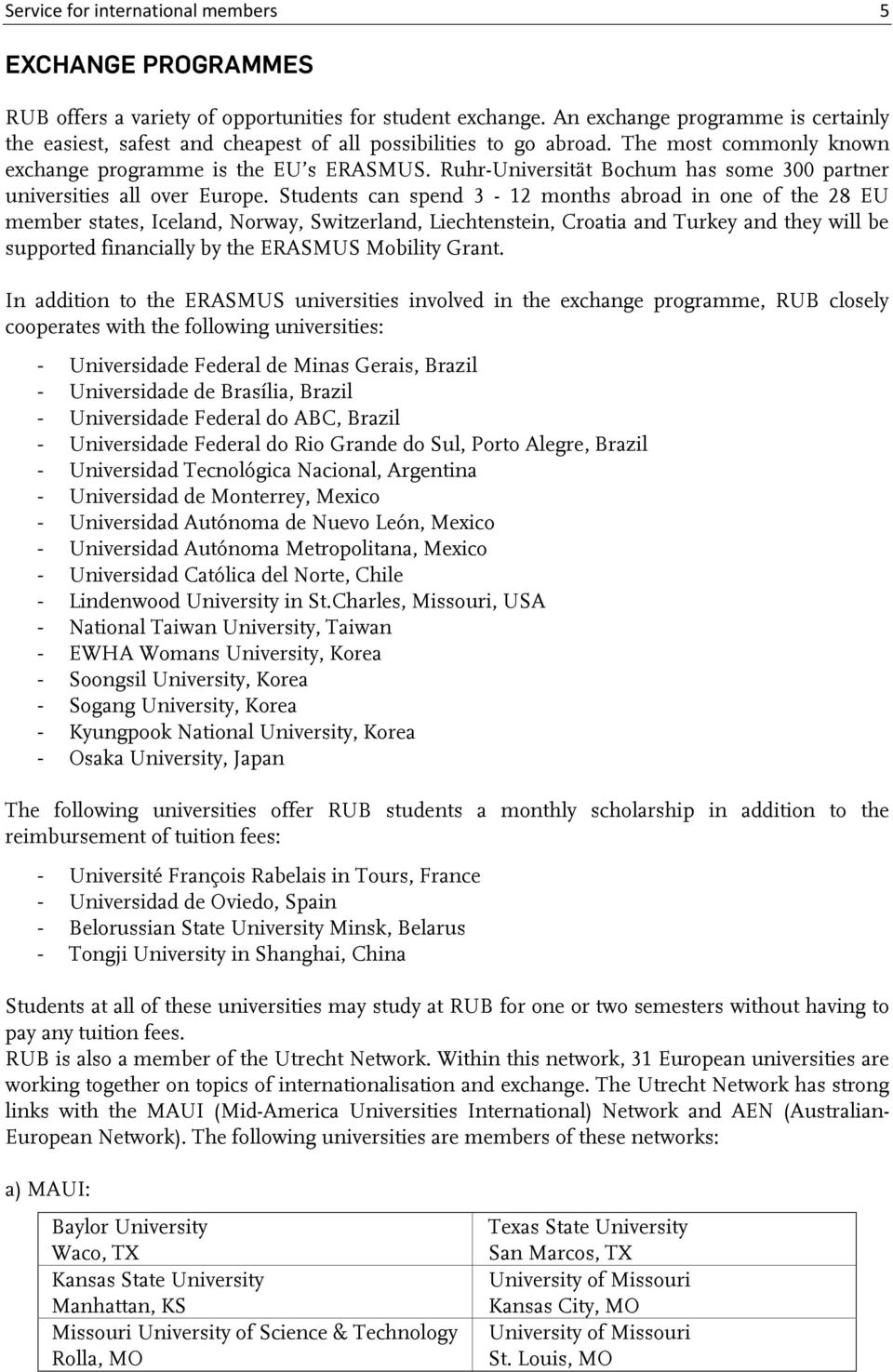
6 Service for international members 5 EXCHANGE PROGRAMMES RUB offers a variety of opportunities for student exchange. An exchange programme is certainly the easiest, safest and cheapest of all possibilities to go abroad. The most commonly known exchange programme is the EU s ERASMUS. Ruhr-Universität Bochum has some 300 partner universities all over Europe. Students can spend 3-12 months abroad in one of the 28 EU member states, Iceland, Norway, Switzerland, Liechtenstein, Croatia and Turkey and they will be supported financially by the ERASMUS Mobility Grant. In addition to the ERASMUS universities involved in the exchange programme, RUB closely cooperates with the following universities: - Universidade Federal de Minas Gerais, Brazil - Universidade de Brasília, Brazil - Universidade Federal do ABC, Brazil - Universidade Federal do Rio Grande do Sul, Porto Alegre, Brazil - Universidad Tecnológica Nacional, Argentina - Universidad de Monterrey, Mexico - Universidad Autónoma de Nuevo León, Mexico - Universidad Autónoma Metropolitana, Mexico - Universidad Católica del Norte, Chile - Lindenwood University in St.Charles, Missouri, USA - National Taiwan University, Taiwan - EWHA Womans University, Korea - Soongsil University, Korea - Sogang University, Korea - Kyungpook National University, Korea - Osaka University, Japan The following universities offer RUB students a monthly scholarship in addition to the reimbursement of tuition fees: - Université François Rabelais in Tours, France - Universidad de Oviedo, Spain - Belorussian State University Minsk, Belarus - Tongji University in Shanghai, China Students at all of these universities may study at RUB for one or two semesters without having to pay any tuition fees. RUB is also a member of the Utrecht Network. Within this network, 31 European universities are working together on topics of internationalisation and exchange. The Utrecht Network has strong links with the MAUI (Mid-America Universities International) Network and AEN (Australian- European Network). The following universities are members of these networks: a) MAUI: Baylor University Waco, TX Kansas State University Manhattan, KS Missouri University of Science & Technology Rolla, MO Texas State University San Marcos, TX University of Missouri Kansas City, MO University of Missouri St. Louis, MO
7 6 Service for international members Oklahoma State University Stillwater, OK Southern Illinois University at Carbondale, IL Texas Tech University Lubbock, TX University of Kansas Lawrence, KS University of Nebraska Kearney, NE University of Nebraska Lincoln, NE University of Nebraska Omaha, NE University of Oklahoma Norman, OK b) AEN: Deakin University Victoria Edith Cowan University Western Australia Griffith University Queensland Macquarie University New South Wales University of Tasmania Tasmania University of Western Sydney New South Wales University of Wollongong New South Wales Student exchanges take place on a regular basis through the MAUI Utrecht Network Exchange Programme and the AEN Utrecht Network Exchange Programme. Students from all areas of study may participate (only students from the Faculty of Medicine are excluded from the MAUI and AEN Utrecht Network exchange programmes). All tuition fees at the host institution will be reimbursed. Furthermore, many faculties run their own exchange programmes: English/American Studies: - Central Michigan University, USA Slavonic Studies: - Institute of European Cultures, Moscow, Russia - Moscow State University of Railway Engineering, Russia - Kursk State University, Russia - Vologda State Pedagogical University, Russia - Vologda State Technical University, Russia - Belorussian State University Minsk, Belarus - Simferopol State University, Ukraine Faculty of Economics: - Tongji University in Shanghai, China - Nihon University in Tokyo, Japan Faculty of East Asian Studies: - Tongji University in Shanghai, China - Nihon University in Tokyo, Japan - Fukushima University in Fukushima, Japan

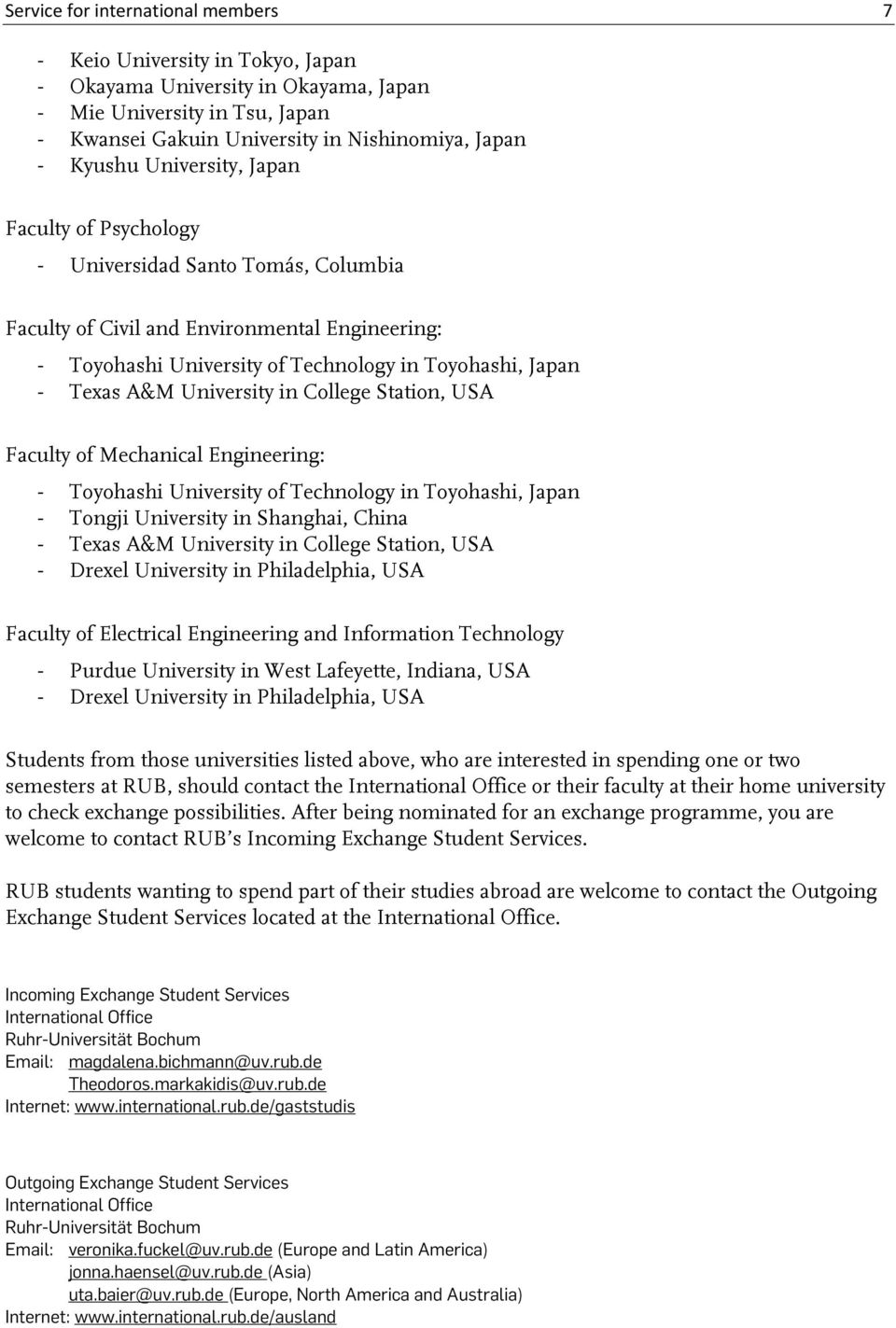
8 Service for international members 7 - Keio University in Tokyo, Japan - Okayama University in Okayama, Japan - Mie University in Tsu, Japan - Kwansei Gakuin University in Nishinomiya, Japan - Kyushu University, Japan Faculty of Psychology - Universidad Santo Tomás, Columbia Faculty of Civil and Environmental Engineering: - Toyohashi University of Technology in Toyohashi, Japan - Texas A&M University in College Station, USA Faculty of Mechanical Engineering: - Toyohashi University of Technology in Toyohashi, Japan - Tongji University in Shanghai, China - Texas A&M University in College Station, USA - Drexel University in Philadelphia, USA Faculty of Electrical Engineering and Information Technology - Purdue University in West Lafeyette, Indiana, USA - Drexel University in Philadelphia, USA Students from those universities listed above, who are interested in spending one or two semesters at RUB, should contact the International Office or their faculty at their home university to check exchange possibilities. After being nominated for an exchange programme, you are welcome to contact RUB s Incoming Exchange Student Services. RUB students wanting to spend part of their studies abroad are welcome to contact the Outgoing Exchange Student Services located at the International Office. Incoming Exchange Student Services International Office Ruhr-Universität Bochum [email protected] [email protected] Internet: Outgoing Exchange Student Services International Office Ruhr-Universität Bochum [email protected] (Europe and Latin America) [email protected] (Asia) [email protected] (Europe, North America and Australia) Internet:
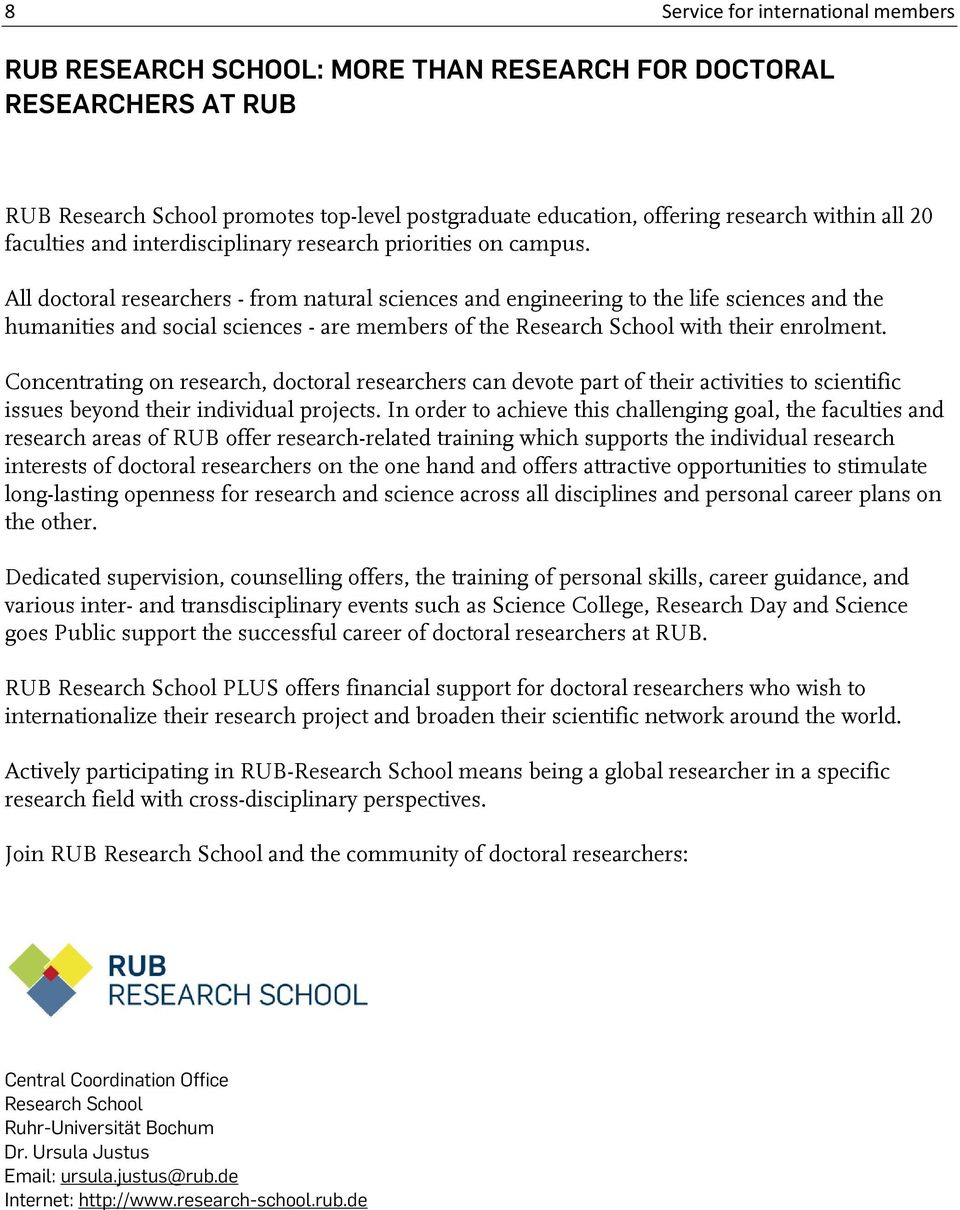
9 8 Service for international members RUB RESEARCH SCHOOL: MORE THAN RESEARCH FOR DOCTORAL RESEARCHERS AT RUB RUB Research School promotes top-level postgraduate education, offering research within all 20 faculties and interdisciplinary research priorities on campus. All doctoral researchers - from natural sciences and engineering to the life sciences and the humanities and social sciences - are members of the Research School with their enrolment. Concentrating on research, doctoral researchers can devote part of their activities to scientific issues beyond their individual projects. In order to achieve this challenging goal, the faculties and research areas of RUB offer research-related training which supports the individual research interests of doctoral researchers on the one hand and offers attractive opportunities to stimulate long-lasting openness for research and science across all disciplines and personal career plans on the other. Dedicated supervision, counselling offers, the training of personal skills, career guidance, and various inter- and transdisciplinary events such as Science College, Research Day and Science goes Public support the successful career of doctoral researchers at RUB. RUB Research School PLUS offers financial support for doctoral researchers who wish to internationalize their research project and broaden their scientific network around the world. Actively participating in RUB-Research School means being a global researcher in a specific research field with cross-disciplinary perspectives. Join RUB Research School and the community of doctoral researchers: Central Coordination Office Research School Ruhr-Universität Bochum Dr. Ursula Justus [email protected] Internet:
10 Service for international members 9 WELCOME CENTRE FOR INTERNATIONAL RESEARCHERS The Welcome Centre is the place to go for international researchers and their families who seek advice and support regarding their research stay at Ruhr-Universität Bochum. We offer information and services on topics such as residence formalities, health insurance or family issues, as well as helpful hints for a smooth social integration and everyday life in Germany. Welcome Centre also provides advice to hosts and faculties at RUB. Services Online guide in German and English ( Support in dealing with formalities and authorities Support in finding accommodation Information on family issues, German courses Online portal: International Researchers Gallery International Lounge Welcome Centre Events The Welcome Centre invites international researchers and their families to various events such as excursions throughout the region, receptions of the rectorate on a regular basis, the monthly International Women s Exchange and many more. International Lounge Ruhr-Universität Bochum has a modern, comfortable lounge for international researchers, their families and mentors. At the lounge they have the possibility to get together to talk and work or simply to have a coffee and read an international journal. During opening hours there is always someone present at the Lounge to answer any general questions you may have. EURAXESS The Welcome Centre in Bochum is registered as a local service point of EURAXESS an EU wide network providing information and advice for internationally mobile researchers. Welcome Centre, International Office Ruhr-Universität Bochum Studierendenhaus [email protected] Internet: Facebook: Welcome Centre RUB International Lounge for visiting researchers: Mensa building, main entrance, Bistro level

11 10 Studying at RUB STUDYING AT RUB DEGREE PROGRAMMES TAUGHT IN ENGLISH Numerous degree programmes at RUB are taught in English, many of them specialising in contemporary research topics and/or offering double and joint degrees with notable universities: Joint European Master's Programme in International Humanitarian Action (NOHA) Institute for International Law of Peace and Armed Conflict Degree: Master of Arts (joint degree) Application deadline: 15 March Prerequisites: Master's degree (or equivalent) in International Relations, History, Law, Medicine, Psychology, Sociology, Anthropology, Economics, Management, Geography, Spatial Sciences or related fields Fees: participation costs 12,600 for non-european students; 8,400 for European students (oneoff payment), RUB s social fee approx. 260 (per semester) Special feature: Erasmus Mundus Programme Contact: Dr. Ulla Pape. Phone: +49(0)234/ , [email protected] More information: European Master's Programme in Human Rights and Democratisation Institute for International Law of Peace and Armed Conflict Degree: Master of Arts (joint degree) Next intake: December 2014 Prerequisites: university degree of a high standard in a field relevant to human rights, including disciplines of Law, Social Sciences and the Humanities and a minimum of 180 ECTS credits (Bachelor s/general degree) Fees: tuition fees 4300 (one-off payment), enrolment fee 130, application processing fee 50, RUB s social fee approx. 260 (per semester) Special feature: first semester taught in Venice Contact: Prof. Dr. Horst Fischer. [email protected] More information: The Master of Arts in Development Management Institute of Development Research and Development Policy Degree: Master of Arts (single degree) Application deadline: Next intake: October Application Deadlines will be published on the course homepage. Prerequisites: above-average BA or relevant degree in Political Science, Social Science, Law, Economics, Geography or any other subjects related to the planning and evaluation of development programmes and projects; career experience in a relevant field; proficiency in written and spoken English. Fees: RUB s social fee approx. 260 (per semester) Special feature: DAAD scholarships available; twin programme in Cape Town, S.A.

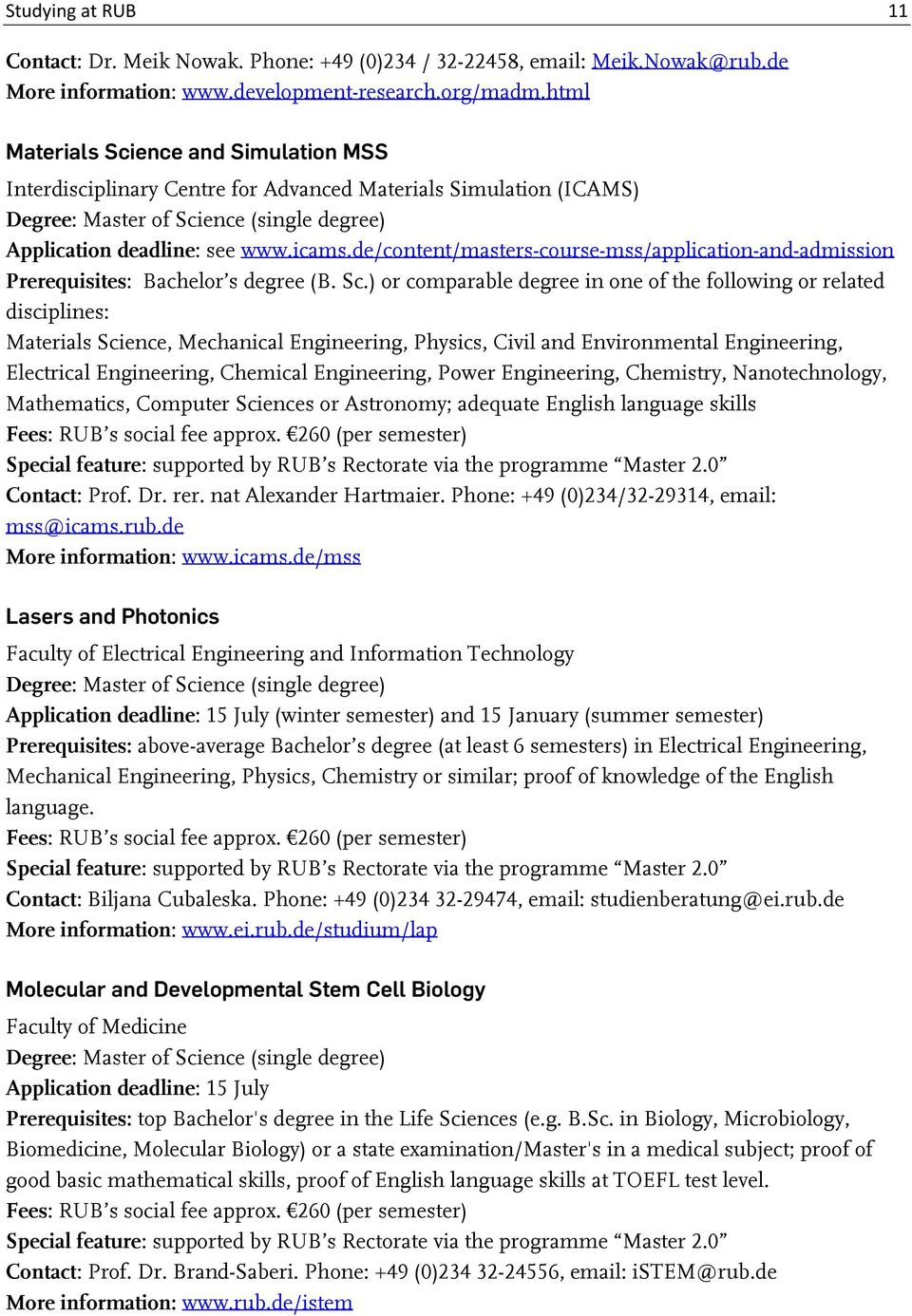
12 Studying at RUB 11 Contact: Dr. Meik Nowak. Phone: +49 (0)234 / , [email protected] More information: Materials Science and Simulation MSS Interdisciplinary Centre for Advanced Materials Simulation (ICAMS) Degree: Master of Science (single degree) Application deadline: see Prerequisites: Bachelor s degree (B. Sc.) or comparable degree in one of the following or related disciplines: Materials Science, Mechanical Engineering, Physics, Civil and Environmental Engineering, Electrical Engineering, Chemical Engineering, Power Engineering, Chemistry, Nanotechnology, Mathematics, Computer Sciences or Astronomy; adequate English language skills Fees: RUB s social fee approx. 260 (per semester) Special feature: supported by RUB s Rectorate via the programme Master 2.0 Contact: Prof. Dr. rer. nat Alexander Hartmaier. Phone: +49 (0)234/ , [email protected] More information: Lasers and Photonics Faculty of Electrical Engineering and Information Technology Degree: Master of Science (single degree) Application deadline: 15 July (winter semester) and 15 January (summer semester) Prerequisites: above-average Bachelor s degree (at least 6 semesters) in Electrical Engineering, Mechanical Engineering, Physics, Chemistry or similar; proof of knowledge of the English language. Fees: RUB s social fee approx. 260 (per semester) Special feature: supported by RUB s Rectorate via the programme Master 2.0 Contact: Biljana Cubaleska. Phone: +49 (0) , [email protected] More information: Molecular and Developmental Stem Cell Biology Faculty of Medicine Degree: Master of Science (single degree) Application deadline: 15 July Prerequisites: top Bachelor's degree in the Life Sciences (e.g. B.Sc. in Biology, Microbiology, Biomedicine, Molecular Biology) or a state examination/master's in a medical subject; proof of good basic mathematical skills, proof of English language skills at TOEFL test level. Fees: RUB s social fee approx. 260 (per semester) Special feature: supported by RUB s Rectorate via the programme Master 2.0 Contact: Prof. Dr. Brand-Saberi. Phone: +49 (0) , [email protected] More information:
13 12 Studying at RUB Molecular Sciences (imos) Faculty of Chemistry and Biochemistry Degree: Master of Science (single degree) Application deadline: Admission is open all year round. The course programs starts in winter semester (october) each year. Prerequisites A B.Sc. Degree or international equivalent with an average mark better than 2.0 in Chemistry, Physics, Biochemistry, Engineering or a related interdisciplinary subject; adequate English language skills. Fees: RUB s social fee approx. 260 (per semester) Special feature: supported by RUB s Rectorate via the programme Master 2.0 Contact: Dr. Gerhard Schwaab. Phone: +49 (0)234 / , [email protected] More information: Computational Engineering Faculty of Civil and Environmental Engineering Degree: Master of Science (single degree) Application deadline: international students 1 May, national students 15 September Prerequisites: above-average Bachelor s (or comparable) degree in Civil Engineering, Mechanical Engineering or a related engineering field. Students who have a Bachelor s degree in Computer Science will not be accepted. Very good English language skills. Fees: RUB s social fee approx. 260 (per semester) Special feature: twin programme at the Vietnamese-German University in Ho Chi Minh City Contact: Dipl.-Ing. Jörg Sahlmen. Phone: +49 (0)234 / , [email protected] More information: Geosciences Energy and Resources Faculty of Geosciences Degree: Master of Science (single degree) Application deadline: 15 July Prerequisites: B.Sc. in Geosciences or related Natural Sciences, English language proficiency (written and spoken) and sufficient physical fitness to perform fieldwork Fees: RUB s social fee approx. 260 (per semester) Special feature: prepares students for subsequent employment in the industry (mainly hydrocarbon industry) Contact: Prof. Dr. Adrian Immenhauser. Phone: +49 (0)234 / , [email protected] More information: Master of Science in Biochemistry Faculty of Chemistry and Biochemistry Degree: Master of Science (single degree) Application deadline: 15 July Prerequisites: above-average German or equivalent Bachelor of Science in Biochemistry or a related field; very good English language skills Fees: RUB s social fee approx. 260 (per semester)

14 Studying at RUB 13 Contact: Prof. Dr. Irmgard D. Dietzel-Meyer. Phone: +49 (0)234 / , [email protected] More information: Master of Science in Chemistry Faculty of Chemistry and Biochemistry Degree: Master of Science (single degree) Application deadline: 15 July Prerequisites: above-average German or equivalent Bachelor of Science in Chemistry or a related field; very good English language skills Fees: RUB s social fee approx. 260 (per semester) Contact: Gundula Talbot: +49 (0)234 / , [email protected]. More information: Master of Science in Economics Faculty of Management and Economics Degree: Master of Science (single degree) Application deadline: 15 July (winter semester), 15 January (summer semester) Prerequisites: A bachelor s degree in economics or a related discipline (business, statistics, mathematics, political science, international relations, etc.) with a regular period of study of at least six semesters (180 ECTS credit points). As the program is taught entirely in English, applicants need to have English language skills of Level B2 according to the Common European Framework of Reference for Languages. For further details on admission requirements please visit the program s website or contact the program coordinator. Fees: RUB s social fee approx. 260 (per semester) Contact: Ceren Erdogan. Phone: +49 (0) , [email protected] More information: Transformation of Urban Landscapes (TUL) Faculty of Geosciences, department of Geography Degree: Master of Science (RUB) and Master in Engineering (Tongji University) Application deadline: 15 July (winter semester) Prerequisites: Bachelor of Science degree in Geography, Spatial Planning ( Raumplanung ), or familiar equivalent study programmes from Germany or other countries. Thorough knowledge of English. Contact: Dr.-Ing. Nils Leber. Phone: +49 (0) , [email protected] More information:

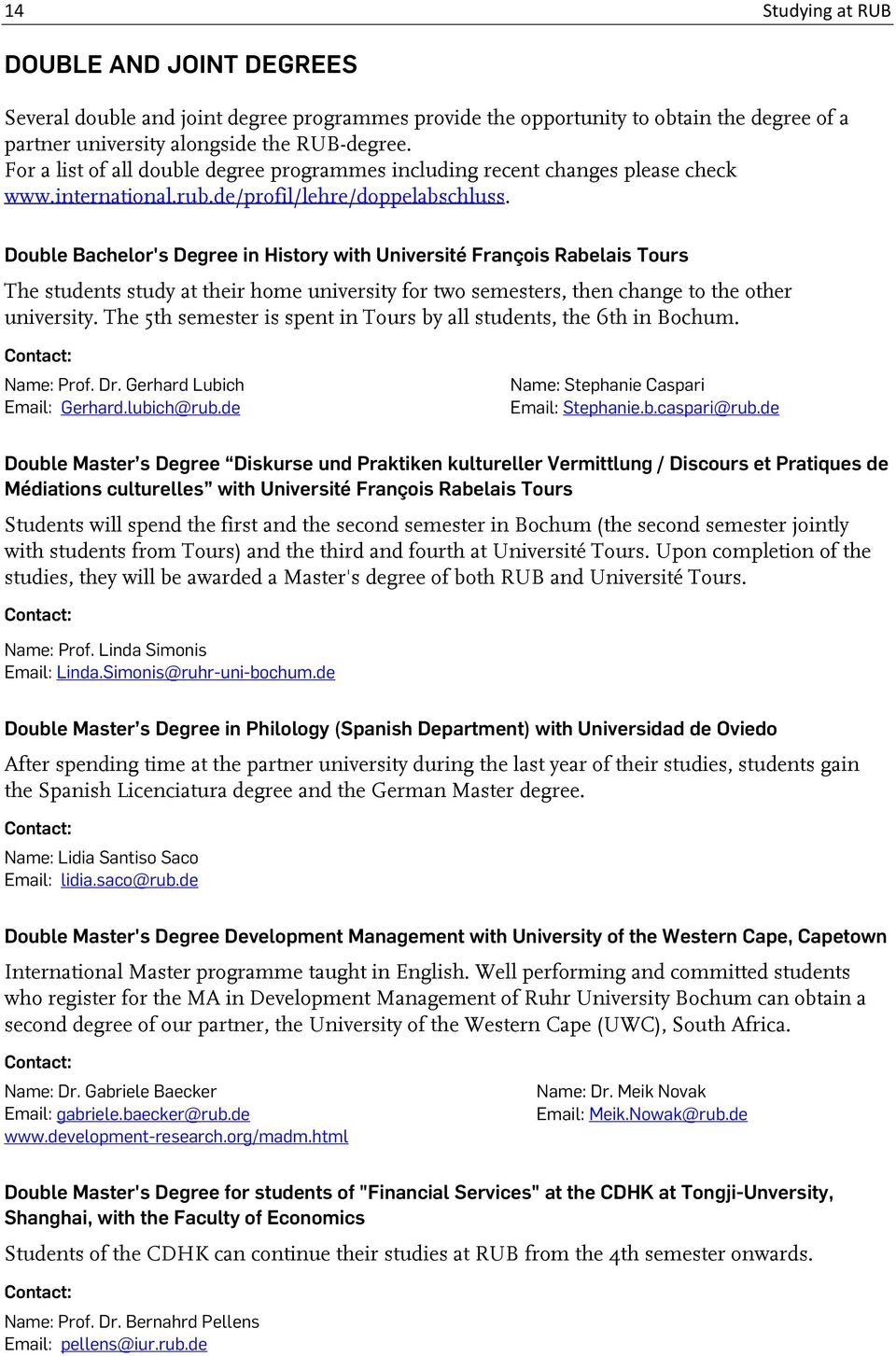
15 14 Studying at RUB DOUBLE AND JOINT DEGREES Several double and joint degree programmes provide the opportunity to obtain the degree of a partner university alongside the RUB-degree. For a list of all double degree programmes including recent changes please check Double Bachelor's Degree in History with Université François Rabelais Tours The students study at their home university for two semesters, then change to the other university. The 5th semester is spent in Tours by all students, the 6th in Bochum. Contact: Name: Prof. Dr. Gerhard Lubich [email protected] Name: Stephanie Caspari [email protected] Double Master s Degree Diskurse und Praktiken kultureller Vermittlung / Discours et Pratiques de Médiations culturelles with Université François Rabelais Tours Students will spend the first and the second semester in Bochum (the second semester jointly with students from Tours) and the third and fourth at Université Tours. Upon completion of the studies, they will be awarded a Master's degree of both RUB and Université Tours. Contact: Name: Prof. Linda Simonis [email protected] Double Master s Degree in Philology (Spanish Department) with Universidad de Oviedo After spending time at the partner university during the last year of their studies, students gain the Spanish Licenciatura degree and the German Master degree. Contact: Name: Lidia Santiso Saco [email protected] Double Master's Degree Development Management with University of the Western Cape, Capetown International Master programme taught in English. Well performing and committed students who register for the MA in Development Management of Ruhr University Bochum can obtain a second degree of our partner, the University of the Western Cape (UWC), South Africa. Contact: Name: Dr. Gabriele Baecker [email protected] Name: Dr. Meik Novak [email protected] Double Master's Degree for students of "Financial Services" at the CDHK at Tongji-Unversity, Shanghai, with the Faculty of Economics Students of the CDHK can continue their studies at RUB from the 4th semester onwards. Contact: Name: Prof. Dr. Bernahrd Pellens [email protected]
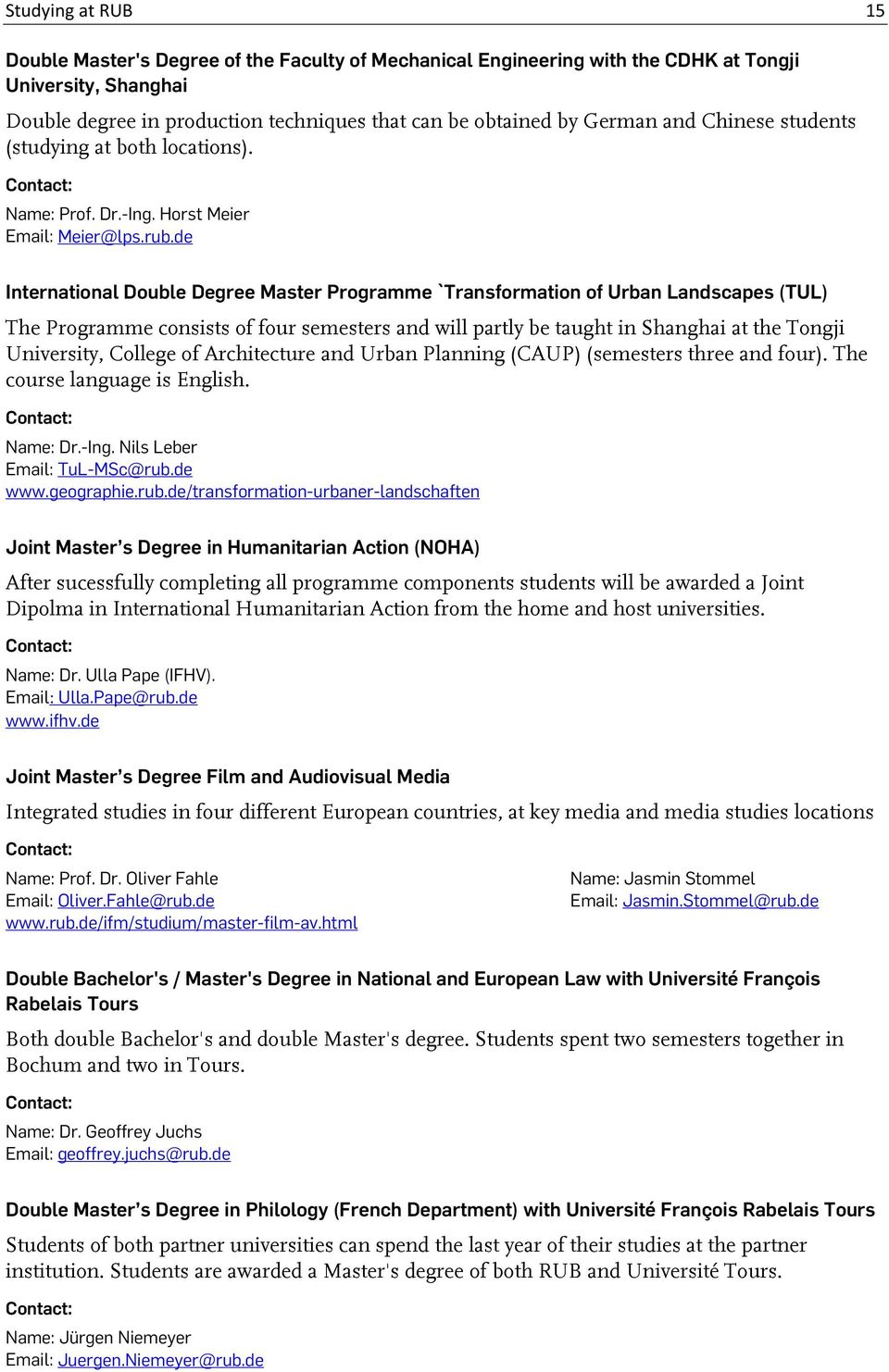
16 Studying at RUB 15 Double Master's Degree of the Faculty of Mechanical Engineering with the CDHK at Tongji University, Shanghai Double degree in production techniques that can be obtained by German and Chinese students (studying at both locations). Contact: Name: Prof. Dr.-Ing. Horst Meier International Double Degree Master Programme `Transformation of Urban Landscapes (TUL) The Programme consists of four semesters and will partly be taught in Shanghai at the Tongji University, College of Architecture and Urban Planning (CAUP) (semesters three and four). The course language is English. Contact: Name: Dr.-Ing. Nils Leber Joint Master s Degree in Humanitarian Action (NOHA) After sucessfully completing all programme components students will be awarded a Joint Dipolma in International Humanitarian Action from the home and host universities. Contact: Name: Dr. Ulla Pape (IFHV). [email protected] Joint Master s Degree Film and Audiovisual Media Integrated studies in four different European countries, at key media and media studies locations Contact: Name: Prof. Dr. Oliver Fahle [email protected] Name: Jasmin Stommel [email protected] Double Bachelor's / Master's Degree in National and European Law with Université François Rabelais Tours Both double Bachelor's and double Master's degree. Students spent two semesters together in Bochum and two in Tours. Contact: Name: Dr. Geoffrey Juchs [email protected] Double Master s Degree in Philology (French Department) with Université François Rabelais Tours Students of both partner universities can spend the last year of their studies at the partner institution. Students are awarded a Master's degree of both RUB and Université Tours. Contact: Name: Jürgen Niemeyer [email protected]
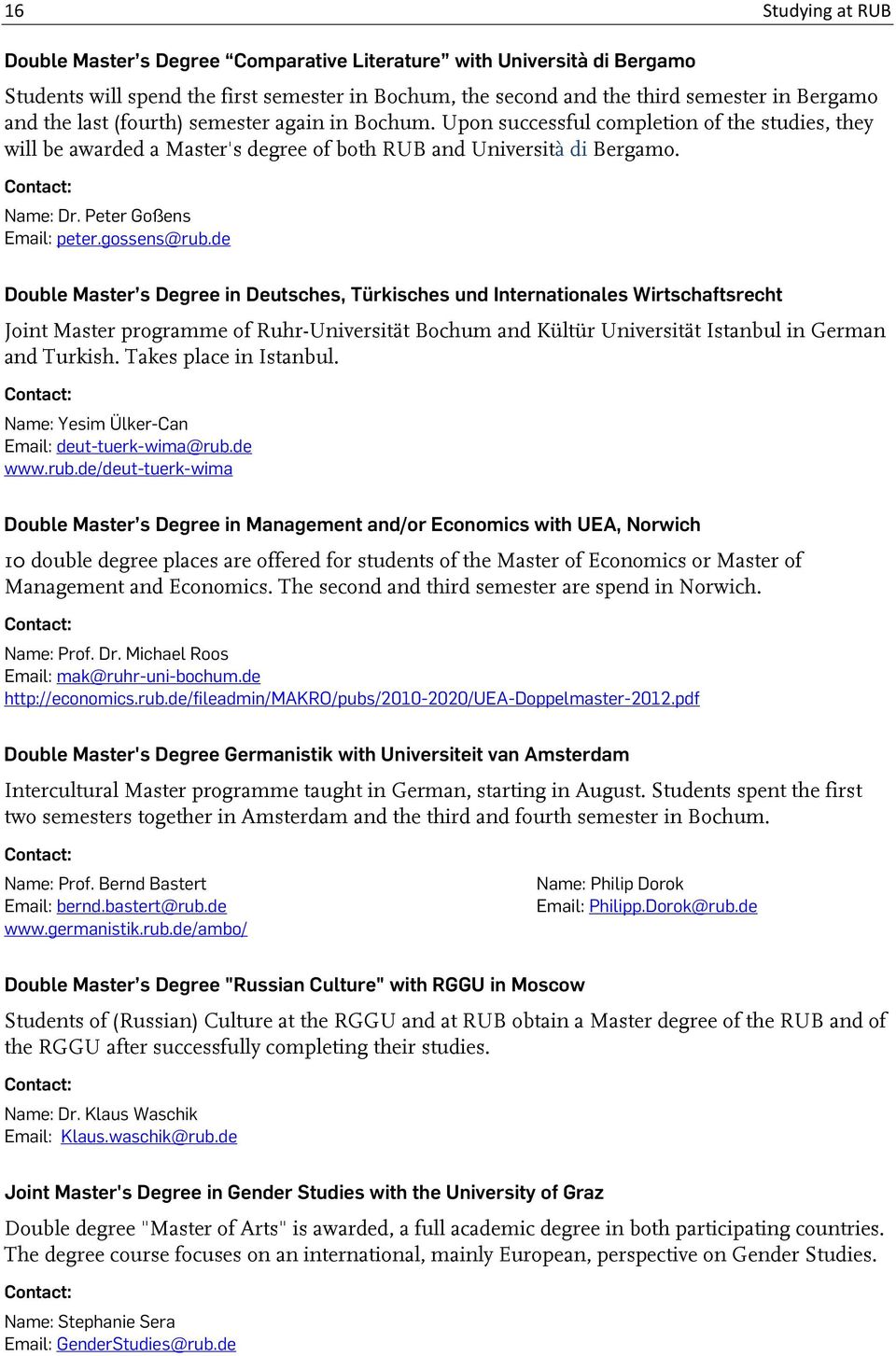
17 16 Studying at RUB Double Master s Degree Comparative Literature with Università di Bergamo Students will spend the first semester in Bochum, the second and the third semester in Bergamo and the last (fourth) semester again in Bochum. Upon successful completion of the studies, they will be awarded a Master's degree of both RUB and Università di Bergamo. Contact: Name: Dr. Peter Goßens [email protected] Double Master s Degree in Deutsches, Türkisches und Internationales Wirtschaftsrecht Joint Master programme of Ruhr-Universität Bochum and Kültür Universität Istanbul in German and Turkish. Takes place in Istanbul. Contact: Name: Yesim Ülker-Can [email protected] Double Master s Degree in Management and/or Economics with UEA, Norwich 10 double degree places are offered for students of the Master of Economics or Master of Management and Economics. The second and third semester are spend in Norwich. Contact: Name: Prof. Dr. Michael Roos [email protected] Double Master's Degree Germanistik with Universiteit van Amsterdam Intercultural Master programme taught in German, starting in August. Students spent the first two semesters together in Amsterdam and the third and fourth semester in Bochum. Contact: Name: Prof. Bernd Bastert [email protected] Name: Philip Dorok [email protected] Double Master s Degree "Russian Culture" with RGGU in Moscow Students of (Russian) Culture at the RGGU and at RUB obtain a Master degree of the RUB and of the RGGU after successfully completing their studies. Contact: Name: Dr. Klaus Waschik [email protected] Joint Master's Degree in Gender Studies with the University of Graz Double degree "Master of Arts" is awarded, a full academic degree in both participating countries. The degree course focuses on an international, mainly European, perspective on Gender Studies. Contact: Name: Stephanie Sera [email protected]
18 Studying at RUB 17 LANGUAGE COURSES ZFA CENTER FOR FOREIGN LANGUAGE TRAINING a) Language Courses The University Language Centre (Zentrum für Fremdsprachenausbildung, ZFA) provides courses aimed at specialist and non-specialist language learners, with a particular focus on the key attributes of developing cultural awareness and intercultural communicative competence in an academic setting. Classes take place during the semester and -in the form of intensive coursesduring the semester break. The University Language Centre currently offers classes for 20 different languages, such as: Arabic, Catalan, Chinese, Danish, Dutch, English, French, Italian, Japanese, Norwegian, Polish, Portuguese, Russian, Spanish, Swedish and Turkish. b) German as a Foreign Language In addition to the language courses listed above, there are numerous offers for German as a Foreign Language. In addition to preparatory courses, there are a lot of courses that may be taken during the semester alongside regular studies. These courses are designed for the special needs of international students, PhD students and international researchers. c) Certification In some of the courses for the languages listed above, there is the possibility to achieve special certificates: TestDaF (Deutsch als Fremdsprache German as a Foreign Language) UNIcert (English, French, Italian, Polish, Russian, Swedish, Spanish) DELE (Spanish) CNaVT (Dutch) Swedex (Swedish) d) Individual Learning The University Language Centre also provides various opportunities for individual learning and offers support, guidance and individual assistance: - Tandem (Two people with different native languages learn with and from each other in a systematic manner) - Centre for self-organised learning - Language-learning coaching More Information: Bochum Institute of Intensive Language Training (LSI Landesspracheninstitut) This institute offers intensive language courses for Spanish, Arabic, Chinese, Japanese and Russian, along with a smaller number of less intensive courses for Korean, Persian, Dari and Turkish. For more Information, please visit:

19 18 Studying at RUB APPLICATION AND ADMISSION If you are coming to RUB as an exchange student, you have to apply for an exchange programme at your home university. You will find all of the required information at If you wish to complete a degree at RUB, you are very welcome to submit your application. Please note, however, that you have to fulfil certain criteria in order to be able to study at RUB: Your higher education entrance qualification must be recognised as equivalent to the German qualification. Your higher education entrance qualification (Hochschulzugangsberechtigung, HZB) is your school leaving certificate or proof of studies already completed at secondary education level. To qualify for admission to RUB, you must be able to prove that you possess the equivalent of the German Abitur qualification, which is the examination taken at the end of your secondary education. You will find more information regarding this topic at: Furthermore, you need sufficient German skills for most degree programmes. The international degree programmes listed in the first chapter of this brochure are an exception and these Programmes have individual application procedures. A high standard of German language skills are required for successful completion of a regular course at Ruhr-Universität Bochum. Language skills can be proven by presenting a certificate gained for passing one of the following examinations: DSH examination (level 2 or 3) ZOP examinimation or Goethe-Zertifikat C2 of the Goethe-Institut German language diploma, level II, of the Goethe-Institut TestDaF with the grades 4 x 4 or 16 points Degree in German philology. You will find more information on this subject at Ruhr-Universität Bochum offers an online application system. Application procedure can differ, depending on the country you are coming from and the subject you are planning to study at RUB. You will find all of the necessary information and the online application tool at Please note the application deadlines at RUB: Application period, winter semester: 15/05-15/07 Application period, summer semester: 15/11-15/01 International degree programmes may have their own deadlines and application procedures. For more information, check the chapter International Master Programmes.
20 International seminars and lectures 19 INTERNATIONAL SEMINARS AND LECTURES The following chapter contains a compilation of seminars and lectures (Bachelor, Master and PhD) held in English or other foreign languages. Please note: These seminars and lectures are NOT necessarily part of an international degree programme. FACULTY OF BIOLOGY AND BIOTECHNOLOGY FACULTY OF CATHOLIC THEOLOGY FACULTY OF CIVIL AND ENVIRONMENTAL ENGINEERING COMPUTATIONAL ENGINEERING FACULTY OF EAST ASIAN STUDIES FACULTY OF ECONOMICS FACULTY OF ELECTRICAL ENGINEERING FACULTY OF GEOSCIENCES FACULTY OF HISTORICAL SCIENCE INSTITUTE FOR ARCHAEOLOGICAL SCIENCE FACULTY OF LAW FACULTY OF MATHEMATICS FACULTY OF MECHANICAL ENGINEERING FACULTY OF PHILOLOGY ENGLISH DEPARTMENT INSTITUTE OF MEDIA STUDIES FACULTY OF PHILOSOPHY AND EDUCATION INSTITUTE FOR PHILOSOPHY FACULTY OF PSYCHOLOGY FACULTY OF SOCIAL SCIENCE INSTITUTE FOR MINING AND ENERGY LAW INSTITUTE FOR NEURAL COMPUTATION INSTITUTE OF DEVELOPMENT RESEARCH AND DEVELOPMENT POLICY INTERDISCIPLINARY CENTRE FOR ADVANCED MATERIALS SIMULATION (ICAMS) MEDICAL FACULTY
21 20 International seminars and lectures FACULTY OF BIOLOGY AND BIOTECHNOLOGY : KOLLOQUIUM ZU FORSCHUNGSARBEITEN DES LEHRSTUHLS PFLANZENPHYSIOLOGIE Department: Plant Physiology Contact: Angelika Ernst, Tel: +49 (0)234/ , Degree programme: Bachelor/Master/PhD Module: n.s. Course type: seminar Credit Points: 2 Teacher/Lecturer: Krämer/Piotrowski/Schünemann Requirements: n.s. ND 3/34 Fr: talks about ongoing research at the institute Proofs of academic achievement: participation and lecture KOLLOQUIUM METALLHOMÖOSTASE; GRUNDLAGEN UND PRAXIS DES WISSENSCHAFTLICHEN ARBEITENS IN DER PFLANZENPHYSIOLOGIE Department: Plant Physiology Contact: Angelika Ernst, Tel: +49 (0)234/ , [email protected] Degree programme: Bachelor/Master/PhD Module: n.s. Course type: seminar Credit Points: 1 Teacher/Lecturer: Krämer Requirements: n.s. ND 3/34 Mi: reports on research related to metal homoeostasis and plant metabolism
22 International seminars and lectures 21 Proofs of academic achievement: participation : JOURNAL CLUB PLANT PHYSIOLOGY Department: Plant Physiology Contact: Angelika Ernst, Tel: +49 (0)234/ , Degree programme: Master/PhD Module: n.s. Course type: seminar Credit Points: 1 Teacher/Lecturer: Krämer Requirements: n.s. ND 3/34 Monday, 9-11 (every four weeks) reports on recent publications in plant physiology Proofs of academic achievement: report LECTURE INTRODUCTION TO BIOINFORMATICS FOR STUDENTS OF BIOCHEMISTRY (M.SC.) Department: Lehrstuhl für Biophysik Contact: PD Dr. Mathias Lübben, Phone 24465, [email protected] Degree programme: Bachelor/Optionalbereich and Master of Biology or Biochemistry Module: Course type: Lecture Credit Points: 5 Teacher/Lecturer: PD Dr. Mathias Lübben, Prof. Dr. Axel Mosig, Prof. Dr. Raphael Stoll, Dr. Steffen Wolf Requirements: Students of the Optionalbereich should have a basic knowledge in Molecular Biology; Students of Biochemistry should have a Bachelor degree HGA20 Friday, /10/2013
23 22 International seminars and lectures In this lecture we give a basic introduction into various fields of bioinformatics, such as data banks and techniques of data recording, molecular sequence analysis and comparison, phylogeny, structure prediction of RNA and proteins, molecular structure analysis, molecular graphics and simulation of molecular dynamics. Special emphasis is on the application of bioinformatic tools. When needed, the used computer algorithms are discussed. The lecture is accompanied by a computer practical (IVV ), which takes place as announced in the lecture. Proofs of academic achievement: Written examination This course is credited for Optionalbereich. COMPUTER PRACTICAL: INTRODUCTION TO BIOINFORMATICS FOR STUDENTS OF BIOCHEMISTRY (M.SC.) Department: Lehrstuhl für Biophysik Contact: PD Dr. Mathias Lübben, Phone 24465, [email protected] Degree programme: Bachelor/Optionalbereich and Master of Biology or Biochemistry Module: Course type: Computer practical exercise Credit Points: 0 Teacher/Lecturer: PD Dr. Mathias Lübben, Prof. Dr. Axel Mosig, Prof. Dr. Raphael Stoll, Dr. Steffen Wolf Requirements: Students of the Optionalbereich should have a basic knowledge in Molecular Biology; Students of Biochemistry should have a Bachelor degree The lecture Introduction to Bioinformatics for Students of Biochemistry (M.Sc.) (Module ) must be attended in parallel. ND04/99 Friday, time to be To be announced in the announced accompanying lecture In this computer practical we deepen the basic introduction into various fields of bioinformatics, such as data banks and techniques of data recording, molecular sequence analysis and comparison, phylogeny, structure prediction of RNA and proteins, molecular structure analysis, molecular graphics and simulation of molecular dynamics. Special emphasis is on the application of bioinformatic tools. The exercises are accompanied by a lecture (IVV ). Proofs of academic achievement: The proof of achievement is coupled to the written examination according to the lecture IVV , This course is credited for Optionalbereich.
24 International seminars and lectures 23 FACULTY OF CATHOLIC THEOLOGY SOCIAL ETHICS IN NEW TESTAMNENT PERSPECTIVE Department: New Testament Contact: Prof. Dr. Thomas Söding Degree programme: BA MTh Med MA Module: Biblical Theology. Course type: Seminar Credit Points: 2 or 5 Teacher/Lecturer: Prof. Dr. Thomas Södong Requirements: - GA 6/134 Wednesday /10/2013 Social ethics builds its scientific concept on the basis of empirical researches and rational coherence alone, strictly independent of canonical texts. Traditionally this is the method of Christian theology as well. However, after the Papal encyclical Caritas in veritate (2009) a new discussion has been started; it is about the hermeneutical status of theological arguments in social ethics, and about the necessity or possibility of a biblical orientation. The discussion is focused mostly on the Old Testament, but that concentration risks overseeing the hermeneutical revolution in theological thinking about society, people, law and land, initiated by Jesus and reflected in early Christian literature. The course opens a way of a new dialogue between New Testament exegesis and theological social ethics working with key texts in the Gospel tradition and the letters of Paul. Literature: Wayne A. Meeks, The Moral World of the Fist Christians, Philadelphia 1988 Richard A. Horsley (ed.), Christian Origins (A people s history of Christianity 1), Minneapolis 2006 (deutsch: Sozialgeschichte des Christentums: Die ersten Christen, Gütersloh 2007) Markus Vogt (Hg.), Theologie der Sozialethik (QD 255), Freiburg Basel Wien 2013 Proofs of academic achievement: Written examination
25 24 International seminars and lectures FACULTY OF CIVIL AND ENVIRONMENTAL ENGINEERING LINEAR FINITE ELEMENT METHODS Department: Institute for Structural Mechanics Contact: Prof. Dr. Günther Meschke, , Degree programme: Master Civil Engineering Module: Computational Analysis and Safety Concepts for Structres; Geotechnics; Finite Element Methods Course type: Lecture Credit Points: 4,5 Teacher/Lecturer: Prof. Dr. Günther Meschke Requirements: Knowledge in structural mechanics, structural engineering to be assigned to be assigned 18/10/2013 In this course, starting from the basic equations and the principle of virtual work, isoparametric finite elements (trusses, slabs and 3D volume elements) are developed to be used in structural mechanics applications. Particular emphasis is put on the consistent description of the theoretical background (basic equations, principle of variational calculus) and a closed formulation. Further key aspects are the assembling of finite elements to a discretised structure and the solution of the system equations. Furthermore, locking effects and their mitigation will be discussed. The lecture is supplemented by exercises where the basic workflow of finite element discretisation from the local equations to the complete finite element is shown. Finally, the solution of structural problems by means of the finite elements developed in the lecture will be exercised. Proofs of academic achievement: written examination APPLIED FINITE ELEMENT METHODS Department: Institute for Structural Mechanics Contact: Prof. Dr. Günther Meschke, , [email protected] Degree programme: Master Civil Engineering Module: Computational Analysis and Safety Concepts for Structures; Finite Element Methods Module taught entirely in foreign language: Yes Course type: Lecture Credit Points: 1,5 Teacher/Lecturer: Prof. Dr. Günther Meschke Requirements: Knowledge in structural mechanics, structural engineering
26 International seminars and lectures 25 to be assigned to be assigned 18/10/2013 In this course, the practical application of commercially available finite element sotware is covered. Here, besides the basic modelling techniques, also common mistakes and the critical interpretation of computation results will be discussed. In a seminar work, the students create individual finite element models and perform an interpretation of the simulation results. Proofs of academic achievement: case study This course is credited for Optionalbereich. EXTENDED FINITE ELEMENT METHODS Department: Institute for Structural Mechanics Contact: Prof. Dr. Günther Meschke, , [email protected] Degree programme: Master Civil Engineering Module: Finite Element Methods Course type: Lecture Credit Points: 3 Teacher/Lecturer: Prof. Dr. Günther Meschke Requirements: Knowledge in structural mechanics, structural engineering to be assigned to be assigned 18/10/2013 Extending the contents of Linear Finite Element Methods, this course additionally covers further elements (beams, plates and shells) as well as coupled problems (thermo-mechanical). In the second part of the course, the implementation of user elements into finite element software will be demonstrated. I the seminar work, students are asked to implement their own element into an existing finite element program. Proofs of academic achievement: written examination This course is credited for Optionalbereich. FINITE ELEMENT METHODS IN LINEAR STRUCTURAL DYNAMICS Department: Institute for Structural Mechanics Contact: Prof. Dr. Günther Meschke, , [email protected]
27 26 International seminars and lectures Degree programme: Master Civil Engineering / Master Computational Engineering Module: n.s. Course type: Structural Dynamics Credit Points: 3 Teacher/Lecturer: Prof. Dr. Günther Meschke Requirements: Basics in finite element methods, mathematics and mechanics (dynamics) to be assigned to be assigned 18/10/2013 The course covers the basic equations of linear elastodynamics and the basics of finite element methods in structural dynamics. Furthermore, the following topics will be covered: explicit and implicit time integration methods with focus on the generalised Newmark method, accuracy, stability and damping properties, solvers for eigenvalue problems. All algorithms are discussed by means of a practical application in finite element software. Proofs of academic achievement: written examination This course is credited for Optionalbereich.
28 International seminars and lectures 27 COMPUTATIONAL ENGINEERING MECHANICAL MODELLING OF MATERIALS (CE P02) Department: Computational Engineering Contact: CompEng Office, 0234/ , Degree programme: Computational Engineering Module: Mechanical Modelling of Materials. Course type: Lecture (2h) and exercise (2h) Credit Points: 6 Teacher/Lecturer: Prof. Dr.-Ing. Steeb Requirements: Basic knowledge in Mathematics and Mechanics IC 03/ (Mon), HZO Monday , 14/10/2013 (Mon) 90 (Tue) Tuesday Several advanced issues of the mechanical behaviour of materials are addressed in this course. More precisely, the following topics will be covered: Basic concepts of continuum mechanics (introduction) Introduction into the rheology of materials (solid, fluid, multiphase materials, jammed materials) Theoretical concepts of constitutive modelling 1-dimensional constitutive approaches for o Elasticity, hyperelasticity o Inelasticity (plasticity, damage, viscoelasticity) o Multiphase/porous materials 3-dimensional generalization of material modelling concepts Simple boundary and initial value problems Proofs of academic achievement: written examination COMPUTER-ORIENTED DESIGN OF STEEL STRUCTURES Department: Computational Engineering Contact: CompEng Office, 0234/ , [email protected] Degree programme: Computational Engineering Module: Computer-oriented Design of Steel Structures Course type: Lecture (2h) and exercise (2h) Credit Points: 6 Teacher/Lecturer: Prof. Dr.-Ing. R. Kindmann Requirements: Fundamental knowledge in mechanics and strength of materials
29 28 International seminars and lectures HZO 100 Tuesday , 15/10/2013 (Tue) Thursday Basics of Design and Fundamentals for Computer-Oriented Calculations - Basic principles of structural design - Verification methods Elastic-Elastic and Elastic-Plastic - Beam theory and torsion - Finite elements for beams - Design software - Practical course in the structural Testing Laboratory Verifications Regarding Stability and Second Order Theory - Geometric non-linear design of structures - second order analysis - Buckling of linear members and frames - Lateral buckling and lateral torsional buckling - Eigenvalues and shapes - Numerical methods for plate buckling - Design software - Practical course in the structural Testing Laboratory Proofs of academic achievement: written examination MODERN PROGRAMMING CONCEPTS IN ENGINEERING (CE P04) Department: Computational Engineering Contact: CompEng Office, 0234/ , [email protected] Degree programme: Computational Engineering Module: Modern Programming Concepts in Engineering Course type: Lecture (2h) and exercise (2h) Credit Points: 6 Teacher/Lecturer: Prof. Dr.-Ing. M. König Requirements: - IC 03/ (Thu) Thursday /10/2013 (Thu) Lectures and exercises cover the following topics: Principles of object-oriented modelling o Encapsulation o Polymorphism o Inheritance Unified Modelling Language (UML) Basic programming constructs Fundamental data structures Implementation of efficient algorithms
30 International seminars and lectures 29 o Vector and matrix operations o Solving systems of linear equations o Grid generation techniques Using software libraries o View3d a visualization toolkit o Packages for graphical user interfaces During the exercises, students practice object-oriented program-ming techniques in the computer lab on the basis of fundamental engineering problems. Proofs of academic achievement: written examination (70%) and homework (30%) MATHEMATICAL ASPECTS OF DIFFERENTIAL EQUATIONS AND NUMERICAL MATHEMATICS (CE P01) Department: Computational Engineering Contact: CompEng Office, 0234/ , [email protected] Degree programme: Computational Engineering Module: Mathematical Aspects of Differential Equations and Numerical Mathematics Course type: Lecture (2h) and exercise (2h) Credit Points: 6 Teacher/Lecturer: Prof. Dr. G. Röhrle Requirements: Basic calculus and experience with matrices NC 6/99 (Wed), NB 6/99 Wednesday , 16/10/2013 (Wed) (Thu) Thursday Linear algebra: Basic concepts and techniques for finite- and Infinite-dimensional function spaces stressing the role of linear differential operators. Numerical algorithms for solving linear systems. The mathematics of the finite element method in the context of elliptic partial differential equations (model problems) in dimension two. Proofs of academic achievement: written examination FINITE ELEMENT METHODS IN LINEAR STRUCTURAL MECHANICS (CE P05) Department: Computational Engineering Contact: CompEng Office, 0234/ , [email protected] Degree programme: Computational Engineering Module: Finite Element Methods in Linear Structural Mechanics Course type: Lecture (2h) and exercise (2h)
31 30 International seminars and lectures Credit Points: 6 Teacher/Lecturer: Prof. Dr. techn. G. Meschke Requirements: Basics in Mathematics, Mechanics and Structural Analysis (bachelor level) HIC (Mon) Monday /10/2013 (Mon) Introduction to the finite element method in the framework of linear elastodynamics. Based upon the weak form of the boundary value problem principles of spatial discretization using the finite element method are explained step by step. First, one-dimensional isoparametric p-truss elements are used to explain the fundamentals of the finite element method. Afterwards the same methodology is used to develop two- (plane stress and plane strain) and three-dimensional isoparametric p-finite elements for linear structural mechanics. In addition to analyses related to structural mechanics, the application of the finite element method to the spatial discretization of problems associated with transport processes within structures (e.g. heat conduction, pollutant transport, moisture transport, coupled problems) is demonstrated. The second part of the lecture is concerned with finite element models for beams and plates. In this context aspects of element locking and possible remedies are discussed. The lectures are supplemented by exercises to promote the understanding of the underlying theory and to demonstrate the application of the finite element method for the solution of selected examples. Furthermore, practical applications of the finite element method are demonstrated by means of a commercial finite element program. Proofs of academic achievement: written examination (85%) and seminar papers (15%) VARIATIONAL CALCULUS AND TENSOR ANALYSIS (CE WP01) Department: Computational Engineering Contact: CompEng Office, 0234/ , [email protected] Degree programme: Computational Engineering Module: Variational Calculus and Tensor Analysis Course type: Lecture (2h) and exercise (1h) Credit Points: 4 Teacher/Lecturer: Dr.-Ing. R. Jänicke Requirements: Basic knowledge in Mathematics and Mechanics HZO 100 (Thu), HZO 90 Thursday , 17/10/2013 (Thu) (Fri) Friday Several issues of variational calculus and tensor analysis are addressed in this course. More precisely, the following topics will be covered: - Motivation: Why do we need variations and tensors in mechanics? Variational calculus: - First and second variation - Direct methods - Constrained minimisation problems, Lagrange multipliers
32 International seminars and lectures 31 - Hamilton s principle Tensor analysis: - Vector and tensor notation - Recall of vector and tensor algebra - Dual bases, coordinates in Euclidean space - Differential calculus - Scalar invariants and spectral analysis - Isotropic functions Applications to continuum mechanics will be introduced. Proofs of academic achievement: written examination DYNAMICS OF STRUCTURES (CE WP10) Department: Computational Engineering Contact: CompEng Office, 0234/ , [email protected] Degree programme: Computational Engineering Module: Dynamics of Structures Course type: Lecture (2h) and exercise (2h) Credit Points: 6 Teacher/Lecturer: Prof. Dr.-Ing. R. Höffer, Prof. Dr. techn. Meschke Requirements: A first degree in engineering sciences (e.g. B.Sc.), A profound previous knowledge in fluid mechanics, especially mechanics of solids and numerical methods in dynamics tba tba 10/2013 The lecture recapitulates and deepens the methodology of the calculation of single- and multi-degree-offreedom oscillations of structures. Dynamical analyses are based on simplified models of structures and on the application of modal analysis. A second focus is put on the modelling and the computation of random vibrations of structures. The spectral method for a stationary, broad-banded excitation mechanism like wind excitation is introduced. The response spectrum method for the treatment of earthquake excitations is applied. In addition to the procedures in the frequency domain numerical representations of stochastic processes in time domain are explained. The contents of the lecture are deepend during the excercises and through seminar papers performed by the students. The presentation of related results through students is part of the modul. Learning objectives: The students shall attain the qualifications to apply realistic models of dynamically excited engineering structures and of the excitation mechanism including simplified, stochastic excitation models for wind or earthquake impacts, and to analyse the structural responses. Proofs of academic achievement: written examination COMPUTATIONAL PLASTICITY (CE WP11)
33 32 International seminars and lectures Department: Computational Engineering Contact: CompEng Office, 0234/ , Degree programme: Computational Engineering Module: Computational Plasticity Course type: Lectures including exercises: 3h Credit Points: 4 Teacher/Lecturer: Dr.-Ing. U. Hoppe Requirements: A first degree in engineering sciences, e.g. B.Sc.Basic knowledge of continuum mechanics is required IC 03/606 Monday /10/2012 (Mon) Introduction: Physical Motivation. Rate Independent Plasticity. Rate Dependence. Creep. Rheological Models. 1-D Mathematical Model: Yield Criterion. Flow Rule. Loading / Unloading Conditions. Isotropic and Kinematic Hardening Models. Computational Aspects of 1-D Elasto-Plasticity: Integration Algorithms for 1-D Elasto-Plasticity. Operator Split. Return Mapping. Incremental Elasto-Plastic BVP. Consistent Tangent Modulus. Classical Model of Elasto-Plasticity: Physical Motivation. Classical Mathematical Model of Rate- Independent. Elasto-Plasticity: Yield Criterion. Flow Rule. Loading / Unloading Conditions. Computational Aspects of Elasto-Plasticity: Integration Algorithms for Elasto-Plasticity. Operator Split. The Trial Elastic State. Return Mapping. Incremental Elasto-Plastic BVP. Consistent Tangent Modulus. Integration Algorithms for Generalized Elasto-Plasticity: Stress Integration Algorithm. Computational Aspects of Large Strain Elasto-Plasticity: Multiplicative Elasto-Plastic Split. Yield Criterion. Flow Rule. Isotropic Hardening Operator Split. Return Mapping. Exponential Map. Incremental Elasto- Plastic BVP. Learning objectives: Fundamentals of computational modeling of inelastic materials with emphasis on rate independent plasticity. A sound basis for approximation methods and finite element method. Understanding of different methodologies for discretisation of time evolution problems, and rate independent elasto-plasticity in particular. Proofs of academic achievement: written examination ADVANCED CONTROL METHODS FOR ADAPTIVE MECHANICAL SYSTEMS (CE WP12) Department: Computational Engineering Contact: CompEng Office, 0234/ , [email protected] Degree programme: Computational Engineering Module: Advanced Control Methods for Adaptive Mechanical Systems Course type: Lecture (2h) and exercise (2h) Credit Points: 6 Teacher/Lecturer: Prof. Dr.-Ing. T. Nestorovic
34 International seminars and lectures 33 Requirements: Control theory, Strucutral Control, Dynamics and Apatronics tba tba 10/2013 Advanced methods for the control of adaptive mechanical systems are introduced in the course. The introduction involves the recapitulation of the fundamentals of active structural control and the extension to advanced control. In addition to numerical modelling using the finite element approach, system identification is explained as an experimental approach. Theoretical backgrounds of the experimental structural modal analysis are introduced along with the terms and definitions used in signal processing. Experimental modal analysis is explained using the Fast Fourier Transform. Advanced closed loop control methods involving optimal discrete-time control, introduction of additional dynamic for the compensation of periodic excitations and basic adaptive control algorithms are explained and pragmatically applied for solving problems of vibration suppression in civil and mechanical engineering. Proofs of academic achievement: written examination (75%) and seminar paper (25%) COMPUTATIONAL WIND ENGINEERING Department: Computational Engineering Contact: CompEng Office, 0234/ , Degree programme: Computational Engineering Module: Computational Wind Engineering Course type: lecture (1h) and exercise (1h) Credit Points: 3 Teacher/Lecturer: Prof. Dr.-Ing. R. Höffer Requirements: Modern Programming Concepts in Engineering, Fluid Dynamics tba tba 10/2013 Details and guidelines about the application of CFD methods in wind engineering are introduced and studied. Related problems which are relevant for practical applications and solution procedures are investigated. The lectures and exercises contain the following topics: short review of boundary layer turbulence and the Navier-Stokes equations turbulence models for implementation to the computation for mean wind quantities: k-ε -models, k-ωmodels and derivatives Implementation of turbulence for time resolved computations: Large-eddy simulation, concept of DNS isotropic turbulence and turbulence in a boundary layer flow mesh generation strategies and introduction to the mesh generator ICEM Introduction to solver applications using the program systems ANSYS CFX and OpenFoam Within the scope of the exercises, the students are guided to working out assessment and solution strategies for related, typical technical problems in wind engineering. Proofs of academic achievement: written examination
35 34 International seminars and lectures DESIGN OPTIMIZATION Department: Computational Engineering Contact: CompEng Office, 0234/ , Degree programme: Computational Engineering Module: Design Optimization Course type: Lecture (2h) and exercise (2h) Credit Points: 6 Teacher/Lecturer: Dr. Lehner Requirements: - tba Wednesday , 16/10/2013 (Wed) Thursday Introduction: Definition of optimization problems, History of optimization Design as a process: Conventional design, Optimization as a design tool Optimization from a mathematical viewpoint: Numerical approaches, Linear optimization, Convex domains, partitioned domains, Examples Categories of opt. variables: Explicit design variables, Synthesis and analysis, Discrete and continuous variables, Shape variables Dependant design variables Realization of constraints: Explicit and implicit constraints, Constraint transformation, Equality constraints Optimization criterion: Objectives in structural engineering Application of design optimization in structural engineering: Trusses and beams, Framed structures, Plates and shells, Mixed structures Solution techniques: Direct and indirect methods, Gradients, Hessian matrix, Kuhn-Trucker conditions Learning objectives: Acquirement of skills in design optimization to be able to model, solve and evaluate optimization problems for moderately complex technical systems. Proofs of academic achievement: written examination (70%) and seminar papers (30%) SAFETY AND RELIABILITY OF ENGINEERING STRUCTURES (CE W10) Department: Computational Engineering Contact: CompEng Office, 0234/ , [email protected] Degree programme: Computational Engineering Module: Safety and Reliability of Engineering Structures Course type: Lecture (2h) and exercise (2h) Credit Points: 6
36 International seminars and lectures 35 Teacher/Lecturer: PD Dr. Kasperski Requirements: Basic knowledge in structural Engineering IC 03/606 (Mon + Thu) Monday , 14/10/2013 (Mon) Thursday Introduction - causes of failures Basic definitions - safety, reliability, probability, risk - Basic demands for the design and appropriate target reliability values: Structural safety, Serviceability, Durability, Robustness - Formulation of the basic design problem: R > E - Descriptive statistics: position (mean value, median value), dispersion (range, standard deviation, variation coefficient), shape: (skewness, peakedness) - Theoretical distributions: Discrete distributions (Bernoulli and Poisson Distribution), Continuous distributions (Rectangular, Triangular, Beta, Normal, Log-Normal, Exponential, Extreme Value Distributions) - Failure probability and basic design concept - Code concept - level 1 approach - First Order Reliability Method (FORM) - level 2 approach - Full reliability analysis - level 3 approach - Probabilistic models for actions: dead load, imposed loads, snow and wind loads, combination of loads - Probabilistic models for resistance: cross section structure - Further basic variables: geometry, model uncertainties - Non-linear methods and Monte-Carlo Simulation Learning objectives: Students should attain the following qualifications / competencies: Basic knowledge on statistics and probability, deeper understanding of the basic principles of reliability analysis in structural engineering, basic knowledge on how codes try to meet the reliability demands in regard to structural safety and serviceability, basic knowledge in simulation techniques Proofs of academic achievement: written examination (85%) and Project work on simulation techniques (15%) ADAPTIVE FINITE ELEMENT METHODS (CE W07) Department: Computational Engineering Contact: CompEng Office, 0234/ , [email protected] Degree programme: Computational Engineering Module: Adaptive Finite Element Methods Course type: Lecture (3h) and exercise (1h) Credit Points: 6 Teacher/Lecturer: Prof. Dr. R. Verfürth Requirements: Basic knowledge about: partial differential equations and their variational formulation, finite element methods, numerical methods for the solution of large linear and nonlinear systems of equations
37 36 International seminars and lectures NB 02/99 (Mon), NA 2/99 Monday , 14/10/2013 (Mon) (Wed) Wednesday st week: Introduction Need for efficient solvers; drawbacks of classical solvers; need for error estimation; drawbacks of classical a priori error estimates; need for adaptivity; outline 2nd week 4th week: Notation model differential equations; variational formulation; Sobolev spaces, their norms and properties; finite element partitions and basic assumptions; finite element spaces; review of most important example; review of a priori error estimates 5th 6th: week Basic a posteriori error estimates equivalence of error and residual; representation of the residual; upper bounds on the residual; lower bounds on the residual; local and global bounds; review of general structure; application to particular examples 7th week: A catalogue of error estimators residual estimator; estimators based on local problems with prescribed traction; estimators based on local problems with prescribed displacement: hierarchical estimates; estimators based on recovery techniques; equilibrated residuals; comparison of estimators 8th week: Mesh adaptation general structure of adaptive algorithms; marking strategies; subdivision of elements; avoiding hanging node; convergence of adaptive algorithms 9th -10th week: Data structures local and global enumeration of elements and nodes; enumeration of edges and faces; neighbourhood relation; hierarchy of grids; refinement types; derived structures for higher order elements and for matrix assembly 11th 12th week: Stationary iterative solvers review of classical methods and of their drawbacks; taking adavantage of adaptivity; conjugate gradients; need for preconditioning; suitable preconditioners 13th 14th week: Multigrid methods why do classical methods fail; spectral decomposition of the error and consequences for iterative solution; multigrid idea; generic structure of multigrid algorithms; basic ingredients of multigrid algorithms; role of smoothers; examples of suitable smoothers Proofs of academic achievement: written examination MULTISCALE MODELLING IN MATERIALS SCIENCE Department: Computational Engineering Contact: CompEng Office, 0234/ , [email protected] Degree programme: Computational Engineering Module: Multiscale Modelling in Materials Science Course type: Lecture (2h) and exercise (2h) Credit Points: 6 Teacher/Lecturer: Prof. Dr. A. Hartmaier Requirements: Mechanical Modelling of Materials, Finite Element Methods in Linear Structural Mechanics
38 International seminars and lectures 37 UHW 12/1205 Tuesday /2013 A general introduction into the phenomena occurring on different length and time scales and their physical modelling will be given. After that follows a treatment of the phenomenology and the modelling of thermodynamic stability of materials and phases and the kinetics of phase transformations. The second focus area of the lecture is the multiscale modelling of plasticity. Characteristic examples involving multiple time- and lengthscales in materials science Classification of models (electronic, atomistic, mesoscale, macroscale/continuum) Concepts of concurrent and hierarchical multi-scale approaches Strategies for bridging several length and time scales in materials science Atomistically and microstructurally informed continuum models Examples and applications of different multiscale methods in the seminar The lectures are accompanied by computer exercises. Software tools will be provided to the students for the analysis of representative problem sets in materials science at the nano-/microscale. Proofs of academic achievement: Seminar papers and a simulation project including a final report onthe topics discussed in this course / 100% NUMERICAL SIMULATION OF FRACTURE Department: Computational Engineering Contact: CompEng Office, 0234/ , [email protected] Degree programme: Computational Engineering Module: Numerical Simulation of Fracture Course type: Lecture and exercise (4h) Credit Points: 6 Teacher/Lecturer: Dr. Hartmaier Requirements: n.s. NB 3/99 (Tue), HMA 40 Tuesday , 10/2013 (Fri) Friday n.s. Proofs of academic achievement: n.s. COMPUTATIONAL COMBUSTION (CE W08) Department: Computational Engineering
39 38 International seminars and lectures Contact: CompEng Office, 0234/ , Degree programme: Computational Engineering Module: Computational Combustion Course type: Lecture (2h) and exercise (1h) Credit Points: 5 Teacher/Lecturer: Prof. Dr.-Ing. B. Rogg Requirements: - IC 03/606 (Wed + Fri) Wednesday , 16/10/2013 (Wed) Friday Introduction to Thermochemistry, Discretization, Finite Volume Method, Hypersonic Combustion, Ramjets, Scramhets, Rocket Engines, Parallelization. Proofs of academic achievement: written examination, attendance at the class is obligatory (at minimum 75%) PARALLEL COMPUTING (CE W03) Department: Computational Engineering Contact: CompEng Office, 0234/ , [email protected] Degree programme: Computational Engineering Module: Parallel Computing Course type: Lecture (2h) and exercise (1h) Credit Points: 4 Teacher/Lecturer: Prof. Leimbach Requirements: Modern Programming Concepts in Engineering tba Wednesday , 16/10/2013 (Wed) Friday * Introduction to parallel computing - Examples of simple parallel computational problems * Concepts of parallel computing - Levels of parallelism - Interconnection networks - Parallel computer architectures - Operating systems - Interaction of parallel processes - Parallel programming with shared memory and distributed memory
40 International seminars and lectures 39 - Performance of parallel computing: speedup, efficiency, redundancy, utilization * Parallel programming for shared memory using the programming interfaces OpenMP in Fortran and C/C++, and JOMP in Java * Parallel programming for distributed memory with the programming interfaces MPI in Fortran and C/C++, and mpijava in Java * Designing parallel programs by applying functional decomposition to - matrix methods - direct and iterative solution methods for systems of linear equations * Designing parallel structural analysis methods based on domain decomposition and substructure methods * Computational implementation and parallel applications on a Linux-Cluster, Programming in Fortran, C/C++ and Java Proofs of academic achievement: written examination ENERGY METHODS IN MATERIAL MODELLING Department: Computational Engineering Contact: CompEng Office, 0234/ , [email protected] Degree programme: Computational Engineering Module: Energy Methods in Material Modelling Course type: Block lecture Credit Points: 4 Teacher/Lecturer: Dr. Fechte-Heinen Requirements: Mechanical Modelling of Materials, Continuum Mechanics tba Block lecture tba In a variety of modern engineering materials, such as shape memory alloys or multiphase steels, the transformation between different crystallographic phases is technically used to obtain outstanding material properties. This course first gives a short introduction to these phase transformation phenomena and the underlying mechanisms. Then, the origin of multiphase microstructures is discussed against the background of energy minimization. Suitable mathematical concepts are shown which in principle allow the prediction of the microstructural and macroscopic material properties of such materials. Different approaches to numerically estimate the material behavior are given. Finally, the theoretical and numerical concepts are exemplified establishing micromechanical material models for shape memory alloys. Proofs of academic achievement: written examination, attendance at the class is obligatory (at minimum 75%)
41 40 International seminars and lectures FACULTY OF EAST ASIAN STUDIES CONTEMPORARY JAPANESE POLITICS AND SOCIETY Department: East Asian Studies, Politics of East Asia Contact: Szczepanska, Kamila, Do 14:00-16:00 Uhr, GB 1/51, Degree programme: Bachelor Module: Angewandte Politikwissenschaft Ostasiens APO. Course type: Seminar Credit Points: 5 Teacher/Lecturer: Szczepanska, Kamila, Ph.D Requirements: Completion of GPO modules. Communicative level of English to read, discuss and present argument during the class is required (but if problems arise, we will try to work around them). OVB 19 EG 03 Thursday /10/2013 The module will explore the main features and transformation of Japanese politics and society starting from the end of WWII (1945). In regards to political developments, the class will begin with a brief introduction of the country s political traditions and concise presentation of the most significant developments in the early postwar period ( 1955 system and developmental state ). We will examine how they turned into the multiple crises in the 1990s and their impact on Japanese politics and economy. Next, we will discuss the tectonic shifts in Japanese political life that took place in the last decade with a special emphasis on the significance of Koizumi administration, trend towards remilitarising of Japan and consequences of the electoral victory and subsequent defeat of the Democratic Party of Japan (2009/2012). Furthermore, during the class we will discuss the most significant societal developments after the WWII in Japan, including the rise of civil society, gender and labour relations, minorities situation and education. Lastly, we will train how to apply theoretical approaches from the sphere of political science to empirical knowledge concerning Japan. Proofs of academic achievement: n.s. CURRENT ISSUES IN EAST ASIAN POLITICS Department: East Asian Studies, Politics of East Asia Contact: Prof. Dr. J.C. Gottwald, Do, 16-18h, Tel.: 0234/ , GB 1/49, [email protected] Degree programme: Master Module: Außen- und Sicherheitspolitik in Ostasien ASO, Regierungen und Institutionen Ostasiens RIO. Course type: Seminar Credit Points: 9
42 International seminars and lectures 41 Teacher/Lecturer: Prof. Dr. J.C. Gottwald Requirements: For registration please consult Prof. Gottwald UFO 1 04(05) Thursday /10/2013 The seminar will discuss key developments in the national and international political economy of East Asia. Students can obtain either an ASO or RIO qualification depending on the selection of their presentation and essay topic. The seminar is open for students with and without good reading skills in Japanese or Chinese. All participating students will be expected to produce a policy paper and present the paper in class. Proofs of academic achievement: Written examination, Presentation CIVIL SOCIETIES IN CHINA, JAPAN AND SOUTH KOREA IN COMPARATIVE PERSPECTIVE /German Department: East Asian Studies, Politics of East Asia Contact: Szczepanska, Kamila, Do 14:00-16:00 Uhr, GB 1/51, [email protected] or Jing Lin, 0234/ , GB 2/36, [email protected] Degree programme: Bachelor Module: Länderübergreifende Politikanalyse Ostasiens LPO, Außen- und Sicherheitspolitik in Ostasien ASO Module taught only partly in English Course type: Seminar Credit Points: 5/9 Teacher/Lecturer: Szczepanska, Kamila, Ph.D and Jing Lin, MA Requirements: Knowledge of German. Successful completion of Modul GPO GA 03/140 Tuesday /10/2013 The aim of the class is to present and analyse different experiences of development of civil societies in three East Asian countries. We will discuss what sort of functions the civil societies have had in political and social life in the chosen countries. Furthermore, students will be familiarised with a varying trajectories and outcomes of this process in comparison with the Western experience. The class will provide theoretical basis for discussion through introducing comparative political theory as well as elements of other theoretical approaches to studying civil society specifically, such as social capital theory or modernization/democratization theory. During the class we will discuss the historical development of civil societies in China, Japan and South Korea starting from the late 19th/early 20th century, with a special emphasis on the period since the 1990s, when there has been a significant boom in development of civil society groups and organisations in the three countries. The class will include a strong discussion component that will allow students to discuss and compare the country-specific knowledge with broader theoretical questions posed in the beginning of the course. Proofs of academic achievement: n.s.
43 42 International seminars and lectures FACULTY OF ECONOMICS ECONOMICS OF TAXATION Department: Fakultät für Wirtschaftwissenschaft Contact: Prof. Dr. Robledo, Tel Degree programme: Bachelor of Science in Management & Economics Module: Economics of Taxation Course type: Lecture (2h) plus tutorial (2h) Credit Points: 10 ECTS Teacher/Lecturer: Prof. Dr. Julio Robledo and assistants Requirements: Good knowledge of basic microeconomic theory, good command of English. HZO 60 Tuesday /10/2013 HZO 70 Thursday /10/2013 The module covers standard public economics taxation topics at an undergraduate level: incentive effects of taxation, excess burden of taxation, commodity taxation, income taxation, fiscal federalism, fiscal competition, tax evasion. Proofs of academic achievement: Exercises and written examination This course is credited for Optionalbereich. MICROECONOMIC THEORY Department: Fakultät für Wirtschaftwissenschaft Contact: Prof. Dr. Robledo, Tel Degree programme: MSc in Management and Economics, MSc in Economics Module: Microeconomic Theory Course type: Lecture (4h) plus tutorial (2h) Credit Points: 10 ECTS Teacher/Lecturer: Prof. Dr. Robledo and assistants Requirements: Good knowledge of basic microeconomic theory, good command of English. HZO 60 Wednesday /10/2013 HGC 40 Thursday /10/2013
44 International seminars and lectures 43 The module covers standard microeconomic topics at an advanced master level: consumer choice, production and costs, competitive markets, general equilibrium, efficiency and welfare theorems. Proofs of academic achievement: exercises and written examination ECONOMICS OF INNOVATION Department: Fakultät für Wirtschaftwissenschaft Contact: Prof. Dr. Robledo, Tel Degree programme: MSc in Management and Economics, MSc in Economics Module: Economics of Innovation Course type: Lecture plus tutorial plus seminar (total equivalent to 4h per week) Credit Points: 10 ECTS Teacher/Lecturer: Prof. Dr. Robledo and assistants Requirements: Good knowledge of basic microeconomic theory, good command of English. GC 03/42 Tuesday /10/2013 GC 03/42 Thursday /10/2013 The module analyses from an economic perspective the origin of information and knowledge and the incentives which encourage their emergence. Topics include intellectual property (IP), IP protection (patents), IP design, cumulative research, licensing, knowledge sharing, open source software. Proofs of academic achievement: Exercises, written examination, seminar paper and presentation. This course is credited for Optionalbereich. CASES STUDIES IN INTERNATIONAL ECONOMICS Department: Lehrstuhl für Internationale Wirtschaftsbeziehungen Contact: Anja Deeken, GC 3/144 Degree programme: Bachelor Module: Fallstudienseminar Außenwirtschaft Course type: Seminar Credit Points: 5 Teacher/Lecturer: Prof. Dr. Matthias Busse
45 44 International seminars and lectures Requirements: Some prior coursework in International Economics HGC 50 Block seminar 22/10/2013 (Introductory Session and enrollment) By enrolling in this course, students will apply the theory of international trade in form of case studies that address specific trade issues. The focus will be on core trade theories, such as the Ricardian and Heckscher-Ohlin trade models. In addition to trade theory, the structure and principles of the World Trade Organisation (WTO) and theory of foreign direct investment (FDI) will be covered as well. Apart from deepening their knowledge about trade and investment theories, students will learn how to write a seminar (term) paper, that is, how to search for literature, how to structure a paper, citation rules, references etc. Enrolment is open to Bachelor students only. 5 ECTS credit points can be obtained for the successful completion of the module. Due to the seminar character of the course, enrolment will be limited. To sign up for this course, students have to show up on the first day of the seminar, that is, Tuesday, 22 October 2013, 6-8 pm, HGC 50. There will be no pre-enrolment. Please refrain from enquires about enrolment before October 22! See our website for details ). Proofs of academic achievement: Seminar paper and presentation This course is credited for Optionalbereich. AFRICAN ECONOMIC DEVELOPMENT Department: Lehrstuhl für Internationale Wirtschaftsbeziehungen Contact: Anja Deeken, GC 3/144 Degree programme: Master Module: African Economic Development. Course type: Lecture & Seminar Credit Points: 10 Teacher/Lecturer: Prof. Dr. Matthias Busse Requirements: Prior coursework in development economics and econometrics GC 02/120 Monday /10/2013 (Introductory session and enrollment) / The aim of this course is to increase the capacity of students to use their knowledge of economic theory and development economics in rigorous analysis of a subset of the critical issues facing policy makers in sub-saharan Africa. The focus is on both microeconomic and macroeconomic issues in Africa. African Economic Development, consisting of a lecture and a seminar, intends to explain the reasons for the continued widespread poverty throughout the continent. The
46 International seminars and lectures 45 heterogeneity of African economies is stressed and students are expected to focus their written work (i.e., the seminar paper) on particular countries and issues. The course also emphasises the importance of a detailed grasp of economic history as a basis for critically assessing generalized debates on the determinants of recent economic performance. Enrolment: Master students from the Faculty of Management and Economics must enrol in both the lecture and the seminar, while Diplomstudierende from that faculty and Master students from other faculties might prefer to enrol in the lecture only. If Diplomstudierende and Master students from other faculties participate in the seminar, it is expected that they enrol in the lecture too. For the entire module, Master students may obtain 10 (ECTS) credit points, whereas they may receive 5 ECTS for the lecture and an additional 5 ECTS for the seminar. Diplomstudierende may receive 3 credit points (Leistungspunkte) for the lecture and an additional 3 credit points for the seminar. See our website for details ( Proofs of academic achievement: Written examination and seminar paper This course is credited for Optionalbereich. APPLIED ECONOMIC POLICY Department: Lehrstuhl für Wirtschaftspolitik und angewandte Ökonometrie Contact: Karoline Krätschell, [email protected] Degree programme: Master Module: Applied Economic Policy Course type: Seminar Credit Points: 5 ECTS Teacher/Lecturer: Prof. Dr. Christoph M. Schmidt Requirements: Bachelor Degree in Economics, sound understanding of basic econometrics tba on the homepage tba on the homepage tba on the homepage The aim of the seminar is to enhance the understanding of current economic problems and to provide insights into the theoretical and empirical analysis of policy decisions. The students are expected to work independently (and in consul-tation with their supervisors) on current topics in economics, and to present and critically assess the relevant research in this area. The seminar should enable students to write a seminar paper and to practice their presentation skills. Within the seminar each student will work on an assigned topic. The results of their research should be summarized in a scientific paper that will be presented and discussed in a two-day seminar. The topic assignment will take place during the introductory lecture. Proofs of academic achievement: Seminar paper (about 20 pages), presentation and discussion of the seminar paper in a two-day seminar This course is credited for Optionalbereich.
47 46 International seminars and lectures FACULTY OF ELECTRICAL ENGINEERING OPTOELECTRONICS, Department: Lehrstuhl für Photonik und Terahertztechnologie Contact: Dr. Nils Gerhardt, Tel.: 26514, Degree programme: Master Module: Lasers and Photonics. Course type: Lecture Credit Points: 6 Teacher/Lecturer: Prof. Dr.-Ing. Martin Hofmann Requirements: Bachelor Degree in Electrical Engineering, Information Technology, Physics or Mechanical Engineering ID 05/158, ID 03/401 Mi., /10/2013 Do., At first, the basic principles of semiconductors (lattice structure, band structure, doping) are introduced. In the second chapter, the elementary interactions between light and semiconductors are addressed. The third chapter contains the p-n-junction and hetero junctions. Then, the most important devices: solar cells, photodiodes, light emitting diodes, and semiconductor lasers are discussed in separate chapters. New devices like modulators and optical switches are referred to in the second last chapter and the last chapter consists of an overview about organic optoelectronics. Proofs of academic achievement: oral examination ELECTROMAGNETIC MATERIALS, Department: Lehrstuhl für theoretische Elektrotechnik Contact: PD Dr.-Ing. Thomas Mussenbrock, Tel.: 26338, [email protected] Degree programme: Master Module: Lasers and Photonics Course type: Lecture Credit Points: 5 Teacher/Lecturer: PD Dr.-Ing. Thomas Mussenbrock Requirements: Bachelor Degree in Electrical Engineering, Information Technology, Physics or Mechanical Engineering
48 International seminars and lectures 47 ID 03/455 Do., 08:00-10:15 17/10/2013 The course consists of three parts: a) Modeling electromagnetic fields, b) modeling electromagnetic behavior of media, and c) applications. In the first part the static and dynamic field equations are discussed from an microscopic view point. The macroscopic Maxwell's equation are derived. The second part is intended to introduce simple constitutive laws. Drude's model as well as Lorentz's model are addressed. Additionally, conservation equations are consistently derived from the kinetic description of materials. The third part is devoted to discuss the discussed theoretical framework in the context of high-tech applications, e.g,, semiconductors, metamaterials, photonic crystals, or plasmas. Proofs of academic achievement: oral examination This course is credited for Optionalbereich. TERAHERTZ TECHNOLOGY, Department: Lehrstuhl Photonic und Terahertztechnology Contact: Dr.-Ing. Carsten Brenner Degree programme: Master Module: Lasers and Photonics. Course type: Lecture Credit Points: 4 Teacher/Lecturer: Prof. Dr.-Ing. Martin Hofmann Requirements: Bachelor Degree in Electrical Engineering, Information Technology, Physics or Mechanical Engineering ID 05/158- Mo., 09:00-12: For a long time the generation of THz radiation was a major issue. In the past 20 years the possible approaches to generation and detection of THz radiation have evolved. The lecture gives an overview over radiation in this spectral region and its possible applications. Main focus of the lecture are concepts for THz generation that are based on optical principles (quantum cascade lasers, gas and pulse lasers) as well as electronic means (mixers, tunnel diodes, superconducting contacts). Special attention is paid to time domain spectroscopy which has become a commercially available technology in the past few years. Proofs of academic achievement: oral examination This course is credited for Optionalbereich.
49 48 International seminars and lectures APPLIED TIME SERIES ANALYSIS Department: Lehrstuhl für Quantitative Analyse (Statistik/Ökonometrie) Contact: Christina Kläre, 0234/ , Degree programme: MSc in Management, MSc in Economics, MSc in Management and Economics Module: Applied Time Series Analysis Course type: Lecture (2h) plus Tutorial (2h) Credit Points: 10 ECTS Teacher/Lecturer: Prof. Dr. Vasyl Golosnoy and Assistants Requirements: At least one graduate course in Econometrics. HGC 40 Monday 08:00-10:00 14/10/2013 HGC 40 Monday 10:00-12:00 14/10/2013 This course provides the review of time series models widely applied in economics and finance. Starting from univariate linear ARMA models, we consider a broad class of linear and non-linear time series approaches (including ARIMA, GARCH, VARMA, etc.) with focus on estimation and forecasts. Upon successful completion of this module, students should be able to understand and to use modern time series techniques in empirical research. Proofs of academic achievement: Written Examination FINANCIAL ECONOMETRICS Department: Lehrstuhl für Quantitative Analyse (Statistik/Ökonometrie) Contact: Christina Kläre, 0234/ , [email protected] Degree programme: MSc in Management, MSc in Economics, MSc in Management and Economics Module: Financial Econometrics Course type: Lecture (2h) plus Tutorial (2h) Credit Points: 10 ECTS Teacher/Lecturer: Prof. Dr. Vasyl Golosnoy and Assistants Requirements: At least one graduate course in Econometrics. HGC 50 Tuesday 08:00-10:00 15/10/2013 HGC 50 Tuesday 10:00-12:00 15/10/2013
50 International seminars and lectures 49 This course provides a review of empirical methods applied in a quickly growing field of financial econometrics. The course concentrates on describing and modeling stylized facts found in return and volatility time series. The important financial models (CAPM, APT) are discussed from the empirical point of view as well. Upon successful completion of the module, students should be able to understand and use modern econometric techniques for modeling financial processes. Proofs of academic achievement: Written Examination SEMINAR ZUR ÖKONOMETRIE Department: Lehrstuhl für Quantitative Analyse (Statistik/Ökonometrie) Contact: Christina Kläre, 0234/ , [email protected] Degree programme: MSc in Management, MSc in Economics, MSc in Management and Economics Module: Seminar zur Ökonometrie Course type: Seminar Credit Points: 5 ECTS Teacher/Lecturer: Prof. Dr. Vasyl Golosnoy and Assistants Requirements: At least one graduate course in Econometrics. GC 03/46 Monday 14:00-16:00 14/10/2013 This course covers selected econometric problems of the current literature. The students examine the topics autonomously in a seminar paper and present their papers in a discussion meeting at the end of the term. Proofs of academic achievement: Seminar Paper (45%), Presentation (45%), Discussion (10%)
51 50 International seminars and lectures FACULTY OF GEOSCIENCES SEDIMENTARY SYSTEMS; PART 1 Department: Institute for Geology, Mineralogy and Geophysic Contact: Thomas Fockenberg, Tel: 0234/ , [email protected] Degree programme: Master Module: n.s. Course type: lecture Credit Points: 3 Teacher/Lecturer: Prof. Dr. Adrian Immenhauser Requirements: MSc in Earth Sciences or similar background Please contact the lecturer This M.Sc. course deals with large-scale sedimentary systems in all its aspects. The focus is presently on carbonate factories in tropical, coolwater and mound facies. The aim is to provide students with a general understanding of processes that shape carbonate depositional environenments throughout Earth history. Here we deal with topics such as platform geometries, controlling factors of carbonate deposition, carbonate sequence stratigraphy, applied carbonate sedimentology, carbonate geochemistry, paleoceanography of carbonate systems. The students contribute actively to the teaching and read and discuss papers. The course material is available on Blackboard. Proofs of academic achievement: Oral presentation and written examination MARINE MICROPALENTOLOGY Department: Institute for Geology, Mineralogy and Geophysics Contact: Thomas Fockenberg, Tel: 0234/ , [email protected] Degree programme: Master Module: n.s. Course type: lecture and pratical work Credit Points: 4 Teacher/Lecturer: Prof. Dr. Jörg Mutterlose Requirements: BSc in Geosciences, knowledge in Paleontology and stratigraphy Please contact the lecturer
52 International seminars and lectures 51 The course gives an overview of the various groups of microorganisms (dinoflagellates, calcareous nannofossils, diatoms, foraminifera, radiolarians, ostracods) widely used in marine geology, oceanography, ecology and oil geology. Each group will be adressed with respect to its taxonomy, ecology and paleooceanography. Special emphasis is being paid to the stratigraphic applications of these groups. Half of the time is devoted to practical exercises studying the groups under the microscope. Proofs of academic achievement: written examination GROUNDWATER HYDRAULICS Department: Institute for Geology, Mineralogy and Geophysics Contact: Thomas Fockenberg, Tel: 0234/ , Degree programme: Master Module: n.s. Course type: lecture Credit Points: 6 Teacher/Lecturer: Jun.Prof. Dr. Andreas Englert Requirements: bachelor degree, basics in hydrogeology Please contact the lecturer basic groundwater hydraulics, small scale measurements (darcy test...), large scale measurements (pumping test...), analysis of hydraulic tests, characterization of heterogeneous aquifer systems Proofs of academic achievement: written examination DYNAMICS OF THE EARTH Department: Institute for Geology, Mineralogy and Geophysics Contact: Thomas Fockenberg, Tel: 0234/ , [email protected] Degree programme: Master Module: n.s. Course type: lecture Credit Points: 5 Teacher/Lecturer: Prof. Dr. Wolfgang Friederich Requirements: Generally B.Sc. in Geosciences or a related discipline. Specially. candidates are required to contact the lecturer ([email protected]) prior to admission to this course.
53 52 International seminars and lectures Please contact the lecturer State functions of minerals at hiph pressure - temperature conditions; Kinetics of lattice defects, deformation mechanisms at high temperatures, Transportation of energy and temperatrures distribution in the Earth s interior; Tomography of the Earth Proofs of academic achievement: written examination MAGMATISM Department: Institute for Geology, Mineralogy and Geophysics Contact: Thomas Fockenberg, Tel: 0234/ , [email protected] Degree programme: Master Module: n.s. Course type: lecture Credit Points: 3 Teacher/Lecturer: Prof. Dr. Bernhard Stöckhert Requirements: B.Sc. in Geoscience Please contact the lecturer The course deals with the properties of silicate melts, magma generation and ascent, volcanic processes and products, volcanic hazards, volcano monitoring, magma chambers and magmatic conduits Proofs of academic achievement: written examination MICROFABRICS Department: Institute for Geology, Mineralogy and Geophysics Contact: Thomas Fockenberg, Tel: 0234/ , [email protected] Degree programme: Master Module: n.s. Course type: lecture Credit Points: 4 Teacher/Lecturer: Prof. Dr. Bernhard Stöckhert Requirements: B.Sc. in Geoscience, particularly skills in polarization microscopy, crystallography and petrology
54 International seminars and lectures 53 Please contact the lecturer The course deals with all aspects of microfabric evolution, crystallographic orientation, interfaces, crystal defects, deformation mechanisms, rheology of polycrystalline materials, with emphasis on the interpretation of the microstructural record of rocks. Proofs of academic achievement: written examination EXCERCISES IN MICROFABRICS Department: Institute for Geology, Mineralogy and Geophysics Contact: Thomas Fockenberg, Tel: 0234/ , Degree programme: Master Module: n.s. Course type: practical course Credit Points: 3 Teacher/Lecturer: Prof. Dr. Bernhard Stöckhert Requirements: B.Sc. in Geoscience and course "Microfabrics" Please contact the lecturer Application of the background acquíred in the course "Microfabrics" to the interpretation of natural rocks (thin sections, polarizing microscopy); experiments with analogue materials. Proofs of academic achievement: written examination (interpretation of rock microfabric) SEMINAR PETROLOGY Department: Institute for Geology, Mineralogy and Geophysics Contact: Thomas Fockenberg, Tel: 0234/ , [email protected] Degree programme: master Module: n.s. Course type: seminar Credit Points: 2 Teacher/Lecturer: Prof. Dr. Sumit Chakraborty/ Jun.-Prof. Dr. Thomas Müller Requirements: Bachelor degree in geosciences Please contact the lecturer
55 54 International seminars and lectures Case studies of petrological problems presented by the participants Proofs of academic achievement: oral presentation ISOTOPE GEOCHEMISTRY - PRINCIPLES AND APPLICATIONS WITH EXCERCISES Department: Institute for Geology, Mineralogy and Geophysics Contact: Thomas Fockenberg, Tel: 0234/ , [email protected] Degree programme: Master Module: n.s. Course type: lecture with excercises Credit Points: 7 Teacher/Lecturer: Dr. Dieter Buhl / Dr. Andrea Niedermayr Requirements: Generally B.Sc. in Geosciences or a related discipline. Please contact the lecturer Stable isotopes represent important tools to investigate the processes and factors which control climate and biogeochemical cycling today as well as in the distant past. The aim of this M.Sc. course is to provide on overview on the most common geochemical indicators currently in use for the recon-struction of past environmental conditions (e.g. ocean temperatures, circulation, ecosystem productivity, atmospheric pco2) and of biogeochemical cycling. Following a short introduction on stable isotopes and up-to-date analytical techniques, the operation mode of the major biogeochemical cycles (C, N, S, H) and their interaction with the hydrosphere, atmosphere, bio- ad lithosphere will be discussed. Proofs of academic achievement: written examination BIOMINERALISATION Department: Institute for Geology, Mineralogy and Geophysics Contact: Thomas Fockenberg, Tel: 0234/ , [email protected] Degree programme: Master Module: n.s. Course type: lecture and self study Credit Points: 3 Teacher/Lecturer: Prof. Dr. Adrian Immenhauser Requirements: Please contact the lecturer
56 International seminars and lectures 55 Please contact the lecturer This advanced M.Sc. course deals with all aspects of bio-induced and biologically controlled mineralisation. Whereas we deal with a number of biominerals, the focus is on carbonate and silica minerals. The fundaments of biomineralization are discussed. After a general introduction including the changes of the ambient seawater chemistry through time, we deal with aspects such as membranes and ion channels. Another topic of interest includes microbes as biomineralizers. In the second part of this course, the focus is on a number of organisms including corals, bivalves, foraminifera and coccoliths. The students contribute actively to the teaching and read and discuss papers. The course material is available on Blackboard. Proofs of academic achievement: Oral presentations and written examination PROJECT IN IGNEOUS PETROLOGY Department: Institute for Geology, Mineralogy and Geophysics Contact: Thomas Fockenberg, Tel: 0234/ , [email protected] Degree programme: Master Module: n.s. Course type: seminar Credit Points: 4 Teacher/Lecturer: Prof. Dr. Sumit Chakraborty Requirements: Bachelor degree in geosciences Please contact the lecturer This will involved the detailed study of one coherent suite of rocks from a given setting. This course uses the tools learned in petrology of igneous rocks and can be considered to be an advanced handling of the former. The study will involve reading and critically analyzing the relevant literature, studying the rocks in hand specimen and thin sections, and calculations using chemical data from these rocks. The goal is to understand the development of a model for the origin of the rocks using data of different kinds. The rock suites may come from the petrological sample collection or from various field trips of the students / teachers. Proofs of academic achievement: thesis ANALYTICAL METHODS Department: Institute for Geology, Mineralogy and Geophysics
57 56 International seminars and lectures Contact: Thomas Fockenberg, Tel: 0234/ , Degree programme: Master Module: n.s. Course type: lecture Credit Points: 2 Teacher/Lecturer: Prof. Dr. Sumit Chakraborty/Dr. Thomas Fockenberg Requirements: Bachelor degree in geosciences, fundamental knowledge in chemistry Please contact the lecturer This is a required course at the beginning of the petrological curriculum at the Masters level. The objective of the course is to introduce the students to the variety of analytical tools that are available to the modern petrologist / geochemist. For each method discussed, the basic physical principle of the analysis, the capabilities (e.g. major / trace elements, detection limits, kinds of elements analyzed etc.) and typical applications will be introduced. The ultimate objective is to provide an overview which will help subsequently to appreciate the literature better and to plan the Masters Thesis properly. Proofs of academic achievement: written examination PRACTICAL SILICATE ROCK ANALYSIS Department: Institute for Geology, Mineralogy and Geophysics Contact: Thomas Fockenberg, Tel: 0234/ , [email protected] Degree programme: Master Module: n.s. Course type: practical work Credit Points: 4 Teacher/Lecturer: Dr. Thomas Fockenberg Requirements: course analytical methods Please contact the lecturer whole rock analysis using spectroscopic methods (AAS, ICP-AES, XRF), coulometric methods (Karl-Fischer titration of water), potentiometric methods (Determination of FeO) and qauntification of CO2. The data will be used for the interpretation of the rock genesis with geochemical computer programs. Proofs of academic achievement: thesis
58 International seminars and lectures 57 RECENT DEVELOPMENTS IN ANALYTICAL AND EXPERIMENTAL PETROLOGY Department: Institute for Geology, Mineralogy and Geophysics Contact: Thomas Fockenberg, Tel: 0234/ , Degree programme: Master Module: n.s. Course type: seminar Credit Points: 4 Teacher/Lecturer: Prof. Dr. Sumit Chakraborty/ Prof. Dr. Thomas Müller/Dr. Ralf Dohmen/Dr. Thomas Fockenberg Requirements: Bachelor degree in geosciences Please contact the lecturer Study, with the help of advisors, of a series of papers on one topic/a set of topics over the course of the semester. The papers may focus on analytical techniques, or studies on experimental petrology. These would typically trace the evolution of a given kind of method with time, focusing on new advantages that were gained as the tools evolved. Proofs of academic achievement: The grade would be based on a paper that the students submit before the end of the semester. The format would be that of a research proposal where a problem of the student s choice is to be studied using the analytical/experimental method chosen. The student will have to justify why this method is preferred over other possible alternatives. SPECIAL METHODS IN STRUCTURAL GEOLOGY I Department: Institute for geology, mineralogy and geophysics Contact: Thomas Fockenberg, 24392, [email protected] Degree programme: Master Module: n.s. Course type: Lecture Credit Points: 3 Teacher/Lecturer: Prof. Chrisophe Pascal Requirements: Bachelors degree in geoscience Please contact the lecturer Please contact the lecturer Please contact the lecturer
59 58 International seminars and lectures Most problems in geology require the ability to predict structures in three dimensions, based on few surface outcrops and/or highly incomplete information from drill holes. Predicting three-dimensional structures at depth in many cases requires an understanding of their evolution in time. Hence, fourdimensional thinking is important to develop appropriate hypotheses and models. The lectures and a seminary introduce to the problems of prediction of underground structure in various tectonic settings, in particular those relevant for the exploration of natural resources. The exercises address the techniques and strategies in predicting structures from incomplete observations. Proofs of academic achievement: written examination UNDERGROUND EXCAVATION OF ROCKS Department: Institute for geology, mineralogy and geophysics Contact: Thomas Fockenberg, 24392, [email protected] Degree programme: Masters Module: n.s. Course type: Lecture Credit Points: 5 Teacher/Lecturer: Prof. Dr. Michael Alber Requirements: Bachelors degree in geosciences Please contact the lecturer Please contact the lecturer Please contact the lecturer Please contact the lecturer Proofs of academic achievement: written examination Language: english PRE-SEMESTER COURSE URBAN AND REGIONAL PLANNING IN GERMANY Department: Institute of Geography Contact: Dr.-Ing. Nils Leber, 0234/ , [email protected] Degree programme: international Double Degree Masterprogramme Transformation of urban Landscapes Module: Pre-Semester Course Urban and Regional Planning in Germany Course type: compact course (pre-semester) Credit Points: no credits Teacher/Lecturer: Prof. Dr. Uta Hohn/Dr. Thomas Held
60 International seminars and lectures 59 Requirements: Bachelor Degree in Geography, Bachelor Degree in Spatial Planning N.N. Mo. 30 th September to Fr. 4 th October /09/2013 The students have a basic understanding of the German planning system and its development since the 19th century. They have become acquainted with the legal foundations and planning competences from the municipal level to the EU. They know the strategies, programmes, tools and proceedings currently used in urban and regional planning in Germany to cope with challenges of economic, demographic, societal and ecological change in urban areas. They have developed criteria to compare the German and Chinese planning system and planning culture. The development, organisation, legal framework, guidelines, objectives, concepts and procedures of spatial planning in Germany are introduced, based on the societal background and philosophy of planning in Germany. While the main focus lies on the municipal level ofplanning covering formal as well as informal planning tools and methods the spatialplanning on the regional, federal state, national and EU scale is introduced as well. Sectoral planning is included as far as it is relevant to steering the transformation of urban landscapes. Another main focus lies on the topic of urban and regional governance including models of public-private partnership and citizen participation. Proofs of academic achievement: none AUTUMN SCHOOL RUHR INTRODUCTION INTO THE TRANSFORMATION OF URBAN LANDSCAPES IN THE METROPOLITAN REGION RUHR (INTUL RUHR) Department: Institute of Geography Contact: Dr.-Ing. Nils Leber, 0234/ , [email protected] Degree programme: international Double Degree Masterprogramme Transformation of urban Landscapes Module: Autumn School Ruhr Introduction into the Transformation of Urban Landscapes in the Metropolitan Region Ruhr (INTuL Ruhr) Course type: Autumn School/compact course Credit Points: 5 CP Teacher/Lecturer: Prof. Dr. Uta Hohn/Prof. Dr. Harald Zepp Requirements: Bachelor Degree in Geography, Bachelor Degree in Spatial Planning NA 7/158 Mo. 7 th October to Fr. 11 th 07/10/2013 October 2013 from 9:00-17:00 The students have gained insight into the development paths of the urban cultural landscape Ruhr. They know about the dimension of landscape perception based on the landscape model of Backhaus et al., and have identified the driving forces and processes of landscape transformation, the key actors and actor networks, the respective objectives, strategies and activities as well as their spatial outcome. On the basis of exemplary projects of urban landscape transformation in the metropolitan region Ruhr they are able to
61 60 International seminars and lectures point out the meaning of different dimensions of scale and location factors, the variations of themes and perspectives as well as methods and instruments of planning which have been adopted. Using the metropolitan region Ruhr as an example the course will focus on the following topics: - urban landscapes as hybrid cultural landscapes - driving forces and dimensions of change: economy, society, ecology, culture - shaping urban landscapes: actors, objectives, strategies, methods, instruments,projects - examples of landscape transformation: redevelopment of brownfields, waterfront development, inner city renaissance, changes in urban housing, open space development, landscape parks etc. Proofs of academic achievement: Contributions to discussions, field work and presentation of the results in the final workshop,written report about selected topics of the course or poster presentation ANALYTICAL CONCEPTS, METHODS AND APPLICATIONS (ACOMAP) Department: Institute of Geography Contact: Dr.-Ing. Nils Leber, 0234/ , [email protected] Degree programme: international Double Degree Masterprogramme Transformation of urban Landscapes Module: Analytical Concepts, Methods and Applications (ACOMAP) Course type: Lecture/Seminar Credit Points: 12 CP Teacher/Lecturer: Prof. Dr. Jan Cermak, Prof. Dr. Andreas Farwick, Prof. Dr. Carsten Jürgens, Prof. Dr. Matthias Kiese, Prof. Dr. Bernd Marschner, Prof. Dr. Zepp, Requirements: Bachelor Degree in Geography, Bachelor Degree in Spatial Planning NA 4/175, NA 5/172, NA 7/130 Monday 16:00-18:00, 14/10/2013 Wednesday 08:00-12:00 Students gain a broad understanding of main drivers of urban transformation and learn howto analyse, interpret and present their imprint on urban landscapes. Weekly two-hour lectures provide conceptual and methodological introductions to individual dimensions of landscape transformation, before these dimensions are married into integrative perspectives at the end of the term. This is accompanied by a weekly four-hour tutorial in which students apply these conceptual and methodological approaches in the computer lab and in the field. In the end, students will be able to analyse and assess the transformation of urban landscapes in a multi-dimensional manner. They are thus prepared for in-depth applications in the transformation laboratories and in their master theses. Key drivers of the transformation of urban landscapes - Concepts and methods for analysis in various dimensions: social, economic, physicalsensual, aesthetic and symbolic, and ecological - Integrative approaches (SWOT analysis, economic valuation of environmental goods, ecosystem services etc.) - Short introductions to GIS and remote sensing Proofs of academic achievement: Oral Examination
62 International seminars and lectures 61 PLANNING THEORY AND PRACTICE Department: Institute of Geography Contact: Dr.-Ing. Nils Leber, 0234/ , Degree programme: international Double Degree Masterprogramme Transformation of urban Landscapes Module: Planning Theory and Practice Course type: Seminar (containing some lecture input by academic teachers) Credit Points: 8 CP Teacher/Lecturer: Prof. Dr. Uta Hohn Requirements: Bachelor Degree in Geography, Bachelor Degree in Spatial Planning NA 7/128 (Mo.); HZO 60 (Wed./RUB)/GB III, Raum 130 (Wed./TU Dortmund) Monday 12:00-14:00, Wednesday 18:00-20:00 (Ruhr Lecture in cooperation with the TU Dortmund) 14/10/2013 Students have gained a comprehensive and deepened understanding of the theoretical frame of reference regarding planning institutions and planning practice. They have acquired knowledge regarding the analysis of planning cultures and know about theories and practice of governance with reference to different social systems. Moreover they have got an in-depth insight into planning instruments and procedures in Germany and their application in the German planning practice. In addition they have acquired a wide-ranging understanding of new forms of cooperate governances in the field of environmental, urban and regional planning. Altogether students have gained an extensive theoretical understanding and a widespread practical insight into planning procedures in the field of environmental, urban and regional planning to meet the challenges of an on-going transformation of urban landscapes. - Extended knowledge of planning theory, definitions, concepts, ethics, legitimation of planning - Deepened understanding of theories and practice of governance - Extended insight into strategies, concepts, instruments and procedures of urban and regional planning in Germany and their development - New forms of cooperative governance, project and district management - Deepened insight into strategies, concepts and projects of regional and urban planning in the Ruhr region carried out by public and private actors Proofs of academic achievement: paper presentation, written final report, minutes of Ruhr lecture
63 62 International seminars and lectures FACULTY OF HISTORICAL SCIENCE AFRICAN AMERICAN HISTORY, Department: Faculty of history History of North America Contact: Victoria Parr, Tel.: +49(0) , Degree programme: n.s. Module: Modul 2, Modul 7, Modul 09, Modul 10 Course type: Lecture Credit Points: 1 Teacher/Lecturer: Prof. Dr. Michaela Hampf Requirements: n.s. NA 3/99 Friday h 25/10/2013 The lecture covers the history of African Americans since the beginnings of slavery on North American territory, explores the changing nature of slavery in the context of the development of agrarian and urban labor, addresses forces of resistance under conditions of chattel slavery and deals extensively with the formation of antislavery respectively abolitionist movements in the United States of America. Emphasis is placed on the agency of African American women and men, the precarious position of Blacks who were not slaves and the sectionalism within the US. Finally, the American Civil War will not be presented as a war of secession fought over the murky subject of States Rights but as a rebellion of the oligarchy of slaveholders against the legitimate United States government over the issue of abolition. An extensive bibliography will be available online. Proofs of academic achievement: n.s.
64 International seminars and lectures 63 INSTITUTE FOR ARCHAEOLOGICAL SCIENCE THE CULTURE OF GANDHARA Department: Institute for Archaeological Science Contact: Patric Kreuz, Degree programme: Bachelor Module: 1) Die Gandhara Kultur; 2) Archäologische Regionen Module taught only partly in English Course type: Seminar Credit Points: 4 Teacher/Lecturer: Jessie Pons Requirements: - Raum 2 (Building: Am Monday 14-16h 18/10/2013 Bergbaumuseum 31) This seminar focuses on [gives an introduction to] the material culture from Gandhara, a historical region located at the crossroads of Central Asia. The archaeological remains, the artistic productions and the textual documents reflect the rich cultural and religious heritage of this region which, between the 5th century BC and the 6th century AD, was successively invaded and ruled by Achaemenids, Greeks, Indians and nomads from Central Asia. Particular attention will be given to the following themes: the persistence of Greek and Iranian motifs (notably in architecture, epigraphy, coins, stone-dishes and sculptures), the development of Buddhist visual and textual traditions and the formation of Brahmanic iconography. More generally, this seminar will address the question of the role of inter-cultural and inter-religious encounters in the shaping of the Gandharan aesthetic idiom. Bibliography Bopearachchi et. al. (eds.) 2003: De l Indus à l Oxus, Archéologie de l Asie Centrale. Lattes, Imago. Foucher, Alfred : L art gréco-bouddhique du Gandhara: étude sur les origines de l influence classique dans l art bouddhique de l Inde et de l Extrême-Orient. 3 volumes. Paris, E. Leroux. Neelis, Jason 2011: Early Buddhist Transmission and Trade Networks: Mobility and Exchange Within and Beyond the Northwestern Borderlands of South Asia. Dynamics in the History of Religions vol. 2. Leiden, Brill. Allon, Mark 2008: Recent Discoveries of Buddhist Manuscripts from Afghanistan and Pakistan and their Significance. In: Art, Architecture and Religion: Along the Silk Roads, ed. by Kenneth Parry. Silk Road Studies 12. Turnhout (Belgium), Brepols: Tissot, Francine 1985: Gandhâra. Paris, Jean Maisonneuve. Vitali et. al. 2008: Gandhara Das Buddhistische Erbe Pakistans: Legenden, Klöster und Paradiese. In: Kunst- und Austellungshalle der Bundesrepublik Deutschland GMBH (ed.) 2008: Mainz, Verlag Philipp von Zabern. Proofs of academic achievement: Presentation and Handout
65 64 International seminars and lectures FACULTY OF LAW THINKING AND WRITING LIKE A LAWYER (SHOULD) 4 COURSES IN DIFFERENT TIME SLOTS, ALL SAME CONTENTS!!! Department: Fakulty of Law Contact: Katrin Giesen, , [email protected] Degree programme: n.s. Module: n.s. Course type: Lecture/workshop Credit Points: 3 Teacher/Lecturer: Katrin Giesen Requirements: Proficient English GC 8/39 Course I: Wednesday, 12 to 14 Course II; Wednesday, 14 to 16 Course III: Thursday, 10 to 12 Course IV: Thursday, 12 to 14 23/10/2013 (courses I and II) or 24/10/2013 (course III and IV) It is the main objective of the course to improve the written and oral English skills of students. During the course, students will learn how to express themselves in plain English language. The course will include drafting exercises (letter of advice to client, legal research memorandum to partner) and the improvement of oral skills (presentation skills, client interview and negotiation, introduction to mooting). The course will be taught by providing theoretical knowledge, and then practicing the acquired skills by way of drafting and oral presentations and discussions. Proofs of academic achievement: Written assessment: drafting a client letter, plus oral assessment: a choice of negotiation or presentation in class INTRODUCTION TO ENGLISH CONTRACT LAW - 2 COURSES IN DIFFERENT TIME SLOTS, ALL SAME CONTENTS!!! Department: Faculty of Law Contact: Lisa Gow, , [email protected] Degree programme: n.s. Module: n.s. Course type: Lecture/workshop Credit Points: 3
66 International seminars and lectures 65 Teacher/Lecturer: Lisa Gow, LLB Requirements: proficient English GC 8/39 Course I: Tuesdays, 10 to 12 Week 2 Course II: Tuesdays, 12 to 14 This course will introduce students to British law of contract. It will have a general introduction to the common law system, followed by an introduction to principles of contract law, including formation, interpretation, problems arising after formation and remedies for breach. Students are expected to participate and complete written exercises. They must be able to understand, read, write and speak English. Proofs of academic achievement: There are two assessments: A short in-class presentation on a choice of topic, and a 2-hour written exam at the end of the course INTRODUCTION À LA TERMINOLOGIE JURIDIQUE FRANCAISE Department: Law Faculty, Prof Puttler Contact: Geoffrey Juchs, 24967, [email protected] Degree programme: n.s. Module: n.s. Module taught entirely in French Course type: Lecture Credit Points: 3 Teacher/Lecturer: Dr. Geoffrey Juchs Requirements: proficient French Language: French TBA TBA TBA Introduction into French legal terminology, focus on public law, mainly constitutional law Proofs of academic achievement: TBA INTRODUCTION TO UK CONSTITUTIONAL LAW - 2 COURSES, SAME CONTENTS, DIFFERENT TIME SLOTS Department: Faculty of Law Contact: Lisa Gow, , [email protected] Degree programme: n.s.
67 66 International seminars and lectures Module: n.s. Course type: Lecture/workshop Credit Points: 3 Teacher/Lecturer: Lisa Gow, LLB Requirements: proficient English GC 8/39 Course I: Thursday, 15 to 17 24/10/2013 Course II: TBA This course will introduce students to British of Constitutional law Proofs of academic achievement: 2 hours written exam plus short essay LAW AND GLOBAL CHALLENGES Department: Faculty of Law Contact: Prof Marcus Kaltenborn, , [email protected] Degree programme: n.s. Module: n.s. Course type: Colloquium Credit Points: 3 Teacher/Lecturer: Prof Marcus Kaltenborn Requirements: proficient English, approved enrolment GC 03/142 Monday, 10 to 12 14/10/2013 Global challenges in Public International and Transnational Law, eg cliamte change, human rights, terrorism, development assistance, world trade Proofs of academic achievement: acttive participation and short presentation in class
68 International seminars and lectures 67 FACULTY OF MATHEMATICS MATHEMATICAL ASPECTS OF DIFFERENTIAL EQUATIONS AND NUMERICAL MATHEMATICS Department: Faculty of Mathematics Degree programme: Master Contact: Prof. Dr. Gerhard Röhrle, 02347/ , Module: n.s. Course type: Lecture Credit Points: n.s. Teacher/Lecturer: Prof. Dr. Gerhard Röhrle Requirements: n.s. NC 6/99 and NB 6/99 Wednesday and October 16th, 2013 Thursday As its title suggests, this lecture is about the mathematical aspects of differential equations and numerical analysis. Special emphasis is given to foundational mathematical concepts and their uses. The main topics of this lecture include: Aspects of linear algebra, The method of steepest descent, One-dimensional FEM (toy) models, Green's Theorem. Proofs of academic achievement: n.s. ADAPTIVE FINITE ELEMENT METHODS Department: Faculty of Mathematics Degree programme: Master Course Computational Engineering Contact: Prof. Dr. Rüdiger Verfürth, 0234/ , Module: n.s. Course type: Lecture Credit Points: 6 Teacher/Lecturer: Prof. Dr. Rüdiger Verfürth Requirements: Basic knowledge about: partial differential equations and their variational formulation, finite element methods, numerical methods for the solution of large linear and nonlinear systems of equations
69 68 International seminars and lectures NB 02/99 and NA 2/99 Monday and October 14 th, 2013 Wednesday Introduction 1. week Need for efficient solvers; drawbacks of classical solvers; need for error estimation; drawbacks of classical a priori error estimates; need for adaptivity; outline Notation week model differential equations; variational formulation; Sobolev spaces, their norms and properties; finite element partitions and basic assumptions; finite element spaces; review of most important example; review of a priori error estimates Basic a posteriori error estimates week equivalence of error and residual; representation of the residual; upper bounds on the residual; lower bounds on the residual; local and global bounds; review of general structure; application to particular examples A catalogue of error estimators 7. week residual estimator; estimators based on local problems with prescribed traction; estimators based on local problems with prescribed displacement: hierarchical estimates; estimators based on recovery techniques; equilibrated residuals; comparison of estimators Mesh adaptation 8. week general structure of adaptive algorithms; marking strategies; subdivision of elements; avoiding hanging node; convergence of adaptive algorithms Data structures week local and global enumeration of elements and nodes; enumeration of edges and faces; neighbourhood relation; hierarchy of grids; refinement types; derived structures for higher order elements and for matrix assembly Stationary iterative solvers week review of classical methods and of their drawbacks; taking adavantage of adaptivity; conjugate gradients; need for preconditioning; suitable preconditioners Multigrid methods week why do classical methods fail; spectral decomposition of the error and consequences for iterative solution; multigrid idea; generic structure of multigrid algorithms; basic ingredients of multigrid algorithms; role of smoothers; examples of suitable smoothers Proofs of academic achievement: 2 hour closed book written exam
70 International seminars and lectures 69 FACULTY OF MECHANICAL ENGINEERING POROUS MATERIALS Department: Chair of Process Technology / Virtualisation of Processes Contact: Jun.-Prof. Dr.-Ing. S. Frerich, 26496, [email protected] Degree programme: Master of Mechanical Eng. / Master of Environmental Eng. Module: engineering elective course Course type: Lectures and Seminars Credit Points: 6 Teacher/Lecturer: Jun.-Prof. Dr.-Ing. S. Frerich Requirements: Bachelor in Mechanical or Environmental Engineering IC 04/440 Tuesday, 10:00h 13:00h 15 Oct 2013 Porous materials are present in everyday life. They can be made from rock, food, metals, polymers, etc. In this lecture, their morphology, stability, and different methods for characterization shall be discussed. Attention will be given to transport phenomena of mass, momentum and energy in porous media, as these mechanisms are important for many technical applications. By using examples, manufacturing technologies of porous materials are explained Proofs of academic achievement: Oral Examination
71 70 International seminars and lectures FACULTY OF PHILOLOGY ENGLISH DEPARTMENT Apart from few exceptions all courses offered by the English Department are taught in English. The different courses cover topics from the fields of American Cultural Studies, British Cultural Studies, American Literature, British Literature and Linguistics. Courses which could be particularly useful and interesting for exchange students are also provided in the modules Language Practice (i.e. Translation, Communication, Grammar) and English for Special Purposes (i.e. Legal English, Business English, Technical English). A complete list can be found on the departmental homepage: Contact Information: Geschäftszimmer GB 6/133 Mon-Fri: 9am - 1pm Phone: 0234/ [email protected]
72 International seminars and lectures 71 INSTITUTE OF MEDIA STUDIES SCREENS AND DISPLAYS. THE DISPOSITIVE STRUCTURES OF MODERN AUDIOVISUAL COMMUNICATIONS Department: Institut für Medienwissenschaft Contact: Dr. Christian Stewen, phone: Degree programme: Bachelor Module: Gegenstandsmodul: Digitale Medien, Systematisches Modul: Mediensysteme Course type: Seminar Credit Points: n.s. Teacher/Lecturer: Prof Dr. Peter Spangenberg Requirements: n.s. GABF 04/611 Tuesday, Screens and Displays are among or perhaps are the most important interfaces to reality of our society. They are the dominant devices for entertainment, information and communication, and they are omnipresent in nearly every social environment from the office desk to shopping malls, sports stadiums, subway-terminals, hospitals and cars. Even the transitional spaces the waiting-areas in train stations, airports or office buildings have been conquered by various types of display. Starting with early theories about the dispositive structures of audiovisual media the seminar will follow the spreading of screens and display together with an analysis of their functions, modes of uses and a very importand point the asthetics of these devices. The seminar will pay special attention to the aspects pf space and time created by these interfaces and to the fact, that we tend to live in multiple parallel worlds of experiences and social activities. First readings: Mark Nash, Screen Theory Culture. Palgrave 2007 Proofs of academic achievement: n.s. THE NARRATION OF SOCIETY IN CONTEMPORARY SOUTH AMERICAN CINEMA Department: Institut für Medienwissenschaft Contact: Dr. Christian Stewen, [email protected], phone: Degree programme: Master Module: Vertiefendes Modul
73 72 International seminars and lectures Course type: Seminar Credit Points: n.s. Teacher/Lecturer: German Duarte Requirements: Bachelor Degree GB 03/ , , , und Latin-American people perceived the beginning of this millennium as a new chance. Many social movements arose all-around the continent and the axis of political power started to change. As Christina Kirchner (president of Argentina) said to Oliver Stone in his documentary film South of the Border (2009), It is the first time in the region the leaders look like the people they govern. The social and political transformation generated a kind of collective position, Colombian, Venezuelan, Chelean and Argentinean Miracles. It has been over a decade, and the artistic expressions of these countries continue to exorcize the former ghosts that tormented Latin- American population. In the cultural expressions of the first decade of this century, mainly within cinematographic production, the social analysis started to deal with problems that, for many reasons, were not taken into account in the past; from a first evaluation of the contemporary sociocultural milieu, we get the impression that the imaginary, developed through the audiovisual medium since the beginning of the millennim, designs a new South American reality. In this seminar, by means of a survey of cinematographic productions such as La Teta Asustada, Chocó, Cidade de Deus, El Aura, among others, we will analyze the ghosts and the illusions of the Sout American collective imaginary. We will focus on the way they are using the audiovisual narrative to represent their contemporary society as well as to shape a new identity. Proofs of academic achievement: n.s. EXPERIMENTAL AUDIOVISUAL NARRATIVES Department: Institut für Medienwissenschaft Contact: Dr. Christian Stewen, [email protected], phone: Degree programme: Master Module: Vertiefendes Modul Course type: Seminar Credit Points: n.s. Teacher/Lecturer: German Duarte Requirements: Bachelor Degree GABF 04/ , , , 11.01,
74 International seminars and lectures 73 In the cinema, the birth of narrative represented an experimental act; it was a way to create meaning through images. The main aim of film pioneers was to develop an intelligible narrative space. To do so, they were obliged to experiment with different possibilities to assemble images. During the 1960s this empirical approach to the creation of meaning through cinematic images started to be analyzed as a fixed structure, a kind of visual grammar, which had to follow precise laws. However, some authors sought to escape these boundaries and to experiment again with different ways of assembling images. In other words, they aspired to find a new the empirical spirit of the creation of audiovisual narrative spaces. In this Seminar, we will study the role played by the empirical approach in influencing the development of audiovusual spaces. Through a survey of different narratives and sociotechnological contexts, we will analyze the creation of audiovisual narratives that escape fixed structures. We will focus on the development of fiction and documentary film through some Lumière, Méliès, Vertov, Flaherty and Griffith s films. We will also focus how thes differentiation established fixed laws, which nevertheless were avoided by some authors such as Peter Watkins, Zbigniew Rybczynski and Robert Alman among others. We will also discuss the theories that accompanied the understanding of audiovisual narrative, which, in the aftermath of the structuralist influence, mainly through Deleuze, Manovich and Engell s works on cinematography, started to be seen as a pure spatial oranization. Proofs of academic achievement: n.s.
75 74 International seminars and lectures FACULTY OF PHILOSOPHY AND EDUCATION INSTITUTE FOR PHILOSOPHY NEGATION Department: Institut für Philosophie II Contact: Prof. Dr. Heinrich Wansing, , Degree programme: Master, Master of Education, PhD program Module: WMIIIa Module taught only partly in English Course type: Seminar Credit Points: 4-6 Teacher/Lecturer: Prof. Dr. Heinrich Wansing Requirements: Bachelors Degree in Philosophy, some knowledge of logic and philosophy of language GA 3/143 Thursday, 14:15-15:45 17/10/2013 The first part of the seminar (in 2013) will be held in co-operation with Prof. Graham Priest, who stays at Ruhr University Bochum as a Humboldt Research Awardee. The seminar will deal with topics in the vicinity of the concept of negation, such as contradictoriness, contrariety, denial, etc. There will be at least one guest lecture on privation. Proofs of academic achievement: Oral examination; written examination (essay) INTRODUCTION TO SEMANTICS AND PRAGMATICS Department: Philosophy Department Degree programme: Bachelor Contact: M.A. Maria Spychalska, phone 29618, [email protected] Module: WM Ia Course type: Course Credit Points: 4 Teacher/Lecturer: M.A. Maria Spychalska Requirements: Knowledge in philosophy of kognition GA 04/187 Tuesay
76 International seminars and lectures 75 The seminar is devoted to foundational topics in natural language's semantics and pragmatics. Its first part will concern the analysis of the notion of meaning with emphasis on formal methods used in semantics. We will focus on phenomena such as indexicalilty, anaphora, and vagueness that are thought as hard form the viewpoint of semantics. Next, we will move to the filed of pragmatics in order to deal with non truth-conditional aspects of meaning and interpretation that essentially appeal to context as well as to beliefs, intentions and conversational roles of speakers. Basic ideas of philosophical and linguistic accounts of implicatures, presuppositions and speech acts will be discussed during this part of the course. The third part of the course will be devoted to the issue of carrying out the demarcation between semantics and pragmatics. The course is open for all philosophy bachelors (at least second year) and master students, and for cognitive science master students. 9 Proofs of academic achievement: n.s. THEORIES OF NORMATIVE ETHICS Department: Philosophy Department Degree programme: Bacholor/ Master Contact: Prof. Dr. Klaus Steigleder phone 22719, [email protected] Module: WM IIb, WM IIIb Course type: Course Credit Points: 4/6 Teacher/Lecturer: Prof. Dr. Klaus Steigleder Requirements: n.s. GA 03/46 Tuesday, Based on classic and contemporary texts the seminar will deal with the basic theories (e.g. rightsbased, utilitarian, contractualist), and classifications of normative ethics. On the one hand, we will explore the question of what motivates the different theories. On the other hand, we will pursue the question of which answers the theories may give to practical issues of applied ethics. (For that purpose, we will choose two to three interesting moral issues at the beginning of the seminar, to which we will then apply the theories.) This will contribute to a better understanding of the nature of the theories as well as their strengths and weaknesses. The seminar is part of the Master's program "Ethics - Economics, Law, and Politics" and it offers an introduction to normative ethics to those students who have so far only little knowledge of philosophy. The seminar may also be attended by philosophy students taking part in the Bachelor's program. Lessons will be held in English. At the beginning of the seminar, the texts of the seminar will be provided as a copy template or as a download. Literature (Useful Reading):
77 76 International seminars and lectures Stephen Darwall, Philosophical Ethics. An Historical and Contemporary Introduction, Boulder, CO: Westview Press, Shelly Kagan, Normative Ethics, Boulder, CO: Westview Press, Proofs of academic achievement: n.s. LOGIC-ONLINE-SEMINAR Department: Philosophy Department Degree programme: Bachelor Contact: Prof. Dr. Albert Newen, phone 22139, Module: WM IIc Course type: Course Credit Points: 4 Teacher/Lecturer: Prof. Dr. Albert Newen Requirements: Knowledge in Logic GA 03/46 Tuesday, GABF 04/516 Thursday, Arguments are the central method in philosophy. This course aims at delivering a systematic introduction into the field of logic from the perspective of philosophy. Thus there will be made use of examples from philosophy. Then main aim is to teach the main concepts of first order logic and to train intensely the formal methods of propositional logic and the basis of predicate logic. The seminar is organized as an online-seminar. Thus you need online access to get the scriptum, to do the exercises and to submit the homework (Computers with online access are available at the Computer-Center (NA) or at the library of the "Lehreinheit Philosophie" (Bibliothek, GA, 3. Etage): On the plattform blackboard we will offer a script of the lecture as well as exercises with immediate feedback. The seminar will be supported by an online-tutorial. There will be three meetings at the university during the semester: 1. Tuesday , Uhr, Introduction of the technical background and Introductory Lecture, Ruhr-Universität Bochum Raum GA 03/46!! 2. Meeting will be announced (it will take place before the Christmas break) 3. Thursday , Uhr Written Exam in GABF 04/516. A precondition for to receive a certificate is 1. a regular pass of the weekly homework (minimum of 50 % of the points has to be reached) and 2. the pass of the written exam. The certificate can be with or without grade (dependent on the amount of work). Please register by sending an to [email protected] Proofs of academic achievement: n.s.
78 International seminars and lectures 77 CONCEPTUAL SPACES Department: Philosophy Department Degree programme: Bachelor Contact: Dr. Peter Brössel, phone 24724, Module: WM IIa Course type: Course Credit Points: 4 Teacher/Lecturer: Dr. Peter Brössel Requirements: Knowledge in Logic GABF 04/358 Thursday, In this seminar we read Peter Gärdernfors' book Conceptual Spaces: The Geometry of Thought. So far two approaches dominate cognitive science when it comes to the question how to model conceptual representation. According to the first, the symbolic approach, cognition is a form computation that consists in the manipulation symbols. According to the second, Connectionism, cognition is a form of association based on interconnected networks of simple variables, e.g. artificial neuron networks. In his Conceptual Spaces Peter Gärdenfors offers a novel theory of conceptual representation that bridges the gap between the symbolic and connectionist approaches and improves upon them considerably. In particular, Gärdenfors argues that in contrast to these earlier accounts, his account of conceptual representation "can serve as an explanatory framework for a number of empirical theories, in particular those concerning concept formation, induction, and semantics." Literature: Gärdenfors, P. (2000). Conceptual Spaces: The Geometry of Thought. Cambridge, MA: MIT Press. Proofs of academic achievement: n.s. RATIONALITY AND MORALIY Department: Philosophy Department Degree programme: Bachelor/ Master Contact: Prof. Dr. Klaus Steigleder, phone 22719, [email protected] Module: WM IIb/ WM IIIb Course type: Lecture Credit Points: 4/ 6 Teacher/Lecturer: Prof. Dr. Klaus Steigleder Requirements: n.s.
79 78 International seminars and lectures GA 03/46 Thursday, The lecture course begins with an overview of the basic features of rights-based and utilitarian theories of normative ethics. Then I will discuss the questions of what the status of moral norms is and whether, and if so, how moral norms can be rationally justified. I will present and examine different approaches, e.g. the theories of Thomas Hobbes and of David Gauthier, that attempt to reduce moral norms to the rational or prudential considerations of agents. According to such a view, moral norms consist in the mutual restriction of the self-interested actions of agents which is ultimately intended to further their considered self-interest. Finally, I will compare these approaches with those theories that insist on the existence of genuine moral norms (which differ from norms of prudence) and that try to justify them. Literure: David Gauthier, Morals by Agreement, Oxford: Clarendon Press, David Gauthier, Moral Dealing. Contract, Ethics, and Reason, Ithaca: Cornell University Press, Thomas Hobbes, Leviathan, Cambridge: Cambridge University Press, Gerald Gaus, On Philosophy, Politics, and Economics, Belmont, CA: Thomson Wadsworth, Jean Hampton, Hobbes and the Social Contract Tradition, Cambridge: Cambridge University Press, Gregory S. Kavka, Hobbesian Moral and Political Theory, Princeton: Princeton University Press, Proofs of academic achievement: n.s. UNDERSTANDING OTHER MINDS: PHILOSOPHICAL THEORIES AND THE ROLE OF CULTURE Department: Philosophy Department Degree programme: Bachelor/ Master Contact: Prof. Dr. Albert Newen, phone 22139, [email protected] Module: WM IIc/ IIIc Module taught entirely English Course type: Course Credit Points: 4/ 6 Teacher/Lecturer: Prof. Dr. Albert Newen Requirements: n.s. GA 03/46 Tuesday,
80 International seminars and lectures 79 For decades we had an intense debate between Theory-Theory (TT) and Simulation-Theory (ST). The central claim of TT is that the process of understanding others is essentially relying on a theory (e.g. Carruthers). Some representatives have an additional claim about the way we acquire this theory, namely that it is parallel to process of learning a scientific theory (Gopnik). The main problem with the central claim is that we have clear evidences of intuitive understanding of others which does not rely on a theory (in any plausible sense of theory). Simulation-Theory (ST) claims that we understand other by putting "ourselves into the shores of the other". ST can be distinguished negatively in contrast to Theory-Theory (TT) by rejecting the belief in a psychological law, but it can also be positively characterized by positing a two stage-process of mindreading, namely the simulation stage and the projection stage (Goldman 2006). We will discuss these two main theories and work out the deficits. Then we will more recent developments in theories of understanding other, e.g. the theory of direct perception (Shaun Gallagher 2008), the narrative theory (Dan Hutto 2008) and the person model theory (Newen/Schlicht 2009). On the basis of this overview, we will develop in the second part of the seminar a detailed discussion about the interpretation of recent data from developmental psychology for the human ability of mindreading. In this part also some discussions about the role of culture will be integrated. Proofs of academic achievement: n.s. PLEASURE AND PAIN: FROM BODILY SENSATIONS TO EMOTIONS Department: PhilosophyDepartment Degree programme: Bachelor/Master Contact: Dr. Kevin Reuter, phone 27159, [email protected] Module: WM IIc/IIIc Course type: Course Credit Points: 4/6 Teacher/Lecturer: Dr. Kevin Reuter, Dr. Luca Barlassina, Requirements: n.s. GA 04/187 Monday, Even if pleasant and unpleasant experiences are phenomenal states that we are intimately familiar with, there is remarkable disagreement concerning their metaphysical, epistemological, and ethical status. The aim of this seminar is to discuss (1) what pleasant and unpleasant experiences are, (2) which cognitive mechanisms underpin them, (3) which creatures entertain them, and (4) the ethical implications of all this. In order to do so, we consider philosophical and scientific approaches to a large range of pleasant and unpleasant experiences such as bodily states, pains, emotions, moods, and sexual pleasures. Proofs of academic achievement: n.s.
81 80 International seminars and lectures NEW WORK IN ANCIENT PHILOSOPHY Department: Philosophy Department Degree programme: Bachelor/Master Contact: Prof. Dr. James Wilberding, 22721, Module: WM IIc/IIIc Course type: Course Credit Points: 4/6 Teacher/Lecturer: Prof. Dr. James Wilberding Requirements: n.s. GA 04/358 Monday, /Deutsch This bilingual (English, German) seminar offers a forum for reading and discussing new work in ancient philosophy in a didactic setting. Participants will have the opportunity either to present their own current work on topics related to ancient philosophy or else to offer a critical examination of recent published work on ancient philosophy. External speakers will also be invited to present on various topics in ancient philosophy within the seminar. Proofs of academic achievement: n.s. KANT, POSITIVE DUTIES AND ABSOLUTE POVERTY Department: Philosophy Department Degree programme: Master Contact: Prof. Dr. Corinna Mieth, phone 22748, [email protected] Module: WM IIIb Course type: Course Credit Points: 6 Teacher/Lecturer: Prof. Dr. Corinna Mieth Requirements: n.s. GA 3/143 Thursday, The problem of absolute poverty is one of the most urgent problems of today s moral philosophy. One of the central questions in the philosophical debate about this problem is what kinds of duties are arising from it. Do we, as citizens of the western wealthy nations, have duties to help or
82 International seminars and lectures 81 do we have duties of justice concerning the poverty problem? How strong could such duties be? From a Kantian perspective such duties are interpreted as weak duties. But is this really the case? Proofs of academic achievement: n.s. INVESTIGATING SEMANTICS: EMPIRICAL AND PHILOSOPHICAL PERSPECTIVES Department: Philosophy Department Degree programme: Master Contact: Prof. Dr. Markus Werning, phone 24734, [email protected] Module: WM IIIa Course type: Compact Course in October 2013, 7-12 Credit Points: 6 Teacher/Lecturer: Prof. Dr. Markus Werning Requirements: n.s. GA 04/ , 10, 7-12, 9: Natural language semantics is today a wide-ranging and methodologically diverse discipline. One can distinguish broadly between those who use experimental methods from those who don't. Mostly, semanticists in psychology or neuro-science work experimentally, while philosophers, logicians and linguists work non-experimentally. However, the variety of approaches and methods among both groups is huge. Even within the camp of theoretical semantics there are numerous communities: formal semantics, possible world semantics, discourse representation theory, etc. The same heterogeneity is present in the camp of empirical researchers: psycho- and neurolinguistics, corpus linguistics, etc. The aim of the compact seminar is to bring together these different branches which are often working on related topics. The compact seminar will not only present the variety of empirical and theoretical approaches to semantics, but also invites explicit discussions of the neurobiological and psychological basis of semantics as well as its methods, and epistemology. The compact seminar is part of the program "Forschendes Lernen: Philosophie International" and combines elements of a seminar with those of an international workshop. From Monday to Wednesday we will read and discuss key literature leading up to the topic of the international workshop that will take place from Thursday to Saturday. The guest speakers of the workshop will be announced on the homepage of the compact seminar/workshop. Students are expected to prepare an oral presentation and to actively participate in the workshop (no registration fees apply). A preparatory meeting will be announced after the VSPL-registration is closed. Proofs of academic achievement: n.s.
83 82 International seminars and lectures FACULTY OF PSYCHOLOGY INTRACELLULAR ELECTROPHYSIOLOGICAL RECORDING TECHNIQUE Department: Psychology Contact: Dr. Andreas Utsch, Tel: 0234/ , Degree programme: Bachelor Module: n.s. Module taught only partly in English Course type: project seminar Credit Points: 3 Teacher/Lecturer: Prof. Dr. Motoharu Yoshida Requirements: none GAFO 02/365 Wed TBA Language: english Brain functions are based on the activity of single neurons. Intracellular electrophysiological recording techniques enable us to observe the activity and to study the properties of single neurons. In this seminar, students will learn in-vitro patch-clamp recording, which is a popular and powerful intracellular recording technique. This seminar consists of both theoretical background studies and practical hand-on lab expreiences. in more details, students will learn 1) the theory of intracellular recording, 2) brain slice preparation using animal brains, 3) patchclamp recording, 4) visualization of recorded neurons, and 5) data analysis. Intracellular electrophysiological recording technique is not restricted to the study of single-cell properties. When combined with extra-cellular stimulation electrode, one can easily study properties of synaptic connections such as long-term synaptic potentiation and depression. Therefore, this method is also often used to suty properties of neural networks which are believed to be crucial for functions of the brain. Proofs of academic achievement: One report PREMATURITY AND LONG-TERM DEVELOPMENTAL OUTCOMES Department: Psychology Contact: Dr. Andreas Utsch, Tel: 0234/ , [email protected] Degree programme: Bachelor Module: n.s. Module taught only partly in English Course type: Seminar Credit Points: 3 Language: english
84 International seminars and lectures 83 Teacher/Lecturer: Dr. Julia Jäkel Requirements: n.s. n.s. n.s. Proofs of academic achievement: n.s. NEUROPHYSIOLOGY OF MEMORY Department: Psychology Contact: Dr. Andreas Utsch, Tel: 0234/ , Degree programme: Master Module: n.s. Course type: Seminar Credit Points: 3 Teacher/Lecturer: Prof. Dr. Motoharu Yoshida Requirements: none GA 04/187 Wed TBA Language: english How do we remember? Thousands of neurons are working in the brain to support memory function. They are not dandomly active but are coordinated properly. This seminar focuses on the cellular mechanisms underlying the memory function. The seminar will be a combination of lectures by the teacher and presentations of related literatures by the students. Topics of the seminar are: synaptic plasticity, encoding and consolidation stages of memory, roles of oscillations, modulation of ion channels during memory tasks, roles of neuro-modulators, and neural network dynamics Proofs of academic achievement: Presentation LAB COURSE: NEURAL SUBSTRATES OF MEMORY FUNCTION Language: english Department: Psychology Contact: Dr. Andreas Utsch, Tel: 0234/ , [email protected] Degree programme: Master Module: n.s.
85 84 International seminars and lectures Course type: Seminar Credit Points: 10 Teacher/Lecturer: Prof. Dr. Sauvage, Requirements: n.s. GA 04/187 Wed TBA The unit focuses on the identification of the brain areas that support memory function in healthy subjects, aging and model of amnesia. Several aspects of memory are studied: familiarity versus recollection, memory for single items versus pairs, memory for space versus time. We use a multidisciplinary approach of memory function that includes behavioral, lesion and neuroanatomical imaging techniques in rats and mice. The focus of the project is the study of the functional segregation of the medial temporal lobe, a brain structure damaged in aging and amnesic patients, which leads to severe memory impairments. The project involves the combination of behavioral and molecular imaging techniques. No previous experience is required, highly motivated candidates will be considered. Proofs of academic achievement: Written Lab Report, Paper presentati MEMORY STABILIZATION Department: Psychology Department of Cognition Contact: Dr. Andreas Utsch, Tel: 0234/ , [email protected] Degree programme: Bachelor Module: n.s. Module taught only partly in English Course type: Seminar Credit Points: 3 Teacher/Lecturer: Shira Meir Drexler Requirements: good english knowledge GAFO 02/368 Monday, Language: english The seminar aims to present the students with various topics and methodologies in the field of cognitive neuroscience. During the course, we will accompany the memory trace on its journey from initial consolidation, through subsequent reactivations and reconsolidation processes, to the point of stabilization. Neural correlates of memory consolidation and reconsolidation will be compared. Cognitive/behavioural and pharmacological methods, aimed to update or disrupt unwanted memories will be presented in the light of their potential clinical relevance. Course requirements: students (in groups of 2-3) will prepare a presentation on a selected topic. The course will be held in english.
86 International seminars and lectures 85 Proofs of academic achievement: Presentation INTRODUCTION TO PERCEPTION Language: english Department: Psychology Contact: Dr. Andreas Utsch, Tel: 0234/ , Degree programme: M.Sc. Psychologie und Kognitive Neurowissenschaften, 1. Semester, M.Sc. Cognitive Science, module C1 Topics selection I/Perception Module: n.s. Course type: n.s. Credit Points: n.s. Teacher/Lecturer: Prof. Sen Cheng Requirements: none GA 04/187 mon Perception of sensory inputs can be studied along three differtnt dimensions: modality, description level and methodology. This lecture will discuss several different examples along each dimension and highlight common principles, when possible. Modalities include, for instance, vision, audition, olfaction and proprioception. The description level will range from receptor physiology to Gestalt psychology. The methodology will include psychophysics, electrophysiology and computational modeling. Proofs of academic achievement: final exam This course is credited for Optionalbereich. THE NEURAL BASIS OF VISION Language: english Department: Psychology Contact: Dr. Andreas Utsch, Tel: 0234/ , Degree programme: M.Sc. Psychologie und Kognitive Neurowissenschaften, 1. Semester, Modul "Wahrnehumung"; M.Sc. Cognitive Science, module C1. Topics Selection 1/Perception Module: n.s. Course type: n.s. Credit Points: n.s. Teacher/Lecturer: Dr. Martin Pyka Requirements: n.s. GA 04/187 mon TBA
87 86 International seminars and lectures Of all modalities vision is best studied, perhaps due to the dominance of the visual sense in humans. Even so much is still unknown about the neural basis of vision and visual plasticity. The goal of this seminar is to introduce students to the classic and current research literature. Therefore, a range of experimental approaches will be covered, including electrophysiology and imaging techniques such as fmri, EEG and MEG. Proofs of academic achievement: n.s. LEFT BRAIN - RIGHT BRAIN Department: Institute of Cognitve Neuroscience (ICN), Dept. Biopsychology Contact: Dr. Andreas Utsch, Tel: 0234/ , [email protected] Degree programme: Master Psych.; Master Klin. Psych.; Master Cognitive Science Module: Asymmetry Course type: Lecture Credit Points: 3 Teacher/Lecturer: Prof. Dr. Drs. h.c. Onur Güntürkün Requirements: n.s. GAFO 03/252 Thursday, 12:00-2:00 p.m Most of our brain's processes are executed by different mechanisms in the left and the right hemisphere. Language, spatial orientation, motor control, emotional processing, face perception, and even the ability to comprehend the rhythm of a drum are guided by neural circuits that are differently tuned within the two hemispheres. These symmetries of mental processing mean that damages of the human brain cannot be understood without a thorough understanding of asymmetries. The lecture aims at explaining the current knowledge about the structure and the mechanisms of cerebral asymmetries by making use of highly interactive teaching methods. Proofs of academic achievement: written examination BIOPSYCHOLOGY RESEARCH COLLOQUIUM Department: Institute of Cognitive Neuroscience (ICN), Dept. Biopsychology Contact: Dr. Andreas Utsch, Tel: 0234/ , [email protected] Degree programme: Master Psych.; Master Klin. Psych.; Master Cognitive Science Module: Ergänzendes Lehrangebot Course type: Seminar Credit Points: n.s.
88 International seminars and lectures 87 Teacher/Lecturer: Prof. Dr. Drs. h.c. Onur Güntürkün Requirements: n.s. GAFO 05/425 Monday, 1-3 p.m The research colloquium is open to all employees and graduate students of the Biopsychology department. The aim is to present and discuss their research. In addition external guests are invited to give talks on differtent aspects of biopsychology. You can have a look at the schedule at the department's information board and our homepage: Proofs of academic achievement: n.s.
89 88 International seminars and lectures FACULTY OF SOCIAL SCIENCE Dear students, dear guests, The following pages present the Joint Course Catalogue of the Faculty of Social Sciences in Duisburg-Essen and the Faculty of Social Science in Bochum. The Faculty of Social Science pursues a modern interdisciplinary approach to Social Science. One characteristic of our Bachelor s degree is the combination of the five disciplines Political Science, Sociology, Social Psychology and Social Anthropology, Social Policy and Social Economy, as well as Social Science Methodology and Statistics. While our graduate students specialize on a major within Social Science, they still have the opportunity to select courses from the other programs, namely Management and Regulation of Work, Economics, and Organization, Health Care Systems and Health Care Economics, Urban and Regional Planning, Globalization, Transnationalization, and Governance, Culture and Person, Methodology and Statistics, and Gender Studies. In order to diversify our offer of courses held in English, we cooperate closely with the University of Duisburg- Essen as part of the University Alliance Metropolis Ruhr (UAMR). The Faculty of Social Sciences in Duisburg/Essen offers a wide range of courses in the field of political science and sociology. In particular students with a high interest in International Relations, Governance, Development Policy, Migration and East Asian Studies can advance their professional competences within these fields In case you are enrolled full-time at RUB and plan to take any courses in order to fulfill requirements in the Optionalbereich, please contact Inga Poloczek ([email protected]) beforehand. MIGRATION, REFUGEES, BORDER REGIMES AN INTERDISCIPLINARY PERSPECTIVE MAPPING REFUGEES ARRIVALS AT THE MEDITERRANEAN BORDERS (MAREM) Department: Chair of Sociology, Organisation, Migration, Participation Contact: Prof. Dr. Ludger Pries, GB 04/42, +49(0234) , [email protected] Degree programme: Bachelor Module: Emp (Part I) Course type: Seminar Credit Points: 14 (complete module) Teacher/Lecturer: Pries/Gansbergen Requirements: Minimum third semester Bachelor, sufficient English language skills, active participation in group work. The course is restricted to maximum 40 participants (including participants of Optionalbereich). Please register early in VSPL. In case of excess demand students of older generations will be preferred; in emergency cases contact the course leader. GCFW 04/703 Thursday /10/2013 With the Schengen Treaties (1985, 1990 and Prüm 2005) the border control between the national states involved was reduced and abolished. A coordinated control of EU- (respectively Schengen states') external borders including the new agency Frontex was established. Concerning refugees and asylum seekers the so-called third-country-norm was defined regulating that asylum applications have to be managed in Schengen-country where the applicant first entered. By this, the EU should be
90 International seminars and lectures 89 strengthened as a 'space of liberty, security and law'. Refugee movements towards Europe from Asia, Near East and Africa concentrate in the Mediterranean EU-/Schengen-countries, that are shaped by economic crisis and structural problems. As part of the EU as 'a space of law' these countries are challenged to manage all applications of refugees and asylum seekers. Even German administration courts states that some countries are unable to cope with this. Based on this situation the course aims at document, analyze and compare in an interdisciplinary perspective (of social geography, sociology, political science) - the national migration and border regimes (macro-level), - the public and civil society organisations relevant for refugees and asylum (meso-level) and - the individual stories and fate of refugees and asylum seekers (micro-level) for five selected countries (Cyprus, Greece, Italy, Malta, Spain). Based on a first block of reading seminal texts, documents and expert interviews will be gathered and analyse in group work in order to prepare a scientific documentation in Google-Earth. Proofs of academic achievement: This course is part I of the Empiriemodul, the second part will take place in summer term 2014, a certificate (Modulprüfung) for full module participation could be extended based on regular active participation, elaborating short texts and preparing a final course paper This course is credited for Optionalbereich. ORGANIZING INTERVENTIONS IN HUMANITARIAN CRISES Department: Sociology Contact: Kerstin Rosenow-Williams, +49(0234) , [email protected] Degree programme: Bachelor Module: Comparative Analysis of Internationalization and Sociation (InterVerg) Course type: Seminar Credit Points: 8 (complete module) Teacher/Lecturer: Prof. Dr. Dijkzeul, Dr. Rosenow-Williams Requirements: None GBCF 04/414 Wednesday /10/2013 This course addresses the ideas and practices of humanitarianism, in particular the politics and management of humanitarian crises and organizations. In this vein, the course also discusses the main critiques of humanitarian action and possible alternatives. The course follows the idea that humanitarian aid should be provided from a long-term perspective, otherwise it can either reinforce conflict and exclusion and neglect the root causes of (complex) crises or hinder access at a later stage or during other crises. The course consists of five interrelated sections: 1. Contexts, concepts and strategies of humanitarian action; 2. Actors and organizations; 3.Cross-cutting issues; 4. The Democratic Republic of the Congo case; and 5. Final evaluation. Proofs of academic achievement: For a proof of performance (Modulprüfung or Studiennachweis) students have to participate in all classes and hold a presentation on the preceding lecture and its required literature (Referat mit Handout). Towards the end of the course, they also have to complete a written assignment (10 page paper on a topic related to the course) (only for the Modulprüfung). This course is credited for Optionalbereich.
91 90 International seminars and lectures INTRODUCTION TO THE SOCIOLOGY OF TRANSNATIONAL MOBILITY Department: Sociology Contact: Kyoko Shinozaki, +49(0234) , Degree programme: Bachelor Module: Comparative Analysis of Internationalization and Sociation ( InterVerg Part I), Cultural Change and Migration (KuWaMi) (InterVerg only) Course type: Seminar Credit Points: 8 (complete module) Teacher/Lecturer: Dr. Shinozaki Requirements: Completion of the Introduction to Sociology, interest in global issues, international migration or transnational research as well as active participation both individually and collectively GC 03/146 Thursday, /10/2013 Mobility has become an evocative keyword for many of contemporary societies and a powerful discourse that creates its own effects and contexts. The concept of mobilities encompasses both the large-scale movements of people, objects, ideas, capital and information across the world, as well as the more locally embedded processes of daily transportation and the travel of material things within everyday life. Issues of movement, of too little movement or too much or of the wrong sort or at the wrong time, are central to many lives, organizations and governments. The celebration of 'hypermobility' that often constitutes (highly) skilled professionals' work-related requirements seems to make the concept of migration even obsolete. However, can this be sustained? In addition, while some speak of a mobilities paradigm (Urry), critical voices point out the creation of new immobilities', social exclusions and security threats, such as irregular migration, that may be associated with them. This seminar examines both sides of the 'mobility coin' as a continuum, instead of treating mobility and immobility separately, by paying primary attention to human mobilities. It also addresses multiple kinds of mobility, both by those engaged in practicing and regulating diverse mobilities and by those involved in researching present-day and historical mobilities. The seminar topics include, but are not limited to, the following themes: 1. Theoretical approaches to mobilities, migration and transnationality: What is the relevance to sociology? 2. What is new about the mobilities paradigm? 3. Global mobility of labor and international labor migration 4. Mobility management and its failures-the case of immigration policies 5. Mobility, skills, gender 6. Mobility and citizenship 7. Methodological challenges and innovations in mobilities research: how to study mobile objects and people? Proofs of academic achievement: n.s. DOMESTIC POLITICS AND INTERNATIONAL TRADE Department: Political Science Contact: Aukje van Loon, +49(0234) , [email protected] Degree programme: Bachelor
92 International seminars and lectures 91 Module: International Relations (Part II) Module taught only partly in English Course type: Seminar Credit Points: 8 (complete module) Teacher/Lecturer: Aukje van Loon, M.A. Requirements: Participation in the lecture Introduction to International Relations, registering on VSPL, literature review (one page per text). GBCF 05/608 Tuesday, /10/2013 In recent years, the field of international relations has begun to move beyond systemic explanations to a deeper focus on politics within states in order to explain states' international trade policy positions. In this seminar on domestic politics and international trade, the impact of domestic political factors on government positions in the area of trade will be examined. Here the major question is how exactly domestic politics shapes governments' trade policy positions. The seminar proceeds in three parts. The first weeks are devoted to introduce students to some of the key theories of International Relations in order to highlight their characteristics and limitations. This will be followed by a specific focus on the societal approach of governmental preference formation. In this part of the seminar the domestic sources of these actors' preferences (ideas, interests, and institutions) will be examined and students will have to consider arguments about the respective roles of these in the trade policy process. The remaining part of the seminar will provide students the opportunity to apply theoretical knowledge into empirical evidence through case study presentations of either established powers' or emerging powers' trade policy positions in multilateral or bilateral trade negotiations. Proofs of academic achievement: Proof of participation (Studiennachweis): active participation, short literature reviews, presentation and handout. A Leistungsnachweis requires an additional paper to be written. This course is credited for Optionalbereich. ORGANISATIONS AND TRANSNATIONAL MOBILITY. GERMANY AND MEXICO IN CROSS-NATIONAL COMPARISON Department: Sociology Contact: Prof. Dr. Ludger Pries, GB 04/42, +49(0234) , [email protected] Degree programme: Master Module: Research Module (Part I) Course type: Seminar Credit Points: 12 (complete module) Teacher/Lecturer: Pries/Rescher Requirements: The course is offered for Students in the Study-Program MaRAWO. Minimum second semester MA, sufficient English language skills, Spanish language knowledge helpful, active participation in group work; an excursion to Mexico (mainly Puebla region) will take place in Febr./March Due to necessary debate dynamics and working group phases the course is restricted to maximum 40 participants. Please register early in VSPL. In case of excess demand students of older generations will be preferred; in emergency cases contact the course leader.
93 92 International seminars and lectures GCFW 04/304 Thursday /10/2013 In times of globalization personal mobility across borders is becoming increasingly important. This holds for high qualified Expatriates in international companies as well as for undocumented labour migrants. For transnational mobility organisations play a crucial role, either as framework in which this kind of spatial mobility is taking place as intraorganisational mobility or as enabler and resource of transnational mobility supporting individuals or groups. The aim of this two-semester course (Forschungsmodul) is to introduce into the social science of organisations and of migration/mobility using systematically international comparison as a methodological tool. In this course, four types of combinations of organisations and transnational mobility are addressed: comparing Germany and Mexico: Transnational Mobility IN Profit- Organisations (Volkswagen and CEMEX), Transnational Mobility IN Non-Profit-Organisations (US- American Universities), Organisations OF Transnationally Mobile Persons (NALACC and AABF), and Organisations FOR Transnationally Mobile Persons (AHK-Mex and FONATUR). This agenda of research topics and areas could be adapted to students' interests and preferences. Proofs of academic achievement: This course is part I of the Forschungsmodul, the second part will take place in summer term 2014, a certificate for full module participation could be extended based on regular active participation, elaborating short texts and preparing a final course paper. WORK IN TIMES OF GLOBALISATION: ORGANISATION OF WORK AND LABOUR RELATIONS IN INTERNATIONAL COMPARISON Department: Sociology Contact: Ludger Pries, +49(0234) , [email protected] Degree programme: Master Module: E&P (Part II), in exceptional cases also A&O (Part II) Module taught only partly in English Course type: Seminar Credit Points: 9 (complete module) Teacher/Lecturer: Prof. Dr. Ludger Pries Requirements: Minimum second semester MA, sufficient English language skills, active participation in group work, the seminar will be held in English. Due to necessary debate dynamics and working group phases the course is restricted to maximum 40 participants. Please register early in VSPL. In case of excess demand students of older generations will be preferred; in emergency cases contact the course leader. GBCF 04/614 Thursday /10/2013 The organisation of work is getting more and more globalized, as could be seen in global value chains and in international profit- and non-profit-organisations. At the same time, labour relations and the regulation of labour seem to remain structured by national institutional settings. The course is focused on the tension between the globalized organization of work and the still nationally forged regimes of labour relations and labour regulation. The course aims at (1) sensitising for the tensions between global, national and transnational sets and regimes of social relations, (2) transfer knowledge about the varying kinds of labour relation and labour regulation regimes, (3) train the (international) comparative method and perspective, (4) evaluate current trends of transnational labour regulation.
94 International seminars and lectures 93 The course consists of three parts. First, an introduction into the dynamics and degree of internationalization of the organization of work will be elaborated (UNCTAD-data on multinationals, reconstructing value chains of selected goods). Second, the national regimes of labour relations and regulation of selected countries will be compared. Third, some selected mechanisms of transnational labour regulation will be analysed and compared (International Framework Agreements, OECD multinational guidelines, Fair-Trade-Labels). Proofs of academic achievement: For certificate of assistance (Studiennachweis): Active and regular participation is compulsory. Research results have tob e elaborated and presented as group work. For certificate of performance (Modulprüfung): besides the before mentioned an individual or a group paper has to be elaborated. DEVELOPMENT: CRITICAL AND EMPIRICAL PERSPECTIVES Department: Sociology Contact: Nasir Uddin, +49(0234) , [email protected] Degree programme: Master Module: Space and Development (Part I), Globalisation, Transnationalisation and Governance (Part II) Module taught entirely in foreign language: Yes Course type: Seminar Credit Points: 9 (complete module) Teacher/Lecturer: Prof. Dr. Nasir Uddin Requirements: Active participation, ability to read and present in English UFO EG/05 Friday, /10/13 (End 20/12/13) This course aims to provide an in-depth insight of development from critical and empirical perspectives distinct from the conventional mode of understanding of development. It provides a theoretical overview on development in relations to post-development critiques. The students will learn about key concepts, arguments and debates that are examined in relation to the politics of aid, donors, states, shifting aid frameworks and concrete intervention programs with empirical evidences. This involves intense reading of ethnographic studies throwing light on the nature of policy-making, bureaucracy and programs in a variety of sectors livelihood and food security, reproductive health, human rights, gender equity, environment issues or others - paying attention to the specific cultural contexts of development relationships. A second emphasis lies upon how neoliberal policies have turned the market into a core metaphor of globalized development. Thirdly, poverty, its meaning, measurement, and experience will be discussed. A fourth emphasis lies on the debates over technology and development, natural resources management, 'indigenous' knowledge, violence, and social choice as development. Then, debates over 'development discourse' will be explored in relation to the state and governance along the local-global continuum and the meaning of popular 'participation', 'empowerment' in development, 'social capital' to poverty reduction, and the roles of nongovernmental organizations (NGOs) in developing societies will be investigated. The course ends with generating an alternative approach to understanding development. Proofs of academic achievement: Module exam: Active participation, oral presentation and final paper. Studiennachweis by appointment.
95 94 International seminars and lectures RESEARCHING DEMOCRACIES IN THE GLOBAL SOUTH Department: Sociology Contact: Eva Gerharz, +49(0234) , Degree programme: Master Module: Space and Development (Part II), Globalisation, Transnationalisation and Governance (Part II) Course type: Seminar Credit Points: 9 (complete module) Teacher/Lecturer: Prof. Dr. Eva Gerharz Requirements: Active participation, ability to read and present in English GC 03/146 Monday /10/2013 If democracy is broadly understood as government by the people, it must necessarily differ along with the people in question, one reads in the blurb of Julia Paley s anthology Democracy. In contrast to dominant perspectives that have taken the normative status of Western approaches for granted, recent scholarship has pointed out that democracy is rooted in specific historical and cultural contexts. The ways in which the will of the people are represented are highly specific and it may require a radically empirical perspective to figure out in what manifold ways democracies are made by the people themselves. Struggles for recognition, attempts to safeguard the status quo and (translocal) power hierarchies play a decisive role in this open end process. Proofs of academic achievement: Module exam: Active participation, oral presentation and final paper. Studiennachweis by appointment. THEORIES OF COMPARATIVE REGIONAL ORGANIZATIONS Department: Political Science Contact: Yuan-Juhn Chaio, +49(0234) Degree programme: Master Module: International Institutions and Processes (Part I), Policy analysis Module taught entirely in foreign language: Yes Course type: Seminar Credit Points: 9 (complete module) Teacher/Lecturer: Yuan-Jun Chaio Requirements: Prerequisite: Introduction to International Relations, Registered on VSPL, Literature reviews (texts specified in Sowi-Info ; one page/text due in the third session). The texts will be available in the Social Science libary starting the beginning of September GC 6/134 Friday /10/2013 Since the end of the Cold War, regional organizations are proliferating and are increasingly important actors in global politics. Besides the European Union, regional organizations and
96 International seminars and lectures 95 initiatives in Asia, the Americas, the Middle East and Africa constitute sites of governance encompassing a variety of actors dealing with emergent issues in economic governance and regional security. The main question of interest is: when and why do states, private corporate actors or other non-state actors cooperate regionally in response to security challenges or pressures of global economic integration? This seminar will be divided into two halves. The first half focuses on regional economic issues and organizations with case studies on the Chiang-Mai Initiative, NAFTA, and MERCOSUR. The second half concerns regional security issues highlighting regional security frameworks such as the African Union, the Arab League, and ASEAN. This seminar adopts an eclectic theoretical toolkit for guiding the empirical studies, including the classical international relations (IR) theories such as regime theory, neoliberal institutionalism, neorealism, constructivism and liberal theory to international political economy (IPE) approaches such as the 'new regionalism' and comparative regionalism. Proofs of academic achievement: Studiennachweis: Active participation, response papers, presentation and essay (5-8 pages). Modulprüfung: an additional paper (15-20 pages). ASO/RIO CURRENT ISSUES IN EAST ASIAN POLITICS Department: East Asian Politics Contact: Jörn-Carsten Gottwald, +49(0234) , [email protected] Degree programme: Master Module: International Institutions and Processes (Part I) Course type: Seminar Credit Points: 9 (complete module) Teacher/Lecturer: Prof. Dr. Jörn-Carsten Gottwald Requirements: Please contact the teacher. N/A Thursday /10/2013 The seminar will discuss key developments in the national and international political economy of East Asia. Students can obtain either an ASO or RIO qualification depending on the selection of their presentation and essay topic. The seminar is open for students with and without good reading skills in Japanese or Chinese. All participating students will be expected to produce a policy paper and present the paper in class. Proofs of academic achievement: N/A THE EURO-ZONE DEBT CRISIS: CLASH OF IDEAS OR INTERESTS? Department: International Relations Contact: Stefan Schirm, +49(0234) /17, [email protected] Degree programme: Master Module: International Institutions and Processes (Part I), Policy analysis (Part I), FW (Part I) (IIP only)
97 96 International seminars and lectures Course type: Seminar Credit Points: 9 (complete module) Teacher/Lecturer: Prof. Dr. Stefan Schirm Requirements: Lecture Introduction to International Relations, Literature reviews (one page per text; texts specified in Sowi-Info) are due in the third session (No. 1-3 in the third session, No. 4-6 in the fourth session) Texts available to be photocopied in the Social Science library from the beginning of October. GBCF 04/611 Thursday /10/2013 The Euro-Zone Debt Crisis is a highly contested issue both in domestic politics and among member states. This seminar will focus on the causes and the management of the crisis with regard to the underlying domestic sectoral interests and value-based societal ideas: are the reasons for the crisis and the controversies about its management to be found in diverging interests and/or ideas dominant in the Euro member states? Can they be overcome through a reform of the institutional design of the Euro-Zone? Up to which point might the efficiency and legitimacy of European integration be enhanced by common institutions and to what extend should the varieties of national traditions, economic structures and ideas be respected in order not to undermine the legitimacy and efficiency of European integration? The seminar will analyze these questions following domestic politics theories such as the societal approach, varieties of capitalism, historical institutionalism. The case studies will involve country cases and crisis issues as well as European actors such as the ECB and the Commission. Proofs of academic achievement: A Studiennachweis will be awarded for regular and active participation, literature reviews (see above) and a presentation with handout, Power-Point-Presentation and discussion questions. The module exam can be completed with additional work. CIVIL SOCIETIES IN CHINA, JAPAN AND SOUTH KOREA IN COMPARATIVE PERSPECTIVE /Deutsch Department: East-Asian Politics Contact: Jing Lin, +49(0234) , [email protected] Degree programme: Master Module: International Institutions and Processes (Part II). Course type: Seminar Credit Points: 9 (complete module) Teacher/Lecturer: Dr. Kamila Szczepanska, Jing Lin (M.A.) Requirements: English language. Please register on VSPL (01/09-30/10/2013). Withdrawal possible until 30/10/2013, 12am. GA 03/140 Tuesday /10/2013 The course will be held in both English and German. Proofs of academic achievement: TBA. For further information contact the teachers.
98 International seminars and lectures 97 CASE STUDIES IN EUROPEAN POLICY-MAKING AND IMPLEMENTATION Department: Comparative Political Science Contact: Patrycja Rozbicka, +49(0234) , Degree programme: Master Module: Europeanization (Part I), Policy Analysis (Part I) Module taught only partly in English Course type: Seminar Credit Points: 9 (complete module) Teacher/Lecturer: Dr. Patrycja Rozbicka Requirements: Please register until 17 October on VSPL. Students without a Student ID should contact the lecturer. The class is taught in English, so a good command of the English language is required. GBCF 05/608 Wednesday /10/2013 Being able to perform a case study analysis of individual policies in the European Studies is becoming more and more useful skill. While some students use that approach in preparing their master theses, only some of them are able to perform it in systematic and informed way. The purpose of the course is to get acquainted with a comprehensive overview of central features of case study analysis in the EU policymaking and implementation. In particular, the course will focus on following aspects: the overview of methodologies that assist in case-study approach (as content analysis, process tracing and others), central areas and instruments of the EU policy-making and implementation, actors involved, and how to implement acquired knowledge in practice. Throughout the course, the students will acquire knowledge and expertise which will allow them to examine concrete cases of the realization of the EU policies based on the INTEREURO Project' sample. Proofs of academic achievement: To acquire a Modulprüfung Class participation and attendance are an important part of the grade. Throughout the seminars we will work as a group through a set of required readings on a scheduled topic. Students are expected to carefully read and critique the assigned materials. To facilitate discussions during the seminar, the students will be required to prepare few short written reading responses (3-4 papers, 2-3 pages long). Secondly, students are expected to write a final paper on a topic within the study of EU politics. The paper will be max.15 pages long and focus on questions like: Why and how a particular policy was established? Where there any abnormalities in its development? Which actors were involved in this particular policy proposal and what they brought to the process? Thirdly, students are expected to prepare a presentation on the topic of their final paper. The presentations will be scheduled a week prior to the papers deadline and are meant as an exercise and a chance to receive comments before final submission. To acquire a 'Studienachweis': Class participation and attendance. Similar as in a Modulprüfung, throughout the seminars we will work as a group through a set of required readings on a scheduled topic. Students are expected to carefully read and critique the assigned materials. To facilitate discussions during the seminar, the students will be required to prepare few short written reading responses (3-4 papers, 2-3 pages long). Students are expected to prepare a presentation on the topic of one of the articles read through-out the course.
99 98 International seminars and lectures COMPARATIVE DESIGNS IN THE SOCIOLOGY OF RELIGION AND CULTURE: EPISTEMOLOGY, METHODOLOGY, APPLICATION Department: Center for Religious Studies Contact: Alexander-Kenneth Nagel, +49(0234) , Degree programme: Master Module: Methodological aspects in the analysis of social scientific data (Part I/II) Module taught only partly in English Course type: Seminar Credit Points: 9 (complete module) Teacher/Lecturer: Prof. Dr. Alexander-Kenneth Nagel Requirements: Register on VSPL: 01/09 31/10/2013 N/A Tuesday /10/2013 In this interdisciplinary class we will investigate methodologies of comparison in the realms of religion' and culture'. In the first section we will review some of the epistemological and methodological backgrounds of comparative designs, such as Jonathan Z. Smith's critical reflections on the comparison of Early Christianities and the Religions of Late Antiquity and John Stuart Mill s "Two Methods of Comparison". In the second section we will critically reflect on comparative strategies in different disciplines, such as social science, religious and cultural studies. In the final section, participants will have the opportunity to discuss their own comparative approaches and designs in the style of a research colloquium. Our working language will be English unless all participants are fluent in German. Proofs of academic achievement: According to the module description. Proof of perfomance by appointment. GLOBAL GOVERNANCE AND DEVELOPMENT Department: Political Science (University Duisburg-Essen) Contact: Maj-Britt Behrens, , [email protected] Degree programme: MA International Relations and Development Policy, MA Development and Governance Course type: Lecture Credit Points: 4 Teacher/Lecturer: Prof. Dr. Dirk Messner Requirements: Campus Duisburg, LK 063 Tuesday , 15/10/2013 The course will presumable take place on the following dates:
100 International seminars and lectures = 1. session = 2. session = 3. session = 4. session = 5. session = 6. Session In addition to the above mentioned dates Prof. Messner will offer another date which will be announced at the beginning of the semester. Proofs of academic achievement: written examination POLITICAL DECISION-MAKING, POLITICAL LEADERSHIP AND GOVERNANCE: POLITICAL PSYCHOLOGY FROM A COMPARATIVE PERSPECTIVE Department: Political Science (University Duisburg-Essen) Contact: Maj-Britt Behrens, , [email protected] Degree programme: All Political Science MA study courses Course type: Seminar Credit Points: 5 Teacher/Lecturer: Prof. Dr. Achim Goerres/Florian Rabuza Requirements: n.s. Campus Duisburg, LK 053 Wednesday /10/2013 This English-taught seminar at MA level introduces students to political psychology from a comparative perspective, one of the quickest growing sub-disciplines of political science. How do individuals arrive at decisions in political contexts? What effect does the institutional context have on their decision-making? Which institutional roles are most prone to individual influences? How does decision-making vary between liberal-democratic and other political systems? To what extent are political elites different when taking a decision, compared with ordinary citizens? What effect does individual decision-making have on political output and most importantly good governance? Is there something like good and bad leadership with regard to decision-making? The course requires students to read English texts and write several marked essays in English. Working language will be English unless all participants have grown up in a German-speaking environment. Target audience: all MA political science study courses Proofs of academic achievement: several marked essays DEMOCRACY AND GOVERNANCE Department: Political Science (University Duisburg-Essen) Contact: Maj-Britt Behrens, , [email protected] Degree programme: MA International Relations and Development Policy, MA Development and Governance
101 100 International seminars and lectures Course type: Seminar Credit Points: 5 Teacher/Lecturer: Dr. Jörg Faust Requirements: n.s. Campus Duisburg, LB 338 Fri.10:00-14:00, 14-daily 25/10/2013 n.s. Proofs of academic achievement: Will be announced in the first class meeting. DEMOCRACY AND GOVERNANCE Department: Political Science (University Duisburg-Essen) Contact: Maj-Britt Behrens, , [email protected] Degree programme: MA International Relations and Development Policy, MA Development and Governance Course type: Seminar Credit Points: 5 Teacher/Lecturer: Prof. Dr. Christof Hartmann Requirements: Campus Duisburg, SG 029 Thursday 12:00-16:00, 14-daily 17/10/2013 Democracy and Governance are two of the most contested concepts in comparative politics, and of utmost importance for both reforms in developing countries and for directing donor approaches over the last two decades. The seminar will consist of three main sections. We will start by discussing and exploring the two concepts and their capacity to 'travel' across time and space. We will then try to explain the emergence and dynamics of democratisation and governance reforms and end with the actual relevance and effects of both democracy and governance for different outcomes. In discussing these concepts we will rely both on cross-national comparative evidence and on case-studies from all world regions. Proofs of academic achievement: Students will be asked to write two essays, one mid-term and one to be delivered at the end of the teaching bloc. Details will be communicated in the first class meeting. CHINA'S FOREIGN AND SECURITY POLICIES IN THE CONTEXT OF EAST ASIA Department: Political Science (University Duisburg-Essen) Contact: Maj-Britt Behrens, , [email protected]
102 International seminars and lectures 101 Degree programme: MA Contemporary East Asian Studies, MA International Relations and Development Policy Course type: Seminar Credit Points: 5 Teacher/Lecturer: to be announced Requirements: n.s. Campus Duisburg, n.n. n.n. n.n Proofs of academic achievement: n.n EUROPE S FOREIGN AND SECURITY POLICIES Department: Political Science (University Duisburg-Essen) Contact: Maj-Britt Behrens, , [email protected] Degree programme: MA International Relations and Development Policy Course type: Seminar Credit Points: 4/6 Teacher/Lecturer: Prof. Dr. Michal Kaeding Requirements: n.s. Campus Duisburg, LK 053 Thursday 12:00-14:00 s.t. 17/10/2013 The European Union s existence and development raises many empirical and theoretical questions. This course is designed for graduate students, who are interested in acquiring specialised knowledge of the role of the EU in international affairs. The objective of this class is to understand the various dimensions (institutional, legal, policy outcome) of the EU s external relations and the significance of the EU as a global actor in multiple policy areas (foreign, security and defence, environment and climate change). Moreover the relations of the EU with the United States and the BRIC constitute pillars of the international system, while the political and normative effect of the EU in the wider European neighbourhood is undeniable. The aim is to familiarise ourselves with the relevant literatures, to gain a deeper understanding of the various aspects of the EU s CFSP. At the end of this course you will have gained a thorough understanding of the EU s role in international relations and the related current public and scholarly social scientific and normative debates. Proofs of academic achievement: Will be announced in the first class meeting.
103 102 International seminars and lectures INTRODUCTION TO CHINESE POLITICS Department: Political Science (University Duisburg-Essen) Contact: Maj-Britt Behrens, , Degree programme: MA Contemporary East Asian Studies, MA International Relations and Development Policy, Dipl. East Asian Studies Course type: Lecture Credit Points: 4 Teacher/Lecturer: n.n Requirements: Campus Duisburg, n.n n.n n.n The lecture series introduces to China's political system. It addresses basic concepts of comparative politics, highlights of China's political history after 1949, power structures, formal and informal patterns of participation, issues of political and social change, actors and processes of change. Proofs of academic achievement: written examination THE INTERNATIONAL RELATIONS OF THE EUROPEAN UNION AND AFRICA Department: Political Science (University Duisburg-Essen) Contact: Maj-Britt Behrens, , [email protected] Degree programme: BA Political Science Course type: Seminar Credit Points: 5 Teacher/Lecturer: James Nyomakwa-Obimpeh Requirements: Room Day, Time Dates LK 061 LK 061 BC 103 LK 061 Friday 10:00-16:00 Friday 10:00-16:00 Friday 10:00-16:00 Friday 10:00-16:00 25/10/ /11/ /11/ /11/2013 The European Union (EU) and Africa have had a long and complex relation for several decades. The EU as a whole and its individual Member States are Africa s main trading partner and constitutes the main source of the Continent s development aid. For a long time, this relationship has been based on a number of comprehensive agreements and conventions under the umbrella of the Africa, Caribbean and Pacific (ACP) group of states. However, in recent time, the EU is redefining its relationship with new geographical and thematic policies under the Union s general external policies. While, the EU seeks to reposition itself, the African continent is equally undergoing dramatic economic and political transformation and attracting
104 International seminars and lectures 103 international geopolitical attention. This course will among other things, discuss the EU s Trade, Development Aid, Foreign and Security, Immigration and Asylum and Agricultural policies with Africa. The course will subsequently provide the opportunity for participants to contribute in the European and indeed global debate on the presence and activities of emerging global power such as Brazil, Russia, India, and China (BRIC) in Africa. Proofs of academic achievement: The seminar requirements consist of maximum class participation, one presentation, participation in a model trade negotiation and an end of term academic paper. INTERNATIONAL RELATIONS AND GLOBAL GOVERNANCE AT THE MOVIES Department: Political Science (University Duisburg-Essen) Contact: Maj-Britt Behrens, , [email protected] Degree programme: BA Political Science Course type: Seminar Credit Points: 5 Teacher/Lecturer: Dr. Mathieu Rousselin Requirements: Campus Duisburg, SG 158 Friday 10:00-14:00 25/10/2013 Movies can be parsimonious and effective tools to tell stories, to convey messages, to generate emotions and to teach university students about International Relations and Global Governance. According to Engert and Spencer (2009), there are four main ways of using movies as pedagogical instruments: movies may be shown to students to portray historical events (e.g. Cold War, Cuban missile crisis); to spark debates on specific issues and themes in IR (e.g. terrorism, humanitarian action); to provide examples of cultural narratives which ought to be deconstructed (Orientalism in Western movies, anti-americanism in Turkish movies, patriotism and anti-japanese / anti-western message in Chinese martial arts movies); and finally to explain and criticise IR theories. In addition, there are several undeniable advantages to relying on movies for teaching purposes (Engert and Spencer, 2009): the human memory stores visual and emotional contents more effectively than it stores merely oral contents; movies echo practices of cultural consumption of younger generations of students via television and the Internet; images ensure that the whole class has an identical starting point (a hook) for ensuing discussions; the stories told in movies make abstract concepts concrete and easily accessible; movies activate emotional attachment, which tends to increase attention spans and class participation; finally movies act as levelling devices which dampen power structures within the classroom between the instructor and students, thereby potentially emphasising learning and participation rather than teaching and mere listening. This seminar discusses five movies, all of which address some of the issues dealt with in the plenary lecture Internationale Beziehungen und Global Governance. This seminar discusses five movies, all of which address some of the issues dealt with in the plenary lecture Internationale Beziehungen und Global Governance. ORGANISATION OF THE SEMINAR Seminars will take place every Friday from to from 10:00 to 12:00. There will be no class held on and on
105 104 International seminars and lectures Movies will be screened in class the week before they will be discussed in plenary. The movie screening will take place Friday immediately after the end of the seminar (12:00 to 14:00). -MOVIE 1 will be screened on 08/11/2013 and discussed in class on 15/11/ MOVIE 2 will be screened on 29/11/2013 and discussed in class on 06/12/ MOVIE 3 will be screened on 13/12/2013 and discussed in class on 20/12/ MOVIE 4 will be screened on 10/01/2014 and discussed in class on 17/01/ MOVIE 5 will be screened on 24/01/2014 and discussed in class on 31/01/2014. It is the students responsibility to ensure that they have seen the movies before attending the seminar. Proofs of academic achievement: Will be announced during the first class meeting. TRANSNATIONAL COMMUNITIES, ETHNIC ENCLAVES AND LABOR MIGRATION Department: Sociology, University of Duisburg-Essen Contact: Stella Rauscher, [email protected], +49 (0) Degree programme: Bachelor Module: n.s. Course type: Seminar Credit Points: 6 Teacher/Lecturer: Prof. Dr. Flemming Christiansen Requirements: n.s. Campus Duisburg; LK 062 Tuesday, 12:15 13:45 22/10/2013 This series of seminars will examine core dimensions of international labor migration and the economic/labor market integration of migrants. The seminars will, in addition to an overview of labor migration, address (a) the "ethnic enclave economy", (b) integration, assimilation and multiculturalism in labor markets, and (c) public policy and precarious labor. International labor migration is one of the hottest political topics in Europe and North America. We will look at why and how international labor migration takes place, and why it is such a sensitive political issue in most developed countries. "Transnational communities" have in recent decades gained importance in shaping transborder labor markets, providing migrants with institutions for navigating international markets and opportunities in the home country and in the country of destination. How do such communities reflect globalization? Proofs of academic achievement: Active participation, presentations, and written assignments COMPARATIVE SOCIOLOGY Department: Sociology, University of Duisburg-Essen Contact: Stella Rauscher, [email protected], +49 (0) Degree programme: Bachelor
106 International seminars and lectures 105 Module: n.s. Course type: Lecture Credit Points: 4 Teacher/Lecturer: Prof. Dr. Sigrid Quack and Dr. Birgit Apitzsch Requirements: n.s. Campus Duisburg; LD 102 Monday, 10:15 11:45 21/10/2013 How far do we need to go back in history and beyond a specific nation state to understand contemporary societal transformations? What is the use of comparing societies, and what do we mean by society as the unit of analysis in the first place? This lecture provides an introduction into the theoretical and methodological foundations of comparative sociology. Starting from sociological classics, we discuss current controversies of comparative research, including the challenges posed by processes of globalization and transnationalization. Aside from an understanding of theoretical and methodological foundations, students will become acquainted with the key texts representing the central approaches applied in comparative sociology. They will also gain an overview of the diverse areas in which comparative methods are applied, including the sociology of religion, comparative research on capitalism, migration studies, and macro-historical analyses of democratization. Proofs of academic achievement: Written examination MOBILE KNOWLEDGE Department: Sociology, University of Duisburg-Essen Contact: Stella Rauscher, [email protected], +49 (0) Degree programme: Master Module: n.s. Course type: Seminar Credit Points: 6 Teacher/Lecturer: Prof. Dr. Anja Weiß Requirements: BA Degree in Social Sciences or similar subject Campus Duisburg; LB 113 Thursday, 10:15 11:45 18/10/2013 More than a decade ago a Green Card initiative was introduced by the administration of Chancellor Gerhard Schroeder in order to attract high skilled migrants to the German IT sector. In this and other similar intiatives (such as the EU Blue Card) it is presumed that knowledge is closely tied to highly qualified individuals. Therefore, post-fordist economies, depending on knowledge as their main valuegenerating resource, must attract skilled migration if they want to remain competitive in a world market for human resources. Since then, research on high skilled and academic migration has proliferated. Contrary to popular belief, high skilled migrants often face difficulties in the labor market and the cultural capital of highly skilled migrants remains underutilized in many advanced economies.
107 106 International seminars and lectures From a sociological perspective, we may also question the idea that knowledge is an object that individuals own and transport across national borders through migration. Instead, knowledge can be seen to emerge during continual problem solving practices of epistemic communities. In times of easy travel and IT communication innovation networks may well spread across national borders and long geographic distances. Knowledge has become standardized in many fields and professions which contributes to the emergence of a transnational knowledge base. The seminar will use Bourdieu s theory of cultural capital as a starting point where knowledge is understood as a contested resource and high skilled migration is seen as an important mechanism for the dissemination of knowledge. We will discuss recent research on high skilled migration and its relevance for national labor markets. In the second part of the seminar we will read exemplary texts from Society, Science, and Technology Studies (SSTS), human geography and neoinstitutionalism that take a closer look at a mobility of knowledge which needs not coincide with the mobility of persons. The seminar is closely connected with a recently concluded ( and a currently proposed research project of Prof. Weiß and will introduce you to state-of-the-art literature. Proofs of academic achievement: Active participation, presentations, and written assignments. Exams can be taken in either English or German, depending on your preferences.
108 International seminars and lectures 107 INSTITUTE FOR MINING AND ENERGY LAW SEMINAR: EUROPEAN NUCLEAR ENERGY LAW IN A PROGRESS OF CHANGE Department: Institute for Mining and Energy Law Contact: André Brauner, / , [email protected] Degree programme: Master Module: European Nuclear Energy Law in a Progress of Change Course type: Seminar Credit Points: 1,5 Credits/ Erasmus: 1 ECTS Teacher/Lecturer: JUDr. Jakub Handrlica, LL.M. (Bochum) Requirements: Bachelor Degree in Economics, Law, or Engineering NA 02/ 69 Monday till Friday, TBA till Introduction - historical background of the nuclear integration in Europe (CERN, OEEC, Euratom) - nuclear accidents as major milestones of the development (Windscale, Chernobyl, Fukushima) - overview of the current situation in the 27 member states (peacful use for energy purpose, in medicine, science) 2. Obligations arising from the existing international treaties and theirs implementation into national legislation - overview of major international treaties in this field - self-executing and non self-executive treaties, nature of obligations arising from the existing treaties - soft law 3. European Atomic Energy Community (Euratom) - nature, characteristic features, relation to the European Union, institutions - powers to create binding legislation (regulations, directives) and to issue binding decisions - overview of Euratom s policies with regard to the decision making of the ECJ - Euratom and existing international treaties 4. Focus on key legal aspects in the Member States: nuclear safety, radioactive waste management, nuclear liability - competencies of Euratom vs. competencies of member states - key obligations arising from the current Euratom legislation - perspectives of the future developments (new safety and liability directives) 5. Focus on key legal aspects vis-á-vis the third states: - export of European legislation abroad - obligations arising by export, import, transport, scientific cooperation etc. vis-á-vis the third states 6. Challenges arising from the new technologies (nuclear fusion, small reactors, floating NPPs etc.) Proofs of academic achievement: Attendance
109 108 International seminars and lectures INSTITUTE FOR NEURAL COMPUTATION MACHINE LEARNING: UNSUPERVISED METHODS Department: Institut für Neuroinformatik Contact: Dr. Rolf Würtz, Tel: 0234/ , Degree programme: Master Module: n.s. Course type: Lecture and Tutorial Credit Points: 2 (Lecture), 4 (Tutorial) Teacher/Lecturer: Prof. Dr. Laurenz Wiskott Requirements: Mathematics required include calculus (functions, derivatives, integrals, differential equations,...), linear algebra (vectors, matrices, inner product, orthogonal vectors, basis systems,...), and a bit of probability theory (probabilities, probability densities, Bayes' theorem,...). NB 3/57 Tuesday, /10/13 This course covers a variety of unsupervised methods from machine learning such as principal component analysis, independent component analysis, vector quantization, clustering, selforganizing maps, growing neural gas, Bayesian theory and graphical models. We will also briefly discuss reinforcement learning. The mathematical level of the course is mixed but generally high. The tutorial is almost entirely mathematical. Criteria for a certificate for the tutorial are an active participation, in particular presentation of selected exercises, and at least 50% in the final exam. This course can be given in English upon request. Course material (lecture notes and exercise sheets) will be in English in any case. Proofs of academic achievement: written examination COMPUTATIONAL NEUROSCIENCE: NEURAL DYNAMICS Department: Institut für Neuroinformatik Contact: Dr. Rolf Würtz, Tel: 0234/ , [email protected] Degree programme: Master Module: n.s. Course type: Lecture and Tutorial
110 International seminars and lectures 109 Credit Points: 6 Teacher/Lecturer: Prof. Dr. Gregor Schöner Requirements: none NB 3/57 Thursday, /10/13 This course provides an introduction into the theoretical cognitive and systems neurosciences from a particular theoretical vantage point, the dymamical systems approach. This approach emphasizes the evolution in time of behavioral and neutral patterns as the basis of their analysis and synthesis. Dynamic stability, a concept shared with the classical biological cybernetics framework, is one cornerstone of the approach. Instabilities (or bifurcations) extend this framework and provide a basis for understanding flexibility, task specific adjustment, adaptation and learning. The course includes tutorial modules which provide mathematical foundations. Theoretical concepts are exposed in reference to a number of experimental model systems which will include the coordination of movement, postural and configurational stability, the perception of motion and elementary forms of spatial cognition. In the spirit of Braitenberg`s "synthetic psychology", autonomous robots will be used to illustrate some of the ideas. Exercises are integrated into the lectures. They consist of elementary mathematical exercises, the design of (thought) experiments and their analysis and the design of simple artifical systems, all on the basis of the theoretical framework exposed in the main lectures. Proofs of academic achievement: written examination ARTIFICIAL NEURAL NETWORKS Department: Institut für Neuroinformatik Contact: Dr. Rolf Würtz, Tel: 0234/ , [email protected] Degree programme: Bachelor Module: n.s. Course type: Lecture and Tutorial Credit Points: 5 Teacher/Lecturer: PD Dr. Rolf Würtz Requirements: none HZO 100 Friday, /10/13 This lecture presents standard algorithms and new developments of feedforward Artificial Neural Networks, their functioning, application domains, and connections to more conventional mathematical methods. Examples show the potential and limitations of the methods. Supervised as well as unsupervised learning methods are introduced.
111 110 International seminars and lectures In detail: 1) Introduction, some biological facts 2) Mathematical foundations: probability theory and partial derivatives 3) One-layer networks and linear discriminants 4) Multilayer networks and error backpropagation 5) Universality of two-layer networks 6) Radial basis function networks 7) Neuronal maps: Kohonen network, Growing Neural Gas 8) Optimization methods The course will be given in English upon request. Proofs of academic achievement: oral presentation GENERATIVE AND DEVELOPMENTAL SYSTEMS Department: Institut für Neuroinformatik Contact: Dr. Rolf Würtz, Tel: 0234/ , Degree programme: Master Module: n.s. Course type: Seminar Credit Points: 3 Teacher/Lecturer: Dr. Martin Pyka Requirements: none GA 04/187 Thursday, /10/13 Current issues of the artificial development of structures (in particular of artificial neural networks) are discussed in this seminar. The focus is on the evolutionary development of solutions, description languages inspired by biological encoding systems (DNA, gene regulatory networks), principles of self-organization and appropriate fitness functions. The participants give oral presentations, the topics of which are assigned in the first seminar on October 17, The seminar is given in English upon request. Proofs of academic achievement: oral presentation
112 International seminars and lectures 111 INSTITUTE OF DEVELOPMENT RESEARCH AND DEVELOPMENT POLICY PRESENTATION OF PRELIMINARY FIELD RESEARCH RESULTS Department: Institute for Development Research and Development Policy Contact: Dr. Meik Nowak, , Degree programme: Master of Arts Development Management Module: Research Project Course type: Presentation Seminar Credit Points: 0 Teacher/Lecturer: Dr. Meik Nowak/ Dr. Gabriele Bäcker Requirements: Admission to the MA Development Management GB 1/144 Tuesday, /12/2013 After the successful completion of the mandatory field research period the students of the MA Development Management will present their preliminary findings to the respective mentors and interested other master students. The presentations will focus on preliminary results of the research, methodological challenges and new insights into the chosen research topic. Each presentation is roughly 30 Minutes and will be discussed afterwards. There will be in total 3 scheduled meetings for the presentations in December 2013 and January Proofs of academic achievement: Admission to the MA Development Management
113 112 International seminars and lectures INTERDISCIPLINARY CENTRE FOR ADVANCED MATERIALS SIMULATION (ICAMS) MULTISCALE MODELLING IN MATERIALS SCIENCE Department: Interdisciplinary Centre for Advanced Materials Simulation Contact: phone: Degree programme: Master Module: n.s. Course type: Lecture with exercises Credit Points: 6 Teacher/Lecturer: Prof. Dr. Alexander Hartmaier, Prof. Dr. Ingo Steinbach, Dr. Thomas Hammerschmidt Requirements: Successful completion of module 2 or equivalent. ICAMS seminar room and Cip-Pool Tuesday, /10/2013 Learning outcomes: The students gain knowledge about the different length and time scales on which the phenomena and mechanisms of material behaviour occur. They will furthermore understand the different levels to describe these phenomena and the existing approaches to bridge and integrate these scales, including their range of validity. They build up the skills to independently develop scale-bridging models that integrate all necessary scales and to employ these models to describe and predict materials behaviour under given conditions. Proofs of academic achievement: practical exercises, written examination This course is credited for Optionalbereich. ELEMENTS OF MICROSTRUCTURE Department: Interdisciplinary Centre for Advanced Materials Simulation Contact: [email protected] ; phone: Degree programme: Master Module: n.s. Course type: Lecture Credit Points: 3 Teacher/Lecturer: Prof. Dr. Victoria Yardley
114 International seminars and lectures 113 Requirements: Bachelors degree in mechanical engineering, chemistry, physics, nanotechnology, mathematics or computer science or related disciplines. ICAMS Cip-Pool Thursday, /10/2013 The students have a first qualitative and comprehensive view on material microstructures. They know about the specific features of amourphous and crystalline solids. Most importantly they can appreciate 0- to 3-dimensional crystal defects (vacancies, dislocations, interfaces, precipitates, inclusions, voids) as elements of microstructure and know about their basic properties (formation, thermodynamic aspects, atomistic and micromechanical aspects, influence on materials kinetics and materials strength). The students also learn about basic characterization techniques (microscopy and diffraction). Proofs of academic achievement: written examination This course is credited for Optionalbereich. CONTINUUM METHODS IN MATERIALS SCIENCE Department: Interdisciplinary Centre for Advanced Materials Simulation Contact: [email protected]; phone: Degree programme: Master Module: n.s. Module taught entirely English Course type: Lecture with exercises Credit Points: 4 Teacher/Lecturer: Prof. Dr. Alexander Hartmaier, Prof. Dr. Ingo Steinbach Requirements: Completion of module 2b-N1 Assessment and Description of Material Properties and module 2b-E2 Statistical Physics and Thermodynamics or equivalent. ICAMS Cip-Pool Thursday, /10/2013 Learning outcomes: Successful students understand the underlying principles of the finite element method to solve problems in solid mechanics with sound descriptions of the mechanical properties of materials and the phase field method to solve free boundary problems coupled to a thermodynamic material description. Both methods represent widely-used numerical tools in industrial and academic materials science. The students develop skills to model and solve materials science problems with the help of these two methods and they also understand the limitations of the methods and where they cannot be used. Proofs of academic achievement: written examination This course is credited for Optionalbereich.
115 114 International seminars and lectures ATOMISTIC SIMULATION METHODS Department: Interdisciplinary Centre for Advanced Materials Simulation Contact: Degree programme: Master Module: n.s. Course type: Lecture/Seminar Credit Points: 4 Teacher/Lecturer: Prof. Dr. Ralf Drautz, Dr. Ingo Opahle Requirements: Successfully completed modules 3a and 3b ICAMS seminar room and Monday, and 14/10/2013 Cip-Pool Tuesday, The students will be acquainted with models for the inter-atomic interaction and understand how these interactions can be represented by potentials. They learn how to use such molecular dynamics and kinetic Monte Carlo simulations to calculate the evolution of the atomic structure of materials and the resulting material properties. They understand the importance of the time and length scales in atomic modeling. The successful participants will be able to apply atomistic simulation methods to solve materials science problems. Proofs of academic achievement: written examination This course is credited for Optionalbereich.
116 International seminars and lectures 115 MEDICAL FACULTY BIOGENESIS OF CELL ORGANELLES Department: Physiology Chemistry/ Systems Biochemistry Contact: Prof. Dr. Ralf Erdmann, Tel: 0234/ , Degree programme: Master of Science Biochemistry Module: Advanced Practical in the Focal Point Programme: Molecular Medicine Module taught only partly in English Course type: Compact course Credit Points: 7,5 (of 15) Teacher/Lecturer: Prof. Dr. Ralf Erdmann Requirements: A five-week all-day practical lab course with a compulsory seminar presentation. Please note: A second Advanced Practical will have to be performed in the same semester to earn the full complement of 15 credits MA 4/ 142 on demand Active participation, feedback during independently performed experiments, project discussions with the supervisor. After completion of the course, students will have aquired basic practical skills in biochemical, microbiological and molecular biological methods. The students will be able to cultivate pro- and eucaryotic cells, to isolate protein-complexes by affinity chromatography and to characterize these complexes according to their size (size-exclusion chromatography) and constituents (SDS-PAGE, immuno-blotting). Students will learn how state-of-the-art molecular cell biological methods are used to tackle the structure and function of cellular nanomachines. Communication and collaboration skills will be improved by working hand in hand with the advising members of the research laboratory together with other lab members. Presentation skills will be improved by learning how to present scientific data in talks and scientific discussions as well as in a writen thesis. Topics: - Characterization of metabolite transport across the peroxisomal membrane - Dissection of the peroxisomal protein import machinery - Characterization of the fusion/fission machinery of peroxisomes - Structure and function of the peroxisomal nano-maschine complex Pex1p/Pex6p, two AAA-ATPases. - The biogenesis of Lipid-droplets in yeast - Human cell-lines as a tool to study diseases caused by an affected peroxisomal biogenesis Methods: Cultivation of Bakers yeast Cell culture of human fibroblasts cells Different techniques for cell breakage Cell fractionation and isolation of cellular membranes Separation of protein mixtures and protein complexes by SDS polyacrylamid gel electrophoresis Western blotting and immunodetection Size-exclusion chromatography (convocal) fluorescence microscopy Molecular biology (cloning, site-directed mutagenesis, gene disruption, gene repacement)
117 116 International seminars and lectures Purification of recombinant proteins Protein-protein interaction assays Proofs of academic achievement: Assessment of experimental skills during the practical (50%), a written project report (40%), and a seminar presentation of experimental results (10%). This course is credited for Optionalbereich. CHARACTERIZATION OF PROTEINS ISOLATED FROM PEROXISOMES AND PEROXISOMAL MEMBRANES OF THE YEAST SACCHAROMYCES CEREVISIAE Department: Physiology Chemistry/ Systems Biochemistry Contact: Prof. Dr. Ralf Erdmann, Tel: 0234/ , [email protected] Degree programme: Master of Science Biochemistry Module: Modular Advanced Practical and Seminar in the Focal Point Programme "Molecular Medicine" Course type: Compact course Credit Points: 5,3 Teacher/Lecturer: Prof. Dr. Ralf Erdmann Requirements: Two weeks advanced laboratory course with an intergrated seminar MA 4/ 142 on demand Active participation in the laboratory tasks and seminar, feedback during the experiment, participation in laboratory seminars/scientific presentation. After completion of the course, students will have aquired basic practical skills in biochemical, microbiological and molecular biological methods. The students will be able to isolate protein-complexes by affinity chromatography and to characterize these complexes according to their size (size-exclusion chromatography) and constituents (SDS-PAGE, immuno-blotting). Students will learn how state-of-the-art molecular cell biological methods are used to tackle the structure and function of cellular nanomachines with the peroxisomal protein translocation apparatus as an example. Communication and collaboration skills will be improved by working in a small team of 2-3 students adviced by members of the research laboratory. Presentation skills will be improved by learning how to present scientific data in talks and scientific discussions. Topics: Characterization of metabolite transport across the peroxisomal membrane Dissection of the peroxisomal protein import machinery Structure and function of the peroxisomal nano-maschine complex Pex1p/Pex6p, two AAA-ATPases. Methods: Cultivation of Bakers yeast Different techniques for cell breakage Cell fractionation and isolation of cellular membranes Separation of protein mixtures and protein complexes by SDS polyacrylamid gel electrophoresis Western blotting and immunodetection Size-exclusion chromatography
118 International seminars and lectures 117 Proofs of academic achievement: Assessment of active and successful participation in the practical (50%) and a written project report (50%) This course is credited for Optionalbereich. ACTUELLE ISSUES AND METHODS OF MOLECULAR CELLBIOLOGY Department: Physiology Chemistry/ Systems Biochemistry Contact: Prof. Dr. Ralf Erdmann, Tel: 0234/ , [email protected] Degree programme: Bachelor/ Master/ Ph.D Module: Journals Club Course type: Seminar Credit Points: 1 Teacher/Lecturer: Prof. Dr. Ralf Erdmann Requirements: n.s. MA 4/ 139 Friday 12:15 13:45 h biweekly Presentation and discussion in english language Proofs of academic achievement: no This course is credited for Optionalbereich. JOURNAL CLUB: STRUCTURE, FUNCTION AND PLASTICITY OF THE CENTRAL NERVOUS SYSTEM Department: Neurophysiology Contact: Prof. Dr. Denise Manahan-Vaughan, Tel. 0234/ , [email protected] Degree programme: n.s. Module: n.s. Course type: analytical skills training in neurophysiology Credit Points: 0 Teacher/Lecturer: Prof. Denise Manahan-Vaughan, Prof. Klaus Funke, Dr. Arne Buschler, Dr. Hardy Hagena, Dr. Niels Hansen, Dr. Valentina Wiescholleck Requirements: n.s.
119 118 International seminars and lectures MA 2/150 Wednesday, 4.30 p.m. 16/10/2013 n.s. Proofs of academic achievement: n.s. WORKSHOP: BASICS OF IMMUNOHISTOCHEMICAL STAINING TECHNIQUES, DOUBLE FLOURESCENT LABELING Department: Neurophysiology Contact: Prof. Dr. Denise Manahan-Vaughan, Tel. 0234/ /23944 (Prof. Funke), Degree programme: n.s. Module: : Workshop: Basics of Immunohistochemical Staining Techniques, Double Flourescent Labeling Course type: Workshop Credit Points: 2 Teacher/Lecturer: Prof. Dr. Klaus Funke Requirements: n.s. MA 3/047 Monday, 14:00 Uhr 30/09/2013 n.s. Proofs of academic achievement: n.s. IMMUNOTHERAPY AND PROPHYLAXIS OF INFECTIOUS DISEASES Department: Department of molecular and medical Virology Contact: Jun.-Prof. Tenbusch, 27834, [email protected] Degree programme: Master/PhD Module: Immunotherapy and Prophylaxis of Infectious Diseases Course type: Seminar Credit Points: 4-5 CP Teacher/Lecturer: Jun.-Prof. Tenbusch/Prof. Überla Requirements: Bachelor Degree in Biochemistry or Biology
120 International seminars and lectures 119 HMA-40 Friday /10/2013 Preliminary meeting: 9/10/13 in Room MA 3/146 The seminar combines basic knowledge on infection & immunology with recent advances in the research field of therapeutic and prophylactic treatments against infectious diseases. This includes topics like T-and B-cell responses to viral infections, vaccine development or therapeutic genebased approaches against cancer or autoimmunity. The single lectures will be divided in a introductory presentation of the lecturer followed by student s presentations referring to recent research publications. Proofs of academic achievement: 1x paper presentation / final oral examination This course is credited for Optionalbereich. SEMINAR: NEUROIMMUNOLOGY Department: n.s. Contact: Prof. Dr. Ralf Gold, Prof. Dr. Andrew Chan. Office: Tel: 0234 / [email protected] Degree programme: n.s. Module: n.s. Course type: n.s. Credit Points: n.s. Teacher/Lecturer: Prof. Dr. Ralf Gold, Prof. Dr. Andrew Chan, plus invited lecturers Requirements: n.s. Lecture room 6, Hörsaalzentrum Thursday, 17:00-18:00 October, 2013 The seminar will cover topics in the field of neuroimmunology including presentation of current clinical and laboratory research as well as therapy updates. (details will be announced: Proofs of academic achievement: n.s.
121 120 Impressum Publishing Details Edited and Published by: International Office Dezernat 2 Ruhr-Universität Bochum Studierendenhaus Universitätsstrasse 150 D Bochum Print run: 1000 copies Printed in September 2013
INTERNATIONAL COURSE CATALOGUE WiSe 2015/2016
 International Office Gebäude Studierenden-Service-Center (SSC) Universitätsstraße 150 44780 Bochum Email: [email protected] www.international.rub.de/rubiss INTERNATIONAL COURSE CATALOGUE WiSe 2015/2016 Degree
Osnabrück University in Northwest Germany
 Osnabrück University in Northwest Germany Internationally renowned for research and teaching programs in the Humanities, Social Sciences, Natural Sciences, Law and Business High standards of research and
SeIT_SINCE 1848. Studies in INTERNATIONAL BUSINESS ADMINISTRATION
 SeIT_SINCE 188 Studies in INTERNATIONAL BUSINESS ADMINISTRATION Fresenius University of Applied Sciences Our tradition your future Fresenius University of Applied Sciences Our tradition your future Fresenius
Bachelor s and Master s Degree Programs. Switzerland s widest range of courses
 Bachelor s and Master s Degree Programs Switzerland s widest range of courses Bachelor: Fields of Study Bachelor s Degree Programs require completion of 180 ECTS. For most of the Bachelor s Degree Programs
Implementing Structured Doctoral Programmes at Faculty-Level: Benefits, Challenges, Perspectives
 EUA Workshop, London, 11-12 November 2005 Implementing Structured Doctoral Programmes at Faculty-Level: Benefits, Challenges, Perspectives Thomas Koch, Scientific Coordinator Graduate School of Chemistry
DAAD Ghana Newsletter, 13 th February 2009
 DAAD Ghana Newsletter, 13 th February 2009 Today s topics: DAAD PROGRAMMES (1) GERMAN IAESTE OFFICE HONOURED FOR ITS WORK DAAD IC ACCRA / IN-COUNTRY-EVENTS (2) DAAD SYMPOSIUM ON STUDY AND RESEARCH WELL
Economics. Master of Science (Single Subject) Zentrale Studienberatung. Website: www.ruhr-uni-bochum.de/econmaster/ English-taught degree program
 Economics Master of Science (Single Subject) Website: www.ruhr-uni-bochum.de/econmaster/ English-taught degree program Zentrale Studienberatung Start Winter semester and summer semester. Regular period
Master Exchange Information Session 2016-2017. Minna Pekkanen Student Exchange Services 26 October, 2015
 Master Exchange Information Session 2016-2017 Minna Pekkanen Student Exchange Services 26 October, 2015 Who can go on exchange? Why to apply for exchange? When is the best time for exchange? Studies on
Bachelor of Business Administration (BBA) Degree Completion Program
 Bachelor of Business Administration (BBA) Degree Completion Program Note that the intended audience for the BBA degree completion program is the graduate of an AA or AS with a liberal arts and/or science
List of study programmes UNIVERSITY OF GRAZ UNDERGRADUATES
 List of study s UNIVERSITY OF GRAZ UNDERGRADUATES Additional Information: ADDITIONAL DOCUMENTS TO BE UPLOADED: Proof of enrolment signed and stamped by the home university confirming that the student is
Keio University. 2015/2016 Keio CEMS MIM Programme Application Guidelines For Keio Outgoing Students
 Keio University 2015/2016 Keio CEMS MIM Programme Application Guidelines For Keio Outgoing Students This document provides information needed for students in the Graduate School of Economics, the Graduate
International Programmes in Germany 2016. MA British Studies Humboldt University Berlin Berlin. E-mail [mailto:[email protected].
 DAAD Deutscher Akademischer Austauschdienst German Academic Exchange Service Home [//www.daad.de/en/index.html] / Information on Study and Research in Germany [//www.daad.de/deutschland/en/] / International
Study Programme for a Degree of Bachelor of Science in Geomatics, 180 ECTS credits
 UNIVERSITY OF GÄVLE STUDY PLAN BASIC LEVEL STUDY PROGRAMME FOR A DEGREE OF BACHELOR OF SCIENCE IN GEOMATICS Programme code: TGGEB Confirmed by NT board 2007-03-13 Revised by the NT-board 2008-10-28 Study
Computational Engineering Programs at the University of Erlangen-Nuremberg
 Computational Engineering Programs at the University of Erlangen-Nuremberg Ulrich Ruede Lehrstuhl für Simulation, Institut für Informatik Universität Erlangen http://www10.informatik.uni-erlangen.de/ ruede
to VIETNAM NATIONAL UNIVERSITY HO CHI MINH CITY
 Vietnam National University Ho Chi Minh City WELCOME to VIETNAM NATIONAL UNIVERSITY HO CHI MINH CITY 14/10/2011 Vietnam National University Ho Chi Minh City Vietnam National University Ho Chi Minh City
International Relations / International Studies / European Studies
 International Relations / International Studies / European Studies Degree Courses BA International Relations and Politics 166 BA International Relations and Modern History 167 BA International Studies
ENGINEERING AT CAMBRIDGE
 ENGINEERING AT CAMBRIDGE GEOFF PARKS DIRECTOR OF UNDERGRADUATE ADMISSIONS ENGINEERING Engineers are ingenious people who apply science and technology to the fulfilment of human needs and aspirations Engineers
STUDY IN GERMANY MEDICAL NATURAL SCIENCES PREPARATORY STUDY PROGRAM
 STUDY IN GERMANY MEDICAL NATURAL SCIENCES PREPARATORY STUDY PROGRAM THE PROGRAM MEDICAL NATURAL SCIENCES (MEDNAT) The preparatory Study Program Medical Natural Sciences (MedNat) combines natural sciences,
Double Masters Degree in Field Vegetable Production and Supply Systems (VegSys) a collaboration between LUH and WU
 Double Masters Degree in Field Vegetable Production and Supply Systems (VegSys) a collaboration between LUH and WU The program offers a new specialisation in field vegetable production and supply systems
Bridge programme for Master of Science in Business Administration
 BRUSSELS Bridge programme for Master of Science in Business Administration Faculty of Economics and Business KU Leuven. Inspiring the outstanding. Study Economics and Business in Brussels The Faculty of
Zukunft. Seit 1386. Study Programs. at the University of Heidelberg. International Relations Office
 Zukunft. Seit 1386. Study Programs at the University of Heidelberg Foto: J. Kühn Foto: D. Kuhn International Relations Office Impressum: Dr. H. Joachim Gerke Ruprecht-Karls-Universität Heidelberg Dezernat
INSTITUTIONAL FACT SHEET
 INSTITUTIONAL FACT SHEET UNIVERSITY OF MANNHEIM Schloss 68131 Mannheim Germany INTERNATIONAL OFFICE University of Mannheim 68131 Mannheim Phone: +49 (0) 621 181 1151 www.uni-mannheim.de Fax: +49 (0) 621
Information for international applicants (master's degrees)
 Campus Center Alsterterrasse 1, 20354 Hamburg, Germany www.uni-hamburg.de/campuscenter Information for international applicants (master's degrees) Thank you for your interest in studying at Universität
How To Get A Bachelor Of Liberal Arts And Science
 Bachelor of Liberal Arts & Science (BLAS) Presented by Associate Dean (Science): Professor Fiona White Degree Co-Director (Arts): Dr Benjamin Miller Bachelor of Liberal Arts and Science (BLAS) Students
Welcome to. Jacobs University Bremen
 Welcome to Jacobs University Bremen Dr. Antonia Gohr ERASMUS Staff Week April 15-19, 2013 Facts Facts Bachelor (20), Master and PhD (24) degrees Performance-oriented admission procedure English as the
Study in Brussels. The heart of Europe
 Study in Brussels The heart of Europe Vrije Universiteit Brussel top education IN the heart of Europe The Vrije Universiteit Brussel (VUB) is a dynamic and modern university with almost two centuries of
Faculty of Applied Sciences. Bachelor s degree programme. Nanobiology. Integrating Physics with Biomedicine
 Faculty of Applied Sciences Bachelor s degree programme Nanobiology Integrating Physics with Biomedicine We have just begun to explore life on this level Nanobiology uses the language of maths in the context
INTERNATIONAL MOBILITY
 INTERNATIONAL MOBILITY 1. ORGANISATION Anne France Malvache (ISTC Director) : anne [email protected] Olivier Garnier (Study & International Relations Director): [email protected] Julie Navalkar
SUBJECT-SPECIFIC CRITERIA
 SUBJECT-SPECIFIC CRITERIA Relating to the accreditation of Bachelor s and Master s degree programmes in the field of mathematics (09 December 2011) The following specifications complement the ASIIN General
Kazan (Volga region) Federal University, Kazan, Russia Institute of Fundamental Medicine and Biology. Master s program.
 Kazan (Volga region) Federal University, Kazan, Russia Institute of Fundamental Medicine and Biology Master s program Bioinformatics I. THEORETICAL BASIS The development of effective technologies of theoretical
STUDY PROGRAMMES AT HEIDELBERG UNIVERSITY
 STUDY PROGRAMMES AT HEIDELBERG UNIVERSITY KONTAKT Universität Heidelberg Dezernat Internationale Beziehungen Dr. H. Joachim Gerke Seminarstr.2, D-69117 Heidelberg Photos: E. Trnka, D. Kuhn, C. Eichler,
THE LIST OF TUITION-FREE STUDY PROGRAMMES IN ACADEMIC YEAR 2014/2015 (ALL PROGRAMMES ARE TAUGHT IN THE POLISH LANGUAGE) Faculty of Social Sciences
 THE LIST OF TUITION-FREE STUDY PROGRAMMES IN ACADEMIC YEAR 04/05 (ALL PROGRAMMES ARE TAUGHT IN THE POLISH LANGUAGE) / Specialisation Level of study Number of available places Philosophy History Political
International Business
 Master Munich Business School Information about the study program MASTER The MASTER program at Munich Business School offers the perfect continuation for your undergaduate degree in economic sciences.
How To Study International Relations At The University Of Wesperegan
 Universit y of Warsaw Institute of International Studies in English at the Institute of International Institute of International University of Warsaw Founded in 1816 In the top 4% of World-Class Universities
Technische Universität Graz (TU Graz) Graz University of Technology
 1 International Relations and Mobility Programmes S C I E N C E P A S S I O N T E C H N O L O G Y Technische Universität Graz (TU Graz) Graz University of Technology November 2015 2 3 Seven Faculties of
International Media Studies Master s Program
 International Media Studies Master s Program Lay the foundation for a successful career in the international communications and media industry. International Media Studies Thinking globally, acting locally.
Master of Science in Business Administration
 BRUSSELS t Master of Science in Business Administration Majors: International Business Management Business Information Management International Relations Faculty of Economics and Business Campus Brussels
University of Warwick - Degree Congregation Wednesday 20 - Friday 22 January 2016 Allocation of courses to ceremonies
 University of Warwick - Degree Congregation Wednesday 20 - Friday 22 January 2016 Allocation of courses to ceremonies If your course is not listed or the date and time shown here conflict with the date
Natur und Umwelt. International Studies in Aquatic Tropical Ecology (ISATEC) Master
 Natur und Umwelt International Studies in Aquatic Tropical Ecology (ISATEC) Master Description of the study programme... 3 Admission Criteria and Requirements... 4 Career Perspectives... 4 Curriculum...
Curricula for Chemical Engineering Degree Courses at Universities and Fachhochschulen (Universities of Applied Science)
 Curricula for Chemical Engineering Degree Courses 1 Curricula for Chemical Engineering Degree Courses at Universities and Fachhochschulen (Universities of Applied Science) Recommendation of the VDI-Society
How To Get A Degree From The Brussels School Of International Relations
 The UK s European university BRUSSELS SCHOOL OF INTERNATIONAL STUDIES Graduate study BRUSSELS: THE CAPITAL OF EUROPE Home to the main institutions of the European Union and numerous European and international
PEOPLES FRIENDSHIP UNIVERSITY OF RUSSIA PFUR RULES OF ADMISSION OF INTERNATIONAL STUDENTS 2012 (INFORMATION GUIDE FOR FOREIGN APPLICANTS)
 Leading Russian University in the sphere of international education PEOPLES FRIENDSHIP UNIVERSITY OF RUSSIA PFUR RULES OF ADMISSION OF INTERNATIONAL STUDENTS 2012 (INFORMATION GUIDE FOR FOREIGN APPLICANTS)
Module Handbook for the Masters program in General Linguistics at the University of Bamberg
 1 Otto-Friedrich-Universität Bamberg Humanities Faculty Department of General Linguistics http://www.uni-bamberg.de/aspra Module Handbook for the Masters program in General Linguistics at the University
Master. Innovation & Management in Tourism. Part time
 Master Innovation & Management in Tourism Part time CORE COMPETENCIES MASTER FOCI Students in our programme want to be sure that they will be part of a professional team that is academically strong, already
Master of International Affairs
 Master of Affairs Understand today. Shape tomorrow. Hertie School of Governance founded and supported by Welcome The Hertie School of Governance is an international teaching and research centre of excellence
A. Master of Science Programme (120 credits) in Social Studies of Gender (Masterprogram i genusstudier)
 Dnr U 2015/278 Faculty of Social Sciences A. Master of Science Programme (120 credits) in Social Studies of Gender (Masterprogram i genusstudier) Credits: 120 higher education credits Cycle: Second cycle
Programme Study Plan
 Faculty of Economic Sciences, Communication and IT Programme Study Plan Master Programme in Global Media Studies Programme Code: Programme Title: Programme Approval SAGMS Master Programme in Global Media
Silesian University of Technology
 www.polsl.pl Politechnika Śląska Silesian Univesity of Technology address: ul. Akademicka 2A 44-100 Gliwice, Poland fax: + 48 32 231 80 85 e-mail: [email protected] The is one of the most prestigious and
Learning outcomes. Knowledge and understanding. Competence and skills
 Syllabus Master s Programme in Statistics and Data Mining 120 ECTS Credits Aim The rapid growth of databases provides scientists and business people with vast new resources. This programme meets the challenges
UNIVERSITY OF TRENTO. Guide for international students
 UNIVERSITY OF TRENTO Guide for international students University of Trento The University of Trento is a dynamic, middle-sized, research-oriented university, featuring high quality teaching and research
Overview of admission requirements for the master s degree programs of the Faculty of Arts
 Overview of admission requirements for the master s degree programs of the Faculty of Arts Subjects Studies amounting to 78 credits Studies amounting to 42 credits Egyptology and Coptic Studies General
3 full year or 6 semesters 1 full year or 2 semesters. Western Road, Cork, Ireland. [email protected] Tel: +353 21 4904723; Fax:+ 353 21 4904735
 Full name of University University College Cork Program Type MAUI AEN Number of MAUI/AEN you can accept during 2014/15. Indicate total number of semesters. Contact person for incoming name, title, full
Information and Library
 Information and Library Services Programme: Information and Library Services Faculty Design, Media and Information Department of Information Degree: Bachelor of Arts (B.A.) 1 Where will graduates of the
Future from the very beginning
 Sandra Hallscheidt School of Business & Economics International Office Future from the very beginning Internationalization at the School of Business & Economics 2 History Titania Palast, Dec. 4, 1948 3
Boren Scholarships. Boren Fellowships
 Fellowship and Scholarship Information 2015-2016 Dr. Eileen Jankowski, Director of Fellowships and Scholar Programs Wilkinson Hall 214 (714-744- 7661) [email protected] Chapman Website: http://www.chapman.edu/students/fellowships/index.aspx
Categories of Study: Curriculum Goals and Requirements
 Philosophy and Requirements Educational Goals The purpose of the UT Martin undergraduate educational experience is to prepare all students for the opportunities and challenges of a dynamic world. The combination
TOSCA II Information Sheet -Partner Universities-
 TOSCA II Information Sheet -Partner Universities- Name of the University BOKU University for Natural Resources and Life Sciences General website of the university Website for TOSCA students Academic Calendar
Master of European Studies: Transnational and Global Perspectives
 Master of European Studies: Transnational and Global Perspectives KU Leuven. Inspiring the outstanding. Discover KU Leuven Situated in Belgium, in the heart of Western Europe, KU Leuven has been a centre
Contents. Page 1 of 21
 Programme-specific Section of the Curriculum for the MSc Programme in Biochemistry at the Faculty of Science, University of Copenhagen 2009 (Rev. 2015) Contents... 1 1 Title, affiliation and language...
A BRIEF HISTORY UNIVERSITY OF WARSAW. Welcome to the University of Warsaw. Founded in 1816. Largest and finest university in Poland
 www.uw.edu.pl Welcome to the University of Warsaw A BRIEF HISTORY Founded in 1816 Largest and finest university in Poland Dynamically developing higher education institution Leading academic centre in
International Master Degree Program Continuum Mechanics: Fundamentals and Applications
 Institute of Applied Mathematics and Mechanics St. Petersburg Polytechnic University Institute for Problems in Mechanical Engineering Russian Academy of Science International Master Degree Program Continuum
Master s programme Print and Media Technology All facts you have to know!
 Institute for Print and Media Technology at Chemnitz University of Technology [pmtuc] Master s programme Print and Media Technology All facts you have to know! Overview Globalisation on every level of
2015-2016 Articulation Manual
 2015-2016 Articulation Manual Ringling College of Art and Design For more information please visit: www.ringling.edu Mission Ringling College of Art and Design recognizes that artists and designers play
College of Arts and Sciences http://www.slu.edu/x12557.xml
 College of Arts and Sciences http://www.slu.edu/x12557.xml Michael D. Barber, S.J. Interim Dean Reinhard G. Andress, Ph.D. Associate Dean for Graduate Education Stephen J. Dina, Ph.D. Associate Dean for
The Science Education System in Oxford and the UK. David Andrews
 The Science Education System in Oxford and the UK David Andrews 1 Outline of this talk High school education (brief) Undergraduate education Oxford Physics Other sciences at Oxford Other universities Postgraduate
A. Master of Science Programme (120 credits) in Development Studies (Masterprogram i utvecklingsstudier)
 Dnr U 2015/278 Faculty of Social Sciences A. Master of Science Programme (120 credits) in Development Studies (Masterprogram i utvecklingsstudier) Credits: 120 higher education credits Cycle: Second cycle
Natur und Umwelt. Marine Geosciences Master
 Natur und Umwelt Marine Geosciences Master Contents Description of the programme... 3 Requirements... 3 Additional premises... 4 Perspectives... 4 Course outline... 5 Teaching... 6 Teaching language...
Bachelor International Business Management
 Hochschule für Wirtschaft und Recht Berlin Berlin School of Economics and Law Department of Business and Economics Bachelor International Business Management accredited by International Business Management
Jamia Millia Islamia Entrance Test Schedule 2016-17
 Jamia Millia Islamia Entrance Test Schedule 2016-17 Program Progream name Date & Time of Entrance Test Code G10 P.G. Diploma in Acting (Self-Financed) 08/05/2016 Sunday 10:00-01:00 pm B35 B.A. (Hons) (Urdu)
Medical University of Lodz
 www.umed.pl The is the largest public medical university in Poland. Its mission is focused on: leducating students in medicine, dentistry, pharmacy, nursing as well as in other medicine-related disciplines
FACULTY OF VETERINARY SCIENCE. Selection Guidelines Doctor of Veterinary Medicine
 FACULTY OF VETERINARY SCIENCE Selection Guidelines Doctor of Veterinary Medicine The Faculty of Veterinary Science selects students into the Doctor of Veterinary Medicine program in two ways: selection
Verfahrenstechnik und Chemieingenieurwesen
 Verfahrenstechnik und Chemieingenieurwesen Qualification Frames and Curricula for Degree Courses for Process Engineering, Chemical Engineering and Biomolecular or Bioprocess Engineering at Universities
Campus Landau. Environmental Sciences Master of Science (M.Sc.) INSTITUTE FOR ENVIRONMENTAL SCIENCES
 Campus Landau Environmental Sciences Master of Science (M.Sc.) INSTITUTE FOR ENVIRONMENTAL SCIENCES Hands-on: taking water samples to to assess the ecological and chemical quality. Environmental Sciences
The University of Vermont: Degrees Awarded by Degree Program, 2007-8
 Degree Programs: Bachelor's Degrees Degree College or School # 2007-08 Degrees AIS: Asian Studies BA College of Arts and Sciences 10 AIS: European Studies BA College of Arts and Sciences 3 AIS: Latin America
Study in Brussels. The heart of Europe
 Study in Brussels The heart of Europe VRIJE UNIVERSITEIT BRUSSEL TOP EDUCATION IN THE HEART OF EUROPE The Vrije Universiteit Brussel (VUB) is a dynamic and modern university with almost two centuries of
SUBJECT-SPECIFIC CRITERIA. Relating to the accreditation of Bachelor s and Master s degree programmes in life sciences (09 December 2011)
 SUBJECT-SPECIFIC CRITERIA Relating to the accreditation of Bachelor s and Master s degree programmes in life sciences (09 December 2011) The following specifications complement the ASIIN General Criteria
Study in English while living in France
 Fact Sheet 2011-2012 Visiting address: 2, rue Robert d Arbrissel Phone : 00 33 299 54 63 63 3500 Rennes France Fax : 00 33 299 33 08 24 Web : www.esc-rennes.fr Postal address: 2, rue Robert d Arbrissel
WE FORM EUROPE S TOP EXECUTIVES!
 WE FORM EUROPE S TOP EXECUTIVES! A subsidiary of Study Guide Master s Programme Strategic HR Management in Europe Part-time UNIVERSITY OF APPLIED SCIENCES BFI VIENNA Study Guide Master s Programme Strategic
Zurich Universities of Applied Sciences and Arts. Master of Science in Facility Management
 Zurich Universities of Applied Sciences and Arts Master of Science in Facility Management The Master of Science in Facility Management is modular, and each semester has a specific focus. In the first semester,
Strategy of the Federal and Länder Ministers of Science. for the Internationalisation of the Higher Education Institutions.
 Strategy of the Federal and Länder Ministers of Science for the Internationalisation of the Higher Education Institutions in Germany (Resolution of the 18th Meeting of the Joint Science Conference in Berlin
COLLEGE OF ARTS AND SCIENCES
 COLLEGE OF ARTS AND SCIENCES 77 COLLEGE OF ARTS AND SCIENCES 217 VARNER HALL (248) 370-2140 Fax: (248) 370-4280 Dean: David J. Downing Office of the Dean: William A. Macauley, associate dean; Mary A. Papazian,
www.wsb.edu.pl Fields of stu dy in English:
 Wyższa Szkoła Biznesu w Dąbrowie Górniczej Academy of Business in Dąbrowa Górnicza address: Cieplaka 1c street, 41-300 Dąbrowa Górnicza Poland tel:+48 32 295 93 16 +48 32 295 93 11 fax: +48 32 295 93 44
Master in International Business
 Master in International Business Offered jointly with Introduction Welcome to Barcelona Welcome to UPF Barcelona, located in the Northeastern coast of Spain, is one of Europe s most cosmopolitan cities
Information for international applicants (Bachelor s degrees programs)
 Alsterterrasse 1 20354 Hamburg www.uni-hamburg.de/ib [email protected] Campus Center Information for international applicants (Bachelor s degrees programs) Thank you for your interest in
Information for international applicants (bachelor degrees)
 Campus Center Alsterterrasse 1, 20354 Hamburg, www.uni-hamburg.de/campuscenter Information for international applicants (bachelor degrees) Thank you for your interest in studying at Universität Hamburg!
School of Economics & Finance
 School of Economics & Finance Economics & Finance - Programme Requirements 2015/6 - August 2015 Automatic Entry to Honours Students who attain an average of grade 11.0 or above at the first sitting in
Humboldt-Universität zu Berlin
 Humboldt-Universität zu Berlin Faculty of Law International Programs www.rewi.hu-berlin.de/ip Introduction Overview of international programs Special programs European Law School Double Degree state exam
MBA in Global Business
 MBA degree granted by the College of Business at MBA in Global Business A fast track to global competence The University of Louisville College of Business is accredited by AACSB International. Page 2 Overview
How To Take A Minor
 Make a Major difference to your degree. Flexible Learning at Southampton 2 Studying a Minor subject allows you to broaden your educational experience Make a Major difference to your degree by choosing
Undergraduate Program Guide. Bachelor of Science. Computer Science 2015-2016. DEPARTMENT OF COMPUTER SCIENCE and ENGINEERING
 Undergraduate Program Guide Bachelor of Science in Computer Science 2015-2016 DEPARTMENT OF COMPUTER SCIENCE and ENGINEERING The University of Texas at Arlington 500 UTA Blvd. Engineering Research Building,
Engineering and Computer Science
 Engineering and Computer Science Associate in Engineering Science Plan 12AB Engineering, Math and Physical Sciences Division Room T302, (847) 543-2044 This program is recommended for students pursuing
Programme Specifications for Bachelor of Science in Urban Planning and Architectural Design
 Programme Specifications for Bachelor of Science in Urban Planning and Architectural Design 1 Name of Degree Bachelor of Science (B.Sc.) in Urban Planning and Architectural Design Background and Rationale
Leadership for Syria. Frequently Asked Questions Last updated 5 December 2014. Index. I. Basic Application Conditions
 Index I. Basic Application Conditions... 1 II. Courses of Study Degrees Offered... 3 III. Language Requirements... 5 Language proficiencies... 5 Language certificates... 6 IV. Application Requirements
CURRICULUM OF THE MASTER S PROGRAM IN ARCHITECTURE AT THE ACADEMY OF FINE ARTS VIENNA (MArch)
 Academy of Fine Arts Vienna Institute for Art and Architecture Curriculum Commission for Architecture CURRICULUM OF THE MASTER S PROGRAM IN ARCHITECTURE AT THE ACADEMY OF FINE ARTS VIENNA (MArch) Table