
In Chapters 1 and 2, we introduced the five phases of. Managing the Information Systems Project. Chapter
|
|
|
- Thomasina Walters
- 10 years ago
- Views:
Transcription
1 Chapter 3 Managing the Information Systems Project LEARNING OBJECTIVES After studying this chapter, you should be able to: Explain the process of managing an information systems project. Describe the skills required to be an effective project manager. List and describe the skills and activities of a project manager during project initiation, project planning, project execution, and project closedown. Explain what is meant by critical path scheduling and describe the process of creating Gantt charts and network diagrams. Explain how commercial project management software packages can be used to assist in representing and managing project schedules. I NTRODUCTION In Chapters 1 and 2, we introduced the five phases of the systems development life cycle (SDLC) and explained how an information systems project moves through those five phases, in some cases repeatedly (see George et al., 2007). In this chapter, we focus on the systems analyst s role as project manager of an information systems project. Throughout the SDLC, the project manager is responsible for initiating, planning, executing, and closing down the systems development project. Project management is arguably the most important aspect of an information systems development project. Effective project management helps to ensure that systems development projects meet customer expectations and are delivered within budget and time constraints. Today, there is a shift in the types of projects most firms are undertaking, which makes project management much more difficult and even more critical to project success (Fuller et al., 2007; King, 2003; Kirsch, 2000). For example, in the past, organizations focused much of their development on very large, customdesigned, stand-alone applications. Today, much of the systems development effort in organizations focuses on implementing packaged software such as enterprise resource planning (ERP) and data warehousing systems. Existing legacy applications are also being modified so 47

2 48 CHAPTER 3 MANAGING THE INFORMATION SYSTEMS PROJECT that business-to-business transactions can occur seamlessly over the Internet. New Web-based interfaces are being added to existing legacy systems so that a broader range of users, often distributed globally, can access corporate information and systems. Additionally, software developed by global outsourcing partners that must be integrated into an organization s existing portfolio of applications is now common practice (King, 2003). Working with vendors to supply applications, with customers or suppliers to integrate systems, or with a broader and more diverse user community requires that project managers be highly skilled. Consequently, it is important that you gain an understanding of the project management process; this will become a critical skill for your future success. In this chapter, we focus on the systems analyst s role in managing information systems projects and will refer to this role as the project manager. The first section will provide the background for Pine Valley Furniture, a manufacturing company that we will visit throughout the remainder of the book. We will then provide you with an understanding of the project manager s role and the project management process. The discussion then turns to techniques for reporting project plans using Gantt charts and network diagrams. The chapter will conclude with a discussion of the use of commercially available project management software that can be used to assist with a wide variety of project management activities. PINE VALLEY FURNITURE COMPANY BACKGROUND Pine Valley Furniture Company (PVF) manufactures high-quality wood furniture and distributes it to retail stores throughout the United States. Its product lines include dinette sets, stereo cabinets, wall units, living room furniture, and bedroom furniture. In the early 1980s, PVF s founder, Alex Schuster, started to make and sell custom furniture in his garage. Alex managed invoices and kept track of customers by using file folders and a filing cabinet. By 1984, business expanded and Alex had to rent a warehouse and hire a part-time bookkeeper. PVF s product line had multiplied, sales volume had doubled, and staff had increased to 50 employees. By 1990, PVF moved into its third and present location. Due to the added complexity of the company s operations, Alex reorganized the company into the following functional areas: Manufacturing, which was further subdivided into three separate functions Fabrication, Assembling, and Finishing Sales Orders Accounting Purchasing Alex and the heads of the functional areas established manual information systems, such as accounting ledgers and file folders, which worked well for a time. Eventually, however, PVF selected and installed a network server to automate invoicing, accounts receivable, and inventory control applications. When the applications were first computerized, each separate application had its own individual data files tailored to the needs of each functional area. As is typical in such situations, the applications closely resembled the manual systems on which they were based. Three computer applications at Pine Valley Furniture are depicted in Figure 3-1: order filling, invoicing, and payroll. In the late 1990s, PVF formed a task force to study the possibility of moving to a database approach. After a preliminary study, management decided to convert its information systems to such an approach. The company upgraded its network server and implemented a centralized database
3 FOUNDATIONS FOR SYSTEMS DEVELOPMENT 49 Orders Department Accounting Department Payroll Department Program A Program B Program C Program A Program B Program A Program B Order Filling System Invoicing System Payroll System Customer Master File Inventory Master File Back Order File Inventory Pricing File Customer Master File Employee Master File management system. Today, PVF has successfully deployed an integrated, company-wide database and has converted its applications to work with the database. However, PVF is continuing to grow at a rapid rate, putting pressure on its current application systems. The computer-based applications at PVF support its business processes. When customers order furniture, their orders must be processed appropriately: Furniture must be built and shipped to the right customer and the right invoice mailed to the right address. Employees have to be paid for their work. Given these tasks, most of PVF s computer-based applications are located in the accounting and financial areas. The applications include order filling, invoicing, accounts receivable, inventory control, accounts payable, payroll, and general ledger. At one time, each application had its own data files. For example, there was a customer master file, an inventory master file, a back order file, an inventory pricing file, and an employee master file. The order filling system used data from three files: customer master, inventory master, and back order. Today, however, all systems are designed and integrated through a company-wide database in which data are organized around entities, or subjects, such as customers, invoices, and orders. PVF, like many firms, decided to develop its application software in-house; that is, it hired staff and bought the computer hardware and software necessary to build application software suited to its own needs. (Other methods used to obtain application software were discussed in Chapter 2.) Although PVF continues to grow at a rapid rate, market conditions are becoming extremely competitive, especially with the advent of the Internet and the World Wide Web. Let s see how a project manager plays a key role in developing a new information system for Pine Valley Furniture. Figure 3-1 Three computer applications at Pine Valley Furniture: Order filling, invoicing, and payroll (Source: Hoffer, Prescott, and McFadden, 2007.) MANAGING THE INFORMATION SYSTEMS PROJECT Project management is an important aspect of the development of information systems and a critical skill for a systems analyst. The focus of project management is to ensure that systems development projects meet customer expectations and are delivered within budget and time constraints.

4 50 CHAPTER 3 MANAGING THE INFORMATION SYSTEMS PROJECT Project manager: A systems analyst with a diverse set of skills management, leadership, technical, conflict management, and customer relationship who is responsible for initiating, planning, executing, and closing down a project. Project: A planned undertaking of related activities to reach an objective that has a beginning and an end. Deliverable: An end product of an SDLC phase. Feasibility study: A study that determines if the proposed information system makes sense for the organization from an economic and operational standpoint. The project manager is a systems analyst with a diverse set of skills management, leadership, technical, conflict management, and customer relationship who is responsible for initiating, planning, executing, and closing down a project. As a project manager, your environment is one of continual change and problem solving. In some organizations, the project manager is a very experienced systems analyst, whereas in others, both junior and senior analysts are expected to take on this role, managing parts of a project or actively supporting a more senior colleague who assumes the project manager role. Understanding the project management process is a critical skill for your future success. Creating and implementing successful projects requires managing the resources, activities, and tasks needed to complete the information systems project. A project is a planned undertaking of a series of related activities to reach an objective that has a beginning and an end. The first question you might ask yourself is Where do projects come from? and, after considering all the different things that you could be asked to work on within an organization, How do I know which projects to work on? The ways in which each organization answers these questions vary. In the rest of this section, we describe the process followed by Juanita Lopez and Chris Martin during the development of Pine Valley Furniture s Purchasing Fulfillment System. Juanita works in the Order department, and Chris is a systems analyst. Juanita observed problems with the way orders were processed and reported: Sales growth had increased the workload for the Manufacturing department, and the current systems no longer adequately supported the tracking of orders. It was becoming more difficult to track orders and get the right furniture and invoice to the right customers. Juanita contacted Chris, and together they developed a system that corrected these Ordering department problems. The first deliverable, or end product, produced by Chris and Juanita was a System Service Request (SSR), a standard form PVF uses for requesting systems development work. Figure 3-2 shows an SSR for a purchasing fulfillment system. The form includes the name and contact information of the person requesting the system, a statement of the problem, and the name and contact information of the liaison and sponsor. This request was then evaluated by the Systems Priority Board of PVF. Because all organizations have limited time and resources, not all requests can be approved. The board evaluates development requests in relation to the business problems or opportunities the system will solve or create; it also considers how the proposed project fits within the organization s information systems architecture and longrange development plans. The review board selects those projects that best meet overall organizational objectives (we learn more about organizational objectives in Chapter 4). In the case of the Purchasing Fulfillment System request, the board found merit in the request and approved a more detailed feasibility study. A feasibility study, which is conducted by the project manager, involves determining if the information system makes sense for the organization from an economic and operational standpoint. The study takes place before the system is constructed. Figure 3-3 is a graphical view of the steps followed during the project initiation of the Purchasing Fulfillment System. In summary, systems development projects are undertaken for two primary reasons: to take advantage of business opportunities and to solve business problems. Taking advantage of an opportunity might mean providing an innovative service to customers through the creation of a new system. For example, PVF may want to create a Web site so that customers can easily access its catalog and place orders at any time. Solving a business problem could involve modifying the way an existing system processes data so that more accurate or timely information is provided to
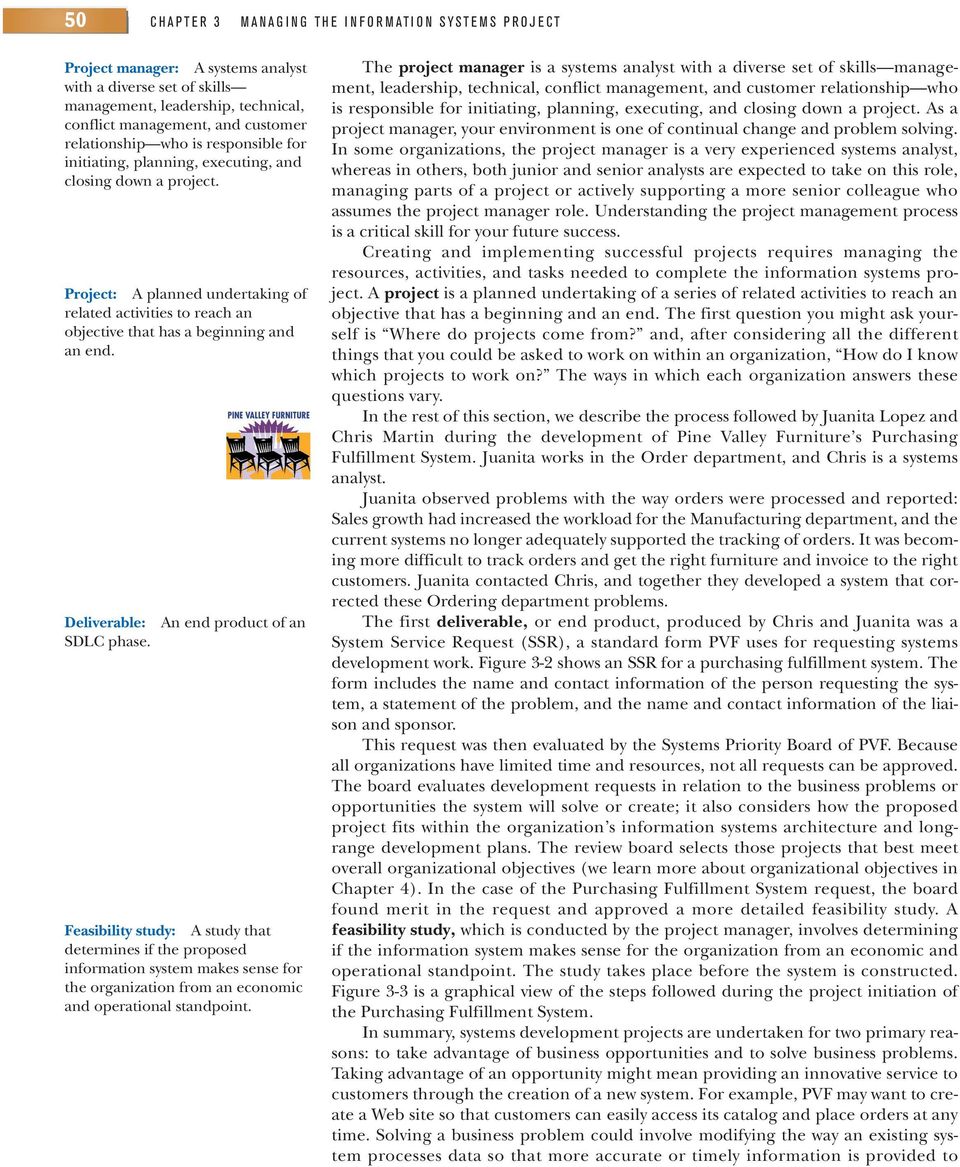
5 FOUNDATIONS FOR SYSTEMS DEVELOPMENT 51 Pine Valley Furniture System Service Request REQUESTED BY DEPARTMENT LOCATION Juanita Lopez Purchasing, Manufacturing Support Headquarters, DATE October 1, 2007 Figure 3-2 System Service Request for Purchasing Fulfillment System with name and contact information of the person requesting the system, a statement of the problem, and the name and contact information of the liaison and sponsor. CONTACT Tel: FAX: jlopez TYPE OF REQUEST [ [ [ X ] ] ] New System PROBLEM STATEMENT System Enhancement System Error Correction URGENCY [ ] [ [ X ] ] Immediate Operations are impaired or opportunity lost Problems exist, but can be worked around Business losses can be tolerated until new system installed Sales growth at PVF has caused greater volume of work for the manufacturing support unit within Purchasing. Further, more concentration on customer service has reduced manufacturing lead times, which puts more pressure on purchasing activities. In addition, cost-cutting measures force Purchasing to be more aggressive in negotiating terms with vendors, improving delivery times, and lowering our investments in inventory. The current modest systems support for Manufacturing/Purchasing is not responsive to these new business conditions. Data are not available, information cannot be summarized, supplier orders cannot be adequately tracked, and commodity buying is not well supported. PVF is spending too much on raw materials and not being responsive to manufacturing needs. SERVICE REQUEST I request a thorough analysis of our current operations with the intent to design and build a completely new information system. This system should handle all purchasing transactions, support display and reporting of critical purchasing data, and assist purchasing agents in commodity buying. IS LIAISON SPONSOR Chris Martin (Tel: FAX: cmartin) Sal Divario, Director, Purchasing [ [ [ [ ] ] ] ] TO BE COMPLETED BY SYSTEMS PRIORITY BOARD Request approved Assigned to Start date Recommend revision Suggest user development Reject for reason users. For example, a company such as PVF may create a password-protected intranet site that contains important announcements and budget information. Of course, projects are not always initiated for the aforementioned rational reasons (taking advantage of business opportunities or solving business problems). For example, in some instances, organizations and government undertake projects to spend resources, to attain or pad budgets, to keep people busy, or to help train people and develop their skills. Our focus in this chapter is not on how and why organizations identify projects but on the management of projects once they have been identified. Once a potential project has been identified, an organization must determine the resources required for its completion. This is done by analyzing the scope of the project and determining the probability of successful completion. After getting this information, the organization can then determine whether taking advantage of an opportunity or solving a particular problem is feasible within time and resource constraints. If deemed feasible, a more detailed project analysis is then conducted. As you will see, the ability to determine the size, scope, and resource requirements of a project is just one of the many skills that a project manager
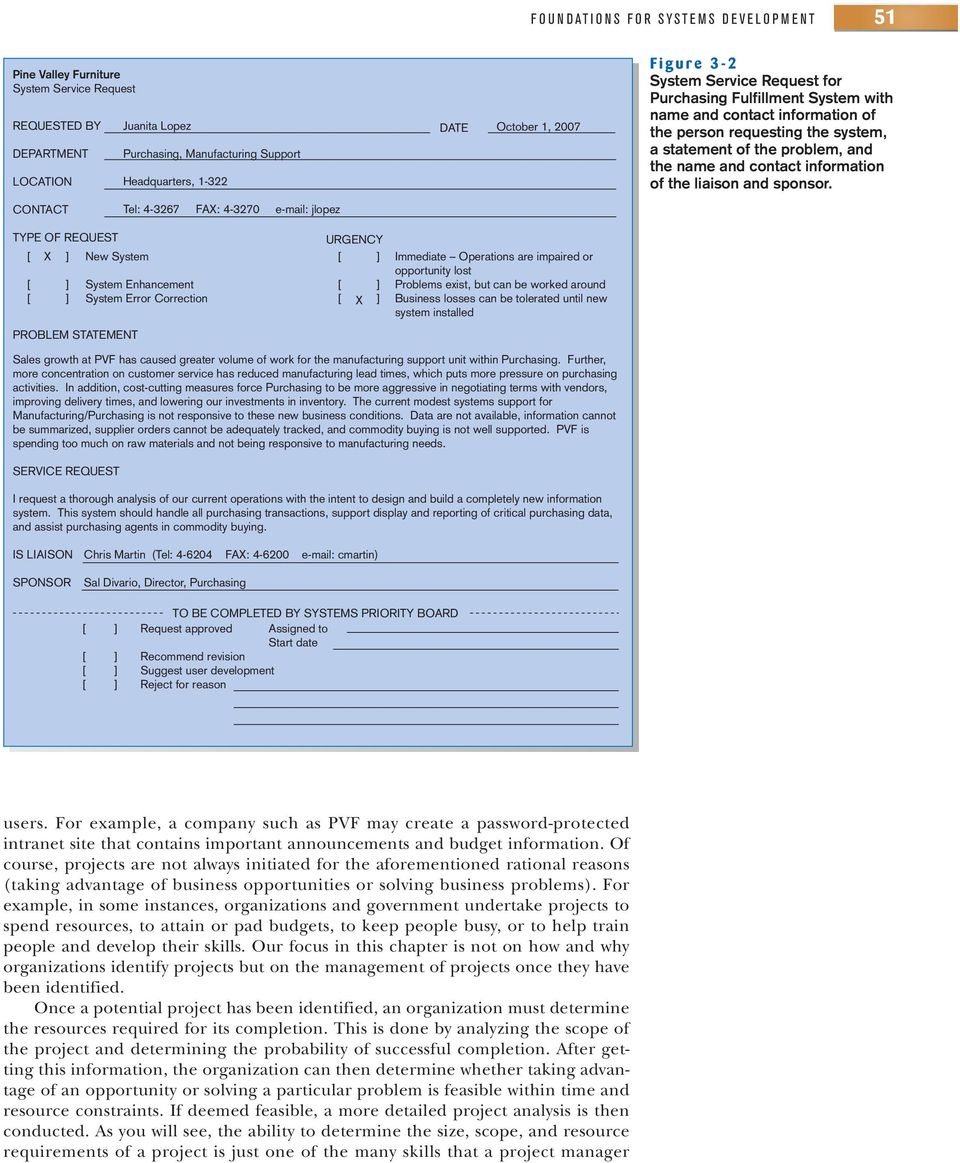
6 52 CHAPTER 3 MANAGING THE INFORMATION SYSTEMS PROJECT Figure 3-3 A graphical view of the five steps followed during the project initiation of the Purchasing Fulfillment System 1. Juanita observed problems with existing purchasing system. 2. Juanita contacted Chris within the IS development group to initiate a System Service Request. 3. SSR was reviewed and approved by Systems Priority Board. 4. Steering committee was assigned to oversee project. 5. Detailed project plan was developed and executed. Project management: A controlled process of initiating, planning, executing, and closing down a project. Project initiation: The first phase of the project management process in which activities are performed to assess the size, scope, and complexity of the project and to establish procedures to support later project activities. must possess. A project manager is often thought of as a juggler keeping aloft many balls, which reflect the various aspects of a project s development, as depicted in Figure 3-4. To successfully orchestrate the construction of a complex information system, a project manager must have interpersonal, leadership, and technical skills. Table 3-1 lists the project manager s common skills and activities. Note that many of the skills are related to personnel or general management, not simply technical skills. Table 3-1 shows that not only does an effective project manager have varied skills, but he or she is also the most instrumental person to the successful completion of any project. The remainder of this chapter will focus on the project management process, which involves four phases: 1. Initiating the project 2. Planning the project 3. Executing the project 4. Closing down the project Several activities must be performed during each of these four phases. Following this formal project management process greatly increases the likelihood of project success. Initiating a Project During project initiation, the project manager performs several activities to assess the size, scope, and complexity of the project and to establish procedures to support subsequent activities. Depending on the project, some initiation activities

7 FOUNDATIONS FOR SYSTEMS DEVELOPMENT 53 Technological Change Customer and Management Expectations Documentation and Communication Figure 3-4 A project manager juggles numerous activities Systems Development Life Cycle The Art of Project Management Time and Resource Constraints Organizational Change and Complexity Methodologies and Tools Contractors and Vendors Managing People TABLE 3-1 Common Activities and Skills of a Project Manager Activity Description Skill Leadership Influencing the activities of others toward the Communication; liaison between management, attainment of a common goal through the users, and developers; assigning activities; use of intelligence, personality, and abilities monitoring progress Management Getting projects completed through the Defining and sequencing activities; communicating effective utilization of resources expectations; assigning resources to activities; monitoring outcomes Customer relations Working closely with customers to assure Interpreting system requests and specifications; site project deliverables meet expectations preparation and user training; contact point for customers Technical problem Designing and sequencing activities to attain Interpreting system requests and specifications; defining solving project goals activities and their sequence; making trade-offs between alternative solutions; designing solutions to problems Conflict management Managing conflict within a project team to Problem solving; smoothing out personality differences; assure that conflict is not too high or too low compromising; goal setting Team management Managing the project team for effective Communication within and between teams; peer evaluations; team performance conflict resolution; team building; self-management Risk and change Identifying, assessing, and managing the Environmental scanning; risk and opportunity management risks and day-to-day changes that occur identification and assessment; forecasting; during a project resource redeployment

8 54 CHAPTER 3 MANAGING THE INFORMATION SYSTEMS PROJECT Figure 3-5 Six project initiation activities Project Initiation 1. Establishing the Project Initiation Team 2. Establishing a Relationship with the Customer 3. Establishing the Project Initiation Plan 4. Establishing Management Procedures 5. Establishing the Project Management Environment and Project Workbook 6. Developing the Project Charter may be unnecessary and some may be very involved. The types of activities you will perform when initiating a project are summarized in Figure 3-5 and described next. 1. Establishing the project initiation team. This activity involves organizing an initial core of project team members to assist in accomplishing the project initiation activities (Verma, 1996, 1997). For example, during the Purchasing Fulfillment System project at PVF, Chris Martin was assigned to support the Purchasing department. It is a PVF policy that all initiation teams consist of at least one user representative, in this case Juanita Lopez, and one member of the IS development group. Therefore, the project initiation team consisted of Chris and Juanita; Chris was the project manager. 2. Establishing a relationship with the customer. A thorough understanding of your customer builds stronger partnerships and higher levels of trust. At PVF, management has tried to foster strong working relationships between business units (like Purchasing) and the IS development group by assigning a specific individual to work as a liaison between both groups. Because Chris had been assigned to the Purchasing unit for some time, he was already aware of some of the problems with the existing purchasing systems. PVF s policy of assigning specific individuals to each business unit helped to ensure that both Chris and Juanita were comfortable working together prior to the initiation of the project. Many organizations use a similar mechanism for establishing relationships with customers. 3. Establishing the project initiation plan. This step defines the activities required to organize the initiation team while it is working to define the goals and scope of the project (Abdel-Hamid et al., 1999). Chris s role was to help Juanita translate her business requirements into a written request for an improved information system. This required the collection, analysis, organization, and transformation of a lot of information. Because Chris and Juanita were already familiar with each other and their roles within a development project, they next needed to define when and how they would communicate, define deliverables and project steps, and set deadlines. Their initiation plan included agendas for several meetings. These steps eventually led to the creation of their SSR form. 4. Establishing management procedures. Successful projects require the development of effective management procedures. Within PVF, many of these management procedures had been established as standard operating procedures by the Systems Priority Board and the IS development group. For example, all project development work is charged back to the functional unit requesting the work. In other organizations, each project may have unique procedures

9 FOUNDATIONS FOR SYSTEMS DEVELOPMENT 55 tailored to its needs. Yet, in general, when establishing procedures, you are concerned with developing team communication and reporting procedures, job assignments and roles, project change procedures, and determining how project funding and billing will be handled. It was fortunate for Chris and Juanita that most of these procedures were already established at PVF, allowing them to move on to other project activities. 5. Establishing the project management environment and project workbook. The focus of this activity is to collect and organize the tools that you will use while managing the project and to construct the project workbook. Diagrams, charts, and system descriptions provide much of the project workbook contents. Thus, the project workbook serves as a repository for all project correspondence, inputs, outputs, deliverables, procedures, and standards established by the project team (Rettig, 1990). The project workbook can be stored as an online electronic document or in a large three-ring binder. The project workbook is used by all team members and is useful for project audits, orientation of new team members, communication with management and customers, identifying future projects, and performing post-project reviews. The establishment and diligent recording of all project information in the workbook are two of the most important activities you will perform as project manager. Figure 3-6 shows the project workbook for the Purchasing Fulfillment System. It consists of both a large hard-copy binder and electronic information where the system data dictionary, a catalog of data stored in the database, and diagrams are stored. For this system, all project documents can fit into a single binder. It is not unusual, though, for project documentation to be spread over several binders. As more information is captured and recorded electronically, however, fewer hard-copy binders may be needed. Many project teams keep their project workbooks on the Web. A Web site can be created so that all project members can easily access all project documents. This Web site can be a simple repository of documents or an elaborate site with password Project workbook: An online or hard-copy repository for all project correspondence, inputs, outputs, deliverables, procedures, and standards that is used for performing project audits, orienting new team members, communicating with management and customers, identifying future projects, and performing post-project reviews. Pine Valley Furniture Information Systems Development Group Project overview Initiation plan and SSR Project scope and risks Management procedures Data descriptions Process descriptions Team correspondence Project Charter Project schedule Figure 3-6 The project workbook for the Purchase Fulfillment System project contains nine key documents in both hard-copy and electronic form 5 Purchasing Fulfillment System Online copies of data dictionary, diagrams, schedules, reports, etc. Manager: Chris Martin 9

10 56 CHAPTER 3 MANAGING THE INFORMATION SYSTEMS PROJECT Project charter: A short, high-level document prepared for both internal and external stakeholders to formally announce the establishment of the project and to briefly describe its objectives, key assumptions, and stakeholders. Project planning: The second phase of the project management process that focuses on defining clear, discrete activities and the work needed to complete each activity within a single project. protection and security levels. The best feature of using the Web as your repository is that it enables project members and customers to review a project s status and all related information continually. 6. Developing the project charter. The project charter is a short, (typically one page) high-level document prepared for both internal and external stakeholders to formally announce the establishment of the project and to briefly describe its objectives, key assumptions, and stakeholders. The project charter ensures that both you and your customer gain a common understanding of the project. It is also a very useful communication tool; it helps to announce to the organization that a particular project has been chosen for development. Project initiation is complete once these six activities have been performed. Before moving on to the next phase of the project, the work performed during project initiation is reviewed at a meeting attended by management, customers, and project team members. An outcome of this meeting is a decision to continue, modify, or abandon the project. In the case of the Purchasing Fulfillment System project at Pine Valley Furniture, the board accepted the SSR and selected a project steering committee to monitor project progress and to provide guidance to the team members during subsequent activities. If the scope of the project is modified, it may be necessary to return to project initiation activities and collect additional information. Once a decision is made to continue the project, a much more detailed project plan is developed during the project planning phase. Planning the Project The next step in the project management process is project planning. Research has found a positive relationship between effective project planning and positive project outcomes (Guinan et al., 1998; Kirsch, 2000). Project planning involves defining clear, discrete activities and the work needed to complete each activity within a single project. It often requires you to make numerous assumptions about the availability of resources such as hardware, software, and personnel. It is much easier to plan nearerterm activities than those occurring in the future. In actual fact, you often have to construct longer-term plans that are more general in scope and nearer-term plans that are more detailed. The repetitive nature of the project management process requires that plans be constantly monitored throughout the project and periodically updated (usually after each phase) based upon the most recent information. Figure 3-7 illustrates the principle that nearer-term plans are typically more specific and firmer than longer-term plans. For example, it is virtually impossible to rigorously plan activities late in the project without first completing the earlier activities. Figure 3-7 Level of project planning detail should be high in the short term, with less detail as time goes on High Planning Detail Medium Low 1 Week Out 1 Month Out Planning Horizon 6 Months Out

11 FOUNDATIONS FOR SYSTEMS DEVELOPMENT 57 Project Planning Figure 3-8 Ten project management activities 1. Describing Project Scope, Alternatives, and Feasibility 2. Dividing the Project into Manageable Tasks 3. Estimating Resources and Creating a Resource Plan 4. Developing a Preliminary Schedule 5. Developing a Communication Plan 6. Determining Project Standards and Procedures 7. Identifying and Assessing Risk 8. Creating a Preliminary Budget 9. Developing a Project Scope Statement 10. Setting a Baseline Project Plan Also, the outcome of activities performed earlier in the project is likely to impact later activities. This means that it is very difficult, and very likely inefficient, to try to plan detailed solutions for activities that will occur far into the future. As with the project initiation process, varied and numerous activities must be performed during project planning. For example, during the Purchasing Fulfillment System project, Chris and Juanita developed a 10-page plan. However, project plans for very large systems may be several hundred pages in length. The types of activities that you can perform during project planning are summarized in Figure 3-8 and are described in the following list: 1. Describing project scope, alternatives, and feasibility. The purpose of this activity is to understand the content and complexity of the project. Within PVF s systems development methodology, one of the first meetings must focus on defining a project s scope. Although project scope information was not included in the SSR developed by Chris and Juanita, it was important that both shared the same vision for the project before moving too far along. During this activity, you should reach agreement on the following questions: What problem or opportunity does the project address? What are the quantifiable results to be achieved? What needs to be done? How will success be measured? How will we know when we are finished? After defining the scope of the project, your next objective is to identify and document general alternative solutions for the current business problem or opportunity. You must then assess the feasibility of each alternative solution and choose which to consider during subsequent SDLC phases. In some instances, off-the-shelf software can be found. It is also important that any unique problems, constraints, and assumptions about the project be clearly stated. 2. Dividing the project into manageable tasks. This is a critical activity during the project planning process. Here, you must divide the entire project into manageable tasks and then logically order them to ensure a smooth evolution between tasks.

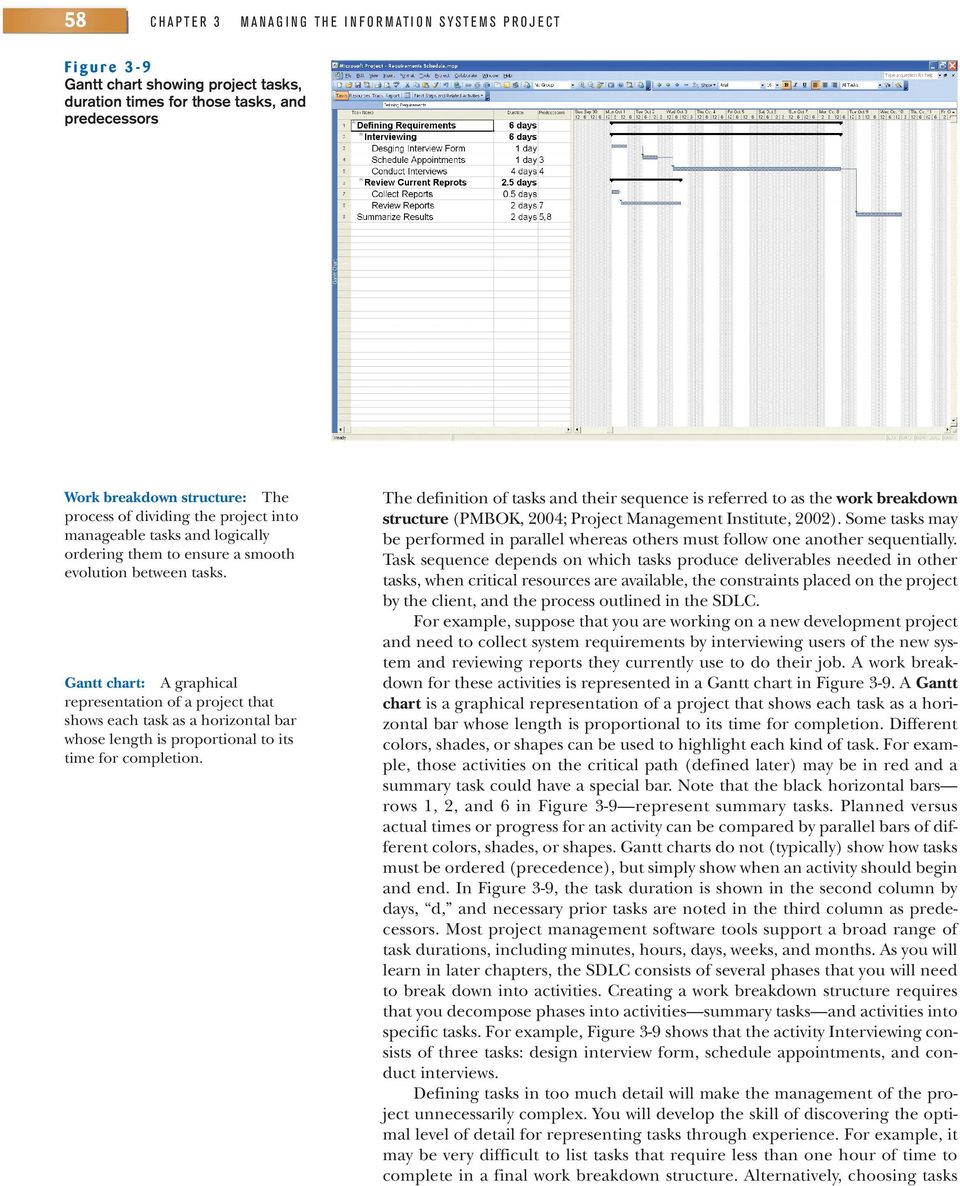
12 58 CHAPTER 3 MANAGING THE INFORMATION SYSTEMS PROJECT Figure 3-9 Gantt chart showing project tasks, duration times for those tasks, and predecessors Work breakdown structure: The process of dividing the project into manageable tasks and logically ordering them to ensure a smooth evolution between tasks. Gantt chart: A graphical representation of a project that shows each task as a horizontal bar whose length is proportional to its time for completion. The definition of tasks and their sequence is referred to as the work breakdown structure (PMBOK, 2004; Project Management Institute, 2002). Some tasks may be performed in parallel whereas others must follow one another sequentially. Task sequence depends on which tasks produce deliverables needed in other tasks, when critical resources are available, the constraints placed on the project by the client, and the process outlined in the SDLC. For example, suppose that you are working on a new development project and need to collect system requirements by interviewing users of the new system and reviewing reports they currently use to do their job. A work breakdown for these activities is represented in a Gantt chart in Figure 3-9. A Gantt chart is a graphical representation of a project that shows each task as a horizontal bar whose length is proportional to its time for completion. Different colors, shades, or shapes can be used to highlight each kind of task. For example, those activities on the critical path (defined later) may be in red and a summary task could have a special bar. Note that the black horizontal bars rows 1, 2, and 6 in Figure 3-9 represent summary tasks. Planned versus actual times or progress for an activity can be compared by parallel bars of different colors, shades, or shapes. Gantt charts do not (typically) show how tasks must be ordered (precedence), but simply show when an activity should begin and end. In Figure 3-9, the task duration is shown in the second column by days, d, and necessary prior tasks are noted in the third column as predecessors. Most project management software tools support a broad range of task durations, including minutes, hours, days, weeks, and months. As you will learn in later chapters, the SDLC consists of several phases that you will need to break down into activities. Creating a work breakdown structure requires that you decompose phases into activities summary tasks and activities into specific tasks. For example, Figure 3-9 shows that the activity Interviewing consists of three tasks: design interview form, schedule appointments, and conduct interviews. Defining tasks in too much detail will make the management of the project unnecessarily complex. You will develop the skill of discovering the optimal level of detail for representing tasks through experience. For example, it may be very difficult to list tasks that require less than one hour of time to complete in a final work breakdown structure. Alternatively, choosing tasks
13 FOUNDATIONS FOR SYSTEMS DEVELOPMENT 59 that are too large in scope (e.g., several weeks long) will not provide you with a clear sense of the status of the project or of the interdependencies between tasks. What are the characteristics of a task? A task Can be done by one person or a well-defined group Has a single and identifiable deliverable (The task is, however, the process of creating the deliverable.) Has a known method or technique Has well-accepted predecessor and successor steps Is measurable so that percent completed can be determined 3. Estimating resources and creating a resource plan. The goal of this activity is to estimate resource requirements for each project activity and to use this information to create a project resource plan. The resource plan helps assemble and deploy resources in the most effective manner. For example, you would not want to bring additional programmers onto the project at a rate faster than you could prepare work for them. Project managers use a variety of tools to assist in making estimates of project size and costs. The most widely used method is called COCOMO (COnstructive COst MOdel), which uses parameters that were derived from prior projects of differing complexity (Boehm et al., 2000). COCOMO uses these different parameters to predict human resource requirements for basic, intermediate, and very complex systems (see Figure 3-10). People are the most important, and expensive, part of project resource planning. Project time estimates for task completion and overall system quality are significantly influenced by the assignment of people to tasks. It is important to give people tasks that allow them to learn new skills. It is equally important to make sure that project members are not in over their heads or Figure 3-10 COCOMO is used by many project managers to estimate project resources (Source: USC-COCOMO II from Software Cost Estimation with COCOMO II, USC Center for Software Engineering. Courtesy of USC.)

14 60 CHAPTER 3 MANAGING THE INFORMATION SYSTEMS PROJECT Figure 3-11 Trade-offs between the quality of the program code versus the speed of programming High Quality of Work Adam Brenda Carl Low Short Long Time of Programming a Task Network diagram: A diagram that depicts project tasks and their interrelationships. working on a task that is not well suited to their skills. Resource estimates may need to be revised based upon the skills of the actual person (or people) assigned to a particular activity. Figure 3-11 indicates the relative programming speed versus the relative programming quality of three programmers. The figure suggests that Carl should not be assigned tasks in which completion time is critical and that Brenda should be assigned tasks in which high quality is most vital. One approach to assigning tasks is to assign a single task type (or only a few task types) to each worker for the duration of the project. For example, you could assign one worker to create all computer displays and another to create all system reports. Such specialization ensures that both workers become efficient at their own particular tasks. A worker may become bored if the task is too specialized or is long in duration, so you could assign workers to a wider variety of tasks. However, this approach may lead to lowered task efficiency. A middle ground would be to make assignments with a balance of both specialization and task variety. Assignments depend on the size of the development project and the skills of the project team. Regardless of the manner in which you assign tasks, make sure that each team member works only on one task at a time. Exceptions to this rule can occur when a task occupies only a small portion of a team member s time (e.g., testing the programs developed by another team member) or during an emergency. 4. Developing a preliminary schedule. During this activity, you use the information on tasks and resource availability to assign time estimates to each activity in the work breakdown structure. These time estimates will enable you to create target starting and ending dates for the project. Target dates can be revisited and modified until a schedule is produced that is acceptable to the customer. Determining an acceptable schedule may require that you find additional or different resources or that the scope of the project be changed. The schedule may be represented as a Gantt chart, as illustrated in Figure 3-9, or as a network diagram, as illustrated in Figure A network diagram is a graphical depiction of project tasks and their interrelationships. As with a Gantt chart, each type of task can be highlighted by different features on the network diagram. The distinguishing feature of a network diagram is that the ordering of tasks is shown by connecting tasks depicted as rectangles or ovals with their predecessor and successor tasks. However, the relative size of a node (representing a task) or a gap between nodes does not imply the task s duration. Only the individual task items are drawn on a network diagram, which is why the summary tasks 1, 2, and 6 the black bars from Figure 3-9 are not shown in Figure We describe both of these charts later in this chapter.

15 FOUNDATIONS FOR SYSTEMS DEVELOPMENT 61 Figure 3-12 A network diagram illustrates tasks with rectangles (or ovals) and the relationships and sequences of those activities with arrows 5. Developing a communication plan. The goal of this activity is to outline the communication procedures among management, project team members, and the customer. The communication plan includes when and how written and oral reports will be provided by the team, how team members will coordinate work, what messages will be sent to announce the project to interested parties, and what kinds of information will be shared with vendors and external contractors involved with the project. It is important that free and open communication occur among all parties with respect to proprietary information and confidentiality with the customer (Fuller et al., 2007; Kettelhut, 1991; Kirsch, 2000; Verma, 1996). When developing a communication plan, numerous questions must be answered in order to assure that the plan is comprehensive and complete, including: Who are the stakeholders for this project? What information does each stakeholder need? When, and at what interval, does this information need to be produced? What sources will be used to gather and generate this information? Who will collect, store, and verify the accuracy of this information? Who will organize and package this information into a document? Who will be the contact person for each stakeholder should any questions arise? What format will be used to package this information? What communication medium will be most effective for delivering this information to the stakeholder? Once these questions are answered for each stakeholder, a comprehensive communication plan can be developed. In this plan, a summary of communication documents, work assignments, schedules, and distribution methods will be outlined. Additionally, a project communication matrix can be developed which provides a summary of the overall communication plan (see Figure 3-13). This matrix can be easily shared among team members, and verified by stakeholders outside the project team, so that the right people are getting the right information at the right time, and in the right format.

16 62 CHAPTER 3 MANAGING THE INFORMATION SYSTEMS PROJECT Stakeholder Team Members Document Project Status Report Format Project Intranet Team Contact Juan Kim Juan Kim James Kim Jackie James Juan Jeremy Jordan Kim Jordan James Date Due First Monday of Month Management Supervisor Project Status Report Hard Copy First Monday of Month User Group Project Status Report Hard Copy First Monday of Month Internal IT Staff Project Status Report First Monday of Month It Manager Project Status Report Hard Copy First Monday of Month Contract Programmers Software Specifications /Project Intranet October 1, 2007 Training Subcontractor Implementation and Training Plan Hard Copy January 7, 2008 Figure 3-13 The Project Communication Matrix provides a high-level summary of the communication plan 6. Determining project standards and procedures. During this activity, you will specify how various deliverables are produced and tested by you and your project team. For example, the team must decide on which tools to use, how the standard SDLC might be modified, which SDLC methods will be used, documentation styles (e.g., type fonts and margins for user manuals), how team members will report the status of their assigned activities, and terminology. Setting project standards and procedures for work acceptance is a way to ensure the development of a high-quality system. Also, it is much easier to train new team members when clear standards are in place. Organizational standards for project management and conduct make the determination of individual project standards easier and the interchange or sharing of personnel among different projects feasible. 7. Identifying and assessing risk. The goal of this activity is to identify sources of project risk and to estimate the consequences of those risks (Wideman, 1992). Risks might arise from the use of new technology, prospective users resistance to change, availability of critical resources, competitive reactions or changes in regulatory actions due to the construction of a system, or team member inexperience with technology or the business area. You should continually try to identify and assess project risk. The identification of project risks is required to develop PVF s new Purchasing Fulfillment System. Chris and Juanita met to identify and describe possible negative outcomes of the project and their probabilities of occurrence. Although we list the identification of risks and the outline of project scope as two discrete activities, they are highly related and often concurrently discussed. 8. Creating a preliminary budget. During this phase, you need to create a preliminary budget that outlines the planned expenses and revenues associated with your project. The project justification will demonstrate that the benefits are worth these costs. Figure 3-14 shows a cost-benefit analysis for a new development project. This analysis shows net present value calculations of the project s benefits and costs as well as a return on investment and cash flow analysis. We discuss project budgets fully in Chapter Developing a Project Scope Statement. An important activity that occurs near the end of the project planning phase is the development of the Project Scope

17 FOUNDATIONS FOR SYSTEMS DEVELOPMENT 63 Figure 3-14 A financial cost and benefit analysis for a systems development project Statement. Developed primarily for the customer, this document outlines work that will be done and clearly describes what the project will deliver. The Project Scope Statement is useful to make sure that you, the customer, and other project team members have a clear understanding of the intended project size, duration, and outcomes. 10. Setting a Baseline Project Plan. Once all of the prior project planning activities have been completed, you will be able to develop a Baseline Project Plan. This baseline plan provides an estimate of the project s tasks and resource requirements and is used to guide the next project phase execution. As new information is acquired during project execution, the baseline plan will continue to be updated. At the end of the project planning phase, a review of the Baseline Project Plan is conducted to double-check all information in the plan. As with the project initiation phase, it may be necessary to modify the plan, which means returning to prior project planning activities before proceeding. As with the Purchasing Fulfillment System project, you may submit the plan and make a brief presentation to the project steering committee at this time. The committee can endorse the plan, ask for modifications, or determine that it is not wise to continue the project as currently outlined. Executing the Project Project execution puts the Baseline Project Plan into action. Within the context of the SDLC, project execution occurs primarily during the analysis, design, and implementation phases. During the development of the Purchasing Fulfillment System, Chris Martin was responsible for five key activities during project execution. These activities are summarized in Figure 3-15 and described in the remainder of this section: 1. Executing the Baseline Project Plan. As project manager, you oversee the execution of the baseline plan. This means that you initiate the execution of project activities, acquire and assign resources, orient and train new team members, keep the project on schedule, and ensure the quality of project deliverables. This is a formidable task, but a task made much easier through the use of sound project management techniques. For example, as tasks are completed Project execution: The third phase of the project management process in which the plans created in the prior phases (project initiation and planning) are put into action.

18 64 CHAPTER 3 MANAGING THE INFORMATION SYSTEMS PROJECT Figure 3-15 Five project execution activities Project Execution 1. Executing the Baseline Project Plan 2. Monitoring Project Progress against the Baseline Project Plan 3. Managing Changes to the Baseline Project Plan 4. Maintaining the Project Workbook 5. Communicating the Project Status during a project, they can be marked as completed on the project schedule. In Figure 3-16, tasks 3 and 7 are marked as completed by showing 100 percent in the % Complete column. Members of the project team will come and go. You are responsible for initiating new team members by providing them with the resources they need and helping them assimilate into the team. You may want to plan social events, regular team project status meetings, team-level reviews of project deliverables, and other group events to mold the group into an effective team. 2. Monitoring project progress against the Baseline Project Plan. While you execute the Baseline Project Plan, you should monitor your progress. If the project gets ahead of (or behind) schedule, you may have to adjust resources, activities, and budgets. Monitoring project activities can result in modifications to the current plan. Measuring the time and effort expended on each activity will help you improve the accuracy of estimations for future projects. It is possible, with project schedule charts such as Gantt charts, to show progress against a plan, and it is easy with network diagrams to understand the ramifications of delays in an activity. Monitoring progress also means that the team leader must evaluate and appraise each team member, occasionally change work assignments or request changes in personnel, and provide feedback to the employee s supervisor. Figure 3-16 Gantt chart with tasks 3 and 7 completed

19 FOUNDATIONS FOR SYSTEMS DEVELOPMENT Managing changes to the Baseline Project Plan. You will encounter pressure to make changes to the baseline plan. At PVF, policies dictate that only approved changes to the project specification can be made and all changes must be reflected in the baseline plan and project workbook, including all charts. For example, if Juanita suggests a significant change to the existing design of the Purchasing Fulfillment System, a formal change request must be approved by the steering committee. The request should explain why changes are desired and describe all possible impacts on prior and subsequent activities, project resources, and the overall project schedule. Chris would have to help Juanita develop such a request. This information allows the project steering committee to more easily evaluate the costs and benefits of a significant midcourse change. In addition to changes occurring through formal request, changes may also occur from events outside your control. In fact, numerous events may initiate a change to the Baseline Project Plan, including the following possibilities: A slipped completion date for an activity A bungled activity that must be redone The identification of a new activity that becomes evident later in the project An unforeseen change in personnel due to sickness, resignation, or termination When an event occurs that delays the completion of an activity, you typically have two choices: devise a way to get back on schedule or revise the plan. Devising a way to get back on schedule is the preferred approach because no changes to the plan will have to be made. The ability to head off and smoothly work around problems is a critical skill that you need to master. As you will see later in this chapter, project schedule charts are very helpful in assessing the impact of change. Using such charts, you can quickly see if the completion time of other activities will be affected by changes in the duration of a given activity or if the whole project completion date will change. Often you will have to find a way to rearrange the activities because the ultimate project completion date may be rather fixed. There may be a penalty to the organization (even legal action) if the expected completion date is not met. 4. Maintaining the project workbook. As in all project phases, maintaining complete records of all project events is necessary. The workbook provides the documentation new team members require to assimilate project tasks quickly. It explains why design decisions were made and is a primary source of information for producing all project reports. 5. Communicating the project status. The project manager is responsible for keeping all stakeholders system developers, managers, and customers abreast of the project status. In other words, communicating the project status focuses on the execution of the project communication plan and the response to any ad hoc information requests by stakeholders. There are a broad variety of methods that can be used to distribute information, each with strengths and weakness. Some methods are easier for the information sender, but more difficult or less convenient for the receiver. With the maturing of digital networks and the Internet, more and more digital communication is being exchanged. Procedures for communicating project activities vary from formal meetings to informal hallway discussions. Some procedures are useful for informing others of the project s status, others are better for resolving issues, and still others are better for keeping permanent records of information and events. Two types of information are routinely exchanged throughout the project: work results the outcomes of the various tasks and activities that are performed to complete the project and the project plan the formal comprehensive document that is used to execute
20 66 CHAPTER 3 MANAGING THE INFORMATION SYSTEMS PROJECT TA B L E 3-2 Project Team Communication Methods Procedure Formality Use Project workbook High Inform Permanent record Meetings Medium to high Resolve issues Seminars and workshops Low to medium Inform Project newsletters Medium to high Inform Status reports High Inform Specification documents High Inform Permanent record Minutes of meetings High Inform Permanent record Bulletin boards Low Inform Memos Medium to high Inform Brown bag lunches Low Inform Hallway discussions Low Inform Resolve issues the project; it contains numerous items including the project charter, project schedule, budgets, risk plan, and so on. Table 3-2 lists numerous communication procedures, their level of formality, and their most likely use. Whichever procedure you use, frequent communication helps to ensure project success (Kettelhut, 1991; Kirsch, 2000; Verma, 1996). This section outlined your role as the project manager during the execution of the Baseline Project Plan. The ease with which the project can be managed is significantly influenced by the quality of prior project phases. If you develop a high-quality project plan, it is much more likely that the project will be successfully executed. The next section describes your role during project closedown, the final phase of the project management process. Project closedown: The final phase of the project management process that focuses on bringing a project to an end. Closing Down the Project The focus of project closedown is to bring the project to an end. Projects can conclude with a natural or unnatural termination. A natural termination occurs when the requirements of the project have been met the project has been completed and is a success. An unnatural termination occurs when the project is stopped before completion (Keil et al., 2000). Several events can cause an unnatural termination of a project. For example, it may be learned that the assumption used to guide the project proved to be false, that the performance of the systems or development group was somehow inadequate, or that the requirements are no longer relevant or valid in the customer s business environment. The most likely reasons for the unnatural termination of a project relate to running out of time or money, or both. Regardless of the project termination outcome, several activities must be performed: closing down the project, conducting postproject reviews, and closing the customer contract. Within the context of the SDLC, project closedown occurs after the implementation phase. The system maintenance phase typically represents an ongoing series of projects, each of which must be individually managed. Figure 3-17 summarizes the project closedown activities that are described more fully in the remainder of this section: 1. Closing down the project. During closedown, you perform several diverse activities. For example, if you have several team members working with you, project completion may signify job and assignment changes for some members. You will likely be required to assess each team member and provide an appraisal

21 FOUNDATIONS FOR SYSTEMS DEVELOPMENT 67 Project Closedown Figure 3-17 Three project closedown activities 1. Closing Down the Project 2. Conducting Postproject Reviews 3. Closing the Customer Contract for personnel files and salary determination. You may also want to provide career advice to team members, write letters to superiors praising special accomplishments of team members, and send thank-you letters to those who helped but were not team members. As project manager, you must be prepared to handle possible negative personnel issues such as job termination, especially if the project was not successful. When closing down the project, it is also important to notify all interested parties that the project has been completed and to finalize all project documentation and financial records so that a final review of the project can be conducted. You should also celebrate the accomplishments of the team. Some teams will hold a party, and each team member may receive memorabilia (e.g., a T-shirt with I survived the X project ). The goal is to celebrate the team s effort to bring a difficult task to a successful conclusion. 2. Conducting postproject reviews. Once you have closed down the project, final reviews of the project should be conducted with management and customers. The objective of these reviews is to determine the strengths and weaknesses of project deliverables, the processes used to create them, and the project management process. It is important that everyone understands what went right and what went wrong in order to improve the process for the next project. Remember, the systems development methodology adopted by an organization is a living guideline that must undergo continual improvement. 3. Closing the customer contract. The focus of this final activity is to ensure that all contractual terms of the project have been met. A project governed by a contractual agreement is typically not completed until agreed to by both parties, often in writing. Thus, it is imperative that you gain agreement from your customer that all contractual obligations have been met and that further work is either their responsibility or covered under another SSR or contract. Closedown is a very important activity. A project is not complete until it is closed, and it is at closedown that projects are deemed a success or failure. Completion also signifies the chance to begin a new project and to apply what you have learned. Now that you have an understanding of the project management process, the next section describes specific techniques used in systems development for representing and scheduling activities and resources. REPRESENTING AND SCHEDULING PROJECT PLANS A project manager has a wide variety of techniques available for depicting and documenting project plans. These planning documents can take the form of graphical or textual reports, although graphical reports have become most popular for depicting project plans. The most commonly used methods are Gantt charts and network diagrams. Because Gantt charts do not (typically) show how tasks must be
22 hof40769_ch03.qxd 68 12/29/06 CHAPTER 3 5:36 PM Page 68 M A N A G I N G T H E I N F O R M AT I O N S Y S T E M S P R O J E CT ordered (precedence) but simply show when a task should begin and when it should end, they are often more useful for depicting relatively simple projects or subparts of a larger project, showing the activities of a single worker, or monitoring the progress of activities compared to scheduled completion dates (Figure 3-18). Recall that a network diagram shows the ordering of activities by connecting a task to its predecessor and successor tasks. Sometimes a network diagram is preferable; other times a Gantt chart more easily shows certain aspects of a project. Here are the key differences between these two charts. Gantt charts visually show the duration of tasks whereas a network diagram visually shows the sequence dependencies between tasks. Gantt charts visually show the time overlap of tasks whereas a network diagram does not show time overlap but does show which tasks could be done in parallel. Figure 3-18 Graphical diagrams that depict project plans (a) A Gantt chart (b) A network diagram # Cust: PHNJ B&E Au: Hoffer Pg. No. 68 C/M/Y/K CARLISLE
23 FOUNDATIONS FOR SYSTEMS DEVELOPMENT 69 Figure 3-19 A screen from Microsoft Project for Windows summarizes all project activities, their durations in weeks, and their scheduled starting and ending dates Some forms of Gantt charts can visually show slack time available within an earliest start and latest finish duration. A network diagram shows this by data within activity rectangles. Project managers also use textual reports that depict resource utilization by task, complexity of the project, and cost distributions to control activities. For example, Figure 3-19 shows a screen from Microsoft Project for Windows that summarizes all project activities, their durations in weeks, and their scheduled starting and ending dates. Most project managers use computer-based systems to help develop their graphical and textual reports. Later in this chapter, we discuss these automated systems in more detail. A project manager will periodically review the status of all ongoing project task activities to assess whether the activities will be completed early, on time, or late. If early or late, the duration of the activity, depicted in column 2 of Figure 3-19, can be updated. Once changed, the scheduled start and finish times of all subsequent tasks will also change. Making such a change will also alter a Gantt chart or network diagram used to represent the project tasks. The ability to easily make changes to a project is a very powerful feature of most project management environments. It enables the project manager to determine easily how changes in task duration impact the project completion date. It is also useful for examining the impact of what if scenarios of adding or reducing resources, such as personnel, for an activity. Representing Project Plans Project scheduling and management require that time, costs, and resources be controlled. Resources are any person, group of people, piece of equipment, or material used in accomplishing an activity. Network diagramming is a critical path scheduling technique used for controlling resources. A critical path refers to a sequence of task activities whose order and durations directly affect the completion date of a project. A network diagram is one of the most widely used and best-known scheduling methods. You would use a network diagram when tasks: Are well defined and have a clear beginning and end point Can be worked on independently of other tasks Resources: Any person, group of people, piece of equipment, or material used in accomplishing an activity. Critical path scheduling: A scheduling technique whose order and duration of a sequence of task activities directly affect the completion date of a project.
24 70 CHAPTER 3 MANAGING THE INFORMATION SYSTEMS PROJECT Figure 3-20 A network diagram showing activities (represented by circles) and sequence of those activities (represented by arrows) Design System Write Programs B Test Programs C A D Write Documentation E Install System Are ordered Serve the purpose of the project A major strength of network diagramming is its ability to represent how completion times vary for activities. Because of this, it is more often used than Gantt charts to manage projects such as information systems development, where variability in the duration of activities is the norm. Network diagrams are composed of circles or rectangles representing activities and connecting arrows showing required work flows, as illustrated in Figure PERT (Program Evaluation Review Technique): A technique that uses optimistic, pessimistic, and realistic time estimates to calculate the expected time for a particular task. Calculating Expected Time Durations Using PERT One of the most difficult and most error-prone activities when constructing a project schedule is the determination of the time duration for each task within a work breakdown structure. It is particularly problematic to make these estimates when there is a high degree of complexity and uncertainty about a task. PERT (Program Evaluation Review Technique) is a technique that uses optimistic, pessimistic, and realistic time estimates to calculate the expected time for a particular task. This technique can help you to obtain a better time estimate when there is some uncertainty as to how much time a task will require to be completed. The optimistic (o) and pessimistic (p) times reflect the minimum and maximum possible periods of time for an activity to be completed. The realistic (r) time, or most likely time, reflects the project manager s best guess of the amount of time the activity actually will require for completion. Once each of these estimates is made for an activity, an expected time (ET) can be calculated. Because the expected completion time should be closest to the realistic (r) time, it is typically weighted four times more than the optimistic (o) and pessimistic (p) times. Once you add these values together, it must be divided by six to determine the ET. This equation is shown in the following formula: ET o 4r p 6 where ET expected time for the completion for an activity o optimistic completion time for an activity r realistic completion time for an activity p pessimistic completion time for an activity For example, suppose that your instructor asked you to calculate an expected time for the completion of an upcoming programming assignment. For this assignment, you estimate an optimistic time of 2 hours, a pessimistic time of 8 hours, and a
25 FOUNDATIONS FOR SYSTEMS DEVELOPMENT 71 most likely time of 6 hours. Using PERT, the expected time for completing this assignment is 5.67 hours. Commercial project management software such as Microsoft Project assists you in using PERT to make expected time calculations. Additionally, many commercial tools allow you to customize the weighting of optimistic, pessimistic, and realistic completion times. Constructing a Gantt Chart and Network Diagram at Pine Valley Furniture Although Pine Valley Furniture has historically been a manufacturing company, it has recently entered the direct sales market for selected target markets. One of the fastest growing of these markets is economically priced furniture suitable for college students. Management has requested that a new Sales Promotion Tracking System (SPTS) be developed. This project has already successfully moved through project initiation and is currently in the detailed project planning stage, which corresponds to the SDLC phase of project initiation and planning. The SPTS will be used to track purchases by college students for the next fall semester. Students typically purchase low-priced beds, bookcases, desks, tables, chairs, and dressers. Because PVF does not normally stock a large quantity of lower-priced items, management feels that a tracking system will help provide information about the college-student market that can be used for follow-up sales promotions (e.g., a midterm futon sale). The project is to design, develop, and implement this information system before the start of the fall term in order to collect sales data at the next major buying period. This deadline gives the project team 24 weeks to develop and implement the system. The Systems Priority Board at PVF wants to make a decision this week based on the feasibility of completing the project within the 24-week deadline. Using PVF s project planning methodology, the project manager, Jim Woo, knows that the next step is to construct a Gantt chart and network diagram of the project to represent the Baseline Project Plan so that he can use these charts to estimate the likelihood of completing the project within 24 weeks. A major activity of project planning focuses on dividing the project into manageable activities, estimating times for each, and sequencing their order. Here are the steps Jim followed to do this. 1. Identify each activity to be completed in the project. After discussing the new SPTS with PVF s management, sales, and development staff, Jim identified the following major activities for the project: Requirements collection Screen design Report design Database construction User documentation creation Software programming System testing System installation 2. Determine time estimates and calculate the expected completion time for each activity. After identifying the major project activities, Jim established optimistic, realistic, and pessimistic time estimates for each activity. These numbers were then used to calculate the expected completion times for all project activities as described previously using PERT. Figure 3-21 shows the estimated time calculations for each activity of the SPTS project. 3. Determine the sequence of the activities and precedence relationships among all activities by constructing a Gantt chart and network diagram. This step helps you to understand
26 72 CHAPTER 3 MANAGING THE INFORMATION SYSTEMS PROJECT Figure 3-21 Estimated time calculations for the SPTS project ACTIVITY TIME ESTIMATE (in weeks) o r p EXPECTED TIME (ET) o + 4r + p 6 1. Requirements Collection Screen Design Report Design Database Design User Documentation Programming Testing Installation Critical path: The shortest time in which a project can be completed. how various activities are related. Jim starts by determining the order in which activities should take place. The results of this analysis for the SPTS project are shown in Figure The first row of this figure shows that no activities precede requirements collection. Row 2 shows that screen design must be preceded by requirements collection. Row 4 shows that both screen and report design must precede database construction. Thus, activities may be preceded by zero, one, or more activities. Using the estimated time and activity sequencing information from Figures 3-21 and 3-22, Jim can now construct a Gantt chart and network diagram of the project s activities. To construct the Gantt chart, a horizontal bar is drawn for each activity that reflects its sequence and duration, as shown in Figure The Gantt chart may not, however, show direct interrelationships between activities. For example, the fact that the database design activity begins right after the screen design and report design bars finish does not imply that these two activities must finish before database design can begin. To show such precedence relationships, a network diagram must be used. The Gantt chart in Figure 3-23 does, however, show precedence relationships. Network diagrams have two major components: arrows and nodes. Arrows reflect the sequence of activities whereas nodes reflect activities that consume time and resources. A network diagram for the SPTS project is shown in Figure This diagram has eight nodes labeled 1 through Determine the critical path. The critical path of a network diagram is represented by the sequence of connected activities that produce the longest overall time period. All nodes and activities within this sequence are referred to as being on the critical path. The critical path represents the shortest time in which a project can be completed. In other words, any activ- Figure 3-22 Sequence of activities within the SPTS project ACTIVITY 1. Requirements Collection 2. Screen Design 3. Report Design 4. Database Design 5. User Documentation 6. Programming 7. Testing 8. Installation PRECEDING ACTIVITY 1 1 2, ,7
27 FOUNDATIONS FOR SYSTEMS DEVELOPMENT 73 Figure 3-23 Gantt chart that illustrates the sequence and duration of each activity of the SPTS project ity on the critical path that is delayed in completion delays the entire project. Nodes not on the critical path, however, can be delayed (for some amount of time) without delaying the final completion of the project. Nodes not on the critical path contain slack time and allow the project manager some flexibility in scheduling. Figure 3-25 shows the network diagram that Jim constructed to determine the critical path and expected completion time for the SPTS project. To determine the critical path, Jim calculated the earliest and latest expected completion time for each activity. He found each activity s earliest expected completion time (T E ) by summing the estimated time (E T ) for each activity from left to right (i.e., in precedence order), starting at activity 1 and working toward activity 8. In this case, T E for activity 8 is equal to 22 weeks. If two or more activities precede an activity, the largest expected completion time of these activities is used in calculating the new activity s expected completion time. For example, because activity 8 is preceded by both activities 5 and 7, the largest expected completion time between 5 and 7 is 21, so T E for activity 8 is 21 1, or 22. The earliest expected completion time for the last activity of the project represents the amount of time the project should take to complete. Because the time of each activity can vary, however, the projected completion time represents only an estimate. The project may in fact require more or less time for completion. Slack time: The amount of time that an activity can be delayed without delaying the project. Requirements Collection Screen Design 2 Database Design User Documentation 5 Installation 8 Figure 3-24 A network diagram that illustrates the activities (circles) and the sequence (arrows) of those activities Report Design Programming Testing
28 74 CHAPTER 3 MANAGING THE INFORMATION SYSTEMS PROJECT Figure 3-25 A network diagram for the SPTS project showing estimated times for each activity and the earliest and latest expected completion time for each activity T E = 5 T L = 5 1 ET = 5 T E = 11 T L = 11 2 T E = ET = 6 T L = 13 ET = 5.5 ET = 1 T E = 11 T L = 11 4 T E = 18.5 T L = 21 T E = 18 T L = 18 ET = T E = 22 T L = 22 ET = 6 ET = 5 ET = 3 7 T E = 21 T L = 21 Critical path Noncritical path Figure 3-26 Activity slack time calculations for the SPTS project; all activities except number 5 are on the critical path ACTIVITY T E T L SLACK T L T E ON CRITICAL PATH The latest expected completion time (T L ) refers to the time in which an activity can be completed without delaying the project. To find the values for each activity s T L, Jim started at activity 8 and set T L equal to the final T E (22 weeks). Next, he worked right to left toward activity 1 and subtracted the expected time for each activity. The slack time for each activity is equal to the difference between its latest and earliest expected completion times (T L T E ). Figure 3-26 shows the slack time calculations for all activities of the SPTS project. All activities with a slack time equal to zero are on the critical path. Thus, all activities except activity 5 are on the critical path. Part of the diagram in Figure 3-25 shows two critical paths, between activities and 1-3-4, because both of these parallel activities have zero slack. In addition to the possibility of having multiple critical paths, there are actually two possible types of slack. Free slack refers to the amount of time a task can be delayed without delaying the early start of any immediately following tasks. Total slack refers to the amount of time a task can be delayed without delaying the completion of the project. Understanding free and total slack allows the project manager to better identify where trade-offs can be made if changes to the project schedule need to be made. For more information on understanding slack and how it can be used to manage tasks see Information Systems Project Management, by Fuller, Valacich, and George (2007). USING PROJECT MANAGEMENT SOFTWARE A wide variety of automated project management tools are available to help you manage a development project. New versions of these tools are continuously being developed and released by software vendors. Most of the available tools have a set of
29 FOUNDATIONS FOR SYSTEMS DEVELOPMENT 75 common features that include the ability to define and order tasks, assign resources to tasks, and easily modify tasks and resources. Project management tools are available to run on IBM-compatible personal computers, the Macintosh, and larger mainframe and workstation-based systems. These systems vary in the number of task activities supported, the complexity of relationships, system processing and storage requirements, and, of course, cost. Prices for these systems can range from a few hundred dollars for personal computer based systems to more than $100,000 for large-scale, multiproject systems. Yet a lot can be done with systems such as Microsoft Project as well as public domain and shareware systems. For example, numerous shareware project management programs (e.g., Minuteman, Delegator, and Project KickStart) can be downloaded from the World Wide Web (e.g., at Because these systems are continuously changing, you should comparison shop before choosing a particular package. We now illustrate the types of activities you would perform when using project management software. Microsoft Project for Windows is a project management system that has received consistently high marks in computer publication reviews (see and search for project also, if you search the Web, there are many very useful tutorials for improving your Microsoft Project skills). When using this system to manage a project, you need to perform at least the following activities: Establish a project starting or ending date. Enter tasks and assign task relationships. Select a scheduling method to review project reports. Establishing a Project Starting Date Defining the general project information includes obtaining the name of the project and the project manager, and the starting or ending date of the project. Starting and ending dates are used to schedule future activities or backdate others (see the following) based on their duration and relationships with other activities. An example from Microsoft Project for Windows of the data entry screen for establishing a project starting or ending date is shown in Figure This screen shows PVF s Purchasing Fulfillment System project. Here, the starting date for the project is Monday, November 5, Figure 3-27 Establishing a project starting date in Microsoft Project for Windows
30 76 CHAPTER 3 MANAGING THE INFORMATION SYSTEMS PROJECT Figure 3-28 Entering tasks and assigning task relationships in Microsoft Project for Windows Entering Tasks and Assigning Task Relationships The next step in defining a project is to define project tasks and their relationships. For the Purchasing Fulfillment System project, Chris defined 11 tasks to be completed when he performed the initial system analysis activities for the project (task 1 Start Analysis Phase is a summary task that is used to group related tasks). The task entry screen, shown in Figure 3-28, is similar to a financial spreadsheet program. The user moves the cursor to a cell with arrow keys or the mouse and then simply enters a textual Name and a numeric Duration for each activity. Scheduled Start and Scheduled Finish are automatically entered based on the project start date and duration. To set an activity relationship, the ID number (or numbers) of the activity that must be completed before the start of the current activity is entered into the Predecessors column. Additional codes under this column make the precedence relationships more precise. For example, consider the Predecessor column for ID 6. The entry in this cell says that activity 6 cannot start until one day before the finish of activity 5. (Microsoft Project provides many different options for precedence and delays, as demonstrated in this example, but discussion of these is beyond the scope of our coverage.) The project management software uses this information to construct Gantt charts, network diagrams, and other project-related reports. Selecting a Scheduling Method to Review Project Reports Once information about all the activities for a project has been entered, it is very easy to review the information in a variety of graphical and textual formats using displays or printed reports. For example, Figure 3-28 shows the project information in a Gantt chart screen, whereas Figure 3-29 shows the project information in a network diagram. You can easily change how you view the information by making a selection from the View menu shown in Figure As mentioned earlier, interim project reports to management will often compare actual progress with plans. Figure 3-30 illustrates how Microsoft Project shows progress with a solid line within the activity bar. In this figure, task 2 has been completed and task 3 is almost completed, but there remains a small percentage of work, as shown by the incomplete solid lines within the bar for this task. Assuming that this screen represents the status of the project on Wednesday, November 21, 2007, the third activity is approximately on schedule, but the second activity is
31 hof40769_ch03.qxd 12/29/06 5:36 PM Page 77 F O U N D AT I O N S F O R S Y S T E M S D E V E L O P M E N T Figure 3-29 Viewing project information as a network diagram in Microsoft Project for Windows behind its expected completion date. Tabular reports can summarize the same information. This brief introduction to project management software has only scratched the surface to show you the power and the features of these systems. Other features that are widely available and especially useful for multiperson projects relate to resource usage and utilization. Resource-related features enable you to define characteristics such as standard costing rates and daily availability via a calendar that records holidays, working hours, and vacations. These features are particularly useful for billing and estimating project costs. Often, resources are shared across multiple projects, which could significantly affect a project s schedule. Depending on how projects are billed within an organization, assigning and billing resources to tasks can be a very time-consuming activity for most project managers. The features provided in these powerful tools can greatly ease the planning and managing of projects so that project and management resources are effectively utilized. Figure 3-30 Gantt chart showing progress of activities (right frame) versus planned activities (left frame) # Cust: PHNJ B&E Au: Hoffer Pg. No. 77 C/M/Y/K CARLISLE 77
32 78 CHAPTER 3 MANAGING THE INFORMATION SYSTEMS PROJECT Summary The focus of this chapter was on managing information systems projects and the role of the project manager in this process. A project manager has both technical and managerial skills and is ultimately responsible for determining the size, scope, and resource requirements for a project. Once a project is deemed feasible by an organization, the project manager ensures that the project meets the customer s needs and is delivered within budget and time constraints. To manage the project, the project manager must execute four primary activities: project initiation, project planning, project execution, and project closedown. The focus of project initiation is on assessing the size, scope, and complexity of a project and on establishing procedures to support later project activities. The focus of project planning is on defining clear, discrete activities and the work needed to complete each activity. The focus of project execution is on putting the plans developed in project initiation and planning into action. Project closedown focuses on bringing the project to an end. Gantt charts and network diagrams are powerful graphical techniques used in planning and controlling projects. Both Gantt charts and network diagram scheduling techniques require that a project have activities that can be defined as having a clear beginning and end, can be worked on independently of other activities, are ordered, and are such that their completion signifies the end of the project. Gantt charts use horizontal bars to represent the beginning, duration, and ending of an activity. Network diagramming is a critical path scheduling method that shows the interrelationships among activities. Critical path scheduling refers to planning methods whereby the order and duration of the project s activities directly affect the completion date of the project. These charts show when activities can begin and end, which activities cannot be delayed without delaying the whole project, how much slack time each activity has, and progress against planned activities. A network diagram s ability to use probability estimates in determining critical paths and deadlines makes it a widely used technique for very complex projects. A wide variety of automated tools for assisting the project manager are available. Most tools have a set of common features, including the ability to define and order tasks, assign resources to tasks, and modify tasks and resources. Systems vary regarding the number of activities supported, the complexity of relationships, processing and storage requirements, and cost. Key Terms 1. Critical path 2. Critical path scheduling 3. Deliverable 4. Feasibility study 5. Gantt chart 6. Network diagram 7. PERT (Program Evaluation Review Technique) 8. Project 9. Project charter 10. Project closedown 11. Project execution 12. Project initiation 13. Project management 14. Project manager 15. Project planning 16. Project workbook 17. Resources 18. Slack time 19. Work breakdown structure Match each of the key terms above with the definition that best fits it. A systems analyst with a diverse set of skills management, leadership, technical, conflict management, and customer relationship who is responsible for initiating, planning, executing, and closing down a project. A planned undertaking of related activities to reach an objective that has a beginning and an end. An end product of an SDLC phase. A study that determines if the proposed information system makes sense for the organization from an economic and operational standpoint. A controlled process of initiating, planning, executing, and closing down a project. The first phase of the project management process in which activities are performed to assess the size, scope, and complexity of the project and to establish procedures to support later project activities. An online or hard-copy repository for all project correspondence, inputs, outputs, deliverables, procedures, and standards. The second phase of the project management process that focuses on defining clear, discrete activities and the work needed to complete each activity within a single project. The process of dividing the project into manageable tasks and logically ordering them to ensure a smooth evolution between tasks.
33 FOUNDATIONS FOR SYSTEMS DEVELOPMENT 79 A graphical representation of a project that shows each task as a horizontal bar whose length is proportional to its time for completion. A diagram that depicts project tasks and their interrelationships. The third phase of the project management process in which the plans created in the prior phases are put into action. The final phase of the project management process that focuses on bringing a project to an end. Any person, group of people, piece of equipment, or material used in accomplishing an activity. A scheduling technique whose order and duration of a sequence of task activities directly affect the completion date of a project. The shortest time in which a project can be completed. The amount of time that an activity can be delayed without delaying the entire project. A technique that uses optimistic, pessimistic, and realistic time estimates to calculate the expected completion time for a particular task. A short, high-level document prepared for both internal and external stakeholders to formally announce the establishment of the project and to briefly describe its objectives, key assumptions, and stakeholders. Review Questions 1. Contrast the following terms: a. Critical path scheduling, Gantt, network diagramming, slack time b. Project, project management, project manager c. Project initiation, project planning, project execution, project closedown d. Project workbook, resources, work breakdown structure 2. Discuss the reasons why organizations undertake information systems projects. 3. List and describe the common skills and activities of a project manager. Which skill do you think is most important? Why? 4. Describe the activities performed by the project manager during project initiation. 5. Describe the activities performed by the project manager during project planning. 6. Describe the activities performed by the project manager during project execution. 7. List various project team communication methods and describe an example of the type of information that might be shared among team members using each method. 8. Describe the activities performed by the project manager during project closedown. 9. What characteristics must a project have in order for critical path scheduling to be applicable? 10. Describe the steps involved in making a Gantt chart. 11. Describe the steps involved in making a network diagram. 12. In which phase of the SDLC does project planning typically occur? In which phase does project management occur? 13. What are some reasons why one activity may have to precede another activity before the second activity can begin? In other words, what causes precedence relationships between project activities? Problems and Exercises 1. Which of the four phases of the project management process do you feel is most challenging? Why? 2. What are some sources of risk in a systems analysis and design project and how does a project manager cope with risk during the stages of project management? 3. Search computer magazines or the Web for recent reviews of project management software. Which packages seem to be most popular? What are the relative strengths and weaknesses of each software package? What advice would you give to someone intending to buy project management software for his or her PC? Why? 4. How are information systems projects similar to other types of projects? How are they different? Are the project management packages you evaluated in Problem and Exercise 3 suited for all types of projects or for particular types of projects? Which package is best suited for information systems projects? Why? 5. If given the chance, would you become the manager of an information systems project? If so, why? Prepare a list of the strengths that you would bring to the project as its manager. If not, why not? What would it take for you to feel more comfortable managing an information systems project? Prepare a list and timetable for the necessary training you would need to feel more comfortable about managing an information systems project. 6. Calculate the expected time for the following activities. Optimistic Most Likely Pessimistic Expected Activity Time Time Time Time A B C D E F G H I J 4 7 9
34 80 CHAPTER 3 MANAGING THE INFORMATION SYSTEMS PROJECT 7. A project has been defined to contain the following list of activities along with their required times for completion. Activity Immediate Activity Weeks Predecessors 1 Collect requirements 2 2 Analyze processes Analyze data Design processes Design data Design screens 1 3, 4 7 Design reports 5 4, 5 8 Program 4 6, 7 9 Test and document Install 2 8, 9 a. Draw a network diagram for the activities. b. Calculate the earliest expected completion time. c. Show the critical path. d. What would happen if activity 6 were revised to take six weeks instead of one week? 8. Construct a Gantt chart for the project defined in Problem and Exercise Look again at the activities outlined in Problem and Exercise 7. Assume that your team is in its first week of the project and has discovered that each of the activity duration estimates is wrong. Activity 2 will take only two weeks to complete. Activities 4 and 7 will each take three times longer than anticipated. All other activities will take twice as long to complete as previously estimated. In addition, a new activity, number 11, has been added. It will take one week to complete, and its immediate predecessors are activities 10 and 9. Adjust the network diagram and recalculate the earliest expected completion times. 10. Construct a Gantt chart and network diagram for a project you are or will be involved in. Choose a project of sufficient depth from work, home, or school. Identify the activities to be completed, determine the sequence of the activities, and construct a diagram reflecting the starting times, ending times, durations, and precedence (network diagram only) relationships among all activities. For your network diagram, use the procedure in this chapter to determine time estimates for each activity and calculate the expected time for each activity. Now determine the critical path and the early and late starting and finishing times for each activity. Which activities have slack time? 11. For the project you described in Problem and Exercise 10, assume that the worst has happened. A key team member has dropped out of the project and has been assigned to another project in another part of the country. The remaining team members are having personality clashes. Key deliverables for the project are now due much earlier than expected. In addition, you have just determined that a key phase in the early life of the project will now take much longer than you had originally expected. To make matters worse, your boss absolutely will not accept that this project cannot be completed by this new deadline. What will you do to account for these project changes and problems? Begin by reconstructing your Gantt chart and network diagram and determining a strategy for dealing with the specific changes and problems just described. If new resources are needed to meet the new deadline, outline the rationale that you will use to convince your boss that these additional resources are critical to the success of the project. 12. Assume that you have a project with seven activities labeled A G (below). Derive the earliest completion time (or early finish EF), latest completion time (or late finish LF), and slack for each of the following tasks (begin at time 0). Which tasks are on the critical path? Draw a Gantt chart for these tasks. Preceding Expected Critical Activity Event Duration EF LF Slack Path? A 5 B A 3 C A 4 D C 6 E B, C 4 F D 1 G D, E, F Draw a network diagram for the tasks shown in Problem and Exercise 12. Highlight the critical path. 14. Assume you have a project with ten activities labeled A J, as shown. Derive the earliest completion time (or early finish EF), latest completion time (or late finish LF), and slack for each of the following tasks (begin at time 0). Which tasks are on the critical path? Highlight the critical path on your network diagram. Preceding Expected Critical Activity Event Duration EF LF Slack Path? A 4 B A 5 C A 6 D A 7 E A, D 6 F C, E 5 G D, E 4 H E 3 I F, G 4 J H, I Draw a Gantt chart for the tasks shown in Problem and Exercise Assume you have a project with eleven activities labeled A K as shown. Derive the earliest completion time (or early finish EF), latest completion time (or late finish LF), and slack for each of the following tasks (begin at time 0). Which tasks are on the critical path? Draw both a Gantt chart and network diagram for these tasks and make sure you highlight the critical path on your network diagram.
35 FOUNDATIONS FOR SYSTEMS DEVELOPMENT 81 Preceding Expected Critical Activity Event Duration EF LF Slack Path? A 2 B A 3 C B 4 D C 5 E C 4 F D, E 3 G F 4 H F 6 I G, H 5 J G 2 K I, J Make a list of the tasks that you performed when designing your schedule of classes for this term. Develop a table showing each task, its duration, preceding event(s), and expected duration. Develop a network diagram for these tasks. Highlight the critical path on your network diagram. Field Exercises 1. Identify someone who manages an information systems project in an organization. Describe to him or her each of the skills and activities listed in Table 3-1. Determine which items he or she is responsible for on the project. Of those he or she is responsible for, determine which are the more challenging and why. Of those he or she is not responsible for, determine why not and identify who is responsible for these activities. What other skills and activities, not listed in Table 3-1, is this person responsible for in managing this project? 2. Identify someone who manages an information systems project in an organization. Describe to him or her each of the project planning elements in Figure 3-8. Determine the extent to which each of these elements is part of that person s project planning process. If that person is not able to perform some of these planning activities, or if he or she cannot spend as much time on any of these activities as he or she would like, determine what barriers are prohibitive for proper project planning. 3. Identify someone who manages an information systems project (or other team-based project) in an organization. Describe to him or her each of the project team communication methods listed in Table 3-2. Determine which types of communication methods are used for team communication and describe which he or she feels are best for communicating various types of information. 4. Identify someone who manages an information systems project in an organization. Describe to him or her each of the project execution elements in Figure Determine the extent to which each of these elements is part of that person s project execution process. If that person does not perform some of these activities, or if he or she cannot spend much time on any of these activities, determine what barriers or reasons prevent performing all project execution activities. 5. Interview a sample of project managers. Divide your sample into two small subsamples, one for managers of information systems projects and one for managers of other types of projects. Ask each respondent to identify personal leadership attributes that contribute to successful project management and explain why these are important. Summarize your results. What seem to be the attributes most often cited as leading to successful project management, regardless of the type of project? Are there any consistent differences between the responses in the two subsamples? If so, what are these differences? Do they make sense to you? If there are no apparent differences between the responses of the two subsamples, why not? Are there no differences in the skill sets necessary for managing information systems projects versus managing other types of projects? 6. Observe a real information systems project team in action for an extended period of time. Keep a notebook as you watch individual members performing their individual tasks, as you review the project management techniques used by the team s leader, and as you sit in on some of their meetings. What seem to be the team s strengths and weaknesses? What are some areas in which the team can improve? References Abdel-Hamid, T. K., K. Sengupta, and C. Swett The Impact of Goals on Software Project Management: An Experimental Investigation. MIS Quarterly 23(4): Boehm, B.W. et al Software Cost Estimation with COCOMO II. Upper Saddle River, NJ: Prentice Hall. Fuller, M.A., J. S. Valacich, and J. F. George Information Systems Project Management. Upper Saddle River, NJ: Prentice Hall. George, J. F., D. Batra, J. S. Valacich, and J. A. Hoffer Object-Oriented Analysis and Design, 2nd ed. Upper Saddle River, NJ: Prentice Hall.
36 82 CHAPTER 3 MANAGING THE INFORMATION SYSTEMS PROJECT Guinan, P. J., J. G. Cooprider, and S. Faraj Enabling Software Development Team Performance During Requirements Definition: A Behavioral Versus Technical Approach. Information Systems Research 9(2): Hoffer, J. A., M. B. Prescott, and F. R. McFadden Modern Database Management, 8th ed. Upper Saddle River, NJ: Prentice Hall. Keil, M., B. C. Y. Tan, K. K. Wei, T. Saarinen, V. Tuunainen, and A. Wassenaar A Cross-Cultural Study on Escalation of Commitment Behavior in Software Projects. MIS Quarterly 24(2): Kettelhut, M. C Avoiding Group-Induced Errors in Systems Development. Journal of Systems Management 42(12): King, J IT s Global Itinerary: Offshore Outsourcing Is Inevitable. cio.com, September 15, Available at Accessed February 21, Kirsch, L. J Software Project Management: An Integrated Perspective for and Emerging Paradigm. In R. W. Zmud (ed.), Framing the Domains of IT Management: Projecting the Future from the Past, Cincinnati, OH: Pinnaflex Educational Resources. PMBOK. (2004). A Guide to the Project Management Body of Knowledge, 3rd ed. Newtown Squre, PA: Project Management Institute. Project Management Institute Work Breakdown Structures. Newton Square, PA: Project Management Institute. Rettig, M Software Teams. Communications of the ACM 33(10): Royce, W Software Project Management. Boston: Addison- Wesley. Verma, V. K Human Resource Skills for the Project Manager. Newton Square, PA: Project Management Institute. Verma, V. K Managing the Project Team. Newton Square, PA: Project Management Institute. Wideman, R. M Project and Program Risk Management. Newton Square, PA: Project Management Institute. Appendix Object-Oriented Analysis and Design Project Management LEARNING OBJECTIVE After studying this section, you should be able to: Describe the unique characteristics of an OOSAD project. UNIQUE CHARACTERISTICS OF AN OOSAD PROJECT In this chapter, we have described how projects are managed when using a structured development approach. These concepts and techniques are very robust to a broad range of projects and development approaches. However, when developing a system using a more iterative design approach such as prototyping or object-oriented analysis and design there are some additional issues to consider. In this section, we will discuss some unique characteristics of these types of projects (see Fuller et al., 2007; George et al., 2007). When a system is developed using an iterative approach, it means that over the duration of the project, a portion of the final system is constructed during each iteration phase. In this way, the system evolves incrementally so that by the last iteration of the project, the entire system is completed (see Figure 3-31). In order for the system to
37 FOUNDATIONS FOR SYSTEMS DEVELOPMENT 83 Iteration 1 Iteration 2 Iteration N Figure 3-31 During the OOSAD process, the system evolves incrementally over the life of the project Evolving Prototypes Completed System Start of Project End of Project evolve in this manner, the project manager must understand several unique characteristics of an OOSAD project. Define the System as a Set of Components In order to manage the project as a series of iterations, the project manager must subdivide the overall system into a set of components; when combined, this set will yield the entire system (see Figure 3-32). Each of these separate system components is often referred to as a vertical slice of the overall system; this is a key feature of the system that can be demonstrated to users. Alternatively, each slice should not be a subsystem that spans horizontally throughout the entire system because these horizontal slices typically do not focus on a specific system feature, nor are they typically good for demonstration to users. Basically, each vertical slice represents a use case of the system (see Chapter 7 for more information on use case diagrams). Also, note in Figure 3-32 that Iterations N Figure 3-32 Object-oriented development projects are developed using ongoing management and evolving system functionality Ongoing Project Management and Planning Slices Component N Component N-1 Component 12 Component 11 Component 10 Component 9 Component 8 Component 7 Component 6 Component 5 Component 4 Component 3 Component 2 Component 1 Start of Project End of Project
38 84 CHAPTER 3 MANAGING THE INFORMATION SYSTEMS PROJECT project management and planning is an activity that continues throughout the life of the project. One outcome of defining the overall system as a collection of components is the likelihood that the components constructed earlier in the project will require greater rework than those developed later in the project. For example, during the early stages of the project, missing components or a lack of understanding of key architectural features will require that components developed early in the project be modified substantially as the project moves forward in order to integrate these components into a single comprehensive system successfully. This means that rework is a natural part of an OOSAD project and that one should not be overly concerned when this occurs. It is simply a characteristic of the iterative and incremental development process of OOSAD. Complete Hard Problems First Another characteristic of the OOSAD approach is that it tackles the hard problems first. In classic structured systems development, a hard problem, such as choosing the physical implementation environment, is addressed late in the development process. As a result, following a classic systems development approach tends to result in putting off making some of the key systems architectural decisions until late in the project. This approach is sometimes problematic because such decisions often determine whether a project is a success or a failure. On the other hand, addressing hard problems as early as possible allows the difficult problems to be examined before substantial resources have been expended. This mitigates project risk. In addition, completing the harder problems associated with the systems architecture as early as possible helps in completing all subsequent components, because most will build upon these basic architectural capabilities. (With some projects, the hardest components depend upon simpler components. In these cases, one must complete the simpler slices first before moving to the harder ones. Nonetheless, focus should be placed on the hard problems as soon as possible.) From a project planning perspective, this means that there is a natural progression and ordering of components over the life of the project. The initial iteration or two must focus on the system architecture such as the database or networking infrastructure. Once the architecture is completed, core sys- Figure 3-33 The focus and ordering of system components change over the life of the project Iterations N Ongoing Project Management and Planning Component N Component N-1 Component 12 Component 11 Component 10 Component 9 Component 8 Component 7 Component 6 Component 5 Component 4 Component 3 Component 2 Component 1 Focus Architecture Core Features Detailed Features Completion Start of Project End of Project
39 FOUNDATIONS FOR SYSTEMS DEVELOPMENT 85 Allocated Project Activities (Components) Results from Prior Iteration Figure 3-34 The workflow of an iteration (Source: Adapted from Royce, 1998.) Management and Planning Analysis Design Implementations and Operations Results Supplied to Next Iteration tem capabilities such as creating and deleting records are implemented. After the core system components are completed, detailed system features are implemented that help to fine-tune key system capabilities. During the final iteration phases, the primary focus is on activities that bring the project to a close (e.g., interface refinement, user manuals and training) (see Figure 3-33). Using Iterations to Manage the Project During each project iteration, all systems development life cycle activities are performed (see Figure 3-34). This means that each project iteration has management and planning, analysis, design, and implementation and operation activities. For each iteration, the inputs to the process are the allocated project components vertical slices or use cases to perform during this iteration and the results from the prior iteration. The results of this iteration are then used as inputs to the next iteration. For example, as components are designed and implemented, much is learned about how subsequent components will need to be implemented. The learning that occurs during each iteration helps the project manager gain a better understanding about how subsequent components will be designed, what problems might occur, what resources are needed, and how long and complex a component will be to complete. As a result, most experienced project managers believe that it is a mistake to make project plans too detailed early in the project when much is still unknown. Don t Plan Too Much Up Front During each iteration, more and more will be learned about how subsequent components will need to be designed, how long each might take to complete, and so on. Therefore, it is a mistake to make highly detailed plans far into the future because it is likely that these plans will be wrong. In OOSAD, as each iteration is completed, the goal
40 86 CHAPTER 3 MANAGING THE INFORMATION SYSTEMS PROJECT is to learn more about the system being constructed, the capabilities of the development team, the complexity of the development environment, and so on. As this understanding is gained over the course of the project, the project manager is able to make better and better predictions and plans. As a result, making highly detailed plans for all project iterations is likely to result in a big waste of time. The project manager should be concerned only with making highly detailed plans for the next iteration or two. As the project manager learns over the course of the project, he or she will be able to continually refine schedules, time estimates, and resource requirements with better and better estimates (see Figure 3-35). How Many and How Long Are Iterations? One question that many people have when first experiencing OOSAD has to do with the number and duration of iterations. Iterations are designed to be a fixed length of time, typically from two to eight weeks, but they can be as short as one week (especially for smaller projects). During a single iteration, multiple components (use cases) can be completed. However, it is important not to try to pack the development of too many components into a single iteration. Experience has shown that having more iterations with fewer components to be completed is better than having only a few iterations with many components needing to be completed. It is only by iterating completing a full systems development cycle that significant learning can occur to help the project manager better plan subsequent iterations. The inception phase generally will entail one iteration, but it is not uncommon for this to require two or more iterations in large, complex projects. Likewise, elaboration often is completed in one or two iterations, but again system complexity and size can influence this. Construction can range from two to several iterations, and transition typically occurs over one or two iterations. Thus, experienced OOSAD project managers typically use from six to nine iterations when designing and constructing a system (see Figure 3-36). Note that all completed components are integrated into a comprehensive system at the conclusion of each iteration. During the first iteration, it is likely that simple component prototypes will be created such as file opening, closing, and saving. However, as the project progresses, the prototypes become increasingly sophisticated until the entire system is completed (see Figure 3-37). Figure 3-35 Planning estimation improves over time (Source: Adapted from Royce, 1998.) 4X Overestimated Estimation Errors over Time 0 Inception Elaboration Construction Transition Underestimated X/4 Time
41 FOUNDATIONS FOR SYSTEMS DEVELOPMENT 87 Inception (1 2 iterations) Elaboration (2 3 iterations) Construction (3 5 iterations) Transition (1 2 iterations) Figure 3-36 An OOSAD project typically has 6 to 9 iterations Management and Planning Analysis Design Implementation Operation 6 9 Iterations Project Activity Focus Changes Over the Life of a Project Over the life of a project, the project manager moves from iteration to iteration, beginning with inception and ending with the transition phase. Additionally, during all project iterations the manager engages in all phases of the systems development cycle. However, the level of activity in each phase changes over the life of the project (see Figure 3-38). For example, throughout the life of the project, management and planning are an ongoing and important part of the project. Additionally, during inception the primary focus is analysis, during elaboration the primary focus is design, during construction the primary focus is implementation, and during transition the primary focus Iterations Figure 3-37 As the project evolves, system functionality evolves (Source: Adapted from Royce, 1998.) Inception Elaboration Construction Transition 100 Percent Complete 50 0 Component Prototypes Integrated Component Alpha Release Beta Release Start of Project End of Project
42 88 CHAPTER 3 MANAGING THE INFORMATION SYSTEMS PROJECT Figure 3-38 The level and focus of activity across the systems development process change from the start to the end of the project Management and Planning Inception (1 2 iterations) Elaboration (2 3 iterations) Construction (3 5 iterations) Transition (1 2 iterations) Analysis Design Implementation Operation Start of Project End of Project is making the system operational. In sum, although all project life cycle activities are employed during every project iteration, the mix and focus of these activities change over time. Summary When managing an OOSAD project, the project manager must define the project as a set of components. Once defined, these components can be analyzed and ordered so that the most difficult components are implemented first. An OOSAD project is managed by a series of iterations, and each iteration contains all phases of the systems development cycle. Over each iteration, more and more of the system is created (component by component), and more and more is learned about the system being constructed, the capabilities of the development team, and the complexity of the development environment. As this learning increases over time, the project manager is better able to plan project activities more accurately. Therefore, it is not good practice to plan long-range activities in great detail; detailed planning should occur only for the current and subsequent iteration. Most projects have six to nine iterations, but large projects could have several more. An iteration is a fixed time period, usually about two weeks, but it can be shorter or longer depending upon the characteristics of the project. Review Question 1. Describe the unique characteristics of OOSAD projects that have ramifications for how these projects are managed. Problems and Exercises 1. Why should project managers complete hard problems first in an OOSAD project? 2. Why is planning too much up front a mistake in an OOSAD project?
43 BROADWAY ENTERTAINMENT COMPANY, INC. Company Background CASE INTRODUCTION Broadway Entertainment Company, Inc. (BEC) is a fictional company in the video rental and recorded music retail industry, but its size, strategies, and business problems (and opportunities) are comparable to those of real businesses in this fast-growing industry. In this section, we ll introduce you to the company, the people who work for it, and the company s information systems. At the end of all subsequent chapters, we ll revisit BEC to illustrate the phase of the life cycle discussed in that chapter. Our aim is to provide you with a realistic case example of how the systems development life cycle moves through its phases and how analysts, managers, and users work together to develop an information system. Through this example, you ll practice working on tasks and discussing issues related to each phase in an ongoing systems development project. THE COMPANY As of January 1, 2007, BEC owned 2,443 outlets across the United States, Canada, Mexico, and Costa Rica. There is at least one BEC outlet in every state and in each Canadian province. There are 58 stores in Canada, 25 in Mexico, and 6 in Costa Rica. The company is currently struggling to open a retail outlet in Japan and plans to expand into the European Union (EU) within a year. BEC s U.S. operations are headquartered in Spartanburg, South Carolina; Canadian operations are headquartered in Vancouver, British Columbia; Latin American operations are based in Mexico City, Mexico. Each BEC outlet offers for sale two product lines: recorded music (on CDs) and video games. Each outlet also rents two product lines: recorded videos (on DVDs) and video games. In 2006, music sales and video rentals together accounted for over 75 percent of Broadway s U.S. revenues (see BEC Table 3-1). Foreign operations added another $24,500,000 to company revenues. BEC TABLE 3-1 BEC Domestic Revenue, by Category, Calendar Year 2006 Category Revenue (in $000s) Percent Sales Revenue Music Sales $572,020 34% Video Sales (DVD) $154,000 9% Video Game Sales $92,760 5% Rental Revenue Video Rentals $742,080 44% Video Game Rentals $139,140 8% Total $1,700, % In addition to these store offerings, BEC is seriously considering the launch of an online rental subscription service. Over the last few years, there has been a significant and growing market for online rental subscription services and to remain competitive in this business, BEC recognized that it needs to invest in this business opportunity. BEC will leverage the use of its existing distribution network and the Internet to compete in the online rental market. Because of this new development, the company will incur a short-term impact on its operating costs. But in the long run, BEC is determined to maintain a presence in the online rental subscription business. The home video and music retail industries are strong and growing, both domestically and internationally. For several years, home video has generated more revenue than either theatrical box office or movie pay-per-view. Recently, the growth of DVD has brought home video into the digital age, providing higher quality and broader content. To get a good idea of the industry in which Broadway competes, we look at five key elements of the home video and music retail industries: 1. Suppliers all of the major distributors of recorded music (e.g., EMI, Sony BMG, Univeral, and Warner Music Group), video games (e.g., Microsoft, Nintendo, Sony), and recorded videos (e.g., Fox, Sony, Viacom). 89
44 90 CHAPTER 3 MANAGING THE INFORMATION SYSTEMS PROJECT 2. Buyers individual consumers. 3. Substitutes television (broadcast, cable, satellite), subscription entertainment (such as HBO and Showtime), first-run movies, pay-per-view, video-ondemand services, Internet-based multimedia, theater, radio, concerts, and sporting events. 4. Barriers to entry few barriers and many threats, including alliances between telecommunications and entertainment companies to create cable television and Web TV, which lets consumers choose from a large number and variety of videos, music, and other home entertainment products from a computerized menu system in their homes. Indeed, one of BEC s rivals in the online movie rental service, Netflix, has already started to test this new service for videos, which is known as video-on-demand, which would allow the downloading of movies that can be viewed on a TV using TiVo hardware. Another imminent threat is the growing acceptance of Digital Video Recorders (DVR), which allow the digital recording of television. The most prominent provider of DVR is TiVo. 5. Rivalries among competing firms large music chains (such as Musicland and Tower Records, all smaller than BEC), large video chains (such as Blockbuster Entertainment, which is larger and more globally competitive than BEC), and online movie rental service providers (such as Blockbuster and Netflix, which are larger and more competitive than BEC). COMPANY HISTORY The first BEC outlet opened in the Westgate Mall in Spartanburg, South Carolina, in 1977 as a music (record) sales store. The first store exclusively sold recorded music, primarily in vinyl format, but also stocked cassette tapes. BEC s founder and current chairman of the board, Nigel Broad, immigrated to South Carolina from his native Great Britain in After nine years of playing in a band in jazz clubs, Nigel used money he had inherited from his mother to form Broadway Entertainment Company, Inc., and opened the first BEC outlet. Sales were steady and profits increased. Soon Nigel was able to open a second outlet and then a third. Predicting that his BEC stores had already met Spartanburg s demand for recorded music, Nigel decided to open his fourth store in nearby Greenville in At about the same time, he added a new product line Atari video game cartridges. Atari s release of its Space Invaders game cartridge resulted in huge profits for Nigel. The company continued to grow, and Broadway expanded beyond South Carolina into neighboring states. In the early 1980s, Nigel saw the potential in videotapes. A few video rental outlets had opened in some of Broadway s markets, but they were all small independent operations. Nigel saw the opportunity to combine video rentals with music sales in one place. He also decided that he could rent more videos to customers if he changed some of the typical video store rules such as eliminating the heavy membership fee and allowing customers to keep videos more than one night. Nigel also wanted to offer the best selection of videos anywhere. Nigel opened his first joint music and video store at the original BEC outlet in Spartanburg in Customer response was overwhelming. In 1986, Nigel decided to turn all 17 BEC outlets into joint music and video stores. To move into the video rental business in a big way, Nigel and his chief financial officer, Bill Patton, decided to have a public offering. They were happily surprised when all one million shares sold at $7 per share. The proceeds also allowed Broadway to revive the dying video game line by dropping Atari and adding the newly released Nintendo game cartridges. Profits from BEC outlets continued to grow throughout the 1980s, and Broadway further expanded by acquiring existing music and video store chains, including Music World. From 1987 through 1993, the number of BEC outlets roughly doubled each year. The decision to go international, made in 1991, resulted in 12 Canadian stores that year. The initial three Latin American stores were opened in mid During 2003, the home video game industry continued to expand. Nigel noticed an emerging trend when analyzing the video game sales figures. Whenever a new hardware platform or game is introduced, there is a significant growth on sales, but the sales volume tapers down after a while as consumers hold back their purchases in expectation of new platforms or games. Nigel realized that BEC can take advantage of this cyclical nature of the home video game industry. A game trading model has been integrated in the outlets, where consumers can exchange games for new games or other used games if they can get a fair value for them. This new initiative has resulted in the revenue from video game rentals being much higher than the revenue from video game sales. In 2007, Nigel recognized that in order for his company to remain competitive in the movie rental industry, BEC has to provide an online rental subscription service. The major player in this new industry, Netflix, Inc., already has a significant market share and another big player in the movie rental industry, Blockbuster, Inc., is entering this market. To maintain the existing consumer base, Nigel realized that a strategic move for BEC will be to invest in this new initiative. Instead of investing in new distribution centers, BEC will use the existing outlets as distribution points for the online rental service, which will allow for shorter delivery times and lower operating costs. Because of the convenience this new service will offer, BEC will be able to maintain the existing consumer base, while at the same
45 BROADWAY ENTERTAINMENT COMPANY, INC. 91 time, bringing back customers who have been lost to competing rental services. From its beginnings in 1977, with 10 employees and $398,000 in revenues, Broadway Entertainment Company, Inc., grew to 24,225 employees and worldwide revenues of $1.7 billion by January 1, COMPANY ORGANIZATION In 1992, when the company opened its one-thousandth store, Nigel decided that he no longer wanted to be chief executive officer of the company. He decided to fill only the position of chairman, and promoted his close friend Ira Abramowitz to the offices of president and CEO (see BEC Figure 3-1). Most of Broadway s other senior officers have also been promoted from within. Bill Patton, the chief financial officer, started as the fledgling company s first bookkeeper and accountant. Karen Gardner had been part of the outside consulting team that built Broadway s first information system in 1986 and She became the vice president in charge of IS for BEC in Bob Panofsky, the vice president for human resources, had been with the company since An exception to the promote-from-within tendency, W. D. Nancy Chen, the vice president for domestic operations, had been recruited from Music World in 1991, shortly before the chain was purchased by Broadway. Oscar Morales had been hired in 1992 from Blockbuster Entertainment, where he had been in charge of Latin American expansion. DEVELOPMENT OF INFORMATION SYSTEMS Broadway Entertainment Company operated from 1977 until 1984 without any computer-based information systems support. As the company grew, accounting ledgers, files, and customer account information became unruly. Like many businesses this size, the owner did not have the expertise or the capital for developing the company s own information systems. For example, Bill Patton managed inventory by hand until he bought an IBM AT in Computerizing the company made the expansion to 10 stores in 1984 much easier. In 1985, BEC had no personnel trained in information systems on staff, and all the BEC managers were quite busy coping with the business expansion. Nigel and Bill considered hiring a small staff of experienced IS professionals, but they did not know how to manage such a group, how to select quality staff, or what to expect from such employees. Nigel and Bill realized that computer software could be quite complicated, and building systems for a rapidly changing organization could be quite a challenge. They also knew that building information systems required discipline. So Nigel, after talking with leaders of several other South Carolina businesses, contacted the information consulting firm of Fitzgerald McNally, Inc., about designing and building a custom computer-based information system for Broadway. In 1985, no prewritten programs were available to help run the still relatively new business of video and music rental and sales stores. Nigel and Bill wanted the new system to perform accounting, payroll, and inventory control. Nigel wanted the system to be readily expandable in preparation for Broadway s rapid growth. At the operational level, he realized that the video rental business would require unique features in its information system. For one thing, rental customers would not only be taking product from the store; they would also be returning it at the end of the rental period. Further, customers would be required to register with Broadway and attach some kind of deposit to their account in order to help ensure that videos would be returned. Nigel Broad Chairman Ira Abramowitz President and CEO Bill Patton VP Finance Karen Gardner VP Info Systems W.D. Nancy Chen VP U.S. Operations Bob Panofsky VP Human Resources Oscar Morales VP Foreign Operations BEC Figure 3-1 Broadway Entertainment Company, Inc. organization chart
46 92 CHAPTER 3 MANAGING THE INFORMATION SYSTEMS PROJECT At a managerial level, Nigel wanted the movement of videos in and out of the stores and all customer accounts computerized. He also wanted to be able to search through the data on Broadway s customers describing their rental habits. He wanted to know which videos were the most popular, and he wanted to know who Broadway s most frequent customers were, not only in South Carolina, but also in every location where Broadway did business. Fitzgerald McNally, Inc., was happy to get Broadway s account. They assigned Karen Gardner to head the development team. Karen led a team of her own staff of analysts and programmers, along with several BEC managers, in a thorough analysis and design study. The methodology applied in this study provided the discipline needed for such a major systems development effort. The methodology began with information planning and continued through all phases of the systems development life cycle. Karen and her team delivered and installed the system at the end of the two-year project. The system was centralized, with an IBM 4381 mainframe installed at headquarters in Spartanburg and three terminals, three light pens, and three dot-matrix printers installed in each BEC outlet. The light pens recorded, for example, when the copies were rented and when they were returned by reading the bar code on the DVD box. The light pens were also used to read the customer s account number, which was recorded in a bar code on the customer s BEC account card. The printers generated receipts. In addition, the system included a small personal computer and printer to handle a few office functions such as the ordering and receiving of goods. The software monitored and updated inventory levels. Another software product generated and updated the customer database, whereas other parts of the final software package were designed for accounting and payroll. In 1990, Karen Gardner left Fitzgerald McNally and joined Broadway as the head of its information systems group. Karen led the effort to expand and enhance Broadway s information systems as the company grew to over 2,000 company-owned stores in Broadway now uses a client/server network of computers at headquarters and in-store point-of-sale (POS) computer systems to handle the transaction volume generated by millions of customers at all BEC outlets. INFORMATION SYSTEMS AT BEC TODAY BEC has two systems development and support groups: one for in-store applications and another for corporate, regional, and country-specific applications. The corporate development group has liaison staff with the in-store group, because data in many corporate systems feed or are fed by in-store applications (e.g., market analysis systems depend on transaction data collected by the in-store systems). BEC creates both one-year and three-year IS plans that encompass both store and corporate functions. The functions of the original in-store systems at BEC have changed very little since they were installed in 1987 for example, customer and inventory tracking are still done by pen-based, bar code scanning of product labels and membership cards. Rentals and returns, sales, and other changes in inventory as well as employee time in and out are all captured at the store in electronic form via a local POS computer system. These data are transmitted in batches at night using modems and regular telephone connections to corporate headquarters where all records are stored in a network of IBM AS/400 computers (see BEC Figure 3-2). As shown in BEC Figure 3-2, each BEC store has an NCR computer that serves as a host for a number of POS terminals at checkout counters and is used for generating reports. Some managers have also learned how to use spreadsheet, word processing, and other packages to handle functions not supported by systems provided by BEC. The front-end communications processor offloads traffic from the IBM AS/400 network so that the servers can concentrate on data processing applications. BEC s communication protocol is SNA (System Network Architecture), an IBM standard. Corporate databases are managed by IBM s relational DBMS DB2. BEC uses a variety of programming environments, including C, COBOL, SQL (as part of DB2), and code generators. Inventory control and purchasing are done centrally, and employees are paid by the corporation. Each store has electronic records of only its own activity, including inventory and personnel. Profit and loss, balance sheets, and other financial statements are produced for each store by centralized systems. In the following sections, we will review the applications that exist in the stores and at the corporate level. IN-STORE SYSTEMS BEC Table 3-2 lists the application systems installed in each store. BEC has developed a turnkey package of hardware and software (called Entertainment Tracker ET), which is installed in each store worldwide. Besides English, the system also works in Spanish and French. As you can see from BEC Table 3-2, all of these applications are transaction processing systems. In fact, there is a master screen on the POS terminals from which each ET application is activated. These systems work off a local decentralized database, and there is a similarly structured database for each store. Various batched data transfers occur between corporate and store systems at night (store transactions, price and membership data updates, etc.). The local database contains data on members, products, sales, rentals, returns, employees, and work assignments. The database contains only current data the history of customer sales and rentals is
47 BROADWAY ENTERTAINMENT COMPANY, INC. 93 SmartLAN SmartHUB A BEC Store POS Server POS SNA Terminals Front-end Communications Processor PCs BEC Corporate Headquarters AS/400 Network of Servers BEC Figure 3-2 BEC hardware and network architecture BEC TABLE 3-2 Applications System Name Membership Rental Sales Inventory control Employee List of BEC In-Store (Entertainment Tracker) Description Supports enrollment of new members, issuing membership cards, reinstatement of inactive members, and local data management for transient members Supports rentals and returns of all products and outstanding rental reports Supports sales and returns of all products (including videos, music, snack food, BEC apparel, and gift certificates) Supports all changes in rental and sales inventory that are not sales based (e.g., receipt of a new tape for rental, rejection of goods damaged in shipment, and transfer of an item from rental to sales categories) Supports hiring and terminating hourly employees, as well as all time-reporting activities retained in a corporate database. Thus, local stores do not retain any customer sales and rental activity (except for open rentals). Data for those members who have had no activity at a local store for more than one year are purged from the local database. When members use a BEC membership card and no member record exists in the local database, members are asked to provide a local address and phone number where they can be contacted. All store employees, except the store manager, who is on salary, are paid on an hourly basis, so clock-in and clockout times are entered as a transaction, using employee badges with a bar code strip, on the same POS terminal used for member transactions. Paychecks are delivered by express mail twice a month. Employee reports (e.g., attendance, payroll, and productivity) are produced by corporate systems and sent to store managers. All other store recordkeeping is manual, and corporate offices handle accounts receivables and payables. The local store manager is responsible for contacting via phone or
48 94 CHAPTER 3 MANAGING THE INFORMATION SYSTEMS PROJECT mail members who are late in returning rented items. Each night a file of delinquent members is transmitted to each store and, if a member tries to use a delinquent membership, the member is asked to return all outstanding rentals before renting any more items and the current transaction is invalidated. When terminated members try to use their cards, a BEC store clerk keeps the membership card and members are given a printed form that explains their rights at that point. Stolen membership cards are handled similarly, except that the store manager deals personally with people using cards that have been reported stolen. CORPORATE SYSTEMS Corporate systems run on IBM servers using IBM s DB2 relational database management system, although some run on PCs. Application software is written in COBOL, C, SQL (a database processing language), and several 4GLs, and all systems are developed by BEC. Clerks and managers use PCs for interactive access into corporate systems as well as for stand-alone, end-user applications such as word processing, spreadsheets, specialized databases, and business graphics. There are more than 20 major corporate systems with over 350 programs and approximately 500,000 lines of code. There are many more specialized systems, often developed for individual managers, projects, or special events. BEC Table 3-3 lists some of the most active and largest of the major corporate systems. One interesting aspect of the banking application is that because stores have no financial responsibilities, BEC uses a local bank only for daily deposits and getting change. BEC s corporate bank, NCNB, arranges correspondent banking relationships for BEC so that local deposits are electronically transferred to BEC s corporate accounts with NCNB. BEC s applications are still expanding, and they are under constant revision. For example, in cooperation with several hotel and motel chains that provide VCRs for rental, BEC is undertaking a new marketing campaign aimed at frequent travelers. At any one time, there are approximately 10 major system changes or new systems under development for corporate applications with over 250 change requests received annually covering requirements from minor bug fixes to reformatting or creating new reports to whole new systems. STATUS OF SYSTEMS A rapidly expanding business, BEC has created significant growth for the information systems group managers. Karen Gardner is considering reorganizing her staff to provide more focused attention to the international area. BEC still uses the services of Fitzgerald McNally when Karen s resources are fully committed. Karen s department includes 33 developers (programmers, analysts, and other specialists in database, networking, etc.) plus data center staff, which is now large and technically skilled enough to handle almost all requests. Karen s current challenge in managing the IS group is keeping her staff current in the skills they need to successfully support the systems in a rapidly changing and BEC TABLE 3-3 System Name List of BEC Corporate Applications Description Human resources Accounts receivable Banking Accounts payable, purchasing, and shipping General ledger and financial accounting Property management Member tracking Inventory management Sales tracking and analysis Store contact Fraud Shareholder services Store and site analysis Supports all employee functions, including payroll, benefits, employment and evaluation history, training, and career development (including a college scholarship for employees and dependents) Supports notification of overdue fees and collection of payment from delinquent customers Supports interactions with banking institutions, including account management and electronic funds transfers Supports ordering products and all other purchased items used internally and resold/rented, distribution of products to stores, and payment to vendors Supports all financial statement and reporting functions Supports the purchasing, rental, and management of all properties and real estate used by BEC Supports record keeping on all BEC members and transmits and receives member data between corporate and in-store systems Supports tracking inventory of items in stores and elsewhere and reordering those items that must be replenished Supports a variety of sales analysis activities for marketing and product purchasing functions based on sale and rental transaction data transmitted nightly from stores Supports transmittal of data between corporate headquarters and stores nightly, and the transfer of data to and from corporate and store systems Supports monitoring abuse of membership privileges Supports all shareholder activities, including recording stock purchases and transfers, disbursement of dividends, and reporting Supports the activity and profit analysis of stores and the analysis of potential sites for stores
49 BROADWAY ENTERTAINMENT COMPANY, INC. 95 competitive business environment. In addition, staff members need to be excellent project managers, understand the business completely, and exhibit excellent communication with clients and each other. Karen is also concerned about information systems literacy among BEC management and believes that technology is not being as thoroughly exploited as it could be. To deal with this situation, Karen is considering several initiatives. First, she has requested a sizable increase in her training budget, including expanding the benefits of the college tuition reimbursement program. Second, Karen is considering instituting a development program that will better develop junior staff members and will involve user departments. As part of this program, BEC personnel will rotate in and out of the IS group as part of normal career progression. This program should greatly improve relationships with user departments and increase end-user understanding of technology. The development of this set of technical, managerial, business, and interpersonal skills in and outside IS is a critical success factor for Karen s group in responding to the significant demands and opportunities of the IS area. CASE SUMMARY Broadway Entertainment Company is a $1.7 billion international chain of music, video, and game rental and sales outlets. BEC started with one store in Spartanburg, South Carolina, in 1977 and has grown through astute management of expansion and acquisitions into over 2,000 stores in four countries. BEC s hardware and software environment is similar to that used by many national retail chains. Each store has a computer system with POS terminals that run mainly sales and rental transaction processing applications, such as product sales and rental, membership, store-level inventory, and employee pay activities. Corporate systems are executed on a network of computers at a corporate data center. Corporate systems handle all accounting, banking, property, sales and member tracking, and other applications that involve data from all stores. BEC is a rapidly growing business with significant demand for information services. To build and maintain systems, BEC has divided its staff into functional area groups for both domestic and international needs. BEC uses modern database management and programming language technologies. The BEC IS organization is challenged by keeping current in both business and technology areas. We will see in case studies in subsequent chapters how BEC responds to a request for a new system within this business and technology environment. CASE QUESTIONS 1. What qualities have led to BEC s success so far? 2. Is the IS organization at BEC poised to undertake significant systems development in the near future? 3. What specific management skills do systems analysts at BEC need? 4. What specific communication skills do systems analysts at BEC need? 5. What specific areas of organizational knowledge do systems analysts at BEC need beyond the information provided in this case? 6. Why did BEC decide to originally use an outside contractor, Fitzgerald McNally, to develop its first computer applications? 7. What has BEC done to facilitate the global utilization of its application systems? 8. Do corporate and in-store systems seem to be tightly or loosely related at BEC? Why do you think this is so? 9. What challenges and limitations will affect what and how systems are developed in the future at BEC?
50
Managing the Information Systems Project
 3 Managing the Information Systems Project Chapter Objectives After studying this chapter, you should be able to: 46 Describe the skills required to be an effective project manager. List and describe the
Chapter 3 Managing the Information Systems (IS) Project
 Content Chapter 3 Managing the Information Systems (IS) Project Process of managing IS projects Skills required to be an effective project manager Skills and activities of a project manager during project
MULTIPLE CHOICE. Choose the one alternative that best completes the statement or answers the question.
 Exam Name MULTIPLE CHOICE. Choose the one alternative that best completes the statement or answers the question. 1) Which of the following requires a systems development method that uses a data orientation
Develop Project Charter. Develop Project Management Plan
 Develop Charter Develop Charter is the process of developing documentation that formally authorizes a project or a phase. The documentation includes initial requirements that satisfy stakeholder needs
Systems Analysis and Design
 Systems Analysis and Design Slides adapted from Jeffrey A. Hoffer, University of Dayton Joey F. George, Florida State University Joseph S. Valacich, Washington State University Modern Systems Analysis
AN OVERVIEW OF SYSTEMS ANALYSIS: SYSTEMS ANALYSIS AND THE ROLE OF THE SYSTEMS ANALYST. Lecture 1. 21.10.2014, Tuesday
 AN OVERVIEW OF SYSTEMS ANALYSIS: SYSTEMS ANALYSIS AND THE ROLE OF THE SYSTEMS ANALYST Lecture 1 21.10.2014, Tuesday 2 A Series of Lectures 1.The Role of the Systems 2.Project Planning and Project Management
Project Management. Systems Analysis and Design, 8e Kendall & Kendall
 Project Management Systems Analysis and Design, 8e Kendall & Kendall Learning Objectives Understand how projects are initiated and selected, define a business problem, and determine the feasibility of
PROJECT MANAGEMENT PLAN TEMPLATE < PROJECT NAME >
 PROJECT MANAGEMENT PLAN TEMPLATE < PROJECT NAME > Date of Issue: < date > Document Revision #: < version # > Project Manager: < name > Project Management Plan < Insert Project Name > Revision History Name
SOFTWARE PROJECT MANAGEMENT
 SOFTWARE PROJECT MANAGEMENT http://www.tutorialspoint.com/software_engineering/software_project_management.htm Copyright tutorialspoint.com The job pattern of an IT company engaged in software development
Ten Steps to Comprehensive Project Portfolio Management Part 3 Projects, Programs, Portfolios and Strategic Direction By R.
 August 2007 Ten Steps to Comprehensive Project Portfolio Management Part 3 Projects, Programs, Portfolios and Strategic Direction By R. Max Wideman This series of papers has been developed from our work
System/Data Requirements Definition Analysis and Design
 EXECUTIVE SUMMARY This document provides an overview of the Systems Development Life-Cycle (SDLC) process of the U.S. House of Representatives. The SDLC process consists of seven tailored phases that help
<name of project> Software Project Management Plan
 The document in this file is adapted from the IEEE standards for Software Project Management Plans, 1058-1998, which conforms to the requirements of ISO standard 12207 Software Life Cycle Processes. Tailor
PROJECT MANAGEMENT METHODOLOGY SECTION 3 -- PLANNING PHASE
 PROJECT MANAGEMENT METHODOLOGY SECTION 3 -- PLANNING PHASE Table of Contents Introduction...3-1 Overview...3-1 The Process and the Project Plan...3-1 Project Objectives and Scope...3-1 Work Breakdown Structure...3-1
Performance Audit Concurrent Review: ERP Pre-Solicitation
 Performance Audit Concurrent Review: ERP Pre-Solicitation April 2002 City Auditor s Office City of Kansas City, Missouri 24-2001 April 10, 2002 Honorable Mayor and Members of the City Council: We conducted
Project Management Certificate (IT Professionals)
 Project Management Certificate (IT Professionals) Whether your field is architecture or information technology, successful planning involves a carefully crafted set of steps to planned and measurable goals.
Project Management Process
 Project Management Process Description... 1 STAGE/STEP/TASK SUMMARY LIST... 2 Project Initiation 2 Project Control 4 Project Closure 5 Project Initiation... 7 Step 01: Project Kick Off 10 Step 02: Project
Best Practices Statement Project Management. Best Practices for Managing State Information Technology Projects
 State of Arkansas Office of Information Technology 124 W. Capitol Ave. Suite 990 Little Rock, AR 72201 501.682.4300 Voice 501.682.4020 Fax http://www.cio.arkansas.gov/techarch Best Practices Statement
Business Continuity Position Description
 Position Description February 9, 2015 Position Description February 9, 2015 Page i Table of Contents General Characteristics... 2 Career Path... 3 Explanation of Proficiency Level Definitions... 8 Summary
The Project Management Life Cycle By Jason Westland (A book review by R. Max Wideman)
 The Project Management Life Cycle By Jason Westland (A book review by R. Max Wideman) 11/17/07 Introduction Editor's Note: We liked so much of this book that we asked for the author's permission to quote
Gateway review guidebook. for project owners and review teams
 Gateway review guidebook for project owners and review teams The State of Queensland (Queensland Treasury and Trade) 2013. First published by the Queensland Government, Department of Infrastructure and
The Project Planning Process Group
 3 The Project Planning Process Group............................................... Terms you ll need to understand: Activity Activity attributes Activity list Activity on arrow diagram (AOA) Activity
PROJECT MANAGEMENT FRAMEWORK
 PROJECT MANAGEMENT FRAMEWORK DOCUMENT INFORMATION DOCUMENT TYPE: DOCUMENT STATUS: POLICY OWNER POSITION: INTERNAL COMMITTEE ENDORSEMENT: APPROVED BY: Strategic document Approved Executive Assistant to
PROJECT AUDIT METHODOLOGY
 PROJECT AUDIT METHODOLOGY 1 "Your career as a project manager begins here!" Content Introduction... 3 1. Definition of the project audit... 3 2. Objectives of the project audit... 3 3. Benefit of the audit
Functional Area Systems Lecture 5
 ACS-1803 Introduction to Information Systems Instructor: David Tenjo Functional Area Systems Lecture 5 1 1. ACCOUNTING TRANSACTION SYSTEMS 2 1 Business Transaction Cycles 3 Business Transaction Cycles
System Development and Life-Cycle Management (SDLCM) Methodology. Approval CISSCO Program Director
 System Development and Life-Cycle Management (SDLCM) Methodology Subject Type Standard Approval CISSCO Program Director A. PURPOSE This standard specifies content and format requirements for a Physical
NCOE whitepaper Master Data Deployment and Management in a Global ERP Implementation
 NCOE whitepaper Master Data Deployment and Management in a Global ERP Implementation Market Offering: Package(s): Oracle Authors: Rick Olson, Luke Tay Date: January 13, 2012 Contents Executive summary
To provide a procedure and associated guidelines to facilitate the management of project dependencies.
 Management DEPENDENCY MANAGEMENT Purpose To provide a procedure and associated guidelines to facilitate the management of project dependencies. Overview Dependencies in this Phase are defined as actions,
How To Develop Software
 Software Engineering Prof. N.L. Sarda Computer Science & Engineering Indian Institute of Technology, Bombay Lecture-4 Overview of Phases (Part - II) We studied the problem definition phase, with which
Introduction to Management Information Systems
 IntroductiontoManagementInformationSystems Summary 1. Explain why information systems are so essential in business today. Information systems are a foundation for conducting business today. In many industries,
ProjectMinds Quick Guide to Project Management
 ProjectMinds Quick Guide to Project Management By Manjeet Singh [email protected] 1 A D I F F E R E N T K I N D O F C O P Y R I G H T No rights reserved. All the parts of this book can be reproduced,
The 10 Knowledge Areas & ITTOs
 This document is part of a series that explain the newly released PMBOK 5th edition. These documents provide simple explanation and summary of the book. However they do not replace the necessity of reading
Introduction to the ITS Project Management Methodology
 Introduction to the ITS Project Management Methodology In September 1999 the Joint Legislative Committee on Performance Evaluation and Expenditure Review (PEER) produced a report entitled Major Computer
(Refer Slide Time: 01:52)
 Software Engineering Prof. N. L. Sarda Computer Science & Engineering Indian Institute of Technology, Bombay Lecture - 2 Introduction to Software Engineering Challenges, Process Models etc (Part 2) This
Metadata-Based Project Management System. A Case Study at M-Files Corporation. Iulia Adomnita
 Metadata-Based Project Management System. A Case Study at M-Files Corporation Iulia Adomnita University of Tampere School of Information Sciences Computer Science M.Sc. Thesis Supervisors: Timo Poranen,
MODEL SCHEDULING SPECIFICATION
 MODEL SCHEDULING SPECIFICATION Introduction (Not part of the specification) Before implementation, we recommend that your contract and this provision be reviewed and modified to ensure compatibility with
A COMPARISON OF PRINCE2 AGAINST PMBOK
 Introduction This comparison takes each part of the PMBOK and gives an opinion on what match there is with elements of the PRINCE2 method. It can be used in any discussion of the respective merits of the
Foundations for Systems Development
 Foundations for Systems Development ASSIGNMENT 1 Read this assignment introduction. Then, read Chapter 1, The Systems Development Environment, on pages 2 25 in your textbook. What Is Systems Analysis and
MANAGING THE SYSTEMS DEVELOPMENT LIFE CYCLE
 CHAPTER MANAGING THE SYSTEMS DEVELOPMENT LIFE CYCLE The development of a new information system is a complicated effort. But it must be done. Manual systems are eventually automated and old systems become
Project Management Standards: A Review of Certifications/Certificates
 Project Standards: A Review of Certifications/Certificates Standards for Project Supporting Certification and Certificates Certificate Certification The Project Body of Knowledge PMBOK Guide Projects in
Answers to Review Questions
 Tutorial 2 The Database Design Life Cycle Reference: MONASH UNIVERSITY AUSTRALIA Faculty of Information Technology FIT1004 Database Rob, P. & Coronel, C. Database Systems: Design, Implementation & Management,
Introduction to Systems Analysis and Design
 Introduction to Systems Analysis and Design What is a System? A system is a set of interrelated components that function together to achieve a common goal. The components of a system are called subsystems.
Retained Fire Fighters Union. Introduction to PRINCE2 Project Management
 Retained Fire Fighters Union Introduction to PRINCE2 Project Management PRINCE2 PRINCE stands for: PRojects IN Controlled Environments and is a structured method which can be applied to any size or type
Plug IT In 5 Project management
 Plug IT In 5 Project management PLUG IT IN OUTLINE PI5.1 Project management for information systems projects PI5.2 The project management process PI5.3 The project management body of knowledge LEARNING
ADMINISTRATIVE SUPPORT AND CLERICAL OCCUPATIONS SIN 736 1
 Following are the Contractor Site and Government Site Labor Categories for SIN 736-1, SIN 736-1, and SIN 736-5. Please do not hesitate to contact us at [email protected] if you have any questions ADMINISTRATIVE
Partnering for Project Success: Project Manager and Business Analyst Collaboration
 Partnering for Project Success: Project Manager and Business Analyst Collaboration By Barbara Carkenord, CBAP, Chris Cartwright, PMP, Robin Grace, CBAP, Larry Goldsmith, PMP, Elizabeth Larson, PMP, CBAP,
SE351a: Software Project & Process Management
 SE351a: Software Project & Process Management W8: Software Project Planning 22 Nov., 2005 SE351a, ECE UWO, (c) Hamada Ghenniwa SE351 Roadmap Introduction to Software Project Management Project Management
Department of Administration Portfolio Management System 1.3 June 30, 2010
 E 06/ 30/ 2010 EX AM PL 1. 3 06/ 28/ 2010 06/ 24/ 2010 06/ 23/ 2010 06/ 15/ 2010 06/ 18/ 2010 Portfolio System 1.3 June 30, 2010 Contents Section 1. Project Overview... 1 1.1 Project Description... 1 1.2
Project Management Guidebook
 METHOD 12 3 empowering managers to succeed Project Management Guidebook ISBN 0-473-10445-8 A bout this e-book This e-book was created by Method123 (see www.method123.com) to help provide you with a simple
Resource Management. Determining and managing the people resources on projects can be complex as:
 Baseline Resource Management RESOURCE MANAGEMENT Purpose To provide a procedure and associated guidelines to facilitate the management of project people resources. Overview This Phase is used to establish
D6 INFORMATION SYSTEMS DEVELOPMENT. SOLUTIONS & MARKING SCHEME. June 2013
 D6 INFORMATION SYSTEMS DEVELOPMENT. SOLUTIONS & MARKING SCHEME. June 2013 The purpose of these questions is to establish that the students understand the basic ideas that underpin the course. The answers
PROPS Manual for Project Managers
 PROPS Manual for Project Managers 1 PROPS Manual for Project Managers CONTENTS INTRODUCTION... 3 PROJECT MANAGEMENT MODEL... 7 PRESTUDY PHASE... 11 PHASE START-UP AND TEAMBUILDING... 17 COACHING, INTEGRATION
THE PROJECT MANAGEMENT KNOWLEDGE AREAS
 THE PROJECT MANAGEMENT KNOWLEDGE AREAS 4. Project Integration Management 5. Project Scope Management 6. Project Time Management 7. Project Cost Management 8. Project Quality Management 9. Project Human
Step by Step Project Planning
 Step by Step Project Planning Contents Introduction The Planning Process 1 Create a Project Plan...1 Create a Resource Plan...1 Create a Financial Plan...1 Create a Quality Plan...2 Create a Risk Plan...2
HOW TO START WORKING WITH P2WARE PROJECT MANAGER 7?
 HOW TO START WORKING WITH P2WARE PROJECT MANAGER 7? This document contains introduction to P2ware Project Manager 7 views (P2ware Project Manager 7 walkthrough) and shows how to create high quality plans
Your Software Quality is Our Business. INDEPENDENT VERIFICATION AND VALIDATION (IV&V) WHITE PAPER Prepared by Adnet, Inc.
 INDEPENDENT VERIFICATION AND VALIDATION (IV&V) WHITE PAPER Prepared by Adnet, Inc. February 2013 1 Executive Summary Adnet is pleased to provide this white paper, describing our approach to performing
General Notes Time allowed 1 hour. Answer all 60 multiple choice questions Use the proforma answer sheet provided.
 Introductory Certificate The APM Project Fundamentals Qualification. Examination paper Candidate Number Date Location Examination Paper Sample Paper v1.4 General Notes Time allowed 1 hour. Answer all 60
APPENDIX X1 - FIFTH EDITION CHANGES
 APPENDIX X1 FIFTH EDITION CHANGES The purpose of this appendix is to give a detailed explanation of the changes made to A Guide to the Project Management Body of Knowledge (PMBOK Guide) Fourth Edition
Measurement Information Model
 mcgarry02.qxd 9/7/01 1:27 PM Page 13 2 Information Model This chapter describes one of the fundamental measurement concepts of Practical Software, the Information Model. The Information Model provides
Chapter 1: Introduction to Project Management. It s not enough to be busy. The question is: What are you busy about? Henry Thoreau
 Chapter 1: Introduction to Project Management It s not enough to be busy. The question is: What are you busy about? Henry Thoreau Learning Objectives Understanding the growing need for better project management,
PMP Exam Preparation Answer Key
 Chapter 2 Answers 1) d) They are all of equal importance unless otherwise stated The Triple Constraint of Project Management is that Scope, Time, and Cost are all equal unless otherwise defined as such.
CARLETON UNIVERSITY POSITION DESCRIPTION. Position Title: Manager, HR Systems Position No.: 298879. Approved by:
 CARLETON UNIVERSITY POSITION DESCRIPTION Position Title: Manager, HR Systems Position No.: 298879 Reports to: Department: Assistant Director HR, Talent Programs Human Resources Approved by: (Incumbent/Date)
Diagram. Microsoft Dynamics Sure Step Methodology
 Diagram Microsoft Dynamics Sure Step Methodology Designed to enable you to better serve your customers by helping reduce their Microsoft Dynamics total cost of ownership, the Sure Step Methodology can
pm4dev, 2015 management for development series Project Schedule Management PROJECT MANAGEMENT FOR DEVELOPMENT ORGANIZATIONS
 pm4dev, 2015 management for development series Project Schedule Management PROJECT MANAGEMENT FOR DEVELOPMENT ORGANIZATIONS PROJECT MANAGEMENT FOR DEVELOPMENT ORGANIZATIONS A methodology to manage development
Program Lifecycle Methodology Version 1.7
 Version 1.7 March 30, 2011 REVISION HISTORY VERSION NO. DATE DESCRIPTION AUTHOR 1.0 Initial Draft Hkelley 1.2 10/22/08 Updated with feedback Hkelley 1.3 1/7/2009 Copy edited Kevans 1.4 4/22/2010 Updated
Introduction to Project Management
 Introduction to Project Management Chapter 6 Managing Project Scheduling Information Systems Project Management: A Process and Team Approach, 1e Fuller/Valacich/George 2008 Prentice Hall 6-1 What is Project
Information Technology Project Oversight Framework
 i This Page Intentionally Left Blank i Table of Contents SECTION 1: INTRODUCTION AND OVERVIEW...1 SECTION 2: PROJECT CLASSIFICATION FOR OVERSIGHT...7 SECTION 3: DEPARTMENT PROJECT MANAGEMENT REQUIREMENTS...11
PROJECT SCHEDULING AND TRACKING
 PROJECT SCHEDULING AND TRACKING PROJECT SCHEDULING AND TRACKING Software project scheduling is an activity that distributes estimated effort across the planned project duration by allocating the effort
Project Management Planning
 Develop Project Tasks One of the most important parts of a project planning process is the definition of activities that will be undertaken as part of the project. Activity sequencing involves dividing
Labor Category For MOBIS SIN 874-1:
 Following are the Contractor Site and Government Site Labor Categories for SIN 874-1. Please do not hesitate to contact us at [email protected] if you have any questions. Labor Category For MOBIS
CSC 443: IT Project Management Midterm 1 exam - Spring semester 2011-2012 March 21 st, 2012
 King Saud University College of Computer & Information Sciences Department of Computer Science CSC 443: IT Project Management Midterm 1 exam - Spring semester 2011-2012 March 21 st, 2012 1- Decomposing
Project Plan Version 0.0
 Software Development Templates Project Plan Version 0.0 DOCUMENT NO: VERSION: CONTACT: EMAIL: Authors Name [email protected] DATE: 15/07/2003 Unlimited distribution subject to the copyright. Project Plan
Chapter 1 Exercises. 1. Why would a systems analyst have to act as a translator? What groups might be involved?
 Hejazi 1 Mohammad Essam Hejazi MGMT 310-01 Chapter 1 & 2 01/22/2014 Chapter 1 Exercises 1. Why would a systems analyst have to act as a translator? What groups might be involved? A systems analyst should
Online Chapter A The Role of the Systems Analyst
 Systems Analysis and Design in a Changing World, sixth edition A-1 Online Chapter A The Role of the Systems Analyst Table of Contents Chapter Overview Learning Objectives Why read this chapter? This chapter
A Glossary of Project Management Terms
 OpenStax-CNX module: m31434 1 A Glossary of Project Management Terms Merrie Barron, PMP, CSM Andrew R. Barron This work is produced by OpenStax-CNX and licensed under the Creative Commons Attribution License
VA ICJIS. Program Management Plan
 VA ICJIS Program Management Plan 1 08/29/01 Program Management Plan VA Integrated Criminal Justice Information System (ICJIS) Program 1. Introduction. The Commonwealth of Virginia Integrated Criminal Justice
Chapter 1.7 Project Management. 1. Project financing is one of the step of project management- State True or False
 Chapter 1.7 Project Management Part I: Objective type questions and answers 1. Project financing is one of the step of project management- State True or False 2. Proposed new technologies, process modifications,
Input, Output and Tools of all Processes
 1 CIS12-3 IT Project Management Input, Output and Tools of all Processes Marc Conrad D104 (Park Square Building) [email protected] 26/02/2013 18:22:06 Marc Conrad - University of Luton 1 2 Mgmt /
PMP SAMPLE QUESTIONS BASED ON PMBOK 5TH EDITION
 PMP SAMPLE QUESTIONS http://www.tutorialspoint.com/pmp-exams/pmp_sample_questions_set2.htm Copyright tutorialspoint.com BASED ON PMBOK 5TH EDITION Here are 200 more objective type sample questions and
IT FOR BUSINESS AND FINANCE. BUSINESS PROCESSES and INFORMATION SYSTEMS
 IT FOR BUSINESS AND FINANCE BUSINESS PROCESSES and INFORMATION SYSTEMS SYSTEM (definition) A group of interacting, interrelated, or interdependent elements forming a complex whole presenting the following
PMP SAMPLE QUESTIONS BASED ON PMBOK 5TH EDITION
 PMP SAMPLE QUESTIONS http://www.tutorialspoint.com/pmp-exams/pmp_sample_questions.htm Copyright tutorialspoint.com BASED ON PMBOK 5TH EDITION Here are 200 more objective type sample questions and their
Project Time Management
 Project Time Management Study Notes PMI, PMP, CAPM, PMBOK, PM Network and the PMI Registered Education Provider logo are registered marks of the Project Management Institute, Inc. Points to Note Please
Do not open this paper until instructed by the invigilator. Please note: This question paper must not be removed from the examination room.
 APM Introductory Certificate in Project Management Exam paper Candidate Reference Number Date of Exam Location of the Exam General Notes Time allowed 1 hour Answer all 60 multiple choice questions Use
Description of Program Management Processes (Initiating, Planning) 2011 PROGstudy.com. All rights reserved
 Description of Program Management Processes (Initiating, Planning) Topics Covered Program Management Process Groups salient features Description of all processes in Initiating Process Group: Initiate Program
Project Management Topics
 S E C T I O N II T W O Project Management Topics SECTION II: PROJECT MANAGEMENT TOPICS TABLE OF CONTENTS Introduction 3 1. PROJECT TRIAGE 5 1.1 Gather the Data 7 1.2 Review and Analyze the Data 10 1.3
Importance of Project Schedules. matter what happens on a project. projects, especially during the second half of projects
 Project Time Management Chapter 6 Importance of Project Schedules Managers often cite delivering projects on time as one of their biggest challenges Time has the least amount of flexibility; it passes
AIPM PROFESSIONAL COMPETENCY STANDARDS FOR PROJECT MANAGEMENT PART B CERTIFIED PRACTISING PROJECT PRACTITIONER (CPPP)
 AIPM PROFESSIONAL COMPETENCY STANDARDS FOR PROJECT MANAGEMENT PART B CERTIFIED PRACTISING PROJECT PRACTITIONER (CPPP) Copyright: Australian Institute of Project Management Document Information Document
Exhibit F. VA-130620-CAI - Staff Aug Job Titles and Descriptions Effective 2015
 Applications... 3 1. Programmer Analyst... 3 2. Programmer... 5 3. Software Test Analyst... 6 4. Technical Writer... 9 5. Business Analyst... 10 6. System Analyst... 12 7. Software Solutions Architect...
Certification Exam Objectives: PK0-003
 Certification Exam Objectives: PK0-003 INTRODUCTION The CompTIA Project + examination is designed for business professionals involved with projects. This exam will certify that the successful candidate
This alignment chart was designed specifically for the use of Red River College. These alignments have not been verified or endorsed by the IIBA.
 Red River College Course Learning Outcome Alignment with BABOK Version 2 This alignment chart was designed specifically for the use of Red River College. These alignments have not been verified or endorsed
PROJECT TIME MANAGEMENT. 1 www.pmtutor.org Powered by POeT Solvers Limited
 PROJECT TIME MANAGEMENT 1 www.pmtutor.org Powered by POeT Solvers Limited PROJECT TIME MANAGEMENT WHAT DOES THE TIME MANAGEMENT AREA ATTAIN? Manages the project schedule to ensure timely completion of
Release 1. BSBPMG410A Apply project time-management techniques
 Release 1 BSBPMG410A Apply project time-management techniques BSBPMG410A Apply project time-management techniques Modification History Release Release 1 Comments This version first released with BSB07
Project Time Management
 Project Time Management Plan Schedule Management is the process of establishing the policies, procedures, and documentation for planning, developing, managing, executing, and controlling the project schedule.
Module 11. Software Project Planning. Version 2 CSE IIT, Kharagpur
 Module 11 Software Project Planning Lesson 29 Staffing Level Estimation and Scheduling Specific Instructional Objectives At the end of this lesson the student would be able to: Identify why careful planning
Quick Reference Guide Interactive PDF Project Management Processes for a Project
 Project Processes for a Project Click the Knowledge Area title (below and left in blue underline) to view the details of each Process Group. Project Process Groups and Knowledge Areas Mapping Project Process
Project Time Management
 Project Time Management Study Notes PMI, PMP, CAPM, PMBOK, PM Network and the PMI Registered Education Provider logo are registered marks of the Project Management Institute, Inc. Points to Note Please
CIS Project Management
 Topic # 4 CIS Project Management A Correspondence of Positions and Languages/Communications in CIS Analysis, Design, Development and Implementation (Engineering) Industry Correspondence of Positions and
This is the software system proposal document for the <name of the project> project sponsored by <name of sponsor>.
 Guide to Preparing the SOFTWARE PROJECT MANAGEMENT PLAN R. Buckley CSc 190 Senior Project Department of Computer Science - College of Engineering and Computer Science California State University, Sacramento
PM Planning Configuration Management
 : a Project Support Function As stated throughout the Project Planning section, there are fundamental components that are started during the pre-performance stage of the project management life cycle in