
The number of generalized balanced lines
|
|
|
- Amelia Dean
- 10 years ago
- Views:
Transcription
1 The number of generalized balanced lines David Orden Pedro Ramos Gelasio Salazar Abstract Let S be a set of r red points and b = r + 2δ blue points in general position in the plane, with δ 0. A line l determined by them is balanced if in each open half-plane bounded by l the difference between the number of blue points and red points is δ. We show that every set S as above has at least r balanced lines. The proof is a refinement of the ideas and techniques of [J. Pach, R. Pinchasi. On the number of balanced lines, Discr. Comput. Geom., 25 (2001), ], where the result for δ = 0 was proven, and introduces a new technique: sliding rotations. 1 Introduction Let B and R be, respectively, sets of blue and red points in the plane, and let S = B R be in general position. Let r = R and b = B = r + 2δ, with δ 0. Furthermore, we are given weights ω(p) = +1 for p B and ω(q) = 1 for q R. Given a halfplane H, its weight is then defined as ω(h) = s S H ω(s). Here and throughout this paper, halfplanes are open unless otherwise stated. Definition 1. A line l determined by two points of S is balanced if the two halfplanes it defines have weight δ. Observe that this implies that the two points of S spanning l have different colors. The main result of this paper is an elementary, geometric proof for the following lower bound on the number of balanced lines. Theorem 1. Let B and R be, respectively, sets of blue and red points in the plane, and let S = B R be in general position. Let r = R and b = B = r + 2δ, with δ 0. The number of lines defined by two points of S that divide the plane in two halfplanes of weight δ is at least r. This number is attained if R and B can be separated by a line. For δ = 0, we obtain the result conjectured by George Baloglou, and proved by Pach and Pinchasi via circular sequences: Theorem 2 ([3]). Let R = B = n. Every set S as above determines at least n balanced lines. This bound is tight. This work was started at the 6th Iberian Workshop on Computational Geometry, in Aveiro, and was concluded while Gelasio Salazar was visiting Departament of Mathematics of Alcalá University under the program Giner de los Ríos. Departamento de Matemáticas, Universidad de Alcalá, {david.orden pedro.ramos}@uah.es. Partially supported by grants MTM C03-02 and HP Instituto de Física, Universidad Autónoma de San Luis Potosí, México, [email protected] 1

2 The result for δ > 0 was proved by Sharir and Welzl [4] in an indirect manner, via an equivalence with the following very special case of the Generalized Lower Bound Theorem. This motivated them to ask for a more direct and simpler proof. Let P be a convex polytope which is the intersection of d+4 halfspaces in general position in R d. Let its edges be oriented according to a generic linear function (edges are directed from smaller to larger value; generic means that the function evaluates to distinct values at the vertices of P). Theorem 3 ([4]). The number of vertices with d 2 1 outgoing edges is at most the number of vertices with d 2 outgoing edges. Finally, let us remark that in [4] it is also shown that Theorem 1 is equivalent to the following result about halving triangles: Theorem 4. Every set S R 3 of 2n + 1 points in general position has at least n 2 halving triangles. All proofs in this paper can be easily translated to the more general setting of circular sequences (see [2]). 2 Geometric tools We assume that coordinate axes are chosen in such a way that all points have different abscissa. The tools we use are inspired in the rotational movement introduced by Erdős et al. [1]. Definition 2. Let P S. A P k -rotation is a family of directed lines Pt k, where t [0, 2π] is the angle measured from the vertical axis, defined as follows: P0 k contains a single point of P, and as t increases, it rotates counterclockwise in such a way that (i) P P k t = 1 except for a finite number of events, when P P k t = 2; and (ii) whenever P P k t = 1, there are exactly k points of P to the right of P k t. The common point P P k t = {p} is called the pivot, and it changes precisely when P P k t = 2. Observe that P k 0 = P k 2π. Definition 3. Let l + and l denote, respectively, the open halfplanes to the right and to the left of l. Let ω(l) be the weight of l +. Given a P k -rotation, we say that P k δ if ω(p k t ) δ for every t [0, 2π], and similarly for the rest of inequalities. A rotation B k is δ-preserving if either B k δ or B k < δ. Symmetrically, R k is δ-preserving if either R k δ or R k > δ. Lemma 5. In an R k -rotation, transitions δ δ + 1 and δ + 1 δ in ω(r k t ) are always through a balanced line. In a B k -rotation, transitions δ δ 1 and δ 1 δ in ω(b k t ) are always through a balanced line. Proof. When a red point is found during an R k -rotation, the weight of the halfplane is preserved because the pivot point changes. Therefore, the change δ δ + 1 happens when a blue point is found in the head of R k t (Figure 1, left), while δ + 1 δ happens when a blue point is found in the tail of R k t (Figure 1, right). In both cases, the points define a balanced line. For a B k -rotation, the proof is identical. 2
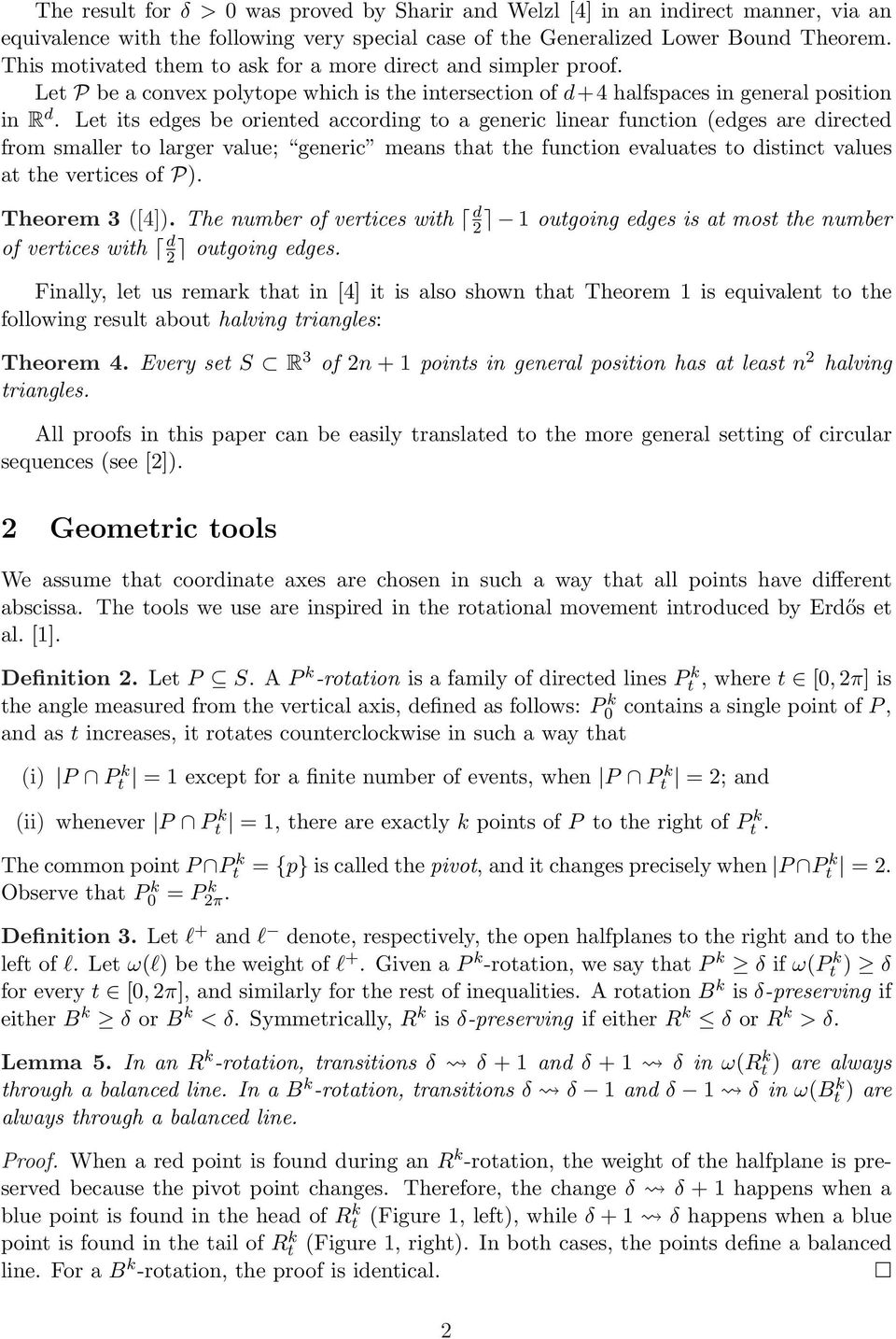
3 r R k t b b R k t r δ δ + 1 δ + 1 δ Figure 1: Transitions in an R k -rotation are always through a balanced line. Claim 8.1 in [3] has now a more direct proof: Lemma 6. If r is odd, there exists a balanced line which is a halving line of S. Proof. Let k = r 2 and consider an Rk -rotation. If R k 0 δ, then Rk π > δ, and conversely. Therefore, there exist transitions δ δ + 1 and δ + 1 δ in ω(r k t ) which, from Lemma 5 are always through a balanced line. Observe that both transitions are through the same balanced line, with angles t 0 and t 0 + π. Remark 1. Let us observe that Theorem 1.4 in [3], which states that Theorem 2 is true when R and B are separated by a line l, has now an easier proof: if we start R k -rotations with a line parallel to l, for each k there exist exactly one transition δ δ + 1 and one transition δ + 1 δ which, from Lemma 5, correspond always to a balanced line. If r is even, there are 2 balanced lines for k = 0,..., r 2 1, for a total of r balanced lines, while if r is odd there are 2 balanced lines for k = 0,..., r 2 1 and 1 balanced line for k = r 2. Remark 2. Lemmas 5 and 6 conclude the proof of Theorem 2 if no R k -rotation is δ-preserving or if no B k -rotation (with k δ) is δ-preserving. Hence, in the following we assume that there exists either at least one R k -rotation or one B k -rotation (with k δ) which is δ-preserving. Lemma 7. Let 0 j r 2. If Rj > δ then B j+δ δ, while if B j+δ < δ then R j δ. Proof. Consider the line R j t 0. The halfplane (R j t 0 ) + contains j red points and b > j + δ blue points. Therefore, the line B j+δ t 0 is to the right of (R j t 0 ) + and contains at most j red points. Then, ω(b j+δ t 0 ) δ. The proof of the second statement is analogous. The next definition generalizes the concept of P k -rotation in two different ways: parallel movements are permitted and the number of points to the right of the line can change. Definition 4. A P -sliding rotation consists in moving a directed line l continuously, starting with an l 0 which contains a single point p 0 P, and composing rotation around a point of P (the pivot) and parallel displacement (in either direction) until the next point of P is found. Furthermore, after a 2π rotation is completed, the line l 0 must be reached again. This movement is clearly a continuous curve in the space of lines in the plane. For instance, if a line is parameterized as a point in S 1 R, a P -sliding rotation describes a (non-strictly) angular-wise monotone curve, with vertical segments corresponding to parallel displacements. Let Σ be a P -sliding rotation. Let us denote by Σ t the line with angle t with respect to the vertical axis defined as follows: if there is no parallel displacement at angle t, then Σ t denotes the corresponding line. Otherwise, it denotes the leftmost line corresponding to angle t. Definition 5. A P -sliding rotation Σ is simple if Σ t+π is to the left of Σ t for all t [0, π). 3
4 That Σ δ, as well as the rest of inequalities, is defined exactly as in Definition 3. Similarly, a B-sliding rotation Σ is δ-preserving if Σ δ, while an R-sliding rotation is δ-preserving if Σ δ. The following definition is the crux of the rest of the paper. Definition 6. Let be the set of all simple, δ-preserving B-sliding rotations and R-sliding rotations. The waist of a P -sliding rotation Σ is min P t [0,π] Σ t Σ t+π. We denote by Γ the sliding rotation of with the smallest waist. Note that the set is non-empty because we have assumed that there exist δ-preserving B k - or R k -rotations, which are a particular type of sliding rotations. Furthermore, the waist takes only a finite number of values, so it has a minimum. If the minimum is not unique, we can pick any of the sliding rotations achieving it. 3 Main result Assume that Γ is a δ-preserving R-sliding rotation (i.e. Γ δ). In this case, we will manage to prove that there exist at least r balanced lines. For the case of Γ being a δ-preserving B-sliding rotation, the same arguments would show that there exist at least b balanced lines. Lemma 8. Let Γ 0 and Γ π be the lines achieving the waist of Γ, let Γ + 0 be the closed halfplane to the right of Γ 0 and let F = R Γ + 0. For every k {0,..., F 1}, during an F k -rotation a balanced line is found. Similarly, let H = R Γ + π. For every k {0,..., H 1}, during an H k -rotation a balanced line is found. Proof. Figure 2 illustrates the situation. On the one hand, F0 k is to the right of Γ 0 and, since Γ is simple, Fπ k is to the left of Γ π. This implies that there is a t 1 [0, π] such that Ft k 1 = Γ t1 and therefore ω(ft k 1 ) δ. On the other hand, F0 k is to the left of Γ π and Fπ k is to the right of Γ 0, therefore, there exists a t 2 [0, π] such that Ft k 2 and Γ t2 +π are the same line with opposite directions. Since ω(γ t2 +π) δ, then ω(ft k 2 ) δ. If ω(γ t2 +π) = δ and the line contains a blue point, then it is a balanced line found in a transition δ δ + 1. Otherwise, ω(ft k 2 ) > δ and hence a transition δ δ + 1 has occurred for a t (t 1, t 2 ). Now, observe that R F Γ 0. Hence, in the F k -rotation for t [0, π], all the points in R F are found by the head of the line. This implies that a change δ δ +1 in the weight of the right halfplane can only occur when a blue point is found in the head of the ray (as in Figure 1, left), hence defining a balanced line. The proof for H is identical. Observe that balanced lines found in this process are different, because they have exactly k points of F, respectively H, to the right. Let now Ct Γ be the central region of the sliding rotation Γ at instant t, defined as Ct Γ = Γ t Γ t+π. Observe that, for the corresponding t, the transitions δ δ + 1 in the proof of Lemma 8 correspond to balanced lines inside or in the boundary of the central region. Lemma 9. Let G = R (F H). For k {0,..., G /2 1}, every G k -rotation has transitions δ δ + 1 and δ + 1 δ, which correspond to lines inside or in the boundary of the central region., i.e., for the corresponding t, G k t Ct Γ. 4
![The waist of a P -sliding rotation Σ is min P t [0,π] Σ t Σ t+π. We denote by Γ the sliding rotation of with the smallest waist.](/docs-images/45/6006910/images/page_4.jpg "Note that the set is non-empty because we have assumed that there exist δ-preserving B k - or R k -rotations, which are a particular type of sliding rotations.")
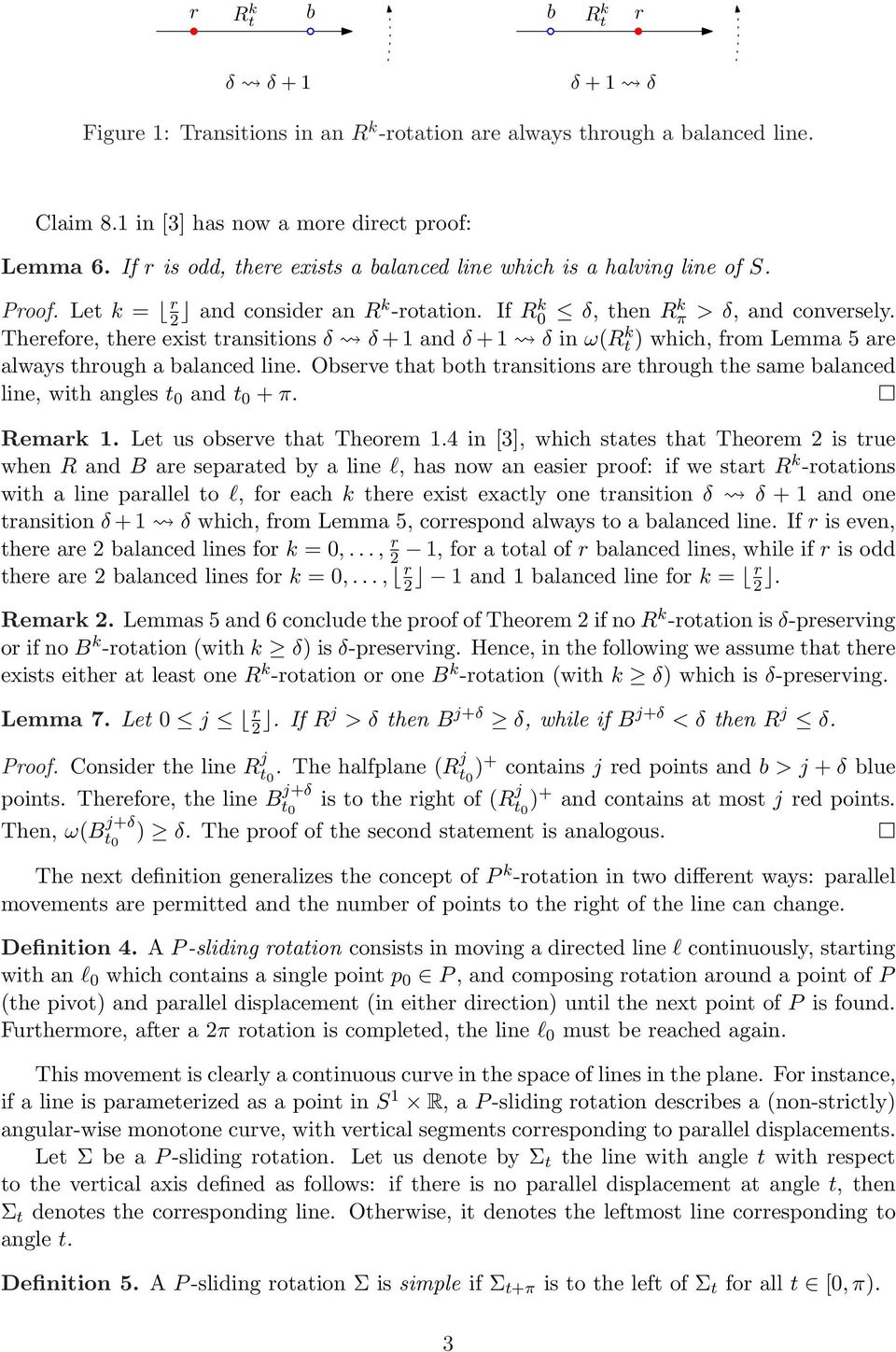
5 Γ 0 F k 0 F Γ π F k π Figure 2: Illustration of the proof of Lemma 8. Proof. Let us consider first the case when r is odd and k = G /2. G k 0 and Gk π are the same line with opposite directions. Therefore, if ω(g k 0 ) δ then ω(gk π) > δ and there must be at least two transitions as stated. These transitions correspond to lines in the central region because Γ is simple. For the rest of cases, observe that, by construction, G k 0 CΓ 0. According to the value of ω(g k 0 ), we distinguish two cases: ω(g k 0 ) δ. If there exist some values for which Gk t = Γ t, let t 1 and t 2 be, respectively, the minimum and maximum of them. If there is no such value, take t 1 = t 2 = 2π. If G k takes the value δ + 1 in the interval (0, t 1 ) it must have transitions δ δ + 1 and δ +1 δ, and the same is true for (t 2, 2π). Finally, observe that G k must take the value δ + 1 at least once, because in other case the sliding rotation obtained by concatenating G k in (0, t 1 ), Γ in (t 1, t 2 ) and G k in (t 2, 2π) would be a δ-preserving sliding rotation of waist smaller than the waist of Γ. ω(g k 0 ) > δ. If there exist some values for which Gk t = Γ t, let t 1 and t 2 be, respectively, the minimum and maximum of them. G k t takes the value δ in the intervals (0, t 1 ) and (t 2, 2π) and therefore the lemma follows. In other case, if G k t takes the value δ in the central region, it must have also transition δ δ + 1. Finally, if ω(g k t ) > δ for all t [0, 2π] we could construct a sliding rotation Σ contradicting the choice of Γ: for each t, consider as Σ t the parallel to G k t which passes through the first blue point to the right of G k t. It is easy to see that Σ t δ, because between Γ t and G k t there are always at least two blue points. The following lemma, which already appeared as Claim 6.4 in [3], will be enough to conclude the proof of Theorem 2. Lemma 10. Transitions δ δ + 1 and δ + 1 δ in a G k -rotation are always either a balanced line or a δ + 1 δ transition in an F j -rotation, j {0,..., F 1} or an H j - rotation, j {0,..., H 1}. Proof. On the one hand, a balanced line is achieved if there is such a transition because a blue point is found. See Figure 1. On the other hand, if the point inducing the transition is r R, then necessarily r R G (since the G k -rotation changes pivot whenever a point of G is found). Figure 3 illustrates that a δ + 1 δ transition appears for an F j -rotation with pivot g, both if f F is found in the tail (left picture) or if f F is found in the head (right picture). Note that in the right picture the weight of both halfplanes is δ + 1. The case in which the point found is h H works similarly. 5

6 f g g f δ δ + 1 in G k δ + 1 δ in F j δ + 1 δ in G k δ + 1 δ in F j Figure 3: Transitions when a point f F R found in a G k -rotation induces a δ + 1 δ transition in an F j -rotation. In both cases, the pivot is g. Proof of Theorem 1. a) Lemma 8 gives F + H different balanced lines. b) Lemmas 9 and 10 give G lines which are, either a balanced line, or a δ + 1 δ transition at the central region for an F j - or H j -rotation. c) Each δ +1 δ transition in b) forces a new δ δ +1 transition at the central region for an F j - or H j -rotation which correspond, as in the proof of Lemma 8, to a new balanced line. 4 Acknowledgements The authors thank Jesús García for helpful discussions. References [1] P. Erdős, L. Lovász, A. Simmons, E.G. Strauss. Dissection graphs on planar point sets. In A Survey of Combinatorial Theory, North Holland, Amsterdam, (1973), [2] D. Orden, P. Ramos, and G. Salazar, Balanced lines in two coloured point sets. arxiv: v1 [math.co]. [3] J. Pach and R. Pinchasi. On the number of balanced lines, Discrete and Computational Geometry, 25 (2001), [4] M. Sharir and E. Welzl. Balanced Lines, Halving Triangles, and the Generalized Lower Bound Theorem, In Discrete and Computational Geometry The Goodman-Pollack Festschrift, B. Aronov, S. Basu, J. Pach and M. Sharir (Eds.), Springer-Verlag, Heidelberg, 2003, pp

The minimum number of distinct areas of triangles determined by a set of n points in the plane
 The minimum number of distinct areas of triangles determined by a set of n points in the plane Rom Pinchasi Israel Institute of Technology, Technion 1 August 6, 007 Abstract We prove a conjecture of Erdős,
arxiv:1203.1525v1 [math.co] 7 Mar 2012
![arxiv:1203.1525v1 [math.co] 7 Mar 2012](/thumbs/39/20112469.jpg "arxiv:1203.1525v1 [math.co] 7 Mar 2012") Constructing subset partition graphs with strong adjacency and end-point count properties Nicolai Hähnle [email protected] arxiv:1203.1525v1 [math.co] 7 Mar 2012 March 8, 2012 Abstract Kim defined
Constructing subset partition graphs with strong adjacency and end-point count properties Nicolai Hähnle [email protected] arxiv:1203.1525v1 [math.co] 7 Mar 2012 March 8, 2012 Abstract Kim defined
SHARP BOUNDS FOR THE SUM OF THE SQUARES OF THE DEGREES OF A GRAPH
 31 Kragujevac J. Math. 25 (2003) 31 49. SHARP BOUNDS FOR THE SUM OF THE SQUARES OF THE DEGREES OF A GRAPH Kinkar Ch. Das Department of Mathematics, Indian Institute of Technology, Kharagpur 721302, W.B.,
Every tree contains a large induced subgraph with all degrees odd
 Every tree contains a large induced subgraph with all degrees odd A.J. Radcliffe Carnegie Mellon University, Pittsburgh, PA A.D. Scott Department of Pure Mathematics and Mathematical Statistics University
Mean Ramsey-Turán numbers
 Mean Ramsey-Turán numbers Raphael Yuster Department of Mathematics University of Haifa at Oranim Tivon 36006, Israel Abstract A ρ-mean coloring of a graph is a coloring of the edges such that the average
Removing Even Crossings
 EuroComb 2005 DMTCS proc. AE, 2005, 105 110 Removing Even Crossings Michael J. Pelsmajer 1, Marcus Schaefer 2 and Daniel Štefankovič 2 1 Department of Applied Mathematics, Illinois Institute of Technology,
The degree, size and chromatic index of a uniform hypergraph
 The degree, size and chromatic index of a uniform hypergraph Noga Alon Jeong Han Kim Abstract Let H be a k-uniform hypergraph in which no two edges share more than t common vertices, and let D denote the
INCIDENCE-BETWEENNESS GEOMETRY
 INCIDENCE-BETWEENNESS GEOMETRY MATH 410, CSUSM. SPRING 2008. PROFESSOR AITKEN This document covers the geometry that can be developed with just the axioms related to incidence and betweenness. The full
Large induced subgraphs with all degrees odd
 Large induced subgraphs with all degrees odd A.D. Scott Department of Pure Mathematics and Mathematical Statistics, University of Cambridge, England Abstract: We prove that every connected graph of order
Shortcut sets for plane Euclidean networks (Extended abstract) 1
 Shortcut sets for plane Euclidean networks (Extended abstract) 1 J. Cáceres a D. Garijo b A. González b A. Márquez b M. L. Puertas a P. Ribeiro c a Departamento de Matemáticas, Universidad de Almería,
FIRST YEAR CALCULUS. Chapter 7 CONTINUITY. It is a parabola, and we can draw this parabola without lifting our pencil from the paper.
 FIRST YEAR CALCULUS WWLCHENW L c WWWL W L Chen, 1982, 2008. 2006. This chapter originates from material used by the author at Imperial College, University of London, between 1981 and 1990. It It is is
Largest Fixed-Aspect, Axis-Aligned Rectangle
 Largest Fixed-Aspect, Axis-Aligned Rectangle David Eberly Geometric Tools, LLC http://www.geometrictools.com/ Copyright c 1998-2016. All Rights Reserved. Created: February 21, 2004 Last Modified: February
Linear Programming I
 Linear Programming I November 30, 2003 1 Introduction In the VCR/guns/nuclear bombs/napkins/star wars/professors/butter/mice problem, the benevolent dictator, Bigus Piguinus, of south Antarctica penguins
All trees contain a large induced subgraph having all degrees 1 (mod k)
 All trees contain a large induced subgraph having all degrees 1 (mod k) David M. Berman, A.J. Radcliffe, A.D. Scott, Hong Wang, and Larry Wargo *Department of Mathematics University of New Orleans New
Arrangements And Duality
 Arrangements And Duality 3.1 Introduction 3 Point configurations are tbe most basic structure we study in computational geometry. But what about configurations of more complicated shapes? For example,
ABSTRACT. For example, circle orders are the containment orders of circles (actually disks) in the plane (see [8,9]).
![ABSTRACT. For example, circle orders are the containment orders of circles (actually disks) in the plane (see [8,9]).](/thumbs/26/7227512.jpg "ABSTRACT. For example, circle orders are the containment orders of circles (actually disks) in the plane (see [8,9]).") Degrees of Freedom Versus Dimension for Containment Orders Noga Alon 1 Department of Mathematics Tel Aviv University Ramat Aviv 69978, Israel Edward R. Scheinerman 2 Department of Mathematical Sciences
Degrees of Freedom Versus Dimension for Containment Orders Noga Alon 1 Department of Mathematics Tel Aviv University Ramat Aviv 69978, Israel Edward R. Scheinerman 2 Department of Mathematical Sciences
Research Statement. Andrew Suk
 Research Statement Andrew Suk 1 Introduction My research interests are combinatorial methods in discrete geometry. In particular, I am interested in extremal problems on geometric objects. My research
ERDOS PROBLEMS ON IRREGULARITIES OF LINE SIZES AND POINT DEGREES A. GYARFAS*
 BOLYAI SOCIETY MATHEMATICAL STUDIES, 11 Paul Erdos and his Mathematics. II, Budapest, 2002, pp. 367-373. ERDOS PROBLEMS ON IRREGULARITIES OF LINE SIZES AND POINT DEGREES A. GYARFAS* Problems and results
Labeling outerplanar graphs with maximum degree three
 Labeling outerplanar graphs with maximum degree three Xiangwen Li 1 and Sanming Zhou 2 1 Department of Mathematics Huazhong Normal University, Wuhan 430079, China 2 Department of Mathematics and Statistics
A Turán Type Problem Concerning the Powers of the Degrees of a Graph
 A Turán Type Problem Concerning the Powers of the Degrees of a Graph Yair Caro and Raphael Yuster Department of Mathematics University of Haifa-ORANIM, Tivon 36006, Israel. AMS Subject Classification:
12.5 Equations of Lines and Planes
 Instructor: Longfei Li Math 43 Lecture Notes.5 Equations of Lines and Planes What do we need to determine a line? D: a point on the line: P 0 (x 0, y 0 ) direction (slope): k 3D: a point on the line: P
CS 598CSC: Combinatorial Optimization Lecture date: 2/4/2010
 CS 598CSC: Combinatorial Optimization Lecture date: /4/010 Instructor: Chandra Chekuri Scribe: David Morrison Gomory-Hu Trees (The work in this section closely follows [3]) Let G = (V, E) be an undirected
Graphical degree sequences and realizations
 swap Graphical and realizations Péter L. Erdös Alfréd Rényi Institute of Mathematics Hungarian Academy of Sciences MAPCON 12 MPIPKS - Dresden, May 15, 2012 swap Graphical and realizations Péter L. Erdös
SPERNER S LEMMA AND BROUWER S FIXED POINT THEOREM
 SPERNER S LEMMA AND BROUWER S FIXED POINT THEOREM ALEX WRIGHT 1. Intoduction A fixed point of a function f from a set X into itself is a point x 0 satisfying f(x 0 ) = x 0. Theorems which establish the
MA 323 Geometric Modelling Course Notes: Day 02 Model Construction Problem
 MA 323 Geometric Modelling Course Notes: Day 02 Model Construction Problem David L. Finn November 30th, 2004 In the next few days, we will introduce some of the basic problems in geometric modelling, and
Lecture 4 DISCRETE SUBGROUPS OF THE ISOMETRY GROUP OF THE PLANE AND TILINGS
 1 Lecture 4 DISCRETE SUBGROUPS OF THE ISOMETRY GROUP OF THE PLANE AND TILINGS This lecture, just as the previous one, deals with a classification of objects, the original interest in which was perhaps
Computational Geometry. Lecture 1: Introduction and Convex Hulls
 Lecture 1: Introduction and convex hulls 1 Geometry: points, lines,... Plane (two-dimensional), R 2 Space (three-dimensional), R 3 Space (higher-dimensional), R d A point in the plane, 3-dimensional space,
OPTIMAL CONTROL OF A COMMERCIAL LOAN REPAYMENT PLAN. E.V. Grigorieva. E.N. Khailov
 DISCRETE AND CONTINUOUS Website: http://aimsciences.org DYNAMICAL SYSTEMS Supplement Volume 2005 pp. 345 354 OPTIMAL CONTROL OF A COMMERCIAL LOAN REPAYMENT PLAN E.V. Grigorieva Department of Mathematics
CONTRIBUTIONS TO ZERO SUM PROBLEMS
 CONTRIBUTIONS TO ZERO SUM PROBLEMS S. D. ADHIKARI, Y. G. CHEN, J. B. FRIEDLANDER, S. V. KONYAGIN AND F. PAPPALARDI Abstract. A prototype of zero sum theorems, the well known theorem of Erdős, Ginzburg
Section 1.1. Introduction to R n
 The Calculus of Functions of Several Variables Section. Introduction to R n Calculus is the study of functional relationships and how related quantities change with each other. In your first exposure to
Lesson 18: Looking More Carefully at Parallel Lines
 Student Outcomes Students learn to construct a line parallel to a given line through a point not on that line using a rotation by 180. They learn how to prove the alternate interior angles theorem using
Surface bundles over S 1, the Thurston norm, and the Whitehead link
 Surface bundles over S 1, the Thurston norm, and the Whitehead link Michael Landry August 16, 2014 The Thurston norm is a powerful tool for studying the ways a 3-manifold can fiber over the circle. In
Graph Theory Problems and Solutions
 raph Theory Problems and Solutions Tom Davis [email protected] http://www.geometer.org/mathcircles November, 005 Problems. Prove that the sum of the degrees of the vertices of any finite graph is
Clique coloring B 1 -EPG graphs
 Clique coloring B 1 -EPG graphs Flavia Bonomo a,c, María Pía Mazzoleni b,c, and Maya Stein d a Departamento de Computación, FCEN-UBA, Buenos Aires, Argentina. b Departamento de Matemática, FCE-UNLP, La
Odd induced subgraphs in graphs of maximum degree three
 Odd induced subgraphs in graphs of maximum degree three David M. Berman, Hong Wang, and Larry Wargo Department of Mathematics University of New Orleans New Orleans, Louisiana, USA 70148 Abstract A long-standing
Stationary random graphs on Z with prescribed iid degrees and finite mean connections
 Stationary random graphs on Z with prescribed iid degrees and finite mean connections Maria Deijfen Johan Jonasson February 2006 Abstract Let F be a probability distribution with support on the non-negative
Geometry: Unit 1 Vocabulary TERM DEFINITION GEOMETRIC FIGURE. Cannot be defined by using other figures.
 Geometry: Unit 1 Vocabulary 1.1 Undefined terms Cannot be defined by using other figures. Point A specific location. It has no dimension and is represented by a dot. Line Plane A connected straight path.
ISOMETRIES OF R n KEITH CONRAD
 ISOMETRIES OF R n KEITH CONRAD 1. Introduction An isometry of R n is a function h: R n R n that preserves the distance between vectors: h(v) h(w) = v w for all v and w in R n, where (x 1,..., x n ) = x
Chapter 7. Permutation Groups
 Chapter 7 Permutation Groups () We started the study of groups by considering planar isometries In the previous chapter, we learnt that finite groups of planar isometries can only be cyclic or dihedral
Georgia Standards of Excellence 2015-2016 Mathematics
 Georgia Standards of Excellence 2015-2016 Mathematics Standards GSE Coordinate Algebra K-12 Mathematics Introduction Georgia Mathematics focuses on actively engaging the student in the development of mathematical
Cycles in a Graph Whose Lengths Differ by One or Two
 Cycles in a Graph Whose Lengths Differ by One or Two J. A. Bondy 1 and A. Vince 2 1 LABORATOIRE DE MATHÉMATIQUES DISCRÉTES UNIVERSITÉ CLAUDE-BERNARD LYON 1 69622 VILLEURBANNE, FRANCE 2 DEPARTMENT OF MATHEMATICS
Removing even crossings
 Removing even crossings Michael J. Pelsmajer a, Marcus Schaefer b, Daniel Štefankovič c a Department of Applied Mathematics, Illinois Institute of Technology, Chicago, IL 60616, USA b Department of Computer
For example, estimate the population of the United States as 3 times 10⁸ and the
 CCSS: Mathematics The Number System CCSS: Grade 8 8.NS.A. Know that there are numbers that are not rational, and approximate them by rational numbers. 8.NS.A.1. Understand informally that every number
Class One: Degree Sequences
 Class One: Degree Sequences For our purposes a graph is a just a bunch of points, called vertices, together with lines or curves, called edges, joining certain pairs of vertices. Three small examples of
Mathematics Course 111: Algebra I Part IV: Vector Spaces
 Mathematics Course 111: Algebra I Part IV: Vector Spaces D. R. Wilkins Academic Year 1996-7 9 Vector Spaces A vector space over some field K is an algebraic structure consisting of a set V on which are
Tools for parsimonious edge-colouring of graphs with maximum degree three. J.L. Fouquet and J.M. Vanherpe. Rapport n o RR-2010-10
 Tools for parsimonious edge-colouring of graphs with maximum degree three J.L. Fouquet and J.M. Vanherpe LIFO, Université d Orléans Rapport n o RR-2010-10 Tools for parsimonious edge-colouring of graphs
In mathematics, there are four attainment targets: using and applying mathematics; number and algebra; shape, space and measures, and handling data.
 MATHEMATICS: THE LEVEL DESCRIPTIONS In mathematics, there are four attainment targets: using and applying mathematics; number and algebra; shape, space and measures, and handling data. Attainment target
THE BANACH CONTRACTION PRINCIPLE. Contents
 THE BANACH CONTRACTION PRINCIPLE ALEX PONIECKI Abstract. This paper will study contractions of metric spaces. To do this, we will mainly use tools from topology. We will give some examples of contractions,
Ramsey numbers for bipartite graphs with small bandwidth
 Ramsey numbers for bipartite graphs with small bandwidth Guilherme O. Mota 1,, Gábor N. Sárközy 2,, Mathias Schacht 3,, and Anusch Taraz 4, 1 Instituto de Matemática e Estatística, Universidade de São
Mathematical Research Letters 1, 249 255 (1994) MAPPING CLASS GROUPS ARE AUTOMATIC. Lee Mosher
 Mathematical Research Letters 1, 249 255 (1994) MAPPING CLASS GROUPS ARE AUTOMATIC Lee Mosher Let S be a compact surface, possibly with the extra structure of an orientation or a finite set of distinguished
1 if 1 x 0 1 if 0 x 1
 Chapter 3 Continuity In this chapter we begin by defining the fundamental notion of continuity for real valued functions of a single real variable. When trying to decide whether a given function is or
Graphs without proper subgraphs of minimum degree 3 and short cycles
 Graphs without proper subgraphs of minimum degree 3 and short cycles Lothar Narins, Alexey Pokrovskiy, Tibor Szabó Department of Mathematics, Freie Universität, Berlin, Germany. August 22, 2014 Abstract
The positive minimum degree game on sparse graphs
 The positive minimum degree game on sparse graphs József Balogh Department of Mathematical Sciences University of Illinois, USA [email protected] András Pluhár Department of Computer Science University
UNIFORMLY DISCONTINUOUS GROUPS OF ISOMETRIES OF THE PLANE
 UNIFORMLY DISCONTINUOUS GROUPS OF ISOMETRIES OF THE PLANE NINA LEUNG Abstract. This paper discusses 2-dimensional locally Euclidean geometries and how these geometries can describe musical chords. Contents
2.3 Convex Constrained Optimization Problems
 42 CHAPTER 2. FUNDAMENTAL CONCEPTS IN CONVEX OPTIMIZATION Theorem 15 Let f : R n R and h : R R. Consider g(x) = h(f(x)) for all x R n. The function g is convex if either of the following two conditions
Selected practice exam solutions (part 5, item 2) (MAT 360)
 Selected practice exam solutions (part 5, item ) (MAT 360) Harder 8,91,9,94(smaller should be replaced by greater )95,103,109,140,160,(178,179,180,181 this is really one problem),188,193,194,195 8. On
BX in ( u, v) basis in two ways. On the one hand, AN = u+
 1. Let f(x) = 1 x +1. Find f (6) () (the value of the sixth derivative of the function f(x) at zero). Answer: 7. We expand the given function into a Taylor series at the point x = : f(x) = 1 x + x 4 x
On Integer Additive Set-Indexers of Graphs
 On Integer Additive Set-Indexers of Graphs arxiv:1312.7672v4 [math.co] 2 Mar 2014 N K Sudev and K A Germina Abstract A set-indexer of a graph G is an injective set-valued function f : V (G) 2 X such that
Solving Simultaneous Equations and Matrices
 Solving Simultaneous Equations and Matrices The following represents a systematic investigation for the steps used to solve two simultaneous linear equations in two unknowns. The motivation for considering
NEW MEXICO Grade 6 MATHEMATICS STANDARDS
 PROCESS STANDARDS To help New Mexico students achieve the Content Standards enumerated below, teachers are encouraged to base instruction on the following Process Standards: Problem Solving Build new mathematical
THREE DIMENSIONAL GEOMETRY
 Chapter 8 THREE DIMENSIONAL GEOMETRY 8.1 Introduction In this chapter we present a vector algebra approach to three dimensional geometry. The aim is to present standard properties of lines and planes,
CURVES WHOSE SECANT DEGREE IS ONE IN POSITIVE CHARACTERISTIC. 1. Introduction
 Acta Math. Univ. Comenianae Vol. LXXXI, 1 (2012), pp. 71 77 71 CURVES WHOSE SECANT DEGREE IS ONE IN POSITIVE CHARACTERISTIC E. BALLICO Abstract. Here we study (in positive characteristic) integral curves
Mathematical Induction. Mary Barnes Sue Gordon
 Mathematics Learning Centre Mathematical Induction Mary Barnes Sue Gordon c 1987 University of Sydney Contents 1 Mathematical Induction 1 1.1 Why do we need proof by induction?.... 1 1. What is proof by
Logo Symmetry Learning Task. Unit 5
 Logo Symmetry Learning Task Unit 5 Course Mathematics I: Algebra, Geometry, Statistics Overview The Logo Symmetry Learning Task explores graph symmetry and odd and even functions. Students are asked to
Properties of BMO functions whose reciprocals are also BMO
 Properties of BMO functions whose reciprocals are also BMO R. L. Johnson and C. J. Neugebauer The main result says that a non-negative BMO-function w, whose reciprocal is also in BMO, belongs to p> A p,and
The Use of Dynamic Geometry Software in the Teaching and Learning of Geometry through Transformations
 The Use of Dynamic Geometry Software in the Teaching and Learning of Geometry through Transformations Dynamic geometry technology should be used to maximize student learning in geometry. Such technology
Dedekind s forgotten axiom and why we should teach it (and why we shouldn t teach mathematical induction in our calculus classes)
 Dedekind s forgotten axiom and why we should teach it (and why we shouldn t teach mathematical induction in our calculus classes) by Jim Propp (UMass Lowell) March 14, 2010 1 / 29 Completeness Three common
3. Linear Programming and Polyhedral Combinatorics
 Massachusetts Institute of Technology Handout 6 18.433: Combinatorial Optimization February 20th, 2009 Michel X. Goemans 3. Linear Programming and Polyhedral Combinatorics Summary of what was seen in the
A NOTE ON OFF-DIAGONAL SMALL ON-LINE RAMSEY NUMBERS FOR PATHS
 A NOTE ON OFF-DIAGONAL SMALL ON-LINE RAMSEY NUMBERS FOR PATHS PAWE L PRA LAT Abstract. In this note we consider the on-line Ramsey numbers R(P n, P m ) for paths. Using a high performance computing clusters,
Sum of squares of degrees in a graph
 Sum of squares of degrees in a graph Bernardo M. Ábrego 1 Silvia Fernández-Merchant 1 Michael G. Neubauer William Watkins Department of Mathematics California State University, Northridge 18111 Nordhoff
Ideal Class Group and Units
 Chapter 4 Ideal Class Group and Units We are now interested in understanding two aspects of ring of integers of number fields: how principal they are (that is, what is the proportion of principal ideals
Collinear Points in Permutations
 Collinear Points in Permutations Joshua N. Cooper Courant Institute of Mathematics New York University, New York, NY József Solymosi Department of Mathematics University of British Columbia, Vancouver,
PUTNAM TRAINING POLYNOMIALS. Exercises 1. Find a polynomial with integral coefficients whose zeros include 2 + 5.
 PUTNAM TRAINING POLYNOMIALS (Last updated: November 17, 2015) Remark. This is a list of exercises on polynomials. Miguel A. Lerma Exercises 1. Find a polynomial with integral coefficients whose zeros include
Mathematical Induction
 Mathematical Induction (Handout March 8, 01) The Principle of Mathematical Induction provides a means to prove infinitely many statements all at once The principle is logical rather than strictly mathematical,
Rotation Rate of a Trajectory of an Algebraic Vector Field Around an Algebraic Curve
 QUALITATIVE THEORY OF DYAMICAL SYSTEMS 2, 61 66 (2001) ARTICLE O. 11 Rotation Rate of a Trajectory of an Algebraic Vector Field Around an Algebraic Curve Alexei Grigoriev Department of Mathematics, The
Fiber Polytopes for the Projections between Cyclic Polytopes
 Europ. J. Combinatorics (2000) 21, 19 47 Article No. eujc.1999.0319 Available online at http://www.idealibrary.com on Fiber Polytopes for the Projections between Cyclic Polytopes CHRISTOS A. ATHANASIADIS,
The Banach-Tarski Paradox
 University of Oslo MAT2 Project The Banach-Tarski Paradox Author: Fredrik Meyer Supervisor: Nadia S. Larsen Abstract In its weak form, the Banach-Tarski paradox states that for any ball in R, it is possible
Disjoint Compatible Geometric Matchings
 Disjoint Compatible Geometric Matchings Mashhood Ishaque Diane L. Souvaine Csaba D. Tóth Abstract We prove that for every even set of n pairwise disjoint line segments in the plane in general position,
8.1 Min Degree Spanning Tree
 CS880: Approximations Algorithms Scribe: Siddharth Barman Lecturer: Shuchi Chawla Topic: Min Degree Spanning Tree Date: 02/15/07 In this lecture we give a local search based algorithm for the Min Degree
(Refer Slide Time: 01.26)
 Discrete Mathematical Structures Dr. Kamala Krithivasan Department of Computer Science and Engineering Indian Institute of Technology, Madras Lecture # 27 Pigeonhole Principle In the next few lectures
PYTHAGOREAN TRIPLES KEITH CONRAD
 PYTHAGOREAN TRIPLES KEITH CONRAD 1. Introduction A Pythagorean triple is a triple of positive integers (a, b, c) where a + b = c. Examples include (3, 4, 5), (5, 1, 13), and (8, 15, 17). Below is an ancient
Catalan Numbers. Thomas A. Dowling, Department of Mathematics, Ohio State Uni- versity.
 7 Catalan Numbers Thomas A. Dowling, Department of Mathematics, Ohio State Uni- Author: versity. Prerequisites: The prerequisites for this chapter are recursive definitions, basic counting principles,
MATHEMATICAL INDUCTION. Mathematical Induction. This is a powerful method to prove properties of positive integers.
 MATHEMATICAL INDUCTION MIGUEL A LERMA (Last updated: February 8, 003) Mathematical Induction This is a powerful method to prove properties of positive integers Principle of Mathematical Induction Let P
arxiv:1112.0829v1 [math.pr] 5 Dec 2011
![arxiv:1112.0829v1 [math.pr] 5 Dec 2011](/thumbs/39/18839218.jpg "arxiv:1112.0829v1 [math.pr] 5 Dec 2011") How Not to Win a Million Dollars: A Counterexample to a Conjecture of L. Breiman Thomas P. Hayes arxiv:1112.0829v1 [math.pr] 5 Dec 2011 Abstract Consider a gambling game in which we are allowed to repeatedly
How Not to Win a Million Dollars: A Counterexample to a Conjecture of L. Breiman Thomas P. Hayes arxiv:1112.0829v1 [math.pr] 5 Dec 2011 Abstract Consider a gambling game in which we are allowed to repeatedly
TOPIC 4: DERIVATIVES
 TOPIC 4: DERIVATIVES 1. The derivative of a function. Differentiation rules 1.1. The slope of a curve. The slope of a curve at a point P is a measure of the steepness of the curve. If Q is a point on the
Baltic Way 1995. Västerås (Sweden), November 12, 1995. Problems and solutions
 Baltic Way 995 Västerås (Sweden), November, 995 Problems and solutions. Find all triples (x, y, z) of positive integers satisfying the system of equations { x = (y + z) x 6 = y 6 + z 6 + 3(y + z ). Solution.
Objectives After completing this section, you should be able to:
 Chapter 5 Section 1 Lesson Angle Measure Objectives After completing this section, you should be able to: Use the most common conventions to position and measure angles on the plane. Demonstrate an understanding
Competitive Analysis of On line Randomized Call Control in Cellular Networks
 Competitive Analysis of On line Randomized Call Control in Cellular Networks Ioannis Caragiannis Christos Kaklamanis Evi Papaioannou Abstract In this paper we address an important communication issue arising
MATH1231 Algebra, 2015 Chapter 7: Linear maps
 MATH1231 Algebra, 2015 Chapter 7: Linear maps A/Prof. Daniel Chan School of Mathematics and Statistics University of New South Wales [email protected] Daniel Chan (UNSW) MATH1231 Algebra 1 / 43 Chapter
On end degrees and infinite cycles in locally finite graphs
 On end degrees and infinite cycles in locally finite graphs Henning Bruhn Maya Stein Abstract We introduce a natural extension of the vertex degree to ends. For the cycle space C(G) as proposed by Diestel
39 Symmetry of Plane Figures
 39 Symmetry of Plane Figures In this section, we are interested in the symmetric properties of plane figures. By a symmetry of a plane figure we mean a motion of the plane that moves the figure so that
About the inverse football pool problem for 9 games 1
 Seventh International Workshop on Optimal Codes and Related Topics September 6-1, 013, Albena, Bulgaria pp. 15-133 About the inverse football pool problem for 9 games 1 Emil Kolev Tsonka Baicheva Institute
Cycles and clique-minors in expanders
 Cycles and clique-minors in expanders Benny Sudakov UCLA and Princeton University Expanders Definition: The vertex boundary of a subset X of a graph G: X = { all vertices in G\X with at least one neighbor
Total colorings of planar graphs with small maximum degree
 Total colorings of planar graphs with small maximum degree Bing Wang 1,, Jian-Liang Wu, Si-Feng Tian 1 Department of Mathematics, Zaozhuang University, Shandong, 77160, China School of Mathematics, Shandong