
T7406 Cordless Telephone Installation Guide
|
|
|
- Sandra Barber
- 10 years ago
- Views:
Transcription
1 Part No. P T7406 Cordless Telephone Installation Guide Read all documentation before proceeding with installation of this unit. Warning: First-time battery charge Follow this procedure for the first-time charge of your handset battery packs and when you first set up your T7406 system. Failure to follow all of these steps can result in operational difficulties. Ensure that the battery pack is fully charged before you attempt to use your T7406 handset for the first time. Charge the battery pack in the rear port of the charger for a minimum of 30 minutes. Install the battery pack in the handset. Put the handset into the front port of the charger and charge the battery pack in the handset for a minimum of three hours. Trickle charge a spare battery pack in the rear battery port of the charger for 12 hours. Ensure you configure the handsets in an orderly fashion. If you are configuring a number of handsets, ensure the battery packs for all the handsets are charged before you start configuring the handsets to the base station. Refer to Handset Configuration on page 27.
2 2 / 2003, Nortel Networks, Nashville, TN ALL RIGHTS RESERVED. For further information, call your technical support team or a Nortel Networks Sales representative. Nortel, the Nortel globemark, Norstar, and Business Communications Manager are trademarks of Nortel Networks. All other trademarks are property of their respective owners. All information is subject to charge. Nortel Networks reserves the right, without notice, to change its products as progress in engineering or manufacturing methods or any other circumstances may warrant. P
3 Contents Contents / 3 Provisioning the T Operational Bandwidths Operational Parameters Installation Site Parameters RF LANs (Radio Frequency Local Area Networks).. 9 Telephone-to-Base Range Environmental Layout Considerations Environments Unsuitable for the T Powering the T Battery Charge Controller Specifications Important battery pack information About your T7406 telephone Radio range and coverage considerations Security of Conversation Density and Interference Spare Parts T7406 Parts Lists Handset Overview Handset Signal Detection Handset Features Installing the Base Station Base Station Features Antenna Mounting Bracket T7406 Pre-installation Programming Before you start Mounting and Connecting the Base Station T7406 Installation Guide
4 4 / Contents Charging the T7406 Battery Pack First-time Charging Handset Power Low battery Recharge Battery levels Handset Configuration Important First-time Installation Information Identifying the Handsets to the System Assigning the Handset to the Base Station Using the Handset Display Buttons Configuring the First Handset to a Base Station Configuring the Handset ID Number Changing the Handset ID Password Assigning the Security Code Configure the next handset to the base station Setting Handset Features Ring Type Ringer Volume Lock Handset Language Handset System Feature Notes Button Mapping on the Handset Memory buttons Programming memory buttons Button Inquiry System Feature codes Handset Asleep (Save Battery Mode) Handset Asleep Mode Feature Conditions..41 Make and Answer Calls Make a call Answer calls P
5 Contents / 5 Hold calls Mute microphone Page Customize a handset Backlight On/Off Helpful hints Cleaning battery contacts Installing the T7406 Handset Accessories Optional accessories Leather carrying cases Headset Compatibility Headset installation Regulatory information Canadian Regulations US Regulations Federal Communications Commission (FCC) Notice EMI/EMC (FCC Part 15) For Class A Host equipment For Class B Host equipment Safety Important Safety Instructions Installation Use T7406 Installation Guide

6 6 / Contents P

7 Provisioning the T7406 / 7 Provisioning the T7406 This chapter provides specification and provisioning information for the T7406 cordless system. The T7406 is a Frequency Hopping Spread Spectrum (FHSS) cordless telephone. The benefits of this technology are: improved range, robustness and, less susceptibility to interference, fading and multipath. The use of a common wall-mounted base station for multiple handsets allows you to position the base antennas for maximum performance and coverage. The indoor range of the T7406 is 95 meters (300 feet) in a typical office environment. This range may vary with differing environments. Operational Bandwidths The T7406 cordless telephone operates in the ISM (Industrial, Scientific, and Medical) MHz band. The T7406 divides the ISM band into two sets of operating frequencies to allow the coexistence of other ISM devices. Examples of these products are SKU scanners and remote controls for products such as garage door openers and home theatre systems. Note that, since the T7406 is a frequency hopper, it uses at least half of the available frequencies in the ISM band for operation and can make it difficult for other 900 MHz devices to operate correctly. The following table identifies the frequencies used for the upper and lower bands of operation: Lower: MHz Upper: MHz These bands are selectable for each base station through dip switches located on the back of the T7406 base station. Each base station supports up to three handsets. Selection of the correct band for operation may minimize interference between devices. Operational Parameters For example, with a configuration of six handsets, two base stations are required (three handsets per base station). One base station will be set to the upper band, and the other base station will be set to the lower band. T7406 Installation Guide

8 8 / Provisioning the T7406 Another example is an environment that already contains another 900 Mhz device (e.g. a scanner with 900 Mhz wireless connection to a LAN). In this environment, only one T7406 base station should be installed. Set the T7406 base station dip switch to the opposite band that the scanner is operating in. Installation Site Parameters Physical characteristics of the site where the T7406 is to be installed, or has been installed, must be evaluated to maximize the performance of the T7406 telephone. Outlined below are some of the most common characteristics to be considered: wood vs. metal construction metal vs. wood studs in wall construction thickness of concrete floors and walls (and type of covering, e.g. Metallic wall paper) number of floors and walls open office (cubicles) vs. closed office (floor to ceiling) steel partitions, elevator shafts, electric utility rooms RF LANs (Radio Frequency Local Area Networks), extensive machinery, computer equipment, and other cordless phones or wireless devices Placement of the antenna is crucial for enhancing the performance of the T7406. Pick a central location and mount the antenna with the following guidelines: Attach the base station at least eight feet from the floor. Minimize the number of walls between the base station and handsets. Centralize the location of the base station to make the number of interfering walls equal in all directions. Do not mount the base station on an outside wall. Do not mount or place the base station outdoors. Adjust the antenna for optimal transmission by moving it through 90- degree angle planes (i.e. perpendicular to the wall, parallel to the wall, perpendicular to the floor, parallel to the floor) P
9 RF LANs (Radio Frequency Local Area Networks) Provisioning the T7406 / 9 RF LANs are primarily installed in large chain businesses such as retail and grocery where the RF LAN is used for inventory equipment. With the correct selection of the T7406 operating band, the RF LAN operating at 900 MHz does not pose an operating issue for T7406 nor does the T7406 pose issues for the RF LAN with respect to data transmission capabilities. However, there may be instances where the T7406 user may hear an occasional slight audio click when operating in a RF LAN environment. This should not inhibit the user's ability to hold a normal two-way conversation using the T7406. Telephone-to-Base Range The T7406 cordless telephone utilizes an extremely efficient radio design to deliver the maximum possible range while complying with the governing rules of the Federal Communications Commission (FCC) and Industry Canada. The effective operating range within a site will largely depend on the environmental characteristics mentioned previously, such as building construction and internal layout of the site. Typically, the T7406 will provide an effective operating range of 95 meters (300 feet). If the T7406 is not meeting this operating range, the following are some steps that can be taken to assist with the troubleshooting: Check surroundings for any other product that my be causing interference. Check environment for obstructions that may be limiting the range. Change the orientation of the base station antenna. Move the base station to another location. Select the alternate operating band of the T7406. It is important to keep in mind that, based on environmental characteristics, the T7406 may not be the optimum solution for all users. If the desired level of mobility performance is not met, contact your authorized Nortel Networks distributor to discuss alternatives. T7406 Installation Guide

10 DEF GHI JKL MNO PQRS TUV WXYZ # 10 / Provisioning the T7406 Environmental Layout Considerations The following facility layouts are examples of reference building footprints for which the T7406 is most suited. 1. The Storefront under 929 square meters/10,0000 square feet Open environments with few interior barriers 30.5 m/100 ft. 46 m/150 ft m/ 100 ft. Diagonal measurement is 44 m/ 144 ft. 46 m/ 150 ft. Diagonal measurement is 55 m/180 ft. 2. Office Facility The T7406 can also be used in business with larger square footage and including an interior layout that has a higher concentration of physical barriers. Full radio coverage at these facilities takes more planning to work around possible barriers. 46 m/150 ft. Professional office Typically under 2,323 square meters/25,000 square feet. Usually mix of open and closed offices 46 m/ Typical office floor ABC 150 ft. with elevator shaft and utility rooms in core of facility. Some transmission path loss will occur when the base station and the handset are separated by physical barriers, as represented by this core area. The amount of path loss is dependent upon the number of walls and type of material and density of barriers utilized in the core area. P

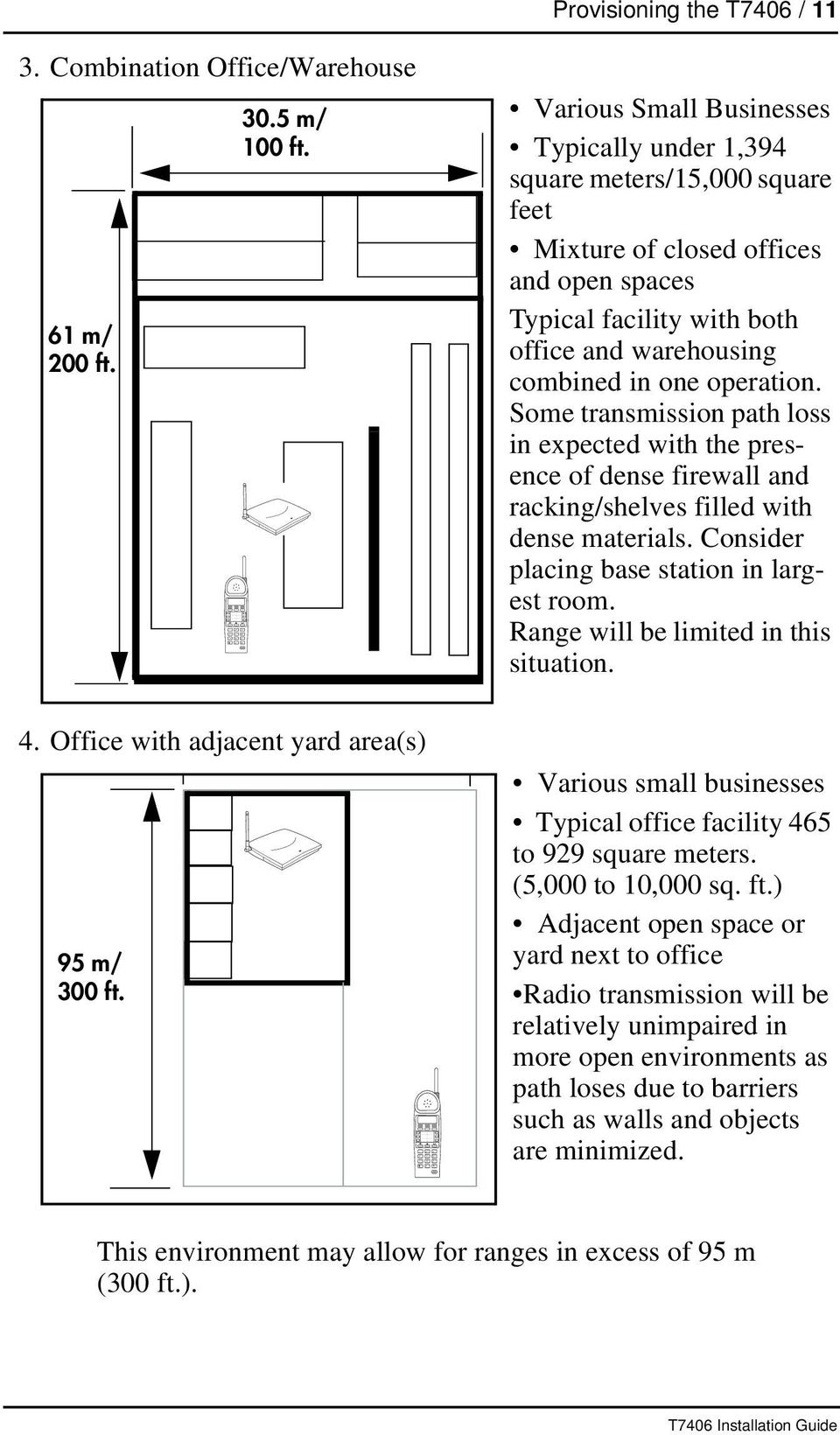
11 ABC DEF GHI JKL MNO PQRS TUV WXYZ # ABC DEF GHI JKL MNO PQRS TUV WXYZ # Provisioning the T7406 / Combination Office/Warehouse 61 m/ 200 ft m/ 100 ft. 4. Office with adjacent yard area(s) 95 m/ 300 ft. Various Small Businesses Typically under 1,394 square meters/15,000 square feet Mixture of closed offices and open spaces Typical facility with both office and warehousing combined in one operation. Some transmission path loss in expected with the presence of dense firewall and racking/shelves filled with dense materials. Consider placing base station in largest room. Range will be limited in this situation. Various small businesses Typical office facility 465 to 929 square meters. (5,000 to 10,000 sq. ft.) Adjacent open space or yard next to office Radio transmission will be relatively unimpaired in more open environments as path loses due to barriers such as walls and objects are minimized. This environment may allow for ranges in excess of 95 m (300 ft.). T7406 Installation Guide
12 ABC DEF GHI JKL MNO PQRS TUV WXYZ # 12 / Provisioning the T7406 Environments Unsuitable for the T7406 Campus Environment (multiple buildings on one site) The campus environment is not a suitable application for the T7406. For this type of environment, contact your authorized Nortel Networks distributor to discuss alternatives. 95 m/ 300 ft. Bldg. B Bldg. A 107 m/ 350 ft. Bldg. D Bldg. C Bldg. E P

13 Powering the T7406 Provisioning the T7406 / 13 The T7406 design has taken into account the need to provide a reliablypowered cordless business telephone. The T7406 utilizes premium 1400 mah NiMh batteries. A fully charged 1400 mah battery should provide four to five hours of talk time in a typical eight-hour day over, approximately, a three-year service life. The T7406 has been engineered to provide the following talk-time parameters: T7406 users should feel comfortable using the handset for an entire workday without the need to put the handset back into the charger cradle for charging or topping up. Studies have shown that users have been able to get four to five hours of talk time from a fully charged 1400 mah battery. Traffic studies have shown that typical users do not usually need more that three hours of talk time in an eight-hour day. If talk times exceed four hours or the product is to see use through multiple, consecutive shifts, multiple spare batteries are strongly recommended. Battery Charge Controller The T7406 incorporates a special handset battery charge controller that employs a four-stage charging program that sequences charging from a soft start to a fast charge, and then to a topping charge, followed by a maintenance charge. This four-stage charge sequence presents an optimum-charging plan that helps maximize the overall life of the battery by managing two critical elements in the battery charging process, the charge rate and overcharging protection. Note that NiMh batteries do not exhibit memory problems and it is not necessary to drain the batteries prior to recharging. Low battery status is indicated on the handset by the visual charge status on the display and/or the audible warning tone. The T7406 handset can be placed back into the charge cradle for charging when it is not in use. T7406 Installation Guide
14 14 / Provisioning the T7406 A fully depleted 1400 mah battery will be restored to full charge in three hours. The handset charge light will turn from red to green to indicate that the handset battery is fully charged and ready for use. The T7406 charge stand provides a rear port as a trickle charger that charges a fully depleted 1400 mah battery in 12 to 14 hours. Specifications Frequency band Total channel capability Half of the 900 MHz ISM band: either 902 to 915 MHz or to 928 MHz Spread spectrum frequency hopping is available on 27 channels per base Handset dimensions Length: 170 mm/6.8 inches (without antenna) Width: 58 mm/2.32 inches Overall Thickness: 40 mm/1.60 inches Handset range Handset weight Battery Pack Base dimensions Base power Typical range of 95 m/300 feet, depending on the physical environment 280 g/9.38 oz. (with battery pack) Capacity: 1400 mah, 3.6 V Talk Mode: up to five hours (with backlight OFF) Standby Mode: up to 72 hours Length: 150 mm/6 inches Width: 160 mm/6.4 inches Height (front): 28 mm/1.12 inches Height (rear): 34 mm/1.36 inches Input: 110 VAC, 60 Hz Output: 9 VDC, 600 ma P
15 Important battery pack information Important battery pack information / 15 Before you use the T7406 cordless handset, read the following information. This unit contains a rechargeable nickel metal hydride battery: Follow the proper installation and charging procedures for the T7406 battery pack. Refer to Charging the T7406 Battery Pack on page 24. The rechargeable battery pack must be fully charged before you use the T7406 handset for the first time. It takes approximately three hours to charge a standard 1400 mah battery pack. It takes approximately 12 hours to trickle charge the spare battery in the charging cradle. Warning: The battery will explode if disposed of in a fire. Do not use the nickel metal hydride batteries provided with your T7406 cordless telephone with any other product. These batteries were designed specifically for use with thet7406 telephone and the T7406 charger ONLY. Improper use of the T7406 batteries may result in fire hazard. Do not do anything that would cause the battery to short circuit. Do not charge the battery with any charger other than the one supplied with this equipment. WARNING Nickel metal hydride batteries must be disposed of properly. Do not dispose of the batteries in office or household waste. Nickel metal hydride batteries are recyclable. You can help preserve the environment by returning your unwanted batteries to your nearest recycling center for recycling or proper disposal. Phone BATTERY to locate a Battery Recycling Center near you. T7406 Installation Guide
16 16 / About your T7406 telephone About your T7406 telephone The T7406 is a multiple-handset, single-base cordless telephone system. The T7406 telephone provides a fully-integrated mobility solution for your business. The T7406 handset allows you to freely move around your work space while on a call, and still maintain access to all your telephone system features. The T7406 telephone uses advanced digital frequency hopping spread spectrum (FHSS) technology to provide a quality audio path over a 900 MHz radio link. Establishing a call over a radio link is comparable to a wire line communication. Note: The T7406 cordless telephone is supported on all Norstar systems (DR3 or higher) and on all Business Communications Manager systems. Radio range and coverage considerations The effective operating radio range in your facility depends on the building construction and the internal layout of the facility. Typically, a dense office or warehouse environment has an effective operating radio range of 95 meters (300 feet). An open office environment enhances operating radio ranges. Refer to Provisioning the T7406 on page 7. Security of Conversation Each base station has a unique Security Code (S.S. Code). All three handsets registered to the base station must share the same Security Code. Each of the three handsets assigned to a base station must also have a unique identification (Set I.D. 1, 2 or 3). Density and Interference For this system to be interference-free, install a maximum of two base stations and six handsets per location. Each base station provides three independent time compression multiplexing (TCM) line connections to the telephone system. Each base station uses half of the Industrial Scientific Medical (ISM) band for its frequency hopping channels. The dip switches on the base station allow you to assign the base station to use either the lower half ( Mhz) or the upper half ( Mhz). P
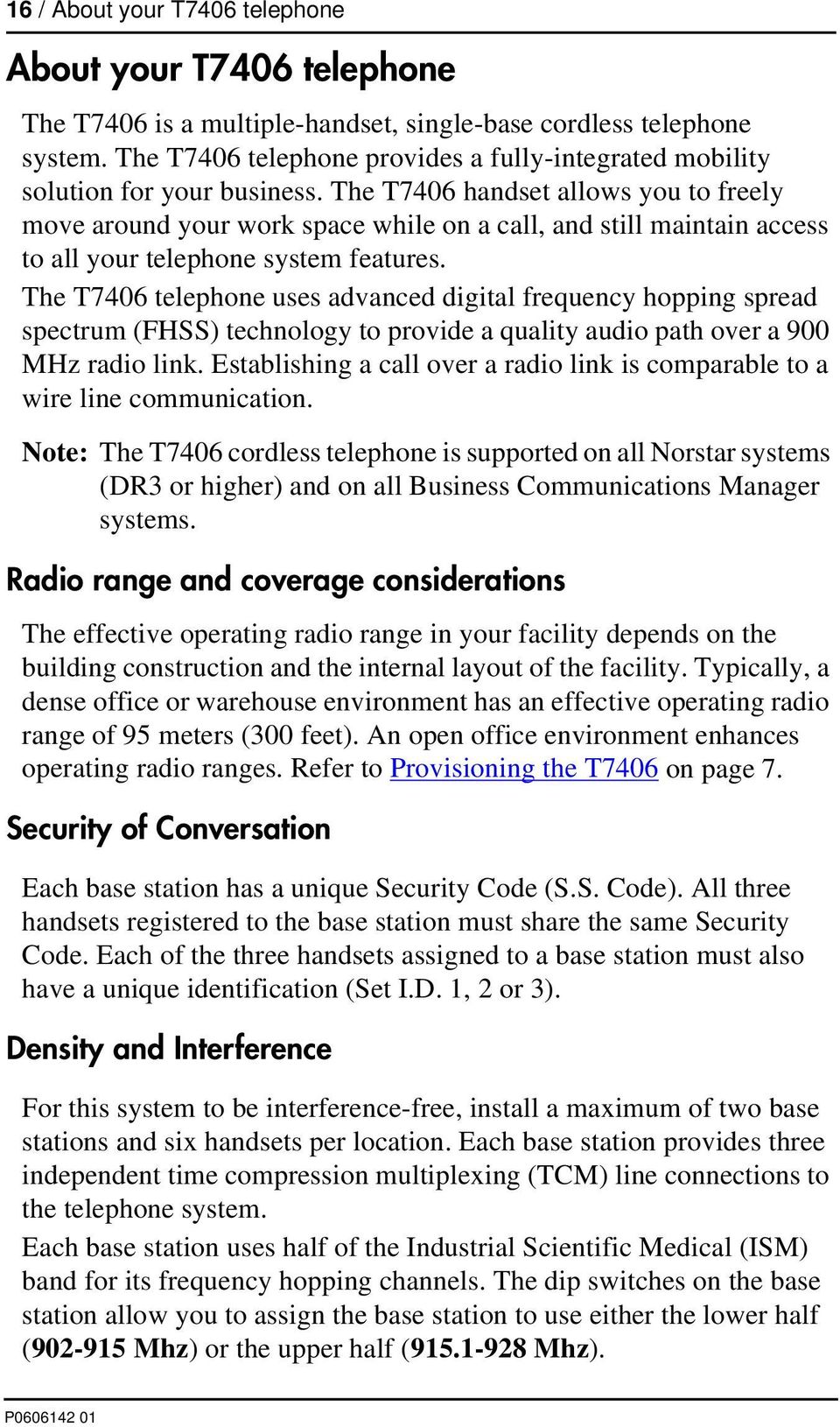
17 About your T7406 telephone / 17 Each base station must use a separate ISM half band. For more information about setting the dip switches, refer to Installing the Base Station on page 21. If other devices operating on the ISM band interfere with the T7406 base, the other half of the band may be used to try to minimize interference. In this situation, install only one base station and three handsets per location. Spare Parts You can order spare parts for your T7406 telephone. For more information about spare parts, refer to T7406 Parts Lists on page 17. For more information about accessories, refer to Optional accessories on page 49. For more information about ordering, contact your system administrator. T7406 Parts Lists Along with this guide, the following items are included with the T7406 telephone. System parts list Mounting bracket Base station and Mounting Bracket Power adapter Telephone cord (3) T7406 Installation Guide
18 ABC DEF GHI JKL MNO PQRS TUV WXYZ 18 / Handset Overview Handset parts list # Handset Charger Battery pack (2) Power adapter Handset card (2) and Plastic lens (1) Belt clip Wrist strap Handset Overview The handset automatically links with the base station by searching for the base station signal when the following are completed: battery is charged base station and handset are powered handset identification is configured base station Security Code is assigned P

19 Handset Signal Detection Handset Overview / 19 You can monitor the handset signal strength while moving to different locations. The antenna/signal strength and battery icons appear on the handset display. When you move too far from the base station, the following occurs on the handset: the antenna/signal strength icon disappears Out of range... message appears handset produces an intermittent beep handset may go into scanning mode If the signal strength is weak, move back into range to stop the handset display messages and warning tones. If you go completely out of range during an active call, the call is automatically placed on hold. For more information, refer to Hold calls on page 43. Retrieve a held call by selecting the flashing red line button when you are back in range. Note: In cases where the line button does not light when you move back into range of the base station, press the intercom/line button that the call came in on, to take the call off hold. T7406 Installation Guide

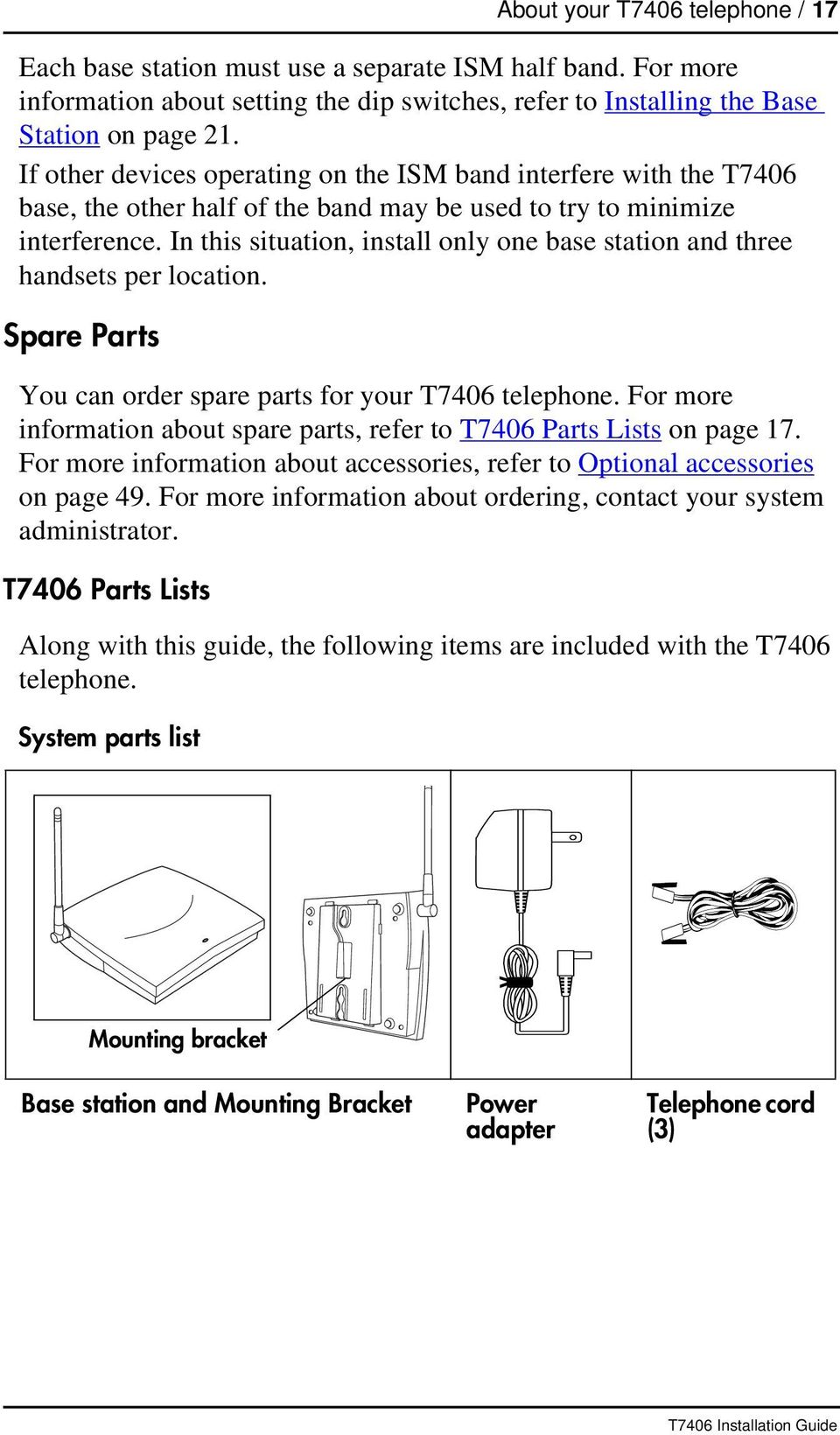
20 20 / Handset Overview Handset Features Antenna Display Shows the time, date, call information, handset status icons and guides you while using features. Display buttons Starts or cancels a feature. Light collar Flashes during ringing calls. Memory and line buttons Buttons for one touch dialing, feature operations, line access or answering a line. Cancels active calls. Places calls on hold. Headset port 1 ABC 2 3 DEF GHI JKL MNO PQRS TUV WXYZ Lanyard anchor (hook) For attaching a wrist strap. Volume control Dialpad Battery Pack 0 # Microphone Options button/mute Answers calls, Mute the microphone on an active call and accesses the Options List. P
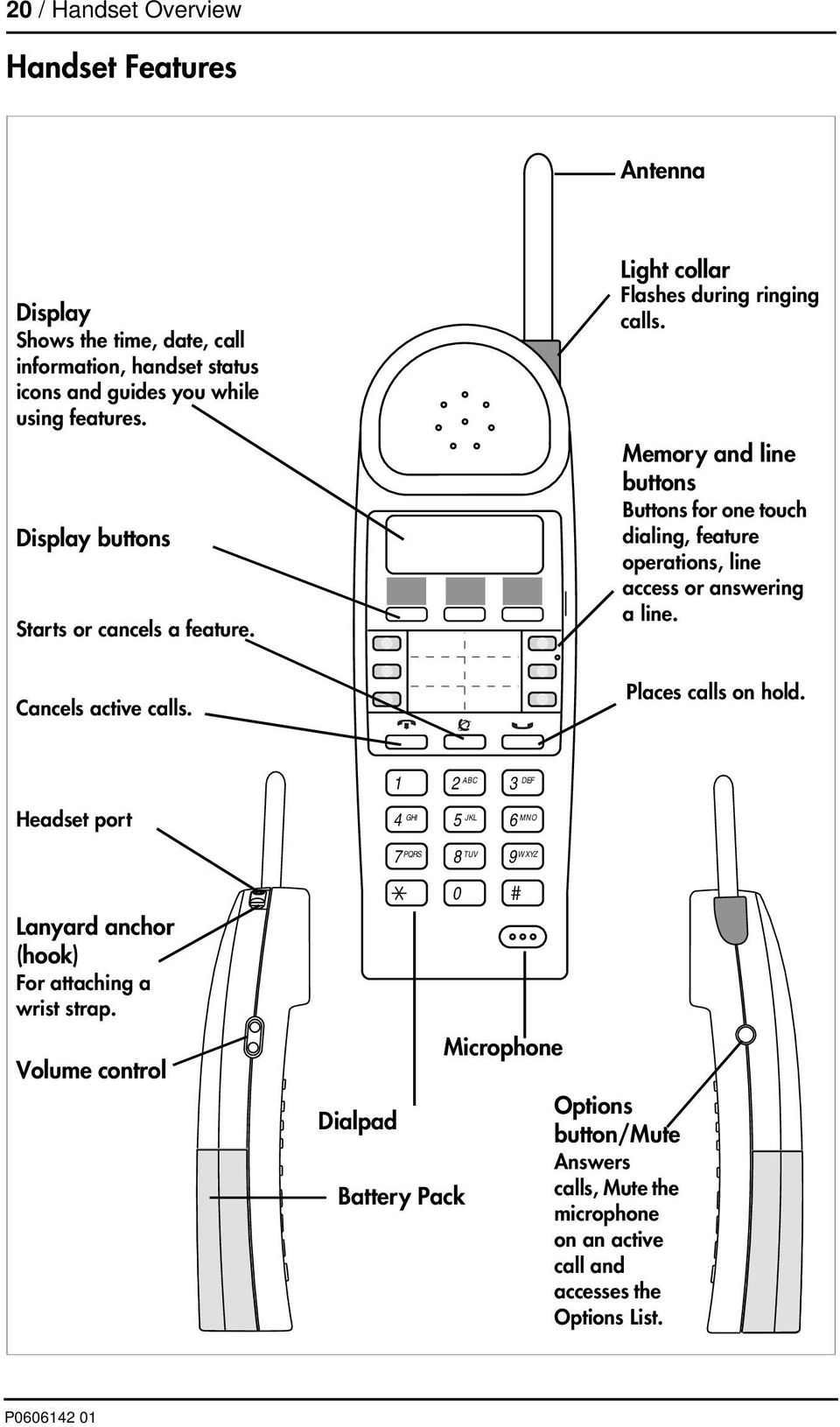
21 Installing the Base Station Installing the Base Station / 21 This section describes the base station and: how to mount the base station on a wall what programming is required before you connect the base station to your system how to connect the base station to your system The T7406 cordless telephone operates on the same principle as a twoway radio. Therefore, the location of the base station affects the range of reception. The base station should not be installed where radio waves are blocked or reflected, such as next to a filing cabinet. For optimal performance, install the base station at least 2.4 meters (eight feet) above the floor and at least 3.2 meters (ten and one half feet) apart from a second base station. Always position the antenna at a 90 angle to the base station. Base Station Features This section illustrates the base station for the T7406 system. Antenna Base antenna (90 to base station) LED indicates base station has power Note: When power is connected to the base station, the LED on the front of the unit starts flashing. During operation the LED flashes every second to indicate that the unit is receiving power. T7406 Installation Guide
22 22 / Installing the Base Station Mounting Bracket Mounting bracket Notches match to bracket. T7406 Pre-installation Programming Before connecting the T7406 base station to your system, you must set up system programming for the handset lines. Have the system administrator set up this programming: 1. Program Handsfree to Auto. 2. Program a maximum of three lines to each handset. 3. Assign Ring & Appear on the lines you assign to the handset. Note: Appear only does not allow the handset to wake from Handset Asleep mode. 4. Set the Page zone to None. Note: Handsets can send Page announcements, but they cannot receive them. 5. Set DND on Busy to Yes if you do not want your calls interrupted with a ring tone when a second call comes in. Instead, the button flashes, indicating an incoming call. 6. Other telephone programming is the same as for the M7310 telephone, with the exception of the memory key locations. P
23 Installing the Base Station / 23 Before you start Ensure there is an AC power outlet within 1.5 meters (5 feet) of the base station location. Ensure that the telephone lines from your system have been installed to the base station location. Mounting and Connecting the Base Station Follow these steps to mount and connect each base station. 1. Use the mounting bracket as a template to position the base station and mark the screw positions. 2. Use screws to attach the mounting bracket to a wall or ceiling. 3. Set the base station dip switches, located on the back of the base station, to the required ISM frequency band Upper half ISM Band Lower half ISM Band On the first base station you install, set the dip switches to operate in the upper half of the ISM band. From left to right, set to Down-Up-Down. On the second base station, set the dip switches to operate in the lower half of the ISM band. From left to right, set to Down-Down-Up. 4. Connect the telephone lines to the base station. a. Plug one end of the line cord into a telephone jack on the base station. b. Connect the other end into a telephone port on the system equipment. Note:Connect a maximum of three TCMs per base station to the system. c. Plug the small end of the power adapter into the back of the base station. d. Plug the other end into an AC outlet. Note:A red light flashes continuously on the base station when powered. T7406 Installation Guide
24 24 / Charging the T7406 Battery Pack 5. Align the notches on the back of the base station with the mounting bracket on the wall. 6. Push the base station against the brackets until they are securely connected. For the best radio reception, make sure the antenna on the base station is always at a 90 angle to the base station. Charging the T7406 Battery Pack Warning: It is imperative that you follow the steps in this section when you first initialize a base station and configure the first handset. Follow these steps to set up the charging unit: 1. Plug the small end of the power adapter into the back of the charger. 2. Plug the power adapter into an AC outlet. The back port (battery port) on the charger is used to charge the battery pack on its own. The front port supports the handset with an installed battery pack. The rechargeable battery pack must be fully charged before you use your T7406 handset for the first time. Note: Multiple handsets If you are installing a number of handsets at once, follow these instructions for each handset before you start trying to configure the handsets to the base station. P
25 Charging the T7406 Battery Pack / 25 First-time Charging When you first setup your new handset, follow these steps to charge the battery and install it into the handset: 1. Charge the battery pack in the back battery port of the charger for a minimum of 30 minutes. 2. Install the battery pack in the handset. 3. Charge the battery pack in the handset for a minimum of three hours. 4. Trickle charge a spare battery pack in the back battery port of the charger for 12 hours. The following diagrams demonstrate where the battery pack fits onto a handset, and how to trickle charge the spare battery pack. Battery pack Installing a Battery Pack into the Handset 1. Position the battery pack in the bottom position on the back of the handset. 2. Snap the top of the battery pack into place. Note: If you are using a leather cover, it must be removed before you put your handset in charger. Indicator lights Charging the Handset 1. Slide the handset into the charger. Make sure the handset and charger contacts touch. 2. The handset charge indicator light turns on. The battery pack indicator light is red while it is charging. The battery pack fully charges in approximately three hours. When the battery pack is fully charged, the indicator light turns green. Note: Charging begins as soon as the handset is placed in the base station. 3. Slide the spare battery pack into the back battery port. Make sure the battery pack and charger contacts touch. T7406 Installation Guide
26 26 / Charging the T7406 Battery Pack Note: Make sure the battery is properly installed in the handset or seated in the charger. If the T7406 battery is not properly installed, or if the battery level is extremely low, the six programmable buttons may light or flash simultaneously. This may also happen when the handset is in the charger. Exchange the handset battery pack regularly (once a week) if you have a second (spare) battery pack. The spare battery pack trickle charges in approximately 12 hours. When the spare battery pack is fully charged, the indicator light turns green. Handset Power Power to the handset comes from the battery pack installed in the back of the handset. When the battery pack power level is low it must be recharged in the charging unit. Low battery When the power is low, a tone sounds every 15 seconds indicating you need to recharge the battery soon. Your call is automatically put on hold 20 seconds after the battery pack runs out. Recharge Recharging begins as soon as you put the handset in the charging unit. Refer to Charging the T7406 Battery Pack on page 24. Be sure that the handset and charger contacts touch. A red LED indicates the battery is charging. To fully recharge the battery pack, leave the handset in the charger until the indicator light turns green. Note: If the T7406 battery is not properly installed, or if the battery level is extremely low, the six programmable buttons may light or flash simultaneously. This may also happen when the handset is in the charger. P
27 Handset Configuration / 27 Battery levels The following icons appear on the display. Indicates battery pack is fully charged. Indicates battery pack is 2/3 charged. Indicates battery pack is 1/3 charged. Indicates battery pack is completely discharged. Note: The battery level icons show approximate charge status values. You can talk continuously for up to five hours on the handset with a fully charged 1400 mah battery pack. A fully charged battery pack has a standby time up to 72 hours. Using the backlight shortens talk and standby time. Handset Configuration This section describes how to set up handsets on a base station. Note that there is one extra step for setting up the first handset on a new base station. Important First-time Installation Information When performing the initial configurations on the handset, ensure that all the handsets you intend to configure have fully-charged battery packs installed. Since the handsets start scanning as soon as they are powered, you must set the handset ID #s first when you configure the handset to avoid conflicts between handset signals and the possibility of one set mirroring another. T7406 Installation Guide
28 28 / Handset Configuration If you install more than one base station on a system, ensure that you assign a unique Security code to each base station. However, all base stations have the same three Handset ID numbers (1, 2, or 3), which identify the handset to the base station. Identifying the Handsets to the System Each of the three handsets registered to a base station share an identical Security code, but each handset has a unique handset ID number of 1, 2, or 3. The handset ID number the handset is assigned to maps back to the TCM/RJ-11 jack on the back of the base station. The diagram below identifies which jack supports which handset ID number. Handset ID 1 Handset ID 2 Handset ID In turn, these numbers correspond to telephone records in the main system. In the system, these records identify each telephone with a local number, referred to as a DN (directory number). Since the records will be set up before you configure your handset, check with your system administrator to determine which local has been assigned to which port. From there, you can identify which Handset ID number should be assigned to each handset. Note: When a base station is relocated, the Handset ID number follows the set DN (system telephone record), if the Set relocation feature is on. P
29 Handset Configuration / 29 Assigning the Handset to the Base Station When you assign the first handset to a base station, you must send the security code to the base station. For subsequent handsets, you only need to identify the security code on the handset itself. This is explained in detail in later sections. This is the general process for setting up a T7406 handset: Identify the handset to a unique Handset ID # (1, 2, or 3) Note: The handset ID #, which gets assigned to each handset, matches up to TCM/RJ-11 jack on the back of the base. station. Ask your system administrator which handset ID maps to which set DN on the system. Change the default password for selecting a handset ID (default: ) Assign a Security code (S.S. code) Send the Security code from the handset to the base station Note: Sending the security code to the base station is only performed for the first handsets. For subsequent handsets, you need only identify the security code on the handset. Assign the ring type Assign the ringer volume Assign the language that appears on the handset display T7406 Installation Guide
30 30 / Handset Configuration Using the Handset Display Buttons The T7406 handset has a three-line display. The three display buttons located under the display are used to interact with the handset menus and the feature code messages that appear on the display. The first line of Feature message Button label Display icons Display button the display shows handset messages and menu items. The second line displays button labels in capital letters. The third line displays the antenna/signal strength icon and the battery charge icon. Configuring the First Handset to a Base Station When you configure a handset to a new base station, you must ensure the base station receives the assigned security code. For subsequent handsets, the security code must be identical, but it does not need to be re-assigned to the base station. Other settings are the same for all handsets. Configuring the Handset ID Number Each of the three handsets registered to a base station share an identical Security code, but each handset has a unique Set ID of 1, 2, or 3. Follow these steps to set the handset ID and new password: 1. Press the Options button. 2. Press SHOW. 3. Press NEXT until the display shows 6. Handset ID. 4. Press SHOW. The display shows the current Handset ID #. If this is the correct number, press OK and continue with the next section. P
31 Handset Configuration / 31 If you want to change the number, follow these steps: a. Press CHANGE. The display shows Enter Password. (six digits) b. Enter the default password (000000). c. Press OK to accept the code. The display shows Press Digit 1-3. The current Handset ID # is displayed on the bottom left of the LCD. d. Press the digit that you want to assign to this handset. e. Press OK. The display shows 6. Handset ID. Changing the Handset ID Password After you enter the handset ID, if you want to change the password for the ID access, follow these steps: 1. Press NEXT until the display shows 7. Chg Password. Note: This password is used to access the Handset ID option. If you decide not to change the password, press the Option button to exit the menu. 2. Press SHOW. The display shows Enter old PWD. 3. Enter the default six-digit password (000000) or the last password you entered. 4. Press OK. The display shows Enter New PWD. 5. Enter a new six-digit password. Note: For ease of administration, it is recommended that you use the same password as the one you used for the Security code/s.s. Code. T7406 Installation Guide
32 32 / Handset Configuration 6. Press OK. The display shows Confirm New PWD. 7. Re-enter the password. 8. Press OK. The display shows PWD Changed!. 9. Press the Options button to exit the Option menu The display changes to show the date and time. Password errors If you enter an incorrect password and the display shows PWD Error!, return to the 7. Chg Password menu item and try again. Lost password Make a note of the new password. If you forget your password, you will need to contact your Distributor for help to unlock the set. Assigning the Security Code After you assign the handset ID # to a handset, you need to configure the handset to a base station. Follow these steps to assign a Security code to the handset. 1. Press the Options button. 2. Press SHOW. 3. Press NEXT until the display shows 4. Set S.S. Code :. 4. Press CHANGE to assign a security code to the handset. The display shows Enter Password. 5. Enter the six-digit password (default ). 6. Press OK. The display shows Press 6 digits. 7. Enter the six-digit Security code. The display changes to show the code as entered. 8. Press OK to accept the code. The display shows 4. Set S.S. Code :. If you are assigning a handset to an existing base, your handset is now connected to the system. P
33 Setting Handset Features / 33 If you are assigning the first handset to a new base station (which has no security code), continue with the following steps: 9. The display shows 4. Set S.S. Code :, press NEXT to get ready to send the security code to the base station. The display shows 5. Send S.S. Code. 10. Unplug the AC power adapter connected to the base station, and plug it back in again. 11. Within 15 seconds, press and hold the OK button for five seconds. This sends the Security Code to the base station. The display shows Send OK! and you hear a beep when the transfer is successful. Note: If the Security Code transfer fails, the display shows Send Error! To correct this, repeat steps 9 and Press the Options button to exit the Option menu. The display changes to show the date and time. Configure the next handset to the base station Configure the second and third handsets to the base station using these procedures: 1. Follow the steps in Configuring the Handset ID Number on page 30. Ensure you enter a different handset ID number (1, 2, or 3) for each handset you configure. 2. If you want to change the handset ID password, continue with the steps in Changing the Handset ID Password on page Once you have assigned a Handset ID #, continue with Assigning the Security Code on page 32 up to and including step 8. Setting Handset Features After you identify the handsets to the base station, you can set up the handset features: Ring Type To assign the ring type: T7406 Installation Guide
34 34 / Setting Handset Features 1. Press the Options button. 2. Press SHOW. The display shows 1. Ring Type. 3. Press SHOW. The display shows Ring Type :1. Note: There is also a Ringer Off setting. 4. Press CHANGE to listen to the four different rings available on your handset. 5. Press OK to accept the ring type of your choice. 6. Press the Options button to exit the Option menu. The display changes to show the date and time. Note: Ring Type can only be set through the Option menu on the handset. This feature cannot be set in system programming. Ringer Volume You can assign the ringer volume level for the handset. The ringer volume level assignment also affects the listening volume level. To assign the ringer volume: 1. Press the Options button. 2. Press SHOW. 3. Press NEXT until the display shows 2. Ringer Volume. 4. Press SHOW. The display shows Press Volume Bar. 5. Press the volume bar on the left side of the handset. There are three ring volumes. 6. Press OK. The display shows 2. Ringer Volume. 7. Press the Options button to exit the Option menu. The display changes to show the date and time. Lock Handset You can lock the buttons on the handset to prevent unintentional dialpad or button presses. To assign the Lock Handset feature: 1. Press the Options button. 2. Press SHOW. P
35 Setting Handset Features / Press NEXT until: The display shows 3. Lock Handset. 4. Press OK to lock the handset. The display shows Handset Locked. 5. Press the Options button to exit the Option menu. The display changes to show the date and time. To release the Handset Locked state, press the button, then press. Lock Handset notes: An incoming call will automatically release the handset from Handset Lock mode. The handset cannot be locked while you are on a call. Language fi Select the Primary Language for the display. fi Select the Alternate Language 1 for the display. fi Select the Alternate Language 2 for the display. fi Select the second Alternate Language 3 for the display. Note: For more information about language choices, talk to your system administrator. Handset System Feature Notes The following section provides some notes about system features that the handset has specific applications with. Ring Notification: If the set is idle and you press a line or intercom button, and then the button, the set will not get ring notification of an incoming call. To release the held line, press the line or intercom button, and then press. T7406 Installation Guide
36 36 / Setting Handset Features Priority call: If a Priority call is made to your T7406 telephone that does not have DND active, and the call is answered but the originating caller then releases the call, you must still press an intercom line and the button before the line is actually released. If you choose not to do this, the handset stops providing ring notification of incoming calls, refer to Ring Notification. Voice Call Deny (F88): This feature has been purposely set as the default for the handset, since voice calls cannot be made to the T7406 handset. If this setting inadvertently gets turned off by the system administrator or the user, someone attempting to make a voice call to the handset may not receive the No Voice Call display on their telephone. As well, the call will continue as a normal call to the T7406 set. LCD Contrast Level: This feature is not adjustable, either through the handset or through system programming. Contrast has been automatically set to an optimum level. T7406 and M7410 interaction: If there are any M7410 telephones installed on the system, you can attach only one base station and three handsets in the same area. In this case, the base station must be set to the upper band. Refer to Installing the Base Station on page 21 for instructions about setting the base station to the lower band. P
37 Button Mapping on the Handset Button Mapping on the Handset / 37 When you have completed the steps in Handset Configuration on page 27, then, you can map the feature buttons on your set. The handsets have six feature buttons. These buttons can be programmed by your system administrator. You can also program the buttons from your handset. The following section describes the usual mapping of the buttons, based on the M7310 telephone button mapping. The illustration below shows examples of the default button mapping for the handset. Line 1 Line 2 Call Fwd Last No. Voice call Intercom The following three illustrations show the correlation between the T7406 handset buttons and the M7310, T7316 and T7316E telephones, which are standard telephones used for Norstar and Business Communications Manager systems. M7310 to T7406 M7310 Telephone T7406 Handset T7406 Installation Guide
38 38 / Button Mapping on the Handset T7316 to T7406 T7316 Telephone T7406 Handset T7316E to T7406 T7316E Telephone T7406 Handset For more information, refer to Programming memory buttons on page 39. P
39 ABC DEF GHI JKL MNO PQRS TUV WXYZ Memory buttons Button Mapping on the Handset / 39 Memory buttons are buttons on the handset that are assigned to functions other than Intercom or line buttons. For more information, refer to Button Mapping on the Handset on page 37. Press to check a memory or line button. The display will show you what is programmed onto the button # Programming memory buttons You can program memory buttons with: external autodial numbers internal autodial numbers features After you have programmed the memory buttons, record the names and numbers on the handset card. For more information, refer to Installing the T7406 Handset Accessories on page 47. External autodial To program an external autodial memory button: 1. Press. 2. Press a memory button. 3. Dial the external number. 4. Press OK to store the number. 5. Label the button. Internal autodial To program an internal autodial memory button: 1. Press. T7406 Installation Guide
40 40 / Button Mapping on the Handset 2. Press a memory button. 3. Dial the internal number. 4. Press OK to store the number. 5. Label the button. Features To program a feature memory button: 1. Press. 2. Press a memory button. 3. Press and enter the feature code. 4. Press OK to store the feature code. 5. Label the button. Refer to System Feature codes on page 40 for a list of the most common features. Your system administrator can also provide a list of all the feature codes that are available. Erase memory buttons To erase a memory button: 1. Press. 2. Press the memory button you want to erase. 3. Press OK to erase the button. Button Inquiry Use the Button Inquiry feature to determine what is programmed on the memory buttons on your handset. To use the Button Inquiry feature from the handset: 1. Press. 2. Press the button(s) you want to check, and read the display. 3. Press or when you are finished. System Feature codes Contact your system administrator for information about all the feature codes that are available on your system and how they operate. P
41 Some of the most common Feature codes are: Button Mapping on the Handset / 41 Button inquiry Call Forward Conference Do Not Disturb fi Last Number Redial fi Messages Page - General fl Page - Internal fl Page - External fl Page - Internal/External fl Ring Again * Transfer Voice Call flfl Notes: * In sleep mode, the user receives visual indication only. There is no beep tone indication. Memory buttons store telephone numbers or feature codes to give you one-touch dialing or feature activation. For more information about memory buttons, refer to Memory buttons on page 39. Handset Asleep (Save Battery Mode) When the handset is idle for longer than 15 seconds, it automatically goes into Handset Asleep mode to conserve the battery. Incoming calls automatically wake up the handset from the Handset Asleep mode. Pressing any button on the dialpad also wakes up the handset. Handset Asleep Mode Feature Conditions If the handset is in Handset Asleep mode, the following features are affected: T7406 Installation Guide
42 42 / Make and Answer Calls To receive Message Waiting Indication (MWI) when the handset is in Handset Asleep mode, press any button on the dialpad to wake up the handset. If the Ring Again feature is active, and the handset goes into Handset Asleep mode, there is no indication of the Ring Again feature until you press a button on the dialpad to wake up the handset. To use the Ring Again feature, press any button on the dialpad to wake up the handset. Note: When the handset is awake, the Ring Again feature provides both an audio and a visual indication that the feature is active. If the Do not disturb (DND) feature is active when the handset is in Handset Asleep mode, there will be no visual notification of incoming calls, including Priority calls. Priority calls when DND is active: When the handset is in Handset Asleep mode and a Priority call is made to the T7406, it appears to the caller that the Priority Call was successfully connected, even though you receive no indication on your T7406 handset. As soon as you wake the handset, whenever you have DND set, you must always press the line or intercom button and the button. This ensures that your handset provides proper audible and visual Ring Notification. Make and Answer Calls This section provides a brief overview of how you use the handset to make and answer calls. Make a call Use intercom and extension buttons to make internal calls. See your system administrator for a list of numbers. To make a call: 1. Press an intercom or line button. 2. After the button lights, enter your system external line access code or line pool access code. P
43 Make and Answer Calls / Dial a number. 4. Press to end the call. Answer calls When your telephone rings while you are on a call, you hear a beep tone through the receiver, unless DND on Busy has been set to Yes in the telephone system programming. In this case, only the indicator light on your handset will indicate that another call is coming in. To answer a call: 1. Press the flashing red button. 2. Press to end the call. Note:When the Options list is active, press the flashing red button to answer an incoming call. Hold calls To retrieve a held call, press the button where the call is on hold. Calls are automatically placed on hold when you switch from one line to another. To hold a call: 1. Press while on a call. The line button flashes. 2. Press the flashing button to retrieve a held call. 3. Press to end the call. Mute microphone To mute the microphone while you are on a call, press the Options button. To cancel Mute, press the Options button again. Note: While Mute is active, if you press any button on the face of the handset, the display will clear, but Mute will remain active. To turn off Mute, press the Options/Mute button on the side of the handset. T7406 Installation Guide
44 44 / Customize a handset Mute only works on the current call. If a second call comes in, and you want to mute that call, answer the call and press the Options/Mute button on the side of the handset. Page You can use the T7406 cordless handset to make a page announcement. The handset does not have a loudspeaker so it cannot be paged. To make a page announcement: 1. Press fl and SETS, SPKR or BOTH to make a General page The announcement is made over telephone and/or external speakers to all telephones in system that can receive Pages. Press fl to make an Internal page. The announcement is made over the telephone speakers of all telephones in the system that can receive pages. Press fl to make an External page. The announcement is made through external speakers. Press fl to make an Internal/External page. The announcement is made over both the telephone speakers and the external speakers. 2. Press to end the page announcement. Customize a handset You can customize some of the handset features according your preferences. To customize your handset, use the Options button to access the Options list. Use the display buttons on the handset to navigate through the Options list to find the settings you want. Refer to Setting Handset Features on page 33. Backlight On/Off Your handset display has a backlight that is helpful in low light conditions. P
45 Helpful hints / 45 To activate the backlight, press any button on the dialpad. Note: The battery talk time is reduced with the continuous use of the backlight. The backlight automatically turns off if the handset is idle for more than five seconds. Helpful hints If your T7406 telephone is not functioning as you expect, review the following table for possible solutions. If the problem persists, contact your system administrator. Problem Possible Cause Suggestion You hear warning tones. The handset display shows the discharged battery icon. You hear warning tones. The handset display shows Out of range... and the antenna/signal strength icon disappears. The handset display shows Scanning... but the antenna/signal strength icon is present. Battery pack is not charged sufficiently. Handset is out of range of the base station. Handset and base station have different Security codes. Recharge the battery pack. Ensure the handset is placed properly in the charger. (Charger LCD turns on) Move within range of the base station. If you are on an active call when you move out of range, the call will automatically be placed on hold until you return into range, or until the other party hangs up. Assign the same Security code to the handset. Assigning the Security Code on page 32. T7406 Installation Guide
46 46 / Helpful hints Problem Possible Cause Suggestion The six programmable buttons on the handset begin to light/flash simultaneously. light or flash. This condition can occur when: when the battery power is extremely low when you have just replaced the battery and it is not seated properly in the handset when the handset is sitting in the recharger To remedy conditions: recharge the battery Reinstall the battery in the handset ensure the handset is seated properly in the recharger Cleaning battery contacts Clean all charging contacts on the handset and charger with a soft, dry cloth on a regular maintenance cycle to maintain a good charge connection. Do not use water or any other liquids or solvents for this purpose. P
47 ABC DEF GHI JKL MNO PQRS TUV WXYZ Installing the T7406 Handset Accessories / 47 Installing the T7406 Handset Accessories This section describes how to use the utility accessories on your handset # The Handset Card On the handset card, you can write names or numbers identifying the six memory buttons on the handset. For more information, refer to Button Mapping on the Handset on page 37. To install the card: 1. Insert the handset card into place. 2. Cover the handset card with the plastic lens. The wrist strap To free your hands, yet still keep your handset at your fingertips, you can attach a wrist strap to the handset. To attach the wrist strap to the handset: 1. Put the loop of the wrist strap through the hook on the side of the handset. 2. Put the other end of the strap through the loop. T7406 Installation Guide
48 48 / Installing the T7406 Handset Accessories The belt clip Use the belt clip to clip the handset onto your clothes or carrying case to free your hands for other tasks. To attach the belt clip to the handset: 1. Line up the side tabs of the belt clip with the notches on the sides of the handset. 2. Snap the belt clip into place. To remove the belt clip from the handset: 1. Use a small coin to release the side tabs of the belt clip from the notches on each side of the handset. 2. Pull the clip off the handset. P
49 Optional accessories Optional accessories / 49 The following optional accessories are available for your T7406 telephone. Contact your system administrator for more information about ordering these accessories. Leather carrying cases A leather carrying case gives you a convenient way to carry your handset around the office. When you need to recharge your handset, the leather case must be unbuttoned and removed enough to allow the handset to be properly seated in the charger. M7015-S: Standard model (side view) M7020-C: Custom model (front view) Headset Compatibility A headset offers you handsfree operation of your handset when you use a belt clip or leather case to attach the handset to your belt or carrying case. Note: The provide headset compatibility, the Handsfree feature must be enabled in system programming. If Handsfree is disabled, certain call handling features may not work as intended. Note: No audible DTMF tones can be heard through the earpiece when you are wearing a headset with your T7406 handset. Dialpad button pressing is still received normally at the far end. T7406 Installation Guide
50 50 / Optional accessories Headset installation Follow these steps to attach a headset to the handset port. 1. Lift up and remove the rubber tab to expose the headset port. 2. Insert the headset jack into the headset port. Note: The headset jack has a 2.5 mm opening. An adapter may be required if your headset has a 3.5 mm pin. The handset microphone and earphone are disabled when the headset is connected to the headset port. If you use the headset, use the Options button to answer calls and to use the Options List to customize features. When you remove the headset from the headset port, handset operation is enabled automatically. P
51 Regulatory information / 51 Regulatory information Canadian Regulations Note: This equipment may only be connected to the Host equipment and may not be connected directly to the Public Switched Telephone Network (PSTN). This device complies with Industry Canada CS03 Issue 8 specifications, and ICES-003 and RSS-210 Canadian EMI requirements. Operation is subjected to the following two conditions: (1) This device may not cause harmful interference and (2) this device must accept any interference received, including interference that may cause undesired operation. Note: This device complies with Class A EMI requirements when connected to host equipment that meets Class A and Class B when connected to host equipment that meets Class B. Privacy of communications may not be assured when using this phone. Do not attempt to repair this equipment. If you experience trouble, call or write for warranty and repair information. Nortel Networks 30 Norelco Drive, Weston, Ontario, M9L 2X6 Canada US Regulations Federal Communications Commission (FCC) Notice FCC registration number: This telephone equipment complies with Part 68, Rules and Regulations, of the FCC for connection to Host equipment and may not be connected directly to the Public Switched Telephone Network (PSTN). (The FCC registration number appears on a sticker affixed to the bottom of the base.) Do not attempt to repair this equipment. If you experience trouble, call or write for warranty and repair information. T7406 Installation Guide
52 52 / Regulatory information Nortel Networks 640 Massman Drive, Nashville, TN, USA Hearing aids: This telephone is compatible with hearing aids equipped with an appropriate telecoil option. Programming emergency numbers: When programming emergency numbers and/or making test calls to emergency numbers: 1. Remain on the line and briefly explain to the dispatcher the reason for calling before hanging up. 2. Perform such activities in the off-peak hours, such as early mornings or late evenings. EMI/EMC (FCC Part 15) Note: This device complies with Class A EMI requirements when connected to host equipment that meets Class A and Class B when connected to host equipment that meets Class B. Consult the System Installation Guide for the applicable compliance. Privacy of communications may not be assured when using this phone. Changes or modifications not expressly approved by the party responsible for compliance could void the user s authority to operate the equipment. For Class A Host equipment This equipment has been tested and found to comply with the limits for a Class A digital device, pursuant to Part 15 of the FCC Rules. These limits are designed to provide reasonable protection against harmful interference in a commercial environment. This equipment generates, uses and can radiate radio frequency energy and, if not installed and used in accordance with the instructions, may cause harmful interference to radio communications. Operation of this equipment in a residential area is likely to cause harmful interference in which case the user will be required to correct the interference at his own expense. P
53 Regulatory information / 53 For Class B Host equipment This equipment has been tested and found to comply with the limits for a Class B digital device, pursuant to Part 15 of the FCC Rules. These limits are designed to provide reasonable protection against harmful interference in a residential installation. This equipment generates, uses and can radiate radio frequency energy and, if not installed and used in accordance with the instructions, may cause harmful interference to radio communications. However, there is no guarantee that interference will not occur in a particular installation. If this equipment does cause harmful interference to radio or television reception, which can be determined by turning the equipment off and on, the user is encouraged to try to correct the interference by one or more of the following measures: Reorient or relocate the receiving antenna. Increase the separation between the equipment and receiver. Connect the equipment into an outlet on a circuit different from that to which the receiver is connected. Consult the dealer or an experienced radio/tv technician for help. Privacy of communications may not be assured when using this telephone. Changes or modifications not expressly approved by the party responsible for compliance could void the user s authority to operate the equipment. Safety This product meets all applicable requirements of both the CSA C22.2 No and UL-1950 Edition 3. Important Safety Instructions WARNING: To avoid electrical shock hazard to personnel or equipment damage observe the following precautions when installing telephone equipment. T7406 Installation Guide
54 54 / Regulatory information Installation 1. Never install telephone wiring during a lightning storm. 2. Never install telephone jacks in wet locations unless the jack is specifically designed for wet locations. 3. Never touch uninsulated telephone wires or terminals unless the telephone line has been disconnected at the network interface. 4. Use caution when installing or modifying telephone lines. The exclamation point within an equilateral triangle is intended to alert the user to the presence of important operating and maintenance (servicing) instructions in the literature accompanying the product. This symbol on the product is used to identify the following important information: Use only with a CSA or UL certified CLASS 2 level C power supply, as specified in the User Card. Use When using your telephone equipment, basic safety precautions should always be followed to reduce risk of fire, electric shock and injury to persons, including the following: 1. Read and understand all instructions. 2. Follow the warnings and instructions marked on the product. 3. Unplug this product from the wall outlet before cleaning. Do not use liquid cleaners or aerosol cleaners. Use a damp cloth for cleaning. 4. Do not use this product near water, for example, near a bath tub, wash bowl, kitchen sink, or laundry tub, in a wet basement, or near a swimming pool. 5. Do not place this product on an unstable cart, stand or table. The product may fall, causing serious damage to the product. 6. This product should never be placed near or over a radiator or heat register. This product should not be placed in a built-in installation unless proper ventilation is provided. 7. Do not allow anything to rest on the power cord. Do not locate this product where the cord will be abused by persons walking on it. P
55 Regulatory information / Do not overload wall outlets and extension cords as this can result in the risk of fire or electric shock. 9. Never spill liquid of any kind on the product. 10. To reduce the risk of electric shock, do not disassemble this product, but have it sent to a qualified service person when some service or repair work is required. 11. Unplug this product from the wall outlet and refer servicing to qualified service personnel under the following conditions: a.when the power supply cord or plug is damaged or frayed. b. If the product has been exposed to rain, water or liquid has been spilled on the product, disconnect and allow the product to dry out to see if it still operates; but do not open up the product. c. If the product housing has been damaged. d. If the product exhibits a distinct change in performance. 12. Avoid using a telephone during an electrical storm. There may be a remote risk of electric shock from lightning. 13. Do not use the telephone to report a gas leak in the vicinity of the leak. 14. CAUTION: To eliminate the possibility of accidental damage to cords, plugs, jacks, and the telephone, do not use sharp instruments during the assembly procedures. WARNING: Do not insert the plug at the free end of the handset cord directly into a wall or baseboard jack. Such misuse can result in unsafe sound levels or possible damage to the handset. T7406 Installation Guide
56
2.4 GHz Dual Handset Cordless Telephone Answering System 2255 with Caller ID/Call Waiting
 USER S MANUAL Part 2 2.4 GHz Dual Handset Cordless Telephone Answering System 2255 with Caller ID/Call Waiting Please also read Part 1 Important Product Information AT&T and the globe symbol are registered
Title page. IP Phone 1140E. User Guide. Business Communications Manager
 Title page Business Communications Manager IP Phone 1140E User Guide Revision history Revision history November 2005 Preliminary 0.22. This document is up-issued to support Nortel Business Communications
Four-Line Intercom Speakerphone 944
 1 USER S MANUAL Part 2 Four-Line Intercom Speakerphone 944 Please also read Part 1 Important Product Information AT&T and the globe symbol are registered trademarks of AT&T Corp. licensed to Advanced American
Wireless Voice and Data Solutions. Longest Range Cordless Telephone Systems
 Wireless Voice and Data Solutions DuraFon Long Range Systems Technical Training Introduction & Product Overview Base Placement & Installation Programming Handset Registration Line Dedication Call Groups
Model No. KX-TGP500. Model No. KX-TGP550
 Panasonic Telephone Systems KX-TGP500/KX-TGP550 KX-TGP500, KXTGP500, TGP500, KX-TGP550, KXTGP550, TGP550 www.voicesonic.com Phone 877-289-2829 User Guide SIP Cordless Phone Model No. KX-TGP500 Model No.
Four-Line Small Business System Speakerphone 945
 945 CIB 2ATT 3/14/05 9:58 AM Page III USER S MANUAL Part 2 Four-Line Small Business System Speakerphone 945 Please also read Part 1 Important Product Information 2005 Advanced American Telephones. All
How To Use A Sim Sim Sims 3.2 On A Cell Phone On A Pc Or Mac Or Ipa (For A Sims) On A Simmer (For An Ipa) Or Ipb (For Mac) On An Ip
 Telephone and Voice Mail Quick Reference Guide ADTRAN IP 712 and IP 706 Phones ADTRAN Polycom IP 650, IP 601, IP 501, and IP 430 Phones Table of Contents 4 5 6 10 15 16 17 19 20 21 22 Voice Mail Quick
4 Line Intercom Speakerphone User s Guide. Please read this manual before operating this product for the first time.
 4 Line Intercom Speakerphone User s Guide Please read this manual before operating this product for the first time. Model 25413/14 Important Information Equipment Approval Information Your telephone equipment
IP Phone 1140E User Guide. BCM Business Communications Manager
 IP Phone 1140E User Guide BCM Business Communications Manager Document Status: Standard Document Version: 03.02 Document Number: NN40050-105 Date: November 2006 Copyright Nortel Networks Limited 2006,
Model No. KX-TGP500. Model No. KX-TGP550
 User Guide SIP Cordless Phone Model No. KX-TGP500 Model No. KX-TGP550 Model shown is KX-TGP500. Model shown is KX-TGP550. Thank you for purchasing a Panasonic product. You can configure some of the features
System Phone. User Guide. System DECT 35
 System Phone User Guide System User Instructions The AGFEO Cordless System Phone is designed for the connection / registration to an AGFEO DECT S0 Base or an AGFEO DECT S0-Base plus. The AGFEO will be
Printed in China. Issue 1.2 AT&T 03/07. Advanced American Telephones. AT&T and the AT&T logo are trademarks of AT&T Knowledge Ventures, licensed to
 2007 Advanced American Telephones. All rights reserved. AT&T and the AT&T logo are trademarks of AT&T Knowledge Ventures, licensed to Advanced American Telephones. Printed in China. Issue 1.2 AT&T 03/07
Avaya 3920 Wireless Telephone User s Guide
 Avaya 3920 Wireless Telephone User s Guide 16-603439 Issue 2 December 2010 Copyright 2010 Issue 2 Avaya Inc. December 2010 All Rights Reserved 16-603439 Notice Every effort was made to ensure that the
DSS7955 DSS7955+1 DSS7955+2 Series Owner s Manual OWNER S MANUAL
 DSS7955 DSS7955+1 DSS7955+2 Series Owner s Manual OWNER S MANUAL Contents Welcome... 4 Terminology used in this Manual... 5 Product Overview... 6 Features... 6 Answering Machine Features... 6 Parts of
Operating Instructions
 5.8 GHz Digital Cordless Phone Operating Instructions Model No. KX-TG5050 Pulse-or-tone dialing capability The unit is Caller ID compatible. To display the Caller s name and phone number, you must subscribe
Operating Instructions
 PLEASE READ BEFORE USE AND SAVE. Integrated Telephone System Model No. KX-T7FXW Pulse-or-tone dialing capability Operating Instructions Preparation Basic Operation Advanced Operation Useful Information
2-9451. Four-Line Business Phone with Intercom User s Guide. We bring good things to life.
 2-9451 Four-Line Business Phone with Intercom User s Guide We bring good things to life. FCC REGISTRATION INFORMATION Your telephone equipment is registered with the Federal Communications Commission and
Enterprise Edge M7310 Quick Reference Guide
 Enterprise Edge M7310 Quick Reference Guide 2000 Nortel Networks P0908513 Issue 03 Your Enterprise Edge M7310 Telephone Shift button For using the top function of a dual-memory button. Display shows the
Cisco Unified IP Phone User Guide for Cisco Unified Communications Manager 8.5 (SCCP and SIP)
 Cisco Unified IP Phone User Guide for Cisco Unified Communications Manager 8.5 (SCCP and SIP) For Cisco Unified IP Phone 6921, 6941, 6945, and 6961 Americas Headquarters Cisco Systems, Inc. 170 West Tasman
User s Manual. w w w. v t e c h p h o n e s. c o m. Model: ia5874, ia5876, ia5877
 User s Manual w w w. v t e c h p h o n e s. c o m Model: ia5874, ia5876, ia5877 Table of Contents GETTING STARTED................... 4 Before You Begin..................... 4 Parts Check List:...................
User s manual. 993 Two-line speakerphone with caller ID/call waiting
 User s manual 993 Two-line speakerphone with caller ID/call waiting Congratulations on purchasing your new AT&T product Before using this AT&T product, please read the Important product information on
Cisco Unified IP Phone User Guide for Cisco Unified Communications Manager 8.5 (SCCP and SIP)
 Cisco Unified IP Phone User Guide for Cisco Unified Communications Manager 8.5 (SCCP and SIP) For Cisco Unified IP Phone 6921, 6941, 6945, and 6961 Americas Headquarters Cisco Systems, Inc. 170 West Tasman
Four-Line Intercom Speakerphone 955
 1 USER S Revised: August 3, 2000 MANUAL Part 2 Four-Line Intercom Speakerphone 955 2000 Advanced American Telephones. All rights reserved. Printed in Indonesia. 850004037 Issue 1AT&T 8/00 Please also read
AT&T Small Business System Speakerphone with Digital Answering System and Caller ID Call Waiting 984
 USER S MANUAL Part 2 AT&T Small Business System Speakerphone with Digital Answering System and Caller ID Call Waiting 984 Please also read Part 1 Important Product Information 2004 Advanced American Telephones.
BT Big Button 100. User Guide
 BT Big Button 100 User Guide Welcome to your BT Big Button 100 phone Large buttons for easy dialling. Handsfree make and receive calls using the loudspeaker. One-touch 1571 button dials your network answering
AT&T Small Business System Speakerphone with Intercom and Caller ID/Call Waiting 974
 974CIB_(Rev11-12)ml24.05.06 5/24/06 9:29 PM Page II USER S MANUAL Part 2 AT&T Small Business System Speakerphone with Intercom and Caller ID/Call Waiting 974 For Customer Service Or Product Information,
User s manual. speakerphone/ answering system and answering system with caller ID/call waiting caller ID/ call waiting
 User s manual 1080 Corded 4-Line small telephone/ business small system business with digital system/ speakerphone/ answering system and answering system with caller ID/call waiting caller ID/ call waiting
Four-Line Small Business System Speakerphone 945
 945QSG_(rev22)ml23.5.06 5/23/06 11:29 AM Page 1 QUICK START GUIDE Four-Line Small Business System Speakerphone 945 This Quick Start Guide provides basic instructions. For additional installation options
Polycom SoundPoint IP 650
 Polycom SoundPoint IP 650 User Guide For training/documentation, please visit us @ http://customertraining.verizonbusiness.com or call 1 800 662 1049 2009 Verizon. All Rights Reserved. The Verizon and
User s manual. Corded telephone. w w w.v t e c h c a n a d a. c o m. Big Button Big Display. Model:CD1281 DIR CID
 User s manual w w w.v t e c h c a n a d a. c o m DIR CID Model:CD1281 Corded telephone Big Button Big Display Congratulations on purchasing your new VTech product. Before using this telephone, please read
Intelligent Contact Center Agent Guide. Business Communication Manager CallPilot
 Intelligent Contact Center Agent Guide Business Communication Manager CallPilot Document Status: Standard Document Version: 04.01 Document Number: NN40040-101 Date: August 2009 Copyright Nortel Networks
User s manual. ML17929 Two-line corded telephone with caller ID/call waiting
 User s manual ML17929 Two-line corded telephone with caller ID/call waiting Congratulations on purchasing your new AT&T product. Before using this AT&T product, please read Important safety information
AT&T Small Business System Speakerphone with Intercom and Caller ID/Call Waiting 974
 974QSG_(Rev14)ml_23.5.06 5/23/06 11:28 AM Page 1 QUICK START GUIDE AT&T Small Business System Speakerphone with Intercom and Caller ID/Call Waiting 974 This Quick Start Guide provides basic instructions.
Model No. Charge the handset battery for about 8 hours before initial use.
 .4GHz Multi-Handset Cordless Phone System Model No. KX-TG4000B Pulse-or-tone dialing capability Operating Instructions 4-LINE Caller ID Compatible PLEASE READ BEFORE USE AND SAVE. Charge the handset battery
Venture Multiline Communications System
 THREE LINE TELEPHONE User Guide Venture Multiline Communications System Introduction...1 Your Venture phone... 2 Key descriptions... 3 Unpacking the phone... 4 Getting started...5 Preparing for the installation...
Operating Instructions
 Integrated Telephone System Model No. KX-TS05HGW PLEASE READ BEFORE USE AND SAVE. Pulse-or-tone dialing capability Operating Instructions Preparation Basic Operation Advanced Operation Useful Information
User s manual. w w w. v t e c h p h o n e s. c o m. Models: mi6885/mi6889/mi6890
 User s manual w w w. v t e c h p h o n e s. c o m Models: mi6885/mi6889/mi6890 Table of contents Getting started...................... 5 Parts checklist for mi6885............... 5 Parts checklist for
Personal Assistance System Owner's Guide
 Owner's Guide PSC07 READ THIS FIRST This equipment generates and uses radio frequency energy, and if not installed and used properly, that is, in strict accordance with the manufacturers instructions,
ZTE WIRELESS HOME PHONE BASE USER GUIDE
 ZTE WIRELESS HOME PHONE BASE USER GUIDE INTRODUCTION HOW IT WORKS Thank you for choosing Consumer Cellular! We know you re excited to use your new Wireless Home Phone Base and this short guide will help
EP4300 4 Line Intercom Speakerphone with Caller ID and Jumbo Pivoting Display
 EP4300 4 Line Intercom Speakerphone with Caller ID and Jumbo Pivoting Display User s Guide Please read before using telephone Getting Started Congratulations! You ve purchased a HGC EP4300 System Intercom
How To Use A Ppanasonic Cell Phone With A Cell Phone From A Cellphone From Alexa (Panasonic) For A Long Distance Phone From An Older Model (Panoramos) For An Extra Money (Panamontani
 INTERCOM PLEASE READ BEFORE USE AND SAVE. Integrated Telephone System Operating Instructions Model No. KX-TS8B KX-TS8W Pulse-or-tone dialing capability KX-TS8W LINE Caller ID Compatible Panasonic World
Operating Instructions
 2.4GHz Expandable Cordless Phone System Operating Instructions Model No. KX-TG2770S Pulse-or-tone dialing capability Preparation Telephone System PLEASE READ BEFORE USE AND SAVE. Caller ID Compatible Charge
User Guide for Cisco Unified IP Phones 7961G and 7941G
 User Guide for Cisco Unified IP Phones 7961G and 7941G Common Phone Tasks Softkey Definitions View online help on the phone Press. Place a call Redial a number Switch to the handset during a call Switch
User s manual. 1070 4-Line small business system with caller ID/call waiting and speakerphone
 User s manual 1070 4-Line small business system with caller ID/call waiting and speakerphone 7 1 Congratulations on purchasing your new AT&T product. Before using this AT&T product, please read the Important
User s manual. 1070 4-Line small business system with caller ID/call waiting and speakerphone
 User s manual 100 4-Line small business system with caller ID/call waiting and speakerphone 1 Congratulations on purchasing your new AT&T product. Before using this AT&T product, please read the Important
Polycom SoundPoint IP 550
 Polycom SoundPoint IP 550 User Guide For training/documentation, please visit us @ http://customertraining.verizonbusiness.com or call 1 800 662 1049 2009 Verizon. All Rights Reserved. The Verizon and
Cisco Unified IP Phone User Guide for Cisco Unified Communications Manager 8.5 (SCCP and SIP)
 Cisco Unified IP Phone User Guide for Cisco Unified Communications Manager 8.5 (SCCP and SIP) For Cisco Unified IP Phone 8941 and 8945 Americas Headquarters Cisco Systems, Inc. 170 West Tasman Drive San
Cisco Unified IP Phone User Guide for Cisco Unified Communications Manager 8.6 (SCCP and SIP)
 Cisco Unified IP Phone User Guide for Cisco Unified Communications Manager 8.6 (SCCP and SIP) For Cisco Unified IP Phone 6921, 6941, 6945, and 6961 Americas Headquarters Cisco Systems, Inc. 170 West Tasman
BUSINESS COMMUNICATIONS DIVISION. IP4100 SIP DECT User Guide
 BUSINESS COMMUNICATIONS DIVISION IP4100 SIP DECT User Guide TOSHIBA IP4100 DECT HANDSET END USER GUIDE FEATURES Toshiba IP4100 DECT Handset Features 2.0 inch colour TFT back-lit display Li-ion battery
1. Primary Phone Line 2. Programmable Button Indicators 3. Soft Key Labels 4. Status Line 5. Call Activity Area 6. Phone Tab 7.
 CISCO IP 7975 Series QUICK REFRENCE 1. Programmable Buttons 2. Foot stand Button 3. Display Button 4. Messages Button 5. Directies Button 6. Help Button 7. Settings Button 8. Services Button 9. Volume
WLAN600 Wireless IP Phone Administrator s Guide
 WLAN600 Wireless IP Phone Administrator s Guide Trademark Acknowledgement All brand names are trademarks or registered trademarks of their respective companies. Disclaimer This document is supplied by
Title page. IP Phone 2004. Call Center User Guide. Nortel Communication Server 1000
 Title page Nortel Communication Server 1000 IP Phone 2004 Call Center User Guide Revision history Revision history May 2007 Standard 01.01. This document is issued to support Communication Server 1000
GSM Door Phone System
 GSM Door Phone System System Installation, Setting and Operation Manual User Manual (263-S V1) Please read this user manual completely before operating this system and keep it in a safe place for future
How To Use A U.S. Cell Phone At Home
 U.S. Cellular Home Phone 1 Contents Getting to Know Your Device...5 Appearance... 5 LED Indicators... 6 Device Installation...7 Before You Begin... 7 Installing the Battery... 7 Installing the Power Adapter...
Model PBX 416+ Programming & User Guide
 Model PBX 416+ Programming & User Guide 1 Introduction... 5 Installation hints... 5 Wall mounting... 5 System programming... 6 System password... 6 Changing the password... 6 Exchange line set up... 6
2 Session buttons. 1 Phone Screen
 1 Phone Screen 2 Session buttons Shows information about your phone, including directory number (extension), call information (for example caller ID, icons for an active call or call on hold) and available
Cisco Unified IP Phone 6945 User Guide for Cisco Unified Communications Manager Express Version 8.8 (SCCP)
 Cisco Unified IP Phone 6945 User Guide for Cisco Unified Communications Manager Express Version 8.8 (SCCP) First Published: July 22, 2011 Last Modified: July 22, 2011 Americas Headquarters Cisco Systems,
AT&T MERLIN COMMUNICATIONS SYSTEM USER S GUIDE MODELS 206, 410 AND 820 WITH FEATURE PACKAGE 2
 AT&T MERLIN COMMUNICATIONS SYSTEM USER S GUIDE MODELS 206, 410 AND 820 WITH FEATURE PACKAGE 2 Table of Contents Page Page Available Features Key to Symbols Placing and Answering Calls Line Buttons and
2-Line Intercom Speakerphone DECT6.0 Corded/Cordless Handset Telephone Answering System User s Guide 25255RE2
 2-Line Intercom Speakerphone DECT6.0 Corded/Cordless Handset Telephone Answering System User s Guide 25255RE2 ViSYS Equipment Approval Information Your telephone equipment is approved for connection to
SR-436S Installation Guide
 SR-436S Installation Guide Section 4.0 system components With sophisticated digital signal processing and high quality design, SR-436S provides users unparallel mobility and flexibility in a wide variety
Welcome to the GreatCall Family.
 pms2603 pms1235 pms226 pms298 How-To Guide Welcome to the GreatCall Family. Thank you for choosing the Jitterbug. At GreatCall, we ve made it easy for you to stay Orange - pms 143 connected to friends
AT&T MERLIN COMMUNICATIONS SYSTEM ADMINISTRATION MANUAL: MODELS 206 AND 410 WITH FEATURE PACKAGE 1
 AT&T MERLIN COMMUNICATIONS SYSTEM ADMINISTRATION MANUAL: MODELS 206 AND 410 WITH FEATURE PACKAGE 1 Table of Contents Page How to Use This Manual The MERLIN Voice Terminal Setting the Control Unit Model
Setting Up the Cisco Unified IP Phones
 CHAPTER 3 This chapter includes the following topics, which help you install the Cisco Unified IP Phones on an IP telephony network: Before You Begin, page 3-1 Understanding the Cisco Unified IP Phone
Four-Line Intercom Speakerphone 964
 1 USER S MANUAL Part 2 Four-Line Intercom Speakerphone 964 2000 Advanced American Telephones. All rights reserved. Printed in Indonesia. 850002940 Issue 1AT&T 6/00 Please also read Part 1 Important Product
1. Overview. WPT Wireless Range Tester Kit User Manual Doc No. 910-00009-01 Rev 05. 1.1. Components. 1.2. Prerequisites for Site Survey
 1. Overview The Cypress Envirosystems Wireless Pneumatic Thermostat (WPT) retrofits an existing pneumatic thermostat to provide Direct Digital Control (DDC) like zone control functionality at a fraction
ITC-BTTN Cellular Bluetooth Gateway. Owner s Manual 1
 ITC-BTTN Cellular Bluetooth Gateway Owner s Manual 1 2 Table of Contents Introduction...3 Package Contents...3 XLink Connections Diagram...4 Setup...5 Pairing your Bluetooth Cell Phone to the XLink...6
KX-TD7695. Operating Instructions. DECT 6.0 Portable Station. Model No.
 Operating Instructions DECT 6.0 Portable Station Model No. KX-TD7695 Thank you for purchasing a Panasonic DECT 6.0 Portable Station. Please read this manual carefully before using this product and save
5.8 GHz Corded/Cordless Telephone/Answering System E5908 with Caller ID & Call Waiting
 User s Manual 5.8 GHz Corded/Cordless Telephone/Answering System E5908 with Caller ID & Call Waiting Congratulations on your purchase of this AT&T product. Before using this telephone system, please read
IMS-640 VoIP Intercom Master Station Operating Instructions
 IMS-64 VoIP Intercom Master Station Operating Instructions MicroComm DXL MicroComm DXL IMS-64 VoIP Intercom Master Station Operating Instructions November, 29 Printed in Canada 29 Harding Instruments MN-DXL-IMS-64-Pv1
WIRELESS ALARM SYSTEM WITH TELEPHONE AUTO DIALER
 BAT.LOW AC WIRELESS ALARM SYSTEM WITH TELEPHONE AUTO DIALER THE SYSTEM THAT CALLS YOU! Our WIRELESS ALARM SYSTEM WITH TELEPHONE AUTO DIALER is designed to allow you to create your own security system.
Operating Instructions
 PQQX04YA-0 0..8 8: AM y[w PLEASE READ BEFORE USE AND SAVE. Integrated Telephone System Model No. KX-T78JXW Pulse-or-tone dialing capability Operating Instructions LINE Preparation Basic Operation Advanced
UK s best selling phone brand. Quick Set-up and User Guide. BT3510 Digital Cordless Phone with Answering Machine
 UK s best selling phone brand Quick Set-up and User Guide BT3510 Digital Cordless Phone with Answering Machine 2 Important please read first Only use the line cord, power supply and rechargeable batteries
User s manual. TL86109 DECT 6.0 2-line corded/cordless telephone/ answering system with BLUETOOTH wireless technology
 User s manual TL86109 DECT 6.0 2-line corded/cordless telephone/ answering system with BLUETOOTH wireless technology Congratulations on purchasing your new AT&T product. Before using this AT&T product,
Jarv Nmotion BTHL-201 Bluetooth Stereo Earbuds Users Guide
 Jarv Nmotion BTHL-201 Bluetooth Stereo Earbuds Users Guide Features: Bluetooth wireless technology Comfortable lightweight in-ear design with detachable sports ear hooks for added support High Definition
CS530. Wireless Headset System. User Guide
 CS530 Wireless Headset System User Guide Contents Welcome 3 What s in the Box 4 Base and Headset Basics 5 Accessories 6 Customize Your Headset 7 Change the Eartip 7 Position Your Headset 7 Connect Your
Features of Your Cisco Unified IP Phone
 Cisco Unified IP Phone 8961, page 1 Cisco Unified IP Phone 9951, page 9 Cisco Unified IP Phone 9971, page 18 General Phone Information, page 27 Cisco Unified IP Phone 8961 The following sections describe
USER GUIDE. Cisco Small Business Pro. SPA 500 Series IP Phones Models 504G, 508G, and 509G. Provided by
 USER GUIDE Cisco Small Business Pro SPA 500 Series IP Phones Models 504G, 508G, and 509G Provided by Understanding Your Phoneʼs Lines and Buttons Use the following graphic and table to identify the parts
CS510 /CS520. Wireless Headset System. User Guide
 CS510 /CS520 Wireless Headset System User Guide Contents Welcome 3 What s in the Box 4 Base and Headset Basics 5 Accessories 6 Headset Set Up 7 Connect Your Desk Phone 8 Connect the Power 8 Charge the
Vista. Vista 150 User Guide
 Vista Vista 150 User Guide TABLE of CONTENTS Call Waiting Display 1 Installing your Vista telephone 2 Checking your telephone 2 Key reference 3 Personalizing your telephone 3 Options 4 Visual Call Waiting
Title page. IP Phone 2002. User Guide. Nortel Networks Communication Server 1000
 Title page Nortel Networks Communication Server 1000 IP Phone 2002 User Guide Revision history Revision history September 2004 Standard 3.00. This document is up-issued to support Nortel Networks Communication
User s manual. 1070 4-Line small business system with caller ID/call waiting and speakerphone
 User s manual 1070 4-Line small business system with caller ID/call waiting and speakerphone 7 Congratulations on purchasing your new AT&T product. Before using this AT&T product, please read the Important
BT Freestyle 750. User Guide
 BT Freestyle 750 User Guide Welcome to your BT Freestyle 750 Digital Cordless Telephone Answering Machine Answering machine with up to 15 minutes digital recording time and helpful voice prompts. 50 Name
OM2260VW2 USER MANUAL VERIZON WIRELESS HOME PHONE CONNECT
 OM2260VW2 USER MANUAL VERIZON WIRELESS HOME PHONE CONNECT Welcome to Verizon Wireless Thank you for choosing Verizon Wireless Home Phone Connect. You re now connected to the power of America s most reliable
MXD3G User Manual Revision 0 July 29, 2013
 MXD3G User Manual Revision 0 July 29, 2013 Manufactured by Mytrex, Inc. 10321 South Beckstead Lane South Jordan, UT 84095 (801) 571-4121, Fax (801) 571-4606 Toll Free (800) 688-9576, Fax (877) 571-4606
466-1936 Rev E October 2004 ZZZ*(6HFXULW\FRP. Part No: 60-883-95R. CareGard. User Guide
 ) *(6HFXULW\ 466-1936 Rev E October 2004 ZZZ*(6HFXULW\FRP Part No: 60-883-95R CareGard User Guide FCC Notices FCC Part 15 Information to the User Changes or modifications not expressly approved by GE Security
ISDN 970 Telephone USER MANUAL. Copyright 1999 Lucent Technologies Inc. All rights reserved. Printed in Mexico. Issue L3 847937794
 ISDN 970 Telephone USER MANUAL Copyright 1999 Lucent Technologies Inc. All rights reserved. Printed in Mexico. Issue L3 847937794 Table of Contents ABOUT ISDN... 3 ISDN TERMS... 3 A GUIDE TO THIS MANUAL...
User s manual. 1040 4-Line small business system with speakerphone
 User s manual 1040 4-Line small business system with speakerphone 1 Congratulations on purchasing your new AT&T product. Before using this AT&T product, please read the Important product information on
Model 25423/24. 4-Line Intercom Speakerphone User s Guide. Quick Guide on Pgs. 7-14
 4-Line Intercom Speakerphone User s Guide Quick Guide on Pgs. 7-14 Please read this manual before operating product for the first time. Model 25423/24 Important Information Equipment Approval Information
Setting Up the Cisco Unified IP Phone
 CHAPTER 3 This chapter includes the following topics, which help you install the Cisco Unified IP Phone on an IP telephony network: Before You Begin, page 3-1 Understanding the Cisco Unified IP Phone 7962G
CS540. Wireless Headset System. User Guide
 CS540 Wireless Headset System User Guide Contents Welcome 3 What s in the Box 4 Base and Headset Basics 5 Accessories 6 Customize Your Headset 7 Change Headset Configuration 7 Left Earloop Assembly 7 Headband
ST815 Illumination Sensor with LCD
 ST815 Illumination Sensor with LCD The Illumination Sensor with LCD (refer to as Illumination Sensor hereafter) is a Z-Wave TM enabled device which is fully compatible with any Z-Wave TM enabled network.
Motorola C12A. Digital Cordless Telephone with Digital Answering Machine. For C1211A, C1212A, C1213A and C1214A
 Digital Cordless Telephone with Digital Answering Machine Motorola C12A For C1211A, C1212A, C1213A and C1214A Warning: Charge the handset for 24 hours before use. Welcome... to your new Motorola C12A Digital
Quick start guide E5827 5.8 GHz corded/cordless telephone/answering system with caller ID/ call waiting
 Quick start guide E5827 5.8 GHz corded/cordless telephone/answering system with caller ID/ call waiting Battery installation & charging After installing the battery, you may be able to make or receive
ADA COMPLIANT BOX STYLE TELEPHONE INSTALLATION, PROGRAMMING AND OPERATING INSTRUCTIONS FOR MODEL PBX
 ADA COMPLIANT BOX STYLE TELEPHONE INSTALLATION, PROGRAMMING AND OPERATING INSTRUCTIONS FOR MODEL PBX INSTALLATION INSTRUCTIONS Step 1. Determine the position for the Hands-free phone in the elevator phone
SP-922RU. Digital 4-line Longest Range Cordless Telephone System. H C Mei
 SP-922RU Digital 4-line Longest Range Cordless Telephone System H C Mei Product Concept Wireless Phone Systems For Productivity and Mobility Single-cell Multi-line Digital Telephone System With Widest
5.8 GHz Corded/Cordless Telephone/Answering System E5909B with Caller ID & Call Waiting
 User's Manual 5.8 GHz Corded/Cordless Telephone/Answering System E5909B with Caller ID & Call Waiting Congratulations on your purchase of this AT&T product. Before using this telephone system, you must