
PROCESS AUTOMATION MANUAL WHA-ADP-F8B2-*-**-Z1 (-EX1)
|
|
|
- Mildred Liliana Lyons
- 10 years ago
- Views:
Transcription
1 PROCESS AUTOMATION MANUAL WHA-ADP-F8B2-*-**-Z1 (-EX1) WirelessHART Adapter

2 With regard to the supply of products, the current issue of the following document is applicable: The General Terms of Delivery for Products and Services of the Electrical Industry, published by the Central Association of the Electrical Industry (Zentralverband Elektrotechnik und Elektroindustrie (ZVEI) e.v.) in its most recent version as well as the supplementary clause: "Expanded reservation of proprietorship"

3 1 Safety Validity Symbols used Target Group / Personnel Reference to further documentation Marking Intended Use Improper Use Mounting/Installation Housing Operation, Maintenance, Repair Delivery, Transport, Disposal Product Specifications Introduction Functional Overview Scope of Delivery Design Installation Mounting Considerations Positioning the Device Antenna Characteristics Examples for Good and Poor Positioning Mounting the Device Installation on a Field Device Mounting to a Wall Mounting to a Pipe Electrical Connection to other Devices Wiring Diagrams Connecting Cables

4 4 Commissioning Connected HART Device(s) Connecting the Battery Initial Configuration via HART Modem DTM Software Downloading the Required Software Install the DTM Software Components Updating the DTM Catalog Creating a new Project in PACTwareTM Creating a New Project Adding the Communication DTM Adding Device DTM Joining the Wireless Network Configuration Configuration Options Online and Offline Parameterization (DTM) Identification Parameters Wireless Communication Parameters Wired Communication Parameters Device Variable Mapping Application Settings ma Burst Mode Parameters Event Notification Power Supply Operation Controls and Indicators LEDs Buttons Measured Value

5 6.3 Simulation Diagnostics Identification Wireless Communication Wired Communication Health Status Power Supply Additional Functions Lock / Unlock Update Firmware Device DTM Info Self Test About Maintenance and Repair Exchanging the Battery Disposal of Batteries Troubleshooting Faults Indicated by LEDs Wireless Communication Faults Wired Communication Faults Technical Specifications WHA-ADP-F8B2-*-Z1(-EX1) Telecommunication Compliance Dimensions

6 Safety 1 Safety 1.1 Validity The chapter Safety is valid as instruction manual. Specific processes and instructions in this document require special precautions to guarantee the safety of the operating personnel. 1.2 Symbols used This document contains information that you must read for your own personal safety and to avoid property damage. Depending on the hazard category, the warning signs are displayed in descending order as follows: Safety-relevant symbols Danger! This symbol indicates an imminent danger. Non-observance will result in personal injury or death. Warning! This symbol indicates a possible fault or danger. Non-observance may cause personal injury or serious property damage. Caution! This symbol indicates a possible fault. Non-observance could interrupt devices and any connected facilities or systems, or result in their complete failure. Informative symbols Note! This symbol brings important information to your attention. Action This symbol indicates a paragraph with instructions. 1.3 Target Group / Personnel Responsibility for planning, assembly, commissioning, operation, maintenance, and dismounting lies with the system operator. Mounting, installation, commissioning, operation, maintenance and disassembly of any devices may only be carried out by trained, qualified personnel. The instruction manual must be read and understood. 1.4 Reference to further documentation Laws, standards, or directives applicable to the intended use must be observed. In relation to hazardous areas, Directive 1999/92/EC must be observed. The corresponding data sheets, declarations of conformity, EC-type-examination certificates, certificates and Control Drawings if applicable (see data sheet) are an integral part of this document. You can find this information under Due to constant revisions, documentation is subject to permanent change. Please refer only to the most up-to-date version, which can be found under 6
7 Safety 1.5 Marking WirelessHART Adapter WHA-ADP-F8B2-0-P0-Z1, WHA-ADP-F8B2-0-PP-Z1-EX1, WHA-ADP-F8B2-N-PP-Z1-EX1, WHA-ADP-F8B2-P-PP-Z1-EX1, WHA-ADP-F8B2-S-PP-Z1-EX1, WHA-ADP-F8B2-T-PP-Z1- EX1 Pepperl+Fuchs GmbH Lilienthalstraße 200, Mannheim, Germany EC-Type Examination Certificate: BVS 11 ATEX E 081, for additional certificates see II 2 G Ex ia IIC T4 Gb WirelessHART Adapter WHA-ADP-F8B2-0-A0-Z1, WHA-ADP-F8B2-0-AP-Z1-EX1, WHA-ADP-F8B2-N-AP-Z1-EX1, WHA-ADP-F8B2-P-AP-Z1-EX1, WHA-ADP-F8B2-S-AP-Z1-EX1, WHA-ADP-F8B2-T-AP-Z1- EX1 Pepperl+Fuchs GmbH Lilienthalstraße 200, Mannheim, Germany EC-Type Examination Certificate: BVS 11 ATEX E 081, for additional certificates see II 2 G Ex ia IIC T4 Gb II 2 D Ex tb [ia] IIIC T70 C Db IP6x 1.6 Intended Use The devices are only approved for appropriate and intended use. Ignoring these instructions will void any warranty and absolve the manufacturer from any liability. The device must only be operated in the ambient temperature range and at the relative humidity (non-condensing) specified. The device is an intelligent WirelessHART device designed for the transmission of measured values from connected C&I or HART devices. The approved usage of the connected device(s) and gateway can be taken from the corresponding parts of their instruction manual. 1.7 Improper Use Protection of the operating personnel and the overall system is not ensured if the product is not being used according to its intended purpose. 7
8 Safety 1.8 Mounting/Installation Prior to mounting, installation, and commissioning of the device you should make yourself familiar with the device and carefully read the instruction manual. The device must not be installed at locations where corrosive vapors may be present. Do not install damaged or polluted devices. Only use accessories specified by the manufacturer. Prevent any electrostatic charge that could result in electrostatic discharge while installing or operating the device. If devices have already been operated in general electrical systems, they may subsequently no longer be installed in electrical systems used in combination with hazardous areas. The installation instructions in accordance with IEC/EN must be observed. Connection or disconnection of energized non-intrinsically safe circuits is only permitted in the absence of a hazardous atmosphere. If "Ex i" protected circuits (intrinsically safe) were operated with non-intrinsically safe circuits, they must no longer be used as "Ex i" protected circuits. The usage of 2400 MHz equipment is bound to local restrictions. Ensure that local restrictions allow usage of this product before commissioning. Country Bulgaria Italy Japan Latvia Norway Rumania Guideline General authorization required for outdoor use and public service. If used outside of own premises, general authorization is required. The device is granted pursuant to the Japanese Radio Law and the Japanese Telecommunications Business Law. The device must not be modified (otherwise the granted designation number will become invalid). The outdoor usage of the 2.4 GHz band requires an authorization from the Electronic Communications Office. May be restricted in the geographical area within a radius of 20 km from the center of Ny- Alesund. Use on a secondary basis. Individual license required. 1.9 Housing To ensure the IP degree of protection: all seals must be undamaged and correctly fitted all screws of the housing and its cover must be tightened with the appropriate torque only cable of the appropriate size must be used in the cable glands all cable glands must be tightened with the appropriate torque all empty cable glands must be sealed or plugged with corresponding plugs 8

9 Safety 1.10 Operation, Maintenance, Repair The devices must not be repaired, changed or manipulated. If there is a defect, the product must always be replaced with an original device. When the device is in operation, a distance of at least 20 cm must be maintained at all times between the device antenna and the body of the user or any other person within the vicinity of the measuring point irrespective of application or use. The housing when energized may be opened for service in Zone 1. Only use accessories specified by the manufacturer. The device uses a battery unit containing non-rechargeable, high-power batteries. Please refer to the separate battery safety instructions before storing, handling, transporting and disposing of the batteries. Leaking battery acid may cause personal injury and damage to the device. Never use batteries that are leaking. Never use batteries with external damages such as dents or deep scratches, even if no battery acid is leaking. Check the battery compartment for battery acid leakage at regular intervals. Operation in Zone 21/22 All dust deposits must be removed before the housing is opened Delivery, Transport, Disposal Check the packaging and contents for damage. Check if you have received every item and if the items received are the ones you ordered. Keep the original packaging. Always store and transport the device in the original packaging. Always store the device in a clean and dry environment. The permitted storage temperature (see data sheet) must be considered. Disposing of devices, packaging material, and possibly contained batteries must be in compliance with the applicable laws and guidelines of the respective country. 9
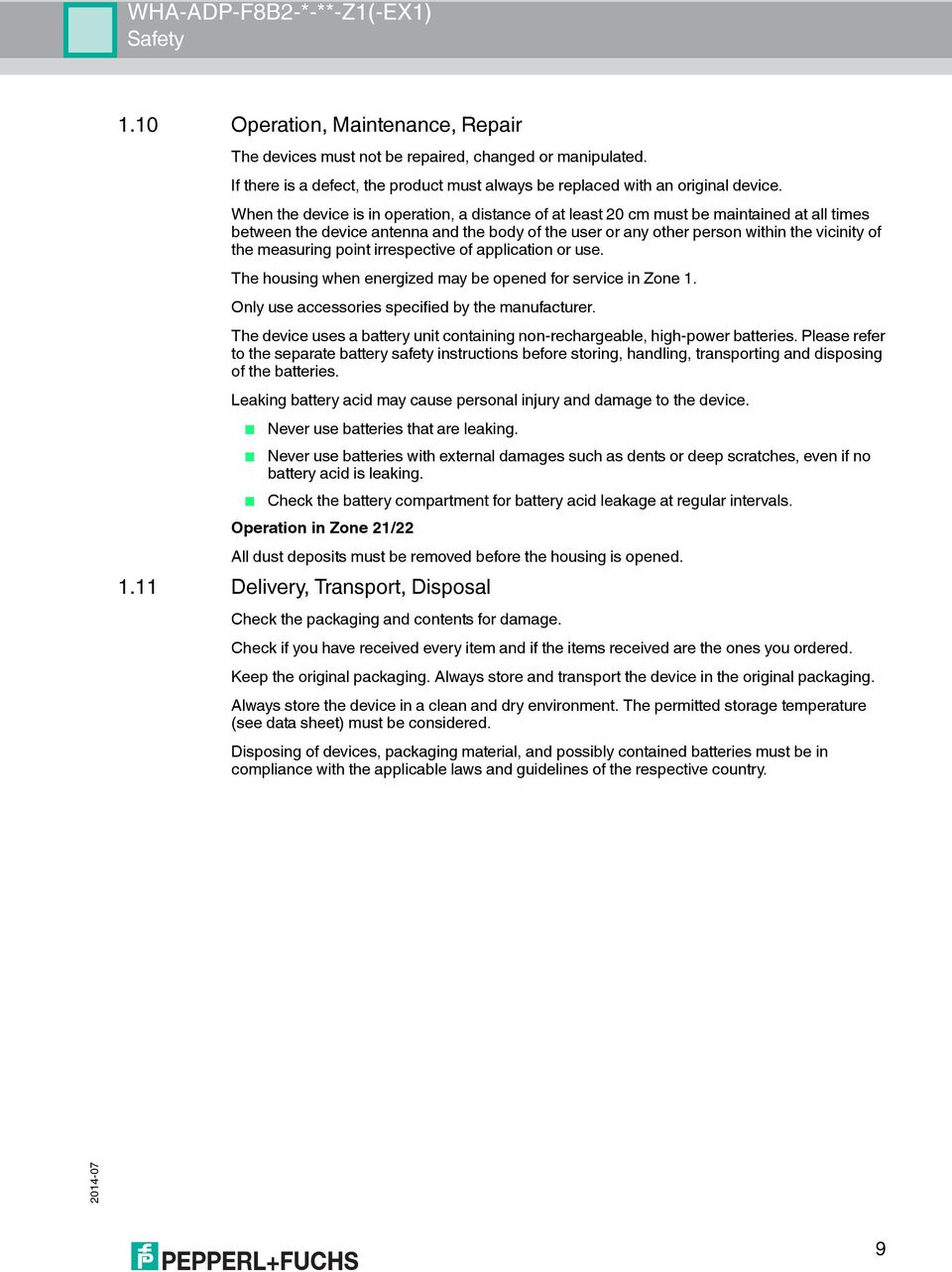
10 Product Specifications 2 Product Specifications 2.1 Introduction The HART (Highway Addressable Remote Transducer) communication protocol is used by many ma transmitters to enable digital communication for diagnosis and maintenance purposes. Many device parameters, but also measurement values, can be transmitted digitally to and from the device. Until now, HART technology has mostly been using the wired ma loop as physical layer. WirelessHART technology now allows for the wireless transmission of HART data. To be employable worldwide, WirelessHART technology utilizes the 2.4 GHz Band (IEEE wireless network) as physical layer. All WirelessHART devices form a mesh network in which every device is not just a measurement point, but also a repeater. This results in a bigger range of the whole network as well as an increased reliability through redundant communication paths Figure 2.1 WirelessHART mesh network 1 WirelessHART Temperature Converter 2 WirelessHART Adapter 3 WirelessHART Gateway 4 Fieldbus/Ethernet 5 Host applications The WirelessHART network is built up, organized and maintained by the WirelessHART Gateway and is therefore self-organizing and self-healing. The WirelessHART Gateway also takes care for connection to different host systems through different industrial protocol bus interfaces. The WirelessHART Gateway supplies WirelessHART Temperature Converters and WirelessHART Adapters with the necessary information for seamless network operation. 10
11 Product Specifications 2.2 Functional Overview The WirelessHART adapter is an intelligent interface module that connects HART and ma devices to a WirelessHART network. It transmits the measurement and diagnosis information acquired from the connected device(s) to a host application via the WirelessHART Gateway. Key Functions May be connected directly to a HART device or mounted separately. Up to 4 HART devices may be connected. LEDs for supply status, communication status and device status indication. Provides loop-power to the connected device. Alternatively, the connected device may be powered externally. 2.3 Scope of Delivery Battery life estimation and "Low Battery" alarm The scope of delivery of the WirelessHART adapter includes: WirelessHART Adapter with installed battery unit W-BAT-B2-Li, if ordered Short instructions and CD-ROM Depending on the order, the delivery may also include the following: Wall/pipe mounting kit 38 cm cable for connecting the adapter to a field device A connection adapter for connecting to the cable entry of a field device: M20/M20 or M20/G 1/2 with two Viton gaskets, M20/NPT 1/2 or M20/NPT 3/4 with one Viton gasket. Cable gland 11

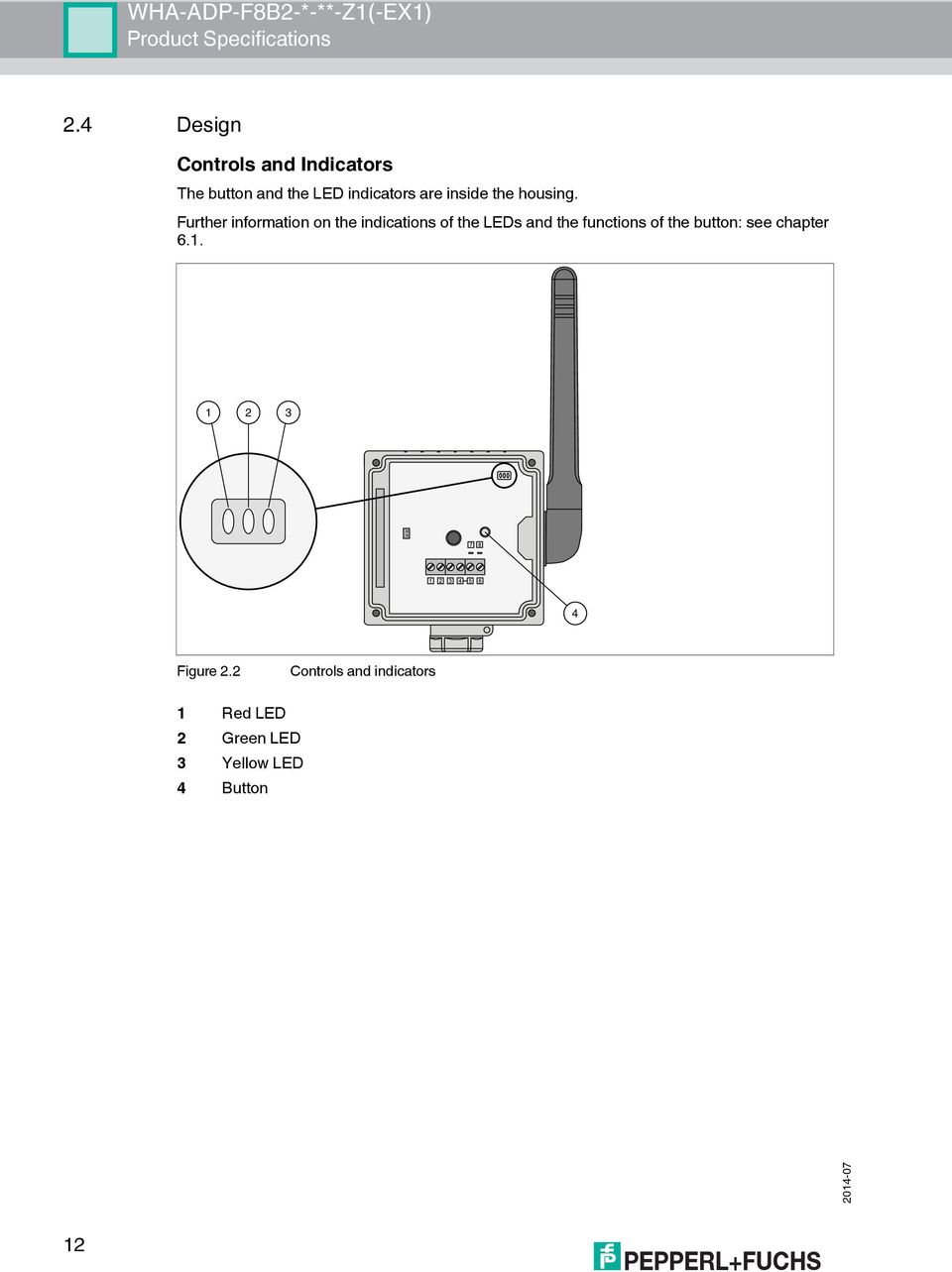
12 Product Specifications 2.4 Design Controls and Indicators The button and the LED indicators are inside the housing. Further information on the indications of the LEDs and the functions of the button: see chapter Figure 2.2 Controls and indicators 1 Red LED 2 Green LED 3 Yellow LED 4 Button 12
13 Product Specifications Connections and Interfaces Figure 2.3 Connections and interfaces 1 Housing cover with battery compartment 2 Connector for battery power 3 Antenna 4 Counternut 5 Primary M20x1.5 cable gland 6 Secondary M20x1.5 cable gland 7 Terminal block 13

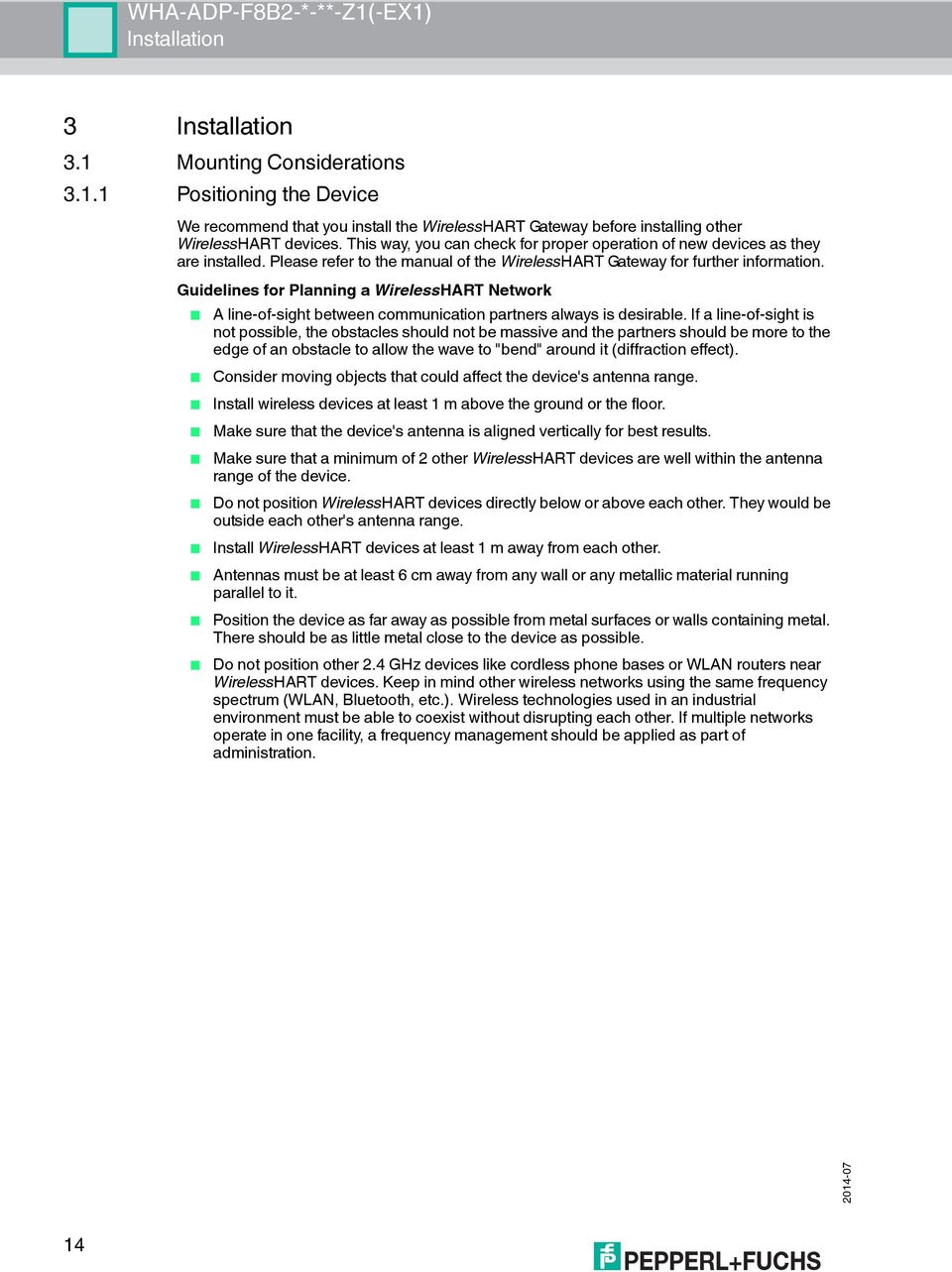
14 Installation 3 Installation 3.1 Mounting Considerations Positioning the Device We recommend that you install the WirelessHART Gateway before installing other WirelessHART devices. This way, you can check for proper operation of new devices as they are installed. Please refer to the manual of the WirelessHART Gateway for further information. Guidelines for Planning a WirelessHART Network A line-of-sight between communication partners always is desirable. If a line-of-sight is not possible, the obstacles should not be massive and the partners should be more to the edge of an obstacle to allow the wave to "bend" around it (diffraction effect). Consider moving objects that could affect the device's antenna range. Install wireless devices at least 1 m above the ground or the floor. Make sure that the device's antenna is aligned vertically for best results. Make sure that a minimum of 2 other WirelessHART devices are well within the antenna range of the device. Do not position WirelessHART devices directly below or above each other. They would be outside each other's antenna range. Install WirelessHART devices at least 1 m away from each other. Antennas must be at least 6 cm away from any wall or any metallic material running parallel to it. Position the device as far away as possible from metal surfaces or walls containing metal. There should be as little metal close to the device as possible. Do not position other 2.4 GHz devices like cordless phone bases or WLAN routers near WirelessHART devices. Keep in mind other wireless networks using the same frequency spectrum (WLAN, Bluetooth, etc.). Wireless technologies used in an industrial environment must be able to coexist without disrupting each other. If multiple networks operate in one facility, a frequency management should be applied as part of administration. 14
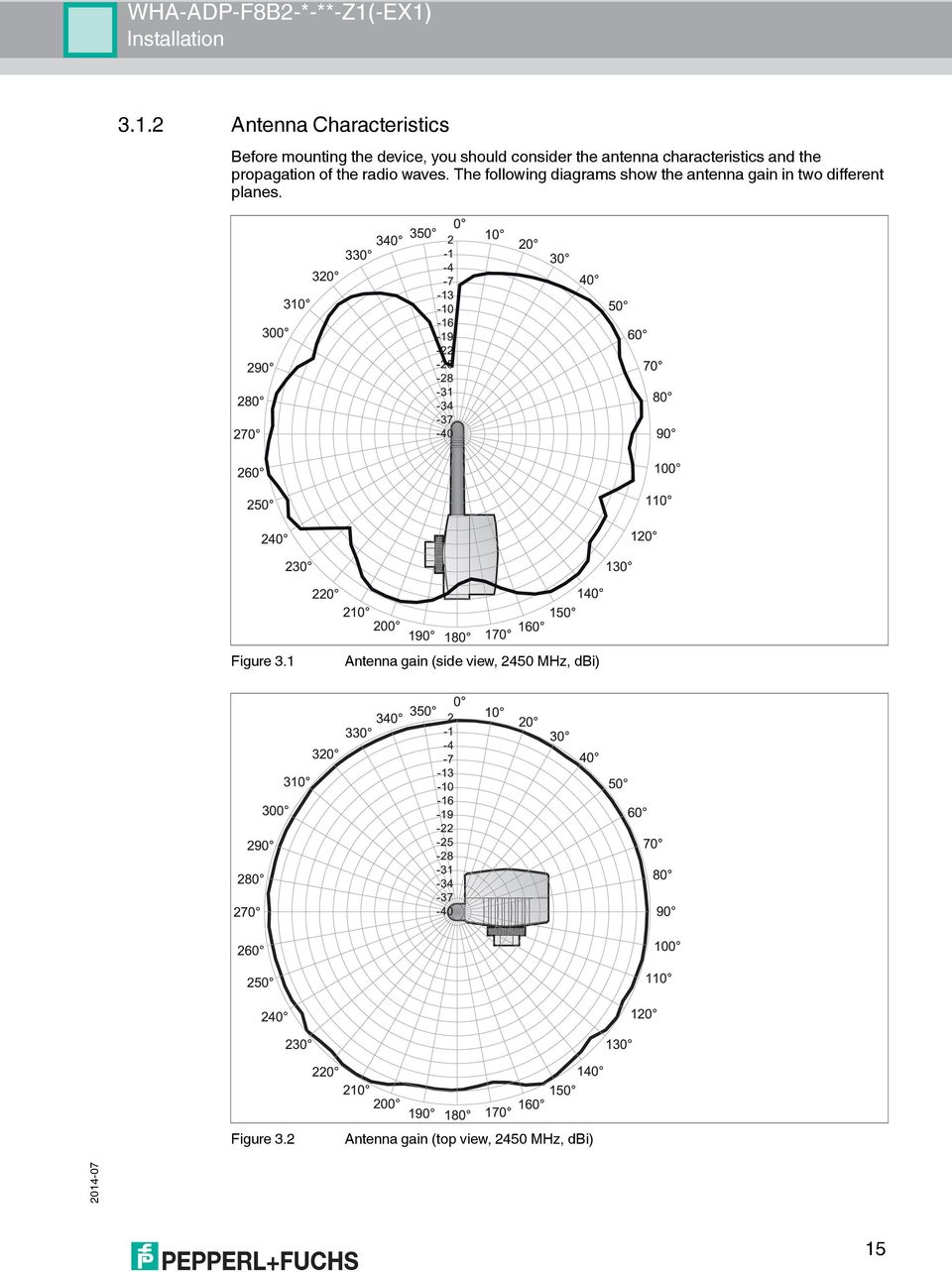
15 Installation Antenna Characteristics Before mounting the device, you should consider the antenna characteristics and the propagation of the radio waves. The following diagrams show the antenna gain in two different planes. Figure 3.1 Antenna gain (side view, 2450 MHz, dbi) Figure 3.2 Antenna gain (top view, 2450 MHz, dbi) 15
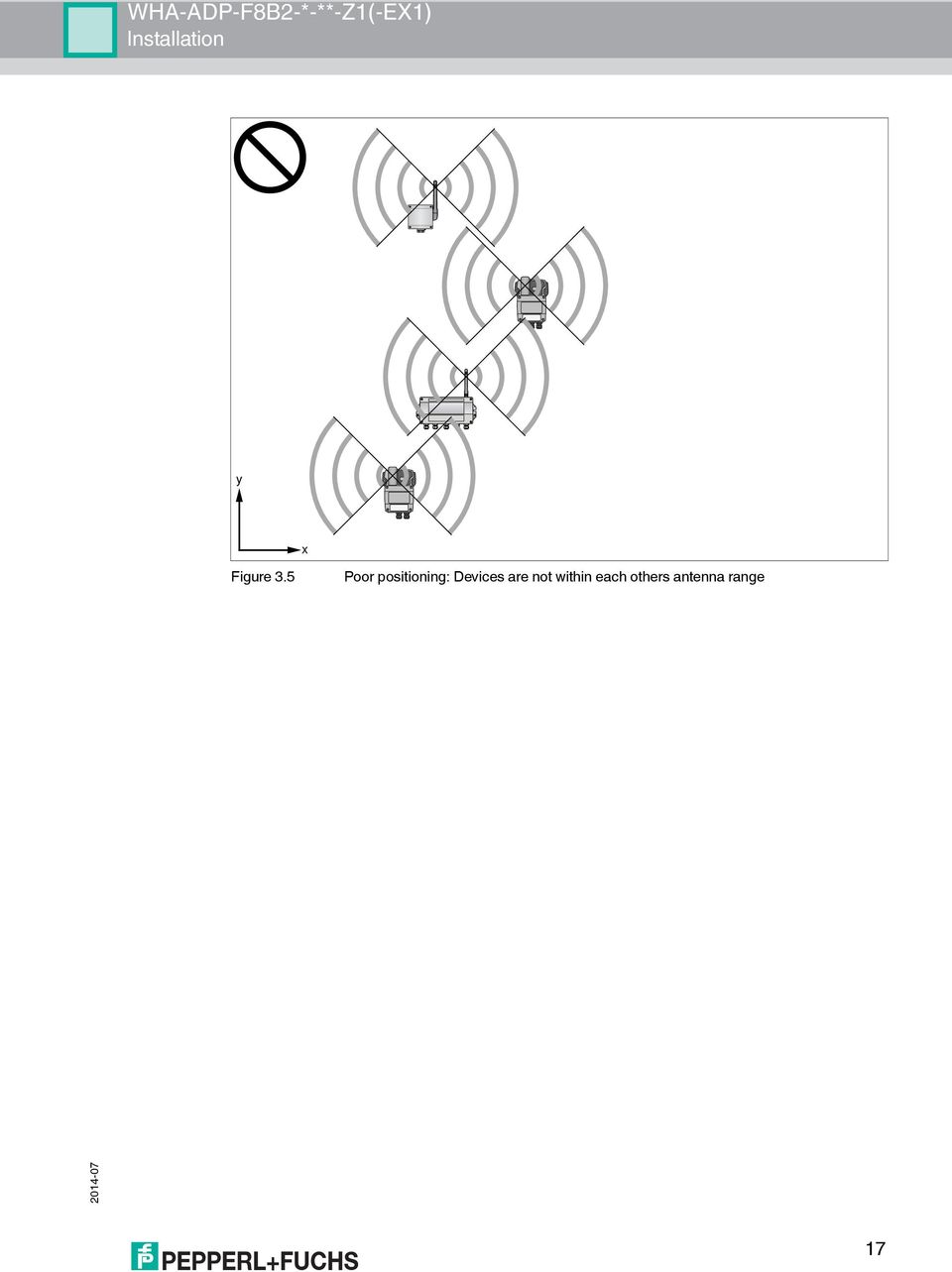
16 Installation Examples for Good and Poor Positioning Figure 3.3 Wave propagation, schematic representation (alpha = approx. 45, may vary considerably) 1 Weaker signal above and below 2 Stronger signal sideways y x Figure 3.4 Good positioning: Devices are within each others antenna range 16

17 Installation y x Figure 3.5 Poor positioning: Devices are not within each others antenna range 17
18 Installation 3.2 Mounting the Device The WirelessHART adapter can be mounted in one of three ways: direct connection to the field device, separate from the field device, but connected by a cable, when used as a repeater, as an autark unit. Danger! Explosion hazard If the cable glands are not fitted correctly, the IP degree of protection cannot be ensured and the electronic components can be exposed to an explosive atmosphere. Check cable glands: all screws of the housing / housing cover must be tightened with the appropriate torque only cables of the appropriate size must be used in the cable glands all cable glands must be tightened with the appropriate torque all seals must be undamaged and fitted correctly all empty cable glands must be sealed with appropriate plugs Direct connection The direct connection to a field device is made by means of an adapter piece which is screwed into the cable entry at the side of the adapter. See chapter Separate mounting The adapter can be mounted on a wall (see chapter 3.2.2), post (see chapter 3.2.3) or other object, using the adapter wall/pipe mounting kit, which is available as an accessory. The connection to the field device is made with standard installation cable and two cable glands. It is recommended that the blind plug be left in place until the electrical connection is made. It is recommended that the WirelessHART adapter be installed separate from a field device when: there is insufficient space at the measuring point to mount the adapter on the field device, the signal reception at the measuring point is too weak for correct operation, the measuring point is subject to vibration above the permissible limits. See chapter 9 Supplied parts Depending on the order, the following parts may be supplied: adapter piece for connection to a field device with a M20 cable entry, adapter piece for connection to a field device with a G 1/2 cable entry, adapter piece for connection to a field device with a NPT 1/2 cable entry, adapter piece for connection to a field device with a NPT 3/4 cable entry, M20 cable gland for separate mounting, wall/pipe mounting kit. 18

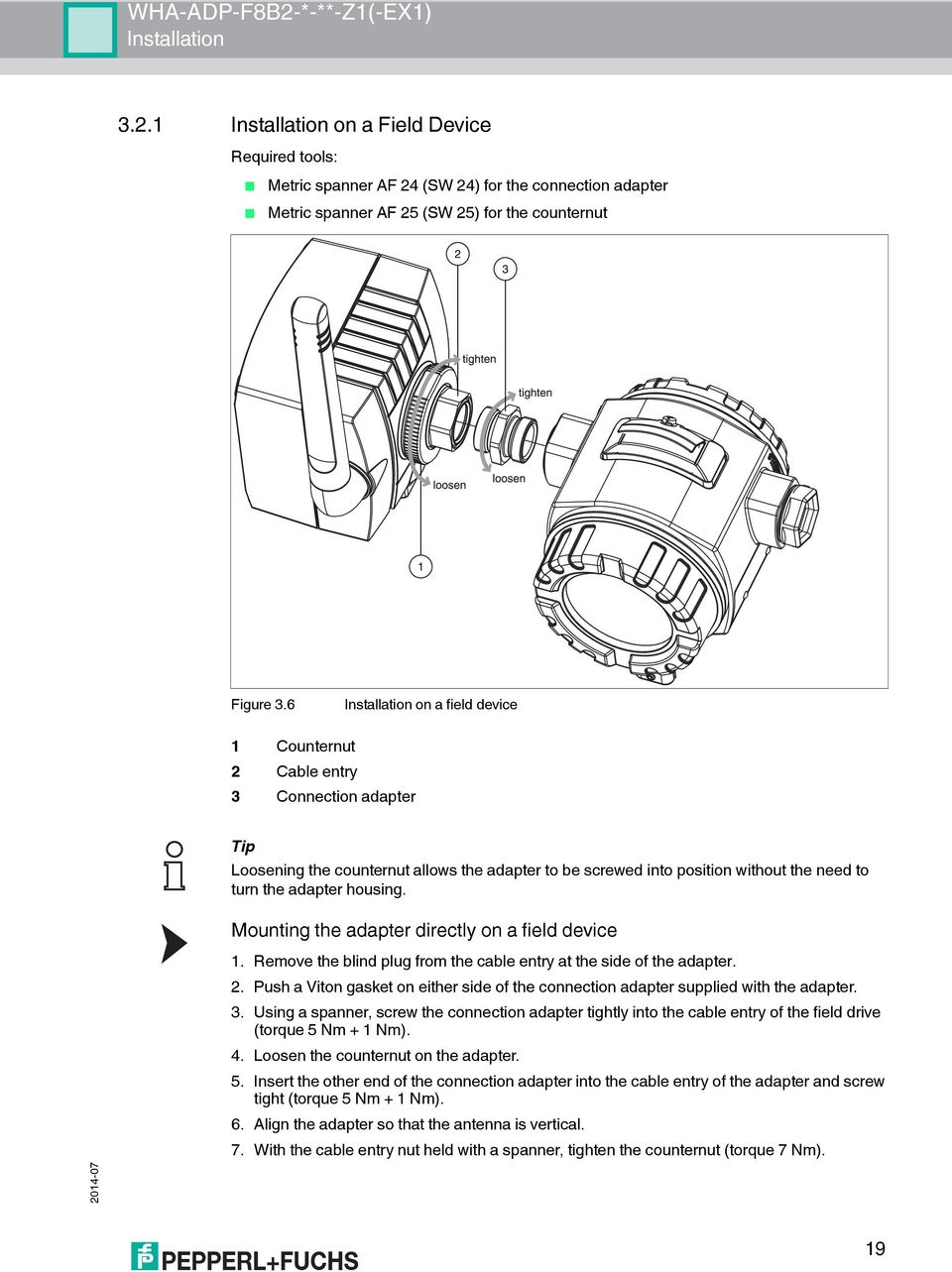
19 Installation Installation on a Field Device Required tools: Metric spanner AF 24 (SW 24) for the connection adapter Metric spanner AF 25 (SW 25) for the counternut Figure 3.6 Installation on a field device 1 Counternut 2 Cable entry 3 Connection adapter Tip Loosening the counternut allows the adapter to be screwed into position without the need to turn the adapter housing. Mounting the adapter directly on a field device 1. Remove the blind plug from the cable entry at the side of the adapter. 2. Push a Viton gasket on either side of the connection adapter supplied with the adapter. 3. Using a spanner, screw the connection adapter tightly into the cable entry of the field drive (torque 5 Nm + 1 Nm). 4. Loosen the counternut on the adapter. 5. Insert the other end of the connection adapter into the cable entry of the adapter and screw tight (torque 5 Nm + 1 Nm). 6. Align the adapter so that the antenna is vertical. 7. With the cable entry nut held with a spanner, tighten the counternut (torque 7 Nm). 19
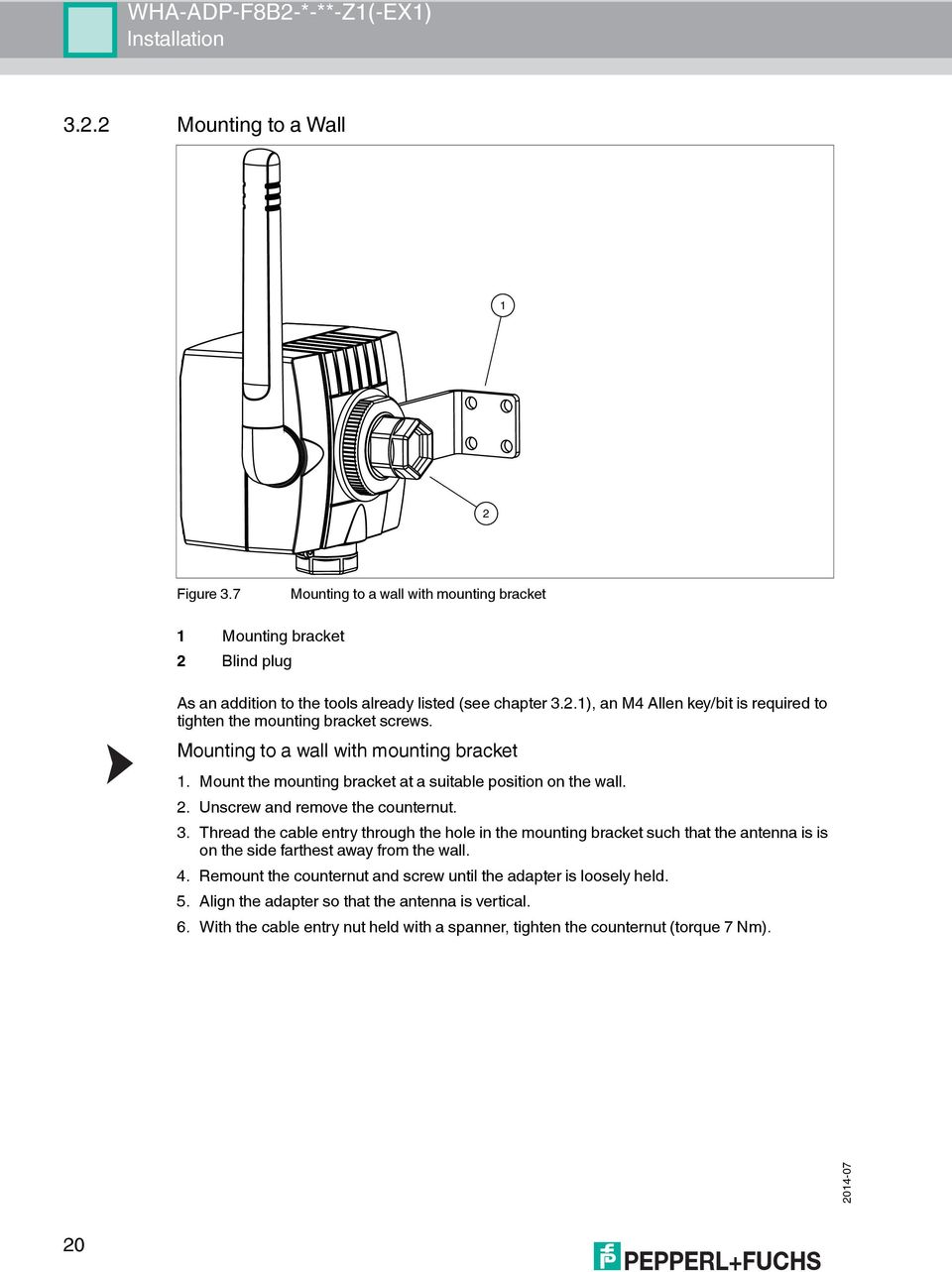
20 Installation Mounting to a Wall 1 2 Figure 3.7 Mounting to a wall with mounting bracket 1 Mounting bracket 2 Blind plug As an addition to the tools already listed (see chapter 3.2.1), an M4 Allen key/bit is required to tighten the mounting bracket screws. Mounting to a wall with mounting bracket 1. Mount the mounting bracket at a suitable position on the wall. 2. Unscrew and remove the counternut. 3. Thread the cable entry through the hole in the mounting bracket such that the antenna is is on the side farthest away from the wall. 4. Remount the counternut and screw until the adapter is loosely held. 5. Align the adapter so that the antenna is vertical. 6. With the cable entry nut held with a spanner, tighten the counternut (torque 7 Nm). 20
21 Installation Mounting to a Pipe Note! The maximum pipe diameter for pipe mounting is 70 mm Figure 3.8 Mounting to a pipe 1 Pipe/post, max. 70 mm 2 Pipe mounting bracket 3 Mounting bracket Mounting to a Pipe 1. Mount the pipe mounting bracket at a suitable position on the pipe and screw tight (torque min. 5 Nm). 2. Using the four screws supplied, screw the mounting bracket to the pipe mounting bracket (torque 4 Nm + 1 Nm). 3. Unscrew and remove the counternut. 4. Thread the cable entry through the hole in the mounting bracket such that the antenna is is on the side farthest away from the wall. 5. Remount the counternut and screw until the adapter is loosely held. 6. Align the adapter so that the antenna is vertical. 7. With the cable entry nut held with a spanner, tighten the counternut (torque 7 Nm). 21
22 Installation 3.3 Electrical Connection to other Devices The WirelessHART adapter can be connected to the following device types/configurations. Field device operating in a control loop without communication resistor Field device operating in a control loop with communication resistor This configuration is used for HART multidrop with 2, 3, or 4 devices Two-wire field device operating independently with power supplied by the adapter Four-wire field device operating independently with power supplied by an external source The devices are connected to the terminal block located inside the adapter housing. Figure 3.9 Terminal block (1... 6) and terminals for Ex ia certified HART modem (7 + 8) Caution! Loss of intrinsic safety If Ex i protected circuits have been operated with non-intrinsically safe circuits, they must no longer be used as Ex i protected circuits. To maintain the Ex i rating of the WirelessHART adapter, use an Ex i rated HART modem to communicate with the WirelessHART adapter. Terminal Function 1 Device supply 2 HART/4...20mA 3 External Supply / GND 4, 5, 7 HART high impedance 6, 8 High impedance GND 22
23 Installation Wiring Diagrams Control loop without communication resistor In this configuration, the field device is powered externally by a PLC, Remote I/O, or DC power supply and outputs a ma signal. The adapter provides the following functions: Current measurement via ma interface HART digital communication, if supported by the connected device For communication with the adapter, an Ex ia certified HART modem can be connected to terminals 5/7 and 6/8. Note! The connection is made across the 270 communication resistor of the adapter. The circuits in the following 2 figures are electrically identical as terminal 4 and 5 are connected internally. see Figure 3.10 on page 23 see Figure 3.11 on page 23 For loops with two signal lines, the adapter should be wired as shown in the following figure. Figure 3.10 Connection of adapter to a control loop without communication resistor 1 PLC, Remote I/O,DC power supply without communication resistor 2 Field device (passive) For loops with only one signal line (common ground), the adapter should be wired as shown in the following figure. Figure 3.11 Alternative method of connection of adapter to a control loop without communication resistor 1 PLC, Remote I/O, DC power supply without communication resistor 2 Field device (passive) 23
24 Installation Control loop with communication resistor In this configuration, the field device is powered externally by a PLC, Remote I/O or DC power supply and outputs a ma signal. Alternatively it is used in HART multidrop mode. The adapter provides the following functions: HART digital communication For communication with the adapter, an Ex ia certified HART modem can be connected to terminals 5/7 and 6/8. Note! The circuits in the following 2 figures are electrically identical as terminal 4 is connected internally to terminal 5 and terminal 3 is connected internally to terminal 6. see Figure 3.12 on page 24 see Figure 3.13 on page 24 Existing installations: For existing installations, we recommend that the adapter is wired as shown in the following figure. Figure 3.12 Connection of adapter to a control loop with communication resistor 1 PLC, Remote I/O, DC power supply with communication resistor 2 Field device New installations: For new installations, we recommend that the adapter is wired as shown in the following figure. Figure 3.13 Alternative method of connection of adapter to a control loop with communication resistor 1 PLC, Remote I/O, DC power supply with communication resistor 2 Field device 24
25 Installation Two-wire device powered by adapter In this configuration, the field device is operating independently and is powered by the adapter. The adapter provides the following functions: Current measurement via ma interface, HART digital communication, if supported by the connected device. Note! For HART devices, we recommend that the device is operated in multidrop mode to prolong battery life. In this case, a polling address between 1 and 14 is set and the device outputs a constant current of 4 ma. Figure 3.14 Connection of loop-powered device to active adapter 1 Field device (passive) Four-wire device In this configuration, the field device is operating independently and is powered by an external power source. The adapter provides the following functions: Current measurement via ma interface, HART digital communication, if supported by the connected device. Figure 3.15 Connection of active four-wire device to passive adapter 1 Four-wire field device (active) 2 External Power Source 25
26 Installation Connecting Cables Required tools: Phillips screwdrive PZ1 to open the adapter cover, Screwdriver with 2.5 mm blade to make the connections. If the adapter is mounted on the field device, use the two wires supplied to make the connection. If the adapter is to be mounted separately, standard installation cable can be used. If strong electromagnetic interference is to be expected (machines, walkie-talkies), use shielded, twisted pairs. Connect the shield to the ground terminal. 1 1 Figure 3.16 Opening the cover 1 Captive screws 1 2 Figure 3.17 Cable entries 1 Primary cable entry (blind plug seals adapter when cable entry not in use) 2 Secondary cable entry with M20x1.5 cable gland Note! The secondary cable entry in the base of the adapter should be used in following situations: if the adapter is mounted separately on a wall or pipe for the power cables when the field device is operating in a control loop 26
27 Installation Direct wiring (adapter mounted on field device) When the adapter is mounted directly on the field device, the wiring is done through the connection adapter as follows. 1. Open the housing of the adapter by unscrewing the four captive screws. Also open the connection compartment of the field device. 2. Thread the two wires supplied through the connection adapter (primary cable entry). 3. Connect the WirelessHART adapter according to the appropriate wiring diagram. 4. If an external power line is to be connected, use the secondary cable entry. 5. Connect the field device according to the instructions in its operating manual. 6. If the devices are not to be commissioned immediately after connection, close the housing and field device connection compartment. 7. In order to obtain optimal sealing of the adapter housing, tightened the screws to a torque of 0.5 Nm. Wiring (adapter mounted separately) 1. Open the housing of the adapter by unscrewing the four captive screws. Also open the connection compartment of the field device. 2. Using a M20x1.5 cable gland, thread the connecting or power cable through the secondary cable entry into the adapter. 3. Connect the WirelessHART adapter according to the appropriate wiring diagram. 4. Pull the cable taut. The adapter cover is a tight fit an a trapped cable may prevent proper closure. 5. Tighten the cable gland. 6. Connect the field device according to the instructions in its operating manual. 7. If the devices are not to be commissioned immediately after connection, close the housing and field device connection compartment. 8. In order to obtain optimal sealing of the adapter housing, tightened the screws to a torque of 0.5 Nm. 9. Tighten the cable gland and, if required, the blind plug to a torque of 3.5 Nm. Electrical Specification Loop power for field device (Terminal 1): Offload voltage 8 VDC to 23 VDC, adjustable in steps of 0.1 VDC Current 4mA I out 20 ma DC corresponding to the NAMUR recommendation NE ma/hart input (Terminal 2) Current 4mA I in 20 ma DC corresponding to the NAMUR recommendation NE 43 High impedance HART interface (Terminals 4, 5, 6) Input impendance 3.7 k for HART communication, Version 1.00.xx 5.0 k for HART communication, Version 1.01.xx upwards DC input impedance infinite Maximum terminal voltage Across Terminals 2 + 3: U i 30 V DC Across Terminals 5 + 6: U i 30 V DC Note! Due to the internal communication resistor, the supply voltage of the field device depends upon the offload voltage and the current signal. 27
28 Commissioning 4 Commissioning 4.1 Connected HART Device(s) It is recommended that the connected HART device is commissioned before the adapter. Note! It is not necessary to assign different HART addresses for different adapters. The addresses used on the network also incorporate the serial number of the adapters and are automatically unique for each adapter. Parameterizing the field device 1. Connect a configuration tool, for example, PACTware TM to the field device using a HART modem. If the adapter shall power the field device, first power the adapter by connecting the battery and then continue with this step. During the start-up phase of the adapter, the field device goes on and off again. If the field device does not power up again after the communication started, power the field device for 5 minutes (time can be configured in adapter DTM) by pushing the adapter button for more than 10 seconds until the red LED flashes. 2. Set the following parameters for the field device: HART address: sets the output mode of the device (0 = ma; = HART) ma devices require no pre-configuration. The scaling and any linearization are configured within the adapter DTM. If the device is connected to an existing ma loop, use the address = 0 Otherwise use address = 1 for HART multidrop mode with a 4 ma current output. If more than one HART device is connected (up to 4 are allowed if externally powered), each must have a unique address between 1 and 14, e.g. 1, 2, 3, 4. Device Tag: identifies the measuring point. Long Tag: identifies the device on the wireless network. Long Tags are available from HART Version 6.0 onwards. For earlier versions, for example, HART 5 instruments, use the Message instead. 28
29 Commissioning 4.2 Connecting the Battery Danger! Batteries in hazardous areas Batteries from Pepperl+Fuchs for this device may be brought into hazardous areas. However, always check if the battery is intact before transporting it into hazardous areas. Always transport batteries enclosed inside their original packages or already installed inside the device. Danger! Loss of intrinsic safety The use of batteries other than specified voids the qualification for use in hazardous areas. Only use batteries of type W-BAT-B2-Li from Pepperl+Fuchs. Danger! Possible damage because of wrong battery The use of batteries other than specified may cause damage to the device. Only use batteries of type W-BAT-B2-Li from Pepperl+Fuchs. Warning! Caustic battery acid Leaking battery acid can cause personal injury and damage to the device. Never use batteries that are leaking. Never use batteries with external damage such dents or deep scratches, even if no battery acid is leaking. Danger! Electrostatic discharge hazard The device contains non-conductive plastic parts. Care must be taken when operating the installed device because of possible electrostatic charges. Electrostatic charged surfaces may cause an ignition spark. Electrostatic charges must be avoided. For example, do not rub the device and never clean plastic surfaces with a dry cloth. Always use a damp cloth instead. Note! You may open the housing and connect/disconnect the battery in Zone 1. Connecting the battery The adapter is delivered with the battery unit installed but not connected. It is connected as follows. 1. If necessary, open the adapter cover by unscrewing the four captive Phillips screws. see Figure 3.16 on page Plug the battery cable into the battery connector. 29
30 Commissioning 2 1 Figure 4.1 Inserting and connecting the battery 1 Battery 2 Battery cable plugged into battery connector As soon as the battery is connected, the adapter initializes. - The occupation of the terminals is checked. - The type of device connected is checked. - If a HART device is connected, its data are read into the adapter. - The LEDs indicate the status of the device. see chapter The adapter is now ready for commissioning. 30
31 Commissioning 4.3 Initial Configuration via HART Modem For security reasons, the Network ID and Join Key must be configured through a wired connection before the device can connect itself to a WirelessHART network. To do so, you can use an Ex ia certified HART modem that connects to a PC/Laptop using the USB interface or the RS232 interface. Caution! Loss of intrinsic safety If Ex i protected circuits have been operated with non-intrinsically safe circuits, they must no longer be used as Ex i protected circuits. To maintain the Ex i rating of the WirelessHART adapter, use an Ex i rated HART modem to communicate with the WirelessHART adapter. Connecting the device to a PC/Laptop via HART modem Install the HART modem drivers on your PC/Laptop according to the instructions given by the manufacturer. 1. If necessary, open the housing cover by unscrewing the four captive Phillips screws. see Figure 3.16 on page Connect the Ex ia certified HART modem to terminals You can also use terminals as these terminals are connected internally. If the HART modem has an internal communication resistor, this should be switched off at the first attempt to communicate. If communication fails, a resistor may be required. See chapter 8 3. Switch on your PC/Laptop. 4. Plug the HART modem into the USB/RS232 port. If using the USB port, your PC/Laptop should recognize the HART modem automatically. If using the RS232 port, proceed with the next step. 5. To find out to which COM port the HART modem is connected, open the Windows device manager. For example, if using Windows XP, click Start > Settings > Control Panel > System > Hardware > Device Manager, or if using Windows 7, click Windows Icon > Control Panel > System > Device Manager. Under Ports (COM & LPT) you see the HART modem and the COM port assigned to it. You will need the COM port number later on. 31
32 Commissioning 4.4 DTM Software Downloading the Required Software Required software: Microsoft.NET Framework PACTware TM Framework WirelessHART DTM The DTM collection including WirelessHART device DTMs and Ethernet communication DTM. HART CommDTM The HART CommDTM has to be installed separately. It is required for wired communication via HART modem. The HART CommDTM supports both FSK (i.e. HART modem) and RS-485 interfaces. Note! If one of the software components is already installed on your system, the installation may be omitted. Where to download the required software? 1. Open your internet browser and visit 2. Click Products. 3. Click Software. 4. Download the software components Microsoft.NET Framework, PACTware TM, WirelessHART DTM and HART CommDTM. You might need to scroll down the page to find the required component. 5. Unzip the downloaded files and store the data to your local hard drive Install the DTM Software Components Your computer must meet the following requirements in order to run PACTware TM and the device DTM: Operating system: Windows 2000 Service Pack 4, Windows XP Service Pack 1/2/3 or Windows Vista Software: Microsoft.NET Framework Release 1.1 Service Pack 1 Processor: 500 MHz or faster Memory: 256 MB RAM or more Disk space: 200 MB or more Graphics resolution: 1024 x 768 or higher Administrator privileges to enable software installation 32
33 Commissioning Install the DTM Software Components 1. Install the Microsoft.NET Framework by starting the corresponding setup.exe file and following the installation instructions given on the screen. 2. Install PACTware TM by starting the corresponding setup.exe file and following the installation instructions given on the screen. 3. Install the WirelessHART DTM collection by starting the corresponding setup.exe file and following the installation instructions given on the screen. 4. Install the HART CommDTM by starting the corresponding setup.exe file and following the installation instructions given on the screen. You have installed the required software Updating the DTM Catalog Once you have installed the FDT base application and the Device Type Manager (DTM) on the computer, the FDT base application's DTM catalog must be updated. The PACTware TM DTM catalog is called "Device Catalog" and is normally automatically updated when PACTware TM is launched. If PACTware TM does not update the device catalog automatically, proceed as follows. Updating the Device Catalog 1. Start PACTware TM. 2. Select View > Device Catalog or press F3 or click on the Device Catalog icon in the icon bar. The Device Catalog window opens. 3. Click on the Update Device Catalog button to update the device catalog. Figure 4.2 PACTware TM device catalog 4. Click on Yes to continue. The updated device catalog appears once the search has finished. Figure 4.3 PACTware TM search for DTM 33
34 Commissioning 4.5 Creating a new Project in PACTware TM Creating a New Project Creating a new project in PACTware TM? Select File > New or click on the Create New Project icon on the toolbar. A new, unnamed project appears in the main window. The project initially consists of the entry HOST PC Adding the Communication DTM A communication DTM is an interface between the FDT frame application and the device DTM. The communication DTM enables communication between the device DTM and the device connected to the PC. For the PC to communicate with the device via the HART modem, a HART communication DTM has to be added to the PACTware TM project. Adding HART Communication DTM Note! The HART CommDTM is not included in the WirelessHART DTM Collection. It can be downloaded separately from see chapter Select the entry HOST PC in the project view of your PACTware TM project. 2. Choose Device > Add device or click the Add device icon on the toolbar. The Device for window appears. Figure 4.4 Device for window 3. Select the entry HART communication. 4. Click OK. The HART communication DTM is added to the project. 34
35 Commissioning Figure 4.5 HART communication DTM in the PACTware TM project view 5. To edit the parameters, double-click on the HART communication DTM. The parameter window appears. Figure 4.6 Parameter window of HART communication DTM 6. Set the parameters according to the following table. 7. Click OK to save the changes and to close the parameter window. Parameter Description Default Communication interface Port Set this parameter to HART modem. Set this parameter to the COM port your HART modem is connected to. HART modem COM1 Master Set this parameter to Secondary master. Primary Master Preamble Number of preambles for HART communication. 5 Number of communication retries Start address The number of retries for HART communication in case of an error. Here the address range is set, in which the HART 0 End address Communication DTM is to search for HART devices connected to the HART modem. 15 Set this parameter to Start address =14, End address = is the default value of the adapter. Multimaster and Burst mode support Activate this check box. 3 deactivat ed 35
36 Commissioning Adding Device DTM Performing a HART Scan 1. In the project view, right-click on the entry of the communication DTM. 2. Choose Connect. 3. Choose Additional functions > Scan list. 4. If the scan does not begin automatically, click Refresh. The detected field devices are displayed in the Scan list window. Adding the Device DTM You may add the adapter to your PACTware TM project in various ways (see PACTware TM documentation). One of them is described in the following. 1. In the project view, right-click on the entry of the HART communication DTM. 2. To add the device DTM, choose Add device. The Device for window opens. 3. Select WHA-ADP. 4. Click OK. The device DTM is added to the project. You may continue with parameterizing the adapter as described in the following. 5. Remember to save your PACTware TM project from time to time (File > Save). 36
37 Commissioning 4.6 Joining the Wireless Network To connect itself to the WirelessHART network, the device must carry the correct Network ID and Join Key. The Network ID and Join Key have to be configured using a wired connection before the device joins the WirelessHART network for the first time. To enter Network ID and Join Key, the following requirements have to be met. A PC/Laptop is connected to the device using a HART modem. A PACTware TM project containing the HART communication DTM and the device DTM has been created. In the joining phase the device sends a join request packet to the network manager. If the new device can be authenticated, the network manager responds with an activation packet and sets up links between the new device and other existing nodes. Furthermore, the new device receives a 128 Bit encryption key. Entering Network ID and Join Key 1. In the PACTware TM project, right-click the DTM of the device that shall join the WirelessHART network. Figure 4.7 DTM of the WirelessHART Temperature Converter in the PACTware TM project view 2. Choose Connect. A connection is established. 3. To open the online parameterization window, right-click the device DTM and choose Parameter > Online parameterization. The online parameterization window appears. 4. In the online parameterization window, choose Wireless Communication. The wireless communication parameters are displayed. See chapter 5 5. Enter the Network ID into the Network Identification field and press Enter to confirm the new value. 6. Enter the Join Key into the 4 Join Key fields and press Enter to confirm the new value. 7. Click Execute Join. The device attempts to join the wireless network. The connection status is indicated by Join Status. 37
38 Configuration 5 Configuration 5.1 Configuration Options We recommend that you configure the device on the shop floor via a wired connection using a HART modem. see chapter Define all basic settings such as wireless communication parameters (Network ID, Join Key, Join Mode) and identification parameters (Long Tag, Polling Address) using a HART modem. 2. Make the device join the WirelessHART network. 3. Once the device has joined the WirelessHART network, configure the burst mode parameters, event notifications, and other application settings using a HART modem. 4. Disconnect the HART modem and install the device in the field. Once the device is installed in the field, you can change the configuration of the device via a wireless connection using the WirelessHART Gateway. Wireless Configuration via the WirelessHART Gateway We assume that the WirelessHART Gateway is installed and configured correctly according to the manual of the WirelessHART Gateway. Furthermore, we assume that the device to be configured has joined the WirelessHART network. 1. Start your PACTware TM project containing the device DTM of the WirelessHART Gateway. Figure 5.1 DTM of the WirelessHART Gateway in the PACTware TM project view 2. In the project view, right-click on the entry WHA-GW. 3. To add the device DTM, choose Add device from the context menu. The Device for window opens. Figure 5.2 Device for window 4. Select the entry of the WirelessHART device you want to add to the PACTware TM project. 38
39 Configuration 5. Click OK. The device DTM is added to the project. Now you can continue with parameterizing the device as if you had a wired connection. see chapter 5.2 Figure 5.3 DTM of the WirelessHART Temperature Converter in the PACTware TM project view Note! Note that you can accelerate the wireless configuration by establishing a fast pipe connection between the device and the WirelessHART Gateway. For more information on fast pipe connections, see the manual of the WirelessHART Gateway. 5.2 Online and Offline Parameterization (DTM) Note! The concept of online/offline parameterization applies to the configuration via DTM and PACTware TM only. The device DTM provides dialogs for offline and online parameterization. Offline Parameterization (not connected to device) If there is no active connection to the device, only the data that is stored locally in the PACTware TM project can be edited and saved. You can store this local copy of the data to the device, as soon as a connection to the device has been established. Before editing the data offline, you can load the latest version of the data from the device, to ensure that you edit the latest data. Online Parameterization (connected to device) If there is an active connection to the device. You can directly edit the data that is stored on the device. Parameter changes are immediately stored on the device. Both online and offline data are updated using the commands Store to device and Load from device. Note! Data edited and stored on the device during online parameterization is not automatically synchronized with the offline data record in the PACTware TM project. If you change device parameters in the online mode, the data stored in the PACTware TM project differs from the data stored on the device. To ensure that the data stored in the PACTware TM project matches the data stored on the device, after online parameterization, load the data from the device into the PACTware TM project. 39
40 Configuration Parameterizing Offline 1. Right-click the device entry in the PACTware TM project. A context menu opens. 2. Choose Parameter > Offline Parameterization. The window containing the offline data record appears. 3. Modify a parameter by typing in a new value or choosing a new value from the drop-down list. 4. To accept the new value, press Enter. 5. After all parameter changes have been made, save your project by choosing File > Save. 6. To write the new offline configuration to the device, right-click the device entry in the project view and choose Connect. A connection to the device is established. 7. Right-click the device entry again and choose Store to device. The new configuration is stored in the device. Parameterizing Online 1. Right-click the device entry in the PACTware TM project. A context menu opens. 2. Select Connect. A connection to the device is established. 3. Right-click the device entry in the PACTware TM project. 4. Select Parameter > Online Parameterization. The window containing the online data opens and the data is read from the device. 5. Modify a parameter by typing in a new value or choosing a new value from the drop-down list. 6. To accept the new value, press Enter. The new value is stored in the device immediately. 7. After all parameter changes have been made, you may store the online configuration into the PACTware TM project. To do this, right-click on the device entry in the project view and choose Load from device. The device date is stored in the PACTware TM project. 8. Save your project by choosing File > Save. Note! Many device parameters can be edited both online and offline. The parameters that can only be edited online are especially pointed out in the following sections. 40
41 Configuration 5.3 Identification Parameters The identification parameters provide various information about the device and identify the device within the network. Figure 5.4 Identification parameters Identification Parameters Parameter Description Default Long Tag Identifies the device in a WirelessHART network. Enter up to 32 characters. Device Tag Identifies the field device within the process plant. Enter up to 8 characters. Descriptor Further description of the device. Enter up to 16 characters. Date Code Date of last parameter change. Format: DD.MM.YYYY Message User defined message. Enter up to 32 characters. Polling Address Country Code SI Units only HART address of the adapter on the wired interface, valid range Since the long tag and MAC address are used to identify the device in the WirelessHART network, it is not necessary to give different devices different polling addresses. Select the country code of the country in which the device is operated from this drop-down list. Governs the signal strength that can be set for the device Determines the preset value for "SI Units only" Selects the unit set to be used by the adapter. Unit codes restricted to SI units only: only SI units are displayed No restrictions: Both metric and US units are displayed 41
42 Configuration 5.4 Wireless Communication Parameters The wireless communication parameters apply to the WirelessHART network that the device will join. Figure 5.5 Wireless communication parameters Note! The data listed in the following table is available only during online parameterization. 42
43 Configuration Wireless Communication Parameters Parameter Description Default Network Identification Wireless Operation Mode Radio Power Join Key Part x of 4 Join Shed Time Join Mode Execute Join Join Status Unique Network ID of the WirelessHART network the device is supposed to join. Enter up to 5 digits ( ). Indicates current mode of operation of the device: Idle: waiting for trigger to start join procedure Active Search: searching for neighboring WirelessHART devices Negotiating: connection parameters are being exchanged with the network manager (gateway) Quarantined: network manager has temporarily stopped the device from joining the network Operational: device is connected to the network Suspended: network manager has permanently stopped the device from joining the network Deep Sleep/Ultra-low Power/Passive Search: adapter is inactive Power of the radio signal emitted by the device. The selection and the default value depend on the Country Code parameter. The join key is the password for the network the device is to join. Enter 32 hexdecimal characters. There are four text fields that can hold eight characters each. Time (hh:mm:ss) that the device is given to join the network after the Join Mode condition has been fulfilled. After this time has elapsed, the device will keep on trying to join the network using a low duty-cycle receive mode to reduce energy consumption (yellow COM LED off). Joining behavior of the device: Do not attempt to join Join now Attempt to join immediately on powerup or reset Press the button to store the Join Shed Time and Join Mode parameters to the device. The device will attempt to join the network in the way that is specified in Join Mode. Indicates the current status when joining the network. Possible messages: Network Packets Heard ASN Acquired Synchronized to time slot Advertisement Heard Join Requested Join Retrying Join Failed Authenticated Network Joined Negotiating Network Properties Normal Operation Commencing 0dBm 00:40:00 Attempt to join immediat ely... 43
44 Configuration Parameter Description Default Total number of Neighbors Number of Advertising Packets received Number of Join Attempts Active Advertising Shed Time Request Active Advertising Number of Neighbors Advertising 5.5 Wired Communication Parameters Number of WirelessHART devices to which a connection has been established. Number of advertising packages received by the device. Number of attempts the device has made to join the network. Time in hh:mm:ss that the device is given to advertise its presence to its neighbors in order that they can join the network quickly. Pressing this button will cause the device to advertise its presence for the period Active Advertising Shed Time. Number of neighbors that are advertising their presence and have been detected by the device. 00:40:00 The Wired Communication parameters pertain to the HART communication between the adapter and and HART device(s) connected to it. Up to four HART devices can be connected in multidrop mode to the adapter, each requiring a different HART address. Figure 5.6 Wired communication parameters 44
45 Configuration Wired Communication Parameters Parameter Description Default Polling Address Master Type HART address of the device set in Identification. HART master role to be assumed by the adapter. Primary master: The connected HART device has no other permanent master. Secondary master: The connected HART device communicates with a permanent HART primary master, e.g. PLC. Primary Master Preambles Retries Lowest Scan Address Highest Scan Address Scan Subdevices Field Device Table If a handheld device or PACTware TM are connected temporarily to the HART device when the adapter is operational, they must have the role of secondary master. Number of preambles sent at start of HART frame to sychronize communication with the connected HART device. All connected devices must have the same settings. Valid range: Number of times the adapter tries to establish communication with a connected HART device before it reports a communication error Address from which the adapter starts scanning for connected HART devices. Address at which the adapter stops scanning for connected HART devices. A HART device providing a ma output in a control loop will have the address 0. Normally a single HART device powered by the adapter will have the address 1, as this ensures it is operating in multidrop mode (current 4 ma) For a multidrop bus (max. 4 devices) enter the highest address. Press the button to scan the connected HART devices. The devices found, together with their parameters, are displayed in the Field Device Table. If the HART device is disconnected or its configuration changed, a new scan must be made Note: A scan is made every time the adapter is powered up after connection of the battery the table then fills automatically. Displays the parameters read from the HART device by the scan. Manufacturer ID: Manufacturer of connected device. Expanded Device Type Code: Device identifier as per HART. Device ID: Manufacturer s device identifier. Universal Command Revision Level: HART revision supported. Long Tag: Long tag of device (Message for HART revision < 6.0). Start-Up Voltage: Voltage required to start the connected device. Start-Up Time: Time required for the device to wake-up Start-Up Current: Current consumed on starting the device Lead Time: Time that elapses between start-up and the point at which the device can deliver valid values. See chapter
46 Configuration 5.6 Device Variable Mapping The adapter can output the value and status of several variables, but a maximum of only four variables can be published on the network. The device variable mapping is used to configure these variables. Figure 5.7 Device variable mapping The variables that can be set as SV, TV and QV are as follows: Temperature Temperature min Temperature max Battery voltage Consumer energy RSL of best neighbour (RSL = Radio Signal Level) RSL of second best neighbour Battery voltage with load Battery voltage without load during battery test Normalized Consumer Energy Estimated Lifetime 46
47 Configuration Device variable mapping Parameter Description Default Select Primary Variable Primary Variable Unit Select Secondary Variable Secondary Variable Unit Select Tertiary Variable Tertiary Variable Unit Select Quaternary Variable Quaternary Variable Unit Variable to be output as primary variable (PV) Loop Current (fixed) Engineering units of the primary variable ma (fixed) Variable to be output as secondary variable (SV) Temperat ure Engineering units of the secondary variable (fixed) C Variable to be output as tertiary variable (SV) Engineering units of the tertiary variable (fixed) Variable to be output as quaternary variable (SV) Engineering units of the quaternary variable (fixed) Battery Voltage V Normaliz ed Consum er Energy Ah 47
48 Configuration 5.7 Application Settings ma When a HART device is connected to the adapter, all parameters are read via the digital signal. It is possible, however, to connect a ma device to the adapter. In this case the ma signal can be scaled as desired in the DTM and a linearization can be made if necessary. In addition, current values can be set which correspond to the limits of the proportional range and the fault signal of the device. Should these current limits be violated, an appropriate warning or alarm signal is transmitted by the adapter. Figure ma parameters Device variable mapping Parameter Description Default Primary Variable Unit Linearization Mode Primary Variable Upper Range Value (20 ma) The unit of the primary variable supplied by the ma device. The selection changes the units of the scaling parameters. Determines how the current input will be converted to the output. Linear: Proportional scaling across the set range Special curve: Scaling according to the table in Linearization Output value assigned to the 20 ma current input ma Linear 20 ma 48
49 Configuration Parameter Description Default Primary Variable Lower Range Value (4 ma) Input Damping Upper Fault- Current Value Upper Limit of Proportional Range Lower Limit of Proportional Range Lower Fault- Current Value Trim Loop Current Zero Trim Loop Current Gain Output value assigned to the 4 ma current input Damping factor for the current input in seconds (valid range ) Max. current output by ma device when in fault condition. The adapter outputs an alarm if the current input reaches this level. Upper limit value of proportional range. The adapter outputs a warning if the current input exceeds this level. Lower limit value of proportional range. The adapter outputs a warning if the current input drops below this level. Min. current output by ma device when in fault condition. The adapter outputs an alarm if the current input reaches or drops below this level. When pressed, calibrates the 4 ma signal of the connected device. 4 ma must be simulated or an "empty" calibration made. When pressed, calibrates the 20 ma signal of the connected device. 20 ma must be simulated or a "full" calibration made. 4mA 0 22 ma 20.5 ma 3.8 ma 3.6 ma 49
50 Configuration Linearization parameters If the linearization mode "Special Curve" is selected, the "Linearization" leaf must be opened: Up to 32 value pairs can be entered X values must be entered in increasing order, Y values must rise or fall monotonically (red = error) Range end values must correspond to those in the 4-20 ma leaf A graphic shows the linearization curve Figure 5.9 Linearization Linearization Parameter Description Default X: ma ( ) Input value X1... X32 for linearization (ma) 4, 20 Y: unit ( ) Output value Y1... Y32 for linearization (engineering units) 4, 20 Read Press to upload values from the device into the DTM. Happens automatically when the Linearization leaf is opened. Write Press to download the table from the DTM to the device. 50
51 Configuration Burst Mode Parameters Burst mode is a special communication mode in which a HART slave device sends responses to a particular HART command on a predetermined, periodic schedule without being polled by the master. Normally, a HART slave device only responds when being polled by the master. When burst mode is used, a HART slave device can publish data (for example process values) independently in regular time intervals. Data can be sent as scheduled, or only if the value has changed by a significant amount or has not been updated within a default reporting time. Up to 10 different burst modes can be set for the adapter or connected HART devices. Figure 5.10 Burst Mode Parameters Note! Battery lifetime The more frequently burst messages are sent the more battery power is consumed, thus reducing battery lifetime. 51
52 Configuration Burst Mode Parameters Parameter Description Default Burst Mode Control Code Device Index Switches burst mode on or off ("Wireless" = on). The following parameters in this table can only be edited if Burst Mode Control Code is set to "Wireless". Otherwise they are grayed out. The field will also show "Off" if the parameters are downloaded when the adapter is not in the network. The parameters are retained and become active when the adapter joins the network. Selects the device via its long tag for which the burst mode applies. <Adapter Long Tag>: Adapter parameters are transmitted. <Device Long Tag>: Device parameters are transmitted. For HART devices of Revision 5 or lower, the "Message" serves as the long tag. See chapter 4.1 Period When the trigger mode is set to "continuous", determines the period in hh:mm:ss that elapses between burst messages. Max. Period Trigger Mode Device Variable Class (Trigger) Unit Code (Trigger) Trigger Level When the trigger mode is not set to "continuous", determines the scan rate in hh:mm:ss for checking whether the trigger condition for a burst message is fulfilled. Off Not selected 00:30:00 The minimum setting is 8 seconds. When the Trigger Mode is not set to "continuous", determines 01:00:00 the maximum period in hh:mm:ss that may elapse between two burst messages when the conditions for the trigger are not fulfilled. Determines the event that triggers a burst message from the Continuo device. us Continuous: A burst message is published continuously at intervals determined by Period. Window: a burst message is triggered when the source value deviates more than the specified trigger value. Rising: a burst message is triggered when the source value rises above the specified trigger value. Falling: a burst message is triggered when the source value falls below the specified trigger value. On-Change: a burst message is triggered when any value in the message changes. If the conditions are not met for Trigger Modes "Window", "Rising", "Falling" and "On-Change", a burst message is sent at intervals determined by Max. Period. Determines the device variable that is used to trigger the burst message, e.g. Temperature. Engineering unit used by the trigger variable, e.g. C Value of the source variable which is used to trigger the burst message, e.g. 150 C Not classified Not used 0 52
53 Configuration Parameter Description Default Burst Command Number Device Variable Event Notification Event notification is a special application of a burst message and publishes changes in the device configuration and status, independent of data publishing supported in other burst mode commands. For events, the status included in the Device Status byte, Extended Device Status byte and Command 48 can be used. It is possible to specify a limited set of bits that will trigger event notification. Event notifications have a low priority but carry a time stamp in order to indicate the first time when a notification occurred. Up to 5 different event notification messages can be defined in the leaves Event Notification Each Event Notification window (1... 5) is subdivided into 3 tabs: Event Standard Event Mask Device-Specific Event Mask Determines which commands are to be sent in the burst message. 1 Primary variable: Returns the primary value and units. 2 Loop current and percentage of range: Returns the loop current and its associated percent of range. 3 Dynamic variables and loop current: Returns the loop current and up to four predefined dynamic variables and units (PV, SV, TV, QV). 9 Device variables: Returns the value of up to 8 device or dynamic variables with units. 33 Device variables and additional device status: Returns the value of up to four device variables and the device status information. 48 Additional device status: Returns the device status information. For connected HART devices, check the operating manual to see which commands are supported: if you are uncertain, use Command 3 as default Selects the device variables to be transmitted in the burst message when command 9 or 33 is entered as Burst Command Number: For the adapter, select the variable you want to transmit from the drop-down menu. For a connected HART device, check the operating manual (loop-current, PV, SV, TV and QV can be selected). Cancel Click to make the setting to revert to their original values. Apply Click to download the changes to the device
54 Configuration Figure 5.11 Event notification, tab Event Event Tab Parameter Description Default Event Notification Control Code Device Index Event Notification Retry Time Maximum Update Time Event Debounce Interval Event Status Switches event notification on or off ("Wireless" = on). Off The following parameters in this table can only be edited if Event Notification Control Code is set to "Wireless". Otherwise they are grayed out. Selects the device via its long tag for which the burst mode applies. <Adapter Long Tag>: Adapter parameters are transmitted. <Device Long Tag>: Device parameters are transmitted. For HART devices of Revision 5 or lower, the "Message" serves as the long tag (see chapter 4.1). Period between retransmissions of the event notification. The 00:30:00 event notification continues to be retransmitted until anacknowledgement of the event is received. Maximum period in seconds that may elapse between 00:30:00 successive event notifications. If no event occurs, the adapter will publish an event notification after this time has elapsed. The amount of time that a condition must persist before the 00:30:00 event notification is sent out. Indicates whether a particular event notification has been sent and is still unacknowledged. Configuration Changed Event pending Device Status Event Pending More Status Available Event Pending First unack Time Indicates the time in seconds an event notification has remained unacknowledged. 54
55 Configuration Figure 5.12 Event notification, tab Standard Event Mask Standard Event Mask Tab Parameter Description Default... The Standard Event Mask tab contains the standardized HART events. Activate the approriate checkbox to activate event notification for the associated condition. Checkbo xes deactivat ed 55
56 Configuration Figure 5.13 Event notification, tab Device-Specific Event Mask Device-Specific Event Mask Tab Parameter Description Default... The Device-Specific Event Mask tab contains devicespecific events. Activate the approriate checkbox to activate event notification for the associated condition (see manufacturer s operating manual). Checkbo xes deactivat ed 56
57 Configuration 5.8 Power Supply Battery life can be extended by tuning the adapter to energy requirements of the connected device. In addition, knowledge of the power requirements ensures a more reliable prediction of battery life. For some HART devices, the power parameters are displayed in the Field Device Table. For other HART devices and for ma devices, they must be taken from the operating manual and entered manually. The tuning is done in the Power Supply leaf of the Adapter DTM. Figure 5.14 Power Supply parameters Figure 5.15 Parameters influencing the power requirement of the WirelessHART adapter 57
58 Configuration Power Supply Parameters Parameter Description Default Power mode Sets the power mode. "Off": Power to any connected device is switched off. There is no communication between adapter and any connected device. Set this mode if the adapter is to be used as a router. "Automatic": The connected device is powered-up when an external master starts communicating with the adapter. The device is powered after the last command for a period determined by "Power On Time After External Trigger". "Configuration": The connected device is powered-up when the button on the adapter is pressed or an external master communicates with it. The device is powered after the last command for a period determined by "Configuration Time". When this period has elapsed, the power mode reverts to "Automatic" Field Device Table Displays the parameters read from the HART device by the scan: Manufacturer ID: Manufacturer of connected device Apply field device power values Start-Up Voltage Start-Up Time Start-Up Current Expanded Device Type Code: Device identifier as per HART Device ID: Manufacturer s device identifier Universal Command Revision Level: HART revision supported Long Tag: Long tag of device (Message for HART revision < 6.0) * Start-Up Voltage: Voltage required to start the connected device * Start-Up Time: Time required for the device to wake-up * Start-Up Current: Current consumed on starting the device * Lead Time: Time that elapses between start-up and the point when the HART communication is synchonized * Parameters taken from DTM Press this button to apply the field device power values. Voltage required by the connected device on start up. Valid range V in steps of 0.1 V. Filled automatically if the Field Device table is active. Time in seconds required for the device to start up. Filled automatically if the Field Device table is active. Current in ma drawn by the connected device during start-up. Filled automatically if the Field Device table is active. Operating Voltage Voltage connected device requires in normal operation. Filled automatically if the Field Device table is active. Lead Time Time that elapses between start-up and the point at which the device can deliver valid values. Filled automatically if the Field Device table is active. Configur ation
59 Configuration Parameter Description Default Power-On Time after External Trigger Configuration Time Battery Changed Last Battery Change Temperature Min. Time that the connected device remains powered after the last HART command. Applies to power mode "Automatic" only. Time that the connected device remains powered after the last 300 HART command. Applies to power mode "Configuration" only. Press this button after a battery change to update the "Last battery Change" display and reset the battery consumption calculation. Displays the date of the last battery change in DD:MM:YY. Minimum temperature of the adapter since last temperature reset. Temperature Max. Maximum temperature of the adapter since last temperature reset. Reset Max./Min. Press this button to reset the Min/Max temperature monitor
60 Operation 6 Operation 6.1 Controls and Indicators The operating and display elements of the WirelessHART Adapter are located inside of the housing. see Figure 2.2 on page 12 They are used during the commissioning of the device and for local diagnosis Figure 6.1 Controls and indicators 1 Red LED 2 Green LED 3 Yellow LED 4 Button 60
61 Operation LEDs Note! To save battery power all LEDs are off during normal operation, even if the device is communicating or joining the network. The LEDs only light up after start up or while pressing the buttons. When the pushbutton is pressed shortly (0.2 s... 5 s), the three LEDs indicate the status of the adapter. See chapter LED Indicators Number of LEDs 3 (green, yellow, red) Indications of green LED (battery status) LED on Normal: at least one month of battery life is left. LED flashes at 1 Hz Warning: less than one month of battery life is left. LED flashes at 3 Hz Alarm: the battery is critically low, loop power cannot be supplied. Any current signal cannot be read ( ma device). LED off The adapter still operates, but the connection is not assured. Off: the battery is flat or disconnected. Indications of yellow LED (communication status) LED on Joined, alternative path: the device has full network connection. It is able to communicate with at least 2 wireless nodes. At least one alternative communication path to the gateway is available. LED flashes at 1 Hz Joined, no alternative path: the device was able to join the network. However, it can communicate with a single wireless node only. There is no alternative communication path to the gateway. LED flashes at 3 Hz Joining: the device is attempting to join the network. The adapter will attempt to join for 40 minutes by default. Longer joining periods can be configured if required. LED off Not joined: joining the network has failed. The device is no longer attempting to join. Indications of red LED (device status) 50 ms on Device in communication mode: it is possible to communicate with the 950 ms off adapter. LED on Internal fault: device fault that cannot be remedied by the user. LED flashes at 1 Hz External fault: operative fault which can possibly be remedied by the user: Adapter temperature outside specified limits, Measured value outside configured range. Operative faults can be viewed with the Diagnosis function of the DTM. LED flashes at 3 Hz Short-circuit: there is a short-circuit between terminals 1 and 2. LED off No fault 61
62 Operation Buttons Depending on the duration that the button is pressed and on whether the battery is already connected, the button calls different functions. Duration Function Procedure Pressing the button while the battery is already connected < 0.2 s No function 0.2 s... 5 s Status test Press button for more than 0.2 seconds and less than 5 seconds. 5s...10s Join wireless network 10 s s Start configuration mode Release button. The LEDs display the current device status. See chapter Keep button pressed for 5 seconds. After 5 sesconds the yellow LED starts flashing at 3 Hz. Release button. The yellow LED extinguishes. The adapter starts joining. Keep button pressed for 10 seconds. After 5 seconds the yellow LED starts flashing at 3 Hz. After 10 seconds the red LED starts flashing at 3 Hz. The adapter enters configuration mode. Release button. Configuration mode is retained until there was no HART communication for 300 seconds (configurable) or until pushbutton is pressed again for 10 seconds seconds. The red LED extinguishes. > 15 s No function Inserting the battery while the button is already pressed The following functions are available when connecting the battery while the button is already pressed. The duration starts from the moment the battery is connected (red LED lights). < 10 s No function The red LED lights until the pushbutton is released. 10 s s Configuration reset to default settings 20 s s Firmware and configuration reset to default settings Keep button pressed for 10 seconds. The red LED lights during this time. After 10 seconds the red LED starts flashing at 2.5 Hz. Release button to start the reset. Keep button pressed for 20 seconds. During this time the red LED lights for 10 seconds. Then the red LED starts flashing at 2.5 Hz. After this, the red LED lights again. After 20 seconds the red LED starts flashing at 1.25 Hz. Release button to start the reset. > 25 s No function The red LED remains lit until the pushbutton is released 62
63 Operation 6.2 Measured Value The Measured Value function displays the current value and status of the variables selected in the Device Variable Mapping dialog. The following information is displayed: Primary Variable Secondary Variable Tertiary Variable Quaternary Variable Loop-Current Accessing the Measured Value Window 1. In the PACTware TM project, right-click on the device. A context menu opens. 2. Select Measured Value. The Measured Value window appears. Figure 6.2 Measured value 63
64 Operation 6.3 Simulation Adapter parameters can be simulated for test and commissioning purposes. When the simulation is activated, the required parameter can be selected from a drop-down list. After a value has been assigned, the simulation is started by pressing Execute Simulation. Figure 6.3 Simulation Note! The data listed in the following table is available only during online parameterization. Simulation Parameters Parameter Description Simulation Enable or disable simulation mode. Simulated Device Variable Simulated Value Execute Simulation Select the device variable to be simulated. Current Temperature Temperature min: Minimum temperature of the adapter since last temperature reset Temperature max: Miaximum temperature of the adapter since last temperature reset Battery voltage Consumed Energy RSL of best neighbour (RSL = Received Signal Level) RSL of second best neighbour Battery voltage with load Battery voltage without load during battery test Normalized Consumed Energy Estimated Lifetime Loop Current Enter simulated value. Press this button to start simulation when simulation mode enabled. 64
65 Operation 6.4 Diagnostics The Diagnostics function provides detailed information about the device, wireless/wired communication and health status. Note! Available Only Online (DTM) If using the configuration via DTM and PACTware TM the Diagnostics function is available only online. see chapter 5.2 Accessing the Diagnostics Window 1. Right-click the device in the PACTware TM project tree. 2. Select Diagnostics Identification Identification provides information about the hardware and software of the device. Figure 6.4 Diagnosis > Identification Note! The data listed in the following table is available only during online parameterization. 65
66 Operation Diagnosis - Identification Parameter Long Tag Device Tag Descriptor Date Code Message Description Identifies the device in a WirelessHART network. Identifies the field device within the process plant Further description of the device. Date, dd.mm.yy, indicating the date of the last parameter change User defined message. Real time clock time Shows the time currently set in the device. Real time clock date Shows the date currently set in the device. Device Revision Software Revision Hardware Revision Universal command revision Revision of the device. Software revision of the device. Hardware revision of the device. Revision of the HART protocol supported by the adapter. 66
67 Operation Wireless Communication Wireless Communication provides information about the operation of the device within the WirelessHART network. Figure 6.5 Diagnosis > Wireless Communication Note! The data listed in the following table is available only during online parameterization. Diagnosis - Wireless Communication Parameter Description Network Network ID of the wireless network. Identification MAC MAC address of adapter Nickname Short destination address of the device. Total Number of Neighbors Wireles Health Status Number of WirelessHART devices to which a connection has been established. Key performance indicators of network communication: Index: Identifier of neighbouring device Nickname: Short destination address of neighbouring device Mean RSL: Mean signal strength of neighbour since adapter joined the network Packets Transmitted: Number of packets sent by adapter since joining the network Failed Transmits: Number of packets sent by adapter since joining the network and that failed to reach their destination (after retries) Packets Received: Number of packets received by adapter since joining the network 67
68 Operation Wired Communication Wired Communicatioin provides information about the HART device(s) connected to the adapter. Figure 6.6 Diagnosis > Wired Communication Diagnosis - Wired Communication Parameter Number of Devices Wired Communication Status Description Number of HART devices connected to the adapter. Key performance indicators of network communication: Index: Identifier of HART device Long Tag: Long tag of connected device STX Count: Number of transactions started by the adapter ACK Count: Number of HART device acknowledgements to adapter BACK Count: Number of HART device burst messages 68
69 Operation Health Status The Health Status menu contains diagnostic information. The information is displayed in three different ways according to: NAMUR NE107 guidelines, ASM guidelines, HART specification. Open the corresponding sub-menu to view the respective information. NAMUR Figure 6.7 Diagnosis > Health Status > NAMUR The following status messages according to the NAMUR NE107 guidelines can be displayed: Good Failure (F) Maintenance (M) Out of specification (S) Function check (C) 69
70 Operation ASM Figure 6.8 Diagnosis > Health Status > ASM The following status messages according to the ASM guidelines can be displayed: Good, device operating as normal Faults in the sensor or actuator element Faults in the electronics Installation faults, fault during start-up Faults due to process influence, faults due to non-compliance with specified operating conditions. 70
71 Operation HART Figure 6.9 Diagnosis > Health Status > HART Diagnosis - Health Status - HART Parameter Configuration Change Counter Configuration Changed Flag Reboot Counter Device Specific Status 0 Device Specific Status 1 Device Specific Status 2 Device Specific Status 3 Device Specific Status 4 Extended Device Status Standardized Status 0 Analog Channel Saturated Standardized Status 2 Standardized Status 3 Real Time Clock Description Counter which increments by one on every change in adapter configuration. Indicates a change in configuration since the last call up. Counter which increments by one on every reboot of the adapter. Indicates network status. Indicates wired communication status. Indicates internal wireless communcation module status. Indicates status of current signal of the connected device. Indicates a device malfunction. Indicates the general status of the device. Indicates the status of the adapter. Indicates that current signal of the connected device is overrange. Indicates the standardized status of the wired (HART) connection. Indicates the standardized status of the network. Current time. 71
72 Operation Power Supply The Diagnosis > Power Supply > Battery menu contains information on the battery unit of the device. Figure 6.10 Diagnosis > Battery Diagnosis - Battery Parameter Estimated lifetime Battery Voltage Consumed Energy Normalized Consumed Energy Temperature Temperature Min Temperature Max Description Number of days battery power will last under the current load conditions. Current voltage of the battery Current consumed energy Consumed energy with respect to normalized conditions Current temperature of device. Minimum temperature of the adapter since last temperature reset Maximum temperature of the adapter since last temperature reset 72
73 Operation 6.5 Additional Functions Accessing the Additional Functions Windows 1. Right-click the device in the PACTware TM project tree. 2. Select Additional functions and choose the desired function Lock / Unlock You can protect the device against unauthorized or undeliberate parameter changes (write protection). Figure 6.11 Additional functions > Lock / Unlock Lock / Unlock Parameter Description Lock Code Unlocked: Adapter is unlocked, all parameters can be changed Lock Temporary: Adapter is locked. A device reset or power loss will unlock it Lock Permanent: Adapter is locked. It can be unlocked by a master only Lock All: Adapter is locked. It can be unlocked only by the master that locked it Lock Status Device Locked Wireless Module Firmware Update Lock Lock is Permanent Locked by Primary Master (Reset if Secondary master) Configuration Cannot be Changed Locked by Gateway Unlocked: Adapter firmware can be downloaded Locked: Adapter firmware cannot be downloaded 73
74 Operation Update Firmware Update firmware is used to download new adapter firmware locally or from an FTP server to the adapter. The parameter Wireless Module Firmware Update Lock in Lock/Unlock must be set to "Unlock" before the firmware can be downloaded. Caution! Important information concerning firmware update Please heed the following information when updating the firmware: Before updating the firmware, please deactivate all burst modes using the Burst Mode Control Code parameter. see chapter Do not update multiple WirelessHART adapters via the wireless network at the same time. If you have several adapters, update one at a time. Figure 6.12 Additional functions > Update firmware Update Firmware Parameter Firmware Update File FTP-URL FTP User FTP Password Update Firmware Firmware Version Description URL of the FTP server or path and file name of a local storage medium. User name for FTP server. User password for FTP server. Press this button to start firmware update procedure. Current firmware version of the adapter. 74
75 Operation Device DTM Info Device DTM Info gives standardized information about the adapter to which the DTM is connected. Figure 6.13 Additional Functions > Device DTM Info Device DTM Info Parameter Device Tag Firmware Version Description Normally identifies the measuring point in the plant Current firmware version of the adapter Self Test About After pressing the Perform Self-Test button in the Additional Functions > Self Test menu the device carries out a self test. The results of the self test can be seen in the Diagnostics menu. see chapter 6.4 Additional Functions > About displays information about the device, its manufacturer, and its firmware version. 75
76 Maintenance and Repair 7 Maintenance and Repair 7.1 Exchanging the Battery Only batteries of type W-BAT-B2-Li can be changed in an area known to be hazardous. You can order these battery units from Pepperl+Fuchs under the part no Danger! Batteries in hazardous areas Batteries from Pepperl+Fuchs for this device may be brought into hazardous areas. However, always check if the battery is intact before transporting it into hazardous areas. Always transport batteries enclosed inside their original packages or already installed inside the device. Danger! Loss of intrinsic safety The use of batteries other than specified voids the qualification for use in hazardous areas. Only use batteries of type W-BAT-B2-Li from Pepperl+Fuchs. Danger! Possible damage because of wrong battery The use of batteries other than specified may cause damage to the device. Only use batteries of type W-BAT-B2-Li from Pepperl+Fuchs. Warning! Caustic battery acid Leaking battery acid can cause personal injury and damage to the device. Never use batteries that are leaking. Never use batteries with external damage such dents or deep scratches, even if no battery acid is leaking. Danger! Electrostatic discharge hazard The device contains non-conductive plastic parts. Care must be taken when operating the installed device because of possible electrostatic charges. Electrostatic charged surfaces may cause an ignition spark. Electrostatic charges must be avoided. For example, do not rub the device and never clean plastic surfaces with a dry cloth. Always use a damp cloth instead. Note! You may open the housing and connect/disconnect the battery in Zone 1. Note! When operating at ambient conditions different from the conditions specified, battery capacity can be reduced up to 50%. The device has internal battery diagnostics that can send a warning when battery conditions are outside the acceptable operating range. 76
77 Maintenance and Repair Changing the Battery 1. Open the adapter housing by unscrewing the four Phillips screws. 2. Pull the battery connecting cable plug from its socket. 3. Press the two clips which secure the battery simultaneously to the middle and remove the old battery unit. 4. Press the new battery unit into position. The pack is properly secured after the two clips have made an audible click. 5. Insert the battery connecting cable plug into the socket in the printed circuit board. 6. Close the housing cover and screw it tight. 7. Reset the measurement of the consumed battery charge by pressing the Battery Changed button in the device DTM. see chapter 5.8 The measurement is reset. 7.2 Disposal of Batteries The battery / the battery unit is non-rechargeable. The batteries are non-hazardous when used according to the recommendations of the manufacturer. However, they do contain hazardous substances and therefore must be disposed of in compliance with the applicable laws and guidelines of the corresponding country. 77
78 Troubleshooting 8 Troubleshooting 8.1 Faults Indicated by LEDs Note! To save battery power all LEDs are off during normal operation, even if the device is communicating or joining the network. The LEDs only light up after start up or while pressing the buttons. For more information on the LED indications, see chapter Green LED (battery status) State Possible Cause(s) Action(s) LED flashes at 1 Hz Warning: less than one month Change battery as soon as of battery life is left. possible. See chapter 7.1 LED flashes at 3 Hz LED off Alarm: the battery is critically low, loop power cannot be supplied. Off: the battery is flat or disconnected. Change battery immediately. See chapter 7.1 Change/connect battery. See chapter 7.1 Yellow LED (communication status) State Possible Cause(s) Action(s) LED flashes at 1 Hz LED flashes at 3 Hz LED off Joined, no alternative path: the device was able to join the network. However, it can communicate with a single wireless node only. There is no alternative communication path to the gateway. Joining: the device is attempting to join the network. Not joined: joining the network has failed.the device is no longer attempting to join. There are no communication paths available. No WirelessHART network has been set up so far. The Network ID and/or Join Key is not correct. Add a WirelessHART device that is within the antenna range of the adapter. Change the position of the adapter. none Add a WirelessHART device that is within the antenna range of the adapter and try joining the network again. Change the position of the adapter and try joining the network again. Install a WirelessHART gateway first. Set up a WirelessHART network. Check Network ID and Join Key. 78
79 Troubleshooting Red LED (device status) State Possible Cause(s) Action(s) LED on LED flashes at 1 Hz LED flashes at 3 Hz Internal Fault: an internal fault condition has been identified External Fault: operative fault that can possibly be remedied by the user (e.g. adapter temperature outside specified limits, measured value outside configured range). Short-circuit: there is a shortcircuit between terminals 1 and 2. Send the device back to the manufacturer. Check the Diagnosis function of the DTM to find out what kind of error has occurred. See chapter 6.4 Check wiring. 79
80 Troubleshooting 8.2 Wireless Communication Faults Fault Possible Cause(s) Corrective Action(s) PACTware TM cannot find the device when communicatin g via WirelessHART Gateway. The device does not join the network. Device disappears sporadically from the network The device has not yet joined the network. The device carries the wrong Network ID and/or Join Key. No battery or low battery The device carries the wrong Network ID and/or Join Key. No neighboring WirelessHART devices are within the device's antenna range. Device not mounted correctly Device not trying to join There are not enough neighboring WirelessHART devices within the antenna range of the device. The joining process may take a while. Check the join status in the gateway's Instrument List. Alternatively, check the wireless communication parameters (join status) of the device via a HART modem connected to the device. If the device does not join, check the next fault. Check the wireless communication parameters of the device via a HART modem connected to the device. The device and the gateway must have the same Network ID and Join Key. Check that a fresh battery of the correct type is inserted. Check the wireless communication parameters of the device via a HART modem connected to the device. The device and the gateway must have the same Network ID and Join Key. Check the number of neighbors in the device DTM (wireless communication parameters). There should be at least 2 neighbors. If there are no reachable neighbors, check the device's mounting position: Are there any obstacles? If yes, change the mounting position. If there are no reachable neighbors and you can not change the device's mounting position: Try moving an other WirelessHART device in the network, or adding a new one. Check that the device has been mounted correctly. See chapter 3.1 Check whether the device is trying to join the network (LEDs): if not, start a new connection attempt by pressing the correct button. See chapter 6 Check the number of neighbors in the device DTM (wireless communication parameters). There should be at least 2 neighbors. 80
81 Troubleshooting 8.3 Wired Communication Faults Fault Possible Cause(s) Corrective Action(s) PACTware TM cannot find the adapter when communicating via a HART modem. A field device powered by the adapter will not start up The parameters of a field device powered by the adapter cannot be read by the adapter DTM. Wired Communication Dialog: see chapter 5.5 HART communication DTM not connected to correct COM port HART modem plugged into wrong USB port (some computers assign fixed COM ports to USB ports). Maybe you are using a different USB port than during setup. Adapter address not found by the HART communication DTM For USB/HART modems, voltage level at Terminals 7 and 8 to high for reliable communication Select the correct COM port from the drop-down menu. RS-232C = COM1 or COM2 USB = COMx as displayed Check to which COM port your HART modem is connected. Then set the correct COM port in the HART communication DTM. See chapter Plug the HART modem into the correct USB port. Alternatively, adjust the COM port setting in the HART communication DTM. See chapter Configure the correct address range. See chapter Default adapter address = 15 Switch in the communication resistor or connect a 250 resistor across terminals 5/7 and 6/8. Battery not connected or exhausted Check the connection, if necessary replace the battery. Power supply parameters are incorrect Connected field device has a very low impendance - the adapter interprets this as a short-circuit and switches off the power Device does not support HART protocol Device address not found by the Adapter DTM Device not powered Device powered, but shuts down before it communicates A simple check is to shake the adapter or battery unit. If you hear liquid, the battery still has life. Find the correct parameters in the device manual and enter them into the DTM. See chapter 5.8 Connect a resistor in series with the device, for example, a 250 resistor. Parameters can be read from a HART device only. Check the highest scan address. See chapter 5.5 See previous fault. Increase power supply parameter "Lead Time" in steps of 10 s until the fault is eliminated. See chapter
82 Troubleshooting Fault Possible Cause(s) Corrective Action(s) The parameters of an independently operating 4-wire field device cannot be read by the adapter DTM. Wired Communication Dialog: see chapter 5.5 The parameters of a field device in a control loop cannot be read by the adapter DTM Wired Communication Dialog: see chapter 5.5 PACTware TM cannot find a field device connected to Terminals or of the adapter when communicating through a HART modem connected to Terminals 5/7 and 6/8 Adapter does not restart after disconnecting and connecting the battery PACTware TM cannot find a connected HART device when communicating via WirelessHART Gateway. Device does not support HART protocol Device address not found by the Adapter DTM Device not powered Device not wired up correctly Device does not support HART protocol Device address not found by the Adapter DTM Device not powered Device not wired up correctly PLC or Remote I/O acting as primary master forces adapter to operate as slave For control loops with communication resistor: Device address not found by the HART communication DTM For control loops without communication resistor, for 2-wire devices powered by adapter and for 4 wire devices: No communication path to device (design feature) For all connections: Device not powered Battery reconnected before adapter power fully discharged Device does not support HART protocol Device address not found by the Adapter DTM Device not powered Device powered, but shuts down before it communicates Parameters can be read from a HART device only. Check the highest scan address. See chapter 5.5 Check the power supply of the device. Check the wiring. Parameters can be read from a HART device only. Check the highest scan address. See chapter 5.5 Check loop power. Check the wiring of the device. Configure adapter as secondary master. See chapter 5.5 Configure the correct address range. See chapter Depending upon circuit, connect modem across terminals 1 and 2 or 2 and 3. Configure the correct address range. See chapter Check the power supply of the device. 1. Disconnect the battery again. 2. Press button for 3 seconds. 3. Wait one minute. 4. Reconnect the battery. Parameters can be read from a HART device only. Check the highest scan address. See chapter 5.5 See second fault. Increase power supply parameter "Lead Time" in steps of 10 s until the fault is eliminated. See chapter
83 Technical Specifications 9 Technical Specifications 9.1 WHA-ADP-F8B2-*-Z1(-EX1) Supply Rated voltage 7.2 V DC, battery operated Electrical specifications Output rated operating current ma Supply loop power for field devices voltage V DC, adjustable in steps of 0.1 V Input Number of channels 1 Connectable field devices usable for: - one point-to-point connection with a HART field device, or - one point-to-point connection with a ma field device, or - up to four externally powered HART field devices operating in multidrop mode Connection terminals 1, 2, 3, 4, 5, 6 multiple wirings available, depending on operating mode Current ma HART communication Protocol HART 7.1, backward compatible Number of devices - one passive ma/hart field device - up to 4 HART field devices in multidrop mode Transfer rate 1200 Bit/s Parameters primary/secondary master, preambles, retries and short address scan ranges Output Interface omnidirectional dipole antenna, adjustable in vertical plane Output variables PV: loop current SV, TV, QV:configurable according to user requirement - adapter: temperature, battery voltage, energy consumed and estimated battery life-time ma device: scaled or linearized process value - HART device: up to four process variables Communication WirelessHART specifications - physical layer: IEEE frequency band: 2.4 GHz (ISM band, licence free) - transmission rate: 250 kbit/s - max. transmit power: +10 dbm (EIRP) - transmission range: outdoor 250 m, indoor 50 m (under reference conditions) - communication standard: WirelessHART Transfer characteristics Accuracy current input: % of measuring range Influence of ambient current input: 5 µa/k temperature Indicators/settings Display elements green LED: battry status yellow LED: communication status red LED: device status 83
84 Technical Specifications Controls 1 push botton for: - device status - enter/leave configuration mode - join trigger - factory reset Configuration wired interface: - HART 7.1, FSK compatible - transmission rate: 1200 Bit/s - used for device commissioning with an handheld terminal or a configuration tool (DTM) Parameter assignment - wireless transmit power: configurable to 0 dbm or 10 dbm (EIRP) - device variables mapping - publishing of up to ten burst messages in a wireless network, period and trigger mode selectable - notification of up to five events from adapter and/or connected device(s) in a wireless network - scaling and linearization of ma signal of connected analog device - tuning of supply parameters for the connected device - locking/unlocking of device parameterization Directive conformity Electromagnetic compatibility Directive 2004/108/EC EN :2006 Radio and telecommunication terminal equipment Directive 99/5/EC ETSI EN : V1.7.1 ( ), ETSI EN : V1.2.1 ( ), EN 60950:2001 FCC CFR47 Part 15 B and C ANSI C Conformity Protection degree IEC Shock resistance EN Vibration resistance EN Ambient conditions Ambient temperature C ( F) Storage temperature C ( F) Relative humidity max. 90 %, noncondensing Vibration resistance Hz, 0,01 g 2 /Hz Impact resistance 15 g, 11 ms Corrosion resistance acc. to ISA-S , severity level G3 test setup and execution acc. to EN Mechanical specifications Housing width mm Housing height 192 mm Housing depth mm Protection degree IP66 Cable entry M20 x 1.5 ; enclosed cable gland Material plastic for WHA-ADP-F8B2-*-P*-Z1(-Ex1) aluminum for WHA-ADP-F8B2-*-A*-Z1(-Ex1) Mass approx. 750 g 84
85 Technical Specifications Dimensions 91 x 88.5 x mm (3.6 x 3.5 x 4 in) (without cable glands and antenna) Mounting mounting on field device, panel or pole mounting versions see type code Data for application in connection with Ex-areas EC-Type Examination Certificate Group, category, type of protection, temperature class Directive conformity BVS 11 ATEX E 081, for additional certificates see II 2 G Ex ia IIC T4 Gb Directive 94/9/EC EN :2009, EN :2007, EN :2009 International approvals IECEx approval BVS General information Supplementary information EC-Type Examination Certificate, Statement of Conformity, Declaration of Conformity, Attestation of Conformity and instructions have to be observed where applicable. For information see Accessories Designation - battery W-BAT-B2-Li (order separately) - mounting set W-ACC-MKF8 85
86 Technical Specifications 9.2 Telecommunication Compliance ETSI (R&TTE) FCC Part for wireless applications in the area of 2.4 GHz EN The usage of 2400 MHz equipment is bound to local restrictions. Ensure that local restrictions allow usage of this product before commissioning. Country Bulgaria Italy Japan Latvia Norway Rumania Guideline General authorization required for outdoor use and public service. If used outside of own premises, general authorization is required. The device is granted pursuant to the Japanese Radio Law and the Japanese Telecommunications Business Law. The device must not be modified (otherwise the granted designation number will become invalid). The outdoor usage of the 2.4 GHz band requires an authorization from the Electronic Communications Office. May be restricted in the geographical area within a radius of 20 km from the center of Ny- Alesund. Use on a secondary basis. Individual license required. 86
87 Technical Specifications 9.3 Dimensions
88 PROCESS AUTOMATION PROTECTING YOUR PROCESS Worldwide Headquarters Pepperl+Fuchs GmbH Mannheim Germany Tel For the Pepperl+Fuchs representative closest to you check Subject to modifications Copyright PEPPERL+FUCHS Printed in Germany / TDOCT-2488EENG 07/2014
PROCESS AUTOMATION MANUAL WHA-ADP-F8B2-*-P*- GP(-1)
 PROCESS AUTOMATION MANUAL WHA-ADP-F8B2-*-P*- GP(-1) WirelessHART Adapter With regard to the supply of products, the current issue of the following document is applicable: The General Terms of Delivery
Getting started with
 PART NO. CMA113 MADE IN CHINA 1. Measuring CAT II 2. Max. voltage 250V ~ 3. Max. current 71 Amp Getting started with Electricity consumption monitoring single phase for homes and some smaller light commercial
Networking. General networking. Networking overview. Common home network configurations. Wired network example. Wireless network examples
 Networking General networking Networking overview A network is a collection of devices such as computers, printers, Ethernet hubs, wireless access points, and routers connected together for communication
PCS300 Universal IP Reporting Module V1.0
 PCS300 Universal IP Reporting Module V1.0 Reference and Installation Manual Patents: One or more of the following US patents may apply: 7046142, 6215399, 6111256, 6104319, 5920259, 5886632, 5721542, 5287111,
Bluetooth to Serial Adapter
 Bluetooth to Serial Adapter Third Edition, Oct 2007 Version 3.0 771-BTS1009C3-001 Contents 1.0 Features....P.2 2.0 Package Content....P.2 3.0 Hard Drives Requirement.P.2 4.0 Specifications.P.3 5.0 Pin
Software and Display instruments
 Software and Display instruments 272 Overview Software and Display instruments 276 VEGA Inventory System 278 DTM Collection und PACTware 279 VEGACONNECT 280 PLICSCOM, PLICSLED 282 VEGADIS 81, 82, 176 271
125 8880 telstra.com/ppmbb visit a telstra store or partner GETTING TO KNOW YOUR
 FOR MORE INFORMATIoN: 125 8880 telstra.com/ppmbb visit a telstra store or partner GETTING TO KNOW YOUR Telstra PRE-paid 4G wi-fi LET S GET THIS SHOW ON THE ROad WHAT S INSIDE Your Telstra Pre-Paid 4G Wi-Fi
N600 WiFi USB Adapter
 Model WNDA3100v3 User Manual December 2014 202-11470-01 350 East Plumeria Drive San Jose, CA 95134 USA Support Thank you for selecting NETGEAR products. After installing your device, locate the serial
Installation Guide. Wireless N Access Point EAP110/EAP120/EAP220
 Installation Guide Wireless N Access Point EAP110/EAP120/EAP220 CONTENTS Network Topology 01 Hardware Overview 02 Hardware Installation 05 1. Installation Requirements... 05 2. Mounting Bracket... 05
EDK 350 (868 MHz) EDK 350U (902 MHz) EnOcean Developer Kit
 EDK 350 (868 MHz) EDK 350U (902 MHz) EnOcean Developer Kit EDK 350 User Manual Important Notes This information describes the type of component and shall not be considered as assured characteristics. No
Setting Up the Cisco Unified IP Phone
 CHAPTER 3 This chapter includes the following topics, which help you install the Cisco Unified IP Phone on an IP telephony network: Before You Begin, page 3-1 Understanding the Cisco Unified IP Phone 7962G
Disclaimers. Important Notice
 Disclaimers Disclaimers Important Notice Copyright SolarEdge Inc. All rights reserved. No part of this document may be reproduced, stored in a retrieval system, or transmitted, in any form or by any means,
MF652 USB Modem User Guide
 MF652 USB Modem User Guide Connection Manager Software Guide... 2 Using your USB Modem... 4 Task bar information... 6 Using the SMS Interface... 7 Using the Phonebook... 9 Phonebook Notes:...10 Settings...11
USB Fieldbus Interface
 AW7060MNL, Rev 2 May 2014 USB Fieldbus Interface May 2014 Copyright Emerson Process Management, 2014. All rights reserved. Printed in the USA. Trademarks The Emerson logo is a trademark and service mark
GETTING TO KNOW YOUR TELSTRA PRE-PAID 3G WI-FI
 GETTING TO KNOW YOUR TELSTRA PRE-PAID 3G WI-FI LET S GET THIS SHOW ON THE ROAD You must be excited about your brand new Telstra Pre-Paid 3G Wi-Fi. This guide will help you get connected as quickly and
While every effort was made to verify the following information, no warranty of accuracy or usability is expressed or implied.
 AG090710 Siemens HART or PROFIBUS Instruments and FDT ( Field Device Tool ) Connecting Siemens HART or PROFIBUS instruments to FDT using SITRANS DTM and a communication interface Objective: Equipment:
GETTING TO KNOW YOUR PRE-PAID TELSTRA WI-FI 4G
 GETTING TO KNOW YOUR PRE-PAID TELSTRA WI-FI 4G LET S GET THIS SHOW ON THE ROAD You must be excited about your brand new Pre-Paid Telstra Wi-Fi 4G. This guide will help you get connected as quickly and
Operating Instructions Electronics module VEGADIF 65
 Operating Instructions Electronics module VEGADIF 65 Document ID: 36132 Differential pressure Contents Contents 1 About this document 1.1 Function.................................. 3 1.2 Target group..............................
Business Audio System: Music & Messaging MP3 Player. by Grace Digital Audio. User Guide. Model No. GDI-USBM10
 Business Audio System: Music & Messaging MP3 Player by Grace Digital Audio User Guide Model No. GDI-USBM10 User Guide Contents Introduction 2 Safety & General Use Information 2 Features 3 Set Up & Operation
WUA-0605 300Mbps Wireless USB Network Adapter
 WUA-0605 300Mbps Wireless USB Network Adapter User Manual V1.0 Certification FCC CE FCC Statement This equipment has been tested and found to comply with the limits for a Class B digital device, pursuant
Table of Contents. System Requirement of MP3 Player:... 4. Connection and Downloading... 7. Downloading DRM10 Files... 8.
 Table of Contents Instructions... 1 Precautions... 2 System requirements... 4 System Requirement of MP3 Player:... 4 Introduction... 5 Features... 5 Charging the Battery... 6 Connection and Downloading...
Wireless Link. Introduction. Setup, Configuration and Connection ENGLISH
 ENGLISH Introduction This document is an addendum to the HeartStart MRx Instructions for Use. It explains how to use the features of the HeartStart MRx s Wireless Link Option. The Wireless Link Option
xepi 2 Installation Guide Diagnostic Unit and Configuration Interface Doc. Version 4.0 English
 xepi 2 Diagnostic Unit and Configuration Interface Doc. Version 4.0 Installation Guide English Dear Customer, This "Installation Guide" will help you to install the hardware. If you have any further questions,
Version Date Author Description 1.00 19.07.2010 Jpo First version 1.01 21.12.2010 Jpo FET output descriptions made clearer 1.02 04.02.
 +3 # Version Date Author Description 1.00 19.07.2010 Jpo First version 1.01 21.12.2010 Jpo FET output descriptions made clearer 1.02 04.02.2011 Jpo Reset button added 1. Purpose of this user manual...
WAMLocal. Wireless Asset Monitoring - Local Food Safety Software. Software Installation and User Guide BA/WAM-L-F
 Wireless Asset Monitoring - Local Food Safety Software BA/WAM-L-F Software Installation and User Guide System Overview The BAPI Wireless Asset Monitoring Local (WAM Local) Software receives temperature
Setting Up the ZigBee Ethernet Gateway
 Setting Up the ZigBee Ethernet Gateway MAN-01-00030-1.4 This manual describes how to install and set up ZigBee communication between a SolarEdge device (Inverters or Safety and Monitoring Interface) and
PRO 5000 CPE 1D Quick Installation Guide
 PRO 5000 CPE 1D Quick Installation Guide Introduction This Quick Installation Guide covers the basic installation of the PRO 5000 CPE. For more information, refer to the relevant sections in the Product
Disclaimers. Important Notice
 Disclaimers Disclaimers Important Notice Copyright SolarEdge Inc. All rights reserved. No part of this document may be reproduced, stored in a retrieval system, or transmitted, in any form or by any means,
DVPPF02-H2. PROFIBUS DP Slave Communication Module Application Manual
 DVPPF02-H2 PROFIBUS DP Slave Communication Module Application Manual Warning Please read this instruction carefully before use and follow this instruction to operate the device in order to prevent damages
NOQ_NQ-9121 Z-Wave Data Logger for Gas Meters Firmware Version : 2.55
 NOQ_NQ-9121 Z-Wave Data Logger for Gas Meters Firmware Version : 2.55 Quick Start S This device is a Z-Wave Sensor. Inclusion and Exclusion are confirmed by triple clicking the Z-Wave button on the device.
Business/Home GSM Alarm System. Installation and User Manual
 Business/Home GSM Alarm System Installation and User Manual Brief Introduction: GSM 900/1800/1900 bands, can be used in most parts of the world Full duplex communication with the host Monitor the scene
Features Reference. About Unified Communication System. Before Using This Machine. Starting a Meeting. What You Can Do During the Meeting
 Features Reference About Unified Communication System Before Using This Machine Starting a Meeting What You Can Do During the Meeting Leaving a Meeting Managing Address Book Changing Network Configuration
Outdoor 33.6W Dual Port Passive Power-over-Ethernet Midspan For External Security Cameras and Wireless Access Points
 Outdoor 33.6W Dual Port Passive Power-over-Ethernet Midspan For External Security Cameras and Wireless Access Points Features SELV Compliant No Detection Passive Injector Gigabit Compatible Full Protection
FACTORY AUTOMATION MANUAL USB VIRTUAL COM PORT DRIVER INSTALLATION UNDER WINDOWS XP/WINDOWS 2000
 FACTORY AUTOMATION MANUAL USB VIRTUAL COM PORT DRIVER INSTALLATION UNDER WINDOWS XP/WINDOWS 2000 With regard to the supply of products, the current issue of the following document is applicable: The General
How To Use An Easymp Network Projector On A Computer Or Network Projection On A Network Or Network On A Pc Or Mac Or Ipnet On A Laptop Or Ipro Or Ipo On A Powerbook On A Microsoft Computer On A Mini
 EasyMP Network Projection Operation Guide Contents 2 Before Use Functions of EasyMP Network Projection....................... 5 Sharing the Projector....................................................
ENET-710. ENET-710 - Ethernet Module ENET-710 JAN / 06 FOUNDATION
 ENET-710 ENET-710 - Ethernet Module JAN / 06 ENET-710 FOUNDATION E N E T 7 1 0 ME smar www.smar.com Specifications and information are subject to change without notice. Up-to-date address information is
QUICK INSTALLATION GUIDE. VEBAR Battman Monitoring Software
 QUICK INSTALLATION GUIDE VEBAR Battman Monitoring Software For Microsoft operating systems XP, VISTA, WINDOWS 7 For Linux OS install, please contact customer service and refer to document: VEBAR Software
Zlinx Wireless I/O. Peer-to-Peer and Modbus I/O B&B ELECTRONICS PRODUCT INFORMATION
 Modular, Customizable Wire Replacement 128 / 256 Bit AES Encryption Software Selectable RF Transmit Power Software Selectable Over-the-air Data Rate Modbus ASCII /RTU Compatible Wide Operating Temperature
JKW-IP. IP Video Entry System. QuikStart Guide
 1210 JKW-IP IP Video Entry System QuikStart Guide This is an abbreviated instruction manual for installation purposes. Please see the JKW-IP Installation Manual and JKW-IP Operation Manual for complete
MANUAL Device Type Manager
 FACTORY AUTOMATION MANUAL Device Type Manager 2D Laser Scanner OBD10M-R2000-4EP-V1V17 With regard to the supply of products, the current issue of the following document is applicable: The General Terms
A6210 WiFi USB Adapter 802.11ac USB 3.0 Dual Band User Manual
 802.11ac USB 3.0 Dual Band User Manual August 2014 202-11373-01 350 East Plumeria Drive San Jose, CA 95134 USA Support Thank you for selecting NETGEAR products. After installing your device, locate the
Additional Requirements for ARES-G2 / RSA-G2. One Ethernet 10 Base T/100 Base TX network card required for communication with the instrument.
 TA Instruments TRIOS Software Installation Instructions Installation Requirements Your TRIOS Instrument Control software includes all the components necessary to install or update the TRIOS software, as
How to read this guide
 How to read this guide The following shows the symbols used in this Quick start guide with descriptions and examples. Symbol Description Example P oint Reference Caution [ ] This symbol explains information
MCR1900 Media Converter 19-Slot Chassis
 MCR1900 Media Converter 19-Slot Chassis Installation Guide Part #5500304-11 Copyright Statement This document must not be reproduced in any way whatsoever, either printed or electronically, without the
SIMATIC S7-300. Getting Started for First Time Users. Order No.: 6ZB5310-0NC02-0BA0 04/2007 A5E01094750-01
 SIMATIC S7-300 Getting Started for First Time Users Order No.: 6ZB5310-0NC02-0BA0 04/2007 A5E01094750-01 Safety Guidelines This manual contains notices you have to observe in order to ensure your personal
OPTICAL HEADEND PLATFORM OTOHP-NMS NETWORK MONITORING MODULE INSTRUCTION MANUAL
 OPTICAL HEADEND PLATFORM OTOHP-NMS NETWORK MONITORING MODULE INSTRUCTION MANUAL Phone: (209) 586-1022 (800) 545-1022 Fax: (209) 586-1026 OTOHP-NMS Rev. X1 E-Mail: [email protected] www.olsontech.com
Energy Communication Unit (ECU)
 Altenergy Power System Energy Communication Unit (ECU) Installation and User Manual (For ECU-3 V3.7) Version:3.0 ALTENERGY POWER SYSTEM INC. All rights reserved TABLE OF CONTENTS 1.0 Introduction... 2
ewon Flexy 3G GSM Extension Card FLB P3202 Installation Guide
 ewon Installation Guide IG 019 / Rev 1.2 ewon Flexy 3G GSM Extension Card FLB P3202 Installation Guide Contents This installation guide explains how to install the ewon Flexy 3G GSM Extension Card FLB
IDD-213T User Manual. (Rev. 1.0) China Aerospace Telecommunications Limited
 (Rev. 1.0) China Aerospace Telecommunications Limited Contents 1. Introduction......3 2. Specifications...4 2.1 External Interface... 4 2.2 Status Indicator...... 5 2.3 Technical Parameters... 6 3. Device
User Guide. E-Series Routers
 User Guide E-Series Routers Table of Contents Table of Contents Product overview E900/E1200/E1500/E2500/E3200 1 Back view 1 Bottom view 1 E4200 2 Top view 2 Back view 2 Setting Up Your E-Series Router
Ethernet Radio Configuration Guide
 Ethernet Radio Configuration Guide for Gateway, Endpoint, and Repeater Radio Units April 20, 2015 Customer Service 1-866-294-5847 Baseline Inc. www.baselinesystems.com Phone 208-323-1634 FAX 208-323-1834
T7560A,B,C Digital Wall Module
 T7560A,B,C Digital Wall Module HONEYWELL EXCEL 5000 OPEN SYSTEM BEFORE INSTALLATION All wiring must comply with local electrical codes and ordinances or as specified on installation wiring diagrams. Digital
Wireless Alarm System. Window/Door Sensor. User s Manual. Choice ALERT. Control all Sensors & accessories from one location
 45131 Wireless Alarm System Window/Door Sensor User s Manual Choice ALERT Control all Sensors & accessories from one location Table of Contents Important Safeguards 4 Introduction 5 Installation 6 Assigning
Firmware version: 1.10 Issue: 7 AUTODIALER GD30.2. Instruction Manual
 Firmware version: 1.10 Issue: 7 AUTODIALER GD30.2 Instruction Manual Firmware version: 2.0.1 Issue: 0.6 Version of the GPRS transmitters configurator: 1.3.6.3 Date of issue: 07.03.2012 TABLE OF CONTENTS
Instruction Manual Service Program ULTRA-PROG-IR
 Instruction Manual Service Program ULTRA-PROG-IR Parameterizing Software for Ultrasonic Sensors with Infrared Interface Contents 1 Installation of the Software ULTRA-PROG-IR... 4 1.1 System Requirements...
How To Use An Easymp Network Projection Software On A Projector On A Computer Or Computer
 EasyMP Network Projection Operation Guide Contents 2 Before Use Functions of EasyMP Network Projection....................... 5 Sharing the Projector....................................................
PU-USBX. USB over Ethernet Extender OPERATION MANUAL
 PU-USBX USB over Ethernet Extender OPERATION MANUAL Safety Precautions Please read all instructions before attempting to unpack or install or operate this equipment, and before connecting the power supply.
AC 800M. EtherNet/IP DeviceNet Linking Device LD 800DN. Power and productivity for a better world TM SP1134
 AC 800M EtherNet/IP DeviceNet Linking Device LD 800DN SP1134 Power and productivity for a better world TM AC 800M EtherNet/IP DeviceNet Linking Device LD 800DN NOTICE This document contains information
User Guide HUAWEI UML397. Welcome to HUAWEI
 User Guide HUAWEI UML397 Welcome to HUAWEI 1 Huawei UML397 4G LTE Wireless Modem User Manual CHAPTER 1 BEFORE USING YOUR UML397 WIRELESS MODEM ABOUT THIS USER MANUAL...4 WHAT S INSIDE THE PRODUCT PACKAGE...4
GETTING TO KNOW YOUR TELSTRA PRE-PAID 3G USB + WI-FI
 FOR MORE INFORMATION CALL 125 8880 or FROM A NON-TELSTRA PHONE, CALL 13 2200 AND SAY PRE-PAID VISIT telstra.com/ppmbb VISIT A TELSTRA STORE OR PARTNER GETTING TO KNOW YOUR TELSTRA PRE-PAID 3G USB + WI-FI
USER MANUAL V5.0 ST100
 GPS Vehicle Tracker USER MANUAL V5.0 ST100 Updated on 15 September 2009-1 - Contents 1 Product Overview 3 2 For Your Safety 3 3 ST100 Parameters 3 4 Getting Started 4 4.1 Hardware and Accessories 4 4.2
How To Use A Network Card With A Network Box (Ios) On A Microsoft Powerbook 2.5 (I2) (I3) (Io2) And I2 (Io) (Net) (Ipo) (
 FACTORY AUTOMATION MANUAL BM100 BACKUP MODULE With regard to the supply of products, the current issue of the following document is applicable: The General Terms of Delivery for Products and Services of
Linksys WAP300N. User Guide
 User Guide Contents Contents Overview Package contents 1 Back view 1 Bottom view 2 How to expand your home network 3 What is a network? 3 How to expand your home network 3 Where to find more help 3 Operating
Technical Data. General specifications Switching element function Rated operating distance s n 15 mm
 0102 Model Number Features Comfort series 15 mm flush Accessories MHW 01 Modular mounting bracket MH 04-2057B Mounting aid for VariKont and +U1+ Technical Data General specifications Switching element
Ericsson W25. Mobile Networks. Quick Installation Guide
 Ericsson W25 Fixed Wireless Terminal for WCDMA/HSDPA Mobile Networks Quick Installation Guide Table of Contents INTRODUCTION... 3 Package Contents... 3 Requirements... 3 INSTALLATION... 4 Unit Preparation...
L5354 ControlNet Communications Interface
 L5354 ControlNet Communications Interface Technical Manual HA470733 Issue 2 Copyright SSD Drives Inc 2005 All rights strictly reserved. No part of this document may be stored in a retrieval system, or
1. Overview. WPT Wireless Range Tester Kit User Manual Doc No. 910-00009-01 Rev 05. 1.1. Components. 1.2. Prerequisites for Site Survey
 1. Overview The Cypress Envirosystems Wireless Pneumatic Thermostat (WPT) retrofits an existing pneumatic thermostat to provide Direct Digital Control (DDC) like zone control functionality at a fraction
MicroTech II McQuay Maverick II Rooftop Unit Controller BACnet Communication Module (MS/TP)
 Installation and Maintenance Manual IM 852 Group: Controls Part Number: IM 852 Date: June 2007 Supercedes: New MicroTech II McQuay Maverick II Rooftop Unit Controller BACnet Communication Module (MS/TP)
SYSTEM DESCRIPTION Termination Boards
 PROCESS AUTOMATION SYSTEM DESCRIPTION Termination Boards Non-IS Termination Boards for Yokogawa CENTUM C3 and ProSafe RS ISO9001 With regard to the supply of products, the current issue of the following
2M IR Mini Dome Quick Installation Guide
 2M IR Mini Dome 2M IR Mini Dome Quick Installation Guide Please follow the installation steps below to set up 2M IR Mini Dome IP Camera. Check the package contents against the list below. See P.1 Physical
Setting Up the Cisco Unified IP Phones
 CHAPTER 3 This chapter includes the following topics, which help you install the Cisco Unified IP Phones on an IP telephony network: Before You Begin, page 3-1 Understanding the Cisco Unified IP Phone
Product information and manual for SensLab BT-Adapter (Model type: BT060721) for wireless data transfer of measurement data of Lactate Scout-handheld
 Product information and manual for SensLab BT-Adapter (Model type: BT060721) for wireless data transfer of measurement data of Lactate Scout-handheld device with Windows PC and suitable Software-applications
Quick Reference Guide
 Welcome to BT Business Total Broadband Quick Reference Guide Read the information in this Quick Reference Guide to help you start using your new BT Business Total Broadband service powered by fibre. The
Artisan Technology Group is your source for quality new and certified-used/pre-owned equipment
 Artisan Technology Group is your source for quality new and certified-used/pre-owned equipment FAST SHIPPING AND DELIVERY TENS OF THOUSANDS OF IN-STOCK ITEMS EQUIPMENT DEMOS HUNDREDS OF MANUFACTURERS SUPPORTED
R&D Access Touch 3.1 User Manual Version 1.00 Public 1 (13) User Manual. Access Touch 3.1
 Public 1 (13) User Manual Access Touch 3.1 Version Date Author Description 1.00 30.09.2011 Pah First version Public 2 (13) 1. Purpose of this user manual... 3 2. Description of Access Touch 3.1... 3 3.
33.6W Power over Ethernet Waterproof Adapter PoE Plus Single Port Injector for Outdoor Application
 33.6W Power over Ethernet Waterproof Adapter PoE Plus Single Port Injector for Outdoor Application Features Compliant with the IEEE802.3at Standard -40 to +60 C Temperature Range Diagnostic LEDs Full Protection
Modular I/O System Analog and Digital Interface Modules
 OPERATING INSTRUCTIONS Modular I/O System Analog and Digital Interface Modules Installation Operation Maintenance Document Information Document ID Title: Operating Instructions Modular I/O System Part
Instruction Manual. T3111 T3111L T3111P T3111Ex
 www.cometsystem.cz Instruction Manual T3111 T3111L T3111P T3111Ex Programmable transmitter of temperature, relative humidity and other calculated humidity values with external probe and 4-20 ma outputs
Mounting instructions. Junction box VKK2R-8 DIGITAL. A1145-1.0 en
 Mounting instructions Junction box VKK2R-8 DIGITAL VKK2R-8 DIGITAL 3 Contents Page Safety instructions... 4 1 Introduction and appropriate use... 7 2 Mechanical construction... 8 2.1 Mounting... 9 3 Electrical
Energy Communication Unit (ECU)
 Altenergy Power System Energy Communication Unit (ECU) Installation and User Manual (For ECU-3 V3.8) ALTENERGY POWER SYSTEM INC. All rights reserved TABLE OF CONTENTS 1.0 Introduction... 2 2.0 Installation...
NetComm Wireless NP920 Dual Band WiFi USB Adapter. User Guide
 NetComm Wireless NP920 Dual Band WiFi USB Adapter User Guide Contents Preface... 3 Important Safety Instructions... 3 Introduction... 4 Overview... 4 Features... 4 Package Contents... 5 Minimum System
CAN@net II Intelligent PC/CAN Interface. Manual
 CAN@net II Intelligent PC/CAN Interface Manual IXXAT Automation GmbH Leibnizstr. 15 D-88250 Weingarten Tel.: +49 (0)7 51 / 5 61 46-0 Fax: +49 (0)7 51 / 5 61 46-29 Internet: www.ixxat.de e-mail: [email protected]
Daker DK 1, 2, 3 kva. Manuel d installation Installation manual. Part. LE05334AC-07/13-01 GF
 Daker DK 1, 2, 3 kva Manuel d installation Installation manual Part. LE05334AC-07/13-01 GF Daker DK 1, 2, 3 kva Index 1 Introduction 24 2 Conditions of use 24 3 LCD Panel 25 4 Installation 28 5 UPS communicator
FACTORY AUTOMATION MANUAL IPT-HH20 HANDHELD (125 KHZ)
 FACTORY AUTOMATION MANUAL IPT-HH20 HANDHELD (125 KHZ) With regard to the supply of products, the current issue of the following document is applicable: The General Terms of Delivery for Products and Services
DOSISYS. Hands Free Reader LDM 210 - LDM 220. User Manual 127356A
 DOSISYS LDM 210 - LDM 220 Hands Free Reader User Manual 127356A Publication, translation and reproduction total or partial of this document is strictly forbidden without authorization MGP Instruments
5-port / 8-port 10/100BaseTX Industrial Ethernet Switch User Manual
 5-port / 8-port 10/100BaseTX Industrial Ethernet Switch User Manual Content Overview... 1 Introduction... 1 Features... 3 Packing List... 4 Safety Precaution... 4 Hardware Description... 5 Front Panel...
Taurus Super-S3 LCM. Dual-Bay RAID Storage Enclosure for two 3.5-inch Serial ATA Hard Drives. User Manual March 31, 2014 v1.2 www.akitio.
 Dual-Bay RAID Storage Enclosure for two 3.5-inch Serial ATA Hard Drives User Manual March 31, 2014 v1.2 www.akitio.com EN Table of Contents Table of Contents 1 Introduction... 1 1.1 Technical Specifications...
MADRIX NEO Quick Start Guide & User Manual
 MADRIX NEO Quick Start Guide & User Manual 4 th Edition, Last Update: March 2011 Thank You for Purchasing MADRIX NEO Please read this manual carefully and thoroughly before using the MADRIX NEO. Make sure
WIRELESS INSTRUMENTATION TECHNOLOGY
 BS&B WIRELESS, L.L.C. BS&B WIRELESS, L.L.C. WIRELESS INSTRUMENTATION TECHNOLOGY Printed February 2004 BS&B WIRELESS, L.L.C. 7422-B East 46th Place, Tulsa, OK74145 Phone: 918-622-5950 Fax: 918-665-3904
Waveguide Access Point WGA631. Product Guide
 Waveguide Access Point Product Guide Waveguide Access Point Contents 1. Description............................ 3 2. Application............................ 3 3. Technical data... 4 4. Physical interfaces......................
Automation System TROVIS 6400 TROVIS 6493 Compact Controller
 Automation System TROVIS 6400 TROVIS 6493 Compact Controller For panel mounting (front frame 48 x 96 mm/1.89 x 3.78 inch) Application Digital controller to automate industrial and process plants for general
Operating Instructions
 Important information: These instructions contain safety information, read and follow them carefully. Dialight will not accept any responsibility for injury, damage or loss which may occur due to incorrect
AC-115 Compact Networked Single Door Controller. Installation and User Manual
 AC-115 Compact Networked Single Controller Installation and User Manual December 2007 Table of Contents Table of Contents 1. Introduction...5 1.1 Key Features... 6 1.2 Technical Specifications... 7 2.
VENTIsupport Version 1
 Description and Operating Instructions VENTIsupport Version 1 Compliance and titration software Content 1. Description.............................2 1.1 Purpose............................2 1.2 Labelling............................2
2 Setting Up the Hardware for a Wired Ethernet Network... 13. 3 Setting Up the Software for an Ethernet Network... 21
 Contents 1 Networking Basics............................................... 1 Selecting a network connection........................................ 2 Wired Ethernet network...........................................
QUICK INSTALLATION GUIDE
 QUICK INSTALLATION GUIDE (v. 1.1) WARNING: This is a class A product. In a domestic environment this product may cause radio interference
PD 100A. Printing data system
 PD 100A Printing data system Operating instructions ENGLISH IMPORTANT: Read these instructions carefully before installing and using the device; do not forget following all additional information. Keep
Wireless N 150 USB Adapter with 10dBi High Gain Antenna. Model # AWLL5055 User s Manual. Rev. 1.0
 Wireless N 150 USB Adapter with 10dBi High Gain Antenna Model # AWLL5055 User s Manual Rev. 1.0 Table of Contents 1. Introduction...2 1.1 Package Contents...2 1.2 Features...2 2. Install Wireless USB Adapter...3
Different Ways of Connecting to. 3DLevelScanner II. A.P.M Automation Solutions LTD. www.apm-solutions.com Version 3.0
 3DLevelScanner II Different Ways of Connecting to 3DLevelScanner II A.P.M Automation Solutions LTD. www.apm-solutions.com Version 3.0 2 Different Ways of Connecting to 3DLevelScanner II Version 3.0 Table
Quick Start Turning on the Tablet PC for the First Time
 User s Manual DL46 Getting Started Congratulations on your purchase of a Tablet PC. The Tablet PC is a fully functional PC with built-in LAN, and wireless connectivity. With your Tablet PC you will be