
COURSE CATALOG
|
|
|
- Brenda Fletcher
- 10 years ago
- Views:
Transcription
1 COURSE CATALOG

2 COURSE CATALOG Flint River Campus 1533 Highway 19 South Thomaston, GA Griffin Campus 501 Varsity Road Griffin, GA Butts County Center 1578 Highway 16 West Jackson, GA Jasper County Center 112 Industrial Park Drive Monticello, GA Henry County Center 300 Lakemont Drive McDonough, GA Taylor County Center 196 East Main Street Butler, GA
3 The statements set forth in this catalog are for informational purposes only and should not be construed as the basis of a contract between a student and this institution. While every effort has been made to ensure the accuracy of the material stated herein, the college reserves the right to change any provision listed in the catalog, including, but not limited to, entrance requirements and admission procedures, academic requirements for graduation, and various fees and charges without actual notice to individual students. Every effort will be made to keep students advised of such changes. Changes/addendums to the catalog/student handbook can be found at the Southern Crescent Technical College website The web version supersedes all other forms of publications in terms of revisions. Southern Crescent Technical College is accredited by the Southern Association of Colleges and Schools Commission on Colleges to award associate degrees. For questions about the accreditation of Southern Crescent Technical College, contact the Commission on Colleges by address at 1866 Southern Lane, Decatur, Georgia , by telephone at (404) , or by website at For all issues not concerning accreditation, please contact the College directly by address at 501 Varsity Road, Griffin, Georgia 30223, by telephone at (770) , or by website at Statement of Equal Opportunity Southern Crescent Technical College does not discriminate on the basis of race, color, creed, national or ethnic origin, gender, religion, disability, age, political affiliation or belief, genetic information, disabled veteran, veteran of the Vietnam Era, spouse of military member or citizenship status (except in those special circumstances permitted or mandated by law). This nondiscrimination policy encompasses the operation of all technical college-administered programs, programs financed by the federal government including any Workforce Investment Act of 1998 (WIA) Title I financed programs, educational programs and activities, including admissions, scholarships and loans, student life, and athletics. It also encompasses the recruitment and employment of personnel and contracting for goods and services. The following persons have been designated to handle inquiries regarding the nondiscrimination policies: Title IX/Equity Coordinator (Griffin Campus, Butts County Center, Henry County Center, and the Jasper County Center) Toni Doaty, Griffin Campus, Room 303, 501 Varsity Road, Griffin, GA 30223, (770) , [email protected]; ADA/Section 504 Coordinator (Griffin Campus, Butts County Center, Henry County Center, and the Jasper County Center) Teresa Brooks, Griffin Campus, Room 303, 501 Varsity Road, Griffin, GA 30223, (770) , [email protected]; Title IX/Equity and ADA/Section 504 Coordinator (Flint River Campus and Taylor County Center) Mary Jackson, Thomaston Campus, Room 252A, 1533 Highway 19 South, Thomaston, GA 30286, (706) , [email protected]. Title IX/Equity and ADA/Section 504, (Employee complaints) Sharon Irby, Griffin Campus, Human Resources, 501 Varsity Road, Griffin, Georgia 30223, (770) , [email protected]. Any complaints filed against the Title IX/ Equity Coordinator or ADA/Section 504 Coordinator on any campus/center shall be handled by Xenia Johns, Griffin Campus, Room 700, 501 Varsity Road, Griffin, GA 30223, (770) , [email protected]. Work Ethics Work ethics skills are vital in the workplace. Southern Crescent s programs incorporate work ethics into the curriculum and all students are expected to utilize appropriate work ethics while enrolled. The following work ethics skills will be taught and enforced: Appearance, Attendance, Attitude, Communication, Organizational Skills, Character, Cooperation, Productivity, Respect, and Teamwork. Students With Criminal Histories Southern Crescent Technical College allows students, regardless of criminal history, to enroll in any program for which they academically qualify. Students with a criminal background may enroll in clinical courses or internship courses but could be denied access to an internship placement or clinical site. The access is not denied on the behalf of Southern Crescent Technical College, but rather by the policies and procedures of the individual business, agency, or organization allowing the clinical site, internship placement, or state licensure. 2
4 Table of Contents Additional Course Information... 5 Allied Health Programs of Study Location Listing Business Technology Programs of Study Location Listing Computer Information Systems Programs of Study Location Listing Course Abbreviations Course Descriptions Film and Television Production Programs of Study Location Listing Full Time Faculty and Staff Directory General... 5 General Education Competencies... 5 General Education Degree Courses... 6 Learning Support Course Descriptions... 8 Learning Support... 7 Personal Services Programs of Study Location Listing Program Length... 5 Programs that do not require an Accredited High School Diploma or GED... 9 Public Safety Programs of Study Location Listing Technical and Industrial Programs of Study Location Listing Programs of Study Accounting (AAS) Accounting (Diploma) Administrative Support Assistant (TCC) Advanced Administrative Support Assistant (TCC) Advanced Electrical / Lighting Technician (TCC) Advanced Emergency Medical Technician (AEMT) (TCC) Advanced On Set Production Assistant (TCC) Advanced Plumbing Technician (TCC) Air Conditioning Technician Assistant (TCC) Air Conditioning Technology (AAS) Air Conditioning Technology (Diploma) Applied Technical Management (AAS) Auto Collision Repair (Diploma) Auto Electrical/Electronic Systems Technician (TCC) Automotive Chassis Technician Specialist (TCC) Automotive Climate Control Technician (TCC) Automotive Engine Performance Technician (TCC) Automotive Engine Repair Technician (TCC) Automotive Fundamentals (Diploma) Automotive Refinishing Assistant I (TCC) Automotive Refinishing Assistant II (TCC) Automotive Technology (AAS) Automotive Technology (Diploma) Automotive Transmission/Transaxle Tech Spec. (TCC) Basic Electrical / Lighting Technician (TCC) Basic Piping Technician (TCC) Basic Shielded Metal Arc Welder (TCC) Business Administrative Technology (AAS) Business Administrative Technology (Diploma) Business Management (AAS) Business Management (Diploma) Cabinet Making Assistant (TCC) Carpentry (Diploma) Catering Specialist (TCC) Central Sterile Supply Processing Technician (TCC) Certified Construction Worker (TCC) Certified Customer Service Specialist (TCC) Child Development Specialist (TCC) Cisco CCNP Specialist (TCC) Cisco Network Specialist (TCC) CNC Specialist (TCC) CNC Technology (Diploma) Comm. Straight Truck and Passenger Driving (Class B) (TCC) 143 Commercial Truck Driving (TCC) CompTIA A+ Certified Technician Preparation (TCC) Computed Tomography Specialist (TCC) Computer Programming (AAS) Computer Programming (Diploma) Computerized Accounting Specialist (TCC) Construction Management (Diploma) Consumer Economics (AS) Cosmetology (Diploma) Criminal Justice Fundamentals (TCC) Criminal Justice Specialist (TCC) Criminal Justice Technology (AAS) Criminal Justice Technology (Diploma) Culinary Arts (AAS) Culinary Arts (Diploma) Database Specialist (AAS) Database Specialist (Diploma) Dental Assisting (Diploma) Design and Media Production Specialist (TCC) Design and Media Production Technology (AAS) Design and Media Production Technology (Diploma) Diesel Equipment Technology (Diploma) Direct Support Professional (TCC) Drafting Technology (AAS) Drafting Technology (Diploma) Early Childhood Care and Education Basics (TCC) Early Childhood Care/Education (AAS) Early Childhood Care/Education (Diploma) Early Childhood Exceptionalities (TCC) Early Childhood Program Administration (TCC) Electrical Systems Technology (Diploma) Electrical Technician (TCC) Electrocardiography Technology (TCC) Electronics Technology (AAS) Electronics Technology (Diploma) Emergency Medical Responder (EMR) (TCC) Emergency Medical Technician (EMT) (TCC) EMS Professions (Diploma) Enrolled Agent (TCC) Entrepreneur Management (TCC) Film & TV Production - Accounting Assistant (TCC) Film & TV Production - Administration Support Assist (TCC) 87 Film & TV Production - Hair & Make-up Technician (TCC) Film & TV Production - On-Set Production Assistant (TCC)...90 Film & TV Production - Scenic Technician (TCC) Film & TV Production - Scenic Technician II (TCC) Film Production Grip & Rigging Technician l (TCC)... 88

5 Film Production Grip & Rigging Technician ll (TCC) Film Technology (AAS) Fire Science Technology (AAS) Fire Science Technology (Diploma) Firefighter I (TCC) Firefighter II (TCC) Firefighter/EMSP (Diploma) Food Production Worker I (TCC) Forensic Science Fundamentals (TCC) Forensic Science Technology (AAS) Forensic Science Technology (Diploma) Framing Carpenter (TCC) Garden Center Technician (TCC) Gas Metal Arc Welder (TCC) Gas Tungsten Arc Welder (TCC) General Maintenance Mechanic (TCC) Graphic Design & Prepress Technician (TCC). 56 Health Care Assistant (TCC) Health Care Science (TCC) Heating and Air Conditioning Installation Tech (TCC) Hemodialysis Patient Care Specialist (TCC) Horticulture (AAS) Horticulture (Diploma) Human Resource Management Specialist (TCC) Industrial Electrical Controls (TCC) Industrial Electrician (TCC) Industrial Fluid Power Technician (TCC) Industrial Motor Control Technician (TCC) Industrial Systems Technology (AAS) Industrial Systems Technology (Diploma) Infant/Toddler Child Care Specialist (TCC) Intermediate Plumbing Technician (TCC) Internet Specialist Web Appl. Development (AAS) Internet Specialist Web Appl. Development (Diploma) Internet Specialist Web Application Developer (TCC) Internet Specialist Web Site Design (AAS) Internet Specialist Web Site Design (Diploma) Internet Specialist Web Site Developer (TCC) Introduction to Child Care (TCC) Landscape Specialist (TCC) Lathe Operator (TCC) Light Commercial Air Conditioning Specialization (TCC) Logistics and Supply Chain Management (AAS) Machine Tool Technology (Diploma) Management and Leadership Specialist (TCC) Medical Assisting (Diploma) Microsoft Network Administrator Technician (TCC) Microsoft Office Applications Professional (TCC) Mill Operator (TCC) Nail Technician (TCC) Networking Specialist (AAS) Networking Specialist (Diploma) Nurse Aide (TCC) Office Accounting Specialist (TCC) Orthopaedic Technology (AAS) Paralegal Fundamentals (TCC) Paralegal Studies (AAS) Paralegal Studies (Diploma) Paramedicine (AAS) Paramedicine (Diploma) Patient Care Assistant (TCC) Payroll Accounting Specialist (TCC) Pharmacy Technology (AAS) Pharmacy Technology (Diploma) Phlebotomy Technician (TCC) Photovoltaic Systems Installation and Repair Technician. 150 Pipefitting Installer (TCC) Plumbers Assistant (TCC) Plumbing and Pipefitting Technology (Diploma) Plumbing Installation and Repair Technician (TCC) Plumbing Technician (TCC) Polysomnography Technician (TCC) Practical Nursing (Diploma) Pre-hospital EMS Operations (TCC) Programmable Control Technician I (TCC) Radiologic Technology (AAS) Residential/Commercial Plumbing Technician (TCC) Respiratory Care (AAS) Service Sector Management Specialist (TCC) Shampoo Technician (TCC) Small Business Management Specialist (TCC) Supervisory/Management Specialist (TCC) Surgical Technology (AAS) Surgical Technology (Diploma) Tax Preparation Specialist (TCC) Technical Specialist (TCC) Vertical Shielded Metal Arc Welder Fabricator (TCC) Video Production Assistant (TCC) Welding and Joining Technology (Diploma)

6 ASSOCIATE OF APPLIED SCIENCE (AAS) DEGREES, DIPLOMAS, AND TECHNICAL CERTIFICATES OF CREDIT (TCCS) Unless otherwise indicated, all degree, diploma, and technical certificate programs require applicants to meet general admission requirements and must also: 1. present official, sealed documentation of an earned high school diploma or GED and all college transcript(s). 2. present acceptable ASSET, COMPASS, SAT, or ACT scores taken within the last five years, or transfer of program level English and math from a regionally accredited college or post-secondary institution with a grade of C or better. The statements set forth in this course catalog are for informational purposes only and should not be construed as the basis of a contract between a student and this institution. While every effort has been made to ensure the accuracy of the material stated herein, the college reserves the right to change any provision listed in the catalog, including, but not limited to, entrance requirements and admission procedures, academic requirements for graduation, and various fees and charges without actual notice to individual students. Every effort will be made to keep students advised of such changes. Changes/addendums to the catalog/student handbook can be found at the Southern Crescent Technical College website The web version supersedes all other forms of publications in terms of revisions. Program Length The estimated length for most Associate of Applied Science (AAS) degree programs is two years (or six terms). The estimated length for most diploma programs is eighteen months (or five terms). *Note: Estimated program length reflects full-time enrollment and does not include learning support classes or delays due to course offerings, program-ready lists, cohorts, competitive admissions, etc. Additional Course Information COMP 1000 Introduction to Microcomputers and COLL 1500 College Success and Career Exploration are used to verify computer competency. Many programs of study include additional courses that verify program-specific computer competencies (see programs of study). General Education Competencies Southern Crescent Technical College gives special emphasis to the following six general education competencies. These six competencies were declared to be most critical to student success and future professional entrance into, and persistence in, any given career. Writing Competency Write clear, organized documents using standard written English. Computer/Technology Competency Demonstrate proficiency in the use of current technologies. Critical Thinking Competency Use principles of critical thinking to analyze problems and to make logical decisions. Reading Comprehension Competency Demonstrate the ability to read, comprehend, and use information to complete tasks. Math Competency Demonstrate the ability to analyze a real-world problem, formulate a solution, and apply the appropriate mathematical computation to solve it. Social Science Competency Demonstrate a basic understanding of human behaviors as they relate to social and psychological environments. 5

7 General Education Degree Courses This page provides a list of general education courses for degree programs. Requirements will vary slightly among majors. Area I: Language Arts/ Communication Area II: Social/Behavioral Sciences Area III: Natural Sciences/ Mathematics Area IV: Humanities/ Fine Arts General Education Degree Courses Course Course Title Pre-Requisites and Co-Requisites ENGL 1101 Composition and Rhetoric P: Reading and Writing scores (see below) ENGL 1102 Literature and Composition P: ENGL 1101 SPCH 1101 Public Speaking P: Reading and Writing scores (see below) ECON 1101 Principles of Economics P: Reading, Writing, and Math scores (see below) PSYC 1101 Introduction to Psychology P: Reading and Writing scores (see below) SOCI 1101 Introduction to Sociology P: Reading and Writing scores (see below) POLS 1101 American Government P: Reading and Writing scores (see below) HIST 1111 World History I P: Reading and Writing scores (see below) HIST 2111 U.S. History I P: Reading and Writing scores (see below) BIOL 1111 Biology I P: Reading and Writing scores (see below) C: BIOL 1111L BIOL 1111L Biology I Lab P: Reading and Writing scores (see below) C: BIOL 1111 CHEM 1211 Chemistry I P: MATH 1111 C: CHEM 1211L CHEM 1211L Chemistry I Lab P: MATH 1111 C: CHEM 1211 PHYS 1110 Conceptual Physics P: MATH 1111 and ENGL 1101 C: PHYS 1110L PHYS 1110L Conceptual Physics Lab P: MATH 1111 and ENGL 1101 C: PHYS 1110 MATH 1111* College Algebra P: Math scores (see below) HUMN 1101 Introduction to Humanities P: ENGL 1101 MUSC 1101 Music Appreciation P: ENGL 1101 ARTS 1101 Art Appreciation P: ENGL 1101 ENGL 2130 American Literature P: ENGL 1101 THEA 1101 Theatre Appreciation P: ENGL 1101 *Students may take MATH 1101 to substitute for MATH 1111 either as a transient student OR as a transfer from an accredited institution. P = Pre-Requisites: Courses that must be completed with an A, B, or C as the final grade and/or are requirements that must be fulfilled prior to the beginning of the course. C = Co-Requisites: Courses that may be completed during the same term. Students may not use one general education course to fulfill two requirements. For example, if a student s program of study requires six general education courses, the student must take six different general education courses. Reading, Writing, and Math Score Requirements Compass Asset Score SAT Score ACT Score Course(s) Writing Writing: Writing: Critical Reading: English: ENGL 0098** OR OR OR OR 62 or higher 42 or higher 450 or higher 16 or higher with C or better Reading Reading: Reading: Critical Reading: Reading: READ 0098** OR OR OR OR 79 or higher 41 or higher 450 or higher 17 or higher with C or better Mathematics Algebra: Algebra: Math: Math: MATH 0099** OR OR OR OR 37 or higher 42 or higher 440 or higher 19 or higher with C or better **Course must be completed with a C or better as the final grade. Please note that each of these courses may have pre-requisites based on a student s test scores. See Learning Support page in this catalog for pre-requisites. **Students taking exit learning support courses (ENGL 0098, MATH 0099, and READ 0098) will be required to take a departmentally developed comprehensive exit exam. Students must pass the content of the course with a 70 percent or better and pass the exit exam with a 60 percent or better to officially pass the learning support course and move on to a degree-level course. Students who do not meet these requirements will receive an F in the learning support course and will be required to re-take the course. 6

8 Learning Support Learning support courses are designed to help students prepare to take college courses through the development and strengthening of skills within English, math, and reading. Each student will take courses based on his or her scores on either the Asset or Compass test from the last five years. Each applicant whose score falls below the provisional cut scores in English, math, and reading is granted learning support status or referred to Adult Education. Students may take learning support courses at other institutions and transfer the learning support courses to Southern Crescent Tech; however, these students will be required to take a placement exam at SCTC to determine that the mastery level has been reached prior to enrolling in credit-bearing courses. Learning support courses will not be counted toward a student s major requirements. The result of a student s ASSET or COMPASS test scores will determine the number of learning support courses he or she will need to complete. The Compass test or Asset test will impact a student s path to graduation. Students should study for these tests. Learning Support Courses Required Based on Test Scores Degree Seeking Students Compass Score Asset Score Course(s) Required Reading 48 or less 32 or less READ 0096, READ 0097, and READ READ 0097 and READ READ or higher 41 or higher Program-ready score Writing 14 or less 31 or less ENGL 0096, ENGL 0097, and ENGL ENGL 0097 and ENGL ENGL or higher 42 or higher Program-ready score Pre-Algebra* 18 or less 30 or less MATH 0096 and MATH MATH or higher 35 or higher Program-ready score Algebra* 27 or less 36 or less MATH 0098 and MATH MATH or higher 42 or higher Program-ready score Diploma Seeking Students Compass Score Asset Score Course(s) Required Reading 48 or less 32 or less READ 0096 and READ READ or higher 38 or higher Program-ready score Writing 14 or less 31 or less ENGL 0096 and ENGL ENGL or higher 37 or higher Program-ready score Pre-Algebra* 18 or less 30 or less MATH 0096 and MATH MATH or higher 35 or higher Program-ready score Algebra* 28 or higher 37 or higher Program-ready score *Only students whose diploma/certificate requires algebra scores will complete the algebra learning support. All other students will complete the pre-algebra learning support. 7

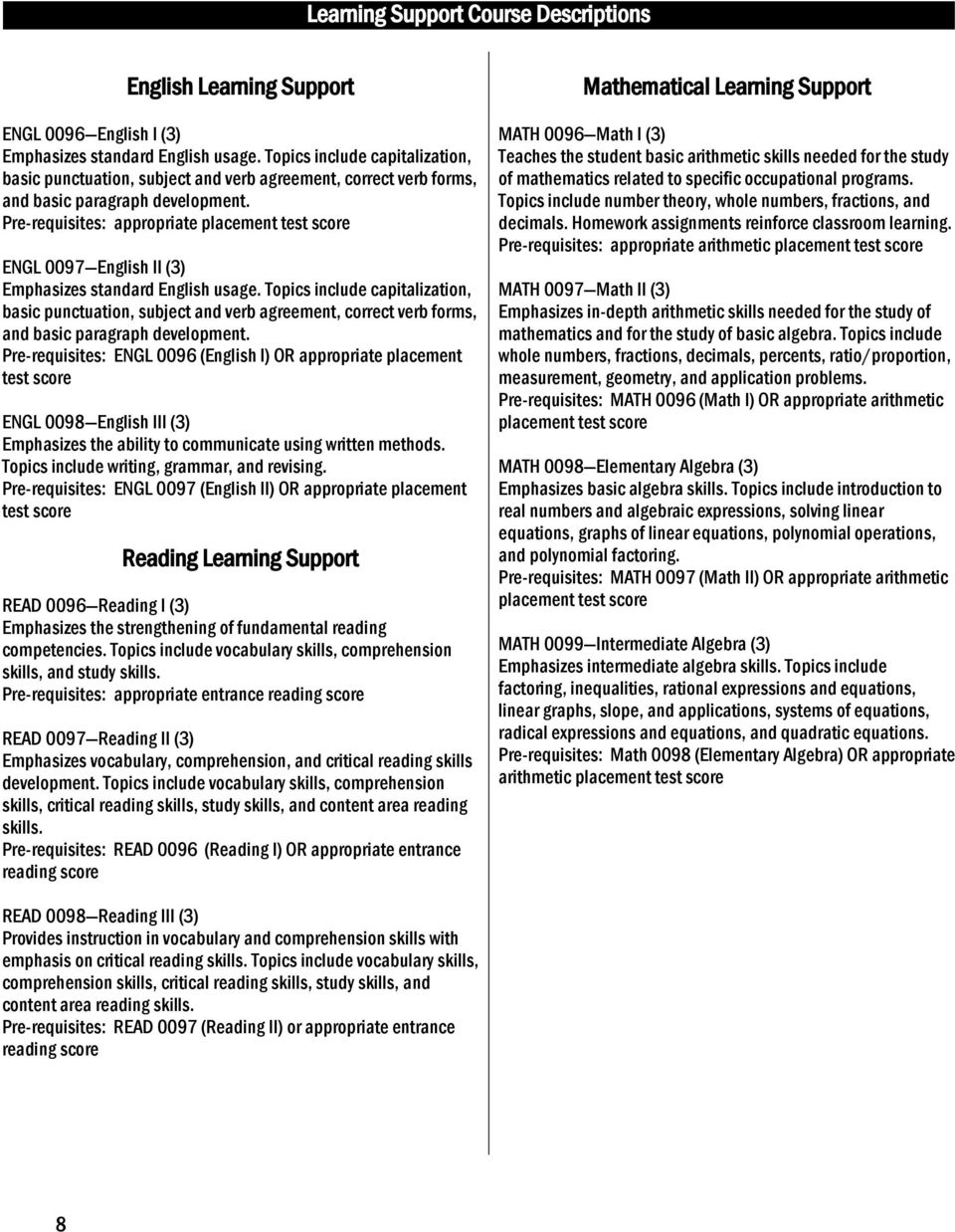
9 Learning Support Course Descriptions English Learning Support ENGL 0096 English I (3) Emphasizes standard English usage. Topics include capitalization, basic punctuation, subject and verb agreement, correct verb forms, and basic paragraph development. Pre-requisites: appropriate placement test score ENGL 0097 English II (3) Emphasizes standard English usage. Topics include capitalization, basic punctuation, subject and verb agreement, correct verb forms, and basic paragraph development. Pre-requisites: ENGL 0096 (English I) OR appropriate placement test score ENGL 0098 English III (3) Emphasizes the ability to communicate using written methods. Topics include writing, grammar, and revising. Pre-requisites: ENGL 0097 (English II) OR appropriate placement test score Reading Learning Support READ 0096 Reading I (3) Emphasizes the strengthening of fundamental reading competencies. Topics include vocabulary skills, comprehension skills, and study skills. Pre-requisites: appropriate entrance reading score READ 0097 Reading II (3) Emphasizes vocabulary, comprehension, and critical reading skills development. Topics include vocabulary skills, comprehension skills, critical reading skills, study skills, and content area reading skills. Pre-requisites: READ 0096 (Reading I) OR appropriate entrance reading score Mathematical Learning Support MATH 0096 Math I (3) Teaches the student basic arithmetic skills needed for the study of mathematics related to specific occupational programs. Topics include number theory, whole numbers, fractions, and decimals. Homework assignments reinforce classroom learning. Pre-requisites: appropriate arithmetic placement test score MATH 0097 Math II (3) Emphasizes in-depth arithmetic skills needed for the study of mathematics and for the study of basic algebra. Topics include whole numbers, fractions, decimals, percents, ratio/proportion, measurement, geometry, and application problems. Pre-requisites: MATH 0096 (Math I) OR appropriate arithmetic placement test score MATH 0098 Elementary Algebra (3) Emphasizes basic algebra skills. Topics include introduction to real numbers and algebraic expressions, solving linear equations, graphs of linear equations, polynomial operations, and polynomial factoring. Pre-requisites: MATH 0097 (Math II) OR appropriate arithmetic placement test score MATH 0099 Intermediate Algebra (3) Emphasizes intermediate algebra skills. Topics include factoring, inequalities, rational expressions and equations, linear graphs, slope, and applications, systems of equations, radical expressions and equations, and quadratic equations. Pre-requisites: Math 0098 (Elementary Algebra) OR appropriate arithmetic placement test score READ 0098 Reading III (3) Provides instruction in vocabulary and comprehension skills with emphasis on critical reading skills. Topics include vocabulary skills, comprehension skills, critical reading skills, study skills, and content area reading skills. Pre-requisites: READ 0097 (Reading II) or appropriate entrance reading score 8
10 Programs that do not require an Accredited High School Diploma or GED Each of the following Technical Certificate of Credit programs allow students with or without a High School Diploma or GED to be admitted. Students must have a passing score either from the COMPASS, Asset, SAT, or ACT test taken within the last five years. Curious about any of these programs? Commercial Straight Truck and Passenger Driver Commercial Truck Driving Criminal Justice Fundamentals Criminal Justice Specialist Emergency Medical Responder Forensic Science Fundamentals Introduction to Child Care Nurse Aide Patient Care Assistant Shampoo Technician Go online to Southern Crescent Technical College's website ( to look at program requirements, number of courses, type of courses, as well as an estimated length of the program you are interested in. If you have any more questions either contact the program coordinator or stop by the Advisement Center Monday - Thursday from 8:00 a.m. - 6:00 p.m. Griffin Campus - Advisement Center (room 600) Flint River - Advisement Center (room A-250) Please Note: Programs may have additional requirements (example - CDL requires a valid driver's license) Southern Crescent Technical College is a Unit of the Technical College System of Georgia and an Equal Opportunity Institution 9

11 Dental Assisting 10 ALLIED HEALTH PROGRAMS Major Major Code Griffin Flint Center Dental Assisting (Diploma) DA12 X Health Care Assistant Health Care Assistant (TCC) HA21 X X Butts and Henry Health Care Science (TCC) HS21 X X Butts and Henry Medical Assisting Medical Assisting (diploma) MA22 X X Medical Laboratory Technology Phlebotomy Technician (TCC) PT21 X Orthopaedic Technology Orthopaedic Technology (AAS) OT13 X Pharmacy Technology Pharmacy Technology (AAS) PT23 X Pharmacy Technology (diploma) PT22 X Practical Nursing Practical Nursing (diploma) PN12 X X Direct Support Professional (TCC) DS11 X Hemodialysis Patient Care Specialist (TCC) HPC1 X Nurse Aide (TCC) CN21 X X Patient Care Assistant (TCC) PC21 X X Radiologic Technology Radiologic Technology (AAS) RT23 X Butts, Henry, and Jasper Butts, Henry, and Jasper Computed Tomography Specialist (TCC) CT91 Henry Respiratory Care Respiratory Care (AAS) RCT3 X Electrocardiography Technology (TCC) ET81 X Polysomnography Technician (TCC) PT61 X Surgical Technology Surgical Technology (AAS) ST13 X Surgical Technology(diploma) ST12 X Central Sterile Supply Processing Technician (TCC) CS91 X Upon admission to the College, students desiring to enter an Allied Health program will be placed in either the Health Care Assistant (diploma) or the Health Care Science (degree) certificate program while working on admission requirements for their chosen medical program. Acceptance into any Allied Health program is a competitive selection process. Dual Allied Health or medical programs are not allowed. Health Care Assistant or Health Care Science students must complete their certificate before adding another major. Students with Criminal Histories Southern Crescent Technical College allows students, regardless of criminal history, to enroll in any program for which they academically qualify. Students with a criminal background may enroll in clinical courses or internship courses but could be denied access to an internship placement or clinical site. The access is not denied on the behalf of Southern Crescent Technical College, but rather by the policies and procedures of the individual business, agency, or organization allowing the clinical site, internship placement, or state licensure.

12 DA12 Dental Assisting Diploma Offered at the Griffin Campus Fall 4 terms Minimum Credit Hours for Graduation: 59 The Dental Assisting program provides learning opportunities which introduce, develop, and reinforce academic and occupational knowledge, skills, and attitudes required for job acquisition, retention, and advancement. Program graduates will be competent in the technical areas of preventive dentistry, four-handed dentistry, chairside assisting with emphasis in diagnostics, fixed prosthodontics, pediatric dentistry, orthodontic procedures, endodontic procedures, surgical and expanded functions, dental practice management, specialties, and dental radiology. Program graduates receive a Dental Assisting diploma and have two Completion documents: Radiology and Expanded Functions. The Dental Assisting program is a four-term sequence which includes lecture, lab, and clinical courses that will prepare students to deliver dental health care to diverse patient populations in a variety of settings. Students should think of their time spent in the Dental Assisting program as the beginning of a lifetime of professional development. Students will learn the professional skills for their new career and the skills that will enhance their personal development. Be at least 18 years of age. COMPASS: Reading: 70, English: 32, Math 26 Students must possess a current CPR card. It is recommended to obtain CPR card just prior to entering the program so that the card will remain current throughout the program. Students who have completed the Hepatitis B Vaccine series must submit a current titer status. Students are required to have had 1 of the 3 Hepatitis B vaccinations prior to entering the Dental Assisting Program in Fall Semester. Students are required to have the Tuberculosis skin test. Students are required to have the Oral Exam & Medical Exam. Students are required to have the Drug Screen and Background check. Applicants must meet general admissions requirements as well as the following minimum requirements. Meeting minimum requirements does not guarantee admission into the program. Successfully complete (or transferred in) ENG 1010, PSYC 1010, COMP 1000, MATH 1012, ALHS 1040 and ALHS 1011 with a minimum grade of C in each course. Maintain a cumulative GPA of 2.5 for core classes. A minimum of 25 percent of the program course work must be completed on the campus intended for graduation. Students must have completed the PSB test. (no minimum score required) Candidate Selection and Prerequisite Requirements Selection of candidates for each dental assisting class will be based on a competitive admissions process. The following criteria will be used: Overall GPA for core classes 2.5 Health Occupations Aptitude Examination (PSB) Program-ready list Test results from the PSB exam cannot be older than 1 year prior to admittance into the Dental Assisting program. The Dental Assisting program director will convert the GPA and the PSB scores to a three-digit score and combine it to attain a complete score. Example: 2.5 GPA: 250 PSB: Total score: 380 The students with the highest scores will be admitted into the next cohort. In case of a tie, the position will be determined on the basis of the date and time the is sent to the program-ready list. Upon completion of one of the first two prerequisite requirements, the student must make an appointment to see the Dental Assisting program director and complete a Program-Ready Form prior to being placed on the programready list. After the student has filled out the Program-Ready Form with the program director of the Dental Assisting program, the student must immediately place their name on the programready list. The following information is needed when sending the to [email protected] 1. Name (as listed in Banner) 2. Student ID 3. Phone Number(s) 4. Student address 5. address 11

13 12 6. Program of study (Please be sure that your status in BANNER is listed as Healthcare Assistant. If not, you will be removed from the Program Ready List) 7. Courses taken and grade If the student s phone number, mailing address, or address changes, the Dental Assisting program MUST be notified by at [email protected]. If the Dental Assisting program cannot contact you by phone or , you will be removed from the program-ready list. However, admission is competitive and there is a deadline date to be program-ready per each cohort group which is the last day of the spring semester term. The Dental Assisting program begins a new cohort each fall term. The program is full-time, Monday through Thursday from 8:30 AM until 5:30 PM. ALL STUDENTS WHO ARE NOT ACCEPTED INTO THE PROGRAM MUST RESUBMIT A NEW PROGRAM-READY FORM FOR THE NEXT COHORT. Background Check A student who has been convicted of a felony or misdemeanor may be admitted to the Dental Assisting program; however, such a conviction may prohibit a student from attending certain clinical sites and may prohibit a student from taking the Dental Assisting National Board exam. Grading Standards Grading standards for dental assisting (DENA) courses are very stringent. There are two (2) requirements that must be met to proceed in the Dental Assisting program. 1. A grade of C or better is required in all classes. 2. The student must provide competency by scoring 70 percent or above on both the written comprehensive final exam and the comprehensive final laboratory exam. Readmission Policy Readmission into the Dental Assisting program following withdrawal or first-time failure will be based on the following: Proof of previous program course completion of less than one year. Students who withdrew or completed either Fall, Spring, or Summer semesters in good standing (GPA 2.5 or higher) will be allowed remittance into the Dental Assisting program. The student may be allowed to re-enter the program the following year at the point in which the student withdrew from the program. Students who were dismissed from the Dental Assisting program due to receiving a final grade of D or F in any dental assisting class (DENA) will have to successfully complete written and laboratory comprehensive examination(s) for each previously completed dental assisting course with a minimum of 70 percent. Readmission will be based on available space within the classrooms and clinical sites. Students who do not successfully complete the Dental Assisting program after two attempts, whether at this college or at another college, will not be readmitted into the program. A student must complete another background check, drug screen, and health screen as designated by participating clinical sites. This courtesy is extended only once. Approximate additional costs other than tuition, fees, and textbooks Uniforms $140 Laboratory coat $50 Shoes $55 Long sleeve undershirt $12 Short sleeve undershirt $12 Medical exam $45 Oral exam $45 Hepatitis B vaccine $300 Clinical insurance $12 American Dental Assistants Association $50 Dental Assisting National Board (DANB) $425 Background check $78 Drug screen varies Hepatitis Titer $64 Tuberculosis skin test $20 Text Books $600 ENGL 1010 Fundamentals of English I 3 PSYC 1010 Basic Psychology 3 COMP 1000 Introduction to Computers 3 MATH 1012 Foundations of Mathematics 3 ALHS 1040 Introduction to Health Care 3 ALHS 1011 Anatomy and Physiology 5 DENA 1050 Microbiology and Infection Control 3 DENA 1070 Oral Pathology and Therapeutics 2 DENA 1080 Dental Anatomy 5 DENA 1340 Dental Assisting I: General Chairside 6 Third Term DENA 1350 Dental Assisting II: Dental Specialties & EFDA Skills 7 DENA 1390 Dental Radiology 4 DENA 1460 Dental Practicum I 1 DENA 1470 Dental Practicum II 1 Fourth Term DENA 1030 Preventive Dentistry 2 DENA 1090 Dental Assisting National Board Exam Preparation 1 DENA 1400 Dental Practice Management 2 DENA 1480 Dental Practicum III 5 Note: Students enrolling in the Dental Assisting program have the potential for routine or unplanned exposure to blood and/or other potentially infectious body material pathogens in the normal conduct of student instructional activities.

14 HA21 Health Care Assistant Technical Certificate of Credit Offered at the Griffin and Flint River Campuses and Butts and Henry Centers Varies Minimum Credit Hours for Graduation: 30 The Health Care Assistant certificate of credit is a program that provides academic foundations at the diploma level in communications, mathematics, and human relations, as well as technical fundamentals. Program graduates are trained in the underlying fundamentals of health care delivery and are well prepared for employment and subsequent upward mobility. Students will be placed in the Health Care Assistant certificate if they plan to complete one of the following diplomas: Dental Assisting Medical Assisting Pharmacy Technology Practical Nursing Surgical Technology Be at least 17 years of age Students applying for any of the above Allied Health programs are admitted to the college in Health Care Assistance/Health Care Science technical certificate of credit programs, but not the occupational programs. Students must satisfy additional entrance criteria for each Allied Health program. campus. See program advisor for any questions. General Core courses ALHS 1011 Anatomy and Physiology 5 ALHS 1040 Introduction to Health Care 3 ALHS 1060 Diet and Nutrition for AHS 2 ALHS 1090 Medical Terminology for Allied Health Sciences 2 COMP 1000 Introduction to Computers 3 ENGL 1010 Fundamentals of English I 3 PSYC 1010 Basic Psychology 3 Choose one of the following: MATH 1012 Foundations of Mathematics OR 3 MATH 1013 Algebraic Concepts MUST COMPLETE 8 to 14 CREDIT HOURS OF OCCUPATIONAL COURSES Note: Every occupational course, except the ALHS, BUSN, and MAST courses, requires approval from the course s program coordinator. Central Sterile Supply Processing Technician Advanced CSSP 1010 Central Sterile Supply Processing Technician 5 CSSP 1020 Central Sterile Supply Processing Tech Practicum I 6 CSSP 1022 Central Sterile Supply Processing Tech. Practicum II 5 Electrocardiography Technology ECGT 1030 Introduction to Electrocardiography* 5 ECGT 1050 Electrocardiography Practicum 5 Nurse Aide or Patient Care Assistant NAST 1100 Nurse Aide Fundamentals 6 Hemodialysis Patient Care Specialist HECT 1100 Hemodialysis Patient Care 7 HECT 1120 Hemodialysis Practicum 4 Phlebotomy Technician PHLT 1030 Introduction to Venipuncture 3 PHLT 1050 Clinical Practice 5 Polysomnography Technician RESP 1310 Intro to Polysomnography** 4 RESP 1320 Polysomnography I** 5 RESP 1330 Polysomnography II** 2 RESP 1340 Clinic I** 5 RESP 1350 Clinic II** 2 Specific Occupational Electives ALHS 1054 Spanish for Allied Health Workers 3 BUSN 1440 Document Production 4 BUSN 2320 Document Processing 4 BUSN 2330 Advanced Medical Document Processing 4 COLL 1500 College Success and Career Exploration 3 MAST 1120 Human Diseases 3 *ECGT 1030 is not taught in the SUMMER TERM (FALL, SPRING only). **To enroll in the RESP courses above, the student must be a Certified Respiratory Therapist (CRT) or Registered Respiratory Therapist (RRT). Students enrolling in BUSN 1440 are required to take a typing test indicating the ability to key at least 25 words per minute accurately, or successfully pass BUSN 1100 with grade of C or better. 13

15 14 HS21 Health Care Science Technical Certificate of Credit Offered at the Griffin and Flint River Campuses and Butts and Henry Centers Varies Minimum Credit Hours for Graduation: 36 The Health Care Science certificate of credit is a program that provides academic foundations at the degree level in communications, mathematics, and human relations, as well as technical fundamentals. Program graduates are trained in the underlying fundamentals of health care delivery and are well prepared for employment and subsequent upward mobility. Students will be placed in the Health Care Science certificate if they plan to complete one of the following degrees: Orthopaedic Technology Pharmacy Technology Radiologic Technology Respiratory Care Surgical Technology Students applying for any of the above Allied Health programs are admitted to the college in Health Care Assistance/Health Care Science technical certificate of credit programs, but not the occupational programs. Students must satisfy additional entrance criteria for each Allied Health program. Be at least 17 years of age campus. See program advisor for any questions. General Core Courses ENGL 1101 Composition and Rhetoric 3 PSYC 1101 Introductory Psychology 3 Humanities/Fine Arts elective 3 Math Option Choose One: 3 MATH 1111 College Algebra OR MATH 1100* Quantitative Skills and Reasoning OR MATH 1101* Mathematical Modeling OR MATH 1113 Pre-calculus GENERAL CORE SCIENCE HOURS REQUIRED ALHS 1040 Introduction to Health Care 3 ALHS 1060 Diet and Nutrition for AHS 2 ALHS 1090 Medical Terminology for Allied Health Sciences 2 BIOL 1111 Biology I 3 BIOL 1111L Biology Lab I 1 BIOL 2113 Anatomy and Physiology I 3 BIOL 2113L Anatomy and Physiology Lab I 1 BIOL 2114 Anatomy and Physiology II 3 BIOL 2114L Anatomy and Physiology Lab II 1 BIOL 2117 Introductory Microbiology 3 BIOL 2117L Introductory Microbiology Lab 1 CHEM 1211 Chemistry I 3 CHEM 1211L Chemistry Lab I 1 COMP 1000 Introduction to Computers 3 MATH 1127 Introduction to Statistics 3 PHYS 1110 Conceptual Physics 3 PHYS 1110L Conceptual Physics Lab 1 SPCH 1101 Public Speaking 3 OCCUPATIONAL COURSES HOURS REQUIRED MAXIMUM 26 HOURS OCCUPATIONAL AND GENERAL CORE COURSES Note: Every occupational course, except for the ALHS, BUSN, and MAST courses, requires approval from the course s program coordinator. Central Sterile Supply Processing Technician Advanced CSSP 1010 Central Sterile Supply Processing Technician 5 CSSP 1020 Central Sterile Supply Proc. Tech Practicum I 6 CSSP 1022 Central Sterile Supply Processing Tech. Practicum II 5 Electrocardiography Technology ECGT 1030 Introduction to Electrocardiography** 5 ECGT 1050 Electrocardiography Practicum** 5 Nurse Aide or Patient Care Assistant NAST 1100 Nurse Aide Fundamentals 6 Hemodialysis Patient Care Specialist HECT 1100 Hemodialysis Patient Care 7 HECT 1120 Hemodialysis Practicum 4 Phlebotomy Technician PHLT 1030 Introduction to Venipuncture 3 PHLT 1050 Clinical Practice 5 Polysomnography Technician RESP 1310 Intro to Polysomnography+ 4 RESP 1320 Polysomnography I+ 5 RESP 1330 Polysomnography II+ 2 RESP 1340 Clinic I+ 5 RESP 1350 Clinic II+ 2 Specific Occupational Electives ALHS 1054 Spanish for Allied Health Workers 3 BUSN 1440 Document Production 4 BUSN 2320 Document Processing 4 BUSN 2330 Advanced Medical Document Processing 4 COLL 1500 College Success and Career Exploration 3 MAST 1120 Human Diseases 3 *MATH 1100/1101 courses will be accepted when transferred in from another institution with a grade of a C or better but may not be offered at this institution **ECGT 1030 is not taught in the SUMMER TERM (FALL, SPRING only). +To enroll in the RESP courses above, the student must be a Certified Respiratory Therapist (CRT) or Registered Respiratory Therapist (RRT). Students enrolling in BUSN 1440 are required to take a typing test indicating the ability to key at least 25 words per minute accurately, or successfully pass BUSN 1100 with grade of C or better.

16 MA22 Medical Assisting Diploma Offered at the Griffin and Flint River Campuses Day and Evening classes available Day Class: Fall, Spring Evening Class: Every 4th term 5 or 6 terms Minimum Credit Hours for Graduation: 54 The Medical Assisting diploma program prepares the competent entry-level Medical Assistants in the cognitive (knowledge), psychomotor (skills), and affective (behavior) learning domains, prepares the student to sit for the national certification examination to become professionally certified as a medical assistant and prepares students for careers in a variety of positions in today's medical facilities. The sequence of courses emphasizes a combination of medical theory and practical application necessary for successful employment. The grading system for Medical Assisting requires a minimum course grade of C for progress from specified courses to more advanced courses. Classroom instruction and practical experience are divided between administrative skills and clinical skills in a variety of areas: scheduling appointments, banking, bookkeeping, insurance coding, hospital admissions, laboratory services, maintaining patient files, examination room techniques, assisting with minor surgery, administering medications, and performing diagnostic procedures including lab work and electrocardiography. During the program, the student gains experience in a physician's office or appropriate facility by participating in an externship. Clinical courses may be scheduled day, evening, and on weekends. There is no remuneration for clinicals. Employment Opportunities Medical assistants work primarily in outpatient settings, including clinics, physicians offices, insurance companies, public and private hospitals, inpatient and outpatient facilities, as well as specialty practitioners, such as chiropractors, optometrists, and podiatrists in outpatient care centers, nursing, and residential care facilities. Be at least 18 years of age Applicants must meet general admission requirements, as well as the following minimum requirements. Meeting minimum requirements does not guarantee admission into the program. Applicants who do not meet the regular admission requirements will be classified as either learning support or provisional status and must take the prescribed learning support courses to prepare for the core curriculum. It is the student's responsibility to notify the Medical Assisting advisor the term he/she completes or is completing the last of the pre-requisite classes. This is accomplished by turning in the yellow program-ready sheet to a Medical Assisting advisor or the Allied Health secretary the week of June 9 th (for Fall program entry) or the week of September 9 th (for Spring program entry). The evening program begins every 4 th semester, please see advisor for program application date. Upon successful completion (or transfer in) of ENGL 1010, PSYC 1010, COMP 1000, ALHS 1090, MATH 1012, and ALHS 1011 with a C or better and a grade point average of 2.5 or higher, the student will be considered program-ready and be eligible for admission into the Medical Assisting program based on submission of the "yellow program sheet, available classroom space, and available clinical sites. Candidate selection is based on the following in this order: 1. Date completed the yellow program sheet with accompanying attachments turned in. 2. Time completed the yellow program sheet with accompanying attachments turned in. 3. Completion of all core classes with a C or better. 4. Minimum cumulative GPA of Available classroom size and available clinical sites 6. In the event that two or more applicants complete requirements simultaneously, the earliest uninterrupted program application date will determine placement on the list. Readmission Policy Withdrawal from any MAST program class constitutes withdrawal from the program for that term. If a student withdraws for any reason (whether academic deficiency or personal issues), the student may be allowed to re-enter a cohort class at the point he/she withdrew from the program, provided the student demonstrates proficiency. This courtesy is extended only once. Readmission into the Medical Assisting program following withdrawal or first-time failure will be based on the following: Successful completion of written, comprehensive examinations for each previously successfully completed medical assisting course with a minimum competency of 80 percent, and Successful completion of a comprehensive lab skills check-off with a minimum of 85 percent. Deficiencies will result in the student repeating course(s). Upon readmission into the Medical Assisting program, the student must complete additional requirements as deemed necessary by the program faculty, i.e. a physical, drug screen, background check, etc. Readmission will be based on availability within the classroom setting and clinical sites. This courtesy is extended only once. Students who do not successfully complete the Medical Assisting program after two attempts, whether at Southern Crescent Technical College or at another college, will not be readmitted into the program. 15

17 Transferring medical assisting students from other technical colleges must first complete and submit an enrollment application and official transcripts to Southern Crescent Technical College. Each medical assisting course listed in the transferring student's official transcript will be considered for transfer credit after the transferring student has demonstrated proficiency by examination as noted above with the exception of MAST 1080 and MAST MAST 1080, MAST 1090, MAST 1170 and MAST 1180 are not transferrable into the Medical Assisting program. A minimum of 25 percent of program courses must be completed on the SCTC campus for graduation from SCTC. Students who do not successfully complete the Medical Assisting program after two attempts, whether at Southern Crescent Technical College or at another college, will not be readmitted into the program. Withdrawn students or transfer students who desire readmittance within five years must meet current admissions and curriculum requirements and will be admitted following the demonstration of competencies as noted above, submission of a yellow program sheet with attachments, and classroom and clinical site availability. Documentation of a physical and a dental examination is turned in during the first MAST term with an accompanying completed drug screen and background check. All first-term MAST students and all MAST transfer students will be required to complete a new physical and dental exam, unless they have had one within the previous three months. All firstterm MAST students and all MAST transfer students will be required to complete a new drug screen and background check. Approximate additional costs other than tuition, fees, and textbooks Uniforms $500 Equipment/supplies $ National Registry (RMA) $ Liability insurance $11.50 Medical/dental varies Background check/drug screen varies CPR (if completed with ALHS 1040) $5 NOTE: Grading standards for medical assisting courses are very stringent. For students to progress to the next course of study, a minimum grade of C must be maintained. Students who are unsuccessful after a second attempt at courses within the Medical Assisting curriculum will be advised to choose another program of study. A student who has been convicted of a felony or misdemeanor may be admitted to the Medical Assisting program; however, such a conviction may prohibit a student from attending certain clinical sites and/or taking the Registry/Certification examination. Documentation of satisfying the penalty of the felony must be presented to the National Board with the exam application. Permission to sit for the examination rests solely with the National Board. Permission to attend a clinical site rests solely with the clinical facility. The Medical Assisting program on the Griffin and Flint River campuses is a diploma program and is accredited by the Commission on Accreditation of Allied Health Education Programs ( upon the recommendation of the Curriculum Review Board of the American Association of Medical Assistants Endowment (CRB-AAMAE). Commission on Accreditation of Allied Health Education Programs 1361 Park Street Clearwater, FL / ENGL 1010 Fundamentals of English I 3 PSYC 1010 Basic Psychology 3 ALHS 1090 Medical Terminology for Allied Health Sciences 2 MATH 1012 Foundations of Mathematics 3 ALHS 1011 Anatomy and Physiology 5 COMP 1000 Introduction to Computers 3 DAY Third Term Day MAST 1010 Legal and Ethical Concerns in the Medical Office 2 MAST 1060 Medical Office Procedures 4 MAST 1080 Medical Assisting Skills I 4 MAST 1120 Human Diseases 3 Fourth Term Day MAST 1030 Pharmacology in the Medical Office 4 MAST 1090 Medical Assisting Skills II 4 MAST 1100 Medical Insurance Management 2 MAST 1110 Administrative Practice Management 3 Fifth Term Day MAST 1170 Medical Assisting Externship 6 MAST 1180 Medical Assisting Seminar 3 EVENING Third Term Evening MAST 1060 Medical Office Procedures 4 MAST 1100 Medical Insurance Management 2 MAST 1120 Human Diseases 3 Fourth Term Evening MAST 1010 Legal and Ethical Concerns in the Medical Office 2 MAST 1080 Medical Assisting Skills I 4 MAST 1110 Administrative Practice Management 3 Fifth Term Evening MAST 1030 Pharmacology in the Medical Office 4 MAST 1090 Medical Assisting Skills II 4 Sixth Term Evening MAST 1170 Medical Assisting Externship 6 MAST 1180 Medical Assisting Seminar 3 16

18 PT21 Phlebotomy Technician Technical Certificate of Credit Offered at the Griffin Campus 3 terms Minimum Credit Hours for Graduation: 24 The Phlebotomy Technician program educates students to collect blood and process blood and body fluids. Phlebotomy technicians typically work in concert with clinical laboratory personnel and other health care providers in hospitals or other health care facilities. Topics covered include human anatomy, anatomical terminology, venipuncture, and clinical practice. Be at least 18 years of age Applicants must meet general admission requirements, as well as the following minimum requirements: Applicants who do not meet the regular admission requirements will be classified as either learning support or provisional status and must take the prescribed learning support courses to prepare for the core curriculum. Applicants must apply and be admitted to the Phlebotomy Program in the Admissions Office of Southern Crescent Technical College. Upon successful completion (or transfer in) of ALHS 1011 (or BIOL 2113 and 2114) ALHS 1090, ALHS 1040, ENG 1010, and COMP 1000 students must apply to the program-ready list. Candidate selection is based on the following and in this order: 1. Date applied to program-ready list. 2. Completion of all core classes with a C or better. 3. Available classroom size and available clinical sites. ALHS 1011 Anatomy and Physiology 5 ALHS 1090 Medical Terminology for Allied Health Sciences 2 ALHS 1040 Introduction to Health Care 3 COMP 1000 Introduction to Computers 3 ENGL 1010 Fundamentals of English I 3 PHLT 1030 Introduction to Venipuncture 3 Third Term PHLT 1050 Clinical Practice* 5 Current CPR card required Documentation of a physical examination is turned in during the first PHLT term with an accompanying completed drug screen and a background check sheet. *A student who has been convicted of a felony or misdemeanor may be admitted to the Phlebotomy program; however such a conviction may prohibit a student from attending clinical sites and/or taking the Registry exam. Documentation of satisfying the penalty of the felony must be presented to the National Board with the exam application. Permission to sit for the exam rests solely with the National Board. Permission to attend a clinical site rests solely with the clinical facility. Note: Grading standards for Phlebotomy courses are very stringent. For students to progress to the next course of study, a minimum grade of C must be maintained. Students who are unsuccessful maintaining a C within the PHLT 1030 curriculum will be advised to choose another program of study. Approximate additional costs other than tuition, fees, and textbooks Uniforms $30 Equipment/supplies $40 (approximate) National Registry $95 (may vary) Liability insurance $8 ($4 for PHLT 1030 and$4 for PHLT 1050) Medical exam Varies Background/drug screen Varies CPR$5 (if taken with ALHS 1040) 17

19 OT13 Orthopaedic Technology Associate of Applied Science Degree Offered at the Griffin Campus Fall 6 terms Minimum Credit Hours for Graduation: 75 The Orthopaedic Technology degree program is a sequence of courses that prepares students to work with orthopaedic surgeons to treat patients in a variety of health care environments. The degree program provides the skills and knowledge needed to become a competent orthopaedic technologist performing the following services: routine office and departmental procedures and the ability to perform certain basic functions; adjusting and removing casts, splints, and braces; setting up, adjusting, and maintaining traction configurations; assisting with the care of acutely injured patients; and assisting the physician in the reduction and/or manipulation of orthopaedic injuries. Successful completion of the Orthopaedic Technology degree program leads to eligibility for the National Board of Certified Orthopaedic Technologists certification exam. Graduates may be employed in hospitals, clinics, and private practice offices. Be at least 18 years of age Applicants must meet general admission requirement, as well as the following minimum requirements. Meeting minimum requirements does not guarantee admission into the program: Successfully complete (or transfer in) with a minimum grade of C or better: ALHS 1040, ALHS 1090, BIOL 2113, BIOL 2113L, BIOL 2114, BIOL 2114L, COMP 1000, ENGL 1101, and SPCH 1101 Successfully complete a minimum of 4 of the following courses prior to program admission with the remaining 2 courses being completed prior to graduation with a minimum grade of C or better: ENGL 1102, MATH 1111 or MATH 1101, HUMN 1101, and PSYC 1101 Maintain a grade point average (GPA) of 2.5 or higher for core classes. If a student retakes a course to improve his/her grade, both attempts will be calculated into the GPA for competition. Students may only retake a course one time. Financial aid may not pay for a student to retake a course. All students must submit test scores from the Psychological Services Bureau (PSB) Health Occupations Aptitude Examination with a minimum score of 180. Students will need to take the examination at a PSB testing center at the Continuing Education building 100 on the Southern Crescent Technical College Griffin Campus. Once all program entrance requirements have been met, the student will be responsible for notifying program faculty by submitting a program-ready card no later than the last day of spring semester. This card may be submitted at any time during the term in which the student is completing the last of the required core classes and PSB exam results have been submitted. Program faculty will NOT accept late submissions of program-ready cards. If transfer credits are involved, the student will be responsible for making sure that all of the transcripts are in to the college by the deadline. If the student is not accepted and wishes to reapply for the following year, the student must resubmit a new program-ready card. There will NOT be a waiting list. Should there be more qualified students competing than available spaces, candidates are admitted based on the grade point average for the courses listed above plus the score on PSB Health Occupations Aptitude Examination. The grade point average (4.00 scale) will be converted to a 400 point scale and added to the score of the PSB test (maximum score 365). Seats are filled from the highest score downward until the maximum enrollment total is reached. The student s program application date will break any tie. Application date is defined as the date when the student applied to the college for the program, or the date on the Change of Enrollment Form to the Orthopaedic Technology program. Applicants are accepted into the Orthopaedic Technology program FALL term (August) and are accepted only as fulltime day students. Each student is also required to complete an online drug screen/background check through Advantage Students ( and submit a current copy of an American Heart Healthcare Provider CPR certification during the first term of the program. All applicants will be notified of program status by mail or on or before July 7 th. Readmission Policy If a student withdraws for any reason, the student may be allowed to re-enter the program the following year at the point in which the fall term begins. These students must recompete for program entrance. THIS COURTESY IS EXTENDED ONLY ONCE. Upon readmission into the Orthopaedic Technology program, the student must complete additional requirements as deemed necessary by the program faculty. Readmission will be based on available space within the classroom and clinical sites. For more information, please refer to the Orthopaedic Technology Program Policy Manual. NOTE: Grading standards for orthopaedic technology courses are very stringent. For students to progress to the next course of study, a minimum grade of C must be achieved in every ORT course. Students must maintain a minimum GPA of 2.5 to remain in the program. 18

20 Approximate additional costs other than tuition, fees, and textbooks Equipment/Supplies $100 Uniforms $100 Liability Insurance $12 Background/Drug Screening $78.50 NAOT certification exam $425 NOTE: A student who has been convicted of a felony or misdemeanor may be accepted into the Orthopaedic Technology program; however, such a conviction may cause a student to be ineligible to take the National Examination and to rotate through some or all of the program s clinical affiliates. Permission to sit for the National Examination rests solely with the National Association of Orthopaedic Technologist (NAOT). If a student is concerned about qualifying to take the NAOT examination because of the student s record, the student may choose to prequalify by visiting the NAOT website, before starting the core classes or the program. The student should also notify the program faculty prior to starting the program to ensure there are clinical sites that will allow the student to rotate through to meet clinical requirements. Frequently Asked Questions 1. How many spaces are available? How many times per year are students accepted into the program? One fall term 3. What is a typical schedule? M-Th, 9 a.m.-3:30 p.m. 4. What are the clinical sites? Atlanta Medical Center, Children s Orthopaedic s of Atlanta, Emory Orthopaedics Center, Georgia Bone and Joint, LLC., Grady Health System, Hughston Clinic P.C., Myers Sports Medicine and Orthopaedic Center,Ortho Georgia, OrthoAtlanta, Ankle and Foot Centers of Georgia, Resurgens, Upson Regional Medical Center, University Orthopaedics. 5. How are clinical sites assignments determined? Clinical sites are randomly assigned by the clinical coordinator. 6. How long is the program? 12 months (three terms) from when the student starts the Orthopaedic program. ENGL 1101 Composition and Rhetoric (Required) 3 PSYC 1101 Introductory Psychology (Required) 3 COMP 1000 Introduction to Computers (Required) 3 Natural Sciences/Mathematics Choose one: (Required) 3 MATH 1101* Mathematical Modeling OR MATH 1111 College Algebra ENGL 1102 Literature and Composition (Required) 3 BIOL 2113 Anatomy and Physiology I (Required) 3 BIOL 2113L Anatomy and Physiology Lab I (Required) 1 ALHS 1040 Introduction to Health Care (Required) 3 ALHS 1090 Med. Terminology for Allied Health Sci. (Required) 2 Third Term BIOL 2114 Anatomy and Physiology II (Required) 3 BIOL 2114L Anatomy and Physiology Lab II (Required) 1 SPCH 1101 Public Speaking (Required) 3 HUMN 1101 Intro to Humanities OR Humanities/Fine Arts elective: MUSC 1101, ARTS 1101, ENGL 2130, OR THEA Fourth Term ORTT 1010 Orthopaedic Anatomy and Physiology 4 ORTT 1020 Orthopaedic Techniques I 4 ORTT 1030 Introduction to Orthopaedic Surgical Techniques 4 Fifth Term ORTT 1040 Advanced Orthopaedic Anatomy and Physiology 4 ORTT 1050 Orthopaedic Techniques II 4 ORTT 2010 Orthopaedic Technology Clinical I 5 Sixth Term ORTT 2020 Orthopaedic Technology Clinical II 7 ORTT 2030 Orthopaedic Technology Capstone 3 *Course will be accepted when transferred in from another institution with a grade of a C or better but may not be offered at this institution. 19

21 PT23 Pharmacy Technology Associate of Applied Science Degree Offered at the Griffin Campus Fall (Day and Evening) 6 terms Minimum Credit Hours for Graduation: 65 The Pharmacy Technology degree is designed to provide an individual with entry-level skills required for success in a retail pharmacy or a hospital-based pharmacy department. Learning opportunities develop academic and professional knowledge and skills required for job acquisition, retention, and advancement. Graduates are prepared to function as pharmacy technicians in positions requiring preparation of medications according to prescriptions under the supervision of a pharmacist. Be at least 18 years of age Applicants must meet general admissions requirements, as well as the following minimum requirements. Meeting minimum requirements does not guarantee admission into the program: Successfully complete (or transfer in) ALHS 1090, COMP 1000, ALHS 1040, BIOL 2113, BIOL 2113L and all courses from Area I-IV with a minimum grade of C in each course. Must complete BIOL 2114 and BIOL 2114L prior to graduation with a minimum grade of C or better. Maintain a grade point average (GPA) of 2.0 or higher for core classes. GPA includes each attempt at core classes, including those transferred in. If a course is repeated to get a better grade both grades will be used to calculate GPA. A minimum of 25 percent of program courses must be completed on SCTC campuses for graduation from SCTC. Must have completed and submitted scores for the nationalized admission test (PSB HOAE*) and achieved a minimum score as designated by the Pharmacy Technology program faculty acting on Pharmacy Tech national averages provided by PSB HOAE. * PSB HOAE = Psychological Services Bureau Candidate Selection Selection of candidates for each Pharmacy Technology class will be based on a competitive admission process. The following criteria will be used: 1. Overall GPA for core classes 2. Nationalized test score (PSB HOAE) 3. Program application date Once accepted into the Pharmacy Technology program, the student must complete all clinical site health requirements as described by our participating sites, including, but not limited to criminal background checks, drug screenings, and health screenings. The student is responsible for any fees needed to obtain these items. There is no waiting list for the program. Applicants who are not selected for a class must reapply for the next class starting the progression. Check with program advisors for more information. Readmission Policy Readmission into the Pharmacy Technology program following withdrawal or first-time failure will be based on the following: Proof of previous program course completion within the past one year. Successfully complete a drug calculations examination with a minimum competency of 80 percent. Successfully complete lab skills check off for any course already completed. Deficiencies will result in the student repeating the appropriate course. Readmission will be based on available space within clinical sites for the class the student is attempting to join. Students who do not successfully complete a course on the second attempt, whether at this college or at another college, will not be allowed to continue in the SCTC Pharmacy Technology program. A returning student must complete a new background check and drug screen. Approximate additional costs other than tuition, fees, and textbooks Medical/clinical requirements $100 to $150 Student lab fee $25 per term Scrubs and lab jackets (approx.) $100 Background check $78 Liability insurance $12 GA Board of Pharmacy Registration $138 National Certification Application fee $129 Graduation fees $35 20
22 ENGL 1101 Composition and Rhetoric (Required) 3 COMP 1000 Introduction to Computers 3 Social/Behavioral Sciences elective Choose one: (Required) 3 ECON 1101, PSYC 1101, SOCI 1101, POLS 1101, OR HIST 2111 Natural Sciences/Mathematics elective Choose one: (Required) 3 MATH 1111 College Algebra OR MATH 1100* Quantitative Skills and Reasoning OR MATH 1101* Mathematical Modeling BIOL 2113 Anatomy and Physiology I (Required) 3 BIOL 2113L Anatomy and Physiology Lab I (Required) 1 ALHS 1040 Introduction to Health Care (Required) 3 ALHS 1090 Medical Terminology (Required) 2 Humanities/Fine Arts elective Choose one: (Required) 3 HUMN 1101, MUSC 1101, ARTS 1101, ENGL 2130, OR THEA 1101 Third Term BIOL 2114 Anatomy and Physiology II (Required) 3 BIOL 2114L Anatomy and Physiology Lab II (Required) 1 General Core elective: (Required) 3 Choose one non-repetitive course from Area I, II, III, or IV (see page 6) Fourth Term PHAR 1000 Pharmaceutical Calculations 4 PHAR 1010 Pharmacy Technology Fundamentals 5 PHAR 1040 Pharmacology 4 Fifth Term PHAR 1020 Principles of Dispensing Medications 4 PHAR 1030 Principles of Sterile Medication Preparation 4 PHAR 1050 Pharmacy Technology Practicum 5 Sixth Term PHAR 2060 Advanced Pharmacy Technology Principles 3 PHAR 2070 Advanced Pharmacy Technology Practicum 5 *Course will be accepted when transferred in from another institution with a grade of a C or better but may not be offered at this institution. 21
23 PT22 Pharmacy Technology Diploma Offered at the Griffin Campus Fall (Day and Evening) 5 terms Minimum Credit Hours for Graduation: 56 The Pharmacy Technology diploma is designed to enable the student to acquire the knowledge, skills, and attitudes for employment within a pharmacy. Program graduates will be able to perform a variety of technical duties related to preparing and dispensing drugs in accordance with standard procedures and laws under the supervision of a registered pharmacist. A variety of clinical experiences are designed to integrate theory and practice. Graduates will be employable as entry-level pharmacy technicians. Be at least 18 years of age. Applicants must meet general admission requirements, as well as the following minimum requirements. Meeting minimum requirements does not guarantee admission into the program: Successfully complete (or transfer in) with a minimum grade of C or better in each course: ENGL 1010 or ENGL 1101, MATH 1012 or MATH 1111, ALHS 1011 or BIOL 2113 and BIOL 2113L AND BIOL 2114 and BIOL 2114L. If substituting BIOL 2113 and BIOL 2113L AND BIOL 2114 and BIOL 2114L for ALHS 1011, then BIOL 2114 and BIOL 2114L must be completed prior to graduation with a minimum grade of C or better. Successfully complete a minimum of 2 of the following courses prior to program admission with the remaining 2 courses being completed prior to graduation with a minimum grade of C or better: ALHS 1040, ALHS 1090, COMP 1000, and PSYC Maintain a grade point average (GPA) of 2.0 or higher for core classes. GPA includes each attempt at core classes, including those transferred in. If a course is repeated to get a better grade both grades will be used to calculate GPA. A minimum of 25 percent of program courses must be completed on SCTC campuses for graduation from SCTC. Must have completed and submitted scores for the nationalized admission test (PSB HOAE*) and achieved a minimum score as designated by the Pharmacy Technology program faculty acting on Pharmacy Tech national averages provided by PSB HOAE. * PSB HOAE = Psychological Services Bureau Candidate Selection Selection of candidates for each Pharmacy Technology class will be based on a competitive admission process. The following criteria will be used: 1. Overall GPA for core classes 2. Nationalized test score (PSB HOAE) 3. Program application date Once accepted into the Pharmacy Technology program, the student must complete all clinical site health requirements as described by our participating sites, including, but not limited to, criminal background checks, drug screenings, and health screenings. The student is responsible for any fees needed to obtain these items. There is no waiting list for the program. Applicants who are not selected for a class must reapply for the next class starting the progression. Check with program advisors for more information. Readmission Policy Readmission into the Pharmacy Technology program following withdrawal or first-time failure will be based on the following: Proof of previous program course completion within the past one year. Successfully complete a drug calculations examination with a minimum competency of 80 percent. Successfully complete a lab skills check off for any course already completed. Deficiencies will result in the student repeating the appropriate course. Readmission will be based on available space within clinical sites for the class the student is attempting to join. Students who do not successfully complete a course on the second attempt, whether at this college or at another college, will not be allowed to continue in the SCTC Pharmacy Technology program. A returning student must complete a new background check and drug screen. Approximate additional costs other than tuition, fees, and textbooks Medical/clinical requirements $100 to $150 Student lab fee $25 per term Scrubs and lab jackets (approx.) $100 Background check $78 Liability insurance $12 GA Board of Pharmacy Registration $138 National Certification Application fee $129 Graduation fees $35 22
24 ENGL 1010 Fundamentals of English I 3 MATH 1012 Foundations of Mathematics 3 COMP 1000 Introduction to Computers 3 PSYC 1010 Basic Psychology 3 ALHS 1011 Anatomy and Physiology 5 ALHS 1040 Introduction to Health Care 3 ALHS 1090 Medical Terminology for Allied Health Sciences 2 Third Term PHAR 1000 Pharmaceutical Calculations 4 PHAR 1010 Pharmacy Technology Fundamentals 5 PHAR 1040 Pharmacology 4 Fourth Term PHAR 1020 Principles of Dispensing Medications 4 PHAR 1030 Principles of Sterile Medication Preparation 4 PHAR 1050 Pharmacy Technology Practicum 5 Fifth Term PHAR 2060 Advanced Pharmacy Technology Principles 3 PHAR 2070 Advanced Pharmacy Technology Practicum 5 23
25 24 PN12 Practical Nursing Diploma Offered at the Griffin and Flint River Campuses Fall, Spring 5 terms Minimum Credit Hours for Graduation: 57 The Practical Nursing diploma program is designed to prepare students to write the NCLEX-PN for licensure as practical nurses. The program prepares graduates to give competent nursing care through a selected number of academic and occupational courses providing a variety of techniques and materials necessary to assist the student in acquiring the needed knowledge and skills. A variety of clinical experiences is planned so that theory and practice are integrated under the guidance of the clinical instructor. Program graduates receive a practical nursing diploma and have the qualifications of an entry-level practical nurse. Practical nursing is a diploma program to be implemented with new cohorts of students beginning fall and spring semesters. Students most commonly will have to submit a satisfactory criminal background check as well as a drug screen in order to be placed in a clinical health care facility to complete the clinical portions of their educational training. Be at least 17 years of age Upon admission to the College, practical nursing students are placed in the Health Care Assistant certificate while working on program admission requirements. The curriculum includes instruction in the areas of anatomy and physiology, drug calculations, administration of medications, nutrition and diet therapy, nursing ethics, patient care in a variety of fields and settings, patient wellness, and prevention of illnesses. Applicants must meet general admissions requirements as well as the following minimum requirements. Meeting minimum requirements does not guarantee admission into the program: Successfully complete (or transfer in) ENGL 1010 or ENGL 1101, PSYC 1010 or PSYC 1101, and ALHS 1060 with a minimum grade of C in each course; and MATH 1012 or MATH 1111 and ALHS 1011 or BIOL 2113/BIOL 2113L and BIOL 2114/2114L with a minimum grade of B in each course. Maintain a cumulative GPA of 3.0 for core classes. A minimum of 25 percent of the program must be completed on the campus intended for graduation. Have completed the nationalized admissions testing for nursing and achieved a minimum score as designated by the program faculty. Candidate Selection Selection of candidates for each practical nursing class will be based on a competitive admissions process. The following criteria will be used: Overall GPA for core classes. PSB HOAE 3 rd edition Program application date Essay Note: If a student changes his/her declared major from practical nursing to a different diploma or degree program, and then back to practical nursing, the latest program application date will be used to determine placement. Once accepted into the Practical Nursing program, the student must complete all heath requirements as described by participating clinical sites, including, but not limited to, a criminal background check, drug screening, and health screening. There is no waiting list for the program. Applicants who are not selected must notify the Practical Nursing program staff by submitting another notification card if they wish to compete for admission into the next cohort class. Grading standards for practical nursing courses are very stringent. Students must maintain a minimum grade of C for progression to the next course of study. Final exams are comprehensive and require a passing grade of 70% or greater to continue in program. Readmission Policy Readmission into the Practical Nursing program following withdrawal or first-time failure will be based on the following: Proof of previous program course completion of less than six months. Submission of a letter for consideration. The letter must state why you were not successful on your first attempt, what has changed, and how you plan to be successful if accepted back into the program. Successfully complete written comprehensive examinations for each previously completed practical nursing course with a minimum of 80 percent. Successfully complete a drug calculations examination with a minimum competency of 90 percent. Successfully complete a lab skill check off. Deficiencies will result in the student repeating the appropriate course/courses. Readmission will be based on available space within the classrooms and clinical sites. Students who do not successfully complete the Practical Nursing program after two attempts, whether at this college or at another college, will not be readmitted into the program. A student must complete another criminal background check, drug screen, and health screen as designated by participating clinical sites. The required nationalized test score cannot be greater than one-year old at the time of application for readmission.
26 Transfer Policy Transferring practical nursing students from other technical colleges must file an application at the Griffin campus and submit all official transcripts. Each practical nursing course listed on the transferring student s official transcript is considered for transfer credit after the prospective student has demonstrated proficiency by examination with a score of 80 percent. Approximate additional costs other than tuition, fees, and textbooks Equipment/supplies $ Uniforms $ Licensing exam $ Liability insurance $16.00 Medical fees/background check $ CPR $5.50 Nursing pin $40.00 Nursing cap $15.75 Nursing lamp $7.25 Nursing tote $85.00 ENGL 1010 Fundamentals of English I 3 MATH 1012 Foundations of Mathematics 3 PSYC 1010 Basic Psychology 3 ALHS 1011 Anatomy and Physiology 5 ALHS 1060 Diet and Nutrition for Allied Health Sciences 2 FALL Program Entrance : START FALL MANDATORY PN COHORT SEQUENCE PNSG 2010 Intro to Pharmacology and Clinical Calculations 2 PNSG 2030 Nursing Fundamentals 6 PNSG 2035 Nursing Fundamentals Clinical 2 PNSG 2210 Medical-Surgical Nursing I 4 PNSG 2310 Medical-Surgical Nursing Clinical I 2 Third Term: SPRING MANDATORY PN COHORT SEQUENCE PNSG 2220 Medical-Surgical Nursing II 4 PNSG 2230 Medical-Surgical Nursing III 4 PNSG 2320 Medical-Surgical Nursing Clinical II 2 PNSG 2330 Medical-Surgical Nursing Clinical III 2 PNSG 2410 Nursing Leadership 1 PNSG 2415 Nursing Leadership Clinical 2 Fourth Term: SUMMER MANDATORY PN COHORT SEQUENCE PNSG 2240 Medical-Surgical Nursing IV 4 PNSG 2340 Medical-Surgical Nursing Clinical IV 2 PNSG 2250 Maternity Nursing 3 PNSG 2255 Maternity Nursing Clinical 1 *Note: A new PN cohort begins every fall on the Griffin and Flint River campuses. SPRING Program Entrance : START SPRING MANDATORY PN COHORT SEQUENCE PNSG 2010 Intro to Pharmacology and Clinical Calculations 2 PNSG 2030 Nursing Fundamentals 6 PNSG 2035 Nursing Fundamentals Clinical 2 PNSG 2210 Medical-Surgical Nursing I 4 PNSG 2310 Medical-Surgical Nursing Clinical I 2 Third Term: SUMMER MANDATORY PN COHORT SEQUENCE PNSG 2240 Medical-Surgical Nursing IV 4 PNSG 2250 Maternity Nursing 3 PNSG 2255 Maternity Nursing Clinical 1 PNSG 2340 Medical-Surgical Nursing Clinical IV 2 Fourth Term: FALL MANDATORY PN COHORT SEQUENCE PNSG 2220 Medical-Surgical Nursing II 4 PNSG 2230 Medical-Surgical Nursing III 4 PNSG 2320 Medical-Surgical Nursing Clinical II 2 PNSG 2330 Medical-Surgical Nursing Clinical III 2 PNSG 2410 Nursing Leadership 1 PNSG 2415 Nursing Leadership Clinical 2 *Note: A new PN cohort begins every fall on the Griffin and Flint River campuses. 25
27 DS11 Direct Support Professional Technical Certificate of Credit Offered at the Griffin Campus Fall and Spring 1 term Minimum Credit Hours for Graduation: 12 The Direct Support Professional technical certificate of credit program prepares students to become certified direct support professionals who provide person-centered values in working with and supporting people who have a disability. Admission to this program is open to employees of participating organizations and to family members and advocates that support people who have a disability. Graduates are prepared to better support individuals who have a disability in their community. Many social service organizations are seeking employees with the DSP certification. Be at least 18 years of age DRSP 1100 Facilitating Access to Community Living I 8 DRSP 1130 Direct Support Professional Practicum I 4 26
28 HPC1 Hemodialysis Patient Care Specialist Technical Certificate of Credit Offered at the Griffin Campus Fall, Spring 3 terms Minimum Credit Hours for Graduation: 17 The Hemodialysis Patient Care Specialist technical certificate of credit equips health care workers with the skills, knowledge, and attitude necessary to succeed in the field of hemodialysis. Be at least 18 years of age Applicants must meet general admission requirements, as well as the following minimum requirements. Applicants who do not meet the regular admission requirements will be classified as either learning support or provisional status and must take the prescribed learning support courses to prepare for the core curriculum. Applicants must apply and be admitted to the Hemodialysis program in the admissions department of Southern Crescent Technical College. Upon successful completion (or transfer in) of ALHS 1040 and COMP 1000, students must apply to the program-ready list. Candidate selection is based on the following and in this order: 1. Date applied to program-ready list 2. Completion of all core classes with a C or better 3. Available classroom size and available clinical sites ALHS 1040 Introduction to Health Care 3 COMP 1000 Introduction to Computers 3 HECT 1100 Hemodialysis Patient Care 7 Third Term HECT 1120 Hemodialysis Practicum 4 Current CPR card required Documentation of a physical examination is turned in during the first HECT term with an accompanying completed drug screen and background check sheet. *A student who has been convicted of a felony or misdemeanor may be admitted to the Hemodialysis Patient Care Specialist program; however such a conviction may prohibit a student from attending clinical sites and/or taking the National exam. Documentation of satisfying the penalty of the felony must be presented to the National Board with the exam application. Permission to sit for the exam rests solely with the National Board. Permission to attend a clinical site rests solely with the clinical facility. Note: Grading standards for Hemodialysis Patient Care Specialist courses are very stringent. For students to progress to the next course of study, a minimum grade of C must be maintained. Students who are unsuccessful maintaining a C within the HECT 1100 curriculum will be advised to choose another program of study. Approximate additional costs other than tuition, fees, and textbooks Uniforms $30 Equipment/supplies $40 (approximate) Liability insurance $4 Medical exam Varies Background/drug screen Varies CPR $5 (if taken with ALHS 1040) 27
29 28 CN21 Nurse Aide Technical Certificate of Credit Offered at the Griffin and Flint River Campuses and Butts, Henry, and Jasper Centers 2 terms Minimum Credit Hours for Graduation: 13 The Nurse Aide technical certificate of credit prepares students with classroom training and practice as well as the clinical experiences necessary to care for patients in various settings including general medical and surgical hospitals, nursing care facilities, community care facilities for the elderly, and home health care services. Students who successfully complete the Nurse Aide technical certificate of credit may be eligible to sit for the National Nurse Aide Assessment Program (NNAAP) which determines competency to become enrolled in the state nurse aide registry. High school diploma or GED are NOT required Approximate additional costs other than tuition, fees, and textbooks Criminal background and drug screen $ (Fee is based on facility utilized for clinical. The fee for the criminal background check will increase if student has lived out of state.) CPR $5 Liability insurance per term $4 Medical exam and immunizations Varies Equipment/supplies $100 Uniforms $150 Certification exam $112 ALHS 1040 Introduction to Health Care 3 ALHS 1090 Medical Terminology for Allied Health Sciences 2 ALHS 1060 Diet and Nutrition for Allied Health Sciences 2 NAST 1100 Nurse Aide Fundamentals 6 PC21 Patient Care Assistant Technical Certificate of Credit Offered at the Griffin and Flint River Campuses and Butts, Henry, and Jasper Centers 2 terms Minimum Credit Hours for Graduation: 23 The Patient Care Assistant technical certificate of credit prepares students with rigorous classroom training and practice as well as the clinical experiences to perform a full range of patient care duties or services under nursing or medical direction. This includes taking vital signs, obtaining lab specimens, assisting with activities of daily living, observing and charting patient information, and reporting appropriate information to supervisors. It may also include providing various outreach services to clients within the community. Students who successfully complete the Patient Care Assistant technical certificate of credit may be eligible to sit for the National Nurse Aide Assessment Program (NNAAP) which determines competency to become enrolled in the state nurse aide registry. High school diploma or GED are NOT required Approximate additional costs other than tuition, fees, and textbooks Criminal background and drug screen $ (Fee is based on facility utilized for clinical. The fee for the criminal background check will increase if student has lived out of state.) CPR $5 Liability insurance per term $4 Medical exam and immunizations Varies Equipment/supplies $100 Uniforms $150 Licensing exam $112 ALHS 1011 Anatomy and Physiology 5 ALHS 1040 Introduction to Health Care 3 ALHS 1090 Medical Terminology for Allied Health Sciences 2 COMP 1000 Introduction to Computers 3 ALHS 1060 Diet and Nutrition for Allied Health Sciences 2 NAST 1100 Nurse Aide Fundamentals 6 Choose one of the following: EMPL 1000 Interpersonal Relations and Prof Development OR 2 PSYC 1010 Basic Psychology or a higher level (3)
30 RT23 Radiologic Technology Associate of Applied Science Degree Offered at the Griffin Campus Fall 7 terms Minimum Credit Hours for Graduation: 77 This 28-month program is designed to prepare students to pass the examination given by the American Registry of Radiologic Technologists (ARRT), obtain employment as a Registered Technologist RT(R), and to function as Radiologic Technologists in a variety of clinical environments. Be at least 18 years of age Upon admission to the College, students desiring the Radiologic Technology program will be placed in the Health Care Science certificate while working on program admission requirements. Acceptance into the Radiologic Technology program is a competitive selection process which is based on the GPA of prerequisite courses and the score on the PSB Health Occupations Aptitude Examination. Applicants must meet general admissions requirements, as well as the following minimum requirements. Meeting minimum requirements does not guarantee admission into the program. The student must successfully complete BIOL 2113, BIOL 2113L, BIOL 2114, BIOL 2114L, MATH 1111 ENGL 1101, and SPCH 1101 with a minimum grade of C in conjunction with a minimum 3.0 GPA. All of these courses must be completed by the last day of spring semester to be considered for fall semester entrance into the program. There are no exceptions! If a student retakes a course to improve his/her grade, the higher grade will be calculated into the GPA. Financial aid may or may not pay for a student to retake a course. HUMN 1101, PSYC 1101, and ALHS 1090 will be taken during the program to maintain full time status throughout the entire program. If a student wishes to take these courses prior to program admission, they will not be full time the first two semester of the program. If a student transfers from another Radiologic Technology program, 25 percent of the program must be taken at SCTC. All students must submit test scores from the Psychological Services Bureau (PSB) Health Occupations Aptitude Examination with a minimum score of 190. Program faculty recommend students take the examination at Southern Crescent Technical College. It is administered in the Community Service building and the results are accessed online by the Radiologic Technology program faculty. Southern Crescent Technical College administers the PSB test every Monday. Please call for an appointment. Available seats fill up fast, especially in the spring semester. Schedule early and do not wait until the last minute. If a student takes the PSB HOAB at a different testing site, it must be the 3 rd edition and all attempts must be transferred to Southern Crescent Technical College via PSB, at an additional cost to the student. For test question samples, visit The student will be responsible for notifying program faculty of his/her intent to compete, by turning in a blue programready card ONLY if all program entrance requirements will be met by the end of the spring semester and PSB exam results have been submitted. All program-ready cards must be submitted on or before the last day of the spring term. If transfer credits are involved, the student will be responsible for making sure all transcripts are into the college by this deadline. Program faculty will NOT accept late submissions of program-ready cards, transfer credits, or PSB test results. If the student is not accepted and wishes to re-compete for the following year, the student must resubmit a new programready card and new PSB test results. Cards are available in Lori Pitt s office, Room 301 and in Annie Tucker s office, Room 204, of the 900 Building. There is no waiting list. Should there be more qualified students competing than available spaces, candidates are admitted based on the grade point average for the courses listed above plus the score on the PSB Health Occupations Aptitude Examination. The grade point average, which is based on the 4.00 scale, will be converted to a 400 point scale and added to the score of the HOAE (maximum score 305 points). Spaces are filled from the highest score downward until the maximum enrollment total is reached. The student s program application date will break any tie. Application date is defined as the date when the student applied to the college for the program or the date on the Change of Enrollment Form to the Radiologic Technology program. All applicants will be notified of program status, by mail, no later than the first day of the summer semester. Applicants are accepted into the Radiologic Technology Program fall term (August) and are accepted only as full-time day students. During the first term of the program and prior to starting clinical, each student is required to complete an online drug screen/background check through Advantage Students. The student also must submit a current copy of an American Heart Healthcare Provider CPR certification. Each student accepted into the program is required to complete an evening clinical rotation. NOTE: Grading standards for radiologic technology courses are very stringent. For students to progress to the next course of study, a minimum grade of C must be achieved in every RADT course. Students must also maintain a minimum GPA of 3.0 to remain in the program. 29
31 Readmission Policy If a student withdraws for any reason, the student may be allowed to re-enter the program the following year at the point in which the student withdrew from the program unless the student withdraws prior to the completion of the first term of the program. These students must re-compete for program entrance. This courtesy is extended only once. Upon readmission into the Radiologic Technology program, the student must complete additional requirements as deemed necessary by the program faculty. Readmission will be based on available space within the classroom and clinical sites. For more information, please refer to the Radiologic Technology Program Policy Manual. Approximate additional costs other than tuition, fees, and textbooks Equipment/supplies (approx.) $100 Uniforms (approx.) $300 Liability insurance $28 Medical fees (approx.) $400 Review seminar (optional) $200 Registry application fee $200 School pin (optional) (approx.) $50 Graduation fees $35 NOTE: A student who has been convicted of a felony or misdemeanor may be accepted into the Radiologic Technology program as long as there are program clinical affiliates that will allow that student in for rotations. However, such a conviction may cause a student to be ineligible to take the national examination. Permission to sit for the national examination rests solely with the American Registry of Radiologic Technologists (ARRT). If a student is concerned about qualifying to take the ARRT examination because of the student s record, the student may choose to prequalify by visiting the ARRT website, before starting the core classes or the program. The student should also notify the program faculty prior to starting the program to ensure there are clinical sites that will allow the student to rotate through to meet clinical requirements. Frequently Asked Questions 1. How many spaces are available? How many times per year are students accepted into the program? One 3. What is a typical schedule? M-F, 8 a.m. to 3:30 p.m. with some variations 4. What are the clinical sites? Clinical sites are randomly assigned. Some examples are Children s Healthcare of Atlanta Hudson Bridge, Dr. Boyce at Orthopedic Sports Medicine, Eagle s Landing Family Practice, Georgia Bone & Joint, Piedmont Fayette Hospital, Piedmont Henry Hospital, Piedmont Newnan Hospital, Southern Regional Medical Center, Spalding Regional Medical Center, and Upson Regional Medical Center. 5. How long is the program? 21 months (5 terms) from starting the actual program ENGL 1101 Composition and Rhetoric 3 BIOL 2113 Anatomy and Physiology I 3 BIOL 2113L Anatomy and Physiology Lab I 1 Natural Sciences/Mathematics elective Choose one: 3 MATH 1111 College Algebra OR MATH 1101* Mathematical Modeling SPCH 1101 Public Speaking 3 BIOL 2114 Anatomy and Physiology II 3 BIOL 2114L Anatomy and Physiology Lab II 1 Third Term PSYC 1101 Introductory Psychology 3 ALHS 1090 Medical Terminology for Allied Health Sciences 2 RADT 1010 Introduction to Radiology 4 RADT 1030 Radiographic Procedures I 3 Fourth Term HUMN 1101 Introduction to Humanities 3 RADT 1060 Radiographic Procedures II 3 RADT 1065 Radiologic Science 2 RADT 1320 Clinical Radiography I 4 Fifth Term RADT 1085 Radiologic Equipment 3 RADT 1330 Clinical Radiography II 7 RADT 2090 Radiographic Procedures III 2 Sixth Term RADT 1075 Radiographic Imaging 4 RADT 1200 Principles of Radiation Biology and Protection 3 RADT 2340 Clinical Radiography III 6 Seventh Term RADT 2260 Radiologic Technology Review 3 RADT 2360 Clinical Radiography V 9 *Course will be accepted when transferred in from another institution with a grade of a C or better but may not be offered at this institution. 30
32 31 CT91 Computed Tomography Specialist Technical Certificate Offered at the Henry Center Fall 2 terms Minimum Credit Hours for Graduation: 21 The computed Tomography (CT) technical certificate program provides educational opportunities to the post-graduate registered Radiologic Technologist, registered Radiation Therapist and registered Nuclear Medicine Technologist in good standing. It provides students with the knowledge needed to perform CT exams, and to sit for the Post-Primary Computed Tomography Certification Examination. The academic component is designed to meet competency requirements of the American Registry of Radiologic Technologists (ARRT) exam in Computed Tomography, as well as providing for continuing educational requirements. Be at least 18 years of age Must be registered and in good standing with the American Registry of Radiologic Technologists (ARRT) or the Nuclear Medicine Technology Certification Board (NMTCB). If a student transfers from another Computed Tomography Specialist Program, 50% of the program must be taken at SCTC. Applicants are accepted into the Computed Tomography Specialist Program fall semester (August) and are accepted on a first come first served basis. During the first semester of the program and prior to starting clinical, each student is required to complete an online drug screen/background check through Advantage Students. The student also must submit a current copy of an American Heart Healthcare Provider CPR certification and clinical clearance including vaccination records and physical exam. NOTE: Grading standards for Computed Tomography Specialist courses are very stringent. For students to progress to the next course of study, a minimum grade of C must be achieved in every RADT course. Students must also maintain a minimum GPA of 3.0 to remain in the program. Readmission Policy If a student withdraws for any reason, the student may be allowed to re-enter the program the following year at the point in which the student withdrew from the program unless the student withdraws prior to the completion of the first semester of the program. This courtesy is extended only once. Upon readmission into the Computed Tomography Specialist Program, the student must complete additional requirements as deemed necessary by the program faculty. Readmission will be based on available space within the classroom and clinical sites. For more information, please refer to the Computed Tomography Specialist Program Policy Manual. Approximate additional costs other than tuition, fees, and textbooks Equipment/supplies (approx.) $100 Uniforms (approx.) $300 Liability Insurance $8 Medical Fees (approx.) $400 Registry Application fee $200 Graduation Fees $35 NOTE: A student who has been or becomes convicted of a felony or misdemeanor may be accepted into the Computed Tomography Specialist Program as long as there are program clinical affiliates that will allow that student in for rotations. However, such a conviction may cause a student to be ineligible to take the national examination. Permission to sit for the national examination rests solely with the American Registry of Radiologic Technologists (ARRT). If a student is concerned about qualifying to take the ARRT examination because of the student s record, the student may choose to prequalify by visiting the ARRT website, before starting the core classes or the program. The student should also notify the program faculty prior to starting the program to ensure there are clinical sites that will allow the student to rotate through to meet clinical requirements. Frequently Asked Questions How many spaces are available? 8 10 How many times per year are students accepted into the program? One What is a typical schedule? Tuesday Thursday: 8 am to 3:30 pm with some variations How are clinical site assignments determined? Clinical sites are randomly assigned. RADT 2201 Introduction to Computed Tomography 2 RADT 2220 Computed Tomography Procedures I 3 RADT 2250 Computed Tomography Clinical I 4 RADT 2210 Computed Tomography Physics and Instrumentation 5 RADT 2230 Computed Tomography Procedures II 3 RADT 2265 Computed Tomography Clinical II 4
33 32 RCT3 Respiratory Care Associate of Applied Science Degree Offered at the Griffin Campus Fall 7 terms Minimum Credit Hours for Graduation: 78 The Respiratory Care program is a sequence of courses that prepares students for careers in the field of respiratory care. Learning opportunities develop academic and professional knowledge and skills required for job acquisition, retention, and advancement. The program emphasizes specialized training in areas such as pulmonary and cardiac pharmacology, medical gases, humidity/aerosol therapy, positive pressure ventilation, incentive spirometry, patient assessment, postural drainage, percussion/vibration, assessment of diseases and conditions, critical respiratory care, advanced critical care monitoring, pulmonary function testing, and pediatric and neonatal respiratory care. Program graduates receive a respiratory care associate degree which qualifies them to take the examinations to become a Registered Respiratory Therapist. Students may become Certified and Registry eligible by taking The Therapist Multiple Choice Examination administered by the National Board for Respiratory Care. Upon successful completion of the High Cut score Exam, the graduate is eligible to take the Clinical Simulation portion of the Registry (RRT) Exam. To work in the state of Georgia, all respiratory care practitioners must apply and be granted a license. The only way to obtain a license is to pass at least the Entry Level Certification Exam. The Respiratory Care Technology program at Southern Crescent Technical College is accredited by the Commission on Accreditation for Respiratory Care (CoARC) ( Programmatic outcomes data can be found at Be at least 18 years of age Meet overall PSB requirements (see below) Students will be required to have a minimum grade of C in each core course and a GPA of 2.5 or higher. Students are allowed to complete one Humanities/Fine Arts elective with Respiratory Care program after program acceptance. The student will be required to take the Psychological Services Bureau (PSB) Health Occupations Aptitude Examination, which will be a part of the admission criteria. The student s GPA and PSB combined score will help determine admission into the Respiratory Care program. Students will be placed on the program-ready list according to their program-ready date. All core courses and the PSB exam must be completed before the student is placed on the program-ready list. The student will then complete a programready card. Applicants will be accepted into the Respiratory Care Technology program for fall term. Twenty students will be selected for each fall cohort; the cohort number is determined by clinical affiliate availability. Candidate Selection Selection of candidates for each respiratory care class will be based on a competitive admissions process. The following criteria will be used: 1. Math and Science core class GPA 2. Math and Science scores on PSB 3. Program Ready Card submission date Note: (A) If a student changes his/her declared major from Respiratory Care to a different degree program, and then back to Respiratory Care, the latest program application date will be used to determine placement. (B) A student who has been convicted of a felony or misdemeanor may be admitted to the Respiratory Care Technology program; however such conviction may prohibit a student from obtaining a Respiratory Care Practitioners License. License approval rests solely with the Georgia Board of Medical Examiners. (C) Drug screen and background checks must be purchased through the school s selected vendor, and will be evaluated by clinical site only. The clinical site will have the right to refuse any student due to adverse background checks and drug screen results. Respiratory Care Technology (Advanced Standing Program) Students that have earned the CRT (entry-level respiratory certification) will have demonstrated mastery of the following major courses: RESP 1110, RESP 1120, RESP 1130, RESP 2090, RESP 2100, RESP 2110, RESP 2120, RESP 2130, RESP 2140, RESP 2150, RESP 2160, RESP 2180, RESP 2190, and RESP Due to their advanced standing, these students will be admitted into the Respiratory Care Technology program and will take (or transfer in) the 11 core courses, and take RESP 1193 while the regular standing students are taking their major courses. In their final semester, advanced-standing students will take RESP 2170 and RESP 2220 to graduate. Twenty-five (25) hours are needed to obtain the Associate of Applied Science degree. Clinical Practice RESP 2090 has two sections: A and B. RESP 2090 A and RESP 2090 B must be passed with a grade of a C or better to continue in the program. Transfer Policy for Respiratory Care Program In the event of a transfer from another Respiratory Care program, a letter of recommendation will be required. After review and approval of the core classes transferred and the letter of recommendation, the student may be accepted into the program. The student must test out of any transferred RESP classes by passing the final exam for each course transferred. If a passing score of 70 is not met, the student must then take the appropriate course and pass with a score of 70. Admissions will have the final decision over any courses transferred in.
34 Readmissions Policy In the event a student fails to meet the minimum required grade of C in any specific RESP course, the student may no longer continue in the program. The student can re-apply to the program one time only and if there is a program-ready list, will be placed on the program-ready list. Re-admission will depend upon the student s status on the list. Placement above program-ready students will not occur. Upon acceptance into the program for the second time, the student can select to repeat all the courses or take the final exams for each course previously taken and passed. The student will also be required to pass a skills performance and evaluation check in the school laboratory before reentrance into the clinical rotation courses. NOTE: Grading standards for respiratory care courses are very stringent. For students to progress to the next course of study, a minimum grade of C must be achieved in every RESP course. Approximate additional costs other than tuition, fees, and textbooks Students in the Respiratory Care program at Southern Crescent Technical College are required to have the following items for their clinical experience. Item Number Price Uniform jacket w/patch 2 $44-50 ($22-25 ea.) Blue scrub top 2 $26-32 ($13-16 ea.) Blue scrub pants 2 $26-32 ($13-16 ea.) White shoes 1 pair $30-55 Stethoscope 1 $25-30 Watch 1 $10-30 Bandage scissors 1 $5-10 Total: $ Additional Costs Basic life support class $65 Advanced life support class $150 Immunizations $137 AARC membership $45 GA RCP license $75 Liability insurance $20 Self-assessment exam $200 Entry level exam (CRT) $190 Graduation Requirements All respiratory care students are required to pass two comprehensive examinations in order to graduate from the program. The two comprehensive exams are administered in RESP 2170, Advanced Respiratory Care Seminar, The Therapist Multiple Choice written exam, and RRT clinical simulation. Program Length Program length includes prerequisite core completion PLUS four terms of occupational (RESP) courses. Prerequisites Length of time to complete prerequisites varies depending on applicant s core course progression, transfer credits, and/or testing results. ENGL 1101 Composition and Rhetoric 3 BIOL 2113 Anatomy and Physiology I 3 BIOL 2113L Anatomy and Physiology Lab I 1 Natural Sciences/Mathematics elective Choose one: 3 MATH 1101* Mathematical Modeling OR MATH 1111 College Algebra* BIOL 2114 Anatomy and Physiology II 3 BIOL 2114L Anatomy and Physiology Lab II 1 Choose ONE CHEM course and its corresponding lab (4 hours): CHEM 1151 Survey of Inorganic Chemistry AND 3 CHEM 1151L Survey of Inorganic Chemistry Lab 1 OR CHEM 1211 Chemistry I AND 3 CHEM 1211L Chemistry Lab I 1 Social/Behavioral Sciences elective Choose one: 3 ECON 1101, PSYC 1101, SOCI 1101, POLS 1101, OR HIST 2111 Humanities/Fine Arts elective Choose one: 3 HUMN 1101, MUSC 1101, ARTS 1101, ENGL 2130, OR THEA 1101 Third Term BIOL 2117 Introductory Microbiology 3 BIOL 2117L Introductory Microbiology Lab 1 Fourth Term RESP 1110 Pharmacology 3 RESP 1120 Introduction to Respiratory Therapy 3 RESP 1130 Respiratory Therapy Lab I 4 RESP 1193 Cardiopulmonary Anatomy and Physiology 4 RESP 2090 Clinical Practice I A and B 2 Fifth Term RESP 2100 Clinical Practice II 2 RESP 2110 Pulmonary Disease 3 RESP 2120 Critical Respiratory Care 2 RESP 2130 Mechanical Ventilation and Airway Management 4 RESP 2140 Advanced Critical Care Monitoring 1 RESP 2180 Clinical Practice III 2 Sixth Term RESP 2150 Pulmonary Function Testing 1 RESP 2160 Neonatal Pediatric Respiratory Care 3 RESP 2190 Clinical Practice IV 2 RESP 2270 Rehabilitation and Home Care 1 Seventh Term RESP 2170 Advanced Respiratory Care Seminar 3 RESP 2200 Clinical Practice V 3 RESP 2220 Clinical Practice VI 7 *Course will be accepted when transferred in from another institution with a grade of a C or better but may not be offered at this institution. 33
35 ET81 Electrocardiography Technology Technical Certificate of Credit Offered at the Griffin Campus 2 terms Minimum Credit Hours for Graduation: 26 The Electrocardiographic Technician certificate program is intended to provide students with the workplace skills necessary to perform and evaluate 12-lead electrocardiographs and telemetry surveillance in hospitals and cardiology offices in order to assist physicians in the diagnosis and monitoring of the heart. Students will be provided an in-depth knowledge of principles, practices, standards, and techniques used in the work place. Students will be able to demonstrate skills in accordance with the policies and procedures in the following areas: basic cardiovascular anatomy and physiology, ECG techniques and recognition, and electrophysiology. ALHS 1011 Anatomy and Physiology 5 ALHS 1090 Medical Terminology for Allied Health Sciences 2 ENGL 1010 Fundamentals of English I 3 MATH 1012 Foundations of Mathematics 3 PSYC 1010 Basic Psychology 3 ECGT 1030 Introduction to Electrocardiography* 5 ECGT 1050 Electrocardiography Practicum 5 *ECGT 1030 is not taught in the SUMMER TERM (FALL, SPRING only). PT61 Polysomnography Technician Technical Certificate of Credit Offered at the Griffin Campus 2 terms Minimum Credit Hours for Graduation: 18 This program is designed to provide both didactic and laboratory training for entry-level personnel in the basics of polysomnographic technology. Students will become familiar with medical terminology, instrumentation setup and calibration, recording and monitoring techniques, documentation, professional issues, and patient technologist interactions related to polysomnographic technology. Laboratory sessions will provide practical experience in the skills required of an entry-level polysomnographic technologist. Program graduates are eligible to sit for the Comprehensive Registry Exam in Polysomnographic Technology (RPSGT) or Sleep Disorders Specialist (SDS). Be at least 18 years of age Must be a Certified Respiratory Therapist (CRT) or Registered Respiratory Therapist (RRT). RESP 1310 Introduction to Polysomnography 4 RESP 1320 Polysomnography I 5 RESP 1340 Clinic I 2 RESP 1330 Polysomnography II 5 RESP 1350 Clinic II 2 34
36 35 ST13 Surgical Technology Associate of Applied Science Degree Offered at the Griffin Campus Spring 6 terms Minimum Credit Hours for Graduation: 68 The Surgical Technology (ST) program provides entry-level skills in surgical technology. As an essential team-member in the operating room of hospitals, labor & delivery departments, outpatient surgical centers, and specialized surgical centers, the surgical technologist is responsible for tasks and duties in the perioperative phases of surgery. The surgical technology student will encounter training in the didactic and clinical setting in over twelve specialty areas. Topics include: aseptic technique, sterilization methods, surgical positioning and draping, perioperative case planning, surgical wound management, professional ethics, microbes and infection, perioperative pharmacology, robotic surgery, minimally invasive surgery, general surgery and various surgical specialties. Be at least 17 years of age Competitive Selection Process Student is listed as a Healthcare Science student until completion of the Competitive Selection Process and acceptance into the ST Degree Program. The Competitive Selection Process is based on the combination of the highest competitive courses GPA and PSB test score. Only courses found in the Healthcare Science Certificate are considered by Financial Aid while the student is under that program. The ST Program, a daytime only program, will admit once each year at the Griffin Campus. The deadline to apply for Competitive Selection is the last day of the Summer Term. The program cohort begins each Spring Semester. The following steps are required: Complete the six competitive selection courses with a minimum grade of C or better; there is no minimum GPA required (ENGL 1101, MATH 1111, PSYC 1101, ALHS 1090, BIOL 2113, BIOL 2113L) Obtain CPR certification Basic Life Support for Health Care Providers through the American Heart Association Complete the PSB Exam. Please visit the Community Education Building 100 for scheduling and information (there is no minimum score required). Complete a Program-Ready Form. Submit it, along with a copy of the PSB Exam score, to the Allied Health Secretary, Mrs. Annie Tucker, located in the Medical Technology Building 900. Upon acceptance into the ST Program, the successful completion of a criminal background and drug screen along with a History and Physical prior to beginning the Spring cohort Completion of BIOL 2114 and BIOL 2114L prior to starting the Spring cohort is required Readmission Policy Students who are not successful in their first attempt in the ST program and/or withdraw for medical reasons can attempt readmission based on the competitive selection process. Readmission is not guaranteed and is a one-time readmission with the following condition: repeat of the SURG1010 course. Program Fees The following fees are approximate and subject to change: Books - $600 Uniforms - $100 Background check - $80 History and Physical / Immunizations - $200 Malpractice Insurance - $16 BLS card - $55 Passport photo - $10 Practice certification exam - $50 Certification Exam $250 ALHS 1090 Medical Terminology for Allied Health Sciences 2 ENGL 1101 Composition and Rhetoric (Required) 3 MATH 1111 College Algebra (Required) 3 Social/Behavioral Sciences elective Choose one: (Required) 3 ECON 1101, PSYC 1101, SOCI 1101, POLS 1101, OR HIST 2111 BIOL 2113 Anatomy and Physiology I 3 BIOL 2113L Anatomy and Physiology Lab I 1 HUMN 1101 Introduction to Humanities OR 3 Humanities/Fine Arts elective Choose one: (Required) HUMN 1101, MUSC 1101, ARTS 1101, ENGL 2130, OR THEA 1101 General Core elective: (Required) 3 Choose one non-repetitive course from Area I, II, III, or IV (see page 6). Third Term BIOL 2114 Anatomy and Physiology II 3 BIOL 2114L Anatomy and Physiology Lab II 1 BIOL 2117 Introductory Microbiology 3 BIOL 2117L Introductory Microbiology Lab 1 Fourth Term SURG 1010 Introduction to Surgical Technology 8 SURG 1020 Principles of Surgical Technology 7 SURG 2110 Surgical Technology Clinical I 3 Fifth Term SURG 1100 Surgical Pharmacology 2 SURG 2030 Surgical Procedures I 4 SURG 2120 Surgical Technology Clinical II 3
37 Sixth Term SURG 1080 Surgical Microbiology 2 SURG 2040 Surgical Procedures II 4 SURG 2130 Surgical Technology Clinical III 3 SURG 2140 Surgical Technology Clinical IV 3 SURG 2240 Seminar in Surgical Technology 2 36
38 ST12 Surgical Technology Diploma Offered at the Griffin Campus Spring 5 terms Minimum Credit Hours for Graduation: 57 The Surgical Technology (ST) program provides entry-level skills in surgical technology. As an essential team-member in the operating room of hospitals, labor & delivery departments, outpatient surgical centers, and specialized surgical centers, the surgical technologist is responsible for tasks and duties in the perioperative phases of surgery. The surgical technology student will encounter training in the didactic and clinical setting in over twelve specialty areas. Topics include: aseptic technique, sterilization methods, surgical positioning and draping, perioperative case planning, surgical wound management, professional ethics, microbes and infection, perioperative pharmacology, robotic surgery, minimally invasive surgery, general surgery and various surgical specialties. Be at least 17 years of age Competitive Selection Process Student is listed as a Healthcare Assistant student until completion of the Competitive Selection Process and acceptance into the ST Diploma Program. The Competitive Selection Process is based on the combination of the highest competitive courses GPA and PSB test score. Only courses found in the Healthcare Assistance Certificate are considered by Financial Aid while the student is under that program. The ST Program, a day-time only program, will admit once each year on the Griffin Campus. The deadline to apply for Competitive Selection is the last day of the Summer Term. The program cohort begins each Spring Semester. The following steps are required: Complete the five competitive selection courses with minimum grade of C or better; there is no minimum GPA required (ENGL 1010, MATH 1012, PSYC 1010, ALHS 1090, ALHS 1011) Obtain CPR certification Basic Life Support for Health Care Providers through the American Heart Association Complete the PSB Exam. Please visit the Community Education Building 100 for scheduling and information (there is no minimum score required). Complete a Program-Ready Form. Submit it, along with a copy of the PSB Exam score, to the Allied Health Secretary, Mrs. Annie Tucker, located in the Medical Technology Building 900. Upon acceptance into the ST Program, the successful completion of a criminal background and drug screen along with a History and Physical prior to beginning the Spring cohort Readmission Policy Students who are not successful in their first attempt in the ST program and/or withdraw for medical reasons can attempt readmission based on the competitive selection process. Readmission is not guaranteed and is a one-time readmission with the following condition: repeat of the SURG1010 course. Program Fees The following fees are approximate and subject to change: Books - $600 Uniforms - $100 Background check - $80 History and Physical / Immunizations - $200 Malpractice Insurance - $16 BLS card - $55 Passport photo - $10 Practice certification exam - $50 Certification Exam - $250 ENGL 1010 Fundamentals of English I 3 MATH 1012 Foundations of Mathematics 3 PSYC 1010 Basic Psychology 3 ALHS 1011 Anatomy and Physiology 5 ALHS 1090 Medical Terminology for Allied Health Sciences 2 Third Term SURG 1010 Introduction to Surgical Technology 8 SURG 1020 Principles of Surgical Technology 7 SURG 2110 Surgical Technology Clinical I 3 Fourth Term SURG 1100 Surgical Pharmacology 2 SURG 2030 Surgical Procedures I 4 SURG 2120 Surgical Technology Clinical II 3 Fifth Term SURG 1080 Surgical Microbiology 2 SURG 2040 Surgical Procedures II 4 SURG 2130 Surgical Technology Clinical III 3 SURG 2140 Surgical Technology Clinical IV 3 SURG 2240 Seminar in Surgical Technology 2 37
39 CS91 Central Sterile Supply Processing Technician Technical Certificate of Credit Offered at the Griffin Campus 2 terms Minimum Credit Hours for Graduation: 20 The Central Sterile Supply Processing Technician (CSSP) program provides entry-level skills in central sterile. As an essential team-member in the sterile processing departments of hospitals, outpatient surgical centers, and specialized surgical centers, the central sterile technician is responsible for tasks and duties in the preoperative phase of surgery. The CSSP student will encounter training in the didactic and clinical setting in various areas. Topics include: aseptic technique, sterilization methods, decontamination processes, preoperative case planning, infection control, and professional ethics. Be at least 17 years of age Program Admittance Policy The CSSP Program admits students and begins a new cohort every term on the Griffin Campus. The deadline to apply for cohort placement is the same date as the withdrawal date for full semester courses every term (check the SCTC calendar). The cohort placement is on a first-come, first-served basis with a completion and submission of a program-ready form. The following steps are required: Obtain CPR certification Basic Life Support for Health Care Providers through the American Heart Association. Complete and submit a Program-Ready Form, which can be found in the Medical Technology Building Program information desk on the 2nd floor or received from the Allied Health Secretary, Mrs. Annie Tucker. Upon acceptance into the cohort, a successful completion of a criminal background and drug screen along with a History and Physical prior to beginning the cohort is mandatory. Program Information CSSP is a two-term, five-course technical certificate of credit program. Three of those courses are CSSP 1010, CSSP 1020 and CSSP The other two courses are co-requisites, which means they can be taken along with the CSSP courses. The CSSP courses are offered daytime only and in consecutive terms. The first course, CSSP 1010, is offered the first term on campus. CSSP 1020 and CSSP 1022 are offered together in the second term as a hybrid course for off-campus at the clinical site and web-based assignments. There is no breaking up of the courses, if the student cannot take them in the sequential order from one term to the following term, they will not be allowed to finish the program and will have to reapply for admission. Readmission Policy Students who are not successful in their first attempt and/or withdraw for medical reasons can attempt readmission based on the program admittance policy. Readmission is not guaranteed and is a one-time readmission with the following condition: repeat of all courses in sequential order and terms. Program Fees The following fees are approximate and subject to change: Books - $300 Uniforms - $100 Background check - $80 History and Physical / Immunizations - $200 Malpractice Insurance - $8 BLS card - $55 Certification Exam $140 Financial Aid Information Students can be listed under Healthcare Assistant, Healthcare Science, or Central Sterile Processing. For those eligible for HOPE, they will receive funding despite how they are listed among the three. The Healthcare Assistant/Science student, by default, can take the CSSP courses. However, the Pell grant will not fund a student who is listed, solely, as a Central Sterile Processing Technician student. ALHS 1090 Medical Terminology for Allied Health Sciences 2 CSSP 1010 Central Sterile Supply Processing Technician 5 Choose one of the following: EMPL 1000 Interpersonal Relations and Prof. Development OR 2 PSYC 1010 Basic Psychology OR (3) PSYC 1101 Introductory Psychology (3) CSSP 1020 Central Sterile Supply Processing Tech. Practicum I 6 CSSP 1022 Central Sterile Supply Processing Tech. Practicum II 5 38
40 Applied Technical Management BUSINESS TECHNOLOGY PROGRAMS Major Major Code Griffin Flint Center Applied Technical Management (AAS) AS33 X Accounting Accounting (AAS) AC13 X Henry Accounting (diploma) AC12 X Henry Computerized Accounting Specialist (TCC) CAY1 X Henry Office Accounting Specialist (TCC) OA31 X Henry Payroll Accounting Specialist (TCC) PA61 X Henry Tax Preparation Specialist (TCC) TPS1 X Henry Enrolled Agent (TCC) EAE1 X Henry Business Administrative Technology Business Administrative Technology (AAS) BA23 X X Business Administrative Technology (diploma) BA22 X X Administrative Support Assistant (TCC) AS21 X X Certified Customer Service Specialist (TCC) CC81 Henry Microsoft Office Applications Professional (TCC) MF41 X X Technical Specialist (TCC) TC31 X X Consumer Economics Consumer Economics (AS) CE33 X Design and Media Production Technology Design and Media Production Technology (AAS) DAM3 X Design and Media Production Technology (diploma) DEM2 X Design and Media Production (TCC) DAM1 X Graphic Design and Repress Technician (TCC) GD21 X Management Supervisory Development Business Management (AAS) MD13 X Henry Business Management (diploma) MD12 X Henry Entrepreneur Management (TCC) EE71 X Henry Human Resource Management Specialist (TCC) HRM1 X Henry Management and Leadership Specialist (TCC) MAL1 X Henry Service Sector Management Specialist (TCC) SSM1 X Henry Small Business Management Specialist (TCC) SB41 X Henry Supervisory/Management Specialist (TCC) SS31 X Henry Logistics and Supply Chain Management (AAS) LAS3 Henry Paralegal Studies Paralegal Studies (AAS) PS13 X Paralegal Studies (diploma) PS12 X Paralegal Fundamentals (TCC) PF21 X 39
41 AS33 Applied Technical Management Associate of Applied Science Degree Offered at the Griffin Campus Diploma program, plus 3 terms Minimum Credit Hours for Graduation: 68 The AAS in Applied Technical Management allows a student to prepare for positions in business that require general skills along with technical proficiency. The student will obtain degree-level general education knowledge and businessrelated skills in addition to the knowledge obtained in a diploma program. Students must have completed a diploma to receive this degree. Note: This degree is not available as a dual-major for Business Management students. The course requirements are similar for both degrees, and students cannot receive two degrees for the same courses. Completion of diploma program required for this AAS program (minimum of 37 credit hours) and the following courses. MGMT 1100 Principles of Management (Required) 3 ENGL 1101 Composition and Rhetoric (Required) 3 Social/Behavioral Sciences elective Choose one: (Required) 3 ECON 1101, PSYC 1101, SOCI 1101, POLS 1101, OR HIST 2111 MGMT 1105 Organizational Behavior (Required) 3 Natural Sciences/Mathematics elective Choose one: (Required) 3 MATH 1111 College Algebra OR MATH 1112 College Trigonometry OR MATH 1101* Mathematical Modeling OR MATH 1113 Pre-calculus Humanities/Fine Arts elective Choose one: (Required) 3 HUMN 1101, MUSC 1101, ARTS 1101, ENGL 2130, OR THEA 1101 Third Term ACCT 1100 Financial Accounting I (Required) 4 MGMT 2125 Performance Management (Required) 3 Specific Occupational elective Choose One (Required) 3 ACCT 2140 Legal Environment of Business OR MGMT 1110 Employment Rules & Regulations General Core elective: (Required) 3 Choose one non-repetitive course from Area I, II, III, or IV (see page 6) *Course will be accepted when transferred in from another institution with a grade of a C or better but may not be offered at this institution. 40
42 AC13 Accounting Associate of Applied Science Degree Offered at the Griffin Campus and Henry Center 5 terms Minimum Credit Hours for Graduation: 64 The Accounting associate degree program is a sequence of courses that prepares students for a variety of careers in accounting in today's technology-driven workplaces. Learning opportunities develop academic, technical, and professional knowledge and skills required for job acquisition, retention, and advancement. Program graduates receive an Associate of Applied Science Degree in Accounting. Course Expiration To ensure that students graduate with current skills in Accounting, the following courses must be taken five years prior to graduation: ACCT 1115 Computerized Accounting, ACCT 1120 Spreadsheet Applications, ACCT 1125 Individual Tax Accounting, ACCT 1130 Payroll Accounting and ACCT 2120 Business Tax Accounting. Courses transferred from other colleges also follow the five year rule. ENGL 1101 Composition and Rhetoric 3 ACCT 1100 Financial Accounting I 4 BUSN 1440 Document Production* 4 Choose One: (Required) COLL 1500 College Success and Career Exploration OR 3 COMP 1000 Introduction to Computers ACCT 1105 Financial Accounting II 4 Accounting elective (Required) 3 Accounting elective (Required) 3 Natural Sciences/Mathematics elective Choose one: (Required) 3 MATH 1111 College Algebra OR MATH 1100** Quantitative Skills and Reasoning OR MATH 1101** Mathematical Modeling Third Term Social/Behavioral Sciences elective Choose one: (Required) 3 ECON 1101, PSYC 1101, SOCI 1101, POLS 1101, OR HIST 2111 ACCT 1110 Managerial Accounting 3 ACCT 1115 Computerized Accounting 3 ACCT 1120 Spreadsheet Applications 4 Fourth Term Humanities/Fine Arts elective Choose one: (Required) 3 HUMN 1101, MUSC 1101, ARTS 1101, ENGL 2130, OR THEA 1101 ACCT 1125 Individual Tax Accounting 3 Specific Occupational-Guided electives 6 Fifth Term General Core elective: (Required) 3 Choose one non-repetitive course from Area I, II, III, or IV (see page 6) ACCT 1130 Payroll Accounting 3 Accounting elective (Required) 3 Specific Occupational Guided Electives 3 Specific Occupational electives ACCT Accounting Internship I 4 ACCT Accounting Internship II 8 ACCT 2110 Accounting Simulation 3 ACCT Bookkeeper Certification Review 3 ACCT 2120 Business Tax Accounting 3 ACCT Capstone Review Course of Accounting Principles 3 ACCT 2140 Legal Environment of Business 3 ACCT 2145 Personal Finance 3 ACCT 2150 Principles of Auditing 3 ACCT 2155 Principles of Fraud Examination 3 Additional Approved electives include the following prefixes BUSN MGMT * Students enrolling in BUSN 1440 are required to take a typing test indicating the ability to key at least 25 words per minute accurately, or successfully pass BUSN 1100 with grade of C or better. **Course will be accepted when transferred in from another institution with a grade of a C or better but may not be offered at this institution. 41
43 AC12 Accounting Diploma Offered at the Griffin Campus and Henry Center 4 terms Minimum Credit Hours for Graduation: 42 The Accounting diploma program is a sequence of courses that prepares students for a variety of entry-level positions in accounting in today s technology-driven workplaces. Learning opportunities develop academic, technical, and professional knowledge and skills required for job acquisition, retention, and advancement. Program graduates receive an Accounting diploma. Course Expiration To ensure that students graduate with current skills in Accounting, the following courses must be taken five years prior to graduation: ACCT 1115 Computerized Accounting, ACCT 1120 Spreadsheet Applications, ACCT 1125 Individual Tax Accounting, ACCT 1130 Payroll Accounting and ACCT 2120 Business Tax Accounting. Courses transferred from other colleges also follow the five year rule. ENGL 1010 Fundamentals of English I 3 ACCT 1100 Financial Accounting I 4 Choose One: (Required) COLL 1500 College Success and Career Exploration OR 3 COMP 1000 Introduction to Computers Accounting elective 3 ACCT 1105 Financial Accounting II 4 ACCT 1130 Payroll Accounting 3 BUSN 1440 Document Production 4 Choose one of the following Math courses 3 MATH 1011 Business Math OR MATH 1012 Foundations of Mathematics Third Term ACCT 1115 Computerized Accounting 3 ACCT 1125 Individual Tax Accounting 3 Choose one of the following Social/Behavioral Science courses EMPL 1000 Interpersonal Relations and Prof. Development OR 2 PSYC 1010 Basic Psychology (3) Specific Occupational-Guided elective 3 Specific Occupational Electives ACCT Accounting Internship I 4 ACCT Accounting Internship II 8 ACCT 2110 Accounting Simulation 3 ACCT Bookkeeper Certification Review 3 ACCT 2120 Business Tax Accounting 3 ACCT Capstone Review Course of Accounting Principles 3 ACCT 2140 Legal Environment of Business 3 ACCT 2145 Personal Finance 3 ACCT 2150 Principles of Auditing 3 ACCT 2155 Principles of Fraud Examination 3 Additional Approved Electives BUSN 2190 Business Document Proofreading and Editing 3 BUSN 1420 Database Applications 4 BUSN 1240 Office Procedures 3 BUSN 1210 Electronic Calculators 2 BUSN 1220 Telephone Training 2 BUSN 1300 Introduction to Business 3 BUSN 1330 Personal Effectiveness 3 MGMT 1100 Principle of Management 3 MGMT 1105 Organizational Behavior 3 MGMT 1120 Introduction to Business 3 MGMT 1110 Employment Rules & Regulations 3 MGMT 1115 Leadership 3 MGMT 1125 Business Ethics 3 MGMT 2115 Human Resource Management 3 * Students enrolling in BUSN 1440 are required to take a typing test indicating the ability to key at least 25 words per minute accurately, or successfully pass BUSN 1100 with grade of C or better. 42
44 CAY1 Computerized Accounting Specialist Technical Certificate of Credit Offered at the Griffin Campus and Henry Center 2 terms Minimum Credit Hours for Graduation: 21 The Computerized Accounting Specialist program provides students with skills needed to perform a variety of accounting applications using accounting software and practical accounting procedures. Topics include principles of accounting, computerized accounting, spreadsheet fundamentals and basic computers. Course Expiration To ensure that students graduate with current skills in Accounting, the following courses must be taken five years prior to graduation: ACCT 1115 Computerized Accounting, ACCT 1120 Spreadsheet Applications, ACCT 1125 Individual Tax Accounting, ACCT 1130 Payroll Accounting and ACCT 2120 Business Tax Accounting. Courses transferred from other colleges also follow the five year rule. Choose One: (Required) COLL 1500 College Success and Career Exploration OR 3 COMP 1000 Introduction to Computers ACCT 1100 Financial Accounting I 4 Occupational Specific Elective 3 OA31 Office Accounting Specialist Technical Certificate of Credit Offered at the Griffin Campus and Henry Center 2 terms Minimum Credit Hours for Graduation: 14 The Office Accounting Specialist program provides entry-level office accounting skills. Topics include principles of accounting, computerized accounting and basic computer skills. Course Expiration To ensure that students graduate with current skills in Accounting, the following courses must be taken five years prior to graduation: ACCT 1115 Computerized Accounting, ACCT 1120 Spreadsheet Applications, ACCT 1125 Individual Tax Accounting, ACCT 1130 Payroll Accounting and ACCT 2120 Business Tax Accounting. Courses transferred from other colleges also follow the five year rule. Choose One: (Required) COLL 1500 College Success and Career Exploration OR 3 COMP 1000 Introduction to Computers ACCT 1100 Financial Accounting I 4 ACCT 1105 Financial Accounting II 4 ACCT 1115 Computerized Accounting ACCT 1105 Financial Accounting II 4 ACCT 1115 Computerized Accounting 3 ACCT 1120 Spreadsheet Applications 4 43
45 PA61 Payroll Accounting Specialist Technical Certificate of Credit Offered at the Griffin Campus and Henry Center 2 terms Minimum Credit Hours for Graduation: 17 The Payroll Accounting Specialist program provides entry-level skills in payroll accounting. Topics include: principles of accounting, computerized accounting, principles of payroll accounting, mathematics, and basic computer use. Course Expiration To ensure that students graduate with current skills in Accounting, the following courses must be taken five years prior to graduation: ACCT 1115 Computerized Accounting, ACCT 1120 Spreadsheet Applications, ACCT 1125 Individual Tax Accounting, ACCT 1130 Payroll Accounting and ACCT 2120 Business Tax Accounting. Courses transferred from other colleges also follow the five year rule. Choose One: (Required) COLL 1500 College Success and Career Exploration OR 3 COMP 1000 Introduction to Computers ACCT 1100 Financial Accounting I 4 ACCT 1105 Financial Accounting II 4 ACCT 1115 Computerized Accounting 3 ACCT 1130 Payroll Accounting 3 TPS1 Tax Preparation Specialist Technical Certificate of Credit Offered at the Griffin Campus and Henry Center 2 terms Minimum Credit Hours for Graduation: 16 The Tax Preparation Specialist technical certificate is designed to provide entry-level skills for tax preparers. Topics include principles of accounting, tax accounting, business calculators, mathematics, and basic computer skills. Course Expiration To ensure that students graduate with current skills in Accounting, the following courses must be taken five years prior to graduation: ACCT 1115 Computerized Accounting, ACCT 1120 Spreadsheet Applications, ACCT 1125 Individual Tax Accounting, ACCT 1130 Payroll Accounting and ACCT 2120 Business Tax Accounting. Courses transferred from other colleges also follow the five year rule. Choose One: (Required) COLL 1500 College Success and Career Exploration OR 3 COMP 1000 Introduction to Computers ACCT 1100 Financial Accounting I 4 ACCT 1125 Individual Tax Accounting 3 ACCT 2120 Business Tax Accounting 3 ACCT XXXX Accounting Elective 3 44
46 EAE1 Enrolled Agent Technical Certificate of Credit Offered at the Griffin Campus and Henry Center 2 terms Minimum Credit Hours for Graduation: 13 The Enrolled Agent program is designed to prepare students for the Enrolled Agent Examination. The Enrolled Agent Exam is administered by the Internal Revenue Service (IRS) and represents the highest level of competency for a tax professional. Student completing this program are not only prepared for the examination, but are also prepared for entry level tax preparation. The program provides a strong foundation for the fundamentals of individual, business, gift and estate tax returns. Course Expiration To ensure that students graduate with current skills in Accounting, the following courses must be taken five years prior to graduation: ACCT Financial Accounting I, ACCT Individual Tax Accounting, and ACCT 2120 Business Tax Accounting. Courses transferred from other colleges also follow the five year rule. ACCT Financial Accounting I 4 ACCT Individual Tax Accounting 3 ACCT Business Tax Accounting 3 ACCT Representation and Specialized Returns 3 45
47 46 BA23 Business Administrative Technology Associate of Applied Science Degree Offered at the Griffin and Flint River Campuses 5 terms Minimum Credit Hours for Graduation: 64 The Business Administrative Technology program is designed to prepare graduates for employment in a variety of positions in today's technology-driven workplaces. The Business Administrative Technology program provides learning opportunities that introduce, develop, and reinforce academic and occupational knowledge, skills, and attitudes required for job acquisition, retention, and advancement. The program emphasizes the use of word processing, spreadsheet, and presentation applications software. Students are also introduced to accounting fundamentals, electronic communications, Internet research, and electronic file management. The program includes instruction in effective communication skills and terminology that encompasses office management and executive assistant qualification and technology innovations for the office. Additionally, the program provides opportunities to upgrade present knowledge and skills or to retrain in the area of administrative technology. Graduates of the program receive a Business Administrative Technology, Associate of Applied Science degree. Course Expiration To ensure that students graduate with current skills in Business Administrative Technology, the following courses must be taken five years prior to graduation: BUSN 1400 Word Processing Applications, BUSN 1410 Spreadsheet Concepts and Applications, BUSN 1420 Database Applications, BUSN 1430 Desktop Publishing and Presentation Applications, BUSN 1440 Document Production, and BUSN 2160 Electronic Mail Applications. Courses transferred from other colleges also follow the five year rule. ENGL 1101 Composition and Rhetoric 3 COMP 1000 Introduction to Computers 3 Social/Behavioral Sciences elective Choose one: (Required) 3 ECON 1101, PSYC 1101, SOCI 1101, POLS 1101, OR HIST 2111 Natural Sciences/Mathematics elective Choose one: (Required) 3 MATH 1111 College Algebra OR MATH 1100* Quantitative Skills and Reasoning OR MATH 1101* Mathematical Modeling General Core elective: (Required) 3 Choose one non-repetitive course from Area I, II, III, or IV (see page 6) Humanities/Fine Arts elective Choose one: (Required) 3 HUMN 1101, MUSC 1101, ARTS 1101, ENGL 2130, OR THEA 1101 BUSN 1440 Document Production* 4 BUSN 2190 Business Document Proofreading and Editing 3 Third Term BUSN 1410 Spreadsheet Concepts and Applications 4 BUSN 1430 Desktop Publishing and Presentation Applications 4 BUSN 1400 Word Processing Applications 4 BUSN 2160 Electronic Mail Applications 2 Fourth Term BUSN 1420 Database Applications 4 BUSN 1190 Digital Technologies in Business 2 BUSN 1240 Office Procedures 3 MGMT 1100 Principles of Management 3 Fifth Term ACCT 1100 Financial Accounting I 4 Six (6) credit hours of guided electives 6 BUSN 2210 Applied Office Procedures 3 Guided Electives ACCT 1105 Financial Accounting II 4 ACCT 1110 Managerial Accounting 3 ACCT 1115 Computerized Accounting 3 ACCT 1125 Individual Tax Accounting 3 ACCT 1130 Payroll Accounting 3 ACCT 2110 Accounting Simulation 3 ACCT 2120 Business Tax Accounting 3 ACCT 2140 Legal Environment of Business 3 ACCT 2145 Personal Finance 3 ACCT 2150 Principles of Auditing 3 ACCT 2155 Principles of Fraud Examination 3 BUSN 1100 Introduction to Keyboarding 3 BUSN 1180 Computer Graphics and Design 3 BUSN 1200 Machine Transcription 2 BUSN 1210 Electronic Calculators 2 BUSN 1220 Telephone Training 2 BUSN 1300 Introduction to Business 3 BUSN 1340 Customer Service Effectiveness 3 BUSN 2170 Web Page Design 2
48 CIST 1001 Computer Concepts 3 CIST 1130 Operating Systems Concepts 3 CIST 1305 Program Design and Development 3 MGMT 1105 Organizational Behavior 3 MGMT 1110 Employment Rules & Regulations 3 MGMT 1115 Leadership 3 MGMT 1120 Introduction to Business 3 MGMT 1125 Business Ethics 3 MGMT 2115 Human Resource Management 3 MGMT 2120 Labor Management Relations 3 MGMT 2130 Employee Training and Development 3 MGMT 2135 Management Communication Techniques 3 MGMT 2140 Retail Management 3 MGMT 2145 Business Plan Development 3 MGMT 2150 Small Business Management 3 MGMT 2200 Production/Operations Management 3 MGMT 2205 Service Sector Management 3 MKTG 1100 Principles of Marketing 3 PARA 1100 Introduction to Law and Ethics 3 PARA 1145 Law Office Management 3 *Students enrolling in BUSN 1440 are required to take a typing test indicating the ability to key at least 25 words per minute accurately, or successfully pass BUSN 1100 with grade of C or better. *MATH course will be accepted when transferred in from another institution with a grade of a C or better but may not be offered at this institution. 47
49 48 BA22 Business Administrative Technology Diploma Offered at the Griffin and Flint River Campuses 4 terms Minimum Credit Hours for Graduation: 50 The Business Administrative Technology program is designed to prepare graduates for employment in a variety of positions in today s technology-driven workplaces. The Business Administrative Technology program provides learning opportunities that introduce, develop, and reinforce academic and occupational knowledge, skills, and attitudes required for job acquisition, retention, and advancement. The program emphasizes the use of word processing, spreadsheet, presentation, and database applications software. Students are also introduced to accounting fundamentals, electronic communications, Internet research, and electronic file management. The program includes instruction in effective communication skills and technology that encompasses office management and executive assistant qualification and technology innovations for the office. Also provided are opportunities to upgrade present knowledge and skills or to retrain in the area of business administrative technology. Course Expiration To ensure that students graduate with current skills in Business Administrative Technology, the following courses must be taken five years prior to graduation: BUSN 1400 Word Processing Applications, BUSN 1410 Spreadsheet Concepts and Applications, BUSN 1420 Database Applications, BUSN 1430 Desktop Publishing and Presentation Applications, BUSN 1440 Document Production, and BUSN 2160 Electronic Mail Applications. Courses transferred from other colleges also follow the five year rule. ENGL 1010 Fundamentals of English I 3 COMP 1000 Introduction to Computers 3 MATH 1012 Foundations of Mathematics 3 Choose one of the following two courses EMPL 1000 Interpersonal Relations and Prof. Development OR 2 PSYC 1010 Basic Psychology (3) BUSN 1240 Office Procedures 3 BUSN 1410 Spreadsheet Concepts and Applications 4 BUSN 1190 Digital Technologies in Business 2 BUSN 1440 Document Production* 4 Third Term BUSN 2190 Business Document Proofreading and Editing 3 BUSN 1430 Desktop Publishing and Presentation Applications 4 BUSN 1400 Word Processing Applications 4 BUSN 2160 Electronic Mail Applications 2 Fourth Term ACCT 1100 Financial Accounting I 4 Six (6) credit hours of guided electives 6 BUSN 2210 Applied Office Procedures 3 Guided Electives ACCT 1105 Financial Accounting II 4 ACCT 1110 Managerial Accounting 3 ACCT 1115 Computerized Accounting 3 ACCT 1125 Individual Tax Accounting 3 ACCT 1130 Payroll Accounting 3 ACCT 2110 Accounting Simulation 3 ACCT 2120 Business Tax Accounting 3 ACCT 2140 Legal Environment of Business 3 ACCT 2145 Personal Finance 3 ACCT 2150 Principles of Auditing 3 ACCT 2155 Principles of Fraud Examination 3 BUSN 1100 Introduction to Keyboarding 3 BUSN 1180 Computer Graphics and Design 3 BUSN 1200 Machine Transcription 2 BUSN 1210 Electronic Calculators 2 BUSN 1220 Telephone Training 2 BUSN 1300 Introduction to Business 3 BUSN 1330 Personal Effectiveness 3 BUSN 1340 Customer Service Effectiveness 3 BUSN 1420 Database Applications 4 BUSN 2170 Web Page Design 2 CIST 1001 Computer Concepts 3 CIST 1130 Operating Systems Concepts 3 CIST 1305 Program Design and Development 3 MGMT 1100 Principle of Management 3 MGMT 1105 Organizational Behavior 3 MGMT 1110 Employment Rules & Regulations 3 MGMT 1115 Leadership 3 MGMT 1120 Introduction to Business 3 MGMT 1125 Business Ethics 3 MGMT 2115 Human Resource Management 3 MGMT 2120 Labor Management Relations 3 MGMT 2130 Employee Training and Development 3 MGMT 2135 Management Communication Techniques 3 MGMT 2140 Retail Management 3 MGMT 2145 Business Plan Development 3 MGMT 2150 Small Business Management 3 MGMT 2200 Production/Operations Management 3 MGMT 2205 Service Sector Management 3 MKTG 1100 Principles of Marketing 3 PARA 1100 Introduction to Law and Ethics 3 PARA 1145 Law Office Management 3 *Students enrolling in BUSN 1440 are required to take a typing test indicating the ability to key at least 25 words per minute accurately, or successfully pass BUSN 1100 with grade of C or better.
50 AS21 Administrative Support Assistant Technical Certificate of Credit Offered at the Griffin and Flint River Campuses 2 terms Minimum Credit Hours for Graduation: 20 The Administrative Support Assistant program prepares individuals to provide administrative support under the supervision of office managers, executive assistants, and other office personnel. Courses include: introduction to computers, word processing, and office procedures. Course Expiration To ensure that students graduate with current skills in Business Administrative Technology, the following courses must be taken five years prior to graduation: BUSN 1400 Word Processing Applications, BUSN 1410 Spreadsheet Concepts and Applications, BUSN 1420 Database Applications, BUSN 1430 Desktop Publishing and Presentation Applications, BUSN 1440 Document Production, and BUSN 2160 Electronic Mail Applications. Courses transferred from other colleges also follow the five year rule. COMP 1000 Introduction to Computers 3 BUSN 1240 Office Procedures 3 Specific Occupational-Guided Elective 6 BUSN 1400 Word Processing Applications 4 BUSN 1440 Document Production* 4 Specific Occupational-Guided Electives: ACCT 1105 Financial Accounting II 4 ACCT 1115 Computerized Accounting 3 ACCT 2140 Legal Environment of Business 3 ACCT 2145 Personal Finance 3 BUSN 1100 Introduction to Keyboarding 3 BUSN 1200 Machine Transcription 2 BUSN 1210 Electronic Calculators 2 BUSN 1300 Introduction to Business 3 BUSN 1340 Customer Service Effectiveness 3 BUSN 1420 Database Applications 4 CIST 1001 Computer Concepts 3 MGMT 1100 Principles of Management 3 MGMT 1105 Organizational Behavior 3 MGMT 1110 Employment Rules & Regulations 3 MGMT 1115 Leadership 3 MGMT 1125 Business Ethics 3 MGMT 2115 Human Resource Management 3 MGMT 2155 Quality Management Principles 3 * Students enrolling in BUSN 1440 are required to take a typing test indicating the ability to key at least 25 words per minute accurately, or successfully pass BUSN 1100 with grade of C or better. 49
51 CC81 Certified Customer Service Specialist Technical Certificate of Credit Offered at the Henry Center Fall, Spring 2 terms Minimum Credit Hours for Graduation: 11 Certificate for Move On When Ready students only. The Certified Customer Service Specialist program provides training in the core interpersonal and technical skills required to deliver exceptional customer service in a broad range of customer contact jobs. MKTG 1161 Service Industry Business Environment 2 MKTG 1162 Customer Contact Skills 4 MKTG 1163 Computer Skills for Customer Service 2 MKTG 1164 Business Skills for the Customer 2 MKTG 1165 Personal Effectiveness in Customer Service 1 50
52 MF41 Microsoft Office Applications Professional Technical Certificate of Credit Offered at the Griffin and Flint River Campuses 2 terms Minimum Credit Hours for Graduation: 22 The Microsoft Office Applications Professional program provides students with the knowledge and skills to perform word processing, spreadsheet, database, and presentation applications in an office environment. It is designed to provide hands-on instruction for developing foundation skills for office assistant careers as well as to prepare students for Microsoft Office Specialist certification. Graduates of the program receive a Microsoft Office Applications Professional technical certificate of credit. Course Expiration To ensure that students graduate with current skills in Business Administrative Technology, the following courses must be taken five years prior to graduation: BUSN 1400 Word Processing Applications, BUSN 1410 Spreadsheet Concepts and Applications, BUSN 1420 Database Applications, BUSN 1430 Desktop Publishing and Presentation Applications, BUSN 1440 Document Production, and BUSN 2160 Electronic Mail Applications. Courses transferred from other colleges also follow the five year rule. COMP 1000 Introduction to Computers 3 Specific Occupational-Guided elective 3 BUSN 1400 Word Processing Applications 4 BUSN 1410 Spreadsheet Concepts and Applications 4 BUSN 1420 Database Applications 4 BUSN 1430 Desktop Publishing and Presentation Applications 4 Specific Occupational-Guided Electives: ACCT1105 Financial Accounting II 4 ACCT 1110 Managerial Accounting 3 ACCT 1115 Computerized Accounting 3 ACCT 1125 Individual Tax Accounting 3 ACCT 1130 Payroll Accounting 3 ACCT 2140 Legal Environment of Business 3 ACCT 2145 Personal Finance 3 ACCT 2155 Principles of Fraud Examination 3 BUSN 1100 Introduction to Keyboarding 3 BUSN 1200 Machine Transcription 2 BUSN 1210 Electronic Calculators 2 BUSN 1220 Telephone Training 2 BUSN 1300 Introduction to Business 3 BUSN 1340 Customer Service Effectiveness 3 CIST 1001 Computer Concepts 3 MGMT 1105 Organizational Behavior 3 MGMT 1115 Leadership 3 MGMT 1110 Employment Rules & Regulations 3 MGMT 1120 Introduction to Business 3 MGMT 1125 Business Ethics 3 MGMT 2115 Human Resource Management 3 51
53 TC31 Technical Specialist Technical Certificate of Credit Offered at the Griffin and Flint River Campuses 3 terms Minimum Credit Hours for Graduation: 36 This degree-level certificate s purpose is to prepare students for positions in business that require technical proficiency to translate technical information to various audiences and in various formats using written and oral communication skills. ENGL 1101 Composition and Rhetoric (Required) 3 MATH 1111 College Algebra OR 3 MATH 1101*, MATH 1112*, MATH 1113* Choose One: (Required) COLL 1500 College Success and Career Exploration OR 3 COMP 1000 Introduction to Computers Social/Behavioral Sciences elective Choose one: 3 PSYC 1101, ECON 1101, SOCI 1101, HIST 1111, HIST 2111, OR POLS 1101 Humanities/Fine Arts elective: Choose one: 3 ARTS 1101, ENGL 2130, MUSC 1101, HUMN 1101, OR THEA 1101 Social/Behavioral Sciences elective Choose one: 3 PSYC 1101, ECON 1101, SOCI 1101, HIST 1111, HIST 2111, OR POLS 1101 General Education Core elective/occupational Guided elective 6 Third Term Humanities/Fine Arts elective: Choose one: 3 ARTS 1101, ENGL 2130, MUSC 1101, HUMN 1101, OR THEA 1101 General Education Core elective/occupational Guided elective 9 General Education Core and Occupational Guided Electives (15-18 hours) Elective courses must be approved by the Certificate advisor. The list below constitutes only a sample of the options available for occupational courses. ACCT 1100 Financial Accounting I 3 BIOL 111 Biology I 3 BIOL 1111L Biology I Lab 1 BIOL 2113 Anatomy and Physiology I 3 BIOL 2113L Anatomy and Physiology I Lab 1 BIOL 2114 Anatomy and Physiology I 3 BIOL 2114L Anatomy and Physiology II Lab 1 BIOL 2117 Microbiology 3 BIOL 2117L Microbiology I Lab 1 BUSN 1440 Document Production** 4 CHEM 1211 Chemistry I 3 CHEM 1211L Chemistry I Lab 1 CIST 1001 Computer Concepts 3 DMPT 1000 Intro to Design and Media Product 6 ENGL 1105 Technical Communications* 3 MGMT 1100 Principles of Management 3 PHYS 1110 Conceptual Physics* 3 PHYS 1110L Conceptual Physics* 1 *Course will be accepted when transferred in from another institution with a grade of a C or better but may not be offered at this institution. 52 **Students enrolling in BUSN 1440 are required to take a typing test indicating the ability to key at least 25 words per minute accurately, or successfully pass BUSN 1100 with grade of C or better.
54 CE33 Consumer Economics Associate of Science Degree Offered at the Griffin Campus 5 terms Minimum Credit Hours for Graduation: 60 The Associate of Science degree in Consumer Economics is a transferable program of study developed in collaboration with the University of Georgia's College of Family and Consumer Sciences. The program includes TCSG general education courses that satisfy requirements toward UGA's Bachelor of Science in Family and Consumer Science. Graduates of the program receive the Associate of Science degree in Consumer Economics from Southern Crescent Technical College, and provided they meet the admissions requirements in effect at the time of application, may begin taking upper-level coursework at UGA immediately upon transfer. IMPORTANT INFORMATION REGARDING TRANSFER TO UGA To qualify to transfer the A.S. in Consumer Science to UGA, students must: Submit the Undergraduate Application for Admission to UGA during the last semester at SCTC prior to completion of the associate s degree but before the UGA application deadline (see for deadline). Students whose last semester at SCTC is a spring semester must meet the appropriate deadline, but may submit a form requesting a file completion deadline of June 1. This would allow the term enrolled to count towards the hours and grades needed for admission. Earn a minimum cumulative GPA and transferable hours that meet UGA requirements at the time of transfer. Complete the Consumer Economics A.S. degree program (60-63 credit hours) at SCTC. Be in good standing at SCTC and have no conduct or behavior issues when reviewed by UGA Admissions. Have cleared any CPC issues prior to applying to UGA. Pass all courses identified in the curriculum of this program with a grade of C or higher. UGA requires one additional World Languages and Culture course (3 semester hours). The requirements may be satisfied with one of the following courses which may be taken online at UGA during the summer once accepted to UGA: GRMN 2001, LING 2100, SPAN 1001, SPAN 1110, or SPAN Availability of these online courses each summer is subject to change. ENGL 1101 Composition and Rhetoric (Required) 3 POLS 1101 American Government 3 HIST 2111 U.S. History I 3 MATH 1111 College Algebra OR 3 MATH 1101* MATH 1113 Pre-calculus 3 BIOL 1111 Biology I 3 BIOL 1111L Biology Lab I 1 PSYC 1101 Introductory Psychology 3 HUMN 1101 Introduction to Humanities OR 3 MUSC 1101, ARTS 1101, OR ENGL 2130 Third Term ENGL 1102 Literature and Composition 3 CHEM 1151 Survey of Inorganic Chemistry 3 CHEM 1151L Survey of Inorganic Chemistry Lab 1 SOCI 1101 Introduction to Sociology 3 SPCH 1101 Public Speaking 3 Fourth Term HIST 1111 World History I 3 ECON 2105 Macroeconomics 3 MATH 1127 Introduction to Statistics 3 BIOL 2113 Anatomy and Physiology I 3 BIOL 2113L Anatomy and Physiology Lab I 1 Fifth Term HIST 1112 World History II 3 ECON 2106 Microeconomics 3 HACE 2100 Family Economic Issues through the Life Course 3 *Course will be accepted when transferred in from another institution with a grade of a C or better but may not be offered at this institution. 53
55 DAM3 Design and Media Production Technology Associate of Applied Science Degree Offered at the Griffin Campus 6 terms Minimum Credit Hours for Graduation: 66 Students may enroll any term, but must begin the DMPT course sequence fall term with DMPT Additionally, it is strongly recommended that students complete COMP 1000 as well as the appropriate program-level English and math courses either concurrent or prior to beginning their DMPT coursework. Due to pre-requisite requirements, students should plan to take the DMPT courses in the order shown below. The Design and Media Production Technology program prepares students for employment in a variety of media production industries. This program of study emphasizes hands-on production in the specialization of Graphic Design and Prepress. Course Expiration To ensure that students graduate with current skills in Design and Media Production Technology, all DMPT courses must be taken five years prior to graduation. Courses older than five years must be retaken. Courses transferred from other colleges also follow the five year rule. ENGL 1101 Composition and Rhetoric (Required) 3 Choose One: (Required) COLL 1500 College Success and Career Exploration OR 3 COMP 1000 Introduction to Computers DMPT 1000 Intro to Design and Media Production (Required) 6 DMPT 1005 Vector Graphics (Required) 5 DMPT 1010 Raster Imaging (Required) 5 Natural Sciences/Mathematics elective Choose one: (Required) 3 MATH 1111 College Algebra OR MATH 1100* Quantitative Skills and Reasoning OR MATH 1101* Mathematical Modeling Third Term Social/Behavioral Sciences elective Choose one: (Required) 3 ECON 1101, PSYC 1101, SOCI 1101, POLS 1101, OR HIST 2111 DMPT 2105 Page Layout (Required) 4 DMPT 2120 Prepress and Output (Required) 4 Fourth Term Humanities/Fine Arts elective Choose one: (Required) 3 HUMN 1101, MUSC 1101, ARTS 1101, ENGL 2130, OR THEA 1101 DMPT 2100 Identity Design (Required) 4 DMPT 2110 Publication Design (Required) 4 Program Specific elective(s) (min. 4 credit hours required) 4 Fifth Term General Core elective: (Required) 3 Choose one non-repetitive course from Area I, II, III, or IV (see page 6) DMPT 2115 Advertising and Promotional Design (Required) 4 DMPT 2930 Exit Review (Required) 4 Sixth Term DMPT 2905 Practicum/Internship (Required) 4 Specific Occupational Guided Electives CIST 1001 Computer Concepts 4 CIST 1305 Program Design and Development 3 CIST 1510 Web Development I 3 CIST 1530 Web Graphics I 3 CIST 1540 Web Animation I 3 CIST 2510 Web Technologies 3 CIST 2531 Web Graphics II 3 CIST 2541 Web Animation II 3 CIST 2801 Interactive Video Productions I* 4 DMPT 1015 Drawing* 4 DMPT Introduction to Photography* 4 DMPT 2125 Advanced Raster Imaging * 4 DMPT 2130 Advanced Vector Graphics* 4 PHOT 1102 Visual Theory I* 3 PHOT 1105 Digital Imaging I* 3 *Course will be accepted when transferred in from another institution with a grade of a C or better but may not be offered at this institution. 54
56 DEM2 Design and Media Production Technology Diploma Offered at the Griffin Campus 5 terms Minimum Credit Hours for Graduation: 51 Students may enroll any term, but must begin the DMPT course sequence fall term with DMPT Additionally, it is strongly recommended that students complete COMP 1000 as well as the appropriate program-level English and math either concurrent or prior to beginning their DMPT coursework. Due to pre-requisite requirements, students should plan to take the DMPT courses in the order shown below. The Design and Media Production Technology program prepares students for employment in a variety of media production industries. This program of study emphasizes hands-on production in the specialization of Graphic Design and Prepress. Course Expiration To ensure that students graduate with current skills in Design and Media Production Technology, all DMPT courses must be taken five years prior to graduation. Courses older than five years must be retaken. Courses transferred from other colleges also follow the five year rule. ENGL 1010 Fundamentals of English I (Required) 3 MATH 1012 Foundations of Mathematics OR 3 MATH 1011 Business Math (3) Choose One: (Required) COLL 1500 College Success and Career Exploration OR 3 COMP 1000 Introduction to Computers DMPT 1000 Intro to Design and Media Production (Required) 6 EMPL 1000 Interpersonal Relations/Prof. Development OR 2 PSYC 1010 Basic Psychology (3) DMPT 1005 Vector Graphics (Required) 5 DMPT 1010 Raster Imaging (Required) 5 Third Term DMPT 2105 Page Layout (Required) 4 DMPT 2120 Prepress and Output (Required) 4 Fourth Term DMPT 2100 Identity Design (Required) 4 DMPT 2115 Advertising and Promotional Design OR 4 DMPT 2110 Publication Design OR Specific Occupational Guided Elective Fifth Term DMPT 2930 Exit Review (Required) 4 DMPT 2115 Advertising and Promotional Design OR 4 DMPT 2110 Publication Design OR Specific Occupational Guided Elective Specific Occupational Guided Electives CIST 1001 Computer Concepts 4 CIST 1305 Program Design and Development 3 CIST 1510 Web Development I 3 CIST 1530 Web Graphics I 3 CIST 1540 Web Animation I 3 CIST 2510 Web Technologies 3 CIST 2531 Web Graphics II 3 CIST 2541 Web Animation II 3 CIST 2801 Interactive Video Productions I* 4 DMPT 1015 Drawing* 4 DMPT Introduction to Photography* 4 DMPT 2125 Advanced Raster Imaging * 4 DMPT 2130 Advanced Vector Graphics* 4 PHOT Visual Theory I* 3 PHOT Digital Imaging I* 3 *Course will be accepted when transferred in from another institution with a grade of a C or better but may not be offered at this institution. 55
57 DAM1 Design and Media Production Specialist Technical Certificate of Credit Offered at the Griffin Campus Fall 2 terms Minimum Credit Hours for Graduation: 16 The Design and Media Production Specialist certificate prepares students for entry-level positions in the fields of commercial printing, packaging, publishing, and advertising. The program also serves those currently employed in these fields who require additional skills in order to succeed in today s digital environment. Students will develop the skills necessary for job acquisition, retention, and advancement. DMPT 1000 Intro to Design and Media Production 6 DMPT 1005 Vector Graphics 5 DMPT 1010 Raster Imaging 5 GD21 Graphic Design & Prepress Technician Technical Certificate of Credit Offered at the Griffin Campus Fall 3 terms Minimum Credit Hours for Graduation: 24 The Graphic Design & Prepress Technician certificate prepares students for entry-level positions in the fields of commercial printing, packaging, publishing, and advertising. The program also serves those currently employed in these fields who require additional skills in order to succeed in today s digital environment. Students will develop the skills necessary for job acquisition, retention, and advancement. DMPT 1000 Intro to Design and Media Production 6 DMPT 1005 Vector Graphics 5 DMPT 1010 Raster Imaging 5 Third Term DMPT 2105 Page Layout 4 DMPT 2120 Prepress and Output 4 56
58 MD13 Business Management Associate of Applied Science Degree Offered at the Griffin Campus and Henry Center 5 terms Minimum Credit Hours for Graduation: 64 The Business Management program is designed to prepare students for entry into management and supervisory occupations in a variety of businesses and industries. Learning opportunities will introduce, develop, and reinforce academic and occupational knowledge, skills, and attitudes required for job acquisition, retention, and advancement in management. Graduates of the program receive a Business Management degree with a specialization in General Management, Human Resource Management, Logistics Management, Service Sector Management, or Small Business Management. Choose One: (Required) COLL 1500 College Success and Career Exploration OR 3 COMP 1000 Introduction to Computers ENGL 1101 Composition and Rhetoric (Required) 3 MGMT 1100 Principle of Management 3 Natural Sciences/Mathematics elective Choose one: (Required) 3 MATH 1101* Mathematical Modeling OR MATH 1111 College Algebra Humanities/Fine Arts elective Choose one: (Required) 3 HUMN 1101, MUSC 1101, ARTS 1101, ENGL 2130, OR THEA 1101 MGMT 1105 Organizational Behavior 3 MGMT 1120 Introduction to Business 3 Social/Behavioral Sciences elective Choose one: (Required) 3 ECON 1101, PSYC 1101, SOCI 1101, POLS 1101, OR HIST 2111 Third Term MGMT 1110 Employment Rules & Regulations 3 MGMT 1115 Leadership 3 MGMT 1125 Business Ethics 3 MGMT 2115 Human Resource Management 3 Fourth Term ACCT 1100 Financial Accounting I 4 MGMT 2125 Performance Management 3 MGMT 2215 Team Project 3 General Core elective: (Required) 3 Choose one non-repetitive course from Area I, II, III, or IV (see page 6) Fifth Term General Core elective: (Required) Choose one non-repetitive course from Area I, II, III, or IV (see page 6) 3 Complete one of the specializations below (12 hours) 12 Specializations Choose One General Management Specialization (12 hours) Choose any TWO (2) specialization courses below 6 Guided electives 6 Human Resources Management Specialization (12 hours) MGMT 2120 Labor Management Relations 3 MGMT 2130 Employee Training and Development 3 MGMT 2205 Service Sector Management 3 Guided electives 3 Service Sector Management Specialization (12 hours) MGMT 2130 Employee Training and Development 3 MGMT 2140 Retail Management 3 MGMT 2205 Service Sector Management 3 Guided electives 3 Small Business Management Specialization (12 hours) MGMT 2140 Retail Management 3 MGMT 2145 Business Plan Development 3 MGMT 2150 Small Business Management 3 Guided electives 3 Guided Electives/Occupational Specialization Courses ACCT 1115 Computerized Accounting 3 BUSN 1410 Spreadsheet Concepts and Applications 4 BUSN 1420 Database Applications 4 BUSN 1430 Desktop Publishing and Presentation Applications 4 LOGI 1000 Business Logistics 3 MGMT 2120 Labor Management Relations 3 MGMT 2130 Employee Training and Development 3 MGMT 2135 Management Communication Techniques 3 MGMT 2140 Retail Management 3 MGMT 2145 Business Plan Development 3 MGMT 2150 Small Business Management 3 MGMT 2200 Production/Operations Management 3 MGMT 2205 Service Sector Management 3 MGMT 2220 Management-Occupation Based Instructions 3 MKTG 1100 Principles of Marketing 3 MKTG 1130 Business Regulations and Compliance 3 Note: Every student must pick a Specialization which requires 12 credit hours. Each Specialization has two or three required MGMT courses plus one to two Guided Electives. Guided electives may include the Occupational Specialization Courses listed above or any additional General Education Course listed on Page 6 in the College Catalog. *Course will be accepted when transferred in from another institution with a grade of a C or better but may not be offered at this institution. 57
59 MD12 Business Management Diploma Offered at the Griffin Campus and Henry Center 4 terms Minimum Credit Hours for Graduation: 48 The Business Management program is designed to prepare students for entry into management positions in a variety of businesses and industries. Learning opportunities will introduce, develop, and reinforce academic and occupational knowledge, skills, and attitudes required for job acquisition, retention, and advancement in management. Choose One: (Required) COLL 1500 College Success and Career Exploration OR 3 COMP 1000 Introduction to Computers ENGL 1010 Fundamentals of English I 3 MATH 1011 Business Math OR 3 MATH 1012 Foundations of Mathematics MGMT 1100 Principles of Management 3 EMPL 1000 Interpersonal Relations and Prof Development OR 2 PSYC 1010 Basic Psychology (3) MGMT 1105 Organizational Behavior 3 MGMT 1120 Introduction to Business 3 Third Term MGMT 1110 Employment Rules & Regulations 3 MGMT 1115 Leadership 3 MGMT 1125 Business Ethics 3 MGMT 2115 Human Resource Management 3 Fourth Term ACCT 1100 Financial Accounting I 4 MGMT 2125 Performance Management 3 MGMT 2215 Team Project 3 Guided electives 6 Specific Occupational Guided Electives (6 hours) ACCT 1115 Computerized Accounting 3 BUSN 1410 Spreadsheet Concepts and Applications 4 BUSN 1420 Database Applications 4 BUSN 1430 Desktop Publishing and Presentation Applications 4 LOGI 1000 Business Logistics 3 MGMT 2120 Labor Management Relations 3 MGMT 2130 Employee Training and Development 3 MGMT 2135 Management Communication Techniques 3 MGMT 2140 Retail Management 3 MGMT 2145 Business Plan Development 3 MGMT 2150 Small Business Management 3 MGMT 2200 Production/Operations Management 3 MGMT 2205 Service Sector Management 3 MGMT 2220 Management-Occupation Based Instruction 3 MKTG 1100 Principles of Marketing 3 MKTG 1130 Business Regulations and Compliance 3 58
60 EE71 Entrepreneur Management Technical Certificate of Credit Offered at the Griffin Campus and Henry Center 1 term Minimum Credit Hours for Graduation: 12 The Entrepreneur Management program will prepare students to enter into entry-level management positions within the business management field. Graduates will have a knowledge base that includes principles of management, performance management, small business management, and retail management. MGMT 1100 Principles of Management 3 MGMT 2150 Small Business Management 3 MGMT 2140 Retail Management 3 MGMT 2125 Performance Management 3 HRM1 Human Resource Management Specialist Technical Certificate of Credit Offered at the Griffin Campus and Henry Center 2 terms Minimum Credit Hours for Graduation: 18 The Human Resource Management Specialist program prepares individuals to perform human resources functions in the HR department in most companies. Learning opportunities will introduce, develop, and reinforce students knowledge, skills and attitudes required for job acquisition, retention, and advancement in management. Graduates will receive a Human Resources Management Specialist TCC. MGMT 1105 Organizational Behavior 3 MGMT 2115 Human Resource Management 3 Guided elective 3 MGMT 1110 Employment Rules & Regulations OR 3 MGMT 2120 Labor Management Relations 3 MGMT 2125 Performance Management 3 MGMT 2130 Employee Training and Development 3 Specific Occupational Guided Elective (3hours minimum) ACCT 1100 Financial Accounting I 4 MGMT 1100 Principle of Management 3 MGMT 1110 Employment Rules & Regulations 3 MGMT 1115 Leadership 3 MGMT 1120 Introduction to Business 3 MGMT 1125 Business Ethics 3 MGMT 2120 Labor Management Relations 3 MGMT 2135 Management Communication Techniques 3 MGMT 2140 Retail Management 3 MGMT 2145 Business Plan Development 3 MGMT 2150 Small Business Management 3 MGMT 2205 Service Sector Management 3 59
61 MAL1 Management and Leadership Specialist Technical Certificate of Credit Offered at the Griffin Campus and Henry Center 2 terms Minimum Credit Hours for Graduation: 18 The Management and Leadership Specialist program prepares individuals to become supervisors and leaders in business, commercial, or manufacturing facilities. Learning opportunities will introduce, develop, and reinforce students knowledge, skills, and attitudes required for job acquisition, retention, and advancement in management. Graduates will receive a Management and Leadership Specialist TCC. MGMT 1100 Principles of Management 3 MGMT 1115 Leadership 3 Choose One: (Required) COLL 1500 College Success and Career Exploration OR 3 COMP 1000 Introduction to Computers MGMT 1110 Employment Rules & Regulations OR 3 MGMT 2120 Labor Management Relations MGMT 2125 Performance Management 3 MGMT 2130 Employee Training and Development 3 SSM1 Service Sector Management Specialist Technical Certificate of Credit Offered at the Griffin Campus and Henry Center 2 terms Minimum Credit Hours for Graduation: 18 The Service Sector Management Specialist certificate prepares individuals to become supervisors in business and service-related companies. Learning opportunities will introduce, develop, and reinforce students knowledge, skills, and attitudes required for job acquisition, retention, and advancement in management. Graduates will receive a Service Sector Management Specialist TCC. Choose One: (Required) COLL 1500 College Success and Career Exploration OR 3 COMP 1000 Introduction to Computers MGMT 1100 Principles of Management 3 MGMT 2205 Service Sector Management 3 MGMT 2125 Performance Management 3 MGMT 2130 Employee Training and Development 3 MGMT 2140 Retail Management 3 60
62 SB41 Small Business Management Specialist Technical Certificate of Credit Offered at the Griffin Campus and Henry Center 2 terms Minimum Credit Hours for Graduation: 19 The Small Business Management Specialist certificate prepares individuals to manage and direct day-to-day functions of a variety of small businesses. Learning opportunities will introduce, develop, and reinforce students knowledge, skills, and attitudes required for job acquisition, retention, and success in small business management. Graduates will receive a Small Business Management Specialist TCC. MGMT 2140 Retail Management 3 Choose One: (Required) COLL 1500 College Success and Career Exploration OR 3 COMP 1000 Introduction to Computers ACCT 1100 Financial Accounting I 4 MGMT 2125 Performance Management 3 MGMT 2150 Small Business Management 3 Choose one of the following MGMT 1110 Employment Rules & Regulations OR 3 MGMT 2120 Labor Management Relations SS31 Supervisory/Management Specialist Technical Certificate of Credit Offered at the Griffin Campus and Henry Center 1 term Minimum Credit Hours for Graduation: 12 The Supervisory/Management Specialist certificate prepares individuals to become supervisors in business, commercial, or manufacturing facilities. Learning opportunities will introduce, develop, and reinforce students knowledge, skills, and attitudes required for job acquisition, retention, and advancement in management. Graduates will receive a Supervisory/Management Specialist TCC. MGMT 1100 Principles of Management 3 MGMT 1115 Leadership 3 MGMT 2115 Human Resource Management 3 Choose one of the following MGMT 1110 Employment Rules & Regulations OR 3 MGMT 2120 Labor Management Relations 61
63 LAS3 Logistics and Supply Chain Management Associate of Applied Science Degree Offered at the Henry Center 4 terms Minimum Credit Hours for Graduation: 62 The Logistics and Supply Chain Management degree program includes fundamentals of supply chain management including procurement, issues in executing local, national, and global supply chains, logistics, and transportation. The program also includes business management, accounting principles, economics of supply and demand, and database management skills.. Note that COMPASS Scores are higher than for some other degree programs. Minimum COMPASS Test Scores: Reading: 79 English: 65 Mathematics: 39 Algebra: 37 ECON 1101 Principles of Economics (Required) 3 PSYC 1101 Introductory Psychology OR 3 SOCI 1101 Introduction to Sociology COMP 1000 Introduction to Computers 3 SCMA 1000 Introduction to Supply Chain Management 3 LOGI 1000 Business Logistics 3 ENGL 1101 Composition and Rhetoric I (Required) 3 MATH 1111 College Algebra (Required) 3 ACCT 1100 Financial Accounting I 4 ACCT 1120 Spreadsheet Applications 4 LOGI 1010 Purchasing 3 Third Term MGMT 1100 Principles of Management 3 SCMA 1003 Intro. to Transportation and Logistics Management 3 Humanities/Fine Arts elective Choose one: (Required) 3 HUMN 1101, MUSC 1101, ARTS 1101, OR ENGL 2130 LOGI 1020 Materials Management 3 SCMA 1015 E-Commerce in Supply Chain Management 3 Fourth Term MKTG 1130 Business Regulations and Compliance 3 MGMT 2120 Labor Management Relations 3 SCMA 2103 Supply Chain Management Concepts 3 SCMA 2106 Key Issues in the Global Integrated Supply Chain 3 SCMA 2200 Capstone/Case Studies in Logistics Management 3 62
64 PS13 Paralegal Studies Associate of Applied Science Degree Offered at the Griffin Campus 5 terms Minimum Credit Hours for Graduation: 69 The Paralegal Studies program is a sequence of courses that prepares students for positions in the paralegal profession. Learning opportunities develop academic, technical, and professional knowledge and skills required for job acquisition, retention, and advancement. The knowledge and skills emphasized in this program include ethical obligations; research in state and federal law; legal correspondence preparation; family law matters; basic concepts of real property law; criminal law and procedure; civil litigation; tort law; substantive contract law; and wills, trusts, and probate. The program of study emphasizes opportunities that provide students with specialized legal knowledge and skills required to aid lawyers in the delivery of legal services. Program graduates receive a Paralegal Studies Associate of Applied Technology degree. ENGL 1101 Composition and Rhetoric I (Required) 3 Choose One: (Required) COLL 1500 College Success and Career Exploration OR 3 COMP 1000 Introduction to Computers PARA 1100 Introduction to Law and Ethics 3 Social/Behavioral Sciences elective Choose one: (Required) 3 ECON 1101, PSYC 1101, SOCI 1101, POLS 1101, OR HIST 2111 Natural Sciences/Mathematics elective Choose one: (Required) 3 MATH 1111 College Algebra OR MATH 1100* Quantitative Skills and Reasoning OR MATH 1101* Mathematical Modeling SPCH 1101 Public Speaking 3 ENGL 1102 Composition and Rhetoric II 3 PARA 1115 Family Law 3 PARA 1105 Legal Research and Writing I 3 Specific Occupational elective 3 Third Term PARA 1110 Legal Research and Writing II 3 PARA 1125 Criminal Law and Criminal Procedure 3 PARA 1140 Tort Law 3 Humanities/Fine Arts elective Choose one: (Required) 3 HUMN 1101, MUSC 1101, ARTS 1101, ENGL 2130, OR THEA 1101 Specific Occupational elective 3 Fourth Term PARA 1150 Contracts, Commercial Law, and Business Orgs 3 PARA 1120 Real Estate Law 3 PARA 1130 Civil Litigation 3 Specific Occupational elective 3 Fifth Term PARA 1135 Wills, Trusts, Probate and Administration 3 PARA 1145 Law Office Management 3 PARA 2210 Paralegal Internship I 6 Specific Occupational Electives PARA 2215 Paralegal Internship II 6 PARA 1205 Constitutional Law 3 PARA 1210 Legal and Policy Issues in Healthcare 3 PARA 2205 Advanced Legal Research and Writing 3 PARA 1215 Administrative Law 3 ENGL 1105 Technical Communications 3 PARA 1200 Bankruptcy/Debtor-Creditor Relations 3 Occupational Guided electives** 9 *Course will be accepted when transferred in from another institution with a grade of a C or better but may not be offered at this institution. ** Occupational Guided electives include any Degree level class in Accounting, Business Management, Business Administrative Technology, Criminal Justice, or Forensic Science. Any Degree level class outside of these programs are subject to advisor approval. 63
65 PS12 Paralegal Studies Diploma Offered at the Griffin Campus 3 terms Minimum Credit Hours for Graduation: 38 The Paralegal Studies program is a sequence of courses that prepares students for positions in the paralegal profession. Learning opportunities develop academic, technical, and professional knowledge and skills required for job acquisition, retention, and advancement. The knowledge and skills emphasized in this program include ethical obligations; researching state and federal law; legal correspondence preparation; family law matters; criminal law and procedure; and tort law. The program of study emphasizes opportunities that provide students with specialized legal knowledge and the skills required to aid lawyers in the delivery of legal services. Program graduates receive a Paralegal Studies diploma. ENGL 1101 Composition and Rhetoric I 3 Choose One: (Required) COLL 1500 College Success and Career Exploration OR 3 COMP 1000 Introduction to Computers PARA 1100 Introduction to Law and Ethics 3 EMP 1000 Interpersonal Relations and Prof Development OR 2 PSYC 1101 Introductory Psychology (3) Choose one of the following MATH 1111 College Algebra OR 3 MATH 1100* Quantitative Skills and Reasoning OR MATH 1101* Mathematical Modeling PARA 1145 Law Office Management 3 PARA 1140 Tort Law 3 PARA 1115 Family Law 3 PARA 1105 Legal Research and Writing I 3 Third Term PARA 1110 Legal Research and Writing II 3 PARA 1125 Criminal Law and Criminal Procedure 3 Paralegal Elective 3 Paralegal Elective 3 Paralegal Electives PARA 1200 Bankruptcy/Debtor-Creditor Relations 3 PARA 1135 Wills, Trusts, Probate, and Administration 3 PARA 1205 Constitutional Law 3 PARA 1210 Legal and Policy Issues in Healthcare 3 *Course will be accepted when transferred in from another institution with a grade of a C or better but may not be offered at this institution. 64
66 PF21 Paralegal Fundamentals Technical Certificate of Credit Offered at the Griffin Campus 2 terms Minimum Credit Hours for Graduation: 12 The Paralegal Fundamentals program is a sequence of courses that introduce students to the paralegal profession. Learning opportunities develop academic, technical, and professional knowledge and skills utilized in the legal profession. The knowledge and skills emphasized in this program include ethical obligations, legal vocabulary, and an introduction to specific areas of law, including a detailed introduction to the areas of family law and criminal law. The Paralegal Fundamentals program introduces students to concepts that are more fully developed in the Paralegal Studies diploma and degree. Choose One: (Required) COLL 1500 College Success and Career Exploration OR 3 COMP 1000 Introduction to Computers PARA 1100 Introduction to Law and Ethics 3 PARA 1125 Criminal Law and Criminal Procedure 3 PARA 1115 Family Law 3 65
67 COMPUTER INFORMATION SYSTEMS PROGRAMS Major Major Code Griffin Flint Center Computer Programming (AAS) CP23 X Computer Programming (Diploma) CP24 X Database Specialist (AAS) DS13 X Database Specialist (Diploma) DS14 X Internet Specialist Web Application Development (AAS) IS43 X Internet Specialist Web Application Development (Diploma) IS42 X Internet Specialist Web Application Developer (TCC) IB71 X Internet Specialist Web Site Design (AAS) IS53 X Internet Specialist Web Site Design (Diploma) IS64 X Internet Specialist Web Site Developer (TCC) ISE1 X Networking Specialist (AAS) NS13 X Networking Specialist (Diploma) NS14 X Cisco Network Specialist (TCC) CN71 X Cisco CCNP Specialist (TCC) CD71 Henry CompTIA A+ Certified Technician Preparation (TCC) CA71 X Microsoft Network Administrator (TCC) MS11 X 66
68 CP23 Computer Programming Associate of Applied Science Degree Offered at the Griffin Campus 5 terms Minimum Credit Hours for Graduation: 66 The Computer Programming associate degree program consists of courses designed to provide students with an understanding of the concepts, principles, and techniques required in writing computer software. Those interested in a Computer Programming Associate of Applied Technology degree should be highly motivated individuals who are interested in becoming an information technology professional. Program graduates are to be competent in the general areas of English/humanities/fine arts, social and behavioral sciences, natural sciences and mathematics, as well as in the technical areas of SQL, XHTML, systems analysis and design, database management, networking concepts, and the programming languages PHP, Visual BASIC, Java, C++, and JavaScript. Pre-requisites All pre-requisite courses must be completed with at least a C grade. Course Expiration To ensure that students graduate with current skills in computer information systems, all CIST courses must be taken five years prior to graduation. Courses older than five years must be retaken. Courses transferred from other colleges also follow the five year rule. COMP 1000 Introduction to Computers 3 CIST 1001 Computer Concepts 4 CIST 1305 Program Design and Development 3 CIST 2921 IT Analysis, Design, and Project Management 4 ENGL 1101 Composition and Rhetoric (Required) 3 CIST 1510 Web Development I 3 CIST 1220 Structured Query Language (SQL) 4 CIST 2311 Visual Basic I OR 4 CIST 2351 PHP Programming I Third Term Humanities/Fine Arts elective Choose one: (Required) 3 HUMN 1101, MUSC 1101, ARTS 1101, ENGL 2130, OR THEA 1101 Choose one of the following courses: ACCT 1100 Financial Accounting I OR 4 BUSN 1300 Introduction to Business OR (3) MGMT 1120 Introduction to Business (3) Specific Occupational elective 3 Fourth Term CIST 2361 C++ Programming I 4 CIST 2371 Java Programming I 4 Social/Behavioral Sciences elective Choose one: (Required) 3 ECON 1101, PSYC 1101, SOCI 1101, POLS 1101, OR HIST 2111 Natural Sciences/Mathematics elective Choose one: (Required) 3 MATH 1111 College Algebra OR MATH 1100* Quantitative Skills and Reasoning OR MATH 1101* Mathematical Modeling Fifth Term CIST 2312 Visual Basic II OR 4 CIST 2352 PHP Programming II OR CIST 2372 Java Programming II CIST 2362 C++ Programming II 4 General Core elective: (Required) 3 Choose one non-repetitive course from Area I, II, III, or IV (see page 6) Specific Occupational elective 3 Specific Occupational Electives CIST 1130 Operating Systems Concepts 3 CIST 1200 Database Management 4 CIST 1401 Computer Networking Fundamentals 4 CIST 1530 Web Graphics I 3 CIST 1540 Web Animation I 3 CIST 1601 Information Security Fundamentals 3 CIST 2991 CIST Internship I 3 Note: Students are required to meet with their advisor for approval of occupational electives. *Course will be accepted when transferred in from another institution with a grade of a C or better, but may not be offered at this institution. 67
69 CP24 Computer Programming Diploma Offered at the Griffin Campus 5 terms Minimum Credit Hours for Graduation: 52 The Computer Programming diploma program is a sequence of courses designed to provide students with an understanding of the concepts, principles, and techniques required in computer information processing. Those interested in a Computer Programming diploma should be highly motivated individuals who are interested in becoming an information technology professional. Program graduates are to be competent in the general areas of English/humanities/fine arts, social and behavioral sciences, natural sciences and mathematics, as well as in the technical areas of SQL, XHTML, systems analysis and design, database management, networking concepts, and the programming languages PHP, Visual BASIC, Java, C++, and JavaScript. Pre-requisites All pre-requisite courses must be completed with at least a C grade. Course Expiration To ensure that students graduate with current skills in computer information systems, all CIST courses must be taken five years prior to graduation. Courses older than five years must be retaken. Courses transferred from other colleges also follow the five year rule. COMP 1000 Introduction to Computers 3 CIST 1001 Computer Concepts 4 CIST 1305 Program Design and Development 3 CIST 2921 IT Analysis, Design, and Project Management 4 ENGL 1010 Fundamentals of English I 3 CIST 1220 Structured Query Language (SQL) 4 CIST 1510 Web Development I 3 CIST 2311 Visual Basic I OR 4 CIST 2351 PHP Programming I Third Term EMPL 1000 Interpersonal Relations and Prof. Development 2 MATH 1012 Foundations of Mathematics 3 Specific Occupational elective 3 Fourth Term CIST 2361 C++ Programming I 4 CIST 2371 Java Programming I 4 Fifth Term CIST 2362 C++ Programming II 4 CIST 2312 Visual Basic II OR 4 CIST 2352 PHP Programming II OR CIST 2372 Java Programming II Specific Occupational Electives CIST 1130 Operating Systems Concepts 3 CIST 1200 Database Management 4 CIST 1401 Computer Networking Fundamentals 4 CIST 1530 Web Graphics I 3 CIST 1540 Web Animation I 3 CIST 1601 Information Security Fundamentals 3 CIST 2991 CIST Internship I 3 Note: Students are required to meet with their advisor for approval of occupational electives. 68
70 DS13 Database Specialist Associate of Applied Science Degree Offered at the Griffin Campus 5 terms Minimum Credit Hours for Graduation: 60 The Computer Information Systems - Database Specialist program is a sequence of courses designed to provide students with an understanding of the concepts, principles, and techniques required in computer information processing. Graduates are to be competent in the general areas of humanities or fine arts, social or behavioral sciences, and natural sciences or mathematics, as well as in the technical areas of computer terminology and concepts, program design and development, and computer networking. Program graduates are qualified for employment as database specialists. Pre-requisites All pre-requisite courses must be completed with at least a C grade. Course Expiration To ensure that students graduate with current skills in computer information systems, all CIST courses and COMP 1000 must be taken within five years prior to graduation. Courses older than five years must be retaken. Courses transferred from other colleges also follow the five year rule. COMP 1000 Introduction to Computers 3 CIST 1001 Computer Concepts 4 CIST 1200 Database Management 4 CIST 1305 Program Design and Development 3 CIST 1220 Structured Query Language (SQL) 4 CIST 2411 Microsoft Client 4 Choose one Programming Language 4 CIST 2361 C++ Programming I OR CIST 2371 Java Programming I Natural Sciences/Mathematics elective Choose one: (Required) 3 MATH 1111 College Algebra OR MATH 1100* Quantitative Skills and Reasoning OR MATH 1101* Mathematical Modeling Third Term ENGL 1101 Composition and Rhetoric (Required) 3 CIST 2921 IT Analysis, Design, and Project Management 4 Humanities/Fine Arts elective Choose one: (Required) 3 HUMN 1101, MUSC 1101, ARTS 1101, ENGL 2130, OR THEA 1101 General Core elective: (Required) 3 Choose one non-repetitive course from Area I, II, III, or IV (see page 6) Fourth Term CIST 2222 Administering Microsoft SQL Server 4 CIST 2414 Microsoft Server Administrator 4 Social/Behavioral Sciences elective Choose one: (Required) 3 ECON 1101, PSYC 1101, SOCI 1101, POLS 1101, OR HIST 2111 Specific Occupational elective 3 Fifth Term CIST 2224 Design and Implement Databases/MS SQL Server 4 Specific Occupational Electives CIST 1130 Operating Systems Concepts 3 CIST 1401 Computer Networking Fundamentals 4 CIST 1510 Web Development I 3 CIST 1601 Information Security Fundamentals 3 CIST 2311 Visual Basic I 4 CIST 2351 PHP Programming I 4 CIST 2361 C++ Programming I 4 CIST 2371 Java Programming I 4 CIST 2412 Microsoft Server Directory Services 4 Note: Students are required to meet with advisor for approval of CIST programming language and occupational electives. *Course will be accepted when transferred in from another institution with a grade of a C or better but may not be offered at this institution. 69
71 DS14 Database Specialist Diploma Offered at the Griffin Campus 5 terms Minimum Credit Hours for Graduation: 53 The Computer Information Systems - Database Specialist diploma program is a sequence of courses designed to provide students with an understanding of the concepts, principles, and techniques required in computer information processing. Graduates are to be competent in the general areas of humanities or fine arts, social or behavioral sciences, and natural sciences or mathematics, as well as in the technical areas of computer terminology and concepts, program design and development, and computer networking. Program graduates are qualified for employment as database specialists. Pre-requisites All pre-requisite courses must be completed with at least a C grade. Course Expiration To ensure that students graduate with current skills in computer information systems all CIST courses and COMP 1000 must be taken within five years prior to graduation. Courses older than five years must be retaken. Courses transferred from other colleges also follow the five year rule. COMP 1000 Introduction to Computers 3 CIST 1001 Computer Concepts 4 CIST 1200 Database Management 4 CIST 1305 Program Design and Development 3 CIST 1220 Structured Query Language (SQL) 4 CIST 2411 Microsoft Client 4 Choose one Programming Language CIST 2361 C++ Programming I OR 4 CIST 2371 Java Programming MATH 1012 Foundations of Mathematics 3 Third Term ENGL 1010 Fundamentals of English I 3 CIST 2921 IT Analysis, Design, and Project Management 4 EMPL 1000 Interpersonal Relations and Prof. Development 2 Specific Occupational elective 3 Fourth Term CIST 2222 Administering Microsoft SQL Server 4 CIST 2414 Microsoft Server Administrator 4 Fifth Term CIST 2224 Design and Implem. Databases/MS SQL Server 4 Specific Occupational Electives: CIST 1130 Operating Systems Concepts 3 CIST 1401 Computer Networking Fundamentals 4 CIST 1510 Web Development I 3 CIST 1601 Information Security Fundamentals 3 CIST 2311 Visual Basic I 4 CIST 2351 PHP Programming I 4 CIST 2361 C++ Programming I 4 CIST 2371 Java Programming I 4 CIST 2412 Microsoft Server Directory Services 4 Note: Students are required to meet with their advisor for approval of CIST programming language and occupational electives. 70
72 IS43 Internet Specialist Web Applications Development Associate of Applied Science Degree Offered at the Griffin Campus 5 terms Minimum Credit Hours for Graduation: 64 The Internet Specialist Web Applications Development program is a sequence of courses designed to provide students with an understanding of the concepts, principles, and techniques required in computer information processing. Graduates are to be competent in the general areas of humanities and fine arts, social and behavioral sciences, and natural sciences and mathematics, as well as in the technical areas of computer terminology and concepts, program design and development, and computer networking. Program graduates are qualified for employment as E-Commerce web programmers. Pre-requisites All pre-requisite courses must be completed with at least a C grade. Course Expiration To ensure that students graduate with current skills in computer information systems, all CIST courses must be taken five years prior to graduation. Courses older than five years must be retaken. Courses transferred from other colleges also follow the five year rule. ENGL 1101 Composition and Rhetoric (Required) 3 COMP 1000 Introduction to Computers 3 CIST 1001 Computer Concepts 4 CIST 1305 Program Design and Development 3 CIST 1510 Web Development I 3 CIST 1520 Scripting Technologies 3 CIST 2351 PHP Programming I 4 Humanities/Fine Arts elective Choose one: (Required) 3 HUMN 1101, MUSC 1101, ARTS 1101, ENGL 2130, OR THEA 1101 Third Term CIST 1220 Structured Query Language (SQL) 4 CIST 2352 PHP Programming II 4 CIST 2921 IT Analysis, Design, and Project Management 4 Social/Behavioral Sciences elective Choose one: (Required) 3 ECON 1101, PSYC 1101, SOCI 1101, POLS 1101, OR HIST 2111 Fourth Term CIST 2381 Mobile Application Development 4 CIST 2550 Web Development II 3 Natural Sciences/Mathematics elective Choose one: (Required) 3 MATH 1111 College Algebra OR MATH 1100* Quantitative Skills and Reasoning OR MATH 1101* Mathematical Modeling Fifth Term CIST 1601 Information Security Fundamentals 3 CIST 2580 Interactive and Social Apps Integration 4 CIST 2950 Web Systems Project 3 General Core elective: (Required) 3 Choose one non-repetitive course from Area I, II, III, or IV (see page 6) Note: Students are required to meet with their advisor for approval of occupational electives. *Course will be accepted when transferred in from another institution with a grade of a C or better but may not be offered at this institution. 71
73 IS42 Internet Specialist Web Applications Development Diploma Offered at the Griffin Campus 4 terms Minimum Credit Hours for Graduation: 54 The Internet Specialist Web Applications Development program is a sequence of courses designed to provide students with an understanding of the concepts, principles, and techniques required in computer information processing. Graduates are to be competent in the general areas of humanities and fine arts, social and behavioral sciences, and natural sciences and mathematics, as well as in the technical areas of computer terminology and concepts, program design and development, and computer networking. Program graduates are qualified for employment as E-Commerce web programmers. ENGL 1010 Fundamentals of English I 3 COMP 1000 Introduction to Computers 3 CIST 1001 Computer Concepts 4 CIST 1305 Program Design and Development 3 MATH 1012 Foundations of Mathematics 3 EMPL 1000 Interpersonal Relations and Prof. Development 2 CIST 1510 Web Development I 3 CIST 2351 PHP Programming I 4 Third Term CIST 1220 Structured Query Language (SQL) 4 CIST 1520 Scripting Technologies 3 CIST 2352 PHP Programming II 4 CIST 2921 IT Analysis, Design, and Project Management 4 Fourth Term CIST 1601 Information Security Fundamentals 3 CIST 2381 Mobile Application Development 4 CIST 2550 Web Development II 3 CIST 2580 Interactive and Social Apps Integration 4 Pre-requisites All pre-requisite courses must be completed with at least a C grade. Course Expiration To ensure that students graduate with current skills in computer information systems, all CIST courses must be taken five years prior to graduation. Courses older than five years must be retaken. Courses transferred from other colleges also follow the five year rule. 72
74 IB71 Internet Specialist Web Application Developer Technical Certificate of Credit Offered at the Griffin Campus 3 terms Minimum Credit Hours for Graduation: 35 The Web Application Developer certificate teaches students to develop web sites which include front end scripting and back end server programs. This training includes both Microsoft based and open source web programming techniques. In addition, students learn to provide interactivity to databases and web services. The purpose of this certificate is to provide training opportunities for persons either already employed in the IT industry or have already had IT training to upgrade their skills with advanced courses and skills. CIST 1220 Structured Query Language (SQL) 4 CIST 1305 Program Design and Development 3 CIST 1510 Web Development I 3 CIST 1520 Scripting Technologies 3 CIST 1601 Information Security Fundamentals 3 CIST 2510 Web Technologies 3 CIST 2351 PHP Programming I 4 CIST 2381 Mobile Application Development 4 Third Term CIST 2352 PHP Programming II 4 CIST 2580 Interactive and Social Apps Integration 4 Pre-requisites All pre-requisite courses must be completed with at least a C grade. Course Expiration To ensure that students graduate with current skills in computer information systems, all CIST courses must be taken five years prior to graduation. Courses older than five years must be retaken. Courses transferred from other colleges also follow the five year rule. 73
75 IS53 Internet Specialist Web Site Design Associate of Applied Science Degree Offered at the Griffin Campus 5 terms Minimum Credit Hours for Graduation: 64 The Internet Specialist Web Site Design degree program is a sequence of courses designed to provide students with an understanding of the concepts, principles, and techniques required in computer information processing. Graduates are to be competent in the general areas of humanities and fine arts, social and behavioral sciences, and natural sciences and mathematics, as well as in the technical areas of computer terminology and concepts, program design and development, and computer networking. Program graduates are qualified for employment as Internet Specialists/Web Site Designers. Pre-requisites All pre-requisite courses must be completed with at least a C grade. Course Expiration To ensure that students graduate with current skills in computer information systems, all CIST courses must be taken five years prior to graduation. Courses older than five years must be retaken. Courses transferred from other colleges also follow the five year rule. ENGL 1101 Composition and Rhetoric (Required) 3 COMP 1000 Introduction to Computers 3 CIST 1001 Computer Concepts 4 CIST 1530 Web Graphics I 3 CIST 1305 Program Design and Development 3 CIST 1510 Web Development I 3 CIST 1520 Scripting Technologies 3 HUMN 1101 OR Humanities/Fine Arts elective 3 MUSC 1101, ARTS 1101, ENGL 2130, OR THEA 1101 Third Term CIST 1220 Structured Query Language (SQL) 4 CIST 1540 Web Animation I 3 CIST 2351 PHP Programming I 4 CIST 2921 IT Analysis, Design, and Project Management 4 Fourth Term CIST 2531 Web Graphics II OR 3 CIST 2541 Web Animation II CIST 2510 Web Technologies 3 Social/Behavioral Sciences elective Choose one: (Required) 3 ECON 1101, PSYC 1101, SOCI 1101, POLS 1101, OR HIST 2111 Natural Sciences/Mathematics elective Choose one: (Required) 3 MATH 1111 College Algebra OR MATH 1100* Quantitative Skills and Reasoning OR MATH 1101* Mathematical Modeling Fifth Term CIST 1601 Information Security Fundamentals 3 CIST 2550 Web Development II 3 CIST 2950 Web Systems Project OR 3 CIST 2991 CIST Internship I General Core elective: (Required) 3 Choose one non-repetitive course from Area I, II, III, or IV (see page 6) *Course will be accepted when transferred in from another institution with a grade of a C or better but may not be offered at this institution. 74
76 IS64 Internet Specialist Web Site Design Diploma Offered at the Griffin Campus 5 terms Minimum Credit Hours for Graduation: 54 The Internet Specialist Web Site Design diploma program is a sequence of courses designed to provide students with an understanding of the concepts, principles, and techniques required in computer information processing. Graduates are to be competent in the general areas of humanities and fine arts, social and behavioral sciences, and natural sciences and mathematics, as well as in the technical areas of computer terminology and concepts, program design and development, and computer networking. Program graduates are qualified for employment as Internet Specialists/Web Site Designers. Pre-requisites All pre-requisite courses must be completed with at least a C grade. Course Expiration To ensure that students graduate with current skills in computer information systems, all CIST courses must be taken five years prior to graduation. Courses older than five years must be retaken. Courses transferred from other colleges also follow the five year rule. ENGL 1010 Fundamentals of English I 3 COMP 1000 Introduction to Computers 3 CIST 1001 Computer Concepts 4 CIST 1305 Program Design and Development 3 MATH 1012 Foundations of Mathematics 3 CIST 1510 Web Development I 3 CIST 1530 Web Graphics I 3 CIST 1540 Web Animation I 3 Third Term CIST 1220 Structured Query Language (SQL) 4 CIST 2531 Web Graphics II OR 3 CIST 2541 Web Animation II CIST 2921 IT Analysis, Design, and Project Management 4 EMPL 1000 Interpersonal Relations and Prof. Development 2 Fourth Term CIST 2351 PHP Programming I OR Web Programming Course 4 CIST 1520 Scripting Technologies 3 CIST 2510 Web Technologies 3 Fifth Term CIST 1601 Information Security Fundamentals 3 CIST 2550 Web Development II 3 75
77 ISE1 Internet Specialist Web Site Developer Technical Certificate of Credit Offered at the Griffin Campus 3 terms Minimum Credit Hours for Graduation: 35 The curriculum in the Internet Specialist Web Site Developer TCC program prepares the student to create and maintain professional, high-quality web sites. Program graduates will be competent in the technical areas of web design, including web graphic design, XHTML, scripting, web application serverside languages, database driven content, web project management, Internet security, and mobile applications. Various software tools will be used throughout the curriculum including Microsoft Visual Studio, Adobe Web Suite and/or open source products. Program graduates earn a Computer Information Systems Technology/Internet Specialist Web Site Developer TCC and will have the skills necessary for employment in the web design field or to work as a free-lance web designer. The purpose of this certificate is to provide training opportunities for persons either already employed in the computer industry or have already been trained in a related computer area and wish to upgrade their skills with advanced courses and skills. CIST 1220 Structured Query Language (SQL) 4 CIST 1305 Program Design and Development 3 CIST 1510 Web Development I 3 CIST 1520 Scripting Technologies 3 CIST 1530 Web Graphics I 3 CIST 1540 Web Animation I 3 CIST 2510 Web Technologies 3 CIST 2351 PHP Programming I OR CIST 2381 Mobile Application Development 4 Third Term CIST 1601 Information Security Fundamentals 3 CIST 2531 Web Graphics II OR 3 CIST 2541 Web Animation II CIST 2550 Web Development II 3 Pre-requisites All pre-requisite courses must be completed with at least a C grade. Course Expiration To ensure that students graduate with current skills in computer information systems, all CIST courses must be taken five years prior to graduation. Courses older than five years must be retaken. Courses transferred from other colleges also follow the five year rule. 76
78 NS13 Networking Specialist Associate of Applied Science Degree Offered at the Griffin Campus 6 Terms Minimum Credit Hours for Graduation: 66 The Computer Information Systems - Networking Specialist program is a sequence of courses designed to provide students with an understanding of the concepts, principles, and techniques required in computer information processing. Graduates are to be competent in the general areas of humanities or fine arts, social or behavioral sciences, and natural sciences or mathematics, as well as in the technical areas of computer terminology and concepts, program design and development, and computer networking. Program graduates are qualified for employment as networking specialists. ; ; transcript with test scores and ALL post - secondary ;. Prerequisites: All Prerequisite courses must be completed with at least a C grade. Course Expiration To ensure that students graduate with current skills in Computer Information Systems all CIST courses must be taken within five years prior to graduation. Courses older than five years must be retaken. Courses transferred from other colleges also follow the five year rule. Please refer to the list of CIS Electives for the Networking Degree. All Networking Degree Students will be required to take 4 CIS Electives. Please note: While all courses are offered, they may vary by term and campus. See program advisor for any questions. Choose one Networking Specialization: Microsoft Windows Specialization COMP 1000 Introduction to Computers 3 CIST 1001 Computer Concepts 4 CIST 1130 Operating Systems Concepts 3 ENGL 1101 Composition and Rhetoric (Required) 3 CIST 1122 Hardware Installation and Maintenance 4 CIST 1401 Computer Networking Fundamentals OR 4 CIST 2451 Cisco Network Fundamentals Natural Sciences/Mathematics Elective - Choose one: (Required) MATH College Algebra OR MATH 1100* - Quantitative Skills and Reasoning OR MATH 1101* - Mathematical Modeling 3 Third Term CIST Information Security Fundamentals 3 CIST Microsoft Client 4 Social/Behavioral Sciences Elective - Choose one: (Required) 3 ECON 1101, PSYC 1101, SOCI 1101, POLS 1101, OR HIST 2111 Fourth Term CIST Microsoft Server Directory Services 4 Specific Occupational Elective 3 Humanities/Fine Arts Elective - Choose one: (Required) 3 HUMN 1101, MUSC 1101, ARTS 1101, ENGL 2130, OR THEA 1101 Fifth Term CIST Microsoft Server Infrastructure 4 Specific Occupational Elective 3 General Core Elective: (Required) Choose one non-repetitive course from Area I, II, III or IV (see page 6). 3 Sixth Term CIST Microsoft Server Administrator 4 Specific Occupational Elective 4 Specific Occupational Elective 4 CISCO CCNA Specialization COMP 1000 Introduction to Computers 3 CIST 1001 Computer Concepts 4 CIST 1130 Operating Systems Concepts 3 ENGL 1101 Composition and Rhetoric (Required) 3 CIST 1122 Hardware Installation and Maintenance 4 CIST 1401 Computer Networking Fundamentals 4 Natural Sciences/Mathematics Elective - Choose one: (Required) 3 MATH 1111 College Algebra OR MATH 1100* Quantitative Skills and Reasoning OR MATH 1101* Mathematical Modeling Third Term CIST 1601 Information Security Fundamentals 3 CIST 2451 Cisco Network Fundamentals 4 Social/Behavioral Sciences Elective - Choose one: (Required) ECON 1101, PSYC 1101, SOCI 1101, POLS 1101, OR HIST Fourth Term CIST 2452 Cisco Routing and Switching Essentials 4 Specific Occupational Elective 3 Humanities/Fine Arts Elective - Choose one: (Required) HUMN 1101, MUSC 1101, ARTS 1101, ENGL 2130, OR THEA Fifth Term CIST 2453 Cisco Scaling Networks 4 Specific Occupational Elective 3 General Core Elective: (Required) 3 Choose one non-repetitive course from Area I, II, III or IV (see page 6). Sixth Term CIST 2454 Cisco Connecting Networks 4 Specific Occupational Elective 4 Specific Occupational Elective 4 77
79 Microsoft Windows Specialization and CISCO CCNA Specialization If students choose to take both Networking specializations together: be advised the credit hours are 72. COMP 1000 Introduction to Computers 3 CIST 1001 Computer Concepts 4 CIST 1130 Operating Systems Concepts 3 ENGL 1101 Composition and Rhetoric (Required) 3 CIST 1122 Hardware Installation and Maintenance 4 CIST 1401 Computer Networking Fundamentals 4 Natural Sciences/Mathematics Elective - Choose one: (Required) 3 MATH 1111 College Algebra OR MATH 1100* Quantitative Skills and Reasoning OR MATH 1101* Mathematical Modeling Third Term CIST 1601 Information Security Fundamentals 3 CIST 2451 Cisco Network Fundamentals 4 Social/Behavioral Sciences Elective - Choose one: (Required) 3 ECON 1101, PSYC 1101, SOCI 1101, POLS 1101, OR HIST 2111 Fourth Term CIST 2411 Microsoft Client 4 CIST 2412 Microsoft Server Directory Services 4 CIST 2451 Cisco Network Fundamentals 4 Humanities/Fine Arts Elective - Choose one: (Required) 3 HUMN 1101, MUSC 1101, ARTS 1101, ENGL 2130, OR THEA 1101 Fifth Term CIST 2413 Microsoft Server Infrastructure 4 CIST 2452 Cisco Routing and Switching Essentials 4 CIST 2453 Cisco Scaling Networks 4 Sixth Term CIST 2414 Microsoft Server Administrator 4 CIST 2454 Cisco Connecting Networks 4 General Core Elective: (Required) 3 Choose one non-repetitive course from Area I, II, III or IV (see page 6). Note: It is suggested that students take both of the networking specialty tracks. This will meet the requirements of the networking electives. *Course will be accepted when transferred in from another institution with a grade of a C or better but may not be offered at this institution. Specific Occupational Electives CIST 1200 Database Management 4 CIST 1220 Structured Query Language (SQL) 4 CIST 1305 Program Design and Development 3 CIST 1510 Web Development I 3 CIST 2122 A+ Preparation 3 CIST 2222 Administering Microsoft SQL Server 4 CIST 2224 Design and Implement Databases/MS SQL Server 4 CIST 2411 Microsoft Client 4 CIST 2412 Microsoft Server Directory Services 4 CIST 2413 Microsoft Server Infrastructure 4 CIST 2414 Microsoft Server Administrator 4 CIST 2451 Cisco Network Fundamentals 4 CIST 2452 Cisco Routing and Switching Essentials 4 CIST 2453 Cisco Scaling Networks 4 CIST 2454 Cisco Connecting Networks 4 CIST 2471 CCNP ROUTE: Implementing IP Routing 4 CIST 2472 CCNP SWITCH: Implementing IP Switching 4 CIST 2473 CCNP TSHOOT: Maintaining and Troubleshooting IP Networks 4 CIST 2510 Web Technologies 3 CIST 2611 Implementing Internet / Intranet Firewalls 4 CIST 2921 IT Analysis, Design, and Project Management 4 CIST 2991 CIST Internship I 3 FOSC 2039 Computer Forensics 5 Programming courses approved by Advisor 78
80 NS14 Networking Specialist Diploma Offered at the Griffin Campus 5 Terms Minimum Credit Hours for Graduation: 54 The Computer Information Systems - Networking Specialist program is a sequence of courses designed to provide students with an understanding of the concepts, principles, and techniques required in computer information processing. Graduates are to be competent in the general areas of humanities or fine arts, social or behavioral sciences, and natural sciences or mathematics, as well as in the technical areas of computer terminology and concepts, program design and development, and computer networking. Program graduates are qualified for employment as networking specialists. ; ; transcript with test scores and ALL post - secondary ;. Prerequisites: All Prerequisite courses must be completed with at least a C grade. Course Expiration To ensure that students graduate with current skills in Computer Information Systems all CIST courses must be taken within five years prior to graduation. Courses older than five years must be retaken. Courses transferred from other colleges also follow the five year rule. Please note: While all courses are offered, they may vary by term and campus. See program advisor for any questions. Choose one Networking Specialization: Microsoft Windows Specialization COMP 1000 Introduction to Computers 3 CIST 1001 Computer Concepts 4 CIST 1130 Operating Systems Concepts 3 ENGL 1010 Fundamentals of English I 3 CIST 2411 Microsoft Client 4 CIST 1401 Computer Networking Fundamentals OR 4 CIST 2451 Cisco Network Fundamentals MATH 1012 Foundations of Mathematics 3 Third Term CIST 2412 Microsoft Server Directory Services 4 CIST 1601 Information Security Fundamentals 3 EMPL 1000 Interpersonal Relations and Prof Development 2 Fourth Term CIST 1122 Hardware Installation and Maintenance 4 CIST 2413 Microsoft Server Infrastructure 4 Specific Occupational Elective 3 Fifth Term CIST 2414 Microsoft Server Administrator 4 Specific Occupational Elective 3 Specific Occupational Elective 3 CISCO CCNA Specialization COMP 1000 Introduction to Computers 3 CIST 1001 Computer Concepts 4 CIST 1130 Operating Systems Concepts 3 ENGL 1010 Fundamentals of English I 3 CIST 1122 Hardware Installation and Maintenance 4 CIST 1401 Computer Networking Fundamentals 4 MATH 1012 Foundations of Mathematics 3 Third Term CIST 2451 Cisco Network Fundamentals 4 CIST 1601 Information Security Fundamentals 3 EMPL 1000 Interpersonal Relations and Prof Development 2 Fourth Term CIST 2452 Cisco Routing and Switching Essentials 4 CIST 2453 Cisco Scaling Networks 4 Specific Occupational Elective 3 Fifth Term CIST 2454 Cisco Connecting Networks 4 Specific Occupational Elective 3 Specific Occupational Elective 3 Microsoft Windows Specialization and CISCO CCNA Specialization If students choose to take both Networking specializations together: be advised the credit hours are 61. COMP 1000 Introduction to Computers 3 CIST 1001 Computer Concepts 4 CIST 1130 Operating Systems Concepts 3 ENGL Fundamentals of English I 3 CIST 1401 Computer Networking Fundamentals 4 CIST 2411 Microsoft Client 4 CIST 2451 Cisco Network Fundamentals 4 Third Term CIST 1601 Information Security Fundamentals 3 CIST 2412 Microsoft Server Directory Services 4 CIST 2452 Cisco Routing and Switching Essentials 4 EMPL 1000 Interpersonal Relations and Prof Development 2 Fourth Term CIST 2413 Microsoft Server Infrastructure 4 CIST 2453 Cisco Scaling Networks 4 MATH 1012 Foundations of Mathematics 3 79
81 Fifth Term CIST 2414 Microsoft Server Administrator 4 CIST 2454 Cisco Connecting Networks 4 CIST 1122 Hardware Installation and Maintenance 4 Specific Occupational Elective CIST 1200 Database Management 4 CIST 1220 Structured Query Language (SQL) 4 CIST 1305 Program Design and Development 3 CIST 1510 Web Development I 3 CIST 2122 A+ Preparation 3 CIST 2222 Administering Microsoft SQL Server 4 CIST 2224 Design and Implement Databases/MS SQL Server 4 CIST 2411 Microsoft Client 4 CIST 2412 Microsoft Server Directory Services 4 CIST 2413 Microsoft Server Infrastructure 4 CIST 2414 Microsoft Server Administrator 4 CIST 2451 Cisco Network Fundamentals 4 CIST 2452 Cisco Routing and Switching Essentials 4 CIST 2453 Cisco Scaling Networks 4 CIST 2454 Cisco Connecting Networks 4 CIST 2471 CCNP ROUTE: Implementing IP Routing 4 CIST 2472 CCNP SWITCH: Implementing IP Switching 4 CIST 2473 CCNP TSHOOT: Maintaining and Troubleshooting IP Networks 4 CIST 2510 Web Technologies 3 CIST 2611 Implementing Internet / Intranet Firewalls 4 CIST 2921 IT Analysis, Design, and Project Management 4 CIST 2991 CIST Internship I 3 FOSC 2039 Computer Forensics 5 Programming courses approved by Advisor Note: It is suggested that students take both of the networking specialty tracks. This will meet the requirements of the networking electives. 80
82 CN71 Cisco Network Specialist Technical Certificate of Credit Offered at the Griffin Campus 3 terms Minimum Credit Hours for Graduation: 16 The Cisco Network Specialist certificate program teaches how to build, maintain, and troubleshoot computer networks. Students also learn how to connect these networks to other networks and the Internet. The purpose of this certificate is to provide opportunities for persons already either employed in the IT industry or who already have IT training to upgrade their skills with advanced courses and skills. Cisco Exploration Curriculum CIST 2451 Cisco Network Fundamentals 4 CIST 2452 Cisco Routing and Switching Essentials 4 Third Term CIST 2453 Cisco Scaling Networks 4 CIST 2454 Cisco Connecting Networks 4 Pre-requisites All pre-requisite courses must be completed with at least a C grade. Course Expiration To ensure that students graduate with current skills in computer information systems, all CIST courses must be taken five years prior to graduation. Courses older than five years must be retaken. Courses transferred from other colleges also follow the five year rule. CD71 Cisco CCNP Specialist Technical Certificate of Credit Offered at the Henry Center 2 terms Minimum Credit Hours for Graduation: 12 The Cisco CCNP Specialist technical certificate of credit program prepares the experienced LAN and WAN technician to take the four Cisco Certified Networking Professional (CCNP) exams. Not only does the curriculum prepare students for the testing, but it also has the skill sets preparation that will enable the student to perform the associated tasks. Students must have received their CCNA Certification or have completed the courses in the Cisco CCNA Specialist technical certificate program. *Other conditions for Admission Candidates must have completed CIST 2454 with a grade of C or better or CCNA Certified. CIST 2471 CCNP ROUTE: Implementing IP Routing 4 CIST 2472 CCNP SWITCH: Implementing IP Switching 4 CIST 2473 CCNP TSHOOT: Maintaining and Troubleshooting IP Networks 4 Pre-requisites All pre-requisite courses must be completed with at least a C grade. Course Expiration To ensure that students graduate with current skills in computer information systems, all CIST courses must be taken five years prior to graduation. Courses older than five years must be retaken. Courses transferred from other colleges also follow the five year rule. 81
83 CA71 CompTIA A+ Certified Technician Preparation Technical Certificate of Credit Offered at the Griffin Campus 2 terms Minimum Credit Hours for Graduation: 18 The CompTIA A+ Certified Technician Preparation technical certificate of credit program is designed to provide computer users with the skills and knowledge necessary to take the CompTIA A+ certification exam. Earning CompTIA A+ certification shows that the individual possesses the knowledge, technical skills, and customer relations skills essential for working as a successful entry-level computer service technician. COMP 1000 Introduction to Computers 3 CIST 1001 Computer Concepts 4 CIST 1122 Hardware Installation and Maintenance 4 CIST 1130 Operating Systems Concepts 3 Specific Occupation elective 4 Specific Occupation Electives CIST 2122 A+ Preparation 3 CIST 1601 Information Security Fundamentals 3 Pre-requisites All pre-requisite courses must be completed with at least a C grade. Course Expiration To ensure that students graduate with current skills in computer information systems, all CIST courses must be taken five years prior to graduation. Courses older than five years must be retaken. Courses transferred from other colleges also follow the five year rule. MS11 Microsoft Network Administrator Technician Technical Certificate of Credit Offered at the Griffin Campus 3 terms Minimum Credit Hours for Graduation: 16 The Microsoft Network Administrator Technician certificate provides training in Microsoft networking. This certificate will prepare the student for an entry-level computer networking position. Skills taught include implementation of Microsoft operating systems, implementation of Microsoft servers, and networking infrastructure. This certificate prepares the student to sit for the Microsoft Certified IP Professional (MCITP) networking exam. Hands-on labs provide students with real world simulations. CIST 2411 Microsoft Client 4 CIST 2412 Microsoft Server Directory Services 4 CIST 2413 Microsoft Server Infrastructure 4 Third Term CIST 2414 Microsoft Server Administrator 4 Pre-requisites All pre-requisite courses must be completed with at least a C grade. Course Expiration To ensure that students graduate with current skills in computer information systems, all CIST courses must be taken five years prior to graduation. Courses older than five years must be retaken. Courses transferred from other colleges also follow the five year rule. 82
84 Film and Television Production Major Major Code Griffin Flint Center Film and Television Production Film Technology (AAS) FT23 X Advanced Electrical / Lighting Technician (TCC) AE31 X Basic Electrical / Lighting Technician (TCC) BT21 X Film and TV Production - Administration Support Assistant (TCC) FIT1 X Advanced Administrative Support Assistant (TCC) AA21 X Film Production Grip & Rigging Technician I (TCC) FP31 X Film Production Grip & Rigging Technician ll (TCC) FP41 X Film and TV Production - Accounting Assistant (TCC) FIP1 X Film and TV Production - Hair and Make-up Technician (TCC) FP11 X Film and TV Production - On-Set Production Assistant (TCC) FI31 X Advanced On Set Production Assistant (TCC) AOP1 X Film and TV Production - Scenic Technician (TCC) FI21 X Film Production Scenic Technician ll (TCC) FAT1 X 83
85 FT23 Film Technology Associate of Applied Science Degree Offered at the Griffin Campus 5 terms Minimum Credit Hours for Graduation: 61 Film Technology - Associate of Applies Science degree program will train competent entry-level Film/Video Production technicians who can successfully get an entrylevel job in the film / video production industry or continue with their education goals in one of the other Film Production program areas. Subject matter includes basic training in occupational areas of interest, i.e. Electrical & Lighting, Grip & Rigging, On-Set Production Assistant, Hair & Makeup, Set Construction & Scenic, etc..., emphasizing competencies in production protocols, the pre-production / production / postproduction process and crew responsibilities / hierarchy. Hands on labs provide student with real world Film and TV production simulations. ENGL 1101 Composition and Rhetoric (Required) 3 Choose One: (Required) COLL 1500 College Success and Career Exploration OR 3 COMP 1000 Introduction to Computers FILM 1010 Basic Skills of Film and Television Production I 3 FILM 1020 Basic Skills for Film and Television Production II 3 Occupational Specialization 3 Natural Sciences/Mathematics elective Choose one: (Required) 3 MATH 1101* Mathematical Modeling OR MATH 1111 College Algebra Social/Behavioral Sciences elective Choose One: (Required) 3 SOCI 1101 Introduction to Sociology OR PSYC 1101 Introductory Psychology Occupational Specialization (3 courses) 9 Third Term Humanities/Fine Arts elective Choose One: (Required) 3 HUMN 1101, MUSC 1101, OR ARTS 1101 FILM 2010 Advanced Skills for Film and TV Production I 3 FILM 2020 Advanced Skills for Film and TV Production II 3 Occupational Specialization (2 courses) 6 Fourth Term Occupational Specialization* 12 General Core elective*: (Required) 3 Choose one non-repetitive course from Area I, II, III, or IV (see page 6) (*Check specialization for number of credit hours needed.) Fifth Term FILM 2900 Film and TV Production Practicum/Internship 4 Student MUST see program advisor for specialization course sequences. Film Technology Specialization Choose One: On-Set Production Assistant FILM 1030 Essentials of Film and Television Post-Production I 3 FILM 2030 Essentials of Film and TV Post-Production II 3 FILM 1040 Film and TV Production Scheduling/Movie Magic 3 FILM 2040 Advanced Film and TV Production Scheduling/Movie Magic 3 FILM 1050 Film and TV Production Budgeting/Movie Magic 3 FILM 2050 Advanced Film and TV Production Budgeting/Movie Magic 3 FILM 1060 Introduction to Georgia Film Tax 1 General Core elective: 6 Choose one non-repetitive course from Area I, II, III, or IV (see page 6) Occupational Electives** 6 (**Any FILM courses not included in specialization) 84
86 Administrative Support Assistant BUSN 1240 Office Procedures 3 BUSN 1400 Word Processing Applications 4 BUSN 1440 Document Production 4 FILM 1040 Film and TV Production Scheduling/Movie Magic 3 FILM 1050 Film and TV Production Budgeting/Movie Magic 3 General Core elective: (Required) 6 Choose one non-repetitive course from Area I, II, III, or IV (see page 6) Occupational Electives** 9 (**Any FILM courses not included in specialization) Set Construction/Scenic Technician COFC 1000 Safety 2 COFC 1020 Professional Tool Use and Safety 3 COFC 1030 Materials and Fasteners 2 COFC 1050 Construction Print Reading Fundamentals 3 FILM 1080 Film & TV Basic Set Construction & Scenic Painting I 3 FILM 1090 Film & TV Basic Set Construction & Scenic Painting II 3 FILM 2080 Film and TV Adv. Set Construction and Scenic Paint I 3 FILM 2090 Film and TV Adv. Set Construction and Scenic Paint II 3 General Core elective: (Required) 3 Choose one non-repetitive course from Area I, II, III, or IV (see page 6) Occupational Electives** 6 (**Any FILM courses not included in specialization) Electric/Lighting Technician IDFC 1007 Industrial Safety Procedures 2 ELTR 1030 Electrical Systems Basics II 7 FILM 1310 Basic Skills of Electric/Lighting for Film I 3 FILM 1320 Basic Skills of Electric/Lighting for Film II 3 DIET 1000 Intro to Diesel Technology, Tools, and Safety 3 FILM 2310 Advanced Skills of Electric/Lighting for Film I 3 FILM 2320 Advanced Skills of Electric/Lighting for Film II 3 General Core elective: (Required) 3 Choose one non-repetitive course from Area I, II, III, or IV (see page 6) Occupational Electives** 3 (**Any FILM courses not included in specialization) Grip/Rigging Technician IDFC 1007 Industrial Safety Procedures 2 FILM 1410 Basic Skills of Grip/Rigging for Film I 3 FILM 1420 Basic Skills of Grip/Rigging for Film II 3 FILM 1430 Basics of Dolly and Track Operations 3 FILM 2410 Advanced Skills of Grip/Rigging for Film I 3 FILM 2420 Advanced Skills of Grip/Rigging for Film II 3 FILM 2430 Basics of Crane, Condor and Heavy Equipment 3 General Core elective: (Required) 6 Choose one non-repetitive course from Area I, II, III, or IV (see page 6) Occupational Electives** 6 (**Any FILM courses not included in specialization) 85
87 BT21 Basic Electrical / Lighting Technician Technical Certificate of Credit Offered at the Griffin Campus Fall, Spring 2 term Minimum Credit Hours for Graduation: 21 This program is designed to prepare entry level workers for a job as a production assistant assigned to the electrical department in the film and TV/video production industry, with an emphasis in the day-to-day working environment of the electrical/lighting and corporate production operation. With skills in production protocol, proficiency in industry standard equipment, operations and logistical support, knowledge of workplace and production hierarchy and the overall production business, these student will possess the skillset to enter the highly competitive film and TV production marketplace with an advantage over their untrained counterparts. FILM 1010 Basic Skills of Film and Television Production I 3 FILM 1020 Basic Skills for Film and Television Production II 3 ELTR 1030 Electrical Systems Basics II 7 IDFC 1007 Industrial Safety Procedures 2 FILM 1310 Basic Skills of Electric/Lighting for Film I 3 FILM 1320 Basic Skills of Electric/Lighting for Film II 3 AE31 Advanced Electrical / Lighting Technician Technical Certificate of Credit Offered at the Griffin Campus Fall, Spring 2 terms Minimum Credit Hours for Graduation: 19 This program is designed to prepare entry level workers for a job as a production assistant assigned to the electrical/lighting department in the film and TV/video production industry, with an emphasis in the day-to-day working environment of the film production and corporate production operation. With skills in Electrical/lighting department protocol, proficiency in industry software, operations and logistical support, knowledge of workplace and production hierarchy and the overall production business, these student will possess the skill-set to enter the highly competitive film and TV production marketplace with an advantage over their untrained counterparts. FILM 2010 Advanced Skills for Film and TV Production I 3 FILM 2020 Advanced Skills for Film and TV Production II 3 FILM 2310 Advanced Skills of Electric/Lighting for Film I 3 FILM 2320 Advanced Skills of Electric/Lighting for Film II 3 DIET 1000 Intro to Diesel Technology, Tools, and Safety 3 FILM 2900 Film and TV Production Practicum/Internship 4 86
88 FIT1 Film and TV Production - Administration Support Assistant Technical Certificate of Credit Offered at the Griffin Campus Fall, Spring 2 terms Minimum Credit Hours for Graduation: 21 Film and TV Production Administrative Support Production Assistant certificate program will train competent entry-level Film/Video office/administrative production assistants who can successfully get an entry-level job in the film / video production industry or continue with their education goals in one of the other Film Production program areas. Subject matter includes basic training in office procedures and applications, the production process, crew responsibilities and hierarchy, and the Ga. Film Tax Credit process. Hands on labs provide student with real world production simulations. Other Conditions for Admissions FILM 1010 must be taken and passed with a grade of C or better before continuing on to FILM BUSN 1400 Word Processing Applications 4 Choose One: (Required) COLL 1500 College Success and Career Exploration OR 3 COMP 1000 Introduction to Computers FILM 1010 Basic Skills of Film and Television Production I 3 FILM 1020 Basic Skills for Film and Television Production II 3 AA21 Advanced Administrative Support Assistant Technical Certificate of Credit Offered at the Griffin Campus Fall, Spring 1 term Minimum Credit Hours for Graduation: 18 Film Production - Advanced Administrative Support Assistant certificate program will train competent entry-level Film/Video Production Assistants who can successfully get an entry-level job in the film/video production industry or continue with their education goals in one of the other Film Production program areas. Subject matter includes advanced training in production office protocols/expectations, the preproduction /production / post-production process and crew responsibilities / hierarchy. Hands on labs provide students with authentic real world Film and TV production simulations. FILM 1040 Film and TV Production Scheduling/Movie Magic 3 FILM 1050 Film and TV Production Budgeting/Movie Magic 3 FILM 2010 Advanced Skills for Film and TV Production I 3 FILM 2020 Advanced Skills for Film and TV Production II 3 BUSN 1190 Digital Technologies in Business 2 BUSN 1430 Desktop Publishing and Presentation Applications 4 BUSN 1240 Office Procedures 3 BUSN 1440 Document Production* 4 FILM 1060 Introduction to Georgia Film Tax 1 *Students enrolling in BUSN 1440 are required to take a typing test indicating the ability to key at least 25 words per minute accurately, or successfully pass BUSN 1100 with grade of C or better. 87
89 FP31 Film Production Grip & Rigging Technician l Technical Certificate of Credit Offered at the Griffin Campus Fall, Spring 1 term Minimum Credit Hours for Graduation: 18 This program is designed to prepare entry level workers for a job as a production assistant assigned to the Grip / Rigging Department in the film and TV/video production industry, with an emphasis in the day-to-day working environment of stage production and on-location production operation. With skills in Grip Department protocol, proficiency in industry standard equipment, operations and logistical support, knowledge of workplace and production hierarchy and the overall production business, these student will possess the skill-set to enter the highly competitive film and TV production marketplace with an advantage over their untrained counterparts. COFC 1020 Professional Tool Use and Safety 3 FILM 1010 Basic Skills of Film and Television Production I 3 FILM 1020 Basic Skills for Film and Television Production II 3 FILM 1410 Basic Skills of Grip/Rigging for Film I 3 FILM 1420 Basic Skills of Grip/Rigging for Film II 3 FILM 1430 Basics of Dolly and Track Operations 3 FP41 Film Production Grip & Rigging Technician ll Technical Certificate of Credit Offered at the Griffin Campus Fall, Spring 2 term Minimum Credit Hours for Graduation: 19 This program is designed to prepare entry level workers for a job as a production assistant assigned to the grip Department in the film and TV/video production industry, with an emphasis in the day-to-day working environment of on-stage and location production operation. With skills in Grip department protocol, proficiency in industry standard equipment, operations and logistical support, knowledge of workplace and production hierarchy and the overall production business, these student will possess the skill-set to enter the highly competitive film and TV production marketplace with an advantage over their untrained counterparts. FILM 2010 Advanced Skills for Film and TV Production I 3 FILM 2020 Advanced Skills for Film and TV Production II 3 FILM 2410 Advanced Skills of Grip/Rigging for Film I 3 FILM 2420 Advanced Skills of Grip/Rigging for Film II 3 FILM 2430 Basics of Crane, Condor and Heavy Equipment 3 FILM 2900 Film and TV Production Practicum/Internship 4 88
90 FIP1 Film and TV Production - Accounting Assistant Technical Certificate of Credit Offered at the Griffin Campus Fall, Spring 2 terms Minimum Credit Hours for Graduation: 21 Film and TV Production Accounting Specialist certificate program will train competent entry-level Film/Video office/administrative production assistants who can successfully get an entry-level job in the film / video production industry or continue with their education goals in one of the other Film Production program areas. Subject matter includes basic training in office procedures and applications, accounting and payroll, the production process, crew responsibilities and hierarchy, and the Ga. Film Tax Credit process. Hands on labs provide student with real world production simulations. Other Conditions for Admissions FILM 1010 must be taken and passed with a grade of C or better before continuing on to FILM ACCT 1100 Financial Accounting I 4 Choose One: (Required) COLL 1500 College Success and Career Exploration OR 3 COMP 1000 Introduction to Computers FILM 1010 Basic Skills of Film and Television Production I 3 FILM 1020 Basic Skills for Film and Television Production II 3 ACCT 1105 Financial Accounting II 4 ACCT 1115 Computerized Accounting 3 FILM 1060 Introduction to Georgia Film Tax 1 FP11 Film and TV Production Hair and Make-up Technician Technical Certificate of Credit Offered at the Griffin Campus Fall, Spring 1 term Minimum Credit Hours for Graduation: 12 Film and TV Production Hair Style and Makeup Technician certificate program will train competent entry-level Film/Video Hair and makeup stylist assistants who can successfully get an entry-level job in the film / video production industry or continue with their education goals in one of the other Film Production program areas. Subject matter includes basic training in Hair and makeup for film/tv, fundamentals of special FX makeup, script breakdown and continuity, the production process and crew responsibilities and hierarchy. Hands on labs provide student with real world production simulations. Other Conditions for Admissions *This TCC is an add-on to CO12, Cosmetology Diploma. FILM 1010 and FILM 1110 must be taken and passed with a grade of C or better before continuing on to FILM 1020 and FILM FILM 1010 Basic Skills of Film and Television Production I 3 FILM 1020 Basic Skills of Film and Television Production II 3 FILM 1110 Make-Up, Hair, & Wardrobe Special Techniques for Film & TV 3 FILM 1120 Introduction to Special Effects Make-up Techniques for Film and TV 3 89
91 FI31 Film and TV Production On-Set Production Assistant Technical Certificate of Credit Offered at the Griffin Campus Fall, Spring 2 terms Minimum Credit Hours for Graduation: 16 Film and TV Production On-Set Production Assistant certificate program will train competent entry-level Film/Video Production Assistants who can successfully get an entry-level job in the film / video production industry or continue with their education goals in one of the other Film Production program areas. Subject matter includes basic training in On-Set production protocols, the pre-production / production / post-production process and crew responsibilities / hierarchy. Hands on labs provide student with real world Film and TV production simulations. Other Conditions for Admissions FILM 1010 and FILM 1040 must be taken and passed with a grade of C or better before continuing on to FILM 1020 and FILM FILM 1010 Basic Skills of Film and Television Production I 3 FILM 1020 Basic Skills of Film and Television Production II 3 FILM 1030 Essentials of Film and Television Post-Production I 3 FILM 1040 Film and TV Production Scheduling/Movie Magic 3 FILM 1050 Film & TV Production Budgeting/Movie Magic 3 FILM 1060 Introduction to Georgia Film Tax 1 AOP1 Advanced On Set Production Assistant Technical Certificate of Credit Offered at the Griffin Campus Fall, Spring 1 term Minimum Credit Hours for Graduation: 19 Film Production Advanced On-Set Production Assistant certificate program will train competent entry-level Film/Video Production Assistants who can successfully get an entry-level job in the film/video production industry or continue with their education goals in one of the other Film Production program areas. Subject matter includes advanced training in On-Set production protocols, the pre-production, production, and postproduction process plus crew responsibilities. Hands-on labs provide students with authentic real world Film and TV production simulations. FILM 2010 Advanced Skills for Film and TV Production I 3 FILM 2020 Advanced Skills for Film and TV Production II 3 FILM 2030 Essentials of Film and TV Post-Production II 3 FILM 2040 Advanced Film and TV Production Scheduling/Movie Magic 3 FILM 2050 Advanced Film and TV Production Budgeting/Movie Magic 3 FILM 2900 Film and TV Production Practicum/Internship 4 90
92 FI21 Film and TV Production Scenic Technician Technical Certificate of Credit Offered at the Griffin Campus Fall, Spring 2 terms Minimum Credit Hours for Graduation: 22 Film and TV Production Construction & Scenic Painting Technician certificate program will train competent entry-level Film/Video Art Department - Construction and Scenic Painters assistants who can successfully get an entry-level job in the film/video production industry or continue with their education goals in one of the other Film Production program areas. Subject matter includes basic training in Set Construction for film/tv, fundamentals of safety tool function, and usage, basic painting and texturing techniques, the production process and crew responsibilities and hierarchy. Hands on labs provide students with real world Film and TV construction/scenic simulations. Other Conditions for Admissions FILM 1010 and FILM 1040 must be taken and passed with a grade of C or better before continuing on to FILM 1020 and FILM COFC 1000 Safety 2 COFC 1020 Professional Tool Use and Safety 3 COFC 1030 Materials and Fasteners 2 FILM 1010 Basic Skills of Film and Television Production I 3 FILM 1020 Basic Skills of Film and Television Production II 3 FAT1 Film Production Scenic Technician ll Technical Certificate of Credit Offered at the Griffin Campus Fall, Spring 1 terms Minimum Credit Hours for Graduation: 10 Expanding on the fundamentals gained from the Film Basic Set Construction, this course broadens the exploration and understanding of advanced construction processes and techniques, specialized materials and unique tool usage as it pertains to the Film industry. Continued hands on exposure to advanced techniques for film set construction, painting, texturing, faux finishing, foam sculpting and exterior facade creation are included in this offering. Students will create a set concept and materials budget estimate. Math and Geometry used in set construction applications will be reviewed. FILM 2010 Advanced Skills for Film and TV Production I 3 FILM 2020 Advanced Skills for Film and TV Production II 3 FILM 2080 Film and TV Adv. Set Construction and Scenic Paint I 3 FILM 2090 Film and TV Adv. Set Construction and Scenic Paint II 3 FILM 2900 Film and TV Production Practicum/Internship 4 COFC 1050 Construction Print Reading Fundamentals 3 FILM 1080 Film & TV Basic Set Construction & Scenic Painting I 3 FILM 1090 Film & TV Basic Set Construction & Scenic Painting II 3 91
93 PERSONAL SERVICES PROGRAMS Major Major Code Griffin Flint Center Culinary Arts Culinary Arts (AAS) CA43 X Culinary Arts (Diploma) CA44 X Catering Specialist (TCC) CS61 X Food Production Worker I (TCC) FPW1 X Early Childhood Care/Education Early Childhood Care/Education (AAS) EC13 X X Henry Early Childhood Care/Education (Diploma) ECC2 X X Henry Child Development Specialist (TCC) CD61 X X Henry Early Childhood Care and Education Basics (TCC) EC31 X X Henry Early Childhood Exceptionalities (TCC) EC41 X Early Childhood Program Administration (TCC) ECP1 X X Henry Infant/Toddler Child Care Specialist (TCC) IC31 X X Henry Introduction to Child Care (TCC) Cosmetology Cosmetology (Diploma) CO12 X X Nail Technician (TCC) NT11 X Shampoo Technician (TCC) ST11 X X IT11 92
94 CA43 Culinary Arts Associate of Applied Science Degree Offered at the Griffin Campus 5 terms Minimum Credit Hours for Graduation: 65 The Culinary Arts degree program is a sequence of courses that prepares students for the culinary profession. Learning opportunities develop academic, occupational, and professional knowledge and skills required for job acquisition, retention, and advancement. The program emphasizes a combination of culinary theory and practical application necessary for successful employment. Program graduates receive a Culinary Arts degree. Graduates who are current practitioners will benefit through enhancement of career potential. The culinary field offers diverse job opportunities for cooks, chefs, bakers, cake decorators and caterers. Our program prepares students for entry level management positions in hotels and restaurants as well as in the institutional hospitality industry such as school systems, hospitals and retirement homes. Student must have the ability to lift 25 lbs., to do prolonged standing, and to tolerate heat. Approximate additional costs other than tuition, fees, and textbooks 2 sets of uniform with aprons $115 Knife kit $310 Note: Completion of COLL 1500 or COMP 1000, CUUL 1000, and CUUL 1110 with a grade of C or better are required as prerequisites to CUUL CUUL 1120 requires a final grade of a C or better to advance into any other CUUL occupational courses. ENGL 1101 Composition and Rhetoric (Required) 3 Choose One: (Required) COLL 1500 College Success and Career Exploration OR 3 COMP 1000 Introduction to Computers CUUL 1000 Fundamentals of Culinary Arts (Required) 4 CUUL 1110 Culinary Safety and Sanitation (Required) 2 Natural Sciences/Mathematics elective Choose one: (Required) 3 MATH 1100* Quantitative Skills and Reasoning OR MATH 1101* Mathematical Modeling OR MATH 1111 College Algebra Social/Behavioral Sciences elective Choose One: (Required) 3 ECON 1101, PSYC 1101, SOCI 1101, POLS 1101, OR HIST 2111 CUUL 1120 Principles of Cooking (Required) 6 Choose one of the following (Required) MGMT 1115 Leadership OR 3 CUUL 2190 Principles of Culinary Leadership (3) Third Term Humanities/Fine Arts elective Choose One: (Required) 3 HUMN 1101, MUSC 1101, ARTS 1101, ENGL 2130, OR THEA 1101 CUUL 1370 Culinary Nutrition and Menu Development (Required) 3 Choose two (2) of the following courses (Required) CUUL 1129 Fundamentals of Restaurant Operations OR 4 CUUL 1220 Baking Principles OR (5) CUUL 1320 Garde Manger (4) Fourth Term General Core elective: (Required) 3 Choose one non-repetitive course from Area I, II, III, or IV (see page 6) CUUL 2160 Contemporary Cuisine (Required) 4 Specific Occupational elective See electives below (Required) 3 or 4 Choose one (1) of the following courses (Required) CUUL 1129 Fundamentals of Restaurant Operations OR 4 CUUL 1220 Baking Principles OR (5) CUUL 1320 Garde Manger (4) Fifth Term CUUL 2130 Culinary Practicum (Required) 6 Specific Occupational elective See electives below (Required) 6 Specific Occupational Electives Approved by Advisor CUUL 2250 Advanced Baking Principles 6 ACCT 1100 Financial Accounting I 4 ACCT 1105 Financial Accounting II 4 MGMT 1100 Principles of Management 3 MGMT 1125 Business Ethics 3 MGMT 2130 Employee Training and Development 3 *Course will be accepted when transferred in from another institution with a grade of a C or better but may not be offered at this institution. 93
95 CA44 Culinary Arts Diploma Offered at the Griffin Campus 5 terms Minimum Credit Hours for Graduation: 52 The Culinary Arts diploma program is a sequence of courses that prepares students for the culinary profession. Learning opportunities develop academic, occupational, and professional knowledge and skills required for job acquisition, retention, and advancement. The program emphasizes a combination of culinary theory and practical application necessary for successful employment. Program graduates receive a Culinary Arts diploma. Graduates who are current practitioners will benefit through enhancement of career potential. The culinary field offers diverse job opportunities for cooks, chefs, bakers, cake decorators and caterers. Our program prepares students for entry level management positions in hotels and restaurants as well as in the institutional hospitality industry such as school systems, hospitals and retirement homes. Student must have the ability to lift 25 lbs., to do prolonged standing, and to tolerate heat. Approximate additional costs other than tuition, fees, and textbooks 2 sets of uniform with aprons $115 Knife kit $310 Note: Completion of COLL 1500 OR COMP 1000, CUUL 1000, and CUUL 1110 with a grade of C or better are required as prerequisites to CUUL CUUL 1120 requires a final grade of a C or better to advance into any other CUUL occupational courses. MATH 1012 Foundations of Mathematics 3 Choose One: (Required) COLL 1500 College Success and Career Exploration OR 3 COMP 1000 Introduction to Computers CUUL 1000 Fundamentals of Culinary Arts 4 CUUL 1110 Culinary Safety and Sanitation 2 ENGL 1010 Fundamentals of English I 3 CUUL 1120 Principles of Cooking 6 Choose one of the following MGMT 1115 Leadership OR 3 CUUL 2190 Principles of Culinary Leadership (3) Third Term EMPL 1000 Interpersonal Relations and Prof Development 2 CUUL 1370 Culinary Nutrition and Menu Development 3 Choose two (2) of the following courses CUUL 1129 Fundamentals of Restaurant Operations OR 4 CUUL 1220 Baking Principles OR (5) CUUL 1320 Garde Manger (4) Fourth Term CUUL 2160 Contemporary Cuisine 4 Choose one (1) of the following courses CUUL 1129 Fundamentals of Restaurant Operations OR 4 CUUL 1220 Baking Principles OR (5) CUUL 1320 Garde Manger (4) Fifth Term CUUL 2130 Culinary Practicum 6 *Course will be accepted when transferred in from another institution with a grade of a C or better but may not be offered at this institution. 94
96 CS61 Catering Specialist Technical Certificate of Credit Offered at the Griffin Campus 2 terms Minimum Credit Hours for Graduation: 25 The Catering Specialist technical certificate of credit program is a sequence of courses that prepares students for the catering profession. Learning opportunities develop occupational and professional knowledge and skills required for job acquisition, retention, and advancement. The program emphasizes a combination of culinary theory and practical application necessary for successful employment. Student must have the ability to lift 25 lbs., to do prolonged standing, and to tolerate heat. CUUL 1110 Culinary Safety and Sanitation 2 CUUL 1120 Principles of Cooking 6 CUUL 1220 Baking Principles 5 FPW1 Food Production Worker I Technical Certificate of Credit Offered at the Griffin Campus 1 term Minimum Credit Hours for Graduation: 16 The Food Production Worker I technical certificate of credit is designed to provide basic entry-level skills for employment in the food service industry as prep cooks and banquet/service prep workers. Student must have the ability to lift 25 lbs., to do prolonged standing, and to tolerate heat. CUUL 1000 Fundamentals of Culinary Arts 4 CUUL 1110 Culinary Safety and Sanitation 2 CUUL 1120 Principles of Cooking 6 CUUL 1129 Fundamentals of Restaurant Operations 4 Note: CUUL 1000 and CUUL 1110 require a final grade of a C to advance into any other CUUL occupational courses. CUUL 1129 Fundamentals of Restaurant Operations 4 CUUL 1320 Garde Manger 4 CUUL 2160 Contemporary Cuisine 4 Note: CUUL 1110 requires a final grade of a C to advance into any other CUUL occupational courses. 95
97 EC13 Early Childhood Care/Education Associate of Applied Science Degree Offered at the Griffin and Flint River Campuses and Henry Center 6 terms Minimum Credit Hours for Graduation: 72 The Early Childhood Care and Education associate of applied science degree program is a sequence of courses designed to prepare students for a variety of careers in the field of early childhood education. The program emphasizes a combination of early childhood care and education theory and practical application as well as general core competencies necessary for successful employment. Graduates have qualifications to be employed in early care and education settings including childcare centers and homes, Head Start/Early Head Start programs, Georgia Pre-K programs, and elementary school paraprofessional positions. Graduates of this program will earn one of four areas of specialization: exceptionalities, infant/toddler, program administration, or paraprofessional. A minimum grade of C for each ECCE course is required to receive the AAS from SCTC Additional Costs Approximate additional costs other than tuition, fees, and textbooks CPR/first aid $60 Fingerprint check(s) $53 Lab Fees $25 ENGL 1101 Composition and Rhetoric (Required) 3 Choose One: (Required) COLL 1500 College Success and Career Exploration OR 3 COMP 1000 Introduction to Computers ECCE 1101 Intro to Early Childhood Care/Education (Required) 3 ECCE 1103 Child Growth and Development (Required) 3 Language Arts/Humanities/Fine Arts elective (Required) Choose one: ENGL 1102, SPCH 1101, HUMN 1101, MUSC 1101, ARTS 1101, ENGL 2130, OR THEA ECCE 1105 Health, Safety and Nutrition (Required) 3 ECCE 1112 Curriculum and Assessment (Required) 3 General Core elective: (Required) 3 Choose one non-repetitive course from Area I, II, III, or IV (see page 6) Third Term ECCE 2202 Social Issues and Family Involvement (Required) 3 ECCE 2203 Guidance and Classroom Management (Required) 3 PSYC 1101 Introductory Psychology (Required) 3 Humanities/Fine Arts elective Choose one: (Required) 3 HUMN 1101, MUSC 1101, ARTS 1101, ENGL 2130, OR THEA 1101 Fourth Term ECCE 1113 Creative Activities for Children (Required) 3 ECCE 2115 Language and Literacy (Required) 3 ECCE 2116 Math and Science (Required) 3 Natural Sciences/Mathematics elective Choose one: (Required) 3 MATH 1111 College Algebra OR MATH 1100* Quantitative Skills and Reasoning OR MATH 1101* Mathematical Modeling Fifth Term ECCE 2201 Exceptionalities (Required) 3 Choose two courses from one area of specialization (Required) 6 ECCE 1121 Early Childhood/Education Practicum (Required) 3 Sixth Term ECCE 2240 Early Childhood Care and Education Internship 12 Specializations Choose ONE Pair (6 hours) (Both courses chosen must be from the same area of specialization) Paraprofessional specialization requires both courses below ECCE 2310 Paraprofessional Methods and Materials 3 ECCE 2312 Paraprofessional Roles and Practices 3 OR Program Administration specialization requires both courses below ECCE 2320 Program Administration and Facility Management 3 ECCE 2322 Personnel Management 3 OR Infant/Toddler Development specialization requires both courses below ECCE 2330 Infant/Toddler Development 3 ECCE 2332 Infant/Toddler Group Care and Curriculum 3 OR Exceptionalities specialization requires both courses below ECCE 2360 Classroom Strategies for Exceptional Children 3 ECCE 2362 Exploring Your Role in the Exceptional Environment 3 *Course will be accepted when transferred in from another institution with a grade of a C or better but may not be offered at this institution. 96
98 ECC2 Early Childhood Care/Education Diploma Offered at the Griffin and Flint River Campuses and Henry Center 5 terms Minimum Credit Hours for Graduation: 53 The Early Childhood Care and Education diploma program is a sequence of courses designed to prepare students for a variety of careers in the field of early childhood education. The program emphasizes a combination of early childhood care and education theory and practical application as well as limited general core competencies necessary for successful employment. Graduates have qualifications to be employed in early care and education settings including childcare centers and homes, Head Start/Early Head Start programs, and Georgia Pre-K Programs. transcript with test scores and ALL post secondary A minimum grade of C for each ECCE course is required to receive the diploma from SCTC. Additional Costs Approximate additional costs other than tuition, fees, and textbooks CPR/first aid $60 Fingerprint check(s) $53 Lab Fees $25 ENGL 1010 Fundamentals of English I (Required) 3 Choose One: (Required) COLL 1500 College Success and Career Exploration OR 3 COMP 1000 Introduction to Computers ECCE 1101 Intro to Early Childhood Care/Education (Required) 3 ECCE 1103 Child Growth and Development (Required) 3 MATH 1012 Foundations of Mathematics (Required) 3 ECCE 1105 Health, Safety and Nutrition (Required) 3 ECCE 1112 Curriculum and Assessment (Required) 3 ECCE 1113 Creative Activities for Children (Required) 3 Third Term ECCE 2202 Social Issues and Family Involvement (Required) 3 ECCE 2203 Guidance and Classroom Management (Required) 3 Fourth Term ECCE 1121 Early Childhood Care/Education Practicum (Required) 3 ECCE 2115 Language and Literacy (Required) 3 ECCE 2116 Math and Science (Required) 3 Choose one EMPL 1000 Interpersonal Relations and Prof. Development OR 2 PSYC 1010 Basic Psychology (3) Fifth Term ECCE 2240 Early Childhood Care/Education Internship(Required) 12 97
99 CD61 Child Development Specialist Technical Certificate of Credit Offered at the Griffin and Flint River Campuses Henry Center and Online 1 term Minimum Credit Hours for Graduation: 14 The Child Development Specialist TCC is a sequence of five courses designed to prepare students for a variety of careers in the field of early childhood education. The program emphasizes the basics needed for a career in early childhood, but this TCC also includes more content about planning curriculum and working in the field. In addition, the student may complete a practicum and work in a childcare program. Graduates have qualifications to be employed in early care and education settings including childcare centers and homes, Head Start/Early Head Start programs, and Georgia Pre-K programs. All learning support classes must be completed and a minimum grade of C for each course is required to receive the certificate of award from SCTC. Additional Costs Approximate additional costs other than tuition, fees, and textbooks CPR/first aid $60 Fingerprint check(s) $53 ECCE 1101 Intro to Early Childhood Care/Education (Required) 3 ECCE 1103 Child Growth and Development (Required) 3 ECCE 1105 Health, Safety and Nutrition (Required) 3 ECCE 1112 Curriculum and Assessment (Required) 3 Choose One: (Required) EMPL 1000 Interpersonal Relations and Prof. Development OR 2 ECCE 1121 Early Childhood Care/Education Practicum 3 EC31 Early Childhood Care and Education Basics Technical Certificate of Credit Offered at the Griffin and Flint River Campuses Henry Center and Online 1 term Minimum Credit Hours for Graduation: 9 The Early Childhood Care and Education (ECCE) Basics TCC includes three Early Childhood Care and Education courses that are needed for entry-level workers. The program provides an introductory course to the ECCE field, a child growth and development course, and a health, safety, and nutrition course. Graduates have qualifications to be employed in early care and education settings including childcare centers and homes, Head Start/Early Head Start programs, and Georgia Pre-K programs. All learning support classes must be completed and a minimum grade of C for each course is required to receive the certificate of award from SCTC. Additional Costs Approximate additional costs other than tuition, fees, and textbooks CPR/first aid $60 ECCE 1101 Intro to Early Childhood Care/Education (Required) 3 ECCE 1103 Child Growth and Development (Required) 3 ECCE 1105 Health, Safety and Nutrition (Required) 3 98
100 EC41 Early Childhood Exceptionalities Technical Certificate of Credit Offered at the Griffin Campus and Online 1 term Minimum Credit Hours for Graduation: 9 The Early Childhood Exceptionalities TCC is a sequence of three courses designed to prepare students to work with children with special needs. The program emphasizes an inclusive classroom including strategies and activities for exceptional children (both low- and high-achieving students). Graduates have qualifications to be employed in early care and education settings including childcare centers and homes, Head Start/Early Head Start programs, and Georgia Pre-K programs. All learning support classes must be completed and a minimum grade of C for each course is required to receive the certificate of award from SCTC. ECCE 2201 Exceptionalities (Required) 3 ECCE 2360 Classroom Strategies for Except. Children (Required) 3 ECCE 2362 Exploring Your Role in Except. Environment (Required) 3 ECP1 Early Childhood Program Administration Technical Certificate of Credit Offered at the Griffin and Flint River Campuses Henry Center and Online 1 term Minimum Credit Hours for Graduation: 9 The Early Childhood Program Administration TCC program is a sequence of three courses designed to prepare students for a job as manager of a childcare learning center or a group day care center. The program emphasizes child growth and development and management and administration issues involved in managing childcare programs. Graduates have qualifications to be employed in early care and education settings including childcare centers and homes, Head Start/Early Head Start programs, and Georgia Pre-K programs. Be at least 18 years of age All learning support classes must be completed and a minimum grade of C for each course is required to receive the certificate of award from SCTC. ECCE 1103 Child Growth and Development (Required) 3 ECCE 2320 Program Administration and Facility Mgmt. (Required) 3 ECCE 2322 Personnel Management (Required) 3 99
101 IC31 Infant/Toddler Child Care Specialist Technical Certificate of Credit Offered at the Griffin and Flint River Campuses Henry Center and Online 1 term Minimum Credit Hours for Graduation: 15 The Infant/Toddler Child Care Specialist TCC program is a sequence of five courses designed to prepare students with the basics needed for working with infants and toddlers. The program provides an intense look at understanding and learning activities and proper care needed for infants and toddlers. Graduates have qualifications to be employed in early care and education settings including childcare centers and homes, Head Start/Early Head Start programs, and Georgia Pre-K programs. All learning support classes must be completed and a minimum grade of C for each course is required to receive the certificate of award from SCTC. Additional Costs Approximate additional costs other than tuition, fees, and textbooks CPR/First Aid $60 ECCE 1101 Intro to Early Childhood Care/Education (Required) 3 ECCE 1103 Child Growth and Development (Required) 3 ECCE 1105 Health, Safety and Nutrition (Required) 3 ECCE 2330 Infant/Toddler Development (Required) 3 ECCE 2332 Infant/Toddler Group Care/Curriculum (Required) 3 100
102 IT11 Introduction to Child Care Technical Certificate of Credit Offered Online 1 term Minimum Credit Hours for Graduation: 9 The Introduction to Child Care technical certificate of credit (TCC) is designed to meet the minimum requirements set forth by Bright from the Start The Georgia Department of Early Care and Learning (DECAL) for all teachers and lead caregivers working in licensed/regulated care settings in the state of Georgia after December, The Introduction to Child Care TCC includes three courses designed to give a skills-based training experience which will produce graduates with a knowledge base in the field of early childhood care and education and the core rules governing childcare and learning centers in the state of Georgia. Graduates will also have knowledge of child development and developmentally appropriate practices and a solid understanding of what it takes to manage a classroom of young children. The Introduction to Child Care (TCC), unlike any other TCCs offered by the Technical College System of Georgia in the field of Early Childhood Care and Education, is a terminal TCC. This means that the courses needed to complete this TCC will not move into higher levels of education like the Early Childhood Care and Education diploma or Associate of Applied Science Degree. This TCC is designed specifically for those persons who do not intend to pursue a diploma or associate degree after obtaining this credential, but would rather continue their lifelong learning through on-going continuing education offered through local trainers approved by Bright From the Start DECAL. Since these students will not be pursuing higher levels of college work, the entrance scores for this program have been significantly lowered. ECCE 1070 Introduction to Child Care and Licensing*(Required) 3 ECCE 1075 Introduction to Child Development* (Required) 3 ECCE 1080 Introduction to Classroom Management* (Required) 3 *The three courses for this TCC are stand alone or terminal. This means that the three courses required to complete this program (ECCE 1070, ECCE 1075, and ECCE 1080) will not move into any other Technical Certificate of Credit or any other higher level of training in any of the Early Childhood programs of study offered through the Technical College System of Georgia. This TCC is designed for those who are required to have a TCC to meet entrylevel job requirements, but who have no intention of moving on to other training or higher levels of training in the field of Early Childhood Care and Education. High school diploma or GED are NOT required. (Minimum Compass scores of 54 in reading, 16 in writing and 17 in math) All learning support classes must be completed and a minimum grade of C for each course is required to receive the certificate of award from SCTC. 101
103 CO12 Cosmetology Diploma Offered at the Griffin and Flint River Campuses 5 terms Minimum Credit Hours for Graduation: 55 The Cosmetology program is a sequence of courses that prepares students for careers in the field of cosmetology. Learning opportunities develop academic and professional knowledge and skills required for job acquisition, retention, and advancement. The program emphasizes specialized training in safety, sanitation, state laws, rules, and regulations, chemistry, anatomy and physiology, skin, hair, and nail diseases and disorders, hair treatments and manipulations, hair shaping, hair styling, artificial hair, braiding/intertwining hair, chemical reformation and application, skin and nail care, hair coloring, hair lightening, reception, sales, management, math, reading, writing, interpersonal relations development, computer skills, employability skills, and work ethics. The curriculum meets state licensing requirements of the State Board of Cosmetology. Program graduates receive a Cosmetology diploma and are employable as a cosmetology salesperson, cosmetologist, salon manager, or a salon owner. General Applicants must meet general admission requirements as well as the following program admission requirements. Successfully complete (or transfer in) ENGL 1010, MATH 1012, EMPL 1000 or PSYC 1010, and COMP 1000/COLL 1500 with a minimum grade of C in each course. It is the responsibility of the student to notify cosmetology program advisors via when all program admission requirements have been met. (For verification, please include full name and student ID number) With this notification, the student will be placed on the COSM program-ready list. Once eligibility has been confirmed by program advisors, students will then be eligible to register for COSM Occupational Courses. The number of students allowed into COSM classes is limited. Classes will be filled by students from the COSM program-ready list. Approximate additional costs other than tuition, fees, and textbooks Tools/equipment/supplies $ Uniforms $90 State licensure exam Testing $109 License $35 A minimum grade of C for each course is required to receive a Cosmetology diploma from SCTC. (Basic Skills Courses) MATH 1012 Foundations of Mathematics (Required) 3 ENGL 1010 Fundamentals of English I - (Required) 3 Choose One: (Required) COLL 1500 College Success and Career Exploration OR 3 COMP 1000 Introduction to Computers Choose one of the following (Required) EMPL 1000 Interpersonal Relations and Prof Development OR 2 PSYC 1010 Basic Psychology (3) (Occupational Courses) COSM 1000 Introduction to Cosmetology Theory 4 COSM 1010 Chemical Texture Services 3 COSM 1020 Hair Care and Treatment 3 COSM 1030 Haircutting 3 COSM 1040 Styling 3 Third Term (Occupational Courses) COSM 1050 Hair Color 3 COSM 1060 Fundamentals of Skin Care 3 COSM 1070 Nail Care and Advanced Techniques 3 COSM 1120 Salon Management 3 Fourth Term (Occupational Courses) COSM 1080 Cosmetology Practicum I 4 COSM 1090 Cosmetology Practicum II 4 COSM 1100 Cosmetology Practicum III* 4 Fifth Term (Occupational Courses) COSM 1110 Cosmetology Practicum IV 4 *Note: Student will only attend class for first five weeks of the term. Readmission If a student changes his/her declared major from Cosmetology to a different diploma, and then back to Cosmetology, the latest program application date will be used to determine placement on the eligibility list. 102
104 NT11 Nail Technician Technical Certificate of Credit Offered at the Flint River Campus 2 terms Minimum Credit Hours for Graduation: 20 The Nail Technician program is a sequence of courses that prepares students for careers in the field of nail technician. Learning opportunities develop academic and professional knowledge and skills required for job acquisition, retention, and advancement. The program emphasizes specialized training in safety, sanitation, state laws, rules, and regulations, nail diseases and disorders, skin and nail care, and work ethics. The curriculum meets state licensing requirements of the State Board of Cosmetology. Program graduates receive a Nail Technician certificate and are employable as a nail technician. COSM 1000 Introduction to Cosmetology Theory 4 COSM 1070 Nail Care and Advanced Techniques 3 COSM 1120 Salon Management 3 COSM 1180 Nail Care I 5 COSM 1190 Nail Care II 5 ST11 Shampoo Technician Technical Certificate of Credit Offered at the Griffin and Flint River Campuses Fall, Spring 1 term Minimum Credit Hours for Graduation: 12 The Shampoo Technician technical certificate of credit introduces courses that prepare students for careers in the field of cosmetology as shampoo technicians. Learning opportunities develop academic and professional knowledge required for job acquisition, retention, and advancement. The program emphasizes specialized training for safety, sanitation, state laws, rules and regulations, chemistry, anatomy and physiology, structure of the hair, diseases and disorders of the hair and scalp, hair and scalp analysis, basic hair and scalp treatments, basic shampooing techniques, reception sales, management, employability skills, and work ethics. Graduates receive a Shampoo Technician technical certificate of credit and are employable as a cosmetology salesperson, salon manager, or salon owner. High school diploma or GED are NOT required Note: Students enrolled in the Cosmetology program MUST meet the general and program admission requirements for Cosmetology. EMPL 1000 Interpersonal Relations and Prof Development OR 2 PSYC 1010 Basic Psychology (3) COSM 1000 Introduction to Cosmetology Theory 4 COSM 1020 Hair Care and Treatment 3 COSM 1120 Salon Management 3 103
105 PUBLIC SAFETY PROGRAMS Major Major Code Griffin Flint Center Criminal Justice Technology Criminal Justice Technology (AAS) CJT3 X Henry Criminal Justice Technology (Diploma) CJT2 X Henry Criminal Justice Fundamentals (TCC) CJ71 X Henry and Taylor Criminal Justice Specialist (TCC) CJ21 X Fire Science Technology Fire Science Technology (AAS) FS13 X X Fire Science Technology (Diploma) FST2 X X Firefighter/EMSP (Diploma) FI12 X Firefighter I (TCC) FF11 X Firefighter II (TCC) FF21 X Forensic Science Technology Forensic Science Technology (AAS) FST3 X Forensic Science Technology (Diploma) FS12 X Forensic Science Fundamentals (TCC) FSF1 X Paramedicine Paramedicine (AAS) PT13 X Paramedicine (Diploma) PT12 X EMS Professions (Diploma) EP12 X X Advanced Emergency Medical Technician (AEMT) (TCC) EMH1 X X Emergency Medical Responder (EMR) (TCC) EB71 X Emergency Medical Technician (EMT) (TCC) EMJ1 X X Pre-hospital EMS Operations (TCC) PEO1 X X 104
106 CJT3 Criminal Justice Technology Associate of Applied Science Degree Offered at the Griffin Campus and Henry Center 5 terms Minimum Credit Hours for Graduation: 60 The Criminal Justice Technology associate degree program is a sequence of courses that prepares students for criminal justice professions. Learning opportunities develop academic, occupational, and professional knowledge and skills required for job acquisition, retention, and advancement. The program emphasizes a combination of criminal justice theory and practical application necessary for successful employment. Program graduates receive a Criminal Justice Technology associate degree. Graduates who are current practitioners will benefit through enhancement of career potential. Entry-level persons will be prepared to pursue diverse opportunities in the corrections, security, investigative, and police administration fields. Completion of the Criminal Justice Technology associate degree does not ensure certification of officer status in Georgia. Students must seek such certification from the Peace Officer Standards and Training (P.O.S.T.) Council. Public Safety Employment Awareness Statement A criminal history will not hinder a student from receiving a certificate, diploma, or degree in a Public Safety program from Southern Crescent Technical College; however, a student with a criminal background may be denied employment in the public safety field. ENGL 1101 Composition and Rhetoric (Required) 3 Choose One: (Required) COLL 1500 College Success and Career Exploration OR 3 COMP 1000 Introduction to Computers Natural Sciences/Mathematics elective Choose one: (Required) 3 MATH 1111 College Algebra OR MATH 1100* Quantitative Skills and Reasoning OR MATH 1101* Mathematical Modeling Social/Behavioral Sciences elective Choose one: (Required) 3 ECON 1101, PSYC 1101, SOCI 1101, POLS 1101, OR HIST 2111 Humanities/Fine Arts electives Choose one: (Required) 3 HUMN 1101, MUSC 1101, ARTS 1101, ENGL 2130, OR THEA 1101 General Core elective: (Required) 3 Choose one non-repetitive course from Area I, II, III, or IV (see page 6) CRJU 1010 Introduction to Criminal Justice 3 CRJU 1030 Corrections 3 Third Term CRJU 1040 Principles of Law Enforcement 3 CRJU 1068 Criminal Law for Criminal Justice 3 CRJU 1400 Ethics and Cultural Perspectives for Criminal Justice 3 CRJU 2050 Criminal Procedure 3 Fourth Term CRJU 2020 Constitutional Law for Criminal Justice 3 CRJU 2070 Juvenile Justice 3 Practicum OR Internship Choose one 3 CRJU 2090 Criminal Justice Practicum OR CRJU 2100 Criminal Justice Externship CRJU Elective (Choose from courses below) 3 Fifth Term Occupational electives: Choose four (4) courses below, minimum 12 hours CRJU 1021 Private Security 3 CRJU 1043 Probation and Parole 3 CRJU 1050 Police Patrol Operations 3 CRJU 1052 Criminal Justice Administration 3 CRJU 1054 Police Officer Survival 3 CRJU 1056 Police Traffic Control and Investigation 3 CRJU 1062 Methods of Criminal Investigation 3 CRJU 1063 Crime Scene Processing 3 CRJU 1065 Community-Oriented Policing 3 CRJU 1075 Report Writing 3 CRJU 2060 Criminology 3 CRJU 2110 Homeland Security 3 CRJU 2201 Criminal Courts 3 FOSC 1206 Introduction to Forensic Science 3 FOSC 2010 Crime Scene Investigation I 4 FOSC 2011 Crime Scene Investigation II 4 FOSC 2012 Forensic Trace Evidence 4 FOSC 2014 Documentation and Report Preparation 4 FOSC 2033 Death Investigation 3 FOSC 2035 Forensic Photography 4 FOSC 2037 Victimology 3 FOSC 2039 Computer Forensics 5 FOSC 2040 Forensic Firearms and Toolmark Identification 3 FOSC 2041 Latent Print Examination 4 FOSC 2150 Case Preparation and Courtroom Testimony 4 *Course will be accepted when transferred in from another institution with a grade of a C or better but may not be offered at this institution. 105
107 CJT2 Criminal Justice Technology Diploma Offered at the Griffin Campus and Henry Center 4 terms Minimum Credit Hours for Graduation: 48 The Criminal Justice Technology diploma program is a sequence of courses that prepares students for criminal justice professions. Learning opportunities develop academic, occupational, and professional knowledge and skills required for job acquisition, retention, and advancement. The program emphasizes a combination of criminal justice theory and practical application necessary for successful employment. Program graduates receive a Criminal Justice Technology diploma. Graduates who are current practitioners will benefit through enhancement of career potential. Entry-level persons will be prepared to pursue diverse opportunities in the corrections, security, investigative, and police administration fields. Completion of the Criminal Justice Technology diploma does not ensure certification of officer status in Georgia. Students must seek such certification from the Peace Officer Standards and Training (P.O.S.T.) Council. Public Safety Employment Awareness Statement A criminal history will not hinder a student from receiving a certificate, diploma, or degree in a Public Safety program from Southern Crescent Technical College; however, a student with a criminal background may be denied employment in the public safety field. ENGL 1010 Fundamentals of English I 3 PSYC 1010 Basic Psychology 3 Choose One: (Required) COLL 1500 College Success and Career Exploration OR 3 COMP 1000 Introduction to Computers CRJU 1010 Introduction to Criminal Justice 3 MATH 1012 Foundations of Mathematics 3 CRJU 1030 Corrections 3 CRJU 1040 Principles of Law Enforcement 3 CRJU 1068 Criminal Law for Criminal Justice 3 Third Term CRJU 1400 Ethics and Cultural Perspectives for Criminal Justice 3 CRJU 2020 Constitutional Law for Criminal Justice 3 CRJU 2050 Criminal Procedure 3 CRJU 2070 Juvenile Justice 3 Fourth Term Practicum or Internship Choose one 3 CRJU 2090 Criminal Justice Practicum OR CRJU 2100 Criminal Justice Externship Choose three Occupational electives below (minimum of 9 hours) 9 Specific Occupational Electives CRJU 1021 Private Security 3 CRJU 1043 Probation and Parole 3 CRJU 1050 Police Patrol Operations 3 CRJU 1052 Criminal Justice Administration 3 CRJU 1054 Police Officer Survival 3 CRJU 1056 Police Traffic Control and Investigation 3 CRJU 1062 Methods of Criminal Investigation 3 CRJU 1063 Crime Scene Processing 3 CRJU 1065 Community-Oriented Policing 3 CRJU 1075 Report Writing 3 CRJU 2060 Criminology 3 CRJU 2110 Homeland Security 3 CRJU 2201 Criminal Courts 3 FOSC 1206 Introduction to Forensic Science 3 FOSC 2010 Crime Scene Investigation I 4 FOSC 2011 Crime Scene Investigation II 4 FOSC 2012 Forensic Trace Evidence 4 FOSC 2014 Documentation and Report Preparation 4 FOSC 2033 Death Investigation 3 FOSC 2035 Forensic Photography 4 FOSC 2037 Victimology 3 FOSC 2039 Computer Forensics 5 FOSC 2040 Forensic Firearms and Toolmark Identification 3 FOSC 2041 Latent Print Examination 4 FOSC 2150 Case Preparation and Courtroom Testimony 4 106
108 CJ71 Criminal Justice Fundamentals Technical Certificate of Credit Offered at the Griffin Campus Henry and Taylor Centers Fall, Spring Summer 1 term Minimum Credit Hours for Graduation: 12 The Criminal Justice Fundamentals technical certificate of credit is a sequence of courses that prepares students for criminal justice professions. Learning opportunities develop academic, occupational, and professional knowledge and skills required for job acquisition, retention, and advancement. The program emphasizes a combination of criminal justice theory and practical applications necessary for successful employment. Completion of this technical certificate of credit may permit students to pursue entry-level opportunities in the criminal justice field. Completion of the Criminal Justice Fundamentals technical certificate of credit does not ensure certification of officer status in Georgia. Students must seek such certification from the Peace Officer Standards and Training (P.O.S.T.) Council. High school diploma or GED are NOT required Public Safety Employment Awareness Statement A criminal history will not hinder a student from receiving a certificate, diploma, or degree in a Public Safety program from Southern Crescent Technical College; however, a student with a criminal background may be denied employment in the public safety field. Choose One: (Required) COLL 1500 College Success and Career Exploration OR 3 COMP 1000 Introduction to Computers CRJU 1010 Introduction to Criminal Justice 3 CRJU 1030 Corrections 3 CRJU 1040 Principles of Law Enforcement 3 CJ21 Criminal Justice Specialist Technical Certificate of Credit Offered at the Griffin Campus Fall, Spring Summer 1 term Minimum Credit Hours for Graduation: 15 The Criminal Justice Specialist technical certificate of credit is a sequence of courses that prepares students for criminal justice professions. Learning opportunities develop academic, occupational, and professional knowledge and skills required for job acquisition, retention, and advancement. The program emphasizes a combination of criminal justice theory and practical applications necessary for successful employment. Completion of this technical certificate of credit may permit students to pursue entry-level opportunities in the criminal justice field. Completion of the Criminal Justice Specialist technical certificate of credit does not ensure certification of officer status in Georgia. Students must seek such certification from the Peace Officer Standards and Training (P.O.S.T.) Council. High school diploma or GED are NOT required Public Safety Employment Awareness Statement A criminal history will not hinder a student from receiving a certificate, diploma, or degree in a Public Safety program from Southern Crescent Technical College; however, a student with a criminal background may be denied employment in the public safety field. CRJU 1010 Introduction to Criminal 3 CRJU 1030 Corrections 3 CRJU 1040 Principles of Law Enforcement 3 CRJU 1068 Criminal Law for Criminal Justice 3 CRJU 2020 Constitutional Law for Criminal Justice 3 107
109 FS13 Fire Science Technology Associate of Applied Science Degree Offered at the Griffin and Flint River Campuses 5 terms Minimum Credit Hours for Graduation: 62 The Fire Science Associate of Applied Science degree program is a sequence of courses designed to prepare fire service personnel at all levels to become better officers and leaders. The program provides learning opportunities which introduce, develop, and reinforce academic and occupational knowledge, skills, and attitudes required for job acquisition, retention, and advancement. Additionally, the program provides opportunities to retrain and upgrade present knowledge and skills. Completion of the program of study leads to an AAS degree in Fire Science. Public Safety Employment Awareness Statement A criminal history will not hinder a student from receiving a certificate, diploma, or degree in a Public Safety program from Southern Crescent Technical College; however, a student with a criminal background may be denied employment in the public safety field. ENGL 1101 Composition and Rhetoric (Required) 3 FRSC 1100 Introduction to the Fire Service 3 FRSC 1110 Fire Administration Supervision and Leadership 3 Natural Sciences/Mathematics elective Choose one: (Required) 3 MATH 1111 College Algebra OR MATH 1100* Quantitative Skills and Reasoning OR MATH 1101* Mathematical Modeling Humanities/Fine Arts elective Choose one: (Required) 3 HUMN 1101, MUSC 1101, ARTS 1101, ENGL 2130, OR THEA 1101 General Core elective Choose one: (Required) 3 ENGL 1102, ENGL 1105, SPCH 1101, MUS 1101, ECON 1101, PSYC 1101, SOCI 1101, BIOL 1111, CHEM 1211, PHYS 1110, OR approved elective FRSC 1121 Firefighting Strategy and Tactics 3 FRSC 1132 Fire Service Instructor 4 Third Term Choose One: (Required) COLL 1500 College Success and Career Exploration OR 3 COMP 1000 Introduction to Computers FRSC 1141 Hazardous Materials Operations 4 FRSC 1151 Fire Prevention and Inspection 4 Social/Behavioral Science Choose one: (Required) 3 ECON 1101, PSYC 1101, SOCI 1101, POLS 1101, OR HIST 2111 Fourth Term FRSC 1161 Fire Service Safety and Loss Control 3 FRSC 2100 Fire Administration Management 3 FRSC 2110 Fire Service Hydraulics 3 FRSC 2120 Fire Protection Systems 3 Fifth Term FRSC 2130 Fire Service Building Construction 3 FRSC 2141 Incident Command 4 FRSC 2170 Fire and Arson Investigation 4 Note: All courses must be completed with a grade of C or better. *Course will be accepted when transferred in from another institution with a grade of a C or better but may not be offered at this institution. 108
110 FST2 Fire Science Technology Diploma Offered at the Griffin and Flint River Campuses 5 terms Minimum Credit Hours for Graduation: The Fire Science Associate of Applied Science degree program is a sequence of courses designed to prepare fire service personnel at all levels to become better officers and leaders. The program provides learning opportunities which introduce, develop, and reinforce academic and occupational knowledge, skills, and attitudes required for job acquisition, retention, and advancement. Additionally, the program provides opportunities to retrain and upgrade present knowledge and skills. Completion of the program of study leads to an AAS degree in Fire Science. Public Safety Employment Awareness Statement A criminal history will not hinder a student from receiving a certificate, diploma, or degree in a Public Safety program from Southern Crescent Technical College; however, a student with a criminal background may be denied employment in the public safety field. ENGL 1010 Fundamentals of English I 3 MATH 1012 Foundations of Mathematics 3 Choose one of the following PSYC 1010 Basic Psychology OR 3 EMPL 1000 Interpersonal Relations and Prof Development (2) Choose One: (Required) COLL 1500 College Success and Career Exploration OR 3 COMP 1000 Introduction to Computers FRSC 1100 Introduction to the Fire Service 3 FRSC 1110 Fire Administration Supervision and Leadership 3 FRSC 1121 Firefighting Strategy and Tactics 3 Third Term FRSC 1132 Fire Service Instructor 4 FRSC 1141 Hazardous Materials Operations 4 FRSC 1151 Fire Prevention and Inspection 4 Fourth Term FRSC 1161 Fire Service Safety and Loss Control 3 FRSC 2100 Fire Administration Management 3 FRSC 2110 Fire Service Hydraulics 3 FRSC 2120 Fire Protection Systems 3 Fifth Term FRSC 2130 Fire Service Building Construction 3 FRSC 2141 Incident Command 4 FRSC 2170 Fire and Arson Investigation 4 Note: All courses must be completed with a grade of C or better. 109
111 FI12 Firefighter/EMSP Diploma Offered at the Griffin Campus 4 terms Minimum Credit Hours for Graduation: 50 The Firefighter/Emergency Medical Services Professional diploma program is designed to prepare students for entrylevel employment in the public safety areas of fire service and emergency medical services. Upon completion of the Firefighter/Emergency Medical Services Professional diploma, students may be eligible for certification and/or licensure in the following areas: Firefighter I, EMT, and AEMT. Note: criminal background checks and drug screens may be required based on the requirements for participation in clinical experiences. Be at least 18 years of age Physical exam and drug screening: A physical exam as outlined in Georgia O.C.G.A (a)(5) as well as a ten-panel drug screen including Oxytocin must be submitted prior to entering the firefighter program. (Required document) Students, most commonly, will have to submit a satisfactory state and federal criminal background check as well as a seven-year motor vehicle background check in order to be placed in a clinical-ride-along facility to complete the clinical portions of the educational training. (Required document) National Incident Management Systems Training (NIMS): Firefighter students must complete the National Incident Management Systems (NIMS) 700a, 800b, 100b, and 200b courses of study prior to the first week of class. The NIMS classes are offered online by FEMA at Students must present the course(s) completion certificate before credit can be awarded. (Required document) CPR certification: Students must provide a completed CPR certification prior to entering the firefighter program. Acceptable certification: American Heart Association BLS for Health Care Provider. A student who holds a valid AHA CPR card should present a copy of the card during the first week of class. (Required document) Dress code/program uniform: Students are expected to dress in a professional manner. Sleeveless shirts and shorts/cutoff pants, flip flops or open toe shoes will not be allowed. Professional appearance is encouraged of all students attending the Firefighter Training Course. Program shirts and uniform requirements will be discussed during the first week of class. Public Safety Employment Awareness Statement A criminal history will not hinder a student from receiving a certificate, diploma, or degree in a Public Safety program from Southern Crescent Technical College; however, a student with a criminal background may be denied employment in the public safety field. FRSC 1020 Basic Firefighter Emerg. Services Fundamentals 3 FRSC 1030 Basic Firefighter - MODULE I 5 FRSC 1040 Basic Firefighter - MODULE II 3 FRSC 1141 Hazardous Materials Operations 4 MATH 1012 Foundations of Mathematics 3 EMSP 1110 Introduction to the EMT Profession 3 EMSP 1120 EMT Assessment/Airway Mgt. and Pharmacology 3 EMSP 1510 Advanced Concepts for the AEMT 3 Third Term ENGL 1010 Fundamentals of English I 3 EMSP 1130 Medical Emergencies for the EMT 3 EMSP 1140 Special Patient Populations 3 EMSP 1150 Shock and Trauma for the EMT 3 EMSP 1160 Clinical and Practical Applications for the EMT 1 Fourth Term Choose One: (Required) COLL 1500 College Success and Career Exploration OR 3 COMP 1000 Introduction to Computers EMSP 1520 Advanced Patient Care for the AEMT 3 EMSP 1530 Clinical Applications for the AEMT 1 EMSP 1540 Clinical and Practical Applications for the AEMT 3 Note: All courses must be completed with a grade of C or better. 110
112 FF11 Firefighter I Technical Certificate of Credit Offered at the Griffin Campus Fall, Spring 1 term Minimum Credit Hours for Graduation: 15 The Firefighter I technical certificate of credit program is conducted in cooperation with Georgia Firefighter Standards and Training to ensure graduates have the skills, knowledge, and credentials to serve as firefighters in paid and volunteer fire departments. The certificate builds upon skills and knowledge developed by the National Fire Protection Association. Graduates will be offered the opportunity to test for National Professional Qualifications level Firefighter I and Hazardous Materials Operations. Program graduates receive a Firefighter I technical certificate of credit. Submit completed application and application fee Be at least 18 years of age Submit official high school transcript or GED transcript with test scores and ALL post-secondary transcripts in an official sealed envelope Physical exam and drug screening: A physical exam as outlined in Georgia O.C.G.A (a)(5) as well as a tenpanel drug screen including Oxytocin must be submitted prior to the entering the firefighter program. (Required document) Students, most commonly, will have to submit a satisfactory state and federal criminal background check as well as a seven-year motor vehicle background check in order to be placed in a clinicalride-along facility to complete the clinical portions of the educational training. (Required document) National Incident Management Systems Training (NIMS): Firefighter students must complete the National Incident Management Systems (NIMS) 700a, 800b, 100b, and 200b courses of study prior to the end of the first week of class. The NIMS classes are offered online by FEMA at Students must present the course(s) completion certificate(s) before credit can be awarded. (Required document) CPR certification: Students must provide a completed CPR certification prior to entering the firefighter program. Acceptable certification: American Heart Association BLS for Health Care Provider. A student who holds a valid AHA CPR card should present a copy of the card during the first week of class. (Required document) Dress code/program uniform: Students are expected to dress in a professional manner. Sleeveless shirts and shorts/cutoff pants, flip flops or open toe shoes will not be allowed. Professional appearance is encouraged of all students attending the Firefighter Training Course. Program shirts and uniform requirements will be discussed during the first week of class. Public Safety Employment Awareness Statement A criminal history will not hinder a student from receiving a certificate, diploma, or degree in a Public Safety program from Southern Crescent Technical College; however, a student with a criminal background may be denied employment in the public safety field. FRSC 1020 Basic Firefighter Emerg. Services Fundamentals 3 FRSC 1030 Basic Firefighter MODULE I 5 FRSC 1040 Basic Firefighter MODULE II 3 FRSC 1141 Hazardous Materials Operations 4 Note: Student must complete all courses in the same term with a grade of C or better. 111
113 FF21 Firefighter II Technical Certificate of Credit Offered at the Griffin Campus Fall, Spring 1 term Minimum Credit Hours for Graduation: 13 The Firefighter II technical certificate of credit program is conducted in cooperation with Georgia Firefighter Standards and Training to ensure graduates have the skills, knowledge, and credentials to serve as firefighters in paid and volunteer fire departments. The certificate builds upon skills and knowledge acquired in the Firefighter I certificate and parallels the Advanced Firefighter Curriculum being developed by the National Fire Protection Association. Students must be a graduate of Firefighter I technical certificate of credit or NPQ Firefighter I Certified. Program graduates receive a Firefighter II technical certificate of credit. Note: Candidate must be certified at the NPQ Firefighter I level to be eligible for NPQ Firefighter II certification. Be at least 18 years of age Physical exam and drug screening: A physical exam as outlined in Georgia O.C.G.A (a)(5) as well as a ten-panel drug screen including Oxytocin must be submitted prior to the entering the firefighter program. (Required document) Students, most commonly, will have to submit a satisfactory state and federal criminal background check as well as a seven-year motor vehicle background check in order to be placed in a clinical-ride-along facility to complete the clinical portions of the educational training. (Required document) National Incident Management Systems Training (NIMS): Firefighter students must complete the National Incident Management Systems (NIMS) 700a, 800b, 100b, and 200b courses of study prior to the first week of class. The NIMS classes are offered online by FEMA at Students must present the course(s) completion certificate before credit can be awarded. (Required document) CPR certification: Students must provide a completed CPR certification prior to entering the firefighter program. Acceptable certification: American Heart Association BLS for Health Care Provider. A student who holds a valid AHA CPR card should present a copy of the card during the first week of class. (Required document) Dress code/program uniform: Students are expected to dress in a professional manner. Sleeveless shirts and shorts/cutoff pants, flip flops or open toe shoes will not be allowed. Professional appearance is encouraged of all students attending the Firefighter Training Course. Program shirts and uniform requirements will be discussed during the first week of class. Public Safety Employment Awareness Statement A criminal history will not hinder a student from receiving a certificate, diploma, or degree in a Public Safety program from Southern Crescent Technical College; however, a student with a criminal background may be denied employment in the public safety field. FRSC 1050 Fire and Life Safety Educator I 3 FRSC 1060 Fire Prevention, Preparedness, and Maintenance 3 FRSC 1070 Introduction to Technical Rescue 4 FRSC 1080 Fireground Operations 3 Note: Student must complete all courses in the same term with a grade of C or better. 112
114 FST3 Forensic Science Technology Associate of Applied Science Degree Offered at the Griffin Campus 7 terms Minimum Credit Hours for Graduation: 68 The Forensic Science technology program prepares students for various careers in the rapidly growing field of forensic science. Students will gain knowledge and skills in this program that will prepare them for entrance, retention, or advancement into careers such as crime scene investigation, death investigation, laboratory technology, evidence technology, forensic computer science, and general forensic science, or criminal justice fields. Public Safety Employment Awareness Statement A criminal history will not hinder a student from receiving a certificate, diploma, or degree in a Public Safety program from Southern Crescent Technical College; however, a student with a criminal background may be denied employment in the public safety field. Choose One: (Required) COLL 1500 College Success and Career Exploration OR 3 COMP 1000 Introduction to Computers ENGL 1101 Composition and Rhetoric (Required) 3 Social/Behavioral Sciences Choose one: (Required) 3 PSYC 1101 Introductory Psychology OR POLS 1101 American Government MATH 1111 College Algebra (Required) 3 SPCH 1101 Public Speaking (Required) 3 Humanities/Fine Arts elective Choose one: (Required) 3 HUMN 1101, MUSC 1101, ARTS 1101, ENGL 2130, OR THEA 1101 Third Term BIOL 2113 Anatomy and Physiology I 3 BIOL 2113L Anatomy and Physiology Lab I 1 CRJU 1010 Introduction to Criminal Justice 3 FOSC 1206 Introduction to Forensic Science 3 Fourth Term BIOL 2114 Anatomy and Physiology II 3 BIOL 2114L Anatomy and Physiology Lab II 1 FOSC 2010 Crime Scene Investigation I 4 Elective (Choose one elective from the list below) 3-4 Fifth Term FOSC 2011 Crime Scene Investigation II 4 BIOL 2117 Introductory Microbiology 3 BIOL 2117L Introductory Microbiology Lab 1 Elective (Choose one elective from list below) 3-4 Sixth Term CHEM 1211 Chemistry I 3 CHEM 1211L Chemistry Lab I 1 FOSC 2014 Documentation and Report Preparation 4 FOSC 2150 Case Preparation and Courtroom Testimony 4 Seventh Term CRJU 2050 Criminal Procedures 3 Elective (Choose one elective from list below) 3-4 Electives: (only one may be CRJU 2060 or FOSC 2037) CRJU 1062 Methods of Criminal Investigation 3 CRJU 1063 Crime Scene Processing 3 CRJU 2060 Criminology 3 FOSC 2012 Forensic Trace Evidence 4 FOSC 2028 Bloodstain Pattern Analysis 4 FOSC 2033 Death Investigation 3 FOSC 2035 Forensic Photography 4 FOSC 2037 Victimology 3 FOSC 2040 Forensic Firearms and Toolmark Identification 4 FOSC 2041 Latent Print Examination 4 FOSC 2200 Forensic Firearm Injuries Dist. Firearm Safety 4 113
115 FS12 Forensic Science Technology Diploma Offered at the Griffin Campus Fall, Spring Summer 6 terms Minimum Credit Hours for Graduation: 53 The Forensic Science technology program prepares students for various careers in the rapidly growing field of forensic science. Students will gain knowledge and skills in this program that will prepare them for entrance, retention, or advancement into careers such as crime scene investigation, death investigation, laboratory technology, evidence technology, forensic computer science, and general forensic science, or criminal justice fields. Public Safety Employment Awareness Statement A criminal history will not hinder a student from receiving a certificate, diploma, or degree in a Public Safety program from Southern Crescent Technical College; however, a student with a criminal background may be denied employment in the public safety field. ENGL 1010 Fundamentals of English I 3 MATH 1012 Foundations of Mathematics 3 PSYC 1010 Basic Psychology 3 ALHS 1011 Anatomy and Physiology 5 CRJU 1010 Introduction to Criminal Justice 3 FOSC 1206 Introduction to Forensic Science 3 Third Term ALHS 1015 Basic Inorganic Chemistry 2 Choose One: (Required) COLL 1500 College Success and Career Exploration OR 3 COMP 1000 Introduction to Computers FOSC 2010 Crime Scene Investigation I 4 Fourth Term FOSC 2011 Crime Scene Investigation II 4 FOSC 2014 Documentation and Report Preparation 4 FOSC 2150 Case Preparation and Courtroom Testimony 4 Fifth Term CRJU 2050 Criminal Procedure 3 Elective (Choose one elective from the list below) 3-4 Elective (Choose one elective from the list below) 3-4 Six Term Elective (Choose one elective from the list below) 3-4 Electives: (only one may be CRJU 2060 or FOSC 2037) CRJU 1062 Methods of Criminal Investigation 3 CRJU 1063 Crime Scene Processing 3 CRJU 2060 Criminology 3 FOSC 2012 Forensic Trace Evidence 4 FOSC 2028 Bloodstain Pattern Analysis 4 FOSC 2033 Death Investigation 3 FOSC 2035 Forensic Photography 4 FOSC 2037 Victimology 3 FOSC 2040 Forensic Firearms and Toolmark Identification 4 FOSC 2041 Latent Print Examination 4 FOSC 2200 Forensic Firearm Injuries Dist. Firearm Safety 4 114
116 FSF1 Forensic Science Fundamentals Technical Certificate of Credit Offered at the Griffin Campus 1 term Minimum Credit Hours for Graduation: 12 The Forensic Science Fundamentals Technical Certificate of Credit begins to introduce students to various careers in the rapidly growing field of forensic science. Students will gain introductory exposure to knowledge and skills that my encourage further academic preparation in careers in forensic technology in areas such as crime scene investigation, death investigation, laboratory technology, evidence technology, forensic computer science, and general forensic science or criminal justice fields. High school diploma or GED are NOT required Public Safety Employment Awareness Statement A criminal history will not hinder a student from receiving a certificate, diploma, or degree in a Public Safety program from Southern Crescent Technical College; however, a student with a criminal background may be denied employment in the public safety field. FOSC 1206 Introduction to Forensic Science 3 CRJU 1010 Introduction to Criminal Justice 3 CRJU 1062 Methods of Criminal Investigation 3 CRJU 1063 Crime Scene Processing 3 Note: Student must complete all courses in the same term with a grade of C or better. 115
117 PT13 Paramedicine Associate of Applied Science Degree Offered at the Griffin Campus 5 terms Minimum Credit Hours for Graduation: 67 The goal of the Paramedicine Applied Associate in Science degree program is to prepare competent entry-level Paramedics in cognitive (knowledge), psychomotor (skills) and affective (behavior) domains, enabling licensed graduates to provide advanced emergency medical care for critical and emergent patients who access the emergency medical system. This individual possesses the complex knowledge and skills necessary to provide patient care and transportation. Paramedics function as part of a comprehensive EMS response under medical oversight. Paramedics perform interventions with the basic and advanced equipment typically found on an ambulance. The Paramedic is a link from the scene into the health care system. The Paramedicine degree program prepares students for employment in paramedic positions in today's health services field. The Paramedic degree program provides learning opportunities that introduce, develop, and reinforce academic and occupational knowledge, skills, and attitudes required for job acquisition, retention, and advancement. The program provides opportunities to upgrade present knowledge and skills from the EMT/EMT-I 1985/AEMT levels to a paramedic level. Successful completion of the program allows the graduate to take the National Registry of Emergency Medical Technicians (NREMT) Paramedic certification examination and apply for Georgia licensure with the State Office of Emergency Medical Service and Trauma (SOEMST) as a paramedic. Students are encouraged to complete the degree core requirements prior to enrolling in the EMSP courses. Note: Criminal background checks and drug screens are required by licensing agencies and clinical affiliates. certification/licensure will be updated on the advanced EMT modules in the first-term courses. Students may be required to complete secondary evaluations of general education competency and/or career-oriented personality traits for purposes of evaluating the predictability of such instruments for success in the EMS related programs. Prospective students wishing to transfer from another technical college, or returning students who have been away from the program for more than two years, must complete a competency exam for each EMSP course transferred or carried forward. Students who have been inactive from a program for more than five years will need to complete the entire complement of EMSP courses unless they are currently licensed as paramedics. Students must be registered by an advisor during or following a mandatory program orientation. Prospective students already certified or licensed as paramedics who wish to complete degree requirements may receive up to 41 credit hours of experiential credit with documentation of a current national paramedic certification by the National Registry of Emergency Medical Technicians. Licensed paramedics not currently nationally registered may receive experiential credit upon becoming nationally registered. Students must complete remaining degree requirements and complete a minimum of 18 credit hours at Southern Crescent Technical College in order to be awarded the degree. Public Safety Employment Awareness Statement A criminal history will not hinder a student from receiving a certificate, diploma, or degree in a Public Safety program from Southern Crescent Technical College; however, a student with a criminal background may be denied employment in the public safety field. Be at least 18 years of age Applicants who do not meet the regular admission requirements and are classified as learning support or provisional status must take the prescribed learning support courses prior to registering for any of the EMSP courses or general core courses. Students applying for admission to the Paramedicine diploma or degree programs must have a current EMT, EMT-I, or AEMT certification or licensure. Students with EMT or EMT-I 116
118 BIOL 2113 Anatomy and Physiology I 3 BIOL 2113L Anatomy and Physiology Lab I 1 EMSP 2110 Foundations of Paramedicine 3 EMSP 2120 Applications of Pathophysiology for Paramedics 3 EMSP 2130 Advanced Resuscitative Skills for Paramedics 3 Natural Sciences/Mathematics elective Choose one: (Required) 3 MATH 1111 College Algebra OR MATH 1100* Quantitative Skills and Reasoning OR MATH 1101* Mathematical Modeling BIOL 2114 Anatomy and Physiology II 3 BIOL 2114L Anatomy and Physiology Lab II 1 EMSP 2140 Advanced Cardiovascular Concepts 4 EMSP 2310 Therapeutic Modalities of Cardiovascular Care 3 EMSP 2510 Clinical Applications for the Paramedic I 2 EMSP 2540 Clinical Applications for the Paramedic IV 1 Third Term ENGL 1101 Composition and Rhetoric (Required) 3 EMSP 2330 Therapeutic Modalities of Trauma Care 4 EMSP 2520 Clinical Applications for the Paramedic II 2 EMSP 2550 Clinical Applications for the Paramedic V 1 Fourth Term Social/Behavioral Sciences elective Choose one: (Required) 3 ECON 1101, PSYC 1101, SOCI 1101, POLS 1101, OR HIST 2111 EMSP 2320 Therapeutic Modalities of Medical Care 5 EMSP 2340 Therapeutic Modalities for Special Patient Populations 4 EMSP 2530 Clinical Applications for the Paramedic III 2 EMSP 2560 Clinical Applications for the Paramedic VI 1 EMSP 2570 Clinical Applications for the Paramedic VII 1 Fifth Term Humanities/Fine Arts elective Choose one: (Required) 3 HUMN 1101, MUSC 1101, ARTS 1101, ENGL 2130, OR THEA 1101 General Core elective: (Required) 3 Choose one non-repetitive course from Area I, II, III, or IV (see page 6) EMSP 2710 Field Internship for the Paramedic 2 EMSP 2720 Practical Applications for the Paramedic 3 Note: All courses must be completed with a grade of C or better. Students must complete all clinical requirements before field internships may be scheduled and prior to completion of the EMSP 2720 final exit exam. Completion of field internships that are delayed by more than one term following completion of the final exit exam must repeat an evaluation of continued competency prior to being cleared for National Registry testing. *Course will be accepted when transferred in from another institution with a grade of a C or better but may not be offered at this institution. 117
119 PT12 Paramedicine Diploma Offered at the Griffin Campus Fall, Spring Summer 5 terms Minimum Credit Hours for Graduation: 55 The goal of the Paramedicine Applied Associate in Science degree program is to prepare competent entry-level Paramedics in cognitive (knowledge), psychomotor (skills) and affective (behavior) domains, enabling licensed graduates to provide advanced emergency medical care for critical and emergent patients who access the emergency medical system. This individual possesses the complex knowledge and skills necessary to provide patient care and transportation. Paramedics function as part of a comprehensive EMS response under medical oversight. Paramedics perform interventions with the basic and advanced equipment typically found on an ambulance. The Paramedic is a link from the scene into the health care system. The Paramedicine diploma program prepares students for employment in paramedic positions in today's health services field. The Paramedic diploma program provides learning opportunities that introduce, develop, and reinforce academic and occupational knowledge, skills, and attitudes required for job acquisition, retention, and advancement. The program provides opportunities to upgrade present knowledge and skills from the EMT/EMT-I 1985/AEMT levels to a paramedic level. Successful completion of the program allows the graduate to take the National Registry of Emergency Medical Technicians (NREMT) Paramedic certification examination and apply for Georgia licensure with the State Office of Emergency Medical Service and Trauma (SOEMST) as a paramedic. Students are encouraged to complete the diploma core requirements prior to enrolling in the EMSP courses. Note: Criminal background checks and drug screens are required by licensing agencies and clinical affiliates. Be at least 18 years of age Applicants who do not meet the regular admission requirements and are classified as learning support or provisional status must take the prescribed learning support courses prior to registering for any of the EMSP courses or general core courses. Students applying for admission to the Paramedicine diploma or degree programs must have or be eligible for current EMT, EMT-I, or AEMT certification or licensure. Students with EMT or EMT-I certification/licensure will be updated on the advanced EMT modules in the first-term courses. Students may be required to complete secondary evaluations of general education competency and/or career-oriented personality traits for purposes of evaluating the predictability of such instruments for success in the EMS related programs. Students must attend a mandatory program orientation prior to registering for classes. Prospective students wishing to transfer from another technical college, or returning students who have been away from the program for more than two years, must complete a competency exam for each EMSP course transferred or carried forward. Students who have been inactive from a program for more than five years will need to complete the entire complement of EMSP courses unless they are currently licensed as paramedics. Public Safety Employment Awareness Statement A criminal history will not hinder a student from receiving a certificate, diploma, or degree in a Public Safety program from Southern Crescent Technical College; however, a student with a criminal background may be denied employment in the public safety field. a timely manner. An individual s path to completion may be different based on institutional and personal factors affecting his/her academic progress. ALHS 1011 Anatomy and Physiology 5 EMSP 2110 Foundations of Paramedicine 3 EMSP 2120 Applications of Pathophysiology for Paramedics 3 EMSP 2130 Advanced Resuscitative Skills for Paramedics 3 EMSP 2140 Advanced Cardiovascular Concepts 4 EMSP 2310 Therapeutic Modalities of Cardiovascular Care 3 EMSP 2510 Clinical Applications for the Paramedic I 2 EMSP 2540 Clinical Applications for the Paramedic IV 1 Third Term ENGL 1010 Fundamentals of English I 3 EMSP 2330 Therapeutic Modalities of Trauma Care 4 EMSP 2520 Clinical Applications for the Paramedic II 2 EMSP 2550 Clinical Applications for the Paramedic V 1 Fourth Term MATH 1012 Foundations of Mathematics 3 EMSP 2320 Therapeutic Modalities of Medical Care 5 EMSP 2340 Therapeutic Modalities/Special Patient Populations 4 EMSP 2530 Clinical Applications for the Paramedic III 2 EMSP 2560 Clinical Applications for the Paramedic VI 1 Fifth Term EMSP 2570 Clinical Applications for the Paramedic VII 1 EMSP 2710 Field Internship for the Paramedic 2 EMSP 2720 Practical Applications for the Paramedic 3 Note: All courses must be completed with a grade of C or better. Students must complete all clinical requirements before field internships may be scheduled and prior to completion of the EMSP 2720 final exit exam. Completion of field internships that are delayed by more than one term following completion of the final exit must repeat an evaluation of continued competency prior to being cleared for National Registry testing. 118
120 119 EP12 EMS Professions Diploma Offered at the Griffin and Flint River Campuses 3 terms Minimum Credit Hours for Graduation: 39 Students who complete the EMS Professions diploma will be able to fluidly move into the paramedicine program at the diploma level. Successful completion of the program allows the graduate to take the National Registry of Emergency Medical Technicians AEMT certification examination and to apply for Georgia licensure as an AEMT. The primary focus of the Advanced Emergency Medical Technician is to provide basic and limited advanced emergency medical care and transportation for critical and emergent patients who access the emergency medical system. This individual possesses the basic knowledge and skills necessary to provide patient care and transportation. Advanced Emergency Medical Technicians function as part of a comprehensive EMS response under medical oversight. Advanced Emergency Medical Technicians perform interventions with the basic and advanced equipment typically found on an ambulance. The Advanced Emergency Medical Technician is a link from the scene to the emergency health care system. Note: Criminal background checks and drug screens are required by licensing agencies and clinical affiliates. Be at least 18 years of age Clinical affiliates require that students be 18 years of age or older and graduated from high school in order to complete clinical rotations. Therefore, the EMSP courses in the EMSP courses in the EMSP diploma are NOT available to high school students. Applicants who do not meet the regular admission requirements and are classified as learning support or provisional status must take the prescribed learning support courses prior to registering for any of the EMSP courses. Students may be required to complete secondary evaluations of general education competency and/or career oriented personality traits for purposes of evaluating the predictability of such instruments for success in the EMS related programs. Students must be registered by an advisor during or following a mandatory program orientation. Prospective students wishing to transfer from another technical college, or returning students who have been away from the program for more than two years, must complete a competency exam for each EMSP course transferred or carried forward. Students who have been inactive from a program for more than five years will need to complete the entire complement of EMSP courses. Note: Students must complete general education requirements prior to being approved to take the national EMS certification exam for licensure. Students will be required to take the National Registry EMT exam prior to being eligible for testing at the AEMT level. All courses must be completed with a grade of C or better. Public Safety Employment Awareness Statement A criminal history will not hinder a student from receiving a certificate, diploma, or degree in a Public Safety program from Southern Crescent Technical College; however, a student with a criminal background may be denied employment in the public safety field. Summer Cohort ENGL 1010 Fundamentals of English I 3 MATH 1012 Foundations of Mathematics 3 ALHS 1090 Medical Terminology for Allied Health Sciences 2 ALHS 1011 Anatomy and Physiology 5 EMSP 1110 Introduction to the EMT Profession 3 EMSP 1120 EMT Assessment/Airway Management and Pharmacology 3 EMSP 1510 Advanced Concepts for the AEMT 3 Third Term EMSP 1130 Medical Emergencies for the EMT 3 EMSP 1140 Special Patient Populations 3 EMSP 1150 Shock and Trauma for the EMT 3 EMSP 1160 Clinical and Practical Applications for the EMT 1 Fourth Term EMSP 1520 Advanced Patient Care for the AEMT 3 EMSP 1530 Clinical Applications for the AEMT 1 EMSP 1540 Clinical and Practical Applications for the AEMT 3 Fall Cohort ALHS 1090 Medical Terminology for Allied Health Sciences 2 ALHS 1011 Anatomy and Physiology 5 EMSP 1110 Introduction to the EMT Profession 3 EMSP 1120 EMT Assessment/Airway Management and Pharmacology 3 EMSP 1510 Advanced Concepts for the AEMT 3 ENGL 1010 Fundamentals of English I 3 EMSP 1130 Medical Emergencies for the EMT 3 EMSP 1140 Special Patient Populations 3 EMSP 1150 Shock and Trauma for the EMT 3 EMSP 1160 Clinical and Practical Applications for the EMT 1 EMSP 1520 Advanced Patient Care for the AEMT 3 Third Term MATH 1012 Foundations of Mathematics 3 EMSP 1530 Clinical Applications for the AEMT 1 EMSP 1540 Clinical and Practical Applications for the AEMT 3
121 Spring Cohort ALHS 1090 Medical Terminology for Allied Health Sciences 2 ALHS 1011 Anatomy and Physiology 5 EMSP 1110 Introduction to the EMT Profession 3 EMSP 1120 EMT Assessment/Airway Management and Pharmacology 3 EMSP 1510 Advanced Concepts for the AEMT 3 MATH 1012 Foundations of Mathematics 3 EMSP 1150 Shock and Trauma for the EMT 3 EMSP 1530 Clinical Applications for the AEMT 1 Third Term ENGL 1010 Fundamentals of English I 3 EMSP 1130 Medical Emergencies for the EMT 3 EMSP 1140 Special Patient Populations 3 EMSP 1160 Clinical and Practical Applications for the EMT 1 EMSP 1520 Advanced Patient Care for the AEMT 3 EMSP 1540 Clinical and Practical Applications for the AEMT 3 120
122 EMH1 Advanced Emergency Medical Technician (AEMT) Technical Certificate of Credit Offered at the Griffin and Flint River Campuses Fall, Spring Summer 1 term Minimum Credit Hours for Graduation: 10 The Advanced Emergency Medical Technician certificate program prepares students to provide basic and limited advanced emergency medical care and transportation for critical and emergent patients who access the emergency medical system. This individual possesses the basic knowledge and skills necessary to provide patient care and transportation. Advanced Emergency Medical Technicians function as part of a comprehensive EMS response under medical oversight. Advanced Emergency Medical Technicians perform interventions with the basic and advanced equipment typically found on an ambulance. The Advanced Emergency Medical Technician is a link from the scene to the emergency health care system. Successful completion of the program allows the graduate to take the National Registry of Emergency Medical Technicians AEMT certification examination and apply for Georgia licensure as an AEMT. This technical certificate of credit replaces the EM01 Emergency Medical Technician (Intermediate) technical certificate of credit. Criminal background checks and drug screens are required by licensing agencies and clinical affiliates. Public Safety Employment Awareness Statement A criminal history will not hinder a student from receiving a certificate, diploma, or degree in a Public Safety program from Southern Crescent Technical College; however, a student with a criminal background may be denied employment in the public safety field. EMSP 1510 Advanced Concepts for the AEMT 3 EMSP 1520 Advanced Patient Care for the AEMT 3 EMSP 1530 Clinical Applications for the AEMT 1 EMSP 1540 Clinical and Practical Applications for the AEMT 3 Note: All courses must be completed with a grade of C or better. Students must complete all clinical requirements prior to taking the final exit exam for EMSP Students who delay completion of clinical requirements will receive a grade of I for EMSP 1540 and must complete clinical requirements and the final exit exam by the I grade deadline. Be at least 18 years of age Applicants who do not meet the regular admission requirements and are classified as learning support or provisional status must take the prescribed learning support courses prior to registering for any of the EMSP courses. Students applying for admission to the Advanced Emergency Medical Technician (AEMT) Technical Certificate of Credit must have a current EMT certification or licensure OR must submit documentation of having completed an approved Emergency Medical Technician program and be eligible for certification or licensure. Students may be required to complete secondary evaluations of general education competency and/or career oriented personality traits for purposes of evaluating the predictability of such instruments for success in the EMS related programs. Students must be registered by an advisor during or following a mandatory program orientation. 121
123 EB71 Emergency Medical Responder (EMR) Technical Certificate of Credit Offered at the Griffin Campus 1 term Minimum Credit Hours for Graduation: 11 The Emergency Medical Responder certificate program prepares students to initiate immediate lifesaving care to critical patients who access the emergency medical system. This individual possesses the basic knowledge and skills necessary to provide lifesaving interventions while awaiting additional EMS response and to assist higher-level personnel at the scene and during transport. Emergency Medical Responders function as part of a comprehensive EMS response under medical oversight. The Emergency Medical Responder (EMR) technical certificate of credit provides students with the opportunity to prepare for entry-level into the emergency medical services professions for possible employment in a variety of pre-hospital, industrial, and first responder settings. It is NOT designed to prepare students to serve as licensed personnel on an ambulance. It will meet requirements for those individuals who must be certified in CPR for health care providers and basic first aid. After successful completion of a SOEMST approved EMR program, the graduate may take the National Registry of Emergency Medical Technicians EMR certification examination. Criminal background checks and drug screens are required by licensing agencies and clinical affiliates. ALHS 1011 Anatomy and Physiology 5 ALHS 1090 Medical Terminology for Allied Health Sciences 2 EMSP 1010 Emergency Medical Responder 4 Note: This program is available to high school students. However, it is open to adult students who have an interest in medical first response. These may include but not be limited to law enforcement and fire department employees, safety officers in industrial plants, school and pre-school teachers and administrative staff and others. All courses must be completed with a grade of C or better. High school diploma or GED are NOT required Public Safety Employment Awareness Statement A criminal history will not hinder a student from receiving a certificate, diploma, or degree in a Public Safety program from Southern Crescent Technical College; however, a student with a criminal background may be denied employment in the public safety field. 122
124 EMJ1 Emergency Medical Technician (EMT) Technical Certificate of Credit Offered at the Griffin and Flint River Campuses Fall, Spring 2 terms Minimum Credit Hours for Graduation: 16 The Emergency Medical Technician certificate program prepares students to provide basic emergency medical care and transportation for critical and emergent patients who access the emergency medical system. This individual possesses the basic knowledge and skills necessary to provide patient care and transportation. Emergency Medical Technicians function as part of a comprehensive EMS response under medical oversight. Emergency Medical Technicians perform interventions with the basic equipment typically found on an ambulance. The Emergency Medical Technician is a link from the scene to the emergency health care system. Successful completion of the program allows the graduate to take the National Registry of Emergency Medical Technicians EMT certification examination and apply for Georgia licensure as an EMT. This technical certificate of credit replaces the previous EMB1 Emergency Medical Technician (Basic) technical certificate of credit. Criminal background checks and drug screens are required by licensing agencies and clinical affiliates. Public Safety Employment Awareness Statement A criminal history will not hinder a student from receiving a certificate, diploma, or degree in a Public Safety program from Southern Crescent Technical College; however, a student with a criminal background may be denied employment in the public safety field. EMSP 1110 Introduction to the EMT Profession 3 EMSP 1120 EMT Assessment/Airway Mgmt. and Pharmacology 3 EMSP 1130 Medical Emergencies for the EMT 3 EMSP 1140 Special Patient Populations 3 EMSP 1150 Shock and Trauma for the EMT 3 EMSP 1160 Clinical and Practical Applications for the EMT 1 Note: All courses must be completed with a grade of C or better. Be at least 18 years of age Clinical affiliates require that students be 18 years of age or older and graduated from high school in order to complete clinical rotations. Therefore, the EMT certificate is NOT available to high school students. Applicants who do not meet the regular admission requirements and are classified as learning support or provisional status must take the prescribed learning support courses prior to registering for any of the EMSP courses. Students may be required to complete secondary evaluations of general education competency and/or career oriented personality traits for purposes of evaluating the predictability of such instruments for success in the EMS related programs. Students must attend a mandatory program orientation prior to registering for classes. 123
125 PEO1 Pre-hospital EMS Operations Technical Certificate of Credit Offered at the Griffin and Flint River Campuses 3 terms Minimum Credit Hours for Graduation: 26 The Prehospital EMS Operations certificate program combines Emergency Medical Technician and Advanced Emergency Medical Technician. This certificate prepares students to provide basic and limited advanced emergency medical care and transportation for critical and emergent patients who access the emergency medical system. This individual possesses the basic knowledge and skills necessary to provide patient care and transportation. This certificate allows the graduate to function as part of a comprehensive EMS response, under medical oversight. Advanced Emergency Medical Technicians perform interventions with the basic and advanced equipment typically found on an ambulance. The Advanced Emergency Medical Technician is a link from the scene to the emergency health care system. Successful completion of the program allows the graduate to take the National Registry of Emergency Medical Technicians AEMT certification examination and apply for Georgia licensure as an AEMT. Be at least 18 years of age Submit official high school transcript or GED Meet assessment requirements Clinical affiliates require that students be 18 years of age or older and graduated from high school in order to complete clinical rotations. Therefore, the EMT certificate is NOT available to high school students. Applicants who do not meet the regular admission requirements and are classified as learning support or provisional status must take the prescribed learning support courses prior to registering for any of the EMSP courses. Students may be required to complete secondary evaluations of general education competency and/or career oriented personality traits for purposes of evaluating the predictability of such instruments for success in the EMS related programs. Public Safety Employment Awareness Statement A criminal history will not hinder a student from receiving a certificate, diploma, or degree in a Public Safety program from Southern Crescent Technical College; however, a student with a criminal background may be denied employment in the public safety field. Fall Semester Cohort (Fall) EMSP 1110 Introduction to the EMT Profession 3 EMSP 1120 EMT Assessment/Airway Mgmt. and Pharmacology 3 EMSP 1510 Advanced Concepts for the AEMT 3 (Spring) EMSP 1130 Medical Emergencies for the EMT 3 EMSP 1140 Special Patient Populations 3 EMSP 1150 Shock and Trauma for the EMT 3 EMSP 1160 Clinical and Practical Applications for the EMT 1 Third Term (Summer) EMSP 1520 Advanced Patient Care for the AEMT 3 EMSP 1530 Clinical Applications for the AEMT 1 EMSP 1540 Clinical and Practical Applications for the AEMT 3 Spring Semester Cohort (Spring) EMSP 1110 Introduction to the EMT Profession 3 EMSP 1120 EMT Assessment/Airway Mgmt. and Pharmacology 3 EMSP 1510 Advanced Concepts for the AEMT 3 (Summer) EMSP 1150 Shock and Trauma for the EMT 3 EMSP 1530 Clinical Applications for the AEMT 1 Third Term (Fall) EMSP 1130 Medical Emergencies for the EMT 3 EMSP 1140 Special Patient Populations 3 EMSP 1160 Clinical and Practical Applications for the EMT 1 EMSP 1520 Advanced Patient Care for the AEMT 3 EMSP 1540 Clinical and Practical Applications for the AEMT 3 Students must attend a mandatory program orientation prior to registering for classes. 124
126 125 TECHNICAL AND INDUSTRIAL PROGRAMS Major Major Code Griffin Flint Center Air Conditioning Technology Air Conditioning Technology (AAS) ACT3 X X Air Conditioning Technology (Diploma) ACT2 X X Air Conditioning Technician Assistant (TCC) AZ31 X X General Maintenance Mechanic (TCC) GM41 X X Heating and Air Conditioning Installation Technician (TCC) HAA1 X X Light Commercial Air Conditioning Specialization (TCC) LC11 X X Auto Collision Repair Auto Collision Repair (Diploma) ACR2 X Automotive Refinishing Assistant I (TCC) ARA1 X Automotive Refinishing Assistant II (TCC) AP71 X Automotive Technology Automotive Technology (AAS) AT23 X Automotive Technology (Diploma) AT14 X Automotive Fundamentals (Diploma) AF12 X X Auto Electrical/Electronic Systems Technician (TCC) AE41 X X Automotive Chassis Technician Specialist (TCC) ASG1 X X Automotive Climate Control Technician (TCC) AH21 X X Automotive Engine Performance Technician (TCC) AE51 X X Automotive Engine Repair Technician (TCC) AE61 X X Automotive Transmission/Transaxle Tech Specialist (TCC) AA71 X X Carpentry Carpentry (Diploma) CA22 X Construction Management (Diploma) CM12 X Cabinet Making Assistant (TCC) CC71 X Certified Construction Worker (TCC) CCW1 X Framing Carpenter (TCC) FC71 X Commercial Truck Driving Commercial Straight Truck and Passenger Driving (Class B) (TCC) CSQ1 X Jasper Commercial Truck Driving (TCC) CT61 X Butts and Jasper Diesel Equipment Technology Diesel Equipment Technology (Diploma) DET4 X Butts Drafting Technology Drafting Technology (AAS) DT13 X Drafting Technology (Diploma) DT12 X Electrical Construction and Maintenance Electrical Systems Technology (Diploma) ES12 X Industrial Electrical Controls (TCC) IE31 X Electrical Technician (TCC) ET51 X Photovoltaic Systems Installation and Repair Technician PS11 X Electronics and Telecommunications Electronics Technology (AAS) ET13 X Electronics Technology (Diploma) ET14 X Environment Horticulture Horticulture (AAS) EH13 X Horticulture (Diploma) EH12 X Garden Center Technician (TCC) GC31 X Landscape Specialist (TCC) LS11 X Industrial Systems Technology Industrial Systems Technology (AAS) IS13 X X Industrial Systems Technology (Diploma) IST4 X X Industrial Electrician (TCC) IE41 X X Industrial Fluid Power Technician (TCC) IF11 X X Industrial Motor Control Technician (TCC) IM41 X X Programmable Control Technician I (TCC) PC81 X X
127 Machine Tool Technology Major Major Code Griffin Flint Center CNC Technology (Diploma) CT12 X Machine Tool Technology (Diploma) MTT2 X CNC Specialist (TCC) CS51 X Lathe Operator (TCC) LP11 X Mill Operator (TCC) MP11 X Plumbing Plumbing and Pipefitting Technology (Diploma) PT32 X Basic Piping Technician (TCC) BPT1 X Pipefitting Installer (TCC) PI11 X Plumbing Installation and Repair Technician (TCC) PI21 X Residential/Commercial Plumbing Technician (TCC) RP11 X Plumbers Assistant (TCC) BP11 X Plumbing Technician (TCC) PT11 X Intermediate Plumbing Technician (TCC) IPT1 X Advanced Plumbing Technician (TCC) AP61 X Welding and Joining Technology Welding and Joining Technology (Diploma) WAJ2 X X Basic Shielded Metal Arc Welder (TCC) FS31 X X Jasper and Taylor Gas Metal Arc Welder (TCC) GM31 X X Jasper and Taylor Gas Tungsten Arc Welder (TCC) GTA1 X X Jasper and Taylor Vertical Shielded Metal Arc Welder Fabricator (TCC) VSM1 X X Jasper and Taylor 126
128 ACT3 Air Conditioning Technology Associate of Applied Science Degree Offered at the Griffin and Flint River Campuses 4 terms Minimum Credit Hours for Graduation: 66 The Air Conditioning Technology associate degree program is a sequence of courses that prepares students for careers in the HVACR (Heating, Ventilation, Air Conditioning, and Refrigeration) industry. Learning opportunities develop academic, occupational, and professional knowledge and skills required for job acquisition, retention, and advancement. The program emphasizes a combination of theory and practical applications necessary for successful employment. Program graduates receive an Air Conditioning Technology Program associate degree that qualifies them as entry-level technicians. Additional Costs Approximate additional costs other than tuition, fees, and textbooks Tools $500 and up Equipment/supplies $70 and up Other required expenses for industry exams EPA 608 certification $25 (Must be achieved before or during AIRC 1060) HVAC Excellence competency/work ready/exit exam (AIRC 1030) in HVACR Electrical $15 HVAC Excellence competency/work ready/exit exam (AIRC 1090) in HVACR Electrical $15 ENGL 1101 Composition and Rhetoric (Required) 3 AIRC 1005 Refrigeration Fundamentals 4 AIRC 1010 Refrigeration Principles and Practices 4 AIRC 1020 Refrigeration Systems Components 4 Natural Sciences/Mathematics elective Choose one: (Required) 3 MATH 1111 College Algebra OR MATH 1100* Quantitative Skills and Reasoning OR MATH 1101* Mathematical Modeling Social/Behavioral Sciences elective Choose one: (Required) 3 ECON 1101, PSYC 1101, SOCI 1101, POLS 1101, OR HIST 2111 Choose One: (Required) COLL 1500 College Success and Career Exploration OR 3 COMP 1000 Introduction to Computers AIRC 1030 HVACR Electrical Fundamentals 4 AIRC 1040 HVACR Electrical Motors 4 AIRC 1050 HVACR Electrical Components and Controls 4 Third Term Humanities/Fine Arts elective Choose one: (Required) 3 HUMN 1101, MUSC 1101, ARTS 1101, ENGL 2130, OR THEA 1101 AIRC 1060 Air Conditioning Systems Application and Installation 4 AIRC 1070 Gas Heat 4 AIRC 1080 Heat Pumps and Related Systems 4 Fourth Term General Core elective: (Required) 3 Choose one non-repetitive course from Area I, II, III, or IV (see page 6) AIRC 1090 Troubleshooting Air Conditioning Systems (Required) 4 Specific Occupational elective 3 Specific Occupational elective 5 Specific Occupational Electives (minimum of 8 required) AIRC 2005 Design and Application of Light Commercial A/C (3) AIRC 2010 Light Commercial Air Conditioning Control Systems (3) AIRC 2020 Light Commercial A/C Systems Operation (5) *Course will be accepted when transferred in from another institution with a grade of a C or better but may not be offered at this institution. 127
129 ACT2 Air Conditioning Technology Diploma Offered at the Griffin and Flint River Campuses 3 terms Minimum Credit Hours for Graduation: 51 The Air Conditioning Technology diploma program is a sequence of courses that prepares students for careers in the HVACR (Heating, Ventilation, Air Conditioning, and Refrigeration) industry. Learning opportunities develop academic, occupational, and professional knowledge and skills required for job acquisition, retention, and advancement. The program emphasizes a combination of air conditioning theory and practical applications necessary for successful employment. Program graduates receive an Air Conditioning Technology diploma and have the qualifications of an air conditioning technician. Additional Costs Approximate additional costs other than tuition, fees, and textbooks Tools $500 and up Equipment/supplies $70 and up MATH 1012 Foundations of Mathematics 3 AIRC 1005 Refrigeration Fundamentals 4 AIRC 1010 Refrigeration Principles and Practices 4 AIRC 1020 Refrigeration Systems Components 4 ENGL 1010 Fundamentals of English I 3 Choose One: (Required) COLL 1500 College Success and Career Exploration OR 3 COMP 1000 Introduction to Computers AIRC 1030 HVACR Electrical Fundamentals 4 AIRC 1040 HVACR Electrical Motors 4 AIRC 1050 HVACR Electrical Components and Controls 4 Third Term EMPL 1000 Interpersonal Relations and Prof. Development 2 AIRC 1060 Air Conditioning Systems Application and Installation 4 AIRC 1070 Gas Heat 4 AIRC 1080 Heat Pumps and Related Systems 4 AIRC 1090 Troubleshooting Air Conditioning Systems 4 Other required expenses for industry exams EPA 608 certification $25 (Must be achieved before or during AIRC 1060) HVAC Excellence competency/work ready/exit exam (AIRC 1030) in HVACR Electrical $15 HVAC Excellence competency/work ready/exit exam (AIRC 1090) in HVACR Electrical $15 128
130 AZ31 Air Conditioning Technician Assistant Technical Certificate of Credit Offered at the Griffin and Flint River Campuses 1 term Minimum Credit Hours for Graduation: 12 The Air Conditioning Technician Assistant TCC is a series of courses that prepares students to hold positions as refrigeration technician assistants. Additional Costs Approximate additional costs other than tuition, fees, and textbooks Tools $300 and up Equipment/supplies $70 and up Other required expenses for industry exams EPA 608 certification $25 AIRC 1005 Refrigeration Fundamentals 4 AIRC 1010 Refrigeration Principles and Practices 4 AIRC 1020 Refrigeration Systems Components 4 GM41 General Maintenance Mechanic Technical Certificate of Credit Offered at the Griffin and Flint River Campuses 2 terms Minimum Credit Hours for Graduation: 23 The General Maintenance Mechanic technical certificate of credit prepares students for careers in building and facilities and maintenance entry-level positions. Topics include refrigeration fundamentals, plumbing fundamentals, commercial wiring practices, structural maintenance, and electrical and electrical motor fundamentals. AIRC 1005 Refrigeration Fundamentals 4 AIRC 1030 HVACR Electrical Fundamentals 4 AIRC 1040 HVACR Electrical Motors 4 BFMT 1030 Fundamentals of Structured Maintenance 4 BFMT 1050 Fundamentals of Plumbing 2 Choose one of the following specific occupational elective courses 5 ELTR 1080 Commercial Wiring I OR IDSY 1130 Industrial Wiring 129
131 HAA1 Heating and Air Conditioning Installation Technician Technical Certificate of Credit Offered at the Griffin and Flint River Campuses 1 term Minimum Credit Hours for Graduation: 12 The Heating and Air Conditioning Installation Technician TCC prepares students for careers in the installation of heating and air conditioning systems. Emphasis is placed on the theory and practical application skills necessary to provide the skills for successful employment in the HVACR field. Additional Costs Approximate additional costs other than tuition, fees, and textbooks Tools $300 and up Equipment/supplies $70 and up Other required expenses for industry exams EPA 608 certification $25 LC11 Light Commercial Air Conditioning Specialization Technical Certificate of Credit Offered at the Griffin and Flint River Campuses 1 term Minimum Credit Hours for Graduation: 11 The Light Commercial Air Conditioning Specialization TCC is a sequence of courses that prepares diploma or degree graduates or air conditioning technicians for careers in the light commercial air conditioning industry. The program emphasizes a combination of air conditioning theory and practical applications necessary for successful employment. Program graduates receive a Light Commercial Air Conditioning Specialization technical certificate of credit. AIRC 2005 Design and Application of Light Commercial AC 3 AIRC 2010 Light Commercial Air Conditioning Control Systems 3 AIRC 2020 Light Commercial Air Conditioning Systems Operation 5 AIRC 1010 Refrigeration Principles and Practices 4 AIRC 1030 HVACR Electrical Fundamentals 4 AIRC 1060 Air Cond. Systems Application and Installation 4 130
132 ACR2 Auto Collision Repair Diploma Offered at the Griffin Campus Fall, Spring 3 terms Minimum Credit Hours for Graduation: 49 The Automotive Collision Repair program is a sequence of courses designed to prepare students for careers in the automotive collision repair profession. Learning opportunities develop academic, technical, and professional knowledge and skills required for job acquisition, retention, and advancement. The program emphasizes automotive painting and refinishing. Program graduates receive an Automotive Collision Repair diploma which qualifies them as painting and refinishing technicians. ACRP 1000 Introduction to Auto Collision Repair 4 ACRP 1005 Automobile Component Repair and Replacement 4 ACRP 1010 Foundations of Collision Repair 5 Choose One: (Required) COLL 1500 College Success and Career Exploration OR 3 COMP 1000 Introduction to Computers ACRP 1015 Fundamentals of Automotive Welding 4 ACRP 1017 Mechanical and Electrical Systems I 4 ACRP 1019 Mechanical and Electrical Systems II 5 MATH 1012 Foundations of Mathematics 3 Third Term ACRP 2001 Introduction to Auto Painting and Refinishing 5 ACRP 2002 Painting and Refinishing Techniques 5 ACRP 2009 Refinishing Internship 2 EMPL 1000 Interpersonal Relations and Prof. Development 2 ENGL 1010 Fundamentals of English I 3 131
133 ARA1 Automotive Refinishing Assistant I Technical Certificate of Credit Offered at the Griffin Campus Fall, Spring 1 term Minimum Credit Hours for Graduation: 13 The Automotive Refinishing Assistant I certificate program prepares students for employment as assistants to lead and master technicians in an automotive collision repair shop. Topics covered include work safety, hand and power tools, basic component repair and replacement, and trim accessories and glass replacements. ACRP 1000 Introduction to Auto Collision Repair 4 ACRP 1005 Automobile Component Repair and Replacement 4 ACRP 1010 Foundations of Collision Repair 5 AP71 Automotive Refinishing Assistant II Technical Certificate of Credit Offered at the Griffin Campus Fall, Spring 1 term Minimum Credit Hours for Graduation: 10 The Automotive Refinishing Assistant II program is an advanced certificate option for students who complete the Automotive Refinishing Assistant I program. This program is designed to produce graduates who are entry-level paint and refinishing specialists. Topics will include surface preparation, paint identification, spray gun equipment, spray gun techniques, blending and tinting, and matching of colors. ACRP 2001 Introduction to Auto Painting and Refinishing 5 ACRP 2002 Painting and Refinishing Techniques 5 132
134 AT23 Automotive Technology Associate of Applied Science Degree Offered at the Griffin Campus 5 terms Minimum Credit Hours for Graduation: 66 The Automotive Technology associate degree program is a sequence of courses designed to prepare students for careers in the automotive service and repair profession. Learning opportunities enable students to develop academic, technical, and professional knowledge and skills required for job acquisition, retention, and advancement. The program emphasizes a combination of automotive mechanics theory and practical applications necessary for successful employment. Program graduates receive an Auto Technology associate degree that qualifies them as entry-level technicians. Additional Costs Approximate additional costs other than tuition, fees, and textbooks Tools $500 and up Equipment/supplies $70 and up Other required out-services EPA certification in mobile air conditioning servicing 20 Must be achieved before students complete AUTT 1060, Climate Control) Note: AUTT 1010 must be completed with a grade of a C or better before entering AUTT AUTT 1010 Automotive Technology Introduction (Required) 2 AUTT 1020 Automotive Electrical Systems (Required) 7 AUTT 1030 Automotive Brake Systems (Required) 4 AUTT 1040 Automotive Engine Performance 7 AUTT 1050 Automotive Suspension and Steering Systems 4 ENGL 1101 Composition and Rhetoric (Required) 3 Third Term AUTT 1060 Automotive Climate Control Systems 5 Social/Behavioral Sciences elective Choose one: (Required) 3 ECON 1101, PSYC 1101, SOCI 1101, POLS 1101, OR HIST 2111 Choose One: (Required) COLL 1500 College Success and Career Exploration OR 3 COMP 1000 Introduction to Computers General Core elective: (Required) 3 Choose one non-repetitive course from Area I, II, III, or IV (see page 6) Fourth Term AUTT 2010 Automotive Engine Repair 6 Humanities/Fine Arts elective Choose one: (Required) 3 HUMN 1101, MUSC 1101, ARTS 1101, ENGL 2130, OR THEA 1101 Natural Sciences/Mathematics elective Choose one: (Required) 3 MATH 1111 College Algebra OR MATH 1100* Quantitative Skills and Reasoning OR MATH 1101* Mathematical Modeling Fifth Term AUTT 2020 Automotive Manual Drive Train and Axles 4 AUTT 2030 Automotive Automatic Transmissions and Transaxles 5 Specific Occupational electives Choose one AUTT 1070 Automotive Technology Internship OR 4 AUTT 2100 Automotive Alternative Fuel Vehicles OR (4) WELD 1000 Introduction to Welding Technology (3) *Course will be accepted when transferred in from another institution with a grade of a C or better but may not be offered at this institution. 133
135 AT14 Automotive Technology Diploma Offered at the Griffin Campus 5 terms Minimum Credit Hours for Graduation: 55 The Automotive Technology diploma program is a sequence of courses designed to prepare students for careers in the automotive service and repair profession. Learning opportunities enable students to develop academic, technical, and professional knowledge and skills required for job acquisition, retention, and advancement. The program emphasizes a combination of automotive mechanics theory and practical applications necessary for successful employment. Program graduates receive an Automotive Technology diploma that qualifies them as well-rounded entry-level technicians.. Additional Costs Approximate additional costs other than tuition, fees, and textbooks Tools $500 and up Equipment/supplies $70 and up AUTT 1010 Automotive Technology Introduction 2 AUTT 1020 Automotive Electrical Systems 7 AUTT 1030 Automotive Brake Systems 4 Choose One: (Required) COLL 1500 College Success and Career Exploration OR 3 COMP 1000 Introduction to Computers AUTT 1040 Automotive Engine Performance 7 AUTT 1050 Automotive Suspension and Steering Systems 4 Third Term ENGL 1010 Fundamentals of English I 3 EMPL 1000 Interpersonal Relations and Prof. Development 2 AUTT 1060 Automotive Climate Control Systems 5 AUTT 2010 Automotive Engine Repair 6 Fourth Term MATH 1012 Foundations of Mathematics 3 AUTT 2020 Automotive Manual Drive Train and Axles 4 AUTT 2030 Auto Automatic Transmissions and Transaxles 5 Other required out-services EPA certification in mobile air conditioning servicing $20 (Must be achieved before students complete AUTT 1060, Climate Control) Note: AUTT 1010 must be completed with a grade of a C or better before entering AUTT
136 AF12 Automotive Fundamentals Diploma Offered at the Griffin and Flint River Campuses 3 terms Minimum Credit Hours for Graduation: 40 The Automotive Fundamentals diploma program is a sequence of courses designed to prepare students for careers in the automotive service and repair profession. Learning opportunities enable students to develop academic, technical, and professional knowledge and skills required for job acquisition, retention, and advancement. The program emphasizes a combination of automotive mechanics theory and practical applications necessary for successful employment. Program graduates receive an Automotive Fundamentals diploma that qualifies them as entry-level technicians. campus. See program advisor for any questions. AUTT 1010 Automotive Technology Introduction 2 AUTT 1020 Automotive Electrical Systems 7 AUTT 1030 Automotive Brake Systems 4 Choose One: (Required) COLL 1500 College Success and Career Exploration OR 3 COMP 1000 Introduction to Computers AUTT 1040 Automotive Engine Performance 7 AUTT 1050 Automotive Suspension and Steering Systems 4 EMPL 1000 Interpersonal Relations and Prof. Development 2 Third Term AUTT 1060 Automotive Climate Control Systems 5 MATH 1012 Foundations of Mathematics 3 ENGL 1010 Fundamentals of English I 3 Additional Costs Approximate additional costs other than tuition, fees, and textbooks Tools $500 and up Equipment/supplies $70 and up Other required out-services EPA certification in mobile air conditioning servicing $20 (Must be achieved before students complete AUTT 1060, Climate Control) Note: AUTT 1010 must be completed with a grade of a C or better before entering AUTT
137 AE41 Auto Electrical/Electronic Systems Technician Technical Certificate of Credit Offered at the Griffin and Flint River Campuses 1 term Minimum Credit Hours for Graduation: 9 This certificate program provides students with the knowledge and skills necessary to diagnose, service, and repair basic electrical/electronic automotive systems as an entry-level technician. Topics covered include automotive shop safety, electrical theory and circuit diagnosis, automotive batteries, starting and charging systems, instrumentation, lighting, and various vehicle accessories. Additional Costs Approximate additional costs other than tuition, fees, and textbooks Tools $500 and up Equipment/supplies $70 and up AUTT 1010 Automotive Technology Introduction 2 AUTT 1020 Automotive Electrical Systems 7 ASG1 Automotive Chassis Technician Specialist Technical Certificate of Credit Offered at the Griffin and Flint River Campuses 2 terms Minimum Credit Hours for Graduation: 17 The Automotive Chassis Technician Specialist certificate program provides students with skills needed to enter the automotive industry as an entry-level chassis technician. Topics covered include: shop safety, basic electrical/electronic theory and diagnosis, chassis components and types, steering system components and service, alignment theory and procedures, and brake system operation, diagnosis and repair. Additional Costs Approximate additional costs other than tuition, fees, and textbooks Tools $500 and up Equipment/supplies $70 and up AUTT 1010 Automotive Technology Introduction 2 AUTT 1020 Automotive Electrical Systems 7 AUTT 1030 Automotive Brake Systems 4 AUTT 1050 Automotive Suspension and Steering Systems 4 136
138 AH21 Automotive Climate Control Technician Technical Certificate of Credit Offered at the Griffin and Flint River Campuses 2 terms Minimum Credit Hours for Graduation: 14 The Automotive Climate Control Technician certificate program provides students with skills for entering the automotive service industry as an entry-level climate control technician. Topics covered include: basic shop safety, electrical/electronic theory and diagnosis, and the theory, operation, diagnosis and servicing of automotive climate control systems. Additional Costs Approximate additional costs other than tuition, fees, and textbooks Tools $500 and up Equipment/supplies $70 and up Other required out-services EPA certification in mobile air conditioning servicing $20 (Must be achieved before students complete AUTT 1060, Climate Control) AUTT 1010 Automotive Technology Introduction 2 AUTT 1020 Automotive Electrical Systems 7 AE51 Automotive Engine Performance Technician Technical Certificate of Credit Offered at the Griffin and Flint River Campuses 2 terms Minimum Credit Hours for Graduation: 16 The Automotive Engine Performance Technician certificate program introduces students to the knowledge and skills they will need as entry-level automotive engine performance technicians. Topics covered include: shop safety, electrical/electronic diagnosis, and diagnosis and service of fuel, ignition, emission, and electronic engine controls. Additional Costs Approximate additional costs other than tuition, fees, and textbooks Tools $500 and up Equipment/supplies $70 and up AUTT 1010 Automotive Technology Introduction 2 AUTT 1020 Automotive Electrical Systems 7 AUTT 1040 Automotive Engine Performance 7 AUTT 1060 Automotive Climate Control Systems 5 137
139 AE61 Automotive Engine Repair Technician Technical Certificate of Credit Offered at the Griffin and Flint River Campuses 2 terms Minimum Credit Hours for Graduation: 15 The Automotive Engine Repair Technician certificate program provides the student with entry-level automotive engine repair skills. Topics include: basic shop safety, basic electrical/electronic diagnosis, principles of engine operation, basic engine diagnosis, and basic engine repair procedures. Additional Costs Approximate additional costs other than tuition, fees, and textbooks Tools $500 and up Equipment/supplies $70 and up AUTT 1010 Automotive Technology Introduction 2 AUTT 1020 Automotive Electrical Systems 7 AUTT 2010 Automotive Engine Repair 6 AA71 Automotive Transmission/Transaxle Tech Specialist Technical Certificate of Credit Offered at the Griffin and Flint River Campuses 2 terms Minimum Credit Hours for Graduation: 18 The Automotive Transmission/Transaxle Tech Specialist certificate program provides students with the skills to enter the automotive industry as an entry level transmission, transaxle, and drive line technician. Topics covered include: shop safety, basic electrical/electronic theory and diagnosis, manual transmission/transaxle operation and diagnosis, automatic transmission/transaxle operation and diagnosis, axles operation and diagnosis, differentials operation and diagnosis, and 4WD/AWD systems operation and diagnosis. Additional Costs Approximate additional costs other than tuition, fees, and textbooks Tools $500 and up Equipment/supplies $70 and up AUTT 1010 Automotive Technology Introduction 2 AUTT 1020 Automotive Electrical Systems 7 AUTT 2020 Automotive Manual Drive Train and Axles 4 AUTT 2030 Automotive Automatic Transmissions and Transaxles 5 138
140 CA22 Carpentry Diploma Offered at the Griffin Campus 3 terms Minimum Credit Hours for Graduation: 50 The Carpentry diploma program is a sequence of courses that prepares students for careers in the carpentry industry. Learning opportunities develop academic, occupational, and professional knowledge and skills required for job acquisition, retention, and advancement. The program emphasizes a combination of carpentry theory and practical applications necessary for successful employment. Program graduates receive a carpentry diploma and have the qualifications of an entry-level residential carpenter or entrylevel commercial carpenter. ENGL 1010 Fundamentals of English I 3 COFC 1000 Safety 2 COFC 1011 Overview of Building Construction Practices 2 COFC 1020 Professional Tool Use and Safety 3 COFC 1030 Materials and Fasteners 2 Choose One: (Required) COLL 1500 College Success and Career Exploration OR 3 COMP 1000 Introduction to Computers MATH 1012 Foundations of Mathematics 3 CARP 1070 Site Layout, Footings and Foundations 3 CARP 1105 Floor and Wall Framing 4 CARP 1110 Ceiling and Roof Framing Covering 5 COFC 1050 Construction Print Reading Fundamentals 3 Third Term EMPL 1000 Interpersonal Relations and Prof Development 2 CARP 1114 Interior Finishers I 4 CARP 1112 Exterior Finishes and Trim 5 Complete one of the following specializations Residential Specialization CARP 1190 Interior Finishes II 2 CARP 1260 Stairs 4 OR Commercial Specialization CARP 1310 Doors and Door Hardware 2 CARP 1320 Site Development, Concrete Forming, and Rigging and Reinforcing 4 139
141 CM12 Construction Management Diploma Offered at the Griffin Campus 4 terms Minimum Credit Hours for Graduation: 64 The Construction Management diploma program is designed for the student who wishes to prepare for a career in some aspect of construction supervision. The diploma program in carpentry provides background skills in several areas of construction. Supervision courses, computer aided drafting, project management, and accounting for construction businesses provide a core of management and supervisory courses leading to a Construction Management diploma. ENGL 1010 Fundamentals of English I 3 COFC 1000 Safety 2 COFC 1011 Overview of Building Construction Practices 2 COFC 1020 Professional Tool Use and Safety 3 COFC 1030 Materials and Fasteners 2 COFC 1050 Construction Print Reading Fundamentals 3 Choose One: (Required) COLL 1500 College Success and Career Exploration OR 3 COMP 1000 Introduction to Computers MATH 1012 Foundations of Mathematics 3 CARP 1070 Site Layout, Footings and Foundations 3 CARP 1105 Floor and Wall Framing 4 CARP 1110 Ceiling and Roof Framing Covering 5 Third Term ACCT 1100 Financial Accounting I 4 CARP 1112 Exterior Finishes and Trim 5 CARP 1114 Interior Finishers I 4 CMTT 2010 Residential Estimating Review 3 Fourth Term EMPL 1000 Interpersonal Relations and Prof Development 2 CMTT 2020 Construction Drafting I 3 CMTT 2050 Residential Code Review 3 CMTT 2130 Computerized Construction Scheduling 3 CMTT 2170 Construction Contracting 4 140
142 CC71 Cabinet Making Assistant Technical Certificate of Credit Offered at the Griffin Campus 1 term Minimum Credit Hours for Graduation: 17 This certificate introduces the student to the safe use of hand and power tools in relation to cabinet making. Basic cabinet making skills, blueprint reading, and safety will be studied. Graduates of the Cabinet Making Assistant certificate may expect to find entry-level jobs in small, medium, or large cabinet making facilities. Job duties could include cutting parts, building, or installing cabinets. CABT 1080 Cabinet Design and Layout 3 CABT 1114 Cabinet Components 3 CABT 1116 Cabinet Assembly I 5 COFC 1020 Professional Tool Use and Safety 3 COFC 1050 Construction Print Reading Fundamentals 3 CCW1 Certified Construction Worker Technical Certificate of Credit Offered at the Griffin Campus 1 term Minimum Credit Hours for Graduation: 12 The Certified Construction Worker certificate program offers training in the construction industry providing students with the knowledge and skills they need to work effectively on a construction site. Completion of the program qualifies graduates for entry-level employment. Topics include safety, tool use and safety, materials and fasteners, and construction print reading. COFC 1000 Safety 2 COFC 1011 Overview of Building Construction Practices 2 COFC 1020 Professional Tool Use and Safety 3 COFC 1030 Materials and Fasteners 2 COFC 1050 Construction Print Reading Fundamentals 3 141
143 FC71 Framing Carpenter Technical Certificate of Credit Offered at the Griffin Campus 1 term Minimum Credit Hours for Graduation: 12 The Framing Carpenter certificate program prepares students for employment as entry-level framing carpenters. Program graduates are trained in the use of hand and power tools, materials, blueprint reading, and floor, wall, ceiling and roof framing. *Other conditions for Admission Candidates must have completed COFC 1020, COFC 1030, and COFC 1050 with a grade of C or better. The conditions for admission must be completed during the first term of entry for this certificate. Then courses listed below are to be completed during the second term of entry into this certificate. CARP 1070 Site Layout, Footings and Foundations 3 CARP 1105 Floor and Wall Framing 4 CARP 1110 Ceiling and Roof Framing and Covering 5 142
144 CSQ1 Commercial Straight Truck and Passenger Driving (Class B) Technical Certificate of Credit Offered at the Flint River Campus and Jasper Center 1 term Minimum Credit Hours for Graduation: 10 The Commercial Straight Truck and Passenger Driving certificate program is designed to address the needs of the trucking industry in Georgia. It provides basic training in the principles and skills of commercial straight truck and passenger driving operations. Through this program, students will obtain the necessary knowledge, skills, and attitudes to enable them to become a safe, skilled, professional, Class B commercial truck driver. It teaches them to operate commercial straight trucks and passenger vehicles of all different sizes and descriptions on all types of roads. At the completion of the program, the student is administered the Georgia CDL Skills Exam. Be at least 18 years of age High school diploma or GED are NOT required Must submit a DOT physical/drug screen (five-panel) and alcohol test. Must be 18 years old to operate in the state of Georgia (21 to operate nationally), have a seven-year MVR report with no more than eight points in the last three3 years, no more than three moving violations in the last three years, have no DUI in the last seven years and no more than one in the last15 years. If convicted of a felony within the last ten years, the student must be interviewed by the program coordinator. 5. Any violation relating to motor vehicle traffic control that involves a fatal crash 6. A railroad grade crossing violation as defined under state law or local ordinance 7. Driving a commercial motor vehicle without obtaining a commercial driver s license 8. Driving a commercial motor vehicle without a valid commercial driver s license in the driver s immediate possession, or 9. Driving a commercial motor vehicle without a commercial driver s license of the proper class and/or endorsements for the specific vehicle being operated or for the passengers or type of cargo transported Georgia law provides that a commercial driving disqualification must be imposed even if the licensee does not hold a commercial driver s license. This has no impact upon a citizen s non-commercial driving privilege, but merely prevents him or her from obtaining a commercial driver s license during the period of disqualification. CTDL 1010 Fundamentals of Commercial Driving (Required) 3 CTDL 1050 Straight Truck/Passenger Vehicle Basic Operation 3 CTDL 1060 Strt Truck and Passenger Vehicle Advanced Operation 4 A commercial driving disqualification is imposed when a licensee is convicted of two or more serious traffic offenses within a three-year period. A first disqualification is for 60 days and a second or subsequent disqualification is for 120 days per code O.C.G.A (f) (1). A serious traffic violation includes any of the following offenses when committed while operating a commercial motor vehicle or a non-commercial motor vehicle per code O.C.G.A (22). 1. Speeding 15 or more miles per hour above the posted speed limit 2. Reckless driving, as defined under state and local law 3. Following another vehicle too closely, as defined under state or local law 4. Improper or erratic lane change 143
145 CT61 Commercial Truck Driving Technical Certificate of Credit Offered at the Flint River Campus, Butts and Jasper Centers 1 term Minimum Credit Hours for Graduation: 9 The Commercial Truck Driving certificate program provides basic training in the principles and skills of commercial truck operations. The program is based on the definition of a truck driver as one who operates a commercial motor vehicle of all different sizes and descriptions on all types of roads. At the completion of the program, the student is administered the Georgia CDL Skills exam. Be at least 18 years of age High school diploma or GED are NOT required The student must submit a DOT physical/drug screen (fivepanel) and alcohol test. Must be 18 years old to operate in the state of Georgia (21 to operate nationally), have a sevenyear MVR report with no more than eight points in the last three years, no more than three moving violations in the last three years, have no DUI in the last seven years and no more than one in the last15 years. If convicted of a felony within the last ten years student, must be interviewed by the program coordinator. 8. Driving a commercial motor vehicle without a valid commercial driver s license in the driver s immediate possession, or 9. Driving a commercial motor vehicle without a commercial driver s license of the proper class and/or endorsements for the specific vehicle being operated or for the passengers or type of cargo transported Georgia law provides that a commercial driving disqualification must be imposed even if the licensee does not hold a commercial driver s license. This has no impact upon a citizen s non-commercial driving privilege but merely prevents him or her from obtaining a commercial driver s license during the period of disqualification. CTDL 1010 Fundamentals of Commercial Driving (Required) 3 CTDL 1020 Combination Vehicle Basic Operation and Range Work (Required) 2 CTDL 1030 Combination Vehicle Adv. Operations (Required) 4 A commercial driving disqualification is imposed when a licensee is convicted of two or more serious traffic offenses within a three-year period. A first disqualification is for 60 days and a second or subsequent disqualification is for 120 days per code O.C.G.A (f) (1). A serious traffic violation includes any of the following offenses when committed while operating a commercial motor vehicle or a non-commercial motor vehicle per code O.C.G.A (22). 1. Speeding 15 or more miles per hour above the posted speed limit 2. Reckless driving, as defined under state and local law 3. Following another vehicle too closely, as defined under state or local law 4. Improper or erratic lane change 5. Any violation relating to motor vehicle traffic control that involves a fatal crash 6. A railroad grade crossing violation as defined under state law or local ordinance 7. Driving a commercial motor vehicle without obtaining a commercial driver s license 144
146 DET4 Diesel Equipment Technology Diploma Offered at the Flint River Campus and Butts Center Fall, Spring 4 terms Minimum Credit Hours for Graduation: 50 The Diesel Equipment Technology diploma program is a sequence of courses designed to prepare students for careers in the diesel equipment service and repair profession. Learning opportunities enable students to develop academic, technical, and professional knowledge and skills required for job acquisition, retention, and advancement. The program emphasizes a combination of truck, heavy equipment, or emergency power generator repair theory and practical application necessary for successful employment depending on the specialization area a student chooses to complete. Program graduates receive a Diesel Equipment Technology diploma that qualifies them as entry-level diesel equipment technicians. DIET 1000 Intro to Diesel Tech., Tools, and Safety (Required) 3 DIET 1010 Diesel Electrical and Electronic Systems 7 Choose One: (Required) COLL 1500 College Success and Career Exploration OR 3 COMP 1000 Introduction to Computers DIET 1030 Diesel Engines 7 DIET 1040 Diesel Truck and Heavy Equipment HVAC Systems 3 MATH 1012 Foundations of Mathematics 3 Third Term DIET 2010 Truck Brake Systems 4 DIET 2020 Truck Drivetrains 6 EMPL 1000 Interpersonal Relations and Prof Development 2 Fourth Term DIET 1020 Preventive Maintenance 5 DIET 2000 Truck Steering and Suspension Systems 4 ENGL 1010 Fundamentals of English I 3 145
147 DT13 Drafting Technology Associate of Applied Science Degree Offered at the Griffin Campus 4 terms Minimum Credit Hours for Graduation: 60 The Drafting Technology Associate of Applied Science degree program prepares students for employment in a variety of positions in the drafting field based on the specialization area a student chooses to complete. The program provides learning opportunities which introduce, develop, and reinforce academic and technical knowledge, skills and attitudes required for job acquisition, retention, and advancement. Additionally, the program provides opportunities to upgrade present knowledge and skills or retrain in drafting practices and software.. Course Expiration To ensure that students graduate with current skills in Drafting, all Drafting courses must be taken five years prior to graduation. Courses older than five years must be retaken. Courses transferred from other colleges also follow the five year rule. Mechanical Drafting Specialization ENGL 1101 Composition and Rhetoric 3 MATH 1111 College Algebra 3 Choose One: (Required) COLL 1500 College Success and Career Exploration OR 3 COMP 1000 Introduction to Computers DFTG 1101 CAD Fundamentals 4 DFTG D Mechanical Modeling 4 MATH 1112 College Trigonometry OR 3 MATH 1113 Pre-calculus Social/Behavioral Sciences elective Choose one: (Required) 3 ECON 1101, PSYC 1101, SOCI 1101, POLS 1101, OR HIST 2111 DFTG 1103 Multiview/Basic Dimensioning 4 DFTG 1109 Auxiliary Views/Surface Development 4 Guided Occupational elective 2 Third Term Humanities/Fine Arts elective Choose one: (Required) 3 HUMN 1101, MUSC 1101, ARTS 1101, ENGL 2130, OR THEA 1101 DFTG 1107 Advanced Dimensioning/Sectional Views 4 DFTG 1111 Fasteners 4 Guided Occupational elective 4 Fourth Term DFTG 1113 Assembly Drawings 4 Guided Occupational electives 8 Architectural Drafting Specialization ENGL 1101 Composition and Rhetoric 3 Choose One: (Required) COLL 1500 College Success and Career Exploration OR 3 COMP 1000 Introduction to Computers DFTG 1101 CAD Fundamentals 4 DFTG 1125 Architectural Fundamentals 4 DFTG 1127 Architectural 3D Modeling 4 MATH 1111 College Algebra 3 Social/Behavioral Sciences elective Choose one: (Required) 3 ECON 1101, PSYC 1101, SOCI 1101, POLS 1101, OR HIST 2111 DFTG 1103 Multiview/Basic Dimensioning 4 DFTG 1129 Residential Drawing I 4 Guided Occupational elective 3 Third Term MATH 1112 College Trigonometry OR MATH 1113 Pre-calculus 3 Humanities/Fine Arts elective Choose one: (Required) 3 HUMN 1101, MUSC 1101, ARTS 1101, ENGL 2130, OR THEA 1101 DFTG 1131 Residential Drawing II 4 Guided Occupational elective 3 Fourth Term DFTG 1133 Commercial Drawing I 4 Guided Occupational electives 8 Drafting Technology Guided Occupational Electives Choose any Trade/Industrial Technology, BUSN, CIST, IDSY, OR MGMT course 146
148 DT12 Drafting Technology Diploma Offered at the Griffin Campus 3 terms Minimum Credit Hours for Graduation: 46 The Drafting Technology diploma program prepares students for employment in a variety of positions in the drafting field, based on the specialization area a student chooses to complete. The program provides learning opportunities which introduce, develop, and reinforce academic and technical knowledge, skills, and attitudes required for job acquisition, retention, and advancement. Additionally, the program provides opportunities to upgrade present knowledge and skills or retrain in drafting practices and software. Course Expiration To ensure that students graduate with current skills in Drafting, all Drafting courses must be taken five years prior to graduation. Courses older than five years must be retaken. Courses transferred from other colleges also follow the five year rule. Mechanical Drafting Specialization MATH 1012 Foundations of Mathematics 3 Choose One: (Required) COLL 1500 College Success and Career Exploration OR 3 COMP 1000 Introduction to Computers DFTG 1101 CAD Fundamentals 4 DFTG D Mechanical Modeling 4 MATH 1015 Geometry and Trigonometry OR 3 DFTG 1015 Practical Mathematics for Drafting Technology ENGL 1010 Fundamentals of English I 3 DFTG 1103 Multiview/Basic Dimensioning 4 DFTG 1109 Auxiliary Views/Surface Development 4 Guided Occupational elective 2 Third Term EMPL 1000 Interpersonal Relations and Prof. Development 2 DFTG 1107 Advanced Dimensioning/Sectional Views 4 DFTG 1111 Fasteners 4 DFTG 1113 Assembly Drawings 4 Guided Occupational electives 2 Architectural Drafting Specialization MATH 1012 Foundations of Mathematics 3 Choose One: (Required) COLL 1500 College Success and Career Exploration OR 3 COMP 1000 Introduction to Computers DFTG 1101 CAD Fundamentals 4 DFTG 1125 Architectural Fundamentals 4 DFTG 1127 Architectural 3D Modeling 4 MATH 1015 Geometry and Trigonometry OR 3 DFTG 1015 Practical Mathematics for Drafting Technology ENGL 1010 Fundamentals of English I 3 DFTG 1103 Multiview/Basic Dimensioning 4 DFTG 1129 Residential Drawing I 4 Third Term EMPL 1000 Interpersonal Relations and Prof. Development 2 DFTG 1131 Residential Drawing II 4 DFTG 1133 Commercial Drawing I 4 Guided Occupational electives 4 Drafting Technology Guided Occupational Electives Choose any Trade/Industrial Technology, BUSN, CIST, IDSY, OR MGMT course 147
149 ES12 Electrical Systems Technology Diploma Offered at the Griffin Campus 3 terms Minimum Credit Hours for Graduation: 43 The Electrical Systems Technology program provides instruction in the inspection, maintenance, installation, and repair of electrical systems in the residential, commercial, and industrial industries. A combination of theory and practical application is emphasized to develop academic, technical, and professional knowledge and skills. Program graduates receive a diploma in Electrical Systems Technology with a specialization in Residential or Industrial Applications. IDFC 1007 Industrial Safety Procedures 2 IDFC 1011 Direct Current I 3 ELTR 1020 Electrical Systems Basics I 3 MATH 1012 Foundations of Mathematics 3 Choose One: (Required) COLL 1500 College Success and Career Exploration OR 3 COMP 1000 Introduction to Computers EMPL 1000-Interpersonal Relations and Prof Development 2 ELTR 1060 Electrical Prints, Schematics, and Symbols 2 ELTR 1080 Commercial Wiring I 5 ELTR 1090 Commercial Wiring II 3 ELTR 1180 Electrical Controls 4 Third Term ENGL 1010 Fundamentals of English I 3 And completion of one of the following specializations Electrical Construction and Maintenance Specialization ELTR 1205 Residential Wiring I 3 ELTR 1210 Residential Wiring II 3 Specific Occupational Guided elective 4-5 OR Industrial Electrical Technology Specialization ELTR 1220 Industrial PLCs 4 ELTR 1250 Diagnostic Troubleshooting 2 ELTR 1270 National Electrical Code Industrial Applications 4 Specific Occupational Guided Electives Choose one ELTR 1525 Photovoltaic Systems 5 OR Any course from the following with a minimum of four (4) credit hours IDSY ELTR AIRC 148
150 IE31 Industrial Electrical Controls Technical Certificate of Credit Offered at the Griffin Campus 2 terms Minimum Credit Hours for Graduation: 16 The Industrial Electrical Controls technical certificate of credit prepares students for an entry-level position in a commercial or industrial environment in which electrical controls are utilized. Emphasis is placed on electrical theory, electric motors, and programmable logic controllers. MATH 1012 Foundations of Mathematics 3 ELTR 1020 Electrical Systems Basics I 3 IDFC 1007 Industrial Safety Procedures 2 ELTR 1180 Electrical Controls 4 ELTR 1220 Industrial PLCs 4 ET51 Electrical Technician Technical Certificate of Credit Offered at the Griffin Campus 2 terms Minimum Credit Hours for Graduation: 19 The Electrical Technician technical certificate of credit provides training in basic electrical wiring skills enabling students to gain entry-level employment in the construction and maintenance industry. Topics include basic electrical principles and practices, blueprint interpretation, industrial safety procedures, and residential wiring operations. MATH 1012 Foundations of Mathematics 3 ELTR 1020 Electrical Systems Basics I 3 IDFC 1007 Industrial Safety Procedures 2 IDFC 1011 Direct Current I 3 ELTR 1060 Electrical Prints, Schematics, and Symbols 2 ELTR 1205 Residential Wiring I 3 ELTR 1210 Residential Wiring II 3 149
151 PS11 Photovoltaic Systems Installation and Repair Technician Technical Certificate of Credit Offered at the Griffin Campus 2 terms Minimum Credit Hours for Graduation: 15 The Photovoltaic Systems Installation and Repair Technician Technical Certificate of Credit provides individuals with the opportunity to enter the workforce area that specializes in electrical applications of installing, inspecting, and repairing solar panels in the electrical construction industry. IDFC 1007 Industrial Safety Procedures 2 IDFC 1011 Direct Current I 3 ELTR 1020 Electrical Systems Basics I 3 ELTR 1060 Electrical Prints, Schematics, and Symbols 2 ELTR 1525 Photovoltaic Systems 5 150
152 ET13 Electronics Technology Associate of Applied Science Degree Offered at the Flint River Campus 5 terms Minimum Credit Hours for Graduation: 61 The Electronics Technology degree program is a sequence of courses designed to prepare students for careers in electronics professions. Learning opportunities develop academic, technical, and professional knowledge and skills required for job acquisition, retention, and advancement. The program emphasizes a combination of electronics technology theory and practical applications necessary for successful employment using both manual and computerized electronics systems. Program graduates receive an Electronics Technology Associate of Science degree which qualifies them as electronics technicians with a specialization in communication electronics, industrial electronics, general electronics, or telecommunication electronics. MATH 1111 College Algebra (Required) 3 ELCR 1005 Soldering Technology 1 ELCR 1010 Direct Current Circuits 6 COMP 1000 Introduction to Computers 3 ELCR 1020 Alternating Current Circuits 7 ENGL 1101 Composition and Rhetoric (Required) 3 Social/Behavioral Sciences elective Choose one: (Required) 3 ECON 1101, PSYC 1101, SOCI 1101, POLS 1101, OR HIST 2111 Third Term ELCR 1030 Solid State Devices 5 ELCR 1040 Digital and Microprocessor Fundamentals 5 Humanities/Fine Arts elective Choose one: (Required) 3 HUMN 1101, MUSC 1101, ARTS 1101, ENGL 2130, OR THEA 1101 Fourth Term ELCR 1060 Linear Integrated Circuits 3 Mathematics elective (Choose one of the following) (Required) 3 MATH 1112 College Trigonometry OR MATH 1113 Pre-calculus Courses from Specialization 6 Fifth Term Courses from Specialization 10 Students MUST see program advisor for specialization course sequences. And completion of ONE of the following specializations. Field Occupational Specialization 16 hours Occupationally Related electives 16 Communications Electronics Technology specialization 17 hours ELCR 2210 Advanced Circuit Analysis 5 ELCR 2220 Digital Communications 3 ELCR 2230 Antenna and Transmission Lines 3 ELCR 2240 Microwave Communications and Radar 3 ELCR 2250 Optical Communications Techniques 3 Industrial Electronics Technology specialization 16 hours ELCR 2110 Process Control 3 ELCR 2120 Motor Controls 3 ELCR 2130 Programmable Controllers 3 ELCR 2140 Mechanical Devices 2 ELCR 2150 Fluid Power 2 ELCR 2160 Advanced Microprocessors and Robotics 3 Specific Occupational Related Electives ELCR 2110 Process Control 3 ELCR 2120 Motor Controls 3 ELCR 2130 Programmable Controllers 3 ELCR 2140 Mechanical Devices 2 ELCR 2150 Fluid Power 2 ELCR 2160 Advanced Microprocessors and Robotics 3 ELCR 2210 Advanced Circuit Analysis 5 ELCR 2220 Digital Communications 3 ELCR 2230 Antenna and Transmission Lines 3 ELCR 2240 Microwave Communications and Radar 3 ELCR 2250 Optical Communications Techniques 3 ELTR 1060 Electrical Prints, Schematics, and Symbols 2 ELTR 1080 Commercial Wiring I 5 ELTR 1090 Commercial Wiring II 3 ELTR 1180 Electrical Controls 4 ELTR 1205 Residential Wiring I 3 ELTR 1210 Residential Wiring II 3 ELTR 1525 Photovoltaic Systems 5 ELTR 1220 Industrial PLCs 4 ELTR 1250 Diagnostic Troubleshooting 2 ELTR 1270 National Electrical Code Industrial Applications 4 IDFC 1007 Industrial Safety Procedures 2 IDSY 1170 Industrial Mechanics 5 IDSY 1110 Industrial Motor Controls I 5 IDSY 1190 Fluid Power and Piping Systems 5 IDSY 1120 Basic Industrial PLCs 5 IDSY 1130 Industrial Wiring 5 IDSY 1210 Industrial Motor Controls II 5 IDSY 1220 Intermediate Industrial PLCs 5 IDSY 1230 Industrial Instrumentation 5 151
153 ET14 Electronics Technology Diploma Offered at the Flint River Campus 4 terms Minimum Credit Hours for Graduation: 54 The Electronics Technology diploma program is a sequence of courses designed to prepare students for careers in electronics technology professions. Learning opportunities develop academic, technical, and professional knowledge and skills required for job acquisition, retention, and advancement. Program graduates are to be competent in the general areas of communications, mathematics, computer literacy, and interpersonal relations. The program emphasizes a combination of electronics technology theory and practical application necessary for successful employment using both manual and computerized electronics systems. Program graduates receive an Electronics Technology diploma which qualifies them as electronics technicians with a specialization in communications electronics, general electronics, industrial electronics, or telecommunications electronics. ELCR 1005 Soldering Technology 1 ELCR 1010 Direct Current Circuits 6 COMP 1000 Introduction to Computers 3 Choose one (1) of the following MATH courses: 3 MATH 1012 Foundations of Mathematics OR MATH 1013 Algebraic Concepts OR MATH 1111 College Algebra ELCR 1020 Alternating Current Circuits 7 EMPL 1000 Interpersonal Relations and Prof. Development 2 ENGL 1010 Fundamentals of English I 3 Students MUST see their program advisor for specialization course sequences. And completion of one of the following specializations Field Occupation Specialization 16 hours Occupationally Related electives 16 Communications Electronics Technology specialization 17 hours ELCR 2210 Advanced Circuit Analysis 5 ELCR 2220 Digital Communications 3 ELCR 2230 Antenna and Transmission Lines 3 ELCR 2240 Microwave Communications and Radar 3 ELCR 2250 Optical Communications Techniques 3 Industrial Electronics Technology specialization 16 hours ELCR 2110 Process Control 3 ELCR 2120 Motor Controls 3 ELCR 2130 Programmable Controllers 3 ELCR 2140 Mechanical Devices 2 ELCR 2150 Fluid Power 2 ELCR 2160 Advanced Microprocessors and Robotics 3 Specific Occupational Related Electives ELCR 2110 Process Control 3 ELCR 2120 Motor Controls 3 ELCR 2130 Programmable Controllers 3 ELCR 2140 Mechanical Devices 2 ELCR 2150 Fluid Power 2 ELCR 2160 Advanced Microprocessors and Robotics 3 ELCR 2210 Advanced Circuit Analysis 5 ELCR 2220 Digital Communications 3 ELCR 2230 Antenna and Transmission Lines 3 ELCR 2240 Microwave Communications and Radar 3 ELCR 2250 Optical Communications Techniques 3 ELTR 1060 Electrical Prints, Schematics, and Symbols 2 ELTR 1080 Commercial Wiring I 5 ELTR 1090 Commercial Wiring II 3 ELTR 1180 Electrical Controls 4 ELTR 1205 Residential Wiring I 3 ELTR 1210 Residential Wiring II 3 ELTR 1525 Photovoltaic Systems 5 ELTR 1220 Industrial PLCs 4 ELTR 1250 Diagnostic Troubleshooting 2 ELTR 1270 National Electrical Code Industrial Applications 4 IDFC 1007 Industrial Safety Procedures 2 IDSY 1170 Industrial Mechanics 5 IDSY 1110 Industrial Motor Controls I 5 IDSY 1190 Fluid Power and Piping Systems 5 IDSY 1120 Basic Industrial PLCs 5 IDSY 1130 Industrial Wiring 5 IDSY 1210 Industrial Motor Controls II 5 IDSY 1220 Intermediate Industrial PLCs 5 IDSY 1230 Industrial Instrumentation 5 Third Term ELCR 1030 Solid State Devices 5 ELCR 1040 Digital and Microprocessor Fundamentals 5 Courses from Specialization 4-6 Fourth Term ELCR 1060 Linear Integrated Circuits 3 Courses from Specialization
154 EH13 Horticulture Associate of Applied Science Degree Offered at the Griffin Campus 6 terms Minimum Credit Hours for Graduation: 60 The Environmental Horticulture program offers a sequence of courses designed to prepare students for a wide range of career opportunities in the green industry including landscape design and installation, floral design, grounds management, lawn care, nursery and greenhouse operations, pest management, and irrigation. The curriculum provides dynamic hands-on training which introduces, develops, and reinforces academic and technical knowledge, skills, and attitudes required for job acquisition, retention, and advancement. The Environmental Horticulture program is an excellent pathway to train for a new career or to enhance knowledge and skills for professional advancement. Horticulture represents a segment of agriculture, Georgia s largest industry. Approximate additional costs other than tuition, fees, and textbooks Pruners, personal protection equipment (work boots, safety glasses, hearing protection, gloves) $125 *Completion time: 6 terms (*Schedule assumes full-time enrollment beginning fall term including summer terms in order to complete within a two-year time period. This schedule also assumes no learning support courses.) Choose One: (Required) COLL 1500 College Success and Career Exploration OR 3 COMP 1000 Introduction to Computers ENGL 1101 Composition and Rhetoric (Required) 3 HORT 1000 Horticulture Science 3 HORT 1010 Woody Ornamental Plant Identification 3 Social/Behavioral Sciences elective Choose one: (Required) 3 ECON 1101, PSYC 1101, SOCI 1101, POLS 1101, OR HIST 2111 MATH 1111 College Algebra (Required) 3 HORT 1020 Herbaceous Plant Identification 3 HORT 1080 Pest Management 3 Third Term HORT XXXX Horticulture elective 3-4 HORT XXXX Horticulture elective 3-4 Fourth Term Humanities/Fine Arts elective Choose one: (Required) 3 HUMN 1101, MUSC 1101, ARTS 1101, ENGL 2130, OR THEA 1101 General Core elective: (Required) 3 Choose one non-repetitive course from Area I, II, III, or IV (see page 6) HORT XXXX Horticulture elective 3-4 HORT XXXX Horticulture elective 3-4 Fifth Term HORT XXXX Horticulture elective 3-4 HORT XXXX Horticulture elective 3-4 HORT XXXX Horticulture elective 3-4 HORT XXXX Horticulture elective 3-4 Sixth Term HORT XXXX Horticulture elective 3-4 HORT 1150 Environmental Horticulture Internship OR HORT XXXX Horticulture elective 3 MUST COMPLETE MINIMUM OF 30 ELECTIVE CREDIT HOURS Horticulture Guided Electives Courses HORT 1030 Greenhouse Management 4 HORT 1041 Landscape Construction 4 HORT 1050 Nursery Production and Management 4 HORT 1060 Landscape Design 4 HORT Landscape Installation 4 HORT Introduction to Sustainable Agriculture 3 HORT Small Scale Food Production 4 HORT 1120 Landscape Management 4 HORT 1140 Horticulture Business Management 3 HORT 1150 Environmental Horticulture Internship 3 HORT 1160 Landscape Contracting 3 HORT 1250 Plant Production and Propagation 4 HORT 1310 Irrigation and Water Management 4 HORT 1330 Turf grass Management 4 HORT 1410 Soils 3 HORT 1500 Small Gas Engine Repair and Maintenance 4 HORT 1680 Woody Plant Identification II 3 HORT 1720 Introductory Floral Design 4 HORT 1800 Urban Landscape Issues 3 HORT 2500 Specialty Landscape Construction 4 HORT XXXX Horticulture elective(s) 3 HORT XXXX Horticulture elective(s) 4 153
155 EH12 Horticulture Diploma Offered at the Griffin Campus 4 terms Minimum Credit Hours for Graduation: 44 The Environmental Horticulture diploma program offers a sequence of courses designed to prepare students for a wide range of career opportunities in the green industry including landscape design and installation, floral design, grounds management, lawn care, nursery and greenhouse operations, pest management, and irrigation. The curriculum provides dynamic hands-on training which introduces, develops, and reinforces academic and technical knowledge, skills, and attitudes required for job acquisition, retention, and advancement. The Environmental Horticulture program is an excellent pathway to train for a new career or to enhance knowledge and skills for professional advancement. Horticulture represents a segment of agriculture, Georgia s largest industry. Approximate additional costs other than tuition, fees, and textbooks Pruners, personal protection equipment (work boots, safety glasses, hearing protection, gloves) $125 *Completion time: four terms (*Schedule assumes full-time enrollment beginning fall term including summer term in order to complete within a two-year time period. This schedule also assumes no learning support courses.) Choose One: (Required) COLL 1500 College Success and Career Exploration OR 3 COMP 1000 Introduction to Computers ENGL 1010 Fundamentals of English I 3 HORT 1000 Horticulture Science 3 HORT 1010 Woody Ornamental Plant Identification 3 MATH 1012 Foundations of Mathematics 3 HORT 1020 Herbaceous Plant Identification 3 HORT 1080 Pest Management 3 HORT XXXX Horticulture elective 3-4 Third Term EMPL 1000 Interpersonal Relations and Prof. Development 2 HORT XXXX Horticulture elective 3-4 HORT XXXX Horticulture elective 3-4 Fourth Term HORT XXXX Horticulture elective 3-4 HORT XXXX Horticulture elective 3-4 HORT XXXX Horticulture elective 3-4 HORT 1150 Environmental Horticulture Internship OR HORT XXXX Horticulture elective 3 MUST COMPLETE MINIMUM OF 21 ELECTIVE CREDIT HOURS Horticulture Guided Electives Courses HORT 1030 Greenhouse Management 4 HORT 1041 Landscape Construction 4 HORT 1050 Nursery Production and Management 4 HORT 1060 Landscape Design 4 HORT Landscape Installation 4 HORT Introduction to Sustainable Agriculture 3 HORT Small Scale Food Production 4 HORT 1120 Landscape Management 4 HORT 1140 Horticulture Business Management 3 HORT 1150 Environmental Horticulture Internship 3 HORT 1160 Landscape Contracting 3 HORT 1250 Plant Production and Propagation 4 HORT 1310 Irrigation and Water Management 4 HORT 1330 Turf Grass Management 4 HORT 1410 Soils 3 HORT 1500 Small Gas Engine Repair and Maintenance 4 HORT 1680 Woody Plant Identification II 3 HORT 1720 Introductory Floral Design 4 HORT 1800 Urban Landscape Issues 3 HORT 2500 Specialty Landscape Construction 4 HORT XXXX Horticulture elective(s) 3 HORT XXXX Horticulture elective(s) 4 154
156 GC31 Garden Center Technician Technical Certificate of Credit Offered at the Griffin Campus Fall, Spring 2 terms Minimum Credit Hours for Graduation: 12 The Garden Center Technician certificate prepares graduates with the fundamental horticulture skills for positions in the nursery and garden center environment. The curriculum emphasizes plant identification and use, pest management, and business concepts that apply to nursery and retail centers. *Completion time: two terms (Full time schedule is not available for this program due to the seasonal requirements for certain courses.) (offered in the fall) HORT 1010 Woody Ornamental Plant Identification 3 HORT 1080 Pest Management 3 (offered in the spring) HORT 1020 Herbaceous Plant Identification 3 HORT 1140 Horticulture Business Management 3 LS11 Landscape Specialist Technical Certificate of Credit Offered at the Griffin Campus Fall, Spring 2 terms Minimum Credit Hours for Graduation: 17 The Landscape Specialist certificate prepares graduates with fundamental skills for positions in landscape management, grounds keeping, and landscape installation. The key concepts include plant identification, plant care, pruning techniques, basic lawn care, pest management, equipment safety, and knowledge of associated fertilizers and chemicals. Completion of the Compass test is required with minimum scores of reading 70, English 32, and mathematics 26. If learning support courses are required based on Compass test scores, then learning support courses must be completed concurrent or prior to enrollment in occupational courses. Students may enroll in occupational courses upon receiving provisional or regular admission status. Approximate additional costs other than tuition, fees, and textbooks Pruners, personal protection equipment (work boots, safety glasses, hearing protection, gloves) $125 *Completion time: two terms (Full time schedule is not available for this program due to the seasonal requirements for certain courses.) (offered in the fall) HORT 1000 Horticulture Science 3 HORT 1010 Woody Ornamental Plant Identification 3 (offered in the spring) HORT 1080 Pest Management 3 HORT 1070 Landscape Installation 4 HORT 1120 Landscape Management 4 155
157 IS13 Industrial Systems Technology Associate of Applied Science Degree Offered at the Griffin and Flint River Campuses 4 terms Minimum Credit Hours for Graduation: 61 The Industrial Systems Technology degree program is designed for the student who wishes to prepare for a career as an Industrial Systems technician/electrician. The program provides learning opportunities that introduce, develop, and reinforce academic and technical knowledge, skills, and attitudes required for job acquisition, retention, and advancement. Additionally, the program provides opportunities to retrain or upgrade present knowledge and skills. The degree program teaches skills in Industrial Systems Technology providing background skills in several areas of industrial maintenance including electronics, industrial wiring, motors, controls, PLCs, instrumentation, fluid power, mechanical, pumps and piping, and computers. Graduates of the program receive an Industrial Systems technology degree that qualifies them for employment as industrial electricians or industrial systems technicians. IDSY 1101 DC Circuit Analysis 3 IDSY 1105 AC Circuit Analysis 3 IDSY 1170 Industrial Mechanics 5 Natural Sciences/Mathematics Choose one of the following 3 MATH 1111 College Algebra OR MATH 1100* Quantitative Skills and Reasoning* OR MATH 1101* Mathematical Modeling* Social/Behavioral Sciences elective Choose one: (Required) 3 ECON 1101, PSYC 1101, SOCI 1101, POLS 1101, OR HIST 2111 IDSY 1110 Industrial Motor Controls I 5 IDSY 1190 Fluid Power and Piping Systems 5 ENGL 1101 Composition and Rhetoric (Required) 3 Third Term Humanities/Fine Arts elective Choose one: (Required) 3 HUMN 1101, MUSC 1101, ARTS 1101, ENGL 2130, OR THEA 1101 IDSY 1120 Basic Industrial PLCs 5 IDSY 1130 Industrial Wiring 5 General Core elective: (Required) 3 Choose one non-repetitive course from Area I, II, III, or IV (see page 6) Fourth Term Specific Occupational electives 15 Specific Occupational Electives Choose 15 credit hours IDSY 1210 Industrial Motor Controls II 5 IDSY 1220 Intermediate Industrial PLCs 5 IDSY 1230 Industrial Instrumentation 5 IDFC 1007 Industrial Safety Procedures 2 OR Any course(s) from following AIRC CIST COMP ELCR IDSY MCHT WELD *Course will be accepted when transferred in from another institution with a grade of a C or better but may not be offered at this institution. 156
158 IST4 Industrial Systems Technology Diploma Offered at the Griffin and Flint River Campuses 4 terms Minimum Credit Hours for Graduation: 54 The Industrial Systems Technology diploma program is designed for the student who wishes to prepare for a career as an Industrial Systems technician/electrician. The program provides learning opportunities that introduce, develop, and reinforce academic and technical knowledge, skills, and attitudes required for job acquisition, retention, and advancement. Additionally, the program provides opportunities to retrain or upgrade present knowledge and skills. The diploma program teaches skills in Industrial Systems Technology providing background skills in several areas of industrial maintenance including electronics, industrial wiring, motors, controls, PLCs, instrumentation, fluid power, mechanical, pumps and piping, and computers. Graduates of the program receive an Industrial Systems technology diploma that qualifies them for employment as industrial electricians or industrial systems technicians. IDSY 1101 DC Circuit Analysis 3 IDSY 1105 AC Circuit Analysis 3 IDSY 1170 Industrial Mechanics 5 Choose one of the following mathematics courses 3 MATH 1012 Foundations of Mathematics OR MATH 1013 Algebraic Concepts ENGL 1010 Fundamentals of English I 3 IDSY 1110 Industrial Motor Controls I 5 IDSY 1190 Fluid Power and Piping Systems 5 Third Term EMPL 1000 Interpersonal Relations and Prof Development 2 IDSY 1120 Basic Industrial PLCs 5 IDSY 1130 Industrial Wiring 5 Fourth Term Specific Occupational electives 15 Specific Occupational Electives Choose 15 credit hours IDSY 1210 Industrial Motor Controls II 5 IDSY 1220 Intermediate Industrial PLCs 5 IDSY 1230 Industrial Instrumentation 5 IDFC 1007 Industrial Safety Procedures 2 OR Any course(s) from following AIRC CIST COMP ELCR IDSY MCHT WELD 157
159 IE41 Industrial Electrician Technical Certificate of Credit Offered at the Griffin and Flint River Campuses Fall, Spring 2 terms Minimum Credit Hours for Graduation: 11 The Industrial Electrician technical certificate of credit prepares students for employment using basic electrical maintenance skills. Instruction is provided in the occupational areas of industrial safety, direct and alternating current principles, and industrial wiring. IDSY 1101 DC Circuit Analysis 3 IDSY 1105 AC Circuit Analysis 3 IDSY 1130 Industrial Wiring 5 IF11 Industrial Fluid Power Technician Technical Certificate of Credit Offered at the Griffin and Flint River Campuses Fall, Spring 2 terms Minimum Credit Hours for Graduation: 10 The Industrial Fluid Power Technician certificate program prepares students to inspect, maintain, service, and repair industrial mechanical systems, fluid power systems, and pumps and piping systems. Topics include safety procedures, mechanics, fluid power, and pumps and piping system maintenance. IDSY 1170 Industrial Mechanics 5 IDSY 1190 Fluid Power and Piping Systems 5 158
160 IM41 Industrial Motor Control Technician Technical Certificate of Credit Offered at the Griffin and Flint River Campuses Fall, Spring 2 terms Minimum Credit Hours for Graduation: 10 The Industrial Motor Control Technician technical certificate of credit provides training in the maintenance of industrial motor controls. Topics include DC and AC motors, basic, advanced, and variable speed motor controls, and magnetic starters and braking. IDSY 1110 Industrial Motor Controls I 5 IDSY 1210 Industrial Motor Controls II 5 PC81 Programmable Control Technician I Technical Certificate of Credit Offered at the Griffin and Flint River Campuses 3 terms Minimum Credit Hours for Graduation: 15 The Programmable Controller Technician I certificate program offers specialized training in programmable controllers. Topics include motor control fundamentals and instruction in basic and advanced PLCs. IDSY 1110 Industrial Motor Controls I 5 IDSY 1120 Basic Industrial PLCs 5 Third Term IDSY 1220 Intermediate Industrial PLCs 5 159
161 CT12 CNC Technology Diploma Offered at the Griffin Campus 3 terms Minimum Credit Hours for Graduation: 50 The CNC Technology program is a sequence of courses that prepares students for careers in the CNC technology field. Learning opportunities develop academic, technical, and professional knowledge and skills for job acquisition, retention, and advancement. The program emphasizes a combination of CNC theory and practical application necessary for successful employment. Program graduates receive a CNC Technology diploma and have the qualifications of a CNC technician. New Program-Ready Fall and Spring Semester CNC Technology Students: MCHT 1011, MCHT 1012, AND MATH 1012 Students who wish to enroll in additional classes are encouraged to contact the program coordinator for further advisement. New Program-Ready Summer Semester CNC Technology Students: First Semester Summer students are advised to enroll in core (general education) classes only. This schedule should include MATH 1012 when applicable. Student should be aware of the compressed nature of the summer semester (8 weeks) compared to the Fall and Spring (16 weeks). An individual s path to completion may be different based on institutional and personal factors affecting his/her academic progress. ENGL 1010 Fundamentals of English I 3 Choose One: (Required) COLL 1500 College Success and Career Exploration OR 3 COMP 1000 Introduction to Computers MATH 1012 Foundations of Mathematics 3 MCHT 1011 Introduction to Machine Tool 4 EMPL 1000 Interpersonal Relations and Prof Development 2 MCHT 1012 Blueprint for Machine Tool 3 MCHT 1120 Mill Operations I 3 Choose a minimum of 3 credits MCHT 1013 Machine Tool Math OR (3) MATH 1013/1015 Cluster (3 credits each) MATH 1013 Algebraic Concepts AND MATH 1015 Geometry and Trigonometry 6 AMCA 2110 CNC Fundamentals 3 MCHT 1119 Lathe Operations I 3 MCHT 1020 Heat Treatment and Surface Grinding 3 AMCA 2130 CNC Mill Manual Programming 5 AMCA 2150 CNC Lathe Manual Programming 5 AMCA 2190 CAD/CAM Programming 4 Specific Occupational elective(s) 3 Specific Occupational Electives (Must have 3 or more credit hours) Choose any course using the following course headings MCHT AMCA WELD IDSY DFTG You may also choose MATH 1112 MATH 1113 Subsequent to the first semester, students are asked to first meet with the program advisor for recommended enrollment. 160
162 MTT2 Machine Tool Technology Diploma Offered at the Griffin Campus 4 terms Minimum Credit Hours for Graduation: 42 The Machine Tool Technology diploma program is a sequence of courses that prepares students for careers in the machine tool technology field. Learning opportunities develop academic, technical, and professional knowledge and skills required for job acquisition, retention, and advancement. The program emphasizes a combination of machine tool theory and practical applications necessary for successful employment. Program graduates receive a Machine Tool Technology degree/diploma and have the qualifications of a machine tool technician. New Program-Ready Fall and Spring Semester Machine Tool Students: MCHT 1011, MCHT 1012, AND MATH 1012 Students who wish to enroll in additional classes are encouraged to contact the program coordinator for further advisement. New Program-Ready Summer Semester Machine Tool Students: First Semester Summer students are advised to enroll in core (general education) classes only. This schedule should include MATH 1012 when applicable. Student should be aware of the compressed nature of the summer semester (8 weeks) compared to the Fall and Spring (16 weeks). An individual s path to completion may be different based on institutional and personal factors affecting his/her academic progress. ENGL 1010 Fundamentals of English I 3 Choose One: (Required) COLL 1500 College Success and Career Exploration OR 3 COMP 1000 Introduction to Computers MATH 1012 Foundations of Mathematics 3 MCHT 1011 Introduction to Machine Tool 4 EMPL 1000 Interpersonal Relations and Prof Development 2 MCHT 1012 Blueprint for Machine Tool 3 MCHT 1120 Mill Operations I 3 Choose a minimum of 3 credits MCHT 1013 Machine Tool Math OR (3) MATH 1013/1015 Cluster (3 credits each) MATH 1013 Algebraic Concepts AND MATH 1015 Geometry and Trigonometry 6 AMCA 2110 CNC Fundamentals 3 MCHT 1119 Lathe Operations I 3 MCHT 1020 Heat Treatment and Surface Grinding 3 MCHT 1219 Lathe Operations II 3 MCHT 1220 Mill Operations II 3 Specific Occupational elective(s) 3 Specific Occupational Electives (Must have 3 or more credit hours) Choose any course using the following course headings MCHT AMCA WELD IDSY DFTG You may also choose MATH 1112 MATH 1113 Subsequent to the first semester, students are asked to first meet with the program advisor for recommended enrollment. 161
163 CS51 CNC Specialist Technical Certificate of Credit Offered at the Griffin Campus 2 terms Minimum Credit Hours for Graduation: 20 The CNC Specialist technical certificate of credit program provides training for graduates to gain employment as CNC machine tool technicians. Topics include CNC fundamentals, mill and lathe manual programming, CNC practical applications, and CAD/CAM programming. The program emphasizes a combination of CNC theory and practical application necessary for successful employment. Student must have completed the Machine Tool Technology degree or diploma program, or have program advisor approval. AMCA 2110 CNC Fundamentals 3 AMCA 2130 CNC Mill Manual Programming 5 AMCA 2150 CNC Lathe Manual Programming 5 LP11 Lathe Operator Technical Certificate of Credit Offered at the Griffin Campus 1 term Minimum Credit Hours for Graduation: 13 The Lathe Operator certificate program prepares students to use lathes, lathe set up, and lathe tool grinding. Emphasis is placed on cutting threads, boring holes to precise measurements, and cutting tapers. Topics include an introduction to machine tool technology, blueprint reading for machine tool, and basic and advanced lathe operations. MCHT 1011 Introduction to Machine Tool 4 MCHT 1012 Blueprint for Machine Tool 3 MCHT 1119 Lathe Operations I 3 MCHT 1219 Lathe Operations II 3 AMCA 2170 CNC Practical Applications 3 AMCA 2190 CAD/CAM Programming 4 162
164 MP11 Mill Operator Technical Certificate of Credit Offered at the Griffin Campus 1 term Minimum Credit Hours for Graduation: 13 The Mill Operator certificate program teaches students to effectively operate milling machinery. Students become proficient in blueprint reading, general mathematical operations, and are provided the necessary knowledge and skills to obtain employment as a milling machinist. MCHT 1011 Introduction to Machine Tool 4 MCHT 1012 Blueprint for Machine Tool 3 MCHT 1120 Mill Operations I 3 MCHT 1220 Mill Operations II 3 163
165 PT32 Plumbing and Pipefitting Technology Diploma Offered at the Griffin Campus 4 terms Minimum Credit Hours for Graduation: 42 The Plumbing and Pipefitting Technology program of study is a sequence of courses that prepares students for careers in plumbing, pipefitting, and related fields. Learning opportunities develop academic, technical, and professional knowledge and skills required for job acquisition, retention, and advancement. The program emphasis a combination of plumbing and pipefitting theory and practical application necessary for successful employment. Program graduates receive a Plumbing and Pipefitting Technology diploma and have the qualification of an apprentice plumber or pipefitter. Complete of ONE of the following specializations: Plumbing Specialization ENGL 1010 Fundamentals of English I 3 MATH 1012 Foundations of Mathematics 3 Choose One: (Required) EMPL 1000 Interpersonal Relations/Prof. Development OR 2 PSYC 1010 Basic Psychology (3) COFC 1080 Construction Trades Core 4 PLBG 1005 Plumbing Fundamentals I 4 PLBG 1015 Plumbing Fundamentals II 4 Third Term PLBG 1025 Intermediate Plumbing I 4 PLBG 1035 Intermediate Plumbing II 4 PLBG 1045 Advanced Plumbing Concepts I 4 Fourth Term PLBG 1055 Advanced Plumbing Concepts II 5 PLBG 1065 Specialty Plumbing Applications 4 Occupational Related Electives 3 OR Pipefitting Specialization ENGL 1010 Fundamentals of English I 3 MATH 1012 Foundations of Mathematics 3 Choose One: (Required) EMPL 1000 Interpersonal Relations/Prof. Development OR 2 PSYC 1010 Basic Psychology (3) COFC 1080 Construction Trades Core 4 PPFT 1010 Introduction to Industrial Pipefitting 3 PPFT 1020 Pipe Systems Installation and Assembly 3 Third Term PPFT 1030 Socket and Butt Weld Pipe Fabrication 4 PPFT 1040 Equipment-Slings and Crane Riggings 3 PPFT 1050 Testing Procedures 3 Fourth Term PPFT 1060 Advanced Pipe Fabrication 4 PPFT 1070 Special Piping 4 Occupational Related Electives 6 164
166 BPT1 Basic Piping Technician Technical Certificate of Credit Offered at the Griffin Campus 2 terms Minimum Credit Hours for Graduation: 18 The Basic Piping Technician program of study is a sequence of courses that prepares students for entry-level careers in plumbing, pipefitting, and related fields. Learning opportunities develop academic, technical, and professional knowledge and skills required for job acquisition, retention, and advancement. The program emphasizes a combination of plumbing theory and practical applications necessary for successful employment. Program graduates receive a Basic Piping Technician certificate of completion and have the qualifications of an entry-level plumber or pipefitter assistant. PLBG 1000 Introduction to Plumbing 3 PLBG 1070 Physical Science and Mechanics for the Pipe Trades 3 PLBG 1160 Plumbing Drawings 3 PLBG 1210 Pipes, Valves, and Fittings 3 PLBG 1280 Gas Piping, Venting, and Appliances 3 PLBG 1310 Special Plumbing Systems 3 PI11 Pipefitting Installer Technical Certificate of Credit Offered at the Griffin Campus 2 terms Minimum Credit Hours for Graduation: 18 The Pipefitting Installer program of study is a sequence of courses that prepares students for careers in pipefitting, and related fields. Learning opportunities develop academic, technical, and professional knowledge and skills required for job acquisition, retention, and advancement. The program emphasizes a combination of pipefitting theory and practical applications necessary for successful employment. Program graduates receive a Pipefitting Installer technical certificate of credit and have the qualifications of an apprentice pipefitter. PLBG 1340 Pipefitting Tools and Techniques 3 PLBG 1350 Oxy Fuel Techniques for Pipefitters 3 PLBG 1360 Threaded Pipe Fabrication 3 PLBG 1370 Pipe Fabrication I 3 PLBG 1380 Pipe Fabrication II 3 PLBG 1400 Steel Pipe Assembly 3 165
167 PI21 Plumbing Installation and Repair Technician Technical Certificate of Credit Offered at the Griffin Campus 2 terms Minimum Credit Hours for Graduation: 18 The Plumbing Installation and Repair Technician program of study is a sequence of courses that prepares students for careers in plumbing and related fields. Learning opportunities develop academic, technical, and professional knowledge and skills required for job acquisition, retention, and advancement. The program emphasizes a combination of plumbing theory and practical applications necessary for successful employment. Program graduates receive a Plumbing Installation and Repair Technician technical certificate of credit and have the qualifications of an apprentice plumber. PLBG 1220 Drainage Systems 3 PLBG 1240 Water Supply Systems 3 PLBG 1260 Plumbing Fixtures and Appliances 3 PLBG 1320 Plumbing Service 3 RP11 Residential/Commercial Plumbing Technician Technical Certificate of Credit Offered at the Griffin Campus 2 terms Minimum Credit Hours for Graduation: 21 The Residential/Commercial Plumber Technician certificate program offers students basic skills in plumbing technology, construction, maintenance, and repair. Students completing the certificate program are prepared for entry-level employment as a residential plumber. PLBG 1000 Introduction to Plumbing 3 PLBG 1160 Plumbing Drawings 3 PLBG 1210 Pipes, Valves, and Fittings 3 PLBG 1220 Drainage Systems 3 PLBG 1240 Water Supply Systems 3 PLBG 1260 Plumbing Fixtures and Appliances 3 PLBG 1280 Gas Piping, Venting, and Appliances 3 PLBG 1330 Plumbing Codes 3 PLBG 1500 Backflow Prevention and Cross-Connection Control 3 166
168 BP11 Plumbers Assistant Technical Certificate of Credit Offered at the Griffin Campus 1 term Minimum Credit Hours for Graduation: 12 The Plumbers Assistant program of study is a sequence of courses that prepares students for entry level careers in plumbing and related fields. The program emphasis a combination of plumbing theory and practical application necessary for successful employment. Program graduates receive a Plumbers Assistant Certificate of Completion and have the qualification of an entry level plumber's assistant. COFC 1080 Construction Trades Core 4 PLBG 1005 Plumbing Fundamentals I 4 PLBG 1015 Plumbing Fundamentals II 4 PT11 Plumbing Technician Technical Certificate of Credit Offered at the Griffin Campus 3 term Minimum Credit Hours for Graduation: 33 The Plumbing Technician program of study is a sequence of courses that prepares students for careers in plumbing and related fields. Learning opportunities develop academic, technical, and professional knowledge and skills required for job acquisition, retention, and advancement. The program emphasis a combination of plumbing theory and practical application necessary for successful employment. Program graduates receive a Plumbing Technician certificate and have the qualification of an apprentice plumber. COFC 1080 Construction Trades Core 4 PLBG 1005 Plumbing Fundamentals I 4 PLBG 1015 Plumbing Fundamentals II 4 PLBG 1025 Intermediate Plumbing I 4 PLBG 1035 Intermediate Plumbing II 4 PLBG 1045 Advanced Plumbing Concepts I 4 Third Term PLBG 1055 Advanced Plumbing Concepts II 5 PLBG 1065 Specialty Plumbing Applications 4 167
169 IPT1 Intermediate Plumbing Technician Technical Certificate of Credit Offered at the Griffin Campus 1 term Minimum Credit Hours for Graduation: 12 The Intermediate Plumbing Technician program of study is a sequence of courses that builds on fundamental plumbing skills. The program emphasis a combination of plumbing theory and practical application necessary for successful employment. Prior to enrolling in this program, students must have a thorough understanding of basic plumbing fundamentals. Program graduates receive an Intermediate Plumbing Technician Certificate of Completion and have the qualification of a plumbing technician. COFC 1080 Construction Trades Core 4 PLBG 1025 Intermediate Plumbing I 4 PLBG 1035 Intermediate Plumbing II 4 AP61 Advanced Plumbing Technician Technical Certificate of Credit Offered at the Griffin Campus 1 term Minimum Credit Hours for Graduation: 13 The Advanced Plumbing Technician program of study is the culmination of a series of plumbing trades programs. The program emphasizes a combination of plumbing theory and practical application necessary for successful employment in the plumbing trade. Program graduates earn an Advanced Plumbing Technician certificate and have the qualifications of an apprentice plumber. PLBG 1045 Advanced Plumbing Concepts I 4 PLBG 1055 Advanced Plumbing Concepts II 5 PLBG 1065 Specialty Plumbing Applications 4 168
170 WAJ2 Welding and Joining Technology Diploma Offered at the Griffin and Flint River Campuses 3 terms Minimum Credit Hours for Graduation: 50 The Welding and Joining Technology diploma is designed to prepare students for careers in the welding industry. Program learning opportunities develop academic, technical, professional knowledge, and skills required for job acquisition, retention, and advancement. The program emphasizes welding theory and practical application necessary for successful employment. Program graduates receive a Welding and Joining Technology diploma, have the qualifications of a welding and joining technician, and are prepared to take qualification tests. WELD 1000 Introduction to Welding Technology 3 WELD 1010 Oxyfuel Cutting 3 WELD 1040 Flat Shielded Metal Arc Welding 4 WELD 1050 Horizontal Shielded Metal Arc Welding 4 WELD 1030 Blueprint Reading for Welding Technology 3 WELD 1060 Vertical Shielded Metal Arc Welding 4 WELD 1070 Overhead Shielded Metal Arc Welding 4 MATH 1012 Foundations of Mathematics 3 Third Term Choose One: (Required) COLL 1500 College Success and Career Exploration OR 3 COMP 1000 Introduction to Computers ENGL 1010 Fundamentals of English I 3 WELD 1090 Gas Metal Arc Welding 4 WELD 1110 Gas Tungsten Arc Welding 4 Fourth Term EMPL 1000 Interpersonal Relations and Prof. Development 2 WELD 1120 Preparation for Industrial Qualification 3 Specific Occupational elective OR 3 Welding and Joining Technology specialization WELD 1150 Advanced Gas Tungsten Arc Welding OR (3) WELD 1153 Flux Core Arc Welding OR (3) WELD 1500 Welding and Joining Technology Practicum/Internship (3) 169
171 FS31 Basic Shielded Metal Arc Welder Technical Certificate of Credit Offered at the Griffin and Flint River Campuses and Jasper and Taylor Centers 1 term Minimum Credit Hours for Graduation: 10 The Basic Shielded Metal Arc Welder technical certificate of credit prepares students for careers in the welding and joining industry. This certificate emphasizes arc welding in the flat position and is pre-requisite to the advanced certificate. WELD 1000 Introduction to Welding Technology 3 WELD 1010 Oxyfuel Cutting 3 WELD 1040 Flat Shielded Metal Arc Welding 4 GM31 Gas Metal Arc Welder Technical Certificate of Credit Offered at the Griffin and Flint River Campuses and Jasper and Taylor Centers 1 term Minimum Credit Hours for Graduation: 13 The Gas Metal Arc Welder technical certificate of credit prepares students for welding careers in the MIG process. Topics include an introduction to welding technology, oxyfuel cutting techniques, and MIG welding techniques and processes. WELD 1000 Introduction to Welding Technology 3 WELD 1010 Oxyfuel Cutting 3 WELD 1090 Gas Metal Arc Welding 4 Choose one of the following courses WELD 1150 Advanced Gas Tungsten Arc Welding OR 3 WELD 1151 Fabrication Processes OR (3) WELD 1152 Pipe Welding OR (3) WELD 1153 Flux Cored Arc Welding OR (4) WELD 1154 Plasma Cutting OR (3) WELD 1156 Ornamental Iron Works OR (3) WELD 1030 Blueprint Reading for Welding Technology OR (3) WELD 1040 Flat Shielded Metal Arc Welding (4) 170
172 GTA1 Gas Tungsten Arc Welder Technical Certificate of Credit Offered at the Griffin and Flint River Campuses and Jasper and Taylor Centers 1 term Minimum Credit Hours for Graduation: 13 The Gas Tungsten Arc Welder technical certificate of credit provides instruction in TIG welding techniques. Topics include understanding the nature and culture of the welding industry, oxyfuel cutting techniques, and TIG welding processes. WELD 1000 Introduction to Welding Technology 3 WELD 1010 Oxyfuel Cutting 3 WELD 1110 Gas Tungsten Arc Welding 4 Choose one of the following courses WELD 1150 Advanced Gas Tungsten Arc Welding OR 3 WELD 1151 Fabrication Processes OR (3) WELD 1152 Pipe Welding OR (3) WELD 1153 Flux Cored Arc Welding OR (4) WELD 1154 Plasma Cutting OR (3) WELD 1156 Ornamental Iron Works OR (3) WELD 1030 Blueprint Reading for Welding Technology OR (3) WELD 1040 Flat Shielded Metal Arc Welding (4) VSM1 Vertical Shielded Metal Arc Welder Fabricator Technical Certificate of Credit Offered at the Griffin and Flint River Campuses and Jasper and Taylor Centers 1 term Minimum Credit Hours for Graduation: 11 The Vertical Shielded Metal Arc Welding Fabricator technical certificate of credit prepares students for careers in shielded metal arc welding fabrication. WELD 1050 Horizontal Shielded Metal Arc Welding 4 WELD 1060 Vertical Shielded Metal Arc Welding 4 Program Elective (Choose one of the following) WELD 1030 Blueprint Reading for Welding Technology OR 3 WELD 1040 Flat Shielded Metal Arc Welding OR (4) WELD 1153 Flux Cored Arc Welding OR (4) WELD 1154 Plasma Cutting OR (3) WELD 1156 Ornamental Iron Works (3) 171
173 Course Abbreviations Southern Crescent Technical College uses the following abbreviations to identify courses. ACCT - Accounting ACRP - Automotive Collision Repair AIRC - Air Conditioning Technology ALHS - Allied Health Science AMCA - Advanced Machine Tool ARTS - Art AUTT - Automotive Technology BFMT - Building and Facilities Maintenance BIOL - Biology BUSN - Business Administrative Technology CABT - Cabinetmaking CARP - Carpentry CHEM - Chemistry CIST - Computer Information Systems COFC - Construction Fundamental Core COLL - College Life COMP - Introduction to Computers COSM - Cosmetology CRJU - Criminal Justice Technology CSSP - Central Sterile Supply Processing CTDL - Commercial Truck Driving CUUL - Culinary Arts DIET - Diesel Equipment Technology DFTG - Drafting Technology DMPT - Design and Media Production Technology DRSP - Direct Support Professional ECCE - Early Childhood Care and Education ECGT - Electrocardiography Technology ECMT - Electrical Construction and Maintenance ECON - Economics ELCR - Electronics Technology ELTR - Electrical Technology EMPL - Job Acquisition Skills EMSP - Emergency Medical Services Professions ENGL - English FILM - Film and Television Production FOSC - Forensic Science Technology FRSC - Fire Science HACE - Housing and Consumer Economics HECT - Health Care Technician HIST - History HORT - Horticulture Science HUMN - Humanities IDFC - Industrial Fundamental Courses IDSY - Industrial Systems Technology LOGI - Logistics MAST - Medical Assisting MATH - Mathematics MCHT - Machine Tool Technology MGMT - Business Management MKTG - Marketing Management MUSC - Music NAST - Nursing Assistant ORTT - Orthopaedic Technology PARA - Paralegal Studies PHAR - Pharmacy Technology PHLT - Phlebotomy Technician PHOT - Photography PHYS - Physics PLBG - Plumbing PNSG - Practical Nursing POLS - Political Science PPFT - Pipefitting PSYC - Psychology RADT - Radiology Technology READ - Reading RESP - Respiratory Care SCMA - Supply Chain Management SOCI - Sociology SPCH - Speech SURG - Surgical Technology THEA - Theatre WELD - Welding 172
174 Course Descriptions Opposite each course title is printed the number of term credit hours awarded for the successful completion of the course. Specified courses in degree/diploma/technical certificate of credit programs of study may require a grade of C or higher as stated in the program description or course description sections of the College catalog. A grade of C or higher is required for a specific course that is a pre-requisite to a more advanced course. A minimum of a 2.0 grade point average in the program curriculum is required to graduate. Pre-requisites must be taken before the listed course. Co-requisites may be taken with the listed course. ACCT Accounting ACCT Financial Accounting I (4) (Pre-requisites: Program Admission) Introduces the basic financial accounting concepts of the complete accounting cycle and provides the student with the necessary skills to maintain a set of books for a sole proprietorship. Topics include: accounting vocabulary and concepts, the accounting cycle for a personal service business, the accounting cycle for a merchandising business, inventory, cash control and receivables. Laboratory work demonstrates theory presented in class. ACCT Financial Accounting II (4) (Pre-requisites: Instructor approval for Provisional Students and ACCT Financial Accounting I with a grade of C or better.) Introduces the intermediate financial accounting concepts that provide the student with the necessary skills to maintain a set of books for a partnership and corporation. Topics include: Fixed and Intangible Assets, Current and Long-Term Liabilities (Notes Payable), Payroll, Accounting for a Partnership, Accounting for a Corporation, Statement of Cash Flows, and Financial Statement Analysis, Laboratory work demonstrates theory presented in class. ACCT Managerial Accounting (3) (Pre-requisites: ACCT Financial Accounting II with a grade of C or better.) Emphasizes the interpretation of data by management in planning and controlling business activities. Topics include Managerial Accounting Concepts, Manufacturing Accounting using a Job Order Cost System, Manufacturing Accounting using a Process Cost System, Cost Behavior and Cost-Volume-Profit, Budgeting and Standard Cost Accounting, Flexible Budgets, Standard Costs and Variances, and Capital Investment Analysis and Budgeting. Laboratory work demonstrates theory presented in class. ACCT Computerized Accounting (3) (Pre-requisites: COMP Introduction to Computers with a grade of C or better, ACCT Financial Accounting I with a grade of C or better) Emphasizes operation of computerized accounting systems from manual input forms. Topics include: company creation (service and merchandising), chart of accounts, customers transactions, vendors transactions, banking activities, merchandise inventory, employees and payroll, and financial reports. Laboratory work includes theoretical and technical application. ACCT Spreadsheet Applications (4) (Pre-requisites: COMP Introduction to Computers with a grade of C or better) This course covers the knowledge and skills to use spreadsheet software through course demonstrations, laboratory exercises and projects. Topics and assignments will include: spreadsheet concepts, creating and manipulating data, formatting data and content, creating and modifying formulas, presenting data visually and collaborating and securing data. ACCT Individual Tax Accounting (3) (Pre-requisites: None) Provides instruction for the preparation of individual federal income tax returns. Topics include: taxable income, income adjustments, schedules, standard deductions, itemized deductions, exemptions, tax credits, and tax calculations. ACCT Payroll Accounting (3) (Pre-requisites: ACCT Financial Accounting I with a grade of C or better) Provides an understanding of the laws that affect a company's payroll structure and practical application skills in maintaining payroll records. Topics include: payroll tax laws, payroll tax forms, payroll and personnel records, computing wages and salaries, taxes affecting employees and employers, and analyzing and journalizing payroll transactions. ACCT Accounting Internship I (4) (Pre-requisites: All non-elective courses required for program completion with a grade of C or better and instructor approval.) Introduces the application and reinforcement of accounting and employability principles in an actual job setting. Acquaints the student with realistic work situations and provides insights into accounting applications on the job. Topics include appropriate work habits, acceptable job performance, application of accounting knowledge and skills, interpersonal relations, and development of productivity. The half-time accounting internship is implemented through the use of written individualized training plans, written performance evaluation, and weekly documentation or seminars and/or other projects as required by the instructor. ACCT Accounting Internship II (8) (Pre-requisites: All non-elective courses required for program completion with a grade of C or better and instructor approval.) Introduces the application and reinforcement of accounting and employability principles in an actual job setting. Acquaints the student with realistic work situations and provides insights into accounting applications on the job. Topics include: appropriate work habits, acceptable job performance, application of accounting knowledge and skills, interpersonal relations, and development of productivity. The full-time accounting internship is implemented through the use of written individualized training plans, written performance evaluation, and weekly documentation or seminars and/or other projects as required by the instructor. ACCT Accounting Simulation (3) (Pre-requisites: Advisor Approval, ACCT Financial Accounting II with a grade of C or better and ACCT Spreadsheet Applications with a grade of C or better) Students assume the role of a business owner where he/she can directly experience the impact and importance of accounting in a 173
175 business. At the end of the simulation course, the student will have completed the entire accounting cycle for a service business, merchandising business and a corporation using an Accounting Information System software (different from software used in ACCT 1115-Computerized Accounting). Emphasis placed on providing students with real-world opportunities for the application and demonstration of accounting skills by using Simulation Projects will enable them to build a foundation for understanding and interpreting financial statements. Topics include company creation, chart of accounts, customers transactions, vendors transactions, banking activities, merchandise inventory, employees and payroll, financial statements, preparation of payroll tax forms and preparation of income tax forms. Laboratory work includes theoretical and technical application. ACCT Bookkeeper Certification Review (3) (Pre-requisites: Advisor Approval OR ACCT Financial Accounting I with a grade of C or better ACCT Financial Accounting II with a grade of C or better ACCT Payroll Accounting with a grade of C or better) Reviews the topics of adjusting entries, correction of accounting errors, payroll, depreciation, inventory, internal controls and fraud prevention. Prepares the students to take certification testing. ACCT Business Tax Accounting (3) (Pre-requisites: ACCT Financial Accounting I with a grade of C or better) Provides instruction for preparation of both state and federal partnership, corporation and other business tax returns. Topics include: organization form, overview of taxation of partnership, special partnership issues, corporate tax elections, adjustments to income and expenses, tax elections, forms and schedules, tax credits, reconciliation of book and tax income, tax depreciation methods and tax calculations. ACCT Capstone Review Course of Accounting Principles (3) (Pre-requisites: Advisor Approval ACCT Financial Accounting I with a grade of C or better ACCT Individual Tax Accounting with a grade of C or better ACCT Payroll Accounting with a grade of C or better) Guides the student in dealing with ethics, internal control, fraud and financial statement analysis in the accounting environment which will require students to confront and resolve accounting problems by integrating and applying skills and techniques acquired from previous courses. Will prepare students in developing a personal code of ethics by exploring ethical dilemmas and pressures they will face as accountants. Will help the student understand financial statement analysis and the relation to fraud, and fraud detection. Will prepare the student for the ACAT Comprehensive Examination for Accreditation in Accountancy. ACCT Legal Environment of Business (3) (Pre-requisites: Program Admission) Introduces law and its relationship to business. Topics include: legal ethics, legal processes, business contracts, business torts and crimes, real and personal property, agency and employment, riskbearing devices, and Uniform Commercial Code. ACCT Personal Finance (3) (Pre-requisites: None) Introduces practical applications of concepts and techniques used to manage personal finance. Topics include: cash management, time value of money, credit, major purchasing decisions, insurance, investments, retirement, and estate planning. ACCT Principles of Auditing (3) (Pre-requisites: ACCT Financial Accounting II with a grade of C or better.) Introduces the student to the auditor responsibilities in the areas of professional standards, reports, ethics and legal liability. Students learn about the technology of auditing; evidence gathering, audit/assurance processes, internal controls, and sampling techniques. The specific methods of auditing the revenue/receipts process, disbursement cycle, personnel and payroll procedures, asset changes, and debt and equity are learned. Finally procedures related to attest engagements and internal auditing are reviewed. ACCT Principles of Fraud Examination (3) (Pre-requisites: Program Admission) Provides instruction of the basic principles and theories of occupational fraud. Topics include: fraud concepts, skimming, cash larceny, billing schemes, check tampering, payroll schemes, expense reimbursement schemes, register disbursement schemes, non-cash assets fraud, corruption schemes, and accounting principles and fraud. ACCT Representation and Specialized Returns (3) Pre-requisites: ACCT Individual Tax Accounting with a grade of C or better AND ACCT Business Tax Accounting with a grade of C or better This course prepares students to take the Enrolled Agent Examination focusing on representation and specialized returns. ACRP Automotive Collision Repair ACRP Introduction to Auto Collision Repair (4) (Pre-requisites: Provisional Admission) This course provides instruction in procedures and practices necessary for safe and compliant operation of auto collision repair facilities. It introduces vehicle construction types and the parts identification of the structural members of various unibodies and frames used for automobiles as well as equipment and hand tools used in collision repair tasks. ACRP Automobile Component Repair and Replacement (4) (Pre-requisites: None Co-requisites: ACRP Introduction to Auto Collision Repair with a grade of C or better) This course provides instruction in removal and replacement methods of a variety of non-structural cosmetic and safety features of the automobile as well as bolt-on body panels. ACRP Foundations of Collision Repair (5) (Pre-requisites: None Co-requisites: ACRP Introduction to Auto Collision Repair with a grade of C or better AND ACRP Automobile Component Repair and Replacement with a grade of C or better) This course introduces the materials, tools, and operations required to repair minor collision damage and it provides instruction in nonmetallic auto body repair techniques. ACRP Fundamentals of Automotive Welding (4) (Pre-requisites: Program Admission Co-requisites: ACRP Introduction to Auto Collision Repair with a grade of C or better) This course introduces welding and cutting procedures used in auto collision repair. Emphasis will be placed on MIG welding techniques through a variety of different procedures. 174
176 ACRP Mechanical and Electrical Systems I (4) (Pre-requisites: Program Admission Co-requisites: ACRP Introduction to Auto Collision Repair) This course introduces suspension and steering, braking, and drive train systems found on vehicles typically requiring repair of damages incurred through automobile collisions. ACRP Mechanical and Electrical Systems II (5) (Pre-requisites: Program Admission Co-requisites: ACRP Introduction to Auto Collision Repair) This course introduces the various electrical, heating and AC, engine cooling, fuel and intake, and restraint systems found on vehicles typically requiring repair of damages incurred through automobile collisions. ACRP Introduction to Auto Painting and Refinishing (5) (Pre-requisites: Provisional Admission Co-requisites: ACRP Introduction to Auto Collision Repair AND ACRP Foundations of Collision Repair) This course covers the safety precautions followed during the painting and refinishing processes used in a shop during collision repairs. Basic surface preparations will be discussed and practiced. Spray gun types and basic operations will also be introduced. ACRP Painting and Refinishing Techniques (5) (Pre-requisites: Provisional Admission Co-requisites: ACRP Introduction to Auto Collision Repair AND ACRP Introduction to Auto Painting and Refinishing) This course covers the fundamental refinishing tasks of mixing, matching and applying various types of automotive paints. Paint defect causes and cures will be examined in depth. Final delivery detailing and tasks will also be practiced and discussed. ACRP Refinishing Internship (2) (Pre-requisites: ACRP Introduction to Auto Collision Repair with a grade of C or better) Provides occupation-based learning opportunities for students pursuing the Paint and Refinishing specialization. Students will be mentored by qualified professional technicians as they experience working in the Automotive Collision Repair profession in an industry standard commercial repair facility or industry standard simulated on-campus facility. Topics include: sanding, priming, and paint preparation; special refinishing applications; urethane enamels; tint and match colors; and detailing. AIRC Air Conditioning Technology AIRC 1005 Refrigeration Fundamentals (4) (Pre-requisites: Provisional Admission) Introduces the basic concepts, theories, and safety regulations and procedures of refrigeration. Topics include an introduction to OSHA, safety, first aid, laws of thermodynamics, pressure and temperature relationships, heat transfer, the refrigerant cycle, refrigerant identification, and types of AC systems. AIRC Refrigeration Principles and Practices (4) (Pre-requisites: None Co-requisites: AIRC Refrigeration Fundamentals with a grade of C or better) This course introduces the student to basic refrigeration system principles and practices, and the major component parts of the refrigeration system. Topics include refrigeration tools, piping practices, service valves, leak testing, refrigerant recovery, recycling, and reclamation, evacuation, charging, and safety. AIRC Refrigeration Systems Components (4) (Pre/Co-requisites: AIRC Refrigeration Fundamentals with a grade of C or better) This course provides the student with the skills and knowledge and skills to install, test, and service major components of a refrigeration system. Topics include compressors, condensers, evaporators, metering devices, service procedures, refrigeration systems and safety. AIRC HVACR Electrical Fundamentals (4) (Pre-requisites: Provisional Admission) This course provides an introduction to fundamental electrical concepts and theories as applied to the air conditioning industry. Topics include AC and DC theory, electric meters, electrical diagrams, distribution systems, electrical panels, voltage circuits, code requirements, and safety. AIRC HVACR Electrical Motors (4) (Pre/Co-requisites: AIRC HVACR Electrical Fundamentals with a grade of C or better) This course provides the student with the skills and knowledge necessary for application and service of electric motors commonly used by the refrigeration and air conditioning industry. Topics include diagnostic techniques, capacitors, installation procedures, types of electric motors, electric motor service, and safety. AIRC HVACR Electrical Components and Controls (4) (Pre/Co-requisites: AIRC HVACR Electrical Fundamentals with a grade of C or better.) Provides instruction in identifying, installing, and testing commonly used electrical components in an air conditioning system. Topics include: pressure switches, transformers, other commonly used controls, diagnostic techniques, installation procedures, solid state controls, and safety. AIRC Air Conditioning Systems Application and Install. (4) (Pre/Co-requisites: AIRC Refrigeration Principles and Practices with a grade of C or better AND AIRC HVACR Electrical Fundamentals with a grade of C or better) Provides instruction on the installation and service of residential air conditioning systems. Topics include: installation procedures, splitsystems, add-on systems, packaged systems, system wiring, control circuits, and safety. AIRC Gas Heat (4) (Pre/Co-requisites: AIRC HVACR Electrical Fundamentals with a grade of C or better) This course introduces principles of combustion and service requirements for gas heating systems. Topics include servicing procedures, electrical controls, piping, gas valves, venting, code requirements, principles of combustion, and safety. AIRC Heat Pumps and Related Systems (4) (Pre/Co-requisites: AIRC Refrigeration Principles and Practices with a grade of C or better AND AIRC HVACR Electrical Fundamentals with a grade of C or better) This course provides instruction on the principles, applications, and operation of a residential heat pump system. Topics include installation and servicing procedures, electrical components, geothermal ground source energy supplies, dual fuel, valves, and troubleshooting techniques. 175
177 AIRC Troubleshooting Air Conditioning Systems (4) (Pre/Co-requisites: AIRC Refrigeration Principles and Practices with a grade of C or better AND AIRC HVACR Electrical Fundamentals with a grade of C or better) This course provides instruction on the troubleshooting and repair of major components of a residential air conditioning system. Topics include troubleshooting techniques, electrical controls, air flow, the refrigeration cycle, electrical servicing procedures, and safety. AIRC Design and Appl. of Light Commercial Air Condition. (3) (Pre/Co-requisites: AIRC Troubleshooting Air Conditioning Systems with a grade of C or better) Continues in-depth instruction on components and functions of air conditioning systems with emphasis on design and application of light commercial air conditioning systems. Topics include: refrigeration piping, hydronic piping, pump sizing, commercial load design, air flow, codes, and safety. AIRC Light Commercial Air Condition. Control Systems (3) (Pre/Co-requisites: AIRC Troubleshooting Air Conditioning Systems with a grade of C or better) Emphasizes the study of complex control systems on light commercial air conditioning systems. Topics include: pneumatic controls, electronic controls, electrical controls, mechanical controls, and safety. AIRC Light Commercial Air Condition. Syst. Operation (5) (Pre/Co-requisites: AIRC Troubleshooting Air Conditioning Systems with a grade of C or better) Provides in-depth study of the operation of light commercial air conditioning systems. Topics include: boiler operations, refrigeration components, energy management, codes, and safety. AIRC Residential Systems Designs (5) (Pre/Co-requisites: AIRC Troubleshooting Air Conditioning Systems with a grade of C or better) Presents advanced refrigeration and electrical skills and theories. Topics include: heat gain and heat loss, duct design, zone control, equipment selection, and safety. AIRC GA State and Local Residential Air Condit. Codes (3) (Pre/Co-requisites: AIRC Troubleshooting Air Conditioning Systems with a grade of C or better) Presents advanced level residential air conditioning code concepts and theories. Topics include: local residential air conditioning codes, state residential air conditioning codes, gas piping, refrigeration piping, and safety. AIRC Air Distribution Syst. for Residential Air Condition (3) (Pre/Co-requisites: AIRC Troubleshooting Air Conditioning Systems with a grade of C or better) Continues development of air systems concepts, theories, and skills. Emphasis will be placed on test and balance techniques and fan laws. Topics include: test and balance techniques, fan laws, and safety. AIRC Commercial Refrigeration Design (3) (Pre/Co-requisites: AIRC Troubleshooting Air Conditioning Systems with a grade of C or better) Provides an increased level of concepts and theory beyond ACT 102. Students are introduced to more design theory in commercial refrigeration. Topics include: refrigeration heat calculation, equipment selection, refrigeration piping, codes, and safety. AIRC Commercial Refrigeration Application (5) (Pre/Co-requisites: AIRC Troubleshooting Air Conditioning Systems with a grade of C or better) Introduces the application of fundamental theories and concepts of refrigeration. Emphasis will be placed on equipment application and installation procedures. Topics include: equipment application, installation procedures, cycle controls, energy management, and safety. AIRC Troubleshooting and Serv. Commercial Refrigeration (3) (Pre/Co-requisites: AIRC Troubleshooting Air Conditioning Systems with a grade of C or better.) Continues to provide experience in maintenance techniques in servicing light commercial refrigeration systems. Topics include: system clearing, troubleshooting procedures, replacement of components, and safety. ALHS Allied Health Science ALHS Introduction to Anatomy and Physiology (4) (Pre-requisites Regular Admission) Provides a study of medical terminology and the basic study of structure and function of the human body. It provides an overview of the functions of each body system and the medical terminology associated with each system. This course is intended for students in non-medical programs and is designed to provide medical terminology and basic knowledge of anatomy and physiology. ALHS Anatomy and Physiology (5) (Pre-requisites: Program Admission) Focuses on basic normal structure and function of the human body. Topics include general plan and function of the human body, integumentary system, skeletal system, muscular system, nervous and sensory systems, endocrine system, cardiovascular system, lymphatic system, respiratory system, digestive system, urinary system, and reproductive system. ALHS Basic Inorganic Chemistry (2) (Pre-requisites: Appropriate Diploma Level Math Placement Test Score) Introduces chemical concept principles, laws, and techniques applicable to the medical laboratory. Topics include laboratory safety, fundamental principles of chemistry, weight and measures, solutions, and basic laws of chemistry. ALHS Introduction to Health Care (3) (Pre-requisites: Provisional Admission) Introduces a grouping of fundamental principles, practices, and issues common in the health care profession. In addition to the essential skills, students explore various delivery systems and related issues. Topics include: basic life support/cpr, basic emergency care/first aid and triage, vital signs, infection control/blood and air-borne pathogens. ALHS 1054 Spanish for Allied Health Workers (3) (Pre-requisites: Provisional Admission) An introduction to the Spanish language and Latino culture as applied to the allied health industry. Topic include: introductory conversational Spanish with emphasis on allied health industry and on medical terminology vocabulary in the areas of Spanish verbs, nouns and grammar and understanding and appreciating the aspects of Latino culture for more effective management. Additional concentration on completing physical assessments in Spanish and questioning of patients as to their health conditions, needs, and concerns. 176
178 ALHS Diet and Nutrition for Allied Health Sciences (2) (Pre-requisites: Program Admission) A study of the nutritional needs of the individual. Topics include: nutrients, standard and modified diets, nutrition throughout the lifespan, and client education. ALHS Medical Terminology for Allied Health Sciences (2) (Pre-requisites: Provisional Admission) Introduces the elements of medical terminology. Emphasis is placed on building familiarity with medical words through knowledge of roots, prefixes, and suffixes. Topics include: origins (roots, prefixes, and suffixes), word building, abbreviations and symbols, and terminology related to the human anatomy. ALHS Health Science Physics (4) (Pre-requisites: Appropriate Degree Level Math Placement Test Score) Introduces the student to the basic laws of physics with specific applications for health science students. Topics include basic Newtonian mechanics, fluid mechanics, heat and temperature, medical imaging techniques that utilize electromagnetic radiation and sound, basic principles of waves, light, and sound, basic principles of electricity and magnetism, and electrical safety. ALHS Health Sciences Chemistry (4) (Pre-requisites: Appropriate Degree Level Math Placement Test Score) Provides an introduction to basic chemical principles and concepts which explain the behavior of matter. Topics include measurement and units, atomic structure, chemical bonding, physical states of matter, nomenclature, stoichiometry, acids and bases, gases, liquid mixtures, nuclear chemistry, organic chemistry and biochemistry. AMCA Advanced Machine Tool AMCA Advanced Milling I (4) (Pre-requisites: MCHT Mill Operations I with a grade of C or better AND MCHT Mill Operations II with a grade of C or better) Provides instruction in advanced techniques of milling machine operations. Emphasis is placed on skill development through laboratory practice. Topics include: vertical milling, horizontal milling, compound angles, gear cutting, and safety. AMCA Advanced Milling II (4) (Pre-requisites: AMCA Advanced Milling I with a grade of C or better) Provides instruction in advanced techniques of milling machine operations and is a continuation of Advanced Milling I. Emphasis is placed on skill development through laboratory practice. Topics include: indexing; rotary table; boring, facing, and turning; straddle milling, and safety. AMCA Advanced Lathe Operations I (4) (Pre-requisites: MCHT Lathe Operations I with a grade of C or better AND MCHT Lathe Operations II with a grade of C or better) Provides instruction in advanced lathe operations and procedures. Emphasis is placed on skill development through laboratory experiences. Topics include: eccentric turning, special setups, tolerance turning, and safety. AMCA Advanced Lathe Operations II (4) (Pre-requisites: AMCA Advanced Lathe Operations I with a grade of C or better) Provides instruction in advanced lathe operations and procedures and is a continuation of Advanced Lathe Operations I. Emphasis is placed on skill development through laboratory experiences. Topics includes: eccentric turning, special setups, tolerance turning, and safety. AMCA Advanced Grinding Operations II (2) (Pre-requisites: AMCA Advanced Grinding I with a grade of C or better) Provides instruction in advanced grinding operations and procedures, and is a continuation of Advanced Grinding Operations I. Emphasis is placed on skill development through laboratory experiences. Topics include: surface grinding, cylindrical grinding, tool and cutter grinding, grinding theory, and safety. AMCA CNC Fundamentals (3) (Pre-requisites: Provisional Admission MCHT Blueprint for Machine Tool with a grade of C or better, MCHT Machine Tool Math with a grade of C or better, AND MCHT Introduction to Machine Tool with a grade of C or better) Provides a comprehensive introduction to computer numerical controlled (CNC) machining processes. Topics include: safety, Computer Numerical Control of machinery, setup and operation of CNC machinery, introduction to programming of CNC machinery, introduction to CAD/CAM. AMCA CNC Mill Manual Programming (5) (Pre-requisites: None Co-requisites: AMCA CNC Fundamentals with a grade of C or better) Provides instruction for the safe operation and manual programming of computer numerical controlled (CNC) milling machines. Topics include: safety, calculation for programming, program codes and structure, program run and editing of programs. AMCA CNC Lathe Manual Programming (5) (Pre-requisites: None Co-requisites: AMCA CNC Fundamentals with a grade of C or better) Provides instruction for the safe operation and manual programming of computer numerical controlled (CNC) Lathes. Topics include: safety, calculations for programming, program codes and structure, program run and editing of programs. AMCA CNC Practical Applications (3) (Pre-requisites: AMCA CNC Fundamentals with a grade of C or better, AMCA CNC Mill Manual Programming with a grade of C or better, AND AMCA CNC Lathe Manual Programming with a grade of C or better) Provides additional instruction in part holding and fixture design. Students will also gain additional experience in print-to-part development of CNC programming. Topics include: safety, fixture design and manufacturing, and CNC part manufacturing. AMCA CAD/CAM Programming (4) (Pre-requisites: None Co-requisites: AMCA CNC Fundamentals with a grade of C or better) Emphasizes the development of skills in computer aided design (CAD) and computer aided manufacturing (CAM). The student will design and program parts to be machined on computer numerical controlled machines. Topics include: hardware and software, drawing manipulations, tool path generation, program posting, and program downloading. 177
179 ARTS Art ARTS Art Appreciation (3) (Pre-requisites: ENGL Composition and Rhetoric with a grade of C or better) Explores the visual arts and the relationship to human needs and aspirations. Students investigate the value of art, themes in art, the elements and principles of composition, and the materials and processes used for artistic expression. Well-known works of visual art are explored. The course encourages student interest in the visual arts beyond the classroom. AUTT Automotive Technology AUTT Automotive Technology Introduction (2) (Pre-requisites: Provisional Admission) Introduces basic concepts and practices necessary for safe and effective automotive shop operations. Topics include: safety procedures; legal/ethical responsibilities; general service; hand tools; shop organization, management, and work flow systems. AUTT Automotive Electrical Systems (7) (Pre-requisites: None Co-requisites: AUTT Automotive Technology Introduction with a grade of a C or better.) Introduces automotive electricity, emphasizes the basic principles, diagnosis, and service/repair of batteries, starting systems, starting system components, alternators and regulators, lighting system, gauges, horn, wiper/washer, and accessories. AUTT Automotive Brake Systems (4) (Pre-requisites: None Co-requisites: AUTT Automotive Technology Introduction with a grade of C or better) Introduces brake systems theory and its application to automotive systems and anti-lock brake system (ABS) to include ABS components and ABS operation, testing, and diagnosis. Topics include: hydraulic system diagnosis and repair; drum brake diagnosis and repair; disc brake diagnosis and repair; power assist units diagnosis and repair; miscellaneous brake components (wheel bearings, parking brakes, electrical, etc.) diagnosis and repair; test, diagnose, and service electronic brake control system. AUTT Automotive Engine Performance (7) (Pre-requisites: None Co-requisites: AUTT Automotive Technology Introduction with a grade of a C or better.) Introduces basic engine performance systems which support and control four stroke gasoline engine operations and reduce emissions. Topics include: general engine diagnosis, computerized engine controls and diagnosis, ignition system diagnosis and repair, fuel and air induction, exhaust systems, emission control systems diagnosis and repair, and other related engine service. AUTT Automotive Suspension and Steering Systems (4) (Pre-requisites: None Co-requisites: AUTT Automotive Technology Introduction with a grade of C or better) Introduces students to principles of steering, suspension, wheel alignment, electronic steering, and electronic active suspension. Topics include: general suspension and steering systems diagnosis; steering systems diagnosis and repair; suspension systems diagnosis and repair; related suspension and steering service; wheel alignment diagnosis, adjustment and repair, wheel and tire diagnosis and repair. AUTT Automotive Climate Control Systems (5) (Pre-requisites: None Co-requisites: AUTT Automotive Technology Introduction with a grade of a C or better.) Introduces the theory and operation of automotive heating and air conditioning systems. Students attain proficiency in inspection, testing, service, and repair of heating and air conditioning systems and related components. Topics include: a/c system diagnosis and repair; refrigeration system component diagnosis and repair; heating, ventilation, and engine cooling systems diagnosis and repair; operating systems and related controls diagnosis and repair; refrigerant recovery, recycling, and handling. AUTT Automotive Technology Internship (4) (Pre-requisites: AUTT Automotive Technology Introduction with a grade of C or better, AND AUTT Automotive Electrical Systems with a grade of C or better AND AUTT Automotive Brake Systems with a grade of C or better) This elective course will provide the student with an opportunity to relate what they have learned in the classroom and lab to a real world situation either at a place of business or at a technical college. Under the supervision of an experienced ASE certified automotive technician or their instructor, the student will obtain a greater admiration and appreciation of the material learned in the classroom and lab. The internship will also serve the function of bridging the lessons learned at school and applying that to real world situations. The suitability of the work setting will be determined by having a conference with the automotive instructor and the prospective employer. The student will have the option to take the internship program at an approved place of employment or at the college if he or she wishes and perform all the live work duties of the service writer, parts department personnel, and technician to include writing the repair order, ordering parts (if applicable) and repairing the vehicle. Student must work a minimum of 150 hours during the term to receive credit for this course. AUTT Automotive Engine Repair (6) (Pre-requisites: None Co-requisites: AUTT Automotive Technology Introduction with a grade of C or better) This course introduces the student to automotive engine theory and repair, placing emphasis on inspection, testing, and diagnostic techniques for both 2 cycle and 4 cycle internal combustion engines. Topics include general engine diagnosis; removal and reinstallation; cylinder heads and valve trains diagnosis and repair; engine blocks assembly diagnosis and repair; lubrication and cooling systems diagnosis and repair. AUTT Automotive Manual Drive Train and Axles (4) (Pre-requisites: None Co-requisites: AUTT Automotive Technology Introduction with a grade of C or better) This course introduces basics of rear-wheel drive, front-wheel drive, and four-wheel drive line related operation, diagnosis, service and related electronic controls. Topics include: drive shaft and half shaft, universal and constant-velocity (CV) joint diagnosis and repair; ring and pinion gears and differential case assembly; limited slip differential; drive axle shaft; four-wheel drive/all-wheel drive component diagnosis and repair. Introduces basics of front and rearwheel drive. Clutch operation, diagnosis and service are included. Electronic controls related to transmission/transaxles operation are discussed. Topics include: clutch diagnosis and repair; transmission/transaxles diagnosis and repair. 178
180 AUTT Auto Automatic Transmissions and Transaxles (5) (Pre-requisites: None Co-requisites: AUTT Automotive Technology Introduction with a grade of a C or better.) Introduces students to basic automatic transmission/transaxle theory, operation, inspection, service, and repair procedures as well as electronic diagnosis and repair. Topics include: general automatic transmission and transaxle diagnosis; in vehicle and off vehicle transmission and transaxle maintenance, adjustment and repair. AUTT Automotive Alternative Fuel Vehicles (4) (Pre-requisites: None Co-requisites: AUTT Automotive Technology Introduction with a grade of a C or better.) This course will give students the basic knowledge to understand Electric Drive Vehicles, Hybrid Electric Vehicles, and Alternative Fuel Vehicles. The course will cover components, operation, precautions, and diagnostics of BEV, HEV, Fuel Cell Vehicles, and other fuel vehicles. The student will become familiar with the unique hybrid systems and repair procedures on various hybrid vehicles. This course is a program elective which can be used as a substitute for AUTT 1070 (Internship). BFMT Building and Facilities Maintenance BFMT Fundamentals of Structured Maintenance (4) (Pre-requisites: None) Provides introductory skills in basic building repair and maintenance. Topics include: carpentry and cabinet repairs, tile and floor repairs, paints and finishes, lab and shop safety, building codes, handicap accessibility, conduit installation, and waterproofing. BFMT Fundamentals of Plumbing (2) (Pre-requisites: None) Provides introductory skills in basic plumbing. Topics include: basic pipe sizing, fitting identification and terminology, pipe joining, valve identification, plumbing repairs, and lab and shop safety. BIOL Biology BIOL Biology I (3) (Pre-requisites: Regular Admission Co-requisites: BIOL 1111L - Biology Lab I OR BIOL 1111L with a grade of C or better) Provides an introduction to basic biological concepts with a focus on living cells. Topics include chemical principles related to cells, cell structure and function, energy and metabolism, cell division, protein synthesis, genetics, and biotechnology. BIOL 1111L - Biology Lab I (1) (Pre-requisites: Regular Admission Co-requisites: BIOL Biology I OR BIOL 1111 with a grade of C or better) Selected laboratory exercises paralleling the topics in BIOL The laboratory exercises for this course include chemical principles related to cells, cell structure and function, energy and metabolism, cell division, protein synthesis, genetics, and biotechnology. BIOL Anatomy and Physiology I (3) (Pre-requisites: Regular Admissions Co-requisites: BIOL 2113L - Anatomy and Physiology Lab I OR BIOL 2113L with a grade of C or better AND ENGL Composition and Rhetoric) Introduces the anatomy and physiology of the human body. Emphasis is placed on the development of a systemic perspective of anatomical structures and physiological processes. Topics include body organization, cell structure and functions, tissue classifications, integumentary system, skeletal system, muscular system, digestive system, urinary system, and respiratory system. BIOL 2113L - Anatomy and Physiology Lab I (1) (Pre-requisites: Regular Admissions Co-requisites: BIOL Anatomy and Physiology I OR BIOL 2113 with a grade of C or better AND ENGL Composition and Rhetoric) Selected laboratory exercises paralleling the topics in BIOL The laboratory exercises for this course include body organization, cell structure and functions, tissue classifications, integumentary system, skeletal system, muscular system, digestive system, urinary system, and respiratory system. BIOL Anatomy and Physiology II (3) (Pre-requisites: BIOL Anatomy and Physiology I with a grade of C or better AND BIOL 2113L - Anatomy and Physiology Lab I with a grade of C or better Co-requisites: BIOL 2114L - Anatomy and Physiology Lab II OR BIOL 2114L with a grade of C or better) Continues the study of the anatomy and physiology of the human body. Topics include the nervous system, endocrine system, cardiovascular system, blood and lymphatic system, immune system, and reproductive system. BIOL 2114L - Anatomy and Physiology Lab II (1) (Pre-requisites: BIOL Anatomy and Physiology I with a grade of C or better AND BIOL 2113L - Anatomy and Physiology Lab I with a grade of C or better Co-requisites: BIOL Anatomy and Physiology II OR BIOL 2114 with a grade of C or better) Selected laboratory exercises paralleling the topics in BIOL The laboratory exercises for this course include the nervous system, endocrine system, cardiovascular system, blood and lymphatic system, immune system, and reproductive system. BIOL Introductory Microbiology (3) (Pre-requisites: BIOL 2113 and BIOL 2113L OR BIOL 1111 and BIOL 1111L with a grade of C or better Co-requisites: BIOL 2117L - Introductory Microbiology Lab OR BIOL 2117L with a grade of C or better) Provides students with a foundation in basic microbiology with emphasis on infectious disease. Topics include microbial diversity, microbial cell biology, microbial genetics, interactions and impact of microorganisms and humans, microorganisms and human disease. BIOL 2117L - Introductory Microbiology Lab (1) (Pre-requisites: BIOL 2113 and BIOL 2113L OR BIOL 1111 and BIOL 1111L with a grade of C or better Co-requisites: BIOL Introductory Microbiology OR BIOL 2117 with a grade of C or better) Selected laboratory exercises paralleling the topics in BIOL The laboratory exercises for this course include microbial diversity, microbial cell biology, microbial genetics, interactions and impact of microorganisms and humans, and microorganisms and human disease. 179
181 BUSN Business Administrative Technology BUSN Introduction to Keyboarding (3) (Pre-requisites: None) This course introduces the touch system of keyboarding placing emphasis on correct techniques. Topics include: computer hardware, computer software, file management, learning the alphabetic keyboard, the numeric keyboard and keypad, building speed and accuracy, and proofreading. Students attain a minimum of 25 GWAM (gross words a minute) on three-minute timings with no more than three errors. BUSN Computer Graphics and Design (3) (Pre-requisites: COMP Introduction to Computers with a grade of C or better.) (Elective course not offered but could be transferred into the Business Administrative Technology program.) Introduces how to: design and transmit electronic communications; create graphics online; and insert animation and sound to computer-generated charts, graphs, and diagrams. BUSN Digital Technologies in Business (2) (Pre-requisites: COMP Introduction to Computers with a grade of C or better.) Provides an overview of digital technology used for conducting business. Students will learn the application of business activities using various digital platforms. BUSN Machine Transcription (2) (Pre-requisites: ENGL Fundamentals of English I with a grade of C or better, COMP Introduction to Computers with a grade of C or better, AND BUSN Document Production with a grade of C or better.) Emphasizes transcribing mailable documents from dictation using word processing software. Topics include: equipment and supplies maintenance and usage, work area management, transcription techniques, productivity and accuracy, proofreading, and language arts skills. BUSN Electronic Calculators (2) (Pre-requisites: None) Develops skill in the use of electronic calculators to interpret, solve, and record results of various types of problems involving the four arithmetic processes. Topics include: machine parts and features, touch system techniques, and arithmetic applications. BUSN Telephone Training (2) (Pre-requisites: None) Familiarizes the student with the proper use of current telephone technology to include equipment, techniques, and attributes. BUSN Legal Terminology (3) (Pre-requisites: Provisional admission) (Elective course not offered but could be transferred into the Business Administrative Technology program.) This course introduces the spelling, pronunciation, definition, and usage of basic legal terms. The course broadly covers general law terms as well as specialized legal terminology. Topics include: word origins, word building, abbreviations and symbols, correct spelling, pronunciation, and meanings of terminology related to the court system, contracts, family law, real estate, litigation, wills/probate, bankruptcy, and other areas of the law. 180 BUSN Office Procedures (3) (Pre-requisites: COMP Introduction to Computers with a grade of C or better.) Emphasizes essential skills required for the business office. Topics include: office protocol, time management, telecommunications and telephone techniques, office equipment, workplace mail, records management, travel/meeting arrangements, electronic mail, and workplace documents. BUSN Records Management (3) (Pre-requisites: None) (Elective course not offered but could be transferred into the Business Administrative Technology program.) Introduces records management concepts for use in any office environment. Topics include: basic records management concepts; alphabetic, numeric, subject, and geographic filing; and records retention, transfer, and disposition of records. BUSN Introduction to Business (3) (Pre-requisites: Program admission) Introduces organization and management concepts of the business world and in the office environment. Topics include business in a global economy, starting and organizing a business, enterprise management, marketing strategies, and financial management. BUSN Introduction to Business Culture (3) (Pre-requisites: Program admission) (Elective course not offered but could be transferred into the Business Administrative Technology program.) Provides skills and attitudes necessary to function effectively both professionally and interpersonally in the workplace. Topics include: health and wellness; exercise; stress, time, and money management; work ethics; wardrobe on the job; workplace communications; and business entertainment, travel, and international culture. BUSN Business Interaction Skills (3) (Pre-requisites: None) (Elective course not offered but could be transferred into the Business Administrative Technology program.) This course equips participants with the tools to communicate and interact more effectively in person, in writing and on the telephone with both internal and external customers. Participants also learn how to work in teams to create a collaborative environment for accomplishing goals. This course consist of the following: language of business, communication skills, working with information, business writing, team and collaborative skills, and resolving interpersonal conflict. BUSN Personal Effectiveness (3) (Pre-requisites: None) This course focuses on the skills needed to be effective in the corporate environment. The participants learn the importance of effectively managing time, stress and change as they relate to work behavior and quality of work. Topics include: time management, stress management, interview skills/job development, resume writing, and managing change. BUSN Customer Service Effectiveness (3) (Pre-requisites: None) (Elective course not offered but could be transferred into the Business Administrative Technology program.) This course emphasizes the importance of customer service throughout all businesses. Topics include: customer service challenges and problem solving; strategies for successful customer service; effective communication and dealing with difficult customers; empowerment, motivation, and leadership; customer retention and satisfaction measurement; and excellence in customer service.
182 BUSN Word Processing Applications (4) (Pre-requisites: COMP Introduction to Computers with a grade of C or better.) This course covers the knowledge and skills required to use word processing software through course demonstrations, laboratory exercises and projects. Minimal document keying will be necessary as students will work with existing documents to learn the functions and features of the word processing application. Topics and assignments will include: word processing concepts, customizing documents, formatting content, working with visual content, organizing content, reviewing documents, sharing and securing content. BUSN Spreadsheet Concepts and Applications (4) (Pre-requisites: COMP Introduction to Computers with a grade of C or better.) This course covers the knowledge and skills required to use spreadsheet software through course demonstrations, laboratory exercises and projects. Topics and assignments will include: spreadsheet concepts, creating and manipulating data, formatting data and content, creating and modifying formulas, presenting data visually and, collaborating and securing data. BUSN Database Applications (4) (Pre-requisites: COMP Introduction to Computers with a grade of C or better.) This course covers the knowledge and skills required to use database management software through course demonstrations, laboratory exercises and projects. Topics and assignments will include: database concepts, structuring databases, creating and formatting database elements, entering and modifying data, creating and modifying queries, presenting and sharing data and, managing and maintaining databases. BUSN Desktop Publishing and Presentation Applications (4) (Pre-requisites: COMP Introduction to Computers with a grade of C or better) This course covers the knowledge and skills required to use desktop publishing (DTP) software and presentation software to create business publications and presentations. Course work will include course demonstrations, laboratory exercises and projects. Topics include: desktop publishing concepts, basic graphic design, publication layout, presentation design, and practical applications. BUSN Document Production (4) (Pre-requisites:BUSN 1100 with a grade of C or better OR the ability to key 25 gross words a minute on three-minute timings with no more than three errors. Co-requisites: COMP Introduction to Computers with a grade of C or better) Reinforces the touch system of keyboarding placing emphasis on correct techniques with adequate speed and accuracy and producing properly formatted business documents. Topics include: reinforcing correct keyboarding technique, building speed and accuracy, formatting business documents, language arts, proofreading, and work area management. BUSN Electronic Mail Applications (2) (Pre-requisites: Program admission) This course provides instruction in the fundamentals of communicating with others inside and outside the organization via a personal information management program. Emphasizes the concepts necessary for individuals and workgroups to organize, find, view, and share information via electronic communication channels. Topics include: internal and external communication, message management, calendar management, navigation, contact and task management, and security and privacy. BUSN Web Page Design (2) (Pre-requisites: Program admission, COMP Introduction to Computers with a grade of C or better.) This course provides instruction in the concepts necessary for individuals to create and manage professional quality web sites. Topics include: web site creation, web page development and design, hyperlink creation, test, and repair, integration, web site navigation, and web site management. BUSN Speed and Accuracy Keying (1) (Pre-requisites: BUSN 1100-Introduction to Keyboarding with a grade of C or better OR the ability to key 25 GWAM (gross words a minute) on three-minute timings with no more than three errors.) (Elective course not offered but could be transferred into the Business Administrative Technology program.) Further develops speed and accuracy through analysis of keying and prescribed practice drills. Topics include: building speed and accuracy and straight-copy proofreading. BUSN Business Document Proofreading and Editing (3) (Pre-requisites: ENGL 1010 OR ENGL 1101 with a grade of C or better. Co-requisites: BUSN Document Production with a grade of C or better.) Emphasizes proper proofreading and editing for business documents. Topics include: applying proofreading techniques and proofreaders marks with business documents; proper content, clarity, and conciseness in business documents; and business document formatting. BUSN Office Accounting (4) (Pre-requisites: Program admission) Introduces fundamental concepts of the accounting cycle for a sole proprietor service business. Topics include: accounting equation, analyzing business transactions, journalizing and posting transactions, accounts receivable and accounts payable subsidiary ledgers, financial statements, cash control, and payroll concepts. BUSN Applied Office Procedures (3) (Pre-requisites: BUSN Office Procedures with a grade of C or better; BUSN Word Processing Applications with a grade of C or better; BUSN Spreadsheet Concepts and Applications with a grade of C or better; BUSN Document Production with a grade of C or better. Co-requisites: BUSN 2200 or ACCT 1101/ACCT Financial Accounting I; BUSN Business Document Proofreading and Editing.) This course focuses on applying knowledge and skills learned in prior courses taken in the program. Topics include: communications skills, telecommunications skills, records management skills, office equipment/supplies, and integrated programs/applications. Serves as a capstone course. BUSN Legal Administrative Procedures (3) (Pre-requisites: BUSN Legal Terminology with a grade of C or better. Co-requisites: BUSN Document Production with a grade of C or better.) (Elective course not offered but could be transferred into the Business Administrative Technology program.) Emphasizes essential skills required for the legal office. Topics include: legal terminology, preparation of legal documents and correspondence, ethics, and legal office tasks. 181
183 BUSN Office Management (3) (Pre-requisites: BUSN Office Procedures with a grade of C or better.) (Elective course not offered but could be transferred into the Business Administrative Technology program.) Provide students with an overview of management concepts, styles, and skills. Topics include: management styles, leadership traits, ergonomics/workflow, communication channels, business ethics, supervisory techniques, and job performance evaluation techniques. BUSN Business Administrative Assist. Internship I (4) (Pre-requisites: Must be in last term of program. With advisor approval, may take concurrently with last term-requisites.) (Elective course not offered but could be transferred into the Business Admin. Technology program.) Provides student work experience in a professional environment. Topics include: application of classroom knowledge and skills, work environment functions, and listening/following directions. Students will be under the supervision of the Business Administrative Technology program faculty and/or persons designated to coordinate work experience arrangements. BUSN Business Administrative Assist. Internship II (6) (Pre-requisites: Must be in last term of program. With advisor approval, may take concurrently with last term.) (Elective course not offered but could be transferred into the Business Administrative Technology program.) Provides student work experience in a professional environment. Topics include: application of classroom knowledge and skills, work environment functions, and listening/following directions. Students will be under the supervision of the Business Administrative Technology program faculty and/or persons designated to coordinate work experience arrangements. BUSN Medical Terminology (2) (Pre-requisites: Program admission) (Elective course not offered but could be transferred into the Business Administrative Technology program.) Introduces the basic spelling and pronunciation of medical terms, and the use of these terms as they relate to anatomy, treatment, surgery, and drugs. Topics include: word analysis, word elements, spelling, pronunciation, and semantics. BUSN Anatomy and Terminology for Medical Administrative Assistants (3) (Pre-requisites: Program admission) (Elective course not offered but could be transferred into the Business Administrative Technology program.) Introduces the structure and function of the human body including medical terminology. Topics covered include information which will provide the medical office assistant with the knowledge needed to communicate with office staff, physicians, and patients and to assist in completion of medical reports generated in the medical office. Topics include: body structures, body functions, and medical terminology. BUSN Medical Doc. Processing/Transcription (4) (Pre-requisites: BUSN 2300 or ALHS 1090 and ALHS 1010 or ALHS 1011 or BUSN 2310 with a grade of C or better; ENGL 1010 with a grade of C or better; BUSN Document Production with a grade of C or better.) (Elective course not offered but could be transferred into the Business Administrative Technology program.) Provides experience in medical machine transcription working with the most frequently used medical reports. Topics include: equipment and supplies maintenance and usage, work area management, spelling, 182 definitions, punctuation, processing/transcription speed and accuracy, resource utilization, and pronunciation. BUSN Advanced. Medical Document Processing/Transcription (4) (Pre-requisites: BUSN Medical Document Processing/Transcription with a grade of C or better.) (Elective course not offered but could be transferred into the Business Administrative Technology program.) Continues the development of speed and accuracy in the transcription of medical reports with emphasis on a variety of medical specialization. Topics include: equipment and supplies maintenance and usage, work area management, spelling, definitions, punctuation, processing/transcription speed and accuracy, resource utilization, pronunciation, and medical transcription work ethics. BUSN Medical Administrative Procedures (4) (Pre-requisites: BUSN 2300 or ALHS 1090 and BUSN 2310 or ALHS 1010 or ALHS 1011 COMP 1000 with a grade of C or better; BUSN Document Production with a grade of C or better.) (Elective course not offered but could be transferred into the Business Administrative Technology program.) Emphasizes essential skills required for the medical office. Introduces the knowledge and skills of procedures for billing purposes. Introduces the basic concept of medical administrative assisting and its relationship to the other health fields. Emphasizes medical ethics, legal aspects of medicine, and the medical administrative assistant's role as an agent of the physician. Provides the student with knowledge and the essentials of professional behavior. Topics include: introduction to medical administrative assisting, medical law, ethics, patient relations/human relations, physician-patient-assistant relationship, medical office in litigation, medical records management, scheduling appointments, pegboard or computerized accounting, health insurance, transcription of medical documents, and billing/collection. BUSN Computerized Medical Office Skills (2) (Pre-requisites: ALHS 1090 or BUSN 2300 and ALHS 1010 or ALHS 1011 or BUSN 2310 with a grade of C or better; COMP Introduction to Computers with a grade of C or better; BUSN Document Production with a grade of C or better.) (Elective course not offered but could be transferred into the Business Administrative Technology program.) This course provides a study of the content, code sets, storage, retrieval, control, flow, retention, maintenance of the medical administrative and electronic health record, and computerized office management. Topics include: electronic health information management, electronic data interchange, coding standards, medical record and office management software, point of entry data entry, electronic coding from medical records, speed data entry in processing medical records, analysis of records to improve patient care, confidentiality, release of information, security of electronic health record, communication, technology, insurance payment, managed care, posting to accounts, appointment schedules, practice management, report generation and HIPAA security. BUSN Acute Care Medical Transcription (4) (Pre-requisites: ALHS 1010 or ALHS 1011 or BUSN 2310 and ALHS 1090 or BUSN 2300 with a grade of C or better; BUSN Medical Document Processing/Transcription with a grade of C or better; ENGL Fundamentals of English I with a grade of C or better; BUSN Document Production with a grade of C or better.) (Elective course not offered but could be transferred into the Business Administrative Technology program.) Development of a high level of speed and accuracy in the transcription of medical
184 reports in an acute care setting. Topics include: equipment and supplies maintenance and usage, work area management, pronunciation, spelling, definitions, punctuation, typing speed and accuracy, and resource utilization. BUSN Medical Office Billing/Coding/Insurance (3) (Pre-requisites: BUSN 2300 or ALHS 1090 and BUSN 2310 or ALHS 1010 or ALHS 1011 with a grade of C or better.) (Elective course not offered but could be transferred into the Business Administrative Technology program.) Provides an introduction to medical coding skills and applications of international coding standards for billing of health care services. Provides the knowledge and skills to apply coding of diagnostic statements and procedures for billing purposes. Provides an introduction to medical coding as it relates to health insurance. Topics include: International classification of diseases, code book formats; coding techniques; formats of the ICD and CPT manuals; health insurance; billing, reimbursement, and collections; and managed care. BUSN Medical Admin. Assistant Internship I (4) (Pre-requisites: Must be in last term of program. With advisor approval, may take concurrently with last semester courses.) (Elective course not offered but could be transferred into the Business Administrative Technology program.) Provides student work experience in a medical office environment. Topics include: application of classroom knowledge and skills, work environment functions, and listening/following directions. Students will be under the supervision of the Business Administrative Technology program faculty and/or persons designated to coordinate work experience arrangements. BUSN Medical Admin Assistant Internship II (6) (Pre-requisites: Must be in last term of program. With advisor approval, may take concurrently with last term) (Elective course not offered but could be transferred into the Business Administrative Technology program.) Provides student work experience in a medical office environment. Topics include: application of classroom knowledge and skills, work environment functions, and listening/following directions. Students will be under the supervision of the Business Administrative Technology program faculty and/or persons designated to coordinate work experience arrangements. CABT Cabinetmaking CABT Cabinet Design and Layout (3) (Pre-requisites: None Co-requisites: COFC Professional Tool Use and Safety with a grade of C or better) Provides instruction in the planning, design, and layout of cabinet units. Emphasis will be placed on adherence to blueprint specifications. Topics include: parts identification, cabinet styles and floor plan arrangements, estimation procedures, layout to specifications, shop working sketches, shop management and CAD. CABT Cabinet Components (3) (Pre-requisites: None Co-requisites: COFC Professional Tool Use and Safety with a grade of C or better) Instruction provides application of tool and equipment use techniques to the task of cutting out cabinet components. Topics include: equipment safety, frame member, cutting, shelving cutting, drawer component and door cutting, and material optimizing. 183 CABT Cabinet Assembly I (5) (Pre-requisites: None Co-requisites: COFC Professional Tool Use and Safety with a grade of C or better) Provides instruction in the fundamental procedures used for assembly of cabinet bases, wall units, and face frames. CARP Carpentry CARP Site Layout, Footings and Foundations (3) (Pre-requisites: None Co-requisites: COFC Professional Tool Use and Safety with a grade of C or better, COFC Materials and Fasteners with a grade of C or better, COFC Construction Print Reading Fundamentals with a grade of C or better) Introduces the concepts and practices of basic site layout, footings, and foundation construction. Students will use layout equipment for on-site laboratory practice. Topics include: zoning restrictions and codes, batter board installation, builder's level, squaring methods, footings, plot plan interpretation, materials estimation, foundation types, foundation forms, edge forms, waterproofing, soil testing and excavation. CARP Floor and Wall Framing (4) (Pre-requisites: None Co-requisites: COFC Professional Tool Use and Safety with a grade of C or better, COFC Materials and Fasteners with a grade of C or better, COFC Construction Print Reading Fundamentals with a grade of C or better) This course provides instruction in floor and wall materials and materials estimation, framing production of walls and partitions, and framing production of flooring. Emphasis is placed on practical application of skills. Topics include estimation and computation procedures, rough layouts, and layout and installation procedures. CARP Ceiling and Roof Framing Covering (5) (Pre-requisites: None Co-requisites: COFC Professional Tool Use and Safety with a grade of C or better, COFC Materials and Fasteners with a grade of C or better, COFC Construction Print Reading Fundamentals with a grade of C or better) This course provides instruction in the theory and practical application of skills required to construct ceiling and roof framings and coverings. Topics include systems and materials identification, layout procedures, installation procedures, cost and materials estimation, and safety precautions. CARP Exterior Finishes and Trim (5) (Pre-requisites: None Co-requisites: COFC Professional Tool Use and Safety with a grade of C or better, COFC Materials and Fasteners with a grade of C or better, COFC Construction Print Reading Fundamentals with a grade of C or better) Introduces materials identification, estimation, and installation procedures for exterior finish and trim materials to include window and door units. Emphasis will be placed on competency development through laboratory practice. Topics include: doors and windows, siding types, materials identification, materials estimation, and installation procedures. CARP Interior Finishers I (4) (Pre-requisites: None Co-requisites: COFC Professional Tool Use and Safety with a grade of C or better, COFC Materials and Fasteners with a grade of C or better, COFC Construction Print Reading Fundamentals with a grade of C or better)
185 This course introduces the procedures and methods for identifying materials, cost estimating, and installation of interior finishes and trim. Topics include materials identification, cost estimating, trim, insulation, doors, gypsum wallboard, and paneling used in finishing jobs. CARP Interior Finishes II (2) (Pre-requisites: None Co-requisites: COFC Professional Tool Use and Safety with a grade of C or better, COFC Materials and Fasteners with a grade of C or better, COFC Construction Print Reading Fundamentals with a grade of C or better) Introduces finish floor coverings for residential construction projects. Emphasis will be placed on identification, estimation and installation of various types of hard and soft floor coverings. This course introduces design, construction and installation of fireplace trim. The course also introduces locating and installing cabinets and millwork. Topics include: identification of flooring materials, flooring estimation procedures, flooring installation procedures, fireplace trim, cabinets and millwork. CARP Stairs (4) (Pre-requisites: None Co-requisites: COFC 1020, COFC 1030, COFC 1050 with a grade of C or better) Provides fundamental instruction in the layout, construction, and installation of various stair types. Topics include: identification of stair types, identification of stair components, riser and tread calculation, stringer layout, and fabrication and installation procedures. CARP Doors and Door Hardware (2) (Pre-requisites: None Co-requisites: COFC Professional Tool Use and Safety with a grade of C or better, COFC Materials and Fasteners with a grade of C or better, COFC Construction Print Reading Fundamentals with a grade of C or better) Provides instruction in the identification and installation of a variety of doors, frames, and door hardware for commercial construction applications. Topics include: door types, door hardware, thresholds, weather stripping, and overhead doors. CARP Site Dev., Concrete Forming, Rigging Reinforcing (4) (Pre-requisites: None Co-requisites: COFC 1020, COFC 1030, COFC 1050 with a grade of C or better) This course provides instruction in the development of construction sites with an emphasis on surveying, materials and processes for concrete forming and usage, and the various methods and materials used in the handling and rigging of steel components. CHEM Chemistry CHEM Survey of Inorganic Chemistry (3) (Pre-requisites: MATH College Algebra with a grade of C or better OR MATH Mathematical Modeling with a grade of C or better Co-requisites: CHEM 1151L - Survey of Inorganic Chemistry Lab) Provides an introduction to basic chemical principles and concepts which explain the behavior of matter. Topics include measurements and units, structure of matter, chemical bonding, chemical reactions, gas laws, liquid mixtures, acids and bases, salts and buffers, and nuclear chemistry. CHEM 1151L - Survey of Inorganic Chemistry Lab (1) (Pre-requisites: MATH College Algebra with a grade of C or better OR MATH Mathematical Modeling with a grade of C or better Co-requisites: CHEM Survey of Inorganic Chemistry) Selected laboratory experiments paralleling the topics in CHEM The lab exercises for this course include units of measurements, structure of matter, chemical bonding, chemical reactions, gas laws, liquid mixtures, acids and bases, salts and buffers, and nuclear chemistry. CHEM Chemistry I (3) (Pre-requisites: MATH College Algebra with a grade of C or better OR MATH Mathematical Modeling with a grade of C or better Co-requisites: CHEM 1211L - Chemistry Lab I OR CHEM 1211L with a grade of C or better) Provides an introduction to basic chemical principles and concepts which explain the behavior of matter. Topics include measurement, physical and chemical properties of matter, atomic structure, chemical bonding, nomenclature, chemical reactions, and stoichiometry and gas laws. CHEM 1211L - Chemistry Lab I (1) (Pre-requisites: MATH College Algebra with a grade of C or better OR MATH Mathematical Modeling with a grade of C or better Co-requisites: CHEM Chemistry I OR CHEM 1211L with a grade of C or better) Selected laboratory exercises paralleling the topics in CHEM The laboratory exercises for this course include measurement, physical and chemical properties of matter, atomic structure, chemical bonding, nomenclature, chemical reactions, stoichiometry and gas laws. CIST Computer Information Systems CIST Computer Concepts (4) (Pre-requisites: None) Provides an overview of information systems, computers and technology. Topics include: Information Systems and Technology Terminology, Computer History, Data Representation, Data Storage Concepts, Fundamentals of Information Processing, Fundamentals of Information Security, Information Technology Ethics, Fundamentals of Hardware Operation, Fundamentals of Networking, Fundamentals of the Internet, Fundamentals of Software Design Concepts, Fundamentals of Software, (System and Application), System Development Methodology, Computer Number Systems conversion (Binary and Hexadecimal), Mobile computing. CIST Hardware Installation and Maintenance (4) (Pre-requisites: Program Admission) This course serves to provide students with the knowledge of the fundamentals of computer technology, networking, and security along with the skills required to identify hardware, peripheral, networking, and security components with an introduction to the fundamentals of installing and maintaining computers. Students will develop the skills to identify the basic functionality of the operating system, perform basic troubleshooting techniques, utilize proper safety procedures, and effectively interact with customers and peers. This course is designed to help prepare students for the CompTIA A+ certification examination. 184
186 CIST Operating Systems Concepts (3) (Pre-requisites: None) Provides an overview of modern operating systems and their use in home and small business environments. Activities will utilize the graphical user interface (GUI) and command line environment (CLI This will include operating system fundamentals; installing, configuring, and upgrading operating systems; managing storage, file systems, hardware and system resources; troubleshooting, diagnostics, and maintenance of operating systems; and networking. CIST Database Management (4) (Pre-requisites: None) Provides an overview of the skills and knowledge of database application systems which are used in business government and industry. Topics include: history, database terminology and concepts, database system logical organization, data manipulation, database design concepts, models, normalization, Entity Relationship diagramming, physical database, networking and databases, and database security. CIST Structured Query Language (SQL) (4) (Pre-requisites: COMP Introduction to Computers with a grade of C or better, CIST Computer Concepts with a grade of C or better) Includes basic database design concepts and solving database retrieval and modification problems using the SQL language. Topics include: database Vocabulary, Relational Database Design, Date retrieval using SQL, Data Modification using SQL, Developing and Using SQL Procedures. CIST Program Design and Development (3) (Pre-requisites: None) An introductory course that provides problem solving and programming concepts for those that develop user applications. An emphasis is placed on developing logic, troubleshooting, and using tools to develop solutions. Topics include: problem solving and programming concepts, structured programming, the four logic structures, file processing concepts, and arrays. CIST Computer Networking Fundamentals (4) (Pre-requisites: Program Admission) Introduces networking technologies and prepares students to take the CompTIA's broad-based, vendor independent networking certification exam, Network +. This course covers a wide range of material about networking, including local area networks, wide area networks, protocols, topologies, transmission media, and security. Focuses on operating network management systems, and implementing the installation of networks. It reviews cabling, connection schemes, the fundamentals of the LAN and WAN technologies, TCP/IP configuration and troubleshooting, remote connectivity, and network maintenance and troubleshooting. Topics include: basic knowledge of networking technology, network media and topologies, network devices, network management, network tools and network security. CIST Web Development I (3) (Pre-requisites: None) Explores the concepts of Hypertext Markup Language (HTML), Cascading Style Sheets (CSS), XML, and XHTML following the current standards set by the World Wide Web Consortium (W3C) for developing inter-linking web pages that include graphical elements, hyperlinks, tables, forms, and image maps. 185 CIST Scripting Technologies (3) (Pre-requisites: Program Admission) Students learn how to use the features and structure of a client side scripting language, explore the features on server side scripting and develop professional web applications that include special effects, interactive, dynamic, validated, and secure forms. CIST Web Graphics I (3) (Pre-requisites: None) Students will explore how to use industry standard or open source graphics software programs to create Web ready images and Web pages. Topics include advanced image correction techniques and adjustments, typography and interpolation as well as conditional scripting statements and arrays. The course includes a final project that allows students to develop a Web page/site using the chosen software. CIST Web Animation I (3) (Pre-requisites: None) In this course, students will use scripting and the latest in industry standard or open source software to cover the creation and manipulation of images and animations. Topics include graphic types, organizational methods, drawing tools, beginning to complex object modeling and an introduction to scripting. CIST Information Security Fundamentals (3) (Pre-requisites: None) This course provides a broad overview of information security. It covers terminology, history, security systems development and implementation. Student will also cover the legal, ethical, and professional issues in information security. CIST A+ Preparation (3) (Pre-requisites: CIST Hardware Installation and Maintenance with a grade of C or better) This course serves to prepare students to complete the CompTIA A+ certification examination. It will provide students with advanced knowledge of computer technology, networking, and security fundamentals. Students will possess the skills required to identify hardware, peripherals, networking components, and security components. Students will understand basic operating system functionality and troubleshooting methodology while practicing proper safety procedures and effective interaction skills with customers and peers. CIST Administering Microsoft SQL Server (4) (Pre-requisites: CIST Structured Query Language with a grade of C or better) Provides instruction on how to administer a Microsoft SQL server. Topics include: planning, installation and configuration, configuring and managing security, managing and maintaining data, monitoring and optimization, and troubleshooting. CIST 2224 Design and Implementing Databases SQL Server (4) (Pre-requisites: CIST Structured Query Language (SQL) with a grade of C or better) Shows how to design and implement a database solution using Microsoft SQL Server. Topics include: developing logical data model and physical design, creating data services, creating physical database, and maintaining a database. CIST Visual Basic I (4) (Pre-requisites: CIST Program Design and Development with a grade of C or better) Visual Basic I introduces event-driven programming. Common elements of Windows applications will be discussed created and
187 manipulated using Microsoft s Visual Studio development environment. Topics include numeric data types and variables, decision making structures, arrays, validating input with strings and functions, repetition and multiple forms, test files, lists and common dialog controls. CIST Visual Basic II (4) (Pre-requisites: CIST Program Design and Development with a grade of C or better, CIST Visual Basic I with a grade of C or better) Visual Basic II teaches client-server systems, n-tier development environments, relational databases, use of SQL to access data, the use of ADO.NET objects, methods and properties to access and update relational and XML databases. Advanced features of Visual Basic are explored. CIST PHP Programming I (4) (Pre-requisites: CIST Program Design and Development with a grade of C or better) An introductory PHP programming course that teaches students how to create dynamic websites. Topics include: PHP and basic web programming concepts, installing PHP, embedding PHP in HTML, variables and constants, operators, forms, conditional statements, looping, arrays, and text files. CIST PHP Programming II (4) (Pre-requisites: CIST PHP Programming I with a grade of C or better) Reinforces and extends the concepts learned in PHP Programming I. Topics include: Database retrieval and updating, multiple form handling, regular expressions, and advanced array processing. CIST C++ Programming I (4) (Pre-requisites: CIST Program Design and Development with a grade of C or better) Provides opportunity to gain a working knowledge of "C++" programming. Includes creating, editing, executing, and debugging "C++" programs of moderate difficulty. Topics include: basic "C++" concepts, simple I/O and expressions, I/O and control statements, arrays, pointers, structures, managing data and developing programs. CIST C++ Programming II (4) (Pre-requisites: CIST C++ Programming I with a grade of C or better) Develops skills for the programmer to write programs using the language of C++. Emphasis is placed on utilizing the added features of C++, which will be added to the skills mastered in Introduction to C++ Programming. Topics include: objects, classes, inheritance, overloading, polymorphism, streams, containers, and exceptions. CIST Java Programming I (4) (Pre-requisites: CIST Program Design and Development with a grade of C or better) This course is designed to teach the basic concepts and methods of objected-oriented design and Java programming. Use practical problems to illustrate Java application building techniques and concepts. Develop an understanding of Java vocabulary. Create an understanding of where Java fits in the application development landscape. Create an understanding of the Java Development Kit and how to develop, debug, and run Java applications using the JDK. Continue to develop student's programming logic skills. Topics include: JAVA Language History, JAVA Variable Definitions, JAVA Control Structures, JAVA Methods, JAVA Classes, JAVA Objects, and JAVA Graphics. CIST Java Programming II (4) (Pre-requisites: CIST Java Programming I with a grade of C or better) This course is an intermediate course in Java Programming. It is assumed that the student knows the Java syntax as well as basic objects oriented concepts. The student will use classes and objects provided by the core Java API. They will use these classes to accomplish tasks such as Database access, File access, exception handling, running threads, using sockets to talk across a network, and remotely calling methods using RMI techniques. CIST Mobile Application Development (4) (Pre-requisites: CIST Program Design and Development with a grade of C or better) This course explores mobile guidelines, standards, and techniques. This course includes design and development techniques for multiple mobile devices, platforms, and operating systems. Students will develop mobile applications using state of practice development tools, languages and devices. CIST Microsoft Client (4) (Pre-requisites: Program Admission) Provides the ability to implement, administrator, and troubleshoot Windows Professional Client as a desktop operating system in any network environment. CIST Microsoft Server Directory Services (4) (Pre-requisites: Program Admission) Provides students with knowledge and skills necessary to install, configure, manage, support and administer Windows Server. Topics include server deployment, server management, monitors and maintain servers, application and data provisioning, and business continuity and high availability. CIST Microsoft Server Infrastructure (4) (Pre-requisites: Program Admission) Provides students with knowledge and skills necessary to install, configure, manage, support and administer Microsoft Directory Services. CIST Microsoft Server Administrator (4) (Pre-requisites: Program Admissions) Provides students with knowledge and skills necessary to install, configure, manage, support and administer a Microsoft network infrastructure. CIST Cisco Network Fundamentals (4) (Pre-requisites: Program Admission) This course provides students with classroom and laboratory experience in current and emerging network technology. Topics include basic network concepts, basic network device configuration, network protocols and models, network access, Ethernet and access control, end to end communications, IPv4 and IPv6 addressing and subnetting, fundamental application services, security, and network performance. CIST Cisco Routing and Switching Essentials (4) (Pre-requisites: CIST Cisco Network Fundamentals with a grade of C or better) The goal is to develop an understanding of how a router learns about remote networks and determines the best path to those networks. Topics include basics of routing, static routing, dynamic routing, distance vector routing, distance vector routing protocols, VLSM and CIDR, routing table in-depth, link state routing, and link state routing protocols. 186
188 CIST Cisco Scaling Networks (4) (Pre-requisites: CIST Cisco Network Fundamentals with a grade of C or better) The goal is to develop an understanding of how switches are interconnected and configured to provide network access to LAN users. This course also teaches how to integrate wireless devices into a LAN. Topics include LAN design, basic switch concepts and configuration, VLAN concepts and configuration, VTP concepts and configuration, STP concepts and configuration, Inter-VLAN routing, and basic wireless concepts and configuration. CIST Cisco Connecting Networks (4) (Pre-requisites: CIST Cisco Routing and Switching Essentials with a grade of C or better) Provides students with classroom and laboratory experience in current and emerging network technology. Topics include: introduction to WANs, WAN protocols, basic network security and ACLs, remote access, IP addressing services, and network troubleshooting. CIST CCNP ROUTE: Implementing IP Routing (4) (Pre-requisites: CIST Cisco Connecting Networks with a grade of C or better or CCNA Certification) Teaches students how to implement, monitor, and maintain routing services in an enterprise network. The course covers how to plan, configure, and verify the implementation of complex enterprise LAN and WAN routing solutions using a range of routing protocols in IPv4/IPv6 environments. The course includes configuration of secure routing solutions. Comprehensive labs emphasize hands-on learning and practice to reinforce configuration skills. CIST CCNP SWITCH: Implementing IP Switching (4) (Pre-requisites: CIST Cisco Connecting Networks with a grade of C or better or CCNA Certification) Teaches students how to implement, monitor, and maintain switching in converged enterprise campus networks. The course covers how to plan, configure, and verify the implementation of complex enterprise switching solutions. The course also covers the secure integration of VLANs, WLANs, voice and video into campus networks. Comprehensive labs emphasize hands-on learning and practice to reinforce configuration skills. CIST CCNP TSHOOT: Maintaining and Troubleshooting IP Networks (4) (Pre-requisites: CIST CCNP ROUTE: Implementing IP Routing with a grade of C or better and CIST CCNP SWITCH: Implementing IP Switching with a grade of C or better) Teaches students how to monitor and maintain complex enterprise routed and switched IP networks. Skills learned include the planning and execution of regular network maintenance as well as support and troubleshooting using technology-based process and best practices based on systematic and industry recognized approaches. Extensive labs emphasize hands-on learning and practice to reinforce troubleshooting techniques. CIST Web Technologies (3) (Pre-requisites: Program Admission) In Web Technologies, students will investigate one or more software packages that help automate Web content creation. Students will explore and utilize various features of software packages such as CSS, multimedia incorporation, scripting technologies, form creation, search functionality, advanced image techniques and database connectivity. 187 CIST Web Graphics II (3) (Pre-requisites: CIST Web Graphics I with a grade of C or better) Students will further explore how to use and industry standard or open source graphics software program to create Web ready images and Web pages. Topics include advanced image correction techniques and adjustments, typography and interpolation as well as conditional scripting statements and arrays. CIST Web Animation II (3) (Pre-requisites: CIST Web Animation I with a grade of C or better) In this continuation of Web Animation I, students build on their basic scripting knowledge to incorporate advanced scripting techniques in an animated project. They will also explore how to create realistic graphics using inverse kinematics, how to create and edit advanced tweens and how to incorporate various media types into a Web based animation or movie. The course concludes with the completion of a Web animation project. CIST Web Development II (3) (Pre-requisites: CIST Web Development I with a grade of C or better, CIST Scripting Technologies with a grade of C or better, CIST Structured Query Language (SQL) with a grade of C or better) Web Development II teaches students how to manipulate data in a database using the Open Database Connectivity (ODBC) model. Students will learn to retrieve, update, and display database information with a web application. Database access may be accomplished using a web programming language (such as PHP, Microsoft VB, Microsoft C#, or Sun Java). Topics include manipulating data in a database, working with a relational database via Open Database Connectivity (ODBC), working with different database systems, developing forms and applications to interact with a database server(s), modifying data in a database, and controls and validation. CIST Interactive and Social Apps Integration (4) (Pre-requisites: CIST Program Design and Development with a grade of C or better, CIST Web Development II with a grade of C or better) This course explores social and interactive web application technology and its effect on the business model. Topics include interactive and social web business model, interactive and social business web requirements and successful interactive and social integration. CIST Implementing Internet / Intranet Firewalls (4) (Pre-requisites: CIST 1401 or CIST 2451 or CIST 2441 with a grade of C or better AND CIST Information Security Fundamentals with a grade of C or better) Students will learn how to plan, design, install and configure firewalls that will allow key services while maintaining security. This will include protecting the Internal IP services, configuring a firewall for remote access and managing a firewall. CIST Interactive Video Productions I (4) (Pre-requisites: None) This course will be the first of three courses designed to train individuals in the skills needed to package information content ready for an interactive video delivery system. CIST IT Analysis, Design, and Project Management (4) (Pre-requisites: None) IT Analysis, Design, and Project Management will provides a review and application of systems life cycle development methodologies
189 and project management. Topics include: Systems planning, systems analysis, systems design, systems implementation, evaluation, and project management. CIST Web Systems Project (3) (Pre-requisites: Program Instructor Approval) This course is a capstone course providing a realistic experience for students working in a team to develop a complete web systems project. CIST CIST Internship I (3) (Pre-requisites: Program Instructor Approval) Provides the instructor and student a 3 credit hour opportunity to develop special learning environments. Instruction is delivered through occupational work experiences, practicums, advanced projects, industry sponsored workshops, seminars, or specialized and/or innovative learning arrangements. CMTT CMT CMTT Residential Estimating Review (3) (Pre-requisites: None) This course introduces the complete estimating process from excavation to completed residence. Topics include the sequencing of construction, materials calculation, blueprint interpretation methods of construction, working with subcontractors, and final estimate assembly. CMTT Construction Drafting I (3) (Pre-requisites: COMP Introduction to Computers with a grade of C or better) This course provides instruction in producing residential floor plans and elevations using computer-aided drafting and design (CAD) software. Topics include system setup and system management, software menus and basic functions, prototype drawings, and two and three dimensional drafting and dimensioning. CMTT Residential Code Review (3) (Pre-requisites: None) This course covers building codes as they apply to typical residential applications. Topics include international residential codes, working with building inspectors, permits and inspections, and site visits. CMTT Computerized Construction Scheduling (3) (Pre-requisites: COMP Introduction to Computers with a grade of C or better) This course provides instruction in the use of application software for scheduling construction work. The use of contemporary construction scheduling and management software is emphasized. Topics include software overview, scheduling methods and requirements, and computerized scheduling of a simulated construction job. CMTT Construction Contracting (4) (Pre-requisites: None) This course provides an in depth study of the contractual relationship between the parties involved in building construction contracting. Topics include bonds, insurance, bidding, awarding, and subcontracting types and conditions. COFC Construction Fundamental Core COFC Safety (2) (Pre-requisites: None) This course provides a review of general safety rules and practices giving student s information about state and federal regulations including OSHA Hazard Communication Standards and Material 188 Safety Data Sheets (MSDS). Emphasis is placed on electrical, fire, lifting, and ladder and scaffolding practices. COFC Overview of Building Construction Practices (2) (Pre-requisites: Provisional Admission) This course covers the introduction to a residential construction project from start to finish. Topics to include preparing to build, tools and equipment, building foundations, wood frame construction, completing the structure, finish carpentry and construction specialties. COFC Professional Tool Use and Safety (3) (Pre-requisites: None) This course provides instruction in the use of professional tools for the construction trades. Emphasis will be placed on the safe use of each tool discussed. Topics include layout and measuring tools, cutting tools, sawing tools, drilling and boring tools, finishing and fastening tools, general shop tool use, and job site setup. COFC Materials and Fasteners (2) (Pre-requisites: None) This course introduces the fundamental array of building materials used in residential and commercial construction. Topics include fasteners, wood products, concrete, brick and block, plumbing materials, finishing materials, manufactured products and an introduction to construction cost estimation. COFC Construction Print Reading Fundamentals (3) (Pre-requisites: None) This course introduces the reading and interpretation of prints and architectural drawings for all of the construction trades. Topics include types of plans, scales, specifications, conventions, and schedules. COFC Construction Trades Core (4) (Pre-requisites: None) This course introduces the student to the basic fundamentals of the construction trades. Topics include Basic Safety, Construction Math, Hand and Power Tools, Construction Drawings, Rigging, Materials Handling, and Job-Site Communication and Work Ethic Skills. COLL College Life COLL 1500 College Success and Career Exploration (3) (Pre-requisites: None) This course is designed to provide tools to assist students to acquire skills necessary to achieve academic and professional success in their chosen occupational/technical program of study. Topics include: Getting Off to a Good Start, Learning and Personality Styles, Time and Money Management, Study and Test Taking Skills, Stress Management and Wellness, Communication Skills, Career Exploration, Research Skills, College Campus Knowledge, Memory and Reading Skills, Presentation and Interview Skills, and Group Skills. COMP Introduction to Computers COMP Introduction to Computers (3) (Pre-requisites: Provisional Admission) Introduces the fundamental concepts, terminology, and operations necessary to use computers. Emphasis is placed on basic functions and familiarity with computer use. Topics include an introduction to computer terminology, the Windows environment, Internet and e- mail, word processing software, spreadsheet software, database software, and presentation software. Students must have the SAM access keycode and reliable access to a computer that has either
190 the Windows 7 or Windows 8 Operating System AND Office 2013 Professional including Word 2013, Excel 2013, Access 2013, and PowerPoint COSM Cosmetology COSM Introduction to Cosmetology Theory (4) (Pre-requisites: Program Admission) Introduces fundamental both theory and practices of the cosmetology profession. Emphasis will be placed on professional practices and safety. Topics include: state rules, and regulations; state regulatory agencies, image; bacteriology; decontamination and infection control, chemistry fundamentals, safety, Hazardous Duty Standards Act compliance, and anatomy and physiology. COSM Chemical Texture Services (3) (Pre-requisites: None Co-requisites: COSM Introduction to Cosmetology Theory with a grade of C or better) Provides instruction in the chemistry and chemical reactions of permanent wave solutions and relaxers, application of permanent waves and relaxers. Precautions and special problems involved in applying permanent waves and relaxers will be emphasized. Topics include: permanent wave techniques, chemical relaxer techniques, chemistry, physical and chemical change, safety procedures, permanent wave and chemical relaxer application procedures, hair analysis, scalp analysis, permanent wave procedures (in an acceptable time frame), relaxer application (in an acceptable time frame), and Hazardous Duty Standards Act Compliance. COSM Hair Care and Treatment (3) (Pre-requisites: None Co-requisites: COSM Introduction to Cosmetology Theory with a grade of C or better) Introduces the theory, procedures and products used in the care and treatment of the scalp and hair, disease and disorders and their treatments and the fundamental theory and skills required to shampoo, condition, and recondition the hair and scalp. COSM Haircutting (3) (Pre-requisites: None Co-requisites: COSM Introduction to Cosmetology Theory with a grade of C or better) Introduces the theory and skills necessary to apply haircutting techniques, advanced haircutting techniques, proper safety and decontamination precautions, hair design elements, cutting implements, head, hair and body analysis, and client consultation. COSM Styling (3) (Pre-requisites: None Co-requisites: COSM Introduction to Cosmetology Theory with a grade of C or better) Introduces the fundamental theory and skills required to create shaping, pin curls, finger waves, roller placement, blow dry styling, thermal curling, thermal pressing, thermal waving, artificial hair and augmentation, and comb-outs. Laboratory training includes styling training on manikin. Topics include: braiding/intertwining hair, styling principles, pin curls, roller placement, finger waves, skip waves, ridge curls, blow dry styling, thermal curling, thermal pressing, thermal waving, artificial hair and augmentation, combouts, and safety precautions. 189 COSM Hair Color (3) (Pre-requisites: None Co-requisites: COSM Introduction to Cosmetology Theory with a grade of C or better) Introduces the theory and application of temporary, semipermanent, demi-permanent-deposit only, and permanent hair coloring, hair lightening, and color removal products and application. Topics include: principles of color theory, hair structure, color, tone, classifications of color, hair lightening, color removal, application procedures, safety precautions, client consultation, product knowledge, hair color challenges, corrective solutions, and special effects. COSM Fundamentals of Skin Care (3) (Pre-requisites: None Co-requisites: COSM Introduction to Cosmetology Theory with a grade of C or better) This course provides a comprehensive study in care of the skin for theory and practical application. Emphasis will be placed on client consultation, safety precautions, skin conditions, product knowledge, basic facials, facial massage, corrective facial treatments, hair removal, and make-up application. Other topics in this course include advanced skin treatments in electrotherapy, light therapy, galvanic current, high frequency, and microdermabrasion. COSM Nail Care and Advanced Techniques (3) (Pre-requisites: None Co-requisites: COSM Introduction to Cosmetology Theory with a grade of C or better) Provides training in manicuring, pedicuring and advanced nail techniques. Topics include: implements, products and supplies, hand and foot anatomy and physiology, diseases and disorders, manicure techniques, pedicure techniques, nail product chemistry, safety precautions and practices, and advanced nail techniques (wraps/tips/acrylics). COSM Cosmetology Practicum I (4) (Pre-requisites: COSM Introduction to Cosmetology Theory with a grade of C or better Co-requisites: COSM Chemical Texture Services, COSM Hair Care and Treatment, COSM 1030 Haircutting, COSM 1040 Styling, COSM Hair Color, COSM Fundamentals of Skin Care, COSM Nail Care and Advanced Techniques) Provides laboratory experiences necessary for the development of skill levels required to be a competent cosmetologist. The allocation of time to the various phases of cosmetology is required by the Georgia State Board of Cosmetology. This course includes a portion of the required hours for licensure. Topics include: permanent waving and relaxers; various hair color techniques, foiling and lightening; skin, scalp, and hair treatments; haircutting; styling; manicure/pedicure/advanced nail techniques; dispensary; reception; safety precautions/decontamination; and Hazardous Duty Standards Act compliance. COSM Cosmetology Practicum II (4) (Pre-requisites: None Co-requisites:COSM Cosmetology Practicum I with a grade of C or better.) Provides laboratory experiences necessary for the development of skill levels required to be a competent cosmetologist. The allocation of time to the various phases of cosmetology is prescribed by the Georgia State Board of Cosmetology. This course includes a portion of the hours required for licensure. Topics include: permanent waving and relaxers; hair color, foiling, lightening, skin, scalp, and hair treatments; haircutting; clipper design, precision cutting, styling; dispensary; manicure/pedicure/advanced nail techniques;
191 reception; safety precautions/decontamination; Hazardous Duty Standards Act compliance; product knowledge, customer service skills, client retention, State Board Rules and Regulations guidelines, and State Board foundation prep. COSM Cosmetology Practicum III (4) (Pre-requisites: None Co-requisites: COSM Cosmetology Practicum II with a grade of C or better) Provides experience necessary for professional development and completion of requirements for state licensure. Emphasis will be placed on the display of professional conduct and positive attitudes. The appropriate number of applications for completion of state board service credit requirements for this course may be met in a laboratory setting. Topics include: texture services; permanent waving and relaxers; hair color and lightening; skin, scalp, and hair treatment; haircutting; styling; dispensary; manicure/pedicure/advanced nail techniques; reception; safety precautions/decontamination; and Hazardous Duty Standards Act compliance. COSM Cosmetology Practicum IV (4) (Pre-requisites: None Co-requisites: COSM Cosmetology Practicum III with a grade of C or better) Provides experience necessary for professional development and completion of requirements for state licensure. Emphasis will be placed on the display of professional conduct and positive attitudes. The requirements for this course may be met in a laboratory setting. Topics include: permanent waving and relaxers; hair color and bleaching; skin, scalp, and hair treatments; haircutting; dispensary; styling; manicure/pedicure/advanced nail techniques; reception; safety precautions/decontamination; Hazardous Duty Standards Act compliance; and state licensure preparation. COSM Salon Management (3) (Pre-requisites: None Co-requisites: COSM Introduction to Cosmetology Theory with a grade of C or better) Emphasizes the steps involved in opening and operating a privately owned salon. Topics include: law requirements regarding employment, tax payer education / federal and state responsibilities, law requirements for owning and operating a salon business, business management practices, and public relations and career development. COSM Nail Care I (5) (Pre-requisites: COSM Introduction to Cosmetology Theory with a grade of C or better, COSM Nail Care and Advanced Techniques with a grade of C or better) Provides additional experience in Manicuring and Pedicuring techniques required of applicants for state licensure. Emphasis is placed on performance, using live models in an actual or simulated occupational setting. Topics include: manicure, nail repair, artificial nails, pedicure, nail art, reception, dispensary, advanced/new techniques, documentation, customer service skills, safety precautions, federal/state agency compliance, and state board foundation prep. COSM Nail Care II (5) (Pre-requisites: None Co-requisites: COSM Nail Care I with a grade of C or better) Provides nail care experience on live models. Emphasis will be placed on the display of professional conduct and positive attitudes. The appropriate number of applications required by the state board of cosmetology in theory and service credit requirements for this 190 course. Emphasis is placed on performance, using live models in an actual or simulated occupational setting. Topics include: manicure, nail repair, artificial nails, pedicure, nail art, electric drill, reception, dispensary, advanced/new techniques, documentation, customer service skills, safety precautions, federal/state agency compliance, and state board comprehension. CRJU Criminal Justice Technology CRJU Introduction to Criminal Justice (3) (Pre-requisites: Provisional Admission) Introduces the development and organization of the criminal justice system in the United States. Topics include: the American criminal justice system; constitutional limitations; organization of enforcement, adjudication, and corrections; and career opportunities and requirements. CRJU Private Security (3) (Pre-requisites: Provisional Admission) Provides an orientation to the development, philosophy, responsibility, and function of the private security industry. A historical and philosophical perspective of private security will help students better understand the present stage of private security, its principles, its legal authority and its effect on society in general. Topics include: private security: an overview; basic security goals and responsibilities; when prevention fails; and security systems at work: putting it all together. CRJU Corrections (3) (Pre-requisites: Provisional Admission) Provides an analysis of all phases of the American correctional system and practices, including its history, procedures, and objectives. Topics include: history and evolution of correctional facilities; legal and administrative problems; institutional facilities and procedures; probation, parole, and prerelease programs; alternative sentencing; rehabilitation; community involvement; and staffing. CRJU Principles of Law Enforcement (3) (Pre-requisites: Provisional Admission) This course examines the principles of the organization, administration, and duties of federal, state and local law enforcement agencies. Topics include: history and philosophy of law enforcement, evaluation of administrative practices, problems in American law enforcement agencies, emerging concepts, professionalism, and community crime prevention programs. CRJU Probation and Parole (3) (Pre-requisites: Provisional Admission) This course will cover the history of both juvenile and adult probation as well as the history of parole. The probation and parole systems will be covered generally with a special emphasis on the Georgia systems and related laws. Topics include: history and philosophy of probation and parole; function of the probation and parole systems; Georgia law related to probation and parole; characteristics and roles of probation and parole officers; and special issues and programs of probation and parole. CRJU Police Patrol Operations (3) (Pre-requisites: Provisional Admission) This course presents the knowledge and skills associated with police patrol operations. Emphasis is placed on patrol techniques, crimes in progress, crisis intervention, domestic disputes, Georgia Crime Information Center procedures, electronics communications and police reports. Topics include: foundations, policing skills and communication skills
192 CRJU Criminal Justice Administration (3) (Pre-requisites: Provisional Admission) This course explores the managerial aspects of effective and efficient police administration. Emphasis is directed toward increasing organizational skills and overcoming interdepartmental and inter-agency non-communication. Topics include: environmental management, human resources, and organizational concerns. CRJU Police Officer Survival (3) (Pre-requisites: Provisional Admission) This course examines the critical issues involved in the survival of a police officer in all aspects including their physical, mental, and psychological wellbeing. Emphasis is placed on personal protection skills, defensive tactics, handcuffing techniques, patrol tactics, vehicle stops, building searches and use of force. CRJU Police Traffic Control and Investigation (3) (Pre-requisites: Provisional Admission) This course examines enforcement of traffic laws and procedures for traffic accident investigation. Emphasis is placed on Georgia traffic laws, traffic law enforcement, recognition of impaired driving, and traffic accident investigation. Topics include: regulations, impaired driving, and traffic accident investigation. CRJU Methods of Criminal Investigation (3) (Pre-requisites: None) This course presents the fundamentals of criminal investigation. The duties and responsibilities of the investigator both in field and in the courtroom are highlighted. Emphasis is placed on techniques commonly utilized by investigative personnel as well as the procedures used for investigating various crimes. CRJU Crime Scene Processing (3) (Pre-requisites: None) This course presents students with practical exercises dealing with investigating crime scenes and gathering various forms of physical evidence. Emphasis is placed on crime scene assessment, search, fingerprinting, and evidence collection. Topics include: crime scene management, evidence characteristics, identification, documentation and collection as well as techniques for developing and lifting latent fingerprints. CRJU Community-Oriented Policing (3) (Pre-requisites: Provisional Admission) Presents the fundamentals for the community-oriented policing philosophy, including the comparison of traditional and community policing philosophies; law enforcement and community relationships; importance of political and public support and involvement; attitudinal changes involving the roles of police management, supervisors and line personnel; creation of partnerships with community organizations, businesses, private security, other governmental agencies, and special interest groups; and police problem-solving methodologies. Topics include: foundations of community-oriented policing, partnerships and problem-solving in community-oriented policing, and communityoriented policing projects and programs. CRJU Criminal Law for Criminal Justice (3) (Pre-requisites: Provisional Admission) This course introduces criminal law in the United States, but emphasizes the current specific status of Georgia criminal law. The course will focus on the most current statutory contents of the Official Code of Georgia Annotated (O.C.G.A.) with primary emphasis on the criminal and traffic codes. Topics include: historic development of criminal law in the United States; statutory law, Georgia Code (O.C.G.A.) Title 16 - Crimes and Offenses; statutory law, Georgia Code (O.C.G.A.) Title 40 - Motor Vehicle and Traffic Offenses; and Supreme Court rulings that apply to criminal law. CRJU Report Writing (3) (Pre-requisites: Provisional Admission) Explains and demonstrates the effectiveness of the entire criminal investigation process by the quality of notes reports, and accurate documentation. An examination of what goes into the preparation, content, elements, mechanics, and format of documenting the criminal investigation process. Topics include: Field notes, initial information, observations, evidence, victims, witnesses, property, neighborhood canvass, crime scene, laboratory analysis and results, investigative follow-up, suspect statements, and the characteristics essential to quality report writing. CRJU Ethics and Cultural Perspectives for Criminal Justice (3) (Pre-requisites: Provisional Admission) This course provides an exploration ethics and cultural perspectives in criminal justice. In presenting ethics, both the individual perspective and the organizational standpoint will be examined. Four areas of ethical decision making opportunities are studied including: law enforcement ethics; correctional ethics; legal profession ethics; and policymaking ethics. The presentation of cultural perspectives is designed to aid law enforcement officers to better understand and communicate with members of other cultures with whom they come in contact in the line of duty. Topics include: defining and applying terms related to intercultural attitudes, roleplay activities related to intercultural understanding, developing interpersonal/intercultural communication competence, and development of personal intercultural growth plan. CRJU Constitutional Law for Criminal Justice (3) (Pre-requisites: Provisional Admission) This course emphasizes those provisions of the Bill of Rights which pertain to criminal justice. Topics include: characteristics and powers of the three branches of government; principles governing the operation of the U.S. Constitution, the Bill of Rights and the Fourteenth Amendment. CRJU Criminal Procedure (3) (Pre-requisites: Provisional Admission) Introduces the procedural law of the criminal justice system which governs the series of proceedings through which government enforces substantive criminal law. The course offers an emphasis on the laws of arrest and search and seizure; the rules of evidence, right to counsel, and the rights and duties of both citizens and officers. The course covers in depth appropriate Case Law and court rulings that dictate criminal procedure on the State and Federal Level. CRJU Criminology (3) (Pre-requisites: Provisional Admission) Introduces the nature, extent, and factors related to criminal behavior, and the etiology of criminal offenses and offenders. Topics include: sociological, psychological, and biological causes of crime; effectiveness of theories in explaining crime; theory integration; and application of theory to selected issues. CRJU Juvenile Justice (3) (Pre-requisites: Provisional Admission) Analyzes the nature, extent, and causes of juvenile delinquency, and examines processes in the field of juvenile justice. Topics include: survey of juvenile law, comparative analysis of adult and juvenile justice systems, and prevention and treatment of juvenile delinquency. 191
193 CRJU Criminal Justice Practicum (3) (Pre-requisites: Provisional Admission) Provides experiences necessary for further professional development and exposure to related agencies in the criminal justice field. The student will pursue a professional research project supervised by the instructor. Topics include: criminal justice theory applications. CRJU Criminal Justice Externship (3) (Pre-requisites: Provisional Admission) Provides experiences necessary for further professional development and exposure to related agencies in the criminal justice field. The student will pursue an externship in a related agency supervised by the instructor. Topics include: criminal justice theory applications. CRJU Homeland Security (3) (Pre-requisites: Provisional Admission) The course provides an introduction to the principles of homeland security, roles and responsibilities of constituencies and implications for criminal justice fields. Topics include: intelligence and warning, border and transportation security, domestic counterterrorism, protecting critical infrastructure, defending against catastrophic threats, and emergency preparedness and response. CRJU Criminal Courts (3) (Pre-requisites: Provisional Admission) This course examines the historical context on the development, functions, and controversies in the courts system. Topics include: introduction to the courts; participants of a trial; courtroom processes; and the post-conviction process. CSSP Central Sterile Supply Processing CSSP Central Sterile Supply Processing Technician (5) (Pre-requisites: Advisor Approval) This course provides an overview of the Central Sterile Processing and Distribution profession and develops the fundamental concepts and principles necessary to successfully participate as an entry level Central Sterile Processing Technician. Emphasis will be placed on the profession of Central Sterile Processing, basic sciences and related subjects, infection control, aseptic technique, equipment management, sterilization, instrumentation and supplies, legal issues, inventory management, safety, quality assurance, professional development and healthcare trends. CSSP Central Sterile Supply Proc. Tech. Practicum I (6) (Pre-requisites: Advisor Approval) This course complements CSSP 1010 Central Sterile Supply Processing Technician, providing the practica hours. CSSP Central Sterile Supply Proc. Tech Practicum II (5) (Pre-requisites: Advisor Approval) This course complements CSSP 1010 Central Sterile Supply Processing Technician, and together with CSSP 1020 Central Sterile Processing Supply Practicum II, providing the practica hours necessary to meet the International Association of Healthcare Central Service Materiel Management (IAHCSMM) requirements to sit for the certification examination. CTDL Commercial Truck Driving course provides an emphasis on safety that will continue throughout the program. CTDL Combination Vehicle Basic Operation and Range Work (2) (Pre-requisites: None Co-requisites: CTDL Fundamentals of Commercial Driving with a grade of C or better) This course familiarizes students with truck instruments and controls and performing basic maneuvers required to drive safely in a controlled environment and on the Driving Range. Each student must receive 12 hours behind the wheel (BTW) instructional time in range operations such as operating a tractor trailer through clearance maneuvers, backing, turning, parallel parking and coupling/uncoupling. CTDL Combination Vehicle Advanced Operations (4) (Pre-requisites: None Co-requisites: CTDL Combination Vehicle Basic Operation and Range Work with a grade of C or better) Advanced Operations develops students' driving skills under actual road conditions. The classroom part of the course stresses following safe operating practices. These safe operating practices are integrated into the development of driving skills on the road. Each student must receive at least twelve (12) hours behind-the-wheel (BTW) instructional time on the street/road. In addition the student must have a minimum program total of forty four (44) hours BTW instructional time in any combination (with CTDL 1020) of range and street/road driving. Note: state law requires that whenever a combination vehicle is operated on public roads an instructor must be present in the vehicle while the student is driving. CTDL Strt Truck/Passenger Vehicle Basic Operation A (3) (Pre-requisites: None Co-requisites: CTDL Fundamentals of Commercial Driving with a grade of C or better) This course focuses on familiarizing students with truck instruments and controls and performing basic maneuvers required to drive safely in a controlled environment and on the Driving Range. Each student must receive at least twelve (12) hours behind-the-wheel (BTW) instructional time in range operations by operating a straight truck or passenger vehicle through clearance maneuvers, backing, turning, parallel parking and coupling and uncoupling. CTDL Strt Truck and Passenger Vehicle Adv. Operation (4) (Pre-requisites: None Co-requisites: CTDL Straight Truck/Passenger Vehicle Basic Operation A with a grade of C or better) Advanced Operations focuses on developing students' driving skills under actual road conditions. The classroom part of the course stresses safe operating practices. These safe operating practices are then integrated into the development of driving skills on the road. Each student must receive at least twelve (12) hours behind-thewheel (BTW) instructional time on the street/road. In addition the student must have a minimum program total of forty-four (44) hours BTW instructional time in any combination (with CTDL 1050) of range and street/road driving. Note: State law requires that whenever a vehicle is operated on public roads an instructor must be present in the truck while a student is driving. CTDL Fundamentals of Commercial Driving (3) (Pre-requisites: None) Fundamentals of Commercial Driving introduce students to the transportation industry, federal and state regulations, records and forms, industrial relations, and other non-driving activities. This 192
194 CUUL Culinary Arts CUUL Fundamentals of Culinary Arts (4) (Pre-requisites: None Co-requisites: MATH Math II with a grade of C or better) Provides an overview of the professionalism in culinary arts, culinary career opportunities, Chef history, pride, and espirit d corp. Introduces principles and practices necessary to food, supply, and equipment selection, procurement, receiving, storage, and distribution. Topics include: cuisine, food service organizations, career opportunities, food service styles, basic culinary management techniques, professionalism, culinary work ethics, quality factors, food tests, pricing procedures, cost determination and control, selection, procurement, receiving, storage, and distribution. Laboratory demonstration and student experimentation parallel class work. CUUL Culinary Safety and Sanitation (2) (Pre-requisites: Provisional Admission) Emphasizes fundamental kitchen and dining room safety, sanitation, maintenance, and operation procedures. Topics include: cleaning standards, O.S.H.A. M.S.D.S. guidelines, sanitary procedures following SERV-SAFE guidelines, HACCAP, safety practices, basic kitchen first aid, operation of equipment, cleaning and maintenance of equipment, dishwashing, and pot and pan cleaning. Laboratory practice parallels class work. CUUL Principles of Cooking (6) (Pre-requisites: CUUL Fundamentals of Culinary Arts with a grade of C or better, CUUL Culinary Safety and Sanitation with a grade of C or better, COLL College Success and Career Exploration OR COMP Introduction to Computers with a grade of C or better) This course introduces fundamental food preparation terms, concepts, and methods. Course content reflects American Culinary Federation Educational Institute apprenticeship training objectives. Topics include: weights and measures, conversions, basic cooking principles, methods of food preparation, recipe utilization, and nutrition. Laboratory demonstrations and student experimentation parallel class work. CUUL Fundamentals of Restaurant Operations (4) (Pre-requisites: CUUL Principles of Cooking with a grade of C or better) Introduces the fundamentals of dining and beverage service and experience in preparation of a wide variety of quantity foods. Course content reflect American Culinary Federation Education Institute apprenticeship training objectives. Topics include: dining service/guest service, dining service positions and functions, international dining services, restaurant business laws, preparation and setup, table side service, and beverage service and setup, kitchen operational procedures, equipment use, banquet planning, recipe conversion, food decorating, safety and sanitation, and production of quantity food. Laboratory practice parallels class work. CUUL Baking Principles (5) (Pre-requisites: CUUL Principles of Cooking with a grade of C or better) Baking Principles presents the fundamental terms, concepts, and methods involved in preparation of yeast and quick breads and baked products. Emphasis is placed on conformance of sanitation and hygienic work habits with health laws. Course content reflects American Culinary Federation Educational Institute cook and pastry apprenticeship training objectives, along with Retail Bakery Association training program. Topics include: baking principles; Science and use of baking ingredients for breads, desserts, cakes, 193 pastries; weights, measures, and conversions; preparation of baked goods, baking sanitation and hygiene, baking supplies and equipment. Laboratory demonstrations and student experimentation parallel class work. CUUL Garde Manger (4) (Pre-requisites: CUUL Principles of Cooking with a grade of C or better) Introduces basic pantry manger principles, utilization, preparation, and integration into other kitchen operations. Course content reflects American Culinary Federation Educational Institute apprenticeship pantry, garnishing, and presentation training objectives. Topics include: pantry functions; garnishes, carving, and decorating; buffet presentation; cold preparations; hot/cold sandwiches; salads, dressings and relishes; breakfast preparation; hot/cold hors d'oeuvres; chaudfroids, gelees, and molds; and pats and terrines. Laboratory practice parallels class work. CUUL Culinary Nutrition and Menu Development (3) (Pre-requisites: CUUL Principles of Cooking with a grade of C or better) This course emphasizes menu planning for all types of facilities, services, and special diets. Topics include: menu selection, menu development and pricing, nutrition, special diets, cooking nutritional foods, and organics. Laboratory demonstrations and student management and supervision parallel class work. CUUL Culinary Practicum (6) (Pre-requisites: CUUL Baking Principles with a grade of C or better and CUUL Garde Manger with a grade of C or better Co-requisites: CUUL Contemporary Cuisine) This course familiarizes the student with the principles and methods of sound leadership and decision making in the hospitality industry and provides the student with the opportunity to gain management/supervision experience in an actual job setting. Students will be placed in an appropriate restaurant, catering, or other food service business for four days per week throughout the semester. On-the-job training topics include: restaurant management/on-off premise catering/food service business, supervisory training, and management training, on-off premise catering, hotel kitchen organization, kitchen management, restaurant kitchen systems, institutional food systems, kitchen departmental responsibilities, and kitchen productivity. Topics include: basic leadership principles and how to use them to solicit cooperation, use of leadership to develop the best possible seniorsubordinate relationships, the various decision making processes, the ability to make sound and timely decisions, leadership within the framework of the major functions of management, and delegation of authority and responsibility in the hospitality industry. CUUL Advanced Baking and International Cuisine (6) (Pre-requisites: CUUL Baking Principles with a grade of C or better and CUUL Garde Manger with a grade of C or better Co-requisites: CUUL Contemporary Cuisine) This course introduces international cuisine and acquisition of advanced cookery techniques. Course content reflects American Culinary Federation Educational Institute cook apprenticeship training objectives and provides background for those aspiring to become chefs. Topics include: international cuisine, advanced grill cookery, advanced vegetable cookery, advanced meat cookery, advanced line cookery, advanced fry cookery and nutrition. Laboratory practice parallels class work. ***Provides in-depth experience in preparing many types of baked goods commonly found in restaurants and hotels. Course content reflects American Culinary Federation and Retail Bakery Association training objectives and provides background for those aspiring to become pastry chefs or
195 bakery supervisors. Topics include: breads, pies, cakes, pastry dough, puff pastry, icing, filling, and candy. Laboratory practice parallels class work. CUUL Contemporary Cuisine (4) (Pre-requisites: CUUL Baking Principles with a grade of C or better and CUUL Garde Manger with a grade of C or better Co-requisites: CUUL Culinary Practicum) This course emphasizes all modern cuisine and introduces management concepts necessary to the functioning of a commercial kitchen. Topics include: international cuisine, cuisine trends, kitchen organization, kitchen management, kitchen supervision, competition entry, nutrition, menu selection, layout and design, and on/off premise catering. Laboratory demonstration and student experimentation parallel class work. CUUL Principles of Culinary Leadership (3) (Pre-requisites: CUUL Fundamentals of Culinary Arts) This course familiarizes the student with principles, skills, methods, and behaviors necessary for sound leadership of people in their job responsibilities. Emphasis will be placed on real-life concepts, personal skill development, applied knowledge, and managing human resources. Course content is intended to help leaders, managers, and supervisors deal with a dramatically changing workplace that is affected by technology changes, a more competitive and global market place, corporate restructuring, and the changing nature of work and the workforce. Topics include: Leadership Principles, Leadership Relative to the Function of Management; Decision Making Process; Building and Effect Organizational Culture; Human Resource Management; and Delegating Management, Organization, and Control. CUUL Advanced Baking Principles (6) (Pre-requisites: CUUL Principles of Cooking with a grade of C or better and CUUL Baking Principles with a grade of C or better) Provides in-depth experience in preparing many types of baked goods found in restaurants, country clubs, and hotels. Course content reflects American Culinary Federation and Retail Bakery Association training objectives and provides background for those aspiring to become Executive Pastry Chefs, Working Pastry Chefs and Bakers. Topics include: Artisan Breads, Tarts, Tortes, Pastry Dough, Puff Pastry, Icing (buttercreams and meringues), Filling (sauces and coulis), Sugar, Chocolates, and Confections. Laboratory practice parallels class work. DENA Dental Assisting DENA Preventive Dentistry (2) (Pre-requisites: DENA Dental Anatomy with a grade of C or better and DENA Dental Assisting I: General Chairside with a grade of C or better) Provides students with theory and clinical experience in the area of preventive and public health dentistry. Topics include: etiology of dental disease; patient education techniques; plaque control techniques; types and use of fluoride; diet analysis for caries control; and dietary considerations for the dental patient. DENA Microbiology and Infection Control (3) (Pre-requisites: Program Admission Co-Requisite: DENA Dental Assisting I: General Chairside) Introduces fundamental microbiology and infection control techniques. Topics include: classification, structure, and behavior of pathogenic microbes; mode of disease transmission; body s defense and immunity; infectious diseases; and infection control procedures in accordance with CDC recommendations and OSHA guidelines. 194 DENA Oral Pathology and Therapeutics (2) (Pre-requisites: Program Admission Co-requisites: DENA Dental Anatomy with a grade of C or better) Focuses on the diseases affecting the oral cavity and pharmacology as it relates to dentistry. Topics include: identification and disease process; signs/symptoms of oral diseases and systemic diseases with oral manifestations; developmental abnormalities of oral tissues; basic principle of pharmacology; drugs prescribed by the dental profession; drugs that may contraindicate treatment; and applied pharmacology (regulations, dosage, and applications. DENA Dental Anatomy (5) (Pre-requisites: Program Admission) Focuses on normal head and neck anatomy and the development and functions of oral anatomy. Topics include: dental anatomy; oral histology; oral embryology; osteology of the skull; muscles of mastication and facial expression; temporal mandibular joint; blood lymphatic nerve supply of the head; and salivary glands and related structures. DENA Dental Assisting National Board Exam. Prep (1) (Pre-requisites: Program Instructor Approval) Reviews information concerning all didactic areas tested by the Dental Assisting National Board (DANB). Topics include: collecting and recording clinical data; dental radiography; chairside dental procedures; prevention of disease transmission; patient education and oral health management; office management procedures; and test taking skills. DENA Dental Assisting I: General Chairside (6) (Pre-requisites: Program Admission Co-Requisite: DENA Microbiology and Infection Control and DENA Dental Anatomy) Introduces student to ethics and jurisprudence for the dental assistant and to chairside assisting with diagnostic and operative procedures. Topics include: ethics and jurisprudence in the dental office; four-handed dentistry techniques; clinical data collection techniques; introduction to operative dentistry; and dental material basics. DENA Dental Assisting II: Dental Specialties and EFDA Skills (7) (Pre-requisites: DENA Dental Assisting I: General Chairside with a grade of C or better) Focuses on chairside assisting with dental specialty procedures. Topics include: prosthodontics procedures (fixed and removable); orthodontics; pediatric dentistry; periodontics procedures; oral and maxillofacial surgery procedures; endodontic procedures; management of dental office emergencies; medically compromised patients and expanded functions approved by law for performance by dental assistants in the state of Georgia. Student will pass a comprehensive examination and successfully perform clinical skills to receive EFDA certification. DENA Dental Radiology (4) (Pre-requisites: DENA Dental Anatomy with a grade of C or better) After completion of the course the student will be able to provide radiation safety for patient and self, expose x-rays, process x-rays, and prepare dental films for the dental office. Topics include: fundamentals of radiology and radiation safety; radiographic anatomy and interpretation; intraoral and extra-oral radiographic techniques; and quality assurance techniques.
196 DENA Dental Practice Management (2) (Pre-requisites: DENA Dental Assisting I: General Chairside with a grade of C or better) Emphasizes procedures for office management in dental practices. Topics include: oral and written communication; records management; appointment control; dental insurance form preparation; accounting procedures; supply and inventory control; employability skills and basic computer skills. A computer lab provides basic skills in computer use and utilization of these skills to perform office procedures on a microcomputer. DENA Dental Practicum I (1) (Pre-requisites: DENA Microbiology and Infection Control and DENA Dental Assisting I: General Chairside All with a grade of C or better Co-requisites: DENA Dental Assisting II: Dental Specialties and EFDA Skills, DENA Dental Radiology) Practicum focuses on infection control in the dental office and assisting with diagnostic and simple operative procedures. Topics include: infection control procedures; clinical diagnostic procedures; and general dentistry procedures. DENA Dental Practicum II (1) (Pre-requisites: None Co-requisites: DENA Dental Practicum I) Practicum focuses on advanced general dentistry procedures and chairside in dental specialties with special emphasis on nonsurgical specialties. Topics include: advanced general dentistry and specialties. DENA Dental Practicum III (5) (Pre-requisites: DENA Dental Practicum I with a grade of C or better, DENA Dental Practicum II with a grade of C or better) Practicum continues to focus on assisting chairside with advanced general dentistry procedures with emphasis on dental office management, preventive dentistry, and expanded functions. Topics include: advanced general dentistry procedures; preventive dentistry; dental office management; expanded functions; chairside in specialties; and management of dental office emergencies. DFTG Drafting DFTG Practical Mathematics for Drafting Technology (3) (Pre-requisites: None) This course introduces and develops basic mathematic concepts needed to be successful in the drafting industry. Course content will emphasize geometric concepts and trigonometric concepts as they pertain to drafting/cad. DFTG CAD Fundamentals (4) (Pre-requisites: Provisional Admission Co-requisites: COMP Introduction to Computers with a grade of C or better) Establishes safety practices as they relate to a drafting environment. Introduces basic CAD functions while presenting essential principles and practices for line relationships, scale, and geometric construction. DFTG Multiview/Basic Dimensioning (4) (Pre-requisites: DFTG CAD Fundamentals with a grade of C or better) Multiview/Basic Dimensioning provides multi-view and pictorial sketching, orthographic drawing and fundamental dimensioning methods necessary to develop 2D and 3D views that completely 195 describe machine parts for manufacture using intermediate CAD software techniques. DFTG D Mechanical Modeling (4) (Pre-requisites: None) In the 3D Mechanical Modeling course, the student becomes acquainted with concepts of the software related to Parametric modeling for mechanical drafting. The student will develop the skills necessary to create 3D models and presentation/working drawings. DFTG Advanced Dimensioning/Sectional Views (4) (Pre-requisites: DFTG 1103 Multiview/Basic Dimensioning with a grade of C or better, DFTG D Mechanical Modeling with a grade of C or better) Advanced Dimensioning/Sectional Views continues dimensioning skill development and introduces tools for precision measurement and sectional views. DFTG Auxiliary Views/Surface Development (4) (Pre-requisites: DFTG D Mechanical Modeling with a grade of C or better) Introduces techniques necessary for auxiliary view drawings, surface development, and developing sheet metal parts. Topics include: primary auxiliary views, secondary auxiliary views, surface development, and developing sheet metal parts. DFTG Fasteners (4) (Pre-requisites: DFTG Multiview/Basic Dimensioning with a grade of C or better, DFTG D Mechanical Modeling with a grade of C or better) This course covers the basics of identifying fastening techniques, interpreting technical data, and creates working drawings. Topics include utilization of technical data, identifying thread types, graphic representation of threaded fasteners, utilization of other fastening techniques, welding symbol identification, and welding symbol usage in working drawings. DFTG Assembly Drawings (4) (Pre-requisites: None) Assembly Drawings provides knowledge and skills necessary to create working drawings for the manufacture of machine parts. Topics include: detail drawings, orthographic assembly drawings, pictorial assembly drawings, and utilization of technical reference source. DFTG Architectural Fundamentals (4) (Pre-requisites: None) Introduces architectural fundamental principles and practices associated with architectural styles and drawing. Fundamentals residential and commercial practices will be covered. Topics include: specifications and materials; architectural styles, construction drawing practices and procedures, dimensioning and scales. DFTG Architectural 3D Modeling (4) (Pre-requisites: None) In the Architectural 3D Modeling course, the student becomes acquainted with concepts of the software related to Parametric modeling for Architectural drafting. The student will develop the skills necessary to create 3D models and presentation/constructions drawings. DFTG Residential Drawing I (4) (Pre-requisites: DFTG 1127 Architectural 3D Modeling with a grade of C or better) Introduces the essential skills necessary for assessing the expected materials, labor requirements and costs for given structures or
197 products also students will be introduce to architectural drawing skills necessary to produce a basic set of construction drawings given floor plan information. Topics include: material take-offs; footing and foundation; floor plans; exterior elevations; site plans; and construction drawing techniques/practices. DFTG Residential Drawing II (4) (Pre-requisites: DFTG Residential Drawing I with a grade of C or better) Continues in-depth architectural drawing practice and develops architectural design skills. Plans are designed to meet applicable codes. Topics include: material take-offs; footing and foundation; floor plans; exterior elevations; site plans; and construction drawing techniques/practices. DFTG Commercial Drawing I (4) (Pre-requisites: None) Introduces commercial drawing skills necessary to produce construction drawings given floor plan information. Topics include: structural steel detailing, reflected ceiling plans, rebar detailing, and commercial construction drawings. DFTG Engineering Graphics (4) (Pre-requisites: None) Covers the basics of computer terminology, input and output devices, file formatting, file management, for CAD software. Introduces students to the fundamentals of geometric construction, scale reading line relationship and basic history of the drafting concepts. Student will also be introduced to basic and intermediate CAD commands and procedures, and drafting concepts and principals. DFTG Visualization and Graphics (3) (Pre-requisites: None) This course is an introduction to engineering graphics and component visualization. Sketching, line drawing, computer assisted drafting solid modeling including parametric modeling are practiced. Development of working drawings and requirements for drawing in a manufacturing and rapid pro-type environment is emphasized. DFTG Advanced 3D Modeling Architectural (4) (Pre-requisites: DFTG Architectural 3D Modeling with a grade of C or better) In this course students become acquainted with concepts of the software related to Presentations for Architectural Renderings and Architectural Animations. Students will demonstrate skills in texture applications, camera angles for presentations, lighting and shadow techniques for architectural renderings, and animation techniques for architectural presentations. DFTG Advanced 3D Modeling Mechanical (4) (Pre-requisites: DFTG D Mechanical Modeling with a grade of C or better) In this course the student becomes acquainted with concepts of the software related to Sheet Metal modeling for mechanical drafting, multi-body parts assemblies, and basic animation techniques for mechanical assembly presentations. DFTG Print Reading I (2) (Pre-requisites: Provisional Admission) Introduces the fundamental principles and practices associated with interpreting technical drawings. Topics include: interpretation of blueprints and sketching. 196 DFTG Print Reading for Architecture (3) (Pre-requisites: None) This course emphasizes skills in reading, producing and interpreting construction drawings. Topics include reading and measuring plans, identifying and understanding lines, symbols, dimensions, materials, schedules, and specifications. DFTG Manual Drafting Fundamentals (2) (Pre-requisites: None) This course emphasizes the essential techniques of basic manual drafting. It introduces drafting tools and equipment, scale and measurement, line relationships and lettering, and geometric construction concepts. DFTG Print Reading II (2) (Pre-requisites: None Co-requisites: DFTG Print Reading I with a grade of C or better) This course continues the development of blueprint reading as applied to technical drawing. Topics include threads (inch and metric), auxiliary views, geometric tolerancing, and weldments. DFTG Drafting Technology Practicum/Internship 3 (3) (Pre-requisites: None) Provides an approved industry-like setting where the student develops and sharpens skills. Emphasis is placed on production standards achievement and quality control. DFTG Drafting Technology Practicum/Internship 4 (4) (Pre-requisites: None) Provides an approved industry-like setting where the student develops and sharpens skills. Emphasis is placed on production standards achievement and quality control. DFTG Drafting Technology Exit Review (3) (Pre-requisites: None) Emphasis is placed on students' production of portfolio-quality pieces. Focuses on the preparation for entry into the job market. DFTG Drafting Technology Practicum/Internship 6 (6) (Pre-requisites: None) Provides an approved industry-like setting where the student develops and sharpens skills. Emphasis is placed on production standards achievement and quality control. DIET Diesel Equipment Technology DIET Introduction to Diesel Technology, Tools, and Safety (3) (Pre-requisites: Program Admission) This course introduces basic knowledge and skills the student must have to succeed in the Diesel Equipment Technology field. Topics include an overview of diesel powered vehicles, diesel technology safety skills, basic tools and equipment, reference materials, measuring instruments, shop operation, mechanical fasteners, welding safety, and basic welding skills. Classroom and lab experiences on safety, precision measuring, and basic shop practices are highly emphasized. DIET Diesel Electrical and Electronic Systems (7) (Pre-requisites: None Co-requisites: DIET Introduction to Diesel Technology, Tools, and Safety) This course introduces students to electrical and electronic systems used on medium/heavy duty trucks and heavy equipment. Topics include: general electrical system diagnosis, battery diagnosis and repair, starting system diagnosis and repair, charging system
198 diagnosis and repair, lighting system diagnosis and repair, gauges and warning devices, and an introduction and familiarization with electrical and electronic systems. DIET Preventive Maintenance (5) (Pre-requisites: None Co-requisites: Diet 1010 Diesel Electrical and Electronic Systems) This course introduces preventive maintenance procedures pertaining to medium/heavy duty trucks and heavy equipment. Topics include: engine systems; cab and hood; heating, ventilation and air conditioning (HVAC); electrical and electronics; frame and chassis. DIET Diesel Engines (7) (Pre-requisites: None Co-requisites: Diet 1010 Diesel Electrical and Electronic Systems) This course introduces diesel engines used in medium/heavy duty trucks and heavy equipment. Topics include: general engine diagnosis, cylinder head and valve train, engine block, engine lubrication system, hydraulic pumps, engine cooling, air induction, exhaust, fuel supply systems, electronic fuel management, and engine brakes. Using and interpreting test and measuring equipment is highly emphasized. DIET Diesel Truck and Heavy Equipment HVAC Systems (3) (Pre-requisites: None Co-requisites: Diet 1010 Diesel Electrical and Electronic Systems) This course introduces systems used in medium/heavy duty trucks and heavy equipment. Classroom instruction on HVAC theory and operation along with local, state, and federal regulations are strongly emphasized. Topics include: HVAC safety, HVAC system theory and operation, A/C system component diagnosis and repair, HVAC system diagnosis and repair, HVAC operating systems and related controls, and refrigeration recovery, recycling, and handling procedures. DIET Truck Steering and Suspension Systems (4) (Pre-requisites: None Co-requisites: DIET Introduction to Diesel Technology, Tools, and Safety) This course introduces steering and suspension systems used on medium/heavy trucks. Classroom instruction on Federal Motor Vehicle Safety Standards (FMVSS) is strongly emphasized. Topics include: hydraulic assist steering systems; suspension systems; wheel alignment diagnosis, adjustment, and repair; wheels and tires; and frame and coupling devices. DIET Heavy Equipment Hydraulics (6) (Pre-requisites: None Co-requisites: DIET Introduction to Diesel Technology, Tools, and Safety with a grade of C or better) This course introduces the student to basic hydraulic fundamentals, components, system servicing, symbols and schematics. The student will learn component operation and service techniques for maintaining a hydraulic system. The student will also learn to identify the ISO symbols used on hydraulic schematics and to trace the hydraulic schematics. Topics include: general system operation; basic hydraulic principles; hydraulic system components; hydraulic control valves; load sensing pressure control systems; pilot operated hydraulic system operation; and hydraulic actuators. fundamentals; magnetism, inductance, and capacitance; basic transformers; AC generator types; AC test equipment; synchronous generator components; generator sizing, construction and connection; stator types and arrangements; rotor types and arrangements; and excitation fundamentals. DIET Truck Brake Systems (4) (Pre-requisites: None Co-requisites: DIET Introduction to Diesel Technology, Tools, and Safety DIET Diesel Electrical and Electronic Systems) This course introduces air and hydraulic brake systems used on medium/heavy duty trucks. Classroom theory on brake systems along Federal Motor Vehicle Safety Standards (FMVSS) is strongly emphasized. Topics include: introduction to hydraulic systems and safety; air brakes air supply and system service; air brakes mechanical service; parking brakes; hydraulic brake system and service; hydraulic brakes mechanical service; hydraulic brakes power assist units; anti-lock brake systems (ABS) and automatic traction control (ATC); and wheel bearings. DIET Off Road Drivelines (6) (Pre-requisites: None Co-requisites: DIET Introduction to Diesel Technology, Tools, and Safety DIET Diesel Electrical and Electronic Systems) This course introduces power trains used on heavy equipment such as bulldozers, excavators, wheel loaders, back-hoe loaders and skidders. Classroom and lab instruction on components and systems with use and interpreting testing and diagnosing equipment are highly emphasized. Topics include: power train theory and principles, clutches, manual transmissions, drive shafts, differentials, final drives, special drives, final drive failure analysis, torque converters, hydraulically shifted transmissions, electronic transmissions, hydrostatic transmissions, and transmission failure analysis. DIET Diesel Power Gen. Controls, Switching, and Aux. Syst.(6) (Pre-requisites: DIET Diesel Electrical and Electronic Systems Co-requisites: DIET Diesel Power Generation - Basic Power Generation Fundamentals) This course introduces control systems and protection devices utilized for electrical power generators. Topics include: controller system fundamentals, engine protective controls, generator protective controls, and the engine governor. Component systems required to maintain generator system integrity and reliability are also introduced. These include: the battery charger, engine jacket water heater, gaseous fuel, diesel, ventilation, air induction, exhaust, and remote annunciation systems. Classroom instruction and lab demonstrations are highly emphasized. DIET Truck Drivetrains (6) (Pre-requisites: None Co-requisites: DIET Introduction to Diesel Technology, Tools, and Safety DIET Diesel Electrical and Electronic Systems) This course introduces power train systems used on medium/heavy duty trucks. Topics include: introduction to power trains, clutches and flywheels, powertrain electronic systems, auto-shift mechanical transmissions, power take-offs, truck drive lines, differentials and final drives, torque converters, and automatic transmissions. DIET Diesel Power Generation - Basic Power Gen. Fund. (6) (Pre-requisites: DIET 1000, DIET 1010 with a grade of C or better) This course introduces AC voltage concepts, AC sychronous generator components, operation, and application as related to the electrical power generating industry. Topics include: AC 197
199 DMPT Design and Media Production Technology DMPT Introduction to Design and Media Production (6) (Pre-requisites: Provisional Admission) Covers the basics of computer terminology, operating systems, and input and output devices, file formatting, file management, and overview of software. Introduces students to the fundamentals of design concepts, including design, composition and layout, color theory and typography. DMPT Vector Graphics (5) (Pre-requisites: DMPT Introduction to Design and Media Production with a grade of C or better) This course is an introduction to the creation of vector imagery. Students will learn to draw illustrations, transform objects, work with layers, patterns, brushes, and filters, use effects and create graphics for various applications. The focus will be on learning the essential tools, basic operation and commands used in the creation of vector graphics used in different media fields. DMPT Raster Imaging (5) (Pre-requisites: DMPT Introduction to Design and Media Production with a grade of C or better) In the Raster Imaging course, the student becomes acquainted with the concepts and software related to raster image manipulation. The student is introduced to the workspace and tools used in image editing software and will learn basic image editing techniques. DMPT Drawing (4) (Pre-requisites: Provisional Admission) Introduces beginning student to basic drawing techniques. Student will complete drawings using various techniques and media. DMPT Introduction to Photography (4) (Pre-requisites: Provisional Admission) Introduces student to an overview of photography. Students will be introduced to parts of a camera, photography processes and lighting setup, and will complete various projects using a camera. DMPT Identity Design (4) (Pre-requisites: DMPT Prepress and Output with a grade of C or better) This course focuses on the design challenges associated with the development of symbol systems, logos, environmental graphics and information graphics. Students will use their knowledge of vector and raster applications for further study into the use of typographic treatment and graphic images. DMPT Page Layout (4) (Pre-requisites: DMPT Introduction to Design and Media Production with a grade of C or better) This course is an introduction to graphic design production using page layout software. Students will be introduced to the essential terminology, tools, and stages of workflow in the graphic design process. DMPT Publication Design (4) (Pre-requisites: DMPT Page Layout AND DMPT Prepress and Output with a grade of C or better) Using skills learned in the page layout course, students will design projects relating to the challenges associated with multiple page formats. 198 DMPT Advertising and Promotional Design (4) (Pre-requisites: DMPT Prepress and Output with a grade of C or better) Using skills learned in the page layout course, students will design projects for advertising and promotion of products and services. DMPT Prepress and Output (4) (Pre-requisites: None Co- requisites: DMPT Vector Graphics, DMPT Raster Imaging, AND DMPT Page Layout with a grade of C or better.) This course is an in-depth introduction to the graphic prepress production process. Through hands-on projects, the student will experience the challenges involved in successful graphic prepress production. DMPT Advanced Raster Imaging (elective only) (4) (Pre-requisites: DMPT Raster Imaging with a grade of C or better) The student will refine imaging skills and apply concepts in advanced techniques of raster imaging. DMPT Advanced Vector Graphics (elective only) (4) (Pre-requisites: DMPT Vector Graphics with a grade of C or better) Students will learn how to use advanced vector imagery techniques for communicating creative concepts in different media fields. They will study a variety of digital illustration styles and begin to develop a personal style of their own. DMPT Practicum/Internship II (4) (Pre-requisites: Program Instructor Approval) Provides an approved industry-like setting where the student develops and sharpens skills. Emphasis is placed on production standards achievement and quality control. DMPT Exit Review (4) (Pre-requisites: DMPT Identity Design with a grade of C or better) Emphasis is placed on student's production of portfolio-quality pieces. Focuses on the preparation for entry into the job market. DRSP Direct Support Professional DRSP Facilitating Access to Community Living I (3) (Pre-requisites: Program Admission Co-requisites: DRSP Direct Support Professional Practicum I with a grade of C or better) This is the first of two courses (each accompanied by a practicum) designed to provide people working in direct support roles with the knowledge and tools that will enable their support of people with disabilities within a context that is inclusive, community-based and person centered. Topics include: the changing role of support, systematic instruction, discovery process, person centered planning, individual accomplishments, community/neighborhood exploration, representation, personal assistance, family supports, and social networks/social capital. DRSP Direct Support Professional Practicum I (2) (Pre-requisites: Program Admission Co-requisites: DRSP Facilitating Access to Community Living I with a grade of C or better) This practicum accompanies DRSP Facilitating Access to Community Living I involving people working in direct support roles with people with disabilities in a context that is inclusive, community-based and person centered. Topics include: systematic
200 instruction, discovery process, individual accomplishments, person centered planning, community/neighborhood exploration, representation, personal assistance, family supports, and social networks/social capital. ECCE Early Childhood Care and Education ECCE Introduction to Child Care and Licensing (3) (Pre-requisites: Provisional Admission Student will need a grade of C or better to pass.) Introduces the requirements of child care licensing in Georgia, Georgia's licensing agency, CORE Rules, nutrition, child abuse recognition and reporting, careers in child care, professionalism, and positive qualities of a child caregiver. ECCE Introduction to Child Development (3) (Pre-requisites: Provisional Admission. Student will need a grade of C or better to pass.) Introduces the student to brain development research, developmentally appropriate practice, ages and stages of child development from birth to 12 years old, exceptionalities, and community resources. ECCE Introduction to Classroom Management (3) (Pre-requisites: Provisional Admission. Student will need a grade of C or better to pass.) Introduces the student to quality classroom environments, developmentally appropriate curriculum, classroom management, and communicating with parents. ECCE Introduction to Early Childhood Care and Education (3) (Pre-requisites: Provisional Admission. Student will need a grade of C or better to pass.) Introduces concepts relating the responsibilities and procedures involved in a variety of early childhood care situations. Topics include historical perspectives; professionalism; guidance; developmentally appropriate practices; learning environment (including all children); cultural diversity; and licensing, accreditation, and credentialing. ECCE Child Growth and Development (3) (Pre-requisites: Provisional Admission Student will need a grade of C or better to pass.) Introduces the student to the physical, social, emotional, and cognitive development of the young child (prenatal through 12 years of age). The course provides for competency development in observing, recording, and interpreting growth and development stages in the young child; advancing physical and intellectual competence; supporting social and emotional development; and examining relationships between child development and positive guidance. Topics include developmental characteristics, prenatal through age 12, developmental guidance applications, observing and recording techniques, ages and stages of development, and introduction to children with special needs. ECCE Health, Safety and Nutrition (3) (Pre-requisites: Provisional Admission Additional Fees: Pediatric or infant/child CPR/First Aid Certificate $60. Student will need a grade of C or better to pass.) Introduces the theory, practices, and requirements for establishing and maintaining a safe, healthy learning environment. Topics include CPR and first aid, health issues, safety issues, child abuse and neglect, and nutritional needs of children. 199 ECCE Curriculum and Assessment (3) (Pre/Co-requisites: ECCE Child Growth and Development with a grade of C or better. Student will need a grade of C or better to pass.) Provides student with an understanding of developmentally effective approaches to teaching, learning, observing, documenting and assessment strategies that promote positive development for young children. The course will enable the student to establish a learning environment appropriate for young children and to identify the goals, benefits, and uses of assessment in the development of curriculum for young children. Topics include observing, documenting, and assessing; learning environments; development of curriculum plans and materials; curriculum approaches; and instructional media. ECCE Creative Activities for Children (3) (Pre-requisites: Provisional Admission. Student will need a grade of C or better to pass.) Introduces the concepts related to creativity in art, music, movement and creative drama, and facilitating children's creative expression across the curriculum. Topics include concepts of creativity and expression; theories of young children's creative development; facilitation of children's creative expression, media, methods and materials across the curriculum; appreciation of children's art processes and products; appreciation of children's creativity in music, movement and dance; appreciation of children's creative expression in play and creative drama; and art and music appreciation. ECCE Early Childhood Care and Education Practicum (3) (Pre/CO-requisites: ECCE Health, Safety and Nutrition with a grade of C or better. Requires Advisor s Approval. Additional Fees: Students are required to purchase liability insurance through the college. Students will need a fingerprint check. Student will need a grade of C or better to pass. ECCE 1121 may not be taken in conjunction with ECCE 2240.) Provides the student with the opportunity to gain a supervised experience in practicum placement sites allowing demonstration of techniques obtained from course work. Practicum topics include promoting child development and learning; building family and community relationships; observing, documenting, and assessing to support young children and families; teaching and learning; becoming a professional; and guidance techniques and classroom management. ECCE Language and Literacy (3) (Pre/Co-requisites: ECCE Child Growth and Development with a grade of C or better. Student will need a grade of C or better to pass.) Develops knowledge, skills, and abilities in supporting young children's literacy acquisition and development, birth through age twelve. Topics include developmental continuum of reading and writing, literacy acquisition birth to five years of age, literacy acquisition in kindergarten, literacy acquisition in early grades, and literacy acquisition in children who are culturally and linguistically diverse. ECCE Math and Science (3) (Pre/Co-requisites: ECCE Child Growth and Development with a grade of C or better. Student will need a grade of C or better to pass.) Presents the process of introducing math and science concepts to young children. Includes planning and implementation of developmentally appropriate activities and development of math and science materials, media and methods. Topics include inquiry approach to learning; cognitive stages and developmental processes in developing math and science concepts with children birth to five;
201 cognitive stages and developmental processes in developing math and science concepts with children in kindergarten and primary grades; planning math and science activities; and development of math and science materials, media and methods. ECCE Exceptionalities (3) (Pre-requisites: ECCE Child Growth and Development with a grade of C or better. Student will need a grade of C or better to pass.) Provides for the development of knowledge and skills that will enable the student to understand individuals with special needs and appropriately guide their development. Special emphasis is placed on acquainting the student with programs and community resources that serve families with children with special needs. Topics include inclusion/least restrictive environment (LRE), physical and motor impairments, gifted/talented, intellectual and cognitive disabilities, emotional and behavioral disorders, communication disorders in speech and language, autism spectrum disorders, visual impairments, deaf and hard of hearing, health impairments, multiple disabilities, and community resources. ECCE Social Issues and Family Involvement (3) (Pre-requisites: Provisional Admission. Student will need a grade of C or better to pass.) Enables the student to value the complex characteristics of children's families and communities and to develop culturally responsive practices which will support family partnerships. Students use their understanding to build reciprocal relationships which promote children's development and learning. Students are introduced to local programs and agencies that offer services to children and families within the community. Topics include professional responsibilities, family/social issues, community resources, family education and support, teacher-family communication, community partnerships, social diversity and antibias concerns, successful transitions, and school-family activities. ECCE Guidance and Classroom Management (3) (Pre/Co-requisites: ECCE Child Growth and Development with a grade of C or better Student will need a grade of C or better to pass.) Examines effective guidance practices in group settings based upon the application of theoretical models of child development and of developmentally appropriate practices. Focus will be given to individual, family, and cultural diversity. Topics will include developmentally appropriate child guidance (birth through 12); effective classroom management, including preventive and interventive techniques; understanding challenging behaviors; and implementing guidance plans. ECCE Early Childhood Care and Education Internship (12) (Pre-requisites: ECCE 1101, ECCE 1103, ECCE 1105 with a grade of C or better; Requires Advisor s Approval. Co-requisites: ECCE 1105 with a grade of C or better. *Additional Fees: Students are required to purchase liability insurance through the college. Students will need a Fingerprint Check. Student will need a grade of C or better to pass. ECCE 2240 may not be taken in conjunction with ECCE ) Provides the student with the opportunity to gain a supervised experience in an actual or simulated work site allowing demonstration of techniques obtained from course work. Internship topics include promoting child development and learning; building family and community relationships; observing, documenting, and assessing to support young children and families; teaching and learning; becoming a professional; guidance techniques and classroom management, and professional portfolio development. ECCE Paraprofessional Methods and Materials (3) (Pre/Co-requisites: ECCE Child Growth and Development with a grade of C or better. Student will need a grade of C or better to pass.) Develops the instructional skills to enable the student to work as a paraprofessional in a program for kindergarten through elementary age children. Topics include assessment and curriculum, instructional techniques, and methods for instruction in a learning environment. ECCE Paraprofessional Roles and Practices (3) (Pre/Co-requisites: ECCE Child Growth and Development with a grade of C or better. Student will need a grade of C or better to pass.) Develops skills to enable the student to work as a paraprofessional in a program for kindergarten through elementary aged children. Topics include professional qualifications, professional and ethical conduct, professionalism and employment, and paraprofessional roles and responsibilities. ECCE Program Administration and Facility Management (3) (Pre-requisites: Provisional Admission. Student will need a grade of C or better to pass.) Provides training in planning, implementation, and maintenance of an effective early childhood program and facility. Topics include organization, mission, philosophy, goals of a program; types of programs; laws, rules, regulations, accreditation, and program evaluation; needs assessment; administrative roles and board of directors; anti-bias program development; child development and developmentally appropriate practices; marketing, public and community relations, grouping, enrollment and retention; working with families; professionalism and work ethics; space management; money management; and program, equipment, and supplies management. ECCE Personnel Management (3) (Pre-requisites: Provisional Admission. Student will need a grade of C or better to pass.) Provides training in early childhood personnel management. Topics include staff records; communication; personnel policies; managing payroll; recruitment, interviewing, selection, hiring, motivating, and firing; staff retention; staff scheduling; staff development; staff supervision; conflict resolution; staff evaluations; ethical responsibilities to employees; and time and stress management. ECCE Infant/Toddler Development (3) (Pre-requisites: Provisional Admission. Student will need a grade of C or better to pass.) Introduces the three developmentally meaningful age periods during infancy. Provides knowledge, grounded in brain and attachment research, about how children learn and the skills and attitudes necessary to support optimum social/emotional, cognitive, and physical development for children from birth to three. Principles of brain development and language and communication will be explored in depth. Special emphasis is placed on experiential learning to show caregivers practical ways of meeting the fundamental needs of all infants in group care settings and of helping them learn the lessons that every infant comes into the world eager to learn. The needs of infants and toddlers with established disabilities as well as those at risk for developmental problems will be examined from the perspective of early intervention and inclusion. 200
202 ECCE Infant/Toddler Group Care and Curriculum (3) (Pre-requisites: Provisional Admission. Student will need a grade of C or better to pass.) Provides the knowledge, skills and attitudes necessary to meet the fundamental needs of children from birth to three in group care settings. Establishes a foundation for a responsive, relationshipbased curriculum for children birth to three who are in group care settings. Introduces the philosophy behind primary care, continuity of care, and respectful care. Explores ways of creating environments for infant/toddler group care which foster optimum social/emotional, physical and cognitive development, promote cultural sensitivity and encourage positive parent caregiver relations. ECCE Classroom Strategies for Exceptional Children (3) (Pre/Co-requisites: ECCE 2201 Exceptionalities with a grade of C or better. Student will need a grade of C or better to pass.) Prepares child care providers and paraprofessionals with knowledge and skills in the areas of working effectively with children with a disability; working with families as partners; examining the laws and regulations; exploring resources, service providers, and agencies that may assist the child and his/her family; examining the adaptations and modifications to facilities and environments; reviewing the referral process; implementing inclusion; modifying instruction to accommodate the child with special needs; and investigating ways to document and chart observations. ECCE Exploring Your Role in the Exceptional Environment (3) (Pre/Co-requisites: ECCE 2201 Exceptionalities with a grade of C or better. Student will need a grade of C or better to pass.) Prepares child care providers and paraprofessionals with knowledge and skills for screening and assessing purposes; and explores resources, service providers, and agencies that may assist the child and families in educational or natural settings. Examines adaptations, accommodations, and modifications to environments; reviews the referral process; implements inclusion and modifies instruction to accommodate the child with special needs. ECGT Electrocardiography Technology ECGT Introduction to Electrocardiography (5) (Pre-requisites: ENGL 1010 OR ENGL 1101 with a grade of C or better, PSYC 1010 OR PSYC 1101 with a grade of C or better, MATH 1011 OR MATH 1111 with a grade of C or better Co-requisites: ALHS 1011 OR BIOL 2113, BIOL 2113L and BIOL 2114, BIOL 2114L with a grade of C or better, ALHS Medical Terminology for Allied Health Sciences with a grade of C or better) Provides an introduction to electrocardiography techniques and record keeping. Emphasis is placed on the knowledge and skills needed to perform ECG on all types of patients. Topics include: infection control techniques, basic life support, legalities and ethics, basic cardiovascular anatomy and physiology, ECG techniques and recognition, ECG lead placement, technical aspects of the ECG, ECG rhythm strip interpretation, advanced ECG techniques and a Cardiovascular Credentialing International (CCI) exam review. ECGT Electrocardiography Practicum (5) (Pre-requisites: ECGT Introduction to Electrocardiography with a grade of C or better) Provides an introduction to clinical practice in the setting of hospitals, clinics, and medical offices. Students must demonstrate regard for the dignity, rights, and privacy of each patient. They must also abide by the policies and procedures of each clinical setting. Students will be able to learn by doing electrocardiography techniques and record keeping. Emphasis is placed on the application of knowledge and skills gained in the classroom. 201 Students will have the opportunity to display their ability to interact appropriately with patients, family members, and other members of the healthcare team. Students may be required to perform Basic Life Support. Topics include: application of classroom knowledge and skills and functioning in the work environment. ECMT Electrical Construction and Maintenance ECMT Basic Lineworker Skills (3) (Pre-requisites: Provisional Admission) Provides a comprehensive summary of lineworker requirements. Physical and mechanical ability requirements will be presented. This course provides in-depth training and lab activity for pole climbing and all safety aspects of ground and suspended work activities. The course also familiarizes the student with the identification, the proper use, and the maintenance of hand tools and power tools. Other topics include: electrical and workplace safety and positive work ethics. ECON Economics ECON Principles of Economics (3) (Pre-requisites: Regular Admissions) Provides a description and analysis of economic operations in contemporary society. Emphasis is placed on developing an understanding of economic concepts and policies as they apply to everyday life. Topics include basic economic principles; economic forces and indicators; capital and labor; price, competition, and monopoly; money and banking; government expenditures, federal and local; fluctuations in production, employment, and income; and United States economy in perspective. ECON Macroeconomics (3) (Pre-requisites: Regular Admission) Provides a description and analysis of macroeconomic principles and policies. Topics include basic economic principles, macroeconomic concepts, equilibrium in the goods and money markets, macroeconomic equilibrium and the impact of fiscal and monetary policies. ECON Microeconomics (3) (Pre-requisites: Regular Admission) Provides an analysis of the ways in which consumers and business firms interact in a market economy. Topics include basic economic principles, consumer choice, behavior of profit maximizing firms, modeling of perfect competition, monopoly, oligopoly and monopolistic competition. ELCR Electronics Technology ELCR Soldering Technology (1) (Pre-requisites: Provisional Admission) Develops the ability to solder and desolder connectors, components, and printed circuit boards using industry standards. Topics include: safety practices, soldering, desoldering, anti-static grounding, and surface mount techniques. ELCR Direct Current Circuits (6) (Pre-requisites: Program Instructor Approval or Program Admission) This course provides instruction in the theory and practical application of simple and complex direct current circuitry. Topics include laboratory safety practices and procedures, electrical laws and principles, DC test equipment basic series, parallel and combination circuits, complex series and parallel circuits, DC theorems, and Applied Algebraic Concepts.
203 ELCR Alternating Current Circuits (7) (Pre-requisites: ELCR Direct Current Circuits with a grade of C or better or Program Instructor Approval) This course introduces the theory and application of varying sine wave voltages and current, and continues the development of AC concepts with emphasis on constructing, verifying, and troubleshooting reactive circuits using RLC theory and practical application. Topics include AC wave generation, frequency and phase relationship, impedance, admittance, and conductance, power factors, reactive components, simple RLC circuits, AC circuit resonance, passive filters, and non-sinusoidal wave forms. ELCR Solid State Devices (5) (Pre-requisites: ELCR Direct Current Circuits with a grade of C or better or Program Instructor Approval) This course provides instruction in the theory and application of solid state devices in the electronics industry. Emphasis is placed on the physical characteristics and uses of solid state devices. Topics include PN diodes, power supplies, voltage regulation, bipolar junction theory and application, field effect transistors, and special applications. ELCR Digital and Microprocessor Fundamentals (5) (Pre-requisites: ELCR Alternating Current Circuits with a grade of C or better or Program Instructor Approval) This course is designed to provide sufficient coverage of digital electronics and microprocessor fundamentals. Digital fundamentals will introduce basic binary topics such as binary arithmetic, logic gates and truth tables, Boolean algebra and minimization techniques, logic families, and digital test equipment. Upon completion of the foundational digital requirements, a more advanced study of digital devices and circuits will include such topics as flip-flops, counters, multiplexers and de-multiplexers, encoding and decoding, displays, and analog to digital and digital to analog conversions. Students will also explore the basic architecture and hardware concepts of the microprocessor. ELCR Linear Integrated Circuits (3) (Pre-requisites: ELCR Alternating Current Circuits with a grade of C or better or Program Instructor Approval) Provides in-depth instruction on the characteristics and applications of linear integrated circuits. Topics include: operational amplifiers, timers, and three-terminal voltage regulators. ELCR Process Control (3) (Pre-requisites: ELCR Alternating Current Circuits with a grade of C or better or Program Instructor Approval) Introduces industrial process control applications with an emphasis on sensors and signal conditioning. Topics include: symbology and drawing standards, control techniques, sensors and signal conditioning, and ISA and other relevant standards. ELCR Motor Controls (3) (Pre-requisites: ELCR Alternating Current Circuits with a grade of C or better or Program Instructor Approval) Introduces the application of motor controls in the industrial environment. Topics include: AC/DC motors, AC/DC drives, MCC and contactors, NEC and NEMA standards, ladder diagrams, and power sources. ELCR Programmable Controllers (3) (Pre-requisites: ELCR Alternating Current Circuits with a grade of C or better or Program Instructor Approval) Provides the basic skills and techniques used in industrial application of programmable controls. Topics include: controller hardware, programming, PC applications, and troubleshooting. ELCR Mechanical Devices (2) (Pre-requisites: Program Admission) Develops knowledge and skills necessary to transmit mechanical power using common industrial linkage types. Emphasis is placed on use of mechanical devices in combination with electronic controls. Topics include: linkages, motion analysis, gear drives, and preventative maintenance. ELCR Fluid Power (2) (Pre-requisites: Program Admission) Provides an overview of fluid power operation as applied to industrial electronics. Emphasis is placed on the interfacing of electronic and fluidic systems. Topics include: safety, fluid dynamics, hydraulics, pneumatics, air logic, and electrical interfacing. ELCR Advanced Microprocessors and Robotics (3) (Pre-requisites: ELCR Digital and Microprocessor Fundamentals or Program Instructor Approval) This course continues an earlier study of microprocessor fundamentals and introduces robotic theory and application. Topics include the microprocessor instruction set, programming and debugging applications and troubleshooting, microprocessor applications for embedded systems, basic DSP concepts, robotic terminology and languages, and robotic programming. ELCR Advanced Circuit Analysis (5) (Pre-requisites: ELCR Alternating Current Circuits with a grade of C or better or Program Instructor Approval) This course provides an in depth study of communication system concepts and emphasis an analysis of amplitude and frequency modulation and detection methods. Topics include AM, FM, and SSB modulation and detection, transmitters and receivers, multiplexing and de-multiplexing, basic telemetry concepts, and noise bandwidth considerations. ELCR Digital Communications (3) (Pre-requisites: None Co-requisites: ELCR Alternating Current Circuits with a grade of C or better or Program Instructor Approval) This course continues the study of modulation and detection techniques. Topics include: digital modulation techniques, pulse modulation techniques, and sampling techniques. ELCR Antenna and Transmission Lines (3) (Pre-requisites: None Co-requisites: ELCR Alternating Current Circuits with a grade of C or better or Program Instructor Approval) Provides an understanding of antennas and transmission lines used in communications. Topics include: transmission lines, wave guides, antenna types, antenna applications, and telephone transmission lines. ELCR Microwave Communications and Radar (3) (Pre-requisites: ELCR Alternating Current Circuits with a grade of C or better or Program Instructor Approval) Provides a basic understanding of microwave communications and radar. Topics include: microwave and radar fundamentals, microwave devices, wave guides, specialized antennas, radar systems, and communications systems. ELCR Optical Communications Techniques (3) (Pre-requisites: ELCR Alternating Current Circuits with a grade of C or better or Program Instructor Approval) Surveys the major optical devices used for communications. Topics include: light sources, fiber optic cable, coupling and fusing, light 202
204 modulation and detection techniques, and system application of light devices. ELTR Electrical Technology ELTR Electrical Systems Basics I (3) (Pre-requisites: None) Introduces the theory and application of varying sine wave voltages and current. Topics include: magnetism, AC wave generation, AC test equipment, inductance, capacitance, and basic transformers. ELTR Electrical Systems Basics II (7) (Pre-requisites: None) Introduces electrical theory and principles used in residential, commercial, and industrial wiring applications. Emphasis is placed in electron theory, DC and AC circuits, Ohm's law, test equipment, transformers, and electrical power systems. Topics include: electricity production, electrical formulas, test equipment, transformer fundamentals, and fundamentals of AC and DC circuits. ELTR Electrical Prints, Schematics, and Symbols (2) (Pre-requisites: Program Admission) Introduces electrical symbols and their use in construction blueprints, electrical schematics, and diagrams. Topics include: electrical symbols, component identification, print reading and scales and measurement. ELTR Commercial Wiring I (5) (Pre-requisites: None) This course introduces commercial wiring practices and procedures. Topics include: industrial safety procedures, the National Electrical Code, commercial load calculations, three-phase power systems, and fundamentals of AC motor control. ELTR Commercial Wiring II (3) (Pre-requisites: None) This course is a continuation of the study in commercial wiring practices and procedures. Topics include: transformer connections, an introduction to low voltage systems, conduit design and installation practices, and system design concepts. ELTR Variable Speed/Low Voltage Controls (2) (Pre-requisites: None Co-requisites: ELTR Electrical Controls with a grade of C or better) Introduces types of electric motor control, reduced voltage starting, and applications. Emphasis will be placed on motor types, controller types, and applications. Includes information on wye and delta motor connections; part wind, autotransformer; adjustable frequency drives and other applications; and oscilloscopes and their operation. Topics include: types of reduced voltage starting, reduced voltage motor connections, and adjustable frequency drive. ELTR Interpreting the National Electrical Code (5) (Pre-requisites: Program Admission) This course facilitates the reading and interpretation of the National Electrical Code, and is designed for students with some experience in electrical wiring and the use of the NEC. Students with an interest in electrical wiring and the NEC will, upon completion of the course, be able to find information in the Code needed to do residential, commercial, farm, and industrial wiring, and to be successful with electrical licensing examinations. ELTR Electrical Controls (4) (Pre-requisites: None Co-requisites: ELTR Variable Speed/Low Voltage Controls with a grade of C or better) Introduces line and low voltage switching circuits, manual and automatic controls and devices, and circuits. Emphasis will be placed on switching circuits, manual and automatic controls and devices, line and low voltage switching circuits, and operation, application and ladder diagrams. Topics include: ladder and wire diagrams, switching circuits, manual controls and devices, automatic controls and devices, and application and operation of controllers and controls and variable speed controls. ELTR Residential Wiring I (3) (Pre-requisites: None Co-requisites: ELTR Residential Wiring II) Introduces residential wiring practices and procedures. Topics include: print reading, National Electrical Code, wiring materials and methods, and control of luminaries and receptacle installation. ELTR Residential Wiring II (3) (Pre-requisites: None Co-requisites: ELTR Residential Wiring I) Provides additional instruction on wiring practices in accordance with the National Electrical Code. Topics include: single and mulitfamily load calculations, single and multi-family service Installations, sub-panels and feeders, and specialty circuits. ELTR Industrial PLC's (4) (Pre-requisites: None Co-requisites: ELTR Electrical Controls with a grade of C or better) Introduces operational theory, systems terminology, PLC installations, and programming procedures for programmable logic controls. Emphasis is placed on PLC programming, connections, installations, and start-up procedures. Topics include: PLC hardware and software, PLC functions and terminology, introductory numbering systems, PLC installation and set-up, PLC programming basics, relay logic instructions, timers and counters, connecting field devices to I/O cards, and PLC safety procedures. ELTR Diagnostic Troubleshooting (2) Pre-requisites: None Introduces diagnostic techniques related to electrical malfunctions. Special attention is given to use of safety precautions during troubleshooting. Topics include: problem diagnosis, advanced schematics, and sequential troubleshooting procedures. ELTR Transformers (3) (Pre-requisites: None) Provides instruction in the theory and operation of specific types of transformers. Emphasis will be placed on National Electrical Code requirements related to the use of transformers. Topics include: transformer theory, types of transformers, National Electrical Code requirements, and safety precautions. ELTR Industrial Wiring Concepts (4) (Pre-requisites: None Co-requisites: ELTR Commercial Wiring I and ELTR Commercial Wiring II) Provides instruction in industrial applications of the National Electrical Code. Topics include: rigid/imc conduit installation, EMT conduit installation, busways installation, cable tray/wireway installation, and equipment installation (600 volts or less). 203
205 ELTR Grounding and Bonding (2) (Pre-requisites: Program Admission) Presents the theory and practical applications for grounding and bonding systems. Emphasis will be placed on the use of the requirements of the National Electrical Code. Topics include: branch circuit grounding, equipment grounding/bonding, service grounding/bonding, and earth connections. ELTR Photovoltaic Systems (5) (Pre-requisites: Advisor Approval) This class introduces techniques and method on how to install residential and commercial photovoltaic systems. ELTR Conduit Sizing (2) (Pre-requisites: Program Admission; IDFC Industrial Safety Procedures with a grade of C or better) Provides practice in calculating conduit size. Emphasis is placed on use of the requirement of the National Electrical Code. Topics include: National Electrical Code, conduits types/trade sizes, and percent of fill. EMPL Job Acquisition Skills EMPL Interpersonal Relations and Professional Development (2) (Pre-requisites: Provisional Admission) Emphasizes human relations and professional development in today's rapidly changing world that prepares students for living and working in a complex society. Topics include human relations skills, job acquisition skills and communication, job retention skills, job advancement skills, and professional image skills. EMSP Emergency Medical Services Professions EMSP Emergency Medical Responder (4) (Pre-requisites: Program Admission) The Emergency Medical Responder (EMR) course prepares the student to provide initial stabilizing care to the sick or injured prior to the arrival of Emergency Medical Services Professionals (EMS), and to assist EMS personnel in transporting patients for definitive care at an appropriate hospital/facility. Major areas of instruction include Introductory Medical Terminology and Anatomy and Physiology; Responder Safety; Incident Command; Blood borne Pathogen Training; Basic Physical Assessment; and Treatment of Trauma and Medical Emergencies; Cardiopulmonary Resuscitation and the use of Automatic External Defibrillators. The course is a blend of lecture, hands on lab/learning, and practical scenario based learning/testing. The course will include Healthcare Provider CPR/AED Certification from a Nationally Recognized Body (American Heart Association, Red Cross, etc.). If this course is also approved by the Georgia State Office of Emergency Medical Services and Trauma (SOEMST), successful completion will allow the student to be eligible to take the National Registry of Emergency Medical Technicians (NREMT) Emergency Medical Responder (EMR) certification. Topics include: Preparatory; Anatomy and Physiology; Medical Terminology; Pathophysiology; Life Span Development; Public Health; Pharmacology; Airway; Management; Respiration and Artificial Ventilation; Assessment; Medicine; Shock and Resuscitation; Trauma; Special Patient Populations; EMS Operations; and Integration of Patient Assessment and Management. EMSP Introduction to the EMT Profession (3) (Pre-requisites: Program Admission Co-requisites: EMSP EMT Assessment/Airway Mgt. and Pharmacology) 204 This course serves as the introductory course to the Emergency Medical Services (EMS) profession. It orients the student to the prehospital care environment, issues related to the provision of patient care in both in-hospital and out-of-hospital circumstances. It further provides foundational information upon which subsequent curriculum content is based so that successful completion of this content increases the potential for success in subsequent courses and should allow students to apply the fundamental knowledge, skills, and attitudes gained in order to effectively communicate and function safely, ethically and professionally within the emergency medical services environment. Topics include: Anatomy and Physiology, Medical Terminology, Pathophysiology, CPR for HCP, EMS Systems, Research, Workforce Safety and Wellness, Documentation, EMS System Communication, Therapeutic Communication, Medical/Legal and Ethics, Public Health, Principles of Safely Operating a Ground Ambulance, Incident Management, Multiple Casualty Incidents, Air Medical, Vehicle Extrication, HazMat, MCI due to Terrorism/Disaster, and Life Span Development. EMSP EMT Assessment/Airway Mgt. and Pharmacology (3) (Pre-requisites: Program Admission Co-requisites: EMSP Introduction to the EMT Profession) This course prepares students for initial scene management and assessment of patients as well as management of the airway. Introduction to pharmacology is also covered. Includes application of scene information and patient assessment findings (scene size up, primary and secondary assessment, patient history, and reassessment) to guide emergency management. Topics include: Scene Size-Up; Primary Assessment; History Taking; Secondary Assessment; Monitoring Devices; Reassessment; Airway Management; Respiration; Artificial Ventilation; Principles of Pharmacology; Medication Administration; and Emergency Medications. EMSP Medical Emergencies for the EMT (3) (Pre-requisites: EMSP EMT Assessment/Airway Mgt. and Pharmacology with a grade of C or better Co-requisites: EMSP Special Patient Populations) This course integrates pathophysiological principles and assessment findings to formulate a field impression and implement the treatment plan of cases involving non-traumatic medical emergencies. Topics include: Medical Overview; Neurology; Abdominal and Gastrointestinal Disorders; Immunology; Infectious Disease; Endocrine Disorders; Psychiatric; Cardiovascular; Toxicology; Respiratory; Hematology; Genitourinary/Renal; Non- Traumatic Musculoskeletal Disorders; Diseases of the Eyes, Ears, Nose, and Throat; and Medical Assessments. EMSP Special Patient Populations (3) (Pre-requisites: EMSP EMT Assessment/Airway Mgt. and Pharmacology with a grade of C or better Co-requisites: EMSP Medical Emergencies for the EMT) This course provides a fundamental knowledge of growth, development, and aging and assessment findings to provide basic emergency care and transportation for a patient with special needs. Topics include: Obstetrics, Gynecology, Neonatal Care, Pediatrics, Geriatrics, Patients with Special Challenges, and Special Patient Populations - Assessments. EMSP Shock and Trauma for the EMT (3) (Pre-requisites: EMSP EMT Assessment/Airway Mgt. and Pharmacology with a grade of C or better) This course is designed to prepare the EMT student to apply prehospital emergency care to patients who have sustained injuries resulting from various mechanisms of injury including: Abdominal and Genitourinary trauma; Orthopaedic trauma; Soft Tissue trauma;
206 Head, Facial, Neck, and Spine Trauma and Nervous System trauma. Special considerations in trauma related injuries will be presented including the physiology of shock as well as multi-system trauma and environmental emergencies. Topics include: Shock and Resuscitation; Trauma Overview; Bleeding; Chest Trauma; Abdominal and Genitourinary Trauma; Orthopaedic Trauma; Soft Tissue Trauma; Head, Facial, Neck, and Spine Trauma; Nervous System Trauma; Special Considerations in Trauma; Environmental Emergencies; and Multi-System Trauma. EMSP Clinical and Practical Applications for the EMT (1) (Pre-requisites: EMSP EMT Assessment/Airway Mgt. and Pharmacology with a grade of C or better Pre/Co-requisites: EMSP Medical Emergencies for the EMT, EMSP Special Patient Populations, EMSP Shock and Trauma for the EMT) This course provides supervised clinical experience in various clinical settings as well as opportunities to demonstrate critical thinking skills and assessment based management techniques through competency based evaluations relevant to the practice of an EMT. Topics include: Clinical and Assessment Based Management. EMSP Advanced Concepts for the AEMT (3) (Pre-requisite: EMT licensure or licensure eligible OR Co-requisites: EMSP Introduction to the EMT Profession AND EMSP EMT Assessment/Airway Mgt. and Pharmacology) This course serves as the introductory course to the advanced level practice of the Advanced Emergency Medical Technician (AEMT). It expands on the information attained at the EMT level. Topics include: EMS Systems; Documentation; EMS System Communication; Therapeutic Communication; Principles of Pharmacology; Medication Administration; Emergency Medications; Airway Management; Respiration; Artificial Ventilation; Primary Assessment; and Secondary Assessment. EMSP Advanced Patient Care for the AEMT (3) (Pre/Co-requisites: EMSP Advanced Concepts for the AEMT with a grade of C or better) This course provides opportunities to apply fundamental knowledge of basic and selected advanced emergency care and transportation based on assessment findings for the following: an acutely ill patient; a patient in shock, respiratory failure or arrest, cardiac failure or arrest, and post resuscitation management; and an acutely injured patient. In addition it provides a fundamental knowledge of growth, development, and aging and assessment findings to provide basic and selected advanced emergency care and transportation for a patient with special needs. Topics include: Geriatrics; Patients with Special Challenges; Medical Overview; Neurology; Immunology; Infectious Disease; Endocrine Disorders; Cardiovascular; Toxicology; Respiratory; Hematology; Genitourinary/Renal; Shock and Resuscitation; Chest Trauma; Abdominal and Genitourinary Trauma; Orthopaedic Trauma; Head, Facial, Neck, and Spine Trauma: Nervous System Trauma; and Integration of Medical/Trauma Assessments. EMSP Clinical Applications for the AEMT (1) (Pre/Co-requisites: EMSP Advanced Concepts for the AEMT with a grade of C or better) This course provides supervised clinical experience in various clinical settings. Topics include: Clinicals. EMSP Clinical and Practical Applications for the AEMT (3) (Pre/Co-requisites:EMSP Advanced Concepts for the AEMT with a grade of C or better) This course provides supervised clinical experience in various clinical settings as well as opportunities to demonstrate critical thinking 205 skills and assessment based management techniques through competency based evaluations relevant to the practice of an AEMT. Topics include: Clinicals and Assessment Based Management. EMSP Foundations of Paramedicine (3) (Pre-requisites: Program Admission) This course introduces the student to the role of the paramedic in today's healthcare system, with a focus on the prehospital setting. This course will also prepare the student to integrate scene and patient assessment findings with knowledge of epidemiology and pathophysiology to form a field impression. This includes developing a list of differential diagnoses through clinical reasoning to modify the assessment and formulate a treatment plan. Topics include: EMS Systems; Research; Workforce Safety and Wellness; Documentation; EMS System Communication; Therapeutic Communication; Medical/Legal and Ethics; Life Span Development; Public Health; Incident Management; Air Medical; Scene Size-Up; Primary Assessment; History Taking; Secondary Assessment; Monitoring Devices; and Reassessment. EMSP Applications of Pathophysiology for Paramedics (3) (Pre/co-requisites: ALHS Anatomy and Physiology OR BIOL Anatomy and Physiology I AND BIOL 2113L - Anatomy and Physiology Lab I) This course expands the concepts of pathophysiology as it correlates to disease processes. This course will enable the student to apply the general concepts of pathophysiology to the assessment and management of patients in the emergency setting. Topics include: Pathophysiology. EMSP Advanced Resuscitative Skills for Paramedics (3) (Pre-requisites: Program Admission) This course will equip the paramedicine student with an expanded knowledge of pharmacology, as well as skills used to manage the respiratory system. Students will learn to use these advanced resuscitative skills to mitigate patient care emergencies, and to improve the overall health of the patient. Topics include: Principles of Pharmacology; Medication Administration; Emergency Medications; Airway Management; Respiration; and Artificial Ventilation. EMSP Advanced Cardiovascular Concepts (4) (Pre/Co-requisites: EMSP Foundations of Paramedicine with a grade of C or better AND EMSP Advanced Resuscitative Skills for Paramedics with a grade of C or better) This course equips the paramedicine student with an expanded knowledge of the anatomy, physiology, and electrophysiology of the cardiovascular system. Students will also examine the epidemiology of cardiovascular disease, and will begin to integrate advanced assessment skills (including ECG interpretation) into the assessment of cardiac patients. Topics include: Anatomy, Physiology, and Electrophysiology of the Cardiovascular System; Epidemiology of Cardiovascular Disease; Assessment of the Cardiac Patient; Electrocardiographic (ECG) interpretation. EMSP Therapeutic Modalities of Cardiovascular Care (3) (Pre/Co-requisites: EMSP Foundations of Paramedicine with a grade of C or better AND EMSP Advanced Resuscitative Skills for Paramedics with a grade of C or better) This course will enable the student to integrate assessment findings with principles of epidemiology and pathophysiology to formulate a field impression and implement a comprehensive treatment/disposition plan for a patient experiencing a cardiovascular emergency. Topics include: Cardiovascular Emergencies and Advanced Cardiovascular Life Support (ACLS).
207 EMSP Therapeutic Modalities of Medical Care (5) (Pre/Co-requisites: EMSP Foundations of Paramedicine with a grade of C or better, AND EMSP Advanced Resuscitative Skills for Paramedics with a grade of C or better) This course will enable the student to integrate assessment findings with principles of epidemiology and pathophysiology to formulate a field impression and implement a comprehensive treatment/disposition plan for a patient experiencing a medical emergency. Topics include: Medical Overview; Neurology; Abdominal and Gastrointestinal Disorders; Immunology; Infectious Disease; Endocrine Disorders; Psychiatric; Toxicology; Respiratory; Hematology; Genitourinary/Renal; Non-Traumatic Musculoskeletal Disorders; Diseases of the Eyes, Ears, Nose, and Throat; and Assessment of Medical Emergencies. EMSP Therapeutic Modalities of Trauma Care (4) (Pre/Co-requisites: EMSP Foundations of Paramedicine with a grade of C or better AND EMSP Advanced Resuscitative Skills for Paramedics with a grade of C or better) This course will enable the student to integrate a comprehensive knowledge of causes and pathophysiology into the management of traumatic: cardiac arrest and peri-arrest states; shock, respiratory failure or arrest with an emphasis on early intervention to prevent arrest. This course will also include integrating assessment findings with principles of epidemiology and pathophysiology to formulate a field impression to implement a comprehensive treatment/disposition plan for an acutely injured patient. During this course, the student will complete a nationally recognized prehospital trauma course (i.e. PHTLS, ITLS, ATT, etc.). Topics include: Shock and Trauma Resuscitation; Trauma Overview; Bleeding; Chest Trauma; Abdominal and Genitourinary Trauma; Orthopaedic Trauma; Soft Tissue Trauma; Head, Facial, Neck, and Spine Trauma; Nervous System Trauma; Special Considerations in Trauma; Environmental Emergencies; Multi-System Trauma; and Assessment of Trauma Emergencies. EMSP Therapeutic Modalities Special Patient Populations (4) (Pre/Co-requisites: EMSP Foundations of Paramedicine with a grade of C or better AND EMSP Advanced Resuscitative Skills for Paramedics with a grade of C or better) This course will enable the student to integrate assessment findings with principles of pathophysiology and knowledge of psychosocial needs to formulate a field impression and implement a comprehensive treatment/disposition plan for various special patient populations. During this course, the student will also complete a nationally recognized pediatric course (i.e. EPC, PALS, PEPP, etc.). Topics include: Obstetrics; Gynecology; Neonatal Care; Pediatrics; Geriatrics; and Patients with Special Challenges. EMSP Clinical Applications for the Paramedic - I (2) (Pre/Co-requisites: EMSP Foundations of Paramedicine with a grade of C or better AND EMSP Advanced Resuscitative Skills for Paramedics with a grade of C or better) This course provides the paramedicine student with supervised clinical experience in various clinical settings. EMSP 2510 Clinical Applications for the Paramedic - I is one in a series of courses that also includes: EMSP 2520, EMSP 2530, EMSP 2540, EMSP 2550, EMSP 2560 and EMSP The successful completion of all of these will result in meeting all clinical standards required by the State Office of Emergency Medical Services and Trauma (SOEMST). Topics include: Clinicals. This course provides the paramedicine student with supervised clinical experience in various clinical settings. EMSP 2520 Clinical Applications for the Paramedic - II is one in a series of courses that also includes: EMSP 2510, EMSP 2530, EMSP 2540, EMSP 2550, EMSP 2560 and EMSP The successful completion of all of these will result in meeting all clinical standards required by the State Office of Emergency Medical Services and Trauma (SOEMST). Topics include: Clinicals. EMSP Clinical Applications for the Paramedic - III (2) (Pre/Co-requisites: EMSP Foundations of Paramedicine with a grade of C or better AND EMSP Advanced Resuscitative Skills for Paramedics with a grade of C or better) This course provides the paramedicine student with supervised clinical experience in various clinical settings. EMSP 2530 Clinical Applications for the Paramedic - III is one in a series of courses that also includes: EMSP 2510, EMSP 2520, EMSP 2540, EMSP 2550, EMSP 2560 and EMSP The successful completion of all of these will result in meeting all clinical standards required by the State Office of Emergency Medical Services and Trauma (SOEMST). Topics include: Clinicals. EMSP Clinical Applications for the Paramedic - IV (1) (Pre/Co-requisites: EMSP Foundations of Paramedicine with a grade of C or better AND EMSP Advanced Resuscitative Skills for Paramedics with a grade of C or better) This course provides the paramedicine student with supervised clinical experience in various clinical settings. EMSP 2540 Clinical Applications for the Paramedic - IV is one in a series of courses that also includes: EMSP 2510, EMSP 2520, EMSP 2530, EMSP 2550, EMSP 2560 and EMSP The successful completion of all of these will result in meeting all clinical standards required by the State Office of Emergency Medical Services and Trauma (SOEMST). Topics include: Clinicals. EMSP Clinical Applications for the Paramedic - V (1) (Pre/Co-requisites: EMSP Foundations of Paramedicine with a grade of C or better ANDEMSP Advanced Resuscitative Skills for Paramedics with a grade of C or better) This course provides the paramedicine student with supervised clinical experience in various clinical settings. EMSP 2550 Clinical Applications for the Paramedic - V is one in a series of courses that also includes: EMSP 2510, EMSP 2520, EMSP 2530, EMSP 2540, EMSP 2560 and EMSP The successful completion of all of these will result in meeting all clinical standards required by the State Office of Emergency Medical Services and Trauma (SOEMST). Topics include: Clinicals. EMSP Clinical Applications for the Paramedic - VI (1) (Pre/Co-requisites: EMSP Foundations of Paramedicine with a grade of C or better AND EMSP Advanced Resuscitative Skills for Paramedics with a grade of C or better) This course provides the paramedicine student with supervised clinical experience in various clinical settings. EMSP 2560 Clinical Applications for the Paramedic - VI is one in a series of courses that also includes: EMSP 2510, EMSP 2520, EMSP 2530, EMSP 2540, EMSP 2550 and EMSP The successful completion of all of these will result in meeting all clinical standards required by the State Office of Emergency Medical Services and Trauma (SOEMST). Topics include: Clinicals. EMSP Clinical Applications for the Paramedic II (2) (Pre/Co-requisites: EMSP Foundations of Paramedicine with a grade of C or better AND EMSP Advanced Resuscitative Skills for Paramedics with a grade of C or better) 206
208 EMSP Clinical Applications for the Paramedic - VII (1) (Pre/Co-requisites: EMSP Foundations of Paramedicine with a grade of C or better AND EMSP Advanced Resuscitative Skills for Paramedics with a grade of C or better) This course provides the paramedicine student with supervised clinical experience in various clinical settings. EMSP 2570 Clinical Applications for the Paramedic - VII is one in a series of courses that also includes: EMSP 2510, EMSP 2520, EMSP 2530, EMSP 2540, EMSP 2550 and EMSP The successful completion of all of these will result in meeting all clinical standards required by the State Office of Emergency Medical Services and Trauma (SOEMST). Topics include: Clinicals. EMSP Field Internship for the Paramedic (2) (Pre-requisites: EMSP 2310, EMSP 2320, EMSP 2330, EMSP 2340, EMSP 2510, EMSP 2520, EMSP 2530 and EMSP 2540 All with a grade of C or better Co-requisites: EMSP 2550, EMSP 2560 AND EMSP 2570 OR current licensure as a paramedic.) Provides supervised field internship experience in the prehospital advanced life support setting. Topics include: Field Internship. EMSP Practical Applications for the Paramedic (3) (Pre-requisites: EMSP 2310, EMSP 2320, EMSP 2330, EMSP 2340, EMSP 2510, EMSP 2520, EMSP 2530 and EMSP 2540 All with a grade of C or better Co-requisites: EMSP 2550, EMSP 2560 AND EMSP 2570 OR current licensure as a paramedic.) Allows opportunities to demonstrate critical thinking skills and assessment based management techniques through competency based evaluations relevant to the practice of a Paramedic. Topics include: Assessment Based Management for Paramedics. ENGL English ENGL English I (3) (Pre-requisites: Appropriate Placement Test Score.) Emphasizes standard English usage. Topics include capitalization, basic punctuation, subject and verb agreement, correct verb forms, spelling, and basic paragraph development. ENGL English II (3) (Pre-requisites: ENGL 0096 English I OR Appropriate Placement Test Score.) Emphasizes standard English usage. Topics include capitalization, basic punctuation, subject and verb agreement, correct verb forms, spelling, and basic paragraph development. ENGL English III (3) (Pre-requisites: ENGL English II OR Appropriate Placement Test Score.) Emphasizes the ability to communicate using written methods. Topics include writing, grammar, and revising. ENGL Fundamentals of English I (3) (Pre-requisites: ENGL English II OR Appropriate Placement Test Score AND READ Reading II OR Appropriate Placement Test Score.) Emphasizes the development and improvement of written and oral communication abilities. Topics include analysis of writing, applied grammar and writing skills, editing and proofreading skills, research skills, and oral communication skills. ENGL Composition and Rhetoric (3) (Pre-requisites: Appropriate Degree Level Writing (English) Placement Test Score AND Appropriate Degree Level Reading Placement Test Score) Explores the analysis of literature and articles about issues in the humanities and in society. Students practice various modes of writing, ranging from exposition to argumentation and persuasion. The course includes a review of standard grammatical and stylistic usage in proofreading and editing. An introduction to library resources lays the foundation for research. Topics include writing analysis and practice, revision, and research. Students write a research paper using library resources and using a formatting and documentation style appropriate to the purpose and audience. ENGL Literature and Composition (3) (Pre-requisites: ENGL Composition and Rhetoric with a grade of C or better.) Emphasizes the student's ability to read literature analytically and meaningfully and to communicate clearly. Students analyze the form and content of literature in historical and philosophical contexts. Topics include reading and analysis of fiction, poetry, and drama; research; and writing about literature. ENGL Technical Communications (3) (Pre-requisites: ENGL Composition and Rhetoric with C or better.) Emphasizes practical knowledge of technical communications techniques, procedures, and reporting formats used in industry and business. Topics include reference use and research, device and process description, formal technical report writing, business correspondence, and technical report presentation. ENGL American Literature (3) (Pre-requisites: ENGL Composition and Rhetoric with C or better.) Emphasizes American literature as a reflection of culture and ideas. A survey of important works in American literature. Includes a variety of literary genres: short stories, poetry, drama, nonfiction, and novels. Topics include literature and culture, essential themes and ideas, literature and history, and research skills. FILM Film and Television Production FILM Basic Skills of Film and Television Production I (3) (Pre-requisites: Program Admission Co-requisites: FILM Basic Skills for Film and Television Production II) Explores the foundational hierarchy and work environment found in the Film and Television Production Industry. Emphasis is placed on the students understanding of the fundamental elements, principles and theories of film production, including the classical stage, set and location environments. Exposure to the core production departments, their crafts and responsibilities including expected protocols, etiquette and ethics of the production assistant. FILM Basic Skills for Film and Television Production II (3) (Pre-requisites: None Co-requisites: FILM Basic Skills of Film and Television Production I) Building on the fundamentals gained from the Film 1010, broadens the exploration of the business of Film and Television Production by understanding the scheduling and budgeting process. Stresses the importance of the Pre-Production strategy as the foundation for an effective production model. Students will be introduced to production skills that are intrinsic to the success of any type of 207
209 production. Includes rigorous exposure to crew responsibilities, locations logistics, and organizational expectations. FILM Essentials of Film and Television Post-Production I (3) (Pre-requisites: None) Expose students to the final phase of the production process cycle. Introduce all facets of post-production and create an understanding of file protocols, workflow, basic logging of original materials and an introduction to the concept of non-linier editing. Refines organizational skills and tricks of the trade to better prepare students for a professional work environments. FILM Film and Television Production Scheduling/Movie Magic (3) (Pre-requisites: None Co-requisites: FILM Film & Television Production Budgeting/Movie Magic) Continues the exploration into the techniques of Film and Television Production by acquainting students with the pre-production process of script breakdown, scene evaluation and film production scheduling strategies. Utilizes the industry standard, Entertainment Partners/Movie Magic Scheduling software, students will become familiar with this essential pre-production process and will also become proficient in navigating this powerful production software tool. FILM Film & Television Production Budgeting/Movie Magic (3) (Pre-requisites: None Co-requisites: FILM Film and Television Production Scheduling/Movie Magic I) Continues to teach the industry software. Following the preproduction scheduling process, comes the utilization of the data collected through the scheduling software and the creation of an accurate production budget for Film/Television. Entertainment Partners/Movie Magic Budgeting software will be used to introduce students to the complex tasks of calculating costs for talent, crew, locations, union fees, overtime/penalties, art direction & scenic, etc through post production to final product. Students will become familiar with this essential pre-production process and will also become proficient in navigating this powerful production software tool. FILM Introduction to Georgia Film Tax (1) (Pre-requisites: None) Introduces the Georgia Film Tax Credit. Understanding of these Laws, Rules and Guidelines is the purpose of this class. Includes copies of all state tax credit paperwork, qualifying tax credit categories and complete filing instructions to obtain the credits. FILM Film and Television Payroll/Vista (3) (Pre-requisites: None) Introduces the fundamentals of payroll principles coupled with the Film Production specific applications. This course provides an understanding of the laws that affect a company's payroll structure and practical application skills in maintaining payroll records. Topics include: payroll tax laws, payroll tax forms, payroll and personnel records, computing wages and salaries, taxes affecting employees and employers, and analyzing and journalizing payroll transactions. Practical experience will be created by use of the industry standard software Vista by Entertainment Partners, rounding out the basic understanding of this accounting principle. 208 FILM Film and TV Basic Set Construction & Scenic Painting I (3) (Pre-requisites: None Co-requisites: FILM Film and TV Basic Set Construction & Scenic Painting II) Introduces set construction techniques, material differences (from traditional construction methods) and safety essentials in relation to the Film and Television Production environment will be the core of this offering. Hands on exposure to building fundamentals for film sets, painting, texturing, faux finishing are included in this basic overview to create amazing visual effects for the camera lens. FILM Film and TV Basic Set Construction & Scenic Painting II (3) (Pre-requisites: None Co-requisites: FILM Film and TV Basic Set Construction & Scenic Painting I) Teaches advanced techniques in set construction and scenic painting. Includes fundamentals of set design, crew management, advanced set building techniques, concepts of back-lot sets, introduction to working in foam, creating stone, brick, etc and specialized painting techniques for realism and effects. FILM Make-up, Hair and Wardrobe Special Techniques for Film and TV (3) (Pre-requisites: Active State of Georgia Master Cosmetology License Co-requisites: FILM Introduction to Special Effects Make-up Techniques for Film and TV) This course is designed to build on previous acquired knowledge and skills learned as a licensed cosmetologist. And develop the necessary skills required to be successful within the film and television industry. Emphasis will be placed on research and design of hairstyles and make-up applications dating back as early as 3000BC. Other topics in this course include tools and knowledge of products, artificial hair enhancements, hair coloring techniques, and selection of wardrobes for film and television. A portion of this course will be taught in a laboratory setting for the development of all skills required to be a competent Film and Television Production Hair Style and Make-up Technician. FILM Introduction to Special Effects Make-up Techniques for Film and TV (3) (Pre-requisites: Active State of Georgia Master Cosmetology License Co-requisites: FILM Make-up, Hair and Wardrobe Special Techniques for Film and TV) Licensed cosmetologist practice artistic abilities with each service performed. A Special Effect Make-up Technician also portrays the same artistic abilities with a keen eye for color and imagination. Within this course the student will continue to use acquired skills to create special effects make-up applications for film and television production. Course topics include research and design of special effect make-up, basic art skills, tools and products used to create special make-up effects, aging techniques, replica reproductions, easy molds, transfers and tattoos, airbrushing techniques, and application to create desired results. A portion of this course will be taught in a laboratory setting for the development of all skills required to be a competent Film and Television Production Hair Style and Make-up Technician. FILM Basic Skills of Electric/Lighting for Film I (3) (Pre-requisites: None Co-requisites: FILM Basic Skills of Electric/Lighting for Film II) Explores the foundational concepts, skills and work environments for an electrician in the Film and Television Production Industry. Emphasis is placed on the students understanding of the
210 fundamental elements, principles and expectations of an electrician, including duties on a classical stage and location environments. Exposure to the basic equipment used in the Electrical / Lighting department, including expected protocols, etiquette and ethics. FILM Basic Skills of Electric/Lighting for Film II (3) (Pre-requisites: None Co-requisites: FILM Basic Skills of Electric/Lighting for Film I) Building on the fundamentals gained from the Film Broaden the exploration of the equipment used in the Electrical / Lighting department, including expected protocols, etiquette and ethics. Stressing the importance of pre-production preparation and organization / inventory procedures of equipment during the production process. Students will be introduced to basic safe handling of electrical instruments and accessories. Advanced rigorous exposure to electrical / lighting crew responsibilities, logistics and organizational skills. FILM Basic Skills of Grip/Rigging for Film I (3) (Pre-requisites: None Co-requisites: FILM Basic Skills of Grip/Rigging for Film II) Explores the foundational concepts, skills and work environments for a Grip in the Film and Television Production Industry. Emphasis is placed on the students understanding of the terminologies, fundamental elements, principles and expectations of a grip, including duties on a classical stage and in a location environment. Exposure to the basic equipment used by the Grip / Rigging department. FILM Basic Skills of Grip/Rigging for Film II (3) (Pre-requisites: None Co-requisites: FILM Basic Skills of Grip/Rigging for Film I) Building on the fundamentals gained from the Film Broaden the exploration of the equipment used in The Grip / Rigging department, including expected protocols, etiquette and ethics. Stressing the importance of pre-production preparation and organization / inventory procedures of equipment during the production process. Students will be introduced to basic safe handling of Grip essential equipment and accessories. Advanced rigorous exposure to grip / rigging crew responsibilities, logistics and organizational skills. FILM Basics of Dolly and Track Operations (3) (Pre-requisites: None) Explores the function, set-up and operations of a Dolly on a film set. Includes use of straight track, curved track and dance-floor. Intro to the many different brands and styles of dollies, including their preferred usage. Basic functions of a dolly, dolly grip and standard/optional accessories. Hands on experience setting up and operating a dolly in a production environment. FILM Advanced Skills for Film and TV Production I (1) (Pre-requisites: FILM Basic Skills of Film and Television Production I with a grade of C or better AND FILM Basic Skills for Film and Television Production II with a grade of C or better. Co-requisites: FILM Advanced Skills for Film and TV Production II) Reinforcing the foundational knowledge gained in Film 1010 & 1020, reinforce the structure embedded in the hierarchy and work environment found in the Film and Television Production Industry. Emphasis is placed on the students understanding of the fundamental elements, principles and theories of film production, including the classical stage, set and location environments. Hands on instructional exercises reproduces production department 209 environments, responsibilities, protocols, etiquette and ethics used daily by production assistants. FILM Advanced Skills for Film and TV Production II (3) (Pre-requisites: None Co-requisites: FILM Advanced Skills for Film and TV Production I) Building on the fundamentals gained from the course Film 2010, students will broaden the exploration of the business of Film and Television Production by better understanding the scheduling and budgeting process. Stressing the importance of the Pre-Production strategy as the foundation for an effective production model. Students will be introduced to production skills that are intrinsic to the success of any type of production. Advanced rigorous exposure to crew responsibilities, locations logistics and organizational expectations. FILM Essentials of Film and TV Post-Production II (3) (Pre-requisites: FILM Essentials of Film and Television Post- Production I with a grade of C or better.) Building on the fundamentals of the final phase of the production process cycle gained from the Film 1030 course. Continue development of skills used in all facets of post production and creating/maintaining file protocols, advanced workflow, logging of original materials and introduction to non-linier editing with Adobe Premier. Advanced Problem solving and group projects will further prepare students for a professional work environment. FILM Advanced Film and TV Production Scheduling/Movie Magic (3) (Pre-requisites: FILM Film and Television Production Scheduling/Movie Magic with a grade of C or better. Co-requisites: FILM Advanced Film and TV Production Budgeting/Movie Magic) Building on the fundamentals gained from the FILM 1040 and FILM 1050, broadens the exploration of the business of Film and Television Production by a deeper understanding the scheduling and budgeting process using the Entertainment Partners/Movie Magic software. Stressing the importance of detail and thorough Pre- Production strategies for an effective production model. Students will further perfect skills that are intrinsic to the success of any type of production. Advanced rigorous exposure to crew/union requirements, locations logistics, organizational techniques, scheduling conflicts management, custom reporting, globals and working with estimated time. Familiarity with important organizations and resources for industry production personnel, locations, and equipment cost estimating. Software integration with Final Draft and Movie Magic Budgeting. FILM Advanced Film and TV Production Budgeting/Movie Magic (3) (Pre-requisites: FILM Film and Television Production Budgeting/Movie Magic with a grade of C or better. Co-requisites: FILM Advanced Film and TV Production Scheduling/Movie Magic) Building on the advanced skills gained from the FILM 2040, students will delve deeper into the budgeting process to examine the intricacies of large scale production planning. Students will be introduced to custom reporting, shortcuts, problem solving, What if? scenarios, foreign exchange rates and estimated time. Perfecting skills in the budgeting technique to minimize errors in cost estimations for film and episodic TV production. Advanced proficiency in software operation, integration and usage of the Entertainment Partners/Movie Magic products.
211 FILM Film and TV Adv. Set Construction and Scenic Painting I (3) (Pre-requisites: FILM Film and TV Basic Set Construction & Scenic Painting I with a grade of C or better AND FILM Film and TV Basic Set Construction & Scenic Painting II with a grade of C or better. Co-requisites: FILM Film and TV Adv. Set Construction and Scenic Painting II) Building on the techniques learned in FILM 1080 / FILM 1090, students will be exposed to basic script breakdown, evaluation and budgeting concepts in regards to set creation for a Film project. Advanced techniques will be studied for simulating steel, concrete and stone textures. Advanced techniques for cutting and sculpting foam to create rock, stone faade and concrete. Fundamental Math and Geometry for set construction will be reviewed, as well as safety practices for working on sets from above the ground-level. FILM Film and TV Adv. Set Construction and Scenic Painting II (3) (Pre-requisites: FILM Film and TV Basic Set Construction & Scenic Painting I with a grade of C or better, AND FILM Film and TV Basic Set Construction & Scenic Painting II with a grade of C or better Co-requisites: FILM Film and TV Adv. Set Construction and Scenic Painting I) Continuing the exploration of the set construction area of film productions, students will design a set, based on script specifications, draw sketches and plans and construct a portion of the set, based on the design requirements. Introduction to advanced structure creation like platforms, multi-story/complex facades including creative uses for shipping containers, will be presented. Students will also be exposed to safety and basic operations and usages of heavy equipment (Scissor-Lifts, Condors, Fork-Lifts /Pallet-Jacks, etc) used in the construction process and construction shop organization. FILM Advanced Skills of Electric/Lighting for Film I (3) (Pre-requisites: IDFC Industrial Safety Procedures with a grade of C or better, ELTR Electrical Systems Basics I with a grade of C or better, ELTR Electrical Systems Basics II with a grade of C or better, with a grade of C or better, FILM Basic Skills of Electric/Lighting for Film I with a grade of C or better, AND FILM Basic Skills of Electric/Lighting for Film II with a grade of C or better. Co-requisites: FILM Advanced Skills of Electric/Lighting for Film II) Expose students to the operation of lighting instruments, distribution components and lighting accessories. Introduction to basics of lighting and distribution troubleshooting, including skills, processes and protocols used for searching out and addressing an electrical problem on set. Advanced organizational skills will be refined and tricks of the trade will be explored to better prepare students for a professional work environments. FILM Advanced Skills of Electric/Lighting for Film II (3) (Pre-requisites: None Co-requisites: FILM Advanced Skills of Electric/Lighting for Film I) Continue the exploration into the techniques of Film and Television Production by acquainting students to the basics of lighting for Film. Utilizing industry standards, students will become familiar with 3- point lighting techniques, lighting using practicals, exterior lighting conditions and ambient lighting techniques. Students will also be exposed to the essential functions of Dimmers, LEDs and Smart- Lighting technologies. Students will be able to demonstrate the essential skills needed to work as an electrician in the film and TV production industry. FILM Advanced Skills of Grip/Rigging for Film I (3) (Pre-requisites: FILM Basic Skills of Grip/Rigging for Film I with a grade of C or better AND FILM Basic Skills of Grip/Rigging for Film II with a grade of C or better. Co-requisites: FILM Advanced Skills of Grip/Rigging for Film II) Expose students to the operation of stands, clamps and hangers, speed-rail, flags/frames and basic grip accessories. Introduction to basics of grip /rigging troubleshooting, including skills, processes and protocols used for addressing a related grip/rigging problem on set. Advanced organizational skills will be refined and tricks of the trade will be explored to better prepare students for a professional work environments. FILM Advanced Skills of Grip/Rigging for Film II (3) (Pre-requisites: FILM Basic Skills of Grip/Rigging for Film I with a grade of C or better AND FILM Basic Skills of Grip/Rigging for Film II with a grade of C or better Co-requisites: FILM Advanced Skills of Grip/Rigging for Film I with a grade of C or better.) Continue the exploration into the grip / rigging department by acquainting students to the basics of exterior rigging techniques for Film. Utilizing industry standard gear, students will become familiar with the terminology and concepts of rigging items from condors, scissor-lifts, scaffolding and buildings. They will also be exposed to the essential functions of these rigs and optional uses. Thru on-set production simulations, students will be able to demonstrate the essential skills needed to work as a grip in the Film and TV production industry. FILM Basics of Crane, Condor and Heavy Equipment (3) (Pre-requisites: None Co-requisites: FILM Advanced Skills of Grip/Rigging for Film I with a grade of C or better AND FILM Advanced Skills of Grip/Rigging for Film II) Explores the function, set-up and operations of cranes, condors (cherry-picker) and other heavy equipment used on a film set. Includes the use of cranes, arms and jibs. Intro to the many different ways to rig and utilize a condor on location or on a sound stage, including their preferred usages. Basic functions of scissor-lifts and scaffolding and standard/optional accessories and attachments. Hands on experience setting up and operating a crane, condor and scissor-lift in a production environment. FILM Film and TV Production Practicum/Internship (3) (Pre-requisites: FILM Basic Skills of Film and Television Production I with a grade of C or better ANDFILM Basic Skills for Film and Television Production II with a grade of C or better.) Provides additional skills application in a professional production environment through cooperative agreements among the film industry, the Georgia Film Institute and the student to furnish employment within a variety of production opportunities. Emphasizes student opportunities to practice production assistant skills in a hands-on situation under the supervision of a film industry professional. Supplements and compliments the courses taught in the Georgia Film Institute. Topics include: application of production skills, appropriate employability skills, problem solving, adaptability to differing production environments and acceptable job performance for Production Assistants assigned to the grip, electrical, art department, hair and makeup, SPFX, locations, camera, transportation and production departments. 210
212 FILM Film and TV Production Practicum/Internship (3) (Pre-requisites: FILM Basic Skills of Film and Television Production I with a grade of C or better AND FILM Basic Skills for Film and Television Production II with a grade of C or better.) Provides additional skills application in a professional production environment through cooperative agreements among the film industry, the Georgia Film Institute and the student to furnish employment within a variety of production opportunities. Emphasizes student opportunities to practice production assistant skills in a hands-on situation under the supervision of a film industry professional. Supplements and compliments the courses taught in the Georgia Film Institute. Topics include: application of production skills, appropriate employability skills, problem solving, adaptability to differing production environments and acceptable job performance for Production Assistants assigned to the grip, electrical, art department, hair and makeup, SPFX, locations, camera, transportation and production departments. FOSC Forensic Science Technology FOSC Introduction to Forensic Science (3) (Pre-requisites: Program Admission) This introductory course will provide a broad overview of the areas in forensic science covered in higher level courses. Topics include the recognition, identification, individualization and evaluation of various types of physical evidence, forensic science and the law, and ethics in forensic science. The relationship of forensic science to the natural sciences and the use of the scientific method in forensic science will also be explored. FOSC Crime Scene Investigation I (4) (Pre-requisites: FOSC Introduction to Forensic Science with a grade of C or better.) A study of the methods and techniques of scientific crime scene investigation and analysis using principles from biology, chemistry, and physics to document, recognize, preserve and collect physical evidence. Topics covered include video recording, photography, sketching, and searching of crime scenes along with proper collection and preservation methods. FOSC Crime Scene Investigation II (4) (Pre-requisites: Program Admission FOSC Crime Scene Investigation I with a grade of C or better.) Designed to follow Crime Scene Investigation I, this course focuses on the specialized scene techniques needed to investigate, analyze, process and reconstruct crime scenes. Topics will include presumptive testing, enhancement reagents, special scene techniques, bloodstain pattern analysis, shooting reconstruction, pattern recognition and crime scene reconstruction. FOSC Forensic Trace Evidence (4) (Pre-requisites: Program Admission FOSC Introduction to Forensic Science with a grade of C or better.) Trace evidence is often divided into two categories; chemistry and microscopy. This course is an introductory course in trace evidence to include the sub disciplines of hairs, fibers, arson, gunshot residue, explosives, paint, fracture match and fabric impression examinations and comparisons using microscopic and instrumental techniques. This course will also give the student who is interested in laboratory or CSI work practical experience in the area of trace evidence and how it relates to forensic science. FOSC Documentation and Report Preparation (4) (Pre-requisites: ENGL Fundamentals of English I OR ENGL Composition and Rhetoric with a grade of C or better AND FOSC Introduction to Forensic Science with a grade of C or better.) The effectiveness of quality notes, reports and accurate documentation in the investigative process are explained and performed. Preparation of a report, chain of custody documents and other forms with proper content, mechanics, elements and format will also be explained and performed. Topics include field or bench notes, documentation of observations, factual report writing, property and evidence reports, business letters, memorandums, proper grammar, proper sentence structure and characteristics essential to quality report writing and document preparation. FOSC Bloodstain Pattern Analysis (4) (Pre-requisites: FOSC Crime Scene Investigation I with a grade of C or better.) Bloodstain pattern analysis is a tool used in crime scene investigations to reconstruct events and evaluate statements. Lectures on terminology and theory coupled with practical laboratory exercises will provide students with the basic knowledge of bloodstain pattern analysis. The understanding of scientific principles related to bloodstain pattern analysis and its relation to case work will be explored in addition to the identification and documentation of bloodstains and bloodstain patterns. FOSC Death Investigation (3) (Pre-requisites: FOSC Introduction to Forensic Science with a grade of C or better.) This course examines the fundamentals of a medicolegal death investigation, the operation of death investigation system and the role of the death investigator. Procedures required assisting the medical examiner/ coroner in determining the deceased persons cause and manner of death are discussed. Additional topics include autopsy technique, sudden and unexpected death, natural death, specific wound and injury characteristics, and child death. FOSC Forensic Photography (4) (Pre-requisites: Program Admission; FOSC Introduction to Forensic Science with a grade of C or better.) The basic principles of photography generation and manipulation. Students will learn the basic camera operations including shutter speed, aperture, and lighting. Topics will include macro and micro photography, depth of field, digital cameras, and scene photography. Emphasis will be placed on the application of basic camera techniques to forensic science photography. FOSC Victimology (3) (Pre-requisites: Program Admission) While individuals have been crime victims for many years, victimology or the study of crime victims is a relatively recent discipline. The majority of criminological research and discussion has been focused on the offender rather than the victim. This course provides an overview of the principles and concepts of victimology, an analysis of victimization patterns and trends, and the role of victimology in the justice system. In addition the repercussions of victimization, victim reporting patterns and remedies available for victims are also explored. 211
213 FOSC Computer Forensics (5) (Pre-requisites: COMP Introduction to Computers with a grade of C or better AND CIST Operating Systems Concepts with a grade of C or better AND CIST Computer Networking Fundamentals with a grade of C or better) The main goal of this course is to provide students with an understanding of computer forensics and investigation tools and techniques. Students will gain a solid foundation in computer forensics and investigations. Most of the major personal computer operating system architectures and disk structures will be discussed. Students will learn how to set up an investigators office and laboratory, as well as what computer forensic hardware and software tools are available. Students will also learn the importance of digital evidence controls and how to process crime and incident scenes. Finally, students will learn the details of data acquisition, computer forensic analysis, investigations, image file recovery, investigative report writing, and expert witness requirements. The course provides a range of laboratory and hands-on assignments that teaches about theory as well as the practical application of computer forensic investigation. FOSC Forensic Firearms and Toolmark Identification (4) (Pre-requisites: FOSC Introduction to Forensic Science with a grade of C or better.) The course is an introduction to firearms, ammunition and ammunition components, microscopic comparison of questioned bullets, cartridge cases and toolmarks, distance determination, gunpowder and shotgun pattern analysis, serial number restoration, lock picking techniques, the examination of security devices such as padlocks and safes and the examination of firearm related injuries. FOSC Latent Print Examination (4) (Pre-requisites: FOSC 1206 with a grade of C or better) This course explains the history, biology, and basic principles of friction ridge analysis. Properly recording, processing, documenting, collecting, and preserving latent print evidence will be discussed. Students will also be introduced to the Automated Fingerprint Identification System (AFIS) and the analysis, comparison, and evaluation of latent prints. Various lab exercises will also be conducted to demonstrate processing methods used in latent print examination. FOSC Case Preparation and Courtroom Testimony (4) (Pre-requisites: Program Admission, FOSC Introduction to Forensic Science with a grade of C or better. Co-requisites: FOSC Crime Scene Investigation I with a grade of C or better) Examines the case file preparation, admissibility of evidence rulings, the criminal trial process, courtroom demeanor, and direct and cross examination techniques for courtroom testimony. Skills are performed in a mock courtroom setting by the students. Topics include fact and expert witnesses, pertinent case law, property and evidence reports, investigative and laboratory reports, preparation of the witness, witness credibility and proper courtroom appearance and demeanor. FOSC Forensic Firearm Injuries (4) (Pre-requisites: Program Admission FOSC Introduction to Forensic Science with a grade of C or better) Firearm related injuries and distance determination, using the analysis of both gunshot residues and shotgun pattern analysis will be the focus of this course. The application of the scientific method, testing protocols, analysis of firearms injuries on victims and the reproduction and comparison of gunpowder and primer residues to determine the muzzle to target distance will also be explained. The 212 functionality, maintenance, and safety testing of firearms will also be demonstrated. FRSC Fire Science FRSC Basic Firefighter Emergency Services Fundamentals (3) (Pre-requisites: Program Admission) This course provides the student with information on the applicable laws, policies, and standards that the Firefighter I course is designed, and how the course will be administered. This course will provide the student basic knowledge of where and how the fire service originated from the colonial periods to present day firefighting operations. The student will learn basic roles and responsibilities of a firefighter, how firefighters have to abide by and work from standard operating procedures and guidelines, and how the chain of command works and their position within it. The student will be provided the knowledge on how to communicate within the fire service; whether it with the fire station or on the fire ground. This course provides the emergency responder with basic principles and functions of the Incident Command System. The course will provide the necessary knowledge and skills to operate within the ICS and their role within the ICS at the fire station, at a non-emergency scene, and at emergency scenes. It will provide also provide the emergency responder with knowledge on how to perform basic skills at emergency scenes that deal with infection control, cardiopulmonary resuscitation, basic first aid measures, and using an AED. Finally, it will provide the emergency responder skills and knowledge on how to recognize the presence of and the potential for a hazardous materials release, and how and who personnel should call. Upon completion of this course the student emergency responder candidate/recruit will have the basic skills and knowledge to be able to obtain a certificate of completion or become certified through the appropriate governing agency for the following: 1. Infection Control 2. CPR 3. First Aid 4. ICS IS NPQ - Hazardous Materials for First Responders Awareness Level This course meets the requirements NFPA 1001 Standard for Fire Fighter Professional Qualifications and all other state, local, and provincial occupational health and safety regulatory requirements. FRSC Basic Firefighter - MODULE I (5) (Pre-requisites: Program Admission) This course provides the firefighter candidate/recruit with basic knowledge and skills to perform various fire ground operations as a firefighter on emergency scenes. The candidate/recruit will learn about safety during all phases of a firefighters career, the personal protective equipment that is required for training and every emergency response, and how to properly don it for use and doff it after use. The candidate/recruit will learn about the dynamics of fire through fire behavior and how to extinguish the different phases of fires with either portable fire extinguishers or through fire suppression attacks and techniques. The candidate/recruit will also learn the three tactical priorities of Life Safety, Incident Stabilization, and Property Conservation that have to be achieved on every fireground. Basic knowledge and skills will be provided to the candidate/recruit so they can achieve the tactical priorities through various fireground operations such as: response and size-up, forcible entry, ladders, search and rescue, ventilation, water supply, fire hose, fire nozzles, fire streams, salvage, and overhaul. Upon completion of this course the student emergency responder candidate/recruit will have the basic skills and knowledge to be able to obtain a certificate of completion or become certified through the appropriate governing agency for the following: 1. Module I This course meets the requirements NFPA 1001 Standard for Fire Fighter Professional Qualifications and all other state, local, and provincial occupational health and safety regulatory requirements.
214 FRSC Basic Firefighter - MODULE II (3) (Pre-requisites: Program Admission) This course builds from the skills and knowledge in Module I and provides the knowledge and skills to support the fireground techniques learned in the previous courses. The firefighter will learn various uses of ropes and knots and how to hoist firefighting tools and equipment. The firefighter will also gain the knowledge and skills of building construction principles that will be used throughout their firefighting career to identify building conditions such as: fire spread and travel, how and where to ventilate, indications of potential building collapse, etc. The firefighter will learn survival techniques that will be used throughout their career to help keep themselves safe and how to rescue themselves or another firefighter. Firefighter rehabilitation will be discussed during this course, so that the firefighter will know how and when to properly rehab themselves before, during, after an emergency response. Knowledge of fire suppression systems will be discussed, so that the firefighter will have a basic understanding of the components of a fire detection, protection, and suppression system. Basic cause determination will be discussed so that firefighters will be aware of observations during various phases of fireground operations. Finally to complete the Firefighter I program the firefighter will participate in the following live fire scenarios in order to complete the objectives of the program. 1. Exterior Class A Fire 2. Interior Structure Attack Above Grade Level 3. Interior Structure Attack Below Grade Level 4. Vehicle Fire 5. Dumpster Fire Upon completion of this course the student emergency responder candidate/recruit will have the basic skills and knowledge to be able to obtain a certificate of completion or become certified through the appropriate governing agency for the following: 1. NPQ Fire Fighter I This course meets the requirements NFPA 1001 Standard for Fire Fighter Professional Qualifications and all other state, local, and provincial occupational health and safety regulatory requirements. FRSC Fire and Life Safety Educator I (3) (Pre-requisites: To participate in this course the student must also attain national certification of Firefighter I status or successful completion of FRSC 1020, FRSC 1030, FRSC 1040 and FRSC 1141 with a grade of C or better.) Most structural fires, fire deaths and fire injuries occur in the home. This course addresses some of the most important responsibilities of the modern fire service; teaching the public to prevent or if needed, escape fires and related emergencies. We have adopted the approach that we must learn from each incident then put the information to work to prevent fires and fire losses through public fire and life safety education. Topics include: general requisite knowledge, administration, planning and development, education and implementation, and evaluation. FRSC Fire Prevention, Preparedness and Maintenance (3) (Pre-requisites: Program Admission) This course provides the student with the necessary skills of fire prevention, emergency scene preparedness, and tool and equipment maintenance. Specifically addressed are the following topics: basic principles of building construction; knowledge of water supply systems to include pressurized systems, rural water supplies, and alternative water supplies; perform hydrant flow tests as part of water flow assessments for water supplies coming from pressurized hydrants; discuss fire detection, suppression, and suppression systems; consolidate all knowledge to perform a pre-incident plan of a facility; selection of proper tools and techniques of cleaning and proper maintenance of those tools; discuss hoselines, nozzles, and fire streams to perform hoseline lays with proper nozzles attached and select the proper fire stream for the class of fire encountered on various types of fire scenes; and service testing of fire hoses. Finally, this course will conclude fire cause determination to gain necessary 213 knowledge and skills to perform a fire investigation to determine the point of origin and the cause of a fire in a structure. To participate in this course the student must also attain national certification of Firefighter I status or successful completion of FRSC 1020, FRSC 1030, FRSC 1040 and FRSC FRSC Introduction to Technical Rescue (4) (Pre-requisites: Program Admission) This course provides an awareness of the principles of technical rescue through utilization of readings from the text, classroom discussion, practical skills, and practice. This course includes Extricating a victim entrapped in a Motor Vehicle, Assisting a Rescue Team in various technical rescue operations including but not limited to Trench and Excavation, Rope Rescue, Water Rescue, Confined Space Operations, Structural Collapse, Vehicle and Machinery Rescue, and Wilderness Search and Rescue. The student will learn the application of knots, rigging principles, anchor selection criteria, system safety check procedures, rope construction and rope rescue equipment applications and limitations. This course fulfills NFPA 1001, Standard for Firefighter Professional Qualifications, 2008 Edition Chapter 6 sections 6.4.1, and NFPA 1006, Standard for Technical Rescuer Professional Qualifications, 2008 Edition Chapter 5 sections 5.2, 5.3, 5.4, 5.5.1, 5.5.2, 5.5.3, 5.5.4, 5.5.5, 5.5.8, 5.5.9, , and NFPA 1670, Standard on operations and Training for Technical Search and Rescue Incidents, 2004 Edition sections 5.2.2, 6.2.2, , 9.2.3, , To participate in this course, the student must also have attained national certification of Firefighter I status or successful completion of FRSC 1020, FRSC 1030, FRSC 1040 and FRSC FRSC Fireground Operations (3) (Pre-requisites: Program Admission) This course will provide the student basic knowledge of the roles and responsibilities of the Firefighter II; the standard operating procedures and guidelines of firefighters; fire service communications relative to obtaining information from occupants and owners to complete an incident report can be completed accurately; Incident Command principles and their application; practical fireground hydraulics to supply proper nozzle pressures while participating in live fire scenarios. To participate in this course the student must also attain National certification of Firefighter I status or successful completion of FRSC 1020, FRSC 1030, FRSC 1040, and FRSC FRSC Introduction to the Fire Service (3) (Pre-requisites: Program Admission) This course is a survey of the philosophy and history of Fire Protection, loss of property and life by fire, review of municipal fire defenses and the organization and function of the federal, state, county, city and private fire protection. Includes introduction to: fire technology education and the firefighter selection process; fire protection career opportunities; public fire protection; chemistry and physics of fire; public and private support organizations; fire department resources, fire department administration; support functions; training, fire prevention; codes and ordinances; fire protection systems and equipment; emergency incident management; and emergency operations. FRSC Fire Administration - Supervision and Leadership (3) (Pre-requisites: Program Admission) This course provides the necessary knowledge and skills for an emergency responder to become a successful fire officer. The student will learn how to become a responsible leader and supervisor to a crew of firefighters, how to manage a budget for the fire station, understand standard operating procedures, and be able
215 to manage an incident. Also, an understanding of basic fire prevention methods, fire and building codes, and records systems will be covered throughout the course. Upon completion of this course the student emergency responder candidate/recruit will have the basic skills and knowledge to be able to qualify for a certificate of completion or seek certification through the appropriate governing agency for the following: 1. NFA Leadership I 2. NFA Leadership II 3. NFA Leadership III This course meets the requirements NFPA 1021 Standard for Fire Officer Professional Qualifications and all other state, local, and provincial occupational health and safety regulatory requirements. FRSC Firefighting Strategy and Tactics (3) (Pre-requisites: Program Admission) This course presents the principles of applying fire department resources to mitigate a fire or related emergency. General topics include: principles of firefighting, size up, engine company operations, hose line selection and placement, water supply, standpipe and sprinkler operations, ladder company operations, forcible entry, ventilation and search and rescue. Specific-fires reviewed will include private dwellings, multiple dwellings, commercial buildings, high-rise structures, buildings under construction, structural collapse, flammable liquid and gas fires and waterfront fires. FRSC Fire Service Instructor (4) (Pre-requisites: Program Admission) Students will learn to analyze jobs and information, then prepare and present related training. Emphasis is placed on planning, organizing, presenting, and testing, using methodologies appropriate to the subject. Topics include: orientation to emergency services instruction, communication, planning and analysis, objectives, learning, assessment, methods of instruction, instructor materials, media, training related group dynamics, classroom management, the legal environment, and NPQ Fire Instructor I. Students will have numerous hands-on opportunities to apply what they learn. Successful completers of FRSC 1132 are qualified to test for the National Professional Qualification (NPQ) Fire Instructor I Exam. FRSC Hazardous Materials Operations (4) (Pre-requisites: Program Admission) This course provides emergency responder personnel with the information to respond safely, limit possible exposure to all personnel, and to provide information to the proper authorities as being a primary goal while reacting in the defensive mode of operation. The first responder operations level responsibilities are recognition and identification of a hazardous material scene, the gathering of information, the notification of the proper authorities, the isolation of the area by setting perimeters/zones, possible evacuation, protection by initiating the incident management system, emergency decontamination, and performing defensive actions only. Even though the first responder is a member of an emergency response service, they are not trained in specialized protective clothing or specialized control equipment. Thus, the first responder is not a member of a hazardous materials response team. This course meets the requirements of NFPA Professional Competence of First Responders to Haz Mat Incidents at the Operations Level. This course also meets the requirements of OSHA 29 CFR , EPA, USDOT, and all other appropriate state, local and provincial occupational health and safety regulatory requirements. Also required as prerequisite: NPQ FF I and NPQ Hazardous Materials Awareness Level 214 FRSC Fire Prevention and Inspection (4) (Pre-requisites: Program Admission) Emphasis is placed on the shared responsibility of all fire service personnel to prevent fires and fire losses by survey of fire prevention activities, conducting basic fire prevention inspections, practicing life safety codes, review of local and state laws regarding fire inspection, and review of applicable codes and standards. Topics include: code administration, inspection, use and occupancy, building limitations and types of construction, fire resistive construction elements, installation of fire protection systems, mean of egress, interior finish requirements, general fire safety provisions, maintenance of fire protection systems, means of egress maintenance for occupancies, hazardous materials, flammable liquids and aerosols, detonation and deflagration hazards, hazardous assembly occupancies, other storage and processing occupancies, compressed gases and cryogenic liquids, pesticides and other health hazards, and using referenced standards. Successful completion of FRSC 1151 qualifies individuals to test for the National Professional Qualification (NPQ) Inspector Level-I examination FRSC Fire Service Safety and Loss Control (3) (Pre-requisites: Program Admission) This course will provide the necessary knowledge and skills for the emergency responder to understand occupational safety and health and be able to develop safety programs. The course starts with an introduction to occupational safety and health and covers the history, national agencies that produce injury and fatality reports, and efforts that have been made to address safety and health problems in emergency service occupations. The course will review safety related regulations and standards and discuss how to implement them through risk management processes. There will be lectures and discussions on pre-incident safety, safety at fire emergencies, safety at medical and rescue emergencies, safety at specialized incidents, and post-incident safety management. Personnel roles and responsibilities will be covered, so that knowledge can be gained on the relationship to the overall safety and health program by the different responding and administrative personnel at emergency scenes. Lectures and discussions on how to develop, manage, and evaluate safety programs will be covered to provide general knowledge and basic skills on occupational health and safety programs. Finally information management and various other special topics will be covered to gain knowledge on the legal, ethical, and financial considerations that programs need to be aware of and how to collect the data and report it. FRSC Fire Administration Management (3) (Pre-requisites: Program Admission) This course will provide the necessary knowledge and skills for the emergency responder to become a diverse leader and manager in their department. The course starts with the history of the fire service which focuses on the historical events that have forged the fire service today. Discussions on preparing for the future are designed to provide information to develop a game plan for personal success. Leadership and Management principles will be taught to blend the academics of leadership and management research into what occurs in the fire service organization on a daily basis. Leadership styles will be discussed to help understand how to lead and manage and, as important, why it's done. The course will take an insightful look into how people handle change personally and organizationally. Discussions on ethics will be focused on the elements critical to ethical leadership and management practices. The course will explore the elements of team building and provide a depth of understanding how to blend various styles and personalities to get the most from people. Discussions on managing emergency services will target budgeting and personnel management the support
216 elements that are so vital to every organization. Quality of the fire service will also be looked at for methods of quality improvement and their applications to improve the services delivered to citizens everyday. An in-depth overview of the changes in disaster planning and response since 9-11, and includes ways to help with community evaluation and preparedness processes. Finally, shaping the future will explore the possibilities of what may occur in the fire service and how you can play an important role in helping to shape the fire service of the future. FRSC Fire Service Hydraulics (3) (Pre-requisites: Program Admission) This course begins with the history and theories of the use of water for fire extinguishment then moves to practical application of the principles of hydraulics in water systems and on the fire ground. Topics include: water at rest and in motion, velocity and discharge, water distribution systems, fire service pumps, friction loss, engine and nozzle pressures, fire streams, standpipe systems, automatic sprinkler systems, firefighting foams, and the clip board friction loss system. FRSC Fire Protection Systems (3) (Pre-requisites: Program Admission) A review of fire detection and protection systems including: automatic sprinkler systems, portable fire extinguishers, restaurant/kitchen systems, special hazard systems, detection systems, and control systems. The applicable laws, codes and standards will be introduced along with regulatory and support agencies. Specific topics include: introduction to fire protection systems, water supply systems for fire protection systems, waterbased suppression systems, nonwater-based suppression systems, fire alarm systems, smoke management systems, and portable fire extinguishers. FRSC Fire Service Building Construction (3) (Pre-requisites: Program Admission) Presents building construction features from the perspective of the fire service with emphasis placed on the use of building construction information to prevent and reduce fire fighter and civilian deaths and injuries. Topics include: principles of building construction, building construction classification, building construction hazards and tactical considerations, structural loads and stresses, structural building components and functions, fire resistance and flame spread, building codes, structural failure and firefighter safety, and firefighter safety in structural and wildland firefighting. FRSC Incident Command (4) (Pre-requisites: Program Admission) The Incident Command course is designed to illustrate the responsibilities to use, deploy, implement, and/or function within an Incident Command System (ICS) as well as functioning within multijurisdictions incident under the Incident Management System (IMS). The course emphasizes the need for incident management systems, an overview of the structure and expandable nature of ICS, an understanding of the command skills needed by departmental officers to use ICS guidelines effectively, and scenario practice on how to apply ICS and IMS. The National Incident Management System (NIMS) will illustrate and provide the consistent nationwide template to enable all government, private-sectors, and nongovernmental organizations to work together during virtual all domestic incidents. These course competencies will cover those objectives entailed in NIMS 100, 200, 700, and FRSC Fire and Arson Investigation (4) (Pre-requisites: Program Admission) Presents an introduction to Fire Investigation. Emphasis is placed upon: fire behavior, combustion properties of various materials, sources of ignition, and investigative techniques for - structures, grassland, wildland, automobiles, vehicles, ships and other types of fire investigation, causes of electrical fires, chemical fires, explosive evaluations, laboratory operation, Techniques used in fire deaths and injuries, arson as a crime, other techniques, State and Federal laws, and future trends in fire investigative technology. HACE Housing and Consumer Economics HACE Family Economic Issues Through the Life Course (3) (Pre-requisites: Program Admission) This course explores the family as a producing and consuming unit, including the decision-making process involved and the special role of housing. Emphasis is placed on interrelationships among decisions and links between economic and social issues. HECT Health Care Technician HECT Hemodialysis Patient Care (7) (Pre-requisites: Program Admission) This course will focus on the theoretical and clinical aspects of hemodialysis, including the duties and responsibilities essential to the delivery of patient care in the chronic outpatient setting. HECT Hemodialysis Practicum (4) (Pre-requisites: HECT Hemodialysis Patient Care with a grade of C or better) This course will focus on the theoretical and clinical aspects of hemodialysis, including the duties and responsibilities essential to the delivery of patient care in the chronic outpatient setting. HIST History HIST World History I (3) (Pre-requisites: Appropriate Degree Level Writing (English) and Reading Placement Test Scores.) Emphasizes the study of intellectual, cultural, scientific, political, and social contributions of the civilizations of the world and the evolution of these civilizations during the period from the prehistoric era to early modern times. Topics include the Prehistoric Era the Ancient Near East, Ancient India, Ancient China, Ancient Rome, Ancient Africa, Islam, the Americas, Japan, Ancient Greece, the Middle Ages, and the Renaissance. HIST World History II (3) (Pre-requisites: Appropriate Degree Level Writing (English) and Reading Placement Test Scores.) Emphasizes the study of the intellectual, cultural, scientific, political, and social contributions of the civilizations of the world and the evolution of these civilizations during the period from early modern times to the present. Topics include transitions to the Modern World, scientific revolution and the Enlightenment, political modernization, economic modernization, imperialism, and the Twentieth Century. HIST U.S. History I (3) (Pre-requisites: Appropriate Degree Level Writing (English) and Reading Placement Test Scores.) Emphasizes the study of U. S. History to 1877 to include the post- Civil War period. The course focuses on the period from the Age of Discovery through the Civil War to include geographical, intellectual, political, economic and cultural development of the American people. It includes the history of Georgia and its constitutional
217 development. Topics include colonization and expansion; the Revolutionary Era; the New Nation; nationalism, sectionalism, and reform; the Era of Expansion; and crisis, Civil War, and reconstruction. HORT Horticulture Science HORT Horticulture Science (3) (Pre-requisites: Provisional Admission) Introduces the fundamentals of plant science and horticulture as a career field. Emphasis will be placed on an industry overview; plant morphology; plant physiology; environmental factors affecting horticulture practices; soil physical and chemical properties; fertilizer elements and analysis; and basic propagation techniques. HORT Woody Ornamental Plant Identification (3) (Pre-requisites: Provisional Admission) Provides the basis for a fundamental understanding of the taxonomy, identification, and culture requirements of woody plants. Topics include: introduction to woody plants, classification of woody plants, and woody plant identification and culture requirements. HORT Herbaceous Plant Identification (3) (Pre-requisites: Provisional Admission) Emphasizes the identification, selection, and cultural requirements of herbaceous plants. Topics include: introduction to herbaceous plants, plant classification and nomenclature of herbaceous plants, herbaceous plant identification and culture requirements and seasonal color management. HORT Greenhouse Management (4) (Pre-requisites: Provisional Admission) This course helps to prepare students for a career in the management of commercial greenhouses, conservatories and institutional greenhouses. Emphasis is placed on greenhouse construction; operation and management; regulating and controlling the environment; applying cultural practices as they affect plant physiological processes and influence plant growth and development; and management of a greenhouse business. HORT Landscape Construction (4) (Pre-requisites: None) This course develops fundamental skills in landscape construction with an emphasis on landscape grading, drainage, retaining walls, and pavements. Topics include workplace safety, site preparation, project layout, construction methods, sequencing, and managerial functions. HORT Nursery Production and Management (4) (Pre-requisites: Provisional Admission) Develops skills necessary to propagate and produce both container and field grown nursery stock. Topics include: industry overview, facility design, propagation techniques and environment, field grown and container production, and managerial functions for nursery production. HORT Landscape Design (4) (Pre-requisites: Provisional Admission) Introduces design principles, drawing skills, and plant selection techniques required to produce landscape plans for residential/commercial clients. Topics include: landscape design principles, sketching and drawing skills, site analysis, plant and material selection, and landscape design process. HORT Landscape Installation (4) (Pre-requisites: None) This course develops skills needed for the proper selection, installation, and establishment of landscape trees, shrubs, groundcovers, turf, and flowers. Topics include workplace safety, interpreting a landscape plan, soil preparation, planting methods, post care and establishment, and managerial functions for landscape installers. HORT Pest Management (3) (Pre-requisites: Provisional Admission) This course provides an introduction to the principles and mechanisms of integrated pest management across a diverse array of pests including insects, weeds, plant pathogens, nematodes and vertebrates. Specifically, the course will provide students with a fundamental and practical understanding of integrated pest management in a landscape setting with emphasis on pest identification and control; pesticide application safety; and legal requirements for state licensure. HORT Introduction to Sustainable Agriculture (3) (Pre-requisites: Provisional Admission) Introduces the fundamentals of small scale agriculture with a sustainable approach. Emphasis will be placed on an industry overview, history and foundation of sustainable practices, management and fertility of soils, pest management, and economic and marketing theory and practices. HORT Small Scale Food Production (4) (Pre-requisites: Provisional Admission) Continues hands-on experience in food-crop production to be sold direct to the consumer, at farmers markets or CSA (Community Sponsored Agriculture). Topics include farm safety, farm design and development, propagation, production, harvesting, packaging, and marketing. HORT Landscape Management (4) (Pre-requisites: Provisional Admission) This course introduces cultural techniques required for proper landscape management with emphasis on practical application and managerial techniques. Topics include: landscape management, safe operation and maintenance of landscape equipment, and administrative functions for landscape managers. HORT Horticulture Business Management (3) (Pre-requisites: Provisional Admission) This course presents managerial techniques required for business success in a chosen horticultural field. All aspects of establishing and managing a small business will be addressed. Emphasis will be placed on strategic planning; financial management; marketing strategies; human resource management; and operations and administration. HORT Environmental Horticulture Internship (3) (Pre-requisites: Program Admission) Provides the student with practical experience in an actual job setting. This internship allows the student to become involved in onthe-job environmental horticulture applications that require practice and follow through. Topics include: work ethics, skills, and attitudes; demands of the horticulture industry; horticultural business management; and labor supervision. 216
218 HORT Landscape Contracting (3) (Pre-requisites: Provisional Admission) Provides essential knowledge and skills in landscape contracting with emphasis on landscape business practices and principles, landscape bidding and estimating and managerial skills for the landscape business environment. Topics include: overview of landscape industry, landscape business principles and practices, landscape bidding and estimating and managerial skills for the landscape business environment. HORT Plant Production and Propagation (4) (Pre-requisites: Advisor Approval) This course provides instruction and hands-on experience in crop production with emphasis on the production of seasonal crops for the local areas and managerial skills involved with crop production. The technical principles of plant propagation focusing on hands-on application are introduced. Topics include cultural controls for propagation and production, insects and diseases, production and scheduling, methods of propagation (seed germination, rooting cuttings, layering, grafting, and budding, tissue culture),and propagation facilities construction. HORT Irrigation and Water Management (4) (Pre-requisites: Provisional Admission) Provides students with exposure to the basic principles of hydraulics and fluidics. Special attention is given to watering plant materials in various soil and climatic conditions through the use of irrigation. Topics include: industry overview; fluidics and hydraulics; system design and installation. HORT Turf grass Management (4) (Pre-requisites: Provisional Admission) A study of turf grass used in the southern United States. Topics include: industry overview, soil and soil modification; soil fertility; turf installation; turf maintenance, turf diseases, insects and weeds: and estimating costs on management practices HORT 1410 Soils (3) (Pre-requisites: Program Admission) This course introduces students to the basic fundamentals of soil science including: soil formation and classification; physical, chemical and biological characteristics; soil fertility and productivity; and soil management and conservation practices. HORT 1500 Small Engine Repair and Maintenance (4) (Pre-requisites: None) Provides instruction in basic small engine maintenance. Topics include: engine types; ignition systems; fuel systems; lubrication, filtration, and maintenance; and engine repair. HORT Woody Plant Identification II (3) (Pre-requisites: Provisional Admission) Students will develop a systematic approach to proper classification, nomenclature, identification, culture and use of many different woody plant species suitable for the region. Topics include: principles of plant classification and nomenclature, identification traits of woody plants and identification, culture and use of woody landscape plant species. HORT Introductory Floral Design (4) (Pre-requisites: None) This course introduces the basic concepts and practices of floral design. Topics include: introduction to floral design; principles and elements of design used in floral compositions; identification of commonly used floral materials; conditioning and storing cut 217 flowers; mechanics and supplies of flower arranging; construction of basic geometric designs; and corsage construction. HORT Urban Landscape Issues (3) (Pre-requisites: Provisional Admission) This course introduces the concepts and principles of sustainable urban landscapes. By using these concepts the student will be able to create outdoor spaces that are not only functional and maintainable, but environmentally sound, cost effective and aesthetically pleasing. The design process is the first consideration, followed by implementation and maintenance, each with sustainability as a major consideration. The course will cover such topics as green roofs, water wise principles, rain gardens, pervious paving, LEED, erosion and sedimentation control and others. HORT Specialty Landscape Construction (4) (Pre-requisites: None) This course is designed to introduce construction methods, materials, and safety procedures related to the design and installation of specialty landscape features such as water features, lighting, and garden structures. HUMN Humanities HUMN Introduction to Humanities (3) (Pre-requisites: ENGL Composition and Rhetoric with C or better.) Explores the philosophic and artistic heritage of humanity expressed through a historical perspective on visual arts, music, and literature. The humanities provide insight into people and society. Topics include historical and cultural developments, contributions of the humanities, and research. IDFC Industrial Fundamental Courses IDFC Principles of Electricity I (4) (Pre-requisites: Program Admission) Provides an in-depth study of the health and safety practices required for maintenance of industrial, commercial, and home electrically operated equipment. Topics include: introduction to OSHA regulations; safety tools, equipment, and procedures; and first aid and cardiopulmonary resuscitation. IDFC Industrial Safety Procedures (2) (Pre-requisites: Program Admission) Provides an in-depth study of the health and safety practices required for maintenance of industrial, commercial, and home electrically operated equipment. Topics include: introduction to OSHA regulations; safety tools, equipment, and procedures; and first aid and cardiopulmonary resuscitation. IDFC Direct Current I (3) (Pre-requisites: None) Introduces direct current (DC) concepts and applications. Topics include: electrical principles and laws; batteries; DC test equipment; series, parallel, and simple combination circuits; and laboratory procedures and safety practices. IDSY Industrial Systems Technology IDSY Print Reading and Problem Solving (3) (Pre-requisites: Program Admission) This course introduces practical problem solving techniques as practiced in an industrial setting. Topics include: analytical problem solving, troubleshooting techniques, reading blueprints and technical diagrams, schematics and symbols, specifications and
219 tolerances. The course emphasizes how the machine or mechanical system works, reading and engineering specifications and applying a systematic approach to solving the problem. IDSY DC Circuit Analysis (3) (Pre-requisites: Program Admission) This course introduces direct current (DC) concepts and applications. Topics include: electrical principles and laws; batteries; DC test equipment; Series, parallel, and simple combination circuits; and laboratory procedures and safety practices. IDSY AC Circuit Analysis (3) (Pre-requisites: Program Admission Co-requisites: IDSY DC Circuit Analysis OR IDFC Direct Current I) This course introduces alternating current concepts, theory, and application of varying sine wave voltages and current, and the physical characteristics and applications of solid state devices. Topics include, but are not limited to, electrical laws and principles, magnetism, inductance and capacitance. IDSY Industrial Motor Controls I (5) (Pre-requisites: Program Admission) This course introduces the fundamental concepts, principles, and devices involved in industrial motor controls, theories and applications of single and three-phase motors, wiring motor control circuits, and magnetic starters and braking. Topics include, but are not limited to, motor theory and operating principles, control devices, symbols and schematic diagrams, NEMA standards, Article 430 NEC and preventative maintenance and troubleshooting. IDSY Basic Industrial PLC's (5) (Pre-requisites: IDSY Industrial Motor Controls I with a grade of C or better) This course introduces the operational theory, systems terminology, PLC installation, and programming procedures for Programmable Logic Controllers. Emphasis is placed on PLC programming, connections, installation, and start-up procedures. Other topics include timers and counters, relay logic instructions, and hardware and software applications. IDSY Industrial Wiring (5) (Pre-requisites: IDSY DC Circuit Analysis, IDSY AC Circuit Analysis OR IDSY Basic Circuit Analysis with a grade of C or better) Teaches the fundamental concepts of industrial wiring with an emphasis on installation procedures. Topics include: grounding, raceways, three-phase systems, transformers (three-phase and single-phase), wire sizing, overcurrent protection, NEC requirements, industrial lighting systems, and switches, receptacles, and cord connectors. IDSY Industrial Mechanics (5) (Pre-requisites: Provisional admission) This course introduces and emphasizes the basic skill necessary for mechanical maintenance personnel. Instruction is also provided in the basic physics concepts applicable to the mechanics of industrial production equipment, and the application of mechanical principles with additional emphasis on power transmission and specific mechanical components. include hydraulic system principles and components, pneumatic system principles and components, and the installation, maintenance, and troubleshooting of pump and piping systems. IDSY Industrial Motor Controls II (5) (Pre-requisites: IDSY Industrial Motor Controls I with a grade of C or better) This course introduces the theory and practical application for twowire control circuits, advanced motor controls, and variable speed motor controls. Emphasis is placed on circuit sequencing, switching, and installation, maintenance, and troubleshooting techniques. IDSY Intermediate Industrial PLC's (5) (Pre-requisites: IDSY Basic Industrial PLC's with a grade of C or better) This course provides for hands on development of operational skills in the maintenance and troubleshooting of industrial control systems and automated equipment. Topics include data manipulation, math instructions, introduction to HMI, analog control, and troubleshooting discrete IO devices. IDSY Industrial Instrumentation (5) (Pre-requisites: Program admission) Provides instruction in the principles and practices of instrumentation for industrial process control systems with an emphasis on industrial maintenance techniques for production equipment. Topics include: instrument tags; process documentation; basic control theory; sensing pressure, flow, level, and temperature; instrument calibration; and loop tuning. LOGI Logistics LOGI Business Logistics (3) (Pre-requisites: None) Provides a general knowledge of current management practices in logistics management. The focuses of the course will be on planning, organizing, and controlling of these activities, key elements for successful management in any organization. The course will also introduce student to Transport, Inventory, and Location strategies, Customer Service Goals and Organization and Control. LOGI Purchasing (3) (Pre-requisites: None) Provides a general knowledge of purchasing for today s Supply Chains. The student will be introduced to Cross-functional teaming, Purchasing and Supply Performance, Supplier Integration into new Product Development, Supplier Development, Strategic Cost Management and Total Ownership Cost (TOC), and many other topics. This course along with other Supply Chain based courses will give the student the foundation needed to make a difference in obtaining low costs, quality products for their organizations. LOGI Materials Management (3) (Pre-requisites: None) This course will introduce students to Materials Management by learning the planning production process, master scheduling, material requirements, and forecasting material demands and inventory levels. This course is designed to build on the student s knowledge of supply chains and how effective material management improves supply chain performance. IDSY Fluid Power and Piping Systems (5) (Pre-requisites: Provisional admission) This course provides instruction in the fundamentals of safely operating hydraulic, pneumatic, and pump and piping systems. Theory and practical application concepts are discussed. Topics 218
220 MAST Medical Assisting MAST Legal and Ethical Concerns in the Medical Office (2) (Pre-requisites: Program Admission) Introduces the basic concept of medical assisting and its relationship to the other health fields. Emphasizes medical ethics, legal aspects of medicine, and the medical assistant's role as an agent of the physician. Provides the student with knowledge of medical jurisprudence and the essentials of professional behavior. Topics include: introduction to medical assisting; introduction to medical law; physician/patient/assistant relationship; medical office in litigation; as well as ethics, bioethical issues and HIPAA. MAST Pharmacology in the Medical Office (4) (Pre-requisites: Program Admission, MAST Human Diseases AND MATH Foundations of Mathematics with a grade of C or better) Introduces medication therapy with emphasis on safety; classification of medications; their actions; side effects; medication and food interactions and adverse reactions. Also introduces basic methods of arithmetic used in the administration of medications. Topics include: introductory pharmacology; dosage calculation; sources and forms of medications; medication classification; and medication effects on the body systems. MAST Medical Office Procedures (4) (Pre-requisites: Program Admission) Emphasizes essential skills required for the medical practice. Topics include: office protocol, time management, appointment scheduling, medical office equipment, medical references, mail services, medical records, and professional communication. MAST Medical Assisting Skills I (4) (Pre-requisites: Program Admission, ALHS Anatomy and Physiology OR BIOL 2113, BIOL 2113L and BIOL 2114, BIOL 2114L with a grade of C or better AND ALHS Medical Terminology for Allied Health Sciences with a grade of C or better) Introduces the skills necessary for assisting the physician with a complete history and physical in all types of medical practices. The course includes skills necessary for sterilizing instruments and equipment and setting up sterile trays. The student also explores the theory and practice of cardiopulmonary. Topics include: infection control and related OSHA guidelines; prepare patients/assist physician with age and gender-specific examinations and diagnostic procedures; vital signs/mensuration; medical office surgical procedures and cardiopulmonary. MAST Medical Assisting Skills II (4) (Pre-requisites: Program Admission, ALHS Anatomy and Physiology with a grade of C or better AND ALHS Medical Terminology for Allied Health Sciences with a grade of C or better AND MAST 1080 Medical Assisting Skills I with a grade of C or better AND MAST 1120 Human Diseases with a grade of C or better) Furthers student knowledge of the more complex activities in a physician's office. Topics include: collection/examination of specimens and CLIA regulations/risk management; urinalysis; venipuncture; hematology and chemistry evaluations; advanced reagent testing (Strep Test, HcG etc.); administration of medications; medical office emergency procedures and emergency preparedness; principles of IV administration; rehabilitative therapy procedures; principles of radiology safety and maintenance of medication and immunization records. MAST Medical Insurance Management (2) (Pre-requisites: Program Admission AND ENGL Fundamentals of English I with a grade of C or better AND COMP Introduction to Computers OR COLL College Success and Career Exploration with a grade of C or better, ALHS Anatomy and Physiology with a grade of C or better AND ALHS Medical Terminology for Allied Health Sciences with a grade of C or better) Emphasizes essential skills required for the medical practice. Topics include: managed care, reimbursement, and coding. MAST Administrative Practice Management (3) (Pre-requisites: BUSN Introduction to Keyboarding with a grade of C or better AND ENGL Fundamentals of English I with a grade of C or better AND COMP Introduction to Computers OR COLL College Success and Career Exploration with a grade of C or better, AND ALHS Anatomy and Physiology with a grade of C or better AND ALHS Medical Terminology for Allied Health Sciences with a grade of C or better AND MATH Foundations of Mathematics with a grade of C or better) Emphasizes essential skills required for the medical practice in the areas of computers and medical transcription. Topics include: medical transcription/electronic health records; application of computer skills; integration of medical terminology; accounting procedures; and application of software. MAST Human Diseases (3) (Pre-requisites: Program Admission, ALHS 1011 OR BIOL 2113, BIOL 2113L and BIOL 2114, BIOL 2114L with a grade of C or better AND ALHS Medical Terminology for Allied Health Sciences with a grade of C or better.) Provides fundamental information concerning common diseases and disorders of each body system. For each system, the disease or disorder is highlighted including: description, etiology, signs and symptoms, diagnostic procedures, treatment, management, prognosis, and prevention. Topics include: introduction to disease and diseases of body systems. MAST Medical Assisting Externship (6) (Pre-requisites: Program Admission, MAST 1010, 1030, 1120, 1080, 1090, 1060, 1110, 1100 with a grade of C or better Co-requisites: MAST 1180 with a grade of C or better) Provides students with an opportunity for in-depth application and reinforcement of principles and techniques in a medical office job setting. This clinical practicum allows the student to become involved in a work setting at a professional level of technical application and requires concentration, practice, and followthrough. Topics include: application of classroom knowledge and skills and functioning in the work environment. MAST Medical Assisting Seminar (3) (Pre-requisites: Program Admission, MAST 1010, 1030, 1120, 1080, 1090, 1060, 1110, 1100 with a grade of C or better Co-requisites: MAST 1170 with a grade of C or better) Seminar focuses on job preparation and maintenance skills and review for the certification examination. Topics include: letters of application, resumes, completing a job application, job interviews, follow-up letter/call, letters of resignation and review of program competencies for employment and certification. 219
221 MATH Mathematics MATH Math I (3) (Pre-requisites: Appropriate arithmetic placement test score.) Teaches the student basic arithmetic skills needed for the study of mathematics related to specific occupational programs. Topics include number theory, whole numbers, fractions, and decimals. Homework assignments reinforce classroom learning. MATH Math II (3) (Pre-requisites: MATH Math I OR Appropriate arithmetic placement test score.) Emphasizes in-depth arithmetic skills needed for the study of mathematics and for the study of basic algebra. Topics include whole numbers, fractions, decimals, percents, ratio/proportion, measurement, geometry, and application problems. MATH Elementary Algebra (3) (Pre-requisites: MATH Math II OR Appropriate arithmetic placement test score.) Emphasizes basic algebra skills. Topics include introduction to real numbers and algebraic expressions, solving linear equations, graphs of linear equations, polynomial operations, and polynomial factoring. MATH Intermediate Algebra (3) (Pre-requisites: MATH Elementary Algebra OR Appropriate algebra placement test score.) Emphasizes intermediate algebra skills. Topics include factoring, inequalities, rational expressions and equations, linear graphs, slope, and applications, systems of equations, radical expressions and equations, and quadratic equations. MATH Business Math (3) (Pre-requisites: MATH Math II OR Appropriate arithmetic placement test score.) Emphasizes mathematical concepts found in business situations. Topics include basic mathematical skills, mathematical skills in business-related problem solving, mathematical information for documents, graphs, and mathematical problems. MATH Foundations of Mathematics (3) (Pre-requisites: MATH Math II OR Appropriate arithmetic placement test score.) Emphasizes the application of basic mathematical skills used in the solution of occupational and technical problems. Topics include fractions, decimals, percents, ratios and proportions, measurement and conversion, formula manipulation, technical applications, and basic statistics. MATH Algebraic Concepts (3) (Pre-requisites: MATH Elementary Algebra with a grade of C or better OR Appropriate algebra placement test score.) Emphasizes concepts and operations which are applied to the study of algebra. Topics include basic mathematical concepts, basic algebraic concepts, and intermediate algebraic concepts. MATH Geometry and Trigonometry (3) (Pre-requisites: MATH Algebraic Concepts with a grade of C or better.) Emphasizes basic geometric and trigonometric concepts. Topics include measurement conversion, geometric terminology and measurements, and trigonometric terminology and functions. 220 MATH 1017 Trigonometry (3) (Pre-requisites: MATH Algebraic Concepts with a grade of C or better.) Emphasizes trigonometric concepts, logarithms, and exponential functions. Topics include trigonometric concepts, logarithms and exponentials. MATH Quantitative Skills and Reasoning (3) (Pre-requisites: Appropriate algebra placement test score.) (Course will be accepted when transferred in from another institution with a grade of a C or better but may not be offered at this institution.) Emphasizes algebra, statistics, and mathematics of finance. Topics include fundamental operations of algebra, sets and logic, probability and statistics, geometry, mathematics of voting and districting, and mathematics of finance. MATH Mathematical Modeling (3) (Pre-requisites: Appropriate algebra placement test score.) (Course will be accepted when transferred in from another institution with a grade of a C or better but may not be offered at this institution.) Emphasizes functions using real-world applications as models. Topics include fundamental concepts of algebra; functions and graphs; linear, quadratic, polynomial, exponential, and logarithmic functions and models; systems of equations; and optional topics in algebra. MATH College Algebra (3) (Pre-requisites: Appropriate degree level math placement test score.) Emphasizes techniques of problem solving using algebraic concepts. Topics include fundamental concepts of algebra, equations and inequalities, functions and graphs, and systems of equations; optional topics include sequences, series, and probability or analytic geometry. MATH College Trigonometry (3) (Pre-requisites: Regular Admission and MATH 1111 with a grade of C or better.) Emphasizes techniques of problem solving using trigonometric concepts. Topics include trigonometric functions, properties of trigonometric functions, vectors and triangles, inverse of trigonometric functions and graphing of trigonometric functions, logarithmic and exponential functions, and complex numbers. MATH Pre-calculus (3) (Pre-requisites: Regular Admission and MATH 1111 with a grade of C or better.) Prepares students for calculus. The topics discussed include an intensive study of polynomial, rational, exponential, logarithmic, and trigonometric functions and their graphs. Applications include simple maximum and minimum problems, exponential growth and decay. MATH Introduction to Statistics (3) (Pre-requisites: Appropriate algebra placement test score.) Emphasizes the concepts and methods fundamental to utilizing and interpreting commonly used statistics. Topics include descriptive statistics, basic probability, discrete and continuous distributions, sampling distributions, hypothesis testing chi square tests, and linear regression. MATH Calculus I (4) (Pre-requisites: Regular Admission and MATH 1113 with a grade of C better OR appropriate math placement test score.) Topics include the study of limits and continuity, derivatives, and integrals of functions of one variable. Applications are incorporated
222 from a variety of disciplines. Algebraic, trigonometric, exponential, and logarithmic functions are studied. MCHT Machine Tool Technology MCHT Introduction to Machine Tool (4) (Pre-requisites: Provisional Admission) Introduces the fundamental concepts and procedures necessary for the safe and efficient use of basic machine tools. Topics include: machine shop safety, terminology, use of hand and bench tools, analysis of measurements, part layout, horizontal and vertical band saw setup and operation, drill press setup and operation, and quality control. MCHT Blueprint for Machine Tool (3) (Pre-requisites: Provisional Admission) Introduces the fundamental concepts necessary to develop blueprint reading competencies, interpret drawings, and produce sketches for machine tool applications. Topics include interpretation of blueprints, sketching, sectioning, geometric dimensioning and tolerancing, and assembly drawings. MCHT Machine Tool Math (3) (Pre-requisites: Provisional Admission, MATH Foundations of Mathematics) This course develops mathematical competencies as applied to machine tool technology. Emphasis is placed on the use of machining formulas by incorporating algebraic, geometric, and trigonometric functions. Topics include machining algebra and geometry, applied geometry, and applied trigonometry. MCHT Heat Treatment and Surface Grinding (3) (Pre-requisites: Program Admission, MCHT 1011 with a grade of C or better) Provides instruction in the setup, operations, maintenance, and assembly operations of surface grinders. Introduces the properties of various metals, production methods, and identification of ferrous and non-ferrous metals. Topics include: heat treatment safety, metallurgy principles, heat treatment of metals, surface grinders, surface grinder maintenance, surface grinder setup, surface grinder operations, and safety. MCHT Applied Measurement (3) (Pre-requisites: None Co-requisites: MCHT Machine Tool Math with a grade of C or better AND MCHT Introduction to Machine Tool with a grade of C or btter) This course is designed to develop skills necessary for the use and analysis of measurement for Machine Tool Technology and other industrial purposes. Topics include the use of non-precision measuring instruments, use of precision measuring instruments, use of comparison gauges, and analysis of measurements. MCHT Lathe Operations I (3) (Pre-requisites Requires Provisional Admission, MCHT 1011 with a grade of C or better) Provides opportunities for students to develop skill in the setup and operation of metal cutting lathes. Topics include: safety, lathes parts and controls, lathe tooling and tool bit grinding, lathe calculations, lathe setup and operations. MCHT Mill Operations I (3) (Pre-requisites: Requires Provisional Admission, MCHT 1011 with a grade of C or better) Provides instruction in the setup and use of the milling machine. Topics include: safety, milling machines, milling machine setup, and milling machine operations. MCHT Lathe Operations II (3) (Pre-requisites: Provisional Admission) Provides further instruction for students to develop skill in the use of lathes. Topics include: lathes, lathe setup, lathe operations, and safety. MCHT Mill Operations II (3) (Pre-requisites: None) Provides further instruction for students to develop skills in the use of milling machines. Topics include: safety, advanced milling calculation, advanced milling machine setup and operations. MGMT Business Management MGMT Principles of Management (3) (Pre-requisites: Provisional Admission) Develops skills and behaviors necessary for successful supervision of people and their job responsibilities. Emphasis will be placed on real life concepts, personal skill development, applied knowledge and managing human resources. Course content is intended to help managers and supervisors deal with a dramatically changing workplace being affected by technology changes, a more competitive and global market place, corporate restructuring and the changing nature of work and the workforce. Topics include: Understanding the Manager s Job and Work Environment; Building an Effective Organizational Culture; Leading, Directing, and the Application of Authority; Planning, Decision-Making, and Problem- Solving; Human Resource Management, Administrative Management, Organizing, and Controlling. MGMT Organizational Behavior (3) (Pre-requisites: Provisional Admission) Provides a general knowledge of the human relations aspects of the senior-subordinate workplace environment. Topics include employee relations principles, problem solving and decision making, leadership techniques to develop employee morale, human values and attitudes, organizational communications, interpersonal communications, and employee conflict. MGMT Employment Rules & Regulations (3) (Pre-requisites: Provisional Admission) Develops a working knowledge of the laws of employment necessary for managers. Topics include: Employment Law, the Courts, Alternative Dispute Resolution (ADR), Discrimination Law, Selecting Applicants under the Law, OSHA and Safety, Affirmative Action, At- Will Doctrine, Right to Privacy, Fair Labor Standards Act (FLSA), Family Medical Leave Act (FMLA), Worker s Compensation, Unemployment Compensation, and National Labor Relations Act. MGMT Leadership (3) (Pre-requisites: Provisional Admission) This course familiarizes the student with the principles and techniques of sound leadership practices. Topics include: Characteristics of Effective Leadership Styles, History of Leadership, Leadership Models, The Relationship of Power and Leadership, Team Leadership, The Role of Leadership in Effecting Change. 221
223 MGMT 1120 Introduction to Business (3) (Pre-requisites: Provisional Admission) This course is designed to provide the student with an overview of the functions of business in the market system. The student will gain an understanding of the numerous decisions that must be made by managers and owners of businesses. Topics include: the market system, the role of supply and demand, financial management, legal issues in business, employee relations, ethics, and marketing. MGMT Business Ethics (3) (Pre-requisites: Provisional Admission) Provides students with an overview of business ethics and ethical management practices with emphasis on the process of ethical decision-making and working through contemporary ethical dilemmas faced by business organizations, managers and employees. The course is intended to demonstrate to the students how ethics can be integrated into strategic business decisions and can be applied to their own careers. The course uses a case study approach to encourage the student in developing analytical, problem-solving, critical thinking and decision-making skills. Topics include: An overview of business ethics; moral development and moral reasoning; personal values, rights, and responsibilities; frameworks for ethical decision-making in business; justice and economic distribution; corporations and social responsibility; corporate codes of ethics and effective ethics programs; business and society: consumers and the environment; ethical issues in the workplace; business ethics in a global and multicultural environment; business ethics in cyberspace; and business ethics and the rule of law. MGMT Human Resource Management (3) (Pre-requisites: Provisional Admission) This course is designed as an overview of the Human Resource Management (HRM) function and of the manager and supervisors role in managing the career cycle from organizational entry to exit. It acquaints the student with the authority, responsibility, functions, and problems of the human resource manager, with an emphasis on developing familiarity with the real world applications required of employers and managers who increasingly are in partnership with HRM generalists and specialists in their organizations. Topics include: strategic human resource management, contemporary issues in HRM: ethics, diversity and globalization; the human resource/supervisor partnership; human resource planning and productivity; job description analysis, development, and design: recruiting, interviewing, and selecting employees; performance management and appraisal systems; employee training and development: disciplinary action and employee rights; employee compensation and benefits; labor relations and employment law; and technology applications in HRM. MGMT Labor Management Relations (3) (Pre-requisites: Provisional Admission) Provides a student with an overview of the relationship of rank and file employees to management in business organizations. The nature of the workplace, the economic foundations of work organizations, and the history of the relationship between management and labor is examined. The course acquaints the student with the principles of developing positive relationships between management and labor within the context of the legal environment governing labor relations. Topics include: the nature of the American workplace; the economic history of business organizations, the historical roots of labormanagement relations; adversarial and cooperative approaches to labor relations; the legal framework of labor relations; employeeemployer rights; collective bargaining and union organizing processes; union and nonunion grievance procedures; international labor relations; and the future of labor-management relations in a 222 changing economy. Case studies, readings, and role-plays are used to simulate workplace applications in labor relations. MGMT Performance Management (3) (Pre-requisites: Provisional Admission) Develops an understanding of how a fostering employer/employee relationship in the work setting improves work performance. Develops legal counseling and disciplinary techniques to use in various workplace situations. Topics include: the definitions of coaching, counseling, and discipline; importance of the coaching relationship; implementation of an effective counseling strategy; techniques of effective discipline; and performance evaluation techniques. MGMT Employee Training and Development (3) (Pre-requisites: Provisional Admission) Addresses the challenges of improving the performance and career potential of employees, while benefiting the student in their own preparation for success in the workplace. The focus is on both training and career and personal development. Shows the student how to recognize when training and development is needed and how to plan, design, and deliver an effective program of training for employees. Opportunities are provided for the student to develop their own career plans, assess their work-related skills, and practice a variety of skills desired by employers. Topics include: developing a philosophy of training; having systems approach to training and development; the context of training; conducting a needs analysis; critical success factors for employees: learning principles; designing and implementing training plans; conducting and evaluating training; human resource development and careers; personal career development planning; and applications in interpersonal relationships and communication. MGMT Management Communication Techniques (3) (Pre-requisites: Provisional Admission Co-requisites: COMP Introduction to Computers with a grade of C or better) Emphasizes developing the full range of communication strategies required to become a successful manager and prepares managers for the skills required to communicate effectively in business today. Topics include: Organizational/Strategic Communication, Interpersonal Communication, Presentation Techniques, Presentation Technology and Applications, Team/Group Communication, Intercultural Communication, External Stakeholder Communication and Using Spreadsheet Applications for Business Problem Solving. MGMT Retail Management (3) (Pre-requisites: Provisional Admission) Develops a working knowledge of managing a retail business from a variety of perspectives with an emphasis on store management. The emphasis is on contemporary issues in retailing, particularly the process of supervising customer service and dealing with the changing demographics of retailing. An application focus on the use of information technologies, the internet, and electronic retailing is intended to give the student hands-on experience in retail management. Topics include: strategic retail management; store, non-store, and nontraditional retailing; retail human resource management; developing a customer-focused service strategy; managing customer service; retail operations and financial management; merchandise management; buying and inventory management; global, cataloging, and electronic retail management, information technology applications in retailing.
224 MGMT 2145 Business Plan Development (3) (Pre-requisites: Provisional Admission) Provides students with knowledge and skills necessary for a manager or entrepreneur to develop and implement a business plan. Topics include: business/community compatibility, introduction to cash flow and break even analysis, development of product/service idea, determination of market feasibility, determination of financial feasibility, development of marketing strategy, development of operations outline, and application of financial concepts. MGMT Small Business Management (3) (Pre-requisites: Provisional Admission) This course introduces the essentials of starting, managing, and growing a small business. Topics include: the role of the entrepreneur, pricing, advertising, financing, and layout of facilities, inventory control, staffing, purchasing, vendor selection, and relevant laws affecting small business. MGMT Quality Management Principles (3) (Pre-requisites: Provisional Admission) Familiarizes the student with the principles and methods of Quality Management (QM). Topics include: the history of quality control, quality control leaders, quality tools, QM implementation, team building for QM, and future quality trends. MGMT Production/Operations Management (3) (Pre-requisites: Program Admission) This course provides the student with an intensive study of the overall field of production/operations management. Topics include: role of production management/production managers, operational design, capacity planning, aggregate planning, inventory management, project management, and quality control/assurance. MGMT Service Sector Management (3) (Pre-requisites: None) This course focuses on supervision in the service sector with special emphasis on team building, quality management, and developing a customer focus. The challenge of providing world-class customer service is addressed through sections on principles of service industry supervision, career development, problem solving, stress management, and conflict resolution. Topics include: principles of service industry supervision, team building, customer service operations, TQM in a service environment, business software applications, communication in the service sector, introduction to information systems, selling principles and sales management, retail management, and legal issues in the service sector. MGMT Project Management (3) (Pre-requisites: Provisional Admission) Provides a basic understanding of project management functions and processes. Topics include: team selection and management; project planning, definition and scheduling of tasks; resource negotiation, allocation, and leveling; project control, monitoring, and reporting; computer tools for project planning and scheduling; managing complex relationships between project team and other organizations; critical path methodology; and total quality management. MGMT Team Project (3) (Pre-requisites: Program Admission, ENGL 1010 OR ENGL 1101 with a grade of C or better.) This course utilizes team methodologies to study the field of management. It encourages students to discuss their perception of management practices which have been studied during the management program. Topics include: current issues and problems in management and supervision and state-of-the-art management 223 and leadership techniques. Students will be put into teams, will work on team projects to demonstrate their understanding of the competencies of this course, and will do peer evaluation. Potential team projects could include authoring a management book covering the competencies, videos, web sites, bulletin boards, and slide presentations amongst others. MGMT 2220 Management Occupation-Bases Instructions (3) (Pre-requisites: Program Admission Co-requisites: ENGL 1010 Fundamentals of English I with a grade of C or better, MGMT 1100 Principles of Management with a grade of C or better) Reinforcement of management, supervision, and employability principles in an actual job placement or through a practicum experience. Students are acquainted with occupational responsibilities through realistic work situations and are provided with insights into management and supervisory applications on the job. Topics include: problem solving, adaptability to the job setting, use of proper interpersonal skills, application of management and supervisory techniques, and professional development. The occupation-based instruction is implemented through the uses of a practicum or internship and all of the following: written individualized training plans, written performance evaluation, and a required weekly seminar. MKTG Marketing Management MKTG 1100 Principles of Marketing (3) (Pre-requisites: None) This course emphasizes the trends and the dynamic forces that affect the marketing process and the coordination of the marketing functions. Topics include effective communication in a marketing environment, role of marketing, knowledge of marketing principles, marketing strategy, and marketing career paths. MKTG Business Regulations and Compliance (3) (Pre-requisites: None) This course introduces the study of contracts and other legal issues and obligations for businesses. Topics include: creation and evolution of laws, court decision processes, legal business structures, sales contracts, commercial papers, Uniform Commercial Code, and risk-bearing devices. MKTG Service Industry Business Environment (2) (Pre-requisites: None) This course introduces the learner to the service industry. Topics include: an introduction to the service industry business environment, an introduction to life-long learning, work ethic and positive behavior required for exceptional customer service, an introduction to customer relations, working together successfully on teams, and basic business principles. MKTG Customer Contact Skills (4) (Pre/Co-requisites: MKTG 1161 with a grade of C or better) This course provides students with skills necessary to communicate with customers and successfully manage that relationship in both telephone and face-to-face situations. Topics include: skills to effectively communicate with customers, developing rapport with customers, problem-solving in customer service, telephone skills, sales skills in the service environment, managing the difficult customer, and managing the multicultural customer. Computer- Based Training (CBT) is used to allow students to practice skills using simulated business situations.
225 MKTG Computer Skills for Customer Service (2) (Pre-requisites: MKTG 1162 with a grade of C or better) Provides students with the fundamentals of computer skills used in a customer service environment. Topics include: introduction to computer technology, introduction to the Windows environment, introduction to word processing, introduction to spreadsheets, introduction to databases and introduction to . MKTG Business Skills for the Customer (2) (Pre-requisites: MKTG 1163 with a grade of C or better) Provides students with the fundamentals of basic business skills used in the customer service environment. Topics include: introduction to business correspondence, basic business calculations, change management, managing multiple tasks and priorities, and tolls for team problem-solving and service improvement. MKTG Personal Effectiveness in Customer Service (1) (Pre-requisites: MKTG 1164 with a grade of C or better) Provides students with skills that will allow them to present a positive image to both co-workers and customers. Topics include: personal wellness and stress management, positive image, and job interview skills. MKTG 1190 Promotion and Marketing Comm. (3) (Pre-requisites: None) This course introduces the fundamental principles and practices associated with promotion and communication. Topics include: purposes of promotion and IMC, principles of promotion and Integrated Marketing Communication (IMC), budgeting, regulations and controls, media evaluation and target market selection, integrated marketing plans, trends in promotion, and promotion and communication career paths.. MKTG 2070 Buying and Merchandising (3) (Pre-requisites: None) Develops buying and merchandising skills required in retail or e- business. Topics include: principles of merchandising, inventory control, merchandise plan, assortment planning, buying merchandise, and pricing strategies. MUSC Music MUSC Music Appreciation (3) (Pre-requisites: ENGL Composition and Rhetoric with a grade of C or better) Explores the analysis of well-known works of music, their compositions, and the relationship to their periods. An introduction to locating, acquiring, and documenting information resources lays the foundation for research to include the creative and critical process, the themes of music, the formal elements of composition, and the placing of music in the historical context. Topics include historical and cultural development represented in musical arts. NAST Nursing Assistant NAST Nurse Aide Fundamentals (6) (Pre/Co-requisites: ALHS 1040, ALHS 1090 with a grade of C or better. Co-requisite: ALHS 1060 with a grade of C or better) Introduces student to the role and responsibilities of the Nurse Aide. Emphasis is placed on understanding and developing critical thinking skills, as well as demonstrating knowledge of the location and function of human body systems and common disease processes; responding to and reporting changes in a residents/patients condition, nutrition, vital signs; nutrition and diet 224 therapy; disease processes; vital signs; observing, reporting and documenting changes in a residents condition; emergency concerns; ethics and legal issues and governmental agencies that influence the care of the elderly in long term care settings; mental health and psychosocial well-being of the elderly; use and care of mechanical devices and equipment; communication and interpersonal skills and skills competency based on federal guidelines. Specific topics include: roles and responsibilities of the Nurse Aide; communication and interpersonal skills; topography, structure, and function of the body systems; injury prevention and emergency preparedness; residents rights; basic patient care skills; personal care skills; and restorative care. ORTT Orthopaedic Technology ORTT Orthopaedic Anatomy and Physiology (4) (Pre-requisites: Program Admission Co-requisites: ORTT Orthopaedic Techniques I with a grade of C or better AND ORTT Introduction to Orthopaedic Surgical Techniques with a grade of C or better) This course offers a detailed study of the skeletal-muscular systems with emphasis on soft tissue injuries, fractures, fracture healing, as well as relevant complications. The study of other body systems as they relate to the treatment of orthopaedic injuries is also included. ORTT Orthopaedic Techniques I (4) (Pre-requisites: Program Admission Co-requisites: ORTT Orthopaedic Anatomy and Physiology with a grade of C or better AND ORTT Introduction to Orthopaedic Surgical Techniques with a grade of C or better) This course serves as an introduction to the cast room to include different types of supplies, instruments, techniques for the application of basic types of splints and casts. Introduction to traction set-ups. This course will include the application of casts and traction in the laboratory setting. ORTT Introduction to Orthopaedic Surgical Techniques (4) (Pre-requisites: Program Admission Co-requisites: ORTT Orthopaedic Anatomy and Physiology with a grade of C or better AND ORTT Orthopaedic Techniques I with a grade of C or better) This course provides an overview of the surgical techniques utilized by the orthopaedic technology profession and develops the fundamental concepts and principles necessary to successfully participate on an orthopaedic surgical team. Topics include: orientation to orthopaedic surgical techniques, asepsis and the surgical environment, basic orthopaedic instrumentation and equipment, principles of sterilization process and application. ORTT Advanced Orthopaedic Anatomy and Physiology (4) (Pre-requisites: ORTT Orthopaedic Anatomy and Physiology with a grade of C or better Co-requisites: ORTT Orthopaedic Techniques II with a grade of C or better AND ORTT Orthopaedic Technology Clinical I with a grade of C or better) This course provides advanced instruction on orthopaedic anatomy, physiology, injuries and diseases. Topics will include the evaluation and treatment of specific orthopaedic injuries. Orthopaedic diseases will be discussed along with pediatric orthopaedics and congenital diseases.
226 ORTT Orthopaedic Techniques II (4) (Pre-requisites: ORTT Orthopaedic Techniques I with a grade of C or better Co-requisites: ORTT Advanced Orthopaedic Anatomy and Physiology with a grade of C or better AND ORTT Orthopaedic Technology Clinical I with a grade of C or better) This course will have emphasis on advance casting techniques, assessment and treatment of casting complications, application of specialty casts, advanced traction configurations. The evaluation and treatment of the orthopaedic trauma patient will also be covered. ORTT Orthopaedic Technology Clinical I (5) (Pre-requisites: ORTT Orthopaedic Techniques I with a grade of C or better Co-requisites: ORTT Orthopaedic Techniques II with a grade of C or better) This course provides the opportunity for students to put into practice, the orthopaedic technology procedures through participation in and/or observation of actual orthopaedic patients in a hospital setting and/or in an orthopaedic physician s office. Topics will include the placing of splints, cast removal, basic casting, dressing changes. Participation and/or observation of fracture manipulations. Setting up overhead frame and trapeze will be included. ORTT Orthopaedic Technology Clinical II (7) (Pre-requisites: ORTT Orthopaedic Anatomy and Physiology with a grade of C or better AND ORTT Orthopaedic Techniques I with a grade of C or better AND ORTT Intro to Orthopaedic Surgical Techniques with a grade of C or better AND ORTT 1040 Adv. Orthopaedic Anatomy and Physiology with a grade of C or better AND ORTT Orthopaedic Techniques II with a grade of C or better Co-requisites: ORTT Orthopaedic Technology Clinical I with a grade of C or better) This course provides the opportunity for students to complete all required orthopaedic technology procedures through participation in and/or observation in a hospital setting or an orthopaedic physician s office. Procedures will include cast cutting, cast applications, splinting, brace applications, setting up traction configurations, surgical procedures. This course will also provide an opportunity for students to participate in the role of the orthopaedic technologist in the operating room. ORTT Orthopedic Technology Capstone (3) (Pre-requisites: Program Admission) This course provides opportunities for students to organize themselves for entry into professional careers as orthopedic technologists. Topics include: professional roles and credentialing (including preparation of resumes, interview techniques, and occupational demeanor); all hazards preparation; professional workplace administrative functions (including: professional documentation and medical billing and coding; review for the National Board for Certification of Orthopaedic Technologists (NBCOT) Orthopaedic Technologist Certified examination; and testtaking skills. PARA Paralegal Studies PARA Introduction to Law and Ethics (3) (Pre-requisites: Provisional Admission) Emphasizes the American legal system, the role of the lawyer and legal assistant within that system, and the ethical obligations imposed upon attorneys and legal assistants. Topics include: survey of American jurisprudence, code of professional responsibility and 225 ethics overview, and introduction to areas of law and legal vocabulary. PARA Legal Research and Legal Writing I (3) (Pre-requisites: Program level in English and Reading, ENGL Composition and Rhetoric with a grade of C or better, PARA Introduction to Law and Ethics with a grade of C or better) Introduces the student to the process of locating statutory, judicial, administrative and secondary sources on both a state and federal level. The student will utilize both print and electronic research resources. Focuses on the application and reinforcement of basic writing skills, familiarizes the student with types of writing typically engaged in by lawyers and legal assistants, and prepares the student for legal writing tasks. The student learns to write business letters as well as advisory documents. Topics include: legal analysis and legal correspondence and composition. PARA Legal Research and Legal Writing II (3) (Pre-requisites: Program level in English and Reading, ENGL Composition and Rhetoric with a grade of C or better, PARA Introduction to Law and Ethics with a grade of C or better, AND PARA Legal Research and Legal Writing I with a grade of C or better) Builds on competencies acquired in PARA 1102 and continues the process of locating statutory, judicial, administrative and secondary sources on both a state and federal level. The student will conduct a wider range of research in both print and electronic research resources. Emphasis will be placed on preparation of legal documents. Criminal case documents will be examined, but most of the emphasis will be on civil matters. The student will be presented factual scenarios, and utilizing these facts, research and develop a case from intake to trial. PARA Family Law (3) (Pre-requisites: Program level in English and Reading Co-requisites: PARA Introduction to Law and Ethics with a grade of C or better) Introduces the student to the issues which may arise in family law cases and to the role of the paralegal in assisting the attorney in the development and presentation of such cases. Topics include: issues associated with client and witness interviews, marriage validity and dissolution, litigation support in family law matters, issues concerning children, special matters in family law, and attorney and paralegal ethical obligations. PARA Real Estate Law (3) (Pre-requisites: Program level in English and Reading Co-requisites: PARA Introduction to Law and Ethics with a grade of C or better) Introduces the student to the basic concepts of real property law as they pertain to common types of real estate transactions. Additionally, emphasis will be placed on practical skills such as document preparation and title examination. Topics include: real estate contracts, plat reading and legal descriptions, types and purposes of deeds, title searches, common real estate mortgages and documentation, real estate closing and closing statements, recordation statutes and requirements, and elements of the lease. PARA Criminal Law and Criminal Procedure (3) (Pre-requisites: Program level in English and Reading Co-requisites: PARA Introduction to Law and Ethics with a grade of C or better) Introduces the student to the basic concepts of substantive criminal law and its procedural aspects with an emphasis on the constitutionally protected rights of the accused in the criminal
227 justice system. Topics include: substantive criminal law and procedure and criminal litigation support. PARA Civil Litigation (3) (Pre-requisites: Program level in English and Reading, PARA Introduction to Law and Ethics with a grade of C or better) Emphasizes competencies and concepts of civil litigation in both federal and state courts. Topics include: federal and state litigation; trial and pretrial proceedings; litigation ethics; and litigation documents, exhibits, investigations, and interviews. PARA Wills, Trusts, Probate, and Administration (3) (Pre-requisites: Program level in English and Reading, Co-requisites: PARA Introduction to Law and Ethics with a grade of C or better) Provides a general framework of the substantive theory of wills, trusts, and estates. Topics include: wills, trusts, and powers of attorney; probate of wills and administration of estates; document preparation for other probate proceedings; general jurisdiction of the probate court; terminology of wills and estate practice; client interviews; and document preparation. PARA Tort Law (3) (Pre-requisites: Program level in English and Reading, Co-requisites: PARA Introduction to Law and Ethics with a grade of C or better) Introduces the student to the basic concepts of substantive tort law. Topics include: concepts of intentional torts, negligence and product liability; causation and liability concepts; damages and defenses; and special tort actions and immunities. PARA Law Office Management (3) (Pre-requisites: Program level in English and Reading, Co-requisites: PARA Introduction to Law and Ethics with a grade of C or better) Introduces the student to common forms of law practice. The student will be exposed to methods of billing and time-keeping, automation in the law office, the law office library, the appropriate role of support staff in the law office, and ethical concerns relevant to law office management. Topics include: forms of law practice and insurance needs, support systems, support staff, and ethical responsibilities. PARA 1150 Contracts, Commercial Law and Business Organizations (3) (Pre-requisites: Program level in English and Reading, PARA Introduction to Law and Ethics with a grade of C or better) Introduces the student to the basic concepts of legal rules commonly applicable in commercial settings, to the basic concepts of substantive contract law and to the formulation and operation of sole proprietorships, general partnerships, limited partnerships, and corporations. Additionally, the course explores the basic concepts of agency law. Topics include Constitutional law and its impact on business, the essential elements of a contract and related legal principles and the Uniform Commercial Code, sole proprietorships, partnerships, professional associations and other business organizations, corporations and tax implications of different organizations. PARA Bankruptcy/Debtor-Creditor Relations (3) (Pre-requisites: Program Admission) Introduces the student to the purpose and application of the Federal Bankruptcy Code and Rules, as well as applicable state law related to bankruptcy and debtor-creditor issues. Topics include: the Bankruptcy Code and Rules, Bankruptcy Court procedures, the 226 preparation of bankruptcy forms and documents, state law workouts and collection, and the role of the paralegal in a bankruptcy practice. PARA Constitutional Law (3) (Pre-requisites: Program Admission, PARA Intro to Law and Ethics with a grade of C or better) Explains the major legal principles and concepts of the U.S. Constitution including governmental powers and structure, and civil liberties. Additionally, this course includes an exploration of the history of the Constitution and case law interpreting it. PARA Legal and Policy Issues in Healthcare (3) (Pre-requisites: PARA Intro to Law and Ethics with a grade of C or better) Provide an overview of the legal issues involved in the delivery of healthcare and the issues relating to Elder Law. Students will recognize the fundamentals of the healthcare treatment relationship, liability issues, patient care decisions and the human condition of sickness. They will explore the complexities of health care financing, health care access, governmental regulations and privacy issues. Topics will also include access to care, informed consent, patient care decisions, the doctor-patient relationship, end-of-life decision making, legal problems of the elderly, law and mental health, AIDS and the law and the privatization of health care facilities. PARA Administrative Law (3) (Pre-requisites: Program Admission, PARA Introduction to Law and Ethics with a grade of C or better) Introduces the student to the basic concepts of administrative law including the legislative process related to enabling the agency. The Administrative Procedure Act (federal and state) is covered. Topics also include agency discretion, due process, delegation, rulemaking, investigation, information collection, informal proceeding, hearings, and judicial review. Because paralegals are permitted to represent individuals in some agency proceedings (e.g., social security, unemployment, etc.), the students are introduced to the various aspects of such representation. PARA Advanced Legal Research and Writing (3) (Pre-requisites: ENGL Literature and Composition with a grade of C or better, PARA Legal Research and Legal Writing II with a grade of C or better) Continues to develop writing skills developed in PARA 1105 and 1110 focusing on legal memoranda preparation. Additionally, students enhance legal research skill. Course competencies include research methodology, legal memoranda preparation, and substantive law research. PARA Paralegal Internship I (6) (Pre-requisites: Must be in last term of program. With advisor approval, may take concurrently with last term courses.) Focuses on the application and reinforcement of paralegal skills in an actual workplace environment, or at the discretion of the instructor, in a school practicum with simulated work experiences. Students are acquainted with occupational responsibilities through realistic work situations and are provided with insights into paralegal applications on the job. Topics include: problem solving, adaptability to the job setting, use of proper interpersonal skills, application of paralegal skills in a workplace setting, and professional development.
228 PARA Paralegal Internship II (6) (Pre-requisites: Must be in last term of program. With advisor approval, may take concurrently with last term courses.) This course continues the focus on the application and reinforcement of paralegal skills in an actual workplace environment, or at the discretion of the instructor, in a school practicum with simulated work experiences. Realistic work situations are used to provide students with insights into paralegal applications on the job. Topics include: problem solving, adaptability to the job setting, use of proper interpersonal skills, application of paralegal skills in a workplace setting, and professional development. PHAR Pharmacy Technology PHAR Pharmaceutical Calculations (4) (Pre-requisites: MATH College Algebra OR MATH Foundations of Mathematics with a grade of C or better) This course develops knowledge and skills in pharmaceutical calculations procedures. Topics include: systems of measurement, medication dispensing calculations, pharmacy mathematical procedures, and calculation tools and techniques. PHAR Pharmacy Technology Fundamentals (5) (Pre-requisites: Program Admission) Provides an overview of the pharmacy technology field and develops the fundamental concepts and principles necessary for successful participation in the pharmacy field. Topics include: safety, orientation to the pharmacy technology field, Fundamental principles of chemistry, basic laws of chemistry, ethics and laws, definitions and terms, and reference sources. PHAR Principles of Dispensing Medications (4) (Pre-requisites: Program Admission) This course introduces the student to principles of receiving, storing, and dispensing medications. Topics include: purchasing, packaging, and labeling drugs; pharmacy policies and procedures; documentation; inventory and filing systems; compounding; storage and control; pharmacy equipment; and health care organizational structure. This course provides laboratory and clinical practice. PHAR Principles of Sterile Medication Preparation (4) (Pre-requisites: Program Admission) Continues the development of student knowledge and skills in preparing medication, processing glassware, and maintaining an aseptic environment. Topics include: aseptic and sterile techniques, parenteral admixtures, hyperalimentation, chemotherapy, filtering, disinfecting, contamination, ophthalmic preparations, infection control, and quality control. PHAR Pharmacology (4) (Pre-requisites: Program Admission) The course introduces the students to principles and knowledge about all classifications of medication. Topics include: disease states and treatment modalities, pharmaceutical side effects and drug interactions, control substances, specific drugs, and drug addiction and abuse. PHAR Pharmacy Technology Practicum (5) (Pre-requisites: PHAR Pharmaceutical Calculations with a grade of C or better AND PHAR Pharmacy Technology Fundamentals with a grade of C or better) Orients students to the clinical environment and provides experiences with the basic skills necessary for the pharmacy technician. Topics include: storage and control, documentation, 227 inventory and billing, community practice, institutional practice, and communication. PHAR Advanced Pharmacy Technology Principles (3) (Pre-requisites: COMP Introduction to Computers with a grade of C or better AND PHAR Principles of Sterile Medication Prep with a grade of C or better ANDPHAR Pharmacy Technology Practicum with a grade of C or better) This course presents the advanced concepts and principles needed in the pharmacy technology field. Topics include: physician orders, patient profiles, pharmacy data systems, job readiness, legal requirements, inventory and billing, pharmaceutical calculations review and pharmacology review. PHAR Advanced Pharmacy Technology Practicum (5) (Pre-requisites: COMP Introduction to Computers with a grade of C or better AND PHAR Principles of Sterile Medication Prep with a grade of C or better AND PHAR Pharmacy Technology Practicum with a grade of C or better) Continues the development of student knowledge and skills applicable to pharmacy technology practice. Topics include: dispensing responsibilities, physician orders, controlled substances, hyperalimentation, chemotherapy, patient profiles, pharmacy data systems, ophthalmic preparations, and hospital/retail/home health pharmacy techniques. PHLT Phlebotomy Technician PHLT Introduction to Venipuncture (3) (Pre-requisites: Program Admission) Provides an introduction to blood collecting techniques and processing specimens. Emphasis is placed on the knowledge and skills needed to collect all types of blood samples from hospitalized patients. Topics include: venipuncture procedure, safety and quality assurance; isolation techniques, venipuncture problems, and definitions; lab test profiles and patient care areas; other specimen collections and specimen processing; test combinations, skin punctures and POCT; professional ethics and malpractice; and certification and licensure. PHLT Clinical Practice (5) Pre/Co-requisites: PHLT Introduction to Venipuncture with a grade of C or better Provides work experiences in a clinical setting. Emphasis is placed on enhancing skills in venipuncture techniques. Topics include: introduction to clinical policies and procedures and work ethics; routine collections: adult, pediatric, and newborn; and special procedures. PHOT Photography PHOT Visual Theory I (3) (Pre-requisites: None) Introduces the theory and information necessary for photographic processes with reference to black and white technologies. Emphasis will be placed on technical and creative skills. Topics include: photographic processes, technical skills, creative skills, black and white theory, equipment, and tonal control. PHOT Digital Imaging I (3) (Pre-requisites: None) Introduces the photographic processes which use digital technology. Topics include: photo digital technology history, digital processes in today's photography market, personal computer basics, introductory Image Manipulation Software, and manipulation of digital photos into print formats.
229 PHOT Portraiture I (3) (Pre-requisites: None) Introduces techniques of lighting and posing as applied to professional portraiture. Emphasizes the use of controlled studio lighting and available light portraits. Topics include: available light, studio lighting, posing techniques, portraiture lighting, and portraiture styles and techniques. PHOT Commercial I (3) (Pre-requisites: None) Introduces the concepts and techniques applied in commercial and advertising photography. Emphasizes skill development through laboratory activities. Provides instruction in advanced commercial photography. Emphasizes skill development in the use of various commercial lighting and composition techniques. Topics include: commercial lighting, camera techniques, exposure and metering, safety techniques, advertising principles, advanced commercial composition and lighting, and studio and location set rigging. PHYS 1110 Physics PHYS Conceptual Physics (3) (Pre-requisites: ENGL 1101 Composition and Rhetoric AND MATH 1101 Mathematical Modeling OR MATH 1111 College Algebra with a grade of C or better Co-requisites: PHYS 1110L - Conceptual Physics Lab OR PHYS 1110L with a grade of C or better) (Course will be accepted when transferred in from another institution with a grade of C or better, but may not be offered at this institution.) Introduces some of the basic laws of physics. Topics include systems of units and conversion of units, vector algebra, Newtonian mechanics, fluids and thermodynamics, heat, light, and optics, mechanical waves, electricity and magnetism, and modern physics. PHYS 1110L - Conceptual Physics Lab (1) (Pre-requisites: ENGL 1101 Composition and Rhetoric AND MATH 1101 Mathematical Modeling OR MATH 1111 College Algebra with a grade of C or better Co-requisites: PHYS Conceptual Physics OR PHYS 1110 with a grade of C or better) Course will be accepted when transferred in from another institution with a grade of C or better, but may not be offered at this institution.) Selected laboratory exercises paralleling the topics in PHYS The laboratory exercises for this course include systems of units and systems of measurement, vector algebra, Newtonian mechanics, fluids and thermodynamics, heat, light, and optics, mechanical waves, electricity and magnetism, and modern physics. PLBG Plumbing PLBG Introduction to Plumbing (3) (Pre-requisites: Provisional Admission) This course provides an introduction to the Plumbing construction trade. The knowledge and skills required to succeed in the Plumbing industry are emphasized. Topics include general safety rules and practices, introduction to construction and the pipe trades, and work ethics, communication, and affective skills and practices. PLBG Plumbing Fundamentals I (4) (Pre-requisites: Provisional Admission) This course introduces the student to the basic elements of the plumbing trade. Topics include introduction to the trade, plumbing safety, tools of the trade, plumbing math, and plumbing drawings. PLBG Plumbing Fundamentals II (4) (Pre-requisites: Provisional Admission) This course continues the introduction of basic plumbing concepts and practices. Topics include plastic pipe, copper tube, cast-iron and steel pipe and fittings, plumbing fixtures, DWV systems, and water distribution systems. PLBG Intermediate Plumbing I (4) (Pre-requisites: Provisional Admission) This course introduces the student to a more in-depth discussion of the components, tools, and procedures of the plumbing trade. Topics include more in-depth plumbing math, reading commercial drawings, structural penetrations, installing and testing TWV systems, and roof, floor, and area drains. PLBG Intermediate Plumbing II (4) (Pre-requisites: Provisional Admission) This course introduces the student to more advanced plumbing applications and techniques. Topics include water supply piping, valves, fixtures, water heaters, basic electrical principles, fuel gas, and fuel oil. PLBG Advanced Plumbing Concepts I (4) (Pre-requisites: Provisional Admission) This course builds upon the basic and intermediate plumbing courses. Topics include applied math, sizing water supply piping, potable water treatment, backflow preventers, and types of venting. PLBG Advanced Plumbing Concepts II (5) (Pre-requisites: Provisional Admission) This course builds upon all preceding plumbing courses, but adds in business practices. Topics include sizing DWV and storm systems, sewage and sump pumps, corrosive-resistant waste pipe, compressed air, water pressure, plumbing codes, business principles, and crew leader skills. PLBG Specialty Plumbing Applications (4) (Pre-requisites: Provisional Admission) This course discusses specialty plumbing applications and systems. Topics include indirect and special waste, hydronic and solar heating systems, servicing piping systems, fixtures, and appliances, private water supply well systems, private waste disposal systems, swimming pools, hot tubs, and plumbing for mobile homes and travel trailers. PLBG Physical Science and Mechanics for the Pipe Trades (3) (Pre-requisites: None Co-requisites: PLBG Introduction to Plumbing with a grade of C or better) Explores the science of materials and the mechanics related to the pipe trades. Topics include: properties and characteristics of water, hydraulics and pneumatics; mechanics; metals, alloys, and synthetics; corrosion; and basic electrical theory. PLBG Plumbing Drawings (3) (Pre-requisites: None Co-requisites: PLBG Introduction to Plumbing with a grade of C or better) This course introduces the reading and interpretation of sets of building drawings. Topics include types of plans, scales, specifications, conventions, and schedules. 228
230 PLBG Pipes, Valves, and Fittings (3) (Pre-requisites: None Co-requisites: PLBG Introduction to Plumbing with a grade of C or better) This course introduces the student to the materials, pipes, valves, fittings, and joining methods used in the plumbing trade. Topics include pipes, fittings, and valves, hangers and supports, and joining techniques. PLBG Drainage Systems (3) (Pre-requisites: None Co-requisites: PLBG Introduction to Plumbing with a grade of C or better) Provides an introduction to the treatment, design and materials used in plumbing, drainage systems. Applicable plumbing codes are also discussed. Topics include: public and private sewage systems and treatment; materials, fittings, and valves; traps, venting, and grade; ejector and sump pumps; design, sizing, and installation of drainage systems. PLBG Water Supply Systems (3) (Pre-requisites: None Co-requisites: PLBG Plumbing Drawings with a grade of C or better) Provides an introduction to the sources, treatment, design, and materials used in residential cold and hot water distribution systems. Applicable plumbing codes are also discussed. Topics include: public and private water systems; materials and fittings; valves; water treatment; water mains and services; hot water supply; design and installation of water supply systems. PLBG Plumbing Fixtures and Appliances (3) (Pre-requisites: None Co-requisites: PLBG Introduction to Plumbing with a grade of C or better) This course introduces the identification, theory, application and installation of residential plumbing fixtures, trim and appliances. PLBG Gas Piping, Venting, and Appliances (3) (Pre-requisites: None Co-requisites: PLBG Introduction to Plumbing with a grade of C or better) This course provides instruction in the materials and design of building gas supply systems and the installation of gas appliances. Emphasis is placed in conformance with applicable gas codes. Topics include types of gas, safety, materials and fittings, valves, design and size gas systems, gas appliances and controls, and gas venting. PLBG Special Plumbing Systems (3) (Pre-requisites: None Co-requisites: PLBG Introduction to Plumbing with a grade of C or better) This course provides information and instruction in the design, use of materials, and purpose of special plumbing systems. Applicable plumbing codes are also discussed. Topics include special water systems, special drain systems, and boiler and sprinkler systems. PLBG Plumbing Service (3) (Pre-requisites: None Co-requisites: PLBG Introduction to Plumbing with a grade of C or better) Provides instruction in the repair and maintenance of plumbing fixtures, appliances, and systems. There is an emphasis on analysis, problem solving, and planning in performing service work. Bidding, invoicing, and working with the customer are also included. 229 Requirements include 20 hours of demonstration lab. Topics include: plumbing fixtures and controls, appliances, servicing water systems, servicing gas systems, planning service work, bidding and invoicing, and customer relations. PLBG Plumbing Codes (3) (Pre-requisites: None Co-requisites: PLBG Introduction to Plumbing with a grade of C or better) This course provides an introduction to the plumbing codes for local, national, and international applications. Topics include the history, purpose, and construction of codes, model and international codes, local codes and amendments, and code applications. PLBG Pipefitting Tools and Techniques (3) (Pre-requisites: None Co-requisites: PLBG Introduction to Plumbing with a grade of C or better) This course provides introduction in the safe and proper care and use of Pipefitting Specialty Tools and Techniques used in the Pipefitting Trade. Topics include Pipefitting Hand Tools, Pipefitting Power Tools, Motorized Equipment, Rigging Equipment and Practices, Steam Traps, Hangers and Supports. PLBG Oxy Fuel Techniques for Pipefitters (3) (Pre-requisites: None Co-requisites: PLBG Introduction to Plumbing with a grade of C or better) Introduces fundamental principles, safety practices, equipment, and techniques necessary for metal heating and oxyfuel cutting for pipefitting purposes. Topics include metal heating and cutting principles, safety procedures, use of cutting torches and apparatus, metal heating techniques, metal cutting techniques to include straight line cutting, square shape cutting, piercing and slot cutting, bevels and washing. PLBG Threaded Pipe Fabrication (3) (Pre-requisites: None Co-requisites: PLBG Introduction to Plumbing with a grade of C or better) Describes the materials used in threaded piping systems. Explains how to determine pipe lengths between threaded pipe fittings, prepare the pipe and fittings for git-up, and assemble the piping systems. Explains the set up die adjustment, and die replacement for hand threaders, hand held threaders, and large power threaders. PLBG Pipe Fabrication I (3) (Pre-requisites: None Co-requisites: PLBG Introduction to Plumbing with a grade of C or better) Explains pipe installation procedures (fit-up) and guidelines, including the procedures for cast iron, ductile iron, concrete, carbon steel, fiberglass, and thermoplastic. Also explains how to secure the work area and determine field run specifications, load weights for erection equipment, and support needs. Above Ground pipe installation identifies various types of pipe, flanges, gaskets, and bolts. PLBG Pipe Fabrication II (3) (Pre-requisites: None Co-requisites: PLBG Introduction to Plumbing with a grade of C or better) Describes the various specialty devices that are used in pipelines, including bleed rings, ball and expansion joints, measuring devices for temperature, level, flow rate, and pressure; steam traps; drip legs; and desuperheaters. The purpose and function of each type is
231 explained. Also discusses how to lay out and fabricate mitered bends, laterals, wyes, and ninety-degree intersections using tables of ordinates or a calculator. PLBG Steel Pipe Assembly (3) (Pre-requisites: None Co-requisites: PLBG Introduction to Plumbing with a grade of C or better) Describes the materials used in socket weld piping systems. Explains how to determine pipe lengths between socket weld fittings, prepare the pipe and fittings for fir-up, and fabricate socket weld fittings. Describes the materials used in butt weld piping systems. Describes how to select and install backing rings, fabricate channel iron welding jigs, and use and care for welding clamps. PLBG Backflow Prevention and Cross-Connection Control (3) (Pre-requisites: None Co-requisites: PLBG Introduction to Plumbing with a grade of C or better) This course provides guidelines for acceptable practice for testing, inspection, and repair of backflow prevention assemblies used in cross-connection control installations. PPFT Pipefitting PPFT Introduction to Industrial Pipefitting (3) (Pre-requisites: Program Admission Co-requisites: COFC Construction Trades Core) Provides an introduction into pipefitting with an emphasis on basic pipefitting tools and equipment. Topics include an overall orientation of the industrial pipefitting trade, proper use of hand and power tools, use of oxyfuel cutting, types of ladders and safe usage and identifying motorized equipment. Labs reinforce safety, appropriate use of hand tools, power tools, oxyfuel cutting equipment, proper inspection and setup of ladders, and motorized equipment to include prestart checks of operation. PPFT Pipe Systems Installation and Assembly (3) (Pre-requisites: Program Admission) Provides instruction of various pipe systems, interpret pipe layout diagrams, mathematical specifications for connections. Topics include: various pipe systems and materials; components and specifications for installation; blueprint drawings and detail sheets of specifications; valve installation and operations; mathematical precision for measurement and problem solving, and assembly requirements for threaded pipe fabrication. Labs will demonstrate proficient interpretation of blueprints, installation and assembly of pipe systems to include valve installation and threaded pipe fabrication while choosing appropriate materials for installation. PPFT Socket and Butt Weld Pipe Fabrication (4) (Pre-requisites: program Admission) Provides instruction on socket and butt weld pipe fabrication and instruction on excavations and underground pipe installation. Topics include: types of sockets, weld and butt weld materials, pipe length determination between socket weld and butt weld fittings, prep and assembly requirements, selection and installation of backing rings, alignment procedures, OSHA standards for shoring materials, shoring systems, hydraulic vertical shore installation, determination of sewer line fall, trenching grade and elevation, backfilling procedures, identification of underground piping materials, classification and installation procedures, and horizontal directional drilling. Labs will demonstrate ability to fabricate socket and butt weld fittings to pipe, proper installation of backing rings, vertical shoring, proper trenching techniques grade elevation of sewer line 230 and backfilling, and use of various types of material for underground piping. PPFT Equipment-Slings and Crane Riggings (3) (Pre-requisites: Provisional Admission) Provides instruction on types of rigging equipment, slings and sling angles, use of rigging equipment, rigging crane practices including hazard and safety procedures, load charts and load balancing rigging and lift plan for pipes, standards and codes, conversion tables and right angle trigonometry, application and safety requirements for drain cleaners, man lifts, and cable lifts, and introduction to aboveground pipe installation including components, pipe sleeve installation and floor penetrations. Labs will demonstrate ability to perform safety inspections on rigging equipment and slings, proficient use of rigging equipment including setup, inspection and knot tying, crane operations including hand signaling and proper rigging for pipe lifts, proficient use of equivalents table, right angle trigonometry and ability to calculate takeouts using trigonometry, inspect scissor-type and telescoping boom manlifts, and proper storage of pipe and materials, fabrication of gaskets, flange bolt hole pipe installation and proficiency in floor penetrations and pipe sleeve installation. PPFT Testing Procedures (3) (Pre-requisites: Provisional Admission) Provides instruction on field run specifications, erection equipment specifications, support needs, explanation on how to identify, select, and install pipe hangers and supports, spring can supports, and testing of pipes systems. Topics include: pretest, service flow test, head pressure test, hydrostatic test, and steam blow tests. Labs will focus on proficiency in the procedures for testing of pipe systems including setting up a secure work area, fabrication, erection of vessel trim, installation of concrete fasteners, angle iron bracket fabrication, use of spring can supports, and successful demonstration of pretest requirements, flow test, head pressure test and hydrostatic test. PPFT Advanced Pipe Fabrication (4) (Pre-requisites: Provisional Admission) Provides instruction on advanced blueprint reading and advanced pipe fabrication. Topics include symbols and abbreviation on pipe and instrumentation drawings (P&IDs), piping arrangement drawings, ISOs, and spooling sheets, isometric drawings in plan view. Labs focus on proficiency in advanced pipe fabrication using table of ordinates or calculator to create mitered bends, laterals, wyes, ninety-degree intersections and specialty bends and intersections. Labs will also demonstrate ability to draw isometric drawings. PPFT Special Piping (4) (Pre-requisites: None) Provides instruction related to alignment, steam traps, in-line devices, special piping, hot taps, valve maintenance, and supervisory roles. Topics include various terms, thermal expansion, anchors and cold springing, procedures for stress-relief, grouting, types of misalignments, types of steam traps, various types of in-line specialty devices, purpose and function, assembling pipes made from different materials, methods of assembly, brazing, soldering, use of compression and flared fittings and use of grooved and compression formed methods, hot tap safety and hazards, types of hot taps, valve maintenance, packing and O-rings, troubleshooting, and supervisory roles including cultural differences, gender-based social behavior, legal and ethical situations. Labs will demonstrate proficient flange alignment, proper troubleshooting of steam traps, assembly of copper and plastic tubing, solder and braze joint techniques using copper tubing, use of glass-lined pipe, install
232 grooved pipe coupling, removal and installation of threaded and flanged valves, replacement of O-rings and bonnet gaskets, and proper repacking of a valve. PNSG Practical Nursing PNSG Introduction to Pharmacology and Clinical Calculations (2) (Pre-requisites: Program Admission) Applies fundamental mathematical concepts and includes basic drug administration. Emphasizes critical thinking skills. Topics include: systems of measurement, calculating drug problems, resource materials usage, fundamental pharmacology, administering medications in a simulated clinical environment, principles of IV therapy techniques, and client education. PNSG Nursing Fundamentals (6) (Pre-requisites: Program Admission) An introduction to the nursing process. Topics include: nursing as a profession; ethics and law; client care which is defined as using the nursing process, using critical thinking, and providing client education and includes principles and skills of nursing practice, documentation, and an introduction to physical assessment; customer/client relationships; standard precautions; basic life support; infection control/blood-borne/airborne pathogens; and basic emergency care/first aid and triage. PNSG Nursing Fundamentals Clinical (2) (Pre-requisites: Program Admission, PNSG Introduction to Pharmacology and Clinical Calculations AND PNSG Nursing Fundamentals with a grade of C or better in each course) An introduction to nursing practice in the clinical setting. Topics include but are not limited to: history taking; physical assessment; nursing process; critical thinking; activities of daily living; documentation; client education; standard precautions; hygiene and personal care; mobility and biomechanics; fluid and electrolytes; oxygen care; and perioperative care. PNSG Medical-Surgical Nursing I (4) (Pre-requisites: Program Admission, PNSG Nursing Fundamentals Clinical with a grade of C or better) Focuses on client care including using the nursing process, performing assessments, using critical thinking, engaging in client education and displaying cultural competence across the life span and with attention to special populations. Topics include: health management and maintenance; prevention of illness; care of the individual as a whole; immunology; as well as pathological diseases, disorders and deviations from the normal state of health, client care, treatment, pharmacology, nutrition and standard precautions with regard to the cardiovascular, respiratory, and hematological and immunological systems. PNSG Medical-Surgical Nursing II (4) (Pre-requisites: Program Admission, PNSG Medical-Surgical Nursing I AND PNSG Medical-Surgical Nursing Clinical I with a grade of C or better in each course) This second course in a series of four focuses on client care including using the nursing process, performing assessments, using critical thinking, engaging in client education and displaying cultural competence across the life span and with attention to special populations. Topics include: health management and maintenance; prevention of illness; care of the individual as a whole; as well as pathological diseases, disorders and deviations from the normal state of health, client care, treatment, pharmacology, nutrition and standard precautions with regard to the endocrine, gastrointestinal, and urinary system. 231 PNSG Medical-Surgical Nursing III (4) (Pre-requisites: Program Admission, PNSG Medical-Surgical Nursing II AND PNSG Medical-Surgical Nursing Clinical II with a grade of C or better in each course) This third course in a series of four focuses on client care including using the nursing process, performing assessments, using critical thinking, engaging in client education and displaying cultural competence across the life span and with attention to special populations. Topics include: health management and maintenance; prevention of illness; care of the individual as a whole; mental health; as well as pathological diseases, disorders and deviations from the normal state of health, client care, treatment, pharmacology, nutrition and standard precautions with regard to the neurological, sensory, and musculoskeletal systems. PNSG Medical-Surgical Nursing IV (4) (Pre-requisites: Program Admission, PNSG Medical-Surgical Nursing I AND PNSG Medical-Surgical Nursing Clinical I with a grade of C or better in each course) This fourth course in a series of four courses focuses on client care including using the nursing process, performing assessments, using critical thinking, engaging in client education and displaying cultural competence across the life span and with attention to special populations. Topics include: health management and maintenance; prevention of illness; care of the individual as a whole, oncology; as well as pathological diseases, disorders and deviations from the normal state of health, client care, treatment, pharmacology, nutrition and standard precautions with regard to the integumentary and reproductive systems. PNSG Maternity Nursing (3) (Pre-requisites: Program Admission, PNSG Medical-Surgical Nursing I AND PNSG Medical-Surgical Nursing Clinical I with a grade of C or better in each course) Focuses on health management and maintenance and the prevention of illness, care of the individual as a whole, and deviations from the normal state of health. The definition of client care includes using the nursing process, performing assessments, using critical thinking, providing client education, displaying cultural competence across the life span and with attention to special populations. Topics include: health management and maintenance and prevention of illness, care of the individual as a whole, pathological and nonpathological concerns in obstetric clients and the newborn; client care, treatments, pharmacology, and diet therapy related to obstetric clients and the newborn; and standard precautions. PNSG Maternity Nursing Clinical (1) (Pre-requisites: Program Admission, PNSG Medical-Surgical Nursing I AND PNSG Medical-Surgical Nursing Clinical I with a grade of C or better in each course) Focuses on clinical health management and maintenance and the prevention of illness, care of the individual as a whole, and deviations from the normal state of health. The definition of client care includes using the nursing process, performing assessments, using critical thinking, providing client education, displaying cultural competence across the life span and with attention to special populations. Topics include: health management and maintenance and prevention of illness, care of the individual as a whole, pathological and non-pathological concerns in obstetric clients and the newborn; client care, treatments, pharmacology, and diet therapy related to obstetric clients and the newborn; and standard precautions.
233 PNSG Medical-Surgical Nursing Clinical I (2) (Pre-requisites: Program Admission, PNSG Nursing Fundamentals Clinical with a grade of C or better) This first clinical course, in a series of four medical-surgical clinical courses, focuses on clinical client care including using the nursing process, performing assessments, applying critical thinking, engaging in client education and displaying cultural competence across the life span and with attention to special populations. At the completion of the four part sequence of these medical-surgical clinical courses students will have completed a minimum of 375 hours of clinical experience including 300 hours of comprehensive medical-surgical, 37.5 pediatric and 37.5 mental health experiences. Topics include: health management and maintenance; prevention of illness; care of the individual as a whole; hygiene and personal care; mobility and biomechanics; fluid and electrolytes; oxygen care; perioperative care; immunology; mental health; and oncology. In addition pathological diseases, disorders and deviations from the normal state of health, client care, treatment, pharmacology, nutrition and standard precautions with regard to cardiovascular, hematological, immunological, respiratory, neurological, sensory, musculoskeletal, endocrine, gastrointestinal, urinary, integumentary and reproductive systems. PNSG Medical-Surgical Nursing Clinical II (2) (Pre-requisites: Program Admission, PNSG Medical-Surgical Nursing I AND PNSG Medical-Surgical Nursing Clinical I with a grade of C or better in each course) This second clinical course, in a series of four medical-surgical clinical courses, focuses on clinical client care including using the nursing process, performing assessments, applying critical thinking, engaging in client education and displaying cultural competence across the life span and with attention to special populations. At the completion of the four part sequence of these medical-surgical clinical courses students will have completed a minimum of 375 hours of clinical experience including 300 hours of comprehensive medical-surgical, 37.5 pediatric and 37.5 mental health experiences. Topics include: health management and maintenance; prevention of illness; care of the individual as a whole; hygiene and personal care; mobility and biomechanics; fluid and electrolytes; oxygen care; perioperative care; immunology; mental health; and oncology. In addition pathological diseases, disorders and deviations from the normal state of health, client care, treatment, pharmacology, nutrition and standard precautions with regard to cardiovascular, hematological, immunological, respiratory, neurological, sensory, musculoskeletal, endocrine, gastrointestinal, urinary, integumentary and reproductive systems. PNSG Medical-Surgical Nursing Clinical III (2) (Pre-requisites: Program Admission, PNSG Medical-Surgical Nursing II AND PNSG Medical-Surgical Nursing Clinical II with a grade of C or better in each course) This third clinical course, in a series of four medical-surgical clinical courses, focuses on clinical client care including using the nursing process, performing assessments, applying critical thinking, engaging in client education and displaying cultural competence across the life span and with attention to special populations. At the completion of the four part sequence of these medical-surgical clinical courses students will have completed a minimum of 375 hours of clinical experience including 300 hours of comprehensive medical-surgical, 37.5 pediatric and 37.5 mental health experiences. Topics include: health management and maintenance; prevention of illness; care of the individual as a whole; hygiene and personal care; mobility and biomechanics; fluid and electrolytes; oxygen care; perioperative care; immunology; mental health; and oncology. In addition pathological diseases, disorders and deviations from the normal state of health, client care, treatment, 232 pharmacology, nutrition and standard precautions with regard to cardiovascular, hematological, immunological, respiratory, neurological, sensory, musculoskeletal, endocrine, gastrointestinal, urinary, integumentary and reproductive systems. PNSG Medical-Surgical Nursing Clinical IV (2) (Pre-requisites: Program Admission, PNSG Medical-Surgical Nursing I AND PNSG Medical-Surgical Nursing Clinical I with a grade of C or better in each course) This fourth clinical course, in a series of four medical-surgical clinical courses, focuses on clinical client care including using the nursing process, performing assessments, applying critical thinking, engaging in client education and displaying cultural competence across the life span and with attention to special populations. At the completion of the four part sequence of these medical-surgical clinical courses students will have completed a minimum of 375 hours of clinical experience including 300 hours of comprehensive medical-surgical, 37.5 pediatric and 37.5 mental health experiences. Topics include: health management and maintenance; prevention of illness; care of the individual as a whole; hygiene and personal care; mobility and biomechanics; fluid and electrolytes; oxygen care; perioperative care; immunology; mental health; and oncology. In addition pathological diseases, disorders and deviations from the normal state of health, client care, treatment, pharmacology, nutrition and standard precautions with regard to cardiovascular, hematological, immunological, respiratory, neurological, sensory, musculoskeletal, endocrine, gastrointestinal, urinary, integumentary and reproductive systems. PNSG Nursing Leadership (1) (Pre-requisites: Program Admission, PNSG Medical-Surgical Nursing I AND PNSG Medical-Surgical Nursing Clinical I with a grade of C or better in each course) Builds on the concepts presented in prior nursing courses and develops the skills necessary for successful performance in the job market. Topics include: application of the nursing process, supervisory skills, client education methods, group dynamics and conflict resolution. PNSG Nursing Leadership Clinical (2) (Pre-requisites: Program Admission, PNSG Medical-Surgical Nursing I AND PNSG Medical-Surgical Nursing Clinical I with a grade of C or better in each course) Builds on the concepts presented in prior nursing courses and develops the clinical skills necessary for successful performance in the job market, focusing on practical applications. Topics include: application of the nursing process, critical thinking, supervisory skills, client education methods, and group dynamics. POLS Political Science POLS American Government (3) (Pre-requisites: Appropriate Degree Level Writing (English) and Reading Placement Test Scores) Emphasizes study of government and politics in the United States. The focus of the course will provide an overview of the Constitutional foundations of the American political processes with a focus on government institutions and political procedures. The course will examine the constitutional framework, federalism, civil liberties and civil rights, public opinion, the media, special interest groups, political parties, and the election process along with the three branches of government. In addition, this course will examine the processes of Georgia state government. Topics include foundations of government, political behavior, and governing institutions.
234 PSYC Psychology PSYC Basic Psychology (3) (Pre-requisites: Diploma program admission language competency OR successful completion of required English and reading learning support courses with C or better.) Presents basic concepts within the field of psychology and their application to everyday human behavior, thinking, and emotion. Emphasis is placed on students understanding basic psychological principles and their application within the context of family, work and social interactions. Topics include an overview of psychology as a science, the nervous and sensory systems, learning and memory, motivation and emotion, intelligence, lifespan development, personality, psychological disorders and their treatments, stress and health, and social psychology. PSYC Introductory Psychology (3) (Pre-requisites: Degree program admission language competency OR successful completion of required English and reading learning support courses with C or better.) Introduces the major fields of contemporary psychology. Emphasis is on critical thinking and fundamental principles of psychology as a science. Topics include research design, the organization and operation of the nervous system, sensation and perception, learning and memory, motivation and emotion, thinking and intelligence, lifespan development, personality, psychological disorders and treatment, stress and health, and social psychology. PSYC Human Development (3) (Pre-requisites: PSYC Introductory Psychology) Emphasizes changes that occur during the human life cycle beginning with conception and continuing through late adulthood and death and emphasizes the scientific basis of our knowledge of human growth and development and the interactive forces of nature and nurture. Topics include but are not limited to theoretical perspectives and research methods, prenatal development and child birth, stages of development from infancy through late adulthood, and death and dying. RADT Radiology Technology RADT Introduction to Radiology (4) (Pre-requisites: Program Admission Co-requisites: RADT Radiographic Procedures I) Introduces a grouping of fundamental principles, practices, and issues common to many specializations in the health care profession. In addition to the essential skills, students explore various delivery systems and related issues. Provides the student with an overview of radiography and patient care. Students will be oriented to the radiographic profession as a whole. Emphasis will be placed on patient care with consideration of both physical and psychological conditions. Introduces a grouping of fundamental principles, practices, and issues common to many specializations in the health care profession. In addition to the essential skills, students explore various delivery systems and related issues. Topics include: ethics, medical and legal considerations, Right to Know Law, professionalism, basic principles of radiation protection, basic principles of exposure, equipment introduction, health care delivery systems, hospital and departmental organization, hospital and technical college affiliation, medical emergencies, pharmacology/contrast agents, media, OR and mobile procedures patient preparation, death and dying, body mechanics/transportation, basic life support/cpr, and patient care in radiologic sciences. 233 RADT Radiographic Procedures I (3) (Pre-requisites: Program Admission Co-requisites: RADT Introduction to Radiology) Introduces the knowledge required to perform radiologic procedures applicable to the human anatomy. Emphasis will be placed on the production of quality radiographs, and laboratory experience will demonstrate the application of theoretical principles and concepts. Topics include: introduction to radiographic procedures; positioning terminology; positioning considerations; procedures, anatomy, and topographical anatomy related to body cavities, bony thorax, upper extremities, shoulder girdle; and lower extremities. RADT Radiographic Procedures II (3) (Pre-requisites: RADT Introduction to Radiology with a grade of C or better AND RADT Radiographic Procedures I with a grade of C or better Co-requisites: RADT Radiologic Science AND RADT Clinical Radiography I) Continues to develop the knowledge required to perform radiographic procedures. Topics include: anatomy and routine projections of the pelvic girdle; anatomy and routine projections of the spine, gastrointestinal (GI) procedures; genitourinary (GU) procedures; biliary system procedures; and minor procedures. RADT Radiologic Science (2) (Pre-requisites: RADT Introduction to Radiology with a grade of C or better AND RADT Radiographic Procedures I with a grade of C or better Co-requisites: RADT Radiographic Procedures II AND RADT Clinical Radiography I) Content of this course is designed to establish a basic knowledge of atomic structure and terminology. Other topics include the nature and characteristics of x-radiation; ionizing and non-ionizing radiation; x-ray production; the properties of x-rays, and the fundamentals of x-ray photon interaction with matter. RADT Radiographic Imaging (4) (Pre-requisites: RADT Radiologic Equipment with a grade of C or better, RADT Radiographic Procedures III with a grade of C or better, AND RADT Clinical Radiography II with a grade of C or better Co-requisites: RADT Principles of Radiation Biology and Protection AND RADT Clinical Radiography III) The content of this course introduces factors that govern and influence the production of the radiographic image using analog and digital radiographic equipment found in diagnostic radiology. Emphasis will be placed on knowledge and techniques required to produce high quality diagnostic radiographic images. Topics include: Image quality; radiographic density; radiographic contrast; recorded detail; distortion; grids; image receptors and holders (analog and digital); processing considerations (analog and digital); image acquisition (analog, digital, and PACS); image analysis; image artifacts (analog and digital); Guidelines for selecting exposure factors and evaluating images within a digital system will assist students to bridge between film-based and digital imaging systems. Factors that impact image acquisition, display, archiving and retrieval are discussed. Laboratory experiences will demonstrate applications of theoretical principles and concepts. RADT Radiologic Equipment (3) (Pre-requisites: RADT Radiographic Procedures II with a grade of C or better, RADT Radiologic Science with a grade of C or better, RADT Clinical Radiography I with a grade of C or better Co-requisites: RADT Radiographic Procedures III AND RADT Clinical Radiography II)
235 Content establishes a knowledge base in radiographic, fluoroscopic and mobile equipment requirements and design. The content also provides a basic knowledge of Automatic Exposure Control (AEC) devices, beam restriction, filtration, quality control, and quality management principles of analog and digital systems. Laboratory experiences will demonstrate applications of theoretical principles and concepts. RADT Principles of Radiation Biology and Protection (3) (Pre-requisites: RADT Radiographic Procedures III with a grade of C or better, RADT Radiologic Equipment with a grade of C or better AND RADT Clinical Radiography II with a grade of C or better Co-requisites RADT Radiographic Imaging AND RADT Clinical Radiography III) Provides instruction on the principles of cell radiation interaction. Radiation effects on cells and factors affecting cell response are presented. Acute and chronic effects of radiation are discussed. Topics include: radiation detection and measurement; patient protection; personnel protection; absorbed dose equivalencies; agencies and regulations; introduction to radiation biology; cell anatomy, radiation/cell interaction; and effects of radiation. RADT Clinical Radiography I (4) (Pre-requisites: RADT Introduction to Radiology with a grade of C or better AND RADT Radiographic Procedures I with a grade of C or better Co-requisites: RADT Radiographic Procedures II AND RADT Radiologic Science) Introduces students to the hospital clinical setting and provides an opportunity for students to participate in or observe radiographic procedures. Topics include: orientation to hospital areas and procedures; orientation to mobile/surgery; orientation to radiography and fluoroscopy; participation in and/or observation of procedures related to body cavities, the shoulder girdle, and upper extremities. Activities of students are under direct supervision. RADT Clinical Radiography II (7) (Pre-requisites: RADT Radiographic Procedures II with a grade of C or better AND RADT Radiologic Science with a grade of C or better Co-requisites: RADT Radiographic Procedures III AND RADT Radiologic Equipment) Continues introductory student learning experiences in the hospital setting. Topics include: equipment utilization; exposure techniques; attend to and/or observation of routine projections of the lower extremities, pelvic girdle, and spine; attend to and/or observation of procedures related to the gastrointestinal (GI), genitourinary (GU), and biliary systems; and attend to and/or observation of procedure related to minor radiologic procedures. Execution of radiographic procedures will be conducted under direct and indirect supervision. RADT Radiographic Procedures III (2) (Pre-requisites: RADT Radiographic Procedures II with a grade of C or better, RADT Radiologic Science with a grade of C or better AND RADT Clinical Radiography I Co-requisites: RADT Clinical Radiography II AND RADT Radiologic Equipment) Continues to develop the knowledge required to perform radiographic procedures. Topics include: anatomy and routine projections of the cranium; anatomy and routine projections of the facial bones; anatomy and routine projections of the sinuses; sectional anatomy of the head, neck, thorax and abdomen. RADT 2201 Introduction to Computed Tomography (2) (Pre-requisites: Program Admission) Introduces the student to computed tomography and patient care in the CT suite. Topics include: the history of computed tomography, patient care and assessment, anatomy, contrast agents, radiation safety and protection, medical ethics and law, cultural diversity, and patient information management. RADT 2210 Computed Tomography Physics & Instrumentation (5) (Pre-requisites: RADT 2201 Introduction to Computed Tomography with a grade of C or better, RADT 2220 Computed Tomography Procedures I with a grade of C or better, AND RADT 2250 Computed Tomography Clinical I with a grade of C or better) Introduces the concepts of basic physics and instrumentation for computed tomography. Topics include: computer concepts, system operation and components, image processing and display, instrumentation, single slice and volume scanning, 3-D volume rendering, image quality and artifacts, radiation protection and quality control. RADT 2220 Computed Tomography Procedures I (3) (Pre-requisites: Program Admission) Provides knowledge CT procedures of the head, chest, abdomen, and pelvis. Topics include: anatomy, pathology, scanning procedures, scanning protocol, contrast administration, and contraindications for computed tomography. RADT 2230 Computed Tomography Procedures II (3) (Pre-requisites: RADT 2201 Introduction to Computed Tomography with a grade of C or better, RADT 2220 Computed Tomography Procedures I with a grade of C or better, AND RADT 2250 Computed Tomography Clinical I with a grade of C or better) Provides knowledge of anatomy, pathology, scanning protocols, contrast administration, and contraindications for computed tomography of the neck, spine, musculoskeletal system, and special procedures. Post-processing and quality assurance criteria are addressed. Topics include: anatomy, pathology, scanning protocol, contrast administration and contraindications, post processing and quality assurance. RADT 2250 Computed Tomography Clinical I (4) (Pre-requisites: Program Admission) Introduces students to the computed tomography department and provides an opportunity for participation in and observation of CT procedures. Students will progress toward completion of clinical competency evaluations. Topic include: exam preparation, patient care, equipment utilization, exposure techniques, evaluation of CT procedures, and incorporation of contrast media. RADT Radiologic Technology Review (3) (Pre-requisites: RADT Radiographic Imaging with a grade of C or better, RADT Principles of Radiation Biology and Protection with a grade of C or better, AND RADT Clinical Radiography III with a grade of C or better Co-requisites: RADT Clinical Radiography V with) Provides a review of basic knowledge from previous courses and helps the student prepare for national certification examinations for radiographers. Topics include: image production and evaluation; radiographic procedures; anatomy, physiology, pathology, and terminology; equipment operation and quality control; radiation protection; and patient care and education. 234
236 RADT 2265 Computed Tomography Clinical II (4) (Pre-requisites: RADT 2201 Introduction to Computed Tomography with a grade of C or better, RADT 2220 Computed Tomography Procedures I with a grade of C or better, AND RADT 2250 Computed Tomography Clinical I with a grade of C or better) Provides students with continued computed tomography work experience. Students demonstrate increased proficiency levels in skills introduced in Computed Tomography Procedures and practiced in the previous clinical course. Students complete clinical competency evaluations. Topics include: exam preparation, patient care, equipment utilization, exposure techniques, evaluation of CT procedures, and incorporation of contrast media. RADT Clinical Radiography III (6) (Pre-requisites: RADT Radiologic Equipment with a grade of C or better, RADT Radiographic Procedures III with a grade of C or better AND RADT Clinical Radiography II with a grade of C or better Co-requisites: RADT Radiographic Imaging AND RADT Principles of Radiation Biology and Protection) Provides students with continued hospital setting work experience. Students continue to develop proficiency in executing procedures introduced in Radiographic Procedures. Topics include: patient care; behavioral and social competencies; performance and/or observation of minor special procedures, special equipment use, and participation in and/or observation of cranial and facial radiography. Execution of radiographic procedures will be conducted under direct and indirect supervision. RADT Clinical Radiography V (9) (Pre-requisites: RADT Radiographic Imaging with a grade of C or better AND RADT Principles of Radiation Biology and Protection with a grade of C or better AND RADT Clinical Radiography III Co-requisites: RADT Radiologic Technology Review with a grade of C or better) Provides students with continued hospital setting work experience. Students demonstrate increased proficiency levels in skills introduced in all of the radiographic procedures courses and practiced in previous clinical radiography courses. Topics include: patient care; behavioral and social competency; advanced radiographic anatomy; equipment utilization; exposure techniques; sterile techniques; integration of procedures and/or observation of angiographic, interventional, minor special procedures; integration of procedures and/or observation of special equipment use; integration of procedures and/or observation of routine and special radiographic procedures; and final completion of all required clinical competencies. Execution of radiographic procedures will be conducted under direct and indirect supervision. READ Reading READ Reading I (3) (Pre-requisites: Appropriate entrance reading score.) Emphasizes the strengthening of fundamental reading competencies. Topics include vocabulary skills, comprehension skills, and study skills. READ Reading II (3) (Pre-requisites: READ Reading I OR Appropriate entrance reading score.) Emphasizes vocabulary, comprehension, and critical reading skills development. Topics include vocabulary skills, comprehension skills, critical reading skills, study skills, and content area reading skills. 235 READ Reading III (3) (Pre-requisites: READ Reading II or Appropriate entrance reading score.) Provides instruction in vocabulary and comprehension skills with emphasis on critical reading skills. Topics include vocabulary skills, comprehension skills, critical reading skills, study skills, and content area reading skills. RESP Respiratory Care RESP Pharmacology (3) (Pre-requisites: Program Admission, BIOL 2114, BIOL 2114L AND completion of either MATH 1101 or MATH 1111 with a grade of C or better) Introduces the physiologic and pharmacological basis of pulmonary and cardiac medications. Focuses on the preparation and calculation of dosages and mixtures and general principles of pharmacology as they relate to the body systems. Topics include: drug preparation, dosage calculation, mixture preparation, pharmacology principles, delivery systems, respiratory drugs, and cardiopulmonary system related drugs. RESP Introduction to Respiratory Therapy (3) (Pre-requisites: Program Admission, BIOL 2114, BIOL 2114L and completion of either MATH 1101 or MATH 1111 with a grade of C or better Co-requisites: RESP Respiratory Therapy Lab I, RESP Cardiopulmonary Anatomy and Physiology) Provides students with an introduction and comprehensive survey of the respiratory care profession. Emphasizes the application of physics and chemistry as the foundation for specific modes of respiratory care principles employed in patient care, including indications, hazards, contraindications, evaluation of therapy, and patient assessment. Topics include: respiratory therapy chemistry and physics principles, patient assessment, medical gas therapy, humidity and aerosol therapy, hyperinflation therapy, bronchopulmonary hygiene, infection control practices, and hospital safety. RESP Respiratory Therapy Lab I (4) (Pre-requisites: BIOL 2114, BIOL 2114L and completion of either MATH 1101 or MATH 1111 with a grade of C or better Co-requisites: RESP Introduction to Respiratory Therapy) Provides students with the opportunity to gain hands-on experience with basic respiratory therapy equipment and simulated practice of basic respiratory care modalities. Topics include: patient assessment, medical gas therapy, humidity and aerosol therapy, hyperinflation therapy, airway clearance techniques, infection control procedures, and medical ethics. RESP Cardiopulmonary Anatomy and Physiology (4) (Pre-requisites: BIOL 2114, BIOL 2114L and completion of either MATH 1101 or MATH 1111 with a grade of C or better) Provides an in-depth study of cardiac and pulmonary anatomy and physiology, and the diagnostic procedures commonly used in the hospital to evaluate these systems. Emphasizes the heart-lung relationship and clinical applications of these phenomena in the cardiopulmonary system. Topics include: respiratory function; ventilatory mechanisms; gas transport; laboratory analysis; natural and chemical regulation of breathing; circulation, blood flow and pressure, and cardiac function; renal physiology and related topics. RESP Introduction to Polysomnography (4) (Pre-requisites: None) This course is designed to provide training for entry level personnel in the basics of Polysomnography Technology. Topics include: job
237 responsibilities, medical ethics, electrical safety, normal sleep, abnormal sleep, study of sleep, methodology of polysomnography and neurophysiology of sleep. RESP Polysomnography I (5) (Pre-requisites: None) This course involves basic discussion of recording sleep apnea montage. Emphasis is on equipment principles, set-up and operation, associated activity related to normal and abnormal stages of sleep, placement and calibration of the following: (EEG), (EOG), (EMG), Pulse oximetry, and inductive polysomnography. Topics include: aspects of recording montage and recording procedures. RESP Polysomnography II (5) (Pre-requisites: None) Presentation and discussion of psychomotor practices related to interpretation of polysomnograms of adult and pediatric clients. Emphasis on CPAP/BIPAP titration, artifact recognition and troubleshooting of sleep montage results. Maintenance of Polysomnography equipment and ancillary equipment. Topics include: artifact recognition, obstructive sleep apnea, sleep related breathing disorders, montages and protocols, scoring polysomnograms, MLST and MWT, and laboratory management. RESP Clinic I (2) (Pre-requisites: None) Introduces students to the clinical setting in a sleep laboratory or sleep center. Consists of departmental orientation, policies and procedures, individual mechanics and client transfers. Emphasis on monitoring and working with polysomnographic equipment and monitoring sleep study clients and equipment. Topics include: patient assessment and recording montages. RESP Clinic II (2) (Pre-requisites: None) Provides student with clinical practice related to scoring and interpreting polysomnograms of adult and pediatric clients. Emphasis on CPAP/BIPAP titration artifact recognition and troubleshooting of sleep montage results, maintenance of Polysomnography equipment and ancillary equipment. Topics include: recording test, CPAP/BiPAP and laboratory management. RESP Clinical Practice I (2) (Pre/Co-requisites: Program Admission AND RESP 1110 with a grade of C or better) Introduces students to clinical practice in basic respiratory care procedures. Topics include: introduction to clinical affiliate, medical gas therapy, oxygen therapy, aerosol therapy, incentive spirometry, inspiratory and expiratory PIP/PEP devices, patient assessment, and basic life support (BLS). RESP Clinical Practice II (2) (Pre/Co-requisites: RESP Clinical Practice I with a grade of C or better) Continues to develop skills used in the clinical practice. Topics include: medical gas therapy, oxygen therapy, aerosol therapy, incentive spirometry, and patient assessment. RESP Pulmonary Disease (3) (Pre-requisites: Program Admission, RESP Pharmacology with a grade of C or better RESP Cardiopulmonary Anatomy and Physiology with a grade of C or better Co-requisites: RESP Introduction to Respiratory Therapy AND RESP Cardiopulmonary Anatomy and Physiology) 236 Provides students with information concerning assessment of etiology, pathophysiology, treatment, and prognosis of common cardiopulmonary, cardiovascular, and pulmonary diseases and conditions. Topics include: infectious diseases and conditions, respiratory diseases and conditions, neuromuscular diseases and conditions, cardiovascular diseases and conditions, sleep apnea, patient assessment, laboratory tests, chest radiographs, and trauma. RESP Critical Respiratory Care (2) (Pre-requisites: RESP Introduction to Respiratory Therapy with a grade of C or better AND RESP Respiratory Therapy Lab I with a grade of C or better) Provides students with knowledge on all phases of adult critical care and continuous mechanical ventilation. Topics include: mechanical ventilation history, principles of mechanical ventilation, continuous mechanical ventilation, ventilator implementation, ventilation monitoring, ventilator weaning, ventilator discontinuance and special techniques. RESP Mechanical Ventilation and Airway Management (4) (Pre-requisites: RESP Introduction to Respiratory Therapy with a grade of C or better ANDRESP Respiratory Therapy Lab I with a grade of C or better RESP Critical Respiratory Care with a grade of C or better Co-requisites: RESP Critical Respiratory Care) Provides instruction in the theory, set-up, operation, and maintenance of mechanical ventilators and equipment used to establish and maintain both adult and pediatric airways and emergency airway disorders. Topics include: ventilator operation, ventilator maintenance, emergency airway disorders, adult airway establishment and maintenance, pediatric airway establishment and maintenance, fiberoptic bronchoscopy, thoracentesis, chest tube maintenance, arterial blood gas sampling, and noninvasive positive pressure ventilation. RESP Advanced Critical Care Monitoring (1) (Pre-requisites: RESP Introduction to Respiratory Therapy with a grade of C or better AND RESP Respiratory Therapy Lab I with a grade of C or better RESP Cardiopulmonary Anatomy and Physiology with a grade of C or better) Provides a study of advanced critical care techniques for hemodynamic and non-invasive monitoring. Topics include: arterial pressure monitoring, central venous catheters, pulmonary artery catheters, cardiac output measurement, and non-invasive monitoring techniques. RESP Pulmonary Function Testing (1) (Pre-requisites: RESP Cardiopulmonary Anatomy and Physiology with a grade of C or better) Provides knowledge regarding normal and abnormal pulmonary functions. Emphasizes performance, interpretation, and evaluation of various pulmonary function studies. Topics include: pulmonary function testing, pulmonary function interpretation, pulmonary function evaluation, blood gas analysis, and polysomnography RESP Neonatal Pediatric Respiratory Care (3) (Pre-requisites: RESP Introduction to Respiratory Therapy with a grade of C or better AND RESP Respiratory Therapy Lab I with a grade of C or better) Provides concepts on the processes of growth and development related to respiratory care from the fetus to the adolescent. Relates physiologic function to respiratory care assessment. Topics include: fetal growth and development, neonatal growth and development,
238 fetal assessment, neonatal assessment, neonatal respiratory care, neonatal pathology, pediatric pathology, pediatric respiratory care, adolescent assessment, and adolescent respiratory care. RESP Advanced Respiratory Care Seminar (3) (Pre-requisites: RESP Critical Respiratory Care with a grade of C or better AND RESP Mechanical Ventilation and Airway Management with a grade of C or better) Review of respiratory therapy as it pertains to the national credential examinations administered by the NBRC. Emphasizes decision making and problem solving as they relate to clinical respiratory care. Topics include: medical ethics, basic computer literacy, CRTT exam preparation, and RRT exam preparation. RESP Clinical Practice III (2) (Pre-requisites: Program Admission, RESP Clinical Practice II with a grade of C or better) Continues development of proficiency levels in skills introduced in Clinical Practices I and II. In addition, intermittent positive pressure breathing, chest physiotherapy, and airway care are introduced. Case presentations are required to integrate clinical and classroom theory. Topics include: intermittent positive pressure breathing, chest physiotherapy, airway care, medical gas therapy, oxygen therapy, aerosol therapy, incentive spirometry, and patient assessment. RESP Clinical Practice IV (2) (Pre/Co-requisites: RESP Clinical Practice III with a grade of C or better) Continues development of proficiency levels in skills introduced in Clinical Practices I, II, and III. In addition, the student is introduced to critical respiratory care. Case presentations are required to integrate clinical and classroom theory. Topics include: intermittent positive pressure breathing, chest physiotherapy, airway care, medical gas therapy, oxygen therapy, aerosol therapy, incentive spirometry, patient assessment, and respiratory care of the critical care patient. RESP Clinical Practice V (3) (Pre/Co-requisites: RESP Critical Respiratory Care with a grade of C or better RESP Mechanical Ventilation Airway Management with a grade of C or better RESP Clinical Practice III with a grade of C or better RESP Clinical Practice IV with a grade of C or better) Continues development of skills required in the intensive care of the respiratory patient. Case presentations are required to integrate clinical and classroom theory. Topics include: basic respiratory care of critical care patients, airway management, ventilator monitoring, arterial blood collection, blood gas analysis, and EKG. RESP Clinical Practice VI (7) (Pre/Co-requisites: RESP Clinical Practice IV with a grade of C or better) Provides students with an opportunity for in-depth application and reinforcement of adult intensive care. In addition, students are provided an opportunity for application and reinforcement of pediatric and neonatal intensive care, advanced diagnostics, and rehabilitation/home care. Topics include: mechanical ventilation initiation, patient stabilization, critical care monitoring, hemodynamic measurement, hemodynamic evaluation, bronchial hygiene, weaning mechanics, extubation, arterial line sampling, advanced diagnostics, pediatric/neonatal respiratory care, and rehabilitation/home care. 237 RESP Rehabilitation and Home Care (1) (Pre/Co-requisites: RESP Introduction to Respiratory Therapy with a grade of C or better) Provides an overview of the concepts, procedures, and equipment used in rehabilitation and in the delivery of long-term care to persons with chronic pulmonary disorders. Topics include: cardiopulmonary rehabilitation/home care concepts, cardiopulmonary rehabilitation/home care procedures, and cardiopulmonary rehabilitation/home care equipment. SCMA Supply Chain Management SCMA Introduction to Supply Chain Management (3) (Pre-requisites: None) Provides a general knowledge of Supply Chain Management (SCM) and the associated functions necessary for delivering goods and services to customers. The course will focus on what employees and managers must do to ensure an effective Supply Chain exists in their organization. Topics include: Introduction to SCM, E-Commerce, Material Management, Information Technology, Measuring SCM performance, Purchasing and Distribution, and Research and Case Studies. SCMA Introduction to Transportation and Logistics Management (3) (Pre-requisites: None) Businesses today cannot be competitive without a good transportation and logistics network. This course introduces the five basic forms of transportation and provides an understanding of the economic fundamentals underlying each mode. Students then discuss ways in which today's supply chain manager can use these transportation modes to achieve efficiencies and cost effectiveness necessary for a company to survive in today's global markets. SCMA E-Commerce in Supply Chain Management (3) (Pre-requisites: None Co-requisites: SCMA Introduction to Supply Chain Management with a grade of C or better) Provides a general knowledge of E-Commerce (EC) and how it is being conducted and managed as well as assessing its major opportunities, limitations, issues, and risks. The course will focus on the impact EC has on a significant portion of the world, affecting businesses, supply chains, professions, and people. EC is more than just buying and selling, and students will learn it is also about electronically communicating, collaborating, sharing of information by businesses, and discovering information. SCMA Supply Chain Management Concepts (3) (Pre-requisites: SCMA Introduction to Transportation and Logistics Management with a grade of C or better) Logistics and Supply Chain Management today represents a great challenge as well as a tremendous opportunity for most firms. This course will view the supply chain from the point of view of a front-line supervisor. Logistics and Supply Chain Management is all about managing hand-offs in a supply chain, hand-offs of either information or product. Phrases like logistics management, supply chain management and demand chain management will be used interchangeably in order to provide an understanding on how logistical decisions impact the performance of the firm as well as the entire supply chain. SCMA Key Issues in the Global Integrated Supply Chain (3) (Pre-requisites: None) This course examines the issues and challenges a corporation faces in designing and implementing a globally integrated supply chain. Topics include social responsibility in the supply chain, geo-political
239 impacts, outsourcing and off shoring of supply chain functions, and how companies manage risk in their supply chains. SCMA Capstone/Case Studies in Logistics Management (3) (Pre-requisites: LOGI Business Logistics with a grade of C or better, LOGI Purchasing with a grade of C or better, LOGI Materials Management with a grade of C or better, SCMA Introduction to Supply Chain Management with a grade of C or better, SCMA Introduction to Transportation and Logistics Management with a grade of C or better, AND SCMA E-Commerce in Supply Chain Management with a grade of C or better) Capstone course that prepares students for entry level positions in the field of logistics and supply chain management through case studies, project management, and presentations. SOCI Sociology SOCI Introduction to Sociology (3) (Pre-requisites: Appropriate Degree Level Writing (English) and Reading Placement Test.) Explores the sociological analysis of society, its culture, and structure. Sociology is presented as a science with emphasis placed on its methodology and theoretical foundations. Topics include basic sociological concepts, socialization, social interaction and culture, social groups and institutions, deviance and social control, social stratification, social change, marriage and family. SPCH Speech SPCH Public Speaking (3) (Pre-requisites: Appropriate degree level writing (English) and Reading placement test.) Introduces the student to the fundamentals of oral communication. Topics include selection and organization of materials, preparation and delivery of individual and group presentations, analysis of ideas presented by others, and professionalism. SURG Surgical Technology SURG Introduction to Surgical Technology (6) (Pre-requisites: Program Admission) Provides an overview of the surgical technology profession and develops the fundamental concepts and principles necessary to successfully participate on a surgical team. Topics include: orientation to surgical technology; biomedical principles; asepsis and the surgical environment; basic instrumentation and equipment; principles of the sterilization process; application of sterilization principles; and minimally invasive surgery. ((There are surgical procedures that are similar as far as procedural steps, instrumentation, supplies, patient position, etc. This is referred to as the "Co-Related Procedures Concept." The purpose of using the Co- Related Procedures Concept is to provide the instructor additional time to teach surgical procedures as well as avoid repetition.)) SURG Principles of Surgical Technology (7) (Pre-requisites: Program Admission) Provides continued study of surgical team participation by wound management and technological sciences for the operating room. Topics include: biophysical diversities and needs; pre-operative routine; intra-operative routine; wound management; post-operative patient care; and outpatient surgical procedures. ((There are surgical procedures that are similar as far as procedural steps, instrumentation, supplies, patient position, etc. This is referred to as the "Co-Related Procedures Concept." The purpose of using the Co- 238 Related Procedures Concept is to provide the instructor additional time to teach surgical procedures as well as avoid repetition.)) SURG Surgical Microbiology (2) (Pre-requisites: Program Admission) Introduces the fundamentals of surgical microbiology. Topics include: historical development of microbiology; microscopes; cell structure and theory; microbial function and classification; human and pathogen relationships, infectious processes and terminology; defense mechanisms; infection control and principles of microbial control and destruction. SURG Surgical Pharmacology (2) (Pre-requisites: Program Admission) Introduces the fundamentals of intraoperative pharmacology, and emphasizes concepts of anesthesia administration. Topics include: weights and measurements, drug conversions, interpretation of drug orders, legal aspects of drug administration, intraoperative pharmacologic agents, and anesthesia fundamentals. SURG Surgical Procedures I (4) (Pre-requisites: Program Admission) Introduces the core general procedures, including the following: incisions; wound closure; operative pathology; and common complications as applied to general and specialty surgery. Topics include: introduction to surgical procedures; general surgery and special techniques; obstetrical and gynecological surgery; gastrointestinal surgery; genitourinary surgery; otorhinolaryngologic surgery; and orthopaedic surgery. ((There are surgical procedures that are similar as far as procedural steps, instrumentation, supplies, patient position, etc. This is referred to as the "Co-Related Procedures Concept." The purpose of using the Co-Related Procedures Concept is to provide the instructor additional time to teach surgical procedures as well as avoid repetition.)) SURG Surgical Procedures II (4) (Pre-requisites: Program Admission) Continues development of student knowledge and skills applicable to specialty surgery areas. Topics include: ophthalmic surgery; thoracic surgery; vascular surgery; cardiovascular surgery; neurosurgery; and plastic and reconstructive surgery. ((There are surgical procedures that are similar as far as procedural steps, instrumentation, supplies, patient position, etc. This is referred to as the "Co-Related Procedures Concept." The purpose of using the Co- Related Procedures Concept is to provide the instructor additional time to teach surgical procedures as well as avoid repetition.)) SURG Surgical Technology Clinical I (3) (Pre-requisites: Program Admission) Orients students to the clinical environment and provides experience with basic skills necessary to the surgical technologist. Topics include, but are not limited to: scrubbing, gowning, gloving, and draping; assistance with patient care; processing of instruments and supplies; maintenance of a sterile field; and environmental sanitation. In addition, introduces the development of surgical team participation through clinical experience. Emphasis is placed on observation and/or participation in routine procedures for core and specialty surgery. Topics include: general surgery (to include gastrointestinal), cardiothoracic surgery, otorhinolaryngologic surgery (ENT), ophthalmic surgery (Eye), genitourinary surgery, neurological surgery, obstetrical and gynecological surgery, oral and maxillofacial surgery, orthopedic surgery, peripheral vascular surgery, plastic and reconstructive surgery, and procurement/transplant surgery. The total number of cases the student must complete is 120. Students are required to complete 30 cases in the General Surgery specialty. Twenty of the cases must
240 be in the First Scrub Role. Students are required to complete 90 cases in various surgical specialties. Sixty of the cases must be in the First Scrub Role and evenly distributed between a minimum of 5 surgical specialties. However, 15 is the maximum number of cases that can be counted in any one surgical specialty. Diagnostic endoscopy cases and vaginal delivery cases are not mandatory, but up to 10 diagnostic endoscopic cases and 5 vaginal delivery cases can be counted toward the maximum number of Second Scrub Role cases. Cases that are in the Observation role must be documented but do not count toward the minimum of 120 total cases. SURG Surgical Technology Clinical II (3) (Pre-requisites: Program Admission) Orients students to the clinical environment and provides experience with basic skills necessary to the surgical technologist. Topics include: scrubbing, gowning, gloving, and draping; assistance with patient care; processing of instruments and supplies; maintenance of a sterile field; and environmental sanitation. In addition, introduces the development of surgical team participation through clinical experience. Emphasis is placed on observation/participation in routine procedures and procedures for core and specialty surgery. Topics include: general surgery, gastrointestinal surgery, obstetrical and gynecological surgery, genitourinary surgery, otorhinolaryngologic surgery, plastic and reconstructive surgery, orthopaedic surgery, ophthalmic surgery, oral and maxillofacial surgery, cardiothoracic surgery, peripheral vascular surgery, and neurosurgical procedures. Utilization of minutes allotted to specialty areas are at the discretion of the program. SURG Surgical Technology Clinical III (3) (Pre-requisites: Program Admission) Orients students to the clinical environment and provides experience with basic skills necessary to the surgical technologist. Topics include: scrubbing, gowning, gloving, and draping; assistance with patient care; processing of instruments and supplies; maintenance of a sterile field; and environmental sanitation. In addition, introduces the development of surgical team participation through clinical experience. Emphasis is placed on observation/participation in routine procedures and procedures for core and specialty surgery. Topics include: general surgery, gastrointestinal surgery, obstetrical and gynecological surgery, genitourinary surgery, otorhinolaryngologic surgery, plastic and reconstructive surgery, orthopaedic surgery, ophthalmic surgery, oral and maxillofacial surgery, cardiothoracic surgery, peripheral vascular surgery, and neurosurgical procedures. Utilization of minutes allotted to specialty areas are at the discretion of the program. SURG Surgical Technology Clinical IV (3) (Pre-requisites: Program Admission) Orients students to the clinical environment and provides experience with basic skills necessary to the surgical technologist. Topics include: scrubbing, gowning, gloving, and draping; assistance with patient care; processing of instruments and supplies; maintenance of a sterile field; and environmental sanitation. In addition, introduces the development of surgical team participation through clinical experience. Emphasis is placed on observation/participation in routine procedures and procedures for core and specialty surgery. Topics include: general surgery, gastrointestinal surgery, obstetrical and gynecological surgery, genitourinary surgery, otorhinolaryngologic surgery, plastic and reconstructive surgery, orthopaedic surgery, ophthalmic surgery, oral and maxillofacial surgery, cardiothoracic surgery, peripheral vascular surgery, and neurosurgical procedures. Utilization of minutes allotted to specialty areas are at the discretion of the program. 239 SURG Seminar in Surgical Technology (2) (Pre-requisites: Program Admission) Prepares students for entry into careers as surgical technologists and enables them to effectively prepare for the national certification examination. Topics include: professional credentialing, certification review, and test-taking skills. THEA Theatre THEA Theatre Appreciation (3) (Pre-requisites: ENGL Composition and Rhetoric with a grade of C or better) Explores history, aesthetics, and craft of the theatrical experience on stage, emphasizing the role of the audience as well as that of the artist. Critical views of theatrical performances are examined alongside scripts. Emphasis is placed on the students understanding of foundational elements, principles, and theories of dramatic art, including classical and contemporary varieties. The performance component of this course enables students to appreciate the process by which theatre is realized and the creative and cultural significance of theatre as a basic human endeavor. WELD Welding WELD Introduction to Welding Technology (3) (Pre-requisites: Advisor approval only.) Provides an introduction to welding technology with an emphasis on basic welding laboratory principles and operating procedures. Topics include: industrial safety and health practices, hand tool and power machine use, measurement, laboratory operating procedures, welding power sources, welding career potentials, and introduction to welding codes and standards. WELD Oxyfuel Cutting (3) (Pre-requisites: Advisor approval only) Introduces fundamental principles, safety practices, equipment, and techniques necessary for metal heating and oxyfuel cutting. Topics include: metal heating and cutting principles, safety procedures, use of cutting torches and apparatus, metal heating techniques, metal cutting techniques, manual and automatic oxyfuel cutting techniques, and oxyfuel pipe cutting. Practice in the laboratory is provided. WELD Oxyacetylene Welding (2) (Pre-requisites: None) Introduces the fundamental theory, safety practices, equipment, and techniques necessary to perform basic oxyacetylene welding operations. Topics include: welding theory; oxyacetylene welding safety; use of gas cylinders and regulators; use of torches, tips, and apparatus; welding without filler rods; running beads with filler rods; butt, open butt, and lap joints; and brazing and soldering. Practice in the laboratory is provided. WELD Blueprint Reading for Welding Technology (3) (Pre-requisites: None Co-requisites: WELD Intro to Welding Technology with a grade of C or better) This course introduces the knowledge and skills necessary for reading welding and related blueprints and sketches. An emphasis is placed on identifying types of welds, and the associated abbreviations and symbols. WELD Flat Shielded Metal Arc Welding (4) (Pre-requisites: Advisor approval only.) This course introduces the major theory, safety practices, and techniques required for shielded metal arc welding (SMAW) in flat
241 positions. Qualification tests, flat position, are used in the evaluation of student progress toward making industrial welds. WELD Horizontal Shielded Metal Arc Welding (4) (Pre-requisites: Advisor approval only) Introduces the major theory, safety practices, and techniques required for shielded metal arc welding (SMAW) in the horizontal position. Qualification tests, horizontal position, are used in the evaluation of student progress toward making industrial standard welds. Topics include: horizontal SMAW safety and health practices, selection and applications of electrodes, selection and applications for horizontal SMAW, horizontal SMAW joints, and horizontal SMAW to specification. WELD Vertical Shielded Metal Arc Welding (4) (Pre-requisites: None Co-requisites: WELD Flat Shielded Metal Arc Welding with a grade of C or better AND WELD Horizontal Shielded Metal Arc Welding with a grade of C or better) Introduces the major theory, safety practices, and techniques required for shielded metal arc welding (SMAW) in the vertical position. Qualification tests, vertical position, are used in the evaluation of student progress toward making industrial standard welds. Topics include: vertical SMAW safety and health practices, selection and applications of electrodes for vertical SMAW, vertical SMAW joints, and vertical SMAW to specification. WELD Overhead Shielded Metal Arc Welding (4) (Pre-requisites: None Co-requisites: WELD Vertical Shielded Metal Arc Welding with a grade of C or better) Introduces the major theory, safety practices, and techniques required for shielded metal arc welding (SMAW) in the overhead position. Qualification tests, overhead position, are used in the evaluation of student progress toward making industrial standard welds. Topics include: overhead SMAW safety and health practices, selection and applications of electrodes for overhead SMAW, overhead SMAW joints, and overhead SMAW to specification. WELD Gas Metal Arc Welding (4) (Pre-requisites: None Co-requisites: WELD Introduction to Welding Technology with a grade of C or better) Provides knowledge of theory, safety practices, equipment and techniques required for successful gas metal arc welding. Qualification tests, all positions, are used in the evaluation of student progress toward making industrial standard welds. Topics include: GMAW safety and health practices; GMAW theory, machines, and set up; transfer modes; wire selection; shielded gas selection; and GMAW joints in all positions. WELD Gas Tungsten Arc Welding (4) (Pre-requisites: None Co-requisites: WELD Introduction to Welding Technology with a grade of C or better) Provides knowledge of theory, safety practices, inert gas, equipment, and techniques required for successful gas tungsten arc welding. Qualification tests, all positions, are used in the evaluating of student progress toward making industrial standard welds. Topics include: GTAW safety and health practices; shielding gases; metal cleaning procedures; GTAW machines and set up; selection of filler rods; GTAW weld positions; and production of GTAW beads, bead patterns, and joints. WELD Preparation for Industrial Qualification (3) (Pre-requisites: WELD Flat Shielded Metal Arc Welding with a grade of C or better AND WELD Overhead Shielded Metal Arc Welding with a grade of C or better AND WELD Gas Metal Arc Welding with a grade of C or better AND WELD Gas Tungsten Arc Welding with a grade of C or better) Introduces industrial qualification methods, procedures, and requirements. Students are prepared to meet the qualification criteria of selected national welding codes and standards. Topics include: test methods and procedures, national industrial codes and standards, fillet and groove weld specimens, and preparation for qualifications and job entry. WELD Advanced Gas Tungsten Arc Welding (3) (Pre-requisites: WELD 1000 Intro to Welding Technology with a grade of C or better AND WELD Gas Tungsten Arc Welding with a grade of C ) Provides knowledge of theory, safety practices, inert gas, equipment, and techniques required for successful advanced gas tungsten arc welding (GTAW). Qualification tests, all positions, are used in the evaluation of student progress toward making advanced level industrial standard welds. Topics include: GTAW safety and health practices; shielding gases; metal cleaning procedures; GTAW machines and equipment set up; selection of filler rods; GTAW weld positions; and advanced production of GTAW beads, bead patterns, and joints. WELD Fabrication Processes (3) (Pre-requisites: WELD Blueprint Reading for Welding Technology with a grade of C or better) Presents practices common in the welding and metal fabrication industry. Topics include: metal fabrication safety and health practices and metal fabrication procedures. WELD Pipe Welding (3) (Pre-requisites: Program Admission) Provides the opportunity to apply skills to pipe welding operations. Topics include: pipe welding safety and health practices, pipe welding nomenclature, pipe layout and preparation, pipe joint assembly, horizontal welds on pipe (2G), vertical welds on pipe (5G), and welds on 45 degree angle pipe (6G). WELD Flux Cored Arc Welding (4) (Pre-requisites: WELD Introduction to Welding Technology with a grade of C or better) Provides knowledge of theory, safety practices, equipment, and techniques required for successful flux cored arc welding (FCAW). Qualification tests, all positions, are used in the evaluation of student progress toward making industrial standards welds. Topics include: FCAW safety and health practices, FCAW theory, machine set up and operation, shielded gas selection, and FCAW joints in all positions. WELD Plasma Cutting (3) (Pre-requisites: WELD Introduction to Welding Technology with a grade of C or better) Provides knowledge of theory, safety practices, equipment, and techniques required for plasma cutting. Topics include: safety practices; plasma torch and theory; plasma machine set up and operation; and plasma cutting techniques. 240
242 WELD Ornamental Iron Works (3) (Pre-requisites: WELD Oxyfuel Cutting with a grade of C or better, WELD Blueprint Reading for Welding Technology with a grade of C or better, WELD Flat Shielded Metal Arc Welding with a grade of C or better, WELD Gas Metal Arc Welding with a grade of C or better) Provides an introduction to ornamental ironworks with emphasis on safety practices, equipment and ornamental ironwork techniques. Topics include: introduction to ornamental ironworks and safety practices; use of scroll machine, and use of bar twister. WELD Metal Welding and Cutting Techniques (2) (Pre-requisites: Provisional Admission) This course provides instruction in the fundamentals of metal welding and cutting techniques. Instruction is provided in safety and health practices, metal fabrication preparation, and metal fabrication procedures. WELD Welding and Joining Technology Practicum/Internship (3) (Pre-requisites: Advisor approval only.) Provides additional skills application in an industrial setting through a cooperative agreement among industry, the Welding Joining Technology program, and the student to furnish employment in a variety of welding occupations. Emphasizes student opportunities to practice welding skills in a hand on situation and to work in an industrial environment under the supervision of a master welding technician. Supplements and complements the courses taught in the Welding and Joining Technology program. Topics include: application of welding and joining skills, appropriate employability skills, problem solving, adaptability to job equipment and technology, progressive productivity, and acceptable job performance. 241
243 OFFICE OF THE PRESIDENT Full Time Faculty and Staff Directory Randall L. Peters, Ed.D Kimberly Santerre Anna Taylor Kimberly DeWinter President Executive Administrative Assistant Director of Marketing and Public Relations Marketing Specialist ECONOMIC DEVELOPMENT Mark Andrews Wanda Hammock Angela Weatherford Steve Hendrix Marion Savage Leann White Mia Collier Drew Todd Scott Ross Linda Simmons Amber Murphy Karen Porter SanJuana Rosales Executive Vice President, Economic Development Administrative Assistant Administrative Assistant Director of Economic Development Economic Development Instructor Receptionist High School Coordinator High School Coordinator Director of Satellite Centers Jasper County Center Coordinator Taylor County Center Coordinator Administrative Assistant, Henry County Center Administrative Assistant, Butts County Center ADMINISTRATIVE SERVICES Miriam Caslin Dawn Powers Mary Hankinson Tami Bell Rebecca Kinney Diane Blankenship Stacy Acey Kathy Pitts Yasheka Buckner Gina Byrd Errica Diggs Roschell Guss Barbara Johnson Rachel Johnson Lynn Maynard Melissa Smith Terri George Brannen Wall Sharon H. Irby Vickie Brezee Elizabeth Ogletree Cherie Spillers Angela Moore Vice President, Administrative Services Administrative Assistant to the Vice President Director of Accounting Account Specialist Account Specialist Accounting Technician Director of Administrative Services Accounting Technician Purchasing Technician Director of Student Accounts Accounting Technician Accounting Technician Accounting Technician Accounting Technician Accounting Technician Bookstore Manager Bookstore Assistant Bookstore Assistant Director of Human Resources Payroll Coordinator Human Resources Coordinator Human Resources Coordinator Director of Tender Tech - a Child Development Center 242
244 Full Time Faculty and Staff Directory ADULT EDUCATION Melissa T. Gordon Vice President, Adult Education MS, Georgia College and State University Wendy Gladden Administrative Assistant to the Vice President Dale Rush Career Transition Facilitator Monique Brown Lead Adult Education Teacher Ed.D., Oakland City University Judy Cook-Snider Lead Adult Education Teacher Ed.S., West Georgia College Curtis Ward Lead Adult Education Teacher B.A., Columbus State University Connie Cardell Adult Education Teacher M.S., Troy University Katie Dallas Adult Education Teacher B.S.E.D., University of Georgia Rhonda Jenkins Adult Education Teacher B.S., Mercer University Chelsea McGhee Adult Education Teacher M.S., Troy University Elizabeth Thoms Adult Education Teacher B.S., Georgia Institute of Technology Donna Bolton Lynne Brown Stacie Davis Marquita Traylor Program Assistant, Griffin Campus Program Assistant, Flint River Campus Program Assistant, Griffin Campus Program Assistant, Flint River Campus FACILITIES AND OPERATIONS Jim Brown DeeGee Gassett Kenneth Troisi Mark Butler Christopher Campbell Eric Hein Tom Max Neal, Jr. Scott Floyd Danny Ford Preston Gleaton Thaddeus Harvey Marty Helms Ashley Jackson Fred McCullough Charles Slay Gary Bryant Ralph McGouirk Carlton Alston Lonnie Atwater Regina Cooley Robert Hardman Terry Henry Perry James Michael McGregor Rafael Nazario Morris Powers Quinitha Searcy Jesse Smith Millicent Wright Vice President, Facilities and Operations Administrative Assistant to the Vice President Campus Police Chief Campus Police Officer-Griffin Campus Campus Police Officer-Henry County Center Campus Police Officer-Flint River Campus Director of Facilities and Operations Maintenance Supervisor Maintenance Technician Maintenance Technician Maintenance Technician Maintenance Technician Maintenance Technician Maintenance Technician Maintenance Technician Groundskeeper Groundskeeper Custodian Custodian Custodian Custodian Custodian Custodian Custodian Custodian Custodian Custodian Custodian Custodian INSTITUTIONAL ADVANCEMENT Barbara Jo Cook Linda Kennedy Vice President, Institutional Advancement Administrative Assistant to the Vice President 243
245 TECHNOLOGY AND INSTITUTIONAL RESEARCH Full Time Faculty and Staff Directory Michael Shiver Jason Brown Thomas Rogers Niki Glore John Barlow Cammie Hubbard Rodney Risper Tim Wilmoth Bethany Trice James Watkins Joshua Green Chief Information Officer Systems Administrator Information System Administrator Help Desk Coordinator Technology Support Specialist Technology Support Specialist Technology Support Specialist Technology Support Specialist Institutional Effectiveness Coordinator Data Analyst Web Developer STUDENT AFFAIRS Xenia Johns Jan James Jasper Foust, Ph.D. Jada Clemons Lourdes Gomez Kimberly Garlin Jennifer Goolsby Angel Ford Deidra Dugger LaRaysha Mobley Jennifer Richardson Sonya Lawrence Leah Santerre Kristin Goodson Shirley Rieger Susan Murray Colandra Taylor Lynn Tyler Kimberly Morris Monique Flowers Melodie Pirone Carletta Ashley Darlene Baldwin Kennisha Carter Denise Daniel Carl Harris Deborah Thompson Ginger Dove Kathlyn Burden Robin Burns Gail Daniel Anita Jackson-Evans Yeasmin Cherry Monica Green Ashley Stout Vice President, Student Affairs Administrative Assistant to the Vice President Director of Enrollment Management Admissions Coordinator-Griffin Campus Student Affairs Specialist Admissions Assistant Admissions Assistant Admissions Assistant Admissions Coordinator-Flint River Campus Student Affairs Specialist Student Affairs Specialist Recruiter/Admission Counselor-Flint River Campus Recruiter/Admission Counselor-Griffin Campus Receptionist, Griffin Campus Receptionist, Flint River Campus Director of Career Services Workforce Investment Act Coordinator-Griffin Campus Workforce Investment Act Coordinator Flint River Campus Director of Financial Aid Financial Aid Coordinator Financial Aid Specialist-Griffin Campus Financial Aid Technician-Griffin Campus Financial Aid Technician-Flint River Campus Financial Aid Technician-Griffin Campus Financial Aid Technician-Flint River Campus Financial Aid Technician-Griffin Campus Financial Aid Technician-Griffin Campus Student Affairs Assistant Registrar Registrar Office Assistant Student Affairs Coordinator Data Entry Specialist Assistant Registrar-Griffin Campus Assistant Registrar-Flint River Campus Assistant Registrar-Griffin Campus 244
246 Full Time Faculty and Staff Directory Cherryl Gilbert Toni Doaty Teresa Brooks Mary Kate Jackson Andrew Thomas Joel C. Bishop Calvin Sinkfield Selethia Gregory Patricia M. Roberts Lucille Searcy Director of Student Support Services Assistant Director, Student Support Services Special Services Coordinator-Interpreter/Disabilities-Griffin Campus Special Services Coordinator-Special Populations-Flint River Campus Special Services Coordinator-Graduation Coach-Griffin Campus Student Activities Coordinator Athletics Coordinator Assessment Specialist II-Griffin Campus Assessment Specialist I-Griffin Campus Testing Specialist-Flint River Campus ACADEMIC AFFAIRS Dawn Z. Hodges Vice President, Academic Affairs Ph.D., University of Oklahoma Jean Cash Administrative Assistant to the Vice President Scott Votaw Executive Director, Georgia Film Institute B.S., University of Montevallo Leila Wells Rogers Director of Quality Enhancement Plan M.A., University of Louisville ALLIED HEALTH Michael Melvin Dean, Allied Health B.S., University of Georgia Annie Tucker Program Assistant-Griffin Campus Benson Bradley Department Chair, Allied Health M.B.A., St. Leo University Christy Coker Allied Health A.S., Griffin Technical College Christopher Booth, RTC Computed Tomography A.S., Griffin Technical College Barbara Askew Dental Assisting M.S., Clayton State University Luz Marina Ibarra CDA Dental Assisting Universidad Central de Venezuela Christy Smith Hemodialysis/Phlebotomy Hemodialysis/American Nephrology Nursing Association Mettie Hogan, RMA Medical Assisting Diploma, Southern Crescent Technical College Diana Kendrick, RN Medical Assisting A.S.N., Gordon College Vicky Mack, RN Nurse Aide/Patient Care Assistant M.S.N., South University Wendy Jackson, LPN Nurse Aide/Patient Care Assistant Diploma, Griffin Technical College Kimberly Crawley, LPN Nurse Aide/Patient Care Assistant Diploma, Griffin Technical College Samuel Brown, OTC Orthopaedic Technology M.S., Mississippi State University Lisa Soares, CPhT, M.H.R.M. Pharmacy Technology M.S., DeVry University Rasheeda McNeal Pharmacy Technology A.S., Southern Crescent Technical College Wendy Farr, RN Practical Nursing M.S.N., Walden University Peggy Grady, RN Practical Nursing A.S.N., Hillsborough Community College Stephanie Hammack, RN Practical Nursing M.S.N., Walden University Cathy Hammond, RN Practical Nursing M.S.N., South University Tanya Harp, RN Practical Nursing M.S.N., Clayton State University Shelly Leidig, RN Practical Nursing A.S.N., Gordon College Dixie Dawn Moore, RN Practical Nursing A.S.N., Gordon College Kimberly Register, RN Practical Nursing M.S.N., Walden University Christina Taylor, RN Practical Nursing M.S.N., Walden University Veronica Taylor, RN Practical Nursing M.S.N., University of Phoenix Dana Breeser, R.T.(R) Radiologic Technology B.M.SC., Emory University Debbie R. Dawson, R.T.(R) Radiologic Technology B.M.SC., Emory University Riedetta M. McCreary Respiratory Technology Ed.D., Cambridge College Duane Reed Respiratory Technology Ed.D., Walden University Benson Bradley Surgical Technology M.B.A., St. Leo University Tammy Hatcher Central Sterile Supply Processing B.S., Point University 245
247 246 Full Time Faculty and Staff Directory BUSINESS TECHNOLOGY /ARTS AND SCIENCE Rebecca Johnson Dean, Business Technology/Arts & Sciences M.S.Ed., Northern Illinois University Linda Henley Program Assistant, Griffin Campus Vonette Lanier-Braswell Learning Support Program Specialist M.A., National University Mariah Melquist Student Navigator B.A., University of Georgia Amy Morales-Garcia Department Chair, Business Technology M.B.A., Colorado Technical University Curtis Crocker Accounting D.B.A., Nova Southeastern University Amy Morales-Garcia Accounting M.B.A., Colorado Technical University Karla Weaver Business Administrative Technology M.A., University of Phoenix Kimberly B. Yevak Business Administrative Technology M.Ed., University of West Georgia Michael S. Cook Business Management M.B.A., Shorter College Jennifer Edwards Business Management M.B.A., Shorter College Christi S. Ellington Business Management M.S., Troy University Tahesha Wade Business Management M.Ed., University of Phoenix Scott D. Silvis Paralegal Studies J.D., Emory University Marjorie Willbanks Design and Media Production B.A., Georgia State University Gregory O Neal Department Chair, Arts and Science M.Ed., University of Georgia Karen Burke Biology Ph.D., Tennessee State University Vyhyahn Maloof Biology M.D., Belize Medical School Celeste Matthews Biology D.V.M., University of Georgia Shellie C. Morgan Biology M.A., Columbia Seminary Daniel Hartley English Ph.D., University of Maryland Elizabeth H. Jester English M.A., Georgia State University Brittany Anne Varga English M.A., Georgia College and State University J. Joel Stancliff English ABD., University of Georgia Tina M. Venus English M.A., Mississippi State University David Willingham English M.A., University of Tennessee at Chattanooga C. Joseph Taylor Logistics M.S., Auburn University Ervin China Mathematics M.A., Eastern Michigan University Stephen C. Cooper Mathematics M.S., Clemson University Pierre J. Dolcine Mathematics Ed.S., Piedmont College Nam K. Lee Mathematics M.S., Long Island University at C.W. Post Campus James R. Wilson Mathematics Ed.S., State University of West Georgia Margaret Wilson Mathematics M.S., Clayton State University Lynn Futral Psychology M.S., Valdosta State University Clint T. Powell Psychology M.A., University of the Rockies Gregory O Neal Psychology M.Ed., University of Georgia Brad Jester Speech M.S., Ball State University COMPUTER INFORMATION SERVICES Tempie Kitchens Dean, Computer Information Systems/ Distance Education M.S. CIS., University of Phoenix Miranda Frazier Program Assistant-Griffin Campus Gary Pitts Audio Visual/Information Technology Specialist C.J. Bowman Audio Visual Assistant Brandon Votaw GA Film Institute B.A., Azusa Pacific University Caren Smith Department Chair, Computer Information Systems M.Ed., Troy University Mark S. Avery Introduction to Computers M.B.A., Walden University Gordon Carns Computer Information Services B.S., Mercer University Charles Cash Computer Information Services M.S., Mercer University Caren Smith Computer Information Services M.Ed., Troy University Steven G. White Computer Information Services M.S., Cappella University William Paul Scott Computer Networking Ed.S., Liberty University
248 247 INDUSTRIAL TECHNOLOGY Full Time Faculty and Staff Directory Steve Cromer Dean, Industrial Technology M.S., Cappella University Sandra Patterson Program Assistant, Flint River Campus Alan W. Stanfield Department Chair, Industrial Technology M.B.A., Mercer University Ricky Henson Air Conditioning Technology M.B.A., Baker College Tony Martin Air Conditioning Technology B.S., Clayton State University Robert Hagen, ASE Automotive Collision Repair Diploma, Madison Area Technical College Wade Finch, ASE Automotive Technology A.A.S., Clayton State University Allen McChargue, ASE Automotive Technology Monte McCraw, ASE Automotive Technology M.A., East Carolina University William Pickett Carpentry B.A.S., Mercer University Christopher Harrell, CDL Commercial Truck Driving John W. Balser, ASE Diesel Equipment A.A.S., Griffin Technical College Charles M. Howard Drafting Technology M.Ed., University of Georgia Alan W. Stanfield Electrical Construction M.B.A., Mercer University R. Blake Murphy Electronics Technology B.S.E.E., Auburn University William T. Woodall Electronics Technology Gregory Huber Environmental Horticulture B.L.A., University of Georgia Willie L. Colvin Environmental Horticulture B.S., Fort Valley State University Michael E. Chandler Industrial Systems A.A.T., Griffin Technical College Larry Pilkenton Machine Tool Technology A.A.T., Gordon College Chris Patterson, CAWI, CWE Welding Technology David Wiley, CWI, CWE Welding Technology A.A.S., Griffin Technical College PERSONAL SERVICES /PUBLIC SAFETY Lemuel Mercado Dean, Personal Services/Public Safety M.P.A., Columbus State University Janis Phillips Program Assistant-Griffin Campus Angela Chappell Advisor B.A., American Intercontinental University Sharon Craft Advisor M.Ed., University of West Georgia Karen Lee Advisor Ed.S., Georgia Southern University Lori Pitts Advisor M.S., University of Georgia Bridgette H. Worst Advisor B.A. Warren Wilson College Lisa Pippins Food Services Manager A.S., Southern Crescent Technical College Kimberly Rawlins Department Chair, Personal Services A.A.S., Gordon College Deanne B. Allen Cosmetology Diploma, Flint River Technical College Susan E. Allen Cosmetology Diploma, Flint River Technical College Kelly Evans Cosmetology Diploma, Griffin Technical College Jeannie Kimbell Cosmetology A.A.S., Gordon College Kimberly Rawlins Cosmetology A.A.S., Gordon College Patrick Boutier, Chef Culinary Arts B.S., Institute of Technology Carolyn Fludd, Chef Culinary Arts B.S., Hampton University Barry Levey, Chef Culinary Arts A.A., Culinary Institute of America Angela W. Chambers Early Childhood Education M.Ed., North Central University M. Gary Larson Early Childhood Education M.Ed., University of Wisconsin Margaret McCall Early Childhood Education M.Ed., Georgia State University Roslyn McCurry Early Childhood Education Ed.D., Argosy University Kathryn Weber Early Childhood Education M.Ed., Slippery Rock University Jeremy Bennett Department Chair, Public Safety M.P.A., Columbus State University Jeremy Bennett Criminal Justice M.P.A., Columbus State University Alaina S. Granade Criminal Justice J.D., University of Tennessee
249 ACADEMIC AFFAIRS continued Full Time Faculty and Staff Directory Donald M. Greathouse Criminal Justice M.P.A., Columbus State University Stephen N. Knights Criminal Justice J.D., Thomas M. Cooley Law School Lynette S. McCullough Emergency Medical Services M.S., California College Health Sciences James Anderson Emergency Medical Services A.S., Southern Crescent Technical College Donald Bartlett Emergency Medical Services A.A.S., Georgia Perimeter College W. Carl Raymond Fire Science B.S., Florida Institute of Technology Vaughn Estes Forensic Science J.D., Florida Coastal School of Law LIBRARY and MEDIA SERVICES Kathleen Williams Director of Library and Media Services M.S., University of North Carolina Sherry Brooks Librarian M.Ed., State University of West Georgia Teresa Nesbitt Librarian M.S., Florida State University Bonnie Lee Parker Librarian MLIS, Valdosta State University Sheryl McGouirk Copy Center Coordinator 248
250
CENTRAL GEORGIA TECHNICAL COLLEGE Macon Campus 3300 Macon Tech Drive, Macon, GA 31206 478-757-3403
 DENTAL ASSISTING CENTRAL GEORGIA TECHNICAL COLLEGE Macon Campus 3300 Macon Tech Drive, Macon, GA 31206 478-757-3403 www.centralgatech.edu DENTAL ASSISTING PROGRAM SELECTION Admission to the college and
Clinical Laboratory Technology AAS Program
 Clinical Laboratory Technology AAS Program Warner Robins Campus 80 Cohen Walker Drive, Warner Robins, GA 31088 (478)988-6850 Macon Campus 3300 Macon Tech Drive, Macon, GA 31206 478-757-3403 Milledgeville
RADIOLOGIC TECHNOLOGY PROGRAM
 RADIOLOGIC TECHNOLOGY PROGRAM CENTRAL GEORGIA TECHNICAL COLLEGE Warner Robins Campus 80 Cohen Walker Drive, Warner Robins, GA 31088 (478)218-3216 Macon Campus 3300 Macon Tech Drive, Macon, GA 31206 478-757-3552
As set forth in its Southern Regional Technical College Catalog and Student Handbook, Southern Regional Technical College (SRTC) does not
 As set forth in its Southern Regional Technical College Catalog and Student Handbook, Southern Regional Technical College (SRTC) does not discriminate on the basis of race, color, creed, national or ethnic
ORTHOPEDIC TECHNOLOGY PROGRAM
 ORTHOPEDIC TECHNOLOGY PROGRAM Admission Packet CENTRAL GEORGIA TECHNICAL COLLEGE Macon Campus 3300 Macon Tech Drive Macon, GA 31206 478-757-3403 www.centralgatech.edu Revised June 2015 Introduction Orthopaedic
PRACTICAL NURSING PROGRAM ADMISSIONS HANDBOOK
 PRACTICAL NURSING PROGRAM ADMISSIONS HANDBOOK CENTRAL GEORGIA TECHNICAL COLLEGE Warner Robins Campus 80 Cohen Walker Drive, Warner Robins, GA 31088 (478)988-6850 Macon Campus 3300 Macon Tech Drive, Macon,
CARDIOVASCULAR TECHNOLOGY PROGRAM
 CARDIOVASCULAR TECHNOLOGY PROGRAM CENTRAL GEORGIA TECHNICAL COLLEGE Macon Campus 3300 Macon Tech Drive, Macon, GA 31206 478-757-3403 www.centralgatech.edu Effective Fall Semester 2014 / Revised August
Medical Assisting and Office Management Program (to be renamed Medical Assisting Program)
 Community College of Philadelphia Proposal for a Revision to the Medical Assisting and Office Management Program (to be renamed Medical Assisting Program) Writer: Deborah D. Rossi Facilitator: Pete Watkins
SURGICAL TECHNOLOGY PROGRAM
 SURGICAL TECHNOLOGY PROGRAM Admission Packet Criteria A GUIDED PATHWAY TO SUCCESS CENTRAL GEORGIA TECHNICAL COLLEGE Warner Robins Campus 80 Cohen Walker Drive, Warner Robins, GA 31088 (478)988-6850 Macon
Human Services. 2015-2016 Southeastern Technical College Catalog. Human Services
 Degrees Criminal Justice Technology Associate of Applied Science Degree Program Early Childhood Care and Education Associate of Applied Science Degree Program Diplomas Cosmetology Diploma Program Criminal
PHARMACY TECHNOLOGY PROGRAM Offered on the Macon Campus Admission Packet Criteria
 PHARMACY TECHNOLOGY PROGRAM Offered on the Macon Campus Admission Packet Criteria CENTRAL GEORGIA TECHNICAL COLLEGE Warner Robins Campus 80 Cohen Walker Drive, Warner Robins, GA 31088 (478)988-6850 Macon
Practical Nursing Diploma Program
 Practical Nursing Diploma Program The completion of the Health Care Assistant- Health Care Technician option is required for prospective students seeking admission into the Practical Nursing diploma program
Medical Assisting Program 2015 Application Packet
 Medical Assisting Program 2015 Application Packet The goal of the medical assisting program is to prepare competent, entry-level medical assistants in the cognitive (knowledge), psychomotor (skills), and
AREA: Dental Hygiene. DEGREE: Associate of Applied Science Degree in Dental Hygiene (VWCC) LENGTH: Five semesters program
 AREA: Dental Hygiene DEGREE: Associate of Applied Science Degree in Dental Hygiene (VWCC) LENGTH: Five semesters program PURPOSE: The curriculum is designed to prepare students as primary preventive oral
Respiratory Care Program Information Packet
 Respiratory Care Program Information Packet www.collin.edu/rcp Table of Contents Page Number Page Number Minimum Prerequisites 2 Class Times and Costs 9 Admissions Requirements 2-3 PSB Information 10 Selective
ARTICULATION AGREEMENT
 ARTICULATION AGREEMENT Between Southern Regional Technical College Associate of Science Degree Criminal Justice and Thomas University Bachelor of Science Criminal Justice September 2015 ARTICULATION AGREEMENT
Dear Applicant: Sincerely, Grant Wilson Surgical Technology Program Director Calhoun Community College
 Dear Applicant: Thank you for your interest in the surgical technology program. Please complete your application and return it to the Allied Health Department on the third floor of the Health Sciences
Collin College Division of Health Sciences and Emergency Services AAS in Surgical Technology Surgical Technology Program Admission Packet
 Collin College Division of Health Sciences and Emergency Services AAS in Surgical Technology Surgical Technology Program Admission Packet Overview Thank you for your interest in the Associate of Applied
ASSOCIATE DEGREE NURSING PROGRAM
 ASSOCIATE DEGREE NURSING PROGRAM Revised Summer 2010 Nursing is a service to individuals, to families and to the community of man. The individual nurse has scientifically based competencies and skills
El Camino College ADN Nursing Program
 El Camino College ADN Nursing Program Upward Mobility Program (LVN-RN and Transfer Applicants) FILING PERIOD: The El Camino College Nursing Program accepts applications twice a year beginning the third
A Unit of the Technical College System of Georgia
 OFTC - FY13 Catalog - 1 - EFFECTIVE DATE: AUGUST 1, 2012 A Unit of the Technical College System of Georgia - 2 - OFTC - FY13 Catalog Oconee Fall Line Technical College FY13 CATALOG EFFECTIVE DATE: AUGUST
Pulaski Technical College Practical Nursing. Student Selection Polices
 Pulaski Technical College Practical Nursing Student Selection Polices The Practical Nursing Program at Pulaski Technical College is accredited by the Arkansas Board of Nursing. The Traditional Track is
Medical Assisting Program 2013 Application Packet
 Medical Assisting Program 2013 Application Packet The goal of the medical assisting program is to prepare competent entry-level medical assistants in the cognitive (knowledge), psychomotor (skills), and
ALLIED HEALTH DIVISION SURGICAL TECHNOLOGY PROGRAM
 ALLIED HEALTH DIVISION 615 City Park Avenue New Orleans LA 70119-4399 (504)-671-6201 FAX (504) 483-4609 www.dcc.edu ALLIED HEALTH DIVISION SURGICAL TECHNOLOGY PROGRAM Dear Applicant: Thank you for inquiring
NICOLET AREA TECHNICAL COLLEGE. Health Occupation Programs
 NICOLET AREA TECHNICAL COLLEGE Health Occupation Programs REQUIREMENTS All health occupations programs require a completed criminal background/care-giver background check as well as a background information
CONNORS STATE COLLEGE NURSING PROGRAM LPN/PARAMEDIC CAREER LADDER ADVISEMENT MATERIAL
 CONNORS STATE COLLEGE NURSING PROGRAM LPN/PARAMEDIC CAREER LADDER ADVISEMENT MATERIAL APPLICATION DEADLINES FOR NURS 2223 NURSING PROCESS APRIL 1: Summer Session June 1: Fall Semester October 1: Spring
College of the Redwoods
 College of the Redwoods Health Occupations (707) 476-4214 Revised November 2003 7351 Tompkins Hill Road (707) 476-4419 (Fax) Eureka, CA 95501-9300 www.redwoods.edu/departments/ho/index.htm LVN to RN Career
Radiologic Technology Degree
 Radiologic Technology Degree This associate degree brings the student into the area of high technology in the field of medicine. You will experience all the applications of diagnostic imaging, including
PARAMEDIC. Paramedic Degree and Certificate
 Area: Health & Education Dean: Dr. Steven Boyd Coordinator: Dr. Grant Goold Phone: (916) 484-8843 or (916) 484-8902 Counseling: (916) 484-8572 http://www.arc.losrios.edu/programs_of_study/ Health_and_Education/Paramedic.htm
Program Goal. Outcomes Objectives
 The Dental Hygiene Program is accredited by the Commission on Dental Accreditation, and has been granted the accreditation status of approval without reporting. The Commission is a specialized accrediting
INFORMATION CONTAINED IN THIS FACT SHEET IS CURRENTLY UNDER REVIEW AND THEREFORE SUBJECT TO CHANGE. ADN FACT SHEET Fall 2016 1 Effective: 1/16/15
 COLLEGE OF THE ALBEMARLE FALL 2016 ASSOCIATE DEGREE NURSING ADMISSION FACT SHEET EACH APPLICANT MUST PROVIDE CORRECT CONTACT INFORMATION TO THE ADMISSIONS DEPARTMENT INFORMATION CONTAINED IN THIS FACT
Collin College Division of Health Sciences AAS in Surgical Technology Surgical Technology Program Admission Packet
 Collin College Division of Health Sciences AAS in Surgical Technology Surgical Technology Program Admission Packet Overview Thank you for your interest in the Associate of Applied Science Degree in Surgical
SULLIVAN COUNTY COMMUNITY COLLEGE FALL 2006 COLLEGE CATALOG PART 5 OF 8 NURSING
 SULLIVAN COUNTY COMMUNITY COLLEGE FALL 2006 COLLEGE CATALOG PART 5 OF 8 NURSING This is the fifth of a group of documents which comprise the Sullivan County Community College official College Catalog:
DENTAL ASSISTING (DENTL)
 130 DENTAL ASSISTING (DENTL) DENTAL ASSISTING (DENTL) The Dental Assisting Program at College of Alameda is a national and state accredited program. Dental Assisting is the study of the dental healthcare
DEPARTMENT OF HEALTH SCIENCES SCHOOL OF MATHEMATICS, SCIENCE AND HEALTH SCIENCES
 DEPARTMENT OF HEALTH SCIENCES SCHOOL OF MATHEMATICS, SCIENCE AND HEALTH SCIENCES Mr. Larry Brewer Dr. Theresa Bycroft Dr. Steven Ferguson Ms. Leslie Lowry MISSION STATEMENT AND PURPOSES Dr. Nancy Diede,
How To Get A Radiologic Technology Degree At Columbiastate
 Program and Career Description: Radiologic Technology is a health profession that involves producing diagnostic images of patient s internal structures for use by the radiologist or referring physician
Please remember these are minimum requirements and do not guarantee acceptance into the program.
 Dear Prospective Dental Hygiene Student: Thank you for your interest in the Dental Hygiene Program at Carbondale. The Dental Hygiene Program is nationally recognized for both quality of faculty and graduates.
CARING COMPETENCE. What is an Associate Degree Nursing Program?
 CARING COMPETENCE The nursing faculty at Motlow State Community College (MSCC) is pleased that you are considering applying to the Associate Degree Nursing Program. Motlow College s Nursing Program has
College of the Redwoods Health Occupations (707) 476-4214
 College of the Redwoods Health Occupations (707) 476-4214 Revised November 2003 7351 Tompkins Hill Road (707) 476-4419 (Fax) Eureka, CA 95501-9300 www.redwoods.edu.main/dept/ho/index.htm Licensed Vocational
Progression to the second year of the nursing program is based upon an average passing grade in nursing courses.
 General Information Treasure Valley Community College offers a nursing curriculum which is accredited by the Oregon State Board of Nursing and the nursing education program is a candidate for accreditation
Coastal Pines Technical College Practical Nursing Program Competitive Admission Criteria
 1 Coastal Pines Technical College Practical Nursing Program Competitive Admission Criteria Coastal Pines Technical College (CPTC) offers the Practical Nursing (PN12) Diploma Program at five locations;
Pharmacy Technology Programs
 Pharmacy Technology Programs Information Packet Important information about the Pharmacy Technology Program The Pharmacy Technology Program is designed to teach fundamental pharmacy technical skills to
The Lakeland Advantage. For more information. Career Opportunities
 Nursing Registered nurses play a critical role in providing quality healthcare services to patients. RNs administer treatments and medications, review the results of diagnostic tests, and assist clients
ASSOCIATE DEGREE NURSING PROGRAM
 Revised 11/23 Revised for Fall 2005 ASSOCIATE DEGREE NURSING PROGRAM The Galveston College Associate Degree Nursing program is offered by Galveston College in Galveston, Texas. The first year of the program
DENTAL HYGIENE PROGRAM INFORMATION PACKET. Welcome Prospective Dental Hygiene Student!
 DENTAL HYGIENE PROGRAM INFORMATION PACKET Welcome Prospective Dental Hygiene Student! Thank you for your interest in Southeastern Technical College s Dental Hygiene program. This admissions packet has
COURSES FOR TRANSFER ASSOCIATE OF SCIENCE DEGREE PROGRAMS
 SOCIAL WORK (0071) Social Science Division ASSOCIATE OF SCIENCE DEGREE PROGRAMS This degree program is also available as an online degree program. See the description of the online program of study at
Nursing Career Ladder Curriculum Program Information and Application Packet 2014-2015
 Nursing Career Ladder Curriculum Program Information and Application Packet 2014-2015 PROGRAM DESCRIPTION The Nursing Career Ladder Curriculum (NCLC) is designed to improve nursing career mobility and
Radiologic Technology Program
 C OLUMBUS TECHNICAL COLLEGE A Unit of the Technical College System of Georgia Radiologic Technology Program Program Accreditation The Radiologic Technology Program is accredited by the Joint Review Committee
Imperial Valley College Licensed Vocational Nursing Program Pre-Application Packet
 Imperial Valley College offers a Vocational Nursing Program for students who are in good health, over 18, and eligible for admission. The program prepares graduates to provide basic bedside nursing care
OCCUPATIONAL THERAPY ASSISTANT PROGRAM ADMISSION INFORMATION. EFFECTIVE 2016 2018 Cohort
 OCCUPATIONAL THERAPY ASSISTANT PROGRAM ADMISSION INFORMATION EFFECTIVE 2016 2018 Cohort TABLE OF CONTENTS Abbreviations... 2 Introduction... 3 Contact Information... 3 Occupational Therapy Assistant Program...
Pharmacy Technician Program
 Pharmacy Technician Program Information Packet Contact Information: Health Programs Admissions Office 850-484-2210 [email protected] Jennifer Moore, Program Director 850-484-2346 [email protected]
Practical Nursing Diploma Program Major Code PN12
 Practical Nursing Diploma Program Major Code PN12 Students seeking admission into the Practical Nursing Diploma Program for Fall Semester 2015, will enroll in the Health Care Assistant-Health Care Technician
MEDICAL ASSISTING PROGRAM ADMINISTRATIVE CERTIFICATE/CLINICAL CERTIFICATE
 PUBLISHED: JUNE, 2010 FOR OFFICE USE ONLY: Comb AA = 1608 AS = 2608 C-ACH = 608 Clinical C-ACH = 607 Admin-C-ACH = 606 MEDICAL ASSISTING PROGRAM ADMINISTRATIVE CERTIFICATE/CLINICAL CERTIFICATE LONG BEACH
As set forth in its Southern Regional Technical College Catalog and Student Handbook, Southern Regional Technical College (SRTC) does not
 As set forth in its Southern Regional Technical College Catalog and Student Handbook, Southern Regional Technical College (SRTC) does not discriminate on the basis of race, color, creed, national or ethnic
VOCATIONAL NURSING PROGRAM
 VOCATIONAL NURSING PROGRAM Revised Summer 2010 The Galveston College Vocational Nursing program is offered by Galveston College in Galveston, Texas. The 54 credit hour curriculum leads to a certificate
High School GPA: 3.0 on a 4.0 scale SAT: 1000 or Above ACT: 21 or Above
 APPLICATION PROCEDURES The Occupational Therapy Admissions Committee selects students for admission after they have met the general Tuskegee University requirements for admission to the Graduate Program.
BS DEGREE PROGRAM IN RESPIRATORY THERAPY SCHOOL OF HEALTH RELATED PROFESSIONS THE UNIVERSITY OF ALABAMA AT BIRMINGHAM ELIGIBILITY REQUIREMENTS: 1.
 BS DEGREE PROGRAM IN RESPIRATORY THERAPY SCHOOL OF HEALTH RELATED PROFESSIONS THE UNIVERSITY OF ALABAMA AT BIRMINGHAM ELIGIBILITY REQUIREMENTS: 1. To be eligible for regular admission into the professional
Delgado/ Charity School of Nursing Program. Associates Degree Program. Application Instructions for Spring 2015
 Charity School of Nursing is a limited admissions program. The number of qualified applicants may exceed the number of positions of a class. Those who do not gain admission to the class applied for but
Medical Assisting Technology
 H. Councill Trenholm State Technical College 229 Location: Trenholm Campus Program Information The Program at H. Councill Trenholm State Technical College is accredited by the American Association of Medical
Regular admission policies apply to all Gwinnett Tech programs of study. Some programs have additional admission requirements.
 Academic Programs The academic programs offered at Gwinnett Tech have been selected to provide a wide range of career choices for students. Programs are reviewed annually to verify the continued need for
Administration and Professional Index Staff INDEX
 Administration and Professional Index Staff A ABOUT THE COLLEGE 5 ACADEMIC HONESTY 29 ACADEMIC RENEWAL (FORMER STUDENTS) 29 ACADEMIC SCHOOLS AND CONTINUING EDUCATION 27 ACADEMIC STANDING 29 ACCOUNTING
ASSOCIATE OF SCIENCE DEGREES AND CERTIFICATES
 DEGREES AND CERTIFICATES For students who intend to continue their education at a four-year degree granting institution To receive the A.S. degree, students must satisfactorily complete Program requirements.
Credit Programs and Awards
 Credit Programs and Awards The college offers programs of instruction designed to meet a variety of educational and vocational needs of students. Students who wish to earn a baccalaureate degree may complete
September 7, 2006. Dr. Bettie Rose Horne, Chair, and Members, Committee on Academic Affairs and Licensing
 CAAL 9/7/06 Agenda Item 4b September 7, 2006 MEMORANDUM To: From: Dr. Bettie Rose Horne, Chair, and Members, Committee on Academic Affairs and Licensing Dr. R. Lynn Kelley, Acting Director of Academic
Surgical Technology Program
 Department of Health Sciences Surgical Technology Program (Associate of Applied Science Degree) Colorado Mesa University Surgical Technology Program General Information About the Surgical Technology Program:
Respiratory Therapy. Associate in Science Degree. GENERAL EDUCATION ACADEMIC ADVISEMENT: Students must meet with a regular ELAC academic
 Respiratory Therapy Associate in Science Degree This program provides students with a strong academic foundation and the clinical proficiency to utilize modern respiratory devices (under the direction
Radiology Technology INDIVIDUAL PROGRAM INFORMATION 2015 2016. 866.Macomb1 (866.622.6621) www.macomb.edu
 Radiology Technology INDIVIDUAL PROGRAM INFORMATION 2015 2016 866.Macomb1 (866.622.6621) www.macomb.edu Radiologic Technology CREDENTIAL TITLE PROGRAM OPTIONS CREDIT HOURS REQUIRED Associate of Applied
Dental Hygiene Program
 Community College of Philadelphia Proposal for a Revision to the Dental Hygiene Program Writer: Theresa Grady Facilitator: Lawrence MacKenzie August 29, 2011 1 I. Abstract In December 2009, Title 49, Professional
MEDICAL ASSISTANT. programs offered. Associate of Applied Science Degree
 Associate of Applied Science Degree The Midstate College Associate of Applied Science Degree in the Medical Assistant Program is accredited by the Commission on Accreditation of Allied Health Education
How To Get Into The Fcojoneson Dental Hygiene Program
 Associate in Science (AS) 2300 Dental Hygiene Program Florida State College at Jacksonville Dental Programs, North Campus 4501 Capper Road Jacksonville, FL 32218 (904) 766-6571 November 2011 1 Florida
ADMISSION REQUIREMENTS
 Degree: Associate in Applied Science Major: NURSING (ADN5) - Limited Access Program Credit Requirements: 68 semester credit hours Criminal Background Check Required: YES Urine Drug Screening Required:
Medical Assisting Admissions Requirements
 Medical Assisting Admissions Requirements 2014-2015 2 HEALTH PROGRAMS ADMISSIONS REQUIREMENTS Below are the general admissions requirements for all health programs followed by the program specific requirements.
THE GENERAL EDUCATION CORE FOR THE ASSOCIATE IN APPLIED SCIENCE DEGREE. Associate in Applied Science Degree Business Management and Supervision
 THE GENERAL EDUCATION CORE FOR THE ASSOCIATE IN APPLIED SCIENCE DEGREE Area I: Written Composition I and II... 3-6 Credit Hours Must complete ENG 101. Remaining semester hours may be selected from either
GREAT FALLS COLLEGE MSU RESPIRATORY THERAPIST PROGRAM
 GREAT FALLS COLLEGE MSU RESPIRATORY THERAPIST PROGRAM Student Information and Application Packet (Applications are subject to change from year to year) Fall 2015 Updated February 13, 2015 for Fall 2015
ARTICULATION AGREEMENT
 ARTICULATION AGREEMENT Between Southern Regional Technical College Associate of Applied Science Degree Accounting and Thomas University Bachelor of Science Business Administration September 2015 ARTICULATION
MEDICAL ASSISTING. Diploma in ADMISSIONS REQUIREMENTS 2015
 Diploma in MEDICAL ASSISTING ADMISSIONS REQUIREMENTS 2015 MISSION STATEMENT The mission of the Medical Assisting Diploma program at Vance-Granville Community College (VGCC) is to provide excellent outcomes-based
MEDICAL LABORATORY TECHNOLOGY PROGRAM APPLICATION PACKET
 Health Sciences Division MEDICAL LABORATORY TECHNOLOGY PROGRAM APPLICATION PACKET University System of Georgia An Affirmative Action/Equal Opportunity Institution Revised 06/2014 Medical Laboratory Technology
2016-2017 Catalog SPECIALIZED ADMISSIONS PROGRAM INFORMATION GUIDE FOR DENTAL HYGIENE ASSOCIATE OF APPLIED SCIENCE (AAS-DHYG)
 PROGRAM CONTACT INFORMATION 2016-2017 Catalog SPECIALIZED ADMISSIONS PROGRAM INFORMATION GUIDE FOR DENTAL HYGIENE ASSOCIATE OF APPLIED SCIENCE (AAS-DHYG) Program Coordinator: Elia M. Mendez, RDH, M.Ed.
2015-2016 Catalog SPECIALIZED ADMISSIONS PROGRAM INFORMATION GUIDE FOR MEDICAL LABORATORY TECHNOLOGY ASSOCIATE OF APPLIED SCIENCE (AAS-MLAB)
 2015-2016 Catalog SPECIALIZED ADMISSIONS PROGRAM INFORMATION GUIDE FOR MEDICAL LABORATORY TECHNOLOGY ASSOCIATE OF APPLIED SCIENCE (AAS-MLAB) PROGRAM CONTACT INFORMATION Program Coordinator: Dr. Victoria
Respiratory Therapy Bachelor of Science Completion Degree
 Respiratory Therapy Bachelor of Science Completion Degree The Respiratory Therapy B.S. Completion Program is for respiratory care practitioners who have completed an Associate of Science degree in Respiratory
Business Technology Medical Office (BMED) Medical Assistant
 Business Technology Medical Office (BMED) Medical Assistant Associate in Applied Technology Degree and Certificate of Proficiency WE TRAIN CARING PEOPLE! TABLE OF CONTENTS TABLE OF CONTENTS... 1 About
SHAWNEE STATE UNIVERSITY RESPIRATORY THERAPY PROGRAM Application for Admission and Autobiography Form
 SHAWNEE STATE UNIVERSITY RESPIRATORY THERAPY PROGRAM Application for Admission and Autobiography Form Name Student ID Street City State Zip Phone: Day ( ) Evening ( ) Cell ( ) Email Address Applying to
3. Achieve a grade of C or higher in all required general education courses.
 Associate of Applied Science Nursing Program (A.A.S.) Admission Packet The Nursing program is a course of study leading to an Associate of Applied Science Degree. The program is approved by the Tennessee
Nursing Application Packet
 KELLOGG COMMUNITY COLLEGE Admissions 450 North Avenue Battle Creek, MI 49017-3397 269 965 4153 Nursing Application Packet for the 2015 full-time/ 2016 part-time programs The deadline date for all Nursing
Surgical Technology. Admissions Procedures and Qualification Criteria 2013-2014
 Surgical Technology Admissions Procedures and Qualification Criteria 2013-2014 Revised 1/2014 York Technical College issues this booklet for the purpose of furnishing all interested persons with information