
Future Demand and Energy Outlook ( )
|
|
|
- Ashlie Mills
- 10 years ago
- Views:
Transcription
1 Future Demand and Energy Outlook ( )

2 Table of Contents Executive Summary Introduction Economic Outlook Alberta s GDP Growth Alberta s Population Growth Oilsands Production Growth Methodology AESO Methodology Diagram Industrial (without Oilsands) Customer Sector Oilsands Customer Sector Commercial Customer Sector Residential Customer Sector Farm Customer Sector Historical Growth and Decrease in 10 Ten Industrial Sites Forecast Results Provincial Results AIL Forecast Provincial Results AIES Forecast with Behind-the-Fence (BTF) Load Estimation Provincial Results Demand Tariff Service (DTS) Energy Forecast Results for Bulk Planning Purposes Forecast Results for Regional Planning Purposes Other Load Forecasting Considerations Demand Responsive Load and Conservation Composition of Load Distributed Generation Environmental Costs Challenges on the Horizon Historical and Past Forecast Results Past Forecast Variances 41 Future Demand and Energy Outlook ( )

3 Appendix A: Confidence Band Intervals for the Future Demand and Energy Outlook ( ) 43 Executive Summary Introduction Monte Carlo Analysis Industrial (without Oilsands) Customer Sector Oilsands Customer Sector Commercial Customer Sector Residential Customer Sector Farm Customer Sector Total Energy and Peak Demand Monte Carlo Results 51 List of Reference Documents 56 Glossary 57 Figures Figure 2.1-1: Changes in GDP 5 Figure 2.2-1: Population Growth in Alberta 6 Figure 2.2-2: Alberta Population 6 Figure 2.3-1: Oilsands Bitumen Production Forecast 8 Figure 2.3-2: Synthetic Crude Oil Production Forecast 8 Figure 3.0-1: Customer Sector as Percentage of Total Energy (2008) 9 Figure 3.1-1: AESO Load Forecast Methodology Flow Diagram 10 Figure 3.2-1: Historical Industrial (without Oilsands) Energy 11 Figure 3.2-2: Industrial End Use as Percentage of Total Industrial (2006) 12 Figure 3.2-3: Industrial (without Oilsands) Energy Intensity 12 Figure 3.2-4: Industrial (without Oilsands) Energy Forecast 13 Figure 3.3-1: Oilsands Energy Intensity 14 Figure 3.3-2: Oilsands Energy Forecast 14 Figure 3.4-1: Historical Commercial Energy Usage 15 Figure 3.4-2: Commercial Energy and Alberta GDP 15 Figure 3.4-3: Commercial Energy Intensity 16 Figure 3.4-4: Commercial Energy Forecast 16 Figure 3.5-1: Historical Residential Energy Use 17 Figure 3.5-2: Residential Energy Use Per Capita 18 Figure 3.5-3: Residential Energy Forecast 18 Figure 3.6-1: Historical Farm Energy 19 Future Demand and Energy Outlook ( )
4 Figure 3.6-2: Agricultural Land in Alberta 20 Figure 3.6-3: Farm Energy Forecast 20 Figure 3.7-1: Historical Energy of 10 Industrial Firms 22 Figure 3.7-2: Historical AIL Energy with Adjustment Factor 22 Figure 3.7-3: Historical and Forecast AIL Energy Growth 23 Figure 3.7-4: Alberta GDP Growth Forecasts 23 Figure 4.4-1: Region Demand at Time of Winter AIL Peak Demand 30 Figure 4.4-2: Region Demand at Time of Summer AIL Peak Demand 31 Figure 4.5-1: Grouping of Areas for Regional Planning Purposes 33 Appendix: Figure 2.1-1: Industrial (without Oilsands) Sector Confidence Intervals 46 Appendix: Figure 2.2-1: Oilsands Sector Confidence Intervals 47 Appendix: Figure 2.3-1: Commercial Sector Confidence Intervals 48 Appendix: Figure 2.4-1: Residential Sector Confidence Intervals 49 Appendix: Figure 2.5-1: Farm Sector Confidence Intervals 50 Appendix: Figure 3.1-1: AIL Energy Confidence Intervals 51 Appendix: Figure 3.1-2: AIL Winter Peak Demand Confidence Intervals 52 Tables Table 3.3-1: Energy Intensities 13 Table 4.0-1: Alberta Energy Sales to AIL Energy (GWh) 24 Table 4.1-1: AIL Winter Peak Demand 25 Table 4.1-2: AIL Summer Peak Demand 25 Table 4.1-3: AIL Annual Energy 26 Table 4.2-1: AIES Winter Peak Demand 27 Table 4.2-2: AIES Summer Peak Demand 27 Table 4.2-3: AIES Annual Energy 28 Table 4.3-1: DTS Annual Energy 29 Table 4.5-1: Coincident Peak Demand (MW) for South Region 34 Table 4.5-2: Coincident Peak Demand (MW) for Calgary Region 34 Table 4.5-3: Coincident Peak Demand (MW) for Central Region 34 Table 4.5-4: Coincident Peak Demand (MW) for Edmonton Region 35 Table 4.5-5: Coincident Peak Demand (MW) for Northeast Region 35 Table 4.5-6: Coincident Peak Demand (MW) for Northwest Region 35 Table 6.1-1: Energy Forecast Variance History 41 Table 6.1-2: Historical Energy with Adjustments for 10 Industrial Sites Reduction in Load 42 Table 6.1-3: Peak Forecast Variance History 42 Appendix: Table 3.1-1: AIL Energy Confidence Intervals 54 Appendix: Table 3.1-2: AIL Winter Peak Demand Confidence Intervals 55 Future Demand and Energy Outlook ( )

5 Executive Summary The Future Demand and Energy Outlook ( ) (FC2009) is the Alberta Electric System Operator s (AESO) long-term load forecast. The FC2009 describes the assumptions, methodology, and processes that the AESO uses to assess Alberta s future demand and energy requirements. This report is prepared annually in accordance with the duties of the AESO as outlined in Alberta s Electric Utilities Act (EUA) and the Transmission Regulation (AR 86/2007) and will be used to support filings that may be submitted to the Alberta Utilities Commission (AUC). The FC2009 includes a 20-year peak demand and electricity consumption forecast for Alberta. The load forecast is created from an economic growth forecast (gross domestic product or GDP), an oilsands production forecast, population projections and other variables, and by select customer sectors with regional adjustments based on historical results and customer-driven growth expectations. Future Demand and Energy Outlook ( ) PAGE 1

6 In the past five years ( ) Alberta internal load (AIL) peak demand has grown by an average of 206 megawatts (MW) (1.5 per cent) per year from 8,967 MW to 9,806 MW (an overall increase of 9.4 per cent). AIL is the sum of all electricity sales (residential, commercial, industrial and farm), losses (both transmission and distribution) and behind-the-fence load (BTF). Electricity consumption has grown by an average of 2.2 per cent per year from 62,716 gigawatt hours (GWh) to 69,947 GWh for the same period. Historical energy growth in the last three years has been driven by oilsands projects and a booming oil and gas industry. However, over the past three years, the forestry, pulp and paper, and chemical industries have been negatively impacted by rising labour and other costs and lowered demand. As a result, a small number of industrial sites have either shut down or drastically reduced production, which has impacted overall energy and demand growth. The AESO has evaluated and researched the size and impact of these closures or reductions and determined that in the long term they are not material to the forecast. For this outlook, the AESO has not selected specific sites where shutdowns or reductions in load may occur in the future unless a specific customer request has been made. The AESO forecasts AIL peak demand to grow by an average 3.3 per cent per year for the period from 2009 to Electricity consumption (energy) is also expected to grow by 3.2 per cent per year for the same period. The primary driver of this growth is related to growth in the oilsands and associated development. The global financial meltdown of late 2008 and the subsequent worldwide economic recession have negatively affected economic growth in Alberta. However, it is expected that Alberta s economy will recover and return to growth in Overall, long-run fundamentals remain robust with investments and developments in the oilsands expected to help drive strong economic growth over the next decade. In addition to reporting the detailed forecast results, this report includes a summary of the AESO s load forecasting methodology. The energy and demand forecast is prepared based on an examination of five sectors: industrial without oilsands, oilsands, commercial, residential and farm. The results are organized by the AESO s five bulk transmission planning regions and six regional transmission planning regions. The FC2009 concludes with a discussion of the challenges faced in preparing a load forecast for Alberta. PAGE 2 Future Demand and Energy Outlook ( )

7 1.0 Introduction The AESO s long-term load forecast is a study of past energy use patterns and future economic indicators that are, in simple terms, combined to produce a future energy forecast. The AESO annually updates this forecast with a 20-year outlook of Alberta s electric consumption and peak demand. The annual forecast is based on economic, demographic and customer information collected from January through June of The AESO s Future Demand and Energy Outlook ( ) (FC2009), describes the assumptions, methodology and processes that the AESO employs to assess Alberta s future demand and energy requirements. The FC2009 recognizes future project uncertainty in regards to timing, size and number of large oilsands extraction facilities and upgraders in the northeast of the province. This uncertainty is reflected in the FC2009 demand and shows a drop in demand from AESO s Future Demand and Energy Outlook ( ) (FC2008) in the first 10-year period. In particular, the Northeast region shows a decrease of approximately 480 megawatts (MW) by 2018 from the FC2008. In general, the results of the FC2009 result in a delay of one year in AIL peak demand by 2018/19 and by two to three years by 2028/29. AESO transmission planning processes are purposefully flexible and staged to allow for slight fluctuations in the load forecast. The delay in peak demand lies within the confidence bands as outlined in Appendix A. Future Demand and Energy Outlook ( ) PAGE 3

8 2.0 Economic Outlook The foundation for the AESO s electricity demand and energy forecast is Alberta s economic outlook, which continues to be strong according to The Conference Board of Canada s long-term economic forecast (Provincial Outlook Long-term Forecast 2009, published in April 2009). As well, estimates of investment and growth in the oilsands sector will continue to power Alberta s economy in the next 15 years according to the Canadian Association of Petroleum Producers (CAPP) (Crude Oil Forecast, Markets & Pipeline Expansions - June 2009; Moderate Forecast). The AESO s economic outlook is developed by reviewing and using information and analysis from The Conference Board of Canada, CAPP and Statistics Canada. The key factor driving the Alberta economy continues to be investment in the development of oilsands, which is largely driven by oil demand and world crude oil prices. This investment creates jobs and economic activity that, in general, will lead to a continuation of increases in annual electricity use. 2.1 ALBERTA S GDP GROWTH Gross domestic product (GDP), a measure of economic activity, is a function of consumer spending, private and public investment, and exports and imports. Declining crude oil and natural gas prices resulting from the world recession have negatively impacted the energydependent Alberta economy. Consequently, the province entered into a recession and experienced negative economic growth in However, it is generally expected the Alberta economy will begin to rebound in 2010 followed by several years of strong growth. This strong growth is expected to be primarily driven by investments in the oilsands sector. Increasing world demand for crude oil, especially from emerging countries, combined with difficulty in increasing supply from traditional oil exporting regions is likely to increase demand for oilsands bitumen. Oilsands investment will spur additional economic activity in supporting industries and will generally benefit the province s economy. In addition, job creation will encourage immigration to Alberta. Economic growth, as measured by provincial GDP, is expected to be strong in the coming decade despite an expected economic contraction in GDP growth from 2010 to 2020 is expected to range from 2.1 to 5.5 per cent annually. According to The Conference Board of Canada s Provincial Outlook Spring 2009, GDP is forecast to decline by 2.4 per cent in 2009 and increase by 2.9 per cent in PAGE 4 Future Demand and Energy Outlook ( )

9 Long-run economic growth in Alberta will be somewhat tempered by labour constraints and increasing construction and materials costs, as well as increasing living costs and underdeveloped infrastructure. As shown in Figure 2.1-1, declining crude oil prices negatively impacted the Alberta economy in 2008 and However, a rebound in crude oil prices and demand for crude oil is expected to create strong economic growth for several years. Thereafter, it is expected the economy will continue to grow at a more modest but stable rate as oilsands production continues to benefit the province economically. As a result, the long-run economic fundamentals for Alberta remain strong. Figure 2.1-1: Changes in GDP 7% 6% Alberta GDP 2002 $MM (% Growth) 5% 4% 3% 2% 1% 0% -1% -2% -3% Historical Spring 2009 Update 2009 Long-run Provincial Outlook Source: The Conference Board of Canada The overarching strength of the Alberta economy does not preclude the existence of economic difficulties in some sectors. In 2008, a number of chemical, forestry and pulp and paper mill facilities shut down. These shutdowns were caused by a combination of reduced demand due to the recession and other factors including: reduced demand for forestry products because of the U.S. housing market decline; reduced demand for pulp and paper; and reduced demand for sodium chlorate, which is used in pulp and paper manufacturing, as well as increasing costs as those industries competed with the oil and gas sector for labour and materials. While it is expected the Alberta economy will begin to recover and grow in 2010, it is possible not all industries will be affected in the same way. In summary, over the next decade the energy sector will continue to be Alberta s primary economic driver contributing to continued growth in electricity consumption. This assumption is based on future energy prices, a very significant non-conventional oil supply and extraction technology improvements. Over the 20-year forecast horizon, Alberta s economy is expected to exhibit solid GDP growth, expanding at an average annual rate of 2.7 per cent. Future Demand and Energy Outlook ( ) PAGE 5

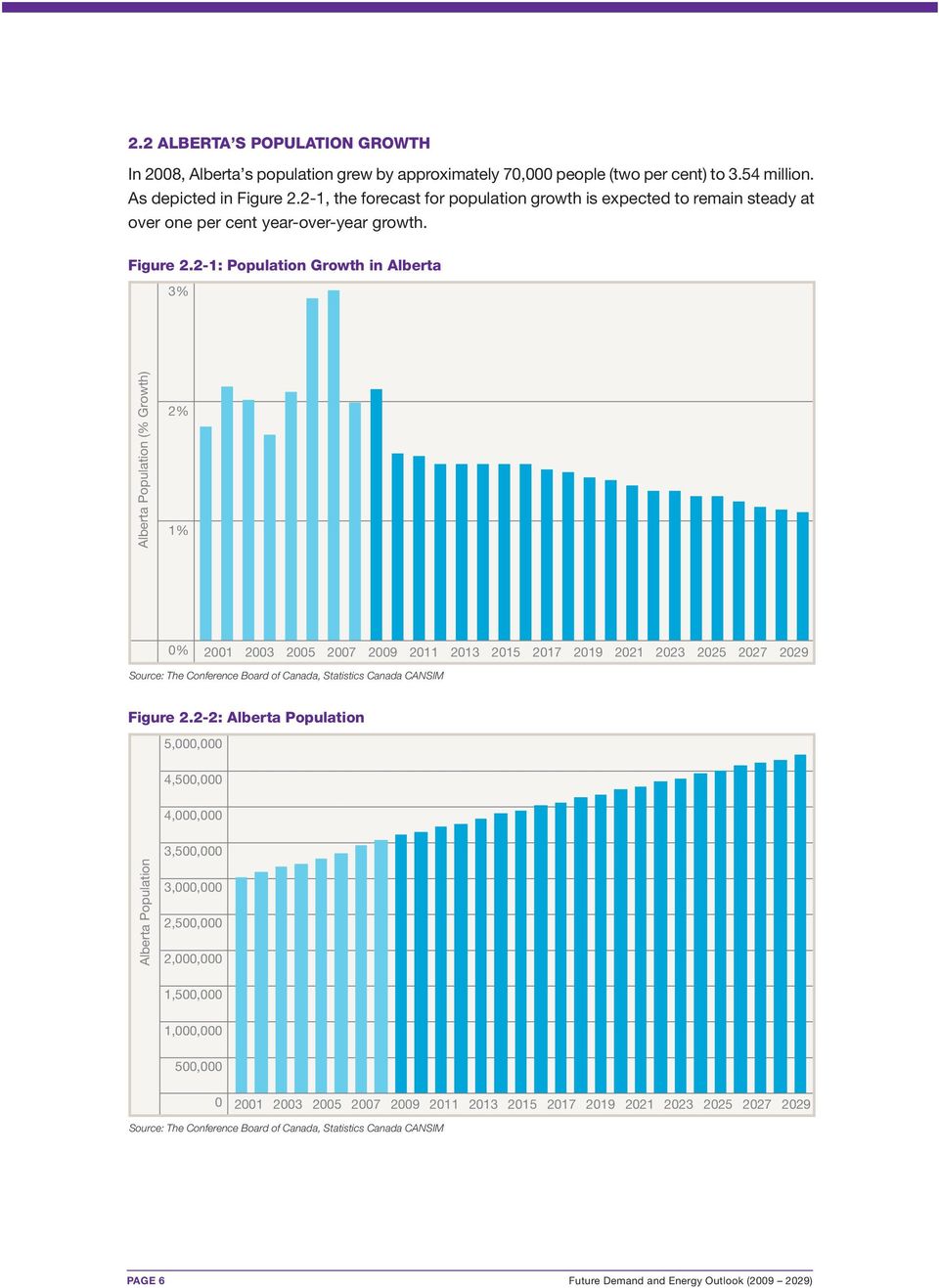
10 2.2 ALBERTA S POPULATION GROWTH In 2008, Alberta s population grew by approximately 70,000 people (two per cent) to 3.54 million. As depicted in Figure 2.2-1, the forecast for population growth is expected to remain steady at over one per cent year-over-year growth. Figure 2.2-1: Population Growth in Alberta 3% Alberta Population (% Growth) 2% 1% 0% Source: The Conference Board of Canada, Statistics Canada CANSIM Figure 2.2-2: Alberta Population 5,000,000 4,500,000 4,000,000 Alberta Population 3,500,000 3,000,000 2,500,000 2,000,000 1,500,000 1,000, , Source: The Conference Board of Canada, Statistics Canada CANSIM PAGE 6 Future Demand and Energy Outlook ( )
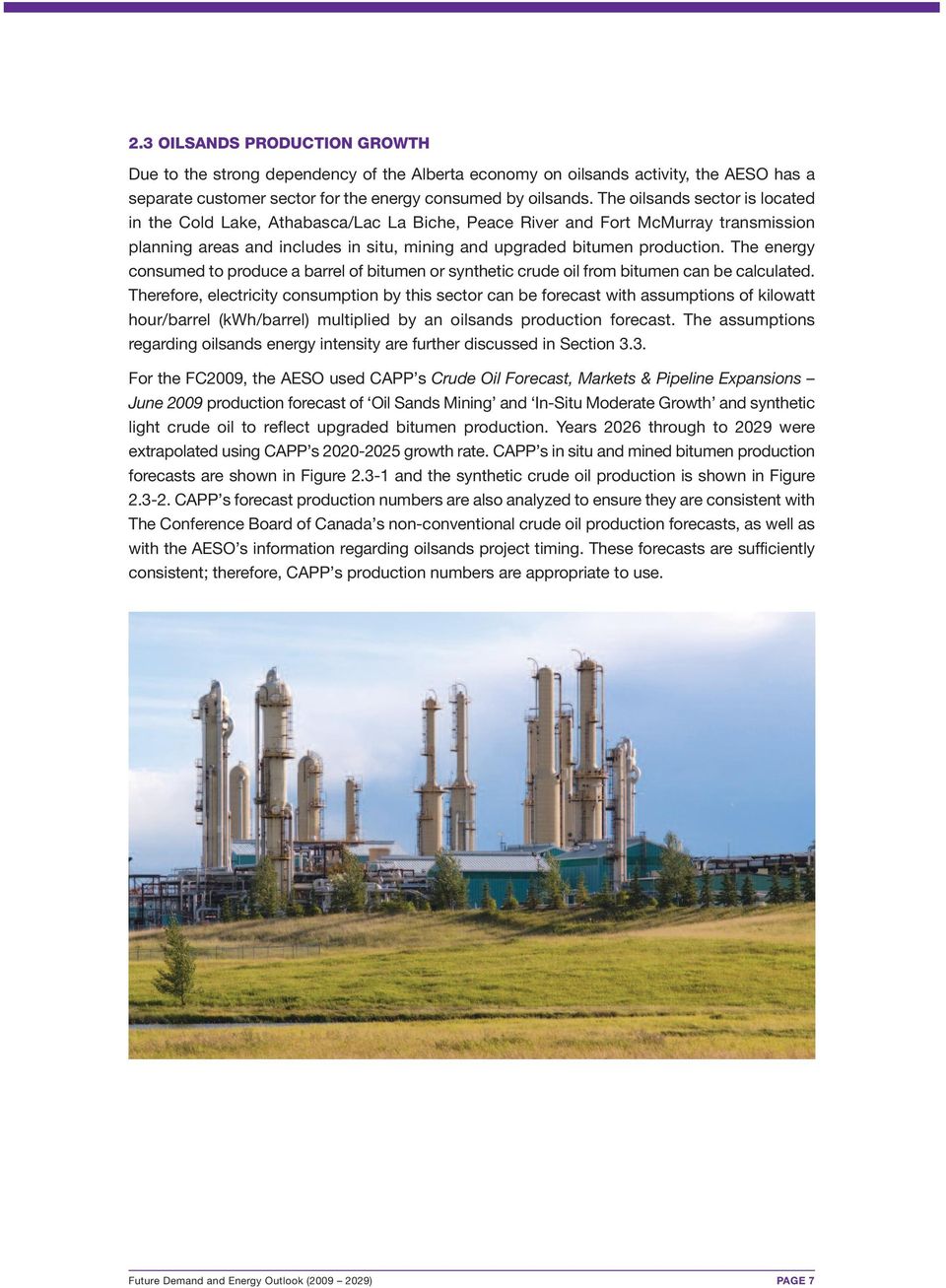
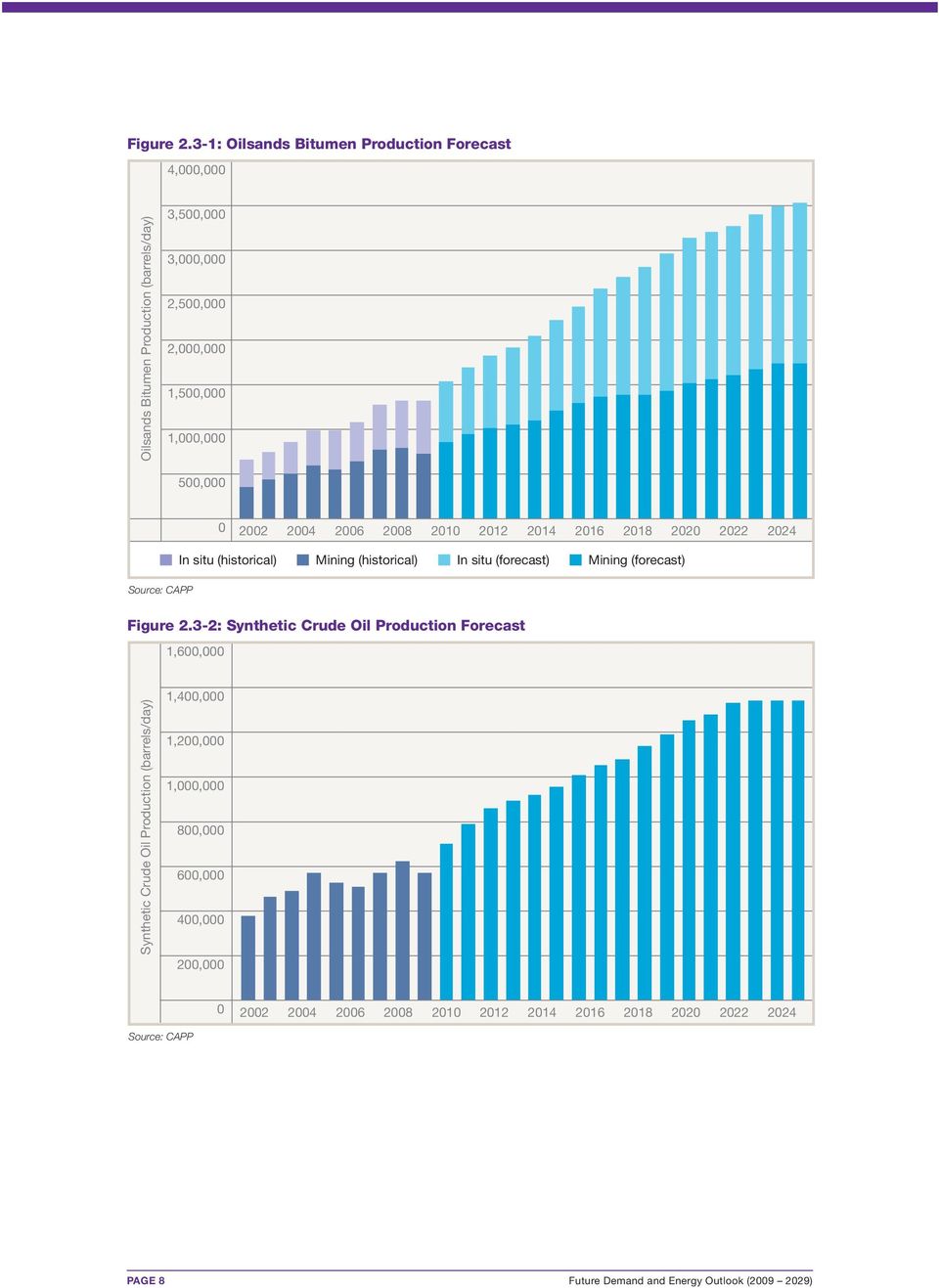
11 2.3 OILSANDS PRODUCTION GROWTH Due to the strong dependency of the Alberta economy on oilsands activity, the AESO has a separate customer sector for the energy consumed by oilsands. The oilsands sector is located in the Cold Lake, Athabasca/Lac La Biche, Peace River and Fort McMurray transmission planning areas and includes in situ, mining and upgraded bitumen production. The energy consumed to produce a barrel of bitumen or synthetic crude oil from bitumen can be calculated. Therefore, electricity consumption by this sector can be forecast with assumptions of kilowatt hour/barrel (kwh/barrel) multiplied by an oilsands production forecast. The assumptions regarding oilsands energy intensity are further discussed in Section 3.3. For the FC2009, the AESO used CAPP s Crude Oil Forecast, Markets & Pipeline Expansions June 2009 production forecast of Oil Sands Mining and In-Situ Moderate Growth and synthetic light crude oil to reflect upgraded bitumen production. Years 2026 through to 2029 were extrapolated using CAPP s growth rate. CAPP s in situ and mined bitumen production forecasts are shown in Figure and the synthetic crude oil production is shown in Figure CAPP s forecast production numbers are also analyzed to ensure they are consistent with The Conference Board of Canada s non-conventional crude oil production forecasts, as well as with the AESO s information regarding oilsands project timing. These forecasts are sufficiently consistent; therefore, CAPP s production numbers are appropriate to use. Future Demand and Energy Outlook ( ) PAGE 7
12 Figure 2.3-1: Oilsands Bitumen Production Forecast 4,000,000 Oilsands Bitumen Production (barrels/day) 3,500,000 3,000,000 2,500,000 2,000,000 1,500,000 1,000, , Source: CAPP In situ (historical) Mining (historical) In situ (forecast) Mining (forecast) Figure 2.3-2: Synthetic Crude Oil Production Forecast 1,600,000 Synthetic Crude Oil Production (barrels/day) 1,400,000 1,200,000 1,000, , , , , Source: CAPP PAGE 8 Future Demand and Energy Outlook ( )
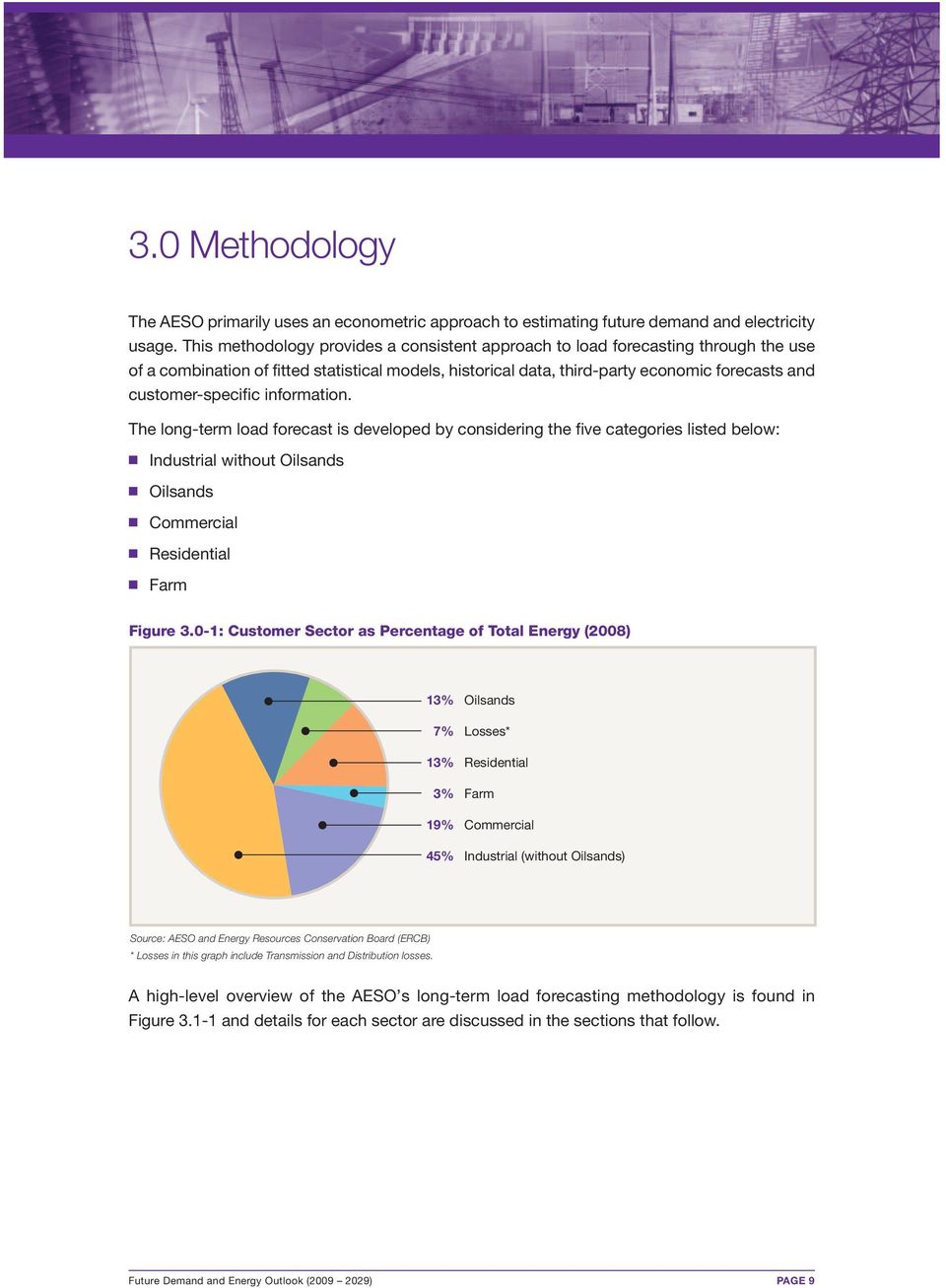
13 3.0 Methodology The AESO primarily uses an econometric approach to estimating future demand and electricity usage. This methodology provides a consistent approach to load forecasting through the use of a combination of fitted statistical models, historical data, third-party economic forecasts and customer-specific information. The long-term load forecast is developed by considering the five categories listed below: Industrial without Oilsands Oilsands Commercial Residential Farm Figure 3.0-1: Customer Sector as Percentage of Total Energy (2008) 13% Oilsands 7% Losses* 13% Residential 3% Farm 19% Commercial 45% Industrial (without Oilsands) Source: AESO and Energy Resources Conservation Board (ERCB) * Losses in this graph include Transmission and Distribution losses. A high-level overview of the AESO s long-term load forecasting methodology is found in Figure and details for each sector are discussed in the sections that follow. Future Demand and Energy Outlook ( ) PAGE 9
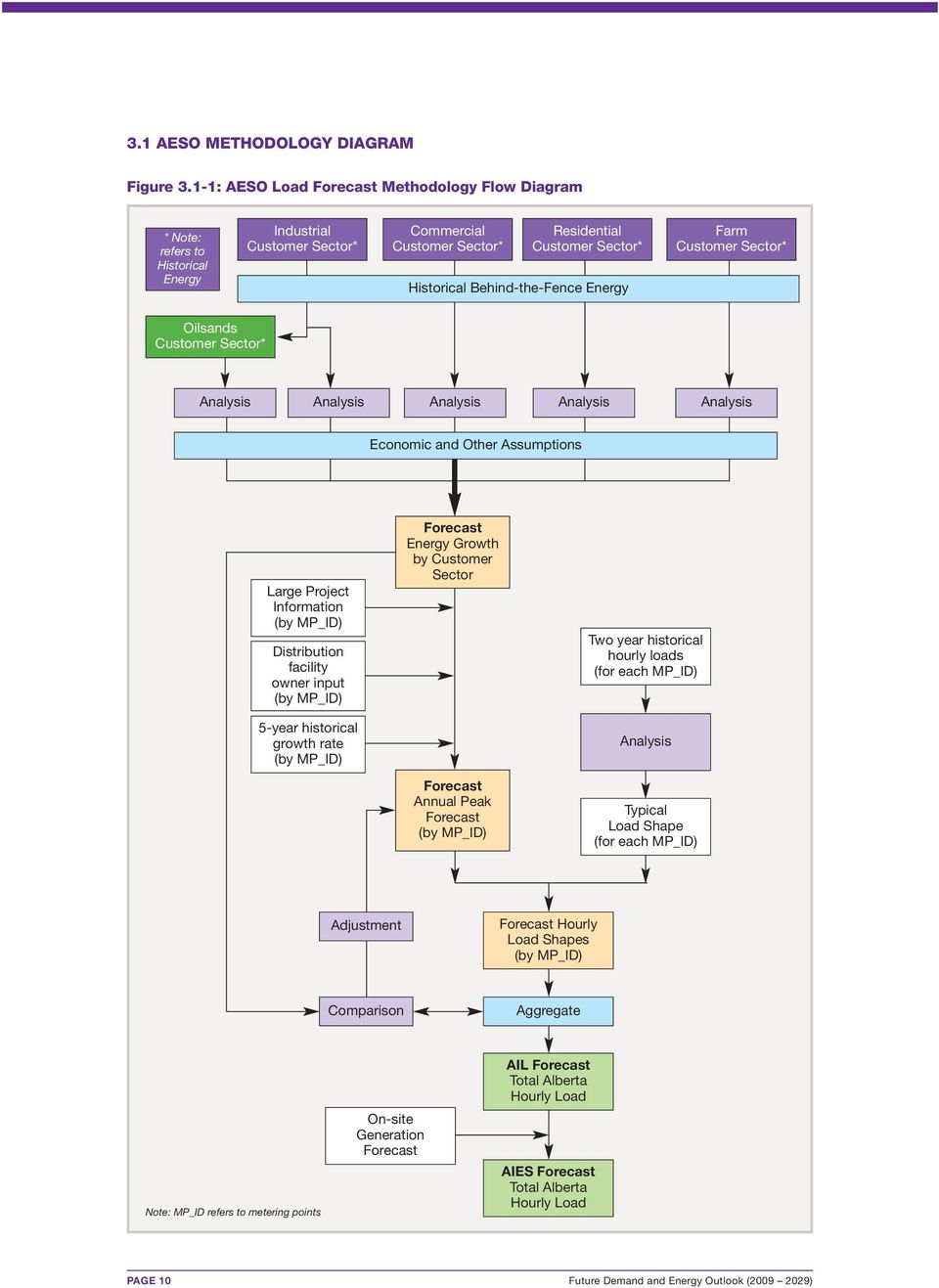
14 3.1 AESO METHODOLOGY DIAGRAM Figure 3.1-1: AESO Load Forecast Methodology Flow Diagram * Note: refers to Historical Energy Industrial Customer Sector* Commercial Customer Sector* Residential Customer Sector* Historical Behind-the-Fence Energy Farm Customer Sector* Oilsands Customer Sector* Analysis Analysis Analysis Analysis Analysis Economic and Other Assumptions Large Project Information (by MP_ID) Distribution facility owner input (by MP_ID) 5-year historical growth rate (by MP_ID) Forecast Energy Growth by Customer Sector Forecast Annual Peak Forecast (by MP_ID) Two year historical hourly loads (for each MP_ID) Analysis Typical Load Shape (for each MP_ID) Adjustment Forecast Hourly Load Shapes (by MP_ID) Comparison Aggregate Note: MP_ID refers to metering points On-site Generation Forecast AIL Forecast Total Alberta Hourly Load AIES Forecast Total Alberta Hourly Load PAGE 10 Future Demand and Energy Outlook ( )
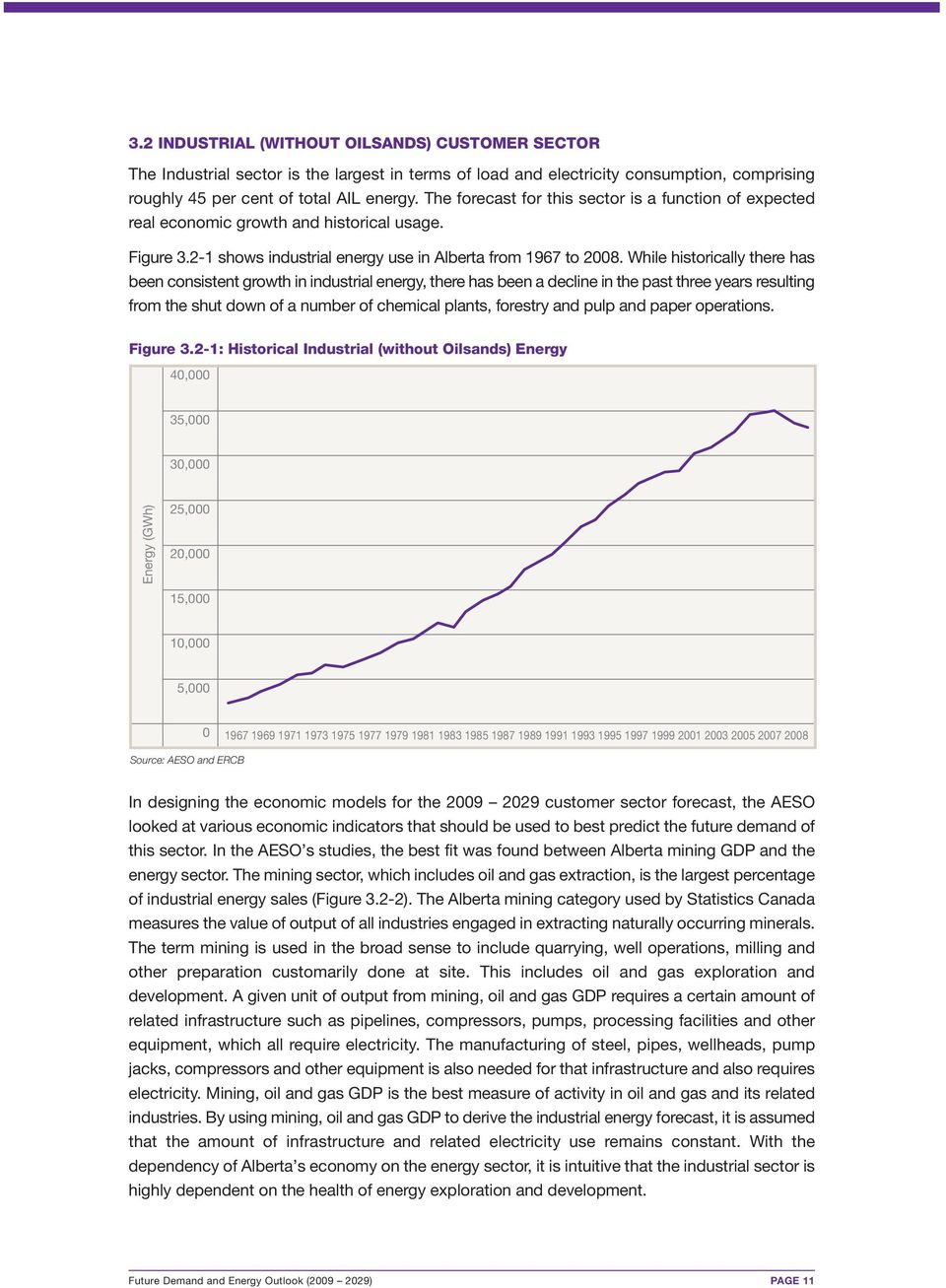
15 3.2 INDUSTRIAL (WITHOUT OILSANDS) CUSTOMER SECTOR The Industrial sector is the largest in terms of load and electricity consumption, comprising roughly 45 per cent of total AIL energy. The forecast for this sector is a function of expected real economic growth and historical usage. Figure shows industrial energy use in Alberta from 1967 to While historically there has been consistent growth in industrial energy, there has been a decline in the past three years resulting from the shut down of a number of chemical plants, forestry and pulp and paper operations. Figure 3.2-1: Historical Industrial (without Oilsands) Energy 40,000 35,000 30,000 Energy (GWh) 25,000 20,000 15,000 10,000 5, Source: AESO and ERCB In designing the economic models for the customer sector forecast, the AESO looked at various economic indicators that should be used to best predict the future demand of this sector. In the AESO s studies, the best fit was found between Alberta mining GDP and the energy sector. The mining sector, which includes oil and gas extraction, is the largest percentage of industrial energy sales (Figure 3.2-2). The Alberta mining category used by Statistics Canada measures the value of output of all industries engaged in extracting naturally occurring minerals. The term mining is used in the broad sense to include quarrying, well operations, milling and other preparation customarily done at site. This includes oil and gas exploration and development. A given unit of output from mining, oil and gas GDP requires a certain amount of related infrastructure such as pipelines, compressors, pumps, processing facilities and other equipment, which all require electricity. The manufacturing of steel, pipes, wellheads, pump jacks, compressors and other equipment is also needed for that infrastructure and also requires electricity. Mining, oil and gas GDP is the best measure of activity in oil and gas and its related industries. By using mining, oil and gas GDP to derive the industrial energy forecast, it is assumed that the amount of infrastructure and related electricity use remains constant. With the dependency of Alberta s economy on the energy sector, it is intuitive that the industrial sector is highly dependent on the health of energy exploration and development. Future Demand and Energy Outlook ( ) PAGE 11
16 Figure 3.2-2: Industrial End Use as Percentage of Total Industrial (2006) 7% Pulp and Paper 5% Petroleum Refining 15% Chemicals 9% Other* 64% Mining (including Oilsands, Oil and Gas extraction) Source: Natural Resources Canada * Other includes Cement, Forestry, Iron and Steel, Smelting and Refining, and Other Industries Regression analysis is used to determine the relationship of Alberta mining GDP to industrial (without oilsands) energy while controlling for other factors. Using this relationship and the Alberta mining GDP forecasts from The Conference Board of Canada, the AESO forecasts future industrial (without oilsands) energy growth. The results of this forecast are shown in Figures and Figure 3.2-3: Industrial (without Oilsands) Energy Intensity 1,200 1,000 MWh/Alberta Mining GDP $MM Historical FC2009 Source: AESO and ERCB PAGE 12 Future Demand and Energy Outlook ( )

17 Figure 3.2-4: Industrial (without Oilsands) Energy Forecast 70,000 60,000 50,000 Energy (GWh) 40,000 30,000 20,000 10, Historical FC2009 Source: AESO and ERCB As seen in Figure 3.2-4, the AESO is forecasting growth in industrial (without oilsands) energy after three years of decline. This historical decline can be largely attributed to the exit and reduced activities of a limited number of industrial firms in the province. This decline is discussed further in Section OILSANDS CUSTOMER SECTOR The oilsands sector is comprised of sites using mining and in situ extraction techniques to remove bitumen from the ground, as well as facilities that upgrade crude bitumen into synthetic crude oil. These sites make up approximately 13 per cent of total AIL energy. Each of these technologies uses different amounts of electricity to extract bitumen. Due to this, the AESO used an industry forecast of oilsands that includes a break out of these three extraction and upgrading technologies. No other large-scale extraction technologies are currently being utilized and, therefore, have not been incorporated into the forecast. The AESO estimated the average kwh/barrel required for in situ, mining, and upgraded operations using actual historical usage and are shown below in Table Table 3.3-1: Energy Intensities Operation Type kwh/barrel Mining 14.5 Upgrading 9.7 In situ 12.1 Source: AESO Future Demand and Energy Outlook ( ) PAGE 13

18 The oilsands energy intensities are combined with the forecast of oilsands and upgrading production from CAPP s June 2009 outlook to produce a forecast of oilsands electricity consumption. Figure 3.3-1: Oilsands Energy Intensity Electricity Intensity (kwh/barrel) Mining and Upgrading In situ Mining Upgrading Source: AESO and CAPP Note: historical data for Mining and Upgrading is combined. Figure 3.3-2: Oilsands Energy Forecast 25,000 20,000 Energy (GWh) 15,000 10,000 5, Mining and Upgrading Mining Upgrading In situ Source: AESO and CAPP Note: historical data for Mining and Upgrading is combined. PAGE 14 Future Demand and Energy Outlook ( )

19 3.4 COMMERCIAL CUSTOMER SECTOR The commercial sector is the second largest in terms of electricity consumption, accounting for roughly 19 per cent of total AIL energy. The forecast for this sector is a function of real economic growth and historical usage. Figure shows historical commercial energy use in Alberta from 1967 to The AESO s commercial energy forecast relies on the historical relationship between Alberta s economic activity and electricity energy (Figure 3.4-2), which are analyzed and, along with a forecast of Alberta s future economic growth, used to determine future electricity energy growth in this sector. Figure 3.4-1: Historical Commercial Energy Usage 16,000 14,000 12,000 Energy (GWh) 10,000 8,000 6,000 4,000 2, Source: AESO and ERCB Figure 3.4-2: Commercial Energy and Alberta GDP 16,000 Energy (GWh) 14,000 12,000 10,000 8,000 6, ,000 60,000 80, , , , , , ,000 Alberta GDP ($2002 millions) Source: AESO, ERCB and The Conference Board of Canada Future Demand and Energy Outlook ( ) PAGE 15

20 Figure 3.4-3: Commercial Energy Intensity MWh/$ Alberta GDP $MM Historical FC2009 Source: AESO and ERCB The FC2009 commercial energy forecast predicts a decline in commercial energy use in This is the result of expected declines in Alberta GDP in As Figure shows, historically there has been strong correlation between commercial energy use and GDP. The Conference Board of Canada is predicting negative GDP growth in Alberta in 2009, followed by a modest recovery in 2010 and strong GDP growth thereafter. This is reflected in the commercial energy forecast. Figure 3.4-4: Commercial Energy Forecast 25,000 20,000 Energy (GWh) 15,000 10,000 5, Historical FC2009 Source: AESO PAGE 16 Future Demand and Energy Outlook ( )

21 3.5 RESIDENTIAL CUSTOMER SECTOR The residential sector forecast is a function of population and disposable income per person, and is roughly 13 per cent of total AIL energy consumption. Figure shows historical residential energy. Figure 3.5-1: Historical Residential Energy Use 10,000 9,000 8,000 7,000 Energy (GWh) 6,000 5,000 4,000 3,000 2,000 1, Source: AESO and ERCB The AESO has assumed that residential energy use will change with population. Disposable income per person is also used as an input variable since it reflects residents ability to afford larger homes, which require more lighting, heating and cooling, electric appliances and electronics. Future Demand and Energy Outlook ( ) PAGE 17
22 Residential energy use per person is shown in Figure The historical trend of increasing usage per person is forecast to continue in the FC2009 residential energy forecast as seen in Figure Figure 3.5-2: Residential Energy Use Per Capita MWh/capita Historical FC2009 Source: AESO, ERCB, Statistics Canada CANSIM and The Conference Board of Canada Figure 3.5-3: Residential Energy Forecast 14,000 12,000 10,000 Energy (GWh) 8,000 6,000 4,000 2, Historical FC2009 Source: AESO PAGE 18 Future Demand and Energy Outlook ( )
23 3.6 FARM CUSTOMER SECTOR The farm sector is the smallest of all sectors analyzed by the AESO, and is roughly three per cent of total AIL energy. Farm energy is primarily used for irrigation purposes, and irrigation requirements depend on the amount of land used for agricultural purposes. Historical farm energy is shown in Figure Figure 3.6-1: Historical Farm Energy 2,000 1,800 1,600 1,400 Energy (GWh) 1,200 1, Source: AESO and ERCB Historical farm electricity consumption has not significantly changed since the mid 1990s and land used for agricultural purposes has not varied significantly (Figure 3.6-2). The AESO does not expect significant changes to farm energy use in its forecast. Therefore, the 10-year historical average annual energy use is used, which results in a slight decline in farm energy from Future Demand and Energy Outlook ( ) PAGE 19
24 Figure 3.6-2: Agricultural Land in Alberta 215, , ,000 (km 2 ) 200, , , , , Source: AESO and Statistics Canada Figure 3.6-3: Farm Energy Forecast 2,500 2,000 Energy (GWh) 1,500 1, Historical FC2009 Source: AESO and ERCB PAGE 20 Future Demand and Energy Outlook ( )
25 3.7 HISTORICAL GROWTH AND DECREASE IN 10 INDUSTRIAL SITES AIL energy use over the past five years grew at an annualized rate of 1.5 per cent. However, the AESO is forecasting energy growth to average 4.4 per cent annually over the period from 2009 to 2014 and 3.2 per cent over the period from 2009 to This difference in growth rates can be explained through a combination of factors. Over the past five years, Alberta has been characterized by strong economic growth as a result of a booming oil and gas industry caused by high commodity prices. However, as the oil and gas industry boomed, other industries in the province did not. Specifically, the pulp and paper, forestry, and chemical industries suffered due to higher costs and lower demand. All three industries faced higher labour and materials costs. The rapidly growing oil and gas industry created low unemployment in Alberta, causing upward pressure on wages, especially for skilled workers. Demand by the oil and gas industry for materials such as steel and cement also increased, resulting in higher costs for all industries. While costs rose, the pulp and paper, forestry, and chemical industries also faced decreased demand for their products. Demand for pulp and paper declined as a result of the decline of newsprint. Demand for Alberta forestry products has also declined since the U.S. housing market peaked in early 2006 and subsequently decreased. Demand for sodium chlorate, which is used to bleach pulp and paper, has also declined. Figure shows the combined electricity consumption of 10 industrial firms which operate or operated in Alberta in the forestry, pulp and paper, and chemical industries. These firms have either shut down or ramped down operations since 2005, resulting in decreased energy use. Analysis indicates they had decreased energy use by 2,375 GWh per year in 2008 compared to 2005 levels. This adjustment factor of 2,375 GWh could have increased AIL energy in 2008 by 3.4 per cent (see Table 6.1-2). Assuming this decrease of 2,375 GWh had not occurred between 2005 and 2008 by these 10 industrial firms, AIL energy would have had a five-year average annual growth rate of 2.9 per cent instead of 2.2 per cent. It is not possible to predict how or when a given firm may choose to shut down or ramp down operations. However, a recent rebound in pulp and paper prices and a recovering U.S. housing market, combined with an expected overall economic recovery, suggest it is less likely companies will shut down or ramp down operations in the foreseeable future. In addition, the small portion of pulp and paper, forestry, and chemical companies as a fraction of industrial energy use suggests there is minimal potential additional loss from further shut down or ramp down of these industries. Future Demand and Energy Outlook ( ) PAGE 21
26 Figure 3.7-1: Historical Energy of 10 Industrial Firms 9,000 8,500 8,000 7,500 2,375 GWh Energy (GWh) 7,000 6,500 6,000 5,500 5,000 4,500 4, Source: AESO Figure 3.7-2: Historical AIL Energy with Adjustment Factor 75,000 70,000 65,000 60,000 Energy (GWh) 55,000 50,000 45,000 40,000 35,000 30, Historical Actual Historical with Adjustment Factor Source: AESO Strong energy growth rates forecast by the AESO are reasonable in the context of historical growth rates. Figure shows the AIL historical and forecast energy growth rates. The 10-firm energy adjustment factor is also shown for comparison. The historical annual compounded growth rate with the 10-firm adjustment from 1995 to 2008 is 3.5 per cent compared with 3.2 per cent forecast from 2009 to PAGE 22 Future Demand and Energy Outlook ( )
27 Figure 3.7-3: Historical and Forecast AIL Energy Growth 10% 9% 8% AIL Energy (% Growth) 7% 6% 5% 4% 3% 2% 1% 0% Historical Growth FC2009 Adjustment Factor Growth Source: AESO The AESO s AIL forecast utilizes The Conference Board of Canada estimates of GDP and population. The Conference Board forecasts strong economic growth (Figure 3.7-4) being driven by investment and development in the oilsands. This strong growth and development is expected to translate into strong energy growth as oilsands operations ramp up and as supporting industries and growing population contribute to increased electricity use. Figure 3.7-4: Alberta GDP Growth Forecasts 7% 6% 5% Alberta GDP (% Growth) 4% 3% 2% 1% 0% -1% -2% -3% Historical 2007 Forecast 2008 Forecast 2009 Forecast Spring 2009 Update Source: AESO, The Conference Board of Canada Future Demand and Energy Outlook ( ) PAGE 23
28 4.0 Forecast Results This section provides detailed forecast results for the period from 2009 to 2029 for the Alberta internal load (AIL), Alberta Interconnected Electric System (AIES) and demand tariff service (DTS) energy. Table 4.0-1: Alberta Energy Sales to AIL Energy (GWh) Industrial without Sector Oilsands Oilsands Commercial Residential Farm Total 1 Losses 2 Other 3 AIL (GWh) (GWh) (GWh) (GWh) (GWh) (GWh) (GWh) (GWh) (GWh) ,064 5,938 11,100 7,560 1,775 57,436 5, , ,574 6,485 11,672 7,559 1,733 60,024 5, , ,982 6,695 12,081 7,769 1,705 61,232 4, , ,970 8,337 12,733 8,254 1,769 64,063 5, , ,922 8,529 13,114 8,539 1,806 63,909 5, , ,088 9,330 13,526 8,833 1,803 64,580 5, , ,025 9,945 13,146 8,981 1,756 64,853 5, , ,480 11,088 13,386 9,151 1,756 66,862 5, , ,581 11,932 14,026 9,369 1,756 69,664 5, , ,384 12,455 14,828 9,594 1,756 73,017 5, , ,741 13,159 15,548 9,808 1,756 77,013 5, , ,717 14,218 16,021 10,003 1,756 80,715 5, , ,841 15,103 16,465 10,204 1,756 84,368 5, , ,191 16,166 16,965 10,408 1,756 88,486 6, , ,128 16,892 17,403 10,606 1,756 91,786 6, , ,844 17,614 17,868 10,812 1,756 94,894 6, , ,217 18,487 18,288 11,016 1,756 97,765 6, , ,572 19,515 18,741 11,229 1, ,813 6, , ,880 19,940 19,202 11,447 1, ,225 7, , ,153 20,524 19,672 11,669 1, ,775 7, , ,393 21,164 20,160 11,896 1, ,368 7, , ,662 21,568 20,652 12,126 1, ,765 7, , ,950 21,765 21,149 12,359 1, ,980 7, , ,281 22,249 21,652 12,590 1, ,527 7, , ,605 22,743 22,164 12,826 1, ,094 8, , ,967 23,249 22,696 13,064 1, ,732 8, , ,326 23,767 23,234 13,310 1, ,393 8, ,746 Note: figures in colour denote actuals 1 Numbers may not add up due to rounding 2 Includes transmission and distribution losses 3 Other includes Fort Nelson (supplied by AIES) PAGE 24 Future Demand and Energy Outlook ( )
29 4.1 PROVINCIAL RESULTS AIL FORECAST AIL is the sum of all electricity sales (residential, commercial, industrial and farm), losses (both transmission and distribution) and behind-the-fence load (BTF). BTF is any industrial load that is characterized by being served in whole, or in part, by on-site generation. Tables through compare the growth in AIL demand and energy from the FC2009 with last year s forecast, the FC2008. In the last five years, AIL demand has grown by 1.5 per cent per year and AIL energy has grown by 2.2 per cent per year. For the next five years, average annual demand is forecast to grow by 4.4 per cent and energy is expected to grow by 4.4 per cent. The FC2009 shows an annual average growth rate of 3.3 per cent for AIL load and a growth rate for energy of 3.2 per cent for the period 2009 to Table 4.1-1: AIL Winter Peak Demand Table 4.1-2: AIL Summer Peak Demand FC2009 Forecast FC2009 Forecast FC2008 FC2009 Growth Differential FC2008 FC2009 Growth Differential (MW) (MW) (%) (MW) (MW) (MW) (%) (MW) 2003/04 8, , /05 9, , /06 9, , /07 9, , /08 9, , /09 9, , /10 10,202 9, ,685 9, /11 10,650 10, ,037 9, /12 11,217 10, ,487 9, /13 11,737 11, ,976 10, /14 12,357 11, ,559 10, /15 12,897 12, ,112 11, /16 13,401 12, ,651 12, /17 13,899 13, ,111 12, /18 14,290 13, ,554 13, /19 14,659 14, ,927 13, /20 15,117 14, ,293 13, /21 15,573 15, ,785 14, /22 15,987 15, ,197 14, /23 16,431 15, ,625 15, /24 16,860 16, ,039 15, /25 17,312 16, ,448 15, /26 17,798 17, ,905 16, /27 18,298 17, ,366 16, /28 18,781 17, ,812 16, /29 19,271 18, , ,262 17, , /30 19,810 18, , ,749 17, ,093 Note: figures in colour denote actuals Note: 2002 includes a redefinition of BTF load and an addition of approximately 400 MW Future Demand and Energy Outlook ( ) PAGE 25
30 Table 4.1-3: AIL Annual Energy Forecast FC2008 FC2009 FC2009 Differential Load (GWh) (GWh) Growth (%) (GWh) Factor (%) , , , , , , ,062 70, , ,727 72, , ,146 75, , ,485 78, , ,678 82, , ,106 86, , ,448 90, , ,487 95, , ,841 98, , , , , , , , , , , , , , , , , , , , , , , , , , , , , , , , , , , , , , Note: figures in colour denote actuals Note: 2002 includes a redefinition of BTF load and an addition of approximately 400 MW PAGE 26 Future Demand and Energy Outlook ( )
31 4.2 PROVINCIAL RESULTS AIES FORECAST WITH BEHIND-THE-FENCE (BTF) LOAD ESTIMATION The AESO forecasts the changes in the amount of on-site generation. To calculate AIES demand and energy, the AESO forecasts the amount of AIL served based on historical on-site generation plus any additions or deletions of on-site generation consistent with the AESO s interconnection queue as of September 19, The results from this work are presented in the following three tables. Table 4.2-1: AIES Winter Peak Demand Table 4.2-2: AIES Summer Peak Demand FC2009 Forecast FC2009 Forecast FC2008 FC2009 Growth Differential FC2008 FC2009 Growth Differential (MW) (MW) (%) (MW) (MW) (MW) (%) (MW) 2003/04 7, , /05 7, , /06 8, , /07 8, , /08 8, , /09 8, , /10 8,650 8, ,107 8, /11 8,994 8, ,437 7, /12 9,498 9, ,831 8, /13 9,943 9, ,241 8, /14 10,436 10, ,687 9, /15 10,866 10, ,113 9, /16 11,329 10, ,622 10, /17 11,780 11, ,048 10, /18 12,140 12, ,375 11, /19 12,493 12, ,699 11, /20 12,828 12, ,004 11, /21 13,213 13, ,396 12, /22 13,640 13, ,808 12, /23 14,095 14, ,235 13, /24 14,540 14, ,653 13, /25 14,981 14, ,057 13, /26 15,478 15, ,506 14, /27 15,977 15, ,969 14, /28 16,461 15, ,415 14, /29 16,951 16, ,866 15, /30 16, , Note: figures in colour denote actuals Future Demand and Energy Outlook ( ) PAGE 27
32 Table 4.2-3: AIES Annual Energy FC2009 Forecast FC2008 FC2009 Growth Differential Load (GWh) (GWh) (%) (GWh) Factor (%) , , , , , , ,105 58, , ,364 59, , ,368 61, , ,139 65, , ,648 68, , ,020 72, , ,833 75, , ,521 79, , ,293 83, , ,531 86, , ,809 89, , ,794 92, , ,722 94, , ,830 97, , ,009 99, , , , , , , , , , , , , , , , , , Note: figures in colour denote actuals PAGE 28 Future Demand and Energy Outlook ( )
33 4.3 PROVINCIAL RESULTS DEMAND TARIFF SERVICE (DTS) ENERGY The AESO forecasts the annual energy amounts served to DTS customers. This value is AIES minus transmission losses and Fort Nelson demand transmission service (FTS). The annual amounts from 2010 and beyond are shown in Table below. Table 4.3-1: DTS Annual Energy FC2009 FC2009 (GWh) Growth (%) , , , , , , , , , , , , , , , , , , , , FORECAST RESULTS FOR BULK PLANNING PURPOSES From a bulk transmission planning perspective, the AESO has defined five primary regions in Alberta. There are also two large urban centres: Calgary and Edmonton. Figure shows the forecast regional winter peaks for 2009, 2019 and 2029 and Figure shows the regional summer peaks for the same periods. In this case, the winter season is the period from November 1 to April 30 and the summer season is from May 1 to October 31. Strong growth in the Northeast, Calgary, and South Central regions is driven mainly by oilsands and upgrading production forecasts for the northeast, and by increasing pipeline demand from Hardisty south into the U.S. in the Calgary and South Central regions. Future Demand and Energy Outlook ( ) PAGE 29
34 Figure 4.4-1: Region Demand at Time of Winter AIL Peak Demand Northwest ,058 MW ,498 MW ,852 MW Northeast ,063 MW ,035 MW ,140 MW Edmonton & North Central ,147 MW ,916 MW ,630 MW Calgary & South Central ,354 MW ,741 MW ,136 MW Edmonton Only ,151 MW ,543 MW ,891 MW Calgary Only ,450 MW ,997 MW ,724 MW South (w/o Stavely) MW ,157 MW ,415 MW PAGE 30 Future Demand and Energy Outlook ( )
35 Figure 4.4-2: Region Demand at Time of Summer AIL Peak Demand Northwest MW ,398 MW ,699 MW Northeast ,934 MW ,663 MW ,773 MW Edmonton & North Central ,004 MW ,853 MW ,517 MW Calgary & South Central ,999 MW ,436 MW ,681 MW Edmonton Only ,186 MW ,581 MW ,933 MW Calgary Only ,381 MW ,999 MW ,701 MW South (w/o Stavely) MW ,235 MW ,494 MW Note: figures in colour denote actuals Future Demand and Energy Outlook ( ) PAGE 31
36 4.5 FORECAST RESULTS FOR REGIONAL PLANNING PURPOSES The Province of Alberta covers over 661,100 square kilometres. This represents approximately seven per cent of Canada s total land mass. Given the considerable size of the province, it is reasonable to expect the geography, economics and climate will vary from one region to another. This geographical diversity is apparent in the AESO s load forecast as seen in the tables that follow. Figure shows the province divided into areas. These areas can be added together to explore electric power needs unique to that particular region. For regional planning purposes, areas have been grouped to represent six regions: South, Calgary, Central, Edmonton, Northeast and Northwest. The following tables show regional peak demand coincident for both the summer and winter seasons. The FC2009 results are compared to the forecast numbers for 2014, 2019 and PAGE 32 Future Demand and Energy Outlook ( )
37 Figure 4.5-1: Grouping of Areas for Regional Planning Purposes 17 Rainbow Lake 18 High Level 25 Fort McMurray 19 Peace River 20 Grande Prairie 22 Grande Cache Region Names Calgary Central Edmonton 23 Valleyview 24 Fox Creek 29 Hinton/Edson Northeast Northwest South 34 Abraham Lake 21 High Prairie 26 Swan Hills 40 Wabamun 30 Drayton Valley 35 Red Deer 38 Caroline 39 Didsbury 44 Seebe 27 Athabasca/Lac La Biche 46 High River 33 Fort 60 Sask. Edmonton 31 Wetaskiwin 57 Airdrie 6 45 Calgary Strathmore/ Blackie 53 Fort MacLeod 49 Stavely 55 Glenwood 56 Vegreville 36 Alliance/Battle R. 54 Lethbridge 42 Hanna 47 Brooks 52 Vauxhall 28 Cold Lake 32 Wainwright 43 Sheerness 13 Lloydminster 37 Provost 48 Empress 4 Medicine Hat Future Demand and Energy Outlook ( ) PAGE 33
38 South Region The South region includes the Medicine Hat, Sheerness, Brooks, Empress, Stavely, Vauxhall, Fort MacLeod, Lethbridge and Glenwood planning areas. Table 4.5-1: Coincident Peak Demand (MW) for South Region Average Average Average FC2009 FC2009 Annual FC2009 Annual FC2009 Annual South Growth (%) 2019 Growth (%) 2029 Growth (%) Winter 924 1, , , Summer 1,004 1, , , Calgary Region Included in this region are the Calgary, Strathmore/Blackie, Seebe, High River and Airdrie planning areas. The ENMAX metering points as supplied by ENMAX also provide a forecast for the City of Calgary. Table 4.5-2: Coincident Peak Demand (MW) for Calgary Region Average Average Average FC2009 FC2009 Annual FC2009 Annual FC2009 Annual Calgary Growth (%) 2019 Growth (%) 2029 Growth (%) Winter Calgary Area 1,965 2, , , City of Calgary 1,440 1, , , (ENMAX) Summer Calgary Area 1,937 2, , , City of Calgary 1,462 1, , , (ENMAX) Central Region The Central region is considered to be between Edmonton and Calgary. Included are the Lloydminster, Hinton/Edson, Drayton Valley, Wainwright, Abraham Lake, Red Deer, Alliance/ Battle River, Provost, Caroline, Didsbury, Hanna and Vegreville planning areas. Table 4.5-3: Coincident Peak Demand (MW) for Central Region Average Average Average FC2009 FC2009 Annual FC2009 Annual FC2009 Annual Central Growth (%) 2019 Growth (%) 2029 Growth (%) Winter 1,598 1, , , Summer 1,438 1, , , PAGE 34 Future Demand and Energy Outlook ( )
39 Edmonton Region Acting as a transmission hub, the Edmonton region includes the Wetaskiwin, Fort Saskatchewan, Wabamun and Edmonton planning areas. The EPCOR metering points as supplied by EPCOR also provide a forecast for the City of Edmonton. Table 4.5-4: Coincident Peak Demand (MW) for Edmonton Region Average Average Average FC2009 FC2009 Annual FC2009 Annual FC2009 Annual Edmonton Growth (%) 2019 Growth (%) 2029 Growth (%) Winter Edmonton Area 2,461 2, , , City of Edmonton 1,199 1, , , (EPCOR) Summer Edmonton Area 2,457 2, , , City of Edmonton 1,203 1, , , (EPCOR) Northeast Region The Northeast region is forecast to experience the greatest demand and energy growth over the next 10 years. This is due in large part to the oilsands industry. The Northeast region includes the Fort McMurray, Athabasca/Lac La Biche and Cold Lake planning areas. Table 4.5-5: Coincident Peak Demand (MW) for Northeast Region Average Average Average FC2009 FC2009 Annual FC2009 Annual FC2009 Annual Northeast Growth (%) 2019 Growth (%) 2029 Growth (%) Winter 1,778 2, , , Summer 1,657 2, , , Northwest Region The Northwest region includes the Rainbow Lake, High Level, Peace River, Grande Prairie, High Prairie, Grand Cache, Valleyview, Fox Creek and Swan Hills planning areas. Table 4.5-6: Coincident Peak Demand (MW) for Northwest Region Average Average Average FC2009 FC2009 Annual FC2009 Annual FC2009 Annual Northwest Growth (%) 2019 Growth (%) 2029 Growth (%) Winter 1,100 1, , , Summer 1,059 1, , , Future Demand and Energy Outlook ( ) PAGE 35
40 5.0 Other Load Forecasting Considerations In addition to the uncertainty associated with economic and demographic variables, there are other significant challenges in developing a long-term load forecast for Alberta. Many of these are addressed implicitly by the AESO s load forecasting models. Although the factors discussed below are not explicitly included in the load forecasting models, they are examined by the AESO on a regular basis to inform the load forecasting process. 5.1 DEMAND RESPONSIVE LOAD AND CONSERVATION The potential impact of conservation and efficiency (that will drive or be driven by the advancement of new technologies), and demand responsive load programs represents an additional source of uncertainty and challenge for the AESO s load forecast. In general, these can be programs that encourage conservation and efficiency, or programs that allow consumers to respond to market signals and voluntarily reduce electricity consumption based on market prices. Another change affecting the forecast relates to the direction given by the system controller to facility owners during unexpected events such as supply shortfall in the form of operational policy and procedures. With such programs, there is potential to reduce or shift the timing of Alberta system peaks and energy requirements. Current Alberta market design relies primarily on price signals to provide consumer incentives for economically efficient electricity consumption and production decisions. Price responsive load has been seen primarily from industrial customers that have flexible production such that they can turn down operations and respond to high market prices. Depending on the market price, the amount of price responsive load has ranged from 175 to 300 MW. PAGE 36 Future Demand and Energy Outlook ( )
41 The AESO has implemented a combination of demand response programs to assist in managing or preventing emergency system operating conditions. These include: Voluntary load curtailment protocol (VLCP) a demand response program based on a pre-arranged contract. Demand opportunity service (DOS) an opportunity transmission service with regulated rates for each level of interruption (seven minutes and one hour). Frequency load shed service (FLSS) load shed instantaneously during system events. Supplemental operating reserves (SUP) Ancillary service available to arrest frequency decline but not required to respond directly to frequency deviations. This can be a load or generator service. The net impact of these programs is captured in the AESO s long-term load forecast modelling processes. The forecasting models, which are based upon historical values, reflect the historical effect of these programs. As a result, forecasted energy and peak demand values implicitly include the effect of demand response programs. There is a major emphasis on energy efficiency and conservation programs in various North American jurisdictions, which are encompassed by the term demand side management (DSM). DSM generally refers to activities that occur on the demand side of the meter, and are implemented by the customer directly or by load serving entities. DSM initiatives are aimed at achieving energy savings as a result of conservation, energy efficiency and load displacement programs. A substantial portion of these energy savings has resulted from appliance and building standards. Another major portion of savings are utility programs mandated by governments and regulators, including efficiency services in the form of energy audits, financial incentive, load-shifting activities and rate design. Several jurisdictions are implementing very aggressive DSM programs including California, the U.S. Pacific Northwest and B.C. For example, BC Hydro is required to acquire 50 per cent of its incremental resource needs through conservation (DSM) by The approach adopted to load forecasting in these jurisdictions typically involves a detailed assessment of the impact of DSM programs and price effects on electricity demand. These analytical requirements characteristically necessitate an extremely detailed end-use approach to demand forecasting. To date, load-serving entities or retailers in Alberta have not developed price responsive, efficiency or conservation programs in the same way as other jurisdictions, especially those that rely on the traditional integrated utility model. Consequently, reduction in demand opportunities from this sector to date have been negligible. The potential impacts of demand response and DSM-type programs are not explicitly included in the AESO s load-forecasting models, given that such programs are not widespread and future programs are unknown at this time. The AESO will continue to evaluate appropriate programs related to DSM. Future Demand and Energy Outlook ( ) PAGE 37
42 5.2 COMPOSITION OF LOAD Industrial load represents a very high percentage of total load in Alberta. This can be expected to contribute to future uncertainty in the load forecast. Unlike the residential and commercial sectors, where electricity use is relatively similar in different houses or buildings, industrial use of electricity is diverse. It is difficult to generalize about the uses of electricity in a typical industrial plant. Electricity consumption per site is greater in this sector than other sectors. Alberta s industrial electricity consumption is tied closely to economic activity and world oil and gas market conditions. Beyond the general risk of higher or lower than expected economic growth materializing, a significant risk to the industrial load forecast pertains to discrete one-time, unforeseen changes in load that are the result of corporate decisions that impact the opening, timing, restarting or closing of major facilities. The oilsands industry in particular, which drives behind-the-fence (BTF) load in Alberta, is very dynamic. These projects have unique attributes in terms of the size, cost, location, labour and electricity requirements. Since oilsands producers are expected to behave differently than the rest of the industrial sector, they are a potential source of uncertainty in the long-term load forecast. This includes the development of specific major oilsands projects, which have announced on-site generation, and projects that are likely to do so. Given the many options available to developers, the volatility of oil prices, and the variability of labour and material costs for constructing new projects, load growth in the oilsands industry is not expected to occur in a smooth, easily predictable manner. PAGE 38 Future Demand and Energy Outlook ( )
43 5.3 DISTRIBUTED GENERATION Distributed generation involves the installation of small-scale power sources at or near a customer s site to provide an alternative to, or an enhancement of, the traditional electric power system. For generation smaller than 150 kw, modelling and forecasting of this generation and the load that it offsets is not specifically tracked. Advanced Metering Infrastructure (AMI) and smart grid could facilitate specific tracking of micro and other generation. It is assumed that the impact of any potential drop in load caused by distributed generation will be captured through trends seen in the econometric modelling of electricity consumption by sector. Major shifts can be addressed as they are identified. 5.4 ENVIRONMENTAL COSTS The costs of meeting environmental requirements are expected to rise across North America, particularly for large greenhouse gas (GHG) emitters. While this may have an impact on the in-service dates for some oilsands and upgrader projects, at this time there is no basis for assuming these costs will significantly slow expansion in Alberta s energy producing sectors. Because it is unlikely that reduction in GHG emissions will occur without cost, future climate control policy is a risk of uncertain magnitude and timing to the load forecast. Load forecasting models used in other jurisdictions generally tend to use a fuel carbon content tax as a proxy for the cost of mandated GHG reductions, whatever the means of implementation. It can be expected that any costs associated with meeting environmental requirements for electricity generation facilities in the future will ultimately be reflected in electricity prices. As previously discussed, the AESO s load-forecasting models do not explicitly include the influence of electricity prices on electricity demand. However, any changes in demand patterns are captured through the modelling process that accounts for historic trends that capture various econometric drivers. Future Demand and Energy Outlook ( ) PAGE 39
44 5.5 CHALLENGES ON THE HORIZON This year a number of future challenges have been identified: New DSM initiatives, including demand response programs. New technology with different electricity intensities. New environmental regulations around GHG. New vehicle technology, including plug-in electric cars. Each of these challenges will be explored in the coming year to determine their significance with respect to the fundamental relationships that form the basis of the AESO s Future Demand and Energy Outlook ( ). PAGE 40 Future Demand and Energy Outlook ( )
45 6.0 Historical and Past Forecast Results In the process of preparing the long-term load forecast, the AESO assesses past forecasts along with Alberta s actual demand and electricity usage to verify methodology and identify variances that could impact the current forecast. 6.1 PAST FORECAST VARIANCES Table 6.1-1: Energy Forecast Variance History Actuals Year-over- FC2005 FC2006 FC2007 FC2008 Year (GWh) Year Change (%) (%) (%) (%) , , , , (FC2009) As noted in Section 3.7, a reduction in demand at 10 industrial sites contributed to a reduction in energy growth in the province at the same time as strong growth in the oilsands and a strong economy created energy growth in other customer sectors and industries. To quantify the effect this drop in electricity consumption has had on energy growth, the AESO adjusted historical energy values by adding an Adjustment Factor equal to the difference between the sum of energy at these sites in 2005 minus the sum of energy at these sites in each historical year. The year 2005 was used as a representative year in this analysis to calculate a baseline. The results are shown in Table Future Demand and Energy Outlook ( ) PAGE 41
46 Table 6.1-2: Historical Energy with Adjustments for 10 Industrial Sites Reduction in Load 5-year Adjusted Adjustment Adjustment Adjustment Actuals Factor Year over Average Year (GWh) (GWh) Year Growth (%) Growth (%) , , , , ,383 +1, ,322 +2, Table examines the variance between actual peak demand and forecast peak demand. The winter peak demand in 2005/06 and 2009/10 was higher than forecast, while the winter peak demand for both 2006/07 and 2007/08 was lower than forecast. Table 6.1-3: Peak Forecast Variance History Year-over- Season- Actuals Year over- FC2005 FC2006 FC2007 FC2008 Year/Season (MW) Change Season (%) (%) (%) (%) 2005/06 Winter 9, Summer 9, /07 Winter 9, Summer 9, /08 Winter 9, Summer 9, /09 Winter 9, Summer 9, /010 YTD Winter 10, , PAGE 42 Future Demand and Energy Outlook ( )
47 Appendix A: Confidence Band Intervals for the Future Demand and Energy Outlook ( ) Executive Summary This appendix describes the methodology and results of constructing confidence band intervals around the Alberta electric system s long-term load forecast, as laid out in Future Demand and Energy Outlook ( ) (FC2009). The FC2009 is the Alberta Electric System Operator s (AESO) long-term load forecast. The FC2009 describes the assumptions, methodology, and processes that the AESO uses to assess Alberta s most likely future demand and energy requirements. The FC2009 includes a 20-year peak demand and electricity consumption forecast for Alberta. The load forecast is generated from economic growth (GDP), oilsands production forecasts and population projections by select customer sectors in conjunction with regional adjustments based on historical results and customer-driven growth expectations. The report shows confidence intervals on a sector-by-sector basis at the 80 per cent (P10 to P90) and 95 per cent (P2.5 to P97.5) confidence levels. The confidence intervals are derived using a Monte Carlo simulation model where inputs into the forecasting model are varied according to a predetermined probability distribution multiple times. Output from the model is then analyzed for statistical properties. The results of the Monte Carlo approach show P10/90 low/high peak demand values of 13,510 MW (-8.5 per cent) and 16,133 MW (+9.3 per cent) respectively by 2019, as compared to the most likely forecast of 14,759 MW. The results for 2029 show a wider spread for the P10/P90 of 17,001 MW (-9.1 per cent) and 20,560 MW (+10.0 per cent) respectively as compared to the most likely forecast of 18,695 MW. Future Demand and Energy Outlook ( ) PAGE 43
48 1.0 Introduction The AESO s long-term load forecast is a study of past energy use patterns and future economic indicators that are combined to produce a future energy forecast. The AESO annually updates this energy forecast with a 20-year outlook of Alberta s electric consumption and peak demand. The estimates of future electricity market needs are one of the drivers the AESO uses in analyzing and planning the timely development of the transmission system. The annual forecast is based on economic, demographic and customer information collected from January through June of The FC2009 describes the assumptions, methodology and processes that the AESO employs to assess Alberta s most likely future demand and energy requirements. Along with its long-term load forecast, the AESO requires high and low confidence bands that reflect a reasonable expected range of the forecast. Potential sources of error exist with any forecast and it is important to recognize and attempt to measure the potential effect that any error may have on the forecast. The assumptions used and the underlying methodology of forecasting are explained to justify why the confidence bands represent a relatively likely forecast. Forecasts cannot precisely predict the future. Variation in the key factors that drive electrical usage may deviate actual demand from forecast demand in any given year. To account for this, the AESO reports its energy and demand forecast as a baseline or most likely outcome, as well as a range of possible outcomes based on probabilities around the base case. For planning and analytical purposes, it is useful to have an estimate not only of the most likely case but also of the distribution of probabilities around the forecast. The AESO developed upper and lower confidence bands around the 2009 load forecast for each sector. The P2.5/P97.5 confidence band corresponds to a 95 per cent confidence interval. This means there is a 95 per cent chance that the actual energy demand will fall within this interval and there is a five per cent chance actual demand will fall outside this interval. Similarly, the P10/P90 confidence band corresponds to an 80 per cent confidence interval for which there is an 80 per cent chance that the forecast will fall within its bands. A Monte Carlo simulation method was used to calculate confidence band intervals for each sector as well as for total Alberta internal load (AIL) and peak demand. Monte Carlo simulations vary the inputs into the forecasting models according to a calculated probability distribution based on historical data. Output results from the model are then analyzed for their statistical properties to determine the confidence intervals. This method of determining confidence bands has the advantage of varying all the factors that affect electricity use and demand according to their historical tendencies multiple times so actual variation in the forecast can be measured and analyzed. PAGE 44 Future Demand and Energy Outlook ( )
49 2.0 Monte Carlo Analysis Monte Carlo simulations were performed individually on all five sector models as well as on an aggregated model, which combines all the sectors together. Within the models there are econometrically forecasted coefficients as well as externally-forecast values of input variables. All variables are allowed to vary according to defined probability distributions that are based on historical data wherever possible. It should be noted that in many instances historical data was not available, or was not adequate to produce a reasonable probability distribution estimate. In these instances, the AESO formulated its own estimate of probability distribution using the forecast values plus a reasonable assessment of potential variation for those forecast values. Future Demand and Energy Outlook ( ) PAGE 45
50 2.1 INDUSTRIAL (WITHOUT OILSANDS) CUSTOMER SECTOR The industrial sector is the largest sector in terms of electricity consumption, comprising roughly 45 per cent of total AIL energy. The forecast for this sector is a function of real economic growth and historical usage. The industrial forecast was completed using an Ordinary Least Squares (OLS) econometric regression, which included Alberta mining, oil and gas GDP, previous industrial sales and control variables. The inputs into the industrial (without oilsands) model consist of the estimated coefficients from the econometric regression plus The Conference Board of Canada s mining, oil and gas GDP forecast. A normal distribution was assumed for both the regression coefficients and the growth rates of the GDP forecast in each year. There are 26 total input variables that received a probability distribution. A random sample from each of those 26 probability distributions was put into the model to calculate the corresponding forecast value. This process was repeated 100,000 times providing 100,000 forecast values for each year of the forecast. Using these values, the 80 per cent and 95 per cent forecast confidence band intervals were calculated. These values are shown in Figure Figure 2.1-1: Industrial (without Oilsands) Sector Confidence Intervals 90,000 80,000 70,000 60,000 Energy (GWh) 50,000 40,000 30,000 20,000 10, FC2009 P2.5 P97.5 P10 P90 Source: AESO and ERCB PAGE 46 Future Demand and Energy Outlook ( )
51 2.2 OILSANDS CUSTOMER SECTOR The oilsands model has several variable inputs. Production from the oilsands is broken into mining, in situ and upgraded bitumen production. Using historical data, estimates are made on the energy intensity of the three production types. Production estimates for each production type are then combined with the estimated energy intensity to produce an oilsands forecast. As outlined in the FC2009, the oilsands production estimates up to 2025 are based on the Canadian Association of Petroleum Producers (CAPP) moderate growth oilsands production forecast. Thereafter, the AESO estimates of growth are used. Probability distributions are estimated for the growth of each year with mean equal to the forecast growth rate. The AESO estimates the energy intensities of the three oilsands production types. However, it is unknown how these intensities may change over time. Therefore, the energy intensities are permitted to vary using a normal probability distribution that allows both increases and decreases in energy intensity. This allows the confidence bands to incorporate the possibility that energy intensity of mining, in situ or bitumen upgrading may independently increase or decrease over time. 100,000 random samples were taken from each probability distribution of each input variable and put into the model to calculate the corresponding forecast values, which were used to calculate the confidence intervals. Figure shows the calculated 80 per cent and 95 per cent confidence band intervals. Figure 2.2-1: Oilsands Sector Confidence Intervals 35,000 30,000 25,000 Energy (GWh) 20,000 15,000 10,000 5, FC2008 P2.5 P97.5 P10 P90 Source: AESO and ERCB Future Demand and Energy Outlook ( ) PAGE 47
52 2.3 COMMERCIAL CUSTOMER SECTOR The commercial sector represents approximately 19 per cent of total energy in Alberta. The commercial sector forecast assumes commercial energy use is a function of Alberta s economic growth and historical commercial sales. Commercial electricity consumption is forecast by the AESO using an econometric regression, which includes Alberta GDP, historical commercial sales and control variables. The Conference Board of Canada s forecast of Alberta GDP is also used as an input. For the Monte Carlo simulation, the regression coefficients are assumed to be normally distributed. The annual GDP growth rates are also assumed to have a normal distribution with the mean centered on the forecast values. The standard deviation used is calculated from historical values. Similar to the other sectors, 100,000 samples are taken from each input s distribution, which are put through the model and used to calculate the forecast confidence intervals. These calculated confidence intervals are displayed in Figure Figure 2.3-1: Commercial Sector Confidence Intervals 30,000 25,000 Energy (GWh) 20,000 15,000 10,000 5, FC2009 P2.5 P97.5 P10 P90 Source: AESO and ERCB PAGE 48 Future Demand and Energy Outlook ( )
53 2.4 RESIDENTIAL CUSTOMER SECTOR Residential energy use represents approximately 13 per cent of AIL energy. As outlined in the FC2009, the residential model is an econometric regression combined with The Conference Board of Canada s growth forecasts of population and disposable income per person. The coefficients of the regression are assumed to be normal for the Monte Carlo simulation. Population and disposable income per person growth rates are also assumed to be normally distributed and are based on historical trends. In a similar fashion to the other sectors, a Monte Carlo simulation of the residential forecast was used to estimate confidence band intervals at 80 per cent and 95 per cent. These estimates are shown in Figure Figure 2.4-1: Residential Sector Confidence Intervals 17,000 15,000 13,000 Energy (GWh) 11,000 9,000 7,000 5, FC2009 P2.5 P97.5 P10 P90 Source: AESO and ERCB Future Demand and Energy Outlook ( ) PAGE 49
54 2.5 FARM CUSTOMER SECTOR The farm sector is the smallest of the forecast sectors, representing approximately three per cent of total AIL energy. As outlined in the FC2009, no growth is forecast from the farm sector over the next 20 years. However, based on historical recorded values and variance, a normal growth rate probability distribution was applied to farm sales for the Monte Carlo simulation, which allows for yearly variation as well as the possibility of technological change to agricultural and irrigation techniques. Repeatedly taking samples from the growth rate probability distribution allowed the construction of the farm forecast confidence intervals, which are shown in Figure Figure 2.5-1: Farm Sector Confidence Intervals 3,000 2,500 2,000 Energy (GWh) 1,500 1, FC2009 P2.5 P97.5 P10 P90 Source: AESO and ERCB PAGE 50 Future Demand and Energy Outlook ( )
55 3.0 Total Energy and Peak Demand Total provincial energy use and peak demand were also calculated using the Monte Carlo simulation, which took inputs from each sector and combined them in a comprehensive model to produce a total energy forecast. This total energy forecast was converted into peak demand using the FC2009 load factor estimate, which was also varied using historical trends. 3.1 MONTE CARLO RESULTS For the Monte Carlo simulation, the five sector models were combined into one model to calculate total AIL energy as well as the corresponding peak demand. The transmission and distribution losses were each permitted to vary based upon historical fluctuations in losses as a percentage of sector energy. The Other category was not varied as part of the Monte Carlo simulation. The forecast values remain calculated in the same way. However, the input variables of all five models are permitted to vary simultaneously according to the distributions outlined in Section 2.0. By varying all sector inputs simultaneously, the confidence bands for total AIL peak demand and energy are dependent on the variation of all inputs. The calculated AIL confidence bands and their corresponding peak demand and energy confidence intervals are displayed in Figures and Figure 3.1-1: AIL Energy Confidence Intervals 160, , ,000 Energy (GWh) 100,000 80,000 60,000 40, FC2009 P2.5 P97.5 P10 P90 Source: AESO and ERCB Future Demand and Energy Outlook ( ) PAGE 51
56 Figure 3.1-2: AIL Winter Peak Demand Confidence Intervals 24,000 22,000 20,000 Peak Demand (MW) 18,000 16,000 14,000 12,000 10,000 8,000 6, FC2009 P2.5 P97.5 P10 P90 Source: AESO and ERCB Tables and report the confidence interval results from the Monte Carlo simulation on AIL energy and peak demand respectively. The results of the Monte Carlo approach show P10/90 low/high peak demand values of 13,510 MW (-8.5 per cent) and 16,133 MW (+9.3 per cent) respectively by 2019 as compared to the most likely forecast of 14,759 MW. The results for 2029 show a wider spread for the P10/P90 of 17,001 MW (-9.1 per cent) and 20,560 MW (+10.0 per cent) respectively as compared to the most likely forecast of 18,695 MW. PAGE 52 Future Demand and Energy Outlook ( )
57 Additional analysis indicates that by 2029, the largest source of variation in the AIL energy forecast will come from the industrial sector. Specifically, the coefficient on the mining, oil and gas GDP contributes most to overall variation. While statistically significant, the coefficient had a relatively high standard error resulting both from fairly low degrees of freedom (because of a relatively low number of annual observations) and from a recent historical divergence of industrial energy use and mining, oil and gas GDP. As discussed in the FC2009, the decrease in industrial energy use resulted from the exit and decrease in activity of several non-oil and gas-related firms that are not part of mining, oil and gas GDP. Going forward, it is expected that industrial energy use will continue to increase with mining, oil and gas GDP since the majority of industrial energy use is by the oil and gas sector. However, because of the recent industrial decline, certainty surrounding the coefficient on mining, oil and gas GDP is less assured. This creates additional variation in the industrial (without oilsands) sector confidence bands. Since the industrial (without oilsands) sector is the largest component of AIL energy, it also creates the largest source of variation in the total AIL energy forecast confidence bands. Given the difficulty to predict the exit or decrease in activity of industrial firms, this higher variation seen in the industrial sector seems appropriate. Future Demand and Energy Outlook ( ) PAGE 53
58 Table 3.1-1: AIL Energy Confidence Intervals FC2009 P97.5 P90 P10 P2.5 (GWh) (GWh) (GWh) (GWh) (GWh) ,184 74,391 72,903 67,426 66, ,459 78,845 76,573 68,466 66, ,312 83,270 80,438 70,451 67, ,963 88,164 84,866 73,416 70, ,877 93,101 89,459 76,738 73, ,965 98,221 94,160 80,289 76, , ,019 98,638 83,779 80, , , ,556 87,740 83, , , ,593 90,867 86, , , ,369 93,831 89, , , ,887 96,640 92, , , ,598 99,619 95, , , , ,866 97, , , , ,264 99, , , , , , , , , , , , , , , , , , , , , , , , , , , , , , , , , , , ,096 PAGE 54 Future Demand and Energy Outlook ( )
59 Table 3.1-2: AIL Winter Peak Demand Confidence Intervals FC2009 P97.5 P90 P10 P2.5 MW MW MW MW MW 2009/10 9,846 10,519 10,284 9,422 9, /11 10,170 11,124 10,788 9,579 9, /12 10,577 11,746 11,328 9,866 9, /13 11,076 12,418 11,938 10,270 9, /14 11,664 13,155 12,620 10,776 10, /15 12,162 13,782 13,200 11,201 10, /16 12,801 14,553 13,923 11,774 11, /17 13,382 15,254 14,576 12,288 11, /18 13,856 15,828 15,113 12,704 12, /19 14,351 16,419 15,671 13,146 12, /20 14,759 16,923 16,133 13,510 12, /21 15,162 17,394 16,590 13,872 13, /22 15,618 17,944 17,098 14,271 13, /23 15,994 18,397 17,520 14,607 13, /24 16,369 18,838 17,942 14,943 14, /25 16,725 19,254 18,341 15,259 14, /26 17,114 19,741 18,782 15,600 14, /27 17,505 20,203 19,221 15,957 15, /28 17,855 20,638 19,608 16,257 15, /29 18,196 21,032 19,999 16,561 15, /30 18,695 21,625 20,560 17,001 16,156 Future Demand and Energy Outlook ( ) PAGE 55
60 List of Reference Documents Alberta Employment, Immigration, and Industry (December 2008) Monthly Economic Review Energy Resources and Conservation Board Alberta s Energy Reserves 2009 and Supply/Demand Outlook (ST ) Energy Resources and Conservation Board Table 11: Electric Energy Distribution Sales and Number of Customers Canadian Association of Petroleum Producers (June 2009) Crude Oil Forecast, Markets and Pipeline Expansions The Conference Board of Canada (2009) Provincial Outlook Long-term Economic Forecast: 2009 The Conference Board of Canada (2009) Provincial Outlook Spring 2009 National Energy Board (June 2006) Canada s Oil Sands Opportunities and Challenges to 2015: An Update. (Review only) Statistics Canada (December 2008) Retail Sales by Industry (monthly) Statistics Canada (March 2009) Alberta Gross Domestic Product at Basic Prices by Industry (annual) Statistics Canada (March 2009) Alberta Population (annual) PAGE 56 Future Demand and Energy Outlook ( )
61 Glossary Alberta Interconnected Electric System (AIES): the system of interconnected transmission power lines and generators. Alberta internal load (AIL): the total electricity consumption including behind-the-fence, the City of Medicine Hat and losses (transmission and distribution). Behind-the-fence load (BTF): industrial load characterized by being served in whole, or in part, by on-site generation. Bulk transmission system: the integrated system of transmission lines and substations that delivers electric power from major generating stations to load centers. The bulk system, which generally includes the 240 kv and 500 kv transmission lines and substations, also delivers/ receives power to and from adjacent power systems. Capacity: amount of electric power delivered or required for a generator, turbine, transformer, transmission circuit, substation or system as rated by the manufacturer. Customer sectors: used to classify types of load. For the purposes of this report, five sectors were used: industrial (without oilsands), oilsands, residential, commercial and farm. Demand (coincident demand): a maximum electricity load in a given period of time for a defined area with the units kw (kilowatt) or MW (megawatt). Demand responsive load or price responsive load: large commercial and industrial customers with flexibility in their operations that enables them to reduce load or demand in response to market price signals or other directions from a system controller. Demand side management (DSM): generally refers to activities that occur on the demand side of the meter that are implemented by the customer directly or by load serving entities. Energy: electricity consumption over a given period of time for a defined area with the units kwh (kilowatt hour), MWh (megawatt hour) or GWh (gigawatt hour). Gigawatt hour (GWh): one billion watt hours. Future Demand and Energy Outlook ( ) PAGE 57
62 Gross domestic product (GDP): one of the measures of national income and output for a given country s economy. GDP is defined as the total market value of all final goods and services produced within the country in a given period of time (usually a calendar year). It is also considered the sum of a value added at every stage of production (the intermediate stages) of all final goods and services produced within a country in a given period of time, and it is given a monetary value. Load factor: ratio of average power demand (load) to peak load during a specified period of time; sometimes expressed as a per cent. Megawatt (MW): one million Watts. Metering point identifier (MP_ID): defined point of connection on the transmission provider s system where capacity and/or energy are made available to the end user. Seasonal coincident peak: a coincident peak measured within a specific period of time defined as a season; typically summer and winter are used but fall and spring can be included as well. Substation/switching station: a facility where equipment is used to tie together two or more electric circuits through switches (circuit breakers). The switches are selectively arranged to permit a circuit to be disconnected or to change the electric connection between the circuits. Transmission losses: energy that is lost through the process of transmitting electrical energy. Transmission system (electric): an interconnected group of electric transmission lines and associated equipment for moving or transferring electric energy in bulk between points of supply and points at which it is transformed for delivery over the distribution system lines to consumers, or is delivered to other electric systems. PAGE 58 Future Demand and Energy Outlook ( )
63 Alberta Electric System Operator Calgary Place 2500, 300-5th Avenue SW Calgary, Alberta T2P 0L4 t f REV 0210
AESO 2014 Long-term Outlook
 The information contained in this document is published in accordance with the AESO s legislative obligations and is for information purposes only. As such, the AESO makes no warranties or representations
Electricity Demand Forecast: Do We Need the Power?
 Electricity Demand Forecast: Do We Need the Power? Department of Natural Resources November 2012 Key Findings Electricity demand is strongly linked to economic growth. Since 2002, Newfoundland and Labrador
The Economic Impacts of Reducing. Natural Gas and Electricity Use in Ontario
 The Economic Impacts of Reducing Natural Gas and Electricity Use in Ontario Prepared for Blue Green Canada July 2013 Table of Contents Executive Summary... i Key Findings... i Introduction...1 Secondary
Electric Load Forecast
 Electric Load Forecast Fiscal 2013 to Fiscal 2033 Load and Market Forecasting Energy Planning and Economic Development BC Hydro 2012 Forecast December 2012 PAGE 1 Tables of Contents Executive Summary...
ENGINEERING LABOUR MARKET
 ENGINEERING LABOUR MARKET in Canada Projections to 2025 JUNE 2015 ENGINEERING LABOUR MARKET in Canada Projections to 2025 Prepared by: MESSAGE FROM THE CHIEF EXECUTIVE OFFICER Dear colleagues: Engineers
UBS Grass Roots Conference
 UBS Grass Roots Conference Oil and Gas Opportunities in Canada Rob Hossack Managing Director Praxair Canada, Inc. February 9, 2006 Page 1 Forward Looking Statements This document contains forward-looking
The Number of Businesses in Alberta is Gaining Momentum
 ECONOMIC COMMENTARY The Number of Businesses in Alberta is Gaining Momentum Highlights: The number of businesses in Alberta reached record-levels in 2012, with over 154,000 now having at least one employee.
Energy consumption forecasts
 Pty Ltd ABN 85 082 464 622 Level 2 / 21 Kirksway Place Hobart TAS 7000 www.auroraenergy.com.au Enquiries regarding this document should be addressed to: Network Regulatory Manager Pty Ltd GPO Box 191 Hobart
To learn more about Berkshire Hathaway Energy s commitment, please visit their website.
 A new look with a new owner On Monday, December 1, 2014 Berkshire Hathaway Energy completed the purchase of AltaLink. The sale received the provincial approval from the Alberta Utilities Commission (AUC)
CHAPTER 2 LOAD FORECAST
 CHAPTER 2 LOAD 2.1 METHODS The Company uses two econometric models with an end-use orientation to forecast energy sales. The first is a customer class level model ( sales model ) and the second is an hourly
A Labour Economic Profile of New Brunswick
 A Labour Economic Profile of New Brunswick January 2016 Table of Contents New Brunswick Highlights........................... 2 Current Business Environment....................... 3 GDP Snapshot....................................
Forecasts of Macroeconomic Developments, State Revenues from Taxes and Revenue from Other Sources, 2013-2014
 Ministry of Finance Chief Economist - Research, State Revenue and International Affairs June 2013 Forecasts of Macroeconomic Developments, State Revenues from Taxes and Revenue from Other Sources, 2013-2014
Alberta Education/ASBOA Bootcamp 101
 Alberta Education/ASBOA Bootcamp 101 Presentation by Capital Planning September 18, 2015 Presentation Outline Roles & Responsibilities of Education and Infrastructure Capital Project Planning - Submission
NATURAL GAS PRICES TO REMAIN AT HIGHER LEVELS
 I. Summary NATURAL GAS PRICES TO REMAIN AT HIGHER LEVELS This brief white paper on natural gas prices is intended to discuss the continued and sustained level of natural gas prices at overall higher levels.
2015 Annual Alberta Labour Market Review. Employment. Unemployment. Economic Regions. Migration. Indigenous People. Industries
 2015 Annual Alberta Labour Market Review Employment. Unemployment. Economic Regions Migration. Indigenous People. Industries Occupations. Education. Demographics Employment Despite the economic downturn,
Short-Term Energy Outlook Supplement: Summer 2013 Outlook for Residential Electric Bills
 Short-Term Energy Outlook Supplement: Summer 2013 Outlook for Residential Electric Bills June 2013 Independent Statistics & Analysis www.eia.gov U.S. Department of Energy Washington, DC 20585 This report
2016 ERCOT System Planning Long-Term Hourly Peak Demand and Energy Forecast December 31, 2015
 2016 ERCOT System Planning Long-Term Hourly Peak Demand and Energy Forecast December 31, 2015 2015 Electric Reliability Council of Texas, Inc. All rights reserved. Long-Term Hourly Peak Demand and Energy
HR TRENDS AND INSIGHTS: FALLING OIL PRICES AND DECREASED INDUSTRY SPENDING - EMPLOYMENT IMPACTS
 HR TRENDS AND INSIGHTS: FALLING OIL PRICES AND DECREASED INDUSTRY SPENDING - EMPLOYMENT IMPACTS This project is funded by Government Canada s Sectoral Initiatives Program FOREWORD Over Over last two last
FCC Ag Economics: Farm Sector Health Drives Farm Equipment Sales
 FCC Ag Economics: Farm Sector Health Drives Farm Equipment Sales Fall 2015 FCC Ag Economics: Farm Sector Health Drives Farm Equipment Sales 1 Introduction Agriculture is always evolving. Average farm sizes
HW 2 Macroeconomics 102 Due on 06/12
 HW 2 Macroeconomics 102 Due on 06/12 1.What are the three important macroeconomic goals about which most economists, and society at large, agree? a. economic growth, full employment, and low interest rates
Canada s Oil Sands Overview and Bitumen Blending Primer. US National Academy of Science October 23, 2012
 Canada s Oil Sands Overview and Bitumen Blending Primer US National Academy of Science October 23, 2012 1 Global Crude Oil Reserves by Country billion barrels 300 250 200 150 100 50 265 211 174 151 143
Operational Review and Outlook
 TD Newcrest Oil Sands Conference Calgary July 2009 Operational Review and Outlook Paul M. Boechler Chief Financial Officer Trading Information Strategy Flint s Markets and Geographic Footprint Business
Integrated Resource Plan
 Integrated Resource Plan March 19, 2004 PREPARED FOR KAUA I ISLAND UTILITY COOPERATIVE LCG Consulting 4962 El Camino Real, Suite 112 Los Altos, CA 94022 650-962-9670 1 IRP 1 ELECTRIC LOAD FORECASTING 1.1
Living in Alberta. Child Care Cost of Living Education Entertainment Food Items Gasoline Health Care
 Living in Alberta Child Care Cost of Living Education Entertainment Food Items Gasoline Health Care Housing Quality of Life Taxes Transportation Utilities Wages Weather Whitehorse Iqaluit Yellowknife Alberta
IRP 2010 Energy Forecast Revision 2 Report
 IRP 2010 Energy Forecast Revision 2 Report Report prepared for IRP 2010 Revision 2 By: Systems Operations and Planning Date: July 2010 IRP 2010 Revision 2 Forecast Report Page 1 EXECUTIVE SUMMARY Forecasts
EUROSYSTEM STAFF MACROECONOMIC PROJECTIONS FOR THE EURO AREA
 EUROSYSTEM STAFF MACROECONOMIC PROJECTIONS FOR THE EURO AREA On the basis of the information available up to 22 May 2009, Eurosystem staff have prepared projections for macroeconomic developments in the
Box 3.1: Business Costs of Singapore s Manufacturing and Services Sectors
 Economic Survey of Singapore 213 Box 3.1: Business Costs of Singapore s Manufacturing and Services Sectors Business costs in the manufacturing and services sectors have increased after a period of decline
Overview: Section A: Business Environment. 1. 2014 Employment and Unemployment Numbers and Rates. 2. Industry s Growth. 3. Facts, Trends and Outlook
 Overview: The Public Administration industry 1 in Alberta includes federal, provincial and local government services such as: defence services; police, judicial, correctional and other protective services;
Engineering Labour Market Conditions 2011-2020
 Engineering Labour Market Conditions 2011-2020 Table of Contents Executive Summary... 4 Part 1 Introduction and Methodology... 12 Part 2 National Overview... 19 Part 3 Risks and Alternative Scenarios...
LEE BUSI N ESS SCHOOL UNITED STATES QUARTERLY ECONOMIC FORECAST. U.S. Economic Growth to Accelerate. Chart 1. Growth Rate of U.S.
 CENTER FOR BUSINESS & ECONOMIC RESEARCH LEE BUSI N ESS SCHOOL UNITED STATES QUARTERLY ECONOMIC FORECAST O U.S. Economic Growth to Accelerate ver the past few years, U.S. economic activity has remained
Project LINK Meeting New York, 20-22 October 2010. Country Report: Australia
 Project LINK Meeting New York, - October 1 Country Report: Australia Prepared by Peter Brain: National Institute of Economic and Industry Research, and Duncan Ironmonger: Department of Economics, University
ELECTRICITY DEMAND DARWIN ( 1990-1994 )
 ELECTRICITY DEMAND IN DARWIN ( 1990-1994 ) A dissertation submitted to the Graduate School of Business Northern Territory University by THANHTANG In partial fulfilment of the requirements for the Graduate
How To Rank Canadian Engineers
 THE ENGINEERING LABOUR MARKET IN CANADA: PROJECTIONS TO 2020 FINAL REPORT, OCTOBER, 2012 Prepared By: Prism Economics and Analysis October, 2012 Monitoring the pulse of the ENGINEERING* profession Table
Fifty years of Australia s trade
 Fifty years of Australia s trade Introduction This edition of Australia s Composition of Trade marks the publication s 50th anniversary. In recognition of this milestone, this article analyses changes
I. FORECAST METHODOLOGY
 I. FORECAST METHODOLOGY This Appendix provides a discussion of the methodology used in Resource Planning to forecast customer need, first at a summary level, and in Section II, we provide additional technical
How To Plan For A New Power Plant In Manitoba
 Meeting Manitobans Electricity Manitoba is growing and is expected to continue doing so. Over the last years the province has enjoyed an expanding population and economy. These increases have led to many
Electricity Costs White Paper
 Electricity Costs White Paper ISO New England Inc. June 1, 2006 Table of Contents Executive Summary...1 Highlights of the Analysis...1 Components of Electricity Rates...2 Action Plan for Managing Electricity
Northern Alberta Development Council
 NADC Final Report 1 March 31 st 2010 Northern Alberta Development Council Electric Power Generation Options for Northern Alberta s Municipalities, Organizations and Residents F O R T E B U S I N E S S
Alberta Economic Multipliers
 Alberta Economic Multipliers 2011 Representations and Warranties Government of Alberta, 2015 The information contained in this publication is based on the 2011 Input tables produced by Statistics Canada.
Acknowledgements. Christene Evanochko, RN, NP, MN. Neonatal NP, Northern Alberta Neonatal Program, Royal Alexandra Hospital, Edmonton, Alberta
 Acknowledgements Christene Evanochko, RN, NP, MN Neonatal NP, Northern Alberta Neonatal Program, Royal Alexandra Hospital, Edmonton, Alberta Dr. Louise Jensen, RN, PhD Professor, Faculty of Nursing, University
Alberta s Oil Sands 2006
 Alberta s Oil Sands 2006 Alberta s oil sands are abundant, accessible, and affordable sources of crude oil. With the continuing decline of conventional North American crude oil reserves, the focus is turning
How To Build A Gas Plant
 1 NGL Fractionation & Storage Phoenix Energy Marketing Consultants Inc. 2 Fractionation & Storage 1. Storage 3 Fractionation & Storage Important part of the liquids transportation infrastructure NGLs must
2014 Forecasting Benchmark Survey. Itron, Inc. 12348 High Bluff Drive, Suite 210 San Diego, CA 92130-2650 858-724-2620
 Itron, Inc. 12348 High Bluff Drive, Suite 210 San Diego, CA 92130-2650 858-724-2620 September 16, 2014 For the third year, Itron surveyed energy forecasters across North America with the goal of obtaining
Economic Impacts of MLS Home Sales and Purchases in Canada and the Provinces
 Economic Impacts of MLS Home Sales and Purchases in Canada and the Provinces Economic Impacts of MLS Home Sales and Purchases in Canada and the Provinces Prepared for: The Canadian Real Estate Association
LEARNING TOGETHER PUBLIC EDUCATION IN ALBERTA
 LEARNING TOGETHER PUBLIC EDUCATION IN ALBERTA Welcome to Alberta In Alberta we recognize the importance and value of our multicultural society. We appreciate our diverse racial and cultural composition
Improving Customer Service
 May 2012 Improving Customer Service Lori Topp joins AltaLink as Senior Vice President, Customer Service On March 19, 2012, AltaLink welcomed Lori Topp to the team. AltaLink selects two companies to act
CANADA AND U.S. AUTO SALES: ROOM FOR FUR- THER GROWTH? October 2014. Factors supporting the U.S. sales outlook: Employment Growth
 93619 CANADA AND U.S. AUTO SALES: ROOM FOR FUR- THER GROWTH? October 2014 Canadian and U.S. auto sales have strengthened significantly from recession lows. Canadian new motor vehicle sales have surprised
The Economic Impact of Replacing Coal with Natural Gas for Electricity Production. William A. Knudson. Working Paper 01 0811
 THE STRATEGIC MARKETING INSTITUTE The Economic Impact of Replacing Coal with Natural Gas for Electricity Production William A. Knudson Working Paper 01 0811 80 AGRICULTURE HALL, MICHIGAN STATE UNIVERSITY,
NATIONAL ELECTRICITY FORECASTING REPORT FOR THE NATIONAL ELECTRICITY MARKET
 NATIONAL ELECTRICITY FORECASTING REPORT FOR THE NATIONAL ELECTRICITY MARKET Published: JUNE 2014 Copyright 2014. Australian Energy Market Operator Limited. The material in this publication may be used
Sweden Energy efficiency report
 Sweden Energy efficiency report Objectives: o 41 TWh of end use energy savings in 216 o 2 reduction in total energy intensity by 22 Overview - (%/year) Primary intensity (EU=1)¹ 124 - -1.8% + CO 2 intensity
5. Price and Wage Developments
 . Price and Wage Developments Recent Developments in Inflation Inflation rose in the December quarter, following a low September quarter outcome (Table.; Graph.). Indicators of underlying inflation increased
An Economic Impact Analysis.
 Briefing August 2013 Making Dollars and Sense of Canada s Mutual Fund Industry An Economic Impact Analysis. At a Glance Canada s mutual fund industry directly created $5.8 billion in real GDP in 2012 on
Electricity Supply. Monthly Energy Output by Fuel Type (MWh)
 Ontario Energy Report Q4 Electricity October December Electricity Supply Electricity production was lower in Q4 than in previous years, with milder than normal weather in October and December resulting
Imperial Oil Limited 237 Fourth Avenue S.W. Calgary, Alberta T2P 3M9 imperialoil.ca
 Imperial Oil Limited 237 Fourth Avenue S.W. Calgary, Alberta T2P 3M9 imperialoil.ca Table of contents Our approach 1 About us 2 Our approach 4 Business segments 7 Outlook for energy to 2030 9 Safety 11
TransGas General Overview
 TransGas General Overview TransGas General Overview TransGas Facilities Many Islands Pipe Lines (Canada) Limited TransGas and Adjacent Systems Primary Business Overview The Saskatchewan Market TransGas
Calgary Small Businesses: Fact Sheet
 Calgary Small Businesses: Fact Sheet Calgary small businesses account for nearly 95 per cent of all businesses they are a driving force within the city s business community. Small business owners have
Toronto Employment Survey 2014
 This bulletin summarizes the highlights of the 2014 City of Toronto annual Survey, marking its 32 nd consecutive year. This information resource presents a picture of change in Toronto s economy throughout
GLOBAL RENEWABLE ENERGY MARKET OUTLOOK 2013
 GLOBAL RENEWABLE ENERGY MARKET OUTLOOK 213 FACT PACK GUY TURNER HEAD OF ECONOMICS AND COMMODITIES APRIL 26, 213 GLOBAL RENEWABLE ENERGY MARKET OUTLOOK, 26 APRIL 213 1 INTRODUCTION This year s Global Renewable
New Zealand Energy Statistics December 2005 quarter
 Image description. Hot Off The Press. End of image description. Embargoed until 10:45am 8 March 2006 New Zealand Energy Statistics December 2005 quarter Highlights In the December 2005 quarter: Hydro and
NATIONAL ELECTRICITY FORECASTING REPORT. For the National Electricity Market
 NATIONAL ELECTRICITY FORECASTING REPORT For the National Electricity Market 2013 NATIONAL ELECTRICITY FORECASTING REPORT Important Notice This document is subject to an important disclaimer that limits
Economic Forecast OUTPUT AND EMPLOYMENT WHAT THE TABLE SHOWS:
 Economic Forecast OUTPUT AND EMPLOYMENT 7 8 9 1 11 1 13 1 United States Real GDP $ billions (fourth quarter) $1,996 $1,575 $1,5 $1,9 $15, $15,5 $15,97 $16,6 % change over the four quarters 1.9% -.8% -.%.8%.%.%.%
Methodology For Illinois Electric Customers and Sales Forecasts: 2016-2025
 Methodology For Illinois Electric Customers and Sales Forecasts: 2016-2025 In December 2014, an electric rate case was finalized in MEC s Illinois service territory. As a result of the implementation of
THE COMED RESIDENTIAL REAL-TIME PRICING PROGRAM GUIDE TO REAL-TIME PRICING
 THE COMED RESIDENTIAL REAL-TIME PRICING PROGRAM GUIDE TO REAL-TIME PRICING 2014-2015 COMED RESIDENTIAL REAL-TIME PRICING PROGRAM GUIDE TO REAL-TIME PRICING CONTENTS ComEd Residential Real-Time Pricing
Electricity Demand and Supply in Myanmar
 RAJAWALI FOUNDATION INSTITUTE FOR ASIA Electricity Demand and Supply in Myanmar Prepared for Proximity Designs Myanmar This research paper was written by David Dapice ([email protected]), of the
Labour Market Bulletin
 Labour Market Bulletin Newfoundland and Labrador May 2015 This Labour Market Bulletin is a report providing an analysis of Labour Force Survey results for the province of Newfoundland and Labrador, including
TABLE OF CONTENTS OVERVIEW
 OVERVIEW 1 TABLE OF CONTENTS OVERVIEW Themes.... 3 Stabilizing Public Services.... 3 Plan to Return to Balance.... 4 Jobs, Economic Growth and Diversification.... 5 Expense.... 5 Revenue... 6 Debt Management
Analysis of Whether the Prices of Renewable Fuel Standard RINs Have Affected Retail Gasoline Prices
 Analysis of Whether the Prices of Renewable Fuel Standard RINs Have Affected Retail Gasoline Prices A Whitepaper Prepared for the Renewable Fuels Association Key Findings Changes in prices of renewable
North American Natural Gas Midstream Infrastructure Through 2035: A Secure Energy Future
 North American Natural Gas Midstream Infrastructure Through 2035: A Secure Energy Future Updated Supply Demand Outlook Background Executive Summary June 28, 2011 Sufficient midstream natural gas infrastructure,
Rates effective at March 1, 2014. Regulated Electricity Rates
 Rates effective at March 1, 2014 The rate summary chart is a comparison of electricity and natural gas energy rates for residential and other small consumers (less than 250,000 kilowatt-hours (kwh) per
Displacement of Coal with Natural Gas to Generate Electricity
 Displacement of Coal with Natural Gas to Generate Electricity The American Coalition for Clean Coal Electricity (ACCCE) supports a balanced energy strategy that will ensure affordable and reliable energy,