
Core Standards for Intensive Care Units
|
|
|
- Chloe Jackson
- 10 years ago
- Views:
Transcription
1 Core Standards for Intensive Care Units Royal College of Nursing Royal College of Speech & Language Therapists United Kingdom Clinical Pharmacy Association British Association of Critical Care Nurses Critical Care Network Nurse Leads Chartered Society of Physiotherapy British Dietetic Association Critical Care Group of the UKCPA Edition
2 Core Standards for Intensive Care Units Edition 1 / 2013 CONTENTS CONTENTS DEFINITION STAFFING Medical Staff Nursing Staff Therapy Team Pharmacy Dietitians OPERATIONAL EQUIPMENT DATA COLLECTION BIBLIOGRAPHY DEVELOPMENT GROUP

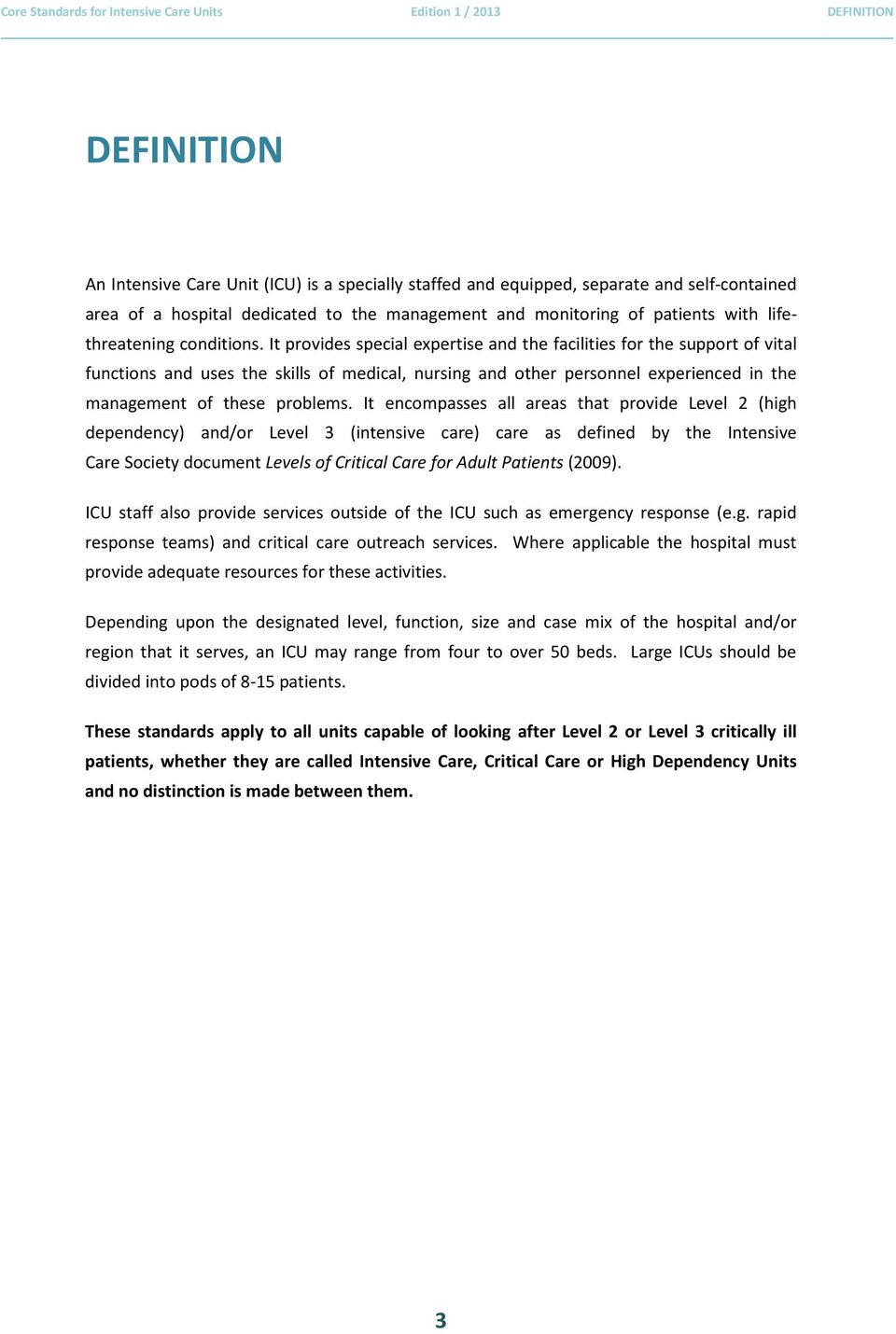
3 Core Standards for Intensive Care Units Edition 1 / 2013 DEFINITION DEFINITION An Intensive Care Unit (ICU) is a specially staffed and equipped, separate and self-contained area of a hospital dedicated to the management and monitoring of patients with lifethreatening conditions. It provides special expertise and the facilities for the support of vital functions and uses the skills of medical, nursing and other personnel experienced in the management of these problems. It encompasses all areas that provide Level 2 (high dependency) and/or Level 3 (intensive care) care as defined by the Intensive Care Society document Levels of Critical Care for Adult Patients (2009). ICU staff also provide services outside of the ICU such as emergency response (e.g. rapid response teams) and critical care outreach services. Where applicable the hospital must provide adequate resources for these activities. Depending upon the designated level, function, size and case mix of the hospital and/or region that it serves, an ICU may range from four to over 50 beds. Large ICUs should be divided into pods of 8-15 patients. These standards apply to all units capable of looking after Level 2 or Level 3 critically ill patients, whether they are called Intensive Care, Critical Care or High Dependency Units and no distinction is made between them. 3
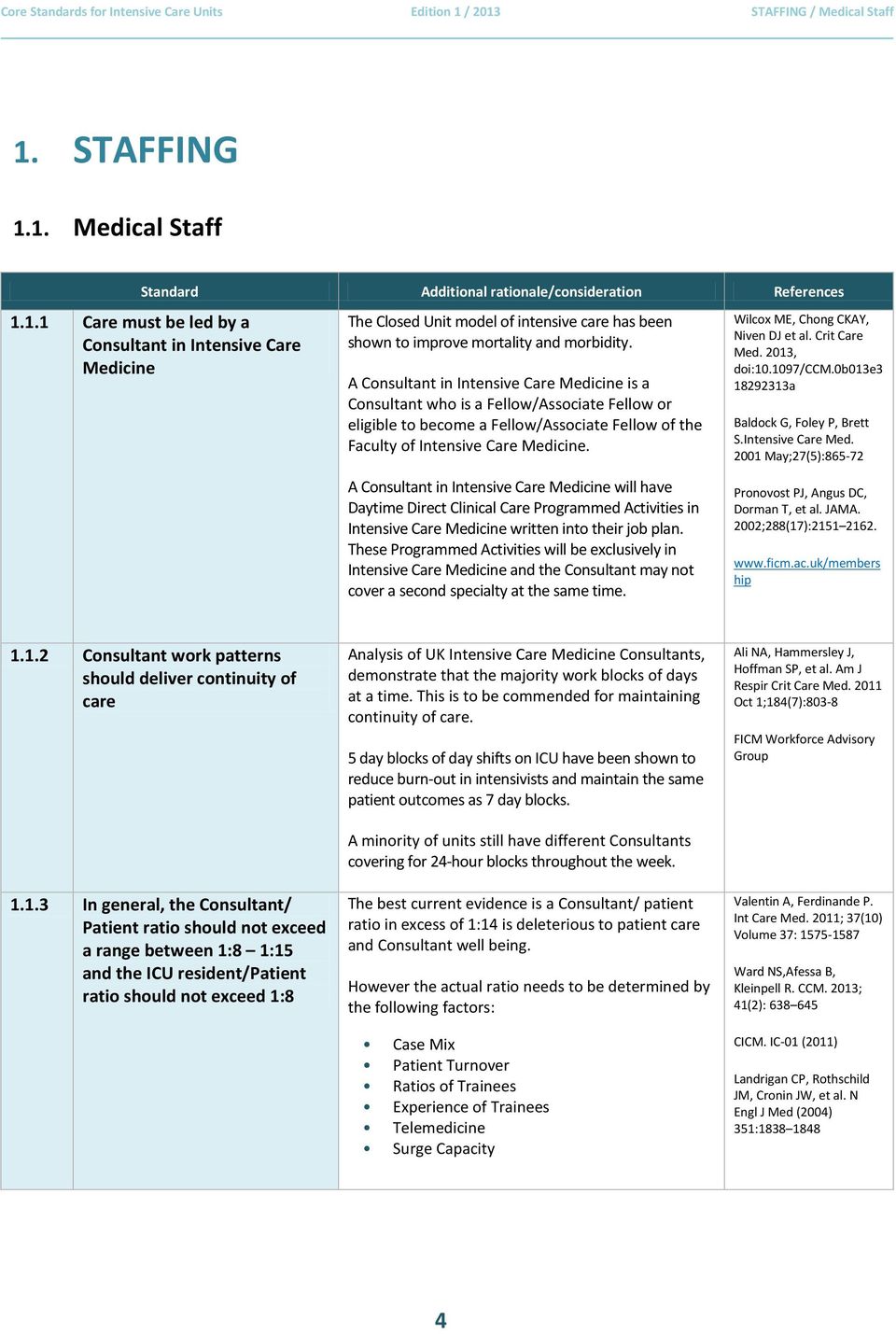
4 Core Standards for Intensive Care Units Edition 1 / 2013 STAFFING / Medical Staff 1. STAFFING 1.1. Medical Staff Care must be led by a Consultant in Intensive Care Medicine The Closed Unit model of intensive care has been shown to improve mortality and morbidity. A Consultant in Intensive Care Medicine is a Consultant who is a Fellow/Associate Fellow or eligible to become a Fellow/Associate Fellow of the Faculty of Intensive Care Medicine. Wilcox ME, Chong CKAY, Niven DJ et al. Crit Care Med. 2013, doi: /ccm.0b013e a Baldock G, Foley P, Brett S.Intensive Care Med May;27(5): A Consultant in Intensive Care Medicine will have Daytime Direct Clinical Care Programmed Activities in Intensive Care Medicine written into their job plan. These Programmed Activities will be exclusively in Intensive Care Medicine and the Consultant may not cover a second specialty at the same time. Pronovost PJ, Angus DC, Dorman T, et al. JAMA. 2002;288(17): hip Consultant work patterns should deliver continuity of care In general, the Consultant/ Patient ratio should not exceed a range between 1:8 1:15 and the ICU resident/patient ratio should not exceed 1:8 Analysis of UK Intensive Care Medicine Consultants, demonstrate that the majority work blocks of days at a time. This is to be commended for maintaining continuity of care. 5 day blocks of day shifts on ICU have been shown to reduce burn-out in intensivists and maintain the same patient outcomes as 7 day blocks. A minority of units still have different Consultants covering for 24-hour blocks throughout the week. The best current evidence is a Consultant/ patient ratio in excess of 1:14 is deleterious to patient care and Consultant well being. However the actual ratio needs to be determined by the following factors: Case Mix Patient Turnover Ratios of Trainees Experience of Trainees Telemedicine Surge Capacity Ali NA, Hammersley J, Hoffman SP, et al. Am J Respir Crit Care Med Oct 1;184(7):803-8 FICM Workforce Advisory Group Valentin A, Ferdinande P. Int Care Med. 2011; 37(10) Volume 37: Ward NS,Afessa B, Kleinpell R. CCM. 2013; 41(2): CICM. IC-01 (2011) Landrigan CP, Rothschild JM, Cronin JW, et al. N Engl J Med (2004) 351:
5 Core Standards for Intensive Care Units Edition 1 / 2013 STAFFING / Medical Staff An ICU resident may be a medical trainee, SAS doctor or Advanced Critical Care Practitioner. It is not appropriate for a Foundation Year doctor to be left as the sole resident doctor on an ICU. There must be immediate access to a practitioner who is skilled with advanced airway techniques There must be a designated Clinical Director and/or Lead Consultant for Intensive Care A Consultant in Intensive Care Medicine must be immediately available 24/7, be able to attend within 30 minutes and must undertake twice daily ward rounds Intensive Care is recognised as essential to acute and elective care provision in the modern hospital. If there is only a Lead Consultant, there must be a clear line of managerial accountability. In larger hospitals, the Clinical Director should only have managerial responsibility for intensive care, although this may comprise more than 1 unit. For example, the Clinical Director may be managerially responsible for a General ICU, Neuro ICU, Paed ICU and Cardiac ICU. Each separate unit would be expected to have a lead Consultant. The Consultant must see all patients under his/her care with trainee staff at least twice daily (including weekends and National holidays) and set a management plan, in the form of a structured bedside ward round. Consultant Intensivists must be available at all times to offer consultant level care to patients as necessary. Consultant Intensivists participating in a duty rota (including out of hours) must not be responsible for delivering other services, such as emergency medicine, acute general medicine and anaesthesia (including obstetric anaesthesia), while covering the critical care unit. Valentin A, Ferdinande P. Int Care Med. 2011; 37(10) Volume 37: CICM. IC-01 (2011) DH. Comprehensive Critical Care. (2000) Paragraph 2, Schedule 12, National (English) Terms and Conditions of the Consultant Contract CICM. IC-01 (2011) Valentin A, Ferdinande P. Int Care Med. 2011; 37(10) Volume 37: CICM. IC-01 (2011) AMoRC. The Benefits of Consultant Delivered Care. (2012) Barger LK, Ayas NT, Cade BE, et al. PLoS Med. 2006;3(12):e487 5

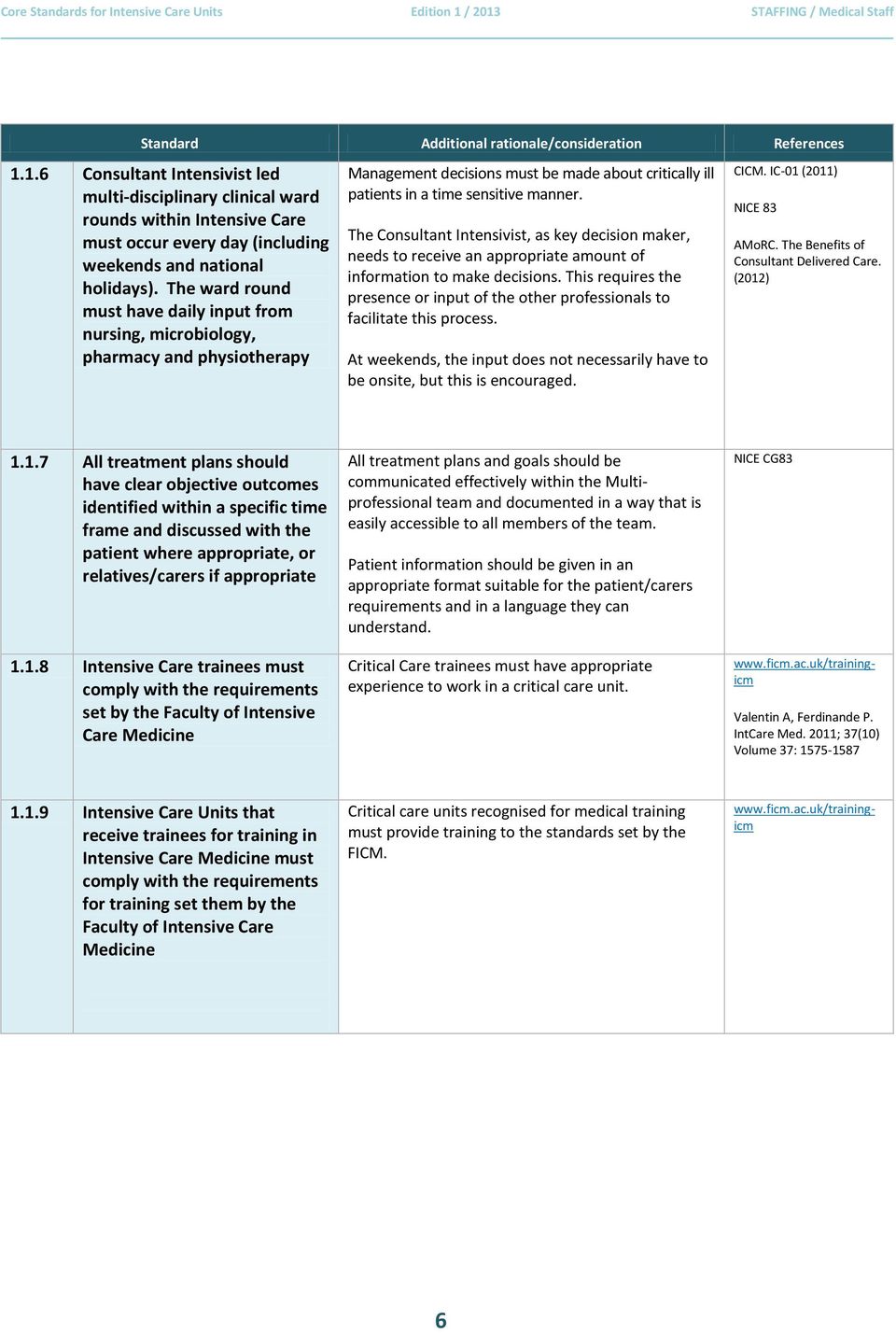
6 Core Standards for Intensive Care Units Edition 1 / 2013 STAFFING / Medical Staff Consultant Intensivist led multi-disciplinary clinical ward rounds within Intensive Care must occur every day (including weekends and national holidays). The ward round must have daily input from nursing, microbiology, pharmacy and physiotherapy Management decisions must be made about critically ill patients in a time sensitive manner. The Consultant Intensivist, as key decision maker, needs to receive an appropriate amount of information to make decisions. This requires the presence or input of the other professionals to facilitate this process. At weekends, the input does not necessarily have to be onsite, but this is encouraged. CICM. IC-01 (2011) NICE 83 AMoRC. The Benefits of Consultant Delivered Care. (2012) All treatment plans should have clear objective outcomes identified within a specific time frame and discussed with the patient where appropriate, or relatives/carers if appropriate Intensive Care trainees must comply with the requirements set by the Faculty of Intensive Care Medicine All treatment plans and goals should be communicated effectively within the Multiprofessional team and documented in a way that is easily accessible to all members of the team. Patient information should be given in an appropriate format suitable for the patient/carers requirements and in a language they can understand. Critical Care trainees must have appropriate experience to work in a critical care unit. NICE CG83 Valentin A, Ferdinande P. IntCare Med. 2011; 37(10) Volume 37: Intensive Care Units that receive trainees for training in Intensive Care Medicine must comply with the requirements for training set them by the Faculty of Intensive Care Medicine Critical care units recognised for medical training must provide training to the standards set by the FICM
7 Core Standards for Intensive Care Units Edition 1 / 2013 STAFFING / Nursing Staff 1.2. Nursing Staff Level 3 patients (level guided by ICS levels of care) require a registered nurse/patient ratio of a minimum 1:1 to deliver direct care A greater ratio than 1:1 may be required to safely meet the needs of some critically ill patients, such as unstable patients requiring various simultaneous nursing activities and complex therapies used in supporting multiple organ failure. Enhanced Level 3 patient status takes in to account severity of illness and the related nursing demands. Williams G, Schmollgruber S, Alberto L. Crit Care Clin Jul;22(3): The European Federation of Critical Care Nursing Associations, Level 2 patients (level guided by ICS levels of care) require a registered nurse/ patient ratio of a minimum 1:2 to deliver direct care The 1:2 ratios may need to be increased to 1:1 to safely meet the needs of critically ill patients, such as those who are confused/delirious requiring close monitoring and/or those being nursed in single rooms. The European Federation of Critical Care Nursing Associations, Each designated Critical Care Unit will have a identified Lead Nurse who is formally recognised with overall responsibility for the nursing elements of the service e.g. Band 8a Matron This person must be an experienced critical care nurse with detailed knowledge and skills to undertake the operational management and strategic development of the service. This person will have: undertaken leadership/management training be in possession of a post registration award in Critical Care Nursing be in possession or working towards post graduate study in relevant area This person will be supported by a tier of Band 7 sisters/charge nurses who will collectively manage human resources, health & safety, equipment management, research, audit, infection prevention & control, quality improvement and staff development. Williams G, Schmollgruber S, Alberto L. Crit Care Clin Jul;22(3):

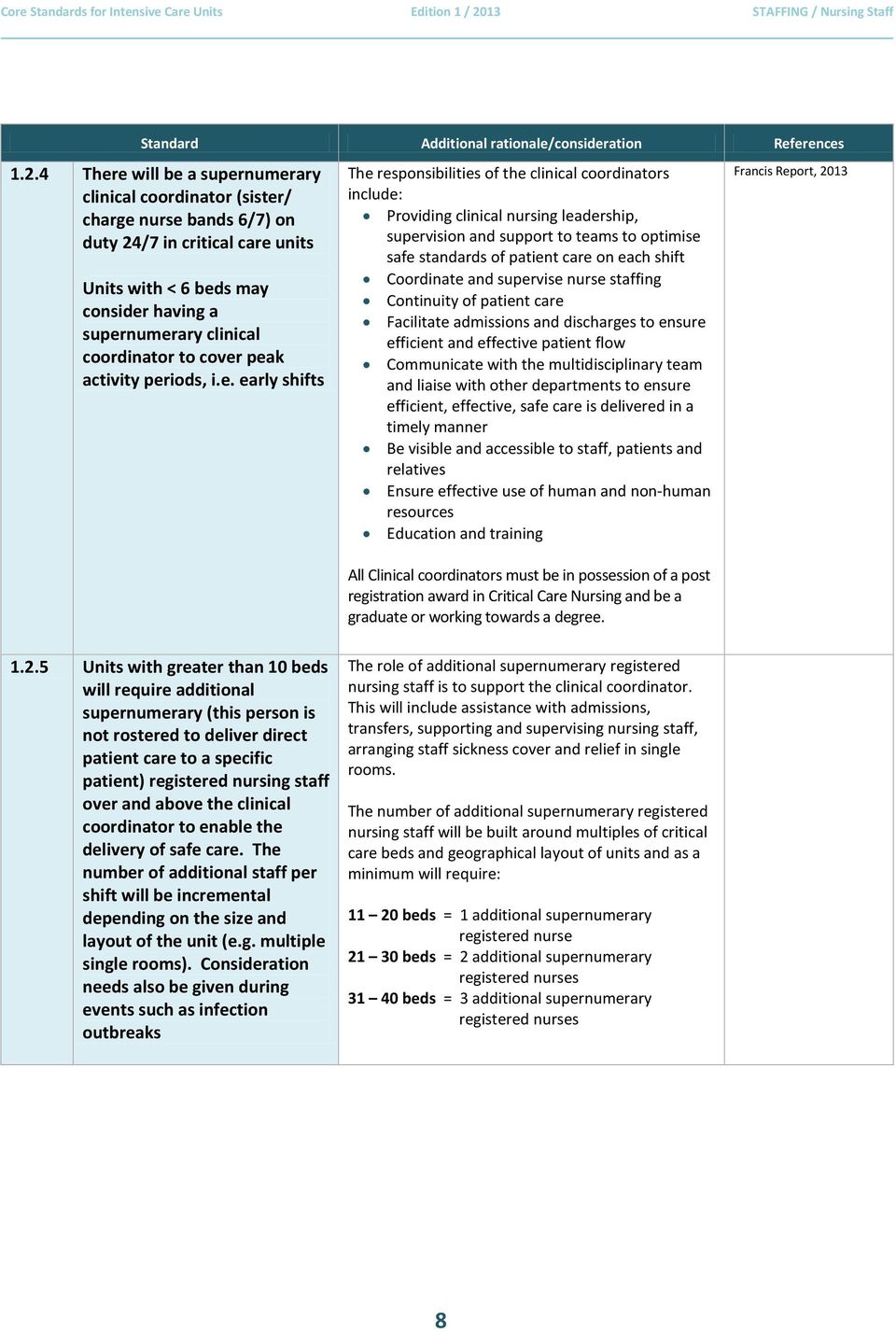
8 Core Standards for Intensive Care Units Edition 1 / 2013 STAFFING / Nursing Staff There will be a supernumerary clinical coordinator (sister/ charge nurse bands 6/7) on duty 24/7 in critical care units Units with < 6 beds may consider having a supernumerary clinical coordinator to cover peak activity periods, i.e. early shifts The responsibilities of the clinical coordinators include: Providing clinical nursing leadership, supervision and support to teams to optimise safe standards of patient care on each shift Coordinate and supervise nurse staffing Continuity of patient care Facilitate admissions and discharges to ensure efficient and effective patient flow Communicate with the multidisciplinary team and liaise with other departments to ensure efficient, effective, safe care is delivered in a timely manner Be visible and accessible to staff, patients and relatives Ensure effective use of human and non-human resources Education and training All Clinical coordinators must be in possession of a post registration award in Critical Care Nursing and be a graduate or working towards a degree. Francis Report, Units with greater than 10 beds will require additional supernumerary (this person is not rostered to deliver direct patient care to a specific patient) registered nursing staff over and above the clinical coordinator to enable the delivery of safe care. The number of additional staff per shift will be incremental depending on the size and layout of the unit (e.g. multiple single rooms). Consideration needs also be given during events such as infection outbreaks The role of additional supernumerary registered nursing staff is to support the clinical coordinator. This will include assistance with admissions, transfers, supporting and supervising nursing staff, arranging staff sickness cover and relief in single rooms. The number of additional supernumerary registered nursing staff will be built around multiples of critical care beds and geographical layout of units and as a minimum will require: beds = 1 additional supernumerary registered nurse beds = 2 additional supernumerary registered nurses beds = 3 additional supernumerary registered nurses 8
9 Core Standards for Intensive Care Units Edition 1 / 2013 STAFFING / Nursing Staff Each Critical Care Unit will have a dedicated Clinical Nurse Educator responsible for coordinating the education, training and CPD framework for critical care nursing staff and pre-registration student allocation The role will be supernumerary and additional Clinical Nurse Educators will be required for larger units, i.e. 1 WTE per circa 75 staff. Consideration needs to be given to local need such as rapid staff turn-over, large numbers of junior staff. The Clinical Nurse Educator will be in possession of a post registration award in Critical Care Nursing and appropriate post graduate certificate in education or equivalent. Williams G, Schmollgruber S, Alberto L. Crit Care Clin Jul;22(3): BACCN All nursing staff appointed to Critical Care will be allocated a period of supernumerary practice A minimum of 50% of registered nursing staff will be in possession of a post registration award in Critical care Nursing Units should not utilise greater than 20% of registered nurses from bank/agency on any one shift when they are NOT their own staff This period is to allow adequate time for registered nurses to develop basic skills and competencies to safely care for a critically ill patient. All registered nurses commencing in critical care should be commenced on Step 1 of the National Competency Framework. The supernumerary period for newly qualified nurses should be a minimum of 6 weeks; this time frame may need to be extended depending on the individual The length of supernumerary period for staff with previous experience will depend on the type and length of previous experience and how recently this was obtained. All newly registered nursing staff should be allocated a preceptor. Newly appointed staff that have completed preceptorship should be allocated a mentor. Nurse education programmes should follow the National Standards for Critical Care Nurse Education (2012) and include both academic and clinical competence assessment. All registered nursing staff supplied by bank/agency should be able to demonstrate using documented evidence that they are competent to work in a critical care environment. All agency/bank staff are to be provided with unit orientation. BACCN 2009 CC3N, 2013, National Competency Framework for Adult Critical Care Nurses Williams G, Schmollgruber S, Alberto L. Crit Care Clin Jul;22(3): CC3N, 2012, National Standards for Critical Care Nurse Education CC3N, 2013, National Competency Framework for Adult Critical Care Nurses 9

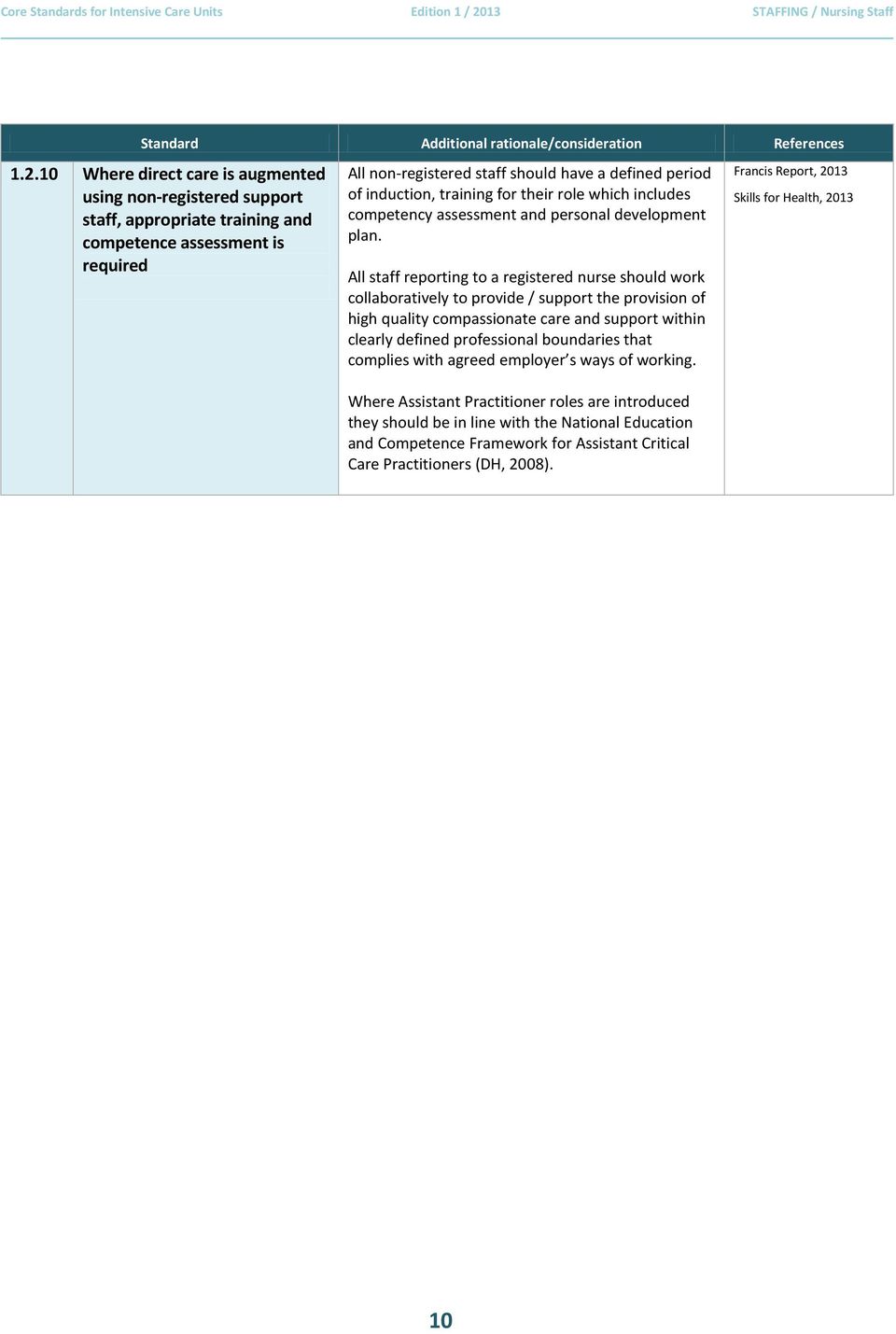
10 Core Standards for Intensive Care Units Edition 1 / 2013 STAFFING / Nursing Staff Where direct care is augmented using non-registered support staff, appropriate training and competence assessment is required All non-registered staff should have a defined period of induction, training for their role which includes competency assessment and personal development plan. All staff reporting to a registered nurse should work collaboratively to provide / support the provision of high quality compassionate care and support within clearly defined professional boundaries that complies with agreed employer s ways of working. Where Assistant Practitioner roles are introduced they should be in line with the National Education and Competence Framework for Assistant Critical Care Practitioners (DH, 2008). Francis Report, 2013 Skills for Health,
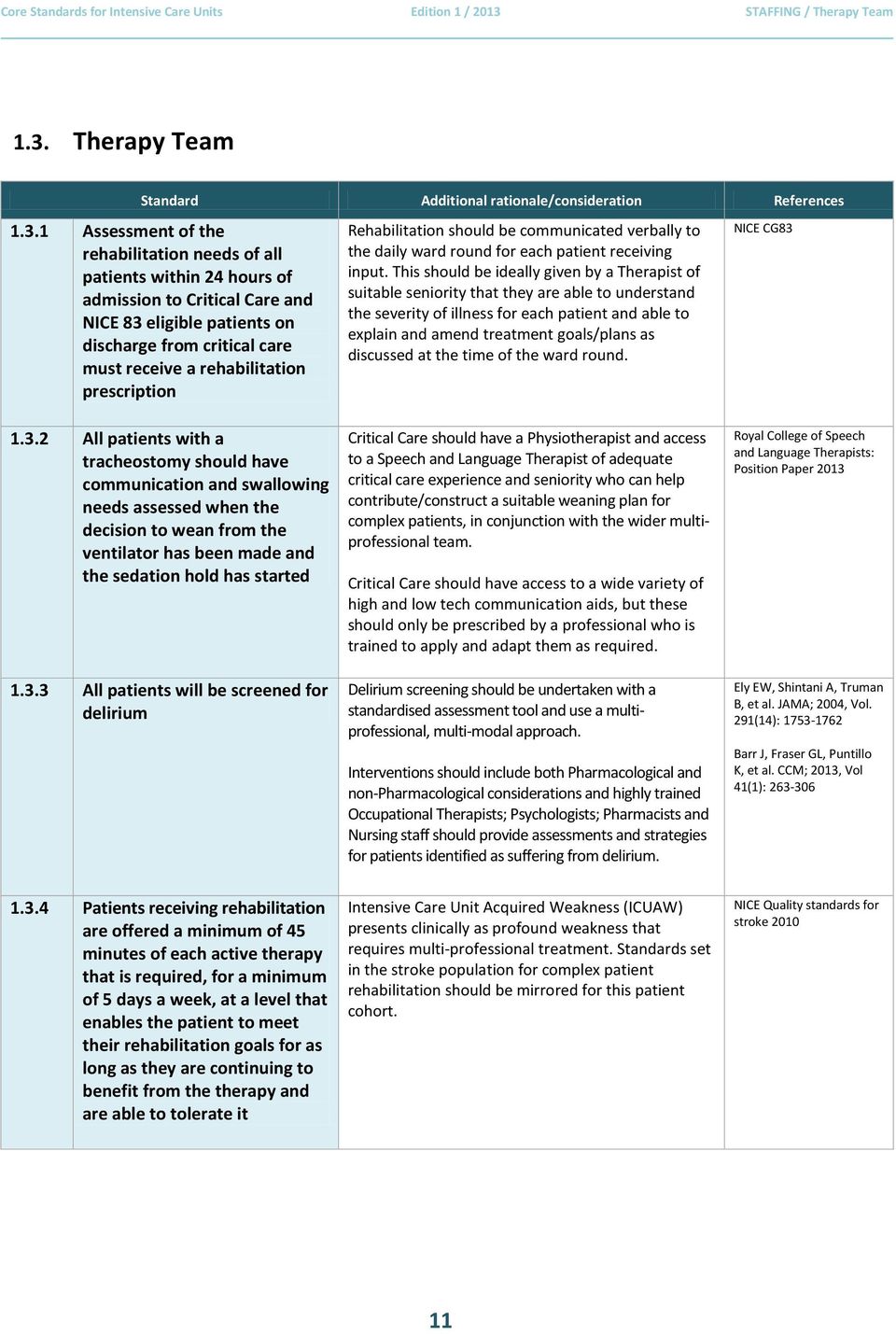
11 Core Standards for Intensive Care Units Edition 1 / 2013 STAFFING / Therapy Team 1.3. Therapy Team Assessment of the rehabilitation needs of all patients within 24 hours of admission to Critical Care and NICE 83 eligible patients on discharge from critical care must receive a rehabilitation prescription Rehabilitation should be communicated verbally to the daily ward round for each patient receiving input. This should be ideally given by a Therapist of suitable seniority that they are able to understand the severity of illness for each patient and able to explain and amend treatment goals/plans as discussed at the time of the ward round. NICE CG All patients with a tracheostomy should have communication and swallowing needs assessed when the decision to wean from the ventilator has been made and the sedation hold has started All patients will be screened for delirium Critical Care should have a Physiotherapist and access to a Speech and Language Therapist of adequate critical care experience and seniority who can help contribute/construct a suitable weaning plan for complex patients, in conjunction with the wider multiprofessional team. Critical Care should have access to a wide variety of high and low tech communication aids, but these should only be prescribed by a professional who is trained to apply and adapt them as required. Delirium screening should be undertaken with a standardised assessment tool and use a multiprofessional, multi-modal approach. Interventions should include both Pharmacological and non-pharmacological considerations and highly trained Occupational Therapists; Psychologists; Pharmacists and Nursing staff should provide assessments and strategies for patients identified as suffering from delirium. Royal College of Speech and Language Therapists: Position Paper 2013 Ely EW, Shintani A, Truman B, et al. JAMA; 2004, Vol. 291(14): Barr J, Fraser GL, Puntillo K, et al. CCM; 2013, Vol 41(1): Patients receiving rehabilitation are offered a minimum of 45 minutes of each active therapy that is required, for a minimum of 5 days a week, at a level that enables the patient to meet their rehabilitation goals for as long as they are continuing to benefit from the therapy and are able to tolerate it Intensive Care Unit Acquired Weakness (ICUAW) presents clinically as profound weakness that requires multi-professional treatment. Standards set in the stroke population for complex patient rehabilitation should be mirrored for this patient cohort. NICE Quality standards for stroke
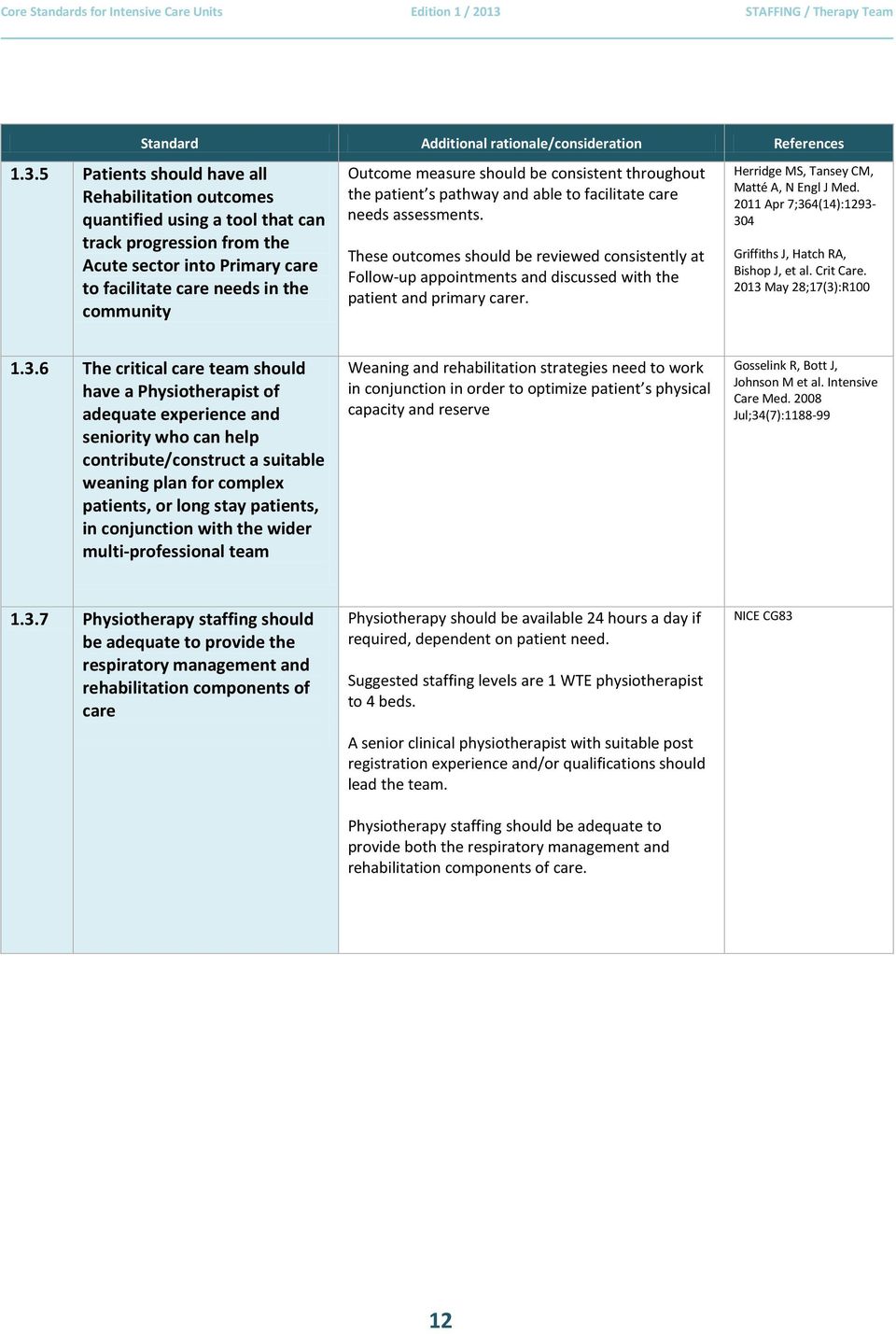
12 Core Standards for Intensive Care Units Edition 1 / 2013 STAFFING / Therapy Team Patients should have all Rehabilitation outcomes quantified using a tool that can track progression from the Acute sector into Primary care to facilitate care needs in the community Outcome measure should be consistent throughout the patient s pathway and able to facilitate care needs assessments. These outcomes should be reviewed consistently at Follow-up appointments and discussed with the patient and primary carer. Herridge MS, Tansey CM, Matté A, N Engl J Med Apr 7;364(14): Griffiths J, Hatch RA, Bishop J, et al. Crit Care May 28;17(3):R The critical care team should have a Physiotherapist of adequate experience and seniority who can help contribute/construct a suitable weaning plan for complex patients, or long stay patients, in conjunction with the wider multi-professional team Weaning and rehabilitation strategies need to work in conjunction in order to optimize patient s physical capacity and reserve Gosselink R, Bott J, Johnson M et al. Intensive Care Med Jul;34(7): Physiotherapy staffing should be adequate to provide the respiratory management and rehabilitation components of care Physiotherapy should be available 24 hours a day if required, dependent on patient need. Suggested staffing levels are 1 WTE physiotherapist to 4 beds. A senior clinical physiotherapist with suitable post registration experience and/or qualifications should lead the team. Physiotherapy staffing should be adequate to provide both the respiratory management and rehabilitation components of care. NICE CG83 12
13 Core Standards for Intensive Care Units Edition 1 / 2013 STAFFING / Pharmacy 1.4. Pharmacy There must be a critical care pharmacist for every critical care unit There should be sufficient pharmacy technical staff to provide supporting roles The consensus of critical care pharmacists, the United Kingdom Clinical Pharmacy Association and the Royal Pharmaceutical Society is that there should be at least 0.1 WTE 8a specialist clinical pharmacist for each single Level 3 bed and for every two Level 2 beds. This minimum requirement does not take into account staffing for weekend service or annual leave etc. Organisation as a specific clinical pharmacy team specific to critical care brings additional benefits such as optimal staff skill mix and support. Pharmacy services are often overlooked despite clear evidence they improve the safe and effective use of medicines in critical care patients. As well as direct clinical activities (including prescribing), pharmacists should provide professional support activities (e.g. clinical governance and guideline development) For the larger hospital with more than one ICU, the critical care pharmacy service is best delivered in a team approach. An example of the team used for a hospital with 100 critical care beds would be band 8 specialist critical care pharmacists, comprising: a band 8C consultant pharmacist, a band 8b (as deputy), 2 to 3 at band 8a and 3 to 4 at band 7. A band 7 pharmacist is considered a training grade for specialist pharmacy services. This allows the work to be completed with high grade pharmacy expertise available to bear on critically ill patients. Pharmacy technician roles are also often overlooked and yet are required for tasks such as top-up, stock control / rotation and additional specialist administrative support (e.g. budget reporting, management of drugs excluded by payment by results). They are an important resource for optimising clinical pharmacist activity e.g. by supporting medicines reconciliation. NHS Modernisation Agency, 2002 Department of Health, 2004 Department of Health, 2005, Quality Critical Care: Beyond 'Comprehensive Critical Care Horn E et al. Crit Care Med 2006; 34: S46 S51 Manias E et al. Br J Clin Pharmacol 2012, 74: Department of Health, 2004 Department of Health, 2005, Quality Critical Care: Beyond 'Comprehensive Critical Care Clinical pharmacists providing a service to critical care must be competent to provide the service Critically ill patients are at the extremes of human physiology and receive multiple medication therapies requiring a high degree of specialist knowledge and management. Staff caring for such patients must be competent to do so. Department of Health, 2005, Adult Critical Care; Specialist Pharmacy Practice UKCPA,

14 Core Standards for Intensive Care Units Edition 1 / 2013 STAFFING / Pharmacy The Royal Pharmaceutical Society launched a recognition programme in 2013 making it possible to identify levels of practice of pharmacists. Critical care pharmacists can be assessed against frameworks described by the DH (2005b), UKCPA and Royal Pharmaceutical Society. Francis, 2013 Royal Pharmaceutical Society UKCPA & RPS, Clinical pharmacists who provide a service to critical care areas and have the minimum competencies (Foundation Level) must have access to a more senior specialist critical care pharmacist (for advice and referrals) Clinical pharmacy services should be ideally available 7 days per week. However, as a minimum the service should be provided 5 days per week (Monday-Friday). This should include attendance at Consultant-led Multidisciplinary Ward Rounds Critical care pharmacists must not operate in isolation. Access to experience and expertise may be within the Trust, or perhaps externally (e.g. within a critical care network or equivalent). In England, there are a number of Consultant pharmacists specialising in critical care. When highly specialist advice is required, their expertise should be sought. Appropriate care of critically ill patients requires frequent review and reassessment of therapies, this includes medication. Clinical Pharmacists attendance at Multidisciplinary Ward Rounds increases the effectiveness of the team. Department of Health, 2005, Adult Critical Care; Specialist Pharmacy Practice Department of Health, 2005, Guidance for the Development of Consultant Pharmacist Posts Miller G et al. Clinical Medicine 2011; 11: Lane D et al. Crit Care Med 2013; 41:
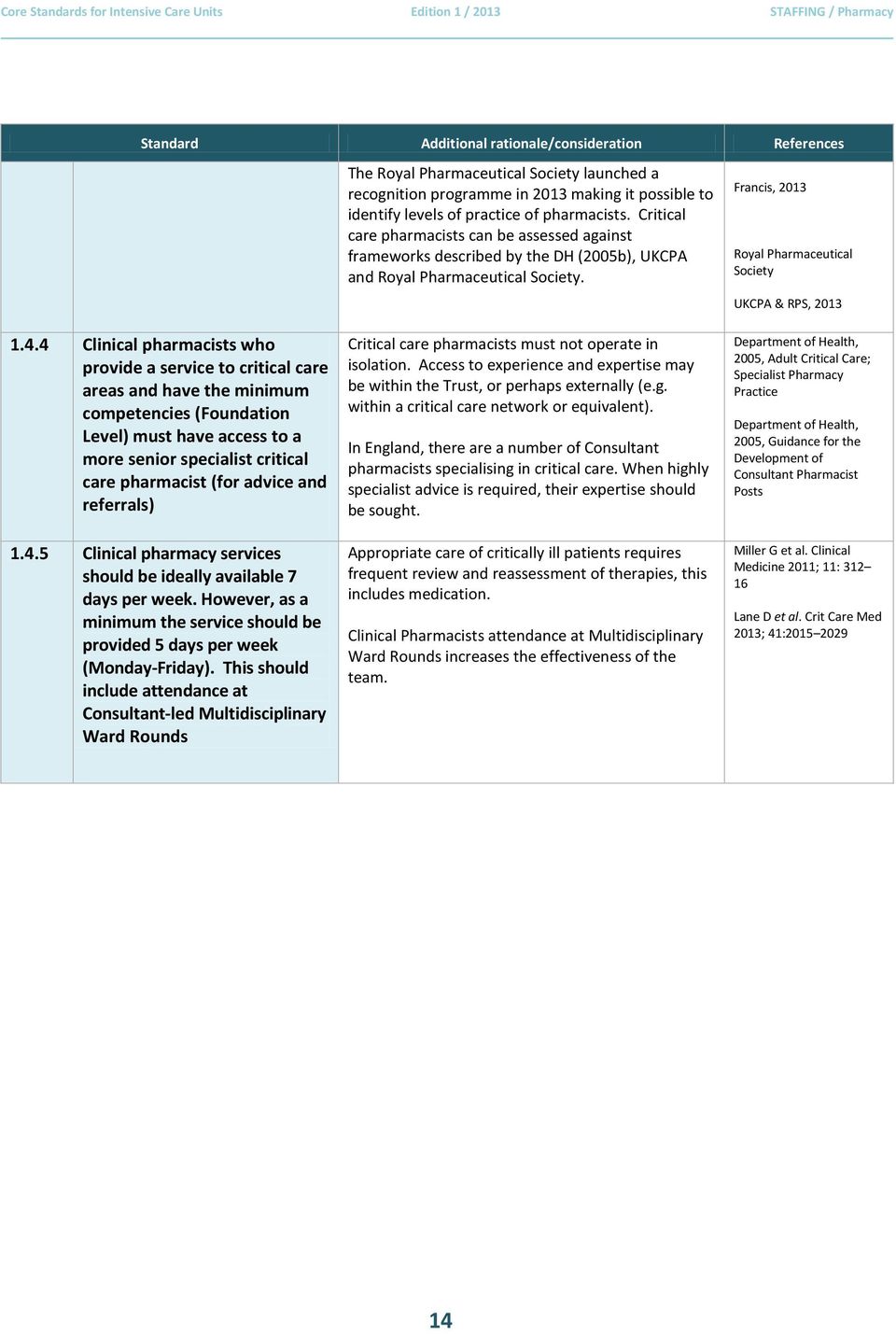
15 Core Standards for Intensive Care Units Edition 1 / 2013 STAFFING / Dietitians 1.5. Dietitians All patients unable to take oral intake should normally have nutrition support (enteral or parenteral) commenced on admission, to ensure adequate nutrition to facilitate rehabilitation There must be guidelines in place for initiating nutrition support out of hours (ideally designed by the ICU lead dietitian) If it is not appropriate to commence nutrition on admission, then the reason must be documented clearly. Guidelines for the provision and assessment of nutrition support therapy in the adult critically ill patient: Society of Critical Care Medicine and American Society for Parenteral and Enteral Nutrition (2009) There must be a dietitian as part of the critical care multidisciplinary team The British Dietetic Association recommends that there should be WTE dietitian per 1 bed and that the lead dietitian for ICU should be at least a band 7. The lead dietitian may be supported by more junior dietetic staff, who will require regular supervision. NHS Modernisation Agency, Role of Health Care Professionals within Critical Care Services Alberda The ICU lead dietitian will be involved in the assessment, implementation and management of appropriate nutrition support route, in collaboration with the rest of the MDT team The role is necessary to reinforce the effectiveness of nutrition support protocols and this role is associated with an increase in energy provision, a reduction in energy deficits and earlier introduction of combined approaches to nutrition support when enteral nutrition is failing CQC Outcome NICE G NICE QS Heyland D, Heyland R, Cahill N, et al. JPEN J Parenter Enteral Nutr. 2010;34: Soguel L, Revelly JP, Schaller MD et al. Crit Care Med. 2012;20:
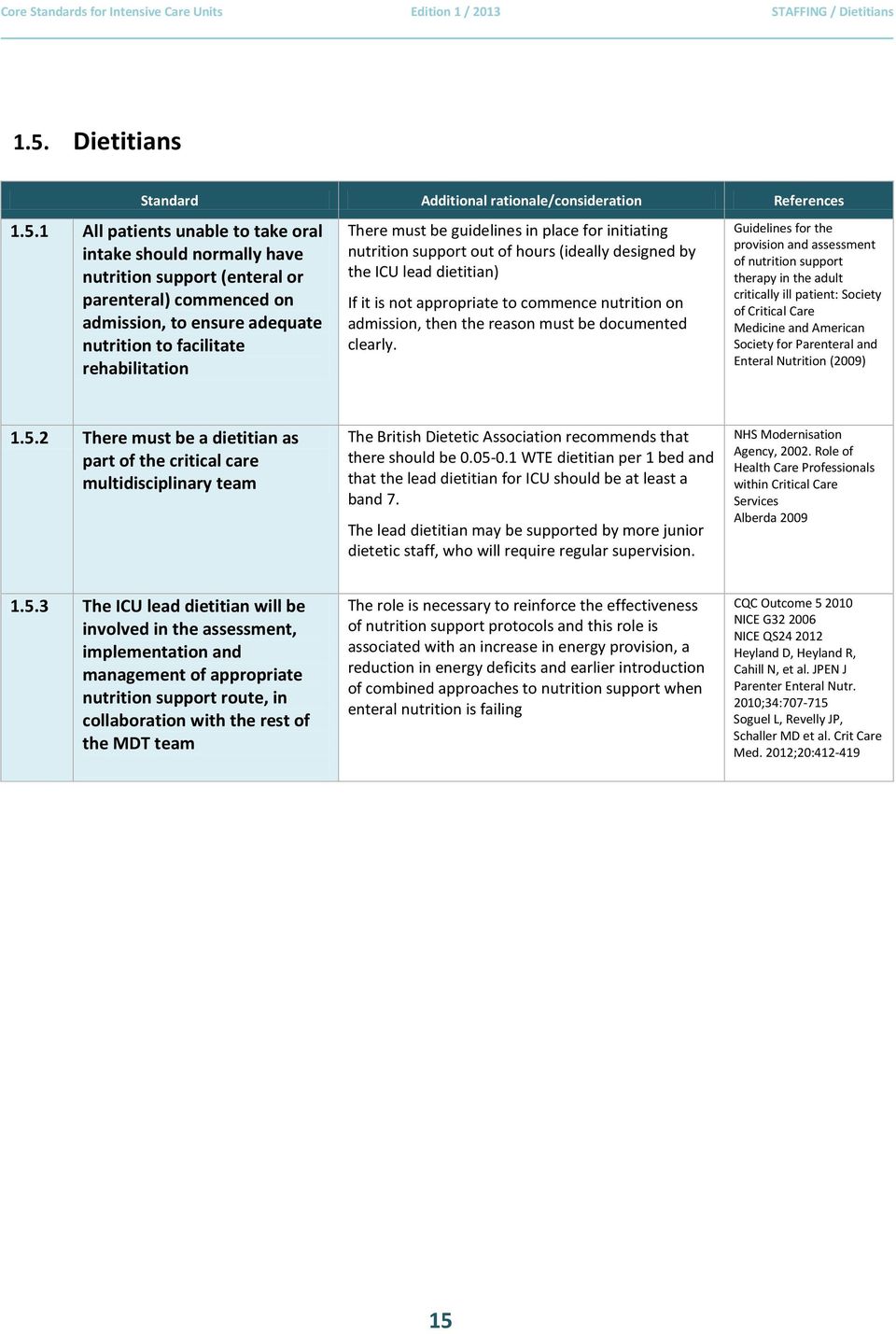
16 Core Standards for Intensive Care Units Edition 1 / 2013 EQUIPMENT 2. OPERATIONAL 2.1 There must be a hospital wide standardised approach to the detection of the deteriorating patient and a clearly documented escalation response. All deteriorating acutely ill patients must be detected and treated as quickly as possible. A national prediction scale should be used to allow peer comparison with other units. NICE CG 50 RCP. National Early Warning Score (NEWS). (2012) 2.2 There must be documentation in the patient record of the time and decision to admit to Intensive Care 2.3 Admission to Intensive Care should occur within 4 hours of making the decision to admit 2.4 Patients should not be transferred to other Intensive Care Units for non-clinical reasons 2.5 On admission to Intensive Care all patients must have a treatment plan discussed with a Consultant in Intensive Care Medicine 2.6 Patients should be reviewed in person by a Consultant in Intensive Care Medicine within 12 hours of admission to Intensive Care Documentation is vital to contribute to the dataset for the National Critical Care Dash Board. Minimising delays to definitive treatment is associated with better outcomes. In the critically ill this is best delivered on the intensive care unit. Transferring patients for non-clinical reasons adds the risks of transfer, prolongs stay on intensive care and may be associated with distress to patients and their families. Repatriating a patient from a specialist ICU (e.g. neuro or cardiac) is considered a clinical reason for transfer. This provision is irrespective of the time of day. GMC. Good Medical Practice (2013) Dellinger RP, Levy MM, Rhodes A, et al. CCM. 2013; 41(2): Rivers E, Nguyen B, Havstad S, et al. N Engl J Med Nov 8;345(19): Barratt H, Harrison DA, Rowan KM, Raine R.Crit Care (5):R179 AoMRC. The Benefits of Consultant Delivered Care. (2012) AoMRC. The Benefits of Consultant Delivered Care. (2012) AoMRC. Seven Day Consultant Present Care. (2012) Aylin P, Yunus A, Bottle A, Majeed A, Bell D.QualSaf Health Care. 2010;19(3):213-7 Bell CM, Redelmeier DA. N Engl J Med. 2001; 345:
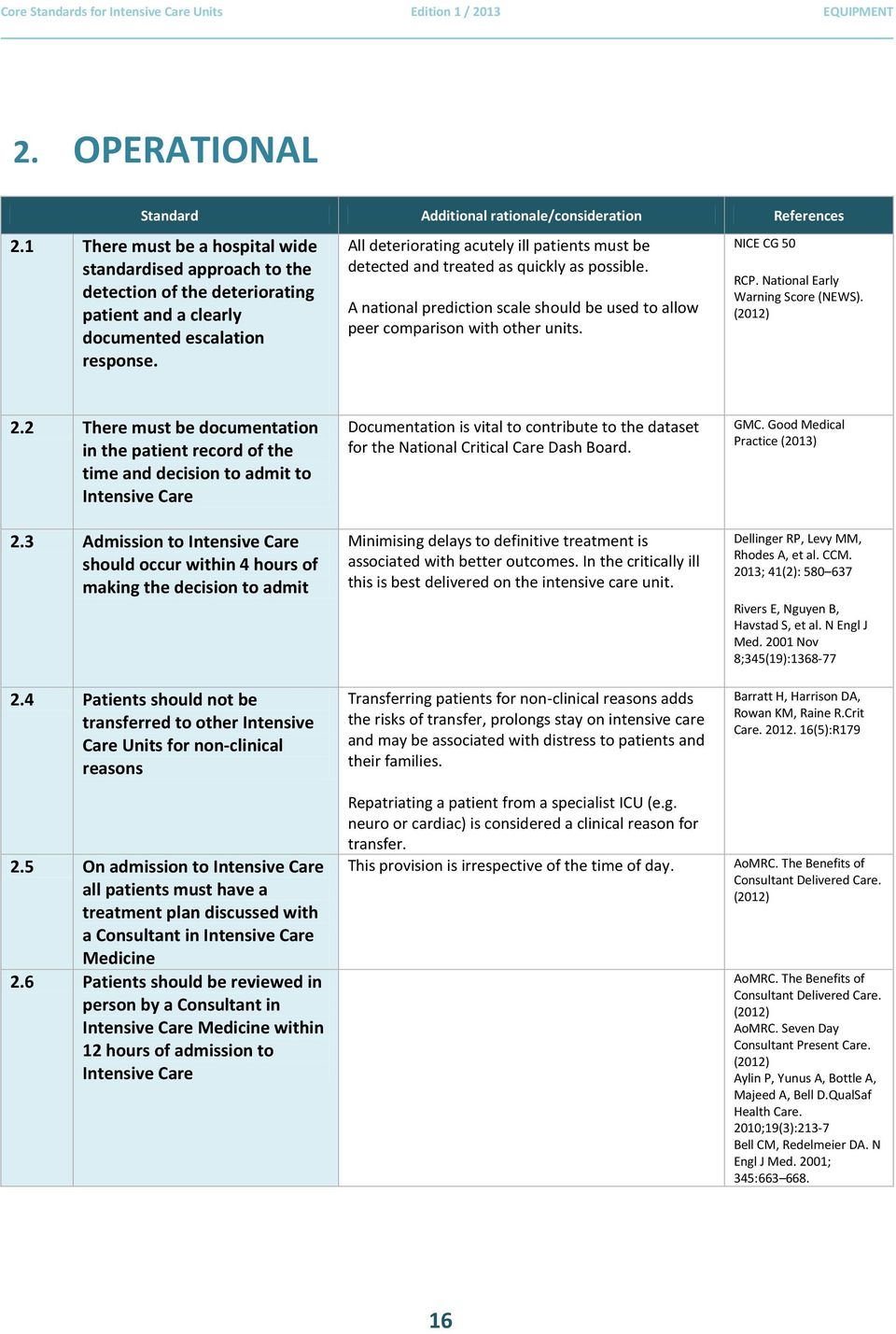
17 Core Standards for Intensive Care Units Edition 1 / 2013 EQUIPMENT 2.7 Each patient must have an assessment of their rehabilitation needs within 24 hours of admission to Critical Care 2.8 There should be a standardised handover procedure for medical, nursing and AHP staff for patients discharged from critical care units 2.9 Patients need a clear and safe pathway for escalation of care from Level 2 care to Level Transfer from Critical Care to a ward must be formalised This provision is irrespective of the day of admission and applies equally to patients admitted at the weekend and bank holidays. All NICE 83 eligible patients must have a rehabilitation prescription on discharge from critical care. This must be updated throughout the rest of the patient s stay in hospital. Continuity of patient care must be maintained on discharge from critical care. Patients receiving Level 2 critical care support may deteriorate. It is not acceptable or logical to provide a ceiling of Level 2 critical care in isolated sites, as this may result in harm to patients. If a unit usually provides Level 2 care, it must be capable of the immediate provision of short term Level 3 care without calling in extra staff members in order to provide optimal patient care. The unit should be capable of providing up to 24 hours of level 3 care prior to a patient being safely transferred to a more suitable unit. The staff of the Level 2 unit should have the competencies required to provide this level of care. All recommendations of this document apply to units that usually provide only Level 2 care, whether in the NHS or the private sector. The handover must include: a. A summary of critical care stay including diagnosis, treatment and changes to chronic therapies b. A monitoring and investigation plan c. A plan for ongoing treatment d. Physical and rehabilitation needs e. Psychological and emotional needs f. Specific communication needs g. Follow-up requirements NICE 83 Aylin P, Yunus A, Bottle A, Majeed A, Bell D.QualSaf Health Care. 2010;19(3):213-7 Bell CM, Redelmeier DA. N Engl J Med. 2001; 345: Ilan R, LeBaron CD, Christianson MK, et al. BMC Health Serv Res. 2012;12:11 Joy BF, Elliott E, Hardy C, et al. PediatrCrit Care Med. 2011;12(3):304-8 O'Horo JC, Omballi M, Tran TK. J Grad Med Educ. 2012;4(1):42-6 NICE 50 O'Horo JC, Omballi M, Tran TK. J Grad Med Educ. 2012;4(1):

18 Core Standards for Intensive Care Units Edition 1 / 2013 EQUIPMENT 2.11 Discharge from Intensive Care to a general ward should occur within 4 hours of the decision Patients must be moved to a more suitable environment without unnecessary delay. There should not be a non-clinical reason preventing such a move Discharge from Critical Care should occur between 07:00hrs and 21:59hrs 2.13 Unplanned readmission rate to ICU within 48hrs of discharge, to a ward, should be minimal 2.14 The Intensive Care team must engage, contribute and participate in a Critical Care Operational Delivery Network (ODN), including audit activity and regular peer review 2.15 Level 3 units should have access to a Regional Home Ventilation and weaning unit. Arrangements should be in place to collaboratively manage patients with weaning difficulties and failure, including the transfer of some patients with complex weaning problems to the Regional centre 2.16 Patients discharged from ICU should have access to an ICU follow-up clinic Discharges overnight have been historically associated with an excess mortality. Patients perceive it as extremely unpleasant being moved from ICU to a general ward outside of normal working hours. Readmitting a patient could imply hasty discharge or inadequate care. It is recognised that Critical Care Operational Delivery Networks are an integral component of the new NHS. Benchmarking against peers is an important process that ensures good practices are maintained. Approximately 6% of ventilated patients admitted to critical care will require a prolonged period of weaning and 1% will fail to wean. Many of these patients will have neuromuscular problems and will benefit from non-invasive ventilation. A few will require long-term ventilation by tracheostomy. These patients and others with weaning difficulties are best managed by Regional Home Ventilation services with the expertise and resources to provide home support for this group of patients with complex needs. Following a period of critical illness, patients should be offered the support of a specialised critical care follow-up clinic. Critically ill patients have been shown to have complex physical and psychological problems that can last for long time. These patients benefit from the multi-modal approach that an ICU follow-up clinic can deliver. The clinic does not necessarily have to be provided by the hospital that the patient was treated in. It could be delivered on a Regional basis. Priestap FA, Martin CM.Crit Care Med. 2006;34(12): Hanane T, Keegan MT, Seferian EG, et al. Crit Care Med. 2008;36(8): NHS Modernisation Agency. Weaning and long term ventilation Respiratory complex home ventilation - NHS England Service specification 2013 NICE CG83 18

19 Core Standards for Intensive Care Units Edition 1 / 2013 EQUIPMENT 2.17 Geographically remote ICUs should have an established review/referral relationship with a bigger centre. Provision of mechanical ventilation and simple invasive cardiovascular monitoring for more than 24 hours is acceptable when the treating specialist is, or is eligible to become, a Fellow / Associate Fellow of the Faculty. If the treating specialist is not a Fellow / Associate Fellow of the Faculty, this provision should only occur within the context of ongoing daily discussion with the bigger centre. There should be mutual transfer and back transfer policies and an established joint review process. These units are encouraged to discuss their plans with their National Intensive Care Society and the Joint Standards Committee of the FICM/ICS. Wilcox ME, Chong CKAY, Niven DJ et al. Crit Care Med. 2013, doi: /CCM.0b013e a 19

20 Core Standards for Intensive Care Units Edition 1 / 2013 EQUIPMENT 3. EQUIPMENT 3.1 Intensive Care facilities should comply with national standards 3.2 All equipment must conform to the relevant safety standards and be regularly serviced Whilst it is acknowledged that not all facilities currently meet national standards, providers of Intensive Care services should establish a program of work/time line to establish when national standards will be met. This should be overseen/undertaken by the Intensive Care clinical team. All new build units must comply with HBN Existing facilities that do not comply with HBN should note that as part of their risk register. Trusts should indicate when facilities will be upgraded to comply with the current HBN. (HBN 27 was published in 1992, HBN 57 in 2003 and HBN in It is imperative that critical care is delivered in facilities designed for that purpose). This should be inspected as part of the peer review process and slippage should be investigated. There must be a program in place for the routine replacement of capital equipment. HBN NHS Estates (2013) Francis Report (2013) Standard for Equipment in Critical Care. ICS MHRA 3.3 All staff must be appropriately trained, competent and familiar with the use of equipment There should be a training log held by the unit to demonstrate that all staff have complied with this provision. It applies to medical, nursing and AHP staff. MHRA GMC NMC 20

21 Core Standards for Intensive Care Units Edition 1 / 2013 DATA COLLECTION 4. DATA COLLECTION 4.1 Units must hold multiprofessional clinical governance meetings, including analysis of mortality and morbidity There should be evidence of associated action planning. Minutes must be taken which must be incorporated into the Hospital s clinical governance process. Lessons learnt must be shared in regular multiprofessional meetings. These meetings should occur on at least a monthly basis. That is there should be a minimum of 12 meetings per year. 4.2 The ICU should participate in a National database for Adult Critical Care Intensive Care Units must publish the nationally agreed dashboard, including the Standardised Mortality Rate. It is recommended that this is accessible on the unit website, which should be updated on a regular basis (annually as a minimum). 4.3 Presence of a risk register and associated audit calendar This must be regularly updated and acted upon. Evidence should be provided at the network peer review process that this is happening. Support should be given to the intensive care team by the ODN, should the Trust management not understand the implications of major risks identified. 21
22 Core Standards for Intensive Care Units Edition 1 / 2013 BIBLIOGRAPHY BIBLIOGRAPHY National Body Publications Academy of Medical Royal Colleges, 2012, Benefit of Consultant Delivered Care. Academy of Medical Royal Colleges, 2012, Seven Day Consultant Presence. Australian College of Critical Care Nurses, 2003, Staffing Position Statement on Intensive Care Nurse Staffing British Association of Critical Care Nurses, 2009, Standards for Nurse Staffing in Critical Care. College of Critical Care Medicine of Australia and New Zealand, 2011, IC-1 Minimum Standards for Intensive Care Units College of Critical Care Medicine of Australia and New Zealand, 2010, IC-13 Recommendations on Standards for High Dependency Units for Training in Intensive Care Medicine Critical Care National Network Nurse Leads Forum, 2012, National Standards for Critical Care Nurse Education Critical Care National Network Nurse Leads Forum, 2013, National Competency Framework for Adult Critical Care Nurses NHS Modernisation Agency, Role of Health Care Professionals within Critical Care Services National Institute for Health and Care Excellence, 2006, CG32. Nutrition Support in Adults. National Institute for Health and Care Excellence, 2009, CG83. Rehabilitation after critical illness. National Institute for Health and Care Excellence, 2012, QS24. Quality standards for nutrition support in adults. Care Quality Commission, 2011, Essential Standards of Quality and Safety Department of Health, 2000, Comprehensive Critical Care Department of Health, 2002, Terms and Conditions of Service NHS Medical and Dental Staff (England) Department of Health, 2004, The Recruitment and Retention of Staff in Critical Care Department of Health, 2005, Quality Critical Care: Beyond 'Comprehensive Critical Care Department of Health, 2005, Adult Critical Care; Specialist Pharmacy Practice Department of Health, 2005, Guidance for the Development of Consultant Pharmacist Posts Department of Health, 2008, The National Education and Competence Framework for Assistant Critical Care Practitioners. European Federation of Critical Care Nursing Associations, 2007, Position Statement on Workforce Requirements in Critical Care Units. Intensive Care Society, 2009, Levels of Critical Care for Adult Patients NHS England, 2013, A14 Respiratory: Complex Home Ventilation NHS Estates, 1992, Hospital Building Note 27: Intensive Therapy Unit NHS Estates, 2003, Hospital Building Note 57: Facilities for Critical Care NHS Estates, 2013, Hospital Building Note 04-02: Critical Care Units NHS Modernisation Agency, 2002, Weaning and long term ventilation National Outreach Forum, 2012, Operational Standards and Competencies for Critical Care Outreach Services Robert Francis, 2013, Report of the Mid Staffordshire NHS Foundation Trust Public Enquiry Royal College of Physicians of London, 2012, National Early Warning Score (NEWS): Standardising the Assessment of Acute-illness Severity in the NHS. Royal College of Physicians of London, 2013, Future Hospital: Caring for medical patients Royal Pharmaceutical Society & United Kingdom Clinical Pharmacy Association, 2013, Professional curriculum: advanced pharmacy practice in critical care Scottish Intensive Care Society Audit Group, 2012, Quality Indicators for Critical Care in Scotland. Skills for Health, 2013, National Minimum Training Standards for Healthcare Support Workers and Adult Social Care Workers in England. Skills for Health, 2013, Code of Conduct for Healthcare Support Workers and Adult Social Care Workers in England. United Kingdom Clinical Pharmacy Association, 2009, Critical Care Syllabus Foundation and Excellence Level 22
23 Core Standards for Intensive Care Units Edition 1 / 2013 BIBLIOGRAPHY Publications 1. Alberda, Cathy, Leah Gramlich, Naomi Jones, Khursheed Jeejeebhoy, Andrew G Day, Rupinder Dhaliwal, and Daren K Heyland. The Relationship Between Nutritional Intake and Clinical Outcomes in Critically Ill Patients: Results of an International Multicenter Observational Study. Intensive Care Medicine 35, no. 10 (October 2009): doi: /s Ali, Naeem A, Jeffrey Hammersley, Stephen P Hoffmann, James M O Brien Jr, Gary S Phillips, Mitchell Rashkin, Edward Warren, Allan Garland, and Midwest Critical Care Consortium. Continuity of Care in Intensive Care Units: a Cluster-randomized Trial of Intensivist Staffing. American Journal of Respiratory and Critical Care Medicine 184, no. 7 (October 1, 2011): doi: /rccm oc. 3. Arabi, Yaseen, Abdullah Alshimemeri, and Saadi Taher. Weekend and Weeknight Admissions Have the Same Outcome of Weekday Admissions to an Intensive Care Unit with Onsite Intensivist Coverage. Critical Care Medicine 34, no. 3 (March 2006): Aylin, Paul, A Yunus, A Bottle, A Majeed, and D Bell. Weekend Mortality for Emergency Admissions. A Large, Multicentre Study. Quality & Safety in Health Care 19, no. 3 (June 2010): doi: /qshc Barger, Laura K, Najib T Ayas, Brian E Cade, John W Cronin, Bernard Rosner, Frank E Speizer, and Charles A Czeisler. Impact of Extended-duration Shifts on Medical Errors, Adverse Events, and Attentional Failures. PLoS Medicine 3, no. 12 (December 2006): e487. doi: /journal.pmed Barr, Juliana, Gilles L Fraser, Kathleen Puntillo, E Wesley Ely, Céline Gélinas, Joseph F Dasta, Judy E Davidson, et al. Clinical Practice Guidelines for the Management of Pain, Agitation, and Delirium in Adult Patients in the Intensive Care Unit. Critical Care Medicine 41, no. 1 (January 2013): doi: /ccm.0b013e b Barratt, Helen, David A Harrison, Kathryn M Rowan, and Rosalind Raine. Effect of Non-clinical Inter-hospital Critical Care Unit to Unit Transfer of Critically Ill Patients: a Propensity-matched Cohort Analysis. Critical Care (London, England) 16, no. 5 (October 3, 2012): R179. doi: /cc Bell, Chaim M., and Donald A. Redelmeier. Mortality Among Patients Admitted to Hospitals on Weekends as Compared with Weekdays. New England Journal of Medicine 345, no. 9 (2001): doi: /nejmsa Braga, Jennifer M, Alice Hunt, Janet Pope, and Elaine Molaison. Implementation of Dietitian Recommendations for Enteral Nutrition Results in Improved Outcomes. Journal of the American Dietetic Association 106, no. 2 (February 2006): doi: /j.jada Brilli, R. J., A. Spevetz, R. D. Branson, G. M. Campbell, H. Cohen, J. F. Dasta, M. A. Harvey, M. A. Kelley, K. M. Kelly, and M. I. Rudis. Critical Care Delivery in the Intensive Care Unit: Defining Clinical Roles and the Best Practice Model. Critical Care Medicine 29, no. 10 (2001): Capuzzo, Maurizia, Rui P Moreno, and Raffaele Alvisi. Admission and Discharge of Critically Ill Patients. Current Opinion in Critical Care 16, no. 5 (October 2010): doi: /mcc.0b013e32833cb Dara, S. I., and B. Afessa. Intensivist-to-Bed RatioAssociation With Outcomes in the Medical ICU. CHEST Journal 128, no. 2 (2005): Ely, E Wesley, Ayumi Shintani, Brenda Truman, Theodore Speroff, Sharon M Gordon, Frank E Harrell Jr, Sharon K Inouye, Gordon R Bernard, and Robert S Dittus. Delirium as a Predictor of Mortality in Mechanically Ventilated Patients in the Intensive Care Unit. JAMA: The Journal of the American Medical Association 291, no. 14 (April 14, 2004): doi: /jama Gajic, O., B. Afessa, A. C. Hanson, T. Krpata, M. Yilmaz, S. F. Mohamed, J. T. Rabatin, L. K. Evenson, T. R. Aksamit, and S. G. Peters. Effect of 24-hour Mandatory Versus On-demand Critical Care Specialist Presence on Quality of Care and Family and Provider Satisfaction in the Intensive Care Unit of a Teaching Hospital*. Critical Care Medicine 36, no. 1 (2008):
24 Core Standards for Intensive Care Units Edition 1 / 2013 BIBLIOGRAPHY 15. Gosselink, R, J Bott, M Johnson, E Dean, S Nava, M Norrenberg, B Schönhofer, K Stiller, H van de Leur, and J L Vincent. Physiotherapy for Adult Patients with Critical Illness: Recommendations of the European Respiratory Society and European Society of Intensive Care Medicine Task Force on Physiotherapy for Critically Ill Patients. Intensive Care Medicine 34, no. 7 (July 2008): doi: /s Griffiths, John, Robert A Hatch, Judith Bishop, Kayleigh Morgan, Crispin Jenkinson, Brian H Cuthbertson, and Stephen J Brett. An Exploration of Social and Economic Outcome and Associated Health-related Quality of Life after Critical Illness in General Intensive Care Unit Survivors: a 12-month Follow-up Study. Critical Care (London, England) 17, no. 3 (May 28, 2013): R100. doi: /cc Hanane, Tarik, Mark T Keegan, Edward G Seferian, Ognjen Gajic, and Bekele Afessa. The Association Between Nighttime Transfer from the Intensive Care Unit and Patient Outcome. Critical Care Medicine 36, no. 8 (August 2008): doi: /ccm.0b013e ca Herridge, Margaret S, Catherine M Tansey, Andrea Matté, George Tomlinson, Natalia Diaz-Granados, Andrew Cooper, Cameron B Guest, et al. Functional Disability 5 Years after Acute Respiratory Distress Syndrome. The New England Journal of Medicine 364, no. 14 (April 7, 2011): doi: /nejmoa Heyland, Daren K., Richard D. Heyland, Naomi E. Cahill, Rupinder Dhaliwal, Andrew G. Day, Xuran Jiang, Siouxzy Morrison, and Andrew R. Davies. Creating a Culture of Clinical Excellence in Critical Care Nutrition The 2008 Best of the Best Award. Journal of Parenteral and Enteral Nutrition 34, no. 6 (November 1, 2010): doi: / Horn, Ed, and Judith Jacobi. The Critical Care Clinical Pharmacist: Evolution of an Essential Team Member. Critical Care Medicine 34, no. 3 Suppl (March 2006): S doi: /01.ccm Ilan, Roy, Curtis D LeBaron, Marlys K Christianson, Daren K Heyland, Andrew Day, and Michael D Cohen. Handover Patterns: An Observational Study of Critical Care Physicians. BMC Health Services Research 12 (2012): 11. doi: / Iyegha, Uroghupatei P., Javariah I. Asghar, Elizabeth B. Habermann, Alain Broccard, Craig Weinert, and Greg Beilman. Intensivists Improve Outcomes and Compliance with Process Measures in Critically Ill Patients. Journal of the American College of Surgeons 216, no. 3 (March 2013): doi: /j.jamcollsurg Joy, Brian F, Emily Elliott, Courtney Hardy, Christine Sullivan, Carl L Backer, and Jason M Kane. Standardized Multidisciplinary Protocol Improves Handover of Cardiac Surgery Patients to the Intensive Care Unit. Pediatric Critical Care Medicine: a Journal of the Society of Critical Care Medicine and the World Federation of Pediatric Intensive and Critical Care Societies 12, no. 3 (May 2011): doi: /pcc.0b013e3181fe25a Kerlin, Meeta Prasad, Dylan S. Small, Elizabeth Cooney, Barry D. Fuchs, Lisa M. Bellini, Mark E. Mikkelsen, William D. Schweickert, et al. A Randomized Trial of Nighttime Physician Staffing in an Intensive Care Unit. New England Journal of Medicine 368, no. 23 (2013): doi: /nejmoa Kuijsten, H. A. J. M., S. Brinkman, I. A. Meynaar, P. E. Spronk, J. I. van der Spoel, R. J. Bosman, N. F. de Keizer, A. Abu-Hanna, and D. W. de Lange. Hospital Mortality Is Associated with ICU Admission Time. Intensive Care Medicine 36, no. 10 (2010): Lane, Daniel, Mauricio Ferri, Jane Lemaire, Kevin McLaughlin, and Henry T Stelfox. A Systematic Review of Evidence-Informed Practices for Patient Care Rounds in the ICU*. Critical Care Medicine 41, no. 8 (August 2013): doi: /ccm.0b013e31828a435f. 27. Manias, Elizabeth, Allison Williams, and Danny Liew. Interventions to Reduce Medication Errors in Adult Intensive Care: a Systematic Review. British Journal of Clinical Pharmacology 74, no. 3 (September 2012): doi: /j x. 28. McClave, Stephen A, Robert G Martindale, Vincent W Vanek, Mary McCarthy, Pamela Roberts, Beth Taylor, Juan B Ochoa, Lena Napolitano, and Gail Cresci. Guidelines for the Provision and Assessment of Nutrition Support Therapy in the Adult Critically Ill Patient: Society of Critical Care Medicine (SCCM) and American Society for Parenteral and Enteral Nutrition (A.S.P.E.N.). JPEN. Journal of Parenteral and Enteral Nutrition 33, no. 3 (June 2009): doi: / Miller, Gavin, Bryony Dean Franklin, and Ann Jacklin. Including Pharmacists on Consultant-led Ward Rounds: a Prospective Non-randomised Controlled Trial. Clinical Medicine (London, England) 11, no. 4 (August 2011):
25 Core Standards for Intensive Care Units Edition 1 / 2013 BIBLIOGRAPHY 30. Milbrandt, Eric B, Stephen Deppen, Patricia L Harrison, Ayumi K Shintani, Theodore Speroff, Renée A Stiles, Brenda Truman, Gordon R Bernard, Robert S Dittus, and E Wesley Ely. Costs Associated with Delirium in Mechanically Ventilated Patients. Critical Care Medicine 32, no. 4 (April 2004): O Horo, John Charles, Mohamed Omballi, Mohammed Omballi, Tony K Tran, Jeffrey P Jordan, Dennis J Baumgardner, and Mark A Gennis. Effect of Audit and Feedback on Improving Handovers: a Nonrandomized Comparative Study. Journal of Graduate Medical Education 4, no. 1 (March 2012): doi: /jgme- D Priestap, Fran A, and Claudio M Martin. Impact of Intensive Care Unit Discharge Time on Patient Outcome. Critical Care Medicine 34, no. 12 (December 2006): doi: /01.ccm f. 33. Pronovost, P. J., D. C. Angus, T. Dorman, K. A. Robinson, T. T. Dremsizov, and T. L. Young. Physician Staffing Patterns and Clinical Outcomes in Critically Ill Patients. JAMA: The Journal of the American Medical Association 288, no. 17 (2002): Sapirstein, A., D. M. Needham, and P. J. Pronovost. 24-hour Intensivist Staffing: Balancing Benefits and Costs*. Critical Care Medicine 36, no. 1 (2008): Soguel, Ludivine, Jean-Pierre Revelly, Marie-Denise Schaller, Corinne Longchamp, and Mette M Berger. Energy Deficit and Length of Hospital Stay Can Be Reduced by a Two-step Quality Improvement of Nutrition Therapy: The Intensive Care Unit Dietitian Can Make the Difference. Critical Care Medicine 40, no. 2 (February 2012): doi: /ccm.0b013e31822f0ad Taylor, S J, S B Fettes, C Jewkes, and R J Nelson. Prospective, Randomized, Controlled Trial to Determine the Effect of Early Enhanced Enteral Nutrition on Clinical Outcome in Mechanically Ventilated Patients Suffering Head Injury. Critical Care Medicine 27, no. 11 (November 1999): Treggiari, M. M., D. P. Martin, N. D. Yanez, E. Caldwell, L. D. Hudson, and G. D. Rubenfeld. Effect of Intensive Care Unit Organizational Model and Structure on Outcomes in Patients with Acute Lung Injury. American Journal of Respiratory and Critical Care Medicine 176, no. 7 (2007): Valentin, A., and P. Ferdinande. Recommendations on Basic Requirements for Intensive Care Units: Structural and Organizational Aspects. Intensive Care Medicine 37, no. 10 (2011): Van der Sluis, Frederik J, Cornelis Slagt, Barbara Liebman, Jan Beute, Jan WR Mulder, and Alexander F Engel. The Impact of Open Versus Closed Format ICU Admission Practices on the Outcome of High Risk Surgical Patients: a Cohort Analysis. BMC Surgery 11 (August 23, 2011): 18. doi: / Wallace, D. J., D. C. Angus, A. E. Barnato, A. A. Kramer, and J. M. Kahn. Nighttime Intensivist Staffing and Mortality Among Critically Ill Patients. New England Journal of Medicine 366, no. 22 (2012): Ward, Nicholas S., Bekele Afessa, Ruth Kleinpell, Samuel Tisherman, Michael Ries, Michael Howell, Neil Halpern, and Jeremy Kahn. Intensivist/Patient Ratios in Closed ICUs. Critical Care Medicine 41, no. 2 (February 2013): doi: /ccm.0b013e Williams, G., and T. Clarke. A Consensus Driven Method to Measure the Required Number of Intensive Care Nurses in Australia. Australian Critical Care 14, no. 3 (2001): Wilcox, M Elizabeth, Christopher A K Y Chong, Daniel J Niven, Gordon D Rubenfeld, Kathryn M Rowan, Hannah Wunsch, and Eddy Fan. Do Intensivist Staffing Patterns Influence Hospital Mortality Following ICU Admission? A Systematic Review and Meta-Analyses. Critical Care Medicine (August 7, 2013). doi: /ccm.0b013e a. 25
26 Core Standards for Intensive Care Units Edition 1 / 2013 BIBLIOGRAPHY DEVELOPMENT GROUP These standards were authored by the Core Standards Working Party of the Joint Professional Standards Committee* Working Party Co-Chair: Dr C M Danbury Co-Chair: Dr T Gould Consultant Intensive Care Physician, Royal Berkshire Hospital and Visiting Fellow in Health Law, University of Reading Consultant Intensive Care, University Hospital Bristol Dr S Baudouin Ms A Berry Ms S Bolton Mr M Borthwick Mr C Brown Ms A Himsworth Dr Z Khan Dr G Masterson Ms S Mcauslan-Crine Mr B McFetridge Ms S McGowan Ms A Richardson Ms E Segaran Mr S Steen Senior Lecturer and Honorary Consultant in Critical Care Medicine, Newcastle University and Newcastle-Upon-Tyne NHS Foundation Trust Chair UK Critical Care Nursing Alliance Chair Nursing and Allied Health Professionals Committee of the ICS Consultant Pharmacist, Oxford University Hospitals NHS Trust Therapy Lead for Adults Royal Brompton Hospital Chair, CC3N Consultant and Honorary Senior Lecturer in Critical Care Medicine and Anaesthesia, University Hospitals Birmingham NHS Foundation Trust Consultant in ICM & Anaesthesia, Royal Liverpool & Broadgreen University Hospitals NHS Trust Manager and Nurse Lead, Avon & Gloucester Critical Care Network Northern Ireland Critical Care Network Royal College of Speech and Language Therapists British Association of Critical Care Nurses Chair of Dietitians in Critical Care Specialist Group of the British Diatetic Association RCN Inflight and Critical Care Forum * Joint Professional Standards Committee comprises the Professional Standards Committee of the Faculty of Intensive Care Medicine and the Standards, Safety and Quality Committee of the Intensive Care Society. 26
27 The Faculty of Intensive Care Medicine / The Intensive Care Society
Acute care toolkit 2
 Acute care toolkit 2 High-quality acute care October 2011 Consultant physicians are at the forefront of delivering care to patients presenting to hospital with medical emergencies. Delivering this care
Early Supported Discharge (in the context of Stroke Rehabilitation in the Community)
 Early Supported Discharge (in the context of Stroke Rehabilitation in the Community) Gold Standard Framework This document was produced with reference to national standards for best practice (e.g. NICE
Anaesthetics, Pain Relief & Critical Care Services Follow-Up Study REGIONAL REPORT. Performance Review Unit
 Anaesthetics, Pain Relief & Critical Care Services Follow-Up Study REGIONAL REPORT Performance Review Unit CONTENTS page I INTRODUCTION... 2 II PRE-OPERATIVEASSESSMENT... 4 III ANAESTHETIC STAFFING AND
Board of Directors. 28 January 2015
 Executive Summary Purpose: Board of Directors 28 January 2015 Briefing on the requirements for the Trust to comply with Hard Truths Commitments Regarding the Publishing of Staffing Data Director of Nursing
Day to day medical care of patients on the in-patient unit and day hospice. Advice and support to Trinity Clinical Nurse Specialists as needed
 JOB DESCRIPTION: ACCOUNTABLE TO: RESPONSIBLE FOR: Speciality Doctor in Palliative Medicine Medical Director Day to day medical care of patients on the in-patient unit and day hospice. Advice and support
Rehabilitation Network Strategy 2014 2017. Final Version 30 th June 2014
 Rehabilitation Network Strategy 2014 2017 Final Version 30 th June 2014 Contents Foreword 3 Introduction Our Strategy 4 Overview of the Cheshire and Merseyside Rehabilitation Network 6 Analysis of our
Quality and Safety Programme Fractured neck of femur services
 Quality and Safety Programme Fractured neck of femur services London quality standards February 2013 1 Introduction The case for change for fractured neck of femur services in London demonstrates that
National Early Warning Score. National Clinical Guideline No. 1
 National Early Warning Score National Clinical Guideline No. 1 February 2013 The National Early Warning Score and COMPASS Education programme project is a work stream of the National Acute Medicine Programme,
National Outreach Forum Operational Standards and Competencies for Critical Care Outreach Services
 National Outreach Forum Operational Standards and Competencies for Critical Care Outreach Services Foreword Critical Care Outreach Teams (CCOT) are one of the great successes of the developments following
UKCPA - A Review of the Current Pharmaceutical Facility
 Modernising Pharmacy Careers Review of Post-Registration Career Development Discussion Paper PRO FORMA FOR CAPTURING RESPONSES TO STAKEHOLDER QUESTIONS Please complete and return to: [email protected]
NATIONAL STROKE NURSING FORUM NURSE STAFFING OF STROKE SERVICES POSITION STATEMENT FOR NATIONAL STROKE STRATEGY
 NATIONAL STROKE NURSING FORUM NURSE STAFFING OF STROKE SERVICES POSITION STATEMENT FOR NATIONAL STROKE STRATEGY Preamble The National Stroke Nursing Forum is pleased to be able to contribute to the development
AMERICAN BURN ASSOCIATION BURN CENTER VERIFICATION REVIEW PROGRAM Verificatoin Criterea EFFECTIVE JANUARY 1, 2015. Criterion. Level (1 or 2) Number
 Criterion AMERICAN BURN ASSOCIATION BURN CENTER VERIFICATION REVIEW PROGRAM Criterion Level (1 or 2) Number Criterion BURN CENTER ADMINISTRATION 1. The burn center hospital is currently accredited by The
Criteria Led Discharge
 Criteria Led Discharge Everything you need to know, but may never have asked about criteria led discharge from hospital Liz Lees Consultant Nurse & Clinical Academic Doctoral Research Fellow The University
Future hospital: Caring for medical patients. Extract: Recommendations
 Future hospital: Caring for medical patients Extract: Recommendations Future hospital: caring for medical patients Achieving the future hospital vision 50 recommendations The recommendations from Future
Agreed Job Description and Person Specification
 Agreed Job Description and Person Specification Job Title: Line Manager: Professionally accountable to: Job Purpose Registered Nurse Lead Nurse Inpatient Unit Clinical Director Provide specialist palliative
GUIDELINE FOR STEP-DOWN TRANSFER OF PATIENTS FROM CRITICAL CARE AREAS
 GUIDELINE FOR STEP-DOWN TRANSFER OF PATIENTS FROM CRITICAL CARE AREAS This guidance does not override the individual responsibility of health professionals to make appropriate decision according to the
Effective Approaches in Urgent and Emergency Care. Priorities within Acute Hospitals
 Effective Approaches in Urgent and Emergency Care Paper 1 Priorities within Acute Hospitals When people are taken to hospital as an emergency, they want prompt, safe and effective treatment that alleviates
National Early Warning Score
 National Early Warning Score National Clinical Guideline No. 1 Summary February 2013 National Clinical Effectiveness Committee (NCEC) The National Clinical Effectiveness Committee (NCEC) was established
Document Details Title. Early Warning Score Protocol for Community Hospitals and Prisons to detect the Deteriorating Patient
 Document Details Title Early warning Score Protocol for community Hospitals and Prisons to Detect the Deteriorating Patient Trust Ref No 1558-29748 Local Ref (optional) Main points the document This protocol
Acutely ill patients in hospital
 Acutely ill patients in hospital Recognition of and response to acute illness in adults in hospital Issued: July 2007 NICE clinical guideline 50 guidance.nice.org.uk/cg50 NICE 2007 Contents Introduction...
The Newcastle upon Tyne Hospitals NHS Foundation Trust. National Early Warning Score (NEWS) Policy
 The Newcastle upon Tyne Hospitals NHS Foundation Trust National Early Warning Score (NEWS) Policy Version.: 1.0 Effective From: 3 December 2014 Expiry Date: 3 December 2016 Date Ratified: 1 September 2014
Specialty Doctor in Palliative Medicine
 Surgeon Introduction This is an exciting new post and the successful candidate will become part of the Sue Ryder West Berkshire and South Oxfordshire Palliative Medicine service. The post is full-time,
MINIMUM STANDARDS FOR INTENSIVE CARE UNITS SEEKING ACCREDITATION FOR TRAINING IN INTENSIVE CARE MEDICINE
 College of Intensive Care Medicine of Australia and New Zealand ABN: 16 134 292 103 Document type: Policy Date established: 1994 Date last reviewed: 2013 MINIMUM STANDARDS FOR INTENSIVE CARE UNITS SEEKING
Reconfiguration of Surgical, Accident and Emergency and Trauma Services in the UK
 Reconfiguration of Surgical, Accident and Emergency and Trauma Services in the UK K Reconfiguration of Surgical, Accident and Emergency and Trauma Services in the UK Summary Our aim is to provide an excellent
Stroke rehabilitation
 Costing report Stroke rehabilitation Published: June 2013 http://guidance.nice.org.uk/cg162 This costing report accompanies the clinical guideline: Stroke rehabilitation (available online at http://guidance.nice.org.uk/cg162).
Skill Levels for Delivering High Quality Asthma and COPD Respiratory Care by Nurses in Primary Care
 Skill Levels for Delivering High Quality Asthma and COPD Respiratory Care by Nurses in Primary Care September 2007 Revised December 2009, April 2014 Author: Ruth McArthur In conjunction with the PCRS-UK
Oxford University Hospitals NHS Trust. First Year Registered Nurse Foundation Programme
 Oxford University Hospitals NHS Trust First Year Registered Nurse Foundation Programme Welcome Meet the team The trust corporate education team would like to take this opportunity to welcome you on your
Emergency Department Short Stay Units
 Policy Directive Emergency Department Short Stay Units Document Number PD2014_040 Publication date 13-Nov-2014 Functional Sub group Clinical/ Patient Services - Critical care Ministry of Health, NSW 73
Review of compliance. Mid Staffordshire NHS Foundation Trust Stafford Hospital. West Midlands. Region:
 Review of compliance Mid Staffordshire NHS Foundation Trust Stafford Hospital Region: Location address: Type of service: Regulated activities provided: Type of review: West Midlands Mid Staffordshire NHS
EXECUTIVE SUMMARY FRONT SHEET
 EXECUTIVE SUMMARY FRONT SHEET Agenda Item: Meeting: Quality and Safety Forum Date: 09.07.2015 Title: Monthly Board Report- Publication of Nursing and Midwifery Staffing Levels June 2015 Exception Report
The practice of medicine comprises prevention, diagnosis and treatment of disease.
 English for Medical Students aktualizované texty o systému zdravotnictví ve Velké Británii MUDr Sylva Dolenská Lesson 16 Hospital Care The practice of medicine comprises prevention, diagnosis and treatment
Discharge Information Information for patients This leaflet is intended to help you, your carer, relatives and friends understand and prepare for
 Discharge Information Information for patients This leaflet is intended to help you, your carer, relatives and friends understand and prepare for your discharge or transfer from hospital. Healthcare professionals
PERSONNEL SPECIFICATION
 PERSONNEL SPECIFICATION POST Patient Flow Manager Band 7 DEPARTMENT LOCATION Emergency Care and Medicine Altnagelvin Hospital DATE June 2014 FACTORS ESSENTIAL DESIRABLE QUALIFICATIONS AND/OR EXPERIENCE
CENTRAL MANCHESTER UNIVERSITY HOSPITALS NHS FOUNDATION TRUST
 CENTRAL MANCHESTER UNIVERSITY HOSPITALS NHS FOUNDATION TRUST Report of: Paper prepared by: Director of Patient Services/Chief Nurse Gill Heaton Director of Nursing (adults) Cheryl Lenney Date of paper:
National Network for Burn Care. National Burn Care Standards
 National Network for Burn are National Burn are Standards Revised January 2013 To be reviewed April 2015 National Network for Burn are (NNB) National Burn are Standards ontents Introduction 4 sing the
Job Description. Professionally accountable to the Medical Director with respect to Trust-wide Medicines Optimisation.
 Job Description JOB DETAILS Job Title: Chief of Pharmacy Band: 9 Hours: 37.5 Department / Ward: Directorate: Pharmacy Cross Site Central Clinical Services ORGANISATIONAL ARRANGEMENTS Operationally accountable
STANDARDS. for the provision of. Inpatient Adult Rehabilitation Medicine Services. Public and Private Hospitals
 Australasian Faculty of Rehabilitation Medicine STANDARDS for the provision of Inpatient Adult Rehabilitation Medicine Services in Public and Private Hospitals 2011 Telephone (02) 9256 5420 145 Macquarie
ST LUKE S HOSPICE CLINICAL NURSE PRACTITIONER HEAD OF CARE SERVICES SUZANNE SALES CLINICAL NURSING SERVICES MANAGER
 ST LUKE S HOSPICE JOB DESCRIPTION: DAY HOSPICE LEAD/ CLINICAL NURSE PRACTITIONER DATE: MARCH 2015 WRITER: DEB HICKEY HEAD OF CARE SERVICES SUZANNE SALES CLINICAL NURSING SERVICES MANAGER TOTAL NUMBER 11
Cheshire and Merseyside Rehabilitation Network Referral Criteria
 Cheshire and Merseyside Rehabilitation Network Referral Criteria Date Approved: September 2014 Effective From: September 2014 Review Date: August 2015 1. Rehabilitation Definition Rehabilitation is an
4. Proposed changes to Mental Health Nursing Pre-Registration Nursing
 Developments in nurse education in England Summary BSMHFT employs 1319 registered nurses and 641 health care assistants 53% of the total workforce. BSMHFT works in partnership with Birmingham City University
Nursing & Midwifery Learning Disability Liaison Nurse Acute Services Band 7 subject to job evaluation. Trustwide
 PLYMOUTH HOSPITALS NHS TRUST JOB DESCRIPTION Job Group: Job Title: Existing Grade: Directorate/Division: Unit: E.g., Department, Area, District Location: Reports to: Accountable to: Job Description last
Overnight ICU Physician Coverage: Do We Need to Stay in Hospital 24-7?
 Overnight ICU Physician Coverage: Do We Need to Stay in Hospital 24-7? Allan Garland, MD, MA Associate Professor of Medicine and Community Health Sciences University of Manitoba Introduction There are
We aim to improve, and make more reliable, patient pathways and services as proposed in the Scottish Service Model for Chronic Pain.
 Fife Integrated Pain Management Service (FIPMS) Service Redesign Proposal Introduction: This proposal seeks Scottish Government Health and Social Care Directorate funding to support a 2 year programme
Harness Care Cooperative Ltd Quality primary care services provided through local cooperation Company registration: 06584450
 Harness Care Cooperative Ltd Quality primary care services provided through local cooperation Company registration: 06584450 Job Description Job title: Nurse Practitioner /Lead Nurse ACCOUNTIBILITY The
Paediatric Intensive Care Medicine at The Royal Children's Hospital, Melbourne
 Paediatric Intensive Care Medicine at The Royal Children's Hospital, Melbourne Background The RCH PICU is an 18 bed tertiary intensive care unit that serves the state of Victoria, as well as southern New
NICE Pathways bring together all NICE guidance, quality standards and other NICE information on a specific topic.
 Safe staffing for nursing in adult inpatient wards in acute hospitals overview bring together all NICE guidance, quality standards and other NICE information on a specific topic. are interactive and designed
SPECIALIST PALLIATIVE CARE DIETITIAN
 SPECIALIST PALLIATIVE CARE DIETITIAN JOB PROFILE Post:- Responsible to: - Accountable to:- Specialist Palliative Care Dietitian Clinical Operational Manager Director of Clinical Services Job Summary Work
Hip replacements: Getting it right first time
 Report by the Comptroller and Auditor General NHS Executive Hip replacements: Getting it right first time Ordered by the House of Commons to be printed 17 April 2000 LONDON: The Stationery Office 0.00
Improving Urgent and Emergency care through better use of pharmacists. Introduction. Recommendations. Shaping pharmacy for the future
 Improving Urgent and Emergency care through better use of pharmacists The Royal Pharmaceutical Society (RPS) believes that pharmacists are an underutilised resource in the delivery of better urgent and
Palliative Care Role Delineation Framework
 Director-General Palliative Care Role Delineation Framework Document Number GL2007_022 Publication date 26-Nov-2007 Functional Sub group Clinical/ Patient Services - Medical Treatment Clinical/ Patient
NMC Standards of Competence required by all Nurses to work in the UK
 NMC Standards of Competence required by all Nurses to work in the UK NMC Standards of Competence Required by all Nurses to work in the UK The Nursing and Midwifery Council (NMC) is the nursing and midwifery
Managed Clinical Neuromuscular Networks
 Managed Clinical Neuromuscular Networks Registered Charity No. 205395 and Scottish Registered Charity No. SC039445 The case for Managed Clinical Neuromuscular Networks 1. Executive summary Muscular Dystrophy
National Clinical Programme in Surgery (NCPS) Care Pathway for the Management of Day Case Laparoscopic Cholecystectomy
 National Clinical Programme in Surgery (NCPS) Care Pathway for the Management of Day Case Consultant Surgeon DRAFT VERSION 0.5 090415 Table of Contents 1.0 Purpose... 3 2.0 Scope... 3 3.0 Responsibility...
Pharmacy Department. Rotational Pharmacy Technician. Information Pack
 Pharmacy Department Rotational Pharmacy Technician Information Pack 1 Contents 1. Chelsea and Westminster Healthcare NHS Foundation Trust 3 2. The Pharmacy 4 3. Services 4 3.1. Clinical Services 4 3.2.
JOB DESCRIPTION. Specialist Hospitals, Women & Child Health Directorate. Royal Belfast Hospital for Sick Children
 JOB DESCRIPTION Title of Post: Patient Flow Coordinator Grade/ Band: Band 7 Directorate: Reports to: Accountable to: Location: Hours: Specialist Hospitals, Women & Child Health Directorate Assistant Service
Nurse Practitioner Frequently Asked Questions
 HEALTH SERVICES Nurse Practitioner Frequently Asked Questions The Frequently Asked Questions (FAQs) have been designed to increase awareness and understanding of the Nurse Practitioner role within the
Adoption of the National Early Warning Score: a survey of hospital trusts in England, Northern Ireland and Wales
 The UK s European university Adoption of the National Early Warning Score: a survey of hospital trusts in England, Northern Ireland and Wales Ugochi Nwulu, University of Kent Professor Jamie Coleman, University
Care plans which are individualised and person centred
 The Right Care: creating dementia friendly hospitals Care plans which are individualised and person centred Good practice for better care 1 Care plans which are individualised and person centred Section
Royal College of Obstetricians and Gynaecologists. Faculty of Sexual and Reproductive Healthcare
 Royal College of Obstetricians and Gynaecologists Faculty of Sexual and Reproductive Healthcare Supporting Information for Appraisal and Revalidation: Guidance for Obstetrics and Gynaecology and / or Sexual
Rehabilitation Stroke Services Framework Summary 2013
 Rehabilitation Stroke Services Framework Summary 2013 The Rehabilitation Stroke Services Framework is designed to enable the delivery and monitoring of best practice stroke care across Australia. Rehabilitation
British Cardiovascular Society: Guidance on appropriate workload for consultant cardiologists
 Page 1 of 9 British Cardiovascular Society: Guidance on appropriate workload for consultant cardiologists David Hackett Vice-President, Clinical Standards Division March 2010 Introduction: The British
Measuring quality along care pathways
 Measuring quality along care pathways Sarah Jonas, Clinical Fellow, The King s Fund Veena Raleigh, Senior Fellow, The King s Fund Catherine Foot, Senior Fellow, The King s Fund James Mountford, Director
Pharmacy Department. Pre-Registration Trainee Pharmacy Technician. Information Pack
 Pharmacy Department Pre-Registration Trainee Pharmacy Technician Information Pack 1 Contents 1. Chelsea and Westminster Healthcare NHS Foundation Trust 3 2. The Pharmacy 4 3. Services 4 3.1. Clinical Services
Guidance for Taking Responsibility: Accountable Clinicians and Informed Patients
 June 2014 Guidance for Taking Responsibility: Accountable Clinicians and Informed Patients 01 Background Page 2 The Francis Report made a number of recommendations on the need for there to be a named clinician
Keeping patients safe when they transfer between care providers getting the medicines right
 PART 1 Keeping patients safe when they transfer between care providers getting the medicines right Good practice guidance for healthcare professions July 2011 Endorsed by: Foreword Taking a medicine is
Policy Document Control Page. Title: Protocol for Mental Health Inpatient Service Users who require care in the Pennine Acute Hospital
 Policy Document Control Page Title: Protocol for Mental Health Inpatient Service Users who require care in the Pennine Acute Hospital Version: 5 Reference Number: CL25 Supersedes Supersedes: Protocol for
SHEFFIELD TEACHING HOSPITALS NHS FOUNDATION TRUST EXECUTIVE SUMMARY REPORT TO THE TRUST HEALTHCARE GOVERNANCE COMMITTEE
 SHEFFIELD TEACHING HOSPITALS NHS FOUNDATION TRUST EXECUTIVE SUMMARY REPORT TO THE TRUST HEALTHCARE GOVERNANCE COMMITTEE I TO BE HELD ON MONDAY 26 NOVEMBER 2012 Subject: Supporting Director: Author: Status
NCPC CANCER GROUP SUBMISSION TO THE PALLIATIVE CARE FUNDING REVIEW ON THE ROLE OF REHABILITATION IN PALLIATIVE CARE, MARCH 2011
 NCPC CANCER GROUP SUBMISSION TO THE PALLIATIVE CARE FUNDING REVIEW ON THE ROLE OF REHABILITATION IN PALLIATIVE CARE, MARCH 2011 1. INTRODUCTION In October 2010, NCPC submitted an initial response to the
Guidelines for the Operation of Burn Centers
 C h a p t e r 1 4 Guidelines for the Operation of Burn Centers............................................................. Each year in the United States, burn injuries result in more than 500,000 hospital
Accreditation standards for training providers
 PREVOCATIONAL MEDICAL TRAINING FOR DOCTORS IN NEW ZEALAND Accreditation standards for training providers Introduction Prevocational medical training (the intern training programme) spans the two years
Foundation Training Job Description
 Foundation Training Job Description General information about how foundation training is organised in Health Education Yorkshire and the Humber Allocation process Key school personnel Information events
Outline. Advanced Practice Providers in the Intensive Care Unit. Why utilize APPs in the ICU? 5/30/2013
 Outline Advanced Practice Providers in the Intensive Care Unit Thomas Farley MS, NP Assistant Clinical Professor UCSF School of Nursing Why utilize APPs in the ICU Recent publications General review of
TRAINING AND QUALIFICATIONS FOR OCCUPATIONAL HEALTH NURSES
 TRAINING AND QUALIFICATIONS FOR OCCUPATIONAL HEALTH NURSES Summary The Council for Work and Health is concerned that the current system of training and qualifications for occupational health nurses in
Position Paper. Allied Health Assistants in Rural and Remote Australia
 Position Paper Allied Health Assistants in Rural and Remote Australia December 2011 Allied Health Assistants in Rural and Remote Australia i Table of Contents DISCLAIMER... II GLOSSARY OF TERMS... III
ROYAL COLLEGE OF NURSING. Guidance for nurse staffing in critical care
 ROYAL COLLEGE OF NURSING Guidance for nurse staffing in critical care Acknowledgements Authors Julia Galley RN, ENB 100, BSc(Hons) Lead Nurse, General Intensive Care Unit, Southampton University Hospitals
JOB DESCRIPTION. Clinical Nurse Specialist in Attention Deficit Hyperactivity Disorder (ADHD) Specialist Hospitals, Women & Child Health Directorate
 JOB DESCRIPTION Title of Post: Grade/ Band: Directorate: Reports to: Accountable to: Location: Hours: Clinical Nurse Specialist in Attention Deficit Hyperactivity Disorder (ADHD) Band 8A Specialist Hospitals,
Rehabilitation Services within Essex Cancer Network for people with Brain & CNS tumours
 Rehabilitation Services within Essex Cancer Network for people with Brain & CNS tumours The NICE IOG for people with Brain & other CNS tumours (2006) states that patients with such tumours should have
Ward Manager, Day Care Sister and Clinical Services
 JOB DESCRIPTION Job Title : Line Manager: Responsible to: Manager Department : Staff Nurse (Day Care) Day Care Sister Ward Manager, Day Care Sister and Clinical Services Day Care Unit Probationary Period
Nursing & Midwifery Establishment Review Six Monthly Report. Em Wilkinson-Brice, Deputy Chief Executive / Chief Nurse
 Agenda item: 9.3, Public Board meeting Date: Title: Nursing & Midwifery Establishment Review Six Monthly Report Prepared by: Presented by: Bernadette George, Head of Safety, Risk & Patient Experience,
PG Certificate / PG Diploma / MSc in Clinical Pharmacy
 PG Certificate / PG Diploma / MSc in Clinical Pharmacy Programme Information September 2014 Entry School of Pharmacy Queen s University Belfast Queen s University Belfast - Clinical Pharmacy programme
FACULTY OF PHARMACEUTICAL MEDICINE
 FACULTY OF PHARMACEUTICAL MEDICINE OF THE ROYAL COLLEGES OF PHYSICIANS OF THE UNITED KINGDOM DIPLOMA IN PHARMACEUTICAL MEDICINE GUIDANCE NOTES FOR CANDIDATES AND SUPERVISORS FOR THE DIPLOMA IN PHARMACEUTICAL
HAMAD MEDICAL CORPORATION. Family Medicine (FM) Consultant Posts in Emergency Medicine. Job Description/Person Specifications.
 HAMAD MEDICAL CORPORATION Family Medicine (FM) Consultant Posts in Emergency Medicine Job Description/Person Specifications September 2014 Page 1 of 10 CONTENTS Table of Contents 1. Hamad Medical Corporation
STATEMENT ON THE DELINEATION OF EMERGENCY DEPARTMENTS
 STATEMENT Document No: S12 Approved: Jul-97 Last Revised: Nov-12 Version No: 05 STATEMENT ON THE DELINEATION OF EMERGENCY DEPARTMENTS 1. PURPOSE This document defines the minimum requirement for a health
Improving healthcare for people with long-term conditions
 Improving healthcare for people with long-term conditions UWe-book: Number Two 1 Health and Well-being At UWE our research and development is real and dynamic, identifying problems and providing solutions
Bringing Big Data to Quality Improvement in the Sentinel Stroke National Audit Programme (SSNAP)
 Bringing Big Data to Quality Improvement in the Sentinel Stroke National Audit Programme (SSNAP) Mark Kavanagh SSNAP Project Manager www.strokeaudit.org 16 June 2015 What is a stroke? A stroke is a serious,
BUNDLES IN 2013: SURVIVING SEPSIS CAMPAIGN
 BUNDLES IN 2013: SURVIVING SEPSIS CAMPAIGN R. Phillip Dellinger MD, MSc, MCCM Professor of Medicine Cooper Medical School of Rowan University Professor of Medicine University Medicine and Dentistry of
JOB DESCRIPTION. Reports to: Pharmacist/Lead Technician under whose supervision he/she is working
 JOB DESCRIPTION Title of Post: Pharmacy Technician Grade/ Band: Band 4 Directorate: Adult Services (Prison Healthcare) Reports to: Pharmacist/Lead Technician under whose supervision he/she is working Accountable
NLG(13)347 DATE OF BOARD MEETING 24/09/2013 REPORT FOR. Trust Board of Directors REPORT FROM. Dr Karen Dunderdale, Chief Nurse SUBJECT
 DATE OF BOARD MEETING 24/09/2013 REPORT FOR Trust Board of Directors REPORT FROM Dr Karen Dunderdale, Chief Nurse SUBJECT Nursing Quarterly Report CONTACT OFFICER Karen Dunderdale BACKGROUND DOCUMENT (IF
National Clinical Programmes
 National Clinical Programmes Section 3 Background information on the National Clinical Programmes Mission, Vision and Objectives July 2011 V0. 6_ 4 th July, 2011 1 National Clinical Programmes: Mission
Patient Group Directions. Guidance and information for nurses
 Patient Group Directions Guidance and information for nurses Patient Group Directions Guidance and information for nurses Contents Introduction 4 What is a patient group direction (PGD)? 4 When can PGDs
JOB DESCRIPTION REPORTING TO:
 JOB DESCRIPTION SECTION ONE DESIGNATION: REPORTING TO: SENIOR MEDICAL OFFICER: HAWERA HOSPITAL HEAD OF DEPARTMENT EMERGENCY SERVICES - FOR ALL CLINICAL MATTERS, AND AS REQUIRED THE HEADS OF DEPARTMENT
GENERAL PRACTICE BASED PHARMACIST
 GENERAL PRACTICE BASED PHARMACIST JOB PURPOSE Provide expertise in clinical medicines review 1 and address public health and social needs of patients in GP practices Reduce inappropriate poly-pharmacy
NEONATAL NURSE PRACTITIONER MODEL OF CARE WERRIBEE MERCY HOSPITAL
 NEONATAL NURSE PRACTITIONER MODEL OF CARE WERRIBEE MERCY HOSPITAL Background Neonatal Nurse practitioners provide an additional model of care for neonates and their families. They have been educated to
Scoping the role of the dementia nurse specialist in acute care. Peter Griffiths, Jackie Bridges & Helen Sheldon with Ruth Bartlett & Katherine Hunt
 Abstract: This report explores evidence to identify the potential benefits and to inform the implementation of dementia specialist nursing roles to support people with dementia during admission to hospital.
Position Statement on Physician Assistants
 Position Statement on Physician Assistants Team-based models of medical care that are characterised by responsiveness to local needs, mutual reliance and flexibility have always been a part of rural and