
The Tallahassee Economic, Quality of
|
|
|
- Roy Holmes
- 10 years ago
- Views:
Transcription
1 The Tallahassee Economic, Quality of Life and Investment Climate Dr. Julie Harrington, Director Center for Economic Forecasting and Analysis (CEFA) The Florida State University Innovation Park 2035 E. Paul Dirac Dr. Suite 129 Morgan Bldg Tallahassee, FL Bassam R Awad, Research Associate PhD Candidate Center for Economic Forecasting and Analysis (CEFA) The Florida State University Innovation Park 2035 E. Paul Dirac Dr. Suite 128 Morgan Bldg Tallahassee, FL June 2008 This report is prepared for the Economic Development Council of Tallahassee / Leon County.

2 Table Of Contents 1. Introduction QOL The New Economy Trend Investment Incentives GIS Analysis Economic Impact Analysis Conclusions and Recommendations References ii
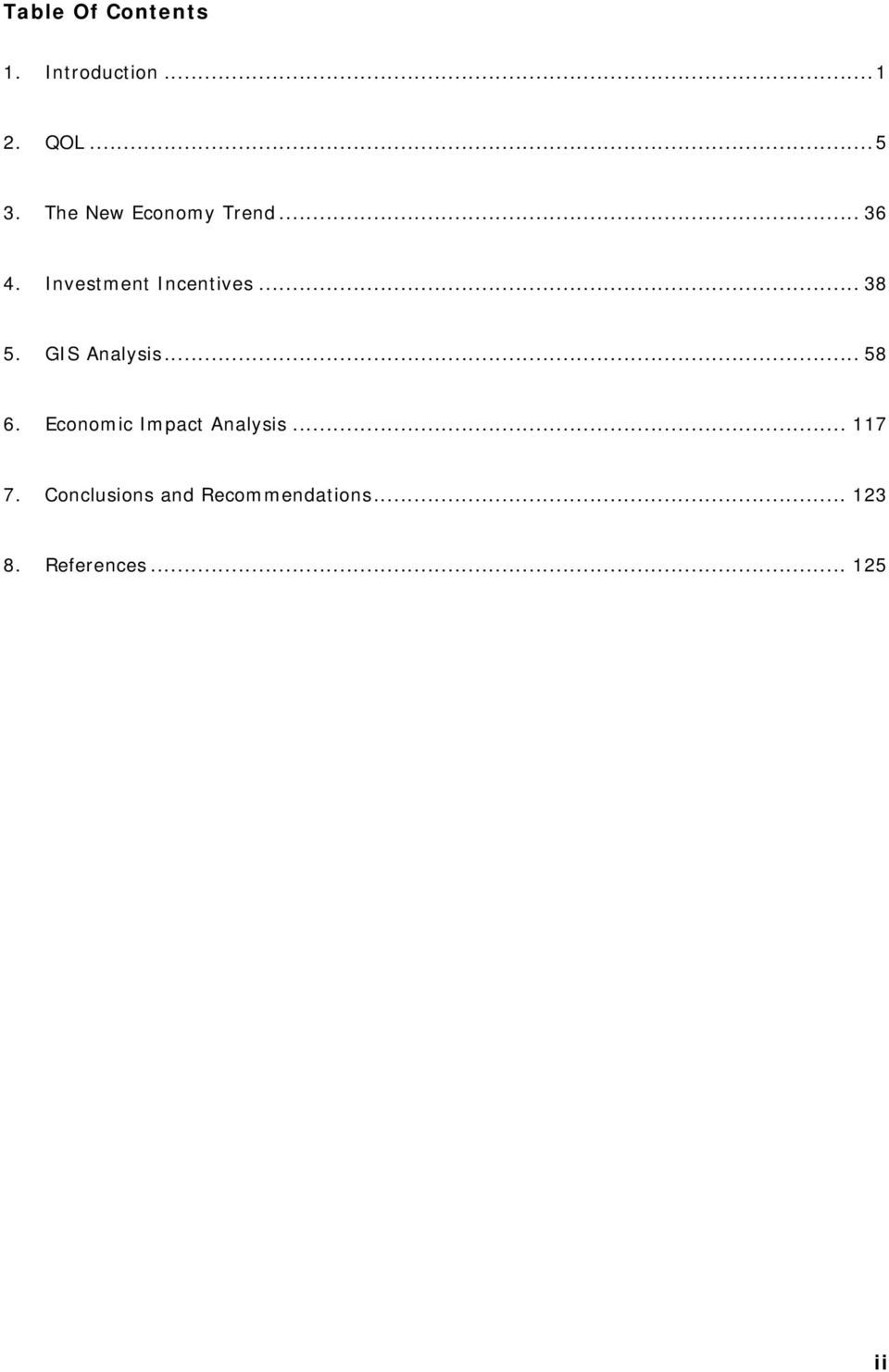
3 Detailed Table Of Contents 1. Introduction A Leon County QOL A QOL Defined B QOL Measures C Tallahassee QOL C.1 Demographics C.1.1 Total Number of Residents C.1.2 Percentage of Leon County residents in each age group C.1.3 Percent of Households at Various Income levels C.1.4 Number of Students Enrolled In Leon County Public Schools by Grade Level C.1.5 Minority Public School Enrollment C.1.6 Percent Of Elementary, Middle And High School Students Enrolled In Private School C.1.7 Private School Enrollment C.2 Families C.2.1 Children in Single Parent Families (Percentage of Children, under Age 18, Who Live in Single Parent Families (Rather Than in Married- Couple Families) C.2.2 Percent of Births to Unwed Mothers by Race C.2.3 Births to Teen Mothers (Number of Teenage Mothers, Ages 15-19, Who Gave Birth per 1,000 Teenage Girls Ages 15-19) C.2.4 Number of Children under Age 18 Who Are In Foster Care or Residential Group Care under the Custody of the Florida Department of Children and Families (DCF) C.2.5 Child Abuse and Neglect (Number Of Child Abuse and Neglect Victims (Per 100,000 Children under Age 18) Whose Maltreatment Was Verified or Found To Have Some Evidence of Occurrence) C.2.6 Child Care Affordability (Cost of Childcare in Leon County as a Percentage of Family Income) C.2.7 Homelessness (Number of Homeless People in Tallahassee) C.3 Public Safety C.3.1 Violent Crime Rate (Number of Violent Crimes Reported Per 100,000 Residents) C.3.2 Property Crime Rate (Number of Property Crimes Reported Per 100,000 Residents) C.3.3 Youth Referred For Delinquency Percent of Youths Ages Who Were Referred To the Florida Department of Juvenile Justice for Delinquency) C.3.4 Youths Referred For Felonies and Misdemeanors (Number of Youths in Leon County Referred To the Florida Department of Juvenile Justice for Felonies vs. Misdemeanors) C.3.5 Traffic Crashes (Number Of Traffic Crashes per 10,000 Licensed Drivers, By Age Group (15-19 and 20-24) 16 2.C.3.6 Fatal Traffic Crashes (Number of drivers, by age, in traffic crashes in Leon County that resulted in fatalities) 16 2.C.3.7 Number of Traffic Crashes Involving a Drinking Driver per 10,000 Licensed Drivers, By Age Group (15-19 and 20-24) C.3.8 Drinking and Driving C.3.9 Perception of Neighborhood Safety (Percent of Adult Tallahassee Residents Who Report Feeling Safe in Their Neighborhood) C.3.10 Recidivism among Serious Habitual Offenders (Percent of Serious Habitual Offenders (Under Age 18) Who Are Crime-Free One Year after Their Arrest or Release from a Commitment Facility) C.4 Health iii
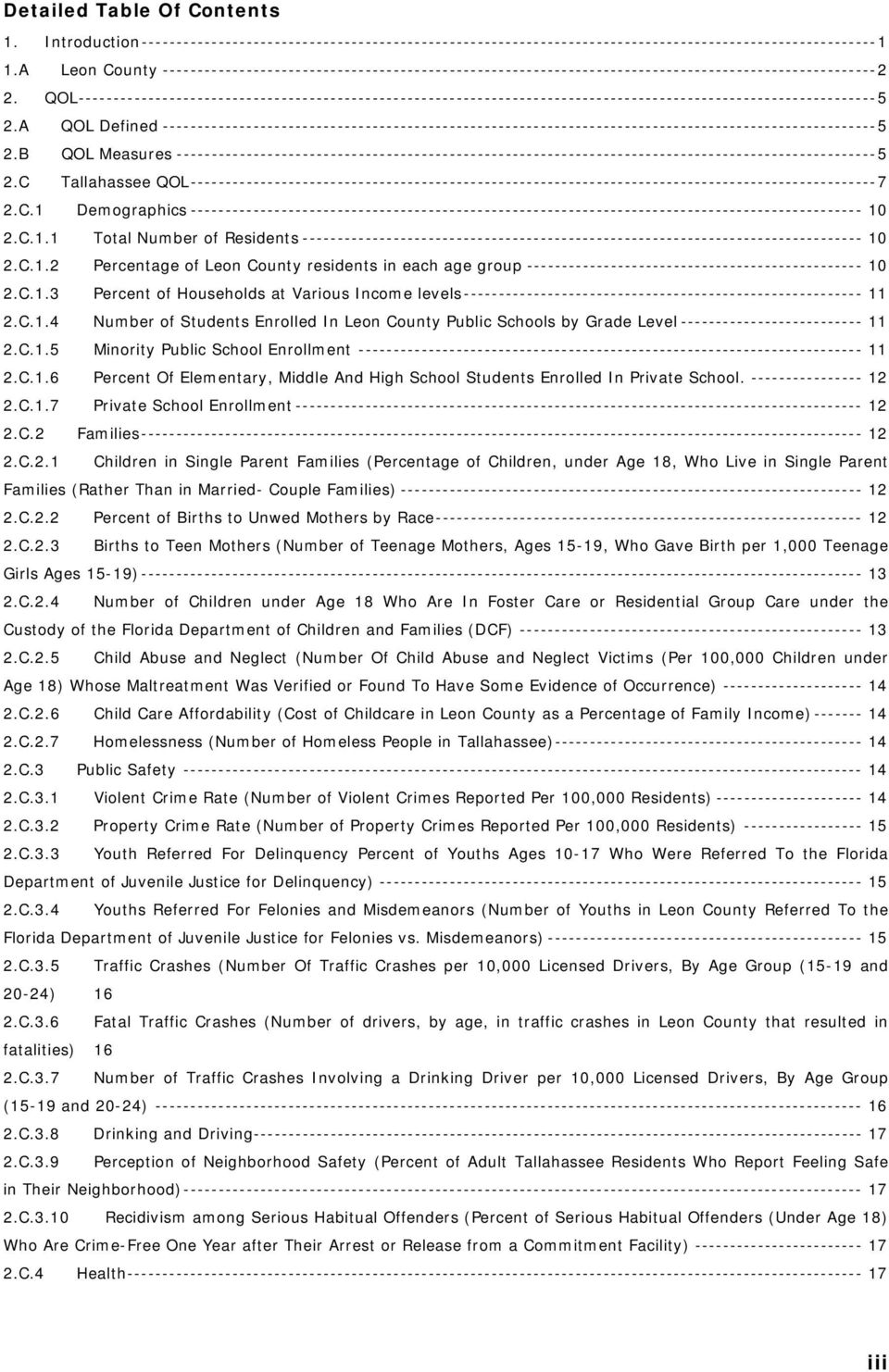
4 2.C.4.1 Health Insurance (Percentage of Children and Non-Elderly Adults Who Do Not Have Health Insurance) 17 2.C.4.2 Emergency Room Visits (Number Of Visits To Emergency Rooms At Tallahassee Memorial Hospital (TMH) And Capital Regional Medical Center (CRMC), Reported For All Ages. ) C.4.3 Infant Mortality (Number of Infants, Per 1,000 Live Births, Who Died Before Their First Birthday By Race) 18 2.C.4.4 Low Birth Weight (Percent of Full-Term and Premature Babies Who Weighed Less Than 5 Lbs., 9 Oz. at Birth) 18 2.C.4.5 Sexually Transmitted Diseases among Teenagers (Number of New Cases of Chlamydia and Gonorrhea, Per 100,000 Females Ages 15-19) C.4.6 Youth Smoking (Percent of Youth Surveyed Who Reported Smoking within the Last 30 Days) C.4.7 Youth Drinking (Percent of Students Who Reported That They Were Current Drinkers (One or More Drinks in the Last 30 Days) and Binge Drinkers (5 or More Drinks in One Sitting In the Last 2 Weeks) C.4.8 Youth Substance Abuse (Percent of Students Who Reported That They Used Various Substances within the Last 30 Days) C.4.9 Youth Mental Health (Percent Of Middle And High School Students Who Said Yes When Asked, In The Past Year, Have You Felt Depressed Or Sad MOST Days, Even If You Felt OK Sometimes? ) C.5 Education C.5.1 School Readiness (Percent of Kindergartners Entering Public School Ready to Learn) C.5.2 Reading (Percent of Leon County Public School Students Scoring Three or Above In Reading on the Florida Comprehensive Assessment Test (FCAT)) C.5.3 Percent of Leon County Public School Students Who Scored Three or Above In Mathematics on the Florida Comprehensive Assessment Test (FCAT) C.5.4 Mathematics C.5.5 Writing (Percent of Leon County Public School Students Scoring Three and Above (3.5 and Above For Writing+) on the Florida Comprehensive Assessment Test (FCAT) Writing+) C.5.6 Percent of Third Graders Who Were Retained (Not Promoted To 4th Grade) C.5.7 High School Graduation Rate (Percent of First-Time 9th Graders in Public Schools Who Earned a Standard High School Diploma in Four Years C.5.8 High School Dropout Rate (Percent of Public School Students Age 16 and Older Who Dropped Out Of School) 23 2.C.5.9 Pursuit of Postsecondary Education (Indicator: Percent of Public High School Graduates Who Entered Community College or 4-Year Colleges And Universities In Florida The Fall After Graduation) C.5.10 Average Teacher Salary (Average Teacher Salary in Grades K12 in Public Schools) C.5.11 School Safety (Number of School Safety Incidents Reported Per 1,000 K-12 Students in Public Schools) 24 2.C.5.12 Adult Educational Attainment (Percent of Adults Age 25 and Older In Leon County Who Completed High School and Postsecondary Education) C.5.13 Public Library Use (Number of Volumes Borrowed Per Resident in Areas Served By Public Libraries) 24 2.C.5.14 Class Size: Average Number of Students per Class in Elementary, Middle and High School C.5.15 Students with Disabilities (Percent of Students with Disabilities Scoring At or Above Grade Level in Reading and Mathematics on the Florida Comprehensive Assessment Test (FCAT)) C.6 Economy C.6.1 Unemployment Rate (Percentage of People Age 16 and Older Who Were Seeking But Unable To Find Work) 26 2.C.6.2 Average Annual Wage (Average Annual Wage and Salary per Full- And Part-Time Job) iv
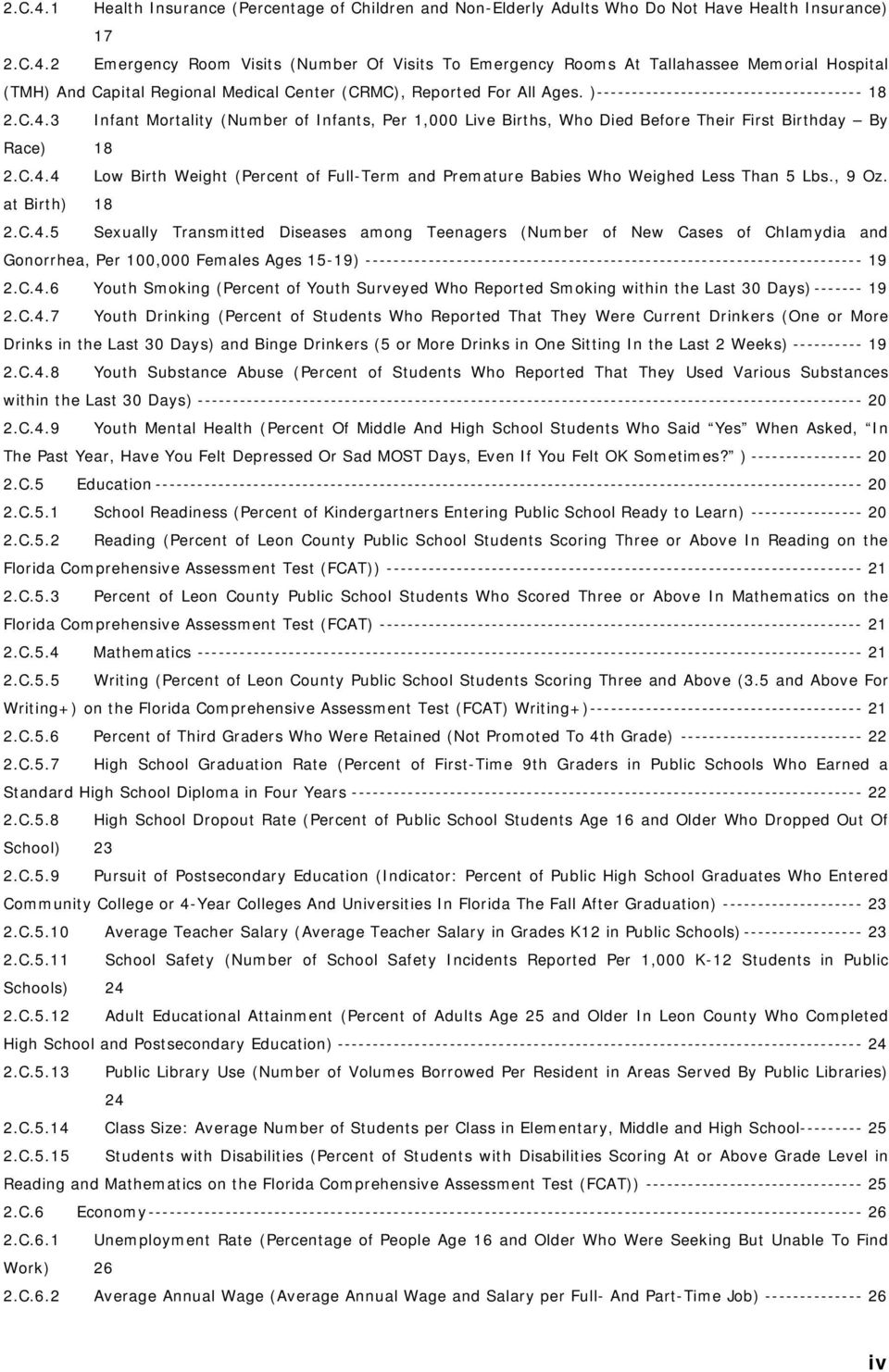
5 2.C.6.3 Per Capita Income Average Personal Income from Wages, Public Pensions, Social Security, Interest, Public Assistance, and Other Sources C.6.4 Children in Poverty C.6.5 Child Poverty by Family Type and Age C.6.6 Home Ownership (Percent of Housing Units That Were Owner-Occupied) C.6.7 Affordability of Rental Housing C.6.8 Tourism (Millions of Dollars Spent By Visitors to Leon County) C.6.9 Employment by Industry (Number of People Employed in the Tallahassee Metropolitan Statistical Area (MSA) In Higher Versus Lower Wage Non-Agricultural Industries) C.7 Voter Registration (Percent of Adults, Age 18 and Older, Registered To Vote) C.7.1 Voter Turnout (Percentage of Registered Voters Who Voted In General Elections) C.7.2 Public Perception of Growth C.7.3 The Percentage of New Construction Permitted In Tallahassee-Leon County That Was Located Inside the Urban Service Area C.7.4 Substandard Living Conditions C.7.5 Use of Public Transportation (Number of Passenger Trips on Star Metro (Formerly Taltran) C.7.6 Transportation to Work (Percent of Workers Age 16 and Older Who Used Various Means of Transportation to Get To Work) C.7.7 Travel Time to Work (Percent of Workers Living In Leon Travel Time To Work) C.7.8 Parks and Recreation Areas C.7.9 Traffic Congestion (Number of Vehicle Miles Traveled Per Resident and Number of Vehicle Miles Traveled Per Centerline Mile of Public Roads) C.8 Environment C.8.1 Conservation of Natural Areas C.8.2 Water Consumption (Gallons of Water Consumed Per Day per Resident Served By Public Suppliers, Such As City and County Water Departments) C.8.3 Electricity Consumption (Number of Kilowatt Hours of Electricity Consumed Per Household Served By the City Of Tallahassee) C.8.4 Recycling (Percent of Municipal Solid Waste Collected That Was Recycled) C.8.5 Air Quality D Other Merits of Tallahassee D.1 Tallahassee Ranks among US Cities D.2 FSU-Related Start-Ups and Spin-Offs to the Local Tallahassee The New Economy Trend Investment Incentives A Introduction B Investment Climate in Florida B.1 State-Wide Merits of Florida B.1.1 Leadership B.1.2 Global Gateway B.1.3 Entrepreneurial Environment B.1.4 World Connectivity B.1.5 Business Climate B.1.6 Workforce Talent B.1.7 Business-Friendly Government B.1.8 QOL B.1.9 Visionary Development v

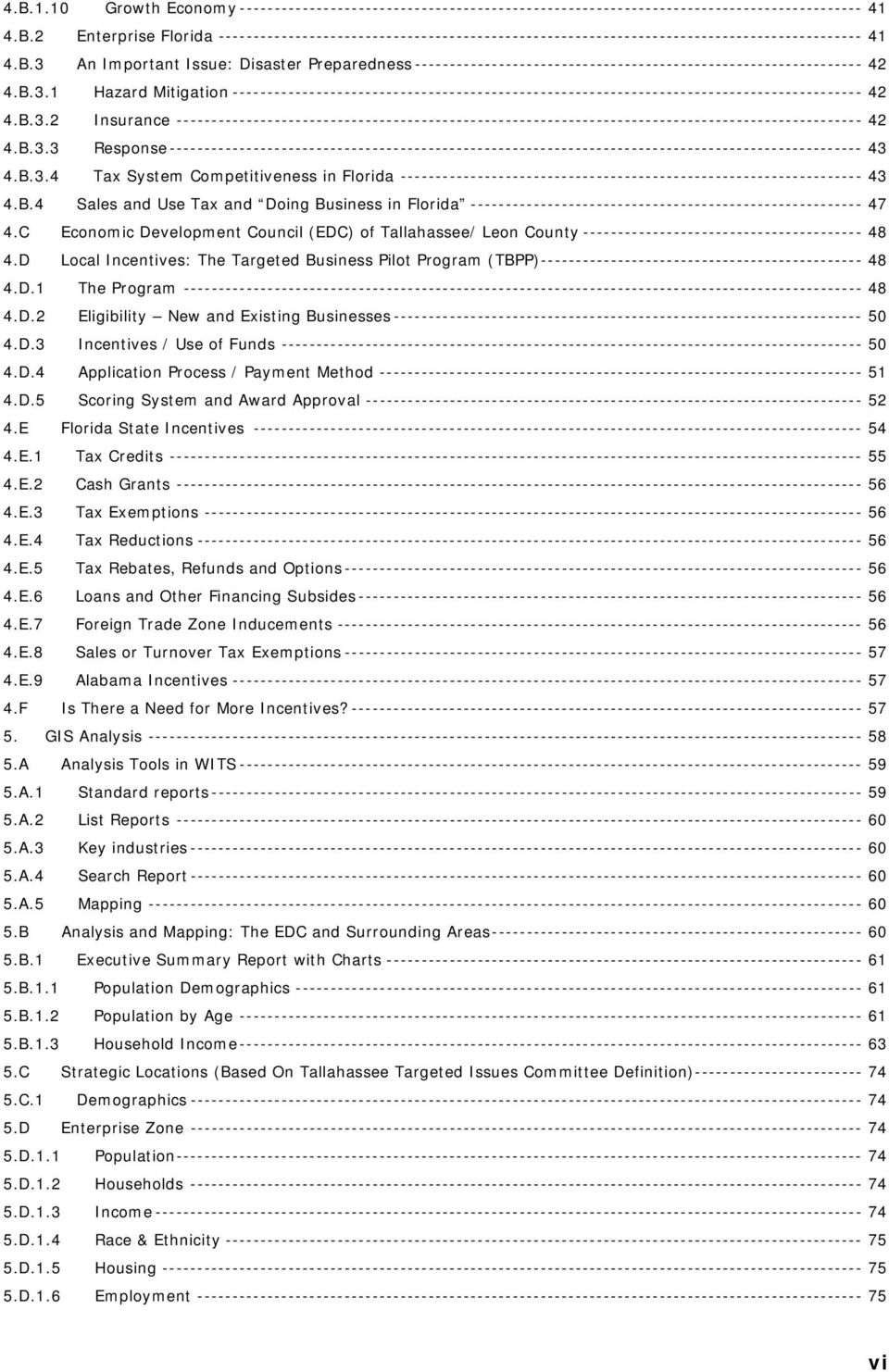
6 4.B.1.10 Growth Economy B.2 Enterprise Florida B.3 An Important Issue: Disaster Preparedness B.3.1 Hazard Mitigation B.3.2 Insurance B.3.3 Response B.3.4 Tax System Competitiveness in Florida B.4 Sales and Use Tax and Doing Business in Florida C Economic Development Council (EDC) of Tallahassee/ Leon County D Local Incentives: The Targeted Business Pilot Program (TBPP) D.1 The Program D.2 Eligibility New and Existing Businesses D.3 Incentives / Use of Funds D.4 Application Process / Payment Method D.5 Scoring System and Award Approval E Florida State Incentives E.1 Tax Credits E.2 Cash Grants E.3 Tax Exemptions E.4 Tax Reductions E.5 Tax Rebates, Refunds and Options E.6 Loans and Other Financing Subsides E.7 Foreign Trade Zone Inducements E.8 Sales or Turnover Tax Exemptions E.9 Alabama Incentives F Is There a Need for More Incentives? GIS Analysis A Analysis Tools in WITS A.1 Standard reports A.2 List Reports A.3 Key industries A.4 Search Report A.5 Mapping B Analysis and Mapping: The EDC and Surrounding Areas B.1 Executive Summary Report with Charts B.1.1 Population Demographics B.1.2 Population by Age B.1.3 Household Income C Strategic Locations (Based On Tallahassee Targeted Issues Committee Definition) C.1 Demographics D Enterprise Zone D.1.1 Population D.1.2 Households D.1.3 Income D.1.4 Race & Ethnicity D.1.5 Housing D.1.6 Employment vi
7 5.D.2 Business Listing by NAICS in the Enterprise Zone D.3 Gaines Street Area D.3.1 Demographics D Population D Households D Income D Race & Ethnicity D Housing D Employment D.3.2 Business Listing by NAICS D.4 The Frenchtown Area D.4.1 Demographics D Population D Households D Income D Race & Ethnicity D Housing D Employment D.4.2 Business listing by NAICS D.5 Tallahassee Regional Airport D.5.1 Demographics D Population D Households D Income D Race & Ethnicity D Housing D Employment D.5.2 Business Listing by NAICS Economic Impact Analysis A Economic Impact Using Input Output Analysis B Economic Impact Analysis Considerations for Measurement C Some Economic Impact Analysis Questions/Criteria That Are Required For Economic Impact Modeling To Occur D The REMI Model E The IMPLAN Model F Targeted Economic Development (TED) G Econometric Model of TED Conclusions and Recommendations A Conclusions B Recommendations References vii
8 List of Tables Table 1: Leon County Demographics and Their Relative US Rank...3 Table 2: The Fastest Growing Cities in Florida, Alabama and Georgia in the Year Table 3: Non-Indexed Measures of the QOL...6 Table 4: The Combined Ratings of QOL Factors in the year Table 5: Racial Makeup in the City of Tallahassee in the year Table 6: Total Number of Residents by County ( ) Table 7: Age Distribution of Population by County in the Year Table 8: Leon County Private School Enrollment ( ) Table 9: Children in Single Parent Families in the year 1990 and Table 10: Percent of Births to Unwed Mothers by Race ( ) Table 11: Births to Teen Mothers ( ) Table 12: Number of Children under Age 18 Who Are in Foster Care or Residential Group Care under the Custody of the Florida Department of Children and Families ( ) Table 13: Violent Crime Rate ( ) Table 14: Property Crime Rate ( ) Table 15: Traffic Crashes ( ) Table 16: Fatal Traffic Crashes ( ) Table 17: Drinking and Driving ( ) Table 18: Perception of Neighborhood Safety ( ) Table 19: Crime Statistics in Tallahassee ( ) Table 20: Health Insurance for 1999 and Table 21: Emergency Room Visits ( ) Table 22: Sexually Transmitted Diseases among Teenagers ( ) Table 23: Youth Smoking ( ) Table 24: Youth Drinking in the Year Table 25: Youth Substance Abuse in the Year Table 26: Youth Mental Health in the Year Table 27: Mathematics Performance ( ) Table 28: Writing ( ) Table 29: Third Grade Retention ( ) Table 30: High School Graduation Rate ( ) Table 31: High School Dropout Rate ( ) Table 32: Pursuits of Postsecondary Education ( ) Table 33: Average Teacher Salary in Leon County, Florida and Georgia ( ) ($) Table 34: Adult Educational Attainment in the Year Table 35: Public Library Use ( ) Table 36: Average Number of Students per Class in Elementary, Middle and High School ( ) viii

9 Table 37: Students with Disabilities in the year Table 38: Unemployment Rates in Leon County, Florida and USA ( ) Table 39: Average Annual Wage ( ) Table 40: Per Capita Income, Average Personal Income from Wages, Public Pensions, Social Security, Interest, Public Assistance, and Other Sources ( ) Table 41: Children in Poverty ( ) Table 42: Child Poverty (2005) Table 43: Home Ownership (2005) Table 44: Affordability of Rental Housing (2005) Table 45: Tourism ( ) Table 46: Voter Registration ( ) Table 47: Voter Turnout ( ) Table 48: Public Perception of Growth ( ) Table 49: Substandard Living Conditions in the Year Table 50: Use of Public Transportation ( ) Table 51: Transportation to Work in the Year Table 52: Leon County Minutes to Work in the Year 1990 And Table 53: Parks and Recreation Areas ( ) Table 54: Land with High Conservation Value in Leon County ( ) Table 55: Public Supplied Water Consumption ( ) Table 56: Recycling ( ) Table 57: Air Quality ( ) Table 58: State and Local Taxes as a Percent of Personal Income, Table 59: State and Local Taxes (% of Personal Income), Table 60: State and Local Tax per Capita, Table 61: Major Components of the State Business Tax Climate Index, Table 62: TBPP: Target Industries as Set by the EDC of Tallahassee/ Leon County (2007) Table 63: TBPP: Development Fees, Table 64: Inducement Period, Table 65: Approximate Timeline for TBPP, Table 66: Population and Household in the Area Surrounding the EDC ( ) Table 67: Population Distribution by Age in the Area Surrounding the EDC ( ) Table 68: Population Distribution by Race and Ethnicity in the Area Surrounding the EDC ( ) Table 69: Household Income Groups ( ) Table 70: Summary of Demographics in the Enterprise Zone (2007) Table 71: Household Summary Report in the Enterprise Zone (2007) Table 72: Enterprise Zone Businesses by NAICS (2007) Table 74: Business Listing in Gaines Street Strategic Location (2007) ix
10 Table 75: Business Listing in Frenchtown Strategic Location (2007) Table 76: Business Listing in Tallahassee Regional Airport Strategic Location (2007) List of Figures Figure 1: The Enterprise Zone and the Other Strategic Locations in Tallahassee / Leon County...xiii Figure 2: Tallahassee: In the Heart of Leon County...1 Figure 3: Tallahassee, the Big Bend, and Florida...1 Figure 4: Leon County Population Growth...8 Figure 5: Urban Service Area in Leon County Figure 6: Enterprise Zone Figure 7: Strategic Locations Figure 8: Population and Household in the Area Surrounding of the EDC ( ) Figure 9: Population Distribution by Age in the Area Surrounding the EDC (2006, 2011) Figure 10: Population Distribution by Race and Ethnicity in the Area Surrounding the EDC (2006, 2011) Figure 11: Households by Income Group (2006) Figure 12: Simple Demographics in the Area Surrounding the EDC Figure 13: Average Household Income in the Area Surrounding the EDC Figure 14: Business Establishments in the Area Surrounding the EDC Figure 15: Agricultural Business Establishments Reports in the Area Surrounding the EDC.. 70 Figure 16: Population Density in the Area Surrounding the EDC (Within Five-Miles Radius).. 71 Figure 17: Skilled Trades by Skill and Company in the Area Surrounding the EDC Figure 18: Population Density in the Area Surrounding the EDC (Within 15 Minutes Drive Time) Figure 19: Number of Businesses (by NAICS) in the Enterprise Zone Figure 22: Agriculture Businesses in the Enterprise Zone Figure 23: Utilities Businesses in the Enterprise Zone Figure 24: Construction Businesses in the Enterprise Zone Figure 25: Manufacturing Businesses in the Enterprise Zone Figure 26: Wholesale Trade Businesses in the Enterprise Zone Figure 27: Retail Trade Businesses in the Enterprise Zone Figure 28: Transportation and Warehousing Businesses in the Enterprise Zone Figure 29: Information Businesses in the Enterprise Zone Figure 30: Finance and Insurance Businesses in the Enterprise Zone Figure 31: Real Estate, Rental and Leasing Businesses in the Enterprise Zone Figure 32: Professional, Scientific and Technical Services Businesses in the Enterprise Zone. 90 Figure 33: Management of Companies Businesses in the Enterprise Zone x
11 Figure 34: Administrative and Support and Waste Management and Remediation Services Businesses in the Enterprise Zone Figure 35: Educational Services Businesses in the Enterprise Zone Figure 36: Health Care and Social Assistance Businesses in the Enterprise Zone Figure 37: Art, Entertainment and Recreation in the Enterprise Zone Figure 38: Accommodation and Food Services Businesses in the Enterprise Zone Figure 39: Other Services (Except Public Administration) Businesses in the Enterprise Zone. 97 Figure 40: Public Administration Businesses in the Enterprise Zone Figure 41: Businesses on Gaines Street Figure 42: Frenchtown Businesses Figure 43: Tallahassee Regional Airport Business Listing Figure 44: REMI Economic Impact Analysis Framework Figure 45: IMPLAN Economic Analysis Framework Figure 46: Tallahassee Regional Airport Area Businesses xi
12 Executive Summary The following report on The Tallahassee Economic, Quality of Life and Investment Climate provides valuable insight into economic development in the Tallahassee/ Leon County area. The sections highlighted include: (1) quality of life (QOL), (2) new economy, (3) investment incentives, (4) GIS mapping and (5) economic impact analysis. Tallahassee has a competitive environment for investment and has several strengths in the areas of QOL, new economy, transportation facilities, and many other aspects. With the efforts exerted on all levels to strengthen the competitive economic position of Tallahassee, there is a reason to expect that the trend will be positive in the future. Tallahassee is becoming one of the fastest growing manufacturing and high- tech economies in Florida. (Economic Yearbook 2007 BIG BEND: Rounding out the Economy: The Big Bend region is growing its manufacturing and tourism base, Charlotte Crane) Tallahassee was one of the fastest-growing U.S. cities in the late 20 th century according to Columbia Encyclopedia. According to the AeAnet.org website, Florida ranks 4 th in total employment in high-tech industries (AeA Cyberstates, 2006). Tallahassee has much to offer in terms of quality of life (QOL). It has favorable living and working conditions, a high level of educational attainment, a moderate cost of housing, and a substantial transportation network with an airport that is close to both the major highways. The health network QOL is also significant. Although direct investment incentives offered to investors are critical in determining an investor s decision-making process with respect to expansion or relocation decisions, the QOL index represents an indirect business incentive. The new economy trend is a concept used in previous national and local studies. In a Taltech study conducted by FSU CEFA in the year 2003, Tallahassee received a score of 47.7 and ranked 11 th on the national level among the 66 Metropolitan Statistical Areas. The five main categories of this score were knowledge, globalization, economic, dynamism and competition, transformation to a digital economy, and technological innovation. The study implemented a measure termed the Metropolitan New Economy Index (NEI) which used 16 indicators according to the FSU CEFA study, strengths (as evidenced by a high NEI) in Tallahassee included: (1) internet backbone, (2) managerial professional and technical jobs, (3) workforce education, (4) online education, (5) academic research and development funding. The more commonly used direct investment incentives in the Tallahassee area are tax relief incentives. In addition, the City of Tallahassee s Targeted Business Pilot Program (TBPP) offers other incentives that encourage investment in strategic locations in Tallahassee termed the Enterprise Zone, among other locations (e.g., Frenchtown, Gaines Street, Airport, etc.). To ascertain the effectiveness of the incentives, it is vital to consider the current investors opinions using surveys regarding the strengths and weaknesses in Tallahassee. FSU CEFA has been using the WITS database to provide demographic information in report and mapping formats. These maps are customized to Leon County, City of Tallahassee, Enterprise zone and other strategic locations (Figure 1). xii
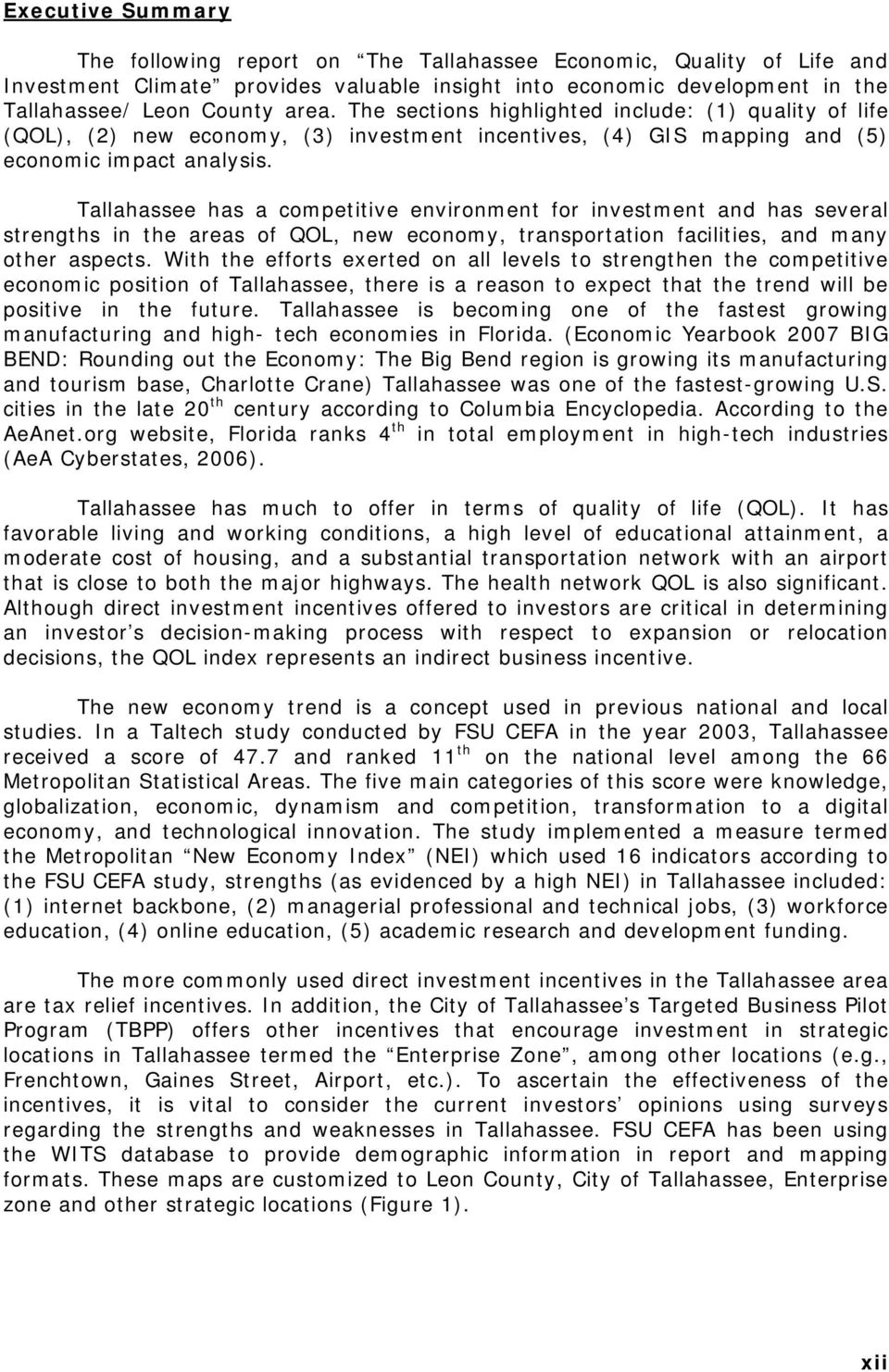
13 Figure 1: The Enterprise Zone and the Other Strategic Locations in Tallahassee / Leon County Enterprise Zone French Town Gaines Street Tallahassee Regional Airport xiii
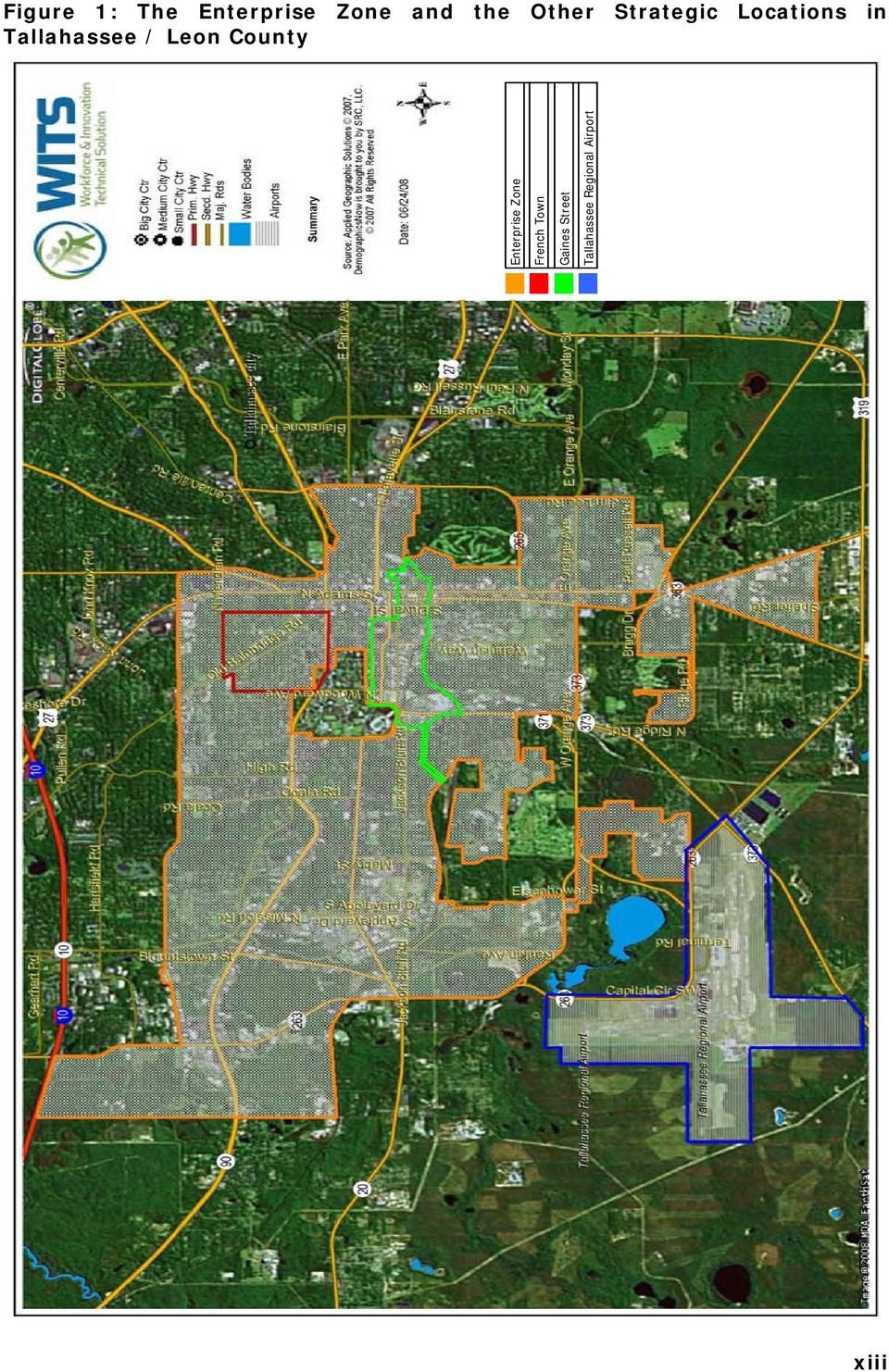
14 1. Introduction Tallahassee has been the capital of Florida since It is located in the heart of Leon County, (Figure 1), as a part of the Big Bend Region (Figure 2) 1 with a population of 150,627 in 2007 estimate 2 It has a total area of 98.2 square mile (sq.m). 3 Tallahassee is also becoming one of the fastest growing manufacturing and high- tech economies in Florida. 4 Figure 2: Tallahassee: In the Heart of Leon County Figure 3: Tallahassee, the Big Bend, and Florida Florida GDP ranked fourth among the US states, with a total of $674.0 billion in the year In addition, the state is the third most populous in the US. The state has 14 deepwater seaports. According to Cyberstates, Florida's high-tech employment totaled 276,400 in the year 2005, up by 10,900, or by 4%. This makes Florida the 4 th ranked Cyberstate by tech industry employment and the 2 nd fastest growing Cyberstate in the year Florida has many comparative attractive merits for businesses: 6 Florida is a national leader in international commerce, with $95.3 billion in trade, proximity to Latin America and a multicultural population. High-tech exports from Florida reached $11 billion in the year 2005, the third highest nationwide. Moreover, Florida is the ninth largest producer of exported goods. (WISER, 2003) 2 Most of the demographic data will be taken from WITS: The website includes detailed information about Florida that is beneficial to businesses. 1

15 In the year 2005, Florida s 3.8% unemployment rate was the second lowest among large US states. Florida added 259,800 new jobs from July 2005 to July 2006 and ranked first in the nation for job creation. Florida remains one of only 10 states with a right-to-work provision in its constitution. Florida s metro areas hold the top 3 spots and 12 of the top 30 on the Milken Institute s Best Performing Cities Index of where jobs created. Florida has the fourth largest labor force, and the seventh lowest unemployment rate. (BLS, 2006) Florida has the fourth highest number of business establishments (BLS, 2005) Florida ranks fourth in the nation for total high-tech employment with 265,484 high-tech workers. Florida added 6,700 high-tech jobs in the year 2004 to become the second fastest growing state in high-tech industry employment. According to the AeAnet.org website, Florida ranks fourth in total employment in high-tech industries. (AeA Cyberstates, 2006) Florida has 354 financial institutions, including 56 international banks. Defense-related industries are a $44 billion segment of the state s economy, representing 714,500 direct and indirect jobs. Every Floridian lives within 50 miles of an institution of post-secondary learning. Telecommunications: Eight Florida cities are on Intel Corporation s list of top 100 for greatest wireless accessibility. QOL: Florida has earned top rankings in Harris Poll s most desirable places to live since the survey s inception. Florida has the eighth largest economy in the western hemisphere and the 19 th largest economy in the world (BEA, 2006). It is the ninth largest recipient of Foreign Direct Investment. (BEA, 2003) 1.A Leon County The percentage of students who obtained Bachelor s degree or higher was 41.7% of the total population in Leon County. Its rank was 48 th on the US level (out of 3,141 counties). Leon County recorded a low level of unemployment rate of 2.7% in the year

16 Leon County has average wage per job of $34,541 (Table 1). The rate of growth for the period was 27.6%, making Leon County among the top tier (upper fifth) of all US counties. Given the relatively low level of unemployment, high level of wages, and the relatively large labor force, Leon County ranked 227 th (out of 3,141). More demographics are included in Table 1. Table 1: Leon County Demographics and Their Relative US Rank Value Rank in U.S. Industry Overview (2005) Value Rank in U.S. Population (2006) 245, Covered Employment 145, Growth (%) since % 680 Average wage per job $34, Households (2000) 96, Manufacturing - % all jobs in County 1.5% 2710 Labor Force (persons) (2006) 139, Average wage per job $39, Unemployment Rate (2006) Transportation & Warehousing - % all jobs in County 0.4% 2964 Per Capita Personal Income (2005) $32, Average wage per job $53, Median Household Income (2004) $39, Health Care, Social Assist. - % all jobs in County 9.9% 1190 Poverty Rate (2004) Average wage per job $38, H.S. Diploma or More - % of Adults 25+ (2000) Bachelor's Deg. or More - % of Adults 25+ (2000) Finance and Insurance - % all jobs in County 3.4% Average wage per job $51, Source: According to Census 2000 (the latest available), the City of Tallahassee ranks 134 th among all US cities with respect to population. The population per square mile was 1,574. Between 1990 and 2000, the land area of the city has grown by 51.2%. The population growth rate was moderate with an average of 2.07% in the years Tallahassee ranks 115 th in the overall growth among all US cities. Comparing to the neighboring cities in Florida and neighboring states, the City of Tallahassee ranked 18 out of 35 (Table 2). Section 2 will discuss the QOL in Tallahassee. Section 3 will outline the new economy trend. Section 4 covers the investment incentives. GIS analysis results (using the WITS database) are depicted in Section 5. Section 6 highlights the economic impact analysis. Section 7 will describe the report s conclusions and recommendations. The Appendices Section includes detailed data (included a 7 Check the link for more demographic rankings. 3
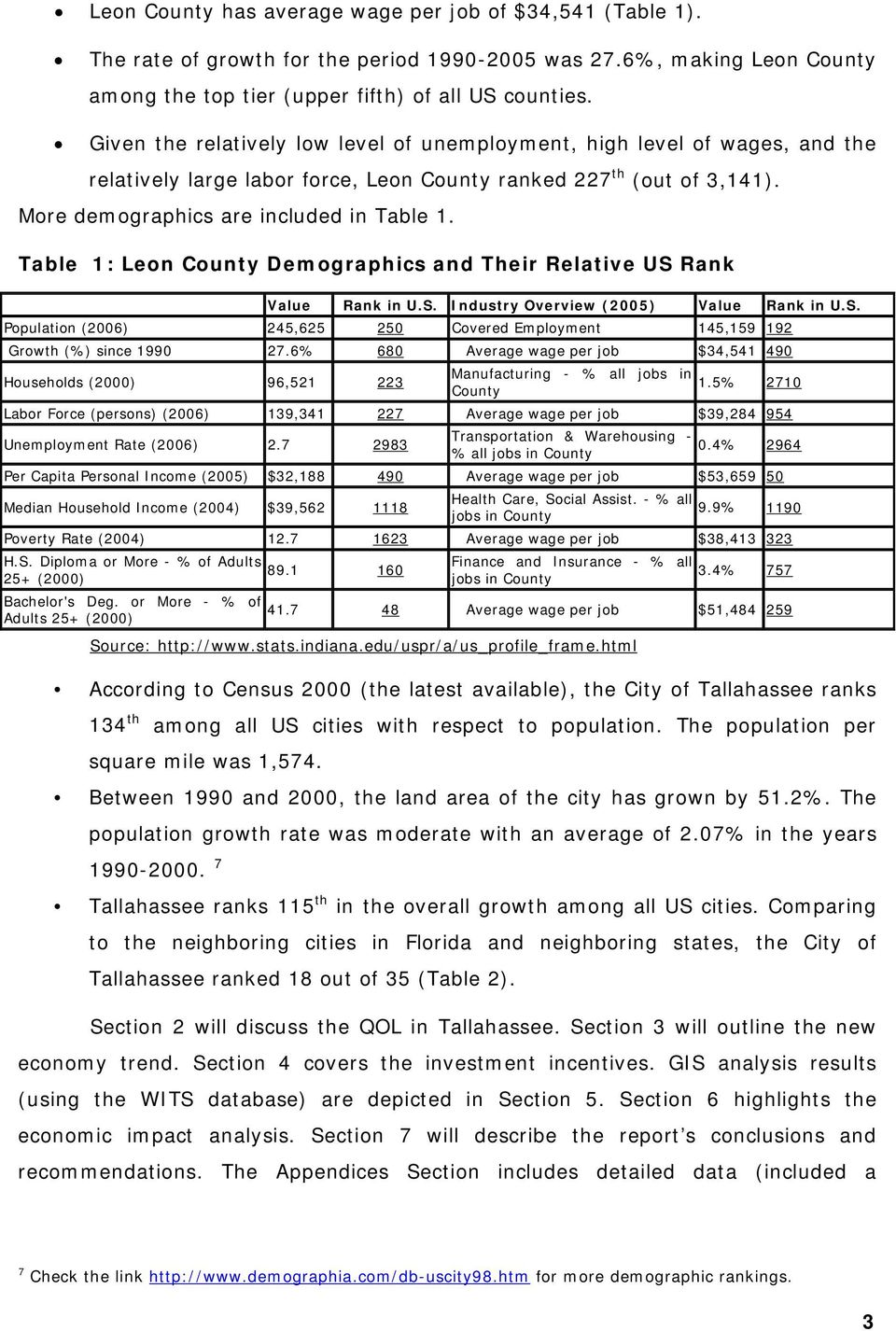
17 business listing in the enterprise zone, the schools types and rating and higher education in Tallahassee). Table 2: The Fastest Growing Cities in Florida, Alabama and Georgia in the Year 2006 rank city state change 1 Port St. Lucie Florida Miramar Florida Cape Coral Florida Atlanta Georgia Orlando Florida Miami Florida Athens-Clarke Georgia Chesapeake Virginia Tampa Florida Pembroke Pines Florida Coral Springs Florida Fort Lauderdale Florida Jacksonville Florida 8 14 Alexandria Virginia Huntsville Alabama Arlington CDP Virginia Hollywood Florida Tallahassee Florida Pompano Beach Florida Virginia Beach Virginia Columbus Georgia Portsmouth Virginia Montgomery Alabama St. Petersburg Florida Hampton Virginia Newport News Virginia Clearwater Florida Norfolk Virginia Gainesville Florida Richmond Virginia Augusta-Richmond Georgia Mobile Alabama Hialeah Florida Savannah Georgia Birmingham Alabama -5.4 Source: 4

18 2. QOL 2.A QOL Defined QOL was defined by Moriarty (1999) as an overall sense of well-being when applied to an individual" and a "supportive environment when applied to a community. While some dimensions of QOL can be quantified using indicators that research has shown to be related to determinants of health and community-well being, other valid dimensions of QOL include the perceptions of community residents about aspects of their neighborhoods and communities that either enhance or diminish their QOL. Most QOL studies focus on health and life expectancy. This does not imply that QOL is only a health-related measure. In fact, the concept of QOL has social, economic and cultural dimensions. These are probably more important to societies than health-related QOL measures simply because they include more comprehensive requirements for individuals satisfaction. A primary research area in QOL literature concerns the measurement of QOL. For a long time, there has been consensus that material well-being is an accepted measure of QOL. The material well-being most commonly used measure is income per capita, presented as the average share in real GDP of the population. This definition has been subject to criticism because material well-being is not at all the sole determinant of QOL. It is not necessary that a higher personal income and no personal freedom are preferable to higher personal freedom and substantially lower income. Several components are integral to QOL. Some literature has tried to incorporate the other dimensions of QOL into material well-being. Nevertheless, it faced insurmountable difficulties in assigning monetary values to the various factors and intangibles that comprise a wider measure of socio-economic well being. (EIU, 2005) Following, there will be a discussion of two common and varied methods of measuring the QOL: the EIU s QOL survey-based index and the non-indexed approach. The latter approach is called non-indexed because it includes many variables that cannot be abbreviated in one number. This is the traditional approach to measure the QOL. It has been widely used in literature. 2.B QOL Measures The indexed measure has some limitations. First, it stems from regression results in which the likelihood of getting desired results is high due to the subjectivity of determinants selection. Multicollinearity, the existence of linear correlation among the explanatory variables, is another issue affecting the reliability of the multiple 5
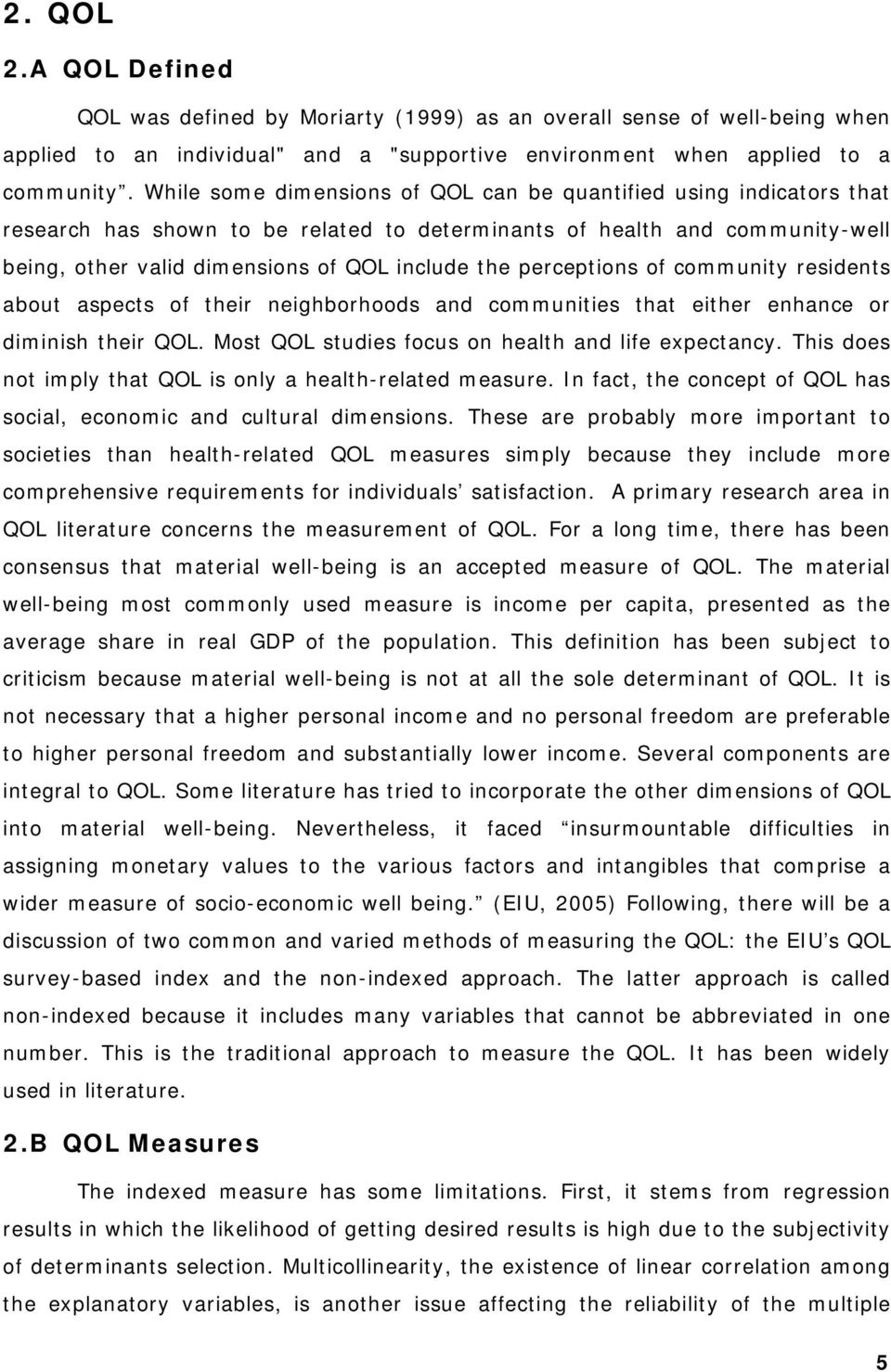
19 regression results. Third, the selection of different years will probably lead to different results. These problems will not occur if the non-indexed measure is used. The non-indexed measures have an advantage of providing a more detailed analysis. Nothing prevents one from using both measures and then making some comparisons between the two. For the purpose of this study, however, the detailed non-indexed measure is the recommended one due to its simplicity, popularity and practicality as compared to the indexed measure. In measuring the QOL, the non-indexed measures are easily compared to US, Florida, Leon County and neighborhood cities. Table 3: Non-Indexed Measures of the QOL DEMOGRAPHICS 1. Total population 2. Population by age group 3. Population by race 4. Income distribution 5. Public school enrollment 6. Minority public school enrollment 7. Private school enrollment EDUCATION 1. School readiness 2. Reading 3. White-African American gap in reading 4. Mathematics 5. White-African American gap in mathematics 6. Writing 7. Third grade retention 8. High school graduation rate 9. High school dropout rate 10. Pursuit of postsecondary education 11. Average teacher salary 12. School safety 13. Adult educational attainment 14. Public library use 15. Class size 16. Students with disabilities FAMILIES 1. Children in single parent families 2. Births to unwed mothers 3. Births to teen mothers 4. Children in foster care 5. Child abuse and neglect 6. Child care affordability 7. Homelessness ECONOMY 1. Unemployment rate 2. Average annual wage 3. Per capita income 4. Children in poverty 5. Child poverty by family 6. Home ownership 7. Affordability of rental 8. Tourism 9. Employment by industry PUBLIC SAFETY 1. Violent crime rate 2. Property crime rate 3. Youths referred for delinquency 4. Youths referred for felonies and misdemeanors 5. Traffic crashes 6. Fatal traffic crashes 7. Drinking and driving 8. Perception of neighborhood safety 9. Recidivism among serious habitual offenders COMMUNITY 1. Voter registration 2. Voter turnout 3. Public perception 4. Sprawl 5. Substandard living 6. Use of public transportation 7. Transportation to work 8. Travel time to work 9. Parks and recreation 10. Traffic congestion HEALTH 1. Health insurance 2. Emergency room visits 3. Infant mortality 4. Low birth weight 5. Sexually transmitted diseases among teenagers 6. Youth smoking 7. Youth drinking 8. Youth substance abuse 9. Youth mental health ENVIRONMENT 1. Lake water quality 2. Conservation of natural 3. Water consumption 4. Electricity consumption 5. Recycling 6. Outdoor air quality Source: QOL Report 2006 the 21 st Century Council, Inc., Tallahassee, Florida The non-indexed measures of the QOL are based on published raw data about all the possible indicators related to the QOL. In each of the indicator categories, several variables measure some issue in the QOL. A shortcoming of this measure is that it is multidimensional, and hence comparisons might be difficult to pick the appropriate indicators for comparison across states, counties or cities. However, this method is more acceptable as a user friendly and non-academic method. 6
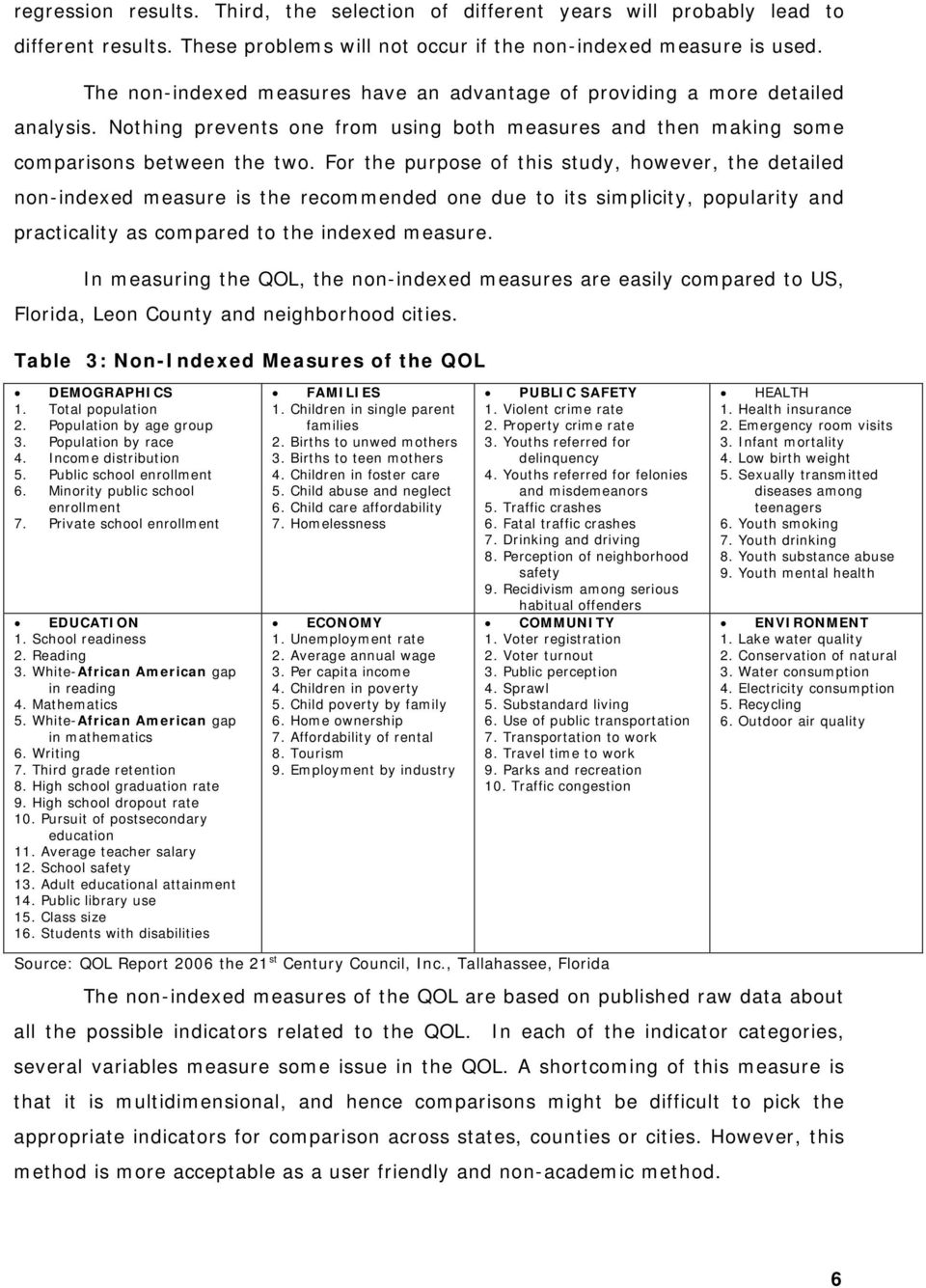
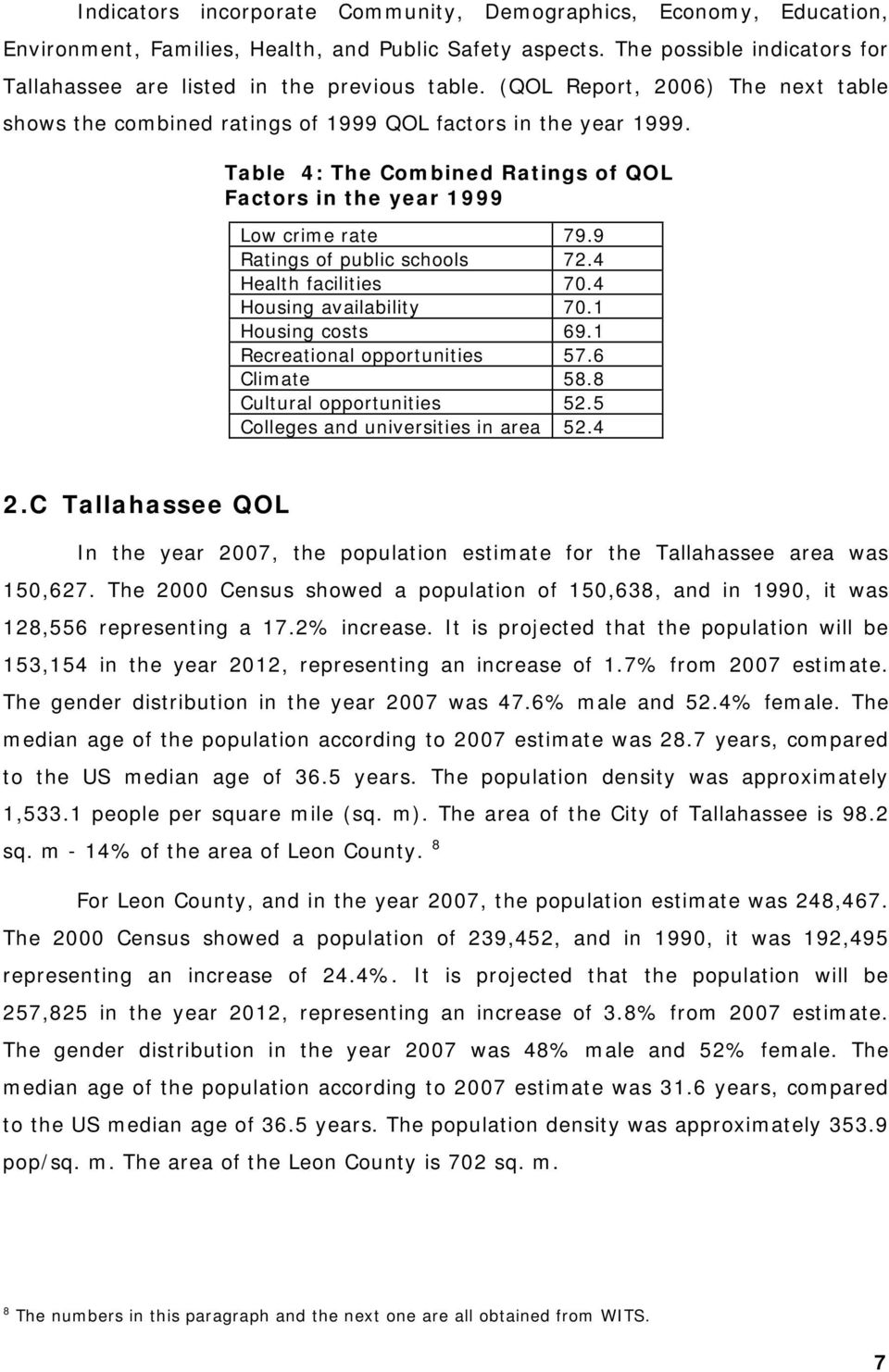
20 Indicators incorporate Community, Demographics, Economy, Education, Environment, Families, Health, and Public Safety aspects. The possible indicators for Tallahassee are listed in the previous table. (QOL Report, 2006) The next table shows the combined ratings of 1999 QOL factors in the year Table 4: The Combined Ratings of QOL Factors in the year 1999 Low crime rate 79.9 Ratings of public schools 72.4 Health facilities 70.4 Housing availability 70.1 Housing costs 69.1 Recreational opportunities 57.6 Climate 58.8 Cultural opportunities 52.5 Colleges and universities in area C Tallahassee QOL In the year 2007, the population estimate for the Tallahassee area was 150,627. The 2000 Census showed a population of 150,638, and in 1990, it was 128,556 representing a 17.2% increase. It is projected that the population will be 153,154 in the year 2012, representing an increase of 1.7% from 2007 estimate. The gender distribution in the year 2007 was 47.6% male and 52.4% female. The median age of the population according to 2007 estimate was 28.7 years, compared to the US median age of 36.5 years. The population density was approximately 1,533.1 people per square mile (sq. m). The area of the City of Tallahassee is 98.2 sq. m - 14% of the area of Leon County. 8 For Leon County, and in the year 2007, the population estimate was 248,467. The 2000 Census showed a population of 239,452, and in 1990, it was 192,495 representing an increase of 24.4%. It is projected that the population will be 257,825 in the year 2012, representing an increase of 3.8% from 2007 estimate. The gender distribution in the year 2007 was 48% male and 52% female. The median age of the population according to 2007 estimate was 31.6 years, compared to the US median age of 36.5 years. The population density was approximately pop/sq. m. The area of the Leon County is 702 sq. m. 8 The numbers in this paragraph and the next one are all obtained from WITS. 7
21 Figure 4: Leon County Population Growth Population 300, , , , ,000 50, Year City of Tallahassee Unincorporated Leon County Leon County Source: US department of commerce, Bureau of Census ( ) University of Florida, Bureau of Economic and Business Research ( estimates In the year 2007, there were 69,890 households in the Tallahassee area. The Census showed household counts of 63,221 households in the year 2000, up from 51,692 households in the year 1990, representing an increase of 22.3%. It was estimated that the number of households will be 74,650 in the year 2012, representing an increase of 6.8% from The average household size was 2.16 persons in the year In the year 2007, the median number of years in residence was The average household size was 2.00 people and the average family size was 2.72 people. The average number of vehicles per household was 1.7 vehicles. In the year 2007, the median household income was $36,555, compared to the US median of $51,680. The Census showed median household incomes of $30,943 in the year 2000 and $24,212 in the year 1990 representing an increase of 27.8%. It was estimated that the median household income will be $40,237 in the year 2012, which would represent an increase of 10.1% from In the year 2007, the per capita income was $25,380, compared to the $US per capita, which was $25,232. The 2007 average household income was $52,150, compared to the US average of $65,273. In the year 2007, the racial makeup was as follows: 59.7% White; 34.1% African American; 0.2% Native American; 3.3% Asian/Pacific Islander, and 1.0% other. This can be compared to the US racial makeup of 74.5% White, 12.0% African American, 0.8% Native American, 4.6% Asian/Pacific Islander and 5.3% Other. People of Hispanic ethnicity are counted independently of race. People of Hispanic origin made up 5.1% of the 2007 population when compared to the US makeup of 8
22 15.1%. Changes in the population within each race and ethnicity category from the 1990 Census to the 2000 Census were as follows: 26.2% American Indian, Eskimo, Aleut Population; 63.3% Asian, Pacific Islander; 41.0% African American; 64.7% Hispanic Ethnicity; 64.0% other; and White 3.0%. Table 5: Racial Makeup in the City of Tallahassee in the year Census 2000 Census 2007 Estimate 2012 Projection 1990 to 2000 % 2007 to 2012 White 88, % 91, % 89, % 90, % 3.0% 0.3% African American 36, % 51, % 51, % 52, % 41.0% 1.9% American Indian or Alaska Native Asian or Pacific Islander Some Other Race Two or More Races Hispanic Ethnicity % % % % 26.2% -2.8% 2, % 3, % 5, % 5, % 63.3% 19.0% % 1, % 1, % 1, % 64.0% 24.6% 2, % 2, % 2, % -1.0% 3, % 6, % 7, % 8, % 64.7% 16.8% Not Hispanic or 124, % 144, % 142, % 144, % 15.7% 0.9% Latino Source: WITS, 2007 The median housing value was $73,865 in the year 1990, compared to the US median of $78,382 for the same year. The 2000 Census median housing value was $101,065, which was a 36.8% increase from In the year 1990, there were 23,996 owner occupied housing units vs. 27,909 in the year Also in the year 1990, there were 27,697 renter occupied housing units vs. 35,312 in the year The average rent in the year 1990 was $354 vs. $504 in the year In the year 2007, there were 87,737 people over the age of 16 in the labor force. Of these, 90.2% were employed, 9.6% were unemployed, 29.2% were not in the labor force and 0.1% was in the Armed Forces. In the year 1990, unemployment was 5.4% and in the year 2000, it was 11.0%. In the year 2007, there were 128,056 employees (daytime population) and there were 8,782 establishments. In the year 1990, 75.6% of employees were employed in white-collar occupations and 24.4% were employed in blue-collar occupations. In the year 2000, white-collar workers made up 74.7% of the population, and those employed in blue-collar occupations made up 25.3%. In the 9
23 year 1990, the average time traveled to work was 10 minutes and in the year 2000, it was 18 minutes. The latest available data for unemployment in November 2007 indicates a rate of unemployment in Leon County of 3.2%, compared to 3% a year before. 9 2.C.1 Demographics 10 2.C.1.1 Total Number of Residents Leon County s population from 1980 to 2006 was nearly the same as the average percentage on the state level. It increased by 86% - about the same percentage growth as the state (87%). In the year 1980, Leon County s population included 145,981 people, an increase of 4,800 people per year. Compared with the neighboring counties, Leon County has the largest population in the 4-county region. In fact, the total number of population of the three counties did exceed one third of the population of Leon County. However, Wakulla County, not Leon County, is the fastest growing County, but, its population was significantly smaller. Table 6: Total Number of Residents by County ( ) % change to 2006* Leon 145, , , , , , % Wakulla 10,719 12,352 14,202 17,207 22,863 27, % Gadsden 41,324 41,975 41,116 43,460 45,087 47, % Jefferson 10,585 10,919 11,296 12,832 12,902 14, % Florida* 9,753,351 11,272,332 12,938,071 14,335,992 15,982,378 18,232, % QOL Report, 2006 the 21 st Century Council, Inc., Tallahassee, Florida The population density numbers in the year 2006 indicate that Leon County dominated the other three counties. Population density reached people per sq. m. Compared to 88.5 sq.m; 24.8 sq.m; and 47.5 sq.m in Gadsden, Jefferson and Wakulla Counties, respectively. 2.C.1.2 Percentage of Leon County residents in each age group As of 2007, children and young adults (ages 0-19) comprised 25.8% of the population. The proportion of the population of the college-age residents (19-24) was 11.7%. The group of ages (0-19), however, remains the county s largest age group with of the overall population. The college-age residents portion exceeds its counterpart for the other counties. These numbers are important as it reflects the 9 The recent unemployment number are obtained from: 10 The subsections of 2.D are extracted from the following source: Quality of Life Report The 21 st Century Council, Inc., Tallahassee, Florida. 10
24 growing age demographics and job potential in the community. This is apparent in the median age of population (31.6 in the year 2007). 2.C.1.3 Table 7: Age Distribution of Population by County in the Year 2007 Gadsden Jefferson Leon Wakulla Total Population 46,558 14, ,467 28,803 Total Households 16,520 5, ,030 11,032 Female Population 24,570 6, ,181 13,645 % Female 52.8% 44.9% 52.0% 47.4% Male Population 21,988 8, ,286 15,158 % Male 47.2% 55.1% 48.0% 52.6% Population Density (per Sq. Mi.) Age % 22.0% 25.8% 24.2% Age % 6.1% 11.7% 7.1% Age % 13.8% 17.1% 13.1% Age % 14.8% 12.2% 14.9% Age % 16.2% 13.2% 16.0% Age % 12.8% 10.7% 12.0% Age % 7.7% 5.5% 7.7% Age % 4.8% 2.8% 4.0% Age % 1.8% 1.0% 1.1% Median Age Source: WITS, 2007 Percent of Households at Various Income levels Compared to Florida and the United States, Leon County has a significantly larger percentage of households in the lowest income group (less than $10,000 per year). This number should be taken with caution because students form a significant proportion of the population. 2.C.1.4 Number of Students Enrolled In Leon County Public Schools by Grade Level Public school enrollment in Leon County has remained relatively stable over the last seven years, despite an increase in the county s overall population. Middle and high school students (grades 6-12) comprise 51% of student enrollment in Leon County Public Schools. Overall, enrollment in years was up 1.5% compared with years PreK-5 enrollment was up 2.8%. A slight decrease in enrollment in grades 6-8 was offset by a similar increase in grades C.1.5 Minority Public School Enrollment The indicator used for this is the percent of students enrolled in Leon County Public Schools who were minorities (African American and Other). Leon County public schools are experiencing an increasing percentage of minority students particularly at the elementary level. As of , 52% of students in grades PreK-5 were non- White, mainly African American. Although students of Other races/ Ethnicities comprise a small proportion of total enrollment, this group showed the largest 11
25 proportional increase from to in both elementary and secondary schools. 2.C.1.6 Percent Of Elementary, Middle And High School Students Enrolled In Private School. While the vast majority of students in Leon County attend public school, 16% in the school year attend private school a larger percentage than in the state as a whole. The increase in the year reflects the inclusion of prekindergarten students in the count that year. 2.C.1.7 Private School Enrollment Table 8: Leon County Private School Enrollment ( ) Private School Leon - # enrolled* Leon -% enrolled , % , % , % , % , % , % , % , % , % Florida -% enrolled 10.6% 10.5% 10.8% 12.5% 12.4% 12.9% 12.8% 12.9% 11.6% QOL Report, 2006, the 21 st Century Council, Inc., Tallahassee, Florida 2.C.2 Families 2.C.2.1 Children in Single Parent Families (Percentage of Children, under Age 18, Who Live in Single Parent Families (Rather Than in Married- Couple Families) In the year 2000, nearly one in three children in Leon County lived in a single parent family a higher percentage than in Florida or the United States. The percent of children living in single parent families has increased over the past decade in Leon County, the state and the nation. A single female heads most of these families. 2.C.2.2 Table 9: Children in Single Parent Families in the year 1990 and 2000 Children in single parent families Difference 1990 to 2000 Leon County 27.4% 32.0% +4.6% Florida 24.5% 29.4% +4.9% United States 21.5% 25.3% +3.8% QOL Report, 2006, the 21 st Century Council, Inc., Tallahassee, Florida Percent of Births to Unwed Mothers by Race The percentage of babies born to unwed mothers continues to increase slowly in Leon County. In Leon County in the year 2005, African American children were more than three times as likely to be born to unwed mothers as White children were. Overall, Leon County continues to mirror the state as a whole on this indicator. Just over two in five babies of all races are born to unwed mothers in Florida. 12
26 Table 10: Percent of Births to Unwed Mothers by Race ( ) Births to unwed mothers Leon -White 16% 17% 19% 18% 19% 22% 19% 23% 22% Leon -African American 69% 70% 69% 69% 70% 67% 72% 70% 74% Leon Total -all races 36% 37% 38% 38% 38% 39% 40% 41% 42% Florida Total -all races 36% 37% 37% 38% 39% 39% 40% 41% 43% QOL Report, 2006, the 21 st Century Council, Inc., Tallahassee, Florida 2.C.2.3 Births to Teen Mothers (Number of Teenage Mothers, Ages 15-19, Who Gave Birth per 1,000 Teenage Girls Ages 15-19) Overall, the rate of births to teenage mothers has been declining in Leon County and in Florida. A significant racial disparity exists but the gap is closing somewhat, primarily because of the decline in the rate of births to African American teenagers. The rate of births to teens in Leon County for all races is less than half the state rate. Table 11: Births to Teen Mothers ( ) Births to teen mothers Leon -White Leon -African American Leon Total -all races Florida Total - all races QOL Report, 2006, the 21 st Century Council, Inc., Tallahassee, Florida 2.C.2.4 Number of Children under Age 18 Who Are In Foster Care or Residential Group Care under the Custody of the Florida Department of Children and Families (DCF) In this region of Florida, the number of children in foster care and residential group care has increased over the past two years in District 2 but has remained stable for the State. Leon County saw an increase of 13 children in foster or residential group care between 2004 and District 2 includes 14 counties in North Florida, including Leon. Table 12: Number of Children under Age 18 Who Are in Foster Care or Residential Group Care under the Custody of the Florida Department of Children and Families ( ) DCF District 2 Number of children Leon County Number of children n/a n/a n/a n/a n/a n/a n/a n/a Florida-Number of children* 8,941 8,950 9,875 10,430 10,885 10,657 11,285 11,476 11,342 11,137 QOL Report, 2006, the 21 st Century Council, Inc., Tallahassee, Florida 13
27 2.C.2.5 Child Abuse and Neglect (Number Of Child Abuse and Neglect Victims (Per 100,000 Children under Age 18) Whose Maltreatment Was Verified or Found To Have Some Evidence of Occurrence) The rate of child abuse and neglect in Leon County has remained at relatively the same level over the past few years. Leon County s rate was the same or higher than the statewide rate until , when it dropped below the state rate. The unusually high rates for Florida in the year and most likely reflect a statewide initiative to investigate backlogged cases. The same child may be counted more than once if involved in more than one incident. An unusually high rate in a single year is most likely due to a reduction of backlog (closure of a high number of reports from prior years), while an unusually low rate may be due to growth in backlog data are incomplete due to a new reporting system that was phased in across the state. 2.C.2.6 Child Care Affordability (Cost of Childcare in Leon County as a Percentage of Family Income) The average family with children pays a substantial portion of their income on childcare especially if they have more than one child in need of care. Single parent families are at a particular disadvantage because their median income is less than one-third of the income of married couples with children. 2.C.2.7 Homelessness (Number of Homeless People in Tallahassee) In the year 2005, 739 people in Tallahassee reported having no regular place to stay or expected to be forced to leave their home within the next week without another place to go. Almost half (46%) of the city s homeless in both 2003 and 2005 were children, ages (1) Interviews conducted during a 15-hour period on January 24, 2005 at emergency shelters, congregate meal programs, day labor programs, social service agencies, public places and street and wooded locations frequented by homeless individuals, and (2) data from the Leon County School District s family survey and administrative records. 2.C.3 Public Safety 2.C.3.1 Violent Crime Rate (Number of Violent Crimes Reported Per 100,000 Residents) Leon County s violent crime rate decreased in the year 2006, after two years of slight increase in both 2004 and 2005, and after declining each year between 1999 and The gap between Leon County and Florida has narrowed since the mid 1990 s. However, Leon County and Florida s rate continues to be well above that 14
28 of the nation. This includes murder and non-negligent manslaughter, forcible rape, robbery and aggravated assault. Table 13: Violent Crime Rate ( ) Leon County Florida United States * QOL Report, 2006, the 21 st Century Council, Inc., Tallahassee, Florida.. Numbers for 2006 are from Florida Statistical Analysis Center: FDLE, ( ). Crime in Florida, Florida 2.C.3.2 Property Crime Rate (Number of Property Crimes Reported Per 100,000 Residents) Leon County s property crime rate steadily declined between 1995 and 2004 and increased a negligible amount in the year In the year 2004, Leon County s property crime rate was lower than the state s for the first time in ten years. Even thought this rate increased in the year 2005, it decreased again in the year Property crimes include burglary/ breaking, entering, larceny/theft, motor vehicle theft, and arson. Table 14: Property Crime Rate ( ) Leon County Florida United States * * QOL Report, 2006, the 21 st Century Council, Inc., Tallahassee, Florida.. Numbers for 2006 are from Florida Statistical Analysis Center: FDLE, ( ). Crime in Florida, Florida 2.C.3.3 Youth Referred For Delinquency Percent of Youths Ages Who Were Referred To the Florida Department of Juvenile Justice for Delinquency) The percentage of youths referred for delinquent acts in Leon County remained at 5% in the year Leon County s rate of youth referrals has been identical to the State average over the past three years after being below the State average for the two years prior to that. 2.C.3.4 Youths Referred For Felonies and Misdemeanors (Number of Youths in Leon County Referred To the Florida Department of Juvenile Justice for Felonies vs. Misdemeanors) In Leon County, a greater number of youths are referred for misdemeanors than felonies (generally more serious crimes) Youth referrals for both misdemeanors and felonies have remained at similar levels in four of the past five years with experiencing the most felonies and misdemeanors in a year. 15
29 2.C.3.5 Traffic Crashes (Number Of Traffic Crashes per 10,000 Licensed Drivers, By Age Group (15-19 and 20-24) In Leon County and Florida, drivers ages and have higher traffic crash rates than any other age group. Crash rates for young drivers are consistently higher in Leon County than in Florida. In the year 2005, traffic crash rates for age groups and decreased somewhat in Leon County when compared to 2004 while increasing at a marginal rate in Florida. Table 15: Traffic Crashes ( ) Leon, ages Leon, ages Florida, ages Florida, ages C , , , QOL Report, 2006, the 21 st Century Council, Inc., Tallahassee, Florida Fatal Traffic Crashes (Number of drivers, by age, in traffic crashes in Leon County that resulted in fatalities) In Leon County, the number of drivers in fatal traffic crashes increased sharply in the year 2005, resulting in the most drivers in fatal crashes in a single year in more than a decade! Young drivers (age 15-24) accounted for 34% (seventeen out of fifty) of drivers in fatal crashes in the year Table 16: Fatal Traffic Crashes ( ) Fatal crashes Drivers aged Drivers aged Total -drivers all ages % Percent - drivers age 15-24* 28% 33% 25% 37% 30% 38% 33% 24% QOL Report, 2006, the 21 st Century Council, Inc., Tallahassee, Florida 2.C.3.7 Number of Traffic Crashes Involving a Drinking Driver per 10,000 Licensed Drivers, By Age Group (15-19 and 20-24) Drinking and driving is a serious problem in Leon County, particularly for the age groups. Leon County s rates of drinking driver crashes for both and year olds are significantly higher than the rates for the State. The percent of total fatalities alcohol-related in Leon County for all ages reached 50% in the year 2005 with 21 deaths from alcohol-related traffic crashes. 16
30 2.C.3.8 Drinking and Driving Table 17: Drinking and Driving ( ) Traffic crashes involving a drinking driver Leon, ages Florida, ages Leon, ages Percent of total fatalities alcohol-related Florida, ages Leon County all ages* 31% 42% 32% 33% 33% 47% 50% Florida all ages* 32% 33% 33% 32% 34% 34% 35% QOL Report, 2006, the 21 st Century Council, Inc., Tallahassee, Florida 2.C.3.9 Perception of Neighborhood Safety (Percent of Adult Tallahassee Residents Who Report Feeling Safe in Their Neighborhood) The vast majority of Tallahassee residents say they feel safe in the neighborhood where they live. As of years 2003, residents were less likely to feel safe if they lacked a high school diploma (91%), had an income under $10,000 (89%) or lived in the following zip codes: (80%), (90%), (90%), or (91%) Table 18: Perception of Neighborhood Safety ( ) Percent of adults who say they feel safe in their neighborhood 92% 92% 92% 96% 94% QOL Report, 2006, the 21 st Century Council, Inc., Tallahassee, Florida 2.C.3.10 Recidivism among Serious Habitual Offenders (Percent of Serious Habitual Offenders (Under Age 18) Who Are Crime-Free One Year after Their Arrest or Release from a Commitment Facility) In the year 2005, Tallahassee/Leon County had 48 youths under 18 who had a history of repeatedly committing serious crimes. Usually, these juveniles are in and out of the juvenile justice system with no improvement in their behavior. These serious habitual offenders account for a very small percentage of juvenile offenders, but they typically account for over one third of juvenile arrests. Currently, these youths are served by the Serious Habitual Offender Comprehensive Action Program, a multi-agency program focusing increased attention to these juveniles. Table 19: Crime Statistics in Tallahassee ( ) Tallahassee-Leon County Number of serious habitual offenders (under age 18) Number crime free after one year Percent crime free after one year 13% 5% 6% QOL Report, 2006, the 21 st Century Council, Inc., Tallahassee, Florida 2.C.4 Health 2.C.4.1 Health Insurance (Percentage of Children and Non-Elderly Adults Who Do Not Have Health Insurance) In the year 2004, according to the Florida Agency for Health Care 17
31 Administration s Florida Health Insurance Survey, 7.7% of Leon County residents (ages 0-64) did not have any health insurance through Medicaid, private insurance or other sources. This percentage was the lowest of any county in the State. (Seniors age 65+ are not shown because most are covered by Medicare) 2.C.4.2 Table 20: Health Insurance for 1999 and Leon County, Ages % n/a Leon County, Ages % 7.7% State of Florida, Ages % 12.1% State of Florida, Ages % 19.2% QOL Report, 2006, the 21 st Century Council, Inc., Tallahassee, Florida Emergency Room Visits (Number Of Visits To Emergency Rooms At Tallahassee Memorial Hospital (TMH) And Capital Regional Medical Center (CRMC), Reported For All Ages. ) From 1996 to 2004, the number of hospital emergency room (ER) visits in Leon County increased at a much higher rate (48%) than the population (18%). TMH continues to receive the largest number of ER visits in the county. However, CRMC accounted for 34% of emergency room visits to Tallahassee hospitals in the year 2004 up from 26% in the year TMH data are reported for fiscal years ending in the date shown. CRMC data are reported by calendar year. Table 21: Emergency Room Visits ( ) Percent Change TMH* 55,105 58,687 62,461 63,954 62,229 63,552 64,513 68,837 31% CRMC 16,621 16,804 18,723 19,675 22,193 26,212 30,419 36,202 96% TOTAL 71,726 75,491 81,184 83,629 84,422 89,764 94, ,039 48% QOL Report, 2006, the 21 st Century Council, Inc., Tallahassee, Florida 2.C.4.3 Infant Mortality (Number of Infants, Per 1,000 Live Births, Who Died Before Their First Birthday By Race) The infant mortality rate for all races in Leon County is consistently higher than in Florida (As of years , 9.7 per 1,000 live births in Leon County compared to 7.2 in Florida). Both Leon County and Florida show a major disparity between Nonwhites and Whites on infant mortality. The Nonwhite-White gap in Leon County has remained stable over the past three years. 2.C.4.4 Low Birth Weight (Percent of Full-Term and Premature Babies Who Weighed Less Than 5 Lbs., 9 Oz. at Birth) On average, the percentage of babies born with a low birth weight tends to be higher in Leon County than in Florida. Black babies are about twice as likely to be 18
32 born with a low birth weight as White babies in Leon County. This is also the case on the state level. 2.C.4.5 Sexually Transmitted Diseases among Teenagers (Number of New Cases of Chlamydia and Gonorrhea, Per 100,000 Females Ages 15-19) The reported incidence of Gonorrhea and Chlamydia has risen considerably among Leon County teenagers ages The increase is particularly dramatic for Chlamydia. Historically, Leon County s rates for this age group have been lower than the state s. However, since , Leon County s teenagers have had a considerably higher incidence of both Gonorrhea and Chlamydia than teenagers have in the state as a whole. Table 22: Sexually Transmitted Diseases among Teenagers ( ) Chlamydia - Leon 1,951 1,755 1,390 2,060 2,694 3,601 3,735 3,622 Chlamydia - Florida 2,040 2,115 2,171 2,352 2,436 2,522 2,499 2,410 Gonorrhea - Leon ,095 1, Gonorrhea - Florida QOL Report, 2006, the 21 st Century Council, Inc., Tallahassee, Florida 2.C.4.6 Youth Smoking (Percent of Youth Surveyed Who Reported Smoking within the Last 30 Days) Cigarette smoking among youth has been declining in Leon County and in Florida. High school students in Leon County reported a significant decline, from 26.2% in the year 2000 to 13.2% in the year C.4.7 Table 23: Youth Smoking ( ) Leon County - High Schools 26.2% 13.2% Florida High Schools 21.7% 15.0% Leon County - Middle Schools 13.1% 7.4% Florida - Middle Schools 9.8% 6.9% QOL Report, 2006, the 21 st Century Council, Inc., Tallahassee, Florida Youth Drinking (Percent of Students Who Reported That They Were Current Drinkers (One or More Drinks in the Last 30 Days) and Binge Drinkers (5 or More Drinks in One Sitting In the Last 2 Weeks) As of the Year 2004, underage alcohol consumption was a problem locally and statewide. In Leon County, almost 38% of high school students reported drinking alcohol in the last 30 days; 17% reported binge drinking in the last 2 weeks. Middle school students reported lower consumption, but still substantial drinking for that age group. 19
33 Table 24: Youth Drinking in the Year 2004 One or more drinks in last 30 days 5 or more drinks in one sitting in last 2 weeks Leon County - High Schools 37.8% 17.2% Florida - High Schools 42.0% 22.0% Leon County - Middle Schools 21.4% 8.8% Florida Middle Schools 20.3% 8.5% QOL Report, 2006, the 21 st Century Council, Inc., Tallahassee, Florida 2.C.4.8 Youth Substance Abuse (Percent of Students Who Reported That They Used Various Substances within the Last 30 Days) Alcohol use is much more common than drug use among high school and middle school students in Leon County and in Florida. Both are more common among high school students than middle school counterparts. In Leon County, the percent of high school and middle school students using marijuana is above state averages and illicit drugs other than marijuana, below the state average. 2.C.4.9 Table 25: Youth Substance Abuse in the Year 2004 Marijuana Illicit drug other than Marijuana Alcohol Leon County - High Schools 17.7% 7.1% 37.8% Florida - High Schools 16.4% 7.5% 42.0% Leon County - Middle Schools 6.5% 7.1% 21.4% Florida - Middle Schools 5.3% 8.6% 20.3% QOL Report, 2006, the 21 st Century Council, Inc., Tallahassee, Florida Youth Mental Health (Percent Of Middle And High School Students Who Said Yes When Asked, In The Past Year, Have You Felt Depressed Or Sad MOST Days, Even If You Felt OK Sometimes? ) In the year 2004, a substantial percentage (44.7%) of grade 6-12 students in Leon County reported that they felt depressed or sad most days in the past year. The percentage (48.2%) was even higher for grade 6-12 students in the state as a whole. In Leon County and the State, this problem was slightly more often reported by middle school than high school students were. Table 26: Youth Mental Health in the Year Leon County Florida Middle school 45.8% 49.9% High school 43.7% 46.7% Total grades % 48.2% QOL Report, 2006, the 21 st Century Council, Inc., Tallahassee, Florida 2.C.5 Education 2.C.5.1 School Readiness (Percent of Kindergartners Entering Public School Ready to Learn) In the year 2004, Kindergartners did not meet expectations for school readiness in Leon County. A significant gap generally 50% existed between Leon 20
34 County White and African American. A large majority of kindergartners enter Leon County Public Schools ready to learn and a slightly higher. 2.C.5.2 Reading (Percent of Leon County Public School Students Scoring Three or Above In Reading on the Florida Comprehensive Assessment Test (FCAT)) Reading performance declined in Leon County in the year 2006 compared with 2005 levels in meeting proficiency standards (three or above) for their grade level. The state showed improvement for eighth graders and no improvement for tenth graders in the year However, at all grades assessed, Leon County students continued to outperform students in the state as a whole. 2.C.5.3 Percent of Leon County Public School Students Who Scored Three or Above In Mathematics on the Florida Comprehensive Assessment Test (FCAT) Mathematics achievement of Leon County students improved marginally in the year 2006 for grade 5 and decreased slightly for grades 8 and 10 compared with 2005 levels. As in reading, Leon County students consistently outperform students in the state at all grade levels assessed C.5.4 Mathematics The FCAT is administered during February-March of each school year. Only students in grades 5, 8, and 10 have been tested in Mathematics since Students in grades 3-10 have been tested since Table 27: Mathematics Performance ( ) Grade 5 Leon County 48% 53% 57% 56% 62% 61% 63% 64% Grade 5 Florida* 35% 46% 48% 48% 52% 52% 57% 57% Grade 8 Leon County 52% 63% 68% 66% 69% 69% 71% 68% Grade 8 Florida* 44% 51% 55% 53% 56% 57% 59% 60% Grade 10 Leon County 54% 60% 68% 70% 73% 77% 78% 75% Grade 10 Florida* 47% 51% 59% 60% 60% 64% 63% 65% QOL Report, 2006, the 21 st Century Council, Inc., Tallahassee, Florida.. 2.C.5.5 Writing (Percent of Leon County Public School Students Scoring Three and Above (3.5 and Above For Writing+) on the Florida Comprehensive Assessment Test (FCAT) Writing+) On the FCAT, a significantly larger percentage of students score three or above in writing compared to mathematics and reading. Writing performance declined in Leon County in the year 2006 compared with 2005 levels for 4 th and 10 th 11 Results are shown for all curriculum students, including those in exceptional student education who are expected to pursue a standard high school diploma. 21
35 graders in meeting proficiency standards (3.5 or above) for their grade level. The state showed improvement for fourth and eighth graders and a decline for 10 th graders in the year The FCAT is administered February-March of each school year. Currently, only students in grades 4, 8 and 10 are tested in Writing. 12 Table 28: Writing ( ) Grade 4 Leon County 55% 70% 72% 79% 76% Grade 4 Florida* 52% 69% 69% 74% 76% Grade 8 Leon County 82% 81% 77% 85% 89% Grade 8 Florida* 74% 76% 73% 76% 83% Grade 10 Leon County 86% 82% 83% 91% 85%78% Grade 10 Florida* 79% 77% 79% 79% QOL Report, 2006, the 21 st Century Council, Inc., Tallahassee, Florida 2.C.5.6 Percent of Third Graders Who Were Retained (Not Promoted To 4 th Grade) In Leon County public schools, the percentage of third graders retained increased sharply over the 3-year period from to , when the state 01 to reflects an even stricter state policy requiring an FCAT Reading score of three or above for promotion to 4 th grade, with limited allowance of exemptions by district. The impact of this new policy was much more dramatic statewide than in Leon County schools. Table 29: Third Grade Retention ( ) and district increased requirements for promotion to 4 th grade. The increase from Leon number Leon percent 1.9% 7.6% 8.0% 8.9% 4.9% 7.3% 9.4% 8.9% 9.2% Florida percent 1.5% 2.4% 3.3% 3.3% 3.0% 3.3% 14.4% 10.7% 9.5% QOL Report, 2006, the 21 st Century Council, Inc., Tallahassee, Florida 2.C.5.7 High School Graduation Rate (Percent of First-Time 9 th Graders in Public Schools Who Earned a Standard High School Diploma in Four Years Graduation rates declined in Leon County from 1997 to 2001, increased steadily from 2002 to 2004 and leveled off last year. In nine of the last ten years, Leon County s graduation rate was the same or above the state graduation rate. 12 See previous footnote. 22
36 Table 30: High School Graduation Rate ( ) Leon County 81% 70% 65% 67% 64% 74% 76% 80% 80% Florida 73% 72% 60% 62% 64% 68% 69% 72% 72% QOL Report, 2006, the 21 st Century Council, Inc., Tallahassee, Florida 2.C.5.8 High School Dropout Rate (Percent of Public School Students Age 16 and Older Who Dropped Out Of School) Overall, Leon County s dropout rate declined in the year after increasing the previous school year. Since , the drop out rate in Leon County has declined much more slowly than the state rate. In the year and , Leon County s dropout rate exceeded the state rate. Table 31: High School Dropout Rate ( ) Leon County 4.6% 3.8% 4.0% 3.5% 3.1% 3.4% 2.7% 3.1% 2.8% Florida 5.4% 4.8% 5.4% 4.6% 3.8% 3.2% 3.1% 2.9% 2.8% QOL Report, 2006, the 21 st Century Council, Inc., Tallahassee, Florida 2.C.5.9 Pursuit of Postsecondary Education (Indicator: Percent of Public High School Graduates Who Entered Community College or 4-Year Colleges And Universities In Florida The Fall After Graduation) The percentage of high school graduates in Leon County that pursued postsecondary education immediately after high school declined at all high schools in years compared with Table 32: Pursuits of Postsecondary Education ( ) Leon County Lincoln H.S. 67% 69% 73% 67% 77% 73% 80% 74% Leon H.S. 63% 64% 71% 70% 72% 72% 74% 70% Godby H.S. 55% 48% 59% 55% 63% 73% 64% 60% Rickards H.S. 47% 55% 57% 55% 54% 62% 68% 65% Chiles H.S. n/a n/a n/a n/a n/a 80% 80% 77% QOL Report, 2006, the 21 st Century Council, Inc., Tallahassee, Florida 2.C.5.10 Average Teacher Salary (Average Teacher Salary in Grades K12 in Public Schools) The gap between Leon County and Florida regarding average teacher salary increased slightly from ($1,481) to ($1,620), and improved slightly in comparison with Georgia ($6,821) vs. ($6,568) Wakulla County s gap with Leon remained more than $3,000 for the third straight year. The Georgia-Leon gap is the Georgia average teacher salary minus the Leon County average teacher salary. Table 33: Average Teacher Salary in Leon County, Florida and Georgia ( ) ($) 23
37 Leon County 32,371 31,871 33,408 33,264 36,454 36,269 38,719 39,117 39,958 Georgia 35,596 37,291 39,675 41,023 42,216 44,073 45,533 45,938 46,526 Florida 33,885 34,475 35,749 36,524 38,299 39,272 40,275 40,598 41,578 Jefferson County 29,596 31,091 31,083 30,841 34,012 33,635 34,643 33,022 35,094 Gadsden County 28,802 29,458 29,888 30,562 30,846 31,750 32,831 32,428 32,656 Wakulla County 29,568 29,743 31,332 32,717 34,238 35,046 35,473 35,752 36,897 Florida-Leon gap 1,514 2,604 2,341 3,260 1,845 3,003 1,556 1,481 1,620 Georgia-Leon gap 3,225 5,420 6,267 7,759 5,762 7,804 6,814 6,821 6,568 QOL Report, 2006 and 2007, the 21 st Century Council, Inc., Tallahassee, Florida 2.C.5.11 School Safety (Number of School Safety Incidents Reported Per 1,000 K-12 Students in Public Schools) In general, public schools in Leon County have maintained a stable level of safety. However, the rate of total incidents in Leon County has been above the statewide rate for four straight years and was 61% higher than the State rate in the year The number of incidents of violent acts against persons in Leon County public schools jumped from 140 to 269 occurrences between the and school year. 2.C.5.12 Adult Educational Attainment (Percent of Adults Age 25 and Older In Leon County Who Completed High School and Postsecondary Education) Educational attainment in Leon County is significantly above the state average. In the year 2005, the percent of the population 25 and older with a bachelor s degree was 26% in Leon County compared to 16% in Florida; the percent with graduate/professional degrees was more than double the statewide average. The American Community Survey is limited to household population and excludes the population living in institutions, college dormitories and other group quarters. Table 34: Adult Educational Attainment in the Year 2005 Leon County Florida No high school diploma 9% 15% High school diploma 18% 31% Some college 20% 20% Associate degree 9% 8% Bachelor's degree 26% 16% Graduate or professional degree 19% 9% QOL Report, 2006, the 21 st Century Council, Inc., Tallahassee, Florida 2.C.5.13 Public Library Use (Number of Volumes Borrowed Per Resident in Areas Served By Public Libraries) Public library use (as measured by circulation of printed materials per resident) is higher in Leon County than in Florida as a whole. Leon County s circulation per capita has steadily increased since but remains significantly lower than in Alachua County, the Florida County with the highest circulation per 24
38 capita. Table 35: Public Library Use ( ) Leon Alachua Florida QOL Report, 2006, the 21 st Century Council, Inc., Tallahassee, Florida 2.C.5.14 Class Size: Average Number of Students per Class in Elementary, Middle and High School In the year 2002, a state constitutional amendment capped the number of students per core-curriculum classroom at 18 in grades PK-3, 22 in grades 4-8 and 25 in grades These caps are to be achieved by the beginning of the school year To date, Leon County is on track for achieving this goal. As of January 2006, Leon County s average class size for the district was at or below these targets at each grade level and was lower than the average for the state as a whole. By , these caps will have to be met in every classroom. Table 36: Average Number of Students per Class in Elementary, Middle and High School ( ) Leon PK Florida PK Leon Florida Leon Florida QOL Report, 2006, the 21 st Century Council, Inc., Tallahassee, Florida 2.C.5.15 Students with Disabilities (Percent of Students with Disabilities Scoring At or Above Grade Level in Reading and Mathematics on the Florida Comprehensive Assessment Test (FCAT)) Table 37: Students with Disabilities in the year 2005 Students With Disabilities Leon Wakulla Alachua Florida Percent of K-12 students with disabilities (2005) 19% 19% 19% 15% Reading (2005), grades % 32% 26% 28% Mathematics (2005), grades % 39% 28% 30% Percent of grades 3-10 students tested (2005) 98% 99% 98% 98% Graduation rate (2004) 42% 48% 32% 37% QOL Report, 2006, the 21 st Century Council, Inc., Tallahassee, Florida In Leon County, students with disabilities (see table) perform well below the general student population. In the year 2005, 39% of Leon County students with disabilities were able to read at or above grade level and 41% scored at or above grade level in math. However, students with disabilities expected to earn a regular high school diploma in Leon County Public Schools have considerably higher 25
39 achievement than their peers in Alachua County and the state as a whole. Disabilities include mental retardation, hearing impairments (including deafness), speech or language impairments, visual impairments (including blindness), serious emotional disturbance, orthopedic impairments, autism, traumatic brain injury, other health impairments, or specific learning disabilities. Data include only those students who, according to their individualized educational plan, are expected to receive a regular high school diploma, rather than a special diploma or certificate of completion. 2.C.6 Economy 2.C.6.1 Unemployment Rate (Percentage of People Age 16 and Older Who Were Seeking But Unable To Find Work) Leon County s unemployment rate has remained consistently below Florida s and the nations. The unemployment rate has fallen in Leon County each of the past three years ( ). Table 38: Unemployment Rates in Leon County, Florida and USA ( ) Leon County 2.9% 2.6% 3.0% 3.5% 4.4% 4.1% 3.8% 3.3% 3.0% 3.2% Florida 4.5% 4.0% 3.8% 4.6% 5.7% 5.3% 4.8% 3.8% 3.3% 4.3% United States 4.5% 4.2% 4.0% 4.7% 5.8% 6.0% 5.5% 5.1% 4.4% 5.0% QOL Report, 2006, the 21 st Century Council, Inc., Tallahassee, Florida.Data for the years 2006 and 2007 are from the source: Labor Market Statistics, DOL. 2.C.6.2 Average Annual Wage (Average Annual Wage and Salary per Full- And Part-Time Job) In current dollars, Leon County s average wage during the period 1998 to 2005 was between $943 and $1,494. This is below the state average with the greatest gap in the most recent two years for which data is available (2004 and 2005). In constant (inflation-adjusted) dollars, the average wage in Leon County has grown 3.8% (0.5% per year average) over the time-period compared with 6.5% (0.9% per year average) for the State (numbers are adjusted in the year 2005 dollars) Table 39: Average Annual Wage ( ) Leon County $27,237 $28,098 $29,255 $30,291 $31,449 $32,059 $33,742 $34,637 Florida $28,189 $29,041 $30,566 $31,551 $32,428 $33,553 $35,159 $36,804 Leon County $33,379 $33,530 $33,549 $33,657 $34,333 $34,142 $34,930 $34,637 Inflation Adjusted QOL Report, 2006, the 21 st Century Council, Inc., Tallahassee, Florida 26
40 2.C.6.3 Per Capita Income Average Personal Income from Wages, Public Pensions, Social Security, Interest, Public Assistance, and Other Sources In current dollars, per capita personal income in Leon County has remained slightly below state and national averages since In constant (inflationadjusted) dollars, per capita personal income growth between 1997 and 2004 in Leon County was nearly identical to the State (10.2% in Leon County, 10.3% for the State of Florida). Table 40: Per Capita Income, Average Personal Income from Wages, Public Pensions, Social Security, Interest, Public Assistance, and Other Sources ( ) Leon County $22,536 $24,153 $25,345 $26,068 $27,248 $27,783 $28,252 $29,959 Florida $24,502 $25,987 $26,894 $28,509 $29,273 $29,709 $30,128 $31,469 United States Adjusted for $25,334 $26,883 $27,939 $29,845 $30,574 $30,810 $31,484 $33,050 inflation (in the year 2004 dollars)* Leon County* $27,022 $28,415 $29,065 $28,773 $29,173 $29,245 $29,036 $29,959 Leon annual rate of change* +0.0% +5.2% +2.3% -1.0% +1.4% +0.2% -0.7% +3.2% FL annual rate of change* +0.7% +4.1% +0.9% +2.0% -0.4% -0.2% -1.0% +1.6% QOL Report, 2006, the 21 st Century Council, Inc., Tallahassee, Florida 2.C.6.4 Children in Poverty 13 According to Census Bureau s Small Area Income & Poverty Estimates, in the year 2003 the percent of children ages 0-17 living in poverty increased in Leon County, the State of Florida and the U.S. since the 2000 Census. The rate of increase in Leon County was less than that of the State or the nation. Table 41: Children in Poverty ( ) Leon County 15.7% 16.2% 16.6% Florida 18.3% 17.2% 19.3% United States 17.9% 16.1% 17.6% QOL Report, 2006, the 21 st Century Council, Inc., Tallahassee, Florida 2.C.6.5 Child Poverty by Family Type and Age 14 Children in single; female-headed families are much more likely to be in poverty than children in married-couple families. This is particularly true for very young children under age 5. Leon County has a slightly lower percentage in comparison with Florida in this measure for all age groupings and family types indicated. The American Community Survey is limited to household population and 13 Percent of children, ages 0-17, living in families below the federal poverty level (e.g., in the year 2003, $14,824 for a one-parent family with two children; $18,660 for a two-parent family with two children 14 Percent of children living below the federal poverty level, by age group (under age five vs. Under age 18) and family type (female headed family, no husband present vs. Married couple family), 27
41 excludes the population living in institutions, college dormitories and other group quarters. 2.C.6.6 Table 42: Child Poverty (2005) Leon Florida Single parent - under age % 33.1% Married couple - under age % 6.7% Single parent under age % 41.1% Married couple under age 5 5.2% 6.4% QOL Report, 2006, the 21 st Century Council, Inc., Tallahassee, Florida Home Ownership (Percent of Housing Units That Were Owner- Occupied) Leon County lags the state and the nation for homeownership rates. The relatively low level of home ownership in the area reflects the large number of college students. Table 43: Home Ownership (2005) Owner-occupied Renter-Occupied Leon County 60% 40% Florida 70% 30% United States 67% 33% QOL Report, 2006, the 21 st Century Council, Inc., Tallahassee, Florida 2.C.6.7 Affordability of Rental Housing 15 In Leon County, almost exactly one-half of renters bear a heavy cost burden for housing relative to income. The percentage of renters paying 30% or more of household income on rent is slightly lower than in Florida but higher than the nation. The data for Leon County reflects the large number of college students in Leon County s rental market. 2.C.6.8 Table 44: Affordability of Rental Housing (2005) Leon County 49.9% Florida 50.9% United States 45.7% QOL Report, 2006, the 21 st Century Council, Inc., Tallahassee, Florida Tourism (Millions of Dollars Spent By Visitors to Leon County) The number of visitors and their total spending in Leon County rose dramatically between 1997 and The decrease in total spending since 2000 reflects the recession and 9/11. Tourism began to rebound from these events in the year 2002, but between 2003 and 2004, total spending has been relatively stagnant despite an overall rise in the average annual number of visitors. 15 Percent of rental units for which occupants spent 30% or more of household income on rent. 28
42 Table 45: Tourism ( ) Total tourist spending (in millions) $429 $613 $701 $988 $853 $874 $774 $805 $772 Number of tourist visits (in millions) QOL Report, 2006, the 21 st Century Council, Inc., Tallahassee, Florida 2.C.6.9 Employment by Industry (Number of People Employed in the Tallahassee Metropolitan Statistical Area (MSA) In Higher Versus Lower Wage Non-Agricultural Industries) The employment rates grew in the Tallahassee MSA in the late 1990s; declined slightly in the years 2001 and 2002; but has risen steadily between the years 2003 and Fueled primarily by gains in the lower and middle wage category, higher wage jobs account for a relatively high proportion of employment in the Tallahassee area because of the inclusion of federal, state and local workers. The Tallahassee MSA includes Leon, Gadsden, Wakulla and Jefferson counties government. Higher wage industries (average annual wage above $38,500 in the year 2004) include professional and business services, financial activities, information, wholesale trade, and government (federal, state, local) middle wage industries (average annual wage ranging from $32,000 to $38,500 in the year 2004) include education and health, natural resources/mining/construction, transportation/warehousing/utilities, and other services. Lower wage industries (average annual wage below $20,000 in the year 2004) include retail, leisure, and hospitality. Both full- and part-time employment is included. 2.C.7 Voter Registration (Percent of Adults, Age 18 and Older, Registered To Vote) In both Leon County and Florida, voter registration has generally been higher in presidential election years than in gubernatorial election years. Voter registration state and countywide peaked in the 2004 presidential election year. Overall, voter registration levels have been consistently higher in Leon County compared to the state. Table 46: Voter Registration ( ) Election year * * * * Leon County 67% 75% 67% 81% 72% 78% 75% 84% Florida 60% 63% 61% 72% 70% 71% 72% 76% QOL Report, 2006, the 21 st Century Council, Inc., Tallahassee, Florida 2.C.7.1 Voter Turnout (Percentage of Registered Voters Who Voted In General Elections) Generally, Leon County s voter numbers has been highest in presidential elections and lowest in municipal elections. Leon County s voter turnout in the
43 presidential election was the highest turnout in a presidential election since Table 47: Voter Turnout ( ) Election year * * * * Presidential Leon County 83% 66% 71% 80% Florida 83% 67% 70% 74% Gubernatorial Leon County 66% 75% 56% 65% Florida 60% 25% 66% 50% 55% Tallahassee** 29% 27% 31% 16% 24% 23% 31% 34% QOL Report, 2006, the 21 st Century Council, Inc., Tallahassee, Florida 2.C.7.2 Public Perception of Growth 16 A slim majority of Tallahassee residents have rated development over the past several years as A or B. Ratings of A and B increased to 61% in the year 2002, and then dropped to former levels (55%) in the year C.7.3 Table 48: Public Perception of Growth ( ) Percent rating development as "A" or "B." 55% 55% 54% 61% 55% QOL Report, 2006, the 21 st Century Council, Inc., Tallahassee, Florida The Percentage of New Construction Permitted In Tallahassee- Leon County That Was Located Inside the Urban Service Area The vast majority of new commercial and residential development in the City of Tallahassee - Leon County has occurred within the urban service area (USA). According to the Tallahassee - Leon County 2010 comprehensive plan, 90% of new residential growth is planned to occur inside the urban service area through the year In three of the last four years, residential development inside the USA has averaged nearly 89% while commercial development has exceeded 90% inside the USA for all four years reported Percent of Tallahassee residents who rated development in Tallahassee over the past several years as a or b, on an a-f scale. 17 The Urban Service Area is a compact area surrounding Tallahassee in which urban infrastructure [e.g., sewer, water, roads, mass transit, solid waste, drainage, parks] is presently available or expected to be furnished within the planning horizon of Tallahassee - Leon County currently the year It consists of those areas that should be allowed to develop to urban levels of intensity either presently or over the period through For more details, see Tallahassee-Leon County 2010 Comprehensive Plan, 30
44 Figure 5: Urban Service Area in Leon County 2.C.7.4 Substandard Living Conditions 18 The percentage of occupied housing units in Leon County in the year 2005 with below standard living conditions was similar to the state as a whole. The percentage of housing units that lacked complete kitchen facilities was estimated to be close to zero percent while less than one percent of occupied housing units in Leon County did not have complete plumbing facilities. 2.C.7.5 Table 49: Substandard Living Conditions in the Year 2005 Leon County Florida Lack complete kitchen facilities 0.0% 0.4% Lack complete plumbing facilities 0.6% 0.5% No telephone service 9.1% 6.0% QOL Report, 2006, the 21 st Century Council, Inc., Tallahassee, Florida Use of Public Transportation (Number of Passenger Trips on Star Metro (Formerly Taltran) Use of public transportation- as measured by the total number of passenger trips- increased 28% from 1995 to 2005, slightly more than the growth in Leon County s population during that time-period (23%) After a plateau from 1999 to 18 Percentage of occupied housing units that lacked (1) complete kitchen facilities, (2) complete plumbing facilities, (3) telephone service. 31
45 2001, use of public transportation has increased for four straight years ( ), increasing by an average of 3.1% a year. Table 50: Use of Public Transportation ( ) Number of passenger trips 2.C ,822,254 3,927,799 4,037,874 3,922,113 3,943,482 4,199,667 4,372,762 4,459,371 4,608,224 QOL Report, 2006, the 21 st Century Council, Inc., Tallahassee, Florida Transportation to Work (Percent of Workers Age 16 and Older Who Used Various Means of Transportation to Get To Work) Table 51: Transportation to Work in the Year 2005 Leon County Florida Drove alone 83.0% 80.0% Carpooled 10.1% 11.1% Walked 1.6% 1.6% Worked at home 2.1% 3.6% Public Transportation 1.8% 1.8% QOL Report, 2006, the 21 st Century Council, Inc., Tallahassee, Florida Over 93% of workers in Leon County depend on the automobile to get to work. The percentage of workers in Tallahassee who walked to work and those who used public transportation work was the same as the state. A higher percentage of workers in Leon County worked at home compared with the state average. 2.C.7.7 Travel Time to Work (Percent of Workers Living In Leon Travel Time To Work) From 1990 to 2000, there was an increase in the percentage of Leon County workers with commute times over 20 minutes. The increases were particularly notable for commute times of and 45 or more minutes. Table 52: Leon County Minutes to Work in the Year 1990 And 2000 < % 12% 19% 23% 24% 15% 4% % 10% 16% 21% 25% 19% 7% Difference* -1% -2% -3% -2% 1% 4% 3% QOL Report, 2006, the 21 st Century Council, Inc., Tallahassee, Florida 2.C.7.8 Parks and Recreation Areas 19 As of 2005, Leon County residents had access to 112,544 acres of parks and recreation areas maintained by city, county, state and federal government. The number of acres per capita has remained about the same over the past few years. 19 Acres per capita of parks and recreation areas in Leon County 32
46 Table 53: Parks and Recreation Areas ( ) Areas maintained by: City of Tallahassee* 3,950 3,575 3,403 Leon County* 2,185 2,286 2,477 State of Florida* 3,303 2,956 2,925 Federal (Apalachicola National Forest)* 103, , ,739 TOTAL* 113, , ,544 Acres per capita QOL Report, 2006, the 21 st Century Council, Inc., Tallahassee, Florida Parks and recreation areas include national forest, public parks, gardens, greenways, picnic facilities, campgrounds, boat landings, ball fields, tennis courts, basketball courts, multi-purpose fields, historical and archeological sites and wildlife management areas. 2.C.7.9 Traffic Congestion (Number of Vehicle Miles Traveled Per Resident and Number of Vehicle Miles Traveled Per Centerline Mile of Public Roads) Since 1999, miles of travel per resident and per centerline mile of public road have steadily increased in Leon County and in Florida. This trend indicates that people on average are traveling more and that this demand is increasingly exceeding the capacity of our public roads. 2.C.8 Environment 2.C.8.1 Conservation of Natural Areas 20 In the year 2005, Leon County had 131,700 acres of land considered to have high conservation value (Potential Natural Areas) because they were in the best condition to sustain rare and disappearing plant and animal species. Of these acres, 44% were on conservation lands under private or public (federal, state, local) ownership. Conservation lands boundaries are updated frequently. However, Potential Natural Area (PNA) boundaries are updated every 3-5 years, therefore recent fluctuations in the PNA acreage could be due to GIS calculation differences. Table 54: Land with High Conservation Value in Leon County ( ) Total acres* 136, , , ,700 Percent on conservation lands 28% 44% 44% 44% QOL Report, 2006, the 21 st Century Council, Inc., Tallahassee, Florida 20 Acres of land in Leon County with high conservation value that are being conserved under public or private ownership 33
47 2.C.8.2 Water Consumption (Gallons of Water Consumed Per Day per Resident Served By Public Suppliers, Such As City and County Water Departments) Per capita water consumption in Leon County has increased since 1995 and in the Year 2000 exceeded the state average. In addition, total freshwater use in Leon County grew 18% from 1995 to 2000 while the population grew 10%. Groundwater is the county s primary water source. Public supply to residences, schools and businesses is the primary use. Agriculture, industry, power generation and recreation comprise a relatively small percentage of total water use in Leon County. Table 55: Public Supplied Water Consumption ( ) 2.C Leon County - per capita - gallons per day Florida - per capita - gallons per day Total groundwater used for public supply, agriculture, recreation, and other purposes Leon County -millions of gallons per day* QOL Report, 2006, the 21 st Century Council, Inc., Tallahassee, Florida Electricity Consumption (Number of Kilowatt Hours of Electricity Consumed Per Household Served By the City Of Tallahassee) Total consumption of electricity has increased from 1996 to 2005, but the stable consumption per account suggests that the rate of increase has kept pace with population growth. As of 2005, commercial customers consumed the majority (60%) of electricity provided by the City of Tallahassee. Residential households consumed the remaining 40%. 2.C.8.4 Recycling (Percent of Municipal Solid Waste Collected That Was Recycled) In the year 2003, 40% of solid waste collected in Leon County was recycled, a considerably higher rate than the state as a whole for that year. Recycling efforts in Leon County peaked in the year 2001 and 2003 and followed similar levels in the year 1999, 2000 and Table 56: Recycling ( ) Leon County 29% 28% 40% 28% 40% Florida 24% 26% 27% 28% 27% QOL Report, 2006, the 21 st Century Council, Inc., Tallahassee, Florida 2.C.8.5 Air Quality 21 Air quality is measured by the number of days with ozone and particle pollution Leon County has very clean air, compared to many other counties in Florida 21 Air quality levels ranges from one to three. (1) unhealthy for sensitive populations (orange), (2) unhealthy (red), (3) very unhealthy (purple) ) 34
48 and the nation. In the year 2006, Leon was one of the fourteen counties in Florida (among 31 with reported data) that had zero days indicating hazardous air quality for the population, including sensitive populations. (People with asthma, emphysema, cardiovascular disease or similar conditions that make them especially vulnerable to air pollution) Table 57: Air Quality ( ) Ozone Orange days Red days Purple days Grade B A A A Particle pollution Orange days Not available Red days Not available Purple days Not available Grade Not available A A B QOL Report, 2006, the 21 st Century Council, Inc., Tallahassee, Florida Letter grades (A through F) are based on the levels of ozone and particle pollutants and the number of days in each category (orange, red, purple). 2.D Other Merits of Tallahassee Beyond thriving economic growth, the area is rich in history, culture, and nature. These include museums and art galleries, to Tallahassee sponsored events including theatres, ballets, orchestras, and the highly celebrated Springtime Tallahassee Festival, among others. The mild Tallahassee climate is the perfect setting for nature lovers to enjoy famous canopy roads, biking on the St. Marks Trail, camping in the Apalachicola National Forest or strolling through the beautiful Maclay State Gardens. The nearby Florida Caverns State Parks, Wakulla Springs, St. Marks Wildlife Refuge and Lighthouse, or the Gulf of Mexico is just a short drive away. 2.D.1 Tallahassee Ranks among US Cities The Places Rated Almanac book indicated that Tallahassee is one of the best ten cities in the US to raise a child in. This almanac serves as a comprehensive comparison guide that rank cities based on some usual and many unusual measures as the cost of doing business index, the 32 nd best place to live, the top city to raise a child, the top colleges, top city for doing business, top city for QOL and logistics, and gone fishing. (David Savageau, 2007) Some links that includes ranking are: City data, 35
49 2.D.2 FSU-Related Start-Ups and Spin-Offs to the Local Tallahassee CEFA has studied the contribution of FSU-related start-ups and spin-offs to the local Tallahassee/ Leon County economy. Using an average profile of the firms surveyed, these firms were mostly to be in emerging, growing or maturing stage of development. No firms in the survey appeared to be declining, although one had gone out of business. The majority of the firms was actively involved in research, development, and innovation, with new product development in the last five years or projected product development over the next two years. Some major results of this study were: Majority of the firms plan to expand in the next 3 years. Majority of their markets are located out of the region. Firms expressed no workforce problems, and were satisfied with local utilities, streets and roads, highways, airlines, air cargo, trucking, property tax assessment, zoning changes and building permits and regulatory enforcement. Firms were highly satisfied with services. (police, fire, ambulance and health care) Primary differences in satisfaction occurred among childcare, local schools (K- 12), and public transportation categories. 3. The New Economy Trend FSU CEFA conducted a study in the year 2003 comparing the Florida Metropolitan Statistical Areas with the national MSA new economies using the Metropolitan New Economy Index (NEI). An index using 16 indicators categorized in 5 parts (knowledge, globalization, economic, dynamism and competition, transformation to a digital economy, and technological innovation capacity) was computed. Tallahassee got a score of 47.7 and ranked 11 th in the national level among 66 MSAs. (Lynch and Harrington, 2003) Regarding Tallahassee, its rank (of the individual 16 indicators among the 20 Florida MSAs) was as follows: 1. Managerial, professional and technical jobs; (2) Business Florida, 36
50 The percent of jobs held by managers, professionals, and engineering technicians in Tallahassee was 39% in the year This percent exceeded the US top MSA average of 37% in the same year. 2. Workforce education; (2) This variable is a weighted measure of educational attainment (advanced degrees, bachelor s degrees, or some college course work) of the work force. The composite score for Tallahassee was 0.75, with Gainesville ranking 1 st. This score is much higher than the US MSA average of Export focus of manufacturing; (18) 4. Gazelles fast growing entrepreneurial companies; (5) 5. Job churning (creation and destruction of jobs at a point in time); (17) 6. New publicly traded companies; (11) 7. Online population; (2) This variable is measured by the percentage of adults with Internet access at work or at home. Tallahassee MSA rank was 2 nd, with 49.6% of adults had access to the Internet at work or at home in % higher than the US MSA average. 8. Broadband telecommunications capacity; (17) 9. Computer use in schools; (1) Measured by the percentage of children using computers in the classroom, the computer use in schools in Tallahassee was 63% in Commercial internet domain names; (4) 11. Internet backbone; (1) Internet backbone is measured by total capacity of all internet backbone links to other metropolitan areas as share of employment. The Tallahassee MSA ranked 2 nd in internet backbone, among the 66 MSAs evaluated in the year High-tech jobs; (8) 12. Degrees granted in science and engineering; (2) Tallahassee ranked 2 nd with a score of in 1998, compared to the US average of 10.02, in the same year. 13. Patents; (17) 14. Academic research and development funding; (2) It is a combined measure of industry investment in R&D at academic institutions and total academic R&D. In the year 1997, Tallahassee ranked 2 nd, with a 37
51 weighted score of in the year Florida s average was 10 in the same year. 15. Venture capital; (13) 4. Investment Incentives 4.A Introduction The business climates, or, alternatively, investment incentives, make the US a leader in the list of world countries. Walter H. Diamond (2006) states in the introduction of his book about investment incentives on the state level: In today s world of globalization, the United States generally is considered by foreign investors around the world to be the safest and most profitable location to invest their funds and from where to operate a headquarters or manufacturing site. After more than a decade of prosperity and a strong currency coupled with the traditional political stability, The United States has emerged as a net importer of capital for the first time in post World War II history. Increasing profit margins for multinationals, relatively low interest rates, incredible stock exchange prices and volume, a reduced level of inflation and record consumer spending resulting from sophisticated demands of the baby boomer age, as well as an accelerated rate of immigrant arrivals, all have inspired new private investment from abroad, now surpassing the $5 trillion mark in direct and indirect investment. (Diamond, 2006) This implies that the incentives made available for business investors are attractive to both foreign investors and the US. However, these countrywide incentives vary by states, counties and cities in the US. The following describes the primary incentives: Direct Incentives: These include the direct policies set up by authorities in a given city or region for the purpose of not only encouraging investment, but also affecting the type of investment. Indirect Incentives: The size of the economy, the availability of resources, the leading economic indicators as a standard of living; unemployment; and educational attainment, the potentials for future growth and expansion, weather and climate, safety, and the needs of local economy. The QOL is the indirect incentive that could affect the decision of the investors to choose Tallahassee as their target investment place. The question is whether these indirect incentives are tapped and utilized effectively in order to influence the investors location preferences. In today s business world with the substantial developments in communication, businesspersons do search for QOL measures. Therefore, it is 38
52 beneficial to have the QOL information readily accessible to new and expanding businesses. An investor asked to choose between an investment of 50% return in a high crime potential area, and 20% in a very peaceful area would most probably choose the low return area if he/she acts rationally. This means that if economic development council is targeting some type of business that could not locate in the city because of, say, crime, it should undertake the some procedures and policies to control for the deterring factor for the entry of the business. Tax incentives are important factors that affect the decision of businesses to expand or relocate. However, QOL factors, such as low crime rate, are of equal importance. 4.B Investment Climate in Florida 23 4.B.1 State-Wide Merits of Florida A set of agreed-on factors contributes to the relatively competitive position for the state of Florida among the US states with regard to attracting investment. Literature usually mentions them as ten reasons to expand or locate business in Florida. (City-data.com; 2006) They are: 4.B.1.1 Leadership Florida has a robust base of technology- driven businesses, with 19,838 high-tech companies employing 265,484 high-tech/high-skill workers in the year 2005, plus a significant and growing presence in many new economy sectors. 4.B.1.2 Global Gateway Florida is the strategic and economic center of the Americas. Geographic location, economic influence and political stability combine to make Florida the center of trade and finance throughout the Western Hemisphere. Florida's international trade grew to $95.3 billion in the year This growth is due in part, to a multicultural, multilingual workforce that is skilled in facilitating international commerce. 4.B.1.3 Entrepreneurial Environment The entrepreneurial spirit is alive and thriving in Florida. Home to the Disney/SBA National Entrepreneur Center, Florida hosts a variety of tech incubators, accelerators and university- based research hubs that make it possible for 23 The information in this section is extracted from the following link: 39
53 business and academia to collaborate for bringing new discoveries to market. In addition, Florida ranks high in new business formation and small business survival, indicators of a policy environment that values entrepreneurship. 4.B.1.4 World Connectivity Florida's connections to the world run deep, both literally and figuratively. Florida has one of the world's most extensive multimode transportation systems, with 20 major airports, 14 deepwater shipping ports, extensive highway and rail networks and Kennedy Space Center's unique Spaceport. Moreover, with multiple hubs that allow for high-speed data, voice and video transmission from around the U.S. to Europe, Latin America, Asia and Africa, Florida is truly "wired for success." 4.B.1.5 Business Climate Florida demonstrates its commitment to business with incentives for job creation, investment and training as well as for locating in rural and urban sites, Enterprise Zones and brown fields. The state also provides expedited permitting services and assistance in accessing enterprise bonds, micro-loans and venture capital. 4.B.1.6 Workforce Talent As the fourth most populous state, Florida offers a diverse, skilled and available workforce. Florida's universities and community colleges annually send out into the workforce several thousand high quality graduates who are eager to make a difference. State-sponsored workforce training programs make skills training for the demands of new economy jobs readily available to new and experienced workers. 4.B.1.7 Business-Friendly Government Florida's state and local governments have made many of the most vital business functions easily accessible online. A pro-business, pro-technology agenda assured; the government is committed to continuing communication between legislators and key business sector associations, including Florida Aviation Aerospace Alliance, BioFlorida, Florida Defense Alliance, ITFlorida, Florida Space Authority and many others. 4.B.1.8 QOL A spectacular climate and 300-plus days of sunshine each year, combined with outstanding cultural amenities and economic opportunity, have helped Florida 40
54 repeatedly earn top rankings in Harris Poll's "most desirable places to live." (Taylor, 1999) Already the world's number one travel destination, Florida is the natural choice for permanent residence among its many visitors who "play here, then stay here." 4.B.1.9 Visionary Development More than any other state, Florida's economic development goals and initiatives have been developed and embraced as part of a statewide vision. Economic development organizations regularly combine forces to help existing and prospective businesses find the right location(s) to match their needs. 4.B.1.10 Growth Economy While some regions struggle simply to maintain the status quo, Florida's economic engine surges forward. The longtime leader among all states in job creation, Florida boasts the fourth largest gross state product in the nation in the year B.2 Enterprise Florida 24 This non-negligible site includes detailed information regarding the advantages of Florida for setting up and growing business. The growing consumer market, along with an expanding pool of talent and a supportive government, in addition to a strong asset base, Florida assures long-term success for companies. The energy in Florida is blatant, and it shows up in nearly every measure and indicator. So, in an era when businesses must remain innovative to succeed, locate where innovation thrives - Florida. Innovation Hub of the Americas, Florida businesses continue to blossom through the support of strong research & development efforts and technology transfer. Florida Government, industry and academia have converged to create partnerships that will continue to advance Florida s technology leadership and workforce talent. Whether your organization needs to move products, services or data, doing business in Florida provides ready worldwide connectivity. (eflorida.com) Florida is famous as the global gateway for international commerce. Florida also offers an environment conducive to the entrepreneurial spirit. Numerous venture capital firms, angel investors, technology incubators, research parks and strong university research programs help fuel business development and expansion. Florida businesses enjoy a stable tax structure, exceptional incentives and efficient state & local governments. The most rigorous test of the strength of the state s leadership, however, comes during emergencies. Florida has proven that it is 24 See eflorida.com for more details about enterprise Florida. 41
55 prepared to assists businesses and residents with some of the most effective disaster prevention & response programs in the world. Lastly, the people of Florida benefit from no state personal income tax, a strong educational system, affordable housing and an enviable QOL. 4.B.3 An Important Issue: Disaster Preparedness Since 2004, Florida s population has increased significantly, leading to record numbers of jobs created or retained, and unemployment has dropped, despite two active hurricane seasons. This economic prosperity is a testament to the state s economic resilience and disaster preparedness. Florida s disaster response programs serve as a model for the nation. The rapid recovery of Florida post-hurricanes economy is evidence of the state s effective and efficient disaster management plans and implementation processes. Florida did not experience hurricane activity in the year 2005, but it continues to improve its preparedness status and processes. The state is taking specific steps to instill a culture of preparedness and some of its pioneering programs have drawn national and international attention. 4.B.3.1 Hazard Mitigation Florida incorporated hazard mitigation practices, such as the acquisition of flood-prone properties and hurricane shutters for critical facilities, into decisionmaking practices for both the public and private sectors. It implemented a Digital Disaster Preparedness program to protect and preserve traffic of small businesses in the event of disaster-related interruption. In addition, the state expanded its My Safe Florida Home (MSFH) program, which offers eligible Floridians free wind inspections and matching grants for improvements such as hurricane shutters, reinforced garage doors, and roof enhancements. More than 5,100 residents are already participating in the program. The governor signed into law an annual sales tax break for hurricane preparedness items. 4.B.3.2 Insurance The state-backed Citizens Property Insurance Corporation was authorized to issue commercial property insurance coverage, specifically wind coverage, for small businesses across the state, not only in high-risk areas. Legislation was passed to freeze rates of the Citizens Property Insurance Corporation until 2008, lower the qualifying threshold by 10% to make insurance more affordable and impose 42
56 other restriction on nationwide insurance companies to prevent them from drastically increasing rates. 4.B.3.3 Response Florida forms a State Emergency Response Team comprised of first responders for business recovery who open business assistance centers, organize business recovery workshops and activate the Florida Small Business Bridge Loan Program, when appropriate. The Florida Small Business Emergency Bridge Loan Program, which was the first such program in the United States and has been a model for other states to follow, provides expedient funds to businesses ready to begin repairs and replace destroyed inventory. Emergency management organizations and utilities continue to conduct elaborate emergency simulations and disaster-response training sessions to ensure that skills of emergency personnel remain top-notch. Florida rebuilds Construction Industry Training Initiative provides training and funding for workers of all skill levels to meet the ongoing demands of a healthy economy and hurricane recovery B.3.4 Tax System Competitiveness in Florida 26 The tax system is another comparative advantage Florida has relative to other US states. The Georgia Budget and Policy Institute has shown that Florida s state and local taxes, as a percent of personal income, place Florida right in the middle of the other US states. The ratio was 9.23% in the year In addition, Florida dominates two neighboring states in the competitiveness of this important factor, as appears from the table below. 27 Table 58: State and Local Taxes as a Percent of Personal Income, 2002 State Rate State Rate State Rate State Rate West Virginia 10.86% Mississippi 10.25% Oklahoma 9.73% Virginia 9.36% Louisiana 10.87% Maryland 10.18% Missouri 9.50% Florida 9.23% Kentucky 10.50% North Carolina 9.89% Texas 9.47% Alabama 8.60% Arkansas 10.28% Georgia 9.84% South Carolina 9.45% Tennessee 8.25% Source: This percentage increased to 9.44% in the year Florida descending rank among the US states was 44 th Per eflorida.com; these innovative and effective initiatives are only a few examples of Florida s ongoing commitment to preparedness for residents, businesses, and the overall state economy. To learn more about other Florida preparedness programs and information, see Many of this subsection information have been directly obtained from the tax foundation. Best known for its annual calculation of Tax Freedom Day, the Tax Foundation is a nonpartisan, nonprofit organization that has monitored fiscal policy at the federal, state and local levels since See the web taxfoundation.org for more information about the tax issues in the US. Georgia Budget and Policy Institute website, gbpi.org, includes detailed and valuable information about the tax system in Georgia and its neighbors. 43
57 Table 59: State and Local Taxes (% of Personal Income), Maine 12.89% 2. New York 12.89% 3. Wyoming 12.78% 4. Hawaii 11.82% 5. Wisconsin 11.75% 6. Nebraska 11.56% 7. Rhode Island 11.48% 8. Minnesota 11.33% 9. Ohio 11.26% 10. Vermont 11.09% 11. Louisiana 11.04% 12. West Virginia 10.89% 13. New Jersey 10.88% 14. North Dakota 10.83% 15. Indiana 10.76% 16. Kentucky 10.75% 17. Connecticut 10.69% 18. California 10.67% 19. Kansas 10.65% 20. New Mexico 10.59% 21. Michigan 10.58% 22. Mississippi 10.57% 23. Utah 10.55% 24. Pennsylvania 10.35% 25. Iowa 10.34% 26. Arizona 10.25% 27. Maryland 10.21% 28. Illinois 10.19% 29. Massachusetts 10.09% 30. Arkansas 10.07% 31. Washington 10.07% 32. Delaware 10.04% 33. North Carolina 10.01% 34. Idaho 9.87% 35. Alaska 9.86% 36. Nevada 9.86% 37. Montana 9.72% 38. Georgia 9.69% 39. Oklahoma 9.68% 40. South Carolina 9.66% 41. Texas 9.61% 42. Oregon 9.56% 43. Missouri 9.48% 44. Florida 9.44% 45. Virginia 9.40% 46. South Dakota 9.39% 47. Colorado 9.04% 48. Tennessee 8.91% 49. Alabama 8.58% 50. New Hampshire 8.45% Source: The state and local tax per capita is slightly more competitive. In the fiscal year 2003, this number was 2, compared to an overall average of the US, of 3, With this number, Florida s rank is 32 among the 50 US states. Table 60: State and Local Tax per Capita, New York $4, Connecticut 4, New Jersey 4, Wyoming 3, Massachusetts 3, Minnesota 3, Maryland 3, Maine 3, Rhode Island 3, Wisconsin 3, Hawaii 3, California 3, Nebraska 3, Illinois 3, Washington 3, Vermont 3, Ohio 3, Delaware 3, Alaska 3, Pennsylvania 3, Michigan 3, Virginia 3, Colorado 3, Kansas 3, Nevada 3, Indiana $3, Iowa 2, New Hampshire 2, North Dakota 2, Georgia 2, Louisiana 2, Florida 2, North Carolina 2, Texas 2, Kentucky 2, Oregon 2, Arizona 2, Missouri 2, Utah 2, New Mexico 2, West Virginia 2, South Dakota 2, Oklahoma 2, Idaho 2, South Carolina 2, Tennessee 2, Montana 2, Mississippi 2, Arkansas 2, Alabama 2, Source: ttp:// Another study has showed that the Florida tax system is friendly (Dubay and Atkins, 2006).The study showed which States have business-friendly tax codes, and which do not. The ten states with the most business-friendly tax systems in the year 2006 were Wyoming, South Dakota, Alaska, Florida, Nevada, New Hampshire, Texas, Delaware, Montana and Oregon. These rankings come from the third edition of the Tax Foundation s State Business Tax Climate Index, by Foundation economist Curtis S. Dubay and Scott A. Hodge, President of the Tax Foundation. The study ranks the 50 states on how business friendly their tax systems are, providing a roadmap for state lawmakers concerned with keeping their states tax-competitive. 44
58 Every one of the best tax systems raises sufficient revenue without imposing at least one of the three major state taxes sales taxes, personal income taxes and corporate income taxes, said Dubay. The ten states with the least hospitable business tax climates are New York, New Jersey, Rhode Island, Ohio, Vermont, Maine, Kentucky, Nebraska, Iowa and Arkansas. States do not enact tax changes in a vacuum, said Hodge. Every tax change will affect a state s competitive position relative to its neighbors, as well as globally. The goal of the index is to focus lawmakers on good tax fundamentals in their states, rather than short-term tax abatements and exemptions designed to lure high-profile companies temporarily, baseball teams, and auto plants from other states. The temptation is for state lawmakers to lure high-profile companies with packages of tax bonuses, said Hodge, but that strategy can backfire. For example, in the year 2000, officials in Columbus, Ohio, lured a moving company with a 5-year package of tax goodies. In the year 2004, the company had not only failed to add 100 jobs as promised, but it had actually fired 98 employees, sending lawmakers into a panic to yank the final year of tax breaks. Ohio s experience shows preferential tax bonuses don t guarantee that jobs will stay permanently, said Hodge. Often they mask deeper flaws in state taxes. The Tax Foundation s new State Business Tax Climate Index helps draw those to lawmakers attention. Even states with excellent business tax climates offer extra tax incentives. In the year 1996, Florida lawmakers attracted a major credit card company to open a call center with a generous $4 million tax refund package. Eight years later lawmakers were shocked at the announcement that the company was closing the Tampa call center and laying off 1,100 workers. Generally, the index rewards neutral tax codes; that is, there are have low, flat tax rates that apply to everyone. This makes tax law simpler and more transparent and avoids double taxation. The worst state tax codes tend to have: Complex, multi-rate corporate and individual income taxes; above-average sales tax rates that do not exempt business-to-business purchases; complex, high-rate unemployment tax systems; and High effective property tax rates, as well as a host of other wealth-based taxes. 45
59 Table 61: Major Components of the State Business Tax Climate Index, 2006 State Overall Rank Business Tax Index Rank Individual Income Tax Index Rank Sales and Gross Receipts Tax Index Rank Unemployment Insurance Tax Index Rank Wealth and Property Tax Index Rank Alabama Alaska Arizona Arkansas California Colorado Connecticut Delaware Florida Georgia Hawaii Idaho Illinois Indiana Iowa Kansas Kentucky Louisiana Maine Maryland Massachusetts Michigan Minnesota Mississippi Missouri Montana Nebraska Nevada New Hampshire New Jersey New Mexico New York North Carolina North Dakota Ohio Oklahoma Oregon Pennsylvania Rhode Island South Carolina South Dakota Tennessee Texas Utah Vermont Virginia Washington West Virginia Wisconsin Wyoming Note: Rankings do not average across to total. States without a given tax rank equally as number 1. Source: 46
60 The ideal tax system, whether at the state, federal, or international level, should be neutral to business activity, said Dubay. In such a system, people would base their economic decisions on the merits of the transactions rather than the tax implications. The methodology of the State Business Tax Climate Index focuses on the idea of tax competition, and each state s final score depends on a comparison with the other 49 states. The overall index is composed of five specific indexes devoted to major features of a state s tax system: the state s principal business tax (usually the corporate income tax); the individual income tax; the sales or gross receipts tax; the unemployment insurance tax, and the state s system for taxing assets (principally the property tax). These five component indexes are themselves composed of several sub-indexes, there are 123 variables accounting for each state s tax system. By assessing each state s laws and tax collections as of the beginning of 2006 fiscal year (July 1, 2005), the rankings reflect the business tax climate at that time, and were not considered legislative action since then. While the index is comprehensive, it is not exhaustive. Future research into state taxation will lead to new variables and sub-indexes in future editions of the index. 4.B.4 Sales and Use Tax and Doing Business in Florida Availability of information is an important factor for businesses in the planning and decision-making process involving business site selection or relocation. The Economic Development Council of Tallahassee/Leon County has comprehensive information about the incentives available for investment in Tallahassee. Florida Department of Revenue (FDOR) has made available online ( comprehensive information about the tax system in Florida. For businesses, the FDOR had published a small file about sales and use tax for business owners. ( The FDOR has a link online entitled Doing Business in Florida. This link includes detailed information about tax, exemption for non-profit businesses, business owner s guide, tax incentives, new hire reporting and free tax seminars. In addition, the FDOR published reference material for businesses available either online using Florida Tax Law Library. Alternatively, brochures are available at local FDOR service centers ( 47
61 4.C Economic Development Council (EDC) of Tallahassee/ Leon County The EDC makes available many incentives for businesses and investors to locate or expand in Tallahassee. It is very important to refer to the EDC website for investors to gain insight into the investment climate in Tallahassee. 28 Discussed below are the incentives available to investors in Tallahassee. In addition to State incentives available to investors, there are also local incentives offered. The EDC sponsors a program called the Targeted Business Pilot Program. 4.D Local Incentives: The Targeted Business Pilot Program (TBPP) 4.D.1 The Program The vision of the EDC in the long term is towards attaining sustainable economic growth. One of the important tools, TBPP, is an initiative offered by the EDC to support business growth. The program supports value-added-jobs-creating businesses regardless whether the businesses are new or existing. TBPP rewards businesses that will diversify the economy in Tallahassee and Leon County, and are suited to the City and County's business mix 29, and will generate revenue growth from the sales of goods and services outside the local economy. The program also seeks to reward businesses that locate in designated target areas for economic growth and development; that build environmentally sensitive projects; that do business with other local businesses; and that practice good corporate citizenship. 30 The funds awarded under this program are used by the EDC to pay back the cost of development fees (up to 100%) and a portion of the capital investment of the business project based on paid ad valorem taxes. The EDC has set a scoring system upon which the amount of funding depends These business groups include manufacturing facilities, finance & insurance services, wholesale trade, information industries, professional; scientific & technical services, management services, and administrative & support services. They are specified in Section 4.D
62 Figure 6: Enterprise Zone Source: EDC of Tallahassee/Leon County,
63 4.D.2 Eligibility New and Existing Businesses The following table includes the target industries of Tallahassee (as established by the EDC) for the year As stated previously, the criteria used were the diversification of the economy in Tallahassee and Leon County, and the suitability to the business mix of Leon County and the City of Tallahassee. Table 62: TBPP: Target Industries as Set by the EDC of Tallahassee/ Leon County (2007) MANUFACTURING FACILITIES -Chemical Manufacturing -Pharmaceutical Manufacturing -Plastics & Rubber Products Manufacturing -Computer & Electronic Product Mfg -Computer & Electronic Component Mfg Electro medical Apparatus Mfg Irradiation Apparatus Mfg Laser Manufacturing Optoelectronics Manufacturing Reproducing Magnetic & Optical Media Mfg Semiconductor Manufacturing Software Reproducing -Transportation Equipment Manufacturing - Aviation & Aerospace Manufacturing -Machinery Manufacturing Electronic Flight Simulator Manufacturing Instruments for Measuring & Testing Elec. Lens Manufacturing Optical Instruments Manufacturing Power Distribution., Generation & Technology -Electrical Equipment Manufacturing Appliance Component Manufacturing Fiber Optic Cable Manufacturing -Miscellaneous Manufacturing Surgical & Medical Instrument Mfg. -Food & Beverage Products Manufacturing -Textile Mills & Apparel Manufacturing -Wood & Paper Product Manufacturing -Printing & Related Support Activities -Metal Manufacturing -Furniture & Related Products Mfg. FINANCE & INSURANCE SERVICES -Nondepository Credit Institutions Credit Intermediation & Related Activities -Securities, Commodity Contracts -Insurance Carriers -Funds, Trust & Other Financial Vehicles INFORMATION INDUSTRIES -Sound Recording Industries Integrated Record Production/Distribution -Film, Video & Electronic Media Production (Excluding temporary "on location" filming) Postproduction Services -Information Services & Data Processing Internet Service Providers, Web Search Portals Data Processing Services On-line Information Services -Publishing Industries Software Publishing Music Publishing -Telecommunications Satellite Communications PROFESSIONAL, SCIENTIFIC & TECHNICAL SERVICES -Professional, Scientific & Technical Computer Programming/Software Development Computer System Design Management, Scientific & Tech Services Research & Development Scientific & Technical Consulting Services Simulation Training Testing Laboratories -Bio-Medical & Bio-Science MANAGEMENT SERVICES -Management Services National, International & Regional Headquarters Office of Bank Holding Companies ADMINISTRATIVE & SUPPORT SERVICES -Customer Care Centers Telephonic & On-line Business Services Customer Support Transaction Processing Technical Support -Credit Bureaus WHOLESALE TRADE -Business-to-Business Electronic Marketing Source: EDC of Tallahassee/Leon County, D.3 Incentives / Use of Funds The following table includes a list of eligible and non-eligible development fees for reimbursement as set by the EDC. (EDC, 2007) 50
64 Granting a reimbursement of up to 100% of an amount equivalent to the City ad valorem taxes paid on land, improvements, and tangible personal property for up to 10 years. As a means to reimburse, a part of the capital investment cost required to relocate or expand a business and reimbursement of the County ad valorem taxes equal to the amount reimbursed by the City. Expansion projects would qualify only for the incremental increase in ad valorem taxes. (EDC, 2007) Table 63: TBPP: Development Fees, 2007 List of Eligible City of Tallahassee Development Fees Building Permits (including electrical, plumbing, roof, foundation, gas/mechanical) Environmental Permits Concurrency Review Land Use Review (including Site Plans, Platting and Certificates) Fees That are Not Eligible Non-City of Tallahassee permits Zoning and/or Land Use Changes Licensing Appeals Lost Plans Mitigation Requirements Temporary Uses Variances Demolition Source: EDC of Tallahassee/ Leon County 4.D.4 Application Process / Payment Method The following is the application method as set by the EDC: 1. A business submits a preliminary application to determine eligibility when development/building permits are filed. For projects already under construction, the preliminary application filing should take place prior to the receipt of the first certificate of occupancy for the building. 2. If the EDC approves the preliminary application, a Reimbursement Agreement with the City and County is executed to finalize the inducement and performance requirements. 3. Twelve months after receiving its Certificate of Occupancy, the business can file its first application for reimbursement. 4. Reimbursement of development fees (up to 100%) are paid in lump sum. 5. Annual payments of the funds that are equivalent to the City ad valorem taxes paid (up to 100%). In addition, an equal dollar amount from the County will be 51
65 made one year in arrears over a period of time up to ten years (in accordance with the scoring system below) The amount of award is subject to reduction if performance measures are not met. 6. Annual performance reports are submitted to the City of Tallahassee and Leon County. 4.D.5 Scoring System and Award Approval The EDC has determined a set of requirements for award approval and scoring system: 1. As a screening mechanism, prior to being admitted into the scoring phase of the evaluation process, businesses must provide audited financial statements for the previous two years with their application as evidence that they are a strong, growing company in which the City and County should invest. 2. A business profile score for the application is determined on a rating system that gives points to the following categories (100 points maximum with total points determining percentage and length of inducement) Number of employees - 25 Points Salary levels - 25 Points Amount of capital investment - 15 Points Location in designated target areas - 10 Points Environmental sensitivity of project design/redevelopment achievements - 10 Points Local business promotion - 10 Points Corporate citizenship - 5 Points Table 64: Inducement Period, 2007 Total Points Percentage of Inducement *Length of Inducement (Ad Valorem Taxes Only) 40 to 49 points 50% exemption 5 years 50 to 59 points 60% exemption 6 years 60 to 69 points 70% exemption 7 years 70 to 79 points 80% exemption 8 years 80 to 89 points 90% exemption 9 years 90 to100 points 100% exemption 10 years Source: EDC of Tallahassee/ Leon County *An amount equal to the ad valorem taxes will be paid by city, and matched by the county, to the business over a period of four to ten years. An amount equal to the appropriate development fees will be paid in lump sum. 52
66 Figure 7: Strategic Locations Source: The EDC of Tallahassee / Leon County 53
67 3. Additionally, the Economic Development Council will prepare an economic impact analysis to determine whether the project shows a return on investment to the community. 4. A committee made up of representatives from City staff and the Economic Development Council, as well as the Treasurer-Clerk and County Administrator, will score the applications and forward its recommendation to the City and County Commissions. 5. The City and County Commissions, respectively, will make a final determination on the award of inducements under this program. 6. The program is a three-year pilot program with annual evaluations. This will provide an opportunity to eliminate the program if it proves ineffective or to modify it to improve results based on experience in the Tallahassee market. 7. Approximate timeline: The table below shows the approximate timeline. Table 65: Approximate Timeline for TBPP, 2007 Preliminary Application 1. Applicant files Preliminary Application Day 1 2. EDC determines it is a Target Industry About Day 7 3. Committee meets and makes recommendation Day Commission approves Preliminary Application About Day Reimbursement Application 1. Building or expansion opens. 2. New development is added to tax rolls The following January 1st 3. Applicant files Reimbursement App. for development fees After 12 months of opening. 4. Applicant pays ad valorem taxes Nov. thru Mar. after (2), above, occurs. 5. Applicant files Reimbursement App. for ad valorem taxes The April after (4), above, occurs. 6. Committee determines amount of reimbursement Within 30 days of application. Source: EDC of Tallahassee/ Leon County, 2007 The EDC website includes valuable information and answers the frequently asked questions by interested businesses. 4.E Florida State Incentives 31 Walter Diamond et al. (2006) listed all the tax incentives and capital requirements on a state-by-state basis. The investment incentives were associated with tax relief, tax reduction, and tax exemption. These are the main incentives for investment that enhances business competitiveness. 31 The subsections of 4.E are extracted from the following source: Walter H. Diamond, Dorothy B. Diamond, and Charles C. Luetke, A State by State Guide to Investment Incentives and Capital Formation in the United States 3 rd edition. Kluwer Law International; (May 30, 2006). 54
68 Quantitatively, incentives have ranged between 3-11 categories among states. They include the following: 1- Tax credits 2- Cash grants 3- Tax exemptions 4- Tax reductions 5- Tax rebates, refunds, and options 6- Loans and other financing subsidies 7- Export inducements 8- Custom duties exemptions 9- Foreign trade zone inducement 10- Sales or turnover tax exemptions 11- Sales or turnover tax reductions As categories, Alabama leads all the US states by including all the incentives. Florida (along with Georgia and New Mexico) included eight categories. Some other states such as Missouri and Nebraska offer fewer incentives to reach three categories. A conclusion that could be drawn from the State-level investment incentives is that Alabama, Georgia and Florida offer incentives that any other states. The following section describes the tax incentives in greater detail. 4.E.1 Tax Credits State of Florida Enterprise Zone legislation provides companies with a tax credit against the low corporate income taxes. The law provides tax credits for new employees equal to 96% of the school portion of ad valorem taxes for up to ten years to a maximum of $50,000 annually, a 50% credit on Florida income tax for donations to local development projects and a credit up to $200,000 annually per on interest-free loans for 15 years. There are more than 160 designated areas for Enterprise Zones in Florida. Capital-intensive industries engaged in financial services, silicon technology, transportation equipment manufacturing, information technology and biomedical technology could earn an annual capital investment tax-credit depending on the level of investment for up to twenty years against corporate income tax. 55
69 4.E.2 Cash Grants Negotiated cash grants are dispensed to capital-intensive industries engaged in financial services, silicon technology, transportation equipment manufacturing, information technology and biomedical technology. 4.E.3 Tax Exemptions There is no corporate income tax on limited partnerships or subchapter S- corporations. A constitutional provision prohibits the enactment of a personal income tax law. Capital stock is not subject to franchise tax. No statewide property tax is assessed. Business inventories are not taxed and goods in transit up to 180 days are not taxed. 4.E.4 Tax Reductions Participation in training programs may reduce property taxes in Orlando. 4.E.5 Tax Rebates, Refunds and Options Tax refunds of $3,000 per new job created and $6,000 per new job created in a rural county or an Enterprise Zone are available to targeted industries locating new facilities or expanding existing facilities in Florida. Companies paying high salaries may receive higher awards. 4.E.6 Loans and Other Financing Subsides Land and plant construction at the Miami Free Trade Zone Industrial Park can be financed by Park and County Industrial Development Authority bond issues offered at below prime interest rates. Florida has adopted a number of other incentives to attract business, including an anti-boycott statute, the Uniform Simplification of Fiduciary Security Transfer Act, a political contribution limitations law and an out-of-state taxation reciprocity provision for banking institutions. The State of Florida also offers the surrender of certain authority provisions regarding the certificate to do business required of foreign corporations. 4.E.7 Foreign Trade Zone Inducements Foreign Trade Zones are at Port Everglades, Miami, Orlando, Panama City, Fort Myers, Palm Beach County Port Manatee, Homestead, Wynwood, Volusia County, Sebring, Ocala, St. Lucie County, Jacksonville and Tampa. 56
70 4.E.8 Sales or Turnover Tax Exemptions There is no sales tax on Florida produced goods for export out of Florida. The purchase of raw materials used in a final product for resale is not taxed. Nor is there sales tax or use tax on boiler fuels, the co-generation of electricity or the purchase of machinery used in a new or expanding business. Florida's Enterprise Zone Program (EZP) encourages economic growth and investment in disadvantaged areas by offering tax advantages and incentives to businesses that are located in and/or invest in these areas. The Governor's Office of Tourism, Trade, and Economic Development (OTTED) administers the EZP program and Enterprise Florida helps market it to businesses. The Florida Department of Revenue process completes and approves tax incentive applications and provides technical assistance relating to eligibility requirements. 4.E.9 Alabama Incentives In addition to providing the same incentives that are given by Florida, Alabama gives the following investment incentives: 1- Export inducements 2- Custom duties exemptions 3- Sales or turnover tax reductions As stated before, these incentives can be thought of as possible incentives to be established by Florida. However, there is no doubt that these macro policies are well set and carefully studied on state level before deciding on introducing any incentive. Micro-level policies are probably more important and have a higher chance of applicability when the issues relate to local city areas and decisions are taken on local city council level, as is the case with the EDC of Tallahassee/ Leon County. 4.F Is There a Need for More Incentives? The answer to this question depends largely on the comparative methodology with the other states, and for Tallahassee, with other cities in Florida. Whether there is a need for more incentives or not, marketing Tallahassee is an important issue in encouraging investors to do business in Tallahassee. Scott Allen states that One of the basic concepts taught in almost every introductory marketing course are The Four P's: Price, Product, Promotion and Place while place 57
71 is often the most permanent of the four P's, it's also often the most overlooked. (Allen, 2007) To affect the investors decision to choose Tallahassee as the home for their business, a competitive price (i.e. monetary incentives) should be offered, and a good product: Tallahassee QOL. In the past, the principle of consumer sovereignty has dominated the consumer theory as the factor affecting the demand for any good. In today s world, the sovereignty is not for consumers anymore, but for sellers. That is all due to the highly effective promotion that not only sustains the preferences of consumers, but also might even divert their preferences for goods or services totally. With this vision, the EDC of Tallahassee/ Leon County has prepared this report in a plan to give the investors a clear and comprehensive guide to their business in Tallahassee GIS Analysis FSU CEFA performed the GIS analysis using software called Workforce and Innovation Technical Solution (WITS), developed by New Economy Strategies and Decision Data. Decision Data Resources specializes in providing web-based data and Geographic Information System (GIS) applications. 33 This web-enabled database and GIS products and services are marketed to a broad range of clients, including commercial realtors, site consultants, retailers, utility companies, financial institutions, market research companies, economic and workforce developers, chambers of commerce, and federal, state, and local government agencies. The WITS approach to business is predicated on establishing and maintaining strong and trusting business relationships with its clients and strategic business partners. FSU CEFA has been serving in an advisory capacity and as a beta tester with the Florida Great Northwest Workforce Innovation Technical Solution (WITS) 32 In marketing Tallahassee, there are very useful websites in getting the necessary information about this issue. They include: WITS product and service offerings include a full range of GIS services, database design and development, data formatting services, and custom application solutions. 58
72 software since FSU CEFA has complimentary access to many databases (WITS cites over 1,000 databases) that are normally available for a significant cost. FSU CEFA has been actively using the WITS economic development and employment data, and importing strategic location maps as overlays with the data. 5.A Analysis Tools in WITS There are useful tools in WITS that are interrelated. They include theme maps, standard reports, list reports, key industries, and research reports. This section will cover some of these tools. 5.A.1 Standard reports The standard reports include summary, comparison, rank and map data for many demographics such as: 1. Making a custom summary report 2. Simple demographics 3. Age by gender 4. Consumer expenditure 5. Demographic detail 6. Demographic snapshot charts 7. Demographic summary index 8. Demographic trend 9. Executive demographics 10. Executive summary with charts 11. Household summary 12. Housing units 13. Income 14. Income by age 15. Mature market summary 16. Population 17. US census trend with charts 18. US census employment 19. US census household detail 20. US census housing value 21. US census overview 22. US census race ethnicity ancestry 23. Business 24. Business - large establishment 59
73 5.A.2 List Reports List reports tools includes databases for 19 different variables. The most critical report is the Business Listing Report by North American Industrial Classification System (NAICS). The traffic counts (GDT) report is also a useful report. Appendix 8.A includes a business list by the Standard Industrial Classification (SIC) as example list reports. The appendix shows that there are 216 businesses within a radius of 3 miles around the EDC address. The list is much larger if no constraint is put on the number of employees. With no constraint on employees, WITS report would exceed 1,000 businesses. 5.A.3 Key industries Key industries reports are available for the WIRED Region Detail and WIRED Region Overview. 5.A.4 Search Report The Article Search Report performs geographically relevant searches of the article repository based on a search term and/or date. 5.A.5 Mapping This database includes useful mapping techniques that will be used in the study. The WITS tools data can be obtained not only on the county or city level but also on the zip code level. More interesting, area selection can be customized. For example, it is simple for WITS to get data within a given radii distance in miles or kilometers or even within some drive time limit (in minutes). The statistics obtained could be mapped or reported. These maps may be set in many different ways; important places are also easy to locate on the map, like airports, parks, roads, rivers, zip codes, counties, business locations etc. 5.B Analysis and Mapping: The EDC and Surrounding Areas Figures 6 through 12 include some customized WITS output using the Tallahassee EDC as a central point (100 N Duval St., Tallahassee): Figure 6 - Simple Demographics. Figure 7 - Average Household Income. Figure 8 - Business Establishments. 60
74 Figure 9 - A Sample Report Of Agricultural Business Establishments. Figure 10 - Population Density. Figure 11 - Lists An Example Of Skilled Trades By Company. Figure 12 - Shows Population Density. But the focus in this figure is on driving time. These are just some examples of results that could be obtained using the WITS database. 5.B.1 Executive Summary Report with Charts 5.B.1.1 Population Demographics Figure 8: Population and Household in the Area Surrounding of the EDC ( ) The number of households in the study area in the year 1990 was 51,814 and increased to 61,986 in the year 2000, representing an increase of 19.6%. The household count in the year 2006 was 59,637 and the household projection for 2011 is 57,612, a decrease of 3.4%. The population in the study area in the year 1990 was 128,018 and in the year 2000, it was 146,426, roughly a 14.4% increase. The population in the year 2006 was 147,418 and the projection for 2011 is 148,507 representing an increase of 0.7%. Table 66: Population and Household in the Area Surrounding the EDC ( ) 1990 Census 2000 Census 2006 Estimate 2011 Projection 1990 to to 2011 Total Population 128, , , , % 0.7% Total Households 51,814 61,986 59,637 57, % -3.4% Source: WITS, B.1.2 Population by Age Figure 9: Population Distribution by Age in the Area Surrounding the EDC (2006, 2011) 61
75 Males represented 47.4% of the population with a median age of 29.2 years. In the year 2006, the most prominent age group in this geography is Age 25 to 34 years. The age group least represented in this geography is 75 + years. Table 67: Population Distribution by Age in the Area Surrounding the EDC ( ) Age Groups 1990 Census % 2000 Census % 2006 Estimate % 2011 Projection % 1990 to to 4 7, % 7, % 8, % 9, % 1.7% 6.0% 5 to 14 13, % 13, % 13, % 14, % -1.2% 5.4% 2006 to to 19 13, % 17, % 11, % 9, % 30.9% -16.7% 20 to 24 24, % 31, % 19, % 14, % 29.0% -27.3% 25 to 34 23, % 23, % 33, % 32, % 1.2% -1.3% 35 to 44 17, % 16, % 16, % 19, % -1.3% 18.5% 45 to 54 9, % 15, % 16, % 16, % 55.4% -2.7% 55 to 64 7, % 8, % 12, % 15, % 10.3% 18.8% 65 to 74 6, % 6, % 7, % 9, % -6.9% 29.1% , % 6, % 6, % 6, % 30.0% 7.3% Source: WITS, Figure 10: Population Distribution by Race and Ethnicity in the Area Surrounding the EDC (2006, 2011) In the year 2006, the predominant race/ethnicity category in this study area was White. The race & ethnicity category least represented in this geography was American Indian, Alaska Native. Race & Ethnicity 1990 Census % 2000 Census % Table 68: Population Distribution by Race and Ethnicity in the Area Surrounding the EDC ( ) 2006 Estimate % 2011 Projection % 1990 to to 2011 White 86, % 84, % 82, % 81, % -2.3% -0.9% 62
76 African American American Indian or Alaska Native Asian or Pacific Islander 38, % 54, % 56, % 58, % 41.6% 2.4% % % % % 21.3% -19.0% 2, % 3, % 4, % 4, % 55.3% 15.8% Other Race % 1, % 1, % 1, % 67.3% 12.1% Two or More Races Hispanic Ethnicity 2, % 2, % 1, % -11.4% 3, % 6, % 7, % 8, % 64.1% 12.5% Not Hispanic or 124, % 140, % 140, % 140, % 12.9% 0.1% Latino Source: WITS, B.1.3 Household Income Figure 11: Households by Income Group (2006) In the year 2006 the predominant household income category in this area surrounding the EDC is below $15,000, and the income group that is least represented in this geography is $150,000 or above. 63
77 Table 69: Household Income Groups ( ) HH Income Categories Census % 2000 Census % 2006 Estimate % 2011 Projection % to to 2011 $0 - $15,000 17, % 17, % 16, % 14, % 0.9% -7.3% $15,000 - $24,999 $25,000 - $34,999 $35,000 - $49,999 $50,000 - $74,999 $75,000 - $99,999 $100,000 - $149,999 10, % 10, % 8, % 7, % -0.7% -9.6% 7, % 8, % 7, % 7, % 8.3% -2.2% 6, % 8, % 8, % 7, % 30.3% -8.5% 5, % 8, % 9, % 8, % 48.6% -3.9% 1, % 3, % 4, % 4, % 111.7% 9.1% % 2, % 3, % 3, % 196.8% 15.5% $150, % 1, % 1, % 2, % 160.9% 18.2% Average Hhld Income Median Hhld Income $30,593 $40,171 $44,279 $47, % 7.9% $22,639 $28,206 $31,172 $32, % 4.4% Per Capita $12,672 $17,006 $18,930 $19, % 2.9% Income *Reports requiring summarization use only the largest Radius or Drive Time around each center point to calculate results. Source: WITS,
78 Figure 12: Simple Demographics in the Area Surrounding the EDC 65
79 66
80 67
81 Figure 13: Average Household Income in the Area Surrounding the EDC 68
82 Figure 14: Business Establishments in the Area Surrounding the EDC 69
83 Figure 15: Agricultural Business Establishments Reports in the Area Surrounding the EDC 70
84 Figure 16: Population Density in the Area Surrounding the EDC (Within Five-Miles Radius) 71
85 Figure 17: Skilled Trades by Skill and Company in the Area Surrounding the EDC 72
86 Figure 18: Population Density in the Area Surrounding the EDC (Within 15 Minutes Drive Time) 73
87 5.C Strategic Locations (Based On Tallahassee Targeted Issues Committee Definition) 5.C.1 Demographics The primary strategic locations in Tallahassee are the Gaines Street area, the Frenchtown area, and the Tallahassee Regional Airport area. 5.D Enterprise Zone The next table summarizes demographics in the enterprise zone. Prior to the table, a summary of demographic information in the enterprise zone is provided. 5.D.1.1 Population The year 2007 population was 59,590. The 2000 Census showed a population of 60,879, and in the year 1990, it was 53,948 representing a 12.9% increase. It was estimated that the population will be 59,856 in the year 2012, representing an increase of 0.4% from The population was 48.4% male and 51.6% female. In the year 2007, the median age of the population was 24.2, compared to the US median age that was The population density was 2,985.8 people per square mile. 5.D.1.2 Households There were 27,533 households in the year The Census showed household counts of 25,322 in the year 2000, up from 22,873 in the year 1990, representing an increase of 10.7%. It was estimated that the number of households will be 29,133 in the year 2012, representing an increase of 5.8% from the year For the year 2007, the average household size was 2.16 persons. In the year 2007, the median number of years in residence in this geography's population was The average household size was 1.92 people and the average family size was 2.78 people. The average number of vehicles per household in this geography was D.1.3 Income In the year 2007, the median household income was $18,338, compared to the US median that was $51,680. The Census showed median household incomes of $15,932 in the year 2000 and $12,598 in the year 1990 representing an increase of 26.5%. It was estimated that the median household income will be $19,860 in the year 2012, which would represent an increase of 8.3% from the year
88 In the year 2007, the per capita income was $14,671, compared to the $US per capita, which was $25,232. The 2007 average household income was $27,493, compared to the US average of $65, D.1.4 Race & Ethnicity In the year 2007, the racial makeup was as follows: 45.5% White; 48.2% African American; 0.2% Native American; 3.2% Asian/Pacific Islander, and 1.2% other. This can be compared to the US racial makeup of 74.5% White, 12.0% African American, 0.8% Native American, 4.6% Asian/Pacific Islander and 5.3% Other. People of Hispanic ethnicity are counted independently of race. People of Hispanic origin made up 5.9% of the year 2007 population when compared to the US makeup of 15.1%. Changes in the population within each race and ethnicity category from the 1990 Census to the 2000 Census were as follows: 13.3% American Indian, Eskimo, Aleut Population; 22.5% Asian, Pacific Islander; 24.2% African American; 84.1% Hispanic Ethnicity; 47.7% Other; and White -2.2%. 5.D.1.5 Housing The median housing value was $45,088 in the year 1990; compared to the US median of $78,382 for the same year. The 2000 Census median housing value was $62,882, which was a 39.5% increase from In the year 1990, there were 6,191 owner occupied housing units vs in the year Also in the year 1990, there were 16,682 renter occupied housing units vs. 19,792 in the year The average rent in the year 1990 was $299 vs. $435 in the year D.1.6 Employment In the year 2007, there were 32,164 people over the age of 16 in the labor force. Of these 83.1% were employed, 16.8% were unemployed, 34.2% were not in the labor force and 0.1% were in the Armed Forces. In the year 1990, unemployment was 8.9% and in the year 2000, it was 19.1%. In the year 2007, there were 62,876 employees (daytime population) and 3,564 business establishments. In the year 1990, 64.9% of employees were employed in white-collar occupations and 35.1% were employed in blue-collar occupations. In the year 2000, white-collar workers made up 64.8% of the population, and those employed in bluecollar occupations made up 35.2%. In the year 1990, the average time traveled to work was 9 minutes and in the year 2000, it was 16 minutes. 75
89 Table 70: Summary of Demographics in the Enterprise Zone (2007) Population Demographics Percent Change 1990 Census 2000 Census 2007 Estimate 2012 Projection 1990 to 2007 to Total Population 53,948 60,879 59,590 59, % 0.4% Population Density (Pop/Sq Mi) 2, , , , % 0.4% Total Households 22,873 25,322 27,533 29, % 5.8% Population by Gender Male 25, % 29, % 28, % 29, % 13.3% 0.9% Female 28, % 31, % 30, % 30, % 12.5% 0.0% Population by Race/Ethnicity Percent Change 1990 Census 2000 Census 2007 Estimate 2012 Projection 1990 to 2007 to White 27, % 26, % 27, % 27, % -2.2% 1.3% Black 24, % 30, % 28, % 27, % 24.2% -2.6% American Indian or Alaska Native % % % % 13.3% -4.7% Asian or Pacific Islander 1, % 1, % 1, % 2, % 22.5% 17.6% Some Other Race % % % % 47.7% 36.3% Two or More Races 1, % 1, % 1, % 8.1% Hispanic Ethnicity 1, % 2, % 3, % 4, % 84.1% 16.2% Not Hispanic or Latino 52, % 57, % 56, % 55, % 10.7% -0.5% Population by Age Percent Change 1990 Census 2000 Census 2007 Estimate 2012 Projection 1990 to 2007 to to 4 3, % 2, % 4, % 4, % -4.0% 7.9% 5 to 14 5, % 4, % 5, % 6, % -12.5% 9.7% 15 to 19 6, % 10, % 6, % 4, % 60.5% -29.2% 20 to 24 15, % 20, % 15, % 10, % 28.9% -35.2% 25 to 34 9, % 8, % 10, % 13, % -9.0% 28.8% 35 to 44 5, % 5, % 4, % 5, % 0.2% 16.6% 45 to 54 2, % 3, % 4, % 4, % 35.8% 9.0% 55 to 64 2, % 1, % 3, % 4, % -12.2% 30.8% 65 to 74 2, % 1, % 2, % 3, % -25.9% 44.4% 75 to 84 1, % 1, % 1, % 1, % -11.8% 21.1% % % % % 18.7% 18.6% Median Age: Total Population % 13.0% Households by Income Percent Change 1990 Census 2000 Census 2007 Estimate 2012 Projection 1990 to 2007 to $0 - $15,000 12, % 12, % 11, % 12, % -5.0% 0.3% $15,000 - $24,999 4, % 5, % 5, % 5, % 1.6% 1.8% $25,000 - $34,999 2, % 3, % 3, % 3, % 37.2% -1.8% $35,000 - $49,999 1, % 2, % 3, % 3, % 51.9% 19.1% $50,000 - $74, % 1, % 2, % 2, % 206.7% 24.0% $75,000 - $99, % % % % 196.4% 4.6% $100,000 - $149, % % % % 475.9% 65.6% $150, % % % % 168.8% 33.5% Average Hhld Income $17,897 $23,681 $27,493 $29, % 6.5% Median Hhld Income $12,598 $15,932 $18,338 $19, % 8.3% Per Capita Income $7,834 $9,850 $14,671 $16, % 10.5% 76
90 Table 71: Household Summary Report in the Enterprise Zone (2007) Employment and Business Percent Change 1990 Census 2000 Census 2007 Estimate 2012 Projection 1990 to 2007 to Age 16 + Population 45,383 53,102 48,930 48, % -1.0% In Labor Force 28, % 33, % 32, % 31, % 18.0% -0.8% Employed 25, % 26, % 26, % 26, % 5.0% -0.7% Unemployed 2, % 6, % 5, % 5, % 154.4% -1.3% In Armed Forces % % % % -57.4% 4.3% Not In Labor Force 17, % 19, % 16, % 16, % 15.5% -1.3% Number of Employees (Daytime 62,876 Pop) Number of Establishments 3,564 Emp in Blue Collar Occupations 9, % Emp in White Collar Occupations 17, % Housing Units Percent Change 1990 Census 2000 Census 2007 Estimate 2012 Projection 1990 to 2007 to Total Housing Units 26,148 28,428 31,529 33, % 7.0% Owner Occupied 6, % 5, % 7, % 8, % -10.7% 13.8% Renter Occupied 16, % 19, % 20, % 20, % 18.6% 3.0% Vacant 3, % 3, % 3, % 4, % -5.2% 14.8% Vehicles Available Percent Change 1990 Census 2000 Census 2007 Estimate 2012 Projection 1990 to 2007 to Average Vehicles Per Hhld % 11.1% 0 Vehicles Available 4, % 3, % 2, % 2, % -9.2% -18.2% 1 Vehicle Available 9, % 12, % 13, % 13, % 23.9% 3.5% 2+ Vehicles Available 11, % 9, % 11, % 13, % -24.2% 14.5% Marital Status Percent Change 1990 Census 2000 Census 2007 Estimate 2012 Projection 1990 to 2007 to Age 15+ Population 45,840 53,526 49,745 49, % -1.3% Married, Spouse Present 10, % 7, % 6, % 6, % -31.0% -0.8% Married, Spouse Absent 1, % 4, % 3, % 3, % 332.4% -5.1% Divorced 4, % 3, % 3, % 3, % -7.9% -0.8% Widowed 2, % 1, % 1, % 1, % -25.9% -1.3% Never Married 27, % 36, % 33, % 33, % 29.2% -1.1% Educational Attainment Percent Change 1990 Census 2000 Census 2007 Estimate 2012 Projection 1990 to 2007 to Age 25+ Population 23,503 22,654 27,552 34, % 24.6% Grade K - 8 2, % 1, % 1, % 1, % -58.2% 10.9% Grade , % 3, % 2, % 1, % -14.0% -21.0% High School Graduate 5, % 4, % 5, % 6, % -7.0% 19.2% Some College, No Degree 3, % 4, % 5, % 6, % 28.9% 18.2% Associates Degree 1, % 1, % 2, % 3, % -8.8% 40.2% Bachelor's Degree 3, % 3, % 5, % 8, % -2.8% 40.1% Graduate Degree 2, % 2, % 4, % 5, % 15.0% 37.8% No Schooling Completed % 77
91 5.D.2 Business Listing by NAICS in the Enterprise Zone This area included 4,035 businesses as defined by NAICS. The whole database of industries is listed in an appendix. However, the business sectors of Enterprise Zone as figures are shown below. The table below depicts the number of businesses distributed by sector, also shown as a histogram. Professional scientific and technical services sector has the highest number of industries, with 860 businesses, followed by retail trade, and the construction sector. There are no Mining businesses in the enterprise zone, and there is only one business in the management of companies and enterprises sector. Figure 19: Number of Businesses (by NAICS) in the Enterprise Zone Number of Businesses in the Enterprise Zone
92 Table 72: Enterprise Zone Businesses by NAICS (2007) NAICS Industry NAICS Number of Businesses Agriculture, Forestry, Fishing and Hunting 11 2 Mining 21 0 Utilities 22 8 Construction Manufacturing 31, 32, Wholesale Trade Retail Trade 44, Transportation and Warehousing 48, Information Finance and Insurance Real Estate and Rental and Leasing Professional, Scientific, and Technical Services Management of Companies and Enterprises 55 1 Administrative and Support and Waste Management and Remediation Services Educational Services Health Care and Social Assistance Arts, Entertainment, and Recreation Accommodation and Food Services Other Services (except Public Administration) Public Administration Calculated by CEFA using WITS The distribution of average sales and employment by NAICS, is shown below. In addition, the next figure shows that Wholesale Trade, Retail Trade and Arts, Entertainment, and Recreation are the highest with respect to sales volume. 79
93 Figure 20: Agriculture Businesses in the Enterprise Zone 80
94 Figure 21: Utilities Businesses in the Enterprise Zone 81
95 Figure 22: Construction Businesses in the Enterprise Zone 82
96 Figure 23: Manufacturing Businesses in the Enterprise Zone 83
97 Figure 24: Wholesale Trade Businesses in the Enterprise Zone 84
98 Figure 25: Retail Trade Businesses in the Enterprise Zone 85
99 Figure 26: Transportation and Warehousing Businesses in the Enterprise Zone 86
100 Figure 27: Information Businesses in the Enterprise Zone 87
101 Figure 28: Finance and Insurance Businesses in the Enterprise Zone 88
102 Figure 29: Real Estate, Rental and Leasing Businesses in the Enterprise Zone 89
103 Figure 30: Professional, Scientific and Technical Services Businesses in the Enterprise Zone 90
104 Figure 31: Management of Companies Businesses in the Enterprise Zone 91
105 Figure 32: Administrative and Support and Waste Management and Remediation Services Businesses in the Enterprise Zone 92
106 Figure 33: Educational Services Businesses in the Enterprise Zone 93
107 Figure 34: Health Care and Social Assistance Businesses in the Enterprise Zone 94
108 Figure 35: Art, Entertainment and Recreation in the Enterprise Zone 95
109 Figure 36: Accommodation and Food Services Businesses in the Enterprise Zone 96
110 Figure 37: Other Services (Except Public Administration) Businesses in the Enterprise Zone 97
111 Figure 38: Public Administration Businesses in the Enterprise Zone 98
112 5.D.3 Gaines Street Area 5.D.3.1 Demographics 5.D Population In the year 2006, the population was 784. The 2000 Census showed a population of 862, and in the year 1990, it was 535 representing a 61.0% increase. It was estimated that the population will be 727 in the year 2011, representing a decrease of 7.2% from The population was 44.9% male and 55.1% female. The median age of the population was 23.2, compared to the US median age that was The population density in the Gaines Street area was people per square mile. 5.D Households In the year 2006, there were 432 households in the Gaines Street. The Census showed household counts of 488 in the year 2000, up from 532 in the year 1990, representing a decrease of 8.2%. It was estimated that the number of households will be 428 in the year 2011, a decrease of 0.9% from the year The average household size was 1.82 persons. In the year 2006, the median number of years in residence was The average household size was 1.03 people and the average family size was 2.41 people. The average number of vehicles per household in this geography was D Income In the year 2006, the median household income was $10,802, compared to the US median that was $48,271. The Census showed median household incomes of $10,046 in the year 2000 and $9,212 in the year 1990 representing an increase of 9.1%. It was estimated that the median household income will be $11,412 in the year 2011, which would represent an increase of 5.6% from the year In the year 2006, the per capita income was $8,180, compared to the $US per capita, which was $24,529. The 2006 average household income was $16,543, compared to the US average of $63, D Race & Ethnicity In the year 2006, the racial makeup was as follows: 57.1% White; 38.5% African American; 0.2% Native American; 2.2% Asian/Pacific Islander and 0.9% for 99
113 other races. This can be compared to the US racial makeup of 75.9% White, 12.1% African American, 0.7% Native American, 4.5% Asian/Pacific Islander and 4.5% Other. People of Hispanic ethnicity are counted independently of race. People of Hispanic origin made up 6.3% of the year 2006 population, when compared to the US makeup of 14.9%. 5.D Housing The median housing value was $36,588 in the year 1990; compared to the US median of $78,382, for the same year. The 2000 Census median housing value was $52,356, which was a 43.1% increase from In the year 1990, there were 98 owner occupied housing units vs. 75 in the year Also in the year 1990, there were 434 renter occupied housing units vs. 413 in the year The average rent in the year 1990 was $274 vs. $376 in the year D Employment In the year 2006, there were 367 people over the age of 16 in the labor force. Of these, 80.1% were employed, 19.7% were unemployed, 42.3% were not in the labor force and 0.1% was in the Armed Forces. In the year 1990, unemployment was 8.7% and in the year 2000, it was 48.3%. In the year 2006, there were 9,436 employees (daytime population) and there were 374 businesses. For Gaines Street area in the year 1990, 63.4% of employees were employed in white-collar occupations and 36.6% were employed in blue-collar occupations. In the year 2000, white-collar workers made up 62.8% of the population, and those employed in blue-collar occupations made up 37.2%. In the year 1990, the average time traveled to work was 8 minutes, and in the year 2000, it was 14 minutes. 5.D.3.2 Business Listing by NAICS The GIS analysis demonstrated that there were 269 businesses in Gaines Street strategic location. The distribution of these businesses in the year 2007 was as follows: 1 utility business 17 construction businesses 14 manufacturing businesses 18 wholesale trade businesses 100
114 43 retail trade businesses 6 transportation and warehousing businesses 8 information businesses 6 finance and insurance businesses 17 real estate and rental and leasing 19 professional, scientific, and technical services businesses 9 administrative, support, waste management and remediation services businesses 5 educational services businesses 5 health care and social assistance businesses 8 arts, entertainment, and recreation businesses 19 accommodation and food services businesses 51 other services (except public administration) 23 public administrations. These businesses are shown on the map of this location after the table. Table 73: Business Listing in Gaines Street Strategic Location (2007) Company Name Number of Employees Sales Volume ($000) NAICS Sector Rainey Cawthon Fuel Oil 50 to 99 $100,000 to 499, Benchmark Construction Inc 1 to 4 $1 to Brunette Construction 5 to 9 $1,000 to 2, Burnette Construction 1 to 4 $1 to Culpepper Construction 20 to 49 $20,000 to 49, Gld Mechanical 1 to 4 $1 to Karen Mack Tiles 1 to 4 $1 to Kone Inc 10 to 19 $1,000 to 2, Leon Screening & Repairing Inc 10 to 19 $1,000 to 2, Marlin Coating Inc 1 to 4 $1 to Morgan Electric Co 20 to 49 $2,500 to 4, Orange State Construction 5 to 9 $1,000 to 2, Pelican Woodworks 1 to 4 $1 to R & M Construction 1 to 4 $1 to Scott Burnett Inc-Mechanical 20 to 49 $5,000 to 9, Specialty Contractors 20 to 49 $2,500 to 4, Williams Concrete Construction 1 to 4 $500 to Winchester Construction 1 to 4 $1 to Deanne's Office & Computer 10 to 19 $1,000 to 2, Durra-Print 20 to 49 $2,500 to 4, Full Press Apparel Inc 10 to 19 $1,000 to 2, Graphateria 20 to 49 $5,000 to 9, Qwik Print & Bindery Of Fl Inc 20 to 49 $5,000 to 9, Auto Parts Warehouse 1 to 4 $1,000 to 2, Bob's Barricades 1 to 4 $1 to Concepts In Design 1 to 4 $1 to Folsom Inc 1 to 4 $500 to Sauls Signs & Designs 1 to 4 $1 to Sign Professionals 1 to 4 $1 to Tallahassee Powder Coating 5 to 9 $1,000 to 2, Tallahassee Welding & Machine 10 to 19 $2,500 to 4, Unique Marble & Granite 5 to 9 $1,000 to 2, Amoco Oil Products 5 to 9 $20,000 to 49, Baker Distributing Co 5 to 9 $2,500 to 4, Bumper To Bumper 5 to 9 $2,500 to 4, Class A Electronic Llc 1 to 4 $2,500 to 4, Ferguson Enterprises Inc 20 to 49 $10,000 to 19, Fleet Supply Inc 10 to 19 $5,000 to 9, Gramling's Inc 5 to 9 $2,500 to 4, Ipw Of Tallahassee Inc 5 to 9 $2,500 to 4, Lee's Beauty Supply 1 to 4 $1,000 to 2,
115 Company Name Number of Employees Sales Volume ($000) NAICS Sector Miller Electric Co 1 to 4 $1,000 to 2, Motor & Bearing Specialty 10 to 19 $10,000 to 19, Oscar G Carlstedt Co 10 to 19 $2,500 to 4, Rainey Cawthon Distr Inc 20 to 49 $10,000 to 19, Rsc Equipment Rental 10 to 19 $5,000 to 9, Sarah's Beauty Concepts 1 to 4 $1,000 to 2, Tallahassee Moulding & Millwk 5 to 9 $2,500 to 4, Tee's Plus 1 to 4 $500 to Tri-States Automotive 5 to 9 $2,500 to 4, A 1 Parts & Performance Inc 5 to 9 $2,500 to 4, Allbrand Stereo 1 to 4 $1,000 to 2, American Telephone Co 10 to 19 $2,500 to 4, B & W Fruit Market 1 to 4 $500 to Capital Cash & Carry Inc 5 to 9 $1,000 to 2, Circle K 5 to 9 $1,000 to 2, Clock Wash Around 1 to 4 $1 to Ferguson Bath & Kitchen Gllry 20 to 49 $5,000 to 9, Florida Southern Plywood Corp 1 to 4 $1,000 to 2, Furrin Auto Parts Warehouse 5 to 9 $1,000 to 2, Gaines Street Shell 5 to 9 $1,000 to 2, Garnet & Gold Greek Shop 10 to 19 $1,000 to 2, Glass Doctor 10 to 19 $1,000 to 2, House Of Plywood 1 to 4 $1,000 to 2, Island Food Store 5 to 9 $1,000 to 2, J H Dowling Inc 20 to 49 $2,500 to 4, Margo's Balloons Baskets 5 to 9 $500 to Pat's Supermarket 5 to 9 $1,000 to 2, Ready Mix Usa 20 to 49 $5,000 to 9, Romac Lumber & Supply Inc 20 to 49 $5,000 to 9, Seminole Snacks & Beer 1 to 4 $1 to Shell Petroleum Products 5 to 9 $2,500 to 4, Stereo Sales Inc 10 to 19 $1,000 to 2, Steve Curtis Clothing Corp 1 to 4 $1 to Telephone Co 10 to 19 $2,500 to 4, Gallery 1 to 4 $1 to Amen-Ra's Bookshop 1 to 4 $500 to Avant-Garb 1 to 4 $1 to Cd Warehouse 1 to 4 $1 to Cosmic Cat Comics & Games 1 to 4 $1 to E T Ceterrocks 1 to 4 $1 to Krank It Up 1 to 4 $1 to Other Side 1 to 4 $1 to Pelican Place 1 to 4 $500 to Phaze One 1 to 4 $1 to Plywood Sculpture 1 to 4 $500 to Railroad Square Artist Studios 1 to 4 $500 to Really Knit Stuff 1 to 4 $1 to Reaver Enterprises 1 to 4 $500 to Sick Boy Vintage 1 to 4 $1 to University Cycles-Tallahassee 1 to 4 $500 to Waxed Out Candles 1 to 4 $1 to Wooly Bully 1 to 4 $1 to Hall's Airfreight & Delivery 1 to 4 $1 to Moving Centers 5 to 9 $1 to Roadway Express Inc 5 to 9 $1,000 to 2, Railroad Square Art Park 1 to 4 $1 to Us Post Office 5 to Van Buren Warehouses 20 to 49 $2,500 to 4, Abortion Information 5 to 9 $500 to Alltel 1 to 4 $1,000 to 2, Audio Labs 10 to 19 $1,000 to 2, Dept Of Banking Legal Library 20 to
116 Company Name Number of Employees Sales Volume ($000) NAICS Sector Instructional Television 10 to Telephone Systems Inc 10 to 19 $2,500 to 4, Tri-Tech Communications Inc 10 to 19 $2,500 to 4, Wjzt 1 to 4 $1 to B B & T 5 to Bank Of America 10 to Florida Commerce Credit Union 5 to 9 $1,000 to 2, Florida State University Cu 10 to 19 $1,000 to 2, Leo Young Insurance 1 to 4 $1 to Quality Insurance 1 to 4 $500 to American Audio Visual 1 to 4 $1 to Cornerstone Realty 5 to 9 $500 to Eagle Equipment & Scaffolding 1 to 4 $500 to Estate Liquidators 1 to 4 $1 to Ideal Estates Realty 5 to 9 $500 to Kingston Square 1 to 4 $500 to Melton Chip Apartments 1 to 4 $500 to Mouse Properties 1 to 4 $1 to P 3 Llc 1 to 4 $1 to P3 Management 1 to 4 $500 to Penwood Apartments 1 to 4 $500 to Portland Terrace Apartments 1 to 4 $500 to Southern Furniture Leasing 5 to 9 $500 to Southgate Apartments 1 to 4 $1 to Spirit Realty Inc 1 to 4 $1 to Star Lite Realty 1 to 4 $1 to U-Haul Co 1 to 4 $500 to CDP 5 to 9 $1,000 to 2, Crown Communications 1 to 4 $500 to David Mccord Photo 1 to 4 $1 to Denmark's Photography 1 to 4 $1 to Excel Decorators Inc 1 to 4 $1 to Famos Llc 1 to 4 $1 to Gilchrist Ross Crowe 5 to 9 $1,000 to 2, Graphic Visions 1 to 4 $1 to Huffman/Tarmey Architecture 5 to 9 $1,000 to 2, Huffman/Tarmey Architecture 1 to 4 $500 to J S Goodson & Part Advertising 1 to 4 $500 to Jadis Graphics 1 to 4 $1 to James B Meyer 1 to 4 $1 to Mateo Design Group 1 to 4 $1 to Q P Publishing 20 to 49 $2,500 to 4, Railroad Square Ind Park 1 to 4 $1 to State Sports Publishing 1 to 4 $500 to Wilderness Graphics 20 to 49 $2,500 to 4, Wood & Partners Inc 10 to 19 $1,000 to 2, Americas Carpet & Upholstery 50 to 99 $5,000 to 9, Associated Services & Supplies 50 to 99 $2,500 to 4, Canopy Roads Management Inc 1 to 4 $1 to Elm Management Group 1 to 4 $1 to Guardsmark Inc 1 to 4 $1 to Lang Environmental Inc 5 to 9 $500 to Patterson JC Real Est Broker 1 to 4 $1 to Step One Temp Emplymnt & Trng 1 to 4 $1 to Trojan Labor 1 to 4 $1 to Center-Professional Development 20 to Character Center 1 to 4 $500 to Florida State Univ Intramural 10 to Moy Yat Ving Tsun Kung Fu 1 to 4 $1 to Warehouse 10 to 19 $1,000 to 2, A Women's Pregnancy Ctr 5 to 9 $1 to Capital Support Svc Inc 5 to
117 Company Name Number of Employees Sales Volume ($000) NAICS Sector Community Chiropractic Ctr 1 to 4 $1 to Echo Outreach Ministries 5 to Family Tree A Lesbian Gay Ctr 5 to Florida State University 1,000 to 4,999 $500,000 to 999, J & H Music Co Inc 1 to 4 $1 to Mickee Faust Club 1 to 4 $500 to Tallahassee Leon County Civic 500 to 999 $100,000 to 499, Tallahassee Music & Amusement 1 to 4 $1 to Tallahassee Rock Gym 1 to 4 $1 to Tallahassee Titaln 20 to 49 $5,000 to 9, Wigwam Vending Inc 1 to 4 $1 to All Saints Cafe Llc 5 to 9 $1 to Bandidos Burritos 1 to 4 $1 to Beta Bar 1 to 4 $1 to Centre Catering 250 to 499 $10,000 to 19, Church's Chicken 10 to 19 $500 to Fat Sandwich 1 to 4 $1 to Heavenley Catering 1 to 4 $1 to Mc Donald's 20 to 49 $1,000 to 2, Palace Saloon 10 to 19 $500 to Popeye's Chicken & Biscuits 20 to 49 $500 to Renaissance Coffee & Tea Co 1 to 4 $1 to Savannah's Country Buffet 1 to 4 $1 to Shell Oyster Bar 5 to 9 $1 to Simmer Down Island Cafe 1 to 4 $1 to Spotlight Grille 20 to 49 $1,000 to 2, St Michael's Pub 1 to 4 $1 to Subway Sandwiches & Salads 10 to 19 $1 to Subway Sandwiches & Salads 20 to 49 $1,000 to 2, Whataburger 20 to 49 $1,000 to 2, Ace Of Florida Inc 5 to Action Auto Repair 1 to 4 $1 to Ahmed Trenadier Club 1 to Ben Beldock Massage Therapist 1 to 4 $1 to Bob's Auto Repair 5 to 9 $500 to Buddy's Garage Inc 1 to 4 $1 to California Nails 1 to 4 $1 to Campus Radiator 1 to 4 $1 to Capital City Collision Ctr 5 to 9 $500 to Carrerasports Inc 1 to 4 $1 to Centerpoint Church 1 to Cinquefoil Lymphedema Therapy 1 to 4 $1 to City Side Car Grooming Svc 1 to 4 $1 to Cleo's Garage 1 to 4 $1 to Colour Diva 1 to 4 $1 to Computers First 1 to 4 $1 to Debonair Hair Salon 1 to 4 $1 to Euphoria 1 to 4 $1 to First Impression Furniture Rpr 1 to 4 $1 to First Impression Furniture Rpr 1 to 4 $1 to Florida Consumer Action Ntwrk 1 to Florida Prosecuting Attorneys 5 to Garrett's Hair Salon 1 to 4 $1 to Happytown Coin Laundry 1 to 4 $1 to Hillel Foundation Jewish 1 to Islamic Center Of Tallahassee 1 to Jeff's Paint & Body Shop 1 to 4 $1 to John's & Son Auto Repair Inc 1 to 4 $1 to Maner Garage 1 to 4 $1 to Ms Tu Tu's 1 to 4 $1 to New Radiators Cheap 1 to 4 $1 to Perry's Lounge 1 to
118 Company Name Number of Employees Sales Volume ($000) NAICS Sector Pilgrim Rest Baptist Church 1 to Planet Gumbo Inc 1 to Pro Cycle 1 to 4 $1 to Professional Automotive Ctr 1 to 4 $1 to Ransom's Upholstery & Tv Rpr 1 to 4 $1 to Reeves Welding Inc 1 to 4 $1 to Second Chance Outreach 1 to Seminole Barber Shop 1 to 4 $1 to Shear Image Barber & Beauty 5 to 9 $1 to Sherman's Furniture Rfnshng 1 to 4 $1 to Stewardship Drycleaners 1 to 4 $1 to Strick's Auto & Truck Repair 1 to 4 $1 to Tommy's Auto Repair 1 to 4 $1 to True Fellowship Holiness Chr 1 to University Barber Shop 1 to 4 $1 to University Laundry Mat 1 to 4 $1 to Wash Around The Clock 1 to 4 $1 to What's The Point 1 to 4 $1 to World Class Hair Salon Inc 1 to 4 $1 to Banking & Finance Dept 500 to Banking Dept 10 to Bureau Of Notaries 5 to City Of Tallahassee Utilities 5 to Consumer Services Div Corporate Records 100 to Education Dept 20 to Education For Exceptional 100 to Finance Division 50 to Financial Regulation 5 to Florida Department-Financial 500 to Information Systems Div 100 to Legal Affairs Dept 500 to Leon County Civic Ctr 5 to Leon County Community Dev Dept 5 to Leon County Election Warehouse 1 to Leon County Housing Dept 5 to Leon County Veterans Svc 1 to Leon County Veterans Svc Dept 1 to Leon County Volunteer Ctr 5 to Securities & Finance Div 500 to Treasurer Dept Us Commerce Dept 5 to
119 Figure 39: Businesses on Gaines Street 106
120 5.D.4 The Frenchtown Area 5.D.4.1 Demographics 5.D Population In the year 2006, the population was 3,431. The 2000 Census showed a population of 3,466, and in the year 1990, it was 3,515, representing a 1.4% decrease. It was estimated that the population will be 3,401 in the year 2011, representing a decrease of 0.9% from The population was 51.9% male and 48.1% female. In the year 2006, the median age of the population was 30.8, compared to the US median age, which was The population density was 4,558.2 people per square mile. 5.D Households In the year 2006, there were 1,512 households in the Frenchtown area. The Census showed household counts of 1,598 in the year 2000, up from 1,680 in the year 1990, representing a decrease of 4.9%. It was estimated that the number of households will be 1,574 in the year 2011, representing an increase of 4.1% from the year The average household size was 2.27 persons. In the year 2006, the median number of years in residence in this geography's population was The average household size was 2.15 people and the average family size was 3.35 people. The average number of vehicles per household was D Income In the year 2006, the median household income was $14,650, compared to the US median that was $48,271. The Census showed median household incomes of $14,185 in the year 2000 and $9,353 in the year 1990 representing an increase of 51.7%. It was estimated that the median household income will be $15,092 in the year 2011, which would represent an increase of 3.0% from the year In the year 2006, the per capita income was $13,210, compared to the $US per capita, which was $24,529. The 2006 average household income was $26,116, compared to the US average of $63,
121 5.D Race & Ethnicity In the year 2006, the racial makeup was as follows: 30.1% White; 65.6% African American; 0.2% Native American; 1.8% Asian/Pacific Islander, and 0.7% other. This can be compared to the US racial makeup which was 75.9% White, 12.1% African American, 0.7% Native American, 4.5% Asian/Pacific Islander and 4.5% Other. People of Hispanic ethnicity are counted independently of race. People of Hispanic origin made up 3.9% of the year 2006 population when compared to the US makeup of 14.9%. Changes in the population within each race and ethnicity category from the 1990 Census to the 2000 Census were as follows: 27.9% American Indian, Eskimo, Aleut Population; 0.3% Asian, Pacific Islander; -2.8% African American; 15.3% Hispanic Ethnicity; 43.3% Other; White -5.4%. 5.D Housing The median housing value was $36,700 in the year 1990; compared to the US median of $78,382 for the same year. The 2000 Census median housing value was $56,190, which was a 53.1% increase from In the year 1990, there were 475 owner occupied housing units vs. 446 in the year Also in the year 1990, there were 1,205 renter occupied housing units vs. 1,152 in the year The average rent in the year 1990 was $256 vs. $379 in the year D Employment In the year 2006, there were 1,668 people over the age of 16 in the labor force. Of these 92.3% were employed, 7.7% were unemployed, 42.0% were not in the labor force and 0.0% were in the Armed Forces. In the year 1990, unemployment was 13.4% and in the year 2000, it was 18.0%. In the year 2006, there were 1,830 employees (daytime population) and there were 199 establishments. In the year 1990, 51.7% of employees were employed in white-collar occupations and 48.3% were employed in blue-collar occupations. In the year 2000, white-collar workers made up 56.7% of the population, and those employed in bluecollar occupations made up 43.3%. In the year 1990, the average time traveled to work was 8 minutes and in the year 2000, it was 18 minutes. 108
122 5.D.4.2 Business listing by NAICS The next table shows the businesses in the area. The definition of sectors by NAICS is detailed later in the enterprise zone section. The sector of the businesses (NAICS code) is specified in the last column of the table. Table 74: Business Listing in Frenchtown Strategic Location (2007) Company Name Number of Employees Sales Volume ($000) NAICS Code Sector Billy Owens General Contractor 5 to 9 $1,000 to 2, Dri Coat Waterproofing Cnslt 5 to 9 $500 to Florida Developers/General 20 to 49 $10,000 to 19, Housing Tallahassee Llc 1 to 4 $1,000 to 2, Jim Lambert Construction 10 to 19 $2,500 to 4, Pour Guys Concrete Inc 5 to 9 $500 to Rollins' Chemicals-Janitorial 1 to 4 $1 to Sheffield Construction Co Inc 1 to 4 $1,000 to 2, United Contracted Svc 1 to 4 $1 to Fed Ex Kinko's Office & Print 5 to 9 $1,000 to 2, Nuday Graphics 1 to 4 $500 to Hair & More Inc 1 to 4 $1,000 to 2, Integrated Facility Systems 10 to 19 $5,000 to 9, Superlube 1 to 4 $10,000 to 19, Tallahassee Business Systems 1 to 4 $500 to B & B Tires 1 to 4 $1 to Custom Auto Sound 1 to 4 $1 to Doug's Lamp & Shade 5 to 9 $1,000 to 2, Doug's Vacuum Ctr 5 to 9 $1,000 to 2, Economy Drug Store 1 to 4 $1 to Fourth Avenue Super Market 5 to 9 $1,000 to 2, Glass Service Ctr-Tallahassee 5 to 9 $1,000 to 2, Lander's Fashions 1 to 4 $1 to Mays-Munroe Inc 5 to 9 $1,000 to 2, Mike's Liquor & Beer Barn 1 to 4 $500 to Randolph Alteration Shop 5 to 9 $500 to Sleep On It Bedding 1 to 4 $500 to Time Saver Convenience Store 1 to 4 $500 to Time Saver Convenience Store 5 to 9 $1,000 to 2, Ashmore's Antiques 1 to 4 $1 to Family Dollar Store 5 to 9 $500 to Florida Coffee Svc Inc 1 to 4 $500 to Lamplighter Antiques 5 to 9 $500 to Muse 3 1 to 4 $1 to Purple Circle Gift 1 to 4 $1 to Rick's Toy Box 5 to 9 $1,000 to 2, Mind Productions & Assoc 1 to 4 $500 to Cash Register Auto Insurance 1 to 4 $500 to Cornucopia Tax Svc 5 to 9 $1,000 to 2, Mike's Pawn Shop 1 to 4 $1 to Quick Bail Bonds 1 to 4 $1,000 to 2, Western Union 1 to 4 $1,000 to 2, Bethel Towers 1 to 4 $500 to Big Bend Rental Ctr 1 to 4 $1 to Canopy Roads Management Inc 1 to 4 $1 to Carolina Square Apartments 1 to 4 $500 to Party Center 5 to 9 $500 to Rental Center 5 to 9 $1,000 to 2, Savannahs 1 to 4 $500 to Seminole Oaks Apartment 20 to 49 $2,500 to 4, University Lofts Apartments 1 to 4 $500 to Akbar Consultants 1 to 4 $1 to
123 Company Name Number of Employees Sales Volume ($000) NAICS Code Sector Barbara's Custom Drapery 1 to 4 $1 to Cummings Hobbs & Wallace 1 to 4 $1 to Cummings Hobbs & Wallace 1 to 4 $500 to GMA Inc 1 to 4 $500 to Kenneth Barber & Assoc 1 to 4 $1 to Peter R Brown Construction Inc 1 to 4 $500 to Rosalyn Bonds Greene 1 to 4 $1 to Tallahassee Logo & Advertising 1 to 4 $1,000 to 2, Taxes By The Book 1 to 4 $1 to Waterhouse & Assoc 5 to 9 $1 to Advanced Plumbing Inc 10 to 19 $1,000 to 2, Economy Lawn & Tree Svc 1 to 4 $1 to Labor Finders 1 to 4 $1 to Mary Elizabeth Morgan Cleaning 1 to 4 $1 to Target Copy 20 to 49 $2,500 to 4, Tekey's Pest Control 1 to 4 $1 to Griffin Middle School 50 to Sail High School 20 to Steel-Collins Middle School 5 to Adoption With A Heart 5 to Bethel Family Counseling 5 to 9 $500 to Brandon's Place At Lincoln 10 to 19 $1 to Capital Area Community Action 5 to Casa Calderon Apartments 5 to 9 $1 to Catholic Charities 5 to 9 $1 to Eye I Deals 5 to 9 $500 to Haven Of Rest Mission 5 to Lutheran Social Svc 1 to Neighborhood Health Svc Inc 1 to 4 $500 to Shelter 10 to Shisa 1 to 4 $500 to Toya Child Care Ctr 1 to 4 $1 to Toya Learning Ctr 1 to 4 $1 to Virginia Street Head Start Ctr 5 to 9 $1 to Watch Me Grow Child Care 1 to 4 $1 to Dade Street Community Ctr 5 to 9 $500 to Fourth Avenue Community Ctr 5 to 9 $1 to Mike Martin Baseball Camp 1 to 4 $1 to Robinson Trueblood Pool 5 to 9 $500 to Bethel Family Restaurant 5 to 9 $1 to Big Daddy's 5 to 9 $1 to Blue Collar Banquet Facility 1 to 4 $1 to Blue Collar Snack Shop 1 to 4 $1 to Bullwinkle's Saloon 20 to 49 $1,000 to 2, Chubby's Chicken Fingers 10 to 19 $1 to Ferrell's Plaza 10 to 19 $1 to Floyd's Music Store 20 to 49 $2,500 to 4, G & G Restaurant 1 to 4 $1 to Greater French Town Governors 10 to 19 $1 to Gumby's Pizza 20 to 49 $1,000 to 2, Hallie's Ice Cream Fountain 1 to 4 $1 to Holiday Inn-Downtown Cptl Hill 50 to 99 $5,000 to 9, Irish Pub & Coffee House 1 to 4 $1 to Jenny's Lunchbox Ii 10 to 19 $1 to Ken's Tavern 5 to 9 $500 to Loop Pizza Grill 20 to 49 $1,000 to 2, Mc Donald's 20 to 49 $1,000 to 2, Pitaria 10 to 19 $1 to Poor Paul's Pourhouse 5 to 9 $500 to Popeye's Chicken & Biscuits 10 to 19 $500 to San Salvadore Lounge 1 to 4 $1 to Subway Sandwiches & Salads 20 to 49 $500 to
124 Company Name Number of Employees Sales Volume ($000) NAICS Code Sector Tini's Lower Lounge 1 to 4 $1 to Tropical Smoothie Cafe 5 to 9 $1 to University Inn & Suites 5 to 9 $500 to Wendy's 20 to 49 $1,000 to 2, Wilson's Bar-B-Que & Soul Food 5 to 9 $1 to Yianni's Chapter Ii 1 to 4 $1 to Zaxby's 20 to 49 $1,000 to 2, A Life Recovery Ctr Inc 1 to 4 $500 to A Touch Of Health 1 to 4 $1 to Al's New Image Unisex Hair Sln 1 to 4 $1 to Artistic Barber Shop 5 to 9 $1 to Artistic Beauty Shop 1 to 4 $1 to Bethel Baptist Church 1 to Bethel Christian Academy 10 to Bethel Empowerment Foundation 1 to Bethel Family Life Ctr 5 to Campus Edge Coin Laundry 1 to 4 $1 to Capital City Tattoo'z 1 to 4 $1 to Church Of God Of Prophecy 1 to Co-Cathedral Of St Thomas More 10 to Doc's One Stop Hair Nail Place 1 to 4 $1 to Fine Art For Life 1 to 4 $1 to First Mission Annex 1 to First Mission Christ Temple 1 to Florida Coalition For Homeless 1 to Frenchtown Boys & Girls Club 1 to Frenchtown Outreach Ctr Inc 5 to 9 $1,000 to 2, Furrin Auto 5 to 9 $500 to Gilliams Barber Shop 5 to 9 $1 to Grace Mission 5 to Greater Blessings Tabernacle 1 to Greater Mt Pleasant Missionary 10 to Image Makers Co 1 to 4 $1 to Macedonia Primitive Baptist 1 to Mt Olive Lodge 5 1 to New Designs Hair Works 1 to 4 $1 to Philadelphia Primitive Baptist 1 to Pioneer Brake & Auto Repair 1 to 4 $1 to Private Quarters Hair Salon 5 to 9 $1 to Project Anne Inc 1 to Randolph Cleaners 1 to 4 $1 to Shear Designs 1 to 4 $1 to Sheffield's Body Shop 1 to 4 $1 to Shisa House West 5 to St Marys Primitive Church 1 to Strong-Jones Funeral Home Inc 5 to 9 $500 to Tallahassee Church Of God 1 to Tallahassee Urban League Inc 10 to Today's Hair Design 1 to 4 $1 to Trinity Missionary Baptist 1 to Veldt Barber & Beauty Salon 1 to 4 $1 to Watson Temple Cogic Fellowship 1 to Leon County Growth & Env Mgmt 50 to Neighborhood & Community Svc 1 to Neighborhood Health Svc Inc 20 to Tallahassee Housing Dev Svc 20 to Tallahassee Human Svc Dev 1 to Tallahassee Parking Tickets 5 to
125 Figure 40: Frenchtown Businesses 112
126 5.D.5 Tallahassee Regional Airport 5.D.5.1 Demographics 5.D Population The year 2006 population was 22,700. The 2000 Census showed a population of 22,318, and in the year 1990, it was 22,663 representing a 1.5% decrease. It was estimated that the population will be 22,932 in the year 2011, representing an increase of 1.0% from the year The population was 49.3% male and 50.7% female. In the year 2006, the median age of the population was 29.2, compared to the US median age that was The population density was people per square mile. 5.D Households There were 8,777 households in the year The Census showed household counts of 9,162 in the year 2000, up from 9,037 in the year 1990, representing an increase of 1.4%. It was estimated that the number of households will be 9,196 in the year 2011, representing an increase of 4.8% from the year The average household size was 2.59 persons. In the year 2006, the median number of years in residence was The average household size was 2.54 people and the average family size was 3.40 people. The average number of vehicles per household was D Income In the year 2006, the median household income was $24,812, compared to the US median that was $48,271. The Census showed median household incomes of $22,203 in the year 2000 and $16,636 in the year 1990 representing an increase of 33.5%. It was estimated that the median household income will be $26,425 in the year 2011, which would represent an increase of 6.5% from the year In the year 2006, the per capita income was $12,892, compared to the $US per capita, which was $24,529. The 2006 average household income was $33,355, compared to the US average of $63, D Race & Ethnicity In the year 2006, the racial makeup was as follows: 34.2% White; 60.3% African American; 0.3% Native American; 3.1% Asian/Pacific Islander, and 1.0% 113
127 other. This can be compared to the US racial makeup of 75.9% White, 12.1% African American, 0.7% Native American, 4.5% Asian/Pacific Islander and 4.5% Other. People of Hispanic ethnicity are counted independently of race. People of Hispanic origin made up 3.6% of the year 2006 population when compared to the US makeup of 14.9%. Changes in the population within each race and ethnicity category from the 1990 Census to the 2000 Census were as follows: 10.8% American Indian, Eskimo, Aleut Population; -14.0% Asian, Pacific Islander; 14.8% African American; 85.3% Hispanic Ethnicity; 77.6% Other; and White -25.2%. 5.D Housing The median housing value was $44,251 in the year 1990; compared to the US median of $78,382 for the same year. The 2000 Census median housing value was $61,882, which was a 39.8% increase from In the year 1990, there were 4,062 owner occupied housing units vs. 3,967 in the year Also in the year 1990, there were 4,975 renter occupied housing units vs. 5,195 in the year The average rent in the year 1990 was $267 vs. $412 in the year D Employment In the year 2006, there were 11,574 people over the age of 16 in the labor force. Of these 96.8% were employed, 3.2% were unemployed, 35.2% were not in the labor force and 0.0% were in the Armed Forces. In the year 1990, unemployment was 8.2% and in the year 2000, it was 7.6%. In the year 2006, there were 8,612 employees (daytime population) and there were 653 business establishments. For this area in the year 1990, 59.8% of employees were employed in white-collar occupations and 40.2% were employed in blue-collar occupations. In the year 2000, white-collar workers made up 57.8% of the population, and those employed in blue-collar occupations made up 42.2%. In the year 1990, the average time traveled to work was 11 minutes and in the year 2000 it was 19 minutes. 114
128 5.D.5.2 Business Listing by NAICS There are 30 businesses in this strategic location. Most of these businesses are transportation and retail trade sectors. Table 75: Business Listing in Tallahassee Regional Airport Strategic Location (2007) Company Name Number of Employees Sales Volume ($000) NAICS Code Sector FORESTRY DIVISION 10 to 19 $2,500 to 4, PARADIES SHOPS 5 to 9 $500 to ABX AIR INC 5 to 9 $1,000 to 2, AERO ASSOCIATES INC 5 to 9 $1,000 to 2, AMERICA WEST AIRLINES 10 to 19 $2,500 to 4, DELTA CARGO 1 to 4 $500 to FLIGHTLINE GROUP INC 50 to 99 $10,000 to 19, MESABA AIRLINES 10 to 19 $2,500 to 4, TALLAHASSEE REGL AIRPORT-TLH 500 to 999 $50,000 to 99, ALAMO RENT-A-CAR 20 to 49 $2,500 to 4, ALAMO RENT-A-CAR 10 to 19 $2,500 to 4, AVIS RENT A CAR 20 to 49 $10,000 to 19, BUDGET RENT A CAR 5 to 9 $1,000 to 2, DOLLAR RENT A CAR 5 to 9 $1,000 to 2, EAGLE AIRCRAFT CORP 10 to 19 $1,000 to 2, ENTERPRISE RENT A CAR 10 to 19 $1,000 to 2, HERTZ RENT A CAR 20 to 49 $5,000 to 9, HERTZ RENT A CAR 50 to 99 $10,000 to 19, NATIONAL CAR RENTAL 20 to 49 $5,000 to 9, HENRY & RILLA WHITE FOUNDATION 1 to MEGADATA CORP 1 to 4 $500 to LIFENET AIR AMBULANCE 10 to 19 $1,000 to 2, COFFEE BEANERY LTD 1 to 4 $1 to CREATIVE HOST SVC OF FLORIDA 20 to 49 $500 to CHURCH OF CHRIST SPRINGHILL RD 1 to STANDARD PARKING 10 to 19 $1,000 to 2, STRESS BUSTERS ZONE INC 1 to 4 $1 to UNITY BAPTIST CHURCH 1 to YOUTHTRACK INC SEMINOLE WORK 20 to LEON COUNTY SCH AVIATION MNTNC 1 to
129 Figure 41: Tallahassee Regional Airport Business Listing 116
130 6. Economic Impact Analysis Economic impact analysis of new, existing, expanding or relocating businesses is frequently analyzed using economic impact modeling software. 6.A Economic Impact Using Input Output Analysis Input Output analysis is an accounting framework that describes an economy s flow of goods and services. There are usually multipliers that are generated or calculated (output, employment and income). They measure total change throughout the economy (including indirect and induced effects). They also can be used to predict changes in local output, employment and income resulting from a change in economic activity. 6.B Economic Impact Analysis Considerations for Measurement 34 Typically, these include: How many workers will be hired, and what is the expected payroll and expected value of production? What is the multiplier effect? What is the timeline for employment (how long will it take to reach capacity)? What is the new economic activity associated with new or expansion of business? Will the new economic activity stimulate construction in related businesses, housing, and other sectors of the economy? Do the changes in employment, income and sales represent net or gross additions to the community s economic base? How does the new economic activity compliment the local economic situation? Which people and businesses will benefit; which will bear the costs? 6.C Some Economic Impact Analysis Questions/Criteria That Are Required For Economic Impact Modeling To Occur What is the economic analysis that needs to be performed? Is it for one year or for multiple years? What is the area of analysis? City, County, Region? 34 John Gordon in How Extension Can Help Communities Conduct Economic Impact Analysis. 117
131 What data are available? Typically, information/variables such as business/sector NAICS codes for industry and positions, number of employees, projected salaries/wages, construction expenditures, etc., are data used for the IMPLAN/REMI models. How much time do you have to respond? Resources What funding is available? How should the results be delivered or presented? FSU CEFA has been performing economic impact analysis in recent years for businesses that are start-ups, relocating or expanding in the Tallahassee area. Usually, CEFA provides the economic impact results in terms of revenues/sales (output), income and employment. There are additional results often presented regarding businesses including projected tax revenues and value-added, among others. Some examples of recent economic impact analyses conducted by FSU CEFA for the EDC included: Danfoss Turbocor Medical Manufacturing Project Trophy Project Osprey Talla-Tech Industry Expansion Motorcycle Assembly Plant 6.D The REMI Model REMI, 2004 is a widely used dynamic integrated input-output and econometric model. REMI is based on neoclassical theory and was founded in the year REMI is used extensively to measure proposed legislative and other program and policy economic impacts across the private and public sectors of the state by the Florida Joint Legislative Management Committee, Division of Economic & Demographic Research, the Florida Department of Labor and other state and local government agencies. In addition, it is the chosen tool to measure these impacts by a number of universities and private research groups that evaluate economic impacts across the state and nation. The following figure provides a baseline for the calculation of economic impact estimates in REMI. The REMI model shares two underlying assumptions with mainstream economic theory: households maximize their utility and producers maximize their 118
132 profits. The REMI model includes hundreds of equations that describe cause-andeffects relationships in the economy, extending beyond an input-output model. Figure 42: REMI Economic Impact Analysis Framework A REMI model (version 8.0) has been developed for this region (by county), and is currently housed with the Apalachee Regional Planning Council (ARPC) and includes 23 sectors. FSU CEFA uses the REMI model that has been developed for the state of Florida and includes 169 sectors. REMI s principal advantage is that it is a dynamic input output econometric model, and can be used to forecast both direct and indirect economic effects over multiple-year periods. However, the model is not county specific which could lead to unnecessarily inflated results. Other input-output models primarily are used for static or single year analysis. REMI uses three sources of employment wage and salary data: the Bureau of Economic Analysis (BEA) employment, wage, and personal income series, ES-202 establishment employment and wage and salary data, and County Business Patterns (CBP) data published by the Bureau of the Census. The industries are based on the North American Industrial Classification System (NAICS). 119
133 6.E The IMPLAN Model The Impact Analysis for Planning, or IMPLAN model, in contrast to REMI, is solely an input-output model. The theoretical framework is input output, developed by Wassily Leontief, for which he received the Nobel Prize in the year The basic assumption of the IMPLAN model is that the fundamental information in input output analysis involves the flow of products from each industrial sector (producer) to each of the industrial sectors considered as consumers. IMPLAN was founded in the year 1993, as an extension of two researchers work at the University of Minnesota and involving collaborative work with the U.S. Forest Service Land Use Planning Unit in Colorado. It is non-survey based, and its structure illustrates that of input-output models found in the regional science literature. The following figure provides a baseline for the calculation of the economic impact estimates in IMPLAN. Figure 43: IMPLAN Economic Analysis Framework * IMPLAN Central NRCS Economists Workshop, MIG, INC Key Input-Output Assumptions Used in IMPLAN 1. Constant returns to scale production function (i.e., linear) 2. Homogeneous sector output 120
134 3. No input substitution 4. No supply constraints 5. Other IMPLAN Considerations a. Technology and trade relations are assumed. b. Need to account for Price changes. c. Need to account for Structural changes d. Employment increase or decrease causes immediate in or out migration (i.e., full employment) Similar to REMI, IMPLAN assumes a uniform national production technology and uses the regional purchase coefficient approach to regionalize the technical coefficients. IMPLAN 2004 Florida county-level was used for the economic analysis for this research. This newer version now has 509 sectors instead of 528 and includes the conversion from SIC to NAICS codes. The primary sources of employment and earnings data are County Business Patterns data and BEA data. 6.F Targeted Economic Development (TED) TED is a systemized approach to analyzing a community or regional economy to identify potential options for creation, attraction, retention, or expansion of job/income opportunities and economic growth. It is also analytical tools and community-planning tools are utilized to enhance community decision making and incorporate local desires and ideas. It includes several methodologies: Target Industry Analysis Cluster Analysis Community Assessment and Planning Target Industry Analysis is a method of local community economic analysis that produces a list of business sectors that have a moderate-to-strong likelihood of containing companies that might be interested in expanding and/or locating in the community under study. Target Industry Analysis Techniques include: Econometrics (probability) Location Quotients Input-Output Analysis 121
135 6.G Econometric Model of TED The following model captures the contention that cities attempt to determine the payoff of program designation before applying. The expected payoff from applying for a targeted development program can be specified as follows: Where P it is the probability of city i receiving program t designation, B it is the discounted present value of the expected benefit of implementing the program, C it is the discounted present value of the cost of implementing the program, and A it is the cost of completing the application. A city applies for a program if its expected payoff is positive. Cities are allowed to apply for more than one designation for a given qualifying area. In this case, city i first applies for the program that has the highest expected payoff, assuming it is the only program implemented. If Vi,1 > Vi, 2, city i will choose to apply for Program 1 designation. The city evaluates the merit of applying for the second program. It is likely that the marginal benefit of receiving either program designation would be smaller if it is selected second instead of first. The cost of completing the second application is likely to be less, given that both programs require a similar strategic planning process. Even if the probability of receiving both programs is low, a city may still benefit from applying to a second program if the cost of the second application is sufficiently small or if submitting both applications increases the probability of receiving either designation enough to compensate for the extra application costs. Although little is known about the perceived benefits or the expected probability of receiving designation, one can still make inferences about the choice between the two programs. In particular, unless the benefit of implementing a Program 2 is sufficiently high to offset the higher implementation costs, and as long as the probabilities of receiving designation are the same, we would expect the city to select Program 2 over Program 1 in the application procedure. There are also potential differences in the application decision parameters across cities. Application costs, for instance, may vary across cities depending on unique features of government. In addition, the expected benefits of the programs may be greater for cities in relatively worse economic conditions. 122
136 7. Conclusions and Recommendations 7.A Conclusions 1. The City of Tallahassee/ Leon County has several merits that together form a solid package of incentives for businesses to locate, expand or relocate in Tallahassee. The quality of life measures showed that the City of Tallahassee has a good standing in this regard. 2. The strategic locations determined by the EDC of Tallahassee/ Leon County support several industries that are beneficial to local economic growth and development in Tallahassee and to the level of employment. 3. The new economy trend ranks Tallahassee MSA high relative to the other MSA s in the state. 4. The GIS analysis is a useful visual tool to investors interested in businesses startup, expansion or relocation. 5. The enterprise zone area contains 4,577 businesses defined by NAICS, City of Tallahassee EZ map, and the WITS database. 7.B Recommendations 1. Given that QOL factors in Tallahassee are well documented and support a high standard of living, it is recommended that QOL factors be included in investment incentive packages offered to new or expanding business. 2. The GIS analysis should be used as a tool available to interested investors to provide a visual description about the benefits of investing in the City of Tallahassee. For example, businesses five minutes from Tallahassee regional airport are also 3 miles. The enterprise boundaries touch the major highways and the I-10. These facts, and many other facts in this template, are possible suggestions to be included in promoting the city for investors. 123
137 Figure 44: Tallahassee Regional Airport Area Businesses 124
138 186 Businesses within 5 minutes drive time from the Airport. 8. References Allen, Scott Choosing a Location for Your Business. Atkinson, Robert D., and Coduri, Rick. (2002). The 2002 State New Economy Index: Benchmarking Economic Transformation in the States. Technology and New Economy Project. Progressive Policy institutes). BLS. The Bureau of Labor Statistics, part of the U.S. Department of Labor. BEA. The Commerce Department's Bureau of Economic Analysis (BEA) Carr, J., P. W. Thompson and J. R. Ktrwan. (1996). Quality Of Life Measures. British Journal of Rheumatology; 35: , defines some acceptable measures for the quality of life. Crane, Charlotte (4/1/2007). BIG BEND: Rounding out the Economy. Florida Trend. (9/27/2007). &aid= &aid2= Diamond, Walter H (2006). A State-by-State Guide to Investment Incentives and Capital Formation in the United States. Third Ed. Kluwer Law International. Fiala, Maryann. (4/19/2006). Florida s Tech Industry Adds 6,700 Jobs 2 nd Fastest Growth in the Country. (11/11/2007). Indiana Stats (2007). Overview for Leon County, FL (9/15/2007). Lynch, Thomas, J. Harrington, K. Stackpoole, and N. Aydin. Comparison of Florida Metropolitan Statistical Areas (MSAs) using the Metropolitan New Economy Index (NEI) Applied Research in Economic Development, Volume 1, No.1, pp 28-43). Moriarty D, Zack M. Validation of the Centers for Disease Control and Prevention's healthy days measures [Abstract]. In: Quality of Life Research, Abstracts Issue, Sixth Annual Conference of the International Society for Quality of Life Research, Barcelona, Spain, Savageau, David. (2007). Places Rated Almanac: The Classic Guide for Finding Your Best Places to Live in America. The 21 st Century Council, Inc (2006) Quality of Life Report , Tallahassee, Florida. Taylor, Humphrey (1999). Florida Retains Top Spot As The State Where Most People Would Like To Live. THE HARRIS POLL #43 Wednesday, July 21, The Economist Intelligence Unit, The Economist Intelligence Unit s Quality of Life Index, in: The World in the year Workforce & Innovation Technical Solution (WITS). (2007) 125
Liberty County, Florida
 Liberty County, Florida DEMOGRAPHIC PROFILE Year Population 1940 3,752 1950 3,182 1960 3,138 1970 3,379 1980 4,260 1990 5,569 2000 7,021 2001 7,132 Projected 2010 10,100 2020 13,100 2030 16,400 Located
Comparison Profile prepared by the New Mexico Economic Development Department State Data Center. Page 1 of 5
 Comparing New Mexico to Colorado DEMOGRAPHICS Colorado New Mexico Population estimates, July 1, 2014 5,355,866 2,085,572 Population, percent change - April 1, 2010 to July 1, 2014 1.4% 1.4% Population
New Mexico. Comparison Profile prepared by the New Mexico Economic Development Department State Data Center. Page 1 of 5
 DEMOGRAPHICS Population estimates, July 1, 2014 2,085,572 Population, percent change - April 1, 2010 to July 1, 2014 1.4% Population estimates, July 1, 2013 2,085,287 Population, percent change - April
Summary of Employment, Demographics, and Commuting Patterns for Marion County, Florida
 FLORIDA DEPARTMENT OF ECONOMIC OPPORTUNITY, BUREAU OF LABOR MARKET STATISTICS Summary of Employment, Demographics, and Commuting Patterns for Marion County, Florida March 2015 Contents Labor Shed Analysis...
A SNAPSHOT OF ALPENA COUNTY
 A SNAPSHOT OF ALPENA COUNTY agbioresearch.msu.edu msue.msu.edu About the Data This County Profile is to be used with the 2015-2016 Issue Identification process for State University Extension. Unless otherwise
Statistical Profile of the Miami- Dade County Public Schools
 2 Statistical Profile of the Miami- Dade Public Schools The mission of the Miami-Dade Public Schools is to support the improvement of student achievement by strengthening instructional leadership, by launching
COUNTY PROFILE lauderdale county
 COUNTY PROFILE lauderdale county population households and housing economy education and poverty transporation data sources prepared by Memphis Area Association of Governments preface The purpose of the
SELECTED POPULATION PROFILE IN THE UNITED STATES. 2013 American Community Survey 1-Year Estimates
 S0201 SELECTED POPULATION PROFILE IN THE UNITED STATES 2013 American Community Survey 1-Year Estimates Supporting documentation on code lists, subject definitions, data accuracy, and statistical testing
USUAL WEEKLY EARNINGS OF WAGE AND SALARY WORKERS FIRST QUARTER 2015
 For release 10:00 a.m. (EDT) Tuesday, April 21, USDL-15-0688 Technical information: (202) 691-6378 [email protected] www.bls.gov/cps Media contact: (202) 691-5902 [email protected] USUAL WEEKLY EARNINGS
New Jersey Kids Count 2015 Bergen County Profile
 New Jersey Kids Count 2015 Bergen County Profile The county profiles present the most recent data for each indicator. For historical data, please see the New Jersey Kids Count County Pocket Guides, which
The Status of Maryland s Children
 The Status of Maryland s Children Maryland has the highest median family income ($82,404) in the U.S. Families with children in Maryland have a median family income of $80,265. Yet, in 2007, over 10% of
KING COLLEGE SCHOOL OF BUSINESS KING COLLEGE REGIONAL ECONOMIC STUDIES (KCRES) KCRES PAPER NO. 4, May 2012
 KING COLLEGE SCHOOL OF BUSINESS KING COLLEGE REGIONAL ECONOMIC STUDIES (KCRES) KCRES PAPER NO. 4, May 2012 Economic Impact Multipliers for the Coalfield Region of Southwestern Virginia The Coalfield Region
SUSTAINABLE HOUSTON: DEMOGRAPHIC TRENDS, IMPACTS, AND FUTURE PLANS
 SUSTAINABLE HOUSTON: DEMOGRAPHIC TRENDS, IMPACTS, AND FUTURE PLANS Dr. Philip Berke Professor, UNC Chapel Hill Department of City & Regional Planning Deputy Director, UNC Institute for the Environment
County Demographics, Economy & Housing Market
 County Demographics, Economy & Housing Market County Demographics Palm Beach County is Florida's third most populous county with 7% of Florida's population. The county's total estimated population for
Demographic and Economic Profile. Mississippi. Updated May 2006
 Demographic and Economic Profile Mississippi Updated May 2006 Metro and Nonmetro Counties in Mississippi Based on the most recent listing of core based statistical areas by the Office of Management and
Taking a Bite Out of Crime: 46 Years of Utah Crime Statistics
 Taking a Bite Out of Crime: 46 Years of Utah Crime Statistics August 15, 2008 The 2008 Utah Priorities Survey revealed Crime & Security to be the sixth-highest issue of concern for Utah residents. Specifically,
Changes in Self-Employment: 2010 to 2011
 Changes in Self-Employment: 2010 to 2011 American Community Survey Briefs By China Layne Issued January 2013 ACSBR/11-21 INTRODUCTION From December 2007 to June 2009, the United States experienced an economic
Demographic and Economic Profile. North Carolina. Updated June 2006
 Demographic and Economic Profile North Carolina Updated June 2006 Metro and Nonmetro Counties in North Carolina Based on the most recent listing of core based statistical areas by the Office of Management
Arrests in Wisconsin 2010
 Wisconsin Office of Justice Assistance 1 S. Pinckney Street, Suite 615 Madison, WI 53703 Scott Walker Governor Arrests in Wisconsin 2010 July 2011 Arrests in Wisconsin 2010 i 07/2011 Wisconsin Statistical
Technical Report No. 1
 [TYPE THE COMPANY ADDRESS] [TYPE THE COMPANY ADDRESS] The Washington Metropolitan Area 2030 Economic Outlook: Standard Forecast Technical Report No. 1 By Stephen S. Fuller, Ph.D. Dwight Schar Faculty Chair
A Portrait of Seattle s Low-Income Working Population
 A Portrait of Seattle s Low-Income Working Population December 2011 Support provided by the City of Seattle Office of Economic Development 1 INTRODUCTION The Great Recession, now over two years gone, has
Race Matters. Household Asset Poverty by Race in North Carolina. Child Poverty by County
 Race Matters Children of color are more likely to grow up in both income poverty and asset poverty. This double burden creates a difficult barrier for children to overcome. As adults, children of color
The traditional work schedule for an
 A time to work: recent trends in work and flexible schedules Numerous U.S. workers have work schedules different from the standard 9 a.m.-to-5 p.m., Monday-through-Friday, work ; the demands of the industry
SECTION 3 COMMUNITY PROFILE. Geography and the Environment
 SECTION 3 This section of the Plan provides a general overview of New Hanover County and its incorporated municipal jurisdictions. This information has been updated to reflect the community profile for
ARE FLORIDA'S CHILDREN BORN HEALTHY AND DO THEY HAVE HEALTH INSURANCE?
 infant mortality rate per 1,000 live births ARE FLORIDA'S CHILDREN BORN HEALTHY AND DO THEY HAVE HEALTH INSURANCE? Too Many of Florida's Babies Die at Birth, Particularly African American Infants In the
An Equity Profile of the Kansas City Region. Summary. Overview. The Equity Indicators Framework. central to the region s economic success now and
 An Equity Profile of the Kansas City Region PolicyLink and PERE An Equity Profile of the Kansas City Region Summary Overview Across the country, regional planning organizations, community organizations
Summary. Abbas P. Grammy 1 Professor of Economics California State University, Bakersfield
 The State of the Economy: Kern County, California Summary Abbas P. Grammy 1 Professor of Economics California State University, Bakersfield Kern County households follow national trends. They turned less
Workforce Training Results Report
 Report December 2008 Secondary Career and Technical Education (CTE) Secondary CTE serves high school age youth in approximately 238 school districts and 10 Skills Centers throughout the state, preparing
Ohio County Profiles Prepared by the Office of Research
 Ohio County Profiles Prepared by the Office of Research Established: Act - May 1, 1803 2014 Population: 533,116 Land Area: 461.7 square miles County Seat: Dayton City Named for: General Richard Montgomery,
California Youth Crime Declines: The Untold Story
 CENTER ON JUVENILE AND CRIMINAL JUSTICE California Youth Crime Declines: The Untold Story Introduction Public perceptions about youth crime tend to imagine high incidents of violent crime and property
The Status of Women in Cumberland County, North Carolina
 IWPR #R366 January 2013 The Status of Women in Cumberland County, North Carolina Women in Cumberland County, and in North Carolina as a whole, have made significant progress during the last few decades,
AMERICA'S YOUNG ADULTS AT 27: LABOR MARKET ACTIVITY, EDUCATION, AND HOUSEHOLD COMPOSITION: RESULTS FROM A LONGITUDINAL SURVEY
 For release 10:00 a.m. (EDT) Wednesday, March 26, 2014 USDL-14-0491 Technical information: (202) 691-7410 [email protected] www.bls.gov/nls Media contact: (202) 691-5902 [email protected] AMERICA'S YOUNG
Ohio County Profiles Prepared by the Office of Research
 Ohio County Profiles Prepared by the Office of Research Established: Act - April 1, 182 214 Population: 28,462 Land Area: 41.1 square miles County Seat: Van Wert City Named for: Isaac Van Wert, Revolutionary
Health and Social Services Needs in Whitman County. 2015 Community Needs Assessment Results General Report COMMUNITY REPORT OF RESULTS
 COMMUNITY REPORT OF RESULTS This report contains an overview of the results collected by the Health and Social Services Needs in Whitman County Survey. A description of Whitman County, the survey process,
Competitive Analysis Economic Vision for the City of Burlington
 Competitive Analysis Economic Vision for the City of Burlington Burlington Economic Development Corporation DRAFT 1 Millier Dickinson Blais ACKNOWLEDGEMENT This report has been supported by the Ministry
Lake County. Government Finance Study. Supplemental Material by Geography. Prepared by the Indiana Business Research Center
 County Government Finance Study Supplemental Material by Geography Prepared by the Indiana Business Research www.ibrc.indiana.edu for Sustainable Regional Vitality www.iun.edu/~csrv/index.shtml west Indiana
Industry Sector Analysis
 Industry Sector Analysis Growth, Core, and Competitive-Advantage Industries Southeast Michigan Macomb, Monroe, Oakland, St. Clair and Wayne Counties A Regional Profile Prepared by: Michigan Department
Characteristics of Minnesota Business, 2007. All Firms Firms with Paid Employees Firms without Paid Employees. Number of Paid Employees
 Open for Business Women own one in four businesses in Minnesota, but the number of womenowned firms in the state grew at a surprisingly slow pace in the five years leading up to the recession. If you follow
NATIONAL BABY FACTS. Infants, Toddlers, and Their Families in the United States THE BASICS ABOUT INFANTS AND TODDLERS
 NATIONAL BABY FACTS Infants, Toddlers, and Their Families in the United States T he facts about infants and toddlers in the United States tell us an important story of what it s like to be a very young
In 2014, U.S. residents age 12 or older experienced
 U.S. Department of Justice Office of Justice Programs Bureau of Justice Statistics Revised September 29, 2015 Criminal Victimization, 2014 Jennifer L. Truman, Ph.D., and Lynn Langton, Ph.D., BJS Statisticians
Overall, 67.8% of the 404,638 state
 U.S. Department of Justice Office of Justice Programs Bureau of Justice Statistics Special Report April 2014 ncj 244205 Recidivism of Prisoners Released in 30 States in 2005: Patterns from 2005 to 2010
Demographic Analysis of the Salt River Pima-Maricopa Indian Community Using 2010 Census and 2010 American Community Survey Estimates
 Demographic Analysis of the Salt River Pima-Maricopa Indian Community Using 2010 Census and 2010 American Community Survey Estimates Completed for: Grants & Contract Office The Salt River Pima-Maricopa
In order to maintain its position as a global economic leader and
 A Report from the California Business Roundtable and the Campaign for College Opportunity E X E C U T I V E S U M M A RY Embargoed until 10am PST April 26th 2006 Keeping California s Edge The Growing Demand
bachelor s degree-granting institutions were located.
 WEB Profile of 2007 08 2007-08 First-Time Bachelor s TABLES Degree Recipients U.S. DEPARTMENT OF EDUCATION in 2009 OCTOBER 2012 NCES 2013-150 These Web Tables provide wideranging information on the demographic
1960-61. United States
 61-61 United States By, the U.S. population had surpassed 179 million, a gain of 19.0 percent from. The median age had decreased to 29.5 (28.7 for men and.3 for women), the first decline since 1900. The
KANKAKEE COUNTY ANALYSIS OF COMMUNITY HEALTH NEEDS
 ANALYSIS OF COMMUNITY HEALTH NEEDS March 2007 Prepared for Kankakee County Health Department Provena St. Mary s Hospital Riverside HealthCare Prepared by University of Illinois College of Medicine at Rockford
Technical Report 1: Regional Demographic Profile
 Technical Report 1: Regional Demographic Profile Compiled by the Piedmont Triad Regional Council January, 2013 Triad Tomorrow Figure 1. Piedmont Triad Region CONTEXT The Piedmont Triad region consists
Colorado Substance Use and Recommendations Regarding Marijuana Tax Revenue
 Colorado Substance Use and Recommendations Regarding Marijuana Tax Revenue Substance addiction and abuse is Colorado s most prevalent, complex, costly and untreated public health challenge. It is an issue
Health Care Access to Vulnerable Populations
 Health Care Access to Vulnerable Populations Closing the Gap: Reducing Racial and Ethnic Disparities in Florida Rosebud L. Foster, ED.D. Access to Health Care The timely use of personal health services
TENNESSEE BUREAU OF INVESTIGATION 901 R.S. Gass Boulevard Nashville, Tennessee 37216-2639 (615) 744-4000 TDD (615) 744-4001
 Bill Haslam Governor TENNESSEE BUREAU OF INVESTIGATION 901 R.S. Gass Boulevard Nashville, Tennessee 37216-2639 (615) 744-4000 TDD (615) 744-4001 Mark Gwyn Director June 22, 2015 Ladies and Gentlemen: The
Rush Center Statewide LGBT Community Survey Results Prepared for Georgia Equality and The Health initiative by the Shapiro Group
 Rush Center Statewide LGBT Community Survey Results Prepared for Georgia Equality and The Health initiative by the Shapiro Group In an effort to better understand the needs of gay, lesbian, bisexual and
Broome County Community Health Assessment 2013-2017 1 APPENDIX A
 Community Health Assessment 2013-2017 1 APPENDIX A 2 Community Health Assessment 2013-2017 Table of Contents: Appendix A A Community Report Card will be developed based on identified strengths and opportunities
Motor Vehicle Deaths Updated: August 2014
 Motor Vehicle Deaths Updated: Motor vehicle death rates rise rapidly during the teen years and remain very high into early adulthood. The rate for teens, however, has followed a downward trend for most
Seattle Seniors. A Report prepared by the Seattle Office of Housing --- November 14, 2008
 Seattle Seniors A Demographic Tidal Wave: numbers / needs Affordable Housing: today / looking ahead Strategies: addressing a significant demographic shift A Report prepared by the Seattle Office of Housing
Women, Wages and Work A report prepared by the UNC Charlotte Urban Institute for the Women s Summit April 11, 2011
 A report prepared by the UNC Charlotte Urban Institute for the Women s Summit April 11, 2011 A report prepared for the Women s Summit by the UNC Charlotte Urban Institute 1 Table of Contents Table of Contents...
An Employee Satisfaction Survey for the City of Columbia, Missouri
 An Employee Satisfaction Survey for the Final Report Evergreen Solutions, LLC July 10, 2006 Table of Contents Chapter 1 Introduction and Methodology 1-1 Chapter 2 Demographics 2-1 2.1 Demographics of Boone
Highlights from State Reports to the National Youth in Transition Database, Federal Fiscal Year 2011
 Data Brief #1 Highlights from State Reports to the National Youth in Transition Database, Federal Fiscal Year 2011 September 2012 Background In 1999, Public Law 106-169 established the John H. Chafee Foster
Undergraduate Degree Completion by Age 25 to 29 for Those Who Enter College 1947 to 2002
 Undergraduate Degree Completion by Age 25 to 29 for Those Who Enter College 1947 to 2002 About half of those who start higher education have completed a bachelor's degree by the ages of 25 to 29 years.
Durham County Community Health. Assessment? What Is a Community Health
 Durham County Community Health Assessment This document presents key findings from the 2011 Durham County Community Health Assessment. The goal of the assessment was to provide a compilation of valid and
The goal is to transform data into information, and information into insight. Carly Fiorina
 DEMOGRAPHICS & DATA The goal is to transform data into information, and information into insight. Carly Fiorina 11 MILWAUKEE CITYWIDE POLICY PLAN This chapter presents data and trends in the city s population
February 2003 Report No. 03-17
 February 2003 Report No. 03-17 Bright Futures Contributes to Improved College Preparation, Affordability, and Enrollment at a glance Since the Bright Futures program was created in 1997, Florida s high
Demographic Profile of Wichita Unemployment Insurance Beneficiaries Q2 2014
 Demographic Profile of Wichita Unemployment Insurance Beneficiaries Q2 2014 The Bureau of Labor Statistics defines an unemployed person as one 16 years and older having no employment and having made specific
Custodial Mothers and Fathers and Their Child Support: 2011
 Custodial Mothers and Fathers and Their Child Support: 2011 Current Population Reports By Timothy Grall Issued October 2013 P60-246 IntroductIon This report focuses on the child support income that custodial
Violent Victimization of College Students, 1995-2002
 U.S. Department of Justice Office of Justice Programs Bureau of Justice Statistics Special Report National Crime Victimization Survey January 25, NCJ 26836 Violent Victimization of College Students, By
Fort McPherson. Atlanta, GA MSA. Drivers of Economic Growth February 2014. Prepared By: chmuraecon.com
 Fort McPherson Atlanta, GA MSA Drivers of Economic Growth February 2014 Diversified and fast-growing economies are more stable and are less sensitive to external economic shocks. This report examines recent
In 2009, approximately 572,000 nonfatal violent crimes
 U.S. Department of Justice Office of Justice Programs Bureau of Justice Statistics Special Report March 2011 ncj 233231 Workplace Violence, 1993-2009 National Crime Victimization Survey and the Census
Projections of Education Statistics to 2022
 Projections of Education Statistics to 2022 Forty-first Edition 18 018 2019 2019 2020 2020 2021 2021 2022 2022 NCES 2014-051 U.S. DEPARTMENT OF EDUCATION Projections of Education Statistics to 2022 Forty-first
A Geographic Profile of. Chicago Lawn, Gage Park, West Elsdon and West Lawn. Neighborhoods Served by. The Southwest Organizing Project
 A Geographic Profile of Chicago Lawn, Gage Park, West Elsdon and West Lawn Neighborhoods Served by The Southwest Organizing Project The Southwest Organizing Project (SWOP) is a broad based community organization
The NAIS Demographic Center 2013 Local Area Reports
 Page 1 of 9 The NAIS Demographic Center 2013 Local Area Reports CBSA : Los Angeles-Long Beach-Anaheim, CA Local Area Reports summarize key demographic changes for a specific geographic region, suggest
BLACK MALE COLLEGE EXPLORERS PROGRAM Investing in the Future, for the Future
 BLACK MALE COLLEGE EXPLORERS PROGRAM Investing in the Future, for the Future Presented by Kareem J. Coney, Coordinator, Community Outreach and Retention/Director Black Male College Explorers Program Shawn
Adolescent Mortality. Alaska s adolescent mortality rate is 29% higher than the national rate and almost 1.6 times the Healthy People 2010 target.
 Alaska Maternal and Child Health Data Book 23 15 Adolescent Mortality Nationally, unintentional injury, assault and suicide account for 51% of deaths among adolescents ages 1-14 years in 2. Over the last
REGIONAL SNAPSHOT. SET FOREVER Region, Louisiana
 REGIONAL SNAPSHOT SET FOREVER Region, Louisiana Table of contents 01 Overview 04 Labor force 02 Demography 05 Industry and occupation 03 Human capital 01 overview SET FOREVER Region, LA What is a regional
Identity Theft Trends
 PERSONAL PRIVACY Identity Theft Trends Privacy TouchPoint Services GIS CONTEMPORARY IDENTITY THEFT TRENDS Powered by Victims of Identity Theft, 2012 Erika Harrell, Ph.D. and Lynn Langton, Ph.D., BJS Statisticians
Community Information Book Update October 2005. Social and Demographic Characteristics
 Community Information Book Update October 2005 Public Health Department Social and Demographic Characteristics The latest figures from Census 2000 show that 36,334 people lived in San Antonio, an increase
2007 Denver Regional Workforce Gap Analysis. New Picture Here (this is a placeholder)
 2007 Denver Regional Workforce Gap Analysis New Picture Here (this is a placeholder) September 14, 2007 ABOUT DEVELOPMENT RESEARCH PARTNERS Development Research Partners specializes in economic research
the state of Black California A REPORT FROM THE CALIFORNIA LEGISLATIVE BLACK CAUCUS
 the state of Black California A REPORT FROM THE CALIFORNIA LEGISLATIVE BLACK CAUCUS Photo: Guy Abrahams Contents THE STATE OF BLACK CALIFORNIA IS A REPORT FROM THE CALIFORNIA LEGISLATIVE BLACK CAUCUS 1
A Best Practice Presentation By: Dr. Eddie B. Thomas Associate Vice President Community Outreach Programs Stillman College Tuscaloosa, Alabama 35405
 THE U. S. DEPARTMENT OF HOUSING AND URBAN DEVELOPMENT OFFICE OF UNIVERSITY PARTNERSHIPS HISTORICALLY BLACK COLLEGES AND UNIVERSITIES NATIONAL CONFERENCE Adam s s Mark Hotel Dallas, Texas October 17-19,
UWEP Utah Women and Education Project
 Research and Policy Brief UWEP Utah Women and Education Project May 25, 2010 UWEP 2010-204 Women and Higher Education in Utah: A Glimpse at the Past and Present According to Lumina Foundation researchers,
Marriage and divorce: patterns by gender, race, and educational attainment
 ARTICLE OCTOBER 2013 Marriage and divorce: patterns by gender, race, and educational attainment Using data from the National Longitudinal Survey of Youth 1979 (NLSY79), this article examines s and divorces