
Report. Business Report
|
|
|
- Wendy Tabitha Jennings
- 10 years ago
- Views:
Transcription
1 Report Business Report

2 20 Business Report

3 People More talent +13.8% 3,981 A year ago 4,530 Now

4 Growth with profitability +23.5% ROE % ROE % more than in 2006

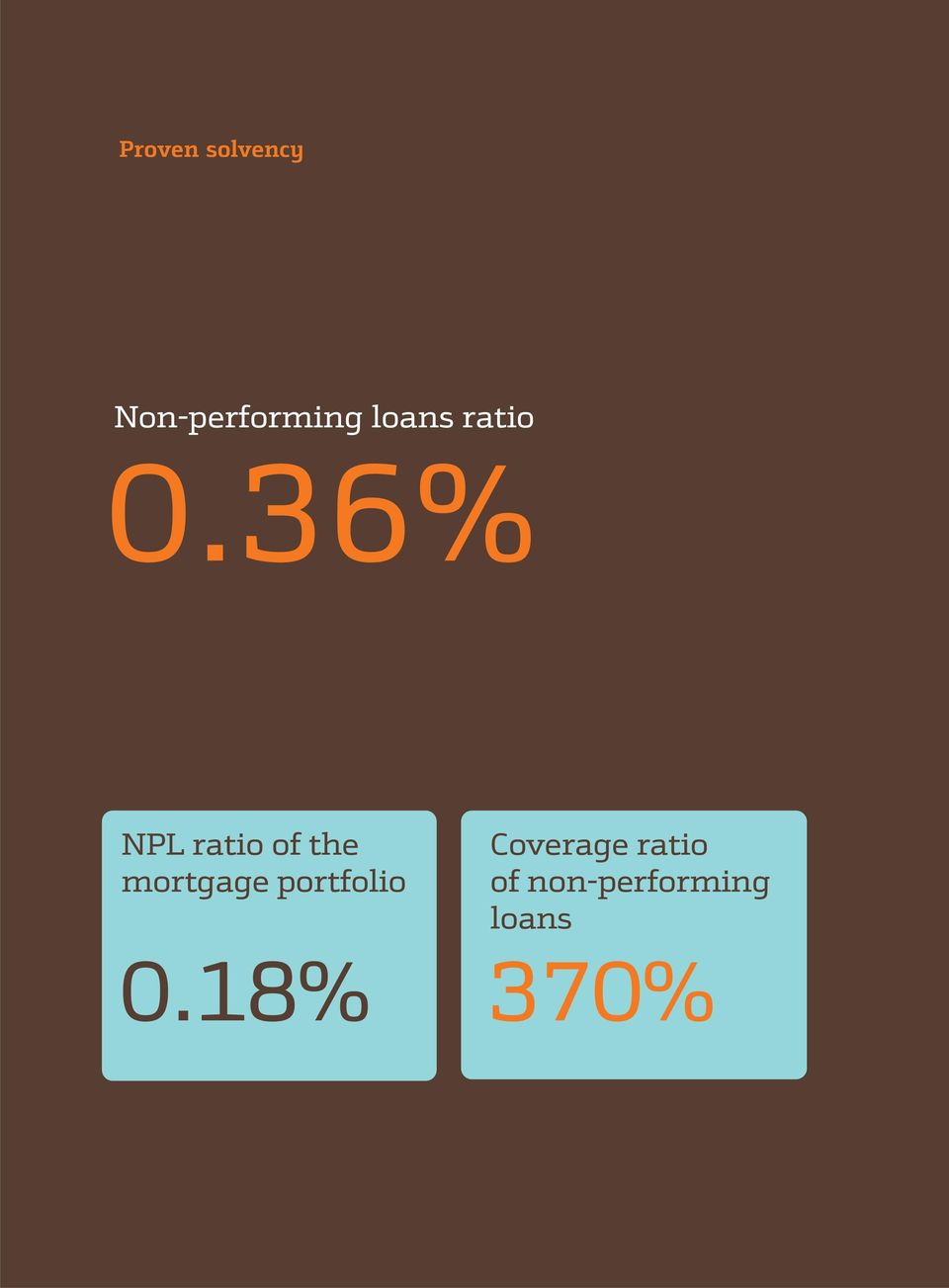
5 Proven solvency Non-performing loans ratio 0.36% Solvencia demostrada NPL ratio of the mortgage portfolio 0.18% Coverage ratio of non-performing loans 370%
6 An excellent year PBT million +53.2% up on 2006

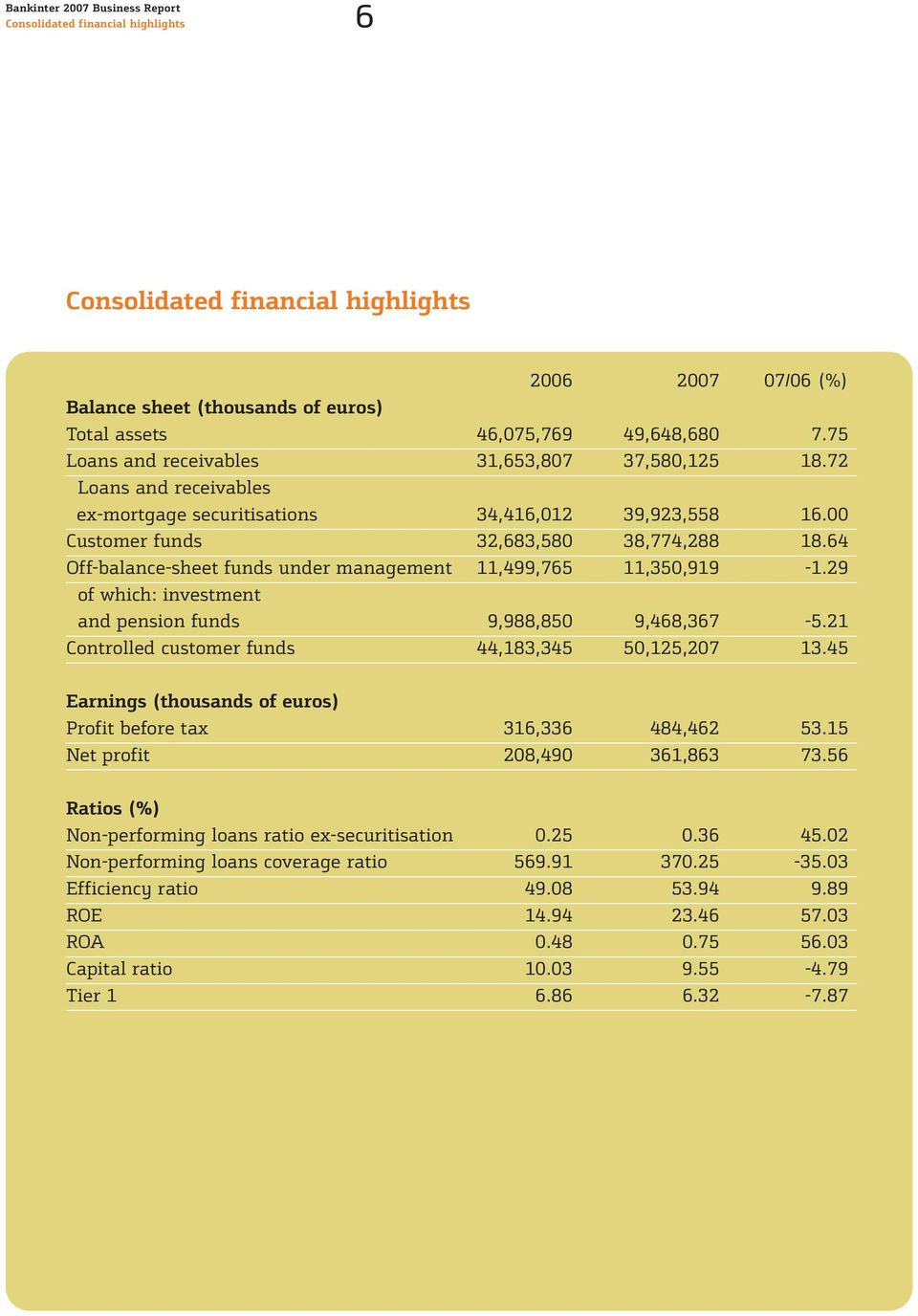
7 Consolidated financial highlights 6 Consolidated financial highlights /06 (%) Balance sheet (thousands of euros) Total assets 46,5,769 49,648, Loans and receivables 31,653,8 37,580, Loans and receivables ex-mortgage securitisations 34,416,012 39,923, Customer funds 32,683,580 38,774, Off-balance-sheet funds under management 11,499,765 11,350, of which: investment and pension funds 9,988,850 9,468, Controlled customer funds 44,183,345 50,125, Earnings (thousands of euros) Profit before tax 316, , Net profit 208, , Ratios (%) Non-performing loans ratio ex-securitisation Non-performing loans coverage ratio Efficiency ratio ROE ROA Capital ratio Tier
8 Consolidated financial highlights /06 (%) Share data EPS, Net earnings per share DPS, Dividend per share (euros) PER, Price/Earnings ratio (times) Price/book value (times) EPS, Net earnings per share (euros) + provisions Branches and centres Non-specialised branches Commercial management centres Corporate SMEs Private Banking Virtual branches Number of agents 1, ,70 Telephone and Internet branches Workforce No. of full-time equivalent employees 3,981 4,

9 Chairman's Letter to the Shareholders 8 During the months that I have been in charge at the Bank I have been able to observe on a daily basis the power there is in this marvellous business, the huge value of its intangible assets, its capacity for growth, the soundness of its balance sheet and, over and above any other consideration, the qualities of its team of people and its senior management who, in my opinion, are the best in the Spanish financial sector.

10 Chairman's Letter to the Shareholders 9 20 Dear Shareholders: Since this is the first occasion on which I am addressing you as the Chairman of Bankinter, I should first of all like to refer to my predecessor. In April 20, Juan Arena took the decision to tender his resignation as Chairman of Bankinter, after devoting 37 years of his life to the Bank, 9 of them as Chief Executive Officer and the last 5 as Chairman of the Board of Directors. On behalf of the Board and everyone at the Bank I would like to express our gratitude to Juan Arena, who for so many years held the top executive responsibilities with truly unique success, personality and capacity for leadership. To a large extent, the Bank's strategy, based on quality, innovation, technology and talent management, is marked by the imaginative and creative personality of the previous Chairman, with whom I have been actively working on the Board of Directors since Our challenge is to continue his work. And in order to do so Bankinter must continue to set itself apart, to remain unique within the context of the Spanish banking system, with its course set on what has always been our prime objective: creating value for our shareholders in the medium and long term. December 20 brought to a close a year in which the profit after tax amounted to EUR million, by far the biggest in the history of the Bank, and 73.6% more than in The consolidated pre-tax profit was EUR million, which was 53.2% more than in These are record results, the value of which is even greater when we take into account that they were achieved despite the difficulties and uncertainties that arose in the markets as a result of the constraints on liquidity that occurred from August 20. This profit figure includes certain non-recurring earnings which, although similar to those that may also appear in the accounts of other credit institutions, I would like to mention separately: the sale to Mapfre of the life insurance business, generating capital gains of EUR million after tax; and the acquisition of 100% of the consumer credit card business until now jointly owned with Capital One. Excluding the atypical factors, the Bank's net profit would be EUR million, 31% more than the figure published for the previous year. These are splendid results which undoubtedly rank among the best of those achieved by Spanish banks last year.

11 Chairman's Letter to the Shareholders 10 This increase in earnings is especially commendable if we take into account that in 20 Bankinter underwent strong expansion as regards both the number of offices (a total of 72 were opened comprising non-specialised branches and SME, Private and Corporate Banking centres) and the number of employees (the workforce increased by 549 persons, 13.8% more than at the end of 2006). Such significant growth in the installed capacity is initially a burden on the Bank's profit, because the new centres take a while to reach the profitability of the existing branches and there is a fall in the efficiency ratio in the short term, but it is what ensures and drives future growth and is tangible proof of the confidence that Bankinter has in its business model. Although all of the segments of the customer business experienced substantial growth in profit, most noteworthy were the earnings of those which Bankinter considers strategic and in which the Bank continued to invest significantly in 20: SMEs, and Private Banking and Personal Finance, which encompass the private individual customers with the highest net worth. The SME segment experienced an increase of 41.9% in profit after tax, and also recorded increases of 23.4% in lending, 21.8% in customer funds and 17% in active customers. As regards Private Banking and Personal Finance, the increase in profit after tax was 27.8% and 29.2%, respectively. There was appreciable growth in all of the captions of Bankinter's balance sheet. Total assets rose by 7.8%. Customer funds increased by 18.6% and loans and receivables were up by 18.7%. At 20 year-end, doubtful risk stood at EUR million and accounted for 0.36% of the Bank's computable risk exposure, which is much lower than that of Spanish banks as a whole. In parallel, the non-performing loans coverage ratio stood at 370%. The total loan loss allowances were up by 8.2% on All of this confirms the high credit quality of the Group's assets and also its solvency, both of them based on the now traditional internal systems of the analysis, approval and automatic management of risk, the diversification of the portfolio, very limited exposure to property development, the conservative provisions allocated to loan losses, and the virtually zero exposure to country risk.
12 Chairman's Letter to the Shareholders 11 Worthy of a separate mention are the results achieved, once again, by Línea Directa Aseguradora S.A., the company of which the Royal Bank of Scotland Group and Bankinter each own 50%. In 20, LDA achieved a marked increase in its customer base, reaching a total of 1,431,327 policies, and embarked on a number of product diversification initiatives which are already generating earnings additional to those of the company's original business, resulting in a rapid increase in the asset value of our stake and in the synergies between the insurance company and the Bank. The company's profit after tax amounted to nearly EUR 59 million. Other highlights in the year were the sale of 50% of the life insurance subsidiary Bankinter Seguros de Vida to the Spanish sector leader Mapfre Vida, in a transaction carried out in very beneficial conditions that ensures us long-term partnership with such a prestigious and professional group as Mapfre and, also, the acquisition of 100% of the consumer finance business which the Bank shared with the international entity Capital One and which is now trading under the new brand 'Obsidiana'. In both life insurance and general insurance as well as in consumer lines and credit cards, Bankinter now occupies a position of privilege in comparison with its competitors and covers a number of businesses that are complementary to banking and have considerably increased the value of our Group. In 20 Bankinter proved able to respond to the challenges arising out of the turbulence that affected the capital markets from August onwards, the upturn in non-performing loans and the emergence of certain symptoms of a possible economic recession. In the face of persistent liquidity constraints, the Bank continued to strengthen its capital base and diversify its sources of financing, generating assets that are capable of being realised thanks to the solvency of our portfolio of mortgages and other loan assets, innovating through new structures for the value-enhancement of these portfolios with the transfer of all of their risks, and optimising not only the funds from intermediation, but also the raising of typical funds from the Bank's broad customer base that is situated in the top segment of the market. With respect to the upward trend in non-performing loans in the sector, our traditional prudence and the foresight of how the property sector would evolve that we have developed over the last few years have enabled us to present the figures for non-performing loans and coverage that I have indicated above, the best of the Spanish banking system, which place Bankinter in a situation of privilege even if the worst forecasts regarding the immediate economic future were to be confirmed.

13 Chairman's Letter to the Shareholders 12 In 20, Bankinter continued to implement a corporate governance policy that meets the most demanding standards regarding transparency and good governance not only in Spain but also internationally. Mention should be made in this respect of the fact that Bankinter is now in full compliance with more than 95% of the recommendations contained in the CNMV-approved Unified Code of Good Governance for Listed Companies applicable since 20, and is in first place out of all the banks and companies in the Ibex-35 stock exchange index in the league table of best practices. Particularly noteworthy is the fact that on its 'Corporate Reporting' website the consultancy firm PricewaterhouseCoopers UK includes the content of Bankinter's Annual Report as an example of good practice. We realise that in the world in which we live the creation of value is a commitment that a company has not only with its shareholders but also with all of its stakeholders, comprising mainly its employees, its customers and society in general. Regarding the first of these groups, Bankinter reaffirms its conviction that people are its prime asset. Bankinter's workforce, which as I have already said grew by 13.8% in 20, is the youngest and the best qualified in Spanish banking, with an average age of 36 years and 73% of whom are university graduates. The Bank's constant concern for staff management has resulted in Bankinter being acknowledged by the prestigious Great Place to Work Institute in its latest report as the 6th best place to work in Spain and the number one in the financial sector, in a league table in which more than 200 companies from every economic sector put themselves forward for analysis. This is a distinction that fills us with pride. Our commitment to customers is reflected in our traditional concern for quality, which is something we have monitored and managed for many years now and constitutes our principal guideline. In 20 Bankinter maintained its customary position of leadership in this field with a lead of 6 percentage points with respect to the average for banks in terms of ISN (Net Satisfaction Index), which is the technical indicator used to measure this parameter. With regard to relations with society in general, the Bank continued to be one of the sector leaders in job creation, in investment in research and development and in new technologies, as well as in transparency in relations with suppliers. Bankinter reaffirmed its commitment to Social Action, and received significant recognition and awards in this field.

14 Chairman's Letter to the Shareholders 13 In environmental management the Bank was awarded an ISO certificate certifying the implementation of an efficient system of environmental management in the building where the Bank has its corporate headquarters. Our commitment to the disabled and to accessibility continued and was rewarded with the following prizes, among others: diadeinternet, organised by the Spanish Internet Users Association, and the annual prize awarded by the Bip Bip Foundation, both of them in recognition of the Bank's activities in the area of accessibility. Initiatives for volunteer service among the Bank's employees were also encouraged with a variety of actions that were very successful. In short, Bankinter is a model of success, in the first place for shareholders, because the share price appreciated by 5.3% in 20 which, together with the dividend distributed, resulted in a return for shareholders of 7.8%, one of the highest in Spanish banking in the year, but also for employees, for customers, for suppliers and for society in general. During the months that I have been in charge at the Bank I have been able to observe on a daily basis the power there is in this marvellous business, the huge value of its intangible assets, its capacity for growth, the soundness of its balance sheet and, over and above any other consideration, the qualities of its team of people and its senior management who, in my opinion, are the best in the Spanish financial sector. Against this framework I have no doubt that in 2008 Bankinter will continue to be able to offer a value proposal that is unique in the market and a business model that is different, based on excellence and on the generation of ever higher earnings. With full adherence to the Board of Directors remit to me as Chairman, I do not wish to end this letter without reiterating my commitment to service in the interests of all of you, the shareholders and owners of Bankinter, the Bank's employees and customers, and our community. Yours sincerely, Pedro Guerrero Chairman of the Board of Directors

15 Contents 64 People & Knowledge Management 36 Channels and Networks 38. Multi-channel Banking 43. Distribution networks 50. CRM 66. Our value, our values 67. Bankinter, a great place to work 68. People management 74. Recognition Technology 30. Technology 32. IT security 52 Intellectual Capital 58. Human Capital 61. Structural Capital 62. Relational Capital 16 Quality 18. Bankinter Quality 21. Quality in serving individual customers 22. Quality in SMEs 23. Quality in employees 24. Customer Service Office 26. Acting to improve quality

16 175 Appendixes 176. Information for shareholders and customers 178. Board of Directors 179. Management structure 142 Earnings 144. Earnings 153. Bankinter s Contribution to GDP 165 Brand 76 Business 78. Economic environment and international markets 81. Market share 82. Customer funds and loans and receivables 90. Customer segments 99. Capital Markets and Treasury 101. Risk management 154 Shareholders' Equity and The Bankinter share 156. Shareholders equity 158. The Bankinter share 164. Market return

17

18 17 01 Quality Year after year the Bank's quality ratios reach levels of excellence that are well above the average for the sector. The degree of customer satisfaction and the extent to which their expectations are met, measured by means of objective surveys carried out monthly, are the variables that guarantee a strong relationship in the long term. In this section: > Bankinter Quality > Quality in serving individual customers > Quality in SMEs > Quality in employees > Customer Service Office > Taking action to improve quality

19 01. Quality 18 We take the utmost care with the terms of our relationship with customers and we pay special attention to their needs. Bankinter Quality The data obtained in any survey of financial customers on the quality of service provided by banks and savings banks show that they have increasing access to information and are ever more sensitive to prices. This has led us to take the utmost care with the terms of our relationship with customers and to pay special attention to their needs. Overall satisfaction by segment 20 (ISN score out of 100) Private individuals Private banking SMEs Corporate banking Foreign nationals The ISN (Net Satisfaction Index) is measured on a scale of 0 through 100 and is interpreted as follows: > 85 Very satisfied/excellent High level of satisfaction Needs improvement. < 60 Needs action Private individuals Private banking SMEs Corporate banking Foreign Nationals AT Bankinter we are obsessed with the needs of our customers, rather than with the attributes of our products, and this obliges us to keep our promises, to exceed expectations and to treat the experience of customers as a clear competence involving all of the Bank's areas. The customers' experience with the Bank is the best mechanism of differentiation. That is why we are building our commercial approach on the basis of doing what is in the interests of the customers and not just what suits the Bank's income statement.

20 01. Quality 19 The Bank's customers maintain a high level of satisfaction with the service received. Checking their opinion by means of surveys performed by independent firms, including INMARK, is the method Bankinter has chosen to ascertain whether the quality of the Bank's range of services is up to standard. This measurement, performed monthly using a dynamic and formal procedure, enables us to ascertain and interpret the customers' opinion from any angle of the relationship: the segment to which they belong and the service platform they use, making it possible to detect and react promptly to correct or improve any anomaly. The measurement of this perception obtained from our customers is checked against innumerable objective indicators: market and product research, internal satisfaction surveys, etc., facilitating structural quality actions which involve adaptation to the quality models, and commercial quality actions, which produce immediate satisfaction among customers. We would not like to miss this opportunity of thanking all our customers very sincerely for the interest, care and time they take to respond to our surveys, thereby enabling us to learn of their experiences, evaluate them and focus our efforts on what their interests are. Obsessed with the needs of our customers The degree of customer satisfaction and, accordingly, the extent to which their expectations are met, measured by means of the objective surveys carried out monthly by the Bank, is the variable that guarantees a strong relationship in the long term. As can be seen from the charts, most of the Bank s segments, networks and platforms scored consistently over 75 points on the ISN scale. Any score above 75 points reflects high service quality.

21 01. Quality Private individuals Private banking SMEs Corporate banking Foreign Nationals Overall satisfaction by segment 20 (ISN score out of 100) Private individuals Private banking SMEs Corporate banking Foreign Nationals Branch network Telephone network Internet network Virtual branches Agents network Overall satisfaction by network 20 (ISN score out of 100) Branch network Telephone network Internet network Virtual branch network Agents network Telephone Banking Bankinter Private individuals Broker Bankinter Bankinter Businesses Mobile phones Overall satisfaction by platform 20 (ISN score out of 100) Telephone banking Bankinter Private individuals Broker Bankinter Bankinter businesses Mobile phones
22 01. Quality 21 Year after year Bankinter stands well ahead, of the market in the segment of private individuals. Quality in serving individual customers The best indicator of the perception of the service received by Bankinter's individual customers and of their greater or lesser degree of satisfaction is the one obtained by comparing the position that Bankinter occupies in relation to other financial entities in the Spanish market and analysing which are the most significant service factors. Using independent consultants we conduct market research on a quarterly basis that enables us to ascertain the degree of perceived satisfaction that customers (private individuals) have with the service they receive from their banks or savings banks ISN points higher than the market average Bankinter vs Market. Private Individuals Bankinter Market Bankinter Market Gap Geographic scope: Nationwide, for towns of over 50,000 inhabitants. Group: General public over 18 years of age, holding demand deposits or savings accounts at a financial institution. Sample: 1,600 interviews per quarter. Survey methodology: Computer-assisted telephone interview. Sampling error: ±2.5%. 14 aspects of service surveyed; the most highly rated would be: Treatment and attention Training and professionalism Advisory services Knowledge of customers' requirements Employee s attitude to incidents Information on conditions and costs Transaction speed Clarity of statements Availability of human and technical resources
23 01. Quality 22 The customers of Bankinter's SME segment rate the Bank higher than the average for the sector. Quality in SMEs The Bank also conducts half-yearly market research to ascertain the level of satisfaction with the service they receive from their bank or savings bank of, in this case, SMEs, as financial service users ISN points higher than the market average Bankinter vs Market. SMEs Bankinter Market Bankinter Market Gap Geographic scope: The whole of Spain (except Ceuta and Melilla). Group: Spanish businesses with an approximate turnover of EUR million. Sample: 1,117 interviews every six months Survey methodology: Computer-assisted telephone interview. Sampling error: ±3.0%. 16 aspects of service surveyed; the most highly rated would be: Treatment and attention Advisory services Training and professionalism Service offered at branch Products and services Clarity of information Simplicity of formalities
24 01. Quality 23 Quality in employees Every six months Bankinter s Central Services are evaluated by the Branch Network and they also perform a self-evaluation. This evaluation, together with the performance in customer satisfaction, constitutes the 'Quality Factor', in which all of the Bank's staff are involved. The perception in 20 remained at good levels in comparison with the previous year, with improvements in 2 of the surveys of all the staff conducted to ascertain the perception of service received internally. This led to a 0.9 point increase in the ISN score given to the Organisations' Central Services by the Branch network, which stood at Likewise, there was a 0.14 point increase in the survey of the Bank's Central Services by the Branch network, with a score of It was in the Bank's Central Services self-evaluation that there was a fall of 0.4, giving a Net Satisfaction Index score of 66.0 points Branches Central Services Organisations' Central Services Overall satisfaction. Branches and Central Services survey Branches Central Services Organisations' Central Services
25 01. Quality 24 Customer Service Office At Bankinter all complaints and claims of a financial nature go to the Customer Service Office (SAC in Spanish), which coordinates the different departments concerned and immediately relays all the information on incidents in order to resolve them as quickly as possible, taking very much into account that customers should perceive that the Bank is acting in their interests. The purpose of the Office is therefore to deal with and resolve complaints and claims, ensuring, in an appropriate and timely manner, that there is a consistent approach. As well as solving customers' problems, this is the department responsible for preventing and correcting the main errors made in any area of the Bank in the marketing of products or the provision of services. In 20 the number of complaints about service and financial claims per million transactions fell to 78.3 per million (compared with 86.7 per million in 2005). As for the time taken to deal with complaints and claims, 70.6% of the incidents were answered in less than 48 hours, and the average time taken was 4.3 days. SAC. Total complaints and financial claims /06 (%) Total no. of complaints (non-financial) 10,821 12, Total no. of claims (financial) 85,371 91, Total 96, , SAC. Total no. of financial claims /06 (%) No. of claims in customer's favour 74,987 82, % of claims in customer's favour No. of claims in Bank's favour 10,384 9, % of claims in Bank's favour Total 85,371 91,
26 01. Quality 25 The purpose of the Customer Service Office is to deal with and resolve complaints and claims, ensuring, in an appropriate and timely manner, that there is a consistent approach. Incidents in Complaints per million transactions Incidents per million transactions Time taken to resolve financial claims Time taken No. of Claims % Attributable to Not attributable to Bankinter (%) Bankinter (%) 0 days 51, days 13, days 16, > 10 days 10, External Customer Ombudsman /06 (%) Claims processed Claims resolved in customer's favour Claims resolved in Bank's favour Claims excluded Bank of Spain /06 (%) Claims resolved Claims resolved in customer's favour Complaints accepted In the Bank's favour Pending resolution Outside Bank of Spain jurisdiction 0 1
27 01. Quality 26 Taking action to improve quality With the aim of raising the quality of service, Bankinter s employees propose improvements throughout the year. In 20, 96 improvement projects were started with the participation of 240 people, i.e. 5.3% of the Bank s workforce. Seeking to recognise the joint effort made by the areas of the Bank that improved their scores most in the 20 ISN surveys, the following awards were made: Territorial organisations with the best performance in terms of customer satisfaction and compared with the market in their geographical area: Tenerife Organisation, North West Organisation and Castile Organisation. Business Areas with the best performance in terms of internal and external customer satisfaction: Corporate Banking Division and Private Banking Division. Central Services with the best performance in terms of internal customer satisfaction: Treasury and Capital Markets, Printing Department, Products Division and Marketing Division. Lastly, three members of staff received Awards for Service Excellence in 20: Diego Lázaro González, Paloma Martínez de Aguilar, Ernesto Argudo Zamora.
28
29
30 29 02 Technology In what is known as the 'information society', the technological strength of a company becomes a differentiating variable. In this section: > Technology > IT security Technology continues to be one of Bankinter's strategic pillars. Over the past year investment was particularly strong in two specific spheres: the enhancements of knowledge management within the Bank and the projects relating to the private banking divisions.
31 02. Technology 30 Bankinter mainly applies its technological strength, to raising the quality of the services and products used by customers. Technology Investment in technology continues to be one of Bankinter's strategic pillars, something that is especially valuable in a world in which this variable plays an increasingly important role in the information society. Bankinter mainly applies its technological strength to raising the quality of the services and products used by customers. Over the past year investment was particularly strong in everything to do with enhancing knowledge management within the Bank. A notable boost was also given to all of the projects concerning one of Bankinter's strategic areas of focus for 20: Private Banking. Also in 20 Bankinter incorporated into its Internet services the most advanced technologies represented by the world of Web 2.0, making them compatible with the Bank's strategy in favour of web accessibility, an option which has enabled groups of people with disabilities to deal with the Bank using the Internet on equal terms with other customers. Worth highlighting is the special project undertaken by Bankinter with the aim, on the one hand, of automating all of the Bank's official information and the medium on which it is held; and, on the other, of developing an ergonomic and functional IT support that will permit proper control and monitoring of operations in the Operating Control Areas. This project has involved an important change in the philosophy of the Bank's applications, so much so that it has modified the generation, management and utilisation of all of the information, making it more versatile and incorporating new functionalities called for by the Business areas. In 20 the Bank also made substantial investments in the systems necessary for accession to Basel II, as well as in improvements to its internal management systems. A final mention should be made of the successful completion of the updating of the Treasury business platform.
32 02. Technology 31 Details of investment in development Investment in 20 36,457,583 In-house investment 8,983,567 External cost 21,000,000 Activation 6,474,016 Response time performance (in seconds) Internet Teleprocessing
33 02. Technology 32 IT security Strategic IT Security Plan Conscious of the important commitment to service and quality, and of the continuous evolution of the technology the Bank uses in its dealings with customers, a project was begun by the IT Security department in 20 - which will be completed during for the purpose of formalising the Bank's Strategic Security Plan. Operating excellence Risk management Regulatory compliance Image creation Value 1 Optimising costs 2 Optimising 3 Minimising 4 Minimising 5 Becoming a operating losses due to costs due to benchmark procedures incidents penalties for the sector Customer External Internal 9 Responding to internal needs promptly, cost-effectively and with quality 10 6 Managing risk efficiently Handling incidents efficiently 7 Obtaining international certifications 11 Ensuring the reliability of the IT services 12 8 Promoting an image of security Complying with the regulatory framework Processes 13 Designing solutions promptly, cost-effectively and with quality Selecting the best technology Analysing and monitoring trends 16 Analysing and managing risks 17 Aligning with standards 18 Security in DLC 19 Handling incidents efficiently 20 Constant monitoring of security 21 Identifying opportunities for improvement 22 Periodic reviews and audits 23 Regulatory compliance Infra. SUPPLY DISTRIBUTION IMPL./DEV. OPERATIONS MAINT. 24 Selecting 25 Instructing, 26 Managing 27 Observatories 28 Gearing internal training projects and collaboration operating and external and raising with other procedures resources awareness institutions to processes
34 02. Technology 33 Bankinter is the first financial institution in Spain to be certified as ISO compliant. This plan has been designed using techniques and models of strategic management that are widely recognised and disseminated by the most prestigious business schools, such as: DAFO analysis, Porter s 5 forces adapted, reds analysis, strategic maps, etc., thereby enabling us to ensure that the Bank's strategy is aligned with its position in the field of security; and consequently to achieve the security objectives linked through Bankinter's mission, vision and corporate values and the Bank's Information Systems division. ISO Re-Certification October 20 was the first anniversary of the ISO Certification of the Bank's Security Management System. Thanks to this milestone, Bankinter became the first financial institution so certified in Spain, evidencing the Bank's compliance with the highest standards of quality and professional rigour in managing the security of its computer platforms and systems. The next challenge was to be able to keep the certificate, by means of actions and tasks that made it possible to guarantee that the management system is kept alive and continually enhanced. For this purpose, the world-renowned British Standards Institution (BSI) performed the first of the annual re-certification reviews. The result of the procedure was that Bankinter, and more specifically its Security Management System, amply exceeded the requirements established, thereby demonstrating in an objective, clear, evident and visible manner the commitment of the Management and of the Bank itself to the Security Management System.
35 02. Technology 34 Customer security The concept of 'customer security' forms part of the Bank's strategy for protecting its customers. It rests on three basic pillars of security: information, protection and advice, together with the overall premise that customers must play an active role in their own self-protection. In 20, the remote banking services of financial institutions experienced one of their worst years, as a result, above all, of the increasing spread of threats such as phishing, carding, and trojans designed specifically to obtain customers' Internet access and operating information by fraudulent means. Thanks to the experience acquired, the efforts and the investments made in previous years, and the implementation of a package of innovative protection, control and alert initiatives, the Bank acquitted itself well and came out of this situation strengthened, giving customers the peace of mind, security, comfort and reliability of operating through our remote banking service. Bankinter's security and protection systems are periodically audited by independent personnel of high standing, bringing confirmation year after year of the guarantees of security and reliability that have made Bankinter's remote banking service a benchmark in the sector.
36 02. Technology 35 ISMS Forum Spain So far in Spain only a few organisations have set out on the road to a 'security management system, and even fewer have dared to have it certified. For this reason and in accordance with its security strategy, Bankinter - together with a group of benchmark companies and entities in sectors such as energy, construction, telecommunications or distribution - launched an initiative called ISMS Forum Spain, of which the Bank is a founding partner. ISMS Forum Spain is a non-profit organisation whose main objective is to promote the development, knowledge and culture of 'Information Security' in Spain. Its vocation is to serve as an impartial forum for discussion and research where businesses, public authorities, universities and research centres can pool their respective experiences and their points of view on these matters and, in this way, be a point of reference for the knowledge, dissemination and promotion in Spain of Information Security.
37 03 Channels & Networks In this section: > Multi-channel Banking > Distribution networks > CRM A bank with numerous formats and options available for dealings with its customers. At Bankinter customers can interact with the Bank any time and anywhere using the channel that is most convenient for them. The perfect interaction and efficient combination of all of them translate into a distinctive value proposal that increases the level of satisfaction of the customers.
38 37
39 03. Channels and Networks 38 Multi-channel Banking Bankinter has made the multi-channel strategy one of its big competitive advantages; and it continues to strengthen this strategy. At Bankinter customers can interact with the Bank any time and anywhere using the channel that is most convenient for them. The combined use of each of them (Branch network, Telephone Platform, Bankinter.com, ATMs, mobile phone, etc.) means that the service provided reaches levels of perceived quality that make us market leaders. Further significant steps were taken in 20 to integrate our commercial activity through the different channels. This is another area in which Bankinter has a competitive edge. And so, supported by the strength of our CRM, depending on the time, the product and customer preferences, one or another channel for dealings is used, maintaining a unique commercial coherence. This has enabled us to optimise commercial efficiency and multiply the number of contacts while containing costs. There were 1,331.1 million transactions in 20, which was 19.9% more than in 2006; 68.8% of these transactions were carried out using remote channels, which gives an idea of how the multi-channel environment has transformed the Bank. Variation in transactions by channel (%) Mobile phone Cards Internet Telephone Banking Electronic Banking Branches
40 03. Channels and Networks 39 Transactions 1,331 million transactions 68.8% of them performed using remote channels Telephone Platform The business done using this channel in 20, its 15th anniversary year, is mainly apparent from the number of calls handled: they totalled 7.4 million and 54% of them were answered by the automatic system and the remaining 46% by a personal manager. The number of messages handled totalled 73,050. There were several service reorganisations during the year involving the grouping together of some of them, primarily with a view to achieving greater efficiency and higher perceived quality. The training of the workforce staffing this channel is an essential factor. This is embodied in the intensive efforts made over the past year in which 18,318 hours of training were given to 188 members of staff, representing 96.9% of the workforce. The Telephone Platform once again displayed an optimum standard of operation, with 89.2% of the calls received being answered within 20 seconds. This translates into the quality perceived by our customers, who awarded it an aggregate score of 79.4 ISN (Net Satisfaction Index) points during the year. The market similarly singled out the quality of our platform. By the end of the year we had received two prizes, awarded by IZO Systems (the leading consultants in the Call Centre industry), the Spanish Association of Experts in Customer Call Centres, AEECCC (the sector business association) and the International Faculty for Executives, IFAES. One of them describes us as the 'best call centre service in the banking sector', and the other was for the 'best people management in an overall context of call centre services'.
41 03. Channels and Networks 40 The Internet continues to be the channel most used by the Bank's customers. More than 773,869 users performed 55% of the total transactions using this channel. TSF quality ratio 89.2% of the calls were answered in less than 20 seconds 79.4 ISN points for quality Internet Platform The Internet continues to be the channel most used by the Bank's customers. This channel has 773,869 customers who perform more than 63.6 million transactions per month, representing 55.0% of the Bank's total transactions. In 20, the percentage of active users remained steady at 51.5% of total users. Work continued in 20 on expanding the range of investment products, with the launch of the new individual systematic savings scheme - PIAS in Spanish -, improving the advice given to customers by the Investment Adviser tool and introducing new formats for dealings with the Bank with the launch of the new 'Video call Service'. There was a marked increase in the number of log-ons to 3.5 million per month, which confirms the excellent perception that customers of the Private individuals segment have of the web as a channel for dealing with the Bank: its ISN score was 80.3 at year-end.
42 03. Channels and Networks 41 empresas.bankinter.com New products and services were incorporated in the Bankinter for businesses website in 20, including the 'Digital Invoice', which adds great technological and innovative value to the website. Our efforts were also focused on the development of new channels, such as video calls and mobile phones, which make it possible to reach customers in a more personalised and direct manner. Particularly noteworthy is the degree of maturity reached by services such as the online financing of foreign transactions, advances on invoices or even the possibility our customers have of issuing promissory notes with scanned signatures, which simplifies the formalities of this transaction. Due to the efforts made by the Bank in the SME segment, the website has become an essential tool used daily by our business customers, with constant growth in figures of use. We are supported by these pillars: quality of service, personalised advice and growth in the SME segment. In consequence, 72% of the Bank's active customers are also active or habitual customers of the website. At any given minute of the day 24 hrs. 34 users connected 3remittances on average 88 transactions As a result of all this, together with the big marketing efforts made, the website now has 116,134 registered business users, 64,000 of whom are active (both online and at the Bank) and perform transactions worth EUR 130,543 million per year. These same active customers performed 223 million transactions during the year. To give readers an idea, at any given minute of the day or night, at any time of year, the following is happening on the Bankinter for businesses website: there are 34 users connected, who send 3 remittances and perform 88 transactions. And this would make no sense if the quality was not up to the standard our customers deserve. Our scores here are high: 79.1 ISN points at year-end.
43 03. Channels and Networks 42 broker.bankinter.com In 20 we expanded our range of products with the launch of Exchange Traded Funds. We also continued to focus our efforts on making Broker Bankinter an even more useful tool for our customers, if that is possible, by incorporating new Web 2.0 technologies that simplify operating and enquiry procedures. Transactions 81% of all the Bank's equities transactions were performed using broker.bankinter. As a result, this website has become established as the customers' preferred channel for equities transactions. Specifically, it accounted for 81.0% of total transactions, with a steady rise in the number of transactions, as illustrated by the 98,433 transactions performed in the month of December. The picture is similar for log-ons to the website, amounting to 869,411 a month. Broker Bankinter continues to be a benchmark service in the financial sector. The attribute most highly valued by customers was the availability, which is a particularly sensitive factor in equities trading and achieved an ISN score of 84.0 As a result of this, the channel obtained an aggregate overall satisfaction score from users of 77.6 ISN points. SMS Platform The SMS platform offers substantial added value to customers, who perceive the availability and the immediacy of information as excellent attributes. Work was done in 20 to improve all the flows of messages that customers receive; this contributed to achieving total figures of as many as 44.7 million messages sent, with 17.3% of the Bank's customers with a registered mobile phone active in this channel. As a result, the satisfaction indicators reached levels of excellence, with an ISN score of Video Call Service In 20 Bankinter launched a new channel for customer relations, the 'Video Call Service', which uses the possibilities of the Internet to offer interactive, multimedia advice that is personalised and specialised according to each need. With this service, any customer can contact the Bank, or vice versa, using an image and voice system that makes it possible to share documents, computer applications or web pages; this increases not only the capability of the advisory role but also the resolution of doubts or the remote commercialisation of complex products and services. The Video Call Service enables customers to get the best out of each traditional channel: the personal, specialised attention and extended business hours of telephone banking, the remote efficiency and immediacy of the Internet, and the proximity and the human touch of the branch office.
44 03. Channels and Networks 43 Distribution networks Branch network 360 non-specialised branches Branch network At 20 year-end, Bankinter had a network of 360 non-specialised branches, 28 more than in This expansion of the Branch network was located in towns with faster-growing populations, whether local or European non-resident, and in areas where income levels, property development and greater economic activity mean that the investment will be recovered in the shortest possible time. The centres are staffed by a team of professionals (branch managers, assistant managers, account managers, executives, authorised officers and clerical staff) whose brief is to promote commercial activity in all the business segments under their responsibility. In order to support this sales team, to make their work easier and to improve the quality of customer service, the Bank continued to focus in 20 on optimising the CRM tool as the basis for commercial activity at all the branches and centres. Mention should be made in this respect of both the management of potential customers and the synergies between segments to facilitate the addition of new customers. In line with the Social Action objective of participating in projects that improve the lives of the disadvantaged and help them in their daily activities, we continued to develop the 'branch office accessibility' project, the aim of which is for all the Bank's premises, particularly those that are open to the public, to be equipped with all types of physical accessibility requirements for handicapped persons in By the end of 20, 94% of the branches, a total of 340, were already equipped with these measures.
45 03. Channels and Networks 44 Work also began in 20 to adapt the frontages of the branches to the requirements of Bankinter's new corporate identity. At year-end 27.5% - 99 branches - had been adapted to the new brand image. Apart from this network of 360 traditional branches, Bankinter also has a large team of specialists in various customer segments working at a number of clearly differentiated centres: SME Centres. To increase our presence in the strategic SME segment continued to be one of our priorities. Accordingly, a further 37 new centres were opened, mainly located in industrial complexes where there is a high density of small and medium-sized enterprises. At 20 year-end, Bankinter had a network of 161 SME Centres distributed among the 13 territorial organisations that comprise the Bank, with a total headcount of 466 employees. Private Banking Centres. The number of these Centres, exclusively dedicated to taking comprehensive, personalised care of the customers in the Private Banking and Personal Finance segments, was 47 at year-end, with a staff consisting of 219 highly-qualified professionals. Business Management Centres. The Bank currently has 51 Business Management Centres, staffed by a total of 237 professionals. These are centres where larger companies and big corporations receive specialised commercial services. Branch Network highlights Non-specialised branches SME Centres Millions of euros Average funds Average loans and receivables Profit before tax ISN score /06 (%) , , , ,
46 03. Channels and Networks 45 Networks with Partners Networks with Partners is the business area comprising the activities of the Agents network and the Virtual branches. Both these networks share the objective of speeding up the growth of the business based on the same premises: Networks with partners ISN score 77.5 Virtual banking 79.6 Agents network The clear focus on managing and providing advice to customers in the Private Banking and Personal Finance segments. The obsession with quality. Realising that this is a crucial differentiating value, the agents and virtual branches have very high quality ratings within the Bank's networks and, consequently, in the market. The ISN score of Virtual Banking is 77.5 points; and that of the Agents network, 79.6 points. The sharing with the partner whether the latter be an Agent or a Virtual Branch of the profit obtained. Networks with Partners is of increasing relative importance within Bankinter, thanks to the strength of the business of the agents and of the virtual branches. At 20 year-end, this business had 10.5% of the Bank's customers, and accounted for 10% of the profit before tax, 14.2% of customer funds and 9.3% of lending of the networks overall. Realising that this is a crucial differentiating value, the agents and virtual branches have very high quality ratings within the Bank's networks.
47 03. Channels and Networks 46 Agents network Bankinter's Agents network ended another year as market leader in this model of distribution. This network, which was set up in 1992 as part of Bankinter s strategic commitment to growth and profitability, is based on partnership between the Bank and professionals in the financial and advisory services field. Bankinter and the agent share the margins earned on financial transactions without incurring the structural costs of traditional branches. Bankinter is committed to the training and professional development of the agents, being aware of the importance of this variable in a business that bases its success on providing good advice. Separately from the general training schemes for agents (courses of initiation on the Bank's technological platforms and operating procedures, training in products and constant updating), specific training is being developed in all the MiFID-regulated advisory service products, so that the agents' qualification as advisers is a clear factor of differentiation. In addition, work continued on the task of segmenting the agents according to their activity, business volume and involvement with Bankinter, in order to introduce initiatives aimed at improving both earnings and the professional development of the agents themselves. The Agents network has a history of success and a promising future. It accounts for an increasing weight of the business and faces the challenges of the coming years with the certainty that it will maintain its firmly established leadership, uphold its standard of quality and accelerate its growth. Agents network highlights Agents network Millions of euros Average funds Average loans and receivables Profit before tax ISN score /06 (%) 1, % % 1, , % %
48 03. Channels and Networks 47 Virtual branches Bankinter's Virtual Branches continue to represent a unique model of collaboration between a bank and another company, public agency or professional society or association. Through a Virtual Branch financial products and services are offered to the partner s employees, members, customers and suppliers. Bankinter and its partner (company, professional society, association, etc.) co-manage the Branch. The Bank provides the capital, technology and financial products, while the partner provides access to the businesses and individuals with which it usually deals, with both of them sharing in the earnings generated by this business. The customers of the virtual branches continued to be the most satisfied of all the Bank's networks in 20, with a net satisfaction index (ISN) score of 77.5 points. One of the factors contributing to the high degree of satisfaction of virtual branch customers is the advice and personal attention they receive thanks to the Bank's remote service platforms and the knowledge and management possibilities offered by Bankinter's CRM. The development of the business in 20 continued to expand. 25 new branches were opened, and the profit before taxes increased by 21.3% year on year. Virtual branches highlights Virtual branches Millions of euros Average funds Average loans and receivables Profit before tax ISN score /06 (%) % 1, , % 1, , % %
49 03. Channels and Networks 48 Telephone Network The Telephone Network ended 20 with a pre-tax profit of EUR 3.8 million, which was 9.7% more than at 2006 year-end. The average loans and receivables arranged with these customers amounted to EUR million. As usual, mortgage loans comprised the largest portion of this item. Average funds Increase of 34.2% on 2006 The average funds (excluding intermediation) amounted to EUR million, which was 34.2% more than in The offerings of fixed rate deposits that have repeatedly been made available via the remote networks have undoubtedly contributed to the achievement of this increase. Equity securities deposits were up by 7.3% year on year. Telephone Network highlights Active customers Millions of euros Average funds Average loans and receivables Profit before tax ISN score /06 (%) 9,234 8, % % % %
50 03. Channels and Networks 49 Internet network 77.8 ISN score for quality Internet Network The Internet Network, which comprises customers who sign up with the Bank through bankinter.com, ended 20 with a pre-tax profit of EUR 10.0 million, which was 16.9% more than at 2006 year-end. This result is based particularly on the growth of the following captions: average funds (excluding intermediation), which amounted to EUR million, 62.3% more than in 2006; the nominal equities portfolio, with a 12.2% increase; and on the loans and receivables - based on home mortgage loans - which totalled EUR million, an increase of 4.6%. The campaigns promoting high-rate deposits that were conducted during the year, together with the mortgage campaign, resulted in the addition of 14,332 new customers, which was 8.7% more than in For customer management, efforts continued to encourage customers to use the logical channel for their profile, i.e. the Internet, in their dealings with the Bank, and to promote the use of all the financial services by mobile phone. All of this for a growing number of active customers and, in addition, with an improvement in quality to an ISN score of 77.8 points. Internet network highlights Active customers Millions of euros Average funds Average loans and receivables Profit before tax ISN score /06 (%) 25,092 26, % % % %
51 03. Channels and Networks 50 CRM Customer Relationship Management (CRM) is one of Bankinter's principal strengths. 20 brought enhancement of its capability as the tool that integrates and coordinates Bankinter's multi-channel banking structure, managing and personalising the commercial actions through all the channels: Branches, Agents, Virtual banking and Remote Sales, Internet, SMS and mobile phone banking, Mailing and ing; all in direct relationship with the business and products divisions of the Bank and its subsidiaries. During the year, progress was made in the CRM's capacity for prediction and knowledge, with the creation of advanced models of analysis that help us to predict the sequence of products that customers request according to their socioeconomic profile. This has enabled us to introduce strategies anticipating customers' needs, offering them advice, notifying them in certain situations and taking care of the treatment and the quality customers receive in each of the actions. CRM has drawn up a profile for each type of commercial action, whether it be for attracting new customers, diaries, communications and alerts, differentiating among them for each business division. In 20, CRM handled 22 million commercial actions: sending 10.9 million letters, 4.3 million s and 1.8 million text messages; in addition, 2.1 million actions were included in the diaries of the sales staff, and almost 3 million opportunities for sales online, by telephone or branch, were offered reactively. CRM communications (sum of communications) Private individuals Private banking SMEs Corporate banking 0 100, , , , , , , ,000 Customer attraction Alerts Diaries Reactivity
52 03. Channels and Networks 51 CRM has also collaborated closely with Bankinter's Innovation area, contributing to the development and promotion of mobile phone use and incorporating commercial actions and personalised offerings - using text messages and 'Mobile phone banking' - just as customers are performing their transactions. CRM has also worked hand in hand with the Innovation area in its task of informing customers of the existence of the Video Call Service as a new channel for customer relations, and in the launch of commercial actions using this platform. All of the CRM activities have served to consolidate the Bank's prestige in the main European and American forums, showing how the integration of CRM with the sales platforms is a complete success in customer management. CRM communications by channel (sum of communications) Private individuals Private banking SMEs Corporate banking 0 500,000 1,000,000 1,500,000 2,000,000 2,500,000 3,000,000 SMS s Letters
53
54 53 04 Intellectual capital Intellectual capital is one of the most important assets when it comes to establishing the market value of businesses. In this section: > Human Capital > Structural Capital > Relational Capital Bankinter puts significant effort into managing its intangible assets: the talent of its staff, its corporate culture and the value of its relations with its stakeholders, paying particular attention to the measurement, comparison and subsequent publication of the data obtained.
55 04. Intellectual capital 54 Intellectual capital 4,530 employees Diversity 51.8% men Graduates 72.6% 48.2% women Men Women Graduates employee nationalities Spain, Germany, Belgium, Bulgaria, Brazil, Denmark, Finland, France, Holland, Ireland, Italy, Paraguay, Portugal, United Kingdom, Romania, Sweden, Switzerland, Argentina, Colombia, Cuba, China, Ecuador, United States, Peru, Russia, Uruguay, Venezuela.
56 04. Intellectual capital 55 Employees who received training in % 9 courses per employee 1,384 courses taught in training hours 474 training actions 36 average age 9.6 average years of service
57 04. Intellectual capital 56 The Bank began publishing its intellectual capital data eight years ago, and is now an established benchmark entity in this field of business management. Intellectual capital In a world characterised by the technological revolution in communications and by increasingly rapid change, a company's success depends above all on intangible assets such as the talent of its staff, its corporate culture, or the value of its relations with customers, shareholders and suppliers, among other stakeholders. These assets are what lie behind a large part of the very marked difference there is in many cases between the market value of companies and the value reflected in their financial statements. Bankinter makes significant efforts to invest in and manage its intangible assets and, despite the difficulty involved, it pays special attention to their measurement. The Bank began publishing its intellectual capital data eight years ago, and is now an established benchmark entity in this field of business management. Bankinter's model of intellectual capital provides useful information for assessing its ability to create value. It is also an efficient management tool for optimising the contribution made by the Bank's intangible assets to its business strategy. The model's various indicators are arranged in three blocks of information (human, structural and relational capital), depending on the different nature of the intangible assets under consideration in each case. Human Capital This refers to the attitudes, skills and knowledge of employees and teams that provide value to the Organisation, and to the latter's ability to regenerate its human capital through training and learning. Bankinter has a workforce of professionals that is trained, motivated and fully committed to the objectives of the Organisation and its business model. The Bank's people management policy is designed to achieve the necessary alignment between the needs and expectations of the employees, those of the business, and a shared social responsibility.
58 04. Intellectual capital 57 In 20, there was once again a sizeable increase in the Bank's workforce, from 3,981 in 2006 to 4,530 in 20. Over the past six years, the total number of staff employed by the Bank has risen at a constant cumulative annual rate of 7%. During the same period, the number of new hires as a percentage of the total workforce each year rose from 6.0% in 2002, to 22.3% in 20, with an external rotation index of 10.5% in 20. These figures make Bankinter a leader in net job creation in the sector. In parallel, both the average age of the workforce and the length of service have fallen considerably, to under 36 and 10 years, respectively, in 20. The indicators which measure the workforce's level of training (percentage of graduates, advanced language skills) and its diversity (on the basis of academic qualifications, sex and nationality) score very highly in comparison with the rest of the sector. In 20, 100% of the staff received training (the training indicators are estimated on the basis of the average workforce). Each person trained received an average of 62.2 hours of training, with an investment of EUR 1,186 per person, representing an increase in the training effort per person of nearly 25% in comparison with The investment in training continued to represent 3% of the total payroll. 1,384 courses were given, relating to 474 different training actions, 17% of which are housed in the virtual classroom. More than half of the staff participate in stock and convertible debenture ownership programmes, and nearly 60% receive variable remuneration, which accounts for 13.5% of the total payroll. In 20, 13.9% of the staff received some type of recognition and 12% participated in mentoring programmes. The results of the latest biennial work climate survey show a constant improvement in the workforce's satisfaction index over the past four years, reaching a score of 90 in 20. The motivation index has remained at a steady 83% since % of the workforce took part in this survey. The figures are indicative of their level of motivation and commitment.
59 04. Intellectual capital 58 Human Capital Indicator Descriptive indicators No. of employees 3,712 3,981 4,530 Average age (years) Experience Average length of service (years) Average length of service (years) as % of 40 years (professional lifetime) Diversity Breakdown by sex Men (%) Women (%) Graduates (%) Employees with advanced English language skills (%) Number of nationalities represented Number of different qualifications % of workforce holding the 3 most common qualifications at Bankinter (%) Ability and development Employees who have received training (%) Average number of training hours per employee as % of 350 (average post-grad. course load) Average number of training hours per employee Average number of training hours per employee trained Investment in training as % of total payroll Investment in training per employee (euros) 1,852 1,027 1,257 Investment in training per employee trained (euros) 1,232 1,019 1,186 Employees with access to Virtual Classroom from their workstation (%) Training actions in Virtual Classroom as % of total different training initiatives No. of different training actions Average no. of courses per employee Total no. of courses taught 1,182 1,121 1,384 Index of application of training in the job performed (%)
60 04. Intellectual capital 59 Human capital (cont.) Indicator Commitment and motivation Employees participating in stock and convertible debenture ownership programmes (%) Satisfaction Index 85 N/A 90 Motivation index (%) 83 N/A 83 Participation in opinion poll (%) 71.4 N/A 81 External rotation index (%) Employees participating in Quality Projects and Initiatives as % of total headcount Employees participating in Debating Forums as % of total headcount Employees with variable compensation (%) Employees who have received awards (%) Recognition index (%) Variable compensation as % of total payroll New hires in the past year as % of total workforce % of employees who meet or exceed their targets Personnel expenses (thousands of euros) 192, , ,294 No. of contributions to knowledge communities 2,740 2,456 2,181 No. of suggestions for improvements % of employees receiving individual mentoring % of employees acting as mentors Value creation (thousands of euros) PBT/No. of employees Contribution to GDP per employee Productivity (thousands of euros) Customer funds per employee 7,402 8,210 8,559 Loans and receivables per employee 7,042 7,951 8,296
61 04. Intellectual capital 60 Structural Capital Structural capital is defined as the value of the internal systems and of the corporate structure and culture. It is the knowledge that the Organisation succeeds in specifying, systematising and internalising in its individuals and teams. Sound structural capital facilitates a better flow of knowledge and leads to the increased efficiency of the Organisation. Internal job rotation For Bankinter it is very important to develop appropriate cultural values to fulfil its strategy that are shared and accepted by the Organisation as a whole. The intensive use of the new information and communication technologies, the efforts dedicated to the processes of innovation, flexibility and the maximum availability of information relevant to management are elements that are fully integrated into Bankinter's signs of identity. Thus, virtually all of the management information (96%) is available to all of the staff and 100% of the employees know the Organisation's objectives. 30% In 20 A total of 4,165 members of staff participate in 360º performance evaluation, with an average of 11 evaluators per employee evaluated. 81 people evaluated the members of the Management Committee. The indicator relating to the implementation of employees suggestions has shown a substantial improvement over the past year.
62 04. Intellectual capital 61 Structural Capital Indicator Management and strategic management % of hierarchical levels involved in preparing the Group s strategic plans % of employees who know the Bank s objectives % of management information available to all employees Delayering and transparency Number of people participating in 360 evaluation 3,432 3,874 4,165 Average number of evaluators per employee evaluated (applications sent / total headcount evaluated) Average number of persons evaluating each Management Committee member (applications sent / Management Committee members) Flexibility Internal job rotation (%) % of employees who have logged on remotely No. of remote log-ons 159, , ,443 Time logged on remotely per user (min) 20,710 10,757 11,963 Employees accessing the Internet daily from the Bank s platform (%) Employee suggestions implemented (per thousand) Technology and process quality % of employees with intranet access Employees contributing to development and maintenance of intranet content % of employees with access to MIPs at central host/ Workforce Daily traffic (daily average in a 7-day week) 239, , ,536 Number of quality projects and initiatives carried out Number of prize-winning quality projects and initiatives % of branches with Internet stations & telephones connected to the Telephone Banking platform
63 04. Intellectual capital 62 Relational Capital Relational capital refers to the value for an enterprise of its interactions with the outside world: customers, suppliers, social partners, etc. Bankinter combines a multi-network and multi-channel distribution strategy with a high level of technological integration, enabling it to offer customers a wide range of options for dealing with the Bank. The transactions performed using channels other than the branch network accounted for nearly 70% of the total transactions at the Bank, with online transactions through Bankinter.com accounting for 55%. In particular, the equities business performed through the Internet now accounts for more than 80% of the total transactions. The Bank attracts 39.1% of its new customers through channels other than the branch network. Relational Capital Indicator Customer Relations No. of non-specialised and foreign branches No. of virtual branches No. of Bankinter Agents 1,0 1, Number of SME Management Centres No. of Business Management Centres No. of Private Banking Management and Financial Advisory Centres Employees per Branch or Management Centre Staff directly involved in the business (%) New active customers (%) Annual growth in Average Total Assets (%) New active customers per employee Quality and customer satisfaction % of financial incidents resolved in 48 hours Number of complaints to Ombudsman per active customer for every 10,000 customers No. of complaints processed by Bank of Spain per active customer for every 10,000 customers Multi-channel banking development Transactions through channels other than Branch Network as % of total Bank transactions New customers attracted through channels other than Branch Network as % of total new customers
64 04. Intellectual capital 63 Relational Capital (cont.) Indicator Telephone Platform Calls answered by Telephone Platform / staff 2,114 1,894 1,608 Enquiries and incidents reported to Telephone Banking handled by / Telephone Banking staff Active Telephone Banking users as % of total active customers Transactions through Telephone Banking as % of total Bank transactions Calls handled by automatic service (%) Agents Network & Virtual Banking % growth in number of Virtual Banking customers Virtual Banking transactions through channels other than Branch Network as % of total Virtual Banking customer transactions % growth in number of Agents Network customers Agents Network transactions through channels other than Branch Network as % of total Agents Network customer transactions Internet Internet customers as % of total customers Transactions through Bankinter Internet as % of Bank total Internet log-ons per active user Equity securities activity through Broker Bankinter (%) New customers signed up by Internet as % of total new customers signed up by the Bank Shareholder and Investor Relations Channels available to shareholders & investors No. of publications aimed at shareholders & investors Support for Education, Culture & Innovation Alliances and collaboration projects with academic and research institutions No. of lectures organised by Fundación de la Innovación Bankinter No. of experts participating in the forums organised by the Fundación de la Innovación Bankinter Environment No. of environmental projects Training & communication actions aimed at optimizing consumption in the workplace and achieving responsible management of resources Brand awareness Awards or public recognitions received by Bankinter Positive and neutral assessments made in reports on Bankinter in the media in the target market (%) Social action No. of agreements reached to include people with disabilities on the staff 5 5 6
65 05 People and knowledge management In this section: > Our value, our values > Bankinter, a great place to work > People management > Recognition 20 4,530 people doing their job enthusiastically in one of the best places to work. People are the Bank's prime asset. Bankinter offers its employees working conditions and possibilities for personal and professional development that enable them to make the most of their qualities and fulfil all of their potential.
66 65
67 05. People and knowledge management 66 Our value, our values The people who work at Bankinter are the Bank's prime asset. Their talent, the investment in technology and the constant spirit of innovation within the Organisation form a unique combination which is what gives the Bank its competitive edge: quality of service and distinctive financial products, with high added value. The People and Knowledge Management Area at Bankinter puts effort into also making the Bank a different and unique place in which to develop a professional career. A bank which offers its employees working conditions and opportunities for personal and professional development that enable them to make the most of their qualities and fulfil all of their potential. The area's goal is to make the Bank's objectives a reality and to look after its corporate culture, a culture that is open and non-hierarchical and has as its own distinctive values the promotion of talent and intellectual capital; the guarantee of an unrestricted, creative and motivating working environment; and the transparency of the Bank's information. The Bankinter Group Code of Professional Ethics refers explicitly to these values that define the Bank's corporate culture together with the commitment to quality, good corporate governance, social responsibility and the creation of value in the long term for the shareholders, the employees, the company, the customers and society as a whole. This code, which was updated in 20 and approved by the Bank's Board of Directors, sets out the basic principles governing the actions and the practices of professional conduct for all the employees and people who work for the Bank, principles that have a direct impact on Bankinter's people management policy. The revised Code includes the general principles of non-discrimination and equal opportunities, work-life balance, respect of employees' right to privacy and the promotion of health and safety at work. It also includes specific provisions relating to staff recruitment, assessment and professional development policies. The policies applied by the People and Knowledge Management Area have these corporate principles and values as their framework and pursue a common strategic approach: to enable the Bank to achieve the maximum effectiveness of its potential as a high performance organisation. To do this a people management model is applied that focuses on the motivation and commitment of the people working at Bankinter and results in a positive impact on the income statement and, consequently, on the share value. These policies seek to foster an environment that facilitates and motivates such commitment.
68 05. People and knowledge management 67 Bankinter, a great place to work After four consecutive years of recognition by the Great Place to Work Institute Spain as one of the best working environments, in 20 Bankinter was named by the Institute as the 6th best place to work in Spain and the number one in the financial sector. According to GPTW's definition of an excellent working environment, Bankinter is a place where you can have confidence in the people you work for, feel proud of what you do, and enjoy the company of those you work with. In 20 Bankinter was also rated as a Top Employer. This rating or quality label is awarded by CRF ( an international organisation specialising in employer branding that conducts research into the best employer practices in different European countries. To do this it has the support and advice of prestigious partners such as Hay Group, Karriere, The Guardian, Hewitt, Mercer, AT Kearney, VNU, PricewaterhouseCoopers, Deloitte and Accenture, among others, and of academic experts in new trends in business management and organisation. The research analyses aspects of the organisations such as working atmosphere and culture, employment conditions, talent development, commitment to society and emphasis on innovation. Bankinter achieved the highest overall score out of all the financial entities considered in the research, and obtained particularly high scores in working conditions (contract and pay, flexible hours and work-life balance measures) and emphasis on innovation (knowledge management, support for universities, innovative workforce and technology).
69 05. People and knowledge management 68 People management The actions undertaken by the People and Knowledge Management Area take the form of a variety of measures and initiatives to do with staff recruitment, employee training and professional development, talent management, work-life balance and the improvement of the occupational health and safety conditions, among others. Respect for employees' rights and interests The Bankinter Group guarantees the effective exercise of the rights of unionisation, association and collective bargaining, as well as the right to privacy in the legally established terms and in accordance with the specific provisions laid down to this end in the Bank's Code of Professional Ethics. It handles everything to do with employees' personal, medical and financial details with due confidentiality. It also respects the personal communications of its employees via the Internet and any other means of communication. The Bank is sensitive to the personal circumstances and needs of its employees. In this respect it shows the utmost care and consideration and a genuine interest in providing solutions that are compatible with the needs of the business. To assist employees in achieving a balance between their personal and family life and their responsibilities at work, a variety of measures have been adopted, connected with: - Arrangements for flexible working hours. - Care and attention of family members. - Maternity/paternity arrangements. - Arrangements for long-term contingencies. - Arrangements for training and professional development. - Arrangements for activities in favour of the underprivileged. - Personal rest period arrangements. - Response to mobbing. - Response to situations of gender-based violence. The Bank has specific bodies for participation and communication on which the employees are represented in order to guarantee the achievement of optimum conditions of health and safety at work. The Bank carries out risk assessments at its workplaces and has in place a programme of specific training on health and occupational hazard prevention for the whole workforce.
70 05. People and knowledge management 69 New hires 20 1,014 people New hires 20 saw the continuation of the efforts of previous years to attract and hire the best professionals, with a total of 1,014 new hires in the year. A large number of applications were processed through the corporate website and, under the banner 'If you think that all banks are the same, we want to meet you', numerous presentations on the Bank's employment offering were organised at universities and business schools throughout Spain. Staff from the People and Knowledge Management Area participate in these presentations with the active collaboration of the Bank's management team. With these procedures the Bank is looking for young people with university degrees and advanced language skills. The most highly rated personal qualities are: innovative talent, creativity, determination, dynamism, imagination, tenacity, the urge to grow and learn, eagerness to better oneself and the ability to work in a team. The selection is based exclusively on the academic, personal and professional merit of the candidates and the requirements of the Bank. The selection procedures consist of two phases: an aptitude test and a personal interview. Approximately 6% of the people who apply for a job at Bankinter are successful. After they have been hired by the Bank, new employees participate in a specific training and mentoring programme.
71 05. People and knowledge management 70 Bankinter aims to become a banking benchmark for training, the bank that sets the model to be followed. Training The training of all its employees is one of the Bank's strategic investments: Bankinter aims to become a banking benchmark for training, the bank that sets the model to be followed. The Bank's training scheme is consistent with a model of management by competencies supported by a knowledge map that details abilities, skills, functional profiles and knowledge required in the different jobs within the Organisation. This management model makes it possible to know what the Bank expects of each of its employees, and also serves as a personalised guide for their training and professional development. In this way it is possible to design continuing training actions that are adapted both to the needs of the business and to the needs and development expectations of each individual. The training provided is flexible, open and adaptable to the different personal profiles, business areas, specialisations and interests. It combines both classroom learning and distance education through e-learning. Its content is aimed both at enhancing the performance of staff in their current jobs and preparing them for internal promotion and for discharging future responsibilities in other jobs within the organisation, thereby contributing also to improving their employability.
72 05. People and knowledge management 71 Transparency in communication and information All of the information on the training procedures is accessible via the Bank's intranet ('People Website'), where employees can consult their personalised training plan or the profile of competencies and knowledge required for each job. Staff can use the Bank's intranet to exchange experiences and knowledge and to make suggestions for improvement, an activity which the Bank promotes by means of competitions. The 'People Website' has received recognition from numerous external sources. It provides employees with information on work-life balance measures, with training on occupational hazard prevention or on the Bank's social action, among many other issues, and enables them to perform a wide variety of operations by making use of its various applications. In addition to being a combined means of communication and administration/management, it is a fundamental tool for dialogue and participation at the Bank. Bankinter employees enjoy freedom and complete independence when doing their job and in their dealings with customers. The most significant financial, commercial and administrative information including that used by the directors and the executive team is available to most of the employees. The Bank s databases are open to the workforce and internal communication is designed as a model that is unrestricted by reason of rank or function, with a completely direct and fluid relationship between managers and staff. Visits by users, annual People Website 36,060 45,649 Intranet 48,343 62,938
73 05. People and knowledge management 72 Talent management The Bank promotes full professional progression, based on merit as the criterion of development and on the active management of talent within the Organisation. Talent management has a strategic value for Bankinter, and is the Bank's principal driver of change and differentiation in the medium term. In a competitive market, where size, mergers and acquisitions are what shape the strategy of some banks, Bankinter's competitive edge rests ultimately on its ability to attract, make visible and develop the talent of its people. Having identified the individuals with talent, especially among the younger members of staff who are in the initial stages of their career at the Bank, training, rotation and promotion policies are designed in line with their specific needs, so that they can acquire the necessary expertise for a successful professional career. These people are monitored closely and individually by the People and Knowledge Management Area in collaboration with their line managers. At present 572 individuals form part of the talent management programme, most of whom are young people with the potential to reach more senior positions of greater responsibility. Their situation in the programme is reviewed annually and their professional development is monitored individually. Indicator Persons identified Persons identified Total workforce with Talent with Potential Internal job rotation (%) Promotions (%)
74 05. People and knowledge management 73 Motivation and pay At Bankinter, employees are a priority. A portion of the share capital is held by the workforce, thus making them both jointly responsible for and partners in the results of a shared venture. Employees are rewarded for their talent and also for their commitment to the Organisation. Variable remuneration tied to result targets and performance is implemented throughout the Bank, as befits a decentralised organisation that has freedom to negotiate with customers and delegation as its basic principles of operation. This pay policy makes it possible to acknowledge and properly reward the achievement of the targets set and also seeks to be flexible, fair and in line with the functions and responsibilities discharged. Improvements were made to the system of variable remuneration in 20 that increase the benefit and decrease any possible loss. A model of flexible remuneration was also introduced for the whole workforce.
75 05. People and knowledge management 74 Recognition 20 A. Fernando Carrasco Ortega, Ada Maqueda Perez, Adela Martin Ruiz, Adelaida Adanez Lerma, Adolfo Arias Urrutia, Adriana C. Cossio Acha, Agustin Soto Gonzalez, Alberto Ballestero Loreto, Alberto Carmona Alonso, Alejandro Arribas Ramos, Alfonso Alvaro Cid De River, Alfonso De Miguel Martin, Alicia Antequera Perez, Amaya Peciña Hipolito, Amy Unger Martin, Ana Belen Gonzalez Ballesteros, Ana Belen Lopez Cuesta, Ana Belen Martinez Cabezon, Ana Belen Merino Rodriguez, Ana Cristina Arellano Sorribas, Ana Cristina Hervas Ruiz, Ana Hernanz Dominguez, Ana Isabel Mtnez-Grande Diaz, Ana Isabel Ortiz Vivanco Soto, Ana Lopez Olalde, Ana Maria Cladera Bibiloni, Ana Maria Martinez Salas, Ana Maria Tejero Fdez-Montes, Ana Nieto Alonso, Ana Prieto Temez, Ana Victoria Carro Hurtado, Angel Contreras Santos, Angel David Marin Bertolin, Angel Gomez Garcia, Angel Gonzalez Dominguez, Angel Gonzalez Miragaya, Angel Llamas Llamas, Angel Lopez Lavin, Angel Manuel Aguilar Bejar, Anselmo Borrego Alcaide, Antonio Amoros Gomez, Antonio Fco.Fernandez Lopez, Antonio Gonzalez Suarez, Antonio Juan Santana Diaz, Antonio Martin Franco, Antonio Mas Segura, Antonio Mateos Segura, Antonio Montesinos Caracena, Antonio Pedro Martinez Andreu, Antonio Piqueras Martinez, Antonio Rodriguez Aguilar, Antonio Timon Gonzalez, Araceli Amoros Rodriguez, Arturo Gamarra Blas, Arturo Jose Martin De Llanos, Arturo Lozano Gomez, Barbara Lopez Molina, Beatriz Garcia Gonzalez, Beatriz Naranjo Martín, Beatriz Torres Piñeyro, Benjamin Rios Lopez, Bernabe Marcelino Borges, Borja Maldonado Maese, Carla Martinon Moreno, Carlos A. Marchan Burriel, Carlos Jesus Tabuenca, Carlos Molina Garcia, Carlos Nuñez Montesinos, Carlota Aldea Casado, Carmen Casado Sola, Carmen Maria Rodriguez Segovia, Carolina Sanchez Oltra, Catalina A. Diaz Rodriguez, Cesar Eduardo Labarta Velez, Cesar Gil Villanueva, Claro Mendoza Diaz, Claudio Arevalo Garcia, Concepcion Gomez De La Rosa, Conrado A. Rguez- Lopez Garabote, Coral Lopez Carmona, Covadonga Ana Perez Goicoechea, Crettel Tagarro Villa, Cristina Baeza Sanchez, Cristina Martin Garcia, Daniel Andres Perez, Daniel Sanchez Gandara, David Casal Andres, David Galan Ramirez, David Garcia Baño, David Garcia Moral, David Larger Martinez, David Lopez Finistrosa, David Salomon Ruiz, Diego Lorenzo Agapito Mera, Dimas Blanco Muñoz, Domingo Jesus Yanes Carrillo, Domingo Merchan Villaron, Domingo Tomas Vera Gomez, Elena Portela Garcia, Elena Santos Gonzalez, Elena Usero Rebollo, Eloi Torrent Jaume, Emilio Manuel Cremades Rey, Emilio Olloqui Sariego, Emma Teresa Fuentes Ohnell, Enrique Cires Valdes, Enrique Garcia De Francisco, Ernesto J.Martinez Sanchez, Ernesto Vicente Lahoz, Estefania Perez Marquez, Esther Arce Arancheta, Esther Delgado Sanchez, Esther Montoya Carrasco, Eusebio Sevilla Osma, Eva Font Puig, Eva Garzon Liebana, Eva Isabel Guisado Garcia, Eva Mayo Gomez, Fayna Sanjuan Mc Nulty, Fco Javier Garcia Gomez, Fco Javier Hurtado Huerta, Fco. De Paula Crespo Garcia, Fco. Javier Capon Ruiz, Fco. Javier De Ramon Casado, Fco. Javier Larrañaga Ces, Fco. Javier Perez Helguera, Fco. Javier Rey Lopez, Fco. Jose Figueroa Figueroa, Fco. Manuel Gutierrez Cuevas, Fdo. Vicente Rodriguez Sanso, Federico Serrano Casellas, Felix Prieto Rodero, Fernando De Pablo Martinez, Fernando Gallegos Tejero, Fernando Martinez Martinez, Fernando Martinez Nueda, Fernando Medina Revuelta, Fernando Murciano Muñoz, Fernando Rey Navarro, Fernando Salido Castillo, Fidel Sierra Herreria, Francisca Martinez Sanchez, Francisco Fernandez Paredes, Francisco Gimenez Orcajada, Francisco M. Maellas Garcia, Francisco Marcos Franco Sarab, Francisco Martinez Garcia, Francisco Moreno Moreno, Gema Maria Cordero Baile, Gema Tapia Guerrero, German Ruiz Martin, Gregorio Hernandez Garcia, Guillermo Gomez-Zarzuela Giner, Guillermo Lopez-Tapia Guzman, Heriberto Arias Gonzalez, Ignacio Estrada Fdz-Hontoria, Ignacio Fernandez Osa, Ines Ramos Rodriguez,Inmaculada Cano Sanchez, Inmaculada M Rodriguez Rodriguez, Iñigo Guerra Azcona, Iñigo Lopez Villanueva, Isabel Alonso Matey, Isabel Pelaez Garcia, Isabel Sanchez Barbero, Itziar Sagarna Comenge, Jaime A.Delgado Peris, Jaime Hernandez Marcos, Jaime Ortiz Esteller, Jaime Siguenza Clemente, Jaime Taltavull Sole, Jan Louis Bruggeman, Janire Peña Santiago, Javier Carrasco Garcia, Javier Cortes Lucena, Javier Gomez Gimenez, Javier I.Galindo Hormigos, Javier Lopez Enseñat, Javier Maria Cerquella Rodriguez, Javier Ochoa Mendoza, Javier Prieto Vargas-M., Javier Valverde Romero, Jeronimo Muñoz Corrales, Jesus Alejo Serrano, Jesus Amador Castrillo, Jesus Angel Val Rio, Jesus Garcia Benito, Jesus Peña Martinez, Jesus Puente Gete, Joaquin Garcia Rodriguez, Jordi Casas Masjoan, Jordi Novas Rovirola, Jorge AgustinIza Gonzalez, Jorge Baena Moreno, Jorge Bajo Perez, Jorge Carlo Righetto Zarza, Jorge Gascon Gasca, Jorge Jaumot Ortiz, Jorge Luis Aguilar Fernandez, Jorge Martin Poyatos, Jorge Rodriguez Basanta, Jorge Schez- Mayendia Alcantara, Jorge Zamora Campos, Jose Antonio Lopez Bermejo, Jose Antonio Pons Martínez, Jose Antonio Ramirez Barranco, Jose Antonio Vilchez Cecilia, Jose Enrique Pallares Lopez-Izq., Jose Enrique Renedo Cava, Jose Fco. Echeverria Eizaguirre, Jose Gerardo Perez Alaminos, Jose Ignacio Lopez Rodriguez, Jose Javier Aguirre Fernandez, Jose Javier Forcen Gascon, Jose Javier Gracia Cano, Jose Joaquin Roldan Martinez, Jose Luis Arias Aviles, Jose Luis Estrada De Artacho, Jose Luis Garcia Espinosa, Jose Luis Mayoral De Frutos, Jose Luis Muñoz Gascon, Jose Luis Rodriguez Oujo, Jose Manuel Fernandez Bada, Jose Manuel Fernandez Poyatos, Jose Manuel Gonzalez Seijo, Jose Manuel Melendo Larriba, Jose Manuel Quero De Barrio, Jose Manuel Rivas Botana, Jose Maria Blasco Badorrey, Jose Maria Franquet Viñas, Jose María Ibarguren Fdz- Mendiola, Jose Maria Molina Mancha, Jose Maria Muñoz Gutierrez, Jose Maria Sanchez Andres, Jose Miguel Bajo Agudo, Jose Miguel Hurtado Gonzalez, Jose Miguel Rodriguez Llerena, Jose Miguel Villaespesa Diaz, Jose Miguel Villarroel Garcia, Jose Ricardo Perez Soriano, Joseba Albizua Toquero, Josefa Maria Lovera Perez, Josep Ayuso Estañol, Juan Antonio Puga Garcia, Juan Antonio Serrano Sacristan, Juan Barron Delgado, Juan Carlos Capel Calvet, Juan Carlos Eguiara Garay, Juan Carlos Jimenez Cortes, Juan Carlos Martinez Monedero, Juan Carlos Onrubia Lozano, Juan De Dios Viana Ariza, Juan Del Hierro Marques, Juan Garcia Sanchez,
76 05. People and knowledge management 75 Juan Ignacio Torquemada Martinez, Juan Luis Martin Hurtado, Juan Manuel De Lara Alonso, Juan Manuel Ramos Perez, Juan Manuel Sancho Andres, Juan Manuel Viera Fernandez, Juan Maria Rojo Carrascosa, Juan Miguel Osoro Iturbe, Juan Poveda De Campos, Juan Sanchez Alonso, Juan Serrano Sanchez, Juana Paule Felipe, Julen Mtnez-Huarte Perez-Sarmie, Julia Maria Olivas Vidal, Julio Cesar Cubillo Navarro, Laura Bronchalo Gomez, Laura Diaz Ragel, Laura Jimenez Rodriguez, Laura Maria Cobos Serrano, Laura Martin Chicharro, Laura Padron Lopez, Laura Prieto Gomez, Lazaro Manuel Fernandez Alvarez, Leif Luis Garcia Bovig, Leticia Aparicio Martin-Romo, Lexuri Elorriaga Lecue, Lidia Sanchez Betancor, Luis A. Sanchez Hdez-Frances, Luis Castillejo Garrido, Luis E. Reviriego Agudo, Luis Jesus Melero Garcia, Luis Mariano Aparicio Ruedas, Luis Miguel Villa Balseiro, Luis Sanchez Serrano, Luis Santa Maria Brihuega, Luis Tomas De La Horra Plaza, M Carmen Simo Castell, M Dolores Crispin Saez, M. Asuncion Garrido Lorente, M. Belen Frances Foz, M. Conc. Gema Muñoz Vera, M. Esperanza Lorenzo Hernandez, M. Julia Sanz Martin, M. Lourdes Barainca Oyague, M. Magdalena Alonso Pelayo, M. Rosario Gonzalez Lopez, M. Rosario Perez Escajadillo, M. Soledad Prellezo Besoy, M.Del Rosario Robles Areños, Mª Alejandra Marrupe Garcia, Mª Arantzazu Leon Reveron, Mª Aranzazu De Miguel Gomez, Mª Ascension Perez Paniagua, Mª Covadonga Quiros Lopez, Mª Del Carmen Martin Piñuela, Mª Del Carmen Pozo Grande, Mª Del Pilar Diaz Lopez, Mª Dolores Luque Sanchez, Mª Dolors Casas Folch, Mª Encarnacion Del Pozo De Dios, Mª Esperanza Lopez-Migoya Muñoz, Mª Esperanza Sanz Llorente, Mª Isabel Villa Eslava, Mª Rosa Pons Baliellas, Mª Rosario Mirat Santiago, Mª Teresa Garcia Moran, Mª Victoria Almazan La Cave, Mª Victoria Carraffa Portela, Manuel I. Llanos Uhia, Manuel Lloris Lladosa, Manuel Lopez Sanchez, Manuel Pallares Alvarez, Manuel Prada Blanco, Marcos Rodriguez Juarez, Maria Amor Pinilla Gomez, Maria Angeles Beltran Andres, Maria Angeles Ramos Quero, Maria Aurora Garcia Polvorinos, Maria Aurora Segura Fuente, Maria Beatriz Garcia Garcia, Maria Belen Belenguer Anzano, Maria Belen Pascual Garcia, Maria Carmen Alcala Cristino, Maria Carmen Carmona Contreras, Maria Carmen Diez Hernandez, Maria Carmen Garcia Martinez, Maria Combo Sanchez, Maria Cruz Valdivieso Rodriguez, Maria Del Mar Carrera Otero, Maria Del Mar Garcia Luengo, Maria Dolores Martin Martinez, Maria Elena Richart De La Torre, Maria Gema Nuñez Martinez, Maria Henar Pascual Arribas, Maria Isabel Garcia Martin, Maria Jesus Revilla Gutierrez, Maria Jose Cordero Perez, Maria Jose Delgado Fernandez, Maria Jose Martin Rodriguez, Maria Jose Sendra Ripoll, Maria Reyes Fernandez Arancon, Maria Reyes Rodriguez Martinez, Maria Rosario Ruiz Alarcon, Maria Soledad Gracia Alos, Maria Teresa Estevez Garcia, Maria Teresa Fernandez Saenz Sta.Maria Teresa Herrera Lopez, Maria Teresa Rey Regueiro, Maria Tutusaus Delgado, Maria Vicenta Rel Monzo, Mariano M. Alcazar Negrillo, Marina Fernandez Garcia, Marta Blanco Bedate, Marta Capitan Obregon, Marta Caviedes Solana, Marta Llamazares Diez, Marta Maria Gonzalez Targhetta, Martin Atxera Cerda, Martina Collar Diaz, Mercedes Bergua Barrena, Mercedes Peñas Lorenzo, Miguel Abollado Rego, Miguel Angel Aragon Lopez, Miguel Angel Fernandez Gutierrez, Miguel Angel Ortega Orive, Miguel Angel Pastor Griñan, Miguel Angel Rios Fernandez, Miguel Esquerdo Castello, Miguel Gomez Ramirez, Miguel L.Cutrina Planella, Miguel Ruiz Diaz, Miriam Diaz Mendez, Mirian Antelo Morales, Monica Rubio Cano, Montserrat Francos Montero, Nadia Torres Martin, Nagore Balerdi Laguarda, Nagore Guenaga Ariznabarre, Narciso Perales Dominique, Natalia Lucia Melero Bermejo, Natalia Navajo Sanchez, Natalia Navas Nuñez, Nicolas Contreras Miguez, Nicolas Miralles Ferrer, Nicolas Moya Garcia-Lujan, Noelia Ballester Moreno, Noelia Rodriguez Bravo, Nuria Alvaro Carrasco, Nuria Benavent Trenado, Nuria Fernandez Martin C., Nuria Peon Ugidos, Nuria Relaño Garcia, Olga Maria Diaz Ramos, Oscar Alberto Varela Garcia, Oscar Ramos Lopez, Pablo Abejas Garcia, Pablo Baena Tovar, Pablo Del Pozo Jimenez, Pablo Herrero Torres, Pablo Jimenez Lopez, Pablo Jose Godino Rodriguez, Pablo Lancry Del Cerro, Paloma Martinez De Aguilar, Patricia Alvarez Alonso, Patricia J. Vera Fernandez, Patricia Marquez Alvarez, Paula Bartivas Ramos, Paula Azurmendi De La Vega, Pedro Barrio Vizan, Pedro De Mingo Herguido, Pedro Garcia Rex, Pedro Maria Martinez Basabe, Pedro María Miguel Rodríguez, Pedro Rdguez Viguri Escobar, Pedro Ricardo Norza Moreno, Pere Capdevila Escude, Pilar Alvarez Otero, Rafael Fernandez Campo, Rafael Garcia Vega, Rafael Gonzalez Fernandez, Rafael Olarte Corretjer, Rafael Sanchez Raymundo, Rafael Serrano Tomas, Ramon Antequera Naranjo, Ramon Bela Kindelan, Ramon Luis Frigola Costa, Raquel Azcarraga Bonilla, Raquel Campos Martinez, Raquel Dominguez Marrero, Raquel Lorente Berges, Raquel Millor Arbiza, Raquel Moreno Barrio, Raquel Silva Fernandez, Raul Barroso Garcia, Raúl Crespillo Maldonado, Raul Cuevas Gomez, Raul Martinez Martin, Rebeca Delgado Gil, Ricardo Perez Sevilla, Rita Maria Martinez Rodriguez, Rocio Gomez Maestre, Rocio Ortega Pelayo, Rocio Torres Vicent, Rosa Maria Guerrero Sanchez, Rosa Maria Jimenez Perez, Rosa Maria Martin Finez, Rosa Maria Ramon Bibiloni, Rosa Maria Romero Reim, Rosa Maria Serrano Rivero, Rosa Maria Suarez Ruiz, Rosario Martinez Toledo, Ruben Lobo Gomez, Saioa Basoco Garcia, Santiago Barreda Garcia, Santiago Cordova Naranjo, Santiago Sanchez Illanas, Sara Garcia Gonzalez, Sara Maria Sanz Raya, Sergio Bellido Gonzalez, Sergio Cesar Reyes Calvo, Sergio Garcia Calderon, Sergio Martinez-Cava Camacho, Sergio Vives Garcia, Silvia Martin Loeches Barral, Silvia Martinez Suarez, Silvia Mercado Lopez, Silvia Pozo Jimenez, Sonia A. Mondaray Zafrilla, Sonia Garcia Ruiz, Sonia Llanes Machado, Susana Orden Palomar, Tamara Espinosa Garcia, Teresa Capella Callaved, Teresa F. Peñaranda Pardo, Tomas Blanco Chamorro, Valentin Bes Barreras, Valentin Diaz Pieiga, Veronica Ezpeleta Lobato, Veronica Mejia Martinez, Vicente Gonzalo Garijo, Vicente R. Angles Galindo, Vicente Rozas Fernández, Victor Gasso Soler, Virginia Quintana Carreño, Yolanda Alonso D Los Santos, Yolanda Cerrato Astarloa, Yolanda Coronado Ordoñ, Yolanda Fernandez Rodriguez, Yolanda Gallego Alfaro, Yolanda Gonzalez Maroto
77
78 77 06 Business Good customer segmentation, products to suit each need and proper risk management In 20, Bankinter once again reaffirmed its trend for profitable growth, with excellent results, particularly in the customer segments and types of products that the Bank considers strategic: SMEs, Private Banking and Personal Finance. And all in a year of considerable volatility in the markets. In this section: > Economic environment and international markets > Market share > Customer funds and loans and receivables > Customer segments > Capital Markets and Treasury > Risk management
79 06. Business 78 Economic environment and international markets The world economy continued to grow at good rates in 20, although symptoms of slowdown became apparent in some geographical areas, especially in the United States. The problems there with subprime mortgages affected the financial markets, particularly from the summer on, making credit more expensive and making consumers and investors more cautious. In Spain, economic growth remained fairly steady in 20, at rates approaching 3.8%. In addition, this growth was more balanced than in recent years, with a surge in fixed capital investment and a lower negative contribution from the export sector, offsetting the slowdown in private spending and construction. The rise in energy and food prices increased the inflationary pressure towards the end of the year, taking the general rate of inflation in Spain to 4.2% in December, compared with 2.7% in There was a similar situation in Spain's neighbouring countries and particularly in the United States. Interest rates and foreign exchange After making no changes in its monetary policy for more than a year, the U.S. Federal Reserve began to lower interest rates in the second half of 20. The Fed reduced its intervention rate from 5.3% to 4.3% between September and December, as a preventive measure to cushion the negative effects of the credit crisis on economic activity and on the confidence of consumers and investors. The European Central Bank, for its part, raised its reference rates from 3.5% to 4.0% during the first part of the year, in a process of interest rate normalisation which came to an abrupt halt as a result of the credit crisis that began in the summer. The official rates in Japan were also increased by 0.25% to 0.5%.
80 06. Business 79 Government bonds performed unevenly on both sides of the Atlantic, in line with the movements in the respective official interest rates. European government bonds sustained price falls of nearly 3%, while American Treasury bonds increased in price, as a reflection of the Fed's rate cuts and the increasing symptoms of a slowdown in the US economy. There were sharp drops in prices in the corporate bond market as a result of the repricing of credit risk, starting with those linked to sub-prime mortgages in the United States and then spreading around the world to a wide variety of fixed income assets of different types. As for foreign exchange, the euro continued to grow stronger in 20 against the main currencies, reflecting both the improvement in the European economic environment and the economic problems in the United States and Japan. During the year the euro rose 10.5% against the dollar and 3.7% against the Japanese yen. Official Interest rates (%) Euro Area United States Japan (Source Bloomberg, Central banks) euro/ US dollar and euro/yen in Dec. 06 Jan. Feb. Mar. Apr. May Jun. Jul. Aug. Sep. Oct. Nov. 110 Dec. /$ /Yen (Source Bloomberg)
81 06. Business 80 International stock markets In 20, global stock markets were subject to very high volatility, especially from the financial crisis that began at mid-year and particularly affected the banking and insurance sectors. The result at the end of the year was quite mixed, with some markets in the black and others in the red; and the situation was similar on a sector level. In Europe the biggest increases occurred in Germany (up by 22%), driven by the consolidation of its economic recovery; followed by Spain (up by 7%), due to the sharp rise of Telefónica (up by 42%). However, other countries such as Italy, Sweden or Switzerland recorded falls during the year. By sectors, the best in Europe were Chemicals (up by 27%), Automobiles (up by 25%) and Electricity (up by 24%), whereas those performing the poorest were Insurance (down by 10%) and Banks (down by 9%). Performance of the main stock markets in 20 in local currency (%) 20 (local currency) Spain Ibex % United States S&P % United States Nasdaq +9.8% United Kingdom FTSE % Germany DAX +22.3% France CAC +1.3% Japan Nikkei -11.1% (Source Bloomberg)
82 06. Business 81 Market share Throughout 20 Bankinter followed the strategy of focusing on profitable growth, which translated into the maturity of the principal business lines, ranging from the stable and controlled loans and receivables of the SME segment to the emphasis on the growth in customer funds. For Bankinter, technology is one of the main pillars for managing the business, and this translated into an active and efficient use of multi-channel banking as a basic support for the commercial activity; which, in turn, contributes decisively to the development of a strategy of profitable growth. Along this line, the consolidation of the Customer Relationship Management (CRM) tool has enabled us to deliver to customers the Bank's value proposal based on products and services that are innovative, differentiated, and highly personalised. Market share (%) 2006* 20* Profit Assets Deposits plus debt securities Investment funds Loans and receivables (*) Comparing September 2006 data with September 20.
83 06. Business 82 Customer funds and loans and receivables During 20 Bankinter promoted a strategy of attracting customer funds based on providing advisory services, quality of service and a broad and flexible range of products that offers increasingly demanding customers a wide variety of investment options adapted to suit their needs and interests. This led to growth in customer funds of EUR 6,090.7 million, an increase year on year of 18.6%. With regard to loans and receivables, Bankinter maintained the trend of robust, profitable and quality growth, following the strategic guidelines on asset quality. This has enabled us to combine a high rate of growth with one of the lowest non-performing loans ratios in the industry as a whole. At 31 December 20, the Bankinter Group's loans and receivables, exsecuritisation, amounted to EUR 39,923.6 million, representing an increase on December 2006 of 16% (EUR 5,5.6 million more). One of the pillars supporting this growth continued to be the mortgage activity, although the increasing importance should be pointed out of the financing associated with the SME business, which continues to become stronger as a key segment for the Bank's financial business activities.
84 06. Business 83 Customer funds Bankinter continued to focus its efforts on increasing customer funds. As a result, we ended 20 with EUR 38,774.3 million in customer funds, which was 18.6% more than at 2006 year-end, an increase of EUR 6,090.7 million. This figure shows that this line of growth remains constant, with annual increase figures that are similar to those presented in 2006 with respect to the previous year. Bankinter's business relies strongly on the simplicity, innovation, variety and quality of its products. During the year the options of the products that the Bank already has in its portfolio were enhanced and expanded, while at the same time new proposals of value for customers were created. One example is the 'Investment Adviser', a new tool that contributes great added value to customers by suggesting an investment portfolio that fits their investor profile, and that is intended to strengthen the strategy of personalised advice and customer service that characterises Bankinter, as well as complying fully with the Directive on Financial Markets and Instruments that recently came into force. The focus on growth in customers and balances is reflected in the two ongoing options of high-interest deposits for attracting funds, for new customers and/or new money, which the Bank had on offer throughout 20, but above all, and very particularly, in the launch of a new line of structured deposits, called 'DepoClips', that began with the DepoClip Triple Ocasión, an extremely successful product, which was fully subscribed before the deadline. Customer funds Customer deposits General government Customer sectors Current accounts Savings accounts Time deposits Asset repos Non-residents Valuation adjustments Bonds and other marketable debt securities Total thousand % 18,409,659 22,540,818 4,131, , ,384-46, ,471,296 21,284,937 3,813, ,339,037 8,672, , ,244 98,250-15, ,476,024 5,625,991 2,149, ,541,991 6,888,402 1,346, , , , , ,118 75, ,273,921 16,233,470 1,959, ,683,580 38,774,288 6,090,
85 06. Business 84 Off-balance-sheet funds under management The off-balance-sheet funds under management fell by EUR million (1.3% less than at 2006 year-end) and ended the year with a total balance of EUR 11,350.9 million. This figure includes an increase of EUR million in pension fund assets, which was 10.2% more than at 31 December 2006, an increase of EUR million in Government bonds held to maturity (171.6% more) and a reduction of EUR million in investment fund assets. 100 structured bonds were launched in 20. This wide range of options is a reflection of how demanding our customers are, and provides them with an offering in line with their requirements, in which bespoke structured bonds took on great importance and accounted for 60% of the amount contracted, and there was even a choice between two structured bonds with sustainability features which in 20 accounted for a volume of nearly EUR 9 million. Over the past twelve months structured bonds issued previously reached maturity, with much higher returns than other assets with similar levels of risk. There also continued to be a strong and extremely successful emphasis in 20 on expanding the range of hedging products, which came into being with the aim of mitigating our customers' interest rate and exchange rate risk, with a current contracted value of nearly EUR 11,650 million and 45,527 customers, excluding the investment clips. Off-balance-sheet funds under management (thousands of euros) thousand % Investment funds 8,920,220 8,290, , Pension funds 1,068,630 1,177, , Commercial paper 25,403 25, Government bonds held to maturity 84, , , Asset management 1,400,841 1,627, , Total Off-balance-sheet funds 11,499,765 11,350, ,
86 06. Business 85 Investment funds The assets under management totalled EUR 8,290.9 million at the end of 20, which was 7.1% less than in the previous year. It should be remembered that this was a particularly difficult year in the fund world, where the drop in assets managed was a widespread feature. Mention should be made of the strategic consolidation that has led us to market the funds of other fund management firms as part of the offering that Bankinter makes available to its customers. Of the 360 funds currently marketed by the Bank, approximately 75% are funds of fund management firms that do not belong to the Group. For more than ten years Bankinter has had distribution agreements with leading international fund managers for the distribution of their funds, with the aim of contributing value to customer portfolios. The assets managed by fund managers other than the Group's fund manager amounted to EUR 8.1 million, which was 16.8% more than in There was a slight shift in the distribution of the assets in the investment funds portfolio with respect to 2006: there was a slight increase in some fund categories, such as long-term fixed-income and fixed-income mixed funds, and a decrease in equities funds, which was in line with the performance of the financial markets. Money market funds, at 50% of the total portfolio, continued to account for the most significant portion of the overall total. Once again Bankinter expanded and improved its investment fund offering, seeking to have one of the most competitive ranges in the market both in profitability and types of funds. Evidence of this was the increase in the number of alternative management funds, the objective of which is to obtain absolute profitability regardless of the direction taken by the financial markets, in contrast to the more traditional funds, the objective of which is linked to a benchmark or a reference index. There is also a place for Socially Responsible Investment funds in our portfolio, as shown by the more than EUR 23 million deposited in funds which invest in renewable energies. Distribution by type of fund (%) Money market funds Fixed Income funds 7.45 Mixed funds 6.81 Equities funds Guaranteed funds Alternative management 1.82
87 06. Business 86 Insurance In line with its firm commitment to the insurance business, in March 20 the Bank succeeded in setting up an alliance with Mapfre Vida, when the latter acquired a 50% stake in Bankinter Seguros de Vida, S.A. The aim of this alliance is to increase the speed at which new products demanded by our customers are created and to do it hand in hand with Mapfre Vida, the Spanish market leader not only by volume and management capability, but also in terms of the quality perceived by its customers, a value which we both share as one of our strategic pillars. An outcome of this alliance was the launch in November 20 of the first joint product 'PIAS Gestión Dinámica' for which 3,269 policies were taken out for a total of EUR 12.0 million. The pensions business continued to make its usual progress, with an increase of 10.2% over 2006, to reach a total of EUR 1,177.5 million. Performance in Life, Risk and Accident Insurance was also excellent, with a substantial increase in business, totalling EUR 28.8 million in premiums and achieving a 28% increase in volume compared to 2006 and a 46% increase in new policies. In General Insurance the expansion of the range of products continued, achieving business of EUR 32.4 million mediated, representing a 23.4% increase in our portfolio in comparison with In direct collaboration with the Social Action Area of the Bank, we offer accident insurance completely free to the relatives of people with disabilities who sign up for our 'Protected Estate Management' product, which takes maximum advantage of the benefits available to such individuals under Law 41/2003 on Protected Estate, while offering them an investment portfolio tailored to suit their needs. At year-end the minimum amount of these insurance policies (it depends on the average balance at the time of the accident) was only EUR 86,000 due to the newness of the product and its recent launch. The Bankinter Insurance customer profile is that of a person aged (39% of the total), of whom 43% are women and 57% are men.
88 06. Business Bankinter Consumer Finance In September Bankinter reached agreement with Capital One Bank (Europe) PLC to take over all of their joint consumer finance business, based on the good earnings performance and the expectations for growth. The two institutions had had a strategic alliance since 2001 for managing the business through revolving credit cards and personal loans under the Capital One de Bankinter brand. This branch of the business is managed by the Bankinter Consumer Finance subsidiary, which has the same team of people. A new brand Obsidiana, Una idea Bankinter was launched, encompassing the activities of this business. At year-end this business line had average loans and receivables of million credits to customers, with more than 361,360 cards issued. Loans and receivables Pese a enfrentarnos, especialmente en el último trimestre de 20, a un entorno crediticio más complicado, Bankinter ha seguido apostando por un crecimiento rentable, diversificado y sano en términos de calidad de los activos. Ello ha permitido combinar una elevada tasa de crecimiento junto con uno de los ratios de morosidad más bajos del conjunto de la industria. At 31 December 20, the Bankinter Group's loans and receivables, exsecuritisation, amounted to EUR 39,923.6 million, representing an increase on December 2006 of 16% (EUR 5,5.6 million more). This growth continued to be led by the thrust of the mortgage business, although that of financing in the SME business, which in 20 continued its consolidation as a key segment in the Bank's growth, is becoming increasingly significant. There was no variation in the selective strategy applied to the mortgage business, both in terms of types of customers and in the quality of the loan assets generated. Bankinter's value proposal in the mortgage business is based on the ability to offer the best mortgage product on the market, under the best possible financial conditions, on personalised terms for each customer and with an efficient and agile process of marketing and arrangement that aims for standards of excellence in terms of quality of service.
89 06. Business 88 Mortgage loans grew by 14.1% to EUR 28,094 million in 20. New lending amounted to EUR 6,392.7 million. As is customary, 93.9% of this annual lending relates to customers with a medium or high profile. It is important to highlight the launch before the summer of the 'Hipoteca 0.18' mortgage, which put Bankinter back in the lead in the mortgage market. During months in which the property business was slowing down, the marketing of this product made it possible to achieve a significant increase in the Bank's mortgage business, centred, and this is what is more important, on existing customers with Bankinter's strategic profile. Any discussion of Bankinter s lending activity in 20 must include the focus on the SME segment, in which lending grew by 27.3% to EUR 6,217.9 million. This growth occurred in all of the financing lines: credit/loans (27.8%), leasing (27.0%), confirming (62.5%), factoring (46.2%), import/export financing (81.7%), etc. This substantial growth was supported by one of the most comprehensive offerings on the market of products and services directed at small and medium size business customers, most of which can be managed using remote channels such as the Internet, telephone or mobile phone. In means of payment there was substantial growth under all headings of the business in 20. The number of cards issued rose by 12.5% to 980,772. Similarly, the number of transactions performed using Bankinter cards in shops and ATMs rose to 50.8 million, for a total volume of EUR 3,918 million, representing growth of 9.4% and 10.3%, respectively. International business The International Business Division develops products and services that meet the demands of customers in their day-to-day cross-border business dealings, either in foreign currency or euros. Through the international business managers distributed among the Bank's different regional organisations, this division aims to help the commercial network to identify opportunities in this business line. In addition, global solutions for international transactions are offered through the Financial Institutions department, which belongs to this division, and through agreements with other banks.
90 06. Business 89 International business s contribution 38.3% more than in was an excellent year for Bankinter's international business. It contributed EUR million to the Bank's profitability, which was 38.3% more than in With a customer base of over 198,000 and volumes managed of more than EUR 30,000 million, 20 stood out as a year of substantial increases in profitability in the three most important business areas: services (up by 12.5%), lending (up by 92.7%) and customer funds (up by 11.5%). One of the main objectives of this area, in line with the general strategy of Bankinter, is the multi-channel nature of its range of products and services. Remote channels, such as the Internet, are essential tools for our customers in their daily international transactions with the Bank. More than 76% of our customers' international payments are made using the Internet. As regards products, in the world of private individuals, 20 saw the consolidation of the multi-currency mortgage loan as a mortgage alternative for customers. This product, which makes available mortgage loans denominated in euros, Swiss francs or Japanese yen, experienced considerable growth both in terms of the number of mortgages arranged, which increased by 165.8%, and in the amounts managed, with an increase of 183.4% over The spread between the interest rates of the different currencies plus the positive progress of the euro against the other currencies meant that this type of mortgage loan was much in demand from customers with a certain level of knowledge and a specific financial profile. 20 was also a year of growth in the world of corporate entities: SMEs and Corporate banking. The online foreign currency trading platform, Broker de Divisas, became firmly established, with 2,450 customers signed up for a service that offers a range of options, from buying or selling - in spot or forward transactions - the most liquid currencies in the market, to applying conversion to international payments and receipts. 20 also saw the introduction of the 'Specialists in International Business Desk'. This service, consisting of a team of four people, gives our customers access via a single telephone number to commercial and transactional advice on everything to do with international operating procedures. Lastly, with the aim of responding properly to our customers who are importers and/or exporters, the Financial Institutions Area - together with the Risks Area - has defined a framework of action, regarding both risk and procedure, for these transactions, thus enabling us to accompany our customers in their cross-border commercial activities.
91 06. Business 90 Customer segments In 20, Bankinter once again reaffirmed its trend for profitable growth, strengthening the business relationship it has with its customers, mainly with those in the segments that the Bank considers strategic. Illustrative of this is the pre-tax profit of the SME segment which was up 36.0% year on year, a figure which reveals that the big investment and the strategic focus that the Bank has been placing for some time on this area in pursuit of continued growth has borne fruit. The business divisions encompassing the customers with higher net worth achieved substantial growth in their pre-tax profit year on year: 24.4% more in Personal Finance; and 23.0% more than the previous year in Private Banking. During the year the Bank signed up 181,739 new customers, an increase of 5.6% on 2006 and a huge success in customer attraction. As a result, the Bank had a total of 744,885 active customers. The Bank's commercial capabilities were significantly enhanced in 20, with year-on-year growth of 13.2% in the number of branches and 13.8% in the number of employees. Bankinter has always defined itself as a technological bank and consequently once again applied technology perfectly in the Bank's daily procedures. This enabled us to foster relations with our customers and achieve an excellent result in cross-selling, which stood at an average of 6.5 products per customer. Highlights of the Customer business (millions of euros) /20 (%) Average funds 12, , Average loans and receivables 31, , Profit before tax , Efficiency (%) ISN score
92 06. Business 91 Private individuals There was intensive commercial activity in the Private individuals segment throughout 20, resulting in 14% more new customers attracted than in the previous year. In balance sheet terms, we ended the year with average total controlled customer funds of EUR 7,184.3 million, which was 14.5% more than in % are typical customer funds and 37% are intermediation funds. The figure for lending stood at EUR 19,915.9 million at year-end, recording a year-on-year increase of 9.0%. Deserving special mention under the lending caption in the Private individuals segment was the intensive mortgage activity there was during a year of clear recession in this business. 21,190 mortgage transactions were completed amounting to a total volume of EUR 3,833.3 million. This represented a year-on-year increase of 5.3% in the volume of mortgages arranged with customers in this segment, whereas in the sector as whole - per the latest INE published data - there was growth of only 0.9%. The Bank also kept its commercial focus on its best customers: 67% of these mortgage loan transactions were arranged with customers with a high socioeconomic profile. The outcome of this focus is the magnificent quality of our mortgage portfolio, with a non-performing loans ratio that continues to be among the lowest in the sector: 0.1% in December 20. As for commercial activities with customers, Bankinter continued to rely heavily on the CRM tool, which enables us to adapt our product and service offering to the needs of the different types of customers. As a result of this activity our level of cross-selling remained extremely high, leading to figures such as the 6.5 products, on average, that our customers have. Lastly, Bankinter was once again firmly committed to providing quality of service to its customers as a strategic pillar of the Bank's corporate culture, enabling us to achieve an aggregate ISN score at year-end of Highlights of the Private individuals business (millions of euros) /20 (%) Average funds 3, , Average loans and receivables 18, , Profit before tax Efficiency (%) ISN score
93 06. Business 92 Private Banking 20 was a brilliant year for the Private Banking Division. Noteworthy was the increase of 11,182 in the number of customers, giving a total of 54,911 active customers, which was 25.6% more than in Between on- and off- balance sheet customer funds under management and other intermediated products we achieved growth of 19.7%, with the figure of EUR 10,506 million under management. A highlight was the caption of typical customer funds, which achieved extraordinary growth of 29.4% year on year, thanks to effective commercial management. Mention should also be made of the performance of the fixed income caption, with a rise of 75% in 20, continuing with the positive progress achieved in previous years. There was a 30.83% increase in the figure for lending to EUR 3,409.7 million, which was consistent with our value proposal of offering comprehensive banking to customers rather than a mere asset management service. As a result, the Division s pre-tax profit increased by 23.0% year on year to EUR 85.1 million. With regard to our installed capacity, we continued to expand our network of Private Banking Centres and at the end of the year we had a total of 47 distributed throughout Spain, 6 more than in In parallel, our team of staff continued to grow, with the aim of serving our growing customer base with appropriate quality standards. Bankinter currently has a team of 258 members of staff devoted exclusively to personal management and advisory functions for customers, who have joined the business gradually, thereby keeping our efficiency ratio at 36.6% at 20 year-end.
94 06. Business 93 The specific training programmes have been updated and enhanced to adapt them to the requirements of the new MiFID regulations. There were also in-house courses taught to all the staff, which lead to the qualification of 'European Financial Adviser' awarded by the EFPA (European Financial Planning Association). Our portfolio of products continued to expand, with a highlight in 20 being the launch of the 'Bonoclips' and the 'Depoclips' that are intended to consolidate our sophisticated range of bespoke structured products. In 20 more than 26 Private Banking events and lectures were organised in the principle cities of Spain, where we had the opportunity of sharing with the 4,900 existing and potential customers who attended them our knowledge and the expectations of the Bank's experts regarding a variety of current issues of particular importance to the investment world (property sector, financial markets, products, etc.). Finally, Private Banking continued to focus on its efforts to intensify relations with customers using all the Bank's networks and channels. In this respect, Customer Relationship Management (CRM) has become a key component of our way of working, helping us to ensure that we provide personalised, quality service to all the Bank's customers. Highlights of the Private Banking business (millions of euros) Average funds Average loans and receivables Profit before tax Efficiency (%) ISN score /20 (%) 2,2.12 3, , ,
95 06. Business 94 Personal Finance For the Personal Finance Division, 20 was marked by strong growth in all the balance sheet lines. This achievement was due to a combination of different variables: quality indexes bordering on excellence, a record number of new customers attracted and the development of new services and products. All targeted on achieving comprehensive management of customers' assets. Service quality, one of the fundamental factors that underpins our business, was perceived in 20 by the customers of Personal Finance with a very high rating of 79.7 ISN points, which places us clearly ahead of the sector average. New customers attracted 39.1% more than in 2006 The Personal Finance Division, set up to meet the needs for advice and management of customers with a high level of income or net worth, took an important step in 20 in developing new products and services within an overall offering of advisory services and comprehensive management of customers' assets. This is the framework for promotion of the 'Value-Added Services' area which includes activities such as investment in property, in art, corporate, bankinterallstars (a specific service for top-class actors, artists and sportsmen and women), family protocol, etc. The combination of all these factors, together with an unbeatable IT platform and a team of staff that is a sector leader, is what enabled us to achieve a figure for on- and off-balance-sheet assets plus other intermediated products of EUR 17,486 million at the end of 20, an increase of 37.2% on the figure for the previous year; as well as a 39.1% increase in the number of new customers attracted. There was a 50% increase year on year in the number of SICAVs (open-end investment companies) managed, enabling Bankinter to maintain its fourth place in Inverco's league table of institutions with the largest number of collective investment companies. Highlights of the Personal Finance business (millions of euros) Average funds Average loans and receivables Profit before tax Efficiency (%) ISN score /20 (%) 1, , ,
96 06. Business 95 Corporate Banking PBT 25.9% more than in 2006 Corporate Banking In 20 the Corporate Banking segment maintained the trend of profitable growth of previous years, enabling it to reach, for the first time in its history, the important figure of EUR million of pre-tax profit, which was 25.9% more than in These figures provide confirmation of the importance of the segment of big and medium-size companies, in which the Bank has a substantial and growing market share, with significant increases in all the indicators of a business which is considered mature but in which Bankinter still has a great deal of scope for progress. This is illustrated by the 15.9% increase in loans and receivables to EUR 4,972.2 million in December, giving a total, including off-balance sheet risks, of more than EUR 6,700 million. The value proposal of Corporate Banking continued to focus on a wide range of innovative and distinctive financial products and services which, with the support of the Bank's proven technological capability and its multi-channel distribution, enable us to provide customers with efficient solutions for their daily banking requirements; all based on a firm commitment to quality of service, with an aggregate ISN score at the end of December of 77.7 points, one of the highest of the Bank's different segments and channels, and well ahead of our competitors. The installed capacity is embodied in 51 centres specialising in business management and, above all, in the significant and growing use our customers make of the Internet channel, with our website for businesses accounting for 74.2% of total transactions at year-end, making this channel the one preferred by customers for dealing with the Bank in their day-to-day business. Highlights of the Corporate Banking business (millions of euros) Average funds Average loans and receivables Profit before tax Efficiency (%) ISN score /20 (%) 3, , , ,
97 06. Business 96 As a result, in 20 we once again succeeded in improving on the principal performance ratios of our business, recording a return on equity (ROE) of 26.5%, which was more than three points higher than in 2006, and achieving an efficiency ratio - measured by operating costs as a percentage of total operating income - of 28.3%. Also with an improvement of nearly three points on 2006, while maintaining excellent quality in the lending portfolio, with another record low in the non-performing loans ratio, which ended the year at 0.2% of loans and receivables plus off-balance-sheet risks. In short, 20 for Corporate Banking was another year of strong, profitable, balanced, efficient, sound and healthy growth; which means we can continue to face a more uncertain future in the economic field with optimism. Pymes 20 was another great year for the SME segment at Bankinter. There was growth in both the number of active customers and the business volume, which translated into significant increases in the balances managed. Average total assets The number of new customers attracted and the percentages of activation of these customers were both higher than in Average total assets grew by 25.9%. This growth continued to be underpinned by the sound assessment of credit risk, with diversified quality lending, making our non-performing loans ratio of 0.8% one of the lowest in the market. 25.9% more than in 2006 As in previous years, this significant increase in customer transactions was successfully managed mainly through the most efficient channels, as part of the objective of efficient multi-channel banking that constitutes our proposal to customers. Thus it was noteworthy that in 20 customers habitually carried out their transactions over the Internet, which was used to perform over 115 million transactions in the year, with extremely high standards of service reliability and quality.
98 06. Business 97 With regard to quality of service, noteworthy is the consolidation of the Net Satisfaction Index (ISN) at scores of over 75 for customers in the SME segment, with a year-end score of Work continued in 20 on developing the new SME distribution network in industrial parks: 37 new centres were opened in the year, bringing the total number of SME branches to 161 at the end of December. The specialised knowledge required to serve SME customers, combined with a further significant increase in the number of staff employed in this segment, led once again to enormous efforts in training. Even taking into account the investment made this year to develop the new model of distribution, the efficiency ratio improved by more than 3 points. Highlights of the SME business (millions of euros) Average funds Average loans and receivables Profit before tax Efficiency (%) ISN score /20 (%) 1, , , ,
99 06. Business 98 Foreign Nationals This business segment continued to focus on European citizens who buy residential property along the Spanish coast. There are all kinds of reasons (demographic, climate, quality of life, low-cost airlines, single currency, etc.) why the number of European residents in our country is not only increasingly consolidated, but also shows a clear trend for growth. Efforts throughout 20 focused on taking forward the approach embarked on during the previous year of rolling out a specific offering capable of giving a rapid bespoke response to any financing need of these customers, who normally have assets split between two countries. A particular highlight of this offering is a variety of mortgage options to suit any approach that brings us closer to their financial culture of origin and to their specific needs in Spain, which is where they require the service: from 'Interest Only' mortgages for buying or for liquidity, to pre-authorised offers to extend mortgages for customers with specific parameters. And all with multichannel service, uniform management criteria, specialist branches and staff, centralised, streamlined and efficient procedures, and other types of variables that enabled us to record another exceptional year of growth in this business. Noteworthy in this respect was the increase of 29.6% in lending and of 7.3% in customer funds, accompanied by a 41.9% rise in pre-tax profit and striking performance ratios including the following: the efficiency ratio was 42.9%, a year-on-year improvement of more than five points; double that improvement in the ROE, which rose from 33.1% at the end of 2006 to 43.7% at the end of 20. In this segment we think it is crucial to maintain high levels of customer satisfaction with the service received. The figures indicate that this year we were bordering on excellence, with a year-end ISN score of The satisfaction of a customer from another country, another financial culture, another language, with different expectations and needs, but a customer who is demanding, is an obligatory requirement for continued growth in this segment. Highlights of the Foreign Nationals business (millions of euros) Average funds Average loans and receivables Profit before tax Efficiency (%) ISN score /20 (%)
100 06. Business 99 Markets and Treasury Bankinter maintained an active presence in the fixed income markets as a government bond and bills market maker and joint leading issuer of Spanish Treasury issues. Similarly in the corporate bond market, with a very active desk in both notes and preferred shares, and as an issuer of debt and asset-backed bonds. With regard to public offerings of securities, the Bank took part in three of the main transactions in 20: Realia, Criteria and Iberdrola Renovables, with an outstanding placement through the Bank's different distribution channels, in which a particularly important role was played by the Internet channel. Bankinter is also very active as an issuer and distributor of warrants. Bankinter s balance-sheet growth made it advisable to maintain an active, careful and efficient policy of managing the Bank's liquidity and capital, keeping access open to the European short- and long-term capital markets and the different instruments available. Bankinter's good image and solvency meant that the issues made were very well received. In January 20, Standard & Poor's rating agency revised its outlook on the Bankinter rating to positive from stable, reflecting the possibility of an improvement in the A/A-1 rating as a result of the increasing diversification and improved profitability of the business. To obtain liquidity, the Bank used short-term issue programmes both on the domestic market, with the Bankinter commercial paper programmes, and on the international market, with the Euronotes programme, with average balances in the year of EUR 3,340 million and EUR 1,081 million, respectively.
101 06. Business 100 Three securitisations were launched in 20: two of mortgage loans and one of loans to SMEs, for a total of EUR 3,1 million. Lastly, and to complete the capital and liquidity requirements, EUR 1,000 million of senior debt and EUR 50 million of subordinated debt were issued. Also, in July Bankinter launched the first Spanish synthetic securitisation of equity tranches, of fourteen mortgage securitisations, amounting to EUR million. This novel transaction made it possible to transfer the retained risks linked to the first losses on a securitised mortgage portfolio with an outstanding balance of EUR 10,364 million. With this important transfer of credit risk, the Bank strengthened its capital ratios, acting in advance of the future regulatory capital requirements that will come into force in 2008 and taking a pioneer action in this area. The transaction was well-received by the market and the rating agencies. The liquidity situation in 20, measured in terms of dependence on the interbank market and excluding transactions against assets, as of the last day of each month, was as follows: Variation in liquidity. Net debt on the interbank market (Month-end data) -7,500-6,500-5,500-4,500-3,500-2,500-1, Dec. 06 Jan. Feb. Mar. Apr. May Jun. Jul. Aug. Sep. Oct. Nov. Dec. Dependence on interbank market
102 06. Business 101 Risk management The organisational structure of the Bank reflects the principle of independence and segregation of functions between the business units and the units responsible for monitoring and controlling risk. The Risk Area, whose manager reports directly to the CEO, comprises the divisions relating to the Bank's main risks (credit, market and operational) and a Comprehensive Risk Management Division responsible for the development, improvement, control and monitoring of internal models for the different categories of credit risk and economic capital, as well as for the integration of these models in the Bank's management operations within the framework laid down by Basel II. Risk management is one of the competitive advantages of the Bankinter Group, and it places special emphasis on identifying, measuring, managing, controlling and monitoring the main risks to which the Bank's business is exposed: credit risk, market risk (structural interest rate risk and the risk involved in the Treasury and Capital Markets activity), liquidity risk and operational risk; without neglecting other types of risks present in the business of financial institutions, such as reputational risk, strategic risk, etc. In view of the importance of the issues relating to the risks that the Bank assumes or may assume, the Board of Directors of Bankinter is the body responsible for establishing the strategy and for approving and supervising the risk policy and the internal control systems of the Bankinter Group, without prejudice to the existence of the related executive functions. Although a detailed description is given below of the Bank's risk control systems involving various internal bodies, the function performed by the Board is not just that of a definer of strategies but also of continuous control and oversight of all the issues relating to risks. The Board of Directors, acting through the Audit and Regulatory Compliance Committee, the Audit Division, and the Risk Divisions, guides and supervises the accounting policies and internal control systems and procedures in relation to all the risks involved in the Bank s activity, as well as the prevention of money laundering pursuant to current legislation. For this purpose, the Board of Directors approves and periodically reviews the main credit risks and sets and updates the specific limits for market and liquidity risk. The Bank continues to make headway in implementing methodologies, systems and policies for the measurement and management of risk and capital requirements in accordance with the principles laid down in the new Basel II Capital Framework.
103 06. Business 102 Basic principles of the risk function The ultimate purpose of the risk function at Bankinter is to assist in maximising the return on capital and the creation of value that is sustained over time. The basic principles that govern it are as follows: Independence of the function. Alignment with the strategic objectives. Comprehensive risk management. The Bank identifies, measures, manages and controls all of its significant risks. Importance of automatic approval systems, new methodologies of risk quantification and use of technology in the risk management systems. Assessment of the risk when launching any new product or service. Risk diversification among customers, sectors, counterparties and markets. Identification, assessment and control of risk in the launch of new products. Importance of the service quality factor in the risk function. Structural and market risk management policies The purpose of Bankinter's policy on the management and control of 'structural risks' and 'market risk' is to neutralise the impact of variations in interest rates, in the main market variables and in the balance sheet structure itself, on the Bank's income statement, by adopting the most appropriate investment or hedging strategies. The Board of Directors delegates the constant monitoring of decisions regarding structural balance sheet risks (interest rate risk and liquidity risk), stock market risk and exchange rate risk of the Bank's corporate positions, as well as the establishment of the financing policies, to the Assets and Liabilities Committee (ALCO), without prejudice to being kept informed and up to date at all times regarding any actions taken in this respect. Each year it reviews, approves and delegates to the ALCO the limits applicable for managing the aforementioned risks. The Treasury and Capital Markets division implements the decisions taken by the ALCO with regard to the Bank's corporate positions. Also on an annual basis the Board of Directors sets the operating limits applicable to the Treasury and Capital Markets division for dealing on the Bank's own account in the financial markets, in order to take advantage of any business opportunities that may arise. The Market Risks division, which forms part of the Risk Management Department, has the independent function of measuring, monitoring and controlling the Bank's structural and market risks.
104 06. Business 103 Structural risks The following paragraphs describe the models applied in general at the Bank for managing, measuring and controlling the structural interest rate and liquidity risks: Structural interest rate risk Structural interest rate risk is defined as the Bank s exposure to market interest rate fluctuations resulting from maturity and repricing gaps in the balance-sheet asset and liability items. Bankinter performs active management of this risk in order to protect the interest margin and to preserve the economic value of the Bank against interest rate fluctuations. Repricing gap analysis is used to manage, measure and control interest rate risk, which makes it possible to obtain a simplified view of the balance sheet structure and form an idea of the impact of possible variations in interest rates. The measures adopted to manage structural interest rate risk are in compliance with the structure of limits approved by the Board of Directors, defined as the maximum gap or difference that can be maintained, for each segment in the interest rate risk map, between the total amount of assets and liabilities, the control and monitoring of which is the responsibility of the Market Risk Division. The situation of the interest rate map as of 20 year-end was as follows: Interest rate risks (millions of euros) Up to 1 month 1-3 mths 3-12 mths 1-2 years 2-3 years 3-4 years 4-5 years Over 5 years Total Assets Loans and receivables 17,988 5,878 16, ,016 42,485 Fixed-income portfolio , ,891 7,532 Other assets ,232 2,088 Total assets 19,342 6,375 18,245 1, ,139 52,105 Liabilities & own funds Fixed-income portfolio payable Financial liabilities at amortised cost 17,609 17,034 9,359 1, ,828 49,185 Other liabilities Own funds ,252 1,579 Total Liabilities and Own Funds 17,615 17,229 9,413 1, ,360 52,105 Off-balance-sheet transactions 7, , Total interest rate gap 9,325-10,320 1, ,646 0
105 06. Business 104 In addition, dynamic simulation tools are used to ascertain the sensitivity of the Bank's interest margin, in both the short and medium term, to various scenarios of interest rate variations and changes in the slope of the curve. Similarly, and with a longer term view, the sensitivity of the Bank's economic value to interest rate variations is also analysed. Below are the results of these analyses at the end of 20: Effect on the interest margin of a parallel shift of +/- 100 basis points in the euro interest rate curve over a time horizon of 18 months: Sensitivity of the interest margin (basis points) Dec. Jan. 08 Feb. 08 Mar. 08 Apr. 08 May 08 Jun. 08 Jul. 08 Aug. 08 Sep. 08 Oct. 08 Nov. 08 Dec. 08 Jan. 09 Feb. 09 Mar. 09 Apr. 09 May bp fall 100 bp rise The following graph shows the sensitivity of the interest margin to changes in the slope of the curve over a time horizon of 18 months. This scenario is constructed by keeping the 6-month interest rate constant and varying the shortterm rates (up to 3 months) and the 12-month rate by the same amount and in the opposite direction in order to introduce a +/- 25 basis points variation in the slope of the curve over the period considered.
106 06. Business 105 Sensitivity of the interest margin (basis points) Dec. Jan. 08 Feb. 08 Mar. 08 Apr. 08 May 08 Jun. 08 Jul. 08 Aug. 08 Sep. 08 Oct. 08 Nov. 08 Dec. 08 Jan. 09 Feb. 09 Mar. 09 Apr. 09 May bp rise in slope 25 bp fall in slope At 20 year-end the sensitivity of the economic value to parallel shifts of 200 basis points (bp) was EUR 0.1 million. Liquidity risk Structural liquidity risk is connected with the Bank's ability to meet its payment obligations and to finance its lending activities. To mitigate this risk, Bankinter performs coordinated management of its balance-sheet assets and liabilities and, specifically, of its interbank assets and liabilities and of calls on the capital markets. The measures used to control liquidity risk are the liquidity gap or map and information and analysis regarding the specific status of the Bank's interbank and capital market assets and liabilities.
107 06. Business 106 Market risk In addition to providing overall interest rate and liquidity risk management services, the Treasury and Capital Markets Division operates in the markets to take advantage of any business opportunities that may arise. To carry out these functions, the Division uses the most appropriate financial instruments at any given time and the necessary hedges are performed to mitigate market risk. The financial instruments traded must generally be sufficiently liquid and hedgeable. Each year the Board of Directors of Bankinter, S.A. approves limits and internal measurement procedures for the risk on each of the products and markets in which the Treasury and Capital Markets Division trades. The market risk of the Treasury and Capital Markets Division activities and the limits thereon are measured using the Value at Risk (VaR) methodology, considered both overall and separately for each significant risk factor. The limits in VaR terms are supplemented by other measures such as stress testing, sensitivities, equivalent positions and concentration. Specific limits are also set for credit and counterparty risk, and the markets in which trading is authorised are specified. The method used to determine the principal market risk measurements is described below.
108 06. Business 1 Value at Risk (VaR) Value at Risk (VaR) is defined as the maximum expected loss on a given portfolio of financial instruments, under normal market conditions, for a given confidence level and time horizon, as a result of variations in market prices and variables. VaR is the principal indicator used daily by Bankinter to measure and control, in an integrated and comprehensive manner, the exposure to market risk due to interest rates, equities and exchange rates in Treasury and Capital Markets transactions. VaR is calculated by the parametric model, which is based on the statistical assumption that changes in market prices follow a normal probability distribution. It is performed with a confidence level of 95% and a time horizon of one day. The table below shows the average and year-end VaR values of the Bank s positions for 20: VaR (millions of euros) Average Year-end VaR Interest rate VaR Equities VaR Exchange Rate Total VaR Level of confidence 95%. horizon 1 day
109 06. Business 108 Stress Testing Stress Testing, i.e. the analysis of extreme scenarios, is a supplementary test to VaR. Stress test estimates quantify the potential loss in the value of a portfolio under extreme scenarios of change in the risk factors to which the portfolio is exposed. The stress test scenarios are obtained by analysing the behaviour of the risk factors in past situations of crisis, and the possible impact of a scenario of extreme variations in interest rates, stock market prices and exchange rates, as well as significant changes in volatility, is also simulated. The following table shows the 20 average and year-end stress test estimates prepared using the scenario of extreme variations in the different risk variables. Stress Testing (millions of euros) Average Year-end Interest rate stress Equities stress Exchange rate stress Derivatives stress Total
110 06. Business 109 Credit risk Rigour in the risk function is a firmly established tradition at Bankinter and has historically been seen as one of the Bank's strengths and as a sign of identity that sets it apart from its competitors. This rigour has been evident both when the economy was expanding and at times of recession. The credit quality of the mortgage loan portfolio is at present a reflection of this rigour, since the risk policy applied in recent years has targeted a profile of high income customers who are more able to cope with situations of interest rate rises. In addition, the LTV (loan to value) of the portfolio illustrates the conservative strategy of the Bank, which has maintained, in contrast to the movements of the market, a policy of percentages that is able to cope with possible falls in the price of the assets. A constant feature of the Bank has always been its low level of nonperforming loans, which have remained consistently well below the average for the sector, and this has been reflected in the volume of loan loss allowances and in a coverage that is higher than that of other banks. This risk policy has always kept a balance between profitability and risk, in the overall and strategic sense of both terms, and as in all the other aspects of its management, Bankinter has always acted with total flexibility in adapting to the fluctuations of the economy. The organisational structure of the risk function at the Bank combines a hierarchical arrangement with the delegation of powers, seeking the optimum point of balance between maximum rigour and adaptation to the diversified demands of our customers. This combination is perfectly defined by a series of rules that specify responsibilities, define functions and set up spheres of responsibility. The chain of responsibilities begins with the Board of Directors which, as the Bank's senior body, establishes the Bankinter Group risk policy that is formally set out in the 'Risk policy framework agreement' approved annually.
111 06. Business 110 Under this agreement it is the Board's responsibility to identify the Bank's main risks, to supervise the systems of control and reporting of such risks and to authorise or ratify credit risk transactions for amounts exceeding the delegated powers of other levels in the organisation. The agreement also sets out the basic guidelines for the operation of the different hierarchical rungs, as well as the orientation that the extension of credit must follow. As well as performing its functions as a regulator and authoriser, as described above, the Board of Directors is informed periodically of: The performance of the lending portfolio. Its composition by business areas. The exposure to major risks. The performance of guarantees and terms. And any other aspect affecting credit risk quality or which it must be notified of under current legislation. The Loans Committee is the next rung down, after the Board of Directors Executive Committee, with responsibilities regarding credit risk. It operates as part of the day-to-day activities of the Bank since it meets twice a week; exceptionally, when the occasion so requires, it is chaired by the Chief Executive Officer. Its functions are to: Determine the scope of authority that is delegated to the Credit Risk Division Committee, and to the loans committees of the different Regional Organisations. Approve the risks that are within its own scope of authority. Be briefed on and monitor the evolution of the lending portfolio, the sectors of greatest risk, the exposures in the main groups of risk and the evolution of credit quality, non-performing loans and substandard risk. Bankinter's Risk Management Department, of which the Credit Risk Division forms part, is directly accountable to the Chief Executive Officer, and the manager of the department belongs to the Bank's Management Committee. This position in the organisational structure seeks to achieve a three-fold objective: To equip the structure that monitors risk quality with the maximum strength and authority in line with the importance that has traditionally been attached to the risk function at the Bank. To safeguard the independence of the risk function, which must be guided in its actions essentially by objective criteria based on economic rigour. And, at the same time, to align the Bank's risk policy with its general and business strategy.
112 06. Business 111 The department is arranged in five different areas that match the division in which the business is organised and its needs, thereby setting a distinctive profile of what the risk function at Bankinter is: a function that is at the service of the banking business, providing it with rigour and security. Thus, within the Credit Risk Division, there are the following areas: The Private Individuals & Developers Risks Area, which in turn comprises two different businesses: 1.- Private individuals, which handles the risk associated with mortgage loan transactions for home purchase, consumer transactions, cards and other risk transactions for the Private individuals segment. 2.- Developers, the specific responsibility of which is to analyse and approve risk transactions for this customer segment, and to study and monitor the sector as a whole in order to forecast its developments and outlook. The Corporate Banking Risks Area, which analyses and approves risk transactions for Corporate Banking customers, risks arising in the Treasury Room, as well as other credit risks in other areas of the Bank. It also studies and researches the structural situation and the current state of affairs of the different economic sectors. The SME Risks Area, which analyses and approves the risk transactions of the SME sector, as well as defining the best procedure for accepting and monitoring risks in this segment, which the Bank considers strategic. Each of the above areas draws up the risk policy for each business segment, and when new products are created for commercialisation, they define the risk parameters of the products and design the procedures for approving and processing transactions. The Control & Recoveries Area. This is set up as an area that cuts across all the business segments and also all the other Credit Risk Division areas. Its most significant functions are to guarantee the quality of the lending portfolio and if any part of it suffers impairment, to endeavour to recover the positions concerned. The function of this area is primarily preventive and therefore some of its resources are for directing and managing the processes of control and monitoring of lending, by establishing and promoting automatic systems to make management more efficient and ensuring that there are sufficient controls to
113 06. Business 112 guarantee the quality of the lending portfolio. Its responsibilities include controlling the quality of the data entered in the automatic approval systems and controlling the arrangement of lending transactions. But they also include detecting the possible future deterioration of specific loans, and taking the necessary steps to prevent this occurring, using mechanisms to terminate the positions concerned or by arranging additional guarantees that re-establish the risk-investment balance. On this basis, the Control & Recoveries Area is ideally placed to perform the last of its tasks: that of recovering positions that have deteriorated to the extent that they have moved into the general sphere of non-performing loans. To do this the department has available a wide range of resources arranged around a team of staff highly specialised in the negotiation and recovery of non-performing positions, who are assisted by agencies specialising in debt recovery and by a network of lawyers throughout Spain who take care of the rapid and efficient resolution of positions that are the subject of court proceedings. The Loan Approval Systems Area is responsible for defining and proposing the most appropriate systems for processing and managing customer risk. Its main function is to maintain the current systems for processing and managing risks, ensuring that they incorporate the best practice of the industry at all times. This function is embodied in establishing the functional design and technical specification of the new Unified Risk System, which will encompass and replace all of the current risk systems, liaising with Information Systems over its construction and roll-out, and cooperating with the Comprehensive Risk Management Division to ensure that the new system properly incorporates the Bank's rating models and fully complies with the requirements of the Basel Accord.
114 06. Business 113 Structure of Powers The structure of powers responds to the three-fold need to maintain a single strategic line, to act with rigour and transparency regardless of the level at which action is being taken and to foster quality of service to customers. All of the bodies that hold risk powers at the Bank the loans committees are collegial, and this provides a counterweight among the different approaches there may be to a risk, as well as complete transparency in the information to be assessed and the decisions to be taken. On the basis of the foregoing, the bodies with risk management powers are arranged as follows: The Board of Directors. The Board of Directors Executive Committee. The Loans Committee. The Credit Risk Division Loans Committee. The different risk committees of the regional organisations; these latter restricted according to type of risk and term. The loans committees of organisations, which may delegate powers, within defined limits, to the different centres that report to them.
115 06. Business 114 Performance The composition of the lending portfolio remained essentially similar to that of Bankinter's total credit risk exposure amounted to EUR 42,999 million at 31 December 20 which was 15% more than in % of this credit risk related to direct lending to customers and 7% to off-balance sheet risks. Mortgage-secured credit risk, mostly home mortgages, continued to account for a very substantial portion of the Bank's total risk exposure at 62%. 35.6% of the total exposure is in the corporate entities segments - Corporate Banking and SMEs - as a result of the marked strategy of diversification. Composition of the lending portfolio by segments Private individuals Corporate SMEs Personal Total exposure 20,943 million euros Total exposure 7,729 million euros Total exposure 7,466 million euros Total exposure 1,742 million euros +8% more than in % more than in % more than in % more than in 2006 Mortgage-secured credit risk: 10% Mortgage-secured credit risk: 45% Private banking Total exposure 3,914 million euros +39% more than in 2006 Foreign nationals Total exposure 861 million euros +19% more than in 2006 Consumer finance Total exposure 344 million euros +30% more than in 2006
116 06. Business 115 One of the most important details of the performance of the portfolio was the strong growth in the Private Banking and Personal Finance segments of 39% and 37%, respectively. This growth reflects the Bank's strategic commitment to these segments, of which not only the quantitative but also the qualitative importance must be highlighted, since both divisions have higher income customers to whom it is possible to offer transactions of great added value for the Bank. Property Development Noteworthy here is the fact that only 3.7% of our lending is linked to property development, compared with 17% at other banks (per latest available Bank of Spain data), which places Bankinter in a position of clear advantage over its competitors when it comes to facing the crisis in the sector, of which the first serious symptoms were already becoming apparent in the year covered by this report. The most distinctive features of our credit risk portfolio would be as follows: Diversification of risk. High percentage of mortgage-secured credit risk. Careful selection of customers, giving priority to high income borrowers and businesses that are firmly established and less vulnerable to economic cycles. These signs of identity, which make up a healthy whole that is minimally exposed to the turmoil that affected the economy in 20, have been achieved thanks to a policy that is clear as regards risk and which it has been possible to implement as a result of Bankinter's huge technological capability (evidenced most notably in the automatic approval systems), and a team of highly trained and experienced people that was considerably strengthened in 20. The combination of technologies and highly qualified people, typical of Bankinter, has made it possible to accompany the commercial and growth strategy without any adverse effect on the quality of either risk or customer service.
117 06. Business 116 Proof of the foregoing is to be found in the performance of the non-performing loans ratio, which has remained at exceptionally low levels despite rising to 0.4% in 20 from 0.3% in This increase in non-performing loans was due mainly to the process of slowdown of the economy which, in the case of Bankinter, was felt most severely in the Consumer Finance and SME segments. Even so, if we compare Bankinter's non-performing loans ratio with that of the rest of the banks (private sector residents), which is 0.7% according to the latest data available, we reach the conclusion that the Bank's lending portfolio is one of the soundest in the market. Taking this figure in conjunction with our loan loss allowances, which are much higher than those of other banks, we find that if the economic slowdown is confirmed or worsens, Bankinter will be able to face it in better conditions than those of our competitors. Non-performing loans and allowances (millions of euros) % +66.5% Dec. 06 Jan. Feb. Mar. Apr. May Jun. Jul. Aug. Sep. Oct. Nov. Dec. Allowances NPL Variations in coverage ratio (%) 600% 570% 500% 400% 370% 300% Dec. 06 Jan. Feb. Mar. Apr. May Jun. Jul. Aug. Sep. Oct. Nov. Dec.
118 06. Business 117 Analysis of doubtful credit risk (thousands of euros) variation % Risk exposure ex-securitisation 37,448 42,999 5, Doubtful risk Total allowances Mandatory allowances General Specific Non-performing loans ratio ex-securitisation (%) Non-performing loans ratio (%) Non-performing loans ratio: mortgage portfolio ex-securitisation (%) Non-performing loans coverage ratio (%) Unsecured non-performing loans coverage ratio (%) Private Individuals There was no change in the credit policy applied in the segments comprising private individuals in 20. The 14% increase in risk was based on mortgages arranged with medium-high income customers. The sale of mortgages continued to be accompanied by a strategy based on the cross-selling of products which has enabled us to provide our customers with better and more comprehensive services while also creating value for the Bank. The statistical tools that the Bank has make it possible to add the profitability of each customer to the risk assessment of the transaction, both product by product and overall, which means that they take into account both the risk variables and the profitability of the mortgage customer, adding cross-selling to the results. Mortgage-secured credit risk accounted for 56.08% of the total risk exposure, which was similar to the figure for The unfavourable performance of the property sector in 20, the continuing high price of housing and the rise in interest rates made it advisable for the Bank to adopt a policy of prudence that was even stricter than usual. Thus, particular attention was paid in the efforts made to attract new customers to especialmente en cuenta su nivel de renta y su capacidad para soportar posibles
119 06. Business 118 their level of income and their ability to withstand possible rises in interest rates. At the same time, we were selective as regards the location of the housing, focusing our efforts on areas that were less vulnerable to downward swings in prices because they were firmly established or offered advantages as regards their situation. All without lowering our guard regarding the amount financed as a percentage of the appraised value, which means that at present we have a mortgage portfolio in which the loan to appraised value ratio is 57.7%. In support of the foregoing we can add that the number of mortgage loans for which the loan to appraised value (LTV) ratio is higher than 80% has fallen significantly in the recent years, from more than 25% in 2003 to the current steady 6%. Home mortgages. Variation in effort & LTV (%) Dec. 03 Jul. 04 Jan. 06 Nov. 06 May Nov. Appraised value >80% Appraised value >80%+effort >40% Effort >40% Appraised value <80% Breakdown of the mortgage portfolio by % LTV brackets for private individuals (%) Total bank % Transactions % Portfolio of 22,600 million NPL ratio LTV 00-10% % 0.09 LTV 10-20% % 0.09 LTV 20-30% % 0.11 LTV 30-40% % 0.13 LTV 40-50% % 0.14 LTV 50-60% % 0.14 LTV 60-70% % 0.17 LTV 70-80% % 0.20 LTV % % 0.14 LTV % % 0.18 Total LTV brackets 100% 100% 0.15%
120 06. Business 119 If we analyse the mortgage risk from the point of view of the effort that customers must make to meet the payments, measured as the portion of their income that borrowers allocate to payment of their mortgage loans, we find that the average effort for the new mortgage lending in 20 was 37% (calculated on customers' net income), compared with 35.4% in 2006, as a result of the rise in interest rates and in house prices. However, this increase is not such a cause for concern, given our target customer profile - more than 70% of our new mortgage customers are high profile, which means they have a net annual disposable income of over EUR 40,000. Accordingly, the customers' net disposable income is still sufficient to meet the mortgage payments even in the event of further interest rate rises. Variation in mortgage customer profile (%) High Medium Low Profile of home mortgage portfolio (%) Average loan (euros) 100, ,413 Primary residence % of household income (net) Loan/Appraised value Non-performing loans ratio
121 06. Business 120 In 20, 84.5% of Bankinter's home mortgages were processed using the Automatic Approval System, compared with 76.6% the previous year, and 59% were approved automatically compared with 54% in The widespread introduction of automatic approval, which makes it possible to achieve better implementation of the risk policy in retail products such as mortgage loans, has served to standardise the conditions required for the product sale, thereby achieving excellence in customer service, since the transaction is approved on-line. Since 2003, this system has applied the rule that the rating assigned to each of the transactions by the internal mortgage model must be included as a variable for determining automatic approval. The statistical model, which combines an approval tree with a regression, determines the likelihood of default on transactions. In September 20 the internal approval systems risk policy model was updated for new loans. One important figure that confirms the success of our mortgage loans policy is that of the non-performing loans ratio in this segment, standing at 0.2%, when the figure for the Spanish banking system as a whole is 0.6% (per latest available AHE data) % % 0.17% May 2004 May 2005 May 2006 December 20 System Bankinter
122 06. Business 121 The credit policy applied in the property developers' business had as its objective that of customer subrogation, understanding customer to mean a person who buys a house for their personal use, not a person who buys it as an investment. In consequence, when assessing the risk in this segment, special consideration was given to the prior existence of sale contracts, with mere reservations being considered insufficient. Another of the keys when considering the risk in this segment was the requirement for the customer to contribute funds to the development project. It is also crucial to have an adequate finance and coverage structure, with the former not exceeding 70% and always providing first homes were involved. In all cases the Bank took care over the customer profile, requiring that as a minimum they should be professionals of the sector, with substantial experience, and have housing development as their principal activity. Finally, a determining factor was whether the developments were in prime locations, the land was fully developed and the purchasing customer profile was one of medium-high income. Given the extreme prudence with which the Bank has proceeded in this segment, the amount of the loans to developers represents 3.7% of the total credit risk, which is lower than the average for the system by some way, because we consider this business to involve greater risk and volatility in the event of a change in the economic cycle.
123 06. Business 122 Corporate Banking Total lending in this segment amounted to EUR 7,729 million, an increase of 11% over The principles and objectives that governed the extension of credit in Corporate Banking were as follows: Lending for specific purposes, placing the emphasis on the long-term relationship with customers, thereby making it possible to bond them in their collections and payments circuit. The capacity to generate cash-flow was always a determining variable in decision-taking. For the approval of transactions systematic use was made of rating models that link cash-flow generation and the asset structure of the business and expert analysis. Efforts were made to diversify the portfolio by sectors, avoiding those of a speculative nature. The share of risk exposure by customer was subject to the limitation that Bankinter should not be the only financer, without detriment to us being the preferred Bank. In structured finance, the tradition of providing it to long-standing customers of the Bank was maintained, and 57 transactions were authorised for a total of EUR 592 million, although subsequently the amount signed for was EUR 235 million. Transactions of this type have an average term of 9 years and an average margin of 1.5%, they are not concentrated in any specific sector and the average amount per transaction is EUR 6 million. The matrix by terms and amounts shows that 71% was financing at terms of under 1 year and that the risk at terms of over 3 years - which rose from 21% to 23% - was highly diversified by amount, with no more than 30% in individual risks of more than EUR 6 million. Breakdown of loans and receivables (%) Relative 150, , ,000 3 million > 6 million Total 600,000 3 million 6 million 3 months months months > 36 months Total The use of ratings is a basic element in the approval of transactions. They are included in the discussions on transaction authorisation and are used to preclassify customers in certain products, greatly facilitating the Bank's commercial activities.
124 06. Business 123 SMEs The strategic focus on the SME segment initiated by the Bank in 2004 continued strongly in new centres were opened during the past year, taking the total to 161. The opening of new centres and the consolidation of the existing centres was reflected in the growth of all the parameters of this segment. Thus, the number of active customers rose by 18%; the volume of loan applications by 15%, and the credit risk by 24%, ending the year at EUR 7,466 million. The particular caution used in handling credit risk in the SME segment led to the proportion of mortgage-secured credit risk remaining high (over 45%); and more specifically, the percentage of home mortgage-secured credit risk was 33%. The principles governing the extension of credit risk in this segment were as follows: Diversification by customer, avoiding the concentration of risks, which has resulted in most of our customers, specifically 73%, having risks of less than EUR 150,000. Taking the amount up to EUR 600,000, 92% of the customers accounted for 54% of the risk. Diversification by sector, which gives greater capacity to adapt to fluctuations in the economy.
125 06. Business 124 The generation of a collateral business based on the customer's collections and payments transactions. The consideration of the company's experience and years of existence as a counterweight to the volatility of this type of business. The economic and financial involvement of the partners. The widespread use of automatic approval systems, incorporating the customer's rating as an indicator of the probability of default, which has served, among other things, to assist the commercial network in selective customer attraction. The rating is the basic measurement throughout the procedure of customer admission. Introduced into management in 2004, it is proving to be a fundamental pillar of the growth in this segment, which is a strategic one for the Bank. The system for rating customers is based on a specific decision tree for each of the categories established in the Basel accord. The risk policy in 20 was focused on more selective risk attraction, and the rating is the base on which this policy has been built. The existence of an Automatic Approval System makes it possible to process and approve a large number of transactions (automatic approvability remained steady at 62%, with automatic authorisation accounting for 43% of the total transactions processed). These automatic procedures have demonstrated not only their agility but also their appropriateness for maintaining risk quality, since the non-performing loans ratio for transactions that were automatically approved was 0.7% compared with 0.8% for the segment as a whole. Of particular importance was what is called the 'Chronos Project', the objective of which is to eliminate any inefficiencies that may occur in the processing of transactions, starting with their commercialisation and ending with the filing of the documentation. The implementation of the different enhancements addressed involved:
126 06. Business Introducing technology for digitalising documents at the form completion stage. Especial énfasis a la tecnología de OCR (Software que se Special emphasis on OCR technology (optical character recognition software that extracts the characters of a text from an image and saves them in an editable text format), which makes it possible to automate certain types of documents and avoid the need to key them in manually, as well as enabling us to ensure the reliability of the data entered in the system. 2.- Obtaining pre-authorisations for all the SME customer groups. Based on rating models and supported by statistical simulations, pre-authorisation models were generated during 20 for the different SME customer groups, thereby enabling us to have our customers pre-rated and to offer them financing with processes that have already been generated, thus attaining greater efficiency than would be possible with a traditional procedure. 3.- Integrating the approval systems with the accounting pre-additions. The duplication of input data that have already been entered in the Bank's systems is identified at different stages in the procedure, but because the different tools are not linked, they are not integrated and therefore have to be entered again. We are focusing on this point and succeeding in connecting up the risk systems with the accounting systems so that the data that are common to both applications can be integrated automatically. In addition to saving on manual data input, potential errors and conflicts between the data used for approval and those used for formalisation are avoided. 4.- Monitoring the entire procedure using Workflow tools. The objective is to integrate in a single tool all of the systems involved in the SME asset procedure, so that we can monitor the procedure, swiftly identify inefficiencies or bottlenecks, control and modify roles and procedures in an almost on-line manner.
127 06. Business 126 Non-performing loans, risk control and monitoring The progress made in the Risk Control and Monitoring Area in 20 was two-fold: on the one hand, the department monitored closely the positions which could initially pose the greatest risk of default and, of course, those that did become non-performing; and, on the other, prompted by the clear signs of slowdown of the economy, new tools were added and designed to enable us to be properly prepared to face a future framework that, as all the indicators are pointing to, will very probably be one of growth in the number of non-performing loans. A characteristic that has become an inherent feature of our way of operating in this area is that of early warning. A large proportion of our efforts continued to be directed at preventing the impairment of our positions by means of techniques and tools that are able to detect warning signs and securing the supplementary measures to avoid it. These preventive tools included the following: Centre alerts: With a complex system of parameters, these detect centres with an above average tendency to present bad debt problems. These centres, once detected, would be supervised and monitored by senior authorities until the measurement parameters that triggered the alarm return to normal. Chain of control: Each of the Bank's centres automatically has a risk status report, and must take action with each of the customers depending on the reason for their inclusion in this chain. Customer alert system: This is a statistical tool that provides a score for each customer, making it possible to identify those most likely to default on their contractual obligations. The resulting classification makes it possible to design specific actions for these groups of customers before default occurs. Variation in customers subject to alert (%) Dec. 06 Jan. Feb. Mar. Apr. May Jun. Jul. Aug. Sep. Oct. Nov. Dec. 1.0 % risk subject to alert customers subject to alert
128 06. Business 127 Substandard customer risk rating system, 'to be watched' and 'to be terminated'. This tool provides an automatic rating of customers based on objective variables indicating the deterioration of their creditworthiness, taking into account both internal information and information from external databases. Undoubtedly the most noteworthy feature of this tool is that it is incorporated in the daily functioning of every branch, which can, depending on the result provided by the tool, either closely monitor a customer's evolution or directly take action to terminate the credit relations with them. Lack of early warning overall (%) Q 06 2Q 06 3Q 06 4Q 06 1Q 2Q 3Q 4Q Centre reviews: For clearly preventive purposes, 3 (51% of the Bank's total) centres were reviewed by the Central Services with the aim of ascertaining in detail all of the aspects concerning the risk of each branch: ranging from approval to control, and including the use and application of the different tools. As a result of these reviews, appropriate measures were taken for each centre: training in the control and approval of transactions, recommendations for monitoring by Internal Audit, the Risk Division or some other department of the Bank, etc. These actions were fully completed in 20. Rating: 20 was definitive as regards the introduction of the rating culture in the management of credit risk. The reviews led to a change in the ratings of 396 customers, most of them in the SME segment, giving rise to different customer monitoring measures and, in some cases, leading to steps to terminate the Bank's relations with certain customers.
129 06. Business 128 Data processing: In view of the high percentage of transactions that are approved automatically, it is essential to have in place a system that verifies and validates the data. The Data Reliability System (FIDA in Spanish) was set up to do this several years ago and it performs monthly reviews of random samples of transactions. A project was undertaken in 20 to enhance the FIDA's data processing capability. People policy and training: Realising that even the best technical resources and preventive measures are insufficient to manage risk at any time, but especially at times like the present of economic and financial turmoil, we followed a firm policy of increasing the staff devoted to Risk Control and Management, and at the same time of ensuring that they were highly qualified. In 20 there was a 100% increase in the number of people involved in these functions. The staff recruitment procedure took into account two qualities that we consider are essential at the present time: technical knowledge focusing particularly on the handling of critical risks and experience in economic and financial crises. In order to compact the teams and to transmit and utilise the knowledge accumulated by some of them, an ambitious training plan was put into effect during 20 by the Credit Risk Division focusing particularly on the people who handle SMEs, one of the segments most prone to bad debts. Most of this training was given by the Division's own staff, which meant it was of an essentially practical nature and dealt with the problems that the people being trained would be facing in their daily work. Of the figures that reflect the efforts made in this aspect we should like to highlight the following: 858 people trained and a total of 7,762 hours of training, i.e., each person received an average of 9 hours of training. Lastly, our Risk Control and Monitoring teams were reinforced and had the assistance of a network of lawyers and legal administrators who provided advice on the legal options under discussion at each moment. There was an in increase in non-performing loans in 20 to EUR 155 million, from EUR 93 million in 2006, and the non-performing loans ratio rose to 0.4% from 0.3%. By business segments, the biggest increases were in SMEs and Consumer credit, which was in line with the patterns of evolution of the economy in general.
130 06. Business 129 Non-performing loans Beginning balance 71,998 93,243 Net additions 7,524 48,374 Delinquent balances 13,721 13,652 Ending balance 93, ,269 Mention should be made of the following characteristics of Bankinter's nonperforming loans portfolio: It is half the average of banks as a whole, which stands at 0.7%. The bad debts are located mainly in the SME segment and Consumer credit, where the risk premiums are higher, which offsets the cost of the non-performing loans. However, it should be taken into account that 45% of the lending to SMEs has a mortgage guarantee. The non-performing loans ratio of the home mortgages portfolio is of scant significance: 0.2%. There is hardly any lending to developers 3.7% of our lending compared with 17% for the rest of the Bank's - we have no non-performing loans in this business. The variation in non-performing loans by segment was as shown in the following chart: Non-performing loans ratio by segment (%) Dec. 06 Jan. Feb. Mar. Apr. May Jun. Jul. Aug. Sep. Oct. Nov. Dec. SMEs Private individuals Consumer credit Corporate banking Foreign Nationals Private banking
131 06. Business 130 Having said this, in 20 we were able to refine both the preventive tools referred to earlier and the tools for recovering delinquent positions. Our recovery procedures are set in motion as soon as a position registers an incident, the amount of time allowed for handling non-performing loans amicably has been drastically cut, and new resources have been used to handle amicable resolution. The staff dedicated to recovery make up a closely-woven network that originates in the branch where the incident has occurred and immediately passes to the people specialising in this type of work: the Division staff, debt recovery agencies, lawyers and legal administrators. All of the professionals who form part of this chain have a two-fold objective: to collect the debt as quickly and as efficiently as possible. These objectives are quantified for the Bank's personnel, and achievement of them is taken into account in their pay.
132 06. Business 131 Internal risk scoring models 20 brought, on the one hand, the consolidation of the application in management of the advanced risk scoring models developed in previous years and, on the other, the continuation of the development and implementation of new models for the risk portfolios that were not yet covered by the advanced models. All of these models are currently undergoing the rigorous process of validation by the Bank of Spain. During the year, with the aim of achieving more accurate risk scoring and being able to apply a differentiated risk policy, two new portfolios were set up: For private individuals a separate portfolio of 'second mortgages' was set up. For corporate entities a separate portfolio was set up for 'very big companies' with sales of over EUR 50 million. The relevant advanced models were developed for these two portfolios, and they are currently in the process of being validated internally and by the supervisor. The models developed cover 90% of the total customer credit risk exposure. Distribution of credit risk by internal category (%) Project finance 3.0% Very large companies, 13.0% Other legal entities 4.3% Home mortgages - individuals 46.1% Large companies, 12.5% Medium-sized companies, 7.9% Small companies, 1.8% Other individuals 10.9%
133 06. Business 132 The internal rating models provide, for each category, a score or rating of the risk assumed by the Bank vis-à-vis each customer or transaction. Each of these ratings is associated with a certain probability of default (past due by more than 90 days) and, accordingly, the higher the rating, the lower the probability of default. The probabilities of default, or PDs, shown in the graphs were obtained by applying statistical techniques to 16 years of historical data. This means that the results obtained reflect all the economic cycle data, including the worst situations occurring from 1990 to Consequently, when calculating the expected loss and the capital requirements a criterion of maximum prudence is applied. For each risk category, whether relating to private individuals or corporate entities, the range of the probability of default associated with the rating of each of them is different. In order to compare the various credit risk categories, Bankinter has developed an internal master scale that gives a value in the scale (from 0 to 100, where 0 is the worst value and 100 the best) to a segment of the default probability. The 'home mortgage loans' category is the one with the lowest probabilities of default and, accordingly, this category is at the higher end of the master scale. Distribution of risk per the master scale. Private Individuals (thousands of euros) 7,000 6,000 5,000 4,000 3,000 2,000 1, Master scale Mortgage loans Other transactions with private individuals Credits & loans to private individuals
134 06. Business 133 Distribution of risk per the master scale. Corporate entities (thousands of euros) 4,000 3,000 2,000 1, Master scale Big companies Medium size companies Small companies Very big companies Bankinter has historical default databases that permit calculation of the severity (the average default recovery rate) and exposure at the time of default for each one of the categories. The probability of default, the severity and the exposure are the three factors required to calculate the expected or probable loss on each loan. The loss associated with a transaction will be the result of the probability of each transaction being in default within one year (probability of default), multiplied by the transaction's exposure at the time of default (exposure) and by the percentage loss in the event of default (severity). The expected loss is a key factor in estimating the risk premium that should be passed on in the price as an additional cost of the business activity. As in the probabilities of default, the data used to calculate the exposure and the severity were obtained by applying statistical techniques to the scenarios of greatest economic recession in the current economic cycle (historical data going back to 1990). In addition, volatility coefficients were applied that ensure the criterion of maximum prudence in preparing the expected loss data. The estimates calculated by Bankinter of the probability of default, the severity and the exposure and, therefore, of the expected loss, disclose the excellent quality of the Bank's portfolios. For example, in the mortgage portfolio, 76.0% of the exposure had a rating of 5 or higher, and the expected loss on the portfolio as a whole in situations of recession was 0.2% of the risk exposure.
135 06. Business 134 Distribution of home mortgages by rating (%) Risk Rating Expected Loss Risk Expected loss A rating of 9 indicates maximum credit quality and 1 indicates the worst Distribution of the portfolio of unsecured credits and loans to private individuals by rating (%) Risk Rating 0.00 Expected Loss Risk Expected loss A rating of 9 indicates maximum credit quality and 1 indicates the worst Distribution of the portfolio of other transactions with private individuals by rating (%) Risk Rating 0.00 Expected Loss Risk Expected loss A rating of 9 indicates maximum credit quality and 1 indicates the worst
136 06. Business 135 Distribution of the small companies portfolio by rating (%) Risk Rating 0.00 Expected Loss Risk Expected Loss (%) A rating of 9 indicates maximum credit quality and 1 indicates the worst Distribution of the medium size companies portfolio by rating (%) Risk Rating Expected Loss Risk Expected Loss A rating of 9 indicates maximum credit quality and 1 indicates the worst Distribution of the big companies portfolio by rating (%) Risk Rating Expected Loss Risk Expected Loss A rating of 9 indicates maximum credit quality and 1 indicates the worst
137 06. Business 136 Distribution of the very big companies portfolio by rating (%) Risk Rating Expected loss Risk Expected loss A rating of 9 indicates maximum credit quality and 1 indicates the worst The fact that the expected losses in a situation of economic recession are so low is due not only to the quality of the transaction acceptance systems, but also to the excellent systems and methods of recovery of transactions that go into default. As the following graphs show, 76.8% of the transactions with private individuals were recovered within 365 days of their original default. For the same period, the percentage of transactions with corporate entities recovered was 56.2%. Private Individuals. Non-performing balances recovered (%) 100% 90% 80% 70% 60% 50% 40% 30% 20% 10% 0% Quarter Balance recovered
138 06. Business 137 Corporate entities. Non-performing balances recovered (%) 100% 90% 80% 70% 60% 50% 40% 30% 20% 10% 0% Quarter Balance recovered Developers 20 saw the consolidation of the use of the internal rating of residential property development financing transactions by means of the completion by expert analysts of an assessment questionnaire. The statistical processing of these assessments classifies transactions in this portfolio into four categories, with 'weak' being the worst and 'strong' the most favourable. The breakdown of classifications shows that 82% of the transactions achieved 'good' or 'strong' as a result. Breakdown of the property development portfolio (%) 80% 70% 60% 50% 40% 30% 20% 10% 0% Weak Acceptable Good Strong Classification
139 06. Business 138 Economic capital The economic capital is a quantitative risk measurement designed to measure all the quantifiable risks of an institution in a consistent and comprehensive manner. It can be defined as the potential unexpected loss of an institution over a time horizon of one year, with a statistical level of confidence (determined on the basis of the rating desired by the bank) taking into account all the main classes of risks. Economic capital methodologies provide an institution with uniform risk measurements for enhanced decision-taking regarding business strategy, management of risk concentrations and diversification (mobilisation and hedging of transactions and portfolios), capital planning and management of risk-adjusted prices and returns. They are also the cornerstone of management that, in accordance with Pillar II of the Basel II framework, takes into account the dimension of all the significant risks, their evolution and the assessment of current and foreseeable capital requirements based on the Bank's nature and business plans, and also make it possible to perform stress tests in adverse potential scenarios. In 20 Bankinter continued to make progress in its knowledge and application of economic capital measures, evaluating the sensitivity of the model used to different risk hypotheses and parameters, and its reasonableness in its different potential applications such as stress testing, assessment of capital adequacy, pricing and returns policies. These methodologies are the subject of ongoing learning and adjustment to the different aspects of management, maintaining in each case the proper conservative and precautionary approach. One of the economic capital applications is to permit the Bank to visualise in uniform terms the composition of its quantifiable risks. In this respect, the composition of the economic capital by type of risk in December 20 was as follows:
140 06. Business 139 Contribution to economic capital with type of risk (%) ALM, 6% Market, 2% Business, 10% Operational, 8% Credit, 74% Risk-adjusted return One of the most important applications of the new risk quantification methodologies is that they make it possible to introduce uniform credit risk measurements into management, such as probability of default, severity, exposure, expected loss and economic capital. In turn, these measurements make it possible to consider credit risk premiums in the different systems for calculating the profitability and assessing the economic performance of the business units. Bankinter was the first bank in the Spanish market to develop, in 1981, an analytical accounting system that enabled it to ascertain the profitability of its various products, customer segments and business units. Since then the Bank has continued to enhance these systems and their application to the business, within the framework of a culture of decentralised and flexible prices and management that constitutes one of its main competitive advantages. Apart from that, since 1990, the Bank has been developing and using different credit transaction scoring and mechanised approval systems, which are now further enhanced with this additional information on quantitative measurements of credit risk. At the present moment, therefore, both the Bank's systems and its culture are in a privileged position to continue, in a natural way, to incorporate risk quantification in the setting of prices and the management of the customers and the businesses.
141 06. Business 140 Operational risk At Bankinter the formal definition of 'operational risk' is taken to be that laid down in the new Basel Capital Accord: 'the risk of incurring losses as a result either of inadequate or faulty processes, personnel or internal systems, or due to external events. It includes legal risk and excludes strategic risk and also reputational risk'. In 20, operational risk became a much more integral part of the Bank's daily management. All of the Bank's areas had to review their maps, reflecting the current situation of the risks they had already identified, incorporating new risks as appropriate and reporting on the progress of the actions for improvement and the plans for mitigation undertaken. The significance of operational risk was also enhanced by the introduction of a new protocol which obliges all the areas which generate products to document that they have taken into account the necessary activities and participants, and also sought the agreement of all of them. With this new way of operating the aim is to ensure that every launch is made without any operational risk due to delays or shortcomings. In turn the Operational Risk Committee continued with the work begun after it was set up in November 2006, mainly aimed at deciding on the corrective measures for the most critical risks borne by Bankinter and that are disclosed in the comprehensive map. It is perfectly qualified for this task, since it is composed of the managers of the areas most involved in operational risk, either because they are the designers of products or processes, or because they are in charge of the main operating systems, processes or departments. With a view to preventing critical risks and following the Basel recommendations, Bankinter has a panel of indicators that trigger alerts when undesirable trends appear. These were improved in 20 with the inclusion of new data illustrating the evolution of the Bank's structure, procedures, activities and staff.
142 06. Business 141 Lastly, the Loss Data Base is what completes the information necessary to meet the requirements of the standard method for calculating capital envisaged in Basel II and taken on by Bankinter. This tool incorporates as an operational loss any negative impact on the income statement or in the company's balance sheet situation that is reflected in the accounts and is a consequence of an operational risk event. The figures below illustrate the types of losses with which Bankinter ended the year: Operational losses by type of risk (Basel classification) (%) System failures, 4% External fraud, 57% Customer practice, 4% Process execution, 35% Operational losses by business line (Basel classification) (%) Retail intermediation, 8% Retail banking, 72% Asset management, 9% Payment & settlement, 11%
143
144 143 Earnings A record year for earnings, with an increase in net profit of 73.6% over In this section: > Earnings > Bankinter s Contribution to GDP The Bank's profit before tax was EUR million, which was 53.2% more than in Highlights were the strong pace of growth in the business with customers, the customary strength of the recurring income and an NPL ratio of 0.4%, which was again well below the average for the sector.
145 . Earnings 144 The Bankinter Group ended 20 with record profits. These are particularly commendable results, bearing in mind that they were achieved despite the uncertainties triggered in the markets by the liquidity crisis. Earnings Total assets 49,649 million 7.8% more than in 2006 Bankinter's balance sheet recorded progress in all its aggregates. At year-end the total assets amounted to EUR 49,649 million, an increase of 7.8%. Customer funds ended the year at EUR 38,774 million, an increase of 18.6%. At EUR 37,580 million, the Bank's loans and receivables recorded year-on-year growth of 18.7%. The total figure for loans and receivables, ex-securitisation, was EUR 39,923 million, an increase of 16%. Bankinter presented a strong pace of growth in the business with customers and the customary strength of its recurring income, as illustrated by figures such as that of the net interest income of EUR million, which was 24.1% more than in 2006; or the fee and commission income, which contributed EUR million to the income statement, with a year-on-year increase of 12.5%. The operating costs reflected the substantial investment effort made in the course of the year to increase the commercial capabilities in the business segments which are the priority of the Bank's strategy. Consequently there was a marked increase in the total number of employees: in December 20 there were 4,530, which was 13.8% more than in 2006; and a sharp increase in the number of centres, of which there were 619 at the end of the year, an increase of 13.2%.
146 . Earnings 145 With regard to doubtful risk, this totalled EUR million, and accounted for 0.4% of the Bank's computable risk exposure, which is much lower than that of Spanish banks as a whole. There were total loan loss allowances of EUR million, which was 8.2% more than in 2006 and meant that the non-performing loans coverage ratio stood at 370%. Both the non-performing loans ratio and the coverage ratio are confirmation of the high credit quality of the Group's assets and also its solvency, both of them based on the now traditional internal systems for the analysis, approval and automatic management of risk, the diversification of the portfolio, very limited exposure to property development, the conservative provisions allocated to loan losses, and the virtually zero exposure to country risk. As a result of this, the Bank was able to achieve a net profit of EUR million, which was 73.6% more than at 2006 year-end. The profit before tax was EUR million, an increase of 53.2%. This profit includes a series of nonrecurring earnings: the sale to Mapfre of the Bank's 50% stake in the life insurance business, generating capital gains of EUR million after tax, and the acquisition of Capital One s 50% stake in the joint venture with the Bank, among others. Consequently, the Bank's net profit 'ex-extraordinary earnings' was EUR million, an increase on 2006 of 31%. And the figure for profit before tax 'ex-extraordinary earnings' was EUR million, which was 20.2% more than in 2006.
147 . Earnings 146 Comparative statements of income (thousands of euros) Difference Amount Amount Amount % Interest and similar income 1,455,871 2,152, , Interest expense and similar charges -998,591-1,583,575 (584,984) Of which: return on equity having the substance of a financial liability -11,139-15,182 (4,043) Income from equity instruments 16,354 19,334 2, Total net interest income 473, , , Share of results of entities accounted for using the equity method 29,623 41,153 11, Net fees and commissions 217, ,149 27, Insurance activity income 1,694 2, Gains on financial assets and liabilities and exchange differences 97,532 74,0 (23,462) Gross income 819, , , Personnel expenses -227, ,294 (70,958) Other general administrative expenses -174, ,036 (39,096) Depreciation and amortisation of tangible and intangible assets -24,151-24,978 (827) 3.42 Other operating income 18,471 17,830 (641) Net operating income 411, ,376 18, Asset impairment losses -96,898-75,633 21, Provisions -5,892 11,575 17, Other income 7, , ,664 1, Profit before tax 316, , , Corporate income tax -1, ,599 (14,752) Profit attributed to the Group 208, , , Average total assets 43,264,333 48,126,612 4,862,
148 . Earnings 147 Quarterly income statements (thousands of euros) December September June March December Interest and similar income 603, , , , ,608 Interest expense and similar charges -461, , , , ,756 Of which: return on equity having the substance of a financial liability -3,474-3,471-3,431-4,806-4,247 Income from equity instruments 6,466 2,817 2,979 7,2 1,851 Total net interest income 148, ,6 142, , ,703 Share of results of entities accounted for using the equity method 11,687 10,462 9,110 9,894 6,241 Net fees and commissions 61,954 60,8 61,814 59,574 59,794 Insurance activity income ,608 1,869 Gains on financial assets and liabilities and exchange differences 16,464 9,720 25,624 22,262 19,672 Gross income 238, , , , ,279 Personnel expenses -78,162-70,348-89,847-59,937-62,523 Other general administrative expenses -68,471-48,866-51,741-44,958-51,494 Depreciation and amortisation of tangible and intangible assets -7,4-6,396-6,4-5,434-6,639 Other operating income 5,004 3,662 4,906 4,258 5,525 Net operating income 89, ,648 97, , ,148 Asset impairment losses -28,795-2,674-29,489-14,675-31,244 Provisions 6, ,680-7,173 Other income -1,716-20, , ,118 Profit before tax 66,278 88, , ,156 65,849 Corporate income tax -19,020-25,269-43,321-34,989-34,406 Profit before tax 47,258 63, ,973 85,167 31,443
149 . Earnings 148 Operating profitability (% of average total assets) Total & average assets Interest and similar income Interest expense and similar charges Of which: return on equity having the substance of a financial liability Income from equity instruments Net interest margin Share of results of entities accounted for using the equity method Net fees and commissions Insurance activity income Gains on financial assets and liabilities and exchange differences Gross income Personnel expenses Other general administrative expenses Depreciation and amortisation of tangible and intangible assets Other operating income Net operating income Asset impairment losses Provisions Other income Profit before tax Corporate income tax Profit attributed to the Group
150 . Earnings 149 Customer segments PAT 305 million 29.3% Measures of return by business area Although all of the segments of the customer business experienced substantial growth in profit, especially noteworthy were the earnings of those which Bankinter considers strategic and in which the Bank continued to invest significantly during 20: SMEs and those comprising the customers with the highest net worth: Private Banking and Personal Finance. The SME segment experienced an increase of 41.9% in its profit after tax, and also recorded increases of 27.3% in lending, 29.4% in funds and 17.5% in active customers. The profit after tax of Private Banking and Personal Finance grew by 27.8% and 29.2%, respectively, year on year. more than in 2006 Measures of return by business area (thousands of euros) Amount % Customer segments 236, ,046 69, Personal Finance 25,542 33,014 7, Private Banking 44,983 57,498 12, Corporate Banking 52,439 68,755 16, Banking for Private Individuals 71,830 86,930 15, SMEs 34,955 49,602 14, Foreign Nationals 6,259 9,248 2, Capital market 31,603 37,668 6, Other businesses 46, , , General loan loss allowance -57,013-30,524 26,490 (46.46) Corporate Centre -48, ,697-52, PAT attributed to the Group 208, , , % Yields and costs The table of yields and costs shows a breakdown of the net interest income, taking into account the relative weight and rates of the assets and liabilities in the balance sheet.
151 . Earnings 150 Yields and costs (thousands of euros) Balances with central banks Loans and advances to credit institutions Loans and advances to customers (a) Debt instruments Hedges Equities Average earning assets Other assets Average total assets 2006 Average Relative Yields & Average Balance weight (%) costs rate % 383, , ,561, , ,735, ,7, ,869, , , , , ,004, ,472, ,259, ,264, ,472, Average Relative Yields & Average Balance weight (%) costs rate % 461, , ,625, , ,378, ,660, ,3, , , , , ,240, ,171, ,885, ,126, ,171, Deposits from central banks Deposits from credit institutions Money market operations through counterparties Customer funds (c) Customer deposits Debt certificates including bonds Subordinated liabilities Hedges 141,621 8,579, ,339 29,613,974 16,703,127 12,910, , , ,115 3, , , ,832 21,349-8, Return on equity having the substance of a financial liability 347, , Average interest-bearing funds (d) Other liabilities Average total funds Customer spread (a-c) Net interest income (b-d) 39,299,156 3,965,177 43,264, , , , , , , ,241, , , , ,024, ,262, ,677, , ,347, , , , , , , ,458, ,583, ,667, ,126, ,583, , , Evolution of customer spread (%) Dec. 06 Jan. Feb. Mar. Apr. May Jun. Jul. Aug. Sep. Oct. Nov. Dec. Customer spread Return on lending Cost of customer funds
152 . Earnings 151 Analysis of operating costs Total operating costs were EUR million, up 27.3% on This was the result of the strategy for growth being implemented by the Bank, involving the expansion of the branch network, mainly of those dedicated to SMEs, and bigger investment in a series of businesses which will contribute to the future growth of the Bank. Personnel expenses rose by 31.2% year on year to EUR 298 million. The Bank's workforce increased by 549 employees to a total of 4,530 staff at the end of 20, which was 13.8% more than in In December 20 the Board of Directors of Bankinter decided to redeem early all of the convertible debentures held by employees that were outstanding at that date. The conversion took place on 10 January. However, the full cost of the early accrual of the implicit options was booked under personnel expenses for 20, for a total amount of EUR 3.9 million. General expenses rose, by 22.3%, and totalled EUR 214 million at year-end. The growth in centres and employees was reflected in the efficiency ratio, which stood at 53.9% at year-end, with an increase of 4.9 points on As the investments made in increasing the commercial capabilities progressively mature, this ratio will substantially improve as a result of the greater capacity for generating ordinary income. Línea Directa Aseguradora earnings Línea Directa achieved excellent results in 20, despite the intense competition there is in the insurance sector. It ended the year with a premium volume of EUR 644 million, an increase of 3.1%. The attributable profit was up by 16.6% year on year at EUR 34.3 million. The company had 1,431,327 policies at the end of 20. Previously focused exclusively on automobile insurance, the company successfully launched its new home insurance in the last quarter of 20. It remains in the vanguard as regards innovation and technology, and is the number one direct insurer in automobile insurance, while occupying sixth place in the general insurers league table for this branch of insurance.
153 . Earnings 152 Operating costs (% of total) Variation / Amount % Personnel expenses Salaries and wages Social Security costs Other expenses Other operating income Other general administrative expenses Buildings, fixt. & other fixed assets Information technology Other expenses Depreciation, amortisation & writeoffs Other operating expenses Total Operating costs (thousands of euros) Variation / Amount % Personnel expenses 227, ,294 70, Salaries and wages 159, ,735 36, Social Security costs 35,916 41,634 5, Other expenses 32,229 60,925 28, Other operating income -24,003-25,035-1, Other general administrative expenses 174, ,036 39, Buildings, fixt. & other fixed assets 46,513 54,893 8, Information technology 55,957 61,339 5, Other expenses 72,470 97,804 25, Depreciation, amortisation & writeoffs 24,151 24, Other operating expenses 5,532 7,205 1, Total 4, , ,
154 . Earnings 153 Bankinter s Contribution to GDP Contribution to GDP 839 million 27% more than in 2006 Bankinter s contribution to GDP in 20 amounted to EUR 839 million, which was 27% more than in This contribution was made up as follows: Surplus retained at the Bank (depreciation and amortisation, reserves and allowances): EUR 297 million. Remuneration of equity (dividends): EUR 118 million, 16% more than in Direct contribution to the State (corporate income tax): EUR 123 million. Employee salaries: EUR 297 million, 29% more than in Direct economic value generated and distributed: The economic indicators discussed in this chapter make it possible to evaluate how Bankinter generates wealth and distributes it among its stakeholders and society in general. Direct economic value generated and distributed (thousands of euros) Amount /06 (%) Direct economic value generated 1,261,417 1,763, , a)income 1,261,417 1,763, , Economic value distributed -1,068,181-1,487, , b)operating costs -203, ,773-41, c)employee remuneration -222, ,177-69, d)payments to capital suppliers -528, , , e)taxes -111, ,439-15, f)investments in the community -1,796-2, Economic value retained 193, ,440 82,
155 08 Shareholders equity and the Bankinter share In this section: > Shareholders equity > The Bankinter share > Market return One of the best performing banking equities of the year, with an annual return that was above that of the main indexes. The market continued to give the Bank a premium over its main competitors, as a sign of shareholder confidence in the future performance of the Bank, of the higher rating of its solvency and its intangible assets.
156 155
157 08. Shareholders equity and the Bankinter share 156 Shareholders' equity The Bankinter Group has a sound and efficient structure of shareholders equity, and creating value for shareholders in the long term is one of the Bank's strategic priorities. Accordingly, the Bank conducts appropriate equity management by assigning these scant assets to activities that generate the greatest possible returns. In accordance with the principles of the Bank for International Settlements (BIS) in Basel, the capital structure totalled EUR 2,874 million, as set out in the following table. Shareholders' equity (thousands of euros) Variation / Amount % Core capital Capital & reserves 1,534,882 1,802, , Minority interests 343, , Revaluation reserve -104, ,431 1, Treasury shares -1,048-55,754-54,706 5, Intangible assets -48,829-86,235-37, Tier 1 1,724,023 1,901, , Supplementary capital Revaluation reserve 104, ,431-1, General allowances 498, ,851 39, Subordinated financing 313, ,234 52, General loan loss allowance -119,467-33,624 85, Tier 2 797, , , Total capital 2,521,252 2,874, , Risk-weighted assets 25,116,180 30,089,988 4,973, Tier 1 (%) Tier 2 (%) Capital ratio (%) Capital cushion 511, ,904-45,
158 08. Shareholders equity and the Bankinter share 157 The Bankinter Group shareholders' equity was strengthened in 20 by EUR 353 million: EUR 177 million came mainly from the increase in Tier 1 capital, due to the increase in the retained earnings. EUR 176 million came from the increased general allowances and the issuance of subordinated bonds. Pay-out (%) * *ex-extraordinary earnings Bankinter continues to have a robust capital structure that is endorsed by the principal rating agencies, which once again gave the Bank an excellent rating. The ratings awarded by the principal rating agencies are as follows. Ratings Short term Long term Moody's P-1 Aa3 S&P A1 A Fitch F1 A+ The Bankinter Group is working on the development and future application of the models based on internal ratings, following the methodology laid down under the Basel II Accord and supervised by the Bank of Spain. The new regulations came into force on 1 January 2008 and we are expecting a positive impact arising out of lower credit risk usage given the historically low level of default and the conservative profile of our portfolio.
159 08. Shareholders equity and the Bankinter share 158 The Bankinter share gave shareholders a return of 7.8%. The Bankinter share The 5.3% appreciation of the Bank's shares in 20 combined with the dividend paid meant that shareholders obtained a total return of 7.8%. Bankinter's shares were among the best performing of banking equities in the year, and obtained an annual return that was above that of the main indexes. The following graph compares the performance of the Bankinter share (5.3%) with the Ibex 35 (7.3%), the DJ Banks (-16.9%) and the Euro Stoxx 50 (6.8%) indexes. Bankinter compared with main stock market indexes Dec. 06 Jan. Feb. Mar. Apr. May Jun. Jul. Aug. Sep. Oct. Nov. Dec. Bankinter Ibex 35 DJ Euro Stoxx 50 DJ Stoxx 600 Bank
160 08. Shareholders equity and the Bankinter share 159 The salient per share data for Bankinter stock in 20 are disclosed in the following tables: Per share data (euros) % /06 Net earnings per share Cash flow per share Book value per share Market price: Low High Closing Stock market ratios Times P/E ratio (Price/earnings) PCF (Price/cash flow) Price/Book value Dividend yield (%) Both the earnings per share and the book value per share increased in 20, and this favourable performance was translated into a higher share price, reflecting the higher value of the business. With regard to stock market ratios, the market continued to give the Bank a premium over its main competitors, as a sign of shareholder confidence in the future performance of the Bank, of the higher rating of Bankinter's solvency, as well as the valuation of a series of other intangible assets. Earnings per share were EUR 0.9, an increase of 70.4% year on year. The dividend for 20 was EUR 0.3, which was 15.0% more than in 2006.
161 08. Shareholders equity and the Bankinter share 160 On 13 March 2008, the Board of Directors of Bankinter approved the formulation of the annual financial statements and also a dividend out of 20 income of EUR per share for a total approximate amount of EUR 31.4 million (estimated amount based on data at 31/12/20), signifying a dividend yield of 2.4%. The pay-out in 20 was 32.8%. Dividends Date DPS Nº of shares Amount Date of Board (euros) (euros) approval Jul ,773,435 28,308,197 20/06/20 Oct ,282,600 29,139,056 12/09/20 Jan ,692,910 29,778,296 19/12/20 Apr ,710,680 31,376,818 13/03/2008 Total ,602,367 ADRs ADRs are a product that allows residents of the United States of America to invest in foreign companies by means of a certificate of deposit, an ADR, and to receive dividend payments in the manner most convenient to them. Bankinter's ADR programme is administered by the Bank of New York. From the beginning of 20, four ADRs corresponded to one Bankinter share. Since the split performed on 23 July, the ratio changed again and one ADR went back to representing one ordinary share. Share Capital and Treasury shares As of 31 December 20, Bankinter, S.A. s share capital consisted of 396,876,110 fully subscribed and paid shares of EUR 0.3 par value each. In 2006 this figure was 78,585,044 shares and the par value was EUR 1.50 per share. This difference is due to fact that in June 20 the Board of Directors approved a split in the par value of the shares from EUR 1.5 to EUR 0.3. This reduction in the par value became effective on 23 July, on which date each share with a par value of EUR 1.5 became 5 shares with a par value of EUR 0.3 each. The purpose of this transaction, which was of a merely technical nature and without cost, was to facilitate the volume and trading of the shares on the market.
162 08. Shareholders equity and the Bankinter share 161 Bankinter s employees hold a total of 10,334,218 shares, i.e. 2.6% of the share capital. Also, as discussed in the previous chapter, in December 20 the Board of Directors decided to redeem early all of the employees' convertible debentures. This transaction, as recorded in the registers of the Spanish National Securities Market Commission (CNMV), gave rise in January 2008 to 9,017,770 new shares. All the shares are represented by book entries, are listed on the Madrid and Barcelona stock exchanges and are traded by the Spanish computerised trading system. In 20 the share capital was increased by 790,178 shares (before the split), amounting to an increase of EUR 1,185,267, relating to the conversion of Convertible Debenture Issues I and V. There was a EUR 23 million increase in the share premium in 20, due to the difference between the face value of the debentures converted and the par value of the shares issued. The increase in this connection in 2006 was EUR 19 million. Bankinter has 79,529 shareholders. The main features of the shareholder structure are as follows: Resident shareholders own 302,202,302 shares, representing 76.2% of the share capital. Non-resident shareholders own 94,673,808 shares, representing 23.9% of the share capital. The members of the Bank s Board of Directors hold, directly or indirectly, 69,466,125 shares, representing 17.5% of the share capital. Bankinter s employees hold a total of 10,334,218 shares, i.e. 2.6% of the share capital. There was treasury stock at year-end of 4,183,200 shares. Shareholders of record holding more than 10% of the share capital at 20 yearend are detailed in the following table: Shareholders with an ownership interest of more than 10% Name Total Shares % Casa Kishoo S.A. 58,217, Cartival S.A. 64,082,
163 08. Shareholders equity and the Bankinter share 162 Directors stakes in share capital Name No. of directly-owned shares No. of indirectly-owned shares Total % of share capital Pedro Guerrero Guerrero 2,504,999 75, Jaime Echegoyen Enríquez de la Orden 559,725 4, CARTIVAL S.A. 64,082, Marcelino Botín-Sanz de Sautuola y Naveda 100, Fernando Masaveu Herrero 374,952 * José Ramón Arce Gómez 1,585,793 38, John de Zulueta Greenebaum 83, Fabiola Arredondo de Vara 56, * In January 2008 Tudela Veguin S. A. (a company whose Chairman is Fernando Masaveu Herrero) notified the Spanish National Securities Market Commission (CNMV) of its status as a significant shareholder of Bankinter S. A. on the basis that it was more in line with the new regulations (Royal Decree 1362/20) to attribute to the company the shares held by him (5.251%). Share ownership structure by number of shares 31/12/20 Brackets No. of shareholders % No. of shares % shares 46, , ,000 shares 19, ,790, ,001-10,000 shares 11, ,576,119 9,47 10, ,000 shares 1, ,319, Over 100,000 shares ,743, Total 79, ,876,110 Summary by type of shareholder No, of shareholders % No, of shares % Residents 79, ,202, Non-residents ,673, Total 79, ,876,110
164 08. Shareholders equity and the Bankinter share 163 At 20 year-end, the Bankinter Group had 4,183,200 shares of treasury stock, as compared with 17,789 shares in 2006 (88,945 with the split) and 909,320 in 2005 (4,546,600 with the split). Share capital and treasury shares (%) January February March April May June July August September October November December
165 08. Shareholders equity and the Bankinter share 164 Market return Bankinter s share price rose by 5.3% in 20 to close the year at EUR This, combined with the dividend yield of 2.4%, meant that the Bankinter share obtained a return of 7.8% in the year. Over the past 10 years the market capitalisation of the Bank has risen at an average annual rate of 23.2%. In 20 it rose 6.3%. Market capitalisation (millions of euros) 5,000 4,000 3,000 2,000 1,
166 Brand 165 Bankinter's vision is to improve the quality of life of our customers and, in this way, generate value for all the Bank's shareholders in the medium term.
167 Brand : A year of transformation Times change, the environment evolves and inevitably demands that we evolve too. Just as the Bank's business strategy has evolved in recent years, so too is our brand strategy evolving. In 20 we began the roll-out of our new visual identity, with which Bankinter is evolving and showing that it continues to be a bank that is different. And that 'being different' is present in everything it does and in how it does it. What we are doing For more than a year now we have been working on a brand strategy to strengthen our identity and make it increasingly relevant and attractive to our audiences within the Spanish financial sector. With our spirit and the way we are, Bankinter wants every day to show that it is different, because being different is an asset that sets people thinking.
168
169 Brand 168 > Our brand Is based on a different and clear idea: thinking ; tied to a coherent set of values and with a distinctive personality. It is three-dimensional: the brand idea, the values, the personality are not merely a veneer, but permeate each aspect of the organisation: products and services, environment, communication and conduct. The strong values that set Bankinter apart from the rest are in everything it says, everything it does and everything it achieves. Agility We are and must always be more able to provide solutions, quicker and more efficient than the other banks. We take nothing for granted. We act. We identify opportunities. We adapt to a society that is on the move. We seek to give effective answers. It is aspirational, while at the same time pragmatic, with something ambitious in everything it offers, giving good reasons for standing out among competitors. Enthusiasm We do not stop. We innovate to change the way things are done, and we apply intelligence to the search for solutions for our customers. We do it with energy and in a spirit of self-improvement. Integrity We have quite clear that we are responsible for the impact of our actions on society. Although it is something that is taken for granted in the sector, we like to reaffirm our honesty in our way of thinking, speaking and acting. We understand the true meaning of transparency and we strive to demonstrate it every day. We are honest and transparent with our customers and with ourselves. Quality is our objective. To think with integrity. To think of everything and everyone. Originality We think and we act differently. We are stubbornly different, and we look for ways to be unique. It s logical, if we are different, for our bank to propose something original. To be different. To make simple products. To apply big initiatives to the small details.
170 Brand 169 Our effective brand management Brand management at Bankinter, as in the rest of the financial sector, carries increasing weight as a strategic asset. It is a fact that in companies where the management team engage in branding issues and funds are allocated to brand management, the companies' value increases, in turn increasing the value for the shareholders. At Bankinter, effective brand management is based on the efforts of everyone to do things differently, to have clear criteria that are well known, and to apply them faithfully. Brand management is an ongoing process of change; it adapts to changes in the market in order to achieve distinction and differentiation in the minds of our audiences. For this purpose we have designed tools and mechanisms to help us in this management, such as a 'Brand Book' and a 'Brand Guide', of which all Bankinter staff have copies; a Brand website, containing everything to do with Bankinter's identity; a Brand Committee, which meets once a quarter and is chaired by the Chief Executive Officer; the 'Brand Tutors', who monitor the management and the care taken of the brand in the organisations; and the 'Brand Module', which has been incorporated in all the Internal Audit procedures. In the course of 20 we were the protagonists of a very important change for the Bank; a change which seeks to make Bankinter better every day and, in short, to ensure that in a very competitive sector it is always a strong, relevant and attractive brand. We have spent a year on efforts to re-invent ourselves and to convey what we are. We have changed the way our customers, our shareholders and society in general see us, with a firm objective: for them to see as we really are, a bank that is different. During this time, Bankinter has concentrated on ensuring that all the points of contact with our customers, shareholders and employees radiate the new visual identity and its values: a brand that is innovative, fresh, relevant and different. It can be seen on television It can be seen in the street The brand is present in the face-to-face banking business The brand can be accessed via the Internet Advertisements and communication in the press reflect the brand and its tone of voice Letters and even bills communicate the brand The point of sale encapsulates the brand The seller lives and breathes the brand The packaging is part of the brand The brand attracts potential employees The brand permeates the head offices and buildings The employees and customer care services transmit the brand
171 Brand 170 Our branches: a Bankinter experience Our principal point of contact with customers is undergoing this great change. At the end of 20 there were more than 100 branches with a new exterior visual identity, promising an absolutely distinctive experience.
172 Brand 171 To make this a complete experience, in the course of 2008 our branch interiors will be evolving in a similar manner as the exteriors. In this way, being and appearing will be synonyms at Bankinter. Branch = experience Branch = brand value
173 Brand 172 More new developments: In addition to being and appearing, it is important to be heard... In addition, this year Bankinter now has for the first time a sound identity, which strengthens recognition of our brand in different situations and environments, and before different audiences. In short, the sound identity is another component of the corporate identity based on the brand idea and values. Similarly, we have also launched a corporate aroma.
174 Brand 173 Bankinter was included for the first time in the league table of Best Spanish Brands in 20, drawn up by Interbrand. Best Spanish brands 20 Ranking by economic value For Bankinter this was an important milestone which recognises the effort that is being made in the brand management sphere. The brands listed on this occasion share common elements which set them apart from other companies in their sector, and they stand out because of their great dynamism, ability to innovate and strong growth. Most of the companies in this league table belong to the services sector, including banks and savings banks, and they are using branding as a strategy for differentiation. Brand value 20 Position Brand Sector (millions of euros) 1 Movistar Telecommunications 12,236 2 Santander Financial services 9,362 3 BBVA Financial services 7,736 4 Telefónica Telecommunications 6,185 5 Zara Fashion 4,112 6 El Corte Inglés Distribution 1,930 7 la Caixa Financial services 1,594 8 Banco Popular Financial services 1,516 9 Repsol Energy Mango Fashion Mahou Beverages Iberdrola Energy Caja Madrid Financial services Banco Sabadell Atlántico Financial services Mercadona Distribution Bancaja Financial services El País Media Banesto Financial services Endesa Energy Prosegur Security Mapfre Financial services Real Madrid Leisure & sports Damm Beverages Roca Construction materials Holetes NH Hotels & catering Bankinter Financial services Barcelona Football Club Leisure & sports Acciona Construction Telepizza Hotels & catering 211 * Published in Actualidad Económica magazine on 28/12/20
175
176 175 Appendixes
177 Appendixes 176 Shareholders Office Pablo Santos Romero Pico de San Pedro, Tres Cantos - Madrid Tel.: Fax: [email protected] Information for shareholders & customers The Statutory Annual Report of Bankinter S.A. is presented at the Annual Shareholders Meeting and is available to all the Company s shareholders. The information it contains comprises the period 1 January-31 December 20. The previous Report, relating to 2006, was published on 14 March Communication Blanca Hernanz Bodero Pº Castellana, Madrid Tel.: Fax: [email protected] This document, prepared by all the Bank's areas, is addressed to shareholders, customers and any other stakeholder that has dealings with the Bank, with no restriction whatsoever. Our advertising is subject to prior control by the Bank of Spain or the Spanish National Securities Market Commission (CNMV) and no significant incidents were recorded. In addition, we are members of INVERCO and have signed up to their 'General Code of Advertising Conduct of Undertakings for Collective Investment and Pension Funds'. Investor Relations Gloria Ortiz Portero Pico de San Pedro, Tres Cantos - Madrid Tel.: Fax: [email protected] Correspondent banks Jose Gutiérrez Ariño Pº Castellana, Madrid [email protected] Tel.: Fax: Quarterly consolidated earnings reports of the Bank are issued in January, April, July and October and are available to shareholders. It is an objective of the Bank, in the medium term, to extend the scope of the reporting to cover the companies with significant sustainability impacts over which Bankinter exercises control or significant influence. The information contained in this report refers to all the companies over which Bankinter exercises control or significant influence, as listed in Note 12 (pages 70-74) of the Group's Statutory Report, and which have a significant effect in relation to the preparation of this Corporate Responsibility Report, with the exception of Línea Directa Aseguradora, S.A. As far as possible and where it has been considered relevant for analysing trends, data for 2006 have been included in order to guarantee the completeness and comparability of the information. Customer Service Office (SAC) Cecilio Carracedo Fernández Avda. de Bruselas, Alcobendas - Madrid Tel Fax: [email protected] The changes in valuation methods made in 20 and the recalculations made of certain 2006 information are due solely to the adaptation of the information published in this report and the necessary harmonisation of the year-on-year information.
178 Appendixes 177 Bankinter Telephone Banking telephone numbers Private individuals (service in Spanish): Private individuals (service in Spanish, calls from abroad): Private individuals (service in Catalan): Private individuals (service in Catalan, calls from abroad): Private individuals (service in English): Private individuals (service in English, calls from abroad): Private individuals (service in German): Private individuals (service in German, calls from abroad): Stock market specialists: SMEs (8:00 a.m. to 7:00 p.m., Monday to Thursday, and 8:00 a.m. to 6.00 p.m. Friday): SMEs (service in Catalan, 8:00 a.m. to 7:00 p.m., Monday to Thursday, and 8:00 a.m. to 6.00 p.m. Friday): Corporate banking (8:00 a.m. to 7:00 p.m., Monday to Thursday, and 8:00 a.m. to 6.00 p.m. Friday): Corporate banking (service in Catalan, 8:00 a.m. to 7:00 p.m., Monday to Thursday, and 8:00 a.m. to 6.00 p.m. Friday): Information for non-customers: Bankinter Telephone Banking customer service hours: 24 hours a day, 365 days a year, you can call to use the Automatic Service to make enquiries and bank transactions. Also, if you wish, you can request the assistance of an operator, Monday to Saturday from 8:00 a.m. to 10:00 p.m. (Spanish peninsular time), by dialling or saying 0.
179 Appendixes 178 Board of Directors Current membership Chairman Pedro Guerrero Guerrero Executive Deputy Chairman Cartival, S.A. (1) External non-independent Chief Executive Officer Jaime Echegoyen Enríquez de la Orden Executive Directors José Ramón Arce Gómez John de Zulueta Greenebaum Fabiola Arredondo de Vara Jaime Terceiro Lomba Marcelino Botín-Sanz de Sautuola y Naveda (2) Fernando Masaveu Herrero (3) Gonzalo de la Hoz Lizcano External independent External independent External independent External independent External non-independent External non-independent Other External Directors Secretary of the Bank and of the Board of Directors Rafael Mateu de Ros Cerezo (1) Company represented on the Board by Alfonso Botín-Sanz de Sautuola y Naveda; Jaime Botín-Sanz de Sautuola is the significant shareholder he represents. (2) Related to the significant shareholder Cartival S.A. (3) Represents the S.A. Tudela Veguin Group
180 Appendixes 179 Management structure Management Committee Secretary of the Bank and of the Board of Directors Rafael Mateu de Ros General Manager Customers & Networks Carlos Ruiz-Jarabo Chairman Pedro Guerrero Guerrero Chief Executive Officer Jaime Echegoyen Deputy General Manager Head of Private Individuals Area: Fernando Moreno General Manager People and Business Development Pablo de Diego External Communication, Corporate Reputation, Social Action and Brand Division Quality Division General Manager Innovation Fernando Alfaro Deputy General Manager Markets & Products Lázaro de Lázaro Deputy General Manager Risks Ana Peralta Deputy General Manager Technical Resources Jesús Marquina Deputy General Manager Financial Management & Investor Relations Jacobo Díaz
181 Appendixes 180 Organisation Managers Eduardo Ozaita Vega Joaquín Da Silva Castaño Victoriano Hernández Lera José Luis Dionisio Cervantes Antonio Fayos Crespo Sebastián Alvarado Díaz-Agero Guillermo Pesquera Galdós José Luis Vega Riestra Juan Villasante Cerro Antonio Berdiel Bitrian Antonio Rodríguez Fernández Luis Fernando Azcona López José Pérez Jiménez Andalucía Balearic Islands Castilla Castilla-La Mancha and Extremadura Cataluña Las Palmas Eastern Spain Madrid - East Madrid - West Navarra-Aragón-Rioja-Soria Northwest North Tenerife
182 The 20 Bankinter Report is available on CD-Rom. Copies can requested from the Bank's Department of External Communication or via the following address: The list of Bankinter Branches and Agents is published as an offprint of this Report. Published by Bankinter Department of External Communication Design, development & graphic production Gosban Legal Deposit B-
183 Bankinter SA Paseo de la Castellana, Madrid T F Telex BANKI E Swift: BKBK ES MM
Vice-president and distinguished officials with us today
 Speech of Mr. José Antonio Álvarez, Chief Executive Officer of Banco Santander at the General Shareholders Meeting, March 18, 2016 Mr. President of Cantabria. Vice-president and distinguished officials
Annual. Annual Report. Report
 Annual Annual Report Report 2009 Annual Report Bankinter Annual Report 2009 Chairman's Letter 2 LetterChairman's Letter Pedro Guerrero Chairman of the Board of Directors I should like to begin my comments
PRESS RELEASE. Loyal customers grew by 1.2 million, to 13.8 million, and digitally active customers by 2.5 million, to 16.6 million.
 2015 RESULTS Banco Santander delivers on its targets and earns EUR 5.966 million (+3%), with strong underlying performance of 13% based on increasing customer satisfaction and loyalty PRESS RELEASE In
PRESS RELEASE. Ana Botín: Santander is well positioned to face the challenges. We will lead change GENERAL SHAREHOLDERS MEETING
 PRESS RELEASE GENERAL SHAREHOLDERS MEETING Ana Botín: Santander is well positioned to face the challenges. We will lead change Banco Santander has room for growth within our customer base and in our ten
FIRST HALF 2015 RESULTS Santander made ordinary profit of EUR 3.426 billion, a 24% increase
 FIRST HALF 2015 RESULTS Santander made ordinary profit of EUR 3.426 billion, a 24% increase PRESS RELEASE The first half results show the soundness and consistency of Banco Santander s business model.
Deutsche Bank UK Banks Conference 07 April 2011 Chris Lucas, Group Finance Director
 Deutsche Bank UK Banks Conference 07 April 2011 Chris Lucas, Group Finance Director Slide: Name Slide Thanks very much, it s a great pleasure to be here today and I d like to thank our hosts Deutsche Bank
ELEFTHO : Supporting Business Incubators & technology parks.
 ELEFTHO : Supporting Business Incubators & technology parks. Region of Central Macedonia Task Page 1 of 14 Contents Description of policy... 3 Name of the policy... 3 Responsible body... 3 Implementation
RISK MANAGEMENt AND INtERNAL CONtROL
 RISK MANAGEMENt AND INtERNAL CONtROL Overview 02-09 Internal control the Board meets regularly throughout the year and has adopted a schedule of matters which are required to be brought to it for decision.
WHO WE WORK DAY AND NIGHT TO PROVIDE THE BEST PRODUCTS AND SERVICES TO OUR CUSTOMERS AND EXPAND OUR SERVICE NETWORK IN THE FINANCE.
 74 KOÇ HOLDİNG ANNUAL REPORT 2014 if not us, then WHO WE WORK DAY AND NIGHT TO PROVIDE THE BEST PRODUCTS AND SERVICES TO OUR CUSTOMERS AND EXPAND OUR SERVICE NETWORK IN THE FINANCE SECTOR KOÇ HOLDİNG ANNUAL
Secure Trust Bank PLC. 2015 INTERIM RESULTS 21st July 2015
 Secure Trust Bank PLC 2015 INTERIM RESULTS 21st July 2015 Introduction & business review PAUL LYNAM Chief Executive Officer Strategy continues to deliver Maximise shareholder value: To maximise shareholder
Bank of America Merrill Lynch Banking & Insurance CEO Conference Bob Diamond
 4 October 2011 Bank of America Merrill Lynch Banking & Insurance CEO Conference Bob Diamond Thank you and good morning. It s a pleasure to be here and I d like to thank our hosts for the opportunity to
CONSOLIDATED RESULTS AS AT 30 JUNE 2012
 CONSOLIDATED RESULTS AS AT 30 JUNE 2012 THE IMPLEMENTATION OF THE PROJECT TO SIMPLIFY THE GROUP CORPORATE STRUCTURE CONTINUES, WITH POSITIVE EFFECTS ON CAPITAL AND SYNERGIES FURTHER IMPROVEMENT IN THE
PRESS RELEASE. RESULTS 2014 Santander grows business in all markets and makes a profit of EUR 5.816 billion in 2014
 RESULTS 2014 Santander grows business in all markets and makes a profit of EUR 5.816 billion in 2014 In 2014, Santander continued to support its clients, growing loans by 5%. We did it with a sustained
Secure Trust Bank PLC. 2014 YEAR END RESULTS 19th March 2015
 Secure Trust Bank PLC 2014 YEAR END RESULTS 19th March 2015 Introduction PAUL LYNAM Chief Executive Officer Strategy Continues to Deliver Maximise shareholder value by: To maximise shareholder value through
The Santander business model
 The Santander business model Commercial focus Efficiency Disciplined use of capital and financial strength Santander brand Prudence in risk Geographic diversification and model of subsidiaries Banco Santander
for Analysing Listed Private Equity Companies
 8 Steps for Analysing Listed Private Equity Companies Important Notice This document is for information only and does not constitute a recommendation or solicitation to subscribe or purchase any products.
ENTERPRISE RISK MANAGEMENT FRAMEWORK
 ROCKHAMPTON REGIONAL COUNCIL ENTERPRISE RISK MANAGEMENT FRAMEWORK 2013 Adopted 25 June 2013 Reviewed: October 2015 TABLE OF CONTENTS 1. Introduction... 3 1.1 Council s Mission... 3 1.2 Council s Values...
2013 Annual Results. D. Francisco Gómez Martín CEO. Madrid, January 31 st, 2014
 2013 Annual Results D. Francisco Gómez Martín CEO Madrid, January 31 st, 2014 Disclaimer This presentation has been prepared by Banco Popular Español solely for purposes of information. It may contain
News Release January 28, 2016. Performance Review: Quarter ended December 31, 2015
 News Release January 28, 2016 Performance Review: Quarter ended December 31, 20% year-on-year growth in total domestic advances; 24% year-on-year growth in retail advances 18% year-on-year growth in current
CUSTOMER RELATIONSHIP MANAGEMENT FOR MANUFACTURING
 WWW.HSO.COM The rise of CRM and how it s transforming business interactions CUSTOMER RELATIONSHIP MANAGEMENT FOR MANUFACTURING Why customer loyalty pays dividends Delivering a personal experience Unsurprisingly,
Consolidated Results Presentation Second quarter, 2015
 Consolidated Results Presentation Second quarter, 2015 Índice general KEY QUARTERLY HIGHLIGHTS MOST SIGNIFICANT FIGURES RESULTS BUSINESS BRANCHES AND EMPLOYEES RISK MANAGEMENT LIQUIDITY CAPITAL PERSPECTIVES
REPORT OF THE SUPERVISORY BOARD ON OPERATION IN 2013 AND ORIENTATION FOR 2014
 JSC BANK FOR FOREIGN TRADE OF VIET NAM Address: 198 Tran Quang Khai St, Ha No Business Registration No. 0100112437 (8 th revision dated 1 st August, 2013) SOCIALIST REPUBLIC OF VIETNAM Independence - Freedom
Improving access to finance for small and medium-sized enterprises
 Report by the Comptroller and Auditor General Department for Business, Innovation & Skills and HM Treasury Improving access to finance for small and medium-sized enterprises HC 734 SesSIon 2013-14 1 November
Introduction to mbank Group The most successful organic growth story in Poland
 Introduction to mbank Group The most successful organic growth story in Poland August 2015 mbank Group in a snapshot General description Key financial data (PLN M) Set up in 1986, mbank (originally BRE
Commerzbank: Strategy successful net profit of over 1 billion euros and dividend
 IR release 12 February 2016 Commerzbank: Strategy successful net profit of over 1 billion euros and dividend Operating profit in 2015 more than doubled to EUR 1,909 m (2014: EUR 689 m) Operating profit
To Our Shareholders A Message from the CEO
 To Our Shareholders A Message from the CEO Overview of Fiscal 2007 Performance Looking at consolidated performance during fiscal 2007, or the year ended March 31, 2007, ORIX achieved an 18% rise in net
Ángel Rivera Head of Retail & Commercial Banking
 Ángel Rivera Head of Retail & Commercial Banking Banco Santander, S.A. ("Santander") cautions that this presentation contains forward-looking statements. These forward-looking statements are found in various
THE GROUP S CODE OF CORPORATE GOVERNANCE
 THE GROUP S CODE OF CORPORATE GOVERNANCE REVISED SEPTEMBER 2012 CONTENTS INTRODUCTION..... p. 4 A) RULES OF OPERATION OF UNIPOL GRUPPO FINANZIARIO S.p.A. s MANAGEMENT BODIES....... p. 6 A.1 BOARD OF DIRECTORS....
COMPANY PRODUCTS AND SERVICES
 COMPANY PRODUCTS AND SERVICES THE WORLD IS WAITING. 1 1 Santander Group. With more than 150 years in the business, Santander has become one of the world's largest financial groups. This has been based
mr. M.G.F.M.V. Janssen Secretary to the Managing Board T: +31 20 557 52 30 I: www.kasbank.com
 Date: 27 August 2015 For information: mr. M.G.F.M.V. Janssen Secretary to the Managing Board T: +31 20 557 52 30 I: www.kasbank.com Growth of 20% in net result, excluding non-recurring items, to EUR 8.3
TREASURY AND INVESTMENT MANAGEMENT POLICY
 TREASURY AND INVESTMENT MANAGEMENT POLICY 1.0 INTRODUCTION 1.1 This document sets out the policy for the University and its subsidiary companies concerning raising capital finance and investment of surplus
The Asset Management Landscape
 The Asset Management Landscape ISBN 978-0-9871799-1-3 Issued November 2011 www.gfmam.org The Asset Management Landscape www.gfmam.org ISBN 978-0-9871799-1-3 Published November 2011 This version replaces
An outlook on the Spanish economy Official Monetary and Financial Institutions Forum (OMFIF), London
 09.02.2016 An outlook on the Spanish economy Official Monetary and Financial Institutions Forum (OMFIF), London Luis M. Linde Governor I would like to thank OMFIF and Mr. David Marsh for the invitation
FACTORS AFFECTING THE LOAN SUPPLY OF BANKS
 FACTORS AFFECTING THE LOAN SUPPLY OF BANKS Funding resources The liabilities of banks operating in Estonia mainly consist of non-financial sector deposits, which totalled almost 11 billion euros as at
For personal use only
 17 August 2015 Lodged to the ASX Online The Manager Company Announcements Office ASX Limited Level 6, 20 Bridge Street Sydney NSW 2000 Strategy Update Dear shareholders and investors The mortgage sector
Pohjola Group. 31 March 2008
 Pohjola Group 31 March 2008 Group business structure Strategy Interim report 31 March 2008 Pohjola Group Banking and Investment Services Non-life Insurance Acquisition synergies Prospects for 2008 Dividend
SEMIANNUAL REPORT 2005
 SEMIANNUAL REPORT 2005 For the Six-Month Period Ended September 30, 2005 NOHMI BOSAI LTD. A MESSAGE FROM THE PRESIDENT Operating Results and Business Report Despite the harsh business climate, seeds of
Announcement of Financial Results 1999. for. Den Danske Bank Group
 Announcement of Financial Results 1999 for Den Danske Bank Group 2 Den Danske Bank Group Highlights Core earnings and net profit for the year (DKr million) 1999 1998 1997 1996 1995 Net interest income,
Building smarter banking with digital customer experience management
 Building smarter banking with digital customer experience management Digital CEM adoption in the Nordics: a progress report Introduction The impact of digitalisation has been profound in the financial
Financial Overview INCOME STATEMENT ANALYSIS
 In the first half of 2006, China s economy experienced steady and swift growth as evidenced by a 10.9% surge in GDP. In order to prevent the economy from getting overheated and to curb excess credit extension,
Key Terms. DECA Ryerson 2015-16 Case Guides Business to Business Marketing
 Key Terms Acquisition Costs: The incremental costs involved in obtaining a new customer. Agent: A business entity that negotiates, purchases, and/or sells, but does not take title to the goods. Benchmark:
Financial planning. A bespoke plan for your future
 Financial planning A bespoke plan for your future ABOUT US Tilney Bestinvest is a leading investment and financial planning firm that builds on a heritage of more than 150 years. We look after more than
Transform, innovate, diversify Case study Italy, Spain, Poland ING Investor Day Brunon Bartkiewicz Head Retail Banking International, Rest of Europe
 Transform, innovate, diversify Case study Italy, Spain, Poland ING Investor Day Brunon Bartkiewicz Head Retail Banking International, Rest of Europe Amsterdam - 31 March 2014 www.ing.com Key messages A
News Release April 29, 2016. Performance Review: Quarter ended March 31, 2016
 News Release April 29, Performance Review: Quarter ended March 31, 16% year-on-year growth in domestic advances; retail portfolio crossed ` 2,00,000 crore (US$ 30.2 billion) during the quarter ended March
New Developments in Overseas Insurance Business ~ Agreement to Acquire 100% Ownership of a Listed
 New Developments in Overseas Insurance Business ~ Agreement to Acquire 100% Ownership of a Listed U.S. Life Insurance Group, StanCorp Financial Group, Inc. ~ July 24, 2015 Meiji Yasuda Life Insurance Company
4finance investor presentation for 3 month 2016 results. 2 June, 2016
 4finance investor presentation for 3 month 2016 results 2 June, 2016 0 meur meur Highlights of First Quarter 2016 Solid results delivered Revenue up 30% to EUR 90.3 million Regulatory changes implemented
BANCA SISTEMA: NET INCOME +36% IN H1 2015 1
 PRESS RELEASE BANCA SISTEMA: NET INCOME +36% IN H1 2015 1 Rising factoring turnover: +36% % in H1 2015 compared with H1 2014 +37% in Q2 2015 compared with Q2 2014 Net interest income up by 20% compared
How To Reorganise A Strategic Alliance Between Caja Madrid And S.A.Aseguradoras
 PRESS RELEASE AND CAJA MADRID DEEPEN AND STRENGTHEN THEIR ALLIANCE The Boards of Directors of and CAJA MADRID have approved today the basic terms of the reorganisation of the strategic alliance signed
DELIVERING SERVICE DIFFERENTIATION THROUGH CUSTOMER EXPERIENCE. Delivering service differentiation through customer experience
 Delivering service differentiation through customer experience CHASE RESPONSE MAY 2010 The marketplace Companies are facing an increasingly competitive landscape where the battle for market share and changing
The ALSOK Group is developing services that accurately respond to social needs with the aim of contributing to the safety and security of society.
 The ALSOK Group is developing services that accurately respond to social needs with the aim of contributing to the safety and security of society. SOHGO SECURITY SERVICES CO., LTD. (ALSOK), was established
FOR IMMEDIATE RELEASE 17 September 2013 BOND INTERNATIONAL SOFTWARE PLC UNAUDITED INTERIM RESULTS
 FOR IMMEDIATE RELEASE 17 September 2013 BOND INTERNATIONAL SOFTWARE PLC UNAUDITED INTERIM RESULTS Bond International Software Plc ( the Group ), the specialist provider of software for the international
7 Results. Index. Letters from the Chairman and the Chief Executive Officer. Relevant Data. Innovation. People. Quality. Channels and Networks
 Annual Report 2010 Index 3 Relevant Data 8 14 Letters from the Chairman and the Chief Executive Officer Quality 1 2 26 31 Innovation People 3 50 Business4 5 6 71 76 88 119 Technology and Operations Channels
Aviva Spain Bancassurance partner for life
 Aviva Spain Bancassurance partner for life Gerardo Arostegui 10 November 2003 Disclaimer This presentation may contain certain forward-looking statements with respect to certain of Aviva s plans and its
INVESTMENT POLICY April 2013
 Policy approved at 22 April 2013 meeting of the Board of Governors (Minute 133:4:13) INVESTMENT POLICY April 2013 Contents SECTION 1. OVERVIEW SECTION 2. INVESTMENT PHILOSOPHY- MAXIMISING RETURN SECTION
Annual Report 2007 COMMERCIAL FINANCE WWW.INGCOMFIN.PL
 2007 Annual Report 2007 COMMERCIAL FINANCE WWW.INGCOMFIN.PL It is with pleasure that I present to you the Annual Report of 2007 which describes the activity of ING Commercial Finance Polska S.A. Last year
CrediFaCtor CrediFaCtor CrediFaCtor IDB Group
 CASE STUDY CrediFactor The factor that multiplies earnings 1 IntroducTIOn CrediFactor commenced operations on March 17, 2000, taking on a major challenge, as factoring in Nicaragua was not yet developed.
Agreement to Acquire 100% Ownership of Protective Life Corporation
 [Unofficial Translation] June 4, 2014 Koichiro Watanabe President and Representative Director The Dai-ichi Life Insurance Company, Limited Code: 8750 (TSE First section) Agreement to Acquire 100% Ownership
Sydbank s preliminary announcement of 2006 annual results
 Copenhagen Stock Exchange London Stock Exchange Bourse de Luxembourg Other stakeholders Stock Exchange Announcement No 01/07 Group Executive Management Peberlyk 4 PO Box 1038 DK-6200 Aabenraa Tel +45 74
Subject: Preliminary consolidated financial statements of the Capital Group of Bank Handlowy w Warszawie S.A. for the 2014
 Warsaw, February 12, 2015 Subject: Preliminary consolidated financial statements of the Capital Group of Bank Handlowy w Warszawie S.A. for the 2014 Legal basis: Art. 5 section 1 item 25) of the Ordinance
Facing the challenge and constraints of growth in global markets The Australian experience.
 Facing the challenge and constraints of growth in global markets The Australian experience. Address by Mr Frank Cicutto Managing Director and Chief Executive Officer National Australia Bank British Bankers
NEWCASTLE BUILDING SOCIETY ANNOUNCES FINANCIAL RESULTS FOR THE YEAR ENDED 31 DECEMBER 2013
 Stock Exchange Announcement Strictly embargoed until 9.00 a.m. Tuesday 25 th February 2014 NEWCASTLE BUILDING SOCIETY ANNOUNCES FINANCIAL RESULTS FOR THE YEAR ENDED 31 DECEMBER 2013 Newcastle Building
Directors and Officers Liability Insurance Guidance and Advice for Risk Managers
 Directors and Officers Liability Insurance Guidance and Advice for Risk Managers The insurance market has responded to recent corporate failures by requiring more information from organisations seeking
FOR IMMEDIATE RELEASE
 Exhibit 99.1 FOR IMMEDIATE RELEASE FirstMerit Corporation Analysts: Thomas O Malley/Investor Relations Officer Phone: 330.384.7109 Media Contact: Robert Townsend/Media Relations Officer Phone: 330.384.7075
Contents Foreword 1 Introduction by Patrick Reeve Executive summary 1. Business confidence and growth ambitions 2. Availability of finance
 2014 Contents Foreword 1 Introduction by Patrick Reeve 3 Executive summary 4 1. Business confidence and growth ambitions 4 2. Availability of finance 6 3. Management skills 8 4. Apprenticeships 9 5. Optimists
Survey report on Nordic initiative for social responsibility using ISO 26000
 Survey report on Nordic initiative for social responsibility using ISO 26000 2013 Contents SUMMARY... 3 1. INTRODUCTION... 4 1.1 Objective of the survey... 4 1.2 Basic information about the respondents...
Rating Criteria for Finance Companies
 The broad analytical framework used by CRISIL to rate finance companies is the same as that used for banks and financial institutions. In addition, CRISIL also addresses certain issues that are specific
May 7, 2014. Dear Shareholder,
 May 7, 2014 Dear Shareholder, CIB Marine Bancshares, Inc. (OTCQB: CIBH) is pleased to report its financial results for the quarter ended March 31, 2014. The consolidated company, CIB Marine, reported earnings
GOLDSMITHS University of London COUNCIL. FINANCE AND RESOURCES COMMITTEE 18 March 2014
 GOLDSMITHS University of London CNCL/96 14-101 G TREASURY MANAGEMENT OPERATIONS 1 Background COUNCIL FINANCE AND RESOURCES COMMITTEE 18 March 2014 Goldsmiths Treasury Management Policy was last extensively
Inland Revenue Department: Managing tax debt
 Inland Revenue Department: Managing tax debt This is an independent assurance report about a performance audit carried out under section 16 of the Public Audit Act 2001. June 2009 ISBN 978-0-478-32627-7
SOLTEQ PLC S INTERIM REPORT 1.1.-30.6.2013
 Stock Exchange Bulletin 1 (13) SOLTEQ PLC S INTERIM REPORT 1.1.-30.6.2013 Solteq Plc Stock Exchange Bulletin - Solteq Plc s turnover increased 2.2 per cent and totalled 19.7 million euros (19.3 million
How small and medium-sized enterprises can formulate an information security management system
 How small and medium-sized enterprises can formulate an information security management system Royal Holloway Information Security Thesis Series Information security for SMEs Vadim Gordas, MSc (RHUL) and
Customer Experience Presentation Lauriette Modipane
 Customer Experience Presentation Lauriette Modipane 30 September 2013 CONTENTS Customer Satisfaction Index (CSI) Objectives, Scope & Approach, CSI Results. Three Tier Approach End State Customer Centric
Application for a Banking Authority Foreign Bank Branches Prudential Statement J2
 Application for a Banking Authority Foreign Bank Branches Prudential Statement J2 PS J2 Introduction 1. A foreign bank wishing to operate as a branch in Australia must obtain a banking authority issued
POSITION DESCRIPTION, PERFORMANCE MEASURES AND TARGETS
 POSITION DESCRIPTION, PERFORMANCE MEASURES AND TARGETS Attachment 1 Position Title: Programs & Client Relations Manager Responsible to: Chief Executive Officer Responsibility: Programs Management and Client
Capital management. Philip Scott, Group Finance Director
 Capital management Philip Scott, Group Finance Director Disclaimer This presentation may include oral and written forward-looking statements with respect to certain of Aviva s plans and its current goals
General Corporate Social Responsibility Policy 20/10/15
 General Corporate Social Responsibility Policy 20/10/15 CONTENT GENERAL CORPORATE SOCIAL RESPONSIBILITY POLICY 3 OBJECTIVES 3 1. Objectives of the General Corporate Social Responsibility Policy 3 PRINCIPLES
COMMERCIAL INTERNATIONAL BANK ( CIB ) REPORTS RECORD FULL-YEAR 2015 CONSOLIDATED REVENUE OF EGP 10.2 BILLION AND RECORD NET INCOME OF EGP 4
 News Release 10 February 2016 Commercial International Bank (Egypt) SAE Nile Tower, 21/23 Charles de Gaulle Street, Giza 11511, Egypt www.cibeg.com EGX Symbol: COMI COMMERCIAL INTERNATIONAL BANK ( CIB
Marketing to the Private Health Sector
 Marketing to the Private Health Sector Understanding the Market is a Key to Success This guide s previous section established that the private health sector is growing and offers attractive market opportunities
customer interaction solutions Contact Centres that Enhance Customer Engagement
 customer interaction solutions Contact Centres that Enhance Customer Engagement The opportunities for companies to gather and process information can influence reputation and brand, as well as drive sales.
Medium-term Business Plan
 Mitsubishi UFJ Financial Group, Inc. Medium-term Business Plan Tokyo, May 15, 2015 --- Mitsubishi UFJ Financial Group, Inc. (MUFG) announced today that it has formulated its medium-term business plan for
Highlights. The factoring market and group positioning. Strategies. Consolidated financial and economic data. Attachments
 4 th Q. 2008 Highlights The factoring market and group positioning Strategies Consolidated financial and economic data Attachments The Credit Crunch : impact on Banca IFIS s activity The consequences for
BANCA SISTEMA GROWING ACROSS ALL BUSINESS LINES WITH A NET INCOME UP BY 21% YoY 1
 PRESS RELEASE BANCA SISTEMA GROWING ACROSS ALL BUSINESS LINES WITH A NET INCOME UP BY 21% YoY 1 Business performance Factoring: turnover +20% yoy and growing customer base from 124 in 2014 to 294 in 2015
Treasury Advisory Services Stability through effective financial risk and liquidity management. Audit. Tax. Consulting. Financial Advisory.
 Treasury Advisory Services Stability through effective financial risk and liquidity management Audit. Tax. Consulting. Financial Advisory. Treasury Health Check Identify gaps and benchmark to make informed