
How To Know If Your Child Is Safe
|
|
|
- Cory Randall Stone
- 5 years ago
- Views:
Transcription
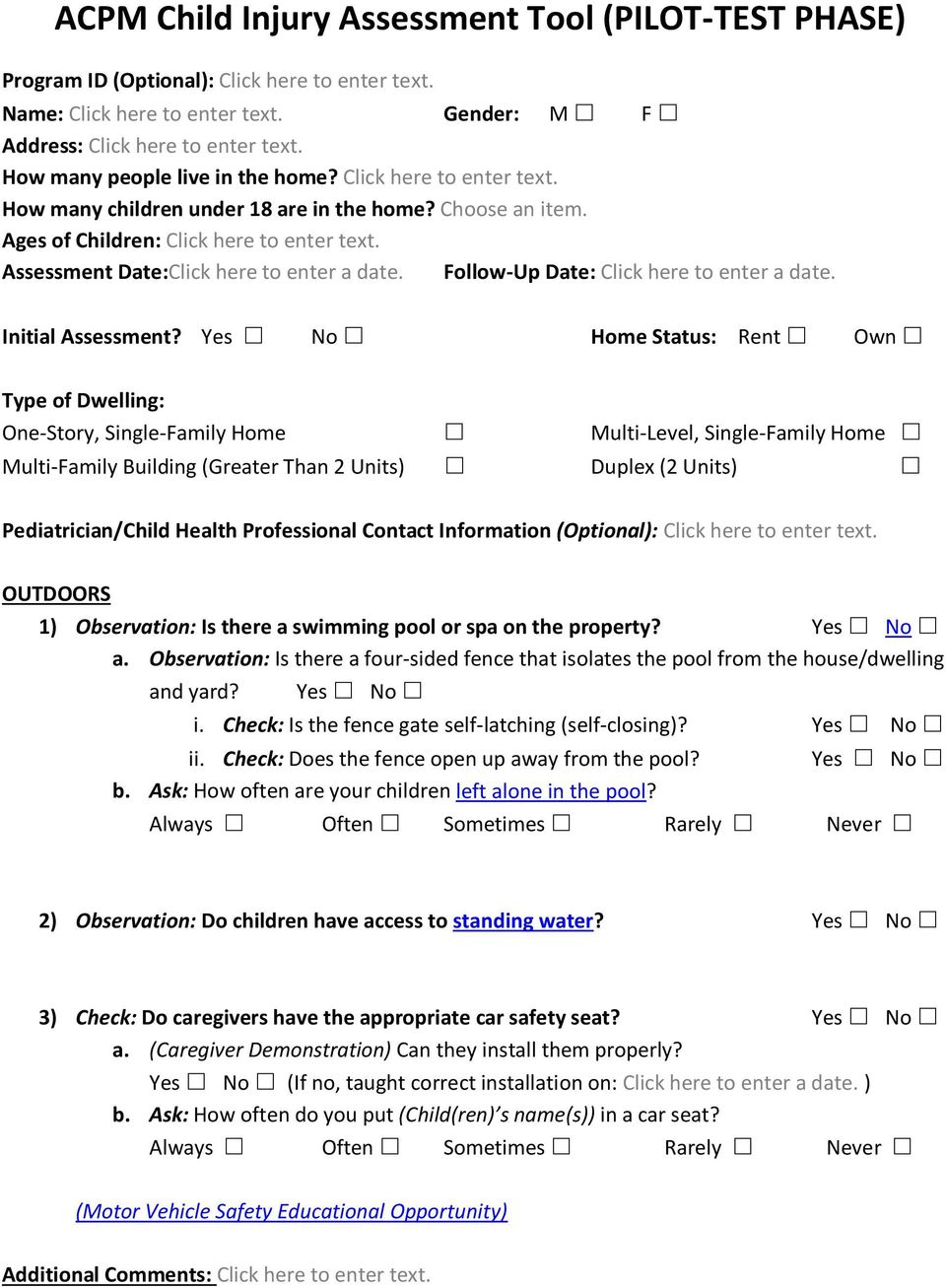
1 ACPM Child Injury Assessment Tool (PILOT-TEST PHASE) Program ID (Optional): Click here to enter text. Name: Click here to enter text. Gender: M F Address: Click here to enter text. How many people live in the home? Click here to enter text. How many children under 18 are in the home? Choose an item. Ages of Children: Click here to enter text. Assessment Date:Click here to enter a date. Follow-Up Date: Click here to enter a date. Initial Assessment? Home Status: Rent Own Type of Dwelling: One-Story, Single-Family Home Multi-Level, Single-Family Home Multi-Family Building (Greater Than 2 Units) Duplex (2 Units) Pediatrician/Child Health Professional Contact Information (Optional): Click here to enter text. OUTDOORS 1) Observation: Is there a swimming pool or spa on the property? a. Observation: Is there a four-sided fence that isolates the pool from the house/dwelling and yard? i. Check: Is the fence gate self-latching (self-closing)? ii. Check: Does the fence open up away from the pool? b. Ask: How often are your children left alone in the pool? 2) Observation: Do children have access to standing water? 3) Check: Do caregivers have the appropriate car safety seat? a. (Caregiver Demonstration) Can they install them properly? (If no, taught correct installation on: Click here to enter a date. ) b. Ask: How often do you put (Child(ren) s name(s)) in a car seat? (Motor Vehicle Safety Educational Opportunity)
2 INDOORS--General 4) Observation: Do you notice small items in the house? a. Mark all that apply: Marbles/Small Balls/Spherical Toys Un-inflated Latex Balloons Loose Change Beads Button-Shaped Batteries Rubber Erasers Other: Click here to enter text. b. Ask: How often does (Child(ren) s name(s)) play with these types of toys? 5) Observation: Are there gates in the appropriate stairways and doorways? a. Ask: How often do you leave these gates left open? (Slipping/Falls Educational Opportunity) 6) Check: Is there a functioning smoke detector in the home? a. Ask: When was the battery last changed? Click here to enter text. (If they have a lithium-ion battery record installation date: Click here to enter a date.) (If Don t Know or similar, changed with caregiver on: Click here to enter a date.) 7) Check: Is the hot water heater temperature 120 o F at the tap? Unable to Measure 8) Observation: Are all of the electrical outlets covered? 9) Observation: Do windows above the first floor have locks and operable window guards? 10) Observation: Are the loops on the windows/blinds cords large enough for a child to get their head stuck in them? 11) Observation: Are there loose cords attached to heavy objects, like ironing boards, irons, or televisions, hanging low to the ground? If pulled, these objects could fall on a child.

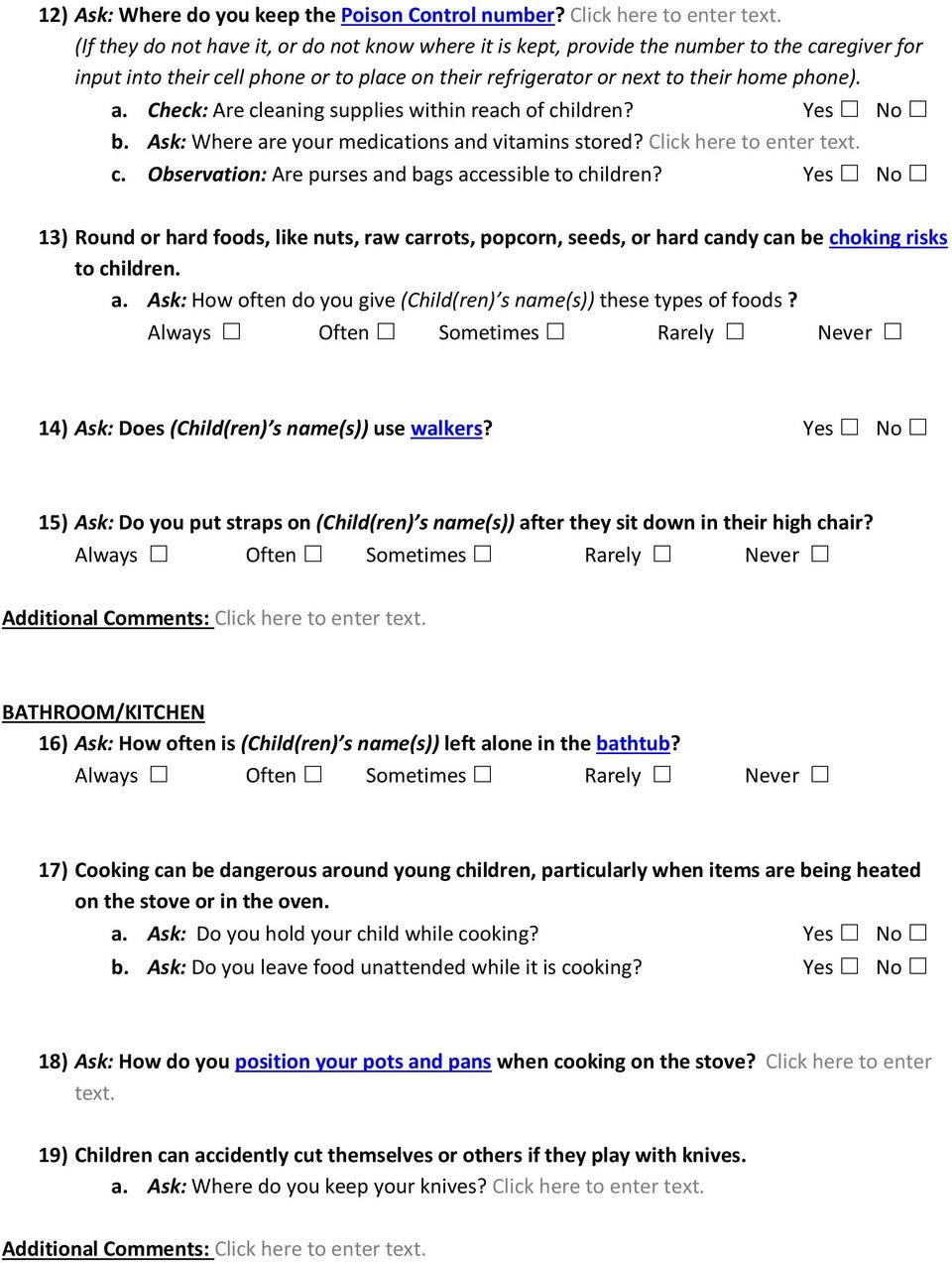
3 12) Ask: Where do you keep the Poison Control number? Click here to enter text. (If they do not have it, or do not know where it is kept, provide the number to the caregiver for input into their cell phone or to place on their refrigerator or next to their home phone). a. Check: Are cleaning supplies within reach of children? b. Ask: Where are your medications and vitamins stored? Click here to enter text. c. Observation: Are purses and bags accessible to children? 13) Round or hard foods, like nuts, raw carrots, popcorn, seeds, or hard candy can be choking risks to children. a. Ask: How often do you give (Child(ren) s name(s)) these types of foods? 14) Ask: Does (Child(ren) s name(s)) use walkers? 15) Ask: Do you put straps on (Child(ren) s name(s)) after they sit down in their high chair? BATHROOM/KITCHEN 16) Ask: How often is (Child(ren) s name(s)) left alone in the bathtub? 17) Cooking can be dangerous around young children, particularly when items are being heated on the stove or in the oven. a. Ask: Do you hold your child while cooking? b. Ask: Do you leave food unattended while it is cooking? 18) Ask: How do you position your pots and pans when cooking on the stove? Click here to enter text. 19) Children can accidently cut themselves or others if they play with knives. a. Ask: Where do you keep your knives? Click here to enter text.
4 LIVING ROOM/BEDROOM 20) Check: Are dressers/shelves secured to the wall? 21) Check: Are there stops on drawers to prevent them from being pulled out by young children? 22) Check: Is the television secured to the wall or other furniture? 23) (Infants Only): Many infants may get hurt when sleeping in unsafe places or surrounded with objects that could suffocate them. a. Ask: Where does the infant sleep or nap in the home? Click here to enter text. b. Ask: What position does the infant sleep in? Click here to enter text. c. Ask: Are there soft objects in the infant s bed, such as pillows, pillow-like toys, quilts, or comforters? d. Check: Check the mattress for firmness. Firm Soft Neither PSYCHOSOCIAL SCREENING Please tell the caregiver that these next few questions are designed to help you understand any stressful issues they may be dealing with. They are not intended to scare or upset them, but to help connect them with local resources if they need assistance. Please have contact information to local resources available with you to give to the caregiver, if necessary. 24) Ask: Over the last two weeks, how often have you been bothered by any of the following problems? (Little interest or pleasure in doing things; Feeling down, depressed, or hopeless) a. Little interest or pleasure in doing things Not at all Several days Half of the days More than half of the days Nearly everyday b. Feeling down, depressed, or hopeless Not at all Several days Half of the days More than half of the days Nearly everyday 25) Ask: How often do you drink alcohol? Never Once a month 2-4 times per month 2-3 times per week 4 or more times per week

5 a. Ask (If selected any answer above, other than Never ): When you do decide to drink alcohol, how many drinks would you normally have in one sitting? ) Ask: Do you ever feel irritated or frustrated when your infant cries, so much so that you would want to shake the baby?

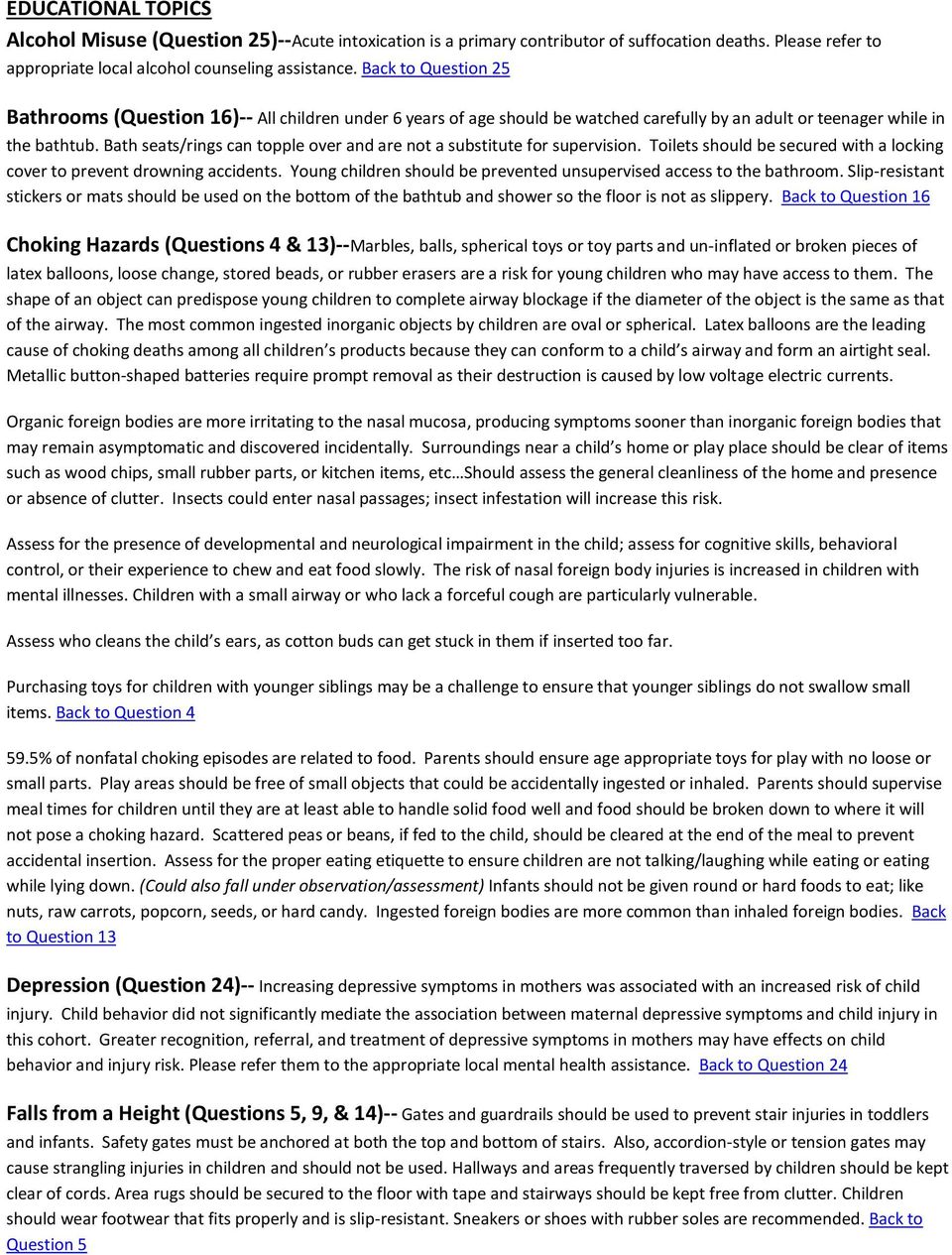
6 EDUCATIONAL TOPICS Alcohol Misuse (Question 25)--Acute intoxication is a primary contributor of suffocation deaths. Please refer to appropriate local alcohol counseling assistance. Back to Question 25 Bathrooms (Question 16)-- All children under 6 years of age should be watched carefully by an adult or teenager while in the bathtub. Bath seats/rings can topple over and are not a substitute for supervision. Toilets should be secured with a locking cover to prevent drowning accidents. Young children should be prevented unsupervised access to the bathroom. Slip-resistant stickers or mats should be used on the bottom of the bathtub and shower so the floor is not as slippery. Back to Question 16 Choking Hazards (Questions 4 & 13)--Marbles, balls, spherical toys or toy parts and un-inflated or broken pieces of latex balloons, loose change, stored beads, or rubber erasers are a risk for young children who may have access to them. The shape of an object can predispose young children to complete airway blockage if the diameter of the object is the same as that of the airway. The most common ingested inorganic objects by children are oval or spherical. Latex balloons are the leading cause of choking deaths among all children s products because they can conform to a child s airway and form an airtight seal. Metallic button-shaped batteries require prompt removal as their destruction is caused by low voltage electric currents. Organic foreign bodies are more irritating to the nasal mucosa, producing symptoms sooner than inorganic foreign bodies that may remain asymptomatic and discovered incidentally. Surroundings near a child s home or play place should be clear of items such as wood chips, small rubber parts, or kitchen items, etc Should assess the general cleanliness of the home and presence or absence of clutter. Insects could enter nasal passages; insect infestation will increase this risk. Assess for the presence of developmental and neurological impairment in the child; assess for cognitive skills, behavioral control, or their experience to chew and eat food slowly. The risk of nasal foreign body injuries is increased in children with mental illnesses. Children with a small airway or who lack a forceful cough are particularly vulnerable. Assess who cleans the child s ears, as cotton buds can get stuck in them if inserted too far. Purchasing toys for children with younger siblings may be a challenge to ensure that younger siblings do not swallow small items. Back to Question % of nonfatal choking episodes are related to food. Parents should ensure age appropriate toys for play with no loose or small parts. Play areas should be free of small objects that could be accidentally ingested or inhaled. Parents should supervise meal times for children until they are at least able to handle solid food well and food should be broken down to where it will not pose a choking hazard. Scattered peas or beans, if fed to the child, should be cleared at the end of the meal to prevent accidental insertion. Assess for the proper eating etiquette to ensure children are not talking/laughing while eating or eating while lying down. (Could also fall under observation/assessment) Infants should not be given round or hard foods to eat; like nuts, raw carrots, popcorn, seeds, or hard candy. Ingested foreign bodies are more common than inhaled foreign bodies. Back to Question 13 Depression (Question 24)-- Increasing depressive symptoms in mothers was associated with an increased risk of child injury. Child behavior did not significantly mediate the association between maternal depressive symptoms and child injury in this cohort. Greater recognition, referral, and treatment of depressive symptoms in mothers may have effects on child behavior and injury risk. Please refer them to the appropriate local mental health assistance. Back to Question 24 Falls from a Height (Questions 5, 9, & 14)-- Gates and guardrails should be used to prevent stair injuries in toddlers and infants. Safety gates must be anchored at both the top and bottom of stairs. Also, accordion-style or tension gates may cause strangling injuries in children and should not be used. Hallways and areas frequently traversed by children should be kept clear of cords. Area rugs should be secured to the floor with tape and stairways should be kept free from clutter. Children should wear footwear that fits properly and is slip-resistant. Sneakers or shoes with rubber soles are recommended. Back to Question 5
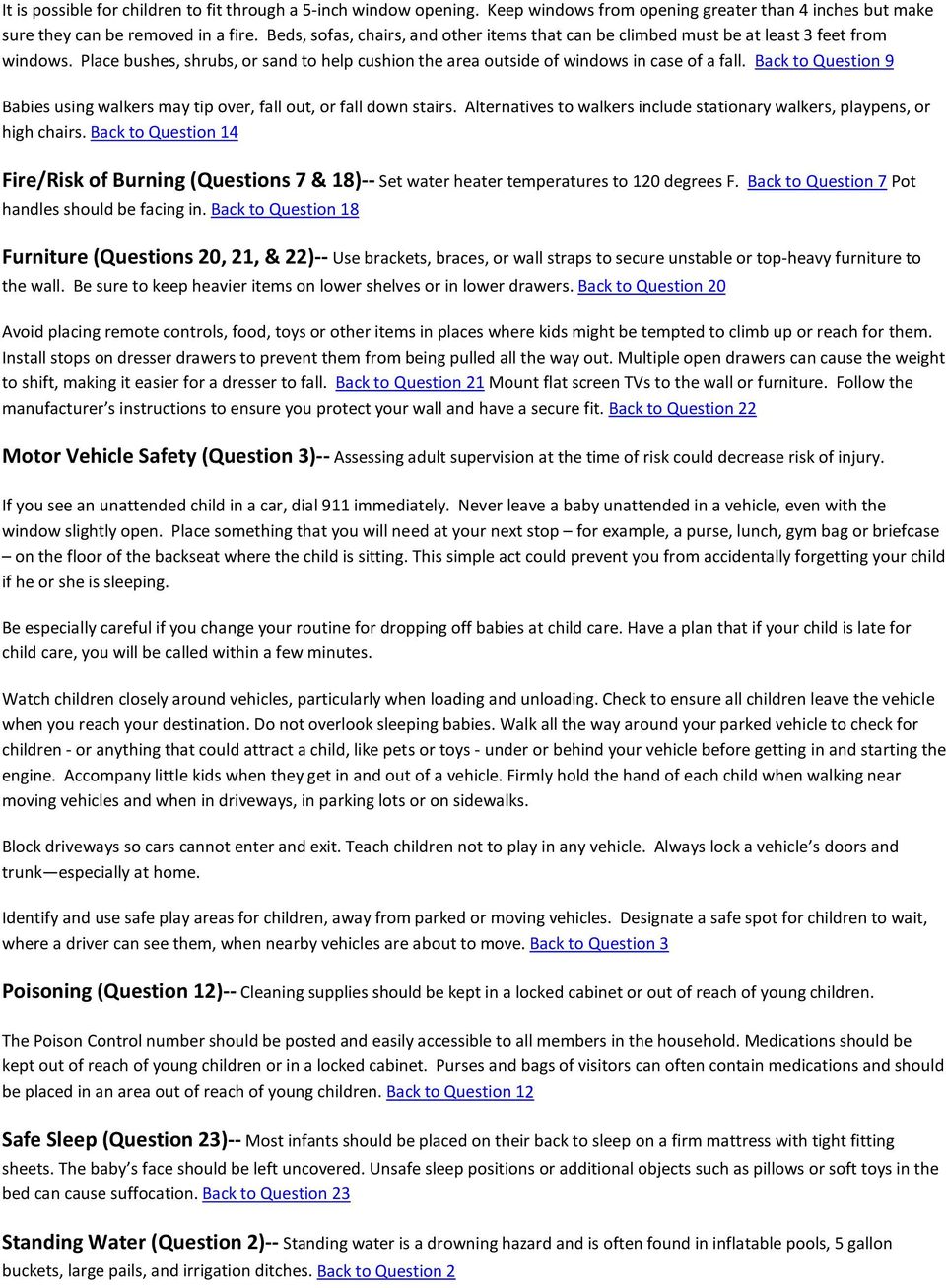
7 It is possible for children to fit through a 5-inch window opening. Keep windows from opening greater than 4 inches but make sure they can be removed in a fire. Beds, sofas, chairs, and other items that can be climbed must be at least 3 feet from windows. Place bushes, shrubs, or sand to help cushion the area outside of windows in case of a fall. Back to Question 9 Babies using walkers may tip over, fall out, or fall down stairs. Alternatives to walkers include stationary walkers, playpens, or high chairs. Back to Question 14 Fire/Risk of Burning (Questions 7 & 18)-- Set water heater temperatures to 120 degrees F. Back to Question 7 Pot handles should be facing in. Back to Question 18 Furniture (Questions 20, 21, & 22)-- Use brackets, braces, or wall straps to secure unstable or top-heavy furniture to the wall. Be sure to keep heavier items on lower shelves or in lower drawers. Back to Question 20 Avoid placing remote controls, food, toys or other items in places where kids might be tempted to climb up or reach for them. Install stops on dresser drawers to prevent them from being pulled all the way out. Multiple open drawers can cause the weight to shift, making it easier for a dresser to fall. Back to Question 21 Mount flat screen TVs to the wall or furniture. Follow the manufacturer s instructions to ensure you protect your wall and have a secure fit. Back to Question 22 Motor Vehicle Safety (Question 3)-- Assessing adult supervision at the time of risk could decrease risk of injury. If you see an unattended child in a car, dial 911 immediately. Never leave a baby unattended in a vehicle, even with the window slightly open. Place something that you will need at your next stop for example, a purse, lunch, gym bag or briefcase on the floor of the backseat where the child is sitting. This simple act could prevent you from accidentally forgetting your child if he or she is sleeping. Be especially careful if you change your routine for dropping off babies at child care. Have a plan that if your child is late for child care, you will be called within a few minutes. Watch children closely around vehicles, particularly when loading and unloading. Check to ensure all children leave the vehicle when you reach your destination. Do not overlook sleeping babies. Walk all the way around your parked vehicle to check for children - or anything that could attract a child, like pets or toys - under or behind your vehicle before getting in and starting the engine. Accompany little kids when they get in and out of a vehicle. Firmly hold the hand of each child when walking near moving vehicles and when in driveways, in parking lots or on sidewalks. Block driveways so cars cannot enter and exit. Teach children not to play in any vehicle. Always lock a vehicle s doors and trunk especially at home. Identify and use safe play areas for children, away from parked or moving vehicles. Designate a safe spot for children to wait, where a driver can see them, when nearby vehicles are about to move. Back to Question 3 Poisoning (Question 12)-- Cleaning supplies should be kept in a locked cabinet or out of reach of young children. The Poison Control number should be posted and easily accessible to all members in the household. Medications should be kept out of reach of young children or in a locked cabinet. Purses and bags of visitors can often contain medications and should be placed in an area out of reach of young children. Back to Question 12 Safe Sleep (Question 23)-- Most infants should be placed on their back to sleep on a firm mattress with tight fitting sheets. The baby s face should be left uncovered. Unsafe sleep positions or additional objects such as pillows or soft toys in the bed can cause suffocation. Back to Question 23 Standing Water (Question 2)-- Standing water is a drowning hazard and is often found in inflatable pools, 5 gallon buckets, large pails, and irrigation ditches. Back to Question 2
8 Swimming Pools/Spas (Question 1)-- The isolation fence should be four sided and greater than 4 feet tall, not a chain link fence, and the distance between vertical slabs should be less than 2 inches. The gate latch should be greater than 54 inches from the bottom of the gate and should be checked often to be sure it is in good working order. Pool covers and/or Pool alarms do not substitute for fencing or gate. Make sure to use special drain covers, Safety Vacuum Release Systems (SVRSs), filter pumps with multiple drains, and other pressure venting filter construction. Back to Question 1A Children should be taught to never swim alone or without an adult present. Infants, toddlers, and weak swimmers should be no more than an arm s length away from an adult. Air-filled arm bands and other inflatable aids are not a substitute for life jackets. Swimming lessons are recommended for children over 4 years old depending on their rate of development, emotional maturity, health and physical limitations. Caregivers should keep a telephone and U.S Coast Guard approved rescue items on site. Caregivers and older children should also be encouraged to learn CPR. Back to Question 1B
*Falls *Suffocation or Choking *Poisoning *Scalds and Burns *Motor Vehicle Accidents. *Never leave infants or toddlers
 CENTER FOR EFFECTIVE PARENTING INJURY PREVENTION for Infants, Toddlers & Preschoolers Accidental injuries are a leading cause of hospitalization and death for young children. Because many childhood injuries
How To Prevent Accidents
 HOME SAFETY AND PREVENTION OF HOME ACCIDENTS IN YOUNG CHILDREN Wong Chin Khoon Home is a wonderful place to care for the children. Home is where we feel safe. However, many of us are not aware that home
Child and Infant Safety Checklist
 Child and Infant Safety Checklist The Safety Checklist can help you learn risks for injury at home, in the car, at childcare centers, at schools, and on playgrounds. The Safety Checklist also tells you
Only call 911 for emergency situations. - An emergency is anytime you feel your life or someone else s life is in immediate danger or in harms way.
 Only call 911 for emergency situations. - An emergency is anytime you feel your life or someone else s life is in immediate danger or in harms way. Examples of a 911 emergency: Having trouble breathing
Daycare and Nursery Equipment Safety
 Daycare and Nursery Equipment Safety There are hundreds of types of nursery equipment on the market intended to be used with children. However, many of these products are used incorrectly, poorly designed,
Home Home Safety Safety Community Action Kit: A Guide for Health Professionals CONTENTS
 Home Home Safety Safety Community Action Kit: A Guide for Health Professionals MAJOR TYPES BACKGROUND OF CHILD ON INJURIES KIDSAFE IN WA THE HOME CONTENTS Kidsafe WA (Kidsafe Western Australia Inc.) is
Baby, I ve Got My Eye On You!
 Baby, I ve Got My Eye On You! Home Safety Guide for Parents of Newborns to Five-Year-Olds from the Pennsylvania Department of Health These groups helped develop this guide: Center for Schools and Communities
SCHOOL OF NURSING CHILD CARE HEALTH LINKAGES EVALUATION PROJECT CENTER NUMBER/ID: CLASSROOM NAME/#: DATE: RESEARCH ASSISTANT: TIME BEGIN: AM / PM
 UNIVERSITY OF CALIFORNIA SAN FRANCISCO SCHOOL OF NURSING DEPARTMENT OF FAMILY HEALTH CARE NURSING CHILD CARE HEALTH LINKAGES EVALUATION PROJECT HEALTH AND SAFETY CHECKLIST CENTER NUMBER/ID: CLASSROOM NAME/#:
BOROUGH OF NATIONAL PARK APPLICATION FOR A CERTIFICATE OF OCCUPANCY FOR CHANGE OF OCCUPANCY ADDRESS OF PROPERTY FOR INSPECTION CURRENT OWNER
 BOROUGH OF NATIONAL PARK APPLICATION FOR A CERTIFICATE OF OCCUPANCY FOR CHANGE OF OCCUPANCY ADDRESS OF PROPERTY FOR INSPECTION # BLOCK LOT VACANT YES NO CURRENT OWNER NAME ADDRESS TELEPHONE # PROSPECTIVE
HOUSING QUALITY STANDARDS (HQS)
 HOUSING QUALITY STANDARDS (HQS) HQS INSPECTIONS Part II Site Inspections 24 CFR 982.401 & 405 1si Rev. 4-20-06 General Conditions All doors and windows accessible to the outside, must have a workable lock.
Healthy Steps. Your guide to falls prevention and home safety
 Healthy Steps Your guide to falls prevention and home safety Are you at risk for a fall? The best way to keep yourself safe and independent in your home is to know where the risks are. Risks include: Having
Cougar Home Safety Assessment 4.0 Initial Visit
 Cougar Home ty Assessment 4.0 Initial Visit Adapted with permission from: The ty for Older Consumers Home ty Checklist, by Consumer Product ty Commission. (N.D.) Retrieved on November 23, 2003 from http://www.cpsc.gov/cpscpub/pubs/701.html.
Falls Awareness & Prevention Guide
 Falls Awareness & Prevention Guide Prepare your home or assist a loved one today by following these fall-proofing recommendations, courtesy of the American Academy of Orthopaedic Surgeons and The Orthopaedic
Check for Safety. A Home Fall Prevention Checklist for Older Adults
 P Safety This checklist was produced with support from the MetLife Foundation. Centers Disease Control and Prevention National Center Injury Prevention and Control A Home Fall Prevention list Older Adults
Emergency Planning Guideline
 www.hh.net.nz Essential Emergency and Security Systems Supporting and Complimenting the Home s Fire Evacuation Scheme POLICY: To optimise emergency readiness REFERENCE: NZS 8143: 2002 NB: Management is
HOME SAFETY CHECKLIST (FOSTER CARE & ADOPTIVE APPLICANTS IN ONTARIO)
 Appendix Lii HOME SAFETY CHECKLIST (FOSTER CARE & ADOPTIVE APPLICANTS IN ONTARIO) GUIDELINES TO CHILDREN S AID SOCIETIES/ADOPTION PRACTITIONERS AND PRIVATE FOSTER/ADOPTION AGENCIES IN COMPLETING THIS FORM:
CALIFORNIA CODES HEALTH AND SAFETY CODE SECTION 115920-115929. 115920. This act shall be known and may be cited as the Swimming Pool Safety Act.
 CALIFORNIA CODES HEALTH AND SAFETY CODE SECTION 115920-115929 115920. This act shall be known and may be cited as the Swimming Pool Safety Act. 115921. As used in this article the following terms have
What safe sleep practices do you see in this picture?
 SAFE 1. What safe sleep practices do you see in this picture? SAFE Safe Sleep Practices: Crib is placed next to the bed so the baby can sleep in the same room as the parents, on a separate sleep surface.
Article 7. PHYSICAL ENVIRONMENT 101237 ALTERATIONS TO EXISTING BUILDINGS OR NEW FACILITIES 101237
 Regulations GENERAL LICENSING REQUIREMENTS 101238 (Cont.) Article 7. PHYSICAL ENVIRONMENT 101237 ALTERATIONS TO EXISTING BUILDINGS OR NEW FACILITIES 101237 Prior to construction or alterations, the licensee
Guide to Care and Maintenance
 Village of Mount Prospect Guide to Care and Maintenance of Your Apartment Sponsored ed by: y: Village of Mount Prospect Envir nvironmental Health Division with the assistance of The Concerened ened Owners
EMERGENCY PREPAREDNESS
 EMERGENCY PREPAREDNESS REQUIREMENTS: Wind makes kites fly, fire can keep us warm, and rain helps the flowers and plants to grow. But sometimes the wind can blow too hard, fires can get too big or it can
Owner Cleaning and Maintenance Checklist
 Owner Cleaning and Maintenance Checklist Whether in between rentals or on a yearly basis, it is important to keep your holiday home in great condition, which is why we have created this list to make it
Preventing Falls, Slips and Trips
 Preventing Falls, Slips and Trips Falls/Slips/Trips (FSTs) You take hundreds of steps every day, but how many of those steps do you take seriously? Please take a few minutes to understand how Falls/Slips/Trips
TIPS FOR CHOOSING A CHILDCARE PROGRAM
 TIPS FOR CHOOSING A CHILDCARE PROGRAM www.childhealthonline.org Copyright 2006 Locating a Childcare Program Begin your search by calling your local experts your child care resource and referral (CCR&R)
North Dakota State University Slips, Trips, & Falls Program
 North Dakota State University Slips, Trips, & Falls Program I. Introduction The United States Department of Labor and North Dakota Risk Management accounts that slip, trips, and falls constitute the majority
Slips, trips, falls and ladder safety
 Slips, trips, falls and ladder safety OSHA 11: Slips, Trips, Falls and Ladder Safety 1 OSHA 11: Slips, Trips, Falls and Ladder Safety Slips, Trips and Falls Learning Objectives By the end of this lesson,
Convertible Crib and Changer (M668)
 Model No.: M668 PO #: Serial #: Convertible Crib and Changer (M668) THIS PRODUCT IS NOT INTENDED FOR INSTITUTIONAL OR COMMERCIAL USE. If you have any questions or missing parts, please contact us. DO NOT
HOME SAFETY CHECKLIST
 HOME SAFETY CHECKLIST Use this checklist, from Home Instead Senior Care, to help determine if your senior s home is safe from hazards that could jeopardize well-being and independence. FOR MORE INFORMATION,
Check for Safety. A Home Fall Prevention Checklist for Older Adults
 This checklist is based on the original version printed by the Centers Disease Control and revention. Support this version was provided by MetLife Foundation. 2005 Department of Health and Human Services
Child Care Provider Listing Form Parent: Please give this form to your child care provider immediately.
 Child Care Provider Listing Form Parent: Please give this form to your child care provider immediately. Instructions to provider Keep this page for your records. 1. Please answer completely and sign the
Tips for Choosing an Early Care and Education Program
 Tips for Choosing an Early Care and Education Program www.childhealthonline.org Part of the HIP on Health series Locating an Early Care and Education (ECE) Program Many high quality programs have waiting
This document was prepared for the Federal Emergency Management Agency s U.S. Fire Administration under contract number HSFE20-13-P-0275.
 Family Guide This document was prepared for the Federal Emergency Management Agency s U.S. Fire Administration under contract number HSFE20-13-P-0275. For more information about the SESAME STREET Fire
2. What building projects are exempted? (permit not required)
 BUILDING AND SAFETY DEPARTMENT 1. What building projects require a permit? Following is a list of projects that require building permits based on Appendix chapter 1 of the California Building Code and
FOR THE FOLLOWING MODELS: EE-8075W EE-8075O EE-8075R EE-8075BK
 FIREPLACE HEATER FOR THE FOLLOWING MODELS: EE-8075W EE-8075O EE-8075R EE-8075BK If you have any questions about the operation of your fireplace heater, please contact Crane Customer Care. Toll Free: 888-599-0992
Child Safety Good Practice Guide: Good investments in unintentional child injury prevention and safety promotion.
 Child Safety Good Practice Guide: Good investments in unintentional child injury prevention and safety promotion Executive Summary Background The need for knowledge of what works is growing every day among
U.S. Department of Housing and Urban Development Office of Public and Indian Housing. A Good Place to Live!
 U.S. Department of Housing and Urban Development Office of Public and Indian Housing A Good Place to Live! Introduction Having a good place to live is important. Through your Public Housing Agency (or
EARTHQUAKE SAFETY IN THE WORK PLACE
 EARTHQUAKE SAFETY IN THE WORK PLACE COMPANY PLANS All companies have an obligation to their employees to maintain a disaster plan. An emergency evacuation area must be designed, a nearby safe area, preferably
ASSEMBLY INSTRUCTIONS
 ASSEMBLY INSTRUCTIONS Adult Assembly Required. Save these instructions for future use. Elegance Round OR Elite Oval Baby Bassinet with Bedding VERSION CODE: 6.0/0110/TG PRODUCT MODEL NUMBERS: ELEGANCE
Slips, Trips, and Falls
 Slips, Trips, and Falls Slips, Trips, and Falls Cause Many Injuries Sometimes Serious Ones Thousands of disabling injuries- and even deaths- occur each year as a result of slips, trips, and falls: From
Safety Barrier Guidelines for Residential Pools Preventing Child Drownings. U.S. Consumer Product Safety Commission
 Safety Barrier Guidelines for Residential Pools Preventing Child Drownings U.S. Consumer Product Safety Commission This document is in the public domain. Therefore it may be reproduced, in part or in whole,
Living Safely at Home with Dementia
 Living Safely at Home with Dementia June 27 th, 2013 Sherri Howe, OT Reg. (Ont.) VHA & House Calls Team Cara Macanuel, OT Reg. (Ont.) Baycrest Community Behaviour Support Outreach Team (CBSOT) Objectives
About Real, Real-Life
 Slips, Trips & Falls About Real, Real-Life Real, Real-Life is an innovative series of programs designed to motivate employees on select work-related safety issues and requirements. Emphasis on employee
EAST STROUDSBURG BOROUGH RESIDENTIAL RENTAL INSPECTION CHECK LIST
 DATE TIME EAST STROUDSBURG BOROUGH RESIDENTIAL RENTAL INSPECTION CHECK LIST INSPECTOR: LICENSE # ADDRESS: PROPERTY OWNER: SINGLE: DOUBLE: MULTI-UNIT # OF UNITS POINT OF INSPECTION Sanitation IPMC 302.1
EARTHQUAKE PREPAREDNESS
 EARTHQUAKE PREPAREDNESS STEP 1. IDENTIFY POTENTIAL HAZARDS IN YOUR HOME AND BEGIN TO FIX THEM. Earthquake safety is more than minimizing damage to buildings. We must also secure the contents of our buildings
HAZARDS AND THREATS WILDFIRES HOMEOWNERS CHECKLIST INSIDE THE HOME
 HAZARDS AND THREATS WILDFIRES HOMEOWNERS CHECKLIST INSIDE THE HOME KITCHEN Keep a working extinguisher in the kitchen. Maintain electric and gas stoves in good operating condition. Keep baking soda on
Schedule of Maintenance Fees
 Schedule of Maintenance Fees Effective July 1, 2015 It is the policy of the Housing Authority of Murray not to charge for NORMAL wear and tear. However, the Housing Authority reserves the right in every
Inspection Item COMMENTS
 APPENDIX 9 AFFORDABLE HOUSING PROGRAM INSPECTION CHECKLIST Participating Jurisdiction: Homeowner Name: Assisted Property Address: Date of Physical Inspection of Property: Total Square Footage of Property:
State of Michigan DEPARTMENT OF HUMAN SERVICES. Major, Kaylee 1595 Glenwood Lane Ishpeming, MI 49849
 RICK SNYDER GOVERNOR March 23, 2015 State of Michigan DEPARTMENT OF HUMAN SERVICES BUREAU OF CHILDREN AND ADULT LICENSING NICK LYON INTERIM DIRECTOR Kaylee Major 1595 Glenwood Lane Ishpeming, MI 49849
Safe Infant Sleeping Information for Parents, Carers and Families
 Safe Infant Sleeping Information for Parents, Carers and Families Six ways to sleep your baby safely and reduce the risk of sudden unexpected death in infancy (SUDI): 1. Sleep baby on back* 2. Keep baby
How To Protect A Swimming Pool
 County of Gloucester Codes Compliance Building Department Building Three P. O. Box 329 Gloucester, Virginia 23061 Building Code Guidelines Residential Swimming Pools & Spas KEEP YOUR POOL SAFE CODE REQUIREMENTS
Slip, Trip & Fall Program Table of Contents
 Slip, Trip & Fall Program Table of Contents I. Introduction... 2 II. Scope... 2 III. Definitions... 2 IV. Responsibilities... 4 V. Practices... 5 VI. Slip-Fall Facility Checklist... 7 VII. References...
CONSTRUCTION SAFETY. NOTE: Barriers, guards, and warning signs are required to ensure safety against existing hazards.
 CONSTRUCTION SAFETY Introduction The following sections provide general guidelines and procedures for construction safety. This chapter covers the following topics: TOPIC PAGE General Construction Guidelines
Slips, Trips and Falls
 Slips, Trips and Falls Introduction o Slips, trips and falls cause: The majority of general industry accidents 15 percent of all accidental deaths (~12,000/yr) More fatalities than all other causes but
TIPS TO PREPARE FOR MOVING OUT OF YOUR UNIT Cleaning Tips and Price List
 TIPS TO PREPARE FOR MOVING OUT OF YOUR UNIT Cleaning Tips and Price List The Residence Life Department wants to provide you with a few handy cleaning tips so that you can leave your room in tip top shape
HOME SAFETY CHECKLIST (FOSTER CARE, KINSHIP & ADOPTIVE APPLICANTS IN ONTARIO)
 Resource Name: HOME SAFETY CHECKLIST (FOSTER CARE, KINSHIP & ADOPTIVE APPLICANTS IN ONTARIO) Resource Number: Initial Approval Probationary Review Annual Review Change of Address GUIDELINES TO CHILDREN
Walking and Working Surface Checklist:
 Walking and Working Surfaces Purpose: This information is presented to improve the level of safety in our operations, and to inform you that we will comply with the OSHA Standard 29 CFR 1910.23. Responsibility:
All About Your Peripherally Inserted Central Catheter (PICC)
 All About Your Peripherally Inserted Central Catheter (PICC) General Information Intravenous (IV) therapy is the delivery of fluid directly into a vein. An intravenous catheter is a hollow tube that is
RRIO Checklist. Use of checklist: Definitions: Limitations
 CITY OF SEATTLE RENTAL REGISTRATION AND INSPECTION ORDINANCE (RRIO) RRIO Checklist Use of checklist: Property owners will use the RRIO Checklist to confirm that their rental housing properties and units
BUILDING DEPARTMENT 8748 W. 82 nd Place - Justice, IL 60458 Phone: (708) 458-2130 Fax: (708) 458-3207
 BUILDING DEPARTMENT 8748 W. 82 nd Place - Justice, IL 60458 Phone: (708) 458-2130 Fax: (708) 458-3207 SELF EVALUATION CHECKLIST FOR RESIDENTIAL AND MULTI-FAMILY DWELLING INSPECTIONS The attached checklist
HONOURING OUR BABIES: Safe Sleep Cards
 HONOURING OUR BABIES: Safe Sleep Cards A Safe Sleep Initiative of the Tripartite First Nations and Aboriginal Maternal and Child Health Strategy Area FACILITATOR NOTES Babies are gifts of life from the
Ionization alarms are best suited for rooms, which contain highly combustible material. These types of material include:
 Smoke Detector University Most people are aware of the danger of fire but are unaware of the fatality of smoke. More people die from breathing smoke than by burns. In fact, deaths from smoke inhalation
TRANSPORTATION POLICY
 TRANSPORTATION POLICY Contents 1 NQS... 2 2 National Regulations... 2 3 Aim... 2 4 Related Policies... 2 5 Implementation... 2 6 General Transport Guidelines... 4 7 Guidelines for Seatbelts and Restraints...
INFANT SCALE Questionnaire (3 18 months)
 Note: Validation (for research purposes) and development of a scoring system for the AHEMD-IS is currently in progress. However, the instrument in its current form is quite useful for individual home assessment.
How To Inspect A Nursing Home
 Team Advocacy Inspection for August 20, 2013 Robin s Residential Care Facility Inspection conducted by Brenda Stalzer, P&A Team Advocate; And Brandy Earle, Volunteer Facility Information The administrator
IMPORTANT! KEEP INSTRUCTIONS FOR FUTURE USE.
 Flip Front2Back Carrier Owners Manual Instructions IMPORTANT! KEEP INSTRUCTIONS FOR FUTURE USE. Read all instructions before assembling and using your carrier. Failure to follow each instruction can result
FACT SHEET: HAZARDOUS MATERIALS ACCIDENTS
 FACT SHEET: HAZARDOUS MATERIALS ACCIDENTS A hazardous materials accident can occur anywhere. Communities located near chemical manufacturing plants are particularly at risk. However, hazardous materials
CHILDMINDER S RISK ASSESSMENT DOCUMENT
 Name of childminder Address CHILDMINDER S RISK ASSESSMENT DOCUMENT Suitable premises, environment and equipment from The Practice Guidance for the Early Years Foundation Stage Number of children minded
Sue Schuerman, PT, GCS, PhD UNLVPT
 Sue Schuerman, PT, GCS, PhD UNLVPT Exercise & Physical Activity (Your Everyday Guide from the National Institute on Aging) Go4Life Retain our physical and mental health Continue to do the things we enjoy
Purpose: To develop physical and motor skills and promote health and well-being
 Purpose: To develop physical and motor skills and promote health and well-being The physical and motor development domain includes the physical and motor skills and abilities that emerge during the infant
Safe Sleep for Baby. Quizzes 11-Question Quiz (English and Spanish) Picture Quiz for Parents/Caregivers (English and Spanish)
 Safe Sleep for Baby L.A. County Infant Safe Sleeping Campaign the Los Angeles County Inter-Agency Council on Child Abuse and Neglect (ICAN) and First 5 LA. Your Training Tool Kit Includes: Training DVD
How to Prevent Slips, Trips, Falls. For the Employees of Cascade County
 How to Prevent Slips, Trips, Falls For the Employees of Cascade County Walking is Risky Business Think about the things that you do frequently. Often these tasks are done without thought or planning.
Hotel Accessibility Pack
 Thank you for considering the Hilton Garden Inn, Aberdeen City Centre. We are pleased to give you some information about our hotel that you may find useful when planning your visit. Arriving at the hotel
Safer Pest Control for Child Care Facilities
 Safer Pest Control for Child Care Facilities A Guide to Help You Get Started Contents About This Guide 1 Keeping Children Safe 1 Setting Up an Integrated Pest Management Plan 1 1. Look for Signs of Pests
Access Statement for Wood View Guest House
 Access Statement for Wood View Guest House Introduction Wood View is set on the village green in Austwick and offers five en-suite guest rooms. The house is three hundred years old and offers accommodation
SELF-STUDY SERIES. UNDERSTANDING THE REGULATIONS: What Alaskan Foster Parents Need to Know. Updated January 2013. 1.0 Hour Training Credit
 SELF-STUDY SERIES UNDERSTANDING THE REGULATIONS: What Alaskan Foster Parents Need to Know UNIT #10: Fire Safety, First Aid and Emergency Preparedness in the Foster Home Updated January 2013 1.0 Hour Training
All in One Activity Walker Instruction Manual
 All in One Activity Walker Instruction Manual Read all instructions BEFORE assembly and USE of product. KEEP INSTRUCTIONS FOR FUTURE USE. Record the following information for quick reference. Note: Illustrations
City of Gardena Gardena Family Child Care Program Provider Network
 City of Gardena Gardena Family Child Care Program Provider Network Gardena Family Child Care Home Education Network (GFCC): GFCC contracts with licensed family child care providers who offer a quality
MVA Accident Information
 In this Report MVA Accident Information... 1 Vehicle Information... 3 Vehicular and Patient Relationship.. 4 Facts about the Patient before the MVA Accident... 4 Facts about the Patient during this MVA
HOME INVENTORY CHECKLIST
 Determining the value of your personal property requires an extensive analysis on your part. You should go through each room of your house and list every piece of furniture and fixture within it. Some
The regulations that impact outdoor space, surfacing, fall zones, equipment, entrapments, hazards and supervision are:
 Small Group, Large Group and School Age Child Care Licensing POLICY STATEMENT: Playground Safety 6.06 CMR 7.07(7); 7.07(16)(e); 7.07(13); 7.10(10) According to the U. S. Consumer Product Safety Commission
Preventing Slips, Trips, and Falls
 Preventing Slips, Trips, and Falls A Guide for Employees Slips, trips, and falls are among the most common causes of injury on the job and at home. Everyone slips, trips, or falls on occasion. We tend
Student House Australia Rules and Procedures
 Student House Australia Rules and Procedures 1. Student House Australia Student Agreement. 2. Student House Rules 3. Health and Safety. Smoke Detectors. Fire Extinguisher. Fire blanket. Fire Evacuation
Slips, Trips and Falls Prevention
 Slips, Trips and Falls Prevention Session Objectives Recognize slips, trips, and falls as a serious safety problem Identify slip, trip, and fall hazards Avoid or eliminate slip, trip, and fall hazards
Keeping our children injury-free: household safety evidence from Growing Up in New Zealand
 Growing Up in New Zealand Policy Brief 2 Keeping our children injury-free: household safety evidence from Growing Up in New Zealand Unintentional injury is a leading cause of death for New Zealand children,
Why Back Safety is Important
 Back Safety Why Back Safety is Important Back injuries are considered by OSHA (the Occupational Safety and Health Administration) as the nation's #1 workplace safety problem. Back Injuries are often: Very
Positioning and Mobility
 Positioning and Mobility Re-published with permission from Tots-n-Tech Newsletter May 2009 1 May 2009 P O S I T I O N I N G A N D M O B I L I T Y: T H E B A S I C S What is positioning and how can it help
Walking Working Surfaces and Fall Protection Program
 DEPAUL UNIVERSITY Walking Working Surfaces and Fall Protection Program Environmental Health & Safety March 2015 TABLE OF CONTENTS SECTION PAGE NO. 1.0 PURPOSE AND SCOPE 3 2.0 BASICS FOR STAFF, FACULTY,