
How To Calculate The World Interest Rate
|
|
|
- Harriet Short
- 5 years ago
- Views:
Transcription
1 International Debt Deleveraging Luca Fornaro CREI and Universitat Pompeu Fabra 12 th Macroeconomic Policy Research Workshop Budapest, September 213 1
2 Motivating facts: Household debt/gdp Household debt/gdp (percent) Ireland Un. Kingdom Portugal United States Spain 2

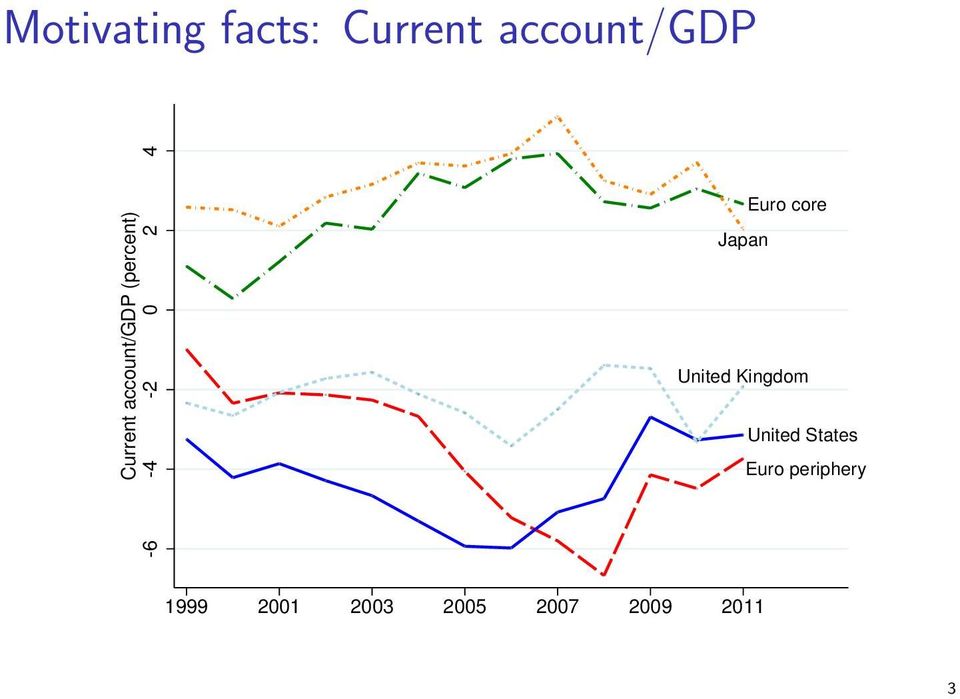
3 Motivating facts: Current account/gdp Current account/gdp (percent) Euro core Japan United Kingdom United States Euro periphery
4 Motivating facts: GDP Real GDP (index, 27=1) United States Euro core Japan United Kingdom Euro periphery

5 Research questions What happens when a group of financially integrated countries enters a process of debt deleveraging? What role does the exchange rate regime play? 5

6 This paper Provides a framework for understanding debt deleveraging in a group of financially integrated countries Key result: monetary unions are particularly prone to enter a liquidity trap during deleveraging 6

7 Overview of the framework World featuring a continuum of small open economies Foreign borrowing/lending is used to smooth the impact of idiosyncratic productivity shocks on consumption The deleveraging process is triggered by an unexpected permanent decrease in the (exogenous) borrowing limit 7

8 Overview of the results An unexpected drop in the borrowing limit generates a fall in the world interest rate With flexible exchange rates, production shifts toward high debt countries In a monetary union with nominal wage rigidities The fall in the interest rate is amplified Liquidity trap is associated with deep recession, especially in high-debt countries 8

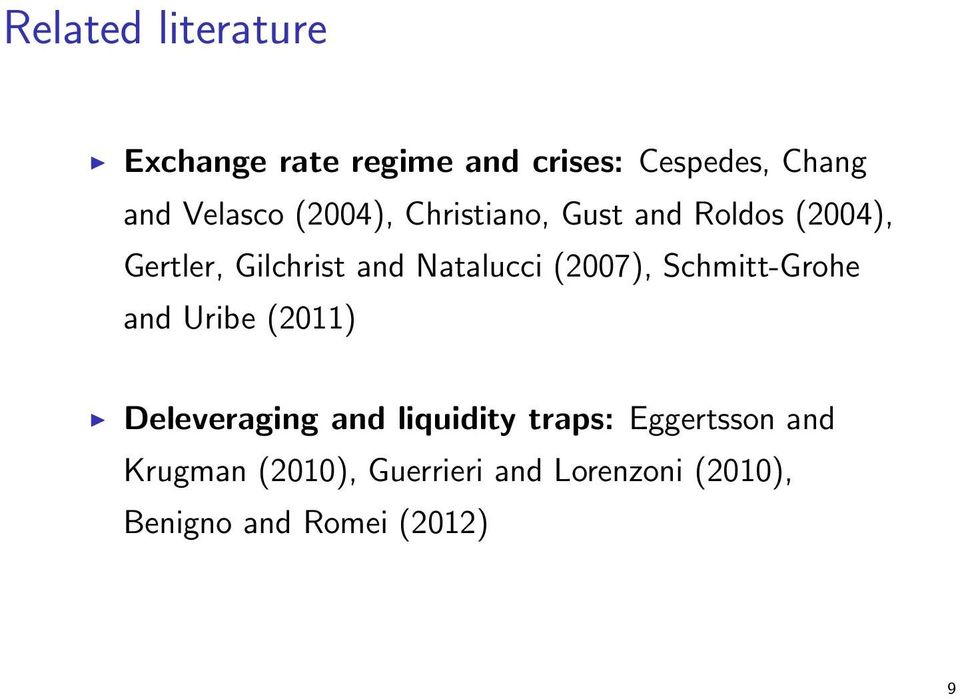
9 Related literature Exchange rate regime and crises: Cespedes, Chang and Velasco (24), Christiano, Gust and Roldos (24), Gertler, Gilchrist and Natalucci (27), Schmitt-Grohe and Uribe (211) Deleveraging and liquidity traps: Eggertsson and Krugman (21), Guerrieri and Lorenzoni (21), Benigno and Romei (212) 9
10 Outline A model of international deleveraging Deleveraging with flexible wages Deleveraging in a monetary union with nominal wage rigidities The zero lower bound Policy experiments 1

11 Outline A model of international deleveraging Deleveraging with flexible wages Deleveraging in a monetary union with nominal wage rigidities The zero lower bound Policy experiments 11

12 Model World composed of a continuum of small open economies Each economy is inhabited by a continuum of measure 1 of households and by a large number of firms 12
13 Household Expected lifetime utility in country i Budget constraint E [ t= C T i,t + p N i,tc N i,t + B i,t+1 R t Borrowing constraint β t U ( C T i,t, C N i,t, L i,t ) ] B i,t+1 κ = w i,t L i,t + B i,t + Π i,t Optimality conditions 13
![Borrowing constraint β t U ( C T i,t, C N i,t, L i,t ) ] B](/docs-images/58/5053731/images/page_13.jpg "i,t+1 κ = w i,t L i,t + B i,t + Π i,t Optimality")
14 Firms Tradable sector ( ) Yi,t T = A T i,t L T αt i,t A T i,t is a country-specific productivity shock Non-tradable sector Yi,t N = A ( ) N L N αn i,t 14

15 Market clearing Tradable consumption good Ci,t T = Yi,t T B i,t+1 + B i,t R t Non-tradable consumption good Labor World market clearing 1 C T i,t di = Ci,t N = Yi,t N L i,t = L T i,t + L N i,t 1 Y T i,t di 1 B i,t+1 di = 15
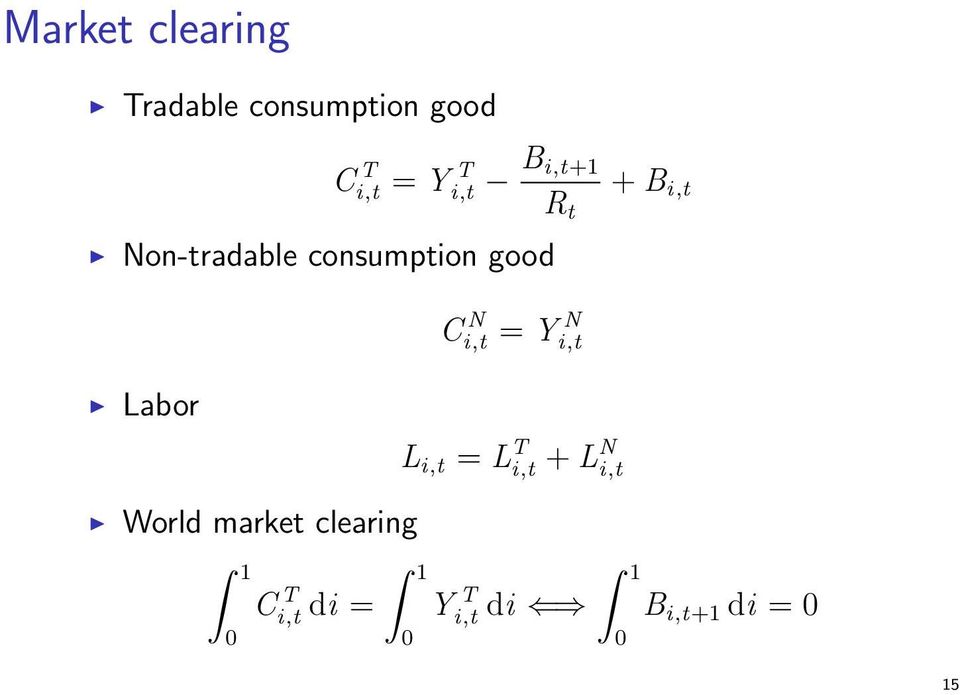
16 Some useful definitions The stock of net foreign assets owned by country i at the end of period t is NFA i,t = B i,t+1 R t Current account ( NFA i,t NFA i,t 1 = CA i,t = Yi,t C T i,t+b T i,t 1 1 ) R t 1 16

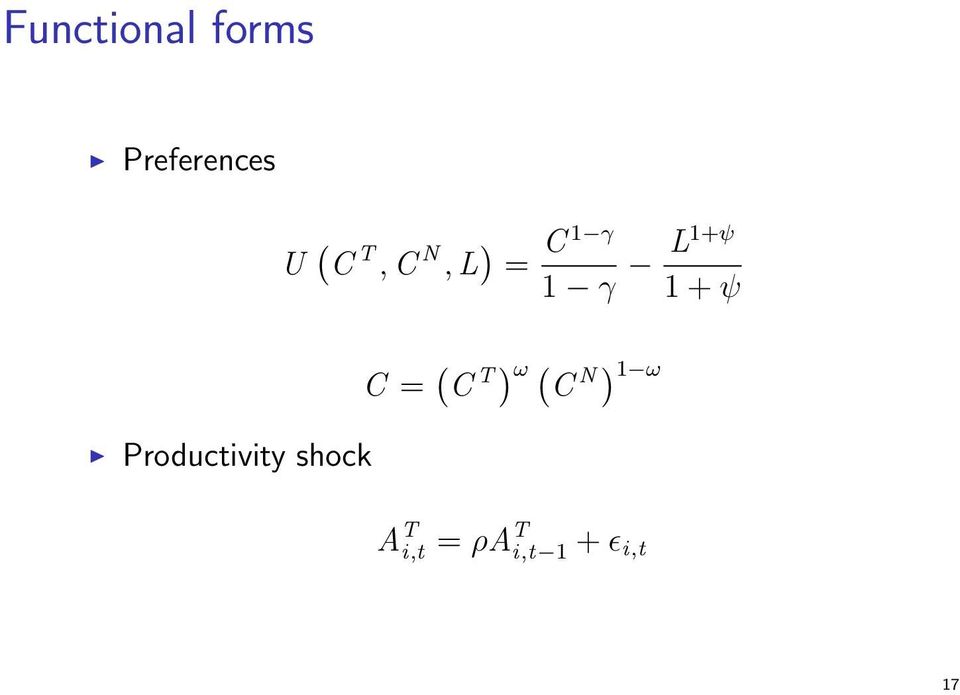
17 Functional forms Preferences U ( C T, C N, L ) = C 1 γ 1 γ L1+ψ 1 + ψ Productivity shock C = ( C T ) ω ( C N ) 1 ω A T i,t = ρa T i,t 1 + ɛ i,t 17
18 Parameters Table 1: Parameters (annual) Value Source/Target Risk aversion γ = 4 Standard value Discount factor β =.9756 R = 1.25 Frisch elasticity of labor supply 1/ψ = 1 Kimball and Shapiro (28) Labor share in trad. sector α T =.65 Standard value Labor share in non-trad. sector α N =.65 Standard value Share of trad. in consumption ω =.5 Stockman and Tesar (1995) TFP process σ ɛ =.194 Benigno and Thoenissen (28) ρ =.84 Initial borrowing limit κ =.9 Debt/GDP= 2% 18

19 Policy functions.4 Current account Labor High TFP Low TFP Wealth at the start of the period: B t Wealth at the start of the period: B t 19

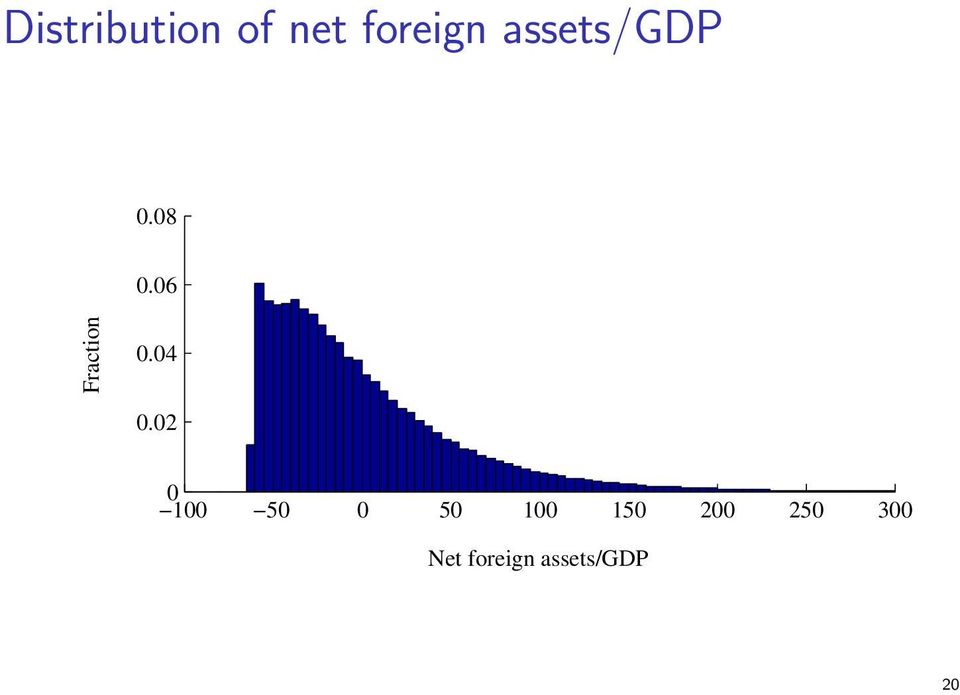
20 Distribution of net foreign assets/gdp.8.6 Fraction Net foreign assets/gdp 2
21 Deleveraging shock Start from steady state with κ = κ H Unexpected permanent drop to κ = κ L < κ H I set κ L =.75κ H (in the final steady state world debt/gdp is 15 percent) graph 21
22 Outline A model of international deleveraging Deleveraging with flexible wages Deleveraging in a monetary union with nominal wage rigidities The zero lower bound Policy experiments 22
23 Transitional dynamics.9 Borrowing limit 21 World debt/gdp.8.7 percent percent Interest rate years % dev. from initial ss World output years Tradable good Non-tradable good 23
24 Impact response across the NFA distribution change from initial steady state Current account/gdp 2th p er c. 5t h p er c. % deviation from initial ss Output of tradables 2t h p er c. 5t h p er c. B < k Wealth at the start of the transition : B Wealth at the start of the transition : B % deviation from initial ss 5 5 Consumption of tradables 2th p er c. 5t h p er c. % deviation from initial ss 5 5 2t h p er c. Real wage 5t h p er c Wealth at the start of the transition : B Wealth at the start of the transition : B Current account equation 24
25 Wage rigidities and the nominal exchange rate Nominal wages adjust slowly to shocks Movements in the nominal exchange rate can act as a substitute for nominal wage flexibility Equations Proposition From the perspective of a single country the flexible wage equilibrium attains the constrained optimum. 25
26 Outline A model of international deleveraging Deleveraging with flexible wages Deleveraging in a monetary union with nominal wage rigidities The zero lower bound Policy experiments 26
27 A monetary union Budget constraint in terms of currency P T t C T i,t + P N i,tc N i,t + B i,t+1 R N t = W i,t L i,t + B i,t + Π i,t Bonds are denominated in units of currency Borrowing limit B i,t+1 P T t+1 κ 27
28 Central bank There is a single central bank that uses R N as its policy instrument Start by considering a central bank that targets zero inflation in the tradable sector P T t+1 = P T t 28
29 Nominal wage rigidities Nominal wages are fixed in the short run (period ) From period t = 1 wages are fully flexible 29
30 Transitional dynamics in a monetary union.9 Borrowing limit 21 2 World debt/gdp.8 percent percent Interest rate 4 Monetary union Flex. wage years % dev. from initial ss World output Tradable good Non-tradable good years 3
31 Impact response across the NFA distribution change from initial steady state Current account/gdp 2th p er c. 5t h p er c. % deviation from initial ss Output of tradables 2t h p er c. 5t h p er c. B < k Wealth at the start of the transition : B Wealth at the start of the transition : B % deviation from initial ss Consumption of tradables 2th p er c. 5t h p er c. % deviation from initial ss Output of non-tradables 2t h p er c. 5t h p er c Wealth at the start of the transition : B Wealth at the start of the transition : B Production of non-tradables 31
32 Outline A model of international deleveraging Deleveraging with flexible wages Deleveraging in a monetary union with nominal wage rigidities The zero lower bound Policy experiments 32
33 The zero lower bound Define ˆR t N as the nominal interest rate consistent with the inflation target Now monetary policy is given by R N t = MAX ( ) ˆRN t, 1 During period, the price of the tradable good has to fall to guarantee market clearing Two effects Employment in the tradable sector decreases Fisher s debt-deflation: the real debt burden increases 33
34 Transitional dynamics in a liquidity trap.9 Borrowing limit 21 World debt/gdp.8.7 percent 2 19 percent Interest rate years % dev. from initial ss World output 2 Tradable good Non-tradable good years 34
35 Impact response across the NFA distribution change from initial steady state Current account/gdp 2th p er c. 5t h p er c. % deviation from initial ss Output of tradables 2t h p er c. 5t h p er c. B < k % deviation from initial ss Wealth at the start of the transition : B Consumption of tradables 2th p er c. 5t h p er c Wealth at the start of the transition : B % deviation from initial ss Wealth at the start of the transition : B Output of non-tradables 2t h p er c. 5t h p er c Wealth at the start of the transition : B 35
36 Outline A model of international deleveraging Deleveraging with flexible wages Deleveraging in a monetary union with nominal wage rigidities The zero lower bound Policy experiments 36
37 Policy experiments One period is a quarter Persistent nominal wage rigidities Gradual tightening of the borrowing limit 37
38 Transitional dynamics index (t 1 =1) Borrowing limit Consumer price index quarters percent percent (annualized) World debt/gdp Real interest rate quarters percent (annualized) % deviation from initial ss Nominal interest rate World output 6 Trad. Non-trad quarters 38
39 Changing the inflation target percent percent (annualized) World debt/gdp Real interest rate quarters percent (annualized) % deviation from initial ss Nominal interest rate World output - tradables quarters index (t 1 =1) % deviation from initial ss Consumer price index World output - non-trad. 6 inf. target = 2% inf. target = 4% quarters 39
40 Soft landing index (t 1 =1) Borrowing limit Consumer price index quarters percent % deviation from initial ss World debt/gdp World output - tradables quarters percent (annualized) % deviation from initial ss Nominal interest rate World output - non-trad. 6 baseline soft landing quarters 4
41 Conclusion Main message: monetary unions are particularly prone to enter a liquidity trap during deleveraging Other policy tools Fiscal transfers and debt relief policies (Fornaro 213) 41
42 Thank you 42
43 Household s optimality conditions p N i,t = U C N i,t U C T i,t U Li,t = w i,t U C T i,t U C T i,t R t = βe t [ U C T i,t+1 ] + µ i,t B i,t+1 κ, with equality if µ i,t >, Back 43
44 Nominal wage rigidities and the exchange rate Define S i as country i nominal exchange rate against the key international currency P T i,t = S i,t P T t Normalize P T = 1, firms labor demand implies ( L T i,t = α T A T i,t S i,t W i,t ) 1 1 α T Back 44
45 The current account Back ( CA i,t = Yi,t T Ci,t T + B i,t 1 1 ) R t 1 45
46 Real exchange rate and production of non-tradables Real exchange rate P N i,t = 1 ω ω Ci,t T P T Ci,t N t Equilibrium labor in the non-tradable sector L N i,t = ( α N A P N ) 1 N 1 α N i,t W i,t Back 46
47 Motivating facts: Household debt/gdp Household debt/gdp (percent) Ireland Un. Kingdom Portugal United States Spain 47
48 Motivating facts: Current account/gdp Current account/gdp (percent) Euro core Japan United Kingdom United States Euro periphery
49 Motivating facts: CA deficits and unemployment Current account/gdp in DEU NLD JPN FIN AUT BEL FRA ITA GBR USA PRT IRL GRC Change in unemployment rate - 27/211 ESP 49
50 Eurozone: net debtors NFA/GDP Eurozone - net debtors NFA/GDP percent year Source: data from Milesi-Ferretti and Lane (29) Back 5
51 A model with interest rate spreads Suppose households in country i are charged the interest rate R i,t U C T i,t ] = R i,t βe t [U C T i,t+1 Assuming the borrowing constraint in the main text R [ ] t U C T i,t = 1 µ i,t R t βe t U C T i,t+1 U C T i,t The two models are isomorphic if R i,t = R t 1 µ i,t R t U C T i,t and if the spread R i,t R t is rebated to households in country i through lump-sum transfers 51
Debt Deleveraging, Debt Relief and Liquidity Traps
 Debt Deleveraging, Debt Relief and Liquidity Traps Luca Fornaro May 213 Abstract I study debt relief policies during debt-driven slumps using a model of deleveraging. Deleveraging can push the economy
Klicken Sie, um das Titelformat. zu bearbeiten. The Eurocrisis: new challenges for the EU s. economic policy. Thomas Westphal. 23th of February 2015
 The Eurocrisis: new challenges for the EU s Klicken Sie, um das Titelformat economic policy zu bearbeiten Thomas Westphal Klicken Director Sie, General um das European Format Policy des Untertitel-Masters
Conducting Monetary Policy with Large Public Debts. Gita Gopinath Harvard University
 Conducting Monetary Policy with Large Public Debts Gita Gopinath Harvard University 1 Large Public Debts Net Government debt to GDP Greece 155 Japan 134 Portugal 111 Italy 103 Ireland 102 United States
Final. 1. (2 pts) What is the expected effect on the real demand for money of an increase in the nominal interest rate? How to explain this effect?
 Name: Number: Nova School of Business and Economics Macroeconomics, 1103-1st Semester 2013-2014 Prof. André C. Silva TAs: João Vaz, Paulo Fagandini, and Pedro Freitas Final Maximum points: 20. Time: 2h.
DEBT LEVELS AND FISCAL FRAMEWORKS. Christian Kastrop Director of Policy Studies Branch Economics Department
 DEBT LEVELS AND FISCAL FRAMEWORKS Christian Kastrop Director of Policy Studies Branch Economics Department Introduction OECD average gross government debt increased from 73% of GDP in 2007 to 111% in 2013.
Lecture 1: The intertemporal approach to the current account
 Lecture 1: The intertemporal approach to the current account Open economy macroeconomics, Fall 2006 Ida Wolden Bache August 22, 2006 Intertemporal trade and the current account What determines when countries
Discussion of Capital Injection, Monetary Policy, and Financial Accelerators
 Discussion of Capital Injection, Monetary Policy, and Financial Accelerators Karl Walentin Sveriges Riksbank 1. Background This paper is part of the large literature that takes as its starting point the
Discussion of Current Account Imabalances in the Southern Euro Area: Causes, Consequences, and Remedies. Massimiliano Pisani (Bank of Italy)
 Discussion of Current Account Imabalances in the Southern Euro Area: Causes, Consequences, and Remedies Massimiliano Pisani (Bank of Italy) Italy s External Competitiveness Ministry of Economy and Finance,
Money. 1 What is money? Spring 2013. 3 functions of money: Store of value Unit of account Medium of exchange
 Money Spring 2013 1 What is money? 3 functions of money: Store of value Unit of account Medium of exchange Whether something is money is not always so clear: Physical bills and coins Balances on checking
Stability in the Eurozone: Challenges and Solutions
 Stability in the Eurozone: Challenges and Solutions Ludger Schuknecht Director General Economic and Fiscal Policy Strategy; International Economy and Finance IMFS Working Lunch, Frankfurt (Main), 15 July
Money and Public Finance
 Money and Public Finance By Mr. Letlet August 1 In this anxious market environment, people lose their rationality with some even spreading false information to create trading opportunities. The tales about
Chapter 13. Aggregate Demand and Aggregate Supply Analysis
 Chapter 13. Aggregate Demand and Aggregate Supply Analysis Instructor: JINKOOK LEE Department of Economics / Texas A&M University ECON 203 502 Principles of Macroeconomics In the short run, real GDP and
CHAPTER 11. AN OVEVIEW OF THE BANK OF ENGLAND QUARTERLY MODEL OF THE (BEQM)
 1 CHAPTER 11. AN OVEVIEW OF THE BANK OF ENGLAND QUARTERLY MODEL OF THE (BEQM) This model is the main tool in the suite of models employed by the staff and the Monetary Policy Committee (MPC) in the construction
The RBC methodology also comes down to two principles:
 Chapter 5 Real business cycles 5.1 Real business cycles The most well known paper in the Real Business Cycles (RBC) literature is Kydland and Prescott (1982). That paper introduces both a specific theory
ECON 3312 Macroeconomics Exam 3 Fall 2014. Name MULTIPLE CHOICE. Choose the one alternative that best completes the statement or answers the question.
 ECON 3312 Macroeconomics Exam 3 Fall 2014 Name MULTIPLE CHOICE. Choose the one alternative that best completes the statement or answers the question. 1) Everything else held constant, an increase in net
CHAPTER 7: AGGREGATE DEMAND AND AGGREGATE SUPPLY
 CHAPTER 7: AGGREGATE DEMAND AND AGGREGATE SUPPLY Learning goals of this chapter: What forces bring persistent and rapid expansion of real GDP? What causes inflation? Why do we have business cycles? How
VULNERABILITY OF SOCIAL INSTITUTIONS
 VULNERABILITY OF SOCIAL INSTITUTIONS 2 December 2014 Paris Seminar in Demographic Economics Falilou FALL Senior Economist OECD Economics Department 1 Introduction and outline Social institutions and the
Fiscal Consolidation During a Depression
 NIESR Fiscal Consolidation During a Depression Nitika Bagaria*, Dawn Holland** and John van Reenen* *London School of Economics **National Institute of Economic and Social Research October 2012 Project
This paper is not to be removed from the Examination Halls
 This paper is not to be removed from the Examination Halls UNIVERSITY OF LONDON EC2065 ZA BSc degrees and Diplomas for Graduates in Economics, Management, Finance and the Social Sciences, the Diplomas
Intertemporal approach to current account: small open economy
 Intertemporal approach to current account: small open economy Ester Faia Johann Wolfgang Goethe Universität Frankfurt a.m. March 2009 ster Faia (Johann Wolfgang Goethe Universität Intertemporal Frankfurt
Answer: C Learning Objective: Money supply Level of Learning: Knowledge Type: Word Problem Source: Unique
 1.The aggregate demand curve shows the relationship between inflation and: A) the nominal interest rate. D) the exchange rate. B) the real interest rate. E) short-run equilibrium output. C) the unemployment
Case, Fair and Oster Macroeconomics Chapter 11 Problems Money Demand and the Equilibrium Interest Rate
 Case, Fair and Oster Macroeconomics Chapter 11 Problems Money Demand and the Equilibrium Interest Rate Money demand equation. P Y Md = k * -------- where k = percent of nominal income held as money ( Cambridge
EC2105, Professor Laury EXAM 2, FORM A (3/13/02)
 EC2105, Professor Laury EXAM 2, FORM A (3/13/02) Print Your Name: ID Number: Multiple Choice (32 questions, 2.5 points each; 80 points total). Clearly indicate (by circling) the ONE BEST response to each
Demand Shocks and Open Economy Puzzles
 Demand Shocks and Open Economy Puzzles Yan Bai and José-Víctor Ríos-Rull University of Rochester, University of Minnesota CSWEP 2015 Bai, Ríos-Rull (Rochester, Minnesota) Demand Shocks and Open Economy
Country Characteristics and Effects of Government Consumption Shocks on Current Account and Real Exchange Rate
 Country Characteristics and Effects of Government Consumption Shocks on Current Account and Real Exchange Rate Soyoung Kim ** Department of Economics Seoul National University First Draft: March 2009 This
FINANCIALISATION AND EXCHANGE RATE DYNAMICS IN SMALL OPEN ECONOMIES. Hamid Raza PhD Student, Economics University of Limerick Ireland
 FINANCIALISATION AND EXCHANGE RATE DYNAMICS IN SMALL OPEN ECONOMIES Hamid Raza PhD Student, Economics University of Limerick Ireland Financialisation Financialisation as a broad concept refers to: a) an
Agenda. The IS LM Model, Part 2. The Demand for Money. The Demand for Money. The Demand for Money. Asset Market Equilibrium.
 Agenda The IS LM Model, Part 2 Asset Market Equilibrium The LM Curve 13-1 13-2 The demand for money is the quantity of money people want to hold in their portfolios. The demand for money depends on expected
AGGREGATE DEMAND AND AGGREGATE SUPPLY The Influence of Monetary and Fiscal Policy on Aggregate Demand
 AGGREGATE DEMAND AND AGGREGATE SUPPLY The Influence of Monetary and Fiscal Policy on Aggregate Demand Suppose that the economy is undergoing a recession because of a fall in aggregate demand. a. Using
LECTURE NOTES ON MACROECONOMIC PRINCIPLES
 LECTURE NOTES ON MACROECONOMIC PRINCIPLES Peter Ireland Department of Economics Boston College [email protected] http://www2.bc.edu/peter-ireland/ec132.html Copyright (c) 2013 by Peter Ireland. Redistribution
Lending in Last Resort to Governments
 Olivier Jeanne, Johns Hopkins University Indiana University, March 2015 Introduction Fiscal fundamentals in 2009: an international comparison Net debt/gdp (%) 40 50 60 70 80 90 100 110 120 US JAP UK EUR
Current Accounts in Open Economies Obstfeld and Rogoff, Chapter 2
 Current Accounts in Open Economies Obstfeld and Rogoff, Chapter 2 1 Consumption with many periods 1.1 Finite horizon of T Optimization problem maximize U t = u (c t ) + β (c t+1 ) + β 2 u (c t+2 ) +...
Self-fulfilling debt crises: Can monetary policy really help? By P. Bacchetta, E. Van Wincoop and E. Perazzi
 Self-fulfilling debt crises: Can monetary policy really help? By P. Bacchetta, E. Van Wincoop and E. Perazzi Discussion by Luca Dedola (ECB) Nonlinearities in Macroeconomics and Finance in Light of the
Long-Term Debt Pricing and Monetary Policy Transmission under Imperfect Knowledge
 Long-Term Debt Pricing and Monetary Policy Transmission under Imperfect Knowledge Stefano Eusepi, Marc Giannoni and Bruce Preston The views expressed are those of the authors and are not necessarily re
ECONOMIC QUESTIONS FOR THE MASTER'S EXAM
 ECONOMIC QUESTIONS FOR THE MASTER'S EXAM Introduction 1. What is economics? Discuss the purpose and method of work of economists. Consider observation, induction, deduction and scientific criticism. 2.
Econ 336 - Spring 2007 Homework 5
 Econ 336 - Spring 2007 Homework 5 Name MULTIPLE CHOICE. Choose the one alternative that best completes the statement or answers the question. 1) The real exchange rate, q, is defined as A) E times P B)
BADM 527, Fall 2013. Midterm Exam 2. Multiple Choice: 3 points each. Answer the questions on the separate bubble sheet. NAME
 BADM 527, Fall 2013 Name: Midterm Exam 2 November 7, 2013 Multiple Choice: 3 points each. Answer the questions on the separate bubble sheet. NAME 1. According to classical theory, national income (Real
Chapter 4 Consumption, Saving, and Investment
 Chapter 4 Consumption, Saving, and Investment Multiple Choice Questions 1. Desired national saving equals (a) Y C d G. (b) C d + I d + G. (c) I d + G. (d) Y I d G. 2. With no inflation and a nominal interest
MACROECONOMIC ANALYSIS OF VARIOUS PROPOSALS TO PROVIDE $500 BILLION IN TAX RELIEF
 MACROECONOMIC ANALYSIS OF VARIOUS PROPOSALS TO PROVIDE $500 BILLION IN TAX RELIEF Prepared by the Staff of the JOINT COMMITTEE ON TAXATION March 1, 2005 JCX-4-05 CONTENTS INTRODUCTION... 1 EXECUTIVE SUMMARY...
Chapter 17. Fixed Exchange Rates and Foreign Exchange Intervention. Copyright 2003 Pearson Education, Inc.
 Chapter 17 Fixed Exchange Rates and Foreign Exchange Intervention Slide 17-1 Chapter 17 Learning Goals How a central bank must manage monetary policy so as to fix its currency's value in the foreign exchange
CEP Discussion Paper No 1405 February 2016. Stagnation Traps. Gianluca Benigno Luca Fornaro
 ISSN 2042-2695 CEP Discussion Paper No 1405 February 2016 Stagnation Traps Gianluca Benigno Luca Fornaro Abstract We provide a Keynesian growth theory in which pessimistic expectations can lead to very
A Model of Financial Crises
 A Model of Financial Crises Coordination Failure due to Bad Assets Keiichiro Kobayashi Research Institute of Economy, Trade and Industry (RIETI) Canon Institute for Global Studies (CIGS) Septempber 16,
12.1 Introduction. 12.2 The MP Curve: Monetary Policy and the Interest Rates 1/24/2013. Monetary Policy and the Phillips Curve
 Chapter 12 Monetary Policy and the Phillips Curve By Charles I. Jones Media Slides Created By Dave Brown Penn State University The short-run model summary: Through the MP curve the nominal interest rate
Practice Problems on Current Account
 Practice Problems on Current Account 1- List de categories of credit items and debit items that appear in a country s current account. What is the current account balance? What is the relationship between
2.5 Monetary policy: Interest rates
 2.5 Monetary policy: Interest rates Learning Outcomes Describe the role of central banks as regulators of commercial banks and bankers to governments. Explain that central banks are usually made responsible
MGEC61 International Economics: Finance
 MGEC61 International Economics: Finance Introduction International finance is a study of problems and policies of an open economy. International finance studies the issues like unemployment, savings, trade
Use the following to answer question 9: Exhibit: Keynesian Cross
 1. Leading economic indicators are: A) the most popular economic statistics. B) data that are used to construct the consumer price index and the unemployment rate. C) variables that tend to fluctuate in
Charles I. Jones Maroeconomics Economic Crisis Update (2010 års upplaga) Kurs 407 Makroekonomi och ekonomisk- politisk analys
 HHS Kurs 407 Makroekonomi och ekonomisk- politisk analys VT2011 Charles I. Jones Maroeconomics Economic Crisis Update Sebastian Krakowski Kurs 407 Makroekonomi och ekonomisk- politisk analys Contents Overview...
How To Calculate The Price Of A Dollar
 Exchange Rates Costas Arkolakis teaching fellow: Federico Esposito Economics 407, Yale January 2014 Outline De nitions: Nominal and Real Exchange Rate A Theory of Determination of the Real Exchange Rate
Financial Development and Macroeconomic Stability
 Financial Development and Macroeconomic Stability Vincenzo Quadrini University of Southern California Urban Jermann Wharton School of the University of Pennsylvania January 31, 2005 VERY PRELIMINARY AND
Managing the Fragility of the Eurozone. Paul De Grauwe University of Leuven
 Managing the Fragility of the Eurozone Paul De Grauwe University of Leuven Paradox Gross government debt (% of GDP) 100 90 80 70 UK Spain 60 50 40 30 20 10 0 2000 2001 2002 2003 2004 2005 2006 2007 2008
Business Conditions Analysis Prof. Yamin Ahmad ECON 736
 Business Conditions Analysis Prof. Yamin Ahmad ECON 736 Sample Final Exam Name Id # Instructions: There are two parts to this midterm. Part A consists of multiple choice questions. Please mark the answers
Optimal Fiscal Policies. Long Bonds and Interest Rates under Incomplete Markets. Bank of Spain, February 2010
 Optimal Fiscal Policies. Long Bonds and Interest Rates under Incomplete Markets Bank of Spain, February 2010 1 In dynamic models, optimal scal policy and debt management should be jointly determined. Optimality
CLOSING THE COVERAGE GAP. Robert Palacios, World Bank Pension Core Course March 2014
 CLOSING THE COVERAGE GAP Robert Palacios, World Bank Pension Core Course March 2014 Different types of coverage gaps 2 In a subset of richer countries, the main kind of gap is related to adequacy rather
Adverse macro-financial scenario for the EBA 2016 EU-wide bank stress testing exercise
 29 January 2016 Adverse macro-financial scenario for the EBA 2016 EU-wide bank stress testing exercise The European Banking Authority (EBA) 2016 EU-wide stress testing exercise will require banks to use
The Real Business Cycle model
 The Real Business Cycle model Spring 2013 1 Historical introduction Modern business cycle theory really got started with Great Depression Keynes: The General Theory of Employment, Interest and Money Keynesian
The Theory of Investment
 CHAPTER 17 Modified for ECON 2204 by Bob Murphy 2016 Worth Publishers, all rights reserved IN THIS CHAPTER, YOU WILL LEARN: leading theories to explain each type of investment why investment is negatively
13. If Y = AK 0.5 L 0.5 and A, K, and L are all 100, the marginal product of capital is: A) 50. B) 100. C) 200. D) 1,000.
 Name: Date: 1. In the long run, the level of national income in an economy is determined by its: A) factors of production and production function. B) real and nominal interest rate. C) government budget
How To Understand The Relationship Between A Country And The Rest Of The World
 Lecture 1: current account - measurement and theory What is international finance (as opposed to international trade)? International trade: microeconomic approach (many goods and factors). How cross country
4 Macroeconomics LESSON 6
 4 Macroeconomics LESSON 6 Interest Rates and Monetary Policy in the Short Run and the Long Run Introduction and Description This lesson explores the relationship between the nominal interest rate and the
Economics 101 Multiple Choice Questions for Final Examination Miller
 Economics 101 Multiple Choice Questions for Final Examination Miller PLEASE DO NOT WRITE ON THIS EXAMINATION FORM. 1. Which of the following statements is correct? a. Real GDP is the total market value
In ation Tax and In ation Subsidies: Working Capital in a Cash-in-advance model
 In ation Tax and In ation Subsidies: Working Capital in a Cash-in-advance model George T. McCandless March 3, 006 Abstract This paper studies the nature of monetary policy with nancial intermediaries that
11/6/2013. Chapter 16: Government Debt. The U.S. experience in recent years. The troubling long-term fiscal outlook
 Chapter 1: Government Debt Indebtedness of the world s governments Country Gov Debt (% of GDP) Country Gov Debt (% of GDP) Japan 17 U.K. 9 Italy 11 Netherlands Greece 11 Norway Belgium 9 Sweden U.S.A.
CH 10 - REVIEW QUESTIONS
 CH 10 - REVIEW QUESTIONS 1. The short-run aggregate supply curve is horizontal at: A) a level of output determined by aggregate demand. B) the natural level of output. C) the level of output at which the
In this chapter we learn the potential causes of fluctuations in national income. We focus on demand shocks other than supply shocks.
 Chapter 11: Applying IS-LM Model In this chapter we learn the potential causes of fluctuations in national income. We focus on demand shocks other than supply shocks. We also learn how the IS-LM model
International Economic Relations
 nternational conomic Relations Prof. Murphy Chapter 12 Krugman and Obstfeld 2. quation 2 can be written as CA = (S p ) + (T G). Higher U.S. barriers to imports may have little or no impact upon private
MGE#12 The Balance of Payments
 MGE#12 The Balance of Payments The Current Account, the Capital Account and the Balance of Payments Introduction to the Foreign Exchange Market Savings, Investment and the Current Account 1 From last session
What you will learn: UNIT 3. Traditional Flow Model. Determinants of the Exchange Rate
 What you will learn: UNIT 3 Determinants of the Exchange Rate (1) Theories of how inflation, economic growth and interest rates affect the exchange rate (2) How trade patterns affect the exchange rate
2.If actual investment is greater than planned investment, inventories increase more than planned. TRUE.
 Macro final exam study guide True/False questions - Solutions Case, Fair, Oster Chapter 8 Aggregate Expenditure and Equilibrium Output 1.Firms react to unplanned inventory investment by reducing output.
ANNEX 1 - MACROECONOMIC IMPLICATIONS FOR ITALY OF ACHIEVING COMPLIANCE WITH THE DEBT RULE UNDER TWO DIFFERENT SCENARIOS
 ANNEX 1 - MACROECONOMIC IMPLICATIONS FOR ITALY OF ACHIEVING COMPLIANCE WITH THE DEBT RULE UNDER TWO DIFFERENT SCENARIOS The aim of this note is first to illustrate the impact of a fiscal adjustment aimed
ESSAYS IN INTERNATIONAL ECONOMICS. by Kiyoung Jeon B.A. in Statistics, Korea University, 2003 M.A. in Economics, University of Pittsburgh, 2012
 ESSAYS IN INTERNATIONAL ECONOMICS by Kiyoung Jeon B.A. in Statistics, Korea University, 2003 M.A. in Economics, University of Pittsburgh, 2012 Submitted to the Graduate Faculty of the Dietrich School of
CPB Note. Ministry of Economic Affairs. Date: May 18th, 2015 Subject: Investment in the OECD: pre- and post-crisis developments
 CPB Note To: Ministry of Economic Affairs Date: May 18th, 2015 Subject: Investment in the OECD: pre- and post-crisis developments CPB Netherlands Bureau for Economic Policy Analysis Van Stolkweg 14 Postbus
Chapter 17. Preview. Introduction. Fixed Exchange Rates and Foreign Exchange Intervention
 Chapter 17 Fixed Exchange Rates and Foreign Exchange Intervention Slides prepared by Thomas Bishop Copyright 2009 Pearson Addison-Wesley. All rights reserved. Preview Balance sheets of central banks Intervention
THE GREAT DEPRESSION OF FINLAND 1990-1993: causes and consequences. Jaakko Kiander Labour Institute for Economic Research
 THE GREAT DEPRESSION OF FINLAND 1990-1993: causes and consequences Jaakko Kiander Labour Institute for Economic Research CONTENTS Causes background The crisis Consequences Role of economic policy Banking
Earnings related schemes: Design, options and experience. Edward Whitehouse
 Earnings related schemes: Design, options and experience Edward Whitehouse World Bank core course Washington DC, March 2014 Objectives Primary objective: ensuring older people have a decent standard of
Chapter 14. Preview. What Is Money? Money, Interest Rates, and Exchange Rates
 Chapter 14 Money, Interest Rates, and Exchange Rates Slides prepared by Thomas Bishop Copyright 2009 Pearson Addison-Wesley. All rights reserved. Preview What is money? Control of the supply of money The
Fixed Exchange Rates and Exchange Market Intervention. Chapter 18
 Fixed Exchange Rates and Exchange Market Intervention Chapter 18 1. Central bank intervention in the foreign exchange market 2. Stabilization under xed exchange rates 3. Exchange rate crises 4. Sterilized
South African Trade-Offs among Depreciation, Inflation, and Unemployment. Alex Diamond Stephanie Manning Jose Vasquez Erin Whitaker
 South African Trade-Offs among Depreciation, Inflation, and Unemployment Alex Diamond Stephanie Manning Jose Vasquez Erin Whitaker April 16, 2003 Introduction South Africa has one of the most unique histories
QUIZ IV Version 1. March 24, 2004. 4:35 p.m. 5:40 p.m. BA 2-210
 NAME: Student ID: College of Business Administration Department of Economics Principles of Macroeconomics O. Mikhail ECO 2013-0008 Spring 2004 QUIZ IV Version 1 This closed book QUIZ is worth 100 points.
Exam 1 Review. 3. A severe recession is called a(n): A) depression. B) deflation. C) exogenous event. D) market-clearing assumption.
 Exam 1 Review 1. Macroeconomics does not try to answer the question of: A) why do some countries experience rapid growth. B) what is the rate of return on education. C) why do some countries have high