
PROGRAM OF STUDIES High School
|
|
|
- Eileen Stokes
- 10 years ago
- Views:
Transcription
1 PROGRAM OF STUDIES High School Academic Year Loudoun County Public Schools Education Court Ashburn, Virginia 20148

2

3 LOUDOUN COUNTY PUBLIC SCHOOLS II ERIC D. HORNBERGER, Chairman Ashburn District JILL A.TURGEON, Vice-Chairman Blue Ridge District THOMAS E. REED At-Large Member LOUDOUN COUNTY SCHOOL BOARD DR. EDGAR B. HATRICK Superintendent of Schools DEBBIE K. ROSE Algonkian District KEVIN J. KUESTERS Broad Run District JENNIFER K. BERGEL Catoctin District JEFFREY E. MORSE Dulles District WILLIAM D. FOX Leesburg District BRENDA L. SHERIDAN Sterling District BRIAR WOODS HIGH SCHOOL Belmont Ridge Road Ashburn, Virginia Phone Edward A. Starzenski, Principal David Royhab, Director of School Counseling BROAD RUN HIGH SCHOOL Ashburn Road Ashburn, Virginia Phone Douglas A. Anderson, Principal Robert Yarborough, Director of School Counseling JOHN CHAMPE HIGH SCHOOL Sacred Mountain Street Aldie, VA Phone John G. Gabriel, Principal Christina Campbell, Director of School Counseling DOMINION HIGH SCHOOL Augusta Drive Sterling, Virginia Phone Dr. W. John Brewer, Principal Kevin Terry, Director of School Counseling LOUDOUN COUNTY HIGH SCHOOLS FREEDOM HIGH SCHOOL Riding Center Drive South Riding, Virginia Phone Douglas B. Fulton, Principal Kenneth Christopher, Director of School Counseling HERITAGE HIGH SCHOOL 520 Evergreen Mill Road, SE Leesburg, Virginia Phone Jeffrey R. Adam, Principal Jeannine Cummings, Director of School Counseling LOUDOUN COUNTY HIGH SCHOOL 415 Dry Mill Road, S.W. Leesburg, Virginia Phone William E. Oblas, Principal Dan Croyle, Director of School Counseling LOUDOUN VALLEY HIGH SCHOOL 340 N. Maple Avenue Purcellville, Virginia Phone Susan A. Ross, Principal LeeAnne Johnson, Director of School Counseling PARK VIEW HIGH SCHOOL 400 W. Laurel Avenue Sterling, Virginia Phone Dr. Virginia M. Minshew, Principal Anthony Bauer, Director of School Counseling POTOMAC FALLS HIGH SCHOOL Algonkian Parkway Potomac Falls, Virginia Phone Janice Koslowski, Principal Tamara Christman, Director of School Counseling STONE BRIDGE HIGH SCHOOL Hay Road Ashburn, Virginia Phone James E. Person, Principal Tim Lucas, Director of School Counseling TUSCARORA HIGH SCHOOL 801 N. King Street Leesburg, Virginia Phone Pamela Paul-Jacobs, Principal Gabrielle Carpenter, Director of School Counseling WOODGROVE HIGH SCHOOL Allder School Road Purcellville, Virginia Phone William S. Shipp, Principal Geri Fiore, Director of School Counseling DOUGLASS SCHOOL 407 E. Market Street Leesburg, Virginia Phone Dr. Jack Robinson, Principal Juliana Baker, Sharon Bean, Counselors OTHER SCHOOLS FOR HIGH SCHOOL STUDENTS OF LOUDOUN COUNTY LOUDOUN ACADEMY OF SCIENCE Augusta Drive Sterling, VA Phone George J. Wolfe, Science Academy Director Jayne C. Fonash, Director of School Counseling MONROE TECHNOLOGY CENTER AND THE LOUDOUN GOVERNOR S CAREER ANDTECHNICAL STEM ACADEMY 715 Childrens Center Road, SW Leesburg, Virginia Phone Wagner Grier, Principal Stacie Mininberg, Placement Coordinator Michelle Trudel, Counselor THOMAS JEFFERSON HIGH SCHOOL FOR SCIENCE AND TECHNOLOGY 6560 Braddock Road Alexandria, Virginia Phone Evan Glazer, Principal

4 HIGH SCHOOL PROGRAM OF STUDIES III PURPOSE OF THIS PROGRAM OF STUDIES This educational planning guide is designed to help students and their parents: make informed choices about high school courses, realize that academic performance from kindergarten through high school relates to future goals, understand Virginia graduation requirements, and assist students in planning and refining their plans of study. Students should study this guide and consult with their parents, school counselors, and teachers in planning their individual program of studies. TABLE OF CONTENTS General Information Promotion and Credit Information Diploma Requirements Transferring into Virginia Public Schools Awards for Exemplary Student Performance Grade Point Average and Class Rank Recommended Testing for College-Bound Students Special Programs Selection of Courses Steps to Reading & Using the Program of Studies Dual Enrollment Agreements Career Clusters Sample Plans of Studies Course Descriptions Art Business & Information Technology English/English Electives English Language Learners Family & Consumer Sciences Health and Physical Education World Languages and Cultures Marketing Mathematics Progression Chart Mathematics Music Naval Junior Reserve Officers Training Corps (NJROTC) Science Social Science and Global Studies/Electives Special Education Technology Education Other LCPS Academy of Science Programs at Monroe Technology Center Index of Course Offerings ADMINISTRATIVE OFFICES Education Court Ashburn, Virginia 20148

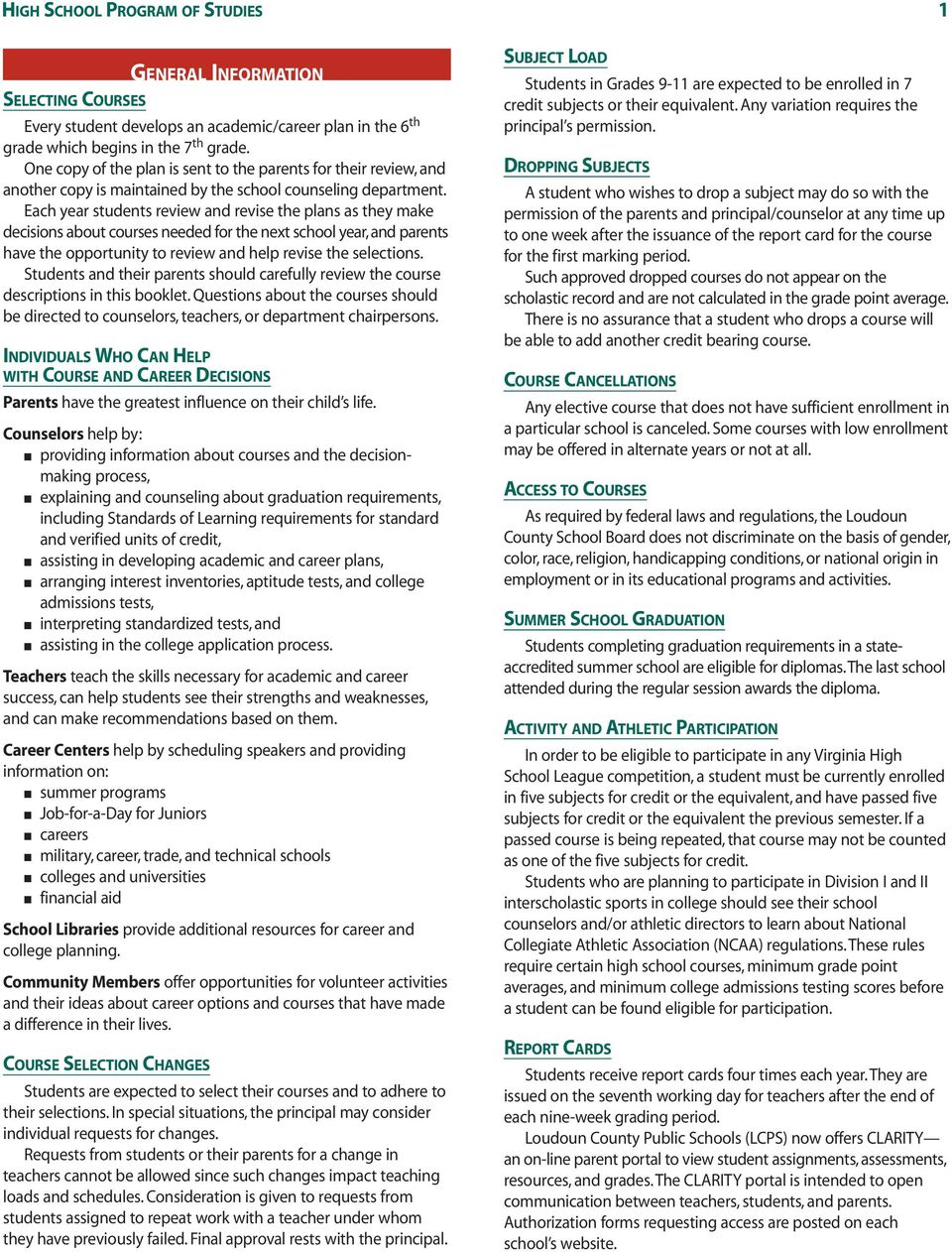
5 HIGH SCHOOL PROGRAM OF STUDIES 1 SELECTING COURSES GENERAL INFORMATION Every student develops an academic/career plan in the 6 th grade which begins in the 7 th grade. One copy of the plan is sent to the parents for their review, and another copy is maintained by the school counseling department. Each year students review and revise the plans as they make decisions about courses needed for the next school year, and parents have the opportunity to review and help revise the selections. Students and their parents should carefully review the course descriptions in this booklet. Questions about the courses should be directed to counselors, teachers, or department chairpersons. INDIVIDUALS WHO CAN HELP WITH COURSE AND CAREER DECISIONS Parents have the greatest influence on their child s life. Counselors help by: providing information about courses and the decisionmaking process, explaining and counseling about graduation requirements, including Standards of Learning requirements for standard and verified units of credit, assisting in developing academic and career plans, arranging interest inventories, aptitude tests, and college admissions tests, interpreting standardized tests, and assisting in the college application process. Teachers teach the skills necessary for academic and career success, can help students see their strengths and weaknesses, and can make recommendations based on them. Career Centers help by scheduling speakers and providing information on: summer programs Job-for-a-Day for Juniors careers military, career, trade, and technical schools colleges and universities financial aid School Libraries provide additional resources for career and college planning. Community Members offer opportunities for volunteer activities and their ideas about career options and courses that have made a difference in their lives. COURSE SELECTION CHANGES Students are expected to select their courses and to adhere to their selections. In special situations, the principal may consider individual requests for changes. Requests from students or their parents for a change in teachers cannot be allowed since such changes impact teaching loads and schedules. Consideration is given to requests from students assigned to repeat work with a teacher under whom they have previously failed. Final approval rests with the principal. SUBJECT LOAD Students in Grades 9-11 are expected to be enrolled in 7 credit subjects or their equivalent. Any variation requires the principal s permission. DROPPING SUBJECTS A student who wishes to drop a subject may do so with the permission of the parents and principal/counselor at any time up to one week after the issuance of the report card for the course for the first marking period. Such approved dropped courses do not appear on the scholastic record and are not calculated in the grade point average. There is no assurance that a student who drops a course will be able to add another credit bearing course. COURSE CANCELLATIONS Any elective course that does not have sufficient enrollment in a particular school is canceled. Some courses with low enrollment may be offered in alternate years or not at all. ACCESS TO COURSES As required by federal laws and regulations, the Loudoun County School Board does not discriminate on the basis of gender, color, race, religion, handicapping conditions, or national origin in employment or in its educational programs and activities. SUMMER SCHOOL GRADUATION Students completing graduation requirements in a stateaccredited summer school are eligible for diplomas.the last school attended during the regular session awards the diploma. ACTIVITY AND ATHLETIC PARTICIPATION In order to be eligible to participate in any Virginia High School League competition, a student must be currently enrolled in five subjects for credit or the equivalent, and have passed five subjects for credit or the equivalent the previous semester. If a passed course is being repeated, that course may not be counted as one of the five subjects for credit. Students who are planning to participate in Division I and II interscholastic sports in college should see their school counselors and/or athletic directors to learn about National Collegiate Athletic Association (NCAA) regulations.these rules require certain high school courses, minimum grade point averages, and minimum college admissions testing scores before a student can be found eligible for participation. REPORT CARDS Students receive report cards four times each year.they are issued on the seventh working day for teachers after the end of each nine-week grading period. Loudoun County Public Schools (LCPS) now offers CLARITY an on-line parent portal to view student assignments, assessments, resources, and grades.the CLARITY portal is intended to open communication between teachers, students, and parents. Authorization forms requesting access are posted on each school s website.
6 LOUDOUN COUNTY PUBLIC SCHOOLS 2 INCOMPLETE GRADES Teachers may assign Incomplete grades in instances where the required assignments have not been submitted due to unusual but excused circumstances. In such cases, the teacher shall assign a deadline for make up of the work; however, the work must be completed by the end of the following grading period. Incomplete grades may not be carried over from one academic year to another. PROMOTION AND CREDIT INFORMATION PROMOTION A student must have earned the minimum number of credits listed below to be promoted to the next grade. A student s grade level is not subject to change during the school year. Grade 10 5 credits Grade credits Grade 12 Student must be scheduled to meet all graduation requirements by June. GRADUATION REQUIREMENTS Students must meet the graduation requirements based on when they enter the 9 th grade for the first time. Requirements for graduation listed in this publication reflect those adopted by the Virginia Board of Education. FULL-YEAR COURSES Students receive one standard unit of credit for each full-year course successfully completed. Students do not receive any partial credit for a full-year course. For example, a student who passes a year-long course for a semester but fails for the year or a student who does not continue that subject beyond the first semester does not receive credit for the course; rather, the student must repeat the entire course to obtain credit for it. Credit is not awarded unless a course is listed in the Program of Studies. ONE-SEMESTER COURSES Students receive one-half unit of credit for each semester course successfully completed. NON-CREDIT ACTIVITIES A student who serves as a student helper or who is scheduled for study hall, Student Cooperative Association, CAMPUS, PEER Helper program, literary magazine, or video productions does not receive a credit for that class period. COURSES ALREADY PASSED Students who pass a course may repeat it for grade improvement, but a duplicate credit is not awarded. Both grades are recorded on the student s transcript and are included when calculating grade point average and class rank. CREDITS FROM MIDDLE SCHOOL Students who complete Algebra I; Geometry; Algebra II; and/or the regular first, second, or third year of a world language in middle school earn a high school credit for courses in those subjects. Each credit counts toward graduation requirements and is included in the grade point average as well as class rank. Reminder To Parents of Rising 9 th Graders Entering High School: The parent of any student who while in middle school took a high school credit-bearing course may elect to have the grade (and credit) omitted from the student s transcript. If the parent elects to have such a grade omitted, written notice of such election must be given by the parent to the student s school counselor (rising 7 th and 8 th graders) or to the school counseling department of the high school the student will attend (rising 9 th graders), on or before August 15 of the year in which the student finishes the 8 th grade. Parents of students eligible to make this election shall be provided written notice thereof and a form to be used for such election when the student receives the final report card from the middle school. (LCPS Policy 5-5.1) SEQUENTIAL ELECTIVES Students seeking Standard and Modified Standard diplomas must earn at least two electives that are sequential.these must be two electives in one subject area, such as Art I and II and Applied Technology I and II. Students should talk with their school counselors for further details.

7 HIGH SCHOOL PROGRAM OF STUDIES 3 FINE ARTS OR CAREER AND TECHNICAL EDUCATION A fine arts or career and technical education course is any state-approved course completed in Grades 9 12 in Art, Drama, Newspaper Journalism, NJROTC, Photojournalism, Music, or Career and Technical Education (including Business, Family & Consumer Sciences, Health Occupations, Marketing, Trade and Industrial, and Technology Education). LICENSURE AND CERTIFICATION PROGRAMS Certain programs within Career and Technical Education provide students with an opportunity for professional licensure or certification that can also count as a student choice verified credit toward those required for graduation. To obtain the credit, the student must successfully complete the course sequence that prepares individuals for state licensure or certification and pass the test required by the certifying agency. Such licenses and certifications provide students a competitive edge in the workplace, offer better opportunities for earning money for college expenses, may provide increased options in military service, and help to define career pathways. Information about substitute tests is available from the counselors or by going to and clicking on Graduation Requirements, then Substitute Tests for Verified Credit. STANDARD AND VERIFIED CREDITS A standard unit of credit is earned by passing a course with a minimum of 140 clock hours of instruction. A verified unit of credit is earned by passing a course and its related end-of-course Standards of Learning (SOL) test where an end-of-course test is required. Students may repeat end-of-course tests to earn the verified credits needed for graduation. SOL TESTS SOL TEST This symbol indicates that the Virginia Standards of Learning test(s) in that subject are administered a few weeks before the conclusion of the course. SOL tests at the end of certain courses determine whether the student receives a verified credit, a certain number of which are required for graduation.the Virginia Board of Education has approved substitute tests and required scores as alternate assessments for certain SOL tests. Detailed information is available from a counselor or by going to and clicking on Testing and Standards of Learning and then Graduation Requirements. Using the SOL Blueprints, publications that outline the information measured on the SOL test for each subject, teachers address SOL test information throughout the student s education in Virginia. Scores on the SOL tests and approved substitute tests are the major factor in determining a school s accreditation status. Courses with End-of-Course SOL Tests: Algebra I (administered at the end of Algebra I and Algebra I, Part 2) Algebra II Algebra II and Trigonometry Biology Chemistry Earth Science Geometry Reading (administered in English 11) Writing (administered in English 11) World History and Geography to 1500 World History and Geography, 1500 to Present United States History

8 LOUDOUN COUNTY PUBLIC SCHOOLS 4 DIPLOMA CHANGES A student must earn a Board-approved career and technical education credential to graduate with a Standard Diploma, beginning with students entering 9 th grade for the first time in A student must successfully complete one virtual course, which may be non-credit bearing, to graduate with either a Standard or Advanced Studies diploma, beginning with students entering 9 th grade for the first time in The Modified Standard Diploma is folded into the Standard Diploma and applies to students entering 9 th grade for the first time in the school year. Credit accommodations will be provided for students with disabilities. Guidelines for credit accommodations will be issued by the Board of Education. DISCIPLINE AREA STANDARD DIPLOMA COURSE REQUIREMENTS STANDARD CREDITS: STANDARD CREDITS: effective with first-time effective with first-time 9 th graders in th graders in through and beyond VERIFIED CREDITS: effective for first-time 9 th graders in and beyond English Mathematics Laboratory Science 2, History and Social Science 3, Health and Physical Education 2 2 Fine Arts or Career and Technical Education 1 World Language, Fine Arts or Career and Technical Education 7 2 Economics and Personal Finance 1 Electives Student Selected Test 5 1 Total For students entering the 9 th grade for the first time in through : Courses completed to satisfy this requirement shall be at or above the level of algebra and shall include at least two course selections from among: Algebra I, Geometry, Algebra II or other mathematics courses above the level of algebra and geometry. The Board may approve additional courses to satisfy this requirement. For students entering the 9 th grade for the first time in and beyond: Courses completed to satisfy this requirement shall include at least two different course selections from among: Algebra I; Geometry; Algebra, Functions and Data Analysis; Algebra II; or other mathematics courses above the level of Algebra II.The Board shall approve courses to satisfy this requirement. 2 For students entering the 9 th grade for the first time in through : Courses completed to satisfy this requirement shall include course selections from at least two different science disciplines: earth sciences, biology, chemistry, or physics. The Board may approve additional courses to satisfy this requirement. For students entering the 9 th grade for the first time in and beyond: Courses completed to satisfy this requirement shall include course selections from at least two different science disciplines: earth sciences, biology, chemistry, or physics or completion of the sequence of science courses required for the International Baccalaureate Diploma.The Board shall approve courses to satisfy this requirement. 3 For students entering the 9 th grade for the first time in through : Courses completed to satisfy this requirement shall include U.S. and Virginia History, U.S. and Virginia Government, and one course in either world history or geography or both.the Board may approve additional courses to satisfy this requirement. For students entering the 9 th grade for the first time in and beyond: Courses completed to satisfy this requirement shall include U.S. and Virginia History, U.S. and Virginia Government, and one course in either world history or geography or both.the Board shall approve courses to satisfy this requirement. 4 Courses to satisfy this requirement shall include at least two sequential electives as required by the Standards of Quality. 5 For students entering the 9 th grade for the first time in through : A student may utilize additional tests for earning verified credit in computer science, technology, career and technical education, or other areas as prescribed by the Board in 8 VAC For students entering the 9 th grade for the first time in and beyond: A student may utilize additional tests for earning verified credit in computer science, technology, career and technical education, economics, or other areas as prescribed by the Board in 8 VAC Students who complete a career and technical education program sequence and pass an examination or occupational competency assessment in a career and technical education field that confers certification or an occupational competency credential from a recognized industry, or trade or professional association or acquires a professional license in a career and technical education field from the Commonwealth of Virginia may substitute the certification, competency credential, or license for (1) the student-selected verified credit and (2) either a science or history and social science verified credit when the certification, license, or credential confers more than one verified credit.the examination or occupational competency assessment must be approved by the Board of Education as an additional test to verify student achievement. 7 For students entering the 9 th grade for the first time in and beyond: Pursuant to Section :4, Code of Virginia, credits earned for this requirement shall include one credit in fine or performing arts or career and technical education.

9 HIGH SCHOOL PROGRAM OF STUDIES 5 DISCIPLINE AREA ADVANCED STUDIES DIPLOMA COURSE REQUIREMENTS STANDARD CREDITS: STANDARD CREDITS: effective with first-time effective with first-time 9 th graders in th graders in through and beyond VERIFIED CREDITS: effective with 9 th graders in and beyond English Mathematics Laboratory Science History and Social Science World Language Health and Physical Education 2 2 Fine Arts or Career and Technical Education 1 1 Economics and Personal Finance 1 Electives 2 3 Student Selected Test 5 1 Total For students entering the 9 th grade for the first time in through : Courses completed to satisfy this requirement shall be at or above the level of algebra and shall include at least three different course selections from among: Algebra I, Geometry, Algebra II, or other mathematics courses above the level of Algebra II. The Board may approve additional courses to satisfy this requirement. For students entering the 9 th grade for the first time in and beyond: Courses completed to satisfy this requirement shall include at least three different course selections from among: Algebra I, Geometry, Algebra II, or other mathematics courses above the level of Algebra II.The Board shall approve courses to satisfy this requirement. 2 For students entering the 9 th grade for the first time in through : Courses completed to satisfy this requirement shall include course selections from at least three different science disciplines from among: earth sciences, biology, chemistry, or physics or completion of the sequence of science courses required for the International Baccalaureate Diploma.The Board may approve additional courses to satisfy this requirement. For students entering the 9 th grade for the first time in and beyond: Courses completed to satisfy this requirement shall include course selections from at least three different science disciplines from among: earth sciences, biology, chemistry, or physics or completion of the sequence of science courses required for the International Baccalaureate Diploma.The Board shall approve courses to satisfy this requirement. 3 For students entering the 9 th grade for the first time in through : Courses completed to satisfy this requirement shall include U.S. and Virginia History, U.S. and Virginia Government, and two courses in either world history or geography or both.the Board may approve additional courses to satisfy this requirement. For students entering the 9 th grade for the first time in and beyond: Courses completed to satisfy this requirement shall include U.S. and Virginia History, U.S. and Virginia Government, and two courses in either world history or geography or both.the Board shall approve courses to satisfy this requirement. 4 Courses completed to satisfy this requirement shall include three years of one language or two years of two languages. 5 For students entering the 9 th grade for the first time in through : A student may utilize additional tests for earning verified credit in computer science, technology, career or technical education, or other areas as prescribed by the Board in 8 VAC For students entering the 9 th grade for the first time in and beyond: A student may utilize additional tests for earning verified credit in computer science, technology, career or technical education, economics, or other areas as prescribed by the Board in 8 VAC

10 LOUDOUN COUNTY PUBLIC SCHOOLS 6 MODIFIED STANDARD DIPLOMA COURSE REQUIREMENTS (for certain students entering high school BEFORE the school year) This diploma is intended for certain students at the secondary level who have a disability and are unlikely to meet the credit requirements for a Standard Diploma.The student s Individualized Education Plan (IEP) team and the student s parents determine eligibility and participation at any point after the student s 8 th grade year. Students may choose to pursue the Standard or Advanced Studies Diploma at any time throughout their high school careers. Students must earn 20 units of credit and pass literacy and numeracy competency assessments.the following assessments may be used: 8 th grade English (Reading) and mathematics Standards of Learning tests to meet the literacy and numeracy requirements. The following end-of-course tests may be used as substitutes: 8 th grade English Reading/Literature and Research (administered near the end of English 11) may be substituted for the 8 th grade Reading test 8 th grade Mathematics Algebra I, Geometry, or Algebra II may be substituted for the 8 th grade Math test DISCIPLINE AREA STANDARD UNITS OF CREDIT English 4 Mathematics 1 3 Laboratory Science 2 2 History and Social Science 3 2 Health and Physical Education 2 Fine Arts or Career and Technical Education 1 Electives 4 6 Total 20 1 Courses completed to satisfy this requirement shall include content from among applications of algebra, geometry, personal finance, and statistics in courses that have been approved by the Board. 2 Courses completed shall include content from at least two of the following: applications of earth science, biology, chemistry, or physics in courses approved by the Board. 3 Courses completed to satisfy this requirement shall include one unit of credit in U.S. and Virginia History and one unit of credit in U.S. and Virginia Government in courses approved by the Board. 4 Courses to satisfy this requirement shall include a least two sequential electives in the same manner required for the Standard Diploma. OTHER GRADUATION CERTIFICATES AND DIPLOMAS I.E.P. Diploma awarded to students receiving special education services who meet the requirements specified in their Individualized Education Plan (IEP). Certificate of Program Completion awarded to those regular education students who meet all state requirements for graduation except passing the necessary Standards of Learning tests. TRANSFERRING INTO VIRGINIA PUBLIC SCHOOLS AS A HIGH SCHOOL STUDENT Each transfer student s academic record is evaluated to determine the number of standard units of credits that have been earned, as well as to ascertain the remaining number of standard and verified units (see page 2) of credit that a student needs to graduate.the type of diploma a student wishes to pursue determines the total number of standard and verified credits necessary for graduation. Transfer courses which a student completed in a school division prior to enrolling in LCPS are weighted only if those courses are weighted as honors courses in LCPS.Transfer AP and IB courses may be weighted after a school review. For further details about transferring, log on to and click on transfer information under Graduation Requirements. Below is a summary chart of credits needed for graduation. Students should discuss the specific course requirements and course options with the counselor. Beginning includes the time from the first day of school until the end of the first twenty hours of instruction. During indicates that the student enrolled after the first twenty hours of instruction. For Students Who Entered Grade 9 in or Later REQUIRED FOR REQUIRED FOR ADVANCED TIME OF TRANSFER STANDARD DIPLOMA STUDIES DIPLOMA During 9 th grade 22 standard units 24/26 standard units or Beginning 6 verified units: 9 verified units: of 10 th 1 in Math 2 in Math 1 in Science 2 in Science 2 in English 2 in English 1 in Social Science 2 in Social Science 1 Student Selected 1 Student Selected During 22 standard units 24/26 standard units 10 th grade 4 verified units: 6 verified units: or Beginning 1 in Math 1 in Math of 11 th 1 in Science 1 in Science 1 in English 2 in English 1 in Social Science 1 in Social Science 1 Student Selected During 22 standard units 24/26 standard units 11 th grade 2 verified units: 4 verified units: or Beginning 1 in English 1 in English of 12 th 1 Student Selected 3 Student Selected During Students should be given every opportunity 12 th grade to earn a diploma. Counselors work with students to examine options. AWARDS FOR EXEMPLARY STUDENT PERFORMANCE The following diploma seals may be awarded to students who demonstrate academic excellence and/or outstanding achievement: Governor s Seal for students who complete the requirements for an Advanced Studies Diploma with an average grade of B or better and successfully complete college-level coursework that will earn the student at least 9 transferable college credits in Advanced Placement (AP), International Baccalaureate (IB), Cambridge, or dual enrollment courses

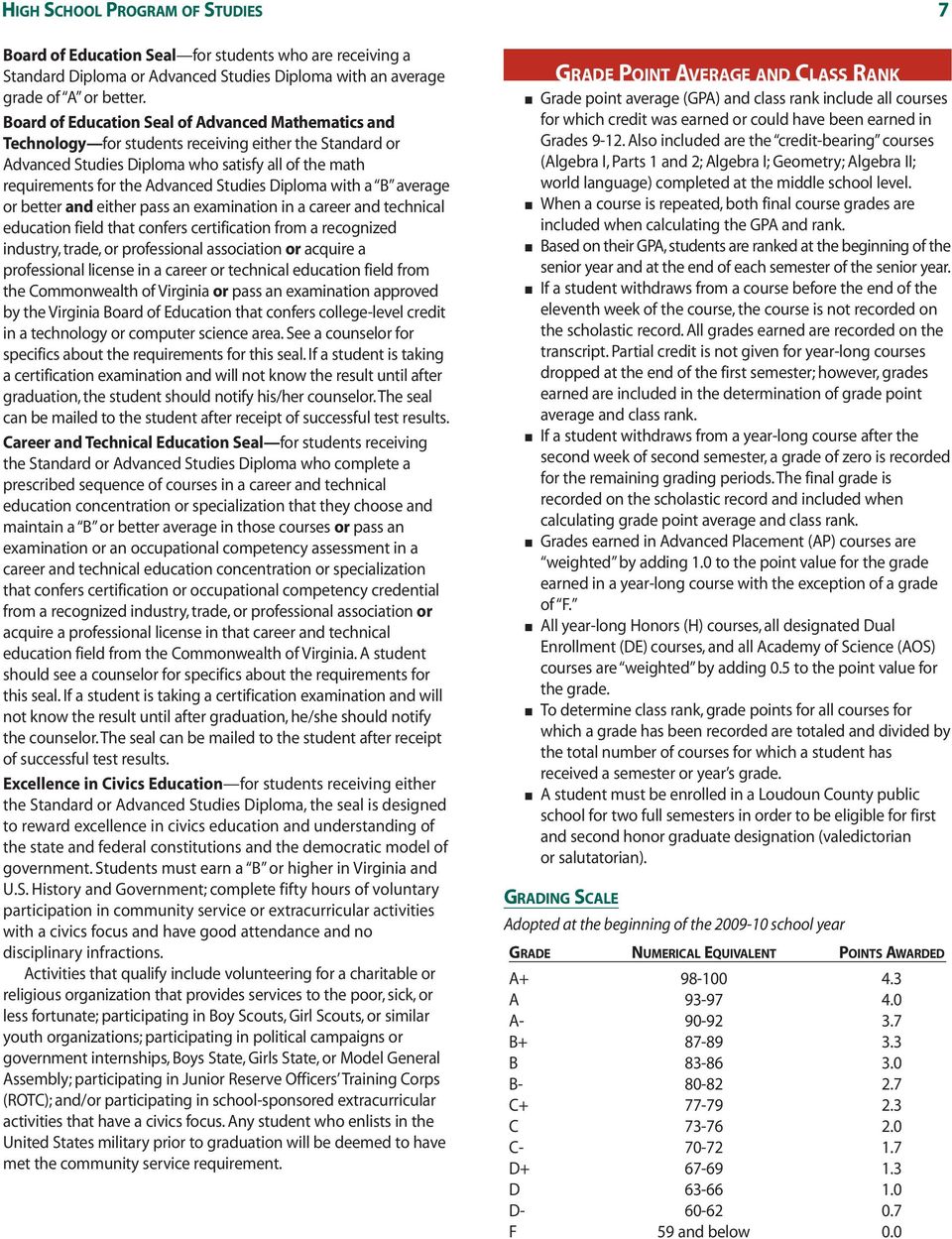
11 HIGH SCHOOL PROGRAM OF STUDIES 7 Board of Education Seal for students who are receiving a Standard Diploma or Advanced Studies Diploma with an average grade of A or better. Board of Education Seal of Advanced Mathematics and Technology for students receiving either the Standard or Advanced Studies Diploma who satisfy all of the math requirements for the Advanced Studies Diploma with a B average or better and either pass an examination in a career and technical education field that confers certification from a recognized industry, trade, or professional association or acquire a professional license in a career or technical education field from the Commonwealth of Virginia or pass an examination approved by the Virginia Board of Education that confers college-level credit in a technology or computer science area. See a counselor for specifics about the requirements for this seal. If a student is taking a certification examination and will not know the result until after graduation, the student should notify his/her counselor.the seal can be mailed to the student after receipt of successful test results. Career and Technical Education Seal for students receiving the Standard or Advanced Studies Diploma who complete a prescribed sequence of courses in a career and technical education concentration or specialization that they choose and maintain a B or better average in those courses or pass an examination or an occupational competency assessment in a career and technical education concentration or specialization that confers certification or occupational competency credential from a recognized industry, trade, or professional association or acquire a professional license in that career and technical education field from the Commonwealth of Virginia. A student should see a counselor for specifics about the requirements for this seal. If a student is taking a certification examination and will not know the result until after graduation, he/she should notify the counselor.the seal can be mailed to the student after receipt of successful test results. Excellence in Civics Education for students receiving either the Standard or Advanced Studies Diploma, the seal is designed to reward excellence in civics education and understanding of the state and federal constitutions and the democratic model of government. Students must earn a B or higher in Virginia and U.S. History and Government; complete fifty hours of voluntary participation in community service or extracurricular activities with a civics focus and have good attendance and no disciplinary infractions. Activities that qualify include volunteering for a charitable or religious organization that provides services to the poor, sick, or less fortunate; participating in Boy Scouts, Girl Scouts, or similar youth organizations; participating in political campaigns or government internships, Boys State, Girls State, or Model General Assembly; participating in Junior Reserve Officers Training Corps (ROTC); and/or participating in school-sponsored extracurricular activities that have a civics focus. Any student who enlists in the United States military prior to graduation will be deemed to have met the community service requirement. GRADE POINT AVERAGE AND CLASS RANK Grade point average (GPA) and class rank include all courses for which credit was earned or could have been earned in Grades Also included are the credit-bearing courses (Algebra I, Parts 1 and 2; Algebra I; Geometry; Algebra II; world language) completed at the middle school level. When a course is repeated, both final course grades are included when calculating the GPA and rank. Based on their GPA, students are ranked at the beginning of the senior year and at the end of each semester of the senior year. If a student withdraws from a course before the end of the eleventh week of the course, the course is not recorded on the scholastic record. All grades earned are recorded on the transcript. Partial credit is not given for year-long courses dropped at the end of the first semester; however, grades earned are included in the determination of grade point average and class rank. If a student withdraws from a year-long course after the second week of second semester, a grade of zero is recorded for the remaining grading periods.the final grade is recorded on the scholastic record and included when calculating grade point average and class rank. Grades earned in Advanced Placement (AP) courses are weighted by adding 1.0 to the point value for the grade earned in a year-long course with the exception of a grade of F. All year-long Honors (H) courses, all designated Dual Enrollment (DE) courses, and all Academy of Science (AOS) courses are weighted by adding 0.5 to the point value for the grade. To determine class rank, grade points for all courses for which a grade has been recorded are totaled and divided by the total number of courses for which a student has received a semester or year s grade. A student must be enrolled in a Loudoun County public school for two full semesters in order to be eligible for first and second honor graduate designation (valedictorian or salutatorian). GRADING SCALE Adopted at the beginning of the school year GRADE NUMERICAL EQUIVALENT POINTS AWARDED A A A B B B C C C D D D F 59 and below 0.0
12 LOUDOUN COUNTY PUBLIC SCHOOLS 8 PSAT PRELIMINARY SCHOLASTIC ASSESSMENT TEST Students benefit from practice in taking the test and can identify academic strengths and weaknesses while they have time to work to improve their scores. Students in the 9 th and 10 th grades can get a jump on college. The test shows firsthand the kinds of reading, math, and writing skills needed to succeed in college. It also provides practice for college admissions tests. Students in the 11 th grade can enter special scholarship competitions such as the National Merit Scholarship Qualifying Test, National Achievement Program, and National Hispanic Scholars Program. PSAT measures verbal and math reasoning skills and writing skills. This test is administered at all high schools on the national test date.the PSAT includes a writing component but does not include an essay. SAT REASONING TEST Students in the 11 th and 12 th grades should take the SAT Reasoning Test which measures critical reading, mathematics, and writing skills. A student should begin taking the test by the spring of the 11 th grade and may repeat the test several times. Most colleges use the highest critical reading, math, and writing scores obtained, even if the three sub-scores were earned on separate days. Many colleges have indicated that they plan to require applicants to present writing scores. The SAT tests are given several times each year at high schools in Loudoun County. Students must register about six weeks in advance of the test. Students may register on-line at On-line registration allows students to learn whether space exists for testing at their preferred test center. Registration bulletins for the test are also available in the school counseling office, and registration forms must be mailed along with payment to the College Board. Free study and preparation materials are available at and from the school counseling office. AP ADVANCED PLACEMENT RECOMMENDED TESTING FOR COLLEGE-BOUND STUDENTS AP examinations are administered in the spring on nationally standardized dates and measure the student s knowledge in specific subject areas. AP courses, taught by dedicated and committed high school teachers, lay the groundwork for students to succeed on AP examinations. In LCPS, all students enrolled in AP classes are encouraged to complete the AP experience by taking the examinations near the end of the AP class. The student s transcript reflects the AP designation independent of the student s election to take the AP exam. All final grades are weighted by 1.0 if the student passes the course. Students who elect to take an AP exam without taking the course may have their scores sent to the colleges to which they apply; however, units of credit are awarded only to those students who complete the related AP courses. SAT SUBJECT TESTS Subject tests measure students knowledge and skills in a particular subject and their ability to apply that knowledge.tests are offered in many subjects. The test should be taken towards the end of the completion of a subject. For example, if a student is completing Chemistry in Grade 11, he/she should take the SAT Subject Test in Chemistry in the spring of the 11 th grade. Not all colleges require SAT Subject Tests; generally, the most competitive schools request these tests. Students should check test requirements with colleges in which they have interest. Students may register for up to three tests in one day.the tests are given on the same dates as certain SAT Reasoning Tests. Registration materials are available in the counseling office. SAT Subject Test Preparation Booklet, a free booklet, available in the school counseling office and on-line at provides information about the tests and sample test questions. ACT AMERICAN COLLEGE TEST The ACT measures academic achievement in English, mathematics, reading, and science reasoning. A writing test is optional. Students should check with specific colleges to see whether the schools of interest prefer ACT or SAT and should be sure to check whether a writing test is required. Registration materials and study guides are available on line at and in the counseling office. Some students find it helpful to take both the ACT and SAT since colleges generally use the best scores on either test. TOEFL TEST OF ENGLISH AS A FOREIGN LANGUAGE The TOEFL measures a student s ability to read, write, and understand English. Students who are applying to college and for whom English is a second language can demonstrate their ability to use English. Some colleges require this test for second language speakers. Some colleges will accept the SAT Subject Test in English as a Second Language instead of the TOEFL. ENGLISH LANGUAGE PROFICIENCY TEST: ACCESS ACCESS measures understanding of spoken and written standard American English and the ability to use English in the classroom and in daily life. It is designed for students who are not native speakers of English and/or whose best language is not English and/or who usually speak a language other than English at home or at work. The test concentrates on academic and practical use of English.

13 HIGH SCHOOL PROGRAM OF STUDIES 9 ADVANCED PLACEMENT The Advanced Placement Program, often known as AP, is a cooperative education endeavor with the College Board. AP courses allow students the opportunity to take college-level courses while they are enrolled in high school. Students who enroll in an AP course should expect extensive reading, writing, and critical thinking which generally require additional time. In the spring students are encouraged to take the nationally standardized AP examinations. Colleges may award academic credit and/or special placement if a student earns a qualifying score on the exam. AP final grades are weighted by adding 1.0 to the point value for the grade if the student passes the course. BENEFITS OF AP CLASSES GAIN THE EDGE IN COLLEGE PREPARATION Get a head start on collegelevel work. Improve writing skills and sharpen problem-solving techniques. Develop the study habits necessary for tackling rigorous course work. SPECIAL PROGRAMS STAND OUT IN THE COLLEGE ADMISSIONS PROCESS Demonstrate maturity and readiness for college. Show willingness to push self academically. Emphasize commitment to academic excellence. BROADEN INTELLECTUAL HORIZONS Explore the world from a variety of perspectives. Study subjects in greater depth and detail. Assume the responsibility of reasoning, analyzing, and understanding for one s self. AVID AVID, or Advancement via Individual Determination, is a national program targeting students in the academic middle B, C, and even D students who have the desire to go to college and the willingness to work hard in rigorous high school courses. AVID students enroll in honors and Advanced Placement courses and an AVID elective course. During this elective class, students learn organizational and study skills, work on building critical thinking skills, receive academic help from peers and tutors, and participate in enrichment and motivational activities. AVID students are expected to enroll in the AVID elective course each year of high school. CLASSROOM DRIVER EDUCATION Transfer students, students who failed the Driver Education portion of Health and PE 10, or students who have taken and passed Driver Education but failed the Department of Motor Vehicles written test after passing the 36-hour course, must retake the classroom portion of Driver Education. Students should take a state-approved Classroom Driver Education course on-line (i.e., An additional requirement of classroom Driver Education for all students is a 90-minute Parent/Teen presentation, that is offered at every high school. DUAL ENROLLMENT Students may take advantage of a program that allows them to meet the requirements for high school graduation while simultaneously earning college credits. In all cases, students must receive prior written approval by the participating high school and the college for particular courses to be taken. Dual Enrollment icons appear throughout the Program of Studies where formal agreements exist between LCPS and colleges for dual enrollment options. Students who wish to enroll in other college courses where formal agreements do not exist should discuss options with the high school counselor. ENGLISH LANGUAGE LEARNERS (ELL) Provisions are made for those students who need English as a Second Language instruction. Additional information is available from counselors. If the ELL program is located in a school other than the home school, transportation is provided to and from the designated sites for students. In some situations, the student may need more than four years to complete credits needed for graduation from high school.the counselor can advise students and parents about planning the program of studies needed for graduation. Further information is available in the ELL section of the Program of Studies. INDIVIDUALIZED EDUCATION Provisions are made for individualized education for students with identified disabilities.these include programs for students who are learning disabled, emotionally disabled, intellectually disabled, other health impaired, hearing impaired, speech impaired, visually impaired, or physically impaired. Individualized Education Plans (IEPs) specify individual accommodations. LCPS ACADEMY OF SCIENCE (AOS) The mission of the LCPS Academy of Science is to provide an academic environment where students are encouraged to develop creative scientific endeavors of their own design, while having the opportunity to pursue a rich, well-rounded high school experience. AOS students are selected through an application process. Rising 9 th grade students are invited to attend after a competitive process that evaluates test scores, academic achievements, writing samples, teacher recommendations, and self-reported interests and activities. Student motivation and interest in science are the most valuable characteristics of AOS students. AOS courses are weighted by adding 0.5 to the point value for the grade.

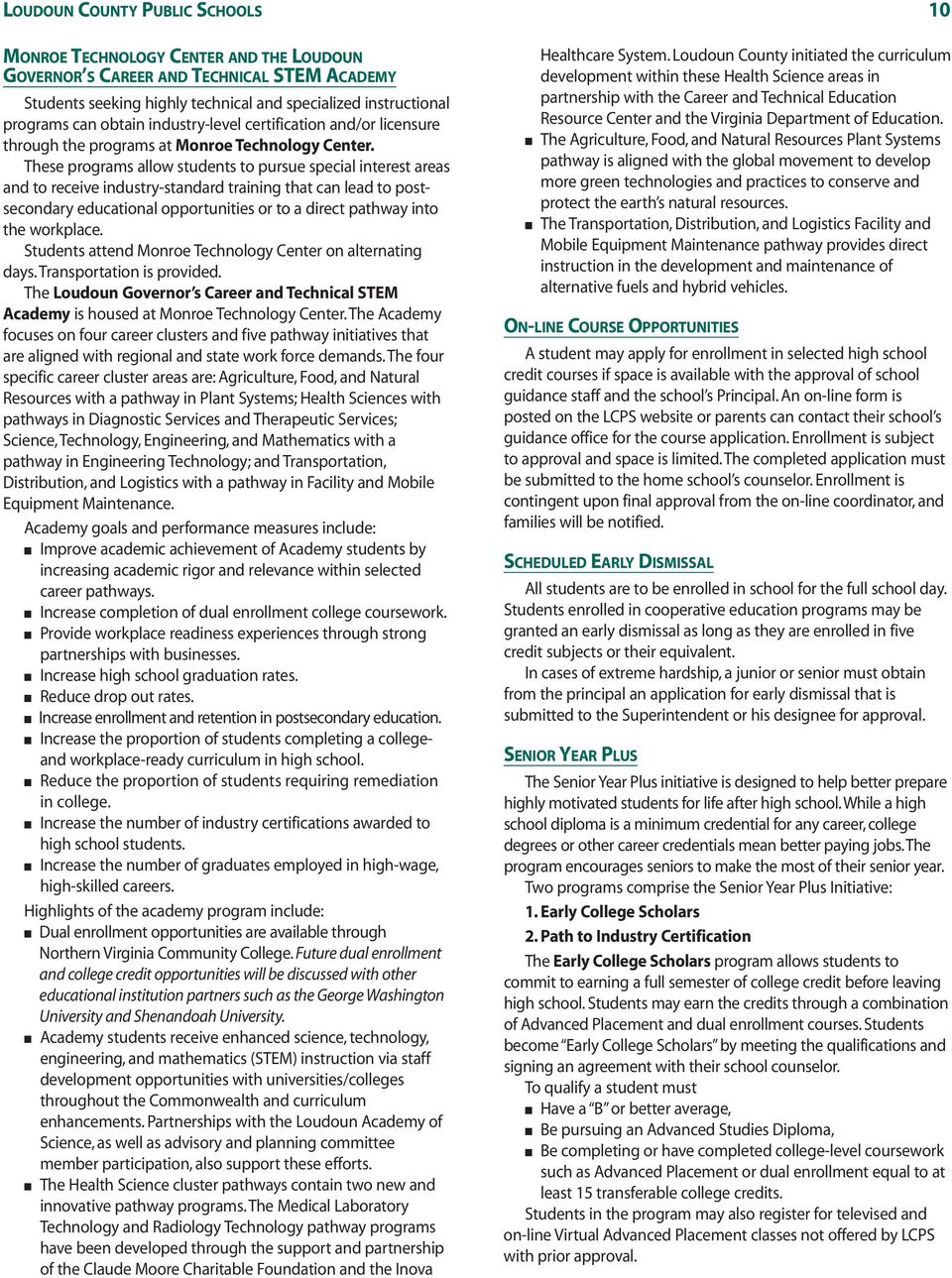
14 LOUDOUN COUNTY PUBLIC SCHOOLS 10 MONROE TECHNOLOGY CENTER AND THE LOUDOUN GOVERNOR S CAREER AND TECHNICAL STEM ACADEMY Students seeking highly technical and specialized instructional programs can obtain industry-level certification and/or licensure through the programs at Monroe Technology Center. These programs allow students to pursue special interest areas and to receive industry-standard training that can lead to postsecondary educational opportunities or to a direct pathway into the workplace. Students attend Monroe Technology Center on alternating days.transportation is provided. The Loudoun Governor s Career and Technical STEM Academy is housed at Monroe Technology Center.The Academy focuses on four career clusters and five pathway initiatives that are aligned with regional and state work force demands.the four specific career cluster areas are: Agriculture, Food, and Natural Resources with a pathway in Plant Systems; Health Sciences with pathways in Diagnostic Services and Therapeutic Services; Science, Technology, Engineering, and Mathematics with a pathway in Engineering Technology; and Transportation, Distribution, and Logistics with a pathway in Facility and Mobile Equipment Maintenance. Academy goals and performance measures include: Improve academic achievement of Academy students by increasing academic rigor and relevance within selected career pathways. Increase completion of dual enrollment college coursework. Provide workplace readiness experiences through strong partnerships with businesses. Increase high school graduation rates. Reduce drop out rates. Increase enrollment and retention in postsecondary education. Increase the proportion of students completing a collegeand workplace-ready curriculum in high school. Reduce the proportion of students requiring remediation in college. Increase the number of industry certifications awarded to high school students. Increase the number of graduates employed in high-wage, high-skilled careers. Highlights of the academy program include: Dual enrollment opportunities are available through Northern Virginia Community College. Future dual enrollment and college credit opportunities will be discussed with other educational institution partners such as the George Washington University and Shenandoah University. Academy students receive enhanced science, technology, engineering, and mathematics (STEM) instruction via staff development opportunities with universities/colleges throughout the Commonwealth and curriculum enhancements. Partnerships with the Loudoun Academy of Science, as well as advisory and planning committee member participation, also support these efforts. The Health Science cluster pathways contain two new and innovative pathway programs.the Medical Laboratory Technology and Radiology Technology pathway programs have been developed through the support and partnership of the Claude Moore Charitable Foundation and the Inova Healthcare System. Loudoun County initiated the curriculum development within these Health Science areas in partnership with the Career and Technical Education Resource Center and the Virginia Department of Education. The Agriculture, Food, and Natural Resources Plant Systems pathway is aligned with the global movement to develop more green technologies and practices to conserve and protect the earth s natural resources. The Transportation, Distribution, and Logistics Facility and Mobile Equipment Maintenance pathway provides direct instruction in the development and maintenance of alternative fuels and hybrid vehicles. ON-LINE COURSE OPPORTUNITIES A student may apply for enrollment in selected high school credit courses if space is available with the approval of school guidance staff and the school s Principal. An on-line form is posted on the LCPS website or parents can contact their school s guidance office for the course application. Enrollment is subject to approval and space is limited.the completed application must be submitted to the home school s counselor. Enrollment is contingent upon final approval from the on-line coordinator, and families will be notified. SCHEDULED EARLY DISMISSAL All students are to be enrolled in school for the full school day. Students enrolled in cooperative education programs may be granted an early dismissal as long as they are enrolled in five credit subjects or their equivalent. In cases of extreme hardship, a junior or senior must obtain from the principal an application for early dismissal that is submitted to the Superintendent or his designee for approval. SENIOR YEAR PLUS The Senior Year Plus initiative is designed to help better prepare highly motivated students for life after high school.while a high school diploma is a minimum credential for any career, college degrees or other career credentials mean better paying jobs.the program encourages seniors to make the most of their senior year. Two programs comprise the Senior Year Plus Initiative: 1. Early College Scholars 2. Path to Industry Certification The Early College Scholars program allows students to commit to earning a full semester of college credit before leaving high school. Students may earn the credits through a combination of Advanced Placement and dual enrollment courses. Students become Early College Scholars by meeting the qualifications and signing an agreement with their school counselor. To qualify a student must Have a B or better average, Be pursuing an Advanced Studies Diploma, Be completing or have completed college-level coursework such as Advanced Placement or dual enrollment equal to at least 15 transferable college credits. Students in the program may also register for televised and on-line Virtual Advanced Placement classes not offered by LCPS with prior approval.
15 HIGH SCHOOL PROGRAM OF STUDIES 11 Early College Scholars receive a diploma seal and certificate from the Governor recognizing their achievement. To register, students and their parents should talk with their school counselor near the end of the junior year. The Path to Industry Certification is designed for students who plan to continue working on their high school diploma while concurrently pursuing technical training for a selected industry certification. Often this industry certification continues after high school graduation. Typically, students continue to take industry-specific training at their local community college or Monroe Technology Center during the summer and fall after graduation. Up to one semester of technical training is available to students tuition-free in the same calendar year after high school graduation as long as that semester allows them to complete the certification program. THOMAS JEFFERSON HIGH SCHOOL FOR SCIENCE AND TECHNOLOGY (TJHSST) TJHSST students are selected on the basis of aptitude and interest in the biological, physical, mathematical, and computer science fields. Since this Governor s School for Science and Technology is located in Northern Virginia, the school serves qualified applicants from several area school districts, including Loudoun County. Students are selected to attend in a competitive process that evaluates admission test scores, academic achievement, personal essays, teacher recommendations, and self-reported interests and activities. Approximately 10% of the applicants are accepted. Most students enter as 9 th graders. Replacements are selected for vacancies at the 10 th grade level only. WORLD LANGUAGE CREDIT FOR ENGLISH LANGUAGE LEARNERS Speakers of English as a second language should confer with their counselors regarding a sequence of world language study that can lead to an Advanced Studies Diploma. SELECTION OF COURSES All students should choose challenging classes that maximize their learning opportunities. Rigorous high school courses prepare students well for further education and successful careers. Parents and students should consider the following when making decisions about which group to choose: previous performance in subject area, standardized test scores, commitment of the student, and recommendations from teachers, counselors, and principals. The applicable Virginia Standards of Learning (SOL) are incorporated in all classes. Honors and AP Course content is rapidly paced with additional depth. Lessons are often designed to be complex, abstract, and open-ended. Academic Course content and expected student performance require additional reading and writing at a rigorous level. Grade Level Course content challenges students to master rigorous standards while providing individualized support. STEPS TO READING AND USING THE PROGRAM OF STUDIES 1 Select a Career Cluster/Path Choose a career cluster/path that closely relates to your interests, skills, values, and strengths. Explore occupations that relate to your skills. Learn what education, skill, and knowledge are required. 2 Decide Your Diploma Type Advanced Studies Standard Modified Standard 3 Choose Courses that Relate to Your Career Path and Diploma Choice.

16 LOUDOUN COUNTY PUBLIC SCHOOLS 12 BACKGROUND OF AGREEMENTS Loudoun County Public Schools has joined with Northern Virginia Community College (NOVA) and Shenandoah University to develop programs that allow qualified students to gain advanced standing in specific career and technical areas. Other areas of study have agreements with NOVA and other colleges for dual enrollment credit.the intent of the dual enrollment agreements is to provide opportunities for career ladder advancement through recognition of previous learning. Students must demonstrate mastery of college-level skills gained through a rigorous high school program.this arrangement often means that students can enter the work force and/or pursue a college degree without loss of time or credit. Also, they avoid unnecessary duplication of effort. The specific dual enrollments are mentioned in this booklet. Counselors and teachers in those subjects can provide information about specific requirements, credits, and application procedures.they are also available to answer questions and to discuss the programs and the opportunities the dual enrollment courses provide. Eligible students receive college credit on an official college transcript. Dual enrollment is available for 11 th and 12 th grade students who meet minimum requirements on placement tests. In some cases, 10 th grade students may apply for a grade level exception by meeting criteria established by the college and/or university. ICON BESIDE COURSES DUAL ENROLLMENT AGREEMENTS Loudoun Governor s Career and Technical STEM Academy Northern Virginia Community College The icons shown above appear beside courses for which dual enrollment college credit exists and appear throughout the Program of Studies. ADMINISTRATION OF JUSTICE James Madison University Shenandoah University An eligible student who completes Administration of Justice I and II at Monroe Technology Center with a B or better in each course can receive up to 15 credits for ADJ 100, ADJ 211, and ADJ 236 in Administration of Justice I and ADJ 216 and ADJ 237 in Administration of Justice II. AUTO SERVICING TECHNOLOGY An eligible student who completes Automotive Servicing Technology I and II at Monroe Technology Center with a B or better in each course can receive up to 26 credits. Automotive Servicing I students can earn 4 credits for AUT 266, 4 credits for AUT 241, and 4 credits for AUT 242. Automotive Servicing II students can earn 2 credits for AUT 100, 4 credits for AUT 265, 4 credits for AUT 141, and 4 credits for AUT 142. COMPUTER & DIGITAL ANIMATION The qualifying student who completes Computer & Digital Animation at Monroe Technology Center with a B or better can receive 3 credits each for CAD 238, CAD 239, and ARC 123 for a total of 9 credits. COMPUTER INTEGRATED ENGINEERING & DESIGN The qualifying student who successfully completes the Computer Integrated Engineering & Design Program at Monroe Technology Center will receive 3 credits each in CAD 238, EGR 115, and CAD 239 for a total of 9 credits. COMPUTER SYSTEMS TECHNOLOGY The student who successfully completes the Computer Systems Technology Program at Monroe Technology Center with a B or better will receive 3 college credits each from NOVA in ITN 106, ITN 107, INT 101, ITE 180, and ITE 182 for a total of 15 credits. EMERGENCY MEDICAL TECHNICIAN (EMT) The qualifying student who successfully completes Emergency Medical Technician (EMT) at Monroe Technology Center with a B or better can receive 3 credits for EMS 111 Emergency Medical Technician, 3 credits for EMS 120 Emergency Medical Technician- Clinical, and 1 credit for HLT 105 CPR for a total of 7 credits. ENVIRONMENTAL PLANT SCIENCE The qualifying student who completes Environmental Plant Sciences at Monroe Technology Center and successfully meets the requirements of the course can receive advanced placement in the two-year program Agriculture Technology program at Virginia Tech and/or receive 3 credits each from NOVA for HRT 100 Introduction to Horticulture, HRT 115 Plant Propagation, and HRT 121 Greenhouse Crop Production 1. FIREFIGHTER The qualifying student who successfully completes Firefighter at Monroe Technology Center with a B or better can receive 3 credits for FST 100 Principles of Emergency Services, 3 credits for FST 111 Hazardous Material Response, and 1 credit for HLT 105 CPR for a total of 7 credits.

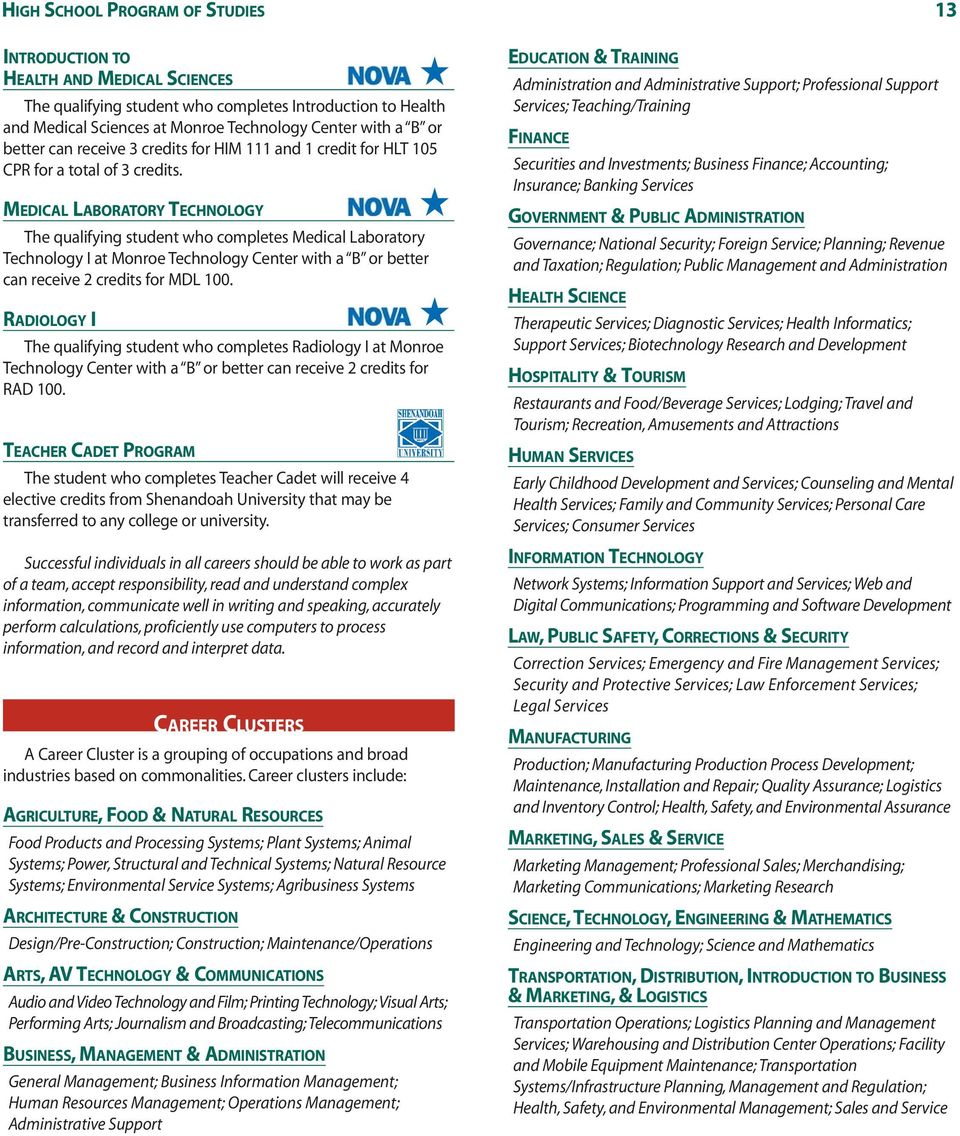
17 HIGH SCHOOL PROGRAM OF STUDIES 13 INTRODUCTION TO HEALTH AND MEDICAL SCIENCES The qualifying student who completes Introduction to Health and Medical Sciences at Monroe Technology Center with a B or better can receive 3 credits for HIM 111 and 1 credit for HLT 105 CPR for a total of 3 credits. MEDICAL LABORATORY TECHNOLOGY The qualifying student who completes Medical Laboratory Technology I at Monroe Technology Center with a B or better can receive 2 credits for MDL 100. RADIOLOGY I The qualifying student who completes Radiology I at Monroe Technology Center with a B or better can receive 2 credits for RAD 100. TEACHER CADET PROGRAM The student who completes Teacher Cadet will receive 4 elective credits from Shenandoah University that may be transferred to any college or university. Successful individuals in all careers should be able to work as part of a team, accept responsibility, read and understand complex information, communicate well in writing and speaking, accurately perform calculations, proficiently use computers to process information, and record and interpret data. CAREER CLUSTERS A Career Cluster is a grouping of occupations and broad industries based on commonalities. Career clusters include: AGRICULTURE,FOOD &NATURAL RESOURCES Food Products and Processing Systems; Plant Systems; Animal Systems; Power, Structural and Technical Systems; Natural Resource Systems; Environmental Service Systems; Agribusiness Systems ARCHITECTURE & CONSTRUCTION Design/Pre-Construction; Construction; Maintenance/Operations ARTS,AV TECHNOLOGY &COMMUNICATIONS Audio and Video Technology and Film; Printing Technology; Visual Arts; Performing Arts; Journalism and Broadcasting; Telecommunications BUSINESS,MANAGEMENT &ADMINISTRATION General Management; Business Information Management; Human Resources Management; Operations Management; Administrative Support EDUCATION & TRAINING Administration and Administrative Support; Professional Support Services; Teaching/Training FINANCE Securities and Investments; Business Finance; Accounting; Insurance; Banking Services GOVERNMENT & PUBLIC ADMINISTRATION Governance; National Security; Foreign Service; Planning; Revenue and Taxation; Regulation; Public Management and Administration HEALTH SCIENCE Therapeutic Services; Diagnostic Services; Health Informatics; Support Services; Biotechnology Research and Development HOSPITALITY &TOURISM Restaurants and Food/Beverage Services; Lodging; Travel and Tourism; Recreation, Amusements and Attractions HUMAN SERVICES Early Childhood Development and Services; Counseling and Mental Health Services; Family and Community Services; Personal Care Services; Consumer Services INFORMATION TECHNOLOGY Network Systems; Information Support and Services; Web and Digital Communications; Programming and Software Development LAW,PUBLIC SAFETY,CORRECTIONS & SECURITY Correction Services; Emergency and Fire Management Services; Security and Protective Services; Law Enforcement Services; Legal Services MANUFACTURING Production; Manufacturing Production Process Development; Maintenance, Installation and Repair; Quality Assurance; Logistics and Inventory Control; Health, Safety, and Environmental Assurance MARKETING,SALES & SERVICE Marketing Management; Professional Sales; Merchandising; Marketing Communications; Marketing Research SCIENCE,TECHNOLOGY,ENGINEERING & MATHEMATICS Engineering and Technology; Science and Mathematics TRANSPORTATION,DISTRIBUTION,INTRODUCTION TO BUSINESS & MARKETING,& LOGISTICS Transportation Operations; Logistics Planning and Management Services; Warehousing and Distribution Center Operations; Facility and Mobile Equipment Maintenance; Transportation Systems/Infrastructure Planning, Management and Regulation; Health, Safety, and Environmental Management; Sales and Service
18 LOUDOUN COUNTY PUBLIC SCHOOLS 14 ELECTIVES Electives are subjects not required in any area of the curriculum. Students should look at the sample career paths for related high school courses. Students should select courses that provide them with a wellrounded education. Some courses may not be necessary in a particular career; however, the skills and information learned in those courses may provide greater understanding and appreciation and may increase one s quality of life. Either the Technical Specialization or two Career and Technical Education Electives in the same area would count as sequential electives. CAREER AND TECHNICAL EDUCATION SPECIALIZATION COURSES Technical Specialization Courses are those which provide students with specialized training and work force skills. Students are prepared to enter directly into the work place and to pursue further education and training after high school. Electives in career and technical education areas business and information technology, family and consumer sciences, health occupations, marketing, technology education, and trade and industrial education prepare students for technical specialization at the high school or at Monroe Technology Center. ECONOMICS AND PERSONAL FINANCE A NEW GRADUATION REQUIREMENT FOR THE CLASS OF The Virginia Board of Education has added a new requirement for high school graduation. Students who enter 9 th grade in and beyond must successfully complete a 1-credit course in Economics and Personal Finance. In Loudoun County, students are able to fulfill this requirement between the sophomore year and the completion of the senior year. LCPS offers a 0.5-credit, semester course in Personal Finance, and a 0.5-credit, semester course in Economics. Students must complete both 0.5-credit courses before their expected graduation date. Alternatively, students may take Personal Finance for a semester, and then take AP Economics as a full-year course during their junior or senior years. If students choose this AP option, they MUST complete a semester of Personal Finance, and a FULL YEAR of AP Economics (Micro and Macro). SAMPLE FOUR-YEAR PLAN OF STUDIES FOR STANDARD DIPLOMA AND CAREER PREPARATION Students should choose electives based on their career cluster, career goals, and requirements for entry to further education. GRADE 9 COURSE CREDIT English 9 1 World History/Geography to Algebra I 1 Health/PE 9 1 Earth Science 1 Elective 1 Career and Technical Education Elective 1 Total Credits 7 GRADE 10 COURSE CREDIT English 10 1 World History/Geography 1500 to Present 1 Geometry 1 Health/PE 10 1 Biology 1 Elective (or: Class of 2015: Economics and Personal Finance) 1 Career and Technical Education Elective 1 Total Credits 7 GRADE 11 COURSE CREDIT English 11 1 U.S. and Virginia History 1 Algebra II or Functions 1 Chemistry or Physics 1 Career and Technical Education Specialization Course 3 Total Credits 7 GRADE 12 COURSE CREDIT English 12 1 U.S. and Virginia Government 1 Elective (or: Class of 2015: Economics and Personal Finance) 1 Elective 1 Career and Technical Education Specialization Course 3 Total Credits 7
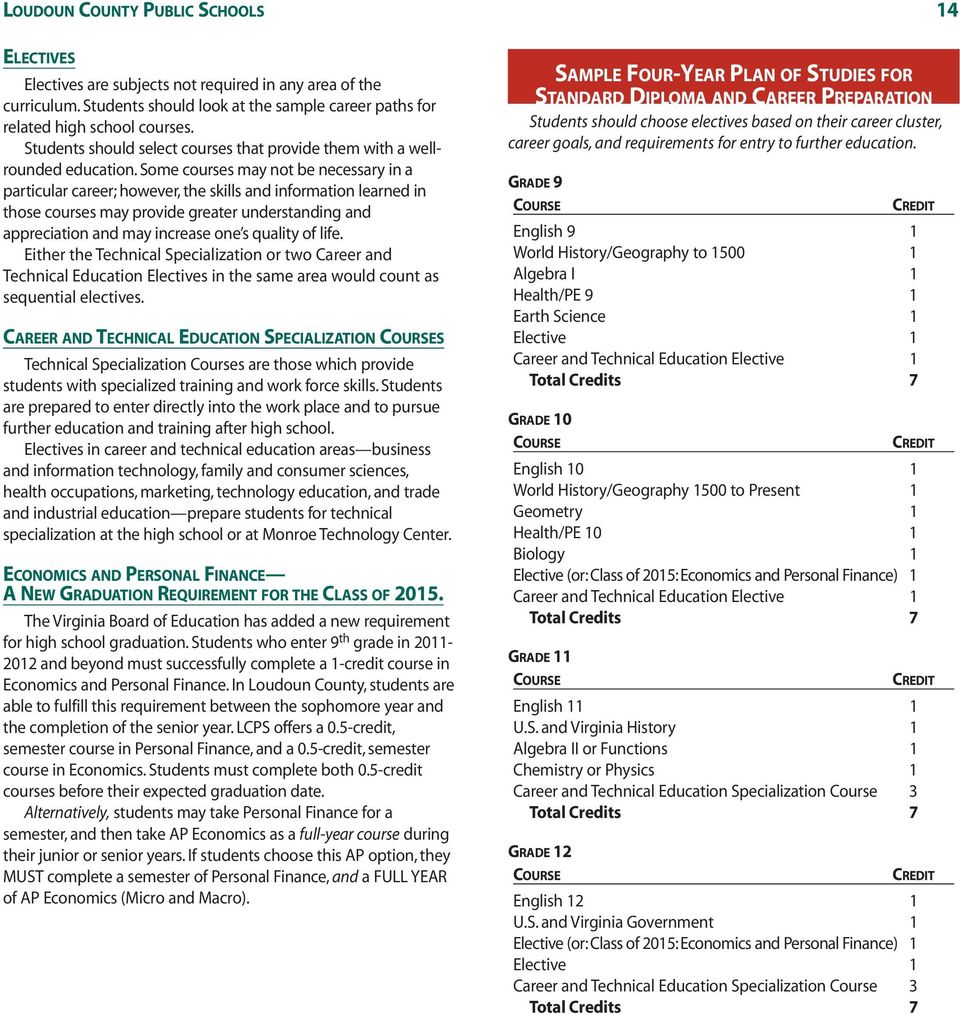
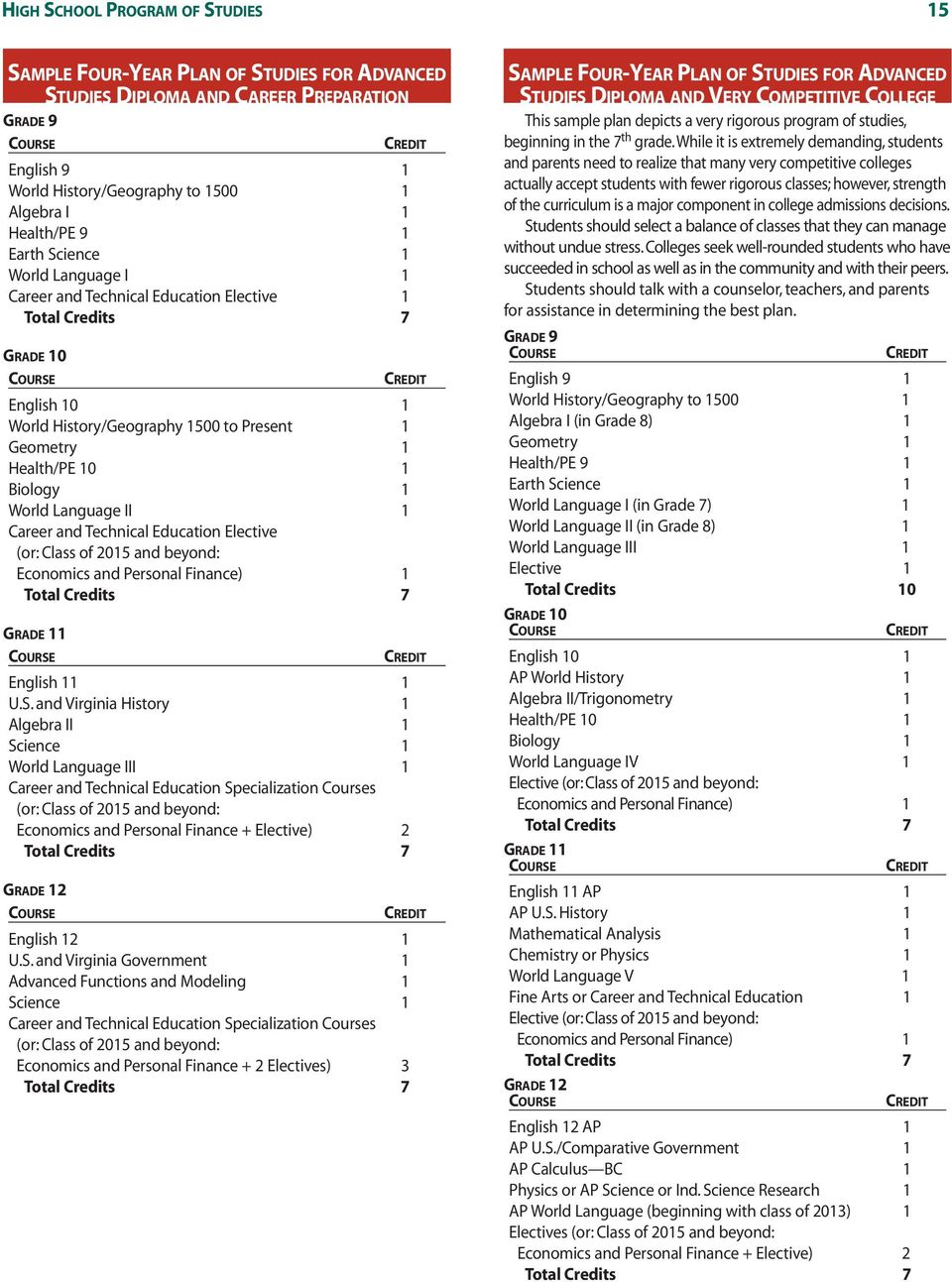
19 HIGH SCHOOL PROGRAM OF STUDIES 15 SAMPLE FOUR-YEAR PLAN OF STUDIES FOR ADVANCED STUDIES DIPLOMA AND CAREER PREPARATION GRADE 9 COURSE CREDIT English 9 1 World History/Geography to Algebra I 1 Health/PE 9 1 Earth Science 1 World Language I 1 Career and Technical Education Elective 1 Total Credits 7 GRADE 10 COURSE CREDIT English 10 1 World History/Geography 1500 to Present 1 Geometry 1 Health/PE 10 1 Biology 1 World Language II 1 Career and Technical Education Elective (or: Class of 2015 and beyond: Economics and Personal Finance) 1 Total Credits 7 GRADE 11 COURSE CREDIT English 11 1 U.S. and Virginia History 1 Algebra II 1 Science 1 World Language III 1 Career and Technical Education Specialization Courses (or: Class of 2015 and beyond: Economics and Personal Finance + Elective) 2 Total Credits 7 GRADE 12 COURSE CREDIT English 12 1 U.S. and Virginia Government 1 Advanced Functions and Modeling 1 Science 1 Career and Technical Education Specialization Courses (or: Class of 2015 and beyond: Economics and Personal Finance + 2 Electives) 3 Total Credits 7 SAMPLE FOUR-YEAR PLAN OF STUDIES FOR ADVANCED STUDIES DIPLOMA AND VERY COMPETITIVE COLLEGE This sample plan depicts a very rigorous program of studies, beginning in the 7 th grade.while it is extremely demanding, students and parents need to realize that many very competitive colleges actually accept students with fewer rigorous classes; however, strength of the curriculum is a major component in college admissions decisions. Students should select a balance of classes that they can manage without undue stress. Colleges seek well-rounded students who have succeeded in school as well as in the community and with their peers. Students should talk with a counselor, teachers, and parents for assistance in determining the best plan. GRADE 9 COURSE CREDIT English 9 1 World History/Geography to Algebra I (in Grade 8) 1 Geometry 1 Health/PE 9 1 Earth Science 1 World Language I (in Grade 7) 1 World Language II (in Grade 8) 1 World Language III 1 Elective 1 Total Credits 10 GRADE 10 COURSE CREDIT English 10 1 AP World History 1 Algebra II/Trigonometry 1 Health/PE 10 1 Biology 1 World Language IV 1 Elective (or: Class of 2015 and beyond: Economics and Personal Finance) 1 Total Credits 7 GRADE 11 COURSE CREDIT English 11 AP 1 AP U.S. History 1 Mathematical Analysis 1 Chemistry or Physics 1 World Language V 1 Fine Arts or Career and Technical Education 1 Elective (or: Class of 2015 and beyond: Economics and Personal Finance) 1 Total Credits 7 GRADE 12 COURSE CREDIT English 12 AP 1 AP U.S./Comparative Government 1 AP Calculus BC 1 Physics or AP Science or Ind. Science Research 1 AP World Language (beginning with class of 2013) 1 Electives (or: Class of 2015 and beyond: Economics and Personal Finance + Elective) 2 Total Credits 7
20 LOUDOUN COUNTY PUBLIC SCHOOLS 16 ART Art I A wide variety of experiences enhance the basic foundation of art-related knowledge, skills, and ideas developed in middle school. Students explore ideas, materials, and techniques through creative and critical problem solving. Students engage in the process of art criticism and aesthetic critiques. Class discussion includes both critiques of their own pieces and the work of other artists. Students maintain a portfolio to record their progress. The course incorporates art history, art criticism, aesthetics, and art production to include experiences with drawing, painting, sculpture, printmaking, ceramics, photography, and computer graphics.the instructor encourages students to make connections between the visual arts and other subject areas. Art II Grades Credit: 1 Prerequisite: Art I Students work with more advanced techniques, media, concepts, and ideas. Focus is on the connection between studio production and personal expression. Students begin to develop and refine personal technique and style through the study of art history, art criticism, and aesthetics in relation to studio production. Students continue to add to their portfolios. Units of study allow for more in-depth study of various media and the creative process. Units provide a balance of two- and threedimensional experiences. Art III Grades Credit: 1 Prerequisite: Art II or Art I and 2 semester courses Students enhance and refine their personal techniques and styles through the further study of art history, art criticism, and aesthetics in relation to studio production.they begin to take the initiative for generating and designing studio assignments using advanced techniques, media, and concepts. Through the synthesis of art production, art history, art criticism, and aesthetics, students focus on the relevance of art throughout history and in their own lives. Students continue to develop their portfolios for use in demonstrating their progress and as an effective college entrance asset. During second semester, interested art students should consult with their instructor about requirements for the AP studio art portfolio. Art IV Grade 12 Credit: 1 Prerequisite: Art III Art IV provides the advanced student with opportunities to initiate and design studio units of study. With the instructor s guidance and consultation, students work in a variety of media as they pursue individual creative and expressive ideas. They continue to enhance and refine personal techniques and style through further study of art history, art criticism, and aesthetics.they also further develop their portfolios. Options for study and employment in the arts after high school are discussed. Presentations by local art professionals and visits to museums further the students art appreciation and understanding. Studio Art Advanced Placement, weighted Grade 12 Credit: 1 Prerequisite: Art III Within the Art IV class setting, motivated advanced art students may choose to complete the AP Studio Art portfolio, following AP guidelines. Developing the portfolio involves extensive additional studio time devoted to connecting critical thinking and the conceptual skills to expressive studio technique. The portfolio requires numerous works within either drawing, 2-dimensional design, or 3-dimensional design. Also, students work with their art teacher to capture digital images of their artworks that adhere to the image submission requirements. The portfolio is an excellent opportunity for students to develop an effective college or university, art school, or art-related employment application tool. Students have the opportunity to take the AP Studio Art Portfolio Exam in May with the possibility of earning college credit. Survey of Art and Architecture History I Grades 9-12 Credit: 0.5 Students study art and architecture and their historic impact on society from prehistoric time through the Renaissance.The course leads students to a heightened awareness of and appreciation for the interaction between social, scientific, and philosophical developments in past societies and the art and architecture that these societies produced. Students have opportunities to experience related studio activities and to use research skills as they prepare reports and presentations. Survey of Art and Architecture History II Grades 9-12 Credit: 0.5 Students study art and architecture from the Renaissance through the 21 st century. Students compare and contrast their own culture with those cultures and societies of the past in terms of economic, social, and scientific factors. Students experience related studio activities and use research skills as they prepare reports and presentations.
21 HIGH SCHOOL PROGRAM OF STUDIES 17 Drawing and Painting Grades Credit: 0.5 Prerequisite: Art 1 This semester-long course allows participants an opportunity to explore drawing and painting as a method for investigating and recording the visual and imagined world. Varied media, styles, and methods are discovered as students learn to sharpen their observational skills.the drawing component encompasses an understanding of the basic elements of drawing: line, mark, tone, value, scale, and space.the painting component explores the basic elements of painting: color, shape, space, tone, value, and mark. Both drawing and painting allow students expressive and imaginative ideas to meld with the observable world. Historic and contemporary artists of diverse cultural backgrounds are presented to establish a connection with students own drawing and painting. Students maintain a sketchbook/journal through the semester as a record of learning and as a container for recording, imagining, and self-expression. Photography Grades Credit: 0.5 Photography Grades Credit: 1 Prerequisite: Art I The photography course is designed to serve as an introduction to black and white and digital photography. The class is offered to those students who have completed Art I, at a minimum, in order to assure that students have a background in basic design and composition. Students learn about the workings of a 35mm single lens reflex camera, the chemistry of film and print development, digital photography, and the aesthetics of quality compositional photographs. Students work in Adobe Photoshop to artistically alter and augment photos. Some history of photography is also introduced. It is desired, although not required, that students provide their own cameras. Students may select a full-year OR one-semester course in Photography.The full-year course includes more in-depth instruction and experience. Sculpture Grades Credit: 0.5 Prerequisite: Art I Sculpture is designed to provide an opportunity for students to explore the fundamentals of three-dimensional design and to work with a variety of traditional and new materials. Emphasis is placed on creating works that translate personal expression as well as good sound design and studio techniques. Students work is enhanced by an exploration of the contribution of major sculptors and their influences on the world of sculpture. A minimum of Art I is required to assure that students possess background in basic design and composition. BUSINESS & INFORMATION TECHNOLOGY The Future Business Leaders of America (FBLA) is the career and technical education student organization for all individuals enrolled in business courses.the activities of FBLA are an integral part of the business program and are designed to enhance the business course offerings. Industry Certifications: The Business & Information Technology curriculum offers students the following industry certifications: MOS Word, MOS Excel, MOS PowerPoint, MOS Access, Certified Internet Webmaster (CIW), and Internet Computing Core (IC3). Introduction to Business & Marketing Grades: 9-11 Credit: 1 This entry-level course is offered for all students and recommended as an introduction to the career preparation program in Business & Marketing Education. Students explore the role of business and marketing in the free enterprise system and the global economy and apply decision-making skills as consumers, employees, and citizens. Communication and interpersonal skills are developed through various activities. Keyboarding Grades 9-12 Credit: 0.5 This course is designed for secondary school students to develop and enhance touch skills for entering alphabetic, numeric, and symbol information on a keyboard. Students compose and produce personal, educational, and professional documents. (Students who can demonstrate touch keyboarding skills may test out and enter Advanced Keyboarding to develop document preparation skills.) This course is designed for students who have never taken a keyboarding class. Advanced Keyboarding Grades: 9-12 Credit: 0.5 Prerequisite: Keyboarding or Keyboard Proficiency This course is designed for secondary school students to develop and enhance touch skills for entering alphabetic, numeric, and symbol information on a keyboard. Students compose and produce a variety of personal, educational, and professional documents.
22 LOUDOUN COUNTY PUBLIC SCHOOLS 18 Computer Information Systems Prerequisite: Keyboarding or Keyboard Proficiency Computer Information Systems provides students with opportunities to develop professional level skills in a projectoriented approach through the use of the Microsoft Office software package. Students apply problem-solving skills to real-life situations through word processing, spreadsheets, databases, multimedia presentations, and integrated software activities. Students work individually and in groups to explore computer concepts, operating systems, networks, telecommunications, and emerging technologies. Students can also become eligible to test for a core level of MOUS certification. Advanced Computer Information Systems Grades Credit: 1 Prerequisite: Computer Information Systems Advanced Computer Information Systems provides students with basic comprehension of the Microsoft Office software package and an opportunity to refine their skills through a variety of project and research activities. Students apply problem-solving skills to real-life situations through advanced integrated software applications, including printed, electronic, and web publications. Students work individually and in groups to explore advanced computer maintenance activities, website development, programming, networking, emerging technology, and employability skills. Desktop/Multimedia Presentations Grades Credit: 1 Prerequisite: Keyboarding or Keyboard proficiency Students develop proficiency in creating desktop publications, multimedia presentations/projects, and websites using industry standard application software. Students incorporate principles of layout and design in completing publications and projects. Students design portfolios that may include business cards, newsletters, mini-pages, web pages, multimedia presentations/projects, calendars, and graphics. Advanced Desktop/Multimedia Presentations Grades Credit: 1 Prerequisite: Desktop/Multimedia Presentations This course provides a project base of instruction to enhance the desktop and multimedia skills of students. Topics covered include designing, creating, and publishing websites; complying with laws and professional ethics; relating desktop/multimedia application to business and industry standards. Students are eligible to take a core test level of the Microsoft Office Specialist examination. Accounting Grades Credit: 1 Students acquire the basic principles, concepts, and practices of the accounting cycle. Students learn fundamental accounting procedures using both manual and electronic systems. Interpretation of accounting information is mastered through decision-making and problem-solving approaches that include source documents, case studies, and simulations. Course topics include forms of ownership, accounts receivable/accounts payable systems, payroll, taxes, banking activities, business ethics, and financial statements. Advanced Accounting Grades Credit: 1 Prerequisite: Accounting Students gain knowledge of advanced accounting principles, procedures, and techniques used to solve business problems and to make financial decisions. Students use accounting and spreadsheet software to analyze, synthesize, evaluate, and interpret business financial data. Students work in a technologyintegrated environment using authentic workplace industry scenarios that reflect current industry trends and standards. Upon completion, students should be able to demonstrate an understanding of the principles of decision-making, problemsolving, and critical thinking, and apply them to both personal and business financial situations. Leadership Development Grades 9-12 Credit: 0.5 Leadership Development Credit of 0.5 or 1 varies by school This course is designed to equip students with personal and group leadership skills. Course content includes units in principles of leadership, parliamentary law, speaking in public, developing effective communications and human relations skills, and developing positive public relations. School and community leadership opportunities are used to provide practical application of the course content. Business Law Grades: Credit: 0.5 Students examine the foundations of the American legal system and learn the rights and responsibilities of citizens. Students gain practical knowledge and life skills by exploring economic and social concepts related to laws governing business and individuals. Focus areas include contracts, consumer protection, criminal law, tort law, international law, family/domestic law, employment law, and careers in the legal profession. Business Management Grades: Credit: 0.5 Students study basic management concepts and leadership styles as they explore business ownership, planning, operations, marketing, finance, economics, communications, the global marketplace, and human relations. Quality concepts, project management, problem solving, and ethical decision-making are an integral part of the course. Student leadership skills may be enhanced by participation in school-based job shadowing, internships, and/or the Future Business Leaders of America (FBLA).
23 HIGH SCHOOL PROGRAM OF STUDIES 19 ENGLISH Students must earn four credits in English, including a survey of British literature and a survey of American literature, for both the Standard and Advanced Studies diplomas. Students in LCPS must take an English course each year of high school. Near the end of English 11, students must take two Standards of Learning tests: Reading Writing Students in all English classes receive instruction to prepare them for the SOL tests. English high school courses provide instruction in oral language, reading and literature, writing and grammar, research, and vocabulary. Students practice whole-class and independent reading, and teachers provide skills for reading fiction and nonfiction. Students compose both literary analysis essays and essays for other purposes, informational writing, and timed writing. They also master a range of grammar and usage skills. Research instruction emphasizes the ability to analyze, synthesize, and evaluate information from a variety of sources, and it requires students to produce formal research papers. Vocabulary instruction in all grades not only prepares students for PSAT, SAT, ACT, and SOL tests, it helps to develop students reading comprehension and their ability to express themselves orally and in writing. Teachers focus on the use of context clues to understand unfamiliar words; distinctions between denotation and connotation; and a study of synonyms, antonyms, and homophones. Academic courses challenge students to master rigorous standards while providing individualized support. Honors courses are offered in Grades 9, 10, and 11. While they focus on the same skills as grade level and academic courses, honors courses are distinguished by a more rigorous and inquirybased study of literature and nonfiction texts. All students in an English honors course create a reflective portfolio that shows evidence of the growth in their analysis and written communication skills. All year-long honors courses receive a weight of 0.5. They move at an accelerated pace, cover a greater breadth and depth of textual study, and require more independent work. Specific grade level distinctions are described below. English 9 Academic Honors, weighted Prerequisite: English 8 Credit: 1 In Grade 9 oral language instruction emphasizes dramatic reading of literary selections and planned oral presentations.the reading and literature component focuses on a study of fiction and nonfiction genres. Writing instruction develops skills in narrative, expository, and informational writing. Students produce documented research papers, using print, electronic databases, and on-line sources. English 10 Academic Honors, weighted Prerequisite: English 9 Credit: 1 In Grade 10 oral language instruction emphasizes the participation in and the critique of small group learning activities. The reading and literature component includes a survey of British literature, especially the reading of poetry and drama; nonfiction reading focuses on the understanding and evaluation of consumer information such as labels, warranties, and contracts. Writing instruction pinpoints expository composition and the ability to critique professional and peer writing. Students are taught to collect, organize, and present information in a documented research paper. English 11 Academic Honors, weighted Prerequisite: English 10 Credit: 1 2 SOL TESTS In Grade 11 oral language instruction emphasizes the ability to give and to critique informative and persuasive presentations.the reading and literature component focuses on a survey of American literature and the ability to read and comprehend various kinds of manuals, business letters, newspapers, brochures, reports, catalogs, journals, speeches, biographies, and autobiographies. Writing instruction focuses on the ability to write persuasively, as well as personal, professional, and informational correspondence. In addition to research papers, students produce multi-media research reports. English 12 Academic Prerequisite: English 11 Credit: 1 This course is divided into two distinct semesters of study, one focusing on a study of world literature and the other on writing. Students read representative literature from many cultures, countries, and time periods to increase their understanding of literature and the people who produced it. Activities in this semester include oral and written analyses of readings, overviews of the society and history that relate to a particular selection, and evaluations of authors styles and themes. In the other semester, students receive extensive writing practice in the expository, narrative, descriptive, and persuasive forms.the semester course begins with a review of elements of style and a study of paragraph development to prepare students for more extensive assignments that follow. Students practice composing skills through the writing of critical and creative essays, description, narrative, persuasion, and exposition
24 LOUDOUN COUNTY PUBLIC SCHOOLS 20 ADVANCED PLACEMENT COURSES LCPS offers two AP courses for English, AP Language and Composition and AP Literature and Composition. Both AP courses provide instruction in oral language, reading and literature, writing and grammar, research, and vocabulary. In their oral language studies, students prepare and evaluate individual and group formal and informal presentations with an emphasis on persuasive presentations.the reading and literature strand includes the study of numerous literary works, including cultural archetypes and themes as well as critical perspectives; reading for pleasure, understanding, analysis, and evaluation; and application of rhetorical and literary terms. Writing instruction in the AP courses encompasses timed responses to a variety of prompts and multi-paragraph essays with an emphasis on persuasive writing. Usage and mechanics instruction emphasizes independent editing. Students practice writing to prepare for college or careers. For the research component, students write at least one long, documented paper. Vocabulary instruction emphasizes preparation for standardized tests, including the SAT and ACT, and vocabulary development through reading and writing. English Language and Composition Advanced Placement, weighted Grades Credit: 1 Prerequisite: English 10 SOL TEST AP Language and Composition is recommended for students who want a challenging course that emphasizes the analysis of nonfiction. Students read a variety of works from several genres, time periods, and cultures, including a focus on texts by American authors.varied and frequent composition assignments require close reading, rhetorical analysis, exposition of ideas, and the understanding of particular rhetorical forms and terms. Students have the opportunity to take the AP Language and Composition Exam in May with the possibility of earning college credit. (SOL Test for 11th grade only.) English Literature and Composition Advanced Placement, weighted Grade 12 Credit: 1 Prerequisite: English 11 AP Literature and Composition is recommended for students who want a challenging course that emphasizes the study and practice of writing and the analysis of literature (prose, fiction, poetry, and drama). Students read a variety of works from several genres and cultures.varied and frequent composition assignments require close reading, literary analysis, exposition of ideas, and the understanding of particular literary forms and terms. Students have the opportunity to take the AP Literature and Composition Exam in May with the possibility of earning college credit. ENGLISH ELECTIVES Creative Writing Grades 9-12 Credit: 0.5 Creative Writing is a one-semester English elective that provides a supportive environment in which students write prose, poetry, and drama and read examples of various genres.this course focuses on the study of the fundamental elements of creative writing, including developing strategies for writing creatively, practicing aspects of narrative writing, using poetic devices, and developing voice. Students maintain a writing portfolio, collaborate to critique and improve their work for final review, and seek opportunities for publishing their writing. Fundamentals of Writing Grades 9-12 Credit: 0.5 Fundamentals of Writing is a writing refresher course for writers of all ability levels who would like to develop their skills.this onesemester course provides a supportive environment in which students engage in various activities to improve their writing skills, particularly for expository and technical writing.this course focuses on the study of the fundamental elements of writing, including strategies for writing and aspects of nonfiction writing. Students maintain a writing portfolio and collaborate to critique and improve their work for final review. Etymology Grades Credit: 0.5 Etymology is the study of language families, root words, prefixes, suffixes, semantic changes, and word elements. Students study the meanings and derivations of English words to broaden their knowledge and command of the English language. This course is particularly useful for students preparing to take the SAT and ACT. 21 st Century Literacy Strategies I Grades 9-12 Credit: 1 per year 21 st Century Literacy Strategies I Grades 9-12 Credit: 0.5 per semester, Students may take two semesters. This course is designed for students who will benefit from specific instruction in reading secondary content material and strengthening reading and writing skills and strategies. Instruction supports literacy development with instruction in skills related to the alphabetic principle, fluency, vocabulary, reading comprehension, writing, viewing, critical thinking, and preparation for SOL exams.teaching strategies increase motivation by making reading relevant to students lives.
25 HIGH SCHOOL PROGRAM OF STUDIES st Century Literacy Strategies II Grades Credit: 1 per year 21 st Century Literacy Strategies II Grades Credit: 0.5 per semester, Students may take two semesters. Prerequisite: 21 st Century Literacy Strategies I This course is a continuation of 21 st Century Literacy Strategies I. Instruction builds upon students reading and writing competencies and support students efforts to analyze, compare, evaluate, and interpret information from a variety of disciplines including texts, visual representations, and media. Theater Arts I Students survey the technical and performing art of theater. They are exposed to the major elements of theater and gain knowledge of its principles through study and practice in both performance and production. Representative units of study include improvisation, mime, basic acting, the history of the theater, stage settings, costuming, make-up, and lighting. Theater Arts II Grades Credit: 1 Prerequisite: Drama I/Theater Arts I More than a continuation of Drama I, Drama II is an in-depth study of areas covered only briefly in the first year and an introduction to new areas.the basic course is built on a cluster of required units that stress direction, design, and acting. Required units are augmented or new units added to accommodate students abilities and experiences. Theater Arts III Grades Credit: 1 Prerequisite: Drama II/Theater Arts II Designed for students with high interest and motivation for study in the theater arts while increasing their understanding of the entire realm of theater, the course provides the students with the opportunity to put theory into practice through major projects in directing, acting, and design. Theater Arts IV Grade 12 Credit: 1 Prerequisite: Drama III/Theater Arts III Designed for students with intense interest in theater arts at professional and/or collegiate levels, Drama IV students often work with Drama III students. Drama IV students also complete independent projects specifically suited to individual strengths. Although students have the opportunity to perform certain independent projects, they are expected to perform in group projects and activities in a leadership capacity. Technical Theater I The course is an exploration of the duties of stage technicians and their contribution to the total aesthetic effect of a dramatic production.topics covered include design research and principles; scene shop organization; painting and construction techniques; equipment use and maintenance; principles and application of sound, lighting, and computer technology; the use of special effects; costume and make-up considerations and selection; publicity and business management; theater safety; and the function of technical stage personnel in production work. Technical theater incorporates academic study and hands-on application of knowledge and skills. Technical Theater II Grades Credit 1 Prerequisite: Technical Theater I This course can be retaken for credit. Similar to Technical Theater I, the course involves additional exploration of the duties of stage technicians and their contribution to the total aesthetic effect of a dramatic production.topics covered include a review of basic design research and principles; leadership roles in scene shop supervision; a review of principles and application of sound, lighting, and computer technology with an emphasis on sound and lighting design principles; a survey of theater safety from the perspective of students increased roles as supervisors in scene work activity; and major technical stage positions in production work.technical Theater II incorporates additional research and academic study and hands-on application of knowledge and skills.technical II students also complete an additional unit of Design/Technical Portfolio in preparation for college admission requirements. Students who retake Technical Theater II for credit specialize in an area of study and revise their design/technical portfolio to reflect their growing expertise in their specialization. Journalism This year-long elective introduces students to many facets of newspaper and mass media: production, history, and writing. Students learn to use a variety of journalism skills to write in journalistic style, recognize the role of mass communication in modern society, and understand the First Amendment. Students selecting this course should have strong writing skills or should have an interest in developing their writing skills. This course is designed to prepare students to serve on the newspaper staff (Newspaper Journalism I) or the yearbook staff (Photojournalism I).
26 LOUDOUN COUNTY PUBLIC SCHOOLS 22 Newspaper Journalism I Grades Credit: 1 Prerequisite: Journalism and/or Instructor s Approval Students learn the basics of newspaper production while serving as staff writers for the school newspaper. Units of study include school press law and ethics, layout and design, basic photography, basic publication technology, journalistic research, interviewing, plant preparation, and advertising. Students are introduced to publication software. Newspaper Journalism II Grades Credit: 1 Prerequisite: Newspaper Journalism I Students serve as staff writers and page editors for the school newspaper. Units of study expand upon those introduced in Newspaper Journalism I and add on-line publication, polls and statistics, and newspaper evaluation. Students use publication software to produce the school newspaper. Newspaper Journalism III Grade: 12 Credit: 1 Prerequisite: Newspaper Journalism II Students serve as editors for the school newspaper. Units of study expand upon those introduced in Newspaper Journalism I and II and add software and on-line services, press law, photo management, and video interviewing. Students use publication software to produce the school newspaper. Photojournalism I Grades Credit: 1 Prerequisite: Journalism and/or Instructor s Approval Students learn the basics of yearbook production while serving as staff members for the school yearbook. Units of study include school press law and ethics, layout and design, basic photography, basic publication technology, journalistic research, interviewing, unifying concept, plant preparation, and advertising. Students are introduced to publication software. Photojournalism II Grades Credit: 1 Prerequisite: Photojournalism I Students serve as staff members and page editors for the school yearbook. Units of study expand upon those introduced in Photojournalism I and add inclusion, accuracy, and fairness; polls and statistics; and yearbook management. Students use publication software to produce the school yearbook. Photojournalism III Grade: 12 Credit: 1 Prerequisite: Photojournalism II Students serve as editors for the school yearbook. Units of study expand upon those introduced in Photojournalism I and II and add press law, yearbook evaluation, video interviewing, and public relations. Students use publication software to produce the school yearbook. Public Speaking Grades Credit: 0.5 Students explore the process of generating, transmitting, receiving, and evaluating ideas and feelings through intrapersonal and interpersonal communication, oral interpretation, group discussion, and public speaking.this course cultivates personal growth and development, develops oral communication skills, and promotes the application of oral communication skills to other academic disciplines and to life experiences.
27 HIGH SCHOOL PROGRAM OF STUDIES 23 ENGLISH LANGUAGE LEARNERS Special programs of instruction are available for students who are English Language Learners (ELL). ELL classes are offered in all high schools except where a school has too few students. In schools with very small enrollments, students are transported to nearby schools with larger student enrollments so that students can participate in the ELL program. When students enroll in Loudoun County, they are asked if English is the language spoken at home. If it is not, an English language proficiency test is administered by a trained instructor.the test helps determine the classes appropriate for the student. Each student s placement is determined on an individualized basis. Students are placed at the appropriate level in the classes below. Once academic English skills are acquired, the student may proceed to other classes listed in the Program of Studies. ELL students must meet all graduation requirements in order to earn a diploma. In some cases, high school age students who possess little or no English skills may need more than four years to complete the credits and testing needed for graduation from high school.the Gateway Program is available to serve these students once they have reached their eighteenth birthdays or the semester in which they will turn eighteen. ENGLISH PROGRESSION 1. English as a World Language I (EWL I) (World language credit; not an English credit) 2. English as a World Language II (EWL II) (World language credit; not an English credit) 3. ELL Writing in Content Areas (Elective credit; may be taken concurrently with EWL) 4. ELL Advanced Writing in the Content Areas (Elective credit; may be taken concurrently with EWL) 5. Advanced Language Learners (English credit toward graduation requirement) 6. English 9 (General)* English 10 or English 12 (General)* ; English 11 (General)* * Academic and Honors English also available WORLD LANGUAGE CREDIT EWL I (394010) and EWL II (395010) both count as world language credits. Native and heritage Spanish speakers may also enroll in the Spanish for Fluent Speakers (SFS) course series for world language credit. A placement test is required for SFS (367000). MATH PROGRESSION 1. ELL Math (elective; not a math credit) All other math courses READING PROGRESSION 1. ELL Reading I ELL Reading II ELL Reading III SCIENCE PROGRESSION 1. ELL Science Concepts I (elective; not a science credit) ELL Science Concepts II (Elective; not a science credit) 3. Earth Science All other science courses SOCIAL SCIENCE PROGRESSION 1. ELL Social Science Concepts I (Elective; not a social science credit) 2. ELL Social Science Concepts II (Elective; not a social science credit) 3. World History/Geography I or World History/Geography II U.S. and Virginia History U.S. Government English as a World Language I (EWL I) Grades 9-12 World Language Credit: 1 In this course beginner ELL students (codes 15-16) learn basic academic, cultural, and life skills, English vocabulary, grammar, and sentence structures. By the time they finish this class, students should be able to function at school and in the community. English as a World Language II (EWL II) Grades 9-12 World Language Credit: 1 In this course intermediate ELL students (codes 16-17) continue to expand the communication skills they started in EWL I so that they can express more complex ideas and state their own opinions orally and in writing. By connecting with others, students demonstrate that they have progressed through basic needs language and are ready for some independent opportunities to study topics of interest to them. Advanced English Language Learners (ADV ELL) Grades 9-12 English Credit: 1 In this course for intermediate to advanced ELL students (codes 17-19), the world becomes the classroom as students frequently use research and technology to tie their learning to their own experiences, to the local community, to American culture, and to a sense of being part of a global community. By the time they finish this class, students should have acquired maturing language skills that will help them succeed in many different academic and social situations that are experienced in high school and beyond. Advanced ELL is the first course in the series for which students receive an English credit, and as such holds students to more rigorous standards than their prior ELL coursework. ELL Reading I Grades 9-12 Elective Credit: 1 In this course beginning level ELL students (codes 15-16) often start with few written English skills.the students improve their basic English language reading skills through studying how letters sounds, combinations, and meanings make words; by learning to listen for the way sounds are spoken and read from their letters; and by connecting beginning vocabulary for everyday needs. Students read short passages, folk tales, and
28 LOUDOUN COUNTY PUBLIC SCHOOLS 24 poems from cultures around the world and think about various ways to make what they read stay in their minds longer. ELL Reading II Grades 9-12 Elective Credit: 1 In this course intermediate ELL students (codes 16-17) progress to become more independent readers as they move beyond simple passages and skills. Reading to connect with others and what the student has already learned from life is an important part of this course. Vocabulary study moves students toward more mature language power. Readings from around the world and various forms of short novels including graphic novels may be chosen for class study by teachers. ELL Reading III Grades 9-12 Elective Credit: 1 In this course advanced ELL students (codes 17-19) show their growth and confidence by selecting more of their own readings, working with their teachers to monitor their own progress, and evaluating their use of their favorite reading strategies. Reading to connect with other cultures, communities, and individuals continues as an important part of this course so that the wonderful diversity of human beings talents and contributions can be explored and celebrated. ELL Mathematics Grades 9-12 Elective Credit: 1 (not a math credit) In this course beginning and intermediate ELL students (codes 15-17) study both the language of mathematics and problemsolving skills to prepare them for courses available in the Math Department, such as Algebra I, Geometry, and Algebra II. If students need support for these courses, ELL Math helps prepare them.this course may be repeated if students are not ready for the Math sequence. ELL Science Concepts I Grades 9-12 Elective Credit: 1 (not a science credit) This course is designed for beginner to intermediate ELL students (codes 15-17) who need to learn high school science laboratory skills and vocabulary. Areas of science studied include general science theory, earth science, biology, and physical science.this course is required for beginning students before they take ELL Advanced Science Concepts. ELL Science Concepts II Grades 9-12 Elective Credit: 1 (not a science credit) Prerequisite: ELL Science Concepts I or ELL students (codes 17-19) whose transcripts show they have taken Earth Science, Biology, and Chemistry (in the students first languages.) This course is for intermediate to advanced ELL students (codes 17-19) who have completed the introductory ELL Science Concepts I course. Advanced Science Concepts focuses on the vocabulary required for success in Earth Science, Biology, and other sciences students may choose to take later. Students read real scientific materials, do experiments, and write lab reports.the vocabulary and scientific content of the course is based on the Virginia Standards of Learning for Earth Science and Biology. ELL Social Science Concepts I Grades 9-12 Elective Credit: 1 (not a social science credit) This course is designed for beginning to intermediate ELL students (codes 15-17) who need to learn social science skills, such as map reading and researching, in the English language. The subject and vocabulary content of this course are based on the SOLs for World Geography, World History, and U.S. Government, and Economics. Concepts I World History topics cover the Origins of Man and Early Civilizations through The Renaissance and World Religions. ELL Social Science Concepts II Grades 9-12 Elective Credit: 1 (not a social science credit) This course is designed for intermediate to advanced ELL students (codes 17-19) who need to learn social science skills, such as reading graphs and tables and analyzing political cartoons in the English language. Concepts II also helps ELL students prepare for SOL tests they will take in their later Social Studies courses.the subject and vocabulary content of this course are based on the SOLs for World History and U.S. and Virginia History. Concepts II World History topics cover the Reformation through current events. ELL Writing in Content Areas Grades 9-12 Elective Credit: 1 This course is for intermediate to advanced ELL students (codes 16-17) who would like to learn ways to become better writers. Students practice writing skills that help them discover how to compose sentences and use words in different ways to lead their readers to understand their ideas easily. Writing assignments are designed to support students growth as writers in core subject and elective study areas. ELL Advanced Writing in Content Areas Grades 9-12 Elective Credit:1 This course is designed for intermediate to advanced ELL students (codes 17-19).The focus of the course is enhancing literacy in English with particular emphasis on refining strategies used by successful writers.the writing skills that students develop help them mature in understanding and correct use of English word structures, syntax, idioms, and content vocabulary for SOL classes. Writing confidently for a variety of purposes and audiences is the foundation of this course. Student writing assignments are designed to support SOL and content area writing standards in academic subjects.
29 HIGH SCHOOL PROGRAM OF STUDIES 25 ELL GATEWAY Gateway is a two-year program based upon research regarding the way people learn multiple languages and on experience teaching young adult language learners. English Language Learning is seen as a long-term process in which students growth in proficiency moves at different rates. Students ability to pass standardized tests, such as the Pre- GED, is important, but the larger purpose of this program is successful integration into American society on a mature level: the ability to communicate with co-workers on the job; the ability to continue an education in college; and the ability to give and receive accurate information from a community service. The main goals are to give older ELL students (ages 18-20) the skills needed for life outside high school and the academic skills needed to enter an official GED class five major topics: reading, writing, math, science, and social studies. Gateway-ELL Developmental Reading (GW ELL Reading I) GW (GW ELL Reading II) GW (GW ELL Reading III) GW Grades 9-12; Ages Elective Credit: 1 Gateway Reading offers instruction in essential reading strategies for comprehension and vocabulary development that will serve students throughout the rest of their lives. Students read from a variety of sources, occasionally select material themselves, and work with their teachers to develop goals that make learning meaningful for them. A variety of real-life applications are explored. Students are generally assigned by proficiency level. Gateway-ELL Writing in Content Areas GW Grades 9-12; Ages Elective Credit: 1 Gateway Writing shows students how to improve their writing through teacher-led examples and practice in many different types of practical assignments and on-the-job writing tasks. Students work on real-world assignments as they work toward improving their use of Standard American English. Gateway-ELL Advanced Writing in Content Areas GW Grades 9-12; Ages Elective Credit: 1 This course is for intermediate to advanced ELL students who would like to learn ways to become better writers. Students practice writing skills that help them to improve their written communication skills and use of standard written English in order for others to understand their ideas easily. Writing assignments are designed to support students growth in real-life applications. Gateway-Fast Math GW Grades 9-12; Ages Elective Credit: 1 Gateway Fast Mathematics helps students improve their use of everyday, practical math skills and the reading and writing skills used to solve math problems. Students assignments give them the opportunity to act as consumers and as if they are at work. Gateway-ELL Social Science Concepts I GW Grades 9-12; Ages Elective Credit: 1 (not a social science credit) Gateway Social Science I focuses on essential social science skills, such as map reading and research, as well as thinking and discussion methods to help students get the most out of what they read in their textbooks. Students explore a variety of topics in U.S. and World History that have real-world connections. Gateway-ELL Social Science Concepts II GW Grades 9-12; Ages Elective Credit: 1 (not a social science credit) Gateway Social Science II is a continuation of first year Gateway Social Science and reinforces essential social science skills, such as reading graphs and tables and research. Reading and discussion continue to be an important part of making history come alive for students and become part of their lives. Gateway-ELL Science Concepts I GW Grades 9-12; Ages Elective Credit: 1 (not a science credit) Gateway Science Concepts is a course in the basics of the scientific method, relating it to real-world connections, and to practical applications of science in everyday life. Students work on a variety of problems that can be solved by using science knowledge and skills and often choose the type of projects they would like to complete. Gateway-ELL Science Concepts II GW Grades 9-12; Ages Elective Credit: 1 (not a science credit) Gateway Advanced Science Concepts is a continuation of the level 1 course and offers students more chances for learning based on their experiences and observations. Instruction in the scientific method continues, along with an emphasis on realworld connections and the practical applications of science in everyday life. Students engage in a variety of problem-solving tasks and often choose their projects.
30 LOUDOUN COUNTY PUBLIC SCHOOLS 26 FAMILY & CONSUMER SCIENCES Choices Grades 9-10 Credit: 0.5 Teenagers are often faced with making tough decisions that can have lifetime effects.through the application of critical thinking skills, reasoning skills, and problem solving abilities, students develop the skills to make decisions and accept and handle the responsibilities of those decisions. Choices investigates timely issues such as group and family dynamics, establishing friendships, positive peer pressures, conflict resolution, dating relationships, human reproduction, stress and time management as well as dealing with the pressures of grades, working and going to school, drugs and alcohol, body perceptions and eating disorders, and negative peer pressure. Early Childhood Education I Grades Credit: 1 Recommended: Human Development BWHS, FHS, BRHS, DHS, HHS, JCHS, PVHS, PFHS, SBHS,THS, and WHS only This program focuses on the integration of knowledge, skills, and practices required for careers in early childhood education. Content covers career paths within early childhood, education, and services; developmentally-appropriate practices; integration of the curriculum and instruction to meet children s developmental needs and interests; healthy and safe learning environments; principles of guiding children; teaching methods and strategies; and arranging learning centers that provide for exploration, discovery, and development. Students gain practical experience in the early childhood facility at their high school, an elementary school, or a community childcare facility. Tuberculosis testing is required for this class. Early Childhood Education II Grades Credit: 1 Prerequisite: Early Childhood Education I BWHS, FHS, BRHS, DHS, HHS, JCHS, PVHS, PFHS, SBHS,THS, and WHS only This course delves into program operations in early childhood and care. Students explore various jobs within the industry and gain work experience at various childcare facilities. Upon completion of the program, students may obtain the Child Development Association National Credential through the Council for Professional Recognition, Child Development Association by taking a written exam at the age of 18 or above, meeting the hour requirements for work experience, and being observed at the work site. Tuberculosis testing is required for this class. Fashion Design & Merchandising Grades 9-12 Credit: 0.5 Wardrobe planning, selection, color analysis, accessorizing, fashion design, and clothing maintenance are emphasized in the management of personal and family clothing. Fashion trends are analyzed. Based on their abilities and interests, students construct various fashion projects for which students must provide materials. Gourmet Foods Grades 9-12 Credit: 0.5 The application of science concepts in biology, chemistry, and physics are important to the study of foods. Students learn the relationship of science to foods, use of technology, nutrition, wellness, sports nutrition, food safety, and sanitation, time and resource management, foods and cultural diversity, contemporary trends and issues, and the use of the food pyramid guide. Hands-on activities in food preparation skills and techniques and in the actual planning, preparation, preservation, and serving of nutritious meals encourage the development of positive interdependence, individual accountability, social skills, and effective group functioning. Students use computers to analyze nutritional content of foods and to plan for special dietary needs. Human Development Grades 9-12 Credit: 0.5 In Human Development, students study and analyze principles and theories of human growth and development from conception to age six. The interrelationships among physical, emotional, social, and intellectual development are explored, and conditions that influence human growth and development are examined. Independent Living Grades 9-12 Credit: 0.5 Whether students choose to enter the work force or to continue their education after high school, they must acquire the life skills necessary to make the transition to independent living. Students become empowered to make responsible consumer choices by applying decision making, problem solving, and management processes; to see themselves in the roles of making and managing money; to calculate value for food, clothing, and housing dollars; and to apply the resources of time, materials, and technology for successful living.
31 HIGH SCHOOL PROGRAM OF STUDIES 27 Introduction to Housing & Interior Design Grades 9-12 Credit: 0.5 Students learn to evaluate and create plans for a pleasant living environment using their creativity, talent, and self-expression. Housing selection; development of floor plans; design of various living areas; the selection and construction of home furnishings, equipment, and accessories; and interior decorating fundamentals are covered. Students learn to use the computer to design the exterior and interior of a house as well as landscape design. Individual design projects may be required for which the students must provide materials. Leadership Development Grades 9-12 Credit: 0.5 Leadership Development Credit of 0.5 or 1 varies by school This course is designed to equip students with personal and group leadership skills. Course content includes units in principles of leadership; parliamentary law; speaking in public; developing effective communications and human relations skills; and developing positive public relations. School and community leadership opportunities are used to provide practical application of the course content. Marriage & Family Dynamics Grades Credit: 0.5 Creating and sustaining a lasting marriage begins with the study of self and relationships with others.the institution of marriage is examined and includes topics such as mate selection, commitment, communication, role expectations, financial stability, careers, and parenthood.the curriculum also addresses family dynamics, balancing work and family life, building strong family units, and solving personal and family problems. Teacher Cadet Program, weighted Grade 12 Credit: 1 Prerequisite: 3.0 GPA, three teacher recommendations, a student essay, and an application process The Teacher Cadet Program is designed to attract talented high school students into the teaching profession through a challenging introduction to teaching. The program seeks to provide these students insight into the nature of teaching, the problems of schooling, and the critical issues affecting the quality of education in America s schools. Students participate in field experiences in LCPS Grades K-12. Students work with classroom teachers at their chosen grade level of interest. Tuberculosis testing is required for Cadet students. HEALTH AND PHYSICAL EDUCATION Health and Physical Education 9 (PE) Grade 9 Credit: 1 Students are offered a variety of challenging activities with an emphasis on incorporating the five components of fitness into a fitness plan. High School Health and Physical Education is scheduled for one block every other day. Students begin to develop personal choices for preferred activities that include cooperative games, individual and dual sports, team sports, rhythmic activities, physical fitness testing, and lifetime fitness and recreational activities. The 9 th grade health curriculum includes topics such as personal fitness and nutrition; stress and mental health; risk behaviors; consumer health and health agencies; global health issues; Cardio-Pulmonary Resuscitation (CPR), Automatic External Defibrillation (AED) and First Aid; community health; and the use of technology in making informed, healthy choices. Selected Family Life Education (FLE) topics are also included in this course. Health and Physical Education Grade 10 Credit: 1 Prerequisite: Health and PE 9 Students are offered a variety of challenging activities with an emphasis on incorporating the five components of fitness into a fitness plan. High School Health and Physical Education is scheduled for one block every other day. At this level students select preferred activities from a menu of activities, including cooperative games, individual and dual sports, team sports, rhythmic activities, and lifetime fitness and recreational activities. Physical fitness testing is also included in this course. The 10 th grade health curriculum includes topics such as alcohol, tobacco, and other drugs; organ donation; nutrition and wellness planning; risk behaviors; emotional health; peer pressure; and conflict resolution. Driver Education classroom instruction and selected Family Life Education (FLE) topics are also included in this course. Classroom Driver Education Grade 10 Credit: 0 Prerequisite: Health and PE 9 This course consists of 36 hours of classroom instruction and is required prior to taking behind-the-wheel training. Classroom Driver Education includes topics such as motor vehicle laws, vehicle controls, influences on driver behavior, adverse conditions, responsible driving behaviors, time and space management, and basic maneuvers.this course follows the Virginia Standards of Learning for Driver Education classroom instruction, Modules As mandated by the Virginia General Assembly, a 90-minute Partners for Safe Teen Driving presentation is also required for classroom completion.the parent/guardian and teen driver must attend this presentation together ( of the Code of Virginia). Students will not be offered a Driver Education classroom completion card (DEC-1) until this requirement is met.
32 LOUDOUN COUNTY PUBLIC SCHOOLS 28 Advanced Physical Education I Grades Credit: 1 Advanced Physical Education I Grades Credit: 0.5 Prerequisite: Health and PE 10 This elective course is designed for students who have an interest in maintaining overall fitness for life. Advanced PE promotes an appreciation of the benefits of lifetime physical fitness, with an emphasis placed on self-selection of activities that the student will be likely to continue for a lifetime. Students have the opportunity to develop an advanced level of proficiency in the following areas: individual and dual sports, team sports, weight training and conditioning, personal fitness, recreational activities, and rhythmic activities. Students also develop a fitness portfolio that includes personal fitness goals, nutrition, and healthy choices. This course may be offered in alternating years. Advanced Physical Education II Grades Credit: 1 Advanced Physical Education II Grades Credit: 0.5 Prerequisite: Health and PE 10 This elective course focuses on the design and implementation of a personal fitness portfolio that includes dietary needs; personal fitness goals; physical activities that are self-selected and sustainable for a lifetime; ongoing fitness and nutrition assessments; understanding of target heart rate; use of fitness data; and daily activity logs that are designed to record physical activity in the moderate to vigorous range. Students may select physical activities from the following areas: individual and dual sports, team sports, weight training and conditioning, personal fitness, recreational activities, and rhythmic activities. This course may be offered in alternating years. WORLD LANGUAGES AND CULTURES All public Virginia colleges and universities accept American Sign Language as fulfillment of the world language entrance requirement; however, some Virginia private colleges and out-of-state institutions of higher education do not accept American Sign Language courses for world language credit. American Sign Language I (ASL) Students learn basic ASL vocabulary and acquire knowledge of the manual alphabet.they also study the history of American Sign Language and the Deaf culture. Expressive and receptive language skills are practiced within the context of meaningful and experiential activities related to home, school, and community environments. American Sign Language II Grades Credit: 1 Prerequisite: American Sign Language I Building on the rudiments learned in ASL I, students expand their vocabulary and increase their proficiency in expressive and receptive conversational skills using more complex grammatical structures. Students continue their study of Deaf heritage and culture and are encouraged to interact with Deaf people. American Sign Language III Grades Credit: 1 Prerequisite: American Sign Language II Through spiraling of concepts, structures, and functions acquired in ASL II, students improve their skills in functional contexts. Students analyze authentic ASL literature such as storytelling, folklore, poetry, and drama.the study of the evolution of ASL and the maintenance of interpersonal relations with the Deaf community are an integral part of ASL III. French I Grades 7-12 Credit: 1 Students develop the ability to communicate about themselves and their immediate environment in French at the beginner-novice level by producing basic language structures. This communication is evidenced in all four language skills: listening, speaking, reading, and writing. Listening and reading facilitate the ability to communicate orally and in writing. French II Grades 8-12 Credit: 1 Prerequisite: French I Students continue to develop proficiency in French at the intermediate-novice level in all four language skills: listening, speaking, reading, and writing. Listening and reading facilitate the ability to communicate orally and in writing. Students learn to function in real-life situations using more complex sentences and language structures.they also read material on familiar topics and produce short writing samples. French III Prerequisite: French II Students continue to develop and refine their proficiency in French at an advanced-novice level integrating all four language skills: listening, speaking, reading, and writing. Emphasis is placed on the ability to interact orally and in writing. Students communicate using more complex language structures on a variety of topics, moving from concrete to more abstract concepts. At this level, students comprehend authentic materials to which they listen and read and are able to identify significant details when the topics are familiar.
33 HIGH SCHOOL PROGRAM OF STUDIES 29 French IV Honors, weighted Grades Credit: 1 Prerequisite: French III Students develop more sophisticated communication skills in French at an intermediate-low level integrating all four language skills: listening, speaking, reading, and writing. Emphasis is placed on the abilities to interact orally and in writing. Authentic language sources are emphasized at this level. Students communicate using more complex language structures and express abstract ideas with reasonable fluency. Students are able to create and listen with understanding to reports and presentations.they are also able to describe, summarize and discuss selected AP global themes and topics. French V Honors, weighted Grades Credit: 1 Prerequisite: French IV Honors Students in French V study AP global themes and topics using more sophisticated communication at an intermediate-mid level in all four language skills: listening, speaking, reading, and writing. Emphasis is placed on the abilities to interact, persuade, compare, and contrast orally and in writing. Students study literary works as well as current and historical events representing the various geographical regions of the world where French is spoken. French Advanced Placement, weighted Grades Credit: 1 Prerequisite: French V Honors AP French is holistically designed to offer students a proficiency-based, rigorous college-level experience.this culminating course in French increases student potential in interpretive, interpersonal, and presentational modes in the six global course themes: Global Challenges; Personal and Public Identities; Contemporary Life; Science and Technology; Beauty and Aesthetics; and Families and Communities. Students build greater fluency in their language skills by developing comprehension and comprehensibility, a rich vocabulary, language control, communication strategies, and cultural awareness. Students are expected to communicate entirely in French as they compare and contrast French cultures with their personal communities and connect their studies with other disciplines in their high school curricula. Students have the opportunity to take the AP French Exam in May with the possibility of earning college credit. German I Grades 7-12 Credit: 1 Students develop the ability to communicate about themselves and their immediate environment in German at the beginner-novice level by producing basic language structures. This communication is evidenced in all four language skills: listening, speaking, reading, and writing. Listening and reading facilitate the ability to communicate orally and in writing. German II Grades 8-12 Credit: 1 Prerequisite: German I Students continue to develop proficiency in German at the intermediate-novice level in all four language skills: listening, speaking, reading, and writing. Listening and reading facilitate the ability to communicate orally and in writing. Students learn to function in real-life situations using more complex sentences and language structures.they also read material on familiar topics and produce short writing samples. German III Prerequisite: German II Students continue to develop and refine their proficiency in German at an advanced-novice level, integrating all four language skills: listening, speaking, reading, and writing. Emphasis is placed on the ability to interact orally and in writing. Students communicate using more complex language structures on a variety of topics, moving from concrete to more abstract concepts. At this level students comprehend authentic materials to which they listen and read and are able to identify significant details when the topics are familiar. German IV Honors, weighted Grades Credit: 1 Prerequisite: German III Students develop more sophisticated communication skills in German at an intermediate-low level, integrating all four language skills: listening, speaking, reading, and writing. Emphasis is placed on the abilities to interact orally and in writing. Authentic language sources are used at this level. Students communicate using more complex language structures and express abstract ideas with reasonable fluency. Students are able to create and listen with understanding to reports and presentations in German.They are also able to describe, summarize, and discuss selected AP global themes and topics. German V Honors, weighted Grades Credit: 1 Prerequisite: German IV Honors Students study selected AP global themes and topics using more sophisticated communication in German at an intermediatemid level in all four language skills: listening, speaking, reading, and writing. Emphasis is placed on the abilities to interact, persuade, compare, and contrast both orally and in writing. Students study literary works as well as current and historical events representing the various geographical regions of the world where German is spoken. German Advanced Placement, weighted Grades Credit: 1 Prerequisite: German V Honors AP German is holistically designed to offer students a proficiency-based, rigorous college-level experience.this culminating course in German increases student potential in
34 LOUDOUN COUNTY PUBLIC SCHOOLS 30 interpretive, interpersonal, and presentational modes in the six global course themes: Global Challenges; Personal and Public Identities; Contemporary Life; Science and Technology; Beauty and Aesthetics; and Families and Communities. Students build greater fluency in their language skills by developing comprehension and comprehensibility, a rich vocabulary, language control, communication strategies, and cultural awareness. Students are expected to communicate entirely in German as they compare and contrast target language cultures with their personal communities and connect their studies with other disciplines in their high school curricula. Students have the opportunity to take the AP German Exam in May with the possibility of earning college credit. Latin I Grades 7-12 Credit: 1 Prerequisite: none This course explores basic Latin grammar and vocabulary and develops the skills necessary to read elementary Latin texts.the linguistic nature of the course is supplemented by a general overview of Greco-Roman civilization, including history, daily life, and mythology. English derivatives are emphasized to show the influence of Latin upon the English language and to contribute to the growth of each student s personal vocabulary. Latin II Grades 8-12 Credit: 1 Prerequisite: Latin I Students review material from Latin I, learn intermediate grammar and vocabulary, and continue to develop skills necessary to read Latin texts.they expand their understanding of Greco-Roman civilization and English derivatives. Latin III Prerequisite: Latin II Students learn advanced grammatical concepts and vocabulary.they read stories of increasing length and complexity that pertain to the expansion of the Roman Empire.The study of Greco-Roman culture and English derivatives continues. Latin IV Honors, weighted Grades Credit:1 Prerequisite: Latin III This course introduces students to the reading and interpretation of authentic Latin literature. Students learn the basics of Latin poetry including scansion and literary devices. Emphasis is placed upon Roman culture, Roman history, English derivatives, and Latin grammar relevant to the literary text. Latin V Honors, weighted Grades Credit: 1 Prerequisite: Latin IV Honors Latin V pairs a review of Latin grammar and vocabulary with the reading of authentic passages from various Roman authors in preparation for the AP Latin course. It provides students with the skills necessary to translate the authentic text, read aloud Latin verse in meter, analyze stylistic technique, and interpret the author s intent through word choice, syntax, and mythological and historical allusions. An exploration of the pertinent history and mythology is also incorporated into this class. Students continue to broaden vocabulary through the study of English derivatives. Latin Advanced Placement, weighted Grades Credit: 1 Prerequisite: Latin V Honors This course follows the AP Latin syllabus for Vergil s Aeneid and Caesar s Gallic War. Students read and translate as literally as possible all required passages and read selected portions of the Aeneid and Gallic War in English.The course examines the historical, social, cultural, and political context of the works and provides frequent practice in reading Latin at sight. Students are also given frequent opportunities to practice written analysis and critical interpretation, including appropriate references to the use of stylistic and metrical techniques by Vergil and Caesar. Students have the opportunity to take the AP Latin Exam in May with the possibility of earning college credit. Mandarin Chinese I Students are introduced to the Chinese language and culture in this course.the basic objectives are to help each student attain an acceptable degree of proficiency in the four skills of listening, speaking, reading, and writing, and to present the language within the context of the contemporary Chinese culture. Chinese characters are introduced systematically as they are related to the listening/speaking activities conducted. Mandarin Chinese II Grades Credit: 1 Prerequisite: Mandarin Chinese I Students continue to build proficiency in the Chinese language and expand their understanding of culture in this course.the basic objectives are to help each student continue to develop an acceptable degree of proficiency in the four skills of listening, speaking, reading, and writing, and to thematically present the language within the context of the contemporary Chinese culture. Chinese characters are reviewed and expanded systematically as they are related to the listening/speaking activities conducted. Mandarin Chinese III Grades Credit: 1 Prerequisite: Mandarin Chinese II Students increase proficiency in the basics of Chinese in this course.the objectives of this course are to review and amplify structures previously taught and introduce more advanced vocabulary and structures through the four skills of listening, speaking, reading, and writing and to present the language within the context of the contemporary Chinese culture. Chinese characters are reviewed and more characters introduced systematically as they relate to the listening/speaking activities conducted throughout the course.
35 HIGH SCHOOL PROGRAM OF STUDIES 31 Spanish for Fluent Speakers I Grades 7-12 Credit: 1 Prerequisite: Placement Test Spanish for Fluent Speakers I is designed to meet the needs of students whose primary language is Spanish and who have minimal or no formal instruction in the language. While developing their current competencies in formal speaking and listening, students focus on the acquisition of comparable competencies in reading and writing. Upon successful completion of the course, students may continue in the Spanish for Fluent Speakers sequence. Spanish for Fluent Speakers II Grades 7-12 Credit: 1 Prerequisite: Spanish for Fluent Speakers I/Placement Test Spanish for Fluent Speakers II is designed to increase proficiency in reading and writing of students whose primary language is Spanish. Major grammar points are reviewed and finer points of grammar are studied, placing emphasis on style and structural accuracy. Comprehension and communication skills are refined through the reading and discussion of selections written by classic and modern authors in a variety of genres. Upon successful completion of the course, students may continue in the Spanish for Fluent Speakers sequence. Spanish for Fluent Speakers III Honors, weighted Grades 9-12 Credit 1 Prerequisite: Spanish for Fluent Speakers II/Placement Test Spanish for Fluent Speakers III is designed to further refine fluent speakers literacy and proficiency skills. Students read from a variety of genres representing numerous Spanish-speaking countries. Students discuss current themes and events including world views, global challenges, and students as citizens of a global society. This course prepares students to enroll in AP Spanish. Upon successful completion of the course, the student may continue in the traditional Spanish sequence in Spanish V-Honors or AP Spanish. Spanish I Grades 7-12 Credit: 1 Students develop the ability to communicate about themselves and their immediate environment in Spanish at the beginner-novice level by producing basic language structures. This communication is evidenced in all four language skills: listening, speaking, reading, and writing. Listening and reading facilitate the ability to communicate orally and in writing. Spanish II Grades 8-12 Credit: 1 Prerequisite: Spanish I Students continue to develop proficiency in Spanish at the intermediate-novice level in all four language skills: listening, speaking, reading, and writing. Listening and reading facilitate the ability to communicate orally and in writing. Students learn to function in real-life situations using more complex sentences and language structures.they also read material on familiar topics and produce short writing samples. Spanish III Prerequisite: Spanish II Students continue to develop and refine their proficiency in Spanish at an advanced-novice level integrating all four language skills: listening, speaking, reading, and writing. Emphasis is placed on the ability to interact orally and in writing. Students communicate using more complex language structures on a variety of topics, moving from concrete to more abstract concepts. At this level, students comprehend authentic materials to which they listen and read and are able to identify significant details when the topics are familiar. Spanish IV Honors, weighted Grades Credit: 1 Prerequisite: Spanish III Students develop more sophisticated communication skills in Spanish at an intermediate-low level integrating all four language skills: listening, speaking, reading, and writing. Emphasis is placed on the abilities to interact orally and in writing. Authentic language sources are emphasized at this level. Students communicate using more complex language structures and express abstract ideas with reasonable fluency. Students are able to create and listen with understanding to reports and presentations.they are also able to describe, summarize and discuss selected AP global themes and topics. Spanish V Honors, weighted Grades Credit: 1 Prerequisite: Spanish IV Honors, or Spanish for Fluent Speakers III Honors Students in Spanish V study selected AP global themes and topics using more sophisticated communication at an intermediate-mid level in all four language skills: listening, speaking, reading, and writing. Emphasis is placed on the abilities to interact, persuade, compare, and contrast orally and in writing. Students also study literary works as well as current and historical events representing the various geographical regions of the world where Spanish is spoken. Spanish Advanced Placement, weighted Grades Credit: 1 Prerequisite: Spanish V Honors or Spanish for Fluent Speakers III Honors AP Spanish is holistically designed to offer students a proficiency-based, rigorous college-level experience. This culminating course in Spanish increases student potential in interpretive, interpersonal, and presentational modes in the six global course themes: Global Challenges; Personal and Public Identities; Contemporary Life; Science and Technology; Beauty and Aesthetics; and Families and Communities. Students build greater fluency in their language skills by developing comprehension and comprehensibility, a rich
36 LOUDOUN COUNTY PUBLIC SCHOOLS 32 vocabulary, language control, communication strategies, and cultural awareness. Students are expected to communicate entirely in Spanish as they compare and contrast target language cultures with their personal communities and connect their studies with other disciplines in their high school curricula. Students have the opportunity to take the AP Spanish Exam in May with the possibility of earning college credit. MARKETING All Marketing Education students may join DECA, an association of Marketing students that promotes leadership development, civic consciousness, social intelligence, and vocational understanding. DECA is organized on local, state, and national levels to provide incentives and recognition through activities, competitions, and even scholarship opportunities. DECA is co-curricular and is an integral part of each Marketing Education course. Introduction to Business & Marketing Grades 9-11 Credit: 1 This entry-level course is offered for all students and recommended as an introduction to the career preparation program in Business & Marketing Education. Students explore the role of business and marketing in the free enterprise system and the global economy and apply decision-making skills as consumers, employees, and citizens. Communication and interpersonal skills are developed through various activities. Marketing Co-Op Grades Credits: 2 Marketing Non-Co-Op Grades Credit: 1 Prerequisite: Screening Conference with Instructor, Introduction to Business & Marketing (recommended) Providing instruction that enables students to hold and succeed in an entry-level job in marketing, the course combines classroom instruction with supervised on-the-job training in a local marketing business. In this year of the program, students concentrate on developing competencies needed by marketing workers in the areas of human relations, communications, advertising, display, operations, sales, and product and service technology. The student is provided with a variety of learning methods including practical activities, simulations, computer activities, guest speakers, and role-playing. Co-op students are expected to stay employed throughout the school year in a teacher-approved, marketing-related job. DECA is an integral part of this course. Advanced Marketing Co-Op Grade 12 Credits: 2 Advanced Marketing Non-Co-Op Grade 12 Credit: 1 Prerequisite: Marketing Co-Op or Marketing Non-Co-Op Offering training in pre-management level skills and designed for the student who has a firm career interest in marketing, this course allows students to continue the arrangement of combining classroom instruction with supervised on-the-job training in a local marketing business. Instruction in this year of the program concentrates primarily on the development of competencies in the areas of sales promotion, merchandising, marketing research, and management. Entrepreneurship is an integral part of this class. The student is provided with a variety of learning methods including practical activities, simulations, computer activities, guest speakers, and role-playing. Co-op students are expected to stay employed throughout the school year in a teacher-approved marketing-related job. DECA is an integral part of this course. Sports, Entertainment, & Recreation Marketing Grades Credit: 1 Prerequisite: Introduction to Business & Marketing Recommended Sports, Entertainment, & Recreation Marketing is a course designed for students with an interest in the sports, entertainment, and recreation industry. This unique and innovative program explores the following areas: an orientation and understanding of the sports, entertainment, and recreation industry; strategic planning; product licensing; dealing with agents and personal managers; examination of concessions and on-site merchandising; market analysis; investigating safety and security procedures; event marketing and execution; and the production of a culminating event and the analysis of the event. DECA is an integral part of this course. Leadership Development Grades 9-12 Credit: 0.5 Leadership Development Credit of 0.5 or 1 varies by school This course is designed to equip students with personal and group leadership skills. Course content includes units in principles of leadership, parliamentary law, speaking in public, developing effective communications and human relations skills, and developing positive public relations. School and community leadership opportunities are used to provide practical application of the course content.
37 HIGH SCHOOL PROGRAM OF STUDIES 33 MATHEMATICS PROGRESSION CHART Algebra II/Trig Mathematical Analysis AP Calculus BC AP Calculus AB Advanced Functions and Modeling Advanced Algebra/ Precalculus Geometry Algebra II Advanced Algebra/ Precalculus Mathematical Analysis AP Calculus AB Elective: Computer Mathematics (corequisite: Algebra II Electives: Computer Mathematics; Discrete/Probability & Statistics; AP Statistics Electives: Computer Mathematics; AP Computer Science A; Discrete/Probability & Statistics; AP Statistics Algebra I Functions, Algebra, and Data Analysis Advanced Functions and Modeling Elective: AP Computer Science A Advanced Algebra/ Precalculus Electives: Computer Mathematics; Discrete/Probability & Statistics; AP Statistics Advanced Functions and Modeling Functions, Algebra, and Data Analysis Geometry Algebra II Electives: Computer Mathematics; Discrete/Probability & Statistics; AP Statistics Advanced Algebra/ Precalculus Elective: Computer Mathematics (corequisite: Algebra II Elective: AP Computer Science A MATHEMATICS Algebra I, Part 1* Grades: 9-12 Credit: 1* Prerequisite: Mathematics 8 Algebra I, Part 1 supports and promotes student success in mathematics coursework necessary to fulfill graduation requirements. While strengthening prerequisite skills in the areas of operations with whole numbers, fractions, decimals, percentages, integers, and rational numbers, algebraic concepts are solidified through modeling and the use of manipulatives, graphing calculators, and computer software where appropriate. A concentration on improving problem solving and communication in mathematics builds student confidence. Students may earn one mathematics credit for the Modified Standard Diploma by successfully completing Algebra I, Part 1. Algebra I, Part 2* Grades: 9-12 Credit: 1* (If completed in conjunction with Algebra I, Part 1) Prerequisite: Algebra I, Part 1 SOL TEST Algebra I, Part 2 supports and promotes student success in mathematics coursework necessary to fulfill graduation requirements.the study of linear and quadratic equations, linear inequalities, systems of equations, and functions inherent in Algebra are emphasized in the course. Graphing calculators and other emerging technologies are used to facilitate problem solving, data analysis, and transformational graphing. Students should consult with a school counselor about the credits that may be used to fulfill the mathematics requirements for a high school diploma. *For students entering the 9 th grade for the first time in or after, these courses may only be used as mathematics credits to fulfill the requirements of a Modified Standard Diploma.
38 LOUDOUN COUNTY PUBLIC SCHOOLS 34 Algebra I Grades: 9-12 Credit: 1 Prerequisite: Successful Completion of Grade 7 or Grade 8 Mathematics SOL TEST Algebra I incorporates all of the concepts and skills necessary for students to pursue the study of rigorous advanced mathematics.the arithmetic properties of numbers are extended to include the development of the real number system.the fundamental concepts of equality, functions, multiple representations, probability, and data analysis guide the activities that allow students to enhance critical thinking skills. Computers are used as tools to enhance the problem-solving process and provide students with visual models that augment the learning of algebraic concepts. Graphing calculators are utilized to enhance the understanding of functions and provide a powerful tool for solving and verifying solutions to equations and inequalities. Emerging technologies are incorporated into the curriculum as they become available. Geometry Grades: 9-12 Credit: 1 Prerequisite: Algebra I SOL TEST Geometry is the unified study of plane, solid, and coordinate geometric concepts that provide students with the skills requisite for the study of advanced mathematics. Investigations of lines, planes, congruence, similarity, areas, volumes, circles, and three-dimensional shapes are incorporated to provide a complete course of study. Formal and informal deductive reasoning skills are developed and applied to the construction of formal proofs.the course includes opportunities for inquiry-based learning through hands-on activities and experiences that allow for utilizing computer software to explore major concepts and develop critical thinking skills. An emphasis on reasoning, critical thinking, and proof permeates the course and includes two-column proofs, paragraph proofs, and coordinate proofs. Graphing calculators are used to enhance the understanding of functions and provide a powerful tool for solving and verifying solutions to equations and inequalities. Emerging technologies are incorporated into the curriculum as they become available. Mathematical communication and reasoning are emphasized throughout the course. Functions, Algebra, and Data Analysis Grades: 9-12 Credit: 1 Prerequisite: Algebra I Designing experiments and building mathematical models to describe the experimental results allow students to strengthen conceptual understandings of linear, quadratic, exponential, and logarithmic functions. Within the context of mathematical modeling and data analysis, students study functions and their behaviors, systems of inequalities, probability, experimental design and implementation, and analysis of data. Data is generated by practical applications arising from science, business, and finance. Students solve problems that require the formulation of linear, quadratic, exponential, or logarithmic equations or a system of equations.through the investigation of mathematical models and interpretation/analysis of data from real life situations, students strengthen conceptual understandings in mathematics and further develop connections between algebra and statistics. Graphing calculators and other emerging technologies are incorporated into instruction to enhance teaching and learning. Mathematical communication, reasoning, problem solving, critical thinking, and multiple representations are emphasized throughout the course. Algebra II Grades: 9-12 Credit: 1 Prerequisite: Algebra I and Geometry SOL TEST Algebra II provides a thorough treatment of advanced algebraic concepts through the study of functions, including parent functions, families of functions, and transformational graphing.transformational graphing uses translations, reflections, dilations, and rotations, to generate a family of graphs from a parent graph.the continued study of equations, systems of equations, inequalities, and systems of inequalities builds on Algebra I concepts while polynomials, imaginary numbers in the complex number system, and sequences and series allow additional opportunities for modeling and practical applications. Graphing calculators and other emerging technologies are incorporated into instruction to enhance teaching and learning. Mathematical communication, reasoning, problem solving, critical thinking, and multiple representations are emphasized throughout the course. Algebra II/Trigonometry, weighted Grades: 9-12 Credit: 1 Prerequisite: Algebra I and Geometry SOL TEST Algebra II/Trigonometry provides a thorough treatment of advanced algebraic concepts through the study of functions, including parent functions, families of functions, and transformational graphing.transformational graphing uses translations, reflections, dilations, and rotations, to generate a family of graphs from a parent graph.the continued study of equations, systems of equations, inequalities, and systems of inequalities builds on Algebra I concepts while polynomials, imaginary numbers in the complex number system, matrices, and sequences and series allow additional opportunities for modeling and practical applications. The study of trigonometry includes trigonometric definitions, applications, equations, and inequalities. The connections between right triangle ratios, trigonometric functions, and circular functions are emphasized. Graphing calculators and other emerging technologies are incorporated into instruction to enhance teaching and learning. Mathematical communication, reasoning, problem solving, critical thinking, and multiple representations are emphasized throughout the course. Statistics and Probability Grades: Credit: 0.5 Prerequisite: Algebra II Elementary probability and statistics are studied with an emphasis on collecting data and interpreting data through numerical methods. Specific topics include the binomial and
39 HIGH SCHOOL PROGRAM OF STUDIES 35 normal distributions, probability, linear correlation and regression, and other statistical methods. Students are expected to understand the design of statistical experiments.they are encouraged to study a problem, design and conduct an experiment or survey, and interpret and communicate the outcomes.through meaningful activities and simulations, students are provided with experiences that model the means by which data are collected, used, and analyzed.this course enables students to be wise users of statistical methods and more critical consumers of statistical materials. The use of computers and calculators enhances the learning process and provides students with experiences working with emerging technologies. Discrete Mathematics Grades: Credit: 0.5 Prerequisite: Algebra II Discrete Mathematics involves applications using discrete variables rather than continuous variables. Modeling and understanding finite systems is central to the development of the economy, the natural and physical sciences, and mathematics itself. This course introduces the topics of social choice as a mathematical application, matrices and their uses, graph theory and its applications, and counting and finite probability, as well as the processes of optimization, existence, and algorithm construction. Emerging technologies are incorporated into the curriculum as they become available. Advanced Functions and Modeling Grades: Credit: 1 Prerequisite: Algebra II Advanced Functions and Modeling provides opportunities for students to deepen understanding and knowledge of functionsbased mathematics through investigations of mathematical models and interpretation/analysis of data from real-life situations. Problem solving and critical thinking provide the structure in which functions (polynomial, exponential. logarithmic, transcendental, and rational) are studied. Experimental design provides the foundation for data gathering, curve sketching, and curve fitting in order to provide a graphical interpretation of real world situations. Graphing calculators and other emerging technologies, along with the precepts of transformational graphing, are incorporated into instruction to enhance teaching and learning. Mathematical communication, reasoning, problem solving, critical thinking, and multiple representations are emphasized throughout the course. Advanced Algebra/Precalculus Grades: Credit: 1 Prerequisite: Algebra II Advanced Algebra/Precalculus emphasizes polynomial, exponential, logarithmic, and rational functions, theory of equations, sequences and series, conic sections, limits, mathematical induction, and the Binomial Theorem. Trigonometry topics include triangular and circular definitions of the trigonometric functions, establishing identities, special angle formulas, Law of Sines, Law of Cosines, and solutions of trigonometric equations. Constructing, interpreting, and using graphs of the various function families are stressed throughout the course of study. Students are encouraged to explore fundamental applications of the topics studied with the use of graphing calculators. Emerging technologies are incorporated into the curriculum as they become available. Mathematical Analysis, weighted Grades: Credit: 1 Prerequisite: Algebra II/Trigonometry or Advanced Algebra/Precalculus Mathematical Analysis introduces mathematical induction, matrix algebra, vectors, and the Binomial Theorem. A detailed treatment of function concepts provides opportunities to explore mathematics topics deeply and to develop an understanding of algebraic and transcendental functions, parametric and polar equations, sequences and series, conic sections, and vectors. Mathematical Analysis also includes precalculus topics such as limits and continuity, the derivative of functions of a single variable, and curve sketching.the course of study is enhanced by making connections to the concepts presented to other disciplines. Students routinely use graphing calculators as tools for exploratory activities and for solving rich application problems. Emerging technologies are incorporated into the curriculum as they become available. Computer Mathematics Grades: Credit: 1 Co-requisite: Algebra II Computer Mathematics provides students with experiences in workplace computer applications, personal finance, essential algebra skills necessary for college mathematics, and computer programming techniques and skills. Students solve problems that can be set up as mathematical models. Students develop and refine skills in logic, organization, and precise expression, thereby enhancing learning in other disciplines. Programming is introduced in the context of mathematical concepts and problem solving. Students define a problem; develop, refine, and implement a plan; and test and revise the solution. Computer Science A Advanced Placement, weighted Grades: Credit: 1 Prerequisite: Computer Mathematics AP Computer Science A is taught according to the syllabus for Computer Science A available through the College Entrance Examination Board. Major topics in the course include programming methodology, algorithms, and data structures.topics are extended to include constructs, data types, functions, testing, debugging, algorithms, and data structures.the JAVA programming language is used to implement computer-based solutions to meaningful problems.treatments of computer systems and the social implications of computing are integrated into the course. Students have the opportunity to take the AP Computer Science A Exam in May with the possibility of earning college credit.
40 LOUDOUN COUNTY PUBLIC SCHOOLS 36 Calculus AB Advanced Placement, weighted Grades: Credit: 1 Prerequisite: Mathematical Analysis or Advanced Algebra/Precalculus AP Calculus AB explores the topics of limits/continuity, derivatives, and integrals.these ideas are examined using a multilayered approach including the verbal, numerical, analytical, and graphical analysis of polynomial, rational, trigonometric, exponential, and logarithmic functions and their inverses.the student is expected to relate the connections among these approaches. Students are also required to synthesize knowledge of the topics of the course to solve applications that model physical, social, and/or economic situations.these applications emphasize derivatives as rates of change, local linear approximations, optimizations and curve analysis, and integrals as Reimann sums, area of regions, volume of solids with known cross sections, average value of functions, and rectilinear motions. Emerging technologies are incorporated into the curriculum as they become available. Students have the opportunity to take the AP Calculus AB Exam in May with the possibility of earning college credit. Calculus BC Advanced Placement, weighted Grades: Credit: 1 Prerequisite: Mathematical Analysis or Calculus AB AP Advanced Placement Calculus BC is intended for students who have a thorough knowledge of analytic geometry and elementary functions in addition to college-preparatory algebra, geometry, and trigonometry. Although all of the elements of the AP Calculus AB course are included, the course provides a more rigorous treatment of these introductory calculus topics.the course also includes the development of the additional topics required by the College Entrance Examination Board in its syllabus for AP Calculus BC. Among these are parametric, polar, and vector functions; the rigorous definition of limit; advanced integration techniques; Simpson s Rule; length of curves; improper integrals; Hooke s Law; and the study of sequences and series.the use of the graphing calculator is fully integrated into instruction and students are expected to confirm and interpret results of problem situations that are solved using available technology. Emerging technologies are incorporated into the curriculum as they become available. Students have the opportunity to take the AP Calculus BC Exam in May with the possibility of earning college credit. Statistics Advanced Placement, weighted Grades: Credit: 1 Prerequisite: Algebra II The AP Statistics course explores the concepts and skills according to the syllabus available through the College Entrance Examination Board.These topics include collecting and interpreting data through numerical methods, binomial and normal distribution, probability, linear correlation and regression, analysis of variance, and other descriptive statistical methods. Students should be able to transform data to aid in data interpretation and prediction and test hypotheses using appropriate statistics. Emerging technologies are incorporated into the curriculum as they become available. Students have the opportunity to take the AP Statistics Exam in May with the possibility of earning college credit. Multivariable Calculus Multivariable Calculus Dual Enrollment, weighted Grades: Credit: 1 Prerequisite: Calculus BC AP Multivariable calculus (also known as multivariate calculus) is the extension of calculus in one variable to calculus in several variables.topics may include Euclidean 3-space, vector functions, derivatives and curvature and torsion, R n space, surface normals, the Taylor polynomial, power and Taylor series, multivariable integration, vector function integration, and theorems by Gauss, Green, and Stokes.
41 HIGH SCHOOL PROGRAM OF STUDIES 37 MUSIC Music Appreciation Exploring the impact of music throughout the ages helps students become informed consumers and culturally aware participants in the 21 st century. Students explore music in a wide variety of musical styles and time periods in this course.they learn about the relationship of music to art, architecture, and history as well as learning about music technology and its use in today s music. A lively curiosity and an interest in exploring the power of music are the only prerequisites for this class. Music Theory/History The ability to understand and converse in the language of written music is the key to gaining a deeper understanding of the music that surrounds people. Students develop their keyboard skills through original musical compositions, build critical thinking skills, and compare musical examples.this course is recommended for students planning to pursue music in college and for the joy of creation to anyone who loves music. No performance is required. INSTRUMENTAL MUSIC COURSES Instrumental Methods Prerequisite: Teacher Recommendation/Audition Students develop fundamental playing skills on musical instruments in a supportive environment in the Instrumental Methods class.they receive special coaching in the areas of tone production, music reading, fingerings, and playing in an ensemble. Public performances are not stressed, but a concert may be planned at the teacher s discretion. Performance Ensemble I Prerequisite: Teacher Recommendation/Audition This performance-oriented band participates in concert appearances and Virginia Music Education Association events. Students continue the in-depth mastery of basic fundamentals of music while preparing pieces for performances. As a co-curricular ensemble, performances and rehearsals outside regular school hours are required. Performance Ensemble II Prerequisite: Teacher Recommendation/Audition Students in this class expand their knowledge and skills of instrumental techniques, tone production, musical interpretation, and ensemble/solo performance to an advanced level. Performance Ensemble II is a performance-oriented class, and students are active in numerous concerts and events. As a cocurricular ensemble, performances and rehearsals outside regular school hours are a requirement. Beginning Orchestra This class is open to students who wish to learn how to play an orchestral string instrument but have no previous musical experience. Attention is focused on the development and understanding of fundamental string techniques including proper tone production, bow hold, hand positions, and aural and notation reading skills. Students are expected to supply their own instruments. Intermediate Orchestra Prerequisite: Successful completion of LCPS middle school orchestra program, High School level Beginning Orchestra, or teacher recommendation. Students in the Intermediate Orchestra continue to develop proper tone production, style, playing technique, and appropriate ensemble skills while preparing musical selections for performance. As a co-curricular ensemble, performances outside regular school hours are a requirement. Advanced Orchestra Prerequisite: Successful completion of HS Intermediate level or teacher recommendation. Technical and expressive skills increase in difficulty as students demonstrate mastery of a variety of articulations, bowings, positions, required scales, and arpeggios. Students at the advanced level perform, discuss, and critically evaluate characteristics of more elaborate musical compositions.this is a performance-oriented class, and students are active in numerous concerts and events. As a co-curricular ensemble, performances outside regular school hours are a requirement. Artist Orchestra Prerequisite: Successful completion of HS Advanced level or teacher recommendation. Students who perform at the Artist level have built upon and mastered the previous high school skill levels of Beginning, Intermediate, and Advanced Orchestra.The Artist Orchestra student demonstrates exceptional skill level and is able to perform, discuss, analyze, and critically evaluate characteristics of more elaborate music compositions from a variety of styles, cultures, and historical periods.the ensemble is performanceoriented and is involved in concert appearances and county, regional, and state events. As a co-curricular ensemble, performances outside regular school hours are a requirement.
42 LOUDOUN COUNTY PUBLIC SCHOOLS 38 Jazz Ensemble Prerequisite: Teacher Recommendation/Audition The basic fundamentals of jazz theory, interpretation, improvisation, and other techniques are covered in this performance-oriented class. As a co-curricular ensemble, performances and rehearsals outside regular school hours are a requirement. Beginning Guitar Prerequisites: None This class is open to students with no previous musical experience.the purpose of this course is to prepare students for a lifetime of guitar playing and music appreciation.topics include standard musical notation; knowledge of the fretboard through fifth position; introduction to left and right hand techniques, including fingerstyle and pick technique; fundamentals of music; chords; basic song accompaniment; music history; listening; and understanding of guitar terminology.the class also includes solo and ensemble literature. A variety of musical styles are explored. Students must supply a standard nylon string classical guitar. Intermediate Guitar Prerequisite: Successful completion of Beginning Guitar, Audition, or Teacher Recommendation This class is open to students who have completed the LCPS guitar program in the middle school or have successfully completed the Beginning Guitar class at the high school level. Students who do not meet these prerequisites may be accepted by audition.the purpose of this course is to prepare students for a lifetime of guitar playing and music appreciation.topics include completion of the fingerboard, refinement of right and left hand technique, advanced chord forms, scales, improvisation, and solo and ensemble repertoire. A variety of musical styles are explored. The ensemble is performance-oriented and is involved in concert appearances and county events. As a co-curricular ensemble, performances outside regular school hours are a requirement. Students must supply a standard nylon string classical guitar. Advanced Guitar Prerequisites: Successful completion of Intermediate Guitar, Audition or Teacher Recommendation. This class is open to students who have completed Intermediate Guitar. Students who have not completed Intermediate Guitar may be accepted by audition.the purpose of this course is to prepare students for a lifetime of guitar playing and music appreciation.topics include mastery of the fingerboard, refinement of right and left hand technique, advanced chord forms, scales, improvisation, and advanced solo and ensemble repertoire. A variety of musical styles are explored. The ensemble is performance-oriented and is involved in concert appearances and county events. As a co-curricular ensemble, performances outside regular school hours are a requirement. Students must supply a standard nylon string classical guitar. Artist Level Guitar Prerequisites: Successful completion of Advanced Guitar, audition and teacher recommendation. Students who perform at the Artist level have built upon and mastered the previous skill levels of Beginning, Intermediate, and Advanced Guitar. Artist Level Guitar students perform, discuss, analyze, and critically evaluate characteristics of more elaborate music compositions from a variety of styles.the ensemble is performance-oriented and is involved in concert appearances and county events. As a co-curricular ensemble, performances outside regular school hours are a requirement. Students must supply a standard nylon string classical guitar. Music Theory Advanced Placement, weighted Prerequisites: Successful completion of Music Theory/History (262000) and/or teacher recommendation Students in Advanced Placement Music Theory learn to recognize, understand, analyze and describe elements of music theory through composition, aural skills (ear-training, dictation, and sight-singing), notation terminology, and score analysis. Students in AP Music Theory are highly encouraged to be active in some form of music performance or composition. Students have the opportunity to take the AP Music Theory Exam in May with the possibility of earning college credit.
43 HIGH SCHOOL PROGRAM OF STUDIES 39 VOCAL MUSIC COURSES Mixed Chorus Students explore the fundamentals of singing as a group. Through participation in ensemble performances, students build self-confidence and the concept of teamwork.through group performance, individual vocal skills are strengthened. Students will develop choral literacy by singing literature that is sacred and secular. Participation in ensemble performances is required. Small Vocal Ensemble Prerequisite: Audition The Small Vocal Ensemble offers unique opportunities for confident singers to work in a more intimate setting. Students receive specialized coaching in singing techniques and perform music in a wide variety of styles. Students will develop choral literacy by singing literature that is sacred and secular. Participation in ensemble performances is required. Advanced Chorus Prerequisite: Audition Students who are seeking a more intense performance setting thrive as they explore more complex singing techniques. Members of this group build their individual skills by performing in a variety of settings. Students will develop choral literacy by singing literature that is sacred and secular. Participation in concerts as well as certain choral competitions is required. Men s Chorus Prerequisite: Audition Students explore the techniques that enhance men s voices and perform music specifically for them. Members of this group build their vocal skills by performing in a variety of settings. Students will develop choral literacy by singing literature that is sacred and secular. Participation in concerts as well as certain choral competitions is required. Women s Chorus Prerequisite: Audition Students explore the techniques that enhance women s voices and perform songs written specifically for treble voices. Members of this group build their individual skills by performing in a variety of settings. Students will develop choral literacy by singing literature that is sacred and secular. Participation in concerts as well as certain choral competitions is required. NAVAL JUNIOR RESERVE OFFICERS TRAINING CORPS (NJROTC) Naval Science I Offered at LCHS only* This introductory course to the NJROTC program is intended to stimulate enthusiasm for scholarship as a foundation for higher citizenship and leadership.the Junior Reserve Officer s Training Corps (JROTC) is a federal program sponsored by the United States Armed Forces in high schools across the United States. The objectives of the program are to develop good citizenship and patriotism; develop self-reliance, leadership, and responsiveness to constituted authority; improve the ability to communicate well both orally and in writing; develop an appreciation of the importance of physical fitness; increase a respect for the role of the United States Armed Forces in support of national objectives: and to develop a knowledge of basic military skills. Specific curriculum focus is on naval science studies and leadership opportunities. *Students enrolled at all other LCPS high schools may apply to attend the NJROTC program at LCHS on a space-available basis. Interested students should talk with their home school counselors for further information. Naval Science II Grades Credit: 1 Prerequisite: Naval Science I Offered at LCHS only* This second-year course builds on the general introduction provided in Naval Science I to further develop the traits of citizenship and leadership in cadets, introduce cadets to technical areas of naval science, and engender a deeper awareness of the vital importance of the world oceans to the continued well-being of the United States. The course content includes ongoing instruction in leadership theory, Naval Orientation and Career Planning, Citizenship in the United States and Other Countries, Naval History from 1815 through 1930, Naval Ships and Shipboard Evolutions, Naval Weapons: Gunnery, Guided Missiles and Mines, Navigation Fundamentals and Rules of the Road, Small Boat Seamanship, Meteorology and Weather, and Survival Training and Orienteering. *Students enrolled at all other LCPS high schools may apply to attend the NJROTC program at LCHS on a space-available basis. Interested students should talk with their home school counselors for further information. Naval Science III Grades Credit: 1 Prerequisite: Naval Science I and II Offered at LCHS only* This third-year course builds on the general information covered in Naval Science I and II and further develops the traits of citizenship and leadership in cadets, introduces cadets to technical areas of naval science, and engenders a deeper
44 LOUDOUN COUNTY PUBLIC SCHOOLS 40 awareness of the vital importance of the world oceans to the continued well-being of the United States. Students continue to develop their leadership skills through working as command and staff leaders. Additional communication skills are developed, including methods of instruction, preparation, and proper conduct of cadet-led classes. Human relations, group dynamics, orienteering, contemporary United States issues, and advanced military history studies are also included. *Students enrolled at all other LCPS high schools may apply to attend the NJROTC program at LCHS on a space-available basis. Interested students should talk with their home school counselors for further information. Naval Science IV Grade 12 Credit: 1 Prerequisite: Naval Science I, II, and III Offered at LCHS only* This fourth-year course builds on the general information covered in Naval Science I, II, and III and develops leadership skills through working as command and staff leaders. Additional communication skills are developed, including methods of instruction, preparation, and proper conduct of cadet-led classes. Human relations, group dynamics, orienteering, contemporary United States issues, and advanced military history studies are also included. *Students enrolled at all other LCPS high schools may apply to attend the NJROTC program at LCHS on a space-available basis. Interested students should talk with their home school counselors for further information. SCIENCE All of the science classes listed are laboratory science courses. Earth Science, Biology, and Chemistry all require the Virginia Standards of Learning tests near the end of the courses. Students seeking a Standard diploma must complete a minimum of three science classes in two different disciplines. Students seeking Advanced Studies Diplomas must complete a minimum of four science classes in three different disciplines. Because requirements for college admission and for specific majors in college differ greatly, students should check with colleges of interest to determine the science courses most appropriate to their goals of future education and potential college majors. Earth Science Honors, weighted Grades 9-10 Credit: 1 SOL TEST Earth Science is a study of the interrelationships between the Earth s composition, structure, processes, and history, and its atmosphere, meteorology, oceanography, and astronomy. Various scientists and their contributions are studied. Students interpret various maps, charts, and tables and utilize technology, including GIS and GPS, to organize and analyze data. Facility in using many different kinds of maps and graphics is a major outcome of learning earth science. Students also consider costs and benefits of using the Earth s resources in problemsolving situations. Honors Earth Science is designed as a rapidly paced, challenging course requiring advanced academic skills. Honors Earth Science students are expected to complete research and independent inquiry projects as a regular part of their course work. Students begin to develop skills needed to conduct in-depth scientific research during Honors Earth Science. Earth Science Academic Grades 9-10 Credit: 1 SOL TEST Earth Science is a study of the interrelationships between the Earth s composition, structure, processes, and history and its atmosphere, meteorology, oceanography, and astronomy. Various scientists and their contributions are studied. Students interpret various maps, charts, and tables and utilize technology, including GIS and GPS, to organize and analyze data. Facility in using many different kinds of maps and graphics is a major outcome of learning earth science. Students also consider costs and benefits of using the Earth s resources in problemsolving situations. Academic Earth Science is designed as a challenging course requiring advanced reading and writing skills. Earth Science Grades 9-10 Credit: 1 SOL TEST Earth Science is a study of the interrelationships between the Earth s composition, structure, processes, and history and its atmosphere, meteorology, oceanography, and astronomy. Various scientists and their contributions are studied. Students interpret various maps, charts, and tables and utilize technology to organize and analyze data. Facility in using many different kinds of maps and graphics is a major outcome of learning earth science. Students also consider costs and benefits of using the Earth s resources in problem-solving situations. Biology Honors, weighted Grades 9-10 Credit: 1 SOL TEST Students taking Biology gain detailed knowledge of living systems. Areas of study include cellular organization and processes, molecular biology, classification of organisms, genetics, evolution, and ecosystems. Students are expected to be able to demonstrate proper use of laboratory tools. Controlled experiments are performed and results are reported.the importance of science research is emphasized. Honors Biology is designed as a rapidly paced, challenging course requiring advanced academic skills. All Honors Biology students are expected to complete an in-depth, independent Science Research Project (SRP) as a required part of their course work. Honors Biology students may participate in the process leading to possible selection for participation in the Loudoun County Regional Science and Engineering Fair.
45 HIGH SCHOOL PROGRAM OF STUDIES 41 Biology Academic Grade 10 Credit: 1 SOL TEST Students taking Biology gain detailed knowledge of living systems. Areas of study include cellular organization and processes, molecular biology, classification of organisms, genetics, evolution, and ecosystems. Students are expected to be able to demonstrate proper use of laboratory tools. Controlled experiments are performed, and results are reported.the importance of science research is emphasized. Academic Biology is designed as a challenging course requiring advanced reading and writing skills. Biology Grade 10 Credit: 1 SOL TEST Students taking Biology gain detailed knowledge of living systems. Areas of study include cellular organization and processes, molecular biology, classification of organisms, genetics, evolution, and ecosystems. Students are expected to be able to demonstrate proper use of laboratory tools. Controlled experiments are performed and results are reported. Biology Advanced Placement, weighted Grades Credit: 1 Prerequisites: Biology Honors or Academic and Chemistry (completed or taken concurrently). Students must attain a passing score on the Biology SOL Test. This advanced course is a college-level, fast-paced course that follows the course outline of the College Board s AP program. The course emphasizes cellular biology, biochemical processes of cellular respiration and photosynthesis, vertebrate anatomy and physiology, advanced genetics, evolution, plant anatomy and physiology, and ecology. Students have the opportunity to take the AP Biology Exam in May with the possibility of earning college credit. Chemistry Grades Credit: 1 Prerequisites: Algebra I. Students must attain a passing score on the Algebra I SOL Test. SOL TEST Chemistry students develop an appreciation for the interaction between matter and energy. Students investigate the structure, properties, and reactions of matter. Classroom study is balanced with laboratory experiences to deepen the students understanding of Chemistry. Analytical experimental investigations are conducted using the scientific method, and proper safety precautions are employed. Students investigate kinetic theory, the Periodic Table stoichiometry, redox equations, and the chemical equilibrium. Students report findings of both qualitative and quantitative data using effective communication skills, correct expression of significant figures and error, and factor labeling in problem solving. Chemistry is designed as a challenging course requiring advanced reading and writing skills. Chemistry Advanced Placement, weighted Grades Credit: 1 Prerequisites: Chemistry. Students must attain a passing score on the Chemistry SOL Test. This advanced course is a college-level, fast-paced course in Chemistry that follows the course outline of the College Board s AP Chemistry program.the course includes many extended lab procedures. In addition, such fields as organic chemistry, biochemistry, nuclear chemistry, coordination complexes, and semi-micro qualitative analysis are introduced. Students have the opportunity to take the AP Chemistry Exam in May with the possibility of earning college credit. Environmental Science Grades Credit: 1 Prerequisites: Two Lab Science Credits. (Earth Science and Biology suggested) Successful performance on 2 science SOL tests (to be chosen from Earth Science, Biology, and/or Chemistry) Environmental Science provides the opportunity to synthesize information and knowledge of physics, chemistry, earth science, and biology while developing the Naturalist Intelligence. Students gain an understanding of ecological concepts including air, water, soil, biological diversity, and human impacts. Inquiry skills are developed through fieldwork, service projects, and collaborative investigation while using appropriate technology. Because of the interdisciplinary focus of the course, students are challenged with diverse topics, rigorous reading requirements, and opportunities for written and oral presentations. Conceptual Physics Grades Credit: 1 Prerequisite: Algebra I. Students must attain a passing score on the Algebra I SOL Test. Students build on basic physical science principles by exploring in depth the nature and characteristics of energy and its dynamic interaction with matter.topics include mechanics, heat, electricity and magnetism, waves and optics, and nuclear energy. The course draws connections between the concepts of physics and many everyday applications. Students who are awarded a credit for Conceptual Physics cannot receive an additional credit for Physics Physics Grades Credit: 1 Prerequisite: Algebra II This course uses a highly mathematical approach. Students learn and use many algebraic and trigonometric concepts while investigating physics content. Laboratory work includes graphical analysis.topics include mechanics, heat, electricity and magnetism, waves and optics, the Special Theory of Relativity, and atomic structure. Physics is designed as a challenging course requiring advanced reading, writing, and mathematical skills. Students who have previously completed Conceptual Physics are not awarded another science credit for taking Physics
46 LOUDOUN COUNTY PUBLIC SCHOOLS 42 Physics C Advanced Placement, weighted Grades Credit: 1 Prerequisite: Physics Co-requisite: Calculus This course is a fast paced, college-level course in Physics that follows the course outline of the College Board s AP Physics program. Emphasis is placed on mechanics, and the student has the option to study additional topics. Pre-Calculus and Calculus skills are used to develop concepts and solve problems. Students have the opportunity to take the AP Physics C Exam in May with the possibility of earning college credit. Geospatial Science Geospatial Science Dual Enrollment, weighted (This course is part of an expanded pilot program and may not be offered at all high schools) Grade 12 Credit: 1 Geospatial science involves the use of geographic information systems (GIS) which integrate hardware, software, and data for capturing, managing, analyzing, and displaying all forms of geographically-referenced information. In this course, GIS is used to organize, analyze, and communicate spatial-data relationships. In the first semester, students learn about GIS tools and acquire the essential skills necessary to use GIS software and hardware effectively.these computer/software skills form the foundation of the course and are used extensively as students conduct independent research later in the course.teacher-directed activities gradually lead to more student-directed research. All students are expected to complete an in-depth research project as a required part of their course work during the second semester. Students may also choose a dual enrollment option offered through a partnership with James Madison University s (JMU) Department of Geology and Geography. Students have the opportunity to earn 3 college credits from JMU while completing the in-depth research project.the project (mandatory for all students regardless of whether they choose the dual enrollment option) requires students to apply all skills acquired during the first semester, identify a suitable independent research topic, and demonstrate their ability to complete and present their project to school faculty, members of the GIS community, and JMU faculty and staff.to earn the 3 credit hours, students must meet or exceed the project expectations established by JMU. This course cannot be used to satisfy one of the science requirements for the Standard or Advanced Studies Diploma. Independent Science Research, weighted Independent Science Research Dual Enrollment, weighted Grade 12 Credit: 1 Prerequisite: Completion of 3 Lab Sciences in different disciplines (to be chosen from Earth Science, Biology, Chemistry, Physics, or AP Sciences) This elective science course is intended for seniors interested in continuing their study through an independent project in science, engineering, mathematics, or computer science. Students participating in Independent Science Research (ISR) should have a significant science background prior to entering the course. ISR projects are subject to considerable peer and teacher review during all phases of development. The focus of this course is on sustained, scientific inquiry. Students are expected to take responsibility for project development, meeting timelines, collecting data, defending procedures, and presenting results. The instructor advises students on the research process, information sources, and contacts. Instruction is also provided on such topics as data collection and presentation, statistical interpretation of results, protocols for research, and presentation skills. All ISR students are required to participate in the process leading to possible selection for participation in the Loudoun County Regional Science and Engineering Fair. All students are expected to complete an in-depth research project as a required part of their course work during the second semester. Students may choose a dual enrollment option offered through a partnership with James Madison University (JMU), Integrated Science and Technology. Students have the opportunity to earn 3 college credits from JMU while completing the in-depth research project. The project (mandatory for all students (regardless of whether they choose the dual enrollment option) requires student to apply all skills learned during the first semester, identify a suitable independent research topic, and demonstrate their ability to complete and present their project to school faculty and to JMU faculty and staff. To earn the 3 credits, students must meet or exceed the project expectations established by JMU. This course can be used to satisfy one of the science requirements for the Standard or Advanced Studies Diploma.
47 HIGH SCHOOL PROGRAM OF STUDIES 43 SOCIAL SCIENCE AND GLOBAL STUDIES World History/Geography to 1500 Pre-AP, weighted Sequenced for Grade 9 Credit: 1 SOL TEST Starting with the human communities of early world history, this course teaches students to think critically about large global patterns and themes and to compare human characteristics across time and geographic locations. Students learn about people in different places and environments from 8000 BCE to 1500 CE and gain understanding of the connections, and differences, between human beings as they study historical trends and events. Since writing is a thinking process, all forms of writing, both formal and informal, are emphasized in this course. Students learn to understand and use primary sources as historical evidence to conduct research and produce essays. This is a course in global history and serves as the foundation course for the 10 th grade AP World History class. World History/Geography to 1500 Academic Grade 9 Credit: 1 SOL TEST In this course students learn to think critically about world events and societies around the globe before the year 1500.They learn to think in an organized way to understand history and to express themselves in all forms of writing, both formal and informal. This is a course in the human history of the world that asks the following questions: What changes and events have caused people to live the way they do today? What progress have humans made? What problems have humans faced? What problems still exist today? World History/Geography to Grade 9 Credit: 1 SOL TEST In this class students learn to think critically about world events and societies around the globe before the year They learn to think in an organized way to understand history and to express themselves in all forms of writing, both formal and informal. This is a course in the human history of the world that asks the following questions and, with teacher guidance, helps students to answer them: What changes and events have caused people to live the way they do today? What progress have humans made? What problems have humans faced? What problems still exist today? World History/Geography Advanced Placement, weighted Grades (Sequenced for Grade 10) Credit: 1 Prerequisite: World History/Geography I SOL TEST Today individuals live in a global world that allows them to log on to a computer and talk live to other students in China, India, or South Africa. AP World History helps students understand how different societies developed the way they did and prepares students to live in a global, interconnected society. In AP World History students expand their ability to think clearly and carefully about social and historical forces that have shaped their lives.they compare the roles of different groups of people, including young people, in different times and places. Students learn to think in an organized way to understand history and to express themselves in all forms of writing, both formal and informal.they also have a chance to complete an inquiry-based project on a World History topic of personal interest. This course teaches students to think critically and to develop the ability to use evidence to make arguments and draw conclusions. Students have the opportunity to take the AP World History Exam in May with the possibility of earning college credit. World History/Geography 1500 to present Academic Grade 10 Credit: 1 SOL TEST Today individuals live in a global world that allows them to log on to a computer and talk live to other students in China, India, or South Africa. World History helps students understand how different societies developed the way they did and prepares students to live in a global, interconnected society. In World History II students expand their ability to think clearly and carefully about social and historical forces that have shaped the world.they compare the roles of different groups of people, including young people, in different times and places.they learn to think in an organized way to understand history and to express themselves in all forms of writing, both formal and informal. This course assists students in the study of modern human history by posing the questions: What changes and events have caused people to live the way they do today? What progress have humans made? What problems still exist today? What solutions to these problems can individuals of today offer? World History/Geography 1500 to present Grade 10 Credit: 1 SOL TEST Today individuals live in a global world that allows them to log on to a computer and talk live to other students in China, India, or South Africa. World History helps students understand how different societies developed the way they did and prepares students to live in a global, interconnected society. In World History II students develop their ability to think clearly and carefully about social and historical forces that have shaped their lives.they learn to compare the roles of different groups of people, including young people, in different times and places.they learn to think in an organized way to understand history and to express themselves in all forms of writing, both formal and informal.
48 LOUDOUN COUNTY PUBLIC SCHOOLS 44 This course assists students in the study of modern human history by posing the questions: What changes and events have caused people to live the way they do today? What progress have humans made? How will individuals cooperate with people across the globe to offer some solutions to today s problems? United States (U.S.) History Advanced Placement, weighted Grade 11 Credit: 1 SOL TEST In AP U.S. History students expand their ability to think clearly and carefully about social and historical forces that have shaped their lives.they address questions such as: How did a nation whose Constitution first included the 3/5 Compromise eventually come to have an African-American President in 2012? Students compare the roles of different groups of people, including young people, in different times and regions. Students continue to learn to think in an organized way to understand history and to express themselves in all forms of writing, both formal and informal. In this class students are expected to develop their ability to use historical evidence to make arguments and draw conclusions and to improve their ability to think critically about the formation of the United States of America. Students have the opportunity to take the AP U.S. History Exam in May with the possibility of earning college credit. United States and Virginia History Academic Grade 11 Credit: 1 SOL TEST In U.S./Virginia History students expand their ability to think clearly and carefully about social and historical forces that have shaped their lives. Students compare the roles of different groups of people, including young people, in different times and regions.they learn to think in an organized way to understand history and to express themselves in all forms of writing, both formal and informal. In this class students are expected to develop their ability to independently use historical evidence to make arguments and draw conclusions.this course helps students improve their ability to think critically while examining how the people of America have met needs, formed communities, and developed into new, diverse, and complex societies. United States and Virginia History Grade 11 Credit: 1 SOL TEST In U.S./Virginia History students develop their ability to think clearly and carefully about social and historical forces that have shaped lives of today. Students compare the roles of different groups of people, including young people, in different times and regions of the country.they learn to think in an organized way to understand history and to express themselves in all forms of writing, both formal and informal. In this class, students are expected to develop the ability to independently use historical evidence to make arguments and draw conclusions.this course supports students as they improve their ability to think critically and to examine how the people of America have met their needs, formed communities, and developed into new, diverse, and complex societies. Combination United States Government and Comparative Government Advanced Placement, weighted Grade 12 Credit: 1 This course combines AP U.S. and AP Comparative Government. The College Board curricula for both courses have been woven together to make this one coherent, year-long course. Students who seek the 1.0 weight must pass the entire year-long course. Students are encouraged to take both the AP U.S. Government and the AP Comparative Government exams in May. All students are prepared for both exams. In AP Government students expand their ability to think clearly and carefully about social and political forces that shape their lives. Concepts which are considered include life under a political system where people are guilty until proven innocent and what it would be like to have an election where each office had only one candidate; these are different interpretations of democracy. In this class, students study the principles of government in the U.S. and the institutions and laws used to make government work.they also compare US systems and laws to those of other countries so students can examine how different societies define justice and those societies notions of civil rights and civic responsibility. Through the examination and comparison of government systems, students develop and improve their analytical skills, and they improve their ability to think in an organized way about very complex issues that involve many different types of people, groups, and institutions. Students also improve their communication skills since government is a social topic. Students analytical writing and active listening skills are significantly developed as they improve their ability to participate in political debate with fairness and respect for diverse perspectives. Students have the opportunity to take the AP U.S. Government and Comparative Government Exams in May with the possibility of earning college credit.
49 HIGH SCHOOL PROGRAM OF STUDIES 45 United States/Virginia Government Academic Grade 12 Credit: 1 In U.S./Virginia Government students expand their ability to think clearly and carefully about social and political forces that shape their lives.they continue to develop their thinking in an organized way for clear communication in all forms of writing, both formal and informal.they strengthen their independent ability to describe and make conclusions about government structures and policies. This course helps improve students ability to think critically and to examine how the people of America meet their needs for constructive political life in a diverse society. Democracy depends on citizens paying attention and getting involved.the course prepares students to be thoughtful and active citizens of the U.S. United States/Virginia Government Grade 12 Credit: 1 In this course the teacher helps students develop their ability to think clearly and carefully about social and political forces that shape their lives. In learning about the structures and theories behind the American Constitutional system, students increase their understanding of the impact the U.S. Constitution has on the diverse society. Students continue to develop their thinking in an organized way for clear communication in all forms of writing, both formal and informal. Democracy depends on individuals paying attention and getting involved. The course prepares students to be thoughtful and active citizens of the U.S. Economics Grades Credit: 0.5 In this course, students discover that basic economic principles are at work in life every day, and an understanding of these principles helps them to make better economic choices. Students also learn how governments and private financial institutions impact their economic choices by the decisions they make about who gets what in a world with scarce resources. Beginning with the 9 th grade that entered high school in , all students must take a one-semester course in Economics and a one-semester course in Personal Finance in order to graduate.this course fulfills the Economics portion of the one-year requirement for graduation. SOCIAL SCIENCE AND GLOBAL STUDIES ELECTIVES Survey of African History Survey of African History Dual Enrollment, weighted Grades Credit: 1 Much of African history as people hear it consists of information beginning with when Europe began to interact with the continent of Africa, omitting much of the complete story of rich traditions, major events, and diverse cultures that stretch back far in time and across a huge land mass. Students who want to learn about the history of this gigantic and diverse place and would like to look at history through African eyes, should select this course. Students should be prepared to read, discuss, and write. Successful completion of this course allows students to earn college credit offered through Northern Virginia Community College (NOVA). This course may not be offered at all schools. Survey of Latin American History Survey of Latin American History Dual Enrollment, weighted Grades Credit: 1 Latin America has more than 23 countries and even more cultural backgrounds.the largest country in Latin America does not speak Spanish but speaks Portuguese. Often the U.S. s closest geographic neighbors are lumped together as one culture and considered to have only one history. Complex histories, cultures, and social systems exist in this fascinating area, and they require serious study and examination to improve cultural understanding. Students who want to learn about the history of this gigantic and diverse place and would like to look at history through the diverse perspectives of Latin America, should select this course. They should be prepared to read, discuss, write, and learn. Successful completion of this course allows students to earn, college credit through NOVA. This course may not be offered at all schools. Economics Micro and Macro Advanced Placement, weighted Grades Credit: 1 Students wishing to fulfill the Economics portion of the Economics and Personal Finance graduation requirement with this course must complete both AP components Micro and Macro. The microeconomic component of this AP course provides students with a thorough understanding of the principles of economics that apply to individual decision makers, both consumers and producers, within the economic system.the primary focus of the course is to help individuals develop an understanding of markets and the role the government plays in promoting greater efficiency and equity in the economy. The macroeconomic component of this course provides students with a thorough understanding of the principles of
50 LOUDOUN COUNTY PUBLIC SCHOOLS 46 economics as they apply to the economic system as a whole.this portion of the course focuses on national income and price-level determination and develops students familiarity with economic performance measures, the financial sector, economic growth and stabilization policies, and international economics. In this course students are required to think critically about the complex issues surrounding a world with limited resources. Students have the opportunity to take the AP Micro and Macro Economics Exams in May with the possibility of earning college credit. Global Social Issues Grades Credit: 0.5 In Global Social Issues, students learn that the people on this planet have numerous differences, yet face issues and challenges that are connected. Issues that may seem to impact only one area may actually impact other people and societies across the globe. In this course students study how humans behave and interact with each other. In some instances, people and nations work together on environmental concerns; and in others, people and nations work at cross-purposes on the environment. On other issues, such as women s rights, students discover a wide spectrum of views and approaches according to a particular society s culture and history. Human Geography Advanced Placement, weighted Grades Credit: 1 AP Human Geography helps students analyze the world and their relationship to it. Students learn to look for geographic causes for events in different regions, to compare geographic features and their effects on human life, and see how their lives are connected to and affected by human and geographic conditions all over the globe. In this course students write, read, discuss, and present issues of global and local importance. Students also learn about an important tool for Human Geography: GIS software. AP Human Geography prepares individuals to be part of the solution to the challenges facing humanity on Earth in the 21 st Century. Students have the opportunity to take the AP Human Geography Exam in May with the possibility of earning college credit. Modern International Relations Grades Credit: 0.5 In this course students examine the ways in which people and nations relate to each other and develop their own ideas about how the new global situation should be addressed. Students in this course must closely read and listen to the news, too, because people are moving and taking actions all the time in today s world, and lives are affected by people or events from beyond the national borders. This course assists students in learning how they can contribute to the solutions to international problems, and develop their own abilities to function on the increasingly interconnected globe. Psychology Grades Credit: 0.5 Psychology provides students with ideas about how to address many questions regarding human behavior. Psychologists provide biological, emotional, and situational reasons as answers to questions about human behavior. By studying those reasons, students gain better understanding of why people do what they do and develop the ability to generate their own answers. Psychology helps students think about human behavior in an organized way. Psychology Advanced Placement, weighted Grades Credit: 1 Psychologists study all aspects of human behaviors those humans have in common with animals and those humans do not and those that range from peace-making to the microscopic functioning of a nerve cell. Students become psychologists in this course and expand their minds to analyze human behavior in methodical, organized, large-scale, small-scale, inquiry-based approaches. Students need to work hard to read about, understand, write about, discuss, and explain the ways humans behave. Class participants study how humans learn, how humans inherit traits from their parents, how humans act in groups, why humans have emotions, and how humans sometimes engage in behaviors that are destructive. Students have the opportunity to take the AP Psychology Exam in May with the possibility of earning college credit.
51 HIGH SCHOOL PROGRAM OF STUDIES 47 The World of Ideas Grades Credit: 0.5 This course focuses on three main philosophical questions: Is there a purpose to life? What is the definition of a human being? How can human beings know anything for sure? In this course students explore their answers to these questions by studying the answers given to them by a diversity of cultures and traditions across the globe. Students in this course explore the world of ideas by taking this course and may develop some ideas about their place in the universe or may generate many more questions that they would like to explore. World Religions Grades Credit: 0.5 Teenagers of Aborigine heritage in Australia have traditionally gone through a rite of passage called a Walkabout. They are meant to have a spiritual awakening in the Outback by surviving in the desert without supplies, and without even clothing, for one to two weeks. Students own backgrounds may call for a rite of passage for them.why do religions have rites of passage and other ceremonies? Why do they have different types of ceremonies? In this course students explore questions like those above and examine and compare the practices, faiths, and literature of the major religions in the world today.they do so with readings, videos, creative and analytical writing, and discussion.the many beautiful, meaningful, and inspirational forms of religion in the world explain much about the world views and cultures of the diversity of people living on the globe today. Students who take this course improve their understanding of the people who share this planet with them. SPECIAL EDUCATION Basic Skills Grades 9-12 Credit: 0.5 per semester, may be taken two semesters per year Graded as Pass or Fail; not used in Cumulative Grade Point Average. Basic Skills is an elective course for special education students receiving resource or self-contained services for a full period and who require more intensive work on identified needs as noted in their Individualized Education Plan (IEP). Students are introduced to a variety of strategies and techniques to enable them to better achieve in school. Strategies and techniques may include time management, study skills, note taking, and self advocacy, based on the student s needs.the teacher may use one or more content areas (e.g., language arts, math, science) to teach students how to adapt these strategies and techniques to different situations. Because this is a developmental course, Basic Skills may be retaken for credit each semester for up to four years. Career Pathways Grades: Credit: 1 Career Pathways is an elective course for students with IEPs. The course focuses on goal setting and self-determination as they relate to transitioning from secondary to post-secondary life. Students develop skills necessary for post-secondary success through use of the Life Centered Career Education Curriculum. Students may participate in school-based or community work experiences as a part of this course. The course is taught based upon individual student needs and interests; therefore, it may be taken more than once for consecutive, elective credit. Personal Living and Finance* Grades: 9-12 Credit: 1 elective credit* Prerequisite: Mathematics 8 Personal Living and Finance is a course intended to help students prepare for the world of work. Practical applications are used throughout the course to provide real-world examples of computation. Simulations in the course include such topics as buying a car, renting an apartment, managing a budget, taxes, using credit wisely, investments, and insurance. *This course may be used to fulfill the mathematics requirements for a Modified Standard Diploma. Reading Workshop Strategies Strategies 1: Strategies 2: Strategies 3: Strategies 4: Grades 9-12 Elective Credit:1 Reading Strategies is an elective course for students with IEPs who need specific instruction in reading and reading strategies. The course is taught based upon students individual needs.
52 LOUDOUN COUNTY PUBLIC SCHOOLS 48 TECHNOLOGY EDUCATION Aerospace Science Grades Credit: 1 Aerospace Science is a Northern Virginia Regional course designed to introduce students to the technologies of aeronautics and space sciences.the course is a study of the interrelationship between aeronautics and space science. Students use a hands-on approach to study concepts including aerodynamic principles, aircraft and spacecraft technologies, meteorology and space environments, commercial applications, administration, and historical perspectives. Field experiences expose students to career paths in the aerospace industry and governmental agencies. This course counts as an elective credit. Technology Education I This course is designed to introduce students to the world of technology and design. Students explore the use of cutting-edge technology in the production of goods. Economic and social implications are considered. Students move through the problemsolving process to plan an organization and production facility, design and produce a prototype, develop a marketing plan for the product, and evaluate potential success. Students are expected to follow strict safety requirements when elements of instruction take place in the Technology Education production lab.virginia s Workplace Readiness competencies are also emphasized. Technology Education II Grades Credit: 1 Prerequisite: Technology Education I Students focus on industrial/technical materials and processes as they fabricate usable products and conduct experiments. Students explore and master multiple production materials including plastics, metals, woods, ceramics, and composites. Students explore the material and the properties of each, investigate use of the materials in products, and experiment with the development of products, using the materials. Students are expected to follow strict safety requirements when elements of instruction take place in the Technology Education production lab. Virginia s Workplace Readiness competencies are also emphasized. Computer Aided Drafting & Design I Grades Credit: 1 Computer Aided Drafting & Design provides the student with the basic principles and theories underlying graphic representations, which are common to all areas of industrial work. Learning units and required drawings emphasize the basic skills in computer assisted drawing (CADD) and related areas. Occupational information is also presented. Computer Aided Drafting & Design II Grades Credit: 1 Prerequisite: CADD I This course is designed to give the college-bound student an opportunity to explore specific fields related to Computer Aided Drafting & Design. These areas are architectural, electrical, sheet metal, structural, topographical, and mechanical. The student then chooses areas of interest and pursues independent, indepth studies. Applied Technology I Students acquire a foundation in technological material, energy, and information and apply processes associated with the technological thinker. Challenged by laboratory activities, students create new ideas and innovations, build systems, and analyze technological products to learn further how and why technology works.they work in groups to build and control systems using engineering design in the development of a technology.technologies explored include Biotechnology, Communications, Construction, Manufacturing, Power and Energy, and Transportation. Applied Technology II Grades Credit: 1 Prerequisite: Applied Technology I Students work with a variety of computers, materials, and systems to improve their skills and knowledge. Groups work together, applying mathematics, science, and communication concepts on a project that combines systems such as production, energy, communication, transportation, biotechnology, and other technologies.thematic activities engage students in community problems where they transfer the technological method to address recycling, space exploration, and housing. Applied Technology III Grades Credit: 1 Prerequisite: Applied Technology II Technology Assessment is offered as a capstone course for students in high school. Students use their knowledge and abilities in technology, mathematics, science, and other disciplines to analyze the impacts of technological devices and systems on the world. Students use information they acquire through activities and research to predict the future.they use computers and assessment activities to analyze products and systems to determine their possible impact.they design and present their newly created products or systems.
53 HIGH SCHOOL PROGRAM OF STUDIES 49 OTHER AVID Grade 9 Credit: 1 LCHS, PVHS, and THS Only This course prepares students for entrance into colleges and universities.the course emphasizes critical reading strategies, analytical writing, collaborative discussion strategies, tutorial inquiry study groups, preparation for college entrance and placement exams, college study skills and test-taking strategies, note taking, and research. Students also develop time management and organization skills as part of the AVID 1 course. AVID Grade 10 Credit: 1 ; AVID 1 recommended LCHS, PVHS, and THS Only This course prepares students for entrance into colleges and universities.the course emphasizes critical reading strategies, analytical writing, collaborative discussion strategies, tutorial inquiry study groups, preparation for college entrance and placement exams, college study skills and test-taking strategies, note taking, and research. Students also investigate college and career options as part of the AVID 2 course. AVID Grade 11 Credit: 1 Prerequisite: AVID 2 LCHS, PVHS, and THS Only This course prepares students for entrance into colleges and universities.the course emphasizes critical reading strategies, analytical writing, collaborative discussion strategies, tutorial inquiry study groups, preparation for college entrance and placement exams, college study skills and test-taking strategies, note taking, and research. Students also investigate the college application process and develop a portfolio of sample college applications and sample essays. AVID Grade 12 Credit: 1 Prerequisite: AVID 3 LCHS and PVHS Only This course prepares students for entrance into colleges and universities.the course emphasizes critical reading strategies, analytical writing, collaborative discussion strategies, tutorial inquiry study groups, preparation for college entrance and placement exams, college study skills and test-taking strategies, note taking, and research. Students also finalize college application requirements, with a particular emphasis on investigating options for financial aid. In addition, students conduct and present a culminating research project. Economics and Personal Finance On-line Course (36 weeks) 823V00 Grades Credit: 1 Students will learn how to navigate the financial decisions they must face and to make informed decisions related to career exploration, budgeting, banking, credit, insurance, spending, taxes, saving, investing, buying/leasing a vehicle, living independently, and inheritance. Development of financial literacy skills and an understanding of economic principles provide the basis for responsible citizenship and career success. In addition to developing personal finance skills, students in the 36-week online course also study basic occupational skills and concepts in preparation for entry-level employment in the field of finance. This course will be taught during the regular school day with an assigned teacher-facilitator.this course incorporates all economic and financial literacy objectives included in the Code of Virginia B.This 36 week course is a graduation requirement beginning with the class of Personal Finance Grades Credit: 0.5 Students learn how to navigate the financial decisions they must face and to make informed decisions related to career exploration, budgeting, banking, credit, insurance, spending, taxes, saving, investing, buying/leasing a vehicle, living independently, and inheritance. Development of financial literacy skills and an understanding of economic principles provide the basis for responsible citizenship and career success. In addition to developing personal finance skills, students also study basic occupational skills and concepts in preparation for entry-level employment in the field of finance. The course incorporates all economic and financial literacy objectives included in the Code of Virginia B. This semester course is a graduation requirement beginning with the class of SAT Preparation Grades Credit: 0.5 This course is designed to help students spend concentrated time and effort understanding the patterns and strategies needed to understand and prepare for the SAT Reasoning Test, a nationally standardized college admissions test. Instruction focuses on the test design, practice, analysis of results, and instruction in areas of weakness. Three main areas of study include critical reading, mathematical reasoning, and writing. The course is graded as a pass / fail elective, based on the student s active participation in the class and completion of assignments. Priority is given to seniors for the first semester and to juniors during second semester. Interested sophomores may have access if space permits.
54 LOUDOUN COUNTY PUBLIC SCHOOLS 50 LOUDOUN COUNTY PUBLIC SCHOOLS ACADEMY OF SCIENCE The mission of the LCPS Academy of Science (AOS) is to provide an academic environment where students are encouraged to develop creative scientific endeavors of their own design while having the opportunity to pursue a rich, wellrounded high school experience. A student at AOS acquires the skills to ask sophisticated scientific questions and conduct research and experimentation; to explore the interconnections between the sciences, math, and the humanities; to read, write, and communicate at a level that is required of university students; and to develop perspectives to assess the impact of scientific advancements on society. The cornerstone of science preparation is a 9 th /10 th grade integrated science program which blends the physical sciences of physics, chemistry, and earth science into a seamless, inquirybased lab course in preparation for AP coursework.the goal of the lab program is student-designed investigations coupled to an in-depth writing/scoring rubric. In addition, sophomores begin instruction in basic research techniques to be followed by two years of research in a topic of their choosing.the math program offers courses from Algebra and Trigonometry through Multivariable Mathematics. All courses have a heavy component of statistics and modeling and are taught in terms of practical application in order to coincide with the science program. AOS students are selected through an application process. Rising 9 th grade students are invited to attend after a competitive process that evaluates test scores, academic achievements, writing samples, teacher recommendations, and self-reported interests and activities. Student motivation and interest in science are the most valuable characteristics of AOS students. Highly motivated students who are consistent, dedicated learners have the greatest chance of success. Accepted students are required to enroll as full-time students in LCPS. Students attend AOS on alternating days, with the opposite day being spent at their home high school. Students are required to take specific classes at AOS in Grades 9 and 10, but begin to have choices including Advanced Placement (AP) classes in Grades 11 and 12. AOS students may elect to take additional AP math and science classes at the home school. All other content area classes are taken at the home school. At a minimum, students must be enrolled in Algebra I during Grade 8 to be considered for admission to AOS. Geometry is also highly recommended; however, it may be completed during summer school prior to Grade 9 or 10. Students planning on AOS should work closely with their counselors to develop a Plan of Studies which allows them to complete graduation requirements and plan for electives. Possible scheduling conflicts may necessitate the need to choose among options. Selecting a world language, such as Spanish, where many sections of advanced levels are offered helps reduce scheduling conflicts. Singleton electives may be impossible for AOS students to schedule at the home school every year. Some AOS students may not be able to enroll in every elective desired at the home school. Interested students should visit the AOS homepage for the most current information concerning the application process: District-wide information sessions and open house programs for prospective students are held prior to the application deadline. The LCPS AOS, located at Dominion High School, opened in September, 2005, and expanded in September 2006 to include a program of studies for Grades 9 through 12. Loudoun County provides transportation for all students who attend AOS. Any questions about AOS and the application process should be directed to the Academy of Science office, HIGH SCHOOL PLAN OF STUDIES FOR AOS COURSES GRADE 9 GRADE 10 GRADE 11 GRADE 12 AOS Integrated Science I & AOS Integrated Science III AOS Biology AP Sciences Integrated Science II (students will take SOL for (Chemistry, Biology, (Earth Science, Chemistry, Physics) Earth Science & Chemistry) Physics, Environmental) AOS Analytic Geometry, AOS Pre-Biosciences Analysis AOS AB Calculus with Statistics AOS AB Calculus AP with Statistics Functions, and Trigonometry or or or with Transformations AOS Pre-Physical Sciences AOS BC Calculus with Statistics AOS BC Calculus AP with Statistics (Students take SOL for Algebra II) Analysis or AOS Multivariable Calculus AOS Sophomore Science Research AOS Junior Science Research AOS Senior Science Research
55 HIGH SCHOOL PROGRAM OF STUDIES 51 AOS SCIENCE COURSES AOS Integrated Science I, weighted Grade 9 Credit: 1 SOL TEST This course is the first in a series of integrated science courses (two-year sequence of courses) designed for AOS students. Students study the physical sciences, physics, chemistry, and earth science as an integrated progression of science topics and learn content typically taught in these courses.the course is inquiry-based with much of the content learned through laboratory exercises, many of which are student-designed. Students take the Earth Science and Chemistry SOL tests during the AOS Integrated Science course progression. AOS Integrated Science I, II, and III prepare students for the advanced study of physical sciences in the junior and senior years.this course is required for all AOS freshman. AOS Integrated Science II, weighted Grade 9 Credit: 1 Co-requisite: AOS Integrated Science I SOL TEST This course is the second in a series of integrated science courses (two-year sequence of courses) designed for AOS students. Students study the physical sciences, physics, chemistry, and earth science as an integrated progression of science topics and learn content typically taught in these courses.the course is inquiry-based with much of the content learned through laboratory exercises, many of which are student-designed. Students take the Earth Science and Chemistry SOL tests during the AOS Integrated Science course progression. AOS Integrated Science I, II, and III prepare students for the advanced study of physical sciences in the junior and senior years.this course is required for all AOS freshman. AOS Integrated Science III, weighted Grade 10 Credit: 1 Prerequisite: AOS Integrated Science I and II SOL TEST This course is the third in a series of integrated science courses (two-year sequence of courses) designed for AOS students. Students study the physical sciences, physics, chemistry, and earth science as an integrated progression of science topics and learn content typically taught in these courses.the course is inquiry-based with much of the content learned through laboratory exercises, many of which are student-designed. Students take the Earth Science and Chemistry SOL tests during the AOS Integrated Science course progression. AOS Integrated Science I, II, and III prepare students for the advanced study of physical sciences in the junior and senior years.this course is required for all AOS sophomores. AOS Biology, weighted Grade 11 Credit: 1 The AOS Biology course is the next logical step for students who have spent two years in an integrated, inquiry-based science program. AOS Biology is a rigorous course preparing students for college level work.the approach of this course is a project/problem-based program where a scientific dilemma is posed to students; the students identify what they need to know in order to answer the question; the teacher leads them through the content they need in order to answer the question; and lab activities are relevant to the topic covered. Biology is a required class for AOS students in Grade 11. Students may select either AOS Biology or AP Biology. Students may also take these classes in a series: AOS Biology in Grade 11 and AP Biology in Grade 12. AOS Sophomore Science Research, weighted Grade 10 Credit: 1 Prerequisite: AOS Integrated Science I and II In this course students conduct a series of interdisciplinary science research activities designed to involve students in the application and use of inquiry-based methodology and to learn the use of techniques, equipment, and protocols typically used in scientific research laboratories.this course also enhances the ability of students to read and write scientific papers at the publication level. During the second semester, students begin work on a science research project of their own design that can be continued throughout their years as an AOS student. Sophomore Science Research is offered in conjunction with AOS Integrated Science III.This course is required for all AOS sophomores. AOS Junior Science Research, weighted Grade 11 Credit: 1 Students continue to conduct interdisciplinary science research activities using inquiry-based methodology and increase their skill level with laboratory techniques and protocols in this course.this course also enhances the ability of students to read and write scientific papers at the publication level. Based on their interests, students begin to develop a research plan for an independent science research project that they complete in the Senior Science Research course. With a faculty mentor, they conduct a literature search, develop laboratory protocols, develop a materials list, create a budget, and work as a bench scientist. Regular presentation of results is an expectation for all research students. While it is intended that most of the bench-work can be conducted at AOS, some students interact with local scientists who act as mentors during both the school year and summer. AOS Senior Science Research, weighted Grade 12 Credit: 1 In this course students continue to conduct interdisciplinary science research activities using inquiry-based methodology and increase their skill level with laboratory techniques and protocols. This course also enhances the ability of students to read and write scientific papers at the publication level. Students in senior research continue their work on the plan created during the junior research course.they conduct their bench-work with the guidance of a faculty mentor. Regular presentation of results is an expectation for all research students. While it is intended that most of the bench-work can be carried out at AOS, some students interact with local scientists who act as mentors during both the school year and summer.
56 LOUDOUN COUNTY PUBLIC SCHOOLS 52 AOS Biology Advanced Placement, weighted Grades 12 Credit: 1 This advanced course is a college-level, fast-paced course that follows the course outline of the College Board s AP Biology program.the course emphasizes cellular biology, biochemical processes of cellular respiration and photosynthesis, vertebrate anatomy and physiology, advanced genetics, evolution, plant anatomy and physiology, and ecology. Students have the opportunity to take the AP Biology Exam in May with the possibility of earning college credit. AOS Environmental Science Advanced Placement, weighted Grade 12 Credit: 1 This advanced course is a college-level, fast-paced course in Environmental Science that follows the course outline of the College Board s AP Environmental Science program.the course includes field work and many extended lab procedures.the course emphasizes population biology; ecosystems; geologic and earth science concepts; atmospheric science; land and water use topics including energy and energy use, consumption, and conservation, and pollution; and global change. Students have the opportunity to take the AP Environmental Science Exam in May with the possibility of earning college credit. AOS Chemistry Advanced Placement, weighted Grade 12 Credit: 1 This advanced course is a college-level, fast-paced course in Chemistry that follows the course outline of the College Board s AP Chemistry program.the course includes many extended lab procedures. In addition, such fields as organic chemistry, biochemistry, nuclear chemistry, coordination complexes, and semi-micro qualitative analysis are introduced. Students have the opportunity to take the AP Chemistry Exam in May with the possibility of earning college credit. AOS Physics Advanced Placement, weighted Grade 12 Credit: 1 This course is a college-level, fast-paced course in that follows the course outline of the College Board s AP Physics program. Emphasis is placed on mechanics, and the student has the option to study additional topics. Pre-calculus and calculus skills are used to develop concepts and solve problems. Students have the opportunity to take the AP Physics Exam in May with the possibility of earning college credit. AOS MATH COURSES AOS Analytic Geometry, Functions, and Trigonometry with Transformations, weighted Grade 9 Credit: 1 SOL TEST This course begins with an introduction to transformations and matrices with a sampling of applications. This early work includes several topics in analytic geometry.the early work is then integrated into a study of the creation and interpretation of linear and quadratic models for data.the work with quadratics includes a transformations-based introduction to the complex number system.transformation ideas are also applied to provide a full introduction to triangle trigonometry with applications. Modeling ideas are extended with the introduction of a variety of the families of exponential, logarithm, and power functions to describe patterns in a broader range of data sets. Criterion for testing the fit of models to data is explored. The overriding aim of this course is to help students focus on the difference between knowing how to perform special techniques and understanding the underlying mathematics so that the techniques can be applied in a variety of settings. AOS Pre-Biosciences Analysis, weighted Grade 10 Credit: 1 In this course the students first study the models used to make inferences about the distribution of means computed from samples. This study is followed by a continuing encounter with functions used to model dynamic processes. Special attention is given to discrete and continuous models for population dynamics, including an introduction to logistic models. The work with modeling includes tools used to model patterns in rates of change. This is the setting for an introduction to derivatives with some relevant applications. The course includes a unit on the design of experiments intended to identify relevant conditions causing specific effects. AOS Pre-Physical Sciences Analysis, weighted Grade 10 Credit: 1 This course begins with the study of functions used to model the distribution of means computed from samples. Students are introduced to the design of switching circuits.the students continue their study of function as models for data with an emphasis on data collected from physical experiments.the analysis of motion in one and two dimensions is the setting for introducing derivatives as models for patterns in rates of change. Circular functions are introduced as models for processes exhibiting periodic behavior.the course includes a unit on the design of experiments intended to identify relevant conditions causing specific effects.
57 HIGH SCHOOL PROGRAM OF STUDIES 53 AOS AB Calculus with Statistics Advanced Placement, weighted Grades Credit: 1 This course covers all the topics in the College Board s description of an AB level AP Calculus course. In addition, the students experience use of one or more differential equations to create models for a variety of dynamic processes of the types studied in the physical and biological sciences. After the AP exam in May, the students are introduced to classical methods of statistical inference. Students have the opportunity to take the AP AB Calculus Exam in May with the possibility of earning college credit. AOS BC Calculus with Statistics Advanced Placement, weighted Grades Credit: 1 This course covers all of the topics in the College Board s description of a BC level AP Calculus course. In addition, the students experience use of one or more differential equations to create models for a variety of dynamic processes of the types studied in the physical and biological sciences. After the AP exam in May, the students are introduced to classical methods of statistical inference. Students have the opportunity to take the AP BC Calculus Exam in May with the possibility of earning college credit. AOS Multivariable Calculus, weighted AOS Multivariable Calculus Dual Enrollment, weighted Grade 12 Credit: 1 This course includes an introduction to vector calculus with special emphasis on the kinematics and dynamics models of motion in two and three dimensions.the course also includes techniques applied in physics to analyze in detail the modeling of the effect of force fields. MONROE TECHNOLOGY CENTER AND THE LOUDOUN GOVERNOR S CAREER AND TECHNICAL STEM ACADEMY Administration of Justice I, weighted Grades: Credits: 3 Prerequisite: Competitive Application Process This two-year course is designed for juniors and seniors.the curriculum prepares students for entry-level employment in the law enforcement and criminal justice system as well as entrance into institutions of higher learning in the related fields of criminal justice, political science, and law. A dual enrollment agreement with Northern Virginia Community College allows qualifying students to earn12 college credits. Topics include, but are not limited to, criminal justice professions; law ethics; communication skills; interpreting criminal and civil laws; use of legal force; emergency response, traffic control, patrol functions, and procedures; criminal investigations; search and seizure; arrest and court procedures; the juvenile justice system; crime scene investigations; and crime prevention. Administration of Justice II, weighted Grade: 12 Credits: 3 Prerequisite: Administration of Justice I This is a second-year course designed for seniors to prepare them for entry-level employment in the law enforcement and criminal justice system as well as entrance into institutions of higher learning in the related fields of criminal justice, political science, and law.the course explores career opportunities in the criminal justice community, understanding the constitutional rights of the accused and how these rights impact interviews and interrogations, preparing search and arrest warrants, the history of organized crime and criminal activities associated with those groups, international terrorism organizations and counterterrorism strategies, advanced criminal investigation, and the use of investigative techniques to collect evidence, as well as advanced crime scene investigation. Advanced Networking/ Network Administration (CISCO) Grades: Credits: 3 Prerequisite: Competitive Application Process Network Administration prepares students to enter employment and/or further education in the computer networking field. Students learn how to design, install, configure, operate, and trouble shoot simple and complex networks.topics covered include network architecture, industry standards and communication protocols, network devices (such as routers, switches, and hubs), media selection, data transmission, and cabling. Students in Network Administration should have strong reading comprehension as well as solid algebra skills. Cisco requires an 80% or higher on any written tests and 100% on practical tests. Students may obtain a copper and fiber optic certification through C-Tech.The C-Tech certification exam
58 LOUDOUN COUNTY PUBLIC SCHOOLS 54 requires an 85% to meet certification requirements. Students study basic standards and proper manufacturing techniques used in the field. Network Administration uses the CISCO Certified Network Associate (CCNA) curriculum.this course prepares students to take two CISCO certification tests: CISCO test #ICND1 (CISCO Certified Entry Network Technician (CCENT) and the CISCO test ICND#2 (CCNA). Auto Collision Repair Technology I Grades: Credits: 3 Prerequisite: Competitive Application Process This two-year course provides basic knowledge and skills in the use of shop materials, equipment, tools, procedures, and manuals in the auto body and auto refinishing fields. Basic welding, aligning, roughing out, and replacing and refinishing (painting) of auto body sheet metal, plastics, urethane, and composites are among the skills taught in this course. Fundamentals of auto body repair estimating are also taught. Students gain experience through theory and hands-on shop projects. Auto Collision Repair Technology II Grade: 12 or Post-Graduate Credits: 3 Prerequisite: Collision Repair Technology I Students have the opportunity to develop their knowledge and skills through applied theory and hands-on shop projects using knowledge learned in Collision Repair Technology I. Instructional topics include engine cooling systems, automotive circuits and wires, underbody measurement, and structural alignment. Students explore career options such as auto collision repair technician, automotive refinishing technician, automotive parts specialist, detail technician, estimator, and insurance adjuster. Upon successful completion of this course, students are prepared to perform many aspects of collision repair and qualify for sponsored apprenticeship programs. Auto Servicing Technology I, weighted Grades: Credits: 3 Prerequisite: Competitive Application Process This two-year program provides the opportunity for students to develop the skills needed to follow environmental and safety practices and inspect, diagnose, adjust, and repair the systems of the modern technological automobile. An industry standard curriculum, certified by the Automotive Service Excellence (ASE) and National Automotive Technician Educational Foundation (NATEF), provides the student the training format to proceed from the basic to advanced level technician in steering and suspension, electronics, and engine performance. A dual enrollment agreement with Northern Virginia Community College allows qualifying students to earn up to 12 college credits. Extended lab times outside of the school day are sometimes required to meet prescribed competency attainment. This course is part of the Loudoun Governor s Career and Technical STEM Academy. Auto Servicing Technology II, weighted Grade: 12 or Post-Graduate Credits: 3 Prerequisite: Auto Servicing Technology I This program builds upon the skills learned in Auto Servicing Technology I. An industry standard curriculum, certified by ASE and NATEF, provides the student the training format to proceed from the basic to advanced level technician in brakes, engine repair, manual drive train and axles, automatic transmission and transaxles, and air conditioning. Note: Post-secondary students cannot receive Dual Enrollment Credit. A dual enrollment agreement with Northern Virginia Community College allows qualifying students to earn up to 14 college credits. This course is part of the Loudoun Governor s Career and Technical STEM Academy. Biotechnology Grades: Credit: 3 Prerequisite: Biology, Competitive Application Process This one-year course introduces students to the world of biotechnology which is the use of living organisms or their products to modify human health and the human environment. Students explore many topics related to research, bioethics, forensics, health and medical fields, agriculture, environmental management, and many more. Students may study some topics related to their personal interests. Through lab experiences in the greenhouse and off campus, students use a variety of laboratory equipment and become involved in research with the university and professional community through scientific inquiry and on-line mentorships. This Science, Technology, Engineering, and Technology (STEM) course is part of the Loudoun Governor s Career and Technical STEM Academy program. Building Construction I Grades: Credits: 3 Prerequisite: Competitive Application Process In the first year of this two-year course, students acquire basic understanding of residential construction and the carpentry trade in addition to developing the skills to implement their acquired knowledge.the program also provides instruction on plan reading and comprehension. Units of instruction include the completion of an Occupational Safety and Health Administration (OSHA) certification program and the study of structural components with emphasis on how they relate to each other, code, and to the finished product. This includes foundation work, floor and wall framing, interior and exterior finishes, and the construction and installation of cabinetry. Computer-generated design programs (Solid Builder) and Green Construction techniques are emphasized in order to prepare students for advanced technologies in the field and essential environmental considerations.
59 HIGH SCHOOL PROGRAM OF STUDIES 55 Building Construction II Grade: 12 or Post-Graduate Credits: 3 Prerequisite: Building Construction I Students expand their knowledge base with advanced skills, frequently working independently.they develop leadership skills by leading a crew of other students. Students earn their OSHA 10 Card Certification and complete more in-depth work with areas of computer design and Green Construction. Upon successful completion of this program, students are prepared to perform many aspects of building construction and are eligible for sponsored apprenticeship programs.the graduating students receive professional accreditation from the National Center for Construction Education and Research (NCCER) for their course work. Computer & Digital Animation I, weighted Grades: Credits: 3 Prerequisite: Competitive Application Process Computer & Digital Animation I is an introductory course in digital content creation and animation. Students produce computer-generated models, characters, and animations using high-end software. Students study the production pipeline from story idea to final render.the software used is 3ds Max for modeling and animation and Mudbox for 3d sculpting. This course is part of the Loudoun Governor s Career and Technical STEM Academy. A dual enrollment agreement with Northern Virginia Community College allows eligible students to earn 9 college credits. Computer & Digital Animation II Grade: 12 or Post-Graduate Credits: 3 Prerequisite: Computer & Digital Animation I Computer & Digital Animation II is an intermediate course in digital content creation. It is a continuation of Computer & Digital Animation I. Students produce CG models, characters, and animations using primarily Maya and Motion Builder. Students create content suitable for TV, film, computer simulations, computer games, and architectural visualization. Computer Integrated Engineering & Design (CIED)/ Introduction to Engineering, weighted Grades: Credits: 3 Prerequisite: Competitive Application Process Level: Honors CIED provides students with a foundation of skills needed for manufacturing and engineering in today s high tech workplace. The course focus is on hands-on, task-based activities where students learn and practice industrial and engineering skills. Students follow a self-paced curriculum covering robotics, CADD/CAM, electrical systems, fluid systems, materials engineering, mechanical systems, quality assurance, computer control, solar photovoltaic installation, and wind turbine installation. Students are introduced to Solidworks, Mastercam and mill/lathe CNC programming. A solid understanding of basic algebraic operations is needed. CIED gives students a jump start to pursue careers in engineering and engineering technology. Students who complete the course are prepared to take their skills to institutions of higher education or to related career fields. This course is part of the Loudoun Governor s Career and Technical STEM Academy. A dual enrollment agreement with Northern Virginia Community College allows qualifying students to earn 9 college credits. Computer Systems Technology (CST)/ Information Technology Essentials (ITE), weighted Grades: Credits: 3 Prerequisite: Competitive Application Process The CST/ITE program is a technical study of an array of topics offering fundamental knowledge regarding concepts, tools, and methods of Computer Systems Technology and Information Technology. The curriculum concentrates on the student s acquisition of theory, principles, competencies, practices, methodologies, tools, and technologies associated with the computer science and information technology profession. Students learn to apply problem-solving skills, techniques, ethical judgment, and critical thinking to assess the impact of information technology on social, political, and economic issues. Each student gains a broad background across essential areas of the information technology industry through reading, studying, hands-on laboratory activities, E-books, virtual learning management systems, and industry collaboration. Emphasis is placed on qualified students preparing for certifications and industry entry-level positions, and/or postsecondary studies in fields such as information security, information systems, telecommunications, and related information technology and computer science degrees. In addition to technical studies, students gain workplace readiness skills for effective written and oral communication with technical and non-technical language, as well as skills and strategies for facilitating group projects and team activities. The course also explores an appreciation for the global impact of information technology (IT) on society and an understanding of the ethical and social responsibilities of IT professionals with emphasis on continued growth. Students prepare for and take multiple professional industryvalidated certifications, including the CompTIA A+ Certification. Certification requires passing two exams; CompTIA A+, CompTIA Network+, and Microsoft IT Academy certifications. Exam fees are paid by each student. In addition, this program is dual enrolled with Northern Virginia Community College. Students acquire college credit by meeting specific requirements. Cosmetology I Grades: Credits: 3 Prerequisite: Competitive Application Process The first year of Cosmetology introduces students to the basics of shampooing and hairstyling, scalp treatments, hair cutting, finger waving, pin curling, roller techniques, chemical relaxing, permanent waving, hair coloring, facials, make-up, wig care, and manicuring. Related subjects include public health, personal hygiene, bacteriology, and salon management.
60 LOUDOUN COUNTY PUBLIC SCHOOLS 56 Regular attendance is essential for success in this course. Students are required to purchase a cosmetology kit which includes items needed for the two-year program. In order to take the State Board of Cosmetology Licensing Examination, a student must successfully complete the program AND perform the required number of competencies in the lab AND present a U. S. Government-issued identification at the time of the Board exam. Passing the State Board Examination is required to be employed as a licensed cosmetologist. Cosmetology II Grade: 12 or Post-Graduate Credits: 3 Prerequisite: Cosmetology I Students are taught the advanced skills necessary to develop job entry requirements as a cosmetologist by performing the services expected in a professional salon environment. Advanced skills include hair cutting; permanent waving and chemical relaxing services; tinting, lightening, special effects hair color services and color removal application; hairstyling; thermal waving and pressing; artificial nail applications; and waxing services. Students also attain training in salesmanship, salon management and ownership, product knowledge, and public relations. Human anatomy and physiology, chemistry and electricity, diseases and disorders of the scalp, skin, and nails are also covered. Regular attendance is essential for completion of the required competencies needed for the State Board Exam. Students are expected to sit for the State Board Examination at the conclusion of Cosmetology II. In order to take the State Board of Cosmetology Licensing Examination, a student must successfully complete the program AND perform the required number of competencies in the lab AND present a U. S. Government-issued identification at the time of the Board exam. Passing the State Board Examination is required to be employed as a licensed cosmetologist. Culinary Arts I Grades: Credits: 3 Prerequisite: Competitive Application Process This two-year program is designed to prepare students for employment in the fast-growing culinary industry or to continue with post-secondary training in such areas as culinary arts, baking and pastry, or restaurant management. Students complete units in the history of hospitality, safety, sanitation, equipment use, recipe production, management, serving the guest, and professionalism. Commercial methods of food storage, preparation, and handling are practiced. Skills are developed in the preparation of appetizers, soups, salads, meats, fruits, vegetables, breads, garnishes, and desserts. Students participate in both on-site and off-site catering events and meal service. Students have many opportunities to use their creativity as they design and prepare food for service and display. Participation in culinary and hospitality competitions on the local, state, and national level is encouraged. Students complete the ServSafe Food Safety Manager Training and Certification course and examination. Culinary Arts II Grade: 12 or Post-Graduate Credits: 3 Prerequisite: Culinary Arts I Students learn production and service skills used in the culinary industry. Nutrition, management skills, marketing, sustainability, and exploration of ethnic cuisines are emphasized. Students develop menus, food orders, and production schedules to be used while preparing and serving luncheons and special catered events.technology is utilized to conduct nutritional analysis, menu planning, costing, and inventory control. Visits to local food service establishments are arranged, giving students the opportunity to observe first-hand the talents, responsibilities, and expectations of chefs, cooks, bakers, hospitality employees, caterers, and entrepreneurs. Students who successfully complete Culinary Arts I and II, a 400-hour paid mentorship program, and pass both the Level 1 and Level 2 ProStart exams will receive a ProStart certificate from the National Restaurant Association.The certification counts as a student choice verified credit towards graduation. Students can also earn advanced standing at NOVA, Johnson and Wales, The Art Institute, and many other culinary schools. Emergency Medical Technician (EMT), weighted Grades: Credits: 3 Prerequisites: Competitive Application Process and must be 16 years of age prior to the first day of class and be affiliated with a volunteer fire or rescue department in Loudoun County The EMT program is designed to provide training to individuals in order to function independently in a medical emergency and serve as a vital link in the chain of the health care team.this course includes all skills necessary to provide emergency medical care as an attendant-in-charge with a basic life support ambulance service or other specialized rescue service. Environmental Plant Sciences, weighted Grades: Credits: 3 Prerequisite: Competitive Application Process This one-year course focuses on growing and designing with and maintaining plants which exist in landscaping, the natural environment, or indoors. Students cover methods of landscape design, conservation, and natural resource management.they learn information related to the study of plants and then apply that information in the greenhouse or the laboratory as well as learning retail skills through several large plant sales and floral arrangement opportunities. Each component of the course is designed to intrigue curiosity and then offer application for the new information and skills. Topics covered include, but are not limited to, eco-friendly landscape design; plant physiology; reproduction, propagation, and production; urban forestry conservation and natural resource management; greenhouse management; turf management; and horticultural therapy. This STEM course allows students to interact with professor or government and industry professionals. In addition, students are provided the opportunity to earn certifications through the Virginia
61 HIGH SCHOOL PROGRAM OF STUDIES 57 Nursery and Landscape Association,Virginia Flower Growers Association, and Virginia Department of Agriculture and Consumer Services through taking and passing these industry exams. This is a Loudoun Governor s Career and Technical STEM Academy course. Eligible students who are dual-enrolled will earn 9 college credits along with 3 high school credits upon successful completion of this course. Firefighter, weighted Grades: Credits: 3 Prerequisites: Competitive Application Process, must be 16 years of age prior to the first day of class and be affiliated with a volunteer fire or rescue department in Loudoun County. During this one-year course, students are taught the Virginia Department of Fire Programs curriculum. Emphasis is placed on moving the new firefighter ahead to be more prepared and assume more of a leadership role within a department. Instruction includes the proper use of personal protective equipment, maneuvering through dark and small areas, use of ladders, use of hoses and nozzles, techniques and equipment for the extinguishment of fires, fire behavior, basic hazardous materials operation/mitigation, and ropes/knots. A combination of classroom study, scenarios, and modular practical experiences prepares students to carry out most fire ground functions under the direct supervision of an officer or experienced firefighter. Students learn to make basic evaluations of safety problems and assume leadership roles in conducting interior attack and search operations. Graphic Communications I Grades: Credits: 3 Prerequisite: Competitive Application Process Students are introduced to all areas of graphic communications. This two-year program provides technical training in layout and design, desktop publishing, digital imaging, digital file preparation, digital and sublimation printing, as well as the offset printing process. Related information and economic factors of printing are included. This program has received the highest national accreditation in the following five areas: Introduction to Graphic Communications, Advertising Design, Digital File Preparation, Offset Press Operations, and Bindery and Finishing. Graphic Communications II Grade: 12 or Post-Graduate Credits: 3 Prerequisite: Graphic Communications I The second year of Graphic Communications emphasizes advanced training using various pieces of equipment and software applications. Digital imaging, advanced work in desktop publishing, estimating costs, customer service, employment, and job seeking skills are covered. Students work on jobs with actual clients from concept to completion in a real-world graphic communication environment. A completed portfolio is a requirement of the second year. Graphic Communications is a multi-faceted industry with a wide range of career options including designers, publishers, art directors, web designers, packaging engineers, computer programmers, marketing specialists, writers, editors, and many more. This program has received the highest national accreditation in the following five areas: Introduction to Graphic Communications, Advertising Design, Digital File Preparation, Offset Press Operations, and Bindery and Finishing. Heating, Ventilation, & Air Conditioning I (HVAC) Grades: Credits: 3 Prerequisite: Competitive Application Process This course provides basic knowledge and skills in residential and commercial air conditioning, refrigeration, and heating. Instruction includes basic electricity, safety, the physics of the refrigeration process, soldering and silver brazing, electrical components and controls, wiring diagrams, basic plumbing, sheet metal fabrication, and duct installation. Heating, Ventilation, & Air Conditioning II (HVAC) Grade: 12 or Post-Graduate Credits: 3 Prerequisite: HVAC I Students are provided advanced skills in residential and commercial air conditioning, refrigeration, and heating. The students learn to install, maintain, and repair heating and cooling equipment. Instruction includes air distribution and ventilation systems; refrigeration equipment; oil, gas, electric and heat pump systems; residential plumbing; and electrical layout and installation. Upon successful completion of this course, students are prepared to perform most aspects of HVAC and qualify for sponsored apprenticeship programs. Students may be eligible to take the Environmental Protection Agency (EPA) Certification Exam, the Universal R-410 A Certification Exam, any or all of the 12 HVAC Excellence Exams, and the National Construction Career Test (NCCT). Introduction to Health and Medical Sciences, weighted Grades: Credits: 3 Prerequisites: Competitive Application Process, Health Care Providers Cardio-Pulmonary Resuscitation (CPR), Current Immunization Record, Current (within last 3 months) 2-step PPD test, and Medical Insurance (private or school-purchased) This course introduces students to a vast array of careers within the health and medical professions. Students learn basic medical skills necessary to function safely and efficiently within the medical community. Career exploration allows students to make informed choices within related professions while preparing for future educational requirements. Students are exposed to medical terminology; pharmacology; anatomy and physiology; and therapeutic and diagnostic interventions. Instruction also emphasizes professionalism, legal/ethical issues, and communication skills. Students rotate through various medical settings for observational opportunities, connecting classroom knowledge with real-life experiences.
62 LOUDOUN COUNTY PUBLIC SCHOOLS 58 Medical Laboratory Technology I Grades: Credits: 3 Prerequisite: Introduction to Health and Medical Sciences This second-year curriculum is designed to prepare students to gain foundational knowledge and skills appropriate for a variety of medically related career paths in the field of medical laboratory technology.they are introduced to diagnostic and therapeutic laboratory procedures that support medical research and practice and investigate safety, quality assurance, and ethical concerns associated with the field of medical laboratory technology. Students have the opportunity to shadow in a professional setting as well as participate in organized field experiences. Students have the opportunity to receive dual enrolled college credits for specific units of study. Medical Laboratory Technology II Grade: 12 or Post-Graduate Credits: 3 Prerequisite: Medical Laboratory Technology I Students build on the foundational knowledge and skills obtained in Medical Laboratory Technology I.The student uses the basic principles necessary to perform competently in the areas of Hematology, Clinical Chemistry, Clinical Microbiology, Immunohematology, and Immunology/Serology. Competency includes performing the technique correctly, understanding the theory of the procedures, and the proper interpretation of results. Weekly laboratories stress actual student performance of the routine tests normally seen in the clinical setting. Masonry Grades: Credits: 3 Prerequisite: Competitive Application Process Masonry is a two-year program that familiarizes students with various materials, tools, equipment, and practices of the masonry trade.the program helps students develop the skills and technical knowledge to lay concrete, block, brick, and ceramic tile. Students also study blueprint reading and do labor and material estimates for residential and commercial projects. Students obtain an OHSA-10 certificate. Advanced Masonry Grade: 12 or Post-Graduate Credits: 3 Prerequisite: Masonry I Students advance their skills with concrete, block, brick, and ceramic tile.they complete various projects such as chimneys, fireplaces, sidewalks, and arches.they also learn repair and renovation work. Stone masonry is included and prepares students to design and repair stone walls, fireplaces, sidewalks, and entryways. Upon successful completion of this course, students are prepared to perform all aspects of masonry and qualify for sponsored apprenticeship programs. Nail Design Technology Grades: Credits: 3 Prerequisite: Competitive Application Process This one-year program is available to seniors and juniors who wish to become licensed nail technicians. Topics include health and safety issues, knowledge and chemistry of products, hand and foot anatomy, nail structure, diseases of the hands and feet, and career opportunities. Students learn basic and advanced skills in manicuring, pedicuring, hand and foot massage, nail tips, sculptured nails, nail wraps, nail art, and gel procedures. The curriculum also emphasizes salon management and ownership, marketing strategies, and job attainment competencies. In order to take the State Board Licensing Examination for Nail Technicians, a student must successfully pass the program and complete a required number of nail performances in the lab. Regular attendance is essential. Students are expected to sit for the State Board Examination which is required in order to obtain employment in the field. Pharmacy Technology I Grades: Credits: 3 Prerequisite: Introduction to Health and Medical Sciences This second-year curriculum is designed to prepare students to become credentialed Pharmacy Technicians who will assist pharmacists in a professional retail, doctor s office, or hospital setting.topics of study include technician duties; dosage forms; prescription containers and closures; generic substitution; information on prescription stock bottle labels; controlled substances; prescribers; receiving prescriptions, interpreting directions for use; calculations; patient interaction; federal privacy requirements; the dispensing process; alternate drug delivery systems; sterile product compounding. Students have the opportunity to shadow in a professional setting as well as participate in organized field experiences. Criteria for admission may be based on a pre-assessment for program placement. Upon initial acceptance the student must undergo or obtain specific immunizations, medical clearance, CPR certification, and a criminal background check for final acceptance into the program. Pharmacy Technology II Grade: 12 or Post-Graduate Credits: 3 Prerequisite: Pharmacy Technology I This third year of the certificate program is designed to provide students with the basic skills and knowledge to begin work as a pharmacy technician.the coursework fulfills the requirements of the Board of Pharmacy and prepares students to take either the state examination or the national examination administered by the Pharmacy Technician Certification Board. Trained, experienced pharmacy technicians who can demonstrate the right skills and knowledge should be able to pursue many exciting and respected career options or post-secondary study in the pharmacy field. Emphasis is placed on clinical field experiences and/or coordinated work-experiences.
63 HIGH SCHOOL PROGRAM OF STUDIES 59 Practical Nursing (PN) I/ Certified Nurse Aide (CNA) Grades: Credits: 3 Prerequisites: Competitive Application Process, Introduction to Health and Medical Sciences, Algebra, Biology, Test for Essential Academic Skills (TEAS). Chemistry is highly recommended. A lab fee is associated with this course. Licensed Practical Nursing I is the first year of a two-year practical nursing program that is accredited by the Virginia Board of Nursing. After successful completion of PN I the student may be admitted to PN II. After successful completion of both years the graduates are eligible to take the NCLEX-PN licensing exam and upon passing are able to work as a Licensed Practical Nurse (LPN).The PN I students are also eligible to take the Certified Nurse Aide exam after successful completion of PN I. Class units include geriatric nursing, nursing skills, nutrition, growth and development, nursing fundamentals, administration of medication, and anatomy and physiology.there is also a required 40-hour clinical experience at a long term care facility. Rising juniors and seniors and qualified adults who meet admission requirements are eligible to apply. It is a competitive application process. Criteria for admission include a satisfactory score on the TEAS, satisfactory attendance, three references, and high school grades or diploma. A high school GPA of at least 2.0 is required. All students must be able to provide their own transportation to clinical experiences. Upon initial acceptance, the student must undergo or obtain specific immunizations, medical clearance, CPR certification, and criminal background checks. Most requirements must be met by the first day of the school year for final placement in the program.the Virginia Board of Nursing requires a social security number to take the licensing exam to become a licensed practical nurse. Applications to the school of Practical Nursing are accepted from January 1 to March 31 of each school year. Applicants must call the Practical Nursing secretary at after January 2 to schedule a TEAS test date.the fee for this test is due on the day of the test.the Nursing program application and more information is available on the Practical Nursing site, under Programs at Practical Nursing II Grade: 12 or Post-Graduate Credits: 3 Prerequisites: Practical Nursing (PN) I; a lab fee is associated with this course. Practical Nursing II is the second year of a two-year practical nursing program that is accredited by the Virginia Board of Nursing. After successful completion of PN I the student may be admitted to PN II. After successful completion of both years the graduate is eligible to take the NCLEX-PN licensing exam and upon passing is able to work as a Licensed Practical Nurse (LPN). The LPN works in all healthcare settings under the direction of a medical doctor or a registered nurse.the job outlook for the LPN is strong and in demand. LPNs often continue their education to become a Registered Nurse (RN) or similar health care provider. Class units taught are medical and surgical nursing, psychiatric nursing, obstetrical and neonatal nursing, pediatric nursing, advanced nursing skills, and professional issues.the students have a rigorous schedule of 16 hours a week of classroom instruction and 16 hours a week of clinical experiences. During clinical time the students give direct patient care under the supervision of the clinical instructors. Clinical experiences are at a hospital and at doctors offices. All students must provide their own transportation daily to all clinical sites and to the school. Background checks and medical clearance are required prior to the start of clinical rotations. More information is available on the Practical Nursing site, under Programs at Radiology Technology I, weighted Grades: Credits: 3 Prerequisite: Introduction to Health and Medical Sciences The course informs students early in their study of what they can expect from a career in radiologic technology, requirements for certification, options for advancement, and what is required of them as allied healthcare workers.the student develops an understanding of the radiographer as a central member of the health care team and a valuable assistant to the radiologist. This second-year curriculum is designed to prepare the student to understand the anatomy and physiology assessed in diagnostic images of the human body.the student develops an understanding of the safe use of radiation within the medical field. Additional topics of study include the history of the radiological profession, medical ethics, concepts of imaging, radiobiology, radiation protection, and the future of radiologic technology careers. Students may have the opportunity to shadow in professional settings. Understanding of the material is developed through the use of lectures, group discussions, collaborative games and projects, coloring activities, review of actual radiographic examinations, and visits to imaging facilities. Radiology Technology II Grade: 12 or Post-Graduate Credits: 3 Prerequisite: Radiology Technology I Radiology II is intended for post-graduate students who are continuing their studies to prepare for acceptance into a Joint Review Committee on Education in Radiologic Technology (JRCERT) accredited training program.this course content is developed through extensive independent study projects and regular forum meetings.the course content is delivered via the Loudoun Vision course management system. Students assist with radiology labs twice monthly. Finally, students are expected to engage in volunteer practices within a healthcare setting. Students develop an understanding of the biological and technical factors involved in medical imaging. Emphasis is placed on the physics of medical imaging equipment and the effect of medical radiation on biologic tissue. Students learn to apply radiation protection procedures for patients and medical imaging personnel. In addition, students expand their understanding of patient care within the radiology department to include assessment of vital signs, immobilization techniques for imaging, safe use of oxygen and pharmacologics during imaging procedures, use of sterile techniques, and evaluation of medical emergencies.
64 LOUDOUN COUNTY PUBLIC SCHOOLS 60 Television Production I/Digital Moviemaking I Grades: Credits: 3 Prerequisite: Competitive Application Process Camera operation, news reporting, non-linear editing, scriptwriting, audio production techniques, production planning, the business of video production, studio and control room operation, basic marketing, and production techniques are all a part of the first year of Television Production/Digital Moviemaking.The program is designed to have students complete the full competencies listed by the Virginia Career and Technical Education standards and to prepare students to obtain jobs in the video production industry. Students use a wide range of professional equipment and produce projects that are viewed by the public. Students receive hands-on training with computer effects, computer editing, professional camera equipment, and audio production.this twoyear program works well for students planning to attend college and/or for those intending to begin careers immediately after high school. Entry-level jobs exist in this field for motivated individuals with strong high school/college academic skills and technical expertise. Television Production II/Digital Moviemaking II Grade: 12 or Post-Graduate Credits: 3 Prerequisite: Television Production I The second year offers students more advanced editing opportunities and more complex productions. Special productions are created in a team setting as well as individually. Much of the production is in real-world settings for clients who wish public viewing of completed projects. Students use a wide range of professional equipment and produce projects that are viewed by the public. Students receive hands-on training with advanced computer effects, advanced computer editing, professional camera equipment, and complex audio production. Students are encouraged to begin the program as juniors; however, if qualified, they may complete the second year as post-graduates. Veterinary Science Grades: Credits: 3 Prerequisite: Competitive Application Process This one-year course orients the student to Veterinary Science, covering topics such as anatomy and physiology, terminology, safety and sanitation, parasitology, posology, animal nutrition, breeds, professional conduct, office management, and emerging technologies in animal agriculture. Students are involved in performing clinical exams, conducting laboratory and hospital procedures and handling animals coordinated with area veterinary clinics and hospitals. Students frequently travel to offcampus sites. Students are actively involved in the FFA. Student visits include these sites: M.A.R.E. Center, Cornwall Medical Lab, and the Marion DuPont Equine Hospital. Welding I Grades: Credits: 3 Prerequisite: Competitive Application Process This two-year course consists of instruction in the set up and safe operation of Oxy-fuel Welding and Cutting, Plasma Arc cutting, Shielded Metal Arc and beginning GMAW welding processes. Students are trained in welding, cutting, and brazing. Instructional topics include Shielded Metal Arc welding, plate in all position, pipe, and GMAW all position. Class activities provide instruction in art and ornamental welding, preparation for the American Welding Society (AWS) Test, and construction and repair of metal projects. AWS testing is at the student s expense. Welding II Grade: 12 or Post-Graduate Credits: 3 Prerequisite: Welding I Emphasis in this course is on Shielded Metal Arc Welding in the horizontal, in all position, and pipe. Students have the opportunity to practice for the AWS s Limited and Unlimited Welding Thickness Test.Welding certification options are available. Advanced work on the MIG and TIG processes is included. Upon successful completion of this course, students are prepared to perform many aspects of welding and qualify for sponsored apprenticeship programs.
65 HIGH SCHOOL PROGRAM OF STUDIES 61 INDEX OF COURSES COURSE # COURSE CREDIT GRADE PREREQUISITES PAGE ART Art I none Art II Art I Art III Art II or Art I and 2 semester courses Art IV 1 12 Art III Studio Art Advanced Placement 1 12 Art III Survey of Art and Architecture History I none Survey of Art and Architecture History II none Drawing and Painting Art I Photography Art I Photography Art I Sculpture Art I 17 BUSINESS & INFORMATION TECHNOLOGY Introduction to Business & Marketing none Keyboarding none Advanced Keyboarding Keyboarding or Keyboard Proficiency Computer Information Systems Keyboarding or Keyboard Proficiency Advanced Computer Information Systems Computer Information Systems Desktop/Multimedia Presentations Keyboarding or Keyboard Proficiency Advanced Desktop/Multimedia Presentations Desktop/Multimedia Presentations Accounting none Advanced Accounting Accounting Leadership Development none Leadership Development none Business Law none Business Management none 18 ENGLISH & ENGLISH ELECTIVES English 9 Academic 1 9 English English 9 Honors 1 9 English English 10 Academic 1 10 English English 10 Honors 1 10 English English 11 Academic 1 11 English English 11 Honors 1 11 English English 12 Academic 1 12 English English Language & Composition Advanced Placement English English Literature & Composition Advanced Placement 1 12 English Creative Writing none Fundamentals of Writing none Etymology none st Century Literacy Strategies I none st Century Literacy Strategies I none st Century Literacy Strategies II st Century Literacy Strategies I st Century Literacy Strategies II st Century Literacy Strategies I Theater Arts I none Theater Arts II Drama I/Theater Arts I Theater Arts III Drama II/Theater Arts II Theater Arts IV 1 12 Drama III/Theater Arts III Technical Theater I none Technical Theater II Technical Theater I Journalism none Newspaper Journalism I Journalism and/or Instructor s Approval Newspaper Journalism II Newspaper Journalism I Newspaper Journalism III 1 12 Newspaper Journalism II Photojournalism I Journalism and/or Instructor s Approval Photojournalism II Photojournalism I Photojournalism III 1 12 Photojournalism II Public Speaking none 22
66 LOUDOUN COUNTY PUBLIC SCHOOLS 62 COURSE # COURSE CREDIT GRADE PREREQUISITES PAGE ENGLISH LANGUAGE LEARNERS English as a World Language I ACCESS Testing and Placement by ELL Dept English as a World Language II placement test or ELL I Advanced Language Learners placement test or ELL II ELL Reading I none ELL Reading II placement test or ELL Reading I ELL Reading III placement test or ELL Reading II ELL Math none ELL Science Concepts I none ELL Science Concepts II ELL Science Concepts I ELL Social Science Concepts I none ELL Social Science Concepts II placement test or ELL Soc. Sci. Concepts I ELL Writing in Content Areas none ELL Advanced Writing in Content Areas none 24 GW Gateway ELL Developmental Reading I Ages GW Gateway ELL Developmental Reading II Ages GW Gateway ELL Developmental Reading III Ages GW Gateway-ELL Writing in Content Areas Ages GW Gateway-ELL Advanced Writing in Content Areas Ages GW Gateway Fast Math Ages GW Gateway-ELL Social Science Concepts I Ages GW Gateway-ELL Social Science Concepts II Ages GW Gateway-ELL Science Concepts I Ages GW Gateway-ELL Science Concepts II Ages FAMILY & CONSUMER SCIENCES Choices none Early Childhood Education I none, Human Development recommended, TB Test Early Childhood Education II Early Childhood Education I, TB Test Fashion Design & Merchandising none Gourmet Foods none Human Development none Independent Living none Introduction to Housing & Interior Design none Leadership Development none Leadership Development none Marriage and Family Dynamics none Teacher Cadet Program GPA, application process, essay, teacher recommendation, TB test 27 HEALTH & PHYSICAL EDUCATION Health and Physical Education 9 (PE) 1 9 none Health and Physical Education Health and PE Classroom Driver Education 0 10 Health and PE Advanced Physical Education I Health and PE Health and PE Advanced Physical Education II Health and PE Health and PE WORLD LANGUAGES AND CULTURES American Sign Language I none American Sign Language II American Sign Language I American Sign Language III American Sign Language II French I none French II French I French III French II French IV Honors French III French V Honors French IV Honors French Advanced Placement French V Honors German I none German II German I German III German II German IV Honors German III German V Honors German IV Honors German Advanced Placement German V Honors Latin I none Latin II Latin I Latin III Latin II 30
67 HIGH SCHOOL PROGRAM OF STUDIES 63 COURSE # COURSE CREDIT GRADE PREREQUISITES PAGE WORLD LANGUAGES AND CULTURES, CONTINUED Latin IV Honors Latin III Latin V Honors Latin IV Honors Latin Advanced Placement Latin V Honors Mandarin Chinese I none Mandarin Chinese II Mandarin Chinese I Mandarin Chinese III Mandarin Chinese II Spanish for Fluent Speakers I placement test Spanish for Fluent Speakers II Spanish for Fluent Speakers I/placement test Spanish for Fluent Speakers III Honors Spanish for Fluent Speakers II/placement test Spanish I none Spanish II Spanish I Spanish III Spanish II Spanish IV Honors Spanish III Spanish V Honors Spanish IV Honors, Spanish for Fluent Speakers III Spanish Advanced Placement Spanish V Honors, Spanish for Fluent Speakers III 31 MARKETING Introduction to Business & Marketing none Marketing Co-Op Screening Conference Marketing Non-Co-Op Screening Conference Advanced Marketing Co-Op 2 12 Marketing Co-Op or Marketing Non-Co-Op Advanced Marketing Non-Co-Op 1 12 Marketing Co-Op or Marketing Non-Co-Op Sports, Entertainment, & Recreation Marketing Introduction to Business & Marketing recommended Leadership Development none Leadership Development none 32 MATHEMATICS Algebra I, Part Mathematics Algebra I, Part 2 (Credited if completed with Part 1) Algebra I, Part Algebra I Successful Completion of Grade 7 or Grade 8 Mathematics Geometry Algebra I Functions, Algebra & Data Analysis Algebra I Algebra II Algebra I and Geometry Algebra II/Trigonometry Algebra I and Geometry Statistics & Probability Algebra II Discrete Mathematics Algebra II Advanced Functions and Modeling Algebra II Advanced Algebra/Precalculus Algebra II Mathematical Analysis Algebra II/Trigonometry or Advanced Algebra/Precalculus Computer Mathematics Algebra II (Co-requisite) Computer Science A Advanced Placement Computer Mathematics Calculus AB Advanced Placement Mathematical Analysis or Advanced Algebra/Precalculus Calculus BC Advanced Placement Mathematical Analysis or Calculus AB Advanced Placement Statistics Advanced Placement Algebra II Multivariable Calculus Calculus BC Advanced Placement Multivariable Calculus Dual Enrollment Calculus BC Advanced Placement 36 MUSIC Music Appreciation none Music Theory/History none Instrumental Methods teacher recommendation/audition Performance Ensemble I teacher recommendation/audition Performance Ensemble II teacher recommendation/audition Beginning Orchestra none Intermediate Orchestra successful completion of LCPS middle school orchestra program, High School level Beginning Orchestra, or teacher recommendation Advanced Orchestra successful completion of HS Intermediate level or teacher recommendation Artist Orchestra successful completion of HS Advanced level or teacher recommendation Jazz Ensemble teacher recommendation/audition Beginning Guitar none Intermediate Guitar Beginning Guitar, teacher recommendation or audition Advanced Guitar Intermediate Guitar, teacher recommendation or audition 38
68 LOUDOUN COUNTY PUBLIC SCHOOLS 64 COURSE # COURSE CREDIT GRADE PREREQUISITES PAGE MUSIC, CONTINUED Artist Level Guitar successful completion of Advanced Guitar, audition and teacher recommendation Music Theory Advanced Placement successful completion of Music Theory/History (262000) and/or teacher recommendation Mixed Chorus none Small Vocal Ensemble audition Advanced Chorus audition Men s Chorus audition Women s Chorus audition 39 NAVAL JUNIOR RESERVE OFFICERS TRAINING CORPS (NJROTC) Naval Science I none Naval Science II Naval Science I Naval Science III Naval Science I and II Naval Science IV 1 12 Naval Science I, II, and III 40 SCIENCE Earth Science Honors none Earth Science Academic none Earth Science none Biology Honors none Biology Academic 1 10 none Biology 1 10 none Biology Advanced Placement Biology Honors or Academic & Chemistry (completed or taken concurrently) Chemistry Algebra I Chemistry Advanced Placement Chemistry Environmental Science Two lab science credits Conceptual Physics Algebra I. Passing score on Algebra I SOL Test Physics Algebra II Physics C Advanced Placement Physics; Co-requisite: Calculus Geospatial Science 1 12 none Geospatial Science Dual Enrollment 1 12 none Independent Science Research lab sciences Independent Science Research Dual Enrollment lab sciences 42 SOCIAL SCIENCE AND GLOBAL STUDIES Pre-AP World History/Geography to none World History/Geography to 1500 Academic 1 9 none World History/Geography to none World History/Geography Advanced Placement World History/Geography I World History/Geography 1500 to present Academic 1 10 none World History/Geography 1500 to present 1 10 none U.S. History Advanced Placement 1 11 none U.S. & Virginia History Academic 1 11 none U.S. & Virginia History 1 11 none Combination United States Government and Comparative Government Advanced Placement 1 12 none U.S. & Virginia Government Academic 1 12 none U.S. & Virginia Government 1 12 none Economics none Survey of African History none Survey of African History Dual Enrollment none Survey of Latin American History none Survey of Latin American History Dual Enrollment none Economics, Micro and Macro Advanced Placement none Global Social Issues none Human Geography Advanced Placement none Modern International Relations none Psychology none Psychology Advanced Placement none The World of Ideas none World Religions none 47
69 HIGH SCHOOL PROGRAM OF STUDIES 65 COURSE # COURSE CREDIT GRADE PREREQUISITES PAGE SPECIAL EDUCATION Basic Skills none Career Pathways none Personal Living and Finance Mathematics Reading Workshop Strategies (Also , , ) none 47 TECHNOLOGY EDUCATION Aerospace Science none Technology Education I none Technology Education II Technology Education I Computer Aided Drafting & Design I none Computer Aided Drafting & Design II Computer Aided Drafting & Design I Applied Technology I none Applied Technology II Applied Technology I Applied Technology III Applied Technology II 48 OTHER AVID none AVID none; AVID 1 recommended AVID AVID AVID AVID V00 Economics and Personal Finance none Personal Finance none SAT Preparation None 49 LCPS ACADEMY OF SCIENCE COURSES AOS Integrated Science I 1 9 None AOS Integrated Science II 1 9 AOS Integrated Science I AOS Integrated Science III 1 10 AOS Integrated Science I & II AOS Biology 1 11 None AOS Sophomore Science Research 1 10 AOS Integrated Science I & II AOS Junior Science Research 1 11 None AOS Senior Science Research 1 12 None AOS Biology Advanced Placement None AOS Environmental Science Advanced Placement 1 12 None AOS Chemistry Advanced Placement 1 12 None AOS Physics Advanced Placement 1 12 None AOS Analytic Geometry, Functions and Trigonometry with Transformations 1 9 None AOS Pre-Biosciences Analysis 1 10 None AOS Pre-Physical Sciences Analysis 1 10 None AOS AB Calculus with Statistics Advanced Placement None AOS BC Calculus with Statistics Advanced Placement None Multivariable Calculus 1 12 None Multivariable Calculus Dual Enrollment 1 12 None 53
70 LOUDOUN COUNTY PUBLIC SCHOOLS 66 COURSE # COURSE CREDIT GRADE PREREQUISITES PAGE MONROE TECHNOLOGY CENTER PROGRAMS Administration of Justice I Competitive Application Process Administration of Justice II 3 12 Administration of Justice I Advanced Networking (CISCO Systems) Competitive Application Process Auto Collision Repair Technology I Competitive Application Process Auto Collision Repair Technology II 3 12 Collision Repair Technology I Auto Servicing Technology I Competitive Application Process Auto Servicing Technology II 3 12 Auto Servicing Technology I Biotechnology Biology, Competitive Application Process Building Construction I Competitive Application Process Building Construction II 3 12 Building Construction I Computer & Digital Animation I Competitive Application Process Computer & Digital Animation II 3 12 Computer & Digital Animation I Computer Integrated Engineering & Design (CIED)/ Introduction to Engineering Competitive Application Process Computer Systems Technology/ Information Technology Essentials Competitive Application Process Cosmetology I Competitive Application Process Cosmetology II 3 12 Cosmetology I Culinary Arts I Competitive Application Process Culinary Arts II 3 12 Culinary Arts I Emergency Medical Technician (EMT) Competitive Application Process,16 years old prior to first day of class, affiliated with volunteer fire or rescue department in Loudoun County Environmental Plant Sciences Competitive Application Process Firefighter Competitive Application Process,16 years old prior to first day of class, affiliated with volunteer fire or rescue department in Loudoun County Graphic Communications I Competitive Application Process Graphic Communications II 3 12 Graphic Communications I Heating, Ventilation, & Air Conditioning I (HVAC) Competitive Application Process Heating, Ventilation, & Air Conditioning II (HVAC) 3 12 Heating, Ventilation, & Air Conditioning I Introduction to Health and Medical Sciences Competitive Application Process, Health Care Providers (CPR), Current Immunization Record, Current 2-step PPD test, Medical Insurance Medical Laboratory Technology I Introduction to Health and Medical Sciences Medical Laboratory Technology II 3 12 Medical Laboratory Technology I Masonry Competitive Application Process Advanced Masonry 3 12 Masonry I Nail Design Technology Competitive Application Process Pharmacy Technology I Introduction to Health and Medical Sciences Pharmacy Technology II 3 12 Pharmacy Technology I Practical Nursing (PN) I Competitive Application Process, Introduction to Health and Medical Sciences, Algebra, Biology, Test for Essential Academic Skills (TEAS). Chemistry highly recommended. Lab fee Practical Nursing II 3 12 Practical Nursing (PN) I Radiology Technology I Introduction to Health and Medical Sciences Radiology Technology II 3 12 Radiology Technology I Television Production I/Digital Moviemaking I Competitive Application Process Television Production II/Digital Moviemaking II 3 12 Television Production I Veterinary Science Competitive Application Process Welding I Competitive Application Process Welding II 3 12 Welding I 60
71 Loudoun County Public Schools Education Court Ashburn, Virginia 20148
PROGRAM OF STUDIES High School
 PROGRAM OF STUDIES High School Academic Year 2015 2016 Loudoun County Public Schools 21000 Education Court n Ashburn, Virginia 20148 LOUDOUN COUNTY PUBLIC SCHOOLS II ERIC D. HORNBERGER, Chairman Ashburn
Graduation & Promotion
 NOTICE OF Graduation & Promotion Hampton City Schools School Year 2015-2016 REQUIREMENTS Updated August 2015 Penny W. Petersen Director of School Counseling One Franklin Street Hampton, Virginia 23669
GRADUATION REQUIREMENTS
 GRADUATION REQUIREMENTS The Virginia Board of Education of the Commonwealth of Virginia establishes graduation requirements for all Virginia public schools. The Board of Education of the Chesapeake Public
SECONDARY CHESAPEAKE PUBLIC SCHOOLS CATALOG A STUDENT HANDBOOK & COURSE OF STUDY GUIDE. Secondary Student Catalog 1
 CHESAPEAKE PUBLIC SCHOOLS A STUDENT HANDBOOK & COURSE OF STUDY GUIDE SECONDARY CATALOG 2013 REVISED 2/2013 Secondary Student Catalog 1 Secondary Student Catalog 2 The most current revisions to this publication
THE MISSION OF CHESAPEAKE PUBLIC SCHOOLS TABLE OF CONTENTS
 The most current revisions to this publication may be located on the Chesapeake Public Schools website www.cpschools.com. The copy may be found under the handbook/guidelines tab. THE MISSION OF CHESAPEAKE
Planning Guide for Students and Parents
 Planning Guide for Students and Parents A Program of Studies Grades 6-12 2015-2016 HENRICO COUNTY PUBLIC SCHOOLS DR. PATRICK KINLAW SUPERINTENDENT POST OFFICE BOX 23120 HENRICO, VIRGINIA 23223-0420 (804)
2015-16 COURSE STANDARD OFFERINGS. ALSO INCLUDED INSIDE: Graduation Requirements, Advanced Academic Programs, and Academy Information
 2015-16 STANDARD COURSE OFFERINGS ALSO INCLUDED INSIDE: Graduation Requirements, Advanced Academic Programs, and Academy Information Table of Contents Graduation Requirements for Students Who Entered the
OFFERINGS GUIDE HIGH SCHOOL COURSE SPOTSYLVANIA COUNTY PUBLIC SCHOOLS CHANCELLOR HIGH 2015-2016 COURTLAND HIGH MASSAPONAX HIGH RIVERBEND HIGH
 SPOTSYLVANIA COUNTY PUBLIC SCHOOLS HIGH SCHOOL COURSE 2015-2016 OFFERINGS GUIDE CHANCELLOR HIGH COURTLAND HIGH MASSAPONAX HIGH RIVERBEND HIGH SPOTSYLVANIA HIGH CAREER & TECH CENTER WWW.SPOTSYLVANIA.K12.VA.US
Appomattox County Public Schools
 Appomattox County Public Schools STUDENT COURSE RESOURCE GUIDE FOR ACADEMIC AND CAREER PLANNING www.appomattox.k12.va.us APPOMATTOX COUNTY PUBLIC SCHOOLS 316 Court Street Appomattox, Virginia 24522 (434)
Dear Oakton Parents and Students,
 OAKTON HIGH SCHOOL FAIRFAX COUNTY 2900 Sutton Road PUBLIC SCHOOLS Vienna, VA 22181-6199 Telephone: (703) 319-2700 Fax: (703) 319-2797 Dear Oakton Parents and Students, The Oakton Cougars comprise an exceptional
Course Description Guide 2011-2012
 Course Description Guide 2011-2012 George C. Marshall High School Home of the Statesmen 7731 Leesburg Pike Falls Church, VA 22043 703-714-5400 Web Site: www.fcps.edu/marshallhs PRINCIPAL S MESSAGE I am
WARREN COUNTY PUBLIC SCHOOLS
 WARREN COUNTY PUBLIC SCHOOLS PROGRAM OF STUDIES Grades 6-12 This Program of Studies booklet has been prepared to provide you with pertinent information related to scheduling guidelines and available course
Your guide for a... Better Tomorrow!
 Course Offerings and Graduation Guide Learners Community Challenge Growth Your guide for a... Better Tomorrow! Arcadia High Chincoteague Combined Nandua High Tangier Combined As required by Federal laws
OFFERINGS GUIDE HIGH SCHOOL COURSE SPOTSYLVANIA COUNTY PUBLIC SCHOOLS CHANCELLOR HIGH 2014-2015 COURTLAND HIGH MASSAPONAX HIGH RIVERBEND HIGH
 SPOTSYLVANIA COUNTY PUBLIC SCHOOLS HIGH SCHOOL COURSE 2014-2015 OFFERINGS GUIDE CHANCELLOR HIGH COURTLAND HIGH MASSAPONAX HIGH RIVERBEND HIGH SPOTSYLVANIA HIGH CAREER & TECH CENTER WWW.SPOTSYLVANIA.K12.VA.US
J.E.B. Stuart High School 2015-2016 Course Catalog
 J.E.B. Stuart High School 2015-2016 Course Catalog Our Vision: Empower our school Embrace our community Educate to build positive futures as global citizens together J.E.B. Stuart High School 3301 Peace
Miami-Dade County Public Schools
 Please note that the information included in this document may be revised, pending legislative changes resulting from the 2016 legislative session. The changes would be in effect for the 2016-2017 school
How To Get A College Degree In North Carolina
 HIGH SCHOOL OPTIONS FAQ s High School Options - Quick Glance: pg 1 International Baccalaureate Program: pg 2 Health Sciences Academy: pg 3 Phoenix STEM Academy: pg 4 Rockingham Early College High: pg 5
PATRICK COUNTY HIGH SCHOOL PROGRAM OF STUDIES 2014-2015
 PATRICK COUNTY HIGH SCHOOL PROGRAM OF STUDIES 2014-2015 The mission of Patrick County High School is to build a foundation for lifelong learning that prepares students for responsible citizenship. Patrick
House Bill 5 and High School Graduation Requirements
 House Bill 5 and High School Graduation Requirements Foundation High School Program HB 5 gives the SBOE decision-making authority in a number of areas related to the new high school graduation requirements.
High School Course Selection Guide
 Pittsylvania County Schools High School Course Selection Guide 2015-2016 Tunstall Pictured: 2014-2015 Pittsylvania County School Board Student Representatives PITTSYLVANIA COUNTY SCHOOLS P.O. Box 232 39
INDIANA S NEW HIGH SCHOOL COURSE AND CREDIT REQUIREMENTS
 Updated 6/15/06 Indiana State Board of Education FREQUENTLY ASKED QUESTIONS REGARDING INDIANA S NEW HIGH SCHOOL COURSE AND CREDIT REQUIREMENTS June 2006 TABLE OF CONTENTS General Information and Brief
10 Different State Diploma Structures from Across the Country. October 28, 2014
 10 Different State Diploma Structures from Across the Country October 28, 2014 Guiding Questions How do other states compare on issues of rigor, complexity of course requirements, and college and career
PREPARING FOR LIFE AFTER HIGH SCHOOL
 PREPARING FOR LIFE AFTER HIGH SCHOOL A College/Career Preparation Checklist Produced by the Winter Haven Academic Booster Club To complete online visit www.whhsabc.com WELCOME TO WINTER HAVEN! The Winter
Additional Graduation Requirements for Later Classes Begin on Page 6 Modified Standard Diploma Begins Phase-Out in 2013-2014 - See Page 8
 Board of Education Approved Courses to Satisfy Graduation Requirements for the Standard, Advanced Studies, and Modified Standard Diplomas in Public Schools Approved Courses Effective with Ninth-Grade Class
Arlington Public Schools High School Program of Studies 2011-2012
 Arlington Public Schools High School Program of Studies 2011-2012 Comprehensive High Schools and High School Programs Wakefield High School 4901 S. Chesterfield Road Arlington, VA 22206 (703)228-6700 Career
GRADUATION REQUIREMENTS
 SOUTH LYON COMMUNITY SCHOOLS 5460/page 1 of 8 GRADUATION REQUIREMENTS Credits Twenty-three (23) credits in grades 9-12 are required for graduation. One-half (1/2) credit will be awarded for successful
QUESTIONS AND ANSWERS MassCore Updated October 16, 2015
 GENERAL QUESTIONS 1. What is? is a recommended, rigorous course of study based on standards in Massachusetts s curriculum frameworks that aligns high school coursework with college and career expectations.
TENNESSEE STATE BOARD OF EDUCATION
 TENNESSEE STATE BOARD OF EDUCATION HIGH SCHOOL POLICY 2.103 ELEMENTS OF SCHOOL-WIDE REFORM The following policy will be effective beginning with the ninth grade class entering high school during the 2009-2010
EDEN PRAIRIE HIGH SCHOOL REGISTRATION GUIDE. 2015-2016 School Year
 EDEN PRAIRIE HIGH SCHOOL REGISTRATION GUIDE 2015-2016 School Year INTRODUCTION This registration packet and the annual Course Offerings Guide have been prepared to assist students with making important
Michigan s High School Graduation requirements Guide for Parents
 D i c k i n s o n - I r o n I n t e r m e d i a t e S c h o o l D i s t r i c t Michigan s High School Graduation requirements Guide for Parents Important Notice Information is subject to change. For the
Graduation Toolkit. Texas Education Agency. Foundation High School Program. Information for Planning Your High School Years & Beyond
 Texas Education Agency Graduation Toolkit Information for Planning Your High School Years & Beyond including information about the new Foundation High School Program Overview Benefits Choices Checklists
McLean High School Course Selection 2014-2015
 McLean High School Course Selection 2014-2015 McLean High School 1633 Davidson Road McLean, Virginia 22101 (703) 714-5700 FAX (703) 714-5797 ADMINISTRATIVE STAFF 2013-2014 Ms. Ellen Reilly... Principal
Florida s Guide to Public High School Graduation
 Florida s Guide to Public High School Graduation It s a Major Opportunity! For Students Entering Ninth Grade in 2008-2009 Florida Department of Education 2008 1 High School Graduation Programs Overview
Monroe Technology Center
 Monroe Technology Center The Loudoun Governor s Career & Technical STEM Academy PROGRAM OFFERINGS Monroe Technology Center (MTC) is part of Loudoun County Public Schools and is located in Leesburg, Virginia.
HB5 Foundation High School Programs
 HB5 Foundation High School Programs Foundation High School Program 22 Credits 4 English Credits: English I, II, III, one advanced English course 3 Math Credits: Algebra I, Geometry, one credit in any authorized
DISTRICT ADMINISTRATIVE RULE
 DISTRICT ADMINISTRATIVE RULE IHF-R Graduation Requirements 7/3/14 The District complies with all State Board Rules and policies regarding graduation requirements, credit transfers, and awarding of credits
Michigan Merit Curriculum High School Graduation Requirements
 Michigan Merit Curriculum High School Graduation Requirements 45 Understanding Michigan s graduation requirements will enable you to help your child obtain a high school diploma and ultimately succeed
FAIRFIELD HIGH SCHOOL ACADEMIC HANDBOOK
 FAIRFIELD HIGH SCHOOL ACADEMIC HANDBOOK It is the policy of Fairfield High School not to discriminate on the basis of race, color, national origin, sex, age, or handicap in all courses and programs as
Annandale High School
 Annandale High School 2014 2015 Course Offering Catalog FROM THE PRINCIPAL'S DESK Dear Annandale Students and Families: Please use this catalog and the valuable services of our student services department
Florida s Guide to Public High School Graduation
 Florida s Guide to Public High School Graduation It s a Major Opportunity! For Students Entering Ninth Grade in 2007-2008 Florida Department of Education 2007 High School Graduation Programs Overview If
Diploma Requirements Procedure (up to the Class of 2016) Hoover City Schools September 2013
 Note: These requirements apply to students who enrolled in the ninth (9 th ) grade before the 2013-14 school year. Graduation Credential Options The following sections describe the various options for
Admission Standards 2011-2012 FIRST-TIME ENTERING STUDENTS
 FIRST-TIME ENTERING STUDENTS Minimum High School Performance Criteria for Admission of First-Time-Entering Students Option 2 Option 3 Option 1 Minimum GPA and Minimum GPA 1 in the Minimum ACT/ SAT Class
COURSE SELECTION PROCESS
 COURSE SELECTION PROCESS Franklin Central High School Our vision is to have the most sought after graduates by colleges, universities, and the world of work! Diploma Options Class of 2016+ Core 40 Requirements
High School & College Resources
 High School & College Resources Year-by-Year CHECKLIST! 9 th Grade Talk with your counselor and inform them that you want to attend a 4-yr college or university and that you need to schedule college prep
6.9 6.9.1. GRADING SYSTEMS
 6.9 The professional staff will develop a program of studies which encourages students to continually strive for self-improvement and success in their academic work. 6.9.1. GRADING SYSTEMS Periodic grade
EDEN PRAIRIE HIGH SCHOOL REGISTRATION GUIDE for the 2013-2014 School Year
 EDEN PRAIRIE HIGH SCHOOL REGISTRATION GUIDE for the 2013-2014 School Year Class of 2015/2016/2017 INTRODUCTION This registration packet and the annual Course Offerings Guide have been prepared to assist
Admission Standards 2015-2016 FIRST-TIME ENTERING STUDENTS
 Oklahoma State University Oklahoma State Regents for Higher Education FIRST-TIME ENTERING STUDENTS Minimum High School Performance Criteria for Admission of First-Time-Entering Students Minimum ACT/ SAT
High School Program of Studies
 Albemarle High School Monticello High School Western Albemarle High School High School Program of Studies 2009-10 School Year Our Vision: All learners believe in their power to embrace learning, to excel,
CLARK COUNTY SCHOOL DISTRICT REGULATION HIGH SCHOOL GRADUATION REQUIREMENTS R-5127
 CLARK COUNTY SCHOOL DISTRICT REGULATION HIGH SCHOOL GRADUATION REQUIREMENTS R-5127 I. Graduation Requirements To receive a diploma signifying graduation from a Clark County School District high school,
Coastal Carolina University Catalog 2004/2005 ADMISSIONS
 ADMISSIONS 25 ADMISSION INFORMATION The Office of Admissions is committed to marketing the University and attracting students who seek to attend a comprehensive liberal arts institution. As a team, we
IKF Administrative Regulation
 IKF GRADUATION REQUIREMENTS Section A. GRADUATION STANDARDS CORE 40 1. In order to be eligible to graduate from high school with a Core 40 Diploma, a student shall satisfy the following requirements: English/Language
CMCSS Academic Catalog 2012-2013 Table of Contents
 CMCSS Academic Catalog 2012-2013 Table of Contents Planning for High School and Future Careers Introduction..ii EXPLORE, PLAN, ACT Readiness Benchmark Scores.......ii Graduation Requirements.....iii Focused
Technical/trade school, two-year, or four-year college? Public (state) or private college? Liberal arts or technical college?
 Grade 11 Keep Rising What Does My Ideal College Look Like? By now, you may be certain that you want to attend college. But how do you learn more about different colleges? There are many factors to consider
The Ohio Core. Purpose of the Ohio Core The stated purposes of the Ohio Core are:
 Purpose of the Ohio Core The stated purposes of the Ohio Core are: The Ohio Core To establish the Ohio Core as the standard expectation for all students graduating from high school; To prepare Ohioans
New. High School Graduation. Michigan s. Requirements
 Michigan s New High School Graduation Requirements a guide for parents of 7th and 8th grade students. Monroe County Intermediate School District 1101 South Raisinville Road Monroe, MI 48161 www.misd.k12.mi.us
How To Get To College
 Guidelines for High School Students How To Get To College A Guide to Preparing for the California State University Sponsored by: The California State University and the Boeing Company What Classes Should
High School Registration Graduation Requirements
 High School Registration Graduation Requirements Beginning with the class of 2013, students will complete the Future-Ready course of study. These courses are designed so that all students graduate prepared
Within the context of this policy, the following definitions apply:
 GRADUATION REQUIREMENTS BOARD OF EDUCATION Effective: July 1, 2015 I. Policy Statement The Board of Education is committed to ensuring that each student in the Howard County Public School System (HCPSS)
LCS High School Program of Studies 2015 2016
 LCS High School Program of Studies 2015 2016 Every child, by name, and by need, to graduation Lynchburg City Schools Mission Statement Adopted August 7, 2012 School Board Approved: TABLE OF CONTENTS Page
Things You Need To Know
 Things You Need To Know Civil Rights Compliance Statement Garrett High School has a policy of providing equal opportunity. All Courses are open to all students regardless of race, color, gender, disabilities,
Admissions Standards for the Massachusetts State University System and the University of Massachusetts. Guidance Document. Updated April 2015
 Admissions Standards for the Massachusetts State University System and the University of Massachusetts Guidance Document Updated April 2015 Massachusetts Department of Higher Education One Ashburton Place,
Graduation Toolkit. Graduation Program - Overview. Distinguished Level of Achievement - Benefits. Texas High School Diploma - Steps
 Texas Education Agency Graduation Toolkit Graduation Program - Overview Distinguished Level of Achievement - Benefits Texas High School Diploma - Steps Endorsements - Choices Graduation Program - Checklists
Monroe Technology Center
 The Loudoun Governor s Career & Technical STEM Academy PROGRAM OFFERINGS Monroe Technology Center (MTC) is part of Loudoun County Public Schools and is located in Leesburg, Virginia. MTC offers course
Engaging Families: Answering K-12 Family Questions About College To Career Readiness
 Engaging Families: Answering K-12 Family Questions About College To Career Readiness AUGUST 12, 2015 1 Key Topic Endorsements/ New Grad Plans/ 2015 Legislative Update Career Exploration Advanced Academics
ARTICLE IV: Student Classification and Academic Requirements
 ARTICLE IV: Student Classification and Academic Requirements Table of Contents 6-4.1 Grade Placement 6-4.2 Grouping for Instruction 6-4.3 Promotion AND Retention 6-4.4 Graduation And SOL Requirements 6-4.5
LOS ANGELES UNIFIED SCHOOL DISTRICT Policy Bulletin
 TITLE: NUMBER: ISSUER: Graduation Requirements for the Graduating Classes of 2014 and 2015 BUL-5186.0 DATE: February 11, 2011 Judy Elliott, Chief Academic Officer Office of Curriculum, Instruction, and
TABLE OF CONTENTS DEPARTMENT COURSES:
 TABLE OF CONTENTS Mission Statement of Educational Apostolate 02 Beckman System Exit Standards 03 Semester Hour Credit 04 Graduation Requirements 04 Graduation Ceremony Participation 04 Postsecondary Requirements
GLOUCESTER ONLINE ACADEMY OF LEARNING (GOAL)
 GLOUCESTER ONLINE ACADEMY OF LEARNING (GOAL) Gloucester County Public Schools STUDENT HANDBOOK Page 1 Table of Contents Welcome Letter...3 Site Information...4 Admission and Enrollment...5 Mission, Model,
Review your plan of study each year after adjusting to the current course schedule.
 Develop a Four-Year Plan of Study Your School Counselor will help you plan your four years of high school in such a manner that your course selections will meet graduation requirements and help you in
Waynesboro High School Program of Studies 2014-2015
 Waynesboro High School Program of Studies 2014-2015 Waynesboro High School 1200 West Main Street Waynesboro, VA 22980 540-946-4616 School Counseling Department 540-946-4620 1 TABLE OF CONTENTS Letter from
(b) Core Courses - courses identified as c or r in Rule 160-4-2-.20 List of State-Funded K-8 Subjects and 9-12 Courses.
 Code: IHF(6) 160-4-2-.48 HIGH SCHOOL GRADUATION REQUIREMENTS FOR STUDENTS ENROLLING IN THE NINTH GRADE FOR THE FIRST TIME IN THE 2008-09 SCHOOL YEAR AND SUBSEQUENT YEARS. (1) PURPOSE. This rule specifies
CLARK COUNTY SCHOOL DISTRICT REGULATION HIGH SCHOOL GRADUATION REQUIREMENTS R-5127
 CLARK COUNTY SCHOOL DISTRICT REGULATION HIGH SCHOOL GRADUATION REQUIREMENTS R-5127 I. Graduation Requirements To receive a diploma signifying graduation from a Clark County School District high school,
South Brunswick High School PATHWAYS TO GRADUATION. Understanding Option II: A Guide for Students and Parents
 South Brunswick High School PATHWAYS TO GRADUATION Understanding Option II: A Guide for Students and Parents Table of Contents Graduation Requirements. Page 2 Options. Page 2 Option II: Course Registration.
Options for Awarding Credit Toward Policy 6116 High School Graduation
 INDEPENDENT STUDY The following Independent Study options are approved by the Smyrna Board of Education as means for awarding credit toward high school graduation. In all cases listed, the option or options
T.C. WILLIAMS HIGH SCHOOL SCHOOL COUNSELOR S HANDBOOK 2011-2012 FULFILL THE PROMISE.
 T.C. WILLIAMS HIGH SCHOOL SCHOOL COUNSELOR S HANDBOOK 2011-2012 FULFILL THE PROMISE. T.C. Williams High School 3330 King Street Alexandria, VA 22302-3099 (703) 824-6800 Non-Discrimination Compliance The
POLICY 8030 GRADUATION REQUIREMENTS. I. Policy Statement
 GRADUATION REQUIREMENTS BOARD OF EDUCATION Effective: July 1, 2014 I. Policy Statement The Board of Education is committed to ensuring that each student in the Howard County Public School System meets
Shelby County Board of Education GRADUATION REQUIREMENTS
 Shelby County Board of Education GRADUATION REQUIREMENTS 5004 Issued Date: 08/26/10 Revised: 05/28/13 Effective: 07/01/13 I. PURPOSE To identify requirements for graduation for Shelby County Schools. II.
Looking Forward. High School Registration for 8th graders
 Looking Forward High School Registration for 8th graders Website https://sites.google.com/a/gaston.k12.nc. us/high-school-curriculum-guide/ Course of Study Students follow the Future Ready Course of Study
Grade 9. 1. Create a four- year high school plan. Think about what you d like to accomplish in the next four years.
 Community/Four- Year College/ Trade School Student Timeline There are some steps you can take as a ninth- and 10th- grader to make sure you re on the right track for college. Here s a list to help you
Early Opportunities with
 Early Opportunities with Cynthia Delacruz Pathway Connection Outreach Counselor Northern Virginia Community College Tom Grane Dual Enrollment Coordinator Northern Virginia Community College Introduction
Texas Private High School Certification. Admission to a Texas Public University Top 10 Percent Scholarship
 Texas Private High School Certification Admission to a Texas Public University Top 10 Percent Scholarship UPDATED 4-2014 - EFFECTIVE FALL 2014 Certification of Course Completion Equivalent BACKGROUND INFORMATION
Twelfth Grade Student Intervention and Support Courses AP Courses: AP Independent Study: Concurrent Enrollment Courses GTI Career Courses
 Cyprus High School As a 12 th grade student, you are almost ready to graduate! It s time to review your first three years and make sure you are online to graduate and prepared for college and/or a career
High School Graduation Requirements
 High School Graduation Requirements Procedure No. 2410A A student graduating from a Longview high school shall receive a diploma indicating essential skills competency and exit outcomes proficiency. In
High School Certification Office of Admissions & Recruitment
 Out of State Applicants Admission to a Texas Public University EFFECTIVE FALL 2009 Certification of Course Completion Equivalent to Recommended High School Program BACKGROUND INFORMATION The Texas Legislature
Dual Credit in Indiana Q & A. Version 7.8 October 30, 2012
 Dual Credit in Indiana Q & A Version 7.8 October 30, 2012 Dual Credit in Indiana Q&A GENERAL INFORMATION 1. What is dual credit? In Indiana, dual credit is the term given to courses in which high school
Improving Developmental College Counseling Programs
 By Dr. Kevin L. Ensor Improving Developmental College Counseling Programs Utilizing the Advancement Via Individual Determination (AVID) to Motivate At-Risk Students DR. KEviN L. ENsoR, has more than 20
GRADUATION REQUIREMENTS FOR THE ALABAMA OCCUPATIONAL DIPLOMA
 GRADUATION REQUIREMENTS FOR THE ALABAMA OCCUPATIONAL DIPLOMA This diploma is available for student with disabilities as defined by the Individuals with Disabilities Education Act (Public Law 101-576).
School District of Hillsborough County Guide to
 School District of Hillsborough County Guide to Office of Home Education 2704 N. Highland Ave. Room 309 Tampa, FL 33602 Phone: (813) 609-6816 Fax: (813)609-6825 Email: [email protected] Website:
2005-2007. Admission. View from main gate
 Admission View from main gate 23 Wofford College admits, on a competitive basis, men and women of good character who demonstrate the potential for successful academic work at Wofford. The college seeks
CURRICULUM. Texas Association of School Administrators
 HB 5 Aycock Accountability, Assessment, and Curriculum Requirements Due to the dense content of HB 5, the following summary is organized into four broad categories: (1) curriculum, (2) assessment, (3)
HAMPTON CITY SCHOOLS 2015-2016 HIGH SCHOOL COURSE OFFERINGS GUIDE
 HAMPTON CITY SCHOOLS 2015-2016 HIGH SCHOOL COURSE OFFERINGS GUIDE Hampton City Schools Administrative Center 1 Franklin Street Hampton, Virginia 23669 Penny W. Petersen Director of School Counseling High
UNDERGRADUATE APPLICATION AND REQUIREMENTS
 www.nku.edu E-Mail: [email protected] Office of Admissions, Lucas Administrative Center 400 Nunn Drive, Highland Heights, KY 41099 UNDERGRADUATE APPLICATION AND REQUIREMENTS Northern Kentucky University
Undergraduate Admission
 Undergraduate Admission ADMISSION PHILOSOPHY The Office of Undergraduate Admission and University Registrar supports the mission of the University of Kentucky. Consistent with the University s mission
OUTDATED. 1. A completed University of Utah admission application and processing fee.
 Policy 9-6 Rev 12 Date October 14, 2002 Subject: FACULTY REGULATIONS - Chapter VI UNDERGRADUATE ADMISSION SECTION 1. APPLICATION FOR ADMISSION All prospective undergraduate students must apply through
Admission to Keystone College
 Admission to Keystone College Keystone College accepts applicants on a rolling admissions basis; however, priority is given to applications received by May 1 for fall semester applications and December