
Diploma/Certificate/Degree Academic Year 2014
|
|
|
- Erin Hart
- 10 years ago
- Views:
Transcription
1 Diploma/Certificate/Degree Academic Year 2014 Official School Bulletin Volume 9, Q3 Publish Date September 2014 Effective September 2014 to December East 1450 South, Suite 300 Clearfield, Utah Registered under the Utah Postsecondary Proprietary School Act (Title 13, Chapter 34, Utah Code) Accredited by Accrediting Commission of Career Schools and College 2101 Wilson Boulevard, Suite 302 Arlington, VA
2 BOARD OF DIRECTORS Mr. Jim Tolbert Chief Executive Officer Mr. Louis Kenter Vice President Mr. Maneesh Chawla Vice President and Secretary COLLEGE OFFICERS Mr. Jim Tolbert Chief Executive Officer Mr. Thomas Kiel Chief Financial Officer ALL INFORMATION CONTAINED IN THIS STUDENT CATALOG IS TRUE AND CORRECT TO THE BEST OF MY KNOWLEDGE. Jim Tolbert Chief Executive Officer Vista College This catalog is current as of the time of printing. Vista College reserves the right to make changes in course content, equipment, materials, organizations, policy and curriculum as circumstances dictate, subsequent to publication. The College expects its students to have knowledge of the information present in this catalog and in other official publications. Vista College is in compliance with the following: Title VII (The Civil Rights Act), Title IX (Discrimination on the Basis of Sex), The Equal Credit Opportunity Act (Discrimination in Lending), the Age Discrimination Act and the Americans with Disabilities Act. 2
3 Chief Executive Officer s Message Success doesn t just happen. Success is the result of a plan that is made and followed. Unfortunately, too many students have been led to believe that all they need for a successful and happy future is a diploma. This belief has resulted in disappointment for hundreds of capable graduates. Today it is important that every person be self-reliant. Our personal and national economies demand it. How then should a person plan to assure himself the greatest possibility for a happy and successful future? There are three simple but vitally related factors which are essential but too frequently ignored: interest, demand and potential growth. The most important item to remember in planning your future is that you must start with your interests. If you are interested in something, you will enjoy learning about it today and doing it tomorrow. Once you ve spent your time and money on education it is important there be a demand for the services in which you were trained. Finally, explore the growth potential in the field you select and be sure the field will meet your expectations. An ambitious person properly trained does not want to stagnate but rather wants to progress and grow. We are primarily a nation of business. The whole structure of our busy world depends largely upon properly trained office and medical personnel for successful operation. By recognizing the need to continue your education you have taken the first step in becoming a marketable individual. You have recognized the need to possess certain necessary skills if you are to compete in the rapidly changing job market. Business and industry thrives because of motivated people like you who want to contribute to the growth of our nation. Vista College provides students with the opportunity to learn state-of-the-art, as well as traditional concepts in the areas of medicine, business and technology and industry. I personally challenge you to be the best that you can be; not only while attending Vista College Online, but also once you have entered the job market as a graduate. Vista College students are in a unique community. Our philosophy is that each student is an integral part in the success of our school. Every student has individual needs and wants, and we will strive to meet each and every one of them. We will treat you with the respect and dignity you deserve. Our goal is to make every student proud to be a part of Vista College. Our rewards will come from your accomplishments and successes obtained from your education. We want to be your educational family. Remember, you are the College! If you consider yourself a motivated individual who sees the world as exciting and challenging, I invite you to explore this catalog and consider Vista College as your means to become an integral part of our ever changing and competitive world. Jim Tolbert Chief Executive Officer 3
4 Table of Contents CHIEF EXECUTIVE OFFICER S MESSAGE... 3 HISTORY... 5 CAMPUS FACILITIES... 6 PROGRAM ADVISORY COMMITTEES... 6 APPLYING FOR ADMISSION... 8 ACCEPTANCE... 8 TRANSFER OF CREDIT BETWEEN PROGRAMS WITHIN THE INSTITUTION... 9 TRANSFER OF CREDIT FROM ANOTHER INSTITUTION... 9 PROFICIENCY CREDIT...10 RECORD RETENTION AND MAINTENANCE...11 STUDENT IDENTIFICATION NUMBER...11 FINANCIAL AID...11 TUITION AND FEES...12 CANCELLATION/REFUND POLICY...12 MATCHING SCHOLARSHIP PROGRAM...14 NATIVE AMERICAN STUDENTS...15 VOCATIONAL REHABILITATION...15 VETERAN S AFFAIRS...15 CHANGE OF NAME...16 CLASSIFICATION OF STUDENTS...16 STUDENT SERVICES...16 RECEIPT OF CLASS SCHEDULES...17 GRADING...17 SATISFACTORY ACADEMIC PROGRESS 20 ATTENDANCE POLICY...25 ATTENDANCE PROBATION...26 WITHDRAWAL FROM COURSES...26 REPEATING COURSES...26 TECHNICAL REQUIREMENTS...26 LIBRARY...27 STUDENT CONDUCT AND DISCIPLINE...27 CODE OF CONDUCT...28 STUDENT GRIEVANCE PROCEDURE...28 DEGREES, DIPLOMAS AND CERTIFICATES OF COMPLETION...29 TRANSCRIPT FEES...29 GRADUATION REQUIREMENTS...29 CONDITIONS FOR RE-ADMITTANCE...30 DIPLOMA AND CERTIFICATE PROGRAMS...31 BUSINESS ADMINISTRATION ONLINE...31 MEDICAL OFFICE SPECIALIST ONLINE...32 NETWORK ADMINISTRATOR ONLINE...33 DEGREE PROGRAMS...34 BUSINESS ADMINISTRATION ONLINE...34 CRIMINAL JUSTICE ONLINE...35 MEDICAL OFFICE SPECIALIST ONLINE...36 NETWORK ADMINISTRATOR ONLINE...37 PARALEGAL ONLINE...38 BACHELOR OF SCIENCE DEGREE IN BUSINESS MANAGEMENT ONLINE...39 COURSE DESCRIPTIONS...40 TUITION AND FEES ACADEMIC CALENDAR...54 HOURS OF OPERATION...54 PROGRAM ADVISORY COMMITTEE MEMBERS.55 VISTA COLLEGE FACULTY AND STAFF..58 4

5 MISSION AND OBJECTIVES The mission of Vista College is to provide high quality, specialized career preparation or enhancement to meet and cope with technological changes resulting in employment and career success. Vista College recognizes this is an era of accelerated changes and accepts the responsibility to aid its students in preparation for these changes by providing quality education and career guidance relative to the demands of an automated work place. Consistent with its mission, Vista College has established the following objectives: To enroll students who demonstrate the aptitude and attitude to successfully pursue programs offered To teach classes utilizing instructor and computer-assisted learning techniques To cooperate with community employers and educational institutions to develop and revise curricula which include competency-based vocational skills training and traditional occupational classroom experiences for students To provide programs designed to meet the needs of allied health, business and industry while maintaining an awareness of individual student requirements To acquire and maintain data from graduates, employers, publications, and professional conferences which is organized and shared with faculty, staff and advisory board members to ensure that courses and program content are relevant and timely To assist displaced workers in training and re-training of marketable skills To assist graduates in securing training-related careers To maintain a professional positive integrity that serves as a role model for enrolled students COLLEGE INFORMATION HISTORY Vista College was initially founded as Certified Careers Institute (CCI) in July 1983 in Salt Lake City, Utah. The school s original mission was to provide hands-on computer training for computer programmers, technicians, and data processors. To keep up with the continuing growth within the Information technology (IT) Industry, a branch campus was opened in Ogden, Utah in October Increasing demands of the IT Industry, and the growing student population made it necessary for both campuses to relocate to their current facilities in Salt Lake City and Clearfield. The Salt Lake City Campus and Clearfield campuses were accredited by ACCSC on March 17, On March 17, 1999, Landmark Education Industries purchased both Utah campuses. In October, 2002 Landmark Educational Industries changed the focus of the institution from self-paced information technology programs to instructor- led allied health programs Medical Assisting and Medical Office Specialist. These two programs followed a traditional, lecture-lab delivery format. Massage Therapy and Dental Assisting Programs were added to the programs offered in 2005 and On June 1, 2007, CCI was acquired by Education Futures Group, LLC (EFG). Education Futures Group currently owns schools in Texas and Utah. Education Futures Group also owns operates a school in New Mexico operating under the name Computer Career Center. In September 2010, Vista College received approval from ACCSC to offer Business Administration (Diploma) and Medical Office Specialist (Certificate) via distance education. In October 2010, Vista College received approval from ACCSC to offer Business Administration (AAS), Medical Office Specialist (AAS), Network Administration (AAS), Criminal Justice (AAS) and Paralegal (AAS) via distance education. In October 2013, Vista College received approval to offer Medical Insurance Billing and Coding, (Diploma) & (AAS) and a Bachelor of Science in Business Management via distance education. 5
6 CAMPUS FACILITIES Vista College operates its campus in Clearfield, Utah. The campus is located at 1785 East 1450 South, Suite 300 Clearfield, Utah. ACCREDITING AGENCY, APPROVALS AND MEMBERSHIPS Vista College is accredited by the Accrediting Commission of Career Schools and Colleges (ACCSC). The Accrediting Commission of Career Schools and Colleges (ACCSC) is a recognized accrediting agency by the U.S. Department of Education. ACCSC is located at 2101 Wilson Boulevard, Suite 302 Arlington, VA ( Vista College is not authorized to enroll students from the following states: Alabama, Alaska, Arkansas, Delaware, Kentucky, Maryland, Massachusetts, Minnesota, Missouri, New Jersey, Wisconsin, and Wyoming. Vista College is registered under the Utah Postsecondary Proprietary School Act (Title 13, Chapter 34, Utah Code). Registration under the Utah Postsecondary Proprietary School Act does not mean that the State of Utah supervises, recommends, nor accredits the institution. It is the student's responsibility to determine whether credits, degrees, or certificates from the institution will transfer to other institutions or meet employers' training requirements. This may be done by calling the prospective school or employer. Vista College is approved by: State Approving Agency for Veterans Education (Business Administration, Network Administrator, Paralegal, and MOS programs) The Department of Workforce Services Utah State Office of Rehabilitation Vista College is eligible for participation in Federal Title IV Student Assistance Programs. Vista College is a member of: Better Business Bureau of Utah Association of Private Sector Colleges and Universities (APSCU) National Association of Student Financial Aid Administrators (NASFAA) Davis County Chamber of Commerce PROGRAM ADVISORY COMMITTEES Vista College utilizes the expertise of industry partners to provide business knowledge in various fields. These partners collectively constitute the Vista College program advisory committees and provide advice in the formation and successful continuation of educational programs for the effective growth of the College. The role of each committee member is to assist in appropriate decision making, to assure maintenance of quality educational programs and services. The program advisory committee meetings are held twice annually. NON-DISCRIMINATION POLICY AFFIRMATIVE ACTION STATEMENT The school requires all admission and hiring practices be structured and applied equally without regard to factors that are non-job related. These factors include but are not limited to race, sex, creed, color, religion, national origin, age, source of income, marital status, sexual preferences, and physical or mental disabilities when the individual is otherwise qualified, or status as disabled or Vietnam-era veterans. This policy commits Vista College to provide equal admission and hiring opportunities to all phases or aspects of 6
7 student or employee recruitment, including but not limited to selection, placement, transfer, training, development, termination and all conditions or privileges of admission or hire. Vista College complies with Section 504 policies (non-discrimination against persons with disabilities) and does not discriminate against hiring or enrolling persons with disabilities on the basis of the disability. DRUG-FREE SCHOOLS AND COMMUNITIES ACT PUBLIC LAW The Drug Free Schools and Communities Act Amendment of 1989 requires as a condition of receiving funds or any form of financial assistance under any Federal Program, an institution of higher education must certify that it has adopted and implemented a program to prevent the unlawful possession, use or distribution of illicit drugs and alcohol by students and employees. This program will be an ongoing prevention project that at a minimum will provide an annual distribution in writing to each employee and to each student who is taking one or more classes for any type of academic credit regardless of the length of the student s program of study, to include: Standards of conduct that clearly prohibit, at a minimum, the unlawful possession, use or distribution of Illicit drugs and alcohol by students and employees on its property or as part of any of its activities A description of the applicable legal sanctions under local, state, or federal law for the unlawful possession or distribution of illicit drugs and alcohol A description of the health risks associated with the use of illicit drugs and the abuse of alcohol A description of any drug or alcohol counseling, treatment, or rehabilitation program that is available Vista College will impose disciplinary action on students and employees up to and including expulsion or termination of education or employment and referral for prosecution for the violation of the standards of conduct. A disciplinary sanction may include the completion of an appropriate rehabilitation program. SUMMARY: All employees and students must certify that, as a condition of enrollment, employment or receiving any financial aid, they will not engage in the unlawful manufacture, distribution, dispensing or use of a controlled substance during the period covered by employment or the period during which federal financial assistance is used for education. RECORDS AND THE FAMILY EDUCATIONAL RIGHTS AND PRIVACY ACT OF 1974 In compliance with the Family Educational Rights and Privacy Act of 1974 and the Buckley Amendment, Vista College gives notice that the following types of directory information will be released to the general public and agencies without the written consent of the student: Student name Dates of attendance Major field of study and awards, degree received Students currently enrolled may request that all or part of their directory information be withheld from the public by filing a written request with the Office of the Registrar. Such a request will remain in effect during the enrollment period unless the student requests its removal in writing. All requests need to be directed to [email protected]. Students must authorize release of any additional information pertaining to student records in writing, except as authorized under the law. Such exceptions include, but are not limited to agencies duly conducting authorized audits of school records, compliance with legally authorized court orders, and cooperation with law enforcement officials in official investigations. Students, parents of students considered minors, and guardians of tax dependent students have a right to inspect, review, request 7

8 copies of, and challenge the contents of their educational records, but are responsible for the cost of such requested copies ($1.00 per page not to exceed $25 per request). UNLAWFUL HARASSMENT Vista College is committed to ensuring all members of the Vista College community (students, faculty and staff) have the right to be free from sexual harassment by any member of the community. Should a student feel that s/he has been sexually harassed, the student should immediately inform the Campus Director or Director of Education. In the event the student is uncomfortable discussing the situation with a member of the campus community, the student may also call In-Touch Hotline at In-Touch is a confidential, anonymous, toll-free number for students and employees to use to report any unethical or questionable behavior. Sexual harassment refers to sexual conduct that is unwelcome, offensive, or undesirable to the recipient including unwanted sexual advances. All students and employees must be allowed to work and study in an environment free from unsolicited and unwelcome sexual overtures and advances. Vista College has a zero tolerance for sexual harassment. APPLYING FOR ADMISSION The admissions procedure is based upon a free exchange of information between the applicant and the school. In cases where the applicant is applying to the school directly from high school the applicant s high school counselor may be consulted. Admission representatives conduct an interview with each applicant before any decision is made regarding enrollment. During the interview the representative will discuss the school s programs and the applicant s career goals. The Campus Director will review each applicant file for an indication of high school graduation such as: distinguished, recommended, standard, technical, or equivalent high school diploma or GED (General Educational Development) recognized by Vista College to be eligible for enrollment. Transcripts from accredited post-secondary institutions and DD214s will NOT be accepted as proof of graduation. If the applicant is not accepted for a desired program, an alternative program may be suggested. Any applicant rejected for admission will be notified within seven working days (defined as Monday through Friday). Any fees paid with the application will be fully refunded. The following requirements and procedures are established by Vista College for admission: Complete the entrance interview with the Admission s department Complete the Admission package Complete the financial arrangements prior to the class start Sign the enrollment agreement ACCEPTANCE To qualify for acceptance each applicant must meet the following requirements: Submit copies of diplomas or high school transcripts evidencing graduation date or passing GED test scores. Individuals applying to Vista College must also complete the Wonderlic Scholastic Level Exam (SLE) entrance assessment and pass with a minimum score as follows: o 11 for Medical Office Specialist, Medical Insurance Billing and Coding o 12 for Network Administrator, Criminal Justice, Paralegal o 15 for Business Administration, Business Management Vista College students completing the Diploma/Certificate programs are not required to retake the entrance assessment upon enrolling into an Associate program. Prospective students can attempt the Wonderlic test twice on their first visit. If the prospective student does not pass the test, they must wait 24 hours to re-test. If the prospective student fails to meet the required score at this time, they must wait one full year to retest. 8
9 RE-ENTRIES Students who would like to re-enter Vista College after voluntarily or involuntarily withdrawing for any reason from their program of study can restart with approval from the Campus Director or designate. Tuition will be assessed proportionally based on previous credit(s) earned. Students re-enrolling will be responsible for any additional tuition resulting from a tuition increase whether such increase was announced prior to or after the withdrawal date. Any prior balances or financial obligations to the school must be cleared by the Business Office and Financial Aid Department before the student will be permitted to re-enter. Students who have previously attended but did not graduate and are returning to the same program of study are subject to all admissions requirements and procedures as new applicants in effect at the time of re-entry with the exception of the registration fee and Wonderlic exam. Students who have previously attended but did not graduate and are returning to a different program of study are subject to all admissions requirements and procedures as new applicants in effect at the time of re-entry with the exception of the registration fee. TRANSFER OF CREDIT BETWEEN PROGRAMS WITHIN THE INSTITUTION Students at Vista College may transfer to different programs within the institution. Students must complete a Request for Program Transfer form that will be sent from their Academic Advisor. The Director of Education, Business Office Manager, and the Financial Aid Office must sign this form prior to approval. If applicable, credits will be evaluated by the Academic Advisor or Registrar and approved by the Director of Education and applied towards the new program. To be eligible for transfer credit the student must have successfully completed the class with a minimum grade of D". Students will only be allowed to transfer into another program once during the course of enrollment. If a student has completed or withdrawn from Vista College and wishes to enroll into a new program, the student will be treated as a new enrollment. TRANSFER OF CREDIT FROM ANOTHER INSTITUTION Students may transfer from other accredited post-secondary public or private institutions accredited by an accrediting agency recognized by the US Department of Education. Students may transfer up to 75% of their program. Admission and transfer of credit(s) will be based on an evaluation of the academic transcript by the Director of Education or Campus Director. Credit for courses with a final grade of C or better from accredited post-secondary institutions may be accepted under the following conditions: Credit(s) must have been awarded within (7) years Course work must be comparable in nature, content and level of credit earned to the course and program Offered by Vista College Official transcripts must be received as soon as possible after the student has applied and prior to the beginning of any class for which the transfer credit is being requested An official transcript must be furnished prior to request for evaluation. To ensure an adequate and fair assessment, students may be required to provide Vista College with a course catalog from the previous institution. A course competency examination may be required. *VA students not requesting transfer of credit may submit an unofficial transcript. TRANSFER OF CREDIT TO OTHER INSTITUTIONS Post-secondary institutions vary greatly in their practice of accepting transfer credit(s) for courses completed at other post-secondary institutions. The acceptance of transfer credits is left to the discretion of the institution to which an individual transfers. 9
10 Students planning to transfer are urged to contact the school to which they intend to transfer and apply for transfer credit. Some institutions may accept Vista College courses as credit, while other institutions may not accept the transfer credit. The acceptance of transfer credits is left to the discretion of the institution in which an individual transfers. PROFICIENCY CREDIT A student may request credit for some courses in the curriculum based on the student s prior work or educational experience. All requests must be submitted no later than three weeks prior to the course start date and be completed before the course begins. Students must demonstrate above average retained knowledge of the course material. Academic credit for the course will only be received if the student passes the course final exam with a minimum 85% grade. The final exam must be administered by the Program Director or Director of Education. Due to the large amount of hands-on competency, proficiency credit is not available for all courses. Please see chart below for eligible courses. Proficiency credit may be accepted for some CLEP courses for military students only. A student cannot receive proficiency credit if he or she has received a prior failing grade in the course equivalent. Please contact the Director of Education to determine if a course is available for proficiency credit. If the student demonstrates proficiency, the letter grade of PE will appear on the student s transcript. Proficiency credit will not be used to determine satisfactory academic progress, but will be used to determine completion of graduation requirements. A fee of $200 will be charged to all students taking the exam to request proficiency credit. Payment must be made in certified funds. A student cannot receive Federal Title IV financial assistance for proficiency credit. All tests and supporting documentation for proficiency credit will be retained in the student s academic file. COURSES ELIGIBLE FOR PROFICIENCY CREDIT Course Number Course Name/Title Course Number Course Name/Title OLBAD100 Business I Online OLBAD313 Project Management Online OLBAD101 Principles of Management Online OLGED201 Introduction to College Mathematics Online OLBAD102 Accounting Online OLGED202 Introduction to Computer Science Online OLBAD103 Business Law Online OLGED203 Introductions to Psychology Online OLBAD104 Business II Online OLGED204 English Composition I Online OLBAD106 Economics Online OLMID101 Anatomy and Physiology Online OLBAD107 Business Computer Information OLMID100 Medical Terminology Online OLBAD208 OLBAD209 Systems Online Human Resources Management Online Production and Operations Management Online OLPL100 OLPL101 OLCJ100 Introduction to Criminal Justice OLPL102 Introduction to Law and Paralegal Studies Online Office Procedures and Practices Online Probate Administration and Estate Planning Online OLCJ101 Fundamentals of Criminal Law OLPL103 Tort Law Online OLCJ102 Courts and Criminal Procedures OLPL104 Family Law Online OLCJ103 Corrections OLPL105 Real Estate Online OLCJ104 Ethics OLPL106 Criminal Law Online OLCJ105 Victimology OLCJ107 Police System and Practices OLCJ106 Organized Crime OLCJ208 Crime and Criminals OLCJ209 Criminal Investigation OLCJ210 Criminal Behavior OLGED210 Communications Online 10

11 COURSES ELIGIBLE FOR CLEP CREDIT Course Number Course Name/Title CLEP Subject Examination Required Score OLGED201 Introduction to College Mathematics College Algebra or College 50 Online Mathematics OLGED203 Introductions to Psychology Online Psychology, Introduction 50 OLGED204 English Composition I Online College Composition 50 OLGED205 English Composition II Online College Composition or 50 College Composition Modular OLBAD106 Economics Online Microeconomics, Principles of or 50 Macroeconomics, Principles of OLBAD101 Principles of Management Online Principles of Management 50 OLGED202 Introduction to Computer Science Information Systems and Computer 50 Online Applications OLBAD103 Business Law Online Introductory Business Law 50 RECORD RETENTION AND MAINTENANCE Admissions material submitted to the school should be original documents. Upon receipt by the admissions office, the documents submitted become property of the school. Originals, except for diplomas or foreign transcripts, will not be returned to the student. An admission file will be considered complete if the material required for enrollment has been received. In accordance with school policy, admissions applications and supporting documentation for students who applied but did not start will be retained for a period of one year. Transcripts are kept indefinitely. In accordance with provisions of the Family Educational Rights and Privacy Act (FERPA) of 1974, as amended, third party access to records or copies of the documents therein, will not be permitted without written consent of the student. Validation of written consent will be required prior to release of information in the record. A reasonable period (not to exceed 5 business days) may take place before records are available. Subsequently, upon presentation of acceptable identification to the Campus Director, a student or other authorized party will be permitted supervised access to copies of the documents. The student or third party will be responsible for upfront payment of copying costs ($1.00 per page not to exceed $25 per request). STUDENT IDENTIFICATION NUMBER The purpose of this identification is to enable the use of data processing in maintaining student records. FINANCIAL AID Students enrolled in a certificate, diploma or degree-granting course at Vista College are encouraged to apply for financial aid. The amount of financial aid an individual student may receive is dependent upon many factors, including current legislation, the amount of funds allocated to Vista College and student need according to a nationally accepted formula applied uniformly to all individuals. Vista College has various financial aid programs available to assist qualified high school graduates and GED recipients. The college participates in the following Federal Student Aid programs: Federal Pell Grant Iraq and Afghanistan Service Grants Federal Supplemental Educational Opportunity Grant (FSEOG) Federal Work Study William D Ford Direct Loan Program Federal Grant Programs available to students who qualify are the Federal Pell Grant, Iraq and Afghanistan 11

12 Service Grants, and the Federal Supplemental Educational Opportunity Grant (FSEOG). Grant aid is free money that does not have to be repaid. The Federal Direct Loan Program (FDLP) is available to assist students who qualify in meeting the cost of attaining an education at Vista College. A loan is money you borrow and must repay with interest. Additional information regarding federal student aid programs is available on the website. Vista College s academic year is defined as thirty (30) weeks of instructional time in which a full-time student is expected to complete 36 quarter-credit hours. Students enrolled in the Associate degree-granting programs must enroll for a minimum of 12 quartercredits per quarter to be considered full-time students. Quarters are defined as 10 weeks. Students are advised to seek an appointment with a representative of the Office of Financial Aid as early as possible. A Financial Aid Officer will provide information regarding all financial aid programs in which the school participates. DEFAULT PREVENTION Making regular payments on student loans builds a strong credit record and helps avoid collection activities. Being in default has many negative consequences including, denial of new loans, bad credit reports, possible wage garnishment, seizure of tax returns, and refusal by the school to release transcripts. If students are having problems making payments on student loans, please contact Vista College to discuss payment options. TUITION AND FEES Vista College reserves the right to modify tuition and other charges upon sufficient notice to students. Tuition is based on scheduled courses per term for Certificate, Diploma and Degree Program students. Announced tuition increases will not apply to students who maintain continuous attendance in a program of study. Tuition - Tuition charges are assessed and payable as arranged when the student enrolls. The charges for each program are detailed in the tuition section of the catalog. Proficiency/Test out Fee- assessed to all students wishing to earn credit based on the student s prior work or educational experience. Transcript -Students are provided one transcript at no charge. Once all financial obligations to Vista College are satisfied, transcripts will be released. Additional official transcripts are $5 each. Payment must be made in certified funds. Certificate/Diploma- Students are provided one certificate of completion or diploma at no charge. Once all financial obligations to Vista College are satisfied, certificate/diploma will be released. Additional diplomas are $10 each. Payment must be made in certified funds. CANCELLATION/REFUND POLICY A full refund will be made to any student who cancels the enrollment agreement within 72 hours (until midnight of the third day excluding Saturdays, Sundays, and legal holidays) after the enrollment agreement is signed. Cancellation must be in writing and otherwise in accordance with the terms of the Enrollment Agreement. Texas Workforce Commission, Career Schools and Colleges (TWC) and Institutional Refund Policy CANCELLATION POLICY: A full refund will be made to any student who cancels the enrollment contract within 72 hours (until midnight of the third day excluding Saturdays, Sundays and legal holidays) after the enrollment contract is signed and a tour of the facilities and inspection of the equipment is made 12

13 by the prospective student or within the student s first three scheduled class days (does not apply to Seminars). 1. Refund computations will be based on scheduled course time of class attendance through the last date of attendance. Leaves of absence, suspensions, and College holidays will not be counted as part of the scheduled class attendance. 2. The effective date of termination for refund purposes will be the earliest of the following: (a) The last day of attendance, if the student is terminated by the College; (b) The date of receipt of written notice from the student; or (c) Eight school days following the last date of attendance. 3. If tuition and fees are collected in advance of entrance, and if after expiration of the 72 hour cancellation privilege the student does not enter College, not more than $100 in nonrefundable administrative fees shall be retained by the College for the entire residence program or synchronous distance education course. 4. If a student enters a residence or synchronous distance education program and withdraws or is otherwise terminated, the College may retain not more than $100 in nonrefundable administrative fees for the entire program. The minimum refund of the remaining tuition and fees will be the pro rata portion of tuition, fees, and other charges that the number of hours remaining in the portion of the course or program for which the student has been charged after the effective date of termination bears to the total number of hours in the portion of the course or program for which the student has been charged, except that a student may not collect a refund if the student has completed 75 percent or more of the total number of hours in the portion of the program for which the student has been charged on the effective date of termination. 5. Refunds for items of extra expense to the student, such as books, tools, or other supplies should be handled separately from refund of tuition and other academic fees. The student will not be required to purchase instructional supplies, books and tools until such time as these materials are required. Once these materials are purchased, no refund will be made. For full refunds, the school can withhold costs for these types of items from the refund as long as they were necessary for the portion of the program attended and separately stated in the enrollment agreement. Any such items not required for the portion of the program attended must be included in the refund. 6. A student who withdraws for a reason unrelated to the student s academic status after the 75 percent completion mark and requests a grade at the time of withdrawal shall be given a grade of incomplete and permitted to re-enroll in the course or program during the 12-month period following the date the student withdrew without payment of additional tuition for that portion of the course or program. 7. A full refund of all tuition and fees is due and refundable in each of the following cases: (a) An enrollee is not accepted by the College; (b) If the course of instruction is discontinued by the College and this prevents the student from completing the course; or (c) If the student's enrollment was procured as a result of any misrepresentation in advertising, promotional materials of the College, or representations by the owner or representatives of the College. A full or partial refund may also be due in other circumstances of program deficiencies or violations of requirements for career schools and colleges. 8. REFUND POLICY FOR STUDENTS CALLED TO ACTIVE MILITARY SERVICE A student of the College who withdraws from the College as a result of the student being called to active duty in a military service of the United States or the Texas National Guard may elect one of the following options for each program in which the student is enrolled: 13

14 (a) (b) (c) if tuition and fees are collected in advance of the withdrawal, a pro rata refund of any tuition, fees, or other charges paid by the student for the program and a cancellation of any unpaid tuition, fees, or other charges owed by the student for the portion of the program the student does not complete following withdrawal; a grade of incomplete with the designation "withdrawn-military" for the courses in the program, other than courses for which the student has previously received a grade on the student's transcript, and the right to re-enroll in the program, or a substantially equivalent program if that program is no longer available, not later than the first anniversary of the date the student is discharged from active military duty without payment of additional tuition, fees, or other charges for the program other than any previously unpaid balance of the original tuition, fees, and charges for books for the program; or The assignment of an appropriate final grade or credit for the courses in the program, but only if the instructor or instructors of the program determine that the student has: (1) Satisfactorily completed at least 90 percent of the required coursework for the program; and (2) Demonstrated sufficient mastery of the program material to receive credit for completing the program. 9. The payment of refunds will be totally completed such that the refund instrument has been negotiated or credited into the proper account(s), within 60 days after the effective date of termination. Date of Termination The effective date of termination will be: The day following two consecutive weeks of absence. The date the student fails to return from a military leave of absence. The date the student notifies the school of withdrawal. The last day of attendance if the student is terminated from the school for any other purposes. If tuition is collected in advance of entrance and if after expiration of the 72-hours cancellation privilege the student does not begin class, not more than $100 shall be retained by the school. The student will be issued instructional supplies, books or materials at the time these materials are required by the program. However, if a student does not qualify for any tuition assistance, enrolls in individual courses and/or withdraws from the institution before payment has been made books will be billed accordingly to the student. Once these materials have been issued used no refund will be granted. A refund of tuition and fees is due and refundable in each of the following cases: An applicant is not accepted for enrollment If the student s enrollment was procured as a result of any misrepresentation in advertising, promotional materials of the school, or misrepresentations by the owner or representative of the school If a program is discontinued. Refunds will be totally consummated within 45 days after the effective date of termination for students who withdraw or who are terminated by the school. Upon request by a student or any state or federal department the institution shall provide an accounting for such amounts retained within five workdays. Refunds for graduates and completed students will be consummated within 60 days. Note: The school shall provide a full refund if educational service is discontinued by the school preventing a student from completing the program. MATCHING SCHOLARSHIP PROGRAM Matching funds are available to full-time students who receive a scholarship from any non-profit agency, 14
15 service club, or similar private organization. Vista College will match the amount up to a maximum of $1,000 applied tuition. Vista College may award up to $50,000 per year in aggregate for this program. Students are required to provide proof of the outside scholarship award to the Office of Financial Aid prior to registration. Acceptance will be noted on the Financial Aid Award Notice. All scholarship checks must be made payable to Vista College. INSTITUTIONAL SCHOLARSHIPS Vista College offers a variety of institutional scholarships to students enrolling for the first time and for students who have graduated from a diploma program enrolling into a corresponding degree program. Scholarships are also available to veterans and their spouse and dependents. VISTA MILITARY SCHOLARSHIP PROGRAM Tuition scholarships are available to veterans, their spouse, and dependents. Active Duty, Reserve, and National Guard recipients are eligible for a 45% tuition scholarship; veterans may receive a 25% tuition scholarship. Spouses and dependents may receive a 17% tuition scholarship. To apply, veterans, spouses and dependents must complete the scholarship application. Students may not receive other institutional scholarships in addition to the military scholarship. For detailed information regarding eligibility; students should contact the Office of Financial Aid. VISTA HOPE SCHOLARSHIP PROGAM In order to support local tribes that want to promote access to affordable higher education and training, Vista College provides the Hope Scholarship. The Hope Scholarship provides additional financial support to students who are receiving tribal funding to assist with educational costs that are not supported by other sources of funding. To apply, students must complete the scholarship application form and provide documentation of tribal funding award. Funding will be matched dollar-for-dollar until the student creates a credit balance. NATIVE AMERICAN STUDENTS Members of an American Indian (Native American) tribe may be eligible for financial assistance through the Bureau of Indian Affairs or Tribal Council. Verification of Indian ancestry and tribal membership are generally required to be eligible for assistance. Students should contact their local Tribal Council for details. VOCATIONAL REHABILITATION Vocational rehabilitation has several programs to assist disabled persons. Designed to equalize employment opportunities for those persons who because of accident, disease, or congenital deformity, have an impairment that constitutes a barrier to employment or preparation for it. These programs provide several types of assistance. For detailed information concerning these programs contact the local rehabilitation office. VETERAN S AFFAIRS Vista College is eligible to provide educational services to veterans and other eligible persons. New students should apply for VA educational benefits at least 60 days prior to the start of the academic quarter for which they wish to receive benefits. As part of the application process the new student must call or the Director of Financial Aid to complete application instructions and to receive important information. As part of the certification process, students must provide an official transcript(s). Students entitled to educational benefits normally receive a check from the Veterans Administration each month. It is the student s responsibility to notify the Director of Financial Aid of any changes in course load or 15

16 dependents. Vista College is proud to be one of the 1,900 Servicemember Opportunity Colleges (SOC) enrolling hundreds of thousands of servicemembers, their family members, and veterans annually in associate-degree programs. As part of the SOC consortium, Vista College adheres to the following principles: Publicize widely to their faculty and students the nature of their commitment and programs and activities offered on behalf of servicemembers and include a statement of commitment to SOC in their catalogs; Provide effective administrative staffing and processes to give adequate support to programs for servicemembers; Develop procedural directives for instructors, counselors, admissions officials and program officers governing special requirements of servicemembers; Ensure the comparability of off-campus courses to on-campus, while recognizing and accommodating programs to the particular needs of the adult learner; Designate a contact office or person for servicemembers; Designate a senior administrative official to oversee programs for servicemembers and veterans, monitor institutional compliance with the SOC Criteria, and serve as principal spokesperson and respondent on SOC matters; Conduct staff orientation programs to prepare full-time and adjunct faculty to work with the adult part-time learner; Provide scheduling on a planned program basis rather than by individual courses; and Ensure access to all courses needed for degree completion by scheduling at appropriate locations and times, not necessarily related to regular academic terms. CHANGE OF NAME At the time of application for admission individuals must provide their legal name as it is to appear on the official student record and diploma. After submission of the application for admission any name changes must be reported on the Student Information Change Form within the online classroom. In the case of a name change because of marriage or divorce, legal documentation to identify the name under which the record is to be maintained must be provided. In the case of a legal name change, a copy of the court order for the change and/or copy of the new state photo issued ID or social security card reflecting the change should be provided to the Registrar at [email protected]. CHANGE OF ADDRESS, TELEPHONE NUMBER, VISTA COLLEGE STUDENT The address and telephone number provided by the student at the time of registration and the Vista College issued address are used for all correspondence from the school. The student is responsible for reporting changes of address and telephone number in writing on a Student Information Change Form within the online classroom. CLASSIFICATION OF STUDENTS FULL-TIME - Students enrolled in a minimum of 12 credits per quarter. Note: The actual number of class hours required for completion of specific certificate, diploma, or degree program may vary. Class hours are estimates in the competency-based courses and intended as a general guide to the amount of time necessary to complete course requirements. STUDENT SERVICES NEW STUDENT ORIENTATION New student online orientation is mandatory upon enrollment. The orientation acquaints new students with 16

17 school policies, procedures, describes the available advisory services offered and demonstrates how to navigate the online campus. CAREER SERVICES Vista College provides Career Service assistance to all students and graduates. The Career Services Department will utilize, as well as educate students to, the use of multiple Internet search engines as well as stress the importance of networking within individual communities via professional affiliations and organizations, to identify job opportunities. In addition, students will be assisted in creating individualized job search strategies, resumes and cover letters and in improving interviewing skills. Students and graduates are encouraged to participate in webinars/virtual workshops provided through the Career Services Department. Vista College does not guarantee employment or a starting salary upon graduation, completion or withdrawal from the College. ACADEMIC ASSISTANCE The maximum number of students in a typical classroom is 30. Students seek help and advice during their education for many reasons. Every effort is made to develop a relationship with the student body so individuals feel comfortable in requesting and receiving assistance. The academic personnel are responsible for providing academic assistance and should be consulted when assistance is desired. Referrals to outside agencies may also be provided as needed. RECEIPT OF CLASS SCHEDULES All students in good financial standing receive an official class schedule before classes are scheduled to begin. All students should be familiar with the class/course program as published in the College Catalog. The following occurrences may cause scheduling conflicts and/or delay a student s estimated graduation date: Withdrawing from a class Failure to successfully complete a course GRADING To assist students in assessing progress in their course work, the following grading system will be used: Letter Code GRADING STRUCTURE Description Included in Credits Earned Included in Credits Attempted Included in CGPA Grade Points A Excellent (90-100) Yes Yes Yes 4 B Above Average (80-89) Yes Yes Yes 3 C Average (70-79) Yes Yes Yes 2 D Below Average (60-69) Yes Yes Yes 1 F Failing (Below 60) No Yes Yes 0 I Incomplete No Yes No NA W Withdrawn No Yes No NA WP Withdrawn after Add/Drop Period No CR Work Experience Yes Yes No NA Yes No NA 17

18 NC Non-Credit No No No NA T Transfer Credit Yes Yes No NA PE Proficiency Exam Yes Yes No NA AU Audit No No No NA WM Withdrawn Military No No No NA WA Withdrawn Excellent No Yes No NA WB Withdrawn Above Average No Yes No NA WC Withdrawn Average No Yes No NA WD Withdrawn Below Average No Yes No NA WF Withdrawn Failing No Yes No NA DEFINITION OF GRADES A, B, C, D = The student has satisfactorily met course requirements and has earned credit for the course. F = The student has not satisfactorily met course requirements and must repeat the course. F credits count as attempted and earned credits. W = The student withdraws during ADD/DROP period (after the 3rd day of the class) the first three days of a term start. Students receiving a W have not met the minimum objectives of the course and must repeat the course in order to receive credit. W credits count as neither attempted nor earned credits. WP, WA, WB, WC, WD = When a student withdraws from a course after the 3 rd day up to the 11 th day of class for technical courses and up to the 6 th day of class for general education courses, students earn the grade based on their current course grade when they withdrew. A student receiving any of these grades must repeat the course in order to receive credit. The credits count as attempted but not earned. WF = This grade occurs when a student withdraws voluntarily or involuntarily after the 3 rd day of class. These credits count as attempted but unearned credits. CR = Students with specific work experiences or skills may be eligible to earn CR credit. CR grades are included in MTF but not included in the cumulative grade point average. NC = Indicates the course is a non-credit course. They are not included in Maximum Time Frame (MTF) or cumulative grade point average. T = Indicates the student passed a similar course at another institution and earned a grade of C or higher. They are included in MTF but not included in the cumulative grade point average. PE = The student passed a proficiency test to earn credit for the class. They are not included in MTF or cumulative grade point average. AU = Indicates the student attended class but was not required to complete all the activities. Students wishing to audit a course must request permission from the Director of Education before the class starts. They are not included in MTF or cumulative grade point average. WM = Exclusively used for students who are called into military action when they are enrolled and they do not have time to complete the course activities. 18

19 Letter Code Students who withdraw or are dropped from a course after the 11 th day of a technical course or after the 6 th day of a general education course must be assigned a grade from the instructor. Note: Students whose enrollment is cancelled do not receive grades. ***Effective November 18, 2013*** Description Included in Credits Earned Included in Credits Attempted Included in Cumulative GPA (CGPA) Grade Points A Excellent (90-100) Yes Yes Yes 4 B Above Average (80-89) Yes Yes Yes 3 C Average (70-79) Yes Yes Yes 2 D Below Average (60-69) Yes Yes Yes 1 F Failing (Below 60) No Yes Yes 0 I Incomplete No Yes No NA W Withdrawn No Yes No NA NC Non-Credit No No No NA T Transfer Credit Yes Yes No NA PE Proficiency Exam Yes Yes No NA AU Audit No No No NA WM Withdrawn Military No No No NA WX Withdrawn prior to Add/Drop Period No No No NA DEFINITION OF GRADES A, B, C, D = The student has satisfactorily met course requirements and has earned credit for the course. F = The student has not satisfactorily met course requirements and must repeat the course. F credits count as attempted and earned credits. W = The student withdraws after ADD/DROP period (after the 12 th calendar day). Students receiving a W have not met the minimum objectives of the course and must repeat the course in order to receive credit. W credits count as attempted but not earned credits. WX = Students who withdraw prior to the ADD/DROP period. They are not included in maximum time frame or cumulative grade point average. NC = Indicates the course is a non-credit course. They are not included in maximum Time Frame (MTF) or cumulative grade point average. T = Indicates the student passed a similar course at another institution and earned a grade of C or higher. They are included in MTF but not included in the cumulative grade point average. PE = The student passed a proficiency test to earn credit for the class. They are not included in MTF or cumulative grade point average. 19
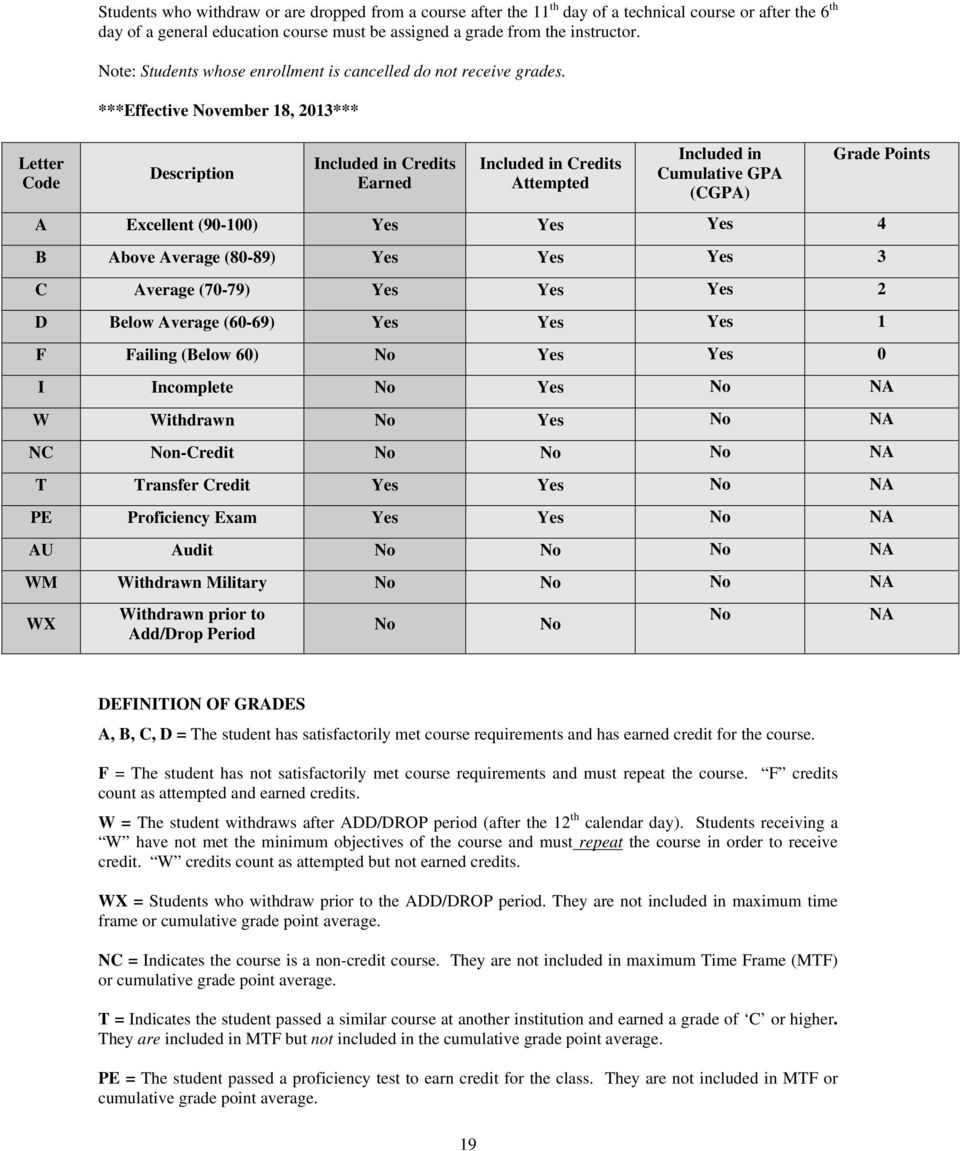
20 AU = Indicates the student attended class but was not required to complete all the activities. Students wishing to audit a course must request permission from the Director of Education before the class starts. They are not included in MTF or cumulative grade point average. WM = Exclusively used for students who are called into military action when they are enrolled and they do not have time to complete the course activities. Note: Students whose enrollment is cancelled prior to posting attendance do not receive grades. REPEAT OF COURSE CALCULATIONS OF GRADE AVERAGE When a student takes the same course more than once, all grades received remain on the student s transcript but only the last grade is used in calculating cumulative grade point average. Students will be charged for repeat course and will need to meet with his/her Financial Representative for pricing details. DEFINITION OF ACADEMIC PERIODS Vista College s academic term for certificate, diploma and degree programs is defined as 10 weeks. A grading period is defined as 5 weeks for all programs. One quarter credit hour equals 30 units comprised of the following academic activities: One clock hour in a didactic learning environment = 2 units One clock hour in a laboratory setting of instruction = 1.5 units One hour of externship = 1 unit One hour of out-of-class work and/or preparation for the didactic learning environment or supervised laboratory setting of instruction that are designed to measure the student s achieved competency relative to the required subject matter objectives = 0.5 unit BASIS FOR CALCULATION OF GRADE POINT AVERAGE The cumulative grade point average (GPA) will be calculated at the end of each grading period for each student. Student progress reports will be available through the Registrar s office or Academic Advisor. SATISFACTORY ACADEMIC PROGRESS All students are expected to maintain satisfactory academic progress toward successful completion of their program of enrollment. The following standards will govern satisfactory progress. SATISFACTORY ACADEMIC PROGRESS (SAP) FOR CREDIT HOUR PROGRAMS SAP & Maximum Time Frame for Completion of the Program Satisfactory academic progress (SAP) requires that each student be evaluated at specific periods of time during their enrollment using qualitative and quantitative standards. SAP is calculated using the cumulative grade point average (qualitative assessment) and timely completion of required credits for completion of their program of study (quantitative assessment) for each student. Students must be able to complete the program within the maximum program length (MPL), i.e., 1.5 times the length of the published credit hours. At the end of each quarter or payment period, the school will assess the qualitative and quantitative progress of the student. Students must demonstrate progress in the program at each of the evaluation points. The cumulative grade point average (GPA) will be calculated at the end of each grading period for each program. The calculation will be based on all quarter credit hour courses completed during the program of study. In all calculations, a grade of I (Incomplete) or a W (Withdrawal) will be treated as zero (0) credits earned. When the incomplete work is submitted and a final grade is assigned, the cumulative GPA 20

21 will be recalculated and the academic status adjusted as appropriate. According to federal regulations, federal student aid (Title IV) recipients must maintain satisfactory academic progress (SAP) toward achievement of their certificate, diploma, or degree. All students, regardless if a Title IV recipient, are evaluated at the end of each term or payment period in order to assess continued financial aid eligibility and academic standing. In order to remain in good standing, students must meet both a cumulative qualitative and cumulative quantitative measurement, as described below. Additionally, students must be able to complete their program of study within maximum time frame. Maximum time frame is defined as 1.5 times the published length of the program as measured in credit hours. Cumulative Qualitative Component 2.00 Cumulative Grade Point Average (C Average) Cumulative Quantitative Component 67% Completion of Attempted Credits* When a student fails to satisfy SAP requirements, they will be placed on Financial Aid/Academic Warning or Financial Aid/Academic Probation or Financial Aid/Academic Suspension and may lose eligibility to receive federal student aid. Satisfactory Academic is calculated at the end of each academic term. An academic term is defined at 10 weeks for all credit based programs. Status Definition: At each pre-determined evaluation point, students will be placed in one of the following four categories: Good Standing Students who have met both SAP measurements are considered to be in good standing. No notification or further action needs to be taken. Financial Aid/Academic Warning A student will be placed on Financial Aid/Academic Warning the first time they reach an academic term and are determined to have not met one or both SAP measurements. Warning status lasts for one academic term, during which the student may continue to receive federal student aid. Students who are placed on Financial Aid/Academic Warning will be reinstated to good standing at the end of the academic term if they are deemed to be meeting both SAP requirements. All students on Financial Aid/Academic Warning should complete an academic plan with the Director of Education or their designee. Financial Aid/Academic Probation Students who do not meet one or both of the SAP measurements for a second consecutive academic term may be placed on Financial Aid/Academic Probation and may receive federal student aid if the student is able to successfully appeal the SAP decision. Additionally, the student must agree to follow an academic plan which demonstrates they will be able to meet satisfactory academic requirements upon graduation from the program and within maximum time frame. Students who are placed on Financial Aid/Academic Probation will be reinstated to good standing at the end of the evaluation period if they meet both SAP requirements. Financial Aid/Academic Suspension A student will be placed on SAP Suspension if they do not meet satisfactory academic progress for a third consecutive academic term. At this time the student will lose eligibility to receive federal student aid. The student may be able to continue their education with alternative funding arrangements as long as they are able to successfully appeal the SAP decision. Additionally, the student must agree to follow an academic plan which demonstrates they will be able to meet 21
22 satisfactory academic requirements upon graduation from the program and within the maximum time frame. A student may not progress from Financial Aid/Academic Suspension directly to Good Standing. However, they may be eligible to return to Financial Aid/Academic Probation and reinstate Title IV funding provided they meet both SAP criteria by the next evaluation point and are able to successfully appeal the SAP decision. Evaluation Process Students receive academic advising at the end of each grading period. However, satisfactory academic progress evaluations occur at the end of each term as described below. Students who have not met satisfactory academic requirements upon evaluation are provided notification. 1. Students are evaluated at the end of each ten week term, twelve week term, or payment period as appropriate per their program of study and start date. 2. Students who have met both satisfactory academic progress measurements are considered to be in good standing. 3. Students who have not met one or both of the measurements for the first time will be placed on Financial Aid/Academic Warning and will remain eligible to receive federal funds. Academic progress will be evaluated at the end of the subsequent term or payment period. A student on Financial Aid/Academic Warning will be reinstated to good standing at the end of the subsequent term or payment period if they are deemed to be meeting both satisfactory academic progress requirements. 4. Students who have not met one or both of SAP measurements for the second consecutive academic term will be placed on Financial Aid/Academic Probation provided the student is successful in appealing the SAP decision. Students placed on Financial Aid/Academic Probation are not eligible to receive federal aid unless: a. The student is able to successfully appeal the SAP decision, and b. The student has been placed on an academic plan that demonstrates the student will be able to meet satisfactory academic requirements upon graduation from the program and within the maximum timeframe. The Director of Education is responsible to develop and monitor academic plans. An academic plan may be modified as appropriate as long as it continues to demonstrate the student will be able to meet progress requirements upon graduation. The academic plan will include a date for which the student is expected to meet SAP requirements which will be the next SAP evaluation checkpoint 5. Students placed on Financial Aid/Academic Probation will be reinstated to good standing at the end of the subsequent academic term or payment period if they are deemed to be meeting both SAP requirements. 6. Students who have not met satisfactory academic progress requirements for a second consecutive term or are not meeting the requirements of their academic plan will be placed on Financial Aid/Academic Suspension, provided the student in successful in appleaing the SAP decision, and will no longer be eligible to receive federal aid and may be dismissed from the program. A student may not progress from Financial Aid/Academic Susepension directly to good standing. However they may be eligible to return to Financial Aid/Academic Probation and reinstate Title IV funding provided they are meeting both satisfactory academic progress requirements and are able to successfully appeal the SAP decision. SAP APPEALS A SAP appeal may be approved based on undue hardship when the failure to make satisfactory academic progress occurs. Generally speaking, there should be a causal link between the special circumstances and poor academic performance. However, any circumstance that cannot be directly linked to performance during the term and/or would continue to affect future performance is not considered grounds for a successful appeal. It is the responsibility of the campus to determine whether the circumstances that lead to the academic 22
23 problems will continue to interfere with the student's progress before approving a SAP appeal. If the problems are ongoing, the student should not take classes until such time as the circumstances affecting the student s performance has been resolved. If the student has corrected the problem, then it is reasonable to expect that the student's grades will improve during the next evaluation period, and the appeal should be approved. The following is a list of comprehensive events that indicate there may have been mitigating circumstances that negatively affected academic progress: Death of an immediate family member Student illness requiring medical care Illness of a family member where the student is a primary caretaker Abusive relationships Divorce proceedings Previously undocumented disability Work-related transfer during the term Natural disaster Family emergency Financial hardship such as foreclosure or eviction Temporary incarceration FACTORS AFFECTING SAP Program Change If student changes their program of study, only courses applicable to the current program are included in the evaluation of satisfactory academic progress. Students must be meeting the institution s attendance requirements in order to be eligible for a program change. Students may only change their program of study once during their period of enrollment at the school. Transfer Credits Courses accepted for transfer credits will be included in the cumulative quantitative calculation. The cumulative qualitative calculation is unaffected by accepted transfer credits. Drop/Add Period Courses that are dropped during the drop/add period earn a grade of WX. The cumulative quantitative and qualitative calculations are unaffected by a grade of WX. Grade of W Courses that are dropped after the drop/add period but earn a grade of W are included in the cumulative quantitative calculation. They are not included in the cumulative qualitative calculation. Grade of Incomplete Courses that are graded as Incomplete are not included in the cumulative qualitative evaluation but are included in the cumulative quantitative component. With special approval by the Director of Education, a student may have the opportunity to complete required coursework within 7 calendar days from the last day of class. Failure to submit all required work within this timeframe may result in a failing grade for that term. Once a grade earned is posted, the qualitative calculation will be updated and the student may be deemed to have not met academic progress for that term. Financial aid disbursements may be delayed as a result of incomplete grades. Audited Courses Courses that are being audited are not included in the cumulative qualitative or quantitative calculation. Repeated Courses When a course is repeated, the most recent grade is included in the cumulative qualitative calculation but both attempts of the course are included in the cumulative quantitative calculation. Grade of PE Courses assigned these grades are not included in the cumulative qualitative, but are included in the cumulative quantitative calculation. Grades of NC, WM Courses assigned these grades are not included in the cumulative qualitative or quantitative calculation. Re-entry Students Upon re-enrollment, students who are not meeting academic progress requirements in their program of study will be placed on Financial Aid/Academic Probation or Financial Aid/Academic Suspension provided a successful appeal is granted. Students who are not able to meet both satisfactory academic progress requirements within maximum time frame and upon graduation will not be considered for re-enrollment. 23
24 APPEAL PROCESS Students on Financial Aid/Academic Probation or Financial Aid/Academic Suspension are required to appeal in writing to remain eligible to continue their program of study. Those who wish to appeal are responsible for submitting the following information to the Director of Education by the deadline given to the student during their initial SAP notification meeting; which should be no later than 12:00 PM on the last day of the first week of the new evaluation period. Appeals submitted after the deadline may not be considered: 1. A completed SAP Appeal Application which outlines: a. A description of the extenuating circumstances that affected the student s ability to meet satisfactory academic progress requirements. The extenuating circumstances must be temporary in nature and directly linked to their performance for that term. b. An explanation of how circumstances have changed that will allow the student to meet SAP in future terms. c. An outline of what the student will do differently to overcome obstacles that would cause them to be placed on a SAP status in the future. 2. Supporting documentation which provides evidence of the circumstances described in the appeal application. Supporting documentation could include; car repair bills, letters from the court, a doctor s note, attestations from non-related people who are aware of the situation, etc. At the time in which a completed appeal application is received, the SAP Appeal Committee will convene to review the documentation and make a decision as to whether or not the appeal is approved. Members of the SAP Appeal Committee should consist of a minimum of three members including (but not limited to) the Director of Education, Director of Financial Aid and Program Director/Lead Instructor or their designee. Students on Financial Aid/Academic Probation whose appeal is granted will retain eligibility for Title IV (federal student aid) funds. Upon approval, the Director of Education will notify the student of the decision and present them with their academic plan. The plan should be as prescriptive as possible and could require the student to completed tutoring sessions, individual meetings with the instructor, etc. The appeal paperwork will be signed by all committee members, and given to the Registrar to be placed in the student s academic file. Students on Financial Aid/Academic Suspension whose appeal is granted will not retain eligibility for Title IV (federal student aid) funds but may continue their program of studies provided alternative funding has been arranged. Upon approval, the Director of Education will notify the student of the decision and present them with their academic plan. The plan should be as prescriptive as possible and could require the student to completed tutoring sessions, individual meetings with the instructor, etc. The appeal paperwork will be signed by all committee members, and given to the Registrar to be placed in the student s academic file. If the circumstances dictate that the student will require more than one academic term to meet progress standards, the appeal may only be approved by the Corporate Director of Education and/or Sr. Vice President of Operations. However, a complete review of the student s progress must be made at the end of each grading period to determine if the student is meeting the requirements of the academic plan. If the committee determines that the student s appeal is denied, all charges accrued for the grading period should be removed. The student should then be issued a WX for their current course and placed in dismissed status. The student may appeal only once per grading period through the appeal process and determination for each appeal will be decided based on the documentation and rationale provided at that time. Regaining Eligibility for Title IV (federal student aid) funds Students can regain eligibility for federal student aid by meeting the requirements of the satisfactory academic progress (SAP) policy, successfully appealing a SAP decision when placed on Financial/Academic Probation and be placed on an academic plan that demonstrates their ability to meet 24
25 SAP upon completing the program, and continues to meet the requirements of an academic plan. ATTENDANCE POLICY A record is generated each time the student logs into the Moodle platform. The academic week is Monday- Sunday by 11:55 PM (MST) with the exception of week five which ends at 11:55 PM (MST) Thursday. Attendance credit will be recorded as 20 hours per academic week. To receive credit for attending class, the student must complete a minimum of one weekly graded requirement as defined by the course syllabi. NOTE: Logging into class without active participation does not constitute weekly attendance. Graded course work completed in a week other than the one when it was due will not count towards attendance for the previous week but will be applied to the current week. Students are required to post attendance at minimum of one time during the first week of class or will be automatically withdrawn from class and considered a No Show. After the first week of class, students who do not post attendance for two consecutive weeks will automatically be withdrawn from class. Students are strongly encouraged to log in more in order to understand the subject fully and to be successful in class. FIRST TERM REQUIREMENTS: Students are required to make phone contact with their academic advisor at least once per week. Subsequent weekly calls will be scheduled at the conclusion of the current weeks call. It will be the student s responsibility to ensure they do not miss the scheduled phone call. A student will be allowed one no show appointment during the first five weeks. If a student no shows more than once during the first five weeks, they may be cancelled. Students are required to achieve at least a D during their first term. This may be achieved by: Successfully completing all required reading assignments, discussion questions, assignments, quizzes and exams. Students who are cancelled due to any of the above mentioned items will have to sit out one term and will be required to complete a two-page essay explaining why they should be readmitted to Vista College. This essay will be submitted to the Director of Admissions and Director of Education for either approval or denial. Student s that are cancelled during the first five weeks will have their billing reversed and Title IV schedules cancelled. Students are reminded it is their responsibility to be current in all assignments at all times. Absences do not excuse program obligations which lead to satisfactory progress. Attendance records reflecting absences are kept by the school. Any agency that provides educational financial assistance to a student can receive accurate and complete information concerning the student attendance and progress. Students using veteran benefits to attend Vista College will have attendance monitored until the time that the student completes the program or withdraws. FOR VA STUDENTS - Unsatisfactory attendance will be reported to the Department of Veterans Affairs (DVA) even if the VA student has completed the required number of hours to complete and no refund is due the student and/or funding sources. Therefore, the attendance policy (more than 20% of the total program or absence for two consecutive weeks) will apply throughout the student s stay in school. All violations of the attendance policy will be reported to DVA on VA Form b within 30 days at any time the student exceeds the allowed number of absences. 25
26 ACADEMIC MAKE-UP ASSIGNMENTS AND QUIZZES Make-up work is the sole discretion of the instructor. LEAVE OF ABSENCE School does not grant Leaves of Absence with the exception of VA students called to Active Military duty. ATTENDANCE PROBATION Students whose absences exceed 2 consecutive substantial posts will be warned in writing to improve their attendance rate. Students receiving VA benefits or who are funded by an agency that requires the reporting of attendance, attendance warnings will be reported and may result in the termination if a student s absences exceed 4 consecutive substantial posts or accumulated absences of more than 20% of the program. However, no students will be withdrawn if they are in the last quarter of their program and they would not be entitled to a refund. WITHDRAWAL FROM COURSES Officially enrolled students who decide to cease attending any or all courses are responsible for initiating withdrawal action through the Director of Education. The official withdrawal form should be electronically submitted to the Director of Education. Such withdrawal will be effective as of the date the written request is date stamped on the . Third party, other than a designated school official, may not request a student withdrawal without the expressed written authorization of the student. Application to re-enter must be made to the Director of Education. Resumption of studies will usually be at the next available regular start date following the date of the new application. Students approved to restart must reapply through the Admission office to resume attending classes. GENERAL INFORMATION Repeating Courses Students repeating courses/classes are subject to additional fees. Technical Requirements Online students will use a computer to complete assignments, download course material, and complete other tasks. Students will be expected to have access to and use the hardware and software described below: 1.6 GHz processor or faster Current anti-virus application 1GB RAM or greater 100 GB hard drive or larger High speed internet connection, monitor and Video Card with 1024x768 ppi or greater resolution Sound card with speakers CD-ROM Printer address Microsoft Internet Explorer version 10.0 or later Adobe Reader Microsoft Office 2007 or greater Due to the rapid rate of change in information technology hardware and software competencies are subject to regular updates; selected courses may be subject to additional requirements. 26
27 Library The Vista College online library offers a vast array of scholarly and professional research materials and is remotely accessible via the EBSCO website. PLAGIARISM POLICY Plagiarism is defined as the act of using words and/or ideas from another person or source without giving proper acknowledgement to that person or source. A student is plagiarizing if they: Turn in someone else s work as their own, Copy words or ideas from someone else without giving credit by using proper in-text citations and a work cited page Fail to put a quote in quotation marks, change words, but copy the sentence structure of a source without giving credit by using proper in-text citations and a work cited page Student s own work and/or ideas are less than 40% whether you give credit or not. Plagiarism is against the law and will result in a failing grade for the assignment and may even result in suspension from school. First offense: Director of Education advises student and documents offense. Second Offense: Student can be dismissed from school at the discretion of the Campus Director. Student is advised by both the Campus Director and Director of Education. The advising will be documented and placed in the student s academic file. STUDENT CONDUCT AND DISCIPLINE Students must observe Vista College code of conduct and govern themselves in a professional manner. A mutual respect of individual rights must exist between students and fellow students as well as students and staff to insure a positive learning atmosphere. Students whose actions constitute misconduct will be subject to disciplinary action by Vista College that may lead to suspension or termination. Courteous behavior and professional conduct, appropriate to a professional environment is to be displayed at all times. Inappropriate conduct and/or communication may be a cause for suspension or termination. Every student is subject to federal and state law and respective county and city ordinances. The conviction of a student for any criminal offense which interferes with the orderly operation of the school or which Vista College administration feels would endanger members of the Vista College community shall be subject to disciplinary action. Infringements of the Student Code of Conduct are handled by the Director of Education and/or Campus Director. Students dismissed for misconduct will be advised by the Campus Director. Readmission is subject to Campus Director s approval. The following actions are considered misconduct and may result in dismissal from Vista College: Actions which interfere with another student's right to gain an education Vulgarity, foul language, and/or lack of respect for peers, instructors, and/or Vista College staff members Becoming a disruptive influence or nuisance All forms of dishonesty including but not limited to cheating, plagiarism, forgery and intent to defraud Violation of current rules and regulations Actions that bring the name or reputation of Vista College into disrepute Violation of the Copyright Policy Violation of the Internet Access and Usage policy 27
28 INTERNET ACCESS AND USAGE POLICY The use of Vista College Internet access equipment is intended for Vista College related business only. Internet communications, transactions, and discussions may be viewed by authorized personnel as determined by Vista College. Distribution of confidential information about staff members, customers, and Vista College is strictly prohibited. Vista College reserves the right to audit information that is accessed through the Internet to ensure that nonbusiness related use of Vista College equipment does not impact business needs. Personal use of the Internet is limited and supervised. Vista College does not allow chain letters, personal or group communications about causes or opinions, personal mass mailings, or the accessing of material deemed inappropriate or prohibited by local, state, or Federal law. Vista College prohibits the access or dissemination of sexually explicit graphics or otherwise offensive or discriminatory material via the Internet. Code of Conduct Freedom of speech and expression is valued not only throughout the society but also, and particularly, in the academic setting. To that end, online students at Vista College will adhere to the following code of conduct: Access Vista College courses only for lawful purposes. Respect the privacy of other members of the class and other students. Respect the integrity of the College s computer systems. Respect the diversity of opinions among the instructor and members of the class and respond to them in a courteous manner. Maintain an environment free of harassment, stalking, threats, abuse, insults, or humiliation to the instructor and members of the class. This includes, but is not limited to demeaning written or oral comments of an ethnic, religious, sexist (or sexual orientation), or racist nature; and the unwanted sexual advances or intimidations by , or on threaded discussion boards and other postings in online courses. Student Grievance Procedure Vista College provides a prompt and equitable process for resolving student grievances. The procedure is available to any student who believes that a school decision or action has adversely affected his/her status, rights, or privileges. Students with a grievance must first make a reasonable effort to resolve the issue on an informal basis with their instructor or administrative personnel. If the issue is not resolved to the student s satisfaction, the student shall review the grievance with all parties concerned. We will receive all information submitted by the student concerning a grievance in strict confidence and we and the student agree to maintain confidentiality in the grievance procedures. No reprisals of any kind will be taken by any party of interest or by any member of the Vista College administration against any party involved. Step 1 Grievances or complaints involving an individual instructor or staff member should first be discussed with the individual involved. Step 2 Grievance or complaints not resolved with the individual instructor or staff member should be discussed with the Director of Education. The Director of Education will investigate the claim and attempt to resolve the issue. Resolution may include a mediated conversation between involved parties. Step 3 If the matter is not resolved to the student s satisfaction in Step 1, the student should submit a written, dated and signed statement to the Campus Director. Within ten (10) business days of the receipt of the written statement, the Campus Director will arrange for a preliminary meeting with the student to 28
29 discuss the grievance, and the Campus Director will thereafter conduct an investigation, including providing the student with a full and fair opportunity to present evidence relevant to the matter. The Campus Director will render his/her decision in writing within ten (10) business days after concluding his/her investigation, setting out the Campus Director s findings, conclusions, and reasoning. The student s written complaint, together with the Campus Director s decision, will become a permanent part of the files of the parties involved. The Campus Director s decision is considered final at the institutional level. If a student is still not satisfied, the student may direct unresolved issues to Education Futures Group (EFG) at the following address: Education Futures Group Attn: Compliance 300 N. Coit, Suite 1400 Richardson, TX or call EFG at If a student does not feel the school has adequately addressed a complaint or concern, the student may consider contacting the Accrediting Commission. All complaints reviewed by the Commission must be in written form and should grant permission for the Commission to forward a copy of the complaint to the school for a response. This can be accomplished by filing the ACCSC Complaint Form. The complainant(s) will be kept informed as to the status of the complaint as well as the final resolution by the Commission. Please direct all inquiries to: Accrediting Commission of Career Schools & Colleges 2101 Wilson Boulevard, Suite 302 Arlington, VA (703) A copy of the ACCSC Complaint Form is available at the school at and may be obtained by contacting ACCSC or online at DEGREES, DIPLOMAS AND CERTIFICATES OF COMPLETION Degrees, diplomas and certificates are awarded upon satisfactory completion of all courses in the student's program. A degree, diploma or certificate will not be issued nor will record of graduation of the program be posted to a student s academic record until successful completion of all the requirements for graduation is met. TRANSCRIPT FEES One transcript and diploma will be provided to each student free of charge upon satisfactory completion of the program. Additional copies will be provided at $5 each. Additional diplomas are $10 each. Transcripts may not be released until the student is in good financial standing with Vista College. GRADUATION REQUIREMENTS Vista College awards diplomas, certificates and degrees for successful completion of programs. Students must meet the diploma/certificate/degree requirements as outlined in the Academic Catalog current at the time of application for graduation. Students must successfully complete all courses in the program of study. Transfer of credit from another institution may be used to qualify as successful completion of a course. A minimum of 25% of credit hours must be completed at Vista College. Diplomas/Certificates/Degrees will not be awarded if the highest grade recorded for a course is F, W, or I. 29
30 Students must earn a cumulative grade point average of 2.0 (grade of C" or better) for all course work completed at Vista College. Students must be in good financial standing prior to earning the diploma/degree. CONDITIONS FOR RE-ADMITTANCE Students dismissed for violation of school rules or policies, attendance, or academic reasons will only be considered for re-admittance after Academic and Financial Review. Re-admission criteria are determined on an individual basis. Re-admission will be granted based on the student s progress reports and prior attendance record as well as consideration given to correct poor academic or attendance performance. Readmitted students will be advised by the Academic Advisor and placed on probation for one grading term. Students may be re-admitted at the start of the next grading period. Re-admitted students must agree to sign a copy of the attendance policy and any advising forms which will be become a part of the student s permanent record. Re-admitted students may be subject to additional fees. 30
31 DIPLOMA AND CERTIFICATE PROGRAMS Business Administration Online Medical Office Specialist Online Network Administrator Online The following pages will provide students with program titles, objectives, and purposes. A brief synopsis of each subject will be provided in the section titled Course Descriptions (page 40) **To meet regulated clock hour to credit hour conversion requirements enforced by the Department of Education effective July 1, 2011, out of class work has been incorporated into courses offered for each program. Please refer to course syllabi for out of class work assignment details (l) (2) Definition of a Credit Hour One quarter credit hour equals 30 units comprised of the following academic activities: One clock hour in a didactic learning environment = 2 units One clock hour in a supervised laboratory setting of instruction = 1.5 units One hour of externship = 1 unit One hour of out-of-class work and/or preparation for the didactic learning environment or supervised laboratory setting of instruction that are designed to measure the student s achieved competency relative to the required subject matter objectives = 0.5 unit BUSINESS ADMINISTRATION ONLINE The Business Administration Online Program is a comprehensive program designed to develop competence in the mechanics of business and word/data processing operations necessary in today s automated office environment. Students will learn skills necessary for managing a small business, keyboarding and operating computer software applications, i.e., Windows, Word, Excel, Access, PowerPoint, Microsoft Publisher and Internet Explorer. Additionally, the student will learn jobseeking and interpersonal skills. Graduates of the Business Administration Program may find entrylevel employment in business offices, government agencies, or any other type of business environment and may work in roles such as an Office Manager, Accounting Clerk, and Customer Service Representative etc. Upon completion of the program a Diploma is awarded. COURSE COURSE TITLE THEORY/LAB QUARTER CREDIT HOURS HOURS OLBAD100 Business I Online 45/ OLBAD101 Principles of Management Online 45/ OLBAD102 Accounting I Online 45/ OLBAD103 Business Law Online 45/ OLBAD104 Business II Online* 45/ OLBAD105 Computerized Automated Accounting Online* 45/ OLBAD106 Economics Online* 45/ OLBAD107 Business Computer Information Systems Online* 45/ Total 360/ TOTAL CLOCK HOURS: 720 ESTIMATED COMPLETION TIME: 40 weeks * Indicates prerequisite exists. Student must complete the prerequisite course prior to entry into this course or have the instructor s permission to enter the course. 31
32 MEDICAL OFFICE SPECIALIST ONLINE The Medical Office Specialist Online Program is a comprehensive program designed to assist the student in gaining the necessary skills and procedures necessary to administer a medical office. Students of the program will learn medical terminology, medical transcription, insurance coding and billing and computerized medical office procedures that will assist them in becoming effective employees in the medical office. The student will also learn the latest software applications necessary to succeed in today s job market. Additionally, the graduate will develop job-seeking and interpersonal skills. Students in the Medical Office Specialist program will be able to seek entry-level positions such as Data Entry Clerk, Medical Coding Specialist, etc. in a medical, dental, hospital or other related business environment. Upon completion of the program, a Certificate is awarded. COURSE COURSE TITLE THEORY/LAB QUARTER CREDIT HOURS HOURS OLMID100 Medical Terminology Online 45/ OLMID101 Anatomy and Physiology Online 45/ OLMID102 Medical Office Procedures Online 45/ OLMID103 Practice Management and EHR Online 45/ OLMID104 Coding Medical Insurance Forms and Billing Online * 45/ OLMID105 Hospital Billing Online* 45/ OLMID106 Medical Insurance Online* 45/ OLMID107 Administrative Procedures for the Medical Office Online* 45/ TOTAL CLOCK HOURS: 720 ESTIMATED COMPLETION TIME: 40 weeks Total 360/ * Indicates prerequisite exists. Student must complete the prerequisite course prior to entry into this course or have the instructor s permission to enter the course. 32
33 NETWORK ADMINISTRATOR ONLINE The Network Administrator Online program is a comprehensive course designed to teach students the skills and abilities necessary to support and maintain computer networks. Students will learn the skills to setup and manage a network including troubleshooting and repair of network and nonnetworked computers. Additionally, the student will have the skills to seek the CompTIA A+, CompTIA Network+, and Microsoft MCSA certifications. Graduates may find jobs as Network Administrator/Computer Repair Specialists within large and small businesses, manufacturing industries, local and federal government agencies, computer consulting firms, and education centers. Upon completion of the program, a Diploma is awarded. COURSE COURSE TITLE THEORY/LAB QUARTER CREDIT HOURS HOURS OLNED100 A+ Computer Service Technician Online 45/ OLNED101 Networking Essentials Online 45/ OLNED102 Desktop Operating Systems Online 45/ OLNED103 Peripherals and Data Communications Online 45/ OLNED104 Networking Essentials Plus Online* 45/ OLNED105 TCP/IP Routing Online* 45/ OLNED106 Windows Networking Online* 45/ OLNED107 Local Area Networks Online* 45/ Total 360/ TOTAL CLOCK HOURS: 720 ESTIMATED COMPLETION TIME: 40 weeks * Indicates prerequisite exists. Student must complete the prerequisite course prior to entry into this course or have the instructor s permission to enter the course. 33
34 AAS Business Administration Online AAS Criminal Justice Online AAS Medical Office Specialist Online AAS Network Administrator Online AAS Paralegal Online BS Business Management Online DEGREE PROGRAMS The following pages will provide students with course titles, objectives, and purposes. A brief synopsis of each subject will be provided in the section titled Course Descriptions. **To meet regulated clock hour to credit hour conversion requirements enforced by the Department of Education effective July 1, 2011, out of class work has been incorporated into courses offered for each program. Please refer to course syllabi for out of class work assignment details (l)(2). ASSOCIATE OF APPLIED SCIENCE DEGREE BUSINESS ADMINISTRATION ONLINE The Associate of Applied Science in Business Administration Online program provides students an opportunity to acquire knowledge, skills, competencies, and training for careers as entry level managers. Students learn the functions of management: planning, organizing, leading, and controlling. Also, students become familiar with different types of management, such as human resources management and production and operations management. COURSE COURSE TITLE THEORY/LAB HOURS QUARTER CREDITS HOURS OLBAD100 Business I Online 45/ OLBAD101 Principals of Management Online 45/ OLBAD102 Accounting I Online 45/ OLBAD103 Business Law Online 45/ OLBAD104 Business II Online* 45/ OLBAD105 Computerized Automated Accounting Online* 45/ OLBAD106 Economics Online* 45/ OLBAD107 Business Computer Information Systems Online* 45/ OLBAD208 Human Resources Management Online* 45/ OLBAD209 Production and Operations Management 45/ Online* OLBAD210 Introduction to Marketing Online* 45/ OLGED201 Introduction to College Mathematics 90/ Online OLGED202 Introduction to Computer Science Online 45/ OLGED203 Introduction to Psychology Online 45/ OLGED204 English Composition I Online 45/ OLGED205 English Composition II Online 45/ Total 765/ TOTAL CLOCK HOURS: 1260 ESTIMATED COMPLETION TIME: 70 WEEKS * Indicates prerequisite exists. 34
35 ASSOCIATE OF APPLIED SCIENCE IN CRIMINAL JUSTICE The Associate of Applied Science in Criminal Justice is designed to provide academic preparation in criminal law, legal procedure, court systems law enforcement, and other related fields such as the fundamentals of law, corrections, and various practices. The curriculum will prepare students to seek employment in the criminal justice profession. Upon completion of the program, students will receive an Associate of Applied Science Degree. COURSE COURSE TITLE THEORY/LAB QUARTER CREDIT HOURS HOURS OLCJ100 Introduction to Criminal Justice Online 45/ OLCJ101 Fundamentals of Criminal Law Online 45/ OLCJ102 Courts and Criminal Procedures Online 45/ OLCJ103 Corrections Online 45/ OLCJ104 Ethics Online* 45/ OLCJ105 Victimology Online* 45/ OLCJ106 Organized Crime Online * 45/ OLCJ107 Police System and Practices Online* 45/ OLCJ208 Crime and Criminals Online* 45/ OLCJ209 Criminal Investigation Online* 45/ OLCJ210 Criminal Behavior Online* 45/ OLGED201 Introduction to College Mathematics Online 90/ OLGED202 Introduction to Computer Science Online 45/ OLGED203 Introduction to Psychology Online 45/ OLGED204 English Composition I Online 45/ OLGED205 English Composition II Online 45/ Total 765/ TOTAL CLOCK HOURS: 1260 ESTIMATED COMPLETION TIME: 70 WEEKS *Indicates prerequisites exist. Student must complete prerequisite courses prior to entry into this course. 35
36 ASSOCIATE OF APPLIED SCIENCE MEDICAL OFFICE SPECIALIST ONLINE The Associate of Applied Science Medical Office Specialist Online program is a comprehensive program designed to assist the student in gaining the necessary skills and procedures necessary to administer a medical office. Graduates of the program will be proficient in medical terminology, medical transcription, insurance coding and billing and computerized medical office procedures that will assist them in becoming effective employees in the medical office. The student will also learn the latest software applications necessary to succeed in today s job market. Additionally, the graduate will develop job-seeking and interpersonal skills. Graduates in the Medical Information Specialist program will be able to seek entry-level positions in a medical, dental, hospital or other related business environment. Upon completion of the program an Associates of Applied Science in Medical Office Specialist Degree is awarded. COURSE COURSE TITLE THEORY/LAB HOURS QUARTER CREDIT HOURS OLMID100 Medical Terminology Online 45/ OLMID101 Anatomy and Physiology Online 45/ OLMID102 Medical Office Procedures Online 45/ OLMID103 Practice Management and EHR Online 45/ OLMID104 Coding Medical Insurance Forms and Billing Online * 45/ OLMID105 Hospital Billing Online * 45/ OLMID106 Medical Insurance Online * 45/ OLMID107 Administrative Procedures for the Medical Office Online * 45/ OLMID208 Advanced Medical Coding Current Procedural Terminology Online * 45/ OLMID209 Advanced Medical Coding International OLMID210 Classification of Disease Online * 45/ Advanced Billing and Reimbursement Online * 45/ OLGED201 Introduction to College Mathematics 90/ Online OLGED202 Introduction to Computer Science Online 45/ OLGED203 Introduction to Psychology Online 45/ OLGED204 English Composition I Online 45/ OLGED205 English Composition II Online * 45/ Total 765/ TOTAL CLOCK HOURS: 1260 ESTIMATED COMPLETION TIME: 70 WEEKS * Indicates prerequisite exists. 36
37 ASSOCIATE OF APPLIED SCIENCE NETWORK ADMINISTRATOR ONLINE The Associate of Applied Science in Network Administrator Online program is a comprehensive program designed to teach the students the skills and abilities necessary to support and maintain computer networks. Graduates will have the skills to setup and manage a network including troubleshooting and repair of network and non-networked computers. Additionally the student will have the skills to seek the CompTIA A+, CompTIA Network+, and Microsoft MCSA certifications. Graduates may find jobs as a network administrator/computer repair specialist with large and small businesses, manufacturing industries, local and federal government agencies, computer consulting firms, and education centers. Upon completion of the program an Associate of Applied Science Degree is awarded. COURSE COURSE TITLE THEORY/LAB HOURS OLNED100 QUARTER CREDIT HOURS A+ Computer Service Technician Online 45/ OLNED101 Networking Essentials Online 45/ OLNED102 Desktop Operating Systems Online 45/ OLNED103 Peripherals and Data Communications Online 45/ OLNED104 Networking Essentials Plus Online* 45/ OLNED105 TCP/IP Routing Online* 45/ OLNED106 Windows Networking Online* 45/ OLNED107 Local Area Networks Online* 45/ OLNED208 SSCP Systems Security Certified Practitioner Online* 45/ OLNED209 Linux+ Online* 45/ OLNED210 OLGED201 OLGED202 Introduction to Cisco Networking Online* 45/ Introduction to College Mathematics Online 90/ Introduction to Computer Science Online 45/ OLGED203 Introduction to Psychology Online 45/ OLGED204 English Composition I Online 45/ OLGED205 English Composition II Online* 45/ Total 765/ TOTAL CLOCK HOURS: 1260 ESTIMATED COMPLETION TIME: 70 WEEKS * Indicates prerequisite exists 37
38 ASSOCIATE OF APPLIED SCIENCE DEGREE PARALEGAL ONLINE The Associate of Applied Science in Paralegal is designed to prepare students to perform specialize, delegated, substantive legal work for a lawyer, law office, corporation, government agency, or other entity. The Paralegal Studies program offers students training and skills in preparing legal reports and documents, legal correspondence, research, drafting letters, questions for interrogators, legal memoranda, briefs, pleadings, contracts and wills. Students are prepared for entry-level employment as legal office assistants or managers, or can be directly involved in interviewing, research, and casework as paralegals in either the public or private sector. Upon completion an Associate of Applied Science Degree in Paralegal is awarded. COURSE COURSE TITLE THEORY/LAB HOURS QUARTER CREDIT HOURS OLPL100 Introduction to Law and Paralegal Studies Online 45/ OLPL101 Office Procedures and Practices Online 45/ OLPL102 Probate Administration and Estate Planning Online 45/ OLPL103 Tort Law Online 45/ OLPL104 Family Law Online* 45/ OLPL105 Real Estate Online* 45/ OLPL106 Criminal Law Online* 45/ OLPL107 Technology in the Law 45/ Office Online* OLPL208 Legal Writing and Analysis 45/ OLPL209 OLPL210 OLGED201 OLGED202 OLGED203 OLGED204 OLGED205 Online* Civil Litigation Online* Contract Law Online* 45/45 45/ Introduction to College Mathematics Online 90/ Introduction to Computer Science Online 45/ Introduction to Psychology Online 45/ English Composition I Online 45/ English Composition II Online* 45/ TOTAL 765/ TOTAL CLOCK HOURS: 1260 ESTIMATED COMPLETION TIME: 70 WEEKS * Indicates prerequisite exists. 38
39 BACHELOR OF SCIENCE DEGREE IN BUSINESS MANAGEMENT ONLINE** The Bachelor of Science Degree in Business Management provides students with a strong working knowledge of the fundamental disciplines of: Management, Accounting, Economics, Finance, Project Management, Computer Information Systems and Marketing. Graduates possess general business, technical, and communication skills required for today s management and leadership positions. The Bachelor of Science in Business Management degree is highly desired for many positions in a variety of industries including General Management, Business Analysts, Marketing and Brand Managers, Sales and Customer Service Professionals, and a variety of positions in government, nonprofit, and health services. COURSE COURSE TITLE THEORY/LAB HOURS QUARTER CREDIT HOURS OLBAD100 Business I Online 45/ OLBAD101 Principles of Management Online 45/ OLBAD102 Accounting I Online 45/ OLBAD103 Business Law Online 45/ OLBAD104 Business II Online * 45/ OLBAD105 Computerized Automated Accounting Online * 45/ OLBAD106 Economics Online * 45/ OLBAD107 Business Computer Information Systems Online 45/ OLBAD208 Human Resources Management Online * 45/ OLBAD209 Production and Operations Management Online* 45/ OLBAD210 Introduction to Marketing Online* 45/ OLBAD311 Corporate Finance Online* 45/ OLBAD312 Sales and Customer Service Online* 45/ OLBAD313 Project Management Online* 45/ OLBAD314 Organizational Behavior Online* 45/ OLBAD315 Microeconomics Online* 45/ OLBAD316 Accounting II Online* 45/ OLBAD317 Leadership Online* 45/ OLGED201 Introduction to College Mathematics I Online 65/ OLGED202 Introduction to Computer Science Online 60/ OLGED203 Introduction to Psychology Online 60/ OLGED204 English Composition I 65/ OLGED301 Introduction to College Mathematics II Online* 65/ OLGED205 English Composition II Online * 65/ OLGED308 Introduction to Sociology Online 60/ OLGED309 US History Online 65/ OLGED310 Critical Thinking Online 65/ OLGED210 Communication Online 60/ Total 1440/ TOTAL CLOCK HOURS: 2250 ESTIMATED COMPLETION TIME: 140 WEEKS * Indicates prerequisite exists. **Graduates of Vista College s associate program will also need to take the following courses: OLGED221 Bridge Introduction to College Mathematics 40/0 4.0 QCH Online OLGED222 Bridge Introduction to Computer Science Online 15/0 1.5 QCH OLGED223 Bridge Introduction to Psychology Online 15/0 1.5 QCH OLGED224 Bridge English Composition Online 40/0 4.0 QCH 39
40 COURSE DESCRIPTIONS Definition of a Credit Hour One quarter credit hour equals 30 units comprised of the following academic activities: One clock hour in a didactic learning environment = 2 units One clock hour in a supervised laboratory setting of instruction = 1.5 units One hour of externship = 1 unit One hour of out-of-class work and/or preparation for the didactic learning environment or supervised laboratory setting of instruction that are designed to measure the student s achieved competency relative to the required subject matter objectives = 0.5 unit COURSE DESCRIPTIONS FOR BACHELOR OF SCIENCE Theory Lab 10 hours = 1 quarter credit 20 hours= 1 quarter credit OLBAD100-BUSINESS I ONLINE CONTACT HOURS: THEORY 45- LAB-45 (90 HOURS) TOTAL QUARTER CREDIT HOURS -6.5 Prerequisites: None Business I Online provides students with an overview of business in an increasingly global society and serves as an introduction to business terminology, concepts, environments, systems, strategies, and current issues. Topics include the business environment, business ethics, entrepreneurship, global business, management, and marketing. OLBAD101-PRINCIPALS OF MANAGEMENT ONLINE Prerequisites: None Principals of Management Online covers concepts, terminology, principles, theories, and issues relevant to the field of management. It provides students with an overview of introductory management and organization functions. Integration of behavioral and system approaches into the traditional analysis of business is discussed. Decision making, planning strategies, and leadership skills are emphasized. OLBAD102-ACCOUNTING I ONLINE Prerequisites: None Accounting I Online covers basic accounting principles, the basic accounting equation, debits, and credits, and analyzing transactions using T accounts. It focuses on the completion of the accounting cycle and covers the recording and posting of transactions using journals and ledgers, adjustments, closing entries, and post-closing trial balance. The tools for the preparation of financial statements including the Income Statement, Statement of Owners Equity, and the Balance Sheet are discussed. OLBAD103-BUSINESS LAW ONLINE Prerequisites: None Business Law Online provides students with an overview of the legal system as it relates to business. This course includes the study of the uniform commercial code and contracts for the sale of goods, commercial paper, personal property and bailments, real property, wills trusts, insurance, agency law, partnerships and corporations, and computerized legal research. 40
41 OLBAD104-BUSINESS II ONLINE Prerequisites: OLBAD100 -OLBAD103 Business II Online provides students with an overview of productivity, quality, accounting, financial analysis, and the financial system. It includes the study of promotional distribution and pricing techniques, product management, different financial statements and their organizational purposes, business trends, and events that may change the future of business. OLBAD105-COMPUTERIZED AUTOMATED ACCOUNTING ONLINE Prerequisites: OLBAD100 -OLBAD103 Computerized Automated Accounting Online provides the student with instruction on an integrated accounting software program, such as Peachtree. The course provides step by step instruction for input of financial transactions that include writing checks; check payment process, invoicing, receipt of funds, bank deposits, time card entries, payment of time charged and other financial transaction activity that would be found in a real world business environment. Students are instructed in the generation and analysis of major accounting reports such as accounts receivable, accounts payable, payroll, general ledger, journal activity, and the generation of financial statements such as the income statement, balance sheet and other financial real world reports for a business operation. OLBAD106-ECONOMICS ONLINE Prerequisites: OLBAD100 -OLBAD103 Economics Online is an overview of the basic principles of economics. It is designed to acquaint students with the workings of the national economy. Topics include economic systems; markets and competition; money and banking; production, income, and employment; economic activities and policies; and international economics. OLBAD107-BUSINESS COMPUTER INFORMATION SYSTEMS ONLINE CONTACT HOURS: THEORY-45 LAB-45 (90HOURS) Prerequisites: OLBAD100 -OLBAD103 Business Computer Information Systems Online introduces various information and communications technologies and explains how information systems are used to solve problems and make better business decisions. OLBAD208-HUMAN RESOURCES MANAGEMENT ONLINE Prerequisites: OLBAD104 -OLBAD107 Human Resources Management Online is designed to familiarize students with the basic principles of human resources management. The course begins with an overview and legal aspects. Work analysis and workforce planning, recruiting, staffing, training, and performance management are also examined. This foundation is used to examine how the human resources professional manages careers, compensation, labor relations, safety and health of employees, and discipline and procedural justice. The course concludes by analyzing related concepts in a global context. OLBAD209-PRODUCTION AND OPERATIONS MANAGEMENT ONLINE Prerequisites: OLBAD104 -OLBAD107 Production and Operations Management Online is a course that incorporates engineered information driven activities of the supply chain such as communication, inventory management, warehousing, transportation, 41
42 facility location, and product service and support. These activities have been significantly altered with advances in technology and communication and must be analyzed to determine how to attain a competitive advantage. OLBAD210-INTRODUCTION TO MARKETING ONLINE Prerequisites: OLBAD104 -OLBAD107 In this course, the student gains an understanding of the dynamic field of marketing. The topics covered range from consumer behavior to marketing ethics and include market research, planning, strategy, product, pricing, promotions, distribution, wholesaling, and retailing. The focus is both domestic and global, with several real-world examples of marketing successes and failures. OLBAD311-CORPORATE FINANCE ONLINE Prerequisites: OLBAD104 -OLBAD107 This course offers a broad overview of corporate finance, including the goals of financial management. Students examine how the information contained in financial statements is used in analysis and forecasting. The topic of valuation is introduced, with a focus on valuing stocks and bonds. Students review the financial manager s role in estimating risk and return, computing cost of capital, evaluating capital structure policies, making investment decisions, and raising capital. Other topics include financial securities and derivatives, long term and short-term planning, and innovations in corporate finance. OLBAD312-SALES AND CUSTOMER SERVICE ONLINE Prerequisites: OLBAD104 -OLBAD107 This course is designed to familiarize students with the basic principles of consumer behavior. The course begins with an analysis of behaviors and perceptions, motivation and values and personality lifestyles. This foundation is used to examine consumer decision making and problem solving, organizations, households, diversity and age and cultural influences. OLBAD313-PROJECT MANAGEMENT ONLINE Prerequisites: OLBAD104 -OLBAD107 In this course, students examine the essential aspects of project management. Students explore project management topics such as modern practices in project management, project planning, project communication, project monitoring, project budgeting, project scheduling, project termination, continuous improvement, and project management information systems. OLBAD314-ORGANIZATIONAL BEHAVIOR ONLINE Prerequisites: OLBAD104 -OLBAD107 This course is designed to provide students with an opportunity to explore the behavior of individuals, groups, and organizations within today s dynamic work environment. Specific topics include the determinants of individual behavior and task performance, motivation theories, and performance management. Aspects of working with teams are covered, including conflict negotiation and organizational politics, culture, structure, and design. Additional topics include change management and leadership. 42
43 OLBAD315-MICROECONOMICS ONLINE Prerequisites: OLBAD104 -OLBAD107 This course provides students with a comprehensive overview of the evolution of the United States economy and the ways in which people produce, consume, and exchange goods and services. Major economic principles are presented, including supply and demand, economies and diseconomies of scale, competition, and taxation. Students also explore the characteristics of a labor market; the regulatory restrictions of tariffs, quotas, and embargoes on trade; and how the optimal quantity of public good is determined. Inequity of wealth and the interaction of economic rent, interest, and profit are also discussed. OLBAD316-ACCOUNTING II ONLINE Prerequisites: OLBAD104 -OLBAD107 This course focuses on corporate accounting. The course discusses how corporations are structured and formed, with an emphasis on corporate characteristics. Stocks, bonds, notes, purchase investments, and analysis of financial statements are included, as well as an in-depth look at managerial accounting. Statements of cash flow, budgets, and budget management are also examined. OLBAD317-LEADERSHIP ONLINE Prerequisites: OLBAD104 -OLBAD107 This course is designed to familiarize students with the basic principles of leadership. The course begins with an analysis of leadership and interaction, contingency theories, leader qualities, leader abilities, and developing leaders. Ethics and values, leadership behavior, and leadership styles also are explored. This foundation is used to examine management in terms of productivity, understanding people, and group and team dynamics. Other topics include leadership and change and leadership and its effects. OLCJ100-INTRODUCTION TO CRIMINAL JUSTICE CONTACT HOURS: THEORY 45- LAB-45 (90 HOURS) TOTAL QUARTER CREDIT HOURS: 6.5 PREREQUISITES: None This course provides an introduction to the criminal justice system. The primary goal of this course is to develop a general understanding of the criminal justice system s purpose and response to crime in society. The course focuses on the history and philosophy of the American criminal justice system; the development of law enforcement, courts, correction, and the modern operations of these agencies; and, how they function together. OLCJ101-FUNDAMENTALS OF CRIMINAL LAW CONTACT HOURS: THEORY 45 LAB-45 (90 HOURS) TOTAL QUARTER CREDIT HOURS: 6.5 PREREQUISITES: None This course examines criminal law from the aspect of historical evidences and classifications of crimes and criminal responsibility. Topics include the elements of criminal offenses, principles of criminal liability, complicity, defenses, justifications, excuses, crimes against persons, crimes against property, and crimes against public order. OLCJ102-COURTS AND CRIMINAL PROCEDURES CONTACT HOURS: THEORY 45 LAB-45 (90 HOURS) TOTAL QUARTER CREDIT HOURS: 6.5 PREREQUISITES: None This course examines the role of the judiciary in the criminal justice system in detail; the different levels and jurisdiction; the prosecution of offenders; the basic right to counsel; the concept of pretrial release; the 43
44 purpose and function of the grand jury; the procedural processes of adjudication; types and purposes of sentencing; the rules of evidence; rules concerning trial procedure; the disposition of criminal cases; and the various means of structured sentencing. OLCJ103- CORRECTIONS CONTACT HOURS: THEORY 45 LAB-45 (90 HOURS) TOTAL QUARTER CREDIT HOURS: 6.5 PREREQUISITES: None This course examines the history, philosophy and components of the American corrections system. It provides an overview of the origins of correctional systems in the United States; and, examines the programs that make up the correctional system to include jails, probation, parole, intermediate punishments, and prisons. OLCJ104-ETHICS CONTACT HOURS: THEORY 45 LAB-45 (90 HOURS) TOTAL QUARTER CREDIT HOURS: 6.50 PREREQUISITES: OLCJ100-OLCJ103 This course is an intense examination of the ethical considerations faced by personnel in the criminal justice industry. The topics include an examination of cultural values and mores, understanding what constitutes moral and ethical behavior; and, how it all applies to the everyday decision making process. OLCJ105-VICTIMOLOGY CONTACT HOURS: THEORY 45 LAB-45 (90 HOURS) TOTAL QUARTER CREDIT HOURS: 6.5 PREREQUISITES: OLCJ100-OLCJ103 This course is a comprehensive and balanced exploration of victimology, a controversial issue in criminology that seeks to provide a better understanding of how society and the criminal justice system treat victims as a whole. Over the past two decades, much of the data comes from statistics gathered through the FBI s annual NIBR Report and Bureau of Justice Statistics National Crime Victimization Survey. OLCJ106-ORGANIZED CRIME CONTACT HOURS: THEORY 45 LAB-45 (90 HOURS) TOTAL QUARTER CREDIT HOURS: 6.5 PREREQUISITES:OLCJ100-OLCJ103 This course introduces the student to Organized Crime. It reviews the beginnings and evolution, both foreign and domestic, of Organized Crime groups. It will also cover the theories of organized criminal behavior, the businesses that organized crime groups participate in, how we look at terrorism as it relates to organized crime and how to control the spread of organized crime. OLCJ107-POLICE SYSTEM AND PRACTICES CONTACT HOURS: THEORY 45 LAB-45 (90 HOURS) TOTAL QUARTER CREDIT HOURS: 6.5 PREREQUISITES: OLCJ100-OLCJ103 This course provides an introduction to the inner workings of the police department to include administration, CID, special operations teams, internal affairs, school resources, and other specialized community policing groups, with special emphasis on patrol procedures. OLCJ208-CRIME AND CRIMINALS CONTACT HOURS: THEORY 45 LAB-45 (90 HOURS) TOTAL QUARTER CREDIT HOURS: 6.5 PREREQUISITES: OLCJ104-OLCJ107 This course introduces students to the study of crime and criminal behavior as well as to theories of crime causation. It reviews different types of crime and examines crime control policy. 44
45 OLCJ209-CRIMINAL INVESTIGATION CONTACT HOURS: THEORY 45 LAB-45 (90 HOURS) TOTAL QUARTER CREDIT HOURS: 6.5 PREREQUISITES: OLCJ104-OLCJ107 This course provides students with instruction in the fundamentals of criminal investigation by examining the processes involved in identifying and arresting criminal suspects, identifying the types of crimes and offenses, and in preparing for court. OLCJ210-CRIMINAL BEHAVIOR CONTACT HOURS: THEORY 45 LAB-45 (90 HOURS) TOTAL QUARTER CREDIT HOURS: 6.5 PREREQUISITES: OLCJ104-OLCJ107 This course introduces the student to Criminal Behavior. It reviews the origins of criminal behavior. It will cover human aggression and violence along with juvenile delinquency as it relates to criminal behavior, criminal psychopathy and mental disorders as they relate to crime. The course will cover a broad spectrum of topics including homicide, family violence, sex crimes, multiple murders and school/workplace violence. Finally, the course will offer insight into terrorism, property and public order crimes, violent economic crimes, crimes of intimidation and how substance abuse and alcohol relate to criminal behavior. OLGED201- INTRODUCTION TO COLLEGE MATHMATICS ONLINE CONTACT HOURS: THEORY-90 LAB-0 (90 HOURS) TOTAL QUARTER CREDIT HOURS-9.0 PREREQUISITES: None Introduction to College Mathematics Online covers basic math topics such as solving for whole numbers and equations, understanding proper and improper fractions, converting decimals and figuring percentages. Other topics covered include calculating simple interest, annuities, loan amortization, checkbook reconciliation, and business statistical problems such as mean, median and mode. OLGED202- INTRODUCTION TO COMPUTER SCIENCE ONLINE CONTACT HOURS: THEORY-45 LAB-0 (45 HOURS) TOTAL QUARTER CREDIT HOURS-4.5 PREREQUISITES: None This course introduces the various information and communications technologies and explains how information systems are used to solve problems. OLGED203- INTRODUCTION TO PSYCHOLOGY ONLINE CONTACT HOURS: THEORY-45 LAB-0 (45 HOURS) TOTAL QUARTER CREDIT HOURS-4.5 PREREQUISITES: None This course introduces human behavior. It includes the study of the theories and concepts of psychology including the scope of psychology, biological foundations and the brain, sensation, perception, motivation, personality, learning/memory, emotion, states of consciousness, personality theories, cognition, life-span development, and applied psychology. OLGED204- ENGLISH COMPOSITION I ONLINE CONTACT HOURS: THEORY-45 LAB-0 (45 HOURS) TOTAL QUARTER CREDIT HOURS-4.5 PREREQUISITES: None This course develops written communication skills with an emphasis on understanding the writing process, analyzing readings, and practicing writing for personal and professional applications. OLGED205- ENGLISH COMPOSITION II ONLINE CONTACT HOURS: THEORY-45 LAB-0 (45 HOURS) TOTAL QUARTER CREDIT HOURS-4.5 PREREQUISITE: OLGED204 This course builds on lessons learned in English Composition I. In addition to reviewing the writing 45
46 process, students are introduced to research techniques, citation techniques, documentation formats and critical analysis of written topics. OLGED210 COMMUNICATIONS ONLINE CONTACT HOURS: THEORY 60 LAB 0 (60 HOURS) TOTAL QUARTER CREDIT HOURS 6.0 PREREQUISITES: None In this course, students will analyze strategies for successful customer-focused service in the service sector industry. Verbal and nonverbal communication skills are fully developed and effective listening skills are practiced. In addition, students discuss employee management issues and the effects on employee relationships. Furthermore, various components of human resources will be explored including: motivating and managing employees, designing and evaluating roles of employees, compensation and incentive pay. OLGED301- INTRODUCTION TO COLLEGE MATHMATICS II ONLINE CONTACT HOURS: THEORY 65 LAB 0 (65 HOURS) TOTAL QUARTER CREDIT HOURS PREREQUISITE: OLGED301 Introduction to College Mathematics II expands upon Introduction to College Mathematics I continuing to take the learner through topics that teach the basics of algebra. Real-life scenarios students can relate to are used to teach difficult concepts and topics. After a pre-algebra review, this course focuses on the basics of algebra and includes math vocabulary and notation, operations with numbers, fractions, decimals, percentages, and quadratic equations. Students also learn to read and interpret graphs. OLGED308-SOCIOLOGY ONLINE SYLLABUS CONTACT HOURS: THEORY 60 LAB 0 (60 HOURS) TOTAL QUARTER CREDIT HOURS 6.0 PREREQUISITES: None This course provides a broad overview of sociology and how it applies to everyday life. Major theoretical perspectives and concepts are presented, including sociological imagination, culture, deviance, inequality, social change, and social structure. Students also explore the influence of social class and social institutions such as religion, education, healthcare, government, economy, and environment. The family as a social structure is also examined. OLGED309-US HISTORY ONLINE SYLLABUS CONTACT HOURS: THEORY 65 LAB 0 (65 HOURS) TOTAL QUARTER CREDIT HOURS 6.5 PREREQUISITES: None This course covers the history of the United States from first discovery and settlement through the Reconstruction era following the Civil War. It examines the social, political, religious, and economic events and influences that shaped the nation and its people. OLGED310-CRITICAL THINKING ONLINE SYLLABUS CONTACT HOURS: THEORY 65 LAB 0 (65 HOURS) TOTAL QUARTER CREDIT HOURS 6.5 PREREQUISITES: None This course offers a comprehensive introduction to critical thinking. Students gain knowledge of deductive and inductive arguments, evaluate the strength of premises, and analyze arguments. The role of language in critical thinking is emphasized. Other topics include categorical statements and syllogisms, compound statements and syllogisms, fallacies of relevance, and fallacies of insufficient evidence. Students explore the basics of critical thinking in research and discover how to construct and write arguments. The course concludes with practical advice on how to be a critical consumer of media messages, in addition to identifying pseudoscientific claims. 46
47 OLMID100-MEDICAL TERMINOLOGY ONLINE PREREQUISITES: None Medical Terminology Online is an introduction to the study of words and abbreviations commonly used in the science of medicine. This course teaches the student the fundamental elements of medical language. The student learns prefixes, root words, and combining forms and suffixes to form more complex terminology. Techniques in the pronunciation, spelling, and the breakdown of complex medical wording are emphasized. Medical terms related to organ systems of the human body and associated pathologies are covered. OLMID101-ANATOMY AND PHYSIOLOGY ONLINE CONTACT HOURS: THEORY-45 LAB-45 (90 HOUR) PREREQUISITES: None Anatomy and Physiology Online introduces students to the structures of the human body and their functions. The student learns the fundamental principles and concepts relating to the study of the human body, its cells, tissues, organs, and organ systems. Topics include basic chemistry, cell metabolism, fundamental microbiology, and homeostatic mechanisms between the various organ systems essential to maintaining life and health. The structures, functions, pathologies and disorders of all body systems are discussed. OLMID102-MEDICAL OFFICE PROCEDURES ONLINE PREREQUISITES: None Medical Office Procedures Online prepares students to assume the role of a medial office specialist. Students receive instruction in the dynamics commonly encountered in a doctor s office, including interpersonal relations, ethical and professional responsibilities, current socio-medical trends, and the governing forces in the health care industry. Students receive practical training in medical office equipment and software, medical correspondence, patient billing, maintenance of patient ledgers, setting appointments, and telephone techniques. Professional development, accuracy, organization and time management is emphasized. Successful completion of this course qualifies the student to take the certification exam for Certified Medical Office Assistant. OLMID103-PRACTICE MANAGEMENT AND EHR ONLINE PREREQUISITES: None Practice Management and EHR Online introduce students to the concepts and skills they will need for a successful career in Medical Office Billing. The course will cover Medisoft, which is a patient billing software. It includes a tutorial and simulation of Medisoft using a medical office setting, family care center, and related patient data. This course includes the necessary building blocks to establish a strong skill set in Medical Office Management. OLMID104-CODING MEDICAL INSURANCE FORMS AND BILLING ONLINE PREREQUISITES: OLMID100-OLMID103 Coding Medical Insurance Forms and Billing Online prepares students for a career in medical coding and health care insurance. Students learn techniques in identifying and abstracting information from clinical charts, maintaining patient ledgers, diagnosis and procedural coding using professional reference manuals and processing of claims from different types of insurance carriers. Computerized patient billing prepares students for careers in computerized patient accounting. Students learn how to manage patient information using Medisoft accounting software. Instruction covers patient registration, appointments and scheduling, insurance claims, processing patient transactions, medical reports, and patient case management. Successful 47
48 completion of this course qualifies the student to take the certification exam for Certified Insurance and Coding Specialist. OLMID105-HOSPITAL BILLING ONLINE PREREQUISITES: OLMID100-OLMID103 Hospital Billing Online is an introduction to the HCPCS coding system, guidelines, concurrent conditions, hospital procedures, and DRG s. The course also covers the use of ICD-9-cm and CPT-4 codes as it relates to hospital claims and billing including guidelines, modifiers, and surgical procedures related to CPT codes as they relate to the hospital environment. Introduction to institutional services billing with UB-92 forms is also included in this course. OLMID106-MEDICAL INSURANCE ONLINE PREREQUISITES: OLMID100 -OLMID103 Medical Insurance Online teaches accurate CMS-1500 claim completion, as well as accurate ICD 9 and CPT Coding of office procedures for patient or third party payment reimbursement. Prevention of insurance fraud is also discussed. Emphasis on accuracy of code selection and rationale is promoted throughout the course. Additional topics include managed care plans and medical economics. OLMID107-ADMINISTRATIVE PROCEDURES FOR THE MEDICAL OFFICE ONLINE PREREQUISITES: OLMID100 -OLMID103 The Administrative Procedures for Medical Office Online course takes management into the dynamic and growing field of healthcare. Topics include medical ethics, related issues, cost-effective decision making in healthcare, the role of health maintenance organizations in healthcare assuring quality care with budget constraints, working with insurance companies and doctors, and managing healthcare organizations. This course will also cover the psychological and therapeutic approach to patient care. This course is also designed to prepare students for the job seeking process. Students will be required to demonstrate personal and job related behaviors skills both orally and in written format. OLMID208-ADVANCED MEDICAL CODING-CURRENT PROCEDURAL TERMINOLOGY ONLINE PREREQUISITES: MID104 -MID107 Advanced Medical Coding-Current Procedural Terminology Online introduces the student to advanced coding in Current Procedural Terminology (CPT). The CPT coding system released by the American Medical Association is a systematic listing of coding of procedures and services performed by physicians. Emphasis is placed on coding accuracy and specificity using the coding system. OLMID209-ADVANCED MEDICAL CODING-INTERNATIONAL CLASSIFICATION OF DISEASES ONLINE PREREQUISITES: MID208 Advanced Medical Coding-International Classification of Diseases Online introduces the student to advance coding in the International Classification of Diseases (ICD). The student will learn the coding of more complex diagnostic statements. Clinical information regarding specific disease processes will be covered as well as diagnostic terminology. Emphasis is placed on coding accuracy and specificity using this system. 48
49 OLMID210-ADVANCED BILLING AND REIMBURSEMENT ONLINE PREREQUISITES: MID209 The Advanced Billing and Reimbursement online course is designed to help students successfully complete the national coding examination. This is a comprehensive approach in which all content areas for both the CPC and CCS-P credentials are covered. Students will become familiar with the different sections, subsections, guidelines, tables, indexes, and tabular listings, which enable the student to think like a coder. This course provides practice exam material and quizzes in preparation for National Coding exams. OLNED100-A+ COMPUTER SERVICE TECHNICIAN ONLINE PREREQUISITES: None A+ Computer Service Technician Online prepares students for CompTIA s Exam : A+ Essentials. It focuses on basic operating system and hardware concepts. OLNED101-NETWORKING ESSENTIALS ONLINE PREREQUISITES: None Networking Essentials Online prepares students for the TestOut Network Pro N The Network course focuses on how networks work; how to install, configure, and troubleshoot basic network hardware; and protocols and services. OLNED102- DESKTOP OPERATING SYSTEMS ONLINE PREREQUISITES: None Students learn key features of computer operating systems. The course assumes that the students have previously used a personal computer with the Windows or Linux operating systems. This text uses a unique approach for the presentation of operating system concepts. Each concept will first be presented conceptually. Then the concepts will be demonstrated on both of the two operating systems in parallel. This parallel structure will be enabled by using PC virtualization software which allows both operating systems to be displayed at the same time. Students will be able to instantly switch between the two operating systems to complete the numerous hands-on activities. OLNED103- PERIPHERALS AND DATA COMMUNICATIONS ONLINE CONTACT HOURS: THEORY 45 LAB 45 (90 HOURS) TOTAL QUARTER CREDIT HOURS 6.5 PREREQUISITES: None Continuing from NE100, students learn a complete, step-by-step approach for learning the fundamentals of supporting and troubleshooting computer hardware, focusing on peripherals and networking devices. This course maps to CompTIA s latest A+ Exam objectives. OLNED104- NETWORKING ESSENTIALS PLUS ONLINE PREREQUISITES: OLNED100 -OLNED103 Networking Essentials Plus Online covers cross site scripting, SQL injection, root kits, and virtualization, as well as topics of increasing importance in the industry as a whole, like the latest breeds of attackers, Wi- Fi Protected Access 2, and Microsoft Windows Vista security. The course covers all of the new CompTIA Security+ exam objectives. Students learn test taking techniques for taking the CompTIA Security+ exam. 49
50 OLNED105- TCP/IP ROUTING ONLINE PREREQUISITES: OLNED100 -OLNED103 TCP/IP Routing Online presents basic networking technology and terminology, including the ISO/OSI Network Reference Model, DoD networking model, IP addressing and name resolution, and other concepts and information relevant to setting up and using TCP/IP-based networks. The course demonstrates the use of Ethereal, an open source protocol analyzer, to help readers understand how those protocols and services work, while also exploring the operation and message sequences for all key data-link, network, and transport layer protocols. In addition, students learn how to use a protocol analyzer and common IP software tools to document and troubleshoot a TCP/IP network, including basic addressing and setup, connectivity and communications, name resolution, and fundamental network services. Coverage of network security includes explanations of key exploits and vulnerabilities and how potential problems may be remedied or worked around. The course surveys real-time IP-based protocols and services including Voice over IP (VoIP) and Instant Messaging (IM) applications, with an overview of the protocols, services, and common message sequences involved. OLNED106- WINDOWS NETWORKING ONLINE PREREQUISITES: OLNED100 -OLNED103 Windows Networking Online explores Windows Server 2008 networking and helps you prepare for the MCTS/MCITP Exam : Windows Server 2008 Network Infrastructure, Configuring. The course focuses on configuring, managing, and troubleshooting networking features and services in a Windows 2008 Server environment. OLNED107- LOCAL AREA NETWORKS ONLINE PREREQUISITES: OLNED100 -OLNED103 Local Area Networks Online offers students a unique approach to learning about network design, providing both the theories behind networks and a practical hands-on method of putting those theories to work. With extensive end-of-chapter exercises and case studies, students learn to design a network from the ground up using real-world scenarios. OLNED208 SSCP SYSTEMS SECURITY CERTIFIED PRACTITIONER ONLINE PREREQUISITES: OLNED104-OLNED107 SSCP Systems Security Certified Practitioner Online prepares students for the Systems Security Certified Practitioner (SSCP) certification exam by International Information Systems Security Certification Consortium, Inc. (ISC) 2. It focuses on how to design and maintain security programs. A security program defines what security is for an organization and the procedures for implementation. OLNED209- LINUX+ ONLINE PREREQUISITES: OLNED104 -OLNED107 Linus + Online prepares students for CompTIA s Linux+ Exams; LX0-101 and LX It focuses on running GNU and Unix commands from the command line, installing and configuring Linux, and maintaining and securing the Linux system. 50
51 OLNED210- INTRODUCTION TO CISCO NETWORKING ONLINE PREREQUISITES: OLNED104-OLNED107 Introduction to Cisco Networking Online prepares students for the Cisco Certified Network Associate (CCNA) certification exam by Cisco. It focuses on implementing, managing, protecting, and troubleshooting small to medium size enterprise branch networks. OLPL100-INTRODUCTION TO LAW AND PARALEGAL STUDIES ONLINE PREREQUISITES: None This course gives a general perspective of the legal system and the role of the paralegal within the system with regard to structure of the court system, administrative agencies, private law firms and the public sector. OLPL101OFFICE PROCEDURES AND PRACTICES ONLINE PREREQUISITES: None This course focuses on the day-to-day operations of a legal office. Ethical principles relating to paralegals including the unauthorized practice of law and client confidentiality is addressed. Correct procedures used by paralegals in a legal setting will also be included. OLPL102-PROBATE ADMINISTRATION AND ESTATE PLANNING ONLINE PREREQUISITES: None This course introduces students to wills, trusts, and intestacy and gives an analysis of estate administration and accounting. The student will learn to interview clients and obtain information for drafting documents. OLPL103- TORT LAW ONLINE PREREQUISITES: None This course is designed to give students general knowledge and understanding of the legal principles of tort law such as negligence, strict liability, intentional torts, and the various forms of damages. OLPL104- FAMILY LAW ONLINE PREREQUISITES: OLPL100 -OLPL103 This course introduces family law practice principles relating to marriage, divorce, annulment, custody and support, adoption, name change, guardianship, paternity, and other aspects of family law. OLPL105- REAL ESTATE ONLINE PREREQUISITES: OLPL100 -OLPL103 This course is an introduction to Real Estate Law, covering topics such as property rights, principles of land ownership, sale, financing and conveyance, contracts, liens, mortgage financing, deeds, mortgages or deeds of trust, settlement concepts, leasing and other property concepts. 51
52 OLPL106- CRIMINAL LAW ONLINE PREREQUISITES: OLPL100 - OLPL103 This course surveys basic principles of criminal law including rights of the accused, certain constitutional issues and the relationship of practices of the law office with those issues. OLPL107- TECHNOLOGY IN THE LAW OFFICE ONLINE PREREQUISITES: OLPL100 -OLPL103 This course provides an introduction to computer hardware and software fundamentals, including an overview of traditional law office software, specialty law office and case management software, and litigation support software. Methods for learning and keeping current with software updates and changes will be explored OLPL208- LEGAL WRITING AND ANALYSIS ONLINE PREREQUISITES: OLPL104-OLPL107 This course focuses on the enhancement of legal writing skills and advanced legal research. Emphasis is given to preparation of appellate briefs, pleadings, interoffice memoranda, and other formal documents and reference citations in legal libraries as well as drafting legal memoranda. OLPL209- CIVIL LITIGATION ONLINE PREREQUISITES: OLPL104-OLPL107 This course teaches students the principles of litigation, the organization of the court system, and prepares them to interview clients and witnesses, draft legal documents, and prepare materials for discovery and trials. OLPL210- CONTRACT LAW ONLINE PREREQUISITES: OLPL104-OLPL107 This course examines the principles of contract law. Contract litigation is also covered in this course. Each presented rule of law is explained through theory, example, and exercises that actively involve students. Students will also draft various types of contracts using basic contract provisions and drafting techniques. 52
53 TUITION AND FEES Program Credits Program Tuition Total Program Cost Business Administration 52 $18,500 $18,500 Medical Office Specialist 52 $18,500 $18, 500 Network Administrator 52 $18,500 $18,500 Business Administration, AAS 98.5 $35,000 $35,000 Criminal Justice, AAS 98.5 $35,000 $35,000 Medical Office Specialist, AAS 98.5 $35,000 $35,000 Network Administrator, AAS 98.5 $35,000 $35,000 Paralegal, AAS 98.5 $35,000 $35,000 Business Administration, BS 180 $59,500 $59, 500 *See cancellation and refund policies for the effects cancellation and/or termination has on tuition & fees. PROGRAM WITHDRAWAL BEFORE THE FIRST FIVE (5) BUSINESS DAYS: 1. The Student has the right to cancel the Enrollment Agreement until midnight of the fifth business day from the program start date as listed on the front of this Agreement. 2. Cancellation shall occur when the Student gives written notice of cancellation to the Institution at the address listed on the front of this Enrollment Agreement. Notification may be given via mail, hand delivery or to the attention of the Registrar. If sent by mail, the cancellation date is effective on the date of the postmark of a properly addressed notice. 3. The written notification of cancellation can take any form of notice. The Student must only express that he/she no longer wishes to be bound by this Enrollment Agreement. 4. The Student shall have no liability to the Institution except as provided in paragraph 5 outlined in the Enrollment Agreement. 5. Books mailed to the Student at enrollment must be returned to the Institution in new condition within 15 days of cancellation. If the Student fails to return books within the allotted time frame, the Institution will charge the Student for the unreturned items and may keep that portion of the money equal to the cost of the books and the Institution shall only refund the remaining balance. Buyer s Right to Cancel Students may cancel the enrollment agreement or contract without any penalty or obligation within 72 hours (Until midnight of the third day excluding Saturdays, Sundays, and legal holidays) after the enrollment contract is signed. to cancel this transaction, mail or deliver a signed and dated copy of the cancellation notice or any other written notice. 53
54 2014 Academic Calendar HOURS OF OPERATION The online platform is available 24/7. PROGRAM END DATES AND GRADUATION Program end dates are variable by course of study. Each program consists of a specific number of credit hours that must be earned. Each student must complete his/her program of study in accordance with the requirements of the academic catalog HOLIDAYS OBSERVED January 1---New Year s Day May Memorial Day July 4---Independence Day July 24---Pioneer Day September 1---Labor Day November Thanksgiving December Christmas DIPLOMA / CERTIFICATE/DEGREE PROGRAMS 2014 CALENDAR Term Start / End Dates START END 01/06/ /06/ /10/ /13/ /17/ /17/ /21/ /22/ /26/ /26/ /30/ /31/ /04/ /04/ /08/ /09/ /13/ /13/ /17/ /18/
55 VISTA COLLEGE PROGRAM ADVISORY COMMITTEE MEMBERS 2014 General Education Dr. B. Lee Borup Professor Weber State University Anna Borup Professor (Retired) Davis County School District Steve Ludlow Instructor Everest College Keith Jensen Online Student Services Coordinator Eagle Gate College Judy Combe Educator, Retired Weber School District Laura Stott English Instructor Weber State University Erin Mwanje Founder and Director Williamsburg Intermediate Online School Business Field RaNell Lefler Controller SnugZ USA Darren Massey Director of Manufacturing SnugZ USA Kate Billings Chief Executive Officer Accounting and Consulting Associates Rachel Liechti Payroll Processor Kellogg Company Emmanuel Lusinde Quality Assurance Supervisor Teva Pharmaceuticals Howard McRoberts Management Associate Cambridge Financial Casey McClellan Executive Director Utah Summer Games George Dennis President The Business Management Institute of America Todd Seipert Owner Seipert Design Alesha McKinlay Business Manager Founders Title Company Kara Johnson Office Manager R. Johnson Inc. Debbie Phillips Salon Owner/Consultant Hairs to Deb Ivan Bakubi Community Support Advisor Kyle Arigot Sales 55
56 Universal Health Care Management Kristen Young Business Owner Lily Bee Design Ryan McBride IT Director/Manager Bonneville Collections State Fire Kari Heilman HR Consultant/President Partnering for Performance Jared Rooks Manager UPS Paralegal Field Lenheart Brown Office Manager, Paralegal Legal Aid Society of Salt Lake Roy Cole Attorney Private Practice Sterling Gardner Judge South Weber County Leslee Ron Paralegal/Instructor Impact Success/ Eagle Gate College Jesse C. Hatch Attorney Hatch Law Firm, LLC Ian Wilkinson Paralegal Legal Centre Company Natalie Rimmer Paralegal Pierce and Associates Aaron Fairchild Attorney Lamphere Law Group, PC Phillis Vetter Associate General Counsel Office of General Counsel University of Utah Mark Stratford Ogden City Attorney Ogden City Robin K Nalder Attorney at Law Law Offices of Robin K. Nalder Amanda Howe Associate Attorney Lowe, Fell & Skogg, PC Heather Lester Paralegal Kristin Whisenant Paralegal Hall, Prague & Schonveld Amy Buchanan Legal Word Processor Parsons, Behle & Latimer Kimberly Hunter Paralegal Avalon Health Care Allied Health Fields Gentry Brionez Dental Assistant Swanson Dental Care Megan Williams Beadles Pharmacy Technician Smith's Food and Drug Jared Nielson RN, Nurse Manager Veterans Administration Hospital Jamie Williams Billing Specialist Utah Cancer Specialists 56
57 Darlene Payton Registrar/Billing Brigham City Community Hospital Christina Diaz Front Office Specialist Ogden Clinic Heidi Hadley Manager Skyline Pain Clinic Joann Cruz Medical Coder Rotech Billing Services Kevin Spainhower Business Services Director Tanner Clinic Mindy Wall Medical Assistant Highland Family Practice LaTonya Brown-Jones Medical Assistant IMC Alicia Middleton Medical Assistant Center for Neurological Services Joylynn Nelson Medical Administrator Baldwin Optical Renae Powell Billing Specialist Tanner Clinic Christina Francis Owner Ogden Nurse Midwives Amy Kiernan Office Manager/Phlebotomist East West Health Lisa Wadman Medical Assistant Legacy Point Women s Center Natasha-Adams Draney Medical Assistant Intermountain Layton Clinic Mike Lawrence Computer Technician My PC Tech Gene Godfrey Owner ProActive Converged Technologies Kim Merriam Medical Assistant Wade Family Medicine Angie Warden Medical Assisting Instructor Broadview University Lana Schaeffer RN, School Nurse Ogden School District Technology Fields Andrew Riehemann IS Program Management Northrop Grumman Jeremy Pierson: Director of IT Utah Career College Joylynn Nelsen Staff Assistant, MIS Dept. Utah State University 57
58 Shane Rose CEO/Owner DCM Connect Jacki Alexander IT Technical Services Manager Zions Bancorp Ryan McBride IT Director/Manager Bonneville Collections Alan Glover Technical Program Manager USAF John R. Williams Computer IS Supervisor Thiokol VISTA COLLEGE FACULTY AND STAFF Dr. Arthur Waller Campus Director Denise Ackley Veronica Redmyer Jessica Winley Lydia Rosebush Amy Jons-Bakubi Dirk VanderMeyden Sandra Crandell Kathryn Dennison Doreen Ebersole Rochelle Morgan Lisa Hoskins Kathy Wight Juan Camerena Mary Ordaz Kimberlee Arigot, A.A.S RN Richard Massey, B.S., J.D., MBA Gerad Cruz, B.S., MCSA Jamey Green, B.S., J.D. Aliah Hall, B.S., M.S.W. Director of Financial Aid Director of Education Director of Admissions Academic Advisor Registrar Associate Registrar Business Office Clerk Business Office Manager Financial Aid Officer Financial Aid Officer Career Services Coordinator Administrative Assistant Admission Representative Admission Representative Program Director/Instructor, Medical Office Specialist Program Director/Instructor, Business Administration Program Director/Instructor, Network Administrator Program Director/Instructor, Paralegal General Education Instructor, Psychology 58
59 Michael Cragg, B.S., M.S., MBA Susan Cousins RN, CPC, M.Ed., MBA Robin Watkins BS, MPA, EJD Sheri Clark, B.S., J.D. General Education Instructor, Mathematics Instructor, Business and Medical Office Specialist Instructor, Paralegal Instructor, Paralegal Jon C. Outland, B.A., M.B.A., M.S., PMP Instructor, Business Administration Carson Young Aaron Nelson Online Education Coordinator Learning Resource Coordinator 59
SCHOOL CATALOG. Diploma/Certificate/Degree Academic Year 2015. 300 N. Coit Road, Suite 300 Richardson, TX 75080 972-707-8600
 SCHOOL CATALOG Diploma/Certificate/Degree Academic Year 2015 Official School Bulletin Volume 10 (Summer) Publish Date June, 2015 Effective June, 2015 to December, 2015 300 N. Coit Road, Suite 300 Richardson,
Admissions. Campus Visits and Admission Application
 Admissions Campus Visits and Admission Application Several opportunities are available for prospective students to gain a personal view of life on the Hannibal-LaGrange University campus. Tours, entertainment,
A.D. Banker & Company 7311 W 130 th St #160 Overland Park, KS 66213 800-255-0408 Fax: 913-451-3766 www.adbanker.com
 A.D. Banker & Company 7311 W 130 th St #160 Overland Park, KS 66213 800-255-0408 Fax: 913-451-3766 www.adbanker.com Approved and Regulated by the Texas Workforce Commission, Career Schools and Colleges,
APPLICATION FOR ADMISSION
 APPLICATION FOR ADMISSION APPLICATION FOR: Online Class Start Date: 20 Campus Location: CTU Online 4435 N. Chestnut St., Suite E Colorado Springs, CO 80907 Are you interested in applying for Financial
Everest University South Orlando campus 2011-2012 catalog, revision date 061711 Addenda
 ADDENDUM, effective July 1, 2011. The Tuition and Fees table is updated for on-ground modular programs. Program Program Length Credit Units Tuition Estimated Textbooks and Supplies Costs Massage Therapy
CITY OF COEUR D'ALENE
 CITY OF COEUR D'ALENE HUMAN RESOURCES City Hall, 710 E. Mullan Avenue Cœur d Alene, Idaho 83816-3964 EXAM ANNOUNCEMENT FOR POLICE OFFICER Apply by August 15, 2014 for the September 8-12, 2014 Testing Process
How To Place A Student At A College
 DISCLOSURES (April 21, 2014) CONTENTS REPORTED PLACEMENT RATES... 1 Florence, KY Campus Career Placement Rate, July 1, 2012 to October 31, 2013... 2 Tri-County Cincinnati, OH Campus Career Placement Rate
Admissions and Placement Chapter 3
 Admissions and Placement Chapter 3 Arkansas State University Mid-South 2015-2016 Catalog Page 26 Open Admissions Policy ASU Mid-South admits students without regard to race, color, religion, gender, national
ADMISSION REQUIREMENTS AND PROCEDURES
 ADMISSION REQUIREMENTS AND PROCEDURES Changes to some admission requirements have occurred, edits are indicated below in red. Santa Fe University of Art and Design is an academically challenging institution
Academic Information. Academic Credit. Credit Earned at Carl Sandburg College. Credit for Courses Completed at Other Colleges and Universities
 Carl Sandburg College 1 Academic Information Academic Credit Credit Earned at Carl Sandburg College The unit of credit measure is the semester hour which approximates the effort expended in 50 minutes
the doctor of jurisprudence degree
 bar review courses There are various bar review courses that are available to graduates to help them prepare for the Texas Bar Exam. Two major companies offer these courses: BAR/BRI and Kaplan PMBR. A
WOOD COUNTY SCHOOL OF PRACTICAL NURSING FEDERAL STUDENT FINANCIAL AID PROCEDURE AND POLICY HANDBOOK
 WOOD COUNTY SCHOOL OF PRACTICAL NURSING FEDERAL STUDENT FINANCIAL AID PROCEDURE AND POLICY HANDBOOK 2015-2016 The Wood County School of Practical Nursing program has met the requirements necessary to participate
EXAMINATION INFORMATION FOR PROSPECTIVE TEXAS CPA APPLICANTS
 EXAMINATION INFORMATION FOR PROSPECTIVE TEXAS CPA APPLICANTS This brochure contains current information relative to applying for the Uniform CPA Examination under the jurisdiction of the Texas State Board
New Student Orientation Master of Arts in Clinical Mental Health Counseling
 Master of Arts in Clinical Mental Health Counseling Page 1 New Student Orientation Master of Arts in Clinical Mental Health Counseling Contents: Welcome Academic Catalog, Courses, Registration Attendance,
FINANCIAL AID POLICY
 FINANCIAL AID POLICY Debutantes School of Cosmetology and Nail Technology, LLC (Federal school code 042299) is an approved institution in disbursement of Title IV funds for our cosmetology program. A financial
NORTHERN MICHIGAN UNIVERSITY SCHOOL OF NURSING
 NORTHERN MICHIGAN UNIVERSITY SCHOOL OF NURSING Information Packet for the Baccalaureate Nursing Program RN to BSN Track www.nmu.edu/nursing/ Revised may 2015 MC/AS University & Nursing Program Information
SOUTH UNIVERSITY REFUND POLICIES
 REFUND POLICIES SOUTH UNIVERSITY REFUND POLICIES Institutional Refund Policy Refund of Tuition Tuition charges are based on the total number of credit hours for which a student is enrolled on the first
NORTHERN MICHIGAN UNIVERSITY SCHOOL OF NURSING
 NORTHERN MICHIGAN UNIVERSITY SCHOOL OF NURSING Information Packet for the Baccalaureate Nursing Program RN to BSN Track www.nmu.edu/nursing/ Revised may 2014 km/tv University & Nursing Program Information
SUNY Orange Policy Manual
 BP6.9 Student Organizations As a prerequisite to operation on campus, all clubs must be chartered by the College and must agree to abide by regulations of the Board of Trustees and club rules issued by
ATA College 10180-10200 Linn Station Road Suite Louisville, Kentucky 40223 (502) 371-8330 Consumer Disclosure Information
 ATA College 10180-10200 Linn Station Road Suite Louisville, Kentucky 40223 (502) 371-8330 Consumer Disclosure Information Accreditation & Licensure Net Price Calculator Transfer & Bypass Credit Policy
An academic adviser is a member of the college who helps and advises a student solely on academic matters.
 Accredited: Accredited refers to the recognition of an education institution by an official agency or professional associate as maintaining certain quality standards. Academic Adviser: An academic adviser
Online Programs Enrollment Agreement Graduate Programs
 Online Programs Enrollment Agreement Graduate Programs This entire form must be completed and submitted as part of your Kaplan University record and should be faxed to your Admissions Advisor s e-fax number.
Financial Aid Guide For adult and graduate online students
 Financial Aid Guide For adult and graduate online students 2015-2016 Table of Contents 2015-2016 Costs... 2-3 Federal & State Grant Programs... 3 Student Loans and Supplemental Loans... 4 How to Obtain
A SACS Accredited Distance Education School
 Thank you for requesting information on The Ogburn School, where you can earn a high school diploma through convenient home study. When you enroll with us your tuition includes: enrollment in a private
Graduate Assistant Employment Handbook. Policies and Procedures. The Office of Graduate Studies
 Graduate Assistant Employment Handbook Policies and Procedures The Office of Graduate Studies Table of Contents Overview Purpose 3 General Information about Graduate Assistantships What is a Graduate Assistantship?
Financial Aid Consumer Information
 Financial Aid Consumer Information In accordance with federal regulations set forth by the Higher Education Act of 1965, as amended, NCE provides this Student Disclosures Schedule as means to disseminate
I. Dual Credit General Information and Checklist
 DUAL CREDIT APPLICATION PAPERWORK I. Dual Credit General Information and Checklist A. General Information Dual Credit is the broad term for various opportunities for students to take college coursework
Financial Aid Award Information Packet Table of Contents
 Financial Aid Award Information Packet Table of Contents How to Read Your Award Notification... 1 What is ROC?... 1 Do You Have to be Full-Time to Receive Financial Aid?... 1 Courses that Do Not Count
INSTRUCTIONAL AFFAIRS
 62 63 COURSE LOAD The minimum course load for full-time students is 15 semester hours, and the maximum course load is 19 semester hours. Students wishing to enroll in more than 19 semester hours must receive
IPEK UNIVERSITY UNDERGRADUATE EDUCATION, TRAINING AND EXAMINATION REGULATIONS SECTION ONE. Purpose, Scope, Basis and Definitions
 From Ipek University IPEK UNIVERSITY UNDERGRADUATE EDUCATION, TRAINING AND EXAMINATION REGULATIONS SECTION ONE Purpose, Scope, Basis and Definitions Purpose ARTICLE 1 (1) The purpose of this Regulation
ALLIANCE CAREER CENTRE ADULT EDUCATION RTW SCHOOL OF PRACTICAL NURSING CATALOG MAY 2013 MAY 2014
 ALLIANCE CAREER CENTRE ADULT EDUCATION RTW SCHOOL OF PRACTICAL NURSING CATALOG MAY 2013 MAY 2014 530 N. Lincoln Avenue Alliance, Ohio 44601 Telephone: 330-829-2267 Table of Contents Adult Education Mission
Graduate Programs Manual Shawnee State University
 Graduate Programs Manual Shawnee State University INTRODUCTION The following is a guide to graduate programs at Shawnee State University (SSU). SSU retains the right to change its course offerings, academic
TITLE 4. ADMISSIONS AND EDUCATIONAL STANDARDS
 TITLE 4. ADMISSIONS AND EDUCATIONAL STANDARDS DIVISION 2. ACCREDITED LAW SCHOOL RULES Adopted by the Committee of Bar Examiners and Approved by the Board of Governors of The State Bar of California Effective
ADMISSION SPRING AND FALL 2016
 ADMISSION SPRING AND FALL 2016 Master of Studies in Law (MSL) in Taxation This document describes the application policies and procedures for the Master of Studies in Law (MSL) in Taxation program. Applying
Apex Dental Assisting School 120 West Cache Valley Blvd Suite 200 Logan, UT 84341 (435)753-7563 Phone * (435)753-0886 Fax
 Facilities is located at the dental office of Dr. LeGrand Bingham at 120 West Cache Valley Blvd. Each student will be using the equipment and supplies at this location, pertaining to the field of dentistry.
Financial Aid Guide. for adult and graduate online students 2014-2015. the catholic franciscan learning place
 Financial Aid Guide for adult and graduate online students 2014-2015 the catholic franciscan learning place 2014-2015 BCU Financial Aid Booklet 1 Table of Contents 2014-2015 Costs... 2-3 Federal & State
Medical Assisting Program 2015 Application Packet
 Medical Assisting Program 2015 Application Packet The goal of the medical assisting program is to prepare competent, entry-level medical assistants in the cognitive (knowledge), psychomotor (skills), and
Veterans Information Bulletin for University of San Diego Professional and Continuing Education Programs
 Veterans Information Bulletin for University of San Diego Professional and Continuing Education Programs Thank you for your interest in VA Educational Benefits at University of San Diego Professional and
Once you have read this page, please remove it from the application and keep for your personal reference.
 WELCOME TO NATIONAL CENTER ON INSTITUTIONS AND ALTERNATIVES (NCIA) As you consider a career with NCIA and to gain a better understanding of our agency, please take few minutes to read the following information.
SURGICAL TECHNOLOGY PROGRAM
 SURGICAL TECHNOLOGY PROGRAM Admission Packet Criteria A GUIDED PATHWAY TO SUCCESS CENTRAL GEORGIA TECHNICAL COLLEGE Warner Robins Campus 80 Cohen Walker Drive, Warner Robins, GA 31088 (478)988-6850 Macon
Dear Parents, We wish your student much success here at Bergen Community College and trust this information is helpful. Sincerely,
 Dear Parents, Making the transition from high school to college may be challenging and sometimes difficult. Students must adjust to new academic standards, make new friends, and make appropriate decisions
Table of Contents. Summer 2015 Calendar
 Table of Contents Important Dates: Summer 2015 Semester.......................... 2 Advising and Registration Information............................. 3 Adding and Dropping Courses...................................
Regulation of Florida A&M University
 Regulation of Florida A&M University 2.015 Admissions. (1) General Policies. (a) Florida A&M University (FAMU) uses the common application form for undergraduate admission to any one of the state universities.
APPLICATION TO THE PRACTICAL NURSING PROGRAM
 APPLICATION TO THE PRACTICAL NURSING PROGRAM ELIGIBILITY To apply for the Practical Nursing Program applicants must: Have proof of a United States high school diploma or a GED (TASC) diploma * Be at least
Dual Credit Application
 Name: Dual Credit Application TTC s SmartStart Dual Credit program allows eligible high school students to earn both high school and college credits by successfully completing college courses. In accordance
City State Zip Phone. Employment I acknowledge that no representative of Argosy University has guaranteed me employment upon graduation.
 Argosy University, Washington DC Admissions Departmenta 1550 Wilson Blvd, Suite 600, Arlington, VA, 22209 1.703.526.5800 1.866.703.2777 Fax: 703.526.5850 Enrollment Agreement Please Print All Information
Tuition and Fees 2014-2015. Academic and Registration Info
 Tuition and Fees 2014-2015 Academic and Registration Info North Idaho College 31 2014-2015 REGISTRATION Registration is the official process of enrolling in classes. NIC is on a 16-week Fall/Spring Semester,
INFORMATION PACKET AND APPLICATION. to the PARALEGAL PROGRAM. Certificate Program. Associate of Arts Degree Program. Fall 2015
 INFORMATION PACKET AND APPLICATION to the PARALEGAL PROGRAM Certificate Program Associate of Arts Degree Program Fall 2015 PLEASE READ THIS MATERIAL CAREFULLY NOTICE OF NONDISCRIMINATION Johnson County
Application Checklist
 Application Checklist POSITION APPLIED FOR: Indian Preference shall not be claimed without proof. Submitted applications without copies of verification documents, unanswered questions, omitted dates, omitted
INSTRUCTIONAL, PROFESSIONAL OR ADMINISTRATIVE STAFF APPLICATION
 INSTRUCTIONAL, PROFESSIONAL OR ADMINISTRATIVE STAFF APPLICATION Position for which you are applying Please type or print clearly in ink. Complete all sections even if enclosing a resume. Please submit
Tribal Scholarship Program
 Tribal Scholarship Program Policies & Procedures Mississippi Band of Choctaw Indians Tribal Scholarship Program P.O. Box 6085 Choctaw, MS 39350 Phone: (601)650-7409 Fax: (601)650-7413 MISSISSIPPI BAND
PLEASE PRINT ALL INFORMATION CLEARLY. Student s Date of Birth Age City of Birth County of Birth State of Birth Country of Birth
 Application for PRACTICAL NURSING ADMISSION PN Please complete the following application and return to Ocean County Vocational Technical School, Practical Nursing Program, 1299 Old Freehold Road, Toms
Surgical Technology Program
 Surgical Technology Program Information Guide and Application August 2016 FRANKLIN TECHNOLOGY CENTER @ MSSU Mills Anderson Justice Center, Suite 50 3950 East Newman Rd Joplin, MO 64801 Phone: (417) 659-4400
Heating, Ventilation and Air Conditioning HVAC. Prospective Student Program Information and Application Packet
 Heating, Ventilation and Air Conditioning HVAC Prospective Student Program Information and Application Packet The Columbus City Schools Department of Adult & Community Education Adult Workforce Education
2016 Visiting Undergraduate Student Application
 Hofstra University Office of Undergraduate Admission 100 Hofstra University Hempstead, NY 11549-1000 516-463-6700 hofstra.edu 2016 Visiting Undergraduate Student Application Matriculation A visiting undergraduate
Admission Policies (This language replaces the Admission Policies on pages 8-9)
 Campuses: Bellevue, KY; Madisonville, KY; Owensboro, KY; Online Daymar College Catalog 2014 2015 Addendum Admission Policies (This language replaces the Admission Policies on pages 8-9) Admission Procedures
ORTHOPEDIC TECHNOLOGY PROGRAM
 ORTHOPEDIC TECHNOLOGY PROGRAM Admission Packet CENTRAL GEORGIA TECHNICAL COLLEGE Macon Campus 3300 Macon Tech Drive Macon, GA 31206 478-757-3403 www.centralgatech.edu Revised June 2015 Introduction Orthopaedic
Diman Regional Technical Institute. Practical Nursing Program Admission Policy
 Section I. Introduction Diman Regional Technical Institute Practical Nursing Program Admission Policy The Practical Nursing Program offers a full-time day, part-time day, and part-time evening program.
El Camino College ADN Nursing Program
 El Camino College ADN Nursing Program Upward Mobility Program (LVN-RN and Transfer Applicants) FILING PERIOD: The El Camino College Nursing Program accepts applications twice a year beginning the third
Table of Contents. Page 1
 Table of Contents SOUTHERN CAREERS INSTITUTE LOCATIONS... 2 ADMINISTRATIVE AND CAMPUS OPERATIONS... 4 ACCREDITATIONS, LICENSES, AND APPROVALS... 5 HISTORY OF SOUTHERN CAREERS INSTITUTE... 6 OWNERSHIP...
2012-2014 CATALOG Everest College CC-184-EVE
 SAN JOSE CATALOG 2012-2014 Everest College, San Jose Campus 1245 S. Winchester Blvd. Suite 102 San Jose, CA 95128 (408) 246-4171 (408) 557-9874 (fax) www.everest.edu 2012-2014 CATALOG Everest College CC-184-EVE
Guide to Financial Aid at Forsyth Tech
 Important! Keep Your Financial Aid Read This Guide! Guide to Financial Aid at Forsyth Tech 2015-2016 Be aware that this guide is subject to change throughout the year if policies and regulations change.
Repayment Resource Guide. Planning for Student Success
 Repayment Resource Guide Planning for Student Success 2013 Table of Contents Table of Contents... 1 Introduction... 3 Purpose of Document... 3 Role of Post Secondary Institutions... 3 Consequences of Student
2014-2015 Financial Aid Policies and Procedures
 Federal Pell Grant The Federal Pell Grant requires a new application each academic year. Applications are available online at www.fafsa.ed.gov. All potential students must meet all Lively Technical Center
Program Policies & Regulations. Class of 2016
 Program Policies & Regulations Class of 2016 January 2015 December 2016 Professional MBA Office Brad Vierig Associate Dean and Director Kristal Kareh Associate Director Laura Craven Program Coordinator
AIMC BERKELEY STUDENT CATALOG & HANDBOOK SUPPLEMENT & ADDENDUM
 AIMC BERKELEY STUDENT CATALOG & HANDBOOK SUPPLEMENT & ADDENDUM Updated August 7, 2013. Valid through June 1, 2014 ACCREDITATION & APPROVALS BUREAU FOR PRIVATE POSTSECONDARY EDUCATION Institution [AIMC
William D. Ford Federal Direct Loan Program Loans made through this program are referred to as Direct Loans. Eligible students
 Frequently Asked Questions 1. How and when to apply for Financial Aid? To apply for financial aid at Northark, you should: Submit the Free Application for Federal Student Aid (FAFSA) at www.fafsa.gov Complete
P. O. Box 1520 Columbia, South Carolina 29202. Effective date of implementation: January 1, 2005. Domestic Violence
 SOUTH CAROLINA DEPARTMENT OF SOCIAL SERVICES P. O. Box 1520 Columbia, South Carolina 29202 STANDARDS OF CARE FOR BATTERERS TREATMENT Effective date of implementation: January 1, 2005 Domestic Violence
Radiologic Technology. Advanced Education. Program Mission
 Radiologic Technology Radiologic Technology is the art and science of applying ionizing radiation to create images of the human body. People educated in this profession are called radiographers, radiologic
NORTHERN MICHIGAN UNIVERSITY DEPARTMENT OF NURSING
 NORTHERN MICHIGAN UNIVERSITY DEPARTMENT OF NURSING Information Packet for the Baccalaureate Nursing Program Traditional Track www.nmu.edu/nursing/ Revised F06 Getting Information about the University or
Self-Paced Online (Correspondence) Courses Policies and Procedures 2015-2016
 Self-Paced Online (Correspondence) Courses Policies and Procedures 2015-2016 The Nature of Self-Paced Online (Correspondence) Coursework Self-Paced Online (Correspondence) Courses are taught by instructors
Student Consumer Information 2015-2016
 Student Consumer Information 2015-2016 Introduction The following is a compilation of Student Consumer Information regarding institutional information and financial assistance. This Student Consumer Information
Financial Aid Guide Adult Online Students Graduate Students 2012/2013. the catholic franciscan learning place
 Financial Aid Guide Adult Online Students Graduate Students 2012/2013 the catholic franciscan learning place BRIAR CLIFF UNIVERSITY 2012/2013 TUITION & FEES COST PER CREDIT Adult Online Degree Completion
STUDENT RECORDS POLICIES
 STUDENT RECORDS POLICIES ACADEMIC RECORDS The management of student records is under the supervision of the Director of Admissions and Records. The records are the property of the College; however, the
South Florida Bible College & Theological Seminary 747 S. Federal Highway Deerfield Beach, FL 33441 954-426-8652 toll-free 1-800-432-1926 www.sfbc.
 Page 1 of 8 South Florida Bible College & Theological Seminary 747 S. Federal Highway Deerfield Beach, FL 33441 954-426-8652 toll-free 1-800-432-1926 www.sfbc.edu Expected Entry and Status Application
Admissions. Office of Admissions. Admission. When to Apply. How to Apply. Undergraduate Admission Directly from High School
 Iowa State University 2015-2016 1 Admissions Office of Admissions Director Katharine Johnson Suski Admission When to Apply Applicants for the fall semester are encouraged to apply during the fall of the
N.J.A.C. 6A:20, ADULT EDUCATION PROGRAMS TABLE OF CONTENTS
 N.J.A.C. 6A:20, ADULT EDUCATION PROGRAMS TABLE OF CONTENTS SUBCHAPTER 1. GENERAL PROVISIONS 6A:20-1.1 Purpose and function 6A:20-1.2 Definitions 6A:20-1.3 Age and out-of-school requirements 6A:20-1.4 Certification
NORTHERN MICHIGAN UNIVERSITY SCHOOL OF NURSING
 NORTHERN MICHIGAN UNIVERSITY SCHOOL OF NURSING Information Packet for the Baccalaureate Nursing Program Traditional Track www.nmu.edu/nursing/ Updated May 2014 Getting Information about the University
2010-2011. Vatterott College St. Charles Course Catalog. 3550 West Clay Street, St. Charles, MO 63301 Phone: 636-978-7488 Fax: 636-978-5121
 2010-2011 Vatterott College St. Charles Course Catalog 3550 West Clay Street, St. Charles, MO 63301 Phone: 636-978-7488 Fax: 636-978-5121 1 Volume VII: Published 2010: August, 2010 Copyright 2010 The information
Financial Aid. of the total clock hours required to complete the course shall receive no refund.
 of the total clock hours required to complete the course shall receive no refund. Noncredit Courses A. Students who officially withdraw from class one work day prior to the first class meeting shall receive
Department of Computer Science Academic Policies
 Department of Computer Science Academic Policies January 2012 This manual describes the academic policies for the Master of Science Degree in Computer Science, Master of Science Degree in Computer Information
InterCoast Career Institute. School Catalog (207) 822-9802
 InterCoast Career Institute School Catalog 207 Gannett Drive S. Portland, Maine 04106 and Kittery Auxiliary Classroom 275 US Rt. 1, Kittery, ME 03904 (207) 822-9802 November 20, 2014 to June 30, 2015 Website:
www.liberty.edu/financialaid
 Financial Aid Guide Privacy: Before speaking with the student by phone or in person, identity will be confirmed. If family members or any other individuals call on behalf of the student, a Family Educational
APPLICATION FOR UNDERGRADUATE ADMISSION
 APPLICATION FOR UNDERGRADUATE ADMISSION ADMISSION INFORMATION For Undergraduate Programs To be admitted as an undergraduate degree candidate at Metropolitan College, U.S. citizens, permanent residents,
FINANCIAL INFORMATION
 FINANCIAL INFORMATION Section Five A. FEES AND COSTS All fees are payable before the beginning of each semester, and registration is not complete until these fees have been paid. Payment must be made by
GEDIZ UNIVERSITY UNDERGRADUATE EDUCATION AND EXAMINATION REGULATIONS PART ONE
 GEDIZ UNIVERSITY UNDERGRADUATE EDUCATION AND EXAMINATION REGULATIONS PART ONE Aim, Scope, Basis and Definitions Aim ARTICLE 1 (1) The aim of these regulations is to stipulate the procedure and principles
Arkansas State Board of Nursing Approval Survey for Nursing Education Programs
 Arkansas State Board of Nursing Approval Survey for Nursing Education Programs ME OF NURSING PROGRAM: ASU-BEEBE DATE OF SURVEY: 02-28-11 New Minimum Standards A. ADMINISTRATION AND ORGANIZATION 1. Institutional
Nursing Admission Information
 Nursing Admission Information www.worwic.edu Table of Contents Introduction 3 Accreditation 3 Costs 3 CPN Program 4 Description 4 Admission Requirements 4-5 Drug Testing and Background Checks 5 GPA Admission
Massage Therapy Educational Program Application for Basic 500-Hour Program
 Professional Licensing & Certification Unit Massage Therapy Licensing Program P.O. Box 149347, Mail Code 1982 Austin, Texas 78714-9347 (512) 834-6616 www.dshs.state.tx.us/massage Massage Therapy Educational