
Poker Copilot for OS X - User Guide version 4.15
|
|
|
- Henry Gardner
- 10 years ago
- Views:
Transcription
1 Installation... 5 Downloading and Installing Poker Copilot... 5 Trial Version... 5 Licence Key... 6 Activating Poker Copilot... 7 Updating Poker Copilot... 7 Automatic Update... 7 Manual Update... 9 Configuration Foreword Configuring your Poker software for Poker Copilot PokerStars FullTilt Merge network affiliated Poker room: CarbonPoker Ongame network affiliated Poker room: heypoker Check Setting up your preferred seat in Poker Copilot Check configuration of Poker software Poker Copilot general configuration Enabling Access for Assistive Devices Using Poker Copilot The Concepts Poker Copilot Main Window Layout Filtering Getting Detailed Information Drilling Down Example Problems Available Filter Options Filter Summary Box Using the Head-Up Display Understanding the HUD HUD Player Stats Players Icons HUD Table Stats Starring Hands Explanation of the HUD Statistics Hands Played (#) Big Blinds Won / 100 Hands (TBB) Flops Seen (FS)

2 Voluntarily Put $ in Pot (VPiP) Preflop Raise (PFR) Called Preflop Raise (CPFR) Three-bet Pre-flop (3B) Folded to Three-Bet Preflop (F3B) Four-bet Preflop (4B) Folded to Four-bet Preflop (F4B) Squeeze Bet (Sq) Blind Stealing Attempts (BSA) Folded Big Blind to Steal Attempt (FBB) Postflop Agression Frequency (Agg) Postflop Aggression Factor (AF) Check-raised (CR) Check-raised Flop (CR_F) Check-raised Turn (CR_T) Check-raised River (CR_R) Continuation Bet (CBET) Folded to Continuation Bet (FCB) Continuation Bet on Turn (TCBET) Folded to Continuation Bet on Turn (FCB_T) Donk Bet on Flop (DB_F) Donk Bet on Turn (DB_T) Donk Bet on river (DB_R) Went to Showdown (WtS) Won at Showdown (WaS) Won Without Showdown (WwS) M-ratio (M) Big Blinds Remaining (BB) Configuring the HUD General Layouts Colours Player Icons Configuring HUD when playing at the table Replaying Hands in Poker Copilot Adjusting Pre-flop Play Adjusting Post-flop Play Poker Copilot Screen Reference Basic Statistics Advanced Statistics

3 Tournaments Tournaments by Date Tournaments by Type Recent Tournaments Recent Hands Hand Types Players Stake Level Positions Charts Custom Chart Bankroll Detailed Bankroll Tournament Finishes All-in Equity What is Equity Value? What is "Equity Value Difference"? How do I read the All-in Equity chart? Mucked Cards Leak Detectors Preflop Agression Positional Awareness Blind Stealing Pocket Pairs Suited Connectors Advanced Poker Copilot Settings Exporting Data from Poker Copilot Resetting your Poker Copilot Database Database Console Adding PokerStars Tournament Rebuy and Add-on Details Other Points Data Backup Poker Copilot Forum

4 4

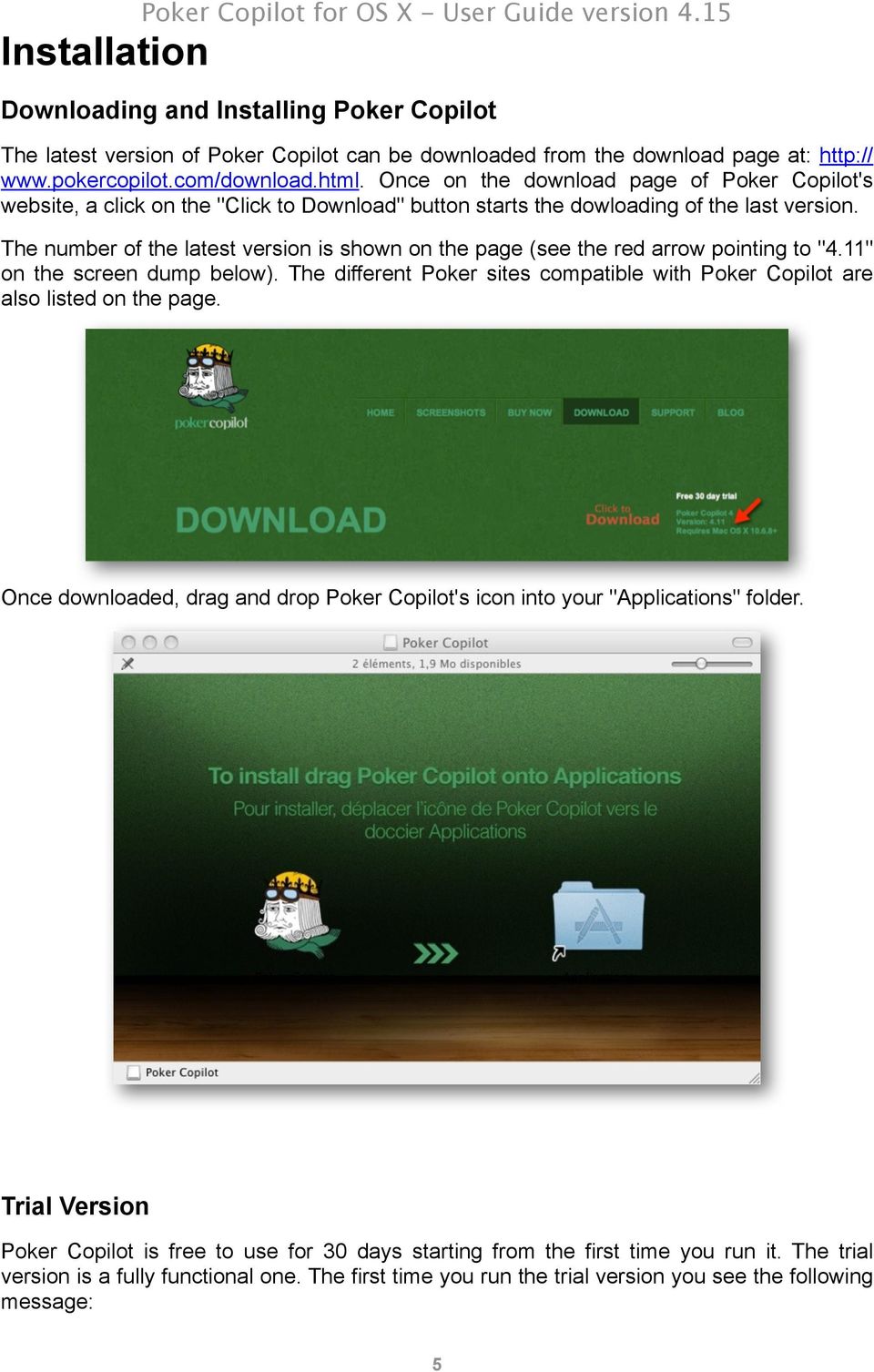
5 Installation Downloading and Installing Poker Copilot The latest version of Poker Copilot can be downloaded from the download page at: Once on the download page of Poker Copilot's website, a click on the "Click to Download" button starts the dowloading of the last version. The number of the latest version is shown on the page (see the red arrow pointing to "4.11" on the screen dump below). The different Poker sites compatible with Poker Copilot are also listed on the page. Once downloaded, drag and drop Poker Copilot's icon into your "Applications" folder. Trial Version Poker Copilot is free to use for 30 days starting from the first time you run it. The trial version is a fully functional one. The first time you run the trial version you see the following message: 5
6 When the trial period is over, Poker Copilot will ask for a valid licence number. You must buy Poker Copilot to get a licence key. Licence Key Once you've paid for Poker Copilot, you will receive from Poker Copilot's online shop your licence key and user name via . See below a copy of such a message to a new user called "John Smith": "Hi John Smith Thank you for buying Poker Copilot 4. Here is your license key: User name: John Smith License key: YP768E2cKSMWkDpspkzge0 6

7 K/Lt2Spla7HNBwEH99x772 z0ezweqju8vntiapcrtnst bpki/m6s1x06hxskvoyq== You need to enter the user name and license key into Poker Copilot 2 EXACTLY as written here. The easiest way to do this is using copy and paste." To avoid mistakes when typing the licence key and user name, the message suggests copying and pasting directly these items into Poker Copilot. Activating Poker Copilot When the activation dialog appears, paste your user name and licence key and click OK. Poker Copilot is now registered. Updating Poker Copilot Automatic Update Poker Copilot offers frequents updates on its website. Posts on Poker Copilot's blog ( blog.pokercopilot.com/) will inform you of the latest version and the different changes to the software. Click on Update now to launch the update process. Poker Copilot automatically checks for updates at startup and informs you when a new version is available. A window appears and gives the number of the latest version and the main changes to Poker Copilot. An update can take time especially when the database is restructured.you can pass on the upgrade by clicking on Update later. The next time you launch Poker Copilot it will ask you to update. 7

8 An update can take time especially when the database is restructured.you can pass on the upgrade by clicking on Update later. The next time you launch Poker Copilot it will ask you to update. You should always update when offered the opportunity. Bugs are regularly ironed out and new features are very frequently added. Clicking on Update Now launches Poker Copilot Updater, a specialized application that will take care of the whole updating process. Update steps are notified with percentage of progression as the updating process moves along (see "Downloading" below). The following icon appears in the dock during the whole updating process indicating that Poker Copilot is on automatic update mode: 8

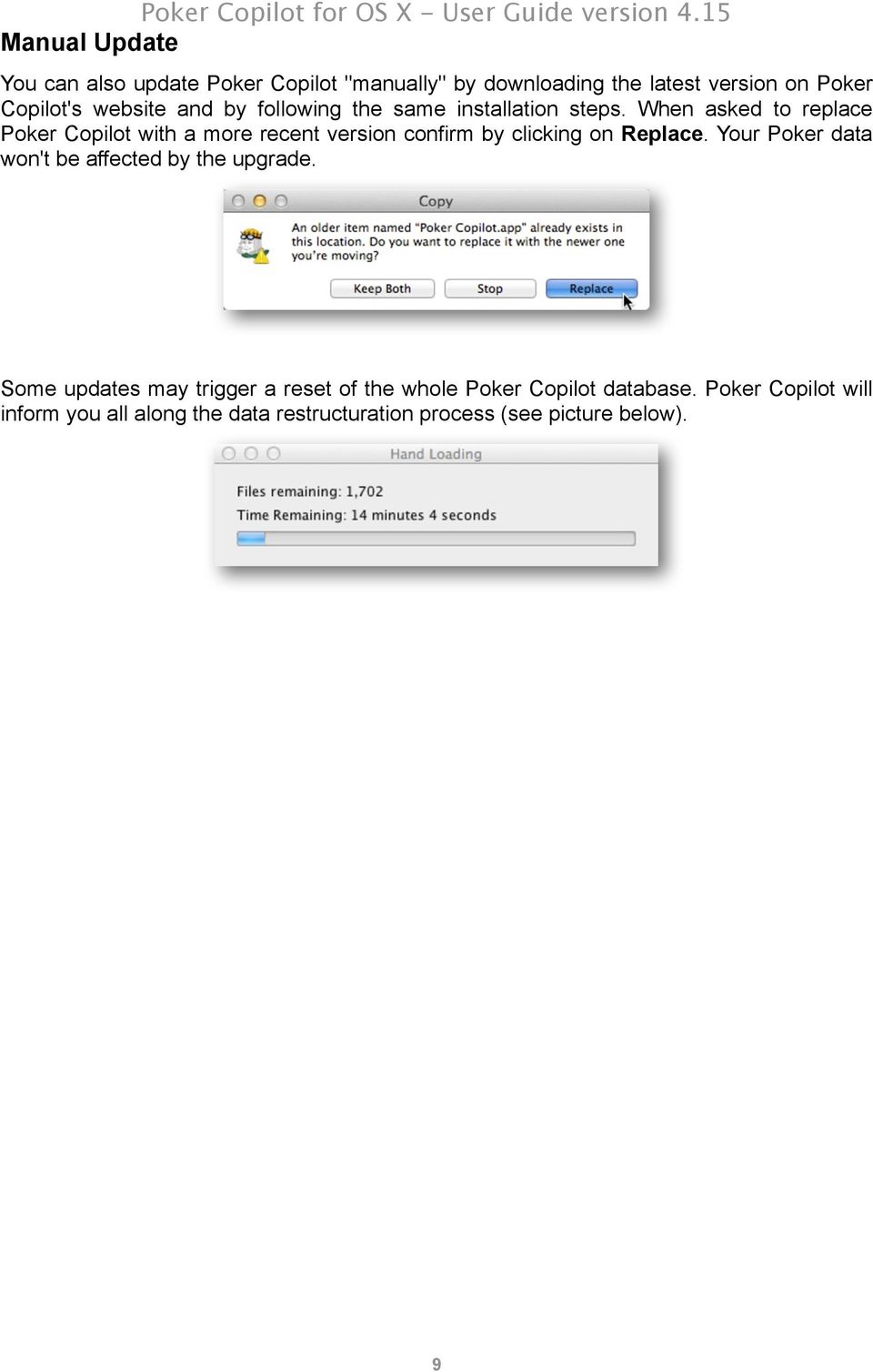
9 Manual Update You can also update Poker Copilot "manually" by downloading the latest version on Poker Copilot's website and by following the same installation steps. When asked to replace Poker Copilot with a more recent version confirm by clicking on Replace. Your Poker data won't be affected by the upgrade. Some updates may trigger a reset of the whole Poker Copilot database. Poker Copilot will inform you all along the data restructuration process (see picture below). 9
10 Configuration Foreword You must set up both programs, the one for your Poker room and Poker Copilot. Each Poker room has its own particular setup. It mainly consists of choosing your preferred seat at the poker table. Poker Copilot will use this information to place a display zone, filled with statistics, called an HUD (Head-Up Display) at the right location at the table, usually under the player's name. The setup procedure will vary according to how close the Poker room is working with Poker Copilot. Configuring your Poker software for Poker Copilot You may need to change some configuration options for your poker client software in order for Poker Copilot to function properly with your favorite online poker room. Follow the directions below for your poker software. PokerStars Poker Copilot can automatically import the hands you play at PokerStars. To enable this feature, the PokerStars client has to be configured to save your hand history and Poker Copilot must know where the hand history files are stored. Hand history saving is also required for the Head-Up Display. Configuring PokerStars requires three steps. All of the steps must be completed in order for Poker Copilot to work with PokerStars. 1. Enable hand history saving in the PokerStars client From the PokerStars menu bar, choose Options/Instant Hand History Options Check the checkbox labeled Save My Hands History. Change Keep Hand Histories for Days to 365. Ensure Language is set to English. 2. Enable tournament saving in the PokerStars client 10

11 From the PokerStars menu bar, chooose Options/Tournament Summary Options, Check the box labeled Save My Tournament summaries, Change Keep Tournament Summaries for Days to 365. Ensure Language is set to "English". 3. Set preferred seating for all table sizes (required for HUD) From the PokerStars menu bar, chooose Options/Preferred Seat In the Preferred Seat Setup part of this window, for each of the table sizes listed in the local menu, select your preferred seat by clicking on it. Once done, click OK. 11

12 FullTilt Validate both check boxes in the Auto-Center Settings. 1. Enabling hand history saving in the FullTilt client From the FullTilt menu bar, choose Options/Hand History Check the box labeled Save My Hand Histories, Ensure Hand History Language Selection is set to "English". Change Days to Keep Hand Histories to Once done click OK. 2. Preferred seat setup in FullTilt From the FullTilt menu bar, choose Options/Table Options/Preferred Seat In the Options/Preferred Seat window, choose your preferred seat for the 4 possible table sizes (9,8,6 and 2) and the 2 table views (Classic and Racetrack). 12

13 Click on Apply to save your choices and then OK. We advise you to check the Auto Center option. Merge network affiliated Poker room: CarbonPoker 1. Enabling hand history saving in CarbonPoker From the CarbonPoker menu bar, choose Settings/Hand History Settings Check the box labeled Enable Hand History. Use the local drop-down menu and choose Forever for the Keep hand history for: option. Once done, click OK. 2. Preferred seat setup in CarbonPoker From the CarbonPoker menu bar, choose Settings/Enable Preferred Seating. 13

14 From the same Settings menu, opt for Preferred Seating Settings In the Preferred Seating Settings dialog, check the box Enable Preferred Seating. For each possible table sizes (10, 9, 8, 6, 5 and 2) choose your seat Click OK when done. Ongame network affiliated Poker room: heypoker 1. Hand history saving It is automatic in heypoker, you don't have to set it up. 2. Preferred seat setup in heypoker Click on your username located in the upper right corner of the heypoker window. If you hold the mouse a local menu appears. Choose Settings and go to the Preferred seat panel. Check the Enable preferred seating box and choose your preferred seat at the table. Click Save Settings once done. 14

15 Check To check if Poker Copilot has detected your Poker room, see the following section: Check configuration of Poker software. Setting up your preferred seat in Poker Copilot For the HUD to work properly and display the right statistics at the right place, Poker Copilot needs information on the preferred seat for each Poker room you're playing at. For some Poker rooms like heypoker(ongame network) or PokerStars for instance, Poker Copilot automatically imports the preferred seat options chosen by the user in the Poker room client. For other rooms like Winamax or CarbonPoker (Merge network), you have to set this option up within Poker Copilot. Choose Preferences in the Poker Copilot menu, and then click on the Poker Rooms panel. For each Poker room listed in this window, choose your preferred seat. For all Merge Network affiliated Poker rooms for example, you have to chosse your preferred seat for 4 table sizes (Heads UP,6 Players Max, 9 Players Max, 10 players 15

16 Max). A click on one of the table sizes button allows you to choose your seat at the corresponding table. Simply click to mark your preferred seat for this table configuration (see the checkmark in the picture below for the 6 Max table size). Take notice that one mistake here and the players' statistics won't appear at the right places at the Poker table. Check all preferred seat setups when HUDs are not located properly. 16

17 Check configuration of Poker software Poker Copilot can check to see if your poker software is installed and configured correctly. To do so, choose Window in the Poker Copilot menu bar and then Diagnostics. Poker Copilot is going to check all the connected Poker rooms et make sure that for each one, all setups are in place so that Poker Copilot can work properly. In the following illustrated example, the HeyPoker room has been detected by Poker Copilot and the setup is fine, all lights are green. Each Poker room configuration parameters are listed in the left side of the window. If you click on one of those, you will get complementary information and explanations in the right side of the window. If you click for example on Preferred seat set, you may notice a "yes" written under the name of the setting and "Correct" in the Status field. Poker Copilot will also remind you of how to set up the preferred seat in HeyPoker. 17

18 In case one parameter has not been correctly set up and prevents Poker Copilot from working properly, the light attached to that parameter changes to red. See below an example where Poker Copilot could not find a connected Poker room. The indicator for Poker room running is red and "None" appears under the parameter name instead of the name of a connected Poker room. The Status field displays a "No supported poker room running" message. Do note that: - Each connected Poker room has its own specific settings, - If you play in more than one Poker room at the same time, Poker Copilot will only show the settings for the first detected room. In its main window, Poker Copilots always informs you whenever it has detected a configuration problem. An alert message appears in a pink zone. A click on How to fix triggers the appearance of the Diagnostics window. 18

19 Poker Copilot general configuration Before you use Poker Copilot you may want to customize the software. To set your preferences, click on Preferences in the Poker Copilot menu. Hand History Folders: This frame lists all the folders that include hand history and tournament summary files read by Poker Copilot at launch time. You can manually add or remove folders by clicking the + and - buttons. Auto-detect hand history folders: Uncheck this box if you do not want Poker Copilot to automatically find your hand history folders. Ignore hand history files before: o By default, this field is set to January 1st o Use the calendar if you want to enter another date. To get quickly to a recent date, click on the blue-coloured sentence showing the date of the day in the lower part of the calendar. 19

20 o o o Hand history and tournament summary files that are older than the date you enter in this field will be ignored by Poker Copilot as soon as you reset its database by choosing Reset Database in the File menu. The ignored files are not erased by Poker Copilot and can be taken into account again with the help of a subsequent database reset. Let's take an example. You would like to ignore all the hands you played before July 15th Enter that date in the Ignore hand history files before field and reset the database. The next time Poker Copilot is running, it will only load in its database the hand history and tournament summar files starting from July 15th 2013 and ignore older files. If you wish later on to have those older files back, simply enter for instance the date December 31st 2012 in the field and launch another database reset. You will then recover all the hands you played in Currency Symbol: If you want Poker Copilot to use a different currency symbol, you can enter it here. Starting bankroll: In order for the charts on the Bankroll and Detailed Bankroll to be accurate, you need to enter your starting bankroll sum here. It is now possible to enter a negative amount in this field. My playing day starts at: Enter the time you typically begin your poker sessions on each day. This is the time Poker Copilot uses to group your hands into days. This is very important if your poker sessions continue past midnight, as you don t want Poker Copilot counting your hands played past 12:00 AM as a different day. Language: Poker Copilot uses the language specified in your system settings by default; however, if you want to use Poker Copilot in a different language, you can set the language to use here. Choose a language in the local menu and restart Poker Copilot. Show in menu bar: Poker Copilot can show session winnings and/or the number of hands played for the current session in the menu bar. Take notice that when you quit Poker Copilot, the current session is over and the corresponding counters are reset to 0. Session data appear in blue in the menu bar when you turn out a profit and in red if you end up with a loss. In the following example, the current session result is a 3.00 loss for 62 and 1 tournament played. h a n d s Note: When you modify fields like the language used, the session starting time and the Ignore hand history file before, you need to restart Poker Copilot for the changes to take effect. An alert messsage appears whenever you change one of those fields. 20

21 21
22 Enabling Access for Assistive Devices The Poker Copilot Head-up Display (HUD) requires you to enable access for assistive devices in Mac OS X. This step only needs to be completed one time. To enable access for assistive devices: 1. In the Apple menu on the left side of the menu bar, 2. Select System Preferences... (in OSX version 10.8), 3. Open the Accessibility panel (see red arrow below), 4. Make sure the box Enable access for assistive devices is checked. 22
23 Using Poker Copilot The Concepts You must view Poker Copilot as a true database of hands played and related statistics. Poker Copilot is designed so that each of the different screens in the main window function in the same way. The main window uses the same layout for each screen, and the three concepts of filtering, getting detailed information, and drilling down are used in the same way on each screen. Poker Copilot Main Window Layout The Poker Copilot main window contains different elements. The filter bar is used to select the data displayed. The sidebar is used to choose and navigate the different presentations (tables, lists, charts ) of the selected data in the container, the central part of the window. The filter summary zone reminds you of the currently used filters (current month, real money tournaments on PokerStars in the illustration below). In the lower part of the window Poker Copilot displays the status bar and the selection summary. The status bar always displays the total number of hands and tournaments found by Poker Copilot at launch time once it has checked all the available hand history and tournament summary files. These files are located in the different folders listed in the General panel of Poker Copilot Preferences window (by the way, you should frequently save those folders if you value your Poker statistics). You can choose to hide the status bar by toggling it off the View menu. 23
24 The selection summary is one one the most interesting new feature of version 4. It is a quick and easy way to get an idea of your Poker results once you have selected the relevant data using the filters. Poker Copilot gives the totals for the Buy-in, Winnings and Take columns. The following example displays the results of playing in 6 max 1.00 buy-in NLHE tournaments on PokerStars for the current month (back to back dates), showing a loss of Filtering Filtering is an important concept in Poker Copilot. What you see in the container is always based on the current active filters. Filters can be changed using the filter bar at the top of the Poker Copilot main window. You can get detailed explanations on filters and filtering examples later on. You can choose to hide the filter bar by toggling it off the View menu. 24
25 Getting Detailed Information The second Poker Copilot concept is getting detailed information. Poker Copilot automatically collects statistics on your hand and your opponents. You can open a detailed information popup by right clicking on anything representing a collection of hands (for example, a particular hand type, tournament, stake level, etc.) or by using the Command + I hotkey. You may open as many information popups as you like. In the following example, the user wants to get detailed information on AQs (suited) type hands. Detailed information popups are useful for comparing various aspects of your game. By comparing the statistics shown in detailed information popups, you can answer questions such as whether you play AA differently from KK. Take notice that when you want to get detailed information on a tournament in the Recent Tournaments summary, you won't get a popup with all the usual statistics on that particular tournament but only some basic bits of information (see below). Drilling Down The third Poker Copilot concept is drilling down. Drilling down allows you to drill down, or narrow your results, to a collection of hands, and even further to individual hands. To drill down, start by selecting the type of data you want to investigate, for example positions. Then select a data subset you're interested in, "button hands" for instance. 25
26 Double-click on the "Button" line to show all hands played on the "button". You can get one level deeper by double-clicking on a specific hand and have a replay, for example the AKo (outsuited) hand, 12 th hand starting from the top. Drilling down enables you for example to analyse all hands played against a specific opponent, in a particular tournament or on a certain day. Filtering The filter bar, located at the top of the Poker Copilot main window, is used to filter the hands displayed and used on each of the screens. Each of Poker Copilot s screens is dependent on the filter settings. This means that if you activate a certain filter, that filter will affect all the different screens. For example, if you select Big Blind from the Position filter, every screen you view will only show data based on hands played from the big blind. 26
27 You can mix and combine all the filters according to your needs. Filters are a very powerful tool for analyzing every aspect of your game. You can find answers to simple questions; such as How much money did I make playing limit hold em tournaments last week? to more complex questions such as:: How often do I check-raise with high pairs?? How does that turn out? Which position is most profitable for this type of play? Example Problems Let s use some filters to answer the example problems above. The question about limit hold em profit can be answered simply. First, select Limit Hold em from the Game Type filter and then select One week from the Date range filter. This will limit the screens to limit hold em hands played last week. Then choose the Recent Tournaments summary. Your answer is given in the selection summary line at the botom of the screen. Regarding the check-raise issue, select High pairs from the Hand type filter and select Check-raised is True from the Advanced/Postflop filters. Now choose the Position summary. The filters limit the screen to high pairs where you check-raised. In one glance, you can see which position is the most profitable. You can drill down to any position to see the individual hands and their outcome and use the replay function. Available Filter Options Cash/Play: This filter switches between real money and play money games. Table Type: The table type filter switches between hands played in ring games and hands played in tournaments. Date Range: The date range filter limits hands to a specific date range. You can choose one of the predefined ranges (such as 1 Week, 1 Month or Year to date), or use the Custom... option to choose a custom date range. 27
28 The Custom option uses a calendar to help you select a precise date range. Table Size: The Table Size filter limits hands to a specific table size, such as Heads Up or 9 Player Max. Tournament players should make the distinction between table size, (the maximum number of players at one poker table), and tournament size, (the number of players taking part in a tournament), one of the options of the More array of filters. Some rooms offer for example 15 "players max " tournaments with a 5 "players max" table format. Game Type: The game type filter limits hands to a specific form of hold em poker, such as No Limit Hold em or Pot Limit Hold em. Position: The position filter limits hands to a specific position, such as Button or Big Blind. 28
29 More: This local menu contains filters not used as often as the others but which can be useful in certain situations. Poker Room selects hands played in a specific poker room. Stake Level/Buy-In filters hands played at a specific stake level (for ring games, example: 0.02/ 0.05) or buy in amount (for tournaments, example: 5). Hand Type filters specific hand types, such as high pairs and suited connectors. Hero filters hands based on the account you are playing under. If you play in several Poker rooms, all your Poker user names will be listed in the local menu followed by the room name in brackets. Starred hands filters hands starred by you. You can flag some hands while playing at the table or reviewing game sessions. Flagged hands appear with a yellow star. Last 10,000 hands limits hands to the last 10,000 hands you ve played. Advanced contains filters for all the statistics collected by Poker Copilot, groupeb by theme (Preflop, Steal, Postflop, Other). An example: Starting from the Recent Hands summary, you would like to select all the hands you raised preflop with. Go to the More/Advanced filter then choose Preflop/Raised Preflop/Is true. All the recent hands you have raised preflop with will appear in the window. If you choose Is False you will get all the recent hands you folded or limped with. 29
30 Filter Summary Box The filter summary box is shown at the top of the container, and shows all the currently active filters. Because you can mix and combine all the available filters, it is sometimes handy to have an overview of which filters are activated. The active filter box also contains the Reset Filter button, which will disable all activated filters and reset to the default filter settings (Cash Games, Cash, 1 Month, All table sizes, All Hold'em Hands and All Positions, all filters from the More menu are disabled). 30
31 Using the Head-Up Display The Head-Up Display (HUD) displays statistics for you and each of your opponents at the table. Under each player's Poker name appears a rectangular display filled with statistics. If your HUD is not placed correctly at the table, (for example it is located under another player's name) review your preferred seat setup (see the section on preferred seat setup). These statistics can be used to increase your edge and your profit. 31
32 Understanding the HUD HUD Player Stats For each player at the table, the HUD shows a panel containing statistics and possibly an icon (under certain conditions). You can configure the statistics displayed in this panel and various other options in the HUD configuration panel (jump to the relevant section). If you click on a panel and hold down the mouse button, you get a popup list of all the statistics available for that player. Players Icons Poker Copilot can display icons on the left side of each player s statistics panel to help you easily identify players whose play matches predefined rules. You can either use the rules 32
33 predefined by Poker Copilot, or define your own rules (see the section about configuring the HUD for details on using your own rules): : A rock is very tight pre-flop. If a rock puts money in the pot pre-flop, he probably has a premium hand. : A fish plays too many marginal hands. These players offer easy money like shooting fish in a barrel.. : In poker, a whale is a big fish (whales are actually mammals, but this is poker, not biology). A whale will play almost anything. : A calling station limps/calls too much. They are hard to bluff, as they like to see how the flop unfolds. Even if they don t hit the flop, they ll keep putting money in the pot to see the next card. : A gambler plays many types of hands. If a gambler reaches the flop, he plays aggressively post-flop. : A maniac doesn t like to be out-bet pre-flop. You ll need to be prepared to commit a lot of chips against these players. : An eagle plays a very solid all-round game, especially pre-flop. : A book plays in a very predictable way. This is the type of player who has read a poker book or two and follows them to the letter. : These (Red Circle, Green Triangle, Blue Square, Yellow Star) are extra symbols you can use with your own rules. : This is a player whose playing style doesn t fall into any other category. In the Player Icons panel of the HUD options, a click on the question mark button close to the profile name gives you a brief note on the profile. Important point: Icons will not appear right away in HUDs. You have to setup a minimum number of hands starting from which icons will show in HUDs. The logic behind this is that to be reliable most of Poker Copilot statistics need a certain number of occurences. You setup this number of hands threshold in the # of hands for colours and icons field in the General Panel of the HUD options. In the following example, icons will appear in your opponents' HUDs as soons as you have played at least 115 hands with them. 33
34 HUD Table Stats The HUD system can also display a table stats panel in the top-right corner of the table. The table stats panel contains the table average statistics for voluntarily put money in pot (VPiP), pre-flop raise (PFR) and Post-flop aggression frequency (Agg). It also contains controls to stop and configure the HUD, and flag a hand. The HUD Table statistics give you the "room temperature" and can be useful to determine your general strategy. Starring Hands If you want to mark a hand for future analysis, you can press the star-shaped button. This will flag the last completed hand (and not the current one) with a yellow star. You can quickly access starred hands from the Recent Hands summary. 34
35 Explanation of the HUD Statistics The Poker Copilot HUD tracks a variety of statistics. Below is an explanation of the different statistics measured by Poker Copilot. Once you are familiar with the meaning of the statistics and abbreviations, you can use them as a tool in your game. Hands Played (#) This is the total number of hands you were in. In tournaments, this number includes hands where you were sitting out, whereas these hands are not counted in ring games. In order for the statistics measured by Poker Copilot to be trustworthy, they should be based on a large number of hands. Ideally, you should play at least 10,000 hands to gain an accurate picture of your playing style. Big Blinds Won / 100 Hands (TBB) Your winnings for each hand are expressed as a number of big blinds. For example, if you win $2.30 on a table where the big blind is $0.10, then your winnings for that hand are 23 big blinds. Your wins and losses as a number of big blinds are averaged and multiplied by 100. This results in a normalized value useful for comparisons, regardless of the stake level of each table. Preflop Statistics Flops Seen (FS) This indicates in what percentage of hands you reached the flop without folding. This statistic counts every hand, regardless of whether you reached the flop without betting (for example, if you were in the big blind). Voluntarily Put $ in Pot (VPiP) This measures how often you voluntarily invested money into a hand. Paying the big blind, the small blind, or the ante is not considered voluntary. Therefore this percentage indicates how often you called, bet, or raised. The lower this value, the tighter your hand selection is. The higher, the looser. Just how tight or loose depends on how many opponents you are playing against. The formula for calculating VPiP is: Voluntarily put $ in pot % = (times voluntarily put $ in pot) *100 / (Hands played) Preflop Raise (PFR) The PFR statistic indicates how often you have raised before the flop is seen. A high value is an indicator of an aggressive player. A low value indicates a passive player. The formula for calculating PFR is: Pre-flop raise % = (times pre-flop raised) * 100 / (pre-flop raise opportunities) Called Preflop Raise (CPFR) This is a measure of how often you called another player's pre-flop raise, when you have the opportunity to do so. The formula for calculating CPFR is: 35
36 Called preflop raise % = (times called preflop raise) * 100 / (number of opportunities to call preflop raise) Unopened Preflop Raise (UOPFR) This is a measure of how often you raised preflop when all players before you have checked or folded. The formula for calculating UOPFR is: Unopened preflop raise % = (times made an unopened preflop raise) * 100 / (number of opportunities to make an unopened preflop raise) Three-bet Pre-flop (3B) This is a measure of how often you three-bet pre-flop. In pre-flop betting, to three-bet is to raise after at least one other player has raised. The formula for calculating 3B is: Three-bet preflop % = (times three-bet preflop) * 100 / (number of three-bet preflop opportunities) Folded to Three-Bet Preflop (F3B) This measures how often you folded to another player's three-bet pre-flop, when you have the opportunity to do so. The formula for calculating F3B is: Folded to three-bet preflop % = (times folded to three-bet preflop) * 100 / (number of opportunities to fold to three-bet preflop) Four-bet Preflop (4B) This is a measure of how often you four-bet pre-flop. Four-betting is similar to three- betting, except that you are re-raising after a player has already re-raised. The formula for calculating 4B is: Four-bet preflop % = (times Four-bet preflop) * 100 / (number of Four-bet preflop opportunities) Folded to Four-bet Preflop (F4B) This measures how often you folded to another player's four-bet preflop, when you have the opportunity to do so. The formula for calculating F4B is: Folded to four-bet preflop % = (times folded to four-bet preflop) * 100 / (number of opportunities to fold to four-bet preflop) Squeeze Bet (Sq) This is a measure of how often a player makes a squeeze bet preflop. A squeeze bet is made by a player when all of the following occur: 36
37 a) A villain raises, b) One or more players call the raise before the action comes to the hero, c) The hero re-raises the villain. There must be at least one caller and no re-raise between villain and hero to define a squeeze. Squeeze bet % = (times made a squeeze bet) * 100 / (number of squeeze bet opportunities) Steal Statistics Blind Stealing Attempts (BSA) This indicates how often you attempt to steal the blinds when you had the opportunity to do so. Poker Copilot considers that you have a blind-stealing opportunity when you are on the button (last before the blinds to make an action), and every player so far has folded. An attempt to steal the blinds is when you raised when given a blind-stealing opportunity. A good player attempts to steal the blinds often, but not always. The formula for calculating BSA is: Blind stealing attempts % = (times blind stealing attempted) * 100 /(number of blind stealing opportunities) Folded Big Blind to Steal Attempt (FBB) This measures how often you are facing a blind steal attempt when on the big blind and you fold. Either the button or the small may have made a blind steal attempt blind. Note that if the button is trying to steal but the small blind has already called the bet, then you are not facing a blind steal attempt. The formula for calculating FBB is: Folded big blind to steal attempt % = (times folded big blind to steal attempt) * 100 / (number of opportunities to fold the big blind to a steal attempt) Postflop Statistics Postflop Agression Frequency (Agg) This indicates how aggressive you are post-flop. It is calculated by counting the number of hands in which you've either bet or raised, then dividing this by the number of hands in which you've either bet, raised, called, or folded, and multiplying by 100. The higher this number, the more aggressively you are playing. Note that this measure must be interpreted in combination with Flops Seen. Players who see very few flops will naturally tend to have a higher aggression percentage because they are only playing top-quality hole cards. The formula for calculating Agg is: 37
38 Aggression frequency % = (times bet or raised post-flop) * 100 / (times bet, raised, called, or folded post-flop) Postflop Aggression Factor (AF) This is calculated by counting the number of hands in which you've either bet or raised post-flop, then dividing this by the number of hands in which you've called post-flop. This value ranges from zero to infinity, which makes it awkward to use. Poker Copilot includes this statistic for comparisons with Poker Tracker statistics. Post-flop aggression % is a superior way of measuring aggression. The formula for calculating AF is: Aggression factor = (times bet or raised post-flop) / (times called post-flop) Check-raised (CR) A check-raise is when you check, let another player bet, then raise. It is a cunning play that is best used seldom. Note that due to the typically very low check-raise percentage (2% or lower) and for the sake of meaningful comparisons Poker Copilot shows this value to two decimal places.the formula for calculating CR is: Check-raise % = (times check-raised) * 100 / (number of checkraise opportunities) Check-raised Flop (CR_F) Mesures the frequency you check-raised at the flop.the formula is: Check-raise flop % = (times check-raised on flop) * 100 / (number of check-raise on flop opportunities) Check-raised Turn (CR_T) Mesures the frequency you check-raised at the turn.the formula is: Check-raise turn % = (times check-raised on turn) * 100 / (number of check-raise on turn opportunities) Check-raised River (CR_R) Mesures the frequency you check-raised at the river.the formula is: Check-raise river % = (times check-raised on river) * 100 / (number of check-raise on river opportunities) Continuation Bet (CBET) A continuation bet is when you were the last to raise preflop, and hence the aggressor, and you continued that aggression on the flop by being the first to bet. The formula for calculating CBET is: 38
39 Continuation bet % = (times made a continuation bet on the flop)* 100 / (number of opportunities to make a continuation bet on the flop) Folded to Continuation Bet (FCB) This indicates how you respond when you are facing a continuation bet on the flop. The formula for calculating FCB is: Folded to continuation bet % = (times folded to continuation bet on the flop) * 100 / (number of opportunities to fold to continuation bet on the flop) Continuation Bet on Turn (TCBET) This statistic is similar to CBET, but applies when making a continuation bet on the turn. The formula for calculating TCBET is: Continuation bet on turn % = (times made a continuation bet on the turn) * 100 / (number of opportunities to make a continuation bet on the turn) Folded to Continuation Bet on Turn (FCB_T) This indicates how you respond when you are facing a continuation bet on the turn. The formula for calculating FCBT is: Folded to continuation bet on turn % = (times folded to continuation bet on the turn) * 100 / (number of opportunities to fold to continuation bet on the turn) Donk Bet on Flop (DB_F) Mesures how often a player makes a donk bet on the flop. A player makes a donk bet when he was the caller pre-flop, yet opens with a bet on the flop. An example: Player A was the last to raise pre-flop. Player B called Player A's raise pre-flop. Now on the flop, before the action gets to Player A, Player B opened with a bet. B makes a donk bet. The formula for calculating DB_F is: Donk bet on flop % = (times donk bet on flop) * 100 / (number of donk bet on flop opportunities) Donk Bet on Turn (DB_T) Measures how often a player makes a donk bet on the turn. A donk bet on the turn is made by a player when all of the following occur: a) The player calls another player's pre-flop raise; and then b) The player calls the pre-flop aggressor's continuation bet on the flop; and then 39
40 c) The player opens with a bet on the turn before the pre-flop aggressor has the chance to check or bet. The formula for calculating DB_T is: Donk bet on turn % = (times donk bet on turn) * 100 / (number of donk bet on turn opportunities) Donk Bet on river (DB_R) Measures how often a player makes a donk bet on the river. A donk bet on the river is made by a player when all of the following occur: a) The player calls another player's pre-flop raise; and then b) The player calls the pre-flop aggressor's continuation bet on the flop; and then c) The player calls the pre-flop aggressor's continuation bet on the turn; and then d) The player opens with a bet on the river before the pre-flop aggressor has the chance to check or bet. The formula for calculating DB_R is: Donk bet on river % = (times donk bet on river) * 100 / (number of donk bet on river opportunities) Went to Showdown (WtS) This is a measure of how often you were still in the action when the hand went to showdown. Showdown occurs when the final round of betting is complete and at least two players are still in. The formula for calculating WtS is: Went to showdown % = (times went to showdown) * 100 / (times flop seen) Won at Showdown (WaS) This indicates how often you won a hand in a showdown. It is calculated as a percentage of all hands in which you went to showdown. The formula for calculating WaS is: Won at showdown % = (times won at showdown) * 100 / (times went to showdown) Won Without Showdown (WwS) This indicates how often you won a hand without going to showdown because all other players folded. It is calculated as a percentage of hands where you saw the flop. The formula for calculating WwS is: Won without showdown % = (times won without showdown) * 100 / (times flop seen) 40
41 Other Statistics M-ratio (M) This measures the health of your chip stack and represents the number of passes of the dealer button (some talk of "orbits") you can survive without winning or losing any chips. Your M-ratio is an important number to be aware of during tournament play. The formula for calculating M is: M-ratio = (Stack Size) / ((Small Blind) + (Big Blind) + (Total antes)) Example # 1: 9 players table, SB = 15, BB = 30, Stack = 900 chips, M = 900/ (15+30) = 20 Example # 2: 9 players table, SB = 100, BB = 200, Ante = 20, Statck = 2880 chips, M = 2880/ ( (9 x 20)) = 6 Big Blinds Remaining (BB) This is a measure of the amount of money you have expressed as a number of big blinds. For example, if you have $3.00 at a table where the big blind is $0.10, then you have 30 big blinds. 41
42 Configuring the HUD Poker Copilot s HUD has various configuration options. To configure the HUD, choose Head-up Display from the Poker Copilot menu, then select Head-up Display Options. You can also choose Preferences from the Poker Copilot menu and click on the Headup Display panel. The HUD configuration dialog contains four sections. You can navigate between the sections by clicking on the button for General, Layouts, Colours, and Player Icons. General The general section allows you to configure various options for Poker Copilot s HUD: HUD Type: choose Static - reliable unless you play in Zoom/Rush mode in which case you have to select Dynamic - experimental. Prefer None - disable HUD if you do not wish to use the HUD. Hero HUD: This option allows you to decide how Poker Copilot displays your own statistics. You can choose whether you want to display your all-time statistics 42
43 (starting from the oldest hand history file detected by Poker Copilot at launch time), or only the statistics for your current session and tournament/table. The Current session and tournament statistics option should be used when playing multi-table tournament where you may frequently move to other tables as the event progresses. The Current session and table statistics only show your statistics for the current table. Choose Don t show if you do not want Poker Copilot to display a panel for your statistics. Opponent HUD: Similar to the Hero HUD option, this option allows you to decide if you want Poker Copilot to display all-time statistics for your opponents or only the statistics for the current session and tournament (see comments from last section). Resize HUD panels: Enable this option to allow the statistics panels to scale down with the window size of the table. Disable this option if the statistics panels become too hard to read when you scale a table down. Show mucked cards: Enable this option if you want the HUD to briefly show a player s mucked cards, your own cards, and the community cards after a hand is completed. If you want to see mucked cards you can also ask Poker Copilot to display the mucked Cards window (jump to the mucked card window section). Show table stats: when this option is activated, a mini HUD with the table VPiP, PFR and Agg statistics will be displayed in the upper right corner of the table window. # of hand for colours and icons: Move the slider to change the number of observed hands required before a player s statistics panel turns to a bright yellow. If you have set the tab to 175 for example and your opponents' HUDs are set to All time statistics, if the statistics if your HUD are turning to a bright yellow it means that you have already played many hands with this player before. This number of hands threshold is also used to trigger the appearance, in the HUD, of a player's icon and the different colours attached to specific statistics values (see the section on the Colours panel in the HUD options). The default value for this field is 25. In the following example, the threshold of 110 hands has been reached for this player and we can notice that: The number of hands played, 123, is greater than the threshold of 110. The statistics are dislayed in a bright yellow compared to the default rather neutral display. Compare the illustration above with the one below where the threshold is not yet reached (only 19 hands played). 43
44 The calling station icon is also displayed (see the Player Icons panel in the HUD options ). Layouts Some statistics do appear bright green, the result of options taken in the Colours panel in the HUD options. The layouts section allows you to configure which and how statistics are displayed in the HUD panels. All the setup changes you make are instantly displayed in the preview zones. It's in the upper part of the Layouts panel that you change the HUD's look and feel. 44
45 Statistic labels: When this box is checked (which is the default option) you keep the name of the statistics in the HUD (in their abbreviated form). If you have not used Poker tracking software before, we strongly recommend keeping the statistics labels in the HUD. A display filled with numbers only may be difficut to read if you are not familiar with the statistics (see picture below). Show player names in HUD: Activated by default, this option creates an header with the player's Poker name, "Hero" in the preview HUD, separated from the rest of the HUD by a line (which plays an interesting part in tournaments). Sometimes, especially in multi-table tournaments where players frequently switch tables, you can easily get confused and having the player's name in the HUD helps you assign the right profile to the right seat. We strongly advocate showing the player's name. This name header is also used in note taking management (see the relevant section) and M monitoring (see details on M). Show player icons in HUD: Activated by default, this option places an icon on the left side of the HUD. These symbols are used to profile opponents and sum up the way they play at the table (see the section on icons and how to set them up). Icons only appear when a certain number of hands is reached (see the # of hands for colours and icons option). HUD font: Click on Select... to choose which font Poker Copilot uses for the HUD. Background and Opacity: You can change the HUD's background colour and opacity. You should investigate the room's setup (felt colour, background colour, style ) to avoid any colour mismatch that will render your HUD hardly readable. In the main part of the Layouts panel, you select which pieces of information you would like to be displayed on your HUD either in Ring games or Tournaments modes. For each mode you can choose between 5 possibilities, 3 preset and 2 free slots (Custom1 et Custom 2): You can show a maximum of 16 different statistics on the HUD panel. To change the statistic shown in a particular cell, click on the cell and choose the statistic you would like displayed in it, or click on None to leave the cell blank. 45
46 As you build up your HUD, the Preview HUD will give you a faithful version of the one that will appear under each player's name at the table. You can also make changes while playing at the table. About M: If you play in tournaments we strongly advise you to put M in your HUD panel. Poker Copilot will assign different colours to the possible value of M, following the zone system promoted notably by D. Harrington (in his famous trilogy "Harrington on Hold'em"). When M is equal or less than 5, its colour turns to red and when it is more than 20 it is displayed in a comforting green. In one glance you have a precise idea of the players' current stack situations at the table (see below for examples of HUDs with different M colours) In the same way, when you keep the player's name in the HUD, the separation line below the name will also give you a visual feedback on M. In the first stage of a tournament, this line will be mostly green (see below an example with an M of almost 27): When M falls between 10 and 20 the line colour turns to yellow then orange and pink in the end when it is less than 5 (see the pictures below for examples). You may also notice that as you're edging close to the end, the white part of the line is getting bigger. 46
47 This player name zone is equally important in note taking management. If you have written a note on a player, a small yellow pencil will appear at the right side of this zone (see example below). Note taking is one of the new features brought by Poker Copilot version 4. (see details on note taking). Finding the best HUD configuration is a matter of compromise and experience. On one hand, you would like to have all the possible information under your eyes and on the other hand available space to display all this information on the poker table is limited. Trying to fit a fully charged and yet effective HUD on a 10 player Max table is not an easy task. 47
48 Colours The Colours section allows you to configure the colours used for percentage-based statistics. You can tell Poker Copilot to use different colours based on a particular statistic s value. For example, if you want to easily identify players likely to fold to your attempts to steal the blinds, you might tell Poker Copilot to colour the FBB statistic green if a player has a high FBB value. In the example illustrated below, FBB will be displayed in a hopeful green if it has a value of 70% or more and in a pinkish red if it falls under 40% visually urging you to be cautious (villain will defend his BB). To define a colour for Poker Copilot to use for a statistic, simply click on the slider track for the statistic you want to define the range for. Poker Copilot will create a new slider for the newly defined range. You can drag the slider to adjust the range used by Poker Copilot. To change a colour, click on the slider you want to change. A popup of common colours will appear. If you want to use a different color, click the arrow to bring up a colour selector. You can use the colour selector to choose the color you wish to use. To remove a range, click the slider you wish to use and drag it off of the slider track until the cursor changes to a poof (white cloud effect) icon. 48
49 Four colours themes are available, three preset and one custom. Pure Gold is the default option. Take notice that colours will take effect only if you reach the minimum number of hands indicated in the # of hands for colours and icons field of the General panel of the HUD Options. Player Icons The Player Icons section allows you to define rules for displaying player icons in player statistics panels. The Rules for dropdown menu allows you to define different rule sets for different hold em variations and table sizes. 49
50 Rule sets for 6 max tables apply to 4 max and 5 max ones. A 9 max table will use the 10 max one rule set. Use the + and - buttons to add and remove rules. Use the drop-down menus to choose an icon to display for players whose stats match the rule. Enter the criteria you wish to use for the rule in the text box. The format for entering a criterion for a rule is: (Statistic) (Comparison operator) (Number) Statistic is the statistic you want to compare. Refer to the section on HUD statistics for a full list of the statistics tracked by Poker Copilot. Comparison operator is one of the following operators: <: Less than, <=: Less than or equal to, >: Greater than, >=: Greater than or equal to, Number is a constant value you wish to compare against the statistic. If you want to define multiple criteria for a rule, use the word and to combine criteria. For example, if you want to define a Gambler (see here the different possible icons) as a player who raises pre-flop over 25% of the time and records an Agression Factor greater than 50, you would enter the rule for Gambler as (upper case caracters are automatically lowered): pfr > 25 and agg > 50 Here is a typical Gambler HUD: Let's check that the HUD stats match the criterias; VPiP > 25 (30 for this player) and Agression > 50 (52 for this player). Take notice: Icons will only show if the minimum number of hands you entered in the # of hands for colours and icons field is reached (see the General panel of the HUD options ). 50
51 Configuring HUD when playing at the table When you are playing at the Poker table you can configure the HUD without having to switch to Poker Copilot by using the craned wheel in the table HUD. All the setup options are available in the associated local menu (see options below). Replaying Hands in Poker Copilot Replaying a specific hand is one of the major feature of Poker Copilot. Once you have selected a hand (9s8s in the example below), a double click on the corresponding line brings up the replay window. You can also use the Command-R keyboard shortcut once you have selected a hand in the list. Finally, once on a line, a control-click combination opens a contextual menu, select the View In Hand Replayer option. 51
52 When you open the replayer window: - HUDs at the start of the hand are displayed, - Players are identified by their position instead of their Poker names. Stack counts are displayed under position names. If there is a note on a player, a small pencil appears - Hero's hand is face up (9s8s), - In the lower part of the replayer, you have several pieces of information that identify the hand; tournament number, blinds level, hand number - In the lower right corner of the replayer, Poker Copilot gives the winning odds of your hole cards at the start of the hand. You can change the appearance of the replayer window by: - Turning off HUDs, - Turning off the Odds corner, 52
53 - Showing player names instead of positions (use the Anonymise box), - Playing the hand backwards, starting from the result. To replay the hand, click on the play button. The replayer progresses from one player to another and highlights each player's move (a raise to 80 from the cut-off player): You can click on pause anytime to freeze the action. 53
54 You can also use the tab on the rail to move forward or backward in the hand. The F on the rail marks the flop's appearance, T is for the turn card's and R for the river's. Note that odds are updated as the hand progresses. Our hero's hand winning probability, in the example, jumped to 59% at the flop from 23% preflop. If you are text inclined, you can ask for a text version of the replay by clicking on the Text button in the replayer. Once you have selected a hand in a list, you can also use the control-click combination and its associated contextual menu to choose View Hand History Text (or Command-T). This transcription can be made in 3 different formats (see the following picture). Here is our hand in a formatted text transcription: 54
55 With a simple copy and paste you can, via , send to your Saturday night poker buddies that famous hand where your AA lost against 76s. The 2+2 Format has become the norm for sending hands to Poker forums. The transcription is alway anonymous (even if you uncheck the Anonymise box). And last but not least, by clicking on Record in the replayer window, you can save your hand as a ".mov" file, playable by QuickTime, VLC and the likes. This file will be saved on the desktop with the name of the Poker room and hand number included in the file name. Take notice that the saved file is a stripped-down version of what you can see when replaying the hand in Poker Copilot. HUDs, winning probabilities and other pieces of information are lost in the conversion. You can also send this ".mov" file to your Poker buddies via . Here is how our hand appear in the Finder as a ".mov" file. Adjusting Pre-flop Play In pre-flop play you want to focus on profiling players. When an opponent enters a pot, you want to know if he represents a good hand or not. Once you have mastered this, you can focus on exploiting the opponent's playing style. 55
56 There are a few statistics that can help you to identify an opponent's style. The most important are VPiP and PFR. VPiP and PFR The VPiP stat shows how often a player adds money to the pot pre-flop and determines if a player is loose or tight. A value of 100 would mean that a player plays every hand and a value of 0 means that a player doesn't play any hands. The PFR stat shows how often a player raises before the flop and determines whether a player is passive or aggressive. A value of 0 means that a player never raises pre-flop and a value of 100 means that a player raises every hand pre-flop. Against a tight player The VPiP and PFR values give a rough estimate to the hole cards of a player. For example, take a player who has a VPiP of 10 and a PFR of 10. This player only plays 10 percent of his hands. Also, when he plays, he will raise before the flop. This player has a tightaggressive game. This information helps you increase your edge in two ways. First, since this player only plays 10 percent of the time (or 1 in 10 hands), we can assume that when he plays, he will have a decent hand. You might want to avoid playing against this opponent or proceed with caution. Second, since this player only plays 1 in 10 hands, he won't be playing the other 9, so when he is in the big blind position you might want to try and steal the pot, because he will fold about 90% of the time Against a loose player A loose player will show a higher value for VPiP. If the player has a low value for PFR it means that he will limp in with a lot of hands. If the player also has a high value for PFR he will raise a lot of hands as well. Imagine a player who has a VPiP of 50 and a PFR of 25. This player will play 1 in 2 hands and even raise 1 in 4. Therefore, when this player raises he won't have a premium hand all the time. Also, when this player limps in with a hand, you might want to consider raising more often. Since this player will raise with a lot of hands (PFR is 25), when he limps he probably holds a hand that isn't worth raising even to his standard. Using advanced statistics pre-flop More advanced statistics are BSA, FBB, CPFR, and F3B. The BSA (blind-steal attempts) stat show how often a player raises from the button in a pot where everybody else has folded. If a player has a very high BSA value and you are one of the blinds when he is the button, you might want to consider re-stealing more often, thus reraising pre-flop. The opposite of BSA is FBB, or fold to big blind steal attempts. This shows how often a player folds his big blind to a raise from the button. When a player has a high value for FBB you might want to consider raising into his blinds from a late position more often. 56
57 The CPFR and F3B stats can be used to improve your exploitive play even more. CPFR shows how often a player calls a pre-flop raise, taking the hand to the flop. If a player has a high value for CPFR the hand will most likely go to the flop so you should consider if you want to play a flop with your hole cards. The F3B stats shows how often a player folds to a re-raise pre-flop. Think of the loose player described earlier. If this player has a high F3B value, you might want to consider reraising more often. If the player has a very low F3B value you might not want to risk any more money and simply call because you probably won't get him to fold pre-flop. 57
58 Adjusting Post-flop Play Adjusting post-flop play comes down to exploiting your opponent's play. Poker Copilot offers various statistics that can help you with this. The article on pre-flop play shows how to determine if a player is tight or loose and passive or aggressive. On the flop you can continue this analysis. The most important statistics are Agg, CBET and FCB. Agg The Agg statistics shows how aggressive an opponent is. The more an opponent raises and re-raises, the higher the value for Agg. If an opponent is passive and calls more often, the value for Agg will be low. Against a very aggressive player you might want to be more deceptive and use techniques as slow-playing and check-raising because it is most likely that if you check, the opponent will bet. Against a very passive player you want to do your own betting and be aggressive. Make him pay for the turn and river. However, be aware that a tight-passive player could have a strong hand, so you need to have a decent hand yourself if this opponent cannot be bluffed. CBET and FCB The CBET statistics shows how often a player makes a continuation bet. A continuation bet is a bet from the opponent who raised pre-flop. If a player has a very high CBET value, it means that he will bet on the flop, regardless of whether the flop improved his hand or not. You might want to re-raise more often against this player. The FCB statistic shows how often a player will fold to a continuation bet. If a player has a very high value here it means that he will only continue to play if the flop has improved his hand. You might want to raise more often against this opponent, regardless of whether the flop improved your own hand or not. When this opponent decides to play on, you can be quite sure the flop has improved his hand. 58
59 Poker Copilot Screen Reference Basic Statistics The Basic Statistics screen shows a few important things. First, the column on the left, titled Today, will show you the most important statistics for your play today. The title of the left column depends on the period selected with the "Date Range" filter. If you choose Yesterday in the Date Range filter, you can easily get the data to compare your performance of the last two days. If you choose a custom date range with the help of the calendar, this date range will be used as the column title. If you use the 1 Month date range for example, the name of column will be Last 30 days or Last 31 days depending on the month (see previous picture). If you hold the mouse on one of the statistics name, a yellow "tip zone" appears, giving you a brief comment on the statistic (see the picture below where Poker Copilot is tipping the user on VPiP). The Basic Statistics screen is great as a one-shot overview of your play and an indicator to possible leaks. If you want to compare more or other statistics, look at the Advanced Statistics screen. Advanced Statistics The Advanced Statistics screen is similar to the Basic Statistics screen. Its purpose is to give you a one-shot overview of your recent play. However, the Advanced Statistics 59
60 screen shows all the available statistics for your play, while the Basic Statistics screen only shows the more common ones. All the stastitics are presented by themes following more or less the flow of a hand; preflop, steal (blinds stealing), postflop. Showdown statistics are grouped under the Other section. Some statistics like the Check raise or the Donk bet ones are detailed by street (flop, turn, river). Some others are declined by position (for example the 3-bet preflop ones). Numbers in parenthesis placed near percentages for each statistic are important. Some statistics are only significant after a certain number of occurences. Some Poker authors think that to be reliable, the 3-Bet preflop statistic for example, needs a minimum sample of 100 opportunities. In the following example, this player's 3-Bet preflop statistic of 7% is significant because there is a sample of 215 opportunities where he could have 3-Bet preflop. You can have a rather clear idea of his range when he 3-bets you with this percentage. Generally speaking, when a poker move is not often used (a continuation bet on the river for instance) its corresponding statistic needs a much larger opportunity sample to be reliable. Tournaments You can analyse your tournament game from three different angles. If time is of essence, then choose the Tournaments by Date summary. If you take part in different kinds of tournaments, select the Tournament by Type summary to know in which type of tournament you're good or weak at. Finally, if you want a less specialized view of your tournament activity and the ability to do searches, go for the Recent Tournaments summary. 60
61 - Information is presented in tables (Tournaments by Date adds a chart in the upper part of its window). - You can sort any column by clicking on its header (use the small black triangle in the column header to control sorting order). - You can change any column width. Place the cursor at the intersection of two columns and drag to your left or right to reduce or enlarge the column. - All three screens include a summary zone at the bottom of the window with totals or averages (for percentage data) for the current selection. - You can start drilling down from any line of the table. You can for example start with the Tournaments by Type summary and end up replaying a specific hand you lost with in a Sit & Go tournament. Tournaments by Date The Tournaments by Date summary helps you analyse in several ways, (including a chart), the time you've spent playing poker. The summary name changes to Hands by Date when the filter Cash Games is active instead of Tournaments. The picture below shows an analyse of the number of tournaments played by day during a one month period. The time unit used to dissect your poker activity can be: - The Day, which is the default option (see previous picture for an example), - The Week (providing the date range is wide enough, it is not very interesting to analyse your Poker activity by week if you have only selected a 3 days date range), - The Month (providing the date range is wide enough), - The Week Day (we want to know here if playing on fridays in the last 6 months has been more profitable than grinding on sundays or in which day of the week were you playing your best Poker), 61
62 - The Hour (we want to know here which hour of the day is the most profitable one). Here is a list of the different data included in the summary, that can also be illustrated by a chart (the number of tournaments is the default variable plotted in the chart): Remarks: - The same data appear in the Tournaments by type. - Winnings is the amount of money paid by the poker room when you win. - Net = Winnings - Buy-in. - The Return on Investment (ROI) ratio is the ultimate measure of your Poker performance. Here is an example: You took part in a 10 players Sit & Go with a 5 buy-in, you finished at the second place and won Your net is 8.56 ( ). Your ROI ratio is 171% (you invested 5.00 to win 8.56). - In the Money (ITM) measures the frequency at which you end up in paid places in tournaments. If you take part in 4 tournaments in a session and are getting paid in three, your ITM percentage for that session is 75% (3/4). Once your date range is selected (you can use other filters too), choose your time unit and the data to be plotted (one variable only). Examples Net won daily (over a month) 62
63 Number of tournaments played by week (over a month) Remark: the week number is included in the Date column. ITM monthly ratios (over 3 months) 63
64 Net won by day of the week (over a month). In this example, looking at the chart you should probably play on Saturdays instead of Wednesdays. A double click on the Wednesday line in the table under the chart brings all the tournaments of the selected period played on a Wednesday for further analysis. The name of the day appears in the header part of the summary (see red arrow in the picture below). If you hold the mouse on one of the chart bars, a yellow tip zone with the name of the day and the net won for that day is displayed. 64
65 Net won by hour (over a month) Tournaments by Type The chart shows that you should avoid playing between 06:00PM and 08:00PM. You should naturally try to analyse the tournaments played in those hour slots to try to find an explanation. Your analysis should also be made on a much wider time range (than over a one month period only). In an never ending effort to attract customers, the tournaments offer from Poker rooms is getting so large (and I am only talking of NLHE) and varied that most of the players do play in different kind of size, formats and at different buy-in levels. It is therefore important to analyse one's Poker performance by the type of tournament played. The Tournaments by Type summary lists all the tournaments played in the selection starting from freerolls to the ones with the highest buy-in amount and number of players taking part. 65
66 A double click on a ligne displays all the tournaments of the same type ( players in the picture below). The tournament type appears in the summary title zone (see the picture below). All that has been said on how to manipulate data in the Tournaments by Date summary is also valid here. Recent Tournaments The Recent Tournaments summary lists all the tournaments played in the selected period starting from the most recent ones. What has been explained for the last two summaries in terms of data manipulation is also valid here and we'll rather insist on the differences. 66
67 Recent Tournaments is the only summary to give your ranking in tournaments, look in the Result column. If you are close to the first place, the percentage placed at the right of your ranking tends to 100% and the column's width tends to be filled with green. Recent Tournaments and Players are the only summaries with a search box (see picture below). The search is limited to the Description Column. The search criteria is of the "Contains" type. Example: if you want to find all the tournaments with a rake of 0.03, type 0.03 in the search box. All the tournaments with that rake only are listed in the table and Poker Copilot gives the number of tournaments found to the left of the search zone (28 in our example, see picture below). The search is not case sensitive. Furthermore, you can use the " " symbol between two words to perform an "or" type of search. For example, you would like to select all the freeroll and FPP tournaments. Type "freeroll fpp" in the search zone. The search result includes both type of tournaments (7 matches in the picture below). Take notice that search results do not modify the totals displayed in the selection summary zone at the bottom of the window. 67
68 Recent Hands The Recent hands summary displays your most recent hands. You can drill down and watch a replay for each of the hands. The Recent Hands screen can be very useful when you want to review a session. Because you can sort on any of the columns you can quickly find the most and least profitable hands you've played and find out why you've won or lost with them. Therefore, the Recent Hands screen is a good point to start evaluating a session. You can quickly find the hands that require special attention. If you have starred any hands in the HUD, the Recent Hands screen is the best way to find and review them. If you only want to see starred hands you can use the Starred Hands filter under the More menu. Hand Types The Hand Types screen allows you to view your game based on your hole cards. The screen will show you a list of all the possible hands you've been dealt with. The Hand Types screen is designed to help you improve your play for specific starting hands. You can quickly see which hands have been profitable for you and find out why. Maybe a hand is only profitable if you play it a certain way or from a specific position. Maybe a hand is never profitable. Maybe you should play a certain type of hands more aggressive. With the Hand Types screen you can find out. 68
69 For each of the possible hole card combinations there s a row showing how often you ve had that hand, how much money you ve made with that hand type and what you re statistics are for that type of hand. You can select which statistics are shown in the Hand Types screen by right-clicking on the statistics titles. Any of the statistics available in the detail popup can be set as a column in the Hand Types screen. At the bottom of the table, in the selection summary zone, Poker Copilot displays the average values (in percentage) of the different statistics for the current selection. You can drill down by right-clicking to see all the individual hands in that group. For each of the hands you can drill down even further and replay the hand. In the following example, the user wants to study the 33 AJo hands played. First of all you could ask for the detailed information popup for all AJo hands to have an overview of all the statistics. 69
70 Then, a double click on the AJo line will let you dig deeper by showing all the 33 hands in the window. Following our example, here is a picture showing the 33 AJo hands. Did you lose money on a hand type because you were unlucky or because you ve made an error? Drilling down allows you to answer that question. You can also get detailed information for each of the hand combinations. This allows you to compare your play for different hole card combinations. For example, how do you play KK compared to QQ?. You can put both detailed information popups side by side for an interesting comparaison (see picture below). 70
71 In combination with the filters you can use the Hand Types screen to answer complex questions about your game. For example, is slow-playing high pairs more profitable in a sixhanded game than in a nine-handed one? Which type of hand is most profitable to checkraise with? Players The Players summary will give an overview of all the opponents you've ever played with. By default, it will only show the most recently seen opponents. You can uncheck the Only players seen recently box to show all opponents, and you can use the search box to find a specific one. For each of the opponents, you can see their statistics, compare opponents by getting detailed information and drill down to a list of hands played against that opponent. The Players summary is useful to find weak or strong opponents. If you are playing an opponent you already know, you can use the Players table to see hands you've already played against this opponent and find out how you can exploit this opponent. Notes on a player 71
72 Starting with version 4, Poker Copilot now allows you to take notes on players.there are three different ways to access the note taking window; from the Players summary, at the table while playing and during a hand replay. This note taking system is Poker Copilot's own and is different from each Poker room's similar tool. In the Players summary, control-click on the player's line and choose Player Notes in the contextual menu. The notes window appears with the player's name (masked in the following picture) followed by the room name in parenthesis. Type some text in the yellow zone to begin your note. When you have finished typing, click anywhere outside the note window, your note is saved and a small yellow pencil now appears on the right of the player's name in the list. The next time you meet with this player at a table, his HUD will show the small yellow pencil flag on the right side of the HUD 's header. To access the notes window do a control-click inside the player's HUD and choose Player Notes in the contextual menu. You can read your notes and add further comments. You can also read a note on a player and change it while replaying a hand. The small pencil flag appears near the position or player's name. Click on the pencil zone and choose Players Note to access the notes window. 72
73 73
74 Stake Level This summary only appears when the filter Ring Games is active.the Stake level summary will show your profit based on the stake level you play. For each of the stake levels you can get detailed information on your performance and statistics. If you drill down to a specific stake level you can see all the hands you've played in that level. Evaluating your game per stake level can be useful if you play different stake levels. Maybe you are losing on a specific level because the opponents are too tough, or maybe your own game changed because the stakes are too high and you are afraid to be as aggressive as you are on lower stakes. Use the Stake level screen to find out. Positions The Positions summary will show your played hands grouped by position. As with any of the other screens you can get detailed information on any of the positions by right-clicking or drill down to individual hands by double-clicking. Because Poker is a game of position this screen will mainly help you to improve your own game. Do you play tight enough under the gun? Do you play loose enough on the button? When you play from the button, do you play aggressive enough? Do you make a continuation bet when required? The Positions summary will tell you the answer to most of these questions immediately. 74
75 Charts Custom Chart The Custom Chart screen allows you to create custom charts. A custom chart can show any of the supported statistics and their change through time. With Custom Chart you can even plot two variables on the same chart. In the upper part of the main window you select the data for the X axis (Date or Hands) and the statistics to be plotted. For example, you can choose Hands (number of hands in fact), Total winnings as the first variable and VPiP as the second, here is the corresponding chart. 75
76 If you look at the previous chart you can notice that your VPiP percentage was around 13% for almost the whole period and yet, you lost money the more hands you played. You need to analyse other aspects of your game to find an answer to this annoying trend Comparing the evolution of 2 statistics lets you corner down potential leaks in your game. For example, analysing the combined evolution of PFR (preflop raise) and CBET (continuation bet on the flop) on the same chart or PFR and 3B (three bet preflop) may lead to interesting conclusions. When the you change the data to be plotted, click on the round-shaped arrow, the Refresh button, to ask Poker Copilot to update the chart. Remark: Total winnings is expressed in number of chips won for tournaments and $/ for ring games. When you choose Date instead of Hands as the X axis for your chart, it is almost like the chart part of Tournaments by Date summary with the added possibility to plot a second line. You can save a custom chart with the Save button on the right sid of the bar. Saved charts will be listed in the sidebar. Enter the name of your custom chart. And then click OK. Saved charts will be listed in the sidebar. Here is our example chart listed in the SAVED CHARTS section. You can rename or delete a saved chart. Choose the chart in the SAVED CHARTS list and make a control-click, a contextual menu with both options appear. A confirmation is needed if you want to delete the chart (see picture below). 76
77 The Custom Chart screen is a handy tool to find relations between aspects of your game. Bankroll The Bankroll chart will show your total profit based on the current filter settings. The variable on the X axis is the number of tournaments played for tournament and the number of hands played when you switch to ring games. You can zoom in to the bankroll graph by dragging a box around a part of the graph in bottom-right direction. You can zoom out by dragging the mouse in a top-left direction. You can also save the graph (in ".png" file format) by right-clicking on the graph and selecting Save as... Detailed Bankroll The Detailed Bankroll screen will show your total profit based on the current filter settings. It will split your profit into showdown and non-showdown winnings. The Detailed Bankroll chart is only available for Ring Games. You can zoom in to the bankroll graph by dragging a box around a part of the graph in bottom-right direction. You can zoom out by dragging the mouse in a top-left direction. 77
78 You can also make a screenshot of the graph by right-clicking on the graph and selecting Save as... Tournament Finishes Tournament Finishes is a bar type chart that explores your tournaments results by analysing and plotting your different rankings. Each bar of the graph represents the number of times you have reached a certain percentage in the tournament rankins. If you almost always finish in the top places then your perctentage will be close to 0%. On the contrary when you're way down in the ranking you tend to be close to 100%. If your bar chart has several high bars on the left side it's a good sign whereas several high bars on the right side should lead you to question your tournament activity. If you hold the cursor on one of the bars a yellow tip zone appears. In the example illustrated below, the tip zone informs us that we have finished four times in the very top places. 78
79 All-in Equity To use the all-in equity chart you first need to understand the concept of "equity value. What is Equity Value? To help explain what equity value is, imagine the following scenario: You are playing a hand of No Limit Texas Hold'em. You have AhQh and your opponent has KsKc. Your opponent raises to $10 and is all-in. You call the bet, making the pot $20. * * Assume for this example that you and your opponent posted the blinds, all other players folded, and that there is no rake. According to PokerZebra the probability you will win this is hand is 32.1%. If you replayed this hand thousands of times, over the long run you would win 32.1% of the time. Your equity value is how much you would be likely to win per hand if you replayed this hand thousands of times, each time from a random deck. Therefore your equity value is 32.1% * $20 = $6.42 The formula for equity value (also known as pot equity) is: Equity value = the probability you'll win * (the total pot after the rake is removed) What is "Equity Value Difference"? If you win the hand, you'll win $20. You'll have exceeded your equity in the pot by $20 - $6.42 = $ Your Equity Value Difference is -$ If you lose the hand, you'll be $6.42 below your equity in the pot. Your Equity Value Difference is $6.42. The formula for Equity Value Difference is: 79
80 "Equity Value Difference" = your "equity value" - what you won = (the probability you'll win * (total du pot - montant du rake)) - what you won Remember this: when you lose an all-in hand, you'll have a positive equity value difference. When you win an all-in hand and exceed pot equity, you'll have a negative equity value difference. The exceptions are when you had 0% equity or 100% equity, in which case your equity value difference will be zero. How do I read the All-in Equity chart? In the short run, the All-in Equity chart is a crude measure of luck. Did you have some bad luck in the current session? Then your "Total Winnings" will be below your "All-in Equity Value" line. Did you get some lucky breaks? Then the "Total Winnings" line will be above the "All-in Equity Value" line. In the long run (that is, over thousands of hands), the luck factor in the All-in Equity chart ceases to be relevant. Your "Total Winnings" line will converge to your "All-in Equity Value" line. If your expected EV graph is sloping up from left to right, you are making good reads. If your expected EV graph is sloping down from left to right, you are making bad reads. You can change whether the All-In Equity chart shows in currency or big blinds by clicking the buttons Show in $/Show in BB. Mucked Cards To gain access to the Mucked Cards Window go to the Window menu and choose Mucked Cards Window. This window is a stand-alone one which displays all your mucked cards and your opponents'. If you don't take part in a hand by folding, you won't be able to see your opponents' mucked cards. But if for example you folded only on the turn and two of your opponents went to showdown, their cards will appear in the Mucked Cards Window. 80
81 For each hand, the name or number of the table is displayed with the amount you lost or won in the hand. You should use the Mucked Cards Window if you don't like the similar option called Show mucked cards in the General panel of the HUD options which shows the mucked cards rather too briefly on the table at the end of a hand. The Mucked Cards Window is one of the ways to look at your opponents' hole cards. You can also look at the Recently seen: part of the detailed information popup for a given player, located at the bottom of the popup. 81
82 Leak Detectors Poker Copilot s leak detectors are an advisory service to help improve your game. It is important to note that your results may vary depending on your overall strategy and skill level. The leak detectors work best with full table no-limit hold em. The leak detectors work best with at least 10,000 hands. To use the leak detectors, simply click on the Start button, and Poker Copilot will analyze your hands based on the current filter, and will make suggestions based on the analysis. Preflop Agression This leak detector checks to make sure you have the necessary pre-flop aggression from each position. Ideally, you should raise at least half the hands you play from every position on the table. Your Preflop Aggression rate is calculated as your pre-flop raise rate divided by your VPiP rate. Positional Awareness As a general rule, the further you are from the button, the tighter you should play. This leak detector compares your VPiP rate for each position, and lets you know if you are playing too loosely compared to the other positions. 82
83 Blind Stealing This leak detector ensures your blind stealing attempts are profitable. You should be trying to steal the blinds at least 20% of the time; otherwise, you are giving up plenty of easy money. In addition, you should be winning at a high rate from blind-stealing. If not, then you may be trying to steal too often, or you are trying to seal with weak hands. Pocket Pairs You should have a VPiP of at least 85% for pocket pairs from AA to 88. Each pocket pair should have a positive return in the long run. In addition, your total pre-flop raise (PFR) divided by your VPiP for pocket pairs should be at least 1/3. 83
84 Suited Connectors Remark: this leak now works for Ring Games and Tournaments hands. This leak detector ensures you attempts to play suited connectors have a positive return in the long run. This leak detector can show you which suited connectors are profitable for you and which ones aren t. 84
85 Advanced Poker Copilot Settings Exporting Data from Poker Copilot You can export data from Poker Copilot by choosing File/Export... from the Poker Copilot menu. Poker Copilot can export your hand history files in XML format or tabular data in.csv format. You can also choose to only export hands that match the current filter. Use the radio buttons to choose what data to export, then click on the Export... button. You will be prompted to choose a location and file name for you exported data.. Resetting your Poker Copilot Database Resetting the database is intimately linked with the Ignore hand history file before field of the General panel of Poker Copilot preferences (see explanations on this field). Why would you like to reset Poker Copilot's Database? Let's try to answer the question with an example. Suppose that you have started playing online May 1 st 2013 and Poker Copilot has monitored your Poker activity since then. You consider that your learning period has lasted three months and that your real online Poker life started July 15 th How do you neutralize those first three months that will lower your overall performance down? Go to the Ignore hand history file before field of the General panel of Poker Copilot preferences and enter the date 07/15/13 with the calendar help. Choose Reset Database from the File menu. A confirmation dialog appears. Note that the 15 July 2013 date is included in the message (see red arrow)? 85
86 This message is voluntarily on the alarmist side to warn users. In fact, the ignored files are not deleted, they stay in their respective folders but are not integrated by Poker Copilot in its database at launch time. You can even revive those files through a subsequent database reset. If you click on Reset Database, Poker Copilot will ask you to quit and restart the program to end the reset process. Poker Copilot will then restructure the database the next time it is launched. This process can take a certain amount of time. Database Console The Poker Copilot Database Console can be used to access the Poker Copilot database directly. This database stores all your played hands, all data on opponents and tournament results. You should only perform SELECT queries. If you perform updates, inserts, or deletes, you may upset Poker Copilot. You must be fluent in the SQL language to use the database console. Poker Copilot uses the H2 embedded database engine. Use these websites for more information on H2. H2 SQL Grammar: H2 built-in functions: Adding PokerStars Tournament Rebuy and Add-on Details PokerStars does not automatically save detailed information on rebuys and add-ons you ve made in tournaments. To import this data into Poker Copilot, go to the PokerStars client and choose Request and Playing History Audit... Make sure to select Text (CSV) as the report format. 86
87 PokerStars will send an with a ZIP file attachment. Save the attachment and extract the ZIP file. From the Poker Copilot menu choose File and Add PokerStars Tournament Audit... Click Browse and select the extracted CSV file. Click Process and Poker Copilot will add the rebuy and add-on details. Other Points Data Backup You must regularly save on external media (a hard drive, a USB key, in the Cloud, a Dropbox folder ) your hand history and tournament summary files. How do you know which files to save? Go to the General panel of Poker Copilot preferences. In the upper part of this panel, there is a list of all the folders that contain hand history and tournament summary files that Poker Copilot reads and includes in its database at launch time. If you want to find those files in your disk, a control-click on one line of this list brings up a contextual menu, choose Show in Finder. Poker Copilot sends you right to the folder you should save (PokerStars' hand history folder in the following picture). 87
88 Poker Copilot Forum There are two major sources of information on Poker Copilot. There is the Poker Copilot blog ( a recommended reading and the Poker Copilot forum ( The forum deals with many kind of subjects all related to Poker Copilot (bug reports, new wanted features, new version comments ). You must register to be able to post. 88
NewPokerSoft. Texas Holdem Poker Game Simulator
 NewPokerSoft poker for life Texas Holdem Poker Game Simulator www.newpokersoft.com Poker training simulator for Texas Holdem Here, we present the simulator of the Texas Holdem PokerGame. It can be used
NoteCaddy Edge MTT Badges Explained
 NoteCaddy Edge MTT Badges Explained Please check the Definitions Explained.pdf if you are unsure what the definition means or how it works. All of the badges are used as Color Definitions in NoteCaddy.
Decision Support AITS University Administration. Web Intelligence Rich Client 4.1 User Guide
 Decision Support AITS University Administration Web Intelligence Rich Client 4.1 User Guide 2 P age Web Intelligence 4.1 User Guide Web Intelligence 4.1 User Guide Contents Getting Started in Web Intelligence
Excel Templates. & Quote/Invoice Maker for ACT! Another efficient and affordable ACT! Add-On by V 1.1. http://www.exponenciel.com
 Excel Templates & Quote/Invoice Maker for ACT! V 1.1 Another efficient and affordable ACT! Add-On by http://www.exponenciel.com Excel Templates for ACT! User s Manual 2 Table of content Relationship between
Microsoft Access 2010 handout
 Microsoft Access 2010 handout Access 2010 is a relational database program you can use to create and manage large quantities of data. You can use Access to manage anything from a home inventory to a giant
How To Play Classic Slots
 Table of Contents Casino Help... 1 Introduction... 1 Introduction... 1 Using This Help Guide... 1 Getting Started... 2 Getting Started... 2 Web Casino... 3 Game Client... 4 To Play the Games... 4 Common
Microsoft Outlook 2010. Reference Guide for Lotus Notes Users
 Microsoft Outlook 2010 Reference Guide for Lotus Notes Users ContentsWelcome to Office Outlook 2010... 2 Mail... 3 Viewing Messages... 4 Working with Messages... 7 Responding to Messages... 11 Organizing
13 Managing Devices. Your computer is an assembly of many components from different manufacturers. LESSON OBJECTIVES
 LESSON 13 Managing Devices OBJECTIVES After completing this lesson, you will be able to: 1. Open System Properties. 2. Use Device Manager. 3. Understand hardware profiles. 4. Set performance options. Estimated
Creating and Using Forms in SharePoint
 Creating and Using Forms in SharePoint Getting started with custom lists... 1 Creating a custom list... 1 Creating a user-friendly list name... 1 Other options for creating custom lists... 2 Building a
CheckBook Pro 2 Help
 Get started with CheckBook Pro 9 Introduction 9 Create your Accounts document 10 Name your first Account 11 Your Starting Balance 12 Currency 13 Optional password protection 14 We're not done yet! 15 AutoCompletion
Client Marketing: Sets
 Client Marketing Client Marketing: Sets Purpose Client Marketing Sets are used for selecting clients from the client records based on certain criteria you designate. Once the clients are selected, you
Timeless Time and Expense Version 3.0. Copyright 1997-2009 MAG Softwrx, Inc.
 Timeless Time and Expense Version 3.0 Timeless Time and Expense All rights reserved. No parts of this work may be reproduced in any form or by any means - graphic, electronic, or mechanical, including
CFD-FX Trading platform Software User Guide. May 2006
 CFD-FX Trading platform Software User Guide May 2006 CONTENTS Introduction........................................................1 Installing the trading platform........................................1
1-Step Appraisals Jewelry Appraisal Software
 User Guide for 1-Step Appraisals Jewelry Appraisal Software Version 5.02 Page Table of Contents Installing 1-Step Appraisals... Page 3 Getting Started... Page 4 Upgrading from a Previous Version... Page
User Guide for TASKE Desktop
 User Guide for TASKE Desktop For Avaya Aura Communication Manager with Aura Application Enablement Services Version: 8.9 Date: 2013-03 This document is provided to you for informational purposes only.
Ohio University Computer Services Center August, 2002 Crystal Reports Introduction Quick Reference Guide
 Open Crystal Reports From the Windows Start menu choose Programs and then Crystal Reports. Creating a Blank Report Ohio University Computer Services Center August, 2002 Crystal Reports Introduction Quick
HELP CONTENTS INTRODUCTION...
 HELP CONTENTS INTRODUCTION... 1 What is GMATPrep... 1 GMATPrep tip: to get the most from GMATPrep software, think about how you study best... 1 Navigating around... 2 The top navigation... 2 Breadcrumbs,
Module One: Getting Started... 6. Opening Outlook... 6. Setting Up Outlook for the First Time... 7. Understanding the Interface...
 2 CONTENTS Module One: Getting Started... 6 Opening Outlook... 6 Setting Up Outlook for the First Time... 7 Understanding the Interface...12 Using Backstage View...14 Viewing Your Inbox...15 Closing Outlook...17
WEB TRADER USER MANUAL
 WEB TRADER USER MANUAL Web Trader... 2 Getting Started... 4 Logging In... 5 The Workspace... 6 Main menu... 7 File... 7 Instruments... 8 View... 8 Quotes View... 9 Advanced View...11 Accounts View...11
Appointment Scheduler
 EZClaim Appointment Scheduler User Guide Last Update: 11/19/2008 Copyright 2008 EZClaim This page intentionally left blank Contents Contents... iii Getting Started... 5 System Requirements... 5 Installing
Creating and Managing Online Surveys LEVEL 2
 Creating and Managing Online Surveys LEVEL 2 Accessing your online survey account 1. If you are logged into UNF s network, go to https://survey. You will automatically be logged in. 2. If you are not logged
Shanky Technologies. A guide for optimizing the profitability of your bankroll. Copyright 2008 www.bonusbots.com please redistribute freely
 Shanky Technologies A guide for optimizing the profitability of your bankroll Copyright 2008 www.bonusbots.com please redistribute freely Introduction Hopefully, the reason you have this guide is because
Custom Reporting System User Guide
 Citibank Custom Reporting System User Guide April 2012 Version 8.1.1 Transaction Services Citibank Custom Reporting System User Guide Table of Contents Table of Contents User Guide Overview...2 Subscribe
Using Webmail. Document Updated: 11/10. Technical Manual: User Guide. The Webmail Window. Logging In to Webmail. Displaying and Hiding the Full Header
 Using Webmail Technical Manual: User Guide Webmail is supported in the following browsers: Windows Internet Explorer 6, Internet Explorer 7, Firefox 2, and Firefox 3 Mac OSX Safari 2, Safari 3, Firefox
Webmail Instruction Guide
 Webmail Instruction Guide This document is setup to guide your through the use of the many features of our Webmail system. You may either visit www.safeaccess.com or webmail.safeaccess.com to login with
Outlook Tips & Tricks. Training For Current & New Employees
 Outlook Tips & Tricks Training For Current & New Employees The workshop will help build the necessary skills needed to begin using Microsoft Outlook 2010. The participant will learn how to create e-mail
Migrating to Excel 2010 from Excel 2003 - Excel - Microsoft Office 1 of 1
 Migrating to Excel 2010 - Excel - Microsoft Office 1 of 1 In This Guide Microsoft Excel 2010 looks very different, so we created this guide to help you minimize the learning curve. Read on to learn key
Getting Started with Excel 2008. Table of Contents
 Table of Contents Elements of An Excel Document... 2 Resizing and Hiding Columns and Rows... 3 Using Panes to Create Spreadsheet Headers... 3 Using the AutoFill Command... 4 Using AutoFill for Sequences...
History Explorer. View and Export Logged Print Job Information WHITE PAPER
 History Explorer View and Export Logged Print Job Information WHITE PAPER Contents Overview 3 Logging Information to the System Database 4 Logging Print Job Information from BarTender Designer 4 Logging
MIT 15.S50 LECTURE 2. Wednesday, January 16 th, 2013
 MIT 15.S50 LECTURE 2 Wednesday, January 16 th, 2013 OUTLINE: POSTFLOP PLAY 1 st Half: Continuation Betting, Fundamental Theorem of Poker, Flop Analysis 2 nd Half: Implied Odds, Set Mining, Bluffing (with
Using Webmail. Technical Manual: User Guide. Document Updated: 1/07. The Webmail Window. Displaying and Hiding the Full Header.
 Using Webmail Technical Manual: User Guide The Webmail Window To save an attachment: 1. Click once on the attachment name. Or, if there are multiple attachments, click the Save icon to save all attachments
Excel 2010: Create your first spreadsheet
 Excel 2010: Create your first spreadsheet Goals: After completing this course you will be able to: Create a new spreadsheet. Add, subtract, multiply, and divide in a spreadsheet. Enter and format column
Outlook Email. User Guide IS TRAINING CENTER. 833 Chestnut St, Suite 600. Philadelphia, PA 19107 215-503-7500
 Outlook Email User Guide IS TRAINING CENTER 833 Chestnut St, Suite 600 Philadelphia, PA 19107 215-503-7500 This page intentionally left blank. TABLE OF CONTENTS Getting Started... 3 Opening Outlook...
Access I 2010. Tables, Queries, Forms, Reports. Lourdes Day, Technology Specialist, FDLRS Sunrise
 Access I 2010 Tables, Queries, Forms, Reports Lourdes Day, Technology Specialist, FDLRS Sunrise Objectives Participants will 1. create and edit a table 2. create queries with criteria 3. create and edit
Software User's Guide
 Software User's Guide Brother QL-series The contents of this guide and the specifications of this product are subject to change without notice. Brother reserves the right to make changes without notice
Appspace 5.X Reference Guide (Digital Signage) Updated on February 9, 2015
 Appspace 5.X Reference Guide (Digital Signage) Updated on February 9, 2015 1 TABLE OF CONTENTS 2 What is Appspace For Digital Signage... 4 3 Access Appspace... 4 4 Best Practices and Notes... 4 5 Appspace
Google Docs Basics Website: http://etc.usf.edu/te/
 Website: http://etc.usf.edu/te/ Google Docs is a free web-based office suite that allows you to store documents online so you can access them from any computer with an internet connection. With Google
NVMS-1200. User Manual
 NVMS-1200 User Manual Contents 1 Software Introduction... 1 1.1 Summary... 1 1.2 Install and Uninstall... 1 1.2.1 Install the Software... 1 2 Login Software... 3 2.1 Login... 3 2.2 Control Panel Instruction...
User Manual for Web. Help Desk Authority 9.0
 User Manual for Web Help Desk Authority 9.0 2011ScriptLogic Corporation ALL RIGHTS RESERVED. ScriptLogic, the ScriptLogic logo and Point,Click,Done! are trademarks and registered trademarks of ScriptLogic
Weebly.com First Steps
 Weebly.com First Steps Weebly is the easiest way to build your own website. The first thing you need to do is go to www.weebly.com to create an account. Then you will begin with the next steps. The Site
Intellect Platform - Tables and Templates Basic Document Management System - A101
 Intellect Platform - Tables and Templates Basic Document Management System - A101 Interneer, Inc. 4/12/2010 Created by Erika Keresztyen 2 Tables and Templates - A101 - Basic Document Management System
Word 2007: Basics Learning Guide
 Word 2007: Basics Learning Guide Exploring Word At first glance, the new Word 2007 interface may seem a bit unsettling, with fat bands called Ribbons replacing cascading text menus and task bars. This
An Introduction to K12 s Online School (OLS)
 An Introduction to K12 s Online School (OLS) 1 Introducing the Online School (OLS)... 6 Logging In... 6 OLS Home page... 8 My Account Menu... 9 To Edit Basic Account Information for Yourself... 9 Tip:
DataPA OpenAnalytics End User Training
 DataPA OpenAnalytics End User Training DataPA End User Training Lesson 1 Course Overview DataPA Chapter 1 Course Overview Introduction This course covers the skills required to use DataPA OpenAnalytics
WINDOWS LIVE MAIL FEATURES
 WINDOWS LIVE MAIL Windows Live Mail brings a free, full-featured email program to Windows XP, Windows Vista and Windows 7 users. It combines in one package the best that both Outlook Express and Windows
How To Use Secureanything On A Mac Or Ipad (For A Mac)
 User Guide for Mac OS X Copyright Webroot SecureAnywhere User Guide for Mac OS X March, 2013 2012-2013 Webroot Software, Inc. All rights reserved. Webroot is a registered trademark and SecureAnywhere is
Welcome to MaxMobile. Introduction. System Requirements. MaxMobile 10.5 for Windows Mobile Pocket PC
 MaxMobile 10.5 for Windows Mobile Pocket PC Welcome to MaxMobile Introduction MaxMobile 10.5 for Windows Mobile Pocket PC provides you with a way to take your customer information on the road. You can
Abstract. For notes detailing the changes in each release, see the MySQL for Excel Release Notes. For legal information, see the Legal Notices.
 MySQL for Excel Abstract This is the MySQL for Excel Reference Manual. It documents MySQL for Excel 1.3 through 1.3.6. Much of the documentation also applies to the previous 1.2 series. For notes detailing
Intro to Excel spreadsheets
 Intro to Excel spreadsheets What are the objectives of this document? The objectives of document are: 1. Familiarize you with what a spreadsheet is, how it works, and what its capabilities are; 2. Using
Section 4. Mastering Folders
 Section 4 Mastering Folders About This Section Section 3: Working with Receipts introduced you to the Receipts Grid area of the Receipt Organizer window (the lower of the two grids). In the Receipts Grid,
MetaTrader 4 and MetaEditor
 MetaTrader 4 and MetaEditor User Manual Version 1. 2 2012 Global Futures and Forex, Ltd. All rights reserved. Table of Contents Welcome to the MetaTrader and MetaEditor User Manual... 4 Section 1: Opening
Tutorials. If you have any questions, comments, or suggestions about these lessons, don't hesitate to contact us at [email protected].
 Tutorials The lesson schedules for these tutorials were installed when you installed Milestones Professional 2010. They can be accessed under File Open a File Lesson Chart. If you have any questions, comments,
Excel 2007: Basics Learning Guide
 Excel 2007: Basics Learning Guide Exploring Excel At first glance, the new Excel 2007 interface may seem a bit unsettling, with fat bands called Ribbons replacing cascading text menus and task bars. This
Chapter 3 ADDRESS BOOK, CONTACTS, AND DISTRIBUTION LISTS
 Chapter 3 ADDRESS BOOK, CONTACTS, AND DISTRIBUTION LISTS 03Archer.indd 71 8/4/05 9:13:59 AM Address Book 3.1 What Is the Address Book The Address Book in Outlook is actually a collection of address books
Using Webmail. Document Updated: 9/08. Technical Manual: User Guide. The Webmail Window. Displaying and Hiding the Full Header.
 Using Webmail Technical Manual: User Guide Webmail is supported in the following browsers: Windows Internet Explorer 6, Internet Explorer 7, Firefox 2, and Firefox 3 Mac OSX Safari 2, Safari 3, Firefox
Event Record Monitoring and Analysis Software. Software Rev. 3.0 and Up. User s Guide
 Event Record Monitoring and Analysis Software Software Rev. 3.0 and Up User s Guide 2 Contents Contents Chapter 1: About ERMAWin 4 Chapter 2: Overview 5 About this Manual 5 System Requirements 5 Installing
How to Create and Send a Froogle Data Feed
 How to Create and Send a Froogle Data Feed Welcome to Froogle! The quickest way to get your products on Froogle is to send a data feed. A data feed is a file that contains a listing of your products. Froogle
Google Drive: Access and organize your files
 Google Drive: Access and organize your files Use Google Drive to store and access your files, folders, and Google Docs, Sheets, and Slides anywhere. Change a file on the web, your computer, tablet, or
EXCEL 2007. Using Excel for Data Query & Management. Information Technology. MS Office Excel 2007 Users Guide. IT Training & Development
 Information Technology MS Office Excel 2007 Users Guide EXCEL 2007 Using Excel for Data Query & Management IT Training & Development (818) 677-1700 [email protected] http://www.csun.edu/training TABLE
Outlook. Getting Started Outlook vs. Outlook Express Setting up a profile Outlook Today screen Navigation Pane
 Outlook Getting Started Outlook vs. Outlook Express Setting up a profile Outlook Today screen Navigation Pane Composing & Sending Email Reading & Sending Mail Messages Set message options Organizing Items
Intellect Platform - The Workflow Engine Basic HelpDesk Troubleticket System - A102
 Intellect Platform - The Workflow Engine Basic HelpDesk Troubleticket System - A102 Interneer, Inc. Updated on 2/22/2012 Created by Erika Keresztyen Fahey 2 Workflow - A102 - Basic HelpDesk Ticketing System
WebFOCUS BI Portal: S.I.M.P.L.E. as can be
 WebFOCUS BI Portal: S.I.M.P.L.E. as can be Author: Matthew Lerner Company: Information Builders Presentation Abstract: This hands-on session will introduce attendees to the new WebFOCUS BI Portal. We will
Quick Start Guide. Highly customizable automated trading Automate your trades according to rules and models you create.
 POWER E*TRADE PRO EXCEL MANAGER Quick Start Guide We are pleased to announce the launch of Excel Manager, an exciting new feature in Power E*TRADE Pro that leverages the flexibility of Microsoft Excel
Central Management Software CV3-M1024
 Table of Contents Chapter 1. User Interface Overview...5 Chapter 2. Installation...6 2.1 Beginning Installation...6 2.2 Starting the CMS software...10 2.3 Starting it from the Start menu...10 2.4 Starting
MICROSOFT ACCESS STEP BY STEP GUIDE
 IGCSE ICT SECTION 11 DATA MANIPULATION MICROSOFT ACCESS STEP BY STEP GUIDE Mark Nicholls ICT Lounge P a g e 1 Contents Task 35 details Page 3 Opening a new Database. Page 4 Importing.csv file into the
Internet Explorer 7. Getting Started The Internet Explorer Window. Tabs NEW! Working with the Tab Row. Microsoft QUICK Source
 Microsoft QUICK Source Internet Explorer 7 Getting Started The Internet Explorer Window u v w x y { Using the Command Bar The Command Bar contains shortcut buttons for Internet Explorer tools. To expand
Microsoft Outlook 2010
 Microsoft Outlook 2010 Prepared by Computing Services at the Eastman School of Music July 2010 Contents Microsoft Office Interface... 4 File Ribbon Tab... 5 Microsoft Office Quick Access Toolbar... 6 Appearance
3 What s New in Excel 2007
 3 What s New in Excel 2007 3.1 Overview of Excel 2007 Microsoft Office Excel 2007 is a spreadsheet program that enables you to enter, manipulate, calculate, and chart data. An Excel file is referred to
Email client configuration guide. Business Email
 Email client configuration guide Business Email August 2013 Contents 1. Mac Email Clients 1.1 Downloading Microsoft Outlook (Professional Plan Users) 1.2 Configuring Microsoft Outlook (Full Exchange Server
CALL CENTER AGENT CCA APPLICATION GUIDE
 CALL CENTER AGENT CCA APPLICATION GUIDE TABLE OF CONTENTS BUTTONS DISPLAY... 3 1. OPEN THE CALL CENTER AGENT... 4 2. SWITCH YOUR AGENT STATUS TO AVAILABLE... 5 3. ACCEPT A CALL... 6 4. WRAPPING UP... 7
Learning Activity Management System TEACHER S GUIDE. October 2006 LAMS V2.0 for The First International LAMS Conference 2006
 Learning Activity Management System TEACHER S GUIDE October 2006 LAMS V2.0 for The First International LAMS Conference 2006 James Dalziel (amended by Bronwen Dalziel) LAMS Teacher s Guide, October 2006,
Title: SharePoint Advanced Training
 416 Agriculture Hall Michigan State University 517-355- 3776 http://support.anr.msu.edu [email protected] Title: SharePoint Advanced Training Document No. - 106 Revision Date - 10/2013 Revision No. -
OWA - Outlook Web App
 OWA - Outlook Web App Olathe Public Schools 0 Page MS Outlook Web App OPS Technology Department Last Revised: May 1, 2011 Table of Contents MS Outlook Web App... 1 How to Access the MS Outlook Web App...
Making Visio Diagrams Come Alive with Data
 Making Visio Diagrams Come Alive with Data An Information Commons Workshop Making Visio Diagrams Come Alive with Data Page Workshop Why Add Data to A Diagram? Here are comparisons of a flow chart with
DIY Email Manager User Guide. http://www.diy-email-manager.com
 User Guide http://www.diy-email-manager.com Contents Introduction... 3 Help Guides and Tutorials... 4 Sending your first email campaign... 4 Adding a Subscription Form to Your Web Site... 14 Collecting
S PT-E550W ELECTRONIC E C LABELING L SYSTEM
 ELECTRONIC E C LABELING L SYSTEM S PT-E0W In order to use your P-touch labeling system safely, read the included Quick Setup Guide first. Read this guide before you start using your P-touch labeling system.
Printing to the Poster Printer
 Printing to the Poster Printer Document size The HP Design Jet Z3100ps uses a roll of paper that is 36 wide, however it does not print all the way to the edge of the paper (known as a bleed ). One dimension
Basic Microsoft Excel 2007
 Basic Microsoft Excel 2007 The biggest difference between Excel 2007 and its predecessors is the new layout. All of the old functions are still there (with some new additions), but they are now located
How To Write Tvalue Amortization Software
 TimeValue Software Amortization Software Version 5 User s Guide s o f t w a r e User's Guide TimeValue Software Amortization Software Version 5 ii s o f t w a r e ii TValue Amortization Software, Version
Note: To increase your bet by another amount, select another chip from the bottom right of the game panel.
 Roulette Advanced Image not readable or empty Roulette /images/uploads/game-desc/netent-roulette-advenced2.jpg Advanced Roulette Advanced Game Rules Welcome to Roulette Advanced! Information about the
EXCEL PIVOT TABLE David Geffen School of Medicine, UCLA Dean s Office Oct 2002
 EXCEL PIVOT TABLE David Geffen School of Medicine, UCLA Dean s Office Oct 2002 Table of Contents Part I Creating a Pivot Table Excel Database......3 What is a Pivot Table...... 3 Creating Pivot Tables
Statistical Analysis of the Variance of Luck in Poker
 Statistical Analysis of the Variance of Luck in Poker A Major Qualifying Project, submitted to the faculty of Worcester Polytechnic Institute in partial fulfillment of the requirements for the Degree of
Universal Simple Control, USC-1
 Universal Simple Control, USC-1 Data and Event Logging with the USB Flash Drive DATA-PAK The USC-1 universal simple voltage regulator control uses a flash drive to store data. Then a propriety Data and
Welcome to The Grid 2
 Welcome to 1 Thanks for choosing! These training cards will help you learn about, providing step-by-step instructions for the key skills you will need and introducing the included resources. What does
IT Quick Reference Guides Using Windows 7
 IT Quick Reference Guides Using Windows 7 Windows Guides This sheet covers many of the basic commands for using the Windows 7 operating system. WELCOME TO WINDOWS 7 After you log into your machine, the
2. Building Cross-Tabs in Your Reports Create a Cross-Tab Create a Specified Group Order Filter Cross-Tab by Group Keep Groups Together
 Crystal Reports Level 2 Computer Training Solutions Course Outline 1. Creating Running Totals Create a Running Total Field Modify a Running Total Field Create a Manual Running Total on Either Detail Data
for Sage 100 ERP Business Insights Overview Document
 for Sage 100 ERP Business Insights Document 2012 Sage Software, Inc. All rights reserved. Sage Software, Sage Software logos, and the Sage Software product and service names mentioned herein are registered
Writer Guide. Chapter 15 Using Forms in Writer
 Writer Guide Chapter 15 Using Forms in Writer Copyright This document is Copyright 2005 2008 by its contributors as listed in the section titled Authors. You may distribute it and/or modify it under the
A Tutorial on dynamic networks. By Clement Levallois, Erasmus University Rotterdam
 A Tutorial on dynamic networks By, Erasmus University Rotterdam V 1.0-2013 Bio notes Education in economics, management, history of science (Ph.D.) Since 2008, turned to digital methods for research. data
Web Mail Guide... Error! Bookmark not defined. 1 Introduction to Web Mail... 4. 2 Your Web Mail Home Page... 5. 3 Using the Inbox...
 Powered by Table of Contents Web Mail Guide... Error! Bookmark not defined. 1 Introduction to Web Mail... 4 1.1 Requirements... 4 1.2 Recommendations for using Web Mail... 4 1.3 Accessing your Web Mail...
TakeMySelfie ios App Documentation
 TakeMySelfie ios App Documentation What is TakeMySelfie ios App? TakeMySelfie App allows a user to take his own picture from front camera. User can apply various photo effects to the front camera. Programmers
Using the Drag-and-Drop Report Builder
 Using the Drag-and-Drop Report Builder Salesforce, Winter 16 @salesforcedocs Last updated: October 16, 2015 Copyright 2000 2015 salesforce.com, inc. All rights reserved. Salesforce is a registered trademark
Integrated Accounting System for Mac OS X and Windows
 Integrated Accounting System for Mac OS X and Windows Program version: 6.2 110111 2011 HansaWorld Ireland Limited, Dublin, Ireland Preface Books by HansaWorld is a powerful accounting system for the Mac
Webmail User Guide. The Webmail Window. Logging In to Webmail. Displaying and Hiding the Full Header. Printing an Email. Composing a New Email
 Webmail User Guide Rev: November, 2012 Webmail is supported in the following browsers: Windows Internet Explorer 6, Internet Explorer 7, Firefox 2, and Firefox 3 Mac OSX Safari 2, Safari 3, Firefox 2,
SAP Business Intelligence (BI) Reporting Training for MM. General Navigation. Rick Heckman PASSHE 1/31/2012
 2012 SAP Business Intelligence (BI) Reporting Training for MM General Navigation Rick Heckman PASSHE 1/31/2012 Page 1 Contents Types of MM BI Reports... 4 Portal Access... 5 Variable Entry Screen... 5
Search help. More on Office.com: images templates. Here are some basic tasks that you can do in Microsoft Excel 2010.
 Page 1 of 8 Excel 2010 Home > Excel 2010 Help and How-to > Getting started with Excel Search help More on Office.com: images templates Basic tasks in Excel 2010 Here are some basic tasks that you can do
Seagate Manager. User Guide. For Use With Your FreeAgent TM Drive. Seagate Manager User Guide for Use With Your FreeAgent Drive 1
 Seagate Manager User Guide For Use With Your FreeAgent TM Drive Seagate Manager User Guide for Use With Your FreeAgent Drive 1 Seagate Manager User Guide for Use With Your FreeAgent Drive Revision 1 2008
Introduction to ProForm Rapid elearning Studio. What is ProForm? The ProForm Course Authoring Tool allows you to quickly create
 Introduction to ProForm Rapid elearning Studio The ProForm Rapid elearning Studio includes the ProForm Course Authoring Tool, the SWiSH Rapid Animation Tool, and the RapidCam Screen Recording Tool. This
Introduction to Microsoft Word 2008
 1. Launch Microsoft Word icon in Applications > Microsoft Office 2008 (or on the Dock). 2. When the Project Gallery opens, view some of the available Word templates by clicking to expand the Groups, and