
NEW MARKETING TOOLS AND REPUTATIONAL RISKS
|
|
|
- Claude Jordan
- 10 years ago
- Views:
Transcription
1 NEW MARKETING TOOLS AND REPUTATIONAL RISKS A STUDY ABOUT MANAGING THE REPUTATIONAL RISKS THAT GUERRILLA MARKETING BRINGS ALONG Authors: Mathijs de Groot Marketing Programme Joachim Hellberg Marketing Programme Linda Pitkänen Marketing Programme Tutor: Åsa Devine Subject: Reputational Risk Management Level and semester: Master's Thesis, Spring 2011
2 PREFACE We wrote this thesis as concluding part of our marketing master program at Linnaeus University in Växjö. In the past years, our interest in marketing grew by studying at universities in both Sweden and The Netherlands. For all of us, points of interests lay particularly in the areas of changing organisations, corporate social responsibility and new marketing tactics. Therefore, we chose to work together and focussed by choosing a topic on these three concepts. As one can see, we wrote our thesis about the last one. We would like to thank all companies who helped us by taking part of our interviews and providing us with information about their way of handling reputational risk. Moreover we would like to take the opportunity to thank our tutor, Åsa Devine, who took time to guide us through our scientific journey by giving useful feedback and our examiner Sarah Philipson for her helpful seminars and discussions. Växjö, Sweden, May 31 st 2011 De Groot, Mathijs [email protected] Pitkänen, Linda [email protected] Hellberg, Joachim [email protected] I

3 ABSTRACT Guerrilla marketing is a relatively new way of doing marketing. It is initially used by small companies and/or individuals allowing them to act like large companies. However, more and more large companies use Guerrilla marketing these days. The usage of Guerrilla management can bring advantages but can also increase risks. At this moment little research is done about the way how large companies manage the reputational risk associated with Guerrilla marketing. This is a problem in both science and practise. The purpose of this thesis is therefore to contribute to the understanding of how large companies manage the possible reputational risk that Guerrilla marketing and the communication of Guerrilla marketing brings along. This research is based on several theories, both emerging and dominant about Guerrilla marketing, Viral Marketing, Buzz marketing, Reputational risk and Reputational Risk Management. To do the research, in-depth interviews were held with experts when it comes to managing reputational risk and new marketing tools of four large companies based in Sweden. The analyses show that large companies manage the increasing reputational risks in some extend. Main findings are that the companies do not monitor Guerrilla marketing processes and do not have a central coordination for reputational risk management. This shows that not all companies are really aware of the risk that new marketing tools bring along and do not have a solid reputational risk management. Key words: Buzz Marketing, Corporate Identity, Guerrilla Marketing, Marketing, New Marketing Tools, Online Reputational Risk, Reputational Risk, Reputational Risk Management, Viral Marketing, WoM II
4 TABLE OF CONTENT 1 Introduction Background Problematisation Purpose Theoretical framework Traditional Marketing and new marketing tools Guerrilla Marketing The result of Guerrilla Marketing Guerrilla marketing distribution Buzz Marketing Viral Marketing Buzz marketing, Viral marketing and WoM marketing: A short overview Corporate identity Corporate identity, Corporate image and corporate reputation Corporate reputation and reputational risk Managing reputational risk The marketing tools and reputational risk Discussion of the literature State of the art Research question Methodology Research design Inductive versus deductive Qualitative interviews Semi-structured interviews Primary and secondary data collection Population and sample Population Sample Processing of data Operationalization III

5 3.5 Validity Reliability Empirical study New marketing tools Guerrilla marketing Buzz marketing Viral marketing Reputational risk management Understanding reputation Alignment Meet expectations Monitoring Central coordination Analysis Awareness and usage of new marketing tools New marketing tools and reputational risk management Understanding reputation Alignment Meet expectations Monitoring Central coordination Conclusion Limitations and reflections Limitations Reflections Further research References Appendices Appendix I: Interview Questions regarding new marketing tools Appendix II: Interview Questions regarding reputational risk management Appendix III: Transcription of interview with Håkan Pohl, CEO Toyota Sweden Appendix IV: Transcription of interview with large Swedish clothing company A IV
6 Appendix V: Transcription of interview with large Swedish clothing company B Appendix VI: Transcription of interview with a marketer of Bank A Appendix VII: Overview of the given answers about reputational risk management V

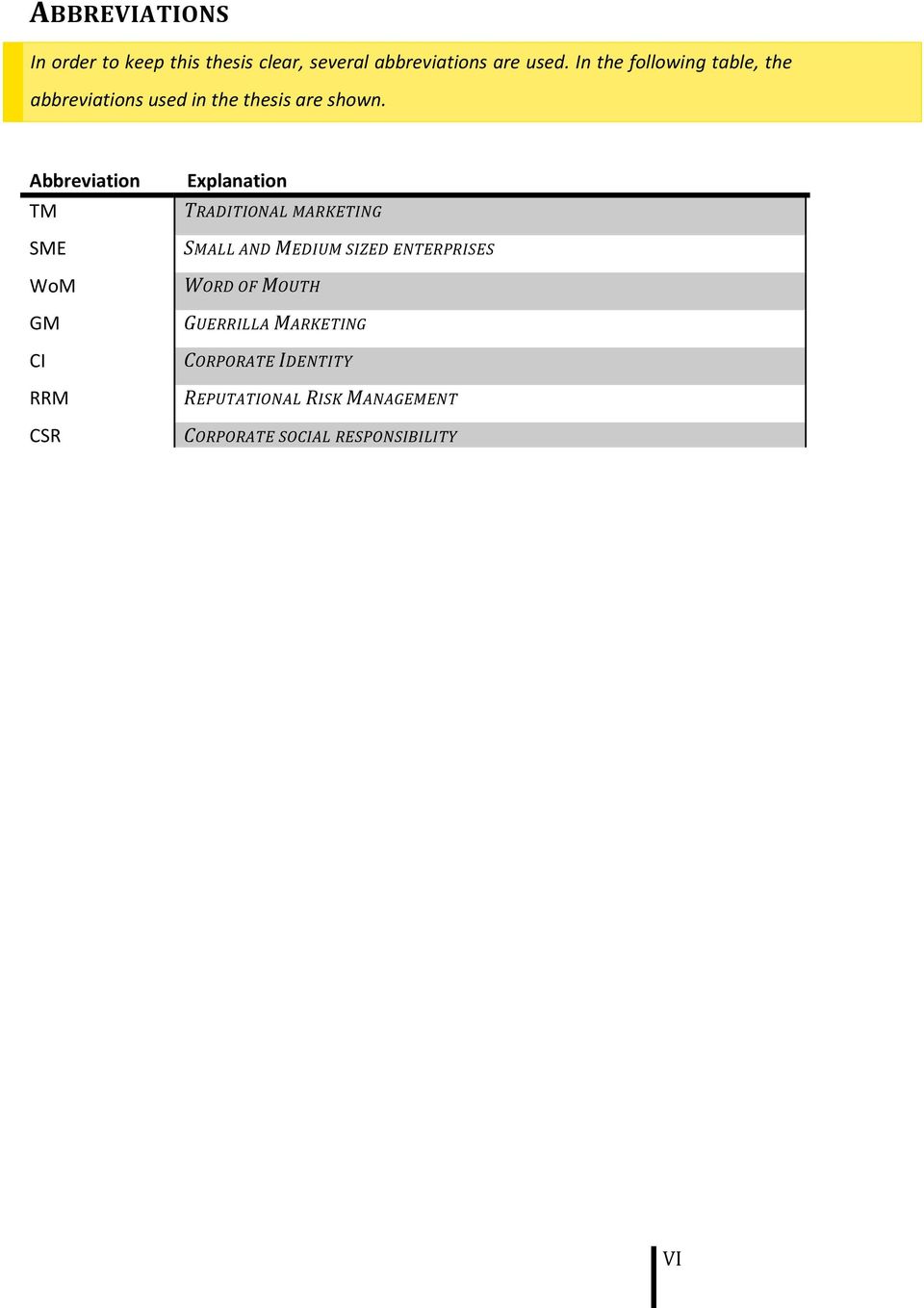
7 ABBREVIATIONS In order to keep this thesis clear, several abbreviations are used. In the following table, the abbreviations used in the thesis are shown. Abbreviation TM SME WoM GM CI RRM CSR Explanation TRADITIONAL MARKETING SMALL AND MEDIUM SIZED ENTERPRISES WORD OF MOUTH GUERRILLA MARKETING CORPORATE IDENTITY REPUTATIONAL RISK MANAGEMENT CORPORATE SOCIAL RESPONSIBILITY VI
8 1 INTRODUCTION In this introduction chapter an overview of the subject of this thesis will be given. In the background the reader gets an impression of the current state of marketing and the new marketing initiatives Guerrilla marketing, Viral marketing and Buzz marketing. In the problematisation the main problem in this specific field or research will be discussed by use of both scientific references as references from practise. The chapter will end with addressing the purpose. 1.1 BACKGROUND Consumers of today get bombarded with commercial messages. Each day a normal Swedish consumer is the target of over 5000 commercial messages (Astolfi, et. al., 2009). Research shows that customers are avoiding traditional advertising with increasing success, either with new technology or by not paying attention (Dahlén & Edenius, 2007; Speck & Elliott, 1997). The consumers attention is limited and the shear amount of commercial he faces makes it hard for companies to get noticed. Traditional marketing (TM) through for example television, radio and newspaper advertisements can also be expensive and might not even generate any profit for the company (Leskovec, et al., 2007; Elfving, 2005). Companies need to create marketing that differentiates them from the rest and also generates profit (Godin, 1999). Because of the resources needed for (and the effectiveness of) traditional marketing (TM), small and medium sized enterprises (SME s) started to use new ways of marketing. In the past 20 years multiple new marketing tactics became popular amongst SME s. Three of these emerging marketing tactics are Guerrilla marketing, Viral marketing and Buzz marketing (Kraus, et al., 2009). Until now, these tactics are mainly used by SME s, while large enterprises stick most of the time to the traditional marketing tactics (Kraus, et al., 2009). Guerrilla marketing is a high-impact marketing technique, allowing small companies and/or individuals to act like big companies. The concept of Guerrilla marketing started as a way for smaller companies to market themselves even though they lacked the resources the large companies had. To compensate the lack of resources, they used innovation and creativity instead (Levinson, 1984). The concept is to create marketing that catches the consumers attention by being for example shocking, funny or creative in other ways. This is most often 1
9 achieved by doing something that is physically close to the consumer segment addressed (Ekberg, 2005). An example of Guerrilla marketing is the one below of Nike. To attract consumers, Nike used low cost, creative advertisements at certain places for a certain time period such as street paintings with chalk and extensions for trash bins (see Figure 1). These advertisements only promote the overall brand and do not focus only on one product. FIGURE 1: EXAMPLES OF GUERRILLA MARKETING To make Guerrilla marketing a success, follow-up is necessary (Levinson, 2007). Follow-up means that the recipients of the Guerrilla advertisement should communicate it with the bigger crowd. To make this possible, Viral and Buzz marketing are valuable tools. Viral marketing is a way to let external individuals spread your marketing through the internet (Kirby & Marsden, 2006). The goal is usually to strengthen the company s brand and their position on the market. Viral marketing tends to focus more on a feeling than the product or service itself in an attempt to create relations with the customers (Watts & Peretti, 2007). However, Davis (2009) claims that it is important that the company s identity and image is clearly shown in the marketing so that the customers can see and relate the marketing to the actual company, even if the marketing itself does not focus on the product (Davis, 2009). Buzz marketing is basically the similar to Viral marketing. It is a way to let consumers spread the word and marketing of your product or service. The difference is that it is not connected to the internet but instead uses verbal means (Rosenbloom, 2000). Often recommendations, connected to events, through personal networks are used to create an excitement for the marketed product. The idea is that the consumer should not realize that he has been influenced, or at least not realize that it was through marketing (Hughes, 2005). 2

10 These three, Guerrilla marketing, Viral marketing and Buzz marketing, are all related to word-of-mouth marketing (WoM) (Stokes, 2000). WoM is the idea that costumers spread the marketing through their personal or professional networks (Ahuja, et al., 2007). They are relatively new marketing tactics, all meant to stand out from the abundant amount of marketing the consumer is faced with every day (Hughes, 2005). If Guerrilla marketing is spread on the internet it turns Viral, and if it is spread in networks in verbal or written form it turns Buzz. Therefore we chose to view Viral- and Buzz marketing as components of Guerrilla marketing and include them in this thesis. 1.2 PROBLEMATISATION The world of today is filled with an unprecedented amount of marketing (Richards & Curran, 2002). Every day the average consumer is met by so many commercial messages that they have started not only to ignore them but also tries to avoid them (Kaikati & Kaikati, 2004). To tackle this problem companies need to create marketing that stands out from the rest, which somehow catches the costumers attention. Guerrilla marketing (GM) is based on creating marketing that stands out (McNaughton, 2008). The idea is that the customers likes the marketing enough to spread it through their own networks without the company s involvement (Susanu, et al., 2008). As always when it comes to feelings and interpretations, the questions what really shocking, funny or creative is, is up to each individual to decide. This discussion is prolonged in the theoretical part. However, the intention to create GM is not subjective. This thesis focuses on Guerrilla marketing that is implemented with intention. SME s have been using Guerrilla marketing for quite a long time as it is a cost efficient way to reach their customers (Kraus, et al., 2009). Guerrilla marketing is a way to compensate the lack of financial resources by using creativity instead. There has been a lot of research done on SME s use of Guerrilla marketing and strategy forming in those small firms. However, about the use of Guerrilla marketing tactics is larger firms is only written a little (Miles & Darroch, 2006). Even though the reason behind SMEs using Guerrilla marketing is the cost efficiency that is not a reason for larger firms to not use it. Rather, it should be another incitement to use it. Guerrilla marketing has great potential as it stands out from the traditional marketing and can reach a lot of costumers. Spreading the word and reaching a big crowd is one of the goals of Guerrilla marketing (McNaughton, 2008). However, next to this potential 3

11 advantages comes risk. Guerrilla marketing communicates feelings rather than products to create a good relation with the customer. It tries to get the consumer to like the company by showing a certain image. As it does this through being shocking, funny or creative in other ways and, to a large extent, does not control the spreading of the message, the risk is that it reaches people who do not like it, or even worse, take offence (Ay, et al., 2010). Smaller companies of course run the same risk, but they have a smaller customer base and should not have to worry about reputation and image as much as large companies (Kraus, et al., 2009). Guerrilla marketing needs to be edgy enough to stand out and catch the consumers attention, but at the same time it cannot be over the edge so that the company s image is damaged or altered in a way that was not intended (Ay, et al., 2010). Guerrilla marketing is a key tool on how a company can alter their marketing and in particular make awareness about themselves, not only about their products and services. It contributes to the overall corporate identity of the company. Walker (2010) describes in his article the term corporate identity and the difference between corporate image and corporate reputation. Corporate identity is about the question who or what do we believe we are? (Whetten, 1997, p. 27). Corporate image can be described as the various outbound communications channels deployed by organizations to communicate with customers and other constituencies (Balmer & Greyser, 2006, p. 735). Whetten (1997, p. 27) describes corporate image as answering the question: What / who do we want others to think we are? Some authors refer corporate image also as corporate communication (Walker, 2010). However, in this thesis the term corporate image will be used. In contrast to corporate image, corporate reputation refers to actual stakeholder perceptions. Given that corporate reputation represents what is actually known (by both internal and external stakeholders), it can be positive or negative (Walker, 2010, p. 367). Corporate reputation is about the question: what are we seen to be? (Balmer & Greyser, 2006). In this thesis, the influence of Guerrilla marketing in the way how companies manage reputational risk will be addressed because corporate reputation refers to the actual perceptions of the stakeholders. This is interesting since this focuses on the connection between the company and the stakeholders; not only on the internal view of the company. Reputational risk is the possibility or danger of losing one s reputation; it presents a threat to organizations in many ways (Aula, 2010). 4

12 Corporate advertising is strongly linked with corporate reputation and therefore it should require an active role from the company to minimize the risks of harming this reputation. The way how large companies manage reputational risk to minimalize the risks Guerrilla marketing brings along is little researched; there is a certain gap in research. Miles and Darroch (2006) did research about the strategic use of new marketing tools such as Guerrilla marketing, Viral marketing and Buzz marketing in large companies, but conclude that they hope for more research in this field. Also in practice is a lack of knowledge about how to manage reputational risk in connection with Guerrilla marketing. Drew Neisser, CEO of the company Renegade Marketing, says about Guerrilla marketing: it's just a question of risk tolerance... requires a brand to step outside its comfort zone and do something they've never done before (Male, 2010). He continues that highly regulated industries like financial services and insurance make considering Guerrilla approaches a risky proposition (Male, 2010). According to him, it is important to know how to manage the marketing campaign to decrease its risk. According to Christopher Ireland, CEO of Cheskin Research, which explores youth culture for clients such as PepsiCo Inc. and Motorola Inc., new marketing tactics can turn into a horrible public-relations nightmare if it turns out you're deceiving people (Business Week, 2001). EIU Director Daniel Franklin comments that despite realizing the importance of reputational risk, organizations continue to neglect reputational risk management strategies or do without them entirely (Aula, 2010, p. 44). In conclusion, at this moment little research is done about the way how large companies manage the reputational risk associated with Guerrilla marketing. As discussed, this is a problem in both science and practise. 1.3 PURPOSE The purpose of this thesis is to contribute to the understanding of how large companies manage the possible reputational risk that Guerrilla marketing and the communication of Guerrilla marketing brings along. 5
13 2 THEORETICAL FRAMEWORK The purpose of this chapter is to give a better understanding of the theories used in this thesis. First the traditional and the new marketing tactics will be discussed. Definitions will be given and relations between Guerrilla, Viral and Buzz will be exposed. Secondly, corporate identity, corporate reputation and reputational risk management will be described. This chapter ends with a discussion of the theories used, addressing the state of the art and the formulation of the research question. 2.1 TRADITIONAL MARKETING AND NEW MARKETING TOOLS Traditional marketing tools such as advertising at television, radio or in newspapers are expensive and do sometimes not fulfill the initial goal of the marketer. The consumers attention is limited and the shear amount of commercials makes it hard for companies to get noticed with traditional marketing tools (Astolfi et al., 2009). Some scholars even predicted the death of traditional marketing due to the advent of the internet (Holbrook & Hulbert, 2002). Therefore, companies have to use marketing tactics that both differentiates them from the rest and generates profit (Godin, 1999). A number of alternative marketing tactics have been introduced over the past years (Morris, et al., 2002). Examples include Guerrilla marketing, Viral marketing and Buzz marketing (Morris et al., 2002; Kraus et al., 2009). Using these new marketing tactics can help companies to reach consumers more efficiently, increasing companies profits and improve images. 2.2 GUERRILLA MARKETING The term Guerrilla marketing is a general description for an entire category of different types of non-traditional marketing methods (Išoraite, 2010). Kraus et al. (2009) support this view. They argue that Guerrilla marketing can be regarded as the ancestor of new marketing tools such as Viral and Buzz marketing. Guerrilla marketing is a registered trademark of Levinson (1984). He wrote two books about unconventional marketing tactics for small companies. Several authors has since contributed to Levinson s Guerrilla Marketing. Many authors argue that Guerrilla marketing stands for unconventional marketing campaigns and/or strategies which should have a significant promotional effect, to a fraction of the budget that would be spent in traditional marketing campaigns for the same goal (Patalas, 2006; Kraus et al., 2009). Guerrilla initiatives often 6
14 occur in public and uncommon places. Baltes and Leibling (2008) add that Guerrilla activities tend to be eye-catching and surprising when used and thus, being highly efficient in terms of gaining customer attention (Baltes & Leibling, 2008). McNaughton (2008) argues that Guerrilla marketing is based on creating marketing that stands out through the use of commercial messages that are shocking, funny or creative in other ways (McNaughton, 2008). Kraus et al. (2009) agree; they state that Guerrilla marketing uses high-impact marketing techniques, allowing small companies and/or individuals to act like big companies. Moreover, they propose that Guerrilla marketing actions are often only one-time, limited in scope, and seldom repeatable (Kraus, et al., 2009). Several underlying dimensions or characteristics of Guerrilla marketing could be distinguished in the above articles; (1) low cost, (2) unexpected actions, (3) unconventional, (4) interactive, (5) Unexpected places. Together they form the most used definition on the Internet of Guerrilla marketing: Guerrilla marketing is an unconventional way of promoting that relies on time, energy and imagination rather than big marketing budget. Guerrilla marketing is unexpected and unconventional, potentially interactive; and consumers are targeted in unexpected places (Guerrilla Marketing Australia, 2011). However, this definition is not entirely complete. Levinson (2007) writes a cornerstone of Guerrilla marketing is customer follow-up. Without it, all that you ve invested into getting those customers is like dust in the wind (Levinson, 2007, p. 4). In fact, Guerrilla marketing focuses on simplicity and aims at getting the recipient riveted to the message, which stimulates a willingness to distribute it to others (Ahuja et al., 2007). To create follow-up, effective communication is needed. This indicates a sixth underlying dimension, namely (6) effective communication. This effective communication is part of the objective of Guerrilla marketing. The entire objective of Guerrilla marketing is to create a unique, engaging and thought-provoking concept to generate Buzz, and consequently turn Viral (Levinson, 1984). 7
15 2.2.1 THE RESULT OF GUERRILLA MARKETING As discussed earlier, Guerrilla marketing give companies the possibility to reach a large amount of people with relatively less financial expenses (Patalas, 2006). Less expenses with the same output means that the company have in total a better financial result. Another possible influence of Guerrilla marketing on the company s performance is a change in image. Research suggests that new marketing tactics have the goal to increase image (both brand image and corporate image). However, Guerrilla advertising activities that are not developed and executed properly may lead to certain ethical problems. As effective as emotion-arousing advertisement might be, its improper use may have side-effects (Ay et al., 2010, p. 283). If the Guerrilla initiative is too unconventional (for example to shocking), it could have a negative influence on the company s image. This is a major risk for companies when using Guerrilla marketing tactics. 2.3 GUERRILLA MARKETING DISTRIBUTION The objective of Guerrilla marketing (in the beginning of this chapter) shows that more is needed than the initial Guerrilla advertisement. It has to be spread among the crowd to become really efficient. As the objective of Guerrilla Marketing already shows, the concept should create Buzz and have to turn Viral (Levinson, 1984). There are means to create Buzz and for the message to become Viral; Buzz marketing and Viral marketing. These will be described in the next two paragraphs to create a better understanding how Guerrilla marketing is spread. The relationships between Guerrilla-, Viral-, Buzz marketing and WoM are shown in Figure 2. FIGURE 2: THE RELATIONSHIP OF THE MARKETING TACTICS (OWN) 8

16 Using effective Guerrilla marketing causes WoM processes. People observe Guerrilla marketing and start talk about it. This can create a snowball effect, more and more people get to know about the advertisement. A company can use Viral marketing and Buzz marketing as tools to increase the reach of the advertisement (Hughes, 2005). Buzz marketing for example by reaching the media (a newspaper that writes about the Buzz marketing activity) or contacting an social group leader. This leader shares the advertisement through for example forums and blogs, hence WoM is created. Viral marketing involves the Internet. If Buzz marketing started on the internet, for example by posting a video of the Guerrilla advertising on YouTube, it becomes Viral BUZZ MARKETING About Buzz marketing is a little written in current research. A possible reason for this is that the concept is rather vague. Kraus et al. (2009) refer to Buzz marketing as a new form of word-of-mouth communication which emerged as a reaction to the fact that more and more consumers are critical towards classical advertising (Kraus et al., 2009, p. 31). They furthermore argue that it is the attempt to stimulate the recipients through the use of spectacular actions so much that the product becomes the subject of discussions or gossip (Rosenbloom, 2000). One of the authors who writes a lot (even wrote an entire book) about Buzz marketing is Mark Hughes. According to Hughes (2005, p. 2), Buzz marketing is about capturing attention of consumers and the media to the point where talking about your brand becomes entertaining, fascinating, and newsworthy. It is important to recognize that the factor media in his definition plays an important role. Sharing happens not only through individuals but also through media such as a newspaper that publishes a news item about the advertisement. As visible in the definitions of Buzz marketing, it is clear that WoM is an important factor in the success of Buzz marketing. Without recipients sharing the word, the Buzz marketing initiative will never become effective and successful. Guerrilla marketing could be seen as the ancestor of Buzz marketing (Kraus et al., 2009). Buzz marketing delivers the spectacular action (the reason why it is fascinating and newsworthy (Hughes, 2005)) of Guerrilla marketing to the larger crowd (Kraus et al., 2009). 9

17 The result of Buzz marketing Buzz marketing uses WoM to spread the word. Word-of-mouth is one of the oldest and most effective of all branding and marketing strategies (Moore, 2003). By using Buzz marketing through effective WoM, no traditional (and expensive) media such as television, radio and newspapers are necessary to reach a large public. Another advantage but in the same time a risk of WoM, is the speed in which news is spread and the direction where it is spread in. Within hours, thousands of people could be reached, both with positive news (if the marketing is perceived as newsworthy and fascinating) and negative news (if the recipients have a bad feeling when viewing the advertisement). It is obvious that the negative news affects the corporate reputation negatively. This makes Buzz marketing a risky tactic. Once Buzz is created it is for a company almost impossible to stop VIRAL MARKETING Viral marketing is, like Buzz and Guerrilla marketing, a relatively new marketing concept. It finds his roots in 1997, when Jurvetson and Draper first coined the term in a Netscape newsletter (Jurvetson, 2000). They defined Viral marketing loosely as network-enhanced word of mouth. With such a new and overused term, disagreement exists about its definition (Phelps et al., 2004). Some authors view it as an word-of-mouth advertising in the online context in which consumers tell other consumers about the product or service (Phelps et al., 2004; Kiecker & Cowles, 2002). Others consider Viral marketing as a new marketing tactic that differs from WoM. Modzelewski (2000) for example states that true Viral marketing differs from word-ofmouth in that the value of the virus to the original consumer is directly related to the number of other users it attracts. That is, the originator of each branch of the virus has a unique and vested interest in recruiting people to the network (Modzelewski, 2000, p. 30). He argues that Viral marketing goes further than just WoM. It spreads over the internet as a virus; infecting many recipients. Knight (1999) agrees with Modzelewski and suggests that Viral marketing is similar to a digital Sneeze, one characterised by the release of millions of tiny particles that can infect others who come into contact with them (Cruz & Chris, 2008; Knight, 1999, p. 50). Helm (2000) acknowledges some of the characteristics suggested above and defines Viral marketing as a communication and distribution concept that relies on customers to 10
18 transmit digital products via electronic mail to other potential customers in their social sphere and to animate these contacts to also transmit the products (Helm, 2000, p. 159). In her opinion, Viral marketing is a tool to build WoM. Porter and Golan (2006) argue that the message is not only communicated by electronic mail but by all possible communication channels on the internet. They consider Viral marketing as unpaid peer-to-peer communication of provocative content originating from an identified sponsor using the internet to persuade or influence an audience to pass along the content to others (Porter & Golan, 2006). This last view of Viral marketing from Porter and Golan (2006) will be used in this thesis. The definition build upon the initial idea of Viral marketing as coined by Jurvetson and Draper. It brings community, the world wide web and communication/sharing together. Results of Viral marketing Like Buzz marketing, Viral marketing uses already existing networks to communicate the message. No costs of broadcasting on television or radio and no costs of publishing in newspapers are involved; the recipients do the work. One of the advantages of Viral marketing is therefore, like Buzz marketing and Guerrilla marketing, that it is relatively cheap. Another advantage is that Viral marketing proposes that messages can be rapidly disseminated from consumer to consumer, leading to large-scale market acceptance (Krishnamurthy, 2003). The acceptance of the message is also higher when Viral marketing is used because it conveys an implied endorsement from a friend (Jurvetson, 2000; Moore, 2003). Again, like Buzz marketing, the fast communication though Viral marketing could be a disadvantage too. If the recipients do not like the Viral marketing advertisement, the corporate image, brand awareness and product success can decrease BUZZ MARKETING, VIRAL MARKETING AND WORD OF MOUTH MARKETING: A SHORT OVERVIEW As written earlier in this chapter and shown in Figure 2, Guerrilla marketing initiatives can be the ancestor of Buzz marketing and Viral marketing, and can create WoM. Kirby and Marsden (2006) compared the different marketing tools and came up with a clear understanding of them. These definitions reflect the definitions given in the last couple of paragraphs. The definitions will be shown in table 2. 11
19 Table 2: Definitions of Buzz, Viral and WoM marketing (Kirby & Marsden, 2006). Buzz Marketing: Viral Marketing: WoM Marketing: The promotion of a company or its products and services through initiatives conceived and designed to get people and media talking positively about that company, product of service The promotion of a company or its products and services through a persuasive message designed to spread typically online, from person to person. The promotion of a company or its products and services through an initiative conceived and designed to get people talking positively about that company, product or service 2.4 CORPORATE IDENTITY Corporate reputation is closely related to corporate identity. To give a better understanding of both concepts, first the corporate identity concept will be explained. Later in this chapter, the link between reputation, image and identity will be shown. The corporate identity (CI) concept dates back to the early 1960s and was popularised first by US and then by UK consultants. Olins (1979) was one of the first writers about corporate identity (He & Balmer, 2007). International Corporate Identity Group (ICIG) have not given any definition of corporate identity, since it changes so between organizations (Melewar & Saunders, 2000; Marwick & Fill, 1997). However, there are some dominating thoughts about what CI is. One of the most common definitions of identity is the definition of Whetten and Mackey (2002). They reference their definition from 1985 where they define CI as that which is most central, enduring, and distinctive about an organization (Whetten & Mackey, 2002, p. 394). Identity was frequently viewed as the core or basic character of the firm from the perspective of employees (Barnett et al., 2006). Melewar & Saunders (2000) and Melewar & Jenkins (2002) argue that CI expresses what the organization is, what it stands for and what it does. It is the manifestation of the corporate image, where it is the net result of the interaction of all experiences, impressions, beliefs, feelings and knowledge that people have about the company (Melewar & Jenkins, 2002, p. 77). In CI, the vision and mission of an enterprise is communicated. Moreover, it deals with how to plan, implement 12

20 and maintain the external communication of company values, through corporate visual systems and marketing communications (Van Riel, 1995). Within the literature there is a growing consensus that corporate identity provides the foundation for other corporate-level concepts such as corporate branding, corporate image, and corporate reputation (He & Balmer, 2007, p. 770) CORPORATE IDENTITY, CORPORATE IMAGE AND CORPORATE REPUTATION The relationship between corporate identity, corporate communication (image) and corporate reputation is shown in Figure 3. In this figure, the corporate communications are the collection of messages from both official and informal sources, through a variety of media, by which the company conveys its identity to its multiple audience or stakeholders. The corporate reputation indicates in this figure how the customer values the company (Gray & Balmer, 1998). FIGURE 3: THE RELATION BETWEEN CORPORATE IDENTITY AND CORPORATE REPUTATION (ADAPTED FROM GRAY & BALMER, 1998) The following paragraphs give a better understanding of (1) the concept corporate reputational risk (CRR) and (2) the way how to manage those CRR s CORPORATE REPUTATION AND REPUTATIONAL RISK There have been plenty attempts to understand the concept of corporate reputation (Csiszar & Heidrich, 2006; Schanz, 2006). In the introduction of the thesis, the meaning of corporate reputation has already been coined. In this thesis, the formal definition of Fombrun & Van Riel (1997) will be used to identify corporate reputation. They define the corporate reputation as: A corporate reputation is a collective representation of a firm s past actions and results that describes the firm s ability to deliver valued outcomes to multiple stakeholders. It gauges a firm s relative standing both internally with employees and 13

21 externally with its stakeholders, in both its competitive and institutional environments (Fombrun & Van Riel, 1997, p. 10). According to Walker (2010), many researchers distinguish a direct link between the company s reputation and the company s performance. In fact, reputation is arguably the single most valued organizational asset (Gibson et al., 2006, p. 15). A good reputation can lead to several advantages for the company such as lowering firm costs, enabling firms to charge premium prices, attracting customers and creating competitive barriers (Deephouse, 2000; Fombrun, 1998). However, a low reputation on the other hand can influence the company negatively. A bad reputation is in this case for the company a risk (Davies, 2002). According to Aula (2010) reputation risk is the possibility or danger of losing one s reputation. It presents a threat to organizations in many ways (Aula, 2010). Reputational risk has been added to the list of business risks that organizations must take seriously (Aula, 2010). It is nowadays a major risk for all organizations and needs to be considered alongside all the other major risks such as operational, strategic and financial risks (Power et al., 2009, p. 309). The loss of reputation affects competitiveness, local positioning, the trust and loyalty of stakeholders, media relations, and the legitimacy of operations, even the license to exist (Rayner, 2003). According to Eccles et al. (2007), there are three determents that influence a company s reputation and can become a risk, namely (1) the reputation-reality gap, (2) changing beliefs and expectations and (3) weak internal coordination. With the reputation-reality gap, Eccles et. al. (2007) mean that there is a difference between perception and reality. When the reputation of a company is more positive than its underlying reality, this gap poses a substantial risk (Eccles, et al., 2007, p. 170). A change in beliefs and expectations is a major reputational risk when the company beliefs it is positive to change its image while the stakeholder expects something different (Eccles, et al., 2007). The last major reputational risk determent is a weak internal coordination. When different business units or managers miscommunicate, the reputation of the company can decrease (Eccles, et al., 2007). 14
22 Online reputational risk Guerrilla marketing and Viral marketing expand the spectrum of reputation risks. The new marketing tools bring more risks along and boost reputational risk dynamics (Aula, 2010). The reputation risk consequences are described as ranging from minor consequence to catastrophic consequence (differentiated by the extent of adverse media coverage) (Bebbington et al., 2008, p. 340). The widely used new social media increase the media coverage. When consumers discover they have been manipulated into liking the product by a certain Buzz marketing campaign, the consumers can become angry. The speed of spreading news by Buzz marketing and Viral marketing becomes in this case negative (Bebbington et al., 2008). The speed of the Internet can in this case be seen as a risk for companies reputation MANAGING REPUTATIONAL RISK Several theories about reputational risk management are available in research. Gray and Balmer (1998) wrote about the essence of managing reputational risk. In their articles, they provide an operational framework for managing reputation and image (see partly Figure 3). However, the operational framework they provide can be out-dated. Davies (2002) delivers a new stages model for managing reputational risk. Eccles et. al. (2007) present in their article a framework that is quite familiar with the framework of Davies (2002). Davies (2002) considers that effectively managing reputational risk involves eight stages, namely: Understand your reputation, alignment, meet expectations, handing complains satisfactorily, using data, prepare for the worst, training & rehearsal and keep it relevant. Eccles et. al. (2007) consider five steps for effective reputational risk management: assessing your company s reputation among stakeholders, evaluating your company s real character, closing reputation-reality gaps, monitoring changing beliefs and expectations, and putting a senior executive below the CEO in charge (Eccles et al., 2007, p. 110). In this thesis, both reputational risk management plans are brought together in five steps: First step Davies (2002) understand your reputation correspond with assessing company s reputation. The key questions in understanding reputation and assessing company s reputation are: who are our stakeholders?, what do they expect of us?, what is the company s reputation in each area (product quality, financial performance, and so on)?, 15
23 why? And how do these reputations compare with those of the firm s peers? (Davies, 2002, p. 416; Eccles et al., 2007, p. 110). Second step Alignment matches with evaluate reality. Both mean that the company have to align the stakeholder s expectations with corporate strategy (Davies, 2002). The company must objectively evaluate its ability to meet the performance expectations of stakeholders (Eccles et al., 2007, p. 110). Third step Davies (2002) considers meet expectations as the third stage and gives meaning to this stage as to ensure that the expectations that the board wants to meet, and the promises that the organization makes, are actually delivered (Davies, 2002, p. 417). This stage suits to the third step (close gaps) of Eccles et.al. (2007). They state that in this step the gap between expectations of the stakeholders and the reality has to be filled. This can be done by effective corporate communication programs. Fourth step Monitor changing beliefs and expectations is the fourth step Eccles et. al. (2007) distinguish. Expectations that stakeholders have change from time to time. To decrease risk, the company have to manage this change in beliefs and expectations (Eccleset al., 2007; Aula, 2010). Davies (2002) agrees upon this. Monitoring happens through stages four (handling complains of the stakeholders about for example advertisements satisfactorily) and five (using data to get a better understanding of changes in expectations). Fifth step The fifth and also last step of reputational risk management that will be addressed in this thesis is central coordination. This step combines put one person in charge of Eccles et. al. (2007) with the last three stages (prepare for the worst, training & rehearsal and keep it relevant) of Davies (2002). In this step, one person should have the coordination (Eccles et al., 2007, p. 114) in order to foresee possible threads for the company and set up a crisis plan (Davies, 2002, p. 418), promote training and rehearse the crisis plan (Davies, 2002, p. 419) and keep this plan and overall reputational risk management transparent (Davies, 2002, p. 420). 16
24 2.5 THE MARKETING TOOLS AND REPUTATIONAL RISK In the following overall framework (Figure 4), the previously discussed theories are shown. The middle part with the variables Guerrilla marketing, Viral Marketing, Buzz marketing and WoM are taken from figure 2. As one can see, the framework starts with an actor; the company. The company advertises with several marketing tools with as ancestor Guerrilla marketing (Kraus et al., 2009). Guerrilla marketing itself can influence the company s reputation directly (Ay et al., 2010). Once Guerrilla marketing is put online with intention, it uses Viral marketing to cause WoM (Modzelewski, 2000). The WoM influences the company s reputation. Once Guerrilla marketing reaches the media (for example a newspaper that writes about the Buzz marketing activity) or is noticed by certain group leaders, Buzz marketing happens and will cause WoM (Kraus et al., 2009; Kirby & Marsden, 2006). The WoM influences the company s reputation. A positive reputation retains old customers and attracts new consumers (Deephouse, 2000; Fombrun, 1998); if the reputation turns bad by the marketing tools, it can cause a loose of consumers (Davies, 2002). The bold red arrow from the company towards reputation shows managing reputational risk. FIGURE 4: THE MARKETING TOOLS AND REPUTATIONAL RISK (OWN) 17
25 2.6 DISCUSSION OF THE LITERATURE This thesis focuses on two concepts, namely Guerrilla marketing (with Viral, Buzz and WoM) and corporate reputational risk. It is not entirely clear what new marketing is. Therefore, we first explained the relation between traditional marketing and new marketing. We chose to use Guerrilla marketing as main new marketing tool. We argued that Guerrilla marketing is the ancestor of other marketing tools; some authors even stated that it is another word for new marketing tools. To make even more transparent what we mean with Guerrilla marketing, we defined Guerrilla marketing and created a model to show the relation between Guerrilla marketing, Viral marketing and Buzz marketing. Later on we defined and explained Buzz- and Viral marketing separately. To give a good understanding of the difference between Buzz, Viral and WoM, we provided the reader with a small overview of the concepts. Secondly we focussed on corporate reputational risk. In this part, we first described the concept corporate identity to introduce reputation. Because in current research the relation and meaning of different corporate concepts (image, identity, reputation, communication) is vague, we made a comparison between identity, image and reputation. As argued in the problematisation, we focus on reputational risk. Because new marketing tools (such as Viral marketing) use new media such as the Internet, we separated reputational risk in normal reputational risk and online reputational risk. We concluded this theory part with providing a framework to manage reputational risk STATE OF THE ART To discuss the new marketing tools (Guerrilla-, Buzz- and Viral Marketing) we based our theoretical framework partly on the theories of the founding fathers and main contributors (Levinson (1984) for Guerrilla marketing, Juvertson (2000) for Viral marketing and Hughes (2005) for Buzz marketing). The theories of those authors are empirically validated and generally used. There is however a lot of discussion about what Guerrilla marketing, Viral marketing and Buzz marketing really is. Guerrilla marketing is defined the strongest among those three. The definition (the combination of the five components) we use in this thesis is generally used and empirically validated. Managers view Guerrilla marketing the same. Guerrilla marketing advertisements contain most of the time those five components. Since it is more valid to use a certain theory or definition if more sources who say the same are 18
26 used, we based those five components on modern views of different authors (Iŝoraite (2010), Kraus et. al. (2009), Patalas (2006), Baltes & Leibling (2008), Ahuja et. al. (2007)). Those authors support each other. Buzz marketing was harder to define since less has been written about it. We used the theory of Hughes (2005) and related this to insights of Rosenbloom (2000) and Kraus et. al. (2009). According to us, they represent together the main view on Buzz marketing. To get a better understanding of the concept Viral marketing, we discussed emerging theories of Phelps et. al. (2004), Kicker & Cawles (2002), Modzelewski (2000), Cruz & Chris (2008), Helm (2000) and Porter & Golan (2006). Although these articles are new, they have been cited quite often (respectively 123, 38, 16, 11, 78 and 37 times) and are partly validated by others. We therefore argue that these theories are suitable to use in our research. To discuss reputational risk, we first discussed corporate identity. We discussed corporate identity by using generally accepted and empirically validated theory. The authors we cited (Olins (1979), He & Balmer (2007), Melewar & Saunders (2000), Marwick & Fill (1997), Whetten & Mackey (2002), Barnett et. al. (2006) and Van Riel (1995)) contribute to the Corporate Identity discourse. We based the relation between corporate identity, corporate image and corporate reputation mainly on Gray & Balmer (1998). Their article is cited 260 times and brings up traditional views of the three concepts. These traditional views are generally accepted and validated. We therefore identify their theory as dominant. To interpret the relatively new concept corporate reputation and reputational risk, we used the insights of several well cited authors; (Gibson et. al. (2006), Deephouse (2000), Fombrun (1998), Raynar (2003). The theories described in these articles are generally accepted in literature. Aula (2010) is not cited yet, but cites several of those articles and discuss their relations. We decided to use it to describe the reputation. Since there are no relevant dominant theories about reputational risk management proposed yet, we combined emerging theories of Davies (2002) and Eccles et. al. (2007) to discuss reputational risk management. As mentioned before, there are no theories yet about the relation of reputational risk management and Guerrilla marketing. In this thesis we try to get a better understanding of the relation between both by bringing the theories together. 19
27 2.7 RESEARCH QUESTION As stated in the introduction chapter, the purpose of this thesis is to contribute to the understanding of how large companies manage the possible reputational risk that Guerrilla marketing and the communication of Guerrilla marketing brings along. To reach this purpose, the following research question will be answered in this thesis: How do large companies manage reputational risk that Guerrilla marketing and the communication of Guerrilla marketing brings along? 20
28 3 METHODOLOGY In this section we present what we have done and why we have the methodology conducted in a certain way. We are also discussing the effects that our choice brings when conducting the research. 3.1 RESEARCH DESIGN When working on a thesis, research design is telling you how you will conduct your research. There are multiple ways to use and create empirical material. Some examples are surveys, interviews, experiments and case studies. Depending on what type of question your research question is, you will have to match it with a subtle strategy (Yin, 2009). Our research question is: How do large companies manage reputational risk that Guerrilla marketing and the communication of Guerrilla marketing brings along?. Therefore we argue that a qualitative research is more suitable to come up with an answer on our research question since quantitative methods would require empirical data. In that case, we cannot have follow-up questions and in depth information. All primary data is collected through semi-structured interviews INDUCTIVE VERSUS DEDUCTIVE There are two different approaches when conducting a research; inductive and deductive. Inductive approach means that the final research with the empirical data collection generate into theories. Deductive approach is testing a theoretical hypothesis by the employment of a research strategy designed for the purpose of its testing. Deductive theory represents the most common idea of how the connection between theory and empiricism in social science appears. It is argued, in principal orientation of the roles that quantitative research is more suitable with a deductive approach and qualitative research is more suitable for inductive approach. The reasons behind this are that there is a more clear connection between the strategies and approaches (Bryman & Bell, 2007). The research in this paper is deductive. We are basing our research on existing theories that we use in a different context than they are initially aimed and commonly applied for. When we say that we use them in a different context and in an interesting way, we mean that the theories in our research are commonly applied on SME s. In our research we have focused 21
29 on large companies. Therefore, we believe that we have combined it in an interesting way. Even if it is argued that deductive approach is more suitable for a quantitative research we argue that the research we are conducting is not suitable for generating new ideas QUALITATIVE INTERVIEWS Qualitative interviews tend to be less structured than those used during quantitative research (Bryman & Bell, 2007). In this research, semi-structured interviews have been used. In the next paragraphs, the reader can gain an understanding on what and how the authors have interpreted semi-structured interviews SEMI-STRUCTURED INTERVIEWS In a semi-structured interview the researcher has a list of relatively specific themes, which will be addressed. The respondents have the choice to formulate responses in their own way. Questions that are not included in the interview guide can also be included, if the interviewer relates to something that the respondent has mentioned (Bryman & Bell, 2007). We chose to use semi-structured interviews because we wanted to have detailed and thorough response. It was important to know what the respondents saw as important and relevant and we wanted to determine their own perception and attitude about the subject. Guerrilla marketing and reputation is to many people a vague subject. It is of importance to be able to ask follow-up questions and give explanations during the interviews. Therefore we chose semi-structured interviews since it gives us the opportunity to do that. 3.2 PRIMARY AND SECONDARY DATA COLLECTION According to Bryman & Bell (2007), there are two different types of data that can be used when conducting a research. The primary data is the data collected to answer your research question directly. Usually it is the data that is obtained through interviews, surveys and observations. The secondary data is the data that is gained second hand. This means that the authors have not collected the data themselves, but have retrieved it from for example other authors surveys, websites and statistical databases (Bryman & Bell, 2007). We have used both primary data and secondary data when doing this research. Our primary data is our semi-structured interviews that we have together with the selected companies. We have collected secondary data through the companies websites and through different viral channels regardless if it a direct marketing channel or if it is a popular community such as YouTube. In the next subchapter the reader will get a sample of the interviews conducted. 22
30 3.3 POPULATION AND SAMPLE POPULATION Our companies were selected on the base of accessibility. The common factors are that they are all large companies and well represented in Sweden. All four companies could be seen as companies that sell products. The first three companies produce a tangible products, the last one (Bank A) offers intangible products such as mortgages, loans, insurances etc. together with a wide variety of services. Generalisation is therefore not possible. There are simply too many uncertain factors that might influence such opinions. However, generalisation is not the goal of this research. The outcomes of this thesis gives purely an insight in how large firms manage their reputational risks. To get broader insights, there are three different industries represented; car manufacturing industry, clothing industry and Banking industry. All the research companies fit under the research question, and therefore suit well for this specific study SAMPLE A sample is the part of a population that is selected for the research; it can be based on probability sampling or non-probability sampling. A probability sample is a sample that has been selected at a random basis where every unit in the population has the same chance to participate in the collection. Non-probability sampling is when some units are more likely to be selected than others (Bryman & Bell, 2007). In this paper a convenience sample is made, which is a form of a non-probability sample. It means that accessible units were chosen on a non-probability basis (Bryman & Bell, 2007). The reason behind the choice of this sample method is that the authors wanted to choose the respondents for the interviews on the basis of their positions in the companies. Because the research is to contribute to the understanding of how large companies manage the possible reputational risk that Guerrilla marketing and the communication of Guerrilla marketing brings along it was important for the research to choose respondents that had a position where they work with marketing. Interviewees in this thesis all are experts in the areas of marketing or reputational risk management. Our paper is based on four different companies. They are all large firms and acting in large industries. Two of our respondents are acting in the same industry. Within these criteria s the respondents were also chosen on the basis of accessibility. 23
31 Toyota Sweden Håkan Pohl is CEO of Toyota Sweden. He is responsible for everything that occurs at Toyota Sweden. He delegates tasks and makes sure that they are done. However, it does not necessarily mean that he does all the tasks. Pohl is also marketing director. In the sense that he is responsible for all external marketing. He wants to be in control of what is said towards the outside world. He is also responsible for the contact between executive board, owners and stakeholders. They are acting in the car manufacturing. Toyota has approximately 285 employees in Sweden and those are only the direct employees that they have. They are also working with retailers. Clothing company A The interviewed person works as a project leader at the marketing department of clothing company A. He has been there for almost four years and his assignments vary from formulating marketing strategy to leading and monitoring campaigns. His position gives him a great overview of the company and his close connection with the strategy department grants him a good understanding of what influences the company s marketing decisions. Today, clothing company A has more than employees in 40 countries all over the world. Clothing company A was founded in 1947 in Sweden. Clothing company B Clothing company B is founded in 1999, today, it distributes its products to 22 countries. The headquarters are located in Stockholm. The interviewed person works with the marketing and internal communication of the company. He has been there for three years and started as a salesman in a company store. He is also responsible for some of the events and competitions the company arranges. Bank A This Bank is operating in finance and insurance industry. They are one of the Nordic countries most popular Banks. Currently they have approximately employees. Bank A is founded in They are listed in three large stock exchange markets; Helsinki, Copenhagen and Stockholm. Our respondent is a part of a marketing group of Bank A. He is working together with the marketing department but it is not only his main area. He is also working with finances of Bank A. 24
32 3.3.3 COLLECTION OF DATA With the respondents permission we recorded all the interviews for this paper. The recording of the interviews made it easier for us to continue with the processing of the data after the interviews. A transcript of every interview was made based on the recordings. The transcripts are added in the appendices. After the transcripts were made we did a summary of the interviews for the empirical framework. In the summary of the interviews we highlighted the important and relevant responses for our research. To make the empirical material more credible, we use quotes from the respondents in the interviews when writing the empirical framework. Two of the interviews have been made over the phone, and two has been made face to face. The fact that two of the interviews are done by telephone is because of difficulties with availability of the interviewees. Every interview was scheduled to take one hour. 3.4 OPERATIONALIZATION In the following tables (table 3 and table 4) the operationalization of this thesis is shown. Table 3 shows the operationalization of Guerrilla Marketing. Table 4 shows the operationalization of reputational risk management. The dimensions and variables in this tables are taken from the theoretical part of the thesis. The operational definitions in the last column will be used to obtain valuable empirical data during the interviews. The first operationalization gives an answer on the questions: (1) does the company use Guerrilla marketing, Viral marketing and / or Buzz marketing? and (2) does the company use these tools with intention? For reputational risk management, the five steps of reputational risk management described in the theoretical chapter, have been operationalized. The answers on the operational definitions will form together a view whether the companies use a specific reputational risk management plan or not. This indicates if the company is systematically managing reputational risk. To be able to give an answer on the research question, the new marketing concepts such as Guerrilla marketing (in the operationalization mentioned as new marketing campaigns, new marketing advertisements and new marketing tools ) are brought into the operationalization of reputational risk management (Table 4). Almost all of the operational definitions in Table 4 are related to the new marketing tools. 25
33 The obtained answers from the second operationalization will form the base for the answer on the research questions. They do not give directly an answer on the research question by themselves. They only explain steps in reputational risk management plans. It is therefore important that the answers get connected with each other. This will happen in the analyses of this thesis. 26
34 TABLE 3: OPERATIONALIZATION OF GUERRILLA, VIRAL AND BUZZ MARKETING Low cost Does (and if so, how does) the company use low cost marketing techniques? Does (and if so, how does) the company use (for stakeholders) unexpected Unexpected marketing techniques? actions Does (and if so, how does) the company make advertisements with (for the stakeholders) a unknown source? Does (and if so, how does) the company use marketing techniques at unexpected Unexpected places places? Does (and if so, how does) the company use marketing techniques one time at New marketing tools Guerrilla Marketing Viral Marketing Buzz Marketing Unconventional Consumer interaction Effective communication Use of the internet Use of unpaid peer to peer network Capturing attention of people and media specific places? Does (and if so, how does) the company use advertisements that are supposed to be funny in their marketing programs? Does (and if so, how does) the company use advertisements that are supposed to be shocking in their marketing programs? Does (and if so, how does) the company use creative advertisements in their marketing programs? Does (and if so, how does) the company involve their consumers closely in their marketing strategy? Uses the company the internet to spread low cost advertisements? Does (and if so, how does) the company use the internet to spread their advertisements? Does (and if so, how does) the company intentionally try to capture attention on the internet with their advertisements? Does (and if so, how does) the company use unpaid peer-to-peer network to communicate their advertisements? Does (and if so, how does) the company base their marketing strategy on capturing the attention of the media to enhance WoM and increase publicity? Does (and if so, how does) the company base their marketing strategy on capturing the attention of people to enhance WoM? 27
35 TABLE 4: OPERATIONALIZATION OF REPUTATIONAL RISK MANAGEMENT AND NEW MARKETING TOOLS (PART 1) Before you start a new marketing complain, do (and if so, why do) you ask yourself the Analysing question, who are our stakeholders? stakeholders Before you start a new marketing campaign, (extern) do (and if so, why do) you ask yourself the question what the stakeholders expect from you? Reputational risk management Understanding reputation Alignment Meeting expectations Analysing company (intern) Evaluation Delivering expectations Before you start a new marketing campaign, do (and if so, why do) you ask yourself the question what your reputation is in each area (product quality, financial performance, image)? Before you start a new marketing campaign, do (and if so, why do) you ask yourself the question why your reputation in the certain areas is as it is? Does (and if so, how does) the company objectively evaluate its ability to meet the performance expectation of their stakeholders when using new marketing tools? Does (and if so, how does) the company evaluate how to align their stakeholders expectations with corporate strategy when they use a new marketing tool? Does (and if so, how does) the company have a certain plan how to evaluate its ability to meet the performance expectation of their stakeholders when using a new marketing tool? Does (and if so, how does) the company ensure that the expectation that the board want to meet with the new marketing campaign are actually delivered? Does (and if so, how does) the company ensure that the promises that the organization makes are actually delivered? Does (and if so, how does) the company try to fill the gaps between expectations of the stakeholders regarding advertisements and the beliefs of the company regarding the specific advertisements? Does (and if so, how does) the company fill the gap between expectations of the stakeholders and the reality? 28
36 TABLE 4: OPERATIONALIZATION OF REPUTATIONAL RISK MANAGEMENT AND NEW MARKETING TOOLS (PART 2) Does (and if so, how does) the company use effective corporate communication (such as Using Meeting exposing one solid image and new marketing Communication expectations advertisements) to fill the gap between programs expectations of the stakeholders and the reality? Reputational risk management Monitoring Central coordination Handling complains Using data Observe One manager Prepare for the worst Training and rehearsal Keep it relevant Does (and if so, how does) the company handle complains of the stakeholders about a difference in expectations of the company and reality carefully? Does (and if so, how does) the company handle complains of stakeholders about in their advertisements satisfactory? Does (and if so, how does) the company use data to get a better understanding of change in expectations of customers? Does (and if so, how does) the company keep track of complains of stakeholders about advertisements? Does (and if so, why does) the company put one person in place to manage the reputational risk of new advertisements? Is (and if so, how is) the management of reputation risk kept transparent within the company? Is there a certain plan in case risk management fails and crisis management has to take over and if so, how does the plan look like? Is their training in case advertisements go wrong and reputation has to be repaired? Are crisis plans in order to safe reputation trained and rehearsed and if so, how? Does the company keep the reputational risk management initiatives relevant? 29
37 3.5 VALIDITY We believe that we have measured what we intended to measure. Our operationalization mirrors the theory used throughout the research. The fact that we used interviews to obtain the data increases the validity. With this data collection method we were able to explain the interviewees what we meant with certain questions. Moreover, we were able to directly ask follow-up questions in case answers were not entirely clear to us. The fact that it we used a semi-structured interview design increases the validity of this thesis even further since this guided us to follow the structure of the operationalization. We have been able to link the theory together with the empirics and gained an understanding in how and what are our theories saying and how the real world understands and accepts these concepts. We already discussed the validity of the used theories in the state-of-the-art of last chapter. 3.6 RELIABILITY If this someone else would test this research, we believe that they would get the same, or almost the same, results as we have now. Since this field of research is rather new, we believe that this has not been explored enough yet and therefore there are no direct connections with the theories and real world. However, due to our sample and the different companies and different management positions, we are taking a precaution on how the different respondents have replied. The answers we obtained in the interviews, we have got from experts in the area of marketing and reputational risk management. We have had indepth interviews in which we were able to obtain valid data. So in conclusion, if another interviewer interviews the same positions within those companies, we believe that he will get the same input. Doing research in different industries, results might be different. This however does not affect the reliability of this thesis since we do not generalize. 30
38 4 EMPIRICAL STUDY This chapter shows the data collected from the semi-structured interviews. The data is used later in this thesis to do the analyses. We present the data by giving a summary (translated from Swedish to English) of the interviews. The summary includes the output from the interviews with the CEO of Toyota Sweden, marketers of two large clothing companies (clothing company A and clothing company B) and a marketer of a large Swedish Bank (Bank A). 4.1 NEW MARKETING TOOLS GUERRILLA MARKETING Three out of the four companies use Guerrilla marketing to some extent and they all realize that it is a good way to stand out from the crowd. Clothing company A, who says that they do not really use Guerrilla marketing, claims that it is because of the fact that they have a broad customer base. Therefore they have to stick to normal marketing. The three companies who say to use Guerrilla marketing, use Guerrilla marketing in different ways. However, they are all connected to the internet. Clothing company B states: Overall our idea is to not spend that much money on marketing. Most of the Guerrilla marketing is made with the core customers and the company vision in mind, but it does tend to be a bit more uncertain than common marketing. However, it is still important for all companies that the Guerrilla marketing advertisement communicates something that can be connected to the company. All the companies focus on entertainment value to some extent, especially when it comes to Guerrilla or Viral marketing. Bank A mentions that their stakeholders think that this kind of marketing is new, fun and innovating. The same goes for creativity. Clothing company B says: We believe in marketing that shows who we are, and we are very creative. Two out of four companies work together with an agency to create their Guerrilla marketing BUZZ MARKETING None of the companies designs their marketing to capture the attention of the media. However all, except clothing company B, see the benefits of having their marketing spread through media. Bank A and clothing company B try to get people to talk about their company by using activists, customers and employees to spread the word. Bank A is trying 31
39 to have co-workers do video-blogs about Bank A and publish them online. Clothing company B also sponsor good athletes with clothes to create Buzz. They mention: Let us say the person who won the last skateboard competition wore our hoodie, that will create a hype to some extent VIRAL MARKETING All the companies use to some extent Viral marketing, but there is a difference in how they use it. There are similarities in the fact that they are all aware of the power of internet and how much free marketing for example a YouTube video can bring. Bank A states that they want to communicate with normal people and YouTube is a great communication channel. They all try to get the customers to their web pages as they feel that is a good way to present themselves. They state that they put a lot effort into that. There are several different strategies for Viral marketing. Some companies rely on customers to spread the marketing whilst others try to market themselves through Facebook and YouTube directly. The marketer of clothing company B says: We let our customers and activists (famous people wearing their products) spread our marketing online for us. Toyota and Bank A both have had regular marketing campaigns launched together with a Viral project. Toyota says: We had a campaign next to our water glass application It was top three downloaded applications in June All of the companies see Viral marketing as something natural and something that all companies do today. They claim that it does not have to be Guerrilla to be Viral. The companies also agree that it is hard to get a YouTube success, but that they believe that marketing can do good even though you do not get a million views. 4.2 REPUTATIONAL RISK MANAGEMENT UNDERSTANDING REPUTATION All interviewees mention that they always try to understand their current reputation before they start a new marketing campaign. However, they have different ways to understand their reputation. Toyota, clothing company A and clothing company B look first at their reputation before they start a new marketing campaign. Toyota states we believe that all reputation we have is important towards investors. They think and rethink carefully about what their reputation is before they start a new marketing campaign. The marketing manager of Clothing company A says that they always keep track of the reputation but also state that it 32
40 is really hard for them since they have a very, very broad customer base so it is hard to be to specific. Clothing company B answers on the question about understanding their own reputation that they always first ask themselves who their stakeholders are. Our stakeholders are extremely important to us and we work hard to keep true to them while growing as a company. All the companies that say that they use intentionally new marketing techniques (i.e. Guerrilla marketing) (Toyota, clothing company B and Bank A), state that they try not to shock their stakeholders with their advertisements. Toyota states that our customers are ordinary people who do not want to be shocked. Clothing company B mentions We are never out to shock anyone, and never want to be rude or create any sort of bad feelings. We do not need to do that. We reach our customers without it. Bank A state that the use of new marketing programs is risky, but that they never use too risky, shocking advertisements. We have to be a safe and trustworthy Bank. Both clothing company A and B do ask themselves the question why their reputation in certain areas (product quality, financial performance, image) is as it is. Clothing company A does this with a constant evaluation, no matter what kind of marketing campaign they start. Clothing company B says to do this by showing their reputation to their customers. They state: we live and breathe our reputation, so we keep track of that constantly. We have to be careful not to spoil our street credibility, but that is not hard. Most of us who work here loves that life and live it every day. Both Toyota and Bank A mention by answers questions about this variable that doing new marketing (Guerrilla marketing, Viral marketing and Buzz marketing) is more risky. However, referring the CEO of Toyota being risky is part of being an innovative company and referring the marketing manager of Bank A new marketing is risky, but risky is innovative ALIGNMENT Three of the four interviewees see the essence of aligning companies mission and vision to the expectations of stakeholders. The CEO of Toyota mentions that they try to keep track of local activities. He states that Toyota wants to be a social actor that acts locally. Clothing company A answers all the questions for this variable (alignment) with yes. The marketing manager of this company continually state that evaluating expectations of stakeholders and aligning this to their marketing is an on-going process. Evaluation and aligning happens 33
41 always in his eyes. Right now with their traditional marketing but also when they use Guerrilla marketing. Bank A aligns their marketing to their stakeholders with the goal to have a reputation which reflect safe and trustworthy. Clothing company B is the only company that says not to evaluate expectations of their customers to make a new marketing campaign. Their main reason for this is that all of their marketing is basically new to some extent and it has always been that way. We have our own vision of what expectations to reach, and we go with that. Later in the interview the marketer continues; If customers does not like that, then we are probably not for them. There is however some extent of evaluation, but clothing company B does this not itself. The firm that does the most marketing for them, evaluates how to align the expectations of stakeholders to the view of the company. It is interesting to mention that both Toyota and Bank A see the difficulties of new marketing and cultural differences. Toyota s CEO, Håkan Pohl states The same thing doesn t work in Sweden as it does in France. The marketer of Bank A brings forward the example of Bank A in Poland. In Poland, we sold sexy underwear on our website. Our headquarters in Stockholm never knew about it. They were put down. I recommend you to look at Bank A banks in other countries. There you can find weird things. If Poland s sexy underwear will be sold at the website in Sweden, the trustworthy and safety of the bank might be questioned by investors and the politics MEET EXPECTATIONS Also the variable meeting expectations has been researched in all four companies. In general, there are differences how companies meet those expectations. However, there are some familiarities between the two clothing companies and between Bank A and Toyota. The clothing companies, both A and B, state that they in general do not make promises to their stakeholders and therefore not directly have to deliver them. Clothing company A mention that delivering the promises is an on-going process. We always try to live up to what we stand for. But, we really don t promise much. We rather let our goals and visions guide us. Clothing company B has a familiar answer. It s always hard to be certain if we deliver expectations. I mean, we do not really make promises but on the other hand our customers might feel as we do. If we start to produce pink pike shirts with random numbers on them or such, I know most of our customers would view as we broke their trust, or a 34
42 promise. The marketer again refers back to the fact that the reason our customers like us from the beginning is because we are who we are. It s not because we have the best looking t-shirt once, it is more about a feeling. So as long as we stick to that we are fine. Both clothing company A and B say that they do not fill gaps between expectations and reality. Referring both those gaps do not exist in their company. Clothing company A says that there should be no gaps if you communicate correctly. Clothing company B has the same reason. They say that they basically do not have gaps since we know what our customers like as we meet them every day in stores, in competitions, or just when we are hanging out with friends. Familiarities between Toyota and Bank A are visible in there way of handling with their investors. Both state almost in the same matter that, although their investors are really important, most investors do not mind how the marketing takes place. As far as they get return on investment it is fine by them. Toyota believes that all reputation we have is important towards investors. However, since I said before that we are an innovative company, we also use some risks. Without our investors, we would not be able to survive. We are large, but not large enough to stand on own feet. However, investors are not involved in marketing. Later in the interview, the CEO of Toyota states that investors want to have profit, we want to sell more cars. Bank A states that our stakeholders are not involved in our marketing. As long as we deliver what we should and what they like we have the feeling that they do not care about participating in the marketing. Next to those familiarities in answers, Toyota states that they try to get recognition online; I am looking for a communication channel for this type of marketing hits and I would be happy hits on all things we do. We want a steady stream, and we do not know how to do it, but we want a steady stream. They tried to increase their popularity online by referring in other media. This however did not work. In this case, internal expectations regarding new market techniques are not directly delivered. 35
43 4.2.4 MONITORING This variable reflects several views of companies. Clothing company A says to evaluate changes in expectations of customers continuously. To do this, they use evaluation forms and surveys. Clothing company B on the other hand does not use surveys to collect data. They get a lot of feedback on our web page and during events we help as sponsor or arrange. So yeah, I think we have a good view of changes and so on. Although both clothing companies state that they did not have much complaints about their advertisements yet, both say to listen carefully to complaints about advertisements. Bank A does not consider complaints that much. They answer No, we do not keep track of good or bad complaints / reactions CENTRAL COORDINATION Central coordination is to all companies important, but not all companies have one person who is in charge of reputational risk management. Toyota and clothing company A both state that the marketing department keeps track of reputational risk. In the case of Toyota, another company coordinates this. On the question: Does the company put one person in place to manage the reputational risk of new advertisements? the CEO of Toyota Sweden answers We do all marketing centralized. We have a new bureau we work with to do so. It is a ad-agency that is worldwide working with Toyota. This is a pity since we had a great connection with our own Sweden based before and that was when we had the innovative ideas, now we are pretty boring. The same thing does not work in Sweden as it does in France. According to Toyota, this ad-agency takes care about the ethics in order to retain (and attract new) investors and consumers. Clothing company A says that they have a marketing team and they handle all their marketing regardless of what it is. In clothing company B and Bank A, reputational risk management is included in the entire company. Clothing company B states we do not have a special position for reputational risk management, but we always try to keep to what we feel is our reputation. Clothing company A and B and Bank A argue that there risk management is kept transparent in there company by talking. The marketing manager of clothing company A says: I think we rather communicate what we want to be than what we do not want to be. Everyone who works here has a very clear view of our goals and visions, and things that work against that are of course bad. Clothing company B argues that they keep thinks transparent by having a 36
44 certain attitude. We all live and breathe the street style life. That is the best way I should say, to let people who believe in something free in doing it their way. Bank A states: We do talk a lot about image and reputation. We do not relay talk but it is the internal culture and we keep it that way. The marketer continues that there is a book about ethics and morals about how to act as an employee in this bank. As a private person, I am not allowed to be a bank person when I am drunk or walking with a shirt of another bank. This is all about keeping our image and reputation. There is a Swiss Bank that has a manual with how long your hair can be, facial hair etc. Some are very controlled. We, no, we are not like that. As long as we are keeping Bank A s reputation good. Toyota does not have a special plan in case risk management fails and crisis management have to take over. The CEO states that heads would be rolling, but plan no. I think it takes a lot to really mess up. The other three companies have sort of a crisis plan. Referring clothing company A, those plans are usually so specific that you have to adapt everything to that specific situation. Clothing company B says that that is also one of the reasons that they work with another company. They are really good at crisis communication. As of now, we have never really experienced this and I believe if we do, they will solve that specific crisis in a good manner. Bank A states that media controls a lot of the reputation. Although, If it all goes wrong, they work with Public Relations. A real plan in case of marketing they do not have. Clothing company A, B and Bank A all mention that they do not have a specific training in case new marketing tactics course reputational damage. Clothing company A have not more than the internal marketing training and clothing company B nothing at all. Bank A answers we do talk a lot about image and reputation. We do not relay talk but it is the internal culture and we keep it that way. 37
45 5 ANALYSIS In the analyses chapter, the data from the interviews with be connected with the theories. In this chapter we go through the operationalization in an opposite direction. By doing this, the analyses provide the basis for our conclusions. The data of the several interviews are connected and analysed collectively. First the new marketing tools are analysed, later the reputational risk management. 5.1 AWARENESS AND USAGE OF NEW MARKETING TOOLS It is quite clear that all the companies see the benefit of Guerrilla marketing. However, they all use it differently. Clothing company A claims that they do not use Guerrilla marketing at all. They say that this is because they have such a wide range of customers that they cannot create anything but regular marketing as they feel that this is the only thing everyone likes. For them it could be the risk of someone taking offence of a Guerrilla marketing advertisement for not choosing for new marketing tools. Another risk is the risk of the marketing being unsuccessful. However, as Patalas (2009) claims, the whole idea of Guerrilla marketing is that it should not cost as much financial resources as regular marketing. This means that even if a Guerrilla marketing campaign is unsuccessful, it would not be a big investment lost. Although they state not to use new marketing tools, clothing company A says that they want as much customers as possible to visit their website and that they do campaigns with famous designers to increase the hype. Using designers is of course not very uncommon for a clothing company, however, it is if the chosen designers usually design very expensive clothes and the company itself take pride in their low cost for qualitative clothing. This can be seen as unconventional marketing, a characteristic of Guerrilla marketing (Kraus, et al., 2009). Even though the company has done this concept several times now, and thereby removing some of the surprise element, it is still not regular marketing. On the other hand, it is also a big and expensive campaign, so it is not pure Guerrilla marketing. We think it is rather somewhere between normal and Guerrilla marketing, something that Levinson (2007) also describes. However, considering the fact that they state that they do not use Guerrilla marketing in any way, the company might not be aware of this. As Guerrilla marketing can be risky, this unawareness might potentially be a big risk for clothing company A. 38
46 The companies who say that they do use Guerrilla marketing, do this in different ways. Although they all focus on keeping the costs low (which is one of the main criteria for Guerrilla marketing (Levinson 2007)) they have different ways of using new marketing tools. Clothing company B claims that they use basically no regular marketing. Instead they fully rely on Guerrilla, Viral and Buzz marketing. However, they do not spread the marketing themselves but let their customers and activists (famous people who are part of the company s marketing because they like the company, not because they get paid) do the spreading. This, the willingness amongst stakeholders of the company to spread the marketing is according to Ahuja et al. (2007) one of the criteria for Guerrilla marketing. This of course gives the company little control over how and where the marketing is spread which can affect the company negatively in the end. The company is aware of this, but claims that, since they are a street ware company, they do not have the same risk of customers taking offence as a normal clothing company has. This might be the season that the company has no plan for risk management at all. As they did from the beginning almost only exclusively Guerrilla marketing, this is regular marketing to them and the customers should now be aware of this. This minimizes the risk involved in Guerrilla marketing a lot. Bank A and Toyota share the view of Guerrilla marketing to some extent. They both use regular marketing the most, but also do some Guerrilla marketing. Bank A tries to differentiate themselves from their competitors by using unconventional marketing. They have their own channel on YouTube where they post self-made videos for the customers. They are also experimenting with letting employees blog about the company. They are aware of the fact that this is unconventional but still think it is beneficial, something Patalas (2006) agrees with. The fact that it is unconventional for that industry together with the fact that it is cheap makes it Guerrilla (Levinson 2007). The use of internet to spread the marketing, makes it Viral. Toyota combines normal marketing and Guerrilla marketing. They launched a campaign together with an I-phone application. The application created buzz for the campaign and vice versa. Sometimes they open up Toyota stores in shopping centers. In these cases they first close an existing store, then they bring everything over (including employees) to the new store. This is done to market Toyota in an unconventional way. 39
47 Both, Toyota and Bank A operate in an industry where normal marketing is the most common and where safety is key. This means that Guerrilla marketing is even more risky if it backfires (Kraus, et al., 2009). Nevertheless, none of the companies have any form of safety precaution for risk management. This could be because they do not see this as a big risk; another reason could be that they do not realize that using Guerrilla marketing might be risky. Except for clothing company A, all the companies state that they use Guerrilla marketing to some extent. Clothing company B states that they mainly use new marketing tools. In the other companies, regular marketing dominates. As clothing company B states, the fact that they use almost only Guerrilla marketing makes their stakeholders to get used to it and hence the risk is minimized. We have to keep in mind that even though Guerrilla marketing only is a small part of the overall marketing for the other companies it could still be risky. 5.2 NEW MARKETING TOOLS AND REPUTATIONAL RISK MANAGEMENT UNDERSTANDING REPUTATION Toyota, clothing company A and clothing company B look first at their reputation before they start a new marketing campaign. According to Davies (2002), this is an important step in managing reputational risk. Toyota says that they believe that all the reputation they have is important towards their investors. Fombrun & Van Riel (1997) describe the same. They argue that reputation is a collective representation of a firm s past actions and results that describes the firm s ability to deliver valued outcomes to multiple stakeholders. Also clothing company B does this. They state that their stakeholders are extremely important to them and that they work hard to keep true to them while growing as a company. Keeping in mind who your customers are is important for reputational risk management (Davies, 2002; Eccles et al., 2007). Clothing company A has a broad consumer base. This means that they know who their stakeholders are, which is encouraging regarding reputational risk management (Davies, 2002). However, the fact that they have a broad customer base makes it hard to focus with their advertisements. Some advertisements might be funny or attractive for a certain customer group but might not be of another (McNaughton, 2008). Using the new marketing tools is in this case more risky. As mentioned earlier, is might be the reason why clothing company A does not use much new marketing such as Guerrilla. Their reputational risk 40
48 management shows them that using those unconventional marketing might be negative for the overall performance of the company. Both clothing company A and B do ask themselves they question why their reputation in certain areas (product quality, financial performance, image) is as it is (Eccles et al., 2007). Clothing company A does this with a constant evaluation, no matter what kind of marketing campaign they start. In this case, one can see that this company does not directly relate reputational risk management to the use of new marketing tools. Clothing company B believes that they live and breathe their reputation; so they keep track of why their reputation is as it is in the certain areas constantly. They state: We have to be careful not to spoil our street credibility. As described before, Guerrilla marketing is seen as activities that are eye-catching and surprising but also to be shocking, funny or creative (McNaughton, 2008). Image is highly connected with Guerrilla marketing activities. Research says that one of the goals of Guerrilla marketing is to change an image. However, it is also said that in case something is too shocking, it can have a negative effect. I might then become a reputational risk (Ay et al., 2010). Toyota believes that their customers do not want to be shocked. Toyota believes that their customers are ordinary, or regular, people. Clothing company B believes that there is no need to shock their customers, or as they would like to call it - being rude. However, they do say that they use street culture with smoking, jumping of roofs and skateboards, however they do not believe that it is shocking. They have not received any complaints from their stakeholders about their marketing and this can have to do with the fact that their image is to be a brand for a specific subculture. Clothing company A also says that there is no idea in shocking their customers. Bank A claims that they are sticking out since they are not so serious as other banks and they say that they are fun. In conclusion, all responding companies do not use any, according to themselves, shocking marketing because that they do not believe that their customers would like to be shocked. 41
49 5.2.2 ALIGNMENT It is obvious that clothing company B uses new marketing to show where they stand for. They state that they have to be crazy and unconventional. If they are not like this, they might lose customers because they are boring. In this case, managing reputational risk means for clothing company B that they have to use the new marketing tools to stay attractive for their customers. Without risky advertisements, they might lose those customers. Toyota and Bank A mention that the use of new marketing (Guerrilla marketing, Viral marketing and Buzz marketing) for them is more risky. However, both are aware of the fact that being risky is part of being an innovative company, new marketing is risky, but risky is innovative. If we look at this, we draw the conclusion that those companies cannot operate anymore without the new marketing tools. Not using them is in this case the biggest reputational risk. Their stakeholders expect those new marketing from the companies. We can draw the conclusion that the companies objectively evaluate their ability to meet these expectations and align their marketing campaigns to them (Eccles et al., 2007). Bank A, clothing company B and Toyota however do not only align their marketing to stakeholders expectations. They say to follow their own believes and follow their corporate strategy as well. Bank A says that marketing cannot be too creative or funny, they have to keep always in consideration that they are a bank that is safe and trustworthy. The fact that they keep this in mind shows us that they have a well-considered marketing plan in order to keep the reputational risks low. Clothing company B says that they have their own vision of what expectations to reach. This indicates that they think from the company s perspective and not from stakeholders view. There stakeholders know where the company stands for and have therefore certain expectations. Clothing company B does align to those expectations, basically because they fit to their own vision. Keeping their own vision in mind once making the marketing campaign is part of effective reputational risk management (Eccles et al., 2007). Clothing company A, which does not use much new marketing tools, says that they always evaluate the performance expectations of their stakeholders. Again, they state that this is an on-going process, something they always did and will do; whatever kind of marketing process they use. This suggests that, at least in clothing company A, there is no direct change in reputational risk management due to new marketing tools. 42
50 Interesting to mention is that Toyota and Bank A both see the danger of using new marketing tools in different cultures. Toyota s CEO said in the interview: Something that works in Sweden will not work in France. Bank A states that they operate less risky in Sweden then in other countries, such as Poland where Bank A even sold sexy underwear. They see the importance of aligning the new marketing campaign to the right stakeholder group (Eccles et al., 2007) MEET EXPECTATIONS Referring Davies (2002), meeting expectations is important in order to manage reputational risk. One part of meeting expectations is ensuring that the expectations of board are delivered. Clothing company A, clothing company B and Bank A clearly state that they follow the decisions of the board and ensure that the expectations the board has with the new marketing campaigns are actually delivered. Clothing company A does this by evaluating every project internally. Clothing company B says to follow always the beliefs of the board. Also Bank A argues that they have to follow their vision; to be a trustworthy and safe bank. Related to Eccles et al. (2007), this means that those companies manage reputational risk intentionally at this point. Eccles, et al. (2007) also argue that in this stap, the company have to fill the gaps between expectations of stakeholders and the reality. Both clothing companies state that they do not really experience a gap between expectations and the reality in their company. Clothing company A says that they always try to live up to where they stand for. They continue that they basically not promise much and therefore do not have gaps between expectations of the stakeholders and the reality. However, this does not mean that stakeholders do not have expectations who have to be delivered. Clothing company A says to keep track of those expectations all the time. It is, as they state repeatedly, an on-going process. Clothing company B has a familiar answer. They state that it is always hard to be certain if we deliver expectations. I mean, we do not really make promises, no companies do, but on the other hand our customers might feel as we do. If we start producing pink pike shirts with random numbers on them, I know most of our customers would view as we broke their trust, or a promise if you so like. The answer of clothing company B is interesting. In their eyes they do not promise something concretely. However, they understand that their stakeholders do expect something from them. To serve your stakeholders in a right way, those expectations 43
51 should be seen as a promise. This is exactly what the marketer of clothing company B says. He argues that the reason that his company does not have gaps between reality and expectations of stakeholders, is that the customers like them from the beginning; because they are who they are. It is about a feeling. As far as the company sticks to this feeling, they are fine. Stakeholders who do not feel familiar with this feeling are in that case not in the target group of the company; obviously the brand is nothing for them. To explain this, we argue that the company expect from the stakeholders that they like the brand. Not the other way around. Investors and stakeholders are not involved in any marketing tactics or strategies from Bank A and Toyota. They both say that their investors and stakeholders are not interested in what they deliver towards their customers as long as both of them do not do anything ethically wrong. However, both of them are very interested in keeping a close connection with the stakeholders and investors because they do need them. Like Toyota says, in case they do something very bad, Toyota would most likely have investors pulling out from the company. This of course is negative for Toyota. According to Rayner (2003), the loss of reputation affects the trust and loyalty from the stakeholders and investors. Bank A on the other hand call themselves fun and ordinary. Their stakeholders like their marketing campaigns and they have not received any complaints. Bank A meets the investors and stakeholders expectations and therefore they have no need to change in being innovative. As Bank A and Toyota both are using Guerrilla marketing tools, this might affect the reputation of them, but at the moment, they are not worried since they do meet expectations. However, referring Eccles et al. (2007), those stakeholders should be taken in consideration as well to manage effective reputational risk MONITORING Davies (2002) and Eccles et al. (2007) argue that there are changes in beliefs and expectations within stakeholders and investors. To meet the expectations and deliver promises, the companies have to manage the changes. It is necessary for companies to monitor what stakeholders (and thus investors) believe about their marketing. Collecting data and getting feedback from their stakeholders is in this case essential. Toyota is a social actor that acts locally. They keep track of local activities and work a lot with CSR. This makes their stakeholders and investors look at them in a new way. The expectations from 44
52 stakeholders are plain and simple, they want return on investment. Toyota did unfortunate not have an answer on how they monitor if stakeholders and investors are satisfied. Moreover, they do not keep track of complains from stakeholders about advertisements. Bank A is not keeping track of any complaints that their marketing might result in. Their complaints mainly come from media and politicians. Politicians are usually very involved in banks and how they act. They have a huge impact on how banks can act and how they should act. If a politician does not like how Bank A operates (e.g. does their marketing), their negative view about the company might cause a snowball effect. This can influence the reputation of the companies directly. The change of beliefs for Bank A is a risky move since they are constantly seen from a political view. The buzz around opinions from politicians is strong. As seen from the bank industry, the government is a stakeholder (regulator and investor), for Bank A. Therefore it is very important for Bank A to listen and take in consideration of what spokespersons of the government have to say. We never want to be on the wrong side with any political or important person In contradiction, Bank A does not monitor their complaints. However, as same as clothing company B they collect feedback from their social media platforms online. They use this feedback to see trends in customer expectations. Bebbington et al. (2008) argue that since the use of social media has boomed up so much, buzz is created easier than before. Customers have to power to not like the product. This can also be applied on how both bank A and clothing company B uses their complaints since both of them are not monitoring them. However, both have a wide range of social media applications to receive feedback. The power and speed of the Internet is a risk for the company s reputation (Bebbington et al., 2008). Both clothing companies are cautious about what is being said about them. However, clothing company B say that they hardly get any complaints because they are keen on being real. The complaints that they get from their stakeholders are always taken seriously. Clothing company A say that they do not get any complaints either from stakeholders. Although there are no recordings to keep track of stakeholders complaints, the companies state that the complaints they have, are all handled carefully. This shows that the companies do keep complaints in consideration in some extend. This is positive for the management of reputational risk according to Eccles et al. (2007). 45
53 5.2.5 CENTRAL COORDINATION Davies (2002) and Eccles et al. (2007) write about the essence of a central coordination in reputational risk management. Toyota, clothing company A and clothing company B state that they let one centralized department or team manage reputational risk of the new marketing advertisements. Next to developing the new marketing advertisements; they take reputational risk into account. Toyota has nowadays a central coordinated marketing department that does the marketing for several countries. According to the CEO of Toyota Sweden, this makes the marketing campaigns more boring. However, this makes it also less risky since these central coordinated advertisements are suitable in more countries. Reputational risks regarding differences in culture are therefore lower. Clothing company A has a certain team that keeps track of everything regarding the marketing; so also reputational risks. Clothing company B mentions that they have a partner firm to create the advertisements. This company is specialized in keeping track of the reputational risks. This indicates that clothing company B let their reputational risk manage deliberately by another company. If we look at the answers the interviewees gave, we see that none of the companies put one person in place to manage reputational risk; they however see it as part of the marketing team. Eccles et al. (2007) write however that it is important to have one coordinator in order manage reputational risk. It might therefore be questioned if Toyota, clothing company A and bank A really see reputational risk as a major risk and consider it alongside all the other major risks such as operational, strategic and financial risks (Power et al., 2009, p. 309). Clothing company B does not have one persons in place either, but keeps track of it together with a partner company. Both clothing companies say that they have a certain plan in case risk management fails and crisis management have to take over. According to Davies (2002), this makes managing reputational risk safer. In case management fails, there is always a back-up. Clothing company A cannot tell exactly what the plans are since they are really specific. Clothing company B mentions again that their partner firm is good in crisis communication. This outsourcing makes it for them safer but can be a risk as well since clothing company B does not have overview on the risk management themself. Toyota says that they do not really have a special crisis plan regarding advertisements. Their reason behind this is the fact that it takes a lot to mess things really up. In their eyes, pure reputational risk management is enough. Bank A says that they do not have a special crisis plan. They are aware of the fact 46
54 that media controls a lot. If media spread rumours into the world, their reputation can be affected (Aula, 2010); something which is really dangerous in banks. The main right to exist for them is namely reliability and reputation; they do not sell a specific product that can stand out. However, in bank A only public relations are used to recover the loss. The interviewee does not speak about specific crisis plans. Again, referring Davies (2002), having a crisis plan is necessary to have a good reputational risk management According to Davies (2002) it is important to have a reputational risk management. However, reputational risk management training is not provided in the companies. Clothing company A gives only an internal marketing training and only a part of this training is dedicated to reputational risk management. Clothing company B says that they do not have a training at all. According to Davies (2002), this should be worrisome since employees do not know what to do if company s reputation gets affected. Bank A has neither a training for managing reputational risk. However, the marketer of this company states that they talk a lot about image and reputation. One may suppose that the employees in this company therefore more know about how to manage the reputational risks. Still, it is far from optimal. 47
55 6 CONCLUSION Based on our theoretical chapter and empirical findings, we can conclude the thesis with an answer on the research question: How do large companies manage reputational risk that Guerrilla marketing and the communication of Guerrilla marketing brings along? Firstly, the results of the research show that not all companies know that they use Guerrilla marketing, or at least not to what extent. Knowing what Guerrilla marketing is, is mandatory to manage the risk that comes with it. Regarding reputational risk management that Guerrilla marketing and the communication of Guerrilla marketing brings along, the results show that all companies manage reputation risk is some extent. Clothing company A mentions that they always keep track of reputational risk, not matter what kind of marketing they use. They do not relate their reputational risk to new marketing tools. The companies partly manage reputational risk according to the frameworks of Davies (2002) and Eccles et al. (2007). The steps understanding reputation, alignment and meet expectations are followed by most of the companies. However, the steps monitoring and central coordination are less visible in the companies. This indicates that the reputational risk management in those companies is not optimal. The main shortcomings are a lack of a special reputational risk management team and special training to teach employees about managing risks. The overall implication is that the large companies do not know exactly the risks of Guerrilla marketing, Viral marketing and Buzz marketing and do not have a clear reputational risk management. In conclusion, with these implications we reached the purpose of this thesis to contribute to the understanding of how large companies manage the possible reputational risk that Guerrilla marketing and the communication of Guerrilla marketing brings along. 48
56 7 LIMITATIONS AND REFLECTIONS 7.1 LIMITATIONS We see limitations in the amount of companies we interviewed. The more input you have, the more valid and reliable the results are. Generalization would have been possible if we analyzed more companies within one industry. However, due to a short time period it was hard to schedule meetings with large production firm located in Sweden. Finding more companies within one industry was even harder. Another limitation in this thesis is the fact that three of the four companies anonymous are. This makes it impossible for the reader and for further research to contact them in order to obtain more information about certain topics. 7.2 REFLECTIONS For us it was interesting to do research about new marketing tools and reputational risk. We have the feeling that we have been able to contribute to this area of research with writing this thesis. We also have the feeling that the overall process of writing the thesis went well. We made a certain time schedule which we have been able to follow perfectly. However we think it is advisable for others to search earlier in the research process for interviewees. Although this might be hard since in that stage it is most of the time not yet entirely known what to research, it might be better. Another way to collect more data in a short time period (3 weeks) is interviewing individuals (e.g. customers). In this case it is might be easier to obtain valuable data. However, we question if the data collected from for example 20 individuals is as valuable as the data we have been able to collect from the four experts (marketing managers, CEO and marketer of large companies). Writing this thesis with three people means that you need a good communication. This communication went well in our group. We did not face any problems in that sense. Also our point of views on doing research were luckily not far away from each other. We can conclude that the writing of this thesis went well. Although we intentionally all wanted to write a thesis alone, we have been able to deliver a collective product where we are all satisfied with. 49
57 8 FURTHER RESEARCH In this thesis we researched how large companies in Sweden manage the reputational risk that Guerrilla marketing and its communication brings along. To do this, four companies were chosen. They were all large, producing companies well represented in Sweden. But that is where the similarities stop. Two of the companies work within the same industry, but other than that they have little in common. Therefore it would be interesting to do the research with different companies in a same industry. If the companies would be within the same industry the result could be generalized a lot more. There is an obvious chance that the reputational risk of Guerrilla marketing is managed differently within other industries. Another interesting variation within the subject could be to look at differences in reputational risk management between producing companies and service companies. A product is a product and can to some extent speak for itself but a service is more flexible and dependant on the people who are involved. Does this mean that the reputational risk of marketing a service with new marketing tools is bigger? Of course, the culture in which a company acts matter for what marketing is viewed as Guerrilla, so researching the same question in a different country might give a different result. It therefore would be interesting to research if there are differences in Guerrilla marketing related reputational risk management between countries. A final suggestion for further research is of course to look at the customer side of this phenomenon. What do the customers think of the risk of Guerrilla marketing and the companies response to this? After all, it is the customers opinion and thoughts that is the base of all marketing. 50
58 REFERENCES Ahuja, R. D., Michels, T. A., Walker, M. M., & Weissbuch, M. (2007). Teen perceptions of disclosure in buzz marketing. Journal of Consumer Marketing, 24(3), Astolfi, L., Fallani, F. D., Cincotti, F., & Mattia, D. (2009). Brain activity during the memorization of visual scenes from TV commercials: An application of high resolution EEG and steady state somatosensory evoked potentials technologies. Journal of Physiology, 103(6), Aula, P. (2010). Social media, reputation risk and ambient publicity management. Strategy and Leadership, 38(6), Ay, C., Aytekin, P., & Nardali, S. (2010). Guerrilla Marketing Communication Tools and Ethical Problems in Guerilla Advertising. American Journal of Economics and Business Administration, 2(3), Balmer, M. T., & Greyser, S. A. (2006). Corporate marketing Integrating corporate identity, corporate branding, corporate communications, corporate image and corporate reputation. European Journal of Marketing, 40(7/8), Baltes, G., & Leibling, I. (2008). Guerrilla marketing for information services? New Library World, 109(1/2), Barnett, M. L., Jermier, J. M., & Lafferty, B. A. (2006). Corporate reputation: The definitional landscape. Corporate Reputation Review, 9(1), Bebbington, J., Larrinaga, C., & Moneva, J. M. (2008). Corporate social reporting and reputation risk management. Corporate social Reporting, 21(3), Bryman, A., & Bell, E. (2007). Business Research Method (2nd ed.). New York: Oxford University Press Inc. Business Week. (2001, July 30). Buzz Marketing: Suddenly This Stealth Strategy Is Hot-- but It's Still Fraught with Risk. Retrieved April 4, 2011, from Businessweek Online: Cruz, D., & Chris, F. (2008). Evaluating viral marketing: Isolating the key criteria. Marketing Intelligence & Planning, 26(7),
59 Csiszar, E., & Heidrich, G. W. (2006). The Question of Reputational Risk: Perspectives From An Industry. The Geneva Papers, 31, Dahlén, M., & Edenius, M. (2007). When is advertising advertising? Comparing responses to troditional and non-traditional advertising media. Journal of Current Issues and Research in Advertising, 29(1), Davies, D. (2002). Risk Management - Prtecting reputation: The Holistic approach. Computer Law & Security Report, 18(6), Davis, M. (2009). The Fundamentals of Branding. Lausanne: AVA Publishing. Deephouse, D. L. (2000). Media reputation as a strategic resource: An integration of mass communication and resource-based theories. Journal of Management, 26(6), Eccles, R. G., Newquist, S. C., & Schatz, R. (2007). Reputation and its risks. Harvard Business Review, 85(2), Ekberg, S. (2005). Gerillaföretagaren hur du marknadsför ditt företag med kreativitet och energi snarare än med pengar. Stockholm: Redaktionen. Elfving, M (2005). Svenskarnas inställning till reklam. I Holmberg, Sören och Weibull, Lennart (red.) Lyckan kommer, lyckan går. Göteborg: SOM-Institutet, Göteborgs universitet Fombrun, C. J. (1998). Indices of corporate reputation: An analysis of media rankings and social monitors' ratings. Corporate Reputation Review, 1(4), Fombrun, C. J., & Van Riel, C. (1997). The Reputational Landscape. Corporate Reputation Review, 1(2), Gibson, D., Gonzales, J. L., & Castanon, J. (2006). The importance of reputation and the role of public relations. Public Relations Quarterly, 51(3), Godin, S. (1999). Permission marketing: turning strangers into friends, and friends into customers. New York: Simon & Schuster. Gray, E. R., & Balmer, J. M. (1998). Managing Corporate Image and Corporate Reputation. Long Range Planning, 31(5),
60 Guerrilla Marketing Australia. (2011). What is Guerrilla Marketing. Retrieved April 12, 2011, from Guerrilla Marketing Australia: He, H.-W., & Balmer, J. M. (2007). Identity studies: Multiple perspectives and implications for corporate-level marketing. European Journal of Marketing, 41(7/8), Helm, S. (2000). Viral Marketing Establishing Customer Relationships by Word-ofmouse. Electronic Markets, 10(3), Holbrook, M. B., & Hulbert, J. M. (2002). Elegy on the death of marketing. European Journal of Marketing, 36(5/6), Hughes, M. (2005). Buzzmarketing get people to talk about your stuff. Penguin Books: London. Išoraite, M. (2010). Guerrilla Marketing Strategy realization assumptions. Business and Management, Jurvetson, S. (2000, May). What exactly is viral marketing? Red Herring, pp Kaikati, A., & Kaikati, J. (2004). Stealth Marketing: how to reach consumers surreptitiousl. California Management Review, 46(4), Kiecker, P., & Cowles, D. (2002). Interpersonal Communication and Personal Influence on the Internet:A Framework for Examining Online Word-of-Mouth. Journal of Euromarketing, 11(2), Kirby, J., & Marsden, P. (2006). Connected Marketing: the Viral, Buzz and Word-of-mouth Revolution. Oxford: Butterworth-Heinemann. Knight, C. M. (1999). Viral marketing defy traditional methods for hyper growth. Broadwatch Magazine, 13(11), Kraus, S., Harms, R., & Fink, M. (2009). Entrepreneurial Marketing: Moving beyond Marketing in New Ventures. International Entrepreneurship and Innovation Management, 11(1), Krishnamurthy, S. (2003). E-Commerce Management. Mason, OH: South-Western. Leskovec, J., Adamic, L. A., and Huberman, B. A The dynamics of Viral marketing. 53
61 ACM Trans. Web, 1, 1, Article 5 Levinson, J. C. (1984). Guerrilla Marketing: Secrets Making Big Profits from Your Small Business. Boston: Houghton Mifflin Company. Levinson, J. C. (2007). Guerrilla Marketing: Easy and inexpesinve strategies for maiking big profits from your small company (4 ed.). New York: Houghton Mifflin Company. Male, B. (2010, April 19). How to Pull Off a Guerrilla Marketing Campaign: It requires creativity, flexibility and a willingness to take a little risk. Retrieved April 1, 2011, from Entrepreneur: ml Marwick, N., & Fill, C. (1997). Towards a framework for managing corporate identity. European Journal of Marketing, 31(5), McNaughton, M. J. (2008). Guerrilla communication, visual consumption, and consumer public relations. Public Relations Review, 34(3), Melewar, T. C., & Jenkins, E. (2002). Defining the corporate identity construct. Corporate Reputation Review, 5(1), Melewar, T. C., & Saunders, J. (2000). Global corporate visual identity systems: using an extended marketing mix. European Journal of Marketing, 34(5), Miles, M. P., & Darroch, J. (2006). Large firms, entrepreneurial marketing processes, and the cyrcle of competitive advantage. European Journal of Marketing, 40(5/6), Modzelewski, F. M. (2000, September 11). Finding a Cure for Viral Marketing. Direct Marketing News, p. 30. Moore, R. E. (2003). From genericide to viral marketing: on brand. Language & Communication, 23, Morris, M. H., Schindehutte, M., & LaForge, R. W. (2002). Entrepreneurial marketing: A construct for integrating emerging entrepreneurship and marketing perspectives. Marketing Theory and Practice, 10(4),
62 Olins, W. (1979). Corporate identity: The myth and the reality. Journal of the Royal Society of Arts, 127, Patalas, T. (2006). Das professionelle 1x1: Guerilla-Marketing Ideen schlagen Budget. Berlin: Cornelsen. Phelps, J. E., Lewis, R., Mobilio, L., Perry, D., & Raman, N. (2004). Viral Marketing or Electronic Word-of-Mouth Advertising: Examining Consumer Responses and Motivations to Pass Along . Journal of Advertising Research, 44(4), Porter, L., & Golan, G. J. (2006). From subservient chickens to brawny men: a comparison of viral advertising to television advertising. Journal of Interactive Advertising, 6(2), Power, M., Scheytt, T., Soin, K., & Sahlin, K. (2009). Reputational Risk as a Logic of Organizing in Late Modernity. Organization Studies, 30(2/3), Rayner, J. (2003). Managing Reputational Risk: Curbing Threats, Leveraging Opportunities. Chichester, UK: John Wiley & Sons. Richards, J., & Curran, C. M. (2002). Oracles on Advertising : Searching for a Definition. Journal of Advertising, 31(2), Rosenbloom, R. S. (2000). Leadership, capabilities, and technological change: The transformation of NCR in the electronic era. Strategic Management Journal, 21, Schanz, K.-U. (2006). Reputation and Reputational Risk Management. The Geneva Papers, 31, Speck, P. S., & Elliott, M. T. (1997). Predictors of advertising avoidance in print and broadcast media. Journal of Advertising, 26(3), Stokes, D. (2000). Entrepreneurial marketing: A conceptualisation from qualitative research. Qualitative Market Research: An International Journal, 3(1), Susanu, I. O., Christache, N., & Gherghinescu, O. (2008). Management of communication in contemporary organizations. Economics, Management, and Financial Markets, 3(2), Van Riel, C. B. (1995). Principles of corporate communication (1st ed.). England: Prentice Hall. 55
63 Walker, K. (2010). A Systematic Review of the Corporate Reputation Literature: Definition, Measurement, and Theory. Corporate Reputation Review, 12(4), Watts, D. J., & Peretti, J. (2007). Viral Marketing for the real world. Harvard Business Review, 85(5), Whetten, D. A. (1997). Part II: Where do reputations come from?: Theory development and the study of corporate reputation. Corporate Reputation Review, 1(1), Whetten, D. A., & Mackey, A. (2002). A social actor conception of organizational identity and its implications for the study of organizational reputation. Business and Society, 41(4), Yin, R. (2009). Case study research: Design and Methods. London: Sage. 56
64 APPENDICES APPENDIX I: INTERVIEW QUESTIONS REGARDING NEW MARKETING TOOLS The answers on these questions show if the company intentionally use new marketing tools. Since the interviewees are Swedish, the questions are not only stated in English but also in Swedish. 1) Does the company focus on sometimes keeping the cost low when using marketing techniques? If so, how? 1) Fokuserar företaget, och i så fall hur, på att hålla kostnaderna nere när de använder marknadsföringstekniker? 2) Does the company use marketing techniques that the customers might see as unexpected? If so, how? 2) Använder företaget, och isf hur, marknadsföring som kunderna kan tänkas ses som oväntade? 3) Does the company make advertisements with an unknown source? If so, how do they do this and why do they do this? 3) XXX 4) Does the company use marketing techniques at unexpected places? If so, how? *For example at buildings, in cars or on ceilings 4) Använder sig företaget av marknadsföring på oväntade platser? Hur? 5) Does the company use marketing techniques one time at specific places? If so, how and at what specific places? 5) Använder sig företaget av marknadsföring som bara används en gång på en specifik plats? Installationer osv. 6) Does the company use advertisements that are supposed to be funny in their marketing programs? If so, what kind of funny advertisements di they use? *Funny in this question is subjective but reflects the idea to use humour in their advertisements. 6) Använder sig företaget av humor i sin marknadsföring? 7) Does the company use advertisements that are supposed to be shocking in their marketing programs? If so, what kind of shocking advertisements di they use? 7) Använder sig företaget av marknadsföring som är menad att shocka kunden? 8) Does the company use creative advertisements in their marketing programs? If so, what kind of creative advertisement did they do? 8) Använder sig företaget av kreativ marknadsföring? 9) Does the company involve their consumers in their marketing strategy? If so, how? 9) Försöker företaget involvera sina kunder i sin marknadsföring? 10) Does the company use the internet to spread low cost advertisements? If so, what kind of low cast advertisements did they spread? 57
65 10) Använder sig företaget av internet för att sprida lågkostnadsmarknadsföring? 11) Does the company use the internet to spread their advertisements? If so, how does they use it? *Use peer-to-peer, social networks, banners? 11) Använder sig företaget av internet för att sprida någon marknadsföring? 12) Does the company intentionally try to capture attention on the internet with their advertisements? If so, how does they do this? 12) Hur försöker företaget fånga uppmärksamheten bland potentiella tittare på internet med deras reklam? 13) Does the company use unpaid peer-to-peer network to communicate their advertisements? If so, how? 13) Använder sig företaget av gratis peer-to-peer för att sprida sin reklam? 14) Does the company base their marketing strategy on capturing the attention of the media to enhance WoM and increase publicity? If so, how? 14) Baserar företaget sin marknadsföringsstrategi på hur de bäst fångar medias uppmärksamhet för att på så vis sprida sin reklam mer genom WoM? 15) Does the company base their marketing strategy on capturing the attention of people to enhance WoM? Is so, how do they do this? 15) Baserar företaget sin marknadsföringsstrategi på hur de bäst fångar kundens uppmärksamhet för att på så vis sprida sin reklam mer genom WoM? 58
66 APPENDIX II: INTERVIEW QUESTIONS REGARDING REPUTATIONAL RISK MANAGEMENT The answers on these questions form together the answer on the research question of this thesis. Since the interviewees are Swedish, the questions are not only stated in English but also in Swedish. 1) Before you start a new marketing campaign, do you ask yourself the question: who are our stakeholders? If so, why do you do that? 1) Innan ni startar en marknadsföringskampanj, frågar ni er då vilka era stakeholders är? 2) Before you start a new marketing campaign do you ask yourself the question what the stakeholders expect from you? If so, why do you do that? 2) Innan ni startar en marknadsföringskampanj, frågar ni er då vad era stakeholders förväntar sig från er? 3) Before you start a new marketing campaign do you ask yourself the question what your reputation is in each area (product quality, financial performance, image)? If so, why do you do that? 3) Innan ni startar en marknadsföringskampanj, frågar ni er då vad ert rykte är inom olika områden, ex produktkvalitet, image, identitet osv? 4) Before you start a new marketing campaign, do you ask yourself the question why your reputation in the certain areas is as it is? 4) Innan ni startar en marknadsföringskampanj, frågar ni er då varför ert rykte inom olika områden, ex produktkvalitet, image, identitet osv är som det är? 5) Does the company objectively evaluate its ability to meet the performance expectation of their stakeholders when using new marketing tools? If so, how does the company do this? 5) Utvärderar företaget objektivt sina chanser att nå kundens förväntningar när ni använder nya markndsföringstrategier? 6) Does the company evaluate how to align their stakeholders expectations with corporate strategy when they use a new marketing tool? If so, how does the company do this? 6) Utvärderar företaget hur man ska sammanstråla kundens förväntningar och företagets strategi när man använder en ny marknadsföringsstrategi? 7) Does the company have a certain plan how to evaluate its ability to meet the performance expectation of their stakeholders when using a new marketing tool? If so, how? 7) Har företaget en särskild utvärderingsplan kring deras förmåga att nå kundens förväntning när de använder en ny marknadsföringsstrategi? 8) Does the company ensure that the expectation that the board want to meet with the new marketing campaign are actually delivered? If so, how? 8) Hur försäkrar sig företaget om att de en marknadsföringskampanj möter de interna förväntningarna? 59
67 9) Does the company ensure that the promises that the organization makes are actually delivered? If so, how? 9) Hur försäkrar sig företaget om att deras löften hålls? 10) Does the company try to fill the gaps between expectations of the stakeholders regarding advertisements and the beliefs of the company regarding the specific advertisements? If so, how? 10) Hur försöker företaget arbeta runt gapet mellan kundens förväntningar och företagets förväntningar vad gäller markndsföring? 11) Does and if so how, the company fill the gap between expectations of the stakeholders and the reality? 11) Hur fyller företaget gapet mellan kundens förväntning och verkligheten? 12) Does the company use effective corporate communication (such as exposing one solid image) to fill the gap between expectations of the stakeholders and the reality? * The expectations of the stakeholders is in the case how the stakeholders see the company. The reality is the actual state of the company. 12) XXX 13) Does the company handle complains of the stakeholders about a difference in expectations of the company and reality carefully? If so, how? 13) Hur hanterar företaget eventuell kritik från stakeholders angående skillnad i förväntning och verklighet vad gäller företagets bild? 14) Does the company handle complains of stakeholders about their advertisements satisfactory? If so, how? *complains about for example the place where the advertisements are shown, about the content of the advertisements. 14) XXX 15) Does the company measure customers belief in any way to get a better understanding of change in expectations of customers? If so, how? 15) Hur mäter företaget eventuella förändring i kundernas förväntningar? 16) Does the company keep track of complains of stakeholders about advertisements? If so, how? 16) Hur följer företaget upp kritik från stakeholders angående reklam? 17) Does the company put one person in charge of managing the reputational risk of new advertisements? If so, why? 17) Har företaget någon ansvarig för att hantera rytesriskerna som kan uppstå med de nya marknadsföringsstrategierna? 18) Is the management of reputation risk kept transparent within the company? If so, how? 18) Hur kommunicerar företaget riskerna med de nya marknadsföringsstrategierna internt? 19) Is there a certain plan in case risk management fails and crisis management has to take over? If so, how does the plan look like? 60
68 19) Har företaget något upplägg för vad som händer om de nya marknadsföringstrategierna misslyckas och slår bak ut? 20) Is there training in case advertisements go wrong and reputation has to be repaired? 20) Har ni utbildning i vad som skall ske om något går fel och ryktet måste repareras? 61
69 APPENDIX III: TRANSCRIPTION OF INTERVIEW WITH HÅKAN SWEDEN POHL, CEO TOYOTA Date: Time: Approximately Background: Håkan Pohl is CEO of Toyota Sweden. He is responsible for everything that occurs at Toyota Sweden. He delegates tasks and makes sure that it is done. However, it does not necessarily mean that he has to do all the tasks. He is also marketing director. In the sense that he is responsible for all external marketing, and he wants to be in control of what is said towards the outside world. He is also responsible for the contact between executive board, owners and stakeholders. Transcription: New marketing techniques Interviewer: You have done an i-phone application. The Water Glass. Could you please describe it? Håkan: I am also in a board of cooperation council for a group where our stakeholders, Toyota and all Toyota retails and we got this proposed for 2010 summer. They (ad-agency) proposed this and they said what they would like to do with it and all us on the council thought it sounded like a good idea and we went for it. And people were downloading it and driving fast to see if they spill. We had demo-cars where we had a big water glass on the roof to demonstrate and people could drive around in these demonstrate cars and try. Interviewer: Did this idea come straight from Toyota or from the ad-agency? Håkan: Good question. I think it came from a meeting with Toyota and with someone that made applications. And from there Toyota took it over with ad-agency to make it a full marketing concept. Interviewer: Is there a lot of focus from your side to keep the marketing costs low? Håkan: Always. Only. Interviewer: Do you use, and if so how, marketing that might be seen as surprising to your consumer/customer? 62
70 Håkan: We try. I have an idea that if you do everything that everyone else does, nothing gets good. But in our world we really hope that we do. We have almost no newspaper ads, we have a marketing director and now he has new marketing means such as Facebook project and internet. Internal marketing etc. We try, but we are not very good at it. Interviewer: Do you use marketing campaigns where you do not directly reveal that it s Toyota behind them? Håkan: No, we haven t tried that. We have thought about it and spoke about it, but we haven t done it. We are attracted by it. But as I said before, we would like to have our marketing costs low. Interviewer: If you look back at on the i-phone application. Do you think that people figured out it was Toyota? Håkan: I think so. Since we had a campaign next to it. Just the application, I have doubts. But the whole marketing concept around it yes, they knew. If we would have stopped with the application then people would not have known. There was no interested in stopping with just the application. Interviewer: Do you use marketing in unexpected places? Håkan: Inside shopping malls. If you look at this industry, inside malls are not very common. If a store closes down and there is a store available we rent it, usually for 2-4 weeks, until a new rental customer moves in. We have ready-kits and we can have a store up in less than 24 hours. Interviewer: Do you use any chocking or humour in your marketing? What is your target group? Håkan: We are pretty good to sell cars to ordinary people. Interviewer: What is the target group ordinary people? Håkan: A regular person. You are not first with everything, i-pad, i-phone etc. You are not an early adaptor. You live in a relationship, have a child or more, have a stable living situation. But you also have to transport yourself, or the people that you are living with. An ordinary person stands on the soccer field and watches son/daughter play soccer. You are not necessarily the person that is longing for Paris or go backpacking around the world. 63
71 Interviewer: Have you discussed that maybe these people would like to be shocked in your marketing? Håkan: No, and why do we not do that? I don t think that they want to be shocked. Maybe surprised, but not shocked. Interviewer: Do you involve your customers/target group in your marketing? Håkan: Membership cards, customer card. It took a while for us to start with that. Invite to events and happenings. About 2-4 times/year. 21 st of May is the next one and we have invited customers to ride on motorcycles together with us. We give out free Christmas trees to all our business customers. Today, we have some flags outside and we have invited customers to learn them to drive eco-friendly. Christmas trees, it is a huge job. The guy is working full-time with this for weeks. But do they buy a Toyota, no! It s a huge coordination job. You just do not have to buy the trees, you have to work out who is buying them, where does the truck drop them off etc. The outcome yeah, it is worth it. The sum of all things are worth it. Already in November they contact us and ask if they need to buy an own one. Interviewer: Do you use Internet for marketing? Håkan: YouTube movies, twitter no. I am unsure about twitter. No video blogs. We have a video blog, but we make own videos and publish on YouTube. Facebook. Man vill inte ha privatrelaterad mail I sin jobbmailkorg. Vi ahr upplevt problem med mail för att folk vill inte titta I sin mail. Interviewer: The videos on YouTube. Do you make them yourself or do you use a bureau? Håkan: I do it all myself. I video record them as well. With a 4500 SEK + Moms camera. But it s hard. You have to find something that is this hit on YouTube to make it a huge success. All companies are looking for that hit video! It s so tight that it s not even worth it. I am looking for a communication channel for this type of marketing hits and I would be happy hits on all things we do. We want a steady stream, and we do not know how to do it, but we want a steady stream. Interviewer: Snowball effect. Do you try this at all for you Viral marketing? 64
72 Håkan: We try to push it to our communication channels. But we can only push this so much. We have done some test like radio and then people should go to website. But, of course, people don t do this. We have done this with cinema tickets if they click. But maybe we get 15 clicks. Its fast, but it is not precise. I think that Apple is the only ones that can make a hype around it. We have so many discussions about our company since even our employees also need an i-phone. We are B if we are not providing our employees with an i-phone. Interviewer: What is Toyota for you? Håkan: A company that delivers good cars for good quality. The stress about not being able to go from A to B should disappear. Caring with CSR (Japan, Stadsmissionen and soccer clubs. So, an social actor that act locally. Interviewer: And if we look at the application. Does it mirror Toyota? Håkan: Yes, innovating and new thinking Interviewer: Did you get any complaints? Håkan: Nope, nothing. Just good comments. No crashes. Downloaded top 3 applications in June Reputational risk Interviewer; Does Toyota believe that you think, and rethink, about your reputation towards stakeholders and investors is important? Håkan: Of course we believe that all reputation we have is important towards investors. However, since I said before that we are an innovative company, we also use some risks. But, I think that its common sense that you do not do something too bad. Interviewer: Do you think of your marketing campaigns and how the influence your reputation with your investors? Håkan: Without our investors, we would not be able to survive. We are large, but not large enough to stand on own feet. However, investors are not involved in marketing. 65
73 Interviewer: Does the company put one person in place to manage the reputational risk of new advertisements? Håkan: We do all marketing centralized. We have a new bureau. Interviewer: What kind of bureau and what do they do? Håkan: It is a bureau that is worldwide working with Toyota. This is a pity since we had a great connection with our own Sweden based before and that was when we had the innovative ideas, now we are pretty boring. The same thing doesn t work in Sweden as it does in France. However, the investors usually do not care about our marketing as long as we deliver what we should. They want return. We want to sell more cars. Interviewer: Does this bureau take care about ethics in order to keep the investors and consumers? Håkan: Of course, if we do something very ethically wrong, we are not so liked by the ones that pump in money for us. As a result of that, they might be pressured to withdraw from us, and that s never good. Interviewer: Do you have a plan in case your reputational risk management fails? Håkan: No, we do not have a plan in case of hell breaks loose. Heads would be rolling, but plan no. I think it takes a lot to really mess up. 66
74 APPENDIX IV: TRANSCRIPTION OF INTERVIEW WITH MARKETING MANAGER OF LARGE SWEDISH CLOTHING COMPANY A Date: Time: Approximately Background: The interviewed person works as a project leader at the marketing department of clothing company A. He has been there for almost four years and his assignments varies from formulating marketing strategy to leading and monitoring campaigns. His position gives him a great overview of the company and his close connection with the strategy department grants him a good understanding of what influences the company s marketing decisions. Transcription: New marketing tools Interviewer: Does, and if so how, the company focus on sometimes keeping the cost low when using marketing techniques? Marketing Manager: Not really. Of course, every action we take is meant to be efficient. So of course we wouldn t create a campaign that we didn t think would pay off in the long run, but I wouldn t say we focus especially on keeping cost down. Interviewer: Does, and if so how, does the company use marketing techniques that the customers might see as unexpected? Marketing Manager: No. Or well, I guess it depends on the customer. But in general we try to not provoke the customer and rather stick to normal marketing. Interviewer: Does, and if so how, the company use marketing techniques at unexpected places? Marketing Manager: No. I mean, everyone uses the internet nowadays. We usually do television and normal ads. Interviewer: Does, and if so how, the company use marketing techniques one time at specific places? Marketing Manager: Not really, no. 67
75 Interviewer: Does, and if so how, the company use advertisements that are supposed to be funny in their marketing programs? Marketing Manager: Well, we have some elements of fun. We have a collaboration with Tiny Tunes and Hello Kitty for example. And our new vouchers are meant to be abit fun as well. Interviewer: Does, and if so how, the company use advertisements that are supposed to be shocking in their marketing programs? Marketing Manager: No. Interviewer: Does, and if so how, the company use creative advertisements in their marketing programs? Marketing Manager: Well, we have a new gift card system that lets the customer pair up their own gift cards according to what they like the most (motives). And of course we do work together with famous designers from time to time. That is creative I think. But no, our normal marketing is more standard then creative. We are trying to show clothes for a wide range of customers. Interviewer: Does, and if so how, the company involve their consumers in their marketing strategy? Marketing Manager: Well as I said, we do constant surveys of what our customers thinks. But we are not that interactive in our marketing. Interviewer: Does the company use the internet to spread low cost advertisements? Marketing Manager: No, not more than spreading any marketing. Interviewer: Does and if so how, the company use the internet to spread their advertisements? Marketing Manager: Well, we have our webpage, and of course the commercials and so on usually ends up on YouTube and so on. But we try to stick to the web page. Interviewer: Does, and if so how, the company intentionally try to capture attention on the internet with their advertisements? 68
76 Marketing Manager: It s a fine line between capturing the viewer and being over the top. We want as many customers as possible to visit our web page, but we rather let the products do the talking. Interviewer: Does and if so how, the company use unpaid peer-to-peer network to communicate their advertisements? Marketing Manager: No. Not really. Interviewer: Does, and if so how, the company base their marketing strategy on capturing the attention of the media to enhance WoM and increase publicity? Marketing Manager: Well, we pay the media to show our commercials. That is about it. Interviewer: Does, and if so how, the company base their marketing strategy on capturing the attention of people to enhance WoM? Marketing Manager: No. Reputational risk management Interviewer: Before you start a new marketing campaign, do you ask yourself, and if so why, the question - who are our stakeholders? Marketing Manager: Of course. But on the same time we have a very, very broad customer base so it s hard to be to specific. Interviewer: Before you start a new marketing campaign do, and if so why, you ask yourself the question what the stakeholders expect from you? Marketing Manager: Yes, it s a must for any marketing campaign. Interviewer: Before you start a new marketing campaign do, and if so why, you ask yourself the question what your reputation is in each area (product quality, financial performance, image)? Marketing Manager: Yes, we have strict goals to follow and reach and it s very important that our marketing reflects us. Interviewer: Before you start a new marketing campaign, do, and if so why, you ask yourself the question why your reputation in the certain areas is as it is? 69
77 Marketing Manager: Well, that s a constant evaluation we do. So in a way, yes. Interviewer: Does and if so how, the company objectively evaluate its ability to meet the performance expectation of their stakeholders when using new marketing tools? Marketing Manager: As objectively as possible, yes. Interviewer: Does and if so how, the company evaluate how to align their stakeholders expectations with corporate strategy when they use a new marketing tool? Marketing Manager: As I said that s an on-going process for us. Interviewer: Does and if so how, the company have a certain plan how to evaluate its ability to meet the performance expectation of their stakeholders when using a new marketing tool? Marketing Manager: We don t really use these new marketing tools so I can t answer that. Interviewer: Does, and if so how, the company ensure that the expectation that the board want to meet with the new marketing campaign are actually delivered? Marketing Manager: We evaluate every project we do internally, including marketing. Interviewer: Does, and if so how, the company ensure that the promises that the organization makes are actually delivered? Marketing Manager: That is an on-going process. We always try to live up to what we stand for. But, we really don t promise much. We rather let our goals and visions guide us. Interviewer: Does, and if so how, the company try to fill the gaps between expectations of the stakeholders regarding advertisements and the beliefs of the company regarding the specific advertisements? Marketing Manager: There should be no gaps if you communicate correctly. Interviewer: Does and if so how, the company fill the gap between expectations of the stakeholders and the reality? Marketing Manager: Same as the previous question. Interviewer: Does and if so how, the company handle complaints of the stakeholders about a difference in expectations of the company and reality carefully? 70
78 Marketing Manager: We do not really get much complaints about that. People seem to know what we are. But of course, all complaints are handled. Interviewer: Does and if so how, the company measure in any way to get a better understanding of change in expectations of customers? Marketing Manager: We do constant surveys and analysis of the market and the customers. Interviewer: Does, and if so how, the company keep track of complaints of stakeholders about advertisements? Marketing Manager: Well, all complaints are handled, no matter what they are about. Interviewer: Does, and if so why, the company put one person in charge of managing the reputational risk of new advertisements? Marketing Manager: No. We have a marketing team and they handle all our marketing regardless of what it is. Interviewer: Is and if so how, the management of reputation risk kept transparent within the company? Marketing Manager: I think we rather communicate what we want to be then what we don t want to be. Everyone working here has a very clear view of our goals and visions, and things that work against that are of course bad. Interviewer: Is there a certain plan in case risk management fails and crisis management has to take over and if so, how does the plan look like? Marketing Manager: Well, of course there are plans for a crisis situation. But they are usually so specific that you have to adapt everything to that specific situation. Interviewer: Is there training in case advertisements go wrong and reputation has to be repaired? Marketing Manager: No, not more than the internal marketing training. 71
79 APPENDIX V: TRANSCRIPTION OF INTERVIEW WITH MARKETER OF LARGE SWEDISH CLOTHING COMPANY B Date: Time: Approximately :40 Background: The interviewed person works with the marketing and internal communication of the company. He has been there for three years and started as a salesman in a company store. His assignments is halftime marketing planning and halftime internal communication. He is also responsible for some of the events and competition the company arranges. Transcription: New marketing tools Interviewer: Does, and if so how, the company focus on sometimes keeping the cost low when using marketing techniques? Marketer: Yes, very much. Basically all of our marketing is meant to be cheap. Even though we do professional advertisement we almost never pay money to have them spread in the media. Instead we use activists (famous persons) to get the message out, and of course our web page. Overall, one of our main strategies is to not spend that much on marketing, but let the people wearing our products do the talking. Interviewer: Does, and if so how, does the company use marketing techniques that the customers might see as unexpected? Marketer: Well, that depends on what you define as customers I guess. Our core customers I doubt are surprised by our marketing. I mean, this is the way it s been since we started. We do some movies for the webpage, and some catalogues for our stores and so on... but on the other hand, the more random customer who might just buy a t-shirt cause they like it and not because it s from us might be a bit surprised on how we market ourselves. It s not uncommon that parents say I know my son want s this, but I ve never heard of you. So i guess the lack of normal marketing might be a bit unexpected. And the use of activists who promote our products not because they get paid, but because they like it. Interviewer: Does, and if so how, the company use marketing techniques at unexpected places? 72
80 Marketer: Hmm, well, except for the mentioned I guess we kind of do. It s not always planned though. I remember seeing an interview with quite a famous hip hoper from the states on MTV, and behind him during the entire interview there was a huge Banner with our logo. We didn t plan it, it was his choice. Also, we do some advertising on events that we are part of, like competitions and so on. But as we don t do normal marketing, I guess the places are a bit scarce, and very much up to individuals. Interviewer: Does, and if so how, the company use marketing techniques one time at specific places? Marketer: Yeah, as described above it happens. And we do arrange some events as well. They are not for marketing purposes, but they are one time at a specific place, so in a way we do. And as I said, activists to some extent decides by themselves how to market us. It s all about spreading the word while keeping the street cred. Interviewer: Does, and if so how, the company use advertisements that are supposed to be funny in their marketing programs? Marketer: Most of our movies and catalogues has entertainment value. We try to do them as professional and interesting as we can, while still being quite laid back. But we don t use humour per say. It s all about creating marketing that captures attention, and if humour can help us do that in a specific program, then sure, if something else is better, then that s what we chose. Interviewer: Does, and if so how, the company use advertisements that are supposed to be shocking in their marketing programs? Marketer: I guess some people might see the street culture with skateboards, people smoking, jumping of roofs and so on as shocking. But no, we don t try to provoke our customers or anyone else for that matter. Interviewer: Does, and if so how, the company use creative advertisements in their marketing programs? Marketer: I d say that s all we use. We would never do a normal poster add of a model posing in our product and then spread it all over town on billboards and such. We believe in marketing that shows who we are, and we are very creative. All of our activists are creative within their field and we try to use this as much as possible. 73
81 Interviewer: Does, and if so how, the company involve their consumers in their marketing strategy? Marketer: Well, we listen to our customers of course. And we try to adapt to some extent. But, it s also important to remember that we are who we are, and most of our customers wouldn t want that to change. Of course we want to sell products, but if you don t like our image we are probably not for you. And of course we realize that by sponsoring events, competitions and competitors we let our customers indirectly market us. Let s say the person who won the last skateboard competition wore our hoodie, that will create a hype to some extent. Interviewer: Does the company use the internet to spread low cost advertisements? Marketer: Except for some printed material internet is the forum we use. But we do not really spread stuff ourselves; other people does that for us. That s the good thing with staying true to what you are as a company, your customers will respect you and spread the word of you existence just because of that. Interviewer: Does and if so how, the company use the internet to spread their advertisements? Marketer: As I said, yeah, but not so much us as our customers and activists. We use our web page and other sites where we are involved, but other than that it s other people who spread our marketing for us. That s the beauty of the internet. Interviewer: Does and if so how, the company use unpaid peer-to-peer network to communicate their advertisements? Marketer: No, not really. Interviewer: Does, and if so how, the company base their marketing strategy on capturing the attention of the media to enhance WoM and increase publicity? Marketer: No, never. We base it on capturing the attention of our customers and let them thgem spread the word. If we were to create stuff for the media, then our marketing strategy would look totally different. I mean, of course we do exist in the media, but that s usually just the plain logo or something like that. 74
82 Interviewer: Does, and if so how, the company base their marketing strategy on capturing the attention of people to enhance WoM? Marketer: Yeah, as I explained earlier, we do. Reputational risk management Interviewer: Before you start a new marketing campaign, do you ask yourself, and if so why, the question - who are our stakeholders? Marketer: Always. We also have a firm who does most of our marketing for us, so it is a collaboration between us. But our stakeholders are extremely important to us and we work hard to keep true to them while growing as a company. Interviewer: Before you start a new marketing campaign do, and if so why, you ask yourself the question what the stakeholders expect from you? Marketer: Yes, as I said, we have to stay true to all of our stakeholders or we will not work as a company. Interviewer: Before you start a new marketing campaign do, and if so why, you ask yourself the question what your reputation is in each area (product quality, financial performance, image)? Marketer: Again, yes. We have certain ideals that we need to live up to, but at the same time we can be a bit more crazy then some of the more grey companies out there. We are a street ware company, and can go a bit of track from time to time. However at the same time we might lose more on going the wrong way since our customers would never forgive or forget something that made us plain, or boring or even worse, posh. Interviewer: Before you start a new marketing campaign, do, and if so why, you ask yourself the question why your reputation in the certain areas is as it is? Marketer: Yes! Or well, we live and breathe our reputation, so we keep track of that constantly. We have to be careful not to spoil our street cred, but that s not hard. Most of us who work here loves that life and live it every day. 75
83 Interviewer: Does and if so how, the company objectively evaluate its ability to meet the performance expectation of their stakeholders when using new marketing tools? Marketer: Hmm, no not really. I mean, all of our marketing is basically new to some extent and always has been. We have our own vision of what expectations to reach, and we go with that. Interviewer: Does and if so how, the company evaluate how to align their stakeholders expectations with corporate strategy when they use a new marketing tool? Marketer: The firm we work with does that. We believe that by showing the customers who we are, and staying true to that we will align with them. Interviewer: Does and if so how, the company have a certain plan how to evaluate its ability to meet the performance expectation of their stakeholders when using a new marketing tool? Marketer: No, not really. I mean, the firm who does most of our commercials has that to some extent, but that s for their good, not ours. As I said, we believe in our vision of what we are, and if the customers doesn t like that then we are probably not for them. That has worked so far, and if it stops working I guess we have to evaluate. Interviewer: Does, and if so how, the company ensure that the expectation that the board want to meet with the new marketing campaign are actually delivered? Marketer: Again, we never do marketing that we don t think is us, so that really easy for us. Interviewer: Does, and if so how, the company ensure that the promises that the organization makes are actually delivered? Marketer: It s always hard to be certain of that. I mean, we don t really make promises, no companies does, but on the other hand our customers might feel as we do. If we were to start producing pink pikéshirts with random numbers on them or such I know most of our customers would view as we broke their trust, or a promise if you so like. But again, I have to refer back to the fact that reason our customers like us from the beginning is because we are who we are. It s not because we have the best looking t-shirt once, it s more about a feeling. So as long as we stick to that we are fine. 76
84 Interviewer: Does, and if so how, the company try to fill the gaps between expectations of the stakeholders regarding advertisements and the beliefs of the company regarding the specific advertisements? Marketer: Well, we know what our customers like as we meet them every day in stores, in competitions, or just while hanging out with friends. We don t really do surveys or stuff like that, but rather believe that we as a company attract the customers who wants us to be the way we are. Therefore there should be almost no gaps. Interviewer: Does and if so how, the company fill the gap between expectations of the stakeholders and the reality? Marketer: Basically the same answer as on the last question Interviewer: Does and if so how, the company handle complaints of the stakeholders about a difference in expectations of the company and reality carefully? Marketer: Well, of course, we always handle complaints. But as I said, there shouldn t be that much difference. If we get complaints about us not keeping true to ourselves and other things like that then we of course try to meet and address that. But we are real so the difference isn t very big. Interviewer: Does and if so how, the company measure in any way to get a better understanding of change in expectations of customers? Marketer: Well, we are always out there through our activist. And we get a lot of feedback on our web page and during events we help sponsor or arrange. So yeah, I think we have a good view of changes and so on. Interviewer: Does, and if so how, the company keep track of complaints of stakeholders about advertisements? Marketer: We never got any real complaints I d say. And now we have a firm who does our marketing which makes it even more safe. We are never out to shock anyone, and never want to be rude or create any sort of bad feelings. We don t need to do that. We reach or customers without it. Interviewer: Does, and if so why, the company put one person in charge of managing the reputational risk of new advertisements? 77
85 Marketer: Well, as I said, we are working with a firm to do our advertisement. But yeah, we do realize that the internet and mouth to mouth can be a double edged sword. Of course things about us could be spread in a fashion we don t approve, but that s never really happened so far. As I said, as long as we keep our street cred and don t get common or boring we are fine. And also, our customers seems to have a clear idea of who we are and realize that if we get put in a bad light it s done only to hurt us, and in the long run them. So no, we don t have a special position for reputational risk management, but we always try to keep to what we feel is our reputation. Interviewer: Is and if so how, the management of reputation risk kept transparent within the company? Marketer: As I said, we all live and breathe the street style life. That s the best way I d say, to let people who believe in something do just that. Interviewer: Is there a certain plan in case risk management fails and crisis management has to take over and if so, how does the plan look like? Marketer: That s also one of the reasons we work with the firm. They are really good at crisis communication. As of now, we have never really experienced this and I believe if we do we will solve that specific crisis in a good manner. But no, this is nothing we prepare for. Interviewer: Is there training in case advertisements go wrong and reputation has to be repaired? Marketer: No, none. 78
86 APPENDIX VI: TRANSCRIPTION OF INTERVIEW WITH A MARKETER OF BANK A Time: Approximately Background: The marketer interviewed for this thesis is one of Bank A s marketing group members. He is responsible for some parts of the marketing and brainstorming on Bank A. Transcription: New marketing tools Interviewer: You have done a YouTube channel. Bank A TV. Could you please describe it? Marketer: We want to communicate with normal people and YouTube is a great communication channel. Indirectly it doesn t look good. But we work a lot with how happy customers we have. Incitements are connected with customer s satisfaction. Return on capital & customer satisfaction. If fail. No bonuses. Scandinavian Golf sponsorship and sailing. The thought is to get the rich people. They bring good return to Banks. Therefore we want them and segment. Those people are not interested in the traditional marketing strategies. We want them to open up accounts. There are laws that you have to reveal if you sponsor some things. Interviewer: Is there a lot of focus from your side to keep the marketing costs low? Marketer: Of course. Who doesn t would like to keep them low. Bank A culture usually does a cost and benefit analysis. How much does it generate? That s how we think. Also, a great place to market low is to do it in our own annual reports. That s where we can really shine for basically no costs. We are first movers. Interviewer: Do you use, and if so how, marketing that might be seen as surprising to your consumer/customer? Marketer: Well, we have Bank A - TV. We were among the first on phone applications to login online Banks. We are unsure how surprising this is for our customers but we think that we differentiate ourselves from other Banks. If we look at our industry, so to say. A new thing we are trying is to have co-workers to do video-blogs about Bank A and publish them online. We are personal, down to earth and that s the way we want to be seen. 79
87 Interviewer: Do you use marketing campaigns where you do not directly reveal that it s Bank A behind them? Marketer: We don t do that. We have a lot of internal marketing. Therefore we hope that we get the WoM going within our employees. That s the don t know its Bank A directly marketing we do. Interviewer: Do you use marketing in unexpected places? Marketer: YouTube. Our industry is supposed be traditional. All Banks are very Stockholm centralized. We have all our headquarters in a famous spot. Exposure is important for us. Check-in music campaign. We are starting to sell music to year old. In Poland Bank A sold sexy underwear on our website. Our headquarters in Stockholm never knew about it. They were put down. I recommend you to look at Bank A Banks in other countries. There you can find weird things. We want to be safe and trustworthy Bank. Interviewer: Do you use any chocking or humor in your marketing? Marketer: Humor. We try. It s a trend right now. Interviewer: Do you involve your customers/target group in your marketing? Marketer: Yes and No. We use them online. An interactions with customers. Interviewer: Do you use Internet for marketing? Marketer: YouTube movies, Facebook and Twitter. We have a video blogs, but we make own videos and publish on YouTube. We communicate a lot of different things. Like, get your Bank card. If you lose your pin number etc. All-day things. Interviewer: Snow-ball effect. Do you try this at all for you Viral marketing? Marketer: No, we just publish them and let them grow themselves. Maybe some WoM from our own employees just to get them going. But we are not focusing on that. Interviewer: And if we look at the YouTube channel. Does it mirror Bank A? Marketer: Yes. We are fun and ordinary people. Interviewer: Did you get any complaints from stakeholders and investors? Marketer: They think its new, fun, innovating. This is something that we want to do. 80
88 Interviewer: How important is image and reputation in your company and how do you keep track of your customers with reputational management? Marketer: What Banks do is all about the image. Bank A is a part of many different organizations. Such as Ecpac. Good goodwill. This is very important for our image. Etic and morals. Our customers are not depending on us. They can move their cash somewhere else. Interviewer: Do you see a relation between reputational risk management and the modern marketing? Marketer: Relation between reputational risk management and modern marketing. I am not sure. I don t think we think in this way. We just do things and see what happens. Now when you ask me, it s pretty risky, but risky is innovative. I think that we would never do any too stupid so that we would risk the reputation of Bank A. But yeah, we are, I don t even know if I should say this, not so serious as other Banks. We are fun! Interviewer: Do you involve your stakeholders when making a new marketing plan? Marketer: Our stakeholders are not involved in our marketing. As long as we deliver what we should and what they like we have the feeling that they do not care about participating in the marketing. Interviewer: Does (and if so, how does) the company objectively evaluate its ability to meet the performance expectation of their stakeholders when using new marketing tools? Marketer: Stakeholders think that everything that is good for return, is good. Then we would have to go into damage control mode. Like the financial crisis. The blame was against all Banks. Which, yeah, we get stabbed by. Politics are usually very involved in Banks, like unethical things, we get shit for it. Banks have costs as well. We pay interest. If a Bank gets less-political popular. It will be a snowball effect. It will be more expensive for them to loan from government. The thing Banks are afraid of is if people/companies take out their cash. We never want to be on the wrong side with any political or important people. The risk is too high. So, let s say if we sell Poland s sexy underwear online and Fredrik Reinfeldt would see that, we would be questioned. We do not take any stupid risks. All is about our own image. Interviewer: Do you keep track of complaints about new marketing advertisements? 81
89 Marketer: No, we do not keep track of good or bad complaints. Interviewer: Do you use the media in order to spread news about your company? Marketer: Media controls a lot. If it all goes wrong up, we work with Public Relations. Interviewer: How do you want your employees to be in order to show a right image and reputation? Marketer: It is a hard question to answer since everything is very independent. There is a book about ethics and morals about how to act as an employee in this Bank. As a private person, I am not allowed to be a Bank person when I am shitfaced or walking with SwedBank shirt. This is all about keeping our image and reputation. There is a Swiss Bank that has a manual with how long your hair can be, facial hair etc 1. Some are very controlled. We, no, we are not like that. As long as we are keeping Bank A s reputation good. Interviewer: Does the company train their employees to protect the reputation regarding marketing initiatives? Marketer: We do talk a lot about image and reputation. We don t relay talk but it s the internal culture and we keep it that way. So in your question about relevant, yes and no
90
91 APPENDIX VII: OVERVIEW OF THE GIVEN ANSWERS ABOUT REPUTATIONAL RISK MANAGEMENT Variable Toyota Clothing Company A Clothing Company B Bank A Understand reputation Consumers don't want to be shocked Consumers are attracted to the company by programs such as drive eco-friendly and Christmas threes Look at reputation (think and rethink) carefully but take some risks (is part of being an innovative company) Very broad consumer base, hard to focus so stay simple with advertisements For any marketing campaign they ask themselves what customers expect Following strict goals of board Always evaluation about what their reputation is and how they have to meet expectations Always first ask what their stakeholders are; Do have certain ideals they follow. They have particular group of customers, focus on them Have to be crazy and unconventional. If not, then might lose customers because they are boring Keep track all the time if they breathe there reputation Not so serious as other Banks, we are fun NMT are risky, but risky is innovative. Risk management is focused on being at the right site of the politic and important persons, otherwise no investments; snowball effect Alignment They evaluate their ability to meet the performance expectation of their stakeholders always, not only because new marketing Company does not evaluate their ability to meet the performance by new marketing techniques. Never too much, to creative / funny; always in consideration that they are a Bank that is safe and trustworthy 84
92 Aware that difference between cultures (same thing does not work in both Sweden and France) Always, on-going whatever marketing they use Firm they work with keep track how to align their stakeholders expectations with corporate strategy when they use a new marketing tool WE itself does not have a plan to keep track of the expectations of their stakeholders when using a new marketing tool. They just do what they want themselves. Still works this way, if not works anymore, they will find other ways Bank A Bank in Sweden less risky than in other countries as for example Poland Meet expectations Want to have steady stream followers online, but no idea how Ethically they do good (keep that in mind) Delivering promises is as well an on-going process, but promises less No fill of gaps, since with good marketing and listening to the customers, we don't have gaps The company only does marketing they think is mirroring themselves. So always following "the board". Company does not make a lot of promises. Just is itself. They are who they are, and customers should like that, they don't do what customers like. No involvement of stakeholders because they don't care Investors don't mind the marketing No complaints about the advertisements; if the are there, then direct feedback It is all about the feeling, not the "best looking t-shirt" itself 85
93 Tried to use advertisements to promote following online, not worked There are almost no gaps since the company attracts people who feel familiar with it. Monitoring Keep track of local activities (social actor that act locally) Continuously doing evaluations and surveys Complains are handled carefully Handle complaints always carefully. If they get complaints about there "cool" street ware identity, they try to do something about it No direct surveys to collect information, but they get lot feedback at their internet site and during events. They use this to see trends No direct complaints yet, they try never be rude or shock anyone, there is no need for in their company Take no track of good / bad complaints Central coordination Do not have a plan for crisis because takes a lot to really mess up Centralized marketing makes it less close to customers Have a marketing team that keeps track of everything, one central coordination Communicate to everyone what they have. Have a company that works together to make the marketing plans Realized that there WoM is a double edged sword. TO have good control they try to prevent it. So far never happened Media controls a lot; it can mess up the company. If this happens, public relations are there to recover the loss Employees have transparent view what company is. They know what they have to do and where they stand for. 86
94 Marketing is centralized with use of other company Have specific plans if things go wrong with marketing No special training, only marketing training No special position for reputational risk management; it's included in the entire company People in the company breathe the street style life; they believe in something and show this transparent The other firm is good in crisis communication, if something goes wrong, this management takes it over. No special training No direct training, but they talk a lot about image and reputation 87
95 Linnaeus University a firm focus on quality and competence On 1 January 2010 Växjö University and the University of Kalmar merged to form Linnaeus University. This new university is the product of a will to improve the quality, enhance the appeal and boost the development potential of teaching and research, at the same time as it plays a prominent role in working closely together with local society. Linnaeus University offers an attractive knowledge environment characterised by high quality and a competitive portfolio of skills. Linnaeus University is a modern, international university with the emphasis on the desire for knowledge, creative thinking and practical innovations. For us, the focus is on proximity to our students, but also on the world around us and the future ahead. Linnæus University SE Kalmar/SE Växjö Telefon
River Pools and Spas: Blogging for Sustainable Business Growth
 River Pools and Spas: Blogging for Sustainable Business Growth (Zhu, Jia Li Lily) July, 2010 River Pools & Spas: Blogging for Sustainable Business Growth by Jia Li Lily Zhu at HubSpot is licensed under
Communication in Social Media
 Communication in Social Media The Starbucks Experience A Thesis by Anders Secher MA in International Business Communication Table of Contents Executive Summary... 1 1. Introduction... 3 2. Problem Field...
Viral Marketing 100 Success Secrets
 Viral Marketing 100 Success Secrets Viral Marketing 100 Success Secrets- Secret Strategies, Buzz marketing Tips and tricks, and Interactive Marketing: 100 Simple Online Campaign Principles Viral Marketing
Three-stage model of reputation building
 Dynamic reputations management model Abstract Globalization as well technological development not only had immense impact on societies and caused cultural and environmental changes but also has created
Advertising and Marketing Overview Part 1. Learning Objectives. Business has only two functions - marketing and innovation. Milan Kundera 2/20/15
 Advertising and Marketing Overview Part 1 Paul A Kiewiet MAS+ Learning Objectives Pt 1 focuses on Overview Pt.2 on Promotional Products role The 4 P s + 1 Marketing Advertising Branding Differences between
C G. Got a Plan? MARKETING. How to Build Your Marketing Plan & Budget. PCGMarketing.com. P.O. Box 4633 Des Moines, Iowa 50305 515.360.
 Got a Plan? How to Build Your Marketing Plan & Budget P.O. Box 4633 Des Moines, Iowa 50305 515.360.9176 An Introduction We are a full-service marketing company that uses creative strategies to develop
How to Carry Out Internet Marketing for Small and Medium-Sized Enterprises
 How to Carry Out Internet Marketing for Small and Medium-Sized Enterprises LIU Xuehua, DONG Shuoling Hebei Normal University of Science & Technology, China, 066004 Abstract: The Marketing of SMEs in China
Social media metics How to monitor a Social Media campaign?
 Social media metics How to monitor a Social Media campaign? White paper Summary I II III IV V VI VII VIII IX X Introduction Preparing the website Setting up the objectives Measuring the traffic on the
EXECUTIVE MASTER IN. Increasing corporate value in today s complex digital world through reputation management and communication with stakeholders.
 EXECUTIVE MASTER IN CORPORATE COMMUNICATION Increasing corporate value in today s complex digital world through reputation management and communication with stakeholders. COURSE DESCRIPTION At a Glance
Business Analysis Report - Frog Design
 Business Analysis Report - Frog Design Assessment - Christopher Idehenre - Business of Fundamentals - FoB- Business Analysis- 2814BI112A- resit Christopher Idehenre 12/8/15 Fundamentals of Business 1 PREFACE
Email Marketing Success
 Email Marketing Success Please Consider the following related offers. Thank you. Boost You Email List Sign-Up by 1000% FOR FREE!!! Watch this free video and find out how you can EASILY boost your email
MARKETING LENS SAMPLE REPORT. Are your marketing efforts effective? September 2013. Available on www.tooliers.com
 Are your marketing efforts effective? September 2013 Available on www.tooliers.com TABLE OF CONTENTS I. What this instrument is, and what it is not II. Factors that can influence your results III. Your
THE ROCHESTER INSTITUTE OF TECHNOLOGY DEPARTMENT OF COMMUNICATION. Brand Loyalty: College Student Loyalty to Brands with Social Media Outlets
 THE ROCHESTER INSTITUTE OF TECHNOLOGY DEPARTMENT OF COMMUNICATION Brand Loyalty: College Student Loyalty to Brands with Social Media Outlets By Lisa Lucibello A Paper submitted In partial fulfillment of
AIA Michigan s Social Media Marketing Course
 AIA Michigan s Social Media Marketing Course Welcome to the AIA Michigan s Social Media Marketing Course You are now officially on your way to getting a strong foundation of how you can market your business
Scope of Internet and Mobile Marketing in Selling Insurance
 Scope of Internet and Mobile Marketing in Selling Insurance Yogesh Bhandari PGDM No.: 13076 Student PGDM 2013-15, SDMIMD, Mysore [email protected] Srilakshminarayana, G. Assistant Professor-Quantitative
the social media ecosystem
 the social media ecosystem contents the social media ecosystem the fundamentals the social media inferno reach and influence the new breed of e-consumers rules of engagement levels of engagement our approach
Branded Websites: The Best Thing You Can Do for Your Business
 Branded Websites: The Best Thing You Can Do for Your Business A White Paper from Katalyst Creative Group Copyright 2012 Katalyst Creative Group, LLC [email protected] 1 Branded Websites: The Best Thing
EVP The foundation of a strong Employer Brand. HR Swiss Congress 2014, Bern
 HR Swiss Congress 2014, Bern Employer Branding in 1913 2 Influence your Employer Brand in the right direction ALL EMPLOYERS HAVE AN EMPLOYER BRAND. Even if employers don t actively control the brand, it
Bridging Branding and Strategic Planning A Practical Toolkit
 Bridging Branding and Strategic Planning A Practical Toolkit Patricia McQuillan, Sharon Paskowitz, Samantha Taylor and other members of CMA s Branding and Strategic Planning Council Contents Overview 3
EUSA UNIVERSITY CENTRE DEGREE IN ADVERTISING AND PUBLIC RELATIONS SUBJECT DESCRIPTIONS
 EUSA UNIVERSITY CENTRE DEGREE IN ADVERTISING AND PUBLIC RELATIONS SUBJECT DESCRIPTIONS FIRST YEAR 1.1 ECONOMICS APPLIED TO ADVERTISING (FB) Introduction to economic analysis. Factors that affect demand
Five steps to improving the customer service experience
 Five steps to improving the customer service experience Metrics, tips, and tools for utilizing customer feedback An Ovum White Paper Sponsored by Publication Date: January 2012 INTRODUCTION As the use
How the Internet has Impacted Marketing?
 Online Marketing and Social Media ( Module 1 ) How the Internet has Impacted Marketing? The internet has developed very rapidly as a major force in the marketing equation for many consumer products. Not
Report on the Agency-Advertiser Value Survey
 Report on the Agency-Advertiser Value Survey Study conducted by Ignition Consulting Group on behalf of American Association of Advertising Agencies Association of National Advertisers August 2007 Results
2015 MARKETING BEST PRACTICES SURVEY RESULTS
 2015 MARKETING BEST PRACTICES SURVEY RESULTS In partnership with INTRODUCTION WE HOPE THIS HELPS We asked for your help identifying today s marketing best practices, and you delivered. In four waves of
How to Write a Marketing Plan
 How to Write a Marketing Plan This article highlights what we believe to be many of the key points that we need to consider when developing a marketing plan. It combines marketing theory, practical tools
1. MEDIA OVERVIEW 1 WEEK DEDICATED COURSE
 Module 1: 1. MEDIA OVERVIEW 1 WEEK DEDICATED COURSE 2. MARKETING MANAGEMENT a. Consumer behavior b. Management skills c. Market Research d. The Brand -product & corporate branding e. Public Relations f.
Continuous Customer Dialogues
 Continuous Customer Dialogues STRATEGIES FOR GROWTH AND LOYALTY IN MULTI-CHANNEL CUSTOMER-ORIENTED ORGANIZATIONS whitepaper TABLE OF CONTENTS: PAGE Overview...3 The Continuous Customer Dialogue Vision...4
Trending with NextGen travelers. Understanding the NextGen consumer-traveler
 Trending with NextGen travelers Understanding the NextGen consumer-traveler Why NextGen is important Amadeus research study: the NextGen traveler Understanding trendsetters and future heavy consumers of
GE Capital The Net Promoter Score: A low-cost, high-impact way to analyze customer voices
 GE Capital The Net Promoter Score: A low-cost, high-impact way to analyze customer voices The Net Promoter Score: A low cost, high impact way to analyze customer voices GE Capital s Net Promoter survey
2 Theoretical background and literature review
 2 Theoretical background and literature review This sections presents, in a manner similar to a SWOT analysis, the theoretical background and literature review of the value chain analysis approach and
Exploring the directions and methods of business development. A comparative multiple-case study on Ikea and Vodafone
 Exploring the directions and methods of business development A comparative multiple-case study on Ikea and Vodafone Michal Štefan Aalborg University Master thesis for MSc. in International Business Economics
Burson-Marsteller Website Benchmarking
 Burson-Marsteller Website Benchmarking How well does your website serve your stakeholders? Every organisation has a broad spectrum of stakeholders ranging from customers or clients, suppliers and employees
These Paradigm Shift within the Successful Change Management
 These Paradigm Shift within the Successful Change Management Andrea TAKÁCS Istvan Szechenyi University, Doctoral School of Regional-and Economic Sciencesepartment [email protected] In a change
2012 Legal Marketing Survey Report
 2012 Legal Marketing Survey Report Greetings and welcome to the 2012 Legal Marketing Survey Report. Avvo and LexBlog have partnered to publish their first annual review of the legal marketing industry.
Strategic Sourcing Outlook: Emerging Techniques and Media
 Strategic Sourcing Outlook: Emerging Techniques and Media www.chandlermacleod.com Social Media The Future of Strategic Sourcing? It s often tempting to stick with the tried and true and focus simply on
to selection. If you have any questions about these results or In the second half of 2014 we carried out an international
 Candidate Experience Survey RESULTS INTRODUCTION As an HR consultancy, we spend a lot of time talking We ve set out this report to focus on the findings of to our clients about how they can make their
The Communications Audit NEVER MORE RELEVANT, NEVER MORE VALUABLE:
 WHITE PAPER The Communications Audit NEVER MORE RELEVANT, NEVER MORE VALUABLE: VALUE PROPOSITION OBJECTIVES METHODOLOGY BY GARY DOLZALL CHIEF COMMUNICATIONS OFFICER I. INTRODUCTION: THE VALUE PROPOSITION
SOCIAL MEDIA COMMUNITY MANAGER PLAYBOOK
 SOCIAL MEDIA COMMUNITY MANAGER PLAYBOOK The difference between those companies with successful social media marketing programs and those who do not often comes down to having a social media community manager
OVERVIEW OF INTERNET MARKETING
 OVERVIEW OF INTERNET MARKETING Introduction to the various ways in which you can market your business online 2 April 2012 Version 1.0 Contents Contents 2 Introduction 4 Skill Level 4 Terminology 4 What
Interview Guide for Hiring Executive Directors. April 2008
 Interview Guide for Hiring Executive Directors April 2008 Introduction This interview guide has been developed to help the Board of Directors of Big Brothers Big Sisters agencies interview candidates for
WHITE PAPER. Social media analytics in the insurance industry
 WHITE PAPER Social media analytics in the insurance industry Introduction Insurance is a high involvement product, as it is an expense. Consumers obtain information about insurance from advertisements,
Inbound Marketing The ultimate guide
 Inbound Marketing The ultimate guide La Casita Del Cuco.EBOOK Inbound Marketing - The ultimate guide Version _ 02 Date _ September 2015 Introduction Inbound Marketing is a marketing philosophy which has
ASSESSMENT CENTER FOR IDENTIFYING POTENTIAL PROJECT MANAGERS: A CHANCE FOR SYSTEMATIC HUMAN RESOURCE DEVELOPMENT
 ASSESSMENT CENTER FOR IDENTIFYING POTENTIAL PROJECT MANAGERS: A CHANCE FOR SYSTEMATIC HUMAN RESOURCE DEVELOPMENT Dipl. Psych. Ingo Heyn, ALLIANZ LEBENSVERSICHERUNGS-AG, Germany, 1999 Paper for the 6th
Master of Science in Management
 Programme Syllabus for Master of Science in Management 120 higher education credits Second Cycle Established by the Faculty Board of the School of Business, Economics and Law, University of Gothenburg,
Tourism Busines Portal. Tutorial ONLINEDISTRIBUTIONCHANNELS
 Tourism Busines Portal Tutorial ONLINEDISTRIBUTIONCHANNELS INDEX INTRODUCTION....2 1. What types of online distribution channels are there?... 3 2. What tools can be used for direct online distribution?...
Incorporating Social Media into a Technical Content Strategy White Paper
 Incorporating Social Media into a Technical Content Strategy White Paper Authored by Bill Gearhart, Comtech Services, Inc. USER-GENERATED CONTENT Table of Contents Table of Contents Introduction...2 Selected
Cass Knowledge www.cassknowledge.com
 Cass Knowledge www.cassknowledge.com How does marketing add value in financial services? Kendal Mott; Professor Vince Mitchell, Cass Business School October 2013 How does marketing add value to financial
Guidelines for degree projects in business administration: A. Bachelor level 15 hec (G2E level) D. Master level 30 hec (A2E level)
 School of Business and Economics Reg. no: 2010/83 at Linnaeus University Revision 2 Decided by ELNU Board 2011-10-28 Revision 3, 2013-01-17 (Reg. no: ST 2013/47-1.1) Guidelines for degree projects in business
Developing Critical Thinking Skills with The Colbert Report
 Developing Critical Thinking Skills with The Colbert Report Why Teach Critical Thinking with The Colbert Report? A. Young people receive the majority of their information through popular culture. B. Using
Report of a Peer Learning Activity held in Copenhagen / Malmö, 7 11 October 2007 Relationships between Teacher Education Institutions and schools
 EUROPEAN COMMISSION Directorate-General for Education and Culture Life Long Learning: policy and programmes School Education; Comenius Education and Training 2010 programme Cluster 'Teachers and Trainers'
INSIGHTS WHITEPAPER What Motivates People to Apply for an MBA? netnatives.com twitter.com/netnatives
 INSIGHTS WHITEPAPER What Motivates People to Apply for an MBA? netnatives.com twitter.com/netnatives NET NATIVES HISTORY & SERVICES Welcome to our report on using data to analyse the behaviour of people
3 Keys to Preparing for CRM Success: Avoid the Pitfalls and Follow Best Practices
 CRM Expert Advisor White Paper 3 Keys to Preparing for CRM Success: Avoid the Pitfalls and Follow Best Practices Ten years ago, when CRM was nascent in the market, companies believed the technology alone
Strategies and Methods for Supplier Selections - Strategic Sourcing of Software at Ericsson Mobile Platforms
 Strategies and Methods for Supplier Selections - Strategic Sourcing of Software at Ericsson Mobile Platforms Caroline Raning & Johanna Vallhagen February 2007 Department of Industrial Management and Logistics,
How does TV advertising perform in comparison with other media in driving sales?
 How does TV advertising perform in comparison with other media in driving sales? Advertising in general affects sales; however its elasticity is small and difficult to estimate and is one of the most difficult,
EFFECT OF MARKETING MIX ON CUSTOMER SATISFACTION
 EFFECT OF MARKETING MIX ON CUSTOMER SATISFACTION Niharika Assistant Professor, Department of Commerce, Govt. College, Hisar, Haryana, (India) ABSTRACT The one of the essential factor for the success of
Good practice Public Service Communications Unit Communications Function Review 2009
 Final text: 06/04/10 Good practice Public Service Unit Function Review 2009 Purpose The purpose of this paper is to outline recommendations on good practice communications unit models and guidelines for
Email Marketing in Ireland 2011 Email Usage by Irish Consumers and Marketers. April 2011
 Email Marketing in Ireland 2011 Email Usage by Irish Consumers and Marketers April 2011 89 Harcourt Street Dublin 2 Tel: + 353 1 475 9286 Email: [email protected] Web: www.circulator.com Table of contents
DANISH ENTREPRENEURSHIP AWARD
 DANISH ENTREPRENEURSHIP AWARD The DNA of Danish Entrepreneurship Award THE DNA OF DANISH ENTREPRENEURSHIP AWARD Why do we undertake Danish Entrepreneurship Award? With Danish Entrepreneurship Award we
Chapter 3 Local Marketing in Practice
 Chapter 3 Local Marketing in Practice 3.1 Introduction In this chapter, we examine how local marketing is applied in Dutch supermarkets. We describe the research design in Section 3.1 and present the results
Using the Organizational Cultural Assessment (OCAI) as a Tool for New Team Development
 Using the Organizational Cultural Assessment (OCAI) as a Tool for New Team Development Jeff Suderman Regent University The Organizational Cultural Assessment Instrument (OCAI) is a psychometric tool developed
Summary of the Master Thesis. Masters Degree International Project Management
 Summary of the Master Thesis Masters Degree International Project Management in the Building Process Chain Stakeholder Contribution to the Strategic Direction of a Construction Project Submitted by: Dipl.-Ing.
Detailed Knowledge, Skills and Abilities Tested on the Computerbased Examination for Accreditation in Public Relations (effective January 2016)
 Detailed Knowledge, Skills and Abilities Tested on the Computerbased Examination for Accreditation in Public Relations (effective January 2016) Objective 1 Researching, Planning, Implementing and Evaluating
Canon Brand Experience Principles Experiential & Live Events. Version 1.0 06.2015
 Canon Brand Experience Principles Experiential & Live Events Version 1.0 06.2015 1 2 Support 1.01 Experience Principles Overview 1.02 Our brand model Overarching principles 1.04 Introduction 1.05 Defining
Master s Degree Program in Strategic Communications
 Master s Degree Program in Strategic Communications STRATEGIC COMMUNICATIONS IN THE 21ST CENTURY Instructor: D. Bates db2130 @columbia.edu Section 003 717 Hamilton: Wednesday: 6:10-8:00 pm Course Description
Marketing Plan Development 101: The Importance of Developing a Marketing Plan for Public Transit Agencies & Commuter Assistance Programs
 Marketing Plan Development 101: The Importance of Developing a Marketing Plan for Public Transit Agencies & Commuter Assistance Programs Mark Glein, PhD, Marketing Florida State University Marketing Plan
Helen Featherstone, Visitor Studies Group and University of the West of England, Bristol
 AUDIENCE RESEARCH AS A STRATEGIC MANAGEMENT TOOL Sofie Davis, Natural History Museum Helen Featherstone, Visitor Studies Group and University of the West of England, Bristol Acknowledgements: The authors
The Sales Lead System
 The Sales Lead System Contents Intro... 3 Network Marketing Ad Basics... 3 Blogging... 4 Article Marketing... 4 Video Marketing... 5 E-mail Marketing... 6 Pay Per Click... 7 Banner Ads... 8 Social Marketing...
THE RECRUITMENT INDUSTRY ONLINE
 THE RECRUITMENT INDUSTRY ONLINE AS A LEADING DIGITAL MARKETING AGENCY WITHIN THE RECRUITMENT INDUSTRY ENCENDO UNDERTOOK A STUDY IN MAY 2015 INTO THE ATTITUDES AND SPEND OF RECRUITMENT COMPANIES IN IRELAND
Marketing at McDonald s
 at McDonald s Careers McDonald s is one of the best known brands worldwide. This case study shows how McDonald s aims to continually build its brand by listening to its customers. It also identifies the
Strategic Human Resource Management Catherine Truss, David Mankin & Clare Kelliher
 Catherine Truss, David Mankin & Clare Kelliher Oxford University Press (2012) ISBN: 978-0199583065 Theme of the Book What makes a good HR strategy and how does one develop it? These are just two of the
A REAL PASSION FOR MARKETING
 A REAL PASSION FOR MARKETING Accelerating YOUR Clients Business Growth Through Online Marketing CONTACT ww w.luv4marketing.com info@ luv4marketing.com UK - +44 (0) 1949 833014 US - +1 (702) 439 0025 INDEX
A Primer in Internet Audience Measurement
 A Primer in Internet Audience Measurement By Bruce Jeffries-Fox Introduction There is a growing trend toward people using the Internet to get their news and to investigate particular issues and organizations.
The Value of Knowledge
 The Value of Knowledge in the Business World Summary va Report 2008:5 va report 2008:5 The Value of Knowledge 1 A study into how the business world views knowledge Vetenskap & Allmänhet (Public & Science),
MARKETING (MKT) University of Miami Academic Bulletin 1
 University of Miami Academic Bulletin 1 MARKETING (MKT) MKT 201. Foundations of Marketing. 3 Credit Hours. Understanding and satisfying consumer need through product planning, pricing, promotion, and distribution.
Key Terms. DECA Ryerson 2015-16 Case Guides Business to Business Marketing
 Key Terms Acquisition Costs: The incremental costs involved in obtaining a new customer. Agent: A business entity that negotiates, purchases, and/or sells, but does not take title to the goods. Benchmark:
Project co - financed by the European Union from the European Social Fund within the Human Capital Operational Program 2007-2013
 Project co - financed by the European Union from the European Social Fund within the Human Capital Operational Program 2007-2013 The global economy evolves into a knowledge-based economy, where market
Marketing and the 7Ps
 Marketing and the 7Ps www.cim.co.uk/marketingresources The Chartered Institute of Marketing 2005 www.cim.co.uk/knowledgehub 1 ONE What is marketing? Marketing is the management process responsible for
Business Impacts of Social Media
 Research Note Business Impacts of Social Media By Akshay Bhagwatwar Copyright 2009, ASA Applicable Sectors: Management Consulting, Information Technology, IT Enabled Services, Communications, Advertising,
Level 4 Diploma in Advanced Hospitality and Tourism Management (VRQ) Qualification Syllabus
 Level 4 Diploma in Advanced Hospitality and Tourism Management (VRQ) Qualification Syllabus Contents Page 1. The Level 4 Diploma in Advanced Hospitality and Tourism Management Syllabus 4 2. Structure of
Fresh Edge Services CORPORATE IDENTITY
 Fresh Edge Services»Page 1 Fresh Edge can collaborate with you to develop and execute public relations and marketing strategies that will build relationships with your key stakeholders and enhance the
Advertising Effectiveness:
 Advertising Effectiveness: Understanding the Value of a Social Media Impression APRIL 2010 INSIDE: How social networking and consumer engagement have changed how brand marketing works An approach for understanding
SOCIAL MEDIA. About Infosys. The Rise of Social Media in Financial Services Balancing Risk and Reward
 The Rise of Social Media in Financial Services Balancing Risk and Reward SOCIAL MEDIA About Infosys Many of the world s most successful organizations rely on Infosys to deliver measurable business value.
Add Social Media to Your Event Strategy
 Add Social Media to Your Event Strategy Tips on how to build buzz & boost attendance 2012 Copyright Constant Contact, Inc. 12-XXXX BEST PRACTICES Guide Social Media MARKETING An event be it a networking