
LANDSCAPE ARCHITECTURAL ACCREDITATION BOARD. Accreditation Standards And Procedures
|
|
|
- Mervin Ramsey
- 10 years ago
- Views:
Transcription
1 LANDSCAPE ARCHITECTURAL ACCREDITATION BOARD Accreditation Standards And Procedures Landscape Architectural Accreditation Board American Society of Landscape Architects 636 Eye Street, N.W. Washington, D.C September 2015

2 Table of Contents PREAMBLE Mission, Identity, and Values Page 1 Introduction to Accreditation Page 1 Academic Quality Page 2 Scope and Authority Page 2 Landscape Architectural Accreditation Board Page 2 Community of Interest Page 3 Membership Page 4 Definitions, Interpretation and Application Page 4 Minimum Requirements for Achieving and Maintaining Accredited Status Page 6 STANDARDS 1. Program Mission and Objectives Page 8 2. Program Autonomy, Governance & Administration Page Professional Curriculum Page Student and Program Outcomes Page Faculty Page Outreach to the Institution, Communities, Alumni & Practitioners Page Facilities, Equipment & Technology Page 20 ACCREDITATION PROCEDURES Initiating Accreditation Page 21 Candidacy Status Page 21 Self-Evaluation Report Page 22 Roster of Visiting Evaluators Page 22 Visiting Team Selection Page 23 Observer Responsibilities Page 23 Pre-Visit Responsibilities: Visiting Team Page 24 Pre-Visit Responsibilities: Program Page 24 Sample Visit Schedule Page 24 Visiting Team Report Page 26 Institutional Response Page 26 Vacating of Application for Accreditation Page 26 LAAB Review and Decision Page 26 LAAB Actions Page 27 Notification of LAAB Action Page 28 Confidentiality Page 28 Reference to Accredited Status Page 28 Delaying a Scheduled Accreditation Visit Page 28 Rescheduling Visit Page 28 Term of Accreditation Page 29 Annual Report and Other Reports Page 29 Policy on Substantive Change Page 29 Other Reports Page 30 Maintaining Good Standing Page 30 Suspension of Accreditation Page 30 Withdrawal of Accreditation Page 30 Accreditation Fees Page 31

3 APPEAL PROCESS Appeal Panel Page 31 Authority Page 31 Hearing of Appeal Page 32 Decision of the Appeal Panel Page 32 Expenses of Appeal Hearing and Deposit Page 32 COMPLAINT PROCEDURE Page 33 PILOT PROJECT: Visits to Institutions with Two Program Page 34
4 PREAMBLE Mission The mission of the Landscape Architectural Accreditation Board (LAAB) is to evaluate, advocate for, and advance the quality of education in landscape architectural degree programs. Identity The LAAB is the accrediting organization for landscape architectural degree programs. As such, the LAAB develops standards to objectively evaluate landscape architectural degree programs and judges whether a school s landscape architectural degree program is in compliance with the accreditation standards. The LAAB is comprised of landscape architecture practitioners and academicians, representatives from landscape architecture collateral organizations, and public representatives. The collateral organizations are the: American Society of Landscape Architects (ASLA). Council of Landscape Architectural Registration Boards (CLARB). Council of Educators in Landscape Architecture (CELA). Values To achieve our mission, the Landscape Architectural Accreditation Board seeks to: Hold itself to high standards and ethical behavior. Uphold the standards it establishes in a non-punitive manner. Support diversity in all its many forms. Promote self-examination and self-analysis of programs and curriculum. Aspire to achieve educational excellence as a predicate to professional excellence. Encourage education that prepares students to succeed in a changing world. Introduction to Accreditation Accreditation is a non-governmental, voluntary system of self-regulation and self-evaluation. Accreditation can be sought at both institutional and specialized levels. Institutional accreditation is concerned with the institution as a whole; specialized accreditation with a specific degree program. The institution or program conducts a self-study to evaluate how well it is meeting its educational objectives. The accrediting agency then provides an independent assessment of that evaluation. LAAB is a specialized accrediting agency that accredits educational programs leading to first professional degrees at the bachelor s or master s level. Therefore, in addition to assessing how well a program meets its own specific and institutional educational mission and objectives, accreditation evaluates all programs against standards that ensure the essential educational components leading to entry level professional competence. These standards are developed by the community of interest consensus and are regularly reviewed and assessed. The Council for Higher Education Accreditation recognition of accrediting organizations has three basic purposes: To Advance Academic Quality, accrediting organizations must have standards that: Advance academic quality in higher education. Emphasize student achievement. Emphasize high expectations of teaching and learning, research, and service. Are developed within the framework of the institutional mission. LAAB STANDARDS and PROCEDURES page 1

5 To Demonstrate Accountability, accrediting organizations must ensure accountability through: Consistent, clear, and coherent communication to the public and to the higher education community. Involvement of the public in accreditation decision-making. To Encourage Purposeful Change and Needed Improvement, accrediting organizations must: Encourage, where needed, purposeful change and improvement. Anticipate and address needed change. Stress student achievement. Ensure long-range institutional viability. LAAB has received Council for Higher Education Accreditation (CHEA) recognition and must conform to CHEA standards. Academic Quality LAAB accredited programs must maintain and monitor and strive to advance academic quality within their program and their institution. Academic quality at its most basic definition is that the program satisfies (meets or exceeds) student and professional expectations. However, the program must reflect the institutional mission, thus providing diversity amongst programs and fostering innovation in practice, research, and service. The program must have specific processes to determine if its quality standards are being met; this evaluation must be on-going and forward-thinking. In addition to student achievements, academic quality is also indicated by high standards of teaching, research and service. The goals and results of these activities should reflect both the institutional mission and the profession of landscape architecture. Scope and Authority LAAB is recognized by the Council for Higher Education Accreditation (CHEA) as the official accrediting body for first-professional programs in landscape architecture. LAAB is a member of the Association of Specialized and Professional Accreditors (ASPA). CHEA reviews LAAB accreditation standards and procedures to ensure that the policies and procedures meet proper standards. The official scope of LAAB accreditation is "...first-professional programs at the bachelor's or master's level." Others, such as pre-professional and advanced professional programs, lie outside LAAB's scope. LAAB reviews eligible programs in the United States and its territories. The Landscape Architectural Accreditation Board is established in the ASLA bylaws: Landscape Architectural Accreditation Board 916. There shall be a Landscape Architectural Accreditation Board (LAAB). The board shall consist of twelve (12) members, including one (1) appointed by the Society who shall also serve as a member of the Council on Education, one (1) appointed by the Council of Educators in Landscape Architecture (CELA), and one (1) appointed by the Council of Landscape Architectural Registration Boards (CLARB). The remaining members shall be appointed according to procedures established by LAAB. The board shall be an autonomous working group with responsibility to act in matters concerning accreditation of professional landscape architecture degree programs. Fees collected by LAAB shall cover the direct costs of accreditation visits and board meetings. The Society shall provide staff support and overhead for LAAB in an amount to be determined in the annual budget of the Society as established by the Board of Trustees. LAAB STANDARDS and PROCEDURES page 2

6 ASLA has established an administrative policy regarding the Landscape Architectural Accreditation Board. Purpose The purpose of this policy shall be to affirm the American Society of Landscape Architects (ASLA) commitment to and define its in-kind support for the Landscape Architectural Accreditation Board (LAAB) as an autonomous working group with responsibility to act in matters concerning accreditation of professional landscape architecture degree programs. Commitment ASLA has supported accreditation since the 1920s and will continue its commitment to the viability of LAAB for as long as such support is considered beneficial to the advancement of the profession of landscape architecture. Decision-making authority in all matters concerning accreditation shall rest solely with LAAB. This authority shall include determination of accreditation policies and procedures, establishment of accreditation fees, and allocation of those funds to achieve its mission. ASLA will exert no influence over such decisions beyond that expressed by its one vote on the accreditation board. In the best interests of its long-term health and stability, ASLA will expect LAAB s decisions to be fiscally responsible and generally follow ASLA management guidelines. ASLA will provide LAAB with a minimum of three (3) years notice of any reduction in the amount of support provided. In-kind Support ASLA will provide staffing support and overhead for the administration of LAAB s affairs. Such support will include: program management, accounting, meeting planning, library/information resources, computer/technical support, reception, and mailroom services; and office space, general office supplies, Internet/web access, equipment, furniture, and fixtures. In addition, LAAB members and volunteers will be covered by applicable ASLA insurance policies. ASLA Administrative Policy: 2005 Community of Interest Before adopting or revising any accreditation standard, LAAB consults the "community of interest" which is defined to include: Administrators of accredited Landscape Architecture programs ASLA Board of Trustees Council of Educators in Landscape Architecture ASLA National Student Representative ASLA Student Chapters Council of Landscape Architectural Registration Boards/State Board Members Accrediting agencies ASLA members Roster of Visiting Evaluators (ROVE) members. LAAB STANDARDS and PROCEDURES page 3
7 Canadian Society of Landscape Architects General public The community of interest will have a minimum of thirty days to comment on any proposed revisions. Landscape Architecture accreditation standards and procedures are reviewed by the LAAB every five years. Membership The Landscape Architectural Accreditation Board is responsible for judging whether a program is in compliance with the accreditation standards. The LAAB is a 12 member board that consists of representatives from the American Society of Landscape Architects, Council of Educators in Landscape Architecture, and Council of Landscape Architectural Registration Boards, three landscape architecture educators, three practicing landscape architects and three lay persons (non-landscape architects), all appointed for three year terms. Appointments are arranged so the terms of no more than one educator, one practitioner, and one lay person will expire in the same year. LAAB members are limited to two consecutive terms of appointment without a break in service. LAAB members are selected by a vote of LAAB members. Educators and practitioners must have served on three accreditation visits before being appointed to the Board, with consideration also given to diverse experiences and regional representation. The three non-landscape architects are selected from nominations received at large and cannot be affiliated with a landscape architecture program. Replacement members to fill unexpired terms are appointed in the same manner as original appointees. Definitions, Interpretation and Application Accreditation - A voluntary process of peer review designed to evaluate programs based on their own stated objectives and the accreditation standards that follow. Administrative Probation Status Administrative Probationary Accreditation status is assigned when an institution/program fails to comply with one or more of the following administrative requirements: 1. paying annual fees within 90 days of the invoice date; 2. paying a late fee by the due date; 3. submitting reports or other required information within 45 days of the due date; and/or 4. agreeing to a reasonable on-site evaluation visit date at or near the time established by PAB staff. Administrative Probationary Accreditation is an accreditation category not subject to appeal. The Program is recognized and listed as accredited with this designation until the underlying requirement has been fully satisfied. Failure to completely remedy the situation by the date specified in the probationary letter may result in Revocation of Accreditation. Assessment - Each criterion has one or more questions that seek qualitative and quantitative evidence used to assess the level of compliance with or achievement of the related criteria. Candidacy Status Candidacy is an accreditation classification granted to any program which is in the planning or early stages of development or an intermediate stage of program implementation. Compliance - Achieved when the LAAB concludes, after review of relevant indicators or other evidence, that a standard is met or met with recommendation as defined below. To achieve accreditation a program must demonstrate to LAAB, through the Self-Evaluation Report, site visit, and technical accuracy review of the visiting team report, that it complies with all standards. LAAB STANDARDS and PROCEDURES page 4

8 Considerations for Improvement informal counsel offered to the Program as a part of the Visiting Team s Report, but not included in the Final Action Letter from LAAB to the Program. These may include areas where the program can build on a strength or address an area of concern that does not directly affect accreditation at the time of the LAAB review. Criteria - Each standard has one or more criteria statements that define the components needed to satisfy the related standard. Not satisfying a criterion does not automatically lead to an assessment of a standard as not met. To be accredited a program demonstrates progress towards meeting the criteria. In this document, criteria are identified by letters (for example: A. Program Mission). Final Action Letter Official communication from LAAB to a Program reporting the accreditation status and any recommendations affecting accreditation of the program. First-Professional Program - A first-professional program encompasses the body of knowledge common to the profession and promotes acquisition of knowledge and skills necessary to enter the professional practice of landscape architecture: at the bachelor's level in a context enriched by the liberal arts and natural and social sciences. at the master s level by providing instruction in and application of research and or/scholarly methods. Initial Accreditation The first period of accreditation for a program leading to a degree in landscape architecture. Accreditation applies to degrees awarded within two years prior to initial accreditation by LAAB. Intent - Explains the purpose of the standard. Program - An inclusive term for the coursework and other learning experiences leading to a degree and the supporting administration, faculty, facilities and services which sponsor and provide those experiences. SER Self Evaluation Report A document prepared by the program that describes its expectations, operations, resources and assessed its progress towards meeting its mission, goals, objects and the performance against the criteria for accreditation. Shall is defined as mandatory. Should is defined as prescriptive. Standards - Qualitative statements of the essential conditions an accredited program must meet. A program must demonstrate adequate evidence of compliance with all standards to achieve accreditation. Standard Met - Evidence shows that overall program performance in this area meets LAAB minimum standards. A standard may be judged as met even though one or more indicators are not minimally met. Standard Met With Recommendation - Deficiencies exist in an area directly bearing on accreditation. The problem or problems have observable effects on the overall quality of the program. Standard Not Met - Cited deficiency is so severe that the overall quality of the program is compromised and the program s ability to deliver adequate landscape architecture education is impaired. Recommendation Affecting Accreditation - Are issues of serious concern, directly affecting the quality of the program. Recommendations Affecting Accreditation are only made when the visiting team assesses a standard as met with recommendation or not met. Recommendations are derived from the LAAB STANDARDS and PROCEDURES page 5
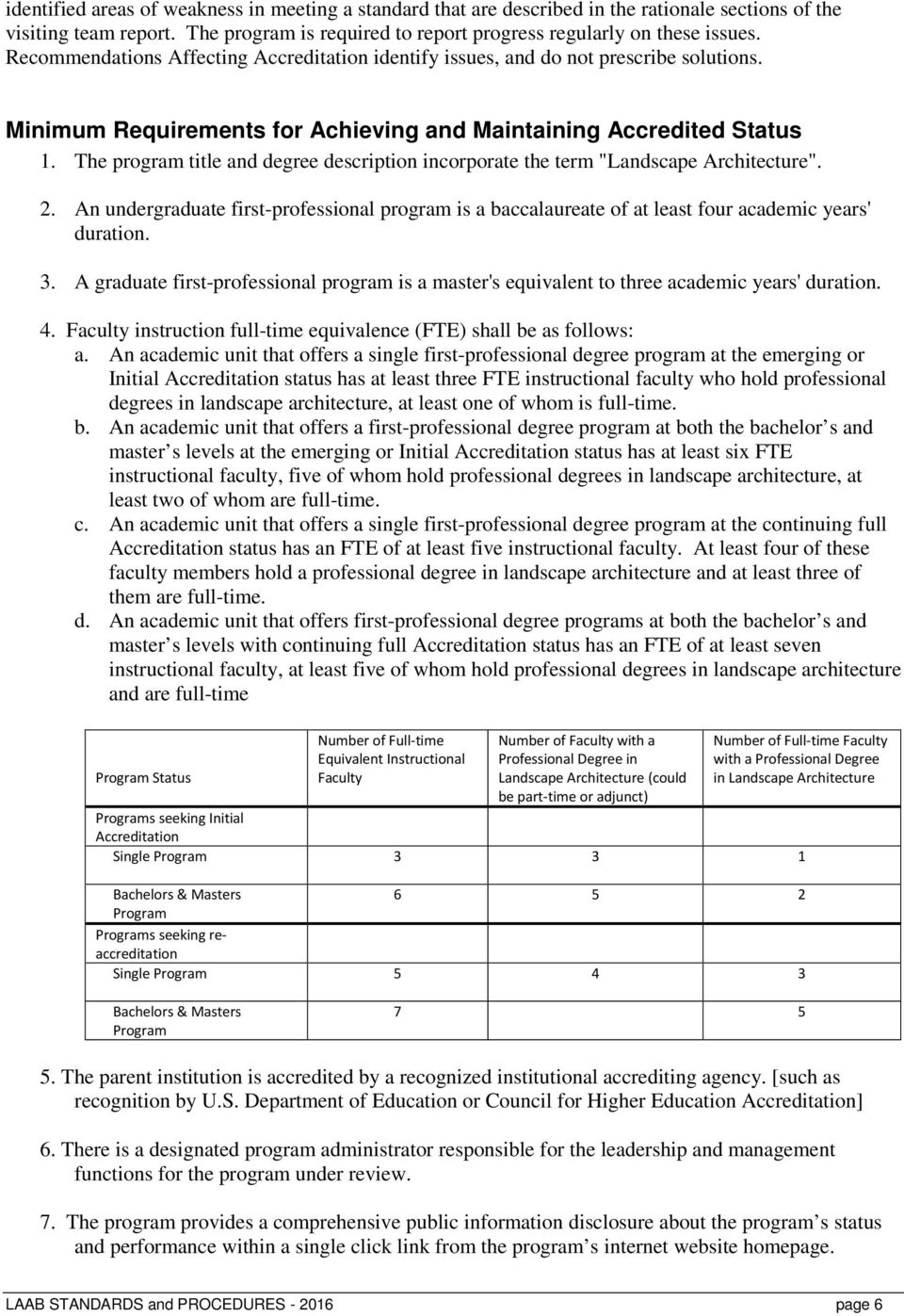
9 identified areas of weakness in meeting a standard that are described in the rationale sections of the visiting team report. The program is required to report progress regularly on these issues. Recommendations Affecting Accreditation identify issues, and do not prescribe solutions. Minimum Requirements for Achieving and Maintaining Accredited Status 1. The program title and degree description incorporate the term "Landscape Architecture". 2. An undergraduate first-professional program is a baccalaureate of at least four academic years' duration. 3. A graduate first-professional program is a master's equivalent to three academic years' duration. 4. Faculty instruction full-time equivalence (FTE) shall be as follows: a. An academic unit that offers a single first-professional degree program at the emerging or Initial Accreditation status has at least three FTE instructional faculty who hold professional degrees in landscape architecture, at least one of whom is full-time. b. An academic unit that offers a first-professional degree program at both the bachelor s and master s levels at the emerging or Initial Accreditation status has at least six FTE instructional faculty, five of whom hold professional degrees in landscape architecture, at least two of whom are full-time. c. An academic unit that offers a single first-professional degree program at the continuing full Accreditation status has an FTE of at least five instructional faculty. At least four of these faculty members hold a professional degree in landscape architecture and at least three of them are full-time. d. An academic unit that offers first-professional degree programs at both the bachelor s and master s levels with continuing full Accreditation status has an FTE of at least seven instructional faculty, at least five of whom hold professional degrees in landscape architecture and are full-time Program Status Number of Full-time Equivalent Instructional Faculty Number of Faculty with a Professional Degree in Landscape Architecture (could be part-time or adjunct) Number of Full-time Faculty with a Professional Degree in Landscape Architecture Programs seeking Initial Accreditation Single Program Bachelors & Masters Program Programs seeking reaccreditation Single Program Bachelors & Masters Program The parent institution is accredited by a recognized institutional accrediting agency. [such as recognition by U.S. Department of Education or Council for Higher Education Accreditation] 6. There is a designated program administrator responsible for the leadership and management functions for the program under review. 7. The program provides a comprehensive public information disclosure about the program s status and performance within a single click link from the program s internet website homepage. LAAB STANDARDS and PROCEDURES page 6
10 8. A program accredited by LAAB shall: a. Continuously comply with accreditation standards; b. Pay the annual sustaining and other fees as required; and c. Regularly file complete annual and other requested reports. The program administrator shall inform LAAB if any of these factors fails to apply during an accreditation period. The program administrator is responsible for reporting any substantive changes to the program when they occur. Substantive changes would be those that may affect the accreditation status of the program. Substantive change is addressed on page 29. LAAB STANDARDS and PROCEDURES page 7

11 STANDARDS Standard 1: Program Mission and Objectives The program shall have a clearly defined mission supported by goals and objectives appropriate to the profession of landscape architecture and shall demonstrate progress towards their attainment. INTENT: Using a clear concise mission statement, each landscape architecture program should define its core values and fundamental purpose for faculty, students, prospective students, and the institution. The mission statement summarizes why the program exists and the needs that it seeks to fulfill. It also provides a benchmark for assessing how well the program is meeting the stated objectives. A. Program Mission. The mission statement expresses the underlying purposes and values of the program. Assessment: The program has a clearly stated mission reflecting the purpose and values of the program and it relates to the institution s mission. B. Educational Goals. Clearly defined and formally stated academic goals reflect the mission and demonstrate that attainment of the goals will fulfill the program mission. Assessment: The program has an effective procedure to determine progress in meeting its goals and is it used regularly. C. Educational Objectives. The educational objectives specifically describe how each of the academic goals will be achieved. Assessment: The program has clearly defined and achievable educational objectives that describe how the goals will be met. D. Long-Range Planning Process. The program is engaged in a long-range planning process. Assessment 1: The long-range plan describes how the program mission, goals and objectives will be met and the program documents the review and evaluation process. Assessment 2: The long-range plan (along with the mission, goals and objectives) is reviewed and revised periodically and it presents realistic and attainable methods for advancing the academic mission. Assessment 3: The self-evaluation report (SER) responds to recommendations and considerations for improvement from the previous accreditation review and it reports on efforts to rectify identified weaknesses. E. Program Disclosure. Program literature and promotional media accurately describe the program s mission, objectives, educational experiences, accreditation status, student achievement, program costs for a full-time student for one academic year, estimated housing costs per year, average costs of books and materials per year, student retention and graduation rates, number of degrees per year, percentage of students with timely graduation (master s students graduating within 4 years and/or bachelor s students graduating within 6 years). LAAB STANDARDS and PROCEDURES page 8

12 Assessment 1: The program information accurate, understandable and accessible to the public. Assessment 2: The public disclosure information found within a single click link from the program s internet website homepage. LAAB STANDARDS and PROCEDURES page 9

13 Standard 2: Program Autonomy, Governance & Administration The program shall have the authority and resources to achieve its mission, goals and objectives. INTENT: Landscape architecture should be recognized as a discrete professional program with the resources, institutional support and authority to enable achievement of the stated program mission, goals and objectives. A. Program Administration. Landscape architecture is administered as an identifiable/discrete program. Assessment 1: The program seen as a discrete and identifiable program within the institution. Assessment 2: The program administrator holds a faculty appointment in landscape architecture. Assessment 3: The program administrator exercises effective leadership and management functions of the program. (Where the program administrator is not the primary administrator for the academic unit, such as a landscape architecture program within a multidisciplinary department or school, the landscape architecture leader has the authority to significantly influence the management of resources, including budget, faculty review, Tenure and Promotion outcomes and the direction of the program.) B. Institutional Support. The institution provides sufficient resources to enable the program to achieve its mission and goals and support individual faculty development and advancement. Assessment 1: Funding is available to assist faculty and other instructional personnel with continued professional development including support in developing funded grants, attendance at conferences, computers and appropriate software, other types of equipment, and technical support. Assessment 2: Funding is adequate for student support, such as scholarships, work-study, etc. Assessment 3: Adequate support personnel are available to accomplish program mission and goals. C. Commitment to Diversity. The program demonstrates commitment to diversity through its recruitment and retention of faculty, staff, and students. Assessment: The program demonstrates its commitment to diversity in the recruitment and retention of students, faculty and staff. D. Faculty Participation. The faculty participates in program governance and administration. Assessment 1: The faculty makes recommendations on the allocation of resources and they have the responsibility to develop, implement, evaluate, and modify the program s curriculum and contribute to operating practices. Assessment 2: The faculty participates, in accordance with institutional guidelines, in developing criteria and procedures for annual evaluation, promotion and tenure of faculty. Assessment 3: The faculty participates, in accordance with institutional guidelines, in developing and applying criteria and procedures for the appointment and assessment of program and academic unit leadership. LAAB STANDARDS and PROCEDURES page 10
14 Assessment 4: The program or institution adequately communicates and mentors faculty regarding policies, expectations and procedures for annual evaluations, and for tenure and promotion to all ranks. E. Faculty Number. The faculty shall be of a sufficient size to accomplish the program s goals and objectives, to teach the curriculum, to support students through advising and other functions, to engage in research, creative activity and scholarship and to be actively involved in professional endeavors such as presenting at conferences. The faculty FTE (full-time equivalent) shall be assessed by the institutional culture for faculty development across the closely related academic units (such as other departments and programs within a college). The workload (number, type and sizes of courses assigned) and responsibilities (such as a split of time for teaching, research and service activities) for a typical tenured or long-term faculty member within the college should be considered the template for assessing the FTE resources assigned to the landscape architecture program. Where landscape architecture faculty have their responsibilities split between programs (such as bachelor s and master s or between landscape architecture and another discipline), the FTE assessment must be prorated. Faculty instruction full-time equivalence (FTE) shall be as follows: a. An academic unit that offers a single first-professional degree program at the emerging or Initial Accreditation status has at least three FTE instructional faculty who hold professional degrees in landscape architecture, at least one of whom is full-time. b. An academic unit that offers a first-professional degree program at both the bachelor s and master s levels at the emerging or Initial Accreditation status has at least six FTE instructional faculty, five of whom hold professional degrees in landscape architecture, at least two of whom are full-time. c. An academic unit that offers a single first-professional degree program at the continuing full Accreditation status has an FTE of at least five instructional faculty. At least four of these faculty members hold a professional degree in landscape architecture and at least three of them are full-time. d. An academic unit that offers first-professional degree programs at both the bachelor s and master s levels with continuing full Accreditation status has an FTE of at least seven instructional faculty, at least five of whom hold professional degrees in landscape architecture and are full-time Program Status Number of Full-time Equivalent Instructional Faculty Number of Faculty with a Professional Degree in Landscape Architecture (could be part-time or adjunct) Number of Full-time Faculty with a Professional Degree in Landscape Architecture Programs seeking Initial Accreditation Single Program Bachelors & Masters Program Programs seeking reaccreditation Single Program Bachelors & Masters Program 7 5 Assessment 1: Student/faculty ratios in studios are typically not greater than 15:1. Assessment 2: There are sufficient faculty FTE to carry out the mission of the program (such as duties in teaching, research, service, program administration, academic advising, and/or creative professional development). LAAB STANDARDS and PROCEDURES page 11
15 Standard 3: Professional Curriculum The first professional-degree curriculum shall include the core knowledge skills and applications of landscape architecture. a. In addition to the professional curriculum, a first professional degree program at the bachelor s level shall provide an educational context enriched by other disciplines, including but not limited to: liberal and fine arts, natural sciences, and social sciences, as well as opportunities for students to develop other areas of interest. b. In addition to the professional curriculum, a first professional degree at the master s level shall provide instruction in and application of research and or/scholarly methods. c. A first professional degree at the master s level that does not require all students to have an undergraduate degree before receiving the MLA shall meet the requirements for a and b. INTENT: The purpose of the curriculum is to achieve the learning goals stated in the mission and objectives. Curriculum objectives should relate to the program s mission and specific learning objectives. The program s curriculum should encompass coursework and other co-curricular opportunities intended to develop students knowledge, skills, and abilities in landscape architecture. A. Curricular Expression of the Mission and Objectives. The program s curriculum addresses and expresses its mission, goals, and objectives. (This criterion isn t directed towards the evaluation of the Mission and Objective, but rather on how the curriculum is developed and delivered in carrying out the expectations of the Mission and Objectives.) Assessment: The Program identifies the knowledge, skills, abilities and values it expects students to possess at graduation. B. Professional Curriculum. The program curriculum is guided by, but is not limited to, coverage of: History, theory, philosophy, principles and values design history design theory criticism sustainability, resiliency, stewardship health, safety, welfare Design processes and methodology critical thinking analysis ideation synthesis site program iterative design development design communication LAAB STANDARDS and PROCEDURES page 12

16 Systems and processes natural and cultural (related to design, planning and management) plants and ecosystems sciences built environment and infrastructure human factors and social & community systems human health and well-being Communication and documentation written communication oral communication visual and graphic communication design and construction documents numeracy, quantitative problem-solving and communication community and/or client engagement Implementation construction technology and site engineering site materials use and management of plants and vegetation policies and regulation Computer applications and advanced technologies visualization, and modeling communication (conceptual and construction drawings), geospatial analysis Assessment and evaluation site assessment pre-design analysis landscape performance post-occupancy evaluation visual and scenic assessment Professional practice values ethics practice construction administration Research and/or scholarly methods (for masters level degree programs) quantitative & qualitative methods framing research questions literature/precedent review research integrity and protection of human subjects communication of research Assessment 1: The curriculum addresses the designated subject matter in a sequence that supports the degree program s goals and objectives. Assessment 2: Student work and other accomplishments demonstrate that the curriculum is providing students with the appropriate content to enter the profession. Assessment 3: Curriculum and program opportunities enable students to pursue academic interests consistent with institutional requirements and entry into the profession. LAAB STANDARDS and PROCEDURES page 13

17 C. Syllabi. Syllabi are maintained for courses. Assessment 1: Syllabi include educational objectives, course content, and the criteria and methods that will be used to evaluate student performance. Assessment 2: Syllabi identify the various levels of accomplishment students shall achieve to successfully complete the course and advance in the curriculum. D. Curriculum Evaluation. At the course and curriculum levels, the program evaluates how effectively the curriculum is helping students achieve the program s learning objectives in a timely way. Assessment 1: The program demonstrates and documents ways of: a. Assessing students achievement of course and program objectives in the length of time to graduation stated by the program. b. Reviewing and improving the effectiveness of instructional methods in curriculum delivery. c. Maintaining currency with evolving technologies, methodologies, theories and values of the profession. Assessment 2: Students participate in evaluation of the program, courses and curriculum. E. Augmentation of Formal Educational Experience. The program provides opportunities for students to participate in co-curricular activities, internships, off campus studies, research assistantships, or practicum experiences. Assessment 1: The program provides opportunities to augment the formal educational experience and documents them. Assessment 2: The program identifies the objectives of co-curricular activities and evaluates the effectiveness of these opportunities. Assessment 3: Do students report on these experiences to their peers? If so, how? F. Coursework (Bachelor s Level). In addition to the professional curriculum, students also pursue coursework in other disciplines in accordance with institutional and program requirements. Assessment: Students take courses in the humanities, arts, technologies, mathematics, natural sciences, social sciences and/or other disciplines. G. Areas of Interest (Bachelor s Level). The program provides opportunities for students to pursue special interests. Assessment 1: The program provides opportunities for students to pursue independent projects, focused electives, optional studios, certificates, minors, etc. Assessment 2: Student work incorporates academic experiences reflecting a variety of pursuits beyond the basic curriculum. LAAB STANDARDS and PROCEDURES page 14

18 H. Research/Scholarly Methods (Master s Level). The program provides an introduction to research and scholarly methods. Assessment 1: The curriculum provides an introduction to research and scholarly methods and their relation to the profession of landscape architecture. Assessment 2: The program demonstrates that theses or terminal projects exhibit creative and independent thinking and contain a significant research/scholarly component. LAAB STANDARDS and PROCEDURES page 15
19 Standard 4: Student and Program Outcomes. The program shall prepare students to pursue careers in landscape architecture. INTENT: Students should be prepared through educational programs, advising, and other academic and professional opportunities to pursue a career in landscape architecture upon graduation. Students should have demonstrated knowledge and skills in creative problem solving, critical thinking, communications, design, and organization to allow them to enter the profession of landscape architecture. A. Student Learning Outcomes. Upon completion of the program, students are qualified to pursue a career in landscape architecture. Assessment 1: Student work demonstrates the competency required for entry level positions in the profession of landscape architecture. Assessment 2: Students demonstrate their achievement of the program s learning objectives, including critical and creative thinking and their ability to understand, apply and communicate the subject matter of the professional curriculum as evidenced through project definition, problem identification, information collection, analysis, synthesis, conceptualization and implementation. B. Student Advising. The program provides students with effective advising and mentoring throughout their educational careers. Assessment 1: Students are effectively advised and mentored regarding academic development. Assessment 2: Students effectively advised and mentored regarding career development. Assessment 3: Students aware of professional opportunities, licensure, professional development, advanced educational opportunities and continuing education requirements associated with professional practice. Assessment 4: Students are satisfied with academic experiences and their preparation for the landscape architecture profession. C. Participation in Extra Curricular Activities. Students are encouraged and have the opportunity to participate in professional activities and institutional and community service. Assessment 1: Students participate in institutional/college organizations, community initiatives, or other activities. Assessment 2: Students participate in events such as LaBash, ASLA Annual Meetings, local ASLA chapter events and the activities of other professional societies or special interest groups. LAAB STANDARDS and PROCEDURES page 16

20 Standard 5: Faculty The qualifications, academic position, and professional activities and individual professional development of faculty and instructional personnel shall promote and enhance the academic mission and objectives of the program. INTENT: The program should have qualified experienced faculty and other instructional personnel to instill the knowledge, skills, and abilities that students will need to pursue a career in landscape architecture. Faculty workloads, compensation, and overall support received for career development contribute to the success of the program. A. Credentials. The qualifications of the faculty, instructional personnel, and teaching assistants are appropriate to their roles. Assessment 1: The faculty has a balance of professional practice and academic experience appropriate to the program mission. Assessment 2: Faculty assignments are appropriate to the course content and program mission. Assessment 3: Adjunct and/or part-time faculty (if present) are integrated into the program s administration and curriculum evaluation/development in a coordinated and organized manner. Assessment 4: Faculty qualifications are appropriate to responsibilities of the program as defined by the institution. B. Faculty Development. The faculty is continuously engaged in activities leading to their professional growth and advancement, the advancement of the profession, and the effectiveness of the program. Assessment 1: Faculty activities such as scholarly inquiry, research, professional practice and service to the profession, university and community are documented, peer-reviewed and disseminated through appropriate media such as journals, professional magazines, community, college and university media. Assessment 2: Faculty teaching and administrative assignments allow sufficient opportunity to pursue advancement and professional development. Faculty assignments, in terms of workload and distribution of responsibilities (of teaching, research, service, and professional engagement), are similar to the institutional culture of expectations in related academic units. Assessment 3: The development and teaching effectiveness of faculty and instructional personnel are systematically evaluated, and the results are used for individual and program improvement. Assessment 4: Faculty seek and make effective use of available funding for conference attendance, equipment and technical support, etc. Assessment 5: The activities of faculty are reviewed and recognized by faculty peers. Assessment 6: Faculty participate in university and professional service, student advising and other activities that enhance the effectiveness of the program. C. Faculty Retention. Faculty hold academic status, have workloads, receive salaries, mentoring and support that promote productivity and retention. Assessment 1: Faculty salaries, academic and professional recognition are evaluated and appropriate to promote faculty retention and productivity. LAAB STANDARDS and PROCEDURES page 17

21 Assessment 2: Rate of faculty turnover is does not undermine the mission and goals of the program. LAAB STANDARDS and PROCEDURES page 18
22 Standard 6: Outreach to the Institution, Communities, Alumni, and Practitioners The program shall have a plan and a record of achievement for interacting with the professional community, its alumni, the institution, community, and the public at large. INTENT: The program should establish an effective relationship with the institution, communities, alumni, practitioners and the public at large in order to provide a source of service learning opportunities for students, scholarly development for faculty, and professional guidance and financial support. Documentation and dissemination of successful outreach efforts should enhance the image of the program and educate its constituencies regarding the program and the profession of landscape architecture. A. Interaction with the Profession, Institution, and Public. The program represents and advocates for the profession by interacting with the professional community, the institution, community and the public at large. Assessment 1: Service-learning activities are incorporated into the curriculum. Assessment 2: Service activities are documented on a regular basis. Assessment 3: The program community interacts with the professional community, the institution, the community and the public at large. B. Alumni and Practitioners. The program recognizes alumni and practitioners as a resource. Assessment 1: The program maintains or has access to a current registry of alumni that includes information pertaining to current employment, professional activity, post graduate study, and significant professional accomplishments. Assessment 2: The program engages the alumni and practitioners in activities such as a formal advisory board, student career advising, potential employment, curriculum review and development, fund raising, continuing education etc. Assessment 3: The program acknowledges and celebrates the significant professional accomplishments of its alumni and benefactors. LAAB STANDARDS and PROCEDURES page 19
23 Standard 7: Facilities, Equipment, and Technology Faculty, students and staff shall have access to facilities, equipment, library and other technologies necessary for achieving the program s mission and objectives. INTENT: The program should occupy space in designated, code-compliant facilities that support the achievement of program mission and objectives. Students, faculty, and staff should have the required tools and facilities to enable achievement of the program mission and objectives. A. Facilities. There are designated, code-compliant, adequately maintained spaces that serve the professional requirements of the faculty, students and staff. Assessment 1: Faculty, staff and administration are provided with appropriate office space. Assessment 2: Students are assigned permanent studio workstations adequate to meet the program needs. Assessment 3: Facilities are adequately maintained and they are in compliance with ADA, life-safety and applicable building codes. (Acceptable documentation includes reasonable accommodation reports from the university ADA compliance office and/or facilities or risk management office.) B. Information Systems and Technical Equipment. Information systems and technical equipment needed to achieve the program s mission and objectives are available to students, faculty and other instructional and administrative personnel. Assessment 1: The program has sufficient access to computer equipment and software. Assessment 2: The frequency of hardware and software maintenance, updating and replacement is sufficient. Assessment 3: The hours of use are sufficient to serve faculty and students. C. Library Resources. Library collections and other resources are sufficient to support the program s mission and educational objectives. Assessment 1: Collections are adequate to support the program. Assessment 2: Courses integrate library and other resources. Assessment 3: Library hours of operation are convenient and adequate to serve the needs of faculty and students. LAAB STANDARDS and PROCEDURES page 20
24 ACCREDITATION PROCEDURES Initiating Accreditation A program can apply for accreditation whenever it meets the Minimum Requirements for Achieving and Maintaining Accredited Status (page 7) and has had at least one graduating class. Accreditation applies to degrees awarded within two years prior to initial accreditation by LAAB. A program should notify LAAB of its intention to apply for initial accreditation at least four months before the anticipated visit. A program must have had one graduating class, and meet accreditation requirements 1-7 (see Minimum Requirements for Achieving and Maintaining Accredited Status) before a visit can be scheduled. The accreditation process is the same whether a program is applying for renewal of accreditation or initial accreditation. Candidacy Status To assist non-accredited programs, the LAAB has developed a Candidacy Status to help programs prepare for the accreditation process. Candidacy is an accreditation classification granted to any program which is in the planning or early stages of development or an intermediate stage of program implementation. This accreditation classification provides evidence to the educational institution, licensing bodies, and the public that at the time of evaluation, the developing education program appears to have the potential for meeting the standards set forth in the requirements for an accredited educational program in landscape architecture. The purpose of candidacy is to establish stable, constructive, ongoing, and helpful partnerships between LAAB and institutions working toward becoming accredited by LAAB. Programs designated as candidates have voluntarily committed to work toward LAAB accreditation. Candidacy status signifies that the program is demonstrating reasonable progress toward the attainment of accreditation. However, candidacy status does not indicate accredited status nor does it guarantee eventual accreditation. To achieve candidacy status a program must meet the minimum requirements for achieving and maintaining accredited status except for: An academic unit that offers a single first-professional degree program has at least three FTE instructional faculty who hold professional degrees in landscape architecture, at least one of whom is full-time. An academic unit that offers first-professional degree programs at both bachelor s and master s levels, has at least six instructional FTE, at least five of whom hold professional degrees in landscape architecture, and at least two of whom are full-time. However, in order to apply for initial accreditation, the minimum faculty requirements listed above must be met. After achieving candidacy status, a program must apply for initial accreditation within one year of its first graduating class. If initial accreditation is not granted, the program can retain its candidacy status for one additional year. To achieve candidacy status, a program must submit a self-evaluation report (SER) and undergo a program review. A program review is a mini-accreditation visit where one member of LAAB or the Roster of Visiting Evaluators will review the program s self-evaluation report and conduct a one to two day visit to the program. LAAB will review the report and determine whether the program should be granted candidacy status or not. In addition LAAB will make recommendations and suggestions on how LAAB STANDARDS and PROCEDURES page 21
25 the program can continue to advance towards meeting the accreditation standards. Programs are responsible for the expenses of the program review visitor. LAAB will vote on whether to grant a program candidacy status at its next regularly scheduled meeting by reviewing the program s self-evaluation report and the program review report. If LAAB decides not to grant candidacy status this decision is not subject to appeal. The program will be informed in writing of the LAAB s decision. After achieving candidacy status, programs are required to submit progress reports to LAAB annually. Programs that have achieved candidacy status must pay an annual sustaining fee (a fee schedule can be obtained from the LAAB office). Self-Evaluation Report All programs applying for accreditation prepare a Self-Evaluation Report (SER) following the required LAAB format. The SER describes the program's mission and objectives, its self-assessment, and future plans; provides a detailed response to the recommendations of the previous visiting team; and details the program's compliance with each accreditation standard. It is important that faculty, administrators, and students participate in preparing the self-evaluation report. The SER must include a statement explaining the participation of each group. The LAAB accreditation administrator notifies each program of the accreditation schedule and LAAB deadlines. Since accreditation is a voluntary process, the LAAB cannot conduct a review without an invitation or written notice of approval from the chief executive officer of the institution. This invitation and notice of preferred visit dates must be submitted at least four months prior to the review. At least 45 days before the visit, the program submits two copies of the SER to the ASLA accreditation manager and one copy of the SER with the proposed visit schedule to each member of the visiting team. If the documents are not submitted by this deadline, the program may be notified that the visit has been postponed. In the case of a currently accredited program, this may result in the suspension of accreditation and/or the term of accreditation expiring. The program is responsible for all costs incurred plus an administrative fee (a fee schedule can be obtained from the LAAB office). Roster of Visiting Evaluators (ROVE) The LAAB maintains the Roster of Visiting Evaluators (ROVE). Visiting team members are selected from the Roster. There are three categories of evaluators: Landscape architecture educators who hold a first-professional degree in landscape architecture, teach in an accredited program, and hold the minimum academic rank of tenured associate professor. Academic administrators (current or former) who hold the minimum rank of assistant or associate dean, including non-landscape architects, and who hold terminal degrees in their respective fields. Landscape architecture practitioners who have a first-professional degree in landscape architecture and at least five full years of practice experience. LAAB STANDARDS and PROCEDURES page 22
26 Exceptions to these criteria must be approved by the LAAB chair. To ensure wide representation of the community of interest, accredited programs are invited to nominate one landscape architecture educator and one academic administrator. Similarly, each ASLA chapter is encouraged to nominate a practitioner. The LAAB will seek nominations from other sources such as individuals and organizations (such as CELA and CLARB). LAAB will review nominations for ROVE and make appointments to the roster. Appointments are for five years and are renewable. Information on file for all ROVE members includes current location, school affiliations, and previous visits, as well as a resume. Visiting Team Selection The visiting team consists of one landscape architecture educator, one practitioner, and one academic administrator. The LAAB chair selects a proposed visiting team from the ROVE and designates one member as team chair. Teams are selected to avoid potential conflicts of interest. For example, a previous affiliation with the program under review, or an affiliation with a program in the same geographic location with competing enrollments, monies, etc., renders an evaluator ineligible. All ROVE members participating in a review of a course of study leading to a first professional MLA degree will hold an advanced degree. The program is advised of the proposed team, including each proposed team member's present position, experience, and areas of expertise. The program has the right to challenge one team member, with cause. For the purpose of challenge, conflict of interest can be cited if the nominee comes from the same geographic location and is affiliated with a competitive institution; if the nominee had a previous affiliation with the institution; or if the institution can demonstrate that the nominee is not competent to evaluate the program. However, the final decision on team assignments rests with the LAAB chair. Following the program's review of potential team members, the team members are invited to serve. When the visiting team composition and date of the review are finalized, the team and the program are formally notified. Any subsequent changes in team makeup because of scheduling conflicts or emergencies are made in consultation with the program. Where special conditions warrant, such as providing team member training or assisting with site-evaluation procedures and matters of due process, a four-person team may be assembled. At the discretion of the LAAB chair, one of the following may accompany the visiting team: an LAAB member, ASLA's director of education or accreditation manager, a landscape architecture educator who has a specialist background relevant to the program under review, an educator from a related design profession, or a ROVE member for training purposes. Observer Responsibilities Observers may participate in discussions as invited by the visiting team chair. For example, an educator assigned as an observer to prepare as a future visiting team member may be asked to participate in reviews of student work and ask questions at interviews that the educator member of the team would typically ask. However, the goal of the observer is to prepare to be a future team member. Cooperation with Other Accrediting Agencies and State Agencies LAAB seeks to reduce the burden of accreditation on landscape architecture programs by participating with other accrediting bodies if the program under review requests this. The schedule and arrangements must assure that all aspects of the landscape architecture review can be accomplished. LAAB STANDARDS and PROCEDURES page 23
27 Pre-Visit Responsibilities: Visiting Team The team chair is responsible for making assignments and assembling the visiting team report. Team members receive the Accreditation Standards and Procedures and the LAAB Visiting Team Guidelines and are expected to be thoroughly familiar with these documents before the accreditation visit. Each visiting team member must carefully review the Self-Evaluation Report and carry out assignments as the team chair directs. Pre-Visit Responsibilities: Program The accreditation manager, after conferring with the team and the institution, schedules the dates of the accreditation visit. The program is responsible for making all lodging arrangements for the visiting team. Hotel accommodations must be comfortable, reasonably priced, and, where possible, use on-campus facilities such as those for visiting faculty or guest lecturers. LAAB is responsible for the travel, lodging, and meal expenses of the visiting team. Institutions with more than one campus are responsible for the transportation costs between the campuses including additional airfare (example: team members fly into one airport and out of another) if applicable. Sample Visit Schedule The following is a sample schedule of activities for a visiting team of the LAAB. This includes all necessary elements and provides adequate time for report preparation. Day 1 (Sunday) 12:00-2:00 pm Team arrival and check in. 2:00-5:00 pm Review of student work and facilities 6:00 pm Team meets with landscape architecture program administrator to finalize schedule and to discuss the program in general 8:00 pm Executive session: confirm team member assignments and plan how the team will conduct interviews and various meetings that will take place during the visit. Day 2 (Monday) 7:30 am Breakfast with program administrator 9:00 am Meet with the chief executive officer of the institution 9:30 am Meet with the immediate supervisor of the landscape architecture program administrator. 10:00 am Familiarization tour of the landscape architectural facilities. Tour should be brief. (This should be scheduled for Saturday or Sunday depending upon team s arrival schedule). 10:30 am Curriculum review by faculty to visiting team. Reviews how program accomplishes its mission through the curriculum and a review of student work from each class and sequence. LAAB STANDARDS and PROCEDURES page 24
28 12:00 Noon Lunch with recent graduates and practitioners, to be arranged at the discretion of the team and the school. Opportunity to evaluate graduates' satisfaction with the educational process and the degree to which the program prepared them to perform entry-level functions. 1:30 pm Interviews with students and faculty. Student interviews should be conducted with students grouped by year. It is recommended that student interviews take place before faculty interviews. Faculty interviews are usually a series of individual interviews at half-hour intervals, to discuss impressions of the program--strengths, weaknesses, faculty input, and faculty development. Group faculty interviews can be conducted if more acceptable to the faculty and the team. 3:00 p.m. Break 3:15 pm Resume student and faculty interviews. 5:00 pm Break for day. 7:00 pm Team meets for dinner and executive session to review findings. Day 3 (Tuesday) 7:30 a.m. Breakfast with program administrator 9:00 am Resume faculty interviews. 12:30 pm Lunch with other department heads 1:30 pm Remainder of faculty and student interviews as necessary. Inspection of library and other supporting facilities, such as computing center, special services, etc. 3:00 pm Team executive session: preparation of the report by the visiting team. Day 4 (Wednesday) 7:30 am Breakfast meeting with program administrator to advise him/her of team's findings. 9:00 am Review of the team's findings with the chief executive officer of the institution. 9:45 am Discussions of the team's findings with the immediate supervisor of the landscape architecture program administrator. 10:30 am Report of team findings to landscape architecture faculty. 11:15 am Report of team findings to students. (Reports to faculty and students may be combined at visiting team's discretion). 12:00 Noon Lunch. Team departs from campus. The program prepares the visit schedule and forwards it to the team members and the accreditation manager, along with the SER, at least forty-five days prior to the visit. The recommended schedule includes interviews with students, faculty, and administration officials, as well as alumni and local practitioners. Team members may conduct interviews by telephone with persons who are unable to meet LAAB STANDARDS and PROCEDURES page 25
29 with them on campus, such as alumni, practitioners or faculty on leave. The chief executive officer of the campus should be interviewed both at the beginning and at the end of the team's visit. Early inspection of space and facilities and an exhibit of work produced by students in the program are vital. No evening events should be scheduled as the team needs this time to work on its report and prepare for the next day. The team members meet in executive session to prepare a complete report in draft form, and to decide on an advisory recommendation to LAAB on the program's accredited status. The content of this report, except the advisory recommendation, is discussed with the chief executive of the institution as well as the program administrator, faculty, and students, particularly in regard to strengths and weaknesses of the program, recommendations affecting accreditation, and suggestions for program improvement. Visiting Team Report Before the visit, the visiting team receives the Accreditation Standards and Procedures and the Visiting Team Guidelines. The guidelines include a format for the visiting team report, which is designed to ensure a response to all the LAAB requirements and accreditation standards. The team chair makes writing assignments as necessary and is responsible for compiling the report. Within ten days following the visit, the visiting team chair completes final editing and sends copies to the other team members and the accreditation manager, who review the report. The report may be edited for grammar, spelling and style. The team members should send any comments to the accreditation manager. Any substantive changes or additions will be referred to the team chair and may result in distributing the report to the team to review the report a second time. Institutional Response Within ten days of the receipt of the team report, the accreditation manager shall send copies to the chief executive officer and the program administrator of the institution for their comment and technical accuracy review. Within fifteen days following receipt of the team report, the institution shall submit its institutional response (substantive comments and corrections) to the accreditation manager. The program shall respond to any standard that is assessed as met with recommendation or not met. This response should include any documentation the program deems pertinent. The team report and institutional response are sent to the LAAB members at least three weeks before the next scheduled LAAB meeting. Vacating of Application for Accreditation Any time before action by the LAAB, an institution may vacate its application for accreditation without penalty by notifying in writing both the LAAB chair and the accreditation manager. The LAAB will not refund fees and the program will be assessed for expenses incurred by LAAB. LAAB Review and Decision The accreditation review decision will take place at the next scheduled LAAB meeting (typically February and August). The LAAB may consult with a member of the visiting team (usually the chair) and/or the program administrator in order to clarify items in the team report or institutional response. Programs may request to appear before the LAAB to discuss the pending accreditation decision. The LAAB's decision will be based upon the program's self-evaluation report, annual reports, visiting team report, and institutional response. LAAB STANDARDS and PROCEDURES page 26
30 Any adverse accreditation decision, defined as either accreditation denial, or withdrawal of accreditation, will be substantiated with specific reasons, and program administrators will be notified of their right to appeal any such decision (see Appeal Process). A program which has not been granted accredited status, or a program from which accreditation has been withdrawn, may reapply for accreditation when its administrators believe the program meets current requirements. LAAB Actions Accreditation is granted for a period of one to six years. A program may apply for an accreditation review at any time before its term expires, but may not defer a visit to extend its term. The LAAB may vary these normal terms at its discretion. Reasons for such variance will be supplied to the program. The official action letter to the institution indicates the date on which accreditation will expire. The annually published list of accredited programs includes the accredited status of each program along with the next scheduled accreditation review. The LAAB will publish actions of accreditation, accreditation denial, withdrawal of accreditation, suspension of accreditation, or provisional accreditation in LAND Online. LAAB can take the following actions: Accreditation Granted when all standards are met or when one or more standards are met with recommendation, and continued overall program quality and conformance to standards are judged likely to be maintained. Accreditation may be granted up to six (6) years. A program receiving accreditation may be required to submit special progress reports at the discretion of LAAB. Provisional Accreditation Granted when one or more standards are met with recommendation and the cited deficiencies are such that continued overall program quality or conformance to standards is uncertain. Provisional accreditation may be granted up to two (2) years. This status shall not be granted more than twice without an intervening period of accreditation. Provisional status is not deemed to be an adverse action and is not subject to be appealed. Initial Accreditation Granted on a first review when all standards are at least minimally met and the program's continued development and conformance to the accreditation standards is likely. Initial accreditation may be granted for up to six (6) years. Programs receiving initial accreditation must submit a special progress report after two or three years (time determined by LAAB). LAAB will review the progress report to determine if an accreditation review should be scheduled immediately or as originally scheduled when initial accreditation was granted. Suspension of Accreditation This status results if a program fails to maintain good standing for administrative reasons. Suspension of accreditation is not subject to appeal. Accreditation Denial This status results when one or more standards are not met. This determination is subject to appeal. LAAB STANDARDS and PROCEDURES page 27
31 Withdrawal of Accreditation This status results if a program fails to comply with accreditation standards. This determination is subject to appeal. Notification of LAAB Action The institution is officially notified of the LAAB's action with a letter. Copies of the letter are sent to the program administrator and visiting team. The LAAB retains a copy of a program's two most recent self-evaluation reports. Confidentiality The LAAB treats all material generated by the program and LAAB for the accreditation review as confidential. However, the LAAB encourages the widest dissemination of all accreditation materials within the institution. The team report and self-evaluation report are considered to be the property of the institution. The LAAB reserves the right to release a complete report should the institution release a portion of the team report that might, in the judgment the LAAB, presents a biased or distorted view of the site-evaluation findings. Reference to Accredited Status A program's accredited status must be clearly conveyed in all program and institutional literature. In particular, if a program offers more than one course of study leading to the same degree, (such as first-professional and post-professional MLAs) program literature must identify which course(s) of study is (are) accredited. Delaying a scheduled Accreditation Visit. From time to time a program may want to delay a scheduled accreditation visit because of unexpected circumstances. LAAB will grant a site visit delay for up to one year (from spring semester 2014 to spring semester 2015 for example) if the following conditions are met: The program received a six year term of accreditation at its last review, and The program is in compliance with Minimum Requirements for achieving and maintaining accredited status, and All fees and required reports have been submitted. To request a delay the LAAB must receive a letter from the school dean or higher-ranking administrator. The program shall pay a visit delay fee, see LAAB fee schedule. If the request for delay is received after visiting team selection has begun the program must pay a fee plus any visit related expenses that have been incurred (such as non-refundable airline tickets) see the LAAB fee schedule. If an institution is scheduled to have two programs reviewed at the same time only one delay fee is charged (both must meet above conditions). Regular annual fees still apply. Rescheduling Visit When the visit is rescheduled, priority for selecting visit dates will go to programs hosting visits in their regular cycle. LAAB STANDARDS and PROCEDURES page 28
32 A delayed visit cannot be postponed again for any reason. If the rescheduled review does not take place the program s accreditation will lapse. If a program chooses to apply, it will be through the initial accreditation process. Term of Accreditation When LAAB takes action, the grant of accreditation will begin from the originally scheduled review date. Annual Reports and Other Reports Each accredited program submits an annual report to allow LAAB to monitor the program's continuing compliance with accreditation requirements. Annual reports are due August 1 and late reporting will incur a late fee. The report must include: a. Changes in curriculum, personnel, administration, fiscal support, and physical facilities that have occurred since the last report. b. Current enrollment. c. Number of graduates for the current year. d. Report on employment or enrollment in graduate school for previous year's graduates. e. Progress toward complying with the recommendations of the most recent accreditation review. The LAAB may choose to alert the program administrator as well as the institution's chief executive officer of its concern for potential effects of reported changes. Policy on Substantive Change In order to support accredited programs as they make changes between regular accreditation visits, Landscape Architectural Accreditation Board (LAAB) will offer consultative reviews of proposed changes prior to submission of an official request for Substantive Change. Substantive Change will normally be included in annual reports, yet, is encouraged to be reported prior to the change. Primary responsibility for reporting Substantive Change rests with the program or institution administrator. Substantive Change is any change that compromises a program s ability to meet one or more of the Standards approved and published by LAAB or that makes a program unable to meet any of the following Minimum Requirements for maintaining accredited status as currently stated in the 2016 LAAB Accreditation Standards and Procedures and must be reported: 1. The program title and degree description incorporate the term "Landscape Architecture". 2. An undergraduate first-professional program is a baccalaureate of at least four academic years' duration. 3. A graduate first-professional program is a master's equivalent to three academic years' duration. 4. Faculty instructional full-time equivalence (FTE) must be as follows: a. An academic unit that offers a single first-professional program has at least three FTE instructional faculty who hold professional degrees in landscape architecture, at least one of whom is full-time. b. An academic unit that offers first-professional programs at both bachelor's and master's levels, has at least six instructional FTE, at least four of whom hold professional degrees in landscape architecture, and at least two of whom are full-time. LAAB STANDARDS and PROCEDURES page 29
33 5. The parent institution is accredited by the institutional accrediting body of its region. 6. There is a designated program administrator for the program under review. 7. Public information about the program is comprehensive, understandable and accessible to the public. Procedures and forms for reporting Substantive Change may be obtained from the LAAB website. A response regarding a Substantive Change will be provided by LAAB or the accreditation manager within 30 days. The program or institution administrator must respond to the LAAB within 30 days to remain in good standing. Other Reports From time to time, LAAB may require programs to prepare special reports to explain or describe a certain issue or problem. These issues will be ones that the LAAB believes require additional explanation beyond what is included in annual reports and because of the issue the timing for submitting the report is different than the annual report due date. Maintaining Good Standing To maintain good standing a program must continuously meet the minimum requirements for achieving and maintaining accredited status. LAAB must be informed if any of these requirements cannot be met during an accreditation period. Should a program fail to maintain good standing, accreditation may be suspended or withdrawn. Suspension of Accreditation Should a program fail to maintain good standing for administrative reasons (such as failure to pay required fees or submit required reports) accreditation may be suspended. Before this action is taken the LAAB shall send a show-cause letter requesting the program to explain why accreditation should not be suspended. Since suspension of accreditation occurs only for administrative reasons it is not subject to appeal. A program whose term of accreditation has been suspended will be listed as such on the official list of accredited programs. Suspensions of accreditation are published in LAND Online. Students attending a program with suspended accreditation are considered to be attending an accredited program. A program can be suspended for a maximum of one year (12 months). LAAB will begin procedures to withdraw accreditation to take effect immediately when the maximum period of suspension is reached. If evidence of remedial action is submitted and judged adequate within the one year period of suspension, reinstatement of the previous grant of accreditation may be made. Withdrawal of Accreditation Should a program fail to comply with accreditation standards, accreditation may be withdrawn. Before withdrawing accreditation the LAAB shall send a show-cause letter requesting the program to explain why accreditation should not be withdrawn. The LAAB may suggest to the program that an accreditation visit is in order. Withdrawal of accreditation is an adverse action and can be appealed (see Appeals Process). LAAB STANDARDS and PROCEDURES page 30
34 If the program's parent institution or other programs within the institution are placed on probationary status or have accreditation withdrawn by their accrediting agencies the LAAB may send a show-cause letter to the landscape architecture program to determine the program's current condition. Accreditation Fees The current LAAB fee schedule can be obtained from the LAAB office. THE APPEAL PROCESS When the LAAB takes adverse action on accreditation, specific reasons shall be provided for that action to the program administrator and the chief executive of the institution. Adverse actions include denial or withdrawal of accreditation. Recipients of adverse action shall be advised of their right to appeal. An appeal must be based on one or more of the following issues: 1. Whether the LAAB and/or the visiting team conformed to the procedures described in this document; or 2. Whether the LAAB and /or the visiting team conformed to the Accreditation Standards. Appeals based on challenges to accreditation standards or procedures will be dismissed. Institutions differing with LAAB on the standards and procedures established in this document are invited to contact the LAAB which regularly reviews the standards. A written notice of appeal signed by the chief executive officer of the institution must be submitted within twenty days of notice of the LAAB's action letter. The appeal must be sent to the accreditation manager who shall notify the chair of LAAB. The program must submit within sixty days of LAAB's action a comprehensive written statement of all the reasons for the appeal. Failure to submit this statement within sixty days of notice of LAAB's action is equivalent to withdrawing the appeal. During the appeal period, the accredited status of the program before the adverse action will not change. The record of the appeal upon which the appeal is based shall be limited to the material which was presented to the LAAB at its scheduled meeting from which the final accreditation report consisting of the action letter from LAAB is issued. The program bears the cost of the appeal. Appeal Panel The Chair of LAAB shall appoint an appeal panel comprised of three persons, including its chair. Each person must have knowledge of and experience with the accreditation of educational institutions or programs. One member of the appeal panel may be a former member of LAAB. One member of the Appeal Panel may be challenged by the institution for cause and the chair of LAAB shall appoint a replacement. Panel members may serve concurrently on other ASLA committees, councils, or boards, excluding only the LAAB. Authority The appeal panel by concurrence of a majority of the members, may either affirm LAAB's decision or recommend to LAAB that it reconsider the decision. LAAB STANDARDS and PROCEDURES page 31
35 The LAAB must review the case if the appeal panel recommends reconsideration of the decision. Reasonable scheduling is at the discretion of the LAAB. In any case remanded to the LAAB, the recommendations of the appeal panel shall not bind or limit the LAAB in any way. The final decision on accreditation rests with LAAB. The appeal panel may promulgate additional rules of procedure for the scheduling and conduct of hearings, provided they are consistent with these procedures. The appeal panel has no jurisdiction or authority over the reasonableness of the accreditation standards and procedures, which is a matter properly in the exclusive jurisdiction of the LAAB. No adverse action is published until the resolution of any appeal. Hearing of Appeal The chair of the appeal panel designates the time and place of the hearing which takes place no later than 45 days after receipt of the program's comprehensive written statement. The chair presides at the hearing and rules on all procedural matters. All three members of the panel must be present. Both the institution and the LAAB may submit briefs before the hearing in a manner prescribed by the appeal panel. The Appeal Panel will review the documents that LAAB had at the time it made its original decision: visiting team report, self-evaluation report and institution s technical accuracy review comments. The hearing shall be as informal as is reasonable and appropriate under the circumstances. A party may appear by or with counsel or other representative. The institution may waive personal appearance, in which case the matter will be decided solely on briefs and the written statement. The final decision on accreditation rests with LAAB. Decision of the Appeal Panel Every decision must have the concurrence of a majority of the appeal panel members. Within thirty days after the conclusion of the hearing, the appeal panel shall issue a written decision stating its reasons and recommendations, if any, to the LAAB. The decision will indicate the members of the appeal panel concurring. Dissenting opinions may be filed. The LAAB will furnish the majority decision with dissenting opinions, if any, to the institution. If the appeal panel affirms the LAAB decision, there is no further remedy available within these procedures. If the appeal panel recommends reconsideration of the decision, the determination thereafter by the LAAB shall be final. Expenses of Appeal Hearing and Deposit The program will bear the following expenses in connection with the appeal: 1. Travel and subsistence for the appeal panel members and others such as team chair and LAAB representative, and 2. Cost of the hearing room. LAAB STANDARDS and PROCEDURES page 32
36 A deposit must be made with the LAAB at the time of the filing of the notice of appeal. This deposit shall be applied to the expenses listed above. Before the hearing, the LAAB may increase the amount of deposit required to meet a realistic estimate of the expenses involved. LAAB STANDARDS and PROCEDURES page 33
37 COMPLAINT PROCEDURE A complaint is defined as a written statement submitted by persons expressing substantial dissatisfaction with the quality of a program or its review as set forth by current accreditation standards and procedures. Copies of all correspondence shall always be sent to these four concerned parties: complainant, program administrator, chief executive officer of the institution, and the LAAB accreditation administrator. When an institution adheres to sound due process procedures within its own organization, it is unlikely that LAAB will become involved. Each institution is encouraged to develop effective procedures for responding to faculty or student queries and problems, alleviating dissatisfaction, and averting the need for external intervention by any outside agency. Emphasis on cooperative attitudes and prompt action plays a significant role in fair resolution of faculty or student dissatisfaction. A complaint shall be processed in stages as follows: Stage A: The aggrieved party shall submit the complaint, with documentary evidence, to the program administrator. The program administrator shall make a thorough investigation of the complaint and within thirty days respond to the aggrieved party. Stage B: Should the complainant not be satisfied by the action resulting from Stage A, the written complaint should be filed within thirty days with the chair of the LAAB. At its next regular or special meeting, the LAAB will consider the complaint, as well as the response of the institution, and then decide on its merits, providing all parties with notice of that decision. LAAB STANDARDS and PROCEDURES page 34
38 PILOT PROJECT: Visits to Institutions with Two Programs The LAAB is conducting a pilot project from Spring 2016 through Spring 2018 to permit institutions with two fully accredited degree programs (a bachelors degree program and a masters degree program) to have them reviewed for reaccreditation with a combined SER and combined Visiting Team. Participation is voluntary by request from the Program and approval of the Accreditation Manager. Schools should make this request at the time of preparation of the letter of request. An institution with two programs seeking reaccreditation-- a bachelor s first professional degree and a master s first professional degree-- may at their discretion, request that both programs be visited and reviewed at the same time. The request must be approved by the accreditation manager as a part of the request for reaccreditation. If the two programs don t have the same accreditation term expiration, the visit will be concordant with the date of the program with its term to expire first. The institution can request that the visit be conducted at the same time with two teams and two SER s or with a single combined team and a combined SER. This choice must be approved the accreditation manager at the time of the invitation for visit and review. If the institution chooses to have the programs visited concurrently, but independently, the procedures and documents move forward as described elsewhere in this document. If the institution requests that the review be conducted as a single coordinated review of both programs, there are adjustments to the preparation of the SER, the make-up of the visiting team, the visitation schedule, the duration of the visit, the Teams Report and advisory recommendations. In a single coordinated review: a. The SER is expanded by no more than 50 pages to cover assessments not only shared in common by each program, but also explicitly address the performance related specifically to the bachelor s program and the master s program for each standard. The sections for Standard 3. Professional Curriculum and Standard 4. Student and Program Outcomes will each be expanded into two sections -- Standard 3b. Professional Curriculum/Bachelor s Program and Standard 3m. Professional Curriculum/Master s Program and Standard 4b. Bachelor s Student and Program Outcomes and Standard 4m. Master s Student and Program Outcomes. b. The make-up of the Visiting Team will expand to four Members, including an administrative member, two educator members and a practitioner member. As the Team Chair assigns roles to Team members, the Chair will ask one of the Team members to take an assessment lead for the Bachelor s program and another Team member to take an assessment lead for the Master s program. c. The Scheduled visit will be expanded one day (because there is an additional set of students to visit with and an additional set of student work to review, plus in each of the other interviews with administrators, faculty, alumni and practitioners, the teams will need to evaluate the difference in expectation and performance between the two programs). d. The Team s Report and advisory recommendations will expand Standard 3. Professional Curriculum and Standard 4. Student and Program Outcomes as two sections each labeled Standard 3b. Professional Curriculum/Bachelor s Program and Standard 3m. Professional Curriculum/Master s Program and Standard 4b. Bachelor s Student and Program Outcomes and Standard 4m. Master s Student and Program Outcomes. Team assessments of Recommendations Affecting Accreditation or Suggestions for Improvement may be made as related to either or both degree programs. The Team will make two separate Advisory Recommendations to the LAAB Board, one for each program. LAAB STANDARDS and PROCEDURES page 35
LANDSCAPE ARCHITECTURAL ACCREDITATION BOARD. Accreditation Standards And Procedures
 LANDSCAPE ARCHITECTURAL ACCREDITATION BOARD Accreditation Standards And Procedures Landscape Architectural Accreditation Board American Society of Landscape Architects 636 Eye Street, N.W. Washington,
Standards for Accreditation of Master s Programs in Library and Information Studies. Introduction
 Standards for Accreditation of Master s Programs in Library and Information Studies Adopted by approval of the Council of the American Library Association, February 2, 2015 Purpose of Accreditation Introduction
Standards for Accreditation of Master's Programs in Library & Information Studies
 Standards for Accreditation of Master's Programs in Library & Information Studies Adopted by the Council of the American Library Association January 15, 2008 Office for Accreditation American Library Association
RE: Revised Standards for Accreditation of Master s Programs in Library and Information Studies
 EBD #10.9 2013-2014 TO: ALA Executive Board RE: Revised Standards for Accreditation of Master s Programs in Library and Information Studies ACTION REQUESTED/INFORMATION/REPORT: For information purposes.
Guidelines for Massachusetts Early Educator Preparation Programs Participating in the Early Childhood Educator Scholarships Program.
 Guidelines for Massachusetts Early Educator Preparation Programs Participating in the Early Childhood Educator Scholarships Program Background The Departments of Higher Education and Early Education and
9. ACADEMIC QUALITY PLANNING PROCESS AND OUTCOME ASSESSMENT
 Page 1 of 32 STANDARDS AND CRITERIA FOR ACCREDITATION OF POSTSECONDARY CONSTRUCTION EDUCATION DEGREE PROGRAMS TABLE OF CONTENTS 1. INTRODUCTION 2. GOVERNANCE AND ADMINISTRATION 3. CURRICULUM 4. FACULTY
Regulations for Licensure and Accreditation of Institutions and Programs of Higher Learning
 Note: These regulations are in effect while being revised to comply with Public Act 13-118. All references to the Board of Governors for Higher Education, Department of Higher Education and Commissioner
TABLE OF CONTENTS Licensure and Accreditation of Institutions and Programs of Higher Learning ARTICLE ONE Policies and Procedures
 Board of Governors for Higher Education Sec. 10a-34 page 1 (12-96) TABLE OF CONTENTS Licensure and Accreditation of Institutions and Programs of Higher Learning ARTICLE ONE Policies and Procedures Introduction....
Council for Higher Education Accreditation. Recognition of Accrediting Organizations. Policy and Procedures
 Council for Higher Education Accreditation Recognition of Accrediting Organizations Policy and Procedures Approved by the CHEA Board of Directors September 28, 1998 Revised by the CHEA Board of Directors
CANDIDACY FOR ACCREDITATION
 CANDIDACY FOR ACCREDITATION The Meaning of Candidacy The Candidate for Accreditation program offers certain postsecondary institutions the opportunity to establish a formal, publicly recognized relationship
CPME 120 STANDARDS AND REQUIREMENTS FOR ACCREDITING COLLEGES OF PODIATRIC MEDICINE
 CPME 120 STANDARDS AND REQUIREMENTS FOR ACCREDITING COLLEGES OF PODIATRIC MEDICINE COUNCIL ON PODIATRIC MEDICAL EDUCATION This document is concerned with ensuring the quality and improvement of colleges
Appendix A. Educational Policy and Accreditation Standards
 Appendix A Educational Policy and Accreditation Standards A new Educational Policy and Accreditation Standards has been approved by the CSWE Board of Directors in April 2008. Preamble Social work practice
STANDARDS FOR NURSING EDUCATION PROGRAMS. (a) The purpose of the board in adopting rules and regulations in this Chapter
 CHAPTER VI STANDARDS FOR NURSING EDUCATION PROGRAMS Section 1. Statement of Purpose. is: (a) The purpose of the board in adopting rules and regulations in this Chapter programs. (i) To serve as a guide
2. Educational Policy and Accreditation Standards
 2. Educational Policy and Accreditation Standards Preamble Social work practice promotes human well-being by strengthening opportunities, resources, and capacities of people in their environments and by
Educational Policy and Accreditation Standards
 Educational Policy and Accreditation Standards Copyright 2001, Council on Social Work Education, Inc. All rights reserved. Sections renumbered December 2001, released April 2002, corrected May 2002, July
SUPPLEMENTAL INFORMATION FOR DOCUMENT 102 SELF STUDY (A STAND-ALONE DOCUMENT; NOT INTENDED TO BE A PART OF A DOCUMENT 102)
 SUPPLEMENTAL INFORMATION FOR DOCUMENT 102 SELF STUDY (A STAND-ALONE DOCUMENT; NOT INTENDED TO BE A PART OF A DOCUMENT 102) Context of Accreditation in the United States Program accreditation is both a
This page is intentionally blank in the pdf version available online. With this blank page, you will be able to print the document on both sides and
 This page is intentionally blank in the pdf version available online. With this blank page, you will be able to print the document on both sides and it will match the printed version available from TRACS.
S TANDARDS R EQUIREMENTS. for Accreditation. of Affiliation. and. Middle States Commission on Higher Education THIRTEENTH EDITION
 S TANDARDS for Accreditation and R EQUIREMENTS of Affiliation THIRTEENTH EDITION Middle States Commission on Higher Education StandardS for accreditation and requirements of affiliation thirteenth edition
BYLAWS OF THE DEPARTMENT OF INTERIOR DESIGN COLLEGE OF VISUAL ARTS, THEATRE AND DANCE THE FLORIDA STATE UNIVERSITY
 BYLAWS OF THE DEPARTMENT OF INTERIOR DESIGN COLLEGE OF VISUAL ARTS, THEATRE AND DANCE THE FLORIDA STATE UNIVERSITY Approved by a majority of the faculty, January 11, 2013 ARTICLE I. Purpose, Parameters,
Part III. Self-Study Report Template
 Part 3 Ministry Of Education And Higher Education Directorate General of Higher Education Part III Self-Study Report Template LABE SELF-STUDY QUESTIONNAIRE http://www.labe.org.lb General Instructions Introduction
ACCREDITATION CRITERIA
 ACCREDITATION CRITERIA Policies, Procedures, and Standards Effective April 9, 2015 ACCREDITING COUNCIL FOR INDEPENDENT COLLEGES AND SCHOOLS 750 First Street, N.E., s Suite 980 s Washington, DC 20002-4223
Department of Environmental Science, Policy, and Geography Bylaws. Article I. The Department of Environmental Science, Policy and Geography
 Department of Environmental Science, Policy, and Geography Bylaws Passed: 1 December 2006 Revised: February, 2007; February, 2008; April, 2008; August, 2008; October 8th, 2009; The Department of Environmental
Draft Policy on Graduate Education
 Draft Policy on Graduate Education Preface/Introduction Over the past two decades, the number and types of graduate programs have increased dramatically. In particular, the development of clinical master
NLNAC STANDARDS AND CRITERIA BACCALAUREATE DEGREE PROGRAMS
 NLNAC STANDARDS AND CRITERIA BACCALAUREATE DEGREE PROGRAMS I. Mission and Governance There are clear and publicly stated mission and/or philosophy and purposes appropriate to postsecondary or higher education
Commission on Peer Review and Accreditation
 Commission on Peer Review and Accreditation Network of Schools of Public Policy, Affairs, and Administration ACCREDITATION STANDARDS For Master s degree programs Adopted October 16, 2009 at the NASPAA
APPLIED SOCIOLOGY, CLINICAL SOCIOLOGY, PUBLIC SOCIOLOGY AND SOCIOLOGICAL PRACTICE PROGRAMS AT THE DOCTORAL LEVEL STANDARDS
 APPLIED SOCIOLOGY, CLINICAL SOCIOLOGY, PUBLIC SOCIOLOGY AND SOCIOLOGICAL PRACTICE PROGRAMS AT THE DOCTORAL LEVEL STANDARDS Box Q University of Tampa 401 West Kennedy Boulevard Tampa Florida 33606-1490
Texas Southern University
 Texas Southern University College of Education Bylaws 2012 [Type text] 2 College of Education Bylaws Preamble Texas Southern University was founded in 1927 and became a state institution in 1947. Texas
ABHE Programmatic Accreditation Standards. Conditions of Eligibility
 www.abhe.org ABHE Programmatic Accreditation Standards Adopted by the ABHE Delegate Assembly February 20, 2015 Conditions of Eligibility To be considered for programmatic accreditation, an institution
Accreditation Standards
 Introduction 1 ACCREDITING COMMISSION FOR COMMUNITY AND JUNIOR COLLEGES Western Association of Schools and Colleges Accreditation Standards (Adopted June 2014) The primary purpose of an ACCJC accredited
How To Manage Nursing Education
 NLNAC STANDARDS AND CRITERIA ASSOCIATE DEGREE PROGRAMS I. Mission and Governance There are clear and publicly stated mission and/or philosophy and purposes appropriate to postsecondary or higher education
ABHE Commission on Accreditation Manual
 2012 ABHE Commission on Accreditation Manual 2012, Ed.1 EXCERPT All rights reserved, no part of the Manual may be reproduced in any form or by any electronic or mechanical means, including information
Transnational Association of Christian Colleges and Schools
 Transnational Association of Christian Colleges and Schools Steps Toward Accreditation Transnational Association of Christian Colleges and Schools (TRACS) is recognized by the United States Department
2011 Outcomes Assessment Accreditation Handbook
 2011 Outcomes Assessment Accreditation Handbook Associate Degree Programs Baccalaureate Degree Programs Master Degree Programs Accreditation Policies can be found in a separate document on the ATMAE website
Criteria for Accrediting Engineering Programs Effective for Evaluations during the 2011-2012 Accreditation Cycle
 Criteria for Accrediting Engineering Programs Effective for Evaluations during the 2011-2012 Accreditation Cycle Definitions While ABET recognizes and supports the prerogative of institutions to adopt
The University of West Florida. Department of Criminology & Criminal Justice. Bylaws
 The University of West Florida Department of Criminology & Criminal Justice Bylaws 1. Mission The mission of the Department of Criminology & Criminal Justice is to challenge and inspire students to be
Glossary of Accreditation
 Academic An individual whose current responsibilities focus primarily on the curricular aspects of an educational institution or program. Depending on the nature of the institution, this definition may
Accreditation Standards and Rules and Regulations for Mississippi Nursing Degree Programs
 Accreditation Standards and Rules and Regulations for Mississippi Nursing Degree Programs Revised July 1, 1992 Revised July 1, 1993 Amended April 1995 Amended June 1998 Amended July 1999 Revised November
Council for Interior Design Accreditation
 Mission The Council for Interior Design Accreditation provides the foundation for future excellence in the interior design profession by setting standards for education and accrediting academic programs
UNIVERSITY OF UTAH COLLEGE OF NURSING Faculty Appointment, Retention, Promotion and Tenure POLICIES AND PROCEDURES
 UNIVERSITY OF UTAH COLLEGE OF NURSING Faculty Appointment, Retention, Promotion and Tenure POLICIES AND PROCEDURES Editorial Revision May 1998 Editorial Revision January 1999 Editorial Revision April 2002
Ttuhsc el paso Gayle Greve Hunt school of nursing FACULTY GOVERNANCE
 Ttuhsc el paso Gayle Greve Hunt school of nursing FACULTY GOVERNANCE GGHSON FACULTY assembly The purpose of the Faculty Assembly shall be to: Facilitate involvement of the faculty in communication and
ATMAE Accreditation Accreditation Program Policies and Procedures January 21, 2013 Revisions, Sections 1 through 4
 ATMAE Accreditation Accreditation Program Policies and Procedures (These revisions supersede and replace the 2009 ATMAE Accreditation Handbook, Sections 1 through 4) Table of Contents: Sections 1 through
Evaluation of Undergraduate Academic Programs. Self-Study Guidelines
 Evaluation of Undergraduate Academic Programs Self-Study Guidelines Office of the Provost Fall 2009 Purpose This guide is designed to support academic unit efforts to evaluate undergraduate academic programs
AMERICAN POLYGRAPH ASSOCIATION EDUCATION ACCREDITATION COMMITTEE
 AMERICAN POLYGRAPH ASSOCIATION EDUCATION ACCREDITATION COMMITTEE ACCREDITATION STANDARDS Version 2.02 (Effective January 1, 2015) 1 Table of Contents 1.0 INTRODUCTION 3 1.1 Mission 3 1.2 History 3 1.3
GRADUATE PROGRAM REVIEW POLICY. Texas Southern University
 GRADUATE PROGRAM REVIEW POLICY Texas Southern University The Purposes of Graduate Program Review Graduate program review at Texas Southern University exists to ensure that programs are functioning at the
ACCREDITATION PROCEDURES
 ACCREDITATION PROCEDURES Schools of Public Health Public Health Programs Outside Schools of Public Health Standalone Baccalaureate Programs Council on Education for Public Health Amended September 2014
HIM 2012. Baccalaureate Degree. Standards and Interpretations for Accreditation of Baccalaureate Degree Programs in Health Information Management
 HIM 2012 Baccalaureate Degree Standards and Interpretations for Accreditation of Baccalaureate Degree Programs in Health Information Management Who We Are The Commission on Accreditation for Health Informatics
CONSTITUTION COLLEGE OF ENGINEERING UNIVERSITY OF FLORIDA PREAMBLE
 CONSTITUTION COLLEGE OF ENGINEERING UNIVERSITY OF FLORIDA This Constitution is intended to be consistent with Florida law, the University Constitution and the regulations of the University of Florida Board
Health Informatics 2010. Master s Degree. Standards and Interpretations for Accreditation of Master s Degree Programs in Health Informatics
 Health Informatics 2010 Master s Degree Standards and Interpretations for Accreditation of Master s Degree Programs in Health Informatics Who We Are The Commission on Accreditation for Health Informatics
Accreditation Standards
 Accreditation Standards Accrediting Organization National Association of Landscape Professional s (NALP s) appointed board, called Landscape Contracting Accreditation Board (LCAB). Program Mission and
Template for Departmental Report for Northwest Commission on Colleges and Universities Self Study (The most critical information is in Italic)
 Template for Departmental Report for Northwest Commission on Colleges and Universities Self Study (The most critical information is in Italic) Standard One: Mission and Goals, Planning and Effectiveness
SELF-STUDY FORMAT FOR REVIEW OF EXISTING DEGREE PROGRAMS
 SELF-STUDY FORMAT FOR REVIEW OF EXISTING DEGREE PROGRAMS Although programs engage in continual self-assessment and review of their work, periodic program reviews are designed to provide a broader view
Standards for Accreditation
 Standards for Accreditation Commission on Institutions of Higher Education Standards for Accreditation Commission on Institutions of Higher Education New England Association of Schools and Colleges Standards
UMD Department of Mechanical and Industrial Engineering
 UMD Department of Mechanical and Industrial Engineering Indices and Standards for Tenure and Promotion to Professor as Required by Section 7.12 of the Board of Regents Policy on Faculty Tenure (June 10,
THE GRADUATE SCHOOL CREIGHTON UNIVERSITY. By-Laws. ARTICLE I Definitions
 THE GRADUATE SCHOOL CREIGHTON UNIVERSITY A. Organization and Responsibilities By-Laws ARTICLE I Definitions The Graduate School of the Creighton University is charged with promoting graduate studies and
INTERDISCIPLINARY PROGRAMS: ESTABLISHMENT, ADMINISTRATIVE STRUCTURE, FACULTY APPOINTMENTS AND PROCESSES THE UNIVERSITY OF NORTH CAROLINA AT GREENSBORO
 INTERDISCIPLINARY PROGRAMS: ESTABLISHMENT, ADMINISTRATIVE STRUCTURE, FACULTY APPOINTMENTS AND PROCESSES THE UNIVERSITY OF NORTH CAROLINA AT GREENSBORO Approved by the Provost, April 5, 2006 1 I. Mission
Policy Abstract. for the. Handbook for Program Review: Cleveland State University s Self-Study Process for Growth and Change Spring 2005
 Policy Abstract for the Handbook for Program Review: Cleveland State University s Self-Study Process for Growth and Change Spring 2005 Significant institutional resources are devoted to academic program
COLLEGE OF HEALTH AND HUMAN SERVICES School of Nursing. Guidelines for Promotion, Tenure and Reappointment (Effective May, 2007)
 COLLEGE OF HEALTH AND HUMAN SERVICES School of Nursing Guidelines for Promotion, Tenure and Reappointment (Effective May, 2007) Attached are the documents related to the role and responsibilities of the
BYLAWS COUNSELING AND CONSULTATION SERVICES (CCS) 1.0 COUNSELING AND CONSULTATION SERVICES MEMBERSHIP
 BYLAWS OF COUNSELING AND CONSULTATION SERVICES (CCS) 1.0 COUNSELING AND CONSULTATION SERVICES MEMBERSHIP 1.1 Voting membership shall consist of all AAUP bargaining unit members with appointments in CCS.
GLOSSARY OF DEFINITIONS AND ACRONYMS USED IN ACCREDITATION
 GLOSSARY OF DEFINITIONS AND ACRONYMS USED IN ACCREDITATION AABC: American Association of Bible Colleges. AACRAO: American Association of Collegiate Registrars and Admissions Officers. Academic Credit:
How To Teach School Psychology
 Standards for Graduate Preparation of School Psychologists 2010 INTRODUCTION The mission of the National Association of School Psychologists (NASP) is to represent school psychology and support school
SACS REQUIREMENTS AND STANDARDS. Core Requirements
 SACS REQUIREMENTS AND STANDARDS Core Requirements 2.1 The institution has degree-granting authority from the appropriate government agency or agencies. (Degree-granting Authority) 2.2 The institution has
244 CMR: BOARD OF REGISTRATION IN NURSING 244 CMR 6.00: APPROVAL OF NURSING EDUCATION PROGRAMS AND THE GENERAL CONDUCT THEREOF
 244 CMR 6.00: APPROVAL OF NURSING EDUCATION PROGRAMS AND THE GENERAL CONDUCT THEREOF Section 6.01: Definitions 6.02: Public Notice of Nursing Education Program Approval Status 6.03: Nursing Education Programs
EXECUTIVE SEARCH PROFILE. Program Director of Online Nursing
 EXECUTIVE SEARCH PROFILE Program Director of Online Nursing THE OPPORTUNITY To provide entrepreneurial leadership and management oversight in all aspects of the College s well established and rapidly growing
Connecticut State Colleges and Universities. CCSU Department of Social Work
 Connecticut State Colleges and Universities CCSU Department of Social Work Baccalaureate Social Work Program CSWE Self-Study for Reaffirmation Submitted July 2014 Volume 1: EPAS Narrative & Supporting
IACBE Advancing Academic Quality in Business Education Worldwide
 IACBE Advancing Academic Quality in Business Education Worldwide Accreditation Process Manual Amended March 2011 International Assembly for Collegiate Business Education 11374 Strang Line Road Lenexa,
WESTERN MICHIGAN UNIVERSITY COLLEGE OF AVIATION POLICY STATEMENT
 WESTERN MICHIGAN UNIVERSITY COLLEGE OF AVIATION POLICY STATEMENT It is the right, the responsibility, and the privilege of University faculties to participate in the governance of their departments. Fundamentally,
ABET Accreditation. Michael K. J. Milligan, PhD, PE, CAE. Executive Director Chief Executive Officer April 2015. Copyright 2015 by ABET
 ABET Accreditation Michael K. J. Milligan, PhD, PE, CAE Executive Director Chief Executive Officer April 2015 2 Topics Introduction to ABET The Accreditation Process ABET Criteria Training Philosophy The
Academic Program Review Handbook
 Handbook Continuously Improving Programs and Student Learning Revised July 2014 Original Issue: December 6, 2010 Approved: Derry Connolly, President Current Issue: July 3, 2014 Effective: July 3, 2014
STANDARDS AND REQUIRED ELEMENTS FOR ACCREDITATION OF PHYSICAL THERAPIST EDUCATION PROGRAMS (Revised 11/11/15)
 Standard 1 The program meets graduate achievement measures and program outcomes related to its mission and goals. REQUIRED ELEMENTS: 1A The mission 1 of the program is written and compatible with the mission
KECK SCHOOL OF MEDICINE GOVERNANCE DOCUMENT June 20, 2011
 I. EXECUTIVE AUTHORITY KECK SCHOOL OF MEDICINE GOVERNANCE DOCUMENT June 20, 2011 As a non-profit public benefit corporation, the University of Southern California (USC) is governed by the Board of Trustees.
NEW HAMPSHIRE CODE OF ADMINISTRATIVE RULES
 CHAPTER Hedc 400 DEGREE-GRANTING HIGHER EDUCATION INSTITUTIONS WITH A PHYSICAL PRESENCE IN NEW HAMPSHIRE PART Hedc 401 APPLICABILITY Hedc 401.01 Institutions Excluded from Commission Jurisdiction. The
THE CALIFORNIA STATE UNIVERSITY
 THE CALIFORNIA STATE UNIVERSITY OFFICE OF THE CHANCELLOR BAKERSFIELD December 2, 2011 CHANNEL ISLANDS CHICO M E M O R A N D U M DOMINGUEZ HILLS EAST BAY FRESNO TO: FROM: CSU Presidents Charles B. Reed
Applied Sociology, Clinical Sociology, Public Sociology and Sociological Practice Programs Doctoral Level
 Applied Sociology, Clinical Sociology, Public Sociology and Sociological Practice Programs Doctoral Level STANDARDS Copyright 2013, 2015, The Commission on the Accreditation of Programs in Applied and
GUIDELINES FOR PROFESSIONAL LIBRARY/INFORMATION EDUCATIONAL PROGRAMS - 2000
 GUIDELINES FOR PROFESSIONAL LIBRARY/INFORMATION EDUCATIONAL PROGRAMS - 2000 Approved by IFLA's Section on Education and Training Aug. 27, 2000 Prepared by the Working Group on the Revision of the Standards
INSTITUTIONAL ACCREDITATION SELF STUDY GUIDE INTRODUCTION
 INSTITUTIONAL ACCREDITATION SELF STUDY GUIDE INTRODUCTION Degree granting institutions in New York State may designate the New York State Board of Regents and the Commissioner of Education as their nationally
DEPARTMENT PLAN. The Department of Counseling, Educational, and Developmental Psychology. College of Education and Human Development
 10/23/03 DEPARTMENT PLAN The Department of Counseling, Educational, and Developmental Psychology College of Education and Human Development Eastern Washington University Cheney ω Spokane Washington Formally
College of Human Environmental Sciences Strategic Plan for 2012-2015
 College of Human Environmental Sciences Strategic Plan for 2012-2015 Revised Fall 2013 Mission: The College will be a well-recognized leader in preparing students to impact the lives of individuals and
BYLAWS of the Graduate School of Biomedical Sciences
 BYLAWS of the Graduate School of Biomedical Sciences SECTION 1. Programs of the Graduate School of Biomedical Sciences The Graduate School of Biomedical Sciences (GSBS) of the Texas Tech University Health
Nursing Education Program Approval Board Standards for Alberta Nursing Education Programs Leading to Initial Entry to Practice as a Registered Nurse
 NEPAB Nursing Education Program Approval Board Standards for Alberta Nursing Education Programs Leading to Initial Entry to Practice as a Registered Nurse January 2013 Approved by the College and Association
Graduate Faculty Constitution
 Graduate Faculty Constitution Article I: Definition of the Graduate Faculty 1. The Graduate Faculty The Graduate Faculty at the University of Northern Iowa exists as part of the total University Faculty
Review of the Master of Social Work (M.S.W.) 44.0701
 Review of the Master of Social Work (M.S.W.) 44.0701 Context and overview. The Master of Social Work (M.S.W.) program is housed in the School of Social Work within the College of Arts and Sciences. The
ACADEMIC REGULATIONS FOR MASTER'S DEGREE PROGRAMS
 Additional Requirements 1. At least six hours of electives must be completed to present a minimum total of 120 semester hours. 2. A cumulative grade point average of 2.0, including a minimum of 2.0 in
School of Architecture and Interior Design Criteria for Reappointment, Promotion, and Tenure
 School of Architecture Interior Design Criteria for Reappointment, Promotion, Tenure College of Design, Architecture, Art, Planning School of Architecture Interior Design Criteria for Reappointment, Promotion,
ADMINISTRATIVE COMMITTEES AND COUNCILS
 Administrative and Faculty Governance Committee/Council Charges Proposed Revisions ADMINISTRATIVE COMMITTEES AND COUNCILS EXECUTIVE COMMITTEE: Serves as the executive leadership and collaborates with the
Dean of the College of Pharmacy and Health Sciences
 1 Dean of the College of Pharmacy and Health Sciences Texas Southern University invites nominations and applications for the position of Dean of the College of Pharmacy and Health Sciences (COPHS). Reporting
The Midwives Council of Hong Kong. Handbook for Accreditation of Midwives Education Programs/ Training Institutes for Midwives Registration
 The Midwives Council of Hong Kong Handbook for Accreditation of Midwives Education Programs/ Training Institutes for Midwives Registration January 2012 Revised in November 2013 Contents Page I Preamble
IAC 7/2/08 Nursing Board[655] Ch 2, p.1. CHAPTER 2 NURSING EDUCATION PROGRAMS [Prior to 8/26/87, Nursing Board[590] Ch 2]
![IAC 7/2/08 Nursing Board[655] Ch 2, p.1. CHAPTER 2 NURSING EDUCATION PROGRAMS [Prior to 8/26/87, Nursing Board[590] Ch 2]](/thumbs/26/9126685.jpg "IAC 7/2/08 Nursing Board[655] Ch 2, p.1. CHAPTER 2 NURSING EDUCATION PROGRAMS [Prior to 8/26/87, Nursing Board[590] Ch 2]") IAC 7/2/08 Nursing Board[655] Ch 2, p.1 CHAPTER 2 NURSING EDUCATION PROGRAMS [Prior to 8/26/87, Nursing Board[590] Ch 2] 655 2.1(152) Definitions. Approval means recognition status given to nursing education
IAC 7/2/08 Nursing Board[655] Ch 2, p.1 CHAPTER 2 NURSING EDUCATION PROGRAMS [Prior to 8/26/87, Nursing Board[590] Ch 2] 655 2.1(152) Definitions. Approval means recognition status given to nursing education
APPOINTMENT TO AND PROMOTION OF ACADEMIC STAFF
 This policy applies to Faculty only. Appointment Types APPOINTMENT TO AND PROMOTION OF ACADEMIC STAFF In policies, practices, and procedures related to faculty appointments, the University shall not engage
ESSENTIALS OF AN ACCREDITED CERTIFICATE PROGRAM FOR OPHTHALMIC LABORATORY TECHNOLOGY
 ESSENTIALS OF AN ACCREDITED CERTIFICATE PROGRAM FOR OPHTHALMIC LABORATORY TECHNOLOGY Initially adopted 1974 Revised 1978, 1982, 1983, 1986, 1990, 1995, 2001, 2008, 2009, 2014 Effective May 1, 2014 ************************************************************************
Review of the B.A., B.S. in Criminal Justice Sciences 43.0104
 Review of the B.A., B.S. in Criminal Justice Sciences 43.0104 Context and overview. The B.A., B.S. in Criminal Justice Sciences program is housed in the Department of Criminal Justice Sciences within the