
JUNGE AKADEMIE MAGAZIN
|
|
|
- Shauna Austin
- 10 years ago
- Views:
Transcription
1 ISSUE JUNGE AKADEMIE MAGAZIN ENGLISH EDITION DOSSIER Attachment on Academia, Love, and Bonds COMMENTARY Does the Staffing Structure at German Universities Benefit Research? JA INSIGHTS Research Groups, Publications, Young Academies around the World
2 THE JUNGE AKADEMIE The Junge Akademie (JA) was founded in 2000 as a joint project of the Berlin-Brandenburg Academy of Sciences and Humanities (Berlin-Brandenburgische Akademie der Wissenschaften BBAW) and the German National Academy of Sciences Leopoldina (Deutsche Akademie der Naturforscher Leopoldina). It is the world s first academy of young academics. The Junge Akademie is co-owned by both academies, the BBAW and the Leopoldina. Since 2011 it has been firmly anchored administratively in the Leopoldina s budget and funded by the Federal Ministry of Education and Research (Bundesministerium für Bildung und Forschung) and the Länder Berlin, Brandenburg and Sachsen-Anhalt. Its fifty members, young academics from German-speaking countries, engage in interdisciplinary discourse and are active at the intersection of academia and society.
3 TABLE OF CONTENTS JUNGE AKADEMIE MAGAZIN TABLE OF CONTENTS 2 EDITORIAL 3 EDITOR S LETTER Dossier ATTACHMENT ON ACADEMIA, LOVE, AND BONDS LOVE AND ACADEMIA CAREER FOR TWO GLOBAL ENTANGLEMENTS THE UNIVERSE AND US LIBERTY THROUGH COMMITMENT POLITICS BY DIFFERENT MEANS? ALMA MATER JA News 28 Research Groups Commentary 34 AWARDS, HONOURS AND FELLOWSHIPS MUSIC AND IDENTITY An interdisciplinary conference of the RG Sound(worlds) in Paris highlights the diverse connections between sound and cultural identity TOWARD A POST-PLAIGIARISTIC ERA? Academia needs original ideas without always knowing exactly what that might be. The RG Why the Social Sciences? was looking for answers Does the staffing structure at German universities benefit research? JA News International 38 Last but not least 40 EVENTS 2013 PUBLICATIONS 2012/2013 CROSS-BORDER COOPERATION As the oldest of its kind, the Junge Akademie has become a role model for similar institutions, cooperating with them on numerous projects today CATCHING UP WITH Hildegard Westphal
4 2 EDITORIAL JUNGE AKADEMIE MAGAZIN 2013 Bonds: They are not often at the centre of attention, yet they play a significant role in the lives and the work of researchers. EDITORIAL Publisher Die Junge Akademie (JA) at the Berlin-Brandenburg Academy of Sciences and Humanities and the German National Academy of Sciences Leopoldina Editorial Team (all JA) Evelyn Runge (editor-in-chief) Lisa Kaltenegger Cornelis Menke Klaus Oschema Anna Wienhard Co-Authors Marc Helbling Katharina Heyden Gordon Kampe Magdalena Nowicka Charlotte Reinisch Giesela Rühl Wolf Gerhard Schmidt Julia Tjus Hildegard Westphal Text and Coordination Katharina Bröcker, Project Manager Ulrich Pontes, Freelance Editor Evelyn Runge, JA Member Coordination English Issue Katharina Bröcker Translation into English Diana Aurisch Copy-Editing Nathalie Schwering Cover Photo Evelyn Runge Design Wiebke Genzmer Print Medialis Offsetdruck GmbH Berlin Circulation 500 copies December 2013 Die Junge Akademie ISSN PHOTO: EVELYN RUNGE

5 EDITOR S LETTER JUNGE AKADEMIE MAGAZIN EDITOR S LETTER In this issue of the Junge Akademie Magazin, we take a look at how closely the universe and academia are linked: The dossier examines bonds of almost all kinds social, transnational, alien. In 2012 alone, 43 members and alumni of the Junge Akademie travelled 1,082,500 kilometres, which is almost the distance from the earth to the moon and back again. This is just one of several insights from the Junge Akademie s survey on mobility, love, and academia. Seventy per cent of survey respondents describe the mobility required by an academic career as a burden; the love for a partner and family and the love for academia are usually perceived as being complementary or as elements of a balancing act. The results of the survey can be found starting on page 4. The profile of the Göttingen theologian Katharina Heyden illustrates the fact that family relationships are sometimes more important than constant business travel. Starting on page 14, the sociologist Magdalena Nowicka reports on her research on how globalisation is changing structures in regards to bartering, relationships and gender roles, and on page 24, you can find the historian Klaus Oschema s description of what friendship meant in medieval times. Professional networks consist of connections that are quite different from private ones not to mention the connection between humans and the position of the earth in the universe. The physicists Julia Tjus and Lisa Kaltenegger discuss the topic of how connected we feel to alien life forms on other planets, and what role religion, illustrations and peppermint tea play in research, with the musicologist and composer Gordon Kampe on page 16. Additionally, you will find research reports from the Junge Akademie s work: In Paris, the Research Group (Sound)worlds looked at theories and models of cultural identity formation, while in Berlin the research group Why the Social Sciences? examined the criteria for original ideas, and Cornelis Menke comments on the HR structures of the German university system. The editorial team and I hope you ll enjoy reading our magazine! Evelyn Runge
6 4 ATTACHMENT JUNGE AKADEMIE MAGAZIN 2013 GENDER DISTRIBUTION OF SURVEY RESPONDENTS 26 Women 17 Men 40 % 60 % KEY 1 PERSON, FEMALE 1 PERSON, MALE

7 ATTACHMENT JUNGE AKADEMIE MAGAZIN LOVE AND ACADEMIA Torn between family and career? A survey by the Junge Akademie on the topic of mobility TEXT ULRICH PONTES Mobility is a topic that unites the members of the Junge Akademie like no other aside from the statutory priorities of the Academy, an interest in interdisciplinary matters, and work at the intersection of academia and society. Conferences, research trips abroad, professional posts far from the private centre of one s life: A career in academia without mobility is unthinkable. HOW MANY KILOMETRES IN TOTAL DID YOU TRAVEL OVER THE LAST YEAR? All 43 survey respondents stated that they travelled regularly for their academic work, particularly to meetings and conferences. In total, the respondents covered 1,082,500 km during the last year and mostly with the Deutsche Bahn. Altogether, they travelled from the earth to the moon and back. They circled Germany along its external borders 288 times. Ten respondents circumnavigated the entire globe once each, two participants did so twice and one participant almost three times. On average, each respondent travelled 28,487 km over the past year. But what exactly does that mean for those affected? How do trips, moving to new places, and regular commuting affect their relationships with partners and families, or more precisely: Can academia and love be combined and if so, what is the cost? To address these questions from a perspective other than that of the personal exchange of experience, the Junge Akademie initiated a survey. The specific occasion for it was this year s Salon Sophie Charlotte: the public annual kick-off event of the Berlin-Brandenburg Academy of Sciences and Humanities, to which the Junge Akademie traditionally contributes a project of its own. This year s motto was Academia and Love. The results published here were first presented at this event. Members and alumni of the Junge Akademie were called upon to answer the 45 survey questions: 26 women and 17 men participated. The results are therefore not representative for young researchers, but they are still enlightening. Giesela Rühl, one of the initiators of the survey and a researcher who struggles greatly with the topic of mobility herself, as her statement on page 8 shows, speaks of new insights: We all knew that we travel a lot but the sheer extent of it did surprise us. Based on the kilometres travelled, some participants have circled the earth repeatedly just in the last 12 months! It also became clear that the great majority of respondents perceives mobility as a burden, while still benefitting recognisably from it, and does not want to give up on occasional trips altogether. But, according to Giesela Rühl, a third insight is probably the most important one for those affected: To see that one is not alone in having such a crazy lifestyle. On the one hand, that is reassuring. On the other hand, it is also frightening, that this is institutionalised in a way km

8 6 ATTACHMENT JUNGE AKADEMIE MAGAZIN 2013 DO YOU LIVE IN THE PLACE WHERE YOU WORK? Of the 43 survey participants, 13 stated that they do not live in the place where they work. This map illustrates the routes our commuters travel between the place where they live and the place where they work.
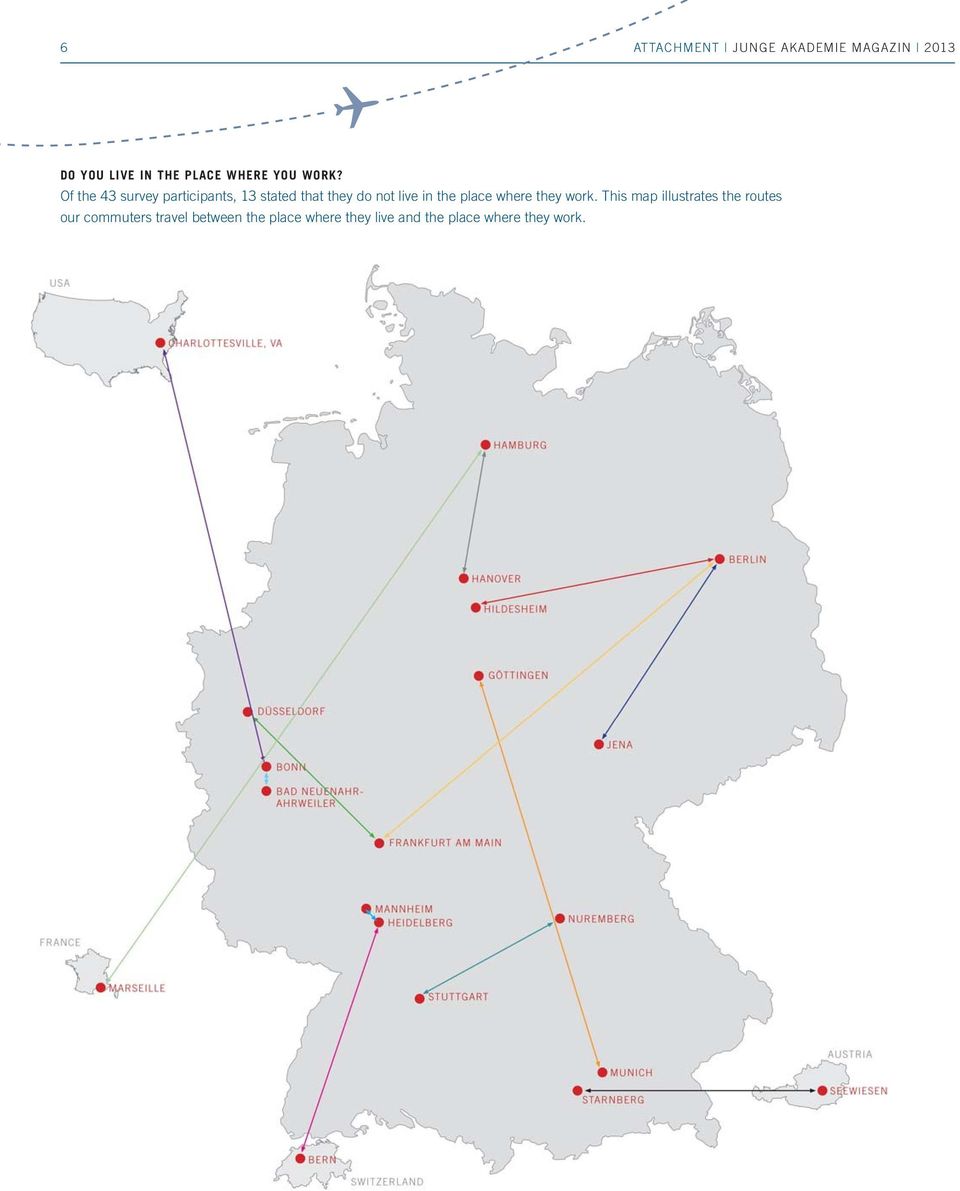
9 ATTACHMENT JUNGE AKADEMIE MAGAZIN COMMUTER PROFILES Gender Age Relationship Children (Age) Place of Residence Job Location F 36 Yes 2 (4, 2) Munich Göttingen F 34 Yes - Berlin Hildesheim F 35 Yes - Düsseldorf Frankfurt/Main F 35 Yes 1 (1) Mannheim Heidelberg F 39 No - Nuremberg Stuttgart F 38 Yes 2 (3, 1) Berlin Jena M 41 Yes 1 (5) Starnberg Seewiesen M 40 Yes - Bern Heidelberg M 39 Yes 1 (5) Berlin Berlin, Frankfurt/Main F 49 Yes 2 (16, 13) Hamburg Marseille/France M 43 Yes 1 (9) Bonn Bad Neuenahr-Ahrweiler F 34 Yes 2 (5, 3) Hamburg Hamburg, Hanover M 33 Yes 2 (6, 3) Bonn Bonn, Charlottesville/USA Average distance between place of residence and job location Average number of nights spent at job location during the semester Average time spent on commuting 367 km 3,6 nights 4,5 years

10 8 ATTACHMENT JUNGE AKADEMIE MAGAZIN 2013 Sometimes it takes a little magic Giesela Rühl, Professor of Law and co-initiator of the survey AS RECORDED BY ULRICH PONTES The topic of academia, love and mobility affects me personally in several respects. First, I belong to the category of professional commuters. I live in Berlin with my husband and two children, but I work at Jena University. That s why at least during the semester I can often be found on the train, usually two or three times a week. Furthermore, as my work deals primarily with the international dimension of law, I have to travel abroad to attend conferences or give lectures on a regular basis. On top of that, my husband also travels frequently for his job as a business consultant. As a result, I can t imagine my daily life without mobility and the associated challenges for my relationship and my family. Like most of the survey respondents, I experience mobility as a burden only to a certain extent: For example, travelling to conferences is not a big deal. Quite the contrary: I m able to really enjoy the time I spend on my own while travelling. I meet other people; I collect new impressions. Commuting is another story: Heading out in the morning, back in the evening, two and a half hours on the train each way. I find that not just physically but also emotionally exhausting. It gets particularly difficult when the children are ill and can t go to day-care. Those days, everything is topsy-turvy. And on those few occasions when the grandparents can t jump in to help, we have to try and get everything sorted on our own. Sometimes there s only one thing left to do work some magic. DO YOU PERCEIVE THE MOBILITY REQUIRED BY ACADEMIA AS A BURDEN? Yes No 75 % 25 % 67 % 33 % 75 % 25 % 67 % 33 % 75 % 25 % 69 % 31 % 75 % 25 % 68 % 32 % Women Men Academics Academics Academics Academics with a Partner Partner with children without children a fi xed-term position permanent position in academica not in academia

11 ATTACHMENT JUNGE AKADEMIE MAGAZIN WHAT DOES THE MOBILITY REQUIRED BY ACADEMIA MEAN FOR YOU, YOUR RELATIONSHIP, AND YOUR FAMILY? All of the survey respondents regard the mobility required by academia as a challenge. However, they have developed diverse strategies in order to deal with these challenges and to combine their love of academia with the love for their partners and their families. As a result, most of the participants are generally satisfi ed with their situation when it comes to the issue of mobility. Do you also enjoy not being home? If yes, why? How do you maintain the love for your partner despite the mobility? In relation to your love for your partner, your love for academia is...? I can work for a long time without feeling guilty because someone is waiting for me. I enjoy switching between intensive family time and intensive work time, much as I enjoy switching between having relationship time and a little bit of time just for me. I go out regularly. I can sleep through the night. Travelling educates you. 26 % We respect each other and recognise each other s skills: in regards to raising children, running a household, etc. We don t call each other all that often, we let the other person take charge. He doesn t question my research. We call each other. We spend our free time together and enjoy that. We got married so that my long-term partner could accompany me on a multiyear stint abroad for love, but also for the visa! Daily phone calls, I read books aloud to my partner, like The Hobbit and the entire Lord of the Rings cycle.... a balancing act, between focusing on myself and on my relationship. probably just as important the relationship between the two moves in waves something totally different! complementary and the source of positive energy. not comparable. Neither of those two loves would function without the other; you shouldn t sacrifice the love of the one for the love of the other. perhaps just as significant, but in a different way In any case, academia doesn t keep you warm and cannot be supportive on its own, right? something completely different, but both can thrill and inspire you. 74 % Yes No

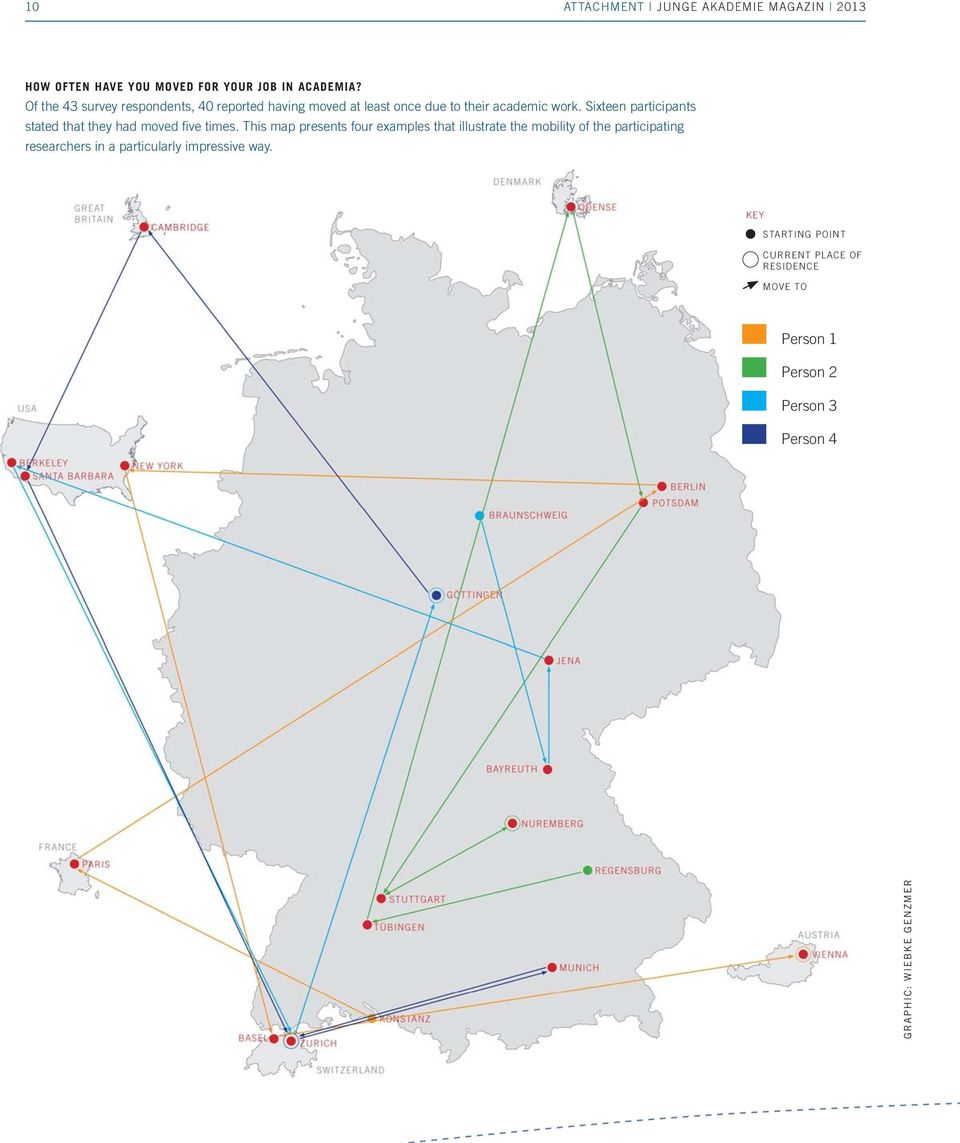
12 10 ATTACHMENT JUNGE AKADEMIE MAGAZIN 2013 HOW OFTEN HAVE YOU MOVED FOR YOUR JOB IN ACADEMIA? Of the 43 survey respondents, 40 reported having moved at least once due to their academic work. Sixteen participants stated that they had moved fi ve times. This map presents four examples that illustrate the mobility of the participating researchers in a particularly impressive way. KEY STARTING POINT CURRENT PLACE OF RESIDENCE MOVE TO Person 1 Person 2 Person 3 Person 4 GRAPHIC: WIEBKE GENZMER
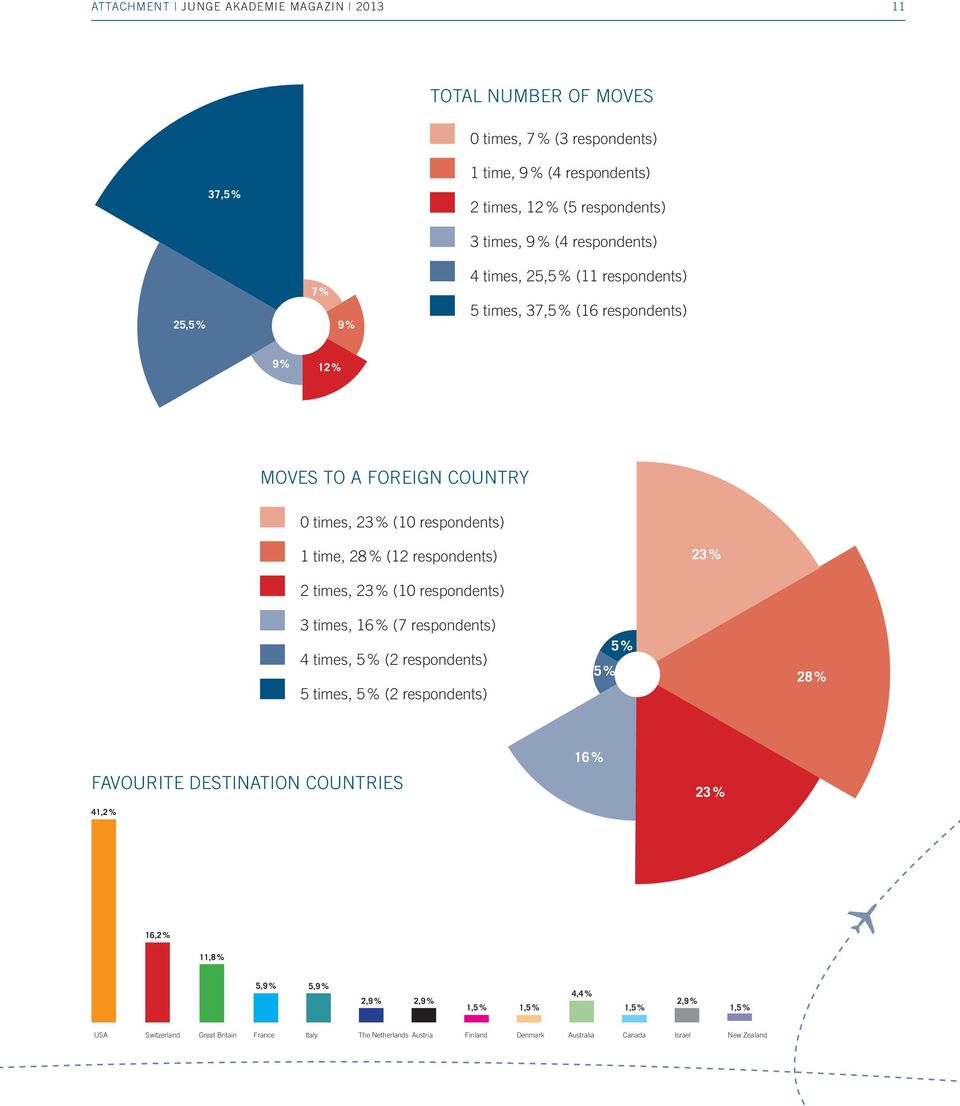
13 ATTACHMENT JUNGE AKADEMIE MAGAZIN TOTAL NUMBER OF MOVES 0 times, 7 % (3 respondents) 37,5 % 1 time, 9 % (4 respondents) 2 times, 12 % (5 respondents) 3 times, 9 % (4 respondents) 25,5 % 7 % 9 % 4 times, 25,5 % (11 respondents) 5 times, 37,5 % (16 respondents) 9 % 12 % MOVES TO A FOREIGN COUNTRY 0 times, 23 % (10 respondents) 1 time, 28 % (12 respondents) 23 % 2 times, 23 % (10 respondents) 3 times, 16 % (7 respondents) 4 times, 5 % (2 respondents) 5 times, 5 % (2 respondents) 5 % 5 % 28 % FAVOURITE DESTINATION COUNTRIES 41,2 % 16 % 23 % 16,2 % 11,8 % 5,9 % 5,9 % 4,4 % 2,9 % 2,9 % 2,9 % 1,5 % 1,5 % 1,5 % 1,5 % USA Switzerland Great Britain France Italy The Netherlands Austria Finland Denmark Australia Canada Israel New Zealand
14 12 ATTACHMENT JUNGE AKADEMIE MAGAZIN 2013 CAREER FOR TWO When your partner s job is clashing with your appointment as professor: A dual-career counsellor on the opportunities and limitations of her work INTERVIEW ULRICH PONTES JAM: Mrs Reinisch, you are the head of the Dual-Career Counselling Service at the University of Potsdam could you give us an idea of your work? Charlotte Reinisch: My work consists of supporting the partners of newly appointed professors in their job search. In order to do that, we scour the local job market, establish contacts with network partners, who are potential employers; if necessary we help find language courses for partners and provide tips on crafting CVs and application letters. I am also the first point of contact when it comes to the challenges that come with moving. In the manner of a relocation service, I help people find temporary accommodation and childcare facilities in Potsdam. JAM: Is it safe to say that job opportunities for the partner can be an important factor when it comes to a professorial appointment? Charlotte Reinisch: Yes, the success of many appointments is becoming ever more dependent on that. As a result, our office normally gets in touch with the candidates during the appointment negotiations. JAM: What is the likelihood of success? Charlotte Reinisch: That depends entirely on the area in which the partner works and the situation on the local job market. I ve had the best-case scenario in which the partner completed a two-day marathon of job interviews set up by my office while the university was still in the middle of negotiations with her husband. But there are also more difficult cases. After all, the job market in Berlin-Brandenburg isn t easy the positions PHOTOS: EVELYN RUNGE, PRIVATE
15 ATTACHMENT JUNGE AKADEMIE MAGAZIN available here are almost exclusively on fixed-term contracts, there are many well-educated people competing for the same jobs, and the salaries are often lower than in southern German cities. The fact is that no one gives us funding to create positions for partners, as some universities in the US do. JAM: So that means your support isn t always able to prevent the situation in which the partner remains behind and the newly appointed professor commutes? Charlotte Reinisch: Particularly for very young couples or those over 50, commuting can sometimes still be an option. But usually we deal with younger families, and understandably commuting is often not an option for them at all. On the other hand, a move often means that the partner may be making a sacrifice in terms of career status, depending on the local job prospects, while the newly appointed professor is leaping ahead in his or her career. Whether or not a couple can and will deal with that is a difficult and individual decision, and not one where we can really provide much help. JAM: Your partner is in academia and you both previously lived and worked in Switzerland. Did you land in this position as a result of dual-career counselling? Charlotte Reinisch: No, at that time there was no support for dual-career couples in Berlin-Brandenburg. My partner had received an attractive offer in Berlin, and the University of Potsdam happened to have posted a job description for this role, looking for someone to develop the counselling service, and I applied for it. So my own dual-career background turned me into a dual-career counsellor. That helps, of course. Moving THE SOCIAL SCIENTIST Charlotte Reinisch is head of the Coaching Service for Newly Appointed Professors at the Potsdam University. Her partner, Marc Helbling, is a member of the JA. Mrs. Reinisch is also the spokesperson for the Dual Career Network Germany, which represents 30 universities. here from Switzerland, from a non-eu country, and going into a rather uncertain situation, because at first it was a pilot project that could have failed I know what dual-career couples go through and how difficult these decisions are. And so I am able to use that experience in the counselling service.

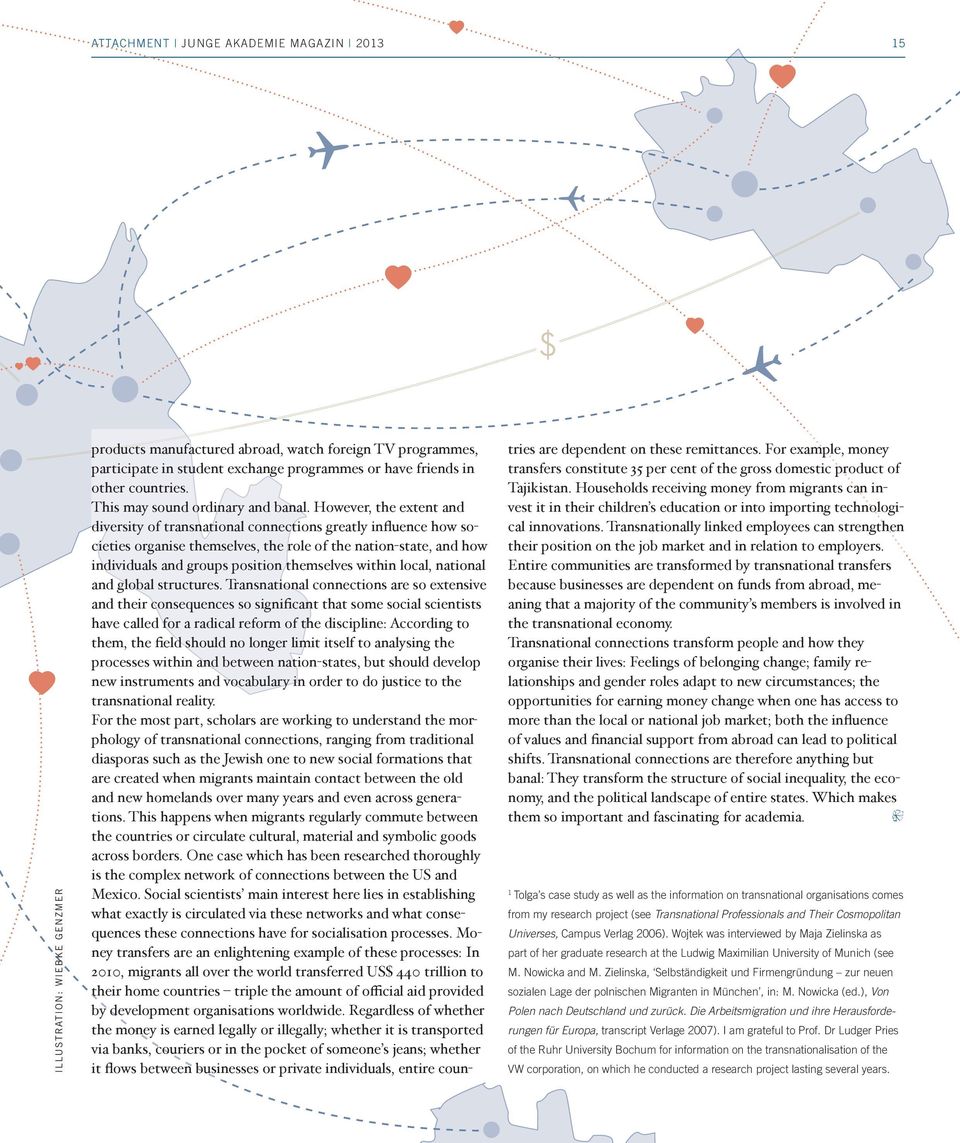
16 14 ATTACHMENT JUNGE AKADEMIE MAGAZIN 2013 GLOBAL ENTANGLEMENTS Life in our globalised world is shaped by transnational ties TEXT MAGDALENA NOWICKA It has been a long time since Wojtek felt at home anywhere. Back when he worked for a printing house in his hometown in Poland, he also earned extra cash by working illegally in Germany. He invested this money in his own business. When that company went bankrupt, he immigrated to the US. He returned to Poland for love, but the relationship did not last. Then he applied for political asylum in Germany. Later, after he had become a German citizen, he was unemployed for several years, lived off welfare and began to work odd jobs in Poland illegally. When Poland became part of the European Union, he registered as self-employed in Germany. Since then he has been working legally in the construction industry, but continues to receive payments through a Polish occupational disability insurance scheme. Now he is planning to immigrate to Denmark. He says: In my head, I am constantly on the move. He was able to acclimatise quickly everywhere he went, but was unable to find friends in Germany specifically because the cultural differences are too great. However, he maintains ties with friends in Poland. He dreams of owning a pony farm there and wants to be buried next to his grandmother. Tolga hails from Turkey. She completed her PhD in the US, where her sister and mother live, and currently works for an international development organisation. Through her work she met her husband, who is Belgian. For the last two years, they and their two children have been living in Poland, where Tolga s husband is currently working. They spend the summer holidays in the US so the children can learn English properly, and in the winter they visit his family in Belgium. The children, who speak Flemish and Turkish, go to an American day-care facility in Warsaw; the Ukrainian nanny at home has taught them to speak Ukrainian. Tolga and her husband do not know where they will be in a few years it all depends on their employers. They will keep their house in the US in order to have a base somewhere, Tolga says. The international organisation for which Tolga and her husband work is one of many whose significance has greatly increased over the last few decades. It is typical for these organisations to maintain close contact with the population at the project site and to coordinate their work locally. This demands a high degree of mobility of the employees. Their knowledge and experience gained in one region are then meant to be applied to another continent. The organisation and the beneficiaries benefit from this model, while for Tolga it means being separated from her family, which she tries to compensate with frequent trips, phone calls, and staying in touch via the internet. Wojtek drives a VW, a car that symbolises Germany s economic success. The VW corporation owes this success to the internationalisation of its production process: Starting in the 1970s, foreign branches that had previously only distributed the products took over parts of the production chain. They became independent from the parent company, which guaranteed lower costs and better adaption to local markets. The connection of these four stories taken from current research Wojtek s frequent moves for employment, Tolga s international family, the development of the international organisation, and the restructuring of the German automobile manufacturer can be summed up under the buzz word transnationalisation. The term is used in the social sciences to describe specific forms of political, economic, organisational and social entanglements stretching between nation-states and crossing their borders. According to many scholars, this type of connection has become normal in the age of globalisation. Transnational is preferred to the term global because while the crossing of nation-state boundaries is essential to this concept, these connections never circumvent the entire globe. Transnational connections affect almost every area of life, and all of our lives have become transnationalised to a certain extent: We consume

17 ATTACHMENT JUNGE AKADEMIE MAGAZIN ILLUSTRATION: WIEBKE GENZMER products manufactured abroad, watch foreign TV programmes, participate in student exchange programmes or have friends in other countries. This may sound ordinary and banal. However, the extent and diversity of transnational connections greatly influence how societies organise themselves, the role of the nation-state, and how individuals and groups position themselves within local, national and global structures. Transnational connections are so extensive and their consequences so significant that some social scientists have called for a radical reform of the discipline: According to them, the field should no longer limit itself to analysing the processes within and between nation-states, but should develop new instruments and vocabulary in order to do justice to the transnational reality. For the most part, scholars are working to understand the morphology of transnational connections, ranging from traditional diasporas such as the Jewish one to new social formations that are created when migrants maintain contact between the old and new homelands over many years and even across generations. This happens when migrants regularly commute between the countries or circulate cultural, material and symbolic goods across borders. One case which has been researched thoroughly is the complex network of connections between the US and Mexico. Social scientists main interest here lies in establishing what exactly is circulated via these networks and what consequences these connections have for socialisation processes. Money transfers are an enlightening example of these processes: In 2010, migrants all over the world transferred US$ 440 trillion to their home countries triple the amount of official aid provided by development organisations worldwide. Regardless of whether the money is earned legally or illegally; whether it is transported via banks, couriers or in the pocket of someone s jeans; whether it flows between businesses or private individuals, entire countries are dependent on these remittances. For example, money transfers constitute 35 per cent of the gross domestic product of Tajikistan. Households receiving money from migrants can invest it in their children s education or into importing technological innovations. Transnationally linked employees can strengthen their position on the job market and in relation to employers. Entire communities are transformed by transnational transfers because businesses are dependent on funds from abroad, meaning that a majority of the community s members is involved in the transnational economy. Transnational connections transform people and how they organise their lives: Feelings of belonging change; family relationships and gender roles adapt to new circumstances; the opportunities for earning money change when one has access to more than the local or national job market; both the influence of values and financial support from abroad can lead to political shifts. Transnational connections are therefore anything but banal: They transform the structure of social inequality, the economy, and the political landscape of entire states. Which makes them so important and fascinating for academia. 1 Tolga s case study as well as the information on transnational organisations comes from my research project (see Transnational Professionals and Their Cosmopolitan Universes, Campus Verlag 2006). Wojtek was interviewed by Maja Zielinska as part of her graduate research at the Ludwig Maximilian University of Munich (see M. Nowicka and M. Zielinska, Selbständigkeit und Firmengründung zur neuen sozialen Lage der polnischen Migranten in München, in: M. Nowicka (ed.), Von Polen nach Deutschland und zurück. Die Arbeitsmigration und ihre Herausforderungen für Europa, transcript Verlage 2007). I am grateful to Prof. Dr Ludger Pries of the Ruhr University Bochum for information on the transnationalisation of the VW corporation, on which he conducted a research project lasting several years.
18 16 ATTACHMENT JUNGE AKADEMIE MAGAZIN 2013 THE UNIVERSE AND US A conversation about knowledge, its limits and our connection to the big picture INTERVIEW ULRICH PONTES

19 ATTACHMENT JUNGE AKADEMIE MAGAZIN PHOTO: NASA/ESA/STSCI The task: To analyse this issue s topic of attachment with regard to our connection to the universe. The idea: An interdisciplinary conversation between two physicists and one musicologist/composer with links to science fi ction. The preparation: minimal. This is a spontaneous experiment. The only preparation is the setting of a date (fi ttingly on the day when everyone is talking about the end of the world), a connection in terms of image and sound via an internet-based video conference, and a fi rst cue to get the conversation going, namely the lyrics to the Galaxy Song from the Monty Python fi lm The Meaning of Life. It starts like this: Whenever life gets you down Mrs. Brown / and things seem hard or tough / and people are stupid, obnoxious or daft / and you feel that you have quite enough: / Just remember that you re standing on a planet that s evolving / And revolving at nine hundred miles an hour, / That s orbiting at nineteen miles a second, so it s reckoned, / A sun that is the source of all our power. / The sun and you and me and all the stars that we can see / Are moving at a million miles a day / In an outer spiral arm, at forty thousand miles an hour, / Of the galaxy we call the Milky Way. Lisa Kaltenegger: The idea was to talk about our connectivity, our place in the universe. From my perspective, the field of astrophysics, it s about other planets, other stars, our movement around the centre of the galaxy, just like in the song We can then relate that to the small stuff Julia, don t you work on particle physics? And Gordon can play the music to it and contribute the science fiction. JAM: Does the content of the song actually reflect the current state of knowledge in this field? Lisa Kaltenegger: For the most part, yes. And the lyrics do a good job of illustrating the connection: the movement of our planet around its own axis and around our star, which in turn revolves around the centre of the Milky Way up to the verse at the end, which says: Our galaxy is only one of millions of billions in this amazing and expanding universe. That inevitably begs the question: How are we embedded in this context? How are we linked to the universe, connected to the big picture? JAM: Apparently we are sitting on a small outpost at the edge of the galaxy... Lisa Kaltenegger: And we are now certain about what was just an assumption when this song came out: There are many star systems that could be similar to our solar system. More than 850 exoplanets meaning planets that revolve around other stars have already been discovered and thousands of stars are still on the waiting list because we have to examine them more closely. One of the telescopes making these discoveries possible is NASA s Kepler space telescope. It is monitoring 150,000 stars over five years in order to find planets when they push themselves purely by geometrical coincidence between us and their star. When you switch scales from looking as far out into space as possible to drilling down as minutely as possible into the microscopic world, then you arrive at Julia s specialty. Julia Tjus: Particle physics in many ways also focuses on connections. What s important for cohesion in this regard is no longer gravitational pull, but the so-called strong force that binds quarks to protons and neutrons. If we go up a level, we arrive at the atoms, whose cores are made of protons and neutrons along with a shell of electrons. These types of connections are just as crucial for the universe and our existence as gravity without them we would not exist; there would be no sun and no planets, nothing at all. JAM: And what about the link to art? Gordon, we ve heard you set science fiction to music? Gordon Kampe: No, that s not entirely the case. But as a composer, you are always inspired or influenced by something that oftentimes lies outside of the world of music. In this sense, some of my pieces refer to specific science fiction films, but it s not a case of onomatopoeia. Lisa Kaltenegger: What themes do the films address? Is there a connection between them and the music in that sense? Gordon Kampe: Slimy aliens, mostly.
20 18 ATTACHMENT JUNGE AKADEMIE MAGAZIN 2013 Lisa Kaltenegger: That s okay! After all, the life forms on exoplanets could be very different from the ones on our planet. Biologists have all kinds of theories about this The question is, how connected would we feel to these alien life forms? Gordon Kampe: Of course, musicians don t conduct research on these topics. We just steal the metaphors you scientists are probably very disappointed by the results. When I listen to a lecture on physics, I sit there and can t understand a thing but my eyes widen with amazement and I think Wow!, and this amazement is something I like and that fascinates me. And then I search for a chord, for a sound that could inspire a Wow! like that. Julia Tjus: According to the motto: That word sounds good, I ll take that for my next composition? Why ever not after all, fascination is an important component in scientific research. We humans simply want to know where we come from, and astrophysics and particle physics hold the promise of answers in terms of the big stuff and the small stuff. But maybe music can aim to do the same with different means? Gordon Kampe: Historically speaking, musicians and scientists are closely linked. In antiquity and up until the Middle Ages, music and astronomy (along with arithmetic and geometry) were joined in the quadrivium, the mathematically oriented four paths, in contrast to the verbal-argumentative disciplines. Only after that did they separate from each other up to the point where today I can t understand a word when it comes to physics. But the way in which your research makes me feel amazed is the same way in which I want to create that feeling of amazement with my music. JAM: Why do you work specifically with science fiction metaphors? Gordon Kampe: I just like these films because such odd things happen in them. For example, the scene in Alien I when they re sitting on the Nostromo: Somewhere in space, in a relatively unusual setting, something very boring is happening a staff meeting. And right then something unbelievable happens: The alien emerges from someone s chest. If I were to continue to develop this connection of the banal and the weird that continually appears in these films, then the coffee that Julia is drinking right now could also be a hypertransformed sub-space anomaly or whatever the terms are they always use in those films Julia Tjus: It s actually peppermint tea. Gordon Kampe: And sometimes tea is just tea. But I always try to find this type of atmosphere in music pieces: That you have something totally normal that you re very familiar with, and suddenly it takes a really unusual turn. So I m not talking about songs about stars or space music in the sense of celestial sounds and Ommmm and similar esoteric hoopla; I m far removed from that. I m talking more about a dramaturgical attitude. JAM: What do you scientists say to these unexpected turns? For science, the entire universe is something very normal: Everything functions according to the laws of nature and is generally calculable. Lisa Kaltenegger: I wouldn t say that. Of course you can calculate some things physics works pretty much everywhere, black holes excepted. But we re always observing and learning new things. We thought we knew how the solar system works, how planetary systems are formed and the first observations have shown us that we need to rethink those ideas, as has often happened before in the history of science. But that is precisely what s so fascinating about the whole thing: Science is not some rigid structure of laws but an exciting exploration! I have a similar sense of fascination as Gordon does. Without this fascination driving me to constantly wanting to find out something new, I wouldn t be doing research, I d be doing something else, like travelling the world.
21 ATTACHMENT JUNGE AKADEMIE MAGAZIN THE EXOPLANET RESEARCHER THE ASTRO-PARTICLE PHYSICIST THE COMPOSER Lisa Kaltenegger, born 1977, is the head of a DFG Emmy Noether Group at the Max Planck Institute for Astronomy in Heidelberg. She also teaches and researches at Harvard in the US. Her main interest lies in searching for planets outside the solar system that could sustain life Julia Tjus, born 1979, is a professor at the Ruhr University Bochum. She conducts research on high-energy particles and rays that exude from objects in the cosmos and that could provide insight into the history and composition of the universe. Gordon Kampe, born 1976, is a musicologist at the Folkwang University of the Arts in Essen and has received numerous prizes for his work as a composer. He has just received a scholarship to live and work in the Artists Village Schöppingen for the next few months. PHOOTS: PRIVATE Julia Tjus: Of course science assumes that everything functions according to rules and causation, but practically speaking there is so much that we don t know that there s always something that s surprising. And then suddenly there is a supernova explosion or a gamma ray burst, and even if it s Christmas, everyone who is researching these things runs to their university or research institute and analyses the results immediately. Even when you re expecting a supernova, like with Betelgeuse, the red giant in the constellation of Orion, you aren t sitting right next to it, able to study the processes exactly. That s why you can only produce rough estimates in that case something along the lines of: It will explode in several thousands of years. Then when it really does happen, someone will likely still be surprised On the other hand, sometimes you re surprised by the progress of science in general. JAM: To come to a first conclusion: Our connection with the universe is expressed through amazement and fascination, whether that feeling stems from scientific or artistic motivation. Obviously we humans are always searching for some kind of connection to everything around us, whether through scientific knowledge or with spiritual or religious means. Julia Tjus: Well, we are undoubtedly bound to the universe: We are born into it, and then we have to find a way to deal with it. It s totally natural to be fascinated by whatever it is that binds you to this universe and what constitutes the place where we live. In any case, it seems that it s always been that way for humanity, seeing as that interest reaches far far back in our history. Gordon Kampe: Music has also almost always had something to do with outer space in terms of music being written mainly due to religious motivation. And then there is this music of the spheres that appears in the 16th/17th century, whether it s Johannes Kepler, who also thought about music as part of his work, or Athanasius Kircher. That continues even today. John Cage once simply took a star map from somewhere and declared it to be a musical score, Stockhausen sings about mesons and myons and claims to be from Sirius. But even without a direct one-to-one transfer one can try to squeeze patterns of thinking from your disciplines. For example, a former composition teacher of mine mainly reads books on string theory, simply to gain a certain breadth and complexity in his thinking. Lisa Kaltenegger: That forms a lovely arc: Art is inspired by science, and vice versa. Whether that leads to good music or
22 20 ATTACHMENT JUNGE AKADEMIE MAGAZIN 2013 good artistic pictures A colleague of mine draws illustrations of exoplanets. It is totally motivating to have a picture like that on your wall. Although you know that it s a product of someone s imagination, that creative environment helps. In a way, you can translate that into mathematics, physics, modelling. And it s inspiring! Of course art and science are not the same, but science is also a creative process where you combine individual elements in a creative way, and then that s similar to painting or playing music after all. JAM: Back to the point raised earlier about humans being so connected to the universe, to this material world, that makes me think of the discussion about a multiverse currently so popular among physics authors. Julia Tjus: What exactly are you referring to? On the one hand, of course you can ask what else there is aside from our own universe, I ll say outside of it, although that is a bit hard to define. On the other hand, within quantum physics there is this idea that one is constantly creating parallel universes or put more simply: When you make the decision to turn left, then the universe creates two paths and so the alternative state in which I turn right also exists. Those are metaphysical ideas, of course: You can t test them because that takes place outside the framework of physics as we know it today. Lisa Kaltenegger: You can set up this hypothesis, but we don t have anything that s measureable. These things are mixed up in popular discussions, but at the moment I wouldn t place the multiverse idea within the field of science, but rather still in philosophy. Of course those fields are closely connected, because maybe one day we ll find a means to test this concept empirically. Julia Tjus: I do think this question is legitimate. Seeing as we were just on the topic of fascination: That feeling doesn t go away simply because I ve come to understand a great deal about my universe. For example, the question of what existed prior to the big bang: Of course from a physics perspective I can say that there was neither space nor time then. But this answer isn t really satisfying. Lisa Kaltenegger: I would ask: What effect does that have on you? There might be many universes or whatever out there, but is that really of any significance? We are in this universe, in this environment whether there are ten parallel universes or a thousand that we don t connect with in any way, that doesn t change my worldview. Gordon Kampe: I once used parallel universe in a programme text, I just found the quote: I am firmly convinced of the existence of diverse parallel worlds how else can some of the grotesque things in this world be explained (such as Smurfs, the Wildecker Herzbuben, Westerwelle, banana beer), other than that they snuck in through a crack in the time-space continuum? That is my form of parallel universe Julia Tjus: Nice text. Gordon Kampe: As a musician you are constantly being asked to explain your music. I don t have any desire to do that I mean, is anyone really interested in the technical aspects? With a wardrobe we re not interested in knowing what types of screws were used and why, but whether or not it s beautiful. That s why I just include drivel in my programs. Julia Tjus: The nice thing is, Gordon, that you know just as much about parallel universes as I do! JAM: Finally, let s come back to our universe and to the initial question about how we are embedded in the bigger picture. The Monty Python song ends with the words: So remember, when you re feeling very small and insecure, / How amazingly unlikely is your birth, / And pray that there s intelligent life somewhere up in space, / Cause there s bugger all down here on Earth. The woman in the film to whom this is sung then feels so insignificant that she no longer has any problem donating her liver and having it removed while still alive. Gordon Kampe: I don t know anything about the bigger picture; I m happy if I can find the kitchen without injuring myself. Lisa Kaltenegger: Embedded in the bigger picture We are currently in the process of answering one of the really big questions of humanity, namely, whether we re alone in the universe. We are the first generation ever to have the technological capability to discover and explore new worlds!
23 ATTACHMENT JUNGE AKADEMIE MAGAZIN LIBERTY TRHOUGH COMMITMENT Katharina Heyden, the Junge Akademie s fi rst theologian, juggles academic research and pastorate, career and family TEXT ULRICH PONTES PHOTOS MIRIAM MERKEL When Katharina Heyden looks up from the laptop on her desk at home, her gaze falls on the crucifix on the wall. It is a crucifix with a slightly curved vertical beam; aside from a loincloth, the crucified figure also wears a crown, a real one, not one made of thorns. I like the Romanesque crucifixes, because with them Christ on the cross still looks like a king suffering and triumphant at the same time, the Göttingen-based theologian says. As she continues, her usually warm, open conversational tone changes: So that you can see not just the human but also the divine. It is a lecturing tone, and yet the sentence also contains a bit of edge, a whiff of amused self-distancing from the topic. Clichéd theological phrases on the dual nature of Christ: It is safe to assume that these things are normally far removed from the work of the 35-year-old postdoctoral researcher, who was the first and as yet only representative of her field to be accepted into the Junge Akademie in The existential content, the matter of faith that forms the foundation of Christian theology, is far too important to her for her to phrase it in didactic sounding catchphrases. Even though Katharina Heyden is an academic by trade and has received prizes for her research as well Studied Protestant and Catholic theology: Katharina Heyden in the Göttingen university library
24 22 ATTACHMENT JUNGE AKADEMIE MAGAZIN 2013 as her teaching, her field is more than an end in itself or an academic challenge for her. For many theologians the decision to go into academia means to break with the church or with a life of faith. Some might experience it as liberation. But that s not the case for me, she says. Katharina Heyden talks about faith with confidence and without hesitation, but also with care. Outside the church context at least, she speaks of the Transcendental rather than God, of the appearance of the Transcendental rather than a religious experience or an encounter with God. But for her the transcendental is far more than an abstract category it is the soil in which true freedom can take root. She describes this interaction as something that seems paradoxical at first: The bond is important in theology, but it s only right when it means freedom and enables freedom. It is like skiing or snowboarding: The stronger and more secure the binding is, the more freedom and room for manoeuvre you have. Except that when it comes to faith, the point is to bind oneself to a non-immanent force in order to gain freedom from worldly ties. Academic theology and a life of faith: For Katharina Heyden, they are two different approaches that are nevertheless inseparable. At the very latest, this becomes apparent when, every few weeks, she exchanges her casual university clothing for the black cassock with the white collar in order to preach or conduct a wedding ceremony or a baptism. For two years now she has been supporting the fulltime parish minister at Saint Jacob s Church in Göttingen as a volunteering ordained Career and three children: Katharina Heyden pastor. In order to do so, she completed an apostolic vicariate, also in a volunteer position, alongside her academic work. She benefited in many ways from this two-year training for the pastorate, which candidates embark on after obtaining a university degree. After all, she notes, the vicariate supports ministers personal development and provides training in key competences, things that are often neglected during academic studies. But academia and faith, teaching duties and the pastorate are by no means all the opposite poles Katharina Heyden juggles in her life. She navigates the tensions between different Christian faiths and traditions without fear. Her religious socialisation began after the fall of the Berlin Wall, which coincided with the time when she, as a pupil from East Berlin, came of age for confirmation lessons. She describes the church she came to know at that time as a political one very much focused on faith. That church was very sceptical of Volkskirchenchristen, Christians whose faith had merged into a religiously tinged, educated middle-class attitude the kind of believers who make up her current Göttingen congregation. Inspired by a year of ecumenical studies in Jerusalem, Katharina Heyden studied not only Protestant but also Catholic theology in Germany. She even went to Rome for a year to expand her knowledge: I wanted to see consciously whether this type of confessional theology even exists anymore. Her conclusion: She finds the confessional ties of university faculties to be outdated, and at least with respect to academic theology believes denominational differences to be completely irrelevant in many areas. But does the dissolution of confessional boundaries not lead to the loss of their foundation and orientation for some believers? For Katharina Heyden, this argument does not hold: If whatever is providing stability and orientation is something so immanent and contingent as a confessional
25 ATTACHMENT JUNGE AKADEMIE MAGAZIN identity, then to me that doesn t seem like a bond in a positive sense providing the necessary freedom. From the many different theological disciplines, Katharina Heyden chose to focus on church history for her academic career. She is particularly interested in the first centuries of the church s existence. Even if this time period, the era of the church founders, lies far behind us, Katharina Heyden s description of it almost sounds like a diagnosis of the present: Late Antiquity was characterised by a mixture of individualisation and globalisation, religious diversity, heavy use of imagery. It is clear to her as a church historian that scholars of history can never escape from looking at the past through the lens of their own time. So why not apply questions that arise in the present-day to events of the past? Katharina Heyden therefore concentrates on interreligious encounters as well as the concept of the Holy Land in her work. In addition to academia and her ministry work, there is a third focus in Katharina Heyden s life, perhaps the most important one: her family. In the almost five years that she has been living in Göttingen, she not only completed and handed in her professorial dissertation and completed her vicariate, but also gave birth to her third son. He is now a year old; his brothers are five and seven. How does she manage to juggle all of these things in her life? This question is put to her a lot, she says and yet she takes some time to think about it before launching into a lengthy answer. One part of the answer is that the three areas academia, pastorate, family enrich each other, and when that is the case, then you also have the necessary energy! The academic research enables intellectual examination; the ministry work challenges her to apply theology to real life; the children are a wonderful obligation and help her to balance the rest: When I am at my desk, then I look forward to being able to play with my children in a few hours, and vice versa and that joy leads me to make use of and enjoy each activity in a conscious way. Another part of the answer, as Katharina Heyden hurries to emphasise, is her husband, Carsten Heyden. He is a church deacon and has only been working halfdays on a fixed-term contract since they moved to Göttingen. Careerwise we gambled on me, which gives me a lot of freedom, Katharina Heyden says. But she also had to compromise by giving up something that is an enjoyable and important part of life for many academics: She rarely travels to conferences. My choice not to travel really does have to do with bonds: As long as they are small, it is important for me to provide this type of bond to my children so that they know their mother is always there. She also values the decoration of her workplace. At home, the aforementioned crucifix is not the only item on her wall: A Dionysus bust symbolises the culture into which early Christianity expanded, and the doll with wooden joints on her desk also serves a purpose: Sometimes when I m thinking about a sermon or a presentation, I give the doll a certain pose: Arms high, dancing or squatting and then it engages with the Romanesque Christ on the cross. In her office at the university, she usually has a poster on the wall related to her current work focus; at the moment, a reminder of her professorial dissertation on the Holy Land, it is a satellite image of Israel and Palestine. As a self-proclaimed visual person, Katharina Heyden also enjoys breaking through boundaries or at least customs in her text-heavy discipline: In the old texts you mostly find absolutely elitist discourses. Images or the decorations in churches reached a lot more people! She therefore takes images seriously as a source instead of regarding them merely as decorative embellishments, both in her research and in her teaching: It is important to me that students learn to read images. Perhaps this cross-media approach is one reason why it has taken the theologian just a few months to fully integrate herself into the interdisciplinary context of the Junge Akademie. She enjoys the freedom to come up with unconventional ideas created by the Junge Akademie and also the fact that the academy provides the infrastructure to implement those ideas. As one of her several Akademie projects, she is currently in the middle of planning a future research group on the topic of energy. Yes, that indeed fits with her field, Katharina Heyden explains: In Byzantium there was an argument about whether one could take energy as an equivalent for God. Now she just needs to find a fitting poster for her office wall.
26 24 ATTACHMENT JUNGE AKADEMIE MAGAZIN 2013 POLITICS BY DIFFERENT MEANS? On the role of friendship in the Middle Ages TEXT KLAUS OSCHEMA Friendship in the Middle Ages? Is friendship not an unchanging phenomenon which therefore does not have a history? And even if it did, shouldn t historians focus on more important things rather than such an everyday, mostly private phenomenon? Research on personal relationships does indeed have an ambivalent status within the field of Medieval History. The concept of friendship in particular has been at the centre of an important development during the last few years, because the meaning of the term has undeniably changed throughout the centuries particularly because in pre-modern societies, friendship was anything but a private matter. That in itself is nothing new: As early as 1939, the French historian Marc Bloch thoroughly examined the term friendship (amicitia, amitié), which repeatedly appears in medieval sources, in his classic work on feudal society. Bloch s work considerably expanded the horizon of his fellow historians, who mainly focused on politics and constitutional history. They wanted to know how the state functioned, a modern concept scholars had long projected onto the Middle Ages anachronistically. The fact that the private essence of friendship could also become political was not at first apparent to historians, although the German medievalist Theodor Mayer proposed the term Personenverbandsstaat almost simultaneously with Marc Bloch s work: the concept included overtones of a Fuehrer-rule and Germanic hero worship, which impeded its attractiveness to scholars as a reference point. The paradigm-shift introduced to German research in the 1980s, particularly through the work of Gerd Althoff, thus possesses revolutionary features. In his book on Family, Friends, and Followers (1990), Althoff suggested that scholarship should focus less on searching for early forms of state structures, a search that he argued was destined to be unfertile since it only lead to the image of apparently deficient conditions. Instead, he examined in his widely read book the manifold personal ties that structured and stabilised medieval society in their entirety. One of the main contributions of this work is that it established friendship as a discrete category next to the previously heavily emphasised feudal relationships and family ties. This new orientation, whose significance is still recognised today studies on friendship in the Middle Ages are no longer a rarity helps us not only to achieve a better understanding of collective action, from individuals and small groups up to the formation of the networks which are currently so popular in social scientific research, but this discovery of friendship also helps to explain phenomena that were previously either ignored or noted with astonishment: The English chronicler Roger of Hoveden, for example, reported that the English prince Richard (the Lionheart), and the French king Philip II Augustus were united by such a strong bond of love that they ate from the same bowl and that the bed could not keep them apart at night! To conclude that the two had a homosexual relationship, as John Boswell has done, might be tempting but this interpretation would ignore the perception and customs of the time. Sharing a meal and, on occasion, even a bed, belonged in fact to the rituals that established and reinforced friendship bonds, as Klaus van Eickels has demonstrated in detail. These findings provide a key for interpreting many a medieval ritual that may seem odd or dysfunctional from a modern perspective: Even in the late Middle Ages, the signing of political treaties was accompanied by numerous kisses and embraces between the protagonists and included intimate assertions of reciprocal love and friendship. The conflicts and wars happening simultaneously with these assertions of friendship illustrate that we are not dealing with a society of friends and lovers here. Instead, this behaviour derived from a model of friendship and love that was regarded as the ideal of harmonious socialisation.
27 ATTACHMENT JUNGE AKADEMIE MAGAZIN This model drew on old philosophical debates as well as biblical provisions: The origin of many of the proverbs and sayings about friendship circulating at the time can be found in Aristotle s Nicomachean Ethics and Cicero s Laelius as well as the Book of Ecclesiastes in the Bible. But these findings also lead to new questions: The fact that medieval authors adopted a model of friendship that was not only idealised but highly spiritualised, does not fully explain the numerous amicitia- or amici- references in the sources. Contracts from the High Middle Ages convey the impression that amicitia was simply a contractual relationship especially since the conditions were progressively formulated in ever more detail, as Claudia Garnier has shown. On the other hand, the vocabulary of amicitia was so close to the terminology of family relationships that some scholars consider the terms friends and kin to be synonymous. One thing is certain: The debates are far from over, providing room for many further discoveries The perception of friendship as historical phenomenon has already considerably expanded our knowledge of how pre-modern societies functioned and the study of our own modern societies can benefit from these insights. Many questions remain to be answered in regard to the Middle Ages, but that does not limit the value of the research on the topic at hand, but rather emphasises its productivity. The fact that friendship and love were important to people in the Middle Ages is proven by even the briefest of glances at medieval texts from theological reflections to treaties, not to mention the rich literary tradition of this period. The example of historiography is particularly significant, because it explicitly sought to describe the events and the functioning of the writer s society: If we search for the concepts that the historiographers of the Middle Ages used to describe what we today refer to as political, we soon encounter the opposition between love and friendship on the one hand, and hate and enmity on the other. We cannot take that literally: It does not mean that the societies under discussion and their members were necessarily more impulsive or emotional. But the finding does prompt us to consider: Life in the Middle Ages was regulated less by abstract institutions and legal provisions, and more by obligations towards other persons. It therefore stands to True friends sometimes even share a horse until a fight erupts (as can be seen in the background). This image is an illustration from a late medieval novel and shows Artus d Algarbe rescuing his friend Olivier de Castille from imprisonment in Ireland. Philippe Camus, Historie d Olivier de Castille et Artus d Algarbe (mid-15th century); Paris, Bibliothèque nationale de France, ms. fr , fol. 144r. reason that love and friendship meant different things than what we associate with them today but we would like to know more about what role pragmatic-utilitarian considerations played and about the significance attributed to the ideals of an Aristotle or a Cicero, which appear in countless medieval texts and manuscripts. Perhaps both spheres were rigidly separated. But it seems more likely that they influenced each other: The contractually regulated, political friendship would probably not have been as robust and strong had it not always contained elements of the philosophical-moral ideals attributed to friendship. FURTHER READING Klaus Oschema, Freundschaft und Nähe im spätmittelalterlichen Burgund. Studien zum Spannungsfeld von Emotion und Institution, Köln/Weimar/Wien 2006.
28 26 ATTACHMENT JUNGE AKADEMIE MAGAZIN 2013 ALMA MATER A Nurturing Mother for every circumstance: A (not entirely serious) examination of the merchandising trend in universities TEXT ULRICH PONTES PHOTO WIEBKE GENZMER It cannot be denied any longer: Barely a thousand years after the founding of the fi rst alma mater in Bologna, universities are fi nally on track to cater for a holistically fulfi lled life. While they previously saw themselves merely as the nurturing mother of academic study, in line with the motto alma mater studiorum of the University of Bologna, in the age of the Bologna Process they have fi nally found a way to become a true mother, a protector in all circumstances: Under the pretext of marketing efforts, universities have developed a new product range. These efforts are labelled with terms like merchandising, identifi cation, and image management in order to appease ubiquitous economic rationale, but the keen observer will not fail to note the true motives that lie behind these decisions: motherly love, curdled into superfi cial marketable objects. Whether it be physical wellbeing, balance, exercise or a dry bum mommy thinks of everything: Universities offer branded breakfast plates, coffee mugs, and lunch boxes. They encourage sports and playtime with frisbees, exercise clothing and beach equipment. Laptop covers help protect the most important work device from negative environmental infl uences; saddle covers render the same service to the most important part of the body. University design is also available for interior design: Logos are featured on binary clocks that display the hour in a dotted code incomprehensible to normal humans, and there are snow globes with a model of the university building inside, allowing you to create your own blizzard around it whenever you like. What an exciting prospect for Billy and Ivar, once the sites of depressing book monoculture! The fact that university shops also offer all of the items essential to everyday life on campus stationery, chocolate, condoms will not come as a surprise. But true motherly care thinks two steps ahead: To tomorrow, when the students of today are graduates and suddenly need business card holders, silk ties and golf balls. And to the day after tomorrow, when the future generation of students needs baby shirts ( junior professor ), bibs and rubber ducks (freshly graduated with mortar board). Oh motherly love, the highest, purest, most profound kind of love! While searching for unusual university merchandise, the JAM editorial team sifted through the items available at the universities where current JA members and alumni teach and research. Here is a selection of the spoils (clockwise): Snow globe with main building of Bielefeld University, 5 euros Teddy bear with a Freie Universität Berlin T-shirt, 12 euros Bib, Johannes Gutenberg University Mainz, 4.80 euros Condoms (3-pack), Johannes Gutenberg University Mainz, 4.80 euros Flip-flops, Martin Luther University Halle-Wittenberg, 15 euros
29 ATTACHMENT JUNGE AKADEMIE MAGAZIN
30 28 JA NEWS JUNGE AKADEMIE MAGAZIN 2013 AWARDS, HONOURS AND FELLOWSHIPS DANIEL CHAPPELL KARL THOMAS PRIZE OF THE GERMAN SOCIETY OF ANAESTHESIOLOGY In 2012, Daniel Chappell received the Karl Thomas Prize for his professorial dissertation on the vascular barrier. The prize, endowed with 2,500 euros, is awarded annually for significant contributions to the field of anaesthesiology, intensive care and emergency medicine. SYLVIA CREMER LOWER AUSTRIAN SCIENCE AWARD In October 2012, Sylvia Cremer was awarded the Lower Austrian Science Award for her research on ant colonies at the Institute of Science and Technology Austria. She will receive 4,000 euros in prize money. SVEN DIEDERICHS BINDER INNOVATION PRIZE OF THE GERMAN SOCIETY FOR CELL BIOLOGY In 2015, Sven Diederichs received the Binder Innovation Prize for his development of a new method of gene regulation in cancer cells. The 4,000 euro prize is awarded for work on cell cultures. KIRILL DMITRIEV STARTING GRANT OF THE EUROPEAN RESEARCH COUNCIL With the Starting Grants, the European Research Council supports outstanding young researchers with a grant of 1.5 million euros over a period of five years in order to help them develop independent research projects. Kirill Dmitriev has received a Starting Grant for his work on the project Language Philology Culture: Arab Cultural Semantics in Transition, which aims to examine the role of language consciousness in Arabic cultural history and to expand current research on Arabic language and philology, particularly with regard to semantic transformations. RAFAELA HILLERBRAND DELFT TECHNOLOGY FELLOWSHIP Rafaela Hillerbrand has successfully applied for the Delft Technology Fellowship. This funding, provided over five years, will enable her to develop her own research project at the Faculty for Technology, Policy and Management at the TU Delft, which aims to use this financial support to increase the number of top female researchers. After the completion of the fellowship, fellows have the option of being considered for tenure track. GORDON KAMPE SCHOLARSHIP ARTISTS VILLAGE SCHÖPPINGEN The six-month residence and work scholarship, open to international applicants, is funded by the Kunststiftung NRW. Gordon Kampe has been awarded the scholarship for the period from May to October 2013 for his work in the field of scenic and chamber music. FOTO: XXX XXXXXXXXXXX
31 JA NEWS JUNGE AKADEMIE MAGAZIN GORDON KAMPE STARTING GRANT OF THE EUROPEAN RESEARCH COUNCIL In 2014, Gordon Kampe will work at the renowned Freiburg studio for two weeks within the framework of the scholarship to complete a new piece, which will focus mainly on live electronic music. MAGDALENA NOWICKA STARTING GRANT OF THE EUROPEAN RESEARCH COUNCIL Magdalena Nowicka has also been awarded one of the sought-after Starting Grants of the European Research Council. She will receive 1.35 million euros for her project Transnational Transfer of Multicultural Habitus in which she will investigate the influence of migration flows between Poland, Germany and Great Britain on the values and attitudes of Polish society regarding socio-cultural diversity. ANGELIKA RIEMER PROJECT FUNDING FROM THE HECTOR FOUNDATION II Angelika Riemer has received 500,000 euros toward the purchase of a new mass spectrometer from the Hector Foundation II, part of a group of companies that donates the estate of Mr. and Mrs. Hector toward charitable causes. FABIAN THEIS FUNDING AS ASSOCIATED JUNIOR GROUP OF BIOSYSNET The Bavarian Research Network for Molecular Biosystems (BioSysNet) connects and supports projects with the goal of better understanding complex biological regulatory systems in order to develop new diagnostic procedures and therapies. Fabian Theis group Computer-based Modelling in Biology at the Helmholtz-Zentrum in Munich (German Research Center for Environmental Health) has been accepted into the network as an associated Junior Group and will receive up to 250,000 euros in funding. JULIA TJUS APPOINTED TO W2 PROFESSORSHIP, RUHR UNIVERSITY BOCHUM On 1 October 2012, Julia Tjus was appointed to the W2 professorship Theoretical Physics, especially Plasma Astroparticle Physics at the Ruhr University Bochum. FOTO: XXX XXXXXXXXXXX REBEKKA VOSS KATZ CENTER FELLOWSHIP Rebekka Voß has been invited to conduct research at the Herbert D. Katz Center for Advanced Judaic Studies at the University of Pennsylvania within the framework of a fellowship program starting in early She has been awarded a scholarship of 22,000 US dollars for her project Little Redheads Crossing the Sambatyon: A Popular Yiddish Motif in its Early Modern Cultural Expressions.
32 30 RESEARCH GROUPS JUNGE AKADEMIE MAGAZIN 2013 MUSIC AND IDENTITY An interdisciplinary conference of the RG Sound(worlds) in Paris highlights the diverse connections between sound and cultural identity TEXT WOLF GERHARD SCHMIDT/EDITORIAL TEAM The German ambassador Susanne Wasum-Rainer and conference organiser Wolf Gerhard Schmidt Even today, sound, tone, and music still possess the power to establish (national-) cultural identity. One example is the French chanson, often considered more musically interesting than the German Schlager: This stance was presented by the composer Christian Bruhn at the closing discussion of the Sound(worlds) Research Group s conference last October in Paris. Bruhn s colleague Philipp Maintz added that French composers also valued polished surfaces in the field of serious music. A heated discussion ensued between panelists and the audience on the significance of tonality for the formation of collective identities. While Maintz described major and minor scales as musical Middle High German, regarding them as fundamentally outdated, Bruhn pointed to their unbroken topicality and global dominance, and he was supported by several speakers who emphasised the natural acoustic privileging of tonality (which is cemented in the harmonic series) to the counter-thesis proposed by Sven Friedrich that turning away from major and minor scales had been, artistically speaking, the wrong track. Cultural Identity Formation. The fact that this type of identity formation has been occurring since the beginning of modernity has been repeatedly addressed by researchers in the humanities and social sciences. The conference of the Research Group Sound(worlds), organised by Wolf Gerhard Schmidt and Sibylle Baumbach with the help of the French German philologists Jean-Francois Candoni (Rennes) and Stéphen Pesnel (Paris-Sorbonne), went further: It aimed to arrive at a systematic, interdisciplinary synopsis encompassing a critical reflection of the work that has been conducted or remains to be done within the individual disciplines as well as emphasise intersections between research fields and between academic theory and artistic practice. The edited volume of conference papers will be published in 2015 after a twofold external anonymous review. In the six sections, the participants covered cultural anthropological aspects, aesthetic parameters, cross-media perspectives, recent historical developments in identity formation as well as their significance for concrete artistic practice. at the concert and reception in the Parisian Palais Beauharnais, the residence of the ambassador, where The reception was preceded by four days dedicated to the topic of Sound Tone Music. Theories and Models of (National-) The topics of the nearly 20 presentations ranged from the mathematical calculation of the degree of consonance via auto-
33 RESEARCH GROUPS JUNGE AKADEMIE MAGAZIN correlation function (Martin Ebeling) to theories and models of a German sound (Wolf Gerhard Schmidt) and attempts to isolate the tonal and musical identity space from foreign influences (Maurizio Giani) to sound-based constructions of contemporary Swiss identities via new folk music (Melanie Wald-Fuhrmann). The programme also featured talks by music practitioners such as Ernst Osterkamp and Hansjörg Albrecht, directors of the Munich Bach Choir, who led the audience in a discussion of whether (national-) cultural pre-formed conducting forms and orchestral sounds ever existed or exist today. While no mutual agreement was reached on this topic, the respective tendencies were not completely exiled to the realm of collective myth. PHOTOS: GERMAN EMBASSY IN PARIS Finally, a conference on sound would not be complete without musical performances. At the end of the first conference day, Hansjörg Albrecht performed organ works by Philipp Maintz, Johann Sebastian Bach and Enjott Schneider. +The following evening, the conference patron, German ambassador Dr. Susanne Wasum-Rainer, hosted a celebratory concert reception at which the academic exchange between Germany and France was discussed and the suggestion was made to Muriel Ferraro (soprano) and Alphonse Cemin (piano) performed songs by Richard Wagner. establish a Junge Akademie in Paris in the near future. The symposium ended with a star-studded concert of Tristan. The concert led to enthusiastic exchanges in the foyer but even these discussions could not resolve the question of whether Wagner s work truly breaks with tonality or instead clings to it and perhaps appears psychotic precisely for that reason. This question will thus reappear at the next conference of the Research Group Sound(worlds) next October in Saas-Fee (Switzerland), which will focus with good reason on The Border between Nature and Culture in Art and Academia: Historical Development Interdisciplinary Difference Current State of Research.
34 32 RESEARCH GROUPS JUNGE AKADEMIE MAGAZIN 2013 Originality just a clever new way of combining familiar elements?
35 RESEARCH GROUPS JUNGE AKADEMIE MAGAZIN TOWARDS A POST-PLAGIARISM ERA? Academia needs original ideas without always knowing exactly what that might be. The RG Why the Social Sciences? was looking for answers TEXT EVELYN RUNGE AND MARC HELBLING PHOTO EVELYN RUNGE Almost no other topic concerning academia has so captured the attention of the German public over the last few years like the plagiarism scandals of politicians: the former Minister of Defence Karl- Theodor zu Guttenberg, the FDP politicians Silvana Koch-Mehrin and Jorgo Chatzimarkakis, or the former Minister of Education Annette Schavan. But copying entire passages is only the most obvious way of hiding a lack of ideas. These cases of plagiarism beg the fundamental question: What is an original idea anyway, not only in academia, but also in literature, journalism and art? How do you recognise a masterpiece? Do journalists really always copy each other? Are novels simply retellings of old themes? What structural conditions are needed to create originality an isolated study or a team? Why do we strive for the new on the one hand, but are barely capable of recognising it on the other, instead being plagued by envy, resentment, and competition? This question was addressed by the Research Group Why the Social Sciences? on the evening of 24 January 2013 at its public event in Berlin, attended by around 100 guests. This marked the first time the Junge Akademie collaborated with the international and interdisciplinary Berlin Institute for Cultural Inquiry (ICI). The presenters and panelists included Thomas Rommel, Head of the ECLA of Bard Liberal Arts University in Berlin; Debora Weber-Wulff, Professor of Media and Computer Science at the Polytechnic for Technology and Economics Berlin, as well as the political scientist and speculative fiction researcher Peter Seyferth from the Ludwig Maximilians University Munich. Debora Weber-Wulff has focused on the topic of plagiarism and e-learning for the past 10 years; she is also active on the GuttenPlag and VroniPlag wikis. According to her, plagiarism consists of creating the appearance of having produced something oneself while neglecting to provide sources in the presentation of the thought process of another person. Comprehensive plagiarism is created via copy and paste, mixed plagiarism ensues from shake and paste. Knitting together half-sentences is not original research, she clarified. She, too, has been the victim of plagiarism: Someone copied and pasted an entire chapter she had written on the topic of plagiarism. The recourse within the recourse is the purest form of postmodernism, Thomas Rommel noted. As an example, he presented a quote from When a Traveller on a Winter s Night by Italo Calvino. In this book, published in 1979, the reader searches for the original novel and finds forgeries instead. Calvino allows his work to be read as a meta-novel, as a kind of literature that alludes to other literature and plays on the relationship between author and reader, between original and replica. Rommel asked, Does this lessen Calvino s charm?, noting that everyone stands on the shoulders of giants, of people who became famous for thoughts similar to one s own. According to him, the fiction of creativity comes from the Romantic period and the belief in inspiration and a flash of genius. Rommel s theses on the value of breaching norms and his questions on Why do we believe in originality? Why do we love this myth? accompanied the discussion the audience enthusiastically participated in. Peter Seyferth stated that there is no originality other than the one created together in a community with others. Using examples from fantasy literature, he underlined the fact that in order to be deemed original, a work must be surprising but also understood: According to him, this is created through a skilful new way of combining what is already familiar.
36 34 COMMENTARY JUNGE AKADEMIE MAGAZIN 2013 COMMENTARY Does the staffi ng structure at German universities benefi t research? TEXT CORNELIS MENKE Permanent, financially cushy jobs in academia are fiercely contested. However, as the German system shows, competition does not necessarily benefit research. In Untersuchungen zur Lage der deutschen Hochschullehrer ( Examination of the Situation of German University Professors, 1956), Helmuth Plessner argued that the academic career available at German universities was conducive to modern research forms, yes specifically adapted to them. According to Plessner, the long period of uncertainty the risky nature of the academic career led young researchers to behave in a way that was beneficial to research, either by being the student of a tenured professor and contributing to the development of a field or school, or by daring to establish a new field on their own. He claimed that the system s positive impact on research could not be disputed by pointing to the need for security of young family men in entry-level academic positions, instead this type of insecurity would have to be accepted, for the sake of research. The need for security of young family men is not the topic of this contribution. This issue has been thoroughly dealt with: Nowadays less than a quarter of researchers (both men and women) in entrylevel academic positions at German universities have children. The question of the benefit to research is nevertheless worth pursuing. Upon closer examination, it is not entirely clear where Plessner saw the benefit to research in this system. Developing estab- PHOTO: EVELYN RUNGE
37 COMMENTARY JUNGE AKADEMIE MAGAZIN lished research fields further and creating new ones is without a doubt of value in and of itself, but if this was what Plessner intended as his point, he would not have been saying much more than that conducting research at all is essentially good for research, whether in old or new fields; this conclusion would be banal. The point must lie elsewhere, namely in the fact that the insecurity inherent in the system leads some academics to try new paths in order to avoid competitors who are already working in the established fields. This function is similar to the type of research that is deemed risky in a positive sense and as such is currently being funded in various formats. The fact that specific formats appear necessary naturally supports the idea that risky research is not only worth funding but is also in need of support, and in short, supports the fact that the academic system no longer fulfils this function in the manner described by Plessner. This is not due to a lack of risk in the system. According to the Federal Statistical Office, in ,000 professorships (not including junior professorships) at German universities existed along with a further 157,000 researchers employed in various positions assistants, lecturers, research staff along with specialised teaching staff, most of whom have fixedterm contracts, and then another 27,000 instructors on top of that. Even if the exact numbers differ among faculties, one can certainly say that academia is a competitive field. Rather, the difficulty lies in the fact that the decision to engage in risky research currently does not necessarily advance an academic career. In contrast to former times, the system is no longer expanding. The expansion the establishment of new chairs specifically for new research fields was a fundamental part of the benefit to research provided by the traditional German university system. Instead of professorships being newly created, new researchers are instead appointed to already existing ones. As positions are not being created for researchers but instead researchers are applying for existing ones, it would be illogical from their perspective to consciously reduce their chances of a successful career by choosing to focus on a research field whose future is uncertain. By contrast: it is smart to develop a research profile that covers classic research areas and to choose a field of work that is relevant to as many potential positions as possible. In Plessner s view, it is not curiosity but rather a fear of risk that drives individuals to conduct innovative research (which, of course, does not exclude curiosity) but under the changed conditions shaping today s academic world, this fear of risk can also have the opposite effect. An example of how a university system can provide better support for innovative research can be found in the United States. The risky nature of an academic career there resembles that in the German system: their system is competitive too, and the decision about tenure also occurs late in the game, when compared with academic careers in England or France. Yet the US system seems to be more open to new research directions than the German one. Part of the explanation may lie in the frequently used practice of open calls for applications in the US: calls that do not specify either the type of position (assistant, associate or full professor), or the research field. When compared with calls for applications in the US, German ones often sound like wanted posters: they specify the salary level and the research field, and often even go beyond that to list specific research directions that stem from existing or planned collaborations or specific degree programs. Regardless of any other aspects of the HR strategies, this tendency toward specific requirements emphasises that the practice of open calls for applications could not easily be transferred to the German system. Another reason lies in the job structure of German universities. At American universities, more than four fifths of employees are categorized as faculty and are therefore professors. In Germany, the ratio is almost exactly the opposite: less than one fifth of core personnel hold professorial positions. But if one institute (one department, one seminar) has few professors and many support staff who mostly work on research fields determined by the professors work, then a vacant professorship creates a gap that must be filled. This dependency among university positions is another obstacle to open applications in Germany. Moving toward a staffing structure similar to that of universities in the United States with many professorships on the one hand, and fewer dependent staff on the other, would enable German universities to open up risky research fields more easily. Research as a whole would greatly benefit from this.
38 36 JA NEWS JUNGE AKADEMIE MAGAZIN 2013 EVENTS January 24 January 7 to 9 March 18 to 20 March 15 June 16 June 20 to 22 September 9 to 13 October Salon Sophie Charlotte: Academia and Love The two contributions of the Junge Akademie to the salon were entitled Academics in Love and Hertzkammer. The first contribution was the result of a survey conducted by several members among their colleagues and alumni of the Junge Akademie on the topics of how much they travel in order to combine academia and love, and how this makes them feel. For the second contribution, the art theorist Christian Hartard, the musicologist Gordon Kampe, and the political scientist Evelyn Runge dealt with the heart which is both an organ and a symbol at the same time, and which stands for life, love and pain as well as with its sound. The salon was hosted by Evelyn Runge. Berlin-Brandenburg Academy of Sciences and Humanities, Berlin What is an original idea? Workshop of the Research Group Why the Social Sciences? see report on page 33. ICI Kulturlabor Berlin Spring plenary session of the Junge Akademie Göttingen Socio-Ecological Novelty. Frontiers in Sustainability Research. Interdisciplinary symposium organised in conjunction with the German National Academy of Sciences Leopoldina, the Global Young Academy, the South African Young Academy of Sciences and the Academy of Science of South Africa. Berlin Gala Berlin Summer plenary session Berlin Autumn plenary session Halle The Nature-Nurture Divide in Art and Academia: Historical Development Interdisciplinary Difference Current State of Research Interdisciplinary Conference of the Research Group Sound(worlds) Saas-Fee (Switzerland) For updated information on events visit:
39 JA_InfoBroschuere_Umschlag_RZ.indd :39 IDEEN FÜR DIE HOCHSCHULE VON MORGEN EIN GEMEINSAMES PROJEKT VON DIE JUNGE AKADEMIE UND STIFTERVERBAND FÜR DIE DEUTSCHE WISSENSCHAFT JA NEWS JUNGE AKADEMIE MAGAZIN PUBLICATIONS 2012/2013 DIE JUNGE AKADEMIE DIE JUNGE AKADEMIE INFOBROSCHÜRE (INFORMATION BROCHURE) What is the Junge Akademie and what exactly does it do? How can you become a member and what does that entail? The brochure provides information on the Junge Akademie s goals and tasks, organisation and membership, thematic focus and projects. It is available free of charge from the office. Editor The Junge Akademie Berlin, 2013 UniGestalten UNIGESTALTEN IDEEN FÜR DIE HOCHSCHULE VON MORGEN (IDEAS FOR THE UNIVERSITY OF TOMORROW) Comprehensive documentation of the idea contest UniGestalten organised by the Junge Akademie together with the Stifterverband für die Deutsche Wissenschaft. This volume as well as two thematically specialised excerpts can be downloaded free of charge at Editor The Junge Akademie in conjunction with the Stifterverband für die Deutsche Wissenschaft Berlin, 2012 KARL RICHARD LEPSIUS DER BEGRÜNDER DER DEUTSCHEN ÄGYPTOLOGIE (THE FOUNDER OF GERMAN EGYPTOLOGY) Lepsius is considered to be the founder of German Egyptology. This volume illustrates how his work helped to establish the academic field around the world. Current researchers honour Lepsius achievements in deciphering hieroglyphics, in religious and history studies as well as in archaeology and museum work. Editor Verena M. Lepper and Ingelore Hafemann Publisher Kulturverlag Kadmos Berlin, 2012 FORSCHUNG IN DER PAPYRUSSAMMLUNG EINE FESTSCHRIFT FÜR DAS NEUE MUSEUM (RESEARCH IN THE PAPYRUS COLLECTION A COMMEMORATIVE PUBLICATION FOR THE NEUE MUSEUM) The papyrus collection of the Berlin State Museums comprises around 60,000 papyrus pieces and manuscripts. Celebrating the launch of a new publication series, this volume presents academic discussions on texts from the most important language and script groups of the collection, providing an overview of the current research in this field. Editor Verena M. Lepper Publisher Akademie Verlag Berlin, 2012 florian steger (Hg.) Max Mohr ( ) Korrespondenzen MAX MOHR ( ) KORRESPONDENZEN (CORRESPONDENCE) Max Mohr ( ) has long since been forgotten. He was a doctor who also achieved fame with his literary pursuits, particularly with his playwriting. Being Jewish, he was forced to flee to Shanghai in The letters presented in this volume provide evidence of Mohr s intellectual exchanges with contemporary luminaries of the art world. Editor Florian Steger Publisher Universitätsverlag Winter Heidelberg, 2013
40 38 INTERNATIONAL JUNGE AKADEMIE MAGAZIN 2013 CROSS-BORDER COOPERATION As the oldest of its kind, the Junge Akademie has become a role model for similar institutions, cooperating with them on numerous projects today TEXT ULRICH PONTES Does it really make sense to lure young researchers, who are still working on their academic reputations and who still have a long way to go toward a permanent job, into taking on additional commitments and thereby keeping them from their work? Despite all the good intentions involved, might this perhaps be doing them a disservice? This question arises repeatedly in discussions on whether institutions such as the Junge Akademie are essentially a good idea. The religious scholar Guy Stroumsa brought up this topic when he came to Berlin in 2011, as Cornelis Menke, the current spokes-person of the Junge Akademie, remembers. Stroumsa, emeritus of the Hebrew University of Jerusalem and member of the Israel Academy of Sciences and Humanities, met with JA representatives who reported on their experiences to him. The motivation behind the meeting was the Israeli academy s plan to establish an institute for young researchers similar to the Junge Akademie. Of course it s true, on the one hand, that the time that someone spends on the Junge Akademie is time not spent in the laboratory, Menke said. However, on the other hand, he pointed out that aside from its contributions at the intersection of science and society, the Junge Akademie also continually opens up new research possibilities for its members. The five years spent in the Junge Akademie do not harm anyone s career, Menke asserted. These years create opportunities for encounters, research projects and, last but not least, friendships that would never have happened without the academy. Stroumsa was obviously convinced by the advantages of an institution like this: By 2012 the Young Israel Academy of Sciences and Humanities had been established with 26 members. This example is typical not only for the concerns raised by Stroumsa, but also in regard to potential founders of academies for young researchers seeking advice from the German Junge Akademie. Because the Junge Akademie was the first of its kind when it was founded in 2000 by the Berlin-Brandenburg Academy of Sciences and Humanities and the Leopoldina and within just a few years it achieved a reputation as a successful model both nationally and internationally. Similar institutions have since been established in the Netherlands (2005), Sweden (2011), and Poland (2012), but also in non- European countries such as Sudan (2007) or Malaysia (2012). The Young Academy founded in Scotland in 2011 exists somewhat outside this framework, as it is open not only to researchers but also to young top civil servants and business leaders. Young researchers in countries like Austria and Russia have also formed associations in similar ways, but these groups are more closely integrated into the structures of traditional academies of science. Over all there are about 20 young academies and plans to found institutions like them around the world. These academies will be featured in future issues of the Junge Akademie Magazin. On top of these national institutions, there is also the transnational equivalent, founded in 2010: the Global Young Academy (GYA, see also the report in JAM 14 (2012), p. 34). This is not an umbrella organisation but a membership organisation modelled after the German Junge Akademie and the young academies in other countries. Former JA board member Tilman Brück was involved in the establishment of the Global Young Academy as a founding member; he reports on this development, among other topics, in the academic journal Science (Vol. 328 (2010), p. 17). The GYA office is located on the same hallway as that of the Junge Akademie: in the rooms of the Berlin-Brandenburg Academy of Sciences and Humanities at Gendarmenmarkt.
41 INTERNATIONAL JUNGE AKADEMIE MAGAZIN The framework conditions are obviously somewhat different: The GYA plans to have up to 200 members, the geographic distance between members will be greater, and the meetings therefore less frequent than that of the national young academies. Thanks to its diverse mix its current members hail from 55 nations the GYA has taken on a bridging function between industrial and developing countries. Furthermore, it sees itself as a catalyst for the founding of national young academies in additional countries. The move toward new young academies, due in large part to the work of the Junge Akademie, is no self-serving purpose. The focus of all the young academies lies on the content: strengthening academic work, particularly through interdisciplinary collaboration, advancing a lively dialogue between academia and society, and creating a voice that will carry the concerns of a young generation of researchers into the education policy discourse leading to advantages for academia as a whole and for society. Major emphasis is placed on collaboration on research content across borders. To provide just three examples: Within the framework of the German-South African Year of Science, the South African Young Academy of Sciences and the Junge Akademie together with their patron academies and the GYA hosted an interdisciplinary symposium on sustainability research in Berlin in March; a volume of conference proceedings is in the works. Also currently happening is the interdisciplinary photography contest Visions and Images of Fascination, a Dutch-Russian- Scottish-Swedish-German collaborative project. Finally, in the constant tug of war on medium-term financial planning in the EU, the Swedish, Danish, Dutch and German young academies raised their voices together to prevent the European Research Council from becoming the victim of funding cuts: The young European researchers emphasise that the ERC is opening up previously non-existent opportunities for young researchers, the academies stressed in a joint statement from 12 November These examples show that entirely new opportunities for young researchers networking with each other, trying out innovative formats and exerting influence on an international political level are being opened up by the still young international movement of young academies. In light of this, Cornelis Menke pointed to the positive development of the contact among the young academies having become very close despite the short period of their existence, and noted that he is looking expectantly toward the future: We are excited to see what else we can launch together. PHOTO: GERMAN NATIONAL ACADEMY OF SCIENCES LEOPOLDINA A cross-continental meeting: Members of the symposium Socio-Ecological Novelty Frontiers in Sustainability Research in Berlin in March
42 40 LAST BUT NOT LEAST JUNGE AKADEMIE MAGAZIN 2013 CATCHING UP WITH... HILDEGARD WESTPHAL There is a life after the Junge Akademie which is why this space is reserved for alumni 1. Is joy important for your work? Should it be? Without joy, there is no creativity without creativity, only routine and no good research. 2. What do you enjoy about your work? Coming up with ideas, bringing my ideas to fruition, bringing together people who are passionate about research. 3. What is humankind s greatest achievement? The introduction of the division of labour and mechanisation, which made the lifestyle of a researcher possible in the first place. 4. If you were to die tomorrow, what achievement would you look back on with most pride? My children, and the fact that they have their own minds and own convictions. 5. What aspects of your research are relevant for humankind? Time will tell. 6. What advice would you give PhD students? Enjoy your doctoral dissertation you will never have so much time dedicated only to research again! 7. What advice would you give professors? Enjoy the time spent working with the wonderful students who surprise you with new ideas! 8. What was humankind s greatest mistake? Still chasing after buzzwords, especially in academia, where contradiction is supposed to be a virtue. 9. What does the German academic system need? Space for thinking see the prize question from Should we abolish the universities? Of course not! We should strengthen them and liberate them from their restrictions. ABOUT THE INTERVIEWEE Hildegard Westphal, born in 1968, was a member of the Junge Akademie from 2005 to She is now the director of the Leibniz Center for Tropical Marine Ecology and Professor of Tropical Geology at the University of Bremen. She continues to enjoy working in the warmer regions of our planet. 11. What has your career at uni and in research made of you? It gave me the chance to think freely, to see things from many different perspectives. What a privilege! 12. What did the Junge Akademie make of you? It gave me space to think and many wonderful friendships and surprising collaborations that continue to enrich my work today. 13. Do you have anything to add? Psst. 14. Any final words? Well, I hope I still have some time to figure them out my time at the Junge Akademie wasn t that long ago PHOTO: PRIVATE
43 JUNGE AKADEMIE MAGAZIN The Junge Akademie Magazin was conceived by members of the Junge Akademie. It provides insights into projects and events of the Junge Akademie, reports on members and publications, and intervenes in current academic and science policy debates.
44 at the Berlin-Brandenburg Academy of Sciences and Humanities and the German National Academy of Sciences Leopoldina Office Die Junge Akademie Jägerstraße 22/ Berlin Germany Phone Fax [email protected] Internet
Rock-N-Happy Heart: The Devotional By Yancy. by Yancy
 Rock-N-Happy Heart: The Devotional By Yancy by Yancy 1 73 Day 1-Dreams Will Come True Once upon a time a long time ago, I was a little girl with a dream. I loved to sing. (My parents have told that me
Teaching the Faith Christian Education
 Teaching the Faith Christian Education Course Introduction When you become a pastor, one most important responsibility you will have is teaching the Christian faith. If you lead a Bible study, teach a
DOES ONLINE LEARNING HAVE A ROLE IN LIBERAL ARTS COLLEGES? An Interview with Council of Independent Colleges President Richard Ekman
 DOES ONLINE LEARNING HAVE A ROLE IN LIBERAL ARTS COLLEGES? An Interview with Council of Independent Colleges President Richard Ekman Rebecca Griffiths December 2014 Ithaka S+R is a strategic consulting
Why Your Job Search Isn t Working
 Why Your Job Search Isn t Working 6 mistakes you re probably making and how to fix them I t s easy to think that your lack of success in finding a new job has nothing to do with you. After all, this is
THEME: God has a calling on the lives of every one of His children!
 Devotion NT298 CHILDREN S DEVOTIONS FOR THE WEEK OF: LESSON TITLE: Paul s First Missionary Journey THEME: God has a calling on the lives of every one of His children! SCRIPTURE: Acts 12:25 13:52 Dear Parents
How To Get A Story Out Of A Story
 Public Relations in the Education market The essence of PR is a clash of wants and desires. PR involves telling journalists, producers and editors about your product or service in a way that results in
Advice for Recommenders: How to write an effective Letter of Recommendation for applicants to the Stanford MBA Program
 Advice for Recommenders: How to write an effective Letter of Recommendation for applicants to the Stanford MBA Program -- Edited Transcript of Interview updated 27 July 2011 What are some of your responsibilities
What Women Want Addressing the gender imbalance on MBA programmes
 What Women Want Addressing the gender imbalance on MBA programmes 1 Introduction JWT Education undertook an international market research project addressing female participation in MBA programmes. The
Inquiry into Paid Maternity, Paternity and Parental Leave
 Inquiry into Paid Maternity, Paternity and Parental Leave Productivity Commission Personal Feedback Paper April 2008 For individuals and small firms This personal feedback paper aims to help you engage
THE STATESMAN. A GWC Student Attends Law School. New 2005 George Wythe College Campus. Happy Holidays! From George Wythe College. On Campus Seminars:
 THE STATESMAN Volume 8 Issue 12 December 2005 Happy Holidays! From George Wythe College On Campus Seminars: Dec 16-17 Mar 4-5 Mar 7-8 May 2-27 May 30-31 July 15-16 Roots of America How to Read a Book A
Getting together. Present simple 1. New Year in Vietnam. Reading: Everybody s birthday. Word focus: Special occasions
 2 A Present simple 1 B Present simple: questions C Communication strategies Showing interest D Interaction Are you a people person? Getting together Present simple 1 Word focus: Special occasions 1 Work
Interviewer: What is your business, first of all? What do you do, and what is it like being a pastor and businessman at the same time?
 Recording #2 Length: 25:01 Interviewer: What is your business, first of all? What do you do, and what is it like being a pastor and businessman at the same time? I own a small construction company. We
Strategy of the Federal and Länder Ministers of Science. for the Internationalisation of the Higher Education Institutions.
 Strategy of the Federal and Länder Ministers of Science for the Internationalisation of the Higher Education Institutions in Germany (Resolution of the 18th Meeting of the Joint Science Conference in Berlin
Finding Your Gift: Three Paths to Maximizing Impact in Your Career
 Finding Your Gift: Three Paths to Maximizing Impact in Your Career Do you have a job, or a career? Are you working for a paycheck, or are you working on your life s mission? Would you like to discover
Psychic Lotto Formula 3-Step Formula Secret Template To Lottery Secrets Module 3
 Page 1 Table of Content The Psychic Lotto Formula Jackpot to Success System... 4 Part 1 Channeling the Power of Your Mind to Success... 6 Part 2 Visualization... 12 Part 3 Integrating Luck and Making it
Grace to you and peace, from God our Father and from our Lord Jesus Christ.
 Whiplash 1 Matthew 16:21-28 (NRSV) From that time on, Jesus began to show his disciples that he must go to Jerusalem and undergo great suffering at the hands of the elders and chief priests and scribes,
Family protection made easy
 Family protection made easy A guide to life assurance This product is provided by Irish Life Assurance plc. AIB has chosen Irish Life, Ireland s leading life and pensions provider, to provide its customers
A: We really embarrassed ourselves last night at that business function.
 Dialog: VIP LESSON 049 - Future of Business A: We really embarrassed ourselves last night at that business function. B: What are you talking about? A: We didn't even have business cards to hand out. We
How To Be Successful In Danish Culture
 THE PERSONA AND CUSTOMER JOURNEY 1. Story telling You have been out and have been talking to your natives. Now is the time to share the stories you have heard in your teams and to capture the insights.
IN A SMALL PART OF THE CITY WEST OF
 p T h e L a s t L e a f IN A SMALL PART OF THE CITY WEST OF Washington Square, the streets have gone wild. They turn in different directions. They are broken into small pieces called places. One street
Exchange Semester at Daniels College of Business
 Exchange Semester at Daniels College of Business Background I felt that going on an exchange semester as a part of my MSc degree was the right choice for me since I had not been on exchange during my undergraduate
Whereas I was Blind, Now I See. John 9: 1-11; 25
 Whereas I was Blind, Now I See John 9: 1-11; 25 We all know that great hymn well: Amazing grace, how sweet the sound, that saved a wretch like me; I once was lost, but now I m found; was blind, but now
How To Be A Women'S Pastor At Community Bible Church
 Pastor Spotlight Martha Fisher, CBC Women s Pastor Inspiration Martha Fisher, Women s Pastor at Community Bible Church, leads with a passion to reach, teach and help the women of our community for Jesus.
What does student success mean to you?
 What does student success mean to you? Student success to me means to graduate with a B average with no failing grades. Ferris is ridicules tuition rates don t affect me since I was fortunate enough to
3 HOW WERE STARS FORMED?
 3 HOW WERE STARS FORMED? David Christian explains how the first stars were formed. This two-part lecture begins by focusing on what the Universe was like in its first 200 million years of existence, a
ONE DOLLAR AND EIGHTY-SEVEN CENTS.
 T h e G i f t o f t h e M a g i p T h e G i f t o f t h e M a g i ONE DOLLAR AND EIGHTY-SEVEN CENTS. That was all. She had put it aside, one cent and then another and then another, in her careful buying
Your Image of the Child: Where Teaching Begins
 Your Image of the Child: Where Teaching Begins by Loris Malaguzzi These comments are translated and adapted from a seminar presented by Professor Loris Malaguzzi in Reggio Emilia, Italy, June 1993. There
MODELS OF ACHIEVEMENT EP 8 SEG 1 GENNA
 1 MODELS OF ACHIEVEMENT EP 8 SEG 1 GENNA ANNETTE SHUN WAH: Hi, I'm Annette Shun Wah, welcome to Models of Achievement. In this series we're exploring the successes and aspirations of extraordinary Australians
JW Marriott Hotel Kuala Lumpur
 JW Marriott Hotel Kuala Lumpur An exclusive report to be distributed with THE INDEPENDENT Transcript of the interview with: Mr Mahmoud Skaf General Manager WORLD REPORT: In your opinion, what is it about
Premarital Counseling Survey. Address: Phone: Email: Cell Phone: High school graduate? Yes No College degree? Yes No Major
 Premarital Counseling Survey This survey is designed to help the counselor understand who you are, where you re at in your current relationship, and how you view love and marriage. You may find some of
A beautiful sunny day in July; I m walking on a street in the middle of a city, being surrounded by
 A Trip to Cambridge By Iina Lahti A beautiful sunny day in July; I m walking on a street in the middle of a city, being surrounded by stunning old buildings. Colleges and churches seem to be in every corner,
How To Get A Job At A Community College
 28 Preview Now More Than Ever: Community Colleges Daniel Wister When Miranda left for school at a faraway university, she thought that all her dreams were on their way to coming true. Then, once disappointment
Recruiting. Youth And Adults
 RECRUITING YOUTH Why would teenagers want to sacrifice time and money to serve people they don t even know? Good question. Here s the answer: Because unconditionally serving others is a life-changing experience
WHAT IS HAPPINESS? THAT S the question that the town of Bolton was asked, in a repeat of a famous 1938 experiment.
 15-21 May 2015 WHAT IS HAPPINESS? THAT S the question that the town of Bolton was asked, in a repeat of a famous 1938 experiment. Psychologists Sandie McHugh and Jerome Carson carried out a new version
ABRAHAM DALLAS, TX May 8, 2010
 ABRAHAM DALLAS, TX May 8, 2010 When a desire launches, often you stand in a place of discomfort because you don t know how. It doesn t feel good when desire is surrounded with belief and expectations and
The complete guide to becoming a mortgage advisor
 The complete guide to becoming a mortgage advisor Mortgage advisors help people with one of the biggest purchases of their lives, helping them to secure a mortage to buy or re-mortgage property. If you
Introduction. Dear Leader,
 Table of Contents Introduction...4 Meeting and Setting Goals...6 Week 1: The Great Human Questions...9 Week 2: Examining the Ways We Know...15 Week 3: The Christian Worldview...24 Appendix A: The Divine
THEME: Jesus knows all about us and He loves us.
 Devotion NT224 CHILDREN S DEVOTIONS FOR THE WEEK OF: LESSON TITLE: The Woman at the Well THEME: Jesus knows all about us and He loves us. SCRIPTURE: John 4:1-42 Dear Parents Welcome to Bible Time for Kids!
My friends, I am honored to be here with you this morning. This Rotary Club is such a distinguished group, such a historic organization.
 Immigration and the Next America Most Reverend José H. Gomez Archbishop of Los Angeles Rotary Club of Los Angeles Los Angeles, California January 10, 2013 My friends, I am honored to be here with you this
Leader s Instructions Handbook
 1 Leader s Instructions Handbook The 80-minute video, God's Story, is divided into 18 discussion sections, ranging from 1 to 10 minutes in length. (You may be using God's Story in VCD format, with a different
HE WHO WRITES THE CHECK IS FREE!
 HE WHO WRITES THE CHECK IS FREE JOSEPH WOODHOUSE WALL STREET PIONEER Jana B. Woodhouse One of the many reasons I love being affiliated with Transamerica Financial Advisors, Inc. and World Financial Group,
Life Insurance made easy
 Life Insurance made easy INTRODUCTION Your Health is your Wealth - I genuinely believe that to be true. I work in the A&E Department of a large hospital and every day I see the challenges people face in
Lesson 2: Principles of Evangelism
 Lesson 2: Principles of Evangelism Introduction In our last lesson, we discovered that our identity determines, more than anything else, the success of our mission work. Who we are is so much more important
BIBLE TRUTH: KEY VERSE: FROM KENYA LEADER GUIDE MEET KYALONGUI LESSON 9. God has a plan for what our lives can be.
 LESSON 9 LEADER GUIDE MEET KYALONGUI FROM KENYA BIBLE TRUTH: God has a plan for what our lives can be. KEY VERSE: For I know the plans I have for you, declares the Lord, plans for welfare and not for evil,
Profiles of Mechanical Engineers
 Profiles of Mechanical Engineers Beth Lemen Site Operations Manager, P&G Pharmaceuticals Procter & Gamble Cincinnati, OH Education: BS, Mechanical Engineering, Clarkson University Job Description: Site
Truth and Light KOINONIA SUNDAY, FEBRUARY 5, 2012. Rev. Emily Joye McGaughy
 Truth and Light KOINONIA SUNDAY, FEBRUARY 5, 2012 Rev. Emily Joye McGaughy First Congregational Church United Church of Christ 145 Capital Ave., NE Battle Creek, MI 49017 269 965 1225 www.fccbc.org Truth
Seek and Ye Shall Find
 Seek and Ye Shall Find There is a very simple line in the preachment of Jesus that has posed a problem for the religious community for some time. Jesus says, Seek and ye shall find. When he says that,
RAW FOOD COACH Training Prospectus 2015. For those who are ready to change the world by promoting the wonders of raw food nutrition and lifestyle
 RAW FOOD COACH Training Prospectus 2015 For those who are ready to change the world by promoting the wonders of raw food nutrition and lifestyle Karen Knowler is unquestionably leading the world s raw
The 12 Step Follow Up System Finally A Follow Up System That s Simple, FUN and Most Importantly PROFITABLE!
 The 12 Step Follow Up System Finally A Follow Up System That s Simple, FUN and Most Importantly PROFITABLE! Copyright 2013, All Rights Reserved Nancy Matthews Page 1 Congratulations! Welcome you to the
A sermon preached by the Dean on Sunday 5 th January 2014 The Fest of the Epiphany at the Cathedral Eucharist.
 A sermon preached by the Dean on Sunday 5 th January 2014 The Fest of the Epiphany at the Cathedral Eucharist. The Christmas story mentions two groups of visitors to the holy family in Bethlehem. Each
Community Member (volunteer) Application Form
 LEE ABBEY LONDON A HOME FROM HOME FOR INTERNATIONAL STUDENTS 57/67 Lexham Gardens Kensington London W8 6JJ Tel: +44 (0)20 7373 7242 Fax: +44 (0)20 7244 8702 www.leeabbeylondon.com [email protected]
flight attendant lawyer journalist programmer sales clerk mechanic secretary / receptionist taxi driver waiter/waitress
 Work Choices UNIT 3 Getting Ready Discuss these questions with a partner. flight attendant lawyer journalist programmer sales clerk mechanic secretary / receptionist taxi driver waiter/waitress 1 Look
What are you. worried about? Looking Deeper
 What are you worried about? Looking Deeper Looking Deeper What are you worried about? Some of us lie awake at night worrying about family members, health, finances or a thousand other things. Worry can
Open a CAP Debt Centre
 Open a CAP Debt Centre debt help Lifting people out of debt and poverty 67% of clients had sacrificed meals due to debt 60% of clients lived in fear of losing their homes before they came to CAP 1 Setting
HOPE LIVES! We carry the HOPE of the World!
 HOPE LIVES! We carry the HOPE of the World! November 2010 Featured Teacher: Rick Warren, Saddleback Church (portions from videos on his book: Purpose Driven Life) Life Group Curriculum November 2010 Page
Example Interview Transcript
 Ms Bossy DeBoss Namey Mc Name Thank you for coming to see us for your interview today, Namey. How was your journey, did you have any trouble finding us? My journey was fine thank you, Ms DeBoss. The instructions
GOSPEL Mark 10: 35-45. The holy gospel, according to Saint Mark, the tenth chapter. Glory to you, O Lord.
 GOSPEL Mark 10: 35-45 The holy gospel, according to Saint Mark, the tenth chapter. Glory to you, O Lord. 35James and John, the sons of Zebedee, came forward to him and said to him, Teacher, we want you
THRIVE MOMS RETREAT. host handbook. drawing closer to the heart of God in community with one another THRIVEMOMS.COM/LOCAL
 THRIVE MOMS RETREAT host handbook drawing closer to the heart of God in community with one another THRIVEMOMS.COM/LOCAL table of CONTENTS Welcome Letter How to Get Started Spreading the Word Social Media
Scripts for Recruiters
 Scripts for Recruiters Companion Script Guide for The New Recruiters Tool Kit www.greatrecruitertraining.com Copyright 2010 Scott Love 1 How to Use This Guide Use this companion script guide while watching
WELCOME TO GOD S FAMILY
 WELCOME TO GOD S FAMILY To all who received him, to those who believed in his name, he gave the right to become children of God children born not of natural descent, nor of human decision or a husband
Reputation Marketing
 Reputation Marketing Reputation Marketing Welcome to our training, We will show you step-by-step how to dominate your market online. We re the nation s leading experts in local online marketing. The proprietary
Life With Hope I m Not An Addict I M NOT AN ADDICT 147
 I M NOT AN ADDICT How could I be an addict? My life is great. I live in a very good area of Los Angeles, drive a nice sports car, have a good job, pay all my bills, and have a wonderful family. This is
How To Be A Successful Employee
 Talent Trends 2014 What s on the minds of the professional workforce Introduction For career-minded people everywhere, these are interesting times. Economies continue to falter in several regions of the
How To Take A Minor
 Make a Major difference to your degree. Flexible Learning at Southampton 2 Studying a Minor subject allows you to broaden your educational experience Make a Major difference to your degree by choosing
LESSON TITLE: Spiritual Gifts. THEME: God gives us all different gifts to serve Him and to serve others! SCRIPTURE: 1 Corinthians 12:1-31; 14:1-40
 Devotion NT319 CHILDREN S DEVOTIONS FOR THE WEEK OF: LESSON TITLE: Spiritual Gifts THEME: God gives us all different gifts to serve Him and to serve others! SCRIPTURE: 1 Corinthians 12:1-31; 14:1-40 Dear
Swarthmore College Newsletter
 93 Fog, clouds, and light pollution limit the effectiveness of even the biggest optical telescopes on Earth. Astronomers who study ultraviolet or X-ray emission of stars have been more limited because
Worldview, Theology, & Culture
 Worldview, Theology, & Culture First Baptist Church, McLoud Recap: 1. Every worldview answers the questions of Creation, Fall, and Redemption. In other words, every worldview asks the questions: Where
THEME: Jesus sent the Holy Spirit to indwell and empower us.
 Devotion NT285 CHILDREN S DEVOTIONS FOR THE WEEK OF: LESSON TITLE: The Day of Pentecost THEME: Jesus sent the Holy Spirit to indwell and empower us. Dear Parents SCRIPTURE: Acts 2:1-41 Dear Parents, Welcome
Introduction to the Solar System
 Introduction to the Solar System Lesson Objectives Describe some early ideas about our solar system. Name the planets, and describe their motion around the Sun. Explain how the solar system formed. Introduction
"God's Wisdom Revealed to All (Ephesians 3:7-20)
 "God's Wisdom Revealed to All (Ephesians 3:7-20) by Rev. Jackie Stoneman Paul begins this chapter by reminding the Ephesians that he is in fact a prisoner. Because he has been preaching to the Gospel especially
An Interview with Berlin School President Michael Conrad for Media Marketing Magazine
 An Interview with Berlin School President Michael Conrad for Media Marketing Magazine Author: Lea Stanković, Berlin School EMBA Participant, Class 10 I met Michael Conrad for the first time in Berlin in
Contractors Guide to Choosing an Accountant
 Contractors Guide to Choosing an Accountant Genie Accountancy have produced this guide to illustrate the importance of selecting the correct accountant, an accountant who will strive to support your business
Chapter 2. My Early Days Trading Forex
 Chapter 2 My Early Days Trading Forex I want to talk about my early days as a Forex trader because I m hoping that my story will be something you can relate to. So it doesn t really matter if you are brand
DANISH ENTREPRENEURSHIP AWARD
 DANISH ENTREPRENEURSHIP AWARD The DNA of Danish Entrepreneurship Award THE DNA OF DANISH ENTREPRENEURSHIP AWARD Why do we undertake Danish Entrepreneurship Award? With Danish Entrepreneurship Award we
all roads should lead to home
 all roads should lead to home ANNUAL REPORT 2011 A Message from the Executive Director All Roads Should Lead to Home In 1906, a group of local business people decided that it was their Christian duty to
Devotion NT267 CHILDREN S DEVOTIONS FOR THE WEEK OF: LESSON TITLE: The Second Coming. THEME: Jesus is coming again. SCRIPTURE: Matthew 24:27-31
 Devotion NT267 CHILDREN S DEVOTIONS FOR THE WEEK OF: LESSON TITLE: The Second Coming THEME: Jesus is coming again. SCRIPTURE: Matthew 24:27-31 Dear Parents Welcome to Bible Time for Kids. Bible Time for
The Techniques of Study 3 Simple Steps for Studying the Bible
 The Techniques of Study 3 Simple Steps for Studying the Bible Course Overview On this course you will learn: The first roadblock to overcome so you can successfully learn anything. The three barriers to
I would like to welcome Mrs. Esther Lombrozo who is in the city of Guadalajara, in the beautiful state of Jalisco. How are you, Esther?
 Treating Cancer with Proton Therapy Webcast March 2011 Host: Jaime Méndez Ester Lombrozo Marc Delclos Please remember the opinions expressed on Patient Power are not necessarily the views of MD Anderson
Student Essays on NASA Project
 Student Essays on NASA Project The trip to Washington D.C. for the Quarterbacks of Life program was enlightening for various reasons; it goes without saying that being able to visit the nation's capital,
Temple University, Philadelphia
 Studying in the U.S. demands a lot of preparation. The moment I heard I got selected for Temple University I started to make arrangements. First we needed to upload a lot of documents like, bank statements,
HOW TO GET A PH.D. IN MATHEMATICS IN A TIMELY FASHION
 HOW TO GET A PH.D. IN MATHEMATICS IN A TIMELY FASHION SARA C. BILLEY Mathematics research is fun, engaging, difficult, frustrating, and different than most 9-5 jobs. This article is meant to provide some
How To Be A Successful Woman In A Foreign Country
 Internship in Psychology Department at Istanbul Bilgi University How I found the internship I was already looking for an internship in Istanbul for five months and it revealed to be very difficult since
PUSD High Frequency Word List
 PUSD High Frequency Word List For Reading and Spelling Grades K-5 High Frequency or instant words are important because: 1. You can t read a sentence or a paragraph without knowing at least the most common.
Retired Life in Thailand
 Thoughts on Retiring to the Land of Smiles By Hugh Leong Copyright 2010 by Hugh Leong The author disclaims any liability, loss, or risk, personal or otherwise, which is incurred as a consequence, directly
God Sends the Holy Spirit (Pentecost)
 God Sends the Holy Spirit (Pentecost) Teacher Pep Talk: It had been 10 days since Jesus ascended into Heaven. He had promised to send the Holy Spirit to be with His disciples forever. On Pentecost, when
Charles Bolden, NASA Administrator. Mount Vernon High School Commencement. Alexandria, VA. June 20, 2014
 Charles Bolden, NASA Administrator Mount Vernon High School Commencement Alexandria, VA June 20, 2014 Thank you, Anwar Muhammad for that gracious introduction and for your outstanding success as a student
Role of husbands and wives in Ephesians 5
 Role of husbands and wives in Ephesians 5 Summary The aim of this study is to help us think about relationships between men and women. It is meant to get us thinking about how we should behave in intimate
04.2015 07.2015. I agree to the publication of my personal report on the website of the International Office of Pädagogische Hochschule Freiburg.
 PERSONAL REPORT for incoming exchange students Cover Sheet Please save your personal report as a PDF-file and send it to Mrs. Angelika Vogelmann. Note that the file size should not exceed 4 MB and must
 Ecumenical Vision: Perspectives of Indonesian Seminaries Daniel Nuhamara 1 Introduction Historically the churches and seminaries in Indonesia have been very closely related, mutually benefiting from each
Whatever s special about your family life, make sure you protect it
 Whatever s special about your family life, make sure you protect it Your family is special, so make sure you protect it When something awful happens, it feels like normal life stops. But, even for a family
THEME: We should take every opportunity to tell others about Jesus.
 Devotion NT307 CHILDREN S DEVOTIONS FOR THE WEEK OF: LESSON TITLE: Paul Goes Before Agrippa THEME: We should take every opportunity to tell others about Jesus. SCRIPTURE: Acts 25:13 26:32 Dear Parents
UK hiking tourism. CH - Visitnorway.com
 UK hiking tourism CH - Visitnorway.com Contents 1. Executive Summary 3 2. Introduction 4 3. Research on the Internet: Phase 1 5 3.01: Tour operators: 5 3.02: Websites/forums: 5 3.03: Hiking/Outdoor magazines
Acts 11 : 1-18 Sermon
 Acts 11 : 1-18 Sermon Imagine a church being riven apart by different personalities leading different groups each trying to pull it in different directions. Imagine a church whose future is threatened
ISI Debtor Testimonials. April 2015 ISI. Tackling problem debt together
 ISI Debtor Testimonials April 2015 ISI Tackling problem debt together The following are the words of debtors who have availed of the ISI s debt solutions and are real cases. They have reviewed and agreed
Psychic Guide 101 Written by: Jennifer A. Young www.bestonlinepsychics.net
 Written by: Jennifer A. Young www.bestonlinepsychics.net Page 1 Table of Contents Chapter Title Page 01 Consulting a Psychic 03 02 Why Should You Consult a Psychic? 04 03 What Is a Psychic? 05 04 Choosing
Size and Scale of the Universe
 Size and Scale of the Universe (Teacher Guide) Overview: The Universe is very, very big. But just how big it is and how we fit into the grand scheme can be quite difficult for a person to grasp. The distances
Club Accounts. 2011 Question 6.
 Club Accounts. 2011 Question 6. Anyone familiar with Farm Accounts or Service Firms (notes for both topics are back on the webpage you found this on), will have no trouble with Club Accounts. Essentially