
Student Handbook
|
|
|
- Rosanna Walters
- 10 years ago
- Views:
Transcription
1

2 Student Handbook Citrus Campus 3800 S. Lecanto Highway Lecanto, FL Fax: Ocala Campus 3001 S.W. College Road Ocala, FL Fax: Levy Center 114 Rodgers Blvd. Chiefland, FL Fax: Hampton Center 1501 W. Silver Springs Blvd. Ocala, FL Fax: Appleton Museum of Art, College of Central Florida 4333 E. Silver Springs Blvd. Ocala, FL Fax: Jack Wilkinson Levy Annex 7631 N.W. 151st Lane Chiefland, FL

3 Table of Contents A Message from Student Affairs... 3 Section 1 Starting Point... 4 Vision Statement... 4 Mission Statement... 4 Accreditation and Memberships... 4 Continuous Notice of Nondiscrimination... 5 Appleton Museum of Art... 6 CF Institutional Learning Outcomes... 6 CF Website ( 7 Section 8 - Resources Citrus Campus Map Ocala Campus Map Index Section 2 Financial Aid Rights and Responsibilities of the Financial Aid Recipient Satisfactory Academic Progress for Financial Aid Purposes Student Financial Aid Verification Book Charges Financial Aid Enrollment Levels Verification of Attendance Outstanding Fees and Disbursement of Aid Important Financial Aid Telephone Numbers CF One Card Section 3 Career Planning and Job Placement Section 4 Academic Advising Section 5 Success Strategies Learning Styles: Work smarter, not harder in the classroom.17 Section 6 Student Life Section 7 Student Right-To-Know Information Student Records Student Rights and Responsibilities Academic Integrity/Honor Code Code of Student Conduct Drug Free Campus Tobacco-Free College Student Assistance Program Substitutions for Eligible Students with Disabilities Student Complaints Grade Appeal Process Grade Appeal Procedure AIDS and Bloodborne Pathogens Sexual Offender Information Notification/Publication Admission and Readmission of Students with a Violent Criminal Record Posting Policy Dissemination of Literature, Public Exhibits, Displays and Presentations Student Activities Policy Social Security Number Collection, Usage and Release Equal Access / Equal Opportunity

4 A Message from Student Affairs A Message from Student Affairs Welcome to College of Central Florida. We are delighted that you have chosen CF to begin your career journey, augment your job skills, or continue your process of lifelong learning. Whatever your hopes and dreams, CF can help you achieve them. Our Student Affairs staff members are committed to your success, and we pledge to do all we can to guide and enrich your educational journey. Working cooperatively with our outstanding and dedicated instructors, we will help you negotiate the complexities of college life and proceed toward your goal. We urge you to take advantage of the wide array of cocurricular activities CF provides. Participating in student clubs and organizations will add to the quality of your college experience and provide you with an excellent foundation for leadership in your career. This student handbook is designed to help you learn more about the College of Central Florida. If you have any questions or need assistance please feel free to contact any member of the Student Affairs staff. 3
5 Section 1 Starting Point Section 1 Starting Point Vision Statement To be the first choice for quality higher education in our community. Mission Statement College of Central Florida provides access to high quality, high value baccalaureate degrees, associate degrees, certificates and diplomas, and promotes the economic, social and cultural development of our community. Accreditation and Memberships The College of Central Florida is accredited by the Southern Association of Colleges and Schools Commission on Colleges to award associate and baccalaureate degrees. Contact the Southern Association of Colleges and Schools Commission on Colleges at 1866 Southern Lane, Decatur, Georgia or call for questions about the accreditation of College of Central Florida. The commission should be contacted only if there is evidence that appears to support that the College of Central Florida may be in non-compliance with a requirement or standards. College of Central Florida is also approved by the Florida Department of Education to award associate degrees, baccalaureate degrees, college credit certificates and occupational certificates. In addition, the programs listed below are accredited by the agencies listed. Please reference each program of study for additional information. The Applied Technology Diploma in Dental Assisting program is accredited by the American Dental Association Commission on Dental Accreditation and has been granted the accreditation status of "approval without reporting requirements." The Commission is a specialized accrediting body recognized by the United States Department of Education. The American Dental Association Commission on Dental Accreditation can be contacted at or at 211 East Chicago Avenue, Chicago, IL For additional information regarding the Commission on Dental Accreditation, please consult the website at The Associate in Science degree in A.S. to B.S. Nursing program and the Associate in Science degree in Nursing Licensed Practical Nurse to Associate Degree Nursing program are approved by the Florida Board of Nursing and accredited by the Accrediting Commission for Education in Nursing Inc., 3343 Peachtree Road, NE, Suite 850, Atlanta, Georgia 30326, telephone The Associate in Science degree in Health Information Technology program is accredited by the Commission on Accreditation for Health Informatics and Information Management Education, 233 N. Michigan Avenue, 21st Floor, Chicago, IL The Associate in Science degree in Physical Therapist Assistant program is accredited by the Commission on Accreditation in Physical Therapy Education, CAPTE, 1111 North Fairfax Street, Alexandria, VA 22314, Telephone , address [email protected], website The Postsecondary Adult Vocational certificate in Surgical Technology program is accredited by the Commission on Accreditation of Allied Health Education Programs, upon the recommendation of the Accreditation Review Committee on Education in Surgical Technology. Commission on Accreditation of Allied Health Education Programs; 1361 Park Street, Clearwater, FL 33756, telephone , fax , The College Credit Certificate in Paramedic program is accredited by the Commission on Accreditation of Allied Health Education Programs, upon the recommendation of the Committee on Accreditation of Educational Programs for the Emergency Medical Services Professions, CoAEMSP, 1361 Park Street, Clearwater, FL 33756, telephone , website It also meets the standards of the 1998 EMT/Paramedic National Curriculum from U.S. Department of Transportation. The programs listed below are approved or certified by the agencies listed. Please reference each program of study for specific statements regarding approval or certification. The Postsecondary Adult Vocational certificate program in Correctional Officer and the Postsecondary Adult Vocational certificate program in Florida Law Enforcement Academy are approved by the Florida Department of Law Enforcement Criminal Justice Standards and Training Commission, P.O. Box 1489, Tallahassee, FL , telephone The Associate in Science degree in Fire Science Technology is approved by the State of Florida, Division of State Fire Marshal Bureau of Fire Standards and Training Florida State Fire College, NW Gainesville Road, Ocala, FL , telephone The college holds memberships in the American Association of Community Colleges, the Association of Florida Colleges, and the Association of Community College Trustees. Among other memberships are the National Junior College Athletic 4

6 Section 1 Starting Point Association, the National League for Nursing, and Florida Campus Compact. CF has been approved by the state of Florida as an institution in which recipients of General Scholarship Loans for Preparation of Teachers (awarded by the state) may take the first two years of college work. Additionally, the college participates in the Drug-Free Workplace Program. The state Department of Education will accept work taken at the college to satisfy various certification requirements. CF is state-approved for veterans training under Public Law 550, Public Law (Veterans Readjustment Benefits Act of 1966), and for the education of disabled veterans and war orphans, and is a Servicemembers Opportunity College. Continuous Notice of Nondiscrimination College of Central Florida offers equal access and opportunity in employment, admissions and educational activities. The college will not discriminate on the basis of race, color, ethnicity, religion, gender, age, marital status, national origin, genetic information or disability status in its employment practices or in the admission and treatment of students. Recognizing that sexual harassment constitutes discrimination on the basis of gender and violates this policy statement, the college will not tolerate such conduct. College of Central Florida is an equal opportunity college and avows its belief in equal access and opportunity for all students, employees and guests of the institution. If you have a concern regarding discrimination or harassment, please contact: Equity Officer Carol W. Smith, J.D. Ocala Campus, Ewers Century Center Room 201C Telephone: , ext [email protected] If you have concerns, other than discrimination or harassment that fall within one of the following categories, you should contact the representative listed below by that category: Americans with Disabilities Act Coordinator for Employees Dr. Henri Benlolo Ocala Campus, Bryant Student Union Room 205D Phone: , ext [email protected] Americans with Disabilities Act Coordinator for Students Coordinator, Access Services Ocala Campus, Bryant Student Union Room 204F Ocala, FL Phone: , ext [email protected] The college will make every effort to resolve concerns or problems as quickly as possible and to make reasonable accommodations for persons with disabilities. Below are links to specific documents: Equal Access/Equal Opportunity Policy No CF.edu/community/cf/policies Discrimination, Harassment and/or Sexual Harassment Complaint Procedure for Employees and Students CF.edu/community/cf/procedures Complaint Form for Discrimination, Harassment and/or Sexual Harassment Procedure CF.edu/community/procedures/discrimination Observance of Religious Holidays Policy No CF.edu/community/cf/policies AIDS and Blood Borne Pathogens Policy No CF.edu/community/cf/policies Copies of policies and procedures are also available from the Equity Officer and Human Resources Department located in Founders Hall, Ocala Campus. In compliance with state and federal regulations, the District Board of Trustees of the College of Central Florida has approved the above nondiscrimination policies and procedures to govern all areas of college operation including enrollment, admissions and equal opportunity employment. The following federal and state laws apply: 5
7 Section 1 Starting Point Title VI of the Civil Rights Act of 1964 (Title VI), 34 CFR Part 100 Title IX of the Education Amendments of 1972 (Title IX), 34 CFR Part 106 Section 504 of the Rehabilitation Act of 1973 (Section 504), 34 CFR Part 104 Vocational Education Programs Guidelines For Eliminating Discrimination and Denial of Services on the Basis of Race, Color, and National Origin, Sex and Handicap (Guidelines), 34 CFR Part 100 Appendix B Title II of the Americans with Disabilities Act of 1990 (ADA), 28 CFR Part 35 ADA Amendments Act of 2008 Genetic Information Nondiscrimination Act of 2008 College Equal Access/Equal Opportunity Policies and related procedures can be accessed on the college website at CF.edu/equity. College of Central Florida, under applicable rules of the Administrative Procedures Act, may change any of the announcements, information, policies, rules, regulations or procedures set forth in this catalog. The catalog cannot always reflect new and modified regulations. Statements in this catalog may not be regarded in the nature of binding obligations on the institution or the state of Florida. Prohibition of Misrepresentation to Students and Others The College of Central Florida strives to provide accurate, honest and clear information in print, online, broadcast media or oral presentations. The college will make every effort to avoid misrepresentation to students and others in communications made in writing, visually, orally, or through other means. All misrepresentations should be avoided; however, this procedure specifically applies to the three areas covered by statute 20 USC 1094(c)(3). Those three areas include: The nature of the institution s educational programs. The institution s financial charges. The employability of the institution s graduates. Appleton Museum of Art The Appleton Museum of Art, College of Central Florida, is one of the South s premier art museums, collections and educational centers. Located at 4333 E. Silver Springs Blvd. (State Road 40), the museum is approximately four miles east of downtown Ocala. As a vibrant cultural center for Ocala and the region, the Appleton Museum offers outstanding exhibits, lectures, films, workshops, tours, concerts, trips, school-related programs and volunteer opportunities for the community. Educational programs are developed and scheduled to complement both temporary and long-term exhibitions. The museum s weekly educational programs include a combination of lectures and presentations by scholars and artists, a film series, hands-on adult and children s workshops, and docent-led tours. The museum is a magnificent contemporary travertine marble building. The original two-story edifice was opened to the public in An additional wing, funded by Edith-Marie Appleton and state matching funds, opened in The Edith-Marie Appleton Education Wing houses an art library, classrooms, an art workshop and additional exhibition, office and storage space. A 2,662-square-foot Collections Storage Facility was added in 2009, expanding the museum to a total of 81,610 gross square feet. The Appleton Museum of Art is open Tuesday through Saturday from 10 a.m. to 5 p.m., and Sunday from noon to 5 p.m. CF students are admitted free during regular museum hours with their CF ID card. CF Institutional Learning Outcomes College of Central Florida is committed to the development of individuals within the traditions of our democratic society. Through the richness of cumulative learning experiences, individually and collectively, students become participants in a dynamic learning community by exhibiting cooperation, respect and self-direction. Additionally, students will demonstrate increased knowledge, improved skills, responsibility, teamwork, and the ability to make sound ethical choices. Growth in these cognitive, affective and ethical abilities is measured by the following Institutional Learning Outcomes: Communications, Quantitative and Analytical Reasoning, Critical Reasoning, Computer and Information Skills and Global Socio-Cultural Responsibility. These learning outcomes provide a framework for students to grow intellectually, socially and culturally. 6


8 Section 1 Starting Point CF Website ( CF.edu has valuable information, including calendars, directories, catalogs, department and faculty pages that are an important resource. The MyCF button on the CF homepage takes you to the MyCF Web portal. MyCF Web Portal The first time you use the portal, you will see basic information arranged in three columns. Each column contains page portlets, small boxes providing information and services to students. At the top left of the portal, you can log in with your CF ID number and your password (which you set when you complete the CF application). Once you have logged into your account, you will see your name at the top, and you will be able to access your student information including: degree audit fee statement (fees and due date) financial aid awards and information needed grades registration semester schedule (this confirms enrollment) test scores transfer work 7
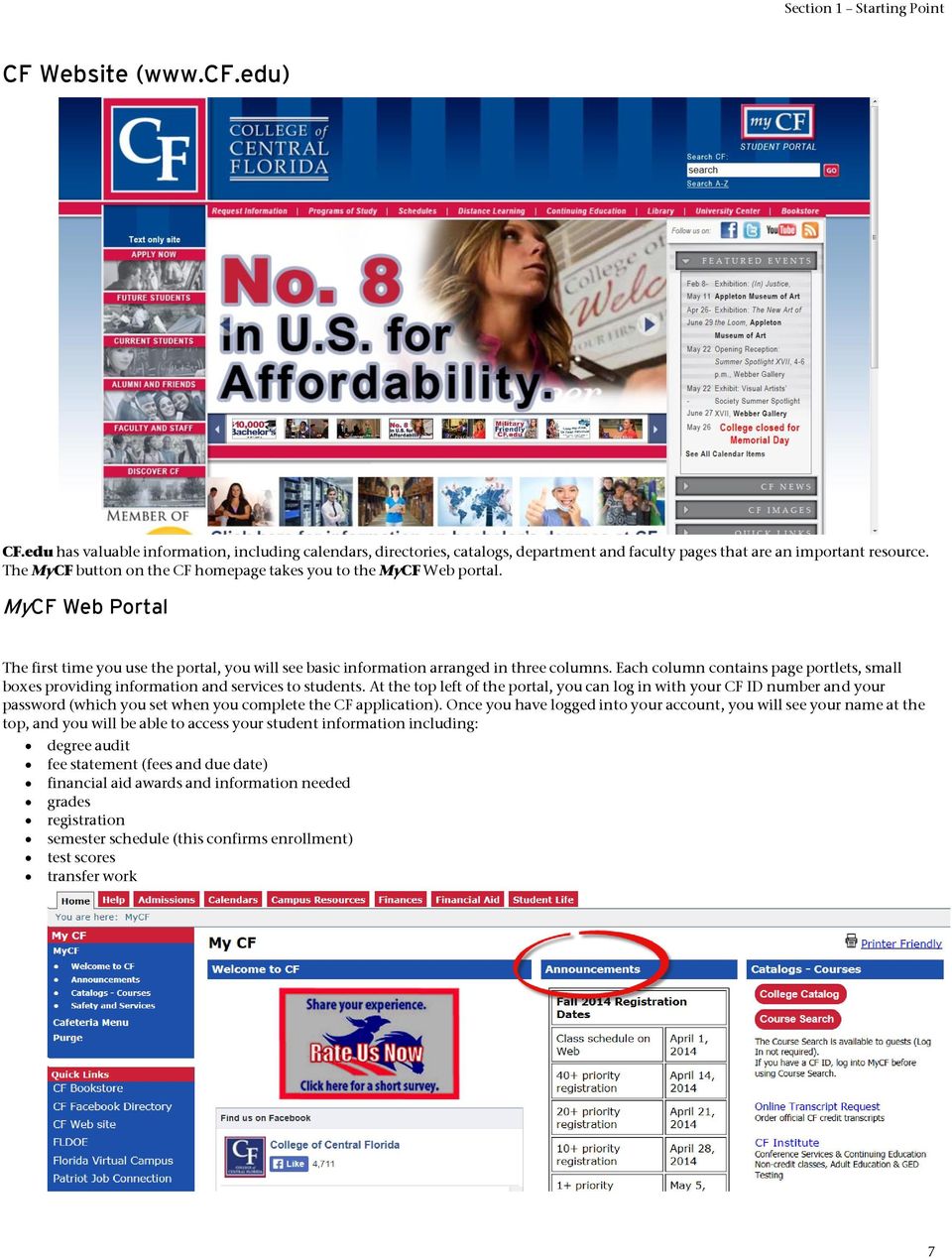


9 Section 1 Starting Point Familiarize yourself with the resources available from the various portlets; for example, the Campus Announcements portlet includes information on registration and financial aid and other collegewide updates. To find class schedules and to register for classes, select the Enrollment tab, near the center top. From here, you can follow the Schedule of Classes link to open an advanced search window. You can search by course code, course title, campus or center, instructor, etc. Once you have selected a class you want from the listing, make note of the course code and the two-digit section number. Make sure class days and times do not overlap. When you have determined all of the classes for which you want to register, go to the Enrollment portlet, select Add or Drop Classes and click on Register for Classes. A separate browser window will open. From this Registration Entry screen, follow the directions for adding, dropping or swapping courses. When you are finished, remember to close that browser window. 8


10 Section 1 Starting Point Once you have completed registering for your classes, you need to PRINT your Student Schedule AND Fee Statement. Print both of these from the My Classes link under the Enrollment portlet. The Finances tab will also provide you with your Financial Aid status. The Academics tab will give you information about your academic record, grades, GPA projection, test scores and degree audits. 9

11 Section 2 Financial Aid Section 2 Financial Aid In order to be eligible to receive financial aid, you must complete the Free Application for Federal Student Aid, referred to as FAFSA, each academic year. This can be done online at any time after Jan. 1. This should be done by May 15, the college s priority deadline, if you wish to be considered for all possible forms of aid and to be awarded by the time your fees become due. You may be eligible for federal aid, which includes grants, federal work study and student loans. Other types of aid include state aid, institutional aid and scholarships. The College of Central Florida has more than $700,000 of scholarships available to eligible CF students. In order to be considered for one of these scholarships, a separate application must be completed. This application can be found on the MyCF portal by selecting My Financial Aid and clicking on the scholarship application link. Rights and Responsibilities of the Financial Aid Recipient You have the right to: Information regarding financial aid application procedures, cost of attendance, aid available and renewal requirements. Confidential protection of your financial aid records. The contents of your financial aid file are maintained in accordance with the Family Educational Rights and Privacy Act. Request a review of decisions made by the CF Financial Aid staff. To request a review, come to the Financial Aid Office and the front line staff will have you speak to the appropriate person. You have the responsibility to: Complete applications correctly and on time. Read and understand all materials sent to you from the Financial Aid Office and other financial aid agencies. It is recommended that you keep copies of all forms and materials submitted. Know and comply with the rules governing your aid program(s). Comply with the provisions of any student loan promissory notes and all other agreements you sign. Register for the appropriate number of credits for aid awarded, attend all classes, and maintain Satisfactory Academic Progress (2.0 GPA, earn a minimum of 67 percent of credit hours attempted and not exceed 150 percent of the published length of your declared program of study). Request assistance from the Financial Aid Office if you have questions or do not understand the information provided to you. Satisfactory Academic Progress for Financial Aid Purposes All students receiving certain federal, state and institutional aid must meet the standards of progress outlined below. The requirements for those standards are set by federal regulation 34 CFR Sections (e), (f) and Your financial aid is awarded and continued contingent upon maintenance of Satisfactory Academic Progress (SAP) as follows: You must maintain a cumulative 2.0 grade point average. You must make progress toward your degree, known as a completion ratio, each academic year. Minimum progress requires you to earn 67 percent of all credit hours attempted, including transfer courses accepted (hours earned / hours attempted = completion ratio). You may attempt no more than 150 percent of the total credit hours in your degree or certificate program. Contact the Financial Aid Office or refer to the CF catalog for a complete explanation of the Standards of Progress. It is important to understand withdrawing from classes can adversely affect your completion ratio and may drop you below 67 percent. For financial aid purposes, remaining enrolled in a course for credit beyond the official add/drop period counts as an attempt. All attempted courses are counted, even if taken as part of a different degree program (technical or vocational college credits will not be included for students in college credit certificate, associate or bachelor degree programs). Satisfactory Academic Progress for financial aid recipients is evaluated every two semesters or 24 credit hours attempted, whichever occurs first. Students who do not meet the standards of Satisfactory Academic Progress will be placed on Financial Aid Suspension and will no longer be eligible to receive financial aid. Students may appeal their SAP suspension by contacting the Financial Aid Office. Further SAP suspension and appeal information is available in the CF Catalog. Student Financial Aid Verification If your FAFSA file was selected by the Federal Department of Education for a process called verification, the Financial Aid O ffice will be required to compare information in your FAFSA with documentation provided by you and/or your parent(s). You will be notified of 10

12 Section 2 Financial Aid the documentation that must be provided in order to complete the verification process. The federal regulations require this information to be submitted before awarding federal aid. If selected for verification, CF must verify the following student/parent information: adjusted gross income (tax transcrips/w-2 forms) federal taxes paid (tax transcripts/w-2 forms) number in household (student/parent must show proof that they are providing more than 50 percent of the support for a member of the household who is 24 or older or a person that is not considered an immediate member of the household, e.g., grandmother, uncle, friend, stepchild, etc.) number in household attending college other untaxed income (student/parents must provide proof of other untaxed income not reported on their tax forms, e.g., Social Security benefits from SSA-1099, Workers Compensation, child support received) Supplemental Nutrition Assistance Program (SNAP) and Child Support Paid Unusual enrollment history The verification process can take six to eight weeks to complete depending upon how quickly the student/parent submits documentation required and the accuracy of the information. Needed information is displayed on MyCF under the "Missing Documents" link. Students selected for verification should check this link regularly to determine what documents are still required to complete the process. Students are also encouraged to contact the Financial Aid Office if they have questions concerning their verification status. Book Charges Textbooks, study guides, manuals and program kits may be charged against your student account, if you have been awarded Title IV aid. Before charging books and other materials, students must complete a Book Authorization form on MyCF. This form will only be available to students that have no outstanding issues with the Financial Aid Office. Students who have been awarded Title IV aid* for the semester may begin charging their books before the first day of fall, spring and summer classes based on the published schedule. The specific dates are announced in Enrollment Services, Financial Aid, MyCF and the CF Bookstore for each semester. Returning books for credit against a financial aid award is only allowed during the same period as charging books. *Pell, Federal Supplemental Educational Opportunity Grant, Federal Direct Subsidized Loans, Federal Direct Unsubsidized Loans, etc. Financial Aid Enrollment Levels These enrollment levels apply to all three semesters - fall, spring and summer. Full time: Three-quarter time: Half time: Less than half time: 12 or more credit hours 9-11 credit hours 6-8 credit hours 1-5 credit hours NOTE: Please refer to the college catalog about enrollment and how the census date will impact your financial aid each semester. Verification of Attendance Your attendance will be verified by your instructors during the first few weeks of class and can be linked to some type of activity assigned by the instructor. If the instructor is not satisfied that you have attended, it can have an adverse affect on the d isbursement of financial aid, specifically federal financial aid awards. Federal Definition of Attendance: Attendance must be "academic attendance" or "attendance at an academically related activity." Examples include: physical class attendance where there is direct interaction between instructor and student submission of an academic assignment examination, interactive tutorial or computer-assisted instruction study group assigned by school participation in online discussion about academic matters any academic activity that the instructor deems appropriate 11

13 Section 2 Financial Aid Outstanding Fees and Disbursement of Aid Your fee statement will show the amount you owe and any financial aid awarded. If your fee statement is more than your financ ial aid, you pay the cashier the difference to clear your account. If your fee statement is less than your financial aid, you may receive the balance of your financial aid in a refund when your account is credited. Some types of aid are not reflected on your fee stat ement until after the semester begins (e.g. Bright Futures Scholarships). The Business Office is responsible for processing refunds. Students should keep the college apprised of current contact information (address, telephone, etc.) so that refunds will be received promptly. You may review your award information on MyCF. If you have been awarded, awards will appear as intended, accepted or credited to your account. If the award is credited, it has been disbursed to your student account. Once credited, your refund will apply to your CF One Card (see below) within three business days, barring any unforeseen events. Any further questions regarding your disbursements, once they are credited to your account, can be directed to [email protected]. What happens to my financial aid if I withdraw from classes or if I stop attending classes? When a student who receives a net disbursement of Title IV funds* ceases attendance resulting in failure or withdrawal, the c ollege is required by federal regulations to determine whether or not the student must repay a portion of the net disbursement to the U.S. Department of Education. The Financial Aid Office will notify the student in writing of the amount owed, procedures for repay ment and the consequences of nonpayment within the allotted timeframe. Detailed information on repayments, including examples, is available in the Financial Aid Office. Students who receive Bright Futures awards should consult the Bright Futures website ( for current information regarding the impact on a student's award if the student withdraws from a class or does not complete the class successfully. *Pell, Federal Supplemental Educational Opportunity Grant, Federal Direct Subsidized Loans, Federal Direct Unsubsidized Loans, etc. Remember: You are responsible for withdrawing from a class. If you receive any type of financial aid, consult the Financial Aid Office prior to withdrawing to determine if you will have to repay any portion of the aid disbursed to you. Important Financial Aid Telephone Numbers Bright Futures ( Florida Vocational Gold Seal, Florida Merit, Florida Academic Scholars) Direct Loan Servicing Center Florida Governor s Council on Indian Affairs Florida Prepaid Florida TEACH Loan Default (U.S. Department of Education) Office of Student Financial Assistance in Tallahassee Pell Processor ( FED AID) Selective Service Information Veteran s Affairs ( Atlanta, Ga.)

14 Section 2 Financial Aid CF One Card You will receive a card in the mail within two weeks after registering for the first time. Activating the card and selecting a preference immediately is advised. It only takes two to three minutes at CFOneCard.com. RETAIN THIS CARD! Do not throw away this card or any of the information that is mailed with it. This information must be used to select a method to receive any financial aid disbursements or refunds from the college. This card is also required if you decide to change your disbursement preferences. Replacement cards are $10 if you obtain one from a cashier at one of the college campuses and have never activated your card; however, if the card has been previously activated or you order a replacement card online through Higher One, it will cost $2 1. Activation Option Debit card disbursement: Funds are available within hours. Direct deposit to third party bank account of the student s choice: This option requires the student to complete an Automated Clearing House form and return it to Higher One before any disbursements will be processed. Funds are available within two to three business days. 13

15 Section 3 Career Planning and Job Placement Section 3 Career Planning and Job Placement Finding Your Path to Success College of Central Florida wants you to succeed while at CF and after you graduate. CF offers many services to help you decide what courses to take and what career to choose. Academic advisors can help with your academic choices. Career counselors can help you choose a career and prepare for a job interview. CF students can also receive a referral for other services on campus as well as information about resources available in the community. Career Center Services The CF Career Center maintains a variety of resources to assist students in choosing career goals, programs of study, colleges and life directions. Including: access to on-campus recruiters building a career portfolio career counseling career exploration interview aids job search assistance personalized career assessments resume writing tips Patriot Placements is an electronic job posting service where students can search and apply for jobs and post a resume. Visit the Career Center homepage at cf.edu/patriotjobs and click on Patriot Placements under Important Links to register and begin searching for jobs. The Career Center is in the Bryant Student Union, Room 205A. Call , ext. 1721, or visit cf.edu/patriotjobs. Nine Predictors of Career Satisfaction Take some time to consider the following components of an ideal career before thinking about specific job titles. 1. What are you good at? List your top skills and abilities. Think about your personality traits, such as honesty and enthusiasm; your general skills that are useful in many jobs such as writing clearly or the ability to organize and prioritize; and your job-related skills learned through education, training and experience. 2. What interests you? Write down your top interests. Are you proficient with computers? Do you have a knack for repairing engines or furniture? Do you enjoy photography? Do you have a flair for numbers? Do you like to help people solve their problems? Consider all of your interests. 3. What motivates you and is most important to you? Prioritize the values you would like to include in a career. Do you want to help others? Would you like to have authority? Do you want creative or exciting work? How important is variety, independence, recognition, good pay and security to you? 4. How much money would you realistically like to earn? Think about the money issue now so that you can make a good decision when you receive a job offer. If you found the perfect job, what would be the least pay you would accept? What is the reasonable lower end and upper end of pay you can expect in your next job? 5. What level of responsibility do you want? Do you like to be in charge? Are you good at supervising others? Do you want to be accountable for the performance of others or responsible for a territory? Decide how much responsibility you are willing to accept in your ideal career. 6. Where do you want your ideal job to be located? Consider where you would like your work to be located geographically. Are you willing to move? What kind of a commute do you want? Do you want to be near relatives or public transportation? As you add criteria, you will have fewer places to look for your job, but you will find what you want. 7. What special knowledge would you like to include in your career? List knowledge that you have gained from schools, hobbies, family experiences and other sources. Are you a good cook? Are you talented at home decorating? Do you like to work with children? Do you have a good understanding of investments? As you fine-tune your career choice, include one or two of your special knowledge areas. They could make you a unique applicant in the right setting. 14
16 Section 3 Career Planning and Job Placement 8. What kind of work environment do you prefer? Define what you did and did not like in past work settings to create your ideal work environment picture. For example, do you like to work outdoors? Do you prefer a small or large organization? Does a quiet work space appeal to you? 9. What types of people do you like to work for and with? Identify the types of coworkers you prefer. If you have worked for a difficult boss or been unhappy working with a team, you know why this is important. Do you prefer creative types? People who are friendly or who keep your relationship very professional? Do you want a boss who interacts with you all day or one who lets you work independently? After you consider these nine questions, use them to research specific job titles and employers and keep the factors in mind during job interviews. Although you may need to compromise, getting as close as possible to your ideal career choice will likely pay off in job success and satisfaction. Patriot Job Connection Need a job while in school or when you graduate? CF partners with Workforce Connection to provide on-campus job placement assistance in the Patriot Job Connection, located in the Enterprise Center, Room 109 on the Ocala Campus. Patriot Job Connection office hours are 8 a.m. to 5 p.m., Monday through Friday. The telephone number is or JOBS, ext Services for students include: Current, local job postings in EmployFlorida.com One-on-one assistance with a placement specialists Resume and interviewing workshops and assistance On-campus employer recruiters Computers, fax, copier for student use while job searching All services are provided at NO charge! Visit the Patriot Job Connection anytime, call to schedule an appointment with a placement specialist, or visit 15

17 Section 4 Academic Advising Section 4 Academic Advising What CF advisors can offer you: career exploration course selection degree requirements degree selection educational planning goal setting orientation and registration study skills time management transfer assistance To determine which advisor you should meet with, go to the CF website at CF.edu, click on Current Students, then Admissions & Enrollment and then Advising. There is a complete listing of advisors serving A.A. students, A.S. and Certificate students, the Citrus Campus, the Levy Center, TRIO Programs and Academic Foundations. For more basic advising questions or concerns, you may seek the assistance of an advisor in the Bryant Student Union, Room 102, at the Ocala Campus, or Citrus Learning and Conference Center, Room 106, at the Citrus Campus. You may also send an to [email protected], our online advising service. Students pursuing an Associate in Arts degree may access A.A. advising sheets online at cf.edu/go/admissions/advising. There is a sheet for each area of interest. These advising sheets show the A.A. degree requirements with the recommended university prerequisites in the general education and elective areas. Degree audits are available through the MyCF Web portal at CF.edu. Career exploration, degree audits and 2+2 transfer information is available with your academic advisor. Associates in Arts students are required to meet with their academic advisor once they have earned 30 college credit hours. Important dates, including priority registration, ar eon the Academic Calendar at CF.edu and MyCF. For information about transcripts, residency status, academic status, registration, withdrawals, petitions, etc., visit a CF Enrollment Services Center: Ocala Campus, Bryant Student Union, Room 102, 3001 S.W. College Road. Citrus Campus, Citrus Learning and Conference Center, 3800 S. Lecanto Highway, Lecanto. Levy Center, 114 Rodgers Blvd., Chiefland. 16
18 Section 5 Success Strategies Section 5 Success Strategies Learning Styles: Work smarter, not harder in the classroom. Each person uses all available senses (sight, sound, touch and smell) when learning. These senses are called learning modalit ies and we use them in processing and retaining information. Some of these senses we use more efficiently than others in the learning process and are identified as our individual learning style or modality preference. There are three main types of learning styles: visual, kinesthetic and auditory. It is important to know your learning style and to put into practice the learning strategies below. You can visit the Office of Testing and Career Development at the CF Ocala Campus, Bryant Student Union, Room 205, and Citrus Learning and Conference Center, to take a free inventory to help you determine your learning style. Visual Learners "Seeing is believing." Characteristics needs to see it to understand it learns best by seeing, reading, watching strong sense of color and design as organizational tool uses lists and planners to organize relates to vivid imagery, figurative language and descriptions sensitive to environmental distractions such as excess movement, sounds and noises may have difficulty remembering oral instructions and following lectures Learning Strategies uses multi-media to enhance learning such as video, computer assignments, illustrations, diagrams, demonstrations uses color coding to organize notes, time and possessions marks calendars with different colors of ink and uses colored stickers and folders for different courses sits away from windows and doors, sits close to front of class, takes good notes and uses written instructions Auditory Learners "Can you hear me now?" Characteristics needs to hear it to understand it uses phonics and auditory word attack skills prefers listening and auditory instruction to reading and writing Learning Strategies uses verbal instructions from self and others, thinks out loud to process ideas and uses tapes for reading and lectures reads to self out loud to remember certain definitions, terminology or vocabulary puts review questions on tape participates in classroom discussions and group learning activities Kinesthetic Learners "Learning by Doing." Characteristics needs to apply it to understand it action oriented in problem solving difficulty with long periods of inactivity Learning Strategies active learning group learning activities, labs, projects, portfolios, making models, conducting demonstrations, making presentations, taking lots of notes, papers case studies, collaborative group projects, contextual learning and real-life applications takes frequent study breaks with physical movement such as stretching, short walks and does better with shorter class periods stretched out during the week 17

19 Section 5 Success Strategies Time Management There are 168 hours in a week. For one week, write down the time you spent on all your activities: Sleeping, eating, studying, inclass, homework, travel to and from class and work, entertainment, home/family responsibilities, church, work. Evaluate how you spend your time, and define your "time busters" (e.g., procrastination, TV, telephone, Internet). Remember: Do not underestimate the importance of any one of the areas listed above. The primary reason motivated students fail to reach their goals is personal overload of activity. 80/20 principal: you should spend 80 percent of your time on the 20 percent most valued activities. Set goals and prioritize them. General rule: spend two to three hours of study time for each hour you are in class (a three-credit hour course would require six to nine hours per week on homework, studying and exam preparation). General Strategies for Studying Do not miss class. Listen during lectures and participate in discussions. Active participation will help you retain what you are learning. Budget your time effectively. An hour or two each day is more effective, and far less painful, than studying all night before exams. If a concept gives you trouble, do additional reading or problem solving beyond what has been assigned. If you still have trouble, ask for help; you can find friends, classmates, tutors, or teachers who will be glad to help you. Working together with friends can be valuable in helping you solve difficult problems. However, be sure that you learn with your friends and do not become dependent on them. When studying your text don t highlight underline! Using a pen or pencil to underline material requires greater care and therefore helps to keep you alert as you study. Reading and Study System, SQ3R SURVEY - Read the chapter title, introduction, learning objectives, summary and end of chapter questions. Also review bold face headings and subheadings, graphics, and italics throughout the chapter. This will provide an overview of the chapter and create a mental framework for understanding the chapter more thoroughly as you read. QUESTION - Prior to reading each section, turn each heading into one or more questions. It will be helpful if you write your questions down so you can refer to them as you move through this process. This step helps you concentrate and creates active learning. READ - As you read each section, look for answers to your questions. This fills in the information around the mental framework you have created in the previous steps. RECITE - After you have finished reading a section and before moving on, go back to your questions to see if you can answer them. If you can not, you may have missed the main ideas in that section and may want to read it again. If you can answer them, you are ready to move on to the next section, repeating the entire process. REVIEW - This is the final step in your reading session. Again, review your questions to see if you can answer them. This step helps to refine your mental organization and begin to build your memory and understanding of the material. Following this model as you read chapters is likely to reduce the amount of time you will need to spend studying the chapters the week before the test because you have already begun to learn the material as you move through this process. Note Taking First, be sure to do all your homework assignments before going to class. You will have a much easier time understanding what the instructor is going over if you have read the textbook chapters and done the assignments. Second, bring your textbook to class as you may want to follow along or even take some notes right in your text. Third, leave a good amount of space in your notes so you can fill in further insights as you review your notes. Further, ask questions and participate in class (be an active learner). Abbreviate as much as possible (words, phrases, name), but make sure you will be able to read and understand your notes later. Use symbols, such as #, <, vs., and w/. Translate or add clarity to your notes as soon after class as possible. Date your notes and use meaningful headings. Clip related handouts to your notes. E-Learning Success (Success in Online Courses) Taking an on line course requires just as much time and effort as an in-class course. Consider these questions before you register for an online course. Yes No Do you like to work alone? Distance learning does not provide the face-to-face interaction of a classroom course. Yes No Are you comfortable working primarily with a text-based medium? Without a lecture, you will have more reading to do than the same class on campus. Yes No Are you comfortable asking for clarification and continuing to ask when you need more information? 18

20 Section 5 Success Strategies Yes No Do you have good, basic computer skills? Do you know how to use the Internet, send s and attachments, and manage files? Yes No Are you an effective manager of your time? Good time management skills are essential; it could take you from six to 15 hours or more per week for each online course. Yes No Are you disciplined? Yes No Are you detail oriented? Yes No Do you have good problem solving skills? Yes No Do you need convenience and a flexible schedule? Yes No Do you have your own computer with Internet service at home? Yes No Do you have the software required for the course? Although CF campuses have computer labs students can use, you must factor the extra time spent on campus to use that resource. If you answered yes to most of these questions, then you might want to try an online course. Test Taking Tips General Preview the test before you answer anything. Write your short answers in clear and simple sentences. Do a mind dump and write down anything you think you might forget. Quickly calculate how much time you should allow for each section according to the point value. Read the directions carefully. Answer the easy questions first. Go back to the difficult questions. Look for cues (other questions might provide an answer). Answer all questions (unless you are penalized for wrong answers). Ask the instructor to explain any items that are not clear. Try to answer the questions from the instructor s point of view. Use the margin to explain why you chose the answer. Circle key words in difficult questions, this keeps you focused on what is important. Express difficult questions in your own words. Do not change answers. Go with your first instinct. It is usually correct. Use all of the time allotted for the test. Multiple Choice Read the directions carefully. Know whether you must mark the one best correct answer or all correct answers. Know if you are penalized for guessing. Read the stem of the question. Use the options for hints. If you are uncertain of the correct answer, cross out all that are definitely wrong and then come back to this item later. Circle all negative words and 100 percent ("all") words. "All of the above" answers are often correct. True/False Most true/false tests contain more true answers than false answers. Pay close attention to qualifiers, negatives and long strings of statements. Qualifiers are words that restrict or open up general statements: never, none, always or frequently, often, generally. Negatives are confusing. Circle the negative and read what remains, answering whether it is true or false. If it is true, the opposite or negative is usually false. Every part of a true sentence must be true. Fill in the Blank or Short Answer Prepare for the test; try to categorize your study material. Use grammatical clues as hints. If you can think of several answers, try to determine what the instructor is seeking. Make a guess using common sense, usually better than leaving it blank. Write your short answers in clear and simple sentences. 19

21 Section 5 Success Strategies Essay Understand what the question is asking. First sentence of the essay s answer should repeat the question and show the reader how you will develop your answer. Outline major points; they should stand out. Major points should be supported with facts and examples, and clear transitions from one to the next. Someone who has not taken the course should be able to understand what you have written. Major points should be completely covered to adequately answer the question. Be sure to stick to the question. A conclusion with a summary statement should be included. Proofread for grammar, spelling and other errors that could impede the reader s understanding. Write neatly; you want the reader to be able to decipher your handwriting. Test Preparation Tips Preparation for your test begins with studying, completing homework assignments and reviewing study materials on a regular basis. 1. Budget your time. Make sure you have sufficient time to study so you are well prepared for the test. 2. Go to review sessions. Pay attention to hints the instructor may give about the test. Take notes and ask questions about items that confuse you. 3. Ask the instructor to specify the areas that will be emphasized on the test. 4. Make sure you go to the class right before the test; it's another prime time for the instructor to give out more hints including the format of the test. 5. Go over materials from previous tests, sample problems, review materials, the textbook, class notes, handouts, etc. 6. Eat before the test. Food will give you energy and help you focus, but avoid heavy foods that can make you groggy or sleepy. 7. Don't stay up all night studying. Get at least six to eight hours of sleep the night before the test. 8. Put the main ideas/information/formulas onto a sheet that can be quickly reviewed many times; this makes it easier to retain key concepts that will be on the test. 9. Try to show up at least five minutes before the test will start. 10. Set your alarm and have a back up alarm, as well. 11. Use the restroom before walking into the exam room. Dealing With Test Anxiety Introduction Most students experience some level of anxiety during an exam. However, when anxiety begins to affect exam performance it has become a problem. Lack of preparation can cause test anxiety as indicated by: cramming the night before the exam poor time management failure to organize text information poor study habits worrying about past performance on exams, how friends and other students are doing, the negative consequence of failure Physical Signs of Test Anxiety During an exam, as in any stressful situation, a student may experience any of the following bodily changes: perspiration sweaty palms headache upset stomach rapid heart beat tense muscles. Effects of Test Anxiety nervousness having difficulty reading and understanding the questions on the exam paper having difficulty organizing your thoughts having difficulty retrieving key words and concepts when answering essay questions doing poorly on an exam even though you know the material mental blocking such as going blank on questions or remembering the correct answers as soon as the exam is over 20
22 Section 5 Success Strategies How to Reduce Test Anxiety Study and know the material well enough so that you can recall it even if you are under stress. Learn and practice good time management and avoid laziness, procrastination and day dreaming. Build confidence by studying throughout the semester and avoid cramming the night before the exam. Generate questions from your textbooks and lecture notes. Focus on key words, concepts and examples in your textbooks and lecture notes. Make charts and outlines which organize the information in your notes and textbooks. Use relaxation techniques, for example, taking long deep breaths to relax the body and reduce stress. The Study Environment Your study environment can have a big effect on how efficient you study. Check your place of study for noise, interruptions, lighting, temperature, neatness, comfort and equipment Minimize distracting noise. Some people need some sound, and some like silence. Find what works for you. Culprits are family and friends. Consider a "do not disturb sign" and let phone calls go to voice mail. You can catch up with folks later.lighting Have plenty of room to work; don't be cramped. your study time will go better if you take a few minutes at the start to straighten things up. A desk and straight-backed chair is usually best. Don't get too comfortable. A bed is a place to sleep, not study. Have everything (book, pencils, paper, coffee, dictionary, computer, calculator, tape recorder, etc.) close at hand. Don't spend your time jumping up and down to get things. equipment. Preparing for or Anticipating Test Anxiety What is it you have to do? Focus on dealing with it. Just take one step at a time. Think about what you can do about your anxiety. No negative or panicky self-statements; just think rationally. Don't worry; it won't help anything. Don't think about fear; just think about what you have to do. Stay relevant. Relax; you're in control. Take a slow, deep breath. You should expect some anxiety, it's a reminder not to panic and to relax and cope steadily with the situation. Tenseness can be an ally, a friend; it's a cue to cope. Coping with the Feeling of Being Overwhelmed When the fear comes, just pause. Keep the focus on the present; what is it you have to do? You should expect your fear to rise some. Don't try to eliminate fear totally; just keep it manageable. You can convince yourself to do it. You can reason your fear away. It's not the worst thing that can happen. Do something that will prevent you from thinking about fear. Describe what is around you. That way you won't think about worrying. Reinforcing Self-Statements It worked! You did it! It wasn't as bad as you expected. You made more out of the fear than it was worth. You're getting better. You're learning to cope more smoothly. You can be pleased with your progress. You like how you handled it. You can be proud of it. 21
23 Section 5 Success Strategies List of Self-Verbalizations The lists below contain some common thoughts and worries which many test-anxious people have. Check those that you can identify with most. Then study your list and see if you can change any of your worrying thoughts. Ask yourself, "How rational is each thought? How much evidence do you have for such a belief?" A. Worry About Performance I should have studied more. I'll never get through. I just want to finish and get out of here and hope for the best. I don't know anything. What's the matter with me? My mind is a blank. I'll never get the answer. I must really be stupid. I can't figure out what the professor wants. No way I'll do well on this test. I can't remember a thing. This always happens to me. I never do well on anything. Only 10 minutes left. There are so many questions. I'll never get through everything. I just can't think. Why did I ever take this course? It's no use. I might as well give up. I knew this stuff yesterday. What's wrong with me? My mind is a blank...i'm just not cut out for this. I have to get an A. Smart people always get A's. This stuff is easy. I should get everything right. This is terrible, absolutely the worst test I've ever had. I'm just a no good, terrible, worthless person. B. Worry About Bodily Reactions I'm sick. I'll never get through. I'm sweating all over. It's really hot in here. My hands are shaking again. I can't even hold the lousy pen. My stomach is going crazy; churning and jumping. Here it comes. I'm getting really tense again. Normal people just don't get like this. C. Worry About How Others are Doing I know everyone's doing better than I am. I must be the dumbest one in the class. I'm going to be the last one done again. I must really be stupid. No one else seems to be having trouble. Am I the only one? D. Worry About Possible Negative Consequences If I fail this test, I'll: Flunk the course. Be kicked out of school. Never get into graduate school. Have to get A's on the midterm and final. Have to go to summer school. Never get a good grade. Never graduate on time. Never get the kind of job I want. Disappoint my family (or friend, boyfriend/girlfriend, teacher, etc.). I'll never be able to face them again. Everyone will think I'm stupid. I'll really be embarrassed. 22
24 Section 6 Student Life Section 6 Student Life The Office of Student Life: Campus and Community Involvement The Office of Student Life fosters the social, physical and educational well-being of students by providing opportunities and experiences for engagement at the college and in the community. Student engagement and development is accomplished by: providing resources for individual development as well as for student clubs and organizations fostering leadership development opportunities for students providing opportunities for student and faculty interaction and learning through co-curricular events and services To find out how you can get more involved, stop by the Office of Student Life at each campus. Campus Involvement: Student Activities Student clubs and organizations exist to support the college goal of promoting student learning and success through the support from the Office of Student Life. CF student clubs and organizations give individuals a chance to pursue interests while developing new relationships and leadership skills. Academic-Supported Organizations These groups are generally tied to an academic course. They include Brain Bowl, Community of Scholars and "The Patriot Press." All students are invited to try out, audition or interview. Selection is limited. The Visual and Performing Arts programs include Patriot Singers, Wind Symphony, Jazz Band, CF Theatre, CF Dance Ensemble, annual Student Art Exhibition and more. Students may participate or enjoy as a spectator. For information, contact the Visual and Pe rforming Arts Department at , ext 1419, or visit Athletics Athletic teams include Men's and Women's Basketball, Softball, Baseball and Women's Volleyball. Athletics are open to all stud ents; however, members are selected through recruitment, visits and tryouts. Opportunities are also available for managers and stud ent trainers. Contact the Department of Athletics and Wellness education for information, , ext or Intramural sports enhance the overall academic experience. A variety of sports are offered, including soccer, basketball, fla g football and volleyball. Programs are open to all CF students. Student Clubs Clubs are established by students, based on common interests, and include social experiences, educational workshops and servi ce projects. Clubs range from the African-American Student Union to Criminal Justice to the Equestrian Club. Clubs are open to current CF students. If you don t see something that you are interested in, inquire about starting your own club! Check us out on the Web at cf.edu/go/student Life Student Leadership Organizations This group includes the Student Activities Board and the Student Ambassadors. Members will be selected based on established c riteria. All students are invited to interview. Wellness Success depends on balance in all aspects of life. Wellness activities include fitness classes, jogging trail, spinning room, swimming pool and weight room. These activities are scheduled to provide students with cardiovascular improvement, core strength, musc ular endurance and flexibility to enhance overall fitness and wellness levels. Check CF.edu/Go/Wellness for a schedule or call , ext or
25 Section 7 Student Right-To-Know Information Section 7 Student Right-To-Know Information Student Records The college maintains such information in its files for each student as is considered essential and appropriate to college operation and student welfare. The college adheres to all federal and state laws and rules pertaining to the privacy rights of parents and students, including the Family Educational Rights and Privacy Act (FERPA). Directory information which may be unconditionally released to the general public without the consent of the student unless he or she has specifically requested the information not be released includes: Name Address Address Telephone Number Date of Birth Major field or program of study Participation in officially organized activities and sports Weight and height of members of athletic teams Dates of attendance Degrees and awards received Most recent previous educational institution or agency attended Students not wishing the dissemination of "directory information" without prior consent must submit a written notice to the custodian of student records stating which of the above items are not to be released to the general public. The college recognizes a "student" to be any person on whom it maintains educational records or personally identifiable information, but does not include a person who has not been in attendance at the college. For the purpose of this policy, the college considers the term "educational records" to include those records, files, documents, and other materials containing information directly relating to a student, including records of disciplinary proceedings, which are maintained by the college or by a person acting as custodian of the records for the college. Information pertaining to general administrative procedures can be found in the Enrollment Services Center on each campus or center and the office designated by the president as the responsible authority. (U.S. Statute 20:1232, Florida Statutes , , , CF Board Policy 7.08) Any records that are not available to institutional personnel are non-institutional records and, accordingly, the provisions of this policy would not apply. Such non-institutional records include, but are not limited to, faculty notes on students, psychiatric record and evaluations, and employment records not connected with a student s educational program. Once a student reaches the age of 18 or is enrolled in a postsecondary program, parents are denied rights under FERPA unless: 1) the student gives written consent to release the information to the student s parents; or 2) the parents provide evidence that the student is a dependent of the parents as defined in Section 152 of the Internal Revenue Code of 1954; or 3) the student is in imminent danger to themselves or others. The custodians of records will have the responsibility of collecting and maintaining lists of the types of educational records directly relating to students which are maintained by the institution. The applicable custodian of records will ensure that all of the access rights of the student specified by FERPA will be accorded the student. A student or eligible parents or guardians of the student will be afforded access to a student s records within a reasonable time after the submission of a written request to the custodian of that record. Suitable arrangements will be made to permit the record to be reviewed in the presence of the custodian of that record or representative. The student or parent has the right to challenge the content of any record believed to be inaccurate, misleading, in violation of the student s rights or otherwise inappropriate. Parents or students wishing to challenge the contents of a record shall follow the procedures of Florida Statute A student, parent or guardian of right may consent to the release of any student information to any person or agency provided the consent is in writing, signed and dated, specifies the information to be released, the reason for release, and the names of persons, institutions or agencies to whom the information is to be released. 24
26 Section 7 Student Right-To-Know Information Student Rights and Responsibilities Student Rights: Upon registration, students are entitled to the following freedoms and/or rights provided that their exercise is accomplished in accordance with College procedures and does not result in disruption or disturbance: Right to freedom of expression: The basic freedom of students to hear, write, distribute and act upon a variety of thoughts and beliefs is protected. Freedom of expression carries with it the responsibility for seeing that the essential order of the College is preserved. Right to hold public forums: The College desires to create a spirit of free inquiry and to promote the timely discussion of a wide variety of issues, provided the views expressed are stated openly and subject to critical evaluation. Restraints on free inquiry will be held to a minimum and will be consistent with preserving an organized society in which peaceful democratic means for change are available. Guest lectures or off-campus speakers sponsored by the student groups may appear on the College campus following approval by the designated College authority for such appearances. Right to peaceful assembly: Existing laws, statutes, and policies shall be observed. Student gatherings must not disrupt or interfere with the orderly educational operation of the institution. Right to a fair and impartial hearing. Right to participate in student government and its process. Right to be a member in authorized student organizations. Student Responsibilities/Code of Student Conduct: The College has established regulations governing student conduct which are considered necessary to preserve and maintain an environment conducive to learning, to ensure the safety and welfare of members of the College community, to encourage students in the development and practice of good citizenship and self-discipline, and to protect property and equipment of the College. The Code of Student Conduct is in effect on College premises, in College vehicles, on properties owned by the College of Central Florida Foundation or the College (with the exception of residential facilities), at functions sponsored by or participated in by the College regardless of the locations, and in the immediate vicinity of the College, includ ing, but not limited to, property and roads adjacent to and visible from the campus whenever student behavior is visible or audible to the campus community and constitutes a disturbance, danger or harassment to or of the campus community. Each student, by registration, assumes the responsibility to become familiar with and to abide by College regulations and acc eptable standards of conduct. Students who fail to observe College regulations or to maintain acceptable standards of personal conduct on the campus or at College sponsored functions or facilities are subject to disciplinary action. If an enrolled student is formally charged with a felony, or with a delinquent act which would be a felony if committed by an adult, by a proper prosecuting attorney for an incident which allegedly occurred on property other than College premises, or a function sponsored by or participated in by the College regardless of location, and if that incident is determined to have an adverse impact on the educational program, discipline or welfare of the College, then following standard procedures for suspension, the College has the right to suspend the student pending final adjudication. If the student is adjudicated guilty, then the student may be recommended for expulsion through the normal expulsion procedure. With this exception, the College will not ordinarily impose sanctions o n a student who is subject to criminal prosecution for off campus activity. If a student is charged by federal, state or local authorities with a crime in connection with activity which occurs on campu s, as previously defined, or at functions sponsored by or participated in by the College regardless of the location, the College will cooperate with law enforcement s investigation as permitted by statutes governing student privacy and shall follow the procedures set f orth under the Code of Student Conduct in regard to its own investigation and penalties. (Florida Statutes , , , , F.A.C. 6A , CF Board Policy 7.04) Academic Integrity/Honor Code Purpose: This policy creates an honor code for students in their academic work. Academic integrity is founded upon the values of honesty, trust, fairness, respect and responsibility. Exhibiting these values is essential to promoting and maintaining a high level of academic integrity at the college. Each member of the college community stands accountable for his or her actions. The first responsibility for academic integrity lies with individual students and faculty members. A violation of academic integrity is an act harmful to the entire college community and may result in disciplinary action. Violations of the code shall include, but are not limited to: Cheating. The improper taking or tendering of any information or material used or intended to use for academic credit. Taking of information includes, but is not limited to, copying homework assignments from another student; working with others on a take-home test or homework when not specifically permitted by the teacher; looking or attempting to look at another student s paper during an examination; looking or attempting to look at text or notes during an examination when not permitted. The tendering of information includes, but is not limited to, giving work to another student to be used or copied; giving answers to exam questions as the exam is being given; giving answers or other such information after taking an exam to another student who has not yet taken the exam; giving or selling a term paper or other written materials to another student. (Adapted from the policy of the University of Florida.) Plagiarism. From the Latin for "kidnapper," taking ideas from another and passing them off as one s own, whether the ideas are 25
27 Section 7 Student Right-To-Know Information published, unpublished, or the work of another student. Plagiarism includes, but is not limited to, submitting papers, examinations or assignments written by others; word-for-word copying of portions of another s writing without indicating that the copied passage is a quotation (by the use of quotation marks or some other indicating device) and acknowledging the source in the appropriate format; the use of a particularly unique term or concept that one has come across in reading without acknowledging the author or source; the paraphrasing or abbreviated restatement of someone else s idea(s) without acknowledging the author or source; the use of false citations or citing a source from which an idea has not been obtained; or submitting false or altered data in a laboratory. Plagiarism also occurs in a group project if a member of the group does not do his or her fair share of the group s work but attempts to take credit for the work of the group. Because electronic information is so easily reproduced, respect for the work and personal expression of others is critical in computer environments. Violations, including plagiarism, invasion of privacy, unauthorized access, and copyright violations are grounds for disciplinary proceedings. Students should consult the section on plagiarism in the writing handbook used in ENC (Adapted from the policies of Wheaton College, Old Dominion University, the University of Florida and the University of North Carolina Greensboro.) Bribery. Offering, giving, receiving, or soliciting any materials, items or services of value to gain academic advantage for oneself or another. Misrepresentation. Any act or omission with intent to deceive an instructor or other college official for academic advantage, including using a computer program generated by another and handing it in as one s own work unless expressly allowed by the instructor; lying to an instructor to increase one s grade; lying or misrepresenting facts when confronted with an allegation of academic dishonesty; providing false statements upon financial aid forms or other college documents. Conspiracy. Planning or acting with one or more persons to commit any form of academic dishonesty to gain academic advantage for oneself or another. Fabrication. Use of invented or fictitious information or the falsification of research or other findings with the intent to deceive for academic advantage. (Adapted from the policy of the University of Florida.) A component vital to the Academic Integrity/Honor Code is a pledge that applies to all assignments, examinations, or other course work undertaken by students of the College of Central Florida. On all work submitted by students of the College of Central Florida, the following pledge is either required or implied: "On my honor I have neither given nor received unauthorized aid on this academic work, nor am I aware of others doing so." The President or the President s designee shall establish the procedure for implementation of the Academic Integrity policy. (CF Board Policy 4.14, Rev. 01/22/13) Academic Integrity Procedure The purpose of this procedure is to define violation(s) of the honor code and outline the process for resolving violation(s) of the Academic Integrity Policy. Violations of the Academic Integrity Policy include, but are not limited to, cheating, plagiarism, bribery, misrepresentation, conspiracy, and fabrication as related to the academic process. For purposes of this procedure, cheating, plagiarism, bribery, misrepresentation, conspiracy, and fabrication are defined in the Academic Integrity Policy. Step One Determination When an instructor believes or receives information that a student has violated the Academic Integrity Policy, the instructor should contact the Chief Student Affairs Officer to determine if this is the student's first violation and whether the student has attended the Academic Integrity Seminar. If the student is a repeat violator, the student may be charged with a violation of the Code of Student Conduct. Step Two First Time Violator If student is a first-time violator, the instructor should first discuss the matter with the student. The instructor may consult with or invite the participation of the instructor's department chair, program facilitator or dean in the effort to reach resolution with the student. The instructor and student may resolve the problem in a manner acceptable to both. Resolution may include: 26 a lower or failing grade in the course; a lower or failing grade on the assignment or examination; assignment of additional work to provide evidence of the student s academic performance or understanding of the course material; or referral to the Academic Integrity Seminar. If the instructor refers the student to the Academic Integrity Seminar, the instructor shall inform the student that his/her failure to attend the Academic Seminar may result in the assignment of a final course grade of "FF," denoting course failure due to a violation of the college's Academic Integrity policy. Any agreement involving an academic penalty shall be put in writing signed by both parties, and reported by the instructor to the department chair, program facilitator or dean, Chief Student Affairs Officer, Chief Academic Officer, Vice President at Citrus Campus, and the Provost at Levy Center if students at either location are involved. A copy of the agreement will be given to the student. The Chief Student Affairs Officer shall maintain a record of the agreement between the instructor and student. Step Three Repeat Violator If a student is a repeat violator, fails to attend the Academic Integrity Seminar, or fails to resolve his/her violation with the instructor as
28 Section 7 Student Right-To-Know Information outlined in Step 2, the instructor shall refer the student to the Chief Student Affairs Officer for a violation of the college's Code of Student Conduct. (CF Administrative Procedure: Academic Integrity, Rev. 02/13/13) Code of Student Conduct The College of Central Florida has established regulations governing student conduct which are considered necessary to preserve and maintain an environment conducive to learning, to ensure the safety and welfare of members of the college community, to encou rage students in the development and practice of good citizenship and self-discipline, and to protect property and equipment of the College. The Code of Student Conduct is published in the Student Handbook. Each student, by registration, assumes the responsibility to become familiar with and to abide by college regulations and acceptable standards of conduct. Students who fail to observe college regulations or to maintain acceptable standards of personal conduc t on the campus or at college sponsored functions or facilities are subject to disciplinary action. (CF Board Policy 7.04) I. DEFINITIONS All definitions of terms used herein can be found in the Definitions Section at the end of the Code of Student Conduct. II: STUDENT CODE AUTHORITY a. The Vice President for Student Affairs shall develop procedures for the administration of the student conduct system and procedural rules for the conduct of Student Conduct Hearings. The Vice President for Student Affairs shall have original jurisdiction over all cases involving an alleged violation of the Code of Student Conduct established by the District Board of Trustees. b. The Vice President for Student Affairs shall identify on each campus a Student Conduct Administrator who shall be authorized to investigate and to hear each matter and to determine sanctions as appropriate. c. Decisions made by the Student Conduct Administrator shall be final, pending the appeal process set forth in Section IV. E. III: PROSCRIBED CONDUCT a. Jurisdiction of the College Code of Student Conduct The College Code of Student Conduct is in effect on College premises, on properties owned by the College of Central Florida Foundation and at functions sponsored by or participated in by the College regardless of the locations. If a student is formally charged with a felony, or with a delinquent act which would be a felony if committed by an adult, for an incident which allegedly occurred on property other than College premises, or a function sponsored by or participated in by the College regardless of location, and if that incident is determined to have an adverse impact on the educational program, discipline, or safety and welfare of the College, then the College has the right to suspend the student pending final adjudication. If the student is adjudicated guilty, then the student may be recommended for expulsion through the normal expulsion procedure. With this exception, the College will not ordinarily impose sanctions on a student who is subject to criminal prosecution for off campus activity. The Code of Student Conduct is found in the Student Handbook. Each student shall be responsible for his/her conduct from the time of application for admission through the actual awarding of a degree, even though conduct may occur before classes begin or after classes end for the term, as well as during the academic year and during periods between terms of actual enrollment. The Code of Student Conduct shall apply to a student s conduct even if the student withdraws from school while a disciplinary matter is pending. Cases involving alleged violations of the Student Athletic Code of Conduct by Student Athletes will be processed under the procedures outlined in the Student Athlete Handbook. a. Infractions / Misconduct Any student found to have committed or to have attempted to commit the following misconduct is subject to the disciplinary sanctions outlined in Section IV: Alcohol/Drugs: The student shall not knowingly possess, use, transmit, or be under the influence of any narcotic drug, hallucinogenic drug, amphetamine, barbiturate, marijuana, any other controlled or counterfeit substance defined in FS , or substitute for such, alcoholic beverage, inhalant or intoxicant, on the campus either before, during or after school hours or off the College grounds at a College activity, function or event. Also, a student shall not possess, have under his/her control, sell or deliver any device, or contrivance, instrument or paraphernalia containing the substance or substances described in this paragraph or any residue of such substance or devices intended for use or used in injecting, inhaling/inhalant/huffing, smoking, administering, or using any of the foregoing prescribed drugs, narcotics, or stimulants. Use of a drug authorized by a medical prescription from a registered physician for a specific student shall not be considered a violation of this rule. Academic Integrity Violation: Violations of the Academic Integrity Policy are handled first by the Academic Integrity Procedure found in the Student Handbook. Should there be multiple violations and/or the violation was particularly egregious, the Student Conduct Administrator may also file charges under the Cheating and Plagiarism sections of the Code of Student Conduct. Arson: Intentionally setting or attempting to set a fire. 27
29 Section 7 Student Right-To-Know Information Bomb Threat: Any communication which has the effect of threatening an explosion to do malicious, destructive or bodily harm to College property, at a College function or extra-curricular/co-curricular activity or to the person(s) in or on that property or attending that event. Bullying: An aggressive behavior that is intended to cause distress or harm, exists in a relationship in which there is an imbalance of power or strength, and is repeated over time. Examples include but are not limited to: hitting, teasing, obscene gestures, rumors, getting someone else to bully, cyber-bullying. Burglary: Entering or remaining in a structure or on a conveyance with the intent to commit an offense therein unless the premises are at the time open to the public or the person is licensed or invited to enter. See F.S Cheating is the improper taking or tendering of any information or material used or intended to use for academic credit. Taking of information includes, but is not limited to, copying homework assignments from another student; working with others on a take-home test or homework when not specifically permitted by the teacher; looking or attempting to look at another student s paper during an examination; looking or attempting to look at text or notes during an examination when not permitted. The tendering of information includes, but is not limited to, giving work to another student to be used or copied; giving answers to exam questions as the exam is being given; giving answers or other such information after taking an exam to another student who has not yet taken the exam; giving or selling a term paper or other written materials to another student. Computer Fraud: Accessing or breaking into documents that are unauthorized. Cyber Attack: Introducing unwarranted programs or tools into network server. Disorderly or Disruptive Conduct: Creation of disorder at any College property, College sponsored or related event, or on any College sponsored transportation. Extortion: The willful or malicious threat of harm, injury or violence to a person, property or reputation of another with the intent to obtain money, information, services or items of material worth. False Fire Alarm: The willful and/or malicious activation of a fire alarm system or the willful and/or malicious reporting of a false fire. False and Misleading Information: Providing false, misleading or invalid statements, making false accusations, and/or withholding valid information. Felony Transfer: Suspension proceedings against any enrolled student who is formally charged with a felony or with a delinquent act which would be a felony if committed by an adult, for an incident which allegedly occurred on property other than College property if that incident is shown to have an adverse impact on the education program, discipline or welfare of the College or College Community. Fighting: Physical contact between two or more individuals where the participation is not mutual or equal, or a weapon is used, or in which injury that requires immediate first aid or subsequent medical attention occurs. Force or Violence against College Employee: Use of force or violence upon or against any employee of the College. Gross Insubordination or Open Defiance: Willful refusal to submit to or comply with authority; exhibiting contempt or open resistance to a direct order. Harassment: Any threatening, insulting, or dehumanizing gesture, use of data or computer software, or written, verbal, or physical conduct directed against a student. Hazing: Any action or situation that recklessly or intentionally endangers the mental or physical health or safety of a student for purposes including, but not limited to, initiation, admission into, affiliation with, or as a condition for continued membership in a group or organization. Inciting, Leading or Participating in a Major Student Disorder: The willful act of inciting, leading or participating in a disruption or disturbance which interferes with the educational process or which can result in damage or destruction to public or private property, or cause personal injury to participants and others. Intentional Damage of College Property/Personal Property: Destruction or defacing of College/personal property. Other More Serious Miscellaneous Conduct: Conduct which is not listed as a specific infraction but which results in more serious injury, damage to property, or other serious harm. Plagiarism: From the Latin for "kidnapper," taking ideas from another and passing them off as one s own, whether the ideas are published, unpublished or the work of another student. Plagiarism includes, but is not limited to, submitting papers, examinations or assignments written by others; word-for-word copying of portions of another s writing without indicating that the copied passage is a quotation (by the use of quotation marks or some other indicating device) and acknowledging the source in the appropriate format; the use of a particularly unique term or concept that one has come across in reading without acknowledging the author or source; the paraphrasing or abbreviated restatement of someone else s idea(s) without acknowledging the author or source; the use of false citations or citing a source from which an idea has not been obtained; or submitting false or altered data in a laboratory. Plagiarism also occurs in a group project if a member of the group does not do his or her fair share of the group s work but attempts to take credit for the work of the group. Because electronic information is so easily reproduced, respect for the work and personal expression of others is critical in computer environments. Violations, including plagiarism, invasion of privacy, unauthorized access, and copyright violations are grounds for disciplinary proceedings. Students should consult the section on plagiarism in the writing handbook used in ENC Sexual Battery: Any sexual act directed against a person, forcibly or against the person s will, or not forcibly against the person s will where the victim is not capable of giving consent because of his or her youth or because of temporary or permanent incapacity. Sexual Harassment: Unwelcome sexual advances, requests for sexual favors and other inappropriate oral, written or physical contact of sexual nature when such conduct substantially interferes with a student s academic performance or creates an intimidating, hostile or offensive College environment. Sexual harassment may include, but are not limited to the following: verbal 28
30 Section 7 Student Right-To-Know Information harassment or abuse, pressure for sexual activity, repeated remarks to a person with sexual or demeaning implications, unwelcome or inappropriate touching, suggestive or demanding sexual involvement accompanied by implied or explicit threats. Sexual Offenses: Exposing or exhibiting one s private areas in public in a vulgar or indecent manner. Intentionally touching in a lewd or lascivious manner in clothed private areas of another. Theft: The taking of property of another without permission of the owner. Trespassing: Entering upon or remaining on any property, a structure or conveyance without being authorized, licensed or invited to do so and being warned by the owner or owner s agent or by notice pursuant to Florida Statute , or, in the case of entry upon or remaining on College grounds or buildings, not having legitimate business on the campus or authorization, license or invitation to be there or being under suspension, alternative placement or expulsion. Unauthorized Use of Other Person s Name or Signature: Using the name, identifying number or symbol or signature of another person of any purpose without that person s authorization or permission with the intention of deceiving a College employee or under circumstances which could be reasonably calculated to deceive the employee. Vandalism: Intentional damage to or destruction of College property causing substantial damage. Victimization/Extortion or Threats/Intimidation of a More Serious Nature: A person who willfully, maliciously, and repeatedly follows and/or harasses with intent to place that person in reasonable fear of death or bodily injury. Weapons: Possession of any weapon defined by Sections (4),(6),(13), Florida Statutes. Notwithstanding any Florida Statutes to the contrary, weapons are not permitted on any College campus or at any College function, in motor vehicles parked or driven on any College campus or at any College function, or on any College sponsored transportation. IV: CODE OF STUDENT CONDUCT PROCEDURES a. Charges and Student Conduct Hearing Procedures 1. Any member of the College community may submit a written complaint against a student for alleged violations of the Code of Student Conduct. The complaint shall be directed to the Student Conduct Administrator on the campus where the alleged violation originated. 2. Upon receipt of the complaint, the Student Conduct Administrator may conduct a preliminary investigation to determine if the alleged complaint has merit and charges should be brought against the student. 3. Notice. If the Student Conduct Administrator determines that the alleged complaint has merit, then all charges, including the specific infractions and/or misconduct alleged, shall be presented to the Accused Student in written form as soon as possible after the College s preliminary review of the event takes place, normally within five (5) work days. The College shall mail the notice to the student s official address on file with the College. A copy of the notice shall be provided to the Vice President for Student Affairs. 4. Administrative Conference. If deemed appropriate by the Student Conduct Administrator, he or she may first attempt to resolve the Code of Student Conduct infractions and/or misconduct by holding an Administrative Conference wherein mediation and/or conflict resolution may be used to arrive at mutual consent of the parties involved. Both the Accused and Complainant must participate in the conference. If the outcome of the Administrative Conference is acceptable to the Student Conduct Administrator and both parties, then such disposition shall be communicated in writing to all parties within a reasonable period of time and shall be final, and there shall be no subsequent proceedings. A copy of the letter(s) detailing the outcome of this stage shall be provided to the Vice President for Student Affairs. 5. If the charges are not admitted to and/or cannot be disposed of by an Administrative Conference, then the Student Conduct Administrator will hold a hearing as described below. If the student accepts responsibility for violating the Code of Student Conduct during the Administrative Conference, but sanctions are not agreed to, the subsequent process, including a hearing if necessary, shall be limited to determining the appropriate sanction(s). A copy of the letter(s) detailing the outcome of this stage shall be provided to the Vice President for Student Affairs. 6. Hearings. Hearings shall be conducted by a Student Conduct Administrator according to the following guidelines except as provided by IV.A.7. below. a. Hearings normally shall be conducted in private unless the Accused Student requests that it be public and the Complainant and the Vice President for Student Affairs agree. a. If, in the opinion of the Student Conduct Administrator, the infraction could reasonably result in either suspension, expulsion or other serious sanction, the Student Conduct Administrator may form and chair an Ad Hoc Student Conduct Committee. The committee shall include up to a total of three (3) representative College community members (employees and students). The role of the committee members is to act in an advisory capacity to the Student Conduct Administrator who has sole responsibility and authority to determine whether or not the student is responsible for violation the Code of Student Conduct and to assign the appropriate sanctions for those found responsible for violating the Code of Student Conduct. Committee members do not vote. b. The Complainant, Accused Student and their advisors, if any, shall be allowed to attend the entire portion of the hearing at which information is received. Admission of any other person to the hearing shall be at the discretion of the Student Conduct Administrator. c. In hearings involving more than one Accused Student, the Student Conduct Administrator, at his or her discretion, may permit the hearings concerning each student to be conducted either separately or jointly. d. The Complainant and the Accused Student have the right to be assisted by an advisor they choose, at their own expense. In order to maintain the educational nature of the hearing, the advisor must be a member of the College community and may 29
31 Section 7 Student Right-To-Know Information not be an attorney. The Complainant and/or the Accused Student is responsible for presenting his or her own information, and therefore, advisors are not permitted to speak or to participate directly in any hearing before a Student Conduct Administrator. A student should select as an advisor a person whose schedule allows attendance at the scheduled date and time for the hearing because delays will not normally be allowed due to the scheduling conflicts of an advisor. e. The Complainant, the Accused Student and the Student Conduct Administrator may arrange for witnesses to present pertinent information to the hearing. The College will try to arrange the attendance of possible witnesses who are members of the College community, if reasonably possible, and who are identified by the Complainant and/or Accused Student at least three (3) work days prior to the hearing. Witnesses will provide information to and answer questions from the Student Conduct Administrator. Questions may be suggested by the Accused Student and/or Complainant to be answered by each other or by other witnesses. This will be conducted by the Student Conduct Administrator with such questions directed to the Student Conduct Administrator, rather than to the witness directly. This method is used to preserve the educational tone of the hearing and to avoid creation of an adversarial environment. Questions of whether potential information will be received shall be resolved at the discretion of the Student Conduct Administrator. f. Pertinent records, exhibits, and written statements (including Student Impact Statements) may be accepted as information for consideration by a Student Conduct Administrator at his/her discretion. g. All procedural questions are subject to the final decision of the Student Conduct Administrator. h. After the portion of the hearing concludes in which all pertinent information has been received, the Student Conduct Administrator shall determine whether the Accused Student is responsible for or is not responsible for violating each section of the Student Code which the student is charged with violating. i. The Student Conduct Administrator s determination shall be made on the basis of whether it is more likely than not that the Accused Student violated the Code of Student Conduct. j. Formal rules of process, procedure, and/or technical rules of evidence, such as are applied in criminal or civil court, are not used in Code of Student Conduct proceedings. 7. The College will make a single verbatim record, such as a digital recording, of all hearings before a Student Conduct Administrator (not including deliberations). Deliberations shall not be recorded. The original record shall be the property of the College. The Accused and Complainant may request and receive a single copy. No participant in any hearing shall be permitted to make their own separate recording. 8. If an Accused Student, with notice, does not appear before a Student Conduct Administrator, the information in support of the charges shall be presented and considered even if the Accused Student is not present. 9. The Student Conduct Administrator may accommodate concerns for the personal safety, well-being, and/or fears of confrontation of the Complainant, Accused Student, and/or other witness during the hearing by providing separate facilities, by using a visual screen, and/or by permitting participation by telephone, videophone, closed circuit television, video conferencing, videotape, audio tape, written statement, or other means, where and as determined in the sole judgment of Vice President for Student Affairs to be appropriate. b. Sanctions 1. The following sanctions may be imposed upon any student found to have violated the Code of Student Conduct: Reprimand Restitution Fines Withholding of diplomas or transcripts pending compliance with rules Completion of any student conduct process or sanction, or payment of fines Restrictions on the use of or removal from campus facilities Community Service Educational requirements Probation Suspension Expulsion Revocation of Admission and/or Degree. 2. More than one of the sanctions listed above may be imposed for any single violation. 3. Other than College expulsion or revocation or withholding of a degree, disciplinary sanctions shall not be made part of the student s permanent academic record, but shall become part of the student s disciplinary record. Five (5) years after graduation or last date of attendance, the student s disciplinary record may be expunged of disciplinary actions other than College suspension, College expulsion, or revocation or withholding of a degree, upon application to the Student Conduct Administrator. Cases involving the imposition of sanctions shall not be expunged from the student s confidential record held by the Vice President for Student Affairs who is the custodian of all student confidential records. 4. In situations involving both an Accused Student(s) (or group or organization) and a student(s) claiming to be the victim of another student s conduct, the records of the process and of the sanctions imposed, if any, shall be considered to be the education records of both the Accused Student(s) and the student(s) claiming to be the victim because the educational career and chances of success in the academic community of each may be impacted. 5. The following sanctions may be imposed upon groups or organizations: 30
32 Section 7 Student Right-To-Know Information Reprimand Restitution Suspension, Cancellation, or Revocation of the registration or official recognition of a student organization Restrictions on the use of, or removal from, campus facilities. 6. In each case in which it is determined that a student and/or group or organization has violated the Student Code, the sanction(s) shall be determined and imposed by the Student Conduct Administrator. In cases in which persons other than, or in addition to, the Student Conduct Administrator have been authorized to hear the case, any recommendations shall be considered by the Student Conduct Administrator in determining and imposing sanctions. The Student Conduct Administrator is not limited to sanctions recommended by others authorized to hear the case. Following the hearing, the Student Conduct Administrator shall advise the Accused Student, group and/or organization (and a complaining student who believes s/he was the victim of another student s conduct) in writing of its determination and of the sanction(s) imposed, if any. c. Temporary, Emergency Course Suspension 1. After preliminary investigation, if, in the opinion of both the Student Conduct Administrator and the Vice President for Student Affairs, there is reasonable cause to believe that a student has committed an infraction of the Code of Student Conduct, such that his or her attendance at one or more classes would substantially impact the educational process, then, the Student Conduct Administrator may place the student on temporary suspension from one or more classes or transfer the student temporarily to a different section of the course. The Student Conduct Administrator shall notify the student in writing of the charge and investigation. The student may not return to the course until approved to do so by the Student Conduct Administrator. Every effort will be made to investigate and resolve the complaint quickly. 2. The Student may be offered the option of voluntarily withdrawing from the class. 3. If as a result of the investigation, the Student Conduct Administrator and the Vice President for Student Affairs do not approve the student to return to class, then the Student Conduct Administrator shall file the appropriate charges for violation of the Code of Student Conduct and all procedures for handling the violation of the Code of Student Conduct will be followed as described herein. The student will not be permitted to return to class until such time as the Student Conduct Hearing process is complete and as a result of the outcome of the hearing the Student Conduct Administrator grants permission for the student to return. 4. If as a result of the Student Conduct Administrator s sanction, the student is not permitted to return, then the Vice President for Student Affairs will withdraw the student from the specific class. d. Emergency College Suspension 1. After preliminary investigation, if, in the opinion of the President, or his/her designee, there is reasonable cause to believe that a student s presence on campus may: a) endanger the safety and well-being of members of the College community or preservation of College property; b) endanger the student s own physical or emotional safety and well-being; or c) cause an ongoing threat of disruption of, or interference with, the normal operations of the College, then the President may impose an Emergency College Suspension prior to a hearing and during the investigation. (CF Board Policy 7.04 and 7.05) 2. During the emergency suspension, a student shall be denied access to the campus (including classes) and/or all other College activities or privileges for which the student might otherwise be eligible, as the Vice President for Student Affairs may determine to be appropriate. 3. The emergency suspension does not replace the regular process, which shall proceed on the normal schedule, up to and through a hearing, if required. e. Appeals 1. A decision reached by or a sanction imposed by the Student Conduct Administrator may be appealed by the Accused Student(s) or Complainant(s) to the Vice President for Student Affairs within five (5) work days of the decision. Such appeals shall be in writing and shall be delivered to the Vice President for Student Affairs. 2. Except as required to explain the basis of new information, an appeal shall be limited to a review of the verbatim record of the hearing and supporting documents for one or more of the following purposes: a. To determine whether the hearing was conducted fairly in light of the charges and information presented, and in conformity with prescribed procedures giving the complaining party a reasonable opportunity to prepare and to present information that the Code of Student Conduct was violated, and giving the Accused Student a reasonable opportunity to prepare and to present a response to those allegations. Deviations from designated procedures will not be a basis for sustaining an appeal unless significant prejudice results. b. To determine whether the decision reached regarding the Accused Student was based on substantial information, that is, whether there were facts in the case that, if believed by the fact finder, were sufficient to establish. c. To determine whether the sanction(s) imposed were appropriate for the violation of the Code of Student Conduct which the student was found to have committed. d. To consider new information, sufficient to alter a decision, or other relevant facts not brought out in the original hearing, because such information and/or facts were not known to the person appealing at the time of the original hearing. 3. If an appeal is upheld by the Vice President for Student Affairs, the matter shall be returned to the original Student Conduct Administrator for re-opening of the hearing to allow reconsideration of the original determination and/or sanction(s). If an appeal is not upheld, the matter shall be considered final and binding upon all involved with the exception of IV.E.4. below. 31
33 Section 7 Student Right-To-Know Information 4. A student who receives the sanction of College Suspension or Expulsion may appeal first to the Vice President for Student Affairs within five (5) work days of the date of the decision. The Vice President for Student Affairs shall notify the student of his or her decision within ten (10) work days of the receipt of the petition of appeal. At the conclusion of the appeal to the Vice President for Student Affairs, the student may petition the President for review of a decision by the Student Conduct Administrator and / or the Vice President for Student Affairs within five (5) work days of the date of the decision. The written petition shall state the facts of the case, a summary of the evidence presented at the hearing, the findings of the Student Conduct Administrator or the Vice President for Student Affairs, and the student s reason for petitioning the President for review. The President s action will be limited to review of the basis for the Vice President for Student Affair s or Student Conduct Administrator s disposition and will not necessarily involve a de novo factual investigation. Notwithstanding the above, the President may, but is not required to, direct that further facts be gathered or that additional remedial action be taken. The President shall notify the student of his or her decision normally within fifteen (15) work days of the receipt of the petition of appeal. The decision of the President shall be final. V: INTERPRETATION AND REVISION a. Any question of interpretation or application of the Student Code shall be referred to the Vice President for Student Affairs for a final determination. b. The Code of Student Conduct shall be reviewed every three (3) years under the direction of the Vice President for Student Affairs beginning in VI: DEFINITIONS a. The term "Accused Student" means any student accused of violating this Code of Student Conduct. b. The term "Ad Hoc Student Conduct Committee" refers to a group of representative College employees selected by the Student Conduct Administrator to participate in hearings and to act in an advisory capacity only to the Student Conduct Administrator for those matters which could ultimately lead to suspension, expulsion, or other serious sanction. c. The term "Administrative Conference" refers to a meeting held by the Student Conduct Administrator with the Accused and Complainant. The Student Conduct Administrator may employ mediation and/or conflict resolution to arrive at an outcome that is acceptable to both parties including the Student Conduct Administrator. d. The term "College" means College of Central Florida. e. The term "College Official" includes any person employed by the College performing assigned administrative or professional responsibilities. f. The term "College Premises" includes all land, buildings, facilities, and other property in the possession of or owned, used, or controlled by the College (including adjacent streets and sidewalks) and by the CF Foundation (with the Exception of College Square Apartments). g. The term "Complainant" means any person who submits a complaint or charge alleging that a student violated this Student Code. When a student believes that s/he has been a victim of another student s misconduct, the student who believes s/he has been a victim will have the same rights under this Code of Student Conduct as are provided to the Complainant, even if another member of the College community submitted the charge itself. h. The term "Faculty Member" means any person hired by the College to conduct classroom or teaching activities or who is otherwise considered by the College to be a member of its faculty. i. The term "May" is used in the permissive sense. j. The term "Member of the College community" includes any person who is a student, faculty member, College official or any other person employed by the College. A person s status in a particular situation shall be determined by the Vice President for Student Affairs. k. The term "Organization" means any number of persons who have complied with the formal requirements for College registration or recognition. l. The term "Policy" means the written regulations of the College as found in, but not limited to, the Code of Student Conduct, the College Policy Manual, College web pages, the Student Handbook, Computer Use Policy, and Catalog. m. The term "Shall" is used in the imperative sense. n. The term "Student" includes all persons taking courses at the College, either fulltime or parttime, credit or noncredit studies. Persons who withdraw after allegedly violating the Code of Student Conduct, who are not officially enrolled for a particular term but who have a continuing relationship with the College or who have been notified of their acceptance for admission are considered "students." This Code of Student Conduct does apply at all locations of the College. o. The term "Student Conduct Administrator" refers to any person authorized by the Vice President for Student Affairs to determine whether a student has violated the Code of Student Conduct and to impose sanctions upon any student(s) or organization found to have violated the Code of Student Conduct. p. The "Vice President for Student Affairs" is that person designated by the College President to be responsible for the administration of the Code of Student Conduct. 32
34 Section 7 Student Right-To-Know Information Drug Free Campus College of Central Florida is committed to providing a campus and workplace environment free from the abuse of alcohol and th e illegal use of alcohol and other drugs. In compliance with the provisions of the Federal Drug-Free Schools and Communities Act of 1989, the Drug-Free Workplace Act, and the Florida Drug-Free Workplace Program Requirements, the President or the President s designee will take such steps as are necessary in order to adopt and implement a program to prevent the unlawful possession, use, or distribution of illicit drugs and alcohol by the College of Central Florida students or employees on College premises or part of any College activity. In furtherance of this policy, the President or the President s designee shall establish procedures for drug and alcohol testing of employees and students. The following standards of conduct apply to students and employees: Students and employees are prohibited from engaging in the unlawful manufacture, distribution, or use of illicit drugs and/or alcohol on College property, CF Foundation properties, and/or during College activities. Students are prohibited from attending class while under the influence of illegal drugs or alcohol. Employees are prohibited from reporting to work while under the influence of illegal drugs or alcohol. Employees and students shall notify the College of any criminal drug statute conviction for a violation occurring in the workplace or during College-sponsored activities no later than five (5) days after such conviction. The President or the President s designee is authorized to impose disciplinary sanctions on students and employees (consistent with local, state, and federal law), up to and including expulsion or termination of employment and referral for prosecution, for violations of standards of conduct required by this policy. For purposes of this policy, a disciplinary sanction may include completion of an appropriate rehabilitation program. (Florida Statutes , , , , , , CF Board Policy 3.19) Drug-Free Campus Procedure Purpose: In compliance with the Federal Drug-Free Schools and Communities Act of 1989, the Drug-Free Workplace Act and the Florida Drug-Free Workplace Program Requirements, the following guidelines and procedures are established to implement a drug-free campus and work environment. Notification of Drug-Free Campus and Workplace The President or the President s designee shall make an annual distribution in writing to each employee, and to each student who is taking one or more classes for any type of academic credit except for continuing education units, regardless of the length of the student s program of study, of: 1. Standards of conduct that clearly prohibit, at a minimum, the unlawful possession, use, or distribution of illicit drugs and alcohol by students and employees on college property or as part of any college activity; 2. A description of the applicable legal sanctions under local, state, or federal law for the unlawful possession or distribution of illicit drugs and alcohol; 3. A description of the health risks associated with the use of illicit drugs and the abuse of alcohol; 4. A description of any drug or alcohol counseling, treatment, or rehabilitation or re-entry programs that are available to employees or students; and 5. A clear statement that the College will impose disciplinary sanctions on students and employees (consistent with local, state and federal law), and a description of those sanctions, up to and including expulsion or termination of employment and referral for prosecution, for violations of the standards of conduct required by this policy. For the purpose of this policy, a disciplinary sanction may include the completion of an appropriate rehabilitation program; 6. A clear statement that the College may require a student to submit to a drug test when there is a reasonable suspicion that the student has engaged in illegal or improper use of drugs or alcohol; 7. A clear statement that the College may require a student to submit to a follow-up drug test when a student has participated in a drug/alcohol rehabilitation program; and 8. A clear statement that the College will consider an employee s, a primary candidate s or a student s refusal to submit to drug testing an unsatisfactory test result. Review of Drug-Free Campus and Workplace Policy The President or the President s designee shall conduct a biennial review by the College of its program to: (1) determine its effectiveness and implement changes in the program if they are needed; and (2) ensure that the disciplinary sanctions describ ed in the policy are consistently enforced. (Excerpt from CF Administrative Procedure: Drug-Free Campus Procedure) 33
35 Section 7 Student Right-To-Know Information Student Testing Procedures A student may be required to submit to a drug or alcohol test any time there is reasonable suspicion that the student is usin g or has used illegal drugs or alcohol in violation of College policy. A student may also be required to submit to a drug or alcohol test as a sanction for violation of the Code of Student Conduct as determined by either the Chief Student Affairs Officer or a Hearing Panel. 1. Reasonable suspicion drug testing means that the testing is based on a belief that a student is using or has used drugs in violation of College policy. Reasonable suspicion may be based on the following: 34 direct observation of drug use; direct observations of physical symptoms or manifestations of being under the influence; pattern of abnormal conduct or erratic behavior in the classroom, during College activities, or while on College or Foundation properties; an official incident report from a law enforcement agency indicating an alleged violation of the Code of Student Conduct as related to drug and/or alcohol abuse; evidence of tampering with a drug test; significant deterioration in course work performance over a period of time; and/or evidence that student used, possessed, sold, solicited, or transferred drugs or drug paraphernalia while on the College property. 2. The Chief Student Affairs Officer will direct the student to provide a urine sample using a reputable preliminary screening test. The Director of Athletics and Wellness will coordinate the screening process. 3. Before and after testing, the student will be given the opportunity to confidentially report the use of prescription or non-prescription drugs which may affect test results. This information is to be reported to the testing facility and will be kept confidential along with the testing results. 4. Refusal to submit to testing will be treated as an unsatisfactory result for purposes of discipline and may result in the student s suspension or expulsion. 5. If the preliminary screening test sample is negative, no record will be placed in the student s confidential file. If the testing is positive, the student may accept the accusation of the appropriate violations of the Code of Student Conduct. Or, the student may exercise the option to be transported immediately by a College official to a certified laboratory near the College campus for a second screening. If the student selects this option, he or she will bear the cost of the second drug screening. At the time of the visit to the certified laboratory, the student may consult with a medical review officer or laboratory official about technical information regarding prescription and non-prescription medications. 6. If the sample is confirmed positive, the student will be charged with the appropriate violations of the Code of Student Conduct if violation has not already been determined. 7. For students who are required to undergo random drug testing as part of the sanctions imposed for violating the Code of Student Conduct, confirmed positive testing will result in expulsion. (CF Administrative Procedure: Drug-Free Campus Procedure) Dangerous Effects of Alcohol and Drugs 1. Alcohol dangers include: loss of concentration and judgment leading to dangerous or problem behavior; loss of work time or lateness, increasing the workload and stress on others; and inability to deal realistically with problems, often hiding them until they are almost impossible to solve. 2. Drug dangers include: making you feel able to handle tasks that are too much for you, or making you careless and likely to forget important safety steps you need to take; throwing off your sense of time, space and distance; causing lateness and absenteeism, increasing the workload of others; causing crime, including theft of your personal belongings or College property, to finance someone else's drug habit; and causing major errors in work, risking harm to others along the way. 3. Dangers of specific drugs: Marijuana (grass, pot, weed) slows your physical reflexes, cuts your mental powers, makes you forgetful, throws off space and judgment. Personal dangers include damage to lungs, reproductive organs, and brain functions. Cocaine (coke, crack, freebase, rock, snow) causes a temporary feeling of almost superhuman power, impairing judgment and decision-making ability; it causes emotional problems, mood swings and lack of dependability. It is expensive and often the cause of crime. Personal dangers include damage to the respiratory and immune systems, malnutrition, seizures, and loss of brain function. Lower-cost forms such as crack are especially addictive, making all other effects worse. Heroin (H, horse, junk) causes total disinterest in safety, or in anything else except drugs, making a person dangerous and a weak link in any team; high cost of addiction leads to crime; dirty needles and other paraphernalia spread disease. Personal dangers include damage to personal productivity and relationships, overdose-caused coma and death. Heroin is addictive, even in small amounts, and withdrawal is painful and difficult. Hallucinogens (designer drugs, ecstasy [MDMA], LSD, PCP) vastly distort what is seen and heard, so that dangerous situations are caused or overlooked; bring about sudden, bizarre changes in behavior that can include attacks on others. Rebound effects such as loss of concentration and memory or behavior problems can occur even when the dose has worn off. Personal danger due to frequent use can be the permanent loss of mental function.
36 Section 7 Student Right-To-Know Information 4. Legal drugs, dangerous if abused: Amphetamines (speed, uppers) can make you rush around wildly and carelessly, pushing yourself beyond your physical capacity. Sedatives (downers) slow your mental processes and reflexes and are very dangerous in any position requiring alertness. Personal dangers of abusing these "legal" substances, including alcohol, range from disrupting family relationships to serious health problems, including liver and kidney damage. Disciplinary Sanctions for Drug and Alcohol Abuse College of Central Florida Sanctions: The College will impose sanctions on students and employees for any violation of the College's Drug-Free Institution Policy consistent with state and Federal law. Possible sanctions include suspension, termination, expulsion, participation in a drug rehabilita tion program, referral for prosecution, or other such action the College deems appropriate. Primary candidates who test p ositive for the illegal use of drugs will be ineligible for employment at the College for a minimum of six months following the College s rec eipt of the confirmed positive test results. Refusal to submit to a drug/alcohol test will be treated as a confirmed positive test result for purposes of employment and employee discipline. The following minimum penalties shall be imposed for the particular offenses described. Manufacture, Sale or Delivery of Illicit Drugs: For the illegal sale, delivery or possession with the intent to deliver, of any controlled substance identified in Schedules I and II of Chapter of the Florida Statutes (including but not limited to heroin, cannabis, mescaline, lysergic acid diethylamide [LSD],opium, cocaine, amphetamine, and MDA [ecstasy, methaqualone] any student shall be expelled and any faculty member, administrator or other employee shall be discharged. For the illegal manufacture sale or delivery, or possession with intent to manufacture, sell or deliver, of any controlled substance identified in Schedules III through V of Chapter of the Florida Statutes (including, but not limited to steroids, diazepam and Phenobarbital) the penalty may include suspension from enrollment or employment. For a second offense, any student shall be expelled and any faculty member, administrator or other employee shall be discharged. Possession, Sale or Consumption of Alcoholic Beverages: Possession, sale or consumption of alcoholic beverages on campus or at off-campus, College-sponsored activities is prohibited unless specifically authorized. Alcoholic beverages include, but are not limited to, beer, wine, distilled spirits, wine coolers and liqueurs. Students, faculty and staff in violation of this policy will be subject to disciplinary actions as outlined in the Student Code of Conduct, or according to College disciplinary procedures. Illegal Possession of Drugs: For a first offense involving the illegal possession of any controlled substance identified in Schedules I or II of Chapter of the Florida Statutes, the minimum penalty for students and employees shall be suspension. For a first offense involving the illegal possession of any controlled substance identified in Schedules III through V of Chapter of the Florida statutes, the minimum penalty shall be probation for a period to be determined on a case-by-case basis. A person on probation must agree to participate in a drug education and counseling program, consent to follow-up drug testing, and accept other conditions as the College deems appropriate. For refusal or failure to abide by the terms of probation or for subsequent offenses involving the illegal possession of drugs, progressively more severe penalties shall be imposed, including expulsion of students and discharge of employees. These penalties will be imposed in accordance with College disciplinary procedures. State of Florida Sanctions: Drinking Age: The legal drinking age in Florida is 21. Selling, giving or serving alcoholic beverages to persons under 21 is unlawful. The possession of alcoholic beverages by persons under 21 is unlawful. It is unlawful for a person under 21 to misrepresent h is or her age in order to obtain alcohol. This includes the manufacture or use of false identification. It is unlawful to use altered identification for the purpose of procuring alcoholic beverages. Possession of alcoholic beverages by a person under the age of 21 may also result in the curtailment of driving privileges. DUI (Driving while under the influence of alcohol or other drugs): Possible penalties include mandatory driver s license suspension, fines, community service and imprisonment. Drug Related Offenses: Under state law, it is a crime for any person to possess or distribute controlled substances/drugs as described in Section Florida Statutes , except as authorized by law. Punishment for such crime ranges from first-degree misdemeanors (up to one year imprisonment and up to a $1,000 fine) to first-degree felonies (up to 30 years imprisonment and up to a $10,000 fine). The driving privilege may also be affected if any of these crimes are committed. Convictions on drug-related charges may result in forfeiture of federal financial aid. Trafficking (distributing specified large quantities of various controlled substances) is punishable by a prison term of 3 to 25 years and a fine of $25,000 to $500,000 depending on the particular illicit drug and the quantity involved. Federal Sanctions: Possible federal sanctions for illegal possession of a controlled substance or drug trafficking range from 1 to 20 years in prison and between $1,000 and $8 million in fines depending on the particular substance and quantity involved, whether death or serious bodily injury resulted and the number of previous felony drug convictions. Additional sanctions may include forfeiture of personal and real 35
37 Section 7 Student Right-To-Know Information property, denial of federal benefits and loss of eligibility to receive or purchase a firearm. Drug possessors may also be su bject to a civil fine of up to $10,000. (CF Drug-Free Campus and Workplace Policy, Public Safety website) Tobacco-Free College College of Central Florida strives to promote the health and wellness of its students and employees as well as a safe, comfortable environment for all who work, study, conduct business, or visit the college. Therefore, it is the policy of the Board that the College of Central Florida shall be a Tobacco-Free College. 1. Tobacco of any kind, in any form shall be prohibited at the College of Central Florida. This includes but is not limited to cigarettes, cigars, pipes, inhalers, vaporizers, and electronic smoking-simulated instruments.* Snuff, chewing tobacco, and other tobacco products are also prohibited. 2. The use of tobacco of any kind shall be prohibited on all college owned, operated, leased, and/or controlled properties and facilities such as: buildings, student housing, bridges, walkways, sidewalks, parking lots and garages, on-campus streets and driveways, grounds, and exterior open spaces including the Enterprise Center and the Appleton Museum of Art. 3. Tobacco use shall be prohibited in all college leased or owned vehicles both on and off college property. 4. Tobacco use shall be prohibited in all personal vehicles while on college property. 5. Smoking materials must be extinguished prior to entering upon any CF property without exception. All tobacco products in use must be disposed of appropriately prior to entering upon any CF property which includes enclosed vehicles. 6. The sale of cigarettes and other tobacco products, and the free distribution of tobacco products are prohibited. 7. This policy does not apply to off-campus facilities leased or used by the college for college events or functions. On those occasions, the tobacco policy of the facility shall be applicable. 8. The President or designee is authorized to develop procedures to implement this policy including provisions for notification, signage, compliance, and enforcement. *Electronic smoking simulated cigarettes (e-cigarettes) produce a vapor of undetermined and potentially harmful substances, which may appear similar to the smoke emitted by traditional tobacco products. Their use in workplaces and public places where smoking of traditional tobacco products is prohibited creates concern and confusion and leads to difficulties in enforcing the smoking prohibitions. (Florida Statute et. seq., (5), ; Florida Administrative Code 6A ; CF Board Policy 3.28) Student Assistance Program The CF Student Assistance Program is a confidential resource for assisting students who may have personal problems which could affect their school, work or home lives. SAP provides early intervention and professional assessment to best meet the needs of the student. Services are free to all active CF students. The SAP is managed by BayCare Life Management, a not-for-profit health management organization located in Clearwater. In order to access services, a student can call a toll-free helpline, , during regular business hours Monday through Friday from 8:30 a.m. 5 p.m. For crisis situations which occur after hours, on weekends or holidays, a student can call the same number and the therapist on duty will be paged and will promptly respond to the call. Components of the SAP address a broad spectrum of behavioral health needs, including mental health and substance abuse issues to include: Problem Identification/Assessment and Referral. Based on telephone communication and/or face-to-face meeting, the student's presenting problem(s) is identified, the individual is assessed and an appropriate plan of action is developed. Crisis Intervention. This service offers post-crisis assessment and intervention services to students who have experienced crisis situations. Short-term Problem Resolution. This type of counseling is offered when resolution of the presenting problem can be resolved within the initial counseling sessions. Monitoring and Follow-Up Services. Appropriate monitoring of student's progress and satisfaction. Consultation with Appropriate Leadership. Providing individual consultation to campus leadership, regarding screening and the appropriate referral of students to the SAP. For more information visit the Office of Retention and Student Success at the Bryant Student Union, Room 205, or call , ext or 1430, for an appointment. 36
38 Section 7 Student Right-To-Know Information Substitutions for Eligible Students with Disabilities Eligibility for Substitutions: Any person who has a disability as defined in FAC 6A shall be eligible for reasonable substitution for any requirement for admission to the College, admission into a program of study, or for graduation. Documentation must be provided to show that the person s failure to meet the requirement is directly related to the disability, and that this failure to mee t the requirement does not constitute a fundamental alteration to the College or the nature of the specific progr am. For purposes of this policy, the categories of disability shall be defined in the manner set forth in State Board of Education Rules. Restrictions: The College will attempt to provide reasonable substitutions within the terms and intent of this policy. Factors such as accreditation standards, licensure or certification requirements, the significance of particular requirements to the program, availability of alternative means of achieving the purpose of the requirement are important considerations in th e determination whether reasonable substitutions are available or whether a substitution would constitute a fundamental alteration in the nature of a program. For example, some programs establish external affiliations with organizations, such as hospitals or medical/dental offices, to provide important specialized training; in some instances, reasonable substitutions for such requirements may not be available. The g ranting of a substitution may not be construed as a representation that the substitution will meet requirements of any testing, licensure, or certificating organization. Articulation with Other State Institutions: College of Central Florida shall accept all substitutions previously granted by other state postsecondary institutions as they may relate to admission to the college, admission to a program of study, or graduation. Compliance with Accreditation Standards: No substitution, which would constitute a violation of any requirement by an accrediting organization, shall be granted or accepted pursuant to this policy. Grievance: Any person who is aggrieved by an administrative decision related to this policy may pursue a grievance through the Chief Student Affairs Officer. Procedures: The President or the President s designee shall establish procedures to implement this policy. For procedures regarding substitutions on the basis of disability, visit cf.edu/go/assistance/access or contact the coordinat or for Access Services , ext (Florida Statutes , , , , , CF Board Policy 7.01) Student Complaints The College of Central Florida is committed to a policy of treating all students fairly. The intent of this rule is to provide a procedure whereby student complaints are processed promptly and resolved fairly. For purposes of this rule, the term "student" includes applicants for admission to the College. A student complaint may be any concern a student has about the College or its operations. A complaint is defined as dissatisfaction that occurs when a student believes that any decision, act or condition affecting t he student is illegal, unjust or creates unnecessary hardship. Complaints may include, but are not limited to, academic problems, mistreatm ent by a college employee, wrongful assessment of fees, records and registration errors, student employment, or any actual or perceived physical or verbal abuse or coercion, and disciplinary matters which are covered under the Code of Student Conduct, awarding of grades, disciplinary matters which are covered under the Student Athlete Code of Conduct. Complaints under this policy may also include allegations of discrimination, harassment and/or sexual harassment based on race, color, ethnicity, religion, gender, age, marital status, national origin, genetic information or disability. Students will be given adequate opportunity to bring complaints to the attention of the college with the assurance that the proper officials will promptly investigate the facts of the case and evaluate these facts in an objective manner. Student problems should be resolved, whenever possible, before the filing of a formal, written complaint, and open communication is encouraged so that formal complaint procedures will not be necessary. Informal resolution of complaints may be pursued throug hout the process. Confidentiality in the investigation and resolution of complaints is protected to the extent possible under state and federal laws. Retaliation: It is a violation of this rule to retaliate or take reprisal against any person who has filed a complaint under this rule. 37
39 Section 7 Student Right-To-Know Information Reporting, Investigation, and Resolution: The procedure for reporting, investigating, and resolving violations of this rule can be found in the Administrative Procedures Manual. (Florida Statutes , , , , , , CF Board Policy 7.10) Student Complaints Procedure College of Central Florida is committed to the fair resolution of student concerns. The purpose of this procedure is to outli ne the process for resolving issues of a general nature where a student has a concern about the College and its operations. This procedure does not apply to complaints related to grades, complaints related to student conduct or complaints related to discrimination, harassment and/or sexual harassment based on race, color, ethnicity, religion, gender, age, marital status, national origin, genetic information or disability. Procedures for complaints related to discrimination, harassment and/or sexual harassment based on race, color, ethnicity, rel igion, gender, age, marital status, national origin, genetic information or disability are addressed under the administrative procedure "Discrimination, Harassment and /or Sexual Harassment Complaint Procedure for Employees and Students." Procedures for complaints related to grades are addressed under the administrative procedure for "Grade Appeals." Procedures for complaints related to student conduct are addressed under the administrative procedure "Disciplinary Action an d Rights of Appeal Code of Student Conduct." Definitions: Complaint: A student complaint may be any concern a student has about the College and its operations. A complaint is defined as dissatisfaction that occurs when a student believes that any decision, act or condition affecting the student is illegal, unj ust or creates unnecessary hardship. Complaints may include, but are not limited to, academic problems, mistreatment by a college employee, wrongful assessment of fees, records and registration errors, student employment, any actual or perceived physical or v erbal abuse or coercion. Complainant: Any student or applicant for admissions who presents a complaint under this procedure. Respondent: The person who is alleged to have caused the complaint by identifiable acts of omission or commission. Procedure: A student having a complaint shall follow the steps set forth below. Lead Administrators: Marion County: Dean of Student Services or designee Citrus County: Vice President for Citrus Campus or designee Levy County: Provost of Levy Center or designee Informal: A student who has a complaint should report, verbally or in writing, his or her concerns to the lead administrator at the campus or site where the complaint occurred within thirty (30) working days from the date the student becomes aware of the ac t or omission giving rise to the complaint. If the nature of the complaint involves the lead administrator, the student should rep ort his or her complaint to the Vice President for Student Affairs at the Ocala Campus. If the complaint involves the Vice Presi dent for Student Affairs, then the student should meet with the Equity Officer. The lead administrator will attempt to resolve the complaint i nformally and may request the participation of other college personnel as appropriate in that informal resolution. If the complaint is resolved to mutual agreement of the lead administrator, the student, and any other parties concerned, the matter will be considered settl ed. The informal process should be concluded within forty (40) working days or less of receipt of the complaint, whenever possible. The investigating lead administrator will file a written report outlining the result of the informal complaint to all parties, th e Equity Officer, and the President within ten (10) working days of the resolution of the complaint. Formal/Appeal: If the complaint cannot be resolved informally, the student may petition an appeal of the decision by submitting a formal written complaint with the Vice President for Student Affairs at the Ocala Campus. The Vice President for Stud ent Affairs will serve as the lead administrator to investigate the petition. In the event that the complaint is against the Vice President fo r Student Affairs, the student shall petition an appeal to the Equity Officer who will serve as the lead administrator to investigate the complaint. Written complaints must be filed within ten (10) working days after receipt of the informal report. The Vice President for St udent Affairs has sixty (60) working days to complete the investigation of the complaint. Upon receipt of the formal petition, the lead administrator shall: 38
40 Section 7 Student Right-To-Know Information 1. Notify the President and the appropriate department administrator of the formal complaint. 2. Conduct a prompt and thorough investigation to determine the facts of the complaint. The lead administrator may request the participation of any College personnel determined to be necessary to resolve the complaint. 3. Maintain a record of the investigation and store in a secure area apart from student conduct files. 4. Meet individually with the parties involved to discuss the findings and provide a written summary of the overall findings. 5. File a written report with the President within ten (10) working days after the formal investigation is completed. The report shall (1) outline the investigative findings, and (2) indicate recommended resolution for the complaint. The decision of the lead administrator shall be final. Retaliation: It is a violation of College policy to retaliate or take reprisal against any person who has filed a complaint based on the fact that the person raised a complaint to any faculty, supervisor or manager of the College, to any Dean, Vice President, or admi nistrator, to any other person, entity, or human rights agency. Grade Appeal Process A grade awarded in a course at the College is based on the instructor s professional judgment about the degree to which stude nts achieve the learning objectives for the course. If a student believes a grade has been awarded in error, or unfairly, the student shall have recourse through the grade appeal process. The President or the President s designee shall establish procedures for bringing a grade appeal. In the event a student is enrolled in Criminal Justice Standards and Training Commission approved courses in the Criminal Justice Institute, the student s grade appeal shall be processed through the procedures set forth in the Criminal Justice Student Handbook. (Florida Statutes , , CF Board Policy 7.11) Grade Appeal Procedure Any student wishing to appeal a grade must follow, in consecutive order, the steps of appeal shown below: Step I: A student who believes a course grade has been awarded unfairly or in error will meet and discuss the concern with the instructor, based on the course syllabus, within thirty (30) calendar days from the time the grade is awarded. (Note: In the event the instructor is not available within 30 days after the grade is awarded, the student may notify the instructor s supervisor within the 30-day period. The student would then discuss any concerns with the instructor as soon as the instructor becomes available.) Step II: In the event the matter cannot be resolved between the instructor and the student, the student may request a meeting with the instructor s supervisor. The supervisor shall meet with the student and the instructor to try to mediate the matter. It is the student s responsibility to provide a grade appeal form if requested by the supervisor, and evidence that the grade should be changed. If no resolution is reached between the student and the instructor, the supervisor will send a written decision to the student and instructor within ten (10) working days. Step III: In the event the student is not satisfied at the Step II decision, the student has the right to present the concern to the Chief Academic Officer (CAO). If the student wishes to exercise this right, then, within five (5) working days after the written Step II decision, the student must deliver a copy of the Grade Appeal Form with the appropriate documentation and a copy of the written decision from the instructor s supervisor (Step II) to the CAO. Within ten (10) working days from receipt of the Grade Appeal, the CAO will determine if further review is warranted. If the CAO determines that it is not, the CAO will render a final written decision to the student, the instructor and the instructor s supervisor. If the CAO determines that further review is warranted, the CAO will ask the President to convene a Grade Appeals Committee and shall provide a copy of the student s Grade Appeal Form to the instructor and the instructor s supervisor. The Appeal Committee must arrange a mutually convenient time to meet separately with the student, the instructor, and any other person that the Committee determines may have relevant information. In the event the instructor is not available (For instance, an adjunct who is no longer with the College or an instructor who is unavailable due to illness or leave) the dean will represent the instructor. The student should provide evidence that the grade should be changed. Both the instructor and the student may submit names of persons to be interviewed by the Committee and, with each name, a summary of the information that the instructor and student anticipate the person will provide. The party proposing a person to be interviewed will be solely responsible for ensuring that person is available to the committee at a time requested by the committee. The Grade Appeals Committee has no obligation to reschedule interviews for persons not present at the scheduled interview time. The Grade Appeals Committee has the right to limit the number of persons to be interviewed and the length of the interview, so long as the same constraints apply equally to both parties. The Committee will make its decision based on the course syllabus, Grade Appeals Form and the attached documentation, the written decision of the supervisor, and the information presented by the student and the instructor and their witnesses. Within four (4) days of the final interview, the Grade Appeals Committee will deliver a recommendation to the CAO. The CAO has the right to reject or accept the recommendation. The CAO will make a final decision within five (5) days. The decision of the CAO will be final and binding on all parties. The CAO will inform the student, the instructor and the instructor s supervisor of the decision. The CAO shall provide a copy of 39
41 Section 7 Student Right-To-Know Information the committee recommendations, and rationale for the decision, to the instructor. (CF Administrative Procedure: Grade Appeal Procedure) AIDS and Bloodborne Pathogens The President or the President s designee shall establish a "Bloodborne Pathogen Exposure Control Plan" outlining bio-safety policies and procedures to protect the rights and health of individuals. The purpose of this plan is to comply with the OSHA Regulatio ns, Occupational Exposure to Bloodborne Pathogens. The plan shall be: (1) accessible to all employees; (2) reviewed and updated annually, and when new or modified tasks and procedures occur; (3) implemented in conjunction with the Safety Committee; and (4) made available to OSHA for examination and copying upon request. It shall be the responsibility of C ampus Security and/or Supervisors in assigned areas where accidents/incidents/exposures take place to see that the plan is followed. In accordance with law, all aspects of bio-safety training will be documented. 1. Definitions. For purpose of this policy, the following acronyms and definitions are used: a. HIV - Human Immunodeficiency Virus b. HBV - Hepatitis B Virus c. AIDS - Acquired Immunodeficiency Syndrome The procedures, guidelines and statements included in this policy may be varied where appropriate due to the advancement of medical knowledge, changes in the law, or the facts of a particular case. 2. General Guidelines. The College shall make reasonable efforts to accommodate the specific needs of infected students or employees unless the accommodation places undue burdens on the institution. There shall be no discrimination shown these individuals. a. For Infected Students. Admission will not be denied to a qualified student solely on the ground that the student is an infected individual. A student shall not be required to withdraw from the College solely on the basis of a diagnosis of infection. A student may be required to withdraw only after reasonable accommodations have been made, and an examination of the facts on a case-by-case basis by the President or the President s designee(s) demonstrates that the student can no longer perform as required, or that the student presents a health risk to him/herself or to the College community. a. For Infected Employees. An infected employee not needing accommodation shall be treated in the same manner as any employee diagnosed as having any other illness, injury or disability. In instances where an infected employee is unable to fulfill his/her responsibilities, or portions of these responsibilities with reasonable accommodation, but is able and desires to continue working in a less mentally or physically demanding capacity, the College shall make a reasonable effort, if requested, to accommodate the employee's handicap. As in the case of any other illness, injury or disability, a supervisor who believes an infected employee is unable to perform assigned duties due to the illness shall recommend to the Personnel Director or the College Health Policies Committee that the employee be required to submit to a medical examination to determine if the employee can do the work. Based upon the medical opinion, appropriate action as provided in applicable procedures shall be applied. Any infected employee shall be allowed to use accrued sick or annual leave as needed. a. Confidentiality. Any student or employee who informs the College that he/she is infected shall be accorded confidentiality regarding disclosure of the medical condition, in accordance with established statute or case law. Information concerning an affected person's medical condition will be handled as confidential information. No specific detailed information concerning complaints or diagnosis shall be provided to faculty, administrators, or parents without the expressed written permission of the patient in the case. a. Adherence to Policy and Guidelines. College employees, while performing their institutional duties, shall be required to conform to the Board's Exposure Control Plan on blood borne pathogens (inclusive of other body fluids). Attention shall be given to policies and procedures that provide clear direction to employees in the areas of: 1. providing reasonable accommodation; 2. prohibiting discrimination against qualified handicapped persons; 3. providing for the safety of others, taking measures to minimize risk or possible infection; 4. protecting the infected persons (through rights or confidentiality); and 5. prohibiting the imposition of rules on affected persons that would have the effect of unnecessarily limiting participation in educational programs activities or employment. (Florida Statutes , , , ; Federal Register, December 6, 1991, 29 CFR Part , Occupational Exposure to Bloodborne Pathogens Final Standard, Occupational Safety and Health Administration (OSHA). Guidelines, Center for Disease Control, Atlanta, GA; Federal Vocational Rehabilitation Act of 1973; Florida Educational Equity Act and Chapter 760, Florida Statutes; The Americans With Disabilities Act of 1990; The Civil Rights Acts of 1964 and 1991; CF Board Policy 3.02) 40
42 Section 7 Student Right-To-Know Information Sexual Offender Information Notification/Publication 1. Federal and State law requires a person designated as a "sexual predator or offender" to register with the Florida Department of Law Enforcement (FDLE). The FDLE then is required to notify the local law enforcement agency where the registrant resides, attends or is employed by an institution of higher learning. The College shall include in its publications to students and employees, information that will permit the student or employee to obtain information on sexual predators or offenders from the local law enforcement agency with jurisdiction for the particular campus or by calling the FDLE hotline or by visiting the FDLE Web site. 2. When a local law enforcement agency notifies the College that a sexual predator or sexual offender is enrolled, planning to enroll, employed, or carrying on a vocation at the College, such notification shall be delivered to the attention of the President, who shall then deliver it to the Chief Student Affairs Officer. The information shall be provided to the Provost or Director of the Citrus Campus or Levy Center at the site where the student or employee may be attending classes or may be employed. In consultation with the College Attorney, the Chief Student Affairs Officer, Provost or Director of the Citrus Campus or Levy Center will determine, based on the severity of the offense, any further action to be taken which may include: (1) notification of the site security officer for purposes of monitoring the activity of the offender; and (2) notification of the program director, classroom instructor, immediate supervisor, Human Resources office, or others. 3. If a conference with the offender is deemed necessary, it shall be with the understanding that the conference will be conducted in private. a. A student sexual predator or offender will be advised of the need to comply with the Code of Student Conduct and rights and responsibilities provisions consistent with all students. Failure to comply will result in disciplinary action. b. An employee sexual predator or offender will be advised to comply with the law and College policies and procedures. Failure to comply will result in disciplinary action. c. Further, formal actions shall provide that for any on campus disciplinary action wherein there is an alleged sexual assault, (1) the accuser and the accused are entitled to the same opportunities to have others present during a campus disciplinary proceeding; and (2) both the accuser and the accused shall be informed of the outcome of any campus disciplinary proceeding brought alleging sexual assault. 4. Any person who materially alters or distributes this public records information with the intent to misrepresent the information, including documents, summaries of public records information provided by law enforcement agencies, or public records information displayed by law enforcement agencies on Web sites or provided through other means of communication shall be subject to College disciplinary procedures and may be subject to a charge of misdemeanor of first degree, punishable as provided in State Statutes. 5. The College, through the Office of Student Life, shall, from time to time, provide occasional programs to promote the awareness of rape, acquaintance rape and other sex offenses. (CF Administrative procedures: Sexual Predator or Offender Information Notification/Publication) Admission and Readmission of Students with a Violent Criminal Record 1. The College attempts to protect the safety of the Campus community by screening applicants for admission or readmission who have a violent criminal record as well as by responding to information regarding violent illegal activity or new information concerning violent criminal charges for current students. 2. Obtaining criminal background information: a. The College may ask applicants to divulge criminal background information through its regular admission process, or at its discretion, request that applicants consent to a review of such information from the court and law enforcement. b. Law enforcement agencies may notify the College that an existing student has committed a violent crime or that an individual with a violent criminal record is seeking admission or is currently enrolled in the College. c. Once the College is aware that an applicant or a student has a violent criminal record, it may require the student or applicant to provide it with court and law enforcement records and/or obtain these records directly from the court or from law enforcement. These records include but are not limited to: 1. A written explanation from the offender explaining the criminal offense; 2. The following items from a representative of the Clerk of the Court: a. Arrest Affidavit b. Information Sheet c. Court Minutes d. Orders of Protection 3. Order terminating probation (acquired through their probation department ONLY if offender was released from supervision); 4. Other information that the College determines to be necessary and if the applicant/student refuses to cooperate with the College s obtaining his or her records, applicant will be denied admission and a current student may be expelled. d. The Vice President for Student Affairs or his/her designee can request at any time that a current student update their criminal record / history. 3. Once the College has received and reviewed all of the required documentation, and once it is determined by the Dean, Student Services or his / her designee that the applicant or student may actually pose a risk to the campus community, then the Vice President of 41
43 Section 7 Student Right-To-Know Information Student Affairs or his/her designee will schedule an interview of the student by a Special Admissions Committee which will include at least one member of the Threat Assessment Team, one faculty member, and the Manager, Public Safety. Other faculty, professional or administrative staff may be included in the interview as needed at the discretion of the Vice President for Student Affairs or his/her designee. The Vice President for Student Affairs or his/her designee will notify the student of the time and place of the interview by providing a written notice by certified mail, return receipt requested, within 5 business days of the meeting. The applicant s or student s failure to attend the interview will be grounds for the denial of his or her admission and for recommendation of expulsion from continued attendance at the College in the case of a current student. 4. Following the interview, the Special Admissions Committee will determine whether or not to allow the applicant to attend the College or the current student to continue his or her enrollment with or without restrictions. This decision will be communicated to the applicant/student by certified mail, return receipt requested, within 5 business days of the meeting. 5. If the committee determines conditions should apply to the applicant s admission or the students continued attendance, then: a. The conditions will be set forth and the decision communicated in writing to the student; b. The Vice President of Student Affairs or his/her designee will notify each instructor in each course the applicant/student is enrolled, each employee supervising an activity in which the applicant/student participates, and each employee who has a need to know of the student s criminal background and the opportunity to seek additional details on the nature of the offense. c. Other conditions may apply as are appropriate to the situation in terms of the circumstances and the applicant/student s specific criminal record. For example, the student may be prohibited from participating in certain activities, enrolling in certain courses, or entering into certain areas of the College. d. The Vice President of Student Affairs or his/her designee will monitor each such student s progress regularly (to be determined by the Special Admissions Committee) and will call a meeting of the committee if at any time the Vice President for Student Affairs, in his or her sole determination, is of the opinion that the student s continued enrollment should be re-evaluated. Posting Policy Agents, salespersons and solicitors shall not be permitted on campus to distribute printed information, solicit funds, or sel l goods or services to employees, students or campus organizations without the prior, specific approval by the President or the President's designee. This rule includes the prohibition of placing printed materials on vehicles in College parking lots. Materials which may not be approved by the President for distribution include: 1. Indecent, vulgar or lewd material or obscenity defined in reference to minors; 2. Libelous material; 3. Material that promotes illegal activities for minors; and 4. Material that infringes upon someone else s copyright. The College may limit the time, place and manner of the distribution of materials that are approved by the President. Such restrictions might include: 1. Prohibition of distribution of materials in hallways or other thoroughfares where distribution would disrupt order or impede the free flow of student movement; 2. Limitation on time of day and number of days that material can be distributed; 3. Requirements that all materials be placed in designated table in specific location and be available for students to pick up; 4. Prohibition on disorderly or coercive distribution; and 5. Requirement that materials bear a prominent official disclaimer of school sponsorship. (Florida Statutes , , and CF Board Policy 3.01.) Posters, signs and other materials may be displayed on College property only with the concurrence of the President or President s designee who will approve both the material and the location of posting. The following are exceptions to this rule: 1. Classroom: Materials related to the curriculum may be displayed in classrooms without prior approval. Instructors are urged to use discretion in the selection of such materials. All questions related to classroom bulletin board usage should be cleared with the appropriate Dean. 2. Faculty and Administrative Offices: All College offices are considered extensions of the classroom and must be maintained accordingly. Political posters and materials are not to be displayed in offices. (Florida Statute and CF Board Policy 8.07) CF student clubs, organizations and departments may post information regarding College events in designated areas on campus. All student club and organization fliers, posters, signs, etc. need to be approved. None shall be hung on any glass window areas or painted surfaces. For questions regarding posting on campus and approval, please contact The Office of Student Life in the Bryant Student Union, Room 106, or the administrative offices at the Citrus Campus and Levy Center. 42
44 Section 7 Student Right-To-Know Information Dissemination of Literature, Public Exhibits, Displays and Presentations 1. An organization or individual who wishes to disseminate literature, initiate a public exhibit, display, presentation, activity or event should provide a completed written request on a "Request for Dissemination of Literature, Public Exhibits, Displays and Presentations" form to the Vice President of Student Affairs at least one week in advance. The information must include: Contact person, telephone number, mailing address, and address Intended audience Complete description of exhibit, display, presentation, event or activity Requested date and time for activity or event Requested size of room Any budgetary impact Consistency with College mission and community environment. 2. The Vice President of Student Affairs, or designee, will review the request according to the above criteria and for consistency with Policy The Vice President of Student Affairs, or designee, will notify the requestor of approval or non-approval. Requests related to artistic expression will be referred to the Arts and Cultural Committee for a recommendation regarding consistency with Policy Upon approval of the request, the requestor will work with the appropriate college officials to coordinate the logistical aspects of the approved request. Given the wide diversity of viewpoints that may be represented by the dissemination of literature, public exhibits, displays, presentations, activities or events the use of college facilities, areas or media for any expression shall not constitute or suggest endorsement of that expression by the College. (CF Administrative Procedure: Dissemination of Literature, Public Exhibits, Displays and Presentations) Student Activities Policy It is the intent of the College to provide students with appropriate activities, organizations, and clubs and to allocate funds from collected student activity and service fees to support such activities. Student groups seeking recognition by the College as an official club or organization must follow the procedures set forth in the Student Activity Procedures Manual. Student groups not recognized by the College as official organizations or clubs may not participate in the student activity fee budget, planned activities, or free rental of College facilities or use "College of Central Florida " in its name or represent generally that it is an official student org anization or club. District Board of Trustees policies, 7.04, "Student Rights and Responsibilities," and 7.05, "Disciplinary Action and Rights of Appeal," apply to the aforementioned organizations and clubs. A copy of the Student Activities Procedures Manual and other pertinent information are available in the office of the Chief Student Affairs Officer of the College, the administrative office at the Citrus Campus and the Levy Center, and the office designated by the President as the responsible authority for student activities. (Florida Statutes , , , , , FAC: 6A , CF Board Policy 7.06) Social Security Number Collection, Usage and Release Florida Statute (5) and Sections 483 and 484 of the Higher Education Act of 1965 authorize the collection, usage and release of your Social Security number by the College of Central Florida. CF collects, uses and releases your Social Security number only if specifically authorized by law to do so, or when it is imperative for the performance of its duties and responsibilities as prescribed by law. To protect your identity, the college will secure your Social Security number from unauthorized access, strictly prohibit the release of your Social Security number to unauthorized parties in compliance with state and federal law, and assign a unique CF identification number. This identification number will be used for all associated employment and educational purposes at CF. Specifically, CF collects, uses or releases a Social Security number for the following purposes: Admissions Federal legislation relating to the American Opportunity Tax Credit requires that all postsecondary institutions report student Social Security numbers to the Internal Revenue Service. This IRS requirement makes it necessary for CF to collect the Social Security number of every student. A student may refuse to disclose their Social Security number to CF, but the IRS is then authorized to fine the student in the amount of $50. In addition to the federal reporting requirements, the public school system in Florida uses Social Security numbers as a student identifier (section , Florida Statutes, new school code section ). In a seamless K 20 system, it is beneficial for postsecondary institutions to have access to the same information for purposes of tracking and assisting students in the smooth transition from one education level to the next. All Social Security numbers are protected by federal regulation under the Family Educational Rights and Privacy Act. 43
45 Section 7 Student Right-To-Know Information Continuing Education Under Florida education reporting requirements, students who enroll in continuing education seminars are required to submit their Social Security number. Financial Aid The Office of Financial Aid at CF requires students and parents of dependent students to submit their Social Security number on various forms in order to correctly identify applicants, match each applicant s financial aid application information and data with the institution's records, and to help coordinate state aid programs with federal and institutional aid programs. Human Resources The Social Security number is used for legitimate business purposes for completing, processing or distributing the following: employment application forms; Federal I 9 (Department of Homeland Security); Federal W4, W2, 1099 (Internal Revenue Service); Federal Social Security taxes (FICA); Federal W2 (Internal Revenue Service); Unemployment Insurance (Florida Department of Revenue); Florida Retirement System (Florida Department of Revenue); Worker s Compensation Claims (FCSRMC and Department of Labor); Federal and State Employee and Educational Reports; Direct Deposit Files (Bank of America, ACH); 403b and 457b contribution reports; group health, life and dental coverage; completing and processing various supplemental insurance deduction reports; background checks; and payroll documents. Workforce Programs These programs use Social Security numbers as identifiers for program enrollment and completion. Also, it is used for entering placement information into either the One Stop Management Information System or the Employ Florida Marketplace statewide data collection and reporting system. Because these are performance-based contract programs, it is required that all participants and their program related activities be recorded in the Florida state systems. Miscellaneous The Social Security number is used for identification and verification, billings and payments, data collection, reconciliation, tracking, benefit processing, and tax reporting. Release Statement Social Security numbers may be disclosed only pursuant to Florida Statute (6a 6h). Independent Contractors The college collects contractors' Social Security numbers in order to file information with the Internal Revenue Service, as required and authorized by federal law. Equal Access / Equal Opportunity College of Central Florida offers equal access and equal opportunity in its employment practices, admissions and educational activities. The college will not discriminate on the basis of race, color, ethnicity, religion, gender, age, marital status, national origin, genetic information or disability status in its employment practices or in the admission and treatment of students. Additionally, neither the college, nor its direct-support organization(s), will expend any funds, regardless of source, to purchase membership in or goods and services from any organization which discriminates on the basis of race, color, ethnicity religion, gender, age, marital status, national origin, genetic information or disability status. The college will not tolerate discrimination, harassment and/or sexual harassment of students by other students or employees, discrimination, harassment and/or sexual harassment of employees by other employees or students, or discrimination, harassment and/or sexual harassment of students by third parties in any of its programs, activities or employment. DEFINITIONS Discrimination Discrimination is prejudicial treatment on the basis of race, color, ethnicity, religion, gender, age, marital status, national origin, genetic information or disability status. 44
46 Section 7 Student Right-To-Know Information Complaint The dissatisfaction that occurs when an employee believes that any condition of employment is unjust or inequitable based on discrimination or harassment, or when a student believes that any condition of his or her educational experience is unjust or inequitable based on discrimination or harassment. Harassment Harassment consists of verbal or physical conduct on the basis of race, color, ethnicity, religion, gender, age, marital status, national origin, genetic information or disability status that: (1) is intended to or is reasonably likely to embarrass, distress, agi tate, disturb or trouble the person or designated group to whom it is directed or to create an intimidating, hostile or offensive educational or work environment; (2) has the purpose or effect of unreasonably interfering with the individual s work or school performance or participation; or (3) otherwise adversely affects an individual s employment or educational opportunities. Harassment, as defined above, may include, but is not limited to, repeated remarks of a demeaning nature, implied or explicit threats, slurs, innuendoes or gestures, demeaning jokes, stories, pictures, objects or activities directed at recipient which reflect upon the recipient s race, color, ethnicity, religion, gender, age, marital status, national origin, genetic information or disability status. Sexual Harassment Sexual harassment is a form of discrimination which is against the law and is against Board policy. The College will not tolerate sexual harassment activities by any of its students or employees. Sexual harassment is behavior based on sex which falls under one o f the following categories: a. Harassment which culminates in a tangible employment or academic action such as discharge, demotion, undesirable reassignment, or lowered grading; or b. Harassment in which no adverse tangible employment or academic action is taken but which is sufficient to constructively alter an employee s working conditions or student s educational experience. The college is committed to ensuring that all students, employees and applicants for employment or admission receive fair and equitable treatment without regard to race, color, ethnicity, religion, gender, age, marital status, national origin, genetic information or disability status. Toward this end, the Board of Trustees and its employees share a joint responsibility to actively and conscientiously seek a means of resolving complaints through due process, without fear of reprisal. However, an employee shall not have the right to file a complaint concerning performance appraisals unless it is alleged that the appraisal is based on fact ors other than the employee s performance. Reporting, Investigation and Resolution The President or the President s designee shall establish a complaint procedure that is available to all current students and employees and to those applicants for employment or admission who have reason to believe that they have been discriminated against, harassed, or denied employment or admission on the basis of race, color, ethnicity, religion, gender, age, marital status national ori gin, genetic information or disability status. The college encourages the reporting of any known or suspected activities of discrimination, harassment and/or sexual harassment according to procedure. Additionally, any employee, student, applicant for admission or employment or other participant in a college program or service who believes that he or she has been unlawfully harassed or discriminated against on the basis of race, color, ethnicity, religion, gender, age, marital status, national origin, genetic information or disability status may seek resoluti on to his/her complaint through College Administrative Procedures. The Discrimination and Harassment Procedure for Employees and Students is available on the college s website at cf.edu/equity and in the student handbook. Confidentiality in the investigation and resolution of complaints is protected to the extent possible under state and federal laws. Retaliation: It is a violation of this rule to retaliate or take reprisal against any person who has filed a complaint or who has complain ed about discrimination, harassment and/or sexual harassment based on the fact that the student or employee raised an issue about discrimination, harassment and/or sexual harassment to his or her supervisor, or any supervisor or manager of the College, to any Dean, Vice President, or administrator, or to any other person, entity, or human rights agency. (Florida Statutes , , , , , ; Title VII CRA of 1964 Amended 1972, Title IX CRA of 1964, Section 504 of Rehabilitation Act of 1973, GINA Act of 2008; last revised 6/26/12) Discrimination, Harassment and/or Sexual Harassment Complaint Procedure for Employees and Students The purpose of this procedure is to specify the appropriate process for students, employees, applicants for admission or employment or third parties alleging discrimination or harassment based on race, color, ethnicity, religion, gender, age, marital status, n ational origin, genetic information or disability status for filing a discrimination or harassment complaint. 45
47 Section 7 Student Right-To-Know Information Employee: This procedure does not apply to employee performance appraisals, unless it is alleged that the appraisal is based on factors other than the employee s performance. Student: This procedure does not apply to complaints related to matters such as academic problems, academic grades, mistreatm ent by any College employee that is not related to discrimination, wrongful fee assessment, financial aid concerns, r ecords and registration errors, and student employment of a general nature. DEFINITIONS Discrimination: Prejudicial treatment on the basis of race, color, ethnicity, religion, gender, age, marital status, national origin, genetic information or disability status. Employee: Throughout this procedure the term "employee" includes current employees and applicants for employment. Student: Throughout this procedure, the term "student" includes current students and applicants for admission. Complaint: The dissatisfaction that occurs when an employee believes that any condition of employment is unjust or inequitable based on discrimination or harassment or when a student believes that any condition of his or her educational experience is unjust or inequitable based on discrimination or harassment. Complainant: An individual or group of individuals who file a complaint against another individual or group of individuals. Harassment: Consists of verbal or physical conduct on the basis of race, color, ethnicity, religion, gender, age, marital status, national origin, genetic information or disability status, that: (1) is intended to or is reasonably likely to embarrass, distress, ag itate, disturb or trouble the person or designated group to whom it is directed or to create an intimidating, hostile or offensive educational or work environment; (2) has the purpose or effect of unreasonably interfering with the individual s work or school performance or participation; or (3) otherwise adversely affects an individual s employment or educational opportunities. Harassment, as defined above, may include, but is not limited to, repeated remarks of a demeaning nature, implied or explicit threats, slurs, innuendoes or gestures, demeaning jokes, stories, pictures, objects or activities directed at recipient which reflect upon the recipient s race, color, ethnicity, religion, gender, age, marital status, national origin, genetic information or disability status. Sexual Harassment: A form of discrimination which is against the law and is against Board policy. The College will not tolerate sexual harassment activities by any of its students or employees. Sexual harassment is behavior based on sex which falls under one o f the following categories: a. Harassment which culminates in a tangible employment or academic action such as discharge, demotion, undesirable reassignment, or lowered grading; or b. Harassment in which no adverse tangible employment or academic action is taken but which is sufficient to constructively alter an employee s working conditions or student s educational experience. Respondent: An individual or group of individuals against whom a complaint is filed. GENERAL INFORMATION Retaliation It is a violation of College policy to retaliate or take reprisal against any person who has filed a complaint or who has complained about discrimination, harassment or sexual harassment based on the fact that the employee raised an issue about discrimination, har assment or sexual harassment to his or her supervisor, or any supervisor or manager of the College, to any Dean, Vice President, or administrator, to any other person, entity, or human rights agency. False or Malicious Complaints Any employee or student found to have acted dishonestly or maliciously in filing a complaint, or in their actions or witness statements during an official investigation, shall also become subject to possible disciplinary action. Procedures The College will thoroughly investigate and resolve all appropriate complaints. The privacy of both the complainant and the respondent will be respected, consistent with the College s legal obligations under state and federal laws and with the necessity to investigate allegations of misconduct and take corrective action when this has occ urred. 46
48 Section 7 Student Right-To-Know Information Employee: During the investigation, the College reserves the right to reassign an employee or place an employee on paid leave. Student: During an investigation, the College reserves the right to reassign a student in accordance with the Student Code of Conduct. Equity Officer: The Equity Officer is responsible for investigation of all employee and student complaints. Employee: All communications, documents, and records, paper or electronic, pertinent to an employee complaint process shall be kept in files separate from human resource records. Student: All communications, documents, and records, paper or electronic, pertinent to a student complaint process shall be kept in files separate from student academic records. FILING A COMPLAINT In the event that an employee or student believes that he/she has been the subject of discrimination, harassment or sexual ha rassment and cannot resolve the issue with the alleged party, that individual shall report his/her complaint to the College Equity Officer within sixty (60) working days of the alleged incident. Information on contacting the College Equity Officer is available on the Col lege website, in the employee handbook and in the student handbook. Employee: In the event that the alleged party is the Equity Officer, the employee should report his/her complaint to the Vice President responsible for his/her department. Student: In the event that the alleged party is the Equity Officer, the student should report his/her complaint to the Vice President for Student Affairs. Contact information for the Vice President for Student Affairs is available on the College website, and the student handbook. Any administrator or faculty who is informed of a complaint must refer the employee to the Equity Officer immediately. The Eq uity Officer will describe the complaint process to the complainant and review information relative to the compla int. If a complainant cannot state a sufficient basis in fact or law to support a discrimination, harassment or sexual harassment claim, the Equity Officer shall assist the complainant with selecting a more appropriate internal means of resolving the specific complaint. Any administrator or faculty who has knowledge of a complaint must refer the complainant to the College Equity Officer immedi ately. The College has an obligation under law to investigate all reports of discrimination, harassment and/or sexu al harassment, whether or not a complaint has been filed by the the victim. INVESTIGATION Informal: The Equity Officer will attempt to resolve the allegation informally by meeting with both parties, either individually or together. The informal resolution process is an attempt to resolve complaints quickly and to the satisfaction of all parties, while protecting confidentiality to the extent authorized by law. The aim of the informal dispute resolution is not to determine wh ether there was intent to, or actual discrimination, harassment and/or sexual harassment, but to ensure that the alleged discriminatory and/or, harassing conduct ceases and the matter is resolved promptly at the lowest possible level. Both parties must agree to an informal resolution process. The Equity Officer will complete the informal investigation within thirty (30) working days. If the complaint is resolved by mutual agreement of the parties, the matter will be considered settled. The Equity Officer wi ll file a written report outlining the result of the informal complaint to both parties and the President within fifteen (15) working days of final resolution of the informal complaint. Formal: If the complaint cannot be resolved informally, the complainant shall file a formal, written complaint with the Equity Officer. All complaints should be in writing. The College of Central Florida Complaint Form is available to assist with filing of form al complaints. The form may be obtained from the Equity Officer or from the College website at cf.edu/community/cf/procedures/discrimination. Written complaints may also be submitted in the form of a letter or memo. The complaint should include the following: 1. Complainant s name and signature. 2. Description of the act or acts complained of. 3. Identity of the person or persons involved in the complaint (the "respondents"). 4. Date(s) on which alleged acts occurred. 5. Names and contact information of potential witnesses. 6. Effect the alleged acts have had on the complainant. 7. Complainant s desired resolution. 47
49 Section 7 Student Right-To-Know Information 8. Any other information the complainant believes is relevant. Written complaints must be filed within ten (10) working days after receipt of the informal report. Upon receipt of the writt en complaint, the following will occur: 1. The Equity Officer will review the formal complaint process with the complainant and provide a copy of the applicable College policy and procedure. 2. The Equity Officer will notify the President and the appropriate department administrator of the formal complaint. 3. The Equity Officer will conduct a prompt and thorough investigation by reviewing documents and interviewing witnesses. a. Any persons thought to have information or evidence relevant to the complaint shall be interviewed and such interviews shall be appropriately documented. b. If determined necessary, an appropriate level senior administrator will conduct interviews jointly with the Equity Officer. c. While interviewing witnesses, the Equity Officer will not disclose information gathered from witness interviews to anyone other than the complainant and respondent. Both the complainant and the respondent have the right to know the statements made and the identification of persons making statements. d. The Equity Officer may remind a reluctant witness that it is his or her duty to cooperate with the investigation. e. The Equity Officer may secure any information that was given during the informal process. f. Other acceptable methods for gathering information include, but are not limited to, visual inspection of offensive materials and follow-up interviews as necessary. g. In determining whether the alleged conduct constitutes discrimination, harassment and/or sexual harassment, the totality of the circumstances, the nature of the conduct, frequencies, and the context in which the alleged conduct occurred will be investigated. 4. The Equity Officer will provide a copy of the written complaint to the respondent. 5. The Equity Officer will file a written report with the appropriate Vice President and the President within thirty (30) working days after the formal complaint has been filed. The report shall include (1) an outline of the basis of the complaint (2) the names of the persons involved, (3) a description of the facts of the case that were in dispute, (4) a description of the findings of the investigation and (5) the final resolution of the investigation. 6. The Equity Officer will meet individually with the complainant and respondent to discuss the findings and provide a written summary of the overall findings. The College will take appropriate action to ensure nondiscrimination. APPEAL/FINAL RESOLUTION OF COMPLAINT Right to Appeal Both the complainant and the respondent have the right to appeal the Equity Officer s findings. The appealing party may petit ion the President for review of a decision by the Equity Officer within five (5) working days of the date of the decision. The written petition shall state the facts of the case, a summary of the findings of the Equity Officer and the appealing party s reason for petit ioning the President for review. The President s action will be limited to review of the basis for the Equity Officer s disposition and will not necessarily involve a new factual investigation. Notwithstanding the above, the President may, but is not required to, direct that further facts be gathered, direct a group (no more than three) to review the facts and make a recommendation to the President, or direct that additional remedial action be taken. The President will act on the matter by letter, memo, or directive with notification to the complainant, the respondent and other appropriate persons within fifteen (15) working days of the receipt of the petition of appeal. The decision of the President shall be final. Decline to Appeal In cases where no appeal is filed within five (5) working days of receipt of the summary report and findings of the formal investigation, the determination of the Equity Officer will be final. Withdrawal of Complaints Once filed, the College has an obligation to investigate complaints raising claims of discrimination, harassment or sexual ha rassment. However, in appropriate circumstances, and at the discretion and judgment of the President, the College may agree upon a written and signed request to do so by the complainant, to withdraw a complaint. Both the complainant and the respondent will be notified of the withdrawal. (CF Administrative Procedure: Discrimination, Harassment and/or Sexual Harassment Complaint Procedure for Employees and Students. Last updated 06/28/12.) 48
50 Section 8 - Resources Section 8 - Resources Telephone Directory (All numbers are in area code 352 unless otherwise noted.) Ocala Campus Citrus Campus Levy Center Hampton Center Enrollment-Related Areas Advising, Levy Center Health Sciences Advisor Advising, Ocala Campus , ext Parking Decals, Citrus Campus Cashier, Citrus Campus Parking Decals, Ocala Campus Cashier, Levy Center Student Affairs Cashier, Ocala Campus , ext Student Records Office Counseling, Citrus Campus Testing, Citrus Campus Dual Enrollment/Early Admission , ext Testing, Ocala Campus , ext Enrollment Services Center, Ocala Campus , ext Transcripts Financial Aid Workforce Programs Advisor Continuing Education Academic Integrity Classes , ext Early Childhood Classes , ext Business Classes , ext Health Classes , ext Computer and Online Classes XCEL-IT RSVP , ext CPR and EMT Refresher Classes Security Classes , ext Academic/Program Areas Adult High School, Levy Center , ext GED Testing, Levy Center Business and Technology , ext Health Sciences Communications/Science , ext Humanities/Social Sciences , ext Community of Scholars , ext Mathematics , ext Cooperative Education Courses , ext University Center Criminal Justice Institute Visual and Performing Arts , ext Distance Learning Courses , ext Wellness Education , ext English as a Second Language , ext Student/Public Resources Access Services , ext International Education , ext Appleton Museum of Art International Film Series , ext Athletics/Gym , ext Job Placement and Co-op Center , ext Bookstore, Citrus Campus Learning Lab School (Child Care) Bookstore, Ocala Campus Learning Resources Center (Library), Citrus Campus Box Office (Fine Arts/CF Theatre) Learning Resources Center (Library), Ocala Campus Cafeteria , ext Learning Support Center Computer Lab, Citrus Campus
51 Section 8 - Resources Career Assessment Center , ext Learning Support Center Computer Lab, Ocala Campus , ext Citrus Assessment/Testing Center Performing Arts Series , ext Communications Center Project Eagle , ext Educational Opportunity Center, Citrus Campus Educational Opportunity Center, Hampton Center Educational Opportunity Center, Levy Center Foundation (scholarships, endowments, etc.) , ext Student Activities , ext , ext Student Government , ext Student Newspaper, The Patriot Press , ext Student Support Services , ext Harvey R. Klein Conference Center Volunteer Services Housing, College Square residence center Administrative Offices Webber Exhibit and Conference Center Academic Affairs Information Technology , ext Administration and Finance Levy Center Provost Assistant Vice President for Finance , ext Marketing and Public Relations Business Office , ext President's Office Campus Vice President, Citrus Campus Public Safety Hampton Center Director Human Resources/Personnel Purchasing College Affiliates/Separate On-Site Organizations Capella University Saint Leo University On-Site Programs CF Foundation University of Central Florida On-Site Programs Florida State University University of Florida RSVP (Retired and Senior Volunteer Program) , ext Webster University On-Site Programs , ext Auxiliary aids and services are available upon request to individuals with disabilities. All voice telephone numbers listed may be reached by persons using TDD equipment via the Florida Relay Service at 711. If you need accommodations, please call , ext. 1209, or [email protected]. 50
52 Section 8 - Resources Citrus Campus Map 51
53 Section 8 - Resources Ocala Campus Map 52
54 Index Index A A Message from Student Affairs 3 Academic Integrity/Honor Code 25 Accreditation and Memberships 4 Admission and Readmission of Students with a Violent Criminal Record 41 AIDS and Bloodborne Pathogens 40 Appleton Museum of Art 6 B Book Charges 11 C CF Institutional Learning Outcomes 6 CF One Card 13 CF Website ( 7 Citrus Campus Map 51 Code of Student Conduct 27 College of Central Florida Sanctions: 35 Continuous Notice of Nondiscrimination 5 D Dangerous Effects of Alcohol and Drugs 34 Disciplinary Sanctions for Drug and Alcohol Abuse 35 Discrimination, Harassment and/or Sexual Harassment Complaint Procedure for Employees and Students 45 Dissemination of Literature, Public Exhibits, Displays and Presentations 43 Drug Free Campus 33 Drug-Free Campus Procedure 33 E Equal Access / Equal Opportunity 44 F Federal Sanctions: 35 Financial Aid Enrollment Levels 11 G Grade Appeal Procedure 39 Grade Appeal Process 39 I Important Financial Aid Telephone Numbers 12 M Mission Statement 4 O Ocala Campus Map 52 Outstanding Fees and Disbursement of Aid 12 P Posting Policy 42 R Rights and Responsibilities of the Financial Aid Recipient 10 S Satisfactory Academic Progress for Financial Aid Purposes 10 Section 1 Starting Point 4 Section 2 Financial Aid 10 Section 3 Career Planning and Job Placement 14 Section 4 Academic Advising 16 Section 5 Success Strategies 17 Section 6 Student Life 23 Section 7 Student Right-To-Know Information 24 Section 8 - Resources 49 Sexual Offender Information Notification/Publication 41 Social Security Number Collection, Usage and Release 43 State of Florida Sanctions: 35 Student Activities Policy 43 Student Assistance Program 36 Student Complaints 37 Student Complaints Procedure 38 Student Financial Aid Verification 10 Student Handbook Student Records 24 Student Rights and Responsibilities 25 Student Testing Procedures 34 Substitutions for Eligible Students with Disabilities 37 T Telephone Directory 49 Tobacco-Free College 36 V Verification of Attendance 11 Vision Statement 4 53
Financial Aid Guide For adult and graduate online students
 Financial Aid Guide For adult and graduate online students 2015-2016 Table of Contents 2015-2016 Costs... 2-3 Federal & State Grant Programs... 3 Student Loans and Supplemental Loans... 4 How to Obtain
Table of Contents. Summer 2015 Calendar
 Table of Contents Important Dates: Summer 2015 Semester.......................... 2 Advising and Registration Information............................. 3 Adding and Dropping Courses...................................
Financial Aid. of the total clock hours required to complete the course shall receive no refund.
 of the total clock hours required to complete the course shall receive no refund. Noncredit Courses A. Students who officially withdraw from class one work day prior to the first class meeting shall receive
California University Online Distance elearning Simplified Student Handbook. CONTENTS I. Introduction Welcome Mission Statement
 California University Online Distance elearning Simplified Student Handbook CONTENTS I. Introduction Welcome Mission Statement II. Open Distance elearning Program Overview Open Distance elearning Defined
Dear Parents, We wish your student much success here at Bergen Community College and trust this information is helpful. Sincerely,
 Dear Parents, Making the transition from high school to college may be challenging and sometimes difficult. Students must adjust to new academic standards, make new friends, and make appropriate decisions
Learning Outcomes: Learning outcomes articulate the broad expectations for student learning. At the end of this course, students should be able to:
 BBA 440- (1131-7144) Human Resource Management Spring 2013 3 Credits (1131-7144) Web Department Chair: [email protected] Department of Business and Administration P.O. Box 6236 Yuma, AZ. 85367 928.317.6083
New Student Orientation Master of Arts in Clinical Mental Health Counseling
 Master of Arts in Clinical Mental Health Counseling Page 1 New Student Orientation Master of Arts in Clinical Mental Health Counseling Contents: Welcome Academic Catalog, Courses, Registration Attendance,
Study Strategies Used By Successful Students
 Study Strategies Used By Successful Students Test performance not only reflects how much one studied in the hours and days right before the test but also how well the person has been studying throughout
Department of Computer Science Academic Policies
 Department of Computer Science Academic Policies January 2012 This manual describes the academic policies for the Master of Science Degree in Computer Science, Master of Science Degree in Computer Information
Empowering You For Success! You Can Get There From Here. Transfer Students Continuing Adults
 Empowering You For Success! You Can Get There From Here. Transfer Students Continuing Adults Your Journey Completing a degree as a transfer student or returning adult is an incredible journey that can
Financial Aid Guide Adult Online Students Graduate Students 2012/2013. the catholic franciscan learning place
 Financial Aid Guide Adult Online Students Graduate Students 2012/2013 the catholic franciscan learning place BRIAR CLIFF UNIVERSITY 2012/2013 TUITION & FEES COST PER CREDIT Adult Online Degree Completion
http://www.dmacc.edu COURSE TITLE: Java Application Developer Certificate Program
 http://www.dmacc.edu COURSE TITLE: Java Application Developer Certificate Program INSTRUCTOR INFORMATION NAME: Kelli Kleindorfer EMAIL ADDRESS: [email protected] PHONE NUMBER: 515.965.7002 (office
It is vital that you understand the rationale behind the correct answer(s) as wel as the incorrect answer options.
 Getting the Most out of ATI www.atitesting.com What is ATI? ATI is an online resource that will be used throughout the nursing program to help you learn about nursing practice as well as help prepare you
Financial Aid Award Information 2016 17
 Financial Aid Award Information 2016 17 We are pleased to provide this brochure, along with your financial aid Award for the 2016 17 academic year. This booklet contains important information about your
A SACS Accredited Distance Education School
 Thank you for requesting information on The Ogburn School, where you can earn a high school diploma through convenient home study. When you enroll with us your tuition includes: enrollment in a private
Tuition and Fees 2014-2015. Academic and Registration Info
 Tuition and Fees 2014-2015 Academic and Registration Info North Idaho College 31 2014-2015 REGISTRATION Registration is the official process of enrolling in classes. NIC is on a 16-week Fall/Spring Semester,
Financial Aid Guide. for adult and graduate online students 2014-2015. the catholic franciscan learning place
 Financial Aid Guide for adult and graduate online students 2014-2015 the catholic franciscan learning place 2014-2015 BCU Financial Aid Booklet 1 Table of Contents 2014-2015 Costs... 2-3 Federal & State
Medical Assisting Program 2015 Application Packet
 Medical Assisting Program 2015 Application Packet The goal of the medical assisting program is to prepare competent, entry-level medical assistants in the cognitive (knowledge), psychomotor (skills), and
BACHELOR OF INTERDISCIPLINARY STUDIES DEGREE
 BACHELOR OF INTERDISCIPLINARY STUDIES DEGREE Welcome Interdisciplinary Studies ONLINE OR TRADITIONAL COURSES SATELLITE CAMPUSES FLEXIBLE USE PRIOR COLLEGE CREDITS LIFE EXPERIENTAL CREDITS AFFORDABLE LOW
Rio Salado College Dual Enrollment Handbook
 Rio Salado College Dual Enrollment Handbook Welcome to Dual Enrollment at Rio Salado College Through dual enrollment, you can get a head start on college by earning college credits while you re still in
New Student Orientation Master of Science in Management and Leadership
 Master of Science in Management and Leadership Page 1 New Student Orientation Master of Science in Management and Leadership Contents: Welcome Academic Catalog, Courses, Registration Attendance, Admin
TINA: But we re getting ahead of ourselves. Let s start at the beginning This is Ivy Tech.
 SFX: Commercial Soundtrack STU: There s nothing like it. Walking across that stage knowing you ve graduated and you re ready for the next step. Whether it s a job or continuing on with your education Ivy
www.liberty.edu/financialaid
 Financial Aid Guide Privacy: Before speaking with the student by phone or in person, identity will be confirmed. If family members or any other individuals call on behalf of the student, a Family Educational
Online Student Orientation
 Welcome Congratulations on being admitted to Park University! Now that you have been admitted, your next step is to complete this online student orientation. The following pages will provide you with useful
Dual Enrollment & College Planning Night. October 27, 2015
 Dual Enrollment & College Planning Night October 27, 2015 RPBHS Guidance Counselors : Natalie Pluta Last names A-Dh Cindy Rosado Last names Di-Je Nikki Lanier Last names Ji-Mc Gary Harmon Last names Me-R
Graduate Assistant Employment Handbook. Policies and Procedures. The Office of Graduate Studies
 Graduate Assistant Employment Handbook Policies and Procedures The Office of Graduate Studies Table of Contents Overview Purpose 3 General Information about Graduate Assistantships What is a Graduate Assistantship?
ACADEMIC POLICIES. Academic Appeals. Academic Progress. Academic Support Services. Attendance Audit CLAST GPA. Grading Policies
 Academic Policies Academic Appeals Academic Progress Academic Support Services Attendance Audit CLAST GPA Grading Policies ACADEMIC POLICIES A C A D E M I C P O L I C I E S 65 Academic Policies Academic
2014-2015 Procedures and Requirements. Special Education. Revised: 8/15/14; Amended 3/27/15 MASTER S DEGREE
 1 MASTER S DEGREE 2014-2015 Procedures and Requirements Special Education Revised: 8/15/14; Amended 3/27/15 2 PROCEDURES AND REQUIREMENTS FOR THE SPECIAL EDUCATION MASTERS PROGRAM Department of Special
ADMISSION REQUIREMENTS AND PROCEDURES
 ADMISSION REQUIREMENTS AND PROCEDURES Changes to some admission requirements have occurred, edits are indicated below in red. Santa Fe University of Art and Design is an academically challenging institution
Department of Computer Science Academic Policies
 Department of Computer Science Academic Policies Version 4 August 2008 This manual describes the academic policies for the Master of Science Degree in Computer Science, Master of Science Degree in Computer
Hutchinson Community College Glossary of College Terms
 Hutchinson Community College Glossary of College Terms Ability to Benefit: To be admitted to Hutchinson Community College as an Ability to Benefit student, you must meet eligibility conditions. For example,
PLEASE PRINT ALL INFORMATION CLEARLY. Student s Date of Birth Age City of Birth County of Birth State of Birth Country of Birth
 Application for PRACTICAL NURSING ADMISSION PN Please complete the following application and return to Ocean County Vocational Technical School, Practical Nursing Program, 1299 Old Freehold Road, Toms
Planning Guide for Minnesota Students Entering Postsecondary Education Programs
 Planning Guide for Minnesota Students Entering Postsecondary Education Programs This pamphlet contains information for you and your family on postsecondary education. Postsecondary education includes many
FINANCIAL AID FEDERAL STUDENT AID. Undergraduate Students
 FINANCIAL AID Undergraduate Students FEDERAL STUDENT AID Students applying for Federal Student Aid funds must complete the Free Application for Federal Student Aid (FAFSA) at www.fafsa.gov each academic
El Camino College ADN Nursing Program
 El Camino College ADN Nursing Program Upward Mobility Program (LVN-RN and Transfer Applicants) FILING PERIOD: The El Camino College Nursing Program accepts applications twice a year beginning the third
FEDERAL WORK STUDY HANDBOOK
 Office of Financial Aid S V A School of VISUAL ARTS FEDERAL WORK STUDY HANDBOOK Introduction This Federal Work Study Handbook is designed to familiarize students and employers with the policies and procedures
VALENCIA COLLEGE, OSCEOLA CAMPUS PSYCHOLOGY 2012 32733 (General Psychology) Summer B, 2014 Dr. Nancy Small Reed
 I. GENERAL INFORMATION VALENCIA COLLEGE, OSCEOLA CAMPUS PSYCHOLOGY 2012 32733 (General Psychology) Summer B, 2014 Dr. Nancy Small Reed Instructor: Dr. Nancy Reed Office hours: The first 15 minutes of class
COPPIN STATE COLLEGE REHABILITATION COUNSELING PROGRAM STUDENT HANDBOOK
 COPPIN STATE COLLEGE REHABILITATION COUNSELING PROGRAM STUDENT HANDBOOK Available in Alternative Formats 2500 West North Avenue, Baltimore, Maryland 21216-9978 (410) 951-3510 (Voice/TTY) * (410) 951-3511
Instructions for Completing Online Application DOCTOR OF PHYSICAL THERAPY CLASS ENTERING MAY 2015
 1 Instructions for Completing Online Application DOCTOR OF PHYSICAL THERAPY CLASS ENTERING MAY 2015 These instructions are posted on the Physical Therapy website at http://www.umc.edu/shrp/. Click on Physical
www.aacc.edu/cache/pta
 PHYSICAL THERAPIST ASSISTANT PROGRAM www.aacc.edu/cache/pta ADMISSION REQUIREMENTS Revised 9/21/15 Students interested in the program should contact: Lorraine Holden Nursing and Allied Health Advisor 10-822-500
Master of Public Administration Student Handbook
 Master of Public Administration Student Handbook TABLE OF CONTENTS Introduction 1 Mission 2 What is a Master of Public Administration Degree? 2 Why Public Administration? 3 The Core Foundations of Public
UNIVERSITY OF NORTH DAKOTA COLLEGE OF NURSING INFORMATION AND APPLICATION TO THE COLLEGE OF NURSING DISTANCE DELIVERY RN TO BSN PROGRAM
 UNIVERSITY OF NORTH DAKOTA COLLEGE OF NURSING INFORMATION AND APPLICATION TO THE COLLEGE OF NURSING DISTANCE DELIVERY RN TO BSN PROGRAM INTRODUCTION The RN/BSN Option is an upper division completion program
STUDENT HANDBOOK. Master of Arts Degree in Education Special Education Emphasis
 Master of Arts Degree in Education Special Education Emphasis STUDENT HANDBOOK Cal Poly Pomona College of Education & Integrative Studies (CEIS) Department of Education 1 THE UNIVERSITY MISSION STATEMENT
Quick Guide to Getting Started. Admission. Students Not Seeking Degrees or Certificates. Transfer Students. Credit for Prior Learning
 Getting Started 14 getting started Quick Guide to Getting Started www.clackamas.edu (click on Admissions & Aid) www.clackamas.edu/como_inscribirse.aspx Apply to CCC Apply for financial aid (if applicable)
2014-2015 MSSU FINANCIAL AID HANDBOOK
 2014-2015 MSSU FINANCIAL AID HANDBOOK INTRODUCTION Thank you for your interest in the financial aid programs at Missouri Southern State University. This handbook describes various sources of federal Title
Human Resource Management. BUA 221-71 Spring 2009 Hybrid. Semester Dates: May 19, 2009 through June 23, 2009
 Human Resource Management BUA 221-71 Spring 2009 Hybrid Semester Dates: May 19, 2009 through June 23, 2009 Online assignments for this course will be due each Thursday Instructor's Name: Antoinette (Toni)
Financial Aid Agreement
 11110 Alondra Blvd. Norwalk, CA 90650 Phone: (562) 860-2451 (ext. 2399) E-mail: [email protected] Financial Aid Agreement This handout contains important information on the Cerritos College
MLIS 7000 Foundations of Library and Information Science Three Credit Hours
 Dewar College of Education and Human Services Valdosta State University Department of Library and Information Studies MLIS 7000 Foundations of Library and Information Science Three Credit Hours Guiding
Class: BBA 440 Human Resource Management; 3 credit hours. Dates: Jan 12 th May 4 th Class #: 004-7191
 Class: BBA 440 Human Resource Management; 3 credit hours Semester: Spring 2015 Time/Location: On-line Dates: Jan 12 th May 4 th Class #: 004-7191 Instructor: Brenda Forde Instructor email: [email protected]
BUSINESS PSYCHOLOGY SYLLABUS SPRING 2014 COURSE CRN: 83019
 HOUSTON COMMUNITY COLLEGE CENTRAL DEPARTMENT OF BEHAVIORAL AND SOCIAL SCIENCES PSYCHOLOGY 2303 BUSINESS PSYCHOLOGY SYLLABUS SPRING 2014 COURSE CRN: 83019 Course Location/Times: Course Length: Type of Instruction:
Dual Enrollment Handbook 2014-15
 Dual Enrollment Handbook 2014-15 Participating Public Schools Contact Information For questions regarding Dual Enrollment, your first point of contact is your high school guidance counselor. Gadsden County
College Planning Calendar
 Bucharest Christian Academy office of college planning and preparedness College Planning Calendar F r e s h m e n Winter / Spring Spring Start a binder or file to track your academic course work throughout
NORTH CENTRAL TEXAS COLLEGE COURSE SYLLABUS. Juvenile Justice CJSA 1317 sec. 310. Instructor s Name Cherly Gary Office Phone # Cell Phone #
 NORTH CENTRAL TEXAS COLLEGE COURSE SYLLABUS Course Name & Number Juvenile Justice CJSA 1317 sec. 310 Semester & Year Fall 2008 Instructor s Name Cherly Gary Office Phone # Cell Phone # 940-498-6238 972-922-7978
BUSN 1250 Fall 2015 Syllabus/Lesson Plan **Disclaimer Statements** ****Instructor reserves the right to change the syllabus and/or lesson plan as
 BUSN 1250 Fall 2015 Syllabus/Lesson Plan **Disclaimer Statements** ****Instructor reserves the right to change the syllabus and/or lesson plan as necessary.**** ***The official copy of the syllabus is
ALLIANCE CAREER CENTRE ADULT EDUCATION RTW SCHOOL OF PRACTICAL NURSING CATALOG MAY 2013 MAY 2014
 ALLIANCE CAREER CENTRE ADULT EDUCATION RTW SCHOOL OF PRACTICAL NURSING CATALOG MAY 2013 MAY 2014 530 N. Lincoln Avenue Alliance, Ohio 44601 Telephone: 330-829-2267 Table of Contents Adult Education Mission
GRADUATE PROGRAM IN THEOLOGY MASTER OF ARTS IN CATHOLIC THEOLOGY
 GRADUATE PROGRAM IN THEOLOGY MASTER OF ARTS IN CATHOLIC THEOLOGY The Theology Program at Our Lady of Holy Cross College offers a Master of Arts in Catholic Theology (MACT). This degree is designed to be
Practical Study Tips
 Please read and inform student-athletes about this information Practical Study Tips Set Goals Setting goals helps you decide what is important, gives you a plan for success, and keeps you focused. Setting
Middlesex Community College Spring 2015
 Middlesex Community College Spring 2015 ENG 101: Composition # 1182 Online Course Semester Begins: 1/21/15 Instructor: Professer Joan Donati Contact Information 3 credit hours Email: Use Blackboard email
PREPARING FOR LIFE AFTER HIGH SCHOOL
 PREPARING FOR LIFE AFTER HIGH SCHOOL A College/Career Preparation Checklist Produced by the Winter Haven Academic Booster Club To complete online visit www.whhsabc.com WELCOME TO WINTER HAVEN! The Winter
ADMISSION POLICY. Documents required to start the admission process are:
 ADMISSION POLICY The UAA welcomes applications from students who choose to combine intellectual integrity with spiritual goals in their efforts to obtain a profession. The Admission Committee reviews applications
CED 117 Interpersonal Skills in Human Relationships (3 Sem Hours) Department of Education and Clinical Studies Fall, 2015 Online Education
 College of Education Preparing Professionals for Changing Educational Contexts CED 117 Interpersonal Skills in Human Relationships (3 Sem Hours) Department of Education and Clinical Studies Fall, 2015
Human Anatomy and Physiology I with Laboratory I BIO 141 Online
 Human Anatomy and Physiology I with Laboratory I BIO 141 Online http://de.nr.edu INSTRUCTOR INFORMATION Name: Juanita Linzey Office: Mall Site Email: [email protected] Virtual Office hours: Tuesday 7-9 pm
2014-2015 Procedures and Requirements. Special Education. Revised: 12/2/14 MASTER S DEGREE
 1 MASTER S DEGREE 2014-2015 Procedures and Requirements Special Education Revised: 12/2/14 2 PROCEDURES AND REQUIREMENTS FOR THE SPECIAL EDUCATION MASTERS PROGRAM Department of Special Education and Communication
Master of Education in Educational Psychology With Elementary Licensure through the Urban Institute for Teacher Education 2015-2016
 University of Utah, College of Education Master of Education in Educational Psychology With Elementary Licensure through the Urban Institute for Teacher Education 2015-2016 Program Information is subject
Financial Aid Award Information Packet Table of Contents
 Financial Aid Award Information Packet Table of Contents How to Read Your Award Notification... 1 What is ROC?... 1 Do You Have to be Full-Time to Receive Financial Aid?... 1 Courses that Do Not Count
Master of Social Work Degree Program 8600 University Boulevard Evansville, IN 47712 http://www.usi.edu/msw (812) 464-1843
 Master of Social Work Degree Program 8600 University Boulevard Evansville, IN 47712 http://www.usi.edu/msw (812) 464-1843 MSW ADMISSION APPLICATION Advance Standing (BSW) 1 Application Deadline: February
Master of Education in Special Education with Elementary Licensure through the Urban Institute for Teacher Education 2015-2016
 University of Utah, College of Education Master of Education in Special Education with Elementary Licensure through the Urban Institute for Teacher Education 2015-2016 Program information is subject to
Financial Aid Agreement
 11110 Alondra Blvd. Norwalk, CA 90650 Phone: (562) 860-2451 (ext. 2399) E-mail: [email protected] Financial Aid Agreement This handout contains important information on the Cerritos College
Admissions. Campus Visits and Admission Application
 Admissions Campus Visits and Admission Application Several opportunities are available for prospective students to gain a personal view of life on the Hannibal-LaGrange University campus. Tours, entertainment,
Southwest Baptist University
 Doctoral Program in Educational Leadership Application Packet Southwest Baptist University College of Education and Social Sciences Department of Graduate Studies in Education Page 1 Overview of Program
Benefits of a Bachelor's Degree
 1 Benefits of a Bachelor's Degree Increase your qualifications for higher pay Gain the knowledge and skills you need for career advancement Build a financially secure future Benefit from the respect of
Lake Washington Institute of Technology FALL 2016 Physical Therapist Assistant AAS Supporting Information for the Application Process
 Lake Washington Institute of Technology FALL 2016 Physical Therapist Assistant AAS Supporting Information for the Application Process INTRODUCTION Admission criteria for the Physical Therapist Assistant
College of the Muscogee Nation Application for Concurrent Enrollment
 Student Information College of the Muscogee Nation Application for Concurrent Enrollment Name SSN # PO Box 917 (918) 549-2800 Fax (918) 549-2881 TDD/TTY - 711 Address City State Zip County Phone Number
El Paso Community College
 El Paso Community College Table of Contents El Paso Community College... 1 Introduction... 3 Eligibility for Services... 3 Procedures for Becoming an EPCC Student and Requesting Services from CSD... 3
HANDBOOK FOR GRADUATE NURSING STUDENTS Supplement to the Ferris State University Code of Student Community Standards
 FERRIS STATE UNIVERSITY COLLEGE OF HEALTH PROFESSIONS SCHOOL OF NURSING HANDBOOK FOR GRADUATE NURSING STUDENTS Supplement to the Ferris State University Code of Student Community Standards JULY 2015 TABLE
Office of Disability Support Service 0106 Shoemaker 301.314.7682 Fax: 301.405.0813 www.counseling.umd.edu/dss. A Guide to Services for Students with a
 Office of Disability Support Service 0106 Shoemaker 301.314.7682 Fax: 301.405.0813 www.counseling.umd.edu/dss A Guide to Services for Students with a Learning Disability (Revised 4.28.14) Do I Have A Learning
Upper Iowa University. Self-Paced Degree Program Financial Aid Handbook
 Upper Iowa University Self-Paced Degree Program Financial Aid Handbook What is the Self-Paced Degree Program (SPDP)? Upper Iowa University (UIU) offers self-paced correspondence courses as an option for
Handbook for Special Education: Deaf/Hard of Hearing Master s Degree Students
 Handbook for Special Education: Deaf/Hard of Hearing Master s Degree Students Revised May 2009 This Handbook provides information for master's students in the School of Special Education: Specialist Deaf/Hard
NEVADA STATE COLLEGE. PROGRAM HANDBOOK Information and Guidelines for B.A. in Speech Pathology Students SCHOOL OF EDUCATION
 NEVADA STATE COLLEGE PROGRAM HANDBOOK Information and Guidelines for B.A. in Speech Pathology Students SCHOOL OF EDUCATION TABLE OF CONTENTS I. Program Information... 1-2 Learner Outcomes Mission Statement
Share responsibilities in the Forensics Program, including teaching and related activities, as assigned.!
 Communication Studies/Speech Instructor North Orange County Community College District JOB #FCF782 STARTING DATE August 21, 2015 DUTIES AND RESPONSIBILITIES Tenure-track position, 100% contract Duties
MGMT 461 DEA Human Resource Development
 Columbia College Online Campus P a g e 1 MGMT 461 DEA Human Resource Development March Session 14-54 March 23, 2015 May 16, 2015 Course Description Textbooks Study of Human Resource Development in three
FAQs Are you New to Continuing Education? Are you a Returning Student? 705-560-0330
 FAQs Are you New to Continuing Education? If you have never taken a course with us before, please call 705-566-8101, extension 6315 before you register to obtain a new student ID. Are you a Returning Student?
NORTHERN MICHIGAN UNIVERSITY SCHOOL OF NURSING
 NORTHERN MICHIGAN UNIVERSITY SCHOOL OF NURSING Information Packet for the Baccalaureate Nursing Program RN to BSN Track www.nmu.edu/nursing/ Revised may 2014 km/tv University & Nursing Program Information
Program in Rehabilitation Counseling
 Program in Rehabilitation Counseling The RC Profession Work and working are highly valued in our society. Rehabilitation Counselors provide and coordinate services for individuals with a range of physical,
ADMISSION TO THE SOCIAL WORK MAJOR APPLICATION Department of Social Work Minnesota State University, Mankato
 ADMISSION TO THE SOCIAL WORK MAJOR APPLICATION Department of Social Work Minnesota State University, Mankato Dear Prospective Social Work Major: Thank you for your interest in the social work program.
FINANCING YOUR EDUCATION AT DMACC
 FINANCING YOUR EDUCATION AT DMACC Your guide to grants, loans and scholarships www.dmacc.edu/fin_aid 2015 2016 INVEST IN YOURSELF Table of Contents Description. 3 4 Federal and State Grants. 5 7 DMACC
Application for graduate ADMISSION
 Application for graduate ADMISSION GRADUATE APPLICATION PROCEDURE AT EMORY & HENRY college 1. Complete this application packet (typed or neatly printed in ink) and sign it. Send the forms along with the
MINNESOTA CATALOG 2013-14
 MINNESOTA CATALOG 2013-14 MISSION Rasmussen College is dedicated to serving our communities by recognizing the diverse needs of individuals. We encourage personal and professional development through respect,
Class: BBA 440 Human Resource Management; 3 credit hours
 Class: BBA 440 Human Resource Management; 3 credit hours Semester: Spring 2015 Day: Monday Time: 10:45am 12:15pm Dates: Jan 12 th May 4 th Location: PVCC M106 Class #: 1151-7545 Instructor: Brenda Forde
Addendum SKU #V6714c Volume 1 Number 0. Westwood College Campuses Effective: 10/14/15
 Addendum SKU # Volume 1 Number 0 Westwood College Campuses Effective: 10/14/15 Information in this addendum augments or amends the Westwood College 2015 Academic Catalog and remains in effect until a subsequent
Associate in Arts. The transfer degree. Your Pathway to Success
 Associate in Arts The transfer degree Your Pathway to Success PALM BEACH STATE COLLEGE great place to start! Whether your goal is to become a doctor, lawyer, engineer, teacher or to pursue another career,
Financial Aid Application Instructions. You must apply for financial aid each academic year.
 FINANCIAL AID Valencia s School Code required on the FAFSA (Free Application for Federal Student Aid): 006750 Purpose of Financial Aid The purpose of financial aid is to provide assistance to students