
Dragon and Citrix products Administrator Guide
|
|
|
- Clinton Simon Jacobs
- 9 years ago
- Views:
Transcription

1 Dragon Medical 360 Network Edition 2.1 Dragon and Citrix products Administrator Guide
2 Copyright Dragon Medical 360 Network Edition, 2.1. This material may not include some last-minute technical changes and/or revisions to the software. Changes are periodically made to the information provided here. Future versions of this material will incorporate these changes. No part of this manual or software may be reproduced in any form or by any means, including, without limitation, electronic or mechanical, such as photocopying or recording, or by any information storage and retrieval systems, without the express written consent of Nuance Communications, Inc. Specifications are subject to change without notice. Copyright Nuance Communications, Inc. All rights reserved. Nuance, ScanSoft, the Nuance logo, the Dragon logo, Dragon, DragonBar, NaturallySpeaking, NaturallyMobile, Real- Speak, Nothing But Speech (NBS), Natural Language Technology, Select-and-Say, MouseGrid, and Vocabulary Editor are registered trademarks or trademarks of Nuance Communications, Inc. in the United States or other countries. All other names and trademarks referenced herein are trademarks of Nuance Communications or their respective owners. Designations used by third-party manufacturers and sellers to distinguish their products may be claimed as trademarks by those third-parties. Plantronics is a registered trademark of Plantronics Inc. Disclaimer Nuance makes no warranty, express or implied, with respect to the quality, reliability, currentness, accuracy, or freedom from error of this document or the product or products referred to herein and specifically disclaims any implied warranties, including, without limitation, any implied warranty of merchantability, fitness for any particular purpose, or non-infringement. Nuance disclaims all liability for any direct, indirect, incidental, consequential, special, or exemplary damages resulting from the use of the information in this document. Mention of any product not manufactured by Nuance does not constitute an endorsement by Nuance of that product. Notice Nuance Communications, Inc. is strongly committed to creating high quality voice and data management products that, when used in conjunction with your own company s security policies and practices, deliver an efficient and secure means of managing confidential information. Nuance believes that data security is best maintained by limiting access to various types of information to authorized users only. Although no software product can completely guarantee against security failure, Dragon Medical 360 Network Edition software contains configurable password features that, when used properly, provide a high degree of protection. L-3691 We strongly urge current owners of Nuance products that include optional system password features to verify that these features are enabled! You can call our support line if you need assistance in setting up passwords correctly or in verifying your existing security settings. Published by Nuance Communications, Inc., Burlington, Massachusetts, USA Visit Nuance Communications, Inc. on the Web at
3 Contents Chapter 1: What's new in Dragon Medical 360 Network Edition 1 Getting Started with Dragon and Citrix 2 Audience for this document 3 What's new in Dragon Medical 360 Network Edition 4 What's new in Dragon Medical 360 Network Edition, Chapter 2: Using Dragon on a client computer without vsync 5 Dragon on a client computer without vsync 6 Dragon features that this deployment solution supports 7 Benefits of this deployment solution 7 Drawbacks of this deployment solution 7 Available workarounds 7 Install and deploy Dragon on a client computer without vsync 8 System requirements for the Dragon Medical client 9 Install the Dragon client without using the Nuance Management Console 11 Install Dragon Medical Client using the Nuance Management Console 13 Prerequisites 13 Setting the location of the MSI installer 13 Downloading the MSI installer to the workstation 15 Chapter 3: Using Dragon on a client computer with vsync 17 Dragon on a client computer with vsync 18 Issues with Full Text Control may occur 18 The vsync plug-in 19 The vsync Full Text Control Support option 19 Deploying Dragon on a client computer with vsync support 20 Benefits of this deployment solution 20 Drawbacks of this deployment solution 21 Install and deploy Dragon on a client computer with vsync 22 System requirements for the Dragon Medical client 23 Install the Dragon client without using the Nuance Management Console 25 Install Dragon Medical Client using the Nuance Management Console 27 Prerequisites 27 Setting the location of the MSI installer 27 Downloading the MSI installer to the workstation 29 Install Dragon using a push MSI installation 31 Create a custom MSI installation of Dragon 33 General options for an MSI installation of Dragon 35
4 Contents Advanced options for an MSI installation of Dragon 36 Create a custom MSI installation of Dragon 37 General options for an MSI installation of Dragon 39 Advanced options for an MSI installation of Dragon 40 Install vsync on a Citrix XenApp server 41 Enable the vsync Full Text Control option 41 Viewing vsync log files for Dragon user activity with Citrix published applications 42 Important note about the size of vsync log files 42 To enable vsync logging for all Dragon users that work with Citrix published applications 42 Receiving notifications of vsync timeouts 43 Restoring vsync support after updating a Citrix client 44 Pre-requisites for installing the DM360 Network Edition vsync Restoration Patch 44 Steps for installing the DM360 Network Edition vsync Restoration Patch on a workstation 45 vsync Frequently Asked Questions 46 Chapter 4: Using Dragon on a Citrix XenApp server without vsync 47 Dragon on a Citrix XenApp server without vsync 48 Using the Citrix Load balancing server feature with Dragon 49 Using Citrix Application Isolation Environments with Dragon 49 Using Dragon on a Citrix XenApp server - Overview 49 Benefits of this deployment solution 50 Drawbacks of this deployment solution 50 Install and deploy Dragon on a Citrix XenApp server without vsync support 51 System requirements for Dragon on a Citrix XenApp server 52 Install Dragon using a push MSI installation 54 Create a custom MSI installation of Dragon 56 General options for an MSI installation of Dragon 58 Advanced options for an MSI installation of Dragon 59 Create a custom MSI installation of Dragon 60 General options for an MSI installation of Dragon 62 Advanced options for an MSI installation of Dragon 63 Publish Dragon from Citrix 64 Publish Dragon 64 Allow users to use Dragon on a Citrix XenApp server 66 Create audio policies for use with the Citrix XenApp web client 66 Create audio policies for use with the Citrix Program Neighborhood client 67 iv
5 Contents Install the Dragon client update for Citrix 68 Managing Dragon client update for Citrix logging 68 Enable sound quality on the client computer 69 Using Dragon on a Citrix XenApp server with a published application 69 Citrix User Profile Manager 71 Appendix 73 Support for Dragon and vsync with Citrix clients and servers 74 Support for Dragon with vsync and Citrix 74 Applications with Basic Text Control support through vsync 75 Glossary 77 v
6
7 Chapter 1: What's new in Dragon Medical 360 Network Edition Chapter 1: What's new in Dragon Medical 360 Network Edition This chapter presents information about the new Citrix and vsync related features that are part of Dragon Medical 360 Network Edition. Getting Started with Dragon and Citrix 2 Audience for this document 3 What's new in Dragon Medical 360 Network Edition 4 1
8 Dragon and Citrix products Administrator Guide Getting Started with Dragon and Citrix You can deploy and use Dragon onto a computer or Citrix XenApp server and allow Dragon users to work with applications published from the Citrix XenApp server. There are different ways you can deploy and use Dragon with Citrix clients and servers. The deployment solution you choose determines the features and functionality that are available to Dragon users. What's New in Dragon Medical Enterprise Network Edition This section describes the new features of Dragon Medical 360 Network Edition. Dragon on a computer with Basic Text Control Provides information about installing and using Dragon on a workstation with applications published from a Citrix XenApp server. Dragon on a Citrix XenApp server without vsync Provides information about installing and using Dragon on a Citrix XenApp server with applications published from a Citrix XenApp server. Dragon on the web Visit the above link for more information about Dragon Medical 360 Network Edition. Dragon on a computer with Full Text Control Provides information about installing and using Dragon on a workstation and using vsync to work with applications published from a Citrix XenApp server. Installation and task topics Provides information about system requirements, installing Dragon, vsync, and other Dragon components, and enabling vsync. 2
9 Chapter 1: What's new in Dragon Medical 360 Network Edition Audience for this document The guide contains three main sections that focus on the three ways to deploy and use Dragon with Citrix client and server applications. Each section contains information that is of interest to desktop administrators, Citrix XenApp server administrators, Nuance Management Console administrators, or a combination of these audiences. Dragon on a client computer without vsync on page 6 - This section is of interest to desktop administrators if the organization decides to deploy Dragon on client computers. Review this section if: you do not plan to use the vsync feature you plan to only support Basic Text Control functionality with Citrix published applications you plan to support Full Text control functionality with local applications Dragon on a client computer with vsync on page 18 - This section is of interest to desktop administrators, Citrix XenApp server administrators, and Nuance Management Console administrators if the organization decides to deploy Dragon on client computers and use the vsync feature. This section contains information on components and tasks that involve client computers, the Citrix XenApp server, and the Nuance Management Console. Dragon on a Citrix XenApp server without vsync on page 48 - This section is of interest to desktop administrators and Citrix XenApp server administrators if the organization decides to deploy Dragon on Citrix XenApp servers. This section contains information on components and tasks that involve client computers and the Citrix XenApp server. A software update needs to be installed on each client computer and this requires the services of a desktop administrator. 3
10 Dragon and Citrix products Administrator Guide What's new in Dragon Medical 360 Network Edition What's new in Dragon Medical 360 Network Edition, 2.1 Dragon Medical 360 Network Edition, 2.1 includes the features, enhancements, and bug fixes from all previous service packs and hot fixes, plus new features. For details about what's new in Dragon Medical 360 Network Edition, 2.1 for administrators, see the following topics in the Nuance Management Server Administrator guide: What's new in Nuance Management Server - All products What's new in Nuance Management Server - DM360 Network Edition Data objects are stored in (Nuance Management Server) NMS in the cloud (in the Nuance data center) instead of an on-premise NMS. These objects include: User accounts Text and Graphics/auto-texts Custom words Custom command sets To learn more about NMS in the cloud, see the 'Introducing NMS in the cloud' section in the Nuance Management Server Administrator. 4
11 Chapter 2: Using Dragon on a client computer without vsync Chapter 2: Using Dragon on a client computer without vsync This chapter discusses using Dragon on a client computer without vsync, including benefits, drawbacks, system requirements, and installation instructions. Dragon on a client computer without vsync 6 Install and deploy Dragon on a client computer without vsync 8 System requirements for the Dragon Medical client 9 Install the Dragon client without using the Nuance Management Console 11 Install Dragon Medical Client using the Nuance Management Console 13 5
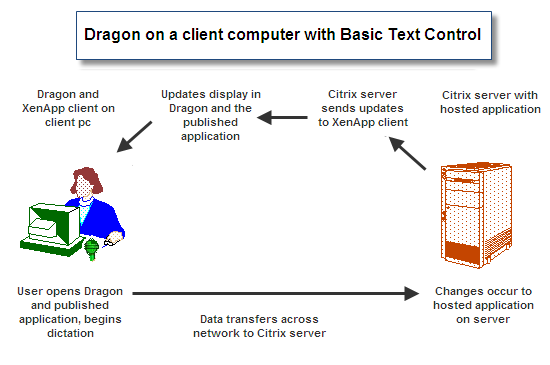
12 Dragon and Citrix products Administrator Guide Dragon on a client computer without vsync You can install Dragon on a client computer and have the client computer handle all processing activities. Deploying Dragon on a client computer supports Full text Control with applications that run on the Dragon client computer or, if vsync is enabled, with applications published from a Citrix XenApp server. Deploying Dragon on a client computer only supports Basic Text Control if used with an unsupported edit control or if used with applications published from a Citrix XenApp server and vsync is not enabled. Compatibility module support will not be available. There may also be unexpected results related to formatting of dictated text, such as improper capitalization, and overall accuracy when dictating directly into an EHR published through Citrix. This may require the Dragon user to use the Dictation Box to dictate and correct text when he or she works with an application published from Citrix. Only Basic Text Control is available if you do not enable the vsync feature in the Dragon client and if you do not install vsync on the Citrix XenApp server. Installing Dragon on a client computer does not use server resources, unlike other deployment solutions for Dragon. 6
13 Chapter 2: Using Dragon on a client computer without vsync Dragon features that this deployment solution supports Converting speech into text and sending the text to an application. Using custom voice commands to control an EHR Editing text using commands such as delete last word. Benefits of this deployment solution You can deploy Dragon at the user or department level without the assistance of a server administrator. Dragon uses the CPU and memory resources on client computers without using the CPU and memory resources of Citrix XenApp servers. Dictation does not increase the level of network traffic. Users do not need to stream high-resolution audio over the network. This reduces the amount of network resources that Dragon uses. Users can use Dragon to dictate directly into applications that are installed on the client computer. For example, productivity applications like those in the Microsoft Office suite. Drawbacks of this deployment solution Dragon users can only use Basic Text Control functionality with a Citrix published application. Dictation into free-text fields of an application may not work as expected. Using voice commands to edit text may not work as expected. Using voice commands to navigate through the screens and input fields of an application may not work as expected. Automatic capitalization and spelling of text may not work as expected. The ability of a user to control an EHR by saying the names of menus and buttons may not work as expected. Available workarounds You can use the following workarounds to mitigate some of the restrictions of this deployment solution. Dragon users can edit text manually using a keyboard and the computer mouse. This works best for short dictations that contain only a few words. Dragon users can use the Dictation Box for dictation and for editing text. Afterwards, the user can transfer the text from the Dictation Box into the EHR system. 7
14 Dragon and Citrix products Administrator Guide Install and deploy Dragon on a client computer without vsync You must perform the following tasks to install and enable Dragon on a client computer. 1. Perform one of the following tasks to make sure your computer meets the system requirements for Dragon: If you are installing the Dragon client for Dragon Medical 360 Network Edition, make sure the system requirements for the DM360 Network Edition Dragon client are met. See System requirements for the Dragon Medical client on page Perform one of the following tasks: To install the Dragon Medical Client on a client computer manually without using a push installation or the Nuance Management Console, see Install the Dragon client without using the Nuance Management Console on page 25 To install the Dragon Medical Client on a client computer from the Nuance Management Console, see Install Dragon Medical Client using the Nuance Management Console on page 27 To install the Dragon on a computer using a push installation, see Install Dragon using a push MSI installation on page 54 8
15 Chapter 2: Using Dragon on a client computer without vsync System requirements for the Dragon Medical client For information about support for Dragon and vsync with different Citrix components and different operating systems, see Support for Dragon and vsync with Citrix clients and server. Bluetooth (Optional): For Bluetooth wireless microphone support, visit CPU: 2.4 GHz Intel Dual Core or equivalent AMD processor. (IMPORTANT: SSE2 instruction set required) DVD-ROM: drive required for installation Free hard disk space: 5 GB Internet Browser: Microsoft Internet Explorer 8, 9, 10, and 11 (free download at Microphone: Nuance-approved microphone (included in purchase) For details on Bluetooth microphones, recorders, Tablet PCs, and other hardware, please go to support.nuance.com/compatibility/. Standard Headsets USB microphones PowerMic 2 non-scanner PowerMic 2 scanner Plantronics Calisto Bluetooth microphones Digital recorders Enhanced Bluetooth (Calisto II) microphones Special enrollment for array microphones an ios or Android device as a microphone using the Dragon Remote Microphone app Other Microphones listed in support.nuance.com/compatibility/ Operating system: Microsoft Windows bit and 64 bit Microsoft Windows 8 (including Professional and Enterprise), 32 bit and 64 bit Microsoft Windows 7, 32-bit and 64-bit Microsoft Windows Vista Service Pack 2, 32-bit and 64-bit Microsoft Windows XP Service Pack 3, 32-bit only* Microsoft Windows Server 2008, Service Pack 1, Service Pack 2, and R2, 32-bit and 64-bit Microsoft Windows Server 2008 R2 64 bit Service Pack 2 Microsoft Windows Server 2012 Microsoft Windows Server 2012 R2 9
16 Dragon and Citrix products Administrator Guide Processor Cache: 2 MB RAM: 2 GB RAM for Microsoft Windows XP * and Microsoft Windows Vista. 4 GB for Microsoft Windows 7, 32-bit and 64-bit, Microsoft Windows 8, 32-bit and 64- bit, Windows Server bit, Windows Server bit, and Windows Server bit R2. Sound Card: Creative Labs Sound Blaster 16 or equivalent sound card supporting 16-bit recording. Supported non-ehr Applications: DragonPad WordPad NotePad Microsoft Word 2007, 2010 (32 & 64 bit), 2013 (32 & 64 bit) Microsoft Outlook 2007, 2010, 2013 Microsoft Excel 2007, 2010, 2013 WordPerfect x5, x6 Apache OpenOffice Writer 3.4 Open Office Writer v3.1, 3.2 Internet Explorer 8, 9, 10 Rich Internet Application IE9 Mozilla Firefox 8+ Rich Internet Application Firefox 12+ Rich Internet Application Google Chrome 16+ Windows Live Mail v15 & v16 Mozilla Thunderbird x3 and up Lotus Notes 8.5 * The 2.x versions of DM360 Network Edition will be the last versions of the product to support Windows XP. DM360 Network Edition 2.1 continues to support Windows XP. 10
17 Chapter 2: Using Dragon on a client computer without vsync Install the Dragon client without using the Nuance Management Console When you install the Dragon Medical Client, you perform a 'typical' Dragon installation. You do not set administrative options, Auto-Formatting options, user options, acoustic optimizer options, or other options. This applies whether you install the Dragon Medical Client through the Nuance Management Console or outside of the console. As an administrator, you set those options through the Nuance Management Console, after you install the Dragon Medical Client. The DM360 Network Edition Dragon client installer automatically installs the vsync for EHRs feature if the Citrix client is installed on the computer. 1. Ensure your computer meets the system requirements for installing and running the Dragon Medical Client. For more information see System requirements for the Dragon Medical client on page Insert the Dragon Medical Client installation disc into the DVD drive of the computer. If the installation does not start, on the Dragon disc, double-click the setup.exe file. 3. Click Install. 4. If a window displays a message asking you to restart your system, restart your system and following the instructions. 11
18 Dragon and Citrix products Administrator Guide 5. On the Welcome screen, click Next. 6. On the License agreement screen, read the license agreement information. Select 'I accept the terms in the license agreement', click Next. 7. On the Customer Information screen, enter your name, the name of your organization, and the serial number that came with your copy of the Dragon Medical Client, Click Next. 8. On the Setup Type screen, select Typical/Complete. 9. Click Next. 10. On the Ready to Install the Program screen, click Install. The installation process begins to copy files to your computer, 11. When InstallShield displays "InstallShield Wizard Completed", click Finish. 12
19 Chapter 2: Using Dragon on a client computer without vsync Install Dragon Medical Client using the Nuance Management Console When you install the Dragon Medical Client, you perform a 'typical' Dragon installation. You do not set administrative options, Auto-Formatting options, user options, acoustic optimizer options, or other options. This applies whether you install the Dragon Medical Client through the Nuance Management Console or outside of the client. As an administrator, you set those options through the Nuance Management Console, after you install Dragon Medical Client. The DM360 Network Edition Dragon client installer automatically installs the vsync for EHRs feature if the Citrix client is installed on the computer. For more information see Install Dragon using a push MSI installation on page 54. Prerequisites 1. Be sure the computer you are installing the Dragon client on meets the system requirements for installing and running Dragon. See System requirements for the Dragon Medical client on page Log in to the computer as a Windows administrator. 3. On the workstation where you are installing Dragon, open Internet Explorer and enter the URL to access the Nuance Management Console. 4. Once the client GUI displays its login page, log in. Setting the location of the MSI installer 1. In the Nuance Management Console, click the Nuance icon. 2. Click Organization Overview. 3. In the Organizations area, click Details. 4. Click Products. 13
20 Dragon and Citrix products Administrator Guide 5. Expand the DM360 Network Edition section. 6. In the Downloads section, Download locally. 7. Set the Client installation URL to the location of the Dragon MSI installer, Dragon NaturallySpeaking 12.msi by default, on the NMS Server machine. Instead of using the default.msi file, you can create your own installer and place it on the NMS Server, then enter the correct path to it here. You need only set this path the first time you are downloading the installation through the Nuance Management Console. 8. Click the OK. 14
21 Chapter 2: Using Dragon on a client computer without vsync Downloading the MSI installer to the workstation 1. In the Nuance Management Console, click the Nuance icon. 2. Click Organization Overview. 3. In the Organizations area, click Details. 4. Click Products. 5. Expand the DM360 Network Edition section. 6. In the Deployed Version field, select the version of the Dragon client that your organization is using. The NMS downloads items that are specific to the version of the Dragon client that you specify in the Deployed Version field. 7. In the Downloads section, select Download locally. 8. Enter URLs into the URL fields for the Dragon client and for any manuals you'd like to install on the client machine. 15
22 Dragon and Citrix products Administrator Guide 9. Click on the magnifying glass in the Download to text box, browse to the path where you want the files downloaded, and click the Download button. The server immediately downloads the software to the workstation. 10. Click OK. 11. Proceed to the directory on the workstation where you downloaded the.msi installation file. 12. Double-click on the.msi file to launch the client installation. 13. If you are installing the default Dragon NaturallySpeaking 12.msi, follow steps 3 to 11 from Install the Dragon client without using the Nuance Management Console on page
23 Chapter 3: Using Dragon on a client computer with vsync Chapter 3: Using Dragon on a client computer with vsync This chapter discusses using Dragon on a client computer with vsync, including benefits, drawbacks, system requirements, and installation instructions. Dragon on a client computer with vsync 18 Install and deploy Dragon on a client computer with vsync 22 System requirements for the Dragon Medical client 23 Install the Dragon client without using the Nuance Management Console 25 Install Dragon Medical Client using the Nuance Management Console 27 Install Dragon using a push MSI installation 31 Create a custom MSI installation of Dragon 33 Create a custom MSI installation of Dragon 37 Install vsync on a Citrix XenApp server 41 Enable the vsync Full Text Control option 41 Viewing vsync log files for Dragon user activity with Citrix published applications 42 Receiving notifications of vsync timeouts 43 Restoring vsync support after updating a Citrix client 44 vsync Frequently Asked Questions 46 17
24 Dragon and Citrix products Administrator Guide Dragon on a client computer with vsync You can install the Dragon client for Dragon Medical 360 Network Edition on a client computer and install vsync on the Citrix XenApp server to let Dragon users use full Full Text Control functionality with applications published from a Citrix XenApp server. Full Text Control includes support for voice navigation and text selection. See the Dragon Help for more information about the features, options, commands, and controls that the Dragon Medical Client supports. After you set up this configuration, when a Dragon user logs into Dragon with a connection to the server, the user can use Full Text Control functionality with any published application that is on the server. Issues with Full Text Control may occur If you install Dragon and then upgrade the XenApp client If you install Dragon and then uninstall and reinstall the XenApp client If you install the XenApp client after installing Dragon If any of the above are true: In Dragon Medical client 2.1: you must run the Modify option from the Dragon installation disc to reinstall the vsync for EHRs feature and restore Full Text Control functionality. 18
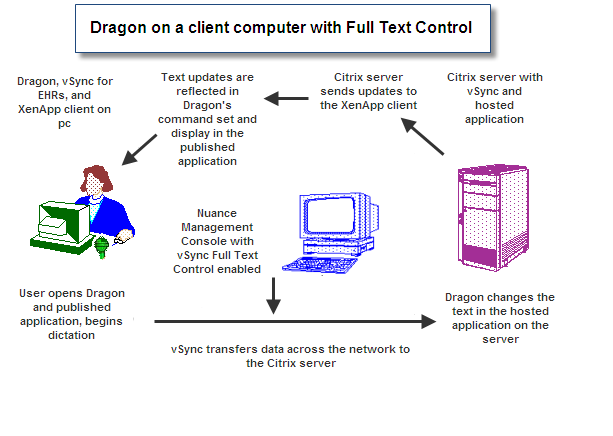
25 Chapter 3: Using Dragon on a client computer with vsync The vsync plug-in You must install vsync on each Citrix XenApp server where the published applications are located. The vsync plug-in communicates with Dragon Medical client 2.1 and allows a user to use Full Text Control functionality with a published application in Citrix. The vsync plug-in starts automatically when a user starts a Citrix session. The plug-in sends and receives important data from Dragon Medical client 2.1, including data about text that Dragon recognizes and text that the user changes manually. The vsync Full Text Control Support option For a Dragon user to have Full Text Control support with applications published from a Citrix XenApp server, the vsync Full Text Control Support option must be enabled. This option is turned off by default. An administrator enables this option through the Nuance Management Console. The vsync Full Text Control support option provides a channel that Dragon Medical client 2.1 and vsync use to send data to each other. For example, vsync uses the channel to tell Dragon Medical client 2.1 about events in the Citrix XenApp server window that corresponds to the generic window for a published application on a client computer. 19
26 Dragon and Citrix products Administrator Guide The vsync Full Text Control Support starts when a user starts a published application in Citrix. The vsync Full Text Control support starts communicating with vsync when the user logs into the Dragon Medical client 2.1, Dragon receives options data from the Nuance Management Console that indicates the vsync Full Text Control support option is enabled. Deploying Dragon on a client computer with vsync support You must perform the following tasks to deploy and enable vsync and the Dragon Medical client 2.1 on a client computer. A desktop administrator must install the Dragon Medical client 2.1 with the vsync for EHRs feature on a client computer. The installation process for Dragon Medical client 2.1 installs this feature by default as long as the XenApp plug-in is installed on the client computer. If you install Dragon before you install the XenApp plug-in, you need to perform one of the following actions: Run the patch installer See Restore vsync after updating a Citrix client on a workstation. From the Dragon installation DVD, run the Modify option to reinstall the vsync for EHRs feature on the Dragon client and restore Full Text Control functionality. A Citrix administrator must install minitracker for vsync support on the Citrix XenApp server where the published applications are located. A Nuance Management Console administrator must enable the vsync Full Text Control Support option in the Nuance Management Console to let users with an author account dictate into EHRs that run on Citrix. For more information, see Enable the vsync Full Text Control option on page 41 Benefits of this deployment solution Dragon users can use Full Text Control functionality, instead of just Basic Text Control functionality, with a published application. Small increases in the use of resources on the Citrix XenApp server compared to running Dragon on the Citrix XenApp server. Dragon users do not need to use the Dictation Box for dictation. This can reduce the amount of time it takes for the Dragon user to dictate and edit text. The learning curve for Dragon users is shorter as they do not need to learn special workarounds. Organizations may experience a reduction in technical support calls because Dragon Medical functions as expected. An increase in user satisfaction that can lead to an increase in the adoption rate of speech recognition. There is no need to transfer audio over the network. Extra network bandwidth is not required for audio. Investment in infrastructure is not required. vsync and one Citrix XenApp server can support many concurrent Dragon users. This reduces the need for extra hardware or extra Citrix licenses. You may not need to expand your current network of client computers and servers. 20
27 Chapter 3: Using Dragon on a client computer with vsync Drawbacks of this deployment solution vsync does not support published desktops. The solution uses more resources on the Citrix XenApp server compared to running Dragon on the client computer without using the vsync feature and the vsync plug-in. A Dragon user cannot say the names of menus and buttons to control the EHR. 21
28 Dragon and Citrix products Administrator Guide Install and deploy Dragon on a client computer with vsync You must perform the following tasks to install and enable Dragon on a client computer and enable vsync support. 1. Make sure the system requirements for Dragon Medical client 2.1 are met. See System requirements for the Dragon Medical client on page Install the Dragon Medical Client with the vsync for EHRs feature on a client computer. The DM360 Network Edition Dragon installation process installs the vsync feature by default as long as the XenApp plug-in is installed on the client computer. If you install Dragon before you install XenApp, you need to uninstall Dragon, restart the computer, and reinstall Dragon. Perform one of the following tasks: To install the Dragon Medical Client on a client computer manually without using a push installation or the Nuance Management Console, see Install the Dragon client without using the Nuance Management Console on page 25. To install the Dragon Medical Client on a client computer from the Nuance Management Console, see Install Dragon Medical Client using the Nuance Management Console on page 27. To install the Dragon Medical Client using a push installation, see Install Dragon using a push MSI installation on page Install minitracker for vsync support on the Citrix XenApp server. See Install vsync on a Citrix XenApp server on page Set up the vsync Full Text Control option. See Enable the vsync Full Text Control option on page Optional - Viewing vsync log files for Dragon user activity with Citrix published applications on page 42 22
29 Chapter 3: Using Dragon on a client computer with vsync System requirements for the Dragon Medical client For information about support for Dragon and vsync with different Citrix components and different operating systems, see Support for Dragon and vsync with Citrix clients and server. Bluetooth (Optional): For Bluetooth wireless microphone support, visit CPU: 2.4 GHz Intel Dual Core or equivalent AMD processor. (IMPORTANT: SSE2 instruction set required) DVD-ROM: drive required for installation Free hard disk space: 5 GB Internet Browser: Microsoft Internet Explorer 8, 9, 10, and 11 (free download at Microphone: Nuance-approved microphone (included in purchase) For details on Bluetooth microphones, recorders, Tablet PCs, and other hardware, please go to support.nuance.com/compatibility/. Standard Headsets USB microphones PowerMic 2 non-scanner PowerMic 2 scanner Plantronics Calisto Bluetooth microphones Digital recorders Enhanced Bluetooth (Calisto II) microphones Special enrollment for array microphones an ios or Android device as a microphone using the Dragon Remote Microphone app Other Microphones listed in support.nuance.com/compatibility/ Operating system: Microsoft Windows bit and 64 bit Microsoft Windows 8 (including Professional and Enterprise), 32 bit and 64 bit Microsoft Windows 7, 32-bit and 64-bit Microsoft Windows Vista Service Pack 2, 32-bit and 64-bit Microsoft Windows XP Service Pack 3, 32-bit only* Microsoft Windows Server 2008, Service Pack 1, Service Pack 2, and R2, 32-bit and 64-bit Microsoft Windows Server 2008 R2 64 bit Service Pack 2 Microsoft Windows Server 2012 Microsoft Windows Server 2012 R2 23
30 Dragon and Citrix products Administrator Guide Processor Cache: 2 MB RAM: 2 GB RAM for Microsoft Windows XP * and Microsoft Windows Vista. 4 GB for Microsoft Windows 7, 32-bit and 64-bit, Microsoft Windows 8, 32-bit and 64- bit, Windows Server bit, Windows Server bit, and Windows Server bit R2. Sound Card: Creative Labs Sound Blaster 16 or equivalent sound card supporting 16-bit recording. Supported non-ehr Applications: DragonPad WordPad NotePad Microsoft Word 2007, 2010 (32 & 64 bit), 2013 (32 & 64 bit) Microsoft Outlook 2007, 2010, 2013 Microsoft Excel 2007, 2010, 2013 WordPerfect x5, x6 Apache OpenOffice Writer 3.4 Open Office Writer v3.1, 3.2 Internet Explorer 8, 9, 10 Rich Internet Application IE9 Mozilla Firefox 8+ Rich Internet Application Firefox 12+ Rich Internet Application Google Chrome 16+ Windows Live Mail v15 & v16 Mozilla Thunderbird x3 and up Lotus Notes 8.5 * The 2.x versions of DM360 Network Edition will be the last versions of the product to support Windows XP. DM360 Network Edition 2.1 continues to support Windows XP. 24
31 Chapter 3: Using Dragon on a client computer with vsync Install the Dragon client without using the Nuance Management Console When you install the Dragon Medical Client, you perform a 'typical' Dragon installation. You do not set administrative options, Auto-Formatting options, user options, acoustic optimizer options, or other options. This applies whether you install the Dragon Medical Client through the Nuance Management Console or outside of the console. As an administrator, you set those options through the Nuance Management Console, after you install the Dragon Medical Client. The DM360 Network Edition Dragon client installer automatically installs the vsync for EHRs feature if the Citrix client is installed on the computer. 1. Ensure your computer meets the system requirements for installing and running the Dragon Medical Client. For more information see System requirements for the Dragon Medical client on page Insert the Dragon Medical Client installation disc into the DVD drive of the computer. If the installation does not start, on the Dragon disc, double-click the setup.exe file. 3. Click Install. 4. If a window displays a message asking you to restart your system, restart your system and following the instructions. 25
32 Dragon and Citrix products Administrator Guide 5. On the Welcome screen, click Next. 6. On the License agreement screen, read the license agreement information. Select 'I accept the terms in the license agreement', click Next. 7. On the Customer Information screen, enter your name, the name of your organization, and the serial number that came with your copy of the Dragon Medical Client, Click Next. 8. On the Setup Type screen, select Typical/Complete. 9. Click Next. 10. On the Ready to Install the Program screen, click Install. The installation process begins to copy files to your computer, 11. When InstallShield displays "InstallShield Wizard Completed", click Finish. 26
33 Chapter 3: Using Dragon on a client computer with vsync Install Dragon Medical Client using the Nuance Management Console When you install the Dragon Medical Client, you perform a 'typical' Dragon installation. You do not set administrative options, Auto-Formatting options, user options, acoustic optimizer options, or other options. This applies whether you install the Dragon Medical Client through the Nuance Management Console or outside of the client. As an administrator, you set those options through the Nuance Management Console, after you install Dragon Medical Client. The DM360 Network Edition Dragon client installer automatically installs the vsync for EHRs feature if the Citrix client is installed on the computer. For more information see Install Dragon using a push MSI installation on page 54. Prerequisites 1. Be sure the computer you are installing the Dragon client on meets the system requirements for installing and running Dragon. See System requirements for the Dragon Medical client on page Log in to the computer as a Windows administrator. 3. On the workstation where you are installing Dragon, open Internet Explorer and enter the URL to access the Nuance Management Console. 4. Once the client GUI displays its login page, log in. Setting the location of the MSI installer 1. In the Nuance Management Console, click the Nuance icon. 2. Click Organization Overview. 3. In the Organizations area, click Details. 4. Click Products. 27
34 Dragon and Citrix products Administrator Guide 5. Expand the DM360 Network Edition section. 6. In the Downloads section, Download locally. 7. Set the Client installation URL to the location of the Dragon MSI installer, Dragon NaturallySpeaking 12.msi by default, on the NMS Server machine. Instead of using the default.msi file, you can create your own installer and place it on the NMS Server, then enter the correct path to it here. You need only set this path the first time you are downloading the installation through the Nuance Management Console. 8. Click the OK. 28

35 Chapter 3: Using Dragon on a client computer with vsync Downloading the MSI installer to the workstation 1. In the Nuance Management Console, click the Nuance icon. 2. Click Organization Overview. 3. In the Organizations area, click Details. 4. Click Products. 5. Expand the DM360 Network Edition section. 6. In the Deployed Version field, select the version of the Dragon client that your organization is using. The NMS downloads items that are specific to the version of the Dragon client that you specify in the Deployed Version field. 7. In the Downloads section, select Download locally. 8. Enter URLs into the URL fields for the Dragon client and for any manuals you'd like to install on the client machine. 29

36 Dragon and Citrix products Administrator Guide 9. Click on the magnifying glass in the Download to text box, browse to the path where you want the files downloaded, and click the Download button. The server immediately downloads the software to the workstation. 10. Click OK. 11. Proceed to the directory on the workstation where you downloaded the.msi installation file. 12. Double-click on the.msi file to launch the client installation. 13. If you are installing the default Dragon NaturallySpeaking 12.msi, follow steps 3 to 11 from Install the Dragon client without using the Nuance Management Console on page
37 Chapter 3: Using Dragon on a client computer with vsync Install Dragon using a push MSI installation Dragon includes a Microsoft Windows Installer (MSI) file. You can use the MSI file to install Dragon from a server to client computers across a network. The Small Practice Edition of Dragon Medical does not support MSI installations. If you create an MSI installer for Dragon, make sure that the installer does not set any user or administrative options. Those options are set by an Nuance Management Console administrator or by a user after Dragon is installed on a client computer. The Dragon installation disc contains the Dragon.MSI file. The.MSI filename is specific to the edition or version of Dragon: Dragon product Dragon NaturallySpeaking or Dragon Medical Dragon SDK Client Edition Dragon SDK Server Edition MSI filename Dragon NaturallySpeaking 12.msi Dragon SDK Client Edition 12.msi Dragon SDK Server Edition 12.msi Pushing an MSI installation of Dragon to one or more computers on a network You can use a server application to push an MSI installation of Dragon to client computers without having to install Dragon separately on each computer. The server administrator creates an image of the Dragon installation program. The administrator then places the image on a server and configures the server to automatically push the application to client computers. There are several server applications that you can use to push a Dragon installation: Windows Server 2008 System Management Server (SMS) Active Directory Services Support for the Systems Management Server and Windows Server with Active Directory You can use the Systems Management Server (SMS) to push an MSI installation of Dragon across a network to multiple client computers at once. The Systems Management Server (SMS) provides a mechanism to push application installations from a server to client computers and systems. SMS supports using the Windows Installer (MSI) file to push a Dragon client installation to client computers that run a Windows operating system, including Windows Vista. For information about Windows Installer technology, you can download the article 'Scenarios and Procedures for Systems Management Server 2003: Planning and Deployment' available from 31
38 Dragon and Citrix products Administrator Guide Support for Windows Server 2008 with Active Directory Services You can use Windows Active Directory Services to push an MSI installation of Dragon across a network to multiple client computers at once. Active Directory Services is a feature of Windows Server The Group Policy component of Active Directory Services includes a Software Installation snap-in that lets an administrator create a network installation. Administrators can use this feature to install Dragon on client computers that run Windows XP*, and Windows Vista. Dragon supports the Active Directory Services Assign to Computers installation option. This option requires a computer reboot to complete a Dragon installation. You can delay the installation of Dragon on a client computer that runs Windows XP* or Vista by enabling logon optimization for group policy. You can view a log entry for this type of installation in the event log after the client computer reboots for the first time. The Dragon installation then installs Dragon and reboots the computer for a second time. The installation is a silent installation and does not display a user interface. To install Dragon from an MSI file: 1. Ensure your computer meets the system requirements for installing and running Dragon. For more information see System requirements for the Dragon Medical client on page To use the original product MSI file to install Dragon, obtain the MSI install file from the Dragon installation DVD. 3. To create a custom MSI installation of Dragon, see Create a custom MSI installation of Dragon on page Use a server application to push the MSI installation of Dragon to each client computer. * The 2.x versions of DM360 Network Edition will be the last versions of the product to support Windows XP. DM360 Network Edition 2.1 continues to support Windows XP. 32
39 Chapter 3: Using Dragon on a client computer with vsync Create a custom MSI installation of Dragon You can create a custom MSI installation file that you can use to install Dragon from a server to client computers on a network. To perform this task, you must download and install the Microsoft Custom Installation Wizard from Microsoft. You use the wizard to create a custom MSI file that sets various options when it installs Dragon. Obtaining and installing the Microsoft Custom Installation Wizard The Microsoft Custom Installation Wizard is part of the Microsoft Office Resource Kit Tools. To install the Custom Installation Wizard: 1. Download the Office Resource Kit Tools (OrkTools.exe) from: OrkTools.exe self-extracting executable (EXE) file installs the core Office XP Resource Kit tools on your computer through a single Setup program. 2. After downloading OrkTools.exe, to install the tools, double-click the executable. After you install the tools you use the Custom Installation Wizard to create your custom installation. See Modifying setup properties for custom installation on page 33 Modifying setup properties for custom installation The information that follows explains how to modify setup properties for a custom installation of Dragon. The following procedure demonstrates how to create an MSI file that installs one of the many MSI options you can set for Dragon, the SERIALNUMBER property. For more information on the options you can set through a custom MSI installation of Dragon see General options for an MSI installation of Dragon on page 62. Start the Microsoft Custom Installation Wizard 1. In Windows Explorer, navigate to and double-click CUSTWIZ.EXE. 2. Click Next. 3. On the Open the MSI File screen, select the.msi file you want to use to create a custom installation. For example, Dragon NaturallySpeaking 12.msi. Normally, the compiled.msi file is located on the Dragon installation disc. The files are named: -Dragon NaturallySpeaking or Dragon Medical: Dragon NaturallySpeaking12.msi 5. Click Next. 6. Click Yes when you see the following message: 7. On the Open the MST File screen, select Create a new MST file. 8. Click Next to continue. 33
40 Dragon and Citrix products Administrator Guide 9. On the Select the MST File to Save screen, select a file name and path for the MST file you are creating: 10. Click Next. 11. On the Specify Default Path and Organization screen, select the default path for the installation. The default installation directory for Dragon is C:\Program Files\Nuance\NaturallySpeaking Click Next. 13. On the Remove Previous Versions screen, make sure Default Setup behavior is selected. 14. Click Next. This page applies only to Microsoft Office and does not affect the Dragon installation. 15. To install all default components, on the Set Features Installation States screen, click Next. 16. Click Next on each of the next several pages of the wizard until you reach the Modify Setup Properties page. All the pages in between apply only to Microsoft Office or do not affect the Dragon installation: -Customize Default Application Settings page -Change Office User Settings page -Add/Remove Files page -Add/Remove Registry Entries page -Add, Modify, or Remove Shortcuts page -Identify Additional Servers page -Specify Office Security Settings page -Add Installations and Run Programs page 17. Use the Modify Setup Properties screen to add, modify, and set the MSI options of your custom installation of Dragon. 18. Click the Add button to display the Add/Modify Property Value dialog box and modify options for the MSI installation. For more information on the options you can set through a custom MSI installation of Dragon see General options for an MSI installation of Dragon on page 62 or Advanced options for an MSI installation of Dragon on page 63. In this example, we add and set the SERIALNUMBER option. 19. In the Add/Modify Property Value screen, enter the new property name SERIALNUMBER and a valid serial number, then click OK. 20. Note that the Modify Setup Properties screen re-displays with the updated information. 21. Continue adding or modifying other MSI options for the custom MSI installation of Dragon. Once you are done, click Next. 22. On the Save Changes page, click Finish. After you save changes, you can use the resulting.mst file to install Dragon through Group Policy in Active Directory Services. You are now ready to use the custom installer you created to install the product. 34
41 Chapter 3: Using Dragon on a client computer with vsync General options for an MSI installation of Dragon You can create a custom MSI install file for Dragon that sets the following basic MSI options. For other options you can set, see Advanced options for an MSI installation of Dragon on page 63. Options DEFAULTSINI="c:< path>\ nsdefaults.ini" SERIALNUMBER=abcdefgh-ijkl-mnop-qr PRODUCTUPDATEFLAG=0 (or 1 or 1) WEBREGISTRATION=1 (or 0) Description The default settings (nsdefaults.ini ) file that the installer uses to set the default behavior of Dragon for all users. In the nsdefaults.ini file, you must place the settings that you want to enable on client computers in a section name with a section name that is enclosed in brackets. For example, [Product Attributes] Version= Version= The serial number for the Dragon product. All Dragon installations require that you provide a serial (license) number for the product. The Dragon installation process checks for a serial number even if you run the process from a command line. Sets the Dragon installation process to check for product updates when the process completes. Set the option to 1 to have the installation process automatically check the web for product updates. Note: Automatic product updates are not supported for enterprise installations. Set the option to 0 to not check for product updates when the installation process completes. Set the option to -1 to turn the option off. The default value is 1. Sets the Dragon installation process to display the on-line product registration form after the installation completes. Set the option to 1 to display the product registration form. Make sure your installation displays the Installation Wizard. Use the /q switch instead of the /qn. Set the option to 0 to prevent the product registration form from displaying. 35
42 Dragon and Citrix products Administrator Guide Advanced options for an MSI installation of Dragon You can create a custom MSI install file for Dragon that sets the following advanced MSI options. For other options you can set, see General options for an MSI installation of Dragon on page 62. Options ADDLOCAL=Feature1,Feature2,... or ADD- LOCAL=ALL ADVERTISE=Feature1,Feature2,FEATURE3,.. REINSTALL=Feature1,Feature2,... (or ALL) REINSTALLMODE={type of reinstallation to perform} REMOVEOLDPROD=1 /x<product.msi ProductCode> Description Set the ADDLOCAL option to a comma delimited list of features to install locally. To install all features locally (including speech files), set the ADDLOCAL option to ALL. Set the ADVERTISE option to a comma delimited list of features to make available but not install locally. To install all features as advertised, set the ADVERTISE option to ALL. The ADVERTISE option overrides the ADDLOCAL option. The best method for installing a particular set of features is to set the ADDLOCAL option to ALL and then set the ADVERTISE option to the features you do not want to install locally. Set the REINSTALL option to a comma delimited list of features to reinstall. To reinstall all features, set the REINSTALL option to ALL. If you set the REINSTALL option, you should also set the REINSTALLMODE option to set the type of reinstall to perform. If you do not set the REINSTALLMODE option, the installation process only reinstalls a file if it is an earlier version of the file that is presently installed or if the file is not present on the system. By default, no registry entries are rewritten. Even if you set the REINSTALL option to ALL, the installation process only reinstalls features that are already installed. If you use the REINSTALL option for a product that is not yet to installed, product installation does not occur. For more information, see: Set the REINSTALLMODE option to a string that indicates the type of reinstall to perform. Options are caseinsensitive and order-independent. You should use this option when you use the REIN- STALL option. You can also use this option during and installation of Dragon, not just during a reinstallation of Dragon. Set the REMOVEOLDPROD option to remove an older version of Dragon before installing the newer version. You should on only use this option for major upgrades. Set the Dragon installation process to uninstall the current installed version of Dragon. You must perform this action during an upgrade. However, you should be familiar with the entire upgrade procedure before you use this option. 36
43 Chapter 3: Using Dragon on a client computer with vsync Create a custom MSI installation of Dragon You can create a custom MSI installation file that you can use to install Dragon from a server to client computers on a network. To perform this task, you must download and install the Microsoft Custom Installation Wizard from Microsoft. You use the wizard to create a custom MSI file that sets various options when it installs Dragon. Obtaining and installing the Microsoft Custom Installation Wizard The Microsoft Custom Installation Wizard is part of the Microsoft Office Resource Kit Tools. To install the Custom Installation Wizard: 1. Download the Office Resource Kit Tools (OrkTools.exe) from: OrkTools.exe self-extracting executable (EXE) file installs the core Office XP Resource Kit tools on your computer through a single Setup program. 2. After downloading OrkTools.exe, to install the tools, double-click the executable. After you install the tools you use the Custom Installation Wizard to create your custom installation. See Modifying setup properties for custom installation on page 37 Modifying setup properties for custom installation The information that follows explains how to modify setup properties for a custom installation of Dragon. The following procedure demonstrates how to create an MSI file that installs one of the many MSI options you can set for Dragon, the SERIALNUMBER property. For more information on the options you can set through a custom MSI installation of Dragon see General options for an MSI installation of Dragon on page 62. Start the Microsoft Custom Installation Wizard 1. In Windows Explorer, navigate to and double-click CUSTWIZ.EXE. 2. Click Next. 3. On the Open the MSI File screen, select the.msi file you want to use to create a custom installation. For example, Dragon NaturallySpeaking 12.msi. Normally, the compiled.msi file is located on the Dragon installation disc. The files are named: -Dragon NaturallySpeaking or Dragon Medical: Dragon NaturallySpeaking12.msi 5. Click Next. 6. Click Yes when you see the following message: 7. On the Open the MST File screen, select Create a new MST file. 8. Click Next to continue. 37
44 Dragon and Citrix products Administrator Guide 9. On the Select the MST File to Save screen, select a file name and path for the MST file you are creating: 10. Click Next. 11. On the Specify Default Path and Organization screen, select the default path for the installation. The default installation directory for Dragon is C:\Program Files\Nuance\NaturallySpeaking Click Next. 13. On the Remove Previous Versions screen, make sure Default Setup behavior is selected. 14. Click Next. This page applies only to Microsoft Office and does not affect the Dragon installation. 15. To install all default components, on the Set Features Installation States screen, click Next. 16. Click Next on each of the next several pages of the wizard until you reach the Modify Setup Properties page. All the pages in between apply only to Microsoft Office or do not affect the Dragon installation: -Customize Default Application Settings page -Change Office User Settings page -Add/Remove Files page -Add/Remove Registry Entries page -Add, Modify, or Remove Shortcuts page -Identify Additional Servers page -Specify Office Security Settings page -Add Installations and Run Programs page 17. Use the Modify Setup Properties screen to add, modify, and set the MSI options of your custom installation of Dragon. 18. Click the Add button to display the Add/Modify Property Value dialog box and modify options for the MSI installation. For more information on the options you can set through a custom MSI installation of Dragon see General options for an MSI installation of Dragon on page 62 or Advanced options for an MSI installation of Dragon on page 63. In this example, we add and set the SERIALNUMBER option. 19. In the Add/Modify Property Value screen, enter the new property name SERIALNUMBER and a valid serial number, then click OK. 20. Note that the Modify Setup Properties screen re-displays with the updated information. 21. Continue adding or modifying other MSI options for the custom MSI installation of Dragon. Once you are done, click Next. 22. On the Save Changes page, click Finish. After you save changes, you can use the resulting.mst file to install Dragon through Group Policy in Active Directory Services. You are now ready to use the custom installer you created to install the product. 38
45 Chapter 3: Using Dragon on a client computer with vsync General options for an MSI installation of Dragon You can create a custom MSI install file for Dragon that sets the following basic MSI options. For other options you can set, see Advanced options for an MSI installation of Dragon on page 63. Options DEFAULTSINI="c:< path>\ nsdefaults.ini" SERIALNUMBER=abcdefgh-ijkl-mnop-qr PRODUCTUPDATEFLAG=0 (or 1 or 1) WEBREGISTRATION=1 (or 0) Description The default settings (nsdefaults.ini ) file that the installer uses to set the default behavior of Dragon for all users. In the nsdefaults.ini file, you must place the settings that you want to enable on client computers in a section name with a section name that is enclosed in brackets. For example, [Product Attributes] Version= Version= The serial number for the Dragon product. All Dragon installations require that you provide a serial (license) number for the product. The Dragon installation process checks for a serial number even if you run the process from a command line. Sets the Dragon installation process to check for product updates when the process completes. Set the option to 1 to have the installation process automatically check the web for product updates. Note: Automatic product updates are not supported for enterprise installations. Set the option to 0 to not check for product updates when the installation process completes. Set the option to -1 to turn the option off. The default value is 1. Sets the Dragon installation process to display the on-line product registration form after the installation completes. Set the option to 1 to display the product registration form. Make sure your installation displays the Installation Wizard. Use the /q switch instead of the /qn. Set the option to 0 to prevent the product registration form from displaying. 39
46 Dragon and Citrix products Administrator Guide Advanced options for an MSI installation of Dragon You can create a custom MSI install file for Dragon that sets the following advanced MSI options. For other options you can set, see General options for an MSI installation of Dragon on page 62. Options ADDLOCAL=Feature1,Feature2,... or ADD- LOCAL=ALL ADVERTISE=Feature1,Feature2,FEATURE3,.. REINSTALL=Feature1,Feature2,... (or ALL) REINSTALLMODE={type of reinstallation to perform} REMOVEOLDPROD=1 /x<product.msi ProductCode> Description Set the ADDLOCAL option to a comma delimited list of features to install locally. To install all features locally (including speech files), set the ADDLOCAL option to ALL. Set the ADVERTISE option to a comma delimited list of features to make available but not install locally. To install all features as advertised, set the ADVERTISE option to ALL. The ADVERTISE option overrides the ADDLOCAL option. The best method for installing a particular set of features is to set the ADDLOCAL option to ALL and then set the ADVERTISE option to the features you do not want to install locally. Set the REINSTALL option to a comma delimited list of features to reinstall. To reinstall all features, set the REINSTALL option to ALL. If you set the REINSTALL option, you should also set the REINSTALLMODE option to set the type of reinstall to perform. If you do not set the REINSTALLMODE option, the installation process only reinstalls a file if it is an earlier version of the file that is presently installed or if the file is not present on the system. By default, no registry entries are rewritten. Even if you set the REINSTALL option to ALL, the installation process only reinstalls features that are already installed. If you use the REINSTALL option for a product that is not yet to installed, product installation does not occur. For more information, see: Set the REINSTALLMODE option to a string that indicates the type of reinstall to perform. Options are caseinsensitive and order-independent. You should use this option when you use the REIN- STALL option. You can also use this option during and installation of Dragon, not just during a reinstallation of Dragon. Set the REMOVEOLDPROD option to remove an older version of Dragon before installing the newer version. You should on only use this option for major upgrades. Set the Dragon installation process to uninstall the current installed version of Dragon. You must perform this action during an upgrade. However, you should be familiar with the entire upgrade procedure before you use this option. 40
47 Chapter 3: Using Dragon on a client computer with vsync Install vsync on a Citrix XenApp server The vsync plug-in communicates with the Dragon client. You install the Minitracker application on a Citrix XenApp server to allow Dragon users to use Full Text Control functionality with published applications that are on the server. 1. On the Citrix XenApp server that hosts the published applications, place the Dragon Medical Client disc in to the DVD drive. 2. On the disc, in the root directory of the DVD, find and double-click the minitracker.exe file. 3. On the Welcome screen, click Next. 4. On the Destination screen, to select a folder for the installation, click Change. Click Next to install in the folder. 5. On the Ready to Install Program screen, click Install to start the installation process. 6. When the installation process is complete, on the 'InstallShield Wizard Completed' screen, click Finish. Enable the vsync Full Text Control option To enable Dragon users in Dragon Medical 360 Network Edition with an author account to use Full Text Control functionality with a published application, an administrator must enable the vsync Full Text Control Support option using the following procedure: 1. Open the Nuance Management Console. 2. Search for and select a site. 3. In the Sites area, click Details. 4. Click the DM360 Network Edition tab. 5. Expand the Miscellaneous section. 6. Select vsync: Full Text Control. 7. Click the Save button. 41
48 Dragon and Citrix products Administrator Guide Viewing vsync log files for Dragon user activity with Citrix published applications After you install vsync on a Citrix XenApp server, you can set vsync to create log files that contain data about errors, warnings, or all activities for all vsync users on the server. Once you enable logging, vsync produces a minitracker.log file for every vsync session. By default, vsync logging is not enabled. vsync creates logs files in the following directory on a Citrix XenApp server: C:\Documents and Settings\<username>\Application Data\Nuance\NaturallySpeaking12 Important note about the size of vsync log files Only enable vsync logging if you need to provide log files to Nuance Technical Support for troubleshooting. Each log file uses up disk space on the Citrix XenApp server. If you enable vsync logging, vsync can create many, very large log files. The logs files can use up a lot of disk space on the Citrix XenApp server and increase memory usage on the server. Note: vsync log file settings are set when vsync starts. Follow these guidelines for vsync logging: Only enable vsync logging to track and troubleshoot specific issues Enable vsync logging during a time when network usage is at a minimum. When you no longer require the log files, quickly disable the logging feature. To enable vsync logging for all Dragon users that work with Citrix published applications In the Windows registry, perform one of the following actions. Action Disable vsync logging for all users Enable vsync logging of errors for all users Enable vsync logging of errors and warnings for all users Enable vsync logging of all data for all users Steps Set the HKLM\Software\Nuance\LogLevel (DWORD) key to 0. Set the HKLM\Software\Nuance\LogLevel (DWORD) key to 1. Set the HKLM\Software\Nuance\LogLevel (DWORD) key to 2. Set the HKLM\Software\Nuance\LogLevel (DWORD) key to 3. 42
49 Chapter 3: Using Dragon on a client computer with vsync Receiving notifications of vsync timeouts When vsync starts, it attempts to identify windows hosted on the Citrix XenApp server. vsync may timeout if it is unable to communicate with the Citrix XenApp server after a certain number of attempts. Dragon users are unable to use Full Text Control functionality with an application published from a Citrix XenApp server. NMS Administrators can now receive notification when a Dragon client cannot establish a vsync connection to a Citrix XenApp server. Administrators can use a vsync timeout notification tool, a stand-alone command line tool, to receive notifications when network issues cause vsync to timeout. The notifications contain information about the number of users in a site that experienced vsync timeouts and the names of those users. The vsync timeout notification tool searches the Dragon log in the Master Profile Directory for a special log statement that the Dragon client Citrix components generate when a certain number of attempts to communicate with the Citrix XenApp server time out. The tool generates notifications (as WMI events) about the network issues. Administrators can write an MOF script to detect the event and take some action when the event occurs, for example, send an or SMS, or write an event to the NT Event Log. The generated WMI notifications contain information about the number of users that experienced vsync timeouts and a list of the users that experienced vsync timeouts. Administrators can use the Windows Task Scheduler to configure the vsync timeout notification tool to run according to a schedule and to receive periodic notifications of vsync timeouts. Administrators should schedule the tool to run once a day. Distribution of the vsync timeout notification tool Dragon administrators can obtain the vsync timeout notification tool from Nuance through an ftp connection. Administrators receive a zip file that contains the vsync_notifier.exe, a readme.txt file, and a sample MOF script with the name vsync_event_consumer_example.mof. The Readme.txt file and the sample contain information about the event properties that an MOF script must use to detect and react to vsync timeouts. The Readme.txt file contains prerequisites and requirements for the vsync timeout notification tool. Readme.txt also contains instructions for installing, un-installing, and using the vsync timeout notification tool. 43
50 Dragon and Citrix products Administrator Guide Restoring vsync support after updating a Citrix client Dragon uses vsync support to provide Dragon users with Full Text Control when they work with applications published from a Citrix XenApp server. An administrator updates or reinstalls one or more Citrix clients on a workstation with Dragon. Updating or reinstalling a Citrix client deletes the Dragon vsync components; disabling vsync support. The vsync Restoration Patch provides a quick and simple way to reinstall vsync support after updating or re-installing a Citrix client. After updating or reinstalling a Citrix client on a workstation, run the patch on the workstation or push the patch install to the workstation. In Dragon Medical 360 Network Edition, only use the vsync Restoration Patch to repair damaged vsync client components or to install the vsync client components for the first time. To upgrade vsync client components, use the patch installer. Do not use the vsync Restoration Patch to upgrade these components. Note: You must upgrade vsync on your Citrix XenApp servers before you upgrade vsync on Dragon client computers. The patch can be run on a 32-bit or 64-bit workstation where all, some, or none of the vsync components are installed. The patch installer can also be run in 'silent' mode. When you run the patch installer, it successfully patches and re-registers the relevant dll and component files. The installer also displays messages about installation success or errors. You can run or push the vsync Restoration Patch using any version of the DM360 Network Edition Dragon client Service Pack 1 (Build ) or higher. If you do not have Service Pack 1, you must install it before you can install the patch. Pre-requisites for installing the DM360 Network Edition vsync Restoration Patch Ensure the following items are met before you run the patch. Otherwise, the patch installation will fail and log error messages to the DgnSetup log file. The Dragon client must be installed on the workstation Dragon must not be running on the workstation A Citrix client must be installed on the workstation Citrix process (wfica32.exe, wfcrun32.exe, Receiver.exe, SelfServicePlugin.exe, concentr.exe) must not be running on the workstation You can install the patch even if the vsync components in the patch are the same version as the vsync components currently installed on the workstation. 44
51 Chapter 3: Using Dragon on a client computer with vsync Steps for installing the DM360 Network Edition vsync Restoration Patch on a workstation Perform the following steps after updating or reinstalling a Citrix client on a workstation. 1. Ensure all the installation pre-requisites are met. See Pre-requisites for installing the vsync Restoration Patch for details. 2. On the DVD, in the VsyncRestorationPatch folder, find and run the vsyncrestorer.exe file on the Dragon client workstation. Alternately, you can push the patch install to the workstation. vsync Restoration Patch Logging When you run the vsync Restoration Patch, it logs success and error messages to the DgnSetup log. It also logs the version numbers of the currently installed Citrix support components and the components in the patch. 45
52 Dragon and Citrix products Administrator Guide vsync Frequently Asked Questions Question Answer In a Citrix session with an application published from a Citrix server, does vsync open a virtual channel on the application connection (Citrix Session) or does vsync open its own session? What citrix protocol does the vsync traffic use? Does it use the Audio protocol of citrix? vsync opens a new virtual channel on the application connection (Citrix Session). The low level protocol is transparent. All recognition data and audio data is processed on the local machine and is not transmitted to or from the local machine. When using Dragon on a local machine to dictate A wired connection is recommended. This is about into an electronic health record (EHR) system over a managing a real-time process (recognition and coor- with an application) between two com- Citrix connection, do you recommend a wired or wire-dinatioless connection? puters across a network. Does working in offline mode improve recognition? A Wireless connection will work but could produce latency issues and even dropped signals. A wired connection is more reliable. Offline mode does not impact recognition. Offline mode impacts synchronization between the local user profile and the master profile on the server. How many occurrences of the following message in a Dragon.log file (per user session, per day) indicates a problem with vsync?. "CtxWinMgr: GetServerWindowInfo - Window info request failed (result, elapsed time, timeout) = (258, 2000, 2000)" All recognition occurs on the local machine that runs the Citrix client. This is no quick answer to this question because the answer also depends on: - what else is logged in the Dragon and minidragon log files. - the network specification and configuration - the hardware and software of the server - how many people are using or accessing the server resources consumed by the application that is being queried - other factors As a VERY GENERAL rule of thumb, all timeout entries in a Dragon log should not exceed 1 to 2 percent of all dictations. 46
53 Chapter 4: Using Dragon on a Citrix XenApp server without vsync Chapter 4: Using Dragon on a Citrix XenApp server without vsync This chapter discusses using Dragon on a Citrix XenApp server without vsync, including benefits, drawbacks, system requirements, and installation instructions. Dragon on a Citrix XenApp server without vsync 48 Install and deploy Dragon on a Citrix XenApp server without vsync support 51 System requirements for Dragon on a Citrix XenApp server 52 Install Dragon using a push MSI installation 54 Create a custom MSI installation of Dragon 56 Create a custom MSI installation of Dragon 60 Publish Dragon from Citrix 64 Allow users to use Dragon on a Citrix XenApp server 66 Install the Dragon client update for Citrix 68 Managing Dragon client update for Citrix logging 68 Using Dragon on a Citrix XenApp server with a published application 69 Citrix User Profile Manager 71 47
54 Dragon and Citrix products Administrator Guide Dragon on a Citrix XenApp server without vsync You can install Dragon on a Citrix XenApp server computer and have Dragon rely on the Citrix XenApp server for all processing activities. Deploying Dragon on a Citrix XenApp server provides Dragon users with Full Text Control support in their EHR system when the EHR is deployed on a Citrix XenApp server, so they do not have to use the Dictation Box. Dragon users on the client computer can use all the capabilities of the PowerMic II microphone, including all of the device's standard and programmable button functions and its bar code scanner. However, they cannot use the PowerMic I microphone. If Dragon and the EHR are hosted on the same XenApp server: You can publish each application or the desktop and get full text control to dictate into the EHR. If Dragon is hosted on a different XenApp server than the EHR: You must publish the desktop where Dragon is hosted from. You must install minitracker on the XenApp server that hosts the EHR. You must launch the EHR published application from the published desktop where Dragon is hosted from. This configuration uses more memory and CPU resources on the server than other Dragon/Citrix configurations. 48

55 Chapter 4: Using Dragon on a Citrix XenApp server without vsync Using the Citrix Load balancing server feature with Dragon If you use the Citrix Load balancing server feature, make sure that you run Dragon and a published application from the same server. Attempting to use the Load balancing server feature to run Dragon from a server that is different from the server that hosts a published application may cause Dragon to not work as expected with the published application. Check the configuration of the Load Manager or disable automatic load balancing in a multi-server farm. Using Citrix Application Isolation Environments with Dragon If you use the Citrix Application Isolation Environments server feature, make sure to launch Dragon and a published application from the same application isolation environment. Dragon may not communicate correctly with the published application if they are launched from separate environments. Using Dragon on a Citrix XenApp server - Overview The following is an outline of how a user can use Dragon once the steps for deploying Dragon on a Citrix XenApp server are completed. Note: 49
56 Dragon and Citrix products Administrator Guide To allow users to use Dragon with published applications, you must install Dragon on the same server cluster as the published applications. You must also install vddnspatch.exe on the Dragon client computer. See Install the Dragon NaturallySpeaking 12 client update for Citrix for details. Set up a microphone (or other dictation source) on a client computer that is running the Citrix Receiver and on which the Dragon NaturallySpeaking 12 client update for Citrix is installed. On the client computer, launch Dragon and the published application you want to dictate into. Use the microphone (or other dictation source) to dictate into the published application. The audio from the microphone travels across the network to Dragon running on the Citrix XenApp server. The published application on the Citrix XenApp server receives dictation text, corrections, and other changes from Dragon running on the Citrix XenApp server. The changes from Dragon and the published application on the Citrix XenApp server synchronize with what the Dragon user sees on the client computer. Benefits of this deployment solution Dragon users can dictate from client computers that do not have Dragon installed. Dragon users make use of the same Dragon functionality that is available when both Dragon and an EHR system run on the same client computer. This can reduce the need for special end-user training. Administrators can use the Citrix management console to control which Dragon users have access to the Dragon client. The amount of time and effort required to install Dragon on each client computer can be greatly reduced or even eliminated Administrator only need to install a.dll file, the Dragon NaturallySpeaking 12 client update for Citrix, onto each client computer. Drawbacks of this deployment solution Increased CPU usage and processing requirements on the Citrix XenApp server The client computer must transfer high-resolution audio data to the Citrix server. Each Dragon user requires 1.3 Mbps of network bandwidth whenever the microphone is turned on. Users may not be able to use Dragon from a remote workstation that has a slow internet connection, or on a network with many Dragon users performing dictation simultaneously. Users cannot use Dragon to dictate directly into applications that run on a client computer. As a workaround, users can use the Dictation Box to perform dictation. Afterwards, users can copy and paste the dictation text into the application that is running on the client computer. * The 2.x versions of DM360 Network Edition will be the last versions of the product to support Windows XP. DM360 Network Edition 2.1 continues to support Windows XP. 50
57 Chapter 4: Using Dragon on a Citrix XenApp server without vsync Install and deploy Dragon on a Citrix XenApp server without vsync support You must perform the following tasks to install and enable Dragon on a Citrix XenApp server. You must not install Dragon and the vsync plug-in on the same server. However, you can install Dragon and the vsync plug-in on different servers in the same server farm. 1. Make sure your system meets the system requirements for Dragon. 2. Perform the following tasks: To install Dragon on a Citrix XenApp server using a push installation, see Install Dragon using a push MSI installation on page Make sure the Citrix XenApp client is installed on each client computer. 4. Publish Dragon from Citrix. See Publish Dragon from Citrix on page Install the Dragon NaturallySpeaking 12 client update for Citrix on each client computer. See Install the Dragon client update for Citrix on page Enable sound quality on the client computer. 7. Create policies to allow users to use Dragon on the Citrix XenApp server. See Allow users to use Dragon on a Citrix XenApp server on page 66. Configuring this Dragon solution See Using Dragon on a Citrix XenApp server with a published application on page 69 See Managing Dragon client update for Citrix logging on page 68 51
58 Dragon and Citrix products Administrator Guide System requirements for Dragon on a Citrix XenApp server The following is for Dragon Medical 360 Network Edition 2.1 running as a published application on XenApp 5 or XenDesktop 6.5 and does not include any memory or core requirements for operating systems or other applications, such as the target application a user dictates into. Server: Citrix XenApp Server 5 on Windows Server 2008, 32-or 64-bit Citrix XenApp Server 6 or 6.5 on Windows Server 2008 R2, 64-bit. To run Dragon on Windows Server 2008 R2, it is mandatory that you install Microsoft Hotfix: See solution on isupport for details. 1 vcpu per Active Microphone Note: To run Dragon on Windows Server 2008 R2, it is mandatory that you install Microsoft Hotfix: Alternately, you can apply all fixes that relate to Terminal Services in : support.microsoft.com/kb/ See solution on isupport for details. Client machine: Citrix XenApp Plug-in 11.x, 12.x Citrix Receiver 3.x Citrix Receiver 4.0, and 4.1 CPU: A single physical core is required for each active speaker. Hyper-threading does not count as a physical core. Any system in sleep mode counts as an active speaker. If the Dragon microphone icon indicates either sleep mode or on mode, the speaker is active and consuming CPU resources Citrix recommends a minimum bandwidth of 1.1 Megabits for each active microphone Network latency from end point to the server running Dragon should be less than 50 ms State of Dragon microphone Audio being recorded Off No No Dragon is using CPU to process audio On Yes Yes Sleeping Yes Yes 52
59 Chapter 4: Using Dragon on a Citrix XenApp server without vsync RAM: 1.1 GB RAM for every Dragon Session running on the Citrix Xenapp server Acoustic models: Use BestMatch IV acoustic models instead of BestMatch V acoustic models Other: Dragon s local per-windows-user files *must not* be redirected to a network share. These files by default are located in %appdata%\roaming\nuance for each Windows user. A single physical core is required for each active speaker. Hyper-threading does not count as a physical core. Any system in sleep mode counts as an active speaker. 53
60 Dragon and Citrix products Administrator Guide Install Dragon using a push MSI installation Dragon includes a Microsoft Windows Installer (MSI) file. You can use the MSI file to install Dragon from a server to client computers across a network. The Small Practice Edition of Dragon Medical does not support MSI installations. If you create an MSI installer for Dragon, make sure that the installer does not set any user or administrative options. Those options are set by an Nuance Management Console administrator or by a user after Dragon is installed on a client computer. The Dragon installation disc contains the Dragon.MSI file. The.MSI filename is specific to the edition or version of Dragon: Dragon product Dragon NaturallySpeaking or Dragon Medical Dragon SDK Client Edition Dragon SDK Server Edition MSI filename Dragon NaturallySpeaking 12.msi Dragon SDK Client Edition 12.msi Dragon SDK Server Edition 12.msi Pushing an MSI installation of Dragon to one or more computers on a network You can use a server application to push an MSI installation of Dragon to client computers without having to install Dragon separately on each computer. The server administrator creates an image of the Dragon installation program. The administrator then places the image on a server and configures the server to automatically push the application to client computers. There are several server applications that you can use to push a Dragon installation: Windows Server 2008 System Management Server (SMS) Active Directory Services Support for the Systems Management Server and Windows Server with Active Directory You can use the Systems Management Server (SMS) to push an MSI installation of Dragon across a network to multiple client computers at once. The Systems Management Server (SMS) provides a mechanism to push application installations from a server to client computers and systems. SMS supports using the Windows Installer (MSI) file to push a Dragon client installation to client computers that run a Windows operating system, including Windows Vista. For information about Windows Installer technology, you can download the article 'Scenarios and Procedures for Systems Management Server 2003: Planning and Deployment' available from 54
61 Chapter 4: Using Dragon on a Citrix XenApp server without vsync Support for Windows Server 2008 with Active Directory Services You can use Windows Active Directory Services to push an MSI installation of Dragon across a network to multiple client computers at once. Active Directory Services is a feature of Windows Server The Group Policy component of Active Directory Services includes a Software Installation snap-in that lets an administrator create a network installation. Administrators can use this feature to install Dragon on client computers that run Windows XP*, and Windows Vista. Dragon supports the Active Directory Services Assign to Computers installation option. This option requires a computer reboot to complete a Dragon installation. You can delay the installation of Dragon on a client computer that runs Windows XP* or Vista by enabling logon optimization for group policy. You can view a log entry for this type of installation in the event log after the client computer reboots for the first time. The Dragon installation then installs Dragon and reboots the computer for a second time. The installation is a silent installation and does not display a user interface. To install Dragon from an MSI file: 1. Ensure your computer meets the system requirements for installing and running Dragon. For more information see System requirements for the Dragon Medical client on page To use the original product MSI file to install Dragon, obtain the MSI install file from the Dragon installation DVD. 3. To create a custom MSI installation of Dragon, see Create a custom MSI installation of Dragon on page Use a server application to push the MSI installation of Dragon to each client computer. * The 2.x versions of DM360 Network Edition will be the last versions of the product to support Windows XP. DM360 Network Edition 2.1 continues to support Windows XP. 55
62 Dragon and Citrix products Administrator Guide Create a custom MSI installation of Dragon You can create a custom MSI installation file that you can use to install Dragon from a server to client computers on a network. To perform this task, you must download and install the Microsoft Custom Installation Wizard from Microsoft. You use the wizard to create a custom MSI file that sets various options when it installs Dragon. Obtaining and installing the Microsoft Custom Installation Wizard The Microsoft Custom Installation Wizard is part of the Microsoft Office Resource Kit Tools. To install the Custom Installation Wizard: 1. Download the Office Resource Kit Tools (OrkTools.exe) from: OrkTools.exe self-extracting executable (EXE) file installs the core Office XP Resource Kit tools on your computer through a single Setup program. 2. After downloading OrkTools.exe, to install the tools, double-click the executable. After you install the tools you use the Custom Installation Wizard to create your custom installation. See Modifying setup properties for custom installation on page 56 Modifying setup properties for custom installation The information that follows explains how to modify setup properties for a custom installation of Dragon. The following procedure demonstrates how to create an MSI file that installs one of the many MSI options you can set for Dragon, the SERIALNUMBER property. For more information on the options you can set through a custom MSI installation of Dragon see General options for an MSI installation of Dragon on page 62. Start the Microsoft Custom Installation Wizard 1. In Windows Explorer, navigate to and double-click CUSTWIZ.EXE. 2. Click Next. 3. On the Open the MSI File screen, select the.msi file you want to use to create a custom installation. For example, Dragon NaturallySpeaking 12.msi. Normally, the compiled.msi file is located on the Dragon installation disc. The files are named: -Dragon NaturallySpeaking or Dragon Medical: Dragon NaturallySpeaking12.msi 5. Click Next. 6. Click Yes when you see the following message: 7. On the Open the MST File screen, select Create a new MST file. 8. Click Next to continue. 56
63 Chapter 4: Using Dragon on a Citrix XenApp server without vsync 9. On the Select the MST File to Save screen, select a file name and path for the MST file you are creating: 10. Click Next. 11. On the Specify Default Path and Organization screen, select the default path for the installation. The default installation directory for Dragon is C:\Program Files\Nuance\NaturallySpeaking Click Next. 13. On the Remove Previous Versions screen, make sure Default Setup behavior is selected. 14. Click Next. This page applies only to Microsoft Office and does not affect the Dragon installation. 15. To install all default components, on the Set Features Installation States screen, click Next. 16. Click Next on each of the next several pages of the wizard until you reach the Modify Setup Properties page. All the pages in between apply only to Microsoft Office or do not affect the Dragon installation: -Customize Default Application Settings page -Change Office User Settings page -Add/Remove Files page -Add/Remove Registry Entries page -Add, Modify, or Remove Shortcuts page -Identify Additional Servers page -Specify Office Security Settings page -Add Installations and Run Programs page 17. Use the Modify Setup Properties screen to add, modify, and set the MSI options of your custom installation of Dragon. 18. Click the Add button to display the Add/Modify Property Value dialog box and modify options for the MSI installation. For more information on the options you can set through a custom MSI installation of Dragon see General options for an MSI installation of Dragon on page 62 or Advanced options for an MSI installation of Dragon on page 63. In this example, we add and set the SERIALNUMBER option. 19. In the Add/Modify Property Value screen, enter the new property name SERIALNUMBER and a valid serial number, then click OK. 20. Note that the Modify Setup Properties screen re-displays with the updated information. 21. Continue adding or modifying other MSI options for the custom MSI installation of Dragon. Once you are done, click Next. 22. On the Save Changes page, click Finish. After you save changes, you can use the resulting.mst file to install Dragon through Group Policy in Active Directory Services. You are now ready to use the custom installer you created to install the product. 57
64 Dragon and Citrix products Administrator Guide General options for an MSI installation of Dragon You can create a custom MSI install file for Dragon that sets the following basic MSI options. For other options you can set, see Advanced options for an MSI installation of Dragon on page 63. Options DEFAULTSINI="c:< path>\ nsdefaults.ini" SERIALNUMBER=abcdefgh-ijkl-mnop-qr PRODUCTUPDATEFLAG=0 (or 1 or 1) WEBREGISTRATION=1 (or 0) Description The default settings (nsdefaults.ini ) file that the installer uses to set the default behavior of Dragon for all users. In the nsdefaults.ini file, you must place the settings that you want to enable on client computers in a section name with a section name that is enclosed in brackets. For example, [Product Attributes] Version= Version= The serial number for the Dragon product. All Dragon installations require that you provide a serial (license) number for the product. The Dragon installation process checks for a serial number even if you run the process from a command line. Sets the Dragon installation process to check for product updates when the process completes. Set the option to 1 to have the installation process automatically check the web for product updates. Note: Automatic product updates are not supported for enterprise installations. Set the option to 0 to not check for product updates when the installation process completes. Set the option to -1 to turn the option off. The default value is 1. Sets the Dragon installation process to display the on-line product registration form after the installation completes. Set the option to 1 to display the product registration form. Make sure your installation displays the Installation Wizard. Use the /q switch instead of the /qn. Set the option to 0 to prevent the product registration form from displaying. 58
65 Chapter 4: Using Dragon on a Citrix XenApp server without vsync Advanced options for an MSI installation of Dragon You can create a custom MSI install file for Dragon that sets the following advanced MSI options. For other options you can set, see General options for an MSI installation of Dragon on page 62. Options ADDLOCAL=Feature1,Feature2,... or ADD- LOCAL=ALL ADVERTISE=Feature1,Feature2,FEATURE3,.. REINSTALL=Feature1,Feature2,... (or ALL) REINSTALLMODE={type of reinstallation to perform} REMOVEOLDPROD=1 /x<product.msi ProductCode> Description Set the ADDLOCAL option to a comma delimited list of features to install locally. To install all features locally (including speech files), set the ADDLOCAL option to ALL. Set the ADVERTISE option to a comma delimited list of features to make available but not install locally. To install all features as advertised, set the ADVERTISE option to ALL. The ADVERTISE option overrides the ADDLOCAL option. The best method for installing a particular set of features is to set the ADDLOCAL option to ALL and then set the ADVERTISE option to the features you do not want to install locally. Set the REINSTALL option to a comma delimited list of features to reinstall. To reinstall all features, set the REINSTALL option to ALL. If you set the REINSTALL option, you should also set the REINSTALLMODE option to set the type of reinstall to perform. If you do not set the REINSTALLMODE option, the installation process only reinstalls a file if it is an earlier version of the file that is presently installed or if the file is not present on the system. By default, no registry entries are rewritten. Even if you set the REINSTALL option to ALL, the installation process only reinstalls features that are already installed. If you use the REINSTALL option for a product that is not yet to installed, product installation does not occur. For more information, see: Set the REINSTALLMODE option to a string that indicates the type of reinstall to perform. Options are caseinsensitive and order-independent. You should use this option when you use the REIN- STALL option. You can also use this option during and installation of Dragon, not just during a reinstallation of Dragon. Set the REMOVEOLDPROD option to remove an older version of Dragon before installing the newer version. You should on only use this option for major upgrades. Set the Dragon installation process to uninstall the current installed version of Dragon. You must perform this action during an upgrade. However, you should be familiar with the entire upgrade procedure before you use this option. 59
66 Dragon and Citrix products Administrator Guide Create a custom MSI installation of Dragon You can create a custom MSI installation file that you can use to install Dragon from a server to client computers on a network. To perform this task, you must download and install the Microsoft Custom Installation Wizard from Microsoft. You use the wizard to create a custom MSI file that sets various options when it installs Dragon. Obtaining and installing the Microsoft Custom Installation Wizard The Microsoft Custom Installation Wizard is part of the Microsoft Office Resource Kit Tools. To install the Custom Installation Wizard: 1. Download the Office Resource Kit Tools (OrkTools.exe) from: OrkTools.exe self-extracting executable (EXE) file installs the core Office XP Resource Kit tools on your computer through a single Setup program. 2. After downloading OrkTools.exe, to install the tools, double-click the executable. After you install the tools you use the Custom Installation Wizard to create your custom installation. See Modifying setup properties for custom installation on page 60 Modifying setup properties for custom installation The information that follows explains how to modify setup properties for a custom installation of Dragon. The following procedure demonstrates how to create an MSI file that installs one of the many MSI options you can set for Dragon, the SERIALNUMBER property. For more information on the options you can set through a custom MSI installation of Dragon see General options for an MSI installation of Dragon on page 62. Start the Microsoft Custom Installation Wizard 1. In Windows Explorer, navigate to and double-click CUSTWIZ.EXE. 2. Click Next. 3. On the Open the MSI File screen, select the.msi file you want to use to create a custom installation. For example, Dragon NaturallySpeaking 12.msi. Normally, the compiled.msi file is located on the Dragon installation disc. The files are named: -Dragon NaturallySpeaking or Dragon Medical: Dragon NaturallySpeaking12.msi 5. Click Next. 6. Click Yes when you see the following message: 7. On the Open the MST File screen, select Create a new MST file. 8. Click Next to continue. 60
67 Chapter 4: Using Dragon on a Citrix XenApp server without vsync 9. On the Select the MST File to Save screen, select a file name and path for the MST file you are creating: 10. Click Next. 11. On the Specify Default Path and Organization screen, select the default path for the installation. The default installation directory for Dragon is C:\Program Files\Nuance\NaturallySpeaking Click Next. 13. On the Remove Previous Versions screen, make sure Default Setup behavior is selected. 14. Click Next. This page applies only to Microsoft Office and does not affect the Dragon installation. 15. To install all default components, on the Set Features Installation States screen, click Next. 16. Click Next on each of the next several pages of the wizard until you reach the Modify Setup Properties page. All the pages in between apply only to Microsoft Office or do not affect the Dragon installation: -Customize Default Application Settings page -Change Office User Settings page -Add/Remove Files page -Add/Remove Registry Entries page -Add, Modify, or Remove Shortcuts page -Identify Additional Servers page -Specify Office Security Settings page -Add Installations and Run Programs page 17. Use the Modify Setup Properties screen to add, modify, and set the MSI options of your custom installation of Dragon. 18. Click the Add button to display the Add/Modify Property Value dialog box and modify options for the MSI installation. For more information on the options you can set through a custom MSI installation of Dragon see General options for an MSI installation of Dragon on page 62 or Advanced options for an MSI installation of Dragon on page 63. In this example, we add and set the SERIALNUMBER option. 19. In the Add/Modify Property Value screen, enter the new property name SERIALNUMBER and a valid serial number, then click OK. 20. Note that the Modify Setup Properties screen re-displays with the updated information. 21. Continue adding or modifying other MSI options for the custom MSI installation of Dragon. Once you are done, click Next. 22. On the Save Changes page, click Finish. After you save changes, you can use the resulting.mst file to install Dragon through Group Policy in Active Directory Services. You are now ready to use the custom installer you created to install the product. 61
68 Dragon and Citrix products Administrator Guide General options for an MSI installation of Dragon You can create a custom MSI install file for Dragon that sets the following basic MSI options. For other options you can set, see Advanced options for an MSI installation of Dragon on page 63. Options DEFAULTSINI="c:< path>\ nsdefaults.ini" SERIALNUMBER=abcdefgh-ijkl-mnop-qr PRODUCTUPDATEFLAG=0 (or 1 or 1) WEBREGISTRATION=1 (or 0) Description The default settings (nsdefaults.ini ) file that the installer uses to set the default behavior of Dragon for all users. In the nsdefaults.ini file, you must place the settings that you want to enable on client computers in a section name with a section name that is enclosed in brackets. For example, [Product Attributes] Version= Version= The serial number for the Dragon product. All Dragon installations require that you provide a serial (license) number for the product. The Dragon installation process checks for a serial number even if you run the process from a command line. Sets the Dragon installation process to check for product updates when the process completes. Set the option to 1 to have the installation process automatically check the web for product updates. Note: Automatic product updates are not supported for enterprise installations. Set the option to 0 to not check for product updates when the installation process completes. Set the option to -1 to turn the option off. The default value is 1. Sets the Dragon installation process to display the on-line product registration form after the installation completes. Set the option to 1 to display the product registration form. Make sure your installation displays the Installation Wizard. Use the /q switch instead of the /qn. Set the option to 0 to prevent the product registration form from displaying. 62
69 Chapter 4: Using Dragon on a Citrix XenApp server without vsync Advanced options for an MSI installation of Dragon You can create a custom MSI install file for Dragon that sets the following advanced MSI options. For other options you can set, see General options for an MSI installation of Dragon on page 62. Options ADDLOCAL=Feature1,Feature2,... or ADD- LOCAL=ALL ADVERTISE=Feature1,Feature2,FEATURE3,.. REINSTALL=Feature1,Feature2,... (or ALL) REINSTALLMODE={type of reinstallation to perform} REMOVEOLDPROD=1 /x<product.msi ProductCode> Description Set the ADDLOCAL option to a comma delimited list of features to install locally. To install all features locally (including speech files), set the ADDLOCAL option to ALL. Set the ADVERTISE option to a comma delimited list of features to make available but not install locally. To install all features as advertised, set the ADVERTISE option to ALL. The ADVERTISE option overrides the ADDLOCAL option. The best method for installing a particular set of features is to set the ADDLOCAL option to ALL and then set the ADVERTISE option to the features you do not want to install locally. Set the REINSTALL option to a comma delimited list of features to reinstall. To reinstall all features, set the REINSTALL option to ALL. If you set the REINSTALL option, you should also set the REINSTALLMODE option to set the type of reinstall to perform. If you do not set the REINSTALLMODE option, the installation process only reinstalls a file if it is an earlier version of the file that is presently installed or if the file is not present on the system. By default, no registry entries are rewritten. Even if you set the REINSTALL option to ALL, the installation process only reinstalls features that are already installed. If you use the REINSTALL option for a product that is not yet to installed, product installation does not occur. For more information, see: Set the REINSTALLMODE option to a string that indicates the type of reinstall to perform. Options are caseinsensitive and order-independent. You should use this option when you use the REIN- STALL option. You can also use this option during and installation of Dragon, not just during a reinstallation of Dragon. Set the REMOVEOLDPROD option to remove an older version of Dragon before installing the newer version. You should on only use this option for major upgrades. Set the Dragon installation process to uninstall the current installed version of Dragon. You must perform this action during an upgrade. However, you should be familiar with the entire upgrade procedure before you use this option. 63
70 Dragon and Citrix products Administrator Guide Publish Dragon from Citrix You must publish Dragon to allow the Citrix Receiver to see and display Dragon. Note: Before you perform the following procedure, make note of the location of the Dragon installation directory on the server. Publish Dragon The following procedure enables you to publish Dragon from the Access Management Console. 1. For XenApp 6.5: From the Start menu, go to Administrative Tools > Citrix > Management Consoles > Citrix AppCenter. For XenApp 6: From the Start menu, go to All Programs > Citrix > Management Consoles > Citrix Delivery services Console. For XenApp 5: From the Start menu, go to All Programs > Citrix > Management Consoles > Access Management Console. 2. In the left pane, under XenApp, under the Farm where you installed Dragon, select the Applications folder. 3. On the menu bar, select Action > Publish application. 4. Click Next. 5. Enter a display name and an application description for Dragon and click Next. 6. Select the Application option. 7. Select the Accessed from a server option. 8. In the Server application type field, select Installed application and then click Next. 9. In the Command line field, specify natspeak.exe as the executable file. By default, the Dragon application installs into the following directory: C:\Program Files\Nuance\NaturallySpeaking12\Program\natspeak.exe 10. Click Next. 11. Click Add and select the Citrix XenApp server that Dragon is installed on. 12. Click Add. 13. Click OK and then click Next. 14. Select the Allow only configured users option and click Add. 15. In the Select Users or Groups dialog, specify the users that can access Dragon by selecting them and clicking Add. 16. Click OK. 17. Click Next. 64
71 Chapter 4: Using Dragon on a Citrix XenApp server without vsync 18. On the Shortcut presentation screen, specify the appearance and placement of the shortcut icon for Dragon and then click Next. 19. Click Finish. 65
72 Dragon and Citrix products Administrator Guide Allow users to use Dragon on a Citrix XenApp server Create audio policies for use with the Citrix XenApp web client By default, when you start Dragon through the Citrix XenApp web client, audio is set to low quality. You want to set the audio quality to high. Allow users to customize the audio quality for the web interface 1. Open the Citrix Access Management Console. 2. For XenApp 6 and 6.5: From the Start menu, go to All Programs > Citrix > Management Consoles > Citrix Web interface management. For XenApp 5: From the Start menu, go to Administrative Tools > Citrix > Management Consoles > Citrix AppCenter. 3. For XenApp 6 and 6.5: In the left pane, go to Citrix Web Interface > XenApp Web Sites > Site name (the name of your Citrix farm). For XenApp 5: In the left pane, go to Citrix Resources > Configuration Tools > Web Interface > Site name (the name of your Citrix farm). 4. For XenApp 6 and 6.5: In the XenApp - Edit Settings window, click Session Settings. For XenApp 5: In the Common Tasks window, select Manage session preferences. 5. In the Remote Connection section, select Connection Performance. 6. For XenApp 5 and 6: Select Allow users to customize audio quality. For XenApp 6.5: Select Allow users to customize sound. 7. Click OK. Set the audio quality to high 1. From the Start menu, go to Administrative Tools > Citrix > Management Consoles > Citrix AppCenter. 2. In the left pane, under XenApp, under the Farm where Dragon is installed, select Policies. 3. In the lower part of the screen, click the Settings tab. 4. In the Settings area, beside Audio quality, click Add. 5. In the Add Setting screen, in the Value drop-down list, select High high definition audio. 6. Under Group Policy, navigate to Administrative Templates > Citrix Components > Citrix XenApp Plugin for Hosted Apps > User Experience > Client audio settings. 7. Change group policy setting from Not Configured to Enabled, and click Apply. 8. Check Enable audio. 66
73 Chapter 4: Using Dragon on a Citrix XenApp server without vsync 9. In the Sound quality drop-down list, select High. 10. Click Apply. 11. Click OK. 12. From a command prompt, run the gpupdate /force command, to ensure that the policy is correctly applied. Create audio policies for use with the Citrix Program Neighborhood client Create the AudioIn policy 1. For XenApp 6 and 6.5: From the Start menu, go to All Programs > Citrix > Management Consoles > Citrix Web interface management. For XenApp 5: From the Start menu, go to All Programs > Citrix > Administration Tools > XenApp Advanced configuration. 2. In the left pane, under XenApp, under the Farm where Dragon is installed, select Policies. 3. For XenApp 6 and 6.5: Under Policies, click the User tab. For XenApp 5: select Policies > Actions > New > Policy. 4. For XenApp 6 and 6.5: Click New. 5. For XenApp 6 and 6.5: In the New Policy dialog, type AudioIn as the policy name and type a description for the policy and then click Next. For XenApp 5: In the New Policy dialog, type 'AudioIn' as the policy name and type a description for the policy and then click OK. 6. For XenApp 6 and 6.5: On the Choose the settings that will be applied screen, in the left pane select ICA > Audio. In the right pane, select Audio quality and set the value to High - high definition audio, click Next. For XenApp 5: Double-click on the AudioIn policy and select Client Devices > Audio > Sound quality > High. Click Apply. 7. On the Choose when to apply the settings using filters screen, beside User or Group, click Add. 8. On the New Filter screen, click Add. 9. On the New Filter element screen, make sure Mode is set to Allow. 10. Make sure Enable this filter element is checked. 11. Use the Browse button to select Dragon users that this policy applies to. 12. Click OK. 13. Click Next. 14. Click Create. 67
74 Dragon and Citrix products Administrator Guide Install the Dragon client update for Citrix When you install Dragon on a Citrix XenApp server, to let users dictate from client computers, you must install the Dragon NaturallySpeaking 12 client update for Citrix on each client computer that connects to the server that Dragon runs on. You must install the update before you run Dragon on the Citrix XenApp server for the first time. You must have administrator rights to install the update. You install the Dragon NaturallySpeaking 12 client update for Citrix for use with the default application set in the XenApp plug-in client. You can use vddnspatch.exe to install the Dragon NaturallySpeaking 12 client update for Citrix. You can also use the vddnspatch.msi, from the Dragon installation disc, to install the update. There are no options for vddnspatch.msi. Managing Dragon client update for Citrix logging This topic only applies if you install Dragon on a Citrix XenApp server. When you start a XenApp session, the XenApp plug-in starts and loads the module.ini file from the root folder of the Citrix client. This module.ini file contains a list of the parameters used to select and configure the communications stack modules including the Dragon NaturallySpeaking 12 client update for Citrix. 1. To save space on the Citrix client, you can disable or redirect Citrix logging: 2. Open the module.ini file. By default, the module.ini file is located in the Citrix client directory: -C:\Program Files\Citrix\ICA Client on Windows XP * -C:\Program Files (x86)\citrix\ica Client on Windows 7 or 8 3. To disable logging: Go to the [VDDNS] section and change the line LogLevel=2 to Log- Level=0 4. To redirect logging to another location or device: Go to the [VDDNS] section and change the path in the line. 5. Save and exit the module.ini file. * The 2.x versions of DM360 Network Edition will be the last versions of the product to support Windows XP. DM360 Network Edition 2.1 continues to support Windows XP. 68
75 Chapter 4: Using Dragon on a Citrix XenApp server without vsync Enable sound quality on the client computer After you install the Dragon NaturallySpeaking 12 client update for Citrix on a client computer and before a user starts Dragon as a published application, you must enable sound on the client computer. You must enable sound on each client computer that users dictate from. Perform the following steps on each client computer that users will use for dictation with Dragon that is installed on a Citrix XenApp server. Enable sound quality for the Citrix XenApp 11.x or 12.x web client 1. Log into the XenApp web client. 2. Under Preferences, select Session Settings. 3. In the Performance section, in the Sound drop-down list, select High - high definition audio. 4. Click Save. Enable sound quality for the Citrix program neighborhood for the Citrix Receiver 3.x, 4.0, and 4.1 client 1. Right click on Citrix Icon and select About -> Advanced -> Online Plug-In Settings> options -> Session Options -> Audio Quality. 2. Select high sound quality. 3. Click Save. Notes: If you publish Dragon on a Citrix XenApp server that has the audio quality set to low, if the sound on the client computer is set to high, the client computer may not receive an audio quality warning when you start Dragon. There must be a sound system on the client computer. For example, if USB audio is disabled on the client computer, a user cannot create a user profile. Enable USB audio on the client computer and re-connect to the Citrix XenApp server. Using Dragon on a Citrix XenApp server with a published application To allow users to run a published installation of Dragon with another published application like Microsoft Word or an EHR application, you must publish both applications so that they run in a single Citrix client session. Use the following guidelines to make sure all published applications work together. Administrator guidelines for using Dragon on a Citrix XenApp server Use one of the following approaches to provide users with access to applications: 69
76 Dragon and Citrix products Administrator Guide In Citrix, publish the desktop and let users start applications from the published desktop. In Citrix, use identical settings to publish all the applications that a user requires. If the settings are not identical, Dragon may not operate correctly with other applications that you publish. For example, if the settings you use to publish Microsoft Word are different from the settings you use to publish Dragon, the microphone hotkey will not work when Microsoft Word is the active application, and the Dragon user cannot dictate text into Microsoft Word. Start all applications in Seamless mode. User guidelines for using Dragon on a Citrix XenApp server The following guidelines apply if you publish separate applications and do not publish a Desktop. Users should not change Application Set settings when they run a published application. When you enable the Citrix feature, Smooth Roaming, with published applications that are on multiple computers, users should perform one of the following actions: Close all published applications before moving to a new location. Start published applications in the same order on all the computers that you use. For example, if you run a published Microsoft Word application or EHR application on a computer, to work in the same session when you move to a new computer, start Microsoft Word or the EHR application on the new computer before you start another published application like Dragon. This allows the published Dragon application to run in the same session as the published Microsoft Word or the EHR application. Citrix will start published applications in separate sessions when: The applications are published with different settings (Colors, Enable Legacy Audio, Encryption, Allow Only Configured Users). Citrix places applications into separate Windows sessions if the color settings are different. Using different settings may cause problems with dictation. You publish even one application as a Desktop. The Citrix client does not start the application in Seamless mode. A Citrix client launches one application, changes Application Set settings, and then launches another application. A user starts different applications from different computers. If a user starts the same application from a different computer, it connects to the same Citrix client session and disconnects the previous session, as in the Smooth Roaming feature. 70
77 Chapter 4: Using Dragon on a Citrix XenApp server without vsync Citrix User Profile Manager Many organizations employ Citrix User Profile Manager to manage the Windows profiles of users. The Citrix User Profile Manager is commonly used in both XenApp and XenDesktop environments. When the Citrix User Profile Manager is used, whether Dragon is installed on a client Workstation along with the vsync client and the minidragon service is installed on the Citrix XenApp server, or whether Dragon is installed directly on the Citrix XenApp server, please follow these guidelines. Disable Active Write Back in Citrix User Profile Manager Disable Profile Streaming in Citrix User Profile Manager OR Exclude C:\USERS\%USERNAME%\APPDATA\ROAMING\NUANCE from Citrix User Profile Manager 71
78
79 Appendix Appendix This section presents information miscellaneous topics that are related to using Dragon with Citrix and/or vsync.. Support for Dragon and vsync with Citrix clients and servers 74 Support for Dragon with vsync and Citrix 74 Applications with Basic Text Control support through vsync 75 73
80 Dragon and Citrix products Administrator Guide Support for Dragon and vsync with Citrix clients and servers Support for Dragon with vsync and Citrix In Dragon Medical 360 Network Edition, vsync supports Full Text Control with certain applications published from Citrix. For details, see Chapter 2. For details about important vsync configuration considerations for customers using the Citrix Smooth Roaming feature, see the following isupport article: Solution 15073: Implementing Citrix Smooth Roaming in a DM360 NE (vsync) Environment. The following information lists the different versions of the Citrix XenApp client that you can use with Dragon Medical 360 Network Edition with a local application or using vsync with a Citrix published application. Citrix XenApp client version 11.x Citrix XenApp support: XenApp5 on Windows bit XenApp5 on Windows bit XenApp6 on Windows bit R2 XenApp6.5 on Windows bit R2 Citrix XenApp client version 12.x Citrix XenApp support: XenApp5 on Windows bit XenApp5 on Windows bit XenApp6 on Windows bit R2 XenApp6.5 on Windows bit R2 Citrix Receiver 3.x Citrix XenApp support: XenApp5 on Windows bit XenApp5 on Windows bit XenApp6 on Windows bit R2 XenApp6.5 on Windows bit R2 Citrix Receiver 4.0 and 4.1 Citrix XenApp support: 74
81 Appendix XenApp5 on Windows bit XenApp5 on Windows bit XenApp6 on Windows bit R2 XenApp6.5 on Windows bit R2 Applications with Basic Text Control support through vsync While vsync supports Full Text Control with certain applications published from Citrix, there are some applications where only Basic Text Control support is available from the Dragon client. If you use Dragon with these published applications over a vsync connection, features such as using voice to correct text and move the cursor may not work as expected. The Dragon user may need to use the DictationBox to make corrections and move the cursor. The following is a non-exhaustive list of common applications where only Basic Dictation Control is available over a Citrix connection. If you are using Dragon from a client computer and these applications are published from a Citrix XenApp server, you can only use Basic Dictation Control with these applications. Microsoft Outlook (with Microsoft Word as the editor) Microsoft Excel Notes: You can use Full Text Control with these applications if Dragon is on the Citrix XenApp server that the applications publish from. Nuance will publish a Technical Note on this subject as soon as possible. 75
82
83 Glossary Glossary Basic Text Control (definition) Basic Text Control is a type of dictation that Dragon supports for certain applications. If Dragon does not supply a compatibility module for an application, then a Dragon user can only use Basic Text Control functionality with the application. Certain features such as using voice to correct text and move the cursor may not work as expected. The Dragon user may need to use the DictationBox to make corrections and move the cursor. Compatibility module support (definition) Nuance creates compatibility modules for an application to allow Dragon users to dictate into an application and use Full Text Control functionality with the application. Compatibility module support refers to the existence of a compatibility module for an application. Dragon NaturallySpeaking 12 client update for Citrix (definition) The Dragon NaturallySpeaking 12 client update for Citrix is an application that you install on each client computer that connects to a Citrix XenApp server that runs the Dragon Medical client. You must install the update before you run Dragon for the first time on the Citrix XenApp server. You must have administrator rights to install the update. You can use the vddnspatch.msi, from the Dragon installation disc, to install the update. Note: If you intend to install the Dragon Medical client 2.1 on a Citrix XenApp server, make sure to disable the vsync feature. Dragon Medical 360 Network Edition (definition) Dragon Medical 360 Network Edition is the name of the product that includes the Nuance Management Console, the Profile Optimizer, the Dragon Medical Client, and other components. 77
84 Dragon and Citrix products Administrator Guide Full Text Control (definition) Selects text by voice and displays the Correction menu, where you can select from a list of alternative spellings and words, bring up the Spell dialog box, play the selection back, capitalize it, unselect it, or open the Correction Options. Alternatively, you can ignore the Correction menu and dictate something new to overwrite the selection with new text. Full Text Control indicator (definition) The colored check mark that appears next to the volume meter on the DragonBar. The indicator changes color to show the level of dictation support in your current application. The indicator is green when all of Dragon's selection and dictation capabilities are supported and gray when the insertion point is in a non-standard window. A dotted-line square indicates you are dictating in Hidden Mode. MiniTracker (definition) MiniTracker is another name for the vsync plug-in that an administrator installs on a Citrix XenApp server. You use the MiniTracker.exe file to install vsync on a Citrix XenApp server: If you enable vsync logging, vsync creates a log file for every vsync session. You can set vsync to log data for all users which are using vsync on the Citrix XenApp server. The file name of the log file that vsync creates is minitracker.log. MSI (definition) An MSI file is a Windows Installer file created by Microsoft Corporation. This kind of file has a.msi file extension. An MSI file typically contains installation control data and is used to install applications. The NaturallySpeaking and Medical editions of Dragon include an MSI file. You can use the MSI file to install Dragon from a server to client computers across a network. The Small Practice Edition of Dragon Medical does not support MSI installations. Non-standard window (definition) A window that does not support all of Dragon's selection and correction capabilities. When the cursor is positioned in a non-standard window, the DragonBar displays the message Dictating in a non-standard window and its Full Text Control indicator, the colored check mark next to the volume meter on the DragonBar, is gray. You can usually select, correct, and use various commands in non-standard windows, but if you have trouble, use the Dictation Box and transfer text from it into the application. Nuance Management Console (definition) The Nuance Management Console allows administrators to perform and manage tasks related to organizations, sites, groups, user accounts, speech services, licenses, and more from a centralized, browser-based administration client. 78
85 Glossary A hospital administrator can use the Nuance Management Console to manage an entire enterprise system. Dragon Medical client 2.1 is the name of the Dragon client that connects with and exchanges data with the Nuance Management Console. Published Application (definition) An application that an administrator publishes from a Citrix XenApp server. The documentation sometimes refers to a published application as a Citrix published application. Standard window (definition) A window that supports all of Dragon's selection and correction capabilities. When the cursor is positioned in a standard window, the Full Text Control indicator, the colored check mark next to the volume meter on the DragonBar, is green. You can select, correct, and use various commands in standard windows. A window that does not support all of Dragon's selection and correction capabilities is called a Non-standard window. User Profile (definition) A set of files created the first time you use Dragon, which is subsequently used to reflect your vocal characteristics and adapt to your usage. Each person who uses Dragon must have a User Profile, which the software stores in a set of files containing, among other things, acoustic and lexical data. These files contain information about how you sound, the words you use, and how often you use them. When you add a word to your Dragon Vocabulary, correct a mis-recognition, read a training text, or change a setting in the Options dialog, Dragon can save these refinements in your User Profile. If your edition of Dragon supports custom commands, these are also saved in the User Profile. vsync (definition) vsync is a plug-in that you install on a Citrix XenApp server to allow a Dragon client user to use Full Text Control functionality with applications published from the Citrix XenApp server. The vsync plug-in starts when a user starts a Citrix session. The plug-in sends and receives important data from Dragon Medical client 2.1, including data about recognized text. vsync is sometimes referred to as MiniTracker. vsync for EHRs (definition) The vsync for EHRs feature allows the Dragon client in Dragon Medical 360 Network Edition to communicate with the vsync plug-in on a Citrix XenApp server. When Dragon Medical client 2.1 and the vsync plug-in communicate, a Dragon user can use Full Text Control features with a published application that is located on the Citrix XenApp server that hosts vsync. 79
86 Dragon and Citrix products Administrator Guide vsync Full Text Control Support (definition) The vsync Full Text Control Support option determines whether the Dragon client in Dragon Medical 360 Network Edition can communicate with vsync on a Citrix XenApp server. Dragon Medical client 2.1 must be able to communicate with vsync for a Dragon user to use Full Text Control features with an application published from the Citrix XenApp server. An administrator sets the value for the vsync Full Text Control Support option through the Nuance Management Console. 80
Dragon Medical 360 Network Edition Compatibility with XenDesktop
 Dragon Medical 360 Network Edition Compatibility with XenDesktop Copyright 2012. This material may not include some last-minute technical changes and/or revisions to the software. Changes are periodically
Dragon Medical 360 Network Edition 2.1. Installation Guide
 Dragon Medical 360 Network Edition 2.1 Installation Guide Copyright 2013. Dragon Medical 360 Network Edition, 2.1. This material may not include some last-minute technical changes and/or revisions to the
Dragon speech recognition Enterprise solution. Installation guide. For:
 Dragon speech recognition Enterprise solution Guide Installation guide For: Copyright Dragon Professional Individual. 2015 Nuance Communications, Inc. This material may not include some last-minute technical
Planning and Deployment Guide. Version 2.3
 Planning and Deployment Guide Version 2.3 1 Dragon Medical 360 Network Edition Planning and Deployment Guide Copyright 2015. Dragon Medical 360 Network Edition, 2.3. This material may not include some
Dragon Medical Practice Edition, Version 2.2. Release Notes
 Dragon Medical Practice Edition, Version 2.2 Release Notes Copyright 2014. Dragon Medical Practice Edition Copyright 2002-2014 Nuance Communications, Inc. All rights reserved. Nuance, ScanSoft, the Nuance
formerly Help Desk Authority 9.1.3 Upgrade Guide
 formerly Help Desk Authority 9.1.3 Upgrade Guide 2 Contacting Quest Software Email: Mail: Web site: [email protected] Quest Software, Inc. World Headquarters 5 Polaris Way Aliso Viejo, CA 92656 USA www.quest.com
PowerMic II Getting Started Guide. Dragon Medical Practice Edition
 PowerMic II Getting Started Guide Dragon Medical Practice Edition Trademarks Nuance, the Nuance logo, Dictaphone, Dragon, DragonBar, the Dragon logo, and NaturallySpeaking are trademarks or registered
Nuance Management Server Administrator Guide
 Dragon Medical 360 Network Edition Version 2.0 Nuance Management Server Administrator Guide Copyright 2013. Dragon Medical 360 Network Edition, version 2.0 Nuance Communications, Inc. has patents or pending
Allscripts Professional EHR
 for Allscripts Professional EHR Remote Desktop (RDP) Setup and Installation Guide April, 2015 ii Copyright 2010 2015 NoteSwift, Inc. All Rights Reserved. NoteSwift is a trademark of NoteSwift, Inc., in
Dragon speech recognition Nuance Dragon NaturallySpeaking 13 comparison by product. Feature matrix. Professional Premium Home.
 matrix Recognition accuracy Recognition speed System configuration Turns your voice into text with up to 99% accuracy New - Up to a 15% improvement to out-of-the-box accuracy compared to Dragon version
Administrator Guide 1
 Administrator Guide 1 Dragon 12 Administrator Guide Copyright 2012 Nuance Communications, Inc. 2012. Dragon version 12. This material may not include some last-minute technical changes and/or revisions
vsync Best Practice Guide
 Dragon Medical Enterprise Network Edition Service Pack 2 and Hotfix 7 vsync Best Practice Guide Contents Reasons to upgrade to DMENE Service Pack 2 or Hotfix 7 5 Benefits of upgrading to Service Pack
Introduction 1-1 Installing FAS 500 Asset Accounting the First Time 2-1 Installing FAS 500 Asset Accounting: Upgrading from a Prior Version 3-1
 Contents 1. Introduction 1-1 Supported Operating Environments................ 1-1 System Requirements............................. 1-2 Security Requirements........................ 1-3 Installing Server
VERITAS Backup Exec 9.1 for Windows Servers Quick Installation Guide
 VERITAS Backup Exec 9.1 for Windows Servers Quick Installation Guide N109548 Disclaimer The information contained in this publication is subject to change without notice. VERITAS Software Corporation makes
Medical 360 Network Edition and Citrix
 WHITE PAPER Dragon Medical 360 Network Edition and Citrix A White Paper from Nuance Healthcare HEALTHCARE DRAGON MEDICAL 360 AND CITRIX Contents Introduction... 3 Citrix Overview... 4 Dragon Medical 360
Dell Statistica 13.0. Statistica Enterprise Installation Instructions
 Dell Statistica 13.0 2015 Dell Inc. ALL RIGHTS RESERVED. This guide contains proprietary information protected by copyright. The software described in this guide is furnished under a software license or
Dragon Medical Practice Edition v2 Best Practices
 Page 1 of 7 Dragon Medical Practice Edition v2 Best Practices 1. Hardware 2. Installation 3. Microphones 4. Roaming User Profiles 5. When (and how) to Make Corrections 6. Accuracy Tuning Running the Acoustic
DRAGON NATURALLYSPEAKING 12 FEATURE MATRIX COMPARISON BY PRODUCT EDITION
 1 Recognition Accuracy Turns your voice into text with up to 99% accuracy NEW - Up to a 20% improvement to out-of-the-box accuracy compared to Dragon version 11 Recognition Speed Words appear on the screen
Philips 9600 DPM Setup Guide for Dragon
 Dragon NaturallySpeaking Version 10 Philips 9600 DPM Setup Guide for Dragon Philips 9600 DPM Setup Guide (revision 1.1) for Dragon NaturallySpeaking Version 10 as released in North America The material
Dragon Version 12.5 Release Notes
 Dragon Version 12.5 Release Notes February 18, 2013 Copyright 2013 Nuance, Inc. Dragon NaturallySpeaking 12.5 includes updated features and bug fixes. Dragon 12.5 is available for existing customers as
What Healthcare Challenges Does Dragon Medical Practice Edition Solve?
 Dragon Medical Practice Edition FAQs What Healthcare Challenges Does Dragon Medical Practice Edition Solve? EHRs offer the potential to dramatically improve the cost and quality of healthcare. Despite
Dragon Medical Practice Edition version 3.1. Release Notes
 Dragon Medical Practice Edition version 3.1 Release Notes Copyright 2015. Dragon Medical Practice Edition Copyright 2002-2015 Nuance Communications, Inc. All rights reserved. Nuance, ScanSoft, the Nuance
FAS Asset Accounting FAS CIP Accounting FAS Asset Inventory SQL Server Installation & Administration Guide Version 2011.1
 FAS Asset Accounting FAS CIP Accounting FAS Asset Inventory SQL Server Installation & Administration Guide Version 2011.1 2011 Sage Software, Inc. All rights reserved. Published by Sage 2325 Dulles Corner
Sharpdesk V3.5. Push Installation Guide for system administrator Version 3.5.01
 Sharpdesk V3.5 Push Installation Guide for system administrator Version 3.5.01 Copyright 2000-2015 by SHARP CORPORATION. All rights reserved. Reproduction, adaptation or translation without prior written
Symantec Backup Exec TM 11d for Windows Servers. Quick Installation Guide
 Symantec Backup Exec TM 11d for Windows Servers Quick Installation Guide September 2006 Symantec Legal Notice Copyright 2006 Symantec Corporation. All rights reserved. Symantec, Backup Exec, and the Symantec
STATISTICA VERSION 10 STATISTICA ENTERPRISE SERVER INSTALLATION INSTRUCTIONS
 Notes: STATISTICA VERSION 10 STATISTICA ENTERPRISE SERVER INSTALLATION INSTRUCTIONS 1. The installation of the STATISTICA Enterprise Server entails two parts: a) a server installation, and b) workstation
Stellar Phoenix Exchange Server Backup
 Stellar Phoenix Exchange Server Backup Version 1.0 Installation Guide Introduction This is the first release of Stellar Phoenix Exchange Server Backup tool documentation. The contents will be updated periodically
Getting Started Guide
 Getting Started Guide www.exclaimer.com Contents About This Guide... 2 Mail Disclaimers Overview... 3 What Does Exclaimer Mail Disclaimers Do?... 3 But That s Not All... 3 And There s More... 3 How Does
Installation & Activation Guide. Lepide Active Directory Self Service
 Installation & Activation Guide Lepide Active Directory Self Service , All Rights Reserved This User Guide and documentation is copyright of Lepide Software Private Limited, with all rights reserved under
About This Guide... 4. Signature Manager Outlook Edition Overview... 5
 Contents About This Guide... 4 Signature Manager Outlook Edition Overview... 5 How does it work?... 5 But That's Not All...... 6 And There's More...... 6 Licensing... 7 Licensing Information... 7 System
Dragon Medical Practice Edition, Version 2.3. Release Notes
 Dragon Medical Practice Edition, Version 2.3 Release Notes Copyright 2016. Dragon Medical Practice Edition Copyright 2002-2016 Nuance Communications, Inc. All rights reserved. Nuance, ScanSoft, the Nuance
Wise Package Studio 8.0 MR1 Release Notes
 Wise Package Studio 8.0 MR1 Release Notes Wise Package Studio 8.0 MR1 Release Notes The software described in this book is furnished under a license agreement and may be used only in accordance with the
Installation & Activation Guide. Lepide Active Directory Self Service
 Installation & Activation Guide Lepide Active Directory Self Service , All Rights Reserved This User Guide and documentation is copyright of Lepide Software Private Limited, with all rights reserved under
Scan to PC Desktop Professional 10 Install Instructions
 Scan to PC Desktop Professional 10 Install Instructions Personalize your Xerox network scanning and your PDF workflow Xerox Corporation Scan to PC Desktop Professional 10 Install Instructions 1 General
VERITAS Backup Exec TM 10.0 for Windows Servers
 VERITAS Backup Exec TM 10.0 for Windows Servers Quick Installation Guide N134418 July 2004 Disclaimer The information contained in this publication is subject to change without notice. VERITAS Software
SC-T35/SC-T45/SC-T46/SC-T47 ViewSonic Device Manager User Guide
 SC-T35/SC-T45/SC-T46/SC-T47 ViewSonic Device Manager User Guide Copyright and Trademark Statements 2014 ViewSonic Computer Corp. All rights reserved. This document contains proprietary information that
StarWind iscsi SAN Software: Installing StarWind on Windows Server 2008 R2 Server Core
 StarWind iscsi SAN Software: Installing StarWind on Windows Server 2008 R2 Server Core www.starwindsoftware.com Copyright 2008-2011. All rights reserved. COPYRIGHT Copyright 2008-2011. All rights reserved.
Diamond II v2.3 Service Pack 4 Installation Manual
 Diamond II v2.3 Service Pack 4 Installation Manual P/N 460987001B ISS 26APR11 Copyright Disclaimer Trademarks and patents Intended use Software license agreement FCC compliance Certification and compliance
Customer Success Story: Dragon Medical 360 Network Edition with Microsoft Application Virtualization
 Customer Success Story: Dragon Medical 360 Network Edition with Microsoft Application Virtualization Contents Contents 2 Introduction 3 Hardware and Software Configurations 3 Dragon Medical 360 Network
GUARD1 PLUS SE Administrator's Manual
 GUARD1 PLUS SE Administrator's Manual Version 4.4 30700 Bainbridge Road Solon, Ohio 44139 Phone 216-595-0890 Fax 216-595-0991 [email protected] www.guard1.com i 2010 TimeKeeping Systems, Inc. GUARD1 PLUS
System Administration Training Guide. S100 Installation and Site Management
 System Administration Training Guide S100 Installation and Site Management Table of contents System Requirements for Acumatica ERP 4.2... 5 Learning Objects:... 5 Web Browser... 5 Server Software... 5
Pearl Echo Installation Checklist
 Pearl Echo Installation Checklist Use this checklist to enter critical installation and setup information that will be required to install Pearl Echo in your network. For detailed deployment instructions
CONFIGURING MICROSOFT SQL SERVER REPORTING SERVICES
 CONFIGURING MICROSOFT SQL SERVER REPORTING SERVICES TECHNICAL ARTICLE November/2011. Legal Notice The information in this publication is furnished for information use only, and does not constitute a commitment
STATISTICA VERSION 9 STATISTICA ENTERPRISE INSTALLATION INSTRUCTIONS FOR USE WITH TERMINAL SERVER
 Notes: STATISTICA VERSION 9 STATISTICA ENTERPRISE INSTALLATION INSTRUCTIONS FOR USE WITH TERMINAL SERVER 1. These instructions focus on installation on Windows Terminal Server (WTS), but are applicable
Quick Install Guide. Lumension Endpoint Management and Security Suite 7.1
 Quick Install Guide Lumension Endpoint Management and Security Suite 7.1 Lumension Endpoint Management and Security Suite - 2 - Notices Version Information Lumension Endpoint Management and Security Suite
AT&T Unified Communications Voice. IP Communicator Installation Guide
 AT&T Unified Communications Voice IP Communicator Installation Guide For Customer s System Administrator V1.1 July, 2015 Disclaimer The contents of the document may be revised by AT&T at any time without
http://docs.trendmicro.com
 Trend Micro Incorporated reserves the right to make changes to this document and to the products described herein without notice. Before installing and using the product, please review the readme files,
XEROX, The Document Company, the stylized X, and the identifying product names and numbers herein are trademarks of XEROX CORPORATION.
 Version 9.0 Scan to PC Desktop v9.0 Network Installation Guide Document version 4.0 This document provides instructions for installing the software associated with Scan to PC Desktop in a network environment.
Core Protection for Virtual Machines 1
 Core Protection for Virtual Machines 1 Comprehensive Threat Protection for Virtual Environments. Installation Guide e Endpoint Security Trend Micro Incorporated reserves the right to make changes to this
User Manual. Onsight Management Suite Version 5.1. Another Innovation by Librestream
 User Manual Onsight Management Suite Version 5.1 Another Innovation by Librestream Doc #: 400075-06 May 2012 Information in this document is subject to change without notice. Reproduction in any manner
Table of Contents. FleetSoft Installation Guide
 FleetSoft Installation Guide Table of Contents FleetSoft Installation Guide... 1 Minimum System Requirements... 2 Installation Notes... 3 Frequently Asked Questions... 4 Deployment Overview... 6 Automating
Getting Started Guide
 Getting Started Guide www.exclaimer.com Contents About This Guide... 2 Signature Manager Overview... 3 How does it Work?... 3 But That s Not All... 4 And There s More... 4 Licensing... 5 Licensing Information...
CS SoftDent Practice Management Software Installation Guide for Client/Server Configurations
 DE1005-15 CS SoftDent Practice Management Software Installation Guide for Client/Server Configurations Notice Carestream Health, Inc., 2012. No part of this publication may be reproduced, stored in a retrieval
Lepide Active Directory Self Service. Installation Guide. Lepide Active Directory Self Service Tool. Lepide Software Private Limited Page 1
 Installation Guide Lepide Active Directory Self Service Tool Lepide Software Private Limited Page 1 Lepide Software Private Limited, All Rights Reserved This User Guide and documentation is copyright of
User Installation Guide
 The will provide a step-by-step walkthough of how to download and install the application, activate each feature of the product, install any of the feature's prerequisites, extend the license, and deactivate
Premier Installation 2013.1 Guide for SQL Server Administrators
 for Depreciation, Tracking, Planning, and Reporting Premier Installation 2013.1 Guide for SQL Server Administrators Premier Installation Guide Version 2013.1 Contents Chapter 1. Introduction Supported
About This Manual. 2 About This Manual
 Ver.4.1 Important This System Guide applies to RadiNET Pro Ver. 4.1. Please read this System Guide and the User s Manual on the RadiNET Pro CD-ROM carefully to familiarize yourself with safe and effective
Installation and Deployment
 Installation and Deployment Help Documentation This document was auto-created from web content and is subject to change at any time. Copyright (c) 2016 SmarterTools Inc. Installation and Deployment SmarterStats
NSi Mobile Installation Guide. Version 6.2
 NSi Mobile Installation Guide Version 6.2 Revision History Version Date 1.0 October 2, 2012 2.0 September 18, 2013 2 CONTENTS TABLE OF CONTENTS PREFACE... 5 Purpose of this Document... 5 Version Compatibility...
How To Set Up A Firewall Enterprise, Multi Firewall Edition And Virtual Firewall
 Quick Start Guide McAfee Firewall Enterprise, Multi-Firewall Edition model S7032 This quick start guide provides high-level instructions for setting up McAfee Firewall Enterprise, Multi-Firewall Edition
Installation Instruction STATISTICA Enterprise Server
 Installation Instruction STATISTICA Enterprise Server Notes: ❶ The installation of STATISTICA Enterprise Server entails two parts: a) a server installation, and b) workstation installations on each of
Dell One Identity Cloud Access Manager 7.0.2. Installation Guide
 Dell One Identity Cloud Access Manager 7.0.2 2014 Dell Inc. ALL RIGHTS RESERVED. This guide contains proprietary information protected by copyright. The software described in this guide is furnished under
Interworks. Interworks Cloud Platform Installation Guide
 Interworks Interworks Cloud Platform Installation Guide Published: March, 2014 This document contains information proprietary to Interworks and its receipt or possession does not convey any rights to reproduce,
Test Center Enterprise. ios Device Onboarding Guide
 Test Center Enterprise ios Device Onboarding Guide Copyright Copyright 2012 Keynote DeviceAnywhere. All Rights Reserved. March 2012. Notice 2012 Keynote DeviceAnywhere. All rights reserved. THE INFORMATION
8x8 Virtual Office Telephony Interface for Salesforce
 8x8 Virtual Office Telephony Interface for Salesforce Administrator Guide May 2014 The Champion For Business Communications Table of Contents 8x8 Virtual Office Telephony Interface for Salesforce.... 3
Installation Instructions Release Version 15.0 January 30 th, 2011
 Release Version 15.0 January 30 th, 2011 ARGUS Software: ARGUS Valuation - DCF The contents of this document are considered proprietary by ARGUS Software, the information enclosed and any portion thereof
NETWRIX WINDOWS SERVER CHANGE REPORTER
 NETWRIX WINDOWS SERVER CHANGE REPORTER INSTALLATION AND CONFIGURATION GUIDE Product Version: 4.0 March 2013. Legal Notice The information in this publication is furnished for information use only, and
Universal Management Service 2015
 Universal Management Service 2015 UMS 2015 Help All rights reserved. No parts of this work may be reproduced in any form or by any means - graphic, electronic, or mechanical, including photocopying, recording,
StarWind iscsi SAN: Configuring Global Deduplication May 2012
 StarWind iscsi SAN: Configuring Global Deduplication May 2012 TRADEMARKS StarWind, StarWind Software, and the StarWind and StarWind Software logos are trademarks of StarWind Software that may be registered
AdminToys Suite. Installation & Setup Guide
 AdminToys Suite Installation & Setup Guide Copyright 2008-2009 Lovelysoft. All Rights Reserved. Information in this document is subject to change without prior notice. Certain names of program products
CS SoftDent Practice Management Software Installation Guide for Client/Server Configurations
 DE1005-18 CS SoftDent Practice Management Software Installation Guide for Client/Server Configurations Notice Carestream Health, Inc., 2013. No part of this publication may be reproduced, stored in a retrieval
Remote Deposit Capture Installation Guide
 Remote Deposit Capture Installation Guide Please contact [email protected] or call 860-284-6549 with any questions. Remote Deposit Capture Installation Instructions It is necessary to
Avalanche Site Edition
 Avalanche Site Edition Version 4.8 avse ug 48 20090325 Revised 03/20/2009 ii Copyright 2008 by Wavelink Corporation All rights reserved. Wavelink Corporation 6985 South Union Park Avenue, Suite 335 Midvale,
Spontania User Setup Guide
 Spontania User Setup Guide ClearOne 5225 Wiley Post Way Suite 500 Salt Lake City, UT 84116 Telephone 1.800.945.7730 1.801.975.7200 Spontania Support 1.801.974.3612 TechSales 1.800.705.2103 FAX 1.801.977.0087
INSTALLING MICROSOFT SQL SERVER AND CONFIGURING REPORTING SERVICES
 INSTALLING MICROSOFT SQL SERVER AND CONFIGURING REPORTING SERVICES TECHNICAL ARTICLE November 2012. Legal Notice The information in this publication is furnished for information use only, and does not
How To Install Help Desk Premier
 Help Desk Premier Installation Guide 2012 BrightBox Solutions All rights reserved. Last Updated October, 2012 Help Desk Premier is a trademark of BrightBox Solutions. Help Desk Premier software and the
Citrix EdgeSight for Load Testing Installation Guide. Citrix EdgeSight for Load Testing 3.5
 Citrix EdgeSight for Load Testing Installation Guide Citrix EdgeSight for Load Testing 3.5 Copyright Use of the product documented in this guide is subject to your prior acceptance of the End User License
Backup Exec 15. Quick Installation Guide
 Backup Exec 15 Quick Installation Guide 21344987 Documentation version: 15 PN: 21344987 Legal Notice Copyright 2015 Symantec Corporation. All rights reserved. Symantec, the Symantec Logo, the Checkmark
Version 10.0 50-951A-10312
 Version 10.0 50-951A-10312 2 of 19 Scan to PC Desktop v10.0 Network Installation Guide Document version 4.0 This document provides instructions for installing the software associated with Scan to PC Desktop
DameWare Server. Administrator Guide
 DameWare Server Administrator Guide About DameWare Contact Information Team Contact Information Sales 1.866.270.1449 General Support Technical Support Customer Service User Forums http://www.dameware.com/customers.aspx
Mitchell 1 / ShopKey Shop Management Installation
 Mitchell 1 / ShopKey Shop Management Installation Your guide to install Version 6.5 of Mitchell 1 or ShopKey Shop Management Software. Mitchell1 14145 Danielson Street Poway, CA 92064 http://www.mitchell1.com
Lepide Active Directory Self Service
 Lepide Active Directory Lepide Self Active Service Directory Self Service Installation and Activation Guide Generate P12 Key This document explains the steps to successfully install SSL security. Table
NetWrix Password Manager. Quick Start Guide
 NetWrix Password Manager Quick Start Guide Contents Overview... 3 Setup... 3 Deploying the Core Components... 3 System Requirements... 3 Installation... 4 Windows Server 2008 Notes... 4 Upgrade Path...
Installation Manual (MSI Version)
 Installation Manual (MSI Version) 1. SYSTEM REQUIREMENTS... 2 2. INSTALLATION INSTRUCTIONS... 2 2.1 REMOTE INSTALLATION USING GROUP POLICY... 2 2.1.1 Assigning Software...2 2.1.2 Publishing Software...2
Sophos Mobile Control Installation guide. Product version: 3
 Sophos Mobile Control Installation guide Product version: 3 Document date: January 2013 Contents 1 Introduction...3 2 The Sophos Mobile Control server...4 3 Set up Sophos Mobile Control...16 4 External
Adobe Acrobat 9 Deployment on Microsoft Systems Management
 Adobe Acrobat 9 Deployment on Microsoft Systems Management Server white paper TABLE OF CONTENTS 1. Document overview......... 1 2. References............. 1 3. Product overview.......... 1 4. Installing
Dragon NaturallySpeaking and citrix. A White Paper from Nuance Communications March 2009
 Dragon NaturallySpeaking and citrix A White Paper from Nuance Communications March 2009 Introduction As the number of deployed enterprise applications increases, organizations are seeking solutions that
HP Personal Workstations Step-By- Step Instructions for Upgrading Windows Vista or Windows XP Systems to Windows 7
 HP Personal Workstations Step-By- Step Instructions for Upgrading Windows Vista or Windows XP Systems to Windows 7 September 15, 2009 Introduction HP is committed to supporting our customer s operating
Foxit Reader Deployment and Configuration
 Copyright 2004-2015 Foxit Software Incorporated. All Rights Reserved. No part of this document can be reproduced, transferred, distributed or stored in any format without the prior written permission of
Instructions for installing Microsoft Windows Small Business Server 2003 R2 on HP ProLiant servers
 Instructions for installing Microsoft Windows Small Business Server 2003 R2 on HP ProLiant servers integration note Abstract... 2 Installation requirements checklists... 3 HP ProLiant server checklist...
Scholastic Reading Inventory Installation Guide
 Scholastic Reading Inventory Installation Guide For use with Scholastic Reading Inventory version 2.0.1 or later and SAM version 2.0.2 or later Copyright 2011 by Scholastic Inc. All rights reserved. Published
FileMaker Pro 11. Running FileMaker Pro 11 on Citrix XenApp
 FileMaker Pro 11 Running FileMaker Pro 11 on Citrix XenApp 2007 2010 FileMaker, Inc. All Rights Reserved. FileMaker, Inc. 5201 Patrick Henry Drive Santa Clara, California 95054 FileMaker is a trademark
FileMaker. Running FileMaker Pro 10 on Citrix Presentation Server
 FileMaker Running FileMaker Pro 10 on Citrix Presentation Server 2004-2009 FileMaker, Inc. All rights reserved. FileMaker, Inc. 5201 Patrick Henry Drive Santa Clara, California 95054 FileMaker, the file
Olympus Dictation Management System R6. Installation Guide. Workgroup Structure System Configuration Program License Manager Client Virtual Driver
 Olympus Dictation Management System R6 Installation Guide Workgroup Structure System Configuration Program License Manager Client Virtual Driver Contents Trademarks and Copyrights 4 1 INTRODUCTION 5 1.1
4cast Client Specification and Installation
 4cast Client Specification and Installation Version 2015.00 10 November 2014 Innovative Solutions for Education Management www.drakelane.co.uk System requirements The client requires Administrative rights
http://docs.trendmicro.com
 Trend Micro Incorporated reserves the right to make changes to this document and to the products described herein without notice. Before installing and using the product, please review the readme files,
AvePoint CallAssist 3.2.5 for Microsoft Dynamics CRM. Installation and Configuration Guide
 AvePoint CallAssist 3.2.5 for Microsoft Dynamics CRM Installation and Configuration Guide Revision K Issued November 2014 Table of Contents Overview... 4 Prerequisites... 5 Environment Requirements...
Network Installation Guide
 Network Installation Guide 2011-2013 by Xactware. All rights reserved. Xactware, Xactimate, Xactimate Online, XactNet, and/or other Xactware products referenced herein are either trademarks or registered
Version 5.0. SurfControl Web Filter for Citrix Installation Guide for Service Pack 2
 Version 5.0 SurfControl Web Filter for Citrix Installation Guide for Service Pack 2 NOTICES Updates to the SurfControl documentation and software, as well as Support information are available at www.surfcontrol.com/support.