
BANCOMEXT 2012 ANNUAL REPORT
|
|
|
- Noel Conley
- 10 years ago
- Views:
Transcription
1 2012 ANNUAL REPORT
2 MESSAGE FROM CHIEF EXECUTIVE OFFICER 4 RESULTS 6 Summary of Achievements 7 Highlights 8 Income Statement 9 General Balance 11 Programmable Expenditures 13 MACROECONOMIC ENVIRONMENT 16 International Environment 17 National Environment 18 Exports 18 Imports 20 FINANCIAL SERVICES 22 Total Financing 23 Second-Tier Financing 24 Financing by Economic Sector 25 Services Providing Channels 25 Small Business Development 26 Strategic Business Plan 26 Business Financing 27 Business Model 28 Sector-Based Programs 29 Fiduciary Services 37 Portfolio Recovery 38 TREASURY AND FINANCIAL MARKETS 42 International Profile 43 Results 44 Treasury 44 Markets 46 RISK MANAGEMENT 48 CORPORATE GOVERNANCE, INTERNAL CONTROL AND TRANSPARENCY 54 Corporate Governance and Internal Control 55 Standards on Transparency 59 MANAGEMENT MODEL 62 Infrastructure and Technology 63 Management of Human Resources, Materials and Services 63 RATING AGENCIES 66 Specialized Agency Ratings 67 INTERNAL CONTROL ENTITY 68 Audits 69 Internal Regulatory Improvement and Special Program for Improvement in Management 70 Services to Public, Responsibilities and Complaints 72 BOARD OF DIRECTORS 74 MAIN OFFICERS 77 OFFICES IN MEXICO 78 AUDITED FINANCIAL STATEMENTS 80 ANNUAL REPORT ANNUAL REPORT

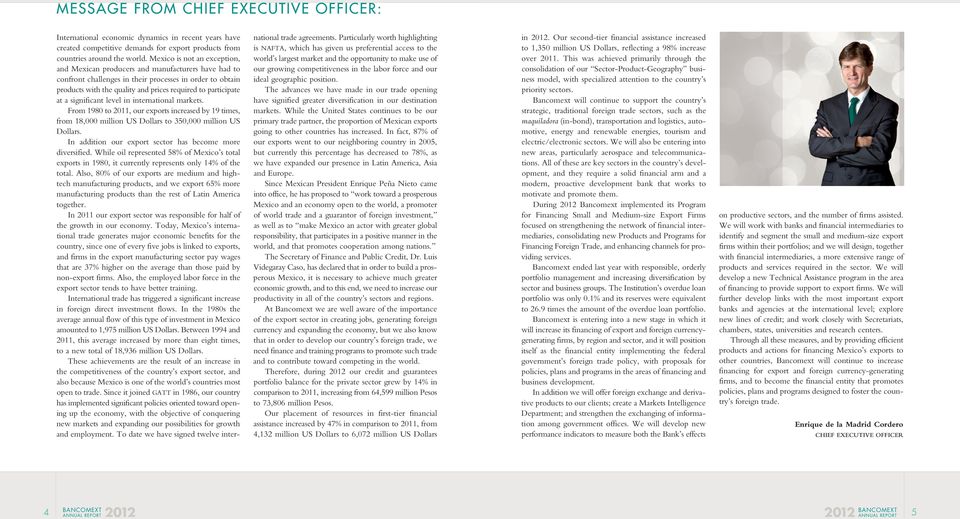
3 MESSAGE FROM CHIEF EXECUTIVE OFFICER: International economic dynamics in recent years have created competitive demands for export products from countries around the world. Mexico is not an exception, and Mexican producers and manufacturers have had to confront challenges in their processes in order to obtain products with the quality and prices required to participate at a significant level in international markets. From 1980 to 2011, our exports increased by 19 times, from 18,000 million US Dollars to 350,000 million US Dollars. In addition our export sector has become more diversified. While oil represented 58% of Mexico s total exports in 1980, it currently represents only 14% of the total. Also, 80% of our exports are medium and hightech manufacturing products, and we export 65% more manufacturing products than the rest of Latin America together. In 2011 our export sector was responsible for half of the growth in our economy. Today, Mexico s international trade generates major economic benefits for the country, since one of every five jobs is linked to exports, and firms in the export manufacturing sector pay wages that are 37% higher on the average than those paid by non-export firms. Also, the employed labor force in the export sector tends to have better training. International trade has triggered a significant increase in foreign direct investment flows. In the 1980s the average annual flow of this type of investment in Mexico amounted to 1,975 million US Dollars. Between 1994 and 2011, this average increased by more than eight times, to a new total of 18,936 million US Dollars. These achievements are the result of an increase in the competitiveness of the country s export sector, and also because Mexico is one of the world s countries most open to trade. Since it joined GATT in 1986, our country has implemented significant policies oriented toward opening up the economy, with the objective of conquering new markets and expanding our possibilities for growth and employment. To date we have signed twelve international trade agreements. Particularly worth highlighting is NAFTA, which has given us preferential access to the world s largest market and the opportunity to make use of our growing competitiveness in the labor force and our ideal geographic position. The advances we have made in our trade opening have signified greater diversification in our destination markets. While the United States continues to be our primary trade partner, the proportion of Mexican exports going to other countries has increased. In fact, 87% of our exports went to our neighboring country in 2005, but currently this percentage has decreased to 78%, as we have expanded our presence in Latin America, Asia and Europe. Since Mexican President Enrique Peña Nieto came into office, he has proposed to work toward a prosperous Mexico and an economy open to the world, a promoter of world trade and a guarantor of foreign investment, as well as to make Mexico an actor with greater global responsibility, that participates in a positive manner in the world, and that promotes cooperation among nations. The Secretary of Finance and Public Credit, Dr. Luis Videgaray Caso, has declared that in order to build a pros - perous Mexico, it is necessary to achieve much greater economic growth, and to this end, we need to increase our productivity in all of the country s sectors and regions. At Bancomext we are well aware of the importance of the export sector in creating jobs, generating foreign currency and expanding the economy, but we also know that in order to develop our country s foreign trade, we need finance and training programs to promote such trade and to contribute toward competing in the world. Therefore, during 2012 our credit and guarantees portfolio balance for the private sector grew by 14% in comparison to 2011, increasing from 64,599 million Pesos to 73,806 million Pesos. Our placement of resources in first-tier financial assistance increased by 47% in comparison to 2011, from 4,132 million US Dollars to 6,072 million US Dollars in Our second-tier financial assistance increased to 1,350 million US Dollars, reflecting a 98% increase over This was achieved primarily through the consolidation of our Sector-Product-Geography business model, with specialized attention to the country s priority sectors. Bancomext will continue to support the country s strategic, traditional foreign trade sectors, such as the maqui ladora (in-bond), transportation and logistics, automotive, energy and renewable energies, tourism and electric/electronic sectors. We will also be entering into new areas, particularly aerospace and telecommunications. All of these are key sectors in the country s development, and they require a solid financial arm and a modern, proactive development bank that works to motivate and promote them. During 2012 Bancomext implemented its Program for Financing Small and Medium-size Export Firms focused on strengthening the network of financial intermediaries, consolidating new Products and Programs for Financing Foreign Trade, and enhancing channels for pro - viding services. Bancomext ended last year with responsible, orderly portfolio management and increasing diversification by sector and business groups. The Institution s overdue loan portfolio was only 0.1% and its reserves were equivalent to 26.9 times the amount of the overdue loan portfolio. Bancomext is entering into a new stage in which it will increase its financing of export and foreign currencygenerating firms, by region and sector, and it will position itself as the financial entity implementing the federal government s foreign trade policy, with proposals for policies, plans and programs in the areas of financing and business development. In addition we will offer foreign exchange and deriva - tive products to our clients; create a Markets Intelligence Department; and strengthen the exchanging of information among government offices. We will develop new performance indicators to measure both the Bank s effects on productive sectors, and the number of firms assisted. We will work with banks and financial intermediaries to identify and segment the small and medium-size export firms within their portfolios; and we will design, together with financial intermediaries, a more extensive range of products and services required in the sector. We will develop a new Technical Assistance program in the area of financing to provide support to export firms. We will further develop links with the most important export banks and agencies at the international level; explore new lines of credit; and work closely with Secretariats, chambers, states, universities and research centers. Through all these measures, and by providing efficient products and actions for financing Mexico s exports to other countries, Bancomext will continue to increase financing for export and foreign currency-generating firms, and to become the financial entity that promotes policies, plans and programs designed to foster the country s foreign trade. Enrique de la Madrid Cordero CHIEF EXECUTIVE OFFICER 4 ANNUAL REPORT ANNUAL REPORT 5
4 SUMMARY OF ACHIEVEMENTS IN % growth in the portfolio balance for credit and guarantees to the private sector, with an increase from 64,599 to 73,806 million Pesos. In 2012 the placement of resources for first-tier financing increased by 47% in comparison to 2011, from 4,132 to 6,072 million US Dollars. The Financial Intermediaries Network was strengthened, and new Products and Programs for Financing Foreign Trade were consolidated. Strategic alliances were also consolidated, and channels for providing services to small and medium-size export firms were strengthened. Responsible, organized portfolio management: Overdue loan portfolio: 0.1% Reserves / Overdue loan portfolio: 2,690% Diversification of portfolios, by sector and by business group. CEBURES issuance at a four-year term for a total of 5,000 million Pesos, and two others at a ten-year term, for 1,500 and 2,000 million Pesos, respectively. Implementation of Program for Financing Small and Medium-size Export Firms. Initiation of Buyer Guarantee operations with foreign banks, plus the Bank structured its first large-scale operation with a high-quality non-banking financial intermediary. Initiation of International Factoring operations through our participation as FCI (Factors Chain International) members. Global Finance included Bancomext in its list of the safest banking institutions in Latin America. Bancomext adds another achievement to mark its 75th anniversary by obtaining the highest score in Improvement in Websites The Colegio de México developed a study to evaluate financing work and the mechanisms for channeling firms and actions to other public sector entities to make more effective use 2012 ANNUAL REPORT 7

5 of Bancomext s resources. The Colegio de México emphasized that, with respect to the Bank s performance, the results in financial indicators and particularly those related to its portfolios have been positive. This is in response to the requirements established by the Law on Credit Institutions and the Secretariat of Finance and Public Credit (Secretaría de Hacienda y Crédito Público SHCP). An Evaluation of impacts in the economy from financing to exports and Bancomext was conducted through the Scientific Research Coordinating Office at the National Auto nomous University of Mexico (UNAM) and with support from the Secretariat of Economy, for the purpose of measuring the results from firms assisted and contributions to the national economy. INCOME STATEMENT For a better understanding of the figures presented in the financial statements, the income statement and general balance for the year are presented here. INCOME STATEMENT (Millions of Pesos) JANUARY-DECEMBER Creation of database of export firms, with their validated contact information, to use in promoting and disseminating information regarding Bancomext s products and services. Generation of operating earnings of 1,284 million Pesos and earnings before taxes and payment of public use taxes of 2,337 million Pesos at the end of BUDGET ACTUAL ACTUAL ACTUAL VARIATION % VS 2011 % VS BUDGET Financial Markets and Treasury 1, , (2.8) Credit 1,558 1, , (10.4) Guarantees Trust Funds (5.8) Growth in stockholders equity, to a level of 12,145 million Pesos with a capitalization index of 14.47% at the end of December Total Net Income 2, , , (6.5) Active Personnel Expenses (15.1) Retirees Expenses (0.0) Operational Expenses (14.1) HIGHLIGHTS MILLIONS OF PESOS MILLIONS OF US DOLLARS 1/ HIGHLIGHTS Total 106,090 8,055 Credit 2/ 99,947 7,586 Guarantees 6, RESULTS Net profit (loss) Interest income 9, Interest expense (6,794) (524) YEAR-END BALANCE Total assets 215,858 16,648 Total loan portfolio 3/ 66,934 5,162 Total liabilities 203,713 15,712 Stockholders equity 12, / Figures in US Dollars for descriptive purposes only. The exchange rate used for Results and Year-end balance corresponds to the end of the year, at MXP$ /USD. 2/ Includes first and second-tier credit. 3/ Does not include solidary obligations or guarantees. Operation Expenses 1, , , (11.6) Operations Profit (Loss) 1, , , (0.8) Pensions Provision Fund, 2009 Tables and Rate Change (100.0) n.c. Legal Risk and Expenses Allowances and Write-off of Loans (19.1) 80.7 (303.5) n.c. n.c. Profit (Loss) without Subsidiaries 1, , Results from Subsidiaries Profit (Loss) with Subsidiaries 1, , Net B-6 Recovery & Sale of Foreclosed Assets n.c. 2.7 Other Net Income (Expenses) Profit (Loss) without Taxes & Fees 1, , Payment of Public use Taxes ,300.0 n.c. n.c ISR, IETU and PTU (30.3) n.c. (76.0) Net Profit (Loss) 1, (40.6) 8 ANNUAL REPORT ANNUAL REPORT 9
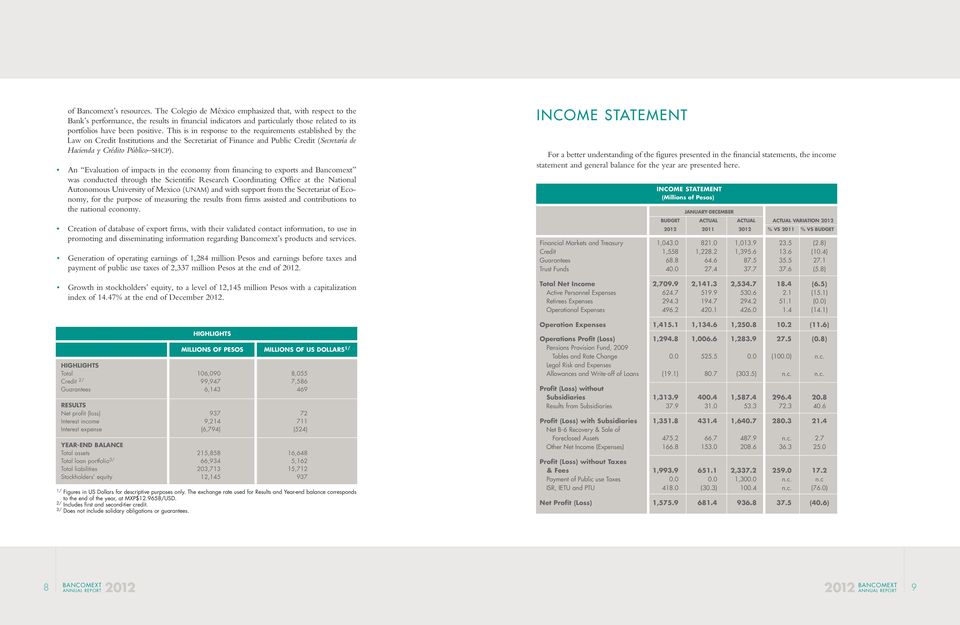
6 The Net Results for the year totaled million Pesos, an amount that is million Pesos above that obtained in 2011, even with the application of payment established by the federal executive branch on October 1, 2012, in the amount of 1,300 million Pesos, primarily for earnings obtained from the Bank s loan portfolio and markets and treasury operations in 2012, as described below: The net returns generated by the Loan Portfolio totaled 1,395.6 million Pesos, with most of this amount corresponding to loans granted to the private sector, at a total of 1,093.6 million Pesos, plus earnings from commissions in the amount of million Pesos, as well as earnings from overdue portfolio recovery and restructured loans in the amount of 33.1 million Pesos. An increase of million Pesos can be observed in comparison to the same period in 2011, derived from an increase in portfolio balances, reflected primarily in earnings from interest on the foreign-currency portfolio, which increased by million Pesos, despite a drop in the exchange rate of nearly one peso, and from the loan commissions charged, which amounted to over 15.4 million Pesos. Markets and Treasury operations reported earnings of 1,013.9 million Pesos, a figure that is million Pesos above the amount at the end of This was primarily due to the 58.7 million Pesos in increased earnings from the National Currency Desk, due to the Bank s position on government securities, with a spread that has been very sensitive to market shifts. In addition, million Pesos in increased earnings were obtained in Treasury operations, primarily due to balance management (including results obtained in intermediation and use of capital) and an increase in earnings obtained from Foreign Currency Desk operations in the amount of 14.6 million Pesos. Earnings from Fiduciary activities totaled 37.7 million Pesos, or an amount 10.3 million Pesos above the amount obtained in 2011, derived from new fiduciary responsibilities in admi n - istration and guarantees. As a result of loan portfolio ratings, the amount of credit reserves established in 2012 was million Pesos less than in The amount of credit reserves released in 2012 was million Pesos, through migration, amortization and liquidation of debts, while in 2011, the amount released was million Pesos. A 22% decrease was observed in Administration and Promotion Expenses in comparison to 2011, primarily because during 2011 the effect of the increase in obligations to retired personnel was contributed to the Retirement Fund, with a reduction in the rate from 7.5% to 7.0%, in the amount of million Pesos. The amount for Other Operating Earnings came to million Pesos at the end of the year, an amount that is million Pesos above the amount at the end of 2011, primarily due to an increase in recovery in cash and earnings from the sale of properties acquired through legal pro ceed ings, in the amount of million Pesos, as well as the cancellation of legal risk reserves in 2012, in the amount of million Pesos. In 2011 the provision of 59.5 million Pesos corres pond ing to fiscal processes in the fiscal years was cancelled due to a favor resolution awarded to Bancomext. In compensation for the latter, in 2012, liquidations were paid for legal resolutions in the amount of 24.6 million Pesos, in comparison to 5.4 million Pesos paid in In addition are the earnings from the sale of a property in October 2011 in the amount of 19.9 million Pesos. GENERAL BALANCE I. ASSETS GENERAL BALANCE (Millions of Pesos) DECEMBER DECEMBER VARIATION AMOUNT % Deposits & Investments in Securities 45,106 47,270 2,164 5 Securities Restricted by Repurchase Agreements 86,746 93,097 6,351 7 Stock Portfolio Available for Sale Permanent Stock Investments Stock Market Investment Private Sector Portfolio 49,857 61,191 11, Public Sector Portfolio 7,509 5,743 (1,766) (24) Total Loan Portfolio 57,366 66,934 9, Allowance for Credit Risks (2,384) (1,706) 678 (28) Net Loan Portfolio 54,983 65,228 10, Other Assets 7,625 9,328 1, TOTAL ASSETS 195, ,858 20, Payables under Repurchase Transactions 86,750 93,105 6,355 7 Domestic Debt 59,145 66,282 7, Foreign Debt 27,308 27, Other Liabilities 13,107 16,729 3, TOTAL LIABILITIES 186, ,713 17,403 9 Stockholders' Equity 9,024 12,145 3, Total Liabilities & Stockholders' Equity 195, ,858 20, At the end of December 2012, the Institution s total assets amounted to 215,858 million Pesos, which is 11% or 20,524 million Pesos above the amount registered at the end of The items in which substantial modifications occurred are the following: 10 ANNUAL REPORT ANNUAL REPORT 11

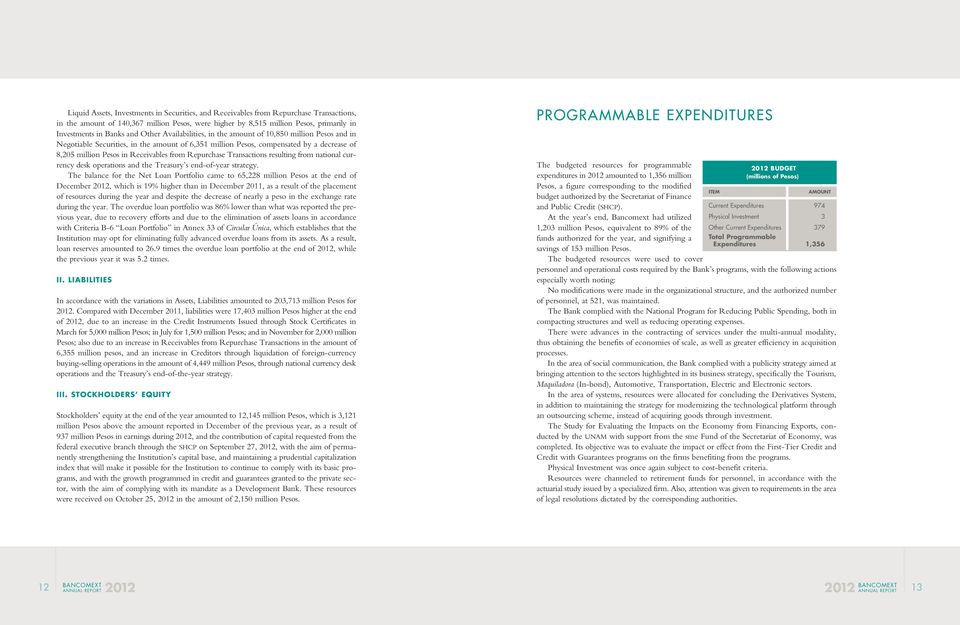
7 Liquid Assets, Investments in Securities, and Receivables from Repurchase Transactions, in the amount of 140,367 million Pesos, were higher by 8,515 million Pesos, primarily in Investments in Banks and Other Availabilities, in the amount of 10,850 million Pesos and in Negotiable Securities, in the amount of 6,351 million Pesos, compensated by a decrease of 8,205 million Pesos in Receivables from Repurchase Transactions resulting from national currency desk operations and the Treasury s end-of-year strategy. The balance for the Net Loan Portfolio came to 65,228 million Pesos at the end of December 2012, which is 19% higher than in December 2011, as a result of the placement of resources during the year and despite the decrease of nearly a peso in the exchange rate during the year. The overdue loan portfolio was 86% lower than what was reported the previous year, due to recovery efforts and due to the elimination of assets loans in accordance with Criteria B-6 Loan Portfolio in Annex 33 of Circular Única, which establishes that the Institution may opt for eliminating fully advanced overdue loans from its assets. As a result, loan reserves amounted to 26.9 times the overdue loan portfolio at the end of 2012, while the previous year it was 5.2 times. II. LIABILITIES In accordance with the variations in Assets, Liabilities amounted to 203,713 million Pesos for Compared with December 2011, liabilities were 17,403 million Pesos higher at the end of 2012, due to an increase in the Credit Instruments Issued through Stock Certificates in March for 5,000 million Pesos; in July for 1,500 million Pesos; and in November for 2,000 million Pesos; also due to an increase in Receivables from Repurchase Transactions in the amount of 6,355 million pesos, and an increase in Creditors through liquidation of foreign-currency buying-selling operations in the amount of 4,449 million Pesos, through national currency desk operations and the Treasury s end-of-the-year strategy. III. STOCKHOLDERS EQUITY Stockholders equity at the end of the year amounted to 12,145 million Pesos, which is 3,121 million Pesos above the amount reported in December of the previous year, as a result of 937 million Pesos in earnings during 2012, and the contribution of capital requested from the federal executive branch through the SHCP on September 27, 2012, with the aim of permanently strengthening the Institution s capital base, and maintaining a prudential capitalization index that will make it possible for the Institution to continue to comply with its basic programs, and with the growth programmed in credit and guarantees granted to the private sector, with the aim of complying with its mandate as a Development Bank. These resources were received on October 25, 2012 in the amount of 2,150 million Pesos. PROGRAMMABLE EXPENDITURES The budgeted resources for programmable expenditures in 2012 amounted to 1,356 million Pesos, a figure corresponding to the modified budget authorized by the Secretariat of Finance and Public Credit (SHCP). At the year s end, Bancomext had utilized 1,203 million Pesos, equivalent to 89% of the funds authorized for the year, and signifying a savings of 153 million Pesos. The budgeted resources were used to cover personnel and operational costs required by the Bank s programs, with the following actions especially worth noting: No modifications were made in the organizational structure, and the authorized number of personnel, at 521, was maintained. The Bank complied with the National Program for Reducing Public Spending, both in compacting structures and well as reducing operating expenses. There were advances in the contracting of services under the multi-annual modality, thus obtaining the benefits of economies of scale, as well as greater efficiency in acquisition processes. In the area of social communication, the Bank complied with a publicity strategy aimed at bringing attention to the sectors highlighted in its business strategy, specifically the Tourism, Maquiladora (In-bond), Automotive, Transportation, Electric and Electronic sectors. In the area of systems, resources were allocated for concluding the Derivatives System, in addition to maintaining the strategy for modernizing the technological platform through an outsourcing scheme, instead of acquiring goods through investment. The Study for Evaluating the Impacts on the Economy from Financing Exports, conducted by the UNAM with support from the sme Fund of the Secretariat of Economy, was completed. Its objective was to evaluate the impact or effect from the First-Tier Credit and Credit with Guarantees programs on the firms benefiting from the programs. Physical Investment was once again subject to cost-benefit criteria. Resources were channeled to retirement funds for personnel, in accordance with the actuarial study issued by a specialized firm. Also, attention was given to requirements in the area of legal resolutions dictated by the corresponding authorities. ITEM 2012 BUDGET (millions of Pesos) AMOUNT Current Expenditures 974 Physical Investment 3 Other Current Expenditures 379 Total Programmable Expenditures 1, ANNUAL REPORT ANNUAL REPORT 13
8 14 ANNUAL REPORT ANNUAL REPORT 15

9 INTERNATIONAL ENVIRONMENT In 2012 the international macroeconomic environment was characterized by the crisis in the Eurozone, where the IMF expected a negative growth rate of 0.4%. Also, various emerging economics such as China, India and Brazil experienced an economic growth slowdown, in addition to inflationary pressures generated by commodity prices. With respect to the US eco - nomy, the IMF estimates that it grew by 2.3%, with a recovery in consumer confidence and an increase in the demand for consumer goods, although there is a high risk that government spending will be reduced as a consequence of the fiscal deficit. 10% GROWTH BY COUNTRY 9% 8% China, 8,250.24, 7.8% 7% 6% 5% 4% Mexico, 1,207.82, 3.9% Russia, 2,201.90, 4.0% United States 15,609.70, 2.1% 3% 2% Korea, 1,163.53, 3.5% Brazil, 2,444.76, 3.0% 1% 0% 1% 2% Spain, 1,397.78, 1.8% 3% 4% 0 2,000 4,000 6,000 8,000 10,000 12,000 14,000 16,000 18,000 PIB (2012*) in Billions of US Dollars 2012 ANNUAL REPORT 17

10 NATIONAL ENVIRONMENT During 2012 the Mexican economy grew at a rate of 3.9%. Exports were the determining factor, with a growth of 6.2%, generating a trade balance surplus of 163 million US Dollars. This was due primarily to a reduction in the manufacturing sector deficit, from 14,729 to 12,775 million US Dollars. In addition, inflation in 2012 was at 3.6%, the lowest level since 2009, and on the basis of this inflation rate and declining prospects for the National Consumer Price Index, the Central Bank (Banco de México BANXICO) lowered its reference rate, provoking an increase in investment and consumption. EXPORTS When non-oil exports are grouped by sector, the importance of the automotive sector in 2012 is apparent, representing 22%. When they are grouped by type of good, it is particu larly noteworthy that 51% of all exports are of intermediate goods. With respect to the desti nation of exports, 67% of Mexico s exports were introduced into the US market in 2012, and the second most important market was South America, at 5.2%. % Manufacturing Exports without Automotive, 72.9% EXPORTS BY SECTOR, 2012 % Automotive Exports, 22.1% % Extractive Exports, 1.5% % Agricultural Exports, 3.4% During the year exports reached a total of billion US Dollars, with a growth of 6% in comparison to Non-oil exports amounted to 318 billion US Dollars, representing 83% of the total, while oil exports came to 53 billion US Dollars, representing 17%. The following graph shows the fluctuations in exports in 2012 on a month-by-month basis, with a variation of approximately 31 billion US Dollars. EXPORTS BY DESTINATION, 2012 EXPORTS BY TYPE OF GOOD, 2012 Billions of US Dollars OIL AND NON-OIL EXPORTS, Non-Oil Exports Oil Exports % United States, 67% % South America, 5.2% % Europe, 4.6% % Asia, 3.8% % Others, 14.7 % Others countries in the Americas, 4.7% % Capital Goods Exports, 25% % Intermediate Goods Exports, 51% % Consumer Goods Exports, 24% ANNUAL REPORT ANNUAL REPORT 19

11 IMPORTS In 2012 Mexico s imports reached a total of billion US Dollars, representing 5.7% growth over Monthly amounts varied by approximately 31 billion US Dollars, with a maximum variation of 36 billion US Dollars in the month of October. IMPORTS, 2012 (Billions of US Dollars) IMPORTS BY TYPE OF GOOD, 2012 IMPORTS BY ORIGIN, % Capital Goods Imports, 10.4% % Imports from the United States, 40.7% % Imports from other countries, 11.8% % Imports from Europe, 11.0% % Intermediate Goods Imports, 75.0% % Consumer Goods Imports, 14.6% % Imports from South America, 2.3% % Imports from Asia, 30.1% % Imports from other countries in the Americas, 4.1% Regarding imports by type of good, 75% of all imports in 2012 were concentrated in intermediate goods. With respect to the origin of imports, 41% came from the United States, 30% from Asia, and of particular note is that 51% of the total imports from Asia came from China. 20 ANNUAL REPORT ANNUAL REPORT 21

12 TOTAL FINANCING In line with its mission, Bancomext has been promoting growth in Mexican firms through its strategies designed to assist the major export and foreign currency-generating sectors, with the aim of achieving the greatest impact on job creation and the financing and development of the country s export chain. Thus, during 2012 the Bank channeled financial assistance in a total amount of 8,442 million US Dollars, of which 7,958 million US Dollars corresponds to financing and 484 mi llion US Dollars to guarantees, plus 48 million US Dollars to induced financing, making a total amount that is above the proposed goal by 3,511 million US Dollars, representing 170.5%. In comparison with the figures for 2011, the total amount of financing channeled, includ ing guarantees, presents a net increase of 3,155 million US Dollars, primarily due to increases of 6,072 million US Dollars in first-tier and 1,350 million US Dollars in second-tier financing to the private sector. TOTAL FINANCIAL ASSISTANCE, 2011 AND 2012 Millions of US Dollars VARIATION FINANCED 12/11 DECEMBER 2011 ITEM DECEMBER 2012 FINANCED BUDGETED FINANCED BUDGETED FINANCED AMOUNT % AMOUNT % First Tier 26 Public Sector , ,132 Private Sector 4,152 6,072 1, , ,158 Total First Tier 4,252 6,609 2, , Second Tier 513 1, ,840 Total Financing 4,765 7,958 3, , Guarantees ,288 Financing Total 4,933 8,442 3, , Induced ,332 Financing Total plus 4,979 8,490 3, , Induced 2012 ANNUAL INFORME REPORT ANUAL 23

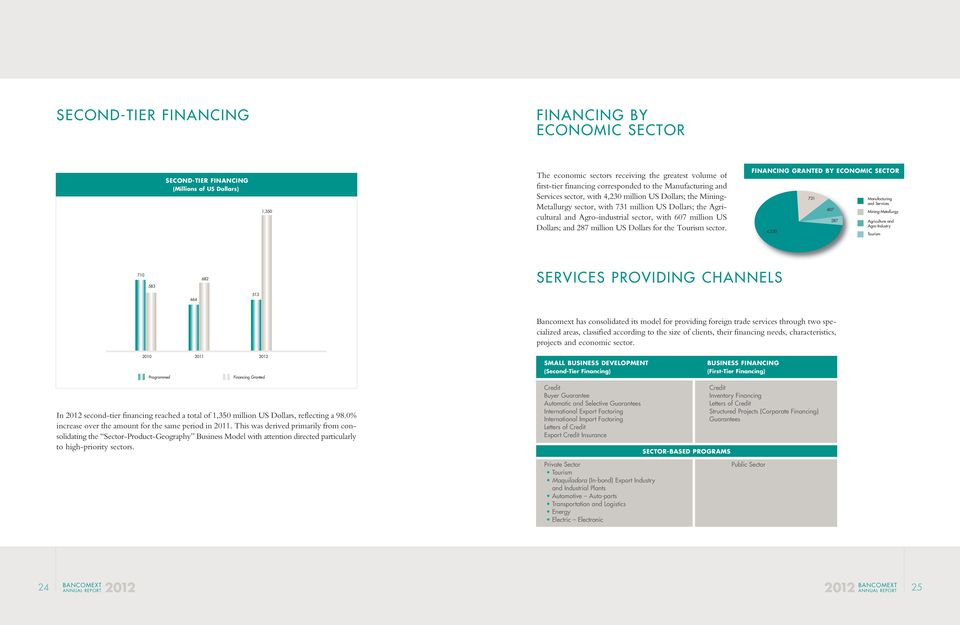
13 SECOND-TIER FINANCING FINANCING BY ECONOMIC SECTOR SECOND-TIER FINANCING (Millions of US Dollars) 1,350 The economic sectors receiving the greatest volume of first-tier financing corresponded to the Manufacturing and Services sector, with 4,230 million US Dollars; the Mining- Metallurgy sector, with 731 million US Dollars; the Agricultural and Agro-industrial sector, with 607 million US Dollars; and 287 million US Dollars for the Tourism sector. FINANCING GRANTED BY ECONOMIC SECTOR 4, Manufacturing and Services Mining-Metallurgy Agriculture and Agro-Industry Tourism SERVICES PROVIDING CHANNELS Bancomext has consolidated its model for providing foreign trade services through two specialized areas, classified according to the size of clients, their financing needs, characteristics, projects and economic sector Programmed Financing Granted In 2012 second-tier financing reached a total of 1,350 million US Dollars, reflecting a 98.0% increase over the amount for the same period in This was derived primarily from consolidating the Sector-Product-Geography Business Model with attention directed particularly to high-priority sectors. SMALL BUSINESS DEVELOPMENT (Second-Tier Financing) Credit Buyer Guarantee Automatic and Selective Guarantees International Export Factoring International Import Factoring Letters of Credit Export Credit Insurance SECTOR-BASED PROGRAMS BUSINESS FINANCING (First-Tier Financing) Credit Inventory Financing Letters of Credit Structured Projects (Corporate Financing) Guarantees Private Sector Tourism Maquiladora (In-bond) Export Industry and Industrial Plants Automotive Auto-parts Transportation and Logistics Energy Electric Electronic Public Sector 24 ANNUAL REPORT ANNUAL REPORT 25
14 SMALL BUSINESS DEVELOPMENT Bancomext, through its Small Business Development services, has successfully achieved the design, development and implementation of diverse products and programs intended for firms associated with foreign trade and foreign-currency generation. These products have made it possible to expand Bancomext s services for meeting the needs of Mexican export and import firms, particularly those small and medium-sized. STRATEGIC BUSINESS PLAN During 2012 the Bank s Small Business Development strategy was oriented primarily toward complying with the following objectives: 1) Develop products and programs oriented toward meeting the needs of export and foreign currency-generating firms. 2) Promote participation by commercial banks and intermediaries specializing in financing small and medium-size export firms. 3) Generate more liquidity in export firms through international factoring. 4) Focus on products with a 100% electronic platform. 5) Maintain second-tier financing in Bancomext s portfolio. As well, efforts were focused on the promotion and consolidation of developed products and programs, and on maintaining them up-to-date on an ongoing basis, in order to respond in an increasingly efficient manner to the financial needs of our clients. The Guarantees (Automatic Guarantee and Selective Guarantee) Program has been very important in promoting credit for small and medium-size export and/or foreign currencygenerating firms, by providing risk coverage to commercial banks on the loans they grant to firms in strategic sectors. The Program for Assisting Export and Import SMEs was developed with the aim of offering specific services for this sector in order to strengthen its participation in the foreign trade market, with the offer of lower interest rates for the firms assisted in this program. The design and success of this program has been achieved through Bancomext s joint collaboration with the Secretariat of Economy and the Mexican Bank Association (Asociación de Bancos de México). Efforts continued to promote foreign trade financing by granting resources to financial intermediaries, to enable them to grant credit to specific sectors and industries. The strategy has been to incorporate new, primarily non-banking financial intermediaries that support export activity. The International Factoring Program made it possible to continue to provide liquidity to Mexican export firms through a discount in their accounts receivables in other countries. The Buyer Guarantee Program began to operate in Through this program, Bancomext offers guarantees to foreign banks in order to hedge against the risk of non-payment on financing granted to their clients that import Mexican goods and service. Bancomext continues incorporating more financial institutions from other coun tries into this program, with the aim of assisting Mexican exporters. Because this is an in ter national process, it is a long-term endeavor. An essential way to get closer to small and medium-size export firms and let them know about the Bank s programs and services is through strategic alliances with other entities and institutions in Mexico s public and private sectors that are associated with foreign trade. These include the Secretariat of Economy, Secretariat of Tourism, ProMéxico, ANIERM, COMCE and other entities and institutions that maintain ongoing, direct contact with firms as part of their missions. It is thus very important for Bancomext to strengthen these alliances and establish joint programs and projects for the benefit of Mexican export firms. BUSINESS FINANCING Through its Business Financing services, the Institution promotes and grants financial assistance to participants in the various activities associated with foreign trade and foreign-currency gen - eration, with a focus on assisting the firms in their target markets to increase their competitiveness at the international level and strengthen their participation in the export chain. 26 ANNUAL REPORT ANNUAL REPORT 27

15 BUSINESS MODEL In 2010 the Business Financing Department initiated the implementation of what is known as the Sector-Product-Geography Business Model. In 2012 it continued to consolidate this model with the following guidelines as a fundamental aspect of its implementation: The placement of resources for granting first-tier financing was increased by 55%, from 4,146 million US Dollars in 2011 to 6,423 million US Dollars in The number of firms assisted was increased by 16%, from 446 in 2011 to 518 (268 directly and 250 indirectly) in Direct credit to private and public sectors. 2. Lines of credit above 3 million US Dollars. 3. Services directed toward high-priority and high-impact sectors associated with Mexican exports and foreign-currency generation. Tourism Electric-Electronic Maquiladora (In-bond) Export Industry and Industrial Plants Structured Programs and Operations Automotive Auto-parts Inventory Financing Transportation and Logistics Corporate Financing Energy At the end of 2012, the total Pipe Line consisted of operations in the amount of 44,315 million US Pesos. SECTOR-BASED PROGRAMS 4. National coverage through 3 Regional Offices: Northeastern Regional Office (located in Monterrey, Nuevo León) Central Regional Office (located in Mexico City) Western Regional Office (located in Guadalajara, Jalisco) TOURISM SECTOR 5. Expanded coverage of business groups receiving services (with a focus on the country s 435 primary business groups), which generate over 72% of the volume of annual non-oil exports. The application of the Business Model during 2012 led to significant results including: 12.6% increase in the Business Financing Department s first-tier portfolio of assistance to the private sector, from 53,929 million Pesos in 2011, to 60,742 million Pesos at the end of 2012, surpassing the goal programmed for this area by 5.6%. The new Inventory Financing (Repurchase Agreements) program makes it possible to offer Mexico s foreign trade community an alternative for financing its short-term needs through its inventories of inputs, parts and finished products. The strategic guidelines implemented in this sector during 2012 were based on diversifying the tourist destinations receiving services, deconcentrating risk, increasing the portfolio and centralizing portfolio management. The tourism sector portfolio represents 18% of the total first-tier private-sector portfolio of the Business Financing Department; the portfolio balance at the end of 2012 increased by 5%, from 10,042 million pesos in 2011 to a new total of 10,589 million pesos. The number of firms included in this portfolio represents 28% of all the private sector firms assisted in Bancomext s first-tier credit portfolio. The financial assistance granted by Bancomext to the tourism sector during 2012 has permitted the modernization of tourism infrastructure, assisting in the construction of more than seven new hotels with over 1,700 new hotel units. 28 ANNUAL REPORT ANNUAL REPORT 29

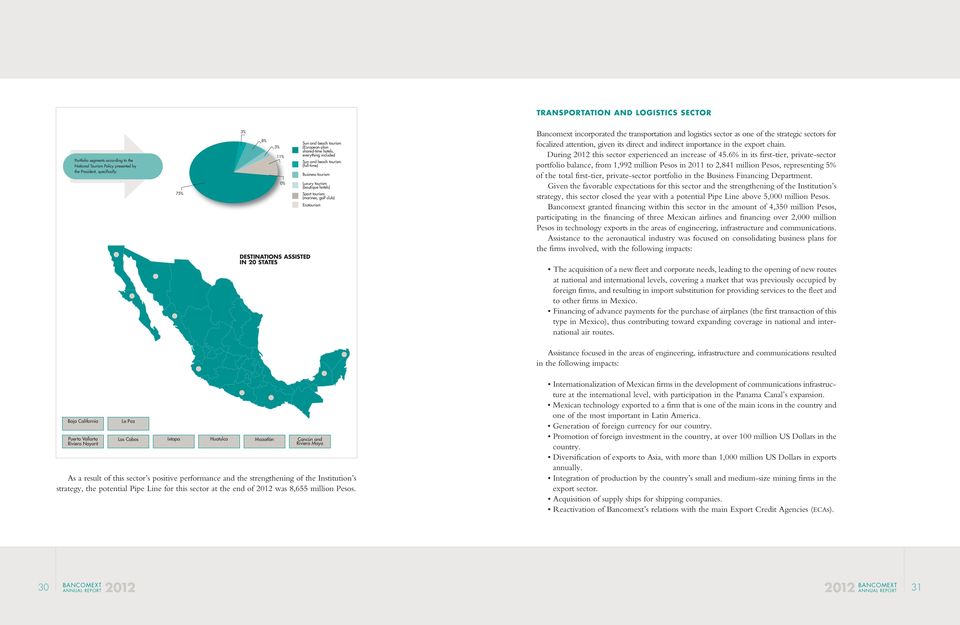
16 TRANSPORTATION AND LOGISTICS SECTOR Portfolio segments according to the National Tourism Policy presented by the President, specifically: 75% 3% 8% 3% 11% 0% DESTINATIONS ASSISTED IN 20 STATES Sun and beach tourism (European-plan shared-time hotels, everything included Sun and beach tourism (full-time) Business tourism Luxury tourism (boutique hotels) Sport tourism (marines, golf club) Ecotourism Bancomext incorporated the transportation and logistics sector as one of the strategic sectors for focalized attention, given its direct and indirect importance in the export chain. During 2012 this sector experienced an increase of 45.6% in its first-tier, private-sector portfolio balance, from 1,992 million Pesos in 2011 to 2,841 million Pesos, representing 5% of the total first-tier, private-sector portfolio in the Business Financing Department. Given the favorable expectations for this sector and the strengthening of the Institution s strategy, this sector closed the year with a potential Pipe Line above 5,000 million Pesos. Bancomext granted financing within this sector in the amount of 4,350 million Pesos, participating in the financing of three Mexican airlines and financing over 2,000 million Pesos in technology exports in the areas of engineering, infrastructure and communications. Assistance to the aeronautical industry was focused on consolidating business plans for the firms involved, with the following impacts: The acquisition of a new fleet and corporate needs, leading to the opening of new routes at national and international levels, covering a market that was previously occupied by foreign firms, and resulting in import substitution for providing services to the fleet and to other firms in Mexico. Financing of advance payments for the purchase of airplanes (the first transaction of this type in Mexico), thus contributing toward expanding coverage in national and international air routes. Assistance focused in the areas of engineering, infrastructure and communications resulted in the following impacts: Baja California Puerto Vallarta Riviera Nayarit La Paz Los Cabos Ixtapa Huatulco Mazatlán Cancún and Riviera Maya As a result of this sector s positive performance and the strengthening of the Institution s strategy, the potential Pipe Line for this sector at the end of 2012 was 8,655 million Pesos. Internationalization of Mexican firms in the development of communications infrastruc - ture at the international level, with participation in the Panama Canal s expansion. Mexican technology exported to a firm that is one of the main icons in the country and one of the most important in Latin America. Generation of foreign currency for our country. Promotion of foreign investment in the country, at over 100 million US Dollars in the country. Diversification of exports to Asia, with more than 1,000 million US Dollars in exports annually. Integration of production by the country s small and medium-size mining firms in the export sector. Acquisition of supply ships for shipping companies. Reactivation of Bancomext s relations with the main Export Credit Agencies (ECAs). 30 ANNUAL REPORT ANNUAL REPORT 31
17 MAQUILADORA (IN-BOND) EXPORT SECTOR Bancomext has implemented a Financing Program for contributing to the development of aggregate value, job growth and foreign-currency generation in an efficient, competitive manner in the maquiladora (in-bond) export sector, including the entire chain: Chihuahua 16.4% Ciudad Juárez 18.9% Saltillo LOCATION % OF TOTAL FLOW 5.9% Monterrey 19.9% Reynosa 6.2% IMMEX INDUSTRIAL PLANT SUPPLIERS Matamoros DEVELOPERS 6.6% San Luis Potosí Work Capital Investment Projects Machinery and Equipment Installations Internacional Factoring Productive Chains Financing for Developing Industrial Infrastructure ampip ASOCIACIÓN MEXICANA DE PARQUES INDUSTRIALES Productive Chains Work Capital Investment Projects Machinery and Equipment Installations Productive Chains 5.7% Querétaro 3.9% During 2012 this sector experienced a 21% increase in its first-tier, private-sector portfolio balance, from 6,419 million Pesos in 2011 to 7,765 million Pesos, representing 13% of the total portfolio for this segment of first-tier financing. The number of firms included in this portfolio represents 7% of all the private-sector firms assisted in Bancomext s first-tier credit portfolio. Over 250 firms were assisted in 2012 directly or indirectly. Projects have been financed in this sector in practically all the country s most important industrial areas. A significant portion of resources have been focused on assisting projects in the country s northern region (Chihuahua, Nuevo León, Tamaulipas and border areas), where, as can be expected, the maquiladora (in-bond) export industry is located. The results obtained were derived from the implementation of strategies designed to assist one of the country s most strategic sectors, by developing and diversifying the Institution s direct and indirect client base, as well as implementing and modifying various internal processes in line with the sector s best practices. Due to favorable expectations for this sector and the strengthening of the Institution s strategy, significant growth is expected. At the end of 2012 this sector had a potential Pipe Line amounting to over 7,000 million US Dollars. 32 ANNUAL REPORT ANNUAL REPORT 33

18 AUTOMOTIVE AUTO-PARTS In recognition of the importance of the Automotive and Auto-parts Sector in job creation and foreign-currency generation, Bancomext grants assistance in the form of credit and guarantees to meet the financial needs of the terminal industry and its supply chain. The portfolio balance at the end of 2012 was 10,327 million Pesos, representing a 6% increase in comparison to 2011, when the final balance was 9,762 million Pesos. In December of 2012 the portfolio balance for the automotive sector was the second most important among Bancomext s sector-based programs. The portfolio for the automotive and auto-parts sector represents 17% of the total first-tier, private-sector portfolio in Business Financing. This sector is especially noteworthy for its diversification in counterparts, its long-term duration with minimal pressure for short-term payments due, and for generating a significant contribution to the financial margin and maintaining a low-risk rating and a zero amount in its overdue portfolio. With this percentage, Bancomext ranks as the Mexican banking institution granting the most financing to the automotive sector, with a concentration index in accordance with this particular industry. The potential Pipe Line for this sector at the end of 2012 was 3,825 million Pesos. It is also important to note that Bancomext participated actively in the chambers and associations related to this sector, such as the Mexican Automotive Industry Association (Asociación Mexicana de la Industria Autommotriz AMIA), the National Auto-parts Industry (Industria Nacional de Autopartes INA) and the Nuevo León Automotive Cluster (Cluster Automotriz de Nuevo León CLAUT). Lastly, relations were established with the Secretariats of Economic Development in the most important states where most of the foreign direct investment (FDI) in the automotive sector is being concentrated, including Puebla, Guanajuato, Querétaro and Nuevo León. ENERGY This wind park will generate 22 megawatts (MW) of installed capacity, providing energy for six of the state s municipalities, including Monterrey, with eight aerogenerators, and miti gating 28,720 metric tons of carbon dioxide (CO 2 ) emissions in the atmosphere annually. Currently, the project is in a construction phase, and the project s commercial operations are expected to begin in April-May Participation in this type of transactions is based, on the one hand, on the foreign trade component, since most of the equipment is imported, and on the other hand, in the use of international lines of credit, such as those provided by KFW of Germany and JBIC of Japan. These operations also generate foreign currency for the country, since they are subject to receiving carbon bonds that may eventually be sold on the international market or in the secondary or voluntary market. Given the favorable expectations for this sector and the strengthening of the Institution s strategy, significant growth is estimated in the assistance provided to this sector. At the end of 2012 the potential Pipe Line was above 5,000 million US Dollars. Another important project supported by Bancomext is aimed at developing and cons truc t - ing a petrochemical complex for producing ethylene and its derivatives, with the objective of substituting their importation. This project will reactivate the petrochemical industry in our country with an investment of 4,400 million US Dollars. ELECTRIC ELECTRONIC Bancomext s efforts were focused on directly promoting its products and services to the firms in this sector. The electric-electronic sector portfolio represents 6% of the total first-tier, private-sector portfolio in Business Financing. At the end of 2012, financing assistance to this sector totaled 2,555 million Pesos, which is 322% above the estimated goal for this year of 700 million Pesos, and a balance of 3,628 million Pesos. Bancomext continued to offer alternative financing schemes for infrastructure projects in line with the needs of each operation, giving an impulse to the competitiveness of Mexican firms and products at the international level. The portfolio balance at the end of 2012 was 2,090 million Pesos, representing a 363% increase in comparison to the amount for 2011, which was 575 million Pesos. In December 2012, the portfolio balance for this sector represented 3.5% of all of Bancomext s sector-based programs. Bancomext structured the Wind Park in Santa Catarina, Nuevo León project. This investment represents the first small-scale commercial wind energy project in Mexico, and the first wind park in the state. PUBLIC SECTOR In accordance with the Institution s mandate, in order to effectively address the needs of Mexico s business market, a reconversion of Bancomext s focus in financial assistance was necessary. Services to the private sector have been prioritized, with 49.6% of the public sector portfolio redirected. 34 ANNUAL REPORT ANNUAL REPORT 35

19 FLUCTUATIONS IN PUBLIC SECTOR PORTFOLIO BALANCE (Millions of Pesos) - Anticipated payment of Export Letters of Credit, facilitating the liquidity required by exporters. - Payment of interests on Letters of Credit, with provision of Funds. 12,000 11,412 10,000 8,000 6,000 4,000 2, ,457 In accordance with the Institution s mandate, in order to effectively address the needs of Mexico s business market, a reconversion of Bancomext s focus in financial assistance was necessary. Services to the private sector have been prioritized, with 49.6% of the public sector portfolio redirected. Secondly, and as part of the Institution s strategy to provide services to the country s major foreign trade sectors, Bancomext created a business unit specializing in services for public sector entities and departments that play a role in the country s volume of imports. In this way the needs of participants in foreign trade activity are generally covered. A total of 298 million US Dollars were dedicated to these products during Some of the main achievements in this sector were the following: 8,119 Accumulated Decrease (49.6%) 5, Participation in the Federal Government s Treasury Association, with the aim of promoting this sector-based program. Also, Bancomext participated in the world conference of the Banking Commission of the International Chamber of Commerce (ICC) headquartered in Paris, France. This was the first time the ICC held an event of this magnitude in Latin America, and Mexico was the host country. Bancomext s participation was focused on: the performance of Mexican exports in terms of international trade agreements; comparative participation in this industry, in which Mexico has achieved the level of the world s primary economies; the ongoing growth in exports and countries of destination in recent years; support for sectors as important as the automotive, electronic and electric, industrial machinery and tourism sectors; and the various types of assistance offered by Bancomext. FIDUCIARY SERVICES Implementation of the system for letters of credit by internet, through which our clients carry out their operations online 24 hours a day, 365 days a year. Letters of credit may be issued, modified and monitored with this electronic platform. This is the most advanced technology on the market, placing Bancomext at the cutting edge in the area of specialized Letters of Credit operations. Promotion and publicity campaign focused on re-launching the Letters of Credit product. Development of new modalities in the Institution s Letters of Credit services, including: - Operational support to financial intermediaries, which lack the necessary technolo - gical infrastructure and know-how, and thus need to contract the respective services. During the second half of 2012, five trust funds with potential for earnings were constituted, making a total of 14 businesses for the year. As of December 31, 2012 the Bank was managing 306 fiduciary businesses. Together, the total number of businesses managed by the Bank maintained assets in the amount of 59,557 million Pesos, of which 16,805 million Pesos correspond to liquid assets. 36 ANNUAL REPORT ANNUAL REPORT 37

20 PORTFOLIO RECOVERY During 2012 the Special Credit Recovery Department took steps to address the portfolio with payment problems. As a result of these efforts, extraordinary resources were received in the amount of over 670 million Pesos, primarily from the payment and liquidation of the overdue loan portfolio, B-6 portfolio recovery, dation in payment, and real estate and property from credit guarantees subsequently obtained through judicial proceedings. OVERDUE LOAN PORTFOLIO With the aim of following up on the portfolio with payment problems, a management system was implemented for addressing these matters through WORKOUT, referred to as the Portfolio Recovery Management System (Sistema de Administración de Recuperación de Cartera SAREC). The SAREC system facilitates the comprehensive monitoring of progress in legal nego - tiations and follow-up on these matters during the payment default stage, assisting in defining timely actions and schemes for addressing these matters with greater recovery potential. PROPERTY OBTAINED THROUGH JUDICIAL PROCEEDINGS Cash, 579 million pesos 85% PORTFOLIO RECOVERY 2012 Adjudged, 24 million pesos, (4%) Dation in payment, 69 million pesos, (10%) Cash Adjudged Goods Dation in payment During 2012 actions were carried out in relation to the administration and commercialization of property obtained through judicial proceedings in association with overdue portfolio recovery. The sale of 52 properties took place during the year, generating approximately 24.8 million Pesos. FOREIGN FINANCIAL INSTITUTION Source: Special Credit Recovery Department. Of the 579 million Pesos received in cash, 11% was from overdue loan portfolio recovery, 17% from the portfolio classified as B-6, 66% corresponding to credit recovery from foreign banks, and 6% from the sale of property obtained through judicial proceedings and other sources. Through the authorized credit line to this Foreign Institution, efforts continue to support the export of Mexican products through the use of the Buyer Credit Line, carrying out operations at a value of over 15 million US Dollars, and financing the international commer cialization of Mexican products primarily associated with the chemical, food, and iron and steel industries. RECOVERY IN CASH Adjudged goods 4% WTC 1% Overdue loan portfolio 11% BANCUBA 66% Portfolio B-6 17% Former employees 1% Source: Special Credit Recovery Department. 38 ANNUAL REPORT ANNUAL REPORT 39

21 40 ANNUAL REPORT ANNUAL REPORT 41
22 INTERNATIONAL PROFILE During 2012 the global economy continued its tendency toward a slowdown in growth, as demonstrated since The annual global growth rate was 3.2%. The discrepancy in the rhythm of growth between advanced and emerging economies persisted, although the gap continued to close. The IMF indicates a 1.3% growth rate for advanced economies and a 5.1% growth rate for emerging economies during The European sovereign debt crisis continued to affect Greece and other European countries such as Spain and Italy, which are making efforts to reduce their fiscal deficits, at the cost of contracting their economies. The Eurozone experienced a recession in 2012, dropping to a 0.4% annual growth rate. Japan, for its part, improved its economic performance, with a 2.0% growth rate. The IMF calculated a 7.8% economic growth rate in 2012 for China, lower than the rate registered for 2011, however the country managed to contain certain inflationary pressures. India experienced a 4.5% growth in its economy, notably lower than the rate for In 2012 the global inflation rate was slightly below that registered in 2011, dropping to 4.2% in comparison to 4.4% for the previous year. In general the inflation rate was lower for advanced economies in 2012, at an average rate of 2.0%, while it was higher in emerging and developing economies, at 6.1%. The US economy continued to grow although modestly, with a growth rate of 2.3% for 2012, slightly above the 1.8% rate in Inflation in the United States in 2012 was 2.0%, below the rate of 3.1% registered in The Mexican economy grew at a rate of 3.9% in 2012, the same level achieved in This rate can be explained in part by growth in the national market, particularly due to the industrial sector, and resulting in the recuperation of some jobs previously lost. It is also explained by less dynamism in foreign demand, particularly from the United States, the latter of which gave an impulse to Mexican exports, which increased by 6.2% in 2012, however at a rate below the increase of 17.2% in Prices increased by an annual rate of 3.8% in 2012, while the Central Bank s (Banco de México) objective interest rate was maintained at 4.5%. The indicator for the Mexican stock exchange market registered a 17.9% growth in 2012, compared to a negative 3.8% rate for Mexico s economy is expected to grow by 3.5% in ANNUAL REPORT 43
23 RESULTS In the economic and financial environment described, the accumulated results from Treasury and Financial Markets management rose to 1,088 million Pesos. TREASURY MANAGEMENT OF FINANCIAL RESOURCES AND FUNDING Transfer prices were established for Bancomext s financial products at competitive market levels. The need for financial resources for the Institution s operations and businesses was addressed in an adequate, timely manner. Funding was obtained in national currency and foreign currency at market levels; the number of correspondent banks granting commercial credit lines to Bancomext was increased; and the following issuances of stock exchange certificates were made: INVESTMENT The Institution s own resources and the funds it manages on behalf of third parties were invested in financial markets, in line with availability and profitability criteria, and within the applicable risk and operation limits. DERIVATIVES DESK Treasury activities in flow management and risk management were supported through hedging transactions, and the final result was the implementation of a derivates system with the premise of making the management, operations and front-to-bank control of these financial operations more robust. CREDIT LINES, INTERNATIONAL ENTITIES AND SUSTAINABLE CREDIT As one of its functions as an Export Credit Agency (ECA) of the Mexican government, the Bank promoted the use of long-term resources from foreign development banks for financing credit programs, capital goods imports, investment projects, and projects focused on renewable energy, sustainability and the environment. In addition insurance and guarantees were promoted, and sustainable credit was provided for commercial operations with participation by Mexican firms in Central America and the Caribbean. Bancomext s premise has been to provide the business sector with beneficial financial conditions for its projects and to position its introduction into businesses in foreign markets: ISSUANCE AMOUNT TERM RATE March 2012 July 2012 November ,000 1,500 2, TIIE 28 days less 5 BP Fixed Rate of 5.75% (Bonds M + 49 BP) Fixed Rate of 5.94% (Bonds M + 50 BP) Lines IFO kfw BANKENGRUPPE WORLD BANK Insurance and Guarantees ECA ICO Instituto de Crédito Oficial INTER-AMERICAN DEVELOP- MENT BANK (IDB) JBIC Total 8,500 Notes: Amounts in Millions of Pesos. Terms in years. Fitch and Moody s Mexico assigned AAA (mex) and Aaa.mx ratings, respectively, to the issuances, signifying the highest credit quality at the national level. BP: Base Points. EXPORT-IMPORT BANK OF THE UNITED STATES Sustainable Credit EULER HERMES SAN JOSÉ AGREEMENT ATRADIUS 44 ANNUAL REPORT ANNUAL REPORT 45
24 MARKETS FOREIGN-CURRENCY BANK DEPOSITS DESK This Desk provided its clients with the service of investment in dollars and Euros with market returns, and responded to the financial resource needs of Bancomext s Treasury: MONEY DESK The Bank s National Currency Desk was responsible for the Institution s strategy of buyingselling debt instruments in Money Desk, covering needs in Markets and Treasury Promotion, carrying out transactions with Brokerage Houses, banks and in government securities auctions. Intermediaries and government issuers Debt instruments in national currency Repurchase agreement Government securities Direct Term (1 365 days) USD Euros Security Portfolio diversification Financial planning Banking Benefits Security (Traders Certificates) and experience; Efficient, agile procedures; Cutting-edge technological infrastructure. Individual (Direct purchases) Position Third parties (Repurchase agreements) Diversify investment portfolio Security and market returns Service levels rated: 96% of clients satisfied For its part, National Currency Markets Promotion placed the Money Desk's position and issuance of Bancomext s Securities among its clients (corporate and government treasuries and financial entities: Clients Debt instruments in national currency Repurchase agreement Government securities Banking Direct FOREIGN EXCHANGE DESK This Desk addressed the needs of buying-selling of Bancomext s and its clients foreign currency, and conducted trading transactions. Its general strategy was oriented toward managing the risk-return relationship of positions. Security (Traders Certificates) and experience; Efficient, agile procedures; Electronic operation of auctions; Cost efficiency Position (Direct and repurchase agreement) Funding/Placement issuance 46 ANNUAL REPORT ANNUAL REPORT 47
25 Risk management makes it possible to assure that the Bank s financial activities are conducted at levels in accordance with its capital and its operational capacity. Bancomext has worked to develop internal models and methodologies that are adapted to its specific risk profile. In accordance with the standards in the area of risk management, issued by the National Banking and Securities Commission (Comisión Nacional Bancaria y de Valores CNBV), the Institution s Board of Directors authorizes the objectives, guidelines and policies for comprehensive risk manage - ment, global limits on risk exposure, and mechanisms for carrying out corrective actions. The Risk Management Committee meets at least once a month. In addition to Bancomext officials, one Board member and three independent experts designated by the Board also participate in these meetings. The Risk Management Committee carefully monitors the various risks to which the Institution is exposed, and regularly reports to the Board regarding the risk exposure assumed, and any lack of observance of the limits on risk exposure. The Committee is supported by a specialized area (independent from business units) whose objective is to identify, measure, monitor, limit, control, inform and reveal the credit, market, liquidity and operational risks to which the Institution is exposed. The Risk Management Unit is responsible for verifying the observance of risk exposure limits, and periodically distributing reports on the Institution s risk exposure to the Chief Executive Officer, the committees concerned, the business areas and the regulatory authorities. NORMATIVE FRAMEWORK In accordance with the stipulations determined by regulatory entities, Bancomext has complied with standards for risk management. The following provisions are especially worth noting: General provisions applicable to credit institutions, issued by the National Banking and Securities Commission (Comisión Nacional Bancaria y de Valores CNBV) and published by Mexico s Secretariat of Finance and Public Credit (Secretaría de Hacienda y Crédito Público) in the Official Gazette (Diario Oficial de la Federación) on December 2, 2005, with the respective modifications, the most recent of which were made on March 4, Requirements for institutions interested in participating in markets authorized by the Central Bank (Banco de México) in the Annex of Circular 4/2012 on the 31 points for operations in derivatives markets. Regulations corresponding to capitalization requirements for multiple banking institutions and national credit organizations, development banking institutions, published by Mexico s Secretariat of Finance and Public Credit (Secretaría de Hacienda y Crédito Público) in the Official Gazette (Diario Oficial de la Federación) on November 28, ANNUAL REPORT 49
26 TECHNOLOGICAL PLATFORM In order to measure, monitor and control different types of risks, and to estimate the value of risk positions, the Institution has implemented risk measurement models and systems based on the following tools: Credit VaR System: used to construct migration matrices of probabilities, and to estimate expected losses and the value of the loan portfolio at risk. In addition credit risk limits are monitored, stress and performance tests are conducted, and various indicators of the loan portfolio s risk concentration, risk propensity and credit quality are calculated. Market VaR System: used for daily estimates of the value at risk (VaR) of the portfolios operated by the Treasury; for monitoring market risk limits; and for conducting sensitivity analyses, stress tests and performance tests. Assets and Liabilities Management System: used to measure the risk exposure of the financial margin, given variations in interest rates and foreign exchange rates; and to carry out sensitivity analyses and simulation exercises in response to changes in risk factors. System for Limits on Derivatives Use: used for daily monitoring of counterparty risk in derivatives operations, the use of limits, and business growth capacity. In 2012 Bancomext achieved important advances in risk management, with the following especially worth mentioning: Central Bank (Banco de México) authorization for derivatives operations. The Central Bank has authorized the Institution, for a period from April 2011 to March, 2013, to act as an Intermediary in Recognized Markets and Over the Counter Operations on Swaps and Futures Transactions in relation to: a) foreign currencies, including local currency against foreign currency, and foreign currency against foreign currency; and b) nominal and real interest rates and spreads. Tactical and Strategic Capital Limits. In November 2012, derived from the Institution s capital movements, the Board of Directors and Risk Management Committee authorized new capital limits at strategic and tactical levels, determined on the basis of a capital management model originating in regulatory capital. Market and Liquidity Risk. Compliance was assured with national and foreign regulations in the area of market and liquidity risks, by observing the authorized risk limits monitored through daily reports that consider the risk level of Business and Treasury portfolios. Counterparty Risk. Compliance with national and foreign regulations in the area of credit risks was assured through weekly reports for control over counterparty risk with national and foreign financial intermediaries. Credit Portfolios. Reports were prepared periodically on credit portfolios in the main economic sectors in which the Institution participates (Tourism, Automotive and Auto-parts, Aeronautics and Aerospace, and In-bond Industry Warehouses). The primary risk and profitability indicators are incorporated in these reports. Pricing (risk factor). The risk factors incorporated into prices for all the credit and guarantees operations carried out by the Institution were determined. The prices calculated correspond to the spread and guarantee premium, respectively, derived from the operation s credit risk. Non-discretionary Quantifiable Risks. Events from operational risk, with and without economic impact, are reported periodically. The level of operational risk of critical processes is measured on the basis of their nature (monetary exposure) and level of efficiency, and is also reported periodically to the Risk Management Committee. In addition, tests for Business Continuity Plans (BCPs) were updated and conducted, and tests for the Disaster Recovery Plan (DRP) and the Institution s Operations Continuity Plan (PCOOP) were conducted, with satisfactory results. Technological Risk. Four indicators were reported: 1) Security in Internet Access, with zero intrusions; 2) Detecting and Blocking Viruses in Internet, with zero impacts; 3) Detecting and Blocking Access to Restricted Web Sites, with zero impacts; and 4) Availa bility Level of Critical Services, without significant incidents that impact critical services. In addition a risk indicator is reported on an annual basis in connection with the Recovery of Critical Services under the Disaster Recovery Plan (DRP), with satisfactory compliance. Capital Ratio. Estimates of capitalization requirements related to the institution s credit, market and operational risks are reported daily. The daily use of the strategic and tactical limits on capital due to credit and market risks is reported. 50 ANNUAL REPORT ANNUAL REPORT 51
27 52 ANNUAL REPORT ANNUAL REPORT 53
28 CORPORATE GOVERNANCE AND INTERNAL CONTROL Bancomext has a governance structure, composed of a Board of Directors, which is the highest-level decision-making body, as well as various committees associated with credit activity, risk management, human resources and institutional development, auditing and internal control, and other areas. Independent advisors participate in the decision-making processes in these bodies, contributing to greater objectivity, and corresponding to best practices in Corporate Governance. In 2012 Bancomext continued actions designed to strengthen the Internal Control System, applying corporate governance and internal control practices, with the aim of contributing toward safeguarding institutional assets, achieving transparency and accountability, managing the risks to which the organization is exposed, and revealing timely information to government entities, investors, clients, authorities and the general public all within the normative framework corresponding to credit institutions. S CORPORATE GOVERNANCE STRUCTURE Board of Directors Committees for providing support in the areas of: Financing Markets and Risks Administration Internal Control Prevention of Illegal Operations Executive Committee Risk Management Committee Human Resources and Institutional Development Committee Auditing Committee Communication and Control Committee 2012 ANNUAL REPORT 55
29 INTERNAL CONTROL PREVENTION-FOCUSED STRENGTHENING OF INTERNAL CONTROL Bancomext has an Institutional Model of Internal Control that includes objectives and guidelines designed to establish a general framework to be used by the Institution s personnel in the implementation and functioning of the Internal Control System at all organizational levels. Supervision and surveillance actions aimed at strengthening internal control in institutional operations and processes include the following: INTERNAL CONTROL SYSTEM In 2012 the objectives and guidelines in the Institutional Model of Internal Control, which must be observed by the Institution s members, were updated. The guidelines are formulated to comply with regulations from the Secretariat of Finance and Public Credit (Secretaría de Hacienda y Crédito Público SHCP), through the National Banking and Securities Commission (Comisión Nacional Bancaria y de Valores CNBV), in the General Provisions applicable to Credit Institutions and in the Internal Control provisions established by the Secretariat of Public Service (Secretaría de la Función Pública SFP). A self-assessment exercise focused on institutional internal control is carried out each year, identifying areas of opportunity in the different elements making up the Internal Control System, and resulting in commitments from the areas responsible for attending these elements. The results of the self-assessment are presented to the Auditing Committee and the Board of Directors, through the Report on the Current Status of Institutional Internal Control. The elements making up this model are illustrated in the following diagram: I N S T I T U T I O N Policies and Procedures. Corporate Governance Perfor - mance Indicators. Internal Control Supervision Information Corporate Practices Strategic Context Organiza - tional Structure Human Resources Admini - stration Information Process Controls Procedure Manuals PROCESSES Periodic Evaluation of Internal Control Safeguarding Information Asset Safe - guarding Relations with Suppliers. Description of Positions Segre - gation of Functions Response to Findings and Recommendations Adequate Transaction Operation Communication Risk Identification, Analysis, Assessment and Management Human Resources Management Appropriate Documentation Information Systems Integrity and Ethical Values N5 Supervision and Evaluation N4 Information and Communication N3 Control Activities N2 Risk Management N1 Control Environment T R A N S A C T I O N A L C Y C L E During 2012 Bancomext continued to implement the Standardized Evaluation Methodology (MESE), which contributes to compliance with institutional objectives through the evaluation of the internal controls established in the Institution s critical processes. The purpose is to generate ongoing improvement that strengthens the effectiveness and efficiency of the Institution s operations, promoting a tradition of self-assessment and self-control as part of the Institution s ongoing work The results and advances made in applying the methodology were reported to each of the areas responsible for each process. In addition there are entities that support the Institution by contributing to monitoring internal control, and these include: internal and external auditors, and inspections by the National Banking and Securities Commission (Comisión Nacional Bancaria y de Valores CNBV), the Central Bank (Banco de México) and the Federal Audit Office (Auditoría Superior de la Federación). S CODE OF CONDUCT Bancomext s Code of Conduct was updated in 2012 and presented to the Auditing Committee as well as to the Board of Directors for approval. The Code was then disseminated through the Institution s intranet system. It is focused on integrity and ethical values, and its application is obligatory for all of the Institution s personnel. The Code establishes principles and guidelines that must be observed by all personnel as they carry out their responsibilities. Corrective measures must be applied in the case of failure to adhere to this Code. With the aim of strengthening observance of the guidelines established in the Code of Conduct, an Ethics Committee was created in 2012, in line with the regulation issued by the Secretariat of Public Service (Secretaría de la Función Pública SFP). In addition an online training process was conducted with the organization s entire staff. PREVENTION OF OPERATIONS USING FUNDS OF ILLEGAL ORIGIN Bancomext has implemented healthy corporate practices that contribute to compliance with institutional objectives, promoting a tradition of Preventing Money Laundering and the Financing of Terrorism, for the purpose of diminishing the potential risks of the Institution being utilized in illegal operations. The actions carried out with the objective of strengthening practices in the area of Prevention of Illegal Operations are the following: 56 ANNUAL REPORT ANNUAL REPORT 57
30 CLIENT IDENTIFICATION In the process of accepting new clients, there are measures implemented for the purpose of reviewing the files with client identification and knowledge, with the aim of gathering the necessary information in accordance with the standards established in this area. ATTENTION TO REQUIREMENTS FOR INFORMATION AND DOCUMENTATION ESTABLISHED BY NATIONAL BANKING AND SECURITIES COMMISSION (CNBV) STANDARDS ON TRANSPARENCY In the period from January to December of 2012, special attention was given to the topics corresponding to standards on transparency and accountability. A total of 130 requests for access to information were received and addressed in a timely and appropriate manner. The topics covered in these requests are categorized below. Bancomext complied with requirements for information and documentation established by the corresponding authorities for application to the financial entities subject to supervision by the National Banking and Securities Commission, through investigation and sanctions for behaviors linked to potential crimes of money laundering and financing of terrorism. 70 TOPICS OF REQUESTS PERSONNEL TRAINING IN PREVENTION OF MONEY LAUNDERING AND FINANCING OF TERRORISM Bancomext met its goal of training and evaluating 100% of the Institution s personnel required to receive such training in the area of preventing money laundering and the financing of terrorism. Source: Bancomext s Liaison Unit. Administrative Activities Basic Activities Others TRANSPARENCY AND ACCOUNTABILITY PROGRAM This program is obligatory for all entities, offices and institutions of the Federal Public Admi n - istration (Administración Pública Federal APF). Its purpose is to strengthen practices and values in public service, with a management focus that is more open to society s participation and characterized by a new sense of accountability with regard to actions taken and commitments made to citizens. With the aim of strengthening a tradition of transparency and accountability through compliance with actions established in the areas covered in this program, Bancomext participated during the second half of 2012 in the following areas, obtaining the following scores, on a scale from 0 to 10: FOCALIZED CITIZEN INSTITUTIONAL ELECTORAL IMPROVEMENT TRANSPARENCY PARTICIPATION CULTURE SHIELDING IN WEBSITES During the period from January to December in 2012, notifications were issued by the Federal Institute for Access to Information and Data Protection (Instituto Federal de Acceso a la Información y Protección de Datos IFAI) for five requests for review, which were resolved by the Institute in the following manner: one request was dismissed; in the case of two requests, the responses offered by this Institution were revoked; in another case, the response by this Institution was confirmed; and the last case is in a process of substantiation. Bancomext s Information Committee met on 30 occasions, and the number of cases addressed in these sessions was a total of 33. The necessary information was provided to the IFAI for the preparation of its annual report to the National Congress. During 2012 the IFAI s Reserved File Index System (Sistema de Índice de Expedientes Reservados) and Reserved Information System (Sistema Persona) were updated. Regarding IFAI s evaluation of Bancomext, corresponding to the first half of 2012, the Institution obtained the following results with respect to the indicators mentioned below: 58 ANNUAL REPORT ANNUAL REPORT 59
31 1. A score of 80 out of 100 was obtained for the Indicator for Alignment of Criteria, and Results from Resolutions and their Compliance. 2. A score of 9.88 out of 10 was obtained for Services Provided by the Liaison Unit. 3. In the case of the Transparency Obligations Indicator, 89.92% progress was noted; and in the case of the Response to Requests for Information Indicator, 95.70% progress was noted. Personnel from the Liaison Unit and some administrative units attended various training and professionalization courses and workshops, making it possible to offer better advisory support and guidance to Bancomext s personnel in compliance with its obligations in the area of transparency. Steps were taken with the IFAI and the Human Resources Department to implement online courses for training the entire Institution staff in the area of transparency. These courses were, specifically, the Introduction to the Federal Law on Transparency and Access to Governmental Public Information (Ley Federal de Transparencia y Acceso a la Información Pública Gubernamental LFTAIPG) (486 persons), and Information Classification and Declassification (453 persons). Necessary actions were taken in conjunction with the department responsible for the Institution s website (Department of Innovation and Development of Products and Programs), to adjust the Transparency section to the C2 reactive in the Presidency s Internet System, with the framework of Website Improvements in the National Program for Accountability and Fighting Corruption. 60 ANNUAL REPORT ANNUAL REPORT 61
32 INFRASTRUCTURE AND TECHNOLOGY The Strategic Plan for Technology, Information and Communications wrapped up the year with a total portfolio of 33 business initiatives, composed of a total of 10 projects and 23 cases of application maintenance, adopting the best practices in digital governance. The most important project was the New Derivatives Management System, which made it possible to do away with five obsolete derivatives systems and replace them with a single comprehensive platform. With this improvement, Bancomext is complying with the best techno - logical practices at the international level in the area of Financial Systems. This is reaffirmed by the favorable score received from the Central Bank, which has specified that this is the best score by any development bank, and corresponds to the target score for commercial banks in this area. MANAGEMENT OF HUMAN RESOURCES, MATERIALS AND SERVICES The most important results obtained in the area of human resources, materials and services were the following: Implementation of the Management Model for Performance/Performance Evaluation to be applied to officials. 360 Feedback Process for the Institution s entire staff, allowing for identifying their strengths and aspects to be developed, as well as to provide them with supervisor-collaborator feedback for establishing development plans. Implementation of the Institution s Training Program, with 17 institutional courses, and 59 courses in specialized technical training. Participation in the Institution s Cultural Program promoted by the SFP and Inmujeres, with the aim of fomenting an environment based on equal opportunities for men and women. Bancomext obtained a score of 10 in compliance with this program. Bancomext established an Ethics Committee in the terms stipulated in the General Guidelines for Establishing Permanent Actions that Assure the Integrity and Ethical Behavior of Public Servants in the Performance of their Jobs, Positions and Commissions, published in the Official Gazette (Diario Oficial de la Federación) on March 6, 2012, covering 100% of the Annual Work Plan implemented at the beginning of the year. Regarding Medical Services, strategies were implemented to contribute to minimizing expenses and efficiently allocating resources without reducing the quality of medical services, and to optimizing and automating internal administrative processes. Operation of the new Western Regional Office in Guadalajara, thus improving the physical conditions for providing services to clients ANNUAL REPORT 63
33 64 ANNUAL REPORT ANNUAL REPORT 65
34 SPECIALIZED AGENCY RATINGS On December 31, 2012 the Moody s, Standard & Poor s and Fitch agencies granted the highest ratings to Bancomext, in consideration of the Institution s solid status and the federal government s backing for carrying out its mandate in promoting foreign trade in Mexico. On September 3, 2012 Standard & Poor s assigned Bancomext a global long-term foreign currency issuer credit rating of BBB and a short-term issuer credit rating of A-2, reflecting an adequate assessment of its business position, risk position, capital and earnings, funding and liquidity. On November 13, 2012, Standard & Poor s stated that its counterpart credit rating for Bancomext considers our assessments regarding its adequate business position and risk position, adequate levels of capital and earnings, and our opinion on its average funding for the Mexican banking system, with adequate liquidity. The Bank s stand-along credit profile (SACP) is BBB. MOODY S INVESTORS SERVICE ( 1 Outlook Stable 2 Higher debt, no guarantee Baa1 3 Short term P-2 STANDARD & POOR S ( 4 Outlook Stable 5 Issuer Credit ME LP BBB 6 Issuer Credit ME CP A-2 STANDARD & POOR S NATIONAL ( 7 Natl LT Issuer Credit mxaaa 8 Natl St Issuer Credit mxa-1+ FITCH RATINGS ( 9 Outlook Stable 10 Issuer Default ME LP BBB 11 Issuer Default LC LP BBB+ 12 Issuer Default ME CP F2 13 Issuer Default LC CP F2 14 Support Rating 2 FITCH NATIONAL ( 15 Natl Long Term AAA(mex) 16 Natl Sr Unsecured AAA(mex) 17 Natl Short Term F1+(mex) 2012 ANNUAL REPORT 67
35 AUDITS In order to confront the challenges in formulating the 2012 Annual Work Program, the Secre - tariat of Public Service (Secretaría de la Función Pública SFP) instructed Internal Control Entities to consider best practices in the areas of auditing and control, with special emphasis on the planning and scheduling of audits and risk-based control reviews. With the aim of increasing the effectiveness and efficiency of audits, emphasis was placed on the preventative aspect. A Work Plan was designed on the basis of prior research, and also a Map of the Institution s Risks. A Strategic Focus Workshop was conducted, and Bancomext s Internal Control Entity reviewed and analyzed the Bank s mission, vision, magnitude, risks, problems, characteristics and particularities. The 2012 program was registered with the Secretariat of Public Service (Secretaría de la Función Pública SFP), and received a favorable opinion from the Auditing Committee, the Institution s Chief Executive Officer, and the National Banking and Securities Commission (Comisión Nacional Bancaria y de Valores CNBV). During the year, six audits and four follow-ups were scheduled and conducted, corres - ponding to the areas of Granting Resources, Follow-up, Administration and Credit Recovery, New Products, Funding Resources, Risk Management and Bank Transactions (Article 115, Money Laundering). Of the 45 observations issued by the Internal Control Entity and other auditing authorities, 25 were generated during 2012 and the rest were pending from the previous year. Of the total, 37 were resolved during the year, leaving 8 observations unattended at the end of the fourth quarter of 2012 (4, CNBV; 3, ASF; and 1, OIC). The results from this work reflect joint efforts with the areas audited, which are oriented toward presenting proposals for addressing areas of opportunity and for preventing corruption and detecting irregularities and possible violations of the law. The work has been focused on strengthening internal control through each of the audits, collaborating to assure that the principles of legality, honesty, loyalty, impartiality and efficiency are respected in the areas reviewed, and working toward a higher level of reliability in Bancomext s activities and information, in order to achieve the objectives it has established ANNUAL REPORT 69
36 INTERNAL REGULATORY IMPROVEMENT AND SPECIAL PROGRAM FOR IMPROVEMENT IN MANAGEMENT ZERO-BASED REGULATIONS AND ADMINISTRATIVE MANUALS FOR GENERAL APPLICATION The implementation of Administrative Manuals for General Application was verified, concluding reasonable compliance with the corresponding regulatory provisions in each area. ACQUISITIONS PROCESSES ADVISORY SERVICES FOR COMPREHENSIVE PROJECT FOR IMPROVEMENT IN MANAGEMENT (PIMG) As one of the Bank s main achievements in this area during 2012, the Internal Control Entity presented the project entitled Re-engineering of Credit Process developed in and included in the Comprehensive Project for Improvement in Management to the Secretariat of Public Service (Secretaría de la Función Pública SFP). As a result of these efforts, this project was selected by the SFP as a successful case, due to the results obtained in its implementation. Also during the year, the Project for Improving the Financing of Foreign Trade Inventories was integrated into the PIMG. The corresponding follow-up was carried out for this project, and also the New Derivatives System Project, included in the 2011 PIGM, with both concluded in PREPARATION OF DIAGNOSTIC ASSESSMENTS In order to comply with the objectives of the Program for Improvement in Management, three diagnostic assessments proposed by the Internal Control Entity were conducted as well as six instructed by the Secretariat of Public Service (SFP) on specific topics. The important topics were those that allow for evaluating the quality of services offered by the Bank through its Citizen Satisfaction Surveys. Specifically, the topics and the corresponding scores were as follows: Guarantees and Discounts offered to Financial Intermediaries, a score of 9.6; Single System of Clients, 9.8; First-Tier Credit (two evaluations), 9.8 and 9.9; and Fiduciary Services, 9.9. A diagnostic assessment was also conducted of the Results of Implementation of the Special Program for Improvement in Management, including a summary of actions carried out in the program during the period from 2008 to The Internal Control Entity, in its role in providing consultation to processes of Acquisitions, Rentals and Services, facilitated prevention-oriented control in the granting of nearly 16 million Pesos in proceedings for contracting goods and services. Presented before the Acquisitions Committee, the approximate amount granted was 45 million Pesos and 30,000 Dollars. PARTICIPATION IN COMMITTEES In accordance with various regulatory provisions issued by regulating entities, the Internal Control Entity is instructed to participate in a number of associated entities, to provide consultation, with the right to speak but not to vote. It may issue suggestions with a preventionoriented perspective, intended to provide support and enrich the criteria of participants, while assuring that the agreements reached in the sessions will be carried out within the framework of applicable regulatory provisions. AUDITING COMMITTEE The main role of the Auditing Committee is to analyze and evaluate the pertinence, security and effectiveness of financial and accounting internal controls, as well as compliance with applicable legal provisions and any other topic relevant for conducting audits. The Head of the Internal Control Entity participates as the Committee s Secretary. During the period from January 1 to December 31, 2012, this committee met in four ordinary sessions and eight special sessions. 70 ANNUAL REPORT ANNUAL REPORT 71
37 ACCOUNTABILITY REPORT In compliance with the Guidelines for formulating the Accountability Report of the Federal Public Administration for , the Internal Control Entity, based on reviewed, verified information, stated that the Accountability Report as well as the White Book and Final Reports presented by the Institution reasonably comply with the applicable provisions in the area of accountabi lity in a timely and appropriate manner. SERVICES TO THE PUBLIC, RESPONSIBILITIES AND COMPLAINTS In 2012 the Internal Control Entity initiated 20 administrative procedures addressing responsibilities, and responded to 56 complaints and denouncements presented against the Institution s public servants. At the same time, firm decisions were obtained in response to dispute measures, derived from the administrative resolutions issued, in which their validity was acknowledged. 72 ANNUAL REPORT ANNUAL REPORT 73
38 'S BOARD OF DIRECTORS Board Members, Series "A" Members Luis Videgaray Caso Secretary of Finance and Public Credit and Chairman of the Board Deputy Members Dr. Luis Madrazo Lajous Head of the Development Banking Unit Secretariat of Finance and Public Credit Idelfonso Guajardo Villareal To be designated (previously José A. Secretary of Economy Torre Medina Mora) (Deputy Secretary of Competitiveness and Normativity) Secretariat of Economy Enrique Martínez y Martínez Secretary of Agriculture José Antonio Meade Kuribreña Secretary of Foreign Affairs Pedro Joaquín Coldwell Secretary of Energy Fernando Aportela Rodríguez Deputy Secretary of Finance and Public Credit Secretariat of Finance and Public Credit Fernando Galindo Favela Deputy Secretary of Expenditures Secretariat of Finance and Public Credit Francisco de Rosenzweig Mendialdua Deputy Secretary of Foreign Trade Secretariat of Economy Agustín Guillermo Carstens Carstens Governor of Central Bank (Banco de México) To be designated (previously Ernesto Fernández Arias) Deputy Secretary of Food and Competitiveness Secretariat of Agriculture Rogelio Granguillhome Morfín Executive Director of the Mexican Agency for International Development Cooperation Secretariat of Foreign Affairs María de Lourdes Melgar Palacios Deputy Secretary of Electricity Secretariat of Energy Alejandro Díaz de León Carrillo Head of the Public Credit Unit Secretariat of Finance and Public Credit Jaime Francisco Hernández Martínez General Director for Budget and Programming B Secretariat of Finance and Public Credit Gustavo Meléndez Arreola General Director of Entrepreneurial Promotion Secretariat of Economy José Gerardo Quijano León General Director of Financial System Matters Central Bank (Banco de México) Board Members, Series "B" Members Gerardo Gutiérrez Candiani Chairman, Consejo Coordinador Empresarial (CCE) Deputy members To be designated (previously Gerardo Gutiérrez Candiani) Chairman, Confederación Patronal de la República Mexicana (COPARMEX) 2012 ANNUAL REPORT 75
39 Valentín Díez Morodo Chairman, Consejo Empresarial Mexicano de Comercio Exterior, Inversión y Tecnología (COMCE) Francisco Javier Funtanet Mange Chairman, Confederación de Cámaras Industriales de los Estados Unidos Mexicanos (CONCAMIN) Jorge Enrique Dávila Flores Chairman, Confederación de Cámaras Nacionales de Comercio, Servicios y Turismo (CONCANACO SERVYTUR) Independent Members, Series "B" To be designated (previously Fernando Tamez Murguía) Chairman, Asociación Nacional de Importadores y Exportadores de la República Mexicana (ANIERM) Sergio Enrique Cervantes Rodiles Chairman, Cámara Nacional de la Industria de Transformación (CANACINTRA) Juan Gilberto Marín Quintero Chairman, Promotora de Negocios PI Mabe, S.A. de C.V. SOFOM ENR THERE ARE ONLY REGULAR (NOT DEPUTY) INDEPENDENT MEMBERS MAIN OFFICERS Enrique de la Madrid Cordero Chief Executive Officer Anthony McCarthy Sandland Deputy General Director, Business Financing Fernando Hoyo Oliver Deputy General Director, Small Business Development Luis Fernando de la Calle Pardo General Director, De la Calle, Madrazo, Mancera, S.C. To be designated (previously José María Basagoiti Caicoya) (Executive Director, Basagoiti y Asociados Consultores Ejecutivos, S.C.) Miguel Siliceo Valdespino Deputy General Director, Financing Members Commissioners Deputy members Miguel Ángel Ochoa Salas Deputy General Director, Credit SERIES A Mario Alberto Cervantes García Public Commissioner and Delegate of Finance Sector Secretariat of Public Service José Carlos Bustos Nuche Deputy Public Commissioner of Finance Sector Secretariat of Public Service José Alfonso Medina y Medina Deputy General Director, Administration and Finances SERIES B Carlos Aguilar Villalobos Roberto Mateos Cándano General Director, Aguilar Villalobos y Asociados, Gómez, Mateos, Flores y Asociados Consultoría y Auditoría, S.C. Technical Secretariat for Board of Directors Jorge Mauricio Di Sciullo Ursini Deputy General Director, Legal and Fiduciary Juan Carlos Álvarez Chavira Director of Risk Management Secretary Lázaro Jiménez García Prosecretary María Elsa Ramírez Martínez Víctor Manuel Jiménez García Director of Internal Comptroller s Office Sergio Samuel Cancino y León Head of Internal Control Entity 76 ANNUAL REPORT ANNUAL REPORT 77
40 OFFICES IN MEXICO REGION STATES COVERED TELEPHONE FAX CENTRAL Federal District (01-55) MEXICO CITY (FEDERAL DISTRICT) State of Mexico Periférico Sur No. 4333, 3er. Piso Poniente Guerrero Col. Jardines en la Montaña Morelos México, D.F. Hidalgo Francisco Javier Calvo Elizundia, Regional Director Querétaro Puebla Yucatán Quintana Roo Tabasco Tlaxcala Campeche Oaxaca Veracruz Chiapas NORTHEASTERN MONTERREY Av. Gómez Morin No. 320 Condominio AON, 4o. piso, local Monterrey, Nuevo León. Tel. (01-81) , Fax (01-81) NORTHEASTERN Nuevo León (01-81) MONTERREY Coahuila Av. Gómez Morín # 320, Condominio AON Chihuahua 4 piso, local 402 Durango Monterrey, N. L. Tamaulipas Leonel Vásquez Gómez, Regional Director [email protected] WESTERN Jalisco (01-33) GUADALAJARA Nayarit Av. Acueducto 4851, Edificio Andares Guanajuato o piso, interior 3. Fracc. Plaza Andares Colima Corporativo Acueducto San Luis Potosí 45116, Zapopan, Jalisco. Michoacán Ramiro Ayala Flores, Regional Director Zacatecas [email protected] Aguascalientes Sinaloa Sonora Baja California Baja California Sur WESTERN GUADALAJARA Av. Acueducto No. 4851, Edif. Andares, 5 o piso, Int.-3 Fracc. Plaza Andares, Zapopan, Jalisco. Corporativo Acueducto Tel. (01-33) , Fax (01-33) CENTRAL MEXICO CITY Periférrico Sur No. 4333, 3er. piso Poniente Col. Jardines en la Montaña México, D.F. Tel. (0155) / Fax (0155) ANNUAL REPORT ANNUAL REPORT 79
41 BANCO NACIONAL DE COMERCIO EXTERIOR, S. N. C. DEVELOPMENT BANKING INSTITUTION CONSOLIDATED FINANCIAL STATEMENTS WITH SUBSIDIARIES, FOR THE YEARS ENDED DECEMBER 31, 2012 AND 2011 AND INDEPENDENT AUDITORS' REPORT
42 Banco Nacional de Comercio Exterior, S. N. C. Development Banking Institution Consolidated financial statements with subsidiaries as of December 31, 2012 and 2011 and independent auditors' report Index Contents Page Independent auditors' report 1 and 2 Consolidated financial statements with subsidiaries: General balance sheets 3 Income statements 4 Statements of changes in stockholders' equity 5 Cash flows statements 6 Notes to the financial statements 7 to 63
43
44
45
46
47 Banco Nacional de Comercio Exterior, S. N. C. Development Banking Institution and Subsidiaries Notes to the consolidated financial statements For the years ended December 31, 2012 and 2011 (In millions of pesos, except where otherwise stated) 1. Compliance with financial reporting standards The accounting policies of Banco Nacional de Comercio Exterior, S.N.C., Development Banking Institution (Bancomext, the Institution, the Bank), are in accordance with the accounting criteria applicable to Credit Institutions, established in the Third Title "Financial Information and its Disclosure" and Annex 33 of the General Provisions Applicable to Credit Institutions (Sole Circular Letter) issued by the National Banking and Securities Commission (CNBV) published on December 2, 2005 in the Official Gazette of the Federation and its amendments, the most recent being those published on December 13, 2012, as well as in the relevant part in accordance with the Financial Reporting Standards (NIF), issued by the Mexican Board for Financial Reporting Standards (CINIF). The General Provisions Applicable to the Credit Institutions (Provisions), in force from December 3, 2005, are a legal instrument that compiles the provisions applicable to the Credit Institutions, issued by the CNBV, systematizing its integration and standardizing the terminology used, in order to provide thereby legal certainty regarding the regulatory framework to be complied with by the financial entities in the performance of their operation. 2. Incorporation, corporate purpose and basis for presentation a. Bancomext is an entity of the Federal Public Administration with its own legal capacity and assets, incorporated as a National Credit Corporation under the terms of the Law of Credit Institutions (LIC) and of its own Organic Law. Banco Nacional de Comercio Exterior, S. A. was founded on June 8, On July 12, 1985 and as a result of the nationalization of the banking system Banco Nacional de Comercio Exterior, S. N. C. was transformed into a Development Banking Institution. On January 20, 1986, the Honorable Congress of the Union issued the "Organic Law of Bancomext". The Ministry of Finance and Public Credit (SHCP) through Provisions published in the Official Gazette of the Federation on June 24, 2002 amended, added and repealed various Provisions thereof, specifying aspects related to the purpose, operations, administration, surveillance and powers of the Board of Directors, as well as the powers of the Chief Executive Officer. On April 2, 1991 the SHCP issued the Organic Regulations of the Bank, which are still in force. b. Under the terms of the Organic Law of Bancomext, the corporation, in its capacity as Development Bank, will provide the public banking and credit service subject to the objectives and priorities of the National Development Plan and, particularly, of the National Programs for Development Financing, Industrial Promotion and Foreign Trade, in order to promote and finance the activities and sectors that are entrusted to it in said Law. As a Development Banking Institution, it is aimed at financing the country's foreign trade and participating in the promotion of such activity. 7
48 c. The accompanying consolidated financial statements include those of the Institution and those of the following subsidiaries: % interest Company Serie A Serie B Activity Desarrollo Inmobiliario Especializado, S. A. de C. V Real estate Coordinadora de Asistencia Administrativa, S. A. de C. V., in liquidation Services The main activities of the subsidiaries of the Institution are as follows: Desarrollo Inmobiliario Especializado, S. A. de C. V. (DIESA) The purpose of the corporation is the acquisition, lease, administration, utilization, exploitation, disposal and use of real estate, as well as the performance of adaptation, conservation, construction, demolition, maintenance and modification works that may be carried out on them, provided these are assets in which offices of Banco Nacional de Comercio Exterior, S. N. C. are or will be located. Its total assets account for 0.17% of the total assets of the Institution. Coordinadora de Asistencia Administrativa, S. A. de C. V. currently under liquidation (CAASA) The purpose of the corporation was to provide supplementary or auxiliary services in the performance of the corporate purpose of any National Credit Corporation that is or becomes its stockholder, as well as of auxiliary companies and their trusts, the installation, maintenance, cleaning, repair, review and operation of switchboards, management of executive dining rooms, courier services, personnel transportation, surveillance service, real estate, as well as the preparation of all types of printing works. The Board of Directors of Bancomext, at the meeting held January 30, 2008, acknowledged and authorized the performance of all operational, administrative and legal procedures for the liquidation of CAASA. At the extraordinary Shareholders' Meeting of said company held on October 22, 2008, it was resolved to dissolve the company and start its liquidation. The period from January 1 st to October 21 st, 2008, was audited by an external accounting firm. After that date, the financial statements are prepared by the liquidator. As of December 31, 2012, the current assets of the company include what is required for its liquidation and the remainder will be refunded to Bancomext. Its total assets are not representative in comparison to the total assets of the Institution. d. The investment in subsidiaries is valued in accordance with the equity method. Investments in shares of associated companies over which there is no significant control or influence are valued at acquisition cost. e. The main activities of the Institution are regulated by the LIC and by the Law of Banco de Mexico (Mexican Central Bank). Said regulation includes several limitations that indicate the maximum leverage level, as well as the capitalization requirements that limit the investments and operations of the Institution. Basis for the preparation of the financial statements Main accounting policies a. Recognition of the effects of inflation on the financial information The Institution uses NIF B-10 "Effects of inflation" for the recognition of the effects of inflation in its financial statements, in accordance with the provisions in Criterion A-2 of Annex 33 of the Sole Circular Letter of the CNBV. From January 1, 2008, NIF B-10 "Effects of inflation" came into effect, which establishes, among other changes, the recognition of the effects of inflation through the application of the comprehensive method only in inflationary environments (inflation equal to or higher than 26% accumulated in the three preceding annual periods), the elimination of the possibility to use specific indexation for fixed assets and the reclassification of the realized result from holding non-monetary assets and the result from monetary position accumulated to retained earnings. Since the inflation accumulated in the previous years was lower than 26%, the economic environment has been qualified as non-inflationary. Therefore, the accompanying financial statements for years 2012 and 2011 are expressed in nominal pesos, except for some nonmonetary items arising from 2007 or years before 2007, which include restatement to constant pesos as of December 31, As a result of the fact that the accumulated inflation of the three years before 2012 and 2011 was 15.98% (Udis) and 15.09% (Udis) respectively, the Institution applied the disconnection from inflationary accounting, for which reason the following items are no longer recognized: - Result from monetary position for the year (REPOMO). - Restatement of the statement of income according to the dates the transactions were generated. - The effects of inflation on non-monetary assets and in the stockholders' equity. The application of Bulletin B-10 "Recognition of the effects of inflation on the financial information" was carried out in a comprehensive manner until December 31, Therefore, the financial statements being presented include all the effects required until said date, based on the value of the UDI published by Banco de México (Banxico), in accordance with the regulations established by the CNBV. b. Transactions in foreign currency Transactions in foreign currency are recorded in accounting in the original foreign currency. Transactions involving the purchase and sale of foreign currencies are carried out at the exchange rate prevailing on the date they take place. The assets and liabilities in foreign currency are valued in Mexican currency, at the exchange rate published by Banxico corresponding to the date of the financial statements. Foreign exchange fluctuations are recorded in the results for the year. The currencies used by the Institution are: US dollar, Swiss franc, Pound sterling, Canadian dollar, Japanese yen and Euro. c. Liquid assets These are values at nominal value. Minted precious metals are valued at fair value. Returns on deposits and interbank loans at a term shorter than or equal to 3 bank working days are recognized in the results as they are earned. d. Investments in securities - Trading securities It includes those securities that the administration of the Institution keeps in a position of its own with the intention to operate as a market participant and recorded at the time of their acquisition at fair value. Subsequently, these are valued at their fair value provided by pricing suppliers authorized by the CNBV, taking as a basis the market value and recording the adjustments from valuation in the results for the period. In the case of debt instruments, returns are recorded in results in accordance with the effective interest method or the straight-line method, as the case may be. On the date of their disposal, the difference between the net realizable value and the book value is recognized in results. 8 9
49 - Securities available for sale This category includes debt instruments and shares that are acquired with an intention different from that of the trading securities or held-to-maturity securities. In the case of debt instruments, returns are recorded in results in accordance with the effective interest method or the straight-line method, as the case may be. The financial instruments classified as available for sale are recorded at the time of their acquisition at fair value. These are subsequently recorded at fair value, recording the adjustments from valuation within the stockholders' equity. The stock certificates are valued at fair value using prices provided by pricing suppliers and, in case of not being able to obtain the value mentioned above, this is determined on the basis of the equity method, in accordance with NIF-C7 "Investment in associated companies and other permanent investments". - Securities held to maturity These are those debt instruments with determinable payments acquired with the intention to hold them until maturity. On the date of disposal the result is recognized as a purchase/sale for the difference between the net realizable value and the book value thereof. The returns are recorded in results in accordance with the effective interest method or the straight-line method, as well as the discount or surcharge received or paid at the time of their acquisition. e. Receivables under repurchase transactions The Institution acting as selling party, in the event of financial assets owned by the Institution, these are recorded in the relevant item as restricted: in the event of financial assets received in repurchase agreement transactions, these are recorded in memorandum accounts of collaterals received and sold. The same recording, presentation and disclosure standards are followed in accordance with the accounting criteria for the relevant credit institutions The account payable represented by the obligation to repay the cash to the buying party is valued at its amortized cost. In the event the Institution acts as buying party, the account receivable that represents the right to recover the delivered cash is valued at its amortized cost. The financial assets received as collateral are recorded in the memorandum accounts of received collaterals, following for their valuation the standards related to the custody transactions of criterion B-9. The result from valuation of repurchase agreement transactions is recorded in the results for the period. For presentation purposes, the general balance sheet reflects within the assets the restricted financial assets in accordance with the presentation standards that may be applicable to them according to the type of asset in question. When the Institution in turn gives under guarantee the financial assets received under a repurchase agreement, the account receivable to which it is entitled in its capacity as buying party is offset with the account payable under which it is obligated in its capacity of selling party. In the case of a debit balance, this is presented in the assets, in the item of Debtors from repurchase agreement and, in case of a credit balance, this is presented in the liabilities in the line of Collaterals sold or given in guarantee. In the event of the account payable that the Institution is obligated in its capacity as selling party of financial assets owned by the Institution, this is presented in the liabilities in the item of Creditors from repurchase agreements. 10 f. Transactions with securities and derivatives - The Institution carries out transactions with derivative financial instruments for trading purposes, with the intention of obtaining profits in accordance with the policies and limits established by the Comprehensive Risk Management Committee and with hedging purposes, for the purpose of offsetting market risks arising from changes in interest rates and in the exchange rate, as well as at counterparty risk. In accordance with criterion B-5 "Derivatives and hedging transactions" of the CNBV, hedging transactions are classified as: fair value, cash flow and foreign currency hedges. The transactions carried out by the Bank were classified as fair value hedges. The risk management area developed the "Effectiveness model", which allows measuring the changes in fair value or cash flows of the hedging instrument in a hedging quotient or ratio fluctuating within a range between 80% and 125% of inverse correlation. - Futures and forward contracts Bancomext, as participant in the futures and forward market has as a main policy to hedge risk positions regarding the relation between assets and liabilities in US dollars, as well as by purchase/sale transactions of the Mexican peso against the US dollar or, else, of the latter against other foreign currencies. Transactions with forward contracts for trading purposes refer to the Mexican peso against the US dollar and are offered to borrowers as a part of the credit support to financing programs of foreign trade transactions. For the event of futures market it participates with banking institutions that have investment degree issued by risk rating agencies, which greatly mitigates the legal and loan risks. The transactions in the futures made by Bancomext are with the purpose of negotiation. In these transactions the reasonable value of the rights and obligations will be the price determined with formal valuation techniques. Its balance represents the difference between the fair value of the contract and the stipulated forward price of it. The results of these instruments are presented as income from brokerage activities. In the event of forwards contracts, the entity participated in leading markets such as the Chicago Mercantile Exchange (CME) and Mercado Mexicano de Derivados, S. A. de C. V. (MexDer) up until March 30, 2011, and from that date is authorized to participate in extra-trade markets. As for the collateral formation, they were established by the operations of forward contracts made with CME and MexDer through cash or the transfer of securities documented in U.S. dollars and Mexican pesos respectively, which were recorded as securities in guarantee in foreign and national banks. As of December 31, 2012 and 2011 there are no futures and forward contract transactions in force. - Transactions with Swaps The transactions that the Institution contracts under this type of instruments are considered fair value hedges, since these are aimed at hedging open risk positions, both of interest rates and foreign currencies. The arrangement of swap transactions is done in order to hedge an interest rate or exchange rate risk, based on the conditions of the money-raising and placement amounts with the borrowers. The purpose of the foregoing is to exchange similar flows of fixed interest rates for variable rates or, otherwise, of different foreign currencies against the US dollar, in conditions opposite to those generated by the open risk position. 11
50 Transactions with swaps are contracted with financial institutions that have an investment grade rating issued by reputable risk rating agencies, thereby limiting the credit and legal risk inherent to this type of transactions. Starting January 1 st, 2007 the Institution measures the effectiveness of the hedge made with the swap derivative financial instruments, through a model defined by the risk management area. g. Loan portfolio The loans granted are recorded as an asset from the funds disbursement date. The amount granted to the borrowers is added the interest being earned in accordance with the loan repayment scheme. The interest on the loan transactions in force are recognized and applied to results as it is earned. Starting in 2007, the loan opening fees are recorded as a deferred credit, which is amortized against the results for the year as interest income under the straight-line method during the life of the credit. The following are considered as past-due portfolio: - Loans with a one-time amortization of principal and interest upon maturity that are not paid within a term of 30 or more calendar days after maturity. - Loans with a one-time amortization of principal and periodical payments of interest, when interest has been 90 or more calendar days overdue after maturity or when principal has been overdue for 30 or more calendar days after maturity. - Loans with partial payments of capital and interest 90 or more calendar days past-due. - Revolving loans when these are overdue for two invoicing periods or 60 or more calendar days past-due. Interest accrued during the period in which the credit was considered past-due loan portfolio is recognized as income until the time it is collected and interest earned until the date its accrual was suspended is reserved at 100%. Restructured and renewed loans Loans that are restructured remain in past-due loan portfolio and their allowance level is maintained until there is evidence of sustained payment. The renewed loans in which the borrower does not repay on time the accrued interest and 25% of the original loan amount are considered overdue as long as there is no evidence of sustained payment. Distressed loans Considered as distressed commercial loans are those loans, current and overdue, regarding which it is determined that on the basis of present information and facts, as well as on the reviewing process of the loans there is a substantial probability that both principal and interest may not be fully recovered in accordance with the terms and conditions originally agreed upon. Suspension of the accrual of interest The accrual of interest earned from credit transactions is suspended at the time the outstanding balance of the loan is considered overdue. As long as the loan is maintained in past-due portfolio, the control of accrued interest is kept in memorandum accounts. In the event said overdue interest is collected, it is recognized directly in the income for the year. 12 Portfolio rating The Second Title "Prudential provisions", Chapter V "Loan portfolio rating" of the Sole Circular Letter states that when rating the commercial portfolio the following should be evaluated: - The debtor's credit quality.- It is determined according to the result obtained from rating in a specific and independent manner and in progressive order the aspects of country risk, financial risk, industry risk and payment history. - Credit rating.- The loans in connection with the value of the guarantees or of the value of the assets in trusts or in schemes known as "Structured schemes" allow adjusting the debtor's credit quality rating through the estimate of a probable loss, in connection with the hedging level of the guarantees supporting each of the loans granted. The hedging of guarantees determines the hedged and non-hedged portion of the loans so that in consideration thereof the amount of the necessary allowances is determined. In order to determine the net value of the commercial loan portfolio, all loans are rated individually according to the methodology that may be applicable to them because of their balance, as follows: - The loans with a balance lower than the equivalent in Mexican currency to four million UDIs as of the date of rating, including those loans payable by a same debtor, the total amount of which is lower than said amount, may be rated by using the parametric rating methodology. For such purpose, the entire portfolio will be stratified on the basis of the number of periods reporting default in making the total or partial payment as of the rating date, using the data of at least the twelve months prior to said date and, in the case of new portfolio, the data available at the time of rating. - Loans with a balance equal to or greater than an amount in Mexican currency equal to four million UDIs as of the date of rating, including those loans payable by a same debtor, whose overall amount is equal to or higher than said amount must be rated individually. The rating of non-revolving consumer and housing mortgage portfolios is determined on the basis of the result determined by the effect of the probability of default on the severity of the loss associated to the value and nature of the loan guarantees. It is worth mentioning that the origin of these portfolios arises from loans granted to the employees that once their labor relation with the Institution ends, in accordance with the CNBV's regulations, become a part of the loan portfolio. In accordance with the foregoing, Bancomext calculates the amount of the allowance for loan risks, which is recorded in the results for the relevant period and it evaluates periodically if an overdue credit should remain in the general balance sheet or, otherwise, be written off or eliminated, which is done by cancelling the outstanding balance of the loan against the allowance for loan risks. The recoveries derived from loans previously written off or eliminated are recognized in the results for the year. Excesses over the allowance for loan risks are cancelled against the income for the year, affecting the same item that generated them; namely, that of the own allowance. In those where the amount to be cancelled is higher than the recorded balance of said estimate, it is recognized as other products. Policies and procedures established for loan granting, control and recovery The Credit Manual contains the regulatory guidelines pertaining to the Credit Process (PDC), encompassing from the definition of the target market to the loan recovery. 13
51 The particular policies for each of the stages that make up the PDC, which are described below, are defined in the operation manuals and are an integral part of the Institution's regulatory credit framework. I. Business Development II. 1. Promotion Management 1.1 Promotion Management 1 st Floor 1.2 Promotion Management 2 nd Floor Addendum No. 1 (August 30, 2012) 14. Development and/or Upgrade of Programs or Products 13. Credit File Management 13.1 Credit File Management 1 st Floor 13.2 Credit File Management 2 nd Floor Analysis and Decision 2. Evaluation of Borrowers 2.1 Evaluation of Borrowers 1 st Floor: A) Credit Analysis Addendum No. 1 (September 21, 2012) B) Legal Opinion 2.2 Evaluation of Borrowers 2 nd Floor: A) Credit Analysis Addendum No. 1 (June 6, 2012) B) Legal Opinion 3. Authorization 3.1 Authorization 1 st Floor 3.2 Authorization 2 nd Floor III. Implementation and Disbursement 4. Contracting 4.1 Contracting 1 st Floor 4.2 Contracting 2 nd Floor 5. Release of Credit Lines, Authorization of Disbursement and Letters of Credit 5.1 Release of Credit Lines, Authorization of Drawdown and Letters of Credit 1 st Floor 5.2 Release of Credit Lines, Authorization of Drawdown and Letters of Credit 2 nd Floor 6. Safekeeping and Custody of Valuable Documents 6.1 Safekeeping and Custody of Valuable Documents 1 st Floor 6.2 Safekeeping and Custody of Valuable Documents 2 nd Floor IV. Follow-up and Recovery 7. Portfolio Management and Control 7.1 Portfolio Management and Control 1 st Floor 7.2 Portfolio Management and Control 2 nd Floor 8-9. Supervision and Follow-up of Borrowers and Intermediaries Supervision and Follow-up of Borrowers and Intermediaries 1 st Floor Supervision and Follow-up of Borrowers and Intermediaries 2 nd Floor 10. Portfolio Rating 10.1 Portfolio Rating 1 st Floor 10.2 Portfolio Rating 2 nd Floor 11. Specialized Collection Function 11.1 Specialized Collection Function 1 st Floor 11.2 Specialized Collection Function 2 nd Floor 12. Collection Management 12.1 Collection Management 1 st Floor 12.2 Collection Management 2 nd Floor 15. Recovery of distressed portfolio Supporting Processes Credit Regulations Application of Allowances and Write-off of Loans Investigation of Applicant Managerial Reports Other Credit Programs Management of Former Employees Portfolio Financing to the foreign trade inventories h. Repossessed assets or assets received as payment in kind they are recorded at their reasonable value deducted from the costs and expenses strictly indispensable that are settled in their repossessed, or the lesser. If the book value of the asset that gave rise to the repossessed or payment is less than the repossessed asset, repossessed asset value is adjusted to the book value the asset had before. As of 2007, the repossessed asset are considered non-monetary entries. Based on the Second Title "Prudential provisions", Chapter V "Loan portfolio rating" Section III, Section E "Reserves for holding repossessed or assets received as payment in kind" of the Sole Circular Letter issued by the CNBV, the institution establishes additional provisions due to potential losses in value of the repossessed assets, judicial or extra-judicially, whether they are furniture or buildings as well as the right to collect and the investment in securities. As of December 31, 2006 the Institution prudentialy adopted the policy of establishing 100% of the reserves of the repossessed assets or received as payment, with the purpose of recognizing the recuperation of loans at the time of marketing of the goods. In the case of assets promised for sale, the base repossession value to determine the estimate, is the book value decreased by received collections for the asset. To said value the corresponding reserve percentages are applied, according to the charts in Section E of the mentioned dispositions. i. Property, furniture and equipment From 1997, the net replacement value is restated by using the UDI value. Until December 31, 2006, real estate was restated at net replacement value based on appraisals carried out by independent experts and quarterly factors disclosed by the CNBV
52 The depreciation of real estate is calculated through the straight-line method in accordance with the remaining useful life, determined by independent experts. The depreciation of furniture and equipment is calculated through the probable life method (straight-line method) on the restated value, applying the following rates: Rate Furniture 10% Transportation equipment 25% Computer equipment 30% j. Impairment in the value of long-lived assets and their disposal - The Institution applies Bulletin C-15 of the financial reporting standards, which establishes the criteria that will enable to identify situations that show evidences regarding a possible impairment in the value of long-lived assets, tangible and intangible. The Institution applies such accounting rule on the real estate under its ownership. k. Expenses to be amortized The expenses for the issuance of liabilities are amortized under the straight-line method taking into consideration the term of the originating instrument. l. Use of estimates The preparation of the financial statements in accordance with the accounting practices used require the Institution to make estimates, which affect the figures reported in the financial statements and the accompanying disclosures. The estimates are based on the best knowledge of management on current facts. From December 31, 2006, the Institution constitutes reserves for contingent liabilities derived from lawsuits, in accordance with the legal risk policies and procedures authorized by the Comprehensive Risk Management Committee. m. Assets under custody The securities issued and placed by Bancomext do not remain under custody at the Institution, since the holders deposit them in entities specialized in the deposit of international securities, such as Euroclear. The Institution does not have goods in safekeeping and custody on account of third parties. Therefore, there are no revenues from this item. There are no significant conditions and terms other than the Provisions established by the CNBV and Banxico affecting the transactions for the custody of goods related to investments in securities and repurchase agreement transactions that represent a transfer of ownership. Also, Bancomext does not have in safekeeping and custody property rights or derivative financial instruments payable by clients. n. Incurred and Deferred Income Tax, Flat Rate Business Tax and Employee Profit Sharing - Incurred The provisions for Income Tax (ISR) and Flat Rate Business Tax (IETU) are recorded in results for the year when incurred and are recognized in accordance with the Provisions of NIF D-4 "Taxes on profit"; the provision for Employee Profit Sharing (PTU) is recognized in accordance with NIF D-3 "Employee benefits". The incurred ISR, IETU and PTU are charged to income and represent the current liabilities maturing within a term of less than one year. - Deferred The deferred ISR and IETU are determined in accordance with the guidelines established in NIF D-4 and INIF 8; the PTU deferred in accordance with the provisions in NIF D-3, all of this in accordance with the provisions in Criterion A-2 of Annex 33 of the Sole Circular Letter. Until year 2010 the Institution did not recognize the effects perform the application of the deferred taxes in accordance with NIFs D-3, D-4 and INIF 8, considering that there was not a high probability to obtain in the future tax bases and income that would allow amortizing the tax losses and credits maintained by the Bank. From year 2011 and derived from the results obtained and the prospects for the following years, mainly as regards IETU and PTU, the Institution recognized deferred taxes for these items. ñ. Traditional deposits The liabilities for the concept of deposit of resources, through deposit certificates, fixed term deposits, banking acceptances, promisory notes with liquidity yield on maturity, are recorded taking as basis the contractual value of the obligation. The enarned interests are recognized in the results of the year as an expense for interests. o. Interbanking loans and other entities The liabilities from interbanking loans are recorded taking as basis the contractual value of the obligation; the earned interests are recognized directly in the results of the institution as an expense for interests. p. Employee benefits The Federal Labor Law establishes the obligation to make certain payments to employees who cease to work under certain circumstances or fulfilling certain requirements, as well as the payment of the obligations established in the employment contracts. The Institution has established payment plans for pensions, seniority premiums and postretirement benefits for its personnel, additional to what is established in the Law. The recognition of obligations is done in compliance with the complementarity of the accounting criteria established in criterion A-2 "Application of particular standards" of Annex 33 of the Sole Circular Letter, through the use of NIF D-3 "Employee benefits" of the NIF. NIF D-3 in force from January 1 st, 2008 considers shorter periods for the amortization of items pending to be amortized, even giving the option to be able to recognize directly in income the actuarial gains or losses. The quantification of the obligations for benefits upon retirement is made under the projected unit credit method determined through an actuarial calculation prepared by independent experts. As of December 31, 2012 and 2011, the calculation was prepared and adjusted to the actual amount for the same year. The net cost for the period, based on actuarial calculations on projected salaries is charged to the income for the year. The direct labor indemnities and costs are charged to income in the year when paid. From 2007 the Institution established the defined contribution plan for newly hired employees who upon reaching 60 years of age and 30 in service will be entitled to a lifetime retirement pension that will be proportional to the total accumulated fund of their individual account. q. Comprehensive income The amount of the comprehensive income presented in the statement of changes in stockholders' equity is the result of the total activity of the Institution during the period and it is represented by the net income, plus the effects that in accordance with accounting practices were taken directly to stockholders' equity. Also, the increase or decrease in stockholders' equity derived from two types of movements is shown: inherent to the decisions of stockholders and to the recognition of comprehensive income. r. Differences with the financial reporting standards The main differences between the accounting criteria followed by the Institution and the financial reporting standards are summarized below: 16 17
53 En la fecha de su enajenación se reconoce en resultados el diferencial entre el valor neto - Debtors de realización The y NIF el valor require en an libros. appropriate estimate of the collectability of debtors. The CNBV requires the charge to income through the creation of a 100% estimate for all those - items Títulos not disponibles clarified para and not la venta identified within 60 days, as well as those identified as not collected or paid within 90 days. An estimate is created for those items agreed upon within Dentro a de term esta longer categoría than 90 se days, incluyen according títulos to de their deuda degree y acciones of non-recoverability. que se adquieren con una intención distinta a la de los títulos para negociar o conservados al vencimiento. En - Investments el caso de títulos in securities de deuda, The los NIF rendimientos require recording se registran in income en for resultados the period conforme the result al from método valuation. de interés The efectivo accounting o línea criteria recta según of the corresponda. CNBV require the effects of valuation arising from the securities available for sale to be taken to a stockholders' equity account. Los instrumentos financieros clasificados como disponibles para la venta se registran al momento de su adquisición a valor razonable. Posteriormente, son valuados a su valor - Balance razonable sheet registrando accounts los - ajustes The NIF por require valuación that dentro the items del capital that make contable. up the assets and liabilities should be presented in the general balance sheet in accordance with the Los títulos accionarios se valúan a su valor razonable utilizando precios proporcionados availability or collectability, classified on a short and long term basis. The accounting por proveedores de precios y, en caso de no poder obtener el valor mencionado criteria of the CNBV show another classification in the balance sheet. anteriormente, éste se determina con base en el método de participación, de conformidad con la NIF C-7 "Inversiones en asociadas y otras inversiones permanentes". - The effects of inflation on the financial information were recognized until December 31, 2007 through the restatement factor determined on the basis of the value of Investment - Títulos conservados a vencimiento Units (UDIS) instead of the National Consumer Price Index (INPC). Son aquellos títulos de deuda con pagos determinables adquiridos con la intención de mantenerlos hasta su vencimiento. En la fecha de enajenación se reconoce el resultado 3. Comprehensive por compraventa risk management por el diferencial entre el valor neto de realización y el valor en libros del mismo. Los rendimientos se registran en resultados conforme al método de interés a. General efectivo policies o línea recta, así como el descuento o sobreprecio recibido o pagado al momento de su adquisición. The policies and practices in matters of comprehensive risk management are mainly e. regulated Operaciones by de Chapter reporto IV - of Actuando the Title la Institución of the General como reportada, Provisions tratándose Applicable de to activos Credit Institutions financieros (Provisions), propiedad de regarding la Institución, Risk Management, éstos se mantienen published on registrados December en 2, el rubro que corresponda como restringidos; tratándose de activos financieros recibidos en operaciones Considering de reporto, éstos the Provisions se registran of en the cuentas CNBV, de the orden risk management de colaterales function recibidos at y Bancomext vendidos. Tanto is in charge para los of activos an independent financieros area restringidos of the business como areas para and los covers colaterales the market, recibidos, credit, se siguen liquidity, las operational, mismas normas technological de registro, and presentación legal risks. The y revelación Institution de has conformidad policies and con procedures el criterio aimed de at contabilidad the identification, para instituciones analysis de and crédito control que corresponda. of these risks, which are included in the Comprehensive Risk Management Manual. La cuenta por pagar que representa la obligación de restituir el efectivo a la reportadora se In valúa order a su to costo ensure amortizado. that the assumed risks remain at levels that do not exceed the financial capacity of the Institution, the Comprehensive Risk Management Committee proposes limits that Actuando are authorized la Institución by como the reportadora, Board of Directors, la cuenta determined por cobrar que on the representa basis of el derecho a capital a management recuperar el model. efectivo This entregado model will se valúa be based a su on costo the regulatory amortizado. capital Los activos and it establishes financieros limits recibidos at en a strategic colateral level, se registran considering en cuentas a distributable de orden de capital colaterales that is recibidos allocated siguiendo to the different para su valuación businesses las of normas the Institution: relativas a las credit, operaciones market, de operational custodia del and criterio stockholding. B-9. Also, limits are allocated at a tactical level to the different portfolios that make up each business. In the case of the market risk, the capital limits are translated into Value at Risk (VaR) for El resultado por valuación de las operaciones de reporto se registra en los resultados del the different treasury portfolios. período. The Comprehensive Risk Management Committee is formed by the Chief Executive Officer, Para efectos de presentación, el balance general refleja dentro del activo, los activos three independent risk experts, a member of the Board of Directors and the Head of the Unit financieros restringidos de acuerdo con las normas de presentación que le corresponda según for Comprehensive Risk Management (UAIR). Furthermore, the business areas participate at el tipo de activo de que se trate. Cuando la Institución a su vez da en garantía los activos the level of Deputy General Directors, Area Directors and the person responsible for the financieros recibidos en reporto, se compensa la cuenta por cobrar a que tiene derecho en Internal Control Body with the right to speak but not to vote, in order to avoid possible su carácter de reportadora con la cuenta por pagar a que está obligada en su carácter de conflicts of interest. The Comprehensive Risk Management Committee meets at least once a reportada. Siendo el saldo deudor, se presenta en el activo en el rubro de Deudores por month. Said Committee monitors the various types of risks, issues recommendations and it is reporto y siendo el saldo acreedor, éste se presenta en el pasivo en el renglón de Colaterales in charge of approving the methodologies, models, parameters and scenarios used in risk vendidos o dados en garantía. assessment and, also, it reviews the policies proposed for the control thereof. Tratándose de la cuenta por pagar a que está obligada la Institución en su carácter de reportada de activos financieros propiedad de la Institución, se presenta en el pasivo en el rubro de Acreedores por reporto b. Policies to control loan portfolio concentration The Provisions in its Chapter III, regarding "Risk diversification", issued by the CNBV, establish limits to the loan risk concentration applicable to a person or group of persons that constitute common risks. In accordance with Article 57 of the Provisions, the limits applicable to Bancomext on December 31, 2012 were determined by considering the capitalization ratio of 12.92% and the basic capital of $ 9,678.7 million for the month of June Article 54 of the Provisions establishes a financing limit for private sector companies, on the basis of the capitalization level and applying a predetermined factor on the basic capital of the Institution. With a capitalization ratio higher than 12% and lower than 15%, the applicable factor in the fourth quarter of 2012 was 30% of the basic capital of Bancomext ($ 2,903.6 equal to USD million at the exchange rate of $ for December 31, 2012). At the end of December 2012, the financing granted to Companies of the private sector, individually or per economical group are under the regulatory limit of 30% of the basic capital and the responsibilities in charge to the 3 main debtors as a whole amount to $ 6,956.5 million, representing 71.9% of its regulatory limit. Financings to the three largest debtors as a whole US$ Millions December 2012 December 2011 Amount of commitments Number of times the basic capital It is worth to mention that on November 13, 2009, the CNBV authorized temporary limits of financing to three entrepreneurial groups debtors individually and the three largest debtors as a whole, which regulated the excess to the 2008 regulatory limits until the normalization plans presented by the CNBV were fulfilled, in accordance with the applicable dispositions. On December 31, 2012 the amount of responsabilities for these entrepreneurial groups and the three largest debtors as a whole were under the regulatory limit, complying with the normalization plans before the established dates of April 30, 2011, February 28, 2014, June 30, 2017 and February 28, 2014, respectively, situation that was mentioned to the CNBV on December 21, 2010 and July 29, 2011, so the temporary limits stopped being applied. However, the temporary limit of an entrepreneurial group will continue to be in force until February 14, 2014, despite that the amount of responsibilities represent 67.4% of their regulatory limit. Likewise, at the end of January 2012, the amount of responsibilities of another entrepreneurial group came to $ 2,622 million, which exceeded in 3.6% the regulatory limit applicable in the first quarter of 2012 ($ 2,530.3 million), derived from a diminishment of the limit which passed from 40% to 30% of the basic capital in relation to limit applicable in the fourth quarter of 2011 ($ 3,209.2 million), originated by a decrease from 15.88% to 12.94% of the capitalization index of Bancomext. This excess is considered as a supervening event by the article 61 of the dispositions, so it was presented to the CNBV, a normalization plan for this debtor entrepreneurial group, in which a date is established to regulate the excess as of January 31, However, at closing of 2012, this entrepreneurial group complied with its regulatory limit before the established date, since its amount of commitments represents 79.9% of the regulatory limit. On the other hand, the financings granted to the Entities that are part of the semi-public sector are under the regulatory limit of 100% of basic capital as of December 31,
54 It is worth to mention that, the responsibilities of a semi-public sector entity, that previously surpassed the limit established in the article 54 of the dispositions for this type of accredited, equivalent to 100% of the basic capital of Bancomext, was regulated before the established date of May 31, 2012, situation that was notified to the CNBV on July 29, Finally, according to the article 60 of the dispositions, it is disclosed that 111 debtors economic groups (156 counterparts) have commitments, whose individual financings are greater than the equivalent of 10% of the Institution's basic capital. Financings to debtors in excess of 10% of the basic capital USD Millions December 2012 December 2011 Amount of commitments 46, , Number of times the basic capital In the financings of December 2012, the line of credit authorized to counterparties of the prívate sector, public sector and foreign and national financial sector are considered for credit operations and other businesses. Market risk Investments in securities.- On the reference account of the financial statements the market risk arises from interest rate movements. In the case of instruments in foreign currency, it additionally depends on exchange rate variations. This risk is measured by using the Value at Risk (VaR) methodology, based on the historical method taking 251 data, a one-day risk horizon and a 97.5% confidence level, which implies that there is only a 2.5% probability that these investments will experience a loss higher than that estimated for said period. These parameters were authorized by the Comprehensive Risk Management Committee at its extraordinary meeting held on November 7, The policies and practices applied to control the market risk of investments in securities include capital and VaR limits, as well as the generation of market value reports of the positions and their value at risk in normal conditions, under scenarios of extreme sensitivity and conditions. A report is prepared and delivered to the Senior Management on a daily basis. It is delivered monthly to the Comprehensive Risk Management Committee and quarterly to the Board of Directors. As of December 31, 2012, the position in money market securities in Mexican currency was in government instruments adjustable and at an actual rate. As of said date, the positions in these instruments accounted for 82% and the position in repurchase agreements accounted for 18% of the total; the VaR of said market was $ 21.9, an amount that represented 32.7% of the authorized limit of $ The annual average of the value at risk was $ 31. The capital consumption of this portfolio was $ accounting for 87.4% of the authorized limit. As of December 31, 2012, the portfolio of investments in Mexican currency is composed of securities held to maturity in government and corporate instruments, at a discount, adjustable and at actual rate. At the close of December a $ 1.7 VaR was recorded for the total position, which accounted for 28.2% of the authorized limit of $ 6. The annual average of the value at risk was $ 2.2. The capital consumption of this portfolio was $ 27.3 accounting for 29% of the authorized limit. As of December 31, 2012, the investment portfolio in foreign currency was composed of sovereign bonds. At the close of December a $ 7.5 VaR was recorded for the total position investment in foreign currency, which accounted for 35.6% of the authorized limit of $ 21. The annual average of the value at risk was $ 4.7. The capital consumption of this portfolio was $ 6.9 accounting for 10.8% of the authorized limit. Derivative financial instruments.- The reference account of the financial statements is subject to a market risk derived from the variations in interest rates and the exchange rate, as well as to counterparty credit risk. The VaR of the foreign currency and interest rate forward contracts and interest rate and foreign currency swaps for the authorized derivative instruments is measured. The VaR is estimated on the basis of the historical method taking 251 data, a one-day risk horizon and a 97.5% confidence level, which implies that there is only a 2.5% probability that these investments will experience a loss higher than that estimated for said period. These parameters were authorized by the Comprehensive Risk Management Committee at its extraordinary meeting held on November 7, Regarding the credit risk (counterparty), the forwards and swaps are operated with national and international high credit quality financial institutions. The credit risk of forwards with clients is hedged through their credit lines with Bancomext, as well as through control mechanisms that allow monitoring positions in order to keep them within the authorized levels. As of December 31, 2012, the credit risk of the derivative transactions is within the authorized limits. The policies and practices to control the risk of the derivative financial instruments are in line with the Provisions of Banxico. A capital and VaR limit per business line is established and reports are prepared on the market value of positions and their VaR in normal conditions, under scenarios of extreme sensitivity and conditions. A report is prepared on a daily basis, which is delivered to the Senior Management. It is delivered to the Comprehensive Risk Management Committee monthly and quarterly to the Board of Directors. As of December 31, 2012 there are closed positions of foreign currency and interest rate forwards and a short position in foreign currency is in place for USD 1.0 million, equivalent to $ The VaR of foreign currency forwards, as well as that of the foreign exchange desk amounted to $ 0.19, equal to 1.3% of the authorized limit of $ 15; the annual average of the VaR of futures, forwards and foreign exchange desk was $ 0.2. The capital consumption of this portfolio was $ 2.3 accounting for 5.2% of the authorized limit. As of December 31, 2012, the derivatives in place are for hedging purposes and refer to interest rate and foreign currency swaps, which are used as hedging in order to hedge mainly a portion of the loan portfolio, debt instruments, issue of paper in Mexican currency and dollar deposit-taking. The VaR of the swaps amounted to $ 318.4, which is for reference purposes, since these transactions are not associated to a VaR limit because these are hedging derivatives. The Board of Directors in its meeting of November 28, 2012, authorized the updating of distributable capital and the limits to an strategic level; distributing $ 42 to Money Desk, $ 10 to Exchanges and Derivative and $ 78 to Liquidity and administration, derived from this the VaR limit of the Money Desk and Derivative Changes was updated. Credit risk In connection with the reference account of the financial statements, the credit risk is measured according to the expected losses resulting from the possible impairment of the loan portfolio, estimated from the calculation of annual and quarterly transition matrices. These matrices are composed of the probabilities for impairment or improvement of the loan portfolio rating, which are obtained from the historical information derived from the companies accredited by the Institution. Thus, in order to evaluate the credit risk, estimates are made on probabilities of default, recovery rates, rating migration frequencies (transition matrices), Value at Risk (VaR) of loan, expected losses and not expected losses
55 Every month a report is submitted to the Comprehensive Risk Management Committee and quarterly to the Board of Directors on the credit operation and position of the Institution which, among other issues, contemplates an analysis on the taxonomy of the loan portfolio, relevant information on portfolio movements, overall credit risk position and its integration by portfolio, overdue loan portfolio, movements in reserves, rating risk concentrations, portfolio diversification and main risk indicators, as well as estimates of credit VaR and expected and not expected losses. As of December 31, 2012 the descriptive statistic of the credit risk of the private sector portfolio shows the following distribution per number of borrowers, regarding their average risk level. Distribution of the Private Sector Portfolio as of December 2012 Number of Stra. Accumulated Stra. Reserves Risk level counterparties Balance (%) balance (%) Reserves (%) (Average) 1-5 9, , A , , B1 Intermediate , , A , , A , , A , , B1 Intermediate , , , B1 Superior Total 54, , B1 Intermediate As of such date, the quarterly VaR (without considering the expected recovery from guarantees) of the private sector portfolio was $ 1,511.9, a figure that accounts for an extreme value of the distribution of gains and losses for the probable portfolio impairment with a 99% confidence level and a one-quarter time horizon. Regarding the net capital as of December 2012, the quarterly VaR represents 12.65%. The estimate for annual losses is $ 1,451. Furthermore, the above-mentioned report presents the structure of capital limits at a strategic and tactical level, as well as the marginal behavior of the rated portfolio, the credit concentration by economic sector, by borrower companies and ranges of commitments. The Board of Directors, at its meeting held on November 28, 2012 approved new capital limits for the loan portfolio. Liquidity risk The cash flow risk of credit transactions and their respective financing is measured by risk factor: the base rate and margin. A report is submitted every month to the Comprehensive Risk Management Committee on the structure of repricing and maturity gaps, with a sensitivity analysis that measures the effect of adverse movements in interest rates on the financial margin. Also, the extent of diversification of financing sources is estimated. In accordance with the repricing and maturity structure of productive assets and interestbearing liabilities of the balance sheet current as of December 2012, in the event an adverse variation of 15 base points occurs in each of the risk factors that make up the interest rate (base rate and margin), the net revenues would decrease by USD 7 thousand in average per day (approximately 1.6% of the daily financial margin). Non-discretionary quantifiable risks The non-discretionary risk management is aimed at identifying, measuring, overseeing, limiting, controlling and informing the operational, technological and legal risks associated to the critical processes of the Institution, which enable to identify the concentration levels in said processes, the efficiency with which these operate, as well as the estimate of the economic impact derived therefrom. Operational risk The risk is analyzed in a qualitative and quantitative manner and in terms of regulatory compliance. - Qualitative analysis It is carried out through the application of self-assessments to the critical processes selected, issuing a technical report of operational risk. - Quantitative analysis The losses are obtained from accounting entries defined for recording operational risk events. - Regulatory compliance.- The Institution uses the basic indicator method to estimate its capital requirements due to operational risk, in accordance with the capitalization rules of Credit Institutions. The total capital requirement for operational risk amounted to $ at the close of December Technological risk The technological risk is measured and controlled by applying six critical indicators: 1) Level of availability of critical services, 2) Secure access to Bancomext network, 3) Virus detection, blocking and locking on Bancomext network; 4.a) Detection and blocking of access to restricted Web sites, 4.b) Detection and blocking of s with AntiSPAM, 4.c) Detection and blocking of SpyWare, and 5) Test of the Disaster Recovery Plan (DRP). Furthermore, the Business Continuity Plans (BCP) of the processes identified as critical under the Corporate Business Continuity Plan (PCOOP). As of December 31, 2012, the indicators show that the defined goals for each indicator were generally fulfilled. Legal risk Policies are established that allow identifying, measuring and recording the provisions and/or contingencies on account of potential losses, caused by adverse resolutions in a lawsuit emanating from the litigations in which the Bank is a plaintiff or defendant, in order to mitigate the impact on the Institution's assets. With the application of said policy as of the month of December, 2012 the reserves created on account of legal risk amounted to $ 286.3, which are composed of: $ for mercantile lawsuits, $ 81.4 for labor lawsuits, $ 0.7 for civil lawsuits, $ 11.1 for court costs and expenses, include legal costs and expenses, including the administrative ones and $ 1.3 on account of international operations. Likewise, according to the mentioned policies, the contingencies derived from mercantile, labor, civil and administrative lawsuits are recorded in memoranda accounts and that according to their process state, the Administration expects a favorable result for the Institution. Non-quantifiable risks Those derived from unforeseen external claims or events that cannot be associated to a probability of occurrence and that, also, the economic losses incurred can be transferred to external risk-taking entities. In relation to the last quarter of the year, was presented to Bancomext the Charter Convention for the accident on the roof of a repossessed asset, recovery was performed with appropriate compensation and the Administration is being presently determining the cost associated
56 4. Foreign En currency la fecha de transactions. su enajenación se reconoce en resultados el diferencial entre el valor neto de realización y el valor en libros. As of December 31, 2012 and 2011, the amount of the transactions denominated in foreign currency, - Títulos arising disponibles from the para foreign la venta currencies used by the Institution, as well as the position in foreign currencies, are detailed below: Dentro de esta categoría se incluyen títulos de deuda y acciones que se adquieren con una intención distinta a la As de of los December títulos 31, para 2012 negociar o conservados al vencimiento. En el caso de títulos Assets de deuda, los Liabilities rendimientos Position se registran in en resultados conforme Mexican al método de interés Currency efectivo of o origin línea recta según currency corresponda. of Exchange rate currency Foreign currency (In thousands) origin pesos millions Los instrumentos financieros clasificados como disponibles para la venta se registran al American dollar momento de su 5,162,200 adquisición a valor 5,161,505 razonable. Posteriormente, 695 $ son valuados $ a su valor 9 Swiss franc razonable registrando los 97 ajustes por valuación - dentro 97 del capital contable. 1 Pound sterling Canadian dollar Japanese Yen Los títulos accionarios 12,241 se valúan a su valor - razonable 12,241 utilizando precios proporcionados 2 Euro por proveedores de 12,526 precios y, en 11,705 caso de no poder 821 obtener el valor mencionado 14 anteriormente, éste se determina con base en el método de participación, de conformidad con la NIF C-7 "Inversiones en asociadas y otras inversiones permanentes". $ 27 - Títulos conservados a vencimiento As of December 31, 2011 Assets Liabilities Position in Mexican Son aquellos títulos de deuda con pagos determinables adquiridos con la intención de Currency of origin currency of Exchange rate currency mantenerlos hasta su vencimiento. En la fecha de enajenación se reconoce el resultado Foreign currency (In thousands) origin pesos millions por compraventa por el diferencial entre el valor neto de realización y el valor en libros American dollar del mismo. Los 4,670,625 rendimientos se 4,671,827 registran en resultados (1,202) conforme $ al método $ de interés (17) Swiss franc efectivo o línea recta, 101 así como el descuento - o sobreprecio 101 recibido o pagado al momento 2 Sterling pound de su adquisición Canadian dollar Japanese e. Operaciones yen de reporto 12,483 - Actuando la Institución - como 12,483 reportada, tratándose de activos 2 Euro financieros propiedad 41,627 de la Institución, 40,833 éstos se mantienen 794 registrados en el rubro que 14 corresponda como restringidos; tratándose de activos financieros recibidos en operaciones $ 3 de reporto, éstos se registran en cuentas de orden de colaterales recibidos y vendidos. Tanto para los activos financieros restringidos como para los colaterales recibidos, se siguen las 5. Liquid mismas assets normas de registro, presentación y revelación de conformidad con el criterio de contabilidad para instituciones de crédito que corresponda. La cuenta por pagar que representa la obligación de restituir el efectivo a la reportadora se Deposits valúa in a su national costo amortizado. banks Deposits in banks from abroad $ 2, $ 2, Demand Actuando deposits la Institución como reportadora, la cuenta por cobrar que representa 2,326 el derecho 561 a Call recuperar Money el efectivo entregado se valúa a su costo amortizado. 6,807 Los activos financieros 3,631 Time recibidos deposits en colateral se registran en cuentas de orden de colaterales 5,575 recibidos siguiendo 2,848 Spot para purchase su valuación of foreign las currency normas relativas a las operaciones de custodia del 14,272 criterio B-9. 9,790 Others (6,468) (4,873) El resultado por valuación de las operaciones de reporto se registra en los resultados del período. $ 25,384 $ 14,535 As of Para December efectos 31, de 2012 presentación, and 2011, liquid el balance assets general are composed refleja as dentro follows: del activo, los activos financieros restringidos de acuerdo con las normas de presentación que le corresponda según Deposits el tipo in de national activo banks: de que se trate. Cuando la Institución a su vez da en garantía los activos financieros recibidos en reporto, se compensa la cuenta por cobrar a que tiene derecho en su carácter de reportadora con la cuenta por pagar a que está obligada en su carácter de Thousands Mexican Thousands Mexican reportada. Siendo el saldo deudor, se presenta en el activo en el rubro de Deudores por of USD currency of USD currency reporto y siendo el saldo acreedor, éste se presenta en el pasivo en el renglón de Colaterales Banco vendidos de México o dados M.E. en garantía. Banco de México M.N $ 4 2, $ 6 2,465 Other Tratándose banks F.C. de la cuenta por pagar 1,667 a que está obligada 21 la Institución 1,204 en su carácter 17 de Other reportada banks M.C. de activos financieros propiedad - de la Institución, 9 se presenta en - el pasivo en 9 el rubro de Acreedores por reporto. 1,975 $ 2,499 1,683 $ 2, Deposits in banks abroad: Currency of Currency of origin Mexican origin Mexican thousands currency thousands currency Mexican pesos $ 135 $ - $ 135 $ - American dollars 26, , Swiss franc Sterlñing pound Canadian dollar Japanese yen 12, ,483 2 Euros 1, , Demand deposits: $ 373 $ 81 Currency Currency Currency Term of origin Mexican Term of origin Mexican origin Rate days thousands currency Rate days thousands currency USD From 0.01% to.017% 2 174,804 $ 2,267 From 0.001% to 0.1% 4 7,186 $ 100 EURO From 0.01% to.04% 2 3, From 0.3% to 0.83% 4 25, Call Money documented: $ 2,326 $ 561 Currency Currency Currency Term origin Mexican Terms origin Mexican origin Rate days thousands currency Rate days thousands currency National banks MN $ al 4.50% 3 144,719 $ 144 National banks ME 0.38% 2 525,000 6, al 0.40% 4 250,000 3,487 Term deposits: $ 6,807 $ 3,631 Currency Currency Term Currency of origin Mexican Term Currency of origin Mexican Rate days origin thousands currency Rate days origin thousands currency From.05% From 7 From 05% to. 56% to 14 USD $ 430,000 $ 5,575 to. 55% From 4 to 29 USD $ 203,000 $ 2,831 From.56% From to 0.84% to 364 USD 1, Foreign Exchange purchase (Spot): $ 430,000 $ 5,575 $ 204,225 $ 2,848 Currency Currency Currency of origin Mexican Currency of origin Mexican origin thousands currency origin thousands currency Foreign banks USD 1,100,777 $ 14,272 USD 701,910 $ 9,790 25
57 Others: Cash $ 3 $ 2 Foreign bills and currencies 3 2 Spot sales of foreign currency (6,483) (4,884) Interest accrued on investments in deposits Investments in securities $ (6,468) $ (4,873) As of December 31, 2012 and 2011, investments in securities are composed as follows: a. Trading securities: b. Securities available for sale: Debentures and other securities dlls. $ 1,013 $ 1,335 Securities in guarantee Shares M.C Shares USD 11 9 Valuation hedge swaps (net) (2) 30 Debentures and other securities $ 1,197 $ 1,592 Debentures and other securities as of December 31, 2012 and 2011, are composed as follows: - Debentures. Book Fair Surplus Book Fair Surplus value value (deficit) value value (deficit) Debt securities $ 1,028 $ 1,013 $ (15) $ 1,205 $ 1,335 $ 130 Government securities without restriction 1/ $ 206 $ 277 Securities repurchase agreement transactions. 93,097 86,746 1/ There are not trading securities delivered in guarantee as of December 31, 2012 and Government securities without restriction $ 93,303 $ 87,023 Government securities as of December 31, 2012 and 2011 are composed as follows: Book Fair Surplus Book Fair Surplus value value (deficit) value value (deficit) Government securities Non-restricted $ 206 $ 206 $ - $ 277 $ 277 $ - Securities in repurchase agreement transactions Securities in repurchase agreement transactions as of December 31, 2012 and 2011 are composed as follows: Book Fair Surplus Book Fair Surplus value value (deficit) value value (deficit) Government securities in repurchase agreement transactions $ 93,105 $ 93,097 $ 8 $ 86,750 $ 86,746 $ (4) - Securities issued by entities from abroad Book Fair Surplus Book Fair Surplus value value (deficit) value value (deficit) Banks abroad 26 - (26) 28 - (28) Total debentures and other securities $ 1,054 $ 1,013 $ (41) $ 1,233 $ 1,335 $ 102 Securities subject to guarantee The securities subject to guarantee in derivative instrument transactions as of December 31, 2012 and 2011 are composed as follows: Book Fair Surplus Book Fair Surplus value value (deficit) value value (deficit) Debt securities $ 77 $ 79 $ 2 $ 130 $ 137 $ 7 Shares in Mexican currency Shares in Mexican currency as of December 31, 2012 and 2011, are composed as follows: Acquisition Fair Unrealized Acquisition Fair Unrealized cost value loss cost value loss Unlisted $ 142 $ 96 $ (46) $ 142 $ 81 $ (61) 26 27
58 Shares En la fecha in foreign de su currency enajenación valued se reconoce in Mexican en currency. resultados el diferencial entre el valor neto de realización y el valor en libros. The shares in foreign currency as of December 31, 2012 and 2011 are composed as - follows: Títulos disponibles para la venta Dentro de esta categoría se incluyen 2012 títulos de deuda y acciones que 2011 se adquieren con una intención distinta Acquisition a la de los Fair títulos Unrealized para negociar Acquisition o conservados Fair al vencimiento. Unrealized En el caso de títulos cost de deuda, value los rendimientos gain se registran cost en resultados value conforme gain al Unlisted método in de interés efectivo o línea recta según corresponda. USD $ 5 $ 11 $ 6 $ 6 $ 9 $ 3 Los instrumentos financieros clasificados como disponibles para la venta se registran al momento de su adquisición a valor razonable. Posteriormente, son valuados a su valor The razonable dividends registrando collected for los ajustes the shares por valuación available dentro for sale del during capital years contable and 2011 are $ and $ The result from valuation recognized in the other items of the comprehensive Los títulos accionarios income within se valúan the stockholders' a su valor equity razonable during utilizando the 2012 precios and 2011 proporcionados period is of $ 45 por and proveedores $ (2) respectively. de precios y, en caso de no poder obtener el valor mencionado anteriormente, éste se determina con base en el método de participación, de c. Securities conformidad held to con maturity: la NIF C-7 "Inversiones en asociadas y otras inversiones permanentes". - Títulos conservados a vencimiento Government securities $ 139 $ 134 Son aquellos títulos de deuda con pagos determinables adquiridos con la intención de Bonds of Mexican companies 1,932 1,934 mantenerlos hasta su vencimiento. En la fecha de enajenación se reconoce el resultado por compraventa por el diferencial entre el valor neto de $ realización 2,071 y el valor $ en 2,068 libros del mismo. Los rendimientos se registran en resultados conforme al método de interés Government efectivo o línea securities recta, así como el descuento o sobreprecio recibido o pagado al momento de su adquisición. Government securities as of December 31, 2012 and 2011 are composed as follows: e. Operaciones de reporto - Actuando la Institución como reportada, tratándose de activos financieros propiedad de la Institución, 2012 éstos se mantienen registrados 2011 en el rubro que corresponda como restringidos; Amount Provision tratándose de Total activos financieros Amount recibidos Provision en operaciones Total de reporto, éstos se registran en cuentas de orden de colaterales recibidos y vendidos. Tanto Government securities $ 114 $ 25 $ 139 $ 116 $ 18 $ 134 para los activos financieros restringidos como para los colaterales recibidos, se siguen las mismas normas de registro, presentación y revelación de conformidad con el criterio de contabilidad Bonds of Mexican para instituciones companies de crédito que corresponda. La Bonds cuenta of por Mexican pagar companies que representa as of la December obligación 31, de 2012 restituir and 2011, el efectivo are composed a la reportadora as follows: se valúa a su costo amortizado. Actuando la Institución como reportadora, 2012 la cuenta por cobrar que representa 2011 el derecho a recuperar el efectivo Amount entregado Provision se valúa a Total su costo amortizado. Amount Los Provision activos financieros Total Debt securities recibidos en colateral $ 1,891 se registran $ en 41 cuentas $ de 1,932 orden $ de 1,895 colaterales $ recibidos 39 $ siguiendo 1,934 para su valuación las normas relativas a las operaciones de custodia del criterio B-9. d. Interest El resultado income, por results valuación from de valuation las operaciones and purchase-sale de reporto of se securities registra en as los of December resultados 31, del 2012 período. and 2011: Para efectos de presentación, el balance general refleja dentro del activo, los activos Income financieros from restringidos purchase-sale de acuerdo of securities con las normas de presentación $ que 103 le corresponda $ según 67 Interest el tipo de income activo de que se trate. Cuando la Institución a su vez da 4,864 en garantía los activos 4,712 Result financieros from valuation recibidos en reporto, se compensa la cuenta por cobrar a que (4) tiene derecho (8) en su carácter de reportadora con la cuenta por pagar a que está obligada en su carácter de reportada. Siendo el saldo deudor, se presenta en el activo en el rubro de Deudores por 7. Balances reporto in y repurchase siendo el saldo transactions acreedor, éste se presenta en el pasivo en el renglón de Colaterales vendidos o dados en garantía. Repurchase transactions carried out as of December 31, 2012 and 2011 were mainly Savings Protection Tratándose Bonds, de Development la cuenta por Bonds, pagar Fixed-Rate a que está Bonds, obligada Cetes, la Institución Udibonos and en Stock su carácter Exchange de Certificates. reportada The de terms activos of financieros the repurchase propiedad agreement de la transactions Institución, se ranged presenta from en 1 to el 28 pasivo days. en el rubro de Acreedores por reporto. a. Seller - Collaterals received or delivered under guarantee Government securities $ 21,252 $ 6,452 Total collaterals received or delivered under guarantee $ 21,252 $ 6,452 - Payables from repurchase agreements From instruments owned by the Institution (1): Government securities $ 93,067 $ 86,731 Total Payables from repurchase agreements $ 93,067 $ 86,731 (1) The repurchased instruments are recorded in the item of Trading securities (Note 6-a). From securities received as a collateral in repurchase transactions: Government securities $ 21,250 $ 6,446 Subtotal A 21,250 6,446 b. Buyer - Receivables from repurchase transaction Government securities $ 39,769 $ 33,170 Subtotal B 39,769 33,170 Receivables from repurchase transaction (B minus A) $ 18,519 $ 26,724 - Collaterals received Government securities $ 39,759 $ 33,174 Total collaterals received $ 39,759 $ 33,174 As of December 31, 2012 and 2011 the premiums obtained from repurchase transactions amount to $ 1,201 and $ 1,282, respectively and the premiums paid on account of repurchase transactions are for the amount of $ 4,490 and $ 3,864, respectively
59 8. Loan portfolio a. As of December 31, 2012 and 2011, it is composed as follows: Portfolio in foreign currency valued in Mexican currency: Type of loan Current Past-due Total Current Past-due Total Commercial loans $ 35,002 $ 45 $ 35,047 $ 33,939 $ 369 $ 34,308 Loans to financial entities 2,877-2,877 1,647-1,647 Loans to government entities 4,364-4,364 7,192-7,192 Subtotal 42, ,288 42, ,147 Portfolio in Mexican currency: Commercial loans 18, ,185 10, ,798 Loans to financial entities 6,271-6,271 3,212-3,212 Loans to government entities Consumer loans Housing loans Subtotal 24, ,646 14, ,219 Total $ 66,871 $ 63 $ 66,934 $ 56,907 $ 459 $ 57,366 b. Past-due portfolio as of December 31, 2012 and 2011: Term Amount % Amount % 1 to 180 days $ $ to 365 days to 2 years More than 2 years Total $ $ c. Main variations of past-due portfolio: Initial balance in past-due portfolio $ 459 $ 1,534 Minus: Variation due to exchange rate of initial balance 29 - Payments Write-offs and allocations Transfers to current portfolio Cancellation due to restructuring Plus: Variation on exchange rate of initial balance - 48 Opening due to restructurings Transfers to past-due portfolio Final balance of past-due portfolio $ 63 $ 459 The percentage of past-due portfolio declined because of the elimination of loans on assets in accordance with Criterion B-6 "Loan portfolio" of Annex 33 of the Sole Circular Letter, which stipulates that the Institution may elect to eliminate from its assets those past-due loans for which there is a 100% allowance, mainly from a financing granted to a trust related to the aeronautical sector, which in the process of being recovered since it is duly guaranteed and from which the administration considers that no losses will be generated. d. Portfolio integration per economic sector as of December 31, 2012 and 2011: Sector per economic activity Amount % Amount % Agriculture and livestock $ $ - - Mining Food, beverages and tobacco 2, , Textiles, garments and leather industry Wood and wood products industry Paper, printing and publishing companies Chemical substances and plastic or rubber 5, , items Non-metallic mineral products 4, , Iron and steel industry 2, , Mining and metallurgy Metallic products, machinery and equipment 11, , Other manufacturing industries Construction industry 1, Electricity, gas and water 1, Commerce 2, Tourism 9, , Transportation and communications 1, Real estate and lease services 8, , Professional, personal and social services Non-classified services Individuals Without sector, valuation of primary position of portfolio subject to risk Private sector 53, , Public sector 4,364 7,192 Financial sector 9,148 4,859 Total $ 66,934 $ 57,366 e. Restructured and renewed loans as of December 31, 2012 and 2011: Portfolio Portfolio Type of loan Current Past-due Total Current Past due Total Commercial loans: Restructured $ 4,745 $ 56 $ 4,801 $ 6,363 $ - $ 6,363 Loans to financial entities: Restructured Housing loans: Restructured Consumer loans: Restructured Total $ 4,778 $ 57 $ 4,835 $ 6,419 $ - $ 6,
60 f. Additional En la fecha guarantees de su enajenación and concessions se reconoce granted en in the resultados restructured el diferencial loans entre el valor neto de realización y el valor en libros. For the years 2012 and 2011, additional guarantees or consessions to restructured loan were not - Títulos granted. disponibles para la venta g. Interests Dentro and de commissions esta categoría as of se December incluyen títulos 31, 2012 de and deuda 2011: y acciones que se adquieren con una intención distinta a la de los títulos para negociar o conservados al vencimiento. En el caso de títulos de deuda, los rendimientos se registran en resultados conforme al método de interés efectivo o línea recta según corresponda. Interest Fees Interest Fees Type of loan charged charged Total charged charged Total Los instrumentos financieros clasificados como disponibles para la venta se registran al Commercial loans momento de su $ adquisición 2,645 $ a valor 134 razonable. $ 2,779 Posteriormente, $ 1,814 son $ valuados 136 $ a su 1,950 valor razonable registrando los ajustes por valuación dentro del capital contable. Loan to financial entities Los títulos accionarios se valúan a su valor razonable utilizando precios proporcionados Loans to government por proveedores de precios y, en caso de no poder obtener el valor mencionado entities anteriormente, éste se determina con base en el método de participación, de Consumer loans conformidad con la NIF C-7 1 "Inversiones - en asociadas 1 y otras inversiones 1 permanentes". - 1 Housing loans Títulos conservados a vencimiento Total $ 3,538 $ 134 $ 3,672 $ 2,423 $ 136 $ 2,559 Son aquellos títulos de deuda con pagos determinables adquiridos con la intención de h. Loan mantenerlos opening fees hasta su vencimiento. En la fecha de enajenación se reconoce el resultado por compraventa por el diferencial entre el valor neto de realización y el valor en libros Loan del opening mismo. fees Los pending rendimientos be se deferred registran as en of resultados December conforme 31, 2012 al and método 2011 amount de interés to $ 148 efectivo and $ o 122, línea which recta, are así amortized como el descuento against income o sobreprecio for the recibido year as o an pagado interest al momento income, under su the adquisición. straight-line method during life of the loan. The weighted term for the amortization of the fees as of December 31, 2012 and 2011 is 1.94 and 1.5 years, e. respectively. Operaciones de reporto - Actuando la Institución como reportada, tratándose de activos financieros propiedad de la Institución, éstos se mantienen registrados en el rubro que i. Rediscounts corresponda como restringidos; tratándose de activos financieros recibidos en operaciones de reporto, éstos se registran en cuentas de orden de colaterales recibidos y vendidos. Tanto The para amount los activos of rediscounts financieros restringidos during year como 2012 para and los 2011 colaterales was for recibidos, $ 5,582 and se siguen $ 3,671, las respectively. mismas normas de registro, presentación y revelación de conformidad con el criterio de contabilidad para instituciones de crédito que corresponda. j. Breakdown of distressed and non-distressed loans La cuenta por pagar que representa la obligación de restituir el efectivo a la reportadora se The valúa breakdown a su costo amortizado. of the total balance of loans, identifying them as distressed and nondistressed, both current and overdue, is stated below: Actuando la Institución como reportadora, la cuenta por cobrar que representa el derecho a recuperar el efectivo entregado se valúa a su costo amortizado Los activos financieros recibidos en colateral se registran en cuentas de orden Portfolio de colaterales recibidos siguiendo para su valuación las normas relativas a las operaciones Current de custodia Past-due del criterio B-9. Total Non-distressed El resultado por portfolio valuación de las operaciones $ 72,089 de reporto se $ registra en - los resultados $ 72,089 del Distressed período. portfolio Overdue interest Para efectos de presentación, el balance general refleja dentro del activo, los activos Total financieros rated restringidos portfolio de acuerdo con las $ normas 72,645 de presentación $ que 56 le corresponda $ 72,701 según el tipo de activo de que se trate. Cuando la Institución a su vez da en garantía los activos (1) financieros Valued at recibidos the exchange en reporto, rates se of December compensa 31, la cuenta por cobrar a que tiene derecho en (2) su carácter It corresponds de reportadora to the ratable con la portfolio. cuenta por pagar a que está obligada en su carácter de (3) reportada. It is Siendo composed el saldo by deudor, the commercial se presenta portfolio, en el activo government en el rubro entities, de Deudores financial por reporto intermediaries, y siendo el saldo guarantees acreedor, and éste irrevocable se presenta letters en of el credit. pasivo en el renglón de Colaterales (4) vendidos It does o dados not include en garantía. consumer and housing portfolio. (5) The overdue interest is included for informative purposes, since in accordance with the Tratándose provisions de of la this cuenta portfolio rating, pagar a these que are está reserved obligada at la the Institución time these en are su generated. carácter de reportada de activos financieros propiedad de la Institución, se presenta en el pasivo en el rubro de Acreedores por reporto Portfolio Current Past-due Total Non-distressed portfolio $ 63,086 $ 138 $ 63,224 Distressed portfolio Overdue interest Total rated portfolio $ 63,561 $ 448 $ 64,009 (1) Valued at the exchange rates as of December 31, (2) It corresponds to the ratable portfolio. (3) It is composed by the commercial portfolio, government entities, financial intermediaries, guarantees and irrevocable letters of credit. (4) It does not include the consumer and housing portfolio. (5) The overdue interest is included for information purposes, since in accordance with the portfolio rating provisions the former are reserved at the time these are generated k. Allowance for credit risks as of December 31, 2012 and 2011 Rating The balance of this item was determined on the loan portfolio rated as of December 31, 2012 and 2011 in accordance with the rules issued by the authorities of the SHCP and the CNBV applicable to the Development Banking, with the following results: Commercial Total ratable portfolio per type of loan as of December 31, 2012 Government entities Financial intermediaries Guarantees Housing portfolio Consumer portfolio A $ - $ - $ - $ - $ - $ - $ - A-1 20,468 4,060 3,377 3, ,837 A-2 17,628-5,603 2, ,255 B B-1 8, ,990 B-2 4, ,059 B C C C D E Subtotal 52,902 4,060 9,023 6, ,892 Overdue interests Total $ 52,902 $ 4,060 $ 9,023 $ 6,716 $ 168 $ 23 $ 72,892 Total 33
61 En la fecha de su enajenación se reconoce en resultados el diferencial entre el valor neto de realización Allowance y el valor required en libros. per risk group as of December 31, 2012 Financial - Títulos disponibles para la venta Government interme- Housing Consumer Rating A A-1 Commercial entities diaries Guarantees portfolio portfolio Total Dentro de esta categoría se incluyen títulos de deuda y acciones que se adquieren con una $ intención - distinta $ a - la de $ los títulos - $ para negociar - $ o conservados - $ al vencimiento. - $ En - el caso de 102 títulos de 20 deuda, los rendimientos se registran en - resultados - conforme 158 al A-2 método de 172 interés efectivo - o línea recta 55 según corresponda B B-1 B-2 Los instrumentos 222 financieros - clasificados - como disponibles 6 para - la venta se - registran 228 al momento 353 de su adquisición - a valor 4 razonable. Posteriormente, 30 - son valuados - a su valor 387 B-3 razonable 65 registrando los - ajustes por - valuación dentro 4 del capital - contable C C-1 C-2 D E Los títulos 56 accionarios se - valúan a su - valor razonable - utilizando - precios proporcionados - 56 por proveedores 52 de precios - y, en - caso de no - poder obtener - el valor - mencionado 52 anteriormente, 308 éste se - determina - con base - en el método 1 de participación, de conformidad 108 con la NIF C-7 - "Inversiones - en asociadas - y otras inversiones 3 permanentes" Subtotal - Títulos conservados 1,438 a vencimiento ,636 Overdue Son aquellos títulos de deuda con pagos determinables adquiridos con la intención de interests mantenerlos - hasta su vencimiento. - En - la fecha de - enajenación - se reconoce - el resultado - por compraventa por el diferencial entre el valor neto de realización y el valor en libros Total $ 1,438 $ 20 $ 76 $ 79 $ 6 $ 17 1,636 del mismo. Los rendimientos se registran en resultados conforme al método de interés efectivo o línea recta, así como el descuento o sobreprecio recibido o pagado al momento Generic reserves de su adquisición. 70 Total constituted e. Operaciones de reporto - Actuando la Institución como reportada, tratándose de $ activos 1,706 financieros propiedad de la Institución, éstos se mantienen registrados en el rubro que corresponda como restringidos; tratándose de activos financieros recibidos en operaciones Total ratable portfolio per type of loan as of December 31, 2011 de reporto, éstos se registran en cuentas de orden de colaterales recibidos y vendidos. Tanto para los activos financieros restringidos Financial como para los colaterales recibidos, se siguen las mismas normas de Government registro, presentación interme- y revelación de Housing conformidad Consumer con el criterio de Rating Commercial entities diaries Guarantees portfolio portfolio Total contabilidad para instituciones de crédito que corresponda. A La cuenta $ por pagar - $ que representa - $ la obligación - $ de - restituir $ el efectivo - $ a la reportadora - $ se - A-1 16,395 7, , ,631 A-2 valúa a su 10,397 costo amortizado. - 3, ,158 B B-1 Actuando la 8,751 Institución como - reportadora, - la cuenta 1,492 por cobrar que - representa - el derecho 10,243 a B-2 recuperar 5,338 el efectivo entregado - se valúa 10 a su costo 10 amortizado. - Los activos - financieros 5,358 B-3 1, ,954 C recibidos en colateral - se registran - en cuentas - de orden - de colaterales 5 recibidos 2 siguiendo 7 C-1 para su valuación 558 las normas - relativas a las - operaciones 1 de custodia - del criterio - B C D El resultado 345 por valuación - de las operaciones - de reporto - se registra 9 en los 2 resultados 356 del E período. Subtotal 44,455 7,102 4,695 7, ,210 Para efectos de presentación, el balance general refleja dentro del activo, los activos Overdue interests financieros restringidos 8 de acuerdo - con las - normas de - presentación - que le corresponda - según 8 el tipo de activo de que se trate. Cuando la Institución a su vez da en garantía los activos Total financieros $ 44,463 recibidos $ en 7,102 reporto, $ se 4,695 compensa $ la 7,749 cuenta $ por cobrar 183 a $ que tiene 26 derecho $ 64,218 en su carácter de reportadora con la cuenta por pagar a que está obligada en su carácter de reportada. Siendo el saldo deudor, se presenta en el activo en el rubro de Deudores por reporto y siendo el saldo acreedor, éste se presenta en el pasivo en el renglón de Colaterales vendidos o dados en garantía. Tratándose de la cuenta por pagar a que está obligada la Institución en su carácter de reportada de activos financieros propiedad de la Institución, se presenta en el pasivo en el rubro de Acreedores por reporto Rating Commercial Allowance required per risk group as of December 31, 2011 Government entities Financial intermediaries Guarantees Housing portfolio Consumer portfolio A $ - $ - $ - $ - $ - $ - $ - A A B B B B C C C D E Subtotal 2, ,235 Overdue interests Total $ 2,023 $ 36 $ 65 $ 103 $ 12 $ 4 2,243 Generic reserves 140 Total constituted $ 2,383 For the 2012 and 2011 loan portfolio rating exercise, the Institution applied the methodology established by the General Provisions Applicable to Credit Institutions. As of December 31, 2012, the allowance for credit risks valued in Mexican currency amounted to $ 1,706, liberation product of $ 311, cancellation of $ 2, applications of $ 261 and an exchange rate effect of $ (104). In order to determine the additional allowances reported to the CNBV, the annual historical migration matrices and the percentages of allowances by degree of risk for the commercial portfolio corresponding to the December 2008 September 2011 period were considered and a comparison was made between the theoretical regulatory reserve and the regulatory reserve, considering migration movements. As of December 2012 such additional allowances amount to $ 70. In criterion B-6 "Loan portfolio" of Annex 33 of the Sole Circular Letter it is established that the Institution may elect to eliminate from its assets those past-due loans for which there is a 100% allowance. In year 2012, the Institution eliminated from the assets of the loan portfolio with the allowance for loan risks the amount of $ 27 and USD 18 million, whereas in year 2011 it amounted to $ 27 and USD 15.7 million. Also, as mentioned in Note 8-c, a financing granted to a trust related to the aeronautical sector was eliminated in 2011, which is now in the process of being recovered as it is duly guaranteed and from which management considers that no losses will be generated, applying the flow received from the participation in the credit risk in the amount of $ 772. The amount of the loan portfolio recoveries during 2012 and 2011 was $ 177 and $ 150, respectively. The amount of the portfolio excepted from the rating is $ 218 and $ 280 in 2012 and 2011, respectively. l. Income for interests recognized in the loans at the time of capitalization. Total 35
62 d. Income Integración for interests de cartera recognized por sector at económico the time of al its 31 Interest de diciembre income de recognized 2012 y 2011: in the loans at the time of capitalization for years 2012 and 2011 amount to $ 1 and $ 377. m. Sector Credit por lines actividad económica Monto % Monto % Agropecuario $ $ - - Minería The amount of credit openings recognized in memorandum accounts as of December - 31, - Alimentos, 2012 bebidas is $ 3,847 y tabaco and USD 4,121 million and as of December 2,447 31, is $ 2,282 2,680 and USD 4, Textiles, million. prendas de vestir e industria del cuero Industria de la madera y productos de madera Papel, 9. Repossessed imprentas y assets editoriales received as payment in kind Sustancias químicas y artículos de plástico o 5, , hule a. The integration of these assets as of December 31, 2012 and 2011 is as follows: Productos de minerales no metálicos 4, , Siderurgia Mexican Million 2,198 Mexican , Minerometalurgía Item currency USD 456 currency Personal Productos property metálicos, maquinaria y $ equipo 40 $ 11,188 - $ $ 10, $ Securities Otras industrias manufactureras Collection Industria rights de la construcción 24-1, Electricidad, gas y agua 1, Subtotal Comercio 2, Real Turismo estate: 9, , Transporte Rural land y comunicaciones 105-1, Servicios Urban land inmobiliarios y de alquiler 177-8, , Servicios Industrial profesionales, plants personales y sociales Servicios Mercantile no establishments clasificados Personas Others Físicas Subtotal (Valuación Posic. Primaria Cartera Sujeta Riesgo) Assets promised for sale: Sector Real estate privado 46 53, , Sector Personal público property 1-4,364-7, Sector financiero Subtotal 47 9, , Minus: Total constituted reserves 875 $ 66, $ , Total e. Créditos reestructurados y $ renovados 12 al 31 $ de diciembre - $ de y 2011: $ 12 $ 1 b. Allowance for repossessed assets or 2012 received as payment in kind 2011 Cartera Cartera Tipo The de crédito amount of the allowance Vigente for Vencida repossessed Total assets or received Vigente as payment Vencida in kind Total as of Créditos December comerciales: 31, 2012 and 2011 was as follows: Reestructurado $ 4,745 $ 56 $ 4,801 $ 6,363 $ - $ 6,363 Créditos a entidades financieras: Reestructurado Personal property 2-2 $ $ Securities Créditos Collection a la vivienda: rights 24 2 Reestructurado Real estate Créditos Assets al consumo: promised for sale Reestructurado Total allowance $ $ Total $ 4,778 $ 57 $ 4,835 $ 6,419 $ - $ 6,419 The charge to income for this item was $ 117 and $ 150 as of December 31, 2012 and 2011, respectively. 10. Property, furniture and equipment As of December 31, 2012 and 2011 this item is composed as follows: Furniture and equipment $ 101 $ 114 Computer equipment Transportation equipment 3 3 Minus: accumulated depreciation (300) (326) Surplus on revaluation of furniture and equipment 1 1 Total furniture and equipment Real estate Minus: accumulated depreciation (152) (146) Land Surplus on revaluation of real estate Total real estate Others, net Total $ 380 $ 396 The charge to income on account of depreciation as of December 31, 2012 was $ 14 and $ 21 in year Permanent stock investments a. The main companies in which the equity method was used, as well as the shareholding of Bancomext in said corporations as of December 31, 2012, are as follows: % equity Company Series A Series B Activity Cesce México, S. A. de C. V. (CESCEMEX) Insurance Corp. Mexicana de Inversiones de Capital, S. A. de C. V. (CMIC) Investment Fund On June 10, 2004, the Honorable Board of Directors of Bancomext authorized to start during 2004 actions leading to the divestiture of Ocean Garden Products, Inc. (subsidiary company of Exportadores Asociados, S. A. de C. V.). On May 2, 2005, the call was published to participate in the bidding process for the sale of Ocean Garden Products, Inc., signing the purchase/sale agreement on December 13, On February 23, 2006, the buyer evidenced the fulfillment of the contractual conditions related to the transfer of the ownership of the stockholding, for which reason the sale was formalized on March 2, On February 22, 2007 the Board of Directors of EASA approved the liquidation of the company; process that ended on October 26, 2012, date in which the liquidator presented the final balance and delivered the social part to Bancomext. The condensed financial position of Desarrollo Inmobiliario Especializado, S. A. de C. V. (DIESA) and Coordinadora de Asistencia Administrativa, S. A. de C. V. (CAASA), subsidiaries of the Bank as of December 31, 2012 is presented for information purposes, as well as the condensed results of their operations for the year then ended
63 d. Integración de cartera por sector económico al 31 de diciembre de 2012 y 2011: DIESA CAASA Suma Statement of financial position Sector por actividad económica Monto % Monto % Assets: Agropecuario $ - - Cash and its equivalents $ 38 $ 1 $ 39 Minería Real estate and other assets Alimentos, bebidas y tabaco 2, , Textiles, Liabilities prendas and de vestir stockholders' e industria investment: del cuero Other liabilities 1-1 Industria Stockholders' la madera investment y productos de madera Papel, imprentas y editoriales Sustancias Income químicas statement y artículos de plástico o 5, , hule Productos Revenues de minerales no metálicos $ 4, $ - 4,933 $ Siderurgia Costs and expenses 2, , Minerometalurgía Operating income Productos metálicos, maquinaria y equipo 11, , Otras industrias Other products manufactureras Industria Taxes de la to construcción profits 1, Electricidad, gas y agua 1, Comercio Net income $ 2, $ $ Turismo 9, , Transporte The y subsidiary comunicaciones companies are audited by a public 1,276 accountant 2.39 different from 742 Bancomext 1.64 Servicios auditor. inmobiliarios y de alquiler 8, , Servicios profesionales, personales y sociales Servicios b. The no amounts clasificados used in the recognition of the equity 129 method, 0.24 as of December 31, and Personas 2011 Físicas are stated below: (Valuación Posic. Primaria Cartera Sujeta Riesgo) (Losses) (Loss) Sector privado income 53,422 income , Sector público Capital from prior 4,364 for the 20127, Sector financiero Company stock periods 9,148 year Total 4,859 Total Total EASA $ - $ $ 66,934 - $ - $ 57,366 - $ 15 CESCEMEX e. CMIC Créditos reestructurados y renovados 271 al 31 de diciembre 29 de y 2011: Others Total 2012 $ $ 433 Cartera Cartera Tipo c. As de of crédito December 31, 2012 Vigente and 2011, Vencida the assets, Total liabilities and Vigente main items Vencida of the statement Total of Créditos income comerciales: of the subsidiary companies and associated companies are as follows: Reestructurado $ 4,745 $ 56 $ 4,801 $ 6,363 $ - $ 6, Créditos a entidades Total financieras: Assets Liabilities Income Expenses Reestructurado CESCEMEX $ 366 $ 129 $ 123 $ 94 Créditos a la vivienda: CMIC 3, Reestructurado Créditos al consumo: 2011 Reestructurado 2 1 Total Assets Liabilities Income Expenses Total $ 4,778 $ 57 $ 4,835 $ 6,419 $ - $ 6,419 EASA $ 15 $ - $ - $ - CESCEMEX (2) CMIC 2, d. The investments in stock of associated companies over which there is no significant control or influence are presented as being valued with the acquisition cost method. The acquisition cost of the other permanent investments in stock amounts to $ 3 in 2012 and $ 2 in Other accounts receivable As of December 31, 2012 and 2011, the balance of this item is composed as follows: Sundry debtors $ 37 $ 38 Debtors from fees on current operations 9 8 Guarantee deposits 1 5 Value Added Tax 4 6 Loans to the Institution's personnel 1,969 1,991 Accounts receivable assigned Debtors from settlement of purchase and sale transactions of foreign currencies 6,442 4,884 Debtors from settlement of repurchase agreement transactions 1 1 Allowance for write-offs (14) (17) Total $ 8,573 $ 7,078 As of December 31, 2012 and 2011 these include accounts receivable in foreign currency valued in Mexican currency for $ 16 and $ 39, respectively. 13. Time deposits Time deposits as of December 31, 2012 and 2011 are made up as follows: Promissory notes with yield payable at maturity $ 36,865 $ 36,236 Deposits for a Special Loan for Savings Fixed time deposits in ME 9,180 8,320 Valuation of swaps with hedging purposes, net (3) (145) Total $ 46,752 $ 45,107 The characteristics of the promissory notes with yield payable at maturity for 2012 and 2011 are shown below: Issue Term Initial amount Accrued interests Promissory note 1 to 29 days $ 24,918 $ 27 $ 24,946 $ 23,157 Promissory note 30 to 179 days 4, ,674 8,413 Promissory note 180 to 365 days 7, ,245 4,666 $ 36,609 $ 255 $ 36,865 $ 36,
64 14. Credit d. Integración instruments de Reserva cartera issued requerida por sector por grupo económico de riesgo al 31 al 31 de de diciembre de y 2011: The balance of this item Entidades is composed Inter- as follows: 2012 Cartera Cartera 2011 guberna- mediarios de de Sector por actividad económica Monto % Monto % Calificación Comercial mentales financieros Garantías vivienda consumo Total Agropecuario A $ - $ - $ - $ $ $ $ -- $ - Minería A-1 Stock exchange certificates $ ,080 - $ - 6, Alimentos, A-2 Valuation bebidas of swaps y 103 tabaco with hedging - purposes, net 36 2, ,680 - (843) Textiles, B prendas de vestir - e industria - del cuero B B $ - 15,484 - $ 5, Industria B-3 de la madera 235 y productos de - madera Papel, The C imprentas characteristics y editoriales - of the stock - exchange certificates - are shown below: Sustancias C-1 químicas y 156 artículos de plástico - o - 5, , hule C Term Productos D de minerales 215 no metálicos - - 4, , Rate days Maturity Amount Interests Total E Siderurgia 2, , Subtotal Minerometalurgía 3.50% to 8.00% 2, Mar $ , $ $ 5,002 2,235 - Productos 8.15% metálicos, to 8.54% maquinaria 1068 y equipo Dec ,188 1, , , Intereses Otras 3.60% industrias to 4.80% manufactureras 1178 Mar , , vencidos Industria 4.70% de to la 5.90% 8 construcción Jul ,129 1, , % to 5.90% 3602 Nov , ,012 Total Electricidad, gas $ y 2,023 agua $ 36 $ 65 $ 1, $ $ , Comercio 2, Reservas genéricas $ 15,000 $ 80 $ 15, Turismo 9, , Total Transporte constituido y comunicaciones 1, $ 2, Servicios inmobiliarios y de alquiler 8, , Servicios 3.50% Para profesionales, to el 8.00% ejercicio personales de 1175 calificación y sociales Mar de la cartera crediticia $ 577 5,000 de y $ 2011, la Institución $ aplicó 5, Servicios 8.15% la no metodología clasificados 8.54% establecida 1434 por Dec las Disposiciones 129 de 1,500 Carácter 0.24 General 8 Aplicables 27 1,508 a 0.07 las Personas Instituciones Físicas de Crédito (Valuación Posic. Primaria Cartera Sujeta $ 6,500 $ 8 $ 6,508 Riesgo) Al 31 de diciembre de 2012, la estimación para riesgos 312 crediticios 0.57 valorizada 617 en moneda 1.36 nacional ascendió a $ 1,706 producto de liberación por $ 311, condonaciones de $ 2, 15. Sector Interbank privado aplicaciones loans por and loans $ 261 from y efecto other entities cambiario por 53,422 $ (104) Para la determinación 45, de las Sector público estimaciones adicionales informadas a la CNBV, 4,364 se consideraron las matrices 7,192 de migración Sector The financiero anuales balances históricas of the item y los of porcentajes interbank loans de reservas and loans 9,148 preventivas from other por entities grado as de of 4,859 riesgo December para 31, la 2012 cartera and 2011 comercial, are composed correspondientes as follows: al período diciembre 2008 septiembre 2011 y se Total realizó una comparación entre la reserva $ normativa 66,934 teórica y $ la reserva 57,366 normativa considerando movimientos de migración. Al mes de diciembre 2012 de 2012 dichas estimaciones 2011 e. adicionales Créditos reestructurados ascienden a $ y 70. renovados al 31 de diciembre de 2012 y 2011: Guaranteed lines $ 773 $ 1,111 Commercial En el criterio lines B-6 "Cartera de crédito" del Anexo 33 de la Circular 26,263 Única, se establece 28,137 que la Executing Institución agent podrá optar por eliminar 2012 de su activo aquellos créditos 1, vencidos que 822 se Development encuentren bank provisionados al Cartera 100%. La Institución durante el ejercicio Cartera 1, eliminó del 1,194 activo Tipo Call de money la crédito cartera transactions de créditos Vigente con la estimación Vencida preventiva Total para Vigente riesgos 1,027 crediticios Vencida la cantidad Total 1,255 de $ 27 y USD 18 millones, en el ejercicio de 2011 fue de $ 27 y USD 15.7 millones. Igualmente, Créditos Loans comerciales: from the Federal Government 1,404 1,573 como se menciona en la Nota 8-c, en 2011 se eliminó del activo un financiamiento otorgado Reestructurado Allowance for interest $ 4,745 $ 56 $ 4,801 $ 6, $ - $ 6, a un fideicomiso relacionado con el sector aeronáutico, el cual se encuentra en proceso de Créditos recuperación a entidades ya que se encuentra debidamente garantizado $ y 31,764 del cual la administración $ 34,167 financieras: considera que no se generarán pérdidas, aplicándose el flujo recibido por la participación en Reestructurado As of riesgo December crediticio 31, por 2012 $ is 772. composed 2 as follows: Créditos a la vivienda: El monto de las recuperaciones de cartera de crédito durante 2012 y 2011 fue de $ 177 y Reestructurado a. Guaranteed lines $ 150, respectivamente. Créditos al consumo: Mexican Reestructurado El importe de la cartera exceptuada 2 Currency de 1 la calificación 3 Rate asciende 1 a $ 218 y $ currency y 2011, respectivamente. Total Foreign banks $ 4,778 $ USD 57 $ From 4, $ 6,419 to 1.25% $ $ - $ 6, l. Ingresos Foreign banks por intereses reconocidos EURO en los créditos From en el 2.00 momento 2.25% de la capitalización 129 Los ingresos por intereses reconocidos en el momento de la capitalización hasta $ el de diciembre 2012 y 31 de diciembre 2011 ascienden a $ 1 y $ 377. b. Commercial lines Currency Average rate Mexican currency Foreign banks USD 1.10% $ 26,263 c. The balances of the loans where it operates as executing agent. Type of currency Average rate Currency of origin millions Mexican currency USD 1.33% 94 $ 1,214 d. Development Bank Counterparty National banks e. Call Money Counterparty Type of currency USD Type of currency Rate Date of beginning Date of maturity Mexican currency From 0.15 to 1.79% $ 1,047 Currency of origin millions Rate Mexican currency National banks USD % $ 73 National banks USD % 954 f. Loans from the Federal Government Counterparty Type of currency Currency of origin millions Rate $ 1,027 Mexican currency National banks M.N % $ 53 National banks USD 104 From 0.21 to 6.00% 1,351 As of December 31, 2011 it is composed as follows: a. Guaranteed lines Currency Rate $ 1,404 Mexican currency Foreign banks USD From to 1.25% $ 847 Foreign banks EURO From 2.00 to 2.25% 264 $ 1,
65 b. Commercial lines Currency Rate Mexican currency Foreign banks USD 1.29% $ 28,137 c. The balances of the loans where it operates as executing agent. Type of currency Average rate Currency of origin millions Mexican currency USD 1.29% 59 $ 822 d. Development Bank 16. Current and deferred Income Tax (ISR), Flat Business Tax (IETU) and Employee Profit Sharing (PTU) Incurred: ISR $ - $ - IETU (35) (6) $ (35) $ (6) Deferred: ISR $ - $ - IETU $ 44 $ 78 PTU: Incurred $ 104 $ 57 Deferred (9) 9 Counterparty Type of currency Rate Date of beginning Maturity date Mexican currency $ 95 $ 66 From 1.27 to National banks USD 1.92% $ 796 National banks Euros 0.20% e. Call Money $ 1,194 a. In year 2008, Bancomext paid $ 483 of ISR (Income Tax) in the Republic of Chile, for the sale of the shares and the assignment of credit in said country, a tax that was recognized in the results for year since even though the option is available to be credited against the resulting Income Tax payable by the Institution within the following ten years. In case of generating ISR (Income Tax) payable within the above-mentioned term, Bancomext may offset against it the tax paid in Chile, duly restated from the date of its payment to the date of its crediting, for which purpose the amount of said tax was recorded in memorandum accounts Counterparty Type of currency Currency of origin millions Rate Mexican currency The disposal of shares and of documents pending collection is not subject to the payment of IETU. Therefore, it is not applicable to offset the tax paid in Chile against the IETU that may be payable by the Institution. National banks USD 75 From 0.18 to 0.25% $ 1,046 National banks USD 15 From 0.18 to 0.25% 209 f. Loans from the Federal Government Counterparty Type of currency Currency of origin millions Rate $ 1,255 Mexican currency National banks M.N % $ 51 From to National banks USD % 1,522 The Institution is subject to ISR and IETU, whichever may be higher. In the case of the ISR, the tax income or loss for the year is determined by increasing or reducing to/from the accounting result those items that have tax effects only and those accounting items that do not have any tax effect are increased or decreased In case of having tax losses pending amortization, these may be offset against the tax income. If the latter is higher than the tax losses, a base tax result for ISR will be obtained. In accordance with the ISR Law the rate applicable for year 2012 and 2011 is 30%. For year 2013, the 30% rate will apply and from year 2014 onward the 28% rate will apply. In accordance with the foregoing, the Institution and each subsidiary determined their bases and taxes. $ 1,
66 For years 2012 and 2011, the previous items and their amounts were the following, as it does not consolidate with subsidiaries for tax purposes: Accounting result $ 937 $ 681 Application of restatement to 2007 of non-monetary items Historical accounting result Increases: Non-accounting tax revenues Non-tax accounting deductions 662 1,146 Decreases: Non-accounting tax deductions 514 1,139 PTU paid in the year 57 - Non-tax accounting revenues 1, Income (loss) for the year (1) Amortization of losses from prior periods (663) (304) Tax result for the year $ - $ - (1) The tax result for year 2012 is prior to the tax report. For subsidiary DIESA, for years 2012 and 2011, the previous items and their amounts were as follows: Accounting result $ 16 $ 14 Application of restatement to 2007 of non-monetary items 2 9 Historical accounting result Increases: Non-accounting tax revenues - (14) Non-tax accounting deductions 8 19 Decreases: Non-accounting tax deductions PTU paid in the year - - Non-tax accounting revenues - 15 Loss for the year (1) 13 (28) Amortization of losses from prior periods (13) - Tax result for the year $ - $ (28) (1) The tax result for year 2012 is prior to the tax report. Regarding the IETU, according to its respective Law, the tax base will be the difference resulting from subtracting to the full amount of the revenues for the taxed activities the deductions authorized by the Law itself, for which purposes those items that have tax purposes only are increased or decreased from the accounting result and those accounting items that do not have any tax effect are increased or decreased. In the event that the authorized deductions are higher than the taxed revenues, a right will be available to a tax credit that will result from applying to the difference the factor corresponding to the tax rate current in the year in question (0.175 from 2010). The tax credit established in the preceding paragraph may be decreased against the tax obtained on the base (earned revenues higher than the authorized deductions), as well as the tax credit obtained from applying the factor to the amount of the taxed salaries and wages and the amount of the social security contributions paid in the year in question. Also, the Income Tax for the period may be decreased up to the amount of said difference. The obtained result will be the IETU payable for the year. For years 2012 and 2011, the foregoing items and their amounts were as follows: Accounting revenues $ 3,564 $ 2,457 Other revenues, taxed Sum of revenues earned 3,895 2,770 Accounting revenues, non-taxed (exempt) (990) (671) Revenues for IETU purposes 2,905 2,099 Accounting deductions 2,617 1,737 Accounting disbursements, non-deductible (1,103) (1,586) Accounting disbursements, deductible Authorized deductions 2, Taxable base (credit base) 836 1,414 Tax rate 17.5% 17.5% Tax determined (tax credit) IETU tax credit: For authorized deductions higher than the earned revenues For salaries For items similar to salaries - - For social security contributions 6 - For investments (acquired between 1998 and 2007) 1 - For ISR corresponding to the year, effectively paid - - Credited amounts Tax payable $ 32 $ - The figures presented for year 2012 are prior to the tax report
67 The Institution is bound to distribute among its workers the PTU obtained from applying 10% on the taxable income for the year, determined under the terms established in the LISR (Income Tax Law). As of December 31, 2012, the Institution keeps an outstanding PTU balance for year 2011, payment pending of $ 1. For subsidiary DIESA, for the years 2012 and 2011, the previous items and their amounts were as follows: Accounting revenues $ 48 $ 62 Other revenues, taxed - - Sum of revenues earned Accounting revenues, non-taxed (exempt) - - Revenues for IETU purposes Accounting deductions Accounting disbursements, non-deductible - - Other deductible disbursements - - Authorized deductions Taxable base (credit base) Tax rate 17.5% 17.5% Tax determined (tax credit) 3 6 IETU tax credit: For authorized deductions higher than the earned revenues - - For salaries - - For items similar to salaries - - For social security contributions - - For investments (acquired between 1998 and 2007) - - For ISR corresponding to the year, effectively paid - - Credited amounts - - Tax payable $ 3 $ 6 The figures presented for year 2012 are prior to the tax report. b. Based on the regulations established by NIF D-4 and INIF 8, considering that from year 2012 the Institution will have to pay IETU and that it is estimated that for the following years a taxable PTU base will continue to be generated, deferred taxes on account of IETU and PTU were determined and recognized in year As regards the ISR, and despite the fact that it is contemplated to obtain tax income in the future that will allow, among other things, to amortize the tax losses from prior years and to credit the tax covered in Chile, in accordance with INIF 8 deferred ISR was not recognized, since in the coming years the Bank will be essentially a payer of IETU. Therefore, the deferred tax recognized in 2012 was on account of this latter tax. For years 2012 and 2011, the temporary items and amounts that served as a basis for the deferred taxes were as follows: For deferred IETU: Assets: Valuation of investments $ 79 $ 75 Valuation of primary position of portfolio subject to risk (542) (619) Valuation of repurchase agreement transaction 8 4 OFD valuation (1,695) 988 Debtors on account of fees (8) (8) Prepayments Total assets (1,934) 443 Liabilities: Valuation of investments 401 (988) Valuation of repurchase agreement transactions - - OFD valuation 1, Pension fund allowance - - Liabilities and expense provisions Advance collections Allowance for debts and foreclosures Total liabilities 2,535 (69) Base for temporary asset (liability) items Rate 17.5% 17.5% Deferred IETU revenue (expense) Balance of fixed asset tax credit Results from deferred IETU: revenue (expense) Capital: Valuation of securities available for sale 5 (33) Rate 17.5% 17.5% Deferred IETU revenue (expense) 1 (6) Deferred asset IETU $ 121 $ 72 For deferred PTU: Assets: Valuation of investments $ 79 $ 75 Valuation of primary position of portfolio subject (542) (619) to risk Valuation of repurchase agreement transactions 8 4 OFD valuation (1,695) 988 Debtors on account of fees (8) (8) Investments in stock (263) 88 Fixed assets (31) (32) Prepayments Total assets (2,228)
68 From, previous page $ (2,228) $ 499 Liabilities: Valuation of investments 401 (988) Valuation of repurchase agreement transactions - - OFD valuation 1, Pension fund allowance (375) (372) Advance collections Allowance for debts and foreclosures Total liabilities 2,225 (405) Base for temporary asset (liability) items (3) 94 Rate 10% 10% Deferred PTU income: revenue (expense) - 9 Capital: Valuation of securities available for sale 5 (33) Rate 10% 10% Deferred PTU stockholders' equity: revenue (expense) - (3) Deferred PTU assets $ - $ 6 c. As of December 31, 2012, the Institution has tax losses that can be amortized against tax income that may be generated, a tax credit amount derived from the IETU creditable against this tax in subsequent years and Asset Tax (IMPAC) that can be recovered by fulfilling certain requirements. Their amounts restated in accordance with the current ISR, IETU and IMPAC provisions of the Institution, since it does not consolidate with its subsidiaries for tax purposes, are as follows: Year generated Tax loss IETU credit IMPAC Maturity date 2002 $ - $ - $ The amounts corresponding to subsidiary DIESA are as follows: Year generated Tax loss IETU credit IMPAC Maturity date 2003 $ 2 $ - $ Employee benefits a. Pension plan with defined benefits Bancomext has a pension plan with defined benefits that covers all the employees who fulfill the requirements established in the general working conditions, which consists of granting to them a pension calculated on the basis of the salary average earned during the last year worked, integrated with Christmas bonus and vacation premium, to which the percentage corresponding to them according to their age and years in service is applied. This plan also covers seniority premiums that consist of a one-time payment of 12 days of salary for each year worked, based on the last salary (which is limited to twice the minimum bank salary current as of the date they cease to work), as well as the payment of other benefits of the retired personnel, including, among others, medical expenses, medicines, hospitals, sports clubs. The PEA program consists of a credit that Banco Nacional de Comercio Exterior, S.N.C. grants to its retired and active-service personnel and which may only be used as an investment (time deposit) in the Institution itself, the latter guaranteeing a minimum return, there being a spread payable by the Institution against the funding rate. Starting in 2008, the Institution recognized the liabilities for this item, creating in 2009 the fund to cover these obligations. The related liabilities and the annual cost of post-retirement benefits are calculated by an independent actuary in accordance with the bases defined in the plans, the Provisions of the CNBV and of the NIF D-3 of CINIF. As a result of the volatility seen during the last months of 2011 in the financial markets and based on the analysis done with the Actuarial Office that determines the obligations on account of pensions, the Institution deemed appropriate to reduce to 7.00% the discount rate used to determine pension obligations from this year on. The increase generated in the obligations due to this rate change was $ 1, The accounting treatment that the Institution applied for these increases in obligations is that established for actuarial gains or losses in paragraphs 86 and 87 of NIF D-3 and consistently with the accounting policy adopted by the Institution upon the coming into effect of this rule in 2008, which consists of the amortization of the actuarial gains or losses not contributed in the average remaining work life of the active-service personnel. However, in order to maintain the financial solidity of pension funds, management determined the convenience of making the necessary contribution to cover the increase of the labor obligations arising from the retired personnel for $ due 2011 rate change, for $ in the case of the rate reduction for the other post-retirement benefits, thereby affecting the relevant cost for the year 2011 by such amounts. For the years 2012 and 2011 the investment in funds cover allowances for labor obligations, having a surplus of $ 375 and $ 373 in the Pension Fund as of December 31, 2012 and 2011 respectively, and of $ 27 in the PEA fund as of December 31, In both periods, the Institution contributed $ 228 and $ 678 respectively, to the Pension Fund and $ 123 and $ 102 respectively, to the PEA Fund. b. Defined contribution pension plan Starting January 1 st, 2007, Banco Nacional de Comercio Exterior, S.N.C. changed the general work conditions based on trends and best practices regarding management and operation of retirement and pension schemes, in order to incorporate the new employees, as well as those who decided to migrate from the Defined Benefit System to the Defined Contribution System. This scheme makes it possible to have better control over the costs and liabilities of the plan, maintain an adequate cost-benefit ratio for the Institution and the employees and it establishes clear contribution or retirement rules. As of December 31, 2012 and 2011, the Defined Contribution Trust amounts to $ and $ 189.9, respectively. 49
69 As of December 31, 2012, the actuarial valuation carried out by an independent expert shows the following results: Retirement pensions Seniority premiums 2012 Benefits upon retirement other than pensions PEA and financial of loans Obligation for acquired benefits $ 6,290 $ - $ 3,283 $ 2,324 Obligation for defined benefits (7,546) (15) (3,944) (2,909) Plan assets 7, ,050 2,640 Situation of the fund (225) (269) Past service for initial transition liabilities (assets) Past service for changes to the plan - - (6) - Actuarial loss (changes in assumptions) (1) 269 Projected net assets Net cost for the historical period 140 (2) Labor cost Financial cost Expected returns Annual amortization 32 (2) Contributions to the fund Payments Period for amortization of items pending to be amortized: Past service for initial transition liabilities (assets) N/A N/A N/A N/A Past service for changes to the plan N/A 1.77 years 6.57 years N/A Actuarial loss (changes in assumptions) 8.20 years 8.52 years years 8.20 years Actuarial hypotheses: Estimated discount rate 7.00% 7.00% 7.00% 7.00% Estimated salary increase rate 4.00% 4.00% 4.00% 4.00% Increase rate of medical expenses N/A N/A 6.00% N/A Estimated rate of return 7.00% 7.00% 7.00% 7.00% Effect of increasing by one point the rate of other benefits, considering the other assumptions without change, in: Sum of the labor cost and financial cost 363 Accumulated obligation 4,588 Effect of decreasing one point the rate of the cost of other benefits, considering the other assumptions without change on: Sum of the labor cost and financial cost 199 Accumulated obligation 3,467 As of December 31, 2011, the actuarial valuation carried out by an independent expert shows the following results: Retirement pensions Seniority premiums 2011 Benefits upon retirement other than pensions PEA and financial of loans Obligation for acquired benefits $ 6,213 $ - $ 3,314 $ 2,573 Obligation for defined benefits (7,352) (13) (4,090) (3,099) Plan assets 6, ,542 2,367 Situation of the fund (748) 10 (548) (732) Past service for initial transition liabilities (assets) - (2) - - Past service for initial transition to liabilities (assets) - - (7) - Actuarial loss (changes in assumptions) 1, Projected net assets Net cost for the historical period 400 (2) Labor cost Financial cost Expected returns Annual amortization - (2) Effect of rate change Contributions to the fund Payments Period for amortization of items pending to be amortized: Past service for initial transition liabilities (assets) N/A 1 year N/A N/A Past service for changes to the plan N/A 2.77 and 8.57 years N/A 1 years Actuarial loss (changes in assumptions) 8.73 years 8.94 years years 8.73 years Actuarial hypotheses: Estimated discount rate 7.00% 7.00% 7.00% 7.00% Estimated salary increase rate 4.00% 4.00% 4.00% 4.00% Increase rate of medical expenses N/A N/A 6.00% N/A Estimated rate of return 7.00% 7.00% 7.00% 7.00% Effect of increasing one point the rate of the cost of other benefits, considering the other assumptions without change on: Sum of the labor cost and financial cost 324 Accumulated obligation 4,100 Effect of decreasing one point the cost of other benefits, considering the other assumptions without change, on: Sum of the financial labor cost 173 Accumulated obligation 3,
70 18. Transactions with derivative financial instruments The derivative financial instruments to hedge risk positions as of December 31, 2012 and 2011 are composed of fair value hedge swap transactions as follows: Purchase Sale Purchase Sale Swaps: To hedge portfolio $ 8,063 $ 8,631 $ 8,251 $ 8,903 To hedge securities or asset instruments 778 1,051 1,124 1,473 To hedge securities or liability instruments 22,713 22,610 8,595 10,662 $ 31,554 $ 32,292 $ 17,970 $ 21,038 (1) (1) The net balance between purchase and sale amounts to $ 738 and $ 3,068 in 2012 and 2011, respectively. To hedge securities or liability instruments for year 2012: Purchase Valuation Sale Valuation Type of swap Thousands Currency origin Principal Interest Total Mexican currency Foreign currency MexCy. 22,025, ,537 22,311,912 $ 22,312 Foreign currency MexCy. 401, $ 22,713 Foreign currency USD 1,737,397 6,411 1,743,808 $ 22,610 Foreign currency USD 36 - $ 22,610 As of December 31, 2012 and 2011, the results from the valuation of fair value hedging instruments are composed as follows: To hedge the portfolio for year 2012: Type of swap Thousands Currency origin Principal Interest Total Mexican currency Derivative Primary position Derivative Primary position SWAPS $ 1,297 $ (1,295) $ 1,023 $ (1,019) Purchase Rate USD 511, ,326 $ 6,630 Purchase Rate MexCy. 1,432, ,433,070 1,433 $ 8,063 Sale Rate USD 511,318 1, ,995 $ 6,652 Sale Rate MexCy. 1,432,640 4,492 1,437,132 1,437 8,089 Valuation Rate USD 39, Valuation Rate MexCy. 25, To hedge securities or asset instruments for year 2012: Type of swap Thousands Currency origin Principal Interest Total $ 8,631 Mexican currency Purchase Rate USD 60,000-60,000 $ 778 Sale Rate USD 60,000 1,550 61,550 $ 798 Over-price Rate USD 19, Valuation Rate USD (127) (2) $ 1,051 In managing balance sheet risks Bancomext mostly contracts long-term transactions, interest rate and/or foreign currency swaps that hedge the exposure for asset or liability transactions. As of December 31, 2012 and 2011 swaps have been contracted for an amount equal to USD 2,381 million and USD 1,382 million, respectively 19. Stockholders' equity a. The stockholders' equity as of December 31, 2012 and 2011 is composed as follows: 2012 Number of equity contribution certificates (CAP's) Face value Restatement effects Total Subscribed: Series A 92,460,098 $ 9,246 $ 627 $ 9,873 Series B 47,630,960 4, ,086 Subtotal 140,091,058 14, ,959 Contributions for future capital increases formalized by its governing body 2,400-2,400 Paid stock premium Capital reserve (547) Prior periods result (5,236) (1,116) (6,352) Result from valuation of securities available for sale 4-4 Result from holding non-monetary assets - (25) (25) Net result 947 (10) 937 Total 140,091,058 $ 11,648 $ 497 $ 12,
71 2011 Number of equity contribution certificates (CAP's) Face value Restatement effects Total As of December 31, 2012 the tax accounts related to the stockholders' equity called Capital Contribution Account (CUCA) and Net Tax Income Account (CUFIN), are: CUCA $ 41,631 CUFIN 5,314 Subscribed: Series A 92,460,098 $ 9,246 $ 627 $ 9,873 Series B 47,630,960 4, ,086 Subtotal 140,091,058 14, ,959 Contributions for future Increases of capital formalized by Its government body Paid stock premium Capital reserve - (547) Prior periods result - (5,930) (1,092) (7,022) Result from valuation of securities available for sale - (41) - (41) Result from holding non-monetary assets - - (25) (25) Net result (40) 681 Total 140,091,058 $ 8,533 $ 491 $ 9,024 The subsidiary DIESA has a CUCA of $ 532 and a CUFIN of $ 0 d. In September 27, 2012 the board of directors authorized the Administration of Bancomext to request from the Federal Executive through the SHCP, a capital contribution in the amount of up to $ 2,200 in this tax year, with the purpose of strengthening in a permanent manner the capital base of the Institution, maintaining a prudential capitalization index that will allow it to keep complying with its substantive programs, as well as the programmed growth of lending and the grant of guarantees to the private sector, with the purpose of fulfilling its mandate as a Development Bank. The contribution was received on October 25, 2012 for a total of $ 2,150. During year 2011 Bancomext requested from the SHCP (Ministry of Finance and Public Credit) funds for an amount of up to $ 250 for the strengthening of the capital stock, which was contributed on December 29, e. In accordance with the Law of Credit Institutions, the Development Banks must keep a minimum net capital of 8% regarding its assets subject to risk. Capitalization index as of December 2012 and 2011: b. The capital stock is represented by instruments called Equity Contribution Certificates (CAP's); nominative, without coupons and being divided into the following series: Series "A" will at any time represent 66% of the capital stock of the corporation and may only be subscribed by the Federal Government. A single certificate will be issued; this will be non-transferable and in no event whatsoever may have its nature or the rights it confers to the Federal Government as holder thereof changed. Series "B" represents 34% of the capital stock and may be issued in one or several securities with the same value. These may be subscribed by the Federal Government, the Governments of the States and the Municipalities or by Mexican individuals or corporations of the social and private sectors, giving preference to those related with foreign trade. No individual or corporation may hold control of certificates for more than 5% of the paid-up capital of the Institution. Foreign industries or corporations or Mexican corporations whose bylaws do not include the direct or indirect foreigners' exclusion clause may not have an interest in the capital stock in no event whatsoever. The capital stock is represented by the Federal Government ( %), Banco de México (0.0139%), Nacional Financiera, S.N.C. (0.0054%) and Banco Nacional de Obras y Servicios, S.N.C. (0.0045%). c. The distribution or reduction of the stockholders' equity, after subtracting the restated contributed capital stock (CUCA) and the restated tax income (CUFIN) would be subject to the Income Tax at the rate of 30% payable by the Institution. For years 2012 and 2011 applicabled the 30% rate; for year 2013, the 30% rate will also be applicable and the 28% rate will be applicable from year Net capital $ 11,952 $ 8,789 Basic 11,476 8,497 Complementary Assets subject to risk 82,618 71,055 Credit 62,937 53,442 Market 15,586 14,726 Operational 4,095 2,887 Capitalization index (%) As of December 31, 2012 and 2011, Bancomext fulfills this requirement by having a capitalization index of 14.47% and 12.37% respectively. Said index was calculated on the basis of the rules for the determination of the capitalization requirements that were published by the SHCP in the Official Gazette of the Federation dated December 28, 2005, as amended. The capitalization index is informed every month to the Comprehensive Risk Management Committee and to the Board of Directors, explaining the main variations that are presented in the items that compose it
72 20. Income statement b. Result from brokerage a. Financial margin Mexican currency 2012 Foreign currency (valued in mexican currency) Total Revenues: Revenues derived from the loan portfolio $ 1,950 $ 1,722 $ 3,672 Interest receivable from investments in securities 5, ,442 Interests receivable from cash and cash equivalents Result from valuation of derivative instruments (53) - (53) Other items 1-1 7,366 1,848 9,214 Expenses: Expenses for repurchase transactions 4,490-4,490 Interest payable for time deposits 1, ,746 Interest payable for credit instruments Interest payable for interbank loans and loans from other entities Result from valuation of derivative instruments (819) 381 (438) Other items , ,794 Total $ 1,361 $ 1,059 $ 2, Mexican currency Foreign currency (valued in mexican currency) Total Revenues: Revenues derived from the loan portfolio $ 1,198 $ 1,361 $ 2,559 Interest receivable from investments in securities 4, ,712 Interest receivable from cash and cash equivalents Result from valuation of derivative instruments (81) - (81) Other items 1-1 5,839 1,488 7,327 Expenses: Expenses for repurchase agreement transactions 3,864-3,864 Interest payable for time deposits 1, ,065 Interest payable for credit instruments Interest payable for interbank loans and loans from other entities Result from valuation of derivative instruments (304) Other items , ,555 Total $ 910 $ 862 $ 1,772 Result from valuation of securities and metals $ 13 $ (12) Result from purchase and sale of securities Result from purchase and sale of foreign currency (21) (32) Total $ 80 $ 24 c. Other operating income (expenses) Recoveries $ 655 $ 167 Allowance for risk management 23 (37) Cancellation of allowances for legal, tax and guarantee risks - 60 Interest charged for loans to the personnel Profit from sale of real estate, furniture and equipment (1) 22 Profit from sale of repossessed assets 4 5 Cancellation of the allowance of repossessed assets Write-off for the withdrawal of repossessed assets (117) (150) Payment for public use taxes (1) (1,300) - Other items Total $ (587) $ 217 (1) The federal government through the SHCP, and according to the article 10 of the current Income of the Federation Income Law in force, through an official letter number 102.-B- 145 dated September 25, 2012, it stated the payment for public use taxes to Bancomext for $ 1,300, with charge to profits before taxes generated by the Institution, being the payment on October 1, d. Comission and fees collected Credit operations $ 95 $ 78 Guarantees Letters of Credit 13 4 Trusts Appraisals 9 13 Other fees and rates collected 7 14 Total $ 233 $ Contingencies and commitments The Institution has commitments through irrevocable lines to grant loans as of December 31, 2012 and 2011 for an amount of $ 1,749 and $ 3,105, respectively
73 22. Guarantees granted As of December 31, 2012 and 2011, the guarantees granted are composed as follows: Purpose To partially guarantee or secure the payment of capital or interest for up to 35% of an issue of stock certificates of up to $ 2,500, for a term of up to 7 years, in order to improve the rating allocated to the sector's stock exchange issues. $ 785 $ 785 To partially guarantee or secure the payment of capital and/or interest for up to 35% of an issue of stock certificates of up to $ 1,000, for a term of up to 7 years, in order to improve the rating allocated to the sector's stock exchange issues To partially guarantee or secure the payment of capital and/or interest for up to 40% of an issue of stock certificates of up to $ 2,200, for a term of up to 12 years, in order to improve the rating allocated to the sector's stock exchange issues To partially guarantee or secure up to 36% of the payment of capital plus the first interest period, for two issues of stock exchange certificates whose total amount is $ 3,600, within a maximum term of 12 years, in order to improve the rating allocated by the rating agencies in this type of stock exchange instruments Guarantees in Mexican currency $ 2,157 $ 2,467 The amount of the reserves created for this item as of December 31, 2012 and 2011 is $ 39 and $ 61, respectively. 23. Assets under trust or mandate As of December 31, 2012 and 2011, Bancomext has the following trusts in the trust division: Guarantee trusts $ 17,299 $ 12,079 Administration trusts 24,807 23,616 Investment trusts Trusts for the transfer of ownership 9,765 9,774 52,135 45,712 Mandates 4,341 6,944 Total $ 56,476 $ 52,656 The amount of the revenues for the management of trusts as of December 31, 2012 amounts to $ 38 and for year 2011 it amounts to $ 27. The balances of the Pension Fund Trusts as of December 31, 2012 and 2011 are: a) Defined Benefit $ 11,397 and $ 10,169 and b) Defined Contribution $ 204 and $ 190 and the balance corresponding to the Special Loan for Savings and Financial Cost of Loans is $ 2,640 and $ 2, Assets under custody or administration As of December 31, 2012 and 2011, the custody and administration transactions are composed as follows: USD millions Euros Mexican USD Euros millions currency millions millions Mexican currency Transaction on account of third parties on repurchase agreements - - $ 2, $ 1,006 Transaction directly on account of third parties - - 3, ,189 Other Instruments under administration (1) 23, ,964 25, ,792 Others securities under administration Special loan for savings ,687 8 $ 395,169 25,506 8 $ 423,721 (1) It corresponds to the recording of value documents supporting the Bancomext loan portfolio. 25. Foreign exchange risk position In accordance with circular letter 1/2006 issued by Banco de Mexico (Mexican Central Bank), the foreign exchange risk position is within the established limits, in an overall manner and for each foreign currency. The foreign exchange risk position, both as a whole and in each foreign currency, does not exceed the limit equivalent to 15% of the basic capital of the Institution, which amounted to USD 119,928 thousand and USD 91,683 thousand as of December 31, 2012 and 2011, respectively. The foreign exchange risk position as of December 31, 2012 is composed as follows: Foreign currency USD (thousands) US dollar $ 24,565 $ 30,328 Swiss franc Pound sterling Canadian dollar Japanese yen Euro 1,085 1,090 Total $ 25,977 $ 31,784 The following foreign exchange rates were used for the determination of the foreign exchange risk position (Foreign currency US dollar): Exchange rates Foreign currency US dollar $ $ Swiss franc Pound sterling Canadian dollar Japanese yen Euro
74 As of December 31, 2012 and 2011, the exchange rates used for the conversion to Mexican currency are as follows: 26. Information by segments Exchange rates Foreign currency US dollar $ $ Swiss franc Pound sterling Canadian dollar Japanese yen Euro The information derived from the operation of each of the segments into which the activity of the Institution is mainly divided is detailed below: a. Assets and liabilities Assets Liabilities and capital Revenues Expenses Business segment Amount % Share Amount % Share Amount % Share Amount % Share First-tier credit $ 55, $ 1, $ 1, $ (250) 10.6 Second-tier credit 9, (82) 3.5 Financial markets and deposit-taking 140, , (213) 9.1 Other areas 10, , , (1,805) 76.8 Total $ 215, $ 215, $ 3, $ (2,350) b. Results per segment First-tier credit Second-tier credit Financial markets and deposits Other areas Total Revenues: Net financial revenues $ 1,400 $ 83 $ 727 $ 1,077 $ 3,287 Expenses: Operating expense (442) (49) (213) (1,949) (2,653) Credit reserves 192 (33) Total $ 1,150 $ 1 $ 514 $ (728) $ 937 The first-tier credit operation corresponds to loans placed directly on companies. The second-tier credit operation corresponds to the channeling of funds through financial banking intermediaries and other non-banking intermediaries and financial markets and deposit-taking targeted at obtaining the necessary resources to fulfill the Annual Financial Program authorized by the SHCP, to meet the liquidity needs of the Institution and the allocation of transfer costs to the operating segments that require resources to carry out their operations. c. Loan portfolio and deposit-taking The balance of the credit placement units as of December 31, 2012 amounted to $ 79,549, of which $ 5,743 (7.2%) correspond to public sector operations and $ 73,806 (92.8%) to private sector operations, of which $ 65,933 qualify as first-tier and guarantee operations. The resources allocated to the provision of credit are raised mainly through loans from international credit institutions and from the issuance of paper in Mexican currency, which are integrated into a basket of funds to obtain interest that allows offering competitive placement rates in the first and second tier credit activities. As of December 31, 2012, the balance of fund-raising for the issuance of promissory notes payable at maturity and stock exchange certificates in Mexican currency accounted for 77.9% of the internal debt, whereas the loans through guaranteed lines accounted for 96.8% of the external debt. 27. New pronouncements Starting in 2013, the Company will adopt the contents of the following NIF: NIF B-3 "Comprehensive statement of income" Option for the presentation of the comprehensive result The entity can choose to present the result in one or more statements, as follows: a. In one statement: all items that make up the net income and loss, as well as the Other Comprehensive Results (ORI) and the participation in the ORI of other entities must be presented and must be called: comprehensive statement of income. b. In two statements: i. First statement: It must include only the items that make up the net income or loss and it must be called statement of income. ii. Second statement: It must be based on the net income or loss with which the statement of income ended and then present the ORI and the participation of the ORI of other entities. This must be called statement of other comprehensive results. NIF B-4 "Statement of changes in stockholders' equity" Main characteristics This NIF requires separate presentation in the body of the statement of changes in stockholders' equity: a. Reconciliation between initial and final balances of the items that make up the stockholders' equity. b. As the case may be, the retrospective adjustments for accounting changes and corrections of errors that affect the initial balances of each of the items of the stockholders' equity. c. Present in a separate manner the movements of owners related with their investment in the entity. d. The movements of reserves. e. The comprehensive result in a single item, but broken down in all of the items comprising it: net income or loss, other comprehensive results and participation in the other comprehensive results of other entities
75 NIF B-8 "Consolidated or combined financial statements" Despite the recent issuance of NIF B-8, the CINIF decided to modify it in order to incorporate recent changes made to the international standard relative to the topic of participation in other entities in which there is control, which is the base concept for the consolidation of entities. The protecting rights concept is introduced, defined as those that exist to protect the participation of the non-controlling investor, but it does not empower them. In the analysis of existence of power, it would be important to identify them. The principal and agent are incorporated. Being the principal an investor with a right to make decisions on the entity in which he participates; on the other hand, the agent is a person or entity that makes decisions on behalf of the principal, the agent cannot be the one who has control. The difference between the principal and the agent is important in the process of identifying the existence of power. The term "entity with specific purpose" is eliminated from the NIF, since it is considered that in order to indentify an entity as subsidiary, the object or purpose of its operation, is not determining. The term "structured entity" is introduced to the new NIF B-8, understood as that entity that has been designed in a way that the vote rights or similars are not the determining factor to decide who controls it. NIF C-7 "Associated entities, joined business and other permanent investments" The name of the NIF is modified to make it consistent with its new scope and objectives, which now also includes to establish the accounting treatment of joined business investments. This NIF establishes that the investments in joined business must be recognized through the application of the participation method. The NIC 31 used as interim NIF used to establish that joined business could be recognized, on the entity's option, as a permanent investment valued based on the participation method, or, through the proportional consolidation. In termporary paragraphs of this NIF along with the NIF C-21 it is established the accounting recognition to be followed in order to change from proportional consolidation to the participation method. The term "entity with specific purpose" (EPE) is eliminated, since it is considered that to identify an associated entity or joined business, its operating objective or purpose is not determining. This NIF requires more disclosures tan the NIF C-7, which is abrogated, which are required to provide more date on the financial information of the associated entities or joined business. NIF C-21 "Joined Agreements" A joined operator must present its participation in the assets, liabilities, income and expenses related to the joined operation in the corresponding items according to their nature and attending the presentation standards established in the applicable NIF to each entry line item. Improvements to the 2012 NIF. In December 2011 the CINIF issued Improvements to the 2012 Financial Information Standards, whose objective is to incorporate on these Financial Information Standards (NIF) changes and accuracies, with the purpose of establishing a more adequate normative approach. 62
76 INFORMATION COMPILED BY THE FINANCES DEPARTMENT THE PRINTING OF THIS REPORT WAS COMPLETED IN JULY 2013 IN MEXICO CITY
FOR IMMEDIATE RELEASE
 FOR IMMEDIATE RELEASE O-I REPORTS FULL YEAR AND FOURTH QUARTER 2014 RESULTS O-I generates second highest free cash flow in the Company s history PERRYSBURG, Ohio (February 2, 2015) Owens-Illinois, Inc.
We endeavor to maximize returns.
 We endeavor to maximize returns. Ayşegül Özel Yapı Kredi Bankası Private Banking Portfolio Manager Erdoğan Yücel Yapı Kredi Emeklilik Sales Manager FInance 4 th largest private bank (asset size) Leader
ECONOMIC RELATIONS BETWEEN SPAIN AND MEXICO: THE ROLE OF INDUSTRIAL SMES 1
 ARTICLES Boletín de la A.G.E. N.º Economic 45-2007, relations págs. 375-378 between Spain and Mexico: the role of industrial SMEs ECONOMIC RELATIONS BETWEEN SPAIN AND MEXICO: THE ROLE OF INDUSTRIAL SMES
SUMITOMO DENSETSU CO., LTD. AND SUBSIDIARIES. Consolidated Financial Statements
 SUMITOMO DENSETSU CO., LTD. AND SUBSIDIARIES Consolidated Financial Statements Report of Independent Public Accountants To the Board of Directors of Sumitomo Densetsu Co., Ltd. : We have audited the consolidated
COMPANY PRODUCTS AND SERVICES
 COMPANY PRODUCTS AND SERVICES THE WORLD IS WAITING. 1 1 Santander Group. With more than 150 years in the business, Santander has become one of the world's largest financial groups. This has been based
José González de Castejón (787) 759-9094 Ana Calvo de Luis (212) 350-3903 Margie Alvarez (787) 250-3025
 Santander BanCorp Press release For more information contact: Puerto Rico New York José González de Castejón (787) 759-9094 Ana Calvo de Luis (212) 350-3903 Margie Alvarez (787) 250-3025 SANTANDER BANCORP
Verifone Reports Results for the Second Quarter of Fiscal 2016
 Verifone Reports Results for the Second Quarter of Fiscal 2016 SAN JOSE, Calif. (BUSINESS WIRE) Verifone (NYSE: PAY), a world leader in payments and commerce solutions, today announced financial results
The transfer between levels of hierarchy (i.e., from Level 2 to Level 1) in 2010 was due to the listing of the SMC shares in December 2010.
 24 In accordance with this amendment, financial assets and liabilities measured at fair value in the statement of financial position are categorized in accordance with the fair value hierarchy. This hierarchy
Web. Chapter FINANCIAL INSTITUTIONS AND MARKETS
 FINANCIAL INSTITUTIONS AND MARKETS T Chapter Summary Chapter Web he Web Chapter provides an overview of the various financial institutions and markets that serve managers of firms and investors who invest
BALANCE OF PAYMENTS AND FOREIGN DEBT
 BALANCE OF PAYMENTS AND FOREIGN DEBT V 1. BALANCE OF PAYMENTS In 1997, the external current account deficit was 8.1 billion krónur, corresponding to 1. percent of GDP. It declined from 8.9 b.kr., or 1.8
Notes to Consolidated Financial Statements Kikkoman Corporation and Consolidated Subsidiaries Years ended March 31, 2009 and 2008
 Notes to Consolidated Financial Statements Kikkoman Corporation and Consolidated Subsidiaries Years ended March 31, 2009 and 2008 1. Basis of Preparation KIKKOMAN CORPORATION (the Company ) and its domestic
1. Basis of Preparation. 2. Summary of Significant Accounting Policies. Principles of consolidation. (a) Foreign currency translation.
 Nitta Corporation and Subsidiaries Notes to Consolidated Financial Statements March 31, 1. Basis of Preparation The accompanying consolidated financial statements of Nitta Corporation (the Company ) and
Notes to Consolidated Financial Statements Year ended March 31, 2014
 Notes to Consolidated Financial Statements Year ended March 31, 2014 Mitsui Oil Exploration Co., Ltd. and Consolidated Subsidiaries 1. Basis of Presenting Consolidated Financial Statements The accompanying
W.W. Grainger, Inc. First Quarter 2015 Results Page 1 of 9
 W.W. Grainger, Inc. First Quarter 2015 Results Page 1 of 9 News Release GRAINGER REPORTS RESULTS FOR THE 2015 FIRST QUARTER Revises 2015 Guidance Quarterly Summary Sales of $2.4 billion, up 2 percent Operating
Consolidated Financial Results for the First Two Quarters of the Fiscal Year Ending March 31, 2016 (Japan GAAP)
 Consolidated Financial Results for the First Two Quarters of the Fiscal Year Ending March 31, 2016 (Japan GAAP) Name of Listed Company: Yokogawa Electric Corporation (the Company herein) Stock Exchanges
 3 4 5 6 FINANCIAL SECTION Five-Year Summary (Consolidated) TSUKISHIMA KIKAI CO., LTD. and its consolidated subsidiaries Years ended March 31 (Note 1) 2005 2004 2003 2002 2001 2005 For the year: Net sales...
PRESS RELEASE. Ana Botín: Santander is well positioned to face the challenges. We will lead change GENERAL SHAREHOLDERS MEETING
 PRESS RELEASE GENERAL SHAREHOLDERS MEETING Ana Botín: Santander is well positioned to face the challenges. We will lead change Banco Santander has room for growth within our customer base and in our ten
Ternium Announces First Quarter 2015 Results
 Sebastián Martí Ternium - Investor Relations +1 (866) 890 0443 +54 (11) 4018 2389 www.ternium.com Ternium Announces First Quarter 2015 Results Luxembourg, April 29, 2015 Ternium S.A. (NYSE: TX) today announced
Lockton Mexico An Overview
 Lockton Mexico An Overview L O C K T O N M E X I C O Who are we? The largest privately held, independent insurance broker in the world. Our unique structure Private and independent, allows us to provide
The Kansai Electric Power Company, Incorporated and Subsidiaries
 The Kansai Electric Power Company, Incorporated and Subsidiaries Consolidated Financial Statements for the Years Ended March 31, 2003 and 2002 and for the Six Months Ended September 30, 2003 and 2002 The
MECHEL REPORTS THE 1Q 2015 FINANCIAL RESULTS
 MECHEL REPORTS THE 1Q 2015 FINANCIAL RESULTS amounted to $1.1 billion Consolidated EBITDA(a) * amounted to $211 million Net loss attributable to shareholders of Mechel OAO amounted to $273 million Moscow,
Consolidated financial statements
 Summary of significant accounting policies Basis of preparation DSM s consolidated financial statements have been prepared in accordance with International Financial Reporting Standards (IFRS) as adopted
Consolidated Financial Statements Notes to the Consolidated Financial Statements for Fiscal Year 2014
 171 The most important exchange rates applied in the consolidated financial statements developed as follows in relation to the euro: Currency Average rate Closing rate Country 1 EUR = 2014 2013 2014 2013
BALANCE SHEET AND INCOME STATEMENT
 BANCOLOMBIA S.A. (NYSE: CIB; BVC: BCOLOMBIA, PFBCOLOM) REPORTS CONSOLIDATED NET INCOME OF COP 1,879 BILLION FOR 2014, AN INCREASE OF 24% COMPARED TO 2013. Operating income increased 23.8% during 2014 and
Consolidated Balance Sheets March 31, 2001 and 2000
 Financial Statements SEIKAGAKU CORPORATION AND CONSOLIDATED SUBSIDIARIES Consolidated Balance Sheets March 31, 2001 and 2000 Assets Current assets: Cash and cash equivalents... Short-term investments (Note
Thomas A. Bessant, Jr. (817) 335-1100
 Additional Information: Thomas A. Bessant, Jr. (817) 335-1100 For Immediate Release ********************************************************************************** CASH AMERICA FIRST QUARTER NET INCOME
How To Help The World Coffee Sector
 ICC 105 19 Rev. 1 16 October 2012 Original: English E International Coffee Council 109 th Session 24 28 September 2012 London, United Kingdom Strategic action plan for the International Coffee Organization
IBM REPORTS 2014 FOURTH-QUARTER AND FULL-YEAR RESULTS
 IBM REPORTS 2014 FOURTH-QUARTER AND FULL-YEAR RESULTS Fourth-Quarter 2014: o Diluted EPS from continuing operations: - GAAP: $5.54, down 4 percent; - Operating (non-gaap): $5.81, down 6 percent; o Pre-tax
Results of Tourism Activity
 Reporting Date: May 15, 2015 Results of Tourism Activity Mexico, March 2015 Costa, Oaxaca. San Blas, Nayarit. Centro de Convenciones Acapulco, Guerrero Loreto, Baja California Sur. Undersecretariat of
Management s Discussion and Analysis
 Management s Discussion and Analysis 6 Financial Policy Sysmex regards increasing its market capitalization to maximize corporate value an important management objective and pays careful attention to stable
Dealer. Línea Integral Autos Car Line Program. Autos (LIA): Línea Integral. The Wholesale Plan: The Retail Plan: Inventory 0 % Inventory Sales
 Automotive Sector Introduction Grupo Bancolombia is the financial partner for the Automotive Sector in Colombia and has a comprehensive portfolio designed according to your needs and those of agents that
Notes to the Consolidated Financial Statements for the 92nd Fiscal Term. Notes to the Non-Consolidated Financial Statements for the 92nd Fiscal Term
 To Those Shareholders with Voting Rights Notes to the Consolidated Financial Statements for the 92nd Fiscal Term Notes to the Non-Consolidated Financial Statements for the 92nd Fiscal Term The above documents
PRESS RELEASE. Board of Directors approves results as of December 31 2014
 PRESS RELEASE Board of Directors approves results as of December 31 2014 SOGEFI (CIR GROUP): REVENUES AT OVER 1.3 BLN (+1.1%; +4.7% AT SAME EXCHANGE RATES), NET INCOME AT 3.6 MLN MARGINS LOWER BECAUSE
Makita Corporation. Consolidated Financial Results for the nine months ended December 31, 2007 (U.S. GAAP Financial Information)
 Makita Corporation Consolidated Financial Results for the nine months ended (U.S. GAAP Financial Information) (English translation of "ZAIMU/GYOSEKI NO GAIKYO" originally issued in Japanese language) CONSOLIDATED
GE Capital. Second quarter 2012 supplement
 GE Capital Second quarter supplement Results are unaudited. This document contains forward-looking statements that is, statements related to future, not past, events. In this context, forward-looking statements
International Business 7e
 International Business 7e by Charles W.L. Hill McGraw-Hill/Irwin Copyright 2009 by The McGraw-Hill Companies, Inc. All rights reserved. Chapter 11 The Global Capital Market Introduction The rapid globalization
MANAGING RISK IN EMERGING MARKETS OUR CORE BUSINESS
 MANAGING RISK IN EMERGING MARKETS OUR CORE BUSINESS Fiscal Year 2014 PROVEN TRACK RECORD 58 Years of profitable investments in emerging markets $67b $51.7b $15.3b $22.4b $17.3b $5.1b $1.5b Diversified
QUARTERLY REPORT For the six months ended September 30, 2012 010_0774017502412.indd 2 2012/12/21 11:54:11
 QUARTERLY REPORT For the six months ended September 30, 2012 QUALITATIVE INFORMATION (1) Qualitative Information Relating to Consolidated Quarterly Operating Results During the first half of the fiscal
The items published on the Internet Websites upon the Notice of Convocation of the 147 th Ordinary General Meeting of Shareholders
 The items published on the Internet Websites upon the Notice of Convocation of the 147 th Ordinary General Meeting of Shareholders Notes to Consolidated Financial Statements & Notes to Non-Consolidated
Summary of Consolidated Financial Statements for the Second Quarter of Fiscal Year Ending March 31, 2012 (Japanese GAAP)
 This document is a translation of the Japanese financial statements and is not in conformity with accounting principles of the United States. Summary of Consolidated Financial Statements for the Second
Intel Reports Second-Quarter Results
 Intel Corporation 2200 Mission College Blvd. Santa Clara, CA 95054-1549 CONTACTS: Mark Henninger Amy Kircos Investor Relations Media Relations 408-653-9944 480-552-8803 [email protected] [email protected]
Items Disclosed via the Internet Concerning the Notice of. Convocation of the 117th Annual General Meeting of Shareholders
 To our shareholders: Items Disclosed via the Internet Concerning the Notice of Convocation of the 117th Annual General Meeting of Shareholders Notes to Consolidated Financial Statements Notes to Non-consolidated
Analyst Meeting Materials
 Azbil Corporation RIC: 6845.T, Sedol: 6985543 Analyst Meeting Materials For the Third Quarter of the Fiscal Year Ending March 31, 2016 (Based on Japanese GAAP) Human-centered Automation 1. Financial
CONSOLIDATED STATEMENT OF INCOME
 CONSOLIDATED STATEMENT OF INCOME 4 th quarter (a) 3 rd quarter 4 th quarter 2009 Sales 40,157 40,180 36,228 Excise taxes (4,397) (4,952) (4,933) Revenues from sales 35,760 35,228 31,295 Purchases, net
International Business Strategy
 International Business Strategy Executive Summary The Canadian automotive industry, and in particular the automotive component parts industry is part of the broader global industry. Canadian suppliers
Mitsubishi Electric Announces Consolidated Financial Results for the First 9 Months and Third Quarter of Fiscal 2016
 MITSUBISHI ELECTRIC CORPORATION PUBLIC RELATIONS DIVISION 7-3, Marunouchi 2-chome, Chiyoda-ku, Tokyo, 100-8310 Japan FOR IMMEDIATE RELEASE No. 2989 Investor Relations Inquiries Investor Relations Group
Notes to Consolidated Financial Statements Notes to Non-consolidated Financial Statements
 This document has been translated from the Japanese original for reference purposes only. In the event of discrepancy between this translated document and the Japanese original, the original shall prevail.
BAHAMAS. 1. General trends
 Economic Survey of Latin America and the Caribbean 2014 1 BAHAMAS 1. General trends Growth in the Bahamian economy slowed in 2013 to 0.7%, down from 1.0% in 2012, dampened by a decline in stopover tourism,
Thomas A. Bessant, Jr. (817) 335-1100
 Additional Information: Thomas A. Bessant, Jr. (817) 335-1100 For Immediate Release ********************************************************************************** CASH AMERICA FIRST QUARTER NET INCOME
Consolidated Financial Results
 UFJ Holdings, Inc. November 25, 2003 For the Six Months Ended September 30, 2003 UFJ Holdings, Inc. today reported the company's consolidated financial results for the six months ended September 30, 2003.
FINANCIAL RESULTS FOR THE THREE MONTH ENDED JUNE 2013
 FINANCIAL RESULTS FOR THE THREE MONTH ENDED JUNE 2013 Based on US GAAP Mitsubishi Corporation 2-3-1 Marunouchi, Chiyoda-ku, Tokyo, JAPAN 100-8086 http://www.mitsubishicorp.com/ Mitsubishi Corporation and
NOTES TO CONSOLIDATED FINANCIAL STATEMENTS
 NOTES TO CONSOLIDATED FINANCIAL STATEMENTS Japan Airlines Corporation and Consolidated Subsidiaries Japan Airlines System Corporation, the holding company of the JAL group, was renamed Japan Airlines Corporation
Consolidated Interim Earnings Report
 Consolidated Interim Earnings Report For the Six Months Ended 30th September, 2003 23th Octorber, 2003 Hitachi Capital Corporation These financial statements were prepared for the interim earnings release
Financial Results for the First Quarter Ended June 30, 2014
 July 28, 2014 Company name : Nissan Motor Co., Ltd. Code no : 7201 (URL http://www.nissan-global.com/en/ir/) Representative : Carlos Ghosn, President Contact person : Joji
In 2012, GNP in constant prices increased by 1.8% compared with 2011.
 8 Economy In 2012, GNP in constant prices increased by 1.8% compared with 2011. The building and construction sector fell by 7.7% in value added terms in 2012 compared to 2011. Manufacturing industry decreased
Mexico. Wirtschaftliche Entwicklung und Energiemarkt in Mexiko. Erwin Feldhaus Director CEE
 Mexico Wirtschaftliche Entwicklung und Energiemarkt in Mexiko Erwin Feldhaus Director CEE Land and people Young and dynamic Mexico is a big country Mexico covers 2 million km 2, making it the 14 th largest
Notes to the 2008 Full financial statements continued
 30 CHANGES IN EQUITY, SHARE PREMIUM AND RESERVES Year ended 31 December 2008 Year ended 31 December 2007 Attributable Outside Total Attributable Outside Total to interests to interests shareholders shareholders
Financial Information
 Financial Information Solid results with in all key financial metrics of 23.6 bn, up 0.4% like-for like Adjusted EBITA margin up 0.3 pt on organic basis Net profit up +4% to 1.9 bn Record Free Cash Flow
Introduction to Export Credit Business. SACE SRV - Economic analysis Milan, February 17 th, 2014
 Introduction to Export Credit Business SACE SRV - Economic analysis Milan, February 17 th, 2014 1 Introduction to Export Credit Business Credit Insurance: storyline and market ECAs over the years ECAs
MEXICAN INSURANCE MARKET VIEW
 MEXICAN INSURANCE MARKET VIEW MEXICO S MACROECONOMICAL ENVIRONMENT Mexico was ranked 28th of 139 countries in terms of macroeconomic environment, according to WEF s Global Competitiveness Report 2010-2011.
Exhibit 1. General Motors Company and Subsidiaries Supplemental Material (Unaudited)
 Exhibit 1 General Motors Company and Subsidiaries The accompanying tables and charts include earnings before interest and taxes adjusted for special items, presented net of noncontrolling interests (EBIT-adjusted),
November 4, 2015 Consolidated Financial Results for the Second Quarter of Fiscal Year 2015 (From April 1, 2015 to September 30, 2015) [Japan GAAP]
![November 4, 2015 Consolidated Financial Results for the Second Quarter of Fiscal Year 2015 (From April 1, 2015 to September 30, 2015) [Japan GAAP]](/thumbs/25/6762882.jpg "November 4, 2015 Consolidated Financial Results for the Second Quarter of Fiscal Year 2015 (From April 1, 2015 to September 30, 2015) [Japan GAAP]") November 4, 2015 Consolidated Financial Results for the Second Quarter of Fiscal Year 2015 (From April 1, 2015 to September 30, 2015) [Japan GAAP] Company Name: Idemitsu Kosan Co., Ltd. (URL http://www.idemitsu.com)
November 4, 2015 Consolidated Financial Results for the Second Quarter of Fiscal Year 2015 (From April 1, 2015 to September 30, 2015) [Japan GAAP] Company Name: Idemitsu Kosan Co., Ltd. (URL http://www.idemitsu.com)
Closing Announcement of First Quarter of the Fiscal Year Ending March 31, 2009
 Member of Financial Accounting Standards Foundation Closing Announcement of First Quarter of the Fiscal Year Ending March 31, 2009 Name of Listed Company: Arisawa Mfg. Co., Ltd. Listed on the 1st Section
FEDERAL RESERVE BULLETIN
 FEDERAL RESERVE BULLETIN VOLUME 38 May 1952 NUMBER 5 Business expenditures for new plant and equipment and for inventory reached a new record level in 1951 together, they exceeded the previous year's total
Federal Home Loan Bank of San Francisco Announces Second Quarter Operating Results
 News Release Federal Home Loan Bank of San Francisco Announces Second Quarter Operating Results San Francisco, The Federal Home Loan Bank of San Francisco today announced that its net income for the second
The Healthcare and Health Tourism. Sector
 The Healthcare and Health Tourism Sector Introduction For Bancolombia being an ally of healthcare institutions means to accompany, advise, and offer alternatives to make your projects become a reality.
IBM REPORTS 2013 FOURTH-QUARTER AND FULL-YEAR RESULTS
 IBM REPORTS 2013 FOURTH-QUARTER AND FULL-YEAR RESULTS Fourth-Quarter 2013: o Diluted EPS: - GAAP: $5.73, up 12 percent; - Operating (non-gaap): $6.13, up 14 percent; o Net income: - GAAP: $6.2 billion,
2012 Southwest IDEAS Investor Conference
 2012 Southwest IDEAS Investor Conference November 14, 2012 This presentation contains statements which constitute forward-looking statements, within the meaning of the Private Securities Litigation Reform
Consolidated Results for the First Quarter of the Fiscal Year Ending March 20, 2016
 Consolidated Results for the First Quarter of the Fiscal Year Ending March 20, 2016 [Japan GAAP] July 21, 2015 Listed company name: YASKAWA Electric Corporation http://www.yaskawa.co.jp/en/ Representative:
Hitachi Concludes Absorption-type Company Split Agreement Related to Air Conditioning Systems Business in Japan
 FOR IMMEDIATE RELEASE Hitachi Concludes Absorption-type Company Split Agreement Related to Air Conditioning Systems Business in Japan Tokyo, January 30, 2014 --- Hitachi, Ltd. (TSE: 6501, Hitachi ) on
Notes to Consolidated Financial Statements Notes to Non-Consolidated Financial Statements
 This document has been translated from the Japanese original for reference purposes only. In the event of discrepancy between this translated document and the Japanese original, the original shall prevail.
Consolidated financial statements 2012
 Consolidated financial statements 2012 Page 1 4.2 Consolidated financial statements 4.2.1 Consolidated income statement ( million) 2012 2011 Revenues (note 4) 41,270 42,628 Cost of goods and services sold
INDUSTRIAL-ALLIANCE LIFE INSURANCE COMPANY. FIRST QUARTER 2000 Consolidated Financial Statements (Non audited)
 INDUSTRIAL-ALLIANCE LIFE INSURANCE COMPANY FIRST QUARTER 2000 Consolidated Financial Statements (Non audited) March 31,2000 TABLE OF CONTENTS CONSOLIDATED INCOME 2 CONSOLIDATED CONTINUITY OF EQUITY 3 CONSOLIDATED
Organización Soriana S.A. de C.V. y Subsidiarias. Informe Anual AnnualReport. Estados Financieros. Financial Statements
 Organización Soriana S.A. de C.V. y Subsidiarias Informe Anual AnnualReport 2 0 0 0 Estados Financieros Financial Statements 19 ÍNDICE INDEX Informe del Comisario Report of Shareholder Examiner 22 Informe
Q2 and Half-Year 2010 Results
 Q2 and Half-Year 2010 Results July 27, 2010 27.07.2010 1 Key financials in billions of Q2 2009 Q2 2010 Revenue 19.6 25.1 EBIT Net profit (loss) Earnings (loss) per share (in ) (1.0) (1.1) (0.99) 2.1 1.3
Consolidated Financial Statements. Nippon Unipac Holding and Consolidated Subsidiaries
 Consolidated Financial Statements Nippon Unipac Holding and Consolidated Subsidiaries Period from March 30, 2001 (date inception) to September 30, 2001 Nippon Unipac Holding and Consolidated Subsidiaries
As of July 1, 2013. Risk Management and Administration
 Risk Management Risk Control The ORIX Group allocates management resources by taking into account Group-wide risk preference based on management strategies and the strategy of individual business units.
Notes to Consolidated Balance Sheet
 Notes to Consolidated Balance Sheet 1. Amounts less than one million yen have been omitted. 2. Standards for recognition and measurement of trading assets and liabilities are as follows: Recognition: Trading
10. Nicaragua: Study of Past Investments
 10. Nicaragua: Study of Past Investments I. Background The Nicaraguan industrial sector is considered the least competitive in Central America. Employment in this sector decreased from 170,000 in 1992
West Japan Railway Company
 (Translation) Matters to be disclosed on the Internet in accordance with laws and ordinances and the Articles of Incorporation NOTES TO CONSOLIDATED FINANCIAL STATEMENTS NOTES TO NON-CONSOLIDATED FINANCIAL
Intel Reports Fourth-Quarter and Annual Results
 Intel Corporation 2200 Mission College Blvd. P.O. Box 58119 Santa Clara, CA 95052-8119 CONTACTS: Reuben Gallegos Amy Kircos Investor Relations Media Relations 408-765-5374 480-552-8803 [email protected]
Reading the balance of payments accounts
 Reading the balance of payments accounts The balance of payments refers to both: All the various payments between a country and the rest of the world The particular system of accounting we use to keep
Management Discussion and Analysis of Financial Position and Operating Results
 Management Discussion and Analysis of Financial Position and Operating Results The purpose of this analysis is to provide the reader with an overview of how the financial position of Héroux-Devtek Inc.
last page of this release. 3 Operating margin is calculated as operating income divided by net revenues.
 By: EARNINGS RELEASE Expeditors International of Washington, Inc. 1015 Third Avenue, Suite 1200 Seattle, Washington 98104 CONTACTS: R. Jordan Gates Bradley S. Powell President and Chief Operating Officer
EARNINGS RELEASE FOR IMMEDIATE RELEASE EXPEDITORS REPORTS FOURTH QUARTER 2014 EPS OF $0.51 PER SHARE 1
 By: Expeditors International of Washington, Inc. 1015 Third Avenue, Suite 1200 Seattle, Washington 98104 EARNINGS RELEASE CONTACTS: R. Jordan Gates Bradley S. Powell President and Chief Operating Officer
4Q15. Management Discussion & Analysis and Complete Financial Statements
 4Q15 Management Discussion & Analysis and Complete Financial Statements CONTENTS 03 Management Discussion & Analysis 05 Executive Summary 15 Income Statement and Balance Sheet Analysis 16 18 22 25 28 33
FY2014 Consolidated Financial Results
 May 13, 2015 Company name : Nissan Motor Co., Ltd. Code no : 7201 (URL http://www.nissan-global.com/en/ir/) Representative : Carlos Ghosn, President Contact person : Joji
United States of America. Presentation of financial resources available to US investors in Afghanistan; Financial Tools
 United States of America Presentation of financial resources available to US investors in Afghanistan; Financial Tools Kabul, February 2007 Research categories for all countries Finance Categories 1. Equity
Agribusiness. Sector
 Agribusiness Sector Introduction Specialized interest and knowledge of your business is the best guarantee of a broad array of financial solutions that Grupo Bancolombia* places at your disposal. The backing
Europe: Growth of +7.8% in Recurring Operating Income France: New half of improved profitability
 2014 FIRST HALF RESULTS: CONTINUED GROWTH Organic sales growth of 4.3% Increase in Recurring Operating Income of +13.8% Strong increase in adjusted net income, Group share of +16.7% Strong profit growth
STATEMENT OF CASH FLOWS AND WORKING CAPITAL ANALYSIS
 C H A P T E R 1 0 STATEMENT OF CASH FLOWS AND WORKING CAPITAL ANALYSIS I N T R O D U C T I O N Historically, profit-oriented businesses have used the accrual basis of accounting in which the income statement,
Latin America s Debt crisis 1980 s
 Latin America s Debt crisis 1980 s The LATAM Debt Crisis of the 80 s Why the region accumulated an unmanageable external debt? What factors precipitated the crisis? How sovereignties and international
CANADIAN TIRE BANK. BASEL PILLAR 3 DISCLOSURES December 31, 2014 (unaudited)
 (unaudited) 1. SCOPE OF APPLICATION Basis of preparation This document represents the Basel Pillar 3 disclosures for Canadian Tire Bank ( the Bank ) and is unaudited. The Basel Pillar 3 disclosures included