
CA SiteMinder. Directory Configuration Guide. r6.0 SP6. Second Edition
|
|
|
- Avice Wilcox
- 10 years ago
- Views:
Transcription

1 CA SiteMinder Directory Configuration Guide r6.0 SP6 Second Edition

2 This documentation, which includes embedded help systems and electronically distributed materials, (hereinafter referred to as the Documentation ) is for your informational purposes only and is subject to change or withdrawal by CA at any time. This Documentation may not be copied, transferred, reproduced, disclosed, modified or duplicated, in whole or in part, without the prior written consent of CA. This Documentation is confidential and proprietary information of CA and may not be disclosed by you or used for any purpose other than as may be permitted in (i) a separate agreement between you and CA governing your use of the CA software to which the Documentation relates; or (ii) a separate confidentiality agreement between you and CA. Notwithstanding the foregoing, if you are a licensed user of the software product(s) addressed in the Documentation, you may print or otherwise make available a reasonable number of copies of the Documentation for internal use by you and your employees in connection with that software, provided that all CA copyright notices and legends are affixed to each reproduced copy. The right to print or otherwise make available copies of the Documentation is limited to the period during which the applicable license for such software remains in full force and effect. Should the license terminate for any reason, it is your responsibility to certify in writing to CA that all copies and partial copies of the Documentation have been returned to CA or destroyed. TO THE EXTENT PERMITTED BY APPLICABLE LAW, CA PROVIDES THIS DOCUMENTATION AS IS WITHOUT WARRANTY OF ANY KIND, INCLUDING WITHOUT LIMITATION, ANY IMPLIED WARRANTIES OF MERCHANTABILITY, FITNESS FOR A PARTICULAR PURPOSE, OR NONINFRINGEMENT. IN NO EVENT WILL CA BE LIABLE TO YOU OR ANY THIRD PARTY FOR ANY LOSS OR DAMAGE, DIRECT OR INDIRECT, FROM THE USE OF THIS DOCUMENTATION, INCLUDING WITHOUT LIMITATION, LOST PROFITS, LOST INVESTMENT, BUSINESS INTERRUPTION, GOODWILL, OR LOST DATA, EVEN IF CA IS EXPRESSLY ADVISED IN ADVANCE OF THE POSSIBILITY OF SUCH LOSS OR DAMAGE. The use of any software product referenced in the Documentation is governed by the applicable license agreement and such license agreement is not modified in any way by the terms of this notice. The manufacturer of this Documentation is CA. Provided with Restricted Rights. Use, duplication or disclosure by the United States Government is subject to the restrictions set forth in FAR Sections , , and (c)(1) - (2) and DFARS Section (b)(3), as applicable, or their successors. Copyright 2011 CA. All rights reserved. All trademarks, trade names, service marks, and logos referenced herein belong to their respective companies.

3 CA Product References This document references the following CA products: CA SiteMinder Contact CA Contact CA Support For your convenience, CA provides one site where you can access the information you need for your Home Office, Small Business, and Enterprise CA products. At you can access the following: Online and telephone contact information for technical assistance and customer services Information about user communities and forums Product and documentation downloads CA Support policies and guidelines Other helpful resources appropriate for your product Provide Feedback If you have comments or questions about CA product documentation, you can send a message to [email protected]. If you would like to provide feedback about CA product documentation, complete our short customer survey, which is available on the CA Support website at
4

5 Contents Chapter 1: About this Guide 9 Overview... 9 Chapter 2: Active Directory Global Catalog 11 Configure a Connection from the Policy Server to an Active Directory Global Catalog User Store Configure a Global Catalog User Store With an SSL Connection Chapter 3: CA LDAP Server for z/os 13 CA LDAP Server for z/os Overview CA Top Secret r12 (TSS) Backend Security Option TSS Objectclass Hierarchy Configure Policy Server Registry Entries for TSS Configure a Connection from the Policy Server to CA LDAP Server for z/os SiteMinder Features Not Supported by CA LDAP Server for z/os CA LDAP Server R12 for z/os (RACF) Backend Security Option Configure Policy Server Registry Entries for RACF Configure a Connection from the Policy Server to CA LDAP Server for z/os SiteMinder Features Not Supported by CA LDAP Server for z/os (RACF) Chapter 4: Critical Path injoin Directory Server 21 Policy Store Schema Considerations Create a SiteMinder 5.5 or 6.0 Policy Store in InJoin Directory Server v Connect to an IDS Policy Store Enable LDAP Tracing in IDS Configure SSL Sample User Directory Settings--Critical Path InJoin Directory Server Sample Policy Server Settings--Critical Path InJoin Directory Server Upgrade a 5.5 Policy Store to a 6.0 Policy Store Chapter 5: Domino Directory Server 29 Connect to a Domino User Directory Chapter 6: IBM DB2 31 How to Configure a Data Store in an IBM DB2 Database Contents 5

6 Step 1: Create a DB2 Database With SiteMinder Schema Step 2: Configure a DB2 Data Source for SiteMinder Next Steps Upgrade the Session Server from 6.0 to 6.0 SP Chapter 7: MySQL Server 37 Configure a MySQL Policy Store Gather Database Information How to Configure the Policy Store Configure MySQL Data Stores How to Store Key Information in MySQL How to Store Audit Logs in MySQL How to Store Session Information in MySQL How to Configure a MySQL User Store Import the SiteMinder Sample Users Configure MySQL Server Directory Connections Chapter 8: Oracle Internet Directory Server 61 Policy Store Schema Considerations Create a SiteMinder 5.5 or 6.0 Policy Store in Oracle Internet Directory (OID) Directory Server Connect to an OID User Directory The Credentials and Connection Tab The User Attributes Tab LDAP Referral Limitation for OID User Directory SiteMinder SSL Configuration for OID Chapter 9: OpenWave Directory Server Policy Store Schema Considerations Create a SiteMinder 6.0 Policy Store in an Openwave Directory Server Connect to an Openwave Policy Store Connect to an Openwave User Directory SiteMinder SSL Configuration for Openwave LDAP Referrals Chapter 10: Siemens DirX 6.0 D00 Directory Server 73 Policy Store Schema Considerations Create a SiteMinder 6.0 Policy Store in DirX Directory Server Connect to a DirX Policy Store Sample User Directory Settings--Siemens DirX Directory Configuration Guide
7 Upgrade a 5.5 Policy Store to a 6.0 Policy Store Chapter 11: Siemens DirX EE 1.0 Directory Server 79 Policy Store Schema Considerations Create a SiteMinder 6.0 Policy Store in a DirX Directory Server Connect to a DirX Policy Store Sample User Directory Settings--Siemens DirX EE Upgrade a 5.5 Policy Store to a 6.0 Policy Store Appendix A: Configuring SiteMinder Connections over SSL 85 How to Configure an LDAP User Directory Connection over SSL Before You Configure a Connection over SSL Install the NSS Utility Create the Certificate Database Files Add the Root Certificate Authority to the Certificate Database Add the Server Certificate to the Certificate Database List the Certificates in the Certificate Database Configure the User Directory Connection for SSL Point the Policy Server to the Certificate Database Verify the SSL Connection Index 95 Contents 7

8

9 Chapter 1: About this Guide This section contains the following topics: Overview (see page 9) Overview The Policy Server can connect to a number of different directory servers. The most common directories used as SiteMinder policy stores are discussed in the Policy Server Installation Guide. Additional directories servers are supported as policy stores, user stores, or both, but must be manually configured to communicate with the Policy Server. This guide provides the configuration instructions for the following directories: Active Directory Global Catalog CA LDAP Server for z/os r12 Critical Path injoin Directory Server v4.2 Domino Directory Server IBM DB2 Oracle Internet Directory Server Openwave Directory Server Siemens DirX 6.0 D00 Directory Server Siemens DirX EE 1.0 Directory Server Chapter 1: About this Guide 9

10

11 Chapter 2: Active Directory Global Catalog This section contains the following topics: Configure a Connection from the Policy Server to an Active Directory Global Catalog User Store (see page 11) Configure a Global Catalog User Store With an SSL Connection (see page 12) Configure a Connection from the Policy Server to an Active Directory Global Catalog User Store You use the SiteMinder User Directory dialog box to set up the parameters necessary to connect the Policy Server to an Active Directory Global Catalog user store. To configure the Policy Server for the Global Catalog 1. In the Policy Server User Interface, select Edit, System Configuration, Create User Directory from the menu bar. The system displays the SiteMinder User Directory dialog box. 2. In the Directory Setup tab of the SiteMinder User Directory dialog box, do the following: a. In the Name field, enter the name of the user directory. Example: adgc_user_dir b. Make sure LDAP is selected from the Namespace drop-down menu. c. In the Server field, enter the IP Address and port number of the Active Directory Global Catalog. Example: :3269 d. In the Root field, enter the search base that covers all the domains in the global catalog. Example: dc=com e. In the Start field, enter the starting LDAP user DN search criteria. Example: (&(cn= f. In the End field, enter the ending LDAP user DN search criteria. Example: )(objectclass=*)) g. Click the Credentials and Connections tab. Chapter 2: Active Directory Global Catalog 11

12 Configure a Global Catalog User Store With an SSL Connection 3. In the Credentials and Connections tab, do the following: a. Check Require Credentials. b. In the Username field, enter the full DN of the Active Directory Global Catalog administrator. Example: cn=user1,cn=users,dc=universal,dc=com c. Enter and reconfirm the password. d. Check Secure Connection if you are using an SSL connection. Configure a Global Catalog User Store With an SSL Connection To configure an SSL connection 1. Install the Certificate Authority's (CA) root certificate into the Netscape cert7.db database on each machine that expects to use SSL to communicate with the Global Catalog user directory. Note: SiteMinder requires the certificate to be in a Netscape version file format (cert7.db), so do not use Microsoft Internet Explorer to install the certificate. 2. In the Netscape Certificate Database File field on the Data tab on the Policy Server Management Console, configure the Policy Server to use SSL by specifying the path to the cert7.db file. 12 Directory Configuration Guide
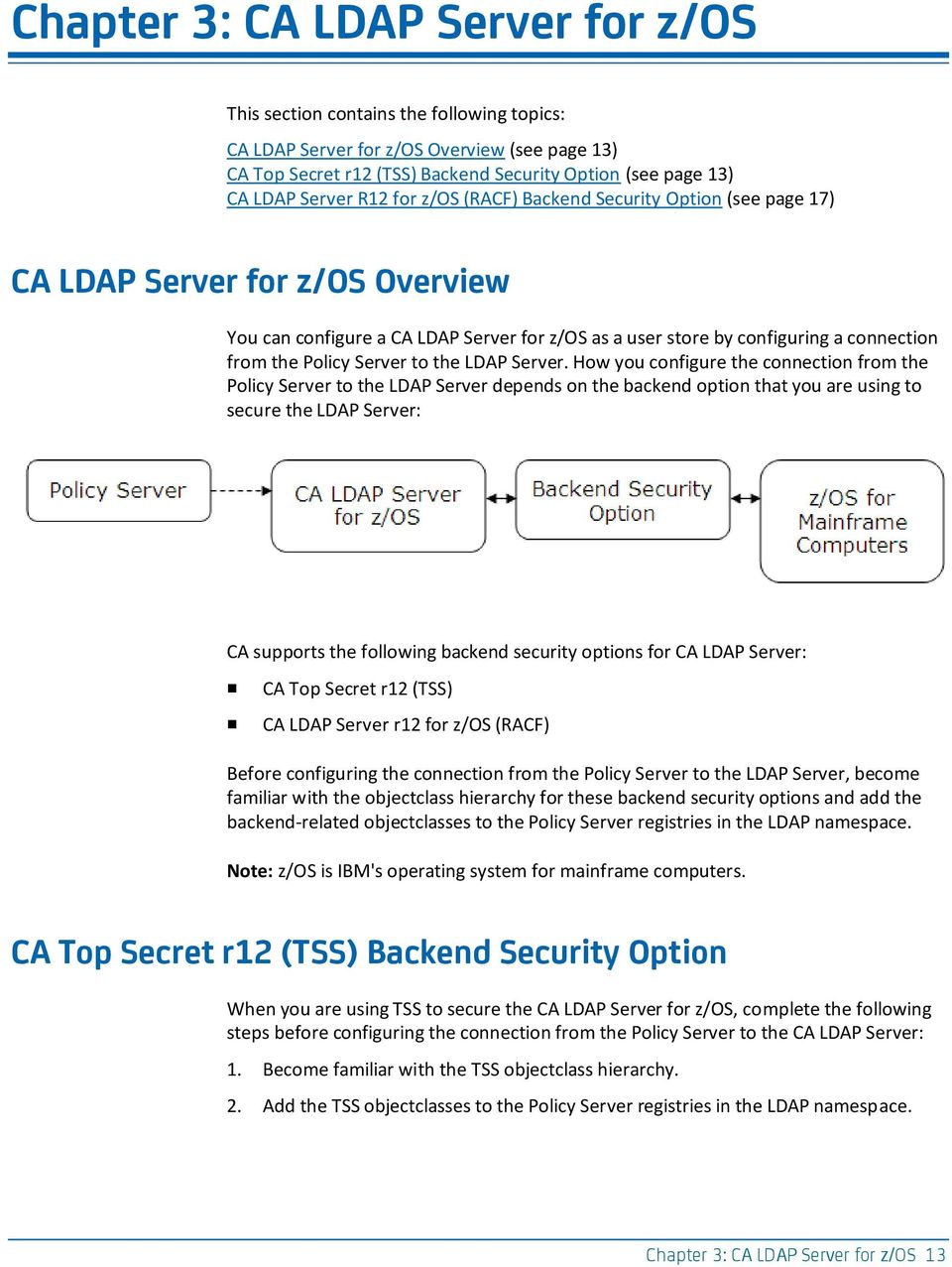
13 Chapter 3: CA LDAP Server for z/os This section contains the following topics: CA LDAP Server for z/os Overview (see page 13) CA Top Secret r12 (TSS) Backend Security Option (see page 13) CA LDAP Server R12 for z/os (RACF) Backend Security Option (see page 17) CA LDAP Server for z/os Overview You can configure a CA LDAP Server for z/os as a user store by configuring a connection from the Policy Server to the LDAP Server. How you configure the connection from the Policy Server to the LDAP Server depends on the backend option that you are using to secure the LDAP Server: CA supports the following backend security options for CA LDAP Server: CA Top Secret r12 (TSS) CA LDAP Server r12 for z/os (RACF) Before configuring the connection from the Policy Server to the LDAP Server, become familiar with the objectclass hierarchy for these backend security options and add the backend-related objectclasses to the Policy Server registries in the LDAP namespace. Note: z/os is IBM's operating system for mainframe computers. CA Top Secret r12 (TSS) Backend Security Option When you are using TSS to secure the CA LDAP Server for z/os, complete the following steps before configuring the connection from the Policy Server to the CA LDAP Server: 1. Become familiar with the TSS objectclass hierarchy. 2. Add the TSS objectclasses to the Policy Server registries in the LDAP namespace. Chapter 3: CA LDAP Server for z/os 13
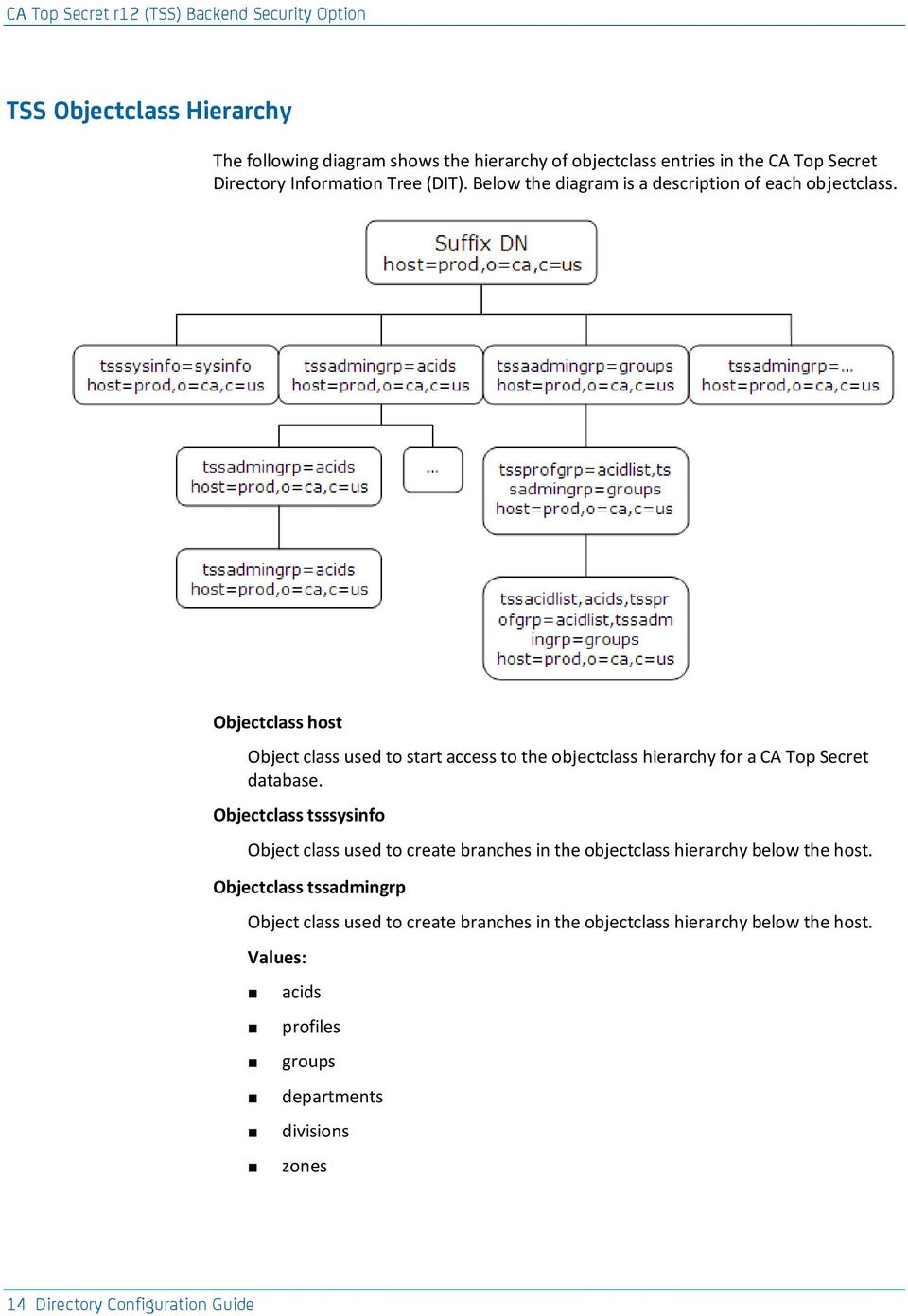
14 CA Top Secret r12 (TSS) Backend Security Option TSS Objectclass Hierarchy The following diagram shows the hierarchy of objectclass entries in the CA Top Secret Directory Information Tree (DIT). Below the diagram is a description of each objectclass. Objectclass host Object class used to start access to the objectclass hierarchy for a CA Top Secret database. Objectclass tsssysinfo Object class used to create branches in the objectclass hierarchy below the host. Objectclass tssadmingrp Object class used to create branches in the objectclass hierarchy below the host. Values: acids profiles groups departments divisions zones 14 Directory Configuration Guide
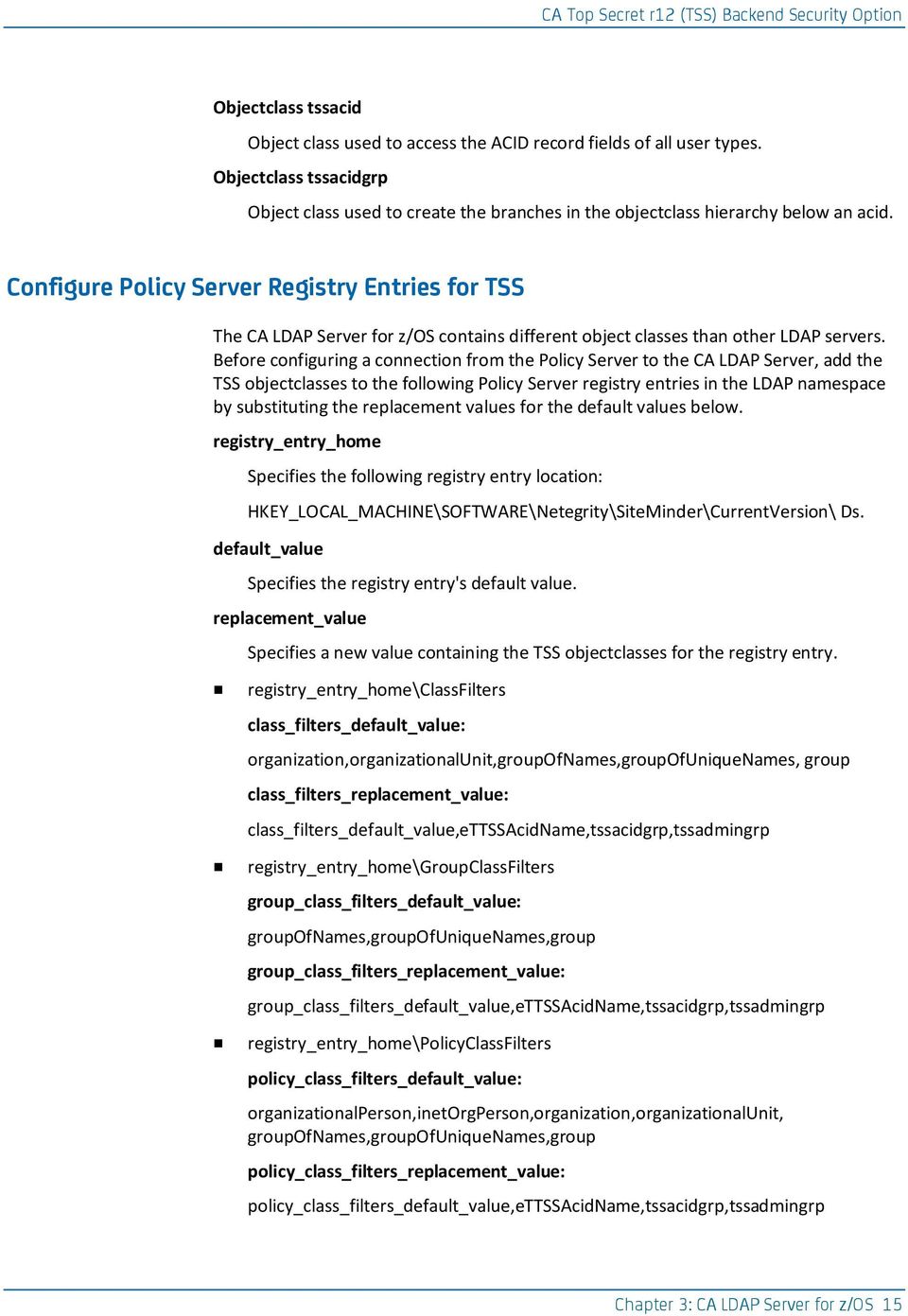
15 CA Top Secret r12 (TSS) Backend Security Option Objectclass tssacid Object class used to access the ACID record fields of all user types. Objectclass tssacidgrp Object class used to create the branches in the objectclass hierarchy below an acid. Configure Policy Server Registry Entries for TSS The CA LDAP Server for z/os contains different object classes than other LDAP servers. Before configuring a connection from the Policy Server to the CA LDAP Server, add the TSS objectclasses to the following Policy Server registry entries in the LDAP namespace by substituting the replacement values for the default values below. registry_entry_home Specifies the following registry entry location: HKEY_LOCAL_MACHINE\SOFTWARE\Netegrity\SiteMinder\CurrentVersion\ Ds. default_value Specifies the registry entry's default value. replacement_value Specifies a new value containing the TSS objectclasses for the registry entry. registry_entry_home\classfilters class_filters_default_value: organization,organizationalunit,groupofnames,groupofuniquenames, group class_filters_replacement_value: class_filters_default_value,ettssacidname,tssacidgrp,tssadmingrp registry_entry_home\groupclassfilters group_class_filters_default_value: groupofnames,groupofuniquenames,group group_class_filters_replacement_value: group_class_filters_default_value,ettssacidname,tssacidgrp,tssadmingrp registry_entry_home\policyclassfilters policy_class_filters_default_value: organizationalperson,inetorgperson,organization,organizationalunit, groupofnames,groupofuniquenames,group policy_class_filters_replacement_value: policy_class_filters_default_value,ettssacidname,tssacidgrp,tssadmingrp Chapter 3: CA LDAP Server for z/os 15
16 CA Top Secret r12 (TSS) Backend Security Option registry_entry_home\policyresolution Add the following TSS objectclasses to this registry entry: TSS Objectclass Registry Key Type Data ettssacidname REG_DWORD 0x (1) tssacidgrp REG_DWORD 0x (2) tssadmingrp REG_DWORD 0x (3) Configure a Connection from the Policy Server to CA LDAP Server for z/os To configure a connection from the Policy Server to the CA LDAP Server for z/os, create a new user directory object in the Policy Server User Interface. To configure a connection from the Policy Server to the CA LDAP Server 1. Click Infrastructure, Directory, User Directory, Create User Directory. The Create User Directory pane opens. Note: You can click Help for a description of fields, controls, and their respective requirements. 2. Type the name and a description of the new User Directory object in the fields on the General group box. 3. Select LDAP from the Namespace list, and type the IP address and port number in the Server field on the Directory Setup group box. Note: Load balancing and failover are not supported for this LDAP server. 4. Select the Require Credentials check box, type the full DN and password of the administrator in the fields on the Administrator Credentials group box, and specify whether the directory connection uses SSL. Note: This step is required, because TSS does not allow anonymous binds to the user store. 5. Type the values in the fields on the LDAP Search group box, specifying a value of 100 seconds in the Max Time field. Note: This value is required, because the Policy Server takes more time when retrieving data from this LDAP Server. 6. Type the values in the fields on the LDAP UserDN Lookup group box. 7. (Optional) Specify the user directory profile attributes that are reserved for SiteMinder's use in the fields on the User Attributes group box. 16 Directory Configuration Guide

17 CA LDAP Server R12 for z/os (RACF) Backend Security Option 8. (Optional) Click Create on the Attribute Mapping List group box. The Create Attribute Mapping pane opens. 9. Click Submit. The Create User Directory task is submitted for processing. SiteMinder Features Not Supported by CA LDAP Server for z/os CA LDAP Server for z/os does not support the following SiteMinder features: Anonymous Binds When configuring a CA Top Secret LDAP Server as a user store, you must provide values in the fields on the Administrator Credentials group box on the Create User Directory pane. Characters Not Supported in User Names The following characters are not supported in user names: space single quote opening parenthesis closing parenthesis comma backslash Load Balancing and Failover Load balancing and failover is not supported. Password Services Password Services is not supported. User Groups and Policies Adding a user group to a policy and attempting to authorize a user in that group fails. CA LDAP Server R12 for z/os (RACF) Backend Security Option This section describes the settings required to configure the CA LDAP Server R12 for z/os (RACF) as a user store with the Policy Server. Chapter 3: CA LDAP Server for z/os 17

18 CA LDAP Server R12 for z/os (RACF) Backend Security Option Configure Policy Server Registry Entries for RACF The CA LDAP Server R12 for z/os (RACF) contains a different set of objectclasses as compared to other LDAP servers. Before configuring a user directory connection from the Policy Server to the CA LDAP Server, add the RACF objectclasses to the following Policy Server registry entries in the LDAP namespace by substituting the replacement values for the default values below: registry_entry_home Specifies the following registry entry location: HKEY_LOCAL_MACHINE\SOFTWARE\Netegrity\SiteMinder\CurrentVersion\ Ds. default_value Specifies the registry entry's default value. replacement_value Specifies a new value containing the RACF objectclasses for the registry entry. registry_entry_home\classfilters class_filters_default_value: organization,organizationalunit,groupofnames,groupofuniquenames,group class_filters_replacement_value: class_filters_default_value,* registry_entry_home\groupclassfilters group_class_filters_default_value: groupofnames,groupofuniquenames,group group_class_filters_replacement_value: group_class_filters_default_value,* registry_entry_home\policyclassfilters policy_class_filters_default_value: organizationalperson,inetorgperson,organization,organizationalunit,groupofname s,groupofuniquenames,group policy_class_filters_replacement_value: policy_class_filters_default_value,* 18 Directory Configuration Guide

19 CA LDAP Server R12 for z/os (RACF) Backend Security Option registry_entry_home\policyresolution Add the following RACF objectclasses to this registry entry: RACT Objectclasses Registry Key Type Data etracuserid REG_DWORD 0x (1) etracadmingrp REG_DWORD 0x (2) Configure a Connection from the Policy Server to CA LDAP Server for z/os To configure a directory connection from the Policy Server to the CA LDAP Server for z/os, open an existing user directory object in the Policy Server User Interface. To configure a directory connection from the Policy Server to the CA LDAP Server 1. Open the User Directory Dialog. 2. In Directory Setup, select LDAP as the namespace. 3. Enter the connection information for your LDAP directory. Note: For more information, see the topic LDAP Namespace Directory Setup Tab in the CA SiteMinder Policy Design Reference Guide. Note: Failover is not supported for this LDAP Server. 4. In the LDAP Search box, in the Max Time field, specify a value of 300 seconds. Note: A greater timeout value is required, because the Policy Server takes more time to retrieve data from this LDAP Server. 5. In Credentials and Connection, specify administrator credentials that the Policy Server will use to connect to this LDAP Server and specify whether the connection to the directory will use SSL. Important! Specifying administrator credentials is mandatory as anonymous binds to the user store are not allowed with CA LDAP Server R12 for z/os (RACF). Chapter 3: CA LDAP Server for z/os 19

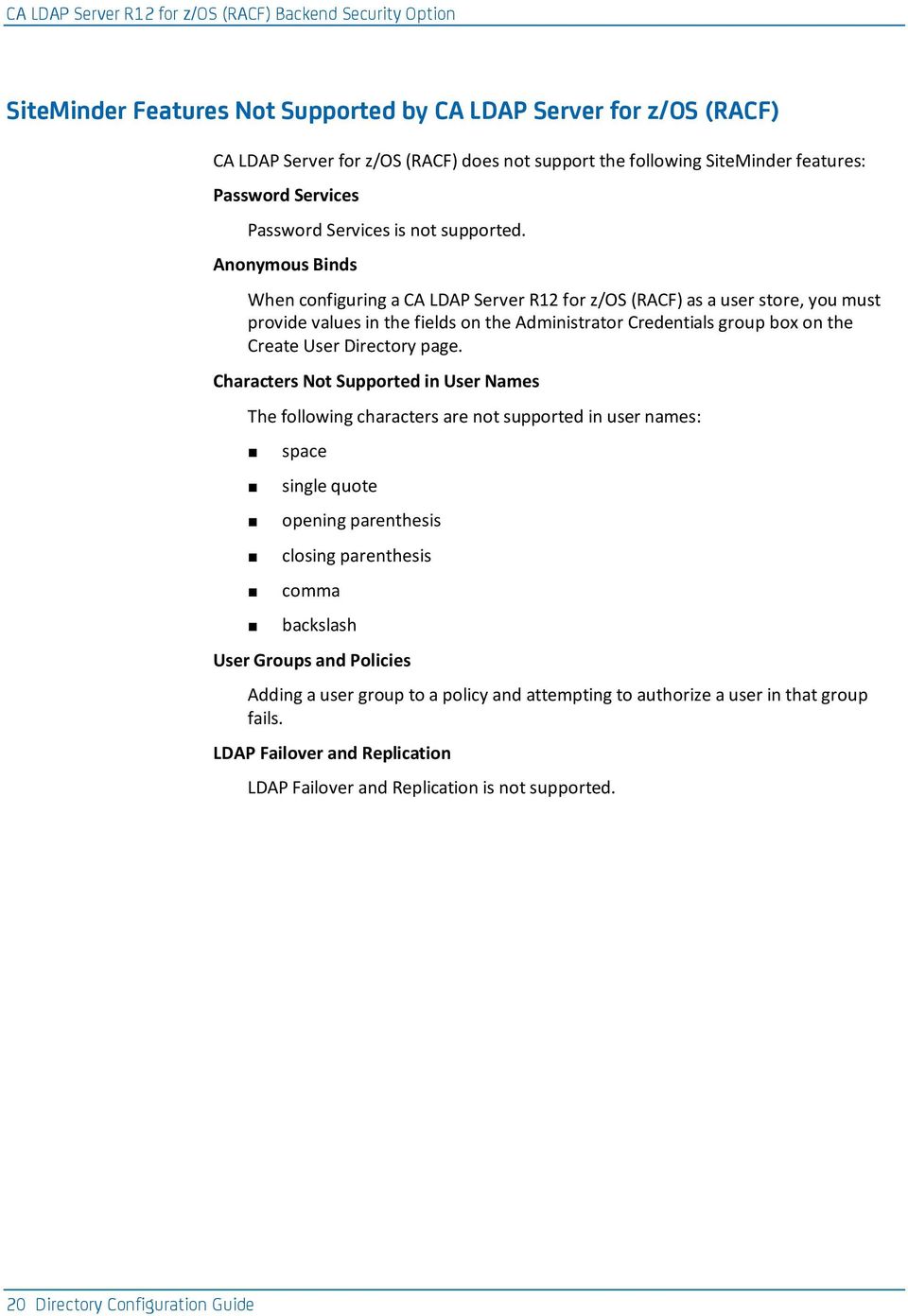
20 CA LDAP Server R12 for z/os (RACF) Backend Security Option SiteMinder Features Not Supported by CA LDAP Server for z/os (RACF) CA LDAP Server for z/os (RACF) does not support the following SiteMinder features: Password Services Password Services is not supported. Anonymous Binds When configuring a CA LDAP Server R12 for z/os (RACF) as a user store, you must provide values in the fields on the Administrator Credentials group box on the Create User Directory page. Characters Not Supported in User Names The following characters are not supported in user names: space single quote opening parenthesis closing parenthesis comma backslash User Groups and Policies Adding a user group to a policy and attempting to authorize a user in that group fails. LDAP Failover and Replication LDAP Failover and Replication is not supported. 20 Directory Configuration Guide
21 Chapter 4: Critical Path injoin Directory Server This section contains the following topics: Policy Store Schema Considerations (see page 21) Create a SiteMinder 5.5 or 6.0 Policy Store in InJoin Directory Server v4.2 (see page 22) Connect to an IDS Policy Store (see page 23) Enable LDAP Tracing in IDS (see page 23) Configure SSL (see page 24) Sample User Directory Settings--Critical Path InJoin Directory Server (see page 26) Sample Policy Server Settings--Critical Path InJoin Directory Server (see page 27) Upgrade a 5.5 Policy Store to a 6.0 Policy Store (see page 27) Policy Store Schema Considerations When manually configuring a policy store on Windows, you can choose one of two.smdif files: smpolicy.smdif smpolicy-secure.smdif While both files contain the default policy store objects that you import into the policy store, there are a couple of factors to consider when choosing the file that best fits the requirements of your production environment: While smpolicy.smdif can be used with the Policy Server Configuration Wizard to automatically configure a policy store, smpolicy-secure.smdif can only be used to manually configure a policy store. The file smpolicy-secure.smdif provides additional security through enhanced default web agent configuration parameters. The following table summarizes the differences between the default web agent configuration parameters in the two files: Parameter Name Value in smpolicy.smdif Value in smpolicy-secure.smdif BadCssChars No value <, >, ', ;, ), (, &, +, %00 BadQueryChars No value <, >, ', ;, ), (, &, +, %00 BadUrlChars //,./, /., /*, *., ~, \, %00-%1f, %7f-%ff, %25 smpolicy.smdif values plus: <, >, ', ;, ), (, &, + Chapter 4: Critical Path injoin Directory Server 21
22 Create a SiteMinder 5.5 or 6.0 Policy Store in InJoin Directory Server v4.2 IgnoreExt ValidTargetDomain.class,.gif,.jpg,.jpeg,.png,.fcc,.scc,.sfcc,.ccc,.ntc Note: This parameter does not exist in smpolicy.smdif. smpolicy.smdif values plus.jsp Provide a valid redirection domain as follows: validtargetdomain=".example.com" Note: Before using smpolicy-secure.smdif, you must initialize the new web agent configuration parameter: validtargetdomain. Important! Before running a SiteMinder utility or executable on Windows Server 2008, open the command line window with Administrator permissions. Open the command line window this way, even if your account has Administrator privileges. For more information, see the release notes for your SiteMinder component. Create a SiteMinder 5.5 or 6.0 Policy Store in InJoin Directory Server v4.2 Important! Before running a SiteMinder utility or executable on Windows Server 2008, open the command line window with Administrator permissions. Open the command line window this way, even if your account has Administrator privileges. For more information, see the release notes for your SiteMinder component. To create the required SiteMinder 5.5 or 6.0 policy store schema in InJoin Directory Server (IDS) 1. Start the DSA, using Critical Path's icon GUI. 2. Perform an LDAP modify, using the supplied IDS_Add_Schema_55.ldif or IDS_Add_Schema_60.ldif file. 6.0 example: ldapmodify -h <server_ip> -p <port_number> -D "cn=manager" -w <password> -c -f "IDS_Add_Schema_60.ldif" Note: ldapmodify requires version 4.2 of the Critical Path InJoin Directory Server. 3. Use the icon GUI to reload the schema or verify that the schema has been updated. 4. Go to dsa, comms, LDAP and modify the option "paging mode" to always. Restart the DSA. 22 Directory Configuration Guide
23 Connect to an IDS Policy Store 5. Manually create the root nodes (ou=policysvr4, ou=siteminder, ou=netegrity) via icon's DIT admin interface. 6. Import the base policy store data from the file smpolicy.smdif. Example: smobjimport -i<siteminder_installation>\db\smdif\smpolicy.smdif -v Note: When manually configuring a policy store on Windows, you can import one of the following: smpolicy.smdif smpolicy secure.smdif The file named smpolicy secure provides additional security through enhanced default Web Agent configuration parameters. Connect to an IDS Policy Store To connect to the IDS Policy Store, follow the instructions in the Policy Server Installation Guide. Enable LDAP Tracing in IDS To enable LDAP tracing in IDS 1. Stop the DSA. 2. Open the exec file located in the DSA directory (c:\ids\icon\dsa1) with a text editor. 3. Add the switch on the odsldap3 process. Example: 1r odsldap3 -ldap:1708 -ldaps: diag:5 -diag:n 0 is OFF; higher values give more output: 1=FATAL, 2=SEVERE, 3=ERROR, 4=WARNING,5=INFO, 6=ENTRY/EXIT 4. Start the DSA, using icon. The log file will be available within icon. 5. Select the DSA. 6. Select the comms option across the top menu. 7. Select the LDAP process. 8. Click on the file labeled odsldap3.out.000. Chapter 4: Critical Path injoin Directory Server 23
24 Configure SSL Configure SSL To configure SSL 1. Install the SSL version of IDS. The CD is entitled "InJoin Directory Server Secure Sockets Layer Option for Microsoft Windows NT." Note: Despite the name, Solaris support is included. To check on whether or not you have the SSL-enabled version installed: a. Go to the DSA directory (c:\ids\icon\dsa1). b. Run the command odsadmin. c. Bind to the directory by typing "bman", then the password. d. Type m_read_lkey. You should see the following, including "SSL enabled": admin>m_read_lkey read: read result: Entry information: Name: root Attribute type = licencekey Maximum number of entries: Demonstration expiry time: 06 August 2002 Instance: 8192 Options: Shadowing enabled Enterprise icon enabled SSL enabled Result = OK 2. Go to the SSL directory of ids (c:\ids\icon\dsa1\ssl). Create a file containing a random key (such as ds43jr58vndn3). The new file name is used in Step 3. (The example uses the name "random.") 24 Directory Configuration Guide
25 Configure SSL 3. Generate a CSR (Certificate Signing Request) file containing one line with a string made up of random characters and numbers. For example: "odscertreq -rnd random -str alg rsa -enc pem -prv pkfile.p8 -pass password -req test.req -dn cn=server.icarus.com" In this example: random is the name of the file that we created in Step 2. pkfile.p8 is the name of the file that will be generated containing the private key. password is the password. test.req is the name of the generated CSR file. server.icarus.com is the dn of the server. 4. Pass the text in test.req to a Certificate Authority to obtain a server certificate. The CA will generate the server certificate. Save this in a file (our example uses the name servercert.crt). 5. Obtain the root certificate from the CA in text format, and save it in a file (our example uses rootcert.crt). 6. Use the odscertconv command to create an identity file for the SSL/IDS configuration: odscertconv -certificate servercert.crt -certificate rootcert.crt -pkcs8 pkfile.p8 "password" topem -pkcs12 cert.p12 "firewall" servercert.crt Contains the server certificate generated by the CA rootcert.crt Contains the root certificate from the CA pkfile.p8 Represents the private key file password cert.p12 Represents the password Specifies the name of the identity file that will be generated by odscertconv 7. Using icon, go to the DSA, click on "Comms", then "LDAP", then "LDAP Security". 8. Enter an SLL port (636) and a name for the PKCS12 identity ("test"). Chapter 4: Critical Path injoin Directory Server 25
26 Sample User Directory Settings--Critical Path InJoin Directory Server 9. For the identity file name, enter the name of the identity file created in Step 7 ("cert.p12"). Also, enter the password ("password") used in the same step for the PKCS#12 Password field. 10. Click Apply, and restart the DSA. Sample User Directory Settings--Critical Path InJoin Directory Server The following are sample user directory settings: Directory Setup Namespace: LDAP Server: Root: o=companyname, c=us DN Lookup Start: (cn= DN Lookup End: ) Credentials and Connection Admin Username: cn=manager Admin Password: ******** User Attributes Universal ID (R): cn Disabled Flag (RW): description Password Attribute (RW): userpassword Password Data (RW): audio Challenge/Response (RW): jpegphoto Note: User attribute names in DMS are or are not case-sensitive on an attribute-by-attribute basis. 26 Directory Configuration Guide
27 Sample Policy Server Settings--Critical Path InJoin Directory Server Sample Policy Server Settings--Critical Path InJoin Directory Server The following are sample Policy Server settings: LDAP LDAP IP Address: Admin Username: cn=manager Admin Password: ******** Confirm Password: ******** Root DN: o=companyname, c=us Use Policy Store: [checked] Netscape Certificate Database File: pathname Upgrade a 5.5 Policy Store to a 6.0 Policy Store Note: This section is for users upgrading their policy store from 5.5 to 6.0 only. Important! Before running a SiteMinder utility or executable on Windows Server 2008, open the command line window with Administrator permissions. Open the command line window this way, even if your account has Administrator privileges. For more information, see the release notes for your SiteMinder component. To upgrade existing SiteMinder 5.5 policy store to SiteMinder 6.0 policy store schema in IDS 1. Stop the DSA that contains the 5.5 Policy Store. Go to dsa, comms, LDAP and modify the option "paging mode" to always. Restart the DSA. 2. On the DSA that contains the SiteMinder 5.5 policy store, perform an LDAP modify, using the supplied IDS_Upgrade_Schema_55TO60.ldif file. Example: ldapmodify -h <server_ip> -p <port_number> -D "cn=manager" -w <password> -c -f "IDS_Upgrade_Schema_55TO60.ldif" Note: ldapmodify requires version 4.2 of the Critical Path InJoin Directory Server. 3. Use the icon GUI to reload the schema or verify that the schema has been updated. Chapter 4: Critical Path injoin Directory Server 27
28 Upgrade a 5.5 Policy Store to a 6.0 Policy Store 4. Point the SiteMinder 6.0 Policy Server to the existing 5.5 policy store on which the schema was upgraded. 5. Import the base policy store data for upgrade from 5.5 to 6.0 from the file sm_upgrade_55_to_60.smdif. Example: smobjimport -i<siteminder_installation>\db\smdif\ sm_upgrade_55_to_60.smdif -v -f 28 Directory Configuration Guide
29 Chapter 5: Domino Directory Server This section contains the following topics: Connect to a Domino User Directory (see page 29) Connect to a Domino User Directory To connect to a Domino user directory 1. From the Policy Server user interface, click Edit > Create User Directory. The User Directory Properties dialog appears. 2. Enter values for the following fields in Directory Setup tab: Server Example: :389 Root Example: o=myorg Start Example: (cn= End Example: *) 3. Click Apply. The values are saved. 4. Click Credentials and Connections. The Credentials and Connections tab moves to the front. 5. Select Require Credentials, and enter the required values. Note: Select Secure Connection to configure SSL communication to the user store. 6. Click Apply. The values are saved. 7. Click the User Attributes tab. The User Attributes tab moves to the front. Chapter 5: Domino Directory Server 29
30 Connect to a Domino User Directory 8. Complete the user attribute values, and click Apply. The values are saved. 9. Click OK. The User Directory Properties dialog closes and the Policy Server is configured to use the Domino user directory. 30 Directory Configuration Guide
31 Chapter 6: IBM DB2 This section contains the following topics: How to Configure a Data Store in an IBM DB2 Database (see page 31) Upgrade the Session Server from 6.0 to 6.0 SP 5 (see page 35) How to Configure a Data Store in an IBM DB2 Database To configure a SiteMinder data store in an IBM DB2 Database 1. Create a DB2 Database with SiteMinder schema. 2. Configure the DB2 Data Source for SiteMinder. 3. Configure the policy, key, logging, or session stores. Note: More information about configuring data stores exists in the Policy Server Installation Guide. 4. Import default SiteMinder Objects into the policy store. Note: More information about importing default SiteMinder objects exists in the Policy Server Installation Guide. Step 1: Create a DB2 Database With SiteMinder Schema SiteMinder provides schema files to create schemas for storing policies, keys, logs, session data, and sample users. The following schema files are provided with this.zip file: sm_db2_ps.sql Creates the SiteMinder policy store or key store (if you are storing keys in a different database) in a DB2 database. Note: When configuring a DB2 database as a policy store, you must create a tablespace with the 32-KB page size and a system temporary tablespace with the 32-KB page size for the user associated with the database. sm_db2_logs.sql Creates the schema for SiteMinder audit logs in a DB2 database. sm_db2_ss.sql Creates the schema for the Session Server in a DB2 database. Chapter 6: IBM DB2 31
32 How to Configure a Data Store in an IBM DB2 Database smsampleusers_db2.sql (Optional) Creates the schema for SiteMinder sample users in a DB2 database and populates the database with sample users. For example, if you look in the script, you can see a sample user named GeorgeC with a password of siteminder. Create the database objects by running the appropriate SQL script using IBM DB2. To delete these database objects, refer to "Deleting SiteMinder Data in ODBC Databases" in the Policy Server Installation Guide. You can store SiteMinder data in a single DB2 database or run each script on its own to create a separate: policy store key store logging database session store sample users database Note: For information about running SQL scripts, refer to the DB2 database documentation. Step 2: Configure a DB2 Data Source for SiteMinder If you are using ODBC, you need to configure a data source for the DB2 wire protocol driver. Create a DB2 Data Source on Windows Systems When using ODBC, you can create a DB2 data source for the DB2 wire protocol driver. To create the DB2 data source 1. Select Programs, Administrative Tools, Data Sources (ODBC) to access the ODBC Data Source Administrator. 2. Click the System DSN tab and click Add. 3. Scroll down and select SiteMinder DB2 Wire Protocol and click Finish. 32 Directory Configuration Guide
33 How to Configure a Data Store in an IBM DB2 Database 4. In the ODBC DB2 Wire Protocol Driver Setup dialog, under the General tab, do the following: a. In the Data Source Name field, enter any name you want. Example: SiteMinder DB2 Wire Data Source b. (Optional) In the Description field, enter a description of the DB2 wire protocol data source. c. In the IP Address field, enter the IP Address where the DB2 database is installed. d. In the Tcp Port field, enter the port number where DB2 is listening on the machine. e. Click Test Connect. 5. Click OK. The connection is tested. Create a DB2 Data Source on UNIX Systems The ODBC DB2 Wire Protocol Driver Setup dialog closes, the selections are saved, and the DB2 data source is created on a Windows System. Note: You can now configure SiteMinder to use the data source that you created. The SiteMinder ODBC data sources are configured using a system_odbc.ini file, which you can create by renaming db2wire.ini, located in policy_server_home/db, to system_odbc.ini. This system_odbc.ini file contains all of the names of the available ODBC data sources as well as the attributes that are associated with these data sources. This file must be customized to work for each site. Also, you can add additional data sources to this file, such as defining additional ODBC user directories for SiteMinder. The first section of the system_odbc.ini file, [ODBC Data Sources], contains a list of all of the currently available data sources. The name before the = refers to a subsequent section of the file describing each individual data source. After the = is a comment field. Each data source has a section in the system_odbc.ini file describing its attributes. The first attribute is the ODBC driver to be loaded when this data source is used by SiteMinder. The remaining attributes are specific to the driver. Adding a DB2 Data source involves adding a new data source name in the [ODBC Data Sources] section of the file, and adding a section that describes the data source using the same name as the data source. You need to change the system_odbc.ini file if you create a new service name or want to use a different driver. You should have entries for the DB2 driver under [SiteMinder Data Source]. Chapter 6: IBM DB2 33
34 How to Configure a Data Store in an IBM DB2 Database Configure the DB2 Wire Protocol Driver Again, to configure a DB2 data source, you must first create a system_odbc.ini file in the policy_server_home/db directory. To do this, you need to rename db2wire.ini, located in policy_server_home/db, to system_odbc.ini. Note: policy_server_home specifies the Policy Server installation path. The following table contains configuration parameters for DB2 data sources. You can edit these parameters to configure data sources for separate key, audit log, session, and sample users databases. Parameter Description How to Edit Data Source Name Name of the data source. Enter the data source name inside the square brackets. Driver Full path to the SiteMinder DB2 Wire Protocol driver. Replace nete_ps_root with the SiteMinder installation directory. Description Description of the data source. Enter any desired description. Database Name of the DB2 UDB database. Replace nete_database with the name of the database configured on the DB2 UDB server. LogonID Password Username required for accessing the database. Password required for accessing the database. Replace uid with the username of the DB2 UDB administrator. Replace pwd with the password of the DB2 UDB administrator. IPAddress TcpPort Package IP address or hostname of the DB2 UDB server. TCP port number of the DB2 UDB server. The name of the package to process dynamic SQL. Replace nete_server_ip with the IP address or the hostname of the DB2 UDB server. Replace the default value of with the actual TCP port number of the DB2 UDB server. Replace nete_package with the name of the package you want to create. PackageOwner (Optional) The AuthID assigned to the package. Empty by default. This DB2 AuthID must have authority to execute all SQLs in the package. 34 Directory Configuration Guide
35 Upgrade the Session Server from 6.0 to 6.0 SP 5 GrantAuthid The AuthID granted execute privileges for the package. PUBLIC by default. Specify the desired AuthID if you wish to restrict the execute privileges for the package. GrantExecute IsolationLevel DynamicSections Specifies whether to grant execute privileges to the AuthID listed in GrantAuthid. The method by which locks are acquired and released by the system. The number of statements that the DB2 Wire Protocol driver package can prepare for a single user. Can be either 1 or 0. Set to 0 by default. CURSOR_STABILITY by default. 100 by default. Enter the desired number of statements. Next Steps More information about configuring policy, key, logging, and session stores and importing default SiteMinder objects in to the policy store exists in the Policy Server Installation Guide. Upgrade the Session Server from 6.0 to 6.0 SP 5 If you have a 6.x Session Server installed, you must upgrade it to leverage features that utilize it in 6.0 SP5. To upgrade the Session Server Import the the following.sql scheme script into the existing session store database. The script, located in <siteminder_installation>\db\sql, is: sm_db2_ss_upgrade_60_to_60sp5.sql Upgrades a session store in a DB2 database from 6.0 to 6.0 SP 5. This script adds a new Expiry Data table to the session store. Note: More information on importing a.sql script into a session store database exists in one of the following sections in the "Configure SiteMinder Data in a Relational Database" chapter in the 6.0 SP 5 Policy Server Installation Guide: "Step 1: Create an Oracle Database With SiteMinder Schema" "Step 1: Create a SQL Server Database With SiteMinder Schema" Chapter 6: IBM DB2 35
36
37 Chapter 7: MySQL Server This section contains the following topics: Configure a MySQL Policy Store (see page 37) Configure MySQL Data Stores (see page 48) How to Configure a MySQL User Store (see page 57) Configure a MySQL Policy Store A MySQL policy store can also function as: A key store An audit logging database Note: SiteMinder session information should be stored in a separate database. You should not use the policy store to store session information. Using a single database simplifies administration tasks. The following sections provide instruction on how to configure a single database server to store SiteMinder data. Gather Database Information Configuring a single MySQL Server database to function as a policy store or any other type of SiteMinder data store requires specific database information. Gather the following information before configuring the policy store or any other type of SiteMinder data store. Database host Identify the name of the database host system. Database name Identify the name of the database instance that is to function as the policy store or data store. Database port Identify the port on which the database is listening. Administrator account Identify the login ID of an administrator account that has permission to create, read, modify, and delete objects in the database. Administrator password Identify the password for the administrator account. More information: How to Store Key Information in MySQL (see page 48) How to Store Audit Logs in MySQL (see page 51) How to Store Session Information in MySQL (see page 54) Chapter 7: MySQL Server 37
38 Configure a MySQL Policy Store How to Configure the Policy Store Complete the following procedures to configure a MySQL Server database as a policy store. Note: Be sure that you have gathered the required database information before beginning. Some of the following procedures require this information. 1. Be sure that MySQL is installed using the default character set (Latin1). If MySQL was not installed using the default character set, reinstall MySQL before configuring the SiteMinder data store. 2. Be sure that the MySQL database that is to function as the policy store is accessible from the Policy Server host system. 3. Use the vendor specific user interface to create the database instance for the SiteMinder data store. 4. Download the SiteMinder schema files. 5. Create the SiteMinder schema. 6. Configure a MySQL data source for SiteMinder. (Windows) Create a MySQL data source. (UNIX) Create a MySQL data source on UNIX systems. (UNIX) Configure the MySQL wire protocol driver. 7. Point the Policy Server to the database. 8. Set the SiteMinder super user password. 9. Import the default SiteMinder objects. 10. Import the policy store data definitions. 11. Restart the Policy Server. Download the SiteMinder Schema Files 12. Prepare for the Policy Server User Interface registration. One or more of the schema files required to configure the SiteMinder schema are not included as part of the Policy Server installation. These files are located in the CA SiteMinder Tier 2 Directories product components download. To download the tier 2 directories product components 1. Log into the Technical Support site. 2. Under Support, click Download Center. The Download Center screen appears. 3. Type SiteMinder in the Select a Product field. 38 Directory Configuration Guide
39 Configure a MySQL Policy Store 4. Select a release from the Select a Release list. 5. Select a service pack from the Select a Gen Level list. 6. Click Go. Create the SiteMinder Schema The Product Downloads screen appears. The tier 2 directory components download is at the bottom of the list. 7. Save the zip file locally and extract the file to the Policy Server host system. You create the SiteMinder schema so that the MySQL database can store policy, key, and audit logging information. To create SiteMinder schema in a MySQL database 1. Navigate to path\mysql. path Specifies the path to the schema files extracted from the tier 2 directory zip. 2. Open the following file in a text editor: sm_mysql_ps.sql 3. Locate the following lines: DROP FUNCTION IF EXISTS `databasename`.`getdate` $$ CREATE FUNCTION `databasename`.`getdate` () RETURNS DATE 4. Replace each instance of 'databasename' with the name of the database functioning as the policy store. Example: If the name of the database is smpolicystore, the required update appears as follows: DROP FUNCTION IF EXISTS `smpolicystore`.`getdate` $$ CREATE FUNCTION `smpolicystore`.`getdate` () RETURNS DATE 5. Copy the contents of the entire file. 6. Paste the file contents into a query and execute the query. The policy and key store schema is created. Note: You can also use this schema file to create a stand alone key store. Chapter 7: MySQL Server 39
40 Configure a MySQL Policy Store 7. (Optional) If the policy store is to store audit logs: Note: You can use a separate database to function as this type of SiteMinder data store. a. Open the following file in a text editor: sm_mysql_logs.sql b. Locate the following lines: DROP FUNCTION IF EXISTS `databasename`.`getdate` $$ CREATE FUNCTION `databasename`.`getdate` () RETURNS DATE c. Replace each instance of 'databasename' with the name of the database functioning as the audit store. d. Copy the contents of the entire file. e. Paste the file contents into a query and execute the query. The audit store schema is created. 8. (Optional) If the policy store is to function as a SiteMinder sample user store: Note: You can use a separate database to function as this type of SiteMinder data store. a. Open the following file in a text editor: smsampleusers_mysql.sql b. Locate the following lines: DROP FUNCTION IF EXISTS `databasename`.`getdate` $$ CREATE FUNCTION `databasename`.`getdate` () RETURNS DATE c. Replace each instance of 'databasename' with the name of the database functioning as the SiteMinder sample user store. d. Copy the contents of the entire file. Configure a MySQL Data Source for SiteMinder e. Paste the file contents into a query and execute the query. The SiteMinder sample user store schema is created. You configure a data source to let the Policy Server communicate with the SiteMinder data store. More information: How to Store Key Information in MySQL (see page 48) How to Store Audit Logs in MySQL (see page 51) How to Store Session Information in MySQL (see page 54) How to Configure a MySQL User Store (see page 57) 40 Directory Configuration Guide
41 Configure a MySQL Policy Store Create a MySQL Data Source on Windows You create a MySQL data source for the MySQL wire protocol driver. To create the MySQL data source 1. Log into the Policy Server host system. 2. Open the ODBC Data Source Administrator. 3. Click System DSN. System Data Sources lists all available data sources. 4. Click Add. The Create New Data Source dialog appears. 5. Scroll down and select SiteMinder MySQL Wire Protocol and click Finish. The ODBC MySQL Wire Protocol Driver Setup dialog appears. 6. Do the following in the General tab: a. Enter a data source name in the Data Source Name field. Example: SiteMinder MySQL Wire Data Source b. Enter the name of the MySQL database host system in the Host Name field. c. Enter the port on which the MySQL database is listening in the Port Number field. d. Enter the name of the MySQL database in the Database Name field. 7. Click Test Connect. The connection settings are tested. If the settings are valid, a prompt states that the connection is successful. 8. Click OK. The data source is created and appears in the System Data Sources list. Note: You can now point the Policy Server to the SiteMinder data store. Create a MySQL Data Source on UNIX Systems The SiteMinder ODBC data sources are configured using a system_odbc.ini file, which you create by renaming mysqlwire.ini to system_odbc.ini. The mysqlwire.ini file is located in siteminder_home/db. siteminder_home Specifies the Policy Server installation path. Chapter 7: MySQL Server 41
42 Configure a MySQL Policy Store Create the MySQL Wire Protocol Driver This system_odbc.ini file contains all of the names of the available ODBC data sources and the attributes that are associated with these data sources. This file must be customized to work for each site. Also, you can add additional data sources to this file, such as defining additional ODBC user directories for SiteMinder. The first section of the system_odbc.ini file, [ODBC Data Sources], contains a list of all of the currently available data sources. The name before the = refers to a subsequent section of the file describing each individual data source. After the = is a comment field. Note: If you modify of the first line of data source entry, which is [SiteMinder Data Source], take note of the value. The value is required when you configure the database as a policy store. Each data source has a section in the system_odbc.ini file describing its attributes. The first attribute is the ODBC driver that is loaded when SiteMinder uses this data source. The remaining attributes are specific to the driver. Adding a MySQL Server Data source involves: Adding a new data source name in the [ODBC Data Sources] section of the file. Adding a section that describes the data source using the same name as the data source. If you create a new service name or want to use a different driver, update the system_odbc.ini file. You should have entries for the MySQL driver under [SiteMinder Data Source]. Again, to configure a MySQL Server data source, you create the system_odbc.ini file by renaming mysqlwire.ini to system_odbc.ini. You configure the wire protocol driver to specify the settings SiteMinder uses to connect to the database. Note: This procedure only applies if the Policy Server is installed on a UNIX system. If you have not already done so, copy one of the following files and rename it system_odbc.ini. The file you rename depends on the database vendor you are configuring as a SiteMinder data store. sqlserverwire.ini oraclewire.ini mysqlwire.ini These files are located in siteminder_home/db 42 Directory Configuration Guide
43 Configure a MySQL Policy Store The system_odbc.ini file contains the following sections. The data source that you are configuring determine the section or sections that you edit: [SiteMinder Data Source] Specifies the settings SiteMinder should use to connect to the database functioning as the policy store. [SiteMinder Logs Data Source] Specifies the settings SiteMinder should use to connect to the database functioning as the audit log database. [SiteMinder Keys Data Source] Specifies the settings SiteMinder should use to connect to the database functioning as the key store. [SiteMinder Session Data Source] Specifies the settings SiteMinder should use to connect to the database functioning as the session store. [SmSampleUsers Data Source] Specifies the settings SiteMinder should use to connect to the database functioning as the sample user data store. To configure the wire protocol driver 1. Open the system_odbc.ini file. 2. Enter the following under [ODBC Data Sources]: SiteMinder Data Source=DataDirect 6.0 MySQL Wire Protocol. 3. Depending on the data source you are configuring, edit the one or more of the data source sections with the following information: Driver=nete_ps_root/odbc/lib/NSmysql24.so Description=DataDirect 6.0 MySQL Wire Protocol Database=database_name HostName=host_name LogonID=root_user Password=root_user_password PortNumber=mysql_port Note: When editing data source information, do not use the pound sign (#). Entering a pound sign comments the information, which truncates the value. The truncated value can cause ODBC connections to fail. Chapter 7: MySQL Server 43
44 Configure a MySQL Policy Store nete_ps_root Specifies the Policy Server installation path. Enter this value as an explicit path, rather than one with an environment variable. Example: /export/smuser/siteminder database_name Specifies the name of the MySQL database that is to function as the SiteMinder data store. host_name Specifies the name of the MySQL database host system. root_user Specifies the login ID of the MySQL root user. root_user_password Specifies the password for the MySQL root user. mysql_port 4. Save the file. Point the Policy Server to the Database Specifies the port on which the MySQL database is listening. The wire protocol driver is configured. You point the Policy Server to the database so the Policy Server can access the SiteMinder data in the policy store. To point the Policy Server to the data store 1. Open the Policy Server Management Console, and click the Data tab. Database settings appear. 2. Select ODBC from the Storage list. ODBC settings appear. 3. Select Policy Store from the Database list. 4. Enter the name of the data source in the Data Source Information field. (Windows) this entry must match the name you entered in the Data Source Name field when you created the data source. (UNIX) this entry must match the first line of the data source entry in the system_odbc.ini file. By default, the first line in the file is [SiteMinder Data Sources]. If you modified the first entry, be sure that you enter the correct value. 44 Directory Configuration Guide
45 Configure a MySQL Policy Store 5. Enter and confirm the user name and password of the database account that has full access rights to the database instance in the respective fields. 6. Specify the maximum number of database connections allocated to SiteMinder. Note: We recommend retaining the 25 connection default for best performance. 7. Click Apply. The settings are saved. 8. Select Key Store from the Database list. Data source information appears. 9. Select the Use the policy store database check box and click Apply. 10. Select Audit Logs from the Database list. Data source settings appear. 11. Select the Use the policy store database check box and click Apply. 12. Click Test Connection. SiteMinder returns a confirmation that the Policy Server can access the data store. 13. Click OK. Set the SiteMinder Super User Password The Policy Server is configured to use the database as a policy store, key store, and logging database. The default SiteMinder administrator account is named siteminder. This account has maximum permissions. Set the password for this account so it can be used to manage the SiteMinder user interfaces and utilities until additional SiteMinder administrators can be created. Note: The smreg utility is located at the top level of the Policy Server installation kit. To set the super user password 1. Copy the smreg utility to policy_server_home\bin. policy_server_home Specifies the Policy Server installation path. 2. Run the following command: smreg -su password password Specifies the password for the default SiteMinder administrator. Chapter 7: MySQL Server 45
46 Configure a MySQL Policy Store Limits: The password must contain at least six (6) characters and cannot exceed 24 characters. The password cannot include an ampersand (&) or an asterisk (*). If the password contains a space, enclose the passphrase with quotation marks. Note: The password is not case sensitive, except when the password is stored in an Oracle policy store. 3. Delete the smreg utility from policy_server_home\bin. Deleting smreg prevents someone from changing the password without knowing the previous one. The password for the default SiteMinder administrator account is set. Note: We recommend that you do not use the default super user for day to day operations. Use the default super user to: Import the default policy store objects. Access the Policy Server User Interface for the first time. You can use the default super user to create an administrator with super user permissions. Import the Default Policy Store Objects Importing the default policy store objects sets up the policy store for use with the Policy Server User Interface. The default policy store objects are required to store policy information in the policy store. Note: If you have installed the Policy Server in FIPS-only mode, ensure you use the -cf argument when importing the default policy store objects. To import the default policy store objects, run the following command smobjimport -ipolicy_server_home\db\smdif\smpolicy.smdif -dsiteminder_super_user_name -wsiteminder_super_user_password -v Note: If the argument contains spaces, use double quotes around the entire argument. Windows example: smobjimport -i"c:\program Files\CA\siteminder\db\smdif\smpolicy.smdif" -d"sm Admin" -wpassword -v UNIX example: smobjimport -i$nete_ps_root/db/smdif/smpolicy.smdif -d"sm Admin" -wpassword -v policy_server_home Specifies the Policy Server installation path. 46 Directory Configuration Guide
47 Configure a MySQL Policy Store -dsiteminder_super_user_name Specifies the name of the SiteMinder super user account. Default: siteminder -wsiteminder_super_user_password -v Restart the Policy Server Specifies the password for the SiteMinder super user account. Turns on tracing and outputs error, warning, and comment messages in verbose format so that you can monitor the status of the import. Default value: stdout smobjimport imports the policy store objects. The objects are automatically imported to the appropriate locations. You restart the Policy Server for the policy store or other data store settings to take effect. Note: UNIX systems can use the stop-all followed by the start-all commands to restart the Policy Server. To restart the Policy Server 1. Open the Policy Server Management Console. 2. Click the Status tab, and click Stop in the Policy Server group box. The Policy Server stops as indicated by the red stoplight. 3. Click Start. The Policy Server starts as indicated by the green stoplight. Chapter 7: MySQL Server 47
48 Configure MySQL Data Stores Configure MySQL Data Stores SiteMinder keys and SiteMinder audit information can each be stored in a separate database. Consider the following: Storing keys in a separate database may be required to implement single sign on functionality. For more information about key management, see the Policy Server Administration Guide. SiteMinder session information must be stored in a separate database. You cannot use the policy store to store session information. The following sections detail how to configure individual data stores. How to Store Key Information in MySQL Complete the following procedures to configure MySQL as a standalone key store: 1. Be sure that MySQL is installed using the default character set (Latin1). If MySQL was not installed using the default character set, reinstall MySQL before configuring the SiteMinder data store. 2. Download the SiteMinder schema files. 3. Gather database information. 4. Create the key store schema. 5. Configure a MySQL data source for SiteMinder. 6. Point the Policy Server to the database. 7. Restart the Policy Server. More information: Gather Database Information (see page 37) Configure a MySQL Data Source for SiteMinder (see page 40) 48 Directory Configuration Guide
49 Configure MySQL Data Stores Download the SiteMinder Schema Files One or more of the schema files required to configure the SiteMinder schema are not included as part of the Policy Server installation. These files are located in the CA SiteMinder Tier 2 Directories product components download. To download the tier 2 directories product components 1. Log into the Technical Support site. 2. Under Support, click Download Center. The Download Center screen appears. 3. Type SiteMinder in the Select a Product field. 4. Select a release from the Select a Release list. 5. Select a service pack from the Select a Gen Level list. 6. Click Go. Create the Key Store Schema The Product Downloads screen appears. The tier 2 directory components download is at the bottom of the list. 7. Save the zip file locally and extract the file to the Policy Server host system. You create the key store schema so the MySQL database can store key information. To create the key store schema 1. Navigate to path\mysql. path Specifies the path to the schema files extracted from the tier 2 directory zip. 2. Open the following file in a text editor: sm_mysql_ps.sql 3. Locate the following lines: DROP FUNCTION IF EXISTS `databasename`.`getdate` $$ CREATE FUNCTION `databasename`.`getdate` () RETURNS DATE 4. Replace each instance of 'databasename' with the name of the database functioning as the key store. Example: If the name of the database is smkeystore, the required update appears as follows: DROP FUNCTION IF EXISTS `smkeystore`.`getdate` $$ CREATE FUNCTION `smkeystore`.`getdate` () RETURNS DATE 5. Copy the contents of the entire file. Chapter 7: MySQL Server 49
50 Configure MySQL Data Stores Point the Policy Server to Database 6. Paste the file contents into a query and execute the query. The key store schema is created. You point the Policy Server to the database so the Policy Server can read and store key information. To point the Policy Server to the data store 1. Open the Policy Server Management Console, and click the Data tab. Database settings appear. 2. Select ODBC from the Storage list. ODBC settings appear. 3. Select Key Store from the Database list and clear the Use Policy Store database check box. Data source settings become active. 4. Enter the name of the data source in the Data Source Information field. (Windows) this entry must match the name you entered in the Data Source Name field when you created the data source. (UNIX) this entry must match the first line of the data source entry in the system_odbc.ini file. By default, the first line in the file is [SiteMinder Data Sources]. If you modified the first entry, be sure that you enter the correct value. 5. Enter and confirm the user name and password of the database account that has full access rights to the database instance in the respective fields. 6. Specify the maximum number of database connections allocated to SiteMinder. Note: We recommend retaining the default for best performance. 7. Click Apply. The settings are saved. 8. Click Test Connection. SiteMinder returns a confirmation that the Policy Server can access the data store. 9. Click OK. The Policy Server is configured to use the database as a key store 50 Directory Configuration Guide
51 Configure MySQL Data Stores Restart the Policy Server You restart the Policy Server for the policy store or other data store settings to take effect. Note: UNIX systems can use the stop-all followed by the start-all commands to restart the Policy Server. To restart the Policy Server 1. Open the Policy Server Management Console. 2. Click the Status tab, and click Stop in the Policy Server group box. The Policy Server stops as indicated by the red stoplight. 3. Click Start. The Policy Server starts as indicated by the green stoplight. How to Store Audit Logs in MySQL Complete the following procedures to configure MySQL as a standalone audit log store: 1. Be sure that MySQL is installed using the default character set (Latin1). If MySQL was not installed using the default character set, reinstall MySQL before configuring the SiteMinder data store. 2. Download the SiteMinder schema files. 3. Gather database information. 4. Create the audit log schema. 5. Configure a MySQL data source for SiteMinder. 6. Point the Policy Server to the database. 7. Restart the Policy Server. More information: Gather Database Information (see page 37) Configure a MySQL Data Source for SiteMinder (see page 40) Chapter 7: MySQL Server 51
52 Configure MySQL Data Stores Download the SiteMinder Schema Files One or more of the schema files required to configure the SiteMinder schema are not included as part of the Policy Server installation. These files are located in the CA SiteMinder Tier 2 Directories product components download. To download the tier 2 directories product components 1. Log into the Technical Support site. 2. Under Support, click Download Center. The Download Center screen appears. 3. Type SiteMinder in the Select a Product field. 4. Select a release from the Select a Release list. 5. Select a service pack from the Select a Gen Level list. 6. Click Go. Create the Audit Log Schema The Product Downloads screen appears. The tier 2 directory components download is at the bottom of the list. 7. Save the zip file locally and extract the file to the Policy Server host system. You create the audit log schema so the MySQL database can store audit logs. To create the audit log schema 1. Navigate to path\mysql. path Specifies the path to the schema files extracted from the tier 2 directory zip. 2. Open the following file in a text editor: sm_mysql_logs.sql 3. Locate the following lines: DROP FUNCTION IF EXISTS `databasename`.`getdate` $$ CREATE FUNCTION `databasename`.`getdate` () RETURNS DATE 4. Replace each instance of 'databasename' with the name of the database functioning as the audit store. Example: If the name of the database is smauditstore, the required update appears as follows: DROP FUNCTION IF EXISTS `smauditstore`.`getdate` $$ CREATE FUNCTION `smauditstore`.`getdate` () RETURNS DATE 52 Directory Configuration Guide
53 Configure MySQL Data Stores 5. Copy the contents of the entire file. Point the Policy Server to the Database 6. Paste the file contents into a query and execute the query. The audit store schema is created. You point the Policy Server to the database so the Policy Server can read and store audit logs. To point the Policy Server to the data store 1. Open the Policy Server Management Console, and click the Data tab. Database settings appear. 2. Select ODBC from the Storage list. ODBC settings appear. 3. Select Audit Logs from the Database list. 4. Select ODBC from the Storage list. Data source settings become active. 5. Enter the name of the data source in the Data Source Information field. (Windows) this entry must match the name you entered in the Data Source Name field when you created the data source. (UNIX) this entry must match the first line of the data source entry in the system_odbc.ini file. By default, the first line in the file is [SiteMinder Data Sources]. If you modified the first entry, be sure that you enter the correct value. 6. Enter and confirm the user name and password of the database account that has full access rights to the database instance in the respective fields. 7. Specify the maximum number of database connections allocated to SiteMinder. Note: We recommend retaining the default for best performance. 8. Click Apply. The settings are saved. 9. Click Test Connection. SiteMinder returns a confirmation that the Policy Server can access the data store. 10. Click OK. The Policy Server is configured to use the database as an audit logging database. Chapter 7: MySQL Server 53
54 Configure MySQL Data Stores Restart the Policy Server You restart the Policy Server for the policy store or other data store settings to take effect. Note: UNIX systems can use the stop-all followed by the start-all commands to restart the Policy Server. To restart the Policy Server 1. Open the Policy Server Management Console. 2. Click the Status tab, and click Stop in the Policy Server group box. The Policy Server stops as indicated by the red stoplight. 3. Click Start. The Policy Server starts as indicated by the green stoplight. How to Store Session Information in MySQL Complete the following procedures to configure MySQL as a standalone session store: 1. Be sure that MySQL is installed using the default character set (Latin1). If MySQL was not installed using the default character set, reinstall MySQL before configuring the SiteMinder data store. 2. Download the SiteMinder schema files. 3. Gather database information. 4. Create the session store schema. 5. Configure a MySQL data source for SiteMinder. 6. Point the Policy Server to the database. 7. Restart the Policy Server. More information: Gather Database Information (see page 37) Configure a MySQL Data Source for SiteMinder (see page 40) 54 Directory Configuration Guide
55 Configure MySQL Data Stores Download the SiteMinder Schema Files One or more of the schema files required to configure the SiteMinder schema are not included as part of the Policy Server installation. These files are located in the CA SiteMinder Tier 2 Directories product components download. To download the tier 2 directories product components 1. Log into the Technical Support site. 2. Under Support, click Download Center. The Download Center screen appears. 3. Type SiteMinder in the Select a Product field. 4. Select a release from the Select a Release list. 5. Select a service pack from the Select a Gen Level list. 6. Click Go. Create the Session Store Schema The Product Downloads screen appears. The tier 2 directory components download is at the bottom of the list. 7. Save the zip file locally and extract the file to the Policy Server host system. You create the session store schema so the MySQL database can store session information. To create the session store schema 1. Navigate to path\mysql. path Specifies the path to the schema files extracted from the tier 2 directory zip. 2. Open the following file in a text editor: sm_mysql_ss.sql 3. Locate the following lines: DROP FUNCTION IF EXISTS `databasename`.`getdate` $$ CREATE FUNCTION `databasename`.`getdate` () RETURNS DATE 4. Replace each instance of 'databasename' with the name of the database functioning as the session store. Example: If the name of the database is smsessionstore, the required update appears as follows: DROP FUNCTION IF EXISTS `smsessionstore`.`getdate` $$ CREATE FUNCTION `smsessionstore`.`getdate` () RETURNS DATE Chapter 7: MySQL Server 55
56 Configure MySQL Data Stores 5. Copy the contents of the entire file. Point the Policy Server to the Database Restart the Policy Server 6. Paste the file contents into a query and execute the query. The session store schema is created. You point the Policy Server to the database so the Policy Server can read and store session information. To point the Policy Server to the data store 1. Open the Policy Server Management Console, and click the Data tab. Database settings appear. 2. Select Session Server from the Database list. Data source settings become active. 3. Enter the name of the data source in the Data Source Information field. (Windows) this entry must match the name you entered in the Data Source Name field when you created the data source. (UNIX) this entry must match the first line of the data source entry in the system_odbc.ini file. By default, the first line in the file is [SiteMinder Data Sources]. If you modified the first entry, be sure that you enter the correct value. 4. Enter and confirm the user name and password of the database account that has full access rights to the database instance in the respective fields. 5. Specify the maximum number of database connections allocated to SiteMinder. Note: We recommend retaining the default for best performance. 6. Click Apply. The settings are saved. 7. Click Test Connection. SiteMinder returns a confirmation that the Policy Server can access the data store. 8. Click OK. The Policy Server is configured to use the database as a session store. You restart the Policy Server for the policy store or other data store settings to take effect. Note: UNIX systems can use the stop-all followed by the start-all commands to restart the Policy Server. 56 Directory Configuration Guide
57 How to Configure a MySQL User Store To restart the Policy Server 1. Open the Policy Server Management Console. 2. Click the Status tab, and click Stop in the Policy Server group box. The Policy Server stops as indicated by the red stoplight. 3. Click Start. The Policy Server starts as indicated by the green stoplight. How to Configure a MySQL User Store Complete the following procedures to configure MySQL as a user store: 1. (Optional) Import the SiteMinder sample users. 2. Create a MySQL data source for SiteMinder 3. Configure the user directory connection. More information: Configure a MySQL Data Source for SiteMinder (see page 40) Import the SiteMinder Sample Users Importing the SiteMinder sample users is optional. You import these users to populate the database with fictional SiteMinder users. To import the SiteMinder sample users 1. Navigate to path\mysql. path Specifies the path to the schema files extracted from the tier 2 directory zip. 2. Open the following file in a text editor: smsampleusers_mysql.sql 3. Locate the following lines: DROP FUNCTION IF EXISTS `databasename`.`getdate` $$ CREATE FUNCTION `databasename`.`getdate` () RETURNS DATE Chapter 7: MySQL Server 57
58 How to Configure a MySQL User Store 4. Replace each instance of 'databasename' with the name of the database functioning as the sample user store. Example: If the name of the database is smsampleuserstore, the required update appears as follows: DROP FUNCTION IF EXISTS `smsampleuserstore`.`getdate` $$ CREATE FUNCTION `smsampleuserstore`.`getdate` () RETURNS DATE 5. Copy the contents of the entire file. 6. Paste the file contents into a query and execute the query. Note: For more information about executing a query, see the MySQL documentation. The user store is populated with the sample users. 7. Configure the user directory connection to the Policy Server. Configure MySQL Server Directory Connections You configure a user directory connection to let the Policy Server communicate with a MySQL Server user store. To connect the user store 1. Click Edit, System Configuration, Create User Directory. The User Directories Properties dialog appears with the Directory Setup tab open. 2. Complete the following: Enter the user directory name in Name field. Select ODBC from the NameSpace list. Enter the data source name in the Data Source field. Select a SQL query scheme from the SQL Query Scheme list. Note: If you have not created a SQL query scheme, click New. More information on creating SQL query schemes exists in the Policy Design Guide. 3. Click the Credentials and Connection tab. The Credentials and Connection tab opens. 4. Complete the following: a. Select Require Credentials. b. Type root in the Username field. c. Enter the administrator password in the Password and Confirm Password fields. 58 Directory Configuration Guide
59 How to Configure a MySQL User Store 5. Click the User Attributes tab. The User Attributes tab opens. 6. Specify the database attribute record attributes that correspond to the following fields: 7. Click OK. Universal ID (R) Example: Name Disabled Flag (RW) Example: Disabled Password Attribute (RW) Example: Password Password Data (RW) Example: PasswordData SiteMinder saves the user directory settings, and the user directory appears in the User Directory List. Chapter 7: MySQL Server 59
60
61 Chapter 8: Oracle Internet Directory Server This section contains the following topics: Policy Store Schema Considerations (see page 61) Create a SiteMinder 5.5 or 6.0 Policy Store in Oracle Internet Directory (OID) Directory Server (see page 62) Connect to an OID User Directory (see page 64) SiteMinder SSL Configuration for OID (see page 65) Policy Store Schema Considerations When manually configuring a policy store on Windows, you can choose one of two.smdif files: smpolicy.smdif smpolicy-secure.smdif While both files contain the default policy store objects that you import into the policy store, there are a couple of factors to consider when choosing the file that best fits the requirements of your production environment: While smpolicy.smdif can be used with the Policy Server Configuration Wizard to automatically configure a policy store, smpolicy-secure.smdif can only be used to manually configure a policy store. The file smpolicy-secure.smdif provides additional security through enhanced default web agent configuration parameters. The following table summarizes the differences between the default web agent configuration parameters in the two files: Parameter Name Value in smpolicy.smdif Value in smpolicy-secure.smdif BadCssChars No value <, >, ', ;, ), (, &, +, %00 BadQueryChars No value <, >, ', ;, ), (, &, +, %00 BadUrlChars IgnoreExt ValidTargetDomain //,./, /., /*, *., ~, \, %00-%1f, %7f-%ff, %25.class,.gif,.jpg,.jpeg,.png,.fcc,.scc,.sfcc,.ccc,.ntc Note: This parameter does not exist in smpolicy.smdif. smpolicy.smdif values plus: <, >, ', ;, ), (, &, + smpolicy.smdif values plus.jsp Provide a valid redirection domain as follows: validtargetdomain=".example.com" Chapter 8: Oracle Internet Directory Server 61
62 Create a SiteMinder 5.5 or 6.0 Policy Store in Oracle Internet Directory (OID) Directory Server Note: Before using smpolicy-secure.smdif, you must initialize the new web agent configuration parameter: validtargetdomain. Important! Before running a SiteMinder utility or executable on Windows Server 2008, open the command line window with Administrator permissions. Open the command line window this way, even if your account has Administrator privileges. For more information, see the release notes for your SiteMinder component. Create a SiteMinder 5.5 or 6.0 Policy Store in Oracle Internet Directory (OID) Directory Server Important! Before running a SiteMinder utility or executable on Windows Server 2008, open the command line window with Administrator permissions. Open the command line window this way, even if your account has Administrator privileges. For more information, see the release notes for your SiteMinder component. To create the required SiteMinder 5.5 or 6.0 policy store schema in OID Directory Server 1. Create a domain in OID using the ODM by right-clicking Entry Management and selecting Create. 2. In the Distinguished Name dialog: a. Click Add. b. Select the domain. 3. Enter: a. dc=dcbok for the Distinguished Name value. b. dc for the dc value. 4. Do the following: a. Create an organizational unit. b. Select the organizational unit. c. Enter ou=bok,dc=dcbok for Distinguished Name value and bok for the ou value. 5. Point the Policy Server at the OID Directory Server that you plan to use as a policy store by following the instructions in the Policy Server Installation Guide. The following are sample values you can enter on the Data tab of the 6.0 Policy Server Management Console. You can use similar values for 5.5: Database Policy Store 62 Directory Configuration Guide
63 Create a SiteMinder 5.5 or 6.0 Policy Store in Oracle Internet Directory (OID) Directory Server Storage LDAP LDAP IP Address :389 Admin Username Root DN oracleadmin ou=ps6,dc=ca 6. Create the schema file, using the Policy Server s smldapsetup utility. On the system where the Policy Server is installed, use the command prompt to go to <nete_ps_root>\bin. Run the following command: smldapsetup ldgen -fpstoreschema.ldif 7. Import the schema you created in to the policy store server by running the following command: smldapsetup ldmod -fpstoreschema.ldif 8. In OID, to confirm that you have performed the steps correctly, the base tree structure that holds the policy store data looks like the following: Chapter 8: Oracle Internet Directory Server 63
64 Connect to an OID User Directory 9. Confirm that the Policy Server is pointing to the OID policy store by using the Data tab of the Policy Server Management Console. For detailed instructions, see the Policy Server Management Guide. 10. Import the base policy store data from the file smpolicy.smdif: smobjimport -i<siteminder_installation>\db\smdif\smpolicy.smdif -v Note: When manually configuring a policy store on Windows, you can import one of the following: smpolicy.smdif smpolicy secure.smdif The file named smpolicy secure provides additional security through enhanced default Web Agent configuration parameters. Connect to an OID User Directory To configure the Policy Server to use an OID user directory 1. In OID: a. Create another organizational unit (for example, OracleSchemaVersion) under a domain and follow the instructions from step 4 in Create a SiteMinder 5.5 or 6.0 Policy Store in Oracle Internet Directory (OID) Directory Server (see page 62). b. Enter a Distinguished Name. For example, ou=people,cn=oracleschemaversion. 2. To add users to the organizational unit under the same domain as mentioned in step 4 in Create a SiteMinder 5.5 or 6.0 Policy Store in Oracle Internet Directory (OID) Directory Server (see page 62): a. Repeat steps 1 and 2 from that section. b. Instead of adding a domain, click Add and choose inetorgperson. 3. In the Mandatory Properties tab enter: a. cn=user1 b. sn =user1 c. uid=user1 d. userpassword=user1 e. dn as cn=user1,ou=people,cn=oracleschemaversion 4. Create a user directory in the Policy Server and use the Policy Server Management Console to connect to the user directory. 64 Directory Configuration Guide
65 SiteMinder SSL Configuration for OID The Credentials and Connection Tab To access the users on an SSL port, open the User Directories Properties dialog, click the Credentials and Connection tab, and select Secure Connection. The User Attributes Tab Following are sample values for the User Attributes tab on the User Directories Properties dialog: Name: ud1 Universal ID (R): uid Disabled Flag (RW): carlicense Password Attribute (RW): userpassword Password Data (RW): audio Challenge Response (RW): jpegphoto LDAP Referral Limitation for OID User Directory LDAP referrals do not work when an Oracle Internet Directory Directory Server is configured as a user store and enhanced referrals are enabled. This limitation is an OID limitation. SiteMinder SSL Configuration for OID To configure SiteMinder to use encryption (SSL) when communicating with the OID Directory 1. Install the certificate Authority's (CA) root certificate into the Netscape cert7.db database on each machine that expects to use SSL to communicate with the OID directory. Note: SiteMinder requires the certificate to be in a Netscape version file format (cert7.db), so do not use Microsoft Internet Explorer to install the certificate. Chapter 8: Oracle Internet Directory Server 65
66 SiteMinder SSL Configuration for OID 2. Configure the SiteMinder Policy Server to use SSL by entering the following values on the Data tab from the Policy Server Management Console: Database: Policy Store Storage: LDAP LDAP IP Address: :636 Admin Username: cn=orcladmin Root DN: ou=ps6,dc=netegrity Note: If you have not done so previously, configure SSL communication to the user store by checking "Secure Connection" on the Credentials and Connection tab of the User Directories Properties dialog. 66 Directory Configuration Guide
67 Chapter 9: OpenWave Directory Server This section contains the following topics: Policy Store Schema Considerations (see page 67) Create a SiteMinder 6.0 Policy Store in an Openwave Directory Server (see page 68) Connect to an Openwave Policy Store (see page 70) Connect to an Openwave User Directory (see page 71) SiteMinder SSL Configuration for Openwave (see page 72) LDAP Referrals (see page 72) Policy Store Schema Considerations When manually configuring a policy store on Windows, you can choose one of two.smdif files: smpolicy.smdif smpolicy-secure.smdif While both files contain the default policy store objects that you import into the policy store, there are a couple of factors to consider when choosing the file that best fits the requirements of your production environment: While smpolicy.smdif can be used with the Policy Server Configuration Wizard to automatically configure a policy store, smpolicy-secure.smdif can only be used to manually configure a policy store. The file smpolicy-secure.smdif provides additional security through enhanced default web agent configuration parameters. The following table summarizes the differences between the default web agent configuration parameters in the two files: Parameter Name Value in smpolicy.smdif Value in smpolicy-secure.smdif BadCssChars No value <, >, ', ;, ), (, &, +, %00 BadQueryChars No value <, >, ', ;, ), (, &, +, %00 BadUrlChars IgnoreExt //,./, /., /*, *., ~, \, %00-%1f, %7f-%ff, %25.class,.gif,.jpg,.jpeg,.png,.fcc,.scc,.sfcc,.ccc,.ntc smpolicy.smdif values plus: <, >, ', ;, ), (, &, + smpolicy.smdif values plus.jsp Chapter 9: OpenWave Directory Server
68 Create a SiteMinder 6.0 Policy Store in an Openwave Directory Server ValidTargetDomain Note: This parameter does not exist in smpolicy.smdif. Provide a valid redirection domain as follows: validtargetdomain=".example.com" Note: Before using smpolicy-secure.smdif, you must initialize the new web agent configuration parameter: validtargetdomain. Important! Before running a SiteMinder utility or executable on Windows Server 2008, open the command line window with Administrator permissions. Open the command line window this way, even if your account has Administrator privileges. For more information, see the release notes for your SiteMinder component. Create a SiteMinder 6.0 Policy Store in an Openwave Directory Server Important! Before running a SiteMinder utility or executable on Windows Server 2008, open the command line window with Administrator permissions. Open the command line window this way, even if your account has Administrator privileges. For more information, see the release notes for your SiteMinder component. To create a policy store in a Openwave directory server 1. Point the Policy Server at the directory by doing the following: a. In the Database drop-down menu, select Policy Store. b. In the Storage drop-down menu, select LDAP. c. In the LDAP Policy Store box, configure the fields for the LDAP policy store. The following lists sample values for the fields: LDAP IP Address: :3500 Root DN: o=nete,c=us Admin Username: cn=root Password: <masked password> Note: Refer to the Policy Server Management Guide for a complete description of the LDAP settings. d. Click Apply after you have modified the LDAP fields. e. Click the Test LDAP Connection button to test the connection. If the connection is successful, SiteMinder returns a confirmation. If it is not successful, SiteMinder returns an error message. If you receive an error message, verify that the values you entered are correct and that the directory is running. 2. Copy the supplied schema.txt into <siteminder_installation>\bin directory. 68 Directory Configuration Guide
69 Create a SiteMinder 6.0 Policy Store in an Openwave Directory Server 3. Execute the following command from the <siteminder_installation>\bin directory: smldapsetup ldmod -fschema.txt 4. On the machine where Openwave Directory Server is installed, log in to the primary master directory server as the directory user. 5. For the supplied index.sql file: a. Edit the file by changing the path for the tablespace creation. b. Place the file in the home directory. 6. Execute the following command: sqlplus /nolog 7. At the sql prompt, run the following commands: conn <directory user name>/<directory user 8. Execute the following Openwave command: imconfedit 9. Do the following: a. Find the configuration key /*/common/tablemapping: b. At the end of this key, add the contents of the supplied tablemap.txt file. 10. Save the file and restart the directory server. 11. To check whether the server has started properly, execute the following command: imservping imdirserv 12. On the Policy Server machine, change the SiteMinder Super User password by completing the following steps: a. Copy smreg from either \win32\tools or solaris/tools on the SiteMinder CD-ROM to <siteminder_installation>\bin. b. Execute the following command: smreg -su <superuserpassword> where <superuserpassword> is the password for the SiteMinder Super User account. Note: Ensure there is a space between -su and the <superuserpassword>. c. Delete smreg.exe. Deleting smreg.exe prevents anyone from changing the Super User password without knowing the previous one. Chapter 9: OpenWave Directory Server
70 Connect to an Openwave Policy Store 13. From <siteminder_installation>/bin, import the basic SiteMinder objects required to set up a policy store by running: smobjimport -i<siteminder_installation>\db\smdif\smpolicy.smdif -d<sm_super_user_name> -w<superuserpassword> -v siteminder_installation Specifies the installed location of SiteMinder. smpolicy.smdif Specifies the name of the file containing the default policy store objects that are imported into the policy store. Note: When manually configuring a policy store on Windows, you can import one of the following: smpolicy.smdif smpolicy secure.smdif The file named smpolicy secure provides additional security through enhanced default Web Agent configuration parameters. SM_Super_User_Name Specifies the Super User name of the SiteMinder administrator. superuserpassword Specifies the password for the SiteMinder Super User. If an argument contains spaces, use double quotes around the entire argument. For example, Windows Systems: smobjimport -i C:\Program Files\Netegrity\siteminder \db\smdif\smpolicy.smdif -d"sm Admin" -wpassword -v UNIX Systems: smobjimport -i$nete_ps_root/db/smdif/smpolicy.smdif -d"sm Admin" -wpassword -v The policy store is configured and you can now log into the Policy Server User Interface. Connect to an Openwave Policy Store To connect to the Openwave policy store, follow the instructions in the Policy Server Installation Guide. 70 Directory Configuration Guide
71 Connect to an Openwave User Directory Connect to an Openwave User Directory To configure SiteMinder to use an Openwave user directory 1. From the Policy Server user interface, click Edit > Create User Directory. The User Directory Properties dialog appears. 2. Enter values for the following fields in Directory Setup tab: Server Root Start End 3. Click Apply. The values are saved. 4. Click Credentials and Connections. The Credentials and Connections tab moves to the front. 5. Select Require Credentials, and enter the required values. Note: Enter the full DN of the administrative user in the Username field. 6. Click Apply. The values are saved. 7. Click the User Attributes tab. The User Attributes tab moves to the front. 8. Complete the user attribute values, and click Apply. The values are saved. 9. Click OK. The User Directory Properties dialog closes and the Policy Server is configured to use the Openwave user directory. Chapter 9: OpenWave Directory Server
72 SiteMinder SSL Configuration for Openwave SiteMinder SSL Configuration for Openwave If you have not done so previously, configure SSL communication to the user store by checking. To configure SSL communication 1. Right-click the user directory from the User Directory List, and click Properties of User Directory. The User Directory Properties dialog appears. 2. Click the Credentials and Connection tab. The Credentials and Connection tab moves to the front. 3. Select Secure Connection, and click OK. SSL communication to the user store is set. LDAP Referrals The Openwave Directory Server does not support LDAP referrals. 72 Directory Configuration Guide
73 Chapter 10: Siemens DirX 6.0 D00 Directory Server This section contains the following topics: Policy Store Schema Considerations (see page 73) Create a SiteMinder 6.0 Policy Store in DirX Directory Server (see page 74) Connect to a DirX Policy Store (see page 76) Sample User Directory Settings--Siemens DirX 6.0 (see page 76) Upgrade a 5.5 Policy Store to a 6.0 Policy Store (see page 77) Policy Store Schema Considerations When manually configuring a policy store on Windows, you can choose one of two.smdif files: smpolicy.smdif smpolicy-secure.smdif While both files contain the default policy store objects that you import into the policy store, there are a couple of factors to consider when choosing the file that best fits the requirements of your production environment: While smpolicy.smdif can be used with the Policy Server Configuration Wizard to automatically configure a policy store, smpolicy-secure.smdif can only be used to manually configure a policy store. The file smpolicy-secure.smdif provides additional security through enhanced default web agent configuration parameters. The following table summarizes the differences between the default web agent configuration parameters in the two files: Parameter Name Value in smpolicy.smdif Value in smpolicy-secure.smdif BadCssChars No value <, >, ', ;, ), (, &, +, %00 BadQueryChars No value <, >, ', ;, ), (, &, +, %00 BadUrlChars IgnoreExt //,./, /., /*, *., ~, \, %00-%1f, %7f-%ff, %25.class,.gif,.jpg,.jpeg,.png,.fcc,.scc,.sfcc,.ccc,.ntc smpolicy.smdif values plus: <, >, ', ;, ), (, &, + smpolicy.smdif values plus.jsp Chapter 10: Siemens DirX 6.0 D00 Directory Server 73
74 Create a SiteMinder 6.0 Policy Store in DirX Directory Server ValidTargetDomain Note: This parameter does not exist in smpolicy.smdif. Provide a valid redirection domain as follows: validtargetdomain=".example.com" Note: Before using smpolicy-secure.smdif, you must initialize the new web agent configuration parameter: validtargetdomain. Important! Before running a SiteMinder utility or executable on Windows Server 2008, open the command line window with Administrator permissions. Open the command line window this way, even if your account has Administrator privileges. For more information, see the release notes for your SiteMinder component. Create a SiteMinder 6.0 Policy Store in DirX Directory Server Use these procedures to configure the Policy Server with a Siemens DirX 6.0 D00 on Windows 2000 SP4 Advanced Server. Note: This procedure uses script files to help with Policy Store configuration. Download the files from the Technical Support Site ( Important! Before running a SiteMinder utility or executable on Windows Server 2008, open the command line window with Administrator permissions. Open the command line window this way, even if your account has Administrator privileges. For more information, see the release notes for your SiteMinder component. To create the required SiteMinder 6.0 policy store schema in Siemens DirX 6.0 D00 Directory Server 1. Install DirX 6.0 D00. If you do not have an existing database, install the example database. Accept all the defaults during the install. 2. Copy the following files to: <DirX_ install_ path>\scripts\security\netegrity\siteminder Example: C:\program files\siemens\dirx\scripts\security\netegrity\siteminder schema_ext_for_siteminder60.adm l-bind.cp subschema_ext_for_siteminder60.cp _setup.bat setup.bat bind.tcl GlobalVar.tcl 74 Directory Configuration Guide
75 Create a SiteMinder 6.0 Policy Store in DirX Directory Server 3. Rename the following files by removing the characters 6n from the file names: schema_ext_for_siteminder60.adm becomes schema_ext_for_siteminder.adm subschema_ext_for_siteminder60.cp becomes subschema_ext_for_siteminder.cp 4. Copy dirxabbr-ext.siteminder60 to <DirX_install_path>\client\conf. 5. Rename dirxabbr-ext.siteminder60 to dirxabbr-ext.siteminder. 6. Stop and start the DirX service. 7. Edit GlobalVar.tcl to change to the global variables the DirX scripts reference. These are some of the default values: Root DN: o=pqr Admin username: cn=admin,o=pqr Admin password: dirx LDAP port: Run setup.bat. Check the resulting log file, setup.txt, for errors. 9. Rebind to the DSA using the DirXmanage tool. Watch for potential errors. 10. In DirX, create the base tree structure to hold the policy store data. Use the DirXmanage tool to create the following organizational units: a. Under o=pqr, create: OU=Netegrity b. Under ou=netegrity, create: OU=SiteMinder c. Under ou=siteminder, create: OU=PolicySvr4 11. Use the Data tab of the Policy Server Management Console to point SiteMinder to the DirX directory that you installed. Chapter 10: Siemens DirX 6.0 D00 Directory Server 75
76 Connect to a DirX Policy Store 12. Import the base policy store data from the file smpolicy.smdif into DirX. If you need to import from an existing policy store, refer to the Policy Server Installation Guide section on migrating policy store data. $ smobjimport -i<siteminder_installation>\db\smdif\smpolicy.smdif -v You can pipe smobjimport output to a log file. After the policy store data import is complete, you can check the log file for errors. Note: When manually configuring a policy store on Windows, you can import one of the following: smpolicy.smdif smpolicy secure.smdif The file named smpolicy secure provides additional security through enhanced default Web Agent configuration parameters. 13. Set the Siteminder admin password: smreg -su <password> 14. Configure the Siteminder policy server to point to DirX: LDAP IP Address: Root DN: o=pqr Admin username: cn=admin,o=pqr Admin password: ******** Connect to a DirX Policy Store To connect to the DirX Policy Store, follow the instructions in the section "Configure Policy Servers to Use an LDAP Policy Store or Key Store," in the "Set up the Policy Store on <os_platform>" chapter in the Policy Server Installation Guide. Sample User Directory Settings--Siemens DirX 6.0 Following are sample user directory settings: Directory Setup Namespace: LDAP Server: Root: o=pqr DN Lookup Start: (cn= DN Lookup End: ) 76 Directory Configuration Guide
77 Upgrade a 5.5 Policy Store to a 6.0 Policy Store Credentials and Connection Admin Username: cn=admin,o=pqr Admin Password: dirx User Attributes Universal ID(R): cn Disabled Flag (RW): description Password Attribute (RW): userpassword Password Data (RW): audio Challenge/Response (RW): jpegphoto Note: The user attributes above are available without adding any attributes to the user object in DirX. Note: User attribute names in DMS are or are not case-sensitive on an attribute-by-attribute basis. Upgrade a 5.5 Policy Store to a 6.0 Policy Store Important! Before running a SiteMinder utility or executable on Windows Server 2008, open the command line window with Administrator permissions. Open the command line window this way, even if your account has Administrator privileges. For more information, see the release notes for your SiteMinder component. To upgrade a 5.5 policy store to a 6.0 policy store 1. On the server having the SiteMinder 5.5 policy store, copy the following files in the Siemens_DirX folder, in <DirX_ install_path>\scripts\security\netegrity\siteminder: setup-upgrade.bat dirxabbr-ext.siteminder55to60 schema_ext_for_siteminder55to60.adm subschema_ext_for_siteminder55to60.cp 2. Do not to delete the schema files for 5.5 policy store, which are already there in that folder: dirxabbr-ext.siteminder55, schema_ext_for_siteminder55.adm, subschema_ext_for_siteminder55.cp 3. Copy dirxabbr-ext.siteminder55to60 to <DirX_install_path>\client\conf. 4. Run setup-upgrade.bat. Chapter 10: Siemens DirX 6.0 D00 Directory Server 77
78 Upgrade a 5.5 Policy Store to a 6.0 Policy Store 5. Check the resulting log file, setup.txt, for errors. 6. Rebind to the DSA using the DirXmanage tool. Watch for potential errors. 7. Point SiteMinder 6.0 policy server to the existing 5.5 policy store on which the schema was upgraded. 8. Import the base policy store data for upgrade from 5.5 to 6.0 from the file sm_upgrade_55_to_60.smdif. For example: smobjimport -i<siteminder_installation>\db\smdif\ sm_upgrade_55_to_60.smdif -v -f 78 Directory Configuration Guide
79 Chapter 11: Siemens DirX EE 1.0 Directory Server This section contains the following topics: Policy Store Schema Considerations (see page 79) Create a SiteMinder 6.0 Policy Store in a DirX Directory Server (see page 80) Connect to a DirX Policy Store (see page 82) Sample User Directory Settings--Siemens DirX EE 1.0 (see page 82) Upgrade a 5.5 Policy Store to a 6.0 Policy Store (see page 83) Policy Store Schema Considerations When manually configuring a policy store on Windows, you can choose one of two.smdif files: smpolicy.smdif smpolicy-secure.smdif While both files contain the default policy store objects that you import into the policy store, there are a couple of factors to consider when choosing the file that best fits the requirements of your production environment: While smpolicy.smdif can be used with the Policy Server Configuration Wizard to automatically configure a policy store, smpolicy-secure.smdif can only be used to manually configure a policy store. The file smpolicy-secure.smdif provides additional security through enhanced default web agent configuration parameters. The following table summarizes the differences between the default web agent configuration parameters in the two files: Parameter Name Value in smpolicy.smdif Value in smpolicy-secure.smdif BadCssChars No value <, >, ', ;, ), (, &, +, %00 BadQueryChars No value <, >, ', ;, ), (, &, +, %00 BadUrlChars IgnoreExt //,./, /., /*, *., ~, \, %00-%1f, %7f-%ff, %25.class,.gif,.jpg,.jpeg,.png,.fcc,.scc,.sfcc,.ccc,.ntc smpolicy.smdif values plus: <, >, ', ;, ), (, &, + smpolicy.smdif values plus.jsp Chapter 11: Siemens DirX EE 1.0 Directory Server 79
80 Create a SiteMinder 6.0 Policy Store in a DirX Directory Server ValidTargetDomain Note: This parameter does not exist in smpolicy.smdif. Provide a valid redirection domain as follows: validtargetdomain=".example.com" Note: Before using smpolicy-secure.smdif, you must initialize the new web agent configuration parameter: validtargetdomain. Important! Before running a SiteMinder utility or executable on Windows Server 2008, open the command line window with Administrator permissions. Open the command line window this way, even if your account has Administrator privileges. For more information, see the release notes for your SiteMinder component. Create a SiteMinder 6.0 Policy Store in a DirX Directory Server Use these procedures to configure the Policy Server with a Siemens DirX EE 1.0 directory server on Windows 2000 SP 4 Advanced Server. Note: This procedure uses script files to help with Policy Store configuration. Download the files from the Technical Support Site ( Important! Before running a SiteMinder utility or executable on Windows Server 2008, open the command line window with Administrator permissions. Open the command line window this way, even if your account has Administrator privileges. For more information, see the release notes for your SiteMinder component. To create the required SiteMinder 6.0 policy store schema in Siemens DirX EE 1.0 Directory Server 1. Install DirX EE Keep the Siemens_DirXEE folder in <DirX EE_Installation_Path>\scripts\Stand_alone\ The folder contains the following files: dirxabbr-ext.siteminder60, schema_ee_ext_for_siteminder60.adm, subschema_ext_for_siteminder60.cp, bind.tcl, GlobalVar.tcl, initialize_dsa.cp, setup.bat 3. Copy dirxabbr-ext.siteminder60 to <DirX_install_path>\client\conf. 4. Run setup.bat. 80 Directory Configuration Guide
81 Create a SiteMinder 6.0 Policy Store in a DirX Directory Server 5. Check the resulting log file, setup.txt, for errors. 6. Rebind to the DSA using the DirXmanage, through the administrator of DSA (cn=admin,o=my-company), to download all classes attribute types and nameforms from the DSA schema. Then, bind through the user (cn=user,o=my-company). Watch for potential errors. (Solaris Only) a. Run setup.sh and answer yes to the first two questions b. Open another terminal window. Use dirxadm to bind as admin, stop the server, then start the server c. Go back to the terminal window running setup.sh and answer yes to the last question. This creates a log file (setup.log). Check in this file for errors. 7. In DirX, create the base tree structure to hold the policy store data. Use the DirXmanage tool to create the following organizational units: a. Under o=my-company, create: OU=Netegrity b. Under ou=netegrity, create: OU=SiteMinder c. Under ou=siteminder, create: OU=PolicySvr4 8. Use the Data tab of the Policy Server Management Console to point SiteMinder to the DirX directory that you set up. 9. Import the base policy store data from the file smpolicy.smdif into DirX. If you need to import from an existing policy store, refer to the Policy Server Installation Guide section on migrating policy store data. $ smobjimport -i<siteminder_installation>\db\smdif\smpolicy.smdif -v You can pipe smobjimport output to a log file. After the policy store data import is complete, you can check the log file for errors. Note: When manually configuring a policy store on Windows, you can import one of the following: smpolicy.smdif smpolicy secure.smdif The file named smpolicy secure provides additional security through enhanced default Web Agent configuration parameters. 10. Set the Siteminder admin password: smreg -su <password> Chapter 11: Siemens DirX EE 1.0 Directory Server 81
82 Connect to a DirX Policy Store 11. Configure the Siteminder policy server to point to DirX: LDAP IP Address: Root DN: o=my-company Admin username: cn=admin,o=my-company Admin password: direx Connect to a DirX Policy Store To connect to the DirX Policy Store, follow the instructions in the Policy Server Installation Guide. Sample User Directory Settings--Siemens DirX EE 1.0 The following are sample user directory settings: Directory Setup Namespace: LDAP Server: Root: o=my=company DN Lookup Start: (cn= DN Lookup End: ) Credentials and Connection Admin Username: cn=admin,o=my-company Admin Password: dirx User Attributes Note: User attribute names in DMS are or are not case-sensitive, on an attribute by attribute basis. Universal ID(R): cn Disabled Flag (RW): description Password Attribute (RW): userpassword Password Data (RW): audio Challenge/Response (RW): jpegphoto Note: The user attributes above are available without adding any attributes to the user object in DirX. 82 Directory Configuration Guide
83 Upgrade a 5.5 Policy Store to a 6.0 Policy Store Upgrade a 5.5 Policy Store to a 6.0 Policy Store Important! Before running a SiteMinder utility or executable on Windows Server 2008, open the command line window with Administrator permissions. Open the command line window this way, even if your account has Administrator privileges. For more information, see the release notes for your SiteMinder component. To upgrade a 5.5 policy store to a 6.0 policy store 1. On the server that has the SiteMinder 5.5 policy store, copy the following files in the Siemens_DirX folder, in <DirX_ install_path>\scripts\security\netegrity\siteminder: setup-upgrade.bat dirxabbr-ext.siteminder55to60 schema_ee_ext_for_siteminder55to60.adm subschema_ext_for_siteminder55to60.cp 2. Do not to delete the schema files for 5.5 policy store, which are already there in that folder: dirxabbr-ext.siteminder55 schema_ee_ext_for_siteminder55.adm subschema_ext_for_siteminder55.cp 3. Copy dirxabbr-ext.siteminder55to60 to <DirX_install_path>\client\conf. 4. Run setup-upgrade.bat. 5. Check the resulting log file, setup.txt, for errors. 6. Rebind to the DSA using the DirXmanageusing DirXmanage, through the administrator of DSA (cn=admin,o=my-company), to download all classes attribute types and nameforms from the DSA schema. Then bind through the user (cn=user,o=my-company). Watch for potential errors. 7. Point SiteMinder 6.0 policy server to the existing 5.5 policy store on which the schema was upgraded. 8. Import the base policy store data for upgrade from 5.5 to 6.0 from the file sm_upgrade_55_to_60.smdif. For example: smobjimport -i<siteminder_installation>\db\smdif\ sm_upgrade_55_to_60.smdif -v -f Chapter 11: Siemens DirX EE 1.0 Directory Server 83
84
85 Appendix A: Configuring SiteMinder Connections over SSL This section contains the following topics: How to Configure an LDAP User Directory Connection over SSL (see page 85) How to Configure an LDAP User Directory Connection over SSL Configuring an LDAP user directory connection over SSL requires that you configure SiteMinder to use your certificate database files. Complete the following steps to configure the connection over SSL: 1. Before you configure a connection over SSL. 2. Install the NSS utility. 3. Create the certificate database files. 4. Add the root Certificate Authority (CA) to the certificate database. 5. Add the server certificate to the certificate database. 6. List the certifications in the certificate database. 7. Configure the user directory connection for SSL. 8. Point the Policy Server to the certificate database. 9. Verify the SSL connection. Before You Configure a Connection over SSL Review the following before configuring an LDAP user directory connection over SSL: Ensure your directory server is SSL-enabled. Note: For more information on configuring your directory server to communicate over SSL, refer to the vendor-specific documentation. SiteMinder uses a Netscape LDAP SDK to communicate with LDAP directories. As a result, SiteMinder requires that the database files be in a Netscape version file format (cert7.db). Important! Do not use Microsoft Internet Explorer to install certificates into your cert7.db database file. Appendix A: Configuring SiteMinder Connections over SSL 85
86 How to Configure an LDAP User Directory Connection over SSL A third-party certificate utility, which is compatible with Netscape, is required to manage your SSL certificates. We recommend the Mozilla Network Security Services (NSS) utility, version Note: Version is required to support the cert7.db format. Do not use later versions. (Active Directory) Considering the following: If the SiteMinder user directory connection was configured with the AD namespace, the following process does not apply. The AD namespace uses the native Windows certificate repository when establishing an SSL connection. When configuring the AD namespace to communicate over SSL: Ensure that the SiteMinder user directory connection is configured for a secure connection. For more information, refer to Configure the User Directory Connection for SSL (see page 92). On the machine hosting the Active Directory instance, ensure that the root CA certificate and the server certificate are added to the services' certificate store. Note: For more information on configuring Active Directory to communicate over SSL, refer to the Microsoft documentation. If the SiteMinder user directory connection was configured with the LDAP namespace, complete the following process to configure the connection over SSL. Install the NSS Utility You install the NSS utility to manage your certificate database files. Note: Install the utility on a system to which the Netscape Portable Runtime (NSPR) or the Policy Server is installed. Installing the utility to a system with either component ensures that the necessary DLLs or shared objects are available. To install the NSS utility 1. Access the Mozilla NSS FTP site. 2. Download the respective zip or tar for your operating system. Note: A zip is not available for Windows Server Download the zip for Windows NT. 3. Extract the NSS utility to a temporary location on the system to which you are managing your certificate database files. 86 Directory Configuration Guide
87 How to Configure an LDAP User Directory Connection over SSL Create the Certificate Database Files The Policy Server requires that the certificate database files be in the Netscape version file format (cert7.db). You may use the NSS utility to create the certificate database files. Note: The following procedure details the specific options and arguments to complete the task. For a complete list of the NSS utility options and arguments, refer to the Mozilla documentation on the NSS project page. To create the certificate database files 1. From a command prompt, navigate to the bin directory in the location to which you extracted the NSS utility. Example: C:\nss\bin Note: Windows has a native certutil utility. Ensure you are working from the bin directory of the NSS utility or you may inadvertently run the Windows certutil utility. 2. Enter the following command: certutil -N -d certificate_database_directory -N Creates the cert7.db, key3.db, and secmod.db certificate database files. -d certificate_database_directory Specifies the directory to which the NSS utility is to create the certificate database files. Note: If the file path contains spaces, bracket the path in quotes. The utility prompts for a password to encrypt the database key. 3. Enter and confirm the password. NSS creates the required certificate database files: cert7.db key3.db secmod.db Example: Create the Certificate Database Files certutil -N -d C:\certdatabase Appendix A: Configuring SiteMinder Connections over SSL 87
88 How to Configure an LDAP User Directory Connection over SSL Add the Root Certificate Authority to the Certificate Database You add the root Certificate Authority (CA) to make it available for communication over SSL. Note: The following procedure details the specific options and arguments to complete the task. For a complete list of the NSS utility options and arguments, refer to the Mozilla documentation on the NSS project page. Important! Before running a SiteMinder utility or executable on Windows Server 2008, open the command line window with Administrator permissions. Open the command line window this way, even if your account has Administrator privileges. For more information, see the release notes for your SiteMinder component. To add the root CA certificate to the certificate database 1. From a command prompt, navigate to the bin directory in the location to which you extracted the NSS utility. Example: C:\nss\bin Note: Windows has a native certutil utility. Ensure you are working from the bin directory of the NSS utility or you may inadvertently run the Windows certutil utility. 2. Run the following command to add the root CA to the database file: certutil -A -n alias -t trust_arguments -i root_ca_path -d certificate_database_directory -A -n alias Adds a certificate to the certificate database. Specifies an alias for the certificate. Note: If the alias contains spaces, bracket the alias with quotes. -t trust_arguments Specify the trust attributes to apply to the certificate when adding it to the certificate database. There are three available trust categories for each certificate, which are expressed in this order: "SSL, , object signing". Specify the appropriate trust arguments so that the root CA is trusted to issue SSL certificates. In each category position, you may use zero or more of the following attribute arguments. p P Valid peer. Trusted peer. This argument implies p. 88 Directory Configuration Guide
89 How to Configure an LDAP User Directory Connection over SSL c Valid CA. T Trusted CA to issue client certificates. This argument implies c. C Trusted CA to issue server certificates (SSL only). This argument implies c. Important! This is a required argument for the SSL trust category. u Certificate can be used for authentication or signing. -i root_ca_path Specifies the path to the root CA file. Consider the following: The path must include the certificate name. Valid extensions for a certificate include.cert,.cer, and.pem. Note: If the file path contains spaces, bracket the path in quotes. -d certificate_database_directory Specifies the path to the directory that contains the certificate database. Note: If the file path contains spaces, bracket the path in quotes. NSS adds the root CA to the certificate database. Example: Adding a Root CA to the Certificate Database certutil -A -n "My Root CA" -t "C,," -i C:\certificates\cacert.cer -d C:\certdatabase Add the Server Certificate to the Certificate Database You add the server certificate to the certificate database to make it available for communication over SSL. Note: The following procedure details the specific options and arguments to complete the task. For a complete list of the NSS utility options and arguments, refer to the Mozilla documentation on the NSS project page. Important! Before running a SiteMinder utility or executable on Windows Server 2008, open the command line window with Administrator permissions. Open the command line window this way, even if your account has Administrator privileges. For more information, see the release notes for your SiteMinder component. Appendix A: Configuring SiteMinder Connections over SSL 89
90 How to Configure an LDAP User Directory Connection over SSL To add the server certificate to the certificate database 1. From a command prompt, navigate to the bin directory in the location to which you extracted the NSS utility. Example: C:\nss\bin Note: Windows has a native certutil utility. Ensure you are working from the bin directory of the NSS utility or you may inadvertently run the Windows certutil utility. 2. Run the following command to add the root certificate to the database file: certutil -A -n alias -t trust_arguments -i server_certificate_path -d certificate_database_directory -A -n alias Adds a certificate to the certificate database. Specifies an alias for the certificate. Note: If the alias contains spaces, bracket the alias with quotes. -t trust_arguments Specify the trust attributes to apply to the certificate when adding it to the certificate database. There are three available trust categories for each certificate, which are expressed in this order: "SSL, , object signing". Specify the appropriate trust arguments so that the certificate is trusted. In each category position, you may use zero or more of the following attribute arguments: p P Valid peer. Trusted peer. This argument implies p. Important! This is a required argument for the SSL trust category. -i server_certificate_path Specifies the path to the server certificate. Consider the following: The path must include the certificate name. Valid extensions for a certificate include.cert,.cer, and.pem. Note: If the file path contains spaces, bracket the path in quotes. 90 Directory Configuration Guide
91 How to Configure an LDAP User Directory Connection over SSL -d certificate_database_directory Specifies the path to the directory that contains the certificate database. Note: If the file path contains spaces, bracket the path in quotes. NSS adds the server certificate to the certificate database. Example: Adding a Server Certificate to the Certificate Database certutil -A -n "My Server Certificate" -t "P,," -i C:\certificates\servercert.cer -d C:\certdatabase List the Certificates in the Certificate Database You list the certifications to verify that they were added to the certificate database. Note: The following procedure details the specific options and arguments to complete the task. For a complete list of the NSS utility options and arguments, refer to the Mozilla documentation on the NSS project page. Important! Before running a SiteMinder utility or executable on Windows Server 2008, open the command line window with Administrator permissions. Open the command line window this way, even if your account has Administrator privileges. For more information, see the release notes for your SiteMinder component. To list the certifications in the certificate database 1. From a command prompt, navigate to the bin directory in the location to which you extracted the NSS utility. Example: C:\nss\bin Note: Windows has a native certutil utility. Ensure you are working from the bin directory of the NSS utility or you may inadvertently run the Windows certutil utility. 2. Run the following command: certutil -L -d certificate_database_directory -L Lists all of the certificates in the certificate database. -d certificate_database_directory Specifies the path to the directory that contains the certificate database. Note: If the file path contains spaces, bracket the path in quotes. Appendix A: Configuring SiteMinder Connections over SSL 91
92 How to Configure an LDAP User Directory Connection over SSL NSS displays the root CA alias, the server certificate alias, and the trust attributes you specified when adding the certificates to the certificate database. Example: List the Certificates in the Certificate Database certutil -L -d C:\certdatabase Configure the User Directory Connection for SSL You configure the user store connection to ensure that an SSL connection is used when the Policy Server and user store communicate. Note: When you create or modify a Policy Server object in the Policy Server User Interface, use ASCII characters. Object creation or modification with non-ascii characters is not supported. To configure the user store connection for SSL 1. Log in to the Policy Server User Interface. 2. Click Infrastructure, Directory. 3. Click User Directory, Modify User Directory. The Modify User Directory pane appears with a list of existing user directory connections. 4. Select the user directory connection you want, and click Select. User directory settings appear. 5. Select the Secure Connection check-box, and click Submit. The user directory connection is configured to communicate over SSL. Point the Policy Server to the Certificate Database You point the Policy Server to the certificate database to configure the Policy Server to communicate with the user directory over SSL. Note: When you create or modify a Policy Server object in the Policy Server User Interface, use ASCII characters. Object creation or modification with non-ascii characters is not supported. 92 Directory Configuration Guide
93 How to Configure an LDAP User Directory Connection over SSL To point the Policy Server to the certificate database 1. Start the Policy Server Management Console. Important! If you are accessing this graphical user interface on Windows Server 2008, open the shortcut with Administrator permissions, even if you are logged into the system as an Administrator. For more information, see the release notes for your SiteMinder component. 2. Click the Data tab. 3. Enter the path to the Netscape certificate database file in the Netscape Certificate Database File field. Example: C:\certdatabase\cert7.db Note: The key3.db file must also be in the same directory as the cert7.db file. 4. Restart the Policy Server. The Policy Server is configured to communicate with the user directory over SSL. Verify the SSL Connection You verify the SSL connection to ensure the user directory and the Policy Server are communicating over SSL. Note: When you create or modify a Policy Server object in the Policy Server User Interface, use ASCII characters. Object creation or modification with non-ascii characters is not supported. To verify the SSL connection 1. Log in to the Policy Server User Interface. 2. Click Infrastructure, Directory. 3. Click User Directory, View User Directory. The View User Directory pane appears with a list of existing user directory connections. 4. Select the connection you want, and click Select. User directory settings appear. 5. Click View contents. If SSL is properly configured, the Directory Content pane appears and lists the contents of the user directory. Appendix A: Configuring SiteMinder Connections over SSL 93
94
95 Index A About this Guide 9 Active Directory Global Catalog 11 Add the Root Certificate Authority to the Certificate Database 88 Add the Server Certificate to the Certificate Database 89 B Before You Configure a Connection over SSL 85 C CA LDAP Server for z/os 13 CA LDAP Server for z/os Overview 13 CA LDAP Server R12 for z/os (RACF) Backend Security Option 17 CA Product References iii CA Top Secret r12 (TSS) Backend Security Option 13 Configure a Connection from the Policy Server to an Active Directory Global Catalog User Store 11 Configure a Connection from the Policy Server to CA LDAP Server for z/os 16, 19 Configure a Global Catalog User Store With an SSL Connection 12 Configure a MySQL Data Source for SiteMinder 40 Configure a MySQL Policy Store 37 Configure MySQL Data Stores 48 Configure MySQL Server Directory Connections 58 Configure Policy Server Registry Entries for RACF 18 Configure Policy Server Registry Entries for TSS 15 Configure SSL 24 Configure the DB2 Wire Protocol Driver 34 Configure the User Directory Connection for SSL 92 Configuring SiteMinder Connections over SSL 85 Connect to a DirX Policy Store 76, 82 Connect to a Domino User Directory 29 Connect to an IDS Policy Store 23 Connect to an OID User Directory 64 Connect to an Openwave Policy Store 70 Connect to an Openwave User Directory 71 Contact CA iii Create a DB2 Data Source on UNIX Systems 33 Create a DB2 Data Source on Windows Systems 32 Create a MySQL Data Source on UNIX Systems 41 Create a MySQL Data Source on Windows 41 Create a SiteMinder 5.5 or 6.0 Policy Store in InJoin Directory Server v Create a SiteMinder 5.5 or 6.0 Policy Store in Oracle Internet Directory (OID) Directory Server 62 Create a SiteMinder 6.0 Policy Store in a DirX Directory Server 80 Create a SiteMinder 6.0 Policy Store in an Openwave Directory Server 68 Create a SiteMinder 6.0 Policy Store in DirX Directory Server 74 Create the Audit Log Schema 52 Create the Certificate Database Files 87 Create the Key Store Schema 49 Create the MySQL Wire Protocol Driver 42 Create the Session Store Schema 55 Create the SiteMinder Schema 39 Critical Path injoin Directory Server 21 D data source configuring for DB2 32 configuring for DB2,UNIX 34 DB2 data source creating in Windows 32 DB2 database creating the SiteMinder schema 31 DB2 wire protocol driver manually configuring UNIX 34 Domino Directory Server 29 Download the SiteMinder Schema Files 38, 49, 52, 55 E Enable LDAP Tracing in IDS 23 G Gather Database Information 37 Index 95
96 H How to Configure a Data Store in an IBM DB2 Database 31 How to Configure a MySQL User Store 57 How to Configure an LDAP User Directory Connection over SSL 85 How to Configure the Policy Store 38 How to Store Audit Logs in MySQL 51 How to Store Key Information in MySQL 48 How to Store Session Information in MySQL 54 I IBM DB2 31 Import the Default Policy Store Objects 46 Import the SiteMinder Sample Users 57 Install the NSS Utility 86 L LDAP Referral Limitation for OID User Directory 65 LDAP Referrals 72 List the Certificates in the Certificate Database 91 M MySQL Server 37 N Next Steps 35 O ODBC database adding a data source name 33 configuring 33 OpenWave Directory Server Oracle Internet Directory Server 61 Overview 9 P Point the Policy Server to Database 50 Point the Policy Server to the Certificate Database 92 Point the Policy Server to the Database 44, 53, 56 policy store configuring a DB2 data source 32 creating an ODBC schema 31 Policy Store Schema Considerations 21, 61, 67, 73, 79 R Restart the Policy Server 47, 51, 54, 56 S Sample Policy Server Settings--Critical Path InJoin Directory Server 27 Sample User Directory Settings--Critical Path InJoin Directory Server 26 Sample User Directory Settings--Siemens DirX Sample User Directory Settings--Siemens DirX EE schema creating for DB2 31 creating for SQL 31 storing audit logs in DB2 31 storing policies in DB2 31 storing session data in DB2 31 storing tokens in DB2 31 Session Server, upgrading 35 Set the SiteMinder Super User Password 45 Siemens DirX 6.0 D00 Directory Server 73 Siemens DirX EE 1.0 Directory Server 79 SiteMinder Features Not Supported by CA LDAP Server for z/os 17 SiteMinder Features Not Supported by CA LDAP Server for z/os (RACF) 20 SiteMinder SSL Configuration for OID 65 SiteMinder SSL Configuration for Openwave 72 sm_db2_logs.sql description 31 sm_db2_ss.sql description 31 sm_db2_ss_upgrade_60_to_60sp3.sql description 35 sm_db2_token.sql description 31 sm_oracle_ps.sql description 31 smsampleusers_db2.sql description 31 Step 1 Create a DB2 Database With SiteMinder Schema 31 Step 2 Configure a DB2 Data Source for SiteMinder 32 system_odbc.ini adding a data source name Directory Configuration Guide
97 editing for a DB2 database, UNIX 34 system_odbc.ini description 33 T The Credentials and Connection Tab 65 The User Attributes Tab 65 TSS Objectclass Hierarchy 14 U Upgrade a 5.5 Policy Store to a 6.0 Policy Store 27, 77, 83 Upgrade the Session Server from 6.0 to 6.0 SP 5 35 upgrading Session Server 35 V Verify the SSL Connection 93 W wire protocol driver, DB2 manually configuring UNIX 34 Index 97
CA SiteMinder. Directory Configuration - OpenLDAP. r6.0 SP6
 CA SiteMinder Directory Configuration - OpenLDAP r6.0 SP6 This documentation, which includes embedded help systems and electronically distributed materials, (hereinafter referred to as the Documentation
CA NetQoS Performance Center
 CA NetQoS Performance Center Install and Configure SSL for Windows Server 2008 Release 6.1 (and service packs) This Documentation, which includes embedded help systems and electronically distributed materials,
CA Spectrum and CA Embedded Entitlements Manager
 CA Spectrum and CA Embedded Entitlements Manager Integration Guide CA Spectrum Release 9.4 - CA Embedded Entitlements Manager This Documentation, which includes embedded help systems and electronically
CA Unified Infrastructure Management Server
 CA Unified Infrastructure Management Server CA UIM Server Configuration Guide 8.0 Document Revision History Version Date Changes 8.0 September 2014 Rebranded for UIM 8.0. 7.6 June 2014 No revisions for
CA Technologies SiteMinder
 CA Technologies SiteMinder Agent for Microsoft SharePoint r12.0 Second Edition This Documentation, which includes embedded help systems and electronically distributed materials, (hereinafter referred to
CA Nimsoft Monitor. Probe Guide for Active Directory Response. ad_response v1.6 series
 CA Nimsoft Monitor Probe Guide for Active Directory Response ad_response v1.6 series Legal Notices This online help system (the "System") is for your informational purposes only and is subject to change
CA ARCserve Backup for Windows
 CA ARCserve Backup for Windows Agent for Microsoft SharePoint Server Guide r15 This documentation and any related computer software help programs (hereinafter referred to as the "Documentation") are for
CA Performance Center
 CA Performance Center Single Sign-On User Guide 2.4 This Documentation, which includes embedded help systems and electronically distributed materials, (hereinafter referred to as the Documentation ) is
CA Spectrum and CA Service Desk
 CA Spectrum and CA Service Desk Integration Guide CA Spectrum 9.4 / CA Service Desk r12 and later This Documentation, which includes embedded help systems and electronically distributed materials, (hereinafter
CA VPN Client. User Guide for Windows 1.0.2.2
 CA VPN Client User Guide for Windows 1.0.2.2 This Documentation, which includes embedded help systems and electronically distributed materials, (hereinafter referred to as the Documentation ) is for your
CA Nimsoft Service Desk
 CA Nimsoft Service Desk Single Sign-On Configuration Guide 6.2.6 This Documentation, which includes embedded help systems and electronically distributed materials, (hereinafter referred to as the Documentation
CA Cloud Service Delivery Platform
 CA Cloud Service Delivery Platform Customer Onboarding Version 01.0.00 This Documentation, which includes embedded help systems and electronically distributed materials, (hereinafter referred to as the
CA Spectrum. Microsoft MOM and SCOM Integration Guide. Release 9.4
 CA Spectrum Microsoft MOM and SCOM Integration Guide Release 9.4 This Documentation, which includes embedded help systems and electronically distributed materials, (hereinafter referred to as the Documentation
CA Nimsoft Monitor. Probe Guide for Lotus Notes Server Monitoring. notes_server v1.5 series
 CA Nimsoft Monitor Probe Guide for Lotus Notes Server Monitoring notes_server v1.5 series Legal Notices This online help system (the "System") is for your informational purposes only and is subject to
BrightStor ARCserve Backup for Linux
 BrightStor ARCserve Backup for Linux Agent for MySQL Guide r11.5 D01213-2E This documentation and related computer software program (hereinafter referred to as the "Documentation") is for the end user's
Upgrade Guide. CA Application Delivery Analysis 10.1
 Upgrade Guide CA Application Delivery Analysis 10.1 This Documentation, which includes embedded help systems and electronically distributed materials, (hereinafter referred to as the Documentation ) is
CA APM Cloud Monitor. Scripting Guide. Release 8.2
 CA APM Cloud Monitor Scripting Guide Release 8.2 This Documentation, which includes embedded help systems and electronically distributed materials, (hereinafter referred to as the Documentation ) is for
etrust Audit Using the Recorder for Check Point FireWall-1 1.5
 etrust Audit Using the Recorder for Check Point FireWall-1 1.5 This documentation and related computer software program (hereinafter referred to as the Documentation ) is for the end user s informational
How To Install Caarcserve Backup Patch Manager 27.3.2.2 (Carcserver) On A Pc Or Mac Or Mac (Or Mac)
 CA ARCserve Backup Patch Manager for Windows User Guide r16 This Documentation, which includes embedded help systems and electronically distributed materials, (hereinafter referred to as the Documentation
CA Nimsoft Monitor. Probe Guide for CA ServiceDesk Gateway. casdgtw v2.4 series
 CA Nimsoft Monitor Probe Guide for CA ServiceDesk Gateway casdgtw v2.4 series Copyright Notice This online help system (the "System") is for your informational purposes only and is subject to change or
Unicenter NSM Integration for BMC Remedy. User Guide
 Unicenter NSM Integration for BMC Remedy User Guide This documentation and any related computer software help programs (hereinafter referred to as the Documentation ) is for the end user s informational
CA SiteMinder. Web Agent Installation Guide for IIS 12.51
 CA SiteMinder Web Agent Installation Guide for IIS 12.51 This Documentation, which includes embedded help systems and electronically distributed materials (hereinafter referred to as the Documentation
CA Cloud Service Delivery Platform
 CA Cloud Service Delivery Platform Service Level Manager Version 01.0.00 This Documentation, which includes embedded help systems and electronically distributed materials, (hereinafter referred to as the
CA ARCserve Backup for Windows
 CA ARCserve Backup for Windows Agent for Sybase Guide r16 This Documentation, which includes embedded help systems and electronically distributed materials, (hereinafter referred to as the Documentation
CA Nimsoft Monitor. Probe Guide for Performance Collector. perfmon v1.5 series
 CA Nimsoft Monitor Probe Guide for Performance Collector perfmon v1.5 series CA Nimsoft Monitor Copyright Notice This online help system (the "System") is for your informational purposes only and is subject
CA Nimsoft Monitor. Probe Guide for URL Endpoint Response Monitoring. url_response v4.1 series
 CA Nimsoft Monitor Probe Guide for URL Endpoint Response Monitoring url_response v4.1 series Legal Notices This online help system (the "System") is for your informational purposes only and is subject
CA SiteMinder. Web Agent Installation Guide for IIS. r12.5
 CA SiteMinder Web Agent Installation Guide for IIS r12.5 This Documentation, which includes embedded help systems and electronically distributed materials, (hereinafter referred to as the Documentation
CA Clarity Project & Portfolio Manager
 CA Clarity Project & Portfolio Manager Connector for CA Unicenter Service Desk & CA Software Change Manager for Distributed Product Guide v2.0.00 This documentation, which includes embedded help systems
CA ARCserve Backup for Windows
 CA ARCserve Backup for Windows Agent for Sybase Guide r16.5 This Documentation, which includes embedded help systems and electronically distributed materials, (hereinafter referred to as the Documentation
CA Nimsoft Monitor. Probe Guide for DNS Response Monitoring. dns_response v1.6 series
 CA Nimsoft Monitor Probe Guide for DNS Response Monitoring dns_response v1.6 series Legal Notices This online help system (the "System") is for your informational purposes only and is subject to change
CA Nimsoft Unified Management Portal
 CA Nimsoft Unified Management Portal HTTPS Implementation Guide 7.6 Document Revision History Document Version Date Changes 1.0 June 2014 Initial version for UMP 7.6. CA Nimsoft Monitor Copyright Notice
CA Nimsoft Monitor. Probe Guide for Cloud Monitoring Gateway. cuegtw v1.0 series
 CA Nimsoft Monitor Probe Guide for Cloud Monitoring Gateway cuegtw v1.0 series Legal Notices This online help system (the "System") is for your informational purposes only and is subject to change or withdrawal
Nimsoft Monitor. dns_response Guide. v1.6 series
 Nimsoft Monitor dns_response Guide v1.6 series CA Nimsoft Monitor Copyright Notice This online help system (the "System") is for your informational purposes only and is subject to change or withdrawal
CA Nimsoft Monitor. Probe Guide for Microsoft Exchange Server Response Monitoring. ews_response v1.1 series
 CA Nimsoft Monitor Probe Guide for Microsoft Exchange Server Response Monitoring ews_response v1.1 series CA Nimsoft Monitor Copyright Notice This online help system (the "System") is for your informational
CA Change Manager Enterprise Workbench r12
 CA Change Manager Enterprise Workbench r12 Database Support for Microsoft SQL Server 2008 This documentation and any related computer software help programs (hereinafter referred to as the "Documentation")
CA Nimsoft Monitor. Probe Guide for Java Virtual Machine Monitoring. jvm_monitor v1.4 series
 CA Nimsoft Monitor Probe Guide for Java Virtual Machine Monitoring jvm_monitor v1.4 series Legal Notices This online help system (the "System") is for your informational purposes only and is subject to
CA Nimsoft Monitor. Probe Guide for Internet Control Message Protocol Ping. icmp v1.1 series
 CA Nimsoft Monitor Probe Guide for Internet Control Message Protocol Ping icmp v1.1 series CA Nimsoft Monitor Copyright Notice This online help system (the "System") is for your informational purposes
CA Workload Automation Agent for Databases
 CA Workload Automation Agent for Databases Implementation Guide r11.3.4 This Documentation, which includes embedded help systems and electronically distributed materials, (hereinafter referred to as the
Chapter 1: How to Register a UNIX Host in a One-Way Trust Domain Environment 3
 Contents Chapter 1: How to Register a UNIX Host in a One-Way Trust Domain Environment 3 Introduction... 3 How to Register a UNIX Host in a One-Way Trust Domain Environment... 4 Creating a Windows Agentless
CA XOsoft Replication for Windows
 CA XOsoft Replication for Windows Microsoft SQL Server Operation Guide r12.5 This documentation and any related computer software help programs (hereinafter referred to as the Documentation ) is for the
CA Workload Automation Agent for Remote Execution
 CA Workload Automation Agent for Remote Execution Release Notes r11.3.1 This Documentation, which includes embedded help systems and electronically distributed materials, (hereinafter referred to as the
CA Mobile Device Management. How to Create Custom-Signed CA MDM Client App
 CA Mobile Device Management How to Create Custom-Signed CA MDM Client App This Documentation, which includes embedded help systems and electronically distributed materials, (hereinafter referred to as
CA ARCserve Replication and High Availability for Windows
 CA ARCserve Replication and High Availability for Windows Microsoft SQL Server Operation Guide r15 This documentation and any related computer software help programs (hereinafter referred to as the "Documentation")
CA Single Sign-On r12.x (CA SiteMinder) Implementation Proven Professional Exam
 CA Single Sign-On r12.x (CA SiteMinder) Implementation Proven Professional Exam (CAT-140) Version 1.4 - PROPRIETARY AND CONFIDENTIAL INFORMATION - These educational materials (hereinafter referred to as
CA Workload Automation Agent for Microsoft SQL Server
 CA Workload Automation Agent for Microsoft SQL Server Release Notes r11.3.1, Second Edition This Documentation, which includes embedded help systems and electronically distributed materials, (hereinafter
CA Unified Infrastructure Management
 CA Unified Infrastructure Management Probe Guide for Informix Database Monitoring informix v4.1 series Copyright Notice This online help system (the "System") is for your informational purposes only and
CA Nimsoft Monitor. Probe Guide for E2E Application Response Monitoring. e2e_appmon v2.2 series
 CA Nimsoft Monitor Probe Guide for E2E Application Response Monitoring e2e_appmon v2.2 series Copyright Notice This online help system (the "System") is for your informational purposes only and is subject
CA Desktop Migration Manager
 CA Desktop Migration Manager DMM Deployment Setup Guide 12.9 This Documentation, which includes embedded help systems and electronically distributed materials, (hereinafter referred to as the Documentation
CA ARCserve Backup for Windows
 CA ARCserve Backup for Windows Enterprise Option for SAP R/3 for Oracle Guide r15 This documentation and any related computer software help programs (hereinafter referred to as the "Documentation") are
CA Unified Infrastructure Management
 CA Unified Infrastructure Management Probe Guide for iseries Journal Message Monitoring journal v1.0 series Contact CA Contact CA Support For your convenience, CA Technologies provides one site where you
CA Nimsoft Monitor. Probe Guide for Apache HTTP Server Monitoring. apache v1.5 series
 CA Nimsoft Monitor Probe Guide for Apache HTTP Server Monitoring apache v1.5 series Legal Notices This online help system (the "System") is for your informational purposes only and is subject to change
CA ARCserve Replication and High Availability
 CA ARCserve Replication and High Availability Microsoft SharePoint Server Operation Guide r16.5 This Documentation, which includes embedded help systems and electronically distributed materials, (hereinafter
CA Nimsoft Monitor. Probe Guide for iseries System Statistics Monitoring. sysstat v1.1 series
 CA Nimsoft Monitor Probe Guide for iseries System Statistics Monitoring sysstat v1.1 series Legal Notices This online help system (the "System") is for your informational purposes only and is subject to
CA Unified Infrastructure Management
 CA Unified Infrastructure Management Probe Guide for IIS Server Monitoring iis v1.7 series Copyright Notice This online help system (the "System") is for your informational purposes only and is subject
CA SiteMinder. Agent for IIS Installation Guide. r12.0 SP3
 CA SiteMinder Agent for IIS Installation Guide r12.0 SP3 This documentation, which includes embedded help systems and electronically distributed materials, (hereinafter referred to as the Documentation
NSi Mobile Installation Guide. Version 6.2
 NSi Mobile Installation Guide Version 6.2 Revision History Version Date 1.0 October 2, 2012 2.0 September 18, 2013 2 CONTENTS TABLE OF CONTENTS PREFACE... 5 Purpose of this Document... 5 Version Compatibility...
Chapter 1: How to Configure Certificate-Based Authentication
 Chapter 1: How to Configure Certificate-Based Authentication Introduction Product: CA ControlMinder Release: All OS: All This scenario describes how a system or a CA ControlMinder administrator configures
ehealth Psytechnics Integration for User Guide r6.0 SP3
 ehealth Psytechnics Integration for User Guide r6.0 SP3 This documentation and any related computer software help programs (hereinafter referred to as the Documentation ) is for the end user s informational
CA SiteMinder. Policy Server Management Guide. r6.0 SP6. Second Edition
 CA SiteMinder Policy Server Management Guide r6.0 SP6 Second Edition This documentation, which includes embedded help systems and electronically distributed materials, (hereinafter referred to as the Documentation
CA ARCserve Replication and High Availability
 CA ARCserve Replication and High Availability Installation Guide r16 This documentation, which includes embedded help systems and electronically distributed materials, (hereinafter referred to as the Documentation
Arcserve Backup for Windows
 Arcserve Backup for Windows Agent for Microsoft SharePoint Server Guide r16 Pre-release Document, only for reference This Documentation, which includes embedded help systems and electronically distributed
CA Clarity Project & Portfolio Manager
 CA Clarity Project & Portfolio Manager Using CA Clarity PPM with Open Workbench and Microsoft Project v12.1.0 This documentation and any related computer software help programs (hereinafter referred to
CA Clarity PPM. Connector for Microsoft SharePoint Product Guide. Service Pack 02.0.01
 CA Clarity PPM Connector for Microsoft SharePoint Product Guide Service Pack 02.0.01 This Documentation, which includes embedded help systems and electronically distributed materials, (hereinafter referred
Using LDAP Authentication in a PowerCenter Domain
 Using LDAP Authentication in a PowerCenter Domain 2008 Informatica Corporation Overview LDAP user accounts can access PowerCenter applications. To provide LDAP user accounts access to the PowerCenter applications,
CA Spectrum and CA Performance Center
 CA Spectrum and CA Performance Center Integration Guide CA Spectrum Release 9.3 - CA Performance Center r2.3.00 This Documentation, which includes embedded help systems and electronically distributed materials,
CA ARCserve Replication and High Availability
 CA ARCserve Replication and High Availability Installation Guide r15 This documentation and any related computer software help programs (hereinafter referred to as the "Documentation") are for your informational
BrightStor ARCserve Backup for Windows
 BrightStor ARCserve Backup for Windows Serverless Backup Option Guide r11.5 D01182-2E This documentation and related computer software program (hereinafter referred to as the "Documentation") is for the
CA Mobile Device Management 2014 Q1 Getting Started
 CA Mobile Device Management 2014 Q1 Getting Started This Documentation, which includes embedded help systems and electronically distributed materials, (hereinafter referred to as the Documentation ) is
CA Identity Manager. Glossary. r12.5 SP8
 CA Identity Manager Glossary r12.5 SP8 This documentation, which includes embedded help systems and electronically distributed materials, (hereinafter referred to as the Documentation ) is for your informational
Dell Statistica 13.0. Statistica Enterprise Installation Instructions
 Dell Statistica 13.0 2015 Dell Inc. ALL RIGHTS RESERVED. This guide contains proprietary information protected by copyright. The software described in this guide is furnished under a software license or
CA Cloud Service Delivery Platform
 CA Cloud Service Delivery Platform Business Relationship Manager Version 01.0.00 This Documentation, which includes embedded help systems and electronically distributed materials, (hereinafter referred
CA Process Automation
 Communications Release 04.1.00 This Documentation, which includes embedded help systems and electronically distributed materials, (hereinafter referred to as the Documentation ) is for your informational
CA SiteMinder. Federation Security Services Release Notes. r12.0 SP3
 CA SiteMinder Federation Security Services Release Notes r12.0 SP3 This documentation and any related computer software help programs (hereinafter referred to as the "Documentation") are for your informational
CA SiteMinder. Upgrade Guide. r12.0 SP2
 CA SiteMinder Upgrade Guide r12.0 SP2 This documentation and any related computer software help programs (hereinafter referred to as the "Documentation") are for your informational purposes only and are
CA SiteMinder. Implementation Guide. r12.0 SP2
 CA SiteMinder Implementation Guide r12.0 SP2 This documentation and any related computer software help programs (hereinafter referred to as the "Documentation") are for your informational purposes only
CA Business Intelligence
 CA Business Intelligence N-Tier Implementation and Configuration Guide Release 3.2 This documentation, which includes embedded help systems and electronically distributed materials, (hereinafter referred
DevTest Solutions. Local License Server. Version 2.1.2
 DevTest Solutions Local License Server Version 2.1.2 This Documentation, which includes embedded help systems and electronically distributed materials (hereinafter referred to as the Documentation ), is
Deploying EMC Documentum WDK Applications with IBM WebSEAL as a Reverse Proxy
 Deploying EMC Documentum WDK Applications with IBM WebSEAL as a Reverse Proxy Applied Technology Abstract This white paper serves as a detailed solutions guide for installing and configuring IBM WebSEAL
CA arcserve Unified Data Protection Agent for Linux
 CA arcserve Unified Data Protection Agent for Linux User Guide Version 5.0 This Documentation, which includes embedded help systems and electronically distributed materials, (hereinafter referred to as
Sample Configuration: Cisco UCS, LDAP and Active Directory
 First Published: March 24, 2011 Last Modified: March 27, 2014 Americas Headquarters Cisco Systems, Inc. 170 West Tasman Drive San Jose, CA 95134-1706 USA http://www.cisco.com Tel: 408 526-4000 800 553-NETS
CA Nimsoft Monitor Snap
 CA Nimsoft Monitor Snap Configuration Guide for IIS Server Monitoring iis v1.5 series Legal Notices This online help system (the "System") is for your informational purposes only and is subject to change
WANSync SQL Server. Operations Guide
 WANSync SQL Server Operations Guide This documentation and any related computer software help programs (hereinafter referred to as the Documentation ) is for the end user s informational purposes only
CA XCOM Data Transport for Windows Server/Professional
 CA XCOM Data Transport for Windows Server/Professional Installation Guide Release 11.6 Second Edition This Documentation, which includes embedded help systems and electronically distributed materials,
Dell One Identity Cloud Access Manager 8.0.1- How to Configure for High Availability
 Dell One Identity Cloud Access Manager 8.0.1- How to Configure for High Availability May 2015 Cloning the database Cloning the STS host Cloning the proxy host This guide describes how to extend a typical
Siteminder Integration Guide
 Integrating Siteminder with SA SA - Siteminder Integration Guide Abstract The Junos Pulse Secure Access (SA) platform supports the Netegrity Siteminder authentication and authorization server along with
Arcserve Cloud. Arcserve Cloud Getting Started Guide
 Arcserve Cloud Arcserve Cloud Getting Started Guide This Documentation, which includes embedded help systems and electronically distributed materials, (hereinafter referred to as the Documentation ) is
CA Clarity PPM. Connector for Microsoft SharePoint Release Notes. v2.0.00
 CA Clarity PPM Connector for Microsoft SharePoint Release Notes v2.0.00 This documentation, which includes embedded help systems and electronically distributed materials, (hereinafter referred to as the
Dell InTrust 11.0. Preparing for Auditing Microsoft SQL Server
 2014 Dell Inc. ALL RIGHTS RESERVED. This guide contains proprietary information protected by copyright. The software described in this guide is furnished under a software license or nondisclosure agreement.
CA Spectrum Active Directory and Exchange Server Manager
 CA Spectrum Active Directory and Exchange Server Manager Solution Guide Release 9.2.2 This Documentation, which includes embedded help systems and electronically distributed materials, (hereinafter referred
CA Configuration Automation
 CA Configuration Automation Implementation Guide r12.8 This Documentation, which includes embedded help systems and electronically distributed materials, (hereinafter referred to as the Documentation )
BrightStor ARCserve Backup for Windows
 BrightStor ARCserve Backup for Windows Agent for Microsoft SQL Server r11.5 D01173-2E This documentation and related computer software program (hereinafter referred to as the "Documentation") is for the
How To Enable A Websphere To Communicate With Ssl On An Ipad From Aaya One X Portal 1.1.3 On A Pc Or Macbook Or Ipad (For Acedo) On A Network With A Password Protected (
 Avaya one X Portal 1.1.3 Lightweight Directory Access Protocol (LDAP) over Secure Socket Layer (SSL) Configuration This document provides configuration steps for Avaya one X Portal s 1.1.3 communication
CA ARCserve Replication and High Availability for Windows
 CA ARCserve Replication and High Availability for Windows Microsoft Exchange Server Operation Guide r15 This documentation and any related computer software help programs (hereinafter referred to as the
Adeptia Suite LDAP Integration Guide
 Adeptia Suite LDAP Integration Guide Version 6.2 Release Date February 24, 2015 343 West Erie, Suite 440 Chicago, IL 60654, USA Phone: (312) 229-1727 x111 Fax: (312) 229-1736 DOCUMENT INFORMATION Adeptia
Upgrading User-ID. Tech Note PAN-OS 4.1. 2011, Palo Alto Networks, Inc.
 Upgrading User-ID Tech Note PAN-OS 4.1 Revision B 2011, Palo Alto Networks, Inc. Overview PAN-OS 4.1 introduces significant improvements in the User-ID feature by adding support for multiple user directories,
BrightStor ARCserve Backup for Windows
 BrightStor ARCserve Backup for Windows Tape RAID Option Guide r11.5 D01183-1E This documentation and related computer software program (hereinafter referred to as the "Documentation") is for the end user's
Connector for CA Unicenter Asset Portfolio Management Product Guide - On Premise. Service Pack 02.0.02
 Connector for CA Unicenter Asset Portfolio Management Product Guide - On Premise Service Pack 02.0.02 This Documentation, which includes embedded help systems and electronically distributed materials (hereinafter
Setup Guide Access Manager 3.2 SP3
 Setup Guide Access Manager 3.2 SP3 August 2014 www.netiq.com/documentation Legal Notice THIS DOCUMENT AND THE SOFTWARE DESCRIBED IN THIS DOCUMENT ARE FURNISHED UNDER AND ARE SUBJECT TO THE TERMS OF A LICENSE
CA Spectrum Active Directory and Exchange Server Manager
 CA Spectrum Active Directory and Exchange Server Manager Solution Guide Release 9.4 This Documentation, which includes embedded help systems and electronically distributed materials, (hereinafter referred
How To Backup An Org Database On An Org Server On A Pc Oracle Server On Anorora (Orora) With A Backup And Restore Option On A Windows 7.5.2 (Ororora).Org (Orroboron
 CA ARCserve Backup for Windows Enterprise Option for SAP R/3 for Oracle Guide r16 This Documentation, which includes embedded help systems and electronically distributed materials, (hereinafter referred