
Table of contents 2/18
|
|
|
- Godwin Shepherd
- 10 years ago
- Views:
Transcription
1

2 Table of contents 1. Introduction References Stress tests national action plan National action plan construction process Periodic review process Implementation and compliance monitoring Transparency and public interaction approach Convention on Nuclear Safety National organisations preparedness and response (off-site) International cooperation Conclusion Acronyms Appendix: stress tests national action plan /18
3 1. Introduction Belgium has always been a pioneering country in the development of nuclear sciences and technologies for peaceful purposes. As such, the country is endowed with seven pressurized water reactors currently in operation on two distinct sites: The Doel site, located on the Scheldt river close to Antwerp (Flanders), home of four reactors: o Doel 1/2: twin units of 433 MWe each, commissioned in 1975, o Doel 3: single unit of MWe, commissioned in 1982, o Doel 4: single unit of MWe, commissioned in The Tihange site, located on the Meuse river close to Liège (Wallonia), home of three reactors: o Tihange 1: single unit of 962 MWe, commissioned in 1975, o Tihange 2: single unit of MWe, commissioned in 1983, o Tihange 3: single unit of MWe, commissioned in Both sites are operated by the same licensee, namely Electrabel, a company of the GDF-SUEZ energy and services Group. For all nuclear safety related matters, the licensee s activities are under the control of the Belgian regulatory body 1, which is composed of: the Federal Agency for Nuclear Control (FANC), and Bel V, its technical subsidiary. As a consequence of the accident that occurred on 11 March 2011 at the Japanese Fukushima-Daiichi nuclear power plant, a wide-scale targeted safety reassessment program was set up among the member states of the European Union operating nuclear power plants. This stress tests program is designed to re-evaluate the safety margins of the European nuclear power plants when faced with extreme natural events (earthquake, flooding and extreme weather conditions) and their potential consequences (loss of electrical power and loss of ultimate heat sink), and to take relevant action wherever needed. The approach is meant to be essentially deterministic, focusing not only on the preventive measures but also on the mitigative measures (severe accident ). The scope of the Belgian stress tests covers all seven reactor units including the associated spent fuel pools, and the dedicated spent fuel storage facilities at both sites, namely: SCG building at Doel (dry cask spent fuel storage facility), DE building at Tihange (wet spent fuel storage facility). In accordance with the European methodology, the stress tests of the nuclear power plants are performed in three phases: 1. The licensee carries out the stress tests in its facilities and communicates a final report to the Belgian regulatory body (in the present case, one final report per site). In these reports, the licensee describes the reaction of the facilities when facing the different extreme scenarios, and indicates, where appropriate, the improvements that could be implemented to reinforce safety. This phase was achieved by the licensee on 31 October The regulatory body reviews the licensee s final reports and evaluates the approach and the results. Based on these data, the regulatory body writes its own national report and communicates it to the European Commission. This phase was achieved by the regulatory body on 30 December Additional information about the Belgian regulatory body and nuclear facilities is available on the FANC website ( specifically in the 2010 report for the Convention on Nuclear Safety 3/18
4 3. The report of all national regulatory bodies participating in the stress tests program is subject to an international peer review. The national reports are reviewed by other regulatory bodies representing 27 European independent national Authorities responsible for the nuclear safety in their country. This phase was achieved by ENSREG on 26 April The resulting national action plan presented in appendix synthetizes all of the actions undertaken as a result of the stress tests program, and gives the associated timeframe. Until full implementation, this action plan will be updated regularly. The current version presented herein was last updated on 14 December Some of these actions may be amended or cancelled if their relevance is questioned by the remaining operating lifetime of the units. This is especially the case for the actions intended for the Doel 1&2 units which will cease operation in 2015 as a result of a decision of the Belgian Federal Government in July Likewise, the target dates mentioned in the action plan must be considered as indicative, given that some actions might face time constraints due to interaction with other projects, and depend on internal or external resources for supply and implementation on the sites. Upon demand of the Belgian Federal Government, terrorist attacks (aircraft crash) and other manmade events (cyber-attack, toxic and explosive gases, blast waves) were also included as possible triggering events in the stress tests program for the nuclear power plants. The assessment of these man-made events were however not in the scope of the European stress tests programs, and therefore the actions related to man-made events are not included in the present national action plan. As part of the Authorities transparency policy, this national action plan is made available to the public and media on the Belgian regulatory body s website ( 4/18

5 2. References [1] Centrale nucléaire de Tihange Rapport des tests de résistance Electrabel 31 October 2011 [2] Kerncentrale Doel Rapport weerstandstesten Electrabel 31 October 2011 [3] Belgian stress tests National report for nuclear power plants Federal Agency for Nuclear Control 23 December 2011 [4] Peer review report Stress tests performed on European nuclear power plants ENSREG 26 April 2012 [5] Peer review country report Stress tests performed on European nuclear power plants ENSREG 26 April 2012 [6] Compilation of recommendations and suggestions Peer review of stress tests performed on European nuclear power plants ENSREG 26 July 2012 [7] Final summary report 2nd extraordinary meeting of the contracting parties to the Convention of Nuclear Safety August /18
![April 2012 [5] Peer review country report Stress tests performed on European nuclear power plants ENSREG 26 April 2012 [6] Compilation of recommendations and suggestions Peer review of stress](/docs-images/43/4012907/images/page_5.jpg "tests performed on European nuclear power plants ENSREG 26 July 2012 [7] Final summary report 2nd extraordinary meeting of the contracting parties to the Convention of Nuclear Safety 27-31 August")
6 3. Stress tests national action plan 3.1. National action plan construction process The national action plan presented in appendix was set up and updated progressively all along the stress tests program, and is still liable to modifications in the next months or years depending on the current situation and perspectives. Indeed, the licensee s action plan was amended several times to take account of the subsequent requirements and recommendations derived from the on-going stress tests process and implying several interested parties at the national and international levels. Other considerations such as the remaining operation life-time of the units are other inputs that might have a significant influence for the relevance of the planned actions and thus can motivate important changes in the final action plan. a) Licensee s initial action plan The needs for safety improvement were first identified by the licensee as a result of the stress tests self-assessment, which led to a series of proposals presented in the licensee s final reports [1][2] released in October The proposed actions were pursuing the following main objectives: Topic 1 (extreme natural events): o enhanced protection against external hazards (earthquake, flooding, extreme weather conditions). Topic 2 (loss of electrical power and loss of ultimate heat sink): o o o o o enhanced power supply, enhanced water supply, enhanced operation (procedures), enhanced emergency (on-site), non-conventional means (NCM). Topic 3 (severe accident ): o enhanced protection against severe accidents (SAM). Overall, the indicative deadlines proposed by the licensee for the implementation of the corresponding actions were in line with the sensitivity of the issues. They also took account of the constraints related to the complexity of the actions, the dependence on internal or external resources for supply and implementation on the sites, and the potential interactions with other projects (especially the LTO project aimed at the earliest units). A number of short-term actions were already implemented by the end of year 2011, and the majority of the remaining actions are to be implemented by the end of year b) Regulatory body review The regulatory body reviewed the licensee s final reports and acknowledged the set of propositions formulated by the licensee. However, the regulatory body identified additional improvement opportunities that were detailed in the national report [3] released in December 2011, and for which relevant actions were expected. Furthermore, the regulatory body asked the licensee to anticipate the completion of a few specific actions due to their importance for the improvement process. The licensee s action plan was updated accordingly. On 15 March 2012, the licensee submitted a detailed consolidated stress tests action plan, including the additional requirements of the regulatory body mentioned in the national stress. In 6/18
7 total, 350 individual actions were identified. The action plan was structured with the following headings: family (7 in total, e.g. External hazards ), sub-family ( 30 in total, e.g. Extreme weather conditions ), sub-sub-family ( 60 in total, e.g. Heavy rain ), pilot, deliverable type: study, procedure, organization, realization, training, target deadline. c) International peer review The subsequent international peer review of the national stress s, supervised by ENSREG, allowed to draw further learnings not only at the national level but also at the European scale. The aim of the peer review was, among others, to share relevant findings and to benefit from the best practices and insights in order to further improve safety on the field. In this respect, a number of propositions were successively issued by ENSREG in a peer review report [4] and a peer review country report [5] released in April 2012, followed by a compilation of recommendations and suggestions [6] released in July The analysis of these documents led to the inclusion of additional entries in the licensee s action plan wherever applicable. Some of the recommendations derived from other countries were already in force in the Belgian units or scheduled in the action plan and thus did not imply further amendments. After taking into account the additional actions as a result of the ENSREG peer review, the FANC formally approved on 25 June 2012 the consolidated version of the licensee s action plan. d) Current national action plan The content of the current national action plan results from the successive input sources described above. Its shape and structure is in compliance with the common template that was released by ENSREG to all participating countries in order to facilitate subsequent peer review and follow-up at the European level. It is made of the three following datasheets: Topics 1 to 3 : This datasheet recalls the recommendations aimed more specifically at the licensee, resulting mainly from the ENSREG peer reviews. For each recommendation, the datasheet shows the order number of the associated actions undertaken by the licensee to fulfil these needs. The field of the actions in question is also specified, referring to Family, Sub-family and Sub-sub-family. Additional topics : This datasheet recalls the recommendations resulting from the ENSREG peer reviews and the requirements resulting from the stress tests national report, aimed more specifically at the licensee. For each entry, the datasheet shows the order number of the associated actions undertaken by the licensee to fulfil these needs. The field of the actions in question is also specified, referring to Family, Sub-family and Sub-sub-family. Implementation of activities : This datasheet is directly derived from the licensee s action plan. All of the actions planned by the licensee are listed and numbered. The actions are sorted by topic (e.g. External hazards, Power supply, ) and plant/unit (e.g. CNT, KCD3 ). The number of the related recommendations or requirements on European level or national level is also mentioned for each action in order to ease cross-references with the previous datasheets. Finally, the current status (e.g. In progress, Closed ) and the target date for implementation are mentioned for each action. The national action plan presented in appendix is dated 14 December 2012, and is subject to subsequent updates until final implementation. 7/18

8 In this regard, one should notice that the licensee intends to achieve about 20 % of its planned actions by the end of year 2012 (i.e. after the release of the current national action plan). Once these actions are completed, a significant part of the licensee s commitment towards safety improvement will become effective. However, this status is not yet reflected in the current version of the national action plan attached in appendix Periodic review process The national action plan is updated regularly to perform a close follow-up of the status of the different on-going actions. As most items of the national action plan are derived from the licensee s action plan, the licensee is directly involved in the process to provide the relevant data. Within the regulatory body, Bel V plays a key role in the monitoring of the licensee s action plan status and progress. The FANC is obviously involved but on a higher level. The review process consists of three types of periodic meetings: the technical meetings, the progress meetings, the contact committee meetings. The technical meetings are convened on a monthly basis. These meetings deal specifically with technical matters. The licensee and Bel V are the regular attendees to these meetings. The FANC may also participate from time to time, depending on the importance of the issues that will be discussed. The progress meetings are convened every three or four months. These meetings deal with the status of the licensee s action plan and general topics with cross-cutting issues. In addition to the licensee and Bel V, the FANC also attends these meetings systematically. The contact committee meetings are convened twice a year. These meetings deal with high-level strategies and issues, such as internal resources, major postponements, etc. The senior of the licensee, Bel V and the FANC, attend these meetings. These different types of meetings allow a close follow-up of the licensee s action plan by the regulatory body, with appropriate periodicities according to the level of detail and technicality. The main decisions involving both parties are recorded in periodic follow-up meeting reports for future reference Implementation and compliance monitoring The licensee is responsible for the full and proper implementation of its own actions. Bel V is in charge of the supervision of the licensee s action plan progress, on behalf of the regulatory body. This responsibility implies close monitoring of the implementation process of the licensee s action plan, and checks on the field to confirm the compliance of the actions implemented in the facilities. These data are used to validate the licensee s action plan status. The items to be closed in the licensee s action plan are proposed by the licensee, with reference to any related document or piece of evidence showing that the action has effectively been implemented. Once prior checks and confirmations have been performed, Bel V can ratify that these actions are indeed considered to be closed and the licensee s action plan is then updated. 8/18

9 3.4. Transparency and public interaction approach Transparency is a key value of the regulatory body. As such, the national action plan is released in full to the public and media through the FANC website ( In addition, a full information file on the stress tests program is available on the FANC website to remind the context and perspectives on a higher level. Flash messages are also published on the website homepage if important information needs to be released to the public and media. The public is encouraged to interact with the FANC about the stress tests national action plan, and more generally for all nuclear safety related matters. A single point of contact is available at the FANC to collect and evaluate all demands and provide answers to all relevant requests. Questions can be asked via postal mail, , telephone, fax, or through the FANC website ( by filling an electronic query form. All relevant questions get an answer within 14 calendar days. 9/18
10 4. Convention on Nuclear Safety On August 2012, the IAEA convened an extraordinary meeting of the Convention on Nuclear Safety intended to review and discuss the lessons learned to date from the Fukushima-Daiichi accident. The debates were held within 6 working groups in charge of delivering their conclusions in topical reports as follows: topic 1: external events (earthquake, flooding, extreme weather conditions), topic 2: design issues, topic 3: severe accident and recovery (on site), topic 4: national organizations, topic 5: emergency preparedness and response and post-accident (off site), topic 6: international cooperation. The debates led to a number of high level safety recommendations [7] aimed for the most part, firstly at the licensee (topics 1 to 3), and secondly at the relevant national authorities (topics 4 to 6). For the topics 1 to 3, most recommendations were already covered by the planned activities derived from the stress tests program. The majority of the key issues identified for the topics 4 to 6 are already addressed in Belgium. However, complementary actions were identified through self-assessments conducted as part of the continuous improvement process National organisations a) Revision of regulations All the reference levels of the WENRA reactor harmonization group (RHWG) have been incorporated in the Belgian regulations. A Royal decree signed in November 2011 is dedicated to the safety requirements applicable to the nuclear installations. Relevant sections of this regulation concern in particular the design extension of existing reactors, as well as emergency operating procedures and severe accident guidelines. Furthermore, the FANC is currently drafting regulation proposals about decommissioning and waste and spent fuel storage in order to include the related WENRA reference levels in the national regulations. b) IRRS mission in Belgium The FANC has requested an IRRS mission to identify possible improvement opportunities in the organization and activities of the regulatory body. The IRRS mission is expected to be a full scope mission covering all activities of the FANC. In particular, the new Fukushima module has been explicitly requested, in order to benchmark the FANC regulatory framework with the latest Fukushima insights in view to identify future improvements if needed. A preliminary self-assessment of the regulatory body was carried out from September 2011 till September The IRRS mission is scheduled for the end of c) Issuance of safety guidance In close collaboration with Bel V and the Royal Observatory of Belgium, the FANC intends to elaborate a specific guidance for the assessment of the seismic hazard, using deterministic and probabilistic methods and the input data that are available. The international practices will also be considered in the process. This guidance will then be applied for the seismic design of the new nuclear facilities in Belgium. 10/18

11 d) Research and development Following the Fukushima accident, Bel V has been involved in several R&D programs related to severe accident (core modelling and melting scenario calculations), and fission products and hydrogen behaviour and. The findings of these programs will help improving severe accident guidelines where applicable. e) Extensive valorisation of experience feedback The regulatory body is developing an internal process intended to better benefit from, and contribute to, the national and international experience feedback. This joint process involving the FANC and Bel V will improve the procedures currently in force and will help the regulatory body to seek, capture and value the relevant data regarding operating experience, research and development findings, evolution of standards and regulations, and other safety related matter. Wherever relevant, the nuclear operators settled in Belgium will be informed of the learnings resulting from the process, in addition to their own in-house experience feedback system preparedness and response (off-site) Following the European stress tests program, ENSREG identified that emergency preparedness should be improved at the European level, and included this subject in its activities. The European Commission ordered specific studies on this issue that will be useful for further orientation. The FANC will actively participate in these activities. a) Reinforcement of the regulatory body s preparedness The self-assessment conducted by the regulatory body as part of the preparation of the IRRS mission resulted in the following improvement actions: establishment of individual profiles for critical functions within the FANC and Bel V in an emergency situation, training and refresher training programs for the involved staff of the regulatory body, introduction of procedures for recording and monitoring of the training and the participation to emergency drills, in order to maintain knowledge and skills of the FANC / Bel V staff, optimization of the collaboration between the FANC, Bel V and the national coordination and crisis centre. b) Enhancement of the national crisis organization and structure Several actions involving the national coordination and crisis centre (CGCCR) were decided to further improve the emergency preparedness with respect to Fukushima-like accidents: review and update (where needed) of the procedures and instructions related to CELEVAL (evaluation cell of the CGCCR), to CELMES (measurement cell of the CGCCR), and to the FANC / Bel V internal crisis centre, installation of a videoconferencing system at the FANC / Bel V internal crisis centre that will be compatible with those installed in the CGCCR and on nuclear sites, introduction of arrangements and mechanisms to provide officials and local authorities with advice and expertise in radiation protection, introduction of an information brochure for the intervention staff explaining the concepts and provisions related to radiological emergency, radiation exposure and dose levels. 11/18

12 c) Prior upgrade of the TELERAD national network The early warning and radiation monitoring network (TELERAD) benefited from a large-scale modernization program in No specific new action is envisaged with respect to this monitoring network as a result of the Fukushima accident International cooperation Belgium is actively represented in numerous organizations and cooperation programs, most of them implying activities related to the Fukushima accident. a) Cooperation at international level Belgium is a contracting party to the following main international conventions: the Convention on Nuclear Safety, the Joint convention on the safety of spent fuel and on the safety of radioactive waste, the Convention on assistance in the case of a nuclear accident or radiological emergency, the Paris convention on nuclear third party liability and the Brussels supplementary convention, and subsequent amendments, the Convention on early notification of a nuclear accident, the European ECURIE system, the Convention on physical protection of nuclear material. The FANC and Bel V are also actively involved in other international activities. At the IAEA, the FANC is an active member of the CSS, RASSC, WASSC, TRANSSC, NUSSC and the INES advisory committee. The FANC also participates in the steering committee of the OECD NEA and to the activities of the following OECD NEA committees: RWMC, CRPPH, CNRA and CSNI. Bel V participates to the activities of the following OECD NEA committees and working groups: CNRA, CSNI, NSC, WGIP, WGOE, WGFCS, WGRISK, WGAMA, WGHOF, WGIAGE, WGFSM and various OECD projects. Bel V is the national coordinator for the incident reporting system (IRS) of the OECD/IAEA, the incident reporting system for research reactors (IRSRR) of the IAEA, and the fuel incident notification and analysis system (FINAS) of the IAEA. The FANC has a national coordinator for the International nuclear and radiological event scale (INES), allowing the exchange of information on significant events about nuclear safety and radiation protection occurring in all types of industrial facilities. b) Cooperation at European level At the European level, the FANC is an active member of the ENSREG regulators group. The FANC and Bel V are also members of the WENRA association, and participate to WENRA activities and task forces. Furthermore, as a recent initiative, the regulatory body (FANC and Bel V) participates to the European clearinghouse on nuclear power plants experience feedback, set up for sharing and analysing international experience feedback at European level. c) Cooperation at bilateral level At the bilateral level, the FANC has several agreements in force and extended collaboration with foreign regulatory bodies, in particular with his neighbouring countries (France, the Netherlands and Luxembourg). Among others, this cooperation includes sharing of information, technical meetings, attendance at s on the field, and exchange of experts. 12/18
13 Bel V cooperates with other technical safety organizations in the framework of EUROSAFE, ETSON, and has a cooperation agreement with IRSN. With respect to emergency planning and response, the Belgian provincial authorities are also regularly involved in foreign emergency exercises for the nuclear power plants that are close to the Belgian border. d) Other initiatives Belgium participates in the promotion of the stress-tests in the non-european countries. Belgium also supports the commitment of member states to promote the IAEA action plan. 13/18

14 5. Conclusion The European stress tests program applied to the Belgian nuclear power plants has pointed out a number of improvement opportunities that could reinforce the robustness of the facilities and increase the licensee s and national authorities emergency preparedness. The adequate provisions have been arranged by the licensee in order to fulfil its own commitments towards safety improvement, as well as the additional requirements from the regulatory body, and the complementary recommendations from the European peer review teams. In the meantime, the national authorities have undertaken additional actions to improve their organization, enhance their response an emergency situation, and continue their cooperation with their counterparts at the international level. Important decisions related to the national action plan are discussed at senior level of all interested parties. The status of the national action plan is updated periodically, and the implementation and compliance of the actions are thoroughly monitored on the field by the regulatory body. These provisions will ensure an effective and sustained improvement of the safety in the Belgian nuclear power plants with respect to the Fukushima-Daiichi accident. 14/18

15 6. Acronyms AC Alternating current AFW Auxiliary feedwater system (Doel units) BAE Electrical building (Tihange units) BAN Nuclear auxiliary building (Tihange units) BAR Reactor auxiliary services building (Doel units) BDBA Beyond design basis accident BEST Belgian stress tests project BK Bunker (Doel units) CAV Cumulative absolute velocity CEC Recirculation system (Tihange units) CEI Fire water system (Tihange units) CGCCR Centre gouvernemental de coordination et de crise CMU Ultimate means circuit (Tihange site) CNRA Committee on Nuclear Regulatory Activities (OECD) CNS Convention on Nuclear Safety CNT Tihange nuclear power plant CNT1 Tihange nuclear unit #1 CNT2 Tihange nuclear unit #2 CNT3 Tihange nuclear unit #3 CP Contracting parties (to the Convention on Nuclear Safety) CRP Primary cooling circuit (Tihange units) CRPPH Committee on radiation protection and public health (OECD) CSNI Committee on the safety of nuclear installations (OECD) CSS Commission on safety standards (IAEA) CTP Spent fuel pool loop system (Tihange units) CVA Auxiliary steam system (Tihange units) CW Cooling water pipes (Doel units) DC Direct current DE Building for wet storage of spent fuel (Tihange site) DEC Design extension conditions DUR diesel generator (Tihange 1) EAA Auxiliary feedwater system (Tihange 2 and 3) EAS Safety feedwater system (Tihange 1) ECR control room EDG diesel groups EDMG Extensive damage mitigation guidelines ELIA High-voltage transmission system operator ENSREG European nuclear safety regulators group EPZ planning zone EP&R planning and response ETSON European technical support organization network EU European Union FANC Federal agency for nuclear control FINAS Fuel incident notification and analysis system (OECD-IAEA) FCV Filtered containment vent FE Fire water system (Doel units) FRG Function restoration guidelines GDS Safety diesel group (Tihange units) GDU diesel group (Tihange 2 and 3) GNS systems building (Doel units) HOF Human and organizational factors IAEA International atomic energy agency IAK compressed air (Doel units) INES International nuclear and radiological event scale (IAEA) IRRS Integrated regulatory review service IRS Incident reporting system IRSN Institut de radioprotection et de sûreté nucléaire 15/18
16 IRSRR Incident reporting system for research reactors (IAEA) I&C Instrumentation and control KCD Doel nuclear power plant KCD1/2 Doel nuclear units #1/2 KCD3 Doel nuclear unit #3 KCD4 Doel nuclear unit #4 LOOP Loss of off-site power LTO Long term operation project LU cooling ponds (Doel site) LUHS Loss of ultimate heat sink MCR Main control room MORV Motor operated relief valve MWe Megawatt (electrical power) MW Non-degassed demineralized water (Doel units) NAcP National action plan NCM Non-conventional means NEA Nuclear energy agency NPP Nuclear power plant NSC Nuclear science committee (OECD) NUSSC Nuclear safety standards committee (IAEA) OECD Organisation for economic co-operation and development OSART Operational safety review team PORV Pressure operated relief valve PSA Probabilistic safety assessment PSHA Probabilistic seismic hazard analysis PWR Pressurized water reactor RASSC Radioprotection safety standard committee (IAEA) RB Reactor building REX Experience feedback RG Regulatory guide RGB Reactor building (Doel units) RHWG Reactor harmonisation working group (WENRA) RLE Review level earthquake ROB Royal Observatory of Belgium RPV Reactor pressure vessel RRA Shutdown cooling system (Tihange units) RWMC Radioactive waste committee RWST Refueling water storage tank (Doel units) R&D Research and development SA Severe accident SAEG Severe accident exit guidelines SAMG Severe accident guidelines SBO Station black-out SC Shutdown cooling system (Doel units) SCG Spent fuel container building (Doel site) SEBIM Type of pressurizer relief valve SETHY Water studies department in the Walloon region SFP Spent fuel pool SG Steam generators SHARE Seismic hazard harmonization in Europe SP Spray system of reactor building (Doel units) SSC Structures, systems and components SUR system (Tihange 1) TEPCO Tokyo electric power company TPA Feedwater turbo pump (Tihange 2 and 3) TPS feedwater turbo pump (Tihange 1) TRANSSC Transport safety standard committee (IAEA) TSO Technical support organization TUR Annulus space containment building (Doel units) 16/18
17 UHS Ultimate heat sink US NRC United States nuclear regulatory commission WANO Western association of nuclear operators WASSC Waste safety standards committee (IAEA) WENRA Western European nuclear regulators group WENRA RL WENRA reference levels WENRA SO WENRA safety objectives WGAMA Working group on analysis and of accidents (OECD) WGFCS Working group on fuel cycle safety (OECD) WGFSM Working group on fuel safety margins (OECD) WGHOF Working group on human and organisational factors (OECD) WGIP Working group on practices (OECD) WGOE Working group on operating experience (OECD) WGRISK Working group on risk assessment (OECD) WGIAGE Working group on integrity of components and structures (OECD) WOG Westinghouse owners group 17/18

18 Appendix: stress tests national action plan 18/18

19 Datasheet Topics 1 to 3 This datasheet recalls the recommendations aimed more specifically at the licensee, resulting mainly from the ENSREG peer reviews. For each recommendation, the datasheet shows the order number of the associated actions undertaken by the licensee to fulfil these needs. The field of the actions in question is also specified, referring to Family, Sub-family and Sub-sub-family.
20 N ENSREG Topic Source ENSREG Peer Review Recommendations and Suggestions Action description : Family subfamily sub subfamily Action to be implemented Comment 1 General recommendations, xcns The peer review Board recommends that WENRA, involving the best available expertise from Europe, develop guidance on natural hazards assessments, including earthquake, flooding and extreme weather conditions, as well as corresponding guidance on the assessment of margins beyond the design basis and cliff edge effects. Thereby the harmonization of licensing basis methods, the use of deterministic and probabilistic methods, the definition of probabilistic thresholds and clarification of the BDBA/DEC scenarios considered in the safety assessment should be integrated. Further studies should use state of the art data and methods and address trends in hazard data. It should be stated, that safety assessments should benefit from timely operational experience feedback and include organizational and human aspects, and that regulations and regulatory guidance should be regulary updated. In order to avoid blind spots, a peer review of assessments should be considered. Not applicable (aimed at WENRA) / Not applicable (aimed at WENRA) 2 General recommendations, xcns The peer review Board recommends that ENSREG underline the importance of periodic safety review. In particular, ENSREG should highlight the necessity to reevaluate natural hazards and relevant plant provisions as often as appropriate but at least every 10 years. External hazards and their influence on the licensing basis should be reassessed periodically using state of the art data and methods. PSR was identified as one good tool. Not applicable (aimed at ENSREG) / Periodic Safety Reviews have been performed on all Belgian reactor units since the start of operation. 3 General 4 General 5 Natural hazards xcns recommendations, xcns recommendations Urgent implementation of the recognised measures to protect containment integrity is a finding of the peer review that national regulators should consider. Necessary implementation of measures allowing prevention of accidents and limitation of their consequences in case of extreme natural hazards is a finding of the peer review that national regulators should consider. Deterministic methods should form the basis for hazard assessment. Probabilistic methods, including probabilistic safety assessment (PSA), are useful to supplement the deterministic methods. Operation Reactor building Reactor building overpressure Power supply Total Station Black out Reactor building confinement Severe accident H2 risk H2 concentration followup in reactor building Severe accident RB protection Filtered containment vent 94, 95, 96, 192, 193, 194, 195, 196, 197, 498, 510, 551, 563, 564, 565, 566, 567, 568, 590, 591 / / Various activities deal with this issue: installment of filtered containment vents on all units, reactor building overpressure strategies, H2, All activities belonging to the topic "external hazards" are related to this recommendation 6 Natural hazards recommendations, xcns Hazard Frequency The use a return frequency of 10E 4 per annum (0.1g minimum peak ground acceleration for earthquakes) for plant reviews/back fitting with respect to external hazards safety cases. External hazards Earthquake Reevaluation of the seismic hazard regarding Design Basis Earthquake External hazards Extreme weather conditions Sewage capacity evaluation External hazards Flooding Protection against site flooding 1, 34, 429, 443, 546 Topics 1 to 3 1/7
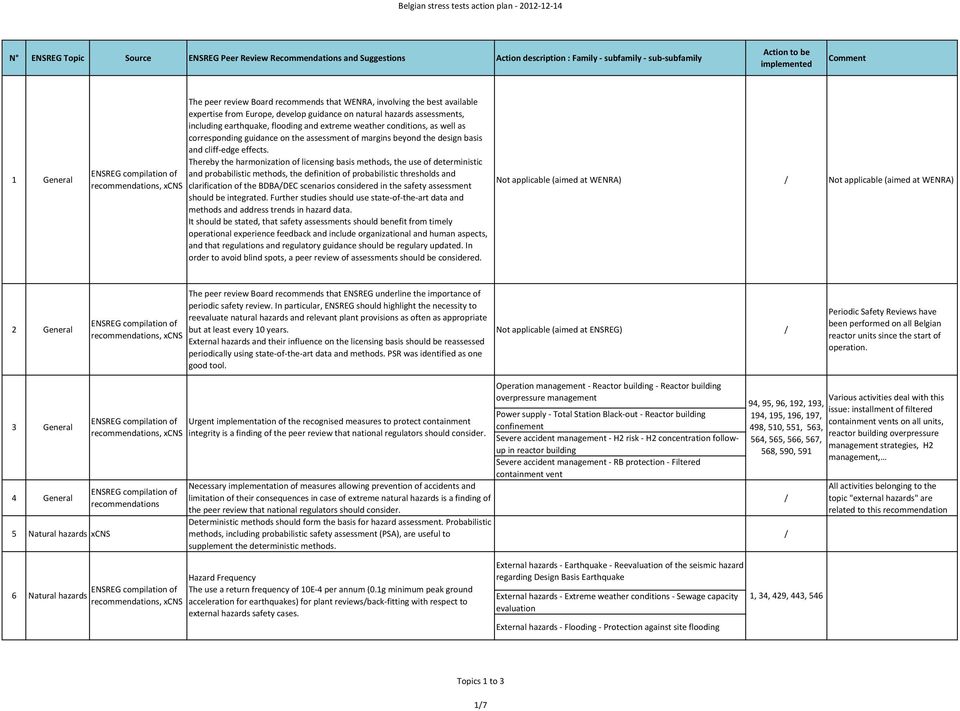
21 N ENSREG Topic Source ENSREG Peer Review Recommendations and Suggestions Action description : Family subfamily sub subfamily Action to be implemented Comment 7 8 Natural hazards 9 Natural hazards Natural hazards 10 Natural hazards 11 Natural hazards 12 Natural hazards recommendations recommendations recommendations recommendations recommendations recommendations Secondary Effects of Earthquakes The possible secondary effects of seismic events, such as flood or fire arising as a result of the event, in future assessments. External hazards Earthquake Impact earthquake on a fuel tank of Tihange 1. External hazards Earthquake Risk mitigation of internal flooding from circulation water circuit External hazards Flooding Additional means against extreme flooding (pumps, diesel generators, ) 2, 3, 4, 5, 442, 545, 614 Protected Volume Approach 37, 38, 39, 430, 431, The use of a protected volume approach to demonstrate flood protection for External hazards Flooding Protection against buildings flooding 432 identified rooms or spaces. Early Warning Notifications The implementation of advanced warning systems for deteriorating wheather, as External hazards Flooding Internal emergency plan procedures well as the provision of appropriate procedures to be followed by operators 75, 76, 77, 540, 543 when warnings are made. External hazards Flooding Procedures in case of flooding Seismic Monitoring The installation of seismic monitoring systems with related procedures and External hazards Earthquake Regulatory watch 616 training. Qualified Walkdowns The development of standards to address qualified plant walkdowns with regard to earthquake, flooding and extreme weather to provide a more systematic External hazards Earthquake Reinforcement of equipment search for non conformities and correct them (e.g. appropriate storage of anchorages 426, 582, 583, 618 equipment, particularly for temporary and mobile plant and tools used to mitigate beyond design basis (BDB) external events). Flooding Margin Assessments The analysis of incrementally increased flood levels beyond the design basis and identification of potential improvements, as required by the initial ENSREG specification for the stress tests. Already implemented 13 Natural hazards recommendations, xcns External Hazard Margins In conjunction with recommendation 1 and 17, the formal assessment of margins for all external hazards including, seismic, flooding and severe weather, and identification of potential improvements. Licensing basis protection against external hazards (e.g. flood seals and seismic supports) should be verified to be effective. Margin assessments should be based on periodic reevaluation of licensing basis for external events considering possible cliff edge effects and grace periods. Already implemented 14 Design issues recommendations, xcns Alternate Cooling and Heat Sink The provision of alternative means of cooling including alternate heat sinks. Water supply Loss of Main Heat Sink Backup heat sink Water supply Total loss of heat sink Backup heat sink Water supply Total Station Black out Inadvertent let down of the pools 226, 227, 452, 453, 454, 455, 552, 554 Alternate heat sinks exist are available at the Doel and Tihange site (see National report) Topics 1 to 3 2/7
22 N ENSREG Topic Source ENSREG Peer Review Recommendations and Suggestions Action description : Family subfamily sub subfamily Action to be implemented Comment 15 Design issues recommendations, xcns AC Power Supplies The enhancement of the on site and off site power supplies. Power supply Total Station Black out Implementation of a 380 V emergency electrical grid Power supply Total Station Black out Turbopomp power supply backup Power supply Varia Impact of the configuration and operation of High Voltage grid on the auxiliaries of NPP's 503, 550, 97, 98, 99, 100, 480, 481, 482, 483, 484, 485, 492, 493, 598, 599, 600, 609, 610, 611 Both on site and off site power supply will be enhanced. 16 Design issues recommendations, xcns DC Power Supplies The enhancement of the DC power supply. Power supply Batteries autonomy Increasing battery autonomy 397, 398, 501, 502, 594, 595 Power supply EDG autonomy On site fuel transport 17 Design issues recommendations Operational and Preparatory Actions Implementation of operational or preparatory actions with respect to the availability of operational consumables. Power supply EDG autonomy Procedures to manage the autonomy of electrical diesel generators Power supply EDG autonomy Procedures to manage the autonomy of electrical diesel generators in SUR 81, 82, 83, 84, 89, Design issues recommendations, xcns Instrumentation and Monitoring The enhancement of instrumentation and monitoring. External hazards Flooding Additional means against extreme flooding (pumps, diesel generators, ) Power supply Total Station Black out Autonomous generator to recharge the instrumentation Power supply Total Station Black out Spent fuel pools : additional level measurements 64, 65, 104, 105, 106, 176, 177, Design issues recommendations Shutdown Improvements The enhancement of safety in shutdown states and mid loop operation. Power supply Total Station Black out Reactor building confinement Water supply Total Station Black out Additional means to assure primary water supply 111, 112, 498, 551 Shutdown states and mid loop operation were considered as initial states in the stress test. Appropriate actions were defined to further enhance safety in these states. 20 Design issues recommendations, xcns Reactor Coolant Pump Seals The use of temperature resistant (leak proof) primary pump seals. Study of RCP pump seal leakage following long term AC power failure. Operation Total Station Black out Procedures in case of total station black out 128, 129, 130 Topics 1 to 3 3/7
23 N ENSREG Topic Source ENSREG Peer Review Recommendations and Suggestions Action description : Family subfamily sub subfamily Action to be implemented Comment 21 Design issues Ventilation The enhancement of ventilation capacity during SBO to ensure equipment operability. Power supply Total Station Black out Verification of the feedwater pump in case of loss of ventilation (room temperature) 223, 224, 225, 496, Design issues recommendations, xcns Main and Control Rooms The enhancement of the main control room (MCR), the emergency control room (ECR) and emergency control centre (ECC) to ensure continued operability and adequate habitability conditions in the event of a station black out (SBO) and in the event of the loss of DC (this also applies to Topic 3 recommendations). Habitability of control rooms/emergency centers under DEC conditions. Additional actions are part of the man made events part of the action plan 23 Design issues 24 Design issues recommendations, xcns recommendations Spent Fuel Pool The improvement of the robustness of the spent fuel pool (SFP). Separation and Independence The enhancement of the functional separation and independence of safety systems. Operation Spent fuel pools SUR procedures in case of accident in spent fuel pools Power supply Spent fuel pools Electrical backup for the cooling pumps Power supply Spent fuel pools Procedures to manage spent fuel pools Water supply Total Station Black out Inadvertent let down of the pools Water supply Total Station Black out Water supply of spent fuel pools in case of aircraft crash 88, 91, 146, 147, 148, 456, 556, 596, 597 Additional actions are part of the man made events part of the action plan Separation and independence of safety systems is a general design criterion that is used in all design activities. 25 Design issues recommendations Flow Path and Access Availability The verification of assured flow paths and access under SBO conditions. Ensure that the state in which isolation valves fail and remain, when motive and control power is lost, is carefully considered to maximise safety. Enhance and extend the availability of DC power and instrument air (e. g. by installing additional or larger accumulators on the valves). Ensure access to critical equipment in all circumstances, specifically when electrically operated turnstiles are interlocked. Operation Total Station Black out Procedures in case of total station black out 128, 129, 130, 131, 132, 133, 134, 135, 136, 137, 138, 139, 490, 491, 592, Design issues recommendations, xcns Mobile Devices The provision of mobile pumps, power supplies and air compressors with prepared quick connections, procedures, and staff training with drills. Requirements Specifications of mobile means External hazards Flooding Additional means against extreme flooding (pumps, diesel generators, ) Power supply Total Station Black out Implementation of a 380 V emergency electrical grid 60, 61, 62, 63, 97, 98, 99, 400, 436, 480, 481, 482, 515, Design issues recommendations Bunkered/Hardened Systems The provision for a bunkered or hardened system to provide an additional level of protection with trained staff and procedures designed to cope with a wide variety of extreme events including those beyond the design basis (this also applies to Topic 3 recommendations). Bunkered systems (containing 2nd level emergency systems) are a standard issue of all Belgian reactor units Topics 1 to 3 4/7
24 N ENSREG Topic Source ENSREG Peer Review Recommendations and Suggestions Action description : Family subfamily sub subfamily Action to be implemented Comment 28 Design issues recommendations, xcns Multiple Accidents The enhancement of the capability for addressing accidents occurring simultaneously on all plants of the site and consideration of the site as a whole for a multi units site in the safety assessment. Multi unit event and associated organization Organization and logisitics of internal emergency plan in case of multi unit event 213, 478, 504, 505, Design issues recommendations Equipment Inspection and Training Programs The establishment of regular programs for s to ensure that a variety of additional equipment and mobile devices are properly installed and maintained, particularly for temporary and mobile equipment and tools used for mitigation of BDB external events. Development of relevant staff training programmes for deployment of such devices. Requirements Harmonization of sites training programs Requirements Specifications of mobile means External hazards Flooding Availability of the additionnal means against extreme flooding 400, 515, 516, Design issues recommendations Further Studies to Address Uncertainties The performance of further studies in areas were there are uncertainties. Uncertainties may exist in the following areas: The integrity of the SFP and its liner in the event of boiling or external impact. The functionality of control equipment (feedwater control valves and SG relief valves, main steam safety valves, isolation condenser flow path, containment Severe accident RB protection Research & isolation valves as well as depressurisation valves) during the SBO to ensure that Development for severe accidents cooling using natural circulation would not be interrupted in a SBO. The performance of additional studies to assess operation in the event of widespread damage, for example, the need different equipment (e.g. bulldozers) to clear the route to the most critical locations or equipment. This includes the logistics of the external support and related arrangements (storage of equipment, use of national defence resources, etc.). 183, 394, 513, Severe accident recommendations WENRA Reference Levels The incorporation of the WENRA reference levels related to severe accident (SAM) into their national legal frameworks, and ensure their implementation in the installations as soon as possible. The WENRA reference levels on SAM have already been transposed into the Belgian regulatory framework (Royal Decree of November 30th 2011) 32 Severe accident recommendations SAM Hardware Provisions Adequate hardware provisions that will survive external hazards (e.g. by means of qualification against extreme external hazards, storage in a safe location) and the severe accident environment (e.g. engineering substantiation and/or qualification against high pressures, temperatures, radiation levels, etc), in place, to perform the selected strategies. Infrastructure On site resistant storage for mobile means Requirements Specifications of mobile means 400, 509, 515, 572, Severe accident ENSREG Compilation of Recommendations Review of SAM Provisions Following Severe External Events The systematic review of SAM provisions focusing on the availability and appropriate operation of plant equipment in the relevant circumstances, taking account of accident initiating events, in particular extreme external hazards and the potential harsh working environment. Severe accident Review SAMG procedures Review Severe Accident Mitigation Guidelines procedures 189, 190, 191, 631, 632 Topics 1 to 3 5/7
25 N ENSREG Topic Source ENSREG Peer Review Recommendations and Suggestions Action description : Family subfamily sub subfamily Action to be implemented Comment 34 Severe accident recommendations, xcns Enhancement of Severe Accident Management Guidelines (SAMG) In conjunction with the recommendation 4, the enhancement of SAMGs taking into account additional scenarios, including, a significantly damaged infrastructure, including the disruption of plant level, corporate level and national level communication, long duration accidents (several days) and accidents affecting multiple units and nearby industrial facilities at the same time. Multi unit event and associated organization Organization and logisitics of internal emergency plan in case of multi unit event Severe accident H2 risk H2 concentration followup in reactor building Severe accident Review SAMG procedures Review Mitigation Guidelines procedures 189, 190, 191, 192, 193, 194, 213, 478, 504, 505, 581, 631, Severe accident Severe accident Severe accident Severe accident xcns recommendations recommendations recommendations Analysis of human resources, communication, personnel training and guidance during severe long term accidents (esp. multi unit) and validation of effectiveness through exercises. SAMG Validation The validation of the enhanced SAMGs. SAM Exercises Exercises aimed at checking the adequacy of SAM procedures and organisational measures, including extended aspects such as the need for corporate and nation level coordinated arrangements and long duration events. SAM Training Regular and realistic SAM training exercises aimed at training staff. Training exercises should include the use of equipment and the consideration of multi unit accidents and long duration events. The use of the existing NPP simulators is considered as being a useful tool but needs to be enhanced to cover all possible accident scenarios. Communications means On & Off site backup communications means Requirements Harmonization of sites training programs Severe accident Review SAMG procedures Coherence severe accidents procedures between Doel and Tihange Severe accident Review SAMG procedures Review Mitigation Guidelines procedures Severe accident Review SAMG procedures Coherence severe accidents procedures between Doel and Tihange Severe accident Review SAMG procedures Review Mitigation Guidelines procedures Severe accident Review SAMG procedures Coherence severe accidents procedures between Doel and Tihange Severe accident Review SAMG procedures Review Mitigation Guidelines procedures 476, 507, , 190, 191, 519, 520, 521, 522, 631, , 190, 191, 519, 520, 521, 522, 631, , 190, 191, 519, 520, 521, 522, 631, 632 Additional actions are part of the man made events part of the action plan SAMG are validated as part of the PSR process 39 Severe accident recommendations Extension of SAMGs to All Plant States The extension of existing SAMGs to all plant states (full and low power, shutdown), including accidents initiated in SFPs. Severe accident Review SAMG procedures Review Mitigation Guidelines procedures 189, 190, 191, 631, Severe accident recommendations Improved Communications The improvement of communication systems, both internal and external, including transfer of severe accident related plant parameters and radiological data to all emergency and technical support centre and regulatory premises. Communications means On & Off site backup communications means External hazards Flooding Additional means against extreme flooding (pumps, diesel generators, ) External hazards Flooding Procedures in case of flooding 43, 50, 57, 476, 507, 543 Topics 1 to 3 6/7
26 N ENSREG Topic Source ENSREG Peer Review Recommendations and Suggestions Action description : Family subfamily sub subfamily Action to be implemented Comment 41 Severe accident recommendations, xcns Presence of Hydrogen in Unexpected Places The preparation for the potential for migration of hydrogen, with adequate countermeasures, into spaces beyond where it is produced in the primary containment, as well as hydrogen production in SFPs. Severe accident H2 risk H2 concentration followup in reactor building Severe accident H2 risk H2 risk in nuclear auxiliary building 192, 193, 194, 201, 202, 203, 512, Severe accident recommendations Large Volumes of Contaminated Water The conceptual preparations of solutions for post accident contamination and the treatment of potentially large volumes of contaminated water. Management Multi unit event and associted organization Post accident fixing of contamination and the treatment of potentially large volumes of contaminated water 633, Severe accident recommendations Radiation Protection The provision for radiation protection of operators and all other staff involved in the SAM and emergency arrangements. Multi unit event and associated organization Complementary means for radiological surveillance Severe accident Radiological release Leak path identification 172, 392, 477, 523, 524, 574, Severe accident recommendations On Site Center The provision of an on site emergency center protected against severe natural hazards and radioactive releases, allowing operators to stay onsite to manage a severe accident. Infrastructure Site operation center in the new Access Control Building 171 Additional actions are part of the man made events part of the action plan 45 Severe accident recommendations Support to Local Operators Rescue teams and adequate equipment to be quickly brought on site in order to provide support to local operators in case of a severe situation. Multi unit event and associated organization Optimization and storage of mobile means Multi unit event and associated organization Organization and logisitics of internal emergency plan in case of multi unit event 213, 478, 504, 505, 581, 479, Severe accident recommendations Level 2 Probabilistic Safety Assessments (PSAs) A comprehensive Level 2 PSA as a tool for the identification of plant vulnerabilities, quantification of potential releases, determination of candidate high level actions and their effects and prioritizing the order of proposed safety improvements. Although PSA is an essential tool for screening and prioritising improvements and for assessing the completeness of SAM implementation, low numerical risk estimates should not be used as the basis for excluding scenarios from consideration of SAM especially if the consequences are very high. A level 2 PSA model is available for the Belgian units 47 Severe accident recommendations Severe Accident Studies The performance of further studies to improve SAMGs. Severe accident RB protection Research & Development for severe accidents 183, 394, 513, Severe accident xcns Containment venting for new NPPs Not applicable / Topics 1 to 3 7/7
27 Datasheet Additional topics This datasheet recalls the recommendations resulting from the ENSREG peer reviews and the requirements resulting from the stress tests national report, aimed more specifically at the licensee. For each entry, the datasheet shows the order number of the associated actions undertaken by the licensee to fulfil these needs. The field of the actions in question is also specified, referring to Family, Sub-family and Sub-sub-family.
28 No Topic Source Recommendations, Requirements from other national reviews Action : Family subfamily sub subfamily Actions to be implemented Comment 1 Natural hazards (earthquake) ENSREG country peer review report Probabilisitc seismic hazard analysis It is recommended that the national regulator monitors the completion of the updated PSHA related to the seismic hazard, the implementation of the consequential measures and the updated assessment of safety margins. These updates may benefit from a harmonization of the seismic hazard assessment on an international level. Experience exchange, namely among the neighbouring countries is recommended, in order to avoid discrepancies for sites with comparable seismic activity. External hazards Earthquake Reevaluation of the seismic hazard regarding Design Basis Earthquake 1, of country peer review report. 2 Natural hazards (earthquake) ENSREG country peer review report Seismic instrumentation The seismic instrumentation which was observed during the plant visit appeared to offer an opportunity for improvement with respect to the number of accelerometers and to the evaluation procedure. An immediate evaluation of the recorded signals, allowing the comparison of response spectra with the design basis spectra and a direct access to this information is recommended in order to facilitate and to accelerate the measures to be initiated after a seismic event. External hazards Earthquake Regulatory watch of country peer review report. 3 Natural hazards (flooding) ENSREG country peer review report Safety improvements Regarding the protection against external flood for the Tihange site, it is recommended that the national regulator should focus on the implementation of all safety improvements proposed by the licensee, as well as those prescribed by the regulator. External hazards Flooding Internal emergency plan procedures External hazards Flooding Procedures in case of flooding External hazards Flooding Protection against buildings flooding External hazards Flooding Protection against site flooding 34, 37, 38, 39, 66, 67, 68, 69, 70, 71, 72, 73, 74, 75, 76, 77, of country peer review report. 4 Natural hazards (flooding) ENSREG country peer review report Safety improvements Regarding the protection against external flood for the Doel site, it is recommended that the national regulator monitor the implementation of the measures proposed in the action plan. External hazards Flooding Protection against buildings flooding External hazards Flooding Protection against site flooding 430, 431, 432, 433, 434, of country peer 435, review report. 5 Natural hazards (weather) ENSREG country peer review report Extreme weather conditions, With respect to extreme weather conditions, the derivation of design basis parameters with 10,000 years return periods is recommended to be considered. External hazards Extreme weather conditions Confirmation of resistance to tornadoes External hazards Extreme weather conditions Sewage capacity evaluation 441, 443, 546, of country peer review report. 7 Design issues ENSREG country peer review report Autonomy of safety systems The peer review team recommends Belgian regulatory body to take into consideration the benefits of the increasing (up to at least 72 hours) of the autonomy of the emergency diesel generators of the 2nd level safety systems at Tihange 1 for events determined by design basis earthquake, possibly by enhancing the robustness of the CVA B01Hc fuel tank to design basis earthquake. External hazards Earthquake Impact earthquake on a fuel tank of Tihange of country peer review report. Additional topics 1/9
29 No Topic Source Recommendations, Requirements from other national reviews Action : Family subfamily sub subfamily 8 Design issues 9 Design issues ENSREG country peer review report ENSREG country peer review report Venting system The preliminary study for the filtered venting system on each unit to be finished in 2012 should consider sub atmospheric pressures in the containment. RB protection Filtered containment vent Hydrogen in SFP buildings Regardless of the outcome of the assessment of the residual risk of hydrogen H2 risk H2 risk generation and accumulation in the spent fuel pool buildings, the installation of in nuclear auxiliary building PARs should be considered. Actions to be implemented 195, 196, 197, 510, 563, 564, 565, 566, 567, , 202, 203, 512, 607 Comment 3.3 of country peer review report. 4.3 of country peer review report. 10 preparedness and response ENSREG country peer review report Severe accident The additional measure by the regulatory body to increase the consistency between Tihange NPP and Doel NPP of the emergency training and refresher training programs should be broadened to the total concept for severe accident (hardware provisions, procedures and guidelines) as much as possible. Requirements Harmonization of sites training programs of country peer review report. 11 Natural hazards (earthquake) Seismic margin assessment For all weaknesses identified during the walkdowns (SSC assessed as having a low probability of preserving their integrity and performing their function in an earthquake exceeding the RLE), the licensee shall provide a detailed action plan containing actions taken and actions planned. This also applies to the feasibility study on reinforcement of the electrical building ( BAE ) at Tihange 1. External hazards Earthquake Reinforcement of equipments anchorages External hazards Earthquake Reinforcement of the electrical auxiliary building 7, 8, 9, 10, 11, 12, 13, 14, 15, 16, 17, 18, 19, 20, 21, 22, 23, 24, 25, 26, 27, 28, 29, 30, 536, 622, 623, of national stress 12 Natural hazards (earthquake) Probabilisitc seismic hazard analysis The licensee should carry out a more elaborated PSHA study with due consideration of (1) other elements such as the use of a more recent groundmotion prediction equation or such as a cumulative absolute velocity ( CAV ) External hazards Earthquake Reevaluation of the seismic hazard regarding Design Basis Earthquake filtering, (2) external reviews by international experts and (3) results arising from other studies such as the EC project SHARE (seismic hazard harmonization in Europe). 1, of national stress 13 Natural hazards (earthquake) Seismic interactions The licensee must continue its efforts towards fostering awareness of potential External hazards Earthquake Sensibilization seismic interaction inside the facilities. In particular, thorough attention must campagn to seismic alertness be paid to the strict application of the relevant procedures to avoid the interactions of scaffoldings with SSC that are seismically qualified. 428, of national stress 14 Natural hazards (flooding) Safety margins The licensee shall include a safety margin for the first level of defense to External hazards Flooding Protection against site adequately cover uncertainties associated with a 10,000 year flood (the wall of flooding the peripheral protection should thus be designed higher than the flood level associated with a 10,000 year flood). 539 Tihange NPP only of national stress Additional topics 2/9
30 No Topic Source Recommendations, Requirements from other national reviews Action : Family subfamily sub subfamily Actions to be implemented Comment 15 preparedness and response preparedness For the flooding risk, further improvement of the emergency preparedness strategy and organization, including corresponding procedures, should be implemented by mid External hazards Flooding Procedures in case of flooding 540 Tihange NPP only of national stress 16 Design issues Non conventional means Since the non conventional means (CMU Ultimate means circuit) is currently needed for floods exceeding the reference flood of 2615 m³/s (i.e., floods with return periods exceeding 100 to 400 years), the licensee should determine Requirements Specifications of mobile means External hazards Flooding Availability of the additionnal means against extreme flooding 400, 515, 541 Tihange NPP only of national stress 17 Design issues Power supply The currently implemented alternate power sources for I&C systems and emergency lighting should be further improved, where needed, and the sufficiency of available or recovered I&C equipment to safely control the three units should be checked External hazards Flooding Additional means against extreme flooding (pumps, diesel generators, ) Power supply Total Station Black out Autonomous generator to recharge the instrumentation 176, 177, 178, 542 Tihange NPP only of national stress 18 Design issues Non conventional means The technical characteristics of these non conventional means (NCM) should account for the adverse (weather) conditions they may be subject to during the whole period of operation. If this is not covered by design, an appropriate protection or compensatory strategy should be developed. Infrastructure On site resistant storage for mobile means Requirements Specifications of mobile means 400, 509, 515, 572, 573 Tihange NPP only of national stress 19 preparedness and response Flooding alert system The flooding alert system, which is based on a direct communication between the regional service competent for forecasting river flow rates in the Meuse External hazards Flooding Procedures in case of basin (SETHY, making use of a dedicated forecasting system) and the NPP (with flooding Tihange 2 being the single point of contact and responsible for warning Tihange 1 and Tihange 3), is a crucial factor. Therefore, its robustness and efficiency should be further improved. In particular: 543 Tihange NPP only of national stress preparedness and response preparedness and response preparedness and response the protocole between the NPP Tihange and SETHY should be formalized as soon as possible. the licensee should pursue regular tests of the secured communication channels and transmitted data (i.e., on line measurements and predictions of river flow rates). the licensee should organize emergency preparedness exercises involving both the NPP and SETHY personnel. External hazards Flooding Procedures in case of flooding External hazards Flooding Procedures in case of flooding External hazards Flooding Procedures in case of flooding Tihange NPP only of national stress Tihange NPP only of national stress Tihange NPP only of national stress 23 preparedness and response criteria used to launch the internal emergency plan and to start the alert phase and associated actions should be unambiguously defined in the applicable emergency procedures. External hazards Flooding Procedures in case of flooding 543 Tihange NPP only of national stress Additional topics 3/9
31 No Topic Source Recommendations, Requirements from other national reviews Action : Family subfamily sub subfamily 24 preparedness and response On site transport Means for on site transport of personnel and equipment towards the units, inside the units, or from one unit to another, while the site is flooded, should be further implemented and considered in the emergency preparedness strategy. External hazards Flooding Procedures in case of flooding Actions to be implemented 544 Comment Tihange NPP only of national stress 25 Design issues Induced internal hazards Internal hazards potentially induced by the flooding (fire, explosion) should be examined and additional measures should be taken where needed (e.g., because the automatic fire extinction system is lost during a flood exceeding the reference flood ). The potential deficiency of the Ultimate Means Circuit (CMU) in case of induced fire, in particular because of dependencies when the CMU is connected to the fire extinction system (CEI), should be examined and potential weaknesses should be resolved. External hazards Flooding Procedures in case of flooding 545 Tihange NPP only of national stress 26 Design issues Non conventional means The technical characteristics of the non conventional means (NCM) that can be used in case of flooding of safety related buildings (for all potential causes) should account for the adverse (weather) conditions they may be subject to during the whole period of operation. If this is not covered by design, an appropriate protection or compensatory strategy should be developed. Infrastructure On site resistant storage for mobile means Requirements Specifications of mobile means 400, 509, 515, 572, 573 Doel NPP only of national stress 27 preparedness and response procedures Improvement of the procedures after earthquake (I QM 01): after an earthquake, it shall be rapidly and visually verified if flooding due to cooling tower basin overflow (e.g. due to obstruction of its outlet channel) is ongoing or imminent. In that case, the CW pumps must be rapidly stopped. External hazards Earthquake Risk mitigation of internal flooding from circulation water circuit 2, 3, 4, 5, 442 Doel NPP only of national stress 28 Natural hazards (flooding) Periodic s As recent s evidenced locations with embankment heights approaching the minimal required height (Technical Specifications criterion), embankment height s should be done more regularly (e.g., twoyearly, and at least 5 yearly, instead of ten yearly) in order to avoid a risk of flooding External hazards Flooding Protection against site excessive embankment overtopping by wind waves for floods within the design basis (embankment overtopping may occur for return periods larger than 300 years). 434, 435 Doel NPP only of national stress Additional topics 4/9
32 No Topic Source Recommendations, Requirements from other national reviews Action : Family subfamily sub subfamily Actions to be implemented Comment 29 Natural hazards (weather) Heavy rainfalls The reassessment of the capacity of the sewer system (five separate networks at Doel, separate networks per unit at Tihange), using a detailed hydrodynamic model must cover both short duration heavy rains and long lasting rains (95th percentile) for return periods up to 100 years. Moreover, to define such 100 External hazards Extreme weather conditions yearly rains, observations of rain intensities over a sufficiently long period of Sewage capacity evaluation time must be used, including the latest observations (e.g. the exceptional rain of 23rd August 2011). Depending on the results, potential improvements of the sewer system shall be envisaged and the licensee s action plan shall be updated accordingly where appropriate. 439, 443, 546, of national stress 30 Natural hazards (weather) Tornadoes Given the fact that tornadoes of high intensities were observed in the past years in the neighbouring countries (class EF4 on the enhanced Fujita scale), the robustness of the second level systems of Doel 1/2 and Tihange 1 should be confirmed in case of a beyond design tornado with wind speed exceeding 70 m/s (250 km/h). External hazards Extreme weather conditions Confirmation of resistance to tornadoes External hazards Flooding Availability of the additionnal means against extreme flooding 441, of national stress 31 Design issues Non conventional means The operability of the non conventional means should be justified on the basis of technical data (design, operation, alignment and connections, periodic testing, preventive maintenance, etc.). Requirements Specifications of mobile means 400, 515, of national stress 32 Design issues Non conventional means The technical characteristics of the non conventional means (NCM) should account for the adverse (weather) conditions they may be subject to during the whole period of operation. Infrastructure On site resistant storage for mobile means Requirements Specifications of mobile means 400, 509, 515, 572, of national stress 33 Design issues External power sources The licensee should, in collaboration with ELIA, manager of the high voltage network, make a feasibility study to ensure a better geographical separation of the high voltage lines (380 and 150 kv) to further improve the reliability of the external power supply to the NPPs. In addition, the licensee should, in agreement with ELIA, ensure that in case of LOOP the NPPs have the highest priority for reconstruction of the external power supply to the NPPs. The regulatory body shall take the necessary steps, in collaboration with other competent authorities, to ensure the fulfilment of this recommandation. Power supply Varia Impact of the configuration and operation of High Voltage grid on the auxiliaries of NPP's 503, of national stress 34 Design issues Station black out In relation to the total SBO scenario, the potential overfilling or draining of the steam generators due to the loss of ultimate compressed air should be examined. Water supply Total Station Black out Steam generator protections Water supply Total Station Black out Turbopomp power supply backup 219, 220, 221, of national stress Additional topics 5/9
33 No Topic Source Recommendations, Requirements from other national reviews Action : Family subfamily sub subfamily 35 Design issues Station black out In relation to the total SBO scenario, the operability of the AFW turbinedriven pump due to the loss of ventilation in the turbine driven pump room should be examined. Power supply Total Station Black out Verification of the feedwater pump in case of loss of ventilation (room temperature) Actions to be implemented 223, 224, 225, 496, 497 Comment of national stress 36 Design issues Station black out In case of (total) station black out, the licensee should assess whether all containment penetrations can be closed in due time and whether the relevant containment isolation systems remain functional, in particular during outage situations. The feasibility of closing the personnel and material hatches should be assessed. These topics should be addressed in the total station black out procedure. Power supply Total Station Black out Reactor building confinement 498, of national stress 37 Design issues Loss of ultimate heat sink The licensee shall justify that the water capacity (quantity and flow of cooling Water supply Loss of Main Heat Sink Backup heat water for the consumers) of the second level of protection is sufficient when all sink the units of the site are affected by the loss of primary UHS. If needed a strategy to optimize the water consumption should be developed. 454, 455, of national stress 38 preparedness and response lighting For Tihange, the licensee should reinforce the emergency lighting in the different rooms and places where the operators should intervene during the different scenarios. Power supply Total Station Black out Additional emergency lighting 553, of national stress 39 preparedness and response Loss of ultimate heat sink In relation to the loss of primary UHS scenario, the licensee shall carry out alignment and operating tests of the emergency deep water intakes from the Meuse river bed in 2012 (for Tihange 2 and 3). Water supply Loss of Main Heat Sink Backup heat sink of national stress 40 preparedness and response Loss of ultimate heat sink In relation to the loss of primary UHS scenario, the licensee should justify the Water supply Loss of Main Heat Sink Backup heat availability (accessibility, operability and alignment) of the emergency water sink intakes of Tihange 2 and 3 in accordance with the requirements of US NRC RG , of national stress Additional topics 6/9
34 No Topic Source Recommendations, Requirements from other national reviews Action : Family subfamily sub subfamily Actions to be implemented Comment 41 Design issues Spent fuel pools Two configurations should be evaluated by the licensee for the spent fuel pools: Configuration with a fuel assembly handled in the reactor pool during a Total SBO. The fuel assembly should manually be handled in a safe position. The licensee should investigate the provisions (hardware installations, procedures, lighting, etc.) to be implemented for this configuration. Configuration with the loss of water inventory in the spent fuel pools. The international experience feedback has already pointed out potential problems with the design of the siphon breakers in the spent fuel pools. In case of piping rupture, an insufficient capacity of the siphon breakers may lead to a fast uncovering of spent fuel assemblies. The licensee should examine this safety concern. Power supply Total Station Black out Safe Position Fuel Assembly Water supply Total Station Black out Inadvertent let down of the pools 456, 500, 555, of national stress 43 preparedness and response Severe accident The adequacy of the procedural guidelines (BK procedures for Doel and severe accident guidelines for Tihange) to cope with a severe accident has been assessed by the licensee, relying mainly on the fact that those procedures are inspired from the Westinghouse owners group severe accident guidelines ( WOG SAMG ), are regularly updated, and are validated in the framework of the ten yearly periodic safety reviews. Yet, those procedures still need to be improved with respect to the following aspects: the Doel BK procedures should be supplemented with long term monitoring and exit guidelines, such as those already existing for Tihange (SAEG 1 and SAEG 2); Review SAMG procedures Coherence severe accidents procedures between Doel and Tihange 519, of national stress 44 preparedness and response in some Doel BK procedures, reference is made to (the distinct) FRG procedures for the explanation of recommended methods. This constant switching between different procedures should be avoided, and therefore the BK procedures should be more selfsupporting and contain all information needed for their application; Review SAMG procedures Coherence severe accidents procedures between Doel and Tihange 519, of national stress 45 preparedness and response an in containment ph calculation tool should be added to the BK/SAMG procedures to determine the sump water acidity from the volumes and water quantities used during the of the accident, taking into account all other physical and chemical ph influencing processes; this tool would also be used as a check and back up for a dedicated sampling system; Radiological release ph reactor control 396, 527, 608, of national stress 46 preparedness and response a decision support tool (table/flow chart) should be added to the BK/SAMG procedures to quickly pinpoint the (most probable) location of a containment leak path based on the readings of certain detectors and to determine the most appropriate actions to limit the spread of fission products. This approach might involve the deployment of mobile detectors at specified locations; Radiological release Leak path identification 392, 523, of national stress Additional topics 7/9
35 No Topic Source Recommendations, Requirements from other national reviews Action : Family subfamily sub subfamily Actions to be implemented Comment 47 preparedness and response the BK procedures should provide quantitative criteria for selected key parameters to quickly arbitrate between the evacuation of the residual heat and the isolation of a leak in recirculation lines; Review SAMG procedures Coherence severe accidents procedures between Doel and Tihange 521, of national stress 48 preparedness and response a decision support tool should be added to the BK procedures to arbitrate between injecting into the primary circuit and spraying inside the containment building. Review SAMG procedures Coherence severe accidents procedures between Doel and Tihange 521, of national stress 49 preparedness and response As much as possible, the licensee should consider to increase the consistency between the Tihange NPP and the Doel NPP with respect to the emergency training and refresher training programs (different in duration and frequency). Requirements Harmonization of sites training programs of national stress 50 preparedness and response For the Doel NPP, the licensee states that the probability of a steam explosion when corium falls out of the reactor vessel into a flooded reactor pit is very low and can thus be neglected, based on various experiments carried out as part of international research programs that were unable to create this phenomenon. For the Tihange NPP (where the reactor pit is not flooded prior to the reactor RB protection vessel breach), the licensee states that a feasibility study of a system allowing Research &Development for severe accidents water injection into the reactor pit will be launched. However, the licensee should follow up the ongoing steam explosion experiments closely. If needed, the current strategies for flooding of the reactor pit before the rupture of the reactor vessel should be adapted. 183, 394, 513, of national stress 51 preparedness and response The licensee should also assess the need of fitting new devices that would be useful for severe accident (ph measurement in the sumps, temperature measurement at the bottom of the reactor vessel to monitor a potential core melt). The associated hardware modifications to improve those aspects should be sought where appropriate. RB protection Reactor pit injection 166, 167, of national stress 52 preparedness and response The licensee should identify the effective means to control the ph inside the containment building after a severe accident. This requirement applies in the early stages of the accident, and also during the long term phase. For the of the long term phase of a severe accident, the licensee should take into consideration the impact of other severe accident actions on the possibility of refilling the NaOH tank and the possibility for non NaOH injection related measures to influence the sump water ph in the alkaline direction. Radiological release ph reactor control of national stress Additional topics 8/9
36 No Topic Source Recommendations, Requirements from other national reviews Action : Family subfamily sub subfamily Actions to be implemented Comment 53 preparedness and response As a further diversification of the strategies available to manage a severe accident, an optimal battery load shedding strategy (in order to extend as long as possible the lifetime of the batteries and thus the period of availability of vital equipment for the of the severe accident), should be developed and added to the ERG procedures (severe accident prevention) and to the BK/SAMG procedures (severe accident mitigation). A calculation and decision support tool should be studied in parallel to determine the loads that can be shed, the extra battery autonomy gained by shedding a specific load, the severe accident functions that will be lost by shedding a specific load, and the alternatives that could be considered to (partly) compensate for the loss of each particular severe accident function. Power supply Batteries autonomy Increasing battery autonomy 397, 398, 501, 502, 594, of national stress 54 Design issues The licensee should review the plants technical specifications in order to further improve the availability of the second level emergency equipment. In particular, the maximum allowed downtimes and the time limits for return to service should be re evaluated and justified, given the risks involved. Operation Varia Maintaining installed but non required equipments available as back up 399, 528, of national stress 55 Design issues The licensee should regard the additional means (including non conventional means) as safety related equipment as long as they play a key role in the prevention, the detection and/or the mitigation of a severe accident (defence in depth). In this context, the licensee shall determine the specific provisions applicable to this equipment where appropriate (introduction in the technical specifications, s and testing, preventive maintenance ). Requirements Specifications of mobile means External hazards Flooding Availability of the additionnal means against extreme flooding 400, 515, of national stress Additional topics 9/9
37 Datasheet Implementation of activities This datasheet is directly derived from the licensee s action plan. All of the actions planned by the licensee are listed and numbered. The actions are sorted by topic (e.g. External hazards, Power supply, ) and plant/unit (e.g. CNT, KCD3 ). The number of the related recommendations or requirements on European level or national level is also mentioned for each action in order to ease cross-references with the previous datasheets. Finally, the current status (e.g. In progress, Closed ) and the target date for implementation are mentioned for each action.
38 No. Plant / Type Topic Sub family Sub sub family Action / Activity European level ("Topics 1 to 3") national level ("Additional topics") Status Target Date 1 CNT / PWR External hazards Earthquake Reevaluation of the seismic hazard regarding Design Basis Earthquake A detailed study of the seismic risk for the Tihange site will be conducted by the Royal Observatory of Belgium 6 1, 12 In progress 31/12/ CNT2 / PWR External hazards Earthquake Risk mitigation of internal flooding from circulation water circuit Modifying the seismic procedures to send out an agent as quickly as possible to check if the cooling tower is overflowing. If so, the CEC pumps will be shut down rapidly. 7 In progress 31/12/ CNT3 / PWR External hazards Earthquake Risk mitigation of internal flooding from circulation water circuit Modifying the seismic procedures to send out an agent as quickly as possible to check if the cooling tower is overflowing. If so, the CEC pumps will be shut down rapidly. 7 CLOSED 31/12/ CNT2 / PWR External hazards Earthquake Risk mitigation of internal flooding from circulation water circuit Studying the relevance of an automatic shutdown or of one of the 2 CEC pumps in case of a high level in a sump. 7 5 CNT3 / PWR External hazards Earthquake Risk mitigation of internal flooding from circulation water circuit Studying the relevance of an automatic shutdown or of one of the 2 CEC pumps in case of a high level in a sump. 7 Addition of a lateral support Pneumatic valve BAN N202 (PCT1 CCV 7 CNT1 / PWR External hazards Earthquake Reinforcement of equipments anchorages V002PF) Addition of a lateral support Pneumatic valve BAN N202 (PCT1 CCV 8 CNT1 / PWR External hazards Earthquake Reinforcement of equipments anchorages V005PV) Addition of a support at the discharge and intake of pump BAN N252 9 CNT1 / PWR External hazards Earthquake Reinforcement of equipments anchorages (PCT1 CAE P01Ba1) CNT1 / PWR External hazards Earthquake Reinforcement of equipments anchorages Addition of fixation Exchanger BAN N313 (PCT1 CRI Q01DR1) CNT1 / PWR External hazards Earthquake Reinforcement of equipments anchorages Addition of anchoring Exchanger BAN N452 (PCT1 CTP Q01BD1) CNT1 / PWR External hazards Earthquake Reinforcement of equipments anchorages Addition of anchoring Exchanger BAN N452 (PCT1 CTP Q01BD1BIS) CNT1 / PWR External hazards Earthquake Reinforcement of equipments anchorages Fixing the grating above the pump GPS P (PCT1 CEB P01EB3) CNT1 / PWR External hazards Earthquake Reinforcement of equipments anchorages Addition of anchoring Electrical panel BAE E504 (TAM1/S1) CNT1 / PWR External hazards Earthquake Reinforcement of equipments anchorages Addition of anchoring Electrical panel BAE E504 (TAM8/S1) 11 Addition of anchoring to take account of shear shift Transformer 6kV 16 CNT1 / PWR External hazards Earthquake Reinforcement of equipments anchorages 380V BAE E504 (TR2/S1) Addition of anchoring to take account of shear shift Transformer 6kV 17 CNT1 / PWR External hazards Earthquake Reinforcement of equipments anchorages 380V BAE E504 (TR3/S1) Suppression of a link to the masonry wall Transfer panel BAE E CNT1 / PWR External hazards Earthquake Reinforcement of equipments anchorages (PDT/UR1) Suppression of a link to the masonry wall Transfer panel BAE E CNT1 / PWR External hazards Earthquake Reinforcement of equipments anchorages (PDT/UR2) Addition of connecting anchoring between cabinet and electrical panel 20 CNT1 / PWR External hazards Earthquake Reinforcement of equipments anchorages BAE E506 (TAM1/S2) Addition of connecting anchoring between cabinet and electrical panel 21 CNT1 / PWR External hazards Earthquake Reinforcement of equipments anchorages BAE E506 BAE E506 (TAM8/S2) Addition of anchoring to take account of shear shift Transformer 6kV 22 CNT1 / PWR External hazards Earthquake Reinforcement of equipments anchorages 380V BAE E506 (TR2/S2; TR3/S2) Implementation of activities 1/20
39 No. Plant / Type Topic Sub family Sub sub family Action / Activity European level ("Topics 1 to 3") national level ("Additional topics") Status Target Date 23 CNT1 / PWR External hazards Earthquake Reinforcement of equipments anchorages Upgrade the anchors Filter BAE E603 (PCT1 VLE F06A01) CNT1 / PWR External hazards Earthquake Reinforcement of equipments anchorages Upgrade the anchors Filter BAE E603 (PCT1 VLE F07A01) 11 Protect against interaction with the masonry wall FIlter BAE E CNT1 / PWR External hazards Earthquake Reinforcement of equipments anchorages (PCT1 VLE F13AV) CNT1 / PWR External hazards Earthquake Reinforcement of equipments anchorages Upgrade the anchors Exchangeur BAE E603 (PCT1 VLE Q02AC1) CNT1 / PWR External hazards Earthquake Reinforcement of equipments anchorages Upgrade the anchors Exchanger BAE E603 (PCT1 VLE Q04AC1) CNT2 / PWR External hazards Earthquake Reinforcement of equipments anchorages Interaction with masonry wall Cooling unit BAE E165 (PCT2 CEG Z01) 11 Inspection of pipework running in the vicinity of the motor of the 29 CNT2 / PWR External hazards Earthquake Reinforcement of equipments anchorages ventilator BAE E853 Flr +5 (PCT2 CSC A02B) 11 Reassessment of anchoring using existing detail plans and calculation 30 CNT2 / PWR External hazards Earthquake Reinforcement of equipments anchorages sheets Reservoir BAN N320 (PCT2 CTP B02R) CNT / PWR External hazards Flooding Protection against site flooding Construction of a peripheral wall on site + pumping equipment 6 3 In progress 31/12/ CNT1 / PWR External hazards Flooding Protection against buildings flooding Targeted protection of the buildings against flooding (elevate floors, water tightness, pumps ) CNT2 / PWR External hazards Flooding Protection against buildings flooding Targeted protection of the buildings against flooding (elevate floors, water tightness, pumps ) CNT3 / PWR External hazards Flooding Protection against buildings flooding Targeted protection of the buildings against flooding (elevate floors, water tightness, pumps ) CNT2 / PWR External hazards Flooding Additional means against extreme flooding (pumps, diesel generators, ) Make up to the reactor coolant circuit In progress 31/12/ CNT2 / PWR External hazards Flooding SG supply Groundwater supply to the steam generators In progress 31/12/ CNT2 / PWR External hazards Flooding 43 CNT2 / PWR External hazards Flooding Additional means against extreme flooding (pumps, diesel generators, ) Additional means against extreme flooding (pumps, diesel generators, ) Facilitate access to premises In progress 31/12/2012 Facilitate communication between actors 40 In progress 31/12/ CNT2 / PWR External hazards Flooding Additional means against extreme flooding (pumps, diesel generators, ) Increase the capacity of the NCM diesel generators in order to expand energizable functions or extra functions In progress 31/12/ CNT3 / PWR External hazards Flooding Additional means against extreme flooding (pumps, diesel generators, ) Make up to the reactor coolant circuit In progress 31/12/ CNT3 / PWR External hazards Flooding SG supply Groundwater supply to the steam generators In progress 31/12/ CNT3 / PWR External hazards Flooding 50 CNT3 / PWR External hazards Flooding Additional means against extreme flooding (pumps, diesel generators, ) Additional means against extreme flooding (pumps, diesel generators, ) Facilitate access to premises In progress 31/12/2012 Facilitate communication between actors 40 In progress 31/12/2012 Implementation of activities 2/20
40 No. Plant / Type Topic Sub family Sub sub family Action / Activity European level ("Topics 1 to 3") national level ("Additional topics") Status Target Date 52 CNT3 / PWR External hazards Flooding Additional means against extreme flooding (pumps, diesel generators, ) Increase the capacity of the NCM diesel generators in order to expand energizable functions or extra functions In progress 31/12/ CNT1 / PWR External hazards Flooding Additional means against extreme flooding (pumps, diesel generators, ) Make up to the reactor coolant circuit In progress 31/12/ CNT1 / PWR External hazards Flooding SG supply Groundwater supply to the steam generators In progress 31/12/ CNT1 / PWR External hazards Flooding Additional means against extreme flooding (pumps, diesel generators, ) Facilitate access to premises In progress 31/12/ CNT1 / PWR External hazards Flooding Additional means against extreme flooding (pumps, diesel generators, ) Facilitate communication between actors 40 In progress 31/12/ CNT1 / PWR External hazards Flooding Additional means against extreme flooding (pumps, diesel generators, ) Increase the capacity of the NCM diesel generators in order to expand energizable functions or extra functions 26 In progress 31/12/ CNT1 / PWR External hazards Flooding Additional means against extreme flooding (pumps, diesel generators, ) Replace flexible connexions as much as possible by fixed and rigid pipes in order to reduce handling operations 26 In progress 31/12/ CNT2 / PWR External hazards Flooding Additional means against extreme flooding (pumps, diesel generators, ) Replace flexible connexions as much as possible by fixed and rigid pipes in order to reduce handling operations 26 In progress 31/12/ CNT3 / PWR External hazards Flooding Additional means against extreme flooding (pumps, diesel generators, ) Replace flexible connexions as much as possible by fixed and rigid pipes in order to reduce handling operations 26 In progress 31/12/ CNT1 / PWR External hazards Flooding Additional means against extreme flooding (pumps, diesel generators, ) Increase the number of instrumentation measurements available during flooding period CNT3 / PWR External hazards Flooding Additional means against extreme flooding (pumps, diesel generators, ) Increase the number of instrumentation measurements available during flooding period 18 In progress 31/12/ CNT1 / PWR External hazards Flooding Procedures in case of flooding Create procedures for the maintenance of layers 1 to 3 3 In progress 31/12/ CNT1 / PWR External hazards Flooding Procedures in case of flooding Create procedures for the periodic testing of layers 1 to 3 3 In progress 31/12/ CNT1 / PWR External hazards Flooding Procedures in case of flooding Create procedures for the use of layers 1 to 3 3 In progress 31/12/ CNT2 / PWR External hazards Flooding Procedures in case of flooding Create procedures for the maintenance of layers 1 to 3 3 In progress 31/12/ CNT2 / PWR External hazards Flooding Procedures in case of flooding Create procedures for the periodic testing of layers 1 to 3 3 In progress 31/12/ CNT2 / PWR External hazards Flooding Procedures in case of flooding Create procedures for the use of layers 1 to 3 3 In progress 31/12/ CNT3 / PWR External hazards Flooding Procedures in case of flooding Create procedures for the maintenance of layers 1 to 3 3 In progress 31/12/ CNT3 / PWR External hazards Flooding Procedures in case of flooding Create procedures for the periodic testing of layers 1 to 3 3 In progress 31/12/ CNT3 / PWR External hazards Flooding Procedures in case of flooding Create procedures for the use of layers 1 to 3 3 In progress 31/12/ CNT1 / PWR External hazards Flooding Internal emergency plan procedures Integrate the implementation of the layers 1, 2 and 3 into the internal emergency plan 9 3 In progress 31/12/ CNT2 / PWR External hazards Flooding Internal emergency plan procedures Integrate the implementation of the layers 1, 2 and 3 into the internal emergency plan 9 3 In progress 31/12/ CNT3 / PWR External hazards Flooding Internal emergency plan procedures Integrate the implementation of the layers 1, 2 and 3 into the internal emergency plan 9 3 In progress 31/12/ CNT1 / PWR External hazards Extreme weather conditions Clearing procedures in case of snow Drafting of a procedure for the monitoring and removal of the snow beyond a thickness of 30 cm on the roofs of the non bunkerized safetyrelated buildings Implementation of activities 3/20 In progress 31/12/2012
41 No. Plant / Type Topic Sub family Sub sub family Action / Activity European level ("Topics 1 to 3") national level ("Additional topics") Status Target Date 79 CNT2 / PWR External hazards 80 CNT3 / PWR External hazards Extreme weather conditions Extreme weather conditions Clearing procedures in case of snow Clearing procedures in case of snow Drafting of a procedure for the monitoring and removal of the snow beyond a thickness of 30 cm on the roofs of the non bunkerized safetyrelated buildings Drafting of a procedure for the monitoring and removal of the snow beyond a thickness of 30 cm on the roofs of the non bunkerized safetyrelated buildings In progress 31/12/2012 In progress 31/12/ CNT1 / PWR Power supply EDG autonomy Procedures to manage the autonomy of electrical diesel generators Perform an analysis to envisage a minimum oil reserve in the oil makeup reservoir for the GDS safety diesel generators CNT1 / PWR Power supply EDG autonomy Procedures to manage the autonomy of electrical diesel generators Amend the procedures to anticipate oil make up to the various diesel generators CNT2 / PWR Power supply EDG autonomy Procedures to manage the autonomy of electrical diesel generators Amend the procedures to anticipate oil make up to the various diesel generators CNT3 / PWR Power supply EDG autonomy Procedures to manage the autonomy of electrical diesel generators Amend the procedures to anticipate oil make up to the various diesel generators CNT1 / PWR Power supply EDG autonomy Procedures to manage the autonomy of electrical diesel generators Provide a procedure defining the electrical loads that are not essential in emergency situation, in order to minimize the consumption of the safety diesel generators in case of long lasting loss of offsite power supply and impossibility of supplying diesel fuel and oil In progress 31/12/ CNT2 / PWR Power supply EDG autonomy Procedures to manage the autonomy of electrical diesel generators Provide a procedure defining the electrical loads that are not essential in emergency situation, in order to minimize the consumption of the safety diesel generators in case of long lasting loss of offsite power supply and impossibility of supplying diesel fuel and oil In progress 31/12/ CNT3 / PWR Power supply EDG autonomy Procedures to manage the autonomy of electrical diesel generators Provide a procedure defining the electrical loads that are not essential in emergency situation, in order to minimize the consumption of the safety diesel generators in case of long lasting loss of offsite power supply and impossibility of supplying diesel fuel and oil In progress 31/12/ CNT1 / PWR Operation Spent fuel pools SUR procedures in case of accident in spent fuel pools Amend the current procedures of the SUR emergency system to ensure water supply and steam removal for the spent fuel pool CNT1 / PWR Power supply EDG autonomy Procedures to manage the autonomy of electrical diesel generators in SUR Analyse the possibility to set up an automatic diesel fuel supply system for the DUR emergency diesel generator CNT1 / PWR Power supply Spent fuel pools Electrical backup for the cooling pumps 92 CNT2 / PWR Power supply EDG autonomy Procedures to manage the autonomy of electrical diesel generators Analyse the possibility of repowering the CTP and RRA pumps via the SUR emergency system Provide a procedure defining the electrical loads that are not essential in emergency situation, in order to limit the fuel consumption of the GDU emergency diesel generators 23 In progress LTO In progress 31/12/ CNT3 / PWR Power supply EDG autonomy Procedures to manage the autonomy of electrical diesel generators Provide a procedure defining the electrical loads that are not essential in emergency situation, in order to limit the fuel consumption of the GDU emergency diesel generators In progress 31/12/2012 Implementation of activities 4/20
42 No. Plant / Type Topic Sub family Sub sub family Action / Activity European level ("Topics 1 to 3") national level ("Additional topics") Status Target Date 94 CNT1 / PWR Operation Reactor building Reactor building overpressure Primary circuit open: additional strategies for the of overpressure in the containment building will be studied 3 In progress 30/06/ CNT2 / PWR Operation Reactor building Reactor building overpressure Primary circuit open: additional strategies for the of overpressure in the containment building will be studied 3 In progress 30/06/ CNT3 / PWR Operation Reactor building Reactor building overpressure Primary circuit open: additional strategies for the of overpressure in the containment building will be studied 3 In progress 30/06/ CNT1 / PWR Power supply Total Station Black out Implementation of a 380 V emergency electrical grid Install an alternative power supply (380V) for non conventional and/or safety equipment (compressors, pumps, valves ) 15, CNT2 / PWR Power supply Total Station Black out Implementation of a 380 V emergency electrical grid Install an alternative power supply (380V) for non conventional and/or safety equipment (compressors, pumps, valves ) 15, CNT3 / PWR Power supply Total Station Black out Implementation of a 380 V emergency electrical grid Install an alternative power supply (380V) for non conventional and/or safety equipment (compressors, pumps, valves ) 15, CNT1 / PWR Power supply Total Station Black out Turbopomp power supply backup Install an alternative power supply (380V) for the control panels of the TPS CNT1 safety turbo pump CNT1 / PWR Power supply Total Station Black out Spent fuel pools : additional level measurements Install additional water level measurements for the spent fuel pools complying with the following constraints: loss of all electric power supplies, readings accessible from outside the buildings 18 In progress 31/12/ CNT2 / PWR Power supply Total Station Black out Spent fuel pools : additional level measurements Install additional water level measurements for the spent fuel pools complying with the following constraints: loss of all electric power supplies, readings accessible from outside the buildings 18 In progress 31/12/ CNT3 / PWR Power supply Total Station Black out Spent fuel pools : additional level measurements Install additional water level measurements for the spent fuel pools complying with the following constraints: loss of all electric power supplies, readings accessible from outside the buildings 18 In progress 31/12/ CNT1 / PWR Power supply Total Station Black out Reliability of depressurization means 108 CNT2 / PWR Power supply Total Station Black out Reliability of depressurization means 109 CNT3 / PWR Power supply Total Station Black out Reliability of depressurization means 111 CNT2 / PWR Water supply Total Station Black out 112 CNT3 / PWR Water supply Total Station Black out Additional means to assure primary water supply Additional means to assure primary water supply Install devices to allow isolation of accumulators during depressurization of the CRP reactor coolant circuit Install devices to allow isolation of accumulators during depressurization of the CRP reactor coolant circuit Install devices to allow isolation of accumulators during depressurization of the CRP reactor coolant circuit Perform a feasibility study for the installation of non conventional means to provide make up to the primary circuit in open CRP configuration Perform a feasibility study for the installation of non conventional means to provide make up to the primary circuit in open CRP configuration 19 CLOSED 31/12/ CLOSED 31/12/2012 Implementation of activities 5/20
43 No. Plant / Type Topic Sub family Sub sub family Action / Activity European level ("Topics 1 to 3") national level ("Additional topics") Status Target Date 119 CNT1 / PWR Power supply RB protection Additional means to assure reactor building backup spray in case overpressure Perform a feasibility study for the addition of a flanged connection to the outside of the nuclear auxiliary building to allow spraying into the reactor building using a mobile pump, so as to avoid overpressure in the containment 120 CNT2 / PWR Power supply RB protection Additional means to assure reactor building backup spray in case overpressure Perform a feasibility study for the addition of a flanged connection to the outside of the nuclear auxiliary building to allow spraying into the reactor building using a mobile pump, so as to avoid overpressure in the containment 121 CNT3 / PWR Power supply RB protection Additional means to assure reactor building backup spray in case overpressure Perform a feasibility study for the addition of a flanged connection to the outside of the nuclear auxiliary building to allow spraying into the reactor building using a mobile pump, so as to avoid overpressure in the containment 122 CNT1 / PWR Water supply Backup feedwater tank Enhanced feedwater tank capacity 123 CNT1 / PWR Water supply Total Station Black out Steam generator protections 124 CNT3 / PWR Water supply Total Station Black out Steam generator protections 125 CNT1 / PWR Water supply Total Station Black out Steam generator protections Perform a feasibility study to increase the capacity of the EAS safety feedwater tank Perform a feasibility study to enhance the reliability of manual operations on the steam generators discharge valves Perform a feasibility study to enhance the reliability of manual operations on the steam generators discharge valves (addition of manual valves) Perform a feasibility study for the addition of mobile compressors to be connected to the emergency compressed air circuit In progress LTO In progress 31/12/2012 In progress 30/06/ CNT2 / PWR Water supply Total Station Black out Steam generator protections Perform a feasibility study for the addition of mobile compressors to be connected to the emergency compressed air circuit 127 CNT3 / PWR Water supply Total Station Black out Steam generator protections Perform a feasibility study for the addition of mobile compressors to be connected to the emergency compressed air circuit 128 CNT1 / PWR Operation Total Station Black out Procedures in case of total station blackout Provide procedures to cope with a complete SBO, including the necessary non conventional means and the intervention strategies (for example: rapid depressurization to limit damage to the primary pumps seals, coordination with non conventional means present on site, suppression of non essential electrical loads, nitrogen in the accumulators, local command of TPA turbopumps, water top up and discharge of steam from the pools and priority status of local actions in case of loss of normal cooling of the pools, etc.) 20, 25 Implementation of activities 6/20
44 No. Plant / Type Topic Sub family Sub sub family Action / Activity European level ("Topics 1 to 3") national level ("Additional topics") Status Target Date 129 CNT2 / PWR Operation Total Station Black out Procedures in case of total station blackout Provide procedures to cope with a complete SBO, including the necessary non conventional means and the intervention strategies (for example: rapid depressurization to limit damage to the primary pumps seals, coordination with non conventional means present on site, suppression of non essential electrical loads, nitrogen in the accumulators, local command of TPA turbopumps, water top up and discharge of steam from the pools and priority status of local actions in case of loss of normal cooling of the pools, etc.) 20, CNT3 / PWR Operation Total Station Black out Procedures in case of total station blackout Provide procedures to cope with a complete SBO, including the necessary non conventional means and the intervention strategies (for example: rapid depressurization to limit damage to the primary pumps seals, coordination with non conventional means present on site, suppression of non essential electrical loads, nitrogen in the accumulators, local command of TPA turbopumps, water top up and discharge of steam from the pools and priority status of local actions in case of loss of normal cooling of the pools, etc.) 20, CNT1 / PWR 132 CNT2 / PWR 133 CNT3 / PWR 134 KCD12 / PWR 135 KCD34 / PWR 137 CNT1 / PWR 138 CNT2 / PWR 139 CNT3 / PWR Operation Operation Operation Operation Operation Operation Operation Operation Total Station Black out Total Station Black out Total Station Black out Total Station Black out Total Station Black out Total Station Black out Total Station Black out Total Station Black out Procedures in case of total station blackout Modify the existing "Accident procedures" to take account of the complete SBO Procedures in case of total station blackout Modify the existing "Accident procedures" to take account of the complete SBO Procedures in case of total station blackout Modify the existing "Accident procedures" to take account of the complete SBO Procedures in case of total station blackout Modify the existing "Accident procedures" to take account of the complete SBO Procedures in case of total station blackout Modify the existing "Accident procedures" to take account of the complete SBO Implement the organization of the response to this type of nonconventional accident complete SBO ( of equipment, Procedures in case of total station blackout documents, etc.) Procedures in case of total station blackout Procedures in case of total station blackout Implement the organization of the response to this type of nonconventional accident complete SBO ( of equipment, documents, etc.) Implement the organization of the response to this type of nonconventional accident complete SBO ( of equipment, documents, etc.) CNT1 / PWR Water supply Total loss of heat sink Water supply procedures Introduce or create in the procedures and/or strategies to manage "multi unit" accidents, the methods for limiting groundwater consumption and determining the well(s) to be used preferentially 141 CNT2 / PWR Water supply Total loss of heat sink Water supply procedures Introduce or create in the procedures and/or strategies to manage "multi unit" accidents, the methods for limiting groundwater consumption and determining the well(s) to be used preferentially Implementation of activities 7/20
45 No. Plant / Type Topic Sub family Sub sub family Action / Activity European level ("Topics 1 to 3") national level ("Additional topics") Status Target Date 142 CNT3 / PWR Water supply Total loss of heat sink Water supply procedures 146 CNT1 / PWR Power supply Spent fuel pools Procedures to manage spent fuel pools 147 CNT2 / PWR Power supply Spent fuel pools Procedures to manage spent fuel pools 148 CNT3 / PWR Power supply Spent fuel pools Procedures to manage spent fuel pools Introduce or create in the procedures and/or strategies to manage "multi unit" accidents, the methods for limiting groundwater consumption and determining the well(s) to be used preferentially Procedures will be created for the of the pools in case of loss of ultimate heat sink Procedures will be created for the of the pools in case of loss of ultimate heat sink Procedures will be created for the of the pools in case of loss of ultimate heat sink CNT1 / PWR Water supply Total loss of heat sink Procedures in case of total loss of heat sink Create or modify the procedures to: define a global strategy for the case of loss of all ultimate heat sinks not taken into account in the design basis ( of containment building pressure in "feed and bleed" mode, optimal use of available equipment, etc.) integrate these new scenarios in the current procedures integrate the use of the new demineralised water installation for the resupply of the units using non conventional or conventional means 150 CNT2 / PWR Water supply Total loss of heat sink Procedures in case of total loss of heat sink Create or modify the procedures to: define a global strategy for the case of loss of all ultimate heat sinks not taken into account in the design basis ( of containment building pressure in "feed and bleed" mode, optimal use of available equipment, etc.) integrate these new scenarios in the current procedures integrate the use of the new demineralised water installation for the resupply of the units using non conventional or conventional means 151 CNT3 / PWR Water supply Total loss of heat sink Procedures in case of total loss of heat sink Create or modify the procedures to: define a global strategy for the case of loss of all ultimate heat sinks not taken into account in the design basis ( of containment building pressure in "feed and bleed" mode, optimal use of available equipment, etc.) integrate these new scenarios in the current procedures integrate the use of the new demineralised water installation for the resupply of the units using non conventional or conventional means 166 CNT1 / PWR RB protection 167 CNT2 / PWR RB protection 168 CNT3 / PWR RB protection 169 CNT2 / PWR Power supply Station black out 170 CNT3 / PWR Power supply Station black out Reactor pit injection Reactor pit injection Reactor pit injection On site resistant storage for mobile means On site resistant storage for mobile means Feasibility study for additional means to inject water into the reactor pit Feasibility study for additional means to inject water into the reactor pit Feasibility study for additional means to inject water into the reactor pit Feasibility study for electric interconnections between the different electric panels Feasibility study for electric interconnections between the different electric panels Implementation of activities 8/20
46 No. Plant / Type Topic Sub family Sub sub family Action / Activity European level ("Topics 1 to 3") national level ("Additional topics") Status Target Date 171 CNT / PWR Site operation center in the new Access Infrastructure Control Building 172 CNT / PWR Multi unit event and Complementary means for radiological associated organization surveillance 176 CNT1 / PWR Power supply Total Station Black out Autonomous generator to recharge the instrumentation 177 CNT2 / PWR Power supply Total Station Black out Autonomous generator to recharge the instrumentation 178 CNT3 / PWR Power supply Total Station Black out Autonomous generator to recharge the instrumentation 183 CNT / PWR Research &Development for severe RB protection accidents Installation of the COS on site operation centre in the access control building Analyse additional means for radiological monitoring in case of a severe accident affecting several units Study for the installation of autonomous electrical generators to repower instrumentation Study for the installation of autonomous electrical generators to repower instrumentation Study for the installation of autonomous electrical generators to repower instrumentation R&D follow up status about ex reactor vessel cooling and basemat melt through In progress 30/06/ , CNT1 / PWR Review SAMG procedures Review Mitigation Guidelines procedures Consideration and implementation of the Fukushima accident experience feedback and of any revisions of WOG SAMG 33, 34, 36, 37, 38, 39 In progress 31/12/ CNT2 / PWR Review SAMG procedures Review Mitigation Guidelines procedures Consideration and implementation of the Fukushima accident experience feedback and of any revisions of WOG SAMG 33, 34, 36, 37, 38, 39 In progress 31/12/ CNT3 / PWR 192 CNT1 / PWR 193 CNT2 / PWR 194 CNT3 / PWR 195 CNT1 / PWR 196 CNT2 / PWR 197 CNT3 / PWR 201 CNT1 / PWR 202 CNT2 / PWR 203 CNT3 / PWR 211 CNT / PWR 213 CNT / PWR Review SAMG procedures H2 risk H2 risk H2 risk Review Mitigation Guidelines procedures H2 concentration follow up in reactor building H2 concentration follow up in reactor building H2 concentration follow up in reactor building Consideration and implementation of the Fukushima accident experience feedback and of any revisions of WOG SAMG Implementation in the SAMG of the monitoring of H2 concentration in the containment building (monitoring to be included in the SAMG procedures) Implementation in the SAMG of the monitoring of H2 concentration in the containment building (monitoring to be included in the SAMG procedures) Implementation in the SAMG of the monitoring of H2 concentration in the containment building (monitoring to be included in the SAMG procedures) 33, 34, 36, 37, 38, 39 In progress 31/12/2014 3, 34, 41 3, 34, 41 3, 34, 41 RB protection Filtered containment vent Study of a filtered vent for the reactor building 3 8 In progress 31/12/2012 RB protection Filtered containment vent Study of a filtered vent for the reactor building 3 8 In progress 31/12/2012 RB protection Filtered containment vent Study of a filtered vent for the reactor building 3 8 In progress 31/12/2012 H2 risk H2 risk H2 risk H2 risk in nuclear auxiliary building H2 risk in nuclear auxiliary building H2 risk in nuclear auxiliary building Additional risk assessment about H2 in the nuclear auxiliary building 41 9 In progress 31/12/2012 Additional risk assessment about H2 in the nuclear auxiliary building 41 9 In progress 31/12/2012 Additional risk assessment about H2 in the nuclear auxiliary building 41 9 In progress 31/12/2012 Multi unit event and associated organization Setting up of a fallback base As part of the "High" mode of the internal emergency plan, alternative solutions for the off site fall back centre will be analyzed Multi unit event and associated organization Organization and logisitics of internal emergency plan in case of multi unit event 214 CNT1 / PWR Power supply SG protection Backup feedwater pump Implementation of the organization of the emergency plan and the adapted logistics Feasibility studies for the addition of a safety feedwater pump as part of the long term operation project Implementation of activities 9/20 CLOSED 30/06/ , 34, 45 In progress LTO
47 No. Plant / Type Topic Sub family Sub sub family Action / Activity European level ("Topics 1 to 3") national level ("Additional topics") Status Target Date 216 CNT1 / PWR Power supply Total Station Black out Reliability of depressurization means 217 CNT2 / PWR Power supply Total Station Black out Reliability of depressurization means 218 CNT3 / PWR Power supply Total Station Black out Reliability of depressurization means 219 CNT1 / PWR Water supply Total Station Black out Turbopomp power supply backup 220 CNT2 / PWR Water supply Total Station Black out Turbopomp power supply backup 221 CNT3 / PWR Water supply Total Station Black out Turbopomp power supply backup 223 CNT1 / PWR Power supply Total Station Black out 224 CNT2 / PWR Power supply Total Station Black out Verification of the feedwater pump in case of loss of ventilation (room temperature) Verification of the feedwater pump in case of loss of ventilation (room temperature) Detail design study of an alternative electric power supply for the control of the SEBIM valves in order to increase their reliability Detail design study of an alternative electric power supply to further increase the reliability of the pressurizer discharge valves (PORV and MORV) Detail design study of an alternative electric power supply to further increase the reliability of the pressurizer discharge valves (PORV and MORV) In case of complete SBO, examine the risks of drying up or overfilling of the steam generators In case of complete SBO, examine the risks of drying up or overfilling of the steam generators In case of complete SBO, examine the risks of drying up or overfilling of the steam generators Check the functioning of the TPA EAA feedwater turbo pump without cooling ventilation in the room Check the functioning of the TPA EAA feedwater turbo pump without cooling ventilation in the room CNT3 / PWR Power supply Total Station Black out Verification of the feedwater pump in case of loss of ventilation (room temperature) Check the functioning of the TPA EAA feedwater turbo pump without cooling ventilation in the room In progress 31/12/ CNT2 / PWR Water supply Loss of Main Heat Sink Backup heat sink 227 CNT3 / PWR Water supply Loss of Main Heat Sink Backup heat sink Justify according to US NRC RG 1,27 the availability of the deep water intakes from the Meuse (accessibility, operability and connection) Justify according to US NRC RG 1,27 the availability of the deep water intakes from the Meuse (accessibility, operability and connection) In progress 31/12/ In progress 31/12/ CNT / PWR Radiological release Leak path identification Addition of a decision support to determine the most likely leak paths through containment penetrations (including deployment of mobile detectors) On hold On hold till results of discussion with Safety Authority 394 CNT / PWR RB protection Research &Development for severe accidents R&D follow up status about steam explosion 30, CNT / PWR Radiological release ph reactor control Study of the necessity and feasibility (advantages/disadvantages) of the installation of tetraborate racks CNT / PWR Power supply Batteries autonomy Increasing battery autonomy 398 CNT / PWR Power supply Batteries autonomy Increasing battery autonomy A program for improving the autonomy of the batteries will be developed and integrated in the ERG/SAMG A tool for decision support and calculation of load shedding of the batteries, the lost SAMG functions and the alternatives for compensating the lost functions will be implemented Implementation of activities 10/20
48 No. Plant / Type Topic Sub family Sub sub family Action / Activity European level ("Topics 1 to 3") national level ("Additional topics") Status Target Date 399 CNT / PWR Operation Varia Maintaining installed but non required equipments available as back up Improvement of the technical specifications to reduce allowed downtimes of the 2nd level systems 54 In progress 30/06/ CNT / PWR Requirements Specifications of mobile means Determination of specific provisions for the additional equipment including the non conventional means (operation in adverse weather conditions, integration in the technical specifications, and testing, maintenance ) 26, 29, 32 16, 18, 31, 32, 55 In progress 30/06/ KCD12 / PWR External hazards Earthquake 423 KCD12 / PWR External hazards Earthquake 424 KCD12 / PWR External hazards Earthquake Reinforcement of the Refueling Water Storage Tank Increasing steam generator reliability in case of earthquake Increasing steam generator reliability in case of earthquake 425 KCD12 / PWR External hazards Earthquake Procedure description Making RWSTs Doel 1 and Doel 2 seismic in order to further increase the robustness of the installations Increasing the reliability of the water supply to the steam generators in case of earthquake (automatic start of the EF pumps). Extend seismic part of the FE circuit of Doel 1&2 to the BAR and provide connection points for FE on suction (directly or via WW tank) from the WW turbopomp. Issue an instruction for operators going from the main control room to the GNS. In progress 15/12/2014 In progress LTO In progress LTO CLOSED 01/06/2012 Walkdowns must be carried out with SG&H for of the 426 KCD34 / PWR External hazards Earthquake Reinforcement of equipments anchorages structures, systems and components in the reactor buildings of the 2 most recent units during the next outages in In progress 02/11/ KCD / PWR External hazards Earthquake Sensibilization campagn to seismic alertness Descriptive note: continue efforts to keep awareness of potential seismic interactions inside the premises. Ensure the strict application of procedures to avoid any interaction between scaffolding and seismic structures, systems and components 13 In progress 30/09/ KCD / PWR External hazards Earthquake Reevaluation of the seismic hazard regarding Design Basis Earthquake A detailed study of the seismic risk for the Doel site will be conducted by the Royal Observatory of Belgium 6 1, 12 In progress 31/12/ KCD12 / PWR External hazards Flooding Protection against buildings flooding Volumetric protection of the concerned safety related buildings against flooding 8 4 In progress 01/04/ KCD3 / PWR External hazards Flooding Protection against buildings flooding Volumetric protection of the concerned safety related buildings against flooding 8 4 In progress 01/08/ KCD4 / PWR External hazards Flooding Protection against buildings flooding Volumetric protection of the concerned safety related buildings against flooding 8 4 In progress 15/12/ KCD / PWR External hazards Flooding Protection against site flooding Additional embankment reinforcements 4 CLOSED 01/07/ KCD / PWR External hazards Flooding Protection against site flooding Ensure that the "Waterwegen en Zeeschelde" Department arranges the annual and maintenance of the complete exterior side of the embankment. KCD does this for the interior side of the embankment. 4, 28 CLOSED 01/07/ KCD / PWR External hazards Flooding Protection against site flooding Make arrangement for more frequent embankment height measurement than that laid down in Tech Specs.(10 per year) 4, 28 CLOSED 01/07/ KCD / PWR External hazards Flooding Additional means against extreme flooding (pumps, diesel generators, ) Use of mobile pumps during flooding 26 In progress 30/11/2013 Implementation of activities 11/20
49 No. Plant / Type Topic Sub family Sub sub family Action / Activity European level ("Topics 1 to 3") national level ("Additional topics") Status Target Date 437 KCD / PWR External hazards Extreme weather conditions Protection against lightning Protection of all units against lightning in accordance with the new standard NBN EN 62305(2009) In progress 31/12/ KCD / PWR External hazards Extreme weather conditions Clearing procedures in case of snow Drafting of a procedure for the monitoring and removal of the snow of a number of non bunkered buildings (see BEST report) In progress 30/06/ KCD / PWR External hazards 441 KCD12 / PWR External hazards Extreme weather conditions Extreme weather conditions Sewage capacity evaluation Sufficient draining capacity in case of heavy rainfalls 29 In progress 01/11/2012 Confirmation of resistance to tornadoes The robustness of the 2nd level emergency systems in Doel 1/2 should be confirmed should a beyond design tornado with wind speeds exceeding 70 m/s occur 5, KCD34 / PWR External hazards Earthquake Risk mitigation of internal flooding from circulation water circuit Modifying the seismic procedures to send out an agent as quickly as possible to check if the cooling tower is overflowing. If so, the CW pumps will be shut down rapidly CLOSED 01/05/ KCD / PWR External hazards Extreme weather conditions Sewage capacity evaluation Re evaluation of the capacity of the drainage system on the basis of observed rain intensities over long period (more than (therefore earlier and later (also considering the exceptional rain of 23/8/2011))) and making use of the model that also supposes short, violent and not only protracted rainfall with a period of recurrence of 100 years. 6 5, KCD12 / PWR Water supply Total Station Black out Steam generator protections Alternative make up possibilities for safety related water reservoirs, if necessary with additional connection points. 445 KCD34 / PWR Water supply Total Station Black out Steam generator protections Alternative make up possibilities for safety related water reservoirs, if necessary with additional connection points. 446 KCD12 / PWR Water supply Total Station Black out Fit shut off valves on the SP spray lines to be able to continue injection Additional means to assure primary water with the SP pumps to the SC circuit if the RC pressure becomes high supply (D12) 447 KCD34 / PWR Power supply RB protection Additional means to assure reactor building backup spray in case of overpressure 450 KCD12 / PWR Water supply Total loss of heat sink Operationnal procedure to assure additionnal primary water supply 451 KCD34 / PWR Water supply Total loss of heat sink Operationnal procedure to assure additionnal primary water supply 452 KCD12 / PWR Water supply Total loss of heat sink Backup heat sink 453 KCD34 / PWR Water supply Total loss of heat sink Backup heat sink Provide connection points on the containment spray pump intake and pitch and purchase of mobile pump to obtain alternative containment spray flow rate Updating procedures for alignment and start up of alternative water supply Updating procedures for alignment and start up of alternative water supply Update procedures to optimize the use of the LU pools in case of a multi unit accident Update procedures to optimize the use of the LU pools in case of a multi unit accident. In progress 30/11/2013 In progress 30/11/2013 In progress 30/11/2014 In progress 30/11/2014 In progress 30/11/2013 In progress 30/11/ In progress 31/12/ In progress 31/12/ KCD12 / PWR Water supply Loss of Main Heat Sink Backup heat sink Justify that the available water capacity (volume and flow rate) of the 2nd level is sufficient if all site units are affected by LUHS. If necessary create a strategy to optimize use In progress 01/07/ KCD34 / PWR Water supply Loss of Main Heat Sink Backup heat sink Justify that the available water capacity (volume and flow rate) of the 2nd level is sufficient if all site units are affected by LUHS. If necessary create a strategy to optimize use In progress 01/07/2013 Implementation of activities 12/20
50 No. Plant / Type Topic Sub family Sub sub family Action / Activity European level ("Topics 1 to 3") national level ("Additional topics") Status Target Date 456 KCD / PWR Water supply Total Station Black out Inadvertent let down of the pools 476 CNT / PWR 477 CNT / PWR 478 CNT / PWR 479 CNT / PWR Communications means Multi unit event and associated organization Multi unit event and associated organization Multi unit event and associated organization On & Off site backup communications means Complementary means for radiological surveillance Organization and logisitics of internal emergency plan in case of multi unit event Optimization and storage of mobile means Assess the configuration with loss of water inventory in the deactivation pools (potential design problems with the siphon breakers in deactivation pools). In case of pipe rupture, an insufficient capacity of the siphon breakers may result in rapid dewatering of the fuel assemblies. The operator should examine this safety issue. Re evaluations of the performances of communications means will be launched to allow the site and Corporate level to execute their tasks more efficiently Re evaluations of the performances of software calculating radiological consequences will be launched to allow Corporate level to execute their tasks more efficiently Description of the organization of the emergency plan and the logistics adapted to take account of a multi unit accident An optimization study for mobile equipment and their storage infrastructure (site or centralized) will be performed, also on the basis of the analysis of the EDMG 14, , 40 CLOSED 30/06/ In progress 30/06/ , 34, 45 CLOSED 30/06/ KCD12 / PWR Power supply Total Station Black out Implementation of a 380 V emergency electrical grid Install an alternative power supply (380V) for non conventional and/or safety equipment (compressors, pumps, valves ) 15, 26 In progress 30/11/ KCD3 / PWR Power supply Total Station Black out Implementation of a 380 V emergency electrical grid Install an alternative power supply (380V) for non conventional and/or safety equipment (compressors, pumps, valves ) 15, 26 In progress 30/11/ KCD4 / PWR Power supply Total Station Black out Implementation of a 380 V emergency electrical grid 483 KCD12 / PWR Power supply Total Station Black out Implementation of a 380 V emergency electrical grid 484 KCD3 / PWR Power supply Total Station Black out Implementation of a 380 V emergency electrical grid 485 KCD4 / PWR Power supply Total Station Black out Implementation of a 380 V emergency electrical grid 486 KCD12 / PWR Power supply EDG autonomy 487 KCD3 / PWR Power supply EDG autonomy 488 KCD4 / PWR Power supply EDG autonomy Procedures to manage the autonomy of electrical diesel generators Procedures to manage the autonomy of electrical diesel generators Procedures to manage the autonomy of electrical diesel generators 489 KCD / PWR Power supply EDG autonomy On site fuel transport 490 KCD12 / PWR 491 KCD34 / PWR Operation Operation Total Station Black out Total Station Black out 492 KCD12 / PWR Power supply Total Station Black out Procedures in case of total station blackout Procedures in case of total station blackout Implementation of a 380 V emergency electrical grid Install an alternative power supply (380V) for non conventional and/or safety equipment (compressors, pumps, valves ) 15, 26 In progress 30/11/2013 Installation of an alternative power supply (380 V) for the rectifiers 15 In progress 30/11/2013 Installation of an alternative power supply (380 V) for the rectifiers 15 In progress 30/11/2013 Installation of an alternative power supply (380 V) for the rectifiers 15 In progress 30/11/2013 Provide a procedure defining the electrical loads that are not essential in emergency situation, in order to limit the fuel consumption of the diesel generators In progress 31/12/2012 Provide a procedure defining the electrical loads that are not essential in emergency situation, in order to limit the fuel consumption of the In progress 31/12/2012 diesel generators Provide a procedure defining the electrical loads that are not essential in emergency situation, in order to limit the fuel consumption of the In progress 31/12/2012 diesel generators Purchase of tanker wagon to transport diesel fuel to the site, and evaluation of the necessary connection points 17 In progress 31/12/2012 Update an operating procedure in case of total SBO or LUHS (e.g., rapid cooling by means of steam generators) 25 In progress 30/11/2013 Update an operating procedure in case of total SBO or LUHS (e.g., rapid cooling by means of steam generators) 25 In progress 30/11/2013 Establishment of procedures for connection and start up of alternative electric power supplies 15 In progress 30/11/2013 Implementation of activities 13/20
51 No. Plant / Type Topic Sub family Sub sub family Action / Activity European level ("Topics 1 to 3") national level ("Additional topics") Status Target Date 493 KCD34 / PWR Power supply Total Station Black out Implementation of a 380 V emergency electrical grid Establishment of procedures for connection and start up of alternative electric power supplies 15 In progress 30/11/ KCD / PWR Power supply EDG autonomy Procedures to manage the autonomy of electrical diesel generators 495 KCD12 / PWR Water supply Total Station Black out Steam generator protections 496 KCD12 / PWR Power supply Total Station Black out 497 KCD34 / PWR Power supply Total Station Black out Verification of the feedwater pump in case of loss of ventilation (room temperature) Verification of the feedwater pump in case of loss of ventilation (room temperature) Amend the procedures to anticipate oil make up to the various diesel generators In case of complete SBO, examine the risks of drying up or overfilling of the steam generators Check the functioning of the AFW feedwater turbo pump without cooling ventilation in the room Check the functioning of the AFW feedwater turbo pump without cooling ventilation in the room In progress 31/12/ In progress 01/04/ KCD / PWR Power supply Total Station Black out Reactor building confinement In case of total station black out, check whether all penetrations through the containment building can be closed in due time and whether the building isolating systems remain functional, in particular during shutdown states of the reactor. The feasibility of closing the access routes of the personnel and equipment must be examined. These topics must be considered in the "total SBO" procedure. 3, KCD / PWR Power supply Total Station Black out Safe Position Fuel Assembly 501 KCD12 / PWR Power supply Batteries autonomy Increasing battery autonomy Assess the configuration with ongoing handling of a fuel assembly in the reactor pool when a "total SBO" occurs Develop a load shedding programme for batteries to increase autonomy in SA circumstances (so that vital equipment for SAM remains available as long as possible) KCD34 / PWR Power supply Batteries autonomy Increasing battery autonomy Develop a load shedding programme for batteries to increase autonomy in SA circumstances (so that vital equipment for SAM remains available as long as possible) KCD / PWR Power supply Varia Perform a feasibility study to ensure a better geographic separation of Impact of the configuration and operation high voltage lines. Also, in agreement with ELIA, the operator should of High Voltage grid on the auxiliaries of make sure that in case of LOOP, the nuclear power stations are granted NPP's absolute priority for the restoration of their external power supplies KCD / PWR 505 KCD / PWR 507 KCD / PWR Multi unit event and associated organization Multi unit event and associated organization Communications means Organization and logisitics of internal emergency plan in case of multi unit event Organization and logisitics of internal emergency plan in case of multi unit event On & Off site backup communications means Description of the organization of the emergency plan and the logistics adapted to take account of a multi unit accident Implementation of the organization of the adapted emergency plan and logistics Re evaluations of the performances of communications means will be launched to allow the site and Corporate level to execute their tasks more efficiently 28, 34, 45 CLOSED 30/06/ , 34, 45 35, 40 In progress 30/11/2012 Implementation of activities 14/20
52 No. Plant / Type Topic Sub family Sub sub family Action / Activity European level ("Topics 1 to 3") national level ("Additional topics") Status Target Date 508 KCD / PWR Power supply Total Station Black out Additional emergency lighting Increase the emergency lighting in the various zones and rooms and places where the operators must be present in various scenarios KCD / PWR Infrastructure On site resistant storage for mobile means Temporary storage place on the site, capable of withstanding external aggression, for non conventional equipment in order to guarantee an autonomy of 72 hours , KCD12 / PWR 512 KCD12 / PWR 513 KCD / PWR RB protection Filtered containment vent Study of a filtered vent for the reactor building 3 8 In progress 31/12/2012 H2 risk RB protection H2 risk in nuclear auxiliary building Research &Development for severe accidents Evaluation of the residual risk on H2 production and accumulation around the spent fuel pools R&D follow up status about ex reactor vessel cooling and basemat melt through 41 9 In progress 31/12/ , KCD / PWR Requirements Specifications of mobile means Determination of specific provisions for the additional equipment including the non conventional means (operation in adverse weather conditions, integration in the technical specifications, and testing, maintenance ) 26, 29, 32 26, 31, 32, 55 In progress 30/06/ CNT / PWR KCD / PWR Requirements Harmonization of sites training programs Consider increasing as far as possible the consistency between CNT and KCD as regards emergency plan training and refresher training (in terms of duration and frequency). 29, 35 10, KCD / PWR RB protection Research &Development for severe accidents R&D follow up status about steam explosion 30, KCD12 / PWR Review SAMG procedures Coherence severe accidents procedures between Doel and Tihange Adapt BK procedures according to SAMG (SAEG 1&2) and without reference to FRGs. 36, 37, 38 43, KCD34 / PWR Review SAMG procedures Coherence severe accidents procedures between Doel and Tihange Adapt BK procedures according to SAMG (SAEG 1&2) and without reference to FRGs. 36, 37, 38 43, KCD12 / PWR Review SAMG procedures Coherence severe accidents procedures between Doel and Tihange Adapt BK procedures according to SAMG CNT (aspects: evacuation of residual heat versus isolation of leak on the recirculation line injection in primary versus spraying containment). 36, 37, 38 47, KCD34 / PWR Review SAMG procedures Coherence severe accidents procedures between Doel and Tihange Adapt BK procedures according to SAMG CNT (aspects: evacuation of residual heat versus isolation of leak on the recirculation line injection in primary versus spraying containment). 36, 37, 38 47, KCD12 / PWR Radiological release Leak path identification Complete BK procedures with a decision supporting tool (table, flow chart) to pinpoint rapidly the (most likely) place of a containment leak based on the reading of certain RM chains so as to determine the most appropriate action to limit the spread of radioactivity. This approach may involve deployment of mobile detectors at particular places In progress On hold till results of discussion with Safety Authority Implementation of activities 15/20
53 No. Plant / Type Topic Sub family Sub sub family Action / Activity European level ("Topics 1 to 3") national level ("Additional topics") Status Target Date 524 KCD34 / PWR Radiological release Leak path identification Complete BK procedures with a decision supporting tool (table, flow chart) to pinpoint rapidly the (most likely) place of a containment leak In progress On hold till results of discussion with Safety Authority 527 KCD12 / PWR Radiological release ph reactor control Study of the necessity and feasibility (advantages/disadvantages) of the installation of tetraborate racks KCD12 / PWR Operation Varia Maintaining installed but non required equipments available as back up Improvement of the technical specifications to reduce allowed downtimes of the 2nd level systems 54 In progress 30/06/ KCD34 / PWR Operation Varia Maintaining installed but non required equipments available as back up Improvement of the technical specifications to reduce allowed downtimes of the 2nd level systems 54 In progress 30/06/ CNT1 / PWR External hazards Earthquake Reinforcement of the electrical auxiliary building Feasibility study for the reinforcement of the BAE electrical building 11 In progress 31/12/ CNT / PWR External hazards Earthquake Sensibilization campagn to seismic alertness Descriptive note: continue efforts to keep awareness of potential seismic interactions inside the premises. Ensure the strict application of procedures to avoid any interaction between scaffolding and seismic structures, systems and components 13 In progress 30/09/ CNT / PWR External hazards Flooding Protection against site flooding 540 CNT / PWR External hazards Flooding Procedures in case of flooding 541 CNT / PWR External hazards Flooding 542 CNT / PWR External hazards Flooding Availability of the additionnal means against extreme flooding Additional means against extreme flooding (pumps, diesel generators, ) 543 CNT / PWR External hazards Flooding Procedures in case of flooding Provide a safety margin for the first level systems to take account of the uncertainties related to the decamillenial flood level Additional improvements of the emergency intervention strategy and the crisis should be implemented, including corresponding procedures Robustness of the CMU ultimate means circuit: determine the specific provisions applicable to safety related equipment (testing, maintenance, s ) Robustness of the CMU ultimate means circuit: the alternative electric sources currently used to power the instrumentation and control systems and the emergency lighting should be improved where necessary The robustness of the early warning system based on direct communication between the regional service competent for forecasting flow rates in the Meuse Basin ("SETHY", using a dedicated forecast system) and Tihange power station should be improved 14 In progress 31/12/ In progress 01/10/ , 30, 55 In progress 31/12/ In progress 31/12/2012 9, 40 19, 20, 21, 22, 23, 24, 25 In progress 31/12/ CNT / PWR External hazards Flooding Additional means against extreme flooding (pumps, diesel generators, ) Means of transport on site of personnel and equipment to the units, within the units or from one unit to another while the site is flooded must be organized and taken into account in the emergency plan In progress 31/12/ CNT / PWR External hazards Flooding Additional means against extreme flooding (pumps, diesel generators, ) The internal risks potentially induced by flooding (fire, explosion) should be examined and additional measures should be taken where necessary 7 Implementation of activities 16/20
54 No. Plant / Type Topic Sub family Sub sub family Action / Activity European level ("Topics 1 to 3") national level ("Additional topics") Status Target Date 546 CNT / PWR External hazards Extreme weather conditions Sewage capacity evaluation The re evaluation of the capacity of the sewer system using a detailed hydrodynamic model must cover short lasting heavy rainfalls and longlasting rainfalls for return periods of up to 100 years 6 5, CNT1 / PWR External hazards Extreme weather conditions Confirmation of resistance to tornadoes The robustness of the 2nd level emergency systems in Tihange 1 should be confirmed should a beyond design tornado with wind speeds exceeding 70 m/s occur 5, CNT / PWR Power supply Varia Perform a feasibility study to ensure a better geographic separation of Impact of the configuration and operation high voltage lines (380 kv and 150 kv). Also, in agreement with ELIA, of High Voltage grid on the auxiliaries of the operator should make sure that in case of LOOP, the nuclear power NPP's stations are granted absolute priority for the restoration of their external power supplies. 33 In progress 31/12/ CNT / PWR Power supply Total Station Black out Reactor building confinement In case of total station black out, check whether all penetrations through the containment building can be closed in due time and whether the building isolating systems remain functional, in particular during shutdown states of the reactor. The feasibility of closing the access routes of the personnel and equipment must be examined. These topics must be considered in the "total SBO" procedure. 3, CNT / PWR Water supply Loss of Main Heat Sink Backup heat sink Justify that the 2nd level water capacity is sufficient when all site units are affected by the loss of the main ultimate heat sink. If necessary, a trategy for the optimization of water consumption will be developed CNT / PWR Power supply Total Station Black out Additional emergency lighting 554 CNT / PWR Water supply Loss of Main Heat Sink Backup heat sink 555 CNT / PWR Power supply Total Station Black out Safe Position Fuel Assembly 556 CNT / PWR Water supply Total Station Black out Inadvertent let down of the pools Reinforce the emergency lighting in the various rooms and places where the operators may work during the different scenarios Perform connection and operation tests in 2012 on the safety deep water intakes in the Meuse bed Assess the configuration with ongoing handling of a fuel assembly in the reactor pool when a "total SBO" occurs Assess the configuration with loss of water inventory in the deactivation pools (potential design problems with the siphon breakers in deactivation pools). In case of pipe rupture, an insufficient capacity of the siphon breakers may result in rapid dewatering of the fuel assemblies. The operator should examine this safety issue In progress 31/12/ KCD / PWR Multi unit event and associated organization Setting up of a fallback base As part of the "High" mode of the internal emergency plan, alternative solutions for the off site fall back centre will be analyzed CLOSED 30/06/ CNT / PWR Multi unit event and associated organization Setting up of a fallback base As part of the "High" mode of the internal emergency plan, alternative solutions for the off site fall back centre will be analyzed 559 KCD / PWR Multi unit event and associated organization Setting up of a fallback base As part of the "High" mode of the internal emergency plan, alternative solutions for the off site fall back centre will be analyzed Implementation of activities 17/20
55 No. Plant / Type Topic Sub family Sub sub family Action / Activity European level ("Topics 1 to 3") national level ("Additional topics") Status Target Date 560 KCD / PWR 563 CNT1 / PWR 564 CNT2 / PWR 565 CNT3 / PWR 566 KCD12 / PWR 567 KCD34 / PWR 568 KCD34 / PWR Multi unit event and associated organization Optimization and storage of mobile means An optimization study for mobile equipment and their storage infrastructure (site or centralized) will be performed, also on the basis of the analysis of the EDMG 45 RB protection Filtered containment vent Implementation of a filtered vent for the reactor building 3 8 LTO RB protection Filtered containment vent Implementation of a filtered vent for the reactor building 3 8 In progress 31/12/2017? RB protection Filtered containment vent Implementation of a filtered vent for the reactor building 3 8 In progress 31/12/2017? RB protection Filtered containment vent Implementation of a filtered vent for the reactor building 3 8 In progress LTO RB protection Filtered containment vent Study of a filtered vent for the reactor building " 8 In progress 31/12/2012 RB protection Filtered containment vent Implementation of a filtered vent for the reactor building 3 8 In progress 31/12/2017? 572 CNT / PWR Infrastructure On site resistant storage for mobile means Fixed storehouse on site withstanding external aggression, for the permanent storage of the mobile non conventional means necessary for covering the first 72 hours 32 18, KCD / PWR Infrastructure On site resistant storage for mobile means Fixed storehouse on site withstanding external aggression, for the permanent storage of the mobile non conventional means necessary for covering the first 72 hours 32 18, KCD / PWR Multi unit event and associated organization Complementary means for radiological surveillance Analyse additional means for radiological monitoring in case of a severe accident affecting several units 43 In progress 30/06/ KCD / PWR Multi unit event and associated organization Complementary means for radiological surveillance Re evaluations of the performances of software calculating radiological consequences will be launched to allow Corporate level to execute their tasks more efficiently 43 In progress 30/06/ Corporate CNT / PWR Multi unit event and associated organization Organization and logisitics of internal emergency plan in case of multi unit event Implementation of the organization of the adapted emergency plan and logistics 28, 34, CNT2 / PWR External hazards Earthquake Reinforcement of equipments anchorages Seismic walkdowns with SG&H CNT3 / PWR External hazards Earthquake Reinforcement of equipments anchorages Seismic walkdowns with SG&H CNT / PWR External hazards Extreme weather conditions Sewage capacity evaluation Sufficient draining capacity in case of heavy rainfalls KCD12 / PWR Operation Reactor building Reactor building overpressure Primary circuit open: additional strategies for the of overpressure in the containment building will be studied 3 In progress 30/06/ KCD34 / PWR Operation Reactor building Reactor building overpressure Primary circuit open: additional strategies for the of overpressure in the containment building will be studied 3 In progress 30/06/ KCD12 / PWR Operation Total Station Black out Procedures in case of total station blackout Implement the organization of the response to this type of nonconventional accident complete SBO ( of equipment, documents, etc.) 25 Implementation of activities 18/20
56 No. Plant / Type Topic Sub family Sub sub family Action / Activity European level ("Topics 1 to 3") national level ("Additional topics") Status Target Date 593 KCD34 / PWR Operation Total Station Black out Procedures in case of total station blackout Implement the organization of the response to this type of nonconventional accident complete SBO ( of equipment, documents, etc.) KCD12 / PWR Power supply Batteries autonomy Increasing battery autonomy A tool for decision support and calculation of load shedding of the batteries, the lost SAMG functions and the alternatives for compensating the lost functions will be implemented KCD34 / PWR Power supply Batteries autonomy Increasing battery autonomy A tool for decision support and calculation of load shedding of the batteries, the lost SAMG functions and the alternatives for compensating the lost functions will be implemented KCD12 / PWR Power supply Spent fuel pools Procedures to manage spent fuel pools 597 KCD34 / PWR Power supply Spent fuel pools Procedures to manage spent fuel pools 598 CNT1 / PWR Power supply Total Station Black out 599 CNT2 / PWR Power supply Total Station Black out 600 CNT3 / PWR Power supply Total Station Black out Implementation of a 380 V emergency electrical grid Implementation of a 380 V emergency electrical grid Implementation of a 380 V emergency electrical grid Procedures will be created for the of the pools in case of loss of ultimate heat sink 23 Procedures will be created for the of the pools in case of loss of ultimate heat sink 23 Establishment of procedures for connection and start up of alternative electric power supplies 15 Establishment of procedures for connection and start up of alternative electric power supplies 15 Establishment of procedures for connection and start up of alternative electric power supplies KCD12 / PWR Power supply Total Station Black out Reliability of depressurization means 602 KCD3 / PWR Power supply Total Station Black out Reliability of depressurization means 603 KCD4 / PWR Power supply Total Station Black out Reliability of depressurization means 604 KCD12 / PWR Power supply Total Station Black out Reliability of depressurization means 605 KCD3 / PWR Power supply Total Station Black out Reliability of depressurization means 606 KCD4 / PWR Power supply Total Station Black out Reliability of depressurization means 607 KCD34 / PWR H2 risk H2 risk in nuclear auxiliary building Detail design study of an alternative electric power supply to further increase the reliability of the pressurizer discharge valves (SEBIM) Detail design study of an alternative electric power supply to further increase the reliability of the pressurizer discharge valves (PORV) Detail design study of an alternative electric power supply to further increase the reliability of the pressurizer discharge valves (PORV) Install devices to allow isolation of accumulators during depressurization of the CRP reactor coolant circuit Install devices to allow isolation of accumulators during depressurization of the CRP reactor coolant circuit Install devices to allow isolation of accumulators during depressurization of the CRP reactor coolant circuit Evaluation of residual risk on H2 production and accumulation around the spent fuel pools 41 9 In progress 31/12/ KCD34 / PWR Radiological release ph reactor control Study of the necessity and feasibility (advantages/disadvantages) of the installation of tetraborate racks CNT1 / PWR Power supply Total Station Black out 610 CNT2 / PWR Power supply Total Station Black out 611 CNT3 / PWR Power supply Total Station Black out Implementation of a 380 V emergency electrical grid Implementation of a 380 V emergency electrical grid Implementation of a 380 V emergency electrical grid Installation of an alternative power supply (380 V) for the rectifiers 15 Installation of an alternative power supply (380 V) for the rectifiers 15 Installation of an alternative power supply (380 V) for the rectifiers 15 Implementation of activities 19/20
57 No. Plant / Type Topic Sub family Sub sub family Action / Activity European level ("Topics 1 to 3") national level ("Additional topics") Status Target Date 614 CNT1 / PWR External hazards Earthquake 616 CNT / PWR KCD / PWR Impact earthquake on a fuel tank of Tihange 1. Verify (via a visit) and analyze the consequences of the impact of a failure of the fuel tank CVAB01C at Tihange 1 (containing 500 m3 of fuel and not seismically qualified) (e.g., fires, flood) induced by an earthquake 7 7 In progress 31/12/2012 External hazards Earthquake Regulatory watch Follow the regulatory requirements on accelerometers 10 2 Walkdowns must be carried out with SG&H for of the 618 CNT23 / PWR External hazards Earthquake Reinforcement of equipments anchorages structures, systems and components in the reactor buildings of the 2 most recent units during the next outages in KCD / PWR Power supply Station black out 620 CNT / PWR KCD / PWR Radiological release Spent fuel pools : additional level measurements ph reactor control Demonstrate good working of level gauges in case of boiling in the spent fuel pools Check that it is effectively possible to take representative measurement of ph in severe accident conditions 45, 52 Doel 12 (outside RGB and TUR): 1CV172: possible interaction between 622 KCD12 / PWR External hazards Earthquake Reinforcement of equipments anchorages manual wheel and wall RGB. This adaptation has already been made: a smaller manual wheel has been fitted. CLOSED DONE Doel4 (outside RGB and TUR): VAS EX0003, VAS EX0013 and VAS 623 KCD4 / PWR External hazards Earthquake Reinforcement of equipments anchorages EX0023: add lateral support(s) for anchoring ventilation conduits. RGB Doel1: the pneumatically controlled valves 1CV75, 1CV76, 1CV KCD1 / PWR External hazards Earthquake Reinforcement of equipments anchorages and 1RC20 must be better supported. Perform Inspections in the reactor buildings and TURs of Doel2, Doel3 625 KCD / PWR External hazards Earthquake Reinforcement of equipments anchorages and Doel4 11 In progress 15/12/ In progress 15/12/ In progress 31/10/ KCD / PWR External hazards Earthquake Reinforcement of equipments anchorages Perform Inspections for a number of external water tanks (MW, ) that could be used as an alternative source of water (e.g. for WW). In progress 31/07/ KCD12 / PWR Review SAMG procedures Review Mitigation Guidelines procedures Consideration and implementation of the Fukushima accident experience feedback and of any revisions of WOG SAMG 33, 34, 36, 37, 38, 39 In progress 31/12/ KCD34 / PWR Review SAMG procedures Review Mitigation Guidelines procedures Consideration and implementation of the Fukushima accident experience feedback and of any revisions of WOG SAMG 33, 34, 36, 37, 38, 39 In progress 31/12/ KCD / PWR 634 CNT / PWR Multi unit event and associated organization Multi unit event and associated organization Post accident fixing of contamination and the treatment of potentially large volumes of contaminated water Post accident fixing of contamination and the treatment of potentially large volumes of contaminated water Long term logistics and contingencies 42 Long term logistics and contingencies 42 Implementation of activities 20/20
Table of contents. Document History Log. Review Review date Modification description By. 0 2011-09-14 First edition FANC Bel V 2/40
 This national progress report is provided by the Belgian regulatory body to the European Commission, as part of the stress tests program applied to European nuclear power plants in response to the Fukushima-Daiichi
Belgian Stress tests specifications Applicable to power reactors 17 May 2011
 Belgian Stress tests specifications Applicable to power reactors 17 May 2011 Introduction Considering the accident at the Fukushima nuclear power plant in Japan, the European Council of March 24 th and
Belgian Stress tests specifications Applicable to all nuclear plants, excluding power reactors 22 June 2011
 Belgian Stress tests specifications Applicable to all nuclear plants, excluding power reactors 22 June 2011 Introduction Considering the accident at the Fukushima nuclear power plant in Japan, the European
URESANDACTIONSCROSS-BORDERNETHER
 ARTHQUAKESICEGERMANYMINIMUMTECH ICALSAFE TYREQUIREMENTSCZECHREPUB ICMUEHLEBERGSLOVAKRE PUBLICCOMPA ATIVECRITERIAFLOODINGNUCLEARACCID NTINFUKUSHIMABELGIUMNATURALDISAS ERSEXTREMECOLDEXTREMEHEATDAMA INGEFFECTSGOESGENSNOWEUWIDETEST
RENCEE SAFETY MARIES
 IAEA MINISTE ERIAL CONFE RENCEE ON NUCLEAR SAFETY Vienna,, 20 24 June 2011 CHAIRPERSONS SUMM MARIES 1 The attached texts are the Chairpersons summaries of the main proposals that emerged from the Working
IAEA Action Plan on Nuclear Safety 1
 IAEA Action Plan on Nuclear Safety 1 In June 2011 a Ministerial Conference on Nuclear Safety was convened to direct, under the leading role of the IAEA, the process of learning and acting upon lessons
Draft IAEA Action Plan on Nuclear Safety
 Atoms for Peace Board of Governors General Conference GOV/2011/59-GC(55)/14 Date: 5 September 2011 For official use only Item 3(b) of the Board's provisional agenda (GOV/2011/46) Item 14(b) of the Conference's
Post- Fukushima accident. Peer review report. Stress tests performed on European nuclear power plants. Stress Test Peer Review Board
 Post- Fukushima accident Peer review report Stress tests performed on European nuclear power plants Stress Test Peer Review Board Executive Summary General context Following the severe accidents which
IAEA INTERNATIONAL FACT FINDING EXPERT MISSION OF THE NUCLEAR ACCIDENT FOLLOWING THE GREAT EAST JAPAN EARTHQUAKE AND TSUNAMI
 IAEA INTERNATIONAL FACT FINDING EXPERT MISSION OF THE NUCLEAR ACCIDENT FOLLOWING THE GREAT EAST JAPAN EARTHQUAKE AND TSUNAMI Tokyo, Fukushima Dai-ichi NPP, Fukushima Dai-ni NPP and Tokai NPP, Japan 24
Operating Performance: Accident Management: Severe Accident Management Programs for Nuclear Reactors REGDOC-2.3.2
 Operating Performance: Accident Management: Severe Accident Management Programs for Nuclear Reactors REGDOC-2.3.2 September 2013 Accident Management: Severe Accident Regulatory Document REGDOC-2.3.2 Canadian
COMMISSION STAFF WORKING DOCUMENT
 EUROPEAN COMMISSION Brussels, XXX [ ](2012) XXX draft COMMISSION STAFF WORKING DOCUMENT Technical summary on the implementation of comprehensive risk and safety assessments of nuclear power plants in the
Government Degree on the Safety of Nuclear Power Plants 717/2013
 Translation from Finnish. Legally binding only in Finnish and Swedish. Ministry of Employment and the Economy, Finland Government Degree on the Safety of Nuclear Power Plants 717/2013 Chapter 1 Scope and
SCK CEN Stress Test. SCK CEN Boeretang 200 BE-2400 Mol. Methodology Report. F. Vermeersch & B. Martens. December 15, 2011
 SCK CEN Stress Test Methodology Report F. Vermeersch & B. Martens December 15, 2011 SCK CEN Boeretang 200 BE-2400 Mol Table of Contents 1 Objective... 3 2 Stress test for the nuclear facilities of SCK
Critical Review of the National Action Plans (NAcP)
 Critical Review of the National Action Plans (NAcP) of the EU Stress Tests on Nuclear Power Plants Study commissioned by Greenpeace Oda Becker, Patricia Lorenz Vienna, Hannover, April 2013 Content 1 Introduction...4
HLG_p(2013-24)_117 ENSREG_REPORT_2013. Report of the European Nuclear Safety Regulator's Group ENSREG
 Report of the European Nuclear Safety Regulator's Group ENSREG July 2013 CONTENTS EXECUTIVE SUMMARY... 5 1. INTRODUCTION... 9 1.1. Content of the report... 9 1.2. Nuclear Safety in the EU context... 9
Post- Fukushima accident. Spain. Peer review country report. Stress tests performed on European nuclear power plants. Stress Test Peer Review Board
 Post- Fukushima accident Spain Peer review country report Stress tests performed on European nuclear power plants Stress Test Peer Review Board 1 GENERAL QUALITY OF NATIONAL REPORT AND NATIONAL ASSESSMENTS...
HEALTH & SAFETY EXECUTIVE NUCLEAR DIRECTORATE ASSESSMENT REPORT. New Reactor Build. EDF/AREVA EPR Step 2 PSA Assessment
 HEALTH & SAFETY EXECUTIVE NUCLEAR DIRECTORATE ASSESSMENT REPORT New Reactor Build EDF/AREVA EPR Step 2 PSA Assessment HM Nuclear Installations Inspectorate Redgrave Court Merton Road Bootle Merseyside
Report. November 2013
 Report A comparison of U.S. and Japanese regulatory requirements in effect at the time of the Fukushima accident November 2013 Page 1 EXECUTIVE SUMMARY In the Staff Requirements Memo (SRM) to SECY-12-0110
8 Emergency Operating Procedures (EOPs) and Severe Accident Management Guidelines (SAMGs) - Issue 06
 8-1 8 Emergency Operating Procedures (EOPs) and Severe Accident Management Guidelines (SAMGs) - Issue 06 Table of contents 8 Emergency Operating Procedures (EOPs) and Severe Accident Management Guidelines
Report WENRA Safety Reference Levels for Existing Reactors - UPDATE IN RELATION TO LESSONS LEARNED FROM TEPCO FUKUSHIMA DAI-ICHI ACCIDENT
 Report WENRA Safety Reference Levels for Existing Reactors - UPDATE IN RELATION TO LESSONS LEARNED FROM TEPCO FUKUSHIMA DAI-ICHI ACCIDENT 24 th September 2014 Table of Content WENRA Safety Reference Levels
EU S TRESS TEST SWISS NA TIONAL REPORT
 ARTHQUAKESICEGERMANYMINIMUMTECH- ICALSAFE TYREQUIREMENTSCZECHREPUB ICMUEHLEBERGSLOVAKRE PUBLICCOMPA ATIVECRITERIAFLOODINGNUCLEARACCID NTINFUKUSHIMABELGIUMNATURALDISAS- ERSEXTREMECOLDEXTREMEHEATDAMA- INGEFFECTSGOESGENSNOWEUWIDETEST-
Netherlands. Peer review country report. Stress tests performed on European nuclear power plants. Post- Fukushima accident
 Post- Fukushima accident Netherlands Peer review country report Stress tests performed on European nuclear power plants Stress Test Peer Review Board 1 GENERAL QUALITY OF NATIONAL REPORT AND NATIONAL ASSESSMENTS...
Source Term Determination Methods of the Slovenian Nuclear Safety Administration Emergency Response Team
 IAEA TM on Source Term Evaluation for Severe Accidents, Vienna, 21-23 October 2013 Source Term Determination Methods of the Slovenian Nuclear Safety Administration Emergency Response Team Tomaž Nemec Slovenian
Published in the Official State Gazette (BOE) number 166 of July 10th 2009 [1]
![Published in the Official State Gazette (BOE) number 166 of July 10th 2009 [1]](/thumbs/22/1436302.jpg "Published in the Official State Gazette (BOE) number 166 of July 10th 2009 [1]") Nuclear Safety Council Instruction number IS-22, of July 1st 2009, on safety requirements for the management of ageing and long-term operation of nuclear power plants Published in the Official State Gazette
Nuclear Safety Council Instruction number IS-22, of July 1st 2009, on safety requirements for the management of ageing and long-term operation of nuclear power plants Published in the Official State Gazette
Resilience improvements to UK nuclear power plants
 Resilience improvements to UK nuclear power plants Eur Ing Kevin Pepper B.Eng (Hons) C.Eng MIET Office for Nuclear Regulation, United Kingdom Abstract Following the events at Fukushima, the Office for
Public SUMMARY OF EU STRESS TEST FOR LOVIISA NUCLEAR POWER PLANT
 1 (8) SUMMARY OF EU STRESS TEST FOR LOVIISA NUCLEAR POWER PLANT 1 LOVIISA NUCLEAR POWER PLANT Loviisa town is located approximately 90 km eastwards from Helsinki at the coast of Gulf of Finland. Loviisa
FIRE RISK ASSESSMENT IN GERMANY - PROCEDURE, DATA, RESULTS -
 International Conference Nuclear Energy in Central Europe 2000 Golf Hotel, Bled, Slovenia, September 11-14, 2000 FIRE RISK ASSESSMENT IN GERMANY - PROCEDURE, DATA, RESULTS - H.P. Berg Bundesamt für Strahlenschutz
Status on Spanish Regulations and Industry. actions related to Filtered Containment. Venting Systems (FCVS)
 Status on Spanish Regulations and Industry actions related to Filtered Containment Venting Systems (FCVS) Sara González Systems Engineering Department Consejo de Seguridad Nuclear, Spain Technical Meeting
INTEGRATED REGULATORY REVIEW SERVICE (IRRS)
 IAEA-NS-2014/01 ORIGINAL: English INTEGRATED REGULATORY REVIEW SERVICE (IRRS) FOLLOW-UP MISSION TO THE UNITED STATES OF AMERICA Washington D.C. 3 to 11 February 2014 US NUCLEAR REGULATORY COMMISSION 1
Introductions: Dr. Stephen P. Schultz
 Introductions: Dr. Stephen P. Schultz Vienna, Austria 1 3 September 2015 Work Experience Current Member Advisory Committee on Reactor Safeguards, U.S. Nuclear Regulatory Commission, 12/2011 Chair, Fukushima
Office for Nuclear Regulation
 ONR GUIDE CONTAINMENT: CHEMICAL PLANTS Document Type: Nuclear Safety Technical Assessment Guide Unique Document ID and Revision No: NS-TAST-GD-021 Revision 2 Date Issued: March 2013 Review Date: March
Critical Review of the Swedish Stress Tests Report
 1 Critical Review of the Swedish Stress Tests Report Oda Becker September 2012 1 Introduction... 2 2 Weaknesses the Swedish Stress Test Described... 3 2.1 Earthquake... 3 2.2 Flooding... 4 2.3 Extreme
Nuclear Safety Council Instruction number IS- 23 on in-service inspection at nuclear power plants
 Nuclear Safety Council Instruction number IS- 23 on in-service inspection at nuclear power plants Published in the Official State Gazette (BOE) No 283 of November 24 th 2009 Nuclear Safety Council Instruction
Fire Protection Program Of Chashma Nuclear Power Generating Station Pakistan Atomic Energy Commission 5/28/2015 1
 Fire Protection Program Of Chashma Nuclear Power Generating Station Pakistan Atomic Energy Commission 5/28/2015 1 Nuclear Power in Pakistan Nuclear Power Plants Capacity (MWe) Year of Commissioning In
Critical Review of the EU Stress Test
 Critical Review of EU Stress Tests p. 1/104 Critical Review of the EU Stress Test performed on Nuclear Power Plants Study commissioned by Greenpeace Antonia Wenisch, Oda Becker Wien, Hannover, May 2012
Boiling Water Reactor Systems
 Boiling Water (BWR) s This chapter will discuss the purposes of some of the major systems and components associated with a boiling water reactor (BWR) in the generation of electrical power. USNRC Technical
This occurrence is considered to be of no significance with respect to the health and safety of the public.
 Serial No. MNS-15-072 September 10, 2015,. DUKESteven Vice D. President Capps, ENERGYMcGuire Nuclear Station Duke Energy MGOIVP 1 12700 Hagers Ferry Road Huntersville, NC 28078 0: 980.875.4805 f: 980.875.4809
The Safety of Borssele Nuclear Power Station
 The Safety of Borssele Nuclear Power Station First report of the Borssele Benchmark Committee 2 September 2013 Table of Contents Executive Summary and Conclusions 4 Abbreviations 11 1 Introduction 12 2
May 23, 2011 Tokyo Electric Power Company
 Analysis and evaluation of the operation record and accident record of Fukushima Daiichi Nuclear Power Station at the time of Tohoku-Chihou-Taiheiyou-Oki-Earthquake (summary) May 23, 2011 Tokyo Electric
Doel 3 & Tihange 2 RPV Flaw Indications. Evaluation by Belgian Safety Authorities. 1. Regulatory Body in Belgium 28/06/2013
 Doel 3 & Tihange 2 RPV Flaw Indications Evaluation by Belgian Safety Authorities 28-06-2013 Doel 3 & Tihange 2 RPV Flaw Indications Evaluation by Belgian Safety Authorities 1. Regulatory Body in Belgium
Nuclear Power Plant Electrical Power Supply System Requirements
 1 Nuclear Power Plant Electrical Power Supply System Requirements Željko Jurković, Krško NPP, [email protected] Abstract Various regulations and standards require from electrical power system of the
IAEA Safety Standards for Regulatory Activities
 Safety Standards for Regulatory Activities April 2010 Gustavo Caruso Regulatory Activities Section Division of Nuclear Installation Safety International Atomic Energy Agency Content Safety Standards and
Safety Analysis for Nuclear Power Plants
 Regulatory Document Safety Analysis for Nuclear Power Plants February 2008 CNSC REGULATORY DOCUMENTS The Canadian Nuclear Safety Commission (CNSC) develops regulatory documents under the authority of paragraphs
Complementary Safety Margin Assessment Onderzoekslocatie Petten"
 Complementary Safety Margin Assessment Onderzoekslocatie Petten" Under the contract of NRG rev. no. date description C 29/2/12 Final B After review ERC A 1st draft name: Final Report Complementary : Safety
7.1 General 5 7.2 Events resulting in pressure increase 5
 GUIDE YVL 2.4 / 24 Ma r ch 2006 Primary and secondary circuit pressure control at a nuclear power plant 1 Ge n e r a l 3 2 General design requirements 3 3 Pressure regulation 4 4 Overpressure protection
Nuclear Safety Council Instruction number IS-19, of October 22 nd 2008, on the requirements of the nuclear facilities management system
 Nuclear Safety Council Instruction number IS-19, of October 22 nd 2008, on the requirements of the nuclear facilities management system Published in the Official State Gazette (BOE) number 270 of November
U.S. NUCLEAR REGULATORY COMMISSION STANDARD REVIEW PLAN OFFICE OF NUCLEAR REACTOR REGULATION
 U.S. NUCLEAR REGULATORY COMMISSION STANDARD REVIEW PLAN OFFICE OF NUCLEAR REACTOR REGULATION NUREG-0800 (Formerly NUREG-75/087) 9.2.2 REACTOR AUXILIARY COOLING WATER SYSTEMS REVIEW RESPONSIBILITIES Primary
How To Improve Safety At A Nuclear Power Plant
 OVERVIEW OF THE OPERATING REACTORS BUSINESS LINE August 6, 2015 Michael Johnson Deputy Executive Director for Reactor and Preparedness Programs Program Overview Bill Dean Director Office of Nuclear Reactor
Diablo Canyon NPP Probabilistic Risk Assessment Program. Workshop Information IAEA Workshop
 IAEA Training Course on Safety Assessment of NPPs to Assist Decision Making Diablo Canyon NPP Probabilistic Risk Assessment Program Lecturer Lesson Lesson IV IV 3_11.2 3_11.2 Workshop Information IAEA
Proposal to Consolidate Post-Fukushima Rulemaking Activities
 Proposal to Consolidate Post-Fukushima Rulemaking Activities On January 28, 2014, the U.S. Nuclear Regulatory Commission s (NRC s) Fukushima Steering Committee endorsed an NRC staff proposal for integrating
PROBABILISTIC RISK ASSESSMENT AND RISK MANAGEMENT OF A NUCLEAR POWER PLANT
 PROBABILISTIC RISK ASSESSMENT AND RISK MANAGEMENT OF A NUCLEAR POWER PLANT 1 Introduction 3 2 Scope of application 3 3 Development and use of the PRA 4 3.1 General requirements 4 3.2 PRA during the design
( 1 ) Overview of Safety Measures ( 2 ) Overview of Measures for Attaining Greater Safety and Reliability
 Contents 1 Effort for New Regulatory Requirements ( 1 ) Overview of a Gist of New Regulatory Requirements in Nuclear Regulation Authority ( 2 ) Major Requirements of a Gist of New Regulatory Requirements
Plant-specific safety review (RSK-SÜ) of German nuclear power plants in the light of the events in Fukushima-1 (Japan)
 Note: This is a translation of Chapter 1 of the RSK statement entitled Anlagenspezifische Sicherheitsüberprüfung (RSK-SÜ) deutscher Kernkraftwerke unter Berücksichtigung der Ereignisse in Fukushima-I (Japan).
AP1000 Overview. 2011 Westinghouse Electric Company LLC - All Rights Reserved
 AP1000 Overview AP1000 is a registered trademark in the United States of Westinghouse Electric Company LLC, its subsidiaries and/or its affiliates. This mark may also be used and/or registered in other
ADDITIONAL INFORMATION ON MODERN VVER GEN III TECHNOLOGY. Mikhail Maltsev Head of Department JSC Atomenergoproekt
 ADDITIONAL INFORMATION ON MODERN VVER GEN III TECHNOLOGY Mikhail Maltsev Head of Department JSC Atomenergoproekt February 12, 2015 Introduction The main intention of this presentation is to provide: -
Operational Reactor Safety 22.091/22.903
 Operational Reactor Safety 22.091/22.903 Professor Andrew C. Kadak Professor of the Practice Lecture 19 Three Mile Island Accident Primary system Pilot operated relief valve Secondary System Emergency
IV. Occurrence and Progress of Accidents in Fukushima Nuclear Power Stations and Other Facilities
 IV. Occurrence and Progress of Accidents in Fukushima Nuclear Power Stations and Other Facilities 1. Outline of Fukushima Nuclear Power Stations (1) Fukushima Daiichi Nuclear Power Station Fukushima Daiichi
EMERGENCY PREPAREDNESS FREQUENTLY ASKED QUESTION (EPFAQ) NEI 99 01 REVISIONS 4 THROUGH 6; NUMARC/NESP 007
 EPFAQ Number: 2015 001 DATE ACCEPTED 20 Apr 15 ORIGINATOR DAVID YOUNG ORGANIZATION Nuclear Energy Institute (NEI) PHONE # 202 739 8016 RELEVANT GUIDANCE: NEI 99 01 REVISIONS 4 THROUGH 6; NUMARC/NESP 007
International Conference on Human Resource Development for Nuclear Power Programmes: Building and Sustaining Capacity
 1 #169 International Conference on Human Resource Development for Nuclear Power Programmes: Building and Sustaining Capacity Human Resource Management in the Belgian TSO Bel V M. Roobaert 1, B. Bernard
UNITED STATES NUCLEAR REGULATORY COMMISSION OFFICE OF NUCLEAR REACTOR REGULATION WASHINGTON, D.C. 20555-0001. June 1, 2005
 UNITED STATES NUCLEAR REGULATORY COMMISSION OFFICE OF NUCLEAR REACTOR REGULATION WASHINGTON, D.C. 20555-0001 June 1, 2005 NRC INFORMATION NOTICE 2005-14: FIRE PROTECTION FINDINGS ON LOSS OF SEAL COOLING
Improving regulatory practices through the OECD-NEA Stress Corrosion Cracking and Cable Ageing Project (SCAP)
 Improving regulatory practices through the OECD-NEA Stress Corrosion Cracking and Cable Ageing Project (SCAP) A. Yamamoto a, A. Huerta a, K. Gott b, T. Koshy c a Nuclear Safety Division, OECD Nuclear Energy
IAEA INTERNATIONAL FACT FINDING EXPERT MISSION OF THE FUKUSHIMA DAI-ICHI NPP ACCIDENT FOLLOWING THE GREAT EAST JAPAN EARTHQUAKE AND TSUNAMI
 Original English MISSION REPORT THE GREAT EAST JAPAN EARTHQUAKE EXPERT MISSION IAEA INTERNATIONAL FACT FINDING EXPERT MISSION OF THE FUKUSHIMA DAI-ICHI NPP ACCIDENT FOLLOWING THE GREAT EAST JAPAN EARTHQUAKE
L.S. de Carvalho, J. M de Oliveira Neto 1. INTRODUCTION IAEA-CN-164-5P01
 IAEA-CN-164-5P01 Advanced Technology Application Station Blackout Core Damage Frequency Reduction The Contribution of AN AC Independent Core Residual Heat Removal System L.S. de Carvalho, J. M de Oliveira
318 DECREE. of the State Office for Nuclear Safety of 13 June 2202,
 318 DECREE of the State Office for Nuclear Safety of 13 June 2202, On details for emergency preparedness assurance at nuclear installations and workplaces with ionizing radiation sources and on requirements
Accident Management. Insights after the Fukushima Daiichi NPP Accident. Report of the CNRA Task Group on Accident Management
 Nuclear Regulation NEA/CNRA/R(2014)2 February 2014 www.oecd-nea.org Accident Management Insights after the Fukushima Daiichi NPP Accident Report of the CNRA Task Group on Accident Management Unclassified
Executive Director for Operations AUDIT OF NRC S CYBER SECURITY INSPECTION PROGRAM FOR NUCLEAR POWER PLANTS (OIG-14-A-15)
 UNITED STATES NUCLEAR REGULATORY COMMISSION WASHINGTON, D.C. 20555-0001 OFFICE OF THE INSPECTOR GENERAL May 7, 2014 MEMORANDUM TO: Mark A. Satorius Executive Director for Operations FROM: Stephen D. Dingbaum
MISSION REPORT ON THE INTEGRATED NUCLEAR INFRASTRUCTURE REVIEW (INIR)
 MISSION REPORT ON THE INTEGRATED NUCLEAR INFRASTRUCTURE REVIEW (INIR) Counterpart: Ministry of Economy 18 to 22 March 2013 Warsaw, Poland CONTENTS 1. EXECUTIVE SUMMARY... 3 2. INTRODUCTION... 5 3. OBJECTIVES
Post-Fukushima development of operating severe accident management and ERO. Vienna (Autriche) 19/03/2014
 Post-Fukushima development of operating severe accident management and ERO Vienna (Autriche) 19/03/2014 SEVERE ACCIDENT DEVELOPMENT IN THE LIGHT OF POST-FUKUSHIMA 2 IAEA Vienna - 19 March 2014 SEVERE ACCIDENT
Nuclear power plant systems, structures and components and their safety classification. 1 General 3. 2 Safety classes 3. 3 Classification criteria 3
 GUIDE 26 June 2000 YVL 2.1 Nuclear power plant systems, structures and components and their safety classification 1 General 3 2 Safety classes 3 3 Classification criteria 3 4 Assigning systems to safety
Nuclear Design Practices and the Case of Loviisa 3
 Nuclear Design Practices and the Case of Loviisa 3 Harri Tuomisto Fortum Power, Finland Third Nuclear Power School, 20-22 October 2010, Gdańsk, Poland 22 October 2010 Harri Tuomisto 1 Objectives The objective
Office for Nuclear Regulation
 ONR GUIDE Essential Services Document Type: Nuclear Safety Technical Assessment Guide Unique Document ID and Revision No: Date Issued: May 2013 Review Date: May 2016 Approved by: D Senior Director Regulatory
Results and Insights of Internal Fire and Internal Flood Analyses of the Surry Unit 1 Nuclear Power Plant during Mid-Loop Operations*
 BNL-NUREG-61792 Results and Insights of Internal Fire and Internal Flood Analyses of the Surry Unit 1 Nuclear Power Plant during Mid-Loop Operations* Tsong-Lun Chu, Zoran Musicki, and Peter Kohut Brookhaven
SAFETY DESIGN OF A NUCLEAR POWER PLANT
 GUIDE YVL B.1 / 15 November 2013 SAFETY DESIGN OF A NUCLEAR POWER PLANT 1 Introduction 5 2 Scope 5 3 Management of design 5 3.1 Organisations responsible for design 5 3.2 Design processes 6 3.3 Configuration
The integrity evaluation of the reactor building at unit4 in the Fukushima Daiichi nuclear power station
 The integrity evaluation of the reactor building at unit4 in the Fukushima Daiichi nuclear power station May 2012 Government and TEPCO s Mid-to Long Term Countermeasure Meeting Management Council Outline
UNITED STATES NUCLEAR REGULATORY COMMISSION OFFICE OF NUCLEAR REACTOR REGULATION WASHINGTON, D.C. 20555-0001. February 1, 2006
 UNITED STATES NUCLEAR REGULATORY COMMISSION OFFICE OF NUCLEAR REACTOR REGULATION WASHINGTON, D.C. 20555-0001 February 1, 2006 OMB Control No.: 3150-0011 NRC GENERIC LETTER 2006-02: GRID RELIABILITY AND
NEI 06-13A [Revision 0] Template for an Industry Training Program Description
![NEI 06-13A [Revision 0] Template for an Industry Training Program Description](/thumbs/30/14663734.jpg "NEI 06-13A [Revision 0] Template for an Industry Training Program Description") NEI 06-13A [Revision 0] Template for an Industry Training Program Description NEI 06-13A [Revision 0] Nuclear Energy Institute Template for an Industry Training Program Description ACKNOWLEDGEMENTS This
NEI 06-13A [Revision 0] Template for an Industry Training Program Description NEI 06-13A [Revision 0] Nuclear Energy Institute Template for an Industry Training Program Description ACKNOWLEDGEMENTS This
Safety of New Nuclear Power Plants
 Safety of New Nuclear Power Plants Example: VVER-1200/V491 H. Hirsch A. Y. Indradiningrat Workshop on the Paks II NPP Project Budapest, Energiaklub, 08.10.2014 New NPP in Paks: Reactor Type In the EIA
Technical Meeting on the Implications of the Fukushima Daiichi Accident on the Safety of Fuel Cycle Facilities. IAEA Headquarters Vienna, Austria
 1 J7-TM-44883 Technical Meeting on the Implications of the Fukushima Daiichi Accident on the Safety of Fuel Cycle Facilities IAEA Headquarters Vienna, Austria 1 5 July 2013 INFORMATION SHEET 1. Background
Nuclear Safety Regulation Reform in Japan
 Nuclear Safety Regulation Reform in Japan 18th January 2012 Shuichi KANEKO Cabinet Secretariat Government of JAPAN 1 Contents Background of the Reform Process of the Reform Basic System for Nuclear Safety
Nuclear Regulation 2016. Implementation. of Defence in Depth at Nuclear Power Plants. Lessons Learnt from the Fukushima Daiichi Accident NEA
 Nuclear Regulation 2016 Implementation of Defence in Depth at Nuclear Power Plants Lessons Learnt from the Fukushima Daiichi Accident NEA Nuclear Regulation Implementation of Defence in Depth at Nuclear
Nuclear Safety. Policy 2013-2016
 Nuclear Safety Policy 2013-2016 Nuclear Safety Policy 2013-2016 T he organisational principles and actions defined in the Nuclear Safety Charter and applied within the group have achieved significant improvements
Radiological objectives and severe accident mitigation strategy for the generation II PWRs in France in the framework of PLE
 IAEA-CN-194-027 Radiological objectives and severe accident mitigation strategy for the generation II PWRs in France in the framework of PLE G. Cenerino, M. Dubreuil, E. Raimond, F. Pichereau Institut
RC-17. Alejandro V. Nader National Regulatory Authority Montevideo - Uruguay
 RC-17 Radiation Protection in Waste Management and Disposal Implementing the Joint Convention on the Safety of Spent Fuel Management and on the Safety of Radioactive Waste Management Alejandro V. Nader
GENERAL REGULATIONS ON ENSURING SAFETY OF NUCLEAR POWER PLANTS OPB-88/97, NP-001-97 (PNAE G- 01 011-97) Cover page. Contents
 GENERAL REGULATIONS ON ENSURING SAFETY OF NUCLEAR POWER PLANTS OPB-88/97, NP-001-97 (PNAE G- 01 011-97) Cover page Contents Federal Nuclear and Radiation Safety Authority of Russia (Gosatomnadzor of Russia)
OVERVIEW OF THE OPERATING REACTORS BUSINESS LINE. July 7, 2016 Michael Johnson Deputy Executive Director for Reactor and Preparedness Programs
 OVERVIEW OF THE OPERATING REACTORS BUSINESS LINE July 7, 2016 Michael Johnson Deputy Executive Director for Reactor and Preparedness Programs Program Overview Bill Dean Director Office of Nuclear Reactor
Licensing Process for New Nuclear Power Plants in Canada. INFO-0756 (Revision 1)
 Licensing Process for New Nuclear Power Plants in Canada INFO-0756 (Revision 1) May 2008 Licensing Process for New Nuclear Power Plants in Canada Minister of Public Works and Government Services Canada
NORTH CAROLINA EASTERN MUNICIPAL POWER AGENCY SHEARON HARRIS NUCLEAR POWER PLANT, UNIT 1. Renewed License No. NPF-63
 CAROLINA POWER & LIGHT COMPANY NORTH CAROLINA EASTERN MUNICIPAL POWER AGENCY DOCKET NO. 50-400 SHEARON HARRIS NUCLEAR POWER PLANT, UNIT 1 RENEWED FACILITY OPERATING LICENSE 1. The Nuclear Regulatory Commission
Safety Analysis Probabilistic Safety Assessment (PSA) for Nuclear Power Plants REGDOC-2.4.2
 Safety Analysis Probabilistic Safety Assessment (PSA) for Nuclear Power Plants REGDOC-2.4.2 May 2014 Probabilistic Safety Assessment (PSA) for Nuclear Power Plants Regulatory Document REGDOC-2.4.2 Canadian
Nuclear Regulation for SMR in India Current Perspectives
 Licensing and Safety Issues for Small and Mediumsized Reactors (SMRs) 29 July 2 August 2013 IAEA Headquarters, Vienna, Austria Nuclear Regulation for SMR in India Current Perspectives Dr. A. Ramakrishna,
Chapter 0: Introduction 1/210
 o Chapter 0: Introduction 1/210 Belgian stress tests National report for nuclear power plants This national report is provided by the Belgian regulatory body to the European Commission, as part of the
Safety assessment of the Loviisa nuclear power plant
 / OCTOBER 2007 B Safety assessment of the Loviisa nuclear power plant Statement regarding the licence application by Fortum Power and Heat Oy concerning the operation of the Loviisa nuclear power plant
The EPR reactor the reference for New Build
 The EPR reactor the reference for New Build The reference for New Build The Reference for Safety The EPR design offers the highest level of safety: Already licensed in France, Finland and China Strong
ELECTRICAL AND I&C EQUIPMENT OF A NUCLEAR FACILITY
 ELECTRICAL AND I&C EQUIPMENT OF A NUCLEAR FACILITY 1 Introduction 5 2 Scope of application 6 3 Requirement specification, selection, and procurement of electrical and I&C equipment and cables 7 3.1 General
Science, Values and Stakeholder Dialogue: NEA Experience in Fukushima. Dr Ted Lazo Radiation Protection and Radioactive Waste Management Division
 Science, Values and Stakeholder Dialogue: NEA Experience in Fukushima Dr Ted Lazo Radiation Protection and Radioactive Waste Management Division International Experts Meeting on Radiation Protection after