
A WEB-BASED ASSESSMENT FOR THE NEED TO DEVELOP GRADUATE DEGREE PROGRAMS IN PROSTHETICS AND ORTHOTICS
|
|
|
- Barnaby Wells
- 10 years ago
- Views:
Transcription
1 A WEB-BASED ASSESSMENT FOR THE NEED TO DEVELOP GRADUATE DEGREE PROGRAMS IN PROSTHETICS AND ORTHOTICS BY MARK LYLE EDWARDS B.S., University of Illinois at Chicago, 1980 PROJECT Submitted as partial fulfillment of the requirements for the degree of Master s of Health Professions Education in the Graduate College of the University of Illinois at Chicago, 2003 Chicago, Illinois
2 ACKNOWLEDGMENTS I would like to thank my project committee Dr. Mark Gelula, Dr. George Bordage, and Dr. Dudley Childress for their assistance and mentoring. They provided guidance and showed great patience during the project s development. I would specifically like to thank Dr. Bordage for his knowledge and skill in research design. A number of colleagues provided assistance in the development of the survey and in proofreading the document. These colleagues include; Dr. Steve Gard, Thomas Karolewski, Robert Lipschutz, Dr. Laura Miller, Bryan Malas, Desmond Masterton and Dr. Margrit Meier. To my co-workers I am extremely grateful. MLE 2
3 TABLE OF CONTENTS CHAPTER PAGE I. INTRODUCTION AND BACKGROUND 1 II. REVIEW OF RELEVENT LITERATURE 5 III. METHODOLOGY. 9 IV. SURVEY RESULTS. 12 A. Training Appropriateness to Meet Needs.. 16 B. Training Comprehensiveness to Meet Needs 20 C. Future Appropriateness to Meet Needs. 23 D. Graduate Training to Meet Needs. 25 E. Technical Skills in Graduate Education 28 F. Clinical Skills in Graduate Education.. 31 G. Knowledge in Graduate Education. 34 V. DISCUSSION AND CONCLUSION 37 A. Summary of Results 37 B. Limitations of Survey.. 38 C. Interpretation of Survey Results.. 39 APPENDIX 44 REFERENCES 48 VITA
4 LIST OF TABLES TABLE PAGE I. ACCREDITED EDUCATION PROGRAMS 3 II. III. IV. COMPARISON OF EDUCATION LEVEL, EXPERIENCE LEVEL, AND DISCIPLINE TO ITEM COMPARISON OF EDUCATION LEVEL, EXPERIENCE LEVEL, AND DISCIPLINE TO ITEM COMPARISON OF EDUCATION LEVEL, EXPERIENCE LEVEL, AND DISCIPLINE TO ITEM V. COMPARISON OF EDUCATION LEVEL, EXPERIENCE LEVEL, AND DISCIPLINE TO ITEM VI. VII. VIII. COMPARISON OF EDUCATION LEVEL, EXPERIENCE LEVEL, AND DISCIPLINE TO ITEM COMPARISON OF EDUCATION LEVEL, EXPERIENCE LEVEL, AND DISCIPLINE TO ITEM COMPARISON OF EDUCATION LEVEL, EXPERIENCE LEVEL, AND DISCIPLINE TO ITEM IX. RANK ORDER OF SUBJECTS 36 4

5 LIST OF FIGURES FIGURE PAGE 1. Percentage of respondents by discipline Percentage of respondents by years of experience Percentage of respondents by education level Percentage of respondents by education program Appropriateness ratings by discipline Comprehensiveness ratings by discipline Future appropriateness ratings by discipline Graduate education ratings by discipline Technical skill ratings by discipline Clinical skill ratings by discipline Knowledge ratings by discipline
6 SUMMARY The need to develop graduate degree programs in prosthetics and orthotics using a web-based assessment survey was administered to registered users of the orthotics and prosthetics professional list-serve. The list-serve consisted of orthotists, prosthetists, prosthetists-orthotists, physicians, therapists, and consumers. The web-based survey asked list-serve users for their opinions concerning current and future educational needs, as well as for the need for graduate level education programs. Additional items asked for respondents to address the focus of a graduate degree program in orthotics and prosthetics. A total of 323 subjects responded to the survey, of which 301 were eligible respondents. The survey had a response rate of 18.2%. Two-thirds of the respondents agreed that current education is sufficient, while two-thirds thought that their education was comprehensive to manage all levels of care. Less than half (48.3%) of the respondent agreed that the current education is sufficient for the future and 3 out of 5 respondents thought the level of education should include a graduate degree. Seven of 10 respondents felt that a graduate degree would not improve technical skills, while a large majority (80-92%) felt that a graduate degree would improve both clinical competence and knowledge. The results demonstrated the conflicting opinions the respondents had to current and future education needs in prosthetics and orthotics. This survey should be viewed as a pilot study, from which a more comprehensive needs analysis can be structured. 6
7 I. INTRODUCTION AND BACKGROUND The education program in prosthetics and orthotics at Northwestern University s Prosthetic-Orthotic Center (NUPOC) began in 1958 and is a part of the Department of Physical Medicine and Rehabilitation within the Feinberg School of Medicine. It is located on the 17th floor of the Rehabilitation Institute of Chicago, which is an affiliate of Northwestern University s Feinberg School of Medicine. Dr. Clinton Compere, an orthopedic surgeon, along with other visionary leaders saw a need to establish a training center in prosthetics and orthotics at Northwestern University. It was to be one of three training centers in the country. Federal grant money was made available to begin the development of these programs in the early 1950 s. The initial training program was to provide short training courses on the management of upper and lower limb amputees. The objective of these courses was to provide formal training to an otherwise on-the-job trained profession. Classes were held for physicians, surgeons, therapists, prosthetists, and orthotists. This method of training lasted for approximately years. In 1970, a new program was developed with the integration of an Associate Degree level of education for students wanting to study prosthetics and orthotics. This program was formed through a relationship with NUPOC and the city colleges of Chicago. The basic science curriculum and prerequisites were completed at the junior college level and specialty training in prosthetics and orthotics was completed at NUPOC. Short continuing education classes continued for the orthopedic and physical medicine disciplines. This educational strategy was in place for another 10 years and served the program well. 7
8 Progressing into the 1980 s, the profession of prosthetics and orthotics was also growing. National organizations, associations, and accrediting bodies were forming to help shape the future of the profession. The Education Accreditation Committee (EAC) was created within the profession to establish structured guidelines for the education and training of prosthetists and orthotists in the United States. The EAC established educational standards for all programs to follow. NUPOC in 1982 reacted to the educational changes and began the implementation of a post-graduate certificate education program for all students. At the same time, the program continued to provide short-term continuing education for all other allied medical personnel. There are currently 8 university-based programs offering education and training in prosthetics and orthotics in the United States (TABLE I). Three of the programs train students at the baccalaureate level. Four programs educate students at the postbaccalaureate level leading to an academic certificate. At the present time, only Georgia Technical Institute has developed a program that offers graduate-level training, leading to a master s of science in prosthetics and orthotics. Georgia Technical Institute began admitting students in August of There is only one program internationally involved in the master s level of education in prosthetics and orthotics (University of Strathclyde, Glasgow, Scotland). Since 1972, there have been 5 additional programs offering education and training in prosthetics and orthotics. These 5 programs no longer exist due to financial and resource limitations of their institutions. These programs are listed in TABLE I under closed programs. 8
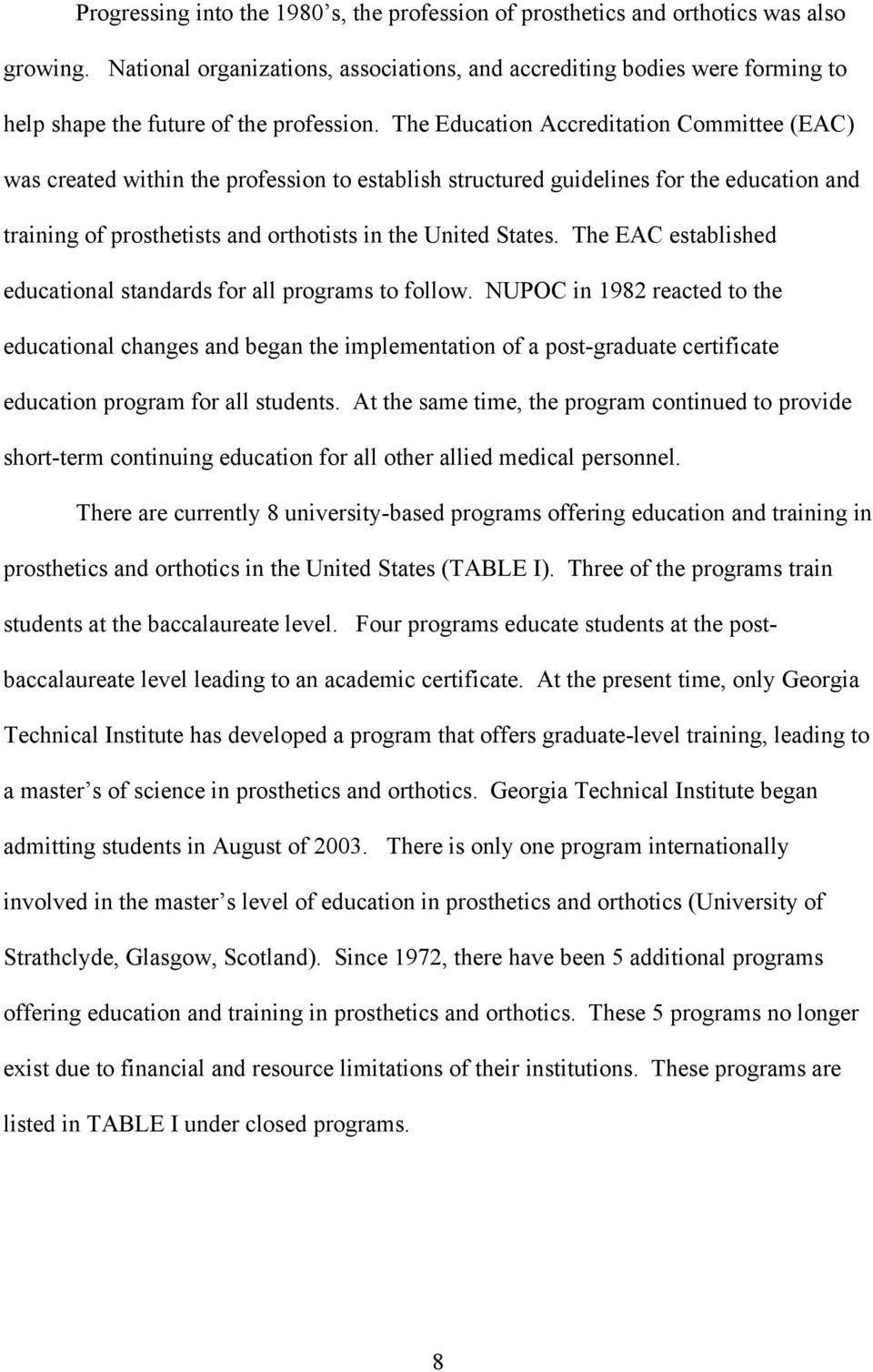
9 TABLE I ACCREDITED EDUCATION PROGRAMS Current Programs Provisional Programs Closed Programs California State University at University of California Georgia Technical Institute Dominguez Hills at Los Angeles University of Texas Southwestern (Dallas) New York University University of Washington (Seattle) Cerritos College Century College Practitioner Program Shelby State College Newington Certificate Program Florida International University Northwestern University Rancho Los Amigos Certificate Program 9
10 The need for a graduate degree in the profession of prosthetics and orthotics has yet to be determined. The lack of graduate education in prosthetics and orthotics, combined with the increased demands for efficient and functional healthcare delivery, may ultimately require a more educated prosthetics and orthotics clinician. Additional graduate degree programs could further advance the profession and may positively affect rehabilitative patient care. The changing healthcare management system and advancements in technology will create higher educational and technological demands on the clinicians of tomorrow. A new graduate program may provide bettertrained, more qualified practitioners in prosthetics and orthotics. Clinical research and evidenced-based care is needed in the profession in order to expand the body of knowledge and create resources for future textbooks and scientific theories that have yet to be developed. New paradigms in education and training must be attempted to address the technological and research demands in the profession. The purpose of this project is to assess the need for graduate degree programs, as perceived by current prosthetic and orthotic practitioners, through the use of a web-based assessment survey. 10
11 II. REVIEW OF RELATED LITERATURE A review of relevant literature regarding comparable programs in other allied health disciplines was performed. A database search in Medline, CINAHL, and HealthSTAR was executed. Searching for key words such as program development, curriculum development, graduate education, allied health, and planning produced many possible sources. A combined search was completed and narrowed the choices considerably. Many of the references were not applicable to the topic of development of a master s degree program. The majority of relevant literature sources were taken from the nursing, physical therapy, and rehabilitation professions. Hill (1989) discussed the early stages in the development of a masters degree program in nursing. This source cited the use of a survey instrument administered to nursing administrators in the Midwest. The survey looked at capturing the perceived future practice needs in nursing. The survey used a Delphi process to ascertain the respondent s choices. The responses to the survey questionnaire were expected to answer the following questions: What future health-care and nurse practice events are likely to occur in the year 2000? What skills/knowledge/abilities are considered to be both critical to survival and best learned in a master s degree program. What are the characteristics/attitudes of the prospective student that would be indicators of adequate enrollments Based on the analysis of the data in this survey, a blended program rather than a master s degree in nursing would have the greatest probability of success in meeting the 11
12 perceived needs of the nursing community. The future professional nurse s role according to this source will be one of heavy responsibility and accountability in areas of marketing, economics, finance, communications, ethics, and legal and governmental concerns. The author reported that development of a master s degree program in nursing is not the most appropriate to meet the reported needs of the nursing community. The respondents to the survey did not express the need for nursing content nearly as strongly as the need for other content. The respondents also felt that less strongly that nursing content could be best learned in a master s degree program. Hagemaster(1990) discussed nursing education also. The author concluded that there is considerable interest in developing flexible nursing education programs for nontraditional students. Offering a RN-MS track is one approach that allows a two-year completion of not only a BSN but also a master s degree in nursing science. This type of program offers specialized study components after completion of the BSN requirements. Students have the option of earning an MS in any one of five clinical specialties, nursing education or nursing management. This approach could be applicable to the education of orthotists and prosthetists. Doheny and Hitch(1991) discussed the guidelines for the master s degree in orthopedic nursing. This specialty degree was developed for those students interested in pursuing a master s degree in orthopedic nursing. Most MSN degrees do not have specific learning experiences in orthopedic nursing. This specialized curriculum offered learning experiences in both adult and pediatric orthopedic nursing. Having specialized training is one of the advantages in offering a master s degree program. Being able to provide advanced skills and knowledge in a graduate degree is important. 12
13 A collaborative approach to needs assessment using a consortium of four universities was discussed by Holden-Lund, et al (1991). They described a unique agreement between four regional universities in Louisiana to develop a master s program in nursing with institutional cooperation and increased educational opportunities for students. With only eight university programs in prosthetics and orthotics, this type of consortium may offer additional resources for adding advanced training. A relevant perspective given by Rowley et al (1997) discussing the development of a 12-month master s-level rehabilitation engineering training program. This paper described the shortage of rehabilitation engineers and the potential to use these highly trained students as service providers in the allied health field. The program was developed with four educational goals. Disability and technology, major rehabilitation systems, applied skills, and life-long learning were implemented into the core curriculum. Prosthetists and orthotists are often linked closely with rehabilitation engineering. This relationship may also provide alternative paths to develop new educational programs. Threlkeld et al (1999) wrote about the clinical doctorate in physical therapy. This report is relevant for its thorough discussion of the grounded theory research in professional education. A review of the external influences of society and the profession, the internal influences of the institution and the critical dimensions of professional competence and professional attitudes are covered in detail. This paper lays out the conceptual framework for the clinical doctorate in physical therapy and provides useful tools to analyze their role in an ever-changing healthcare environment. 13

14 A trend that appears in many of the relevant sources is the use of a needs assessment or survey that targets the appropriate audiences. Walker and Lantz (1992) report on the use of an educational needs survey. This survey was designed to (1) ascertain whether there was a need for an advanced master s level educational program in pediatric critical care and (2) what the service sector nurses rated as important items to be included in the curriculum. This process led to the collaboration of a curriculum and master s program as a clinical nurse specialist. Using a needs assessment to target appropriate populations to assist in program development is essential in the early curriculum design stages. The review of literature revealed a limited amount of material describing the methods of new program development. The relevance of the literature review to this project demonstrated the combine methods of using needs assessments and surveys in determining methods for program development. Since this project is attempting to gather information that will be helpful in planning future education directions, many different resources will be used. Gaining insights from other medical and allied health education programs will assist in the development process for new graduate degree programs in prosthetics and orthotics. 14

15 II. METHODOLOGY The purpose of the survey was to assess the perceived need for graduate education and training in the profession. A convenience sample was used to provide survey responses. The sampling frame were registered users of the Orthotics and Prosthetics list-serve (OANDP-L). The list-serve consisted of 1651 users (out of a total of 3654 ABC certified prosthetists orthotists, that is 45.2%) who were prosthetists, orthotists, prosthetists-orthotists, physicians, therapists and consumers. The frequency distribution of the list-serve is unknown. Dual certified prosthetists-orthotists comprise 36% of the profession, while 31.5% are orthotists and 31.5% are prosthetists. OANDP-L is endorsed by the American Academy of Orthotists and Prosthetists and the International Society of Orthotists and Prosthetists as a forum for the discussion of orthotic and prosthetic issues. The list-serve was chosen because it was readily available, endorsed by the profession, and allowed for electronic capture of data. Listserve users who participated in the survey were volunteers who received no compensation. The project was approved under research protocol # from the University of Illinois at Chicago. An invitation to participate in the survey was posted to the OANDP-L via electronic mail in August of The invitation requested list-serve users to link to a specified web address ( and complete the survey. Completed surveys were sent from the web-server directly to the investigator s electronic mail for data analysis with no personal identifiers. 15

16 Anonymity was secured automatically during the response process through the OANDP-L server. Only those responses from practitioners in prosthetics and orthotics were used in the data analysis. The survey items were piloted with Northwestern University s prosthetics and orthotics faculty for content and clarity prior to distribution. The researcher developed the survey items. The survey consisted of 12 items. Four demographic questions were followed by seven additional items that aimed at establishing the need for graduate level education in the profession. A 6-point rating scale was used to respond to survey items. The educational need will be determined by the mean response to item 7, asking if the respondents consider the current education level sufficient to meet the needs of the disabled community for the future. The last survey item asked the participants to determine an order of preference for important topics that may be included in a new graduate degree program. A listing of 21 topics was provided in a random order. The topics were chosen by the investigator to include current curriculum standards as well as other topics that have been used in other medical professions and may have applicability to prosthetics and orthotics. The rankings may be used to develop future curricula in both current and new training programs. Additional narrative comments were possible following each question in the survey. Samples from the range of written responses will be presented. Only minor adjustments were made to the instrument following the pilot testing. A copy of the final instrument is presented in the appendix. Mean ratings and standard deviations were recorded for survey items 5 through

17 A non-parametric Pearson Chi- Square analysis was done to test significance in responses between disciplines, years of experience, and level of education for items 5 through

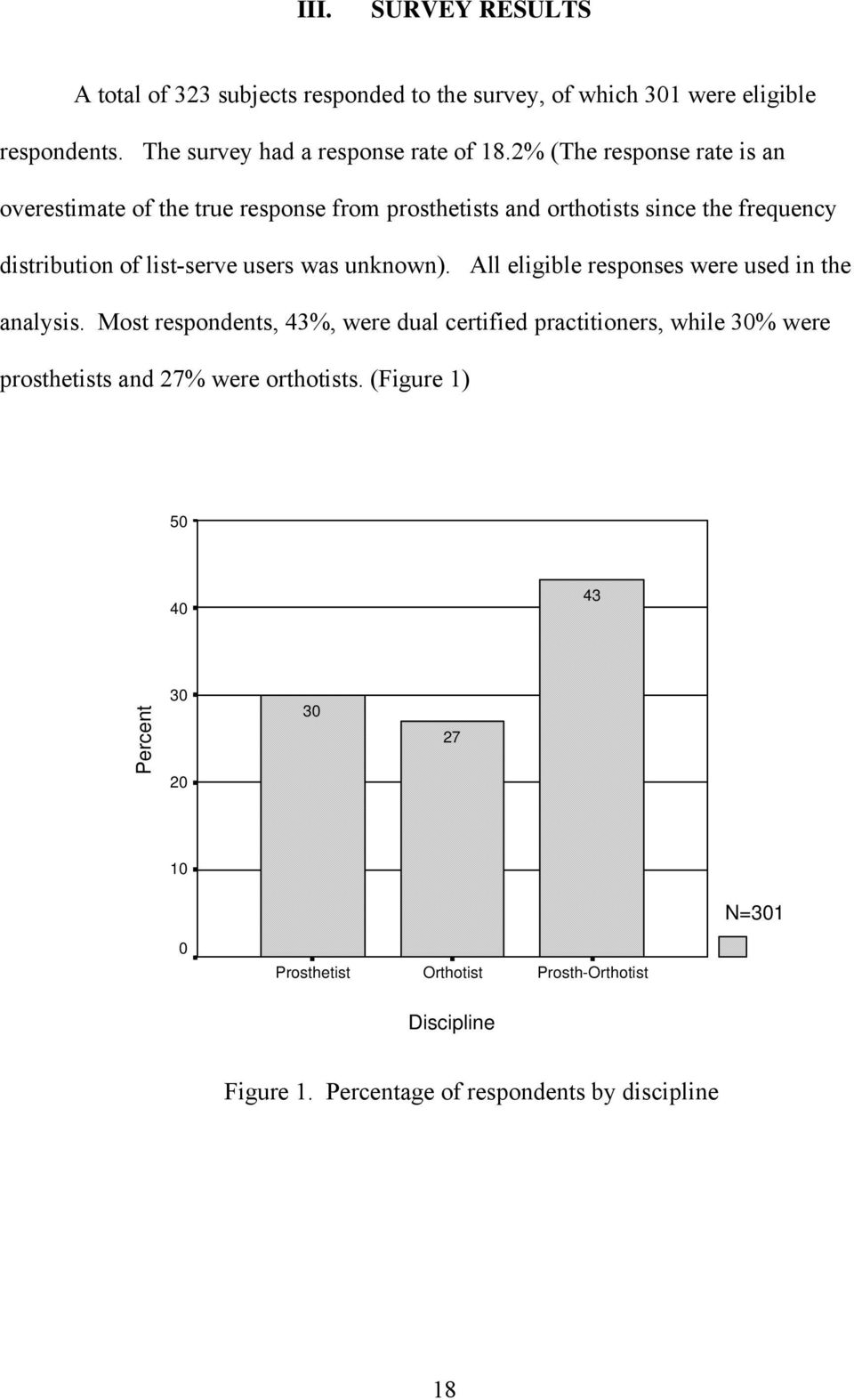
18 III. SURVEY RESULTS A total of 323 subjects responded to the survey, of which 301 were eligible respondents. The survey had a response rate of 18.2% (The response rate is an overestimate of the true response from prosthetists and orthotists since the frequency distribution of list-serve users was unknown). All eligible responses were used in the analysis. Most respondents, 43%, were dual certified practitioners, while 30% were prosthetists and 27% were orthotists. (Figure 1) Percent N=301 0 Prosthetist Orthotist Prosth-Orthotist Discipline Figure 1. Percentage of respondents by discipline 18
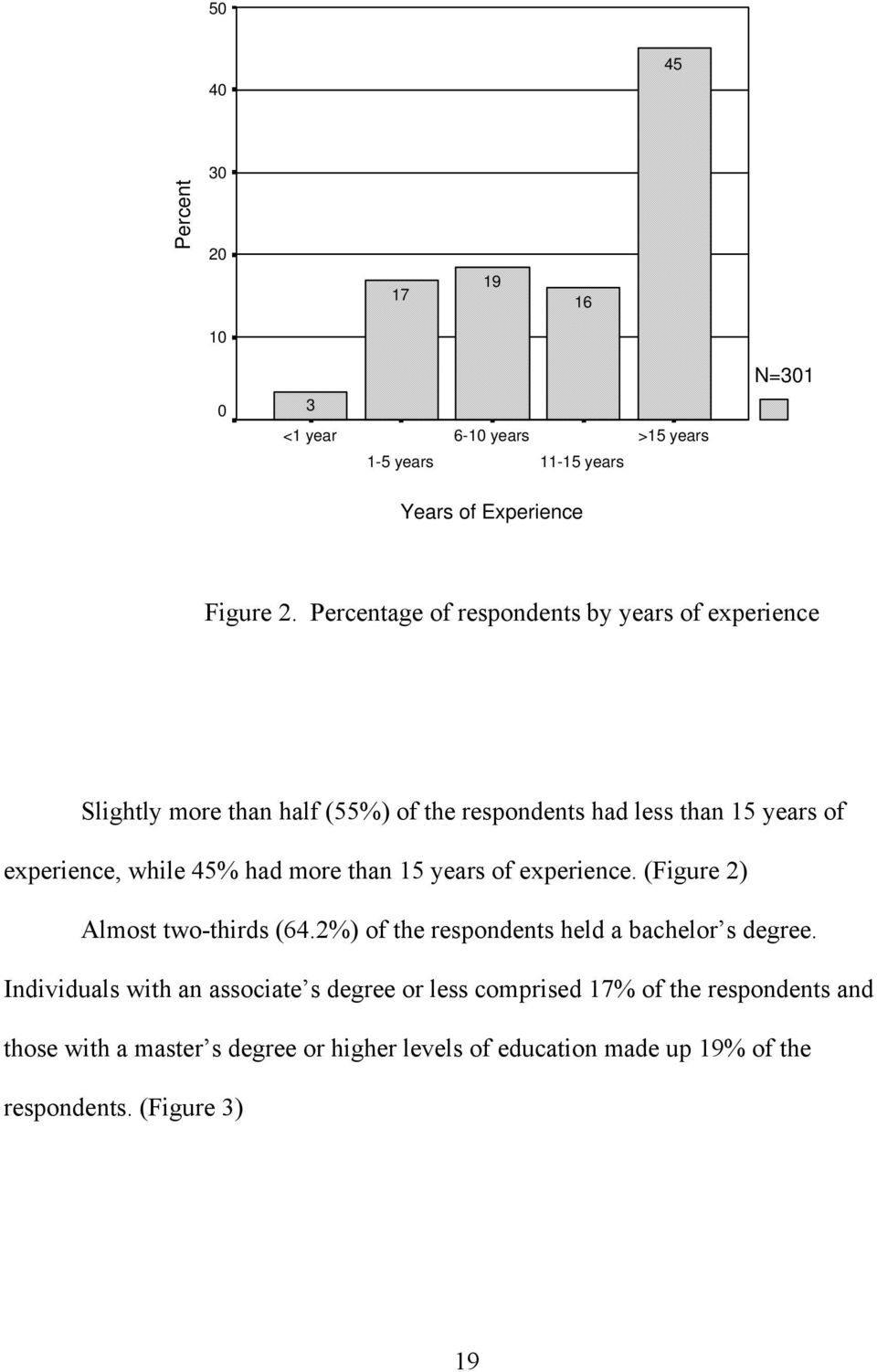
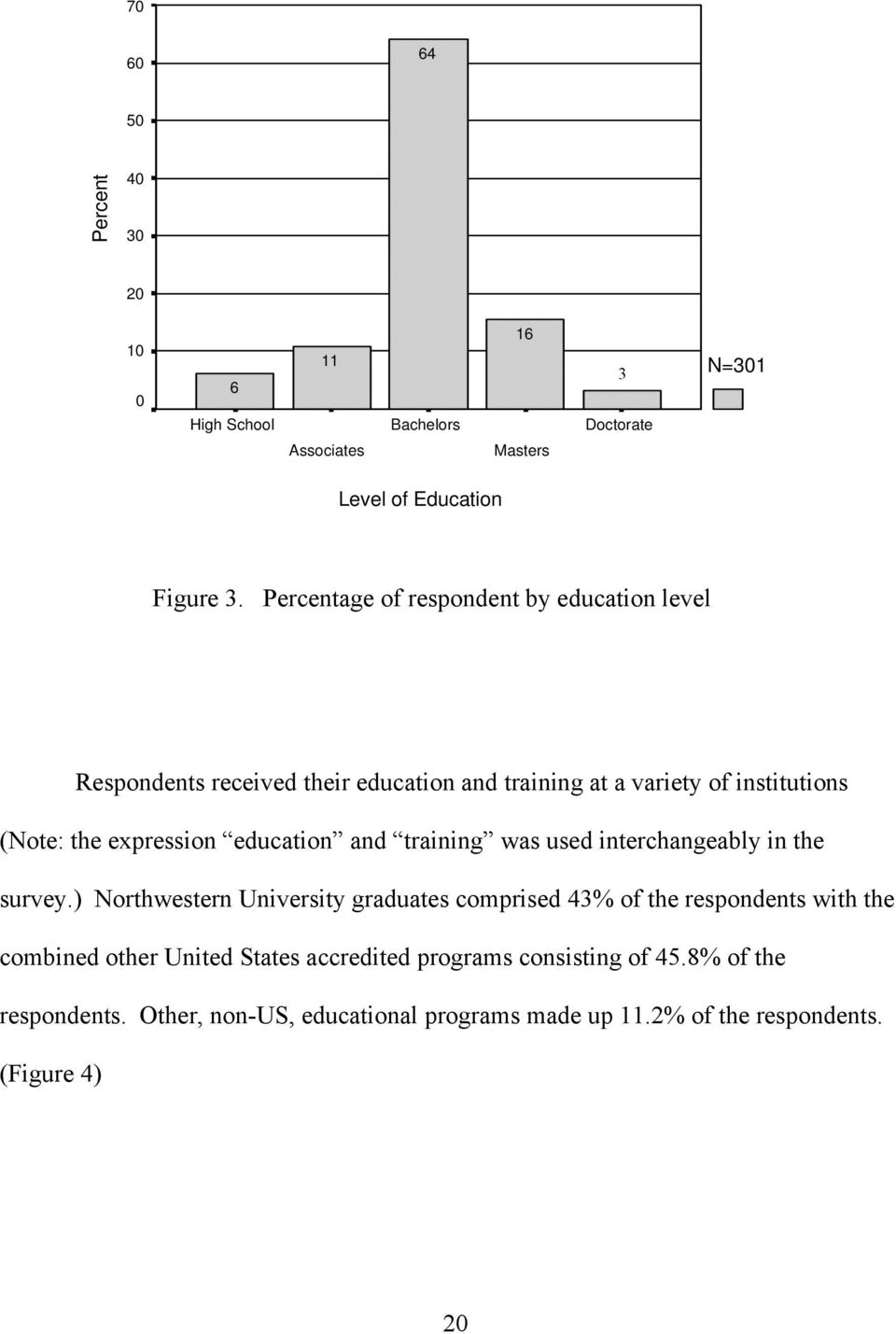
19 Percent N= <1 year 1-5 years 6-10 years years >15 years Years of Experience Figure 2. Percentage of respondents by years of experience Slightly more than half (55%) of the respondents had less than 15 years of experience, while 45% had more than 15 years of experience. (Figure 2) Almost two-thirds (64.2%) of the respondents held a bachelor s degree. Individuals with an associate s degree or less comprised 17% of the respondents and those with a master s degree or higher levels of education made up 19% of the respondents. (Figure 3) 19
20 Percent High School 11 Associates Bachelors 16 Masters 3 Doctorate N=301 Level of Education Figure 3. Percentage of respondent by education level Respondents received their education and training at a variety of institutions (Note: the expression education and training was used interchangeably in the survey.) Northwestern University graduates comprised 43% of the respondents with the combined other United States accredited programs consisting of 45.8% of the respondents. Other, non-us, educational programs made up 11.2% of the respondents. (Figure 4) 20
21 Percent Other Univ. Washington N=301 Shelby State Century College Northwestern New York Univ Cal. State Newington FLorida Int. Univ Rancho Los Amigos UCLA Univ. Texas Education Program Attended Figure 4. Percentage of respondents by education program 21
22 A. Training Appropriateness to Meet Needs Two-thirds of the respondents (66.9%) agreed that the current level of training is appropriate to meet the current needs of the disabled community, while the remaining third (33.3%) disagreed. The mean rating was 3.90 (s=1.32) on the 6-point scale. (Figure 5) Total Discipline Prosthetists- Orthotists Orthotists Prosthetists Strongly Strongly Figure 5. Appropriateness ratings by discipline The current levels of training in prosthetics and orthotics are appropriate to meet the needs of the disabled community at the present time. 22
23 There were no significant differences among disciplines concerning the appropriateness of the current training to meet the needs of the disabled community (x 2 = 0.992, df = 2, p.60). With respect to experience levels, no statistical differences were found in responses between those with less than 10 years of experience compared to those with greater than 10 years of experience when responding to this statement (x 2 = 1.507, df = 1, p.22). However, respondents with a bachelor s degree or higher agreed more (70% vs.55%) than those with an associate s degree or less (x 2 = 3.657, df = 1, p.05). (TABLE II) (Note: The order of entries in TABLES II to X will be the same across tables, that is, education, experience, and discipline.) 23
24 TABLE II COMPARISON OF EDUCATION LEVEL, EXPERIENCE LEVEL, AND DISCIPLINE (ITEM 5): The current levels of training in prosthetics and orthotics are appropriate to meet the needs of the disabled community at the present time. Education Level Total AA Degree 21 (44.7%) 26 (55.3%) 47 BS Degree (30.4%) (69.6%) Total 98 (32.7%) 202 (67.3%) 300 (x 2 = 3.657, df = 1, p.05) Experience Level Total 10 Years 32 (28.6%) 80 (71.4%) Years (35.4%) (64.6%) Total 99 (33.1%) 202 (66.9%) 301 (x 2 = 1.507, df = 1, p.22) Discipline Level Total Prosthetists (36.7%) (63.3%) Orthotists (29.6%) (70.4%) Prosthetists- Orthotists 42 (32.3%) 88 (67.7%) 130 Total (32.9%) (67.1%) (x 2 = 0.992, df = 2, p.60) 24
25 Samples from the range of written comments for item 5 are presented below: Training should be broadened to include clinical rotations as a function of curriculum. Residency is a positive step, but educational requirements need to be stronger on clinical skills. The schools provide the basics; while the clinical residency programs help to balance the theoretic basics concepts with real applications. It is a good balance. There is a lack of people entering the field and the programs are expensive to run and quite a number of schools have closed because cost of program out weighs the number entering. There are some programs available with no formal education that produces inadequate practitioners. As with anything, there are some good schools and some bad. The level of education received at the different schools varies too widely. I believe there needs to be a more uniform standard across the board, preferably a uniform standard set at the level of the best programs. More advanced training is needed in the comprehensive management of individuals with complex pathologies and disabilities, especially given the advanced technologies being applied in today practice of O&P. 25
26 B. Training Comprehensiveness to Meet Needs Two-thirds of the respondents (64.9%) agreed that their training and education was comprehensive and sufficient to manage all levels of patient care. (Figure 6) The mean rating was 4.0 (s=1.28), that is, agree on the 6-point scale. There were no significant differences among education levels, (x 2 = 1.287, df = 1, p.25) or disciplines (x 2 =5.204, df = 2, p.07). However, respondents with more than ten years experience agreed less (73% vs. 60%) than those with ten years or less experience (x 2 = 5.071, df = 1, p.02). (TABLE III) Total Discipline Prosthetists- Orthotists Orthotists Prosthetists Strongly Strongly Figure 6. Comprehensiveness ratings by discipline The training and education that you received was comprehensive and sufficient to manage all levels of prosthetic and orthotic care. 26
27 TABLE III COMPARISON OF EDUCATION LEVEL, EXPERIENCE LEVEL, AND DISCIPLINE (ITEM 6): The training and education that you received was comprehensive and sufficient to manage all levels of prosthetic and orthotic care. Education Level Total AA Degree 13 (27.7%) 34 (72.3%) 47 BS Degree (36.3%) (63.7%) Total 104 (34.9%) 194 (65.1%) 298 (x 2 = 1.287, df = 1, p.25) Experience Level Total 10 Years 30 (27.0%) 81 (73.0%) Years (39.9%) (60.1%) Total 105 (34.8%) 194 (65.2%) 299 (x 2 = 5.179, df = 1, p.02) Discipline Level Total Prosthetists 24 (26.7%) 66 (73.3%) 90 Orthotists (34.2%) (65.8%) Prosthetists- Orthotists 54 (41.5%) 76 (58.5%) 130 Total 105 (35.1%) 194 (64.9%) 299 (x 2 =5.204, df = 2, p.07) 27
28 Samples from the range of written comments for item 6 are presented below: Training just gave a foundation. Patient contact and on the job experience is what is needed to manage all levels of care. Someone told me when I first started that it would take two years of working full time under supervision to know what I was doing. I found that to be accurate. At the baccalaureate level, my education was excellent in areas such as patient physical examination and anatomy and physiology from the PT/OT perspective. The course-work in P and O however only loosely tied these concepts into how it was related to P and O. There was hardly any emphasis on research and/or methods in critically reviewing existing research and in developing new research/knowledge. The methods of learning P and O patient care were awkward and not organized. The O & P courses I took were good at the time but fell far below the standards of my undergraduate requirements in depth and thoroughness. Continued study and application over the first ten years of my career taught me, what I feel to be the "minimum" clinical experience to become competent. Even now I'm only as skilled as my last successful case. In the late 70's, there was a focus on both technical and clinical which better prepared the clinician to designing a device as well as direct technicians with appropriate techniques. The new clinicians are lacking in fundamental design, engineering, stress and structure knowledge to properly serve the patient community. I graduated feeling like I knew a very little about a lot of things, not at all prepared to manage problems on my own. Residency and my first years in the field were where I learned the most about comprehensive management. My training and education was comprehensive and sufficient to begin with basic knowledge in all areas. Only practice and continued education, in specific areas, will provide optimal care. 28
29 C. Future Appropriateness to Meet Need (Item 7) Half of the respondents (51.7%) thought that the current education and training being offered was insufficient to meet the demands of the disabled population in the future. The mean rating for this item was 3.44 (s=1.34), that is, disagree on the 6-point scale. (Figure 7) Total Discipline Prosthetists- Orthotists Orthotists Prosthetists Strongly Strongly Figure 7. Future appropriateness ratings by discipline The levels of current prosthetic and orthotic education and training will be appropriate to meet the needs of the disabled in the future. There were no significant differences in responses between education levels, years of experience, or discipline levels. (TABLE IV) 29
30 TABLE IV COMPARISON OF EDUCATION LEVEL, EXPERIENCE LEVEL, AND DISCIPLINE (ITEM 7): The levels of current prosthetic and orthotic education and training will be appropriate to meet the needs of the disabled in the future. Education Level Total AA Degree 25 (53.2%) 22 (46.8%) 47 BS Degree (51.2%) (48.5%) Total 153 (51.5%) 144 (48.5%) 297 (x 2 =.063, df = 1, p.80) Experience Level Total 10 Years 52 (46.8%) 59 (53.2%) Years (54.5%) (45.5%) Total 165 (51.7%) 156 (48.3%) 298 (x 2 =1.653, df = 1, p.19) Discipline Level Total Prosthetists 46 (51.7%) 43 (48.3%) 89 Orthotists (51.3%) (48.8%) Prosthetists- Orthotists 67 (51.9%) 62 (48.1%) 129 Total (51.7%) (48.3%) (Χ 2 =.009, df = 2, p.99) 30
31 D. Graduate Level Training to Meet Needs On average, three out of five respondents (62.8%) agreed that the level of education should be advanced to include a graduate degree. A higher percentage of dual certified practitioners agreed with this statement compared with single certified practitioners (Figure 8). The mean rating was 3.92 (s=1.56), that is, agree on the 6- point scale. Total Discipline Prosthetists- Orthotists Orthotists Prosthetists Strongly Strongly Figure 8. Graduate education ratings by discipline The level of education and training of orthotists and prosthetists should be advanced to include a graduate degree. (e.g., Master of Prosthetics and Orthotics) There were no differences responses by education level to this item (x 2 =2.167, df = 1, p.14) but significant differences were observed according to experience levels and 31
32 discipline levels. Those with less experience and dual certifications agreed slightly more (about 25% more). (TABLE V) TABLE V COMPARISON OF EDUCATION LEVEL, EXPERIENCE LEVEL, AND DISCIPLINE (ITEM 8): The level of education and training of orthotists and prosthetists should be advanced to include a graduate degree. (e.g., Master of Prosthetics and Orthotics) Education Level Total AA Degree 22 (46.8%) 25 (53.2%) 47 BS Degree (35.5%) (64.8%) Total 110 (37.3%) 185 (62.7%) 295 (x 2 =2.167, df = 1, p.14) Experience Level Total 10 Years 31 (29.7%) 80 (72.1%) Years (42.7%) (57.3%) Total 110 (37.2%) 186 (62.8%) 296 (x 2 =6.485, df = 1, p.01) Discipline Level Total Prosthetists 40 (44.4%) 50 (55.6%) 90 Orthotists (42.3%) (57.7%) Prosthetists- Orthotists 37 (28.9%) 91 (71.1%) 128 Total 110 (37.2%) 186 (62.8%) 296 (x 2 =6.664, df = 2, p.03) 32
33 Samples from the range of written comments for item 8 are presented below: Master's programs in O & P, I believe, are a waste of money. Deciding on a focus for the degree would inherently define the field of study too narrowly. Hands on application of basic scientific, psychological and personal communication principles would provide a better environment to culture the correct type of thinking to be a successful practitioner. The education process should be difficult enough to require dedication to study our profession/trade. The only purpose for this push for "advanced education" is to enhance the status of the practitioner, not his/her skill level. Advanced education only makes sense for one who will be doing academic education and research. Then, the approach should be by specific discipline - i.e., bioengineering. The patient provider practitioner does not require this advanced education to meet the needs of patients. This extension of education should be an OPTION available to those who wish to advance their current knowledge. If this is required, it will likely drive away many qualified candidates who do not wish to spend additional time in the classroom. O & P is already projected to fall behind the increasing need for our services in the near future. I think this move is needed to keep us competitive as health care professionals but I feel that a Masters degree has to offer something above and beyond the current degrees/certificates. I believe that a PhD. is ultimately the appropriate level of education that we need. Who is it that writes our literature? Doctors, therapists and engineers. Sure, there are times when a prosthetist or orthotist is at the end of the list of authors, but never as the lead author of a truly well researched paper. Certainly, never as the lead author of a book. That's why we need to be better educated, so that we can express what we do and what we know about what we do. If current O &P schools are having trouble attracting quality professionals at the bachelor or post graduate level, do you think it is likely that there will be enough students to support this new program when this higher level will effectively make those eligible a smaller select group? 33
34 E. Technical Skills in Graduate Education A total of 71.8% of the respondents indicated that a master s degree would not improve the technical skills of a student. The mean rating was 3.0 (s=1.42), that is, disagree on the 6-point scale. (Figure 9) Total Discipline Prosthetists- Orthotists Orthotists Prosthetists Strongly Strongly. Figure 9. Technical skill ratings by discipline A master s degree in prosthetics and orthotics would increase the levels of technical skills of orthotists and prosthetists. No significant difference in responses was found between education levels or discipline. However, those with more experience agreed less with this statement (38.2% vs. 22.3% (x 2 =8.603, df = 1, p.03). (TABLEVI). 34
35 TABLE VI COMPARISON OF EDUCATION LEVEL, EXPERIENCE LEVEL AND DISCIPLINE (ITEM 9): A master s degree in prosthetics and orthotics would increase the levels of technical skills of orthotists and prosthetists. Education Level Total AA Degree 36 (76.6%) 11 (23.4%) 47 BS Degree (70.8%) (29.2%) Total 213 (71.7%) 84 (28.3%) 297 (x 2 =.655, df = 1, p.41) Experience Level Total 10 Years 68 (62.8%) 42 (38.2%) Years (77.7%) (22.3%) Total 214 (71.8%) 84 (28.2%) 298 (x 2 =8.603, df = 1, p.03) Discipline Level Total Prosthetists 71 (78.9%) 19 (21.1%) 90 Orthotists (68.8%) (31.3%) Prosthetists- Orthotists 88 (68.8%) 40 (31.3%) 128 Total 214 (71.8%) 84 (28.2%) 298 (x 2 =3.190, df = 2, p.20) 35
36 Samples from the range of written comments for item 9 are presented below: Increasing the technical skills of a degreed prosthetist-orthotist is tantamount to the project engineer operating the crane. Yes, the professional needs some hand skills, but not to the level that I was taught. The patient management needs to be separated from the tinker toys. I think it is more likely to improve someone s understanding of a subject rather than technical skill. They are however, likely to become more technically capable of carrying out research studies. The use of a Master's level program to foster technical skills is a waste of time. Masters level students need evaluation and decision making tools, not bending irons and drawknives. Master s degrees should not be as concerned with technical skills, unless a chosen track in a clinical specialty was pursued. The advanced level degrees are intended to create advanced thinkers who will form a basis for the future of O&P practice and education. Technical skills should be focused upon in technical skills, and in the residency after the completion of the BS program or certificate program. I feel that clinical and technical skills should be more a purview of the bachelor's level, scientific skills and research is the purview of a master's program. As a registered technician that has been working in the field for 10 years, and have worked with some of the best in the field, feel that more formal education will not help their technical skills. They need to take technician training before they start their formal education to master their technical skills. Although an increase in technical skills and clinical competence may be a byproduct of a Master's degree, I feel that an advanced degree should include the production of a thesis resulting from original research and investigation. 36
37 F. Clinical Skills in Graduate Education A total of 78.9% of respondents agreed that a master s curriculum would increase the clinical competence of an individual. The mean rating was 4.45 (s=1.32) for item 10, this is agree on the 6-point scale. (Figure 10) This is in contrast to the previous item, where 71.8% of respondents indicated that a master s degree would not improve technical skills. There were no significant differences in responses according to education level, years of experience or discipline. (TABLE VII) Total Discipline Prosthetists- Orthotists Orthotists Prosthetists Strongly Strongly Figure 10. Clinical skill ratings by discipline A master s degree in prosthetics and orthotics would increase the levels of clinical competence of orthotists and prosthetists. 37
38 TABLE VII COMPARISON OF EDUCATION LEVEL, EXPERIENCE LEVEL AND DISCIPLINE (ITEM 10): A master s degree in prosthetics and orthotics would increase the levels of clinical competence of orthotists and prosthetists. Education Level Total AA Degree 13 (27.7%) 34 (72.3%) 47 BS Degree (19.9%) (80.1%) Total 63 (22.1%) 235 (78.9%) 298 (x 2 =1.422, df = 1, p.23) Experience Level Total 10 Years 21 (19.8%) 91 (81.3%) Years (22.5%) (77.5%) Total 63 (21.1%) 236 (78.9%) 299 (x 2 =.580, df = 1, p. 44) Discipline Level Total Prosthetists 19 (21.1%) 71 (78.9%) 90 Orthotists (22.8%) (77.2%) Prosthetists- Orthotists 26 (20%) 104 (80%) 130 Total 63 (21.1%) 236 (78.9%) 299 (x 2 =.229, df = 1, p.89) 38
39 Samples from the range of written comments for item 10 are presented below: The program would develop critical thinking skills, create awareness of other opportunity's and learn how to gather more knowledge from various sources. Therefore the level of clinical competence is increased as knowledge is enhanced. I don't believe it increases the humanity aspect of competence. If this is structured in a way that the educational program focuses on more than what is presently being taught in P&O schools today. Some topics may include: Diabetic Management, Stroke Management, Wound-Care, Business/Management courses. I still feel strongly that this "Masters" level should be in addition to what is already being taught, not a substitute. Better knowledge of the situation, better skills to implement the knowledge. It s time to cure the collective knowledge and experience to produce a self-sufficient practitioner who is able to either support his/her employer as a professional or work as a leader in the field. Only practical application can increase the clinical skills of a practitioner. If the Master's program included many hours of clinic time under a mentor, then it could, not necessarily would, provide the opportunity for improvement of clinical skills. I would hope that the programs would devote much needed time to clinical skills. I don't know that current certificate programs are able to do this adequately. 39
40 G. Knowledge in Graduate Education Most respondents (91.4%) agreed that a master s degree would increase knowledge. The mean rating was 4.79 (s=1.23), that is, between agree and strongly agree on the 6-point scale. (Figure 11) Total Discipline Prosthetists- Orthotists Orthotists Prosthetists Strongly Strongly Figure 11. Knowledge ratings by discipline A master s degree in prosthetics and orthotics would increase the levels of knowledge of orthotists and prosthetists. No differences in responses were seen in education levels or discipline levels. Respondents with less experience agreed slightly more with this statement. (x 2 = 5.562, df = 1, p.01) (TABLE VIII) 40
41 TABLE VIII COMPARISON OF EDUCATION LEVEL, EXPERIENCE LEVEL AND DISCIPLINE (ITEM 11): A master s degree in prosthetics and orthotics would increase the levels of knowledge of orthotists and prosthetists. Education Level Total AA Degree 6 (13.3%) 39 (86.7%) 45 BS Degree (7.7%) (92.3%) Total 25 (8.6%) 267 (91.4%) 292 (x 2 =1.547, df = 1, p.21) Experience Level Total 10 Years 4 (3.6%) 107 (96.4%) Years (11.5%) (88.5%) Total 25 (8.5%) 268 (91.5%) 293 (x 2 = 5.562, df = 1, p.01) Discipline Level Total Prosthetists 6 (6.7%) 84 (93.3%) 90 Orthotists (13.2%) (86.8%) Prosthetists- Orthotists 9 (7.1%) 118 (92.9%) 127 Total 25 (8.5%) 268 (91.5%) 293 (x 2 = 2.825, df = 2, p.24) 41
42 The final survey question asked respondents to rank a randomly ordered list of 21 topics according to areas of most need to prosthetists and orthotists. The rank order of topics is presented in TABLE IX. The top three subjects most in need were clinical evaluation, biomechanics, and gait analysis. The bottom three subjects were leadership, medical malpractice, and occupational safety. TABLE IX RANK ORDER OF SUBJECTS 1 SUBJECT N MEAN Clinical Evaluation Std. Deviation SUBJECT N MEAN Engineering Design Std. Deviation Biomechanics Pediatrics Gait Analysis Evidence-based Practice Clinical Decision Kinesiology Research Design Health Economics Pathology Myoelectrics Technical Skills CAD-CAM Componentry Leadership Materials Science Medical Malpractice Psychology Neurology Occupational Safety The subject area(s) of most need to orthotists and prosthetists is: (rank order: 1=most, 2,3,4 21 least) 42
43 IV. DISCUSSION AND CONCLUSION A. Summary of Results In summary, two-thirds of the respondents agreed that the levels of education and training in prosthetics and orthotics are appropriate at the present time. Those with an associate s degree or high school diploma agreed less. Two-thirds also agreed that their training and education in prosthetics and orthotics was sufficient to manage all levels of care, with those that had more than 10 years of experience agreeing less. Approximately half (51.7%) agreed that the current level of education and training is insufficient for the future. Three-fifths (62.8%) agreed that the level of training should be increased to include a graduate degree, especially for those with dualcertifications and less experience. More than two-thirds (71.8%) of the respondents felt that a master s degree would not improve technical skills, but almost 8 out of 10 respondents (78.9%) agreed that a master s degree would improve clinical competence. Nine out of 10 respondents (91.4%) agreed that a master s degree would increase the knowledge of orthotists and prosthetists. Those with 10 years or less experience agreed more. The rank ordering of subjects produced a mixture of clinical, scientific, and technical topics that were selected as the top ten choices among the 21 possible subjects presented. Clinical evaluation was chosen most frequently as the top subject with a mean ranking of 3.19 out of 21 (s=3.07). Biomechanics was rated second with a 4.07 mean score (s=2.87) and Gait Analysis was ranked third with a 4.48 mean score (s=3.09). 43
44 B. Limitations of Survey The major limitations of this survey are related to the scope and possible biases of the respondents. A response rate of 18.2% of the professional list-serve (OANDP-L) makes it difficult to draw conclusions without accurate representations of clinicians in the profession of prosthetics and orthotics. A sample size of 300 is needed to have a twosided 95% confidence interval for a single mean that will extend from the observed mean, assuming that the standard deviation is known to be and the confidence is based on the large sample z statistic. The lack of power, which is insufficient sample size, affected the ability to gain precision in collecting responses, as reflected in the large standard deviations for each rating. In order to have an even higher precision of.10, the sample size would need to be increased to 700 respondents, and 2801 respondents if a.05 precision was desired. The sampling frame of practitioners also had limitations. An electronic list-serve was used for convenience purposes but eliminated the possible responses from those who do not use computers. This sampling bias does not allow for a true representation of the profession. Making accurate conclusions from the responses would be difficult to accomplish within this limitation. The survey responses produced a larger percentage of dual certified practitioners (43% vs.36%) and a smaller percentage of orthotic practitioners (27% vs. 31.5%) than what is presently represented in the profession. This difference may have influenced the mean ratings for survey items. 44
45 C. Interpretation of Survey Results The needs assessment survey produced a total of 301 eligible responses, a response rate of 18.2 % of those persons who subscribe to the OANDP list-serve. This sample represents 8.2% of all American Board for Certification practitioners. The respondents were comprised of 43% dual certified prosthetists-orthotists, 30% certified prosthetists and 27% certified orthotists. When compared to the total number of American Board for Certification practitioners, 36% are dual certified prosthetistsorthotists, 31.5% are certified prosthetists and 31.5% are certified orthotists. The survey had a higher proportion of dual certified practitioners as compared to single certified orthotic practitioners. Forty-five percent of the participants had greater than 15 years of experience. These participants may have influenced the mean rating scores and openended comments because they did not have an opportunity to participate in new educational standards currently being offered. New educational standards were adopted from CAAHEP in These standards included the use of more formalized instruction in gait analysis, biomechanics, kinesiology, materials science, pathology, and research methods. Decrease emphasis and time was placed on technical fabrication and devices in the new standards. The standards were developed to allow education programs to evolve without imposing the financial burdens of material and equipment costs typically used in fabrication. The more experienced practitioners (>10 years) who responded to the survey would have not experienced this new curriculum, possibly affecting their survey responses. 45
46 The survey results highlighted the conflicting opinions of the profession as to whether a graduate level of education is needed. Opinions varied widely (see large SD s) depending on the education level, experience level, and discipline in practice. In general, the respondents with 10 years or less experience agreed more that education and training of prosthetists and orthotists requires raising the educational levels of future practitioners. The difference could also be due to a technological factor. Are older, more experienced practitioners feeling inadequately trained with the development of newer technology? Practitioners recently trained (<10 years) have more knowledge in gait analysis, materials science, and biomechanics then older practitioners. They also have experience with computer-aided design, computer-aided manufacturing and myoelectric prostheses. The future needs of a profession are often difficult to assess. This survey was used to identify the perceived needs of the prosthetics and orthotics profession with a desired purpose for future program development. The conflicting opinions make it difficult to draw a unanimous conclusion that supports changing the level of education. However overall, respondents felt a graduate degree was needed in prosthetics and orthotics by a 2 to 1 margin (62.8%). The focus of a potential master s degree was also addressed in the survey. Respondents rated the differences between technical, clinical, and knowledge domains in a graduate program. The vast majority (80% 92%) of the respondents thought clinical skills and knowledge would be improved in a master s program. Even though the survey showed that technical skills should not be the focus in an advanced training degree, technical skill was ranked seventh in order of importance. 46
47 This finding may assist in distinguishing the focus of an undergraduate program from the focus of a graduate program. This survey was initiated in order to assess the current and future educational needs in prosthetics and orthotics. With only eight CAAHEP accredited education programs in the United States, identifying new education and training needs is important for the evolution and growth of the profession. The development of a new graduate degree would produce the future educators, researchers, and leaders of the profession. A new graduate program must provide additional or more advanced areas of study than what is currently being offered. A graduate program must have its emphasis in both the search and creation of knowledge as well as in its application. Pulitzer Prize winning author Paul Starr, (1982) defined a profession as an occupation that regulates itself through systematic, required training and collegial discipline; that has a base in technological, specialized knowledge; and that has a service, rather than a profit, orientation enshrined in its code of ethics. Does current prosthetics and orthotics education provide for this advanced training and specialized knowledge? Recent professional publications have presented varying viewpoints of this issue from within the profession. Examples of these discussions can be read in the O&P Almanac (March, 2000); The State of Education in O & P, (February, 2001) The Great Debate in O&P Education and (February 2002) Evaluating O&P Schools. These articles provided readers with a varied perspective on the current state of education and where the profession may be headed concerning the education and training of future orthotic and prosthetic clinicians. The profession is at a crossroads. Health care cost-containment, combined with the need for effective clinical outcomes, becomes a topic for debate over 47
48 what is needed more. That is, less qualified, lower paid practitioners in greater numbers or more educated practitioners who may provide better patient care and advance research. The profession of prosthetics and orthotics is highly empirical. Science appears to be immature in the fields of prosthetics and orthotics. A graduate degree could aid in bringing more science to the profession. The application of science to the field has generally taken place through principles of engineering. In order for the profession to progress, a scientific component must evolve from within the profession to supplement the empirical aspects of the field. Science is needed in the profession in order for it to advance rapidly and logically into the future. This survey used a specific sampling frame from which to gather data from the profession. The results demonstrated the conflicting opinions the respondents had to present and future education needs. While it may be difficult to draw conclusions from this data, a majority of respondents from this web-based survey did agree that a graduate degree should be included in the education of orthotists and prosthetists. This survey should be viewed as a pilot study, from which a more comprehensive needs analysis can be structured. This comprehensive analysis should include a more representative and adequate sample of the profession and could further address issues of research needs, advanced clinical skill needs, or basic practitioner training needs. The focus and content of a graduate degree should also be addressed through a more comprehensive needs assessment. Does the profession view a master s degree as an entry-level requirement for all practitioners or is a master s degree needed only to propel research and education? These are questions that need to be answered in a more comprehensive study to accurately assess the future educational needs of the profession. 48
49 The profession of prosthetics and orthotics in the future will be faced with increased competition from outside the field, infringements of other healthcare occupations, more government regulation, increasing public demand for more qualified services at lower-costs, and rapid advancements of technology that will ultimately alter practice. These are future issues that may be addressed through changes in the professional education and training of prosthetists and orthotists. 49
50 APPENDIX 50
51 An Internet Survey of Educational Needs in Prosthetics and Orthotics This survey is being used as partial fulfillment of a master s degree project at the University of Illinois at Chicago. Participation in this survey is voluntary. No names are requested. Your participation is important to the investigator of this project. Please answer the survey questions honestly and completely. Additional information or questions concerning this survey should be directed to: Mark L. Edwards, C.P. at (312) , or via at: [email protected] DEMOGRAPHICS: Please check the appropriate lines: 1. I am currently ABC certified in: Prosthetics Orthotics Prosthetics and Orthotics 2. How many years have you been certified in prosthetics and/or orthotics? Less than 1 year 1 to 5 years 6-10 years years More than 15 years 3. What is your highest level of education? High School Diploma Associates Degree Bachelors Degree Masters Degree Doctorate Other 4. Where did you receive your education in prosthetics and orthotics? California State at Dominguez Hills Rancho Los Amigos Century College Rutgers University Cerritos College Shelby State College Florida International University UCLA Newington Certificate Program University of Texas New York University University of Washington Northwestern University Other 51
52 Needs Assessment 5. The current levels of training in prosthetics and orthotics are appropriate to meet the needs of the disabled community at the present time. Strongly Somewhat Somewhat Strongly The training and education that you received was comprehensive and sufficient to manage all levels of prosthetic and orthotic care. Strongly Somewhat Somewhat Strongly The levels of current prosthetic and orthotic education and training will be appropriate to meet the needs of the disabled in the future. Strongly Somewhat Somewhat Strongly The level of education and training of orthotists and prosthetists should be advanced to include a graduate degree. (e.g., Master s of Prosthetics and Orthotics) Strongly Somewhat Somewhat Strongly A master s degree in prosthetics and orthotics would increase the levels of technical skills of orthotists and prosthetists. Strongly Somewhat Somewhat Strongly
53 10. A master s degree in prosthetics and orthotics would increase the levels of clinical competence of orthotists and prosthetists. Strongly Somewhat Somewhat Strongly A master s degree in prosthetics and orthotics would increase the levels of knowledge of orthotists and prosthetists. Strongly Somewhat Somewhat Strongly The subject area(s) of most need to orthotists and prosthetists is: (rank in order 1=most, 2,3,4 21 least) clinical evaluation biomechanics engineering design kinesiology technical skills psychology gait analysis pathology medical malpractice componentry research design evidenced-based practice healthcare economics leadership clinical decision making CAD-CAM electronics/myoelectrics occupational safety material science pediatrics neurology Additional comments Thank you completing this survey. 53
54 REFERENCES Albreck, PL and Settle, RB,: The Survey Research Handbook 2 nd Edition Guidelines and Strategies for Conduction a Survey, NY McGraw-Hill, 1995 American Board for Certification, Alexandria, VA, Annual Report, 2002 American Orthotics and Prosthetics Association, Annual Report, 2002 Curry L, Wergin J,: Educating Professionals, Responding to New Expectations for Competence and Accountability, San Francisco, Jossey-Bass Publishers, National Commission on Orthotics and Prosthetics Education: Report on Issues Affecting the Future Demands of Orthotists and Prosthetists, Alexandria, VA, November, 1996 O&P Almanac,: The State of Education in O & P March, 2000 O&P Almanac,: The Great Debate in O&P Education February, 2001 O&P Almanac,: Evaluating O&P Schools, February 2002 Rhea, Louis M and Parker, Richard A., Designing and Conduction Survey Research A Comprehensive Guide 2 nd Edition, San Francisco, Jossey-Bass 1997 Starr, P, The Social Transformation of American Medicine, New York, Basic Books,
55 VITA MARK L. EDWARDS, C.P. Licensure: Certified Prosthetist, No. 1488, by the American Board for Certification in Orthotics and Prosthetics, Registered Kinesiotherapist, No. 840, by the American Kinesiotherapist Association, Education: Certificate in Orthotics; Northwestern University Medical School, Prosthetic-Orthotic Center, Chicago, Certificate in Prosthetics; Northwestern University Medical School, Prosthetic-Orthotic Center, Chicago, Bachelor of Science in Physical Education with an emphasis in Kinesiotherapy; University of Ill., Chicago, 1980, graduating with distinction. Professional Experience: Director, Prosthetics Education, Northwestern University Medical School, Chicago, Illinois, 1992-present. Clinical Instructor in Physical Medicine & Rehabilitation, Northwestern University Medical School, Chicago, Illinois, present Prosthetics Consultant; the Rehabilitation Institute of Chicago, Chicago, Illinois, 1986-present. Research Prosthetist, Northwestern University Prosthetics Research Laboratory, Chicago, Illinois, 1989-present. Adjunct Faculty, Northwestern University s Programs in Physical Therapy, Chicago, Illinois, 1992-present. Instructor in Prosthetics Education, Northwestern University Medical School, Chicago, Illinois, Staff Prosthetist-Orthotist; Oakbrook Orthopedic Services, Oakbrook, Illinois, Staff Kinesiotherapist; North Chicago Veterans Administration Hospital, North Chicago, Illinois,
56 Publications: Hansen, AH., Meier MR., Sam, M., Childress, DS., Edwards, ML., Alignment of trans-tibial prostheses based on roll-over shape principles, Prosthetics and Orthotics International, 27, 89-99, Kuiken, T, Edwards, M, Micelli, N., Above Knee Amputation: A Guide for Rehabilitation The Rehabilitation Institute of Chicago, 2002 Kuiken, T, Edwards, M, Micelli, N., Below Knee Amputation: A Guide for Rehabilitation The Rehabilitation Institute of Chicago, 2002 Edwards, M.L. "Lower Limb Prosthetics", Clinicians Guide to Assistive Technology, Mosby, 2001, Chapter 18, pp Edwards, M.L. "Change is in the Air: ABC Clinical Patient Management Examination Undergoes Revision", Capabilities Newsletter, Vol. 10 #1, January, 2001 Edwards, M.L. "Trans-tibial Socket Design and Suspension Methods", Physical Medicine and Rehabilitation Clinics of North America Volume 11, Number 3, August, 2000 Edwards, M.L. "Prosthetics and Orthotics Education: What Does the Future Hold, Capabilities Newsletter, Vol. 7 #1, January, 2000 Lin, MC, Wu Y., Edwards, M., Vertical alignment axis for transtibial prostheses: A simplified alignment method, Journal of Formosan Medical Assoc. 1999: Edwards, ML., Teaching Professionalism, Capabilities Newsletter, Vol. 7 #1, June, 1999 Edwards, M.L. Promoting Active Learning in Prosthetic and Orthotic Education, Capabilities Newsletter, Vol. 7 #1, January, 1998 Edwards, M.L. Computers Supplement Prosthetic and Orthotic Education, Capabilities Newsletter, Vol. 6 #1, January,
57 Publications: Edwards, M.L. NUPOC Plays Vital Role in Assuring the Quality of Delivery of Prosthetics and Orthotics, Capabilities Newsletter, Vol. 5 #1, January, 1996 Childress, D.S., Edwards, M.L., Fenwick, L., "Prosthetics and Orthotics," The Encyclopedia of Disability and Rehabilitation p , 1995 Childress, D.S., M. Edwards, et al. "Computerized Methods for Prosthetics and Orthotics," Veterans Administration Research Abstracts: Amputations and Limb Prostheses, p. 5, 1992 Chan, R.B., D.S. Childress, M.D. Brncick, M. Edwards, E. Uellendahl. "Clinical Experience with CAD/CAM Below-Knee Socket Fittings," Proceedings of the Seventh World Congress, ISPO, p. l8, Awards: "Outstanding Educator Award" 1995, American Academy of Orthotists and Prosthetists, National Meeting, Orlando, FL. March 1996 "Carl Haven Young Award for Meritorious Service" American Kinesiotherapy Association Annual Meeting, Indianapolis, IN, July, 1993 Invited Lectures: Impression Procedures and Fitting Techniques for Trans-femoral Amputations, New York State Chapter of the American Academy of Orthotists and Prosthetists, Rye Brook, NY, October 11, 2003 Overview of Ischial Containment Techniques, Lower Limb Prosthetics Society, American Academy of Orthotists and Prosthetists, March 22, 2003 NU-RIC Ischial Containment Prosthesis Workshop, Center for International Rehabilitation, San Salvador, El Salvador, December 18-21, 2002 Gait Analysis and Gait Training for Physical Therapists, Health South Rehabilitation Hospital, Montgomery, AL, September, 14, 2002 Entry Level Prosthetics and Orthotics Curriculum, The Northwestern Experience, Prosthetic and Orthotic Educators Meeting, Jonkoping, Sweden, August 14-17,
58 Invited Lectures: An Educational Needs Assessment and Strategic Planning for the Development of a New Degree Program in Prosthetics and Orthotics, The Third Annual MHPE Conference, Department of medical Education, University of Illinois at Chicago, July, 25-26, 2002 Rehabilitation of the Lower Limb Amputee, Rehabilitation Institute of Chicago, Chicago, IL, October 12-13, 2001 Fundamentals of Prosthetics for Physical Therapists, Buskey Health Sciences Center at Alabama State University, Montgomery, AL, July 13-14, Transfemoral Socket Designs; Panel Discussion, American Academy of Orthotists and Prosthetists Annual Meeting and Scientific Symposium, Dallas, Texas, March 9, 2001 Partial Foot Prosthetics: A Case Study Approach, American Academy of Orthotists and Prosthetists Annual Meeting and Scientific Symposium, Dallas, Texas, March 8, 2001 "Current Developments in Lower-Limb Prosthetics and Orthotics," Scholl Podiatric School of Medicine, Chicago, Illinois, March 1, 2001 Interdisciplinary Management of Persons with Amputations, Edinburg Regional Medical Center, Edinburg, TX, October 27-28, 2000 NU-RIC Ischial Containment Prosthesis, Cascade Learning Center, Reno, NV, June 14-15, 2000 "Current Developments in Lower-Limb Prosthetics and Orthotics," Scholl Podiatric School of Medicine, Chicago, Illinois, March, "Advances in Prosthetic Medicine" 12 th Annual National Conference on Special Care Issues in Dentistry, Chicago, IL, March 24, 2000 "Pros and Cons of Early Prosthetic Management" American Academy of Orthotists and Prosthetists Annual Scientific Meeting and Symposium, San Diego, CA, March 18,
59 Invited Lectures: Overview of Prosthetics for OSSUR, Inc. Reykevick, Iceland, Oct "Establishing Parameters for Ischial Containment Socket Shapes," North Carolina Chapter of Orthotists and Prosthetists Meeting, Wilmington, NC, August 1999 Current Concepts with Using the Removable Rigid Dressing Technique, North Carolina Chapter of Orthotists and Prosthetists Meeting, Wilmington, NC, August 1999 "Current Developments in Lower-Limb Prosthetics and Orthotics," Scholl Podiatric School of Medicine, Chicago, Illinois, April, NU-RIC Socket Design Seminar, Scheck & Siress, Inc., Chicago, IL, June 1998 Lower Limb Components and Biomechanics, Prosthetics Review Course for Canadian Physical Medicine and Rehabilitation Physicians, The Rehabilitation Center, Ottawa, Ontario, Canada, January, 1998 Overview of Lower Limb Prosthetics, FlexFoot, Inc., Aliso Viejo, CA, January, 1998 "Establishing Parameters for Ischial Containment Socket Shapes," Oklahoma Association of Orthotists and Prosthetists Meeting, Oklahoma City, OK, April 1997 "Current Developments in Lower-Limb Prosthetics and Orthotics," Scholl Podiatric School of Medicine, Chicago, Illinois, April, "Establishing Parameters for Ischial Containment Socket Shapes," Florida Association of Orthotists and Prosthetists Meeting, Captiva Island, FL, September 1996 "Review of Hip Disarticulation Biomechanics," Midwest Chapter American Academy of Orthotists and Prosthetists Fall Scientific Symposium, Chicago, IL October,1995 "Student Interactive Prosthetics Program," American Academy of Orthotists and Prosthetists Annual Scientific Meeting, New Orleans, LA, March,
60 Invited Lectures: Lower Limb Components and Biomechanics, Prosthetics Review Course for Canadian Physical Medicine and Rehabilitation Physicians, The Rehabilitation Center, Ottawa, Ontario, Canada, February, Lower Limb Prosthetics for Therapists, Lewis-Gayle Medical Center, Roanoke, Virginia, June, NU-RIC Ischial Containment Impression Procedure, AAOP- AOPA Region IV Combined Meeting, Merriville, Indiana, June Principles of Hip Disarticulation and Hemipelvectomy, Exam Preparation Seminar, Dallas, Texas, June 1994 Utilizing Computer Software for Prosthetic and Orthotic Education, Midwest Chapter AAOP and Region VI AOPA Combined Scientific Seminar, Delavan, Wisconsin, June, Lower Limb Components and Biomechanics, Prosthetics Review Course for Canadian Physical Medicine and Rehabilitation Physicians, The Rehabilitation Center, Ottawa, Ontario, Canada, January, "Current Developments in Lower-Limb Prosthetics and Orthotics," Scholl Podiatric School of Medicine, Chicago, Illinois, April, "Current Clinical Concepts and Future Designs in Prosthetics and Orthotics," Illinois Rehabilitation Assn., Schaumburg, Illlinois, July, "Review of Normal Human Locomotion," and "Gait Analysis of the Lower Extremity Patient," presented at the American Kinesiotherapy Association National Convention, Las Vegas, Nevada, "Prosthetic Experience with the Quantum Foot,' presented to the Midwest Chapter and Region VI A.O.P.A. Scientific Seminar, Oconomowoc,Wisconsin, "Current Concepts and Designs in Lower-Limb Prosthetics," The Lower Extremtiy Amputee, Ft. Wayne, Indiana,
61 Professional Commissioner, National Commission of Orthotics Organizations: and Prosthetics Education(NCOPE), Dec Chair, Lower Limb Prosthetics Society (AAOP) Dec Chair, Exam Preparation Seminar Committee, American Academy of Orthotists and Prosthetists, Chair, National Association of Prosthetic Orthotic Educators (NAPOE), Vice-Chair, National Association of Prosthetic Orthotic Educators (NAPOE), Immediate-Past President; Midwest Chapter of the American Academy of Orthotist and Prosthetists, President; Midwest Chapter of the American Academy of Orthotists and Prosthetists, President-Elect; Midwest Chapter of the American Academy of Orthotists and Prosthetists, Vice-President; Midwest Chapter of the American Academy of Orthotists and Prosthetists, 1988; Education Chairman, Member; American Academy of Orthotists and Prosthetists, National and Midwest Chapters, present. 61
Emergency Medical Services (EMS)
 2014-2015 Creighton University Catalog 1 Emergency Medical Services (EMS) Program Director: Michael G. Miller, EdD, MS, BSEMS, RN NRP Program Office: EMS Education, Vinardi Center/Old Gym ems.creighton.edu
Occupational Therapy. School of Health. Bachelor of Science
 306 OCCUPATIONAL THERAPY Occupational Therapy School of Health Division of Health Sciences Bachelor of Science Faculty Marilyn Masunaka-Noriega, Program Coordinator Pat Nagaishi (vacant), Fieldwork Coordinator
Doctor of Physical Therapy (DPT) Degree Program
 SCHOOL OF PUBLIC HEALTH NEW YORK MEDICAL COLLEGE VALHALLA, NY 10595 Doctor of Physical Therapy (DPT) Degree Program The Department of Physical Therapy offers a professional Doctor of Physical Therapy (DPT)
An Invitation to Apply: UNIVERSITY of CALIFORNIA IRVINE DIRECTOR, PROGRAM IN NURSING SCIENCE
 An Invitation to Apply: UNIVERSITY of CALIFORNIA IRVINE DIRECTOR, PROGRAM IN NURSING SCIENCE THE SEARCH The University of California, Irvine (UCI) invites applications and nominations for the position
Understanding the Doctor of Nursing Practice (DNP): Evolution, Perceived Benefits and Challenges
 Understanding the Doctor of Nursing Practice (DNP): Evolution, Perceived Benefits and Challenges Background Controversy regarding educational requirements for entry into professional practice is not new
Doctor of Nursing Practice (DNP) Programs Frequently Asked Questions
 Doctor of Nursing Practice (DNP) Programs Frequently Asked Questions On October 25, 2004, the members of the American Association of Colleges of Nursing (AACN) endorsed the Position Statement on the Practice
ESSENTIAL DUTIES AND RESPONSIBILITIES. Program Duties and Responsibilities:
 An Invitation to Apply: Simmons College School of Nursing and Health Sciences: Department of Nursing Director of the Doctor of Nursing Practice (DNP) Program THE SEARCH Simmons College School of Nursing
COLLEGE OF HEALTH & HUMAN SERVICES
 COLLEGE OF HEALTH AND HUMAN SERVICES 195 COLLEGE OF HEALTH & HUMAN SERVICES The College of Health and Human Services provides quality education for professional practice in a variety of areas associated
COLLEGE OF HEALTH & HUMAN SERVICES
 COLLEGE OF HEALTH AND HUMAN SERVICES 159 COLLEGE OF HEALTH & HUMAN SERVICES Degree Program Dothan Campus Montgomery Campus The College of Health and Human Services provides quality education for professional
Indiana University Office of Online Education. Program Approval Form
 Date: 7/10/13 Indiana University Office of Online Education Program Approval Form Campus: School/academic unit: Department: Proposed program title: Proposed program type: Graduate/undergraduate: Status
COLLEGE OF HEALTH & HUMAN SERVICES
 COLLEGE OF HEALTH AND HUMAN SERVICES 187 COLLEGE OF HEALTH & HUMAN SERVICES The College of Health and Human Services provides quality education for professional practice in a variety of areas associated
Part (3) Nursing Education and Research
 Part (3) Nursing Education and Research Trends in nursing education and research cannot be isolated from the dynamics of nursing practice. Likewise, nursing trends are responsive to the projected changes
HANGER RESIDENCY PROGRAM
 HANGER RESIDENCY PROGRAM Primary Training Center Biography Charlotte NC WE ARE COMPREHENSIVE ACADEMICALLY BASED PROFESSIONAL STATE OF THE ART INDUSTRY LEADERS HANGER RESIDENTS Hanger Residency Program
Should We Stay or Should We Go: Masters Degree as Entry Level into Therapeutic Recreation
 Should We Stay or Should We Go: Masters Degree as Entry Level into Therapeutic Recreation Illinois Therapeutic Recreation Association Annual Conference November 2015 Teresa M. Beck PhD, CTRS Grand Valley
RESEARCH ARTICLE. J Physician Assist Educ 2008;19(2):10-17. 2008 Vol 19 No 2 The Journal of Physician Assistant Education
 RESEARCH ARTICLE Perceptions of US Physician Assistants Regarding the Entry-Level Doctoral Degree in PA Education Lindsay S. Ohlemeier, BS; Richard D. Muma, PhD, MPH, PA-C Introduction: Although many health
IPP Learning Outcomes Report. Faculty member completing template: Rachel August and Greg Hurtz Date: 1/25/12
 Page 1 IPP Learning Outcomes Report Program: Department: Psychology MA Program, Industrial Organizational (I O) Option Psychology Number of students enrolled in the program in Fall, 2011: 15 (Appendix
Computer competency includes word processing skills and the ability to communicate electronically.
 College of Nursing Graduate Programs The College of Nursing at the University of Toledo offers several graduate-level degree and certificate programs. DNP and MS degrees and academic certificates are offered.
Computer competency that includes word processing skills and the ability to communicate electronically.
 College of Nursing Graduate Programs The College of Nursing at the University of Toledo offers several graduate-level degree and certificate programs. DNP and MS degrees and academic certificates are offered.
Excerpt from: The Future of Nursing: Leading Change, Advancing Health http://www.nap.edu/catalog.php?record_id=12956
 Excerpt from: The Future of Nursing: Leading Change, Advancing Health http://www.nap.edu/catalog.php?record_id=12956 THE ROLE OF NURSES IN REALIZING A TRANSFORMED HEALTH CARE SYSTEM By virtue of its numbers
Common Pathways to a Nursing Degree for Sacramento State Students
 Common Pathways to a Nursing Degree for Sacramento State Students This resource was created by faculty of the Department of Biological Sciences to help Sac State students interested in pursuing a Nursing
Post Graduate/APRN Certificate Programs
 POST-GRADUATE CERTIFICATE Post Graduate/APRN Certificate Programs Purpose This distance education program is designed for the experienced registered nurse who has earned a master s or doctoral degree in
Policy on Academic Tracks and Promotions for the School of Nursing (SON) at the American University of Beirut (AUB)
 Policy on Academic Tracks and Promotions for the School of Nursing (SON) at the American University of Beirut (AUB) Preamble The School of Nursing currently has 2 tracks, Academic and Clinical. The Academic
MASTERS IN COUNSELOR EDUCATION PROGRAM EVALUATION REPORT
 MASTERS IN COUNSELOR EDUCATION PROGRAM EVALUATION REPORT Prepared by Leanne Walker Paula Gravelle Center for Education Policy, Applied Research and Evaluation College of Education & Human Development University
How To Get A Masters Degree In The United States
 The University of Texas Rio Grande Valley: Admissions criteria for graduate programs 13.0301.00 Doctor of Education in Curriculum and Instruction 1. Earned master s degree from a regionally accredited
South University Transfer Credit Policy
 Revision Effective Date 7/16/15 South University Transfer Credit Policy --------------------------------------------------------------------------------------------------------------------- The Policy:
a Competitive Edge Helping Students Gain Preparation for Medical, Dental, Pharmacy, Physical Therapy, and Physician Assistant Careers:
 Preparation for Medical, Dental, Pharmacy, Physical Therapy, and Physician Assistant Careers: Helping Students Gain a Competitive Edge Carol Elam, Ed.D. is the assistant dean for admissions and medical
College of Nursing. Admission to Graduate Programs. Graduate Programs. Admission Requirements (DNP): 2011-2012 Catalog Revision 9/28/11 Page 1
 College of Nursing Graduate Programs The College of Nursing at the University of Toledo offers several graduate-level degree and certificate programs. DNP and MS degrees and academic certificates are offered.
THE SEARCH POSITION DESCRIPTION
 An Invitation to Apply: San Francisco State University School of Nursing College Of Health And Human Services Assistant, Associate or Full Professor in Nursing / Tenure Track Area of Specialization: Leadership/Management,
I. Program Name: MS in Healthcare Interpretation, National Technical Institute for the Deaf (NTID)
 I. Program Name: MS in Healthcare Interpretation, National Technical Institute for the Deaf (NTID) II. Describe goals and justification for proposed program a. Justification i. The Department of American
Tool-kit for Advancing Nursing Education. Suggestions for Use
 Tool-kit for Advancing Nursing Education Suggestions for Use Tool-Kit Use This tool-kit was designed to be used by nurse leaders who will use the kit in conjunction with working nurses to encourage and
Physical Therapy. History
 Physical Therapy History Physical therapy in the United States evolved from two major historical events: the polio epidemics of the 1800s through the 1950s and the effects of several wars. For example,
School of Nursing Program
 School of Nursing Program 18 School of Nursing Program The Duke University School of Nursing Program Mission The mission of the Duke University School of Nursing is to create a center of excellence for
Evolution of Athletic Training. Past, Present, Future
 Evolution of Athletic Training Past, Present, Future Past 1800 s athletic trainers were present in the latter part of the century, however not formally recognized. ü Traditionally concerned with the athlete
505-3-.05 GEORGIA TEACHER ACADEMY FOR PREPARATION AND PEDAGOGY (GaTAPP)
 Effective July 3, 2014 505-3-.05 GEORGIA TEACHER ACADEMY FOR PREPARATION AND PEDAGOGY (GaTAPP) (1) PURPOSE. This rule states specific content standards and requirements for approving nontraditional preparation
Occupational Outlook Handbook, 2004-05 Edition
 Occupational Outlook Handbook, 2004-05 Edition U.S. Department of Labor Bureau of Labor Statistics Bulletin 2540 Registered Nurses + Chris is pleased with the favorable job outlook. Job security is important
Letter of Intent. AAS Degree in Occupational Therapy Assistant
 Letter of Intent AAS Degree in Occupational Therapy Assistant Office of the Provost and Department of Nursing Table of Contents 1. Purposes and goals 2. Need for the Curriculum 3. Students 4. Curriculum
SCHOOL OF NURSING. Baccalaureate in Nursing Degree (BSN) Nursing. Pat O Connor, Interim Dean Greta Kostac, Ph.D, Interim Dean
 102 SCHOOL OF NURSING Degree programs for Registered Nurses (RNs) Pat O Connor, Interim Dean Greta Kostac, Ph.D, Interim Dean Regina Hall, Room 118 (920) 923-8094 Excellence in education is at the forefront
Learning Outcomes Data for the Senate Committee on Instructional Program Priorities. MS Nursing (with RN license) Master s of Science in Nursing (MSN)
 Learning Outcomes Data for the Senate Committee on Instructional Program Priorities Program: Department: MS Nursing (with RN license) Master s of Science in Nursing (MSN) School of Nursing Number of students
College of Nursing Catalog 2015-2016
 College of Nursing Catalog 2015-2016 Graduate The College of Nursing at the University of Toledo offers several graduate-level degree and certificate programs. Doctor of Nursing Practice (DNP) and Master
PRE-MEDICAL CAREERS PREPARATION PROGRAM
 Freshman Seminar 0 English 05, 5 Mathematics 22, 222 Chemistry 2, 2L, 2, 2L Computer Science 5 Physics 20 JUNIOR YEAR History 05, 0, 5 or Communications 5 Social Sciences (200 level) Biology Physics 02,
An Invitation to Apply:
 An Invitation to Apply: The University of Tampa College of Natural and Health Sciences: Department of Nursing Tenure Track Nurse Practitioner Faculty Member With Concentration In Care of Older Adults THE
Masters of Science in Clinical Psychology: MFT & LPCC Program Information Packet
 Masters of Science in Clinical Psychology: MFT & LPCC Program Information Packet Department of Psychology One Washington Square San Jose CA 95192-0120 psych.sjsu.edu/grad/clinical Dear Prospective Student,
OFFICE OF HUMAN RESOURCES MANAGEMENT CODE OF PRACTICE REGARDING INSTRUCTIONAL STAFF TITLES: TITLE DESCRIPTIONS AND MINIMUM QUALIFICATIONS
 OFFICE OF HUMAN RESOURCES MANAGEMENT CODE OF PRACTICE REGARDING INSTRUCTIONAL STAFF TITLES: TITLE DESCRIPTIONS AND MINIMUM QUALIFICATIONS PREAMBLE INDEX I. ADMINISTRATIVE POSITIONS 1. SENIOR VICE PRESIDENT
NORTHERN VIRGINIA COMMUNITY COLLEGE
 NORTHERN VIRGINIA COMMUNITY COLLEGE HEALTH INFORMATION MANAGEMENT DEPARTMENT ONLINE INFORMATION SESSION A.A.S. HEALTH INFORMATION MANAGEMENT C.S.C. CLINICAL DATA CODING HEALTH INFORMATION MANAGEMENT ONLINE
PRESIDENT S REPORT ON ACTIONS OF THE SENATES. Society. The minor enables undergraduate students at the University of Illinois at
 Board Meeting May 19, 2016 PRESIDENT S REPORT ON ACTIONS OF THE SENATES Establish the Undergraduate Minor in Global Markets and Society, College of Liberal Arts and Sciences, Urbana The Urbana-Champaign
DEPARTMENT OF OCCUPATIONAL THERAPY TEL: 886-6-235-3535 EXT.5026 E-MAIL: [email protected] CHAIRPERSON: Kuo, Li-Chieh BRIEF INTRODUCTION
 DEPARTMENT OF OCCUPATIONAL THERAPY TEL: 886-6-25-55 EXT.5026 E-MAIL: [email protected] CHAIRPERSON: Kuo, Li-Chieh BRIEF INTRODUCTION Occupational therapy assists people of all ages with disabilities
International Academy of Life Care Planners Standards of Practice
 International Academy of Life Care Planners Standards of Practice 2009 by International Association of Rehabilitation Professionals All rights reserved No part may be reproduced in any form or by any means
School of Nursing Program
 School of Nursing Program 18 Admisssion and Progression The Duke University School of Nursing Program MISSION The mission of the Duke University School of Nursing is to create a center of excellence for
diagnose TREAT care physical ThERApy
 diagnose TREAT care physical therapy physical therapy The human body is fascinating and at Clarke, we take pride in being a leader in preparing graduates ready to treat individuals physically, psychologically
Assessment of the Occupational Therapy Assistant Program. St. Charles Community College 2010-2011. Francie Woods, Educational Specialist, M.A.
 Assessment of the Occupational Therapy Assistant Program St. Charles Community College 2010-2011 By Francie Woods, Educational Specialist, M.A., OTR/L Program Coordinator St. Charles Community College
WASHBURN UNIVERSITY SCHOOL OF NURSING. Program Comparisons: Prelicensure BSN and RN-BSN Undergraduate Degrees
 WASHBURN UNIVERSITY SCHOOL OF NURSING Program Comparisons: Prelicensure BSN and RN-BSN Undergraduate Degrees Introduction The Washburn University School of Nursing offers two tracks for the Bachelor of
Development of the athletic training major and curriculum, development of the NATA Board of Certification
 Secondary-School Administrators Knowledge and Perceptions of Athletic Training TRENTON E. GOULD, MS, ATC, and RICHARD G. DEIVERT, PhD, ATC Ohio University The National Athletic Trainers Association (NATA)
Supporting the General Education Program for Distance and Adult Students
 Supporting the General Education Program for Distance and Adult Students Jodene DeKorte, PhD Kaplan University [email protected] Kathleen Ingram, PhD Kaplan University [email protected] Jon Proctor,
Kaplan University School of Nursing
 Kaplan University School of Nursing 2013 2014 School Overview healthcare.kaplan.edu 866.583.6765 (Toll Free) healthcare.kaplan.edu 2 Contents Our Goal... 5 Kaplan University History... 6 School of Nursing
An Invitation to Apply: Quinnipiac University School of Nursing Director, Nurse Anesthesia Program
 An Invitation to Apply: Quinnipiac University School of Nursing Director, Nurse Anesthesia Program THE SEARCH The Quinnipiac University School of Nursing invites applications and nominations/recommendations
DEPARTMENT OF NURSING C.W.POST CAMPUS LONG ISLAND UNIVERSITY GRADUATE STUDENT HANDBOOK
 DEPARTMENT OF NURSING C.W.POST CAMPUS LONG ISLAND UNIVERSITY GRADUATE STUDENT HANDBOOK C.W. POST CAMPUS DEPARTMENT OF NURSING GRADUATE STUDENT HANDBOOK TABLE OF CONTENTS PAGE MISSION STATEMENT FOR C.W.
Mississippi Nursing Degree Programs Accreditation Standards Effective June 1, 2015
 Mississippi Nursing Degree Programs Accreditation Standards Effective June 1, 2015 Office of Academic and Student Affairs 3825 Ridgewood Road Jackson, Mississippi 39211 662.432.6501 http://www.mississippi.edu/nursing/
Considering Adding a NP or PA to the Practice?
 Considering Adding a NP or PA to the Practice? Stuart B Black MD, FAAN TNS Medical Economics Chair With the implementation of the Affordable Care Act compounded by the recent multiple changes medicine,
Graduate Programs in Education and Human Development
 Graduate Programs in Education and Human Development Department of Curriculum and Instruction Two master s degree options and a doctorate degree are offered in Curriculum and Instruction. The Master of
Doctor of Nursing Practice (DNP)
 REQUEST FOR NEW PROGRAM APPROVAL Catalog Copy for New Program Doctor of Nursing Practice (DNP) The doctor of nursing practice (DNP) degree prepares nurses with a blend of clinical, organizational, economic,
University of Saint Mary New Initiative Proposal Business Plan
 University of Saint Mary New Initiative Proposal Business Plan Department Name of Project Summary/ Goal of Project Person Completing Study Date Business Plan Submitted to President s Office Start Up Cost
IPP Learning Outcomes Report. Faculty member completing template: Greg Kim Ju, Marya Endriga (Date: 1/17/12)
 Page 1 IPP Learning Outcomes Report Program: Department: Psychology MA (General) Psychology Number of students enrolled in the program in Fall, 2011: 48 (Appendix A) Faculty member completing template:
Draft Policy on Graduate Education
 Draft Policy on Graduate Education Preface/Introduction Over the past two decades, the number and types of graduate programs have increased dramatically. In particular, the development of clinical master
Sciences Center New Orleans
 Louisiana State University Health Catalog/Bulletin 2013 2014 Sciences Center New Orleans [ARCHIVED CATALOG] Nursing, MN Delete this section RN to MN and MSN Track 1. Submit a completed application. 2.
School of Public Health
 School of Public Health Academic Certificate Student Handbook 2014-2015 Revised August 2014 TABLE OF CONTENTS P a g e 2 TABLE OF CONTENTS ACADEMIC CERTIFICATE PROGRAM OVERVIEW... 3 BASIC COMMUNITY PUBLIC
Kaplan University School of Nursing
 Kaplan University School of Nursing 2013 School Overview healthcare.kaplan.edu Contents Who We Are... 5 Our Goal... 5 Kaplan University History... 6 School of Nursing Mission... 6 School of Nursing Philosophy...
What is Sports Medicine and Exercise Science? What Can I Do With a Degree in Sports Medicine or Exercise Science?
 Careers in Sports Medicine and Exercise Science Career decisions are often difficult to make. The fields of sports medicine and exercise science are developing so rapidly that choosing the right career
Master of Clinical Psychology (Program 7601- coursework) Doctor of Philosophy (Clinical Psychology) (Program 9064 research)
 Graduate Programs in Clinical Psychology Master of Clinical Psychology (Program 7601- coursework) Doctor of Philosophy (Clinical Psychology) (Program 9064 research) In 2015, the Research School of Psychology
An Invitation to Apply: College of Nursing Associate Dean for Undergraduate Affairs Associate/Full Professor
 An Invitation to Apply: College of Nursing Associate Dean for Undergraduate Affairs Associate/Full Professor The mission of the UCF College of Nursing is to offer high-quality undergraduate and graduate
BEYOND ALBRECHT AND SACK: A COMPARISON OF ACCOUNTING PROFESSIONALS AND COLLEGE STUDENTS
 BEYOND ALBRECHT AND SACK: A COMPARISON OF ACCOUNTING PROFESSIONALS AND COLLEGE STUDENTS Bill Francisco is an assistant professor in the School of Accountancy at Georgia Southern University. He may be contacted
The following table details the requirements applicable to practice a discipline in California for the positions listed.
 Professional Requirements DDS and CDE share the responsibility for ensuring that all personnel under California's Early Start Program meet the current qualifications in statute, regulations, and policy.
Program in Rehabilitation Counseling
 Program in Rehabilitation Counseling The RC Profession Work and working are highly valued in our society. Rehabilitation Counselors provide and coordinate services for individuals with a range of physical,
Approval of New Programs under the Postsecondary Authorization Act
 T N N S S H I G H R D U C A T I O N C O M M I S S I O N DAT: April 24, 2008 SUBJCT: Agenda Item: I.D.3. Approval of New Programs under the Postsecondary Authorization Act ACTION RCOMMNDD: Approval BACKGROUND
Supporting the IOM s Recommendations for the Future of Nursing
 EBSCO Publishing s Key Nursing Resources, CINAHL & Nursing Reference Center : Supporting the IOM s Recommendations for the Future of Nursing The 2010 The Future of Nursing: Leading Change, Advancing Health
Engage in careful, logical thinking and critical analysis.
 A. Semester System The Ohio State University operates on the Semester System. The academic year is divided into semesters. Autumn and Spring semesters typically have 14 weeks of classes followed by a week
STUDY AT ONE OF THE WORLD S BEST UNIVERSITIES
 STUDY AT ONE OF THE WORLD S BEST UNIVERSITIES WHY AT UOW Psychology at UOW connects you with people, programs and technology to enhance your learning experience. 1. RECOGNISED AUSTRALIA-WIDE When peak
Defining Graduate Education in Interior Design
 Defining Graduate Education in Interior Design As it exists today, interior design graduate education is defined by various degrees with different missions, professional content, research content, degree
Running head: ENTRY INTO ADVANCED PRACTICE NURSING: THE PRACTICE
 Entry into Advanced 1 Running head: ENTRY INTO ADVANCED PRACTICE NURSING: THE PRACTICE Entry into Advanced Practice Nursing: The Practice Doctorate Carol A. Lamoureux-Lewallen Briar Cliff University Entry
INTERNATIONAL UNIVERSITY FOR GRADUATE STUDIES Faculty of Organisational and Political Psychology Doctoral and Master s Programmes
 INTERNATIONAL UNIVERSITY FOR GRADUATE STUDIES Faculty of Organisational and Political Psychology Doctoral and Master s Programmes I. Instructional Philosophy A. IUGS students are typically mid-career professionals
SIUE Mass Communications Graduate Program Guide & Handbook. Designed To Educate & Assist Our Prospective & Current Masters Candidates
 SIUE Mass Communications Graduate Program Guide & Handbook Designed To Educate & Assist Our Prospective & Current Masters Candidates Copyright SIUE Mass Communications Department 2010 Table of Contents
Doctorate: An Excellent Foundation for a Physical Therapy Career
 Doctorate: An Excellent Foundation for a Physical Therapy Career Physical Therapists have rewarding careers working directly with people in a variety of settings. They are respected members of the health