
PITTSBURGH TECHNICAL INSTITUTE
|
|
|
- Alexina Cooper
- 10 years ago
- Views:
Transcription
1 PITTSBURGH TECHNICAL INSTITUTE North Fayette Campus 1111 McKee Road Oakdale, PA (412) Catalog Volume 63, #1 Effective for Students Entering July 1, 2012 to June 30, 2013

2 CONTENTS MISSION AND OBJECTIVES. GENERAL INFORMATION... Accreditation, Degree Authority, History, PTI is Approved For, Rights Reserved, Legal Control, Non-Discrimination Policy, Family Educational Rights and Privacy Act Of 1974, Program Disclosure Information Page 4 5 PROGRAMS OF STUDY ASSOCIATE IN SCIENCE DEGREE.. 8 Business Administration Concentrations in: Accounting Administration Management Marketing Computer Aided Drafting Concentrations in: Mechanical Drafting Architectural Drafting Computer Programming Electronics Engineering Technology Graphic Design Hospitality Management Administration Concentrations in: Hotel and Casino Management Restaurant Management Travel and Tourism Management Information Technology Concentrations in: Network Administration Network Security and Computer Forensics Medical Assisting Medical Office Administration Multimedia Technologies Concentrations in: Video/3-Dimensional Design Web/Interactive Design Safety and Security Administration Smart Building Technology Surgical Technology CERTIFICATE TRAINING PROGRAMS. Heating Ventilating Air Conditioning Medical Coding Microsoft Network Professional Microsoft Network Professional Plus Patient Care Technician Practical Nursing Therapeutic Massage Practitioner A+ Service Technician CISCO Certified Network Associate 28 COURSE DESCRIPTIONS 35 ADMISSION POLICIES. 79 Admission Requirements, Admission Procedures, Commitment to Student Success, PTI Online Division 2

3 FINANCIAL INFORMATION.. 80 Application Fee, Tuition Reservation Deposit, Tuition, Books/ Kits/ Uniforms / Related Fees and Supplies, Bookstore Return Policy, Cancellation Policy, Refund Policy, Return of Federal Financial Aid Policy, Tuition Charges for Repeating Courses, Tuition Guarantee FINANCIAL AID INFORMATION AND INSTITUTIONAL FUNDING 85 ACADEMIC INFORMATION.. 89 SATISFACTORY PROGRESS. 97 STUDENT SERVICES 100 Advising, Career Services, Campus Security, Clery Act, Community Service, CONNECT To Students, FYI - A Student Newsletter, Honor Societies, Housing, Intramural Sports, Library, Professional and Interest Organizations, Student Activities, Student Lounge, Students with Disabilities, Tutoring, Writers Center GENERAL ADMINISTRATIVE AND DISCIPLINARY MATTERS. 103 General Administrative and Disciplinary Procedures, Academic Probation and Dismissal Procedure, Student Complaint/Notice to Agencies, Arbitration ADMINISTRATION AND FACULTY 104 ************************************ 3

4 MISSION AND OBJECTIVES Mission The mission of Pittsburgh Technical Institute, as a degree-granting institution, is to empower its students to succeed in today s dynamic world by integrating general studies and professional skills into a sound career-focused education that provides the life skills necessary for students to realize their full potential and career goals. Objectives To accomplish its mission, the Institution works to achieve the following objectives: Offer career-focused associate degree, and certificate programs; Integrate into degree programs general studies courses that encourage communication, thinking and reasoning, social responsibility, personal development, and applying information technology; Create a learning environment that values diversity and inclusion, emphasizes collaboration, stimulates creativity, and builds individual potential; Recruit, admit, and graduate students with potential from diverse backgrounds; Support student growth and development through services, activities, and programs; Foster lifelong learning by helping students pursue more advanced degrees through articulation agreements with other institutions of higher education; Expose students to the realities of industry by providing opportunities for internships, part-time employment, industry-led projects, and related field experiences; Provide systematic evaluation of academic programs to ensure that they reflect industry expectations; Hold each academic, administrative, and support department individually and collectively accountable for the achievement of the Mission; Offer placement services to support students and alumni in meeting their career goals. 4

5 GENERAL INFORMATION Accreditation Accreditation assures that Pittsburgh Technical Institute (PTI) is recognized nationally as a credible institution of learning, maintains recognized and approved courses of study, employs competent faculty and staff, has adequate facilities and equipment, and has an appropriate and stable organizational structure. Pittsburgh Technical Institute is accredited by the Middle States Commission on Higher Education, 3624 Market Street, Philadelphia, PA 19104; telephone: (267) The Middle States Commission on Higher Education is an institutional accrediting agency recognized by the U.S. Secretary of Education and the Council for Higher Education Accreditation. The Associate in Science Medical Assisting Program at the North Fayette campus is accredited by the Commission on Accreditation of Allied Health Education Programs, 1361 Park Street, Clearwater, FL 33756; telephone: (727) ; ( upon the recommendation of the Medical Assisting Education Review Board (MAERB). The Associate in Science Surgical Technology Program at the North Fayette campus is accredited by the Commission on Accreditation of Allied Health Education Programs, 1361 Park Street, Clearwater, FL 33756; telephone: (727) ; ( upon the recommendation of the Accreditation Review Committee Surgical Technology (ARC- ST). Degree Authority In 2003, The Secretary of the Pennsylvania Department of Education authorized PTI to operate as a college and to award the Associate in Science degree to graduates of approved programs. History Pittsburgh Technical Institute first opened its doors in 1946 when it began the School of Management Engineering. In the 1960s, the Drafting Program (now Computer Aided Drafting) was introduced. In the early 80s, Computer Aided Drafting (Computer Vision and Intergraph) became part of the program. In 1991, the Graphic Design Program was added, and shortly thereafter the departments began to grow with the inclusion of the following: Business Administration, Computer Systems Specialist (now Information Technology) and Computer Programming; Multimedia Technologies and Marketing and Sales; the Accounting Administration Program, Medical Office Administration Program and Medical Assisting; concentrations in Network Administration and Network Security & Computer Forensics were added; concentrations in Safety & Security, Hotel Management, Restaurant Management, Architectural Drafting, Mechanical Drafting and Surgical Technology were also added to the offerings of PTI. In July 2010, Pittsburgh Technical Institute was approved by the Pennsylvania State Nursing Board to offer a certificate in Practical Nursing. For specifics on established program dates, the PTI Profile is available for details. In April 2010, Pittsburgh Technical Institute was approved by the Middle States Commission on Higher Education and the Pennsylvania Department of Education to offer programs using a fully online delivery method. The Medical Coding Certificate Program and Associate of Science degrees in Business Administration, Hospitality Management Administration, and Safety and Security Administration are offered using a fully online delivery method. Penn Technical Institute, which joined with Pittsburgh Technical Institute in 1996, was founded in 1947 to train commercial radio operators and radio and television technicians. Later, this direction was broadened to include industrial electronics leading to a degree in Electronics Engineering Technology. 5

6 Pittsburgh Technical Institute acquired The Wilma Boyd Career School in Boyd School was founded in 1968 to provide entry-level training for the travel industry. In 1975, a correspondence program was developed for the travel industry. In 1992, Boyd School was granted approval to award the Associate in Specialized Business Degree in Travel and Tourism Administration, then, in 1996, for the Hospitality Management Administration program. In 1998, the Hospitality Cooperative Program was approved. In August 2004, Pittsburgh Technical Institute joined the Cranberry Regional Learning Alliance partnership of 11 postsecondary educational providers to accommodate the adult learner. PTI is Approved For: Approved for the training of state rehabilitation students. Approved for the training of veterans and war orphans. Approved by the U.S. Department of Justice, Immigration and Naturalization Service, for attendance by non-immigrant alien students. Approved for the training of dislocated workers through the CareerLink. Approved by the Ohio State Board of Career Colleges and Schools to recruit students. Approved by the West Virginia Council for Community and Technical College Education to recruit students. Designated by G.I. Jobs as a military-friendly school. PTI s Tutoring Center is authorized to issue certificates to tutors meeting College Reading and Learning Association requirements. PTI is an authorized Pearson Vue testing center. PTI is an authorized CLEP testing center. PTI is an authorized Kryterion testing center. Approved by the National Certification Board for Therapeutic Massage and Body Work (NCBTMB). Approved by the State of Ohio State Medical Board for Massage Therapy. PTI is an approved testing site (the National Center for Competency Testing). PTI is a school member of Associated Body Work and Massage Professionals (ABMP). PTI is approved by the Pennsylvania State Nursing Board to offer a certificate in Practical Nursing. RIGHTS RESERVED This catalog does not constitute a contract between Pittsburgh Technical Institute and the student or any other person. Pittsburgh Technical Institute reserves the right, with the approval of the Commonwealth of Pennsylvania, Department of Education, or other regulatory agencies, to add or withdraw any course or program and to make changes in curricula, tuition, regulations, or program designation. Pittsburgh Technical Institute may make changes in its regulations and published information that are determined by Pittsburgh Technical Institute to be in the best interest of the school, its faculty, and students. Due to attendance factors, any course or program may be cancelled. LEGAL CONTROL Pittsburgh Technical Institute is a private institution of higher learning in the form of a corporation which is incorporated under the laws of the Commonwealth of Pennsylvania. The Corporate Officers are the President and the Secretary/Treasurer. NON-DISCRIMINATION POLICY PTI admits students without regard to color, gender, age, national origin, sexual preference, or any handicap and affords all students all rights, privileges, and activities generally accorded or made available to students at PTI and does not discriminate on the basis of race, color, gender, age, national origin, sexual preference, or handicap in administration of its educational programs, policies, activities, loan programs, placement services, housing, and other offerings. Title IX of the Education Amendments of 1972 (Title IX), 20 U.S.C et seq., and its implementing regulations, 34 C.F.R. Part 106 also prohibits gender-based harassment, which may include acts of verbal, nonverbal, or physical aggression, intimidation, or hostility based on sex or sex-stereotyping, even if those acts do not involve conduct of a sexual nature. 6

7 Individuals with questions or concerns about Title IX, and/or those who wish to file a complaint of non-compliance, may contact PTI s Director of Human Resources for more information: Nancy Sheppard, SPHR; Director of Human Resources (acting Title IX Coordinator); 1111 McKee Road, Oakdale, PA 15071; ; ; [email protected] FAMILY EDUCATIONAL RIGHTS AND PRIVACY ACT OF 1974 All students enrolled shall have the right to inspect and review their education records, to request corrections or deletions, and to limit disclosure of the records in accordance with the Family Educational Rights and Privacy Act of The detailed procedures for exercising such rights are available to students at the office of the Senior Vice President of Academic Affairs. DISCLOSURE REQUIREMENTS Under various sections of this publication and through information posted on we have provided information pursuant to the nature of educational programs, nature of financial charges and availability of financial assistance, and the employability of PTI graduates. Posted on the website are specifics by program on: 1. Related occupational titles 6. Graduate information with on time graduation rates 2. Program Tuition and Fees 7. Percentage of graduates working in field 3. Estimated book costs 8. Percentage of graduates working part time 4. Estimated housing 9. Average salary of graduates employed full time 5. Title IV median loan debt 10. Institutional median loan debt 7

8 PROGRAMS OF STUDY ASSOCIATE IN SCIENCE DEGREE PROGRAMS BUSINESS ADMINISTRATION Associate in Science Degree Concentration in Accounting Administration The Accounting Administration Concentration is 21 months in length and consists of seven quarters. The student s classroom experience will be blended with real world expertise in a technological environment. They will be able to summarize financial information by preparing and interpreting financial statements to assist in management decision making. The well-rounded education will allow graduates to choose from multiple career options in public accounting, government, industry, and nonprofit organizations. Course No. Course Name Credits ACCOUNTING CONCENTRATION ACC100 Financial Accounting 1 4 ACC105 Federal Taxes 4 ACC110 Financial Accounting 2 4 ACC120 Intermediate Accounting 1 4 ACC200 Intermediate Accounting 2 4 ACC210 Intermediate Accounting 3 4 ACC215 Government and Non-Profit Accounting 4 ACC230 Accounting Information Systems 4 PROGRAM REQUIREMENTS BUS100 Introduction to Business 4 BUS106 Computer Applications 3 BUS109 Spreadsheet Applications 3 BUS110 Principles of Management 4 BUS120 Business Law 4 BUS200 International Business 4 BUS232 Database Applications for Business 3 GSD001 Steps to Career Success 1 1 GSD002 Steps to Career Success 2 1 GSD003 Steps to Career Success 3 1 GSD175 Career Development 2 GSI192 Internship* 8 GENERAL STUDIES GEE100 English Composition 1 4 GEE150 English Composition 2 4 GEE211 Effective Speech 4 GEM100 Principles of Mathematics 4 GEM125 Personal Finance 4 GES140 Economics 4 GES150 Critical Thinking 4 General Education Electives 4 TOTAL 102 8

9 BUSINESS ADMINISTRATION Associate in Science Degree Concentration in Management The Management Concentration is 21 months in length and consists of seven quarters. It provides an intensive study of the management, marketing, computer, and business system techniques that enable businesses to operate efficiently. Graduates are prepared for entry-level management positions in the areas of general business, customer service, human resources, sales, or finance. Course No. Course Name Credits MANAGEMENT CONCENTRATION ACC100 Financial Accounting 1 4 ACC110 Financial Accounting 2 4 BUS100 Introduction to Business 4 BUS110 Principles of Management 4 BUS120 Business Law 4 BUS200 International Business 4 BUS220 Human Resource Management 4 BUS240 Small Business Management 4 HMA250 Meeting and Event Planning 4 MKT100 Principles of Marketing 4 MKT200 Professional Selling 4 PROGRAM REQUIREMENTS BUS106 Computer Applications 3 BUS109 Spreadsheet Applications 3 BUS232 Database Applications for Business 3 GSD001 Steps to Career Success 1 1 GSD002 Steps to Career Success 2 1 GSD003 Steps to Career Success 3 1 GSD175 Career Development 2 GSI192 Internship* 8 MKT210 E-Commerce and Internet Sales 4 GENERAL STUDIES GEE100 English Composition 1 4 GEE150 English Composition 2 4 GEE211 Effective Speech 4 GEM100 Principles of Mathematics 4 GEM125 Personal Finance 4 GES140 Economics 4 GES150 Critical Thinking 4 General Education Electives 4 TOTAL 102 *Students in the Business Administration online program will be scheduled for GSI207 Practicum. 9

10 BUSINESS ADMINISTRATION Associate in Science Degree Concentration in Marketing The Marketing Concentration is 21 months in length and consists of seven quarters. It provides an intensive study of sales, customer service, behavior management, advertising, promotion, and finance. Graduates are prepared for entry-level jobs as sales representatives, marketing trainees, customer service representatives, advertising sales consultants, sales assistants, advertising account representatives, and field merchandisers. Course No. Course Name Credits MARKETING CONCENTRATION BUS200 International Business 4 HMA250 Meeting and Event Planning 4 MKT100 Principles of Marketing 4 MKT120 Consumer Behavior 4 MKT128 Advertising and Promotions 3 MKT200 Professional Selling 4 MKT210 E-Commerce and Internet Sales 4 RMA155 Principles of Retailing 4 RMA300 Visual Merchandising 4 PROGRAM REQUIREMENTS ACC100 Financial Accounting 1 4 BUS100 Introduction to Business 4 BUS106 Computer Applications 3 BUS109 Spreadsheet Applications 3 BUS110 Principles of Management 4 BUS120 Business Law 4 BUS232 Database Applications for Business 3 GSD001 Steps to Career Success 1 1 GSD002 Steps to Career Success 2 1 GSD003 Steps to Career Success 3 1 GSD175 Career Development 2 GSI192 Internship* 8 GENERAL STUDIES GEE100 English Composition 1 4 GEE150 English Composition 2 4 GEE211 Effective Speech 4 GEM100 Principles of Mathematics 4 GEM125 Personal Finance 4 GES150 Critical Thinking 4 General Education Electives 8 TOTAL

11 COMPUTER AIDED DRAFTING Associate in Science Degree Concentration in Mechanical Drafting The Computer Aided Drafting Program is 21 months in length and consists of seven quarters. Students will follow industry standards such as ANSI (American National Standards Institute), ISO (International Standards Organization), and GD&T (Geometric Dimensioning & Tolerancing). Students will apply these standards to industry leading software: AutoCAD, MicroStation, Creo/Pro Engineer, Solidworks, Inventor and Revit Structural. Graduates are prepared for a variety of entry level positions in the drafting industry and will work together with designers, detailers and engineers. Course No. Course Name Credits MECHANICAL DRAFTING CONCENTRATION CAD101 Drafting 1 4 CAD106 MicroStation 4 CAD111 AutoCAD 4 CAD132 Architectural Drafting 1 4 CAD133 Mechanical Drafting 1 4 CAD138 Mechanical Drafting 2 3 CAD139 Mechanical Drafting 3 3 CAD152 Industrial Pipe Drafting 3 CAD203 Energy Technology 3 CAD217 Structural Drafting 3 CAD218 Structural Application Software 3 CAD226 Mechanical Application Software 1 3 CAD251 Mechanical Application Software 2 3 CAD253 Mechanical Applications 3 3 CAD254 Geometric Tolerancing 3 CAD256 Mechanical Capstone 8 PROGRAM REQUIREMENTS CAD210 Statics & Strengths of Materials 4 GSD001 Steps to Career Success 1 1 GSD002 Steps to Career Success 2 1 GSD175 Career Development 2 GSI192 Internship (option) or 8 GSI199 Internship (option) or 12 GSI208 Simulated Internship (option) 8 GENERAL STUDIES GEE100 English Composition 1 4 GEE150 English Composition 2 4 GEE211 Effective Speech 4 GEM100 Principles of Mathematics 4 GEM150 Algebra 4 GEM200 Trigonometry 4 GES150 Critical Thinking 4 General Education Electives (depending on 4-8 internship option) Total

12 COMPUTER AIDED DRAFTING Associate in Science Degree Concentration in Architectural Drafting The Computer Aided Drafting Program is 21 months in length and consists of seven quarters. Students will follow industry standards such as ANSI (American National Standards Institute), be introduced to building codes such as ADA (Americans with Disabilities Act), and learn current industry design trends including LEED (Leadership in Energy and Environmental Design) through sustainable design. Students will apply this information to industry leading software: AutoCAD, MicroStation, In-Roads, Revit Architecture, Revit MEP and Revit Structural. Graduates are prepared for a variety of entry level positions in the drafting industry and will work together with designers, detailers, architects and engineers. Course No. Course Name Credits ARCHITECTURAL DRAFTING CONCENTRATION CAD101 Drafting 1 4 CAD106 MicroStation 4 CAD111 AutoCAD 4 CAD132 Architectural Drafting 1 4 CAD133 Mechanical Drafting 1 4 CAD134 Architectural Drafting 2 3 CAD147 Commercial Wiring Systems 3 CAD152 Industrial Pipe Drafting 3 CAD158 Building Systems 3 CAD201 Civil/Topographical Drafting 3 CAD206 Civil Application Software 3 CAD217 Structural Drafting 3 CAD218 Structural Application Software 3 CAD221 Architectural Application Software 1 3 CAD234 Architectural Application Software 2 3 CAD236 Architectural Capstone 8 PROGRAM REQUIREMENTS CAD210 Statics & Strengths of Materials 4 GSD001 Steps to Career Success 1 1 GSD002 Steps to Career Success 2 1 GSD175 Career Development 2 GSI192 Internship (option) or 8 GSI199 Internship (option) or 12 GSI208 Simulated Internship (option) 8 GENERAL STUDIES GEE100 English Composition 1 4 GEE150 English Composition 2 4 GEE211 Effective Speech 4 GEM100 Principles of Mathematics 4 GEM150 Algebra 4 GEM200 Trigonometry 4 GES150 Critical Thinking 4 General Education Electives (depending on 4-8 internship option) TOTAL

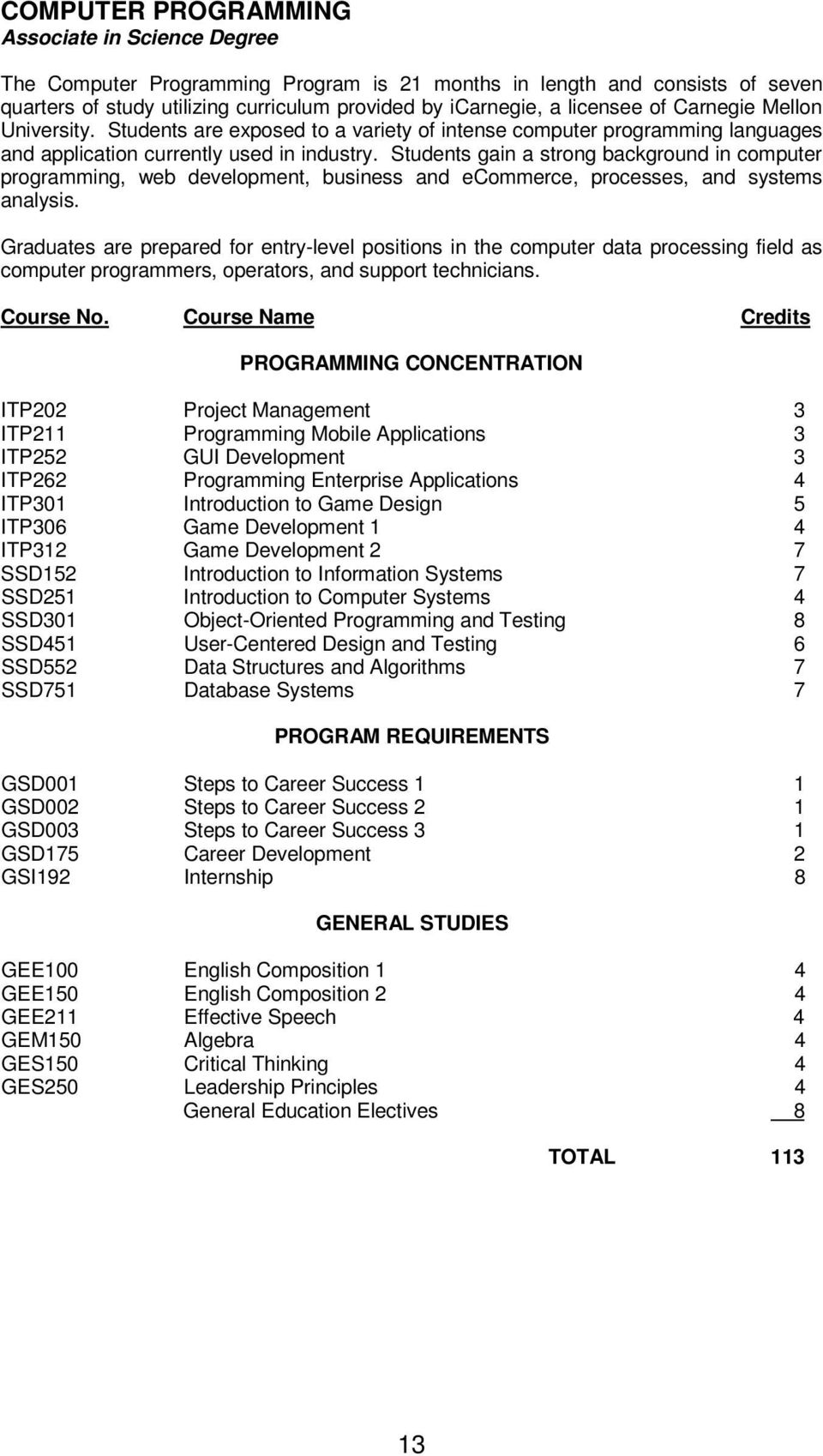
13 COMPUTER PROGRAMMING Associate in Science Degree The Computer Programming Program is 21 months in length and consists of seven quarters of study utilizing curriculum provided by icarnegie, a licensee of Carnegie Mellon University. Students are exposed to a variety of intense computer programming languages and application currently used in industry. Students gain a strong background in computer programming, web development, business and ecommerce, processes, and systems analysis. Graduates are prepared for entry-level positions in the computer data processing field as computer programmers, operators, and support technicians. Course No. Course Name Credits PROGRAMMING CONCENTRATION ITP202 Project Management 3 ITP211 Programming Mobile Applications 3 ITP252 GUI Development 3 ITP262 Programming Enterprise Applications 4 ITP301 Introduction to Game Design 5 ITP306 Game Development 1 4 ITP312 Game Development 2 7 SSD152 Introduction to Information Systems 7 SSD251 Introduction to Computer Systems 4 SSD301 Object-Oriented Programming and Testing 8 SSD451 User-Centered Design and Testing 6 SSD552 Data Structures and Algorithms 7 SSD751 Database Systems 7 PROGRAM REQUIREMENTS GSD001 Steps to Career Success 1 1 GSD002 Steps to Career Success 2 1 GSD003 Steps to Career Success 3 1 GSD175 Career Development 2 GSI192 Internship 8 GENERAL STUDIES GEE100 English Composition 1 4 GEE150 English Composition 2 4 GEE211 Effective Speech 4 GEM150 Algebra 4 GES150 Critical Thinking 4 GES250 Leadership Principles 4 General Education Electives 8 TOTAL
14 ELECTRONICS ENGINEERING TECHNOLOGY Associate in Science Degree The Electronics Engineering Technology Program is 21 months in length and consists of seven quarters. It prepares students for a broad variety of employment opportunities in the electronics technology field. Graduates are prepared to work as field service technicians, customer service representatives, in house production and test technicians and power system technicians. Course No. Course Name Credits ELECTRONICS CONCENTRATION ELT101 Math for Electronics 4 ELT115 Electricity 7 ELT125 Electronics 1 7 ELT126 Structured Wiring 4 ELT135 Electronics 2 7 ELT145 Digital Electronics 7 ELT146 Computer and Network Systems 4 ELT254 Communication Systems 7 ELT258 Electronics Devices and Systems 3 ELT266 Control System Electronics 7 ELT267 Microcontrollers 4 PROGRAM REQUIREMENTS GSD001 Steps to Career Success 1 1 GSD002 Steps to Career Success 2 1 GSD003 Steps to Career Success 3 1 GSD175 Career Development 2 GSI192 Internship 8 GENERAL STUDIES GEE100 English Composition 1 4 GEE150 English Composition 2 4 GEM150 Algebra 4 GEM170 Physical Science 4 GES150 Critical Thinking 4 General Education Electives 12 TOTAL

15 GRAPHIC DESIGN Associate in Science Degree The Graphic Design Program is 21 months in length and consists of seven quarters. Students develop critical and creative thinking processes and proficiency with the tools, applications, media and techniques of the graphic design industry, from traditional approaches to the use of computer generated design. The Graphic Design Program prepares graduates for a variety of entry-level positions in advertising agencies, commercial art studios, publishing companies, manufacturing firms, government agencies and companies with in-house studios. Course No. Course Name Credits GRAPHIC DESIGN CONCENTRATION GDA113 Design 1 4 GDA125 Computer Illustration 4 GDA126 Color Theory and Techniques 3 GDA127 Digital Imaging 4 GDA128 Typography 4 GDA136 Photography 3 GDA137 Web Design 1 3 GDA138 Computerized Page Make-Up 3 GDA139 Advanced Digital Imaging/Production 3 GDA142 Advertising Processes 3 GDA143 Production 3 GDA200 Portfolio Development 1 4 GDA201 Corporate Design 3 GDA202 Graphic Design Senior Project 4 GDA203 Portfolio Development 2 4 GDA204 Multi-Page Documents 3 GDA205 Entrepreneurship 4 GDA255 Web Design 2 3 GDA256 Design 2 3 MMA108 Interactive Multimedia 3 PROGRAM REQUIREMENTS GSD001 Steps to Career Success 1 1 GSD002 Steps to Career Success 2 1 GSD175 Career Development 2 GSI192 Internship 8 GENERAL STUDIES GEE100 English Composition 1 4 GEE150 English Composition 2 4 GEE211 Effective Speech 4 GEH120 Art History 4 GES100 Psychology 4 GES150 Critical Thinking 4 General Education Electives _ 8 TOTAL

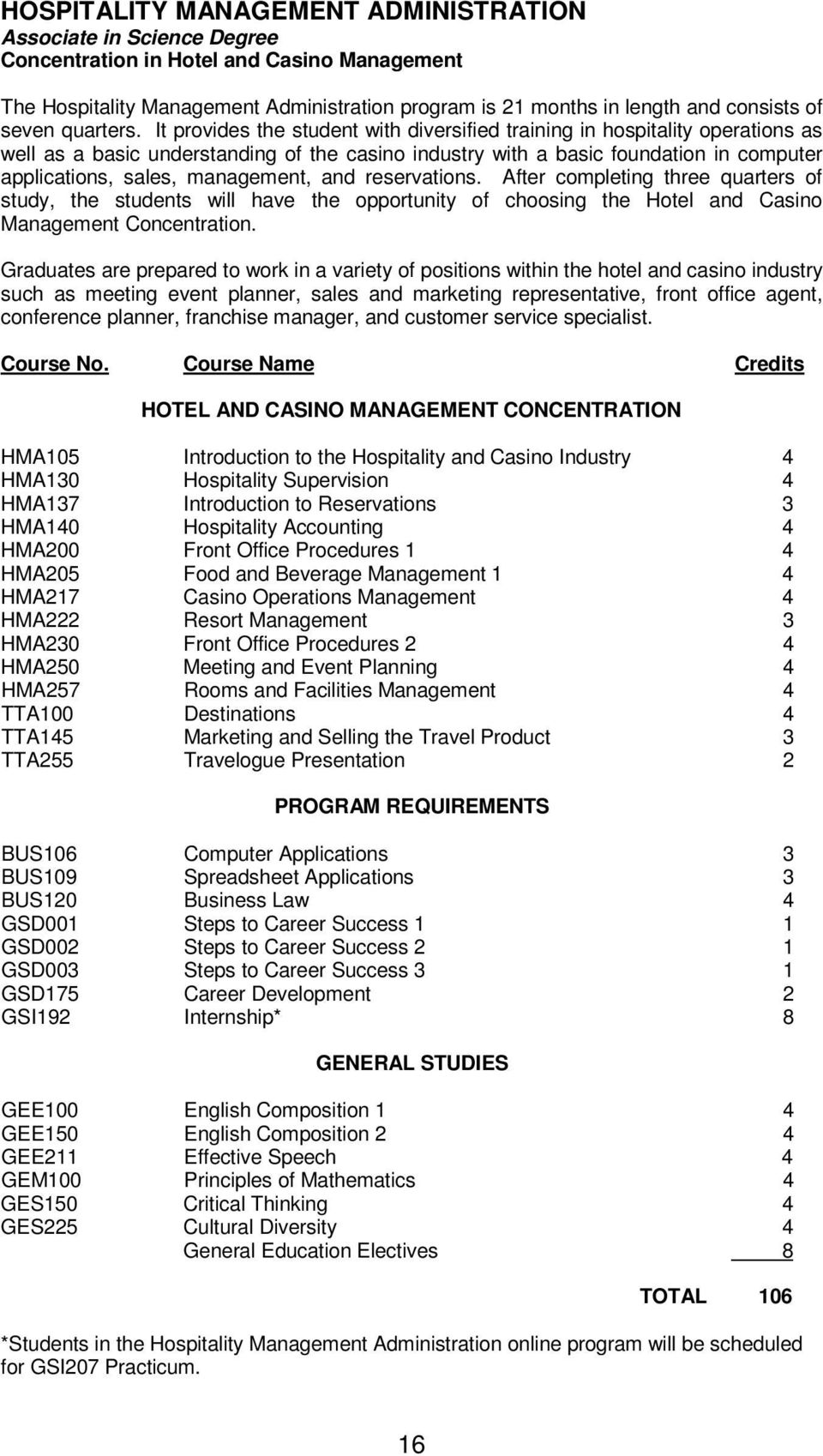
16 HOSPITALITY MANAGEMENT ADMINISTRATION Associate in Science Degree Concentration in Hotel and Casino Management The Hospitality Management Administration program is 21 months in length and consists of seven quarters. It provides the student with diversified training in hospitality operations as well as a basic understanding of the casino industry with a basic foundation in computer applications, sales, management, and reservations. After completing three quarters of study, the students will have the opportunity of choosing the Hotel and Casino Management Concentration. Graduates are prepared to work in a variety of positions within the hotel and casino industry such as meeting event planner, sales and marketing representative, front office agent, conference planner, franchise manager, and customer service specialist. Course No. Course Name Credits HOTEL AND CASINO MANAGEMENT CONCENTRATION HMA105 Introduction to the Hospitality and Casino Industry 4 HMA130 Hospitality Supervision 4 HMA137 Introduction to Reservations 3 HMA140 Hospitality Accounting 4 HMA200 Front Office Procedures 1 4 HMA205 Food and Beverage Management 1 4 HMA217 Casino Operations Management 4 HMA222 Resort Management 3 HMA230 Front Office Procedures 2 4 HMA250 Meeting and Event Planning 4 HMA257 Rooms and Facilities Management 4 TTA100 Destinations 4 TTA145 Marketing and Selling the Travel Product 3 TTA255 Travelogue Presentation 2 PROGRAM REQUIREMENTS BUS106 Computer Applications 3 BUS109 Spreadsheet Applications 3 BUS120 Business Law 4 GSD001 Steps to Career Success 1 1 GSD002 Steps to Career Success 2 1 GSD003 Steps to Career Success 3 1 GSD175 Career Development 2 GSI192 Internship* 8 GENERAL STUDIES GEE100 English Composition 1 4 GEE150 English Composition 2 4 GEE211 Effective Speech 4 GEM100 Principles of Mathematics 4 GES150 Critical Thinking 4 GES225 Cultural Diversity 4 General Education Electives 8 TOTAL 106 *Students in the Hospitality Management Administration online program will be scheduled for GSI207 Practicum. 16
17 HOSPITALITY MANAGEMENT ADMINISTRATION Associate in Science Degree Concentration in Restaurant Management The Hospitality Management Administration Program is 24 months in length and consists of eight quarters. This program enables the student to enter the growing hospitality industry in Restaurant Management with emphasis on food and beverages, sanitation procedures, purchasing, nutrition, and marketing. After completing three quarters of study, the students will have the opportunity of choosing the Restaurant Management Concentration. Graduates are prepared to work in a variety of positions within a restaurant or club such as banquet service director, food and beverage manager, restaurant/club manager, or catering manager. Job opportunities are increasing in schools, hospitals, nursing homes, and other business/healthcare institutions. Course No. Course Name Credits RESTAURANT MANAGEMENT CONCENTRATION HMA105 Introduction to the Hospitality and Casino Industry 4 HMA130 Hospitality Supervision 4 HMA137 Introduction to Reservations 3 HMA140 Hospitality Accounting 4 HMA205 Food and Beverage Management 1 4 HMA215 Club and Restaurant Management 4 HMA225 Nutrition 4 HMA235 Food and Beverage Management 2 4 HMA250 Meeting and Event Planning 4 HMA256 Purchasing for Hospitality Operations 4 HMA263 Wines and Mixology 3 TTA100 Destinations 4 TTA145 Marketing and Selling the Travel Product 3 TTA255 Travelogue Presentation 2 PROGRAM REQUIREMENTS BUS106 Computer Applications 3 BUS109 Spreadsheet Applications 3 BUS120 Business Law 4 GSD001 Steps to Career Success 1 1 GSD002 Steps to Career Success 2 1 GSD003 Steps to Career Success 3 1 GSD175 Career Development 2 GSI192 Internship 8 GENERAL STUDIES GEE100 English Composition 1 4 GEE150 English Composition 2 4 GEE211 Effective Speech 4 GEM100 Principles of Mathematics 4 GES150 Critical Thinking 4 GES225 Cultural Diversity 4 General Education Electives 8 Total

18 HOSPITALITY MANAGEMENT ADMINISTRATION Associate in Science Degree Concentration in Travel and Tourism Management The Hospitality Management Administration Program is 21 months in length and consists of seven quarters. The program enables the student to enter the growing hospitality industry in Travel and Tourism Management with diversified training in sales, management, and reservations. After completing three quarters of study, students will have the opportunity of choosing the Travel and Tourism Management concentration. Graduates are prepared for positions such as customer service agent, flight attendant, airline reservation agent, travel office manager, meeting and event planner, corporate travel representative, and gate/station agent. Course No. Course Name Credits TRAVEL AND TOURISM CONCENTRATION HMA105 Introduction to the Hospitality and Casino Industry 4 HMA130 Hospitality Supervision 4 HMA137 Introduction to Reservations 3 HMA140 Hospitality Accounting 4 HMA205 Food and Beverage Management 1 4 HMA250 Meeting and Event Planning 4 TTA100 Destinations 4 TTA113 Dynamics of Tourism 4 TTA116 Global Distribution Systems 1 3 TTA117 Global Distribution Systems 2 3 TTA145 Marketing and Selling the Travel Product 3 TTA225 Tourism and the Corporate Environment 4 TTA230 International Travel 4 TTA255 Travelogue Presentation 2 PROGRAM REQUIREMENTS BUS106 Computer Applications 3 BUS109 Spreadsheet Applications 3 BUS120 Business Law 4 GSD001 Steps to Career Success 1 1 GSD002 Steps to Career Success 2 1 GSD003 Steps to Career Success 3 1 GSD175 Career Development 2 GSI192 Internship 8 GENERAL STUDIES GEE100 English Composition 1 4 GEE150 English Composition 2 4 GEE211 Effective Speech 4 GEM100 Principles of Mathematics 4 GES150 Critical Thinking 4 GES225 Cultural Diversity 4 General Education Electives 8 TOTAL

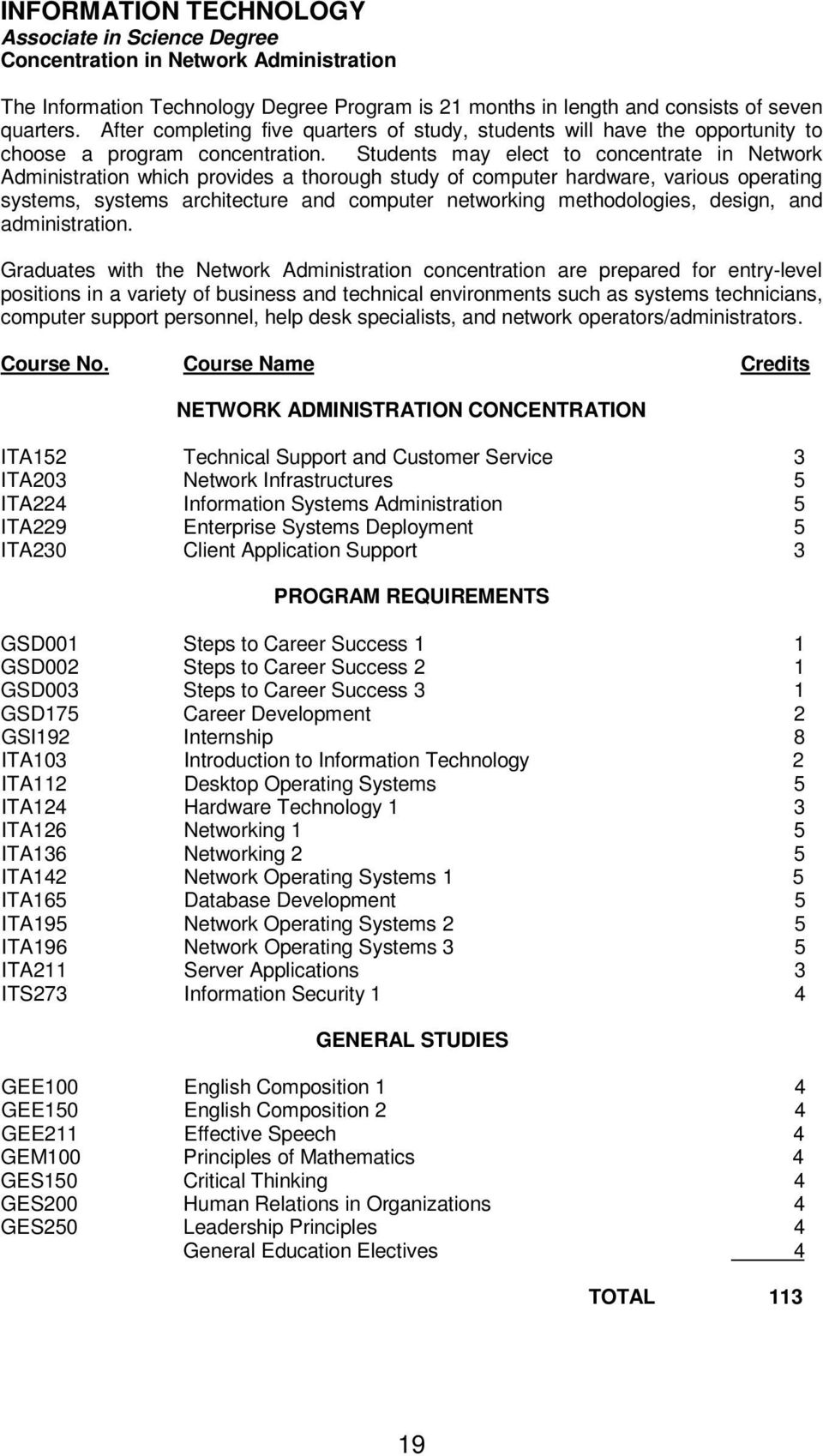
19 INFORMATION TECHNOLOGY Associate in Science Degree Concentration in Network Administration The Information Technology Degree Program is 21 months in length and consists of seven quarters. After completing five quarters of study, students will have the opportunity to choose a program concentration. Students may elect to concentrate in Network Administration which provides a thorough study of computer hardware, various operating systems, systems architecture and computer networking methodologies, design, and administration. Graduates with the Network Administration concentration are prepared for entry-level positions in a variety of business and technical environments such as systems technicians, computer support personnel, help desk specialists, and network operators/administrators. Course No. Course Name Credits NETWORK ADMINISTRATION CONCENTRATION ITA152 Technical Support and Customer Service 3 ITA203 Network Infrastructures 5 ITA224 Information Systems Administration 5 ITA229 Enterprise Systems Deployment 5 ITA230 Client Application Support 3 PROGRAM REQUIREMENTS GSD001 Steps to Career Success 1 1 GSD002 Steps to Career Success 2 1 GSD003 Steps to Career Success 3 1 GSD175 Career Development 2 GSI192 Internship 8 ITA103 Introduction to Information Technology 2 ITA112 Desktop Operating Systems 5 ITA124 Hardware Technology 1 3 ITA126 Networking 1 5 ITA136 Networking 2 5 ITA142 Network Operating Systems 1 5 ITA165 Database Development 5 ITA195 Network Operating Systems 2 5 ITA196 Network Operating Systems 3 5 ITA211 Server Applications 3 ITS273 Information Security 1 4 GENERAL STUDIES GEE100 English Composition 1 4 GEE150 English Composition 2 4 GEE211 Effective Speech 4 GEM100 Principles of Mathematics 4 GES150 Critical Thinking 4 GES200 Human Relations in Organizations 4 GES250 Leadership Principles 4 General Education Electives 4 TOTAL
20 INFORMATION TECHNOLOGY Associate in Science Degree Concentration in Network Security and Computer Forensics This program is 21 months in length and consists of seven quarters. After completing five quarters of study, students will have the opportunity to choose a program concentration. Students may elect to concentrate in Network Administration as described on the previous page. Qualified students who elect to concentrate in Network Security and Computer Forensics receive thorough training in information systems security, firewalls, cryptology, computer viruses, hacker protection, data recovery techniques, and computer investigation techniques. Acceptance into this concentration requires a GPA of 2.75 or above, attendance of 90% or above, a criminal background clearance, and Department Chair approval. Students who are accepted into this program must maintain an overall GPA of 2.75 and 90% overall attendance to remain in the program. Graduates with the Network Security & Computer Forensic concentration are prepared for entry-level positions in a variety of business, governmental, and law enforcement agencies working as computer security specialists, network operators/administrators, and computer forensic technicians. Course No. Course Name Credits NETWORK SECURITY AND COMPUTER FORENSICS CONCENTRATION ITS264 Digital Forensics 5 ITS280 Regulatory Compliance 3 ITS281 Information Security 2 5 ITS287 Information Systems Auditing 5 ITS289 Ethical Hacking 4 PROGRAM REQUIREMENTS GSD001 Steps to Career Success 1 1 GSD002 Steps to Career Success 2 1 GSD003 Steps to Career Success 3 1 GSD175 Career Development 2 GSI192 Internship 8 ITA103 Introduction to Information Technology 2 ITA112 Desktop Operating Systems 5 ITA124 Hardware Technology 1 3 ITA126 Networking 1 5 ITA136 Networking 2 5 ITA142 Network Operating Systems 1 5 ITA165 Database Development 5 ITA195 Network Operating Systems 2 5 ITA196 Network Operating Systems 3 5 ITA211 Server Applications 3 ITS273 Information Security 1 4 GENERAL STUDIES GEE100 English Composition 1 4 GEE150 English Composition 2 4 GEE211 Effective Speech 4 GEM100 Principles of Mathematics 4 GES150 Critical Thinking 4 GES200 Human Relations in Organizations 4 GES250 Leadership Principles 4 General Education Electives 4 20 TOTAL 114

21 MEDICAL ASSISTING Associate in Science Degree The Associate in Science Medical Assisting Program at the North Fayette campus, which is accredited by the Commission on Accreditation of Allied Health Education Programs ( upon the recommendation of the Medical Assisting Education Review Board (MAERB) is 21 months in length and consists of seven quarters. The objective of the program is to prepare graduates for entry level positions as Medical Assistants in ambulatory healthcare facilities such as physicians offices, clinics, medical laboratories, and hospitals. The program requirements will culminate with an unpaid internship at a professional healthcare facility. Graduates will be trained to work in a variety of healthcare facilities performing skills such as appointment setting, telephone triage, insurance billing and coding, obtaining vital statistics, administering medication, phlebotomy, assisting the physician in minor surgery, and electrocardiography. Graduates are eligible to take the CMA exam and phlebotomy certification examination. A physical examination will be required prior to the beginning of the second quarter. A 70% final grade average must be attained in all medical-related courses to meet the program objectives. Course No. Course Name Credits MEDICAL ASSISTING CONCENTRATION MED111 Clinical Techniques 1 4 MED121 Clinical Techniques 2 4 MED123 Medical Office Administration 3 MED131 Clinical Techniques 3 3 MED141 Clinical Techniques 4 3 MED143 Clinical Techniques 5 3 MED202 Healthcare Delivery in the Medical Office 4 MED205 Insurance Billing and Collections 5 MED208 Coding for the Medical Assistant 4 MED215 Medical Law and Ethics (online) 4 MED225 Pharmacology 5 MED251 Medical Laboratory 1 3 MED256 Computerized Medical Office Procedures 3 MED261 Medical Laboratory 2 3 MED266 Medical Seminar 3 MED275 The Body in Sickness and Health 1 5 MED285 The Body in Sickness and Health 2 5 MED295 The Body in Sickness and Health 3 5 PROGRAM REQUIREMENTS GSD001 Steps to Career Success 1 1 GSD002 Steps to Career Success 2 1 GSD003 Steps to Career Success 3 1 GSD175 Career Development 2 GSI192 Internship 8 GENERAL STUDIES GEE100 English Composition 1 4 GEE150 English Composition 2 4 GEM100 Principles of Mathematics 4 GES100 Psychology 4 GES150 Critical Thinking 4 GES225 Cultural Diversity 4 General Education Electives 8 21 TOTAL 114
22 MEDICAL OFFICE ADMINISTRATION Associate in Science Degree The Medical Office Administration Program is a 21-month program that prepares graduates for responsible entry-level positions as medical front office assistant, receptionist, medical billing and collections, medical coding, appointment scheduler, medical records clerk or medical transcriptionist in a variety of healthcare settings, including physicians offices, medical centers, clinics, hospitals, nursing homes, ambulatory care centers, and medical billing and collections agencies. The program is competency-based in medical studies, along with general education courses that add to a well-rounded graduate who will be qualified to work in many fields of medical employment. A 70% final grade average must be attained in all medical-related courses to meet the program objectives. Upon completion of the program, students will be eligible to take the National Coding Certification examination. This course is offered both on ground and online. Course No. Course Name Credits MEDICAL OFFICE CONCENTRATION MED101 Keyboarding 3 MED123 Medical Office Administration 3 MED158 Information Management and Computerized Coding 4 MED202 Healthcare Delivery in the Medical Office 4 MED205 Insurance Billing and Collections 5 MED213 Coding for Physicians and Hospitals 1 4 MED215 Medical Law and Ethics (online) 4 MED223 Coding for Physicians and Hospitals 2 4 MED236 Transcription 1 3 MED242 Transcription 2 2 MED256 Computerized Medical Office Procedures 3 MED266 Medical Seminar 3 MED275 The Body in Sickness and Health 1 5 MED285 The Body in Sickness and Health 2 5 MED295 The Body in Sickness and Health 3 5 MED301 Reimbursement Methods and Regulatory Guides 4 MED311 Chart Abstracting and Coding Simulation 3 MED321 Auditing for Physicians and Hospitals and National Exam 4 Preparation PROGRAM REQUIREMENTS GSD001 Steps to Career Success 1 1 GSD002 Steps to Career Success 2 1 GSD003 Steps to Career Success 3 1 GSD175 Career Development 2 GSI192 Internship * 8 GENERAL STUDIES GEE100 English Composition 1 4 GEE150 English Composition 2 4 GES100 Psychology 4 GES150 Critical Thinking 4 GES175 Social Problems 4 GES225 Cultural Diversity 4 General Education Electives 8 22 TOTAL 113 *Students in Medical Office Administration online will be scheduled for GSI207 Practicum.
23 MULTIMEDIA TECHNOLOGIES Associate in Science Degree Concentration in Video / 3-Dimensional Design The Multimedia Technologies Program is 21 months in length and consists of seven quarters. The Video/3D concentration specializes in teaching students a firm grounding in the basic design skills dedicated to video, television and related industries. Students will gain insight into aspects of preproduction, recording of audio and video under studio and field conditions, 2D and 3D graphics and animation along with editing and the post production processes. Course No. Course Name Credits VIDEO / 3-DIMENSIONAL DESIGN CONCENTRATION GDA125 Computer Illustration 4 GDA126 Color Theory and Techniques 3 GDA127 Digital Imaging 4 GDA128 Typography 4 GDA136 Photography 3 GDA205 Entrepreneurship 4 MMA100 Intro to Multimedia 3 MMA101 Multimedia Design 3 MMA103 Audio/Video Editing 3 MMA104 3-Dimensional Modeling and Animation 1 3 MMA200 3-Dimensional Modeling and Animation 2 3 MMA203 Videography 3 MMA204 Audio Production 3 MMA205 Motion Graphics 1 3 MMA211 Motion Graphics 2 3 MMA212 Advanced Visual Effects 3 MMA214 3D Media Animation 3 MMA220 Multimedia Senior Project 4 MMA222 Advanced Editing 3 MMA223 Multimedia Portfolio Development 8 PROGRAM REQUIREMENTS GSD001 Steps to Career Success 1 1 GSD002 Steps to Career Success 2 1 GSD175 Career Development 2 GSI192 Internship 8 GENERAL STUDIES GEE100 English Composition 1 4 GEE150 English Composition 2 4 GEE211 Effective Speech 4 GEH120 Art History 4 GES100 Psychology 4 GES150 Critical Thinking 4 GES200 Human Relations in Organizations 4 General Education Electives 4 TOTAL
24 MULTIMEDIA TECHNOLOGIES Associate in Science Degree Concentration in Web / Interactive Design The Multimedia Technologies Program is 21 months in length and consists of seven quarters. The Web / Interactive concentration specializes in web design, development, and interactive technologies. Students learn to write efficient standards based code and to design interactions for screen based delivery. They explore both "front end" and "back end" development technologies and techniques used for delivering dynamic content on the web. Advanced classes explore object oriented programming, abstraction, and the latest interactive technologies. Students not only learn to program they also focus on design, user experience, typography, interactivity and animation. This unique blend of art and science prepares our students to devise, build and deploy websites, applications and interactive media. Course No. Course Name Credits WEB / INTERACTIVE DESIGN CONCENTRATION GDA125 Computer Illustration 4 GDA126 Color Theory and Techniques 3 GDA127 Digital Imaging 4 GDA128 Typography 4 GDA136 Photography 3 GDA205 Entrepreneurship 4 MMA100 Intro to Multimedia 3 MMA101 Multimedia Design 3 MMA105 Web Authoring Design 3 MMA106 Client-Side Web Development 3 MMA107 Dynamic Content Management 3 MMA108 Interactive Multimedia 3 MMA201 Server Side Scripting 3 MMA202 Interactive Design 3 MMA205 Motion Graphics 1 3 MMA210 Interactive Development 3 MMA213 Multimedia Delivery for the Web 3 MMA220 Multimedia Senior Project 4 MMA221 Advanced Multimedia Technologies 3 MMA223 Multimedia Portfolio Development 8 PROGRAM REQUIREMENTS GSD001 Steps to Career Success 1 1 GSD002 Steps to Career Success 2 1 GSD175 Career Development 2 GSI192 Internship 8 GENERAL STUDIES GEE100 English Composition 1 4 GEE150 English Composition 2 4 GEE211 Effective Speech 4 GEH120 Art History 4 GES100 Psychology 4 GES150 Critical Thinking 4 General Education Electives 8 TOTAL
25 SAFETY AND SECURITY ADMINISTRATION Associate in Science Degree This program is 21 months in length and consists of seven quarters. This program is designed to train individuals for entry-level positions in Safety or Security Management. Opportunities may exist in federal, state, or local law enforcement, corrections, private security management, corporate security management, probation, loss prevention (retail or industrial), emergency response management, insurance investigation and federal security agencies such as customs, FDA, homeland security, etc. Graduates are prepared for entry-level leadership-track positions in both the private sector and the public sector. Course No. Course Name Credits SAFETY AND SECURITY CONCENTRATION SSA100 Introduction to Criminology and Criminal Justice 4 SSA110 Introduction to Policing 4 SSA115 Introduction to Homeland Security 4 SSA120 Criminal Procedure 4 SSA130 Principles of EOC/Dispatch 4 SSA135 Criminal Justice and Management 4 SSA200 Criminal Investigations 4 SSA205 Criminal Law 4 SSA210 Modern Corrections Issues 4 SSA225 Cyber Crime 4 SSA230 Juvenile Justice 4 SSA260 Security and Loss Prevention 4 SSA275 Act 235 Certification Preparation (or) SSA225 3 SSA280 Report Writing For Criminal Justice Professionals 4 PROGRAM REQUIREMENTS BUS106 Computer Applications 3 GSD001 Steps to Career Success 1 1 GSD002 Steps to Career Success 2 1 GSD003 Steps to Career Success 3 1 GSD175 Career Development 2 GSI192 Internship* 8 GENERAL STUDIES GEE100 English Composition 1 4 GEE150 English Composition 2 4 GEE211 Effective Speech 4 GEM100 Principles of Mathematics 4 GES150 Critical Thinking 4 GES175 Social Problems 4 General Education Electives 8 TOTAL 103 *Students in the Safety and Security online program will be scheduled for GSI207 Practicum. 25
26 SMART BUILDING TECHNOLOGY Associate in Science Degree The Smart Building Technology Program is 21 months in length and consists of seven quarters. It provides a foundation in electronics, building design, installation, and calibration of smart building systems according to established codes, standards and safety practices. Graduates will integrate, install, and provide field maintenance on audio/video equipments, security/surveillance systems, basic computer network systems, commercial integration systems, and energy management/lighting controls. Graduates are prepared to work as entry-level installers, technicians, and designer positions in the smart building integration field such as, Electronic Systems Technician, Audio/Video Installer, Home Security Installer or Home Entertainment and Technology Sales/Service. Course No. Course Name Credits SMART BUILDING TECHNOLOGY CONCENTRATION ELT101 Math for Electronics 4 ELT115 Electricity 7 ELT125 Electronics 1 7 ELT126 Structured Wiring 4 ELT135 Electronics 2 7 ELT146 Computer and Network Systems 4 SBT140 Entertainment Systems 3 SBT141 Applied Communications 4 SBT250 Audio and Video Systems 4 SBT251 Security and Life Safety 6 SBT260 Energy Management and Lighting Controls 6 SBT261 Project Management 3 SBT262 Green Technology 3 PROGRAM REQUIREMENTS GSD001 Steps to Career Success 1 1 GSD002 Steps to Career Success 2 1 GSD175 Career Development 2 GSI192 Internship 8 GENERAL STUDIES GEE100 English Composition 1 4 GEE150 English Composition 2 4 GEM150 Algebra 4 GEM170 Physical Science 4 GES150 Critical Thinking 4 General Education Electives 12 TOTAL
27 SURGICAL TECHNOLOGY Associate in Science Degree The Surgical Technology Program, which is accredited by the Commission on Accreditation of Allied Health Programs (CAAHEP), is 24 months in length and consists of eight quarters. The program provides students with an academic and clinical background in the field of surgical technology, preparing them for entry-level positions in a number of health care facilities including hospitals, medical centers, and public and private surgical centers. The program is competency-based in medical studies, along with general education courses that add to a well-rounded graduate who will be qualified to work in a surgical setting. The program requirements will culminate with an unpaid internship at a professional healthcare facility. Students will take the Certification Test for Surgical Technologists administered by the National Board of Surgical Technologists and Surgical Assistants (NBSTSA) prior to graduation. A physical examination completed by the student s private physician, PA criminal and child abuse history, and a 10-panel drug screen will be required during the sixth quarter and must be completed prior to being assigned a site for clinical rotation. The cost of the physical exam and the background checks will be assumed by the student. If a student fails the 10-panel drug screen, he/she will be required to schedule a counseling session with the Outreach Counselor, complete a drug module with Student Services, and pass a repeat drug screening prior to beginning the clinical rotation. In addition, some clinical sites require fingerprinting. A 70% final grade average must be attained in all medical-related courses to meet the program objectives. Course No. Course Name Credits SURGICAL TECHNOLOGY CONCENTRATION MED104 Medical Terminology 1 5 MED116 Medical Terminology 2 5 MED145 Diseases and Diagnostic Methods 5 NUR103 Anatomy and Physiology 1 4 NUR113 Anatomy and Physiology 1 Lab 2 NUR118 Anatomy and Physiology 2 4 NUR119 Anatomy and Physiology 2 Lab 2 SGT102 Orientation to Surgical Technology 5 SGT112 Surgical Instrumentation 3 SGT114 Foundations of Surgery 3 SGT122 Surgical Preparation, Equipment, and Supplies 4 SGT125 Principles of Surgery 4 SGT205 Surgical Technology 1 4 SGT225 Surgical Technology 2 4 SGT235 Surgical Technology 3 4 SGT242 Surgical Technology 4 4 SGT252 Surgical Technology 5 4 SGT259 Clinical Rotation 13 SGT261 Clinical Rounds Review 2 SGT262 Clinical Rotation Prep 3 SGT265 CST Review 2 PROGRAM REQUIREMENTS GSD001 Steps to Career Success 1 1 GSD002 Steps to Career Success 2 1 GSD003 Steps to Career Success 3 1 GSD175 Career Development 2 GSI219 Surgical Technology Internship 12 GENERAL STUDIES GEE100 English Composition 1 4 GEE150 English Composition 2 4 GEM100 Principles of Mathematics 4 GES100 Psychology 4 GES150 Critical Thinking 4 GES225 Cultural Diversity 4 General Education Electives 8 TOTAL
28 CERTIFICATE TRAINING PROGRAMS HEATING VENTILATING AIR CONDITIONING This certificate is a 15-month program consisting of the equivalent of four quarters of instruction and one quarter on an internship. Coursework provides hands-on training necessary to gain entry level employment in the Heating, Ventilating, Air Conditioning, and Refrigeration fields. Students are trained in the following: customer service, ductwork and other tin /metal components, consultation on air distribution, control components, and Green technology, interpretation of blueprints and construction drawings, troubleshooting, testing and maintenance of equipment, installation and repair of residential and commercial equipment. Throughout the students education they will complete the following certifications necessary for entry-level employment: R-410A, EPA 608 Universal, Green Awareness, and ICE. Upon completion of the internship, all graduates will be encouraged to take the NATE certification exam. Course No. Course Title Credits PROGRAM CONCENTRATION HVA101 Math for HVAC 6 HVA106 Fundamentals of Electricity 6 HVA110 Heating Systems I 4 HVA116 Blue Print and Metal Fabrication 4 HVA121 Customer Service for HVAC Professionals 6 HVA126 Heating Systems 2 7 HVA131 Residential Refrigeration 7 HVA136 Water Heat Systems 4 HVA141 HVAC-R Controls 6 HVA146 Commercial Refrigeration 6 HVA151 Load Calculations and Psychometrics 6 HVA155 Troubleshooting and Diagnostics 3 HVA161 Chiller Systems 5 HVA166 Certification Preparation 6 GSI192 Internship 8 TOTAL 84 28
29 MEDICAL CODING This program is a 12-month certificate program in Medical Coding for students seeking to enter the medical coding profession. Coursework provides hands-on experience necessary to gain entry-level employment in the medical coding field for both physician offices and outpatient hospitals. Students gain experience in transforming written descriptions of diseases, injuries, procedures, and services into alphanumeric designations. Graduates are prepared for the national coding certification examination and prepared to work as medical coding specialists. A 70% final grade average must be attained in all medicalrelated courses to meet the program objectives. This program is offered both on-ground and on-line. Courses offered in this program are fully transferrable to the Medical Office Administration Program. Course No. Course Title Credits PROGRAM CONCENTRATION GSD175 Career Development 2 MED158 Information Management and Computerized Coding 4 MED202 Healthcare Delivery in the Medical Office 4 MED205 Insurance Billing and Collections 5 MED213 Coding for Physicians and Hospitals 1 4 MED223 Coding for Physicians and Hospitals 2 4 MED256 Computerized Medical Office Procedures 3 MED275 The Body in Sickness and Health 1 5 MED285 The Body in Sickness and Health 2 5 MED295 The Body in Sickness and Health 3 5 MED301 Reimbursement Methods and Regulatory Guidelines 4 MED311 Chart Abstracting for Physicians and Hospitals and Coding Simulation 3 MED321 Auditing for Physicians and Hospitals and National Exam Preparation 4 TOTAL 52 29
30 MICROSOFT NETWORK PROFESSIONAL The program is a 12-month evening certificate program to prepare individuals to become Microsoft Certified Information Technology Professionals in Enterprise Administration. Classes start every six months, consist of four (4) terms, and are taught by experienced information technology trainers. MICROSOFT NETWORK PROFESSIONAL PLUS The program offers an evening certificate program over approximately 15 months for individuals who wish to enter the Information Technology field, but have a very limited background in computers. This program begins with a very intense A+ technician training and is followed by the challenging MCITP: Enterprise Administration and CCNA certification tracts. Labs and other hands-on learning modules constitute a major portion of the learning process. Graduates of both programs are prepared to work as network administrators, systems analysts, and Microsoft certified systems engineers. Courses in certificate training may transfer to Associate Degree level programs. Please refer to elective options, listed later in this catalog. Course No. Course Title Credits PROGRAM CONCENTRATION CST035 A+ Service Technician (10) MNP103 Configuring Microsoft Windows 7 5 MNP112 Introduction to Microsoft Windows Server Technologies 5 MNP122 Windows Server 2008 Network Infrastructure, Configuring 5 MNP132 Windows Server 2008 Applications Infrastructure, Configuring 5 MNP142 Windows Server 2008 Active Directory, Configuring 10 MNP162 Windows Server 2008, Enterprise Administrator 5 MNP171 CISCO Certified Network Associate 5 TOTAL 40 (50) 30
31 PATIENT CARE TECHNICIAN The Patient Care Technician Program gives students the theoretical as well as the practical knowledge to offer direct patient care in various medical settings such as hospitals, clinics, medical centers, nursing homes, health agencies, home care, and rehabilitation centers. This 9-month program provides the flexibility for students to gain the skills necessary to function as patient care technicians, advanced nursing assistants, home health aides, phlebotomists, and electrocardiographers. These technicians are important members of the health care team and perform basic medical services as they assist doctors and nurses in caring for patients. Students are eligible to test for phlebotomy certification and patient care technician certification through the National Center for Competency Testing (NCCT). A physical examination will be required prior to the beginning of the second quarter. A 70% final grade average must be attained in all courses to meet the program objectives. Clinical placement often requires background checks, drug screening, and fingerprinting. Because the laws governing the practice of Patient Care Technicians vary widely from state-to-state, prospective students are strongly encouraged to research their state s requirements for practice. Course No Course Title Credits PROGRAM CONCENTRATION PCT101 Medical Terminology/Anatomy and Physiology 6 In Sickness and Health 1 PCT106 Introduction to Healthcare 5 PCT111 Clinical Skills 1 3 PCT116 Patient Care Skills 1 3 PCT119 Patient Care Skills 2 3 PCT121 Medical Terminology/Anatomy and Physiology 6 in Sickness and Health 2 PCT124 Clinical Skills 2 5 PCT136 Patient Psychology 6 PCT141 Medical Law and Ethics 6 PCT146 Phlebotomy and Testing Procedures 4 PCT151 Assisting with Clinical Situations 4 PCT160 Clinical Practice 3 TOTAL 54 31
32 PRACTICAL NURSING The Practical Nursing Program, which is a certificate program approved by the Pennsylvania State Board of Nursing, prepares graduates to sit for the National Council Licensure Examination for Practical Nursing (NCLEX-PN). The program is 12 months in length, consisting of four quarters. Standards that must be met, prior to admission to the program, include criteria based pre-entrance exams and a negative urine drug screening test. A comprehensive physical examination, including TB testing and verification of vaccination history and Act 33, 34, and 73 criminal clearances, will be required prior to enrollment in the first quarter. These requirements will need to be updated each year. A passing grade of C or higher in the classroom portion of each course and a passing grade (Pass) in clinical/lab will be required to progress from one quarter to the next, and to meet program objectives for graduation. Upon successfully passing the NCLEX-PN, graduates are qualified to work as a Licensed Practical Nurse (LPN) in a variety of settings, such as a hospital or medical center, outpatient clinic, surgical center, physician s office, hospice, home care, and long term care facility. Primary areas of LPN practice include comprehensive assessment and care planning, direct patient care, medication administration, assisting with patients activities of daily living, as well as providing assistance to members of the health care team. The LPN works under the supervision of a Registered Nurse (RN) or physician. Course No Course Title Credits PROGRAM CONCENTRATION NUR103 Anatomy and Physiology 1 4 NUR104 Psychosocial and Psychiatric Issues 4 NUR108 Microbiology 4 NUR109 Foundations of Nursing 1 10 NUR111 Microbiology Lab 2 NUR113 Anatomy and Physiology 1 Lab 2 NUR118 Anatomy and Physiology 2 4 NUR119 Anatomy and Physiology 2 Lab 2 NUR121 Foundations of Nursing 2 10 NUR132 Nursing Across the Lifespan 1 10 NUR139 Pharmacology in Nursing 6 NUR141 Nursing Across the Lifespan 2 10 NUR147 Gerontology and Nursing Practice 6 NUR150 Transitions into Nursing Practice 10 TOTAL 84 32
33 THERAPEUTIC MASSAGE PRACTITIONER This program offers a 15-month certificate program to prepare individuals for a career in massage therapy. Coursework provides the necessary skills for applications and treatment goals of muscular and general relaxation, stress reduction, pain management, recovery from injury, health promotion, education, and body awareness. Graduates are prepared to work as entry level therapeutic massage practitioners in day spas, chiropractic offices, fitness centers, hospitals, and long-term nursing facilities. After completing the program, students are academically eligible to take the National Certification Examination or the Massage and Body Work Licensing Examination. Because the laws governing massage and massage therapists vary widely from state to state, prospective students are strongly encouraged to research their state s requirements for licensure or certification at: In addition, students in the program will be required to complete an Employment Background Investigation. Students graduating from the Therapeutic Massage program should be aware that they are responsible for meeting the training requirements in the state they wish to practice. A 70% final grade average must be attained in all courses to meet the program objectives. Courses in Clinic 1, 2, 3 and 4 are held on Saturdays. The Pennsylvania Massage Therapy Licensure Section 20.21(c) requires Pittsburgh Technical Institute to submit the applicant s official transcript showing successful completion of study in the required subject matter and hours required by the licensure board. A student must attend 90% of all in-class supervised hours to meet the eligibility requirements for licensure. A student not meeting the 90% attendance requirement will be withdrawn from the class and will have to repeat the course. Portions of some Therapeutic Massage Practitioner courses may be offered online. Refer to syllabus for detail. Course No Course Title Credits PROGRAM CONCENTRATION TMP105 Chair Massage and Hydrotherapy 3 TMP107 Spa Applications 3 TMP115 Structure & Function of the Human Body 1 5 TMP117 Pregnancy and Infant Massage 3 TMP122 Clinic 1 1 TMP123 Introduction to Massage 5 TMP125 Structure & Function of the Human Body 2 5 TMP132 Clinic 2 1 TMP135 Structure and Function of the Human Body 3 5 TMP142 Clinic 3 1 TMP145 Human Kinetics 3 TMP152 Swedish Massage 3 TMP154 Clinic 4 1 TMP155 Pathology 5 TMP205 Aromatherapy 3 TMP207 Business Ethics 5 TMP225 Eastern Bodyworks Theory 3 TMP227 Clinical Massage Protocols 3 TMP237 Special Populations 3 TMP246 Deep Tissue Massage 3 TMP255 Massage Seminar 4 GSI203 Internship 6 TOTAL 74 33
34 A+ SERVICE TECHNICIAN Pittsburgh Technical Institute s Center for Certification and Adult Learning offers a 3-month evening certificate program that prepares individuals to take the COMPTIA A+ certification examination. This is a 132-hour course that covers materials found in the CompTIA A+ certification examination. It provides the students with hands-on experience and skill development needed to perform the hardware-associated and the software-associated tasks of installation, service and support of microcomputers. Students are given a solid, practical understanding of PC configuration, troubleshooting, and repair. Course No. Course Name Credits PROGRAM CONCENTRATION CST035 A+ Service Technician 10 STUDENT ELECTIVE OPTIONS TOTAL 10 Courses listed under certificate programs may be taken as electives in the corresponding associate degree programs. Total credits may vary slightly from that listed under the associate degree programs of study on previous pages of this catalog. COURSEWORK FROM CERTIFICATE PROGRAMS Microsoft Network Professional TRANSFERS INTO ASSOCIATE OF SCIENCE DEGREE PROGRAM Information Technology MNP103 5 ITA112 5 MNP112 5 ITA126 5 MNP122 5 ITA203 5 MNP132 5 ITA103 ITA MNP142 5 ITA195 5 MNP162 5 ITA203 5 MNP171 5 ITA136 5 CST ITA103 ITA124 ITA
35 COURSE DESCRIPTIONS ACC100 Financial Accounting 1 This course introduces the basic principles and procedures of accounting. Emphasis is placed on analyzing business transactions, cataloging, journal entries, posting to the general ledger, and preparing financial statements (income statement, owner's equity statement, and balance sheet). ACC105 Federal Taxes In this course, students will learn basic individual and business tax law. Emphasis will be placed on research, tax law and tax form preparation for individuals, corporations, and partnerships. ACC110 Financial Accounting 2 In this course, students will examine additional accounting concepts as they relate to sales and purchase transactions, merchandise inventory valuation, and various depreciation methods including methods for asset disposition. Topics include accounts receivable, subsidiary ledgers, adjustments for merchandise inventory, depreciation, accruals, deferrals and Generally Accepted Accounting Principles. ACC120 Intermediate Accounting 1 This course begins a comprehensive study of corporate accounting and focuses on the statement of cash flows, financial disclosure, and profitability analysis. Students prepare financial statements, complete balance sheets, formulate income statements, and analyze transactions and journals. Prerequisite: ACC110. ACC200 Intermediate Accounting 2 This course is a continuation of ACC120 Intermediate Accounting 1 and provides an indepth study of a corporation s economic resources. Students focus on cash and receivables, inventory measurement and issues, and the acquisition, utilization, and disposition of operational assets. Prerequisite: ACC120. ACC210 Intermediate Accounting 3 This course is a continuation of ACC200, Intermediate Accounting 2, and focuses on accounting for investments which include held to maturity, trading securities, securities available for sale, the equity method and a brief lecture on consolidation. Additional topics covered include current liabilities, contingencies, treasury stock and retirement of stock. Prerequisite: ACC200. ACC215 Government and Non-Profit Accounting This course is designed to introduce the student to some aspects of accounting and control in government units and other non-profit organizations. The students will study the basic accounting concepts and practices used in governmental and non-profit agencies and gain a thorough understanding of the financial activities of non-profit and governmental agencies, budgetary accounting, and reporting procedures. Prerequisites: ACC100 and ACC110. ACC230 Accounting Information Systems This course provides the students with hands-on experience in applying fundamental accounting principles within a computerized environment. Using computer technology, students gain experience setting up and maintaining accounts, recording transactions in the 35
36 general and special journals, preparing payroll, completing the accounting cycle, and setting up accounting records for new companies. BUS100 Introduction to Business This course provides a thorough survey of major business functions, focusing on modern business procedures. Topics include international business, economics, management, marketing, accounting, social responsibility and ethics, innovation, and entrepreneurship. BUS106 Computer Applications This course provides the student with an introduction to multiple office-based applications. The student will use the knowledge gained in this course as a foundation for implementing and developing projects in various applications including spreadsheets, word processing, presentation software, and the PTI network. BUS109 Spreadsheet Applications This course guides students with little spreadsheet experience and enables them to become knowledgeable, confident spreadsheet designers and users. The course utilizes hands-on examples, tutorials, and reinforcement to develop spreadsheet design in a wide variety of disciplines, including marketing, accounting, finance, and operations. BUS110 Principles of Management This course provides an overview of the major functions of operational and human resources management. Upon completion of this course, the students should be able to integrate behavioral and systems approaches with traditional analysis and demonstrate Total Quality Management and Continuous Quality Improvement methods in the management process. BUS120 Business Law This course provides students with detailed knowledge of the laws relating to contracts, commerce, property, business crimes, torts, and employment. Students develop an awareness of business situations requiring legal counsel and a familiarization with the overall structure of our legal system. BUS200 International Business The study of international business concepts is designed to better prepare students to master the aspects of worldwide business functions. The course covers international trade, the international monetary system, and their relationship to business. Students also evaluate countries as potential sites for business operations. BUS220 Human Resource Management This is an introduction to the principles, policies and procedures of personnel management. The course focuses on the acquisition, training, and maintenance of human resources for organizations. Topics include legal principles for human resource managers, salary and benefits, workplace diversity, equal employment opportunity, recruitment and selection, orientation/training, appraisal of performance, and discipline. BUS232 Database Applications for Business This course introduces students to the design and use of databases for business applications. Using database computer software, students will plan and develop a variety of databases for business. Topics covered include database planning, creation of records, searching for data using database queries, development of forms for data entry, and report design. 36
37 BUS240 Small Business Management This course introduces the challenges of entrepreneurship including the start-up and operations of a small business. Topics include types of small business ownership (including franchising and home-based business), financing alternatives, and issues of a small business (including personnel, marketing, site location, and managerial decision-making). Upon completion, students should be able to develop a business plan tailored to a small business. CAD101 Drafting 1 This course is an overview of the practices and techniques utilized within the drafting industry. Topics include: oblique, perspective, isometric and orthographic sketching, sectioning, dimensioning practices and basic print reading. CAD106 MicroStation This course is an introduction to the unique language, command methods and application of the MicroStation software. Topics included: display methods, view manipulation, drawing techniques, construction methods, manipulation methods, editing methods, dimensioning practices, and plotting techniques specific to this software. A 70% grade must be attained at this level to continue into CAD related courses. CAD111 AutoCAD This course is an introduction to the unique language, command methods and application of the AutoCAD software. Topics included: display methods, view manipulation, drawing techniques, construction methods, manipulation methods, editing methods, dimensioning practices, and plotting techniques specific to this software. A 70% grade must be attained at this level to continue into CAD related courses. CAD132 Architectural Drafting 1 This course is an introduction to the principles of architectural drafting and building materials as they apply to residential structures. Students will apply proper drafting standards and construction material knowledge to create architectural floor plans, elevations, building sections, wall sections, details, and schedules. A 70% grade must be attained at this level if continuing into Architectural Concentration. Prerequisites: CAD106 and CAD111. CAD133 Mechanical Drafting 1 This course is an overview of the mechanical industry. Topics include terminology, print reading, geometric construction methods, drawing layouts, precision measurement, basic threads, basic assemblies, dimensioning techniques as they apply to the mechanical industries. A 70% grade must be attained at this level if continuing into the Mechanical Concentration. Prerequisites: CAD106 and CAD111. CAD134 Architectural Drafting 2 This course is an introduction to the principles of architectural drafting and building materials as they apply to commercial structures. Students will apply proper drafting standards and construction material knowledge to create architectural floor plans, elevations, building sections, wall sections, details and schedules. Prerequisites: CAD132. CAD138 Mechanical Drafting 2 This course is a continuation to the practices of drafting as applied to the mechanical industry. Advanced topics learned in CAD133 as well as gears, fasteners, manufacturing techniques and practices; finish marks advanced dimensioning techniques, tolerancing methods and the utilization of Machinery s Handbook. A 70% grade must be attained at this level to continue into CAD139. Prerequisites: CAD
38 CAD139 Mechanical Drafting 3 This course will continue the practices of the mechanical industry by introducing the student to material properties, weldment drawings, cams and jigs and fixtures to create documentation and drawings used in the industry. Prerequisites: CAD138. CAD147 Commercial Wiring Systems This course will introduce to drafting practices and techniques needed to create commercial wiring systems drawings. Topics include electrical lighting and power plans, data control systems, communication systems, block diagrams, and construction documentation. Prerequisites: CAD106 and CAD111. CAD152 Industrial Pipe Drafting This course is an introduction to the principals of pipe drafting as applied to commercial and industrial structures. Topics include material and connection types, creation of commonly used pipe drawings, selection of drafting symbols and pipe and instrumentation diagrams, methods, and techniques. Prerequisites: CAD106 and CAD111. CAD158 Building Systems This course is an introduction to the principles of the mechanical systems used within a building. Students will learn symbology and standard drafting practices as applied to HVAC and fire protection drawings as they apply to commercial building projects. Prerequisites: CAD106 and CAD111. CAD201 Civil/Topographical Drafting This course is an introduction to the principals and practices specific to the civil and topographical drafting industries. Students will learn proper drawing methods as they relate to residential and commercial structures. Topics include: site planning and preparation, surveying methods, legal descriptions, contouring and the basics of landscaping. Prerequisites: CAD106 and CAD111. CAD203 Energy Technology This course will introduce the student to different types of energy such as renewable energies and fossil energies. Topics to include the extraction, conversion, transportation, storage and use of energy as it relates to the energy fields. Prerequisites: CAD133. CAD206 Civil Application Software This course introduces the student to the software InRoads. Students learn how this database driven software manipulates data specific to the creation of civil related drawings and construction documents. Prerequisites: CAD106. CAD210 Statics & Strengths of Materials This course is an introduction to principals of mechanics of structures as they relate to the engineering industries. Topics include the calculation of: stress and strain of material, static equilibrium, support reactions, bean analysis, design properties and the affect of materials on a structure. Prerequisites GMG200. CAD217 Structural Drafting This course is an introduction to principals and practices specific to the structural drafting industries. Students will learn proper drawing methods as they relate to commercial structures. Topics include steel frame construction, beam and column connection detailing and fabrication drawings. Prerequisites: CAD106 and CAD
39 CAD218 Structural Application Software This course introduces students to Revit Structural Software. Students learn advanced modeling techniques to create commercial construction documents extracted and annotated directly from object-based 3-dimensional structural models. Prerequisite: CAD111. CAD221 Architectural Application Software 1 This course introduces students to the software Revit Architecture. Students will learn to navigate the building information software s project browser and create 3-dimensional commercial buildings and the corresponding construction documents as they apply to commercial drafting industry. A 70% grade must be attained at this level to continue into CAD236. Prerequisite: CAD111. CAD226 Mechanical Application Software 1 This course introduces students to the software Pro Engineer. Students will be introduced to modeling tools, modification commands, the interface and advanced techniques to create 3-dimensional parametric models and mechanical documents. A 70% grade must be attained at this level to continue into CAD251. Prerequisite: CAD133. CAD234 Architectural Application Software 2 This course is a continuation of CAD221 Architectural Application Software 1. Students will be introduced to Revit MEP and continue to refine the standards and practices learned in CAD221. The focus of this course will be placed on the HVAC, Plumbing, Electrical, and Fire Protection features that the student will apply to the commercial drafting industry. A 70% grade must be attained at this level to continue into CAD236. Prerequisite: CAD221. CAD236 Architectural Capstone 8 Credits Participation in this course requires the completion of a capstone project that integrates the student s knowledge and skills acquired during the completion of architectural concentration curriculum. Students will learn current design practices to incorporate sustainability and energy efficiency into their final project. Prerequisites: CAD134 and CAD234. CAD251 Mechanical Application Software 2 This course is a continuation of CAD226. Students will use modify the interface and use advanced techniques such as: sweeps, blends, helical seeps, cuts, family tables and parameters to create complex models, detail drawings and assembly drawings. Prerequisite: CAD226. CAD253 Mechanical Applications 3 This course introduces students to the software called SolidWorks. Students use advanced techniques to create 3-dimensional parametric models, assemblies and construction documents as they relate to industry standards. Prerequisite: CAD133. CAD254 Geometric Tolerancing This course introduces the student to the fundamentals of geometric dimensioning and tolerancing. Topics include form control, datums, orientation control, location control, profile control and runout control as it relates to the mechanical industry. Prerequisite: CAD
40 CAD256 Mechanical Capstone 8 Credits Students will be introduced to the workings of different types of motors and engines. This course integrates a group project utilizing the student s knowledge and skills acquired during the completion of the mechanical concentration. Prerequisite: CAD139 and CAD251. CST035 A+ Service Technician 10 Credits A+ Service Technician is a 132-hour course that covers material found on the Comptia A+ certification test. This course provides students with the hands-on experience and skill development needed to perform the hardware-associated tasks of installation, service, and support of microcomputers. Students also gain the hands-on experience in the softwareassociated tasks of installation, service, and support on microcomputers. Students are given a solid, practical understanding of PC configuration, troubleshooting, and repair. Students are given instruction and self-study materials that assist them in preparing for the COMPTIA A+ certification examination. ELT101 Math for Electronics This course provides students with math skills necessary to solve problems in electricity and electronics. It consists of a review of arithmetic, algebra, equations, right triangle solutions and complex numbers. ELT115 Electricity 7 Credits Electricity and electronic systems are explored through the study of DC and AC fundamentals. Practical experience in parallel and series circuit analysis is gained by means of electronic bench test equipment and troubleshooting. ELT125 Electronics 1 7 Credits This course is an introduction to transformers, diodes, rectifiers, filters, and regulators. Semiconductor fundamentals are presented and learners master competencies in constructing, measuring, troubleshooting and analyzing filter and basic semiconductor circuits. Prerequisite: EL115. ELT126 Structured Wiring The course introduces students to low voltage cable wiring technology. It includes the design, construction, maintenance and interconnection of intelligent control systems. ELT135 Electronics 2 7 Credits This is a course to expand the competencies of semiconductor concepts. FET, Operational amplifier and BJT circuits are explored as they apply to real world electronic systems. Students construct, analyze, and troubleshoot complete switching and amplifier circuits. Prerequisite: ELT125. ELT145 Digital Electronics 7 Credits This course introduces students to logic gates, flip-flops, counters, registers, and code converters. Students gain practical experience by constructing, testing and troubleshooting digital circuits and systems. Prerequisite: ELT135. ELT146 Computer & Network Systems Students tear down and reassemble a personal computer, install the operating system, set up wired and wireless networks, and configure IP devices. 40
41 ELT254 Communication Systems 7 Credits Students survey all fundamental aspects of modern electronic communication and telecommunications. Basic concepts in AM, FM, TV, RF, telephone, pulse encoding, and fiber optics are covered and applied to contemporary wired and wireless systems. Prerequisite: ELT145. ELT258 Electronics Devices and Systems Students review all critical concepts and measurement techniques through analysis and troubleshooting of a variety of electronic systems. Prerequisite: ELT145. ELT266 Control System Electronics 7 Credits This course introduces students to industrial automation and control methods. Hardware includes Programmable Logic Controllers, industrial sensors, conveyor systems and robotics. Theoretical concepts are reinforced through group-based Design Challenges. Prerequisite: ELT254. ELT267 Microcontrollers Students are introduced to programming the BASIC Stamp Microcontroller. The program techniques control LEDs, switches and robotic motion and are reinforced through individual Design Challenges. Prerequisite: ELT145. GDA113 Design 1 This course focuses on the fundamentals of the visual design elements of line, shape, and color, with the emphasis on creative thinking and problem solving using various techniques and methods. A 70% grade must be attained at this level if continuing into GDA256 Design 2. GDA125 Computer Illustration In this course students use the computer as a drawing tool. Students will become aware of the industry markets of cartooning, technical illustration, and typography and how these can work in different designs and page layouts. A 70% grade must be attained at this level to continue into Graphic Design related courses. GDA126 Color Theory and Techniques This course introduces the basic principles of harmony and contrast. Fundamental theories pertaining to color perception and design are introduced and practiced. The student s skills with color design and communication are developed and refined through project creation and critique. Areas of focus in this course include color theories, models, digital production, traditional techniques and print. GDA127 Digital Imaging This course utilizes techniques associated with designing computer graphics and page make-up for desktop publishing. Emphasis is on the exploration of illustration, photo retouching and manipulation, working toward finished results primarily for print and Web. GDA128 Typography This course focuses on the fundamentals of typography and introduces the students to aspects of type for display and text design. Students become familiar with the categories of type and a variety of font families. They also become proficient at choosing fonts to match a specific message. 41
42 GDA136 Photography This course provides an introduction to the concepts, techniques, procedures, and application of photography. Students will use cameras in studio and field conditions to capture images to meet the requirements of assignments designed to develop specific skills and competencies. Emphasis is placed on basic compositional rules, common features of a DSLR camera with appropriate lenses, lighting, and exposure. GDA137 Web Design 1 This course introduces the processes of designing web pages for publishing on the World Wide Web. Students learn to apply their visual design skills within the constraints and limits specific to this medium. Students gain an understanding of the Internet environment and the process of website design and development. Students learn basic HTML programming, image creation, and page layout with graphics and web design applications. A 70% grade must be attained at this level if continuing into GDA255 Web Design 2 GDA138 Computerized Page Make-Up This course focuses on the capabilities of the Macintosh computer as a working tool in producing graphic art. The emphasis will be on using the computer and software as design tools and learning to merge text and graphics to create ads, newsletters, and logos for desktop publishing. GDA139 Advanced Digital Imaging/Production This course focuses on advanced image manipulation and editing techniques. Industry standards are explored for print and web production. Students develop the skills necessary to create original images and artwork. GDA142 Advertising Processes This course examines the creative side of advertising, through foundation theories and practical applications. Students are challenged to closely observe and understand advertising in today s market. GDA143 Production This course introduces the principles and methods needed to prepare traditional and electronic artwork. Specific areas of study include art rescaling, photo cropping, color separation, digital photography, file management, and a basic introduction to electronic separations and printing. GDA200 Portfolio Development 1 This course focuses on advanced layout and design skills. The student explores more complex visual communication theories, and apply them to a variety of appropriate media. Creative problem solving and presentation skills are reinforced using reliable design principles and skillful digital and conventional methods. Prerequisite: A 70% grade must be attained at this level if continuing into GDA203 Portfolio 2 GDA201 Corporate Design This course examines corporate identity programs and the use of trademarks and logos from concept to presentation. Emphasis is on the use of type and design and how it is applied in the corporate environment. 42
43 GDA202 Graphic Design Senior Project In this course, students create a comprehensive and original campaign to complete their portfolio. This submission is fully researched, proposed, designed and produced by the individual student, down to planning and incorporating their own photographs and support elements. As an individualized assignment, students are encouraged to explore concepts and processes that advance their current design skills using print, web and interactive media. GDA203 Portfolio Development 2 This course will enable students to further develop their portfolio and presentation skills for potential employers. Students will also develop an electronic portfolio using industry preferred software to demonstrate their familiarity and proficiency with the computer. Prerequisite: GDA201. GDA204 Multi-Page Documents Credits 3 This course highlights the study, examination and use of typography when creating page layouts and how to prepare and design multiple-page documents. The students develop skills in a computer page layout program to prepare for the industry s need for competence in magazine, booklet, brochure and catalog design. GDA205 Entrepreneurship This course provides a thorough survey of business practices from a creative professional perspective. Topics include contracts, invoicing, copyrights, freelancing, client relations, operations, management, proposals, and accounting. GDA255 Web Design 2 This advanced course builds on the students' basic Web authoring skills by focusing on the demands, details, and subtleties of creating web pages. The processes of graphic and multimedia creation, adding interactivity, color use, file management and formats, testing, publishing and publicizing are addressed. Students introduce interactivity and multimedia elements to enhance their personal sites, and design and develop a commercial website. Prerequisite: GDA137. GDA256 Design 2 This course will assist students in developing a variety of approaches to effective visual communication using elements of design, photography and a wide range of creative processes. Students will use suitable design principles for a project directed at a specific target audience. Prerequisite: GDA113. GEE099 Principles of Writing 0 Credits This class focuses on fundamental writing elements needed to succeed in college level courses. Mastery of sentence structure, grammar and usage, punctuation and mechanics will be emphasized with a focus on improvement of basic writing skills at both the sentence and paragraph levels. This class is graded as a pass/fail course. Students placed in GEE099 must pass this course concurrently with GEE100 before proceeding to GEE150. GEE100 English Composition 1 This writing course focuses on the writing of descriptive narrative, cause and effect, and process essays from the initial stage of prewriting to final revisions and editing. Topics included are purpose, audience, development, focus and organization, as well as word usage and sentence structure. Elements of grammar, spelling, and punctuation are reviewed. Assigned readings are part of class discussion and writing assignments. Prerequisite: Satisfactory performance on the writing proficiency exam; otherwise, students 43
44 must have concurrent success with GEE099 and GEE100 before proceeding on to GEE150. GEE150 English Composition 2 This writing course is a continuation of the fundamentals introduced in GEE100 English Composition 1. Library and electronic research techniques and guidelines are thoroughly covered. Advanced persuasive writing and research-based persuasion are emphasized using citations and works cited according to MLA guidelines. Analytical and critical thinking skills are developed through students evaluation of their own writing and assigned readings. Prerequisite: Satisfactory performance on the writing proficiency exam or GEE100. GEE211 Effective Speech This course focuses on the various dimensions of effective speaking with emphasis on audience analysis, reasoning, organization, evidence, and delivery. Throughout the course, the student is acquainted with the various types of speeches and their effectiveness through critical and analytical reading, individualized and group exercises and projects, and class discussions. Students deliver a variety of speeches, including informative and persuasive speeches. GEH120 Art History This general studies course focuses on the history of art and design. Lessons and projects provide students with approaches to creative thinking, understanding visual communication and discovering meaning through discussion and research. Lectures and other activities are designed to enhance the student s understanding of the relationship between historical developments and artistic production. GEH121 History of Technology This general studies course exposes students to the evolution of technology and its impact on society. The course will emphasize the overall impact of major technological innovations and inventions that fundamentally altered the world as well as look at some of the great thinkers that helped technologies throughout history. GEM090 Fundamentals of Arithmetic 0 Credits This pass/fail course covers arithmetical computations involving whole numbers, fractions, decimals, ratios, and proportions. Instructional delivery will be given in both a traditional classroom as well as an instructional computer lab for the utilization of learning software. Students are placed in this course based on testing scores and must pass the course with a 65% or higher to move on to GEM095 Supplementary Mathematics and GEM100 Principles of Mathematics, which are both taken in the same quarter. GEM095 Supplementary Mathematics 0 Credits This course, taken during the same quarter as GEM100 Principles of Mathematics, focuses on providing students with supplementary instruction in the topics covered in GEM100 Principles of Mathematics: whole numbers, fractions, decimals, percentages, ratios, measurement (both English and Metric systems), and an introduction to Algebra. This course is graded as a pass/fail course. Instructional delivery will be given in both a traditional classroom as well as an instructional computer lab for the utilization of learning software. Students are placed in GEM095 Supplementary Mathematics based on their placement testing scores and must pass this course concurrently with GEM100 Principles of Mathematics. GEM100 Principles of Mathematics 4 credits This general studies course involves a review of the principles of mathematics. Topics to be discussed include whole numbers, fractions, decimals, percentages, ratios, 44
45 measurement (both English and Metric systems), and an introduction to Algebra. For programs that require additional mathematics classes, students must earn a C or better grade in this course to advance to the next required math course. GEM125 Personal Finance 4 credits This course blends financial theory with financial applications while providing an understanding of the U.S. financial structure. Emphasis is placed on budgeting, personal income and expenditures, present and future value calculations, personal financial statements, and finance and credit alternatives. GEM150 Algebra This general studies course involves various algebraic operations including signed numbers, evaluating expressions, simplifying and solving algebraic equations, factoring, functions and their graphs, and word problems relative to the respective fields. Prerequisite: Satisfactory performance on the mathematics proficiency examination or GEM100. GEM170 Physical Science This General Education course surveys the foundational concepts behind classical physics, exploring basic principles of mechanics, thermodynamics, waves and optics. This course is intended for programs that require little or no science background. Prerequisite: GEM100 or satisfactory score on ACCUPLACER placement test. GEM175 Physics This course provides an introductory study of the principles and laws of physics as applied to mechanics, hydraulics, pneumatics, heat, sound, and optics. Prerequisite: GEM150. GEM200 Trigonometry This general studies course involves the use of applied trigonometric functions. Topics include concepts of geometry, Pythagorean Theorem, trigonometric identities relative to right triangles, the law of sine and cosine, logarithmic functions, and an introduction to vectors. Prerequisite: GEM150. GES100 Psychology This course introduces the student to basic psychological principles. Topics include neuroscience and behavior, states of consciousness, learning, development, personality, health psychology, psychological disorders, and social psychology. GES105 Child Psychology This general studies course examines the basic principles and theories of child development from conception to adolescence. The class provides an overview of physical, social, emotional, and intellectual development, as well as covers the genetic and environmental influences on development. GES130 Ethics This general studies course focuses on ethical and legal principles and social responsibilities as they relate to every day challenges. Students explore modes of applying ethical standards to issues such as personal accountability, environmental problems, interpersonal relations, and emerging social systems. GES140 Economics This course provides a survey of core economic concepts. Students are exposed to the ideas needed for a basic understanding of macro and micro economic principles. 45
46 GES150 Critical Thinking In today s information age, critical thinking skills are vital for success. This course utilizes case studies to teach reasoning, analysis, and evaluation skills in everyday situations. Students learn the importance and benefits of critical and creative thinking, work through steps to understand, analyze, and evaluate specifics of argument and persuasion, and practice solving problems using critical thinking skills. GES175 Social Problems This course involves analysis of major social problems confronting American society with special emphasis on critical thinking abilities in evaluating causes, effects, and various approaches in dealing with social problems. Discussion includes such topics as mental illness, crime, juvenile delinquency, race relations, pollution, population, urbanization and influences detrimental to family stability: divorce, alcoholism, gambling, and drug use. GES200 Human Relations in Organizations This general studies course focuses on effective human relations in organizations. Specific areas of study include work relationships, ethical choices, team building, conflict management strategies, diversity in the workplace, and work-related stress. GES225 Cultural Diversity This course encourages understanding and appreciation among people of divergent backgrounds, cultures and nationalities. Topics covered include technological changes, travel, political systems, immigration, and religious beliefs that have created a world in which people from different cultures increasingly interact. The course will explore similarities and differences through different media such as movies, documentaries, magazine articles, and more. GES250 Leadership Principles Students will understand the concepts of leadership and the supervisory roles, planning, decision-making, performance management, strategic management, team building, group and organizational dynamics, and functions in an organization. This class teaches how to be an effective leader in a dynamic, diverse, and continuously evolving business environment. Concepts of goal-setting, motivation, time management, and other interpersonal skills are taught. Students will become familiar with successful leadership practices through case studies and research practices. GSD001 Steps to Career Success 1 1 Credit The purpose of this course is to acclimate students to the available resources to maintain their focus on achieving career goals. The course is scheduled for all students in the 1 st quarter, one hour per week. GSD002 Steps to Career Success 2 1 Credit The purpose of this course is to develop an understanding of the nuances of industry. Topics will include industry related organizations, social networking, employer expectations and other professional skills. The course offering will vary by quarter depending on the program offered, one hour per week GSD003 Steps to Career Success 3 1 Credit The purpose of this course is to apply professional skills and become actively involved in industry related activities. The course offering will vary by quarter depending on the program offered, one hour per week. 46
47 GSD175 Career Development 2 Credits The focus of this course is on preparing students for the upcoming job search process. They will produce a series of critical job search documents, including a resume, reference page, cover letter and thank you letter. These documents are applied to job search activities that give students the opportunity to hone their interview skills, research potential employers, complete an online job application, and experience a mock interview scenario. GSI185 Electronics Internship 6 Credits The Internship is a cooperative effort between the Institute and the professional community. It is designed to provide the students with an opportunity to apply the knowledge and skills learned in their major in a related working environment. GSI192 Internship 8 Credits The Internship is a cooperative effort between the Institute and the professional community. It is designed to provide the students with an opportunity to apply the knowledge and skills learned in their major in a related working environment. This internship requires 240 hours work experience. GSI195 Simulated Coding Internship 8 Credits This simulated in house coding internship offers the student realistic medical coding cases that would be encountered in an actual medical workplace. GSI199 Internship 12 Credits The internship is a cooperative effort between the Institute and the professional community. It is designed to provide the students with an opportunity to apply the knowledge and skills learned in their major in a related working environment. This internship requires 360 hours work experience. GSI203 Internship 6 Credits The student will gain therapeutic massage experience in an actual practice to help implement the knowledge and competencies acquired in previous courses. The unpaid internship experience is supervised by an on-site supervisor in conjunction with the Medical Department Chair. Students may not accept tips or get paid during their internship experience. Prerequisite: The student is required to successfully complete all courses and requirements in the Therapeutic Massage Program prior to internship placement. GSI206 Internship 12 Credits The internship is a cooperative effort between the institute and the professional community. The combination of internship work experience and coursework is designed to provide the students with an opportunity to apply the knowledge, skills, and attitudes learned in their major in a related working environment. GSI207 Practicum 8 Credits This course helps students gain practical experience in their field of study that will enhance their skills and integrate knowledge learned in the program. Students will apply theory, concepts, and skills involving specialized interactions within and among different business, hospitality, and criminal justice organizations. Successful completion of this course requires a grade of C or better. GSI208 Simulated Internship 8 Credits This in-house internship is designed to provide the students with an opportunity to apply the knowledge and skills learned in their major in an environment that simulates the responsibilities of an actual workplace. This internship requires 240 hours of employment. 47
48 GSI219 Surgical Technology Internship 12 Credits The 360-hour Internship experience will be conducted in a facility where there is an opportunity to observe, assist, learn, and perform in an on-the-job setting. It is a cooperative effort between the institute and the professional community. It is designed to provide the students with an opportunity to apply the knowledge and skills learned in the classroom and while on their clinical rotation. It must be noted that some internships begin at 6:00 a.m. and none later than 6:45 a.m. Students are responsible for transportation to and from their affiliated site, either via public transportation or their own reliable automobile. The CST examination will be administered at PTI prior to the end of the internship. Prerequisite: Satisfactory completion of all course requirements. HMA105 Introduction to the Hospitality and Gaming Industry This course prepares students for careers in the travel and tourism field, along with insight into each department in lodging, food service, and the rapidly expanding gaming industry. The students will study issues and challenges facing hospitality organizations today. HMA130 Hospitality Supervision This course focuses on managing people from the hospitality supervisor's viewpoint. It includes techniques for increasing productivity and controlling labor costs, time management, and managing change. It also stresses effective communication and charts key responsibilities of a supervisor in a lodging or food service operation. Students refine strategies designed to motivate employees and resolve conflicts with staff, guests, and suppliers. HMA137 Introduction to Reservations In this course, students will learn how to create travel reservations using the SABRE global distribution system for airline travel. They will also get exposure to making hotel reservations for a guest using a front office simulation. Using the Internet to book reservations will also be discussed. HMA140 Hospitality Accounting This course is designed to instruct students in accounting procedures used in hotels, restaurants, and casinos. The students will learn inventory control procedures, cost accounting, and budgeting. In addition, students learn how to read and analyze a profit and loss statement, compute occupancy percentages, and complete a hotel s or casino s daily report. HMA200 Front Office Procedures 1 This course presents a systematic approach to front-office procedures by detailing the flow of business through a hotel, from the reservation process to check-out and settlement. The course also examines the various elements of effective front-office management, paying particular attention to the planning and evaluation of front-office operations and to human resources management. HMA205 Food and Beverage Management 1 This course focuses on the application of concepts related to preparation, handling, and serving of food and beverage for restaurant use. Food selection, preparation methods, sanitation, and end usage are highlighted. Labor control and food cost are also addressed. HMA215 Club and Restaurant Management The students will learn all aspects of managing a restaurant. Discussions will include developing a marketing plan, promoting the operation, pricing the menu, and controlling costs. The human resource factor of managing a restaurant will also be discussed: selecting employees, training and development, and motivating the employee. 48
49 HMA217 Casino Operations Management The gaming industry is one of excitement as well as one of risk and this course explores the environment of the casino and the effect they have on consumers and the competition. Topics discussed will range from staffing and organizational guidelines, to casino marketing and player rating systems. The table games, slots, sports books, and race book areas are examined. HMA222 Resort Management This course offers a complete approach to the operation of resort properties. Beginning with historical development, details are presented in planning, development, financial investment management, and marketing that deal with the unique nature of resort business. HMA225 Nutrition The students will learn how to think nutrition. Discussions will be on carbohydrates, fats, proteins, vitamins, minerals, and water. Other topics will include nutrition and activity and ethnic cuisine. For a final project, the students will develop a healthy menu. HMA230 Front Office Procedures 2 This is a continuation of HMA200 Front Office Procedures 1. This course provides students with basic hotel accounting procedures used in the night audit process and the various resources used by front office managers to attain organizational objectives. These skills are then used in a simulation where students are able to process reservations and registrations, monitor and chart financial transactions, and perform check-out and settlement. Prerequisite: HMA200. HMA235 Food and Beverage Management 2 This course is a continuation of HMA205 Food and Beverage Management 1. It covers various categories of food and beverage operations including casual/theme restaurants, banquets and catered events, room service, and on-site operations. Procedures for getting ready for service and the delivery of service are presented with a clear focus on the unique features of the food service operation under analysis. An understanding of menu planning, types of menus, menu design, and menu trends are also addressed. A field trip to local food service establishments will be scheduled based on availability. HMA250 Meeting and Event Planning This course is designed to be a resource and learning tool for today s beginning meeting and event planning professionals. It will define the scope and segmentation of the convention and group business market, while describing marketing and sales strategies to attract markets with specific needs. Checklists and conference journals will be provided, as well as, explanations on the roles and responsibilities for the meeting managers and the meeting coordinators. HMA256 Purchasing for Hospitality Operations This course shows the student how to design and institute a cost-and-needs effectiveness purchasing program. Techniques for supplier selection, performance evaluation of service, and price negotiation are introduced. Utilizing a variety of resources, students learn all purchasing categories for food, beverage, non-food, and equipment. HMA257 Rooms and Facilities Management This course presents a systematic approach to managing housekeeping operations within the specified facility. Planning, staffing, and organizing will be discussed. Technical details used in the rooms and throughout the facility will be covered. As part of the course, the students will tour the facilities of a hotel and/or casino. 49
50 HMA263 Wines and Mixology This course is a comprehensive introduction to the history, science and varieties of alcoholic beverages and their cultural influences. The students will learn the proper service approaches used when presenting wines, beers, and spirits. Emphasis will be placed on proper sanitation procedures for beverage service in addition to the fundamentals of responsible alcohol management. All students taking this course will have the opportunity to take the Training In Intervention Procedures (TIPS) certification. HVA101 Math for HVAC 6 Credits This course will build problem solving skills for mathematical computations needed in the HVAC-R industry. Students will develop skills in ratio proportions, use of formulas, graphs, estimating and billing. HVA106 Fundamentals of Electricity 6 Credits This course will provide the student with working knowledge and theory of electrical safety and various types of HVAC-R electrical components used in the HVAC-R industry. A 70% grade must be attained at this level to continue on to HVA126 and HVA131. HVA110 Heating Systems 1 This course is designed to give the student a working knowledge of various types of heating systems: gas furnaces, both natural gas and propane fuels, oil heat. This course will provide the student with theory connected to the installation, service, and troubleshooting. A 70% grade must be attained at this level to continue on to HVA126 and HVA131. HVA116 Blue Print and Metal Fabrication This course will provide the student with skills to read and correctly interpret design plans that deal with building construction, sheet metal lay out, and duct work design. HVA121 Customer Service for HVAC Professionals 6 Credits This course will provide the student with the skills and working knowledge of interacting with customers that they will encounter in the public domain. Topics to be covered include professionalism, customer service, and interacting with the employer and employees in the HVAC-R industry. HVA126 Heating Systems 2 7 Credits This course is designed to give the student a working knowledge of various types of heating systems: heat pumps and electrical furnaces. This course will provide the student with theory connected to the installation, service, and troubleshooting of heat pumps and electrical furnaces. A 70% grade must be attained at this level to continue on to HVA136 and HVA146. HVA131 Residential Refrigeration 7 Credits This course is designed to give the student the ability to understand refrigeration theory. The student will understand the basic refrigeration cycle; have the working knowledge of residential refrigerators and air conditioning systems. The student will be able to braze copper tubing and demonstrate the ability to use hand tools that is required in the HVAC-R field. A 70% grade must be attained at this level to continue on to HVA146. HVA136 Water Heat Systems This course will provide the student with the working knowledge of low-pressure boilers, zoning applications relative to hot water heat application of electronic and mechanical 50
51 controls specific to hot water heating. A 70% grade must be attained at this level to continue on to HVA161. HVA141 HVAC-R Controls 6 Credits This course will provide the student with working knowledge and theory of electrical safety and various types of HVAC-R controls used in the HVAC-R industry HVA146 Commercial Refrigeration 6 Credits This course will provide the student with the working knowledge of controls and circuits. The student will understand refrigeration theory and operation for commercial refrigeration, Ice Machine and commercial roof top units. A 70% grade must be attained at this level to continue on to HVA161. HVA151 Load Calculations and Psychometrics 6 Credits This course will provide the student with the working knowledge of controls to hand calculate heating and cooling loads and determine heating and air conditioning equipment size. They will also understand air and its properties. HVA155 Troubleshooting and Diagnostics This course will provide the student with the working knowledge necessary to identify and troubleshoot problems that occur in HVAC-R equipment. HVA161 Chiller Systems 5 Credits This course will provide the student with the working knowledge of low-pressure and high pressure chillers, Chiller application of electronic and mechanical controls specific to chillers systems. Students will prepare and take the EPA 608 Universal Exam. Prerequisite: HVA146. HVA166 Certification Preparation 6 Credits This course will prepare the students to take the Industry Competency Exam (ICE), Green Awareness exam, and the North American Technician Excellence exam (NATE ). The successful completion of these certification exams will provide the opportunity for the students to illustrate their knowledge and competency when entering the HVAC-R industry. ISC100 Independent Study The independent study option provides students the opportunity to work with an instructor on a particular planned topic or creative project not addressable through any other course format. The student and an instructor identify the subject of study; design a strategy for investigation, plot manageable milestones and plan appropriate assessments. Proposals for the Independent Study option must be accepted for supervision by a faculty member and be approved by the Department Chair. ITA103 Introduction to Information Technology 2 Credits This course provides an introduction to the role and function of computers in business. Topics include the impact of computers on society, ethical issues, application/system software, external/internal hardware, and the Internet. ITA112 Desktop Operating Systems 5 Credits This course introduces students to a variety of computer operating systems. The course focuses on the installation of operating systems, major components of each of these systems, resource and memory management, and basic operations. Students gain an understanding of each operating system s advantages, differences, and requirements. 51
52 ITA124 Hardware Technology 1 This course is designed to provide the comprehensive knowledge and skills necessary to install, maintain, upgrade, and repair computer hardware and software on PC workstations and networked systems. Upon successful completion of this course, students will be able to build and configure microcomputer systems, diagnose system hardware or software problems and perform actions necessary to make corrections. Prerequisite: ITA103. ITA126 Networking 1 5 Credits This course provides the student with the fundamentals of networking concepts and techniques. Topics covered include the theoretical models of networking, topologies, protocols, network design, layout, network implementation and troubleshooting. ITA136 Networking 2 5 Credits This course is designed to have the student focus on servicing and supporting CISCO routers and switches. Upon completion, student will possess the knowledge, skills and understanding needed to configure, maintain and troubleshoot routers, routing and routing protocols on networks. Prerequisites: ITA142 and 126. ITA142 Network Operating Systems 1 5 Credits This course introduces a variety of network operating systems. The student gains an understanding of the basic functions of network administration, configuration, installation, network devices and cabling. Prerequisites: ITA112 and ITA126. ITA152 Technical Support and Customer Service This course is designed as a study of technical support/help desk concepts and techniques for supporting computers and computer services. This course prepares students to train and support end-users. Topics include end-user support functions, developing training modules, and strategies to provide ongoing technical support. The student will be involved with actions and events related to helpdesk procedures and processes. Emphasis is on solving user related issues, needs analysis, troubleshooting, and interaction with users. Prerequisite: ITA124. ITA165 Database Development 5 Credits This course presents full coverage of planning, creating, and manipulating records using database computer software. Topics include managing, arranging, and searching for data of existing databases using database software to create reports, labels and letters, and linking databases. Prerequisite: ITA103. ITA195 Network Operating Systems 2 5 Credits This course provides the foundation for installing and supporting current versions of Microsoft Windows Operating Systems used in a network environment. The goal of the course is to provide the necessary skills to install, configure, troubleshoot and support desktop and server versions of these operating systems. Prerequisite: ITA142. ITA196 Network Operating Systems 3 5 Credits This course is designed as a hands-on, complete overview of the many aspects of the Linux operating systems. Students will gain knowledge in such areas as basic commands, system commands, shells, editors, the Graphical User Interface, user management and administration. Prerequisite: ITA195. ITA203 Network Infrastructures 5 Credits This course provides the student with the knowledge and techniques for setting up directory services and network infrastructures in a corporate environment. Emphasis is on 52
53 networking services such as DHCP and DNS, as well as routing and directory services. Prerequisite ITA195. ITA211 Server Applications This course introduces the student to common applications found on most modern networks, ranging from mail servers to database and back-up servers. The course focuses on major functions of these applications and prepares the student to provide the necessary entry-level support. Prerequisite: ITA195. ITA224 Information Systems Administration 5 Credits This hands-on capstone course is a culmination of methods and procedures used in installation, configuration, troubleshooting, support and maintenance of client/server technologies and network deployment. This high-level course integrates knowledge attained in several prior courses and synthesizes it into a complex simulation of real-world situations. Students are provided with typical business scenarios that require them to analyze alternative solutions and recommend strategic processes. Prerequisites: ITA196, ITA136 and ITA203. ITA229 Enterprise Systems Deployment 5 Credits This project-based, capstone course examines the methods and procedures used in the design, implementation, configuration and maintenance of modern virtual and non-virtual computer systems. Topics include the planned deployment for hardware and software installations, performance monitoring, analysis and benchmarking system configurations, implementation of troubleshooting procedures and the use of change controls used to evaluate computer systems. Additional emphasis will focus on the individual and group communication process, documentation of system related issues and the strategic management issues unique in the information technology environment. Prerequisites: ITA124 and ITA126. ITA230 Client Application Support This course is designed as a study of technical support of various business client-side applications. This course prepares students to train and support end-users. Topics include supporting clients, Microsoft Share Point, Web clients and Virtual Conferencing in a corporate environment. Students will be involved with actions and events related to helpdesk procedures and processes. Students will use procedures and processes in line with common helpdesk methodology. Emphasis is on solving user related issues, needs analysis, troubleshooting, and interaction with users. Prerequisites: ITA152 and ITA211. ITP202 Project Management This course focuses on teamwork, projects analysis, and collaborative problem solving as it relates to the information technology field. Students will be exposed to a variety of project management principles, practices, and technical tools. ITP211 Programming Mobile Applications This course serves as an introduction to the development of applications for mobile devices including the techniques necessary to create both basic and advanced programs. The discussion topics will include, but are not be limited to: User Interface Components, User Interaction, Multi-view Applications and Basic Data Persistence. Prerequisites: SSD251 and SSD301 ITP252 GUI Development This course uses visual programming techniques to develop GUI applications. Emphasis is on the development of GUI applications that use advanced programming to combine database, data structure, and robust programming techniques to produce programs that 53
54 have the look and feel of commercial applications developed in industry. SSD552. ITP262 Programming Enterprise Applications Prerequisite: This capstone course requires the student to work in a group environment, creating an enterprise application utilizing the concepts, techniques, and skills developed in the computer programming curriculum. Prerequisites: SSD451 and SSD552. ITP301 Introduction to Game Design 5 Credits This course introduces students to the rigorous field of interactive simulation and video game design in a 2D environment. Topics of discussion include the issues inherent in the process of game design and the skills and tools necessary for story and character development. The focus of the course will be hands-on development of 2D computer games. Prerequisites: SSD301 or SSD552. ITP306 Game Development 1 This course is a continuation of ITP301 Introduction to Game Design and will focus on 2D Graphics and Animation, User Interface, Interactivity, Game States, Levels, Sound Effects and Music. The focus of the course will be hands-on development of 2D computer games. Prerequisite: ITP301. ITP312 Game Development 2 7 Credits This course deals with the study of the technology, science, and art involved in the creation of computer games. The focus of the course will be hands-on development of 3D computer games. Prerequisite: ITP306. ITS264 Digital Forensics 5 Credits This course is designed to provide the student with an introduction to the Computer Forensics field of study. Topics covered in this course will assist the student with the proper collection, analyzing and storage of digital evidence. Students will also learn the process of completing a computer investigation using various computer forensic utilities and software applications throughout the course. Prerequisite: Acceptance into the Network Security and Computer Forensics concentration or Department Chair approval. ITS273 Information Security 1 This introductory course is designed to provide students with fundamental concepts of Network Security. Student will be introduced to terms and techniques related to providing confidentiality, integrity and availability of information. Prerequisite: ITA136. ITS280 Regulatory Compliance This course is designed to provide the student with the concepts of specific legislation regarding Information Technology. The emphasis will focus on HIPAA, Sarbanes Oxley, Privacy Act of 1974 and the Buckley Amendment. Prerequisite ITS273. ITS281 Information Security 2 5 Credits This course is designed to increase the depth of knowledge and skills of the Network Security and Computer Forensics student charged with administering and securing information systems and networks. The student will learn host system hardening, system availability monitoring, network access control and applied encryption technologies, intrusion detection systems, as well as logging, forensics, and incident analysis and response techniques. Prerequisite: Acceptance into the Network Security and Computer Forensics Concentration or Department Chair approval and successfully passing ITS273 with a minimum C grade. 54
55 ITS287 Information Systems Auditing 5 Credits This course introduces the concepts of Information Systems audits and controls based on related standards, guidelines and best practices. Instruction in policy review will enable students to apply appropriate controls to enterprise governance, ensuring confidentiality, integrity and availability of information. Students will learn business continuity and disaster recovery planning techniques. Prerequisites: Acceptance into the Network Security and Computer Forensics Concentration or the Department Chair approval, and successfully passing ITS273 with a minimum C grade. ITS289 Ethical Hacking This course is designed to provide the student with the terminology and acceptable practices associated with ethical hacking techniques. Students will learn the role and skills sets required to become an ethical hacker for the purpose of vulnerability research. Additionally, students will become familiar with the legal implications of hacking and the specific law(s) pertaining to this practice. Prerequisites: Acceptance into the Network Security and Computer Forensics Concentration or the Department Chair approval; Students must sign a Code of Ethics to participate in this class, and successfully pass ITS273 with a minimum C grade. MED101 Keyboarding This course is designed to develop correct touch-typing techniques as a basis for building, maintaining, and improving speed and accuracy. Emphasis is placed on the mastery of the keyboard, including figures and symbols. The student will demonstrate the ability to type 30 words per minute and to format documents through the use of Microsoft Word, PowerPoint and Excel. MED104 Medical Terminology 1 5 Credits The course introduces students to the language of medicine. Using a systematic approach, the students learn roots, prefixes, suffixes and combining forms to build a medical vocabulary. Basic body system knowledge includes: the body as a whole, digestive, urinary, female reproductive, male reproductive, and nervous systems. MED111 Clinical Techniques 1 This course provides students with basic clinical skills. Emphasis is placed on learning the fundamentals of procedures that relate to patient care. Topics to be covered include: medical asepsis and infection control, screening and interviewing patients, preparing the medial record, and taking measurements and vital signs. Students will also be introduced to the electronic health record. MED116 Medical Terminology 2 5 Credits This course continues the building of a usable medical vocabulary. These body systems include: cardiovascular, respiratory, blood, lymphatic, musculoskeletal, skin, sense organs, and endocrine. Also included are terms in: oncology, radiology and pharmacology. Combining forms and abbreviations are emphasized. Prerequisite: MED104. MED121 Clinical Techniques 2 This course provides the students with additional knowledge of clinical skills. Emphasis is placed on assisting the physician. Topics to be covered include: assisting with the patient examination disinfecting and sterilizing equipment, and assisting with surgical procedures. Prerequisite: MED111 MED123 Medical Office Administration This course is a continuation of the procedural steps in performing the administration functions in a medical facility. Topics to be covered include: professional fees, billing, 55
56 collections, insurance claim forms, banking services, management of practice finances, telephone technique, and appointment scheduling. MED131 Clinical Techniques 3 This course provides the students with additional knowledge of clinical skills, specifically the administration of medication. Topics to be covered include the administration of oral medication, administering intradermal, subcutaneous and intramuscular injections, dosages, and calculations. Students will master these skills through hands-on application with models and classmates. Prerequisites: MED111 and GMG100. MED141 Clinical Techniques 4 This course provides the students with additional knowledge of clinical skills. Topics to be covered include: eye and ear exams and procedures, physical agents to promote healing, assisting with the gynecological examination and the pediatric examination. Prerequisite: MED111 MED143 Clinical Techniques 5 This course provides students with additional knowledge of procedures and skills used in the medical office and laboratory. Topics to be covered include: introduction to the medical lab; procedures for collecting, handling and transporting specimens; CLIA regulations; laboratory care and safety; and phlebotomy. Methods used include evacuated tubes, butterfly, syringe and dermal punctures. Students will master these skills through hands-on application with models and classmates. Prerequisite: MED111. MED145 Diseases and Diagnostic Methods 5 Credits This course examines the etiology, signs and symptoms, diagnostic procedures, treatment, prognosis, and prevention of selected diseases and disorders of each body system. The subjects of congenital abnormalities, pediatric illnesses, and pain and its management are included. MED158 Information Management and Computerized Coding This course builds on concepts learned in Computerized Medical Office Procedures and Coding for Physicians and Hospitals 1, integrating computer system functionality to computerized medical coding. Students will focus on performing computerized coding for medical records with software used in the field for physician and outpatient hospital coding, including integrating computerized coding to the patient s electronic medical record and patient accounting computerized procedures. Prerequisites: MED223 and MED256. MED202 Healthcare Delivery in the Medical Office This course introduces the student to the operating functions and departmental responsibilities in physician offices, clinics, and urgent care centers. The student will become familiar with how coding responsibilities are connected to many other functions within an organization. Students will also learn to properly communicate with both internal and external customers and also learn professionalism skills. MED205 Insurance Billing and Collections 5 Credits Insurance Billing and Collections introduces the student to various health insurance carriers, including government plans, and legal and regulatory requirements for both billing and coding. Students will be introduced to steps involved in the billing cycle, including accounts receivable collections, and understand how each phase applies to medical coding. The course also introduces the student to payer fee schedules and reimbursement methods for both physician office and outpatient hospital procedures and services. 56
57 MED208 Coding for the Medical Assistant This course is designed to teach students the basic principles of the International Classification of Diseases, 9 th Revision, Clinical Modification (ICD-9-CM) and CPT coding for the physicians office. The student will be provided with hands-on experience through application of coding principles with examples and exercises based on actual case documentation. MED213 Coding for Physicians and Hospitals 1 Coding for Physicians and Hospitals 1 introduces the student to coding diagnoses with codes from the International Classification of Diseases, 9 th Revision, Clinical Modification (ICD-9-CM). The student will become familiar with coding rules associated with coding diagnoses and conditions for both physician office and outpatient hospital coding from oneline documentation and medical records. Prerequisite: MED275. MED215 Medical Law and Ethics This course is a study of the laws of the United States as they relate to the health care industry. Topics to be covered include: use of medical records, contracts, liability, patient rights, HIPAA, emergency care, Good Samaritan laws, confidentiality, right to privacy, informed consent laws, and the structure of the legal system. After researching, team panels will debate bioethical issues. MED223 Coding for Physicians and Hospitals 2 Coding for Physicians and Hospitals 2 introduces the student to coding services and procedures with codes from the Current Procedural Terminology, 4 th Edition (CPT-4) and codes from the Healthcare Common Procedural Coding System (HCPCS) for Medicare and Medicaid. The student will become familiar with coding rules. Prerequisite: MED275. MED225 Pharmacology 5 Credits This course uses a systems approach in learning major classifications of medications and medications of choice for selected disease processes and pathological conditions. The student will also learn to calculate the dose administration for parenteral and non-parenteral medications. Prerequisite: MED295. MED236 Transcription 1 This course combines transcription techniques, medical terminology, spelling, punctuation, proofreading, and keyboarding skills in the transcription of histories and physicals, discharge summaries, consultations and operative reports. Prerequisites: MED101 and MED295. MED242 Transcription 2 2 Credits This course continues to develop the student s medical transcription skills and increased production speeds. Prerequisite: MED236. MED251 Medical Laboratory 1 This course provides the students with knowledge of laboratory procedures. Topics to be covered include: electrocardiography, respiratory testing, urinalysis, and emergency preparedness. Prerequisite: MED111 and MED143. MED256 Computerized Medical Office Procedures This course introduces the student to software used in both the physician office and hospital settings. Students will use the software to follow real-world activities for building medical records, interpreting medical documentation, and procedures related to medical 57
58 coding: patient registration, charge entry, diagnosis and procedure coding, insurance billing, and collections. MED261 Medical Laboratory 2 This course provides the students with additional knowledge of laboratory procedures. Topics to be covered include: hematology studies, blood chemistry, CLIA waived rapid tests, microbiology, fecal occult tests, colon procedures, and lab call backs.. Prerequisites: MED111 and MED143. MED266 Medical Seminar This course is designed to explore the role of medical personnel within the framework of the health care profession and to assist the student in the transition from student to health care team member. Library research, guest speakers, review of skills, patient simulation, and job search techniques are utilized. First-aid training and Cardio-Pulmonary Resuscitation (CPR) certification are included. Prerequisite: Satis-factory completion of all course requirements. MED275 The Body in Sickness and Health 1 5 Credits This course introduces the student to three different areas: medical terminology, anatomy and physiology, and diseases. The student will build medical terms by learning individual word parts: prefixes, suffixes, and combining forms for digestive and urinary body systems; learn the structure and function of the human body for the same body systems; and examine the etiology, signs and symptoms, diagnostic procedures, treatment, prognosis, and prevention of selected diseases and disorders for the same body systems. It is part one of a three-part course. MED285 The Body in Sickness and Health 2 5 Credits This course builds on the student s knowledge obtained in course 1 to build words for the female and male reproductive systems, nervous, cardiovascular, respiratory, blood, musculoskeletal, lymphatic and immune body systems; learn the structure and function of the human body for the same body systems; and examine the etiology, signs and symptoms, diagnostic procedures, treatment, prognosis, and prevention of selected diseases and disorders of the same body systems. Prerequisite: MED275. MED295 The Body in Sickness and Health 3 5 Credits This course builds on the student s knowledge to build words for the skin, eye, ear, and endocrine systems, cancer medicine, radiology and nuclear medicine, pharmacology, and psychiatry; learn the structure and function of the human body for the same body systems; and examine the etiology, signs and symptoms, diagnostic procedures, treatment, prognosis, and prevention of selected diseases and disorders of the same body systems. Prerequisite: MED275. MED301 Reimbursement Methods and Regulatory Guidelines The student will research coding and billing regulations specific to individual insurance plans, using payer websites. The course introduces students to hospital delivery systems, interpreting physician office claim forms (CMS-1500) for billing primary and secondary insurances and interpreting information and field locators on the outpatient hospital claim form (UB-04). Students will also learn to interpret insurance plans regulatory information and correct coding edits, review manuals, transmittals, and national and local coverage determinations, and understand payment methodologies for physicians and hospitals, including the Outpatient Prospective Payment System and Diagnosis Related Groups for Medicare. Prerequisite: MED205 58
59 MED311 Chart Abstracting for Physicians and Hospitals and Coding Simulation This course introduces the student to advanced coding for both diagnoses (ICD-9-CM) and services and procedures (CPT-4 and HCPCS) by reviewing medical records. Students will become familiar with reading and interpreting medical record information and coding from entire medical records for physician office and outpatient hospital settings. The course also covers coding scenarios independently without previous textbook explanations. The student will receive simulated real-world experience to code independently with instructorled facilitation for either physician or outpatient hospital coding. Prerequisites: MED213 and MED223. MED321 Auditing for Physicians and Hospitals and National Exam Preparation This course builds on the knowledge learned in Coding for Physicians and Hospitals 1 and 2 and Chart Abstracting for Physicians and Hospitals and Coding Simulation. It introduces the student to auditing medical records for both physician offices and outpatient hospitals. The student will become familiar with auditing techniques and learn how to present audit findings to physician office and hospital staff. This course also prepares students for the national coding exam with reviews of medical terminology, anatomy and physiology, diseases, health insurance reimbursement and regulatory guidelines, coding rules for physician offices and hospital settings, and coding diagnoses and procedures from medical records. This course is taken in conjunction with or after MED311. Prerequisites: MED213 and MED223. MKT100 Principles of Marketing This course features an introduction to the marketing environment, marketing research, and the role of marketing in organizations today. Topics include sales promotions, product placement, and pricing strategies in the movement of products from the business to the consumer. MKT120 Consumer Behavior This course provides students with the knowledge and skills necessary to perform consumer analyses that can be used for understanding markets and developing effective marketing strategies. Primary emphasis is on the ways in which a consumer might behave as a purchaser and user of goods and services in our society. MKT128 Advertising and Promotions This course is designed to give students a broad view of advertising principles and their relationship to product marketing. The students will focus on the creative functions of advertising by preparing rough layouts and writing copy for various types of ads. MKT200 Professional Selling This course provides students with an understanding of the principles and techniques necessary to sell a product, service, or idea. Students develop sales presentations and use role playing to present them to the class. MKT210 E-Commerce and Internet Sales This course focuses on E-Business service in relation to the Internet. Topics include the influence of E-Commerce, identifying E-Business resources, managing project implementation, developing product Internet/Extranet launches, marketing E-Business services, and disintermediation. 59
60 MMA100 Intro to Multimedia This course is designed to provide the student with an overview and exposure to basic multimedia concepts and software. Students examine introductory theories and concepts of both web and video projects. Preproduction of multimedia elements is stressed. MMA101 Multimedia Design This course focuses on the fundamentals of the visual design elements of line, shape, and color, with the emphasis on creative thinking, time, audio and problem solving using various electronic techniques and methods. MMA103 Audio/Video Editing Students learn the theory and processes of audio/video editing using non-linear editing software on the desktop. Exercises in production and post-production techniques are applied for various delivery media. Students produce and edit a series of short videos for video, disk, and Internet applications. A 70% grade must be attained at this level if continuing into MMA222 Advanced Editing. MMA104 3-Dimensional Modeling and Animation 1 This course introduces students to the fundamentals of 3-dimensional computer modeling and how it applies to a multimedia project. Using basic modeling techniques and utilizing texture, lighting, and environmental effects, students model and render 3-dimensional forms to create surreal and realistic images. A 70% grade must be attained at this level if continuing into MMA200 3-Dimensional Modeling and Animation 2. MMA105 Web Authoring Design This course focuses on the students basic authoring skills by concentrating on the demands, details, and subtleties of creating web pages. HTML and supplemental client side scripting are the primary focus of this course. In addition, processes of graphic and multimedia creation-adding interactivity, color use, file management and formats, testing, publishing, and publicizing are addressed. Students use interactivity and multimedia elements to enhance their site design. A 70% grade must be attained at this level if continuing into MMA106 Client Side Web Development. MMA106 Client-Side Web Development This course is an introduction to basic programming through client-side languages. Students will integrate front end technologies and interactivity according to web standards and also explore programming concepts such as data types, control flow, functions, and events. An emphasis will be placed on writing efficient code, problem solving common errors, and user experience. A 70% grade must be attained at this level if continuing to MMA202 Interactive Design. MMA107 Dynamic Content Management This course introduces students to the standards for designing relational databases. The course focuses on record creation, modification, and deletion as well as report generation and database design. In addition, Structured Query Language is utilized to obtain dynamic information for multimedia authoring. MMA108 Interactive Multimedia This course introduces students to the aspects of graphic manipulation, digital composition, timelines, movement, and other animation as they pertain to web and interactive development. Students expand their skills through projects which combine interactivity with animation. 60
61 MMA200 3-Dimensional Modeling and Animation 2 Once students have learned the basics of 3-D modeling and rendering, they explore the fundamentals of animation and the more advanced methods of modeling and texturing. Students create photo-realistic products and environments utilizing complex technical techniques and thorough creative design. Emphasis is placed on detailed modeling and texture mapping complementing elementary 3-D animation and story development. Prerequisite: MMA104. MMA201 Server Side Scripting This course focuses on dynamic interactive web sites. Students learn to create data driven pages that access stored information dynamically using a server side scripting language. Prerequisites: MMA105 and MMA107. MMA202 Interactive Design This course emphasizes the theory and practices of screen design and user interactivity in interactive projects. Students improve their knowledge of scripting languages to dynamically manipulate data. Prerequisite: MMA105. MMA203 Videography This course is designed to teach students how to plan and successfully execute video productions under both field and studio conditions. Proper pre-production will be emphasized along with safety and basic legal issues related to modern videography. Students will receive instruction on advanced lighting techniques for indoor, outdoor, and studio situations. Students will learn and use proper framing and image composition. The acquisition of high quality audio will be stressed throughout the course. The vital relationship between videography and post-production will be explored at all times in the course. Students sharpen their skills through the creation of high quality, in-depth video projects in a variety of genres. A 70% grade must be attained In GAD136 to advance into this class. MMA204 Audio Production This course is designed to introduce the principles and practices of indoor, outdoor and studio audio recording to the student. Topics range from the nature and physics of sound to producing sounds for various media, including broadcast and interactive media. Throughout the course students will gain hands-on experience in field recording both indoor and outdoor, studio recording, mixing and post processing for industry standards and file formats. Students will learn to creatively record and edit audio utilizing industry equipment and techniques such as: microphones and their placement, cameras, mixing consoles and non-linear editing software. Upon completion, the student will have the skills needed to create quality audio for use in other multimedia applications. MMA205 Motion Graphics 1 Students will explore and create assignments utilizing basic animation principles. They will learn how to pre-visualize and produce animated sequences through a series of exercises. Industry-standard animation software is utilized for the creation of animations in the class with a focus on 2D and 3D animations. A 70% grade must be attained at this level if continuing into MMA211 Motion Graphics 2 and MMA214 3D Media Animation. MMA210 Interactive Development Students develop interactive projects, with an emphasis on planning and teamwork. Theories of instructional design and usability are introduced, and consideration for target audience is stressed. 61
62 MMA211 Motion Graphics 2 In this class, students create graphics commonly used for news stations, station identifications, commercials, and industrial films, title sequences for film and television, and DVDs. They produce motion graphics through exercises in 3-D animation, compositing, chroma keying, and video special effects. Tools for creating motion graphics and visual effects for film, video, multimedia and web delivery are utilized. MMA212 Advanced Visual Effects This course focuses on the techniques and tools used to combine graphics created in 2-D and 3-D applications with audio, video and/or animated footage. The student will develop 3-D models and special effects to use in a composite within a non-linear video editing and/or compositing application. Advanced 3-D layer techniques will be discussed and applied to create industry quality motion graphics. Scripting and expressions will be utilized in the creation of custom animations. The use of particle effects in both video and 3-D applications will enable the students to simulate and create dynamic fluid and atmospheric effects. Students will also perform simple motion tracking tasks to synchronize visual effects or other images with moving footage. MMA213 Multimedia Delivery for the Web This course teaches students to combine text, image, video, and sound content into interactive applications for Internet delivery. The emphasis is on learning those mediaintegration skills necessary to produce a multimedia portfolio. Prerequisite: MMA105. MMA214 3D Media Animation 3-D Media Animation will explore animation and rendering techniques used in the broadcast industry. Students will build creative title sequences, animated logos and product visualizations while exploring advanced 3-D techniques. Students will also gain insight and a working knowledge of storytelling through the planning process as ideas are taken from concept to completion. Prerequisite: MMA200. MMA220 Multimedia Senior Project In this advanced level course, students work in teams on high level projects. It covers best practices in project workflow from concept to delivery. Students will focus on prototyping, problem solving, experimentation, and execution in a team environment. MMA221 Advanced Multimedia Technologies In this advanced course, students learn aspects of advanced programming languages that allow for scripting of complex interactive applications for Internet delivery. Students also survey the newest technologies and their impact on multimedia and visual design. Prerequisite: MMA108. MMA222 Advanced Editing Students will expand their knowledge of the editing process by creating projects utilizing advanced editing tools and techniques. Students will develop standard and high-definition projects utilizing non-standard frame rates, scan types, and advanced audio mixing with surround sound. The management of large-scale projects will be stressed along with project recovery techniques. Advanced exporting and distribution methods for broadcast, interactive, and web-based video will be covered including the authoring of DVDs with submenus, motion backgrounds, and interactivity. Prerequisite: MMA103. MMA223 Multimedia Portfolio Development 8 Credits In this course, students create an industry-quality portfolio consisting of enhanced and updated projects from previous classes as well as newly created projects. Students create a final portfolio using a consistent theme related to their personal identity. 62
63 MNP103 Configuring Microsoft Windows 7 5 Credits This course is designed to teach the student how to set up and support the Windows 7 operating system by installing, configuring and administering Windows 7. MNP112 Introduction to Microsoft Windows Server Technologies 5 Credits This course provides the foundation for installing and supporting current versions of Microsoft Windows Operating Systems used in the Network environment. The goal of the course is to provide the necessary skills to install, configure, troubleshoot and support server versions of these operating systems. Prerequisite: MNP101. MNP122 Windows Server 2008 Network Infrastructure, Configuring 5 Credits This course focuses on network infrastructure for Windows Server Topics in this course include: implementing, managing and maintaining IP addressing, name resolution, network security measures, routing and remote access and monitoring and troubleshooting network infrastructure. Prerequisite: MNP112. MNP132 Windows Server 2008 Applications Infrastructure, Configuring 5 Credits This course focuses on application infrastructure including: deploying servers, configuring terminal services, configuring web services infrastructure, and configuring network application services.. Prerequisite: MNP122. MNP142 Windows Server 2008 Active Directory, Configuring 10 Credits This course focuses on Windows Server 2008 Active Directory infrastructure. This course covers topics such as planning, implementing, maintaining, and troubleshooting Active Directory infrastructure, planning user, computer, and group strategies; and planning, implementing and managing Group Policy. Prerequisite: MNP132. MNP162 Windows Server 2008, Enterprise Administrator 5 Credits This course focuses on overall Windows Server 2008 Environment and architecture including: directory services, identity management and authentication, security policies, disaster recovery, delegation models, best practice standards, infrastructure design and global configuration changes.. Prerequisite: MNP142. MNP171 CISCO Certified Network Associate 5 Credits This course is designed to provide students with the necessary skills and knowledge to design, build, and maintain a medium-sized network using CISCO routers, switches, and hubs. The course prepares students for the most recent CCNA certification. NUR103 Anatomy and Physiology 1 4 credits This course is a systemic review of human biology with emphasis on homeostatic mechanisms that allow for normal anatomic and physiologic function. References will be made to pathological conditions when appropriate. Topics of discussion will include directional and anatomical terminology, cellular form and function, tissues, integumentary, skeletal, muscular, nervous, and endocrine systems. Co-requisite: NUR113. NUR104 Psychosocial and Psychiatric Issues 4 credits This course introduces the practical nursing student to the study of human behavior. Units of content focus on: personality development; definitions of mental health and mental illness; types and measurement of intelligence; explanations of cognition, perception, and sensation; positive and negative social influences and behaviors; theories that explain motivation; theories regarding learning and reasoning; concepts associated with holistic health care; communication skills; psychosocial issues in patients with health problems; types of mental disorders and their symptoms; and the application of nursing process in 63
64 working with patients experiencing alterations in behavior. Prerequisites: NUR103, NUR108, NUR109, NUR118, NUR121, NUR139. Co-requisite: NUR147. NUR108 Microbiology The focus of this course is on the structure, function, and environment of microorganisms with emphasis on those which are pathogenic. Discussion topics will include an introduction to the basic principles of microbiology, the morphology and life cycle of bacteria, epidemiology, immunology, and control of microorganisms. The pathogenesis and progression of infectious disease will also be explored. Co-requisite: NUR111. NUR 109 Foundations in Nursing 1 10 Credits This course provides an introduction to practical nursing, including the following units of content: history of practical nursing, the importance of patient safety and quality care, the impact of culture on health and illness, nursing s core values, concepts basic to the practice of nursing such as principles of communication and ethics, infection control, introduction to planning nursing care utilizing the nursing process, basic concepts of nutrition and dietary adaptations for treatment of health issues, and basic patient care skills. A clinical practicum is included in this course, with learning experiences in the nursing skills laboratory and simulation center, as well as in long term care facilities. The goal of these experiences is to provide the beginning student with the opportunity to develop basic assessment, planning, and care giving skills that assist patients with activities of daily living. Co-requisites: NUR103, NUR108. NUR111 Microbiology Lab 2 Credits This course is an introduction to the basic laboratory techniques used to observe and identify microorganisms. Students will master the use of the microscope and the performance of the Gram Stain technique, along with the cultivation and identification of bacteria. In addition, adherence to laboratory safety rules and the maintenance of aseptic technique will be emphasized throughout the course. Co-requisite: NUR108. NUR113 Anatomy and Physiology 1 Lab 2 Credits This course is an introduction to the basic laboratory techniques used to observe and identify anatomical structures and demonstrate physiological principles. Students will examine dissected specimens, anatomical models, and charts to achieve course competencies. Topics discussed include anatomical terminology, cellular form and function, tissues, integumentary, skeletal, muscular, nervous, and endrocrine systems. Corequisite: NUR103. NUR118 Anatomy and Physiology 2 This course is a systemic review of human biology with emphasis on homeostatic mechanisms that allow for normal anatomic and physiologic function. References will be made to pathological conditions when appropriate. Topics of discussion will include blood, cardiovascular, lymphatic and immunology, respiratory, urinary, digestive, and reproductive systems along with fluid/electrolyte and acid-base balance mechanisms. Prerequisites: Successful completion of NUR103, NUR108, NUR111 AND NUR113. Co-requisite: NUR119. NUR119 Anatomy and Physiology 2 Lab 2 Credits This course is an introduction to the basic laboratory techniques used to observe and identify anatomical structures and demonstrate physiological principles. Students will examine dissected specimens, anatomical models, and charts to achieve course competencies. Topics discussed include blood, cardiovascular, lymphatic and immunology, respiratory, urinary, digestive, and reproductive systems along with fluid/ electrolyte and acid-base balance mechanisms. Prerequisites: Successful completion of NUR103, NUR108, NUR111, NUR113. Co-requisite: NUR
65 NUR121 Foundations of Nursing 2 10 Credits This course builds on the knowledge and skills gained in NUR 109: Foundations of Nursing 1. In this course, there is continued emphasis on the mastery of skills fundamental to nursing practice. Units of content focus on: completing a health history with various types of patients; physical, psychosocial, and nutritional assessment techniques; adaptation of assessment techniques for various cultures; and planning for nursing care based on analysis of patient assessment data. Additional emphasis will be placed on health education for patients and families based on identified or potential health needs. There is a clinical practicum associated with this course, where students refine their ability to assess and understand human responses to stressors and diseases. In addition, students refine their ability to plan and implement nursing care in response to human needs. Prerequisites: NUR103, NUR108, NUR109; Co-requisite: NUR139. NUR132 Nursing Across the Lifespan 1 10 Credits The focus of this course is on the basic needs and associated nursing care of patients and families in maternity and pediatric settings. An emphasis is placed on the physical, nutritional, and psychological changes experienced by a woman during the antepartal, intrapartal, and postpartal periods. Additional emphasis is placed on growth and development, the nutritional needs of children and adolescents, health issues, and common medical and surgical disorders in children and adolescents. Women s health needs and the impact of health concerns on the family are explored along with strategies for providing developmentally and culturally appropriate health education. Clinical experiences are provided in inpatient and community based settings with a maternity and pediatric focus. Prerequisites: NUR103, NUR108, NUR109, NUR118, NUR121, NUR139. NUR139 Pharmacology in Nursing 6 Credits This course provides the practical nursing student with an introduction to drug therapy. Units of content include: drug classifications, common medications, pharmacologic principles, and legal and ethical considerations in administering medications. Dose calculations, procedures and techniques in medication, immunization, and fluid administration are explored. There is a lab associated with this course, in which students will have opportunities to practice skills associated with administration of medications, immunizations, and fluids. Emphasis is placed on patient safety, along with health teaching regarding medication uses, actions, interactions, and side effects. Prerequisites: NUR103, NUR108, NUR109. Co-requisites: NUR121. NUR141 Nursing Across the Lifespan 2 10 Credits The focus of this course is on common health concerns of adults. Frequently occurring medical and surgical disorders of adults will be examined. Physical, psychological, nutritional, and spiritual needs of patients and their families will be explored. The application of nursing process to promote safe, high quality care in medical/surgical care settings will be emphasized, including clinical judgment and decision making as a result of effective critical thinking and clinical reasoning. Students will have clinical opportunities to provide nursing care and health education in short and long term acute care settings, with an emphasis on patient-centered care for acute and chronic illnesses. Prerequisites: NUR103, NUR104, NUR108, NUR109, NUR118, NUR121, NUR139, NUR132, NUR147. NUR147 Gerontology and Nursing Practice 6 Credits The focus of this course is on the theories and concepts of aging, including physiological, psychological, social, and spiritual changes. Issues critical to providing safe, high quality nursing care to older adults will be discussed, including: safety strategies, quality of life, culture, symptoms and treatment for dementia, activity, sleep, adequate nutrition, home care, palliative care, and end-of-life care. Clinical experiences will provide the student with an opportunity to examine holistic nursing care for individuals and groups in a variety of geriatric settings across the health care continuum. Prerequisites: NUR 103, NUR 108, NUR 109, NUR 118, NUR 121, NUR
66 NUR150 Transitions into Nursing Practice 10 Credits This course focuses on the transition from being a student to assuming the responsibilities of the practical nurse. Units of content include: current trends and issues in practice, opportunities and challenges facing the Licensed Practical Nurse, skills for successful beginning practice, organization and financing of health care delivery systems, leadership theories and skills that promote safe and high quality nursing care, management theories and skills, strategies for lifelong learning, preparing for the first position in nursing, successful completion of the licensure examination, and adaptation to the work environment. The student has an opportunity to refine patient care skills and explore leadership/management responsibilities in a selected health care environment. Prerequisites: NUR103, NUR104, NUR108, NUR109, NUR118, NUR121, NUR132, NUR139, NUR147. Co-requisite: NUR141. PCT101 Medical Terminology/Anatomy and Physiology in Sickness and Health 1 6 Credits This course covers basic word structure, terms pertaining to the body as a whole, and terms related to the digestive, urinary, reproductive, and nervous systems. While learning the medical terminology for these body systems, the student will also study the related anatomy and physiology, and procedures used to diagnose and treat their diseases and disorders. PCT106 Introduction to Healthcare 5 Credits This introductory course focuses on the roles and functions of Assistive Personnel in a variety of healthcare settings. Students will learn how to communicate with members of the Healthcare Team through verbal communication and chart documentation; assist with the nursing processes; and work ethics that affect the assistive personnel. Students will be trained in measuring vitals, identifying normal ranges for vital signs, and factors that influence vital statistics. Students will also begin preparing their resumes and practice interviewing techniques. PCT111 Clinical Skills 1 This introductory hands-on course focuses on safety; body mechanics; infection control; use of restraints; urinary elimination; and collecting and testing urine and stool specimens. PCT116 Patient Care Skills 1 This course covers basic patient care skills in a simulated hospital environment and provides hands-on practice of techniques. Students will study basic nutrition; patient hygiene and grooming; patient comfort, rest and sleep; bed making; fluid intake and output; bowel elimination; and assisting with a physical examination. PCT119 Patient Care Skills 2 This course covers skills that address the physical needs of the patient and includes working with the patient suffering from confusion, dementia, vision and hearing loss; fluid and blood administration; wound care; and heat and cold applications. In addition, students will learn common health problems such as endocrine, digestive, urinary and skin disorders. Prerequisites: PCT106, PCT111, PCT116 PCT121 Medical Terminology/Anatomy and Physiology 2 in Sickness and Health 2 6 Credits This course covers terms related to the cardiovascular system, blood, lymphatic and immune system, respiratory system, musculoskeletal system, skin, sense organs, endocrine system, oncology, radiology and nuclear medicine, and pharmacology. While learning the medical terminology for these body systems, the student will also study the related anatomy and physiology, and procedures to diagnose and treat their diseases and 66
67 disorders. In addition, diagnostic and lab procedures dealing with cancer medicine, radiology and nuclear medicine will be discussed. Prerequisite: PCT101. PCT124 Clinical Skills 2 5 Credits Students will learn the procedures required for preparing the patient and obtaining an electrocardiogram. Patient oxygen needs will also be covered. Students will examine diseases and disorders of the respiratory, blood, lymphatic and cardiovascular systems. Prerequisites: PCT106, PCT111, PCT116 PCT136 Patient Psychology 6 Credits The whole person and their basic needs throughout life will be addressed in this course. Students will study human growth and development; common childhood illnesses and developmental disabilities; sexuality; mental health problems; and the dying person. An important aspect of this course is communicating with the patient. In addition, students will learn psychological disorders and diseases and disorders of the nervous system and male reproductive system. PCT141 Medical Law and Ethics 6 Credits Rules of conduct for Assistive Personnel will be discussed in this course. The legal importance of the medical record, informed consent, and patient rights will be stressed. The importance of liability and adhering to ethical principles will help the student protect themselves as well as their patients from harm. State and federal laws will be explored. PCT146 Phlebotomy and Testing Procedures This course addresses the collection and testing of blood specimens. Emphasis will be placed on collecting blood specimens by venipuncture and capillary puncture with point of care testing. Collection methods will include evacuated tubes, winged infusion, and syringe. Students will review for the Phlebotomy Certification examination. Prerequisites: PCT106 and PCT124. PCT151 Assisting With the Clinical Situation Students will discover ways to assist a patient who has had surgery and will assist patients with rehabilitation and restorative care including exercise and activity. In addition, caring for the mother and her newborn will be covered. Students will examine diseases and disorders of newborns, the female reproductive system, musculoskeletal system, and the nervous system. Students will learn basic emergency care and receive CPR and First Aid certifications. Prerequisites: PCT106, PCT 124, PCT 120. PCT160 Clinical Practice This capstone course in the Patient Care Technician Program focuses on extensive hands on skills to facilitate the student into the role of a Patient Care Technician. The student will use prior theory knowledge and hands-on skills to demonstrate how to provide appropriate and safe patient care in a simulated hospital environment. The student will learn and demonstrate how to care for persons with common health problems such as: hearing and vision loss, cancer, confusion and dementia, arthritis, diabetes, thyroid disorders, heart disease, blood disorders, disorders and diseases of the integumentary, reproductive and respiratory systems. The student will also learn the theory behind blood transfusions and will learn how to monitor and care for a patient with transfusion reactions. Prerequisites: PCT106, PCT110, PCT115, PCT125, and PCT131. RMA155 Principles of Retailing This course introduces students to all aspects of retailing. Topics include store layout, merchandising, control systems, and planning. Non-traditional retailing methods are also explored. Students will investigate different store layouts and their purpose; key elements 67
68 in merchandise mixes, and new trends in retailing. The students will develop a retailing plan for a traditional retail outlet. RMA300 Visual Merchandising This course introduces students to the most up-to-date principles and techniques on interior and exterior displays, store layouts, and creative visual merchandising to reach their target markets, build a store image, and generate sales. SBT140 Entertainment Systems The course introduces the student to technologies and techniques used to install and operate various gaming platforms as well as home theater/media room installations. Topics include equipment types, proper cabling and connectivity methods and multi system integration. SBT141 Applied Communications This course begins with an introduction to digital electronics concepts and continues with basic communications theory. Students experiment with the telephone system and a variety of cabling techniques. Prerequisite: ELT135. SBT250 Audio and Video Systems This course introduces the student to the technologies and techniques used to implement whole-house audio/video distribution systems. Topics include basic design, proper cabling and connectivity methods, system configuration and calibration. Prerequisite: ELT135. SBT251 Security and Life Safety 6 Credits This course introduces the student to the design, installation and programming of security systems. Topics include closed circuit television, access control, Fire Alarms and Nurse Call Stations. Prerequisite: ELT135. SBT260 Energy Management and Lighting Controls 6 Credits This course introduces the student to the design, implementation and automation of environmental control systems. Topics include lighting controls and energy management/ climate controls. Prerequisite: ELT146. SBT261 Project Management This course introduces the student to the duties of the project manager. These include customer expectations, cost estimation, equipment selection, personnel management and project oversight. SBT262 Green Technology This course is designed as a primer in green building - from human and construction impacts on the environments to implementing smarter and more environmentally acceptable methods of building. It also introduces green building rating systems (LEED) to designate the overall level of a building s environmental performance. SGT102 Orientation to Surgical Technology 5 Credits This course provides the student with basic surgical protocols and procedures. Course components include functions and responsibilities of the Surgical Technologist, historical development of the Surgical Technologist and ethics in the operating room. In addition, students will become familiar with the structure and design of the operating room, operating room occupational hazards, safety precautions and infection control standards set forth by 68
69 OSHA and the CDC. Students will also develop a working knowledge of the types of microorganisms and microbiology in the surgical environment. SGT112 Surgical Instrumentation This course introduces the student to the basic instruments of surgery. The student will prepare supplies and equipment for surgery. Topics to be covered include classification, safe usage, care, decontamination and sterilization of surgical instruments. Hands-on practice selecting instruments and accessories will be provided. SGT114 Foundations of Surgery This course introduces the student to the basic concepts and procedures of surgical care. Topics to be covered include aseptic technique, hand washing, the surgical scrub and surgical gowning techniques, as well as anesthesia concepts, medications and pharmacology needed for surgical procedures. Lab exercises will be conducted to provide hands-on practical experience. Prerequisites: SGT102 and SGT112. SGT122 Surgical Preparation, Equipment, and Supplies In this course the student will become familiar with the procedures necessary for patient preparation for surgery. It will include preparation of the surgical site, draping, wound management, and patient psychological and emotional concerns regarding surgery. The student will also become familiar with the various equipment and supplies used in the operating room. Topics to be covered include equipment and precautions used in electrosurgery and laser surgery, vacuums, robotics used for minimally invasive surgery, catheters and drains, and hemostatic agents. The students will gain hands-on experience with the various machines and equipment used in surgery. Students will learn how to properly drape the patient prior to surgery. Prerequisites: SGT102 and SGT112. SGT125 Principles of Surgery This course incorporates the daily procedures and protocols of the surgical process. The student will become familiar with the various routines in the operating room such as case assignments, gathering supplies, surgeon s preference cards, operating room records; back table and Mayo stand set-up, hand signals, safe handling of specimens, and the required sponge counts. The student will gain knowledge of transporting and positioning patients. Lab exercises will be conducted to provide hands-on practical experience. Prerequisites: SGT114 and SGT122 SGT205 Surgical Technology 1 This course is the first course that will cover the specific requirements of the main surgical procedures. Surgical procedures to be covered include general surgery, gastrointestinal surgery, biliary tract, pancreas and spleen surgery, rectal surgery, hernia repair, breast and thyroid surgery, laparoscopic surgery and surgical stapling. Skills that have been previously mastered will be integrated in this course. The student will be provided with hands-on experience in preparing the necessary surgical trays for these procedures and then practice following the steps involved in the surgical procedure from beginning to end. Prerequisites: SGT125 SGT225 Surgical Technology 2 This course is the second course that will cover the specific requirements of main surgical procedures. Surgical procedures to be covered include obstetrics/gynecology surgery, urology surgery, and minimal access surgery. Skills that have been previously mastered will be integrated in this course. The student will be provided with hands-on experience in preparing the necessary surgical trays for these procedures and then practice following the steps involved in the surgical procedures from beginning to end. Prerequisites: SGT205 69
70 SGT235 Surgical Technology 3 This course is the third course that will cover the specific requirements of the main surgical procedures. Surgical procedures to be covered include orthopedic surgery, neurosurgery, and plastic surgery. Skills that have been previously mastered will be integrated in this course. The student will be provided with hands-on experience in preparing the necessary surgical trays for these procedures and then practice following the steps involved in the surgical procedures from beginning to end. Prerequisite: SGT205 SGT242 Surgical Technology 4 This course is the fourth course that will cover the specific requirements of the main surgical procedures. Cardiac, Thoracic and vascular surgical procedures will be covered. Skills that have been previously mastered will be integrated in this course. The student will be provided with hands-on experience in preparing the necessary surgical trays for these procedures and then practice following the steps involved in the surgical procedures from beginning to end. This course will also help prepare the student for the clinical experience by reviewing all previously mastered concepts and by providing the student with First aid and CPR instruction. Prerequisite: SGT225 and SGT235. SGT252 Surgical Technology 5 This course is the fifth course that will cover the specific requirements of the main surgical procedures. Surgical procedures to be covered include otorhinolaryngologic surgery, ophthalmic, dental, oral and maxillofacial surgery. The student will be provided with hands on experience in preparing the necessary surgical trays for these procedures and then practice following the steps involved in the surgical procedures from beginning to end. This course will also help prepare the student for the clinical experience by reviewing all previously mastered concepts and applying them to simulated experiences in the surgical technology lab. Prerequisite: SGT225 and SGT235. SGT259 Clinical Rotation 1 This course is conducted in a surgical facility and provides students a clinical experience with a variety of perioperative assignments. The student will experience a wide variety of operating room situations where he/she will use the skills learned in the classroom. Under the supervision of the clinical preceptor, the student will take part in surgical procedures and work as a member of the surgical team. Students will complete their clinical rotation at an affiliated site for three eight-hour days per week. Students will be assigned to a site according to their abilities and the needs of the affiliated site. No guarantee will be made that the student will be assigned to a specific hospital of their choice. It must be noted that some rotations begin at 6:00 a.m. and none later than 6:45 a.m. Students are responsible for parking and transportation to and from their affiliated site. Pre-requisite: Successful completion of Surgical Technology core classes through term 6; passage of a 10-panel drug screen; completion of PA criminal and child abuse history; completion of physical examination and all required immunizations SGT261 Clinical Rounds Review 2 Credits The purpose of this course is to utilize prior knowledge and experience, as well as construct knowledge related to advanced clinical decision making, as it applies to surgical technology. All clinical documentation including evaluations and case logs will be completed at this time. The students will demonstrate, through their reflections, the process of obtaining a higher order of critical thinking. The students will have the opportunity to share experiences from their Clinical Rotation with the rest of the class to gain an appreciation of multiple perspectives on problems they may have encountered in the operating room. Students will also begin preparation for SGT265 (CST review) by completing brief reviews of previously mastered surgical technology concepts. This class must be taken in conjunction with SGT
71 SGT262 Clinical Rotation Prep 1 Credit The purpose of this class will be to prepare the students for clinical rotation. Skills will be reviewed in the surgical simulation lab. Expectations for clinical rotation and internship will be discussed. This includes accumulating all the necessary paperwork prior to being assigned a clinical site. Students are responsible for, at their own expense, a Pennsylvania criminal and child abuse history, completion of a physical examination and documentation of required immunizations. A 10-panel drug screen will be performed on each student. During this class, the clinical preceptor will discuss clinical rotation assignments and review individual policies and procedures for the various sites. Prerequisite: SGT235. This course will be taken in conjunction with SGT 242 and 252. SGT265 CST Review (hybrid course) 2 Credits The purpose of this course is to prepare the students to sit for the Certified Surgical Technologist Examination at the end of the student internship. The preparation will be completed through 6 weeks of online coursework and 5 weeks of on ground coursework. The online portion of the class will prepare the students by having class discussion and mock CST examinations. The on ground portion of this course will require the students to come into PTI and attend review sessions. The on ground review session will be a combination of structured review of each core course taken and CST review questions through clickers. The final portion of this class will be to sit for the certified surgical technologist exam. Prerequisite: Completion of all core courses and will be taken in conjunction with GSI219, the Surgical Technology Internship. SSA100 Introduction to Criminology and Criminal Justice This course describes specific crimes and examines the major theories that attempt to explain the reasons for criminal behavior. The course also examines the organizations that comprise the criminal justice system (including police, courts, and corrections institutions), and defines the roles of these groups within the system. SSA110 Introduction to Policing Through this course, students will gain a knowledge of the history of policing and what is involved with being a police officer today. Topics examined will include the role of police officers in today s society, approaches to police operations, and critical issues in policing, such as stress, ethics, diversity in hiring, and technology in policing. SSA115 Introduction to Homeland Security This course is an introduction to the extremely complex nature of terrorism and homeland security. Students will investigate the context, causes, consequences, and responses to the crime of terrorism from a variety of perspectives. Individual, group and organizational factors that shape terrorism and responses to terrorism will be explored. Strategies for reducing the threat of terrorism and its consequences will be examined. The student swill also be introduced to the National Incident Management System. SSA120 Criminal Procedure This course will show the relationship of law enforcement and individual constitutional rights. Students will define probable cause and study what constitutes a valid arrest, search, seizure, admission, and confession. SSA130 Principles of EOC/Dispatch This course prepares the student for the role of a communication specialist/dispatcher. Focus areas include: FCC rules and regulations; basic telecommunications techniques; law enforcement, fire, and emergency medical dispatch; Computer Aided Dispatch; crisis intervention strategies; and professionalism. NIMS protocol is also examined. The student will be introduced to a real-life communication center environment through simulation lab 71
72 exercises which will be incorporated as a significant component of the course. At the end of the course, the students will sit for the APCO Public Safety Telecommunicator 1 exam. SSA135 Criminal Justice and Management This course is designed to provide a comprehensive and thorough discussion of criminal justice administration. The student will be provided with a foundation to examine and to question criminal justice administration from diverse viewpoints. This process allows the student to experience a thorough examination of how criminal justice administrations function in our society and to question the efficiency, effectiveness, and equity in the criminal justice system. SSA200 Criminal Investigations This course will provide a practical approach to conducting investigations by instructing students in investigative responsibilities, the methods of conducting investigations for crimes against people and property, and the challenges faced by criminal investigators. SSA205 Criminal Law This course deals with what is called substantive criminal law, i.e., crimes. Numerous crimes such as homicide, theft, and conspiracy are examined, and defenses such as selfdefense and insanity are scrutinized. A primary focus of the course is the utilization and interpretation of criminal statutes. SSA210 Modern Corrections Issues Going beyond the description of the corrections system discussed in Introduction to Criminology and Criminal Justice, this course introduces modern correctional issues, including the role of prisons in prisoner reform, probation and prison alternatives, the prison environment for staff and inmates, parole, and the death penalty debate. SSA225 Cyber Crime This course explores cyber crime as an evolving crime problem. Discussions will revolve around technology development, criminal adoption of computers and other forms of information technology for illicit purposes. The subjects studied in this course also provide an introduction to legal issues surrounding e-commerce. SSA230 Juvenile Justice During this course, students will study juvenile delinquency trends, the characteristics of juvenile offenders, the relationship of juvenile offenders and the criminal justice system, and the various methods of prevention and treatment. SSA260 Security and Loss Prevention Beginning by introducing students to basic loss prevention concepts, this course then presents methods of implementing a complete security program. Topics covered include screening employees, recognizing and handling internal and external threats, buying physical security systems, understanding the relationship between risk management and insurance, and identifying loss prevention means in retail and industry. SSA275 Act 235 Certification This course enables students to prepare for and complete Act 235 Certification - Pennsylvania Lethal Weapons Training. This certification is a requirement for individuals who are required to carry a lethal weapon as a condition of employment. Preparation for the certification includes taking a psychological evaluation, fingerprinting, a physical examination, and a criminal background check. This is a pass/fail course and the students will be required to take this course off campus at a Pennsylvania certified Act 235 school. 72
73 SSA280 Report Writing For Criminal Justice Professionals This course is designed to teach students the basic techniques of note taking in the report writing process. The students will analyze and compile data for use in formal reporting in order to gain confidence in report writing. Communicating facts, information and ideas in an effective, simple, and logical sequence will be practiced. The various types of reports and memoranda used in the criminal justice system will be discussed. SSD152 Introduction to Information Systems 7 Credits This course introduces students to computer-based information systems through an introduction to programming of Web-based software. Students are introduced to the modern model of the computer in the context of a network. Programs are written in JAVA, an object-oriented language designed in part to write Web-based applications. Students create Web pages and JAVA servlets. SSD251 Introduction to Computer Systems This course introduces students to the fundamentals of using and maintaining computer systems in a networking environment. The basic components and functions of the computer and the network are introduced, along with tools and procedures for their operation and maintenance. Prerequisite: SSD152. SSD301 Object-Oriented Programming and Testing 8 Credits This course introduces students to problem solving by means of object-oriented design and implementation. Emphasis is on problem analysis and solution design documentation and implementation. Students use commercial software libraries and create Web-centric projects. Programming assignments are carried out in JAVA. Prerequisite: SSD152. SSD451 User-Centered Design and Testing 6 Credits This course focuses on human-computer interaction, providing training in the basic skills of task analysis, and interface evaluation and design. Students learn to develop designs that are usable and useful for people. Students learn how to empirically evaluate user interfaces (leading to better ones). Visual Basic is used in programming assignments. Prerequisite: SSD301. SSD552 Data Structures and Algorithms 7 Credits In this course, students design and write a variety of programs covering programming techniques applicable to all business disciplines. Lab sessions promote hands-on experience in flowcharting, elementary programming, decision loops, strings, pointers, functions, and subscripted variables. Programming assignments are carried out in C++. Prerequisite: SSD301. SSD751 Database Systems 7 Credits This course introduces students to database concepts including database design. Relational data models are emphasized. Students develop client-server applications in JAVA and/or Visual Basic, using commercial database management systems. Example applications include E-commerce systems. Prerequisites: SSD555 and ITP261. TMP105 Chair Massage and Hydrotherapy This course is designed to introduce and develop the student s ability to perform a chair massage routine utilizing massage techniques in varying amounts of time. Students will discover how to refine their body mechanics to allow for multiple chair massage treatments per day. Students will practice the external application of water, heat, and cold and other topical preparations. 73
74 TMP107 Spa Applications This course builds upon the student s foundation learned in TMP152 Swedish Massage. Students will continue the application of Swedish massage strokes, touch, pressure and movement of the soft tissues of the human body. The history of spas, spa etiquette and spa treatments are included as part of wellness model. Students will be able to perform a massage incorporating stone application. Students will apply various body masks, mud wraps and exfoliation treatments to enhance the health and well-being of the client. Prerequisite: TMP152 Swedish Massage. TMP115 Structure & Function of the Human Body 1 5 Credits This course will introduce the structure and function of the human body in sickness and in health. In order to promote a safe and beneficial professional practice, special attention will be paid to indications and contraindications for massage application. Subjects to be covered include body as a whole, integumentary system, bones and bony landmarks and the muscular system. This course incorporates muscle palpation as a direct approach to understanding the origin, insertion and action of the muscles of the upper-body. TMP117 Pregnancy & Infant Massage This course is designed to review the physiology and pathology related to the needs of infants and pregnant women. Students will be presented with proper intake procedures and a variety of modalities to meet those specialized needs. Prerequisite: TMP152 Swedish Massage. TMP122 Clinic 1 1 Credit This course will provide students with practical hands on experience in a supervised public clinic setting. Students will utilize material covered in first quarter classes to perform support staff duties, such as cashier, table preparation, intake procedures, and greeter. Student clinics will be completed on 4 Saturdays throughout the quarter. TMP123 Introduction to Massage 5 Credits This course introduces the student to the concept of professional touch. Included are the history of massage and the identification of the professional, legal and ethical boundaries associated with the therapist s scope of practice. Students will gain knowledge in accurate record keeping, informed consent, intake and assessment procedures, massage indications and contraindications, endangerment sites and massage tools. Students will learn to create and maintain a safe and hygienic environment for the practice of massage, as well as, communication skills and self-care techniques. TMP125 Structure and Function of the Human Body 2 5 Credits In this course, students will continue to learn structure and function of the human body in sickness and in health. In order to promote a safe and beneficial professional practice, special attention will be paid to indications and contraindications for massage application. Subjects to be covered include: anatomy and physiology of the skeletal, digestive, urinary, and reproductive systems. This course incorporates muscle palpation as a direct approach to understanding the structure origin, insertion and action of the lower body muscles. TMP132 Clinic 2 1 Credit This course will provide students with practical hands on experience in a supervised public clinic setting. Students will utilize knowledge gained in the prior quarter to provide massage therapy services. Student clinics will be completed on four Saturdays throughout the quarter. 74
75 TMP135 Structure and Function of the Human Body 3 5 Credits This course concludes the study of structure and function of the human body in sickness and in health. Systems to be covered include nervous, endocrine, cardiovascular, respiratory, and lymphatic system. Students will be introduced to basic pharmacology as a consideration to massage therapy. TMP142 Clinic 3 1 Credit This course will provide students with practical hands on experience in a supervised public clinic setting. Students will utilize knowledge gained in prior quarters to provide massage therapy services. Student clinics will be completed on four Saturdays throughout the quarter. TMP145 Human Kinetics This course will introduce the student to human movement science. Students will learn important massage therapy assessment techniques to evaluate posture, muscle imbalances, and movement dysfunction patterns. Students will review the agonist, synergist and antagonist relationship as they relate to human kinetics. This course also includes exploration of theories on stretching and muscle energy techniques. To reinforce the knowledge of kinesiology, students will learn to apply facilitated stretching techniques to muscles/muscle groups. Prerequisites: TMP115 Structure & Function of the Human Body 1, TMP125 Structure & Function of the Human Body 2, and TMP246 Deep Tissue Massage. TMP152 Swedish Massage The application of a system of structured Swedish massage strokes, touch, pressure and movement of the soft tissues of the human body are introduced along with employing proper body mechanics, table mechanics, sanitary hand washing and equipment cleaning techniques. Students will be introduced to the superficial musculature and bony landmarks encountered during Swedish massage. Students will be able to perform a Swedish massage in varying amounts of time to enhance the health and well-being of the client. TMP154 Clinic 4 1 Credit This course will provide students with practical hands on experience in a supervised public clinic setting. Students will utilize knowledge gained in prior quarters to provide massage therapy services. Student clinics will be completed on 4 Saturdays throughout the quarter. TMP155 Pathology 5 Credits This course will familiarize students with pathological conditions which are commonly encountered in the field of massage therapy. Students will identify factors that cause and contribute to illness and injury. Students will explore traditional treatment approaches, the benefits of massage, and contraindications for massage therapy. Students will utilize information learned to structure massage sessions accordingly into their practice. TMP205 Aromatherapy As an adjunct to the healing process, students will be introduced to aromatherapy, essential oil application, and blending techniques. The course begins with the basics of plants, oils, quality, and safety. Analyzing the impact of oils on the senses, this course will look at the effects of essential oil application to the skin. This course will present the benefits of essential oil application and ways to incorporate this modality into massage services. TMP207 Business Ethics 5 Credits This hybrid course provides the student with knowledge of basic business and ethical concepts needed in the massage therapy profession. Topics include common business 75
76 practices and structures; advantages and disadvantages of being self-employed; basic principles of accounting and bookkeeping; and federal, state, and local regulations as they apply to massage therapy. Written and verbal communication will be analyzed to enhance student professionalism. Students will learn essentials of writing resumes, cover letters, and thank you letters. Students will continue to explore the professional relationship, and legal and ethical boundaries associated with the massage therapy profession. TMP225 Eastern Bodyworks Theory This course introduces students to the concepts of complementary/alternative Asian therapies, as well as, an overview of reflexology history, theory, contraindications and current use worldwide. In preparation for the Licensure examination requirements, students will review the anatomy and physiology of body systems to understand how hand and foot reflexology relates to these systems to promote good health and alleviate body tension. Students will learn to map reflex areas on the feet/hands and apply techniques to stimulate coordinating body systems. Because these energy-based modalities explore philosophies of centering and grounding, students will be introduced to the holistic nature of therapeutic massage and recognize new skills in assessing their client s needs. TMP227 Clinical Massage Protocols The objective of this course is to introduce the student to the specific components of massage designed to treat-soft tissue manifestations of the human body. To achieve this objective, students will review theory and techniques from previous classes. Students will analyze the physiological processes of soft tissue pathologies. Students will reinforce competence by integrating massage and assessment techniques to address soft tissue manifestations throughout the healing process. Prerequisites: TMP115 Structure & Function of the Human Body 1, TMP125 Structure & Function of the Human Body 2, & TMP246 Deep Tissue Massage. TMP237 Special Populations This course is designed to review the physiology and pathology related to the needs of special populations. Students will be presented with a variety of modalities to meet the specialized needs of various populations. Populations explored in this course include athletes, HIV/AIDS clients, geriatric massage, hospice and palliative care, massage for clients with physical disabilities and massage for survivors of trauma and abuse. Prerequisite: TMP152 Swedish Massage. TMP246 Deep Tissue Massage This course will build upon TMP 152 Swedish Massage and enhance massage therapy treatment outcomes and client goals. Deep tissue massage is a technique that involves the integration of a variety of techniques such as myofascial release, trigger point and neuromuscular therapy techniques. Students will apply anatomy, physiology and pathology concepts while practicing deep tissue techniques. Students will develop communication skills to understand and enhance massage therapy treatment outcomes and client goals. This course includes an introduction of deep tissue techniques used to treat the pain caused by myofascial and muscular dysfunction. Prerequisites: TMP152 Swedish Massage and TMP115 Structure and Function of the Human Body 1 TMP255 Massage Seminar This course is designed to explore the role of the massage therapist within the framework of the healthcare profession. This course will provide assistance to the student in the transition from student to professional massage therapist. Mock clinics, review of practical skills, and licensure exam preparation will enhance student career development. Prerequisite: successful completion of all massage therapy courses. 76
77 TTA100 Destinations This course introduces the basic travel concepts required for a student to work in the travel industry. Emphasis is placed on the proper usage of industry reference materials, travel geography, and tourist destinations in the U.S., Canada, Mexico, Central America, and South America. TTA113 Dynamics of Tourism The primary objectives are to prepare travel and tourism students for a career selling travel and to provide students with a variety of opinions regarding current trends in the tourism industry. Upon completion of this course students should have a basic understanding of the skills needed to be successful as a travel professional. TTA116 Global Distribution Systems 1 This course provides complete instruction, demonstration, and hands-on application using the simulated SABRE computer reservation system. Students learn to create, modify, and maintain passenger name records, price various domestic and international itineraries, and automate tickets and complete accurate boarding passes. TTA117 Global Distribution Systems 2 This course is a continuation of TTA116 Computer Reservation Systems 1. Students continue to learn and practice to create, modify, and maintain passenger name records, price various domestic and international itineraries, and automate tickets and boarding passes. In addition, students learn how to book hotel and car rental accommodations. Prerequisite: C grade or better in TTA116. TTA145 Marketing and Selling the Travel Product This course explores the importance of marketing the travel product. The lectures are presented from the customer s point of view and stress the positive effects of exceptional customer service and sales techniques. Basic marketing and sales principles are analyzed and topics include promotion, sales, products, and pricing. TTA225 Tourism and the Corporate Environment This course examines current trends in the corporate travel industry. Study includes corporate travel departments, travel agencies, and the business travelers. Emphasis is placed on the steps taken by a corporate travel agency to acquire commercial business and the services that must be provided to the corporate client. TTA230 International Travel This course focuses on international travel patterns, economic trends, and the growth of tourism worldwide. Topics include geography, attractions, and current trends in Europe, Africa, and Asia. Students explore customs, currency, and international protocol. TTA255 Travelogue Presentation 2 Credits This course covers the skills and materials learned in the core classes of the Hospitality Management Program and the familiarization trip that the students planned and attended. The focus is on project management through presentation skills, budgets, time management, and meeting deadlines. As the final project, the students will present a travelogue to a live audience. 77
78 Course Numbering System Courses are sequentially numbered based on offerings in the course layouts. Discipline Prefix Code Number Series Accounting Administration ACC Career Development GSD 175 Career Services GSD Computer Aided Drafting CAD Computer Programming ITP SSD Electronics ELT General Studies- English GEE General Studies History GEH General Studies- Math GEM General Studies- Social Science GES Graduate Services Internship GSI Graphic Design GDA Heating Ventilating Air Conditioning HVA Hospitality HMA Information Technology Forensics ITS Information Technology Networking ITA Management BUS Marketing MKT Medical MED Microsoft Network Professional MNP Multimedia MMA Patient Care Technician PTC Practical Nursing NUR Retail Management RMA Safety & Security SSA Smart Building Technology SBT Software Systems Development SSD Surgical Technology SGT Therapeutic Massage Practitioner TMP Travel Tourism TTA
79 ADMISSION POLICIES Admission Requirements The basic requirement for admission is graduation from an accredited high school, private school, home school, or equivalent (GED); or for a senior currently attending high school, written approval from an official representative of the applicant's School Board. Some programs have special criteria that will be explained by an Admissions Coordinator. Previous training in drafting, art, computers, electronics, or business subjects is not required. Admission Procedures Applications for admission are accepted throughout the year. Students may begin classes at various times during the year as indicated in the academic calendar. The following conditions must be satisfied for final registration: 1. Certification of high school graduation, GED, or home school equivalency. 2. Timely attendance at all required student orientation programs. 3. Completion of acceptable financial arrangements for payment of fees. Commitment to Student Success To assist students academically, all incoming students are given Accuplacer placement exams appropriate to their programs to determine their basic skill levels in math, writing, and/or reading comprehension. The evaluation is used to help develop and implement a program of study that leads to fulfillment of the student's goals. Students needing assistance in writing or mathematics may be required to enroll in and successfully complete appropriate transitional courses. These transitional classes do not count as credit for degree status, but the credits do count when calculating full-time or part-time status for purposes of financial aid. Classes do not count as part of the GPA calculation, and taking these classes may increase the number of courses a student is scheduled to take. The assessment can also be used to determine placement into various math or English classes. A Placement Exam (PE) grade designation will be used in situations where the student has placed out of the course. No adjustment will be made to a student's tuition for a PE grade. PTI s Online Division The Online Division of PTI was established to provide students the convenience of taking courses without having to commit to regular campus attendance. PTI offers fully online programs and online courses which allow students to participate in high quality learning situations when issues of distance and scheduling make on-ground learning unrealistic. Students can participate in courses from anywhere, provided they have access to a computer and an Internet connection. This is ideal for those with demanding work schedules, family obligations or scheduling conflicts which would interfere with traveling to campus for courses. The student-centered online learning environment at PTI allows for a high level of interaction between the instructor and students and among the students themselves. The online learning environment provides independence and convenience for students giving them greater control over the learning process with the ability to customize their course time and work in a way that best suits their individual schedules. 79
80 FINANCIAL INFORMATION NO APPLICATION FEE REQUIRED To help offset the expense associated with college applications, Pittsburgh Technical Institute allows students to apply to PTI at no cost. TUITION RESERVATION DEPOSIT...$200 Due within 30 days of acceptance and completion of Preliminary Financial Plan. Applied in full against tuition charge. Refundable in full if the applicant does not start classes. PROGRAM TUITION The following schedule of tuition is effective for all students who begin classes after July 1, 2012 and before June 30, DEGREE TRAINING Tuition Per Quarters 1-6 Tuition Per Quarter 7 Total Tuition Business Administration: Accounting Administration 5,320 5,620 37,540 Management 5,320 5,620 37,540 Marketing 5,320 5,620 37,540 Computer Aided Drafting 6,360 6,660 44,820 Computer Programming 6,090 6,390 42,930 Electronics Engineering Technology 6,090 6,390 42,930 Graphic Design 6,090 6,390 42,930 Hospitality Management Administration: Hotel Casino Management 5,320 5,620 37,540 Restaurant Management 5,320 5,620 37,540 Travel and Tourism Management 5,320 5,620 37,540 Information Technology Programs 6,360 6,660 44,820 Medical Assisting 5,570 5,870 39,290 Medical Office Administration 5,320 5,620 37,540 Multimedia Technologies 6,360 6,660 44,820 Safety and Security Administration 5,690 5,990 40,130 Smart Building Technology 5,320 5,620 37,540 Surgical Technology 6,090 6,390 42,930 *Online degreed programs are scheduled over an 8-quarter period. Total tuition changes remain as stated. CERTIFICATE TRAINING Quarters Heating Ventilating Air Conditioning Heating Ventilating Air Conditioning 5 6 3,960 3,275 19,650 19,650 Medical Coding 4 4,365 17,460 Microsoft Network Professional 4 4,170 16,680 Microsoft Network Professional Plus 5 4,170 20,850 Patient Care Technician Practical Nursing 3 4 4,710 5,195 14,130 20,780 Therapeutic Massage Practitioner 5 3,700 18,500 A+ Certificate Program 1 4,170 4,170 CISCO Certified Networking Associate 1 3,060 3,060 80
81 BOOK & MATERIAL COSTS The following is an estimated schedule of books, kits, uniforms and related supplies effective for all students who begin classes after July 1, 2012 and before June 30, Est. Books/Kits and Uniforms Supplies DEGREE TRAINING Business Administration: Accounting Administration $2,620 $ 50 Management 2, Marketing 2, Computer Aided Drafting Mechanical Computer Aided Drafting- Architectural 2,480 2, Computer Programming 1, Electronics Engineering Technology 3, Graphic Design 1,950 1,110 Hospitality Management Administration: Hotel Casino Management 2, Restaurant Management 2, Travel and Tourism Management 1, Information Technology- NS&CF 2, Information Technology- Network Administration 2, Medical Assisting 2, Medical Office Administration 3, Multimedia Technologies 1,850 1,110 Safety and Security 2, Smart Building Technology 2, Surgical Technology 1, CERTIFICATE TRAINING Heating Ventilating Air Conditioning 2, Medical Coding 1, Microsoft Network Professional Microsoft Network Professional Plus 1, Patient Care Technician Practical Nursing 2, Therapeutic Massage Practitioner 2, A+ Service Technician CISCO Certified Networking Associate BOOKS/ KITS/UNIFORMS/RELATED FEES AND SUPPLIES Estimated cost of all books, kits, uniforms and supplies is included in the financial plan. The benefit of this system is that the cost will be spread out over each academic year rather than requiring large sums at the start of each quarter. Multimedia and Graphic Design supplies can be charged to the student account for the first six (6) quarters of the program. Students who do not wish to include books and kits (and supplies in the cases of Graphic Design and Multimedia students) in their financial plan may elect to pay cash for each item as received. Students are not required to purchase kits, books, or supplies from the Institute. Students may elect to secure these items from vendors of their choice, provided that the texts and supplies meet the requirements of the academic program. Students may access information on textbook pricing through the student portal under: Academics; Student Consumer Information. 81
82 BOOKSTORE RETURN POLICY General Merchandise No refunds will be issued without proof of purchase. Open packages, torn or damaged items are not returnable. Textbooks Students withdrawing from their program within the first two weeks of the quarter may return undamaged books to the bookstore for full credit. No credit will be issued after the first two weeks of classes. Books that are written in or otherwise defaced by the student are not returnable. Kits The bookstore will issue full credit for unused graphic and drafting kits returned during the first week of class. After the first week of class, kits cannot be returned and become the full property and responsibility of the student. Merchandise that is defective due to manufacturer or publisher error will always be replaced. Refunds will be made in the same form as payments. A receipt is required with any return. Credit will not be issued unless the merchandise is presented at the bookstore and examined by the bookstore manager or assistant. CANCELLATION POLICY If no prior visit was made to the Institute, all fees and tuition paid by the applicant will be refunded upon request within three business days after his/her visit to the Institute or within three business days of the student's attendance at the regularly scheduled orientation program. A student who does not begin classes will receive a full refund of all tuition-related payments made. REFUND POLICY A student may be entitled to a refund if he/she starts class but withdraws or is suspended before the completion of the term. The last date of attendance (withdrawal date) is used to calculate the refund of institutional charges. All refunds will be made within 45 days of the withdrawal determination date. The official withdrawal date will be the date the school receives notification of the withdrawal or the last date of attendance, if later. To officially withdraw, a student must notify the Department Chair, Team Leader or Student Advisor. The school encourages the student to withdraw in person, but accepts written or verbal notification. Tuition and other charges are refunded according to the Refund Schedule below based on calendar days. Refund Schedule: Withdrawal Date Charge Refund First Quarter Students Day 1 through Day 7 0% 100% All Others Day 1 through Day 7 25% 75% All Students Day 8 through Day 19 45% 55% Day 20 through Day 38 70% 30% Day 39 and beyond 100% 0% The above percentages apply to tuition only. All other charges are non-refundable. Room and board charges are adjusted in accordance with the refund policy included on the housing agreement. 82
83 The school will attempt to make a reasonable settlement whenever a student must withdraw due to mitigating circumstances that make it impossible for him or her to continue. A student may appeal to the Financial Aid Office if he/she believes individual circumstances warrant exception from the published policy. Sample refund calculations are available for review in the Accounting Office. The refund policy outlined above is used to calculate the refund of institutional charges. A separate Return of Federal Financial Aid calculation is performed to determine the amount of federal financial aid that must be returned to the federal government by the school and/or the student. The official withdrawal date will be the date the school receives notification of the withdrawal or the last day of school related attendance. Refund Policy for Student Housing is contained in the Student Housing Agreement. RETURN OF FEDERAL FINANCIAL AID POLICY If a student withdraws or is expelled from PTI, the school and/or the student may be required to return a portion of the federal financial aid received. The last day of attendance is used to calculate any federal aid that must be returned. The percentage of federal aid to be returned is equal to the number of calendar days remaining in the quarter divided by the number of days in the quarter. Scheduled breaks of five or more days are excluded. No return of federal financial aid is due if the student completes more than 60% of the quarter. The student is required to return any unearned aid less the amount returned by PTI. If a student needs to return loan funds, the funds are repaid as required by the normal loan repayment terms. If the student is required to return federal grant aid, PTI will notify the student of the repayment amount within thirty days of determining the student withdrew. If the student fails to return the grant aid as instructed, the student is considered to be in overpayment and thus ineligible for additional federal aid at any school until that amount is repaid. Federal aid funds are returned in the following order: 1) Unsubsidized Direct Stafford Loans 5) SEOG 2) Subsidized Direct Stafford Loans 6) Other federal aid programs 3) Direct PLUS Loans 7) PHEAA Grant (State aid) 4) Federal Pell Grants 8) Miscellaneous aid programs Unearned federal aid is returned within 30 calendar days of the date the school is aware the student is no longer enrolled. A student receives a written notice of any loan funds returned by PTI and/or a notice for any balance owed to the school. Students must be aware that academic transcripts will be held for outstanding balances owed to the institution. If a student has earned more federal aid than has been posted to his/her account, the student may be entitled to a post withdrawal disbursement. The post withdrawal disbursement is first used by the school to pay outstanding charges; any remaining amount is offered to the student or parent borrower. Sample return of federal financial aid calculations are available for review in the Accounting Office. Funds will be returned to other financial aid programs in accordance with the funding source s refund policies. 83
84 First-Quarter Refund for Those Not Making Academic Progress The school recognizes that occasions arise in spite of the best efforts of the student, as well as faculty and staff, that a student may not succeed academically. Therefore, in situations where a student: 1. completes the first quarter 4. has a GPA of 1.5 or less, and 2. misses 20 or fewer hours 5. does not begin the second quarter 3. is a full-time student the student will not be charged for tuition, fees, books, or supplies for the first quarter completed. The student must return books and unused supplies. The student will remain responsible for housing costs, if any. If the student or parent has received Title IV student loans, the refund of tuition, fees, books and supplies may reduce those loan amounts. Loan funds used for housing or any other non-institutional costs will not be refunded by the school. The first quarter refund policy does not apply to students pursuing totally on-line programs. TUITION CHARGES FOR REPEATING COURSES It is the school s policy that a student enrolled in their original program will not incur more in tuition charges than the total shown previously in the chart listing program tuition. Tuition is charged quarterly, based on credits taken until such a time as the entire amount has been charged to the student s account. Any classes needed for graduation after the full enrollment agreement tuition has been charged are delivered at no charge. TUITION GUARANTEE There is no tuition increase for students once they have begun classes. Students are guaranteed that the tuition rate in effect at the time they begin classes will remain in effect provided that there is not an interruption in their program. 84
85 FINANCIAL AID INFORMATION AND INSTITUTIONAL FUNDING The Financial Aid Office is available to assist students in working out a plan that will enable them to meet the cost of career training. Full details of all loans, grants, scholarships and student eligibility are contained in the Student Handbook and may be obtained from the Financial Aid Office. Eligibility for any loan or grant will depend upon state and federal regulations and can only be determined by the Financial Aid Office. As is the policy, the Institute reserves the right to withhold academic transcripts from students who default on loans used for attendance at PTI. A summary of the principal sources of financial aid, as of July 1, 2012, are as follows: The William D. Ford Federal Direct Program: Direct Stafford Loans--Subsidized The maximum amount a first-year student may borrow is $3,500. The maximum amount a second-year student may borrow is $4,500. The maximum amount a third-year student may borrow is $5,500, based on credit proration. Direct Stafford Loans--Unsubsidized Financially independent students may borrow up to $6,000 per academic year for the first two years and a prorated amount up to $7,000 in the third academic year. Dependent students, in addition to borrowing subsidized loans in the amounts noted above, may also be eligible for up to $2,000 per academic year in unsubsidized loans. Dependent students whose parents are ineligible to borrow under the parent loan program may qualify for up to $6,000 in unsubsidized loans for the first two academic years and a prorated amount up to $7,000 in the third academic year. Parent Loans Parents of dependent students may borrow up to the cost of education, minus other aid, annually. Loan approval is based on credit worthiness of the parent borrower. Parents can complete a credit check for loan eligibility by going to studentloans.gov Parents must complete a master promissory note by going to studentloans.gov Federal Pell Grants Grants ranging from $602 to $5,550 per academic year may be obtained by students enrolled in all eligible programs. Supplemental Education Opportunity Grants Grants range from $300 to approximately $900 per academic year depending upon federal regulations and funding authorizations. PHEAA Grants Pennsylvania residents enrolled in a degree program may be eligible for up to $3,852 per academic year. Work Study Programs Part-time jobs at the Institute are available on a first-come first-served basis, to students with financial need. INSTITUTIONAL FUNDING Trade Adjustment Act/Trade Re-adjustment Act (TAA/TRA) Students entering the Institute with funding through TAA or TRA will be expected to complete the Free Application for Federal Student Aid (excluding those with a Bachelor s Degree) each year to determine eligibility from the state and federal aid programs. PTI Institutional grant will be calculated after the above grants have been determined and applied against the appropriate contract. Students who are currently in default of a Federal Stafford Student Loan/Perkins Loan/Parent Loan must make arrangements with the 85
86 Guarantor of the loan to set up a satisfactory repayment plan prior to being admitted to the Institution. Institutional Scholarships During the school year, PTI will award partial tuition ($6,000) scholarships from each of the following organizations: 1. Future Business Leaders of America (FBLA) 2. Distributive Education Clubs of Americas (DECA) 3. SkillsUSA 4. Technology Students Association (TSA) 5. Governor s Youth Art Exhibition (OH) 6. Manchester Craftsmen s Guild (MCG) (for city of Pittsburgh schools only) 7. Health Occupations Students of America (HOSA) 8. Family and Career Leaders of America (FCCLA) 9. Business Professionals Association 10. Cyber School Scholarship The student must be an active member of the organization or school and submit the following: a complete scholarship application form, transcript, essay, letter of recommendation, and proof of organization membership. The scholarship award is for one year and renewed for a second year if the student maintains a 3.0 G.P.A. The scholarship award will be applied to student tuition on a quarterly basis. Student must begin class in July or October of their high school graduation year. Scholarship deadlines may vary based on the organization. Students may receive information concerning scholarships through organization advisors in their high schools or through PTI s High School Relations department. Honors in Technology Award WHO S ELIGIBLE: All 2012 graduates in Smart Building Technology, Electronics, Information Technology, Computer Programming and Computer Aided Drafting. CRITERIA: A student with a 3.5 CGPA and above will earn a $3,500 scholarship ($500 per quarter.) A student with a CGPA will earn a $2,100 scholarship ($300 per quarter.) NOTE: Adults will be eligible for this starting in February In order to be eligible, they cannot be more than five years removed from high school graduation (e.g ) JROTC Scholarships Pittsburgh Technical Institute offers Junior Reserve Officer Training Corps (JROTC) scholarships to recognize the leadership and patriotism of active students in JROTC who are preparing for graduation from high school. The scholarship has a value of $6,000 applicable to associate degree programs offered at Pittsburgh Technical Institute. One award will be available for each of the branches: Army, Navy, Air Force, Marines and Coast Guard. One quarter of the scholarship value will be available for each of the 4 quarters in the 1 st year. The following requirements apply: Recipients must enroll at PTI for the July 2012, or October 2012 start of class. Applicants must submit a copy of their high school transcript. Submit a letter of recommendation from a teacher or guidance counselor and an ROTC instructor. Submit a 150 word essay explaining why the applicant deserves the scholarship. The awards are renewable for the second year of the student s degree program providing the student remains in good standing and maintains a 3.0 grade average. For details on the program and specific information on deadlines, applicants should contact their JROTC instructor at their school campus. 86
87 Pittsburgh Technical Institute Art & Design Scholarship Pittsburgh Technical Institute ( PTI ) invites all high school seniors (graduating in 2012) to enter our Art & Design Scholarship competition for one or more scholarships, based on the PTI faculty s evaluation of the senior s entry or entries in up to three of the following eight categories: Computer Graphics, Drafting/CAD, Fine Art 2D, Fine Art 3D, Graphic Design, Multimedia/Video, Multimedia/Web, Photography. Students can submit one piece of artwork in up to three different scholarship categories. Each entry must be submitted via photographs and/or video clips of the work, copied onto an individual DVD for each category. Each DVD entry is limited to a maximum of four still photos, and/or four 15-second video clips, selected by the entrant to provide the judges with the best visual information to evaluate the piece. For more information, you should contact PTI s Admissions Office. PTI Visions and Voices Scholarship This scholarship competition provides registrants an opportunity to submit artwork in the categories of: Painting, CAD, Web Design, Jewelry, Sculpture, Drawing, Photography, Video Film, Interactive Media, Ceramics and more. Students can earn partial tuition scholarships to PTI. Category winners are: Best of Show; Peoples Choice; First, Second, Third, and Honorable Mention in each category. Out-of-State Grants Students attending the Institute from states other than Pennsylvania may be eligible for institutional grants. An out-of-state institutional grant of up to $3,000 per academic year is available to students who demonstrate need as calculated by the Pennsylvania State grant needs analysis. The process for applying for out-of-state grants is as follows: Student submits FAFSA. Financial Aid Office determines the student s legal state of residence. The amount of initial eligibility is determined by applying the PHEAA needs analysis. Student is given a financial award notice that includes the amount of any out-of-state institutional grants. The grant is shown as other gift aid when determining overall need and eligibility. When the student is repackaged for second or third academic year, the eligibility process is repeated. Deadline for applying for out-of-state grants is August 1 for freshmen and May 1 for continuing students. Alumni Tuition Grant PTI prides itself in promoting the continuing education of alumni and offers its graduates an alumni tuition grant. Associate degree graduates returning into a second degree or certificate will receive an alumni grant equal to 30% of the new program tuition rate. For certificate graduates, PTI offers an alumni grant equal to 30% of the amount paid in the prior certificate program. Exemptions are accounted for when calculating the grant value, which will vary by program. Alumni Family Grant In continued recognition of our PTI alumni, we offer family members of alumni a partial tuition grant. Eligibility is extended to children, spouse, grandchildren and siblings of PTI alumni. Eligible candidates can receive $250 per term or $750 per academic year up to a maximum of $2,000 for a degree program. The candidate must comply with all normal grade progress requirements to remain eligible for funds. Grant for Multiple Family Members An institutional grant will be given in the event that two or more persons from the same family are attending PTI simultaneously. The grant is $400 per quarter per family, up to a maximum of $3,200. Eligibility is determined as follows: The policy applies to immediate family members, defined as parents, brothers, sisters, children, or spouse. First family member will receive $200 per quarter. 87
88 Second and subsequent family members will receive a portion of the remaining $200 per quarter award, divided equally, for any quarter in which the students are in attendance. Students meeting the criteria for this grant will be given a financial award notice that includes the amount of institutional grants awarded for multiple family members. The grant is shown as other gift aid when determining overall need and eligibility. When the student is repackaged for second or third academic year, the eligibility process is repeated. Tuition Assistance Grant The purpose of the Pittsburgh Technical Institute Tuition Assistance Grant (TAG Grant) is to assist students who have exhausted all financial aid and other resources, and who have significant financial hardship. It is a need-based program and is intended to be a resource used after the applicant has exhausted all other funding sources. The Tuition Assistance Grant has limited resources to assist students entering PTI in When the fund has been depleted, additional funds may not be available. Application for TAG does not guarantee an award. Those who meet the following criteria are eligible to apply for TAG: 1) The applicant has completed a preliminary financial plan with PTI; 2) The applicant demonstrates financial hardship that would prohibit PTI attendance. Other Scholarships A number of scholarships are available to students who qualify in a variety of areas. Students should visit the Financial Aid area of the student portal at: and avail themselves of the web search engines for scholarships. Students should also consult with the Financial Aid Planner related to other scholarship opportunities. Student Loan Information/Default Management Any student receiving any type of Federal Student Loan is required to complete an entrance interview within the first 30 days of entering school. No loan disbursements may be made until this requirement is met. During the student s final quarter prior to graduation, they will be required to complete an on-line exit counseling session. Information on loan repayment, breakdown of loan balances, and frequently asked questions will be covered in these sessions. A breakdown of applicable loan histories will be mailed out to the student during the final term along with a listing of the website and contact information for the servicers. If a student decides to discontinue their education or take a Leave of Absence from school, the student must meet with the Financial Aid Office to complete the required exit counseling. For a student leaving PTI who is unable to come to the Financial Aid Office to complete this requirement, this information will be mailed to the student s home address for completion. More information can be found at: 88
89 ACADEMIC INFORMATION Academic Calendar The school begins new classes in July, October, January and April of each year. Quarters begin and end on the following dates: Term Starting Date Ending Date Summer Quarter July 18, 2012 October 3, 2012 Fall Quarter October 15, 2012 January 10, 2013 Winter Quarter January 22, 2013 April 9, 2013 Spring Quarter April 17, 2013 July 3, 2013 NOTE: Class start and ending dates may vary by program. Students should refer to the Academic Calendar for details. Students observe the following holidays/commemorations: New Year s Day Memorial Day Thanksgiving Day Martin Luther King Day Independence Day Day after Thanksgiving Good Friday Labor Day Christmas Day Program Schedules North Fayette Campus: North Fayette Campus: Morning classes: Evening classes: 7:20 a.m. to 1:20 p.m. Mon./Tue./Wed./Thurs. 5:45 to 10:15 p.m. Afternoon classes: Note: Schedule varies by program 10:30 to 4:30 p.m. Saturday classes: 9:30 a.m. to 2:30 p.m. Academic Year/Academic Advancement PTI defines an academic year as 36 quarter credit hours over a period of at least 30 weeks. The following standards are used to determine student academic advancement in program credits. First Year Student Second Year Student 73+credits. Third Year Student PTI defines the academic year for clock hour purposes at 900 clock hours over a period of at least 30 weeks. Attendance PTI emphasizes the importance of good attendance in the student s program of study. In order for PTI graduates to compete in a highly competitive market and gain the required skills and competencies, good attendance is critical to the student s success. Attendance expectations are found in the Student Handbook and reviewed by Department Chairs at the orientation prior to the student s start of the program. Because of the intensive nature of these programs, absences jeopardize a student s education and probability for future employment. If, for some critical reason, a student finds it necessary to be absent, late, or to leave class early, it is the student s responsibility to notify the appropriate department. Students are expected to read and abide by the policy as stated in the Student Handbook. 89
90 Center for Certification and Adult Learning The Center for Certification and Adult Learning (CCAL) division of PTI was established as the Center for Business and Industry Training in This arm of PTI is devoted to the unique needs and life circumstances of the busy adult student. In 1998, CCAL introduced Microsoft Certified Systems Engineer (MCSE) track programs, and in January 2004 updated the MCSE programs immediately following the release of the new certification. CompTIA A+ programs were added in 1999 and CISCO Certified Networking Associate (CCNA) in In July 2009, the Microsoft courses were updated to reflect the new certification designation of Microsoft Certified Information Technology Professional. Keeping pace with the changing needs of career seekers in the Pittsburgh area led to the development of various certificate programs noted in this catalog. Certificate of Completion Students who meet all academic program requirements but do not achieve a Grade Point Average of 2.0, or take longer than the 150% length of program established in the Satisfactory Academic Progress standards, will earn a Certificate of Completion and not an Associate Degree. Class Size Class size will range from 10 to 36 students and may vary throughout the program. Course Repeats Students are required to repeat any course in which they receive a grade of F or from a course from which they withdraw. Students are required to earn at least a C in certain classes. These are noted in the course description section of the catalog. The highest grade will be used in the CGPA. A student does not earn credits for repeating a course in which credit was already earned; however, the credits will count as attempted in calculating the Course Completion Rate. Credit Hour Definition Effective 7/18/2012, PTI follows the following definition of a credit hour. For 10 hours of lecture, one (1) credit will be awarded. For 20 hours of lab activity, one (1) credit will be awarded. For 30 hours of internship activity, one (1) credit will be awarded. Credit Conversion for Federal Student Aid Purposes For any certificate program that is not fully transferable to an Associate Degree program, the institution is required to use a conversion of 25 clock hours to 1 credit hour in determining eligibility for Federal Student Aid. For the Therapy Massage Practitioner program, Title IV aid is paid on a clock hour basis. Students will receive payments for an equivalent of two terms (approximately 480 hours) and be expected to complete these hours before additional Title IV payments can be made. Electives Each Associate Degree program at PTI is comprised of coursework that falls into one of three categories: Concentration courses, Program Requirement courses and General Studies courses. In one or more of these categories, a program may contain electives. During the academic quarter in which an elective is available, students may choose from two or more courses. This decision will be made in consultation with the student s Student Advisor. Actual elective offerings will vary by quarter and by academic department. If the student does not make an elective choice, a default course will be assigned by the student s Student Advisor. Elective choices may change the student s daily class schedule. Facilities Pittsburgh Technical Institute s facilities are located in two separate buildings, one in North Fayette Township, and at the Regional Learning Alliance in Cranberry Woods. 90
91 The 180-acre North Fayette Campus is conveniently situated between the downtown Pittsburgh area and the Pittsburgh International Airport. The Robinson Town Centre business and entertainment center, and several suburbs that offer housing and employment opportunities are in close proximity. The six-level, open-environment building houses instructional, application, and demonstration labs all for educational instruction plus student service areas. These include a student cafeteria/lounge area, library resource and tutoring center, print center, financial aid offices, housing office, career services office and a gallery to display student work. The 165,000- square foot, brick-and-glass block facility has room to grow and can accommodate more than 2,000 full-time students. Adjacent to the building is adequate parking space for students, faculty, and staff. Also adjacent to the building are housing accommodations for approximately 370 students and providing easy access to the academic buildings. The Regional Learning Alliance is located at 850 Cranberry Woods Drive in Cranberry Township. The facility is an educational mall : a highly adaptive multi-functional fullservice training facility providing auxiliary services such as career center, conference center, manufacturing development center, and other needed support services. The center operates on an extended schedule days, evenings and weekends. Pittsburgh Technical Institute offers select evening Associate Degree and Certificate programs at this site. Grading A complete grade report is maintained for each student. The grades are based on various assessments such as in-class work, projects, assignments and examinations. NUMBER GRADES LETTER GRADES GRADE POINTS A B C D 1.0 LESS THAN 60 F 0 INCOMPLETE WORK I --- PASS/FAIL P or NP 0 WITHDRAWAL W 0 WITHDRAWAL (CHANGE) WC 0 LEAVE OF ABSENCE L 0 REPEAT COURSE R 0 EXEMPT EX 0 SCHEDULED/NOT ATTENDED N 0 PLACEMENT EXAM PE 0 The lowest passing grade for any course is D. A student who fails a course must repeat that course (R). Grade Point Average Calculation Grade points, the numerical equivalent to the letter grade, are used to determine academic standing. The grade point average is computed by dividing the total number of grade points earned by the total number of credits attempted. All courses attempted will be shown on the official transcript. Only courses earning letter grades: A, B, C, D and F are computed in the grade point average. An overall 2.00 grade point average is required for graduation. The following is an example of how a grade point average may be calculated. Course Grades Credits Attempted Grade Points #1 C 4 X 2 = 8 #2 B 4 X 3 = 12 #3 D 4 X 1 = 4 Total =
92 Alternative grading scales exist in specific programs. The scales may be required by various accrediting groups or the academic departments. Course syllabi for each course will clarify any alternative scales required for various courses in a program. Graduation Requirements To graduate from the Institute and receive the Associate in Science degree, a student must meet the following requirements: 1. Completion of all course work in the student's specified program of instruction. 2. Satisfaction of all financial requirements. 3. A GPA of 2.0 or higher. (This includes the requirements for a passing grade [D or higher] in each course in the student's program of instruction.) Incomplete Grades An incomplete grade ( I ) issued by a faculty member, which is not made up within 10 days from the beginning of the next quarter will automatically become an F grade. Students who receive an I will be re-evaluated for Rate of Progress/CGPA. Leave of Absence A student may ask for a Leave of Absence (LOA) from the Institute by submitting a written request to the Department Chair. The written request must include the mitigating circumstances which led up to the request for the leave, the beginning and ending dates of the leave, the student s signature, and the date requested. The following procedures must be followed: The Department Chair must approve the LOA prior to the student going on the leave. A student who goes on leave without Department Chair approval may be withdrawn. A student s LOAs cannot exceed 180 calendar days in a 12-month period. The Department Chair will determine the length of the leave based on academic scheduling and the student s circumstances. Before requesting an LOA, a student must meet with the Financial Aid Office to determine the impact on his or her financial aid. A student interrupting his or her training under an LOA status will be treated for purposes of Financial Aid as a withdrawn student. The Institution understands that the student has temporarily interrupted his or her training. No Financial Aid funds will be disbursed while a student is on a leave of absence. A leave of absence is not considered in the calculation of satisfactory progress, maximum time frame for program completion, or refund amounts. Students must vacate school-sponsored housing within 24 hours from the beginning date of the leave of absence. Pass/No Pass Grades Students who are participating in pass/no pass courses are responsible to submit all required documentation to the appropriate instructor or department by the date specified. Failure to turn in all required documentation will result in a failing grade. The P or NP grades are not calculated as part of the CGPA although they are part of the rate of progress calculation as referenced in the Satisfactory Progress section of the catalog. Program Change A student may apply for a transfer from one program of study to another. The student must meet with the Financial Aid Office to determine if such a change will alter financial aid awards. The student must request the program change in writing to the Department Chair and receive the appropriate approval before moving to the new program. Students receiving failing grades in a prior program will be given consideration to change those grades from a failure to a W after one complete term in the new program and achieving above average grades in the new program. PTI Plus (+) Program PTI provides students with the opportunity to take cross-curricular courses in addition to their current load. The following guidelines apply to the PTI Plus (+) Program: 92
93 1. Be currently enrolled as a full-time student. 2. Student must have a 3.00 CGPA and attendance of 90% or above. These levels must be maintained throughout the period of enrollment in both the primary degree or certificate and PTI plus courses. 3. Participation in the program must be approved by the Department Chair. 4. Participation is based on seating availability. 5. Students grades will be maintained on a separate transcript. 6. Grades attained will not be calculated in the student s CGPA and will not affect the SAP of the student s existing program. 7. No tuition fee will be assessed for PTI Plus (+) courses during the period of time in which the student is pursuing their original degree. For periods beyond this, the student will be assessed the tuition rate in effect at that time and be eligible for the alumni scholarship. 8. Student is financially responsible for text books and lab costs related to PTI Plus (+) courses, etc. 9. A student participating in PTI (+) and completing all additional course credit hours of the concentration and program requirements will be eligible for a Certificate of Completion for the second concentration. 10. A student participating in PTI (+) pursuing two separate program degrees and completing all course requirements, as well as an additional internship, will be eligible for separate recognition of both degrees. 11. Department Chairs from each area are responsible for tracking completion of the PTI (+) courses and additional requirements. Steps to Career Success Steps to Career Success is a series of three classes that are offered for the purposes to maintain focus on the student s career goals throughout the student s educational program at PTI. It also provides opportunities to acclimate students to resources that will support the achievement of the student s personal, scholastic and career goals. Each class is offered one hour per week for the length of the term. Student Conduct Students are expected to conduct themselves as responsible individuals and show respect and consideration for instructors, staff, property, and fellow students. The Institute expects students to conduct themselves as if they were already at their place of employment. Certain behavior which could interfere with education or would not be acceptable on the job will not be tolerated in the Institute and will be the cause for probation or dismissal at the discretion of the Department Chairs: Disruptive behavior or student fighting. Use of obscene or abusive language to instructors, staff, or other students. Theft of property of the Institute or other students. Gambling. Possession, use, or being under the influence of alcohol or drugs while on school premises or at institutional functions. Academic dishonesty. For additional information, please refer to the Conduct section in the Student Handbook. Student Recognition and Awards PTI recognizes the importance as it relates to students grade performance and attendance, as well as their involvement in community service activities. The school, on a quarterly basis, will recognize students who achieve academic honors, high honors, and perfect attendance. In addition, at each graduation students receive recognition for various awards such as Richard Caliguiri, J.R. McCartan and PTI Community Service Awards. For specifics on each, refer to the Student Handbook. 93
94 Students Reentering Students who have withdrawn from a program may reapply to return to complete their program. All students must complete a reentry application that responds to the following: 1. States the reason for the previous withdrawal. 2. States what conditions/situations have changed which would allow the applicant to continue successfully in the program. 3. States that the applicant agrees to comply with the established educational plan and progress requirements established in the application for reentry. When students reenter, the tuition cost will be the current tuition for the program reentering minus the tuition the student has already been charged. Tuition charges will be applied at the full rate until the current tuition is met. Tuition credit will not be granted for students who were in a degree program reentering into a certificate program. Classes that have been taken in degree program that are also in the certificate program will be exempted and credit will be applied. (i.e. Medical Terminology in Medical Assisting to Medical Coding). Necessary books and supplies will be included in the financial plan. Students requesting return under probation or previous suspension may be required to write a letter to the Vice President of Academic Affairs to be accepted back to school. The student must comply on a quarter-by-quarter basis until they have returned to Satisfactory Academic Progress levels determined by the school and described later in this catalog. Those students who have had more than two probation quarters will need to seek alternative financing. Once the student has reestablished his SAP to allowable levels reinstatement of student financial aid is possible. Student Property The Institute has no responsibility for loss or damage to student work, supplies, or any other personal property. Students Transferring from Degree to Certificate Programs Any student who transfers from program to program will incur normal tuition charges in effect at that time. A student may exempt from relevant classes in a program, based on credits completed in prior program and receive appropriate exemptions. A student will receive credit for tuition paid in prior program, up to the amount of tuition if charged in new program. Credit For Prior Learning Pittsburgh Technical Institute (PTI) awards students academic credit for prior learning experiences in a number of ways, including but not limited to: Acceptance of credits for U.S. Armed Forces training that has been sanctioned by the American Council on Education (ACE) Credits for completion of the processes outlined in secondary articulation agreements Receipt of required scores on PTI challenge exams Successful CLEP and DSST testing Transfer of credits from other institutions of higher learning Prior learning credits awarded by the institution for particular courses that are part of a student s program layout will be marked on that student s transcript as an EX (exemption) and the student s tuition will be adjusted accordingly based on number and type of course exempted. The following list further explains the processes that are followed in awarding credits through the aforementioned means. Per the PTI catalog: The school will accept credits from other postsecondary institutions subject to the following conditions: Courses will be comparable to those taught at PTI. Course descriptions and/or course syllabi may be requested by the school s Admissions Officer if necessary. College-level courses (100 level or equivalent) taken at an accredited institution of higher education will be considered for transfer. 94
95 The grade for the course to be transferred into PTI must be a solid C or above- C minuses and below will not be accepted. A maximum of 50% of credits be transferred in the total program from other institutions. Credits Through the American Council of Education PTI may award college credit for training courses provided by the U.S. Armed forces if these courses are comparable to courses taught at PTI and have been sanctioned as transferable by the American Council of Education (ACE). Any questions regarding this type of credit transfer should be addressed to the Senior Vice President of Academic Affairs. CLEP and DSST Testing and Credit PTI awards credits for specific courses if students obtain the required scores on tests through the College Level Examination Program (CLEP) and/or DSST/DANTES. Further information on CLEP and DSST testing may be obtained through PTI s Re-Entry Coordinator. All students are responsible for payment of CLEP testing fees prior to testing PTI Challenge Exams Based on an evaluation of an individual s prior learning experiences, program departments may allow the granting of credits through successful results of challenge exams developed for specific courses by PTI. This option will only be made available if testing through CLEP and/or DSST is unavailable. The individual requesting credit for prior learning must submit a written summary, specifically outlining his/her prior learning experiences and how they relate to the course at issue based on the PTI catalog course description and/or master competencies for the course. The aforementioned statement will then be evaluated to determine whether a challenge exam will be administered. Complete details for this process may be obtained through the Senior Vice President of Academic Affairs. Secondary Articulation Agreements PTI has entered into a number of articulation agreements with high schools, career technical training centers, and vocational technical schools. Students wishing to transfer credit for secondary learning must meet the admissions criteria of Pittsburgh Technical Institute and apply for exemption in a timely manner. The requirements of the articulation agreements may vary depending on the courses affected. Questions regarding the awarding of credit through articulation agreement should be directed to the Coordinator of Articulation and Transfer. Transfer of Credits From PTI Students wishing to transfer to colleges and universities after graduation should meet with the Articulation-Transfer Coordinator to obtain information concerning current transfer agreements. Pittsburgh Technical Institute maintains transfer agreements and arrangements with many four-year colleges and universities including: Art Institute of Pittsburgh California University of Pennsylvania Carlow University Central Pennsylvania College Duquesne University Jones International University Kaplan University LaRoche College Mountain State University Pennsylvania College of Technology Point Park University Robert Morris University St. Francis University Salem International University Savannah College of Art and Design Seton Hill University Slippery Rock University Strayer University University of Advancing Technology University of Maryland, University College University of Phoenix University of Pittsburgh, School of General Studies West Virginia University, Parkersburg As always, the institution accepting credits controls the transfer of credit policy and decides whether to accept credits for transfer. Other educational institutions may consider transfer of credit from PTI s programs based on a course-to-course or program-to-program basis. 95
96 Termination of Enrollment by the Institute Termination by the Institute may occur for any of the following reasons: 1. Failure to make satisfactory progress as previously defined. 2. Non-payment of tuition. 3. Failure to comply with the institution's rules and regulations. Veterans Regulations 1. Leave - Leaves of Absence can be granted to students who wish to interrupt their training temporarily. A written request must be made and approved by the appropriate Department Chair. The Veterans Administration will be notified immediately when a veteran student is granted a leave of absence. 2. Absence - Refer to Attendance Expectations published in the Student Handbook. 3. Class Cuts - Class cuts are not permitted and will be recorded as absences. 4. Make-up Work - Make-up work is not permitted for the purpose of receiving veterans' training allowances. 5. Tardiness - Minutes missed for late arrivals and early departures are recorded and counted in calculating total absence time and will appear on the transcript of the grades. 6. Unsatisfactory Progress - Refer to Satisfactory Progress Policy. 7. Credit for Previous Education and Training - Refer to Transfer of Credit Policy under Admission Policies. Withdrawals From Classes Students who withdraw from a course at the end of the ninth week of the quarter will receive a W grade. W grades are not included in the calculation of the CGPA but are counted as credits attempted and will negatively affect the Course Completion Rate calculation. Students who withdraw after the end of the ninth week of a quarter will receive an F grade for the course. Students enrolled in a 5 ½ week module class who withdraw after 4 ½ weeks will receive an F grade. Withdrawal Policy To officially withdraw, a student must notify the appropriate Department Chair, Team Leader, or Student Advisor. The school encourages the student to withdraw in person, but accepts written or verbal notification. The official withdrawal date will be the date the school receives notification of the withdrawal or the last date of attendance, if later. For official withdrawals, the determination date is the date the student notifies the school of his/her withdrawal. For a student who fails to return from a leave of absence, the determination date will be the day he/she was to resume attendance, unless the student has notified the school of the intent not to return. In these cases, the date of determination is the date the school was notified. A student enrolled under any program from which financial aid is derived is responsible for informing the appropriate office, government agency, or benefactor. 96
97 SATISFACTORY ACADEMIC PROGRESS (SAP) All students are expected to make Satisfactory Academic Progress toward graduation. Students must meet minimum Cumulative Grade Point Average (CGPA) and Pace of Completion Rates. Satisfactory academic progress is cumulative for all periods of enrollment. Progress standards apply to all students regardless of Title IV Aid eligibility. Cumulative Grade Point Average/Pace of Completion Rate A student is considered in good standing if he/she meets the standards noted on the Maximum Timeframe Chart referenced later in this publication. The student s Cumulative Grade Point Average (CGPA) and Pace of Completion Rate (POCR) are reviewed at the end of each quarter or payment period. The course completion rate is determined by the percentage of credits attempted and completed at the end of each quarter or payment period. The CGPA is calculated by dividing the number of grade points earned by the total number of credits attempted. Further clarification and a sample of grade point calculation is provided in the grade point average calculation section of this catalog. Maximum Time Frame A student must complete the entire program within one and a half times the normal program length as measured in credit hours attempted. The maximum time frame for a student who transfers in, changes programs, or earns nontraditional credit is adjusted based on the number of credits needed to complete the program. Financial Aid Warning (FAW) A student who does not maintain SAP will be placed on Financial Aid Warning (FAW). A student on FAW may receive aid for one payment period despite the determination the student did not maintain SAP. A student may be placed on FAW status without an appeal or other action by the student. A student not meeting the SAP standards will be notified in writing. A student who does not regain SAP at the end of the FAW period will be placed on Financial Aid Probation (FAP). Financial Aid Probation (FAP) If a student is placed on FAP they will be required to fulfill an academic plan designed by the student s Department Chair which allows the student to achieve SAP by the end of a designated point in time. This time frame will not typically be longer than one academic term. If the student fails to comply with the conditions established in academic plan, then the student is deemed ineligible for further financial aid until the student reestablishes progress. A student may appeal his/her probation or dismissal in accordance with the appeal process established in the administrative and disciplinary section of this publication. Mitigating Circumstances The institute may waive the academic progress standards for circumstances of poor health, family crisis, or other extenuating circumstances beyond students' control. Students must submit documentation of these circumstances to demonstrate they had an adverse impact on their academic performance. No waivers will be provided for graduation requirements. Re-enrollment A student who is dismissed from the Institute can apply to be readmitted after a waiting period of one quarter. The student may be readmitted under a probationary status. The institute at times may recommend the use of auditing classes, which would allow a student to improve their academic standing. Students auditing classes are not officially considered reinstated until the results of the audited classes have been determined. Changing Programs Students desiring to change programs should seek guidance from the Department Chair, Team Leader, or their Student Advisor. 97
98 The maximum time frame for completion of the program will be adjusted for students changing programs using the following methodology: The CGPA is cumulative as are credits earned and attempted. Determine credits previously earned but not accepted in the new program. Credits not accepted are added to the total credits received for the new program. Multiply that total by 1.5 to yield the maximum time frame for the completion of the program. Transfer of Credit The Institute accepts transfer credits for comparable courses from accredited schools if students earned at least a C grade. The maximum time frame for transfer students is calculated based on the number of credits needed to complete the program after transfer credits are accepted. Transfer grades are not used to calculate the CGPA. EXAMPLE: A student transfers in 20 credits of a program 100-credits in length. The student needs 80 credits to complete the program; therefore, the maximum time frame is 120 credits (80 x 1.5 = 120). Exempted Credits Due to Transfer Exempted credits must be counted as completed and attempted credits as it relates to the POCR. Early Intervention In an effort to assist students to remain focused on achieving their goal, we are committed to identifying and addressing potential obstacles as early as possible. This proactive approach will give students every opportunity to overcome obstacles before they become unmanageable. The plan is simple; we will approach students whenever they demonstrate early behavior or performance that could lead them to straying off course. These students will be advised to develop a plan for improvement and will be held accountable for following the plan. A sample of the plan is as follows: 1 st quarter (full time) students with QGPA at or below 1.0 will be placed on probation for the 2 nd quarter. ~ Probation will consist of: a. Letter sent home to parent/guardian or directly to the student at home, if an adult. b. Student will be scheduled for no more than 12 credits. c. Mandatory tutoring and/or other academic services appropriate for the probation term. d. 80+% attendance in the probation term. e. All grades C or better in the probation term OR a QGPA of 2.0 or better in the probation term. f. All attendance, tutoring and grade performance will be monitored by the appropriate academic department. g. A student may be dismissed either mid-term or at the end of probation term if sanctions are not met. Student may reapply (on probation) after one full term has passed. 98
99 SATISFACTORY ACADEMIC PROGRESS CHARTS MAXIMUM TIME FRAME CHART ACADEMIC PROGRESS CHARTS 115 OR MORE CREDIT HOUR PROGRAMS TOTAL CREDITS ATTEMPTED Max Allowed COURSE COMPLETION RATE PROBATION IF BELOW 50% 55% 55% 60% 65% 65% 65% 65% 65% 70% 70% 70% N/A CUMULATIVE GRADE POINT AVERAGE PROBATION IF BELOW N/A CREDIT HOUR PROGRAMS TOTAL CREDITS ATTEMPTED Max Allowed COURSE COMPLETION RATE PROBATION IF BELOW 50% 65% 65% 65% 70% 70% N/A CUMULATIVE GRADE POINT AVERAGE PROBATION IF BELOW N/A 99
100 STUDENT SERVICES Advising The Department Chairs, Team Leaders, Student Advisors and faculty are available for student advising regarding attendance and academic issues. The school may also refer students to social service agencies or a counseling service. Career Services The Career Services Department offers a variety of professional services to students, graduates and alumni. These services include: Assisting students enrolled at PTI who are looking for a part-time job. Securing field-related internship sites for students. Assisting graduates and alumni with unlimited career placement services. Coordinating brush-up courses, special events and a yearly newsletter for alumni. The department is a member of the National Association of Colleges and Employers (NACE). Through this organization, students and graduates have access to Career Connect, where they can search for, identify and pursue job opportunities. The school will assist graduates in seeking employment as outlined above, but does not guarantee employment. Campus Security PTI maintains a full-time Public Safety Department which deals with all day-to-day emergency and security issues on and off campus. The department is responsible for issuing timely notification to students, staff and faculty through the use of a First Alert communication system. These responses are issued in emergency situations to keep the campus aware of issues related to security. The department is also responsible for maintaining a campus security log and campus crime statistics, which are published annually as part of the school s student consumer information and required by the Jeanne Clery Act. For a detailed list of campus security policies and procedures, see the PTI Student Handbook and the PTI Public Safety Manual. Clery Act The Jeanne Clery Disclosure of Campus Security Policy and Campus Crime Statistics Act is a federal law, originally known as the Campus Security Act, that requires colleges and universities across the United States to disclose information about crime on and around their campuses. Schools must publish an annual report disclosing campus security policies and three years of selected crime statistics, and must make timely warnings to the campus community about crimes that pose an ongoing threat to students and employees. Students should refer to the Student Handbook for information related to campus security policies. Campus sexual assault victims are assured of certain basic rights. The provisions of the Act are enforced by the U.S. Department of Education. PTI complies with the requirements of the Clery Act. See PTI web site: Community Service Students assist with community service by volunteering their time to organize events, raise funds, and share their talents. PTI students have received state and national awards for their contributions of time and talent to local and national causes. PTI is proud to partner with local agencies to provide tutors for public school children and with local libraries to provide educational programs to the community. Other community service projects have included hosting blood drives, fund 100
101 raising for charities, cleaning highways, and helping at nursing homes, youth homes, hospitals, and food pantries. CONNECT To Students PTI staff and faculty believe that students who feel personally connected to the school have improved academic performance resulting in higher rates of persistence. To this end PTI has developed a series of services which are referred to as CONNECT. These services span the classroom, mentoring, tutoring and student activities. For more details regarding the various services provided through the CONNECT program see the Student Handbook. FYI A Student Newsletter PTI provides a bi-weekly newsletter that informs students of upcoming events and activities, special interest stories, department news and student achievements. Students are encouraged to participate in the production of the newsletter. Honor Societies Pittsburgh Technical Institute is accredited by Alpha Beta Gamma International Business Honor Society to initiate members into the honor society for business and related professional disciplines. For additional information about the society, refer to Housing The school will assist any student interested in obtaining housing while attending the Institute. There are several options. Students who want additional information on housing should contact their Admissions Coordinator. Intramural Sports Organized sports are an important part of college life. Intramural sports are scheduled competitive activities. Teams are organized for men, women, and co-ed play that range from pick-up games to tournaments for students and faculty/staff groups. Library The Library serves as the information center of the institute. The Library is open from 7:00 a.m. to 7:30 p.m. Monday through Thursday and 7:00 a.m. to 5:00 p.m. on Friday, with evenings by appointment. Book, magazine, and audiovisual resources are available to support the school s curriculum and career development. The Library website provides access to database resources which enable students 24/7 access to full articles in thousands of magazines via home or school computers. In addition, the Library provides access to millions of books available to PTI students through a statewide library network. The Library also has a computer lab with 20 PCs that are used for information literacy instruction and General Education courses as well. Professional and Interest Organizations There are a variety of professional and interest organizations at Pittsburgh Technical Institute. These organizations provide opportunities for social and intellectual growth. These groups are organized and conducted by students in cooperation with faculty and staff advisors and involve a wide range of interests. Participation gives students opportunities to develop personal and leadership skills. Current PTI student organizations include: Alpha Beta Gamma (ABG) American Society of Travel Agents (ASTA) Drama Club Medical Club National Association of Practical Nurse Education and Service (NAPNES) If a student is interested in membership or starting an organization, he/she should consult with the Director of Student Activities located in the Student Services Department. 101
102 Math and Writing Labs In addition to daily tutoring support for students needing extra help in math and writing, added math and writing assistance is available to all students through PTI s math and writing labs. Staffed by General Education faculty, these labs are available during the two hour Wednesday activity period to assist students with any math or writing needs, regardless of program or course. Student Activities PTI believes that student activities and events encourage social interaction, and a sense of pride in oneself and school. PTI students participate in a variety of activities throughout the year including: Carnival Pig Roast & Luau Live performances Ice cream socials Daytime activities and evening events Pirates games Holiday parties Cook-outs and bonfires Student Lounge A student lounge, complete with big screen TV, video games, and comfortable furniture is located in room 612 of the classroom building. Students with Disabilities Students should contact the Vice President of Student Services to request accommodations. Appropriate documentation and an assessment interview are required. Additional information is available in the U.S. Department of Education publication Students with Disabilities Preparing for Postsecondary Education: Know Your Rights and Responsibilities at Substance Abuse and Sexual Violence Training Realizing the importance of educating students regarding substance abuse and sexual violence issues, PTI has subscribed to a web service called MyStudentBody. All first quarter PTI students are required to complete the MyStudentBody Essentials course, comprised of the modules Alcohol, Drugs, and Sexual Violence. Tutoring Tutoring is available to students by faculty members and/or peers for all subjects taught at the Institute. Appointments for tutoring or assistance in developing or sharpening basic skills in mathematics or reading can be made through the faculty, Team Leader, Department Chair, Student Advisor or at the Tutoring Center. A tutoring schedule is posted on a quarterly basis. Diagnostic testing in math and reading are given to determine students' strengths and weaknesses. 102
103 GENERAL ADMINISTRATIVE AND DISCIPLINARY MATTERS GENERAL ADMINISTRATIVE AND DISCIPLINARY PROCEDURES Pittsburgh Technical Institute s General Disciplinary Procedures provide for administrative hearing, appeals, and arbitration in matters of discipline and other student complaints. These procedures are detailed in the Student Handbook and available online at ACADEMIC PROBATION AND DISMISSAL PROCEDURE Students who disagree with the application of Rate of Progress/CGPA minimums, resulting in probation or dismissal actions must utilize the following process: First discuss the situation with the student s Department Chair. If still dissatisfied, the student may appeal to the Vice President of Education. Appeals must be in writing and received within three days of the notification of probation or dismissal. The student will continue to attend classes during the appeals process. The Vice President of Education, in consultation with the Department Chair, will rule in writing on appeals within two weeks of receipt. Appeals from academic probation or dismissal may be taken to an Appeals Board as set forth in the Student Handbook. The Appeals Board may attach conditions to the granting of relief. Students who are granted relief must meet all conditions attached to the granting of the relief, or the action appealed will be reinstated by the Vice President of Education. STUDENT COMPLAINT/NOTICE TO AGENCIES The school, dedicated to quality training, desires to address the concerns of every individual who has chosen to enroll. All questions and concerns should be directed to the Senior Vice President of Academic Affairs for appropriate resolution. Questions or concerns which are not satisfactorily resolved by the school may be brought to the attention of the State Board at: Pennsylvania Department of Education Division of Program Services 333 Market Street Harrisburg, PA ARBITRATION In the event that a student grievance, a student claim against the Institute, or an appeal from disciplinary action is not resolved satisfactorily through the applicable administrative and Appeals Board processes, the matter shall be finally determined by arbitration as provided below. Arbitration shall be held in Pittsburgh, Pennsylvania, by one arbitrator, in accordance with the Commercial Arbitration Rules of the American Arbitration Association, which allows for full hearing (not the consumer rules) and judgment upon an award may be entered in any court having jurisdiction. The decision of the arbitrator shall be final and conclusive, and not reviewable by any court, unless the decision of the arbitrator is found by the court to be fraudulent, arbitrary, or grossly erroneous. IT IS UNDERSTOOD THAT ARBITRATION OF DISPUTES IS MANDATORY, AND THAT THE PARTIES CANNOT GO TO COURT TO RESOLVE DISPUTES. 103
104 ADMINISTRATION AND FACULTY BOARD OF TRUSTEES Wayne R. Zanardelli Chairman Former General Manager of Sarcom Past President of ICM School of Business Dr. Margaret Williams-Betlyn Vice Chairman CEO of Boyce and North Campuses of Community College of Allegheny County Sr. Vice President of Workforce Development Dr. Susan A. Albrecht Associate Professor and Associate Dean for External Relations, Health and Community Systems Dr. William Day President and CEO of St. Barnabas Health System Patricia Grey Former Senior Program Officer of the Pittsburgh Foundation Velma Jackson, Esq. Attorney, Jackson & Jackson J. R. McCartan President of J.R. McCartan Company Retired President of Pittsburgh Technical Institute Thomas B. Sapienza Past President of Sawyer School Eli Shorak Associate Vice Chancellor of the University of Pittsburgh ADMINISTRATION Gregory J. DeFeo President B.A., University of Tennessee, Knoxville C.P.A. Jeffrey Belsky Vice President of Strategic Initiatives M.B.A., Robert Morris University B.S., Robert Morris University Melissa Brown Manager of Compliance A.S, Art Institute of Pittsburgh Virginia A. Cacella Executive Assistant Ruth A. Delach Vice President for Institutional Advancement B.S., Slippery Rock University of Pennsylvania Terry W. Farrell Sr. Vice President of Financial Affairs & IT M.B.A., University of Missouri B.S., University of Missouri C.P.A. John F. McGinty General Counsel J.D., Duquesne University B.S., Duquesne University Michelle D. Olton Office Assistant Lynda L. Pankas Executive Assistant, Administration George L. Pry Executive Vice President M.A., Indiana University of Pennsylvania B.A., St. Fidelis College ACADEMIC SERVICES AND FINANCIAL AID Mark A. Scott Senior Vice President of Academic Affairs M.Ed., University of Pittsburgh B.A., University of Akron Elaine S. Becker Coordinator, Articulation and Transfer M.Ed., Ohio University B.S., Cornell University Linda L. Nagy Coordinator, Reentry Students B.S., Point Park University A.S.T. (Graphic Design), Pittsburgh Technical Institute A.S.T. (Drafting & Design Technology), Pittsburgh Technical Institute Patricia A. Tarvin Registrar A.S., Brevard Community College A.A., St. Leo College 104
105 Financial Aid Teresa A. Barger B.S., Waynesburg College Candace M. Kirkwood Cheryl A. Lumsden Christie B. Potochnik B.A., Thomas Edison State College Leslie A. Schoffstall Janette Seabright A.S., WV Northern Community College Frederick C. Taggart B.S., West Liberty State College EDUCATION Eileen M. Riley M.S., Robert Morris University B.S.Ed., Indiana University of Pennsylvania David Becker B.S., Pennsylvania State University Michael A. Discello M.S., Robert Morris University B.S., Point Park College A.S.B., Duff s Business Institute Nancy J. Feather J.D., Duquesne University M.S.Ed., Duquesne University B.S.J., West Virginia University B.A., West Virginia University Charles Feller M.S., Carlow University B.A. Slippery Rock University Lynette Jack Ph.D., University of Pittsburgh M.N., University of Pittsburgh B.S., University of Buffalo R.N., PA Licensure Patricia A. Johnson Brian R. Maitland M.S., Robert Morris University B.F.A., Edinboro University of Pennsylvania Mary Alice Minahan M.A., Indiana University of Pennsylvania B.A., University of Pittsburgh Debra Siedt M.S., University of Maryland B.A., St. Vincent College Deborah M. Sulkowski, CMA M.S., TUI University, Cypress, CA B.S., Edinboro University Melissa A. Wertz M.S., Robert Morris University B.S., Indiana University of Pennsylvania Associate Director of Financial Aid Financial Aid Officer Sr. Financial Aid Officer Financial Services Support Staff Financial Aid Officer Financial Aid Officer Student Loan Advisor Vice President of Education Department Chair Department Chair Department Chair Department Chair Department Chair Office Assistant Department Chair Director of Scheduling and Curriculum On-line Instructional Technology Support Specialist Department Chair Department Chair, Online Programs Student Advisors Dawn E. Baranowski Kathy S. Otruba R.N., Pennsylvania Licensure Kelly A. Wadding B.A., Washington & Jefferson College Robert S. Walker B.S., Waynesburg College Faculty Kevin Anderson M.S., California University of Pennsylvania B.S., Pennsylvania State University Student Advisor Student Advisor Student Advisor Student Advisor Discipline Medical 105
106 Timothy D. Ankeny Graphic Design B.S., Point Park College Nancy A. Battilana-DiNicola Business Administration M.S., Robert Morris University B.S., Robert Morris University Teresa J. Barbour Medical A.S., Community College of Allegheny County Mark A. Bellemare Travel B.S., Point Park University A.S.T., Pittsburgh Technical Institute Jennifer Boal Medical B.A., Point Park University A.S.T., Career Training Academy Susan Bova Medical M.A., Clayton College of Natural Health B.S., Clayton College of Natural Health A.S., Duff s Business Institute Samantha Brooks Medical Clinic Assistant Darrell S. Bruno Graphic Design M.S., Robert Morris University B.F.A., Carnegie Mellon University RaDonna Burik Business Administration M.B.A., Waynesburg College B.A., Chatham University Alicia Cerullo Lab Instructor, Graphic Design/Multimedia B.F.A., International Academy of Design & Technology A.S., Pittsburgh Technical Institute Brian Chiodo Business Administration M.Ed., Duquesne University M.S., Duquesne University B.S., LaRoche College A.S., Community College of Allegheny County Jessica Cooper General Education M.S., Robert Morris University B.S., Robert Morris University John Curley General Education M.S.Ed., Duquesne University B.A., University of Pittsburgh Sarah E. Davis Graphic Design M.S., Robert Morris University B.F.A., Columbus College of Art & Design A.S.T., Art Institute of Pittsburgh Debra Delaney Practical Nursing M.S., University of St. Francis B.S., LaRoche College John A. Dings Information Technology A.S., Excelsior University of New York Jeffrey R. Dinkel Electronics Technology B.S., Point Park College Mark Dobrowolski Multimedia A.S.T., Art Institute of Pittsburgh Richard Doorley General Education M.S., Duquesne University M.S., University of Pittsburgh B.A., Indiana University of PA Michael Dorich Medical M.A., Colorado Theological Seminary M.A., Bellevue University B.A., Hamilton University Charles D. Eltringham Information Technology M.S., Robert Morris University B.A., West Liberty State College Linda George General Education M.Ed., University of Louisville B.S., Edinboro University Michael Gremba Safety and Security Administration M.P.A., University of Pittsburgh Richard A. Haas Graphic Design B.S., Point Park College A.S.T., Art Institute of Pittsburgh 106
107 Carrie Harrison General Education M.A., University of Pittsburgh B.A., University of Pittsburgh Jason Herring General Education M.S.Ed., Duquesne University B.S.Ed., Duquesne University B.S., Duquesne University Michael Hodder Information Technology M.S., California University of Pennsylvania B.S., Robert Morris University Edward L. Jaquay Information Technology A.S., Community College of Allegheny County Brandon R. Jennings Graphic Design B.S., Point Park College A.S.T., Art Institute of Pittsburgh Eric F. Joseph Graphic Design and Multimedia A.S.T., Art Institute of Pittsburgh David A. Kingston Information Technology B.S., Point Park College A.S.T., Computer Tech Athena Kirschner Nursing M.S.N., Edinboro University of Pennsylvania B.S.N., Waynesburg University R.N., PA Licensure Daniel Kirk General Education M.A., Marquette University B.A., Thiel College Charlotte Kwiatkowski Medical A.S., Community College of Allegheny County Deborah Levkulich Medical B.S., Bowling Green State University Francis Lynch Heating Ventilating Air Conditioning A.S.T., Triangle Tech James T. Madine Information Technology M.S., Duquesne University B.S., Point Park College A.A., Electronic Institutes Mark J. Malecki Computer Aided Drafting B.S., Point Park College A.S.T., Triangle Tech Bryan E. Martin Electronics Technology A.A., World Harvest Bible College Stephen G. Matheny Computer Aided Drafting A.S.T., Pittsburgh Technical Institute Thomas F. McDermott General Education M.S., Geneva College B.S.Ed., Duquesne University Wendy E. McDivitt General Education M.S., University of Pittsburgh B.A., Waynesburg College Dennis G. McNeill Electronics Technology M.Ed., Penn State University B.S., Point Park College A.A.S., Community College of Beaver County Virginia Molitor Business Administration J.D., Duquesne University M.S., Robert Morris University B.S., Indiana University of PA James M. Mueller Electronics Lab Instructor A.S.T., Pittsburgh Technical Institute John G. Nagy Hospitality B.S., Point Park College A.S.T., Pittsburgh Technical Institute Kristy Pierce Medical B.S., University of Phoenix A.S., Community College of Allegheny County Steven T. Poindexter General Education M.A., California University of Pennsylvania B.S., Indiana University of Pennsylvania 107
108 Susan E. Polick Online Instructor M.A., George Washington University B.A., University of Pittsburgh Michael Rinsem Information Technology M.Ed., Northern Arizona University B.S., University of Pittsburgh Anita Rossell, C.M.A. Medical M.S., Capella University B.A., Duquesne University Robert Rossell Program Coordinator-HVAC B.B.S., Ambassador Baptist College Joshua J. Sager Multimedia A.S.T., Art Institute of Pittsburgh Timothy E. Samolis Business Administration M.S., Robert Morris University B.S., Robert Morris University Frank A. Schurter Multimedia B.F.A., Carnegie Mellon University B.S., California University of Pennsylvania Donna Schultz Nursing M.S.N., Walden University B.S.N., Eastern University A.S., Excelsior College R.N., PA Licensure Michael H. Snyder Computer Aided Drafting B.S., Point Park College A.S.T. (CAD), Pittsburgh Technical Institute A.S.T. (CCSM), Pittsburgh Technical Institute A.S.T., (CSM), Pittsburgh Technical Institute Jane Snyder Practical Nursing M.S.N., University of Pittsburgh B.S., LaRoche College Mevalee J. Spain Travel B.S., Point Park College A.S.T., Pittsburgh Technical Institute Shawn Swintosky Computer Aided Drafting A.A.S., Pennsylvania Highlands Community College Aris Tsouris Electronics Technology B.S., Point Park College A.S.T., Penn Technical Institute Laurie L. Tudor Graphic Design B.A., Point Park University A.S.T., Pittsburgh Technical Institute Vincent J. Vasco Electronics Technology Peter Viola Medical M.S., Robert Morris University B.S., University of Pittsburgh Debra K. Wicks General Education J.D., University of Pittsburgh B.A., Pennsylvania State University John T. Wyland Computer Aided Drafting A.S.T., Pittsburgh Technical Institute Adjunct Faculty Daniel Altman A.S.T., Pittsburgh Technical Institute Nicole Ash Daniel Bertoni B.S., Slippery Rock University Brenda Blasinsky M.A., California University of PA B.S., Indiana University of PA Tracie Brady M.S., Robert Morris University B.S., LaRoche College Margaret E. Buck B.A., University of Pittsburgh Roland Campion B.S., Carnegie Mellon University A.S.T., Triangle Tech Computer Aided Drafting Computer Aided Drafting Medical Medical Business Administration Information Technology Heating Ventilating Air Conditioning 108
109 Amy L. Cesario Business Administration M.B.A., Jones international University B.S., Point Park College Kimberly Clark Medical A.A.S., WV Northern Community College Lisa M. Cyprowski Medical B.S. Nursing, Carlow University Christopher DeSanzo Medical D.C., Cleveland Chiropractic College B.S., Pennsylvania State University James Devlin Heating Ventilating Air Conditioning B.S., Point Park University Annamarie Duchess Medical M.Ed., Slippery Rock University B.S., Slippery Rock University Marcy Dunkle Nursing B.S.N., Duquesne University R.N., PA Licensure Michele Eaborn Medical B.S.N. Carlow University David Faraone Information Technology B.S., Duquesne University A.S., Pittsburgh Technical Institute Michael Giran Electronics/CCAL A.S.T., Penn Technical Institute Patricia J. Hamilton Medical B.S., Edinboro University Jan Harris Electronics Technology/CCAL B.S., Carnegie Mellon University Jill Heaney Business Administration M.S., Duquesne University B.S., Duquesne University Larry Hill Computer Aided Drafting A.S., Pittsburgh Technical Institute David Joyce Computer Aided Drafting/CCAL A.S.T., Pittsburgh Technical Institute Valerie J. Keeley Business Administration M.Ed., Westminster College B.S., Robert Morris University A.S., Community College of Allegheny County Gary Kubala Information Technology B.S., University of Pittsburgh A.S., Penn State University Aaron Kulik Computer Aided Drafting B.S., Arizona State University A.S., Pittsburgh Technical Institute Donna Lang Nursing B.S.N., California University of Pennsylvania Joseph Losko Business Administration M.B.A., Waynesburg College B.S., Slippery Rock University Beth A. Martin Medical B.S., Slippery Rock University Lee McCaffrey Business Administration M.S., Robert Morris University B.S., Indiana University of Pennsylvania Melanie McConnell Medical B.S., LaRoche College Lisa McCormack Medical M.S.W., University of Pittsburgh B.A., Grove City College Stephen M. McDonell Information Technology M.B.A., Robert Morris University B.A., University of Pittsburgh Van A. Miller Computer Aided Drafting/CCAL M.S., University of Michigan B.S., University of Michigan Monica Murdoch Computer Aided Drafting A.S.T., Pittsburgh Technical Institute 109
110 Andrea Nicholson Medical B.S.N., Waynesburg University A.S., Community College of Allegheny County A.A., Boro of Manhattan Community College/CUNY Peter R. Nicka Electronics Technology M.S., Robert Morris University B.S., Tri-State A.S., Lakeland Community College Douglas O Donnell Information Technology B.S., Indiana University of PA Linda Raab Medical M.A., Indiana University of PA Christine Ringer Medical B.S., Geneva College A.S., Butler Community College Jessica S. Roberts Safety and Security Administration J.D., Duquesne University B.A., Simpson College Jennifer Roy Business Administration M.B.A., Queens University of Charlotte B.A., Boston University Michael W. Russell Information Technology M.Ed., American Intercontinental University B.I.T, American Intercontinental University A.S., Pennsylvania State University David Ryder Heating Ventilating Air Conditioning/CCAL Barry Shenck Electronics Margaret Stackhouse Evening Faculty/CCAL B.S., University of Phoenix Shannon Stahl Business Administration M.B.A., Duquesne University B.S. Duquesne University Carl Stepien Safety and Security Administration B.S., St. Edward s University A.A., Cisco Junior College Renee Swasey Massage Therapy/CCAL N.D., Trinity School of Natural Health A.A., Robert Morris University April Talotta Business Administration M.B.A., Chatham University B.S., Pennsylvania State University Renee Treonze Evening Faculty/CCAL M.S., Robert Morris University M.S., Robert Morris University B.S., Robert Morris University Tony Valenza Computer Aided Drafting/CCAL M.B.A., Point Park University B.S., Point Park University A.S.T., Pittsburgh Technical Institute Larry Walter Computer Aided Drafting/HVAC Michael Warren Smart Building Technology B.A.C., Carnegie Mellon University Heather Watkins Online Adjunct A.S., Community College of the Air Force Richard Watson Computer Aided Drafting A.S., Pittsburgh Technical Institute Shannon Wintruba Safety and Security Administration M.S., California University of Pennsylvania B.S., Kaplan University Thomas Yanosick Information Technology M.S., Robert Morris University B.S., Indiana University of PA Henry J. Yoder Information Technology B.S., Evangelical Theological Seminary Center for Teaching and Learning Theresa L. Ankeny B.S., Indiana University of PA Program Development Coordinator 110
111 Michael L. Bonacci Ph.D., University of Pittsburgh M.Ed., University of Pittsburgh B.S., Indiana University of PA Roxianne D. Snodgrass M.S., Medical University of South Carolina B.S., Marshall University Nora L. Stroop B.S.Ed., University of Pittsburgh Library Faculty Development Assessor Director, Center for Teaching and Learning Office Assistant Ruth A. Walter Director M.L.S., University of Pittsburgh B.A., Clarion University of PA A.S., Community College of Allegheny County Claudia R. Segeleon Research Assistant M.Ed., Edinboro University B.S., Edinboro University Mary S. Fistler Office Assistant S.T.L., Pontifical University of St. Thomas Aquinas M.A., Franciscan University of Steubenville, OH ADMISSIONS Eric Stoneking B.A., West Virginia University Jennifer L. Cekus B.A., Susquehanna University Douglas C. Cerminara B.A., Baldwin Wallace College Franklin Gold, Jr. Nancy E. Goodlin Jeffrey A. Leedstrom B.A., Thiel College Toni A. Matejka Lisa M. Michaux Brandy Sacks Cynthia A. Smith Nicolas B. Talotta B.S., Point Park University A.A., University of Pittsburgh Vice President Admissions Operations Analyst Director of National Recruitment Senior Receptionist Senior Office Assistant Director of Adult Enrollment Senior Receptionist Senior Receptionist Office Assistant Receptionist Director of High School Enrollment Management Call Center Denise Babjack Admissions Assistant Christina Banks Admissions Assistant Barbara Berry Admissions Assistant Carrie Bottorf Office Assistant Mary Cerezo Admissions Assistant Joseph G. Cooper Director of Admissions Assistants A.A., Surry Community College, NC Laurene Durrett Call Center Trainer June Fleming Call Center Trainer B.S., Robert Morris University Robert Formosa Admissions Assistant Fred Francis Admissions Assistant John Hackett Admissions Assistant Deborah Healey Admissions Assistant William Krobot Admissions Assistant B.S., Pennsylvania State University Lynette J. Marchionda Data Entry/Office Assistant Kelle Martin Admissions Assistant Amber Monigold Admissions Assistant Nicholas Memetz Admissions Assistant Kit L. Paladino Admissions Assistant Robert W. Pirro Admissions Assistant A.S., Community College of Allegheny County Julia M. Ridgely Admissions Assistant Chris Sabatino Admissions Assistant Caroline Smith Admissions Assistant Kimberly Smith Admissions Assistant Rebecca Stout Admissions Assistant 111
112 Trina Vasquez Craig Waters Ronald Yard Reed K. Yarosh Admissions Assistant Admissions Assistant Admissions Assistant Admissions Assistant Admissions Coordinators Torre Bowen Carol Brenneman B.S., York College of Pennsylvania Kathleen Brieck A.S.T., Art Institute of Pittsburgh Kristy DeAngelis B.S., Robert Morris University Kelly Goldstrohm B.S., Indiana University of Pennsylvania David Guido B.S., Bentley University A.S., Bentley University Richard L. Kirkwood B.A., Geneva College Teresa Pastor Angela Roese Owen F. Slagle, Jr. Darren Steele Mark Stotts A.S., Butler Community College Renee M. Thomas Amy Warzinski Senior Admissions Coordinator Admissions Coordinator, Eastern PA Admissions Coordinator Admissions Coordinator Admissions Coordinator Admissions Coordinator Admissions Coordinator Admissions Coordinator Admissions Coordinator Senior Admissions Coordinator Admissions Coordinator Admissions Coordinator Senior Admissions Coordinator Admissions Coordinator High School Relations Nicole L. DeMark A.S.T., Pittsburgh Technical Institute Vincent A. Gratteri B.S., Robert Morris University Troy R. Grunseth B.S., Duquesne University Heather Guidi A.S., Pittsburgh Technical Institute Patricia J. Hanley Steven A. Macri B.A., Slippery Rock University David Martin Eric Miller Kristen Palmer Ronald Rodgers Carmen P. Sporio B.A., University of Pittsburgh Tiffany Wieczokowski Sharon Zortman B.A., University of Pittsburgh Michael T. Zurga A.S.T., Art Institute of Pittsburgh Senior Career Development Specialist Associate Director- High School Relations Senior Career Development Specialist Office Assistant Career Development Specialist Senior Career Development Specialist Career Development Specialist Career Development Specialist Career Development Specialist Career Development Specialist Senior Career Development Specialist Career Development Specialist Regional Recruitment Coordinator, East PA Senior Career Development Specialist Student Financial Planners Mary Lou Heinrich B.S., Edinboro University of Pennsylvania Christina L. Kubala B.S., Robert Morris University Megan Lee A.S.B., Pittsburgh Technical Institute Sarah Loomis M.S., Robert Morris University B.S., Robert Morris University Valene M. Moorhouse A.S.T., Pittsburgh Technical Institute Paula J. Peduzzi Financial Planner Director of Financial Planning Financial Aid Officer Financial Planner Financial Planner Financial Planner 112
113 BUSINESS AFFAIRS Charles R. Cubelic Vice President of Business & Facilities Services M.S., Robert Morris University B.S.Ed., Duquesne University A.S.T., Triangle Tech Adam Candioto Public Safety Officer Joshua Diven Public Safety Officer David Hradil Public Safety Officer Sandra Ireson Coordinator of Business and Purchasing Services A.S., Community College of Allegheny County James J. Lauria Director of Security Ed.D., Nova Southeastern University M.A., California University of PA B.S., Thomas Edison State College Scott Massey Public Safety Officer Thomas McCarthy Public Safety Officer Lori C. Milavec Office Assistant Thomas O Rourke Public Safety Officer Timothy E. Potinga Business Manager B.A., Duquesne University Thomas Vucelich Facilities Director Brandon Womack Public Safety Officer A.S., Pittsburgh Technical Institute Book Store Cynthia D. Klein B.A., Dickinson College Liqin Baurle Katina Navickas David C.Alducka Allen Gilbert Michael Harper Robert Harris Hosezella Kelley Richard Noble, Sr. Maintenance A.S.T., Penn Commercial, Inc. Matthew P. Riether Bookstore Manager Bookstore Assistant Manager Bookstore Assistant Building Services Senior Maintenance CAREER SERVICES Josephine A. Smith Director of Career Services B.S., Point Park University A.S., Community College of Allegheny County Beth Apel Placement Coordinator B.S., University of Pittsburgh Kristy Broze Placement Coordinator B.A., Robert Morris University Ted Butler Placement Coordinator M.A., University of Phoenix B.S., Southern Illinois University Sharon J. Hosaflook Job Developer B.A., University of Pittsburgh Christine C. Ioli Alumni Coordinator B.A., Kent State University Erin Kranak Placement Coordinator B.S., LaRoche College Colleen Maxwell Office Assistant A.S., Pittsburgh Technical Institute Sandy Morrow Job Developer John Pollick Placement Coordinator Denise H. Robinson Associate Director of Career Services A.S.B., Wheeler School Phyllis Soracco Job Developer Jill Steinmetz Alumni Support Coordinator Maureen Tarr Placement Coordinator Janice M. Welch Employment Development Recruiter 113
114 CENTER FOR CERTIFICATION AND ADULT LEARNING (CCAL) Nancy A. Nestor Department Chair M.B.A., Chatham College B.S., Pennsylvania State University Kim Gallagher Adjunct Medical Coding B.S., University of Pittsburgh Michele L. Mason Student Advisor M.S.Ed, Northwest Missouri State University B.A., Northwestern College, Iowa Bryan R. Mock Team Leader D.C., Palmer University B.S., Indiana University of PA FINANCIAL SERVICES Constance E. Friedberg B.S., Robert Morris University Kim M. Kovac Margaret A. Henderson A.S., Pittsburgh Technical Institute Rebecca L. Solt A.S.B., Duff's Business Institute Vice President of Financial Services Office Assistant Accounts Payable Office Assistant Office Assistant HUMAN RESOURCES Nancy S. Sheppard Director of Human Resources M.A., Saint Francis University B.S., California University of Pennsylvania Diana L. Balk Payroll/Human Resources Coordinator A.S., Community College of Allegheny County Patricia A. Nusz Office Assistant INFORMATION TECHNOLOGY John M. Kovac B.A. (Spec. CIS), St. Leo College Daniel L. Ball A.S.T., Pittsburgh Technical Institute Jonathan A. Buhagiar Christine A. Colson A.S.T., Pittsburgh Technical Institute A.A., Sawyer School Benjamin Daland A.S., Pittsburgh Technical Institute William A. Evans B.A., Baldwin Wallace College A.S.T., Pennsylvania State University David M. Giran William D. Showers A.S.T., Pittsburgh Technical Institute Nate Stiller A.S., Pittsburgh Technical Institute MARKETING AND COMMUNICATIONS Barton Levitt B.A., Whitman College Linda G. Allan B.A., University of Pittsburgh Thomas Estlack M.F.A., Indiana University of Pennsylvania M.A., Indiana University of Pennsylvania B.F.A., Columbus College of Art and Design Volkmar Kuntz A.S., Pittsburgh Technical Institute Susan A. Rosa A.S.T., Art Institute of Pittsburgh Director of Information Technology Network Technician Specialist IT Administrator III Database Administrator Programmer/Multimedia Developer System Administrator IT Administrator I Network Technician Tech I Vice President Director of Public Relations Web Marketing Coordinator Web Marketing Coordinator Director of Visual Communications STUDENT SERVICES Keith A. Merlino Vice President of Student Services M.S., Robert Morris University B.S., Slippery Rock University of Pennsylvania Travis Ankeny Resident Coordinator B.S., Robert Morris University 114
115 MaryMartha Ford Resident Coordinator Maureen O. Giran Learning Coordinator B.S.Ed., Duquesne University Melissa J. Gnoth Director of Student Activities M.Ed., University of Nebraska B.S., Slippery Rock University of Pennsylvania Corey J. Kranak Resident Coordinator for Student Housing B.A., LaRoche College Donna Lisowski Office Assistant Shane R. McGarvey Assistant Director of Resident Life B.S., University of Pittsburgh, Johnstown John Moses Resident Coordinator for Student Housing B.S., Robert Morris University John Palko Intramural Coordinator M.S., California University B.S., Pennsylvania State University Gloria M. Ritchie Director of Resident Life A.S.T., Pittsburgh Technical Institute Samantha Swartz Resident Coordinator for Student Housing 115
PITTSBURGH TECHNICAL INSTITUTE
 PITTSBURGH TECHNICAL INSTITUTE North Fayette Campus 1111 McKee Road Oakdale, PA 15071 (412) 809-5100 PTI-Cranberry Center Regional Learning Alliance 850 Cranberry Woods Cranberry Township, PA 16066 Catalog
PITTSBURGH TECHNICAL INSTITUTE
 PITTSBURGH TECHNICAL INSTITUTE North Fayette Campus 1111 McKee Road Oakdale, PA 15071 (412) 809-5100 Catalog Volume 64, #1 Effective for Students Entering July 1, 2013 to June 30, 2014 CONTENTS MISSION
PITTSBURGH TECHNICAL INSTITUTE
 PITTSBURGH TECHNICAL INSTITUTE North Fayette Campus 1111 McKee Road Oakdale, PA 15071 (412) 809-5100 Catalog Volume 65, #3 Effective for Students Entering July 1, 2014 to June 30, 2015 CONTENTS MISSION
PITTSBURGH TECHNICAL INSTITUTE
 PITTSBURGH TECHNICAL INSTITUTE North Fayette Campus 1111 McKee Road Oakdale, PA 15071 (412) 809-5100 Catalog Volume 65, # Effective for Students Entering July 1, 2014 to June 30, 2015 CONTENTS MISSION
PITTSBURGH TECHNICAL INSTITUTE. North Fayette Campus 1111 McKee Road Oakdale, PA 15071 (412) 809-5100
 PITTSBURGH TECHNICAL INSTITUTE North Fayette Campus 1111 McKee Road Oakdale, PA 15071 (412) 809-5100 Catalog Volume 66, #1 Effective for Students Entering July 1, 2015 to June 30, 2016 CONTENTS MISSION
Medical Assisting and Office Management Program (to be renamed Medical Assisting Program)
 Community College of Philadelphia Proposal for a Revision to the Medical Assisting and Office Management Program (to be renamed Medical Assisting Program) Writer: Deborah D. Rossi Facilitator: Pete Watkins
ADDENDUM to the Rasmussen College Catalog 2015-2016 Edition: Illinois August 27, 2015
 PROGRAM PAGES Medical Assisting Diploma (pg. 13) Delete the last note regarding professional certifications and replace with the following: Graduates of the Medical Assisting Diploma program offered at
MINNESOTA CATALOG 2013-14
 MINNESOTA CATALOG 2013-14 MISSION Rasmussen College is dedicated to serving our communities by recognizing the diverse needs of individuals. We encourage personal and professional development through respect,
Career and Technical Education Programs of Study
 Career and Technical Education Programs of Study There have been major changes made to all of the Career and Technical Education Programs of Study. The Nevada Department of Education has created a Statewide
INDIANAPOLIS, IN 2011 CATALOG Volume 78
 TABLE OF CONTENTS CURRICULA 2 SCHOOL OF INFORMATION TECHNOLOGY 2 INFORMATION SYSTEMS AND CYBERSECURITY (RESIDENCE PROGRAM) 2 INFORMATION SYSTEMS AND CYBERSECURITY (ONLINE PROGRAM) 3 INFORMATION SYSTEMS
MEDICAL ASSISTANT. programs offered. Associate of Applied Science Degree
 Associate of Applied Science Degree The Midstate College Associate of Applied Science Degree in the Medical Assistant Program is accredited by the Commission on Accreditation of Allied Health Education
Montgomery County Community College. Medical Assisting Information Packet
 1 Montgomery County Community College Medical Assisting Information Packet This Information Packet provides the prospective applicant with information about the Medical Assisting Program. Additional information
EDUCATION FOR THE FUTURE. www.itt-tech.edu
 EDUCATION FOR THE FUTURE www.itt-tech.edu THE MISSION OF THE ITT TECHNICAL INSTITUTE The THE ITT MISSION Technical of ITT Educational Institute is Services, an institution Inc., and ITT of Technical higher
Business Degrees and Certificates
 Business Degrees and Certificates All information subject to change. For the latest course information, access MY LFCC online at http://www.lfcc.edu. Information contained in this publication is current
ORTHOPEDIC TECHNOLOGY PROGRAM
 ORTHOPEDIC TECHNOLOGY PROGRAM Admission Packet CENTRAL GEORGIA TECHNICAL COLLEGE Macon Campus 3300 Macon Tech Drive Macon, GA 31206 478-757-3403 www.centralgatech.edu Revised June 2015 Introduction Orthopaedic
PEARL RIVER COMMUNITY COLLEGE PHYSICAL THERAPIST ASSISTANT PROGRAM CLINICAL EDUCATION INSTRUCTOR S MANUAL
 PEARL RIVER COMMUNITY COLLEGE PHYSICAL THERAPIST ASSISTANT PROGRAM CLINICAL EDUCATION INSTRUCTOR S MANUAL ALLIED HEALTH CENTER 5448 US HWY 49 SOUTH HATTIESBURG, MS 39401 (601) 554-5488 (601) 554-5487 1
Architectural Drawing and Design
 Architectural Drawing and Design Architectural Drawing and Design Students will learn about the basic elements of architectural design. They will learn how to use Computer Aided Instruction (CAD) to design
Approved Electives. Approved Humanities Transfer Electives. Educational Information. Minimum Requirements for Associate Degrees in the VCCS
 Educational Information General Education Minimum Requirements for Associate Degrees in the VCCS AA AS AA&S AAA/AAS Communication (a) 6 6 6 3 Humanities / Fine Arts 6 6 6 3 Foreign Language 6 0 0 0 (Intermediate
John Tyler Community College
 John Tyler Community College A Success Story for Every Student At John Tyler Community College, these are not just words. This is our vision. Every day our faculty, staff and administration help students
November 2, 2006. Dr. Bettie Rose Horne, Chairman, and Members, Committee on Academic Affairs and Licensing
 CAAL 11/2/2006 Agenda Item 4.a. November 2, 2006 MEMORANDUM To: From: Dr. Bettie Rose Horne, Chairman, and Members, Committee on Academic Affairs and Licensing Dr. R. Lynn Kelley, Acting Director of Academic
BUSINESS, LIBERAL ARTS, AND EDUCATION CERTIFICATES Accounting Tax Clerk Certificate. Computerized Accounting Certificate
 CERTIFICATE PROGRAMS North Central State College offers certificate programs which are designed to allow students to complete a cluster of coordinated courses in a shorter period of time than an associate
River Ridge High School Career Pathways Choose Your Career Pathway ~ Which Career Pathway is right for you?
 River Ridge High School Career Pathways Choose Your Career Pathway ~ Which Career Pathway is right for you? 1Architecture, Drawing and Design Students learn drafting techniques through the study of geometric
COURSE CATALOG 2014-2015
 COURSE CATALOG 2014-2015 Programs and policies described here pertain to the College of Professional Studies. For a more complete description of the university s offerings and policies, please consult
How To Transfer A Course At Heald College
 William Jessup University - Registrar's Office - Course Transfer Guide Heald College 2008 College Catalog Transfer Guide The following is a list of courses that transfer by category or course equivalent
Medical Assisting Program 2015 Application Packet
 Medical Assisting Program 2015 Application Packet The goal of the medical assisting program is to prepare competent, entry-level medical assistants in the cognitive (knowledge), psychomotor (skills), and
2014-2015 ACADEMIC CATALOG ILLINOIS
 2014-2015 ACADEMIC CATALOG ILLINOIS MISSION Rasmussen College is an institution of higher learning dedicated to global enrichment and meeting the evolving needs of our diverse communities. With an emphasis
80 CAREER PROGRAMS San Juan College
 HEALTH INFORMATION TECHNOLOGY PROGRAMS Associate of Applied Science Degree/Health Information Technology Associate of Applied Science Degree/Medical Administrative Assistant Certificate/Medical Insurance
Online Bachelor s Degree Completion Program. A Degree Completion Program for Working Adults. Log in to a Distinguished Tradition. Since 1819.
 Online Bachelor s Degree Completion Program A Degree Completion Program for Working Adults Log in to a Distinguished Tradition. Since 1819. Proudly serving those who serve Norwich University has a proud
Career Training Programs
 Trade and Industrial Certification Programs Cosmetology (1,800 hours) The Cosmetology Certificate program is an 1,800 clock hour, 15-month training program that includes supervised hands-on experience
Digital Technology. Degrees. Certificate of Achievement. To earn an A.A. or A.S. Degree:
 Digital Technology Degrees A.S. Web Development A.S. Media Technology A.S. Office Technology Certificate of Achievement Mobile Application Development Web Development Media Technology Office Technology
SPRING 2013. Dear Prospective Paralegal Student:
 PARALEGAL PROGRAM Office 281 756 3642 Fax 281 756 3741 Dear Prospective Paralegal Student: Thank you for your interest in Alvin Community College's Paralegal Program. Paralegals work under the supervision
Minors. Child Psychology PSYC 1110 - General Psychology PSYC 2190 - Child Development I PSYC 2195 - Child Development II.
 Minors A minor consists of a minimum of 18 credits in a particular discipline and requires one 1000-level course and two 3000- and/or 4000-level courses. The remainder may be chosen from current discipline
UNDERGRADUATE DEGREES
 UNDERGRADUATE DEGREES THE UNIVERSITY OF AKRON wayne.uakron.edu WAYNE COLLEGE 2014 2015 Calendar Fall Semester 2014 Day and Evening Classes Begin Monday, August 25 *Labor Day Monday, September 1 Veterans
The College of Business Administration
 The College of Business Administration Success in today s complex business world requires employees who are computer literate, understand office dynamics, are familiar with basic office support functions,
CAREER AND TECHNICAL EDUCATION PROGRAM
 The Career and Technical Education Program includes: Business, Drafting, Family Living, and Consumer Science. The courses in this program offer opportunities for career exploration, as well as college-bound
Train for a New Career! Earn a Career Path Diploma! CTEC students qualify to sit for State and National Certification in:
 Great Career Opportunities! Train for a New Career! Career PathS Diploma Program www.abcadultschool.edu 6 JOB Ready within a year! It s never too late to start a new career! Study at ABC Adult school!
2013-2014 SOUTH UNIVERSITY CATALOG ADDENDUM I Effective January 1, 2014
 2013-2014 SOUTH UNIVERSITY CATALOG ADDENDUM I Effective January 1, 2014 See suprograms.info for program duration, tuition, fees, and other costs, median debt, federal salary data, alumni success, and other
UNIVERSITY OF NORTH DAKOTA COLLEGE OF NURSING INFORMATION AND APPLICATION TO THE COLLEGE OF NURSING DISTANCE DELIVERY RN TO BSN PROGRAM
 UNIVERSITY OF NORTH DAKOTA COLLEGE OF NURSING INFORMATION AND APPLICATION TO THE COLLEGE OF NURSING DISTANCE DELIVERY RN TO BSN PROGRAM INTRODUCTION The RN/BSN Option is an upper division completion program
Radiologic Technology. Advanced Education. Program Mission
 Radiologic Technology Radiologic Technology is the art and science of applying ionizing radiation to create images of the human body. People educated in this profession are called radiographers, radiologic
PENSACOLA STATE COLLEGE
 PENSACOLA STATE COLLEGE EKG Technician (EKG-VC) Admission Packet Contact Information: Wilma Duncans-Burnett, Program Director 850-484-2216 [email protected] Health Programs Admissions
Medical Assisting Admissions Requirements
 Medical Assisting Admissions Requirements 2014-2015 2 HEALTH PROGRAMS ADMISSIONS REQUIREMENTS Below are the general admissions requirements for all health programs followed by the program specific requirements.
RADIOLOGIC TECHNOLOGY PROGRAM
 RADIOLOGIC TECHNOLOGY PROGRAM CENTRAL GEORGIA TECHNICAL COLLEGE Warner Robins Campus 80 Cohen Walker Drive, Warner Robins, GA 31088 (478)218-3216 Macon Campus 3300 Macon Tech Drive, Macon, GA 31206 478-757-3552
Pharmacy Technician Program
 Pharmacy Technician Program Information Packet Contact Information: Health Programs Admissions Office 850-484-2210 [email protected] Jennifer Moore, Program Director 850-484-2346 [email protected]
ALLIANCE CAREER CENTRE ADULT EDUCATION RTW SCHOOL OF PRACTICAL NURSING CATALOG MAY 2013 MAY 2014
 ALLIANCE CAREER CENTRE ADULT EDUCATION RTW SCHOOL OF PRACTICAL NURSING CATALOG MAY 2013 MAY 2014 530 N. Lincoln Avenue Alliance, Ohio 44601 Telephone: 330-829-2267 Table of Contents Adult Education Mission
Business Administration. Transferring toward Business Administration, AA Degree
 Business Administration Transferring toward Business Administration, AA Degree Students considering a bachelor s degree in the areas of Accounting, Business Administration, Management, Marketing, and Management/Computer
CHAPTER SIX STANDARDS FOR NURSING EDUCATION PROGRAMS
 Agency #067.00 CHAPTER SIX STANDARDS FOR NURSING EDUCATION PROGRAMS SECTION I APPROVAL OF PROGRAMS This chapter presents the Standards established by the Arkansas State Board of Nursing for nursing education
TENNESSEE STATE BOARD OF EDUCATION APPROVED HIGH SCHOOL COURSES 3.205
 Proposed changes to State Board of Education Policy 3.205 (Approved High School Courses): under Career and Technical Education, delete Sections 12-19 in their entirety and replace with the creation of
Table of Contents. Associate Degrees. Visit Our Website: www.gtcc.edu/elearning
 Table of Contents Associate of General Education... 2 Business Administration... 3 Human Resources Option... 4 College Transfer General Studies... 5 Pre-Major Business Education / Marketing Education...
Surgical Technology 2014 2015
 Program Information Brief www.dmacc.edu Surgical Technology 2014 2015 For all campus information, call 515-964-6200 or 877-863-6222, extension 6200. Call this number to speak with an advisor about the
MEDICAL OFFICE ADMINISTRATIVE SUPPORT AS A CAREER Program Instructor/Advisor: Darrelyn Relyea, (360) 538-4161 darrelyn.relyea@ghc.
 MEDICAL OFFICE ADMINISTRATIVE SUPPORT AS A CAREER Program Instructor/Advisor: Darrelyn Relyea, (360) 538-4161 [email protected] For more information about our graduation rates, the median debt of
BLACKHAWK TECHNICAL COLLEGE TRANSFER GUIDE 2015-2016 CATALOG
 HORTICULTURE/LANDSCAPE TECHNICIAN (001) AGRIBUSINESS (006) FARM BUSINESS & PRODUCTION MGT (090) ACCOUNTING (101) 102 Office Accounting 3 Does not transfer 105 Accounting Spreadsheets 3 Elective 109 Financial
The Lakeland Advantage. For more information. Career Opportunities
 Nursing Registered nurses play a critical role in providing quality healthcare services to patients. RNs administer treatments and medications, review the results of diagnostic tests, and assist clients
A Future Worth Investigating
 A Future Worth Investigating Online Programs in Criminal Justice Criminal Justice programs that fit your lifestyle and interests. Criminal justice is one of today s fastest growing fields, and Excelsior
Nursing Admission Information
 Nursing Admission Information www.worwic.edu Table of Contents Introduction 3 Accreditation 3 Costs 3 CPN Program 4 Description 4 Admission Requirements 4-5 Drug Testing and Background Checks 5 GPA Admission
SCHEDULE OF CLASSES FALL 2014
 SCHEDULE OF CLASSES FALL 2014 Table of Contents College of Professional Studies What s New at Indiana Tech...1 Overview & Degree Options...2 Undergraduate Programs Associate of Science in Accounting...3
Pharmacy Technician Program. Admission Packet
 Pharmacy Technician Program Admission Packet Contact Information: Jennifer Moore, Program Director 850-484-2346 [email protected] Health Programs Admissions Office 850-484-2210 [email protected]
The institution offers career-related educational programs that integrate lifelong learning with knowledge and skills to help students:
 OUR MISSION ITT Technical Institute is an institution of higher learning that is committed to offering quality undergraduate and continuing education locally, nationally and worldwide to students of diverse
The College of Information and Computer Technology
 The College of Information and Computer Technology The College of Information and Computer Technology prepares graduates for a variety of challenging and rewarding careers in today s diverse and rapidly
MEDICAL RECORDS OFFICE ASSISTANT AS A CAREER Program Instructor/Advisor: Darrelyn Miller, (360) 538-4161 [email protected]
 MEDICAL RECORDS OFFICE ASSISTANT AS A CAREER Program Instructor/Advisor: Darrelyn Miller, (360) 538-4161 [email protected] http://www.ghc.edu/voc/med.pdf For more information about our graduation
Auerbach School of Occupational Therapy
 Auerbach School of Occupational Therapy School Overview The Auerbach School of Occupational Therapy is named in honor of Dr. S. P. Auerbach and his family in recognition of their outstanding support of
Graphic Communications. and Design 2. Associate s Degree Program. www.itt-tech.edu. School of Drafting and Design
 s D School of Drafting and Design Some of the Courses in the Program: Fundamentals of Design Fundamentals of Typography Rapid Visualization Techniques 3D Modeling Techniques Advanced Photoshop Video Production
Arkansas State Board of Nursing Approval Survey for Nursing Education Programs
 Arkansas State Board of Nursing Approval Survey for Nursing Education Programs ME OF NURSING PROGRAM: ASU-BEEBE DATE OF SURVEY: 02-28-11 New Minimum Standards A. ADMINISTRATION AND ORGANIZATION 1. Institutional
Drafting and Design Technology Associate s Degree Program
 s D School of Drafting and Design Some of the Courses in the Program: Introduction to Design and Drafting Technology CAD Methods Building Information Modeling (BIM) Rapid Visualization Techniques Sustainablity
NICOLET AREA TECHNICAL COLLEGE. Health Occupation Programs
 NICOLET AREA TECHNICAL COLLEGE Health Occupation Programs REQUIREMENTS All health occupations programs require a completed criminal background/care-giver background check as well as a background information
ITT Technical Institutes
 Industrial Engineering Technology Associate s Degree Program The ITT Technical Institutes offer a variety of career-focused curricula. This sheet helps describe the Associate s Degree program in Industrial
2014-2015 ACADEMIC CATALOG FLORIDA
 2014-2015 ACADEMIC CATALOG FLORIDA MISSION Rasmussen College is an institution of higher learning dedicated to global enrichment and meeting the evolving needs of our diverse communities. With an emphasis
National Career Clusters, National Pathways,
 National Career Clusters, National Pathways, and Sample NYS CTE Programs National Career Cluster National Pathways Sample NYS CTE Programs Agriculture, Food and Natural Resources The production, processing,
Medical Assisting Technology
 Medical Assisting Technology 212 Medical Assisting Technology Location: Trenholm Campus - Bldg. J Program Information The Medical Assisting Technology Program at is accredited by the Medical Assisting
Medical Coding & Reimbursement Program Curriculum Guide 2015-2016 Updated 03/03/2015
 Medical Coding & Reimbursement Program Curriculum Guide 2015-2016 Updated 03/03/2015 The information contained within this curriculum guide is the official Medical Coding & Reimbursement Program Policies
Dear Applicant: Sincerely, Grant Wilson Surgical Technology Program Director Calhoun Community College
 Dear Applicant: Thank you for your interest in the surgical technology program. Please complete your application and return it to the Allied Health Department on the third floor of the Health Sciences
Titles By Bands. Assistant 6 116 $26,978 $38,540 $50,103 Assistant, Student Financial Aid Assistant, Work Control
 Assistant Assistant 1 110 $19,488 $27,840 $36,192 Attendant, Building Assistant 2 111 $20,854 $29,791 $38,728 Assistant, Child Care Assistant, Library Assistant, Testing Assistant 4 114 $23,923 $34,175
Master of Library and Information Science (MLIS)
 St. Catherine University 1 Master of Library and Information Science (MLIS) Mission The Master of Library and Information Science (MLIS) program at St. Catherine educates students in the principles, practices
Luna Community College 2012-2015. Drafting Technology Curriculum Profile
 Revised: July 2012 Luna Community College 2012-2015 Drafting Technology Curriculum Profile Content Page Program Goals 2 Degree Requirements 3 Course Descriptions and Outcomes 5 Assessment. 10 Standard
rasmussen.edu 2013 EDITION FLORIDA CATALOG
 rasmussen.edu 2013 EDITION FLORIDA CATALOG RASMUSSEN COLLEGE florida MISSION Rasmussen College is dedicated to serving our communities by recognizing the diverse needs of individuals. We encourage personal
HEALTH AND HUMAN SERVICES DIVISION SURGICAL TECHNOLOGY PROGRAM Associate in Applied Science Degree-Curriculum Code 1021
 Admission to Fall 2014 Application Deadline May 1, 2014 GENERAL INFORMATION HEALTH AND HUMAN SERVICES DIVISION SURGICAL TECHNOLOGY PROGRAM Associate in Applied Science Degree-Curriculum Code 1021 The surgical
MINNESOTA 2015-2016 CATALOG
 MINNESOTA 2015-2016 CATALOG MISSION Rasmussen College is an institution of higher learning dedicated to global enrichment and meeting the evolving needs of our diverse communities. With an emphasis on
Respiratory Therapy. Associate in Science Degree. GENERAL EDUCATION ACADEMIC ADVISEMENT: Students must meet with a regular ELAC academic
 Respiratory Therapy Associate in Science Degree This program provides students with a strong academic foundation and the clinical proficiency to utilize modern respiratory devices (under the direction
LAKELAND BUSINESS ENGINEERING TECHNOLOGIES. Opportunity. and. starts HERE COMMUNITY COLLEGE. www.lakelandcc.edu
 LAKELAND COMMUNITY COLLEGE BUSINESS Accounting Business Management Information & Computer Science Media Paralegal Studies and ENGINEERING TECHNOLOGIES Civil Engineering Computer Integrated Manufacturing
Graphic Design 2014 2015 (Previously Commercial Art)
 Program Information Brief www.dmacc.edu Graphic Design 2014 2015 (Previously Commercial Art) For all campus information, call 515-964-6200 or 877-863-6222, extension 6200. Call this number to speak with
September 7, 2006. Dr. Bettie Rose Horne, Chair, and Members, Committee on Academic Affairs and Licensing
 CAAL 9/7/06 Agenda Item 4b September 7, 2006 MEMORANDUM To: From: Dr. Bettie Rose Horne, Chair, and Members, Committee on Academic Affairs and Licensing Dr. R. Lynn Kelley, Acting Director of Academic
Online Undergraduate Courses
 SPRING 2015 Undergraduate Schedule Online Undergraduate Courses ACC 1010 Accounting Principles EOL51 EOL71 MA 1000 (C or better) ACC 1010 Accounting Principles EOL61 MA 1000 (C or better) ACC 2140 Managerial
Administration and Professional Index Staff INDEX
 Administration and Professional Index Staff A ABOUT THE COLLEGE 5 ACADEMIC HONESTY 29 ACADEMIC RENEWAL (FORMER STUDENTS) 29 ACADEMIC SCHOOLS AND CONTINUING EDUCATION 27 ACADEMIC STANDING 29 ACCOUNTING