
WOMEN IN SCIENCE AND ENGINEERING IN CANADA
|
|
|
- Penelope Atkinson
- 10 years ago
- Views:
Transcription
1 WOMEN IN SCIENCE AND ENGINEERING IN CANADA Produced by the Corporate Planning and Policy Directorate Natural Sciences and Engineering Research Council of Canada Ottawa, Ontario Canada November 21 (La version française est disponible sur demande)

2

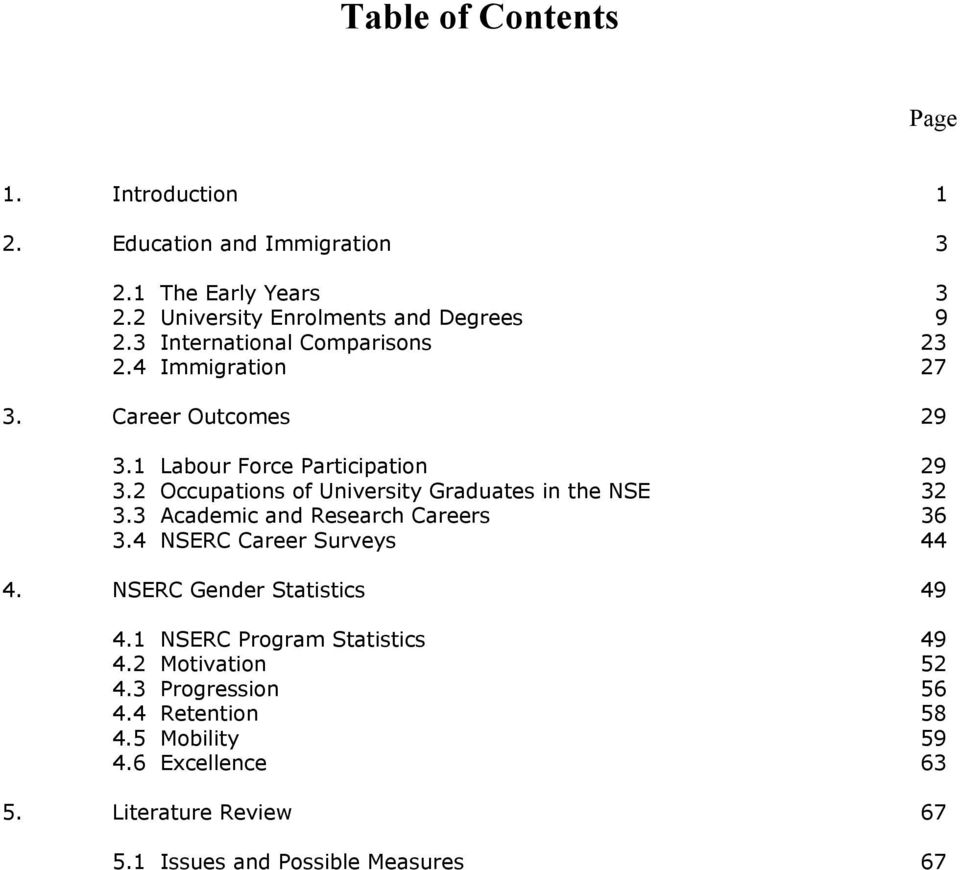
3 Table of Contents Page 1. Introduction 1 2. Education and Immigration The Early Years University Enrolments and Degrees International Comparisons Immigration Career Outcomes Labour Force Participation Occupations of University Graduates in the NSE Academic and Research Careers NSERC Career Surveys NSERC Gender Statistics NSERC Program Statistics Motivation Progression Retention Mobility Excellence Literature Review Issues and Possible Measures 67
4 List of Tables 2.1 Various Mathematics Test Results by Gender Various Science Test Results by Gender Summary of Gender Difference in Performance by Selected Characteristics Number of Students Enrolled or Writing Grade 12/Grade11 (Quebec) Exams in Science and Math Bachelor s Enrolment (Full-Time) in the Natural Sciences and 13 Engineering Master s Enrolment (Full-Time) in the Natural Sciences and Engineering Doctoral Enrolment (Full-Time) in the Natural Sciences and Engineering Degrees Granted in the Natural Sciences and Engineering First University Degree in the NSE and Ratio to 24-Year-Old Population, by Sex 25 and Country: 26 or Most Recent Year 2.1 Doctoral Degrees in the NSE and Ratio to Population, by Sex 26 and Country: 26 or Most Recent Year 2.11 Immigration to Canada by Education Level and Occupation, Skilled 28 Immigrant Classification (Applicant-Female), Professional Occupations in Natural and Applied Sciences 3.1 Occupations of Bachelor s Graduates (25-44 Years Old) in the NSE, Occupations of Master s Graduates (25-44 Years Old) in the NSE, Occupations of Doctoral Graduates (25-44 Years Old) in the NSE, Faculty (Full-Time) in the Natural Sciences and Engineering, Professional Personnel Engaged in R&D in Industry, by Degree Level, 23 to Number of NSERC Awards Held by Females, Various Programs Success Rates by Sex, Various Programs Results from NSERC s Undergraduate Student Research Award 55 (USRA) Exit Survey, Results from NSERC s Postgraduate Scholarship Exit Surveys Results from NSERC s Postdoctoral Fellowship Exit Surveys, NSERC New Applicant to Doctoral Degree Output Comparison NSERC Grantees with a Ph.D. from Top U.S. Universities, Top Discovery Grants Recipients by Gender and Priority Area, NSERC Canada Research Chairs by Gender and Priority Area, NSERC Industrial Research Chairs by Gender and Priority Area, NSERC Discovery Accelerator Supplements, Page
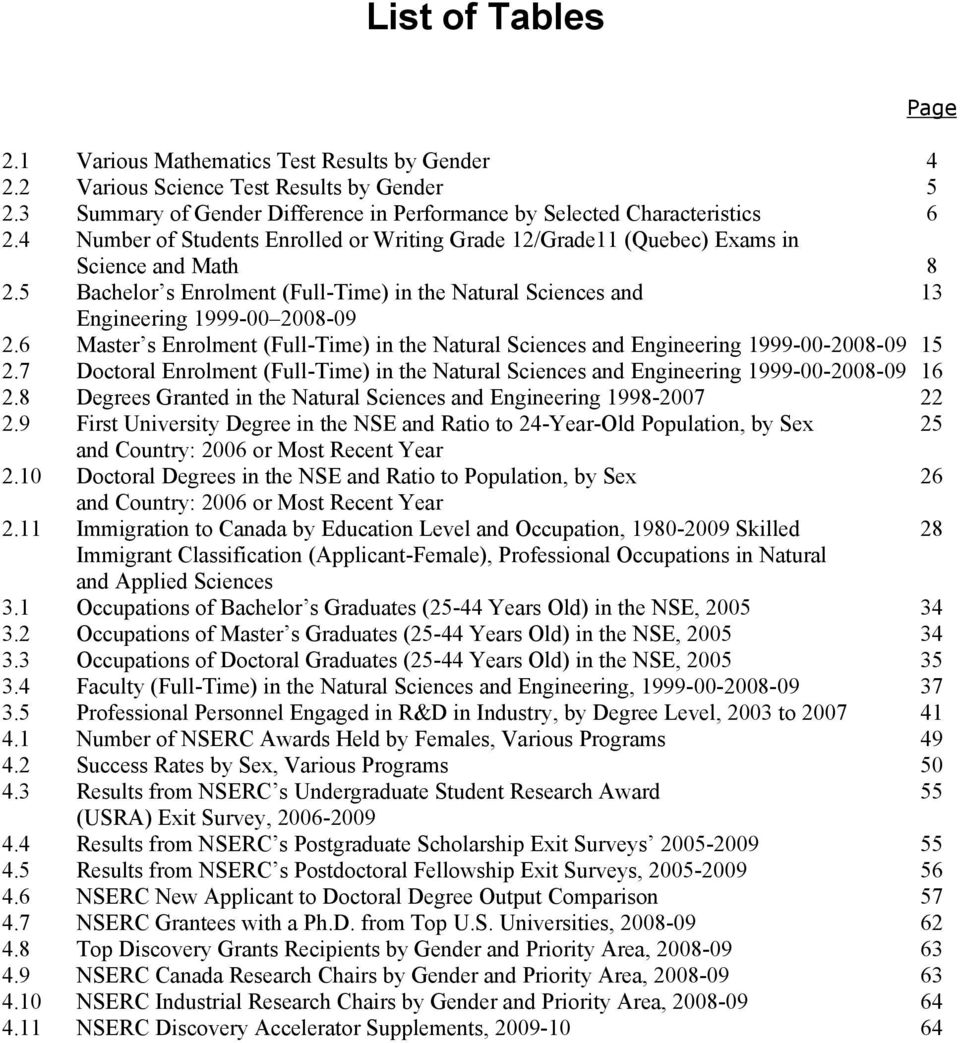
5 List of Figures 2.1 The Natural Science and Engineering Supply Chain Full-time Bachelor s Enrolment Full-time Female Bachelor s Enrolment by Discipline, Full-time Male Bachelor s Enrolment by Discipline, Full-time Bachelor s Enrolment by Discipline-Female/Male Ratio, Full-time Bachelor s Enrolment in the Natural Sciences and Engineering Percentage of Undergraduates Who Choose to Study the Natural Sciences or Engineering 12 by Gender (Canadian and Permanent Residents) 2.8 Full-time Master s Enrolment in the Natural Sciences and Engineering Full-time Doctoral Enrolment in the Natural Sciences and Engineering Female Enrolment in the Natural Sciences and Engineering as a % of Total NSE Enrolment 17 by Degree Level and Discipline, 28-9 (Canadian and Permanent Residents) 2.11 Female Enrolment in the Natural Sciences and Engineering as a % of Total NSE Enrolment 18 by Degree Level (Canadian and Permanent Residents) 2.12 Female Enrolment in the Natural Sciences and Engineering as a % of Total NSE Enrolment 18 by Degree Level (Foreign Students) 2.13 Degrees Granted to Females in the Natural Sciences and Engineering 19 as a % of Total Granted in the NSE by Degree Level 2.14 Degrees Granted to Females in the Natural Sciences and Engineering 2 as a % of Total Granted in the NSE by Degree Level and Discipline, Average Time to Completion at the Master s Level by Field of Study Average Time to Completion at the Doctoral Level by Field of Study Ratio of Natural Science and Engineering First Degrees to 24-year-old Female Population, Ratio of Natural Science and Engineering Doctoral Degrees to 3-4 year-old Female Population, Skilled Female Immigrants to Canada with NSE Degrees versus Degrees 27 Granted to Females in Canada in the NSE by Degree Level 3.1 Labour Force Participation Rates by Gender Year-Old Population, 29 Bachelor s Degree Holders 3.2 Labour Force Participation Rates by Gender Year-Old Population, 3 Above Bachelor s Degree Holders 3.3 Percentage of Total Employed by Gender in Natural Sciences and Related Occupations Number of Women in Natural Sciences and Related Occupations Unemployment Rate by Gender Natural Sciences and Related Occupations Occupations in Canada for Year Old Bachelor s Degree Holders in the NSE by Gender, Occupations in Canada for Year Old Master s Degree Holders in the NSE by Gender, Occupations in Canada for Year Old Doctoral Degree Holders in the NSE by Gender, Female Faculty in the Natural Sciences and Engineering as a % of Total NSE Faculty by Discipline Female Faculty in the Natural Sciences and Engineering as a % of Total NSE Faculty by Rank Percentage of Female Faculty in the Natural Sciences and Engineering 38 as a % of Total NSE Faculty by Discipline and Rank, Age Distribution of Full-time Faculty in the NSE by Gender, Percentage of Doctoral Degree Holders in the NSE Who Are Full-Time 4 Faculty in Universities in the NSE, Estimate of Percentage of Research Scientists and Engineers in Industry 41 by Gender and Degree Level, Number of Female Research Scientists and Engineers in the Federal Government NSERC Postgraduate Scholarship Career Outcomes (Sector of Employment) NSERC Postgraduate Scholarship Career Outcomes (Activities on the Job) 45 Page

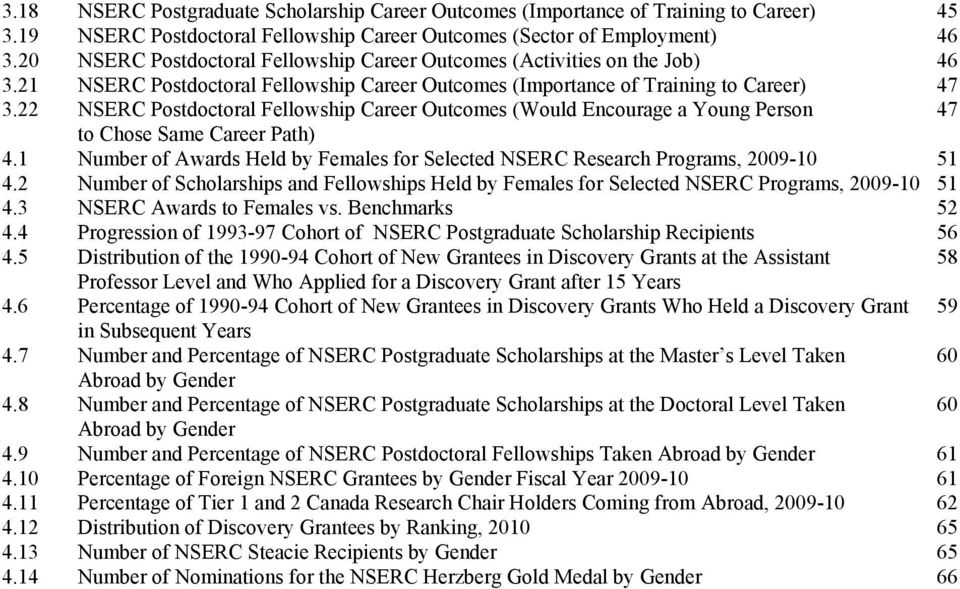
6 3.18 NSERC Postgraduate Scholarship Career Outcomes (Importance of Training to Career) NSERC Postdoctoral Fellowship Career Outcomes (Sector of Employment) NSERC Postdoctoral Fellowship Career Outcomes (Activities on the Job) NSERC Postdoctoral Fellowship Career Outcomes (Importance of Training to Career) NSERC Postdoctoral Fellowship Career Outcomes (Would Encourage a Young Person 47 to Chose Same Career Path) 4.1 Number of Awards Held by Females for Selected NSERC Research Programs, Number of Scholarships and Fellowships Held by Females for Selected NSERC Programs, NSERC Awards to Females vs. Benchmarks Progression of Cohort of NSERC Postgraduate Scholarship Recipients Distribution of the Cohort of New Grantees in Discovery Grants at the Assistant 58 Professor Level and Who Applied for a Discovery Grant after 15 Years 4.6 Percentage of Cohort of New Grantees in Discovery Grants Who Held a Discovery Grant 59 in Subsequent Years 4.7 Number and Percentage of NSERC Postgraduate Scholarships at the Master s Level Taken 6 Abroad by Gender 4.8 Number and Percentage of NSERC Postgraduate Scholarships at the Doctoral Level Taken 6 Abroad by Gender 4.9 Number and Percentage of NSERC Postdoctoral Fellowships Taken Abroad by Gender Percentage of Foreign NSERC Grantees by Gender Fiscal Year Percentage of Tier 1 and 2 Canada Research Chair Holders Coming from Abroad, Distribution of Discovery Grantees by Ranking, Number of NSERC Steacie Recipients by Gender Number of Nominations for the NSERC Herzberg Gold Medal by Gender 66
7 WOMEN IN SCIENCE AND ENGINEERING IN CANADA PAGE 1 1. Introduction The under representation of women in the various fields of science and engineering has long been recognized, and is of concern to the Natural Sciences and Engineering Research Council of Canada (NSERC). In this report, a brief review of some of the available statistics on women in science and engineering in Canada will be presented. From pre-university to post graduation, the gender preferences for science and engineering education and careers will be highlighted. Although the reasons behind gender differences in education and career selection are extremely important to consider, these issues are not the focus of this report. The academic literature on this subject is vast and does not offer conclusive results. The following web site Women-Related Web Sites in Science/Technology offers a good compilation of research in this area. The subject matter has developed enough interest to sustain a journal in the area, the Journal of Women and Minorities in Science and Engineering. Section 2 of this report looks at the supply side of women in science and engineering through the education stream and immigration. Section 3 examines the career outcomes for women educated in science or engineering, with particular emphasis on academic and research careers. Section 4 presents an overview of NSERC funding to women and special programs or initiatives to help increase the number of women in science and engineering. Finally, Section 5 briefly reviews some current literature on the topic and presents a summary of the issues and possible solutions.

8 PAGE 2 WOMEN IN SCIENCE AND ENGINEERING IN CANADA

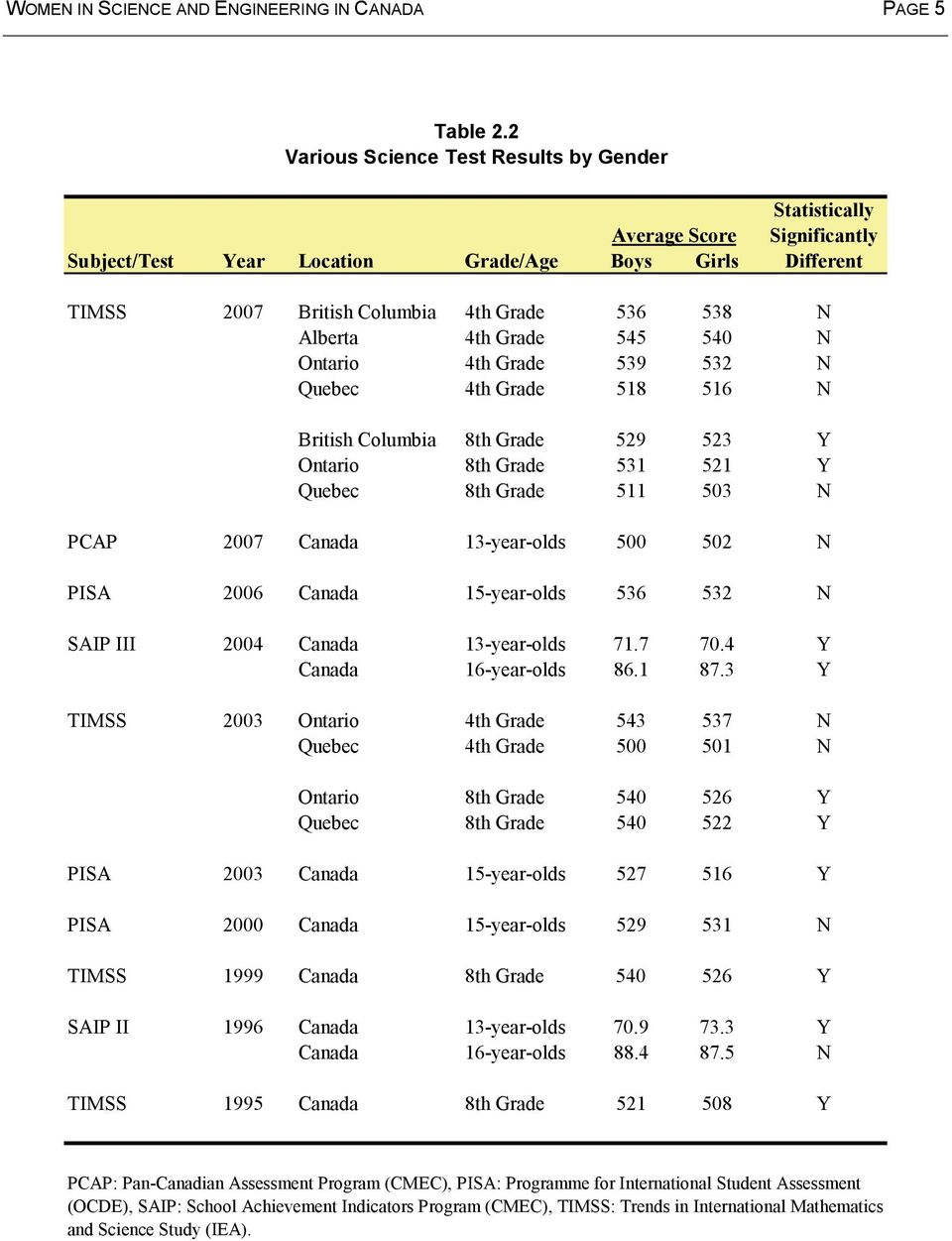
9 WOMEN IN SCIENCE AND ENGINEERING IN CANADA PAGE The Early Years 2. Education and Immigration The supply pipeline for university graduates in science and engineering begins early on in elementary school when children are exposed to and form opinions about mathematics and science. Figure 2.1 presents the approximate flow of students from 1 st grade to a Ph.D. in the sciences or engineering by gender. There is certainly no shortage of 1 st graders of either sex who could enter the science and engineering world. But at each step along the supply chain fewer and fewer young people choose to study science or engineering, and the drop-off for women is considerably larger than that for men. The odds of a female child enrolled in 1 st grade going on to receive a Ph.D. in the sciences or engineering are approximately 1 in 286 (the odds for a boy are 1 in 167). Today, in an average-sized Canadian elementary school, only 1 child will go on to receive that Ph.D., and it is likely to be a boy. Figure 2.1 The Natural Science and Engineering Supply Chain M Male F Female Doctoral Degrees (27) Master s s Degrees (23) Bachelor s s Degrees (21) High School Diplomas (1997) Grade 1 Enrolment (1985) M 1,198 F 647 M 4,19 F 2,619 M 16,359 F 1,946 M 15,848 F 145,513 M 2,288 F 185,116 Source: Statistics Canada, NSERC estimates. University degrees shown are in the natural sciences and engineering for Canadians and permanent residents. Interest in math and science education has spawned a number of international testing efforts to primarily gauge the knowledge of these subjects, but also the perceptions and attitudes of the students. A number of different international and national test results by gender for mathematics are presented in Table 2.1 and for science in Table 2.2. Overall, boys tend to outperform girls by only a slight margin for both mathematics and science (while not shown here, girls significantly outperform boys in reading).

10 PAGE 4 WOMEN IN SCIENCE AND ENGINEERING IN CANADA Table 2.1 Various Mathematics Test Results by Gender Statistically Average Score Significantly Subject/Test Year Location Grade/Age Boys Girls Different TIMSS 27 British Columbia 4th Grade Y Alberta 4th Grade 51 5 Y Ontario 4th Grade N Quebec 4th Grade Y British Columbia 8th Grade Y Ontario 8th Grade Y Quebec 8th Grade N PCAP 27 Canada 13-year-olds N PISA 26 Canada 15-year-olds Y TIMSS 23 Ontario 4th Grade Y Quebec 4th Grade Y Ontario 8th Grade N Quebec 8th Grade Y PISA 23 Canada 15-year-olds Y SAIP III 21 Canada 13-year-olds N Canada 16-year-olds N PISA 2 Canada 15-year-olds Y TIMSS 1999 Canada 8th Grade N SAIP II 1997 Canada 13-year-olds N Canada 16-year-olds N TIMSS 1995 Canada 8th Grade N PCAP: Pan-Canadian Assessment Program (CMEC), PISA: Programme for International Student Assessment (OCDE), SAIP: School Achievement Indicators Program (CMEC), TIMSS: Trends in International Mathematics and Science Study (IEA).

11 WOMEN IN SCIENCE AND ENGINEERING IN CANADA PAGE 5 Table 2.2 Various Science Test Results by Gender Statistically Average Score Significantly Subject/Test Year Location Grade/Age Boys Girls Different TIMSS 27 British Columbia 4th Grade N Alberta 4th Grade N Ontario 4th Grade N Quebec 4th Grade N British Columbia 8th Grade Y Ontario 8th Grade Y Quebec 8th Grade N PCAP 27 Canada 13-year-olds 5 52 N PISA 26 Canada 15-year-olds N SAIP III 24 Canada 13-year-olds Y Canada 16-year-olds Y TIMSS 23 Ontario 4th Grade N Quebec 4th Grade 5 51 N Ontario 8th Grade Y Quebec 8th Grade Y PISA 23 Canada 15-year-olds Y PISA 2 Canada 15-year-olds N TIMSS 1999 Canada 8th Grade Y SAIP II 1996 Canada 13-year-olds Y Canada 16-year-olds N TIMSS 1995 Canada 8th Grade Y PCAP: Pan-Canadian Assessment Program (CMEC), PISA: Programme for International Student Assessment (OCDE), SAIP: School Achievement Indicators Program (CMEC), TIMSS: Trends in International Mathematics and Science Study (IEA).
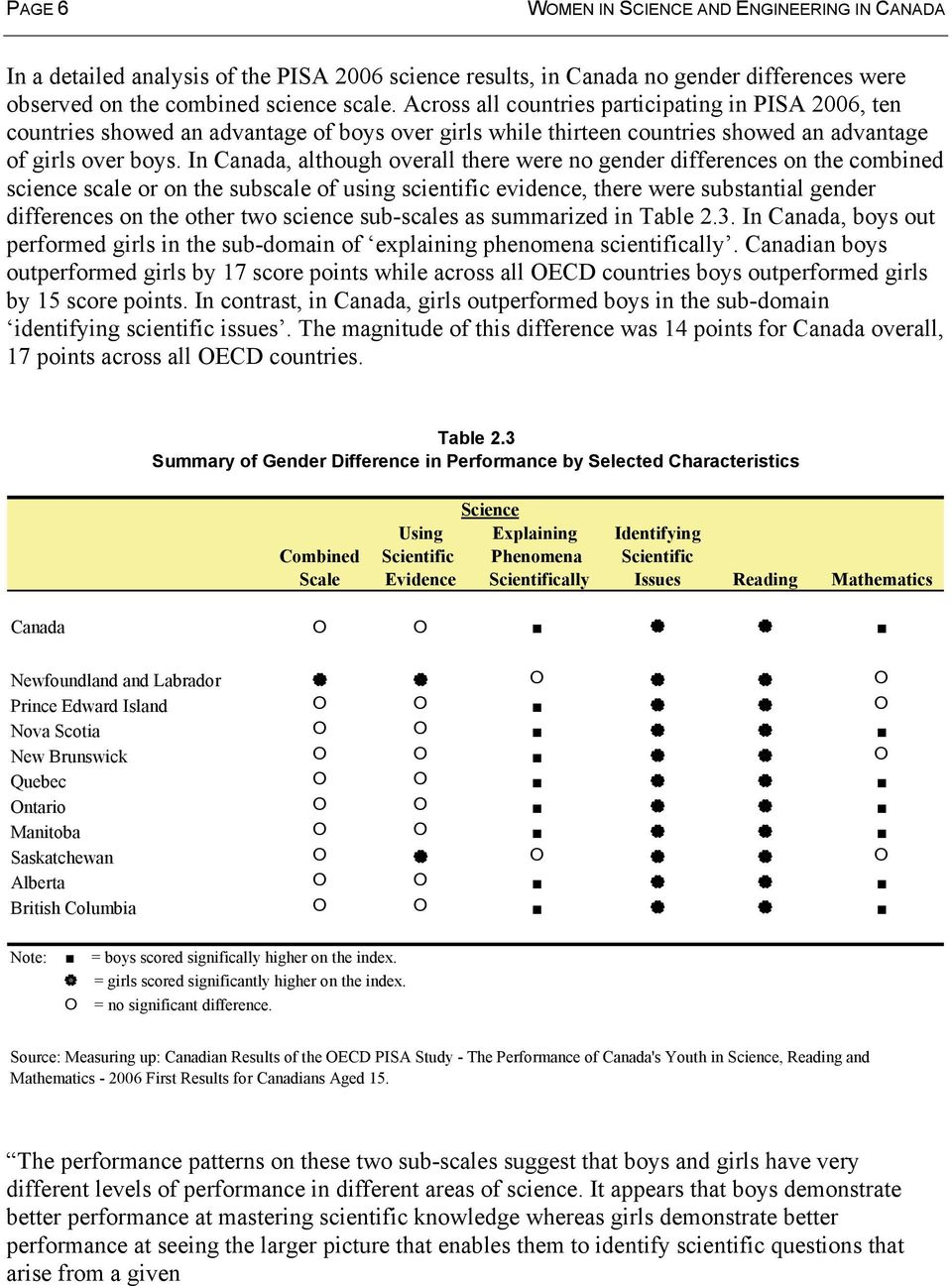
12 PAGE 6 WOMEN IN SCIENCE AND ENGINEERING IN CANADA In a detailed analysis of the PISA 26 science results, in Canada no gender differences were observed on the combined science scale. Across all countries participating in PISA 26, ten countries showed an advantage of boys over girls while thirteen countries showed an advantage of girls over boys. In Canada, although overall there were no gender differences on the combined science scale or on the subscale of using scientific evidence, there were substantial gender differences on the other two science sub-scales as summarized in Table 2.3. In Canada, boys out performed girls in the sub-domain of explaining phenomena scientifically. Canadian boys outperformed girls by 17 score points while across all OECD countries boys outperformed girls by 15 score points. In contrast, in Canada, girls outperformed boys in the sub-domain identifying scientific issues. The magnitude of this difference was 14 points for Canada overall, 17 points across all OECD countries. Table 2.3 Summary of Gender Difference in Performance by Selected Characteristics Science Using Explaining Identifying Combined Scientific Phenomena Scientific Scale Evidence Scientifically Issues Reading Mathematics Canada O O Newfoundland and Labrador O O Prince Edward Island O O O Nova Scotia O O New Brunswick O O O Quebec O O Ontario O O Manitoba O O Saskatchewan O O O Alberta O O British Columbia O O Note: = boys scored significally higher on the index. = girls scored significantly higher on the index. O = no significant difference. Source: Measuring up: Canadian Results of the OECD PISA Study - The Performance of Canada's Youth in Science, Reading and Mathematics - 26 First Results for Canadians Aged 15. The performance patterns on these two sub-scales suggest that boys and girls have very different levels of performance in different areas of science. It appears that boys demonstrate better performance at mastering scientific knowledge whereas girls demonstrate better performance at seeing the larger picture that enables them to identify scientific questions that arise from a given
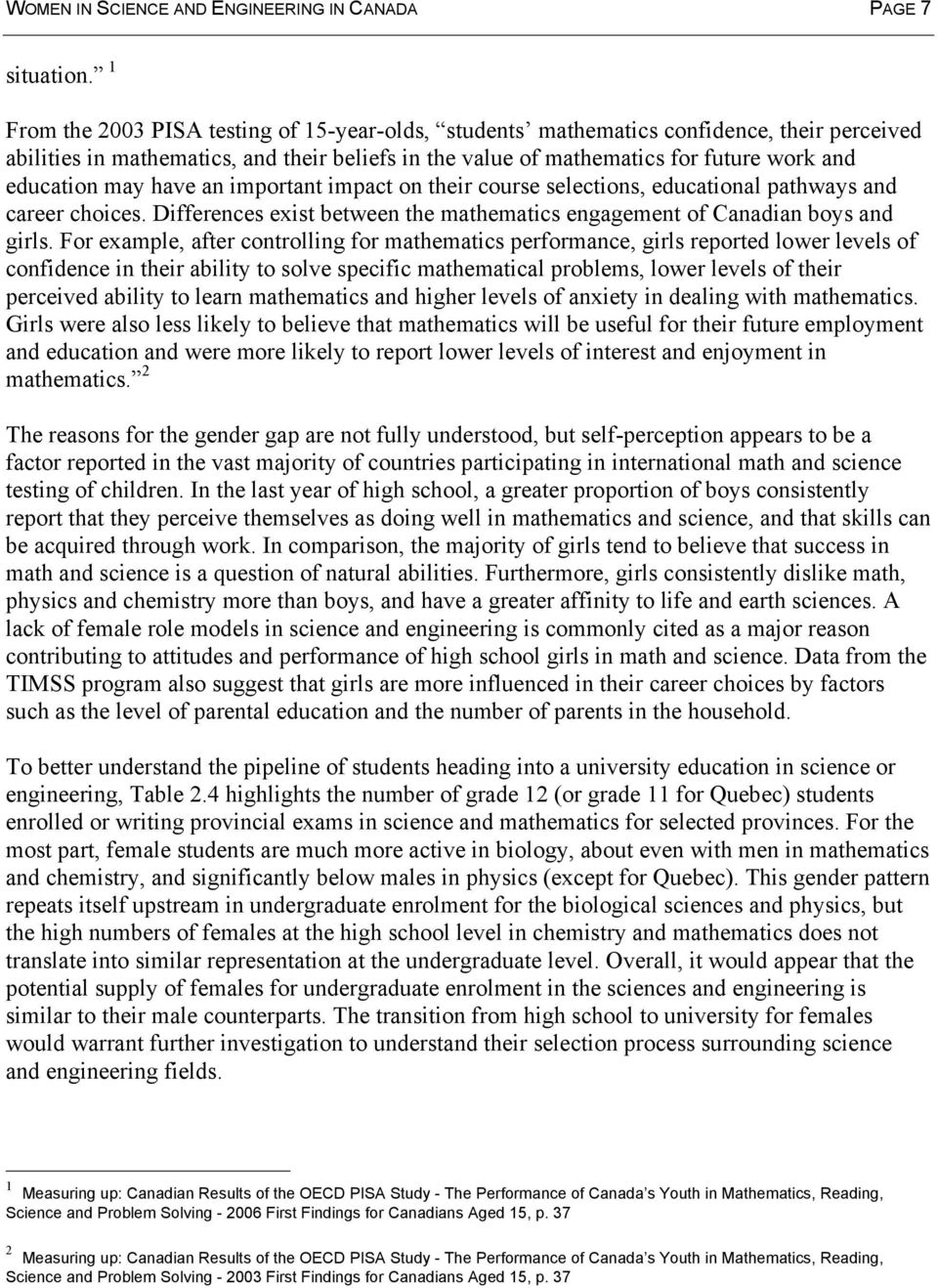
13 WOMEN IN SCIENCE AND ENGINEERING IN CANADA PAGE 7 situation. 1 From the 23 PISA testing of 15-year-olds, students mathematics confidence, their perceived abilities in mathematics, and their beliefs in the value of mathematics for future work and education may have an important impact on their course selections, educational pathways and career choices. Differences exist between the mathematics engagement of Canadian boys and girls. For example, after controlling for mathematics performance, girls reported lower levels of confidence in their ability to solve specific mathematical problems, lower levels of their perceived ability to learn mathematics and higher levels of anxiety in dealing with mathematics. Girls were also less likely to believe that mathematics will be useful for their future employment and education and were more likely to report lower levels of interest and enjoyment in mathematics. 2 The reasons for the gender gap are not fully understood, but self-perception appears to be a factor reported in the vast majority of countries participating in international math and science testing of children. In the last year of high school, a greater proportion of boys consistently report that they perceive themselves as doing well in mathematics and science, and that skills can be acquired through work. In comparison, the majority of girls tend to believe that success in math and science is a question of natural abilities. Furthermore, girls consistently dislike math, physics and chemistry more than boys, and have a greater affinity to life and earth sciences. A lack of female role models in science and engineering is commonly cited as a major reason contributing to attitudes and performance of high school girls in math and science. Data from the TIMSS program also suggest that girls are more influenced in their career choices by factors such as the level of parental education and the number of parents in the household. To better understand the pipeline of students heading into a university education in science or engineering, Table 2.4 highlights the number of grade 12 (or grade 11 for Quebec) students enrolled or writing provincial exams in science and mathematics for selected provinces. For the most part, female students are much more active in biology, about even with men in mathematics and chemistry, and significantly below males in physics (except for Quebec). This gender pattern repeats itself upstream in undergraduate enrolment for the biological sciences and physics, but the high numbers of females at the high school level in chemistry and mathematics does not translate into similar representation at the undergraduate level. Overall, it would appear that the potential supply of females for undergraduate enrolment in the sciences and engineering is similar to their male counterparts. The transition from high school to university for females would warrant further investigation to understand their selection process surrounding science and engineering fields. 1 Measuring up: Canadian Results of the OECD PISA Study - The Performance of Canada s Youth in Mathematics, Reading, Science and Problem Solving - 26 First Findings for Canadians Aged 15, p Measuring up: Canadian Results of the OECD PISA Study - The Performance of Canada s Youth in Mathematics, Reading, Science and Problem Solving - 23 First Findings for Canadians Aged 15, p. 37
14 PAGE 8 WOMEN IN SCIENCE AND ENGINEERING IN CANADA Table 2.4 Number of Students Enrolled or Writing Grade 12/Grade 11 (Quebec) Exams in Science and Math Province/ Subject Male Female Male Female Male Female Male Female Male Female Male Female British Columbia Mathematics 8,986 8,77 9,98 8,234 8,15 7,368 6,717 6,14 3,515 2,98 n.a. n.a. Biology 5,863 1,453 5,995 1,553 5,136 9,116 3,823 6,592 1,855 2,9 n.a. n.a. Chemistry 6,221 6,148 6,337 6,19 5,556 5,154 4,355 3,957 2,61 1,77 n.a. n.a. Physics 5,82 2,186 5,43 2,29 4,715 1,958 3,692 1,553 1, n.a. n.a. Alberta Mathematics n.a. n.a. 11,848 12,471 1,743 11,527 1,99 11,517 1,97 11,622 1,741 11,456 Biology n.a. n.a. 7,925 13,39 7,729 13,26 7,88 13,187 7,657 13,26 7,921 13,167 Chemistry n.a. n.a. 8,826 9,814 8,85 9,213 8,556 9,53 8,37 9,531 8,236 9,375 Physics n.a. n.a. 7,3 4,288 6,594 4,18 6,873 4,187 6,583 3,926 6,39 3,923 Saskatchewan Mathematics 13,174 14,328 12,956 14,357 12,51 13,9 11,791 13,158 11,426 12,736 11,245 12,47 Biology 4,237 6,177 4,116 6,27 3,872 5,917 3,699 5,713 3,828 5,635 3,64 5,572 Chemistry 3,19 3,894 2,921 3,824 2,791 3,662 2,621 3,632 2,538 3,46 2,548 3,667 Physics 2,888 2,46 2,886 2,496 2,88 2,43 2,625 2,296 2,512 2,185 2,55 2,118 Ontario Mathematics n.a. n.a. 86,845 66,665 88,258 67,34 97,458 77,36 n.a. n.a. n.a. n.a. Biology n.a. n.a. 12,475 21,66 13,293 21,636 13,42 22, n.a. n.a. n.a. n.a. Chemistry n.a. n.a. 22,828 24,372 23,65 25,278 23,957 25,729 n.a. n.a. n.a. n.a. Physics n.a. n.a. 19,829 8,948 2,567 9,18 21,149 8,991 n.a. n.a. n.a. n.a. Quebec Mathematics 25,44 29,128 25,864 29,927 28,421 32,542 28,426 32,322 29,519 32,914 n.a. n.a. Biology 4,225 6,727 4,877 7,535 5,83 7,656 4,849 7,748 n.a. n.a. n.a. n.a. Chemistry 9,278 1,667 9,84 11,441 1,351 12,166 1,25 12,313 1,629 12,621 n.a. n.a. Physics 1,77 1,88 1,416 1,697 1,99 11,51 1,724 11,576 11,185 11,766 n.a. n.a. Nova Scotia Mathematics 6,799 6,993 6,679 6,661 n.a. n.a. 6,26 6,157 n.a. n.a. n.a. n.a. Biology 2,167 3,547 2,18 3,314 n.a. n.a. 1,787 3,182 n.a. n.a. n.a. n.a. Chemistry 1,587 2,135 1,539 2,47 n.a. n.a. 1,432 2,29 n.a. n.a. n.a. n.a. Physics 1, , n.a. n.a. 1, n.a. n.a. n.a. n.a. Source: Provincial Ministries of Education.

15 WOMEN IN SCIENCE AND ENGINEERING IN CANADA PAGE University Enrolments and Degrees The number of women (346,) enrolled in Canadian universities at the bachelor s level is nearly 4% greater than males (246,). Over the past decade, (see Figure 2.2), females have maintained this lead over male students. Therefore, the lack of women in the university system can not explain their under-representation in the natural sciences and engineering (NSE). Figure 2.2 Full-time Bachelor s Enrolment 4, 1.5 3, 1.4 2, 1.3 1, Male Female Ratio (F/M) 1.1 Source: Statistics Canada. Females make different discipline choices as compared to males when entering university. Figures 2.3 and 2.4 present the bachelor s level enrolment distribution patterns for females and males, respectively. The NSE disciplines rank near the bottom as a discipline choice for women as compared to men. Figure 2.5 highlights the ratio of females to males for 28-9 bachelor s enrolment. While women outnumber men in most non-nse disciplines, the ratio drops off dramatically for the major NSE disciplines and is only above 1. for the life science disciplines.

16 PAGE 1 WOMEN IN SCIENCE AND ENGINEERING IN CANADA Figure 2.3 Full-time Female Bachelor s Enrolment by Discipline, 28-9 Arts and Humanities Business Health Professions Social Sciences Education Biological/Biomedical Sciences Psychology Languages Parks/Recreation/Leisure/Fitness Multidisciplinary/Interdisciplinary Engineering Communication/Journalism Public Administration Legal Professions and Studies History Family/Consumer/Human Sciences Physical Sciences Area/Ethnic/Cultural/Gender Natural Resources/Conservation Mathematics and Statistics Philosophy and Religious Studies Architecture Agriculture Computer Sciences NSE Disciplines Source: Statistics Canada % of Female Enrolment Figure 2.4 Full-time Male Bachelor s Enrolment by Discipline, 28-9 Business Engineering Arts and Humanities Social Sciences Biological/Biomedical Sciences Health Professions Computer Sciences Education Parks/Recreation/Leisure/Fitness Languages Physical Sciences Psychology History Multidisciplinary/Interdisciplinary Legal Professions and Studies Mathematics and Statistics Communication/Journalism Philosophy and Religious Studies Natural Resources/Conservation Architecture Public Administration Area/Ethnic/Cultural/Gender Agriculture Family/Consumer/Human Sciences NSE Disciplines Source: Statistics Canada % of Male Enrolment

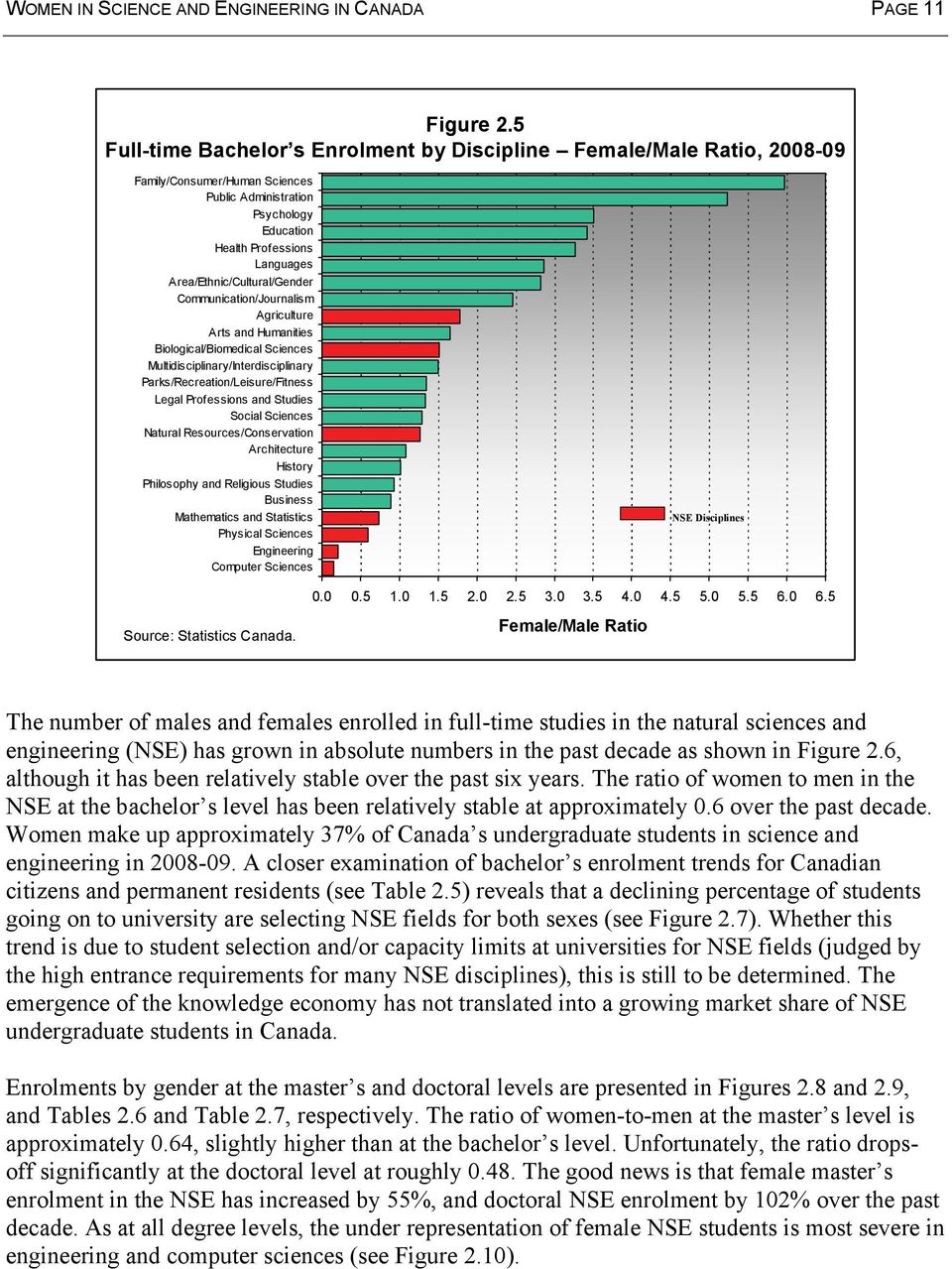
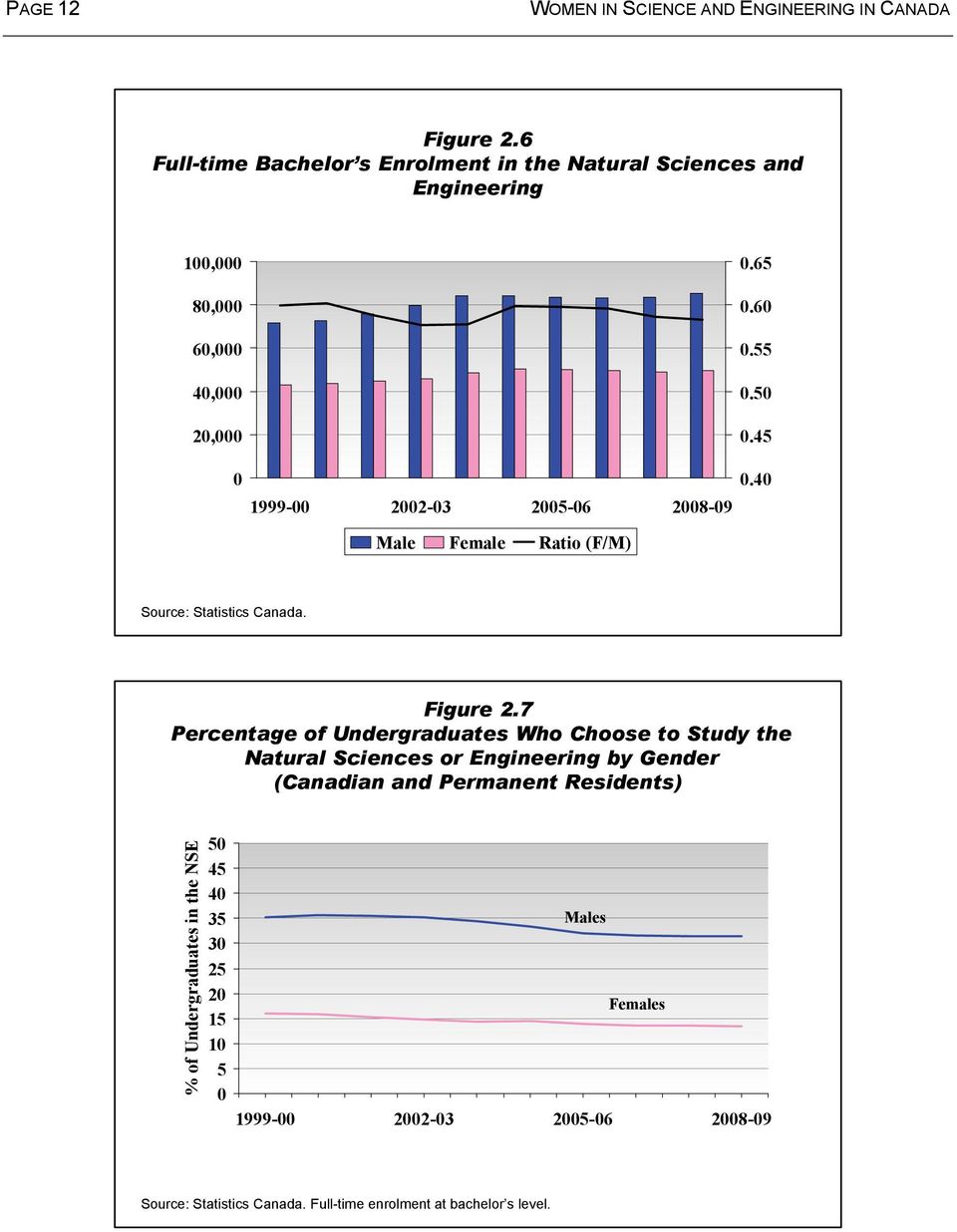
17 WOMEN IN SCIENCE AND ENGINEERING IN CANADA PAGE 11 Figure 2.5 Full-time Bachelor s Enrolment by Discipline Female/Male Ratio, 28-9 Family/Consumer/Human Sciences Public Administration Psychology Education Health Professions Languages Area/Ethnic/Cultural/Gender Communication/Journalism Agriculture Arts and Humanities Biological/Biomedical Sciences Multidisciplinary/Interdisciplinary Parks/Recreation/Leisure/Fitness Legal Professions and Studies Social Sciences Natural Resources/Conservation Architecture History Philosophy and Religious Studies Business Mathematics and Statistics Physical Sciences Engineering Computer Sciences NSE Disciplines Source: Statistics Canada Female/Male Ratio The number of males and females enrolled in full-time studies in the natural sciences and engineering (NSE) has grown in absolute numbers in the past decade as shown in Figure 2.6, although it has been relatively stable over the past six years. The ratio of women to men in the NSE at the bachelor s level has been relatively stable at approximately.6 over the past decade. Women make up approximately 37% of Canada s undergraduate students in science and engineering in A closer examination of bachelor s enrolment trends for Canadian citizens and permanent residents (see Table 2.5) reveals that a declining percentage of students going on to university are selecting NSE fields for both sexes (see Figure 2.7). Whether this trend is due to student selection and/or capacity limits at universities for NSE fields (judged by the high entrance requirements for many NSE disciplines), this is still to be determined. The emergence of the knowledge economy has not translated into a growing market share of NSE undergraduate students in Canada. Enrolments by gender at the master s and doctoral levels are presented in Figures 2.8 and 2.9, and Tables 2.6 and Table 2.7, respectively. The ratio of women-to-men at the master s level is approximately.64, slightly higher than at the bachelor s level. Unfortunately, the ratio dropsoff significantly at the doctoral level at roughly.48. The good news is that female master s enrolment in the NSE has increased by 55%, and doctoral NSE enrolment by 12% over the past decade. As at all degree levels, the under representation of female NSE students is most severe in engineering and computer sciences (see Figure 2.1).
18 PAGE 12 WOMEN IN SCIENCE AND ENGINEERING IN CANADA Figure 2.6 Full-time Bachelor s Enrolment in the Natural Sciences and Engineering 1, 8, 6, 4, 2, Male Female Ratio (F/M) Source: Statistics Canada. Figure 2.7 Percentage of Undergraduates Who Choose to Study the Natural Sciences or Engineering by Gender (Canadian and Permanent Residents) % of Undergraduates in the NSE Males Females Source: Statistics Canada. Full-time enrolment at bachelor s level.
19 WOMEN IN SCIENCE AND ENGINEERING IN CANADA PAGE 13 Canadian and Permanent Residents: Table 2.5 Bachelor's Enrolment (Full-Time) in the Natural Sciences and Engineering Life Sci. Eng. and Computer Sci. Math. and Physical Sci. Academic ALL FIELDS % % % NSE TOTAL % Year Male Female Total Male Female Total Female Male Female Total Female Male Female Total Female Male Female Total Female ,34 259,59 453,849 14,778 23,43 38, ,444 12,312 57, ,37 5,742 13, ,259 41,484 19, , , ,991 14,274 23,82 38, ,98 12,816 59, ,722 5,493 13, ,976 42, , , , ,66 13,695 23,55 37, ,38 13,29 62, ,926 5,571 13, ,1 42, , ,85 292,98 51,183 13,95 24,369 38, ,414 13,59 64, ,397 5,94 14, ,716 43, , ,79 319, ,146 15,516 26,634 42, ,38 12,48 64, ,555 6,669 16, ,451 45, , , , ,598 17,34 29,1 46, ,983 11,91 61, ,777 7,59 16, ,64 47,25 124, , , ,125 18,132 29,826 47, ,69 9,867 57, ,858 6,978 16, ,59 46, , ,936 34, ,721 18,858 29,919 48, ,89 9,444 56, ,29 6,966 17, ,957 46, , , , ,737 18,99 29,115 48, ,587 9,54 56, ,359 6,837 17, ,936 45, , , , ,744 19,716 29,754 49, ,13 9,567 56, ,581 6,84 17, ,31 46, , Avg. Growth % 3.1% 2.9% 3.3% 2.7% 2.9% -.4% -2.8% -.2% - 3.1% 2.% 2.6% - 1.4% 1.2% 1.3% - Foreign: Life Sci. Eng. and Computer Sci. Math. and Physical Sci. Academic ALL FIELDS % % % NSE TOTAL % Year Male Female Total Male Female Total Female Male Female Total Female Male Female Total Female Male Female Total Female ,34 7,476 15, , , ,342 1,449 4, ,964 8,481 17, , , , ,924 1,746 5, ,872 1,467 21, , ,17 1,155 5, ,98 2,247 7, ,846 12,75 24, , ,689 1,248 5, , ,88 2,553 8, ,675 14,922 3, ,59 1, ,328 1,287 6, , ,924 3,3 9, ,67 16,437 34, ,215 2, ,442 1,239 6, , , ,299 3,246 1, ,371 17,871 37, ,317 2, ,379 1,62 6, , , ,47 3,255 1, ,41 17,85 37, ,32 2, ,91 1,26 6, , , ,221 3,225 1, ,878 18,333 38, ,389 2, ,352 1,137 6, , , ,53 3,432 1, ,862 18,984 39, ,374 2, ,676 1,155 6, , , ,911 3,57 11, Avg. Growth % 1.9% 11.1% 11.4% 11.% 11.2% - 8.8% 6.% 8.2% % 17.4% 17.1% - 1.% 1.3% 1.1% - Total: Life Sci. Eng. and Computer Sci. Math. and Physical Sci. Academic ALL FIELDS % % % NSE TOTAL % Year Male Female Total Male Female Total Female Male Female Total Female Male Female Total Female Male Female Total Female , , ,359 15,132 23,967 39, ,111 12,993 61, ,358 5,973 14, ,61 42, , , ,44 476,436 14,658 24,438 39, ,175 13,71 63, ,67 5,727 13, ,9 43, , , , ,999 14,19 24,312 38, ,397 14,445 67, ,394 5,91 14, ,981 44,658 12, ,931 34, ,14 14,454 25,224 39, ,13 14,37 7, ,39 6,39 15, ,596 45, , , , ,743 16,221 27,693 43, ,78 13,695 71, ,446 7,353 17, ,375 48, , ,43 343, ,642 18,114 3,315 48, ,425 12,33 67, ,824 7,851 18, ,363 5, , ,92 354, ,367 19,47 31,143 5, ,448 1,929 64, ,34 7,854 18, ,529 49, , , , ,972 19,764 31,221 5, ,981 1,47 62, ,433 7,863 19, ,178 49, , ,69 354, ,948 19,893 3,54 5, ,939 1,641 62, ,67 7,743 19, ,439 48, , , , ,59 2,652 31,128 51, ,689 1,722 63, ,88 7,818 19, ,221 49, , Avg. Growth % 3.4% 3.3% 3.5% 2.9% 3.2% - 1.% -2.1%.4% - 4.% 3.% 3.6% - 2.% 1.6% 1.8% - 1. Only includes data for major fields reported by Statistics Canada. Other NSE fields supported by NSERC are not reported. Numbers do not add up due to rounding. Source: Statistics Canada

20 PAGE 14 WOMEN IN SCIENCE AND ENGINEERING IN CANADA Figure 2.8 Full-time Master s Enrolment in the Natural Sciences and Engineering 2, 16, 12, 8, 4, Male Female Ratio (F/M) Source: Statistics Canada. Figure 2.9 Full-time Doctoral Enrolment in the Natural Sciences and Engineering 15, 12, 9, 6, 3, Male Female Ratio (F/M) Source: Statistics Canada.

21 WOMEN IN SCIENCE AND ENGINEERING IN CANADA PAGE 15 Canadian and Permanent Residents: Table 2.6 Master's Enrolment (Full-Time) in the Natural Sciences and Engineering Life Sci. Eng. and Computer Sci. Math. and Physical Sci. Academic ALL FIELDS % % % NSE TOTAL % Year Male Female Total Male Female Total Female Male Female Total Female Male Female Total Female Male Female Total Female ,152 21,765 4,917 2,43 2,919 5, ,72 1,284 5, , , ,455 4,995 12, ,158 21,759 4,917 2,394 2,988 5, ,921 1,356 5, , , ,65 5,169 12, ,61 22,863 42,924 2,37 3,219 5, ,539 1,56 6, , , ,247 5,631 13, ,119 24,765 46,884 2,49 3,435 5, ,586 1,893 7, , , ,48 6,234 15, ,739 26,415 5,154 2,625 3,693 6, ,138 1,965 8, ,518 1,2 2, ,281 6,678 16, ,291 28,332 52,623 2,679 3,873 6, ,964 1,821 7, ,632 1,35 2, ,275 6,729 17, ,18 29,97 53,25 2,643 3,96 6, ,64 1,68 7, ,677 1,23 2, ,96 6,663 16, ,738 3,57 55,38 2,799 4,74 6, ,373 1,569 6, ,71 1,59 2, ,873 6,72 16, ,941 33,423 59,364 2,964 4,293 7, ,478 1,578 7, ,797 1,95 2, ,239 6,966 17, ,448 34,962 61,41 2,988 4,383 7, ,46 1,56 6, ,78 1,11 3, ,472 7,53 17, Avg. Growth % 5.4% 4.6% 2.5% 4.6% 3.7% - 4.2% 2.2% 3.7% - 5.1% 3.8% 4.6% - 3.8% 3.9% 3.9% - Foreign: Life Sci. Eng. and Computer Sci. Math. and Physical Sci. Academic ALL FIELDS % % % NSE TOTAL % Year Male Female Total Male Female Total Female Male Female Total Female Male Female Total Female Male Female Total Female ,462 2,58 5, , , , ,756 2,76 6, , , , , ,158 2,976 7, , , , , ,737 3,477 8, , , ,424 1,164 3, ,529 4,8 9, , , ,781 1,386 4, ,216 4,38 1, , , ,985 1,419 4, ,567 4,617 11, , , , ,138 1,56 4, ,561 4,734 11, , , , ,267 1,578 4, ,591 4,749 11, , , , ,381 1,677 5, ,867 4,878 11, , , , ,265 1,77 5, Avg. Growth % 7.7% 7.8% 6.1% 9.7% 7.9% - 11.% 12.7% 11.4% % 8.6% 2.7% - 8.4% 1.7% 9.2% - Total: Life Sci. Eng. and Computer Sci. Math. and Physical Sci. Academic ALL FIELDS % % % NSE TOTAL % Year Male Female Total Male Female Total Female Male Female Total Female Male Female Total Female Male Female Total Female ,614 24,273 46,887 2,7 3,189 5, ,71 1,548 6, , , ,3 5,76 14, ,914 24,465 47,379 2,712 3,3 6, ,49 1,686 6, ,587 1,5 2, ,348 5,991 15, ,219 25,839 5,58 2,751 3,582 6, ,886 1,977 7, ,671 1,47 2, ,38 6,66 16, ,856 28,242 55,98 2,877 3,852 6, ,239 2,4 9, ,788 1,146 2, ,94 7,398 19, ,268 3,495 59,763 3,39 4,149 7, ,43 2,589 1, ,98 1,326 3, ,62 8,64 21, ,57 32,712 63,219 3,156 4,38 7, ,983 2,418 1, ,121 1,35 3, ,26 8,148 21, ,675 33,714 64,389 3,153 4,494 7, ,818 2,352 1, ,127 1,323 3, ,98 8,169 21, ,299 35,34 66,63 3,297 4,599 7, ,671 2,34 9, ,172 1,377 3, ,14 8,28 21, ,532 38,172 7,74 3,462 4,854 8, ,839 2,343 1, ,319 1,446 3, ,62 8,643 22, ,315 39,84 73,155 3,495 5,4 8, ,947 2,337 1, ,295 1,482 3, ,737 8,823 22, Avg. Growth % 5.7% 5.1% 2.9% 5.1% 4.2% - 6.% 4.7% 5.7% - 3.9% 4.8% 4.3% - 4.8% 5.% 4.8% - 1. Only includes data for major fields reported by Statistics Canada. Other NSE fields supported by NSERC are not reported. Numbers do not add up due to rounding. Source: Statistics Canada
22 PAGE 16 WOMEN IN SCIENCE AND ENGINEERING IN CANADA Canadian and Permanent Residents: Table 2.7 Doctoral Enrolment (Full-Time) in the Natural Sciences and Engineering Life Sci. Eng. and Computer Sci. Math. and Physical Sci. Academic ALL FIELDS % % % NSE TOTAL % Year Male Female Total Male Female Total Female Male Female Total Female Male Female Total Female Male Female Total Female ,356 8,976 19,332 1,944 1,446 3, , , , , ,352 2,37 7, ,14 9,162 19,32 1,944 1,569 3, , , , , ,253 2,499 7, ,29 9,573 19,863 1,986 1,662 3, , , , , ,391 2,676 8, ,92 1,155 21,57 2,55 1,767 3, , , , , ,799 2,94 8, ,97 11,211 23,118 2,13 1,911 4, , , , , ,444 3,36 9, ,918 12,21 25,128 2,229 2,67 4, , , , , ,77 3,612 1, ,698 12,99 26,688 2,352 2,256 4, , , , , ,596 3,927 11, ,853 14,145 28,998 2,496 2,484 4, ,963 1,23 4, , , ,298 4,323 12, ,522 14,937 3,459 2,49 2,496 4, ,38 1,62 5, , , ,55 4,38 12, ,933 15,687 31,62 2,55 2,535 5, ,11 1,47 5, , , ,721 4,467 13, Avg. Growth % 6.4% 5.6% 3.1% 6.4% 4.6% - 8.6% 11.3% 9.1% - 4.% 6.% 4.5% - 5.6% 7.3% 6.1% - Foreign: Life Sci. Eng. and Computer Sci. Math. and Physical Sci. Academic ALL FIELDS % % % NSE TOTAL % Year Male Female Total Male Female Total Female Male Female Total Female Male Female Total Female Male Female Total Female ,799 1,545 4, , , ,82 1,596 4, , , ,982 1,71 4, , , , ,486 1,941 5, , , , , ,314 2,328 6, , , , ,853 1,2 3, ,74 2,547 7, , , , , ,225 1,137 4, ,16 2,679 7, , , , , ,441 1,251 4, ,95 2,739 7, , , , , ,45 1,293 4, ,238 2,88 8, , , , , ,681 1,41 5, ,55 3,18 8, , , , , ,888 1,524 5, Avg. Growth % 8.1% 7.9% 4.6% 9.1% 6.4% % 14.6% 13.2% - 6.9% 1.6% 8.% - 9.4% 11.2% 9.9% - Total: Life Sci. Eng. and Computer Sci. Math. and Physical Sci. Academic ALL FIELDS % % % NSE TOTAL % Year Male Female Total Male Female Total Female Male Female Total Female Male Female Total Female Male Female Total Female ,155 1,521 23,676 2,415 1,77 4, , , , , ,86 2,958 1, ,96 1,758 23,718 2,358 1,836 4, , , , , ,939 3,111 1, ,272 11,274 24,546 2,412 1,959 4, , , , , ,23 3,339 1, ,388 12,96 26,484 2,58 2,112 4, , , , , ,4 3,732 11, ,221 13,539 29,76 2,634 2,316 4, ,362 1,26 5, , , ,297 4,38 13, ,658 14,757 32,415 2,832 2,49 5, ,989 1,2 6, ,481 1,59 3, ,32 4,749 15, ,714 15,669 34,383 3,6 2,727 5, ,433 1,326 6, ,598 1,125 3, ,37 5,178 16, ,83 16,884 36,687 3,165 2,967 6, ,82 1,431 7, ,763 1,218 3, ,748 5,616 17, ,76 17,817 38,577 3,177 3,21 6, ,9 1,521 7, ,919 1,239 4, ,186 5,781 17, ,438 18,795 4,233 3,258 3,15 6, ,363 1,578 7, ,988 1,38 4, ,69 5,991 18, Avg. Growth % 6.7% 6.1% 3.4% 6.9% 4.9% - 9.9% 12.3% 1.4% - 4.8% 7.3% 5.5% - 6.6% 8.2% 7.1% - 1. Only includes data for major fields reported by Statistics Canada. Other NSE fields supported by NSERC are not reported. Numbers do not add up due to rounding. Source: Statistics Canada
23 WOMEN IN SCIENCE AND ENGINEERING IN CANADA PAGE 17 Figure 2.1 Female Enrolment 1 in the Natural Sciences and Engineering as a % of Total NSE Enrolment by Degree Level and Discipline, 28-9 (Canadian and Permanent Residents) % Female Enrolment Life Sciences Math/Physical Sci. Engineering & Computer Sci. Bachelor's Master's Doctoral NSE Total 1. Full-Time. Source: Statistics Canada. Figure 2.11 indicates that over the past ten years the share of Canadian and permanent resident female students at the bachelor s level has fallen slightly, remained stable at the master s level, and increased modestly at the doctoral level. While the shares have remained flat, the good news is that the absolute numbers of Canadian and permanent resident females enrolled in the NSE at all degree levels have increased (see Tables 2.5, 2.6 and 2.7). At the bachelor s level enrolment for Canadians and permanent residents, the overall gender gap for the NSE is a shortage of 31, women. While there is no shortage of women enrolling in universities, with women holding a 58% share of undergraduate enrolment for all fields, the percentage of women choosing NSE fields is far below that of men (as shown in Figure 2.7). Gender equality in the NSE at the bachelor s level could be achieved if 1% of female undergraduates could be convinced to switch into an NSE field. Foreign student enrolment at the master s and doctoral levels is an important component of enrolment in the NSE. As shown in Tables 2.6 and 2.7, and Figure 2.12, the percentage of foreign students in the NSE who are female is lower than that observed for Canadians and permanent residents. After a period of stagnation in the early part of the decade, foreign student numbers in the NSE for both sexes have been climbing, and for both sexes, reaching new records.
24 PAGE 18 WOMEN IN SCIENCE AND ENGINEERING IN CANADA Figure 2.11 Female Enrolment 1 in the Natural Sciences and Engineering as a % of Total NSE Enrolment by Degree Level (Canadian and Permanent Residents) 5 (% of total NSE) Bachelor's Master's Doctoral Academic Year 1. Full-Time. Source: Statistics Canada. Figure 2.12 Female Enrolment 1 in the Natural Sciences and Engineering as a % of Total NSE Enrolment by Degree Level (Foreign Students) (% of total NSE) Includes all Research Grants and Subatomic Physics. p. Preliminary data. Bachelor's Master's Doctoral Academic Year 1. Full-Time. Source: Statistics Canada.
25 WOMEN IN SCIENCE AND ENGINEERING IN CANADA PAGE 19 Table 2.8 presents the number of degrees awarded in the NSE (unfortunately a breakdown between Canadian and permanent residents and foreign recipients is not available) for both sexes, while Figure 2.13 presents the percentage of NSE degrees awarded to women. The share of degrees awarded in the NSE to females has remained flat at the bachelor s and master s levels, but has increased significantly at the doctoral level from 22.9% in 1998 to 32.8% in 27. The most important feature of Figure 2.13 is the decline in the share of degrees awarded in the NSE to females at higher degree levels. The drop-off from the bachelor s to master s level is fairly small, but increases significantly moving to the doctoral level. The declining representation of women in the NSE at higher degree levels has often been expressed as the leaky pipeline. Figure 2.14 presents the percentage of degrees awarded to females in 27 by major NSE field. A similar drop-off occurs at the doctoral level for all major NSE fields. This leaky pipeline will ultimately affect the number of women with careers in research, as discussed in Section 3.3. From the Statistics Canada Earned Doctoral survey, the time to completion (for those students receiving a doctoral degree) at the master s and doctoral levels by gender is presented in Figures 2.15 and 2.16, respectively. The times to completion at both levels are very similar for both females and males. Figure 2.13 Degrees Granted to Females in the Natural Sciences and Engineering as a % of Total Granted in the NSE by Degree Level (% of total NSE) Bachelor's Master's Doctoral Year Source: Statistics Canada.
26 PAGE 2 WOMEN IN SCIENCE AND ENGINEERING IN CANADA Figure 2.14 Degrees Granted to Females in the Natural Sciences and Engineering as a % of Total Granted in the NSE by Degree Level and Discipline, 27 7 % Degrees to Females Life Sciences Math/Physical Sci. Engineering & Computer Sci. Bachelor's Master's Doctoral NSE Total Source: Statistics Canada. Figure 2.15 Average Time to Completion at the Master s Level by Field of Study (months) Agricultural sciences Biological sciences Engineering Computer sciences and mathematics Chemistry 22 Other physical sciences 2 Females Males Source: Statistics Canada.
27 WOMEN IN SCIENCE AND ENGINEERING IN CANADA PAGE 21 Figure 2.16 Average Time to Completion at the Doctoral Level by Field of Study (months) Females Males Agricultural sciences Biological sciences Engineering Computer sciences and mathematics Chemistry Other physical sciences Source: Statistics Canada.
28 PAGE 22 WOMEN IN SCIENCE AND ENGINEERING IN CANADA Bachelor's and First Professional Degree: Table 2.8 Degrees 1 Granted in the Natural Sciences and Engineering Life Sci. Eng. and Computer Sci. Math. and Physical Sci. ALL FIELDS % % % NSE TOTAL % Year Male Female Total Male Female Total Female Male Female Total Female Male Female Total Female Male Female Total Female ,27 73, ,863 4,515 6,84 1, ,129 2,292 11, ,433 1,62 4, ,77 9,978 26, ,363 75,72 126,435 4,473 6,483 1, ,537 2,361 11, ,238 1,635 3, ,248 1,479 26, ,56 76, ,568 4,497 6,51 1, ,398 3,18 13, ,199 1,65 3, ,94 11,124 28, ,39 77,85 129,24 4,113 6,648 1, ,22 3,69 14, ,25 1,611 3, ,16 11,328 28, ,251 81, ,34 3,846 6,414 1, ,7 3,45 15, ,13 1,548 3, ,559 11,367 28, ,789 86,13 14,892 3,717 6,681 1, ,576 3,714 16, ,85 1,614 3, ,378 12,9 3, ,522 91,29 148,551 3,885 6,735 1, ,99 3,645 16, ,22 1,65 3, ,77 11,985 31, ,59 93, ,875 3,771 6,63 1, ,288 3,12 15, ,292 1,719 4, ,351 11,469 29, ,581 99, ,7 4,116 7,299 11, ,459 2,853 15, ,388 1,911 4, ,963 12,63 31, ,669 18, ,365 4,779 8,535 13, ,465 2,85 15, ,457 1,968 4, ,71 13,353 33, Avg. Growth % 4.4% 3.8%.6% 3.8% 2.6% - 3.5% 2.5% 3.3% -.1% 2.3% 1.% - 2.3% 3.3% 2.7% - Master's: Life Sci. Eng. and Computer Sci. Math. and Physical Sci. ALL FIELDS % % % NSE TOTAL % Year Male Female Total Male Female Total Female Male Female Total Female Male Female Total Female Male Female Total Female ,512 11,514 22, , , , ,183 1,815 4, ,217 12,54 23, , , , ,369 1,875 5, ,391 12,837 24, ,29 1, , , ,366 2,52 5, ,877 13,23 24, ,14 2, , , ,579 2,184 5, ,489 13,836 26, ,191 2, , , ,87 2,358 6, ,887 15,18 28, ,272 2, , , , ,518 2,673 7, ,681 16,737 32, ,329 2, ,522 1,29 4, , ,16 2,997 8, ,921 17,61 32, ,365 2, ,78 1,194 4, , ,373 3,45 8, ,32 18,42 34, ,467 2, ,69 1,11 4, , ,373 3,99 8, ,35 18,75 34, ,479 2, ,45 1,77 4, , ,136 3,72 8, Avg. Growth % 5.6% 5.2% 2.4% 5.9% 4.4% - 7.% 7.3% 7.1% - 3.8% 4.1% 3.9% - 5.5% 6.% 5.7% - Doctoral: Life Sci. Eng. and Computer Sci. Math. and Physical Sci. ALL FIELDS % % % NSE TOTAL % Year Male Female Total Male Female Total Female Male Female Total Female Male Female Total Female Male Female Total Female ,541 1,437 3, , , ,49 1,557 3, , , ,277 1,584 3, , , ,124 1,584 3, , , ,127 1,65 3, , , ,247 1,617 3, , , ,334 1,827 4, , , ,352 1,848 4, , , ,52 1,932 4, , , ,676 2,151 4, , , Avg. Growth % 4.6% 2.2% 1.1% 7.3% 3.6% - 2.8% 8.7% 3.6% % 4.1% -.6% - 1.% 6.7% 2.5% - 1. Degrees granted to full-time and part-time students. Numbers do not add up due to rounding. 2. Only includes data for major fields reported by Statistics Canada. Other NSE fields supported by NSERC are reported under "ALL FIELDS." Source: Statistics Canada
29 WOMEN IN SCIENCE AND ENGINEERING IN CANADA PAGE International Comparisons The lower number of women studying in the NSE and obtaining degrees in the NSE is not a phenomenon unique to Canada. Virtually all countries in the world, to varying levels, have fewer women than men studying in the NSE. Figure 2.17 and Table 2.9 presents the number of first university degrees awarded in the NSE as a percentage of the 24-year-old population for selected countries by gender. As the table indicates, Canada ranks poorly with respect to both sexes in NSE degree output, with production especially poor on the male side. However, the number of females obtaining their first degree in the NSE for all countries is relatively low. Figure 2.17 Ratio of Natural Science and Engineering First Degrees to 24-year-old Population Female Population, for Females, 26 Ratio Ratio of of NSE NSE degrees degrees to to 24-year-old 24-year-old population population (%) (%) Finland Finland Lithuania Lithuania Australia Australia Mongolia Mongolia Jordan Jordan New New Zealand Zealand South South Korea Korea Sweden Sweden Estonia Estonia Romania Romania Poland Poland Iceland Iceland Portugal Portugal Georgia Georgia Italy Italy Bulgaria Bulgaria Ireland Ireland Greece Greece United United Kingdom Kingdom France France Latvia Latvia Saudi Saudi Arabia Arabia Spain Spain Czech Czech Republic Republic Slovak Slovak Republic Republic Germany Germany Lebanon Lebanon Canada Canada Denmark Denmark United United States States Source: U.S. National Science Foundation. A similar comparison for doctoral degree attainment by gender is presented in Figure 2.18 and Table 2.1. Once again, female Ph.D. production is considerably lower than for males for all countries. Canada s performance is equally dismal for both sexes, lagging far behind the leading countries in NSE Ph.D. production.
30 PAGE 24 WOMEN IN SCIENCE AND ENGINEERING IN CANADA Figure 2.18 Ratio of Natural Science and Engineering Doctoral Degrees to 3-34 year-old Female Population, 26 Ratio of NSE degrees to 3-34-year-old population (%) Source: U.S. National Science Foundation. Portugal Sweden Finland Switzerland United Kingdom Israel Slovenia Germany Australia France Italy Austria Belgium Slovak Republic Czech Republic Estonia Romania New Zealand Lithuania Spain Norway United States Denmark Croatia Greece Kyrgyzstan Iceland Canada Iraq Bulgaria
31 WOMEN IN SCIENCE AND ENGINEERING IN CANADA PAGE 25 Table 2.9 First University Degree in the NSE and Ratio to 24-Year-Old Population, by Sex and Country: 26 or Most Recent Year First Degrees No. of NSE as % First Degrees No. of NSE as % Rank Country All fields NSE % NSE 24-year-olds 24-year-olds Country All fields NSE % NSE 24-year-olds 24-year-olds Females Males 1 Finland 24,72 3, , Finland 13,876 8, , Lithuania 19,854 2, , South Korea 137,827 7, , Australia 11,548 13, , Lithuania 9,99 4, , Mongolia 14,367 2, , Australia 7,34 24, , Jordan 2,118 4, , Sweden 16,678 8, , New Zealand 19,443 2, , New Zealand 12,294 4, , South Korea 132,719 32, , Jordan 18,61 8, , Sweden 3,812 4, , Japana 318,812 18, , Estonia 5, , France 128,194 52, , Romania 95,377 13, , United Kingdom 138,17 49, , Poland 183,626 25, , Poland 19,419 42, , Iceland 1, , Netherlands 41,893 12, , Portugal 33,839 5, , Georgia 13,573 4, , Georgia 14,556 2, , Czech Republic 19,977 9, , Italy 158,922 24, , Ireland 1,672 4, , Bulgaria 24,459 3, , Italy 114,529 42, , Ireland 15,193 2, , Iceland , Greece 25,521 5, , Romania 65,163 2, , United Kingdom 181,9 24, , Denmark 11,131 3, , France 157,44 24, , Slovak Republic 12,28 4, , Latvia 16,588 1, , Germany 115,983 49, , Saudi Arabia 47,753 11, , Portugal 16,827 7, , Spain 116,25 18, , Switzerland 12,479 4, , Czech Republic 25,249 4, , Latvia 6,545 1, , Slovak Republic 18,488 2, , Norway 9,44 2, , Germany 151,614 25, , Austria 11,113 5, , Lebanon 13,636 1, , Spain 75,973 32, , Canada 19,53 11, , Lebanon 11,6 3, , Denmark 18,918 1, , Bulgaria 17,17 5, , United States 866,363 92, ,46, Estonia 2, , Palestine 9,85 1, , Canada 67,857 19, , Panama 11,586 1, , United States 636, , ,133, Source: National Science Foundation, and United Nations
32 PAGE 26 WOMEN IN SCIENCE AND ENGINEERING IN CANADA Table 2.1 Doctoral Degrees in the NSE and Ratio to Population, by Sex and Country: 26 or Most Recent Year Ph.D. Degrees No. of NSE as % Ph.D. Degrees No. of NSE as % Rank Country All fields NSE % NSE 3-34-year-olds 3-34-year-olds Country All fields NSE % NSE 3-34-year-olds 3-34-year-olds Females Males 1 Portugal 3,213 1, , Sweden 2,142 1, , Sweden 1, , Switzerland 2,72 1, , Finland , Finland 1, , Switzerland 1, , Portugal 2,129 1, , United Kingdom 7,14 2, ,93, United Kingdom 9,38 5, ,71, Israel , Germany 14,662 6, ,623, Slovenia ,84.19 Austria 1, , Germany 1,284 2, ,539, Australia 2,817 1, , Australia 2, ,427.1 Czech Republic 1, , France 4,67 2, ,129, France 5,751 3, ,135, Italy 4,965 2, ,282,99.96 Belgium 1, , Austria , Norway , Belgium , Denmark , Slovak Republic , Slovenia , Czech Republic , South Korea 6,281 2, ,92, Estonia , Slovak Republic , Romania 1, ,45.72 Greece , New Zealand , Israel , Lithuania ,27.7 United States 27,39 13, ,469, Spain 3,347 1, ,8, New Zealand , Norway , Georgia , United States 25,816 6, ,274, Canada 2,352 1, ,121, Denmark ,985.6 Italy 4,639 2, ,338, Croatia , Iraq 3, , Greece , Spain 3,812 1, ,918, Kyrgyzstan , Romania 1, , Iceland , Morocco 1, ,72, Canada 1, ,11,92.43 Netherlands 1, , Iraq 1, ,91.35 Estonia , Bulgaria , Armenia , Source: National Science Foundation, and United Nations
33 WOMEN IN SCIENCE AND ENGINEERING IN CANADA PAGE Immigration One possible solution to increasing the number of women in the NSE in Canada is by importing that talent through immigration. Future skilled labour force growth in Canada will be heavily dependant on immigration. The number of skilled immigrant women coming to Canada with degrees in the NSE peaked in 21 and has fallen considerably in recent years (see Table 2.11). At the master s and doctoral levels, skilled female immigrants supplement female degree output in Canada by 2% today (see Figure 2.19). However, male skilled immigrants with degrees in the NSE far outnumber that of women, and create and even greater gender gap in this area in the country. Figure 2.19 Skilled Female Immigrants to Canada with NSE Degrees versus Degrees Granted to Females in Canada in the NSE by Degree Level (% of Canadian Degrees) Includes all Research Grants and Subatomic Physics. p. Preliminary data. Bachelor's Master's Doctoral Year Source: Statistics Canada, Citizenship and Immigration Canada.
34 PAGE 28 WOMEN IN SCIENCE AND ENGINEERING IN CANADA Table 2.11 Immigration to Canada by Education Level and Occupation, Skilled Immigrant Classification (Applicant - Female), Professional Occupations in Natural and Applied Sciences Level of Education Year Bachelor's Master's Doctorate Total , , , , , , , , , ,214 1, , ,742 1, , , , , , , , ,228 1, , , , , , , , Excludes architects, urban planners, and land surveyors. Source: Citizenship & Immigration Canada, RDM, Facts and Figures 29
35 WOMEN IN SCIENCE AND ENGINEERING IN CANADA PAGE Career Outcomes Perhaps more important than the distribution of female and male university enrolments and degrees is the latter stage careers that graduates eventually attain. Lower female representation at the university level can be compensated by increased discipline-related career outcomes for women. In this section, examples of career outcomes for women and men with degrees in the NSE will be explored. 3.1 Labour Force Participation Unfortunately, ongoing labour force surveys by Statistics Canada do not capture detailed degree level and field of study information of the workforce. General labour force participation rates for women and men with a bachelor s degree or higher are presented in Figures 3.1 and 3.2, respectively. As can be seen in the two figures, labour force participation rates of men are consistently higher than that of women. The lower labour force participation rates for women will eventually translate into fewer women in NSE-related occupations. Only 3% of women have an occupation in the natural sciences and engineering versus 1.5% for men, see Figure 3.3. Figure 3.4 presents the number and percentage of women occupying a natural science or engineering related occupation. As of 29, women represented 22% of the of NSE labour force, up marginally from 19.8% in This compares to the 4% share of bachelors degrees held by women in the NSE (see Table 2.8). The unemployment rates for women and men in NSE occupations are presented in Figure 3.5. The higher unemployment rates for women observed in the early part of the decade have disappeared in the most recent year. Figure 3.1 Labour Force Participation Rates by Gender Year-Old Population, Bachelor s Degree Holders Labour Force Participation (%) Women Men Source: Statistics Canada.
36 PAGE 3 WOMEN IN SCIENCE AND ENGINEERING IN CANADA Figure 3.2 Labour Force Participation Rates by Gender Year-Old Population, Above Bachelor s Degree Holders Labour Force Participation (%) Women Men Source: Statistics Canada. Figure 3.3 Percentage of Total Employed by Gender in Natural Sciences and Related Occupations % of Total Employment in NSE Ocuupations Men Women Source: Statistics Canada.
37 WOMEN IN SCIENCE AND ENGINEERING IN CANADA PAGE 31 Figure 3.4 Number of Women in Natural Sciences and Related Occupations Number of Women in NSE Occupations (thousands) % of Total Number % of Total Source: Statistics Canada. Figure 3.5 Unemployment Rate by Gender Natural Sciences and Related Occupations 7 Unemployment Rate (%) Men Women Source: Statistics Canada.
38 PAGE 32 WOMEN IN SCIENCE AND ENGINEERING IN CANADA 3.2 Occupations of University Graduates in the NSE A more detailed analysis of the career outcomes of women and men can be undertaken with census data, which do capture university degree level qualifications and field of study information. The latest census was conducted in 26 and captures data for the year 25. In addition, a closer examination of a younger cohort, in the 25 to 44 year-old range, would give a better indication of more recent labour force outcomes. Figures 3.6 to 3.7 present the occupation distributions for women and men with bachelor s, master s and doctoral degree qualifications in the NSE, respectively. Tables 3.1 to 3.3 present similar data at an even finer breakdown for the three major NSE fields. Some common trends emerge for both women and men at all degree levels, namely: A greater percentage of women, as compared to men, with degrees in the NSE have occupations in the areas of social science, education, and government service,, health and business, finance and administration. Men tend to occupy positions more heavily in management, and natural and applied sciences. The above trends are also observed within the three major NSE fields of agriculture and biological sciences, math and physical sciences, and engineering and applied sciences. The data would indicate that there exists a higher leakage rate out of NSE-related occupations for women as compared to men. Figure 3.6 Occupations in Canada for Year Old Bachelor s Degree Holders in the NSE by Gender, 25 Occupations in primary industries/manufacturing Trades and transport Sales and service Male Female Sports, recreation, art and culture Social sciences, government and education Health Business, finance and administration Management Natural sciences and engineering % of Workforce by Sex Source: Statistics Canada
39 WOMEN IN SCIENCE AND ENGINEERING IN CANADA PAGE 33 Figure 3.7 Occupations in Canada for Year Old Master s Degree Holders in the NSE by Gender, 25 Occupations in primary industries/manufacturing Trades and transport Sales and service Sports, recreation, art and culture Male Female Health Business, finance and administration Management Social sciences, government and education Natural sciences and engineering % of Workforce by Sex Source: Statistics Canada Figure 3.8 Occupations in Canada for Year Old Doctoral Degree Holders in the NSE by Gender, 25 Occupations in primary industries/manufacturing Trades and transport Sales and service Sports, recreation, art and culture Health Business, finance and administration Management Natural sciences and engineering Male Female Social sciences, government and education % of Workforce by Sex Source: Statistics Canada
40 PAGE 34 WOMEN IN SCIENCE AND ENGINEERING IN CANADA Table 3.1 Occupations of Bachelor's Graduates (25-44 Years Old) in the NSE, 25 Physical and Life Sci. Engineering Math. And Computer Sci. NSE Total Occupation Female Male Female Male Female Male Female Male Total - Occupation 54,76 55,935 28,665 13,1 22,43 56,945 15, ,89 Management occupations 4,995 8,75 2,74 19,23 2,245 7,25 9,98 35,185 Business, finance and administration occupations 1,31 5,21 4,48 6,725 5,135 4,35 19,925 16,285 Natural and applied sciences and related occupations 11,795 17,21 13,975 73,315 9,61 36,115 35,38 126,64 Health occupations 7,175 2, ,95 2,72 Occupations in social science, education, government service and religion 9,75 6,4 1,78 3,5 2,36 2,565 13,215 12,15 Occupations in art, culture, recreation and sport 1,685 1, ,665 2,55 Sales and service occupations 6,9 7,48 2,865 8,375 1,875 3,13 11,64 18,985 Trades, transport and equipment operators and related occupations 4 3, , ,595 1,3 14,43 Occupations unique to primary industry 91 2, ,725 Occupations unique to processing, manufacturing and utilities 1,425 2,315 1,55 6, ,5 2,765 1,215 % of Total Female Male Female Male Female Male Female Male Management occupations Business, finance and administration occupations Natural and applied sciences and related occupations Health occupations Occupations in social science, education, government service and religion Occupations in art, culture, recreation and sport Sales and service occupations Trades, transport and equipment operators and related occupations Occupations unique to primary industry Occupations unique to processing, manufacturing and utilities Source: Statistics Canada Table 3.2 Occupations of Master's Graduates (25-44 Years Old) in the NSE, 25 Physical and Life Sci. Engineering Math. And Computer Sci. NSE Total Occupation Female Male Female Male Female Male Female Male Total - Occupation 18,92 19,435 9,725 36,435 9,33 14,665 37,975 7,535 Management occupations 1,275 2, ,15 8 1,38 2,94 8,65 Business, finance and administration occupations 1,75 1, ,61 1,37 1,1 4,45 3,73 Natural and applied sciences and related occupations 5,745 7,18 5,155 2,915 2,695 8,665 13,595 36,76 Health occupations 1, , Occupations in social science, education, government service and religion 6,545 5,115 1,42 3,6 1,47 1,635 9,435 1,35 Occupations in art, culture, recreation and sport , ,955 1,13 Sales and service occupations 1,17 1, , ,3 3,455 Trades, transport and equipment operators and related occupations , ,5 Occupations unique to primary industry Occupations unique to processing, manufacturing and utilities , ,2 % of Total Female Male Female Male Female Male Female Male Management occupations Business, finance and administration occupations Natural and applied sciences and related occupations Health occupations Occupations in social science, education, government service and religion Occupations in art, culture, recreation and sport Sales and service occupations Trades, transport and equipment operators and related occupations Occupations unique to primary industry Occupations unique to processing, manufacturing and utilities Source: Statistics Canada
41 WOMEN IN SCIENCE AND ENGINEERING IN CANADA PAGE 35 Table 3.3 Occupations of Doctoral Graduates (25-44 Years Old) in the NSE, 25 Physical and Life Sci. Engineering Math. And Computer Sci. NSE Total Occupation Female Male Female Male Female Male Female Male Total - Occupation 6,15 11,845 1,32 7, ,31 7,895 21,17 Management occupations ,755 Business, finance and administration occupations Natural and applied sciences and related occupations 1,71 4,3 45 3, ,315 8,65 Health occupations Occupations in social science, education, government service and religion 3,12 5, ,58 3 1,355 4,15 9,38 Occupations in art, culture, recreation and sport Sales and service occupations Trades, transport and equipment operators and related occupations Occupations unique to primary industry Occupations unique to processing, manufacturing and utilities % of Total by Sex Female Male Female Male Female Male Female Male Management occupations Business, finance and administration occupations Natural and applied sciences and related occupations Health occupations Occupations in social science, education, government service and religion Occupations in art, culture, recreation and sport Sales and service occupations Trades, transport and equipment operators and related occupations Occupations unique to primary industry Occupations unique to processing, manufacturing and utilities Source: Statistics Canada
42 PAGE 36 WOMEN IN SCIENCE AND ENGINEERING IN CANADA 3.3 Academic and Research Careers Of particular interest to NSERC are careers of NSE postgraduates in research, especially the outcomes for doctoral degree holders. The vast majority of research careers of doctoral degree holders in the NSE are in the academic stream. Of the approximately 2, research positions held by doctoral degree graduates in the NSE in Canada, roughly 65% are in the academic sector, 2% in the private sector, and 15% in the government sector. A brief analysis of research careers by gender for each sector is presented below. Academic Sector As shown in Figure 3.9 and Table 3.4, the proportion of university women faculty in the NSE disciplines is low. At a total of 19% for the NSE as a whole, it is slightly more than one-half the proportion of women faculty in all fields and one-third of the proportion in the national workforce. The breakdown by gender and discipline emphasizes the particular pattern of women in the NSE disciplines. Table 3.4 includes all ranks in order to show the general evolution in academe. Over the period, the average growth of female NSE faculty was higher than that of male faculty, 6.6% versus 1.7% for men. The superior growth of women may be an indication of the success of the wide variety of employment equity measures. The highest average female growth rate over the period has been 8.7% in engineering and applied sciences, even though engineering has the smallest proportion of women faculty. Women represented more than onequarter (29.5%) of faculty in agriculture and biological sciences in As illustrated, representation of women varies dramatically across disciplines. Upon closer examination of faculty positions by rank, the distribution of women faculty is skewed towards the lowest academic ranks. Women make up only 12.2% of all full professors in NSE disciplines versus 27.8% at the assistant professor level (see Figure 3.1). The greatest growth in women s rank has occurred at the full professor level, nearly doubling over the past ten years. Figure 3.11 illustrates the percentage of female faculty by rank in the NSE and major discipline. The representation of women at all ranks is highest in agricultural and biological sciences. Two reasons are generally put forward to explain this situation. First, the participation of women in faculty would be relatively recent and second, it would take longer for women to be promoted to the highest ranks. This assertion requires further analysis to be validated.
43 WOMEN IN SCIENCE AND ENGINEERING IN CANADA PAGE 37 Figure 3.9 Female Faculty 1 in the Natural Sciences and Engineering as a % of Total NSE Faculty by Discipline 35 (% of discipline total) Agr./Biological Sci. Math/Physical Sci. Engineering Total NSE Academic Year 1. Full-Time. Source: Statistics Canada. Table 3.4 Faculty (Full-Time) in the Natural Sciences and Engineering 1, Agr. and Eng. and Math. and Academic ALL FIELDS Biological Sci. % Applied Sci. % Physical Sci. % NSE TOTAL % Year Male Female Total Male Female Total Female Male Female Total Female Male Female Total Female Male Female Total Female ,645 9,153 33,798 1, , , , , , ,337 1,293 9, ,729 9,63 34,359 2, , , , , , ,553 1,419 9, ,93 1,182 35,112 1, , , , , , ,7 1,518 1, ,272 1,779 36,51 1, , , , , , ,916 1,629 1, ,74 11,499 37,23 2, , , , , , ,159 1,749 1, ,283 12,291 38,574 2, , , , , , ,363 1,899 11, ,676 12,939 39,615 2, , , , , , ,459 2,1 11, ,9 13,557 4,566 2, , , , , , ,69 2,82 11, ,186 14,121 41,37 2, , , , , , ,642 2,196 11, ,342 14,613 41,955 2, , , , , , ,69 2,37 11, Avg. Growth % 5.3% 2.4% 1.3% 5.2% 2.3% - 2.6% 8.7% 3.2% - 1.3% 7.2% 2.1% - 1.7% 6.6% 2.5% - 1. Only includes data for major fields reported by Statistics Canada. Other NSE fields supported by NSERC are reported under "ALL FIELDS." Source: Statistics Canada
44 PAGE 38 WOMEN IN SCIENCE AND ENGINEERING IN CANADA Figure 3.1 Female Faculty 1 in the Natural Sciences and Engineering as a % of Total NSE Faculty by Rank 4 (% of rank total) Full Professor Assoc. Professor Assistant Professor Other Academic Year 1. Full-Time. Source: Statistics Canada. Figure 3.11 Percentage of Female Faculty in the Natural Sciences and Engineering as a % of Total NSE Faculty by Discipline and Rank, % Female Faculty Agr./Biological Sci. Math/Physical Sci. Engineering NSE Total Full Professor Associate Professor Assistant Prof. Other Rank Source: Statistics Canada.
45 WOMEN IN SCIENCE AND ENGINEERING IN CANADA PAGE 39 In summary, the hiring statistics present a rather slow and steady improvement for women. There has been progress over the last decade according to the data presented here, but gender equality remains a distant possibility. This fact alone raises the issue of whether employment equity programs have contributed to removing the barriers for women. On the positive side, expected hiring requirements over the coming decade should increase due to retiring faculty and other forms of attrition (see Figure 3.12). The retirement of mainly older male faculty members will open the door to more female hiring and will most likely slowly increase the representation of females in most NSE fields. Figure 3.12 Age Distribution of Full-time Faculty in the NSE by Gender, 28-9 No. 3,5 3, 2,5 2, 1,5 1, 5 F = 2.5% 3,27 F = 17.5% 2,769 F = 25.5% 1,995 F = 8.1% 1, < Age Male Female Source: Statistics Canada. The leaky pipeline previously discussed in which proportionally fewer women than men go on to postgraduate studies in the NSE is certainly part of the problem. In fact, the proportion of women decreases significantly after the master s degree as illustrated in Figures 2.1 and These supply constraints make it that much more difficult to generate meaningful increases in female representation in the NSE academic community. The academic career is an extremely competitive environment. A macro level examination of the stock of Ph.D. graduates versus academic positions in the NSE in Canada reveals that the gender differences are modest (see Figure 3.13). Roughly one-fifth of Ph.D. graduates in the NSE are university professors in the NSE in Canada. The differences between women and men are at most 5% points, and in one case the situation slightly favours women (engineering). The high level of male Ph.D. immigration to Canada certainly affects this ratio and the problems for Canadian educated women in the NSE still exist.
46 PAGE 4 WOMEN IN SCIENCE AND ENGINEERING IN CANADA Figure 3.13 Percentage of Doctoral Degree Holders in the NSE Who Are Full-Time Faculty in Universities in the NSE, 25-6 % of Doctoral Degree Holders Agr./Biological Sci. Math/Physical Sci. Engineering NSE Total Male Female Source: Statistics Canada. In short, the path to a better gender equity in the NSE requires higher enrolment for women, a higher number of earned doctoral degrees by women, and equity employment measures in faculty. Only then will it be possible to close the gap between the number of Ph.D. students and the number of professors.
47 WOMEN IN SCIENCE AND ENGINEERING IN CANADA PAGE 41 Private Sector Canadian industries hire the largest number of research personnel and the second highest number of Ph.D. graduates to conduct research (after the academic market). Table 3.5 below presents the number (both sexes) of professional personnel engaged in R&D by degree level. A sample of firms provided gender data for 23, and an estimate of the gender breakdown by degree level for professional personnel in industry is shown in Figure At all degree levels in industry, women make-up a small percentage of professional R&D personnel. At the doctoral level, the 21.1% female representation in industry is slightly higher than the approximate 17% stock of available female NSE Ph.D. graduates in the country. Table 3.5 Professional Personnel Engaged in R&D in Industry, by Degree Level, 23 to 27 Year Bachelors Masters Doctorates Total 23 58,37 12,589 5,642 76, ,455 14,11 5,777 81, ,283 14,315 5,81 84, ,547 14,289 5,745 86, ,15 13,727 5,536 86,368 Source: Statistics Canada Figure 3.14 Estimate of Percentage of Research Scientists and Engineers in Industry by Gender and Degree Level, 23 % of Research Scientists and Engineers Bachelor's Master's Doctorate Degree Level Male Female Source: Statistics Canada. Includes research scientists and engineers and senior R&D managers.
48 PAGE 42 WOMEN IN SCIENCE AND ENGINEERING IN CANADA Government Sector The government sector is the smallest of the three sectors as measured by research personnel or research personnel with a Ph.D. The federal government is the largest employer of research scientists and engineers in the government sector, far outnumbering their provincial counterparts. Unfortunately, data on degrees held by government researchers does not exist. In previous work by NSERC, a rough approximation of 2,5 to 3, Ph.D. graduates work in government labs. However, good data does exist on the gender distribution of federal government employees by job classification, although the classifications are unique to the government. The number of women research scientists and engineers, for two of the largest job classifications in this area, in the federal government is presented in Figure As of 29, women represented 2.4% of federal research scientists and engineers, a vast improvement over the 3% share in 198. Figure 3.15 Number of Female Research Scientists and Engineers in the Federal Government No Number (%) % Source: Treasury Board of Canada. Includes scientific research and defence scientific service classifications.
49 WOMEN IN SCIENCE AND ENGINEERING IN CANADA PAGE 43 Summary For the most part, women s participation in research occupations in Canada is fairly representative when compared to the available pool of Ph.D. graduates in the NSE, as shown below. Although more detailed analysis is necessary, the solution to increasing female representation in NSE research occupations would seem to be to increase the pool of women with the necessary qualifications. Sector Female Share Labour Force, Ph.D. NSE (25) 16.7% Academic (28) 19.2% Industry (23) 21.1% Government (29) 2.4%
50 PAGE 44 WOMEN IN SCIENCE AND ENGINEERING IN CANADA 3.4 NSERC Career Surveys NSERC conducts surveys of former scholarship holders nine years after their award to collect some basic information on the scholar s current career. Figures 3.16 presents the sector of employment for the respondents to the surveys conducted from 1997 to 29. Overall, the female respondents work at a higher percentage in all sectors, except for the industrial sector, as compared to men. When asked about their activities on the job, see Figure 3.17, a higher percentage of women reported working in the health sciences, whereas, a slightly higher percentage of men reported duties related to teaching, R&D, consulting, management, consulting, product development and sales/marketing. As shown in Figure 3.18, both sexes feel equally appreciative of the training they received as it relates to their careers. NSERC also surveys former postdoctoral fellowship holders seven years after their award. Survey data from 1999 to 29 for the sector of employment, on the job activities, and importance of training to their career are presented in Figures 3.19, 3.2 and 3.21 respectively. Once again men tend to work more often in the industrial sector, but women have a higher likelihood of having teaching and R&D duties. Both sexes agree in equal proportions on the importance of their training to their careers. However, men are slightly more willing to recommend to a young person to follow in their career path (see Figure 3.2). Figure 3.16 NSERC Postgraduate Scholarship Career Outcomes 1 (Sector of Employment) % of Respondents N f = 517 N m = 82 Industry University Government Non-Profit Female Male 1. NSERC Postgraduate Scholarship winner surveyed nine years after award. Source: NSERC Career surveys from 1997 to 29.
51 WOMEN IN SCIENCE AND ENGINEERING IN CANADA PAGE 45 Figure 3.17 NSERC Postgraduate Scholarship Career Outcomes 1 (Activities on the Job) 7 6 N f = 517 N m = 82 % of Respondents Teaching R&D Heath Sc. Management Consulting Product Development Sales/Marketing Female Male 1. NSERC Postgraduate Scholarship winner surveyed nine years after award. Source: NSERC Career surveys from 1997 to 29. Figure 3.18 NSERC Postgraduate Scholarship Career Outcomes 1 (Importance of Training to Career) % of Respondents N f = 511 N m = 792 Critical Beneficial Not Important Female Male 1. NSERC Postgraduate Scholarship winner surveyed nine years after award. Source: NSERC Career surveys from 1997 to 29.
52 PAGE 46 WOMEN IN SCIENCE AND ENGINEERING IN CANADA Figure 3.19 NSERC Postdoctoral Fellowship Career Outcomes 1 (Sector of Employment) % of Respondents N f = 112 N m = 413 Industry University Government Non-Profit Female Male 1. NSERC Postdoctoral Fellowship winners surveyed seven years after award. Source: NSERC Career surveys from 1999 to 29. Figure 3.2 NSERC Postdoctoral Fellowship Career Outcomes 1 (Activities on the Job) 1 8 N f = 112 N m = 415 % of Respondents Teaching R&D Heath Sc. Management Consulting Product Development Sales/Marketing Female Male 1. NSERC Postdoctoral Fellowship winners surveyed seven years after award. Source: NSERC Career surveys from 1999 to 29.
53 WOMEN IN SCIENCE AND ENGINEERING IN CANADA PAGE 47 Figure 3.21 NSERC Postdoctoral Fellowship Career Outcomes 1 (Importance of Training to Career) % of Respondents N f = 11 N m = 49 Critical Beneficial Not Important Female Male 1. NSERC Postdoctoral Fellowship winners surveyed seven years after award. Source: NSERC Career surveys from 1999 to 29. Figure 3.22 NSERC Postdoctoral Fellowship Career Outcomes 1 (Would Encourage a Young Person to Chose Same Career Path) % of Respondents N f = 11 N m = 49 Yes Yes with Reservations No Female Male 1. NSERC Postdoctoral Fellowship winners surveyed seven years after award. Source: NSERC Career surveys from 1999 to 29.
54 PAGE 48 WOMEN IN SCIENCE AND ENGINEERING IN CANADA 4. NSERC Gender Statistics In this section, gender statistics collected by NSERC for a variety of its programs will be presented to shed some light on a variety of issues such as motivation, representation, progression, retention, mobility and excellence. 4.1 NSERC Program Statistics In addition to specific NSERC programs aimed at increasing the participation of women in the NSE, an analysis of female participation in NSERC s major training and grant programs is presented in this section. NSERC is a major funder of the academic and student communities in the NSE. Therefore, NSERC program statistics are a good barometer of activity by gender. The participation of women in selected NSERC programs is presented in Table 4.1. NSERC s undergraduate and postgraduate programs have very good female participation, but as the leaky pipeline would imply, representation decreases at the postdoctoral and faculty levels (Discovery Grants). Table 4.1 Number of NSERC Awards Held by Females, Various Programs Fiscal Undergraduate Awards (USRA) Postgraduate Scholarships 2 Postdoctoral Fellowships Discovery Grants 3 Year (No.) (%) 1 (No.) (%) 1 (No.) (%) 1 (No.) (%) , % 1,22 4.5% % 1, % , % 1, % % 1,66 14.% , % 1, % % 1, % , % 1, % % 1, % , % 1, % % 1, % ,87 45.% 1, % % 1, % , % 1, % % 1, % , % 1,82 4.8% % 1, % , % 1, % % 1, % , % 2,31 4.9% % 1, % 1. Percentage of awards to females, excludes unknown sex (typically less than 5%). 2. Includes Postgraduate Scholarships, Industrial Postgraduate Scholarships and Canada Graduate Scholarships. 3. Includes Individual and Individual Subatomic Physics Discovery Grants. The Discovery Grants program is NSERC s largest program. The average grant for women in 29-1 was $28,5 versus an average of $31,8 for men. Although the average grant is slightly below that for men, once discipline and age differences are controlled for, there is virtually no difference in the average grant.
55 WOMEN IN SCIENCE AND ENGINEERING IN CANADA PAGE 49 For NSERC programs with annual competitions, the success rates for men and women are presented in Table 4.2. For the most part, women are just as successful as men in receiving an award for the programs presented. Table 4.2 Success Rates 1 by Sex, Various Programs Competition Postgraduate Scholarships 2 Postdoctoral Fellowships Discovery Grants 3 Strategic Projects 4 Year Females Males Females Males Females Males Females Males % 69.6% 27.2% 36.1% 67.2% 71.% 5.% 45.1% % 64.6% 36.% 37.9% 7.7% 76.3% 42.9% 3.1% % 68.6% 29.7% 38.% 74.4% 79.7% 26.7% 35.4% % 58.8% 32.9% 31.6% 72.3% 76.% 15.4% 26.9% % 69.7% 24.9% 3.7% 68.3% 69.2% 33.3% 26.9% % 7.3% 27.7% 3.2% 67.2% 67.9% 14.5% 25.1% % 62.5% 23.4% 26.5% 61.9% 66.9% 29.3% 31.5% % 69.1% 22.2% 24.1% 63.8% 58.1% 44.2% 49.3% % 69.8% 22.5% 21.1% 59.% 64.% 41.5% 38.7% % 7.1% 19.4% 22.% 55.4% 56.4% 24.7% 26.2% % 7.% 18.9% 22.1% 51.1% 57.4% Number of awards divided by the number of applications 2. Includes Postgraduate Scholarships and Canada Graduate Scholarships. 3. Includes only new applicants for Individual Discovery Grants, and Individual Subatomic Physics Discovery Grants were included since Includes only principal investigators. Figure 4.1 presents further details of the proportion of awards held by females for NSERC s major research programs in Female representation tends to fall off in programs where, typically, more senior applicants are awarded grants. Female faculty representation at senior ranks is also much lower, as shown in Figure 3.1. A similar figure for NSERC s major scholarship and fellowship programs is highlighted in Figure 4.2. Females have a good representation at the undergraduate and postgraduate levels, but their proportion falls at the postdoctoral level and those programs involving industry. Figure 4.3 presents NSERC funding versus certain population benchmarks, such as enrolment and faculty numbers, and reveals that NSERC funding typically exceeds the female population levels for student support and only slightly below at the postdoctoral and faculty levels.
56 PAGE 5 WOMEN IN SCIENCE AND ENGINEERING IN CANADA Figure 4.1 Number of Awards Held by Females for Selected NSERC Research Programs, (% Female Grantees) F = 1,762 Discovery Grants F = 98 RTI F = 73 Strategic Projects F = 78 CRD F = 11 IRC Program RTI: Research Tools and Instruments, CRD: Collaborative Research and Development Grants, IRC: Industrial Research Chairs, F: Number of female principal investigators. Figure 4.2 Number of Scholarships and Fellowships Held by Females for Selected NSERC Programs, 29-1 (% Female) F = 384 F = 538 F = 563 F = 41 F = 168 F = 18 F = 162 F = 56 1 PGS-M CGS-M PGS-D CGS-D IPS Vanier PDF IRDF Program PGS: Postgraduate Scholarship, M: Master s, D: Doctorate, CGS: Canada Graduate Scholarships IPS: Industrial Postgraduate Scholarships, Vanier: Vanier Scholarships, PDF: Postdoctoral Fellowships, IRDF: Industrial R&D Fellowships, F: Number of female recipients.
57 WOMEN IN SCIENCE AND ENGINEERING IN CANADA PAGE 51 Figure 4.3 NSERC Awards to Females vs. Benchmarks 6 % of Population % Female NSERC Benchmark USRA Awards PGS/CGS - M PGS/CGS - D PDF Discovery Grants NSERC Award Source: NSERC data and Statistics Canada. USRA benchmark is Canadian and permanent resident female undergraduate enrolment in the NSE in PGS/CGS M&D awards are for 28-9, and benchmarks are Canadian and permanent resident female enrolments in the NSE at the master s and Ph.D. levels for PDF awards are for 27-8, and benchmark is doctoral degrees awarded to females in 27. Discovery Grants is percentage of awards to women in 28-9 and the benchmark is female faculty in the NSE in Motivation NSERC has implemented a number of initiatives over the past decade to increase the representation of women in the NSE in Canada and some of these will be highlighted. Through our PromoScience program, NSERC provides funding to organizations which bring science experiences to under-represented groups and to those that promote interest in science among girls. In 29-1, the PromoScience budget was $2.8M of which 75% had a component to increase the representation or interest of girls in science and engineering. One such grant is highlighted below. PromoScience Recipient Society for Canadian Women in Science and Technology (SCWIST) The Society for Canadian Women in Science and Technology (SCWIST), a non-profit organization, runs the ms infinity (math + science = infinite options) program that connects young women with positive female role models who are pursuing dynamic careers and education in S&T and encourages them to continue studying math, science and technology throughout secondary school to broaden their career opportunities. As a result of NSERC funding, 728 girls from across British Columbia participated in hands-on workshops, tele-mentoring, networking and community group science days throughout 28. Through the varied activities, the participants learned many valuable lessons about schooling and career options and had the opportunity to connect their dreams with a role model.
58 PAGE 52 WOMEN IN SCIENCE AND ENGINEERING IN CANADA Several policy actions have been undertaken by NSERC to help reduce barriers to women participating in NSE fields. Provisions for a paid parental leave have been implemented for holders of graduate and postdoctoral NSERC awards, and for those paid from research grants. Deferral of take-up, or unpaid interruption of, scholarship and fellowship awards for reasons of maternity and family responsibilities are permitted for up to three years. Tenure of scholarships and fellowships on a part-time basis is now possible for reasons of family responsibilities. NSERC monitors the participation and success rate of women in its scholarships and fellowships programs on an ongoing basis and ensures that women are well-represented on its policy and selection committees. The principal NSERC program with the goal of increasing the participation of women in science and engineering and to provide role models for women active in and considering careers in these fields is the Women in Science and Engineering (WISE) Chair program. This program was launched in 1996 with the establishment of five regional chairs. NSERC funding must be matched by cash contributions from corporate sponsors. NSERC will match private-sector cash contributions of up to $7, per year for each of five years towards the creation of individual chairs. Chairs are tenable at any Canadian university within a designated region. The objectives of the program are to: Develop, implement, and communicate strategies to raise the level of participation of women in science and engineering as students and as professionals, specifically to: encourage female students in elementary and secondary schools to consider careers in science and engineering; increase the enrolment of women in undergraduate and graduate programs in science and engineering in all Canadian universities and colleges; increase the profile and retention rate of women in science and engineering positions; eliminate barriers for women who wish to pursue careers in science and engineering; and promote the integration of female students and professionals both within and outside academia. provide female role models who are accomplished, successful, and recognized researchers in science and engineering. develop and implement a communication and networking strategy to ensure a regional and national impact on opportunities for women in science and engineering.
59 WOMEN IN SCIENCE AND ENGINEERING IN CANADA PAGE 53 Valerie Davidson School of Engineering University of Guelph NSERC/RIM Chair for Women in Science and Engineering - Ontario Region Julita Vassileva Department of Computer Science University of Saskatchewan NSERC/Cameco Chair for Women in Science and Engineering Prairies The NSERC/RIM Chair is the Ontario-region Chair for Women in Science and Engineering (CWSE). The goals of the NSERC CWSE program address both the supply side of women s labour force participation, by encouraging girls and women into science and engineering careers, and the demand side of retaining women as valuable contributors to science and engineering. The Ontario CWSE program includes outreach activities to encourage interest in science and engineering and to help women make informed decisions at a number of stages from secondary and post-secondary education through to careers. Valerie Davidson, P.Eng., is a professor in the School of Engineering. She has established a strong interdisciplinary research program in food and biological engineering with an emphasis on the applications of fuzzy mathematics and statistical methods to process control and decision-support systems. Research In Motion is supporting the Ontario Chair through annual cash contributions and inkind support such as collaborations on outreach activities related to computer technologies. The Ontario program also benefits from significant financial support from the University of Guelph and contributions by faculty, staff and students. This Chair will identify barriers that deter females from pursuing careers in science and engineering, as well as supporting and mentoring young women to persist and succeed in these fields. As a successful computer scientist, Julita Vassileva has balanced career and family to become an international leader in her field. She has developed ways of building rewards into software supporting on-line communities to motivate different types of users to participate. She will determine what female-specific incentives can be integrated into an on-line community to make it interesting and exciting. This community will enable women and girls to share information, discuss issues, read life stories of prominent role models and get advice on challenges such as juggling family and career or how to move up the career ladder in a largely maledominated set of professions. The on-line aspect is critical, as women have few peers of their gender close at hand with whom to network. Working with colleagues in sociology, native studies, and women's and gender studies, Julita Vassileva will investigate the attitudes of girls, their parents and their teachers at the high school level in Saskatoon, as well as in rural Saskatchewan and Manitoba. She especially wants to connect with Aboriginal women. The five-year, $1.16 million appointment is supported by $35, from Saskatoon-based Cameco Corporation as part of its gift to the University of Saskatchewan s Thinking the World of Our Future campaign. This is matched with $35, from NSERC, with the balance made up by the university.
60 PAGE 54 WOMEN IN SCIENCE AND ENGINEERING IN CANADA NSERC routinely conducts exit surveys of scholarship and fellowship award holders. The surveys contain questions related to activities and/or people that motivated the individuals to pursue an education in the NSE. Tables 4.3 to 4.5 present a gender analysis of the responses to a variety of statements for Undergraduate Student Research Award (USRA) holders, Postgraduate Scholarship (PGS) winners, and Postdoctoral Fellowship (PDF) recipients, respectively. The USRA and PGS exit surveys indicate that females tend to have more encouragement from family teachers and professors to pursue an NSE education, and more exposure to R&D activities (science camps and R&D at the university). At the postdoctoral level there were no significant differences in the responses. Table 4.3 Results from NSERC's Undergraduate Student Research Award (USRA) Exit Survey, No. Respondents No. Agree with Statement % Agree with Statement Statistical Difference Statement Male Female Male Female Male Female Y/N I am enjoying my undergraduate student life 5,664 4,764 4,27 3, Y I participated in science camps and/or science fairs during my elementary and/or high school years 5,664 4,764 1,572 1, Y So far, I have accumulated a high debt during my 5,664 4,764 1,211 1, N undergraduate education My family encouraged me to pursue undergraduate 5,664 4,764 2,415 2, Y studies in science/engineering A high school teacher I had encouraged me to 5,664 4,764 1,793 1, Y pursue undergraduate studies in science/engineering Graduate studies will be an important element of 5,664 4,764 3,861 3, N my career goals I would recommend my field of study to others 5,664 4,764 3,782 3, Y My friends are pursuing graduate degrees 5,664 4,764 2,267 2, Y Table 4.4 Results from NSERC's Postgraduate Scholarship Exit Surveys, No. Respondents No. Agree with Statement % Agree with Statement Statistical Difference Statement Male Female Male Female Male Female Y/N I enjoyed my undergraduate student life 3,45 2,947 2,531 2, N I was exposed to research during my undergraduate 3,45 2,947 2,349 2, Y years I accumulated a high debt during my undergraduate 3,45 2, N degree My friends are pursuing graduate degrees 3,449 2, Y My family encouraged me to pursue graduate 3,449 2,946 1,355 1, Y studies A professor I had encouraged me to pursue 3,45 2,947 2,51 1, Y graduate studies Graduate studies are an important element of my 3,45 2,947 2,639 2, N career goals I would recommend my field of study to others 3,45 2,947 2,15 1, Y I would have gone on to or stayed in graduate school even without NSERC support 3,45 2,947 1,7 1, Y I do not want to go into debt for graduate education 3,449 2,946 2,837 2, Y It is difficult to find a job in my field without a graduate degree 3,45 2,947 1,341 1, Y
61 WOMEN IN SCIENCE AND ENGINEERING IN CANADA PAGE 55 Table 4.5 Results from NSERC's Postdoctoral Fellowship Exit Surveys, No. Respondents No. Agree with Statement % Agree with Statement Statistical Difference Statement Male Female Male Female Male Female Y/N I enjoyed my undergraduate student life N I was exposed to research during my undergraduate N years I accumulated a high debt during my undergraduate N and postgraduate education My postgraduate experience prepared me well for N postdoctoral work A professor I had encouraged me to pursue a N postdoctoral position Postdoctoral work is an important element of my N career goals I would recommend my field of study to others N I would have taken a postdoctoral experience even without NSERC support It is difficult to find a job in my field without postdoctoral experience I find it is taking a long time to reach my career goals N N N 4.3 Progression The following figures and tables attempt to look at the progression of women within NSERC programs. Figure 4.4 presents the results for a cohort of NSERC scholarship winners from 1993 to 1997 and their subsequent applications for postdoctoral fellowships (PDF) and Discovery Grants. A larger percentage of men from the cohort go on to apply for an NSERC PDF or Discovery award, and also obtain a Discovery grant. As mentioned before, there is significantly more attrition for women than for men in the transition from a master s degree to doctoral enrolment and subsequent employment as a professor. Figure 4.4 Progression of Cohort of NSERC Postgraduate Scholarship Recipients N f = 1,181 N m = 2,1 % of Cohort Male Female PDF Applicants Discovery Grants Applicants Discovery Grants Grantees NSERC Program 1. Postgraduate Scholarship recipients in the PGS1 and PGSA categories from 1993 to Number of female winners was 1,181 and the number of male recipients was 2,1.
62 PAGE 56 WOMEN IN SCIENCE AND ENGINEERING IN CANADA Another analysis looked at the number of new applicants to NSERC s Discovery grants program as compared to doctoral degree output in Canada. NSERC captures the education history of its applicants and can estimate the number of Ph.D. graduates that go on to apply for NSERC grants. Since most new faculty hires apply for NSERC funding, it may be a good indicator of the transition from Ph.D. graduation to an academic appointment. As Table 4.6 indicates, the percentage of female Ph.D. graduates in the NSE in Canada that go on to apply for an NSERC Discovery Grant is lower than that for males. It appears that some losses are occurring at the Ph.D. to academic appointment step for females. Table 4.6 NSERC New Applicant to Doctoral Degree Output Comparison Year of New Applicants (NA) 1 Doctoral Degrees (DD) 2 %NA to DD Ph.D. Female Male Female Male Female Male , , , , , , Total 426 1,185 4,59 1, New appliants to Discovery Grants from 1998 to 27, who are Canadian citizens who earned a Ph.D. in Canada. 2. Estimate of doctoral degrees awarded to Canadians in Canada in the NSE. An examination of the rank that women and men held after 15 years of holding a Discovery grant was also undertaken. Figure 4.5 presents data for this indicator and it clearly shows that women do not progress to full professor at the same rate as men. The lack of progression of women in academic ranks has been a widely studied topic and of concern to institutions.
63 WOMEN IN SCIENCE AND ENGINEERING IN CANADA PAGE 57 Figure 4.5 Distribution of the Cohort of New Grantees in Discovery Grants at the Assistant Professor Level and Who Applied for a Discovery Grant after 15 Years Percentage Full Professor 19.1 N f = 235 N m = 1, Associate Professor Male Female Nf and Nm are the number of females and males, respectively, in the cohort. 4.4 Retention Once women pass the barrier of becoming a faculty member, they tend to perform rather well in maintaining an NSERC grant. Figure 4.6 followed a cohort of first time grantees to NSERC s Discovery Grants program from 199 to 1994 and their subsequent ability to hold on to an award in 2-1, 25-6, and A slightly smaller percentage of the female versus the male cohort are still receiving a Discovery Grant more than 15 years later. The retention of female grantees in NSERC s major program is a positive indicator.
64 PAGE 58 WOMEN IN SCIENCE AND ENGINEERING IN CANADA Figure 4.6 Percentage of Cohort of New Grantees in Discovery Grants Who Held a Discovery Grant in Subsequent Years % of Cohort Holding Discovery Grant N f = 329 N m = 1, Fiscal Year Male Female Nf and Nm are the number of males and females, respectively, in the cohort. 4.5 Mobility Issues around mobility and gender have been raised in the past to explain the diversity of experience that may hold back women in obtaining an academic appointment. Figures 4.7 to 4.9 present the number and percentage of scholarship and fellowship recipients who take their award abroad. Fewer females at the master s level take their award abroad as compared to men, but the gap is fairly small at the doctoral and postdoctoral levels. Figure 4.1 presents an estimate of the number of NSERC grantees who came from abroad. Men are slightly more likely to come from abroad than women for NSERC grantees, but this difference is even more pronounced for the Canada Research Chairs program (see Figure 4.11). Table 4.7 presents the number of women and men who are NSERC grantees and earned a Ph.D. from a prestigious U.S. university. Male NSERC grantees are slightly more likely to earn a Ph.D. from a prestigious U.S. university compared to women as compared to their representation in the NSERC system. However, females who earned a doctoral degree from a prestigious U.S. university are considerably younger than their male counterparts.
65 WOMEN IN SCIENCE AND ENGINEERING IN CANADA PAGE 59 Figure 4.7 Number and Percentage of NSERC Postgraduate Scholarships at the Master s Level Taken Abroad by Gender No % No. Female No. Male % Female % Male Excluding Alexander Graham Bell Canada Graduate Scholarships. Figure 4.8 Number and Percentage of NSERC Postgraduate Scholarships at the Doctoral Level Taken Abroad by Gender No % No. Female No. Male % Female % Male Excluding Alexander Graham Bell Canada Graduate Scholarships.
66 PAGE 6 WOMEN IN SCIENCE AND ENGINEERING IN CANADA Figure 4.9 Number and Percentage of NSERC Postdoctoral Fellowships Taken Abroad by Gender No % No. Female No. Male % Female % Male Excluding Alexander Graham Bell Canada Graduate Scholarships. Figure 4.1 Percentage of NSERC Grantees with Degrees Earned Outside Canada by Gender, N f = 2,32 N m = 9,46 % of Foreign Grantees Male Female Nm and Nf are the number of male and female grantees in the population.
67 WOMEN IN SCIENCE AND ENGINEERING IN CANADA PAGE 61 Figure 4.11 Percentage of Tier 1 and 2 Canada Research Chair Holders Coming from Abroad, 29-1 % of Chair Holders from Abroad N f = 36 N m = Tier 1 Tier 2 N f = 114 N m = Male Female Nm and Nf are the number of male and female Tier 1and 2 Chair holders. Table 4.7 NSERC Grantees with a Ph.D. from Top U.S. Universities, 28-9 Male Female Average Age University Number % Number % Male Female Harvard Univ Stanford Univ Univ California - Berkeley Massachusetts Inst Tech (MIT) California Inst Tech Columbia Univ Princeton Univ Univ Chicago Yale Univ Cornell Univ Univ California - Los Angeles Univ California - San Diego Univ Pennsylvania Univ Washington - Seattle Univ Wisconsin - Madison Total
68 PAGE 62 WOMEN IN SCIENCE AND ENGINEERING IN CANADA 4.6 Excellence Female representation in the academic community in the NSE is a problem as a whole, but especially acute at the very top echelons. The percentage of women at the very top of NSERC programs (as measured by grant size) falls-off considerably. Table 4.8 presents the gender distribution for the top 25 and 5 grantees by priority area for the Discovery Grants program (as measured by the dollar value of their Discovery Grant). As shown in the table, female representation in both groups is considerably smaller than female representation in the program as a whole (17.5%). Table 4.8 Top Discovery Grants Recipients by Gender and Priority Area, 28-9 Top 25 Grantees Top 5 Grantees Male Female Male Female Priority Area Number % Number % Number % Number % Natural Resources and Energy Information and Communications Technologies (ICT) Environmental Sciences and Technologies Manufacturing Health and Related Life Sciences and Technologies Total Priority Areas Other Areas Total Similarly low female representation is observed for the Tier I Canada Research Chairs (CRC) program. However, women represent a larger share of the Tier II Canada Research Chairs as would be expected from the NSERC representation (see Table 4.9). NSERC s Industrial Research Chairs program exhibits a similar gender distribution profile as the Tier I CRC program (see table 4.1). Table 4.9 NSERC Canada Research Chairs by Gender and Priority Area, 28-9 Tier 1 Chairs Tier 2 Chairs Male Female Male Female Priority Area Number % Number % Number % Number % Natural Resources and Energy Information and Communications Technologies (ICT) Environmental Sciences and Technologies Manufacturing Health and Related Life Sciences and Technologies Total Priority Areas Other Areas Total
69 WOMEN IN SCIENCE AND ENGINEERING IN CANADA PAGE 63 Table 4.1 NSERC Industrial Research Chairs by Gender and Priority Area, 28-9 Male Female Priority Area Number % Number % Natural Resources and Energy Information and Communications Technologies (ICT) Environmental Sciences and Technologies Manufacturing Health and Related Life Sciences and Technologies Total Priority Areas Other Areas Total The gender distribution for NSERC s Discovery Grants Accelerator Supplement awards is presented in Table The outcome for women is quite good, with slightly higher representation than the overall percentage of female Discovery grantees. Table 4.11 NSERC Discovery Accelerator Supplements, 29-1 Male Female Priority Area Number % Number % Natural Resources and Energy Information and Communications Technologies (ICT) Environmental Sciences and Technologies Manufacturing Health and Related Life Sciences and Technologies Total Priority Areas Other Areas Total NSERC recently introduced a new review system for its Discovery Grant program and applicants are rated on a common scale. Figure 4.12 presents the outcome for the 21 competition and illustrates that proportionally more men than women are ranked in the exceptional to very strong categories. Figure 4.13 presents the number of Steacie winners by gender for the past 4 decades and demonstrates the progress women have made in receiving this prestigious NSERC award. The number of female nominations for NSERC s Herzberg Gold Medal (see Figure 4.14) has not changed appreciably over the past decade and remains at very low levels.
70 PAGE 64 WOMEN IN SCIENCE AND ENGINEERING IN CANADA Figure 4.12 Distribution of Discovery Grantees by Ranking, (% of Grantees) Exceptional Very Strong Strong Ranking Figure 4.13 Number of NSERC Steacie Recipients by Gender No F = % F = 7.5% F = 1.% F = 17.2% Competition Years Male Female
71 WOMEN IN SCIENCE AND ENGINEERING IN CANADA PAGE 65 Figure 4.14 Number of Nominations for the NSERC Herzberg Gold Medal by Gender No Male Female Competition Years
72 PAGE 66 WOMEN IN SCIENCE AND ENGINEERING IN CANADA 5. Literature Review A literature review of articles written over the past five years was conducted to generate a list of what authors felt were some of the reasons behind the lack of female representation in the NSE and possible measures to help increase the participation of women in the NSE. A summary of the findings is presented below. 5.1 Issues and Possible Measures Issues A number of reasons for female under-representation in the NSE cited in some recent research papers have been summarized below: a) stereotypes can lower girls' aspirations for science and engineering careers over time., Not only are people more likely to associate math and science with men than with women, people often hold negative opinions of women in "masculine" positions, like scientists or engineers., Poor or underdeveloped spatial skills may deter girls from pursuing math or science courses or careers,, socio cultural factors, girls assess their mathematical ability lower than do boys girls hold themselves to a higher standard in subjects like math, when a girl believes that she can become smarter and learn what she needs to know in STEM subjects - as opposed to believing that a person is either born with science and math ability or not - she is more likely to succeed in a STEM field. 3 b) boys do have a more positive attitude towards science than girls These attitudes may be explained by the gender bias in textbooks and television where few women are depicted as engineers., as the women progressed in their degree they expressed feelings of isolation and intimidation as well as a drop in self-confidence., female students are discouraged by perceived lifestyle of senior female academics in their chosen field. 4 c) the majority of incoming engineering students in this study perceive many issues as problematic for women pursuing careers in SEM, including conflicts between career and family, the length of preparation required, the perception of women in these fields as unfeminine, lack of confidence that they can handle the work, and lack of social encouragement to pursue these fields. 5 d) females are less likely to engage in informal interactions with peers given their minority status in STEM majors. Lack of engagement in these areas may contribute to less satisfaction overall and lead to female departures from STEM degree programs., Experiences on teams and informal study groups as well as the degree to which women 3 Hill, C., Corbett C., and St. Rose A. (21), Why So Few?, Women in Science, Technology, Engineering, and Mathematics. Washington, D.C.: AAUW, < 4 Vrcelj Z. and Krishnan S. (28), Gender Differences in Student Attitudes Toward Engineering and Academic Careers, Australian Journal of Engineering Education, 14(2): Hartman H. and Hartman M. (28), How Undergraduate Engineering Students Perceive Women s (and Men s) Problems in Science, Math and Engineering, Sex Roles, 58:
73 WOMEN IN SCIENCE AND ENGINEERING IN CANADA PAGE 67 are comfortable with their minority status, shape whether females see themselves working in an engineering field long-term. 6 e) An extensive literature has examined the causes of the persisting under-representation of women in science and engineering, attributing the under-representation to a complex set of factors, including: (1) social constructions of what is regarded as appropriate work for women, and thus issues of social and gender identity; (2) an educational "pipeline" that starts early in life and forms a sequence of study; (3) perceived barriers for women in science, compared to other fields; and (4) inequitable resources and opportunities offered to women compared to men in both education and employment in science/engineering. 7 f) women's lower level of self-confidence in mathematics and lower internal sense of ability or potential for scientific achievement can be seen as barriers to pursuing careers in these fields, science and engineering teaching environments that may isolate students from social concerns, portray science and engineering as highly competitive, masculine domains, and tend to "weed-out" students in the curricular process. 8 g) 1.Biological differences between men and women. 2. Girls' lack of academic preparation for a science major/career. 3.Girls' poor attitude toward science and lack of positive experiences with science in childhood. 4. The absence of female scientists/engineers as role models. 5.Science curricula are irrelevant to many girls. 6. The pedagogy of science classes favors male students. 7.A 'chilly climate' exists for girls/women in science classes. 8. Cultural pressure on girls/women to conform to traditional gender roles. 9. An inherent masculine worldview in scientific epistemology. 9 h) Women's heightened academic standards could be causing higher stress levels than those exhibited by men. If women had the same initial academic expectations as men, possibly more women would be inclined to enter an engineering degree program; and while in their major, more women would persist in their engineering degree if they encountered academic hurdles (such as retaking a class or getting a 'C'). 1 i) They develop sex-specific skills and interests, which drive girls away from science and technology fields, Girls and women opt out of educational and career opportunities in SET because the masculine image of these fields conflicts with prevailing stereotypes of femininity, Binary between femininity and masculinity in which women are domestic, 6 Amelink C. and Creamer E. (21), Gender Differences in Elements of the Undergraduate Experience that Influence Satisfaction with the Engineering Major and the Intent to Pursue Engineering as a Career, Journal of Engineering Education, 99(1): Sonnert G., Fox M., and Adkins K. (27), Undergraduate Women in Science and Engineering: Effects of Faculty, Fields, and Institutions Over Time, Social Science Quarterly, 88(5): Fox, M.F., Sonnert, G., and Nikiforova, I. (29), Successful Programs for Undergraduate Women in Science and Engineering: Adapting versus Adopting the Institutional Environment, Research in Higher Education, 5(4): Blickenstaff J. (25), Women and Science Careers: Leaky Pipeline or Gender Filter?, Gender and Education, 17(4): Concannon J.and Barrow L. (29)., Men's and Women's Intentions to Persist in Undergraduate Engineering Degree Programs, Journal of Science Education and Technology, 19(2): Phipps, A, (27), Re-inscribing gender binaries: Deconstructing the dominant discourse around women s equality in science, engineering, and technology, The Sociological Review, 44(4):
74 PAGE 68 WOMEN IN SCIENCE AND ENGINEERING IN CANADA passive, and emotional while men are rational, individualistic, competitive, confident, and technically skilled. 11 j) Women who do enter the workforce are less likely to advance than men, Women are more likely to lose self-confidence and feel less satisfied, During their 2s and 3s - just when their career demands the most time - women need to make decisions about childbearing, Women scientists tend to perfectionism, which can manifest itself in setting unreasonable expectations, more than men. 12 k) Scientific enquiry has until very recently been almost entirely conducted by men, the most fundamental aspects of systematic theory in the natural sciences have been pervaded by masculine perspectives deriving from masculine experiences, The salient characteristic of SET culture has been the intertwining of masculinity and technology so that technical competence has come to constitute an integral part of masculine gender identity and conversely, a particular kind of masculinity has become central to the working practices of technology. 13 l) Evidence exists that in the high-school years, though well-meaning, science and math teachers fail to challenge young women as much as they should. 14 m) Young women tend to lose confidence in their ability to do science, regardless of how well they are actually doing, when: they have insufficient independence in their learning styles, decision making, and judgments about their own abilities: to survive denial of motivational support and performance reassurance by faculty, the refusal of male peers to acknowledge that they belong in science. 15 n) Male-normed classrooms, often dubbed chilly climates for women, have generally been described in the literature as competitive, weed-out systems that are hierarchically structured with impersonal professors. These characteristics are acknowledged as customary, even respectable, teaching practices in traditional research university science, mathematics, and engineering classrooms. It is also these classrooms that have caused self-doubt in women, perhaps resulting in their attrition from science, mathematics, and engineering (SME), In engineering classrooms, social dynamics may cause women to feel more vulnerable to negative assessments by professors or peers. For example, Trow s landmark work (1973) stated that when a group is underrepresented in a higher educational system, then that system is elitist. In this case, the elite group has been, and continues to be, male; thus, females might feel out of place, Women reported struggling for acceptance because they often perceived fewer opportunities to interact with other engineering students or professors (e.g., help-seeking and peer learning). Further, women reported feeling the need to work harder under more pressure (i.e., effort) to achieve the same ends as male engineering students. However, they were not 12 Burke, R.J. and M.C. Mattis, Women and minorities in science, technology, engineering and mathematics: Upping the numbers (Cheltenham: Edward Elgar Publishing Limited, 27), Siann G. and Callghan, M. (21), Choices and Barriers: factors influencing women s choice of higher education in science, engineering and technology, Journal of Further and Higher Education, 25(1): Leslie, LL., Gregory T. McClure, and Ronald L. Oaxaca. (1998), Women and minorities in science and engineering: a life sequence analysis. Journal of Higher Education, 69(3) Seymour, E. (1995), The Loss of Women from Science, Mathematics, and Engineering Undergraduate Majors: An Explanatory Account. Science Education, 79(4)
75 WOMEN IN SCIENCE AND ENGINEERING IN CANADA PAGE 69 always as comfortable with experimenting with the course material (i.e., critical thinking) in the same ways that men were, Women often reported feeling intimidated by professors and peers and being less confident, it was further predicted that women would not seek help as readily from them as men, and Because they may feel out of place in predominantly male classrooms, female students might be particularly uncomfortable, vulnerable, and humiliated in situations where their understanding is continually challenged. 16 o) 1. Lack of early preparation. In junior high and high school, women s interest in math and science declines, and they take significantly fewer math and science courses than men. This differential course-taking prevents many women from majoring in science in college; 2. Lack of parental encouragement. For the most part, parents continue to discourage daughters from pursuing majors and careers in science; 3. Concerns about balancing career with family. Many women resist the pursuit of science because they perceive an SME career as incompatible with raising a family. In fact, research has shown that women s science career attainment and productivity tend to be compromised during child bearing and early child-rearing years. This period for most women occurs during the crucial early stages of their career; 4. Negative perceptions about the life of a scientist. Also influencing women s disinterest in science is an image of science careers as lonely, excessively demanding, and relatively unconnected to the improvement of society; 5. Limited access to role models and mentors. Due to the under representation of women in scientific careers, women students encounter fewer potential role models and same-sex mentors than men do; 6. Unwelcoming pedagogy in science. Compared with other faculty, science faculty are less likely to employ teaching styles preferred by women, such as class discussions, cooperative learning techniques, and student-selected topics, and are more likely to rely on lecturing and to enforce competitive grading practices. 17 p) Women with an interest in science are more likely to enter fields such as psychology and the biological and agricultural sciences. 18 q) Engineering in the United States continues to be perceived as a masculine domain where female presence is experienced as transgressive, Women who wish to answer the call for increased participation in engineering experience a cultural space enmeshed in a web of conflicting threads of possibility and frustration, Women who confront the traditional masculine norms shaping engineering must simultaneously respond to the conflicting feminine role expectations arising from the heterosexual social imperative, and Women are faced with negotiating both an educational and life experience within two competing discourses: Engineering is Men s Work but Women can (and must) do Engineering. As a result, women are precariously positioned in often simultaneous 16 Vogt C.M., Hocevar D., and Hagedorn L.S. (27), A Social Cognitive Construct Validation: Determining Women's and Men's Success in Engineering Programs. The Journal of Higher Education, 78(3), Sax, L.J. (21), Undergraduate Science Majors: Gender Differences in Who Goes to Graduate School. The Review of Higher Education, 24(2), Little, A.J. and Leon de la Barra, B.A. (29), Attracting girls to science, engineering and technology: an Australian perspective. European Journal of Engineering Education, 34(5),
76 PAGE 7 WOMEN IN SCIENCE AND ENGINEERING IN CANADA compliance and resistance to the norms of hegemonic heterosexual femininity embodied in wife, mother, and nurturer. 19 r) Gender differences in children s and adolescents perceptions of their mathematics and science abilities are robust. These gender differences in self-perceptions of skill and values related to mathematics and science are parallel to traditional academic stereotypes: Girls report greater self-competence in verbal domains, whereas boys report greater selfcompetence in and valuing of mathematics and science, It is clear that many parents and teachers believe that boys are more capable in mathematics and science than girls, and some evidence indicates that adult stereotypes influence children s self-perceptions of ability and decisions about mathematics-related education and careers, and By the time they reach high school, many girls have turned away from mathematics and the physical sciences as areas that are unimportant to their sense of self. 2 s) Women have a tendency to overcompensate for being in a male-dominated field, a phenomenon referred to as the Madame Curie effect, meaning that women believe they must become more qualified and develop exceptional ability to compete with men in male-dominated science, Disciplinary cultures and the nature of precollege and collegiate educational experiences combine to hinder women s persistence in SMET fields, The cultural values played out in SMET fields also conflict with the preferred learning styles of many women, and The masculine image of SMET fields also influences the early socialization of women students and is thought to diminish the interest of and academic achievement of young women in science and math courses in high school. 21 t) Because female students are not aware of female mathematicians and scientists, they may internalize a belief that mathematics is not appropriate for women. 22 u) Based on interviews with recipients of NSF s POWRE grants, Rosser finds that the greatest institutional barrier to their full participation in STEM is the failure of universities to respond effectively to women s need for balancing family and career Foor, C.E. and Walden, S.E. (29), Imaginary Engineering or Re-imagined Engineering : Negotiating Gendered Identities in the Borderland of a College of Engineering. Feminist Formations, 21(2), Kurtz-Costes B., Rowley S.J., and Harris-Britt, A. (28), Gender Stereotypes about Mathematics and Science and Self-Perceptions of Ability in Late Childhood and Early Adolescence. Merrill Palmer Quarterly, 54(3), Zhao C.M., Carini R.M., and Kuh, G.D. (25), Searching for the Peach Blossom Shangri-La: Student Engagement of Men and Women SMET Majors. The Review of Higher Education, 28(4), Wiest, L.R. (29) Female Mathematicians as Role Models for All Students. Feminist Teacher, 19(2), Bystydzienski, J.M. (24), (Re)Gendering Science Fields: Transforming Academic Science and Engineering. Feminist Formations, 16(1), viii-xii.
77 WOMEN IN SCIENCE AND ENGINEERING IN CANADA PAGE 71 Possible Measures To increase the number of women enrolled in NSE fields, some possible measures were identified in recent works, and are listed below: a) If girls grow up in an environment that enhances their success in science and math with spatial skills training, they are more likely to develop their skills as well as their confidence and consider a future in a STEM field., To diversify the STEM fields we must take a hard look at the stereotypes and biases that still pervade our culture., Spread the word about girls' and women's achievements in math and science, Teach girls that intellectual skills, including spatial skills, are acquired 24 b) Address the leaky pipeline by supporting and getting involved in mentoring programs, outreach, and promoting positive role models, Increasing the number and visibility of women role models at high levels in both academia and industry could also increase the number of women who advance from the BS to the MS and PhD levels, and eventually into successful careers in academia and industry...the number of women faculty members at an institution has a direct impact on the success of women students 25 c) Building supportive programs that connect the students to the larger environment and involve collaboration and alliances: partnerships with industry centres for career development "hands-on" engineering or technological activities 26 d) For policies or programs to support female undergraduates in these disciplines, it may therefore be advisable to take field differences into account and to tailor efforts and initiatives to the situation in specific fields., to improve the participation of women undergraduates in the sciences and engineering: the level of individual fields and departments appears to matter much more than the level of the whole institution 27 e) exposure to professional engineering experiences reduces the seriousness with which some problems are perceived, especially by women, Particularly important are mentoring programs with role models who can demonstrate the people-helping facets of careers in the sciences and technology, a concern voiced by many students in SEM fields 28 f) positive role models may provide a valuable support network, particularly in order to manage workplace cultures within male dominated fields Hill, C., Corbett C., and St. Rose A. (21), Why So Few?, Women in Science, Technology, Engineering, and Mathematics. Washington, D.C.: AAUW, < 25 Chesler, N.C., Barabino, G., Bhatia, S.N., and Richards-Kortum, R. (21), The Pipeline Still Leaks and More Than You Think: A Status Report on Gender Diversity in Biomedical Engineering, Annals of Biomedical Engineering, 38(5): Fox, M.F., Sonnert, G., and Nikiforova, I. (29), Successful Programs for Undergraduate Women in Science and Engineering: Adapting versus Adopting the Institutional Environment, Research in Higher Education, 5(4): Sonnert G., Fox M., and Adkins K. (27), Undergraduate Women in Science and Engineering: Effects of Faculty, Fields, and Institutions Over Time, Social Science Quarterly, 88(5): Hartman H. and Hartman M. (28), How Undergraduate Engineering Students Perceive Women s (and Men s) Problems in Science, Math and Engineering, Sex Roles, 58: Vrcelj Z. and Krishnan S. (28), Gender Differences in Student Attitudes Toward Engineering and Academic Careers, Australian Journal of Engineering Education, 14(2):
78 PAGE 72 WOMEN IN SCIENCE AND ENGINEERING IN CANADA g) suggestions to ameliorate the under-representation of women in STEM: 1.Ensure students have equal access to the teacher and classroom resources. 2. Create examples and assignments that emphasize the ways that science can improve the quality of life of living things. 3. Use cooperative groups in class, or at least avoid dividing students by sex for class competitions or in seating arrangements. 4.Eliminate sexist language and imagery in printed materials. 5.Do not tolerate sexist language or behaviour in the classroom. 6.Increase depth and reduce breadth in introductory courses. 7. Openly acknowledge the political nature of scientific inquiry. 3 h) Develop forums to highlight successes of women scientists, Formalize mechanisms for opportunities, awareness and development for women in science, Increase the number of women in society leadership roles, Find and implement new strategies for leadership development programs within societies, and Provide training and facilitate understanding regarding the 'rules of the game' as they pertain to networking, promotion and tenure, etc. 31 i) Special efforts to expose female and minority students to elective math and science courses in their pre-college years is important to enhancing both the skill acquisition and the confidence necessary to making science a feasible choice for a college major, Families clearly can be highly instrumental to the science and engineering related aspirations and commitment of their children. Special attention should be given to matters of early socialization, We must develop also more and better interventions for the adolescent years, especially in support systems, and Consideration should be given to structuring housing arrangements so that female and minority science and engineering majors can live in proximity to one another, thus permitting the reinforcement of science and engineering goals and proactively working against detractions. 32 j) Educate young girls in ways that build more independent modes of learning, choicemaking, and assessment of their own abilities, so they may better survive in unremediated SME cultures, and Make fundamental changes in traditional SME pedagogy (including those assumptions and practices which support it), so as to meet the needs of students (both men and women) who seek more interactive and nurturing teacher-learner relationships. 33 k) K-12 and undergraduate education can better educate women (and ideally all students) about the many ways in which scientific work aims at improving society and the human condition, particularly in an era of rapidly expanding computer and biological technologies, and We must consider how science can be more accommodating for women who want to balance raising a family with a career in science Blickenstaff J. (25), Women and Science Careers: Leaky Pipeline or Gender Filter?, Gender and Education, 17(4): Burke, R.J. and M.C. Mattis, Women and minorities in science, technology, engineering and mathematics: Upping the numbers (Cheltenham: Edward Elgar Publishing Limited, 27), Leslie, LL., Gregory T. McClure, and Ronald L. Oaxaca. (1998), Women and minorities in science and engineering: a life sequence analysis. Journal of Higher Education, 69(3) Seymour, E. (1995), The Loss of Women from Science, Mathematics, and Engineering Undergraduate Majors: An Explanatory Account. Science Education, 79(4) Sax, L.J. (21), Undergraduate Science Majors: Gender Differences in Who Goes to Graduate School. The Review of Higher Education, 24(2),
79 WOMEN IN SCIENCE AND ENGINEERING IN CANADA PAGE 73 l) Teachers who work with talented girls in maths and science must concern themselves with strategies that promote the development of girls talent in all STEM areas, and Science education should form a key part of the primary curriculum. But in recognising that students at this age are unable to cope with abstract ideas and tend to gain much from personal involvement activities, the hands-on science education provided is readily accepted by students. Through this approach, it is easy to motivate and interest girls. 35 m) When SMET courses use gender-sensitive pedagogy that downplays the masculine culture of competition and encourages collaboration through group projects and negotiated learning, women tend to perform well and are reasonably well-satisfied. 36 n) To attract female students, Margolis and Fisher (22) suggested that computer science not be embedded solely in science and mathematics, that its social relevance and practical applications be considered, that more concerted efforts be made to recruit women and minorities not simply on the basis of high test scores and grades, and that more intense faculty-student interaction be encouraged, We also recommend that advising have a strong career-planning orientation, particularly for female undergraduates, and Finally, the pilot study suggests that even in a situation where the numbers of women and men are equal, sexism is not totally absent. Hence, efforts have to be made to recognize and deal with the more subtle forms of gender inequality. 37 o) That the (remaining) barriers to women s progress in academia are systemic and rather than trying to change women to fit the sciences and engineering, these fields need to be changed in order to accommodate women, and separating mechanism from reductionism can create space for a plurality of methods, including feminist and gender-sensitive approaches, and for science that is more inclusive of women and all those whose perspectives have been previously marginalized. 38 p) Science must also be marketed toward women, and Talks, seminars, or workshops are single events; whereas changes in departmental practices and rules or the establishment of a commission for women in science, for instance, are more permanent. 39 q) If we want more women scientists: We must educate boys and girls for all their major adult roles-as parents, spouses, workers, and creatures of leisure. This means giving more stress in education, at home and at school, to the future family roles of boys and the future occupational roles of girls. Women will not stop viewing work as a stopgap until meaningful work is taken for granted in the lives of women as it is in the lives of men, We must stop restricting and lowering the occupational goals of girls on the pretext of counselling them to be "realistic." If women have difficulty handling the triple roles of 35 Little, A.J. and Leon de la Barra, B.A. (29), Attracting girls to science, engineering and technology: an Australian perspective. European Journal of Engineering Education, 34(5), Zhao C.M., Carini R.M., and Kuh, G.D. (25), Searching for the Peach Blossom Shangri-La: Student Engagement of Men and Women SMET Majors. The Review of Higher Education, 28(4), Harris B.J., Rhoads T.R., and Walden S.E. (24), Gender Equity in Industrial Engineering: A Pilot Study. Feminist Formations, 16(1), Bystydzienski, J.M. (24), (Re)Gendering Science Fields: Transforming Academic Science and Engineering. Feminist Formations, 16(1), viii-xii. 39 Sonnert, G. (1999), Women in Science and Engineering: Advances, Challenges, and Solutions. Annals of the New York Academy of Sciences, 869,
80 PAGE 74 WOMEN IN SCIENCE AND ENGINEERING IN CANADA member of a profession, wife, and mother, their difficulties should be recognized as a social problem to be dealt with by social engineering rather than be left to each individual woman to solve as best she can. Conflicts and difficulties are not necessarily a social evil to be avoided; they can be a spur to creative social change, We must apply our technological skill to a rationalization of home maintenance. The domestic responsibilities of employed women and their husbands would be considerably lightened if there were house-care service firms, for example, with teams of trained male and female workers making the rounds of client households, accomplishing in a few hours per home and with more thoroughness what the single domestic servant does poorly in two days of work at a barely living wage, and We must encourage men to be more articulate about themselves as males and about women. Three out of five married women doctors and engineers have husbands in their own or related fields. The views of young and able women concerning marriage and careers could be changed far more effectively by the men who have found marriage to professional women a satisfying experience than by exhortations of professional women, or of manpower specialists and family-living instructors whose own wives are homemakers. 4 r) A better understanding of what engineers do will also help break the link between schoolgirls underachievement in math and science and their absence from the engineering profession, The image of an engineer as male is so deeply ingrained in the American psyche that simply seeing women who proudly announce that they are engineers can have a major impact. This visual message, that some engineers are women, is especially relevant for today s young people who have grown up with television and videos and are very visually oriented, and Educating adults so that they are supportive of young women who are studying engineering is vital. 41 s) The need for female role models for women students in science and engineering has been widely noted as has the importance of out-of-class student-faculty interactions in promoting academic success and building self-esteem. Perhaps the most effective way to help women engineering students would therefore be to add more women to engineering faculties, Strengthen organizations that can provide career guidance and emotional support to women students, such as student chapters of the Society of Women Engineers, and encourage participation in these organizations, Use cooperative learning in engineering courses, structured to provide equal benefits to men and women, and All faculty members should be made aware of the difficulties faced by women engineering students and of the resources on campus support groups, mentorship programs, trained counsellors, etc. available to help the women cope with and overcome these difficulties. 42 t) It has been said that we need to consider not only women in science, but also women and science. Sustained efforts rather than short-term fixes are required with explicit goals, 4 Rossi, A.S. (1965), Women in Science: Why So Few? American Association for the Advancement of Science, 148(3674), Isaacs, B. (21), Mystery of the Missing Women Engineers: A Solution. Journal of Professional Issues in Engineering Education and Practice, 127(2), Felder MF, Felder GN, Mauney M, Hamrin CE Jr., and Dietz EJ (1995), A Longitudinal Study of Engineering Student Performance and Retention.III. Gender Differences in Student Performance and Attitudes. Journal of Engineering Education, 84(2),
81 WOMEN IN SCIENCE AND ENGINEERING IN CANADA PAGE 75 implementation plans and quantitative and qualitative evaluations of processes as well as outcomes, bearing in mind that any initiatives are likely to falter along the way, given the complex processes involved in knowledge production. 43 u) To increase girls' confidence, performance, and interest in science, the major reform that advocates call for is increasing the emphasis on hands-on science instruction in schools, In one study examining schools with favorable records of female enrolment in Advanced Placement courses in mathematics and science, Casserly (198) outlined the components of teaching especially encouraging to girls, such as cooperative rather than competitive motivational techniques (putting students against each other), less public drill instruction, more hands-on learning, problems with practical implications and opportunities for creative solutions, and active, open-ended learning situations, and Another suggestion is to increase the interest value (i.e., personal relevance) of science experiments. One study found that such interest enhancements are particularly effective for girls (Martinez, 1992). 44 v) Recommended to attract women to science: For observations: 1. Expand the kinds of observations beyond those traditionally carried out in scientific research; 2. Increase the numbers of observations and remain longer in the observational stage of the scientific method; 3. Incorporate and validate personal experiences that women are likely to have had as part of the class discussion or the laboratory exercise; 4. Undertake fewer experiments that are likely to have applications of direct benefit to the military and propose more experiments to explore problems of social concern; 5. Consider problems that have not been considered worthy of scientific investigation because of the field with which the problem has been traditionally associated; 6. Formulate hypotheses that focus on gender as a crucial part of the question asked; For methods: 1. Use a combination of qualitative and quantitative methods in data gathering; 2. Include women as experimental subjects in experiment designs; 3. Use more interactive methods, thereby shortening the distance between observer and the object being studied; 4. Decrease laboratory exercises in introductory courses in which students must kill animals or render treatment that may be perceived as particularly harsh; For conclusions and theories drawn from data gathered: 1. Use precise, gender neutral language in describing data and presenting theories; 2. Be open to critiques of observations, conclusions, and theories drawn from the observations that would be different from those drawn by the traditional male scientist from the same observations; 3. Encourage uncovering of other biases such as those of race, class, sexual preference, and religious affiliation which may permeate theories and conclusions drawn from experimental observation; 4. Encourage development of theories and hypotheses that are relational, interdependent and multicausal rather than hierarchical, reductionistic, and dualistic. For the practice of science: 1. Use less competitive models in practicing science; 2. Discuss the role of scientist as only one facet which must be smoothly integrated with other aspects of students' lives; 3. Put increased effort into strategies such as teaching and communicating with non-scientists to 43 Bebbington, D. (22), Women in Science, Engineering and Technology: A Review of the Issues. Higher Education Quarterly, 56(4), Burkham DT, Lee VE, and Smerdon BA (1997), Gender and Science Learning Early in High School: Subject Matter and Laboratory Experiences. American Educational Research Journal, 34(2),
82 PAGE 76 WOMEN IN SCIENCE AND ENGINEERING IN CANADA breakdown barriers between science and the lay person; 4. Discuss the practical uses to which scientific discoveries are put to help students to see science in its social context Rosser, S.V. (1989), Teaching Techniques to Attract Women to Science: Applications of Feminist Theories and Methodologies. Women s Studies Int. Forum, 12(3),
Health and welfare Humanities and arts Social sciences, bussiness and law. Ireland. Portugal. Denmark. Spain. New Zealand. Argentina 1.
 Indicator to Which fields of education are students attracted? Women represent the majority of students and graduates in almost all OECD countries and largely dominate in the fields of education, health
How many students study abroad and where do they go?
 From: Education at a Glance 2012 Highlights Access the complete publication at: http://dx.doi.org/10.1787/eag_highlights-2012-en How many students study abroad and where do they go? Please cite this chapter
Research Briefing. The Best and the Brightest EU students at UK universities and as highly skilled graduate workers in the UK
 Research Briefing The Best and the Brightest EU students at UK universities and as highly skilled graduate workers in the UK Academic performance and labour market outcomes of EU domiciled students in
Country note China. More than 255 million people in OECD and G20 countries have now attained tertiary education (Table A1.3a).
 Education at a Glance 2011 OECD Indicators DOI: http://dx.doi.org/10.1787/eag-2011-en OECD 2011 Under embargo until 13 September, at 11:00 Paris time Education at a Glance 2011 Country note China Questions
How To Calculate Tertiary Type A Graduation Rate
 Indicator How Many Students Finish Tertiary Education? Based on current patterns of graduation, it is estimated that an average of 46% of today s women and 31% of today s men in OECD countries will complete
J O BS REPO R T : THE STATE O F T H E CANADIAN LABOUR M A R KET. Department of Finance Canada. Ministère des Finances Canada
 J O BS REPO R T : THE STATE O F T H E CANADIAN LABOUR M A R KET Department of Finance Canada Ministère des Finances Canada Her Majesty the Queen in Right of Canada (2014) All rights reserved All requests
Education at a Glance 2008. OECD Technical Note For Spain
 Education at a Glance 2008 NO MEDIA OR WIRE TRANSMISSION BEFORE 9 SEPTEMBER 2008, 11:00 PARIS TIME OECD Technical Note For Spain Governments are paying increasing attention to international comparisons
Young Italians difficulties in finding work threaten to undermine investment in education.
 Education at a Glance: OECD Indicators is the authoritative source for accurate and relevant information on the state of education around the world. It provides data on the structure, finances, and performance
Overseas degree equivalency: methodology
 This document was produced by UK NARIC for the National College for Teaching and Leadership (NCTL) 1. Introduction The current allocation of bursaries for postgraduate teacher training places in England
EUROPEAN. Geographic Trend Report for GMAT Examinees
 2011 EUROPEAN Geographic Trend Report for GMAT Examinees EUROPEAN Geographic Trend Report for GMAT Examinees The European Geographic Trend Report for GMAT Examinees identifies mobility trends among GMAT
Expenditure and Outputs in the Irish Health System: A Cross Country Comparison
 Expenditure and Outputs in the Irish Health System: A Cross Country Comparison Paul Redmond Overview This document analyzes expenditure and outputs in the Irish health system and compares Ireland to other
Statistical Data on Women Entrepreneurs in Europe
 Statistical Data on Women Entrepreneurs in Europe September 2014 Enterprise and Industry EUROPEAN COMMISSION Directorate-General for Enterprise and Industry Directorate D SMEs and Entrepreneurship Unit
CONTENTS. Executive Summary... 3 BC Labour Market. Credentials. Employment Outcomes
 CONTENTS Executive Summary... 3 BC Labour Market Skills Deficit 2016 to 2020. 5 Labour Market Outlook 2010 to 2020. 6 Employment by Sector..... 7 Job Openings 2010 to 2020..... 8 Regional Job Openings
41 T Korea, Rep. 52.3. 42 T Netherlands 51.4. 43 T Japan 51.1. 44 E Bulgaria 51.1. 45 T Argentina 50.8. 46 T Czech Republic 50.4. 47 T Greece 50.
 Overall Results Climate Change Performance Index 2012 Table 1 Rank Country Score** Partial Score Tendency Trend Level Policy 1* Rank Country Score** Partial Score Tendency Trend Level Policy 21 - Egypt***
Encouraging Quality in Early Childhood Education and Care (ECEC)
 Encouraging Quality in Early Childhood Education and Care (ECEC) INTERNATIONAL COMPARISON: JOB TITLES, QUALIFICATIONS AND REQUIREMENTS Findings Job titles and qualifications Five job types are commonly
Labour Force Survey 2014 Almost 10 million part-time workers in the EU would have preferred to work more Two-thirds were women
 75/2015-27 April 2015 Labour Force Survey 2014 Almost 10 million part-time workers in the EU would have preferred to work more Two-thirds were women Among the 44.1 million persons in the European Union
IMD World Talent Report. By the IMD World Competitiveness Center
 2015 IMD World Talent Report By the IMD World Competitiveness Center November 2015 IMD World Talent Report 2015 Copyright 2015 by IMD Institute for Management Ch. de Bellerive 23 P.O. Box 915 CH-1001 Lausanne
(OECD, 2012) Equity and Quality in Education: Supporting Disadvantaged Students and Schools
 (OECD, 2012) Equity and Quality in Education: Supporting Disadvantaged Students and Schools SPOTLIGHT REPORT: NETHERLANDS www.oecd.org/edu/equity This spotlight report draws upon the OECD report Equity
Chapter 5. The Mathematics Curriculum
 Chapter 5 The Mathematics Curriculum The first section of Chapter 5 contains information about the time provided for mathematics instruction at the fourth and eighth s. Data are presented about the time
IMD World Talent Report. By the IMD World Competitiveness Center
 2014 IMD World Talent Report By the IMD World Competitiveness Center November 2014 IMD World Talent Report 2014 Copyright 2014 by IMD: Institute for Management Development, Lausanne, Switzerland For further
relating to household s disposable income. A Gini Coefficient of zero indicates
 Gini Coefficient The Gini Coefficient is a measure of income inequality which is based on data relating to household s disposable income. A Gini Coefficient of zero indicates perfect income equality, whereas
(OECD, 2012) Equity and Quality in Education: Supporting Disadvantaged Students and Schools
 (OECD, 2012) Equity and Quality in Education: Supporting Disadvantaged Students and Schools SPOTLIGHT REPORT: AUSTRIA www.oecd.org/edu/equity This spotlight report draws upon the OECD report Equity and
EUROPE 2020 TARGET: TERTIARY EDUCATION ATTAINMENT
 EUROPE 2020 TARGET: TERTIARY EDUCATION ATTAINMENT Low tertiary or equivalent education attainment levels create skills bottlenecks in knowledgeintensive economic sectors and hamper productivity, innovation
Size and Development of the Shadow Economy of 31 European and 5 other OECD Countries from 2003 to 2015: Different Developments
 January 20, 2015 ShadEcEurope31_January2015.doc Size and Development of the Shadow Economy of 31 European and 5 other OECD Countries from 2003 to 2015: Different Developments by Friedrich Schneider *)
Population Aging in Developed Countries: Emerging Trends and Dynamics Wan He, Ph.D. Population Division U.S. Census Bureau
 Population Aging in Developed Countries: Emerging Trends and Dynamics Wan He, Ph.D. Population Division U.S. Census Bureau This presentation is released to inform interested parties of population aging
13 th Economic Trends Survey of the Architects Council of Europe
 13 th Economic Trends Survey 13 th Economic Trends Survey of the Architects Council of Europe 13 th Economic Trends Survey Breakdown of responses COUNTRY ANSWERS France 1464 Belgium 399 Spain 365 Italy
Women s Earnings and Income
 Earnings and Income of U.S. Women and Men The median annual earnings for full-time, year-round women workers in 2010 was $36,931 compared to men s $47,715. 1 In 2011, the median weekly earnings for full-time
CO1.2: Life expectancy at birth
 Definitions and methodology CO1.2: at birth at birth is the average number of years a newborn can expect to live if he or she experienced the age-specific mortality rates prevalent in a particular year.
Pan-European opinion poll on occupational safety and health
 PRESS KIT Pan-European opinion poll on occupational safety and health Results across 36 European countries Press kit Conducted by Ipsos MORI Social Research Institute at the request of the European Agency
Among the 34 OECD countries, Belgium performed above the OECD average in each of
 BELGIUM ***Note- Some results for Belgium published today (3 December 2013) in the PISA 2012 international reports are in need of revision due to a technical error. An erratum is available from the PISA
(OECD, 2012) Equity and Quality in Education: Supporting Disadvantaged Students and Schools
 (OECD, 2012) Equity and Quality in Education: Supporting Disadvantaged Students and Schools SPOTLIGHT REPORT: SPAIN www.oecd.org/edu/equity This spotlight report draws upon the OECD report Equity and Quality
This note on France focuses on six major topics covered in the present edition of Education at a Glance, all of which particularly concern France.
 Education at a Glance: OECD Indicators is the authoritative source for information on the state of education around the world. It provides data on the structure, finances and performance of education systems
Country note - Greece
 Education at a Glance 2011 OECD Indicators DOI: http://dx.doi.org/10.1787/eag-2011-en OECD 2011 Under embargo until 13 September at 11:00 Paris time Country note - Greece Questions can be directed to:
Issues in Canadian Universities and Impact on Business Schools
 Issues in Canadian Universities and Impact on Business Schools November 14, 2012 Carleton University, Ottawa, Ontario By Christine Tausig Ford, Vice-President and Chief Operating Officer, AUCC Summary
Higher Education in Finland
 Higher Education in Finland Orientation Program for American Fulbright Grantees September 1, 2011 Senior Adviser Eeva Kaunismaa Expenditure on educational institutions as a percentage of GDP Primary and
Business Immigrants Self-employed Findings from the Longitudinal Immigration Database (IMDB)
 IMDB 2008 Research Series Economic Class For internal use only IMDB 2008 Immigration Category Profiles Business Immigrants Findings from the Longitudinal Immigration Database (IMDB) March 2012 Economic
Education and training in Denmark Facts and Key Figures
 Education and training in Denmark Facts and Key Figures Education and training in Denmark The Danish education and training system is composed of two parallel systems: the mainstream education and training
PISA FOR SCHOOLS. How is my school comparing internationally? Andreas Schleicher Director for Education and Skills OECD. Madrid, September 22 nd
 PISA FOR SCHOOLS How is my school comparing internationally? Andreas Schleicher Director for Education and Skills OECD Madrid, September 22 nd PISA in brief Over half a million students representing 28
Discouraged workers - where have they gone?
 Autumn 1992 (Vol. 4, No. 3) Article No. 5 Discouraged workers - where have they gone? Ernest B. Akyeampong One of the interesting but less publicized labour market developments over the past five years
Student performance in mathematics, reading and science
 NORWAY Key findings Norway performs around average in mathematics, above average in reading, but below average in science. Norway s mean performance in mathematics declined since the previous PISA assessment
INTERNATIONAL COMPARISONS OF HOURLY COMPENSATION COSTS
 For release 10:00 a.m. (EST) Tuesday, March 8, 2011 USDL-11-0303 Technical Information: (202) 691-5654 [email protected] www.bls.gov/ilc Media Contact: (202) 691-5902 [email protected] INTERNATIONAL COMPARISONS
RETAIL FINANCIAL SERVICES
 Special Eurobarometer 373 RETAIL FINANCIAL SERVICES REPORT Fieldwork: September 211 Publication: April 212 This survey has been requested by the European Commission, Directorate-General Internal Market
2015 Annual Alberta Labour Market Review. Employment. Unemployment. Economic Regions. Migration. Indigenous People. Industries
 2015 Annual Alberta Labour Market Review Employment. Unemployment. Economic Regions Migration. Indigenous People. Industries Occupations. Education. Demographics Employment Despite the economic downturn,
Creating the Future of Public Education: Graduation Requirements in New York State. NYS Board of Regents Regional Forum
 Creating the Future of Public Education: Graduation Requirements in New York State NYS Board of Regents Regional Forum 2011 1 60 Why Do We Need To Change? % 70 U.S. college graduation rates have stagnated
Regional characteristics of foreignborn people living in the United Kingdom
 Regional characteristics of foreignborn people living in the United Kingdom By Alice Reid and Caroline Miller, Office for National Statistics Abstract This article examines the characteristics of foreign-born
Topic 1: The learning and school environment in primary and secondary education
 FRANCE This note on France focuses on three major topics covered in the present edition of Education at a Glance, which particularly concern France. These topics are: the learning and school environment
RETAIL FINANCIAL SERVICES
 Special Eurobarometer 373 RETAIL FINANCIAL SERVICES REPORT Fieldwork: September 211 Publication: March 212 This survey has been requested by Directorate-General Internal Market and Services and co-ordinated
Summary of the Research on the role of ICT related knowledge and women s labour market situation
 Summary of the Research on the role of ICT related knowledge and women s labour market situation Comparative anlysis of the situation in the five surveyed countries: Analysis of data about employment shows
Global Education Office University of New Mexico MSC06 3850, Mesa Vista Hall, Rm. 2120 Tel. 505 277 4032, Fax 505 277 1867, geo@unm.
 Global Education Office University of New Mexico MSC06 3850, Mesa Vista Hall, Rm. 220 Tel. 505 277 4032, Fax 505 277 867, [email protected] Report on International Students, Scholars and Study Abroad Programs
ADVANCING KNOWLEDGE. Research. iae.alberta.ca/capr 87. Alberta s Innovation System
 ADVANCING KNOWLEDGE Research Alberta s Innovation System Alberta s research and innovation system is evolving. In June 2014, the GOA established an Alberta Innovation Council that provide advice to government
Chapter 2. Education and Human Resource Development for Science and Technology
 Chapter 2 Education and Human Resource Development for Science and Technology 2.1 Evironment for Basic Human Resource Development... 53 2.1.1 Science education in primary and secondary schools... 53 2.1.2
International Institute of Business Analysis. Salary Survey Report
 International Institute of Business Analysis Salary Survey Report December 15, 2013 Introduction International Institute of Business Analysis (IIBA) is the independent, nonprofit, professional association
EBA REPORT ON THE BENCHMARKING OF DIVERSITY PRACTICES. EBA-Op-2016-10 08 July 2016
 EBA REPORT ON THE BENCHMARKING OF DIVERSITY PRACTICES EBA-Op-2016-10 08 July 2016 BENCHMARKING OF DIVERSITY PRACTICES AT THE EU LEVEL Benchmarking of diversity practices at the European Union level List
PhD Education in Educational Sciences in Finland: Systematic Development of the Programmes
 PhD Education in Educational Sciences in Finland: Systematic Development of the Programmes Jari Lavonen Department of Teacher Education, University of Helsinki, Finland Käyttäytymistieteellinen tiedekunta
Most people in Germany attain upper secondary education
 Education at a Glance: OECD Indicators is the authoritative source for accurate and relevant information on the state of education around the world. It provides data on the structure, finances, and performance
COMMISSION STAFF WORKING DOCUMENT. Situation of young people in the EU. Accompanying the document
 EUROPEAN COMMISSION Brussels, 15.9.2015 SWD(2015) 169 final PART 2/6 COMMISSION STAFF WORKING DOCUMENT Situation of young people in the EU Accompanying the document Communication from the Commission to
Business Immigrants Entrepreneurs Findings from the Longitudinal Immigration Database (IMDB)
 IMDB 2008 Research Series Economic Class For internal use only IMDB 2008 Immigration Category Profiles Business Immigrants Entrepreneurs Findings from the Longitudinal Immigration Database (IMDB) March
TOWARDS PUBLIC PROCUREMENT KEY PERFORMANCE INDICATORS. Paulo Magina Public Sector Integrity Division
 TOWARDS PUBLIC PROCUREMENT KEY PERFORMANCE INDICATORS Paulo Magina Public Sector Integrity Division 10 th Public Procurement Knowledge Exchange Platform Istanbul, May 2014 The Organization for Economic
Achievement in America: Going the Distance to Improve Results and Close Gaps
 Achievement in America: Going the Distance to Improve Results and Close Gaps Washington Technology Alliance September, 2009 4 th Grade Reading: Record Performance with Gap Narrowing *Denotes previous assessment
The Structure of the European Education Systems 2014/15:
 The Structure of the European Education Systems 2014/15: Schematic Diagrams November 2014 Eurydice Facts and Figures Education and Training at is Eurydice The Eurydice Network provides information on and
Belgium (Fr.) Australia. Austria. England. Belgium (Fl.) United States 2. Finland 2. Norway 2. Belgium (Fr.) Australia. Austria Norway 2, 4.
 How Much Are Teachers Paid? Indicator The statutory salaries of teachers with at least 15 years of experience average USD 38 914 at the primary level, USD 41 701 at the lower level and USD 43 711 at the
WOMEN IN DECISION-MAKING POSITIONS
 Special Eurobarometer 376 WOMEN IN DECISION-MAKING POSITIONS REPORT Fieldwork: September 2011 Publication: March 2012 This survey has been requested by Directorate-General Justice and co-ordinated by Directorate-
The structure of the European education systems. schematic diagrams. Eurydice Highlights. Education and Training
 What is Eurydice The Eurydice Network provides information on and analyses of European education systems and policies. It consists of 40 national units based in all 36 countries participating in the EU's
Current Trends & Analysis of ACBS. Completion of Accredited Courses & Recognition of Prior Learning in ACBS
 1 2 3 4 Concept & Necessity of ACBS Current Trends & Analysis of ACBS Completion of Accredited Courses & Recognition of Prior Learning in ACBS Conclusion Concept of ACBS in Korea: An educational system
Delegation in human resource management
 From: Government at a Glance 2009 Access the complete publication at: http://dx.doi.org/10.1787/9789264075061-en Delegation in human resource management Please cite this chapter as: OECD (2009), Delegation
Education at a Glance. Update of Employment and Educational Attainment Indicators
 Education at a Glance Interim Report: Update of Employment and Educational Attainment Indicators Education at a Glance Interim Report: Update of Employment and Educational Attainment Indicators January
UNIVERSITY WORKS. 2014 employment report
 UNIVERSITY WORKS 2014 employment report Empirical data shows Ontario university graduates have the best labour market outcomes. A university education leads to success. UNIVERSITY grads get jobs University
Attitudes towards vocational education and training
 Special Eurobarometer 369 European Commission Attitudes towards vocational education and training REPORT Special Eurobarometer 369 / Wave TNS opinion & social Fieldwork: June Publication: September This
The structure of the European education systems 2012/13: schematic diagrams
 What is Eurydice The Eurydice Network provides information on and analyses of European education systems and policies. It consists of 38 national units based in all 34 countries participating in the EU's
In contrast to other age groups, more Canadians
 Youth volunteering on the rise Frank Jones In contrast to other age groups, more Canadians aged 15 to 24 are becoming volunteers. The volunteer participation rate of most of the population changed little
Occupational Therapists in Canada, 2010 National and Jurisdictional Highlights and Profiles
 Occupational Therapists in Canada, 2010 National and Jurisdictional Highlights and Profiles October 2011 Spending and Health Workforce Who We Are Established in 1994, CIHI is an independent, not-for-profit
What Is the Total Public Spending on Education?
 What Is the Total Public Spending on Education? Indicator On average, OECD countries devote 12.9% of total public expenditure to, but values for individual countries range from less than 10% in the Czech
How Many Students Finish Secondary Education?
 Indicator How Many Students Finish Secondary Education? Based on current patterns of graduation, it is estimated that an average of 82% of today s young people in OECD countries will complete upper secondary
MARKET NEWSLETTER No 102 February 2016
 TRENDS IN WORLD OLIVE OIL CONSUMPTION World consumption of olive oil increased 1.8 fold in volume between 1990/00 and 2015/16. As can be seen from Chart 1, this upward movement has been located primarily
Open Doors 2011 Report on International Educational Exchange
 Open Doors 2011 Report on International Educational Exchange Produced by the Institute of International Education with support from the Bureau of Educational and Cultural Affairs of the U.S. Department
How is poverty measured in Canada?
 How is poverty measured in Canada? Unlike the United States and some other countries, Canada has no official, governmentmandated poverty line. It is generally agreed that poverty refers to the intersection
PUBLIC VS. PRIVATE HEALTH CARE IN CANADA. Norma Kozhaya, Ph.D Economist, Montreal economic Institute CPBI, Winnipeg June 15, 2007
 PUBLIC VS. PRIVATE HEALTH CARE IN CANADA Norma Kozhaya, Ph.D Economist, Montreal economic Institute CPBI, Winnipeg June 15, 2007 Possible private contribution Possible private contribution in the health
Trends in Higher Education Volume 1. Enrolment 1
 Trends in Higher Education Volume 1 Enrolment AUCC Trends in Higher Education Volume 1. Enrolment 1 Published in 211 by: The Association of Universities and Colleges of Canada 6-35 Albert Street Ottawa,
Monitoring the social impact of the crisis: public perceptions in the European Union (wave 6) REPORT
 Eurobarometer Monitoring the social impact of the crisis: public perceptions in the European Union (wave 6) REPORT Fieldwork: December 2011 Publication: April 2012 This survey has been requested by Directorate-General
Support for continued data collection and analysis concerning mobility patterns and career paths of researchers
 Support for continued data collection and analysis concerning mobility patterns and career paths of researchers Deliverable 5 Higher Education Sector Report (Indicator report) Prepared for: European Commission
臺 灣 大 學 師 資 培 育 中 心 教 育 系 列 演 講 ( 二 )
 臺 灣 大 學 師 資 培 育 中 心 教 育 系 列 演 講 ( 二 ) 主 辦 單 位 : 國 立 臺 灣 大 學 師 資 培 育 中 心 協 辦 單 位 : 國 立 臺 灣 大 學 教 學 發 展 中 心 講 題 :California's Higher Education System - Its Successes and Troubles 演 講 人 : Dr. John Douglass
World Consumer Income and Expenditure Patterns
 World Consumer Income and Expenditure Patterns 2014 14th edi tion Euromonitor International Ltd. 60-61 Britton Street, EC1M 5UX TableTypeID: 30010; ITtableID: 22914 Income Algeria Income Algeria Income
CAP Statistical Study of the effects of changes to NSERC s Discovery Grants Program On Breadth of Support
 CAP Statistical Study of the effects of changes to NSERC s Discovery Grants Program On Breadth of Support Prepared with the help of Elizabeth Wall-Wieler (Winnipeg) November, 2012 1. Preamble Physics has
International Women's Day PwC Women in Work Index
 www.pwc.co.uk International Women's Day Women in Work Index Women in Work Index UK rises four places to 14 th position within the OECD, returning to its position in 2000. The third annual update of the
While a large proportion of adults in the United States have universitylevel
 Education at a Glance: OECD Indicators is the authoritative source for accurate and relevant information on the state of education around the world. It provides data on the structure, finances, and performance
An introduction to the World Federation of Occupational Therapists (WFOT)
 An introduction to the World Federation of Occupational Therapists (WFOT) WHAT IS THE WORLD FEDERATION OF OCCUPATIONAL THERAPISTS? The key international representative for occupational therapists and occupational
- 2 - Chart 2. Annual percent change in hourly compensation costs in manufacturing and exchange rates, 2010-2011
 For release 10:00 a.m. (EST) Wednesday, December 19, 2012 USDL-12-2460 Technical Information: (202) 691-5654 [email protected] www.bls.gov/ilc Media Contact: (202) 691-5902 [email protected] INTERNATIONAL
Electricity, Gas and Water: The European Market Report 2014
 Brochure More information from http://www.researchandmarkets.com/reports/2876228/ Electricity, Gas and Water: The European Market Report 2014 Description: The combined European annual demand for electricity,
THE EDUCATIONAL PROGRESS OF WOMEN
 NATIONAL CENTER FOR EDUCATION STATISTICS Findings from THE CONDITION OF EDUCATION 1995 NO. 5 THE EDUCATIONAL PROGRESS OF WOMEN U.S. Department of Education Office of Educational Research and Improvement
SF3.1: Marriage and divorce rates
 Marriage rates Definitions and methodology SF3.1: Marriage and divorce rates The crude marriage rate is the number of marriages formed each year as a ratio to 1 000 people. This measure disregards other
How To Teach In Latvian Higher Education
 HIGHER EDUCATION IN LATVIA Gunta Takere Academic Programme Agency Key Facts About Latvia One of the Baltic States, member of European Union, on the east coast of the Baltic Sea Capital Riga 2,3 million
Differences in patterns of drug use between women and men
 Differences in patterns of drug use between women and men Differences in patterns of drug use between women and men Key findings Introduction Cannabis Ecstasy Tranquillisers and sedatives Alcohol and drug