
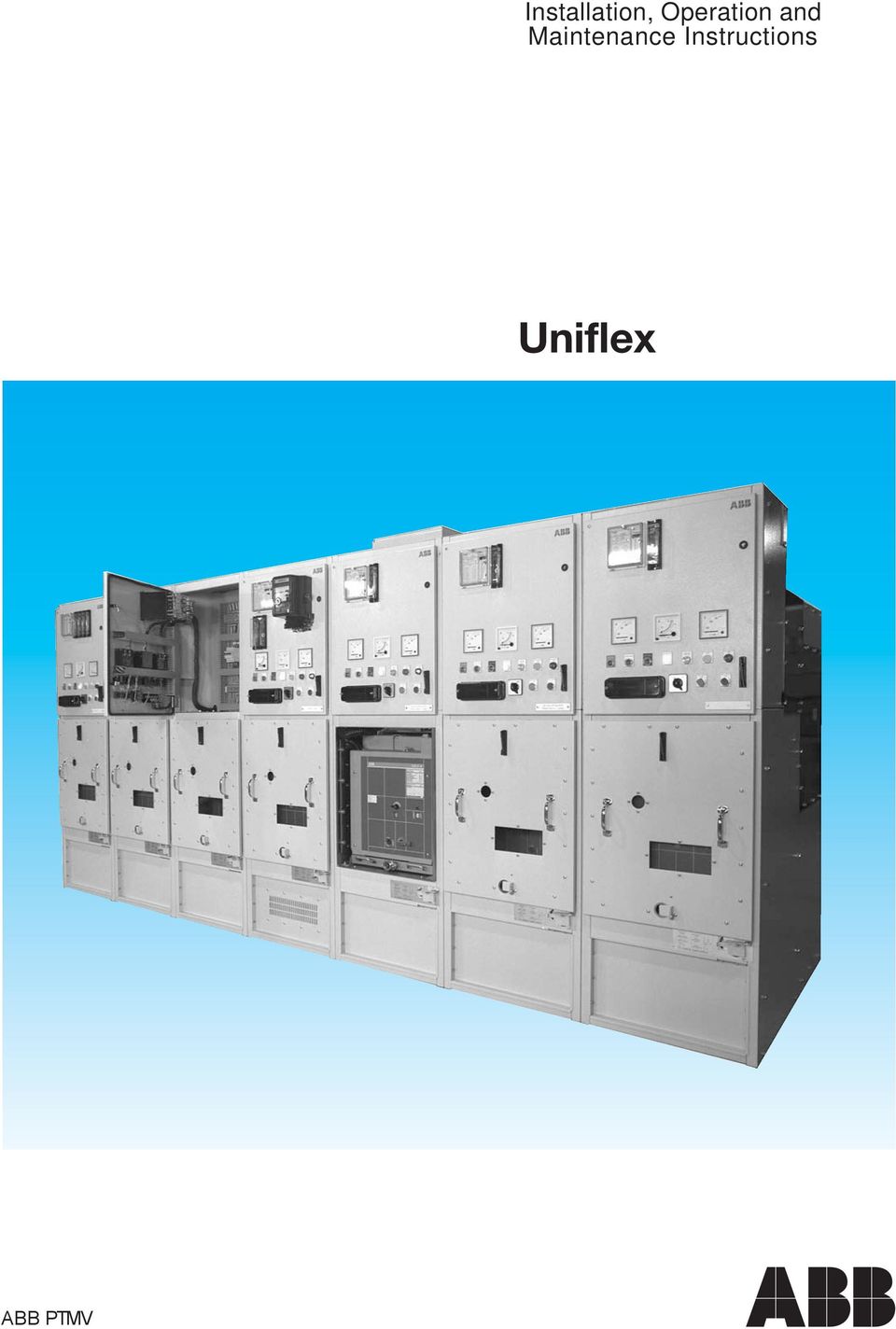
Installation, Operation and Maintenance Instructions. Uniflex ABB PTMV
|
|
|
- Alice Richardson
- 10 years ago
- Views:
Transcription
1 Installation, Operation and Maintenance Instructions Uniflex ABB PTMV
2 SAFETY FIRST! For safe and correct usage note the following recommendations: Only install switchgear and switchboards in enclosed rooms suitable for electrical equipment. Ensure that only suitably qualified personnel carry out the installation, operation and maintenance of switchgear. Comply in full with the legally recognised standards (BS, DIN VDE, IEC, SABS, etc.), the connection conditions of the local electrical utility and the applicable safety at work regulations. Local / site operating procedures take precedence over the operating instructions given in this manual Observe the relevant information in the instruction manual for all actions involving switchgear and switchboards. Keep the instruction manual accessible to all persons concerned with installation, operation and maintenance. Personnel are to act responsibly in all matters affecting safety at work and the correct handling of the Switchgear. When in doubt ask! Our service technicians will be willing to assist you and provide any information required. Pay special attention to cautionary / explanatory notes given. We reserve the rights to this publication. Duplication by any means and the making of this manual available to third parties is prohibited. The information supplied herein is without liability. Subject to alteration as a result of ongoing development. ABB PTMV

3 3,6 17,5 kv Uniflex Metalclad Switchgear ESQF1910 CONTENTS 1. Technical description Introduction Specifications Operating conditions Normal operating conditions Special operating conditions Dimensions and weights Dimensions Weights Construction Enclosure Internal segregation and fixings Switchgear components Interlock protection Integral interlocks Safety locks for operators use Other interlocks Electrical data Installation procedures Delivery and storage Condition on delivery Loading and positioning Intermediate storage conditions Installation of switchgear General General site requirements Installation room Foundations and fixing surface Installing of switchboard sections Commissioning Cubicles Primary circuit connections Main and earthing busbars Insulation Circuit breakers and contactors Earthing switches Protection, metering and control auxiliary circuits Current transformer secondary circuits Voltage transformer secondary circuits Final checks Energising the switchboard Operating procedures Switching device Earthing switch Disconnector, fuse and contactor Testing the interlocks Operator safety locks Other interlocks Electrical operations Voltage transformer Description Testing of VT interlocks VT mechanical and electrical checks Operating procedure for racking VT into service Maintenance of VT Maintenance procedures Safety regulations General Maintenance operations Metal structure Mechanical movements Maintenance program General inspections Operational checks Corrective action in case of operating defects Accessories and spare parts Normal completion accessories Optional accessories and completion items Spare parts Installation and commissioning check list 46

4

5 1. TECHNICAL DESCRIPTION 1.1 INTRODUCTION This publication contains the information required for installation, commissioning, operation and maintenance of Uniflex switchboards. For correct operation of the product, please read this manual carefully. As with all switchboards which we manufacture, Uniflex switchboards are also designed for a large number of standardised requirements. They do however also allow for further technical/ constructional variations (at the customers request) to adapt to special installation requirements. For this reason the information given below will not always contain instructions applicable to special layouts. It is therefore necessary to consult both this manual and the latest technical documentation applicable to the switchboard (circuit diagrams, general arrangement drawings, assembly instructions etc.), especially in the case where variations to the standard are requested. In all cases it is advisable that correctly trained personnel carry out installation, commissioning, operation, and maintenance. Uniflex switchboards comprise individual switch cubicles, connected together via a common main horizontal single or double busbar. The following equipment can be supplied with the switchboard, and we recommend that you consult the applicable documentation when operating this product. ABB VD4 circuit-breakers ABB VM1 circuit-breakers ABB HD4 circuit-breakers ABB V contact contactors ABB NAL/NALF switch disconnector/fuse switch disconnector 1.2 SPECIFICATIONS Uniflex switchgear complies with the standards and specifications for factory-assembled, type tested and metal clad high voltage switchgear as follows: IEC ( ) IEC ( ) IEC ( ) IEC ( ) Alternating current disconnectors and earthing-switches. AC Metal enclosed switchgear and controlgear for rated voltages above 7kV and up to 52 kv. Degrees of protection provided by enclosures (IP Code). Common specifications for high-voltage switchgear and control gear standards. All relevant specifications, BS/IEC/SABS publications, the national or local safety at work regulations and the safety regulations for production materials are to be followed during erection and operation of these systems. ~ 3 ~

6 1.3 OPERATING CONDITIONS Normal operating conditions The switchgear is designed for normal operating conditions for indoor switchgear and control gear to IEC Publication 60694, (Part 1000). The following limit values (among others) apply: Ambient temperature: Maximum + 40 C Maximum 24 h average + 35 C Minimum (according to minus 5 indoor class ) - 5 C Humidity: Highest mean value measured over 24 hours 55 % Highest mean value measured over 1 month 90 % The maximum site altitude is up to 1000m above sea level Special operating conditions Special operating conditions that deviate from the normal operating conditions are to be agreed by the manufacturer and user. The manufacturer must be consulted in advance about each special operating condition. The following are examples of special conditions: Site altitudes above 1000m were the reduction in dielectric strength of the air on the insulation level must be taken into account. Increased ambient temperatures can be compensated for in the design of the busbars and teeoff conductors. i.e. fitting additional ventilation can assist heat dissipation in the switchgear cubicle. When switchgear is operated in areas with high humidity and/or major rapid temperature fluctuations, there is a risk of dew deposits for indoor switchgear. Preventative action (e.g. fitting electric heaters) must be taken in consultation with the manufacturer to avoid such condensation phenomena and possible corrosion or other adverse effects. ~ 4 ~

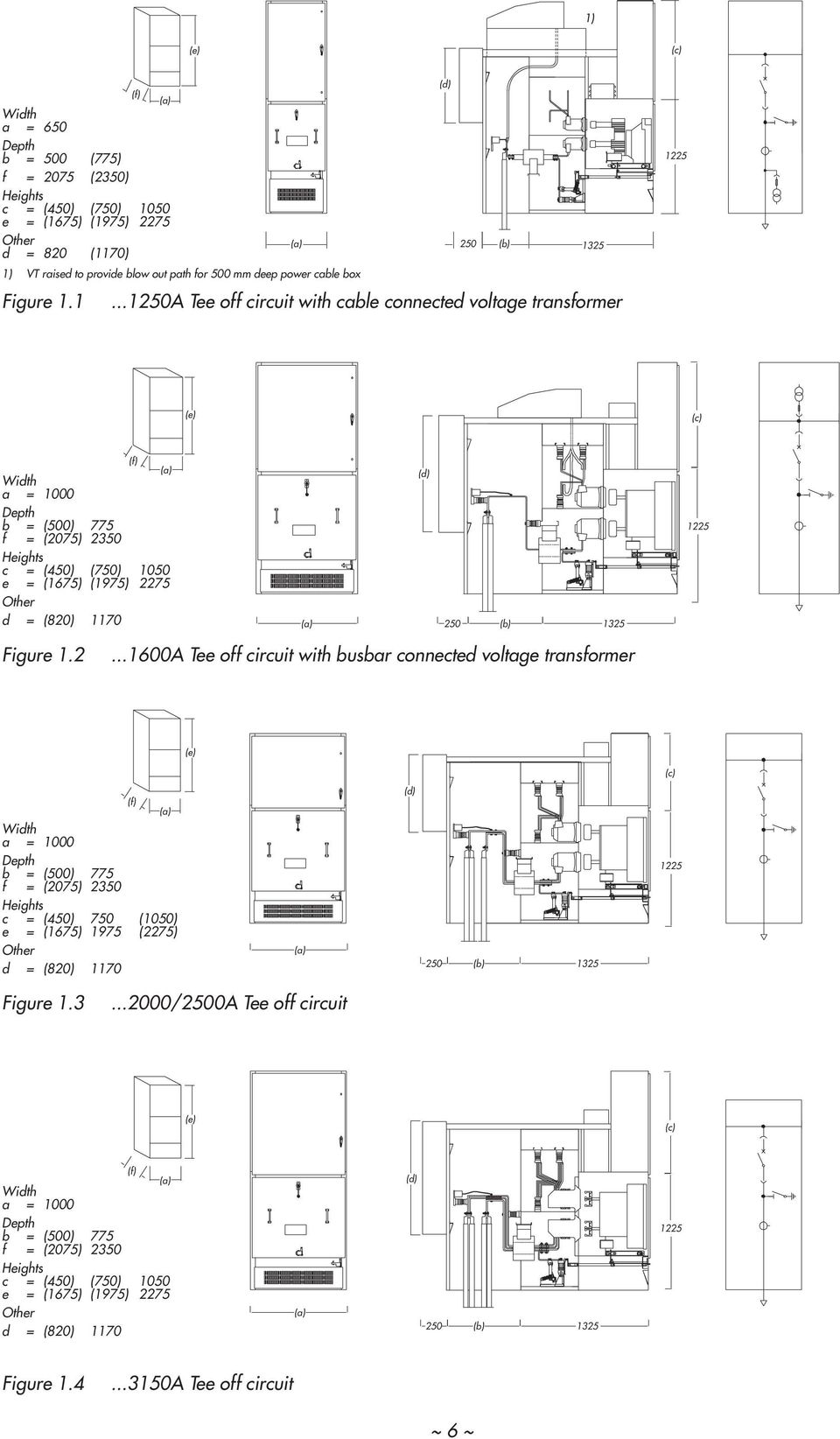
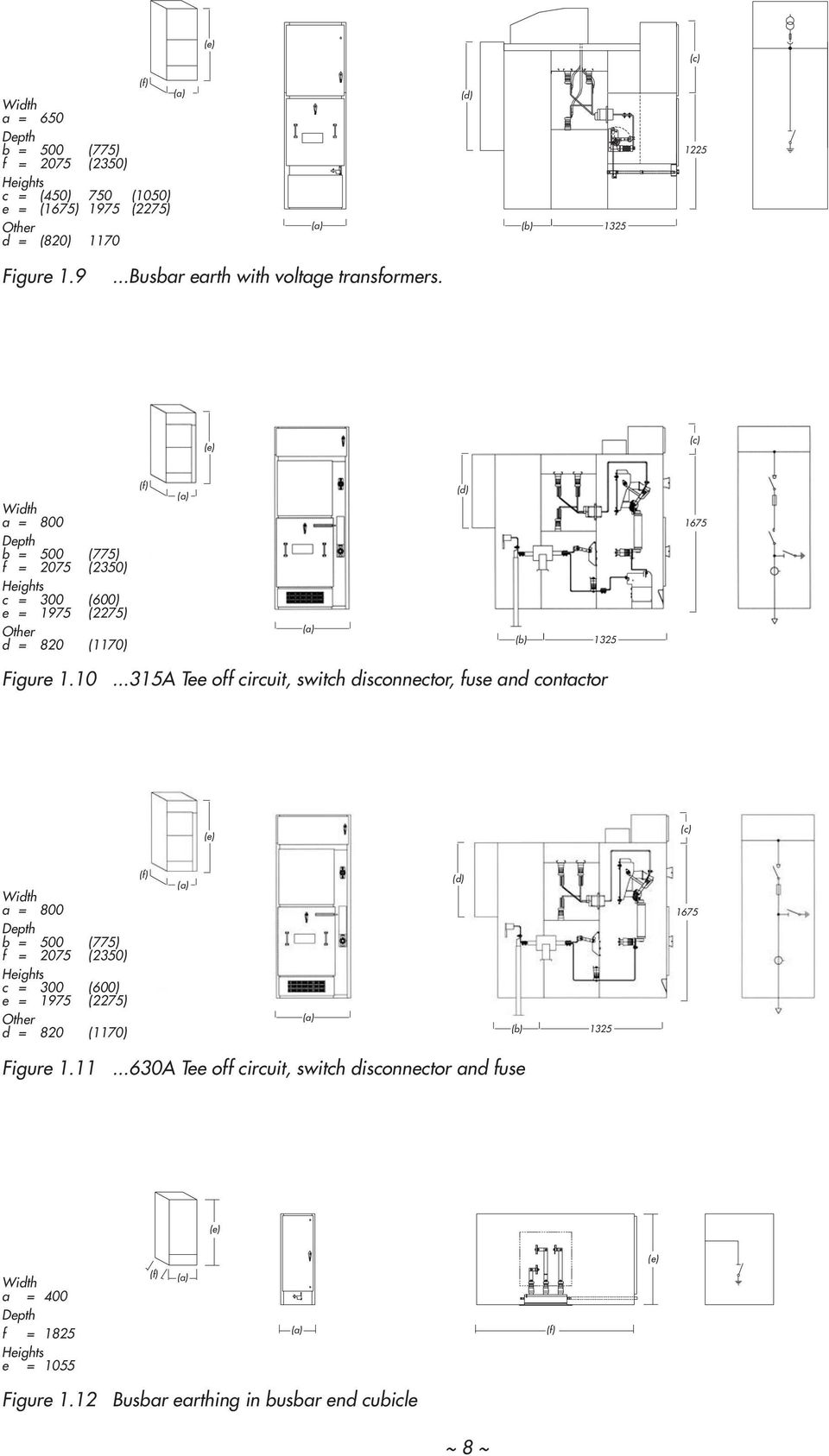
7 1.4 DIMENSIONS AND WEIGHTS Dimensions The dimensions of standard cubicles are given in Table 1-1, 1-2 and 1-3. Cubicle sizes may vary depending on special contractual requirements. In such cases, please consult contract specific documentation. Cubicle Function Number Cubicle Power-cable LV Control Control Cable and Rating of Figure Width Compartment Compartment Termination Box (mm) Depth (mm) Height (mm) Height (mm) (a) (b) (c) (d) A Tee off A Tee off /2500A Tee off A Tee off A Bus section or or or A Bus riser or A Bus section A Bus riser kA Busbar earth + VT A Tee off disconnector fuse & contactor A Tee off disconnector 500 or or or 1170 and fuse kA Busbar earth end cubicle Table 1-1 Typical dimensions for single tier, single busbar cubicles Cubicle Function Number Cubicle Power-cable LV Control Control Cable and Rating of Figure Width Compartment Compartment Termination Box (mm) Depth (mm) Height (mm) Height (mm) (a) (b) (c) (d) A Tee off A Bus section or or or A Bus riser 1.15 Table 1-2 Typical dimensions for double tier, single busbar cubicles Cubicle Function Number Cubicle Power-cable LV Control Control Cable and Rating of Figure Width Compartment Compartment Termination Box (mm) Depth (mm) Height (mm) Height (mm) (a) (b) (c) (d) A Tee off A Top busbar bus section or or or A Bus riser A Buscoupler Table 1-3 Typical dimensions for double busbar cubicles Weights A cubicle weighs from 610kg to 1300kg, depending on the equipment installed. ~ 5 ~

8 1) (e) (c) Width a = 650 Depth b = 500 (775) f = 2075 (2350) Heights c = (450) (750) 1050 e = (1675) (1975) 2275 Other d = 820 (1170) Figure 1.1 (f) (a) 1) VT raised to provide blow out path for 500 mm deep power cable box a Tee off circuit with cable connected voltage transformer (d) (a) 250 (b) (e) (c) (a) Width a = 1000 Depth b = (500) 775 f = (2075) 2350 Heights c = (450) (750) 1050 e = (1675) (1975) 2275 Other d = (820) 1170 (f) (d) (a) 250 (b) Figure A Tee off circuit with busbar connected voltage transformer (e) (c) (a) Width a = 1000 Depth b = (500) 775 f = (2075) 2350 Heights c = (450) 750 (1050) e = (1675) 1975 (2275) Other d = (820) 1170 (f) (a) (d) 250 (b) Figure /2500A Tee off circuit (e) (c) (a) Width a = 1000 Depth b = (500) 775 f = (2075) 2350 Heights c = (450) (750) 1050 e = (1675) (1975) 2275 Other d = (820) 1170 (f) (a) (d) 250 (b) Figure A Tee off circuit ~ 6 ~
9 (f) (a) (e) Width a = 650 Depth b = 500 (775) f = 2075 (2350) Heights c = (450) 750 (1050) e = (1675) 1975 (2275) Other d = 820 (1170) (d) (a) 250 (b) 1325 (c) 1850 Figure A Bus section cubicle with LHS & RHS busbar earthing and current trasnformers (c) (e) (a) Width a = 650 Depth b = 500 (775) f = 1825 (2100) Heights c = (450) 750 (1050) e = (1675) 1975 (2275) (f) (a) (b) Figure A Bus riser cubicle, when current transformers are fitted to bus section (e) (c) Width a = 650 Depth b = 500 (775) f = 2075 (2350) Heights c = (450) 750 (1050) e = (1675) 1975 (2275) (f) (a) (d) (a) (b) (b) Figure A Bus section cubicle, without busbar earthing and current transformers. (e) (c) Width a = 650 Depth b = 500 (775) f = 1825 (2100) Heights c = (450) 750 (1050) e = (1675) 1975 (2275) (f) (a) (a) (b) Figure A Bus riser cubicle, when no current transformers are fitted ~ 7 ~

10 (e) (c) (f) (a) Width a = 650 Depth b = 500 (775) f = 2075 (2350) Heights c = (450) 750 (1050) e = (1675) 1975 (2275) Other d = (820) 1170 (d) (a) (b) Figure Busbar earth with voltage transformers. (e) (c) Width a = 800 Depth b = 500 (775) f = 2075 (2350) Heights c = 300 (600) e = 1975 (2275) Other d = 820 (1170) (f) (a) (a) (d) (b) Figure A Tee off circuit, switch disconnector, fuse and contactor (e) (c) Width a = 800 Depth b = 500 (775) f = 2075 (2350) Heights c = 300 (600) e = 1975 (2275) Other d = 820 (1170) (f) (a) (a) (d) (b) Figure A Tee off circuit, switch disconnector and fuse (e) (e) Width a = 400 Depth f = 1825 Heights e = 1055 (f) (a) (a) (f) Figure 1.12 Busbar earthing in busbar end cubicle ~ 8 ~
11 (c) (e) Width a = 650 Depth b = 500 (775) f = 2075 (2350) Heights c = (450) 750 (1050) e = (2300) 2600 (2900) Other d = 820 (1170) (f) (a) (d) (a) 250 (b) Figure A Tee off circuits, double tier cubicle. (c) (e) Width a = 650 Depth b = 500 f = 2075 Heights c = (450) 750 (1050) e = (2300) 2600 (2900) Other d = 820 (1170) (f) (a) (d) (a) 250 (b) Figure A Bus section, double tier cubicle. (c) (e) Width a = 650 Depth b = 500 f = 1825 Heights c = (450) 750 (1050) e = (2300) 2600 (2900) Figure 1.15 (f) (a) a Bus riser, double tier cubicle. (a) (b) (c) (e) (d) (f) (a) Width a = 650 Depth b = 500 (775) f = 2075 (2350) Heights c = (450) 750 (1050) e = (2300) 2600 (2900) Other d = 820 (1170) (a) 250 (b) Figure A Tee off circuit, double busbar cubicle. ~ 9 ~

12 (c) (e) (d) (f) (a) Width a = 650 Depth b = 500 (775) f = 2075 (2350) Heights c = (450) 750 (1050) e = (2300) 2600 (2900) Other d = 820 (1170) (a) 250 (b) Figure A Top busbar bus section with current transformers, double busbar cubicle. (c) (e) (f) (a) Width a = 650 Depth b = 500 f = 2075 Heights c = (450) 750 (1050) e = (2300) 2600 (2900) Figure 1.18 (a) 250 (b) Top busbar bus riser with current transformers on the bus section, double busbar cubicle (c) (e) (d) (a) Width a = 650 Depth b = 500 (775) f = 2075 (2350) Heights c = (450) 750 (1050) e = (2300) 2600 (2900) Other d = 820 (1170) (f) (a) 250 (b) Figure A Buscoupler, double busbar cubicle. ~ 10 ~

13 1.5 CONSTRUCTION Enclosure The enclosure of the switchgear cubicles is manufactured from Aluzinc and mild steet sheel. Doors and/or removable covers seal the front and rear of the cubicles. The enclosure can be fully painted or partially panted as required by the contractal requirements. Doors / edges are adequately sealed to maintain degree of protection requirements. Where visual inspection is required, viewing windows manufactured from Polycarbonate are fitted. Cubicles adjacent to each other are segregated by the sidewalls of each cubicle. Where ventilation is required air vents (refer to figure 1.20) constructed of Teflon and stainless steel wire mesh are fitted to the switchgear, allowing air to flow through the switchgear. These vents close when there is a sudden overpressure in the switchgear, preventing gases from exhausting to the front, sides or rear of the switchgear. Gases are exhausted to the top of the switchgear, through the explosion vents provided. The explosion vents are manufactured from Zinc passivated sheet steel. Once fully assembled, Uniflex switchgear has a degree of protection IP4X. Figure 1.20 Airvent Internal segregation and fixings The internal fixing brackets and covers of the switchgear are manufactured of Aluzinc, Zinc passivated mild steel sheet and stainless sheet steel as required. In certain cases where insufficient air clearance is encountered between phases and/or phase earth parts, additional insulation is provided by means of flash barriers (refer to figure 1.21) manufactured from Polycarbonate / Perspex. They are fitted between parts and/or heatshrink fitted onto copper bars. In addition, barriers similar to the above may be fitted to prevent access to live parts. When ventilation is required between compartments air vents are fitted as described above. These vents close when there is a sudden overpressure in a chamber, preventing further contamination or faults to adjacent compartments. Figure 1.21 Flash barriers The compartments are fully segregated by earthed metal parts designed for a degree of protection between compartments of IP2X. ~ 11 ~

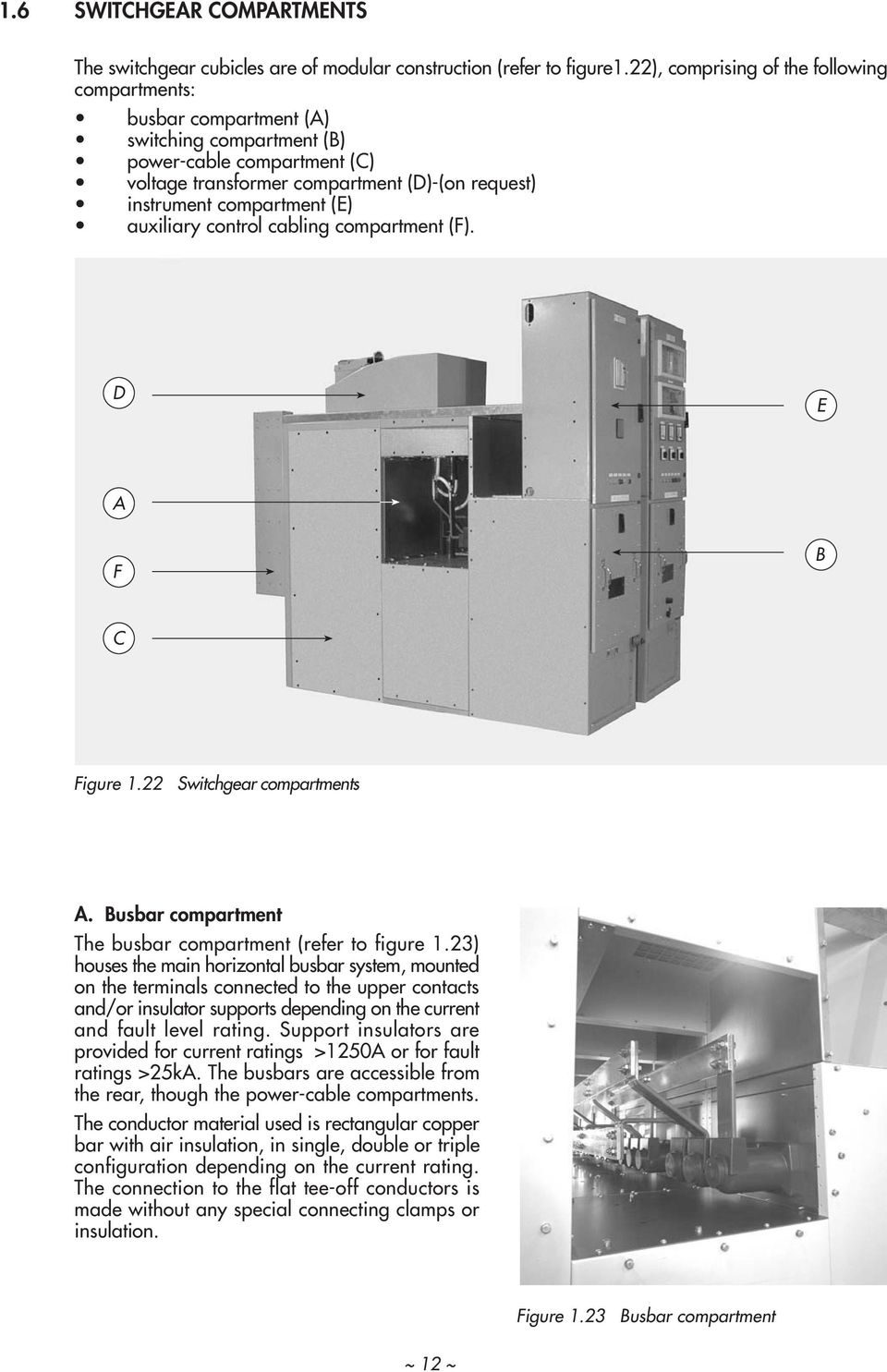
14 1.6 SWITCHGEAR COMPARTMENTS The switchgear cubicles are of modular construction (refer to figure1.22), comprising of the following compartments: busbar compartment (A) switching compartment (B) power-cable compartment (C) voltage transformer compartment (D)-(on request) instrument compartment (E) auxiliary control cabling compartment (F). D E A F B C Figure 1.22 Switchgear compartments A. Busbar compartment The busbar compartment (refer to figure 1.23) houses the main horizontal busbar system, mounted on the terminals connected to the upper contacts and/or insulator supports depending on the current and fault level rating. Support insulators are provided for current ratings >1250A or for fault ratings >25kA. The busbars are accessible from the rear, though the power-cable compartments. The conductor material used is rectangular copper bar with air insulation, in single, double or triple configuration depending on the current rating. The connection to the flat tee-off conductors is made without any special connecting clamps or insulation. Figure 1.23 Busbar compartment ~ 12 ~
15 B. Switching compartment The switching compartment (Refer to figure 1.24) is designed to hold the circuit-breaker or contactor. The switching compartment door is designed to suit the circuit breaker or contactor i.e. position of inspection window, and manual operation (on request). The switching device is earthed through its rollers. An earthing contact may be provided on request. The following components are housed in this compartment: insulating spouts, i.e. the bushings, which contain the primary connections between the switching device, the busbar compartment and the power-cable compartment segregation shutters, which provide automatic segregation of the medium voltage circuit when the switching device is in the test or removed position anticondensation heater (on request) standard interlocks other interlocks (on request) metal wiring ducts multiple plug connector, for connecting the secondary circuits of the switching device. Multiple plug connector Busbar shutter Wiring duct Cable/circuit shutter Shutter locking operating facilities Earth switch inspection window Integral interlock Guide rails Figure 1.24 Switching compartment C. Power-cable compartment The power-cable compartment (Refer to Figure 1.25) is accessible from the rear of the cubicle. Depending on contract requirements the power-cable entry may be from the bottom or top of this compartment. The cables are secured using glands, cable blocks, clamps etc. to the gland plates provided. The power-cable compartment can contain the following components: cable earthing-switch and associated components current transformers (CT s) toroidal current transformers around cable cable terminals voltage transformer connectors capacitor dividers (on request) surge suppression devices (on request) flash barriers (when required) metal wiring ducts removable gland plate ~ 13 ~

16 Power cable termination Current transformers Earthing switch Main earth bar Gland plate Figure 1.25 Power cable compartment D. Voltage transformer compartment (on request) The voltage transformer (VT) and associated fuses are mounted in this compartment (refer to figure 1.26), and can be withdrawn to facilitate replacement and isolation. The VT compartment is mounted on top of the busbar and power cable compartments. The primary connection is connected between the VT and the main busbar or cable termination, depending on the voltage being monitored. The main characteristics of the equipment are: VT mounted on withdrawable truck isolation of the VT and its secondary circuits segregation of the power circuits by means of automatic shutters replacement of high voltage fuses in the withdrawn position replacement of secondary fuses in the connected, isolated, or withdrawn positions VT s are provided for measurement and power supply. They have performance and class of precision as specified in the contract document or as provided by the manufacturer. Figure 1.26 Voltage transformer ~ 14 ~

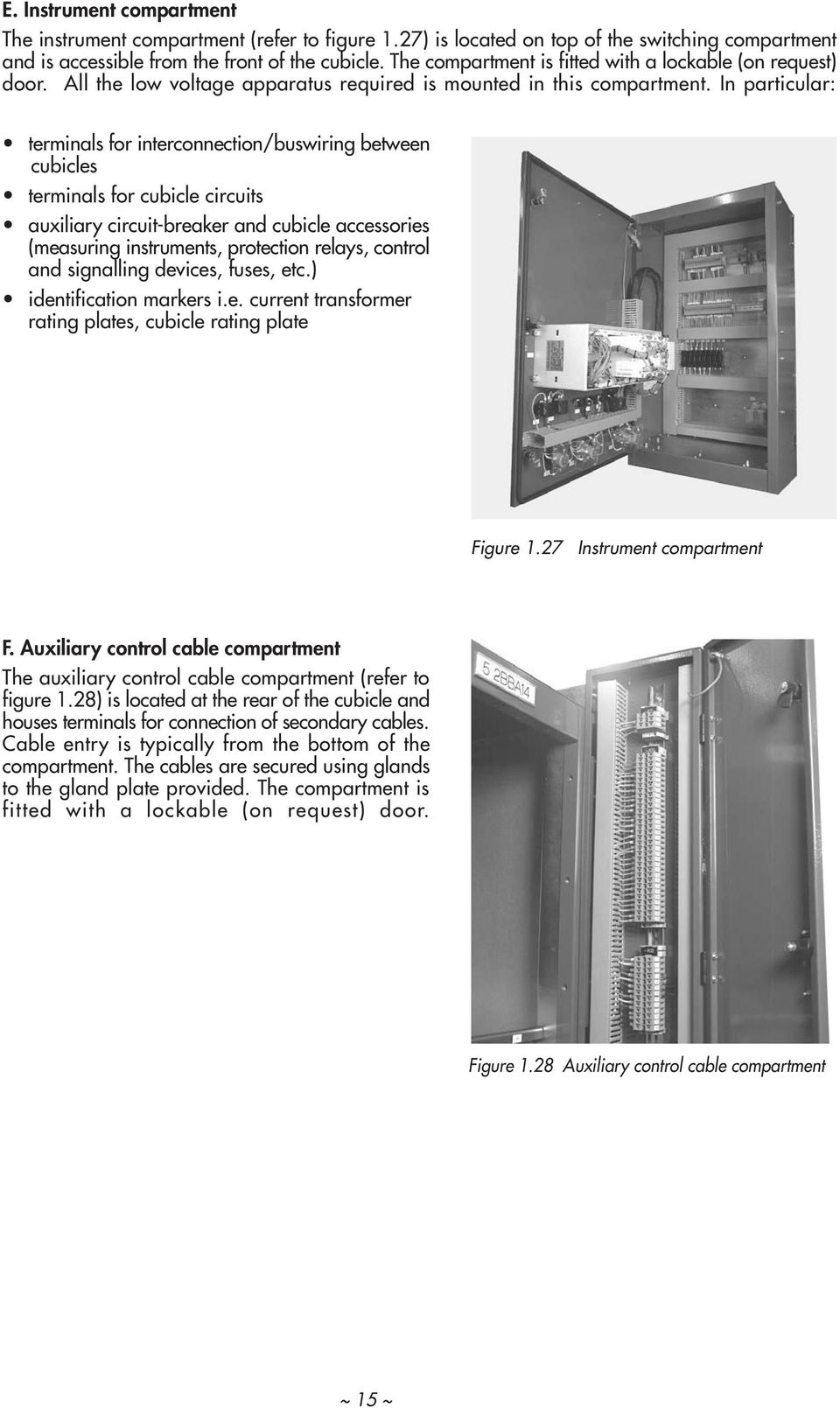
17 E. Instrument compartment The instrument compartment (refer to figure 1.27) is located on top of the switching compartment and is accessible from the front of the cubicle. The compartment is fitted with a lockable (on request) door. All the low voltage apparatus required is mounted in this compartment. In particular: terminals for interconnection/buswiring between cubicles terminals for cubicle circuits auxiliary circuit-breaker and cubicle accessories (measuring instruments, protection relays, control and signalling devices, fuses, etc.) identification markers i.e. current transformer rating plates, cubicle rating plate Figure 1.27 Instrument compartment F. Auxiliary control cable compartment The auxiliary control cable compartment (refer to figure 1.28) is located at the rear of the cubicle and houses terminals for connection of secondary cables. Cable entry is typically from the bottom of the compartment. The cables are secured using glands to the gland plate provided. The compartment is fitted with a lockable (on request) door. Figure 1.28 Auxiliary control cable compartment ~ 15 ~
18 1.7 INTERLOCK PROTECTION Switchboards are provided with a number of interlocks to ensure safe operation Integral interlocks The following integral interlock functions are provided by the switching device in conjunction with the switchgear cubicle: The switching device can only be moved from the test/isolated position into the service position (and back) with the switching device open, the earthing-switch open, and earthing-switch drive mechanism access disabled. The circuit-breaker can only be closed when the switching device is precisely in the defined test position or defined service position, and the switching device is ready for closing (i.e. springs are fully charged). The earthing-switch can only be closed when the switching device is in the test/isolated position or the removed position. The switching device cannot be moved from the test/isolated position into the service position when the earthing-switch is closed or when access to the earthing-switch drive is enabled. In the case of a switch disconnector, the cable earth switch cannot be closed when the switch disconnector is in the closed position, and visa versa. Min Safety locks for operator s use Access to the earthing-switch drive and the switching device racking mechanism is provided with padlocking facilities (on request) to prevent unwarranted operation of the switchgear when safety locks (refer to figure 1.29) are fitted. Max ø6 Max 40 Min 35 The shutters can be secured in the open or closed position independently of each other with safety locks (refer to figure 1.30) when the switching device has been removed. Figure 1.29 Safety lock dimension drawing Circuit / cable shutter locking Busbar shutter locking Figure 1.30 Shutter locking Other interlocks (on request) Other interlocks as follows can be provided: Key interlocks to prevent operation when remote circuits are not ready i.e. busbar earthingswitches can not be closed until all incoming circuits are isolated. Electro-mechanical interlocks preventing operation under incorrect conditions. ~ 16 ~

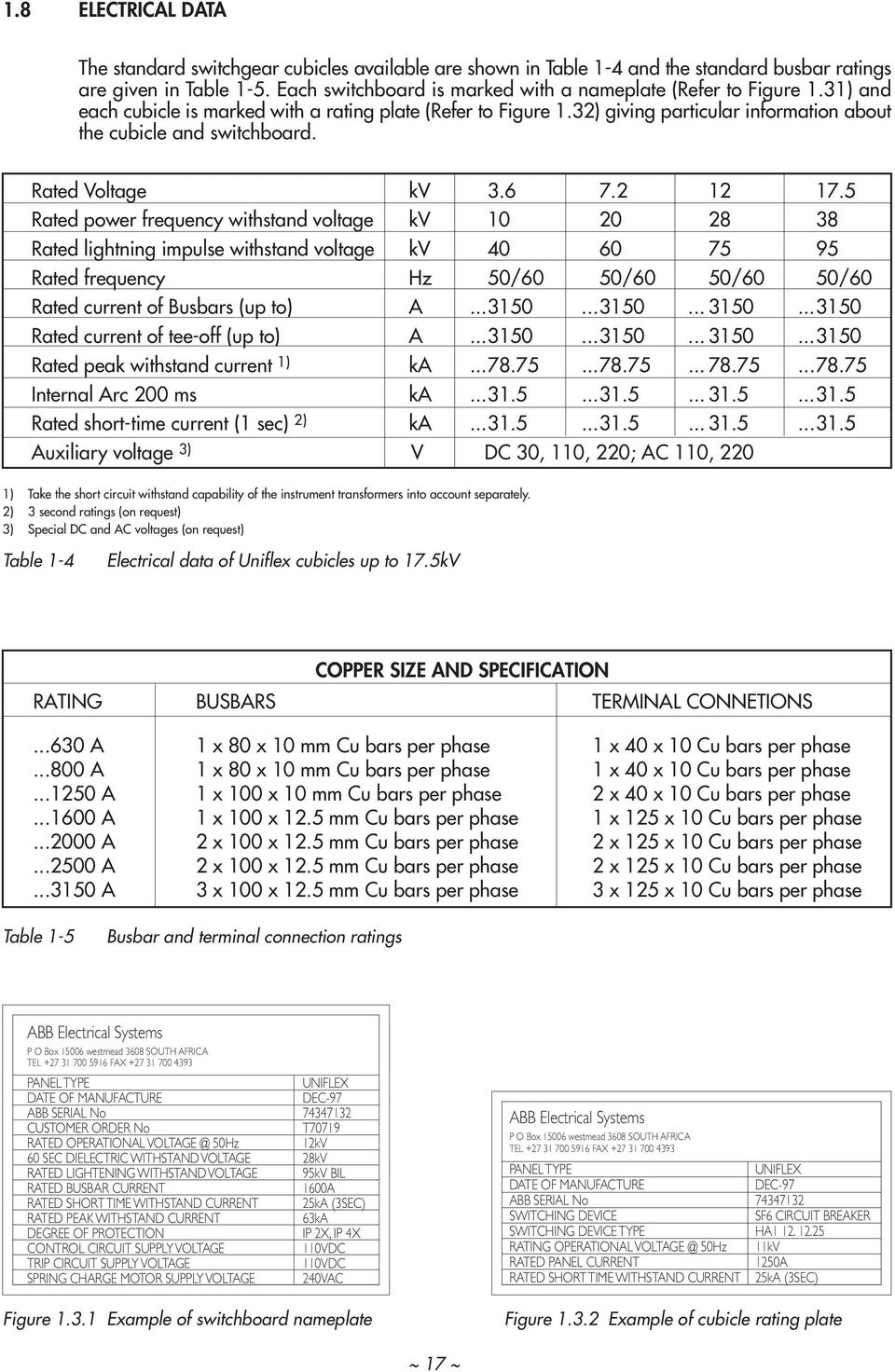
19 1.8 ELECTRICAL DATA The standard switchgear cubicles available are shown in Table 1-4 and the standard busbar ratings are given in Table 1-5. Each switchboard is marked with a nameplate (Refer to Figure 1.31) and each cubicle is marked with a rating plate (Refer to Figure 1.32) giving particular information about the cubicle and switchboard. Rated Voltage kv Rated power frequency withstand voltage kv Rated lightning impulse withstand voltage kv Rated frequency Hz 50/60 50/60 50/60 50/60 Rated current of Busbars (up to) A Rated current of tee-off (up to) A Rated peak withstand current 1) ka Internal Arc 200 ms ka Rated short-time current (1 sec) 2) ka Auxiliary voltage 3) V DC 30, 110, 220; AC 110, 220 1) Take the short circuit withstand capability of the instrument transformers into account separately. 2) 3 second ratings (on request) 3) Special DC and AC voltages (on request) Table 1-4 Electrical data of Uniflex cubicles up to 17.5kV COPPER SIZE AND SPECIFICATION RATING BUSBARS TERMINAL CONNETIONS A 1 x 80 x 10 mm Cu bars per phase 1 x 40 x 10 Cu bars per phase A 1 x 80 x 10 mm Cu bars per phase 1 x 40 x 10 Cu bars per phase A 1 x 100 x 10 mm Cu bars per phase 2 x 40 x 10 Cu bars per phase A 1 x 100 x 12.5 mm Cu bars per phase 1 x 125 x 10 Cu bars per phase A 2 x 100 x 12.5 mm Cu bars per phase 2 x 125 x 10 Cu bars per phase A 2 x 100 x 12.5 mm Cu bars per phase 2 x 125 x 10 Cu bars per phase A 3 x 100 x 12.5 mm Cu bars per phase 3 x 125 x 10 Cu bars per phase Table 1-5 Busbar and terminal connection ratings ABB Electrical Systems P O Box westmead 3608 SOUTH AFRICA TEL FAX PANEL TYPE UNIFLEX DATE OF MANUFACTURE DEC-97 ABB SERIAL No CUSTOMER ORDER No T70719 RATED OPERATIONAL 50Hz 12kV 60 SEC DIELECTRIC WITHSTAND VOLTAGE 28kV RATED LIGHTENING WITHSTAND VOLTAGE 95kV BIL RATED BUSBAR CURRENT 1600A RATED SHORT TIME WITHSTAND CURRENT 25kA (3SEC) RATED PEAK WITHSTAND CURRENT 63kA DEGREE OF PROTECTION IP 2X, IP 4X CONTROL CIRCUIT SUPPLY VOLTAGE 110VDC TRIP CIRCUIT SUPPLY VOLTAGE 110VDC SPRING CHARGE MOTOR SUPPLY VOLTAGE 240VAC Figure Example of switchboard nameplate ABB Electrical Systems P O Box westmead 3608 SOUTH AFRICA TEL FAX PANEL TYPE UNIFLEX DATE OF MANUFACTURE DEC-97 ABB SERIAL No SWITCHING DEVICE SF6 CIRCUIT BREAKER SWITCHING DEVICE TYPE HA RATING OPERATIONAL 50Hz 11kV RATED PANEL CURRENT 1250A RATED SHORT TIME WITHSTAND CURRENT 25kA (3SEC) Figure Example of cubicle rating plate ~ 17 ~
20 2. INSTALLATION PROCEDURES 2.1 DELIVERY AND STORAGE Condition on delivery To facilitate transportation the switchboard is divided into sections usually not longer than mm. The switchboard is packed in accordance with the clients shipping and storage requirements. Unless otherwise requested switchboard cubicles are individually secured on suitable pallets and are covered to prevent damage. The cubicles must be shipped, loaded and stored upright at all times. The cubicles are normally shipped with the apparatus (voltage transformers and circuit-breakers) inserted into the relevant cubicles, unless otherwise agreed with the customer. In certain cases where the circuit-breakers are to heavy to be shipped with the cubicle they will be packed separately. The busbars, fasteners and other accessories that are not assembled at the factory are packed separately. On receipt the switchboard and accessories must be unpacked and checked according to the instructions on the relative order documentation. Any irregularities or damage should be noted, and reported to ABB as soon as possible, and in any case within 5-days. Notification of any irregularities, even after receipt must contain the year of manufacture and the serial number listed on the rating plate Loading and positioning The cubicles must be preferably loaded using a crane of suitable capacity (A), a forklift truck (B), or a pallet-jack (C). If necessary the cubicle may be positioned using rollers (D). In all cases, care must be taken not to damage the cubicle base. A. Loading by crane fit lifting slings with shackles (of suitable capacity) under the cubicle through the pallet opening (refer to figure 2.1) secure the lifting slings to the to the lifting crane catch lift the cubicle to the required position remove the lifting slings from the cubicle Switchboard cubicle Lifting sling The crane operator must be trained and authorised to use the selected crane. B. Loading by forklift truck position the forklift truck forks through the sides of the cubicle pallet, ensuring the forks reach through the pallet (refer to figure 2.2) lift the cubicle evenly and move to the required position remove the forklift truck forks from the pallet once the pallet is placed securely in position Figure 2.1 Lifting by crane Loading pallet The forklift operator must be trained and authorised to use the selected forklift. Figure 2.2 Loading by forklift truck ~ 18 ~

21 C. Positioning by pallet-jack position the pallet-jack forks through the front of the cubicle pallet, ensuring the forks reach to at least half way through the depth of the cubicle (refer to figure2.3) lift the cubicle evenly and move to the required position remove the pallet-jack forks from the pallet once the pallet is placed securely in position Care must be taken to ensure that the cubicle does not tip over during this operation Figure 2.3 Positioning by pallet jack D. Positioning using rollers care must be taken not to damage the cubicle base position the cubicle on the rollers placed under a strong metal sheet move the cubicle to the required position remove the rollers and metal sheet once the cubicle is in position Cubicles are secured to the pallets through the floor fixing holes (refer to figure 2.5). The securing bolts must be removed before attempting to remove the cubicle from the pallet Intermediate storage conditions If the switchgear and its components have to be stored after manufacture and before installation observe the following conditions: the switchgear must be stored in a dry, well-ventilated, dust free, non-corrosive environment there should be no notable change in temperature the switchgear must not be stored outside store the switchgear cubicles standing upright do not stack switchgear cubicles do not remove or damage the packaging for storage periods longer than six months, hygroscopic substances must be placed inside each cubicle, with at least one standard bag per switching device. The bags must be replaced about every six months. If cubicles are to be stored for a specified period, ABB will supply (on request) packaging for the specified period and conditions. ~ 19 ~
22 2.2 INSTALLATION OF THE SWITCHGEAR General Correct installation of switchgear is of great importance. The manufacturer s instructions and drawings must be studied and followed carefully. The drawings include overall views, front and cross sectional views and other order related data i.e. floor plans, drilling requirements, substation layout etc General site requirements Maximum ambient air temperature +40 C Minimum ambient air temperature -5 C Maximum relative air humidity 95 % For other conditions please consult ABB s engineering department. The site and installation room must be complete prior to installation of the switchboard. In particular: the site must have electricity supply the site must be accessible via road the installation room as given below must be complete, and lockable preparation for laying of cables must be in place the foundations and fixing surface must be prepared as given below Installation room The switchboard must be situated in a room according to the scale and layout as given in the contract specific documentation. Arc vent Direction of blow out during internal arc fault 3000 <3000 >3000 >900 >1500 Figure 2.4. Minimum distance to walls and minimum ceiling height for internal arc proofing When designing the switchboard-room, account must be taken of the exhaust gas that may be emitted during internal faults. Figure 2.4 shows the minimum distances to the walls and the minimum height to the ceiling, for installing switchboards with internal arc proofing, in accordance with IEC 60298, access type A. The distance from both ends of the switchboard to the walls must be equal to or greater than 3000-mm. In all cases, special attention must be paid to the overpressure which can be produced inside the switch-room during conditions of an internal arc fault. For smaller distances a duct must be installed to conduct gases away from operators to outside the switchroom. Please consult ABB s engineering department in these special circumstances. ~ 20 ~
23 2.2.4 Foundations and fixing surface The floor or foundations must be strong enough to support the weight of the switchboard. The foundations must be made in good time before the installation to allow for correct curing as given in the technical documentation. The switchboard must be installed on floors or foundations that are smooth and have a level surface. A level tolerance of approximately 1-mm per 1- m measured length is required. Figure 2.5 shows the standard floor fixing dimensions Figure 2.5 Floor fixing dimensions Depending on the foundations provided it is also necessary to follow these instructions a) Fixing without floor channels: Level the floor both longitudinally and transversely. b) Fixing with floor channels eg. Unistrut: Construct the floor channels as shown in the drawings, ensuring the channels are level and straight Installing switchboard sections For correct installation, the switchboard must be installed according to the following instructions: A) positioning, alignment and leveling of the cubicles B) coupling of cubicles C) securing of the cubicles to the floor D) connection of the power circuits and the auxiliary control cables E) completing the installation ~ 21 ~
24 A. Positioning, alignment and leveling of the cubicles To facilitate positioning it is advisable to remove all the withdrawable parts (circuit-breakers, and voltage transformers) from the cubicles. To obtain correct alignment of the cubicles it is advisable to trace a straight line a few centimeters from the front, parallel to the final position of the switchboard. When positioning and fixing make sure the distance from this line to each cubicle is constant. Care must be taken with regards to cubicle alignment as final installation of the earth bar could be difficult in the case of misaligned cubicles. To level the cubicles, it is advisable to start positioning the cubicles from the highest floor point. Position the first cubicle making sure it is level. Position the adjacent cubicles making sure they are level to the first cubicle, and so on. Shims as required can be placed under the cubicles to level them. THREAD WITH OIL OR GREASE (N.m) M6 4.5 M8 10 M10 20 M12 40 M14 60 M16 80 M Tolerance 0% +20% Table 2-1 Recommended nominal torque settings The tightening torque s for fixings and couplings are as given in table 2-1. Note that oil or grease must be applied to the fastening surface, prior to fitting of the bolts and nuts. B. Coupling of cubicles Cubicles are coupled together to form the complete switchboard by a) fastening the cubicles, b) installing the main busbars, c) connecting the earthing bar, d) connecting the auxiliary interconnections between cubicles a) Fastening of cubicles. Access to the cubicle coupling holes is obtained by removing the rear cover plates, front cover plates and switching device door. Proceed as follows: remove front and rear cover plates remove switching device compartment door fasten cubicles using M8 x 25 mm nuts and bolts through the fixing holes as shown in figure 2.6. Fixing holes may vary depending on construction, i.e. single busbar, double busbar etc. The fixing holes for cubicles supplied in a suite will be matched end panels may be fitted with covers (on request ) as shown in figure 2.7. all holes must be closed with fixing bolts on the end panels to achieve the required IP rating. Fixing holes Figure 2.6 Fixings for coupling of cubicles ~ 22 ~
25 Opening for busbar ventilation see note 1) Busbar end cover End covers 1) Busbar ventilation fitted when busbars > 1250A Cubicles with end covers Cubicles without end covers Figure 2.7 Cubicle end panels b) Installing main busbars. Busbars are shipped in sections, and packed with all the parts required for coupling. Access to the busbar compartment is from the rear through the cable compartment. Proceed as follows: remove rear covers remove inner busbar compartment access plates clean the busbar contact area with a clean cloth soaked in alcohol or a suitable solvent grease the contact area with neutral grease couple the busbars to the tee off connections as shown in figures 2.8 through to figure 2.14 tighten the busbar connections to the required torque as given in table S) T) R) 3) Main busbar 2. Terminal connection coppers 3. Fish plates 4. M12 bolts, see note 2) 5. M12 dome washer 6. M12 nut 7. Support bracket 8. Support insulator 9. End plate 10. Terminal insulating spout 11. Flash barrier cover 12. Bolt cap ) A bolt length = 55mm A bolt length = 80mm 3150A bolt length = 100mm 3) Terminal connection coppers insulated using heat shrink Figure 2.8 Legend for busbar compartment ~ 23 ~
26 630 A A Tee-off cubicle with 800 A A Busbars Figure A A Tee-off cubicle with 2000 A A Busbars Figure A A Tee-off cubicle with 3150 A Busbars Figure A A Tee-off cubicle with 2000 A A Busbars Figure A A Tee-off cubicle with 3150 A Busbars Figure A Tee-off cubicle with 3150 A Busbars S) R) T) Figure 2.14 S) & T) R) 1) 1) A half finish plate is provided for end cubicle busbars. ~ 24 ~
27 c) Earthing bar connection. All cubicles are normally shipped with earthing bars fitted. Proceed as follows: remove the rear cover plates clean the earthing bar contact area with an emery cloth fasten the earthing bar by means of a M8 x 35 mm bolt with flat and spring washers and nut, to the required torque (refer to figure 2.15) both ends of the switchboard earthing bar must be connected to the main earth network Main earth bar 2. M8 x 35mm bolt 3. M8 Spring washer 4. M8 Flat washer 5. M8 Nut Figure 2.15 Earth bar connection d) Auxiliary interconnections. Switchboards normally require auxiliary interconnections (buswiring) between cubicles. The buswiring should be done in accordance with the termination schedules/drawings provided in the technical contract documentation. The interconnecting wires are not connected but are temporarily coiled up, placed in the instrumentation compartment. Proceed as follows: uncoil the interconnecting wires connect the wires in accordance with the termination schedules/drawings supplied securely fasten all terminals after interconnections are complete ~ 25 ~
28 C. Securing of cubicles The fixing holes are located in the cubicle base plate. Access to the fixing points for securing of cubicles requires removal of the rear and front cover plates. a) Fixing without floor channels: drill the fixing holes, 4 x Ø11 mm holes per cubicle are required. Secure the cubicles to the floor using M8 fixing bolts (sleeve anchor type) trough the cubicle base plate into the fixing holes, refer to figure M8 x 50 Sleeve Anchor bolt 2. M8 Nut 3. M8 Flat washer 4. Sleeve anchor 5. Cubicle base Front 4 Cable entry Figure 2.16 Fixing to floor without floor channels b) Fixing with floor channels i.e. Unistrut: Secure the cubicles to the floor channels with M8 fixing bolts trough the base plate into channel fixing nuts, refer to figure M8 Bolt 2. M8 Flatwasher 3. M8 Spring nut 4. Floor channel 5. Cubicle base Front 4 Cable entry Figure 2.17 Fixing to floor with floor channels ~ 26 ~
29 D. Connection of the power and control cables a) Power-cable connections. The power-cable connections are accessible from the rear of the cubicle and located in the power-cable compartment. When connecting the power-cables special attention must be given to the phase sequence to ensure safe paralleling of two systems, correct direction of rotation of motors supplied and the correct operation of the metering and protection systems. When cable terminations are made in the switchboard, suitable measures must be taken to prevent sharp bends, which might damage or destroy insulation. Also pay attention to the manufacturers instructions regarding bending radius of cables, termination instructions, and recommended clearances. Each cable must be anchored separately and fixed to the cubicle using an acceptable method of termination. When required the cables may have a separate earth to be connected to the main earthing bar. Proceed as follows: remove the rear cover plates check the contact surface is flat and clean the terminals if necessary eliminate burrs, dents and traces of oxidation with a file or emery cloth, carry out surface treatment again remove the gland plates and prepare holes in these for the cables prepare the cable termination by following the manufacturers instructions for the cable and terminations fix the cable to the gland plate and fasten the gland plate to the cubicle connect the cable using bolts and nuts, refer to figure 2.18 if required complete the installation using insulation tape close the compartment Flash barriers provided should not be removed. Where these have been removed to facilitate cable termination, ensure that the barriers are reinstalled as shown on the drawings. b) Auxiliary cable connections. The auxiliary cable terminations are normally located in the auxilary control cable compartment. To connect the auxiliary cables refer to the termination schedules for each cubicle. Refer to figure 2.19 Auxilary cable connections Power cable connections Cable entry E. Completing the installation Insert all withdrawable parts removed during installation, into the cubicles i.e. circuit-breakers, contactors and voltage transformers. In certain cases delicate auxiliary equipment may be dismantled and shipped separately. This equipment must be carefully checked on receipt and fitted into its original position or stored until final installation. Any damage to painting i.e. scratches and scrapes made during installation, can be repaired using the paint supplied with the switchboard. Refer to the instructions given in section 5.3. Ensure all withdrawable parts are in the test position Refit all removable covers. To ensure the integrity of the cubicles under conditions of internal arc, it is vital that all bolts and fixings associated with removable covers are correctly replaced. ~ 27 ~ Fig 2.18 Cable connection
30 3. COMMISSIONING Before commissioning carry out the checks below. As a minimum requirement these tests must be made. In addition, for special requirements other tests as required by the contract may also have to be performed before the power circuit is energised. 3.1 CUBICLES Visually check the inside and outside of all the cubicle compartments, making sure there is no evident of damage. Remove any foreign bodies (such as tools or test connections), which might have been forgotten during installation. Carefully clean insulating parts, removing any traces of humidity, dust, and grease etc. Remove dust or dirt from the air intake grids and from the vents. Ensure the air vents (when fitted) are open, allowing air to flow through the switchgear. Ensure all power connections have been tightened to the torque as given in table 2.1. Ensure all necessary flash barriers are fitted. Ensure all the internal and external covers are fitted with all required fixings. Ensure correct operation of interlocks. 3.2 PRIMARY CIRCUIT CONNECTIONS Check tightness and continuity of the primary circuits as given in table MAIN AND EARTHING BUSBARS Check tightness and continuity of the busbars as given in table 2-1. Check earthing efficiency according to the safety standards. 3.4 INSULATION Check the insulation resistance of the power circuits (between phase-phase and phase - ground) using a 2500 V or 5000 V Megger. The switchboard must not be put into service if the measured value is very low, for example below 5MΩ. The insulation resistance can be influenced by humidity. If the low insulation resistance is caused by humidity, use temporary heaters. The insulation resistance must remain constant after any voltage tests. 3.5 CIRCUIT-BREAKERS AND CONTACTORS Carry out the operations as prescribed in the relevant instruction manuals before commissioning. Check the operating mechanism and accessories for normal operation. Check the racking operation of the switching device. Insert the equipment into their correct compartments and connect the auxilliary plugs Close the compartment door and rack the equipment into the service position Close and open the circuit-breakers and/or contactors a few times. 3.6 EARTHING-SWITCHES Check the earthing-switch opens and closes as described in section Close the earthing-switch Do not connect an earthing-switch to cables that have been powered up i.e. incoming cables. ~ 28 ~
31 3.7 PROTECTION, METERING AND CONTROL AUXILIARY CIRCUITS Carry out all necessary current/voltage injection tests and functional tests in accordance with the switchboard drawings, to ensure circuits are correct. Check required protection co-ordination has been completed and settings of all the various relays installed have been applied. Check the insulation resistance of auxiliary circuits using a 1000V Megger. The measured value must be at least a few tenths of MΩ for the auxiliary circuits. During this test ensure that all instruments that could be damaged by the high voltage are disconnected. 3.8 CURRENT TRANSFORMER SECONDARY CIRCUITS Special attention must be paid to secondary circuits of the current transformer circuits. Check that the circuits are earthed and connected to the relative protection circuit and/or measuring circuit, then eliminate (if provided) any short circuit connection. It is important to note that current transformer secondary circuits must not be open circuited in service as this could lead to damage of CT s and subsequent failure. 3.9 VOLTAGE TRANSFORMER SECONDARY CIRCUITS In case the secondary wiring of the voltage transformer has to be connected to equipment outside the switchboard, the following conditions must be determined, to prevent overloads or short circuits: Check that the total load connected to the voltage transformer does not exceed the rating of the voltage transformer Check that there are no incorrect connections in the circuit (even temporary ones) and, are in compliance with the schematic diagram of the switchboard, and of other installation units. Check that only one phase of the secondary wiring is earthed. This is particularly important on the supply side of equipment interconnected by means of a bus-tie (bus-section) FINAL CHECKS On completion of the preliminary tests carry out the following general checks: Check that various mechanical and electrical interlocks (which may have been disconnected to carry out tests) are reconnected and functional. Open and isolate all circuit-breaker and/or contactor trucks. Eliminate all test connections. Make sure all internal compartments and external cover plates are fitted and secured. Make sure all compartment doors are closed ENERGISING THE SWITCHBOARD Clear all isolations or plant lock-outs. Open all earthing-switches (compatible to installation requirements) to ensure no live circuits will be short-circuited via an earthing-switch. Energise the auxiliary circuits and the power circuit. Close the circuit-breakers and/or contactors (compatible with installation requirements) making sure that each operation is carried out correctly. Lock the compartments with control locks (if required). Check correct operation of the measuring instruments. It is advisable to charge all the circuit-breaker-closing springs manually before supplying the auxiliary circuits to avoid any excessive current absorption due to simultaneous start up of the spring wind motors. All operations (switching and isolation) must be carried out with the switching device door closed and firmly secured. ~ 29 ~
32 4. OPERATING PROCEDURES 4.1 MECHANICAL OPERATIONS Switching device (circuit-breaker / contactor) On request a special truck is available to transfer the circuit-breakers. Refer to the manufacturers operating instructions as listed under section 1.1 for the applicable switching device. Instrument compartment lock Switching compartment lock Switching compartment door handles (see note 1) Manual trip device (Optional) Inspection window Racking mechanism & locking facility Earth switch operating mechanism & locking facility 1) To open switching compartment hold handles and lift off door Figure 4.1 Front of cubicle To ensure protection against internal arc faults, the operator must ensure the switching compartment door is properly secured before any switching operations are performed Switching device truck 2. Switching device 3. Cubicle Figure 4.2 Inserting/removing the switching device ~ 30 ~
33 a) Lift the switching device using a special hoist/crane. Place it on the transfer truck and hook it into the appropriate position. b) Insertion of the switching device into the switching compartment, and racking the switching device from the test to the service position is achieved as follows: Open the compartment door, if present (figure 4.1), by releasing the door lock and lifting the door up to remove. Bring the truck (1) with the switching device (2) close to the compartment (3). Position the switching device rollers in line with the guide rails in the compartment. Release the switching device and move it into the compartment (figure 4.2). Secure the switching device into the compartment (figure 4.3), ensure that side locking bars locate correctly in the guide rails. Connect the auxiliary wiring multiple plug connector, (figure 4.4). Figure 4.3 Securing/removing the switching device Figure 4.4 Inserting/removing multiple plug connector Fit the switching compartment door by placing the door in the correct position and pushing down. When secure, the door lock should be moved into the locked position. The switching device is now in the test position. Unlock the racking mechanism, insert the crank handle into the switching device racking mechanism (figure 4.5) and rotate the handle clockwise for approximately 20 turns until a dead stop is reached. If required, lock the racking mechanism (figure 4.6) The switching device is now in the service position, ready for operation. Racking mechanism lock Earthing switch operating mechanism Figure 4.5 Switching device racking Figure 4.6 Racking mechanism and earth switch mechanism ~ 31 ~
34 c) Withdrawal of the switching device from the switching compartment, and racking the switching device from the service to the test position. Open the switching device Proceed in reverse order to the instructions given in points b). All operations (racking, switching and isolation) must be carried out with the switching device compartment door closed and firmly secured. The power contacts contained in the insulating spouts behind the segregation may be live. To prevent unwarranted access to the power contacts when the power contacts are live, the operator must lock the segregation shutters Earthing switch The feeder cubicles are fitted (on request) with medium voltage cable earthing-switches. Earthingswitches are fitted (on request) to separate cubicles designed for busbar earthing. Refer to figure 4.7 for the earthing switch. The earthing switch is a snap action type, enabling fast closure of the main contacts. Once the earthing switch handle is rotated the main contacts will close completely before opening is allowed. Figure 4.7 Earthing switch ~ 32 ~
35 Cable earthing The procedure below refers to the cable earthing switch, refer to figure 4.8 and 4.9. a) Closing the earthing switch Withdraw the switching device Unlock the interlock lever cover (figure 4.8) Move the interlock lever (figure 4.8) down to enable access to the earthing switch drive hexagonal shaft. Insert the operating handle onto the hexagonal shaft (4.9). Close the earthing switch by rotating the operating handle. Lock the interlock lever (figure 4.6) Confirm the earthing switch is closed by inspection through the viewing windows provided, see figure 1.24 The earthing switch is now closed. Interlock lever up earth switch drive mechanism not accessible b) Opening the earthing switch Proceed in reverse order to the instructions given in points a). The operator must ensure all live electrical connections to the circuit being earthed are disconnected before closing the earthing switch. Interlock lever down earth switch drive mechanism accessible Figure 4.8 Earthing switch drive mechanism Busbar earthing The procedure below refers to busbar earthing. a) Closing the earthing switch Disconnect all circuits connected to the busbar Unlock the drive mechanism Insert the operating handle onto the drive shaft Close the earthing switch Lock the interlock lever Confirm the earthing switch is closed by inspection through the viewing windows provided. The earthing switch is now closed. Figure 4.9 Operating the earthing switch b) Opening the earthing switch Proceed in reverse order to the instructions given in points a). ~ 33 ~
36 4.1.3 Switch disconnector and fuse cubicle Switch disconnector operation a) Closing the switch disconnector Remove the lock from the drive mechanism. Insert the operating handle onto the disconnector drive splined shaft (figure 4.10). Release the locking facility by pulling the arrestor ring (figure 4.11) away from the bearing. Close the switch disconnector by rotating the operating handle. Lock the drive shaft (figure 4.12). The switch disconnector is now closed. b) Opening the switch disconnector Proceed in reverse order to the instructions given in points a). Figure 4.10 Switch disconnector / earthing switch drive Earthing switch operation a) Closing the earthing switch Remove the lock from the drive mechanism. Insert the operating handle onto the earthing switch drive splined shaft (figure 4.10). Release the locking facility by pulling the arrestor ring (figure 4.11) away from the bearing. Close the earthing switch by rotating the operating handle. Lock the drive shaft (figure 4.12). The earthing switch is now closed. Figure 4.11 Switch disconnector / earthing switch drive locking ring b) Opening the earthing switch Proceed in reverse order to the instructions given in points a). In the case of busbar earthing disconnect all circuits connected to the busbar, ensuring the busbar is not energised i.e. circuit-breakers, contactors, disconnectors, feed cables etc. before closing the busbar earthing switch. Figure 4.12 Locking the switch disconnector /earthing switch drive mechanism A mechnical interlock is provided between the disconnector and cable earthing switch. Do not force interlock. ~ 34 ~
37 4.1.4 Testing the interlocks The mechanical operations must be carried out using normal strength, without forcing the interlocks, and thereby preventing permanent damage. Excessive force may damage interlocks permanently allowing unsafe operation. Test the standard interlocking provided as follows: The switching device can only be moved from the test/disconnected position into the service position (and back) with the switching device open, the earthing switch open, and earthingswitch drive mechanism access closed a) Test when the switching device is in the test position. Close the switching device The switching device cannot be moved to the service position, as the racking handle will lock within approximately 3 turns. Return the switching device to the test position. Open the switching device Gain access to the earthing switch drive mechanism, by moving the interlock lever down. Close the earthing switch. The interlock lever is locked in the down position. The switching device cannot be moved to the service position, as the racking handle will lock within approximately 3 turns. b) Test when the switching device is in the service position. The interlock lever is locked in the up position preventing access to the earthing switch drive mechanism. Close the switching device The switching device cannot be moved to the test position, as the racking handle will lock within approximately 3 turns The switching device can only be closed when the switching device is precisely in the defined test position or defined service position, and the switching device is ready for closing (i.e. circuit-breaker springs are fully charged) a) Test when the switching device is in the traverse position between the test and service position. In the case of a circuit-breaker ensure the springs are charged. Move the switching device from the test position to the traverse position, by rotating the handle clockwise for approximately 4 turns. The switching device cannot be closed. b) Test when the circuit-breaker is in the test or service position and the springs are discharged. Discharging the springs by closing and then opening the circuit-breaker after ensuring the motor supply is disconnected. The circuit-breaker cannot be closed The earthing switch can only be closed when the switching device is in the test/disconnected position or the removed position a) Test when the switching device is in the service position Access to the earthing switch drive is inhibited. The interlock lever cannot be moved down. b) Test when the switching device is in the traverse position Move the switching device from the test position to the traverse position, by rotating the handle clockwise for approximately 4 turns. Access to the earthing switch drive is inhibited. The interlock lever cannot be moved down. c) Test when the switching device is in the test/isolated position Access to the earthing switch drive is enabled. The interlock lever can be moved down. ~ 35 ~
38 The switching device cannot be moved from the test/isolated position into the service position when the earthing switch is closed or when access to the earthing switch drive is enabled a) Test when access to the earthing switch drive is enabled, the interlock lever is in the down position and the earthing switch is closed. The switching device cannot be moved to the service position as the racking handle will lock within approximately 3 turns. b) Test when access to the earthing switch drive is disabled, the interlock lever is in the up position. The switching device can be moved to the service position The switch disconnector cannot be closed when the earthing switch is closed and visa versa. (Switch disconnector cubicle) a) Test when the earthing switch is closed. The disconnector cannot be closed. b) Test when the earthing switch is open. The disconnector can be closed. c) Test when the switch disconnector is closed. The earthing switch cannot be closed. d) Test when the switch disconnector is open. The earthing switch can be closed. Circuit/cable shutter safety Lock The cubicle door cannot be removed when the earth switch is open (switch disconnector cubicle). a) Test when the earthing switch is open. The cubicle door cannot be opened as the door bolt is trapped in the latched/locked position. b) Test when the earthing switch is closed. The cubicle door can be opened as the door bolt is free to be unlatched. Busbar shutter safety Lock Figure 4.13 Shutter safety locks Operator Locks The switching compartment doors, operating/racking mechanisms and shutters provide for operator safety padlocks (not supplied) to be fitted thereby preventing unwarranted access. The user is responsible for fitting of safety padlocks and for control of the keys to the safety padlocks. Refer to figure To ensure that the switching device cannot be moved from the test position to the service position safety locks must be applied to both the racking locking device and the compartment door lock. The following safety locks are available : Compartment door locks (figure 4.1), preventing access to the compartment. Racking lock (figure 4. 6) preventing access to the racking switching device racking mechanism. Earthing switch lock preventing access to the earthing switch, (figures 4.6 and 4.12). Shutter locks, preventing access to the medium voltage fixed contacts (figure 4.13). ~ 36 ~
39 4.1.6 Other Interlocks Refer to contract technical documentation for other interlocks, which may be fitted. 4.2 ELECTRICAL OPERATIONS Only trained personnel must carry out electrical operations, after the switchboard has been fully tested in accordance with the applicable schematic diagrams, wiring schedules, etc. and the switchboard is ready to be put into service. 4.3 VOLTAGE TRANSFORMER Description The voltage transformer compartment consists of an enclosure in which the voltage transformer is mounted, complete with relative protection fuses. The voltage transformer is completely withdrawable. The voltage transformer enclosure is fitted with: Shutters preventing contact with the medium voltage terminals when the voltage transformer is isolated. Provision for shutter safety locks, preventing access to the medium voltage contacts. Provision for safety locks preventing withdrawal and insertion of the voltage transformer Testing of voltage transformer interlocks a) With the voltage transformer in the withdrawn position and the shutter interlock locked: The shutter mechanism is closed. Access to the medium voltage terminals is inhibited. The voltage transformer can not be inserted into the service position b) With the voltage transformer in the service position: Access to the voltage transformer medium voltage circuits/fuses is inhibited Voltage transformer mechanical and electrical checks Prior to putting into service check the following. Check mechanical operation and interlocks. Check the voltage insulation of the main circuit with a 2500V Megger. The measured result should be not less than a few dozen MΩ. Check the voltage insulation of the secondary circuit with a 500V Megger. The measured result should be not less than a few MΩ Operating procedure for racking the voltage transformer into service After carrying out the tests above, the operation described below must be carried out for putting into service. Considering the shutters are closed and the Voltage Transformer is withdrawn: Unlock the shutter interlock. Insert the voltage transformer. Lock the voltage transformer in place. ~ 37 ~
40 4.3.5 Maintenance of voltage transformers Trained personnel must carry out maintenance. Before starting any maintenance work the personnel must carry out safety operations so that all live parts are without voltage and/or earthed Inspection frequency To prevent deterioration of the insulation to dangerous levels, it is advisable to inspect the Voltage Transformer 6 months after putting into service. Thereafter the Voltage Transformer should be inspected each time the switchboard is maintained, as determined by the switchboard maintenance program Maintenance operations a) Remove any dust from the insulating parts, using a clean dry cloth. b) Check correct operation of levers and if necessary grease moving parts. c) Inspect the main contacts, eliminating any blackness and if necessary clean with alcohol, protect them again with a layer of Vaseline grease. d) When maintenance operations have been completed put the voltage transformer back into service. 5. MAINTENANCE PROCEDURES The operations described in this chapter are only intended for normal maintenance and should eliminate wear on the apparatus due to usage. Expert and qualified personnel must carry out the normal maintenance operations in order that the original safety and operation of the equipment be guaranteed. The owner of the installation is responsible for the maintenance operations. It is good practice to keep a maintenance log book and record all the operations carried out in detail, together with the date, description of activity and reference to identify the apparatus, etc. In case of necessity and for further details please refer to what is stipulated in art.10 of the IEC standard. In any case, should any problems occur please do not hesitate to contact ABB. 5.1 SAFETY REGULATIONS Before carrying out any maintenance on the switchboard or the equipment installed it is compulsory to: turn off the power carry out all earthing required for the work These operations must refer to the cubicle or section of the switchboard to be maintained and includes the power circuit of the auxiliary circuits. Only in case of dire necessity can some parts of the switchboard or cubicle remain in service. In any case do not remove any partition of the switchboard before checking that the circuit has been de-energised, and safely earthed. Use safe well-insulated tools for low voltage operation. Use voltage detectors Use barriers and monitors for signalling danger Maintenance work must always be carried out in the presence of at least two other people. ~ 38 ~
41 5.2 GENERAL Electrical equipment is sensitive to ambient environmental conditions and is easily damaged by abnormal conditions. Dust, heat, cold, humidity, a corrosive atmosphere, chemical residues, fumes, vibrations, and other conditions can affect the performance and life of the electrical equipment. These conditions, especially when combined are certain to cause premature faults and damage. Repair costs can be avoided by following the recommendations of the manufacturer for application and maintenance. The most important rules in this respect are the following: Keep clean Keep dry Tighten bolts and connections Prevent excessive friction of mechanical parts Instructions regarding maintenance of the various switchboard parts, excluding the equipment which is referred to in the specific instruction booklets, are given below, complete with tables regarding the maintenance program, operation checks and remedies for operating anomalies. 5.3 MAINTENANCE OPERATIONS Metal Structure The overall structure, including removable parts, vertical segregation sheets, hinges, doors, and locks are normally protected against corrosion by means of galvanising/plating, except for some parts, which are painted. Painted parts The switchboard doors and covers are painted with epoxy polyester resin, with a minimum thickness of µm Touching up On request, sufficient paint for any touching up required after installation is provided with the switchboard. Where possible follow the paint supplier s instructions. When these are not available carry out the following: with damp emery paper, clean the part to be touched up and smooth the edges around the damaged area prepare the amount of paint required for the repair, adding 30% catalyst by weight of the paint carry out the final touch up repair on a piece of sheet to check the appearance. Any brush stroke marks can be minimised by adding solvent. The product prepared in this way must be kept for in a refrigerator for 24 hours, after this period it solidifies. Cleaning For any cleaning of painted surfaces, a cloth with soap water or, in more difficult areas, common paint thinner can be used. However in the later case it is always advisable to test on a surface which is not in view, and check the thinner does not remove the paint. Galvanised / plated components All galvanised parts can be cleaned using a dry cloth. Any oil or grease can be removed using a cloth soaked in alcohol. Repeat the previous operation to make the surface shiny again. Hinges These are lubricated in our workshop during assembly. If necessary lubricate periodically, with oil or grease. ~ 39 ~
42 5.3.2 Mechanical movements Al the moving parts are lubricated during factory assembly and testing. For any problems with switchboards already installed, please seek assistance from ABB. The mechanical interlocks must not be ignored but correctly used to prevent dangerous situations from arising. Knowledge of the interlock procedure is important so that correct operation in all situations can be completely checked. When operation is prevented, test the mechanical operating sequence before forcing the mechanical interlock. Mechanical interlocks must be positioned in the final locked and unlocked positions without stopping in the intermediate positions. The mechanical interlocks must be tested several times to ensure that their movement is free, also checking the force required to carry out the operations. In all cases, correct interferance of the mechanical interlock operating part and with the interlocked equipment must be checked. If excessive force is needed it means that the device is prevented from moving by alteration of the adjustment of the mechanism itself. To test the device proceed as follows: when provided remove the switching device, clean it and, if necessary, clean and lubricate the parts subject to movement or friction test free movement of all devices which make up the mechanism; pins, levers, plugs, screws, nuts and washers, etc, and if necessary clean and lubricate them adjust the device, checking the force required for movement If a defective component is noticed during tests and cannot be replaced, note this down in the maintenance logbook, indicate the anomaly with a tag on the cubicle, and inform the operating personnel. For interlock operation and safety locks of the circuit breaker trucks, see the relative installation, service, and maintenance instructions, referred to in section MAINTENANCE PROGRAM The time intervals shown in the table refers to normal ambient environmental conditions (atmosphere, vibrations...) and is the minimum required for safe operation and long life. For more severe conditions (which must, however, be declared at the time of order and allowed for during the construction stage), these intervals must be reduced. During the initial period of operation, it is always necessary to make more frequent checks to establish a correct preventative maintenance program. Equipment supplied with the switchgear must be maintained as per instructions laid out in the manuals listed in Section 1.1 ~ 40 ~
43 General Inspections PART SUBJECT TO TIME INSPECT FOR REMEDIES INSPECTION INTERVAL Metal structure 12 Months Presence of dirt or scratches Clean or touch up Painted parts 24 months Presence of dirt grease or rust Clean or remove rust, touch up Hinges Presence of dirt Clean and oil Mechanical activating elements 12 months Presence of dust or rust Clean and remove the rust Forced locks Higher than normal operating force Check the locking sequence Prevention locks Alteration to the adjustments Adjust the mechanism Safety locks Isolating contacts 12 Months Blackening of silver-plated surfaces Clean and remove with alcohol and protect the surfaces with Vaseline grease Fixed contacts 24 Months Blackening of silver-plated contact Clean and remove with alcohol surfaces in ambients with H 2 S or and protect the surfaces with SO2 present and in saline ambients silicone grease spray Circuit breaker trucks 12 months See relative installation, service Carry out recommendations Special trucks and maintenance instructions Busbars 12 months Traces of discharges or traces Clean with solvent Main Busbars of lampblack Branches Loose screws Tighten screws Connections Earthing 12 Months Traces of discharges or traces Clean with solvent Earthing bus-ties of lampblack Compartment earthing Loose screws Tighten screws connections Connections to earthing network Auxiliary connections 12 Months Loose connections Tighten connections External connections 12 Months Traces or presence of lampblack Clean with solvent Power circuits Remove any traces of oxidation Auxiliary circuits with an emery cloth Insulation resistance check 12 Months Insufficient resistance see note 1) Look for weak point Power circuits Auxiliary circuits 1) Measure the insulation resistance using the same methods given for commissioning. The values obtained must not differ greatly from those taken at the time of commissioning. Should the insulation have notably decreased, carry out the voltage tests. It is advisable to measure the insulation resistance before and after the voltage tests to facilitate localization of the fault. ~ 41 ~
44 Operational Checks PART SUBJECT TO TIME INSPECT FOR REMEDIES INSPECTION INTERVAL Control circuit 12 Months No power supply Check the power supply circuit Power supplies No contactor opening Using the schematic diagrams, Local controls or closing check operation of the control Remote controls devices (pushbuttons, circuitbreakers, auxiliary relay contacts, terminals, cables, etc.). Controls 12 months No working sequence of Using the schematic diagrams one or more of the check the circuits and intervene foreseen functions as necessary. Signalling devices Do not light up Check the power supply circuit. Check the necessary lamps are working and if necessary replace them Measuring devices 12 months Irregular or missing Check the measuring circuit indications operation including current and/or voltage transformers and any measuring transducers Check the operation of the measuring instruments using testing equipment. Protection 12 Months Unwarranted or no Check the measuring circuit intervention efficiency including current and/or voltage transformers and any measuring transducers Check the efficiency of the protection relays using testing equipment. Check the protection relay functions as well as the protection settings Check the power supply relays as well as the tripping circuits. Service circuits 12 Months Not working Check the power supply circuit Socket outlets Check the socket functionality Mechanical 12 months Incorrect operation of Check adjustments interlocking devices the mechanical interlocking devices ~ 42 ~
45 6. CORRECTIVE ACTION IN CASE OF OPERATING DEFECTS If programmed maintenance is efficient and installation is correct, intervention for operating anomalies should not be necessary, except in cases of electrical or mechanical parts wearing out (e.g. signalling lamps). DEFECT PROBABLE CAUSE CORRECTIVE ACTION Metal structure buzz Incorrect tightening of: Check sheet and closing panel fixing Segregation sheets External closing panels Compartment heating Insufficient ventilation: Blocked ducts Unblock Blocked louvers Open flap Ventilation flap closed Incorrect tightening of: Bus-ties Check bus-tie branch and terminal Branches tightness Power circuit connections Isolating contacts: Bus-ties Check isolating contact pressure, Branches cleanliness, and lubrication User overload: Reduce overload Incorrect operation of Circuit-breakers See the relative service, installation the equipment Various components and maintenance instructions Protection and control Look for possible causes, consulting Signalling devices the schematic diagrams of the switchboard Auxiliary supply beyond the permitted tolerance limits Replace the faulty part or reset supply conditions Unwarranted tripping No auxiliary supply Restore the auxiliary supply of the circuit-breakers Overheating Check isolating contact pressure, or opening cleanliness, and lubrication On the basis of the installation selectivity diagrams, check the settings of the relative protection devices Fault in the protection Replace or repair protection ~ 43 ~
46 7. ACCESSORIES AND SPARE PARTS 7.1 NORMAL COMPLETION ACCESSORIES The switchboard is normally supplied complete with: Loading pallet Sleeve anchor bolts for fixing the panel to the floor Busbar side cover, for closing the busbar compartment Busbars, with fixings Handle for switch operations, see figure 7.1 Handle and lever for switching device racking and charging springs (if applicable) Design drawings and schematics Installation, service and maintenance instructions Standard earthing switch operating handle Figure 7.1 Operating Handles Isolator and earthing switch operating handle (for locking type drive mechanism) 7.2 OPTIONAL ACCESSORIES AND COMPLETION ITEMS The switchboard can be supplied with the following items. Specific details will be contained in contract documentation. Medium voltage components Voltage transformer compartment Current transformers Toroidal current transformers for cables Earthing switch Earthing truck Surge protection Low voltage components Anticondensation heaters Protection relays, auxiliary relays, control knobs, position-signalling device s, flag relays, circuitbreakers, fuses, terminal boxes etc. Instrument compartment illumination lamp, plus 220v socket outlet. Other components Side panels for closing the ends of the switchboard Rear covers for increased protection against internal arc faults Switching device transfer truck Switching device test truck or probes, for test and injection onto the medium voltage contacts Key and electromechanical interlocks Touch up paint ~ 44 ~
47 7.3 SPARE PARTS For circuit-breakers see the relative installation, service and maintenance instructions. For other equipment the quantity to be kept in stock must be evaluated on a case by case basis: Protection relays Auxiliary relays Control knobs Position indicators Flag relays Auxiliary switches Sockets For consumable goods such as signalling lamps, fuses, and terminals for terminal boxes, a sufficient stock should be maintained. When ordering spare parts, always specify the serial number of the switchboard on which the spare parts are to be installed. It is advisable to obtain as much detail as possible of the spare part and/or the replacement part being ordered. The spare parts which can be supplied are as shown in the following table. DESCRIPTION OF SPARE PART Complete earthing switch Shutter with mechanism Interlock device Earthing switch contacts and fingers Medium voltage isolating contacts ASSEMBLED BY CUSTOMER. No No No No Yes ~ 45 ~
48 8 INSTALLATION AND COMMISSIONING CHECK LIST 1. NAME PLATE Board Name Date of manufacture Serial number Rated busbar current A Rated voltage kv Short time current ka Sec Lightning impulse voltage kv Peak withstand current ka Power frequency withstand voltage kv CHECKED CHECKED 2. SWITCHROOM 2.1 Civil works and electrical installation complete 2.2 Switchroom dust free and clean 2.3 Switchroom ventilation in operation 2.5 Auxiliary and control voltage available 3 SWITCHGEAR INSTALLATION 3.1 Switchgear properly delivered and off loaded 3.2 Switchgear cubicles properly identified positioned, aligned and fixed to floor. 3.3 Switchgear cubicles properly coupled i.e. busbars, buswiring, fastening etc. 3.4 Main busbars, secondary busbars, and earth bar tightness checks completed 3.5 Both ends of the switchgear main earth connected to earth network 3.6 Circuit and auxiliary cabling complete 3.7 Switchgear is clean and all foreign material removed from switchgear. 3.8 All equipment, CB s, VT s fitted in test position. 3.9 All covers, doors and barriers fitted and secured 3.10 All ancilary equipment supplied and fitted, i.e. Operating tools etc. 4. GENERAL, VISUAL CHECKS AND SAFETY 4.1 Installation complete 4.2 Scratches on paint work touched up 4.3 Cleanliness ok. 4.4 Barriers, warning plates, lockouts available and fitted, no danger to personnel 4.7 Fire prevention equipment available 5. COMMISSIONING 5.1 Mechanical operations of equipment checked eg. Opening, closing, racking, interlocks etc. 5.2 Electrical operations, control, and metering circuits checked, for correct operation and functionality 5.3 Current transformers checked eg. Magnetising curves, polarity, ratio etc 5.4 Voltage transformers checked i.e. Interlocks, fuses, insulation resistance etc. 5.5 Protection circuits checked i.e. Secondary and primary injection tests 5.6 Secondary circuit insulation resistance checked i.e. 1000V Megger test 5.7 Primary circuit insulation resistance checked i.e. 2500/5000V Megger tests 5.8 High voltage test performed i.e. Power frequency test ACCEPTED Erection Supervisor Site Manager Quality Control Client SIGNATURE PRINT NAME COMPANY DATE ~ 46 ~
49 NOTES ~ 47 ~
50 NOTES ~ 48 ~
51 ESQF /2002 ABB PTMV cnr Barbara and North Reef roads Elandsfontein, 1406 South Africa P O Box 8080,Elandsfontein, 1406 South Africa Tel: Fax:
MEDIUM VOLTAGE CE-BF SWITCHBOARDS. UP TO 40.5 kv. CE - BF - C - en - REV.00 2012.4
 CE - BF - C - en - REV.00 2012.4 APPLICATION CE-BF Switchbords up to 40.5 kv are designed for use in public and industrial distribution system up to 40,5KV for the operation and protection of lines, transformers,
NATUS NES / NES-H Draw-out Type Medium Voltage Switchgear Systems. Safe energy distribution that meets the highest industrial requirements
 NATUS NES / NES-H Draw-out Type Medium Voltage Switchgear Systems Safe energy distribution that meets the highest industrial requirements NATUS switchgear systems your advantages minimal use of insulant
3.1.1 Full Type Tests & Routine Tests according to Clause 8 2 & 8 3. 4.0 Instructions For Installation, Operation & Maintenance
 SPECIFICATION FOR LOW VOLTAGE SWITCHBOARD SEN I N D E X Description 10 STANDARD TECHNICAL REQUIREMENTS 11 Standards 12 General Operating Conditions 13 General Description Of Switchboard 131 Structure 132
Unified requirements for systems with voltages above 1 kv up to 15 kv
 (1991) (Rev.1 May 2001) (Rev.2 July 2003) (Rev.3 Feb 2015) Unified requirements for systems with voltages above 1 kv up to 15 kv 1. General 1.1 Field of application The following requirements apply to
DF-DT (G) MEDIUM VOLTAGE SWITCHGEAR THE MODULAR CONCEPT. User Manual. SGC - SwitchGear Company nv - Moorstraat 24 - B-9850 Nevele - Belgium
 DF-DT (G) MEDIUM VOLTAGE SWITCHGEAR THE MODULAR CONCEPT User Manual SGC - SwitchGear Company nv - Moorstraat 24 - B-9850 Nevele - Belgium +32 (0)9/321.91.12 - Fax +32 (0)9/321.91.13 - e-mail: [email protected]
Voltage Rated operating voltage [kv] 12 24 Rated power frequency withstand voltage [kv] 28 50 Rated lightning impulse withstand voltage [kv] 75 125
![Voltage Rated operating voltage [kv] 12 24 Rated power frequency withstand voltage [kv] 28 50 Rated lightning impulse withstand voltage [kv] 75 125](/thumbs/29/13595373.jpg "Voltage Rated operating voltage [kv] 12 24 Rated power frequency withstand voltage [kv] 28 50 Rated lightning impulse withstand voltage [kv] 75 125") Standards and Regulations IEC 62271-200 ; VDE 0671-200 ; BS EN 62271-200 Technical Data MC3-12 MC3-24 Voltage Rated operating voltage [kv] 12 24 Rated power frequency withstand voltage [kv] 28 50 Rated
Standards and Regulations IEC 62271-200 ; VDE 0671-200 ; BS EN 62271-200 Technical Data MC3-12 MC3-24 Voltage Rated operating voltage [kv] 12 24 Rated power frequency withstand voltage [kv] 28 50 Rated
UniGear ZS1. Medium voltage, arc proof, air insulated switchgear for primary distribution
 UniGear ZS1 Medium voltage, arc proof, air insulated switchgear for primary distribution UniGear ZS1: an innovative solution for all installation requirements ABB UniGear is medium voltage metal-clad,
FAQs-Main switchboard design criteria
 FAQs-Main switchboard design criteria Q: What is the Australian standard for main switchboards? Current Australian standard is AS/NZS 3439.1: 2002 originating from IEC 60439. The new series of standard
Medium Voltage Products. ZN1 12 kv arc-proof air-insulated switchgear for primary distribution
 Medium Voltage Products ZN1 12 kv arc-proof air-insulated switchgear for primary distribution ZN1 an innovative switchgear for power distribution requirements ABB ZN1 primary distribution switchgear is
The Intelligent AX1 Switchgear for Medium Voltage
 The Intelligent AX1 Switchgear for Medium Voltage Leif Lundin, Manager of Research and Development, Division Medium Voltage and Compact Substations, ABB Distribution, Sweden Abstract The newly launched
e 2 ALPHA Medium Voltage Switchgear Data Sheet K-1.1.2 EN
 e 2 ALPHA Medium Voltage Switchgear Data Sheet K-1.1.2 EN We create ideas with power! ELEKTROMETAL ENERGETYKA SA is a new Polish company providing solutions for electrical power engineering. Our services
METAL-CLAD AND METAL-ENCLOSED SWITCHGEAR 3.6KV~40.5KV. tgood.com. Energy. Fast.
 METAL-CLAD AND METAL-ENCLOSED SWITCHGEAR 3.6KV~40.5KV tgood.com Energy. Fast. TGOOD produces over 5000 switchgear units annually for projects around the globe PRODUCT OVERVIEW Integral substation component
2a. IEM Indoor Metal Clad Medium Voltage Switchgear 15KV 16346-1. 2a. Section 16346 INDOOR METAL CLAD MEDIUM VOLTAGE SWTICHGEAR (Std.
 2a. IEM Indoor Metal Clad Medium Voltage Switchgear 15KV 16346-1 2a. Section 16346 INDOOR METAL CLAD MEDIUM VOLTAGE SWTICHGEAR (Std. Relays) Part 1 General 1.1 CONDITIONS AND REQUIREMENTS: A. Refer to
ELEKTROTEHNI KO PODJETJE Leskoπkova cesta 12, 1000 Ljubljana, SLOVENIA
 MRO Modularne Razdelilne Omare d.o.o. ELEKTROTEHNI KO PODJETJE Leskoπkova cesta 2, 000 Ljubljana, LOVENIA MC GENERAL When to use? MC - modular switchgear cabinets are type-tested, factory built switchgears,
Our brand POWER DYNAMIC PASSION COMMITMENT CREATIVITY. A strong brand for strong products: 8PU Premium. MV Energy
 Our brand A strong brand for strong products: The ENERGOLINE brand represents our product portfolio of INDUSTRIAL SWITCHGEAR SYSTEMS. Our products are characterized by a high degree of safety, flexibility
ARCO Electric Products Installation and Maintenance Manual Low Voltage Automatic Power Factor Correction Capacitor Systems 2013
 ARCO Electric Products Installation and Maintenance Manual Low Voltage Automatic Power Factor Correction Capacitor Systems 2013 READ CAREFULLY These instructions are intended to cover good practices in
The following components are common to most cubicles; this example is an ABB HK cubicle.
 4.0 CIRCUIT BREAKER CUBICLE Learning Objectives The circuit breaker cubicle is the component of the switchgear that holds the circuit breaker, and the controls and cabling for the distribution system.
Masterclad Medium Voltage Passive Arc-Resistant Switchgear
 Masterclad Medium Voltage Passive Arc-Resistant Switchgear Square D Masterclad medium voltage passive arc-resistant (AR) switchgear is designed with utilities and industrial customers in mind who demand
MEDIUM VOLTAGE SWITCHGEAR CATALOGUE. Code: P2490_xx
 MEDIUM VOLTAGE SWITCHGEAR for secondary distribution CATALOGUE Code: P2490_xx CONTENTS 1 About us 2 Medium Voltage Business Unit Portfolio 3 Overview 8 Medium Voltage Switchgear Types. Equipment used.
Current valve. for AC 24 V pulse/pause control of electrical loads up to 30 kw
 4 937 DESIO Current valve for AC 24 V pulse/pause control of electrical loads up to 30 kw SEA45.1 Use The current valve is used for the control of electric heating elements in heating, ventilation and
Medium Voltage Switchgear
 Uniswitch Medium Voltage Switchgear 12 kv, 17.5 kv, 24 kv 630 A and 1250 A Operation and TABLE OF CONTENTS 1 Summary...1 1.1 General...1 1.2 Standards and specifications...2 1.3 Service conditions...3
SF 6 Gas Insulated Switchgear Type SDF for 170 kv
 Three Phase Encapsulated Type SF 6 Gas Insulated Switchgear Type SDF for 170 kv 06B1-E-0001 With Trustworthy Technology, Structure Fuji Electric as a manufacturer of comprehensive substation equipment
LV MCC LOW VOLTAGE SWITCHGEAR MOTOR CONTROL CENTRE PRODUCT GUIDE
 LV MCC LOW VOLTAGE SWITCHGEAR MOTOR CONTROL CENTRE PRODUCT GUIDE 380/415/690 Volt AC 50/65/80/100 ka 1. Product Guide Low Voltage Motor Control Centre CONTSTRUCTION Continuous "poured in place" gasket
Low Voltage Switchboards The Best Technical Solution for Your Ship
 The Best Technical Solution for Your Ship Wärtsilä SAM Electronics Optimal Power Distribution The uninterrupted supply of power to systems and consumers onboard modern ships is an extremly important matter.
Submit shop drawings for equipment provided under this section Shop drawings shall indicate:
 Section 16435 - SWITCHBOARDS Introduction Part 1 - General Reference The work under this section is subject to requirements of the Contract Documents including the General Conditions, Supplementary Conditions,
Emirates Aluminium starts up World s first fully integrated power distribution system from ABB
 Reprint from Aluminium World 2009, Volume 2 Emirates Aluminium starts up World s first fully integrated power distribution system from ABB Emirates Aluminium (EMAL), a joint venture between Abu Dhabi s
SWITCHGEAR Section 16. SECTION INCLUDES This Section includes service and distribution switchboards rated 600 V and less.
 PART 1 - GENERAL SECTION INCLUDES This Section includes service and distribution switchboards rated 600 V and less. RELATED SECTIONS Division 16 Section "Basic Electrical Materials and Methods" for general
PPS-PPQ-BT-PIAS RESIN INSULATORS FOR OIL INSULATED ELECTRICAL MACHINES
 PPS-PPQ-BT-PIAS RESIN INSULATORS FOR OIL INSULATED ELECTRICAL MACHINES BUSHING WITH PLUG CONNECTION WITH OUTER CONE PPS CHARACTERISTICS The PPS bushing can be used as a fixed section for the entry of medium
Type-Tested Power Distribution Board 8PT with Rear Busbars. sivacon
 Type-Tested Power Distribution Board 8PT with Rear Busbars sivacon The Obvious Solution for Global Challenges SIVACON Type-testing is one of today s important issues for low-voltage technology and will
Specification Guide. for RVAC. Direct Replacement. AC Medium Voltage. Circuit Breakers
 Specification Guide for RVAC Direct Replacement AC Medium Voltage Circuit Breakers Table of Contents 1.0 General Work Scope...3 2.0 Standards...3 3.0 Supplier Qualifications...4 4.0 Circuit Breaker Element
Type298. User Guide for Circuit Breaker Cubicle. Switchgear & Instrumentation. Medium Voltage IEC Switchgear and Motor Control Centres
 Switchgear & Instrumentation Type298 Medium Voltage IEC Switchgear and Motor Control Centres User Guide for Circuit Breaker Cubicle Incorporating PowlVac 100 TM Circuit Breaker Issue Date: January 2014
MNS is Switchgear System Technical Overview
 Switchgear System Technical Overview Innovative Design ABB s innovative MNS is concept combines the long term experience, energy efficiency, grid reliability and industrial productivity of the well-known
ATS Overhead Table Shelf System INSTRUCTION MANUAL
 ATS Overhead Table Shelf System INSTRUCTION MANUAL ATS Overhead Table Shelf System Instruction Manual Warranty Newport Corporation warrants this product to be free of defects in material and workmanship
OUTDOOR DISCONNECTORS A division of ACTOM (Pty) Ltd
 OUTDOOR DISCONNECTORS A division of ACTOM (Pty) Ltd ACTOM OUTDOOR DISCONNECTORS Single Side Break (SSB) Disconnector 22-132 kv, 800-1 A, 25 ka - 3s Typical bearing assembly. Voltage range 11 kv to 132
Modular Systems, PPMV, 2014 UniPack-G Glass Fiber Reinforced Polyester Compact Secondary Substation
 Modular Systems, PPMV, 2014 UniPack-G Glass Fiber Reinforced Polyester Compact Secondary Substation Index News Introduction Applications & Segments Main Components Applicable Standards Technical characteristics
ANCILLARY EQUIPMENT AND ELECTRICAL EQUIPMENT Power Supply Systems and Electrical Equipment for Desalination Plants - Y.M. Hamud and A.H.
 POWER SUPPLY SYSTEMS AND ELECTRICAL EQUIPMENT FOR DESALINATION PLANTS Y.M. Hamud and A.H. Anwar Abu Dhabi Water and Electricity Authority, Abu Dhabi, UAE Keywords : Electrical System, Network for Desalination,
Sample - No Commercial Use
 COMPLETE REVISION October 2010 Electrical PIP ELSSG01 Design and Fabrication of Low-Voltage Metal-Enclosed AC Power Circuit Breaker Switchgear PURPOSE AND USE OF PROCESS INDUSTRY PRACTICES In an effort
Advantages of Fixed Circuit Breaker Switchgear
 Advantages of Fixed Circuit Breaker Switchgear by Lionel Mackay, EDF Energy, and Mike Adams, Schneider Electric Ltd Introduction The purpose of this paper is to review the advantages of fixed circuit breaker
MEDIUM VOLTAGE SWITCHGEAR AND CONTROLGEAR MODEL MS-E. IEC 62271-200 7.2 /12 /15 kv 25, 31.5, 40 ka
 SWITCHGEAR AND CONTROLGEAR MODEL MS-E IEC 6227- /2 /5 kv,, ka The MS-E conforms to IEC 6227- standard and is designed and manufactured utilising Mitsubishi Electric state-of-the-art technology, fully taking
Outdoor 33.6W Dual Port Passive Power-over-Ethernet Midspan For External Security Cameras and Wireless Access Points
 Outdoor 33.6W Dual Port Passive Power-over-Ethernet Midspan For External Security Cameras and Wireless Access Points Features SELV Compliant No Detection Passive Injector Gigabit Compatible Full Protection
Engineering Specification
 Engineering Specification Electrical 33KV AC INDOOR SWITCHGEAR NON-WITHDRAWABLE Owner: Approved by: Chief Engineer, Electrical Neal Hook Chief Engineer Electrical Authorised by: Version 2.1 Issued May
Pressure monitoring equipment for oil-sf 6. bushings, type GOEK
 Pressure monitoring equipment for oil-sf 6 bushings, type GOEK Installation and maintenance guide 5693 827-6 en, Rev. 3, 2002-01-30 This document must not be copied without our written permission, and
REVIEWED BY CAPITAL PROJECTS MANAGER (DAN REDDY) GENERAL MANAGER EQUIPMENT ENGINEERING & ASSET MANAGEMENT (HAMILTON NXUMALO)
 SA Port Operations DOCUMENT TYPE: REFERENCE EEAM-Q-014 (ORIGINAL SPECIFICATION HE8.2.3 Ver5) REVISION 0 SPECIFICATION TITLE: SPECIFICATION FOR ELECTRICAL MOTORS AND GENERATORS PAGE 0 of 07 COMPILED BY
FFI. Advances in Medium and Low Voltage Power Distribution ESS Metron Expo and Technical Seminars. Presented By: Greg Pelster & Robert Schmid
 Advances in Medium and Low Voltage Power Distribution ESS Metron Expo and Technical Seminars Presented By: Greg Pelster & Robert Schmid FFI Ferrie, Franzmann Industries LOW VOLTAGE SWITCHGEAR & LOW VOLTAGE
SIRCOVER. Manual changeover switches from 125 to 3200 A. Changeover switches. Function. Advantages. The solution for.
 The solution for Changeover switches svr_099_b_1_cat > Manufacturing industry. > Power distribution. 3200 Strong points svr_059_a_1_cat > complete range. > Easy connections. > Stable positions. > mproved
SWITCHGEAR SOLUTIONS FOR MISSION CRITICAL APPLICATIONS. Presented by SAI Advanced Power Solutions
 SWITCHGEAR SOLUTIONS FOR MISSION CRITICAL APPLICATIONS POWER DISTRIBUTION RACKS IN A MISSION CRITICAL SYSTEM MODULES IN A MISSION CRITICAL SYSTEM UPS Convertor Main Inverter Load Battery BPC UPS & BATTERY
ALTERNATIVE METHODS FOR INTERNAL ARC TESTS ON 12 KV AND 24 KV METAL-ENCLOSED SWITCHGEARS WITH COMPACT RMU
 ALTERNATIVE METHODS FOR INTERNAL ARC TESTS ON 12 KV AND 24 KV METAL-ENCLOSED SWITCHGEARS WITH COMPACT RMU George CURCANU, Constantin ILINCA, Ilie SBORA ICMET Craiova, Romania, Calea Bucuresti 144, phone:
Vario-Series Accessories
 Accessories and spare parts for GMW analogue panel meters and controllers Current Transformers pages 2-9 Shunt Resistors 10-11 Voltage Dividers 12 Power supply for indicator/controllers 13 Blanking Plates
R.C.C.B. s two-pole LEXIC
 87045 LIMOGES Cedex Telephone : (+33) 05 55 06 87 87 Fax : (+ 33) 05 55 06 88 88 R.C.C.B. s two-pole LEXIC 089 06/09/10/11/12/15/16/17/18/ 27/28/29/30/35, CONTENTS PAGES 1. Electrical and mechanical characteristics...
DRM75A 230V 20/100A DIN rail single phase two wire energy meter
 DRM75A 230V 20/100A DIN rail single phase two wire energy meter 1.1 Safety instruction 1.2 Foreword 1.3 Performance criteria 1.4 Specifications 1.5 Basic errors 1.6 Description 1.7 Dimensions 1.8 Installation
CAPACITOR BANK TESTING SWP
 1. PURPOSE AND SCOPE The purpose of this Standard Work Practice (SWP) is to standardise and prescribe the method for testing Capacitor Banks including capacitors, tuning reactors and inrush limiting reactors.
OEM Manual MODEL 2350 ELECTRONIC DUAL CYLINDER SCALE
 OEM Manual MODEL 2350 ELECTRONIC DUAL CYLINDER SCALE Scaletron Industries, Ltd. Bedminster Industrial Park 53 Apple Tree Lane P.O. Box 365 Plumsteadville, PA 18949 USA Toll Free: 1-800-257-5911 (USA &
CAS 36 Ring Main Unit
 Power distribution networks Ring Main Unit Catalogue 2008 A new path for achieving your electrical installations A comprehensive offer The range is part of a comprehensive offer of products that are perfectly
SIVACON The Versatile Low-Voltage Switchboard
 s SIVACON The Versatile Low-Voltage Switchboard Type-Tested Power Distribution Board 8PT The Obvious Solution for Global Challenges SIVACON Type testing in low-voltage switchgear is increasingly becoming
ADM1TE 5/30A DIN rail single phase two wire energy meter
 ADMTE 5/30A DIN rail single phase two wire energy meter. Safety instruction.2 Foreword.3 Performance criteria.4 Specifications.5 Basic errors.6 Description.7 Dimensions.8 Installation.9 Operating.0 Troubleshooting.
MEDIUM AND HIGH VOLTAGE CAPACITORS, CAPACITOR BANKS AND SYSTEMS
 MEDIUM AND HIGH VOLTAGE CAPACITORS, CAPACITOR BANKS AND SYSTEMS Meher Capacitors offers reliable and innovative products and solutions in the fields of Reactive Power Compensation, Power Quality and Energy
Masterclad 5 15 kv Arc Resistant Metal-Clad Indoor Switchgear
 Masterclad 5 15 kv Arc Resistant Metal-Clad Indoor Switchgear Class 6055 Instruction Bulletin 6055-62 06/2012 Retain for future use. Hazard Categories and Special Symbols Read these instructions carefully
33.6W Power over Ethernet Waterproof Adapter PoE Plus Single Port Injector for Outdoor Application
 33.6W Power over Ethernet Waterproof Adapter PoE Plus Single Port Injector for Outdoor Application Features Compliant with the IEEE802.3at Standard -40 to +60 C Temperature Range Diagnostic LEDs Full Protection
Dead Tank Circuit Breaker 72PM40-C Proven reliability through common platforms
 Dead Tank Circuit Breaker 72PM40-C Proven reliability through common platforms ABB innovations for changing demands ABB (www.abb.com) is a leader in power and automation technologies that enables utility
Explosion proof enclosures
 1 of 7 Explosion proof enclosures DE8 C 2 of 7 The Ex d enclosures are rugged and designed for harsh environment like: Oil and gas industry Chemical industry Pharmaceutical industry Agribusiness Without
Installation. Smart-UPS VT MGE Galaxy 3500. Maintenance Bypass Panel. 10-40 kva 400 V
 Installation Smart-UPS VT MGE Galaxy 3500 Maintenance Bypass Panel 10-40 kva 400 V Contents Safety.................................................. 1 Save these instructions...................................
Session Eleven: Development of Standards for MV Switchgear Rated for Arc Protection
 Session Eleven: Development of Standards for MV Switchgear Rated for Arc Protection Bryan Johnson Product Group Manager, MV Switchgear ABB South Africa Contents Introduction... 3 What is an internal arc
Siemens AG Power Transmission and Distribution Medium Voltage Division Mozartstr. 31c 91052 Erlangen Germany. www.siemens.
 Siemens AG Power Transmission and Distribution Medium Voltage Division Mozartstr. 31c 91052 Erlangen Germany www.siemens.com/energy For questions on power transmission and distribution, please contact
How To Build A Low Voltage Capacitor Lvcp
 Low Voltage Capacitor LVCP The new choice for Power Factor Correction LVCP : the new choice for Power Factor Correction The LVCP is a compact and powerful capacitor. It offers high modularity, unmatched
Securing your electrical installations Prisma,
 Securing your electrical installations Prisma, an optimised solution for type tested low voltage switchboards up to 3200 A Table of contents Developing installation safety 4 Prisma P * Electrical switchboards
Secondary Unit Substations
 14 SWITCHGEAR Secondary Unit Substations Overview Siemens offers a wide variety of unit substation designs to meet customer requirements. A unit substation consists of one or more transformers mechanically
01.4IB.51200B PowlVac-AR Arc Resistant Switchgear. 5kV & 15kV 1200A, 2000A, 3000A, & 4000A Forced Cooled. Powered by Safety
 PowlVac-AR Arc Resistant Switchgear 1200A, 2000A, 3000A, & 4000A Forced Cooled Powered by Safety PowlVac-AR Arc Resistant Switchgear 01.4IB.51200B Contact Information Powell Electrical Systems, Inc. www.powellind.com
Low voltage Direct Current Network. Compact NSX DC PV. Circuit breakers and switch disconnectors for solar application.
 Low voltage Direct Current Network Compact NSX DC PV Circuit breakers and switch disconnectors for solar application Catalogue 2012 Compact NSX DC PV A complete DC offer for solar application from 80
IEC 60439 >>> IEC 61439 GUIDE GLOBAL SPECIALIST IN ELECTRICAL AND DIGITAL BUILDING INFRASTRUCTURES
 xl 3 configurable assemblies IEC 60439 >>> IEC 61439 GUIDE GLOBAL SPECIALIST IN ELECTRICAL AND DIGITAL BUILDING INFRASTRUCTURES XL 3 configurable assemblies guide to migration from IEC 60439 to IEC 61439
Portable Air Conditioner
 Portable Air Conditioner Owner's Manual Model:3 in 1 12,000 Btu/h Series 3 Please read this owner s manual carefully before operation and retain it for future reference. CONTENTS 1. SUMMARY...1 2. PORTABLE
Comparative study for cables and busbars
 Comparative study for cables and busbars Preliminary considerations To compare the prices of two categories of product as different as traditional cables and busbars, it is necessary to make some preliminary
UNIVERSITY OF WASHINGTON Facilities Services Design Guide. Electrical. Switchboards. Basis of Design. Design Evaluation
 Basis of Design This section applies to the design relating to low voltage switchboards. Design Criteria UW Class N1 facilities main switchboards shall be rear accessible. The main, tie and feeder breakers
Installation Instructions
 READ BEFORE INSTALLING UNIT For Slider Casement Air Conditioners To avoid risk of personal injury, property damage, or product damage due to the weight of this device and sharp edges that may be exposed:
Technical data UNIBLOCK UBSF 180 625
 Data TECHNICL DT Technical data UNIBLOCK UBSF 80 6 Output data Type UBSF 80 UBSF 0 UBSF 00 UBSF 6 Output power 80 kv 0 kv 00 kv 6 kv Output voltage 80/77 V 0/ V 0/ V 0/ V Output current 7 8 66 80 Power
Arc Terminator Active Arc-Resistant Switchgear
 Arc Terminator Active Arc-Resistant Switchgear Increasing safety and productivity by extinguishing internal arcing faults within the switchgear. The Square D Arc Terminator from Schneider Electric offers
Type GM-SG-AR 5 kv and 15 kv arc-resistant metal-clad switchgear instruction manual. Answers for energy.
 Type GM-SG-AR 5 kv and 15 kv arc-resistant metal-clad switchgear instruction manual Installation operation maintenance E50001-F710-A254-X-4A00 Answers for energy. Hazardous voltages and high speed moving
PRODUCT: WASHER / WASHER-DRYER COMBO MODEL: AW 120 / AW 122 / AW 125 AWD 120 / AWD 121 / AWD 129
 PRODUCT: WASHER / WASHER-DRYER COMBO MODEL: The information included in this Splendide Repair Manual may change without notice. Please see our web site www.splendide.com/service/docs.html for updates,
SURGE PROTECTIVE DEVICES
 SURGE PROTECTIVE DEVICES 1. INTRODUCTION In order to ensure safety of people, protection of equipment and, to a certain extent, continuity of supply, insulation co-ordination aims at reducing the likelihood
GE Power Controls. MiniFORM Switchboards
 GE Power Controls MiniFORM Switchboards MiniFORM MiniFORM MiniFORM switchboards Arrangement Modules Arrangement modules 1-6 6 Arrangement modules 7-12 7 Arrangement modules 12-14 8 Arrangement modules
INTERNATIONAL POWER DISTRIBUTION CONGRESS CIDEL ARGENTINA 2002
 INTERNATIONAL POWER DISTRIBUTION CONGRESS CIDEL ARGENTINA 2002 NEW GAS INSULATED SWITCHGEAR (GIS) FOR ALL MEDIUM VOLTAGE APPLICATIONS H. Fink, ABB Calor Emag Mittelspannungs GmbH; M. Hyrenbach, ABB Calor
Addendum #2 Contract UK-11-13
 Addendum #2 Contract UK-11-13 Utilities Kingston Purchase and Replacement of Switchgear at Kingston Hydro Substation MS11 March 25, 2011 Delivered to: All RFP recipients Total number of pages: Nine (9)
Switchgear and Metal-Enclosed Bus
 Section 18 Switchgear and Metal-Enclosed Bus 180. SWITCHGEAR ASSEMBLIES 180A. General Requirements for All Switchgear. This rule covers general requirements for all switchgear. Examples of switchgear found
Low Voltage Products. Switches Automatic Transfer Switches
 Low Voltage Products Switches Automatic Transfer Switches Growing importance of a secure power supply Standby power is an integral part of many industrial and domestic electrical systems. High energy prices,
EVC40 EMERGENCY VOICE COMMUNICATION SYSTEM
 EVC40 EMERGENCY VOICE COMMUNICATION SYSTEM INSTALLATION MANUAL Protec Fire Detection PLC, Protec House, Churchill Way, Nelson, Lancashire, BB9 6RT. Telephone: +44 (0) 1282 717171 Fax: +44 (0) 1282 717273
Cooktop Low-Profile Ventilation Hoods
 INSTALLATION GUIDE Cooktop Low-Profile Ventilation Hoods Contents Wolf Cooktop Low-Profile Ventilation Hoods........ 3 Cooktop Low-Profile Hood Specifications.......... 4 Cooktop Low-Profile Hood Installation............
English AUTOMATION SYSTEMS FOR SLIDING GATES. Operating and installation instructions SLIDE SERIES
 English AUTOMATION SYSTEMS FOR SLIDING GATES Operating and installation instructions SLIDE SERIES v.0 Rev /202 INDEX ) General Safety Regulations... pág. 0 2) Description... pág. 02 3) Technical Specifications...
Transformer Bushings for GIS
 Transformer Bushings for GIS Oil to SF6 Connections GARIP RTKG 725-55 kv SQS certified ISO 91 / ISO 141 Bushings RIP - Technology for SF6 / Oil - Bushings In modern metal enclosed switchgear SF6 -gas is
GEK-90214B. GE Lift Truck. User s Guide 144D2933G1 144D2912G1 144D2911G5
 g GEK-90214B GE Lift Truck User s Guide 144D2933G1 144D2912G1 144D2911G5 GE LIFT TRUCK EACH USER HAS THE RESPONSIBILITY TO INSTRUCT ALL PERSONNEL ASSOCIATED WITH THIS EQUIPMENT ON ALL SAFETY PRECAUTIONS
ELECTRICAL INSULATION TESTING OF HV EQUIPMENT UP TO 33kV
 1. SCOPE This document details PowerSystems requirements for electrical testing of HV Equipment up to and including 33kV. 2. ISSUE RECORD This is a Reference document. The current version of Controlled
COMPARISON OF ANSI/IEEE AND IEC REQUIREMENTS FOR LOW- VOLTAGE SWITCHGEAR
 COMPARISON OF ANSI/IEEE AND IEC REQUIREMENTS FOR LOW- VOLTAGE SWITCHGEAR Copyright Material IEEE Paper No. PCIC 2003-13 Eddie Wilkie Eaton Cutler-Hammer 3990 Old Tasso Road NE Cleveland, TN 37312 USA Abstract
How To Use A Ds340 (Dsp)
 Ideal for monitoring dust levels in the exhaust gas of industrial combustion or air filtration processes. Innovative Dynamic Detection Principle (DDP) measurement technique Immune to gradual reductions
P System Cubicles. Certified for more safety
 P System Cubicles Prisma Plus LV Switchboards Certified for more safety Prisma Plus, an offer thought out for greater professionalism With the Prisma Plus P system, Schneider Electric proposes high-performance
25-kV Apparatus Bushings B Series (bolt-in) for Elbow to Air-Insulated Service 200 Amp, 600 Amp and 1250 Amp
 Page 1 2015 Grounded Metal Equipment Plate Equipment Connection Bus Bar or Other Component 15 kv or 25 kv Separable Insulated Connector (elbow) Equipment Connection Power Cable Power Cable Grounded Metal
SHOWER WATER HEATER MODEL BS 35 / 45 / 60 BS 35 E / 45 E / 60 E OPERATION AND INSTALLATION INSTRUCTIONS
 SHOWER WATER HEATER MODEL BS 35 / 45 / 60 BS 35 E / 45 E / 60 E OPERATION AND INSTALLATION INSTRUCTIONS 2 This water heater must be installed (water and electrical installation), commissioned and serviced
INSTALLATION, OPERATION & MAINTENANCE INSTRUCTIONS ELECTRIC HEATING UNITS MODEL: ETA / EKI
 INSTALLATION, OPERATION & MAINTENANCE INSTRUCTIONS ELECTRIC HEATING UNITS MODEL: ETA / EKI Page 2 / 16 CONTENTS 1 GENERAL... 3 2 SAFETY... 3 2.1 Safety instructions... 3 2.2 Correct use... 3 3 DESCRIPTION
Electrical Shore Connections / Cold Ironing
 STANDARD FOR CERTIFICATION No. 2.25 Electrical Shore Connections / Cold Ironing JULY 2014 The electronic pdf version of this document found through http://www.dnv.com is the officially binding version
HERZ-Thermal Actuators
 HERZ-Thermal Actuators Data Sheet 7708-7990, Issue 1011 Dimensions in mm 1 7710 00 1 7710 01 1 7711 18 1 7710 80 1 7710 81 1 7711 80 1 7711 81 1 7990 00 1 7980 00 1 7708 11 1 7708 10 1 7708 23 1 7709 01
Adjustment functions for both span and shift have been incorporated
 SENSORS FOR SERIES LED Type Wafer Alignment Sensor FX-0-F FT-F9 FD-F7 EX-F70/F60 M SH-7 FD-L4 M-DW The use of a safe LED light beam now allows for high precision detection with a resolution of 0!m (.8
QUESTIONS and ANSWERS RFB 745-15-9894, Metal Clad Switchgear and Power Control Room
 QUESTIONS and ANSWERS RFB 745-15-9894, Metal Clad Switchgear and Power Control Room 1) When you click on the UTHSCSA Drawing the site takes you to the E-1 drawing no other. Will there be other drawings