
Real Time Analysis of VoIP System under Pervasive Environment through Spectral Parameters
|
|
|
- Sandra Shauna Phelps
- 10 years ago
- Views:
Transcription
1 Real Time Analysis of VoIP System under Pervasive Environment through Spectral Parameters Harjit Pal Singh Department of Physics Dr.B.R.Ambedkar National Institute of Technology Jalandhar, India Sarabjeet Singh Department of Physics Dr. B.R.Ambedkar National Institute of Technology Jalandhar, India Jasvir Singh Department of Electronics Technology Guru Nanak Dev University Amritsar, India ABSTRACT In Voice over Internet Protocol (VoIP) system, the speech signal is degraded when passed through the network layers, since the best effort policy based IP network leads to the network degradations including delay, packet loss jitter. The transmission of voice over internet protocols requires signal processing for reliable & efficient performance over the communication platform. The work in this paper presents the effect network degradation factors on VoIP system and the spectral analysis of the VoIP signal. The lab experiment is performed to realize the VoIP system and to obtain the degraded database. The spectral analysis of VoIP signal is performed through the various signal processing algorithms. The results are validated through the quality evaluation of the VoIP signal using perceptual evaluation of speech quality (PESQ) measurement for narrowband signal. Keywords VoIP, WANem, Packet loss, Jitter, Delay, Digital signal processing, Spectral analysis 1. INTRODUCTION Voice over IP is an advancing technology that is used to transmit voice over the internet or a local area network using internet protocol (IP) [1].This technology provides enhanced features such as low cost compared to the traditional Public Switched Telephone Network (PSTN). VoIP system costs as much as half the traditional PSTN system in the field of voice transmission. This is because of the efficient use of bandwidth requiring fewer long-distance trunks between switches [2].Packet switched networks like Internet, are based on the Best-effort policy which does not guarantee a minimum packet loss rate and a minimum delay of packet transmission required for VoIP system. Ferrari et.al [3, 4] had published work related to the effect of jitter and delay on real-time communication applications. Bolot et.al [5-7] also analyzed the performance of audio packets on internet for the various network characteristics. Hassan et.al [8] had analyzed the Internet telephony services for technical challenges and compared commercial products supporting the IP telephony. Karam et.al analyzed the bandwidth utilization of voice traffic over internet [9]. A performance progress of VoIP was issued in by James et.al [10]. The work in this paper presents the performance analysis of the narrowband VoIP system under varying network conditions and the signal quality is analyzed through various speech processing algorithms. The Section II presents the brief description of the VoIP system for this work. The major degradation factors are discussed in Section III. The realization of the VoIP system in lab is presented in Section IV. The brief description of the spectral analysis algorithms is presented in Section V. The performance evaluation results and discussion are presented in Section VI. The last section concludes the work and presents the scope of the future work. 2. VoIP SYSTEM The voice over internet protocol system is becoming the successful alternative to the traditional PSTN communication system due to its advanced features. The voice signal is processed through the internet based network during the communication. In the present work, the VoIP system is realized through the lab experiment and the experiment is performed at various network conditions [11]. The conceptual diagram of VoIP system is presented in Fig.1. The basic steps in derivation of the designed VoIP system are: Step 1: The original speech signal is fed in to the system and the speech samples are taken from [12]. Step2: The speech signal is then encoded with G.711a and Speex speech encoders, which is the compressed version of the input signal. G.711a is the standard used for the communication purpose and is a high bit rate Pulse Code Modulation codec. It works at sampling rate of 8 khz and uses and compresses the 16 bit audio samples into 8bits [13]. The Code Excited Linear Prediction (CELP) Speex codec is an open source codec developed for the packet network and VoIP applications [14]. The Speex supports three different sampling rates narrowband (8 khz), wideband (16 khz) and ultra-wideband (32 khz). Step3: The compressed signal is then packetized into VoIP packets to transfer it to the IP network. Step4: The speech signal is degraded due to the various network impairments including delay, jitter and packet loss during VoIP communications. The network impairments are introduced through the lab WANem emulator [15]. The whole lab experiment is described in Section 4. Step5: The degraded VoIP signal is depacketized and then decoded with G.711a and Speex decoders. Step6: The performance is evaluated with Perceptual Evaluation of Speech Quality (PESQ) measurement defined by ITU-T recommendation P.862 [16]. After comparing the degraded signal with the original one, the PESQ measurement gives the 1
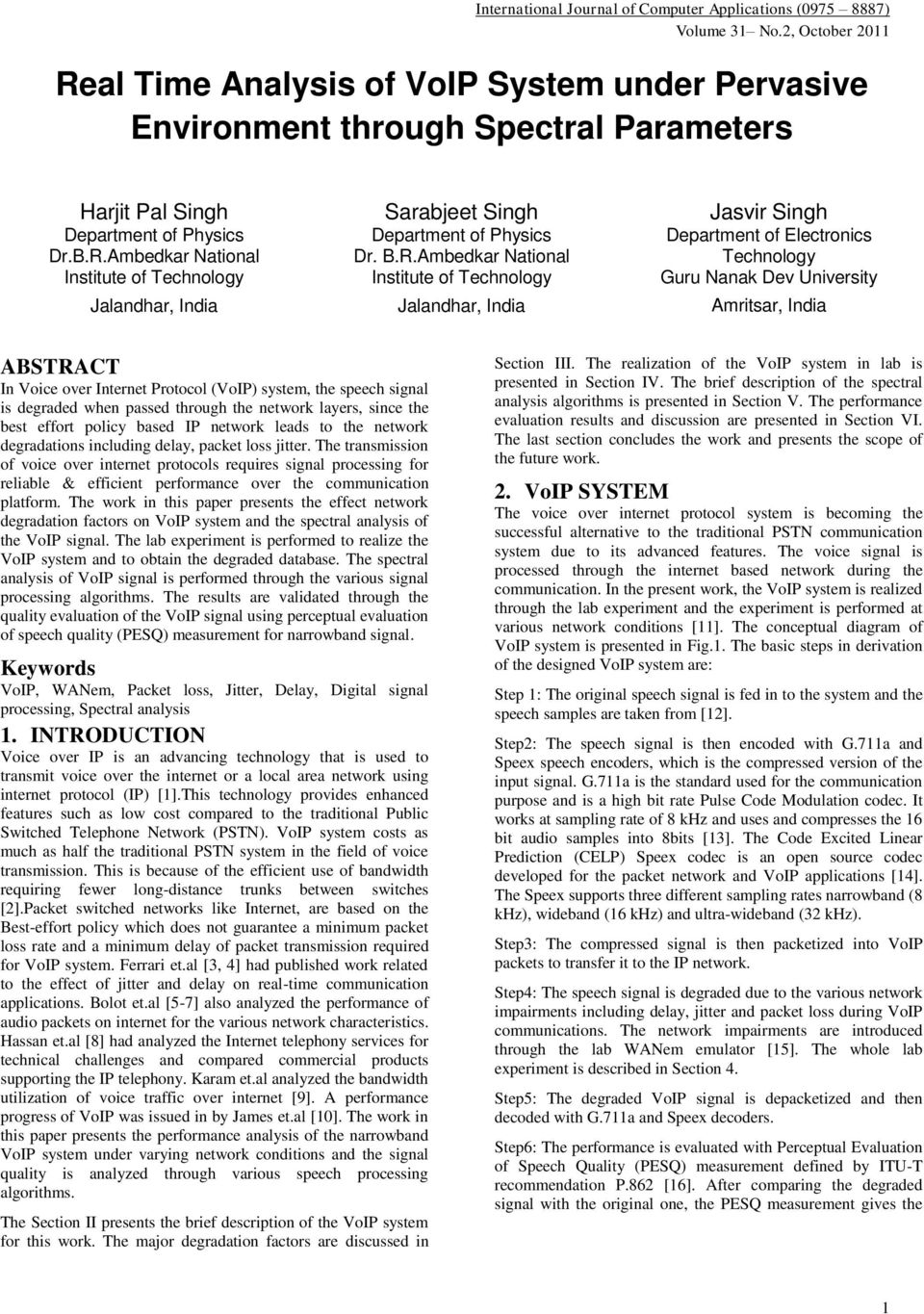
2 subjective measurement as Mean Opinion Scores (MOS) value from -0.5 to 4.5. Step7: The VoIP signal is processed through various signal processing algorithms to evaluate the performance of the system. Speech Signal PESQ MOS Encoder Spectral Analysis Fig 1: Conceptual diagram of VoIP System 3. FACTOR AFFECTING VoIP SIGNAL QUALITY Voice quality in communication systems is influenced by many factors such as packet delay, jitter, packet loss and type & amount of voice compression. Due to these distortion factors, the speech signal is not of very good quality over the VoIP network. Delay is the time taken by the voice to reach from talker s mouth to the listener s ear. Round trip delay is the sum of two one-way delays that occur in the user s call. In VoIP system, the propagation delay is also affected by two additional delays such as packeting delay and the time required for propagating the packet through the network. This varies the propagation delay during the transmission. According to the ITU-T the recommended one way delay by ITU-T is ms and this amount of delay is acceptable for most of the user applications [17]. But latency greater than 400 ms is unacceptable. SIP Server Packetization Decoder/ Output WAN Emulator Depacketization The variation in the arrival time of the packets at the receiver end leads to jitter, which affects the perceived quality of conversation very badly. The sender is expected to transmit each voice packet at a regular interval. But jitter affects the speech in such a way that all voice packets do not arrive at the right time at the decoder and thus reconstructed speech would not be continuous, at the receiver end. The transmission time of a packet through IP network varies due to queuing effect in the interconnected network [18]. The packet loss is the percentage of the lost packets during the transportation due to various network conditions such as buffer overflow, network congestion etc. The delay and jitter also contribute to the packet losses and these results in harmful effects on the quality of VoIP signal. Due to the real time requirement for interactive speech transmission, it is usually impossible for the receivers to request the sender to retransmit the lost packets. When voice packets do not arrive before their playout time, they are considered as lost and cannot be played when they are received. Even a single lost packet may generate audible distortion in the decoded speech signal [19, 20]. 4. VoIP LAB EXPERIEMNT The lab experiment is performed to realize the VoIP system. The signal is degraded with various network impairments including delay, jitter and packet loss during VoIP communications. The different values 50, 100, 150 and 200 ms for delay and 5, 7, 10 and 15 ms for jitter are used in the performed lab experiment. The different values of the packet loss rates 0% to 10 % for have been used to realize the network impairments in this experiment. The lab setup is shown in Fig.2. The WANem emulation software, which is the product of Tata Consultancy, has been used to emulate the WAN traffic [15]. The schematic diagram of the WANem is presented in Fig.3. The X-Lite IP softphone [21] is used to establish VoIP calls between two computers. To provide the VoIP services, 3CX phone system [22] has been used as the SIP server. Packet Flow Internet Service Provider (ISP) PC1 PC2 Fig.3 WANem Emulator WAN Emulator Fig 2: Lab Setup 5. SPECTRAL ANALYSIS OF VoIP SIGNAL To analyze the effect of packet loss on the quality of the degraded VoIP output, the spectral analysis was performed in time and frequency both. The various signal processing algorithms used for spectral analysis are discussed here: 2

3 5.1 Power Density Spectrum The estimation of power spectral density (PSD) is carried out by dividing the time signal into successive blocks and then, averaging the squared-magnitude discrete Fourier transforms (DFTs) of the signal blocks. The Welch power spectral density estimate is given as [23], P x f Where ( ) P x 1 n f DFT x 2 n 0 N 1 N 1 x N n e 2 j2 fn xn is the input time domain signal and power density spectrum function. x (1) P f is the 5.2 Spectrogram The spectrogram of the speech signal is an intensity plot of short time Fourier transforms (STFT) magnitude. STFT is a sequence of FFTs of windowed data segments where the windows are usually allowed to overlap in time. The data to be broken up into frames, which usually overlap to reduce artifacts at the boundary and then each frame, is Fourier transformed using K-point FFT [24]. The STFT procedure is shown in Fig 4. The short time Fourier transform (STFT) is expressed as: (a) N 1 j k n S k, l x n l w n e n 0 (2) 2 k Where k NT, k 0 K 1 at given sampling frequency f s, xn ( ) is the time domain signal and wn ( ) is the window function. 5.3 FFT Analysis A fast Fourier transform (FFT) is an efficient algorithm to compute the discrete Fourier transform (DFT) and it s inverse. A DFT decomposes a sequence of values into components of different frequencies and computing it directly from the definition is often too slow to be practical [25]. The DFT of the signal is defined as: (b) Fig.4 Performance analysis of G.711 at varying delay values for (a) Jitter (b) Packet Loss N 1 n i2 k X N k xne, k 0 N 1 (4) n 0 An FFT is a way to compute the same result more quickly. The computational complexity reduces to N log N 2 to O N. as compared 6. RESULTS The various performance analysis and spectral analysis results of the real time VoIP system are presented here: (a) 3
![The Welch power spectral density estimate is given as [23], P x f Where ( ) P x 1 n f DFT x 2 n 0 N 1 N 1 x N n e 2 j2 fn xn is the input time domain signal and power density spectrum function.](/docs-images/42/3575655/images/page_3.jpg "x (1) P f is the 5.2 Spectrogram The spectrogram of the speech signal is an intensity plot of short time Fourier transforms (STFT) magnitude.")
4 (b) Fig.5 Performance analysis of Speex at varying delay values for (a) Jitter (b) Packet Loss Fig.6 Power Spectral Density analysis for G.711a based VoIP Signal (a) PLR= 2% (a) PLR= 2 % 4


5 Fig.7 Power Spectral Density analysis for Speex based VoIP Signal Fig.8 Spectrogram analysis for G.711a based VoIP Signal (a) PLR= 2 % (a) PLR= 2% (b) PLR= 8 % 5


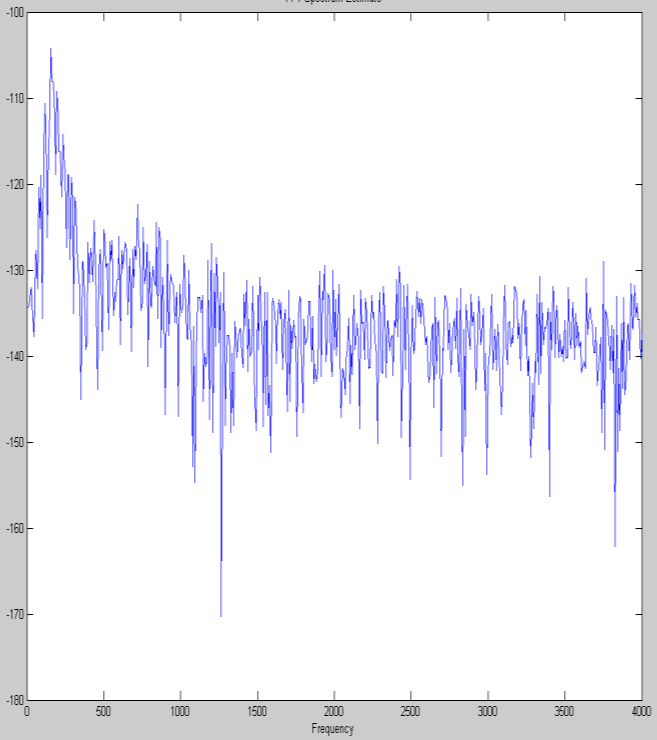
6 Fig.9 Spectrogram analysis for Speex based VoIP Signal Fig.10 FFT Spectrum for G.711a based VoIP Signal (a) PLR=2% (a) PLR= 2 % 6
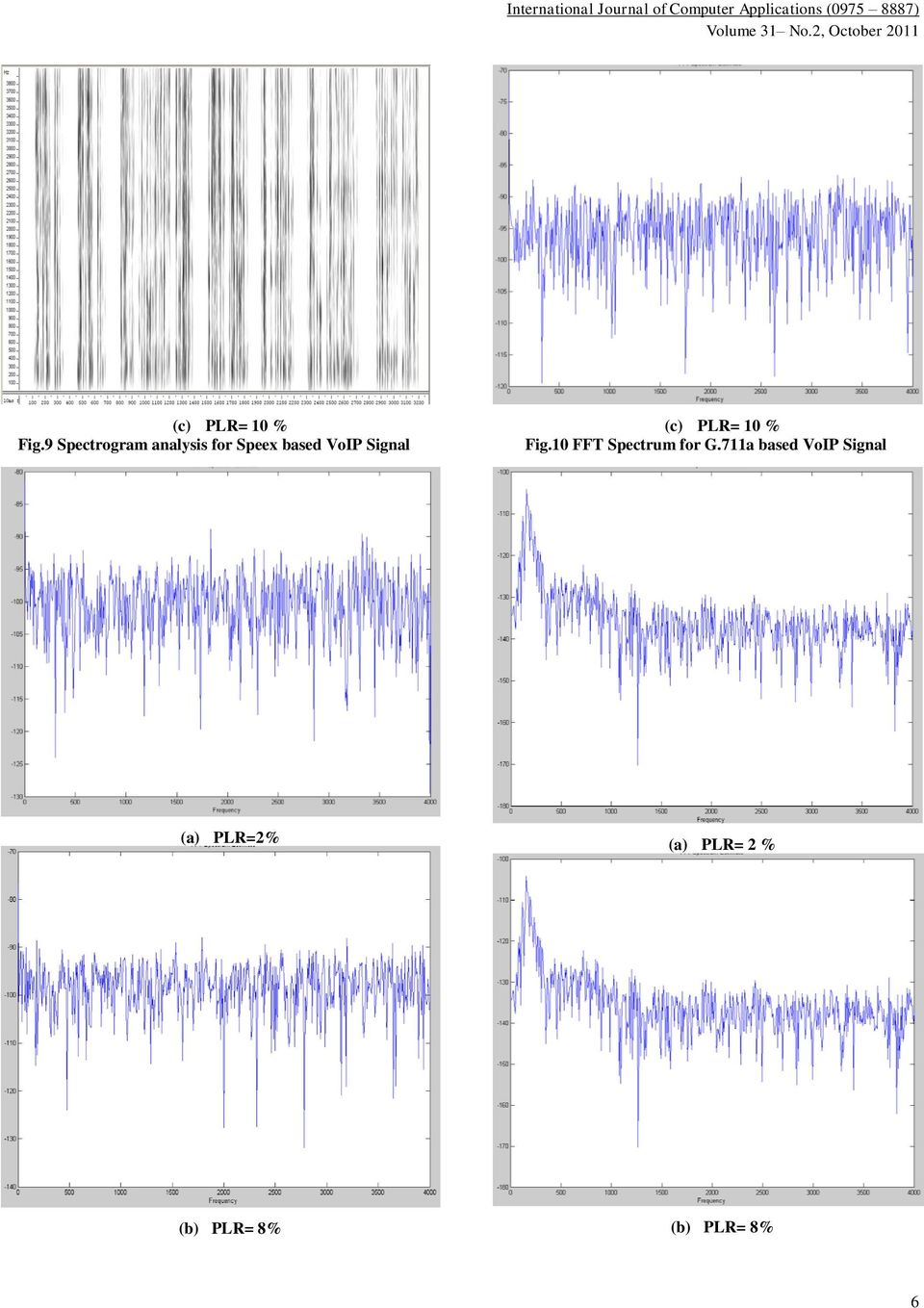
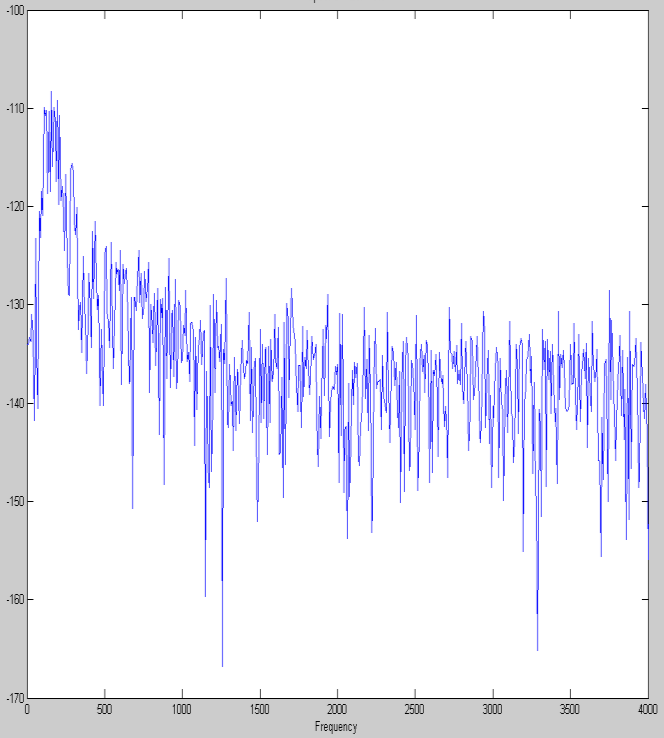
7 better signal quality. The spectrogram result for G.711a in Fig.8 shows the effect of network distortions on the VoIP signal. As the packet loss increases, the signal becomes noisy & weaker and the signal quality decreases rapidly. The VoIP signal coded with Speex has the better signal quality in comparison to the G.711a as presented in Fig.9. The VoIP signal with Speex coder has the better signal quality even at the tested peak value of loss rate. The FFT analysis in Fig.10 shows much distortion in VoIP speech signal when the signal is processed through the G.711a as compared to the Speex coder, which is depicted in Fig.11 at all used packet loss rates. Fig.11 FFT Spectrum for Speex based VoIP Signal 6.1 Discussion The results show that the network impairments affect adversely the speech signal. The additional noise is observed in the waveform of the VoIP speech signal when passed through IP network. The effect of delay, jitter and packet loss has been studied in this work through the lab experiment. As the delay in the system increases, jitter and packet loss increases in the system. The effect of jitter and packet loss on the perceived quality of VoIP signal at various values of the delay for G.711a codec is presented in Fig.4. At higher value of the delay, the jitter and packet loss also increases & burst losses occur; the performance of the VoIP system with G.711a codec is decreased. The PESQ-MOS decreases rapidly as the delay increases from the recommended value as presented in Fig.4. The performance analysis results of VoIP system with Speex coder at varying jitter and packet loss rates are presented in Fig.5. The Speex coder is more robust to varying network conditions in VoIP system and the performance in much better than G.711a even at the worst network conditions. The MOS scores of the VoIP signal with Speex coder are in the recommended range, even at 10% of the packet loss, 15 ms of jitter and 150 ms of delay. The VoIP signal is then further processed through the various speech processing algorithms to evaluate the effect of network degradations on the perceived VoIP speech signal. The spectral analysis of the VoIP signal, at fixed value of delay (150 ms) & jitter (15 ms) and varying packet loss rate, is performed through power spectral density (PSD), spectrogram, FFT algorithms. Fig. 6 and Fig.7 presents the power spectral density analysis of the VoIP signal coded with G.711a and Speex respectively. The PSD graph in Fig.6 indicates that the performance of the VoIP system and quality of signal with G.711a is decreased as the packet loss increases. The PSD graph in Fig.7 indicates that the Speex based narrowband VoIP system has much capability to capture the weak signal and provides the 7. CONCLUSION & FUTURE WORK The real time implementation of the VoIP system had been presented through lab the experiment and the spectral analysis of the VoIP speech signal was carried out in this work to evaluate the performance of the VoIP system with different VoIP speech coders. The VoIP signal quality was adversely affected by packet losses, since with increase of jitter and delay, consecutive packet losses occurs, which decreased the MOS scores of the signal. The spectral analysis results are similar to that of the objective measurement results for the designed VoIP system. The Speex coder presents much better signal quality in VoIP system, since it has the better capability to conceal the lost packets during voice transmission. In comparison to Speex, G.711 coder could not provide the toll quality of speech signal in VoIP system. To improve the performance of the system, these degradation parameters should be properly addressed. In future, the study could be used for improving the VoIP speech signal quality using various signal processing and filtering algorithms performed at higher frequency digital signal processors. 8. ACKNOWLEDGMENTS The authors are thankful to Ministry of Human Resource and Development of India for carrying out this work. 9. REFERENCES [1] Goralski, J.W., Kolon, C.M.,2000, IP Telephony, McGraw-Hill. [2] Varshney, U., Snow, A., Mcgivern, M., Howard, C., 2002, Voice over IP, Communications of the ACM, Vol.45,No.1, pp: [3] Ferrari.D.,Verma, D.C., 1990, A scheme for real time channel establishment in wide-area networks, IEEE Journal on Selected Areas in Communications, Vol. 8 No.3, pp: [4] Verma. D.C., Zhang.H.,Ferrari.D.,1991, Delay jitter control for real-time communication in a packet switching network, In Proceedings of IEEE conference on Communications for Distributed Applications and System, pp:35 43 [5] Bolot.J.,1993, Characterizing end-to-end packet delay and loss in the Internet, Journal of High Speed Networks, Vol. 2 No. 3, pp:

8 [6] Bolot.J., 1993, End-to-end packet delay and loss behavior in the internet, ACM Symposium on Communications architectures, protocols and applications, pp: [7] Bolot.J., Crepin.H., Gracia. A.V., 1995, Analysis of audio packet loss in the internet, In Proceedings of International workshop on network and operating system support for digital audio and video, Springer Lecturer Notes in Computer Science, pp: [8] Hassan.M., Nayandoro. A., Atiquzzaman. M., 2000, Internet telephony: services, technical challenges and products, IEEE communication magazine, Volume 38, No.4, pp: [9] Karam. M.J., Tobagi. F.A.,2001, Analysis of the delay and jitter of voice traffic over the internet, In Proceeding of twentieth Annual Joint Conference of the IEEE Computer and Communications Societies, Vol. 2, pp: [10] James. J.H., Chen. B., Garrison. L., 2004, Implementing VoIP: A voice transmission performance progress report, IEEE communication magazine, Vol. 42, No.7, pp: [11] Radhakrishanan, K., Larijani, H.,2011, Evaluating perceived voice quality on packet networks using different random neural network architectures, Performance Evaluation, Vol. 68, No.4, pp: [12] Open Speech Repository, [13] ITU-T Recommendations G.711, 1993, Pulse code modulation (PCM) of voice frequencies [14] Valin, J., 2007, The Speex codec manual version 1.2 Beta 3, Speex.org, [15] TCS, Wanem v 2.0, 2008, [16] ITU-T Recommendation P.862, 2001, Perceptual evaluation of speech quality (PESQ); an objective method for end-to-end speech quality assessment of narrowband telephone networks and speech codec [17] ITU-T Recommendations, G.114, 2003, One way transmission time [18] Jelassi, S., Youssef, H., Hoene, C., Pujolle, G., 2009, Parametric speech quality models for measuring the perceptual effect of the network delay jitter, In Proceedings of the IEEE 34th conference on Local Computer Networks, pp: [19] Wu, C.C., Chen, K.T., Huang, C.Y., Lei, C.L., 2009, An Empirical evaluation of VoIP playout buffer dimensioning in Skype, Google Talk and MSN messenger, In Proceeding of 19th International Workshop on Network and Operating System Support for Digital Audio and Video, pp [20] Singh, H.P., Singh, S., Singh, J., 2011, Digital signal processing approach for performance improvement in voice over internet protocol (VoIP) network, International Journal of Information and Communication Technologies, Vol.4, No.1-2, pp: [21] COUNTERPATH, X-lite, 2010, [22] 3CX, Software based PBX, [23] Proakis, J.D., Manolakis, D.G., 2000, Digital Signal Processing: Principles, algorithm and applications, Third edition [24] Quatieri, T F, 2002, Discrete-Time Speech Signal Processing: Principle and Practice, MIT Lincoln Laboratory, Liexington, Massachusetts, Prentice Hall [25] Mitra, S.K., 2001, Digital Signal Processing: A Computer- Based Approach: With DSP Laboratory using MATLAB, Mc.Graw Hill 8
![Computer Science, pp:163-174 [8] Hassan.M., Nayandoro. A., Atiquzzaman. M., 2000, Internet telephony: services, technical challenges and products, IEEE communication magazine, Volume 38, No.](/docs-images/42/3575655/images/page_8.jpg "4, pp:96 103 [9] Karam. M.J., Tobagi. F.A.")
Performance Analysis of Interleaving Scheme in Wideband VoIP System under Different Strategic Conditions
 Performance Analysis of Scheme in Wideband VoIP System under Different Strategic Conditions Harjit Pal Singh 1, Sarabjeet Singh 1 and Jasvir Singh 2 1 Dept. of Physics, Dr. B.R. Ambedkar National Institute
SIP Trunking and Voice over IP
 SIP Trunking and Voice over IP Agenda What is SIP Trunking? SIP Signaling How is Voice encoded and transported? What are the Voice over IP Impairments? How is Voice Quality measured? VoIP Technology Confidential
Network administrators must be aware that delay exists, and then design their network to bring end-to-end delay within acceptable limits.
 Delay Need for a Delay Budget The end-to-end delay in a VoIP network is known as the delay budget. Network administrators must design a network to operate within an acceptable delay budget. This topic
Measurement of V2oIP over Wide Area Network between Countries Using Soft Phone and USB Phone
 The International Arab Journal of Information Technology, Vol. 7, No. 4, October 2010 343 Measurement of V2oIP over Wide Area Network between Countries Using Soft Phone and USB Phone Mohd Ismail Department
Voice over IP. Overview. What is VoIP and how it works. Reduction of voice quality. Quality of Service for VoIP
 Voice over IP Andreas Mettis University of Cyprus November 23, 2004 Overview What is VoIP and how it works. Reduction of voice quality. Quality of Service for VoIP 1 VoIP VoIP (voice over IP - that is,
JOURNAL OF TELECOMMUNICATIONS, VOLUME 2, ISSUE 2, MAY 2010 126. Simulink based VoIP Analysis. Hardeep Singh Dalhio, Jasvir Singh, M.
 126 Simulink based VoIP Analysis Hardeep Singh Dalhio, Jasvir Singh, M. Mian Abstract Voice communication over internet not be possible without a reliable data network, this was first available when distributed
QoS issues in Voice over IP
 COMP9333 Advance Computer Networks Mini Conference QoS issues in Voice over IP Student ID: 3058224 Student ID: 3043237 Student ID: 3036281 Student ID: 3025715 QoS issues in Voice over IP Abstract: This
Broadband Networks. Prof. Dr. Abhay Karandikar. Electrical Engineering Department. Indian Institute of Technology, Bombay. Lecture - 29.
 Broadband Networks Prof. Dr. Abhay Karandikar Electrical Engineering Department Indian Institute of Technology, Bombay Lecture - 29 Voice over IP So, today we will discuss about voice over IP and internet
Implementation of Video Voice over IP in Local Area Network Campus Environment
 Implementation of Video Voice over IP in Local Area Network Campus Environment Mohd Nazri Ismail Abstract--In this research, we propose an architectural solution to integrate the video voice over IP (V2oIP)
Simulative Investigation of QoS parameters for VoIP over WiMAX networks
 www.ijcsi.org 288 Simulative Investigation of QoS parameters for VoIP over WiMAX networks Priyanka 1, Jyoteesh Malhotra 2, Kuldeep Sharma 3 1,3 Department of Electronics, Ramgarhia Institue of Engineering
Curso de Telefonía IP para el MTC. Sesión 2 Requerimientos principales. Mg. Antonio Ocampo Zúñiga
 Curso de Telefonía IP para el MTC Sesión 2 Requerimientos principales Mg. Antonio Ocampo Zúñiga Factors Affecting Audio Clarity Fidelity: Audio accuracy or quality Echo: Usually due to impedance mismatch
MULTI-STREAM VOICE OVER IP USING PACKET PATH DIVERSITY
 MULTI-STREAM VOICE OVER IP USING PACKET PATH DIVERSITY Yi J. Liang, Eckehard G. Steinbach, and Bernd Girod Information Systems Laboratory, Department of Electrical Engineering Stanford University, Stanford,
Goal We want to know. Introduction. What is VoIP? Carrier Grade VoIP. What is Meant by Carrier-Grade? What is Meant by VoIP? Why VoIP?
 Goal We want to know Introduction What is Meant by Carrier-Grade? What is Meant by VoIP? Why VoIP? VoIP Challenges 2 Carrier Grade VoIP Carrier grade Extremely high availability 99.999% reliability (high
An Analysis of Error Handling Techniques in Voice over IP
 An Analysis of Error Handling Techniques in Voice over IP Martin John Lipka ABSTRACT The use of Voice over IP (VoIP) has been growing in popularity, but unlike its wired circuit-switched telephone network
Department of MIIT, University of Kuala Lumpur (UniKL), Malaysia [email protected]
 Analyzing of MOS and Codec Selection for Voice over IP Technology Mohd Nazri Ismail Department of MIIT, University of Kuala Lumpur (UniKL), Malaysia [email protected] ABSTRACT. In this research,
Performance Evaluation of VoIP Services using Different CODECs over a UMTS Network
 Performance Evaluation of VoIP Services using Different CODECs over a UMTS Network Jianguo Cao School of Electrical and Computer Engineering RMIT University Melbourne, VIC 3000 Australia Email: [email protected]
Performance of Various Codecs Related to Jitter Buffer Variation in VoIP Using SIP
 Performance of Various Related to Jitter Buffer Variation in VoIP Using SIP Iwan Handoyo Putro Electrical Engineering Department, Faculty of Industrial Technology Petra Christian University Siwalankerto
Padma Charan Das Dept. of E.T.C. Berhampur, Odisha, India
 Volume 5, Issue 3, March 2015 ISSN: 2277 128X International Journal of Advanced Research in Computer Science and Software Engineering Research Paper Available online at: www.ijarcsse.com Measuring Quality
Requirements of Voice in an IP Internetwork
 Requirements of Voice in an IP Internetwork Real-Time Voice in a Best-Effort IP Internetwork This topic lists problems associated with implementation of real-time voice traffic in a best-effort IP internetwork.
QoS in VoIP. Rahul Singhai Parijat Garg
 QoS in VoIP Rahul Singhai Parijat Garg Outline Introduction The VoIP Setting QoS Issues Service Models Techniques for QoS Voice Quality Monitoring Sample solution from industry Conclusion Introduction
Indepth Voice over IP and SIP Networking Course
 Introduction SIP is fast becoming the Voice over IP protocol of choice. During this 3-day course delegates will examine SIP technology and architecture and learn how a functioning VoIP service can be established.
VoIP Technologies Lecturer : Dr. Ala Khalifeh Lecture 4 : Voice codecs (Cont.)
 VoIP Technologies Lecturer : Dr. Ala Khalifeh Lecture 4 : Voice codecs (Cont.) 1 Remember first the big picture VoIP network architecture and some terminologies Voice coders 2 Audio and voice quality measuring
Delivering reliable VoIP Services
 QoS Tips and Tricks for VoIP Services: Delivering reliable VoIP Services Alan Clark CEO, Telchemy [email protected] 1 Objectives Clear understanding of: typical problems affecting VoIP service
ETSI TS 101 329-2 V1.1.1 (2000-07)
 TS 101 329-2 V1.1.1 (2000-07) Technical Specification Telecommunications and Internet Protocol Harmonization Over Networks (TIPHON); End to End Quality of Service in TIPHON Systems; Part 2: Definition
Basic principles of Voice over IP
 Basic principles of Voice over IP Dr. Peter Počta {[email protected]} Department of Telecommunications and Multimedia Faculty of Electrical Engineering University of Žilina, Slovakia Outline VoIP Transmission
Clearing the Way for VoIP
 Gen2 Ventures White Paper Clearing the Way for VoIP An Alternative to Expensive WAN Upgrades Executive Overview Enterprises have traditionally maintained separate networks for their voice and data traffic.
Monitoring VoIP Call Quality Using Improved Simplified E-model
 Monitoring VoIP Call Quality Using Improved Simplified E-model Haytham Assem, David Malone Hamilton Institute, National University of Ireland, Maynooth Hitham.Salama.2012, [email protected] Jonathan
APTA TransiTech Conference Communications: Vendor Perspective (TT) Phoenix, Arizona, Tuesday, 3.19.13. VoIP Solution (101)
 APTA TransiTech Conference Communications: Vendor Perspective (TT) Phoenix, Arizona, Tuesday, 3.19.13 VoIP Solution (101) Agenda Items Introduction What is VoIP? Codecs Mean opinion score (MOS) Bandwidth
Quality of Service Testing in the VoIP Environment
 Whitepaper Quality of Service Testing in the VoIP Environment Carrying voice traffic over the Internet rather than the traditional public telephone network has revolutionized communications. Initially,
Active Monitoring of Voice over IP Services with Malden
 Active Monitoring of Voice over IP Services with Malden Introduction Active Monitoring describes the process of evaluating telecommunications system performance with intrusive tests. It differs from passive
Objective Speech Quality Measures for Internet Telephony
 Objective Speech Quality Measures for Internet Telephony Timothy A. Hall National Institute of Standards and Technology 100 Bureau Drive, STOP 8920 Gaithersburg, MD 20899-8920 ABSTRACT Measuring voice
Application Notes. Introduction. Contents. Managing IP Centrex & Hosted PBX Services. Series. VoIP Performance Management. Overview.
 Title Series Managing IP Centrex & Hosted PBX Services Date July 2004 VoIP Performance Management Contents Introduction... 1 Quality Management & IP Centrex Service... 2 The New VoIP Performance Management
Simple Voice over IP (VoIP) Implementation
 Simple Voice over IP (VoIP) Implementation ECE Department, University of Florida Abstract Voice over IP (VoIP) technology has many advantages over the traditional Public Switched Telephone Networks. In
Chapter 3 ATM and Multimedia Traffic
 In the middle of the 1980, the telecommunications world started the design of a network technology that could act as a great unifier to support all digital services, including low-speed telephony and very
Introduction to Packet Voice Technologies and VoIP
 Introduction to Packet Voice Technologies and VoIP Cisco Networking Academy Program Halmstad University Olga Torstensson 035-167575 [email protected] IP Telephony 1 Traditional Telephony 2 Basic
How To Understand The Quality Of A Wireless Voice Communication
 Effects of the Wireless Channel in VOIP (Voice Over Internet Protocol) Networks Atul Ranjan Srivastava 1, Vivek Kushwaha 2 Department of Electronics and Communication, University of Allahabad, Allahabad
Traffic Characterization and Perceptual Quality Assessment for VoIP at Pakistan Internet Exchange-PIE. M. Amir Mehmood
 Traffic Characterization and Perceptual Quality Assessment for VoIP at Pakistan Internet Exchange-PIE M. Amir Mehmood Outline Background Pakistan Internet Exchange - PIE Motivation Preliminaries Our Work
Analysis of IP Network for different Quality of Service
 2009 International Symposium on Computing, Communication, and Control (ISCCC 2009) Proc.of CSIT vol.1 (2011) (2011) IACSIT Press, Singapore Analysis of IP Network for different Quality of Service Ajith
Troubleshooting Common Issues in VoIP
 Troubleshooting Common Issues in VoIP 2014, SolarWinds Worldwide, LLC. All rights reserved. Voice over Internet Protocol (VoIP) Introduction Voice over IP, or VoIP, refers to the delivery of voice and
ANALYSIS OF LONG DISTANCE 3-WAY CONFERENCE CALLING WITH VOIP
 ENSC 427: Communication Networks ANALYSIS OF LONG DISTANCE 3-WAY CONFERENCE CALLING WITH VOIP Spring 2010 Final Project Group #6: Gurpal Singh Sandhu Sasan Naderi Claret Ramos ([email protected]) ([email protected])
VoIP Bandwidth Considerations - design decisions
 VoIP Bandwidth Considerations - design decisions When calculating the bandwidth requirements for a VoIP implementation the two main protocols are: a signalling protocol such as SIP, H.323, SCCP, IAX or
VoIP Analysis Fundamentals with Wireshark. Phill Shade (Forensic Engineer Merlion s Keep Consulting)
 VoIP Analysis Fundamentals with Wireshark Phill Shade (Forensic Engineer Merlion s Keep Consulting) 1 Phillip D. Shade (Phill) [email protected] Phillip D. Shade is the founder of Merlion s Keep Consulting,
Evaluating Data Networks for Voice Readiness
 Evaluating Data Networks for Voice Readiness by John Q. Walker and Jeff Hicks NetIQ Corporation Contents Introduction... 2 Determining Readiness... 2 Follow-on Steps... 7 Summary... 7 Our focus is on organizations
12 Quality of Service (QoS)
 Burapha University ก Department of Computer Science 12 Quality of Service (QoS) Quality of Service Best Effort, Integrated Service, Differentiated Service Factors that affect the QoS Ver. 0.1 :, [email protected]
PERFORMANCE ANALYSIS OF VOIP TRAFFIC OVER INTEGRATING WIRELESS LAN AND WAN USING DIFFERENT CODECS
 PERFORMANCE ANALYSIS OF VOIP TRAFFIC OVER INTEGRATING WIRELESS LAN AND WAN USING DIFFERENT CODECS Ali M. Alsahlany 1 1 Department of Communication Engineering, Al-Najaf Technical College, Foundation of
Voice over IP (VoIP) for Telephony. Advantages of VoIP Migration for SMBs BLACK BOX. 724-746-5500 blackbox.com
 Voice over IP (VoIP) for Telephony Advantages of VoIP Migration for SMBs BLACK BOX Hybrid PBX VoIP Gateways SIP Phones Headsets 724-746-5500 blackbox.com Table of Contents Introduction...3 About Voice
Understanding the Transition From PESQ to POLQA. An Ascom Network Testing White Paper
 Understanding the Transition From PESQ to POLQA An Ascom Network Testing White Paper By Dr. Irina Cotanis Prepared by: Date: Document: Dr. Irina Cotanis 6 December 2011 NT11-22759, Rev. 1.0 Ascom (2011)
VOICE OVER IP AND NETWORK CONVERGENCE
 POZNAN UNIVE RSITY OF TE CHNOLOGY ACADE MIC JOURNALS No 80 Electrical Engineering 2014 Assaid O. SHAROUN* VOICE OVER IP AND NETWORK CONVERGENCE As the IP network was primarily designed to carry data, it
Voice over IP Protocols And Compression Algorithms
 University of Tehran Electrical and Computer Engineering School SI Lab. Weekly Presentations Voice over IP Protocols And Compression Algorithms Presented by: Neda Kazemian Amiri Agenda Introduction to
Case in Point. Voice Quality Parameter Tuning
 Case in Point To continue our efforts to help you with your network needs, we will be making several real-world network troubleshooting case studies available to you. The attached case study,, discusses
Fundamentals of VoIP Call Quality Monitoring & Troubleshooting. 2014, SolarWinds Worldwide, LLC. All rights reserved. Follow SolarWinds:
 Fundamentals of VoIP Call Quality Monitoring & Troubleshooting 2014, SolarWinds Worldwide, LLC. All rights reserved. Introduction Voice over IP, or VoIP, refers to the delivery of voice and multimedia
A study of Skype over IEEE 802.16 networks: voice quality and bandwidth usage
 Iowa State University Digital Repository @ Iowa State University Graduate Theses and Dissertations Graduate College 2011 A study of Skype over IEEE 802.16 networks: voice quality and bandwidth usage Kuan-yu
Agilent Technologies Performing Pre-VoIP Network Assessments. Application Note 1402
 Agilent Technologies Performing Pre-VoIP Network Assessments Application Note 1402 Issues with VoIP Network Performance Voice is more than just an IP network application. It is a fundamental business and
Performance Analysis Proposal
 1. Title Performance Analysis Proposal Performance Analysis of P2P VoIP Applications 2. Objective To evaluate the dynamic behavior (i.e., CODEC usage) of VoIP P2P applications (e.g. Skype, Google Talk)
Introduction. Impact of Link Failures on VoIP Performance. Outline. Introduction. Related Work. Outline
 Impact of Link Failures on VoIP Performance International Workshop on Network and Operating System Support for Digital Audio and Video (NOSSDAV) C. Boutremans, G. Iannaccone and C. Diot Sprint ATL May
Project Code: SPBX. Project Advisor : Aftab Alam. Project Team: Umair Ashraf 03-1853 (Team Lead) Imran Bashir 02-1658 Khadija Akram 04-0080
 Test Cases Document VOIP SOFT PBX Project Code: SPBX Project Advisor : Aftab Alam Project Team: Umair Ashraf 03-1853 (Team Lead) Imran Bashir 02-1658 Khadija Akram 04-0080 Submission Date:23-11-2007 SPBX
Understanding Latency in IP Telephony
 Understanding Latency in IP Telephony By Alan Percy, Senior Sales Engineer Brooktrout Technology, Inc. 410 First Avenue Needham, MA 02494 Phone: (781) 449-4100 Fax: (781) 449-9009 Internet: www.brooktrout.com
Call Admission Control and Traffic Engineering of VoIP
 Call Admission Control and Traffic Engineering of VoIP James Yu and Imad Al-Ajarmeh [email protected] [email protected] DePaul University Chicago, Illinois, USA ABSTRACT. This paper presents an extension
Comparison of Voice over IP with circuit switching techniques
 Comparison of Voice over IP with circuit switching techniques Author Richard Sinden Richard Sinden 1 of 9 Abstract Voice-over-IP is a growing technology. Companies are beginning to consider commercial
Voice over IP (VoIP) and QoS/QoE
 Voice over IP (VoIP) and QoS/QoE Professor Richard Harris School of Engineering and Advanced Technology (SEAT) Presentation Outline Understanding jitter and methods to overcome problems with jitter Quality
B12 Troubleshooting & Analyzing VoIP
 B12 Troubleshooting & Analyzing VoIP Phillip Sherlock Shade, Senior Forensics / Network Engineer Merlion s Keep Consulting [email protected] Phillip Sherlock Shade (Phill) [email protected] Phillip
Quality of Service (QoS) and Quality of Experience (QoE) VoiceCon Fall 2008
 Quality of Service (QoS) and Quality of Experience (QoE) VoiceCon Fall 2008 John Bartlett NetForecast, Inc. [email protected] www.netforecast.com VoIP Deployment Realities VoIP is not just another application
Analysis of QoS parameters of VOIP calls over Wireless Local Area Networks
 Analysis of QoS parameters of VOIP calls over Wireless Local Area Networks Ayman Wazwaz, Computer Engineering Department, Palestine Polytechnic University, Hebron, Palestine, [email protected] Duaa sweity
Application Notes. Introduction. Sources of delay. Contents. Impact of Delay in Voice over IP Services VoIP Performance Management.
 Application Notes Title Series Impact of Delay in Voice over IP Services VoIP Performance Management Date January 2006 Overview This application note describes the sources of delay in Voice over IP services,
How To Recognize Voice Over Ip On Pc Or Mac Or Ip On A Pc Or Ip (Ip) On A Microsoft Computer Or Ip Computer On A Mac Or Mac (Ip Or Ip) On An Ip Computer Or Mac Computer On An Mp3
 Recognizing Voice Over IP: A Robust Front-End for Speech Recognition on the World Wide Web. By C.Moreno, A. Antolin and F.Diaz-de-Maria. Summary By Maheshwar Jayaraman 1 1. Introduction Voice Over IP is
Assessment of VoIP Quality over Internet Backbones
 Assessment of VoIP Quality over Internet Backbones Athina Markopoulou & Fouad Tobagi Electrical Engineering Dept. Stanford University Mansour Karam RouteScience Technologies, Inc. INFOCOM 2002, 06/25/02
Voice and Fax/Modem transmission in VoIP networks
 Voice and Fax/Modem transmission in VoIP networks Martin Brand A1Telekom Austria ETSI 2011. All rights reserved Name : Martin Brand Position: Senior IT Specialist at A1 Telekom Vice Chairman ETSI TC INT
Assessing the quality of VoIP transmission affected by playout buffer scheme and encoding scheme
 Assessing the quality of VoIP transmission affected by playout buffer scheme and encoding scheme Miroslaw Narbutt, Mark Davis Communications Network Research Institute Dublin Institute of Technology Wireless
QOS Requirements and Service Level Agreements. LECTURE 4 Lecturer: Associate Professor A.S. Eremenko
 QOS Requirements and Service Level Agreements LECTURE 4 Lecturer: Associate Professor A.S. Eremenko Application SLA Requirements Different applications have different SLA requirements; the impact that
A New Adaptive Redundancy Control Algorithm For VoIP Applications
 A New Adaptive Redundancy Control Algorithm For VoIP Applications Haytham Assem, David Malone Hamilton Institute, National University of Ireland Maynooth, Ireland Email: {Hitham.Salama.2012, David.Malone}@nuim.ie
VoIP QoS. Version 1.0. September 4, 2006. AdvancedVoIP.com. [email protected] [email protected]. Phone: +1 213 341 1431
 VoIP QoS Version 1.0 September 4, 2006 AdvancedVoIP.com [email protected] [email protected] Phone: +1 213 341 1431 Copyright AdvancedVoIP.com, 1999-2006. All Rights Reserved. No part of this
How To Understand The Differences Between A Fax And A Fax On A G3 Network
 The Fax on IP Networks White Paper February 2011 2 The Fax on IP Networks Contents Overview... 3 Group 3 Fax Technology... 4 G.711 Fax Pass-Through... 5 T.38 IP Fax Relay... 6 Network Design Considerations...
Department of Communications and Networking. S-38.2131/3133 Networking Technology, laboratory course A/B
 Department of Communications and Networking S-38.2131/3133 Networking Technology, laboratory course A/B Work Number 29: VoIP Student Edition Preliminary Exercises and Laboratory Assignments Original document
Course 4: IP Telephony and VoIP
 Course 4: IP Telephony and VoIP Telecommunications Technical Curriculum Program 3: Voice Knowledge 6/9/2009 1 Telecommunications Technical Curriculum Program 1: General Industry Knowledge Course 1: General
VoIP / SIP Planning and Disclosure
 VoIP / SIP Planning and Disclosure Voice over internet protocol (VoIP) and session initiation protocol (SIP) technologies are the telecommunication industry s leading commodity due to its cost savings
Application Note How To Determine Bandwidth Requirements
 Application Note How To Determine Bandwidth Requirements 08 July 2008 Bandwidth Table of Contents 1 BANDWIDTH REQUIREMENTS... 1 1.1 VOICE REQUIREMENTS... 1 1.1.1 Calculating VoIP Bandwidth... 2 2 VOIP
An Adaptive Codec Switching Scheme for SIP-based VoIP
 An Adaptive Codec Switching Scheme for SIP-based VoIP Ismet Aktas, Florian Schmidt, Elias Weingärtner, Cai-Julian Schnelke, and Klaus Wehrle {lastname}@comsys.rwth-aachen.de Chair of Communication and
Playout Controller QoS at the IP Edge Points For networks with packet loss and jitter Henrik Åström GLOBAL IP SOUND
 Playout Controller QoS at the IP Edge Points For networks with packet loss and jitter Henrik Åström GLOBAL IP SOUND Speech Processing, Transmission and Quality Aspects (STQ) Workshop Feb 2003 Outline VoIP
IP-Telephony Quality of Service (QoS)
 IP-Telephony Quality of Service (QoS) Bernard Hammer Siemens AG, Munich Siemens AG 2001 1 Presentation Outline End-to-end OoS of VoIP services Quality of speech codecs Network-QoS IntServ RSVP DiffServ
An Introduction to VoIP Protocols
 An Introduction to VoIP Protocols www.netqos.com Voice over IP (VoIP) offers the vision of a converged network carrying multiple types of traffic (voice, video, and data, to name a few). To carry out this
Combining Voice over IP with Policy-Based Quality of Service
 TechBrief Extreme Networks Introduction Combining Voice over IP with Policy-Based Quality of Service Businesses have traditionally maintained separate voice and data networks. A key reason for this is
Online course syllabus. MAB: Voice over IP
 Illuminating Technology Course aim: Online course syllabus MAB: Voice over IP This course introduces the principles and operation of telephony services that operate over Internet Protocol (IP) networks
Application Note. Introduction. Definition of Call Quality. Contents. Voice Quality Measurement. Series. Overview
 Application Note Title Series Date Nov 2014 Overview Voice Quality Measurement Voice over IP Performance Management This Application Note describes commonlyused call quality measurement methods, explains
Performance Evaluation of AODV, OLSR Routing Protocol in VOIP Over Ad Hoc
 (International Journal of Computer Science & Management Studies) Vol. 17, Issue 01 Performance Evaluation of AODV, OLSR Routing Protocol in VOIP Over Ad Hoc Dr. Khalid Hamid Bilal Khartoum, Sudan [email protected]
Voice over IP in PDC Packet Data Network
 Pernilla Norlund June 13, 2004 ii Abstract Sending voice as packages over a packet network, voice over IP, has increased with the growth of Internet. This has also affected the mobile cellular market and
White Paper. ETSI Speech Quality Test Event Calling Testing Speech Quality of a VoIP Gateway
 White Paper ETSI Speech Quality Test Event Calling Testing Speech Quality of a VoIP Gateway A white paper from the ETSI 3rd SQTE (Speech Quality Test Event) Version 1 July 2005 ETSI Speech Quality Test
Adaptive Rate Voice over IP Quality Management Algorithm
 98 Adaptive Rate Voice over IP Quality Management Algorithm Eugene S. Myakotnykh Centre for Quantifiable Quality of Service in Communication Systems (Q2S) 1, Norwegian University of Science and Technology,
NETWORK REQUIREMENTS FOR HIGH-SPEED REAL-TIME MULTIMEDIA DATA STREAMS
 NETWORK REQUIREMENTS FOR HIGH-SPEED REAL-TIME MULTIMEDIA DATA STREAMS Andrei Sukhov 1), Prasad Calyam 2), Warren Daly 3), Alexander Iliin 4) 1) Laboratory of Network Technologies, Samara Academy of Transport
Introduction and Comparison of Common Videoconferencing Audio Protocols I. Digital Audio Principles
 Introduction and Comparison of Common Videoconferencing Audio Protocols I. Digital Audio Principles Sound is an energy wave with frequency and amplitude. Frequency maps the axis of time, and amplitude
ENSC 427: Communication Networks. Analysis of Voice over IP performance on Wi-Fi networks
 ENSC 427: Communication Networks Spring 2010 OPNET Final Project Analysis of Voice over IP performance on Wi-Fi networks Group 14 members: Farzad Abasi ([email protected]) Ehsan Arman ([email protected]) http://www.sfu.ca/~faa6
Voice Over Internet Protocol(VoIP)
 Voice Over Internet Protocol(VoIP) By Asad Niazi Last Revised on: March 29 th, 2004 SFWR 4C03 Major Project Instructor: Dr. Kartik Krishnan 1. Introduction The telecommunications companies around the world
Measuring Data and VoIP Traffic in WiMAX Networks
 JOURNAL OF TELECOMMUNICATIONS, VOLUME 2, ISSUE 1, APRIL 2010 Measuring Data and VoIP Traffic in WiMAX Networks 1 Iwan Adhicandra Abstract Due to its large coverage area, low cost of deployment and high
Analysis and Simulation of VoIP LAN vs. WAN WLAN vs. WWAN
 ENSC 427 Communication Networks Final Project Report Spring 2014 Analysis and Simulation of VoIP Team #: 2 Kadkhodayan Anita ([email protected], 301129632) Majdi Yalda ([email protected], 301137361) Namvar Darya
Challenges and Solutions in VoIP
 Challenges and Solutions in VoIP Challenges in VoIP The traditional telephony network strives to provide 99.99 percent uptime to the user. This corresponds to 5.25 minutes per year of down time. Many data
Testing Voice Service for Next Generation Packet Voice Networks
 Testing Voice Service for Next Generation Packet Voice Networks Next Generation voice networks combine voice and data on the same transmission path. The advantages are many, but because of the technology
UMTS VoIP Codec QoS Evaluation
 IOSR Journal of Electronics and Communication Engineering (IOSR-JECE) e-issn: 2278-2834,p- ISSN: 2278-8735.Volume 10, Issue 2, Ver.1 (Mar - Apr.2015), PP 07-12 www.iosrjournals.org UMTS VoIP Codec QoS
Application Note. Pre-Deployment and Network Readiness Assessment Is Essential. Types of VoIP Performance Problems. Contents
 Title Six Steps To Getting Your Network Ready For Voice Over IP Date January 2005 Overview This provides enterprise network managers with a six step methodology, including predeployment testing and network