
WBSn-2400 and WBSn-2450 User Guide User Guide
|
|
|
- Blake McDonald
- 10 years ago
- Views:
Transcription
1 User Guide Software Version: January 2013 Document Version GA

2 FCC Statement Federal Communication Commission Interference Statement This equipment has been tested and found to comply with the limits for a Classs B digital device, pursuant to Part 15 of the FCC Rules. These limits are designedd to provide reasonable protection against harmful interference in a residential installation. This equipment generates, uses and can radiate radio frequency energy and, if not installed and used in accordance with the instructions, may cause harmful interference to radio communications. However, there is no guarantee that interference will not occur in a particular installation. If this equipment does cause harmful interferencee to radio or television reception, which can be determined by turning the equipment off and on, the user is encouraged to try to correct the interference by one of the following measures: Reorient or relocate the receiving antenna. Increase the separation between the equipment and receiver. Connect the equipment into an outlet on a circuit different from that to which the receiver is connected. Consult the dealer or an experienced radio/tv technician for help. FCC Caution: Any changes or modifications not expressly approved by the party responsible for compliance could void the user s authority to operate this equipment. This device complies with Part 15 of the FCC Rules. Operation is subject to the following two conditions: (1) This devicee may not cause harmful interference, and (2) this device must accept any interference received, including interference that may cause undesired operation. For product available in the USA/Canada market, only channel 1~ 11 can be operated. Selection of other channels is not possible. This device and its antenna(s) must not be colocated or operated in conjunction with any other antenna or transmitter. IMPORTANT NOTE: FCC Radiation Exposure Statement: This equipment complies with FCC radiation exposure limits set forth for an uncontrolled environment. This equipment should be installed and operated with minimum distance 20cm between the radiator & your body. Copyright Wavion Wireless Networks, an Alvarion Ltd Company, 2012 Copyright 2013 Alvarion Ltd. All rights reserved. The material contained herein is proprietary, privileged, and confidential and owned by Alvarion or its third party licensors. No disclosure thereof shall be made to third parties without the express written permission of Alvarion Ltd. Alvarion Ltd. reserves the right to alter the equipment specifications and descriptions in this publication without prior notice. No part of this publication shall be deemed to be part of any contract or warranty unless specifically incorporated by reference into such contract or warranty. Limitation of Liability: (a) Alvarion shall not be liable to the purchaser or to any third party, for any loss of profits, loss of use, interruption of business or for any indirect, special, incidental, punitive or consequential damages of any kind, whether arising under breach of contract, tort (including negligence), strict liability or otherwise and whether based on this agreement or otherwise, even if advised of the possibility of such damages. (b) To the extent permitted by applicable law, in no event shall the liability for damages hereunder of Alvarion or its employees or agents exceed the purchase price paid for the product by purchaser, nor shall the aggregatee liability for damages to all parties regarding any product exceed the purchase price paid for that product by that party (except in the case of a breach of a party s confidentiality obligations). WBSn2400 and WBSn2450 ii
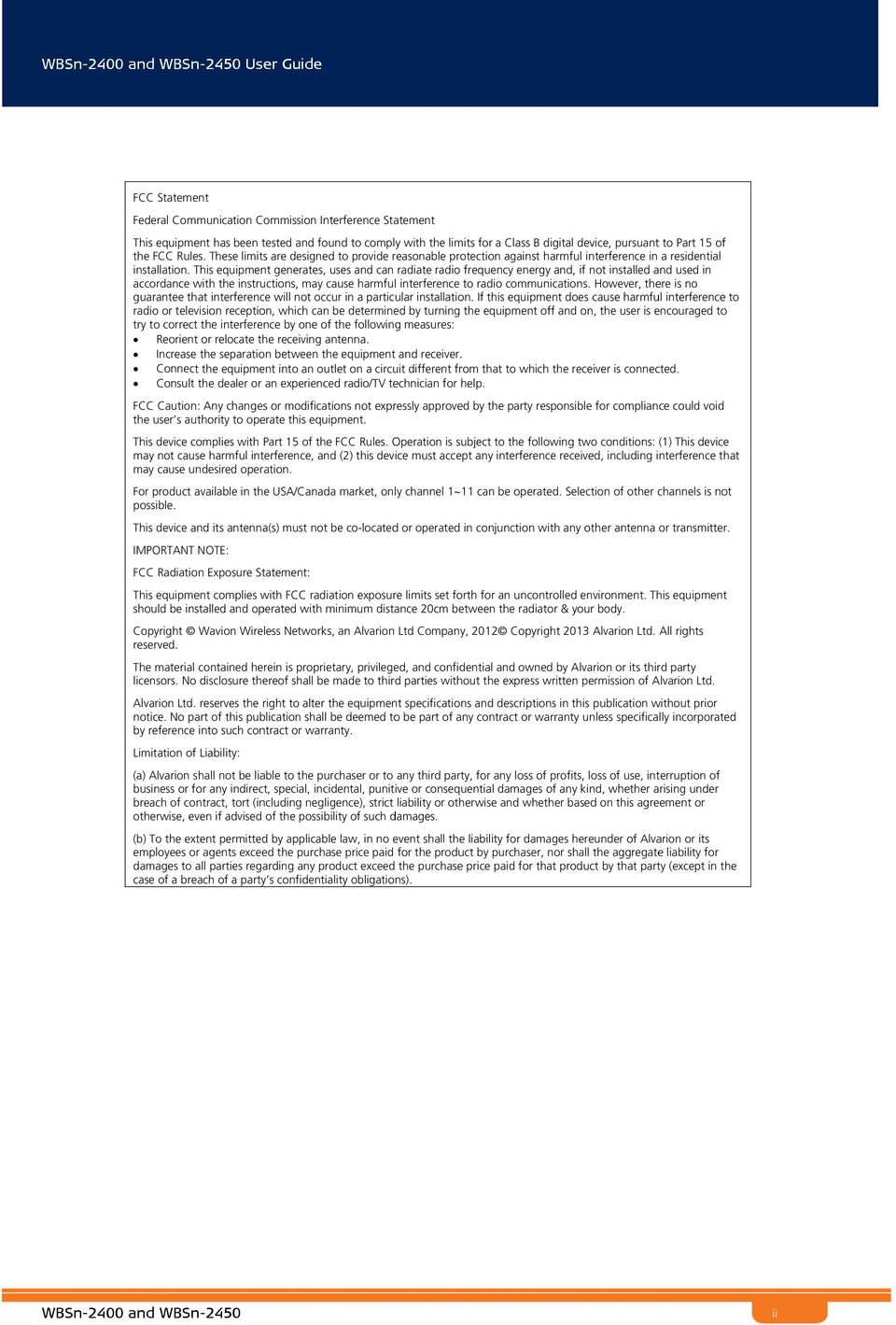
3 Contents Contents 1 Introduction Installation PreInstallation Checklist... 9 Installation and Setup PreInstallation Connecting to the Data Port Installing the WBSn base station Mounting Connecting and Sealing antennas Wind Loading Considerations Accessing the Alvarion Management Interface Automatic Channel Selection screen WBSn Set up and Management Status Checking System Setup VAPs Wireless Associations Radio Status Parameters Configuration System Setup IP Management Specifying the Time of the Base Station Unit Specifying the Location of the Base Station Unit Setting Management VLAN Wirelesss Interfacee Virtual AP (VAP) QoS (Quality of Service) Packet Priority WBSn2400 and WBSn2450 iii
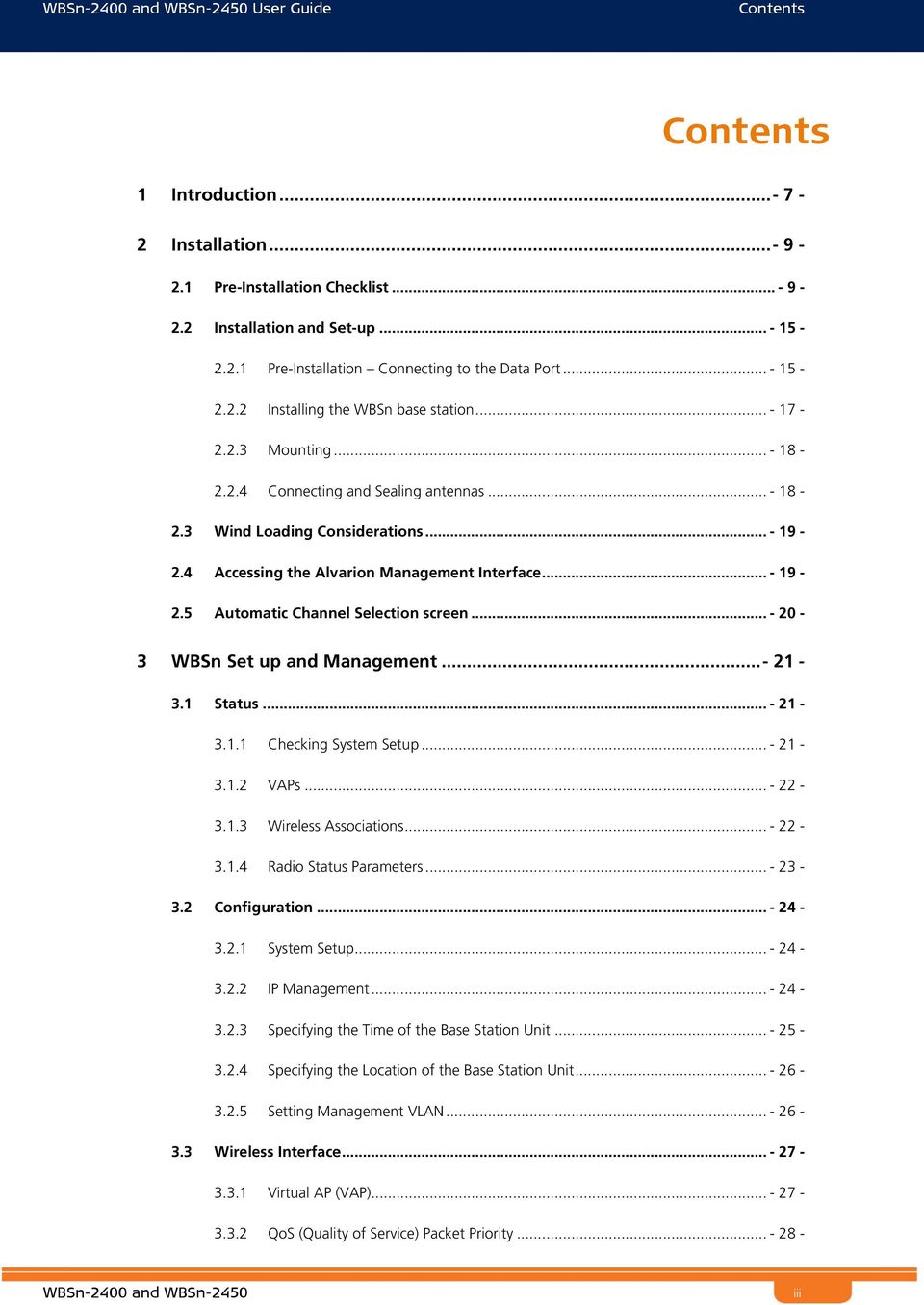
4 Contents 3.4 Security Authentication EAP for GSM Subscriber Identity Module (EAPSIM) Unique Enhancements for Open Security Sessions Encryption Methods Security, Authentication, Encryption Modes and Maximum Associations Radius Accounting Restricting access to the wireless network MAC Access List Radio Configuration Manual RTS Control Long range Wirelesss System Mode Automatic Channel Selection Operating in Bridge Mode Configuringg Network IP Configuration Bridge configuration Tagging VLAN WDS Mapping VLANs Router Mode Web Authentication Wirelesss Client Isolation Configuring the Ethernet Interface Administration Management SNMP Communities Users Firmware WBSn2400 and WBSn2450 iv
5 Contents Switching to the Upgradedd Firmware Version Using the Rollback Procedure Diagnosticss Configuration files Log Appendix A. Troubleshooting A.1. A.2. System Components Basic Troubleshooting A.2.1. LED Descriptions A.2.2. Reset capability A.3. Advanced Troubleshooting: Rescue Mode A.3.1. Upgrading Firmware from Rescue Mode Appendix B. Appendix C. Frequently Asked Questions Hardware Specification C.1. C.2. Hardware Specification: WBSn Hardware Specification: WBSn Appendix D. POE Injector Unit Instructions D.1. D.2. A/C PoE Injector (MST variety), DC PoE Injector: D.2.1. WPI48DC1G DC PoE Injector D Package content: D Product features and specifications D Mechanical: D Operation Environment D.2.2. WPI3X48DC1G Triple Passive DC PoE Injector D Product Features and Specifications D Mechanical: D Operational Environment WBSn2400 and WBSn2450 v

6 Contents D Installing the WPI3X48DC1G DC POE Appendix E. Glossary WBSn2400 and WBSn2450 vi

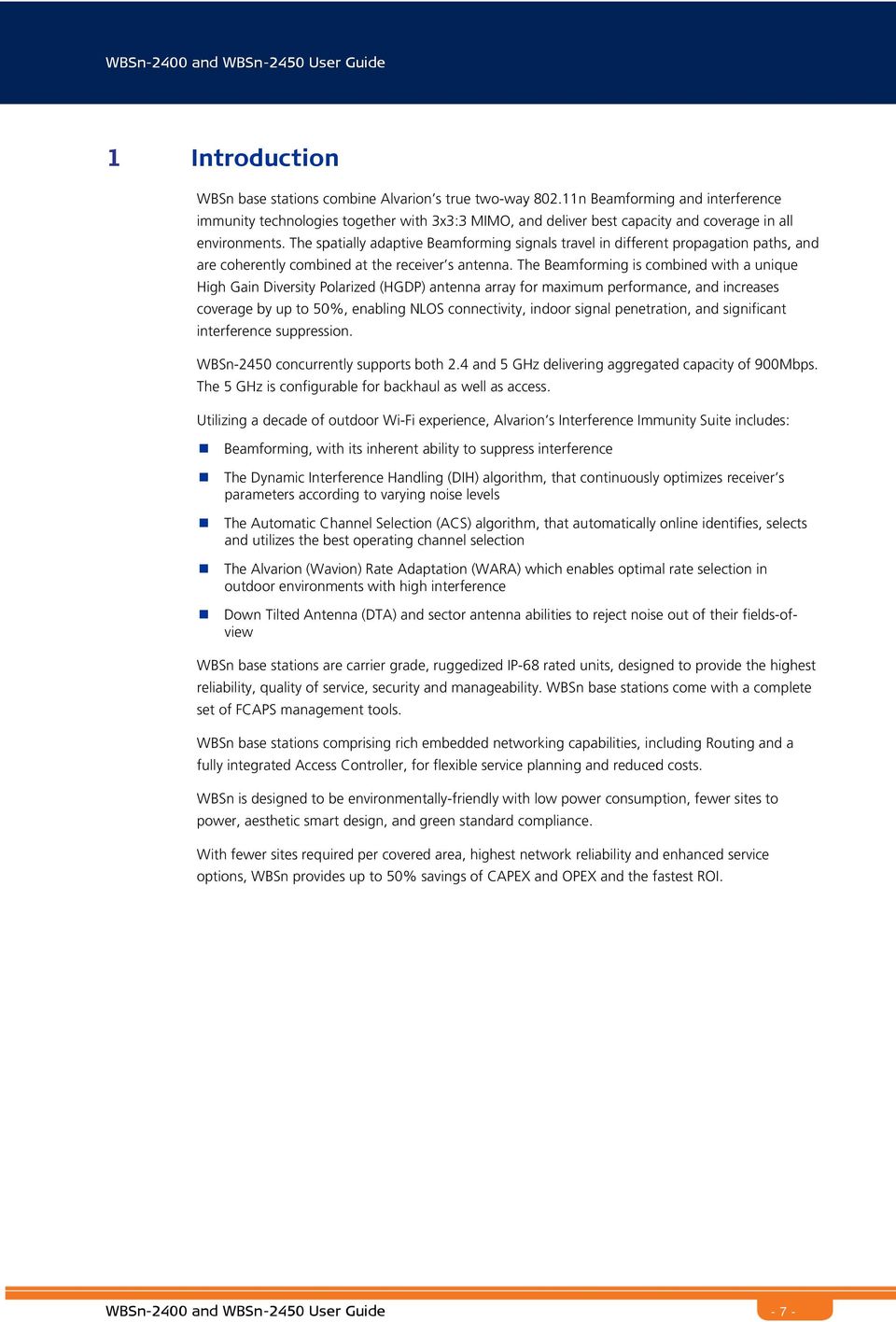
7 1 Introduction WBSn base stations combine Alvarion s true twoway n Beamforming and interference immunity technologies together with 3x3:33 MIMO, and deliver best capacity and coverage in all environments. The spatially adaptive Beamforming signals travel in different propagation paths, and are coherently combined at the receiver s antenna. The Beamforming is combined with a unique High Gain Diversity Polarized (HGDP) antenna array for maximum performance, and increases coverage by up to 50%, enabling NLOS connectivity, indoor signal penetration, and significant interference suppression. WBSn2450 concurrently supports both 2. 4 and 5 GHz delivering aggregated capacity of 900Mbps. The 5 GHz is configurable for backhaul as well as access. Utilizing a decade of outdoor WiFi experience, Alvarion s Interference Immunity Suite includes: Beamforming, with its inherent ability to suppress interference The Dynamic Interference Handling (DIH) algorithm, that continuously optimizes receiver s parameters according to varying noise levels The Automatic Channel Selection (ACS) algorithm, that automatically online identifies, selects and utilizes the best operating channel selection The Alvarion (Wavion) Rate Adaptation (WARA) which enables optimal rate selection in outdoor environments with high interference Down view Tilted Antenna (DTA) and sector antenna abilities to reject noise out of their fieldsof WBSn base stations are carrier grade, ruggedized IP68 rated units, designed to provide the highest reliability, quality of service, security and manageability. WBSn base stations come with a complete set of FCAPS management tools. WBSn base stations comprising rich embedded networking capabilities, including Routing and a fully integrated Access Controller, for flexible service planning and reducedd costs. WBSn is designed to be environmentallyfriendly with low power consumption, fewer sites to power, aesthetic smart design, and green standard compliance. With fewer sites required per covered area, highest network reliability and enhanced service options, WBSn provides up to 50% savings of CAPEX and OPEX and the fastest ROI. 7
8 WBSn24000 Key Benefits: Exceptional coverage, range, throughput, network capacity, scalability, and reliability Excellent building penetration Uniform coverage and enhanced nonlineofand sight operation High interference resilience Enhanced mobility support Simple deployment and low infrastructure operating costs Full compatibility with standardd b/g/n clients Small form factor and easy to deploy Low power consumption Robust outdoor design, IP68 rated Simple deployment and low infrastructure and operating costs WBSn2450 Key Benefits: Exceptional coverage and NLOS performances Best indoor signal penetration Concurrent support for 2.4 and 5 GHz Up to 900Mbps capacity Up to 512 concurrent users Unique interferencee immunity suite Full compatibility with standardd a/b/g/n clients Small form factor and easy to deploy Low power consumption Robust outdoor design, IP68 rated Simple deployment and low infrastructure and operating costs 8
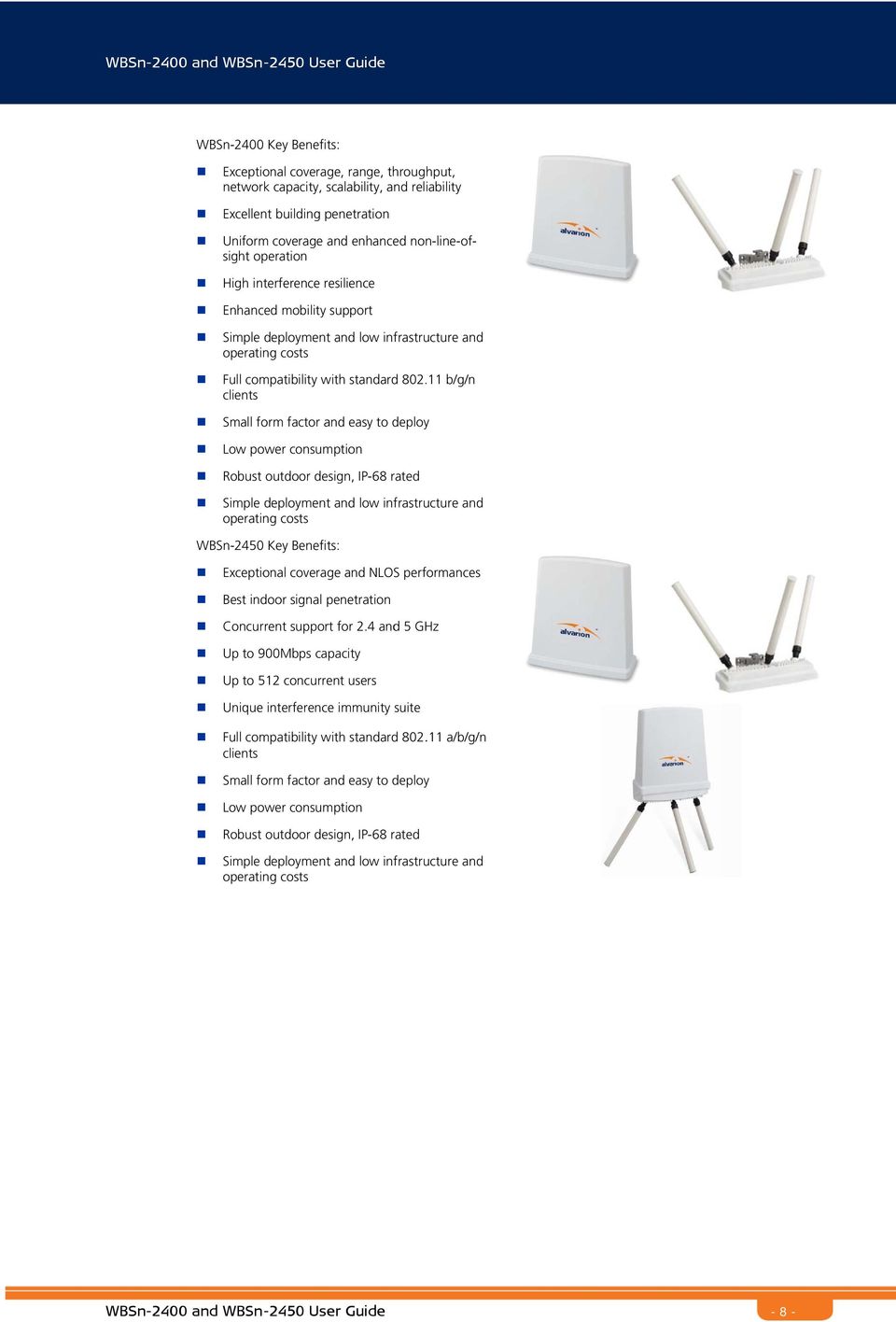
9 2 Installation This document is intended to help you set up and configure your WBSn2400 or your WBSn2450 base station. Unless specified otherwise, the use of the product name WBSn refers to all WBSn2400 and WBSn2450 base stations. 2.1 PreInstallation Checklist WBSn2400O WBSn2400O base station unit (Omni) PoE injector unit (AC or DC) 3 antennas Postclamp Two steel bands 2 screws, each with attached spring and flat washers Steel extraction key Iron security cable Waterproof sealing tape for IP68 (tape to cover the NType connectors and the lower part of the antennas for sealing) Plastic cap and cap cover WBSn2400S WBSn2400S unit (Sector) PoE injector unit (AC or DC) Postclamp Two steel bands 2 screws, each with attached spring and flat washers Steel extraction key Iron security cable Plastic cap and cap cover Check contents of package WBSn2450O WBSn2450SO WBSn2450OS WBSn2450O base station unit (Omni) PoE injector unit (AC or DC) 3 antennas Postclamp Two steel bands 2 screws, each with attached spring and flat washers Steel extraction key Iron security cable Waterproof sealing tape for IP68 (to be bound around the Ntype connector and antenna base) Plastic cap and cap cover 9

10 WBSn2450S WBSn2450S unit (Sector) PoE injector unit (AC or DC) Postclamp Two steel bands 2 screws, each with attached spring and flat washers Steel extraction key Iron security cable Plastic cap and cap cover Warning The WBSn2450 should only be installed using the antennas provided as part of the original package. Ensure that the USB port on the base station unit is properly sealed. Additional equipment and tools required for installation Ethernet cable (outdoor CAT5e 4pair data cable, with RJ45 connectors). Note: Maximum cable length 100 meters Ground cable, 10 AWG minimum Portable PC (for configurationn purposes) Lightning protection use the device recommended by Alvarion. See Lightning Protection. 2 6 diameter pole (on which to mount the unit) Extender (optional) Ensure a safe and secure environment Warning Follow these guidelines to ensure safe operation of the WBSn 2450 base station: Connect the PoE injector to the unit using only a straight Ethernet cable. Do not use crossed cables between the PoE injector and the unit! Do not touch or move the antennas while the unit is switched on. Make sure the antennas are connected when operating the radio or attempting to transmitt data, otherwise, the radio may be damaged. Do not hold the antenna close to or touching any exposed parts of the body, especially the face or eyes, while transmitting. The use of wireless devices on airplanes is governed by the Federal Aviation Administration (FAA). (US only) The use of wireless devices in hazardous locations is limited to the constraints posed by the safety directors of such environments. The use of wireless devices in hospitals is restricted to the limits set forth by each hospital. Do not operate a portable transmitter near unshielded blasting caps or in an explosive environment. The Alvarion WBSn2450 must be used only with Alvarionapproved components and antennas. Note: The Federal Communications Commission (FCC) with its action in ET Docket 968 has adopted a safety standard for human exposure to RF electromagnetic energy emitted by FCC certified equipment. Proper operation of the Alvarion WBSn according to the instructions found in this manual, results in user exposure that is substantially below the FCC recommended limits. 10

11 To ensure optimal performance for WBSn, select the location for the equipment using the following guidelines: The antenna should be directed towards the area intended to be covered, with maximum possible lines of sight for client locations. Generally speaking, the higher the placement of the antenna, the better the link quality achievable, however, the higher the installation the greater interference that the base station is exposed to. Consider best installation spot that maximizes coverage and minimizes interference. Two meters is the minimal recommendedd separation for Sector base station units (back to back). If omnidirectional units are in use, the minimum separation is 10 meters. The location of the unit should enable easy access for installationn and testing. When installing in locations where other devices exist that operate in the same frequency range, ensure that recommended distances are adhered to. For more information, see here. The ideal height at which a base station should be installed is a minimum of 3 meters above the rooftops of the buildings within the coverage zone. The omnidirectional unit should be installed at the highest point the pole. This is to ensure that there is no interference caused by the close proximity of the antenna to other objects. Where this is not possible, the unit should be kept at least 1 meter from the pole, using a horizontal bar. Keeping the maximum distance possible from an RF radiating source is recommended. Preparing the installation site Only experienced installation professionals who are familiar with local building and safety codes and are licensed, wherever applicable, by the appropriate government regulatory authorities, should install outdoor units and antennas. Warnings Important! This device should be installed in an area with restricted access. Do not modify the construction of this product. Modifying the operating frequency or enhancing the transmit output power through the use of external amplifiers or other equipment is illegal. This device is for outdoor or indoor use on the conditionn that operation of this device causes no harmful interference to authorized radio stations. This device shall not influence aircraft security and/ /or interfere with legal communications. If this device is found to cause interference, the operator of this equipment shall cease operating this device immediately. How to prepare the site: Ascertain the existence of potential posts or poles to which a base station could be attached. Consider the axis of the post, its placement, and whether extenders are required. Follow the appropriate electrical and building codes to ensure safe and durable wiring. The total length of the Ethernet cable connecting the unit to the network device (PC, switch, router, and so on) should not exceed 100 meters. Theree is no limitation on the length of the cable connecting the PoE to the unit, as long as the combined length of the cables from the network device through the PoE and to the unit does not exceed 100 meters. 111

12 How to ground the WBSn Note: The Grounding screw is located on the side panel of the outdoor unit. To connect the grounding cable: 1. Connect one end of a grounding cable to the grounding terminal and tighten the grounding screw firmly. 2. Remove the nut and star washers from the grounding screw. 3. Attach one star washer to the groundingg screw. 4. Attach #10 AWG bare copper wires with an M6 terminal ring to the grounding screw. 5. Attach the second star washer and tighten the nut. 6. Connect the other end of the groundingg cable to a good ground (earth) connection, (for example, a grounding rod). Connecting Antennas (for WBSn2400O, WBSn2450O, WBSn2450SO, WBSn2450OS) Note: The antennas should only be connected once the installation procedure has been successfully completed and prior to powering the unit. How to connect the antennas: Warnings Screw each of the three antennas into the three Ntype connectors on the WBSn base station unit. Warning! Do not screw in the antenna when holding its top section or you may damage the antenna. In order for the unit to work properly, all three antennas must be connected. Only connect the unit to the power supply once all the antennas are connected. Use caution when connecting the antennas. Undue haste can damage the unit. 12

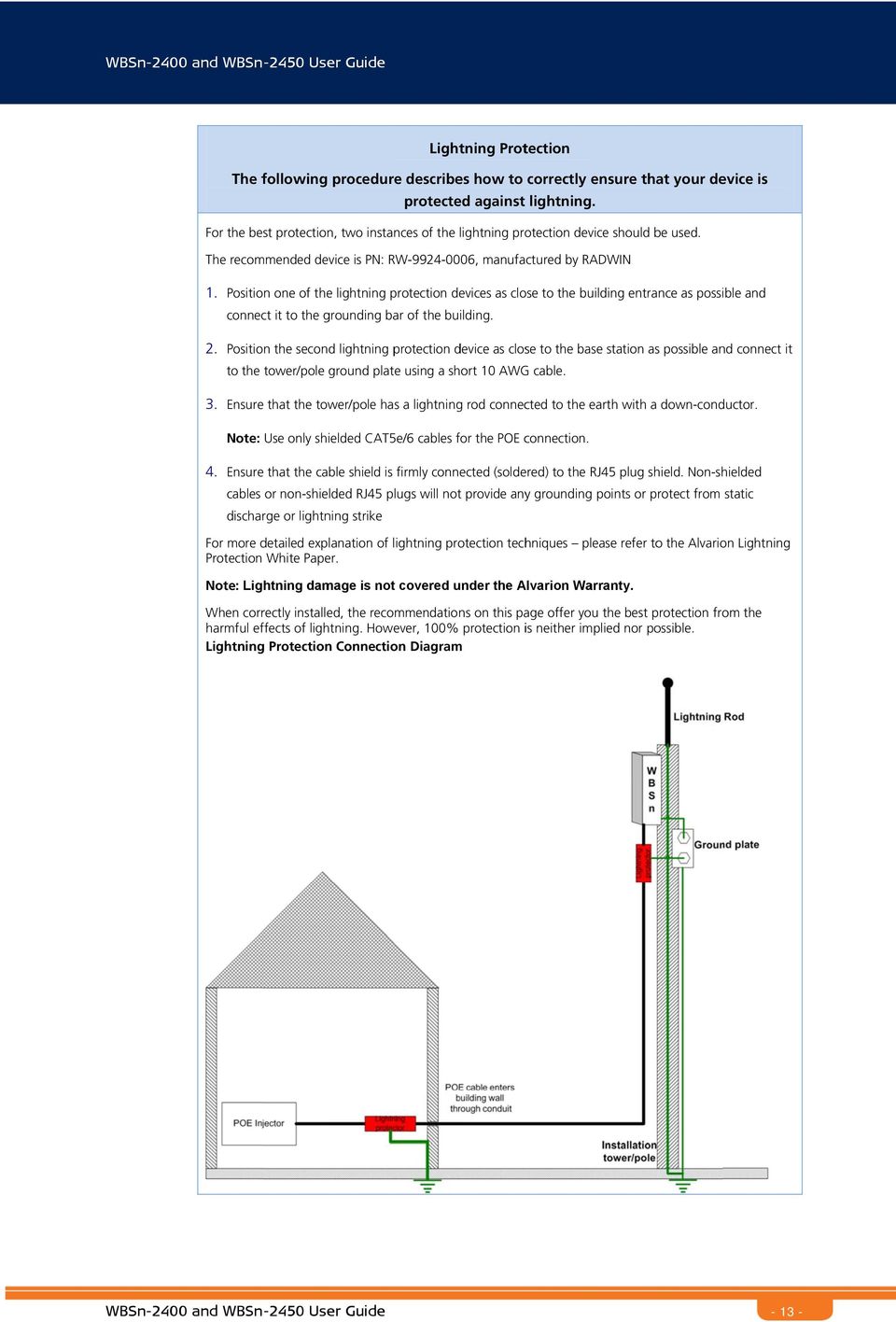
13 Lightning Protection The following procedure describes how to correctly ensure that your device is protected against lightning. For the best protection, two instances of the lightning protection device should be used. The recommended device is PN: RW , manufactured by RADWIN 1. Position one of the lightning protection devices as close to the building entrance as possible and connect it to the grounding bar of the building. 2. Position the second lightning protection device as close to the base station as possible and connect it to the tower/pole ground plate using a short 10 AWG cable. 3. Ensure that the tower/pole has a lightningg rod connected to the earth with a downconductor. Note: Use only shielded CAT5e/6 cables for the POE connection. 4. Ensure that the cable shield is firmly connected (soldered) to the RJ45 plug shield. Nonshielded cables or nonshielded RJ45 plugs will not provide any groundingg points or protect from static discharge or lightning strike For more detailed explanation of lightning protection techniques please refer to the Alvarion Lightningg Protection White Paper. Note: Lightning damage is not covered under the Alvarion Warranty. When correctly installed, the recommendations on this page offer you the best protection from the harmful effects of lightning. However, 100% protection is neither implied nor possible. Lightningg Protection Connection Diagram 13
14 Antenna Sealing The following procedure describes how to correctly seal the antennas against moisture. Caution It is important to carefully read this procedure and perform all the steps, to ensure maximal moisture protection. Use high quality sealing material to ensure IP68 compliant protection against dust and water. How to seal the antennas: 1. After the antenna is connected, use the supplied isolation tape to cover the NType connectors and the lower part of the antennas. 2. Cut 18 cm of the attached splicing tape. 3. Stretch and wrap the tape in an even, half overlapping manner around the antenna and NType connector. Cover this with a layer of vinyl plastic tape. Safety instructions and information Please ensure that you read and understand the following safety information. Ensure that you carefully read and follow all instructions in this manual, and heed all warnings. Warnings It is illegal to modify the construction of this product. Modifying the operating frequency or enhancing the transmit output power through the use of external amplifiers or other equipment is specifically disallowed by the "Telecommunications Act. There is a risk of personal injury or death if the WBSn antennas are close to electric power lines. By nature of the outdoor installation, you may be exposed to hazardous environments and high voltage. Use extreme caution when installing the system. Servicing is required when the apparatus has been damaged in any way. All servicing should be referred to qualified service personnel only. The base station must be properly grounded. Do not open the unit risk of electric shock. Any change or modification not expressly described in this manual or approved by the manufacturer could void your authority to operate this equipment. WBSn should only be installed using the antennas that were provided as part of the original package. A minimum distance of 40cm should be kept from the WBSn antenna when the system is in operation. To maintain Overvoltage (Installation) Category II, installl a suitable surge suppressor device in the branch circuit to limit expected transients to Overvoltage Category II values. The limits are based on IEC60664 and are also located in Table 2H of UL60950 (for mains 110V, the transient rating is 1500V). 14

15 2.22 Installation and Setup The following section describes the installation and configuration procedures for the WBSn base station PreInstallation Connecting to the Data Port The following describes how to apply power and data to the WBSn. Prior to connecting power to the WBSn, ensure that you have read and performed all instructions in the preinstallation checklist. The Alvarion WBSn is equipped with two ports. Use the ETH port to connect the PoE cable. The USB port is for engineering purposes only. Ensure that the USB port is properly sealed with a plastic cap. Please also note the following: You must always install an external grounding wire. Make sure you have completed groundingg before you connect power to the WBSn unit. Warnings Note: This is not a midspan powered device. Do not attempt to daisychain PoE devices. National Electrical Codes (NEC) Article 800 requires the use of an Agency Listed (UL/CSA) Building Entrance Protector for all power and communications cables entering a building. Article 800 is intended to protect the building and occupants from fires caused by transient voltage and current surges. Importantt Note: The gland base is attached to the WBSn unit and should not under any circumstances be fully removed Ensure thatt the power is turned offf for the designated circuits. Twist the nut using a steel extraction key, or an equivalent tool, to give yourself access to the inner sleeve. 15
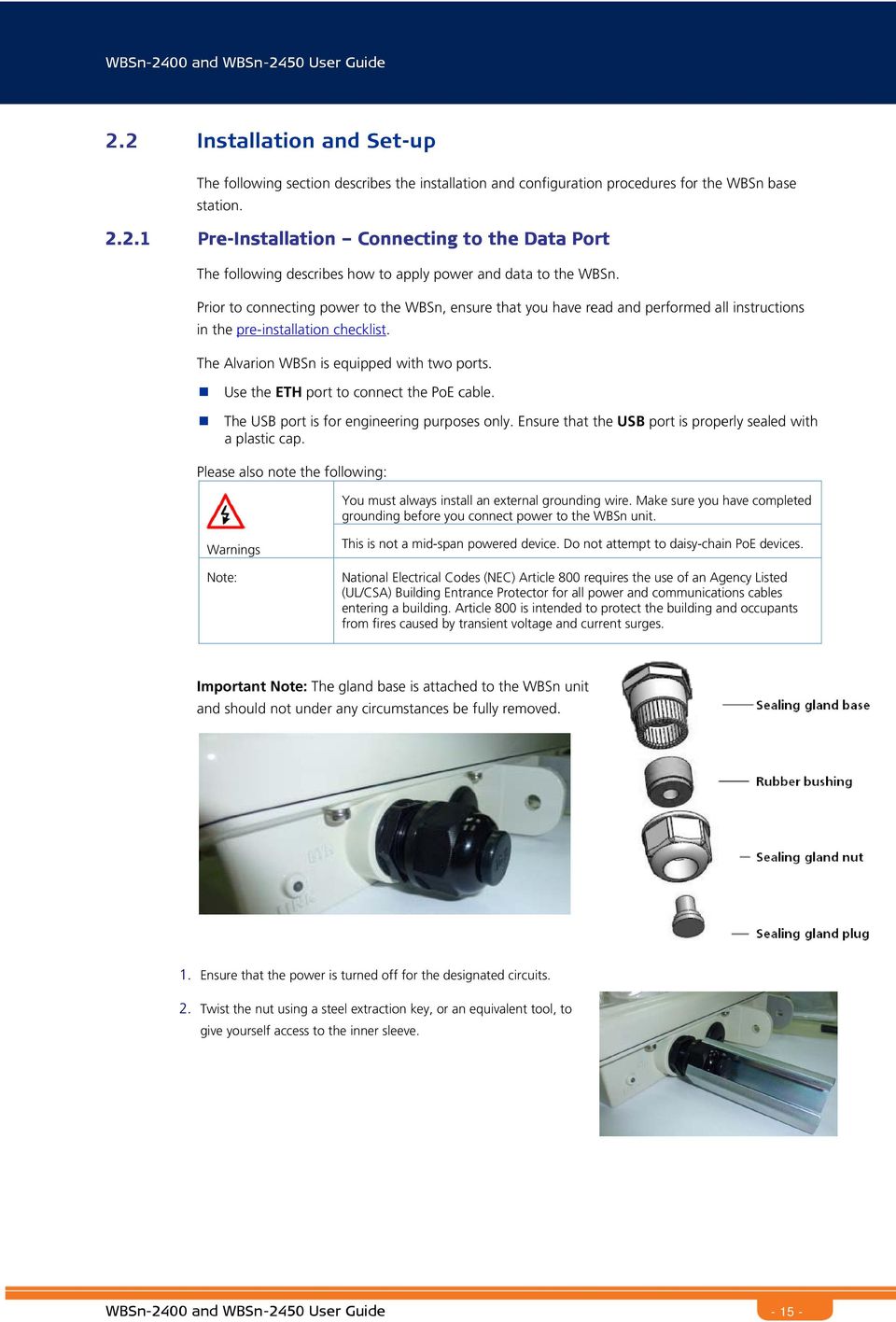
16 3. Remove the rubber bushing (inner sleeve) from the body of the gland. 4. Feed the shielded Category 5 Ethernet cable (appropriate for outdoor use) through the released nut and the rubber bushing. Note: Use a shielded RJ45 8pin modular plug to terminate the cables at the required length. 5. Crimp the cable and assemble the appropriate connector. 6. Connect the cable to the outdoor unit. 7. Push the rubber bushing firmly back into place inside the body of the gland. 8. Close the nut and tighten firmly, using a steel extraction key, or an equivalent tool, to ensure perfect sealing and IP68 compliance. 9. Connect the other end of the Category 5 cable to the OUT port of the PoE injector. 10. Connect one end of the network source cable to the IN port on the PoE injector, and the other end to the network. Note: The DC PoE image may differ in appearance. For more information, refer to the documentation included with the DC PoE package. 11. Connect the other end of the Category 5 Ethernet cable to the ETH port on the Alvarion WBSn. Note: Use a shielded RJ45 8pin modular plug to terminate the cables at the required length. 12. Close and firmly tighten the plastic cap, to ensure perfect sealing and IP68 compliance. Connect the network cable to the IN port of the PoE injector. Note: The above procedure must be conducted after every disconnection of the Ethernet cable from either ETH port on the WBSn unit or from the OUT port of the PoE injector. 16

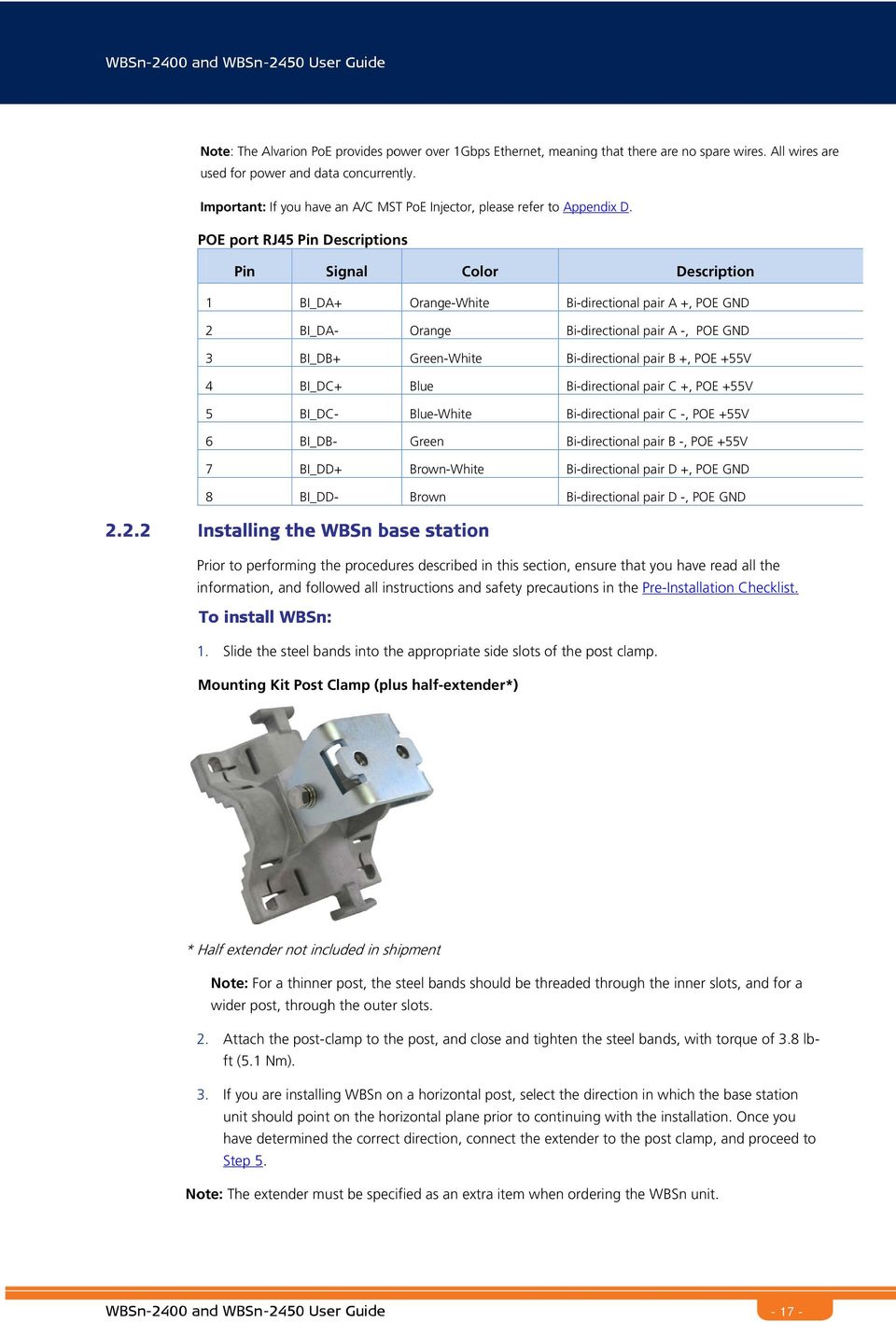
17 Note: The Alvarion PoE provides power over 1Gbps Ethernet, meaning that there are no spare wires. All wires are used for power and data concurrently. Important: If you have an A/C MST PoE Injector, please refer to Appendix D. POE port RJ45 Pin Descriptions Pin Signal Color Description 1 BI_DA+ OrangeWhite Bidirectional pair A +, POE GND 2 BI_DA Orange Bidirectional pair A, POE GND 3 BI_DB+ GreenWhite Bidirectional pair B +, POE +55V 4 BI_DC+ Blue Bidirectional pair C +, POE +55V 5 BI_DC BlueWhite Bidirectional pair C, POE +55V 6 BI_DB Green Bidirectional pair B, POE +55V 7 BI_DD+ BrownWhite Bidirectional pair D +, POE GND 8 BI_DD Brown Bidirectional pair D, POE GND Installing the WBSn base station Prior to performing the procedures described in this section, ensure that you have read all the information, and followed all instructions and safety precautions in the PreInstallation Checklist. To install WBSn: 1. Slide the steel bands into the appropriate side slots of the post clamp. Mounting Kit Post Clamp (plus halfextender*) * Half extender not included in shipment Note: For a thinner post, the steel bands should be threaded through the inner slots, and for a wider post, throughh the outer slots. 2. Attach the postclamp to the post, and close and tighten the steel bands, with torque of 3..8 lb unit should point on the horizontal plane prior to continuing with the installation. Once you have determined the correct direction, connect the extender to the post clamp, and proceed to ft (5.1 Nm). 3. If you are installing WBSn on a horizontal post, select the direction in which the base station Step 5. Note: The extender must be specified as an extra item when ordering the WBSn unit. 17
18 4. If you are installing the WBSn on a vertical post, attach the WBSn unit to the postclamp, with the screws and washers. Tighten the screws using a 13mm ratchet key with torque of 18.4 lb ft (25 Nm). Note: If you are installing either a Sector, SectorOmni, or OmniSector WBSn unit, see Mounting. Horizontally mounted WBSn attached with extender 5. Attach the WBSn base station unit (and connected extender) to the base station unit. 6. Tighten the bolts with torque of 18.4 lbft (25 Nm). As you tighten the screws, verify that the tilt and direction of the base station unit are correct for the coverage area required. Note: In an urban setting, with a highplaced installation, a slight downwards tilt (approximately 810 degrees) will help reduce noise and interference. 7. Thread the iron cable through the corner hole on the postclamp, and the middle hole on the WBSn unit, securing it with the Caribena provided. This will provide extra physical security for the unit Mounting Sector, SectorOmni and OmniSector units support both pole and wall mounting, as shown in the following illustration. For best performancee for a Sector unit, the recommendation is to install using a horizontal mount, as it offers a wider range of directional adjustment. The following illustration shows sectoromni (or omnisector) units, however this issue also applies to Sector units. Max downwards tilt without extender Max downwards tilt with extender Wall mount 3º Pole mount 36º Wall mount 15º Pole mount 43º Connecting and Sealing antennas If you are installing a WBSn unit with external antennas, you should connect and seal your antennas at this point, prior to connecting the WBSn unit to a power source. For information about these procedures, seee the sections Connecting Antennas and Sealing the Antennas. 18

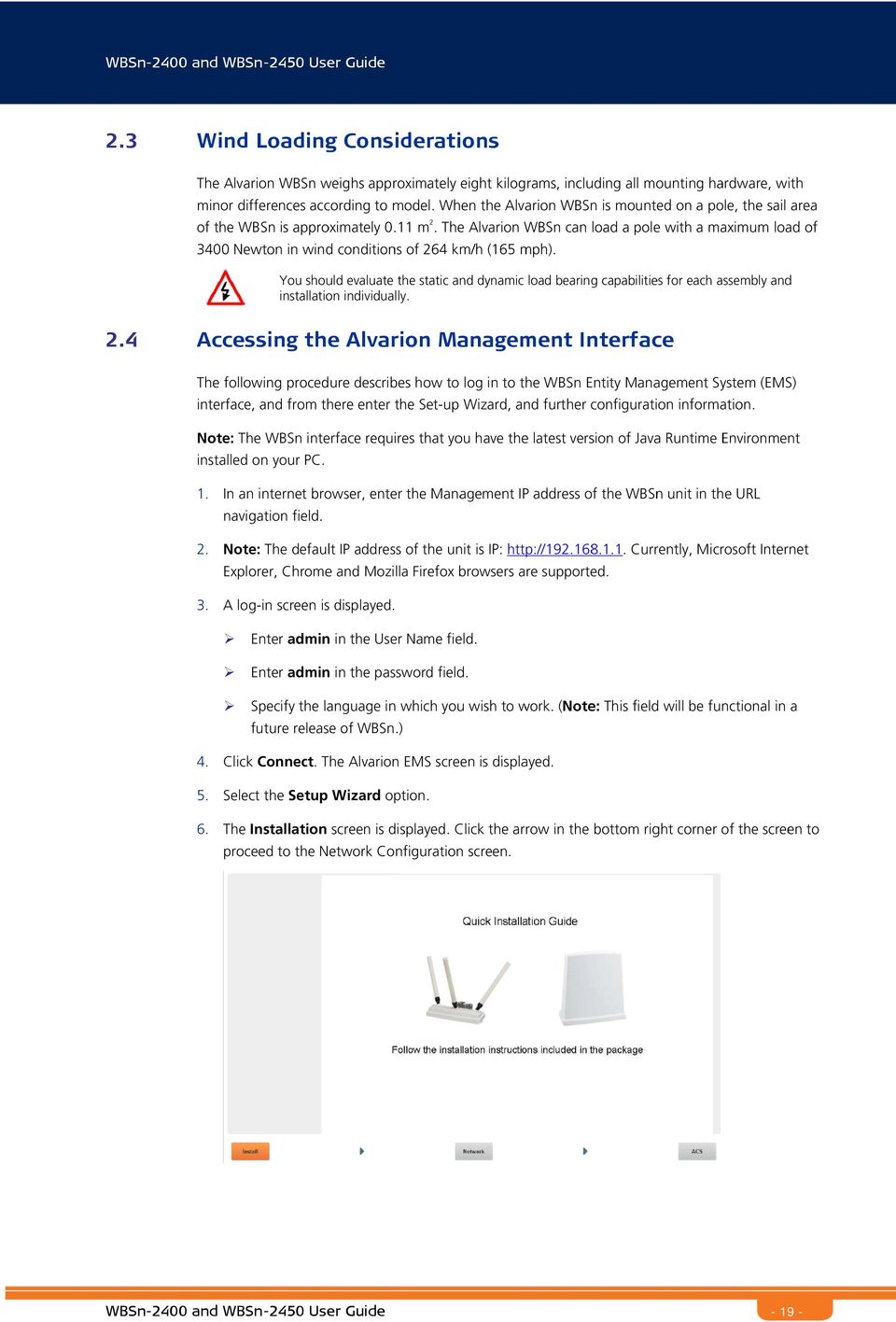
19 2.3 Wind Loading Considerations The Alvarion WBSn weighs approximately eight kilograms, including all mounting hardware, with minor differences according to model. When the Alvarion WBSn is mounted on a pole, the sail area of the WBSn is approximately m 2. The Alvarion WBSn can load a pole with a maximum load of 3400 Newton in wind conditions of 264 km/h (165 mph). You should evaluate the static and dynamic load bearing capabilities for each assembly and installation individually. 2.4 Accessing the Alvarion Management Interface The following procedure describes how to log in to the WBSn Entity Management System (EMS) interface, and from there enter the Setup Wizard, and further configuration information. Note: The WBSn interface requires that you have the latest version of Javaa Runtime Environment installed on your PC. 1. In an internet browser, enter the Management IP address of the WBSn unit in the URL navigation field. 2. Note: The default IP address of the unit is IP: Currently, Microsoft Internet Explorer, Chrome and Mozilla Firefox browsers are supported. 3. A login screen is displayed. Enter admin in the User Name field. Enter admin in the password field. Specify the language in which you wish to work. (Note: This field will be functional in a future release of WBSn.) 4. Click Connect. The Alvarion EMS screen is displayed. 5. Select the Setup Wizard option. 6. The Installation screen is displayed. Click the arrow in the bottom right corner of the screen to proceed to the Network Configurationn screen. 19
20 7. Complete the parameters, to set up your initial networking configuration. Note: Further configurationn parameters are available, and should be specified in order to complete your setup. For more information, see the section entitled Configuration. Parameter IP address Mask Gateway IP Method VAP Name Security mode Description and value The current IP addresss of the unit The current subnet mask used to establish the broadcast domain. The default mask of the unit is The current IP addresss of the default gateway. Select Manual or DHCP The default VAP name string to be used as the SSID string Specify the required WiFi security protocol for the VAP 2.5 Automatic Channel Selection screen The Automatic Channel Selection utilizes an embedded algorithm to scan for the best channel with which your base station can work, ensuring minimal interference, optimal capacity, and maximum performance. Note: You can only scan for one band at a time. To scan for both the 2.4 and 5 GHz bands, you need to repeat the process. 1. Click Press to start ACS scan. The scan begins, and a progress indicator is displayed, showing the percentage of completion. 2. When the scan is complete (after approximately five minutes), the button label changes to ACS done. 3. Navigate to Status => Radio => ACS Results to see the results. Separate tabbed pages are displayed for both the 2.4 GHz band, as well as the 5 GHz band. 4. You are requested to exit the Setup Wizard, by clicking Exit. 20
21 3 WBSn Set up and Management The WBSn EMS interface is comprised of three separate sections, that each relate to the key areas that you will use. The Status section enables you to check how the system is working, and whether the unit is configured correctly. The Configuration section enables you to configure the unit s wireless and Ethernet specifications according to your requirements. The Administration section enables comprehensive maintenance of the unit from the user s point of view, including specifying logs to be created, and creating and adding new users to the system. 3.1 Status This section enables you to check how your system is working, and whether the WBSn unit and software/firmware are configured correctly. There are 4 sections: Devicee indicates Uptime (duration of time from last power up), Date (yyyy/mm/dd) and Time Zone (Default: GMT) Network indicates Network Mode (Default: Bridge) Wireless Parameters indicates table of current VAPs Interfaces displays the Wireless and Ethernet tables Device Parameter Description and values Indicates the time duration since last powerup displayedd in the Uptime field. Date field: current date Time Zone: selected time zone (GMT +/ value) Network Wireless Parameters Displays the current Network Mode (Default: Bridge). Displays the information table about current VAPs (Security Mode, Hidden SSID, Band, # of Associations). Note: Below this table, the Total Associationss parameter is displayed. Interfaces Wireless Table displays information regardingg wireless drivers (WiFi Driver, MAC Address, Radio Status, Frequency, Channel, Channel Width); Ethernet Table displays information regardingg Name, MAC Address, Link, Speed, Duplex, and Negotiation Checking System Setup Navigate to Status = > System for an overall view of the system settings. Parameter Time Software Versions Resource Utilization Country Code Description and values Indicates the unified time of the unit, according to the NTP server, and your specific time zone. Displays the current ( and previous or alternative, where applicable) firmware version. For more information, see the Firmware section. Indicates the resources utilized by the system Displays the current country code according to the regulatory domain of which your base station is set to operate. 21
22 Parameter Hardware Information Description and values Indicates description, part names and serial numbers of the existing hardware, plus the temperature of the unit. For further informationn about the hardware configuration, see Appendix C VAPs A WBSn base station supports multiple Virtual Accesss Points (VAPs) per unit, enabling various combinations comprising different VAPs to different carriers, a single carrier providing a variety of services, or different VAPs for different services. Such services include VLAN assignment, prioritization per VLAN and Backhaul vs. Access. Up to six VAPs can exist per WBSn, and the capabilities per VAP include the following: Security Layer2 network separate VLANs Layer3 network separate WANs AAA servers MAC Access Control Lists Max Associationss Web Portal Redirection (to be available in a future release) BW Management Profiles VLANs assignment method Trunk Determine by RADIUS Directly assigned Navigate to Status = > Wirelesss => VAP, in order to see whichh VAPs are available, the BSSID of each VAP and how many associations are assigned to each VAP. For more information, see To Define a VAP Wireless Associations The Wireless associations list is a list of clients that are connected to the base station. You can access this list by navigating to Status => Wireless => Associations, where the following list parameters are displayed. Parameter IP Addresss MAC SSID (VAP Name) RSSI dbm TX Rate RX Rate Description IP address of the associated station Physical address of the associated station VAP (SSID) to which the station is associated The RSSI (Received Signal Strength Indicator) power received by the WBSn base station from the associated station. The current PHY Rate (modulation) at which the base station transmits to the associated station The average PHY Rate (modulation) at which the associated station transmitss to the base station (the rate at which the base station receives). 222
23 Parameter Description State Indicates the association status of the station s connection. Valid values: Disconnected Association_Processing Associated Disconnecting Est. Range WMM Auth. Status Estimated range of client from WBSn A value of 'yes' in this field indicates that the associated station supports the WMMM protocol. For more information about WMM, see Defining a VAP. Radius authentication state. Valid values: On Off WDS Radio Indicates if the base station is connected in WDS mode. For more information, see WDS. Indicates to whichh radio the client is connected. Valid values: 2.4 GHz 5.0 GHz PS 11N TX [Bytes] RX [Bytes] Time since assoc. Time since last activity TX Packets RX Packets TX PER [%] # of streams support TX BF support indication Power Save statuss Indicates whether the associated station is working in n protocol, rather than in 11 b/g or 11 a. Amount of bytes transmitted towards the associated client Amount of bytes received from the associated client Time elapsed in seconds since association Time in seconds since data of any description was last received from the client Amount of packets transmitted to the associated client Amount of packets received from the associated client Packet Error rate on the Tx transmission path Number of streams supported by the client Indicates whether the client supports Beamforming from the WBSn Radio Status Parameters The parameter values are described in the table below. Both the 2.4 MHz and the 5 MHz band values are indicated in separate bandspecific tabs, as shown in the image above. 23
24 Parameter Noise Level Idle Time Tx Activity Valid Rx Activity Interference (Invalid Rx Activity) Configuration System Setup Description The level of noise measured by the base station Percentage of time that the base station has been idle Length of time that the base station has spent transmitting Length of time that the base station has been occupied receiving valid data Length of time that the base station has been occupied receiving non valid dataa (i.e. interfering traffic) In the GUI, use the Configuration => System page to set up, configure and manage system parameters. This page displays basic static information on the system, including contact details, and IP addresses. Default values and details are provided, which should be modified, by specifying parameter values according to your network system and requirements. Changing the name of your WBSn base station 1. Navigate to Configuration => System => General tab. 2. Enter the new name of your base station in the Device Name field. 3. Click Apply IP Management To Configure a Management IP address 1. Navigate to Configuration => Network => IP Configuration, select the line you wish to update and click Edit. 2. In the popup window, modify the default IP address values provided, as described in the following table: 24
25 Parameter Description IP Addresss IP Method Change the default IP address Select either Manual or DHCP For Manual: Enter the required static IP, and valid static Network Mask, Gateway and DNS parameter values in the relevant parameters. For DHCP: Enter the DHCP Client Fallback IP Address and Network mask in the relevant parameters. Mask Gateway MTU Enter the required network mask Specify the gateway for the Management IP address Maximum Transmissionn Unit 3. Click Apply, at the bottom of the Alvarion EMS screen. Note: If you change your current IP address, the connectionn to the unit will be lost. You need to enter the newly specified IP addresss in the URL. 4. Navigate to Configuration => System => Management IP Address, and modify the default values provided. 5. Select the required VLAN to be used for management purposes, from the list of available VLANs. 6. Specify True or False for the Enable management from Wireless Access Interfaces parameter, in order to enable or block a specific wireless device from having management access. The default parameter is True Specifying the Time of the Base Station Unit To specify the Base Station Unit time 1. Navigate to Configuration => System => Time to set a unified time of the unit, according to the NTP server, and your specific time zone. In the event that the NTP server is disabled, the time can also be set manually. 2. Specify the values of the fields, using the table below. Parameter Description NTP NTP Server Manual Time Setting Network Time protocol: how to set a unified time across a network Network Time Protocol server, provides for entiree network In the event that no NTP server is functioning, use this field to manually set the time of the base station unit 25
26 Parameter Time Zone Configuration Description Specify the appropriate time zone for your geographical location Specifying the Location of the Base Station Unit To specify the Base Station Unit Location 1. Navigate to Configuration => System =>Location in order to specify the geophysical direction of the transmissionn from the Base Station. 2. Specify the values of the fields, using the table below. Note: Geophysical coordinates should be configured using the decimal system. Parameter Location Longitude Latitude Azimuth Description Specify the geographical location (country) of the base station. Specify the longitude of the base station location. Specify the latitude of the base station location. Specify the direction to which the base station is directed Setting Management VLAN The management VLAN enables administrators to manage the WBSn over a dedicated VLAN. The management VLAN can be selected from the enabled VLAN list. Note: The management VLAN can be linked to a secured SSID/VAP if the administrator so requires. In such a case, the VAP can have additional security properties assigned to it. Note: Only one VLAN can be defined as the Management VLAN in the WBSn system. Prior to specifying the management VLAN, you must have at least one VLAN defined. See Bridge Configuration for more information. WBSn also supports the assignment of dynamic VLANs to WiFi clients. This mode is supported per VAP (Virtual AP). In this mode, the VLANs are determined by a RADIUS server, at the time of association and authentication of clients to a specific VAP. 26
27 3.33 Wireless Interface Virtual AP (VAP) In this section, you can define and setup a Virtual AP (VAP), as well as viewing the status of any VAPs that were previously defined. To define a VAP: 1. Navigate to Configuration => Wireless => VAP. 2. Specify the parameters according to the parameter value definitions in the below table. Name Parameter Description Name of the VAP to be used as the SSID (Service Set Identifier) Permitted length: 132 alphanumeric characters (all alphanumeric characters are allowed, with spaces, dashes, or underscores) Hidden WMM Classification Indicates whether these SSID parameters are broadcast to the public, or hidden, only accessible by authorized users that know the SSID Values: DSCP Auto W8021p (IEEE 802.1p) Packet prioritization over WiFi is based on four access categories defined by the WMM standard: Voice traffic Video traffic Best effort traffic Background traffic A packet sent after being classified as one of the Access categories. The classification on the Ethernet interface is performed based on DSCP or W8021p priorities, while the classification in the Wireless interfacee is performed based on WMM Access Categories. For information about classification configuration, please seee QoS Packet Priority. Dynamic VLAN WBSn supports the assignment of dynamic VLANs to WiFi clients. This mode is supported per VAP (Virtual AP). In this mode, the VLANs are determined by a RADIUS server, at the time of association and authentication of clients to a specific VAP. Values: Enabled Disabled 27
28 QinQ Parameter Description WBSn supports IEEE 802.1ad QinQ allowing two VLAN tags, external and internal, to be inserted into a single Ethernet frame. The internal VLAN tag is determinedd by RADIUS Server at the time of CPE authentication, and the external VLAN tag is determined upon the VAP to which the CPE is connected. This feature is supported and configured per VAP. Enabled Disabled Note: Can only be enabled when DynamicVLAN is enabled. ACL Group The ACL (Access Control List) controls who can access the VAP. A list is created according to specific parameters, and given a unique name, and will either define an Accept group (those users permitted VAP access), or a Reject group (those users denied VAP access). For more information, see MAC Addresss List. Limit Number of Stations Security Mode Enables you to limit the number of users per VAP. Note: There is not validation on aggregated VAPs. Choose between the following: None (Open) WEP (Shared key) WPA (PSK and RADIUS) WPA2 (PSK and RADIUS) For more informationn about authentication and encryption, please see the Security, Authentication, Encryption Modes and Maximum Associations table. Limit number of stations Controls the number of clients associated to the base station. If Enable Limit is selected, a numerical limit can be specified. If Enable Limit is not selected, any number of clients can associate to the base station. (Default) There is no default limitation on the number of associations supported. WBSn supports up to 256 associated clients per radio, utilizing the Open security mode. In other security modes the maximum number of associated clients is different. For more information, please refer to the Security, Authentication, Encryption Modes and Maximumm Associations table. WBSn supports the capability of limiting the number of maximum associations per VAP. The limit can be set to any value between 0 and 50, regardlesss of the security of the VAP. To view the status of a VAP: To view the status of any or all defined VAPs, navigate to Status => Wireless => VAP QoS (Quality of Service) Packet Priority Wireless Multimedia Extensions (WME), also known as WiFi MultiMedia (WMM), provide basic QoS features to IEEE a/b/g/n networks. WMM prioritizes traffic on the wireless interface using four Access Categories (AC): Voice Video Best Effort Background 28
29 Traffic is prioritized by these access categories, and the implementation defined by the WMM standard. Traffic is therefore suitable for applications that require QoS over WiFi, for example, Voice over IP (VoIP). Note: In order to allow QoS through the WBSn, both ends of the network (CPE on the wirelesss side and the switch/routerr on the Ethernet side) should support the same priority tagging. This permits the marking of a specific packet with a specific priority. WBSn supports DSCP, 802.1p and Auto priority tagging. When DSCP is selected, WBSn inspects the incoming IP packets and determines the WMM priority according to the DSCP priority bits. When W8021p ( IEEE 802.1p) is selected, WBSn inspects the incoming layer2 packets and determines the WMM priority according to the VLANpriority bits. When Auto mode is selected, WBSn checks whether a VLAN tag exists, and if it does, it determines the priority according to the VLAN priority. Otherwise, the priority is determined by the DSCP value. Downlink (data sent from the network to the user), a packet from the wireline network is received by the WBSn, and its priority detected. The packet will be prioritized over the air according to WMM AC prioritization. When the packet reaches the CPE, the CPE passes it to its LAN interface according to the packet definition. Uplink (data sent from the user to the network), the CPE will detect the priority (as defined at the CPE) and will pass the frame with the correct WMM AC characteristics, thus providing the priority classification on the wireless side. 3.4 Security WBSn security capabilities utilize various levels of authenticationn and encryption methodologies Authentication WBSn allows the following authentication types and combinations. Each VAP can have a different RADIUS server configured. This allows for the authentication of several networks over the same infrastructure of WBSn base stations. When RADIUS Authentication is used, the RADIUS server can determine which VLAN belongs to which user. Note: WBSn supportss multiple VLAN per VAP. The WPA/WPA2 authentication automatically presumes that the basic authentication is Open. WPA/WPA2 defines advanced authentications, either PSK (PreShared Key) or RADIUS. The initial Encryption keys are determined during the last phase of the authentication. For the 802.1x with RADIUS Server authentication framework, the following EAP methods are supported: EAPTLS, PEAP, EAPTTLS, EAPSIM, EAPAKA. For more details regarding EAPSIM, see EAP for GSM Subscriber Identity Module (EAPSIM). MAC Authentication with RADIUS server for open sessions. To configure this option select "Open (802.1x + MAC Auth)". EAP Authentication for Open session. For more information, see Unique Enhancements for Open Security Sessions EAP for GSM Subscriber Identity Module (EAPSIM) EAPSIM is used for authentication and session key distribution using the Subscriber Identity Module (SIM) from the Global System for Mobile Communications (GSM), by communicating with the Authentication Centre (AuC), and thereby replacing the need for a preestablished password between the client and the AAAA server. GSM cellular networks use a subscriber identity module (SIM) card to authenticate users. EAPSIM uses a SIM authentication algorithm between the client and an Authentication, Authorization and Accounting (AAA) server, enabling mutual authentication between the client and the network. 29
30 In terms of WBSn, the VAP is configured according to the specifications of the WPA2RADIUS authentication, and the rest of the authentication is performed in a transparent manner, by WBSn Unique Enhancements for Open Security Sessions Generally, for WPA and WPA2 security mechanisms, RADIUS authentication (802.1x) is available only for encrypted sessions (WPA or WPA2). With this enhancement, x authentication is also supported for the open session mode (by setting Open (802.1x Auth) ). When such authentication is in use a supplicant SW on the client device is required to handle EAP (Extended Authentication Protocol) over the open session Encryption Methods Legacy clients can either connect using the Open authentication, or WEP. In WEP, the encryption key can be either 40bit or 104bit. In WPA, WBSn supports TKIP and AES encryptions. In WPA and WPA2, WBSn supports TKIP and AES encryptions. Note: The n standard only permits the use of AES keys when operating within a secured network. Therefore, it is strongly recommended that the VAPs will be either Open or WPA2 AES secured. Note: In case TKIP or WEP clients are expected to connect, they must connect using their g interface. Additionally, a WEPsecured VAP can only be configured for first VAP (i.e. VAP 1) Security, Authentication, Encryption Modes and Maximum Associations The table below describes the number of maximum associationss according to the security mode in use. Security Mode Authenticationn Mode Encryption Mode Max Associations (per band) None Open system None 256 WEP (Only available for the first defined VAP) Shared key WEP/40 WEP/ WPA PSK (Preshared key) TKIP 55 Radius TKIP + AES 110 WPA2 PSK (Preshared key) AES 110 Radius AES + TKIP None 802.1x None 256 None 802.1x +MAC None Radius Accounting Accounting is required for billing and statistical purposes. With an internal Access Controller license installed, a WBSn provides peruser time and throughput RADIUS accounting messages, without the need for any additional external hardware. This feature is currently available for all wireless clients whether associated to secured (e.g. WPA2RADIUS) or nonsecured (i.e. Open) VAPs. In future versions Accounting will also be available for nonwireless clients connected through wireless CPEs, and for users authenticated using WebAuthentication portal. The Accounting Start and Interim messages include information about the connected wireless client, including its IP address, if known to the base station (base on DHCP messages exchanged with the client). 30
31 For a limited time period, this feature is available without the Access Controller license. In future releases it will be blocked and enabled only to customers who purchase the Access Controller license (to be detailedd in future releases). Note: This feature is disabled by default. To enable the Radius Accounting feature, select the Radius Accounting checkbox, as shown below. The radius Accounting parameter fields are displayed below. In this image, the security mode is Open. According to the security mode defined for a specific VAP, you may also be required to go through a further layer of security by entering, for example, Radius User name, Radius password or MAC address. Parameter Server IP Address Server Shared Secret (AKA Radius Secret) Description The IP address of the server to which the WBSn unit is connected. Secret password for connecting to the Radius Server, which is shared with the Radius Server. Interim Interval (Seconds) Time counted and recorded between each received package. Max Accounting Retry Accounting Retry Interval The number of times the same user name and password will be submitted before failure to connect is acknowledged. The number of seconds between each retry to connect. 31
32 Restricting access to the MAC Access List wireless network The MAC access list is a group of client MAC addresses that can be either permitted or denied access to the network (reject/accept). A maximum of 1000 entries can be added. These groups can be assigned to VAPs through the VAP configuration window. For more information about VAPs, see Virtual AP. To specify a MAC accesss list 1. Navigate to Configuration => Wireless => VAP => MAC Access List. The following window is displayed: 2. Specify the name of the group of MAC addresses, and define whether to reject or accept it. 3. Click Add. The following window is displayed: 4. Specify the parameter values according to the following table: Parameter Description Type Values: OUI: Identifies the MAC addresss by the first three bytes, determining the Vendor ID Static: Requires the entire MAC address Address Prefix Description Either specify the OUI numbers, or enter the full MAC address The name of device to which this MAC belongs. 5. Click Apply, and the click Add. The group of MAC addresses is listed in the group table Radio Configuration 2.4 GHz is available for WBSn2400, and both 2.4 GHz and 5.0 GHz are available in WBSn2450. A specific tab is displayed for each band in every WBSn2450 window, where configuration is according to the specified band. Both tabs provide the same parameters as describedd below, for the specified band. 32
33 To Configure Your Radio Settings 1. Navigate to Configuration => Wireless => Radio. 2. Select the required channel bandwidth and specify the parameters, as described in the following table. Field Description Radio Channel Width Specify that the radio modules are operational, or turn them off for purposes such as maintenance. 20 MHz or 20/40 MHz for 2.4 GHz Channel 5 MHz*, 10 MHz*, 20 MHz or 20/40 MHz for 5.0 GHz * 5 MHz and 10MHz will be available in a future release of WBSn 2450 Specify the channel/frequency (111/13 depending on regulation) 2.4 GHz: Channels GHz: 200 Channels Force RTS Protection * For WBSn2450 only Valid values: On Off TX Power * For WBSn2450 only Specify the transmission power according to the regulation: 325 dbm for 2.4 GHz 311/22 dbm for 5.0 GHz Radio Mode * For WBSn2450, 5 GHz only Long Range Slider * For WBSn2450 only Valid values: Access Backhaul (will be available in a future release) Enables you to set a maximum distance for which a user can be associated with a Base Station. It is highly recommended that the slider be set as a minimum according to the distance of the furthest user. Note: Setting to unnecessarily long distances may reduce system performance Manual RTS Control The Manual RTS control setting helps increase wireless capacity. It is effective for all.11n and 11g clients, as well as for scenarios involving multiple CPEs. It is highly recommended that this setting be left as is. Note: The only scenario to benefit from disabling Manual RTS Control is when there is a high percentagee of legacy.11g clients, with lowinterference and/or noise, and no multiple CPE clients Long range Long Range is a configuration that enables radio connectivity when the client is located far from the WBSn base station. 333
34 3.6 Wireless System Mode WBSn can be operated in two wireless system modes: Capacity and Coverage modes. Capacity mode is the default system mode, as most customerss expect to provide maximum capacity to the maximum number of users. 34
35 You can also modify this setting to Coverage mode, where maximum coverage can be achieved, albeit with some reduction in the overall system capacity. Coverage mode can be useful in cases of low noise level (below 80dBm) and low total Rx activity (when valid Rx activity plus interferencee is below 30% %) as shown on the Radio Status page. In Coverage mode, the user can set the Basic Rate Set to include b clients. Otherwise, the system is set by default to only allow connections of g/n clients (relevant to 2.4GHz band radio only). 3.7 Automatic Channel Selection The Automatic Channel Selection (ACS) is designed to optimize the unit performancee by selecting the best channel for operation, and utilizes an embedded algorithm to scan the designated available channels for the best channel with which your base station should work, and that willl provide maximum RF capacity. The capacity estimation per channel is based on a unique score function, developed over 15 years of experience in large scale outdoor WiFnonWiFi device activity. ACS networks, and takes into consideration noise level, as well as both WiFi device and enables performance improvement, increasing enduser satisfaction and aggregated network capacity, with minimal interference and maximum performance. Offline ACS performs a full scan of the available channels while the system is nonoperational, determining which channels are the best and most interferencefree, and prompting you to choose one of these channels prior to resuming and reactivating the system. Online ACS runs in the background while the system is up, checking the available channels, and whether any of those available are better for use than the channels currently being utilized. Note: Online ACS will be enabled in a future release of WBSn. Importantt Note: When working with WBSn2450 where the 4.9 subband is open for use (for example, with the UN and JP country codes), it is important to run ACS and select a channel in 2.4 GHz band before running ACS and selecting the channel in 5 GHz band. If working in the 4.9 GHz band is mandatory, it is preferable to use the lower part of the 2.4 GHz band (channels 16). To Access Automatic Channel Selection 1. Select Configuration => Wireless => Radio. 2. Expand the required field (Online ACS or Offline ACS) to specify the parameters, described in the following table. 35
36 Parameter Description Offline ACS Select Channel button Scan Click to select a specificc channel Click to scan, then define the following parameter values: Optimization mode: Throughput Range Auto Switch On Off Estimate Scan Time (specify) Stop Scan button Stops scan Online ACS (to be available in a future release of WBSn2450) Optimization mode Values: Throughput Range 3.8 Auto. Switch Enable/Disable Operating in Determines whether to switch automatically to a better channel, if one is located by ACS. Select whether or not to run online scanning Bridge Mode To operatee in Bridge mode, you need to create a WLAN (a bridge ). A WLAN is the combined entity of VAPs and VLANs. Each VLAN has a unique IP address, which you must configure. It is possible to createe several networks that work in parallel on the same WBSn. This can be done by creating several VAPs mapped to several VLANs (WLANs). Each VAP will represent a different broadcast domain on the wireless interface, isolated from other VAPs by using different broadcast keys, with the broadcast domains on the Ethernet interface separated by the VLAN. To operatee in Bridge mode, ensure that Bridge is selected in the System Mode section, as described in the following section. When you switch from Router mode to Bridge mode, the following happens: All WANs & LANs are deleted. One VLAN remains. This is the management VLAN, and the IP remains as it was configured in Router mode, with no VAPs linked to it. The management IP and management VLAN tag remain as they were prior to switching mode. 36
37 To configure WBSn to run in Bridge Mode 1. In the Configuration => Network screen, select Bridge in the System Mode section, as shown below. 2. Click Apply, and then click Save Configuring Network IP Configuration To Configure the Default IP 1. Navigate to Configuration => Network => IP Configuration to specify the default IP for your VLAN. 2. Click Add (or to specify an existing IP configuration, click Edit). The following dialog is displayed: 37
38 3. Complete the fields according to the parameters described in the table below. Parameter Description IP Address IP Method Specify the IP address Values: Manual (statically assign an IP address to the VLAN) DHCP: The DHCP server dynamically assigns an IP address to the VLAN Mask Gateway MTU Specify the default subnet mask Specify the system default gateway Range of size for an Ethernet packet Bridge configuration WBSn implementation distinguishes between network parameters (VLANs) and wireless parameters, such as VAPs. A maximum of 4096 VLANs can be configured on WBSn. Once you have configured the VLANs, you will then map them to different wireless parameters, to achieve different capabilities according to your requirements. You can also configure one VLAN as the Management VLAN in the WBSn system. The purpose of this is to separate between the Management and the Clients data traffic. It also provides an option for customers to keep an Open SSID for public traffic and simultaneously manage the WBSn traffic over a separate VLAN (that can be linked to a secured SSID, which is recommended for management purposes). The management VLAN can be selected out of the enabled VLAN list. To Configure a VLAN 1. To specify a new VLAN, navigate to Configuration => Network => Bridge. 2. Expand the VLANs Configuration window, and click Add (or Edit) to configure the VLAN Parameters. A popup box with the following parameters is displayed. Parameter VLAN ID VLAN Name Ethernet VAP 16 Transparent Description and values This ID should be unique and must be supported by the backbone equipment that is connected to the WBSn through the Ethernet port. Edit the VLAN name as required. Determine whether the VLAN is configured in the Ethernet interface, and define whether it is tagged or untagged. Determine whether the VLAN is configured in any of the VAP interfaces and define whether they are tagged untagged, or none. Enables VLAN tunneling across the system. 3. Scroll back up to the VLANs section, and specify a VAP for the VLAN. Once you have at least one VLAN defined, you can then specify the Management VLAN Tagging VLAN When configuring more than one VAP per WBSn unit, a VLAN can be created. Each VLAN should be tagged with a different VLAN ID so thatt networks can be identified at backbone entry. The default VLAN has a VLAN ID that is equal to 1, and has tagging disabled by default, leaving the data untagged. 38
39 WDS WDS (Wireless Distributed System) is an option that is available in Bridge mode. WDS is used to expand the wireless network by connecting the Access Points (APs) and preserving the original MAC Address of the client. An WDS frame contains four address fields instead of three, with the additional field containing the original source MAC address Mapping VLANs This section enables you to configure how VLANs are defined and structured in the system, and with whichh VAP each VLAN is paired. For more information, seee Configuring a VLAN. Mapping VLANs to VAPs VAPs are configured as Wirelesss interfaces. The table below shows an example of VLAN to VAP mapping. Interfaces Index VLAN ID Ethernet Management VAP1 VAP2 VAP 3 VAP As displayed in the above table, a single VLAN can be mapped to multiple VAPs (e.g.. VLAN 73), and multiple VLANs can be passed to a single VAP (e.g. both VLAN 101 and VLAN 73 are linked to VAP 1). In such a situation, only one untagged VLAN can be defined per interface (for example, Ethernet, VAP1, and so on.). When a VLAN is configured to be tagged on a specific VAP, CPEs that support VLAN tagging on the wireless interface must be used on that VAP. 3.9 Router Mode Router mode offers many capabilities, including Network Address Translation (NAT) and DHCP Server. In Router mode, one or more LANs (groups of wireless clients) are mapped to a WAN (the interface towards the backhaul or the Internet). Router mode passes the traffic that comes from a LAN directly to the specified WAN, and vice versa, while keeping the NAT rules of translating the IP addresses. To operatee in Router mode, ensure that Router is selected in the System Mode section, as described in the following section. When you switch from Bridge mode to Router mode, the following happens: All VLANs are deleted except for the management VLAN. Management IP remains as it was previously configured in Bridge mode. A new WAN is created. This is the management WAN, and is created on top of the management VLAN. A new LAN with the following default subnet IP changed later /24. This default subnet IP can be All active VAPs are connected via the newlycreated LAN. This LAN created will: Perform source (network address translation) NAT using WAN IP as the external IP. Provide a DHCP server to the wireless clients. 39
40 To configure WBSn to run in Router Mode 1. In the Configuration => Network screen, ensure that Router is selected in the System Mode section, as shown below. 2. Click Apply, and then click Save. Configuring a LAN 1. Navigate to Configurationn => Network => LAN. 2. To addd a new LAN, click Add, and specify the WBSn base station IP address and mask. 3. In the LAN subsection, choose one or more VAPs to associate with the LAN. 4. In the Route Policy subsection, select the Backhaul Interface checkbox. 40
41 5. The Route to WAN dropdown list is enabled. Select a WAN from the list. 6. In the NAT (Network Address Translation) subsection, select the NAT Enabled checkbox. This will enable the IP address translation when traffic travels from LAN to WAN. 7. In the DHCP Server subsection, select DHCP Server in order to enable DHCP services from the WBSn access point (AP). 41
42 8. Specify the parameters as described in the below table. Parameter Start Address End Address Lease Time (Min.) Description and values Beginning of the range of IP address to be allocated to WBSn base stations or clients. End of the range of IP address to be allocated to WBSn base stations or clients. Length of time for which the IP addressess will be valid. The IP addresses are displayed in the Reservation IP List. 9. To reserve specific IP addresses for specific MAC addresses, click Add, and enter the required IP address and MAC address. Note: The IP address should match the LAN subnet mask (as displayedd in the General subsection). Configuring a WAN 1. Navigate to Configuration => Network => WAN. 2. Click New to create and define a new WAN. The following dialog is displayed: 3. Specify a new VLAN ID, and click Apply. The window refreshes, and then displays the WAN with general settings according to the new VLAN ID. 4. In order to specify the remaining general WAN settings, you must first assign at least one IP address to the WAN. Click Add. The following dialog is displayed: 5. Specify the parameters as described in the following table. 42
43 Note: If you specify DHCP in the IP Method, no further details need to be entered in any of the parameters. Parameter IP Address IP Method Description and values Enter the IP address of the AP on the WAN. Values: Manual DHCP Mask Gateway Enter the mask of the IP address entered above. The default gateway for the WAN. (Disabled.) 6. Once you have specified an IP address, you can now modify the general WAN parameters: Gateway, DNS Server IP 1, and DNS Server IP 2. Note: If the Tagged checkbox is selected, this indicates that the traffic on the WAN will be tagged with the VLAN ID, as specified in the VLAN ID field Web Authentication Web authentication enables you to configure web portal redirection, for a specified list of VAPs. Note: Web authentication requires that you have access to an active Radius server. The web portal redirection capability (also known as Captive Portal ) can be used when noneap clients, such as laptops, are associated and authenticated by the WBSn. The associated clients are redirected to a web portal in which they insert their user name and password, which WBSn then validates, using a RADIUS server, and its inherent Accounting facility. Once userss have connected using the Captive Portal, they can then access any URL as defined in the walled garden for that portal. A walled garden is a White List of URLs whichh the user can access with no need for authentication. You can also enable access to the internet for the user, for payment, by using a web portal. Within the walled garden, ensure that you create one of the URLs as a server (web portal) through which users can purchase access to the network, by obtaining their username and password. This option is enabled by the Integral Accesss Controller, and a further web portal screen is displayed to the user, whichh can be with payment or however you wish to specify the parameters. 43
44 Example: Log in page Example: Log out page Note: Web authentication parameters are the same whether you are in Bridge or Router mode, however there can be slight differences in the manner in which the parameters function. Internal Access Controller License With an internal Access Controller license installed, a WBSn unit provides Webportal redirection and walled garden capabilities without the need for any additional external hardware. Please refer to Alvarion support for details about obtaining an Internal Access Controller license. 444
45 Note: To use web authentication, you must first configure and activate a web authentication profile. To configure a web authentication profile. 1. Navigate to Network => Web Authentication => Web Authorization Profiles, and click Add. 2. Specify a name for your profile. 3. Navigate to Network => Web Authentication => General Configuration, and select the VLAN checkbox. The VLAN dropdown list is populated by the default VLAN. Note: If you have more than one VLAN, you can select an alternate VLAN from the dropdown list, and all information will be transferred via this VLAN. Parameter Radius IP Address Radius Shared Key Portal URL Login Failure URL Login Success URL Certificatee status Key statuss Description and values Specify your Radius IP address. This is your authentication server. Specify your Radius shared key. Specify the URL to which you want the users to be redirected when they try to access any URL not on the walled garden white list. Specify the URL of the web page to which the user should be redirected if the login fails, or if their credentials cannot be verified. Specify the URL of the web page to which the user should be redirected if the login is correctly authenticated. Displays the status of the certificate, according to the parameters specified. Populated once HTTPS parameters have been specified and saved. Displays the status of the Key, according to the parameters specified. Populated once HTTPS parameters have been specified and saved. 45
46 Parameter Enable HTTPS Description and values HTTPS protocol is the same as HTTP protocol, but with an additional layer of security. This layer utilizes certificates which createe an encrypted, and therefore more secure connection. You can select this optional checkbox to enable the encryption of user credentials. If selected, the following parameters must be defined: Certificate Host Name: A general host name, common to all Access Points in the network, which is used for certification validation by all base stations. Can be a name or an IP address. Note: This must be the host name as specified in the certificate. Upload protocol: The protocol to be used for uploading the certificatee and the key from the server to the base stations (FTP or HTTP). For FTP, specify: FTP Server IP: IP of the FTP server Certificate path: Full FTP path to the certificate file Certificate Key Path (FTP): Full FTP path to the certificate key path file For HTTP, specify: Certificate path (HTTP): Full path to the certificate file Certificate Key Path (HTTP): Full HTTP path to the certificate key path file Upload Key Upload Cert. Click to upload the Private Key file Click to upload the Certificate File 4. Navigate to Network => Web Authentication => VAP Binding, and select the VAPs to be redirected to the defined web portal. Note: A VAP can only be bound to one authentication profile, and must be bound to the specified VLAN (see above). 5. Navigate to Network => Web Authentication => Servers White List, and define any serverss for which authentication is not required, by specifying either IP address or host name. Note: The portal and the Radius server must be included in this list. When in Router mode, the host name is resolved via DNS, as defined in the WAN. In Bridge mode, the host name resolution is executed via the DNS server, as defined in Configuration => System => Management Interface. 6. Click Apply, Save and Refresh to seee your changes Wireless Client Isolation WBSn supports isolation between WiFi clients. The base station blocks direct traffic between associated clients and directs it to the backhaul interface. Since all traffic is redirected to the backhaul interface, some users would like to enable a Proxy ARP. In this mode WBSn responds to all ARP Requests with the MAC Address of the default gateway, thereby supporting the optimizing of network traffic by minimizing ARP broadcast traffic. When Proxy ARP is configured, on the IP Configuration page the user manually configures the IP address of the central gateway for each VLAN on which the Proxy ARP is needed. Given the IP Address of the default gateway, the base station finds the default gateway s MAC address, and for incoming ARP Request packets, it respondss with the discovered MAC address of the gateway. As a 46
47 result of this, all coming packets are directed to the gateway, and from there the gateway routes them to their final destinations. When both Proxy ARP and Wireless Client Isolation features are enabled, client isolation is maintained across base stations by dropping packets that were received via the backhaul interface, and were not sent from the MAC address of the default gateway (i.e. the Proxy ARP MAC address). Notes: When multiple different servers exist in the backhaul network, and serve the same access network (for example, the default gateway is different to the DHCP server), it is not recommended that the Proxy ARP be enabled, as it would cause DHCP packets to be dropped. This happens because the packets are sent from a MAC address other than that of the default gateway. Due to system limitations, when the Proxy ARP is enabled, the capability of blocking management traffic from the wireless interface should not be set. Both features are disabled by default. To enable Peer Isolation 1. Go to Configuration => Network => Wirelesss Client Isolation. Peer to Peer blocking mode is displayed in the General tab. 2. Change the mode to Manual to enable the blocking. 3. Select the Backhaul interface (Ethernett or VAPx). 4. Select DHCP from wireless if required. 5. Click Apply and then click Save. To Enable the Proxy Arp (only available in Bridge mode) 1. Navigate to Configuration => Network => IP Configuration. 2. Select the required VAP that you wish to enable for Proxy Arp. 3. Click Edit and change the ProxyArp field to Enabled. 4. Click Apply and then click Save. 47
48 3.12 Configuring the Ethernet Interface 1. Navigate to Configuration => Network => ETH configuration. 2. Specify the required parameters according to the table below. Parameter Description MTU Link Speed/Duplex Maximum Transmit Unit. Maximumm packet size supported by the Ethernet interface. Default: 1500 Speed at which the packets are transmitted over the Ethernet interface. 48
49 4 Administration The Administration section enables you to manage your system, troubleshoot, and specify various administration parameters Management In the Management section, you can configure your FTP serverr address and password, as well as completely rebooting your system. To reboot the system 1. Navigate to Administrationn => Management => Reboot. 2. Click Reboot, to reboot your entire system. Note: When performing a firmware upgrade, the system is automatically rebooted. For more information, see the section entitled Firmware. To configure the FTP Client 1. Navigate to Administrationn => Management => FTP Client. 2. Specify the parameters as described in the following table. Parameter Description and values Server IP Anonymous Login FTP User FTP Password The FTP Server IP address Specify whether anonymous login is enabled or disabled Specify the FTP user to be used during login Specify the password for the FTP user Note: When performing a firmware upgrade using FTP protocol, the FTP Server address is displayed in the Firmware screen. Any change made to the server address in thatt screen, is automatically reflected in the FTP Client screen, and vice versa. For more information, see the section entitled Firmware SNMP Communities SNMP Communities are a code used to secure accesss to the SNMP registers, functioning as embedded passwords, and can be used by the NMS or any other browser. The default SNMP community is private for the Write community, and public for the Read community. To change the SNMP Community Configuration 1. Navigate to Administrationn => Management => SNMP Community. 2. SNMP Write community is selected by default. To change to the SNMP Read community, select the SNMP Read checkbox. 49
50 4.1.2 Users In the Users section, you can manage which users are allowed to access the system, and allocate specific permissions per user, according to their definition in the system. To add a user 1. Navigate to Administrationn => Users. 2. Click Add. The following dialog is displayed. 3. Specify the parameters, as described in the following table, and click Apply. Parameter Description and Values Username Permission Name of the user. Specify the permission assigned to a particular user. Values: Viewer Administrator Technician Password Confirm Password Specify a password for the user. Confirmation of the user password. Note: To edit an already existing user, highlight the user row in the screen, and click Edit Firmware The firmware section enables you to upgrade your system firmware, or to rollback to a previously saved version. Upgrading can be performed using either HTTP or FTP servers, according to your requirements. For information about configuring the FTP server address and password, see Configuring an FTP Client. Note: It is strongly recommended that upgrades be performed at a time when the system is not fully utilized (for example, during latenight hours, when traffic is low). 50
51 To upgrade firmware using FTP 1. Navigate to Administrationn => Firmware. 2. In the Upgrade Protocol field, select FTP from the dropdown list. The FTP Server IP field is automatically populated by the information specified in Configuring an FTP Client. 3. In the Upgrade File Path ( FTP) field, specify the path to the firmware file provided to you separately by Alvarion. Note: The Upgrade File (HTTP) field is disabled. 4. Click Upgrade. A notification message is displayed, informing you of the expected time that it will take for the upgrade to be performed. After this, proceed to Switching to the Upgraded Firmware Version. To upgrade firmware using HTTP 1. Navigate to Administrationn => Firmware. 2. In the Upgrade Protocol field, select HTTP from the dropdown list. The FTP Server IP field is automatically disabled. 3. In the Upgrade File (HTTP) field, click Browse,, and navigate to the path where the firmware file, provided to you separately by Alvarion, was saved. Note: The Upgrade File Path (FTP) field is disabled. 4. Click Upgrade. A progress bar is displayed, showing you the percentage of upgrade progress in real time. 5. Proceed directly to Switching to the Upgraded Firmware Version. 51
52 Switching to the Upgraded Firmware Version Once you have uploaded the upgraded firmware version, you must then officially implement it into your system. The Alvarion EMS has two software storage areas (banks), both displayed in Status => System = > Software versions, and described in the below table. Field Main Firmware Shadow Firmware Description and Values Indicates the name of the current loaded version of the administration firmware (i.e. the version currently running) Indicates the name of the new or the previously loaded version of the firmware Note: Until you have performed the above procedure, only the Main Firmware field in Status => System => Software versionss is populated. 1. Once the new upgrade version of the firmware has been uploaded to the Shadow Firmware bank, click Switch. This enables you to switch over to the newly uploaded version. 2. The system performs a reboot, and when it powers up, does so using the new version of the firmware. 3. If at this stage you wish to revert back to the previous version of the software, you can click Switch again. The system will once more perform a reboot, and the system will power up using the previously loaded version of the firmware. Note: At this stage, it is recommended that verify and check your connectivity with the Base Station. For more information, see Diagnostics Using the Rollback Procedure Running firmware has its own running configuration file. After a firmware upgrade procedure is performed, a new configurationn file is included in the upgrade, which will adopt the current configuration settings, once the newly upgraded firmware is run. This configuration file may contain new features thatt could modify current configurations. Also, even if no new features were included in the upgrade, but new configurations were specified by the user, a newer version of the configuration file is created. If you wish to revert back to the previous firmware and the previous configuration file, you need to perform a Rollback procedure. To Rollback the Firmware 1. Navigate to Administrationn => Firmware. 2. Click Rollback. The following messagee is displayed: 3. Click Yes to reboot your system, and rollback to the previous firmware and configuration file. 52
53 4.1.4 Diagnostics You can utilize this section to verify IP connectivity, and also to create a technical document with all the technical details of the system (Alvarion Tech Support File). To Ping the WBSn Unit s IP Address 1. Navigate to Administrationn => Diagnostics => Ping. 2. The values in the fields are populated as described in the following table. Field Description and Values Source IP Dest IP Packet Size (Bytes) Count Indicates the source VLAN address Indicates the destination unit s IP address, to which you are pinging. Indicates the size of the packets being sent. Indicates the number of packets to be transmitted during the ping 3. Click Start to begin verifying the connection ( pinging ). 4. Once the connection has been established, messages regarding this verification are displayed, as shown below: To Create a Tech Support File If you wish to contactt Alvarion Tech Support, with regard to an event or an issue with the unit, the following procedure enables you to create and save a record of the diagnostics on file. This can then be sent to the Alvarion Technical Support team, who will be able to give you specific advice and assistance. 1. Navigate to Administrationn => Diagnostics => Tech Support, and click Tech Support. You are prompted to browse to a location of your choice, in order to save the diagnostics zip file. 2. Once saved, you can now contact Alvarion Technical Support, and send them the file with a brief description of the event. 53
54 4.1.5 Configuration files Use this section to backup and restore your configuration or to convert to the factory default settings. To manage factory default configuration 1. Navigate to Administrationn => Configuration Files. 2. The following options are available: Default: Delete the saved configuration file and return to the running software default on the device. (Reboot required.) Export: Save (backup) a configuration file on your PC (Browse, save file). Import: Import a configuration file from your PC (Browse, open file). (Reboot required) Backup: Back up the configuration in the device. Note: Only one Backup is supported. Restore: allow the user to restoree the configuration file from a backup one. (Reboot required.) 3. Select the required option. To backup and restore configuration 1. Navigate to Administrationn => Configuration Files => Backup and Restore. 2. Click Backup to automatically backup your configuration file. The saved_config.xml.bak file, and its creation date and time are displayed. 3. Click Restore to start the restore process from a previously saved configuration backup file. Note: This is relevant only when a backup was previously created, and performs a reboot of system. To import and export configuration file 1. Navigate to Administrationn => Configuration Files => Import and Export. 2. Click Export to locally save your configuration file on your host PC. 3. Navigate to the required location, modifying the file name if required, and click Save. 4. Click Browse to navigate to the previous saved file on your host PC. 5. Select the file, and click Open. 6. Click Import to start a system reboot using the configuration definitions of this configuration file Log Navigate to Administration => Log to view and configure logs of system events. The syslog is a way to send the events to a syslog server that keeps them The Event Severity section enables you to configure the minimum severity thatt causes the outputt of a log. By clicking on different topics, and configuring the severity levell of the topic (per possible output Buffer/ /Syslog/Traps), you can increase or decreasee the amount of information reported by the device. The Event log displays the systems most recent events. 54
55 Appendix A. Troubleshooting We hope your experience with WBSn is as smooth as possible. In this section we provide tips to solve some common problems. A.1. System Components You can locate system component information for the Device UID, the Product Part Number and the Main Board, by navigating in WBSn to Status => System => Hardware Information. The information available for each of these components is describedd in the below table. Component Description Description Part Name Serial Number The name of the component. An internal ID that identifies the components of the system. Although there are no field replaceable units, this information can be used to identify the hardware components. An internal ID that identifies the date of manufacture, production lot, and individual component. There are no field replaceable units. With the serial number, this information is used to identify a specific unit. A.2. Basic Troubleshooting Problem Solution Default user and password User: admin Password: admin GUI will not open Unable to new unit Ping or HTTP the Delete all cookies and try again Check the Power to the unit Is the base station operational? Check the LED, make sure it shows green on the status LED WBSn default IP address is /24 Verify thatt you are trying on the same VLAN as the base station management interfacee Client unable to acquire an IP Addresss from DHCP Server Is the base station operational? Check the DHCP Server. Use Static IP to test the connectivity to the DHCP server. Check for Interference. Noise level should be between 97dBm to 82dBm Clients experiencing low throughput Check the Network Interfaces: b/g/n for 2.4 GHz WiFi activity and a/n for 5 GHz activity and try to select a better channel using the Automatic Channel Selection (ACS). Check for Interference. Noise level should be around 97dBm to 82dBm High interference in 4.9 When working with WBSn2450, and experiencing high interference in the 4.9 GHz bands GHz band, it is preferable to use the lower part of the 2.4 GHz band (channels 16). Is there a rescue utility, or The reset pin hole button is located below the USB port. To reset the system to a process to reset to factory default parameters, press the button until the STATUS LED is displayed factory settings? steadily with a red light. For more information, seee Reset. 555
56 A.2.1. LED Descriptions LED Status Description STATUS Off Red Orange Green No power (and very early startup) Booter (Uboot) is running Rescue Mode is running Firmware is running RADIO The Radio LED is off during the entire startup procedure. It is active only during runtime (when status LED is steady green): Steady green Off Orange All Radios are On. All Radios are Offf Some of the Radios are Off and some are On A.2.2. Reset capability The Reset button has various types of reset capabilities, depending upon how and for how long the Reset button is pressed. Reboot the device To reboot the unit, press reset while the device is running normally. Return to firmware default configuration. You can use the reset functionality to return your WBSn unit to its default firmware configuration. 1. Turn the WBSn unit off by disconnecting the power. 2. Press the reset button and hold for 20 seconds. 3. Reconnect the power. Note: Holding the reset button for longer than 30 seconds will cause the unit to go into Reset Rescue mode. If this occurs, disconnect the power, and wait 10 minutes, then reconnect the power. The unit will reset and power up as usual. A.3. Advanced Troubleshooting: Rescue Mode Rescue Mode is a mode of operation that allows you to access the system when the system is unable to boot up in the regularr operational mode for one of the reasons detailed below: 1. When the power disconnects on several concurrent occasions (within a few minutes). 2. If a corrupted version of the firmware was uploaded to the WBSn unit. 3. Intentionally: Pressing the Reset button for longer than 40secondswill cause the system to automatically enter Rescue Mode. 56
57 When the system is in Rescue Mode, it can be accessed throughh a simplified web interface, using the default IP ( ), regardless of the regular operational IP address: Note: If you do not login to the system through the web interface within ten minutes of entering Rescue Mode, the system will automatically reboot and try to load the regular operational version. If you log in through this interface, the system will stay in rescuee mode until rebooted manually. When the system is in Rescue Mode, there are two operations that can be performed: 1. Reboot 2. Firmware upgrade (upload button) You should Reboot when the system is in Rescue Mode as a result of the power disconnecting over and over again within a few minutes (reason 1, above). If a corrupted version of the firmware was uploaded, you should utilize the firmware upgrade operation. A.3.1. Upgrading Firmware from Rescue Mode 1. Browse to the appropriate dlv file. 2. Select the firmware bank (0 or 1). 3. Click Upload. The upgrade progress is displayed on the screen (see image below). Note: It is highly recommended that the same firmware version be uploaded into both banks, regardless of the order in which they are uploaded. 4. Once FW upgrade is finished, click Reboot to reboot the WBSn unit. The system will then try to boot up using the new operational firmware. 57
58 Appendix B. Frequently Asked Questions Q: Does the WBSn base station support standardd offtheshelf a/b/g/n NIC cards? A: Yes, the WBSn base station supports the a/ /b/g/n standard. Access is supported for both the 2.4 GHZ and 5 GHz bands. Q: I have WEP configured on my radio but I am unable to connect to the Internet. A: WBSn base station supports all the security modes defined by and WiFi Alliance: Open, WEP, WPA and WPA2. In the case of WEP mode, both 64bit (also known as 40bit) and 128bit WEP (also known as 104bit) encryptions are supported. Only Shared Key Authentications are supported in WEP mode. Note: Security WEP can only be configured on VAP1. Note: Both ends must have the same configuration for data transfer. The key length and the key itself must match at both ends, as must the Authentication type. WBSn requires that you enter the WEP key in hexadecimal format. Some devices allow ASCII text or a pass phrase. This value must be converted into hexadecimal format and entered into the WBSn. If the devices have multiple keys, the same key number must be used on both devices. For example; if WEP Key 1 is used on one device, WEP Key 1 must be used on the WBSn. Q: How do I log in to the WBSn Management page? A: Access to the WBSn is gained through the following IP address and credentials: Default IP: http: // / Username: admin Password: admin To access WBSn, ensure that your computer is set to an IP address similar to , with a subnet mask of Once you have configured your computer, open a web browserr and browse to: The login prompt for the WBSn should now be displayed. Q: How do you set up an IP address on the WBSn? A: See this section in the User Guide. Q: How do you extend the coverage of the WBSn? A: There are several ways to extend the WBSn coverage area. These are the most important methods: Use a strong transmission client (CPE). Increase the transmitter power level parameter of the existing WBSn in order to extend the coverage. Position the WBSn base stations optimally at least 1m away from any metal object. Run ACS, and try working in a different channel in which there is less interference. Use a dualzone repeater CPE WCPEn2400I to extend the WBSn signals into a home or office. Q: What is the typical range for a WBSn base station? A: The answer to this question depends on a number of factors including: 58
59 The configured bandwidth of the base station The device (CPE/NIC) that resides at the remote end The level of interference at the active channel The terrain of the covered area. In rural areas where the WBSn base station is installed relatively high (10m above other buildings), and there are no interferences, and you have an outdoor CPE at the remote end, the range can be up to 20 km. Q: Why does the range decrease when I alter the bandwidth from 20 MHz to 40 MHz? A: For 5,10 and 20 MHz bandwidth, the available range is anything up to 50 km, whereas for 40 MHz bandwidth, the range is limited to 20Km. Note: For regulations with restricted Tx power (ETSI, Japan and so on) the range is lower, depending on the specific regulation. Q: How can I determine the best channel in which to work? A: Use the ACS feature to search for a clean frequency Q: Does WBSn base station support handover? A: The Alvarion WBSn Base Station supports the part of f, which supports handover between access points that reside on the same Layer2 a Layer2 packet with the source addresss of a newly associated client. This packet is sent as broadcast message allowing all Layer2 devices in the domain. The WBSn handover implementation sends network to update their MAC address caches. This solution will work if the backhaul network is configured as a flat Layer2 network. When the network is composed by multiple IP subnets, another device (e.g. a session controller) should handle handover across subnets. Q: Is it possible to colocate a number of WBSn base stations? A: Yes, multiple WBSn units can be colocated. A minimum of 10 meters separation is recommended if an omnidirectional unit is included, otherwisee the minimum separation is 2 meters, backtoback (i.e. units not facing each other), when alll units are on the same RF channel. If the units operate in different channels they will suffer from performancee degradation due to mutual interference. Please select nonoverlapping 5 GHz channels when colocating WBSn2450 units. We recommend that you avoid installing the units at the same height, by leaving a vertical distance of at least 1 meter between them. Q: What is the minimum distance required between two WBSn units? A: Two meters is the minimal recommended separation, when Sector base station units are installed back to back. If omnidirectional units are in use, the minimum separation is 10 meters. Q: What are the tower installation requirements? A: WBSn must be installed at least 1 meter away from any adjacent metal object. Q: What are the pole installation requirements? 59
60 A: WBSn2400O, WBSn2450O, WBSn2450OS and WBSn2450SO must be installed with the antenna higher than the end of the pole. There is no such specification for WBSn2400S or WBSn parameters press the button until the STATUS LED is displayed steadily with a red light. For more information, see Reset. Q: How many clients can associate to WBSn? A: WBSn can physically handle up to 256 MAC addresses per band in Open mode (512 users can connect to WBSn simultaneously). However, becausee WiFi is a shared media and every WiFi base station acts as a wireless hub, the performance of each user decreases as the number of users 2450S. Q: What is the maximum Ethernet cable length that can be used with a POE? A: The maximum cable length is 100 meters. Q: Where is the WBSn reset button? A: The reset pin hole button is located below the USB port. To reset the system to factory default increases. Q: Is it possible to limit the number of associated clients? A: Yes. WBSn can support upto 256 associated clients per radio. WBSn can limit the number of clients associated to any value between 0 and 50. Client association will be refused after the limit is reached. For more information, see the Security, Authenticationn and Encryption Modes table. Q: How can I deny association to specific MAC addresses? A: A list of MAC addresses you wish to block can be uploaded or enter manually. For more information, see MAC Access List. Q: Does the WBSn support QoS? A: Yes. The WBSn support QoS while implementing the WMM protocol. For more information, see the Security, Authentication and Encryption Modes table. 60
61 Appendix C. Hardware Specification C.1. Hardware Specification: WBSn2400 Product Weight (kg) Total (kg) Sector (with diecast mechanism) 2.4 Post clamp (diecast) Omni 3ant (without antenna) 3ant (all of them) Post clamp (diecast)
62 C.2. Hardware Specification: WBSn2450 Unit Weight [kg] Total [ kg] WBSn2450S Post clamp WBSn2450O (w/o Omni antennas) 3 Omni antennas, dual band Post clamp WBSn2450OS (w/o Omni antennas) 3 Omni antennas in 2.4 GHz Post clamp WBSn2450SO (w/o Omni antennas) 3 Omni antennas in 5 GHz Post clamp
63 Appendix D. POE Injector Unit Instructions WBSn products may be shipped with various Power of Ethernett injectors ( PoEs). This section describes the various PoEs that are supported. Note: It is important to power WBSn units with the supplied PoE. D.1. A/C PoE Injector (MST variety), Warning! Prior to beginning this procedure, ensure that no network cable is plugged into the IN port of the PoE injector. 1. Connect one end of the Category 5 cable to the OUT port of the PoE injector (see Image A). Image A 2. Connect the other end of the Category 5 cable to the ETH port on the WBSn unit (see Image B). Image B 3. Connect one end of the network source cable to the IN port on the PoE injector, and the other end to the network. 4. Connect the gray protector box between the IN port of the injector and the network source cable, and connect the network source cable to the network. Warning! Do not use crossed cables between the PoE injector and the unit. D.2. DC PoE Injector: There are two types of DC PoEs supplied, The WPI48DC1G DC PoE and the WPI3X48DC1G. D.2.1. WPI48DC1G DC PoE Injector This Passive POE injector is Gigabit Ethernet compatible and was especially designed for outdoor networking. D Package content: passive POE injector Matched DC cable Flier D Product features and specifications 1. Inject 48V DC through CAT5e or CAT6 cable. 63
64 2. Ports: 1X DATA In (LAN);1XPOE Out (POE); 1X DC Jack 3. Power: Input: +/ 48VDC Output: 48V up to 1A (depends on input source) Current consumption: 10mA 4. Ground screw for better shielding 5. CE certified (pending) 6. DC Jack with positive polarity: 7. RJ45 pinout Pin LAN POE DATA A+ DATA A DATA B+ DATA C+ DATA C DATA B DATA D+ DATA D DATA A+ & POE (Neg. Voltage) DATA A & POE (Neg. Voltage) DATA B+ & POE + (Pos. Voltage) DATA C+ & POE + (Pos. Voltage) DATA C & POE + (Pos. Voltage) DATA B & POE + (Pos. Voltage) DATA D+ & POE (Neg. Voltage) DATA D & POE (Neg. Voltage) D Mechanical: Brick type mechanical design with power indicator (Green LED). UL940 rated plastic case Dimension: 102 x 47 x 27mm D Operation Environment Operation temperature: 20 C~ +60 C Storage temperature: 20 C~ +80 C Humidity: 5% ~ 95% typical Warnings: This injector can be used to power Wavion and Alvarion products only. You must ground the unit before applying power. An external 2A circuit backer should be installed between the unit and the 48VDC power source. Use only shieldedd cables for unit installation. This device should be installed in an area with restricted access. There are no serviceable parts inside. Opening the unit will void the warranty. 64
65 D.2.2. WPI3X48DC1G Triple Passive DC PoE Injector The WPI3X48DC1G triple passive POE injector is Gigabit Ethernet compatible and was designed specifically for outdoor networking. D Product Features and Specifications 1. Inject 48V DC through CAT5e or CAT6 cable. 2. Ports: 3X LAN (DATA in);3xpoe (POE Out); 1X DC connector 3. Power: Input: 48VDC Output: 48V up to 1A for each POE port Current consumption: 10mA 4. Input power LED indication 5. Ground screw for better shielding 6. CE and TUV certified (pending) 7. POE port pinout Pin LAN POE DATA A+ DATA A DATA B+ DATA C+ DATA C DATA B DATA D+ DATA D DATA A+ & POE (Neg. Voltage) DATA A & POE (Neg. Voltage) DATA B+ & POE + (Pos. Voltage) DATA C+ & POE + (Pos. Voltage) DATA C & POE + (Pos. Voltage) DATA B & POE + (Pos. Voltage) DATA D+ & POE (Neg. Voltage) DATA D & POE (Neg. Voltage) D Mechanical: Designed for 19 Rack installation Metal enclosure D Operational Environment Operation temperature: 20 C~ +60 C Storage temperature: 20 C~ +80 C Humidity: 5% ~ 95% typical D Installing the WPI3X48DC1G DC POE 1. Install the unit into the 19 rack. 2. Connect the ground wire to the GND screw in the enclosure, to ground the unit. 3. Connect the 48DC power source to the DC connector on the rear panel. 4. Follow the instructions written below the DC connector in order to obtain the correct polarity. 65
66 5. Connect the CAT5e shielded cable between LAN port and network equipment (computer, switch and so on) 6. Connect Cat5e 24AWG shielded cable suitable for outdoor use between POE port and AP unit. This will power the AP unit. Warnings: This injector can be used to power Wavion and Alvarion products only. You must ground the unit before applying power. An external 4A circuit backer should be installed between the unit and the 48VDC power source. Use only shieldedd cables for unit installation. This device should be installed in an area with restricted access. There are no serviceable parts inside. Opening the unit will void the warranty. 666
67 Appendix E. Glossary Acronym Description AC ANSI AWG C CAT CCK CFR CSA db dbi DBPSK DC DQPSK DSSS EMC EN ESD FCCC Hz IEEEE IP68 ISTA LAN Mbps MHz MILSTD N NEC NEMA OFDM P PE PoE RJ45 RSS Rx RXD Alternating Current American National Standards Institute American Wire Gauge Celsius Category Complementary Code Keying Code of Federal Regulations Canadian Standard Association Decibels Decibels Relative to an Isotropic Radiator DifferentialBinary PhaseShift Keying Direct Current DifferentialQuadrature PhaseShift Keying DirectSequence Spread Spectrum Electromagnetic Compatibility IEC standard Electrostatic Discharge Federal Communications Commission Hertz Institute of Electrical and Electronics Engineers Ingress Protection Standard International Safe Transit Association Local Area Network Megabits Per Second Megahertz Military Standard Neutral National Electrical Codes National Electrical Manufacturers Association Orthogonal Frequency Division Multiplexing Phase Protective Earth Power over Ethernet Registered Jack 45 Received Signal Strength Receive Receive Data 67
68 Acronym Description TUV Tx TXD UL VAC VCCI VDC W Technical Inspection Association Transmit Transmit Data Underwriters Laboratories Voltage (Alternating Current) Voluntary Control Council for Interference Voltage (Direct Current) Watts 68
WBSn-2400 User Guide
 WBSn-2400 User Guide September 2011 Version 1.0 WBSn-2400 User Guide Page - 1 - Contents INTRODUCTION...- 4 - System Components... - 5 - INSTALLATION...- 6 - WBSn-2400 Pre-Installation Checklist... - 6
How To Install A Wbsn-2400 Base Station
 WBSn-2400 Outdoor Wi-Fi Base Station Quick Start Guide Contents Introduction... 3 WBSn-2400 Pre-Installation Checklist... 3 Installation and Set-up... 7 Installing the WBSn-2400-S base station... 7 Wind
WBSn Family. FW Upgrade
 WBSn Family FW Upgrade WBSn-2400 and WBSn-2450 Software Version: 1.3.2 Doc version: v1 Jan 2013 WBSn Family FW Upgrade Procedure Copyright 2013 Alvarion All rights reserved. FCC Statement Federal Communication
User Manual. PePWave Surf / Surf AP Indoor Series: Surf 200, E200, AP 200, AP 400. PePWave Mesh Connector Indoor Series: MC 200, E200, 400
 User Manual PePWave Surf / Surf AP Indoor Series: Surf 200, E200, AP 200, AP 400 PePWave Mesh Connector Indoor Series: MC 200, E200, 400 PePWave Surf AP Series: Surf AP 200-X, E200-X, 400-X PePWave Surf
PRO 5000 CPE 1D Quick Installation Guide
 PRO 5000 CPE 1D Quick Installation Guide Introduction This Quick Installation Guide covers the basic installation of the PRO 5000 CPE. For more information, refer to the relevant sections in the Product
LevelOne User Manual WPC-0600 N_One Wireless CardBus Adapter
 LevelOne User Manual WPC-0600 N_One Wireless CardBus Adapter V2.0.0-0712 Safety FCC WARNING This equipment has been tested and found to comply with the limits for a Class B digital device, pursuant to
USER MANUAL. PingBrother EPIW104 managed passive poe switch & IP watchdog
 USER MANUAL PingBrother EPIW104 managed passive poe switch & IP watchdog CONTENT Content... 2 Chapter 1... 3 1.1 Preface... 3 1.2 CE mark warning... 3 1.3 FCC warning... 4 Chapter 2... 5 2.1 Physical description...
Carrier-Grade. Wi-Fi Solutions. Wi-Fi Solutions
 Carrier-Grade Wi-Fi Solutions Wi-Fi Solutions Alvarion s Carrier-Grade Wi-Fi Solutions Today, with the widespread adoption of smartphones, iphones, ipads and the like, users expect reliable Wi-Fi services
A Division of Cisco Systems, Inc. GHz 2.4 802.11g. Wireless-G. USB Network Adapter with RangeBooster. User Guide WIRELESS WUSB54GR. Model No.
 A Division of Cisco Systems, Inc. GHz 2.4 802.11g WIRELESS Wireless-G USB Network Adapter with RangeBooster User Guide Model No. WUSB54GR Copyright and Trademarks Specifications are subject to change without
Enterprise WiFi System. Datasheet. Models: UAP, UAP-LR, UAP-Pro, UAP-Outdoor, UAP-Outdoor5
 Enterprise WiFi System Models: UAP, UAP-LR, UAP-Pro, UAP-Outdoor, UAP-Outdoor5 Unlimited Indoor/Outdoor AP Scalability in a Unified Management System Breakthrough Capacity up to 750 Mbps Intuitive UniFi
RC8021 Indoor Camera Installation Guide
 RC8021 Indoor Camera Installation Guide P/N: 957YL502GJ Document Version: 1.0 Copyright 2011. All Rights Reserved. All trademarks and trade names are the properties of their respective owners i Package
WUA-0605 300Mbps Wireless USB Network Adapter
 WUA-0605 300Mbps Wireless USB Network Adapter User Manual V1.0 Certification FCC CE FCC Statement This equipment has been tested and found to comply with the limits for a Class B digital device, pursuant
Wireless 802.11g CF Card User Manual
 Wireless 802.11g CF Card User Manual Version 1.0 Copyright statement No part of this publication may be reproduced, stored in a retrieval system, or transmitted in any form or by any means, whether electronic,
Link Link sys E3000 sys RE1000
 User Guide High Performance Extender Wireless-N Router Linksys Linksys RE1000 E3000Wireless-N Table of Contents Contents Chapter 1: Product Overview 1 Front 1 Top 1 Bottom 1 Back 2 Chapter 2: Advanced
Linksys WAP300N. User Guide
 User Guide Contents Contents Overview Package contents 1 Back view 1 Bottom view 2 How to expand your home network 3 What is a network? 3 How to expand your home network 3 Where to find more help 3 Operating
5GHz 300Mbps 802.11a/n Wireless Outdoor Access Point
 5GHz 300Mbps 802.11a/n Wireless Outdoor Access Point Key Features Wireless LAN & LAN Compliant with IEEE 802.11n wireless technology capable of up to 300Mbps data rate Backward compatible with 802.11a
FB-500A User s Manual
 Megapixel Day & Night Fixed Box Network Camera FB-500A User s Manual Quality Service Group Product name: Network Camera (FB-500A Series) Release Date: 2011/7 Manual Revision: V1.0 Web site: Email: www.brickcom.com
User Guide. Guide d utilisation Guida dell'utente Benutzerhandbuch Guía del usuario Guia do Usuário WNA-100. Wireless Network Adapter
 WNA-100 Wireless Network Adapter User Guide Guide d utilisation Guida dell'utente Benutzerhandbuch Guía del usuario Guia do Usuário www.xerox.com/office/wna Copyright 2007 Xerox Corporation. All Rights
HIGH PERFORMANCE WIRELESS ADAPTER
 Product User Guide 4x4 MIMO Wi-Fi 802.11n 5G High performance wireless adapter HIGH PERFORMANCE WIRELESS ADAPTER 1 Table of Content 1. PRODUCT OVERVIEW... 6 1.1 Introduction... 6 1.2 Application... 6 1.3
300Mbps Wireless-N Access Point/Repeater
 300Mbps Wireless-N Access Point/Repeater WFREPEAT300N *actual product may vary from photos DE: Bedienungsanleitung - de.startech.com FR: Guide de l'utilisateur - fr.startech.com ES: Guía del usuario -
Quick Start Guide. WRV210 Wireless-G VPN Router with RangeBooster. Cisco Small Business
 Quick Start Guide Cisco Small Business WRV210 Wireless-G VPN Router with RangeBooster Package Contents WRV210 Router Ethernet Cable Power Adapter Product CD-ROM Quick Start Guide Welcome Thank you for
Installation Guide. Wireless N Access Point EAP110/EAP120/EAP220
 Installation Guide Wireless N Access Point EAP110/EAP120/EAP220 CONTENTS Network Topology 01 Hardware Overview 02 Hardware Installation 05 1. Installation Requirements... 05 2. Mounting Bracket... 05
OC810 Outdoor Camera Setup Guide
 OC810 Outdoor Camera Setup Guide P/N: 957YU60001 Document Version: 1.0 Copyright 2010. All Rights Reserved. All trademarks and trade names are the properties of their respective owner i Package Contents
OC810 Outdoor Camera Installation Guide
 OC810 Outdoor Camera Installation Guide P/N: 957YU601GJ Document Version: 1.0 Copyright 2011. All Rights Reserved. All trademarks and trade names are the properties of their respective owner i Package
Disclaimers. Important Notice
 Disclaimers Disclaimers Important Notice Copyright SolarEdge Inc. All rights reserved. No part of this document may be reproduced, stored in a retrieval system, or transmitted, in any form or by any means,
WAP3205 v2. User s Guide. Quick Start Guide. Wireless N300 Access Point. Default Login Details. Version 1.00 Edition 2, 10/2015
 WAP3205 v2 Wireless N300 Access Point Version 1.00 Edition 2, 10/2015 Quick Start Guide User s Guide Default Login Details Web Address http://zyxelsetup Password www.zyxel.com 1234 Copyright 2014 ZyXEL
Key Features. Multiple Operation Modes ENH500 can operate into four different modes with Access Point, Client Bridge, Client Router and WDS Mode.
 802.11a/n Long Range Wireless Outdoor CPE Key Features IEEE 802.11 a/n compliant Up to 300Mbps (5GHz) 24V Proprietary PoE support Waterproof Housing IP65 rated AP/CB/CR/WDS Modes 4 SSIDs support + VLAN
PePWave Surf Series PePWave Surf Indoor Series: Surf 200, AP 200, AP 400
 PePWave Surf Series PePWave Surf Indoor Series: Surf 200, AP 200, AP 400 PePWave Surf Outdoor Series: Surf AP 200/400-X, PolePoint 400-X, Surf 400-DX User Manual Document Rev. 1.2 July 07 COPYRIGHT & TRADEMARKS
2 Setting Up the Hardware for a Wired Ethernet Network... 13. 3 Setting Up the Software for an Ethernet Network... 21
 Contents 1 Networking Basics............................................... 1 Selecting a network connection........................................ 2 Wired Ethernet network...........................................
Cisco WAP4410N Wireless-N Access Point: PoE/Advanced Security. Cisco Small Business Access Points
 Cisco WAP4410N Wireless-N Access Point: PoE/Advanced Security Cisco Small Business Access Points Advanced, High-Performance Wireless Access for the Small Business Highlights Supports high-bandwidth applications
ACRS 2.0 User Manual 1
 ACRS 2.0 User Manual 1 FCC Regulatory Information This device complies with part 15 of the FCC Rules. Operation is subject to the following two conditions: (1) This device may not cause harmful interference,
USER GUIDE Cisco Small Business
 USER GUIDE Cisco Small Business WBPN Wireless-N Bridge for Phone Adapters December 2011 Cisco and the Cisco Logo are trademarks of Cisco Systems, Inc. and/or its affiliates in the U.S. and other countries.
EAP600 SOFTWARE FEATURES. Dual Band Long Range Ceiling Mount Access Point PRODUCT OVERVIEW
 Dual Band Long Range Ceiling Mount Access Point 2.4 GHz + 5GHz 300Mbps + 300Mbps 29dBm AP/WDS/Repeater PRODUCT OVERVIEW is a wireless-11n 600Mbps (300Mbps + 300Mbps) High Power Dual Band concurrent ceiling
Datasheet. Enterprise Wi-Fi System. Models: UAP-IW, UAP, UAP-LR, UAP-PRO, UAP-Outdoor+, UAP-Outdoor5
 Enterprise Wi-Fi System Models: UAP-IW, UAP, UAP-LR, UAP-PRO, UAP-Outdoor+, UAP-Outdoor5 Unlimited Indoor/Outdoor AP Scalability in a Unified Management System Reliable Throughput up to 750 Mbps Intuitive
The software is sold on an AS IS basis. ALVARION, its affiliates or its licensors MAKE NO
 NG_VG Integrated Wireless Home Gateway TECHNICAL SPECIFICATION * Temporary product name Legal Rights The material contained herein is proprietary, and owned by ALVARION Co., Ltd or its third party licensors.
PCMCIA Wireless LAN Card User s Manual
 PCMCIA Wireless LAN Card User s Manual Rev 1.0 Regulatory compliance FCC Warning This equipment has been tested and found to comply with the limits for a Class B digital device, pursuant to part 15 of
Nokia Siemens Networks. CPEi-lte 7212. User Manual
 Nokia Siemens Networks CPEi-lte 7212 User Manual Contents Chapter 1: CPEi-lte 7212 User Guide Overview... 1-1 Powerful Features in a Single Unit... 1-2 Front of the CPEi-lte 7212... 1-2 Back of the CPEi-lte
EAP350 EAP350. Long Range Ceiling Mount Access Point PRODUCT OVERVIEW
 Long Range Ceiling Mount Access Point 2.4 GHz 300Mbps 11b/g/n 29dBm AP/WDS/Repeater PRODUCT OVERVIEW is a 300Mbps wireless-n ceiling mount AP which offers users extended coverage, strong penetration, secure
WRE2205. User s Guide. Quick Start Guide. Wireless N300 Range Extender. Default Login Details. Version 1.00 Edition 1, 06/2012
 WRE2205 Wireless N300 Range Extender Version 1.00 Edition 1, 06/2012 Quick Start Guide User s Guide Default Login Details LAN IP Address http://192.168.1.2 User Name admin Passwordwww.zyxel.com 1234 Copyright
P-660HN-51. 802.11n Wireless ADSL2+ 4-port Gateway DEFAULT LOGIN DETAILS. Firmware Version 1.10 Edition 1, 9/2010. IP Address: http://192.168.1.
 P-660HN-51 802.11n Wireless ADSL2+ 4-port Gateway Firmware Version 1.10 Edition 1, 9/2010 DEFAULT LOGIN DETAILS IP Address: http://192.168.1.1 User Name: admin Password: 1234 www.zyxel.com Copyright 2010
Cloud-based Wireless LAN for Enterprise, SMB, IT Service Providers and Carriers. Product Highlights. Relay2 Enterprise Access Point RA100 Datasheet
 Cloud-based Wireless LAN for Enterprise, SMB, IT Service Providers and Carriers The Relay2 Smart Access Point (RA100) is an enterprise-class access point designed for deployment in high-density environments
Quick Installation Guide of WLAN Broadband Router
 To avoid users without access right through your WLAN Broadband Router, suggest that use security mechanism like WEP, WPA or set ID/password for web configuration login IP address 192.168.1.254. Preparation
HP 802.11 Outdoor Bridge and Access Point Overview. Auto-MDIX: automatically adjusts for straight-through or crossover cables on all 10/100 ports
 Overview Models JD899A Key features 802.11a (5 GHz) & 802.11b/g (2.4 GHz) frequencies Up to 64 simultaneous users per AP radio/128 total Includes embedded 17 dbi 5 GHz antenna WPA/2, AES, TKIP, 802.1X,
EAP300. Long Range Ceiling Mount Access Point PRODUCT OVERVIEW
 Long Range Ceiling Mount Access Point 2.4 GHz 300Mbps 11b/g/n 29dBm AP/WDS/Repeater PRODUCT OVERVIEW is a 300Mbps wireless-n ceiling mount AP which offers users extended coverage, strong penetration, secure
xpico Wi-Fi Embedded Device Server Evaluation Kit Quick Start Guide
 xpico Wi-Fi Embedded Device Server Evaluation Kit Quick Start Guide Part Number 900-685 Revision A June 2013 Copyright and Trademark Contacts 2013 Lantronix, Inc.. All rights reserved. No part of the contents
QUICK START GUIDE CX-MC200LE-VZ
 QUICK START GUIDE CX-MC200LE-VZ LTE/EV-DO Business-Grade Modem For use with Juniper Networks CX111 3G/4G Bridge with Enhanced Performance and Reliability GETTING READY TO USE YOUR CX-MC200LE-VZ MODEM Thank
Ethernet Radio Configuration Guide
 Ethernet Radio Configuration Guide for Gateway, Endpoint, and Repeater Radio Units April 20, 2015 Customer Service 1-866-294-5847 Baseline Inc. www.baselinesystems.com Phone 208-323-1634 FAX 208-323-1834
ALL0237R. Wireless N 300Mbit Access Point/Repeater. User s Manual
 ALL0237R Wireless N 300Mbit Access Point/Repeater User s Manual ALLNET ALL0237R User Manual Table of Contents About the Device... 3 Minimum System Requirements... 5 Package Contents... 5 Device Overview...
N300 WiFi Range Extender WN2000RPT User Manual
 N300 WiFi Range Extender WN2000RPT User Manual December 2013 202-11333-01 350 East Plumeria Drive San Jose, CA 95134 USA Support Thank you for selecting NETGEAR products. After installing your device,
Chapter 2 Wireless Settings and Security
 Chapter 2 Wireless Settings and Security This chapter describes how to set up the wireless features of your WGT624 v4 wireless router. In planning your wireless network, select a location for the wireless
WLAN600 Wireless IP Phone Administrator s Guide
 WLAN600 Wireless IP Phone Administrator s Guide Trademark Acknowledgement All brand names are trademarks or registered trademarks of their respective companies. Disclaimer This document is supplied by
WBSn-2400 and WBSn-2450 System Manual
 WBSn-2400 and WBSn-2450 System Manual Software Version 1.5 July 2014 P/N 216058 Front Matter Front Matter Trade Names Copyright 2014 Alvarion Ltd (Alvarion). All rights reserved. The material contained
OC821 Iris Outdoor Camera Set-Up Guide. RC8221 Iris. Camera Set-Up Guide
 Outdoor Camera Set-Up Guide RC8221 Iris Camera Set-Up Guide 2 2 A B Package Contents Basic A. Outdoor Setup Camera This B. chapter Power provides Adapter details on how to setup and mount the camera. C.
APPENDIX 3 LOT 3: WIRELESS NETWORK
 APPENDIX 3 LOT 3: WIRELESS NETWORK A. TECHNICAL SPECIFICATIONS MAIN PURPOSE The Wi-Fi system should be capable of providing Internet access directly to a user using a smart phone, tablet PC, ipad or Laptop
AP-90M INSTRUCTION MANUAL WIRELESS ACCESS POINT INTRODUCTION 1 BEFORE USING THE AP-90M 2 INSTALLATION GUIDE 3 CONNECTING WIRELESS LAN [BASIC]
![AP-90M INSTRUCTION MANUAL WIRELESS ACCESS POINT INTRODUCTION 1 BEFORE USING THE AP-90M 2 INSTALLATION GUIDE 3 CONNECTING WIRELESS LAN [BASIC]](/thumbs/28/12481334.jpg "AP-90M INSTRUCTION MANUAL WIRELESS ACCESS POINT INTRODUCTION 1 BEFORE USING THE AP-90M 2 INSTALLATION GUIDE 3 CONNECTING WIRELESS LAN [BASIC]") INSTRUCTION MANUAL WIRELESS ACCESS POINT AP-90M INTRODUCTION 1 BEFORE USING THE AP-90M 2 INSTALLATION GUIDE 3 CONNECTING WIRELESS LAN [BASIC] [IEEE802.11ac] standard [IEEE802.11n] standard [IEEE802.11a/b/g]
INSTRUCTION MANUAL WIRELESS ACCESS POINT AP-90M INTRODUCTION 1 BEFORE USING THE AP-90M 2 INSTALLATION GUIDE 3 CONNECTING WIRELESS LAN [BASIC] [IEEE802.11ac] standard [IEEE802.11n] standard [IEEE802.11a/b/g]
Cisco WAP4410N Wireless-N Access Point: PoE/Advanced Security Cisco Small Business Access Points
 Cisco WAP4410N Wireless-N Access Point: PoE/Advanced Security Cisco Small Business Access Points Advanced, High-Performance Wireless Access for the Small Business Highlights Supports high-bandwidth applications
Disclaimers. Important Notice
 Disclaimers Disclaimers Important Notice Copyright SolarEdge Inc. All rights reserved. No part of this document may be reproduced, stored in a retrieval system, or transmitted, in any form or by any means,
Cisco WAP200E Wireless-G Exterior Access Point: PoE Cisco Small Business Access Points
 Cisco WAP200E Wireless-G Exterior Access Point: PoE Cisco Small Business Access Points High-Speed Wireless Access for Exterior Environments Highlights Extends network to exterior business environments,
A Division of Cisco Systems, Inc. GHz 2.4 802.11g. Wireless-G. PCI Adapter with RangeBooster. User Guide WIRELESS WMP54GR. Model No.
 A Division of Cisco Systems, Inc. GHz 2.4 802.11g WIRELESS Wireless-G PCI Adapter with RangeBooster User Guide Model No. WMP54GR Copyright and Trademarks Specifications are subject to change without notice.
1.3 MEGAPIXEL WIRELESS NETWORK CAMERA SERIES
 1.3 MEGAPIXEL WIRELESS NETWORK CAMERA SERIES ADVANCED NETWORK SETUP Please read instructions thoroughly before operation and retain it for future reference. n812_813_network_v1.3 IMPORTANT SAFEGUARD All
HP E-M110 Access Point Series. Product overview. Key features. Data sheet
 HP E-M110 Access Point Series Data sheet Product overview HP E-M110 Access Point is an entry-level, single IEEE 802.11a/b/g radio device that can be configured to operate as an access point, a wireless
A Division of Cisco Systems, Inc. GHz 2.4 802.11g. Wireless-G. Access Point with SRX. User Guide WIRELESS WAP54GX. Model No.
 A Division of Cisco Systems, Inc. GHz 2.4 802.11g WIRELESS Wireless-G Access Point with SRX User Guide Model No. WAP54GX Copyright and Trademarks Specifications are subject to change without notice. Linksys
EPI-3601S Wireless LAN PCI adapter Version 1.2 EPI-3601S. Wireless LAN PCI Adapter. (802.11g & 802.11b up to 108 Mbps) User Manual. Version: 1.
 EPI-3601S Wireless LAN PCI Adapter (802.11g & 802.11b up to 108 Mbps) User Manual Version: 1.2 1 TABLE OF CONTENTS 1 INTRODUCTION...3 2 FEATURES...3 3 PACKAGE CONTENTS...4 4 SYSTEM REQUIREMENTS...5 5 INSTALLATION...5
WLAN660 Wireless IP Phone Administrator s Guide
 FEDERAL COMMUNICATIONS COMMISSION This device complies with Part 15 of the FCC Rules. Operation is subject to the following two conditions: (1) this device may not cause harmful interference, and (2) this
EAP300. Long Range Ceiling Mount Access Point PRODUCT OVERVIEW
 Long Range Ceiling Mount Access Point 2.4 GHz 300Mbps 11b/g/n 29dBm AP/WDS PRODUCT OVERVIEW is a 300Mbps wireless-n ceiling mount AP which offers users extended coverage, strong penetration, secure network
Wireless-N. User Guide. PCI Adapter WMP300N (EU) WIRELESS. Model No.
 2,4 GHz WIRELESS Wireless-N PCI Adapter User Guide Model No. WMP300N (EU) Copyright and Trademarks Specifications are subject to change without notice. Linksys is a registered trademark or trademark of
WIRELESS ROUTERS. 450Mbps Wireless Dual-Band iq Router. 300Mbps Wireless Broadband iq Router. Wireless Networking Solutions
 1 WIRELESS ROUTERS 450Mbps Wireless Dual-Band iq Router 300Mbps Wireless Broadband iq Router WL6675ND 802.11a/n 4 Port 10/100/1000 Switch WL6428N 802.11n 4 Port 10/100 Switch 11a/b/g/n Certified Point-to-point
A Division of Cisco Systems, Inc. GHz 2.4 802.11g. Wireless-G. User Guide. Access Point with Power Over Ethernet WIRELESS WAP54GP. Model No.
 A Division of Cisco Systems, Inc. GHz 2.4 802.11g WIRELESS Wireless-G Access Point with Power Over Ethernet User Guide Model No. WAP54GP Copyright and Trademarks Specifications are subject to change without
ENHWI-N3. 802.11n Wireless Router
 ENHWI-N3 802.11n Wireless Router Product Description Encore s ENHWI-N3 802.11n Wireless Router s 1T1R Wireless single chip can deliver up to 3x faster speed than of 802.11g devices. ENHWI-N3 supports home
Enterprise WiFi System. Datasheet. Models: UAP, UAP-LR, UAP-Outdoor, UAP-Mini. Unlimited Indoor/Outdoor AP Scalability in a Unified Management System
 Enterprise WiFi System Models: UAP, UAP-LR, UAP-Outdoor, UAP-Mini Unlimited Indoor/Outdoor AP Scalability in a Unified Management System 150-300 Mbps 802.11b/g/n WiFi Technology Intuitive UniFi Controller
IEEE 802.11b WLAN PC Card
 IEEE 802.11b WLAN PC Card User s Guide Version: 1.3 August 2001 Please install the Utility/Driver first before inserting the PCMCIA Card. FCC Class B Radio Frequency Interference Statement The manufacturer
Wireless N 150 USB Adapter with 10dBi High Gain Antenna. Model # AWLL5055 User s Manual. Rev. 1.0
 Wireless N 150 USB Adapter with 10dBi High Gain Antenna Model # AWLL5055 User s Manual Rev. 1.0 Table of Contents 1. Introduction...2 1.1 Package Contents...2 1.2 Features...2 2. Install Wireless USB Adapter...3
WRE6505. User s Guide. Quick Start Guide. Wireless AC750 Range Extender. Default Login Details. Version 1.00 Edition 1, 4 2014
 WRE6505 Wireless AC750 Range Extender Version 1.00 Edition 1, 4 2014 2.4G 5G Quick Start Guide User s Guide Default Login Details LAN IP Address 192.168.1.2 User Name admin www.zyxel.com Password 1234
WLAN Outdoor CPE For 2.4G. Quick Installation Guide
 WLAN Outdoor CPE For 2.4G Quick Installation Guide Part I: External Installation Direction A. Check the parts in your box CPE SET 1 DC 12V/1.5A Power Adapter 1 PoE DC Injector 1 Hose Clamps 2 Manual &
Enterprise WiFi System. Datasheet. Models: UAP, UAP-LR, UAP-PRO, UAP-AC UAP-Outdoor, UAP-Outdoor5
 Enterprise WiFi System Models: UAP, UAP-LR, UAP-PRO, UAP-AC UAP-Outdoor, UAP-Outdoor5 Unlimited Indoor/Outdoor AP Scalability in a Unified Management System Breakthrough Speeds up to 1300 Mbps (802.11ac)
Wireless Access Point AT-WA7400. Installation Guide. PN 613-000487 RevA
 Wireless Access Point AT-WA7400 Installation Guide PN 613-000487 RevA Copyright 2006 Allied Telesyn, Inc. All rights reserved. No part of this publication may be reproduced without prior written permission
IEEE 802.11a/ac/n/b/g Enterprise Access Points ECW5320 ECWO5320. Management Guide. www.edge-core.com. Software Release v2.0.0.1
 IEEE 802.11a/ac/n/b/g Enterprise Access Points ECW5320 ECWO5320 Management Guide Software Release v2.0.0.1 www.edge-core.com Management Guide ECW5320 Indoor Enterprise Access Point IEEE 802.11a/ac/n/b/g
N300 WiFi Range Extender
 Model EX2700 User Manual July 2014 202-11395-01 350 East Plumeria Drive San Jose, CA 95134 USA Support Thank you for selecting NETGEAR products. After installing your device, locate the serial number on
Congratulations on your HomePortal purchase. To install your HomePortal and configure your home network, follow these steps.
 Notice to Users 2003 2Wire, Inc. All rights reserved. This manual in whole or in part, may not be reproduced, translated, or reduced to any machine-readable form without prior written approval. 2WIRE PROVIDES
Canopy TM Subscriber Module
 Canopy TM Subscriber Module USER MANUAL Part: 5200SM-UG-E R 02 02 2002 Motorola, Inc. All rights reserved. Printed in the U.S.A NOTICES Federal Communications Commission (FCC) and Industry Canada (IC)
WL-5460USB Wireless LAN Card Adapter
 WL-5460USB Wireless LAN Card Adapter User s Manual Regulatory notes and statements Wireless LAN, Health and Authorization for use Radio frequency electromagnetic energy is emitted from Wireless LAN devices.
EAP9550 11N Wall Mount Access Point / WDS AP / Universal Repeater
 EAP9550 is a powerful and multi-functioned 11n Access Point and it can act three modes AP/WDS/Universal Repeater. Smoke detector appearance will minimize visibility. So this model can work properly at
EAP350. Long Range Ceiling Mount Access Point PRODUCT OVERVIEW
 Long Range Ceiling Mount Access Point 2.4 GHz 300Mbps 11b/g/n 28dBm AP/WDS PRODUCT OVERVIEW is a 300Mbps wireless-n ceiling mount AP which offers users extended coverage, strong penetration, secure network
WBS210/WBS510 Datasheet
 2.4GHz/5GHz 300Mbps Outdoor Wireless / Datasheet Highlights Broad operating frequency channels ensure less wireless interference Wireless N speed up to 300Mbps Selectable bandwidth of 5/10/20/40MHz Adjustable
C24-CAMANL Video Server/Encoder
 C24-CAMANL Video Server/Encoder User s Guide Table of Contents CHAPTER 1 INTRODUCTION... 1 Overview... 1 Physical Details - Video Server... 2 Package Contents... 3 CHAPTER 2 BASIC SETUP... 4 System Requirements...
ProCurve Networking. Troubleshooting WLAN Connectivity. Technical White paper
 ProCurve Networking Troubleshooting WLAN Connectivity Technical White paper Introduction... 3 Identifying the Problem... 3 Troubleshooting Wireless Station Connection to AP... 4 Can Any Wireless Stations
WL-5450AP & WL-5460AP Wireless Access Point. User s Guide
 WL-5450AP & WL-5460AP Wireless Access Point User s Guide 1 FCC Certifications This equipment has been tested and found to comply with the limits for a Class B digital device, pursuant to Part 15 of the
LigoDLB. User Guide. Revision 1.0 February 2, 2015. Copyright 2015 LigoWave www.ligowave.com
 LigoDLB User Guide Revision 1.0 February 2, 2015 Copyright 2015 LigoWave www.ligowave.com Copyright 2015 LigoWave This user s guide and the software described in it are copyrighted with all rights reserved.
LevelOne IFE-0500 4-Port PoE + 1-Port TP Industrial Fast Ethernet Switch User Manual
 LevelOne IFE-0500 4-Port PoE + 1-Port TP Industrial Fast Ethernet Switch User Manual Ver. 1.0.0-0711 1 FCC Warning This Equipment has been tested and found to comply with the limits for a Class-A digital
Networks. The two main network types are: Peer networks
 Networks Networking is all about sharing information and resources. Computers connected to a network can avail of many facilities not available to standalone computers: Share a printer or a plotter among
HP AP8760 Dual Radio 802.11a/b/g Access Point Overview
 Overview Models JD016A Key features Simultaneous 802.11a and 802.11b/g support PoE power/data via Category 5/6 data cables WPA/2, AES, TKIP, WEP packet encryption MAC address authentication/filtering WDS
TL-WA701ND 150Mbps Wireless Lite N Access Point
 150Mbps Wireless Lite N Access Point Rev: 2.0.1 1910010272 COPYRIGHT & TRADEMARKS Specifications are subject to change without notice. is a registered trademark of TP-LINK TECHNOLOGIES CO., LTD. Other
InnoMedia ESBC 9580-4B. Quick Install Guide. www.innomedia.com 1
 InnoMedia ESBC 9580-4B Quick Install Guide www.innomedia.com 1 Table of Contents Introduction 2 Package Contents 2 CAUTION 2 Installation 3 Wall-Mounting Instructions 5 Troubleshooting 6 Appendix A. LED
TL-WA801ND 300Mbps Wireless N Access Point
 300Mbps Wireless N Access Point Rev: 1.0.0 1910010218 COPYRIGHT & TRADEMARKS Specifications are subject to change without notice. is a registered trademark of TP-LINK TECHNOLOGIES CO., LTD. Other brands
ScreenLogic Wireless Connection Kit. Installation Guide. pool/spa control system
 pool/spa control system ScreenLogic Wireless Connection Kit Installation Guide P/N 520663 - Rev B 8 Technical Support Contact Technical Support at: Sanford, North Carolina (8 A.M. to 5 P.M.) Phone: (800)
How To Set Up A Cisco Wap121 Wireless N Access Point With Single Point Setup
 Data Sheet Cisco WAP121 Wireless-N Access Point with Single Point Setup Secure, Easy-to-Deploy, Affordable Wireless-N Connectivity Highlights Provides affordable high-bandwidth 802.11n wireless connectivity
WELCOME. Thank you for choosing the Boost Mobile Wi-Fi. To get the most from your
 WELCOME Thank you for choosing the Boost Mobile Wi-Fi. To get the most from your device and to keep it in the best condition please read this manual thoroughly. The following parts are supplied in the
Wireless LAN Outdoor Bridge Solution
 309-2273-001AA.fm Page 1 Monday, February 3, 2003 4:54 PM Quick Start Guide Wireless LAN Outdoor Bridge Solution 3CRWEASY96A Outdoor solution for secure long-distance wireless connections The 3Com Wireless
Cisco WAP4410N Wireless-N Access Point, PoE/Advanced Security
 Cisco WAP4410N Wireless-N Access Point, PoE/Advanced Security Specifications Standards Draft IEEE 802.11n, IEEE 802.11g, IEEE 802.11b, IEEE 802.3, IEEE 802.3u, IEEE 802.3af (Power over Ethernet), 802.1x
Wiser Panel Meter, Model Number WISERCTPM200 Installer s Guide
 Instruction Bulletin EAV85226 08/2014 Wiser Panel Meter, Model Number WISERCTPM200 Installer s Guide Retain for future use. Product Description Kit Contents The Wiser Panel Meter is for use in energy management