
Roger Johnson (Roger the Real) Version 5.1
|
|
|
- Dorcas Allison
- 10 years ago
- Views:
Transcription
1 Roger Johnson (Roger the Real) Version 5.1

2 Introduction Credits This booklet is a plagiarism of the experiences of Karen Babb, Gregg Lee, Jim Garry, Mark Sirota, Team.Net, and myself, Roger H. Johnson (of no sheep and no yellow Vette) Today s presentation is broken up into 5 categories A brief description of each of these categories follows 3
3 Agenda Fundamentals 10 Basic Concepts So you have a Blank Piece of Paper... Elements, Dimensions and Real Speed Summary and Questions 4
4 Fundamentals avoiding all that stuff that can mess up a perfectly good course Make a scale map Show known places Dimensions of parking stalls, and/or Concrete square dimensions Surface Imperfections, Site access points, light poles and curbs Benefits of a scale map include Know where the fast/slow parts of your design are likely to be Know that the finish is safe Hand out maps accurately showing workers their area of responsibility Then place start and finish lines Establish clear access to the start and from the finish Avoid drag race starts to ensure a fair start for all competitors Provide a safe finish Timing and scoring location Ensure timing crew can easily read car numbers and view the entire course Keep timing equipment and crew clearly out of harms way (i.e. a spinning vehicle) 5
5 Fundamentals (continued) Consider placement of the course workers Safe workstation positioning Workers do not have to cross one part of the course, nor is the station placed in the path of a predicted spin point Ensure they can See all of the pylons within their responsibility Keep pylons close enough so they can be placed without start delay or a red flag Check out the conditions of the surface Avoid sections of the pavement that are breaking up or bumpy Avoid patches or treated areas Beware of fluid spills, sticky tar, etc. Avoid drainage grates, manhole covers, or any other non-movable objects Add any unknowns to scale map Allow for multiple cars (site and timing software allowing) Can two cars (or more) safely be on course at once? Do adjacent section conflicts prevent full use of the time available? 6

6 Fundamentals How to Keep Your Solo Peers from Killing You... Do Not Get them lost or make them hit cones! include too many pylons creating effect known as the Sea of Pylons space pylons the same or similar distance as the gate width place the next gate out of their line of sight fail to line the course (when possible) place a cone(s) with the only intent of boy, will THAT one get creamed! 7

7 Agenda Fundamentals 10 Basic Concepts So you have a Blank Piece of Paper... Elements, Dimensions and Real Speed Summary and Questions 8
8 10 Basic Concepts 1.) Be a Commercial Artist 2.) Use Creativity 3.) No Hidden Agendas 4.) Be Familiar with the Solo Course Design Rules 5.) Make the Course Flow 6.) Use Elements that Favor Horsepower and Elements that Favor Handling 7.) Use Pointers and Directionals Correctly and Sparingly 8.) Line the Course, when possible 9.) Place Gates to Avoid Visual Confusion 10.) Walk/Drive Your Course with the Intent of Improvement 9
9 10 Basic Concepts 1.) Be a Commercial Artist As a course designer, you will become an artist; according to Webster, an artist is one who professes and practices an imaginative art Believe me, imagination is required to create a course that is interesting and fun to drive - and when the course design is completed, you will feel like you have created a piece of art! A Fine Artist is: An artist whose main goal is to please themselves, and then everyone else can like it or stuff it A Commercial Artist is: An artist whose main goal is to please the customer, while pleasing themselves as well Be a Commercial Artist not a Fine Artist 20

10 10 Basic Concepts - Be a Commercial Artist Set yourself Up for Success The main goal of course design is to provide the competitors with Fair, Fun and Safe Competition After creating a course design, take copies of it to be reviewed and critiqued by your peers (never destroy the original) Leave your pride at home! Listen and hear to what they have to say Ask them to explain the hows and whys of their suggestion Mark your map up with their suggestions and comments 21
11 22

12 10 Basic Concepts - Be a Commercial Artist Set yourself Up for Success (continued) After the peer review look over and analyze their comments Address all safety related comments implement any you feel improve the design Be true to your basic concept Put your own style into their suggestion; that is why you got the hows and whys The great thing about advice is: You don t have to take their advice You might learn or see something you had not thought about 23

13 10 Basic Concepts - Be a Commercial Artist Judging your Success (If you re yelling at me, should I assume you didn t like it?) At the event, ask the competitors about your course directly and listen to what they have to say What did they like/dislike and why? Know why, so that you can create/avoid that effect again Listen to their comments so that you don t become a Fine Artist, who is usually more concerned with their pride than creating a course that everyone likes to drive If your favorite element is criticized every time that you use it, it most likely is a poor element; re-think it - don t force your fellow competitors to accept it Try to eaves drop for comments about the course This gives you their true feelings on the matter since they are not concerned with the embarrassment of offending you Don t get discouraged if some people do not like the course I have never designed a course that everybody likes You can usually tell from the why of their comments as to whether they are whining or have a valid point Remember: those who have won will love it; those who have lost tend not to... 24

14 10 Basic Concepts - Be a Commercial Artist Judging your success (continued) Did you receive unsolicited praise or complaints? Note the number of delays for course workers, course repair, etc. Track the number of DNFs for other than mechanical failure The goal is zero - acceptable is 1 in 20 on the first run, 1 in 100 there after The number of newbies can affect this count Number and frequency of pylons hit The goal is zero - acceptable is 1 car in 10 hitting any; less than 4 for any one car If almost every car is hitting that cone, the course will not be well received Keep in mind, the main goal of course design is to provide the Solo competitors with Fair, Fun and Safe Competition 25

15 10 Basic Concepts 2.) Use Creativity Creativity is what makes a course interesting to drive What is creativity in course design? Rewarding those with the right amount of skill, aggression, experience and discipline Placing challenge in the design without making it painful or too much input density Using chalk lines in a variety of visually interesting and helpful ways Setting up an often used maneuver in a different manner Including a variety of different turn-types and transients Be creative and innovative but avoid the bizarre When you come up with a new concept that you believe to be new and creative, take a moment to analyze it Is it so creative that it has become bizarre? If so, modify the idea or forget it, because it will not be well received by most drivers 26

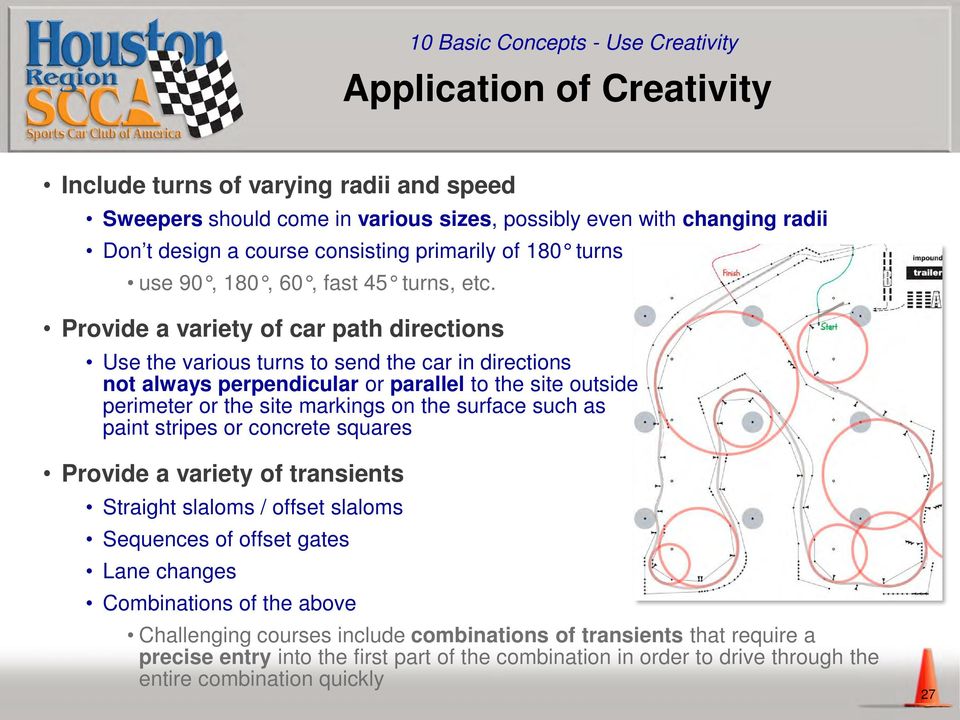
16 10 Basic Concepts - Use Creativity Application of Creativity Include turns of varying radii and speed Sweepers should come in various sizes, possibly even with changing radii Don t design a course consisting primarily of 180 turns use 90, 180, 60, fast 45 turns, etc. Provide a variety of car path directions Use the various turns to send the car in directions not always perpendicular or parallel to the site outside perimeter or the site markings on the surface such as paint stripes or concrete squares Provide a variety of transients Straight slaloms / offset slaloms Sequences of offset gates Lane changes Combinations of the above Challenging courses include combinations of transients that require a precise entry into the first part of the combination in order to drive through the entire combination quickly 27
17 10 Basic Concepts - Use Creativity Input Density Input density is: Measure of direction-changing steering inputs, divided by the length of the course The following is only a guideline (nothing is black and white ) Desired input density is about 20 to 35 inputs over a distance of ~ 3/4 mile Adequate time to set up between maneuvers, challenging to drive fast, drive times vary, drivers do not have trouble remembering all elements A less interesting course will have only 15 to 20 inputs for ~3/4 mile Too much time between maneuvers, resulting in a boring, non-challenging, course to drive where all times are approximately the same A too busy design will have more than 35 inputs for ~3/4 mile Drivers will never seem to have the time or room to set up for the next element Drivers feel they are thrashing through the course, just trying to survive until the finish 28
18 10 Basic Concepts - Use Creativity 5 Cone Slalom Version A; Basic 240 foot 5 cone slalom Version B; same maneuver, visually different Version C; same maneuver, visually different Version D; same maneuver, visually different 29

19 10 Basic Concepts - Use Creativity 5 Cone Slalom (continued) Version A; Basic 240 foot 5 cone slalom 60' 60' 60' 60' Version B; Change for interest Note: 75' 65' 55' 45' Version A & B are both 240' long. Version B offsets one cone width for each gain of 10' in slalom length, resulting in a more interesting maneuver of the same nature. The increase in distance prevents the maneuver from becoming painful Version C; Punish/Reward Cone 3 Cone 2 Cone 1 60' 60' 60' 60' reward punish Note: Cones 1 & 2 are offset 3' the hard way with cone 3 offset 1.5' the easy way. This opens up a "Lotus freeway" through the last 3 cones of the slalom. To make the punishment bearable, be sure to allow adequate set up area prior to the punishment, otherwise the punishment becomes painful 3' 30

20 10 Basic Concepts - Use Creativity Chalk Lines Use the chalk lines in variety of ways These are a few examples of how you can use the chalk lines to create more interest in the course design without changing the cone placement 31

21 10 Basic Concepts - Use Creativity The Before and Afters Placement of the gate before and after the start and finish of a slalom is critical as to the amount of turns that the slalom actually becomes 3 Cone Slalom The intent of a three cone slalom is usually to make 3 turns. As you can see from this example, this slalom has become 1 turn due to the placement of the before and after gates move move 32
22 10 Basic Concepts - Use Creativity Which is easiest to See? All three of these are a slalom - the same maneuver; Example 1 will be the easiest to see example 1 example 3 example 2 You must also consider if the inclusion of your creative cone placement has reduced clarity of the course significantly The surrounding cones from the following maneuvers may impact the clarity of these examples as well For instance, if you have several walls of cones following this slalom, example 1 would be most appropriate; and if not, examples 2 or 3 might be more appropriate 33
23 10 Basic Concepts - Use Creativity The Brainer the intent of a "brainer" is to allow a fast line through, but give it the visual effect of a slow maneuver. This will then give the competitor a reward, or a "doggy bone" if you prefer, for figuring it out. The Brainer The wall at the 180º will tend to make an unwary competitor square the corner out. The driver who looks carefully will round the corner out and use the lack of wall to their advantage The Brainer Competitors that don't "read" the course tend to drive cone to cone. The indicated cone will tend to pull in a driver who has not thought this one out. The fast line is to stay wide to make a sweeping turn. these cones tend to pull you in note lack of wall here 34
24 10 Basic Concepts 3.) No Hidden Agendas You should not accept a course design job for any reason other than a desire to design a course If you are not really interested in the design of it, chances are that you will not create a good course If you have gotten the responsibility by default (i.e the Event Chairman): Enlist someone who is truly interested in designing a course you will still be responsible for the design, but will have jobbed it to a more qualified/interested party Avoid designing the course on the premise of favoring your car, while penalizing others Example; Camaro versus Miata Camaro: 1000 straight, 180 turn, and a 1000 straight Miata: 45 offset slaloms connected with 30'Radius sweepers With a hidden agenda the result is a course that only a few people enjoy - or perhaps even a course that NO ONE will enjoy! 35
25 10 Basic Concepts 4.) Be Familiar with the Solo Course Design Rules Basic Concept 4.) refers to the rules found in Section 2.0 of your Solo rule book By knowing the rules in Section 2.0, you will be able to create a design that will be a Solo type course, as well as a design that is acceptable to the Solo Safety Stewards and your peers The following are diagrams taken from some of the 2014 rules ALL of the rules, of course, are important and should be known/understood - these are just the rules that I perceive to have the most impact on your design decisions 36
26 10 Basic Concepts - Solo Course Design Rules Familiarity 2.0 Diagrams 2.2.C The course boundary shall not normally pass closer than 25 feet from solid objects 2.2.D karts...upright solid objects on site within 50 feet of the course. This does not include curbs The better example shown here is considered minimum. Greater distances from Stationary objects is always better Real Bad Unacceptable Better light pole light pole light pole 50 + (karts) The course passes these objects closer The than course the 25 minimum (50 passes for Karts/Poles) these even objects though closer the than gates the may 25' be placed minimum within those guidelines 25' The course The passes course these passes objects these at the objects specified at the 25 minimum specified but 25' due to minimum, the direction but of the runoff, still still has has problems problems 25' 25 + cement curb cement curb cement curb a course deviation will now result in NO impact 37
27 10 Basic Concepts - Solo Course Design Rules Familiarity 2.0 Diagrams (continued) 2.2.M Participants and non-participants must be kept at a safe distance......minimum viewing distances may not be less than 75 from the course edge in unprotected areas (areas without adequate barrier protection such as concrete or tire walls)... The preferred example shown here is considered minimum. Greater distances from Spectator Areas are always better. Fast course sections should never aim directly at spectator areas without very large runoff distances Incorrect O.K. Grid Area Grid Area Note: A cement curb DOES NOT provide barrier protection 25' The course passes the Spectator area at less than the specified 75' minimum 75' Spectator Area course deviation could result in Spectator injuries Spectator Area course deviation results in no Spectator injuries 38
28 10 Basic Concepts - Solo Course Design Rules Familiarity 2.0 Diagrams (continued) 2.2.E Negative cambered turns will be avoided if at all possible Note: off camber rights are worse than Note: lefts, but both can be bad. The off off camber camber left has rights the are driver s worse weight than lefts, working but both in its are favor bad. The off camber left has the driver s weight working in its favor Note: Parking lots generally have a slight grade built into them to promote drainage of water. They usually drain away from the light poles to the sewage grates (duh...) Negative Camber Left Turn Direction of car A Car tends to roll left on a right turn and right on a left turn. So, use the hill to counteract this phenomenon on a sharp turn Positive (on) Camber Left Turn Direction of car lift lift Sewage Grate Area Sewage Grate Area 39
29 Crest of Hill Valley of Hill Light Pole Sewer Grate B A C E D 41
30 10 Basic Concepts - Solo Course Design Rules Familiarity 2.0 Diagrams (continued) 2.2.F A long straight (over 150 ) should not terminate in an extremely sharp turn... Bad A sharp turn following a high speed entry into a tight slalom Better A more gradual turn here following an increasing slalom Bad Better 45' 45' 100' 45' 70' 45' 45' 65' 150' or more 150' or more 60' 60' 150' or more 150' or more 42
31 10 Basic Concepts - Solo Course Design Rules Familiarity 2.0 Diagrams (continued) 2.2.H Cars on course simultaneously shall not run in close proximity to each other "Close Proximity"... The definition of this is ultimately up to the Safety Steward, but if you consider rule 2.2.L, the absolute minimum would be 75'. Obviously, the more drastic the maneuver, the more space that should be allotted. The whole idea of this rule is to keep 2 competitors from colliding in the event of one (or both) of them losing control or getting lost on course. Unacceptable Acceptable Better Yet 50' 75' 125' Cone walls only create a VISUAL deterrent and should NEVER be used as a barrier to protect another section of the course 43
32 10 Basic Concepts 5.) Make the Course Flow There s no such thing as a car that can turn on a dime... K.C. Babb It s not necessary to get into third gear in order to have a fun course The level of fun will more likely be determined by the flow of the course instead of the highest attained speed If you feel like you ve gone fast without violating the speed paradigms, then your design is a success So, then what is the Flow of the Course? The flow generally refers to the manner adjacent sections of a course connect to each other Envision a river flowing down a riverbed Even when the water is moving rapidly and encounters an object, it will find a way to flow around the object smoothly Your course should have the same characteristics - If a car cannot be maneuvered through the obstacles smoothly, the course does not flow 44
33 10 Basic Concepts - Make the Course Flow Ways to Make Your Course Flow To be able to accurately determine the flow of a course before you set it up, you must be able to first draw a scale map (gasp!) Visit the site before submittal of your map to make your map accurate and to include things and land formations to avoid Locate the key cones in your design Determine which cones control the speed and direction of the course (key cones) and remove any of the remaining cones that could cause confusion Remove a slalom cone in a slalom Allow a few more feet of width and/or length when approaching the next maneuver Avoid painful walled-in turns Ensure the next gate is visible in your peripheral line of sight Move a limiting or constricting gate 1 to 10 feet left or right to open the approach up Do not use painful maneuvers to slow things down 45
34 10 Basic Concepts - Make the Course Flow Maneuvers to Avoid Avoid maneuvers that could make a car roll Don t use significantly off camber turns, especially right turns Don t use decreasing radius right turns - especially sharp ones Avoid one-two hard corrections following a fast section as can can be found in a decreasing slalom There are also a few No Fun Maneuvers (NFMs) that I would recommend avoiding if possible Any maneuver that requires a 1st gear down shift 360 degree pivot turns - or also known as a spin cone Narrow, walled in sharp turns Gates or Slaloms with severe offsets and short spacing (45 spacing; 10 offset) Two 90 degree walled in turns (shaped like a Z ) just before the finish lights (which is O.K. for a start - but no way to finish!) Hitting the brakes hard just before the lights 45' 45' 45' 45' 10 Gap Finish 46
35 10 Basic Concepts - Make the Course Flow Locating Key Cones Key Cone Key Cone Key Cone Key Cone Pylons which control the line or path if the vehicle, and therefore the speed, are key cones Key Cone Key Cone Key Cone Key Cone 47
36 10 Basic Concepts - Make the Course Flow Gate Width versus Speed Key Cone Key Cone Advantages of wider gates Key Cone Choosing the superior line requires more skill and experience Key Cone Increasing the gate width without relocating the key cones provided no change in vehicle path or speed Key Cone Allows for mistakes/sloppiness with no pylon penalties Easier on course workers and timing & scoring Key Cone Key Cone Key Cone 48
37 10 Basic Concepts - Make the Course Flow Remove a Slalom Cone Tight 270' 45' 45' 45' 45' 45' 45' Better 58' 56' 54' 52' 50' 270' By removing only one cone in this 270 foot slalom, you are able to open up the slalom to a more reasonable spacing of 54 feet. This is not a wide open slalom and definitely flows better than the example on top. You can also make the slalom a gradually increasing allowing the more astute course walkers the chance to pick up on a feature that not everyone will realize 49
38 10 Basic Concepts - Make the Course Flow Lock to Lock Turns No lock to lock turns 10' Offset 45' Radius 28' Radius Previous 45' turning radius If you have a set of slalomed gates placed 45' apart, the resulting turning radius is approximately 45' Gate Placement 45' 45' Gate Placement 45' 45' By adding only 10' to the offset between the gates, the effective turning radius required to make the maneuver was reduced to (gaaack!) 28 feet! 45' 45' To avoid this from happening, increase the distances between the gates when offsetting the gates. The greater the offset, the greater the distance between the gates. 50
39 10 Basic Concepts - Make the Course Flow Lock to Lock Turns (continued) not fun Too much lock to lock steering input required painful Generally, avoid 180 turns. If required by lot shape, don't make lock to lock steering inputs just before entering the ' 45' 45' 55' better Same driving skills tested with less torture (less torture is a good thing ) better Open up the entering maneuvers Allow plenty of setup room to enter a 180 turn. Align your entry/exit gate centered to the 180 cone, unless you have allowed extra of room for your entry/exit of the ' 60' 80' entering maneuvers "set up" area 51
40 10 Basic Concepts - Make the Course Flow Avoid Painful Walled in Turns Painful Narrow, walled in sharp turns Better solutions keeping the same flavor as the original these areas cause the maneuver to be painful 1 flowing turn The placement of the wall forces the turn to be made up of 2 or more painful turns instead of a flowing turn 30' gates 18' gates 52
41 10 Basic Concepts - Make the Course Flow Line of Sight and Gate Positioning Bad Poor Solution Driver s View The next gate cannot be seen without turning to look for it Key Cone Key Cone Better Driver s View Better Better this gate is now in peripheral vision 53
42 10 Basic Concepts 6.) Use Elements that Favor HP and Elements that Favor Handling Use both types of elements is to create an equalizer course This would be one where a Camaro SS would have no advantage over a BMW 323i, which in 2014 are both in FStreet By doing so, you will have a much greater chance of pleasing the majority of the drivers in attendance First decide what favors horsepower and what favors handling Then evenly apply those kinds of maneuvers in your design In a over simplified explanation: horsepower handling straights (duh...) short to medium spaced slaloms long spaced slaloms and large radius sweeping turns small radius sweeping turns sharp turns (90 degree or more) chicane/lane changes maneuvers connected with straights successive maneuvers open maneuvers tight maneuvers etc. etc. A straight is any area where full acceleration can be utilized, and is not just the classic definition of the shortest distance between two points A slalom spaced greater than 100 can be considered a straight 54
43 10 Basic Concepts - Horsepower and Handling Utilize the Gap to Help Control Speed Version "A" Speed things up Use either easy or difficult maneuvers to speed up or slow down a course without disrupting the flow By increasing this gap, you will effectively increase the speed of the maneuver. A small increase (e.g. one foot) will have a surprisingly large effect Version "B" Slowing things down By increasing this overlap, you will effectively decrease the speed of the maneuver. A small increase here will also have a surprisingly large effect As was mentioned earlier, it is very important to draw scale map. This enables you to figure out where the fast/slow parts really are. Otherwise your course design will just be a fantasy in your mind until the day of the event. Placing it on paper allows you the freedom to actually design your course rather than depending on luck or chance. 55
44 10 Basic Concepts 7.) Use Pointers and Directionals Correctly and Sparingly Pointers A single lay down cone at the base of a standing cone The purpose of a pointer cone is ONLY to indicate the inside of a turn Your car will always turn around a pointer if it is placed correctly Do not use "Hey-Look At Me" (HLAM) cones - pointers on both sides of a gate These can be confused with a down cone that a worker has not noticed HLAM cones can make an experienced driver turn the wrong way since pointer cones are supposed to be on the inside of a turn Directionals A series of lay down cones (3 or more) to guide the driver s to the left or right Choose a set number of cones (such as 3 or more) and always use that amount when placing them on the course This creates a recognizable pattern When they see 3 lay downs, they know it is a directional set and not some other formation With pointers and directionals, less is more 56
45 10 Basic Concepts - those damn pointers... Correct Use of Directionals and Pointers Cones Incorrect Correct Incorrect Correct Use of the dreaded "Hey Look At Me" (HLAM) Cones If the pointer cone is placed correctly, the car will always be turning around the pointer Problem: Designer needs to draw attention to these gates 57
46 10 Basic Concepts 8.) Line the Course Line the course whenever possible It helps the inexperienced driver to make it through the course with out a DNF Lessens the chance for a cross-over, into an oncoming car The course should NOT be line dependent The course still must be driven successfully if the lines are rained away This is accomplished by paying close attention to basic concept #5 The lining of the course is a visual aid in basic course negotiation: NOT an indication of the correct line to drive Care should be taken to avoid the correct line from passing over the chalk lines; and should this not be considered, open wheel drivers will complain - rightfully so! Lines should not be so far outside the cones as to fall outside of the driver s vision What to use (in order of preference) Flour: non-caustic, easy to get, bright on pavement, smells like a Bakery! Marble Dust: non-caustic, hard to get, not bright on pavement Fertilizer: Caustic, easy to get, not bright on pavement, promotes weed growth Lime: Extremely caustic, Easy to buy, bright on pavement 58
47 10 Basic Concepts 9.) Place Gates to Avoid Visual Confusion Do not place cones or gates at intervals similar to the width of gates being used For example, do not place gates going around a sweeping turn 25' or 15' apart if all of your gates are 20' wide This creates a visual nightmare called Cone Hell since, at speed, all openings appear to be about the same size - Arrrrgh!!! Which is gap and which is gate? Make all cone walls dense enough so that at any angle, the gaps between them cannot be construed as a gate When entering a box or walled in turn, place the cones that appear in the approach path closer together and more frequently - creating a dense wall in the driver s line of sight 59
48 10 Basic Concepts - Avoid Visual Confusion Gate Spacing Rule of Thumb Gated Courses Ratio of gate width to gate spacing should be 1 to 3 or greater. For example, if your gate width is 20 feet the distance between gates would be 60 feet or greater direction Miniature Road Courses Ratio of gate width to gate spacing should be 2 to 1 or less. For example, if your gate width is 20 feet, the distance between gates would be 10 feet or less direction 60
49 10 Basic Concepts - Avoid Visual Confusion Plan and Perspective views The following examples show a plan view and a perspective view of certain situations so that you can better visualize the cone configuration being indicated What you see below is the basic path that the next 3 examples are going to take Plan View Perspective View Direction of travel Direction of travel 61
50 10 Basic Concepts - Avoid Visual Confusion Gates and Pointers This is an example of proper use of gates and pointers. The pathway is quite clear and easy to follow Plan View Perspective View 62
51 10 Basic Concepts - Avoid Visual Confusion Wall-o-Cones or Miniature Road Course (MRC) This is an example of the proper use of the miniature road course technique. The pathway for this is also quite clear and easy to follow Plan View Perspective View 63
52 10 Basic Concepts - Avoid Visual Confusion the Dreaded Sea of Pylons The dreaded sea of pylons shown here is the result of using spacing of gates similar to the gate width. As seen in the perspective view, the curve in the distance becomes vague and difficult to follow. When at speed, this effect is worsened since your mind has less time to process what is placed before it Plan View Perspective View 64
53 10 Basic Concepts - Avoid Visual Confusion More Examples of Cone Hell Other examples that demonstrate the importance of gate spacing Sweeper Lane Change confusing try this confusing better Cones placed at distances roughly equivalent to the gate width will be confusing at speed. or this Try to place gates a minimum of 3 times the distance of the gate width used 65
54 10 Basic Concepts - Avoid Visual Confusion Sweeper - Perspective View try this Intended Pathway direction could be confusing Placing cones at similar intervals as gate width causes this effect which can be confusing at speed or this direction direction direction 66
55 10 Basic Concepts - Avoid Visual Confusion Lane Change Perspective View sea of cones better 67
56 10 Basic Concepts - Avoid Visual Confusion Box Turns When entering a box or walled in turn place the cones that appear in the approach path closer together and more frequently could be a sea of cones better... 68
57 10 Basic Concepts - Avoid Visual Confusion Box Turns Perspective View Sea of cones Better... 69
58 10 Basic Concepts 10.) Walk & Drive your course with the Intent of Improvement Always walk and drive your course after its initial set-up with the intent of changing it to improve the flow I have never drawn a course, set it up and not changed at least one thing Keep the basic concept of your maneuver, but improve it to make it more fun Maybe it was too tight, or too fast, or visually hard to see What ever the shortcoming, this is the perfect time to fix it Take an experienced course designer and Safety Steward with you You are there when they have a suggestion You are able to control the types of changes the Safety Steward makes (to maintain the basic concept of the maneuver) You can discuss/analyze any of the suggestions the experienced course designer comes up with When not a competitor, DRIVE the course to find its shortcomings If you are a competitor, designate a non-competitor whose Solo course design opinions you trust to drive the course - and not Aunt Ethel (unless she is an AutoXer) Make your design changes based on the inputs received from the above Be a Commercial Artist, NOT a Fine Artist 70
59 Agenda Fundamentals 10 Basic Concepts So you have a Blank Piece of Paper... Elements, Dimensions and Real Speed Summary and Questions 71
60 So You Have a Blank Piece of Paper (DOH!! what now???) This section contains a method to use that will enable you to put your ideas and the 10 basic concepts you ve just gone over down on a piece of paper I have found that at times, a blank piece of paper can be extremely intimidating The following section will hopefully alleviate that problem and make this task easier for you as it has for me 72
61 So You Have a Blank Piece of Paper Before You Start Your Glorious Creation Make the job easier and improve your chances of success acquire or make a reasonable scale map of the event site that contains the following information: The accurate overall shape and size of the course area Map scale information Dimensions of parking stalls, Concrete square dimensions Locations of: Surface anomalies (grates, holes, oil, etc.); Immovable objects (light poles, buildings, curbs, trees, etc.); Boundary features (fences, sidewalks streets, etc.); Entrance and Exits; Elevation changes or sloped sections Address location/logistics of all non-course features on your map as well Site entrance(s) Waiver patrol points Pit areas Grid Spectator areas Registration Technical inspection Number of cones Timing vehicle/trailer/tent Finish placement/run-out 73
62 So You Have a Blank Piece of Paper Scale Map of the Topeka North Course Area Surface Problem Area 25 Cement Squares Spectator Area Grid Entrance Exit Manhole Drainage Grates (low area) 74
63 So You Have a Blank Piece of Paper Getting Started (Finally...) Position the Start and Finish Position the finish area first Runoff and type of finish Define exit/return route to grid Location of finish lights Clear view from Timing Avoid maneuvers at the lights Avoid the brakes at the lights Position the start area next Staging line and type of start Access from the grid Location of the start lights Clear view from Timing Place sharp turn just prior to or just after the lights to prevent the need of dumping the clutch Sketch General Route Do several general sketches Anticipate corner worker positions Note boundaries and immovable objects Avoid crossovers Provide separation between sections 75
64 So You Have a Blank Piece of Paper Course Design and Event Setup Example of a sketch 200 Finish Area Start Area 76
65 So You Have a Blank Piece of Paper Finalizing the Design Choose a variety of different types of maneuvers and features Make a list of the desired elements Decide which portions of that route lend themselves to each of the listed elements Pick the elements that seem the best for your pathway and fill them in Adjust turn radii and shapes Add transients where applicable Ensure a diversity of elements Add projected cone locations Don t think chalk line will guide drivers Rain or wind may eradicate those Allow for room driver error Prioritize key cones Repeat cone shapes to create patterns Pointers on apexes Four cone walls on outside of turns Standard gate widths Consistent number of lay downs Avoid Excess cones where not required for a desired visual Allow room for adjustment no course should be expected to be set up exactly as it was drawn 10 minimum movement allowance of individual cones, gates or even entire sections 77
66 So You Have a Blank Piece of Paper Finalized Design Example See next page to view this section 78
67 So You Have a Blank Piece of Paper Section from Finalized Design Chalk Lines Cones 25 Cement Squares Timing Light Line Indication 79
68 So You Have a Blank Piece of Paper Course Design and Event Setup Computer Design Analysis The following assumes that you have access to a fairly powerful computer with a current Graphics program that utilizes bezier curves and lines such as Adobe Illustrator, Xara, Zoner Draw, Deneba Canvas, Corel Draw, etc. When you input your design into a computer to scale, you can analyze how well the course flows by plotting the probable path of a car Create a probable path of the car using a bezier curve the approximate width of a car Most cars are about 6 feet wide Place your bezier intersections at probable apex points Adjust the bezier curves to create the fastest (shortest) course path Strive to have the line as smooth as possible Make your bezier handles similar in length Do not have bezier handles overlap each other 80
69 So You Have a Blank Piece of Paper Computer Design Analysis (continued) Bezier Intersection Handles not similar in length cone Bezier Handle Handles Overlap estimated width and path of car Elements of a Bezier Curve What NOT to do 81
70 So You Have a Blank Piece of Paper Slalom Speeds in MPH Lateral G s Slalom Spacing in Feet Expect <0.90 from stock cars on street tires, 1.10 g s from more prepared cars on race tires, 1.20 g s from a non-winged car such as C Mod, and 1.45 g s from a winged mod car Calculations are based on a constant radius, instantaneous transition model 82
71 So You Have a Blank Piece of Paper Course Design and Event Setup Cornering Speeds in MPH Lateral Gs Radius of Turn in Feet Expect <0.90 from stock cars on street tires, 1.10 Gs from Stock and SP cars on race tires, 1.20 Gs from a non-winged car such as C Mod, and 1.45 Gs from a winged mod car During analysis, be aware of the wide line which can affect the outcome 83
72 Acceleration distances So You Have a Blank Piece of Paper Course Design and Event Setup Acceleration and Braking Distances in Feet The blue/gray portion is used to estimate distance needed to reach a certain speed Based on a quick SP car, which could do 0-60 mph in 4.1 secs Braking distances The pink half of the chart is used to estimate braking distances of lower performance cars and for estimating stop box length Based on constant 0.8 g braking,(typical published vehicle maximum baking effort on street tires) Starting Target Speed in MPH Speed in MPH
73 So You Have a Blank Piece of Paper Course Design and Event Setup Practical Application to match speed of the following turn Start with the speed of the preceding turn to calculate the speed of following Straight To calculate the distance needed to slow down 85
74 So You Have a Blank Piece of Paper Course Design and Event Setup Practical Application A 75 R 35mph B Brake Speed End speed (C) Brake Distance (D) Calculate braking distance Determine speed of turn A Determine speed of straight B Speed of A and length of straight = speed Determine speed of turn C D Calculate braking distance needed for D Speed of B and target speed of C = braking distance 143 acceleration brake = 256 straight C 50 R 29 mph Start Speed (A) Distance (B) Ending Speed Starting Target Speed in MPH Speed in MPH Lateral Radius of Turn in Feet Gs
75 So You Have a Blank Piece of Paper Course Design and Event Setup Practical Application A 75 R B Start Speed (A) Distance (B) Ending Speed Brake Speed End speed (C) Brake Distance (D) Calculate stop box length C Determine speed of turn A Determine speed of straight B Calculate braking distance to 0 mph needed for C Starting Target Speed in MPH Speed in MPH Lateral Radius of Turn in Feet Gs Be sure to add plenty of margin to the actual stop box so that all cars can easily slow/stop within the box 150 brake + 50 reaction time = 200 stop box In addition, when raining, these stop distances increase considerably (about double) 87
76 So You Have a Blank Piece of Paper Flow Analysis 178R 52 MPH 33 MPH 73R 37 PH 86R 86R 37 MPH 135R 46 MPH 87R 37 MPH 109R 109R 41 MPH 37 MPH 87R 33 MPH 70R 46 MPH 135R 31 MPH 58R 35 MPH 80R 40 MPH 99R 99R 40 MPH 70R 33 MPH 116R 88
77 So You Have a Blank Piece of Paper Computer Design Analysis Bezier curve analysis helps to plan a fast line through sections that look slow, as well as discover sections that look fast but are truly painful 89
78 So You Have a Blank Piece of Paper 90
79 So You Have a Blank Piece of Paper 91
80 Curb and Chain link fence Timing Truck ~200 Grid Light pole Light pole 181 R = ~55 mph speed in turn, followed by 100 straight Whats Wrong With this Finish? Light pole 92
81 Curb and Chain link fence Curb and fence too close for speed of finish ~200 Timing Truck Timing truck too close Grid Light pole Light pole Light pole R = ~55 mph speed in turn, followed by 100 straight Turn too fast for length of finish (does not slow car) 55 mph turn straight = ~68mph at the lights on DOT Race Tires Stopping distance ~200 in a 200 stop box and no one stops right at the lights Whats Starting Wrong Speed in With MPH this Finish? Target Speed in MPH
82 So You Have a Blank Piece of Paper Designing a Safe Finish No Simple Solution Every change you make - will impact somewhere else Every competitor, skill and common sense level are different Every lot has different shapes, hazards, restrictions, overall grip Humans can be totally unpredictable So plan your finish carefully Each site offers its own strengths/weaknesses, and finishes are too often afterthoughts rather than well-planned Ensure adequate room for runout, ingress, egress, timing, and all of the other associated issues 94
83 Allow them to FLOOR IT at the finish So You Have a Blank Piece of Paper Designing a Safe Finish Consider Human Nature (stupid humans!) Most drivers tend to floor at the finish in an effort to make up for ALL of the mistakes made up to that point even if the design does not allow for it Since they will do it anyway, (site size allowing) provide opportunity to floor it SAFELY How can entrants floor it at the finish safely? By making them slow enough at the point they begin to floor it for the finish In addition, the car MUST be settled when floored or you get a high speed spin The turn preceding the straight before the lights must be *completed* (meaning the car is settled and not wagging) ~100' from the lights Make it safe for everyone by planning for the unintended line Even when the correct line ends 100' prior to the lights, will the wrong approach end the turn 100' prior to the lights? If not, they will likely be out of control, and flooring it at the finish Walk/drive it as intended (on line), and *then* as not intended (not on line) The course will look much different when driven not as intended 95
84 So You Have a Blank Piece of Paper Designing a Safe Finish Tweaking it at Set Up Dealing with Acceleration Intoxication (AI) AI can impair driver s judgment when to safely stop; and nobody brakes at the lights which can result in going through the end of the finish; plan for this Define the finish clearly Alternately colored cones after the finish lights Different flour line pattern Nothing near end of stop box Allow enough course area for your finish Layout the finish first, then route the rest of the course to join the start The higher the hazard; the higher the approach speed = the more run-out allowed A fast finish should have 200 ; or after the lights (refer to speed chart) Long enough to allow stopping with brakes locked (not the best way to stop) Ample buffer after the end of the finish lane (>75 of people or objects) 96
85 So You Have a Blank Piece of Paper Designing a Safe Finish Checklist In summary, a safe finish: 1.) Allows enough course area to stop easily 2.) Allows the entrant to floor it on the last 100 to the finish - SAFELY 3.) Includes a slowing turn that is completed before the 100, even if driven incorrectly 4.) Has considered and been revised for the unintended line 5.) Considers what lies beyond the finish lane 6.) Does NOT depend on common sense to prevent an incident Words of wisdom If course length has to be given up to provide enough run out after the lights, so be it It will only cost about a second to give another feet to the finish Make sure the "slowing turn" to rein in speeds before the finish, actually slows It's better to have folks grumble about slower speeds than it is to have an incident 97
86 So You Have a Blank Piece of Paper Worker Stations Now add the projected course worker stations and projected coverage area Keep coverage distances around 200 feet in any direction or less if possible Position near solid objects if possible/available light pole tree planter, etc. Locate workers on the inside of a turn rather than the outside Anticipate possible directions that a car may spin and avoid those areas Prioritize closeness to the cones likely to be hit slalom cones tight apexes outside walls at ends of significant straights, etc. Try to ensure that workers do not have to cross another area of the course to get to a down cone in their coverage area 98
87 So You Have a Blank Piece of Paper Placing Worker Stations Main Worker Station (Radio, Audit Sheet, Cone Chasers) Satellite Worker Position (1 or 2 one Chasers) S 5 North Grid 99
88 So You Have a Blank Piece of Paper Course Set Up at the Event Site Things are not always what they seem - or - I could have sworn they d have to lift there! It is rare to be able to say that the entire design worked the way it was intended The 1995 Nationals course shown earlier turned out to be flat out from the start until the first 90 turn - not what I expected at all! Sometimes it is difficult to spot poor sections on paper but easy to see once the pylons are in place A good designer will exhibit flexibility and make on-site adjustments to allow the course to flow properly Maps, such as the ones included in this booklet, usually have cones in them that are approximately 3-5 feet in diameter - which makes it impossible to be totally accurate Because of this, some course elements which appear to reduce speed on paper may in fact be wide open, as I found out from my example above The converse is true too - some elements which appear to be moderately open will be difficult and tight to drive So make adjustments at the event site, make note of your errors and your current and future course designs will benefit 100
89 So You Have a Blank Piece of Paper Large, Expansive Sites
90 So You Have a Blank Piece of Paper Large, Expansive Sites (continued) 1999 Differences between Day1 and 2 besides course direction 102
91 So You Have a Blank Piece of Paper Long Skinny Sites 12.5 x 15 grid (cement Squares) How about a long and skinny event site? Avoid slalom down, 180 turn, slalom back Balance between slaloms, sweeping turns, and offset gates, just as you would in an open lot You just have to be more creative to do so 8^) 103
92 So You Have a Blank Piece of Paper Narrow Road Course Sites 104
93 So You Have a Blank Piece of Paper Narrow Road Course Sites (continued) Differences between Day1 and 2. Note that course direction is same both days 105
94 So You Have a Blank Piece of Paper Small Or Odd Shaped Lot Utilization Estadio Monumental vs. SCCA Nationals East Course Area
95 So You Have a Blank Piece of Paper Small Or Odd Shaped Lot Utilization Estadio Monumental Start next staged car when first car is here 2 nd Pass 1 st Pass 285 Can a Car drive through this yellow area? Stage Grid Paddock Are we allowed to paddock here? Finish Timing 600 Stairs Start Can a Car drive through this yellow area - or are stairs here? 107
96 So You Have a Blank Piece of Paper Small Or Odd Shaped Lot Utilization Lumber Yard vs. Solo Nationals East Course Area 108
97 So You Have a Blank Piece of Paper Small Or Odd Shaped Lot Utilization Lumber Yard Site Although the original design made good use of Revised the area, course it required was easy to find, and could send 2 memory to drive, had finish going head on into start (potential head-on), nd car as soon as 1 st car committed and would have been a bit confusing to drive. to finish
98 So You Have a Blank Piece of Paper Small Or Odd Shaped Lot Utilization My Frozen Butte vs. Solo Nationals East Course Area 111
99
100 So You Have a Blank Piece of Paper Other Difficult Shaped Sites 113
101 So You Have a Blank Piece of Paper 114
102 Agenda Fundamentals 10 Basic Concepts So you have a Blank Piece of Paper... Elements, Dimensions and Real Speed Summary and Questions 115
103 Element Dimensions and Real Speed This section of the book will address is how you, as a course designer, can relate course content and size to how fast the competitors cars might actually go You Techno-Weenies (TW) are gonna love this If you are not a TW, this section is still important to understand. It has a real life example as to why you must make your courses equalizer courses as outlined in the 6th basic concept This section will address: Sweeper speeds Radius of a turn Cornering G s of a car Straightway speeds Length of straight Acceleration times Length Sweeper Radius Straightaway 116
104 Element Dimensions and Real Speed Disclaimers All calculations shown in this section are based on Car magazine road test data The variables include: Type of surface used for testing Type and size of the tires on the car Preparation level of the car shocks alignments bushings, etc. Abilities of the test driver Approximations are inherent in the methods used Sweepers are not usually constant radius arcs Straightways often are not perfectly straight What makes a quick autocross car is not just pulling high G s and acceleration 117
105 Element Dimensions and Real Speed Sweeper Speeds The relationship of the radius of the turn and the cornering G s is shown in the table below: Radius 50' Miles per hour Radius 75' Radius 100' Sweeper Radius G Force ( 93 Camaro) 0.82 ( 93 Sentra)
106 Element Dimensions and Real Speed Straightway Speeds full throttle application point Length of Straight brake point Length Acceleration times Magazine test data usually include times for: 0-30 mph 0-40 mph 0-50 mph 0-60 mph 0-70 mph Calculation of distance covered is based on the area beneath the curve on a plot of velocity versus time 119
107 Element Dimensions and Real Speed Camaro Specifications 120
108 Element Dimensions and Real Speed Camaro Velocity vs. Time 100 Velocity vs Time 70 mph 70 mph 8.1 sec Speed - feet per second mph 2.7 sec 40 mph 50 mph 60 mph Camaro Time - seconds Under full acceleration from 30 to 70mph, the Camaro will travel feet in 5.5 seconds 121
109 Element Dimensions and Real Speed Sentra Specifications 122
110 Element Dimensions and Real Speed Sentra Velocity vs. Time Speed - feet per second mph 2.7 sec Velocity vs Time 40 mph 50 mph Time - seconds 60 mph mph 10.8 sec Sentra Under full acceleration from 30 to 70mph, the Sentra will travel feet in 8.1 seconds 123
111 Element Dimensions and Real Speed Camaro and Sentra Velocity vs. Time Speed - feet per second mph Velocity vs Time Time - seconds 70 mph 8.1 sec 2.6 seconds mph 10.8 sec Camaro Sentra The Sentra would have to travel 2.6 seconds longer and feet farther than the Camaro to reach 70 mph 124
112 Element Dimensions and Real Speed How a Straight Gives Time to Power How much effect can a big straight have on the competition? Camaro: in 5.5 seconds; 426 feet Sentra: in 8.1seconds; 628 feet Also reaches 351 feet in 5.5 seconds (Camaro = 426 feet in 5.5 seconds) Finally reaches 426 feet in 6.35 seconds (which the Camaro did.85 seconds quicker) O.K. - so what does that mean? The time advantage for the Camaro over a 426 foot straight section is about 0.85 seconds, or a total distance of 75 feet How could the Sentra make up that difference? Either a secret nitrous container or go faster in the turns To go faster in the turn, it needs a higher entry speed into the straight by 9.2 mph, so it would need to pull about 71% more G s in the sweeper Hey folks - That's 1.43 G s - and that ain t gonna happen! 125
113 Element Dimensions and Real Speed Why Do We Care? How a straight gives time to a car with power The Camaro isn t classed with the Sentra, but classes do contain such mixtures For example in 2014, the FStreet class contains: 1999 BMW 323i 3,200 pounds / 170 horsepower = lbs/hp (where bigger = slower) 2002 Camaro SS 3,600 pounds / 345 horsepower (oh my ) = lbs/hp That is a 44% difference in power to weight ratio between cars in the same class So what does that have to do with a Camaro/Sentra comparison? Sentra 2,600 pounds / 140 horsepower = lbs/hp 1993 Camaro V pounds / 275 horsepower = lbs/hp That is only a 34% difference between the cars in our example Horsepower to weight disparities within class structure make it essential to balance your course design between power and handling 126
114 Element Dimensions and Real Speed Speed in Solo2 Course Design How fast do we go? Why do we care? this could be information *some of you* don t want to know 127
115 Element Dimensions and Real Speed What the Rules Say should not normally exceed the low 60 s (mph) for the fastest Stock and Street Prepared cars This doesn t mean the average: it means the maximum Don t try to get cute with normally 128
116 Element Dimensions and Real Speed Why Is Speed Compliance So Important? Keywords (from Risk Management): Negligence Gross Negligence Release/Waiver Effectiveness Punitive Damages Compensatory Damages Insurance Rates Coverage Refusal 129
117 Element Dimensions and Real Speed What s The Point? A good Stock or SP car can get a lot more speed a lot more quickly than many people realize (remember, the rule says fastest ) It s easy to figure these things out in terms of something simple like the length of a straightaway, or the size (radius) of a turn This is different from the I could have sworn they d have to lift there problem 130
118 Element Dimensions and Real Speed What Does All This Mean? A Stock Z06 can get from 30 mph (speed in a sweeper of ~65 Radius) to 80 mph in just over 400 feet There are probably SP cars that can do it even quicker Pure straights much over 400 feet in length are iffy; much longer ones are just plain irresponsible 131
119 Element Dimensions and Real Speed What Can You Do? Have higher density of quick elements that are not straights; which can be plenty of fun Connected sweepers ( esses ) Lane changes Big slaloms (70-80 spacing) Elements that require throttle modulation and/or even (horrors) a little braking 132
120 Element Dimensions and Real Speed What Should You Not Do? As administrators: Don t let course designers think they have the last word (Event Chairs and Safety Stewards do) Don t rationalize letting it go this time Don t listen to competitors who whine about not being able to go real fast 133
121 Element Dimensions and Real Speed What Should You Not Do? As designers: Don t focus on pushing the envelope with regard to speed Focus instead on delivering a challenging, fun driving experience that provides quality competition Don t put a tightening transient element near the end of a fast stretch, to slow cars down (recipe for sedan rollovers) 134
122 Element Dimensions and Real Speed Protect Our Sport If Solo, as the Rules define it, isn t what someone wants to be driving, they should go try something else (e.g. Solo 1, Solo Trials) These folks should not be allowed to corrupt our sport into something it was never meant to be: they put us all at risk! 135
123 Agenda Fundamentals 10 Basic Concepts So you have a Blank Piece of Paper... Elements, Dimensions and Real Speed Summary and Questions 136
124 Questions? Remember, the more courses you design and set up, the better your courses will be Please feel free to contact me with any future questions I can be reached as listed below: Home of the Criminally Insane Attention: Roger H. Johnson 3910 Gallaher Court Missouri City, Texas (281) work Central Time (281) home/cell Central Time [email protected] [email protected] Website Complete Course Design Booklet 137
cornering C O R N E R I N G Have you ever over-cooked a corner? Did your confidence take a knock as a result? Did you work out why it happened?
 This THINK is a pdf Norfolk is FREE Partnership to download - 011 for personal use - all content remains the property of the THINK Norfolk Partnership - 011 Page 1 Have you ever over-cooked a corner? Did
6: LANE POSITIONS, TURNING, & PASSING
 6: LANE POSITIONS, TURNING, & PASSING BASIC LANE POSITIONS Traffic law says that slower vehicles should stay to the right. But where exactly should bicycles ride? Here are some basics. Never Ride Against
Operating Vehicle Control Devices
 Module 2 Topic 3 Operating Vehicle Control Devices 1. Identify the vehicle controls in the pictures below: 1. 2. 3. 4. 7. 7. 5. 6. 1. accelerator 2. parking brake 3. foot brake 4. gear shift lever_ 5.
Anamorphic Projection Photographic Techniques for setting up 3D Chalk Paintings
 Anamorphic Projection Photographic Techniques for setting up 3D Chalk Paintings By Wayne and Cheryl Renshaw. Although it is centuries old, the art of street painting has been going through a resurgence.
Chapter 4 DEFENSIVE DRIVING
 Chapter 4 DEFENSIVE DRIVING Chapter 4 Table of Contents Chapter 4 DEFENSIVE DRIVING... 4-1 DEFENSIVE DRIVING... 4-3 Positioning The Bus... 4-3 When Making a Turn at an Intersection... 4-3 Making the perfect
The Basics of Robot Mazes Teacher Notes
 The Basics of Robot Mazes Teacher Notes Why do robots solve Mazes? A maze is a simple environment with simple rules. Solving it is a task that beginners can do successfully while learning the essentials
Competition Car Insurance Ford Fiesta Championship Anglesey 25th/26th September
 Competition Car Insurance Ford Fiesta Championship Anglesey 25th/26th September It was a busy week for the team after the problematic Scottish Championship rounds at Knockhill last weekend. After initially
Getting Started in Tinkercad
 Getting Started in Tinkercad By Bonnie Roskes, 3DVinci Tinkercad is a fun, easy to use, web-based 3D design application. You don t need any design experience - Tinkercad can be used by anyone. In fact,
STRING TELEPHONES. Education Development Center, Inc. DESIGN IT! ENGINEERING IN AFTER SCHOOL PROGRAMS. KELVIN Stock #651817
 STRING TELEPHONES KELVIN Stock #6587 DESIGN IT! ENGINEERING IN AFTER SCHOOL PROGRAMS Education Development Center, Inc. DESIGN IT! Engineering in After School Programs Table of Contents Overview...3...
Defensive Driving While Towing a Trailer By Elizabeth Koncki, Maryland Department of Agriculture
 Defensive Driving While Towing a Trailer By Elizabeth Koncki, Maryland Department of Agriculture Many of you have heard the term defensive driving, but maybe you may have not been taught the method or
general, accidents caused by misjudging
 Unit 3: The Effect of Natural Forces on your Vehicle Page 1 of 11 Purpose: Acquaint the student with some of the natural forces acting on a vehicle while stopping, maneuvering, and during a crash. Explain
Bicycle Safety Quiz Answers Parental Responsibilities
 Bicycle riding is a great way to get into shape and enjoy the outdoors. To remain safe on Illinois roads, it is important to follow the same traffic safety laws that govern vehicle drivers. No amount of
ADA POST INSPECTION CHECKLIST. Job No. Route County Location
 ADA POST INSPECTION CHECKLIST Job No. Route County Location SIDEWALKS All sidewalks constructed within the project limits are ADA compliant. Sidewalks are 5 or greater in width. Exception, existing sidewalks
New Perspectives on Accident/Incident Investigation
 Session No. 515 New Perspectives on Accident/Incident Investigation Larry Wilson Belleville, Ontario Canada Introduction Most accident/incident investigations tend to look at the injury or incident from
BACKING UP PROCEDURES FOR SCHOOL BUS DRIVERS
 LEADER S GUIDE 2498-LDG-E BACKING UP PROCEDURES FOR SCHOOL BUS DRIVERS Quality Safety and Health Products, for Today...and Tomorrow Introduction This video is designed to demonstrate backing up training
ve been rolling Here, s to you, Oregon riders! You, , s no wonder for longer than you, ve been walking, so it
 THE BICYCLIST S 1 the bicyclist s survival guide ride safely. the way to go. 2 Here, s to you, Oregon riders! You, ve been rolling for longer than you, ve been walking, so it, s no wonder you feel right
Would You Like To Earn $1000 s With The Click Of A Button?
 Would You Like To Earn $1000 s With The Click Of A Button? (Follow these easy step by step instructions and you will) This Version of the ebook is for all countries other than the USA. If you need the
C Grade Licence Examination Written and Oral questions Study Master List
 C Grade Licence Examination Written and Oral questions Study Master List Prior to Examination: Candidates are encouraged to either view the live copy of the current Manual or obtain all amendments to the
Double Deck Blackjack
 Double Deck Blackjack Double Deck Blackjack is far more volatile than Multi Deck for the following reasons; The Running & True Card Counts can swing drastically from one Round to the next So few cards
chapter 3 basic driving skills
 chapter 3 basic driving skills When curving to the left, keep the front wheels close to the right edge of the lane to keep your driver s side rear wheels out of the next lane of traffic. Curve ahead slow
How To Design A Crash Investigation Site
 CHAPTER 7 CRASH INVESTIGATION SITES December, 2000 7. Crash Investigation Sites (CIS) 7.1. Introduction and Usage The idea of "crash investigation sites" or areas outside of the freeway mainline where
Bicycle Riding. WHAT ARE the. One Final Note... It is against the law to ride a bicycle under the influence of alcohol and/or drugs. (21200.
 One Final Note... It is against the law to ride a bicycle under the influence of alcohol and/or drugs. (21200.0 VC) Bicycle Riding WHAT ARE the CALIFORNIA HIGHWAY PATROL CHP 909 (12/11) OPI 013 94 75015
Videos for Safety Meetings
 Videos for Safety Meetings 2474 2005, ERI Safety Videos OPERATING ELECTRIC PALLET JACKS SAFELY This easy-to-use Leader s Guide is provided to assist in conducting a successful presentation. Featured are:
WFTDA TRACK LAYOUT GUIDE
 WFTDA TRACK LAYOUT GUIDE Updated March 2015 For use with Appendix A: WFTDA Track Design and Specifications MATERIALS REQUIRED: Tape measure (at least 100 feet or 30.48 meters) Marking tape, chalk, or some
Bicycle Safety Enforcement Action Guidelines
 Introduction Bicycle Safety Enforcement Action Guidelines People ride bicycles for many different reasons: fitness, recreation, or for transportation. Regardless of the reason for riding, bicyclists young
Safety-conscious Drivers Prevent Crashes. Defensive Driving: Managing Visibility, Time and Space. Improve Your Defensive Driving Skills
 Defensive Driving: Managing Visibility, Time and Space Motor vehicle travel is the primary means of travel in the United States. With all the benefits that come along with mobility, there are thousands
House Design Tutorial
 Chapter 2: House Design Tutorial This House Design Tutorial shows you how to get started on a design project. The tutorials that follow continue with the same plan. When we are finished, we will have created
BEGINNING TERRAIN PARK SKI INSTRUCTION
 BEGINNING TERRAIN PARK SKI INSTRUCTION By Chuck Roberts PSIA Certified Level III Alpine http://www.robertsski.com [email protected] - 1 - Copyright 2004 Charles C. Roberts, Jr. All rights reserved. Printed
Assisting Students Who Use Wheelchairs:
 Quick-Guide Extra Assisting Students Who Use Wheelchairs: Guidelines for School Personnel Michael F. Giangreco, Irene McEwen, Timothy Fox, and Deborah Lisi-Baker Quick-Guides to Inclusion 3: Ideas for
Teaching Your Teen to Drive
 MetLife Auto & Home Teaching Your Teen to Drive Without driving each other crazy! Dear Parent/Guardian, One of the best ways for you to influence your teen s driving habits is to sit in the copilot seat
Bicycle riding is a great way to get into shape
 Bicycle riding is a great way to get into shape and have fun. To remain safe on Illinois roads, it is important to follow the same traffic safety laws that govern vehicle drivers. No amount of bicycle
Broward County Public Schools Core Curriculum Department. Driver s Education Basic Driving Skills: Study Guide
 Broward County Public Schools Core Curriculum Department Driver s Education Basic Driving Skills: Study Guide 5 th Edition 2 nd Edition K.C. Wright Administrative Building 600 Southeast Third Avenue Fort
WPA World Artistic Pool Championship. Official Shot / Challenge Program. November 8, 2011 1
 WPA World Artistic Pool Championship 2012 Official Shot / Challenge Program November 8, 2011 1 Revision History November 30, 2010: Initial version of shot program. January 10, 2011: February 14, 2011:
Gas Dynamics Prof. T. M. Muruganandam Department of Aerospace Engineering Indian Institute of Technology, Madras. Module No - 12 Lecture No - 25
 (Refer Slide Time: 00:22) Gas Dynamics Prof. T. M. Muruganandam Department of Aerospace Engineering Indian Institute of Technology, Madras Module No - 12 Lecture No - 25 Prandtl-Meyer Function, Numerical
What s New V 11. Preferences: Parameters: Layout/ Modifications: Reverse mouse scroll wheel zoom direction
 What s New V 11 Preferences: Reverse mouse scroll wheel zoom direction Assign mouse scroll wheel Middle Button as Fine tune Pricing Method (Manufacturing/Design) Display- Display Long Name Parameters:
The Importance of Goal Setting When Starting Your Own Online Business
 The Importance of Goal Setting When Starting Your Own Online Business A Special Report By: Tom Browne 1. Dare to Have Big Dreams 2. Dream Boards 3. How to Set a Goal 4. Short- and Long-Term Goals 5. Identify
Back to School Car Safety. Direct Buy Warranty Staff September 19, 2014
 Back to School Car Safety Direct Buy Warranty Staff September 19, 2014 It s back to school season, and that means kids are picking out new clothes, putting on their backpacks, and hitting the road to get
DEFENSIVE DRIVING. It s an Attitude
 DEFENSIVE DRIVING It s an Attitude RLI Design Professionals Design Professionals Learning Event DPLE 155 July 15, 2015 RLI Design Professionals RLI Design Professionals is a Registered Provider with The
TRAFFIC ACCIDENT STUDY GUIDE 2010
 TRAFFIC ACCIDENT STUDY GUIDE 2010 SECTION SEVEN This study guide is designed to provide the law enforcement Explorer with basic principles. The guide is not all inclusive, and does not delineate specific
EMPLOYEE FALL PROTECTION
 EMPLOYEE FALL PROTECTION You can fall from any height and be seriously injured or killed. In the construction industry, as well as any other industry, when falls from heights happen, they are usually very
Get to Know Golf! John Dunigan
 Get to Know Golf! John Dunigan Get to Know Golf is an initiative designed to promote the understanding the laws that govern ball flight. This information will help golfers develop the most important skill
Slips, Trips and Falls. Awareness Month. February 2005. Slips, Trips and Falls
 THE SCHOOL DISTRICT OF PITTSBURGH Slips, Trips and Falls Awareness Month Joint Labor / Management Safety Committee Please open the attachment for additional information that will answer safety questions
Tips for Safer Driving
 Fleet Management Fleet Management Introduction Improvements in technology will continue to help bring auto accident numbers down, but the bottom line remains that most car accidents are the result of human
AwanaGames Circle. Official. Diagram 1. Key to diagram: Pin & Striped Bean Bag C Diagonal or Starting Line. B Scoring Pins, or Center.
 Official AwanaGames Circle Diagram 1 The AwanaGames Circle is 30 feet in diameter surrounded by a 37-40 foot square. Each team is designated by a color and occupies a quarter-circle or one side of that
The Photosynth Photography Guide
 The Photosynth Photography Guide Creating the best synth starts with the right photos. This guide will help you understand how to take photos that Photosynth can use to best advantage. Reading it could
Roof Tutorial. Chapter 3:
 Chapter 3: Roof Tutorial The majority of Roof Tutorial describes some common roof styles that can be created using settings in the Wall Specification dialog and can be completed independent of the other
How To Know When A Market Is In A Strong Trending Phase
 The 3 Rules of Successful Swing Trading Trade with the Wind at Your Back The Rule That Hits Home Runs & Be In the Right Place at the Right Time by Michele Mish Schneider, Director of Trading Research &
Four key factors in billboard site selection. Putting your message in a big, outdoor context can grab attention if you find the right spot
 Four key factors in billboard site selection Putting your message in a big, outdoor context can grab attention if you find the right spot PUTTING YOUR MESSAGE IN A BIG, OUTDOOR CONTEXT CAN GRAB ATTENTION
Pristine s Day Trading Journal...with Strategy Tester and Curve Generator
 Pristine s Day Trading Journal...with Strategy Tester and Curve Generator User Guide Important Note: Pristine s Day Trading Journal uses macros in an excel file. Macros are an embedded computer code within
Slalom. Coach and Others Involved in Delivery Others involved in delivery
 Slalom (SLALOM) Session goal(s) () Safely negotiate left and right turns, Ride side by side () Control bike around tight turns, React to changes in course width when riding together, Improve Balance and
Document Name: Driving Skills. Purpose: To outline necessary driving skills required to maximize driving safety.
 Document Name: Driving Skills Date Created: 8 October 2013 Date Reviewed: 4 February 2014 Date Approved: 29 July 2015 Purpose: To outline necessary driving skills required to maximize driving safety. Overview:
Lay Betting Selection System. Strike Rate!!
 Strike Rate!! Introduction Firstly, congratulations of becoming an owner of this fantastic selection system. You ll find it difficult to find a system that can produce so many winners at such low liability.
Chapter 7: Momentum and Impulse
 Chapter 7: Momentum and Impulse 1. When a baseball bat hits the ball, the impulse delivered to the ball is increased by A. follow through on the swing. B. rapidly stopping the bat after impact. C. letting
Canalis. CANALIS Principles and Techniques of Speaker Placement
 Canalis CANALIS Principles and Techniques of Speaker Placement After assembling a high-quality music system, the room becomes the limiting factor in sonic performance. There are many articles and theories
DESCRIBING OUR COMPETENCIES. new thinking at work
 DESCRIBING OUR COMPETENCIES new thinking at work OUR COMPETENCIES - AT A GLANCE 2 PERSONAL EFFECTIVENESS Influencing Communicating Self-development Decision-making PROVIDING EXCELLENT CUSTOMER SERVICE
Seven Things You Must Know Before Hiring a DUI Lawyer
 Seven Things You Must Know Before Hiring a DUI Lawyer 1 Introduction Some people don t quite understand the severity of getting a DUI. In many cases, your license is instantly taken away and you won t
ADOPT WORK SAMPLE TEST BATTERY PROCTOR MANUAL
 ADOPT WORK SAMPLE TEST BATTERY PROCTOR MANUAL 2012 WORK SAMPLE TEST BATTERY PROCTOR MANUAL TABLE OF CONTENTS A. Introduction... 1 B. Administration of the POST Work Sample Test Battery... 2 C. Protocols
The Mechanics of Arrow Flight 101 By Daniel Grundman Flex-Fletch
 The Mechanics of Arrow Flight 101 By Daniel Grundman Flex-Fletch Thunk! The arrow you just released from your bow has hit its target. Or has it? Due to a number of factors, your arrow may or may not have
Lesson 26: Reflection & Mirror Diagrams
 Lesson 26: Reflection & Mirror Diagrams The Law of Reflection There is nothing really mysterious about reflection, but some people try to make it more difficult than it really is. All EMR will reflect
THE HR GUIDE TO IDENTIFYING HIGH-POTENTIALS
 THE HR GUIDE TO IDENTIFYING HIGH-POTENTIALS What makes a high-potential? Quite possibly not what you think. The HR Guide to Identifying High-Potentials 1 Chapter 1 - Introduction If you agree people are
Hanna delivers the technical and marketing expertise needed to produce a car wash that meets the car wash customer's expectations.
 Planning a Car Wash Planning begins with examining customer preferences. A review of the latest consumer survey data (including the 2001 ICA Study of Consumer Carwashing Attitudes and Habits) indicates
Mathematics on the Soccer Field
 Mathematics on the Soccer Field Katie Purdy Abstract: This paper takes the everyday activity of soccer and uncovers the mathematics that can be used to help optimize goal scoring. The four situations that
RECOGNIZING SLIP, TRIP AND FALL HAZARDS
 Module 2 RECOGNIZING SLIP, TRIP AND FALL HAZARDS Purpose This module prepares participants to recognize slip, trip and fall hazards in their organizations. It begins with an introduction to four risk factor
WHAT IS THE LAW SURROUNDING CAR ACCIDENTS?
 WHAT IS THE LAW SURROUNDING CAR ACCIDENTS? How Does The Law Determine Who s At Fault? When determining fault, there is no one answer that covers all scenarios. Accidents produce and are produced by many
TEST ON Driving Safely Among Bicyclists and Pedestrians
 TEST ON Driving Safely Among Bicyclists and Pedestrians Next you will take a 16 question test about driving safely among bicyclists and pedestrians. Please take out a sheet of paper to mark down and score
0:00:29 Kim: Thank you Todd, happy to be here, looking forward to talking about selfdirected
 0:00:18 Todd: Hey everybody, welcome to another edition of The Prosperity Podcast, this is No BS Money Guy Todd Strobel. Once again, we have cohost and bestselling financial author Kim Butler in the house
Expanding Your Market
 U.S. Department of Justice Civil Rights Division Disability Rights Section Expanding Your Market Maintaining Accessible Features in Retail Establishments Introduction More than 50 million Americans with
Car Costs ASSESSMENT ONE: Assessment #1
 Assessment #1 ASSESSMENT ONE: Knowledge ο T / F You must register your car with the Department of Motor Vehicles (DMV) once every two years. ο T / F Being able to afford a car involves more than being
Seven Things You Must Know Before Hiring a DUI Attorney
 Seven Things You Must Know Before Hiring a DUI Attorney Seven Things to Know Before Hiring a DUI Attorney Copyright 2014 SmartWeb Online 1 Introduction Some people don t quite understand the severity of
SIGHT DISTANCE. Presented by Nazir Lalani P.E. Traffex Engineers Inc. [email protected] WHY IS SIGHT DISTANCE SO IMPORTANT?
 SIGHT DISTANCE Presented by Nazir Lalani P.E. Traffex Engineers Inc. [email protected] WHY IS SIGHT DISTANCE SO IMPORTANT? Drivers must be able to: Stop for objects in the roadway Stop for stationary
15-Passenger Van Safety Awareness Program. Environmental Health & Safety Department 570-662-4906
 15-Passenger Van Safety Awareness Program Environmental Health & Safety Department 570-662-4906 Course Objective The objective of this presentation is to increase the safety awareness of passenger van
Survival Skills for Canopy Control A Seminar by Performance Designs, Inc.
 Survival Skills for Canopy Control A Seminar by Performance Designs, Inc. I. Avoid landing accidents by doing all you can to eliminate landing off the DZ. As soon as you're open, evaluate the spot. When
What Every Young Michigan Bicyclist Must Know
 What Every Young Michigan Bicyclist Must Know A Guide for Youth Tips for Riding Your Bicycle Legally and Safely Meet the LMB Safety Kids Sprocket Madison Hub Spokes Chase Ryder What Every Young Michigan
Etch Drawing Preparation
 Etch Drawing Preparation Introduction Most etching companies prefer you to supply the drawing for your design in the form of a computer file. While some will still accept drawn or printed artwork, it is
Laser cutter setup instructions:
 Laser cutter setup instructions: 1. Cut your material to 18 x 24 or smaller. 2. Turn on the laser cutter by flipping the wall switch on the right behind Station B. You will hear the cooling fan and air
MTII Case Study Instructions
 MTII Case Study Instructions We are in a constant state of growth where we are moving from our current state and level of understanding to a future state where we will hopefully possess a deeper understanding
How To Plan At A Tribe Of People
 ONE Don t Mark My Paper, Help Me Get an A Garry Ridge AS I SHARE with you how we successfully implemented our Don t Mark My Paper, Help Me Get an A philosophy into our performance review system, we ll
Rockets: Taking Off! Racing Balloon
 Rockets: Taking Off! For every action there is an equal and opposite reaction. Rockets and Balloons What happens when you blow up a balloon then let it go? Does the balloon move through the air? Did you
INITIAL SITE INSPECTION OF MOTORCYCLE COLLISIONS WITH ROADSIDE OBJECTS IN NEW JERSEY
 INITIAL SITE INSPECTION OF MOTORCYCLE COLLISIONS WITH ROADSIDE OBJECTS IN NEW JERSEY Allison Daniello Ben Powell Nicholas Schaeffer Aaliyah McClinton Yusuf Mehta Rowan University United States Kimberly
IN THE HANDS OF TIME
 MATHS B-DAY 2006 Friday 24 November IN THE HANDS OF TIME The Maths B-Day is sponsored by and Maths B-day 2006-1- Wiskunde B-dag 2006 0 Introduction The maths B-day assignment this year is totally focused
GENERAL KNOWLEDGE PRACTICE TEST
 GENERAL KNOWLEDGE PRACTICE TEST 1. Driving under the influence of any drug that makes you drive unsafely is: a. Permitted if it is prescribed by a doctor b. Against the law c. Permitted if it is a diet
Free Legal Consumer Guide Series www.southernmarylandlaw.com
 Free Legal Consumer Guide Series Brought To You By Meeting All Your Legal Needs For 50 Years 2 How To Handle A Traffic Ticket HOW TO USE THIS GUIDE If you read this guide, you will discover what you need
If A is divided by B the result is 2/3. If B is divided by C the result is 4/7. What is the result if A is divided by C?
 Problem 3 If A is divided by B the result is 2/3. If B is divided by C the result is 4/7. What is the result if A is divided by C? Suggested Questions to ask students about Problem 3 The key to this question
Strategic Planning & Goal Setting
 White Paper Strategic Planning & Goal Setting ASSESSMENTS: STRATEGIC PLANNING GOAL SETTING 2. Strategic Planning & Goal Setting STRATEGIC PLANNING Strategic planning is a disciplined effort. In the end,
A Short Course on Wheel Alignment
 A Short Course on Wheel Alignment In its most basic form, a wheel alignment consists of adjusting the angles of the wheels so that they are perpendicular to the ground and parallel to each other. The purpose
If you know exactly how you want your business forms to look and don t mind detail
 Advanced Form Customization APPENDIX E If you know exactly how you want your business forms to look and don t mind detail work, you can customize QuickBooks forms however you want. With QuickBooks Layout
Level 2 Award in Safe Driving at Work
 Level 2 Award in Safe Driving at Work Student notes (sample) www.britsafe.org Membership Training Qualifications Audit and Consultancy Audit and Policy Consultancy and Opinion Policy Awards and Opinion
Technical Drawing Specifications Resource A guide to support VCE Visual Communication Design study design 2013-17
 A guide to support VCE Visual Communication Design study design 2013-17 1 Contents INTRODUCTION The Australian Standards (AS) Key knowledge and skills THREE-DIMENSIONAL DRAWING PARALINE DRAWING Isometric
This Method will show you exactly how you can profit from this specific online casino and beat them at their own game.
 This Method will show you exactly how you can profit from this specific online casino and beat them at their own game. It s NOT complicated, and you DON T need a degree in mathematics or statistics to
Sample only. STOP for Each Other. Unit 1: Introduction SAFETY TRAINING OBSERVATION PROGRAM. Name:
 Unit 1: Introduction Name: SAFETY STOP for Each Other TRAINING OBSERVATION PROGRAM Note to Readers The authors, reviewers, editors and DuPont have made extensive efforts to ensure that the technology,
Walking and Working Surface Checklist:
 Walking and Working Surfaces Purpose: This information is presented to improve the level of safety in our operations, and to inform you that we will comply with the OSHA Standard 29 CFR 1910.23. Responsibility:
Ski on specific terrain (green, blue, black diamond, double black diamond) B Balancing Maintaining balance while in motion
 Developing Skills A ski lesson should focus on a skier s skill development through the use of various encouraging tactics which include using exercises to help a student: Reinforce key movement Ski in
BASELINE Trading Co. Ltd. W.L.L P O box 2185 Doha, Qatar Tel. +974 4581 398 mob.+974 5520 6569 DRIVING IN QATAR
 بيزلاين شركه التجاريه المحدوده ذ.م.م BASELINE Trading Co. Ltd. W.L.L P O box 2185 Doha, Qatar Tel. +974 4581 398 mob.+974 5520 6569 DRIVING IN QATAR Qatar driving can be intimidating, frustrating and even
The 5 P s in Problem Solving *prob lem: a source of perplexity, distress, or vexation. *solve: to find a solution, explanation, or answer for
 The 5 P s in Problem Solving 1 How do other people solve problems? The 5 P s in Problem Solving *prob lem: a source of perplexity, distress, or vexation *solve: to find a solution, explanation, or answer
Termite Inspection Protocol
 Termite Inspection Protocol Slide #1 The following presentation is really designed as an introduction to doing a thorough termite inspection and at the same time giving you hints into areas where you can
Ten Easy Steps to Intersections in AutoCAD Civil 3D
 in AutoCAD Civil 3D Robert Gadbaw Team Blue22 Ltd. CV110-2L This class takes students step by step through creating an intersection using Civil 3D 2009. Students will learn about alignments, profiles,
Seven Things You Must Know Before Hiring a Real Estate Agent
 Seven Things You Must Know Before Hiring a Real Estate Agent 1 Introduction Selling a home can be one of the most stressful situations of your life. Whether you re upsizing, downsizing, moving across the
Drunk Driving Vocabulary Lesson
 Hello and welcome to the vocabulary lesson for the conversation Drunk Driving. In this conversation, Joe and I are just talking about different friends or different people that we ve known that have gotten
INSTRUCTOR S GUIDE. Stay on the Right Track Highway-Railway Crossing Awareness Training for Newly Licensed Drivers
 INSTRUCTOR S GUIDE Stay on the Right Track Highway-Railway Crossing Awareness Training for Newly Licensed Drivers WHAT WE DO Operation Lifesaver is a nationwide, non-profit public information and education