
CONSTRUCTION SAFETY AND ENVIRONMENTAL MANUAL
|
|
|
- Amelia Nichols
- 10 years ago
- Views:
Transcription
1 CONSTRUCTION SAFETY AND ENVIRONMENTAL MANUAL March 2013
2
3 CONSTRUCTION SAFETY AND ENVIRONMENTAL MANUAL This Construction Safety and Environmental Manual (CSEM) provides guidelines for Washington Metropolitan Area Transit Authority (WMATA) construction, maintenance, and rehabilitation projects on which the contractor(s) provides all insurance coverage required under the contract. This CSEM is an essential contract document. This CSEM establishes WMATA specific procedures for certain activities and establishes safety responsibilities for WMATA and contractor personnel involved in construction and rehabilitation projects. The prevention of accidents, injury, illness and environmental incidents in the course of completing, maintaining, and rehabilitating Metrorail and Metrobus Systems and facilities is of primary importance to everyone associated with WMATA. Accidents, injuries and illness cause suffering and hardship to those immediately involved and result in job delays and additional expense to the contractors and WMATA. Environmental incidents can cause damage to the environment and endanger public health. The prevention of accidents and incidents is the direct result of a carefully planned safety and environmental management program, effectively implemented by the contractors management and supervision. Construction Safety and Environmental Manual, March 2013 Page 3 of 63

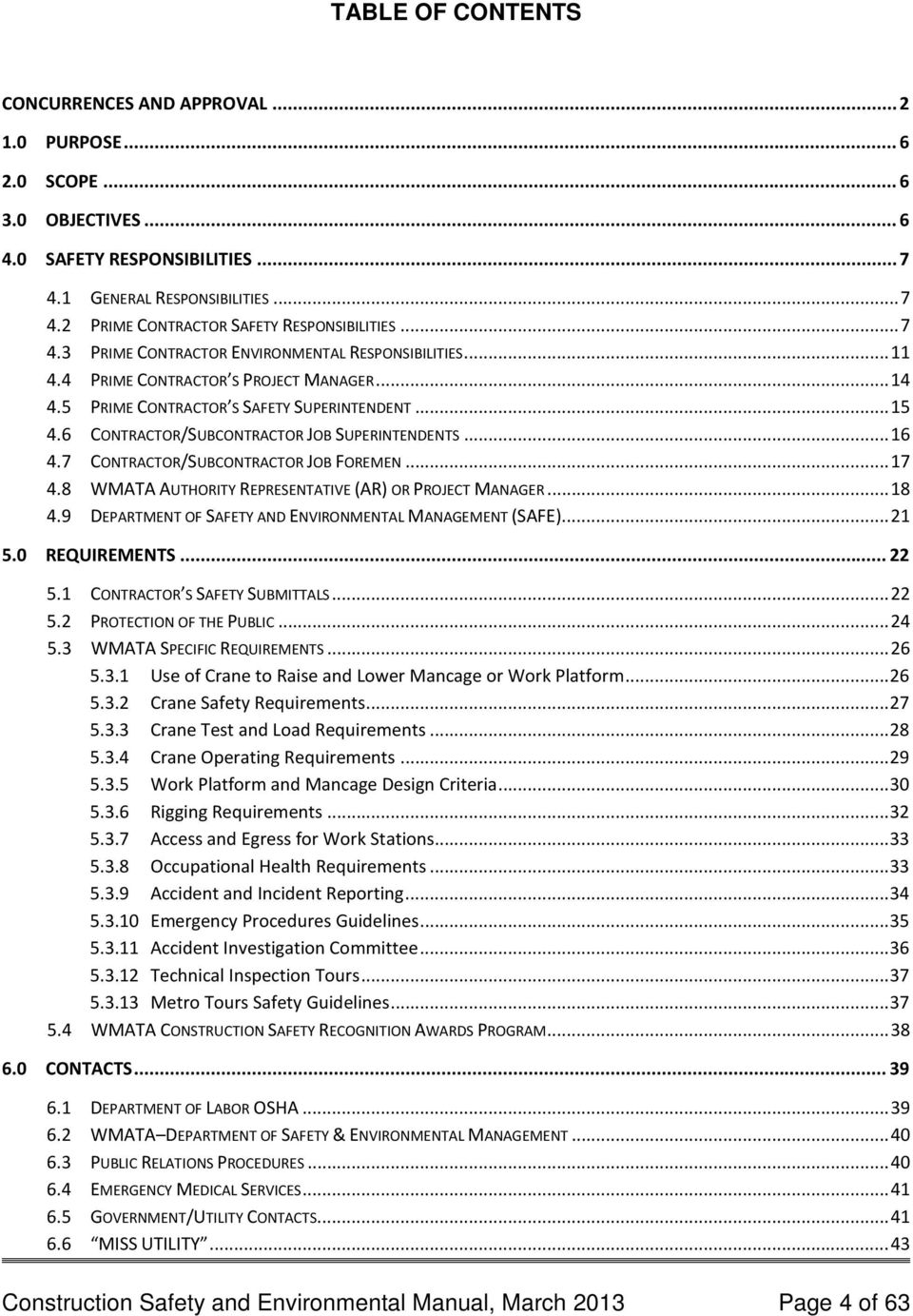
4 TABLE OF CONTENTS CONCURRENCES AND APPROVAL PURPOSE SCOPE OBJECTIVES SAFETY RESPONSIBILITIES GENERAL RESPONSIBILITIES PRIME CONTRACTOR SAFETY RESPONSIBILITIES PRIME CONTRACTOR ENVIRONMENTAL RESPONSIBILITIES PRIME CONTRACTOR S PROJECT MANAGER PRIME CONTRACTOR S SAFETY SUPERINTENDENT CONTRACTOR/SUBCONTRACTOR JOB SUPERINTENDENTS CONTRACTOR/SUBCONTRACTOR JOB FOREMEN WMATA AUTHORITY REPRESENTATIVE (AR) OR PROJECT MANAGER DEPARTMENT OF SAFETY AND ENVIRONMENTAL MANAGEMENT (SAFE) REQUIREMENTS CONTRACTOR S SAFETY SUBMITTALS PROTECTION OF THE PUBLIC WMATA SPECIFIC REQUIREMENTS Use of Crane to Raise and Lower Mancage or Work Platform Crane Safety Requirements Crane Test and Load Requirements Crane Operating Requirements Work Platform and Mancage Design Criteria Rigging Requirements Access and Egress for Work Stations Occupational Health Requirements Accident and Incident Reporting Emergency Procedures Guidelines Accident Investigation Committee Technical Inspection Tours Metro Tours Safety Guidelines WMATA CONSTRUCTION SAFETY RECOGNITION AWARDS PROGRAM CONTACTS DEPARTMENT OF LABOR OSHA WMATA DEPARTMENT OF SAFETY & ENVIRONMENTAL MANAGEMENT PUBLIC RELATIONS PROCEDURES EMERGENCY MEDICAL SERVICES GOVERNMENT/UTILITY CONTACTS MISS UTILITY Construction Safety and Environmental Manual, March 2013 Page 4 of 63
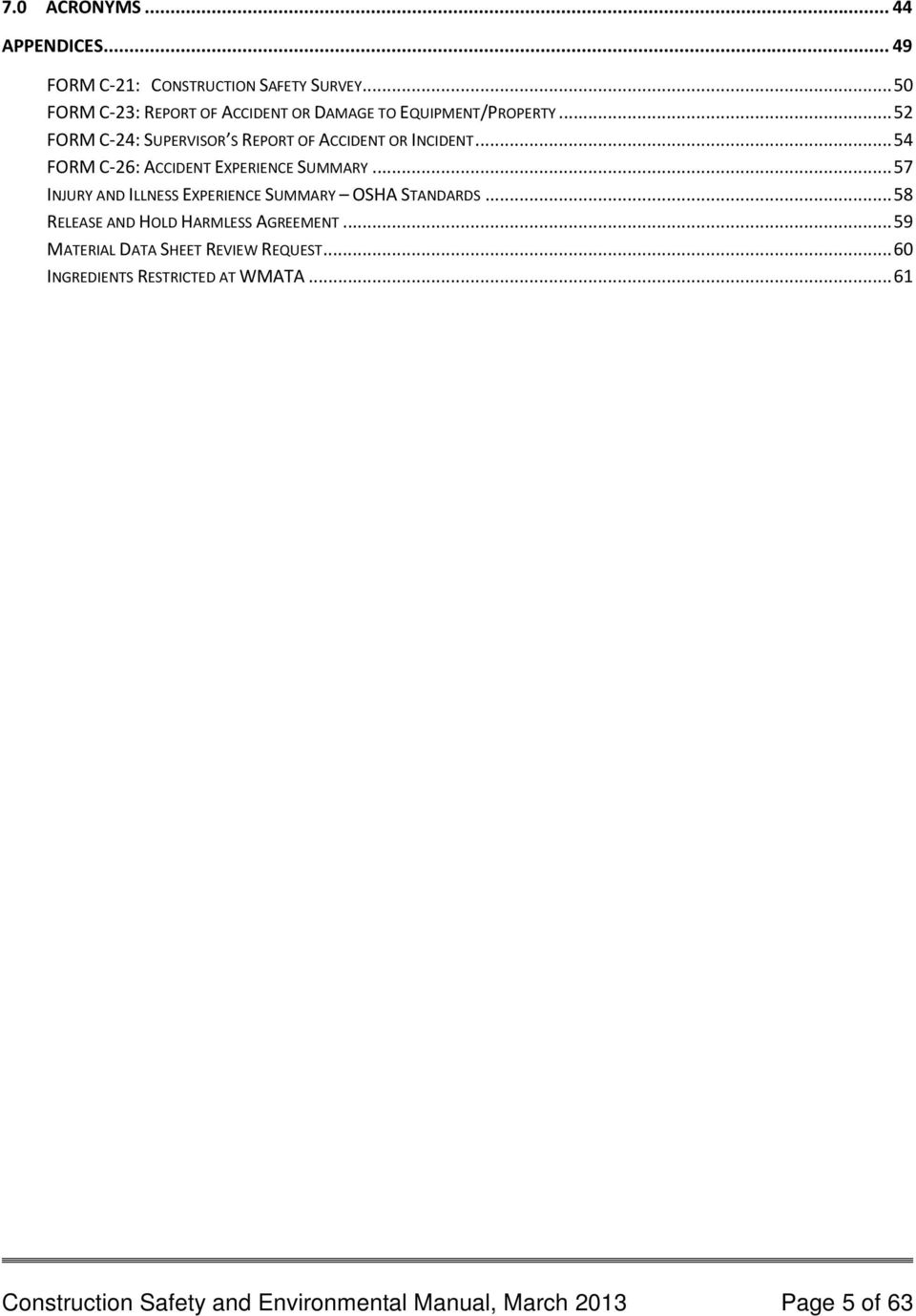
5 7.0 ACRONYMS APPENDICES FORM C-21: CONSTRUCTION SAFETY SURVEY FORM C-23: REPORT OF ACCIDENT OR DAMAGE TO EQUIPMENT/PROPERTY FORM C-24: SUPERVISOR S REPORT OF ACCIDENT OR INCIDENT FORM C-26: ACCIDENT EXPERIENCE SUMMARY INJURY AND ILLNESS EXPERIENCE SUMMARY OSHA STANDARDS RELEASE AND HOLD HARMLESS AGREEMENT MATERIAL DATA SHEET REVIEW REQUEST INGREDIENTS RESTRICTED AT WMATA Construction Safety and Environmental Manual, March 2013 Page 5 of 63
6 1.0 Purpose This Construction Safety and Environmental Manual (CSEM) is established under Section 18.3 of the Washington Metropolitan Area Transit Authority (WMATA) System Safety Program Plan (SSPP), dated January This CSEM provides guidelines for WMATA construction and rehabilitation projects on which the contractor(s) provides all insurance coverage required under the contract and it is an essential contract document. This CSEM establishes WMATA specific procedures for certain activities and it establishes safety responsibilities for WMATA and contractor personnel involved in construction, maintenance and rehabilitation projects. It is intended to assist contractors in complying with the safety and environmental requirements of WMATA contracts. 2.0 Scope This CSEM applies to all construction, rehabilitation, or maintenance projects administered by the Office of Chief Infrastructure Services (CENI). It in no way releases the contractor from the responsibilities and conditions contained in a contract with the Authority or required by federal, state or local regulations. 3.0 Objectives The objectives of the guidelines delineated in the CSEM are: 1. Minimize personal injury and illness. 2. Maximize property conservation. 3. Achieve greater efficiency. 4. Reduce Direct and Indirect costs due to accidents. 5. Minimize exposures to chemical, biological and physical hazards. 6. Minimize impact on the environment and the community. Construction Safety and Environmental Manual, March 2013 Page 6 of 63
7 4.0 Safety Responsibilities 4.1 General Responsibilities The contractor shall be responsible for ensuring compliance with the most stringent provisions of the applicable occupational safety and health statutes and regulations of the District of Columbia, State of Maryland, Commonwealth of Virginia or political subdivision in which the work is performed and the U.S. Department of Labor OSHA standards, pertaining to the safe performance of the work. The contractor shall ensure compliance with the most stringent of federal, state and local environmental regulations and statutes including but not limited to: U.S. Environmental Protection Agency, D.C. Department of the Environment, Virginia Department of Environmental Quality and Maryland Department of the Environment. WMATA Project Managers and Authority Representatives are responsible for monitoring the contractors compliance with applicable safety and environmental regulations and ensuring contractors compliance with the safety and environmental contract specifications. The prime contractor is responsible for the safety and welfare of contractor and subcontractor employees and for the protection of property and the general public within the contractor s scope of work. 4.2 Prime Contractor Safety Responsibilities The prime contractor shall take the initiative in accident, injury, and illness prevention, and has primary responsibility for safety on the project. This includes all individuals on site, the public, WMATA employees, subcontractors and suppliers working for the contractor. The prime contractor s responsibility cannot be delegated to subcontractors, suppliers or other persons. The contractor s safety superintendent is appointed to perform safety inspection services under the direction of the prime contractor s project manager. It is recognized that many potential hazards will be promptly corrected by mutually accepted means of informal communication between the safety superintendent and the WMATA Authority Representative. Construction Safety and Environmental Manual, March 2013 Page 7 of 63

8 However, it must be understood that formal communication concerning accident prevention is to be maintained between the contractor s Project Manager and WMATA Authority Representative in order to preclude any misunderstanding The prime contractor is responsible for all of the requirements for accident, injury and illness prevention and for construction and environmental safety contained in the contract with the Authority. The prime contractor shall contractually require its subcontractors to conform and adhere to the requirements of the CSEM and its provisions relating to specific subcontractor responsibilities found in Sections 4.0 and 5.0 of the CSEM. In those contracts which interface with the Metrorail operating system, the contractor and subcontractors shall comply with the Metrorail Safety Rules and Procedures Handbook (MSRPH). In those contracts which interface with the Metrobus system, the contractor and subcontractors shall comply with the WMATA Department of Bus Service Employee Handbook (BSEH). In compliance with contract specifications and where applicable provisions of the MSRPH and BSEH, the prime contractor shall: Upon notification of a contract award, submit a copy of the contractor s Health and Safety Plan together with a letter of management s statement of safety policy, signed by an executive officer of the corporation, in relation to the following: 1. The contractor s safety policy based upon compliance with WMATA s Construction Safety and Environmental Manual (CSEM), including detailed disciplinary action to be taken with respect to employees violating safety or environmental requirements. 2. The contractor s awareness and knowledge of all local, state and federal safety, health and environmental standards and regulations applicable to the contract with WMATA Submit resumes of the work experience and qualifications of the contractor s safety superintendent and designees to the Authority Representative (AR) as required by the contract. These individuals may be required to appear for a personal interview by the AR and WMATA s Department of Safety and Environmental Management. All information provided must be verifiable. Construction Safety and Environmental Manual, March 2013 Page 8 of 63

9 Establish and maintain an orientation program for new employees that include a review of the contractor s Health and Safety Plan including: Safety and health hazards present in the assigned and general work area Required personal protective equipment Method for reporting any unsafe conditions that the worker(s) may encounter OSHA and EPA mandated written programs applicable to the work Exposure monitoring that may be conducted Required training, licensing, certification, or medical surveillance Emergency procedures including emergency telephone contact numbers, emergency escape routes, and areas of refuge, nearest hospitals and accurate directions and route maps to hospitals Tobacco use policy smoking is prohibited in the Metrorail system, in WMATA facilities and in WMATA vehicles Electronic Device Policy, including cellular phones, texting, etc Furnish copies of all warnings and/or citations of safety violations received from any jurisdiction, state or federal agency. Copies shall be sent within 48 hours to the AR Ensure that all employees, including subcontractors, comply with federal, state and local safety regulations and standards and with this CSEM Ensure that all personnel, including subcontractors and suppliers, receive the required WMATA Contractor Right of Way (ROW) Safety Training covering the rules and procedures for working in rail stations, in, or adjacent to, the train roadway, or in the yards, prior to starting such work. NOTE: The training is valid for 12 months from the date of receiving the training. Construction Safety and Environmental Manual, March 2013 Page 9 of 63
10 If the site contains hazardous waste, hazardous substances, or a hazardous chemical release, develop a Health and Safety Plan which establishes policies and procedures to protect the workers and the public from the hazards posed by a hazardous waste site cleanup operation and hazardous chemical release The storage of hazardous and flammable materials (including such items as rags, mops, paper towels, or other combustible materials contaminated with hazardous or flammable products) on WMATA property, is restricted. Contractors seeking to store hazardous or flammable materials on WMATA property must request permission from the AR, who will review with SAFE- EMIH. It may not always be possible to grant permission to store hazardous or flammable materials on WMATA property. If permission is granted, the contractor must store the materials in compliance with the jurisdictional codes and regulations. In addition, a copy of the Material Safety Data Sheet (MSDS) for each specific chemical and the quantity of each chemical to be stored on the site shall be provided to the Authority Representative. The contractor shall acquire permits for the use of hazardous materials as required by the jurisdictional Fire Marshal and/or other authority having jurisdiction (AHJ) If the work requires transportation of hazardous materials or hazardous substances, contractors and subcontractors are required to provide evidence of Department of Transportation General Awareness Driver s Training in compliance with 49 CFR 172 and Commercial Driver s License in compliance with 49 CFR , prior to commencement of work All hazardous materials and hazardous substances must be stored in Performance Oriented Packaging in compliance with 49 CFR 178, Subpart L Contractors must submit MSDS for ALL chemicals to be used on Authority property to the Authority Representative. For projects in the operating system, all MSDS will be reviewed by WMATA s Department of System Safety and Environmental Management Construction Safety and Environmental Manual, March 2013 Page 10 of 63
11 (SAFE) and if approved, the materials can be used in the system. If they are rejected, the contractor must identify a substitute that will meet SAFE s criteria for approval in addition to the Authority Representative s criteria for performance. The MSDS must be recent (less than 3 years old) and comply with the OSHA Hazard Communication Standard 29 CFR The contractor is responsible for complying with the requirements of the MSDS Contractor shall maintain a complete file of (MSDS) for all materials used at the job site. The contractor shall assure that all the employees at the job site receive proper training before the use of each chemical product. This training must include information about the chemical and physical hazards and the proper use of the required personal protective equipment Establish and enforce disciplinary action for violating safety rules, procedures, or regulations After an incident involving a fatality or multiple hospitalizations, the contractor shall notify ROCC [if the incident occurs in the operating system] or 911 and preserve all evidence and immediately secure and stabilize the incident scene. The contractor must also notify the appropriate jurisdictional OSHA agency. Note: if 911 is called, it must be from either an outside line or a wireless phone. The phones in the roadway will not access local fire and EMS. 4.3 Prime Contractor Environmental Responsibilities The prime contractor shall take the initiative in environmental incident prevention, as the prime contractor has primary responsibility for environmental management on the project, including all individuals on site, public, subcontractors and suppliers working for the contractor. The prime contractor s responsibility cannot be delegated to subcontractors, suppliers or other persons. The prime contractor shall: Construction Safety and Environmental Manual, March 2013 Page 11 of 63

12 4.3.1 Assure all employees, including subcontractors, comply with federal, state, and local environmental regulations for air, water, land, noise, and wastes. Consolidated Plans (available on the WMATA Intranet and through the Authority Representative) are prepared by WMATA for bus divisions and rail yards in order to maintain the safety and health of employees, WMATA customers, and the community Obtain all environmental permits required by the contract and the federal, state, or local EPA regulations. Examples of some of these permits are: Prevention of Significant Deterioration (PSD) Permit, National Emission Standards for Hazardous Air Pollutants (NESHAP) Permit, National Pollutant Discharge Elimination System (NPDES) Permit, Spill Prevention Control and Countermeasure Plan (SPCC) Permit, and U.S. Army Corps of Engineers Permit for work in navigable waters and waters of the U.S. Copies of all permits should be forwarded to the WMATA Authority Representative. It is the responsibility of the prime contractor to ensure compliance with all permit requirements. In addition, the following information shall be maintained by the prime contractor at the work site: 1. Listing of any hazardous wastes and monthly volumes (kg/month) generated on site 2. Copies of Hazardous Waste Manifests 3. Copies of exception reports 4. Permits for the Treatment, Storage, and Disposal Facility (T/S/D/F) Ensure that contractor and subcontractor employees cooperate with representatives of the Authority and federal, state, or local regulatory agencies during site inspections or investigations. Inspection and investigation activities may involve interviews with contractor and subcontractor personnel If waste water will be generated, submit a Waste Water Discharge Plan that describes how the contractor will treat and release waste water generated from the work site If the work involves response to spills of hazardous materials, ensure that the prime contractor or subcontractor personnel have appropriate training that complies with 29 CFR Construction Safety and Environmental Manual, March 2013 Page 12 of 63

13 4.3.6 If the work involves removal of paints or coatings, test the paint or coating to determine if they contain heavy metals such as lead that require special handling and disposal considerations. As a minimum, testing should be considered for the eight Resource Conservation and Recovery Act (RCRA) metals: Arsenic Barium Cadmium Chromium Lead Mercury Silver Selenium If any of these are present, the components will require special handling and disposal to prevent exposure to workers, the public, and the environment. The contractor and/or subcontractor shall have all licenses and certifications required by the jurisdiction in which the work is performed. Jurisdictions that do not have their own state plans fall under the auspices of the EPA. The contractor s and subcontractor s employees are required to have medical monitoring and training required by the jurisdictional regulations. Documentation shall be provided to the Authority Representative prior to commencement of work. All documentation shall be authentic and verifiable. All materials must be handled and disposed of in compliance with the jurisdictional regulations. MSDS for replacement paints/coatings must be reviewed and approved, prior to use, by WMATA If the work requires disposal of hazardous wastes, utilize an EPA licensed Treatment/Storage/Disposal facility and ensure that the waste hauler has a state or local license and U.S. EPA identification number. The contractors and subcontractors shall be required to provide evidence of all applicable licenses and permits along with the name and address of the waste disposal facility where hazardous waste materials are to be disposed, prior to commencement of work. Construction Safety and Environmental Manual, March 2013 Page 13 of 63

14 4.4 Prime Contractor s Project Manager The prime contractor s project manager is the management representative of the prime contractor. The prime contractor s project manager is responsible for the safety of all individuals on-site, including all employees and subcontractor employees, suppliers, agency officials and the public. As such, in addition to the responsibilities as might be assigned by the prime contractor noted in 4.2 and 4.3, the prime contractor s project manager shall: Be responsible for the supervision of the Safety Superintendent in carrying out the duties and responsibilities of this position Plan and execute all work so as to comply with the stated objectives of the most current CSEM Comply with all of the provisions of the contract dealing with safety, environmental management and accident prevention requirements Comply with federal, state, and local safety and environmental codes, standards and regulations and WMATA safety rules and procedures Cooperate with WMATA s representatives and representatives of federal, state, and local regulatory agencies Authorize necessary immediate action to correct substandard safety and environmental conditions existing, reported or observed Review and take necessary immediate action on safety records through directives or personal interviews with superintendents, job foremen or subcontractors management Attend safety meetings as required Participate in safety planning meetings held by the WMATA Authority Representative at the beginning of each phase of the job Ensure that personnel operating cranes and other mobile equipment, requiring a riding operator, are trained and certified by a recognized entity, to operate the equipment to which they are assigned. Construction Safety and Environmental Manual, March 2013 Page 14 of 63
15 Enforce disciplinary action for violating safety rules, procedures, or regulations. Disciplinary action shall include removal of persons who continually and deliberately violate safety requirements Cooperate with WMATA s designated safety representatives. 4.5 Prime Contractor s Safety Superintendent On those contracts which require a safety superintendent, he/she shall: Make daily safety inspections of job sites when work is performed and take necessary immediate corrective action to eliminate nonconformance with safety regulations or procedures. Record observations on WMATA Form C-21 (available from the Authorized Representative) Construction Safety Survey in compliance with reporting procedures Assure Form C-24, Supervisor s Report of Accident (available from the Authorized Representative) is properly completed and distributed in compliance with instructions Review accidents and incidents and recommend immediate corrective action Provide job foreman with appropriate material for use in conducting weekly tool box meetings Review safety meeting reports submitted by job foremen Periodically attend foremen tool box safety meetings and evaluate effectiveness Assist in the preparation of all accident investigation reports and ensure that reporting procedures are established Implement training programs for supervisors and employees as they apply to their specific responsibilities Encourage programs for recognition of individual employee s safety efforts and their contribution toward improved work methods. Construction Safety and Environmental Manual, March 2013 Page 15 of 63

16 Be responsible for ensuring that the necessary safety equipment, including required personal protective equipment, is made available to and used correctly by employees Coordinate activities with those of WMATA s designated safety representative and take necessary steps to immediately implement their appropriate recommendations Coordinate public relations aspects of the Contractor s Health and Safety Plan Attend safety meetings held by the Authority. The safety superintendent should share his/her experience, questions and problems with other superintendents at these meetings Participate in safety planning meetings held by the WMATA Authority Representative at the beginning of the job and on as needed basis Enforce and ensure compliance of the contractor s and subcontractor s employees with the prohibition on smoking in the Metrorail system, at WMATA facilities, and in WMATA vehicles Maintain a complete file of MSDS for all materials used at the job site. Assure that all the employees receive proper training before use of each chemical product. This training must include information about chemical and physical hazards and the proper use of required personal protective equipment Cooperate with WMATA s designated safety and environmental representatives Shall have Stop-Work Authority Shall have completed an OSHA 30-Hour Construction Training Course. 4.6 Contractor/Subcontractor Job Superintendents Contractor s and subcontractor s job superintendents have the following specific safety responsibilities: Construction Safety and Environmental Manual, March 2013 Page 16 of 63
17 4.6.1 Plan and execute all work so as to comply with stated objectives of the WMATA Construction Safety and Environmental Manual Implement the safety and loss control requirements contained in the contract documents Provide and enforce the use, at all times, of the personal protective equipment required by WMATA, local, state and federal regulations Complete supervisory investigation report on all accidents (reference Supervisor s Report of Accident Form C-24) Attend supervisory personnel safety meetings schedule by Prime Contractor s Project Manager Schedule weekly tool box safety meetings to be held by job foremen for all employees Periodically attend foremen s weekly tool box safety meetings to evaluate effectiveness and offer suggestions for improvement Take immediate action to correct unsafe practices or conditions when identified Report to the Prime Contractor s Safety Superintendent or Project Manager, all observed unsafe conditions or practices and violations of job security which are within their jurisdiction Cooperate with WMATA s designated safety and environmental representatives Enforce and ensure compliance of the contractors and subcontractor s employees with the prohibition on smoking in the Metrorail system, at WMATA facilities, and in WMATA vehicles. 4.7 Contractor/Subcontractor Job Foremen Job foremen are an integral part of an effective safety program and the amount of effort that they put into accident prevention on their daily assignments helps to determine whether or not a good accident record is maintained. A foreman s safety responsibilities shall include: Instructing workers under his/her supervision in safe work practices and work methods at the time work is assigned. Construction Safety and Environmental Manual, March 2013 Page 17 of 63

18 4.7.2 Supplying and enforcing the use of proper protective equipment and suitable tools for the job Continuously checking to see that no unsafe practices or conditions are allowed to exist on any part of the job Acquainting the staff will applicable safety requirements and seeing that they are enforced Setting a good example for employees Making a complete investigation of accidents to determine facts necessary to take corrective action Promptly supply information for completing the Accident Report and Investigation Form (as directed by the Safety Superintendent and/or Project Manager) Holding weekly tool box safety meetings with employees to: Discuss observed unsafe work practices or conditions. Review any accidents or near misses that have occurred with the crew. Encourage safety suggestions from employees and report them to the safety supervisor Seeing that prompt first aid is administered to an injured employee Reporting unsafe acts and violations of site security immediately to Project Manager, Job Superintendent, or Safety Superintendent Enforcing and ensuring compliance of the contractor s and subcontractor s employees with the prohibition on smoking in the Metrorail system, at WMATA facilities, and in WMATA vehicles. 4.8 WMATA Authority Representative (AR) or Project Manager The WMATA Authority Representative (AR) is the collective term for individuals designated by the WMATA contracting officer as responsible for Construction Safety and Environmental Manual, March 2013 Page 18 of 63

19 administering/supervising contracts [e.g., Project Manager (PM), Resident Engineer (RE), Contracting Officer Representative (COR), Contracting Officer Technical Representative (COTR)]. The AR has the following safety responsibilities: Be familiar with this CSEM and applicable OSHA and environmental regulations, WMATA safety rules and procedures and assure that all required programs and documents are submitted for SAFE s review prior to starting work and as required during construction Oversee the contractor s assumption of responsibility for timely application of safety and accident prevention procedures to all activities and to all persons on the project, including subcontractors, visitors and suppliers of materials and equipment Report to SAFE any observed unsafe working conditions. A degree of judgment is to be exercised by the WMATA Authority Representative in reporting unsafe working conditions. First-time infringements should be corrected by prompt reference of the incident to the contract s safety superintendent or, in his/her absence, the contractor s job superintendent. Consistent lack of good housekeeping practice, use of equipment in obviously poor condition, nonconformance with WMATA safety rules and procedures, and failure to adhere to occupational safety and health or environmental regulations are to be followed by appropriate corrective action and be reported to SAFE by the AR. However, in the event of conditions that are immediately dangerous to life and health, the AR shall immediately stop the dangerous activity, notify SAFE and notify the contractor of what corrective action shall be implemented before the work can resume In cases involving consistent failure to comply with safety and environmental rules and regulations, notify the contractor in writing of nonconformance and include specific required corrective actions. Copies of all such notices shall be forwarded to SAFE In the event certain individuals continually and deliberately violate safety requirements, the WMATA AR shall have the individual removed from the work site. Construction Safety and Environmental Manual, March 2013 Page 19 of 63
20 4.8.6 Receive, review and maintain copies of the contractor s safety superintendent s daily inspection report (C-21), exposure monitoring results, and accident/incident report forms C-23, 24 and 26. Ensure that any required corrective is implemented immediately After an incident involving a fatality or multiple hospitalizations, the AR shall ensure that the contractor notifies OCC [if the incident occurs in the operating system] or 911 and preserves all evidence and immediately secures and stabilizes the incident scene. The contractor must also notify the appropriate jurisdictional OSHA agency. NOTE: If 911 is called, it must be from a pay phone or a wireless phone. The phones in the ROW will not access 911. Most of the WMATA facility phones are such that, if an outside line is accessed, all 911 calls would be routed through the District of Columbia s 911 system, even if the call is made from a phone located in Maryland or Virginia At the beginning of the job and regularly on as needed basis, hold safety planning meetings with the prime contractor and representative(s) of SAFE Provide WMATA RWIC s (formerly Escorts) for contractors forces working in or adjacent to the Roadway (ROW). All RWIC s shall have Level IV training Ensure that all members of the AR staff and all contractor personnel take WMATA s Contractor ROW Training offered by SAFE before commencing work on the Roadway or projects that affect the Roadway. The ROW training is valid for 12 months from the date of receiving training. NOTE: All contractor ID badges shall be returned to WMATA at the completion of the project, prior to the release of retained funds, or a back charge of $ per ID will be assessed Ensure that all members of the AR and Project Management (PM) staff receive OSHA 10-hour construction or equivalent training available through SAFE. Construction Safety and Environmental Manual, March 2013 Page 20 of 63
![7 After an incident involving a fatality or multiple hospitalizations, the AR shall ensure that the contractor notifies OCC [if the incident occurs in the operating system] or 911 and preserves all](/docs-images/43/3174370/images/page_20.jpg "evidence and immediately secures and stabilizes the incident scene. The contractor must also notify the appropriate jurisdictional OSHA agency.")
21 Receive, review, and monitor compliance with all environmental permit applications and final permits. Ensure that contract personnel involved are knowledgeable of the relevant environmental permit requirements Provide copies of all environmental permits to SAFE Deputy Chief, Office of Environmental Management and Industrial Hygiene (EMIH) for all work in the operating system. For all work in the non-operating system, forward copies of permits to CENI Manager, Environmental Planning and Compliance Coordinate with SAFE to begin Safety and Security Certification, in accordance with the WMATA Safety Rules and Procedure Manual Procedure No. 2.2/0. Safety and Security Certification shall begin at the earliest practicable phase of the project, to ensure timely completion, prior to system, facility, or equipment operation, or start of revenue service. 4.9 Department of Safety and Environmental Management (SAFE) The SAFE staff member assigned to the project shall be responsible for the following activities: Monitor the effectiveness of the WMATA AR in enforcing the provisions of this manual, WMATA safety rules and procedures, and Occupational Safety and Health and environmental regulations and standards, and provide assistance where needed Act as liaison between WMATA, federal, state, and municipal authorities on matters relating to construction safety, occupational safety and health and environmental safety Work with WMATA rail and bus operations, and CENI to develop and coordinate safe work procedures Provide special assistance to contractors with unusual or complicated safety problems, as requested through the AR Assist with writing contract specifications on matters relating to safety, health and the environment. Construction Safety and Environmental Manual, March 2013 Page 21 of 63
22 4.9.6 Assist the Office of Media Relations (MREL) in public relations work regarding safety, health and the environment on CENI projects Participate in pre-work surveys of individual job site and in the Safety Planning Meeting with all new prime contractors Conduct periodic on-site safety inspections Direct the contractors, through the AR, to correct any unsafe or unhealthy condition(s) observed and/or brought to the attention of the project safety superintendent In the event of failure by a contractor to correct unsafe or unhealthful condition(s), recommend to the AR or the Chief Safety Officer, or designee that the work activity be stopped until condition(s) is corrected. SAFE/CENI will work with the AR to ensure that the contractor implements the required corrective action, prior to resuming the work activity In the event of a condition immediately dangerous to life or health, the SAFE representative has the authority to immediately suspend the dangerous activity. SAFE must immediately notify the AR or PM, who will contact the Chief of CENI or the appropriate Manager. SAFE will coordinate with the AR and the contractor, to develop the required corrective action. The AR will ensure that the contractor immediately implements the appropriate, effective corrective action prior to resuming the work activity. 5.0 Requirements 5.1 Contractor s Safety Submittals The Prime Contractor, performing the work, shall submit the following documentation as required by the contract, which shall be subject to approval by the Authority Representative. The first four items shall be submitted in pre-award phase. For work and sites not addressed in the original Organizational Health and Safety Program, addenda may be added when the work and sites are identified; however, the addenda must be submitted to the Authority Construction Safety and Environmental Manual, March 2013 Page 22 of 63
23 Representative for review by WMATA prior to the commencement of specified work; Job Hazard Analysis (prior to each phase of work); Site-specific Emergency Response Plan; Site-specific Emergency Evacuation Plan; Site-specific Temporary Fire Protection System Plan; Site-specific Waste Water Discharge Plan (if waste water us generated); Site-specific Pollution Control Program; Site-specific Dust and Debris Control Plan; Bloodborne Pathogens Exposure Control Plan; Hearing Conservation Program if employees are exposed to continuous noise in excess of the OSHA Action Level (29 CFR ); Respiratory Protection Program if employees are required to wear respirators. If a respiratory program is required, the contractor also must provide documentation of training, medical clearance for respirator use and respirator fit testing for tight-fitting respirators; Hot Work Program; Lockout/Tagout Program; Site-specific Confined Space Program; Documentation of applicable training, licenses, and certifications; Results of noise monitoring, air monitoring, and soil, water or waste sampling; Documentation of medical surveillance; Documentation of Safety superintendent s experience in construction safety; Identify all materials or chemicals the contractor will use on Authority property (including welding rods), MSDS for these products, and a brief explanation of how they will be used and if any wastes will be generated; Documentation of licenses and certificates required for lead or asbestos abatement or other work requiring licensing; Documentation of licenses, certificates, and U.S. EPA identification numbers required for transportation of hazardous materials, hazardous substances, or hazardous wastes; Documentation of licenses, permits, and certificates required for disposal of hazardous wastes including the name and address of the waste disposal facility where hazardous waste materials are to be disposed; and Certificate of Insurance, including pollution liability coverage, endorsed to WMATA is required for contractors or subcontractors performing work involving hazardous materials, hazardous substances, hazardous wastes, or contaminated soil or water. Construction Safety and Environmental Manual, March 2013 Page 23 of 63
24 5.2 Protection of the Public Many of the contracts which are subject to this manual involve contact with Metro customers and the public. Therefore, it is critical that contractors and subcontractors take all necessary precautions to prevent injury to customers, employees and the public and prevent property damage. For the purpose of this manual, the public shall include all persons not employed by the contractor or a subcontractor working under his/her direction. Precautions to be taken shall include but not be limited to the following: For work that affects areas occupied by, or providing thoroughfare to the public, ensure that such work is specifically permitted by the contract or in writing by the WMATA AR When it is necessary to maintain public use of work areas involving sidewalks, entrances to buildings, lobbies, corridors, aisles, stairways, rail tracks, and vehicular roadways, the contractor shall protect the public with substantial guardrails, barricades, temporary fences, overhead protection, partitions, and shields. Provide effective artificial illumination to ensure adequate visibility. The protection shall be consistent with the type of hazard created or resulting from the work performed and be in accordance with the contract and this manual Keep sidewalks, entrances to building, lobbies, corridors, aisles, doors or exits clear of obstructions to permit safe ingress and egress of the public at all times Post conspicuous, appropriate warning, caution, and instructional safety signs where necessary. In addition, a flag-person shall control the moving of motorized equipment in areas where the public might traverse such pathways Provide sidewalk sheds, canopies, catch platforms and appropriate outside walls on any structure. The protection required shall be in accordance with the codes and regulations of the jurisdiction in which the work will be performed and requires approval by the AR Install a temporary fence around the perimeter of above-ground operations adjacent to public areas, except where a sidewalk shed or fence is provided by the contract, or as required by Perimeter Construction Safety and Environmental Manual, March 2013 Page 24 of 63
25 fences shall be at least six (6) feet high or as directed by the Authority Representative. They may be constructed of wood or metal frame sheathing, wire mesh or a combination of both as provided in contract specifications. When the fence is adjacent to a sidewalk near a street intersection, at least the upper section of fence shall be open wire mesh from a point not over four (4) feet above the sidewalk and extending at least twenty-five (25) feet in both directions from the corner of the fence, or as otherwise required by the local jurisdiction. The fence shall be constructed of solid material such as plywood, if demolition is to occur in the adjacent work area Provide substantial guardrails on both sides of vehicular and pedestrian bridges, ramps, runways and platforms. Pedestrian walkways elevated above adjoining surfaces, or walkways within six (6) feet of the top of excavated slopes or vertical banks shall be protected with guardrails, except where sidewalk sheds or fences are provided as required by Guardrails shall be made of rigid materials capable of withstanding a force of at least two hundred (200) pounds applied in any direction at any point in their structure. The height shall be approximately forty-two (42) inches. Top rails and posts may be two (2) inches by four (4) inches dressed wood or equal. Vertical posts shall not be spaced over eight (8) feet apart Install barricades, meeting the requirements of the political subdivision having jurisdiction, where sidewalk sheds, fences or guardrails as referenced above are not required between work areas and pedestrian walkways, roadways or occupied buildings. Barricades shall be secured against accidental displacement and shall be maintained in place except where temporary removal is necessary to perform the work. During the period a barricade is removed temporarily for the purpose of work, a flag person shall be placed at all openings Provide temporary sidewalks when a permanent sidewalk is obstructed by the contractor s operations. They shall be in accordance with the requirements of the political subdivision having jurisdiction. Guardrails shall be provided on both sides of temporary sidewalks Maintain warning signs and lights, including battery operated lanterns, and electric lights, meeting requirements of the political subdivision Construction Safety and Environmental Manual, March 2013 Page 25 of 63
26 involved, from dusk to sunrise along guardrails, barricades, temporary sidewalks and at every obstruction to the public. They shall be placed at both ends of such protection or obstructions and not over twenty (20) feet apart alongside such protection or obstructions Prohibit fuel-burning types of lanterns, flares or other open flame devices within fifty (50) feet of open utility manholes Provide temporary walkways, including bridges over demolished work, with non-skid surfaces and maintain in good repair at all times Continuously control dust generated by construction operations by water sprinkling or other approved methods. In operating stations, or other locations where dust generated by the contractor s work will remain in the air to the discomfort of passengers or WMATA employees, dry vacuuming using a high-efficiency particulate aerosol [HEPA] vacuum will be employed to remove the dust before revenue hours. 5.3 WMATA Specific Requirements The following specific requirements are required for work on WMATA projects. Items marked (S) must be addressed in contractor s submittal to the AR. Items marked (O) are to be observed by the safety superintendent at load test and noted on that day s C-21 Construction Safety Survey as observed Use of Crane to Raise and Lower Mancage or Work Platform The use of a crane to lift/lower and/or suspend work platforms and mancages will be permitted only when other means of reaching the work areas are not feasible Requests for use of crane-suspended work platforms or mancages shall be submitted to the WMATA AR for approval with the following: Statement why conditions, methods or operations require the use of a crane-suspended work platform or mancage; (S) Description of the crane to be used and the manufacturer s instructions and requirements in the use of the crane to Construction Safety and Environmental Manual, March 2013 Page 26 of 63
27 lift/lower and/or suspend personnel on work platforms or mancages; (S) Drawing with certified structural calculations of the work platform or mancage suspension bridle and other components with computations used in the design sealed by a professional engineer in this field; and (S) Documented emergency plan in the event of crane failure. (S) Prior to putting the crane and work platform or mancage in service, the contractor shall notify the WMATA AR in writing when he has complied with crane and work platform or mancage requirements. (S) Copies of the last annual inspection report as well as the latest monthly inspection report shall be submitted to the WMATA AR prior to use of the crane. The WMATA AR shall ensure that daily inspections are made, and will receive monthly crane inspection reports. (S) When a crane and work platform or mancage are to be used to lift/lower and/or suspend personnel, the contractor shall be responsible for ensuring compliance with the most stringent crane and work platform or mancage provisions of the applicable statutes and regulations of the District of Columbia, State of Maryland, Commonwealth of Virginia or other political subdivision in which the work is being performed, as well as with WMATA Crane and Work Platform/Mancage Safety requirements contained herein, and with the U.S. Department of Labor Occupational Safety and Health Act provisions and ANSI A Further, the contractor shall comply with the crane manufacturer s requirements in the selection and use of a crane for lifting/lowering and/or suspending of personnel on a work platform or in mancages Crane Safety Requirements Cranes used to lift/lower and/or suspend personnel on work platforms or in mancages shall have the following safety features installed and operating: Construction Safety and Environmental Manual, March 2013 Page 27 of 63
28 Power-up and power-down load line, power shall not be disengaged while handling personnel; (S) The load line attached to the work platform or mancage shall have a minimum safety factor of eight (8), manufacturer s specifications shall be submitted, weight of loaded platform shall be submitted; (S) Automatic braking (dead-man control), load will stop when operator releases controls; (S) Anti-two block device shall be provided capable of preventing damage to the hoist rope and/or other machine components; (O) Boom angle indicator; and (O) Telescoping crane boom shall be marked to indicate, to the operator, its extended length. (O) Alterations or modifications to the basic crane shall be prohibited, unless prior written authorization is obtained from the manufacturer Crane Test and Load Requirements Crane load rating capacities shall be reduced by 50% of published load chart values when handling personnel on work platforms or in mancages. The following calculations shall be submitted: 1. Load Radius 2. Boom Angle 3. Capacity from Load Chart, 50% of Capacity 4. Weight of Loaded Platform (S) The weight of the platform, personnel, attachments and all equipment contributing to the total weight of the boom and load shall be calculated to determine the maximum allowable load, and the calculations shall be submitted. Prior to handling personnel for the first time, the crane, with platform/mancage attached, shall be load-tested at one and one-half (1-1/2) times the rated capacity of the platform. (O) (S) Testing shall include movement of the platform/mancage through its entire permissible range of movement. (O) Construction Safety and Environmental Manual, March 2013 Page 28 of 63
29 The test shall not produce instability of the crane or cause permanent deformation of any component. (O) A visual inspection of the crane, platform/mancage and suspension components shall be conducted by a competent person and appropriately documented. (O) A daily inspection of the crane, platform, or mancage and suspension components shall be made. Simulated lifts shall be made for each work situation, to ensure all systems and controls are functioning properly and all safety features provide are operating satisfactorily, prior to handling personnel Crane Operating Requirements Crane shall be level during operations within one (1) degree. If crane is equipped with outriggers, they shall be fully extended and jack pads set on firm, level terrain at all times when handling personnel. Devices provided on outrigger jacks to prevent loss of support under load shall be engaged. (O) A minimum of three (3) wraps shall remain on drum of the load line, when platform/mancage has reached its lowest point of travel. (O) Lifting and lowering speeds shall not exceed 100 feet per minute. (Cable speed indicator is not required. Intent is that operator will conduct lift/lower operations slowly and cautiously at all times.) (O) Personnel shall not occupy the mancage or platform while the crane is traveling. (O) Brakes and locking devices shall be engaged when platform is in working position, with personnel aboard mancage or platform. (O) Platform or mancage shall be used only with the specific crane for which it was approved and tested. (O) A qualified signal person shall be assigned and positioned, so that he is constantly visible to both the crane operator and personnel Construction Safety and Environmental Manual, March 2013 Page 29 of 63
30 on the work platform, or in the mancage. He/she shall have no other duties while personnel are occupying the platform or mancage. (O) When platform is used below ground or when clear, unobstructed visibility between personnel on platform and crane operator cannot be maintained, radio or telephone communications between the signalman on the platform and the crane operator shall be provided. Unassisted voice communication is not acceptable. (S) (O) The crane operator shall be certified by the National Council on Crane Certification. The crane operator shall be thoroughly trained with related experience and shall be familiar with safe crane practices and also have a complete understanding of all manuals, including maintenance and operating instructions provided for specific crane in use. He/she shall have no physical deficiencies which would impair physical, visual or mental reactions or capabilities. (S) (O) The crane operator shall remain at the controls at all times when handling personnel. If for any reason the operator must leave the controls, personnel shall be removed from the platform or mancage prior to his/her leaving. (O) Handling of personnel shall be discontinued upon indication of any impending danger, including presence of thunderstorms. (O) Special precautions shall be taken to protect personnel from electrical hazards. Maintain specified distances from electrical sources. (O) The crane operator shall have a complete understanding of the WMATA crane and operational safety requirements and shall operate the crane accordingly. (O) Work Platform and Mancage Design Criteria The work platform or mancage shall be designed with a safety factor of eight (8), in conformity with established engineering Construction Safety and Environmental Manual, March 2013 Page 30 of 63
31 criteria. Design calculations shall be submitted and sealed by a professional engineer in this field. (S) Platform shall be designed for a minimum of four (4) point suspension. Commercially manufactured mancages or torpedo cages may have three (3) point suspension. (S) The work platform or mancage shall be posted as to the maximum allowable load. Workers shall be considered as weighing 250 pounds each. (O) Guardrails of metal angle, channel or pipe conforming to 29 CFR (f)(1)(OSHA Construction Regulations) shall be provided on work platform. Rebar is not to be used. The guardrail system must be enclosed from the toe board to the mid-rail to keep tools, materials and equipment from falling from the mancage or platform. (O) The floor of the work platform or mancage shall be constructed of a non-slip material. (S) (O) Overhead protection shall be provided on work platform or mancage, when exposure exists, to personnel from falling objects. (S) Overhead protection shall be designed as an integral part of the work platform or mancage. For special-purpose work platform where the nature of the work makes overhead protection impractical, special precautions must be taken to protect against falling objects. No work shall be permitted above the personnel-occupied work platform Provisions shall be made to secure tools and materials while platform is in motion. (S) A grab rail shall be provided inside the platform or mancage to permit the worker to stabilize and support his/her body, rather than to hand-grasp the top guard rail, which could result in injury from striking or bumping into equipment or structures. (O) Construction Safety and Environmental Manual, March 2013 Page 31 of 63
32 Safe means of ingress and egress shall be provided to the platform. If a gate is used, it shall swing in only and have a positive latch/lock device. (S) (O) Rigging Requirements Wire rope, shackles, bull rings, cable eyes and other rigging hardware, shall have a safety factor of eight (8). Rotation resistant, wire rope shall have a safety factor of ten (10). All rigging equipment shall be in good condition, with no broken parts. All rigging equipment shall be inspected for damage and excessive wear by a competent individual, before each use. (S) (O) Platform and mancage bridles and rigging shall not be used for any other purpose. (O) The platform shall be suspended by a bridle consisting of at least four (4) separate wire rope cables with an angle of at least sixty (60) degrees from the horizontal. This does not apply to mancages as in above. (O) All cable eyes shall be manufacturer-fabricated with thimbles. Manufacturer s specifications shall be made available to the AR, upon request. (O) The cable legs comprising the work platform bridle shall be connected to a bull ring or shackle, as means of attachment to the load line. (O) The bull ring or shackle of the lifting bridle shall be attached directly to the load line block with a safety shackle. The bridle shall not be attached to a hook. Where a load block without hook cannot be fitted to the load line to permit use of a closed connection to the bull ring of the lifting bridle, a supplementary safety line connecting the work platform shall be added. This will connect the platform to the load line at a point above the hook, using closed connections, such as shackles. The safety line will be designed to support the shock load of a loaded platform, which has fallen off the hook. Design calculations Construction Safety and Environmental Manual, March 2013 Page 32 of 63
33 shall be submitted and sealed by a professional engineer for safety line and connecting fittings. (S) (O) Access and Egress for Work Stations To reduce the risk of serious falls by workers, as soon as the work condition permits, as determined by the AR, the contractor shall replace temporary ladders with temporary stairs and/or personnel hoists or elevators, as the primary means of access to and egress from work stations. This same requirement shall apply to work stations at heights, such as aerial structures and multi-story structures. Temporary stairs, personnel hoists and elevators shall be constructed, installed, and maintained, in compliance with provisions of applicable statutes and regulations of the U.S. Department of Labor Occupational Safety and Health Administration, the District of Columbia, State of Maryland, Commonwealth of Virginia, or other political subdivision in which work is being performed. No materials, equipment or tools shall be transported on escalators or elevators in the operating system without advance approval of the WMATA AR Occupational Health Requirements As set forth in the Contract Specifications Article Protection of Persons and Property of the contract, the contractor s safety superintendent shall be familiar with industrial hygiene equipment and testing, as required for the protection of customers, contractor employees, WMATA employees and the public. Instrumentation shall be provided by the contractor(s) at the job site to evaluate anticipated exposures to toxic substances and physical agents. Testing shall be conducted as necessary to assure the protection of customers, contractor employees, WMATA employees and the public. Copies of test results shall be promptly provided to the WMATA Authority Representative. Costs incurred in providing exposure monitoring shall be included in the contract price with no additional cost to WMATA. Examples of industrial hygiene/environmental monitoring that may be required include: Construction Safety and Environmental Manual, March 2013 Page 33 of 63
34 Toxic substances such as, but not limited to carbon monoxide, nitrogen dioxide, sulfur dioxide, hydrogen sulfide, heavy metals, welding fumes, silica, volatile organic compounds and asbestos; Oxygen deficiency; Combustible and flammable gases; Illumination; Respirable dust (respirable particulate not otherwise specified) Occupational and environmental noise (continuous and impact/impulse); Water sampling; Soil sampling; Confined space monitoring; and Ventilation testing results Accident and Incident Reporting All job related accidents and incidents shall be reported and investigated. All data relative to an accident or incident shall be complete and timely, with verification of the facts, and recommendations for specific action to control the cause of similar accidents or incidents. The prime contractor shall be responsible for the reporting and investigation of all accidents and incidents occurring incidental to work performed under the contract. An accident includes personal injuries requiring medical attention away from the work site or property damage exceeding $1, An incident includes near misses, overexposure to toxic substances, hazardous material spills/releases and events of non-compliance with safety or environmental regulations, procedures, or requirements. Accidents and incidents shall be reported to the WMATA AR immediately. Refer to Section , Emergency Guidelines, for details. Accident Reports C-23 and C-24 shall be completed and submitted to the AR within 48 hours after the accident or incident. For accidents involving conditions that are immediately dangerous to life and health, work shall be suspended until corrective actions are implemented. Construction Safety and Environmental Manual, March 2013 Page 34 of 63
35 Emergency Procedures Guidelines The Prime Contractor will set up emergency procedures in their Health & Safety Plan for the following categories: Fire; Injury to Metro customer, employee, or WMATA employee; Injury to general public resulting from a possible slip, fall or vehicular injury; Property damage, particular to utilities; i.e., water, gas, sewage, electrical, telephone or pedestrian and vehicle routes; Public demonstrations; Bomb and chem-bio threats; Emergency evacuation; Hazardous chemical releases; Other incidents at contractor s job site Wherever practical, teams should be established, in advance, to handle the various types of emergencies. In other cases, emergencies must be handled by the ranking person present, with whoever is available to assist. Post, in a conspicuous place, a list of emergency phone numbers, along with the type of information to be transmitted for each emergency situation. Delegate responsibility for making emergency calls Actions to be taken during emergencies should be discussed regularly with contractor s supervisory personnel and at tool box safety meetings When an emergency occurs, which requires a response by the fire and emergency services, the person in charge shall: For emergencies in the Metrorail operating system, immediately notify the WMATA Operations Central Control (OCC) on and Metro Transit Police Department (MTPD) on Emergencies in the bus facilities should be directed to Bus OCC on and MTPD on For emergencies in the non-operating rail system [e.g., Metrorail extensions] call 911. Also notify the WMATA [SAFE] Rail Oncall Officer on Construction Safety and Environmental Manual, March 2013 Page 35 of 63
36 For environmental incidents involving operations, maintenance, and support functions, including capital improvement and major construction renovation in the operating systems, immediately contact the Maintenance Operations Center (MOC) on Evacuate personnel and provide first aid; Stabilize the situation; Secure the area, preserve evidence; Notify the Authority Representative; Cooperate with the responding emergency services; Initiate an incident investigation MTPD will be in charge of criminal or potentially criminal incident scene in the operating system. SAFE will be in charge of non-criminal investigations of accident/incident that occur in the operating system Provide information regarding the situation only to WMATA AR and WMATA Safety representative or regulatory agencies. Questions from the media should be referred to the WMATA, Media Relations Office on Review emergency procedures regularly and modify as required. All such procedures shall be approved by and coordinated with the WMATA AR Accident Investigation Committee At the discretion of the WMATA CSO/SAFE, the appropriate Safety Subcommittee may be convened to evaluate all reports and information obtained from investigative sources on any accidents resulting in a loss of life or serious injury, or any accident involving the operating Metrorail, Metrobus or MetroAccess system. The contractor shall make its employees available for interviews with the Safety Subcommittee as required. The Safety Subcommittee shall submit a written report to the CSO/SAFE. The AR will be responsible for ensuring that contractors implement corrective action plans that result from a SAFE, Safety Subcommittee, or external agency investigation. Construction Safety and Environmental Manual, March 2013 Page 36 of 63
37 Technical Inspection Tours WMATA staff members, who are escorting technical and/or other official visitors in hazardous work areas, will comply with the safety requirements established by this CSEM, the MSRPH, BSEH, and/or the AR. Contractor or vendor personnel who request to inspect a site in the ROW, shall be provided a safety briefing by the AR (or Designee) and be escorted at all times by a WMATA employee, who has been trained as an RWIC in ROW safety. All tours shall be coordinated with the WMATA AR. An escort is required for each group of six (6) for tours on the ROW. Groups will be provided with appropriate personal protection equipment. Shoes must be safety shoes or sound leather shoes that tie. No athletic type shoes or open-toe shoes are permitted in any WMATA facility Metro Tours Safety Guidelines It is of the utmost importance that a high degree of protection be afforded all persons touring Metro construction sites. The following guidelines have been prepared as general instructions for those personnel who are responsible for the organization, direction and safe conduct of these tours. Except for certain technical inspection tours made by WMATA staff members and their guests, the following procedures shall be implemented: All group tours will be cleared through the WMATA Media Relations Office and the DGMO, allowing maximum advance notice The Media Relations Office will contact the WMATA AR for the sites to be visited to coordinate the tour plan and to assure that necessary safety precautions are taken The Media Relations Office will coordinate the following items with the person requesting the tour: Number of Visitors Individual tour groups in non-hazardous areas should be limited to no more than 20 persons per tour escort; i.e. group of 40 will require at least two escorts. Clothing Long pants, short or long-sleeved shirts, low-heeled shoes with hard soles and laces that provide full coverage to the feet. No athletic type shoes or open-toe shoes are permitted. Construction Safety and Environmental Manual, March 2013 Page 37 of 63
38 Children Children under age 16 will not be permitted to accompany tours. Protective Equipment Hard hats, safety glasses, boots, reflective vests, raincoats, ear plugs, etc., will be supplied as required. Release and Hold Harmless Agreement Each visitor will be required to complete this form prior to the beginning of the tour. (See Appendices) Immediately prior to entering a job site, all visitors should be briefed about the need for careful and orderly conduct, and be briefed on the hazards of the location Groups shall be accompanied at all times by a member of the WMATA AR s staff while on the job site. 5.4 WMATA Construction Safety Recognition Awards Program All WMATA construction contractors shall participate in the WMATA Safety Recognition Award Program and shall keep accurate records of each employee hours worked, exposure and accident experience and submit monthly reports to the AR in accordance with reporting procedures The awards based on the statistics reported on WMATA Form C-26, Injury and Illness Experience Summary, shall be made as follows: Special awards are issued for 100,000, 250,000 and 500,000 employee hours for work without a lost time injury. The project safety superintendent will also receive a personalized plaque. SAFE will approve all awards and will notify the AR when a contractor becomes eligible for an award. Awards will be presented to contractors at the WMATA safety meetings. A Special Safety Commendation Award will be presented to a contractor who performed an outstanding safety related service to the community. This award may also be presented to an individual employed on a Metro project for distinguished work in the field of safety. Recommendations for this award must be submitted through the WMATA AR to SAFE. Construction Safety and Environmental Manual, March 2013 Page 38 of 63
39 6.0 Contacts 6.1 Department of Labor OSHA Each contractor shall be familiar with the Federal Occupational Safety and Health Act (OSHA) as it pertains to his/her work responsibility, and will implement it as federal law requires. All fatality cases and/or accidents in which three (3) or more persons are injured in any one accident shall be reported to OSHA, Virginia OSHA or Maryland OSHA, depending on where the accident occurs, within 8 hours of the accident. Regional Administrator U.S. Department of Labor Region III (Delaware, D.C., Maryland, Pennsylvania, Virginia and West Virginia) Gateway Center 3535 Market Street Philadelphia, PA Phone: (215) U.S. Department of Labor Baltimore Area Office G.H. Fallon Federal Building Charles Center 31 Hopkins Plaza Baltimore, MD Phone: (410) Commonwealth of Virginia Department of Labor & Industry P.O. Box Richmond, VA Phone: (804) Manassas Phone: (703) Safety Division 7890 Backlick Road Springfield, VA Phone: (703) Construction Safety and Environmental Manual, March 2013 Page 39 of 63
40 State of Maryland Department of Labor & Industry (MOSH) Laurel, MD Construction Safety Inspector Phone: (410) Washington Area Phone: (301) West Street Phone: (301) Emergency - After Hours (410) Copies of the Occupational Safety and Health Act 1970 and related information on state plans, standards, and education and training programs may be secured from the offices listed above or from: U. S. Department of Labor Occupational Safety & Health Administration 200 Constitution Avenue, N.W. Washington, D.C Phone: (202) WMATA Department of Safety & Environmental Management Department of System Safety & Environment Management Washington Metropolitan Area Transit Authority 600 Fifth Street, N.W. Washington, D.C Office: (202) 249-SAFE (7233) After Regular Business Hours Contact Safety Duty Officer via: OCC (202) ROCC (202) BOCC (202) Public Relations Procedures The procedure for handling inquiries from the press regarding emergencies such as accident, fire, explosion, etc., is immediate referral to WMATA AR by field or front office personnel of the contractor. Make no statement until such comment has been authorized by the AR. The same policy of referral to WMATA for action and approval should also be followed in connection with any news releases or Construction Safety and Environmental Manual, March 2013 Page 40 of 63
41 announcements related to the job by the contractor, subcontractor, suppliers, etc. Similarly, any requests for photo locations should be referred to the AR. 6.4 Emergency Medical Services For incidents that occur on construction projects in the operating system immediately notify emergency services via the WMATA Operations Central Control (OCC) on (202) and Metro Transit Police Department (MTPD) on (202) Emergencies in the bus facilities should be directed to Bus OCC on (202) and MTPD on (202) Environmental incidents involving operations, maintenance, and support functions, including capital improvement and major construction renovation in the operating system, shall be immediately reported to the Maintenance Operations Center (MOC) on (202) If you call 911 you must also call the above numbers to ensure required coordination between WMATA and the responding emergency services. 6.5 Government/Utility Contacts Washington, D.C. Telephone U.S. Park Police (202) U.S. Park Police Emergencies (202) U.S. Coast Guard-Search & Rescue or (410) U.S. Coast Guard-Search & Rescue Command Center (202) Harbor Police (202) D.C. Occupational Safety & Health (202) Federal Transit Administration-Office of Safety & Security (202) Environmental Protection Agency (General Information) (202) National Response Center (Emergencies) Sewer & Water Operations Division 24-hr. Emergencies (202) Verizon Communications-Repairs Potomac Electric Power Co. (PEPCO) (202) Emergencies (202) Power Outage Washington Gas-Washington Division (703) Construction Safety and Environmental Manual, March 2013 Page 41 of 63
42 Alexandria, VA Telephone Construction Safety Inspector (703) Traffic Engineering (703) Virginia American Water Co. Alexandria (703) Virginia American Water Co. - Alexandria After Hours (703) Sewer Maintenance (703) Water and Sewer Emergency - After Hours (703) Virginia Power Co Verizon Communications Repairs Washington Gas - Virginia Division (703) Arlington County, VA Construction Safety Inspector (703) Traffic Engineering (703) Public Utilities - Water & Sewer Maintenance (703) Public Utilities - Water & Sewer Emergency 24-hrs. (703) Virginia Power Co Verizon Communications Repairs Washington Gas - Virginia Division (703) Fairfax County, VA Virginia D.O.T. (703) Water Authority (703) After Hours Emergency (703) Sewer Maintenance Emergency (703) Sewer Location Information (703) Virginia Power Co Verizon Communications Repairs Washington Gas - Virginia Division (703) Montgomery County, MD Engineering Services (240) Construction Section (240) Traffic Engineering Emergency Services (240) Utilities Water and Sewer (WSSC) Emergencies (301) Potomac Electric Power Co. (PEPCO) (202) Emergencies (202) Verizon Communications Repairs Washington Gas - Maryland Division (703) Construction Safety and Environmental Manual, March 2013 Page 42 of 63
43 Prince George s County, MD Telephone Construction Regulation Division (301) Traffic Engineering - Highways & Bridges Division (301) Traffic Engineering - Emergency Services (301) Utilities Water and Sewer (WSSC) Emergencies (301) Potomac Electric Power Co. (PEPCO) (202) Emergencies (202) Verizon Communications Repairs Washington Gas - Maryland Division or (703) District of Columbia Occupational Safety & Health (202) Upshur Street, N.W., Washington, D.C First Street, N.E., Washington, DC (202) D.C. Environmental Health Administration (202) Commonwealth of Virginia - Department of Labor & Industry P.O. Box 12064, Richmond, VA (804) Manassas (703) Safety Division 7890 Backlick Road Springfield, VA (703) Virginia Department of Environmental Quality (703) State of Maryland - Department of Labor & Industry (MOSH) Construction Safety Inspector (410) Washington Area Phone (301) West Street, Laurel, MD (301) Emergency - After Hours (410) MD Department of the Environment Underground Tanks (410) MISS UTILITY MISS UTILITY is a single telephone number for MD and DC, , for VA the number is , which should be called whenever excavating, boring, pile driving and/or digging for the location of gas, electric, water, sewer and telephone lines. This number has been established through a combined effort of the utilities for your convenience. Our objective is to eliminate service interruption and to promote safety. The use of this service will result in a safer atmosphere for you and your personnel and to the communities we serve. It will further reduce lost production of labor and equipment to your company. Construction Safety and Environmental Manual, March 2013 Page 43 of 63
44 Each participating utility company will, depending on conditions, locate and identify the location of its facility by staking and/or marking the horizontal path on the surface. Our locating personnel are well trained to meet your needs at no expense to you. The MISS UTILITY office address is: Miss Utility The Greens Greenview Drive Suite 300 Laurel, Maryland Office Business Lines: Baltimore Metro Line (410) Washington Metro Line (301) We request that you call MISS UTILTY forty-eight (48) hours before work is to begin on all planned projects, preferably between 7:00 AM and 5:00 PM Monday through Friday, excluding holidays. More advance notice is desirable if known. Emergencies will be processed as promptly as possible. MISS UTILITY will be operative on a 24-hour basis with trained personnel at your disposal. Note: The MISS UTILITY field layout is valid for only two (2) weeks following the date of the survey. If the two (2) week period expires before excavating the survey area, MISS UTILITY must be notified to update the initial survey. 7.0 Acronyms AC Alternating Current ACCS Department of Access Services AGM/ACCS Assistant General Manager, Access Services AGM/BUS Assistant General Manager, Department of Bus Services AGM/IT Assistant General Manager, Information Technology AGM/PLJD Assistant General Manager, Department of Planning and Joint Development AGM/TIES Assistant General Manager, Transit Infrastructure and Engineering Services AMTRAK National Railroad Passenger Corporation s intercity passenger train service ANSI American National Standards Institute APCA Air Pollution Control Act Construction Safety and Environmental Manual, March 2013 Page 44 of 63
45 APTA American Public Transportation Association AR Authorized Representative of the Contracting Officer ATC Automatic Train Control ATO Automatic Train Operation ATP Automatic Train Protection ATS Automatic Train Supervision System BMNT Office of Bus Maintenance BOCC Bus Operations Control Center BSEH Department of Bus Service Employees' Handbook BTRA Office of Bus Transportation BUS Department of Bus Service CAP Corrective Action Plan CCTV Closed Circuit Television System CDL Commercial Driver s License CENI Office of Chief Infrastructure Services CENV Office of Chief Vehicle Program Services CERCLA Comprehensive Environmental Response, Compensation and Liability Act CFO Department of Finance, Chief Financial Officer CFR Code of Federal Regulations CIT Construction Inspection and Test CMNT Office of Rail Car Maintenance CNG Compressed Natural Gas COG Metropolitan Washington Council of Governments COMM Communications Branch COOP Continuity of Operations Plan COUN Office of General Counsel CPO Office of Performance CPR Cardiopulmonary Resuscitation CSCM Department of Customer Service, Communications and Marketing CSO Chief Safety Officer CSX Rail-Based Transportation Company CQAL Office of Corporate Quality Assurance (SAFE) CWA Clean Water Act DCB Design Control Board DC DOT District of Columbia Department of Transportation DCO Deputy Environmental Compliance Officers DGM/A-CFO Deputy General Manager of Administration-Chief Financial Officer DGM/O Deputy General Manager Operations Construction Safety and Environmental Manual, March 2013 Page 45 of 63
46 DOT Department of Transportation DST Daily Safety Test EAC Equipment Advisory Committee EAP Employee Assistance Program ECO Environmental Compliance Officers ELES Office of Elevators and Escalators ELT Executive Leadership Team EMI Engineering Modification Instruction EMIH Office of Environmental Management and Industrial Hygiene EMS Emergency Medical Services EOP Emergency Operations Plan EPCRA Emergency Planning and Community Right-To-Know Act ERTF Emergency Response Training Facility ESC Executive Safety Committee ETEC Emergency Tunnel and Evacuation Carts ETS Emergency Trip Stations F&I Fire and Intrusion Alarm System FHWA Federal Highway Administration FIFRA Federal Insecticide, Fungicide, and Rodenticide Act FRA Federal Railroad Administration FTA Federal Transit Administration FY Fiscal Year GM/CEO General Manager/Chief Ex/Chief Executive Officer HOMT Heavy Overhaul Maintenance HR Department of Human Resources HRMS Office of Human Resources Management Services IDW Intrusion Detection and Warning System IRP Infrastructure Renewal Program IRPG Office of Infrastructure Renewal Program ISSAP Internal Safety and Security Audit Process IT Department of Information Technology MACS MetroAccess MARC Maryland Area Regional Commuter Train Service MAXIMO IBM Asset Management Software MCAP Major Capital Projects MCSR Motor Carrier Safety Regulations MD DOT Maryland Department of Transportation MOC Maintenance Operations Center MOSH Maryland Occupational Safety and Health Service MSDS Material Safety Data Sheets Construction Safety and Environmental Manual, March 2013 Page 46 of 63
47 MSF MSRPH MTPD NCA NCTA NEPA NFPA NHTSA NRC NTD NTP NTSB OAP OCC OCCO ODEV OEM OIG OPMS OSHA PA PABX PERS P/I PIDS PLJD PLNT PME PMI PRMT PSPC QAAW RCRA RFC RISK ROCC ROCS ROW RTRA Metro Supply Facility Metrorail Safety Rules and Procedures Handbook Metro Transit Police Department Noise Control Act National Capital Transportation Agency National Environmental Policy Act National Fire Protection Association National Highway Traffic Safety Administration National Response Center National Transit Database Notice To Proceed National Transportation Safety Board Operations Administrative Procedures Operations Control Center Rail Operations Control Center Organizational Development Office of Emergency Management Office of Inspector General Office of Operations Management Services Occupational Safety and Health Administration Public Address System Private Automatic Branch Exchange Passenger Emergency Reporting System Policy/Instruction Passenger Information Display System Department of Planning and Joint Development Office of Plant Maintenance Precision Measurement Equipment Preventive Maintenance Inspection Office of Procurement and Materials Public Safety Policy Committee of Washington Metropolitan Council of Governments Office of Quality Assurance and Warranty Resource Conservation and Recovery Act Requests for Change Office of Risk Management Rail Operations Control Center Rail Operations Control System Right-of-Way Office of Rail Transportation Construction Safety and Environmental Manual, March 2013 Page 47 of 63
48 RTTO S&I SAFE SARA SMNT SOP SRPM SSCP SSCPP SSO SSPP STDS TIES TOC TPC TRST TSCA TTY UPS VA DRPT VDC VOSH VRE WMATA XML Office of Rail Transportation Train Operations Service and Inspection SAFE Department of System Safety and Environmental Management Superfund Amendments and Reauthorization Acts Office of Systems Maintenance Standard Operating Procedures Safety Rules and Procedures Manual SSCP Safety and Security Certification Program Safety and Security Certification Program Plan State Safety Oversight System Safety Program Plan Standard Time Distribution System TIES Department of Transit Infrastructure and Engineering Services Tri-State Oversight Committee Third Party Claims Office of Track and Structures Toxic Substances Control Act Teleprinter System Uninterruptible Power Supply Virginia Department of Rail and Public Transportation Volts Direct Current Virginia Occupational Safety and Health Service Virginia Railway Express Washington Metropolitan Area Transit Authority Extensible Markup Language Construction Safety and Environmental Manual, March 2013 Page 48 of 63
49 APPENDICES Construction Safety and Environmental Manual, March 2013 Page 49 of 63
50 FORM C-21: Construction Safety Survey Form C-21 is for recording nonconformance with safety regulations or procedures. This form may be used to report any nonconformance with environmental regulations. The main use of this form is by the Contractor s Safety Superintendent. Others that are expected to use it include the WMATA Authority Representative and WMATA s Department of System Safety and Environmental Management. A. Contractor s Safety Superintendent This form must be used to report the results of the required daily safety inspection made by the Contractor s Safety Superintendent in accordance with contract specifications. Any nonconformance with safety regulations or procedures detected during the safety inspections, or at any other time, should be corrected immediately and reported on this form. Completed copies indicating action taken and date completed shall be submitted daily to the WMATA Authority Representative for review and verification of completion of required action. The WMATA Authority Representative shall be responsible for forwarding copies of these reports to WMATA s Department of System Safety and Environmental Management (SAFE). B. WMATA Authority Representative This form shall be used by the WMATA Authority Representative and his/her designee to record any nonconformance with safety or environmental regulations or procedures noted during his/her tours of jobs sites. The WMATA Authority Representative will make known his/her recommendations to the Contractor s Safety Superintendent and/or Contractor s Project Manager for immediate corrective action. The WMATA Authority Representative will submit a copy to the Department of System Safety and Environmental Management (SAFE), indicating abatement action taken or date to be completed. The Contractor shall fill in action taken under appropriate column and return a copy of this report the office of the WMATA Authority Representative within 48 hours. The WMATA Authority Representative shall follow up on action taken by the contractor and verify compliance by documenting it in the Action Taken column and returning a copy to the Department of SAFE. Construction Safety and Environmental Manual, March 2013 Page 50 of 63
51 Washington Metropolitan Area Transit Authority Construction Safety Survey CONTRACT NUMBER REPORT NUMBER CONTRACTOR ITEM NUMBER RECOMMENDATION SAFETY REGULATION REFERENCE ACTION TAKEN and/or DATE COMPLETED DATE: SURVEY MADE BY (PRINT): SIGNATURE: DATE: CONTRACTOR S PROJECT MANAGER (SIGNATURE) DATE: AUTHORITY REPRESENTATIVE (SIGNATURE) C-21 Construction Safety and Environmental Manual, March 2013 Page 51 of 63
52 FORM C-23: Report of Accident or Damage to Equipment/Property The form (C-23) shall be prepared covering each and every accident involving damage to equipment or property. 1. The form shall be prepared from information as a result of investigation or direct reports of the person or persons involved or contractor responsible, 2. Report shall be furnished within 48 hours. 3. This form shall be prepared by the contractor, who shall retain the original and submit copies to the WMATA Authority Representative and the Department of System Safety and Environmental Management. 4. All accidents involving damage to property, including raw materials or equipment; installed equipment, motor vehicles and heavy construction equipment, are reportable. 5. Investigation of alleged damage to private property. a. All buildings or other property that may be affected by the contractor s work will have been inspected by the contractor and a report submitted to the WMATA Authority Representative prior to the commencement of work. b. If, in the course of the contractor s work, property damage occurs which is allegedly due to the contractor s operations, this reporting procedure is to be followed. c. If, however, a property owner reports damage to his/her property, of which his/her complaint is the first intimation, and alleges that it is due to construction, he/she will probably request prompt inspection. d. If the property owner makes his/her complaint and request to the WMATA Authority Representative, the complaint will then be reported on Form 23. e. In complying with an owner s request for report of damage allegedly due to the contractor s work, particular care is required to see and record only the facts, and to avoid expressing opinion. The owner s opinion shall be recorded as remarks by owner. Construction Safety and Environmental Manual, March 2013 Page 52 of 63
53 WASHINGTON METROPOLITAN AREA TRANSIT AUTHORITY CONTRACTOR REPORT OF ACIDENT OR DAMAGE TO EQUIPMENT OR PROPERTY FORM C-23 DATE OF REPORT CONTRACTOR SUBCONTRACTOR CONTRACT NUMBER REPORT NUMBER LOCATION OF ACCIDENT EQUIPMENT INVOLVED (DESCRIPTION & SERIAL NUMBER & OWNER) DAMAGE RESULTING FROM ACCIDENT PERSONAL INJURIES YES NO IF YES, PREPARE FORM C-24 ESTIMATED VALUE OF DAMAGES - $ WITNESSES TO ACCIDENT WERE STATEMENTS OBTAINED FROM WITNESS? YES NO ARE STATEMENTS ATTACHED? YES NO REMARKS DATE OF ACCIDENT TIME OF ACCIDENT AM/PM WEATHER CONDITIONS TEMPERATURE ROADWAY OR SURFCE WET DRY ICY OTHER IF OTHER EXLAIN SIGNATURE TITLE IF MORE SPACE IS REQUIRES, USE A SEPARATE SHEET FOR ADDITIONAL INFORMATION AND/OR SKETCHES Construction Safety and Environmental Manual, March 2013 Page 53 of 63
54 FORM C-24: Supervisor s Report of Accident or Incident This form (C-24) shall be submitted by the contractor for each job-related accident or incident involving any of the following: a. Any injury (other than first aid) to an employee of the contractor or any subcontractor or supplier; b. Any injury to persons not directly connected with the project (including any alleged injuries reported by a patron or a member of the general public). c. A near miss accident involving the contractor or subcontractor employees, patrons, or members of the public. d. Overexposure or suspected overexposure to toxic substances experienced by the contractor or subcontractor employees, patrons, or members of the public. e. Events including all spills or chemical release, of nonconformance with safety or environmental regulations, procedures, or requirements. Submittal shall be made as soon as possible, but in no case later than forty-eight (48) hours after the accident. Pertinent facts which are not available within the above mentioned time shall be submitted as soon as available in the supplemental report. This form shall be prepared by the contractor, who shall retain the original and submit copies to the WMATA Authority Representative and the Department of System Safety and Environmental Management. Construction Safety and Environmental Manual, March 2013 Page 54 of 63
55 WASHINGTON METROPOLITAN AREA TRANSIT AUTHORITY Supervisor s Report of Accident ~ Form C Contract # 2. WMATA Project Section (Example: F-10a) 3. Date of Accident 4. Date Supervisor Notified 5. Date of the Report Time of Accident am/pm 6. Name of Prime Contractor 7. Location On-Site Where Accident Occurred 8. Name of Contractor/ Subcontractor Involved 9. Injury: О Lost Time О Medical Treatment Off-Site 10. Narrative of How Accident Occurred:* О Fire О Property Damage О Equipment Damage Report of Accident or Damage to Equipment/Property 11. Injured Name & Address Employer Name & Address 12. Injured Occupation О Male О Female Age 13. Nature of Injury 14. Part of Body Injured 15. First Aid By Whom? 16. Medical Treatment By Whom? 17. Name(s) of Witnesses 18. Accident-Basic Type** 19. Immediate Causes** 20. Basic Causes** 21. Supervisor s Corrective Action and Signature 22. Project Superintendent s Review Comments and Signature 23. WMATA Resident Engineer s Comments and Signature *Use additional paper, if needed. **See reverse side. Construction Safety and Environmental Manual, March 2013 Page 55 of 63
56 Form C-24 continued.. Accident Cause Analysis Flow Chart ACCIDENTS IMMEDIATE CAUSES BASIC CAUSES Basic Types - Struck by - Struck against - Contact with - Caught on - Caught in or between - Fall on same level - Fall from different level - Exposure - Over-exertion - Other - Operating without authority - Failure to warn or secure - Operating at unsafe speed - Nullifying safety devices - Using defective equipment - Using equipment improperly - Failure to use personal protective equipment - Improper loading or placement - Servicing equipment in motion - Servicing hazardous equipment - Horseplay - Inadequate guards or protection - Defective equipment or material - Congestion or inadequate work space - Fire and explosion hazards - Unexpected movement hazards - Projection hazards - Poor housekeeping - Hazardous environmental conditions - Hazardous placement or storage - Inadequate ventilation - Inadequate illumination - Unsafe personal attire Personal Factors - Lack of knowledge or skill - Improper motivation attempting to: a) Save time or effort b) Avoid discomfort c) Attract attention d) Assert independence e) Seek group approval f) Express hostility - Physical or mental problem - Distractions Job Factors - Inadequate work standards - Inadequate design - Inadequate maintenance - Inadequate purchasing standards - Normal wear and tear - Abnormal use and wear Distribution: Original SAFE C-24 (rev. 10/11) Copies Insurance Carrier, WMATA Authority Representative Construction Safety and Environmental Manual, March 2013 Page 56 of 63
57 FORM C-26: Accident Experience Summary 1. This form (C-26) shall be submitted monthly by the contractor to reflect the monthly accident and man-hour experience of the contractor and each subcontractor so that the project accident experience to date is readily available. 2. This form shall be prepared the Prime Contractor who shall retain the original and submit copies to the WMATA Authority Representative and the Department of System Safety and Environmental Management. 3. This report must be mailed to the WMATA Department of System Safety and Environmental Management no later than the last day of each month. If the last day of a month falls on other than a working day, this report shall be telephoned into the WMATA Department of System Safety and Environmental Management, on or before the last working day of each month. The completed report should then be mailed in on the following work day. Construction Safety and Environmental Manual, March 2013 Page 57 of 63
58 Washington Metropolitan Area Transit Authority Injury and Illness Experience Summary OSHA Standards Reporting Organization Contract No. Date LOST WORKDAY CASES INJURY AND ILLNESS CATEGORY CATEGORY C O D E TOTAL CASES THIS MONTH (1) DEATHS (2) Total Lost Workday Cases (3) Cases Involving Days Away from Work (4) Days Away from Work (5) Days of Restricted Work Activity (6) NONFATAL CASES WITHOUT LOST WORKDAYS (7) TERMINATIONS OR PERMANENT TRANSFERS (8) OCCUPATIONAL INJURIES 10 - OCCUPATIONAL ILLNESSES - Occupational Skin Diseases or Disorders 21 Dust Diseases of the Lungs 22 Respiratory Conditions Due to Toxic Agents 23 Poisoning (Systemic Effects of Toxic Materials) 24 Disorders Due to Physical Agents 25 Disorders Associated with Repeated Trauma 26 All Other Occupational Illnesses 29 TOTAL-OCCUPATIONAL ILLNESSES (Sum of codes 21 through 29) 30 Total Hours Worked This Month (includes Prime & Subcontractors) Signature of Project Superintendent INCIDENCE RATES FOR TOTAL RECORDABLE CASES LOST WORKDAY CASES NONFATAL CASES w/o LOST WORKDAYS DAYS OF RESTRICTED WORK ACTIVITY LOST WORKDAYS The Incidence Rate is calculated as: N x /MH Form C-26 N = Number of injuries and/or illnesses MH = Total hours worked by all employees during the month 200,000 = Base for 100 full time equivalent workers (working 40 hours per week, 50 weeks per year) Construction Safety and Environmental Manual, March 2013 Page 58 of 63
59 Release and Hold Harmless Agreement In consideration of the below named representation of the Washington Metropolitan Area Transit Authority granting me permission to visit the construction of site of the Authority, I hereby waive, release and hold harmless the Authority, its Directors, Officers, employees, agents, contractors and subcontractors from any and all claims I may now have, or may have in the future, for any and all injury, or losses to person or property arising from this exercise of visitation by this privilege. Signature Representing Issued By Title Date Construction Safety and Environmental Manual, March 2013 Page 59 of 63
60 System Safety and Environmental Management Material Data Sheet Review Request Return this form to the Chemical Safety Liaison Officer at Metro Supply Facility to or Fax to (202) Please allow 3 weeks lead time for requests Attach clear copy of most recent MSDS Please provide the following information. Today s Date: Requesting Dept.: Contact Location: Contact Name: Phone: Locations where product will be stores: Material Status (check all that apply): In Use New Material For Testing Contractor MSDS Yes No Contractor Name: Contract No.: Trade Name (as shown on MSDS): WMATA Stock No.: SAFE MSDS No.: Give name and MSDS number of existing product use: Why is replacement necessary? Where will product be used? Description of Use: How will product be applied? Size of Container: Quantity Used Per Week: Physical State of Product: Aerosol Spray Gas Liquid Pellets Paste/Cream Powder Solid Other (Please specify) Manufacturer s Name & Phone No.: Vendor s Name & Phone No.: Best Time to Contact You (Requestor): Comments: Construction Safety and Environmental Manual, March 2013 Page 60 of 63
61 Ingredients Restricted at WMATA April 2005 Products containing restricted ingredients are not acceptable for use by WMATA employees or by contractors performing work in Authority operating, maintenance, support, or storage facilities. Such products will be evaluated by SAFE for restricted use only if no less hazardous substitute is available that will perform the required function. In this situation, the organization must submit a written request to SAFE for a chemical to be evaluated for restricted use. The request must demonstrate that an exhaustive market search was conducted to identify a less hazardous substitute, but that none were available. It is not required to conduct a search for consumer products for which there are no known less toxic alternatives. These include, but may not be limited to vehicle fuels, batteries, lead solder, and cementitious products (grout, Portland cement). Carcinogens Carcinogens, suspected carcinogens, probable carcinogens or possible carcinogens (e.g., asbestos, methylene chloride, toluene diisocyante). Benzene Carbon tetrachloride Chloroform (trichloromethane) Trichloroethylene Tetrachloroethylene Reproductive Toxicants Glycol ethers including 2-Butoxyethanol (butyl cellosolve, CAS# ), 2- Methoxyethanol (EGME, CAS# ), 2-Methoxyethyl acetate (EGMEA, CAS# ), 2-(2-Methoxyethoxy) ethanol (CAS# ), Ethylene glycol dinitrate (EGDN, CAS# ), 2-Ethoxyethanol (EGEE, CAS# ), and 2- Ethoxyethyl acetate (EGEEA, CAS# ). Teratogens Corrosives Products used at a dilution rate with a corresponding ph that is greater than 11.5 (alkaline) or less than 3.5 (acidic). Concentrated chemicals will be considered only if a tamper-proof metering system (dilution or proportioning) is provided. Alkaline soap used in the automatic bus wash systems cannot exceed a ph of 10 at the discharge. A variance is allowed for acids in vehicle and equipment batteries. Construction Safety and Environmental Manual, March 2013 Page 61 of 63
62 Products used outside with a ph greater than 8.5 or less than 6. This is in order to comply with storm water discharge requirements. Products used indoors (i.e., vehicle washing operations) with a ph greater than 10 or less than 6. This is in order to comply with sanitary sewer discharge requirements. POTWs accept waste water within ph range of 6 to 10. Waste water discharges must be neutralized to this range. Hydrofluoric Acid Flammables Flammable solids Flammable liquids with a flash point less than 100 degrees Fahrenheit. Variances may be possible for paints and adhesives used under controlled conditions (i.e. properly ventilated spray paint booth). Fuels, such as gasoline, are approved for use as fuel for vehicles, generators, and other powered equipment, except in the Metrorail stations and underground segments of the rail system. Diesel-powered equipment shall be used in these locations. Sensitizers Respiratory and skin sensitizers High Toxicity Chemicals Highly toxic chemicals with a median lethal concentration (LC 50 ) in air of 200 parts per million (ppm) by volume or less of gas or vapor, 2 milligrams per liter (mg/l) or less of mist, fume, or dust or 2,000 milligrams per cubic meter or air (mg/m 3 ) or less of mist, fume, or dust, when administered by continuous inhalation for one hour to albino rats weighing between 200 and 300 grams each. Toxic chemicals with a median lethal concentration (LC 50 ) in air of more than 200 ppm, but not more than 2,000 ppm by volume of gas or vapor, more than 2 mg/l but not more than 20 mg/l of mist, fume, or dust, or more than 2,000 mg/m 3, but not more than 20,000 mg/m 3 of mist, fume, or dust, when administered by continuous inhalation for one hour (or less if death occurs) to albino rats weighing between 200 and 300 grams each. Toxic Heavy Metals Arsenic, beryllium, cadmium, chromium, lead, mercury and compounds lead solder is allowed for uses other than plumbing, because there is not presently a suitable substitute for lead in solder for these applications. Construction Safety and Environmental Manual, March 2013 Page 62 of 63
63 Pesticides Banned or Severely Restricted by EPA Ozone Depleting Substances Existing systems that require certain refrigerants will be exempted, but new systems that require refrigerants will be required to comply with environmental regulations. Non ozone-depleting substances are preferred for use at WMATA. (List from 40 CFR Part 82) Chesapeake Bay Toxics of Concern Atrazine, benzo(a)anthracene, benzo(a)pyrene, chlordane, chrysene, copper, fluoranthene, naphthalene, PCBs and tributyltin. (Cadmium and compounds, chromium and compounds, lead and compound, and mercury, are included under toxic heavy metals.) Phosphates Cleaning agents that contain phosphorous may not be purchased or used in the WMATA system with the following exceptions: 1. Detergents used for metal cleaning or conditioning, surface cleaning, or appliance cleaning. 2. Phosphoric acid cleaning products including sanitizers, brighteners, acid cleaners, or metal cleaners. 3. Dishwashing detergents with 8.8 percent or less phosphorous by weight. Chemicals Targeted for Elimination Products containing mercaptans which are characterized by strong, repulsive odors (excluding natural gas). Aerosol mixtures of n-hexane and acetone Methyl ethyl ketone Methyl isobutyl ketone 1,1,1-trichlorethane (methyl chloroform) Xylenes Cyanide compounds (including hydrogen cyanide) Toluene Construction Safety and Environmental Manual, March 2013 Page 63 of 63
Independent Contractor Policy
 Independent Contractor Policy This Policy has been implemented to prevent accidents and personal injuries. It is not intended to be entirely inclusive. It is the responsibility of the Independent Contractor
Office of Research Facilities Development and Operations Contractor Safety Policy
 Office of Research Facilities Development and Operations Contractor Safety Policy The National Institutes of Health (NIH) is committed to providing a safe environment for everyone who enters the NIH campus.
PITTSBURG TANK AND TOWER CO., INC.
 PITTSBURG TANK AND TOWER CO., INC. HEALTH, SAFETY & ENVIROMENTAL PROGRAM INDEX 1.SAFETY POLICY & MANAGEMENT RESPONSIBILITIES - Safety Policy - Administrative Duties * Top Management * Safety Director *
CONSTRUCTION SAFETY POLICY
 California Institute of Technology CONSTRUCTION SAFETY POLICY Caltech Environment, Health, and Safety Office 1200 E. California Blvd., M/C 25-6 Pasadena, CA 91125 Phone: 626.395.6727 Fax: 626.577.6028
SECTION 02 8213 ASBESTOS ABATEMENT
 PART 1 GENERAL 1.01 RELATED DOCUMENTS A. Drawings and general provisions of Contract, including General and Supplementary Conditions and Division 1 specification sections shall apply to work of this section.
CONSTRUCTION SAFETY. NOTE: Barriers, guards, and warning signs are required to ensure safety against existing hazards.
 CONSTRUCTION SAFETY Introduction The following sections provide general guidelines and procedures for construction safety. This chapter covers the following topics: TOPIC PAGE General Construction Guidelines
Walking and Working Surface Checklist:
 Walking and Working Surfaces Purpose: This information is presented to improve the level of safety in our operations, and to inform you that we will comply with the OSHA Standard 29 CFR 1910.23. Responsibility:
810. Health and Safety Policy
 Adopted: May 14, 2012 Model Policy 810 Revised: June 22, 2015 Orig. 2012. 810. Health and Safety Policy I. PURPOSE The Windom School District strives to provide a safe, healthy work and educational environment
Contractor Safety Management
 1.0 Introduction Memorial University will ensure that a diligent contractor management process is established. This procedure establishes requirements for contract administration and oversight of contractor
H-0123 Contractor Safety Program
 H-0123 Contractor Safety Program SUBJECT: Contractor Safety H-0123 REVISION NO: 4 REFERENCES: 29 CFR190 29CFR1926 CP-04-201 Contract Labor CP-04-215 Contract Services CP-28-111 Badging P&P 40-19 CP-04-107
CONSTRUCTION FIRE SAFETY PLANNING GUIDELINES
 CONSTRUCTION FIRE SAFETY PLANNING GUIDELINES Review the following information pertaining to Construction Fire Safety Planning: B.C. Building Code Sections 8.1 up to and including Subsection 8.2.3 B.C.
Accidents/Incidents are Preventable
 Section 4 Fundamentals of Accident/Incident Prevention Accidents/Incidents are Preventable Many people believe that accidents are the inevitable result of unchangeable circumstances, fate, or a matter
Trenching and Excavation Safety
 1.0 ACTIVITY DESCRIPTION 1.1 This document provides basic safety guidelines related to excavation and trenching in pipeline construction activities. These guidelines are applicable to the locating, marking
DNREC DIVISION OF AIR AND WASTE MANAGEMENT PROGRAM ADMINISTRATION AND ORGANIZATIONAL STRUCTURE
 Health & Safety Manual, Section 1-7 Page: 1 DNREC DIVISION OF AIR AND WASTE MANAGEMENT PROGRAM ADMINISTRATION AND ORGANIZATIONAL STRUCTURE The purpose of the Department of Natural Resources and Environmental
SITE SPECIFIC FALL PROTECTION PLAN
 1 THIS PLAN IS SPECIFIC TO: PROJECT & ADDRESS 1.1 THIS PLAN IS SPECIFIC TO THE FOLLOWING AREA(S) ON SITE: Parkade level: Typical level: Other: Between G/L: 1.2 THIS PLAN IS APPLICABLE TO THE FOLLOWING
Division of Public Health Administrative Manual
 PURPOSE To establish a protocol for the development of a written Division of Public Health Hazard Communications Program at each applicable office or laboratory workplace and to assure that employees are
SECTION 01 50 00 CONSTRUCTION FACILITIES AND TEMPORARY CONTROLS
 SECTION 01 50 00 CONSTRUCTION FACILITIES AND TEMPORARY CONTROLS PART 1 - GENERAL 1.01 GENERAL REQUIREMENTS A. Regulations: Comply with industry standards and applicable laws and regulations of authorities
Model Safety Program
 Model Safety Program DATE: SUBJECT: Contractor Safety Verification Program REGULATORY STANDARD: OSHA 29 CFR RESPONSIBILITY: The, is solely responsible for all facets of this program and has full authority
University of Pittsburgh Safety Manual. EH&S Guideline Number: 01-007 ASBESTOS
 Page 1 of 5 The inhalation of asbestos fibers in excess amounts can lead to chronic lung disease. Our knowledge of these health effects comes from studies of workers exposed routinely to high concentrations
HSE Requirements for Contractors
 PROJECT DEFINITION AND CONTACTS Project Title: Kodak is obligated to identify any known and potential Health, Safety, and Environmental (HSE) hazards to individuals who might be affected by them. This
Baseline Questionnaire
 FEDERAL AGEC OCCUPATIOAL SAFET AD HEALTH PROGRAMS Baseline Questionnaire Instructions: Respond to each question below by circling "" or "" to indicate "yes" or "no." An explanation is required for each
CATERING CONTRACTORS General Code of Safety Practice
 Residential & Business Services Director s Office CATERING CONTRACTORS General Code of Safety Practice CONTENTS 1 Introduction 2 2 Commencement of Work 3 3 Vehicles 3 4 Temperature control 3 5 Food hygiene
Skanska Sweden s General Conduct and Safety Rules. Content
 1 (8) Note In case of issues regarding interpretation of this document, the Swedish original document prevails. Content Our work environment 2 Risks at work 2 Safe behaviour 3 Information and qualifications
OSHA Training Guidelines (An Unofficial Summary)
 OSHA Training Guidelines (An Unofficial Summary) Many standards promulgated by the Occupational Safety and Health Administration (OSHA) explicitly require the employer to train employees in the safety
CHAPTER 7 - OFFICE OF OCCUPATIONAL SAFETY AND HEALTH SUBCHAPTER 7A - GENERAL RULES AND OPERATIONAL PROCEDURES
 CHAPTER 7 - OFFICE OF OCCUPATIONAL SAFETY AND HEALTH SUBCHAPTER 7A - GENERAL RULES AND OPERATIONAL PROCEDURES SECTION.0600 - SAFETY AND HEALTH PROGRAMS AND COMMITTEES 13 NCAC 07A.0601 PURPOSE AND SCOPE
`Fall Protection Guidelines in Construction
 `Fall Protection Guidelines in Construction A Publication Provided by: 1681 Campus Delivery Fort Collins, Colorado 80523 (970) 491-6151 email: [email protected] web: http://www.bernardino.colostate.edu/public/
CONTRACTOR INDUCTION HANDBOOK
 CONTRACTOR INDUCTION HANDBOOK POLICY The health and safety of all school employees and contractor employees is a vital concern at the school. Contract personnel will be treated in a manner consistent with
Construction Safety Manual
 METROPOLITAN WASHINGTON AIRPORTS AUTHORITY Construction Safety Manual REVISION 16 FEBRUARY 2014 CONSTRUCTION SAFETY POLICY METROPOLITAN WASHINGTON AIRPORTS AUTHORITY It is the policy of the Metropolitan
Guide Document for Development of WHS Management Plans
 DISCLAIMER: THIS DOCUMENT IS PROVIDED AS GUIDANCE TO ASSIST CONTRACTORS IN MEETING THEIR OBLIGATIONS UNDER THE WHS LAW AND NTG CONTRACTS. NTG DOES NOT ACCEPT ANY RESPONSIBILITY FOR THE CONTENTS OF CONTRACTORS
Millersville University - Office Of Environmental Health & Safety Scope & Application
 Confined Space Entry Millersville University - Office Of Environmental Health & Safety Scope & Application The Confined Space Entry (CSE) program applies to the safe working practices for entering and
Hobart and William Smith Colleges. Environmental, Health and Safety Program
 Hobart and William Smith Colleges Geneva, New York Environmental, Health and Safety Program Copies of the EHS Program: 1. Human Resources Office 2. Office of the President (Provost) 3. Campus Safety Office
Powered Industrial Truck Safety Program
 Powered Industrial Truck Safety Program TABLE OF CONTENTS Forklift Safety Program 1.0 Overview... 3 2.0 Policy.....3 3.0 Requirements 3 4.0 Purpose. 3 5.0 Scope......4 6.0 Forklift Procedures 4 6.0 Responsibilities.....6
There is no water, surface tension cracks, nor other environmental conditions present that reduce the stability of the excavation.
 Part 1926 Subpart P Introduction The Occupational Safety and Health Administration (OSHA) issued its first Excavation and Trenching Standard in 1971 to protect workers from excavation hazards. Since then,
OSHA Training Institute Education Centers Course Descriptions
 U.S. DEPARTMENT OF LABOR Occupational Safety and Health Administration (OSHA) OSHA Training Institute Education Centers Course Descriptions www.oshamidatlantic.org 800-875-4770 U. S. D E P A R T M E N
The Clean Up of Clandestine Drug Lab Sites in Minnesota
 CLEANUP OF CLANDESTINE DRUG LAB SITES ORDINANCE for Renville County ARTICLE I. GENERAL PROVISIONS SECTION 1.10 SECTION 1.20 SECTION 1.30 SECTION 1.40 SECTION 1.50 SECTION 1.60 SECTION 1.70 TITLE AND STATUTORY
TEMPORARY EMPLOYEES SAFETY PROCEDURES
 TEMPORARY EMPLOYEES SAFETY PROCEDURES Temporary Agencies will ensure that any temporary employee sent to work at Modern will have received and understand the General Safety Rules. GENERAL SAFETY RULES
ASBESTOS IN ROOFING SYSTEMS WORK PRACTICES AND DISPOSAL IN ASSOCIATION WITH ROOFING PROJECTS
 ASBESTOS IN ROOFING SYSTEMS WORK PRACTICES AND DISPOSAL IN ASSOCIATION WITH ROOFING PROJECTS 1.0 GENERAL 1.1 SUMMARY A. The following procedures apply to the project manual and drawings for asbestos in
ASBESTOS MANAGEMENT PROGRAM
 ASBESTOS MANAGEMENT PROGRAM Prepared By: Triumvirate Environmental Program Approval Developed: August 2011 Updated: June 2015 Associate Vice President of Public Safety & Administrative Services Date Associate
Table of Contents Introduction How to Use This Manual How to Do a Facility Audit
 Table of Contents Introduction How to Use This Manual How to Do a Facility Audit OSHA Plant Safety Audit Checklist: Self-Inspection Types of Hazards Addressing the Hazards in Your Work Area Safety and
This program is listed as a mandatory inspection item on the MnOSHA Investigation Checklist, Item 7D.
 Standard: Summary: Coverage: Workplace Accident and Injury Reduction Program RESOLUTION NO# 0809-88 Minnesota Statutes 182.653, A Workplace Accident and Injury Reduction Program Minnesota Rules 5205.1500,
Facilities management Contractor Safety Guideline
 TABLE OF CONTENTS 1. POLICY...2 2. PURPOSE...2 3. SCOPE...2 4. DEFINITIONS...2 5. FACILITIES MANAGEMENT CONSTRUCTION PROJECTS...3 5.1. GENERAL...3 5.2. JOB START SAFETY MEETING PREPARATION...3 5.3. GENERAL
CSC-DIVISION 1-MASTER SECTIONS Description
 CSC-DIVISION 1-MASTER SECTIONS Description 01 11 00 Summary of Work by Consultant 01 12 00 Multiple Contract Summary by Consultant 01 14 00 Work Restrictions see below 01 21 00 Allowances by Consultant
TABLE OF CONTENTS 4. CONTRACTOR SHE MANAGEMENT PROGRAM R1400.00 --MANAGEMENT STATEMENT
 4. CONTRACTOR SHE MANAGEMENT PROGRAM R1400.00 TABLE OF CONTENTS --MANAGEMENT STATEMENT ADMINISTRATIVE 1. SHE AND ACCIDENT PREVENTION 1-A Discipline 2. NEW HIRE ORIENTATION (Outline) 2-A New Hire Orientation
Asbestos Management Plan EC 45 Page 1
 Name: Asbestos and ACBM (asbestos containing building material) Management Plan Areas Affected: All buildings that contain asbestos and ACBM on campus Effective Date: 1/1/09 Reviewed/Revised: 12/15/12
Gibson Door & Millwork, Inc.
 Gibson Door & Millwork, Inc. Gold Award This is to certify that Gibson Door & Millwork, Inc. has successfully completed the ConstructSecure independent Construction Safety Assessment Program (CSAP).Gibson
SUB-CONTRACTOR/VENDOR PRE-QUALIFICATION QUESTIONNAIRE
 Page 1 of 7 SUB-CONTRACTOR/VENDOR PRE-QUALIFICATION QUESTIONNAIRE GENERAL INFORMATION 1. Company Name/Contractors License No.: Telephone: SIC(s): Street Address: Mailing Address: 2. Officers: Years With
Safety Meeting Topic: Chemical Spills and Emergency Action Plans for General Industry
 Company Name: Safety Meeting ID: 16 Date: Grainger Safety Services Inc. 2012 Safety Meeting Topic: Chemical Spills and Emergency Action Plans for General Industry UPDATED: This safety meeting has been
Northeast Utilities Contractor Safety and Health Work Rules Appendix H
 I. Introduction 1. These Work Rules govern the safety and health aspects of the way that Contractors and their subcontractors and agents perform work at NU facilities, properties or work sites. These Work
Safety Programs and Policies
 Safety Programs and Policies Safety Programs and Policies Wesley L. Wheeler NECA National Director of Safety This session is eligible for: 1 Continuing Education Hour and 1 Contact Hour. To earn these
Injury and Work- Related Illness Prevention Program
 Associated Students, California State University, Northridge, Inc. Injury and Work- Related Illness Prevention Program 1. PURPOSE STATEMENT It is the intention of the Associated Students, California State
WORK RULES AND CONTRACTOR REQUIREMENTS FOR ALL UNIT OWNERS & UNIT OWNER CONTRACTORS PERFORMING WORK ON THE PREMISES AT HAWTHORNE PLACE CONDOMINIUMS
 WORK RULES AND CONTRACTOR REQUIREMENTS FOR ALL UNIT OWNERS & UNIT OWNER CONTRACTORS PERFORMING WORK ON THE PREMISES AT HAWTHORNE PLACE CONDOMINIUMS 1) GENERAL GUIDELINES a) The following rules, regulations,
Safety, Health, and Environmental (SHE) Program Visitor Awareness Training (SHE 101V)
 Marshall Space Flight Center Safety, Health, & Environmental (SHE) Program Safety, Health, and Environmental (SHE) Program Visitor Awareness Training (SHE 101V) SHE 101V Presented By: MSFC Industrial Safety
Injury and Illness Prevention Plan (IIPP) University of Nebraska-Lincoln
 Environmental Health and Safety Injury and Illness Prevention Plan (IIPP) University of Nebraska-Lincoln Revised March 2011 UNL Environmental Health and Safety 3630 East Campus Loop Lincoln, Nebraska 68583-0824
Fire Damage Repairs, 2510 Burton Street
 Fire Damage Repairs, 2510 Burton Street Introduction: The Housing Authority of the County of San Joaquin (Authority) is seeking quotes from Class B General Building Contractors (Contractor) to provide
Business & Legal Reports (BLR) Training. Workplace Safety Online Courses. Accident Investigations. Aerial Lift Safety
 Business & Legal Reports (BLR) Training Workplace Safety Online Courses COURSE TITLE Accident Investigations Aerial Lift Safety Americans with Disabilities Act - What Supervisors Need to Know Arc Flash
Department of Environmental Health and Safety & Emergency Management
 Date: February 2014 Revision: 02 Page: 1 of 13 This Guideline is issued jointly by the Department of Environmental Health and Safety & (EHSEM) and Facilities Management to provide guidance and consistency
INTRODUCTION... 3. 1.0 Purpose... 4. 2.0 Policy... 4. Exception for Short-Term Workplace Visits... 4. Relevant Legislation and Regulations...
 March 2006 INTRODUCTION... 3 1.0 Purpose... 4 2.0 Policy... 4 Exception for Short-Term Workplace Visits... 4 Relevant Legislation and Regulations... 5 Definitions... 5 Contractor Safety Coordination Overview...
ENVIRONMENT, HEALTH & SAFETY
 ORACLE ENVIRONMENT, HEALTH AND SAFETY: CONTRACTOR SAFETY PROGRAM Oracle has a comprehensive and structured approach to sourcing third-party companies and contractors ( contractors ) to perform a variety
Student Shop Safety Policy GS92 Page 1
 Policy Subject: Student Shop Safety Effective: 8/1/2012 Affected Area: Machine Shops on Campus Reviewed/Revised: 8/1/2012 1.0 Purpose, Applicability, and Scope 1.1 Purpose- This policy identifies the requirements
ASBESTOS MANAGEMENT PROGRAM
 ASBESTOS MANAGEMENT PROGRAM September 2015 Asbestos Management Program Table of Contents I. Purpose II. III. IV. Definitions Identification of Asbestos Asbestos Sampling V. Notification and Labeling VI.
Excavation Procedure. MIDGA Reviewed: 07/29/14 Effective: 06/20/09 Supersedes: Original Preparer: Owner: Approver: Safety Safety Safety
 Procedure No.: SOP-0203 Page: 1 of 5 Preparer: Owner: Approver: Safety Safety Safety 1. PURPOSE The purposes of this procedure is to ensure safe excavation, reduce the potential of damaging underground
PLEASE PRINT. Job Name: Job # City File No. SIDEWALK; DRIVEWAY APPROACH; CURB & GUTTER; PEDESTRIAN RAMP; STREET LIGHT; PLANTER STRIP;
 City of Santa Rosa ENCROACHMENT PERMIT APPLICATION Application#: Inspector: Liability Ins: WComp. Ins: FOR OFFICE USE ONLY NOTE: YOUR APPLICATION CANNOT BE PROCESSED WITHOUT COMPLETE INFORMATION IN AREAS
INDEPENDENT SCHOOL DISTRICT 199 Inver Grove Heights Community Schools 2990 80 th Street East Inver Grove Heights, Minnesota 55076 HEALTH AND SAFETY
 POLICY: 807 ADOPTED: 06/25/12 INDEPENDENT SCHOOL DISTRICT 199 Inver Grove Heights Community Schools 2990 80 th Street East Inver Grove Heights, Minnesota 55076 HEALTH AND SAFETY I. PURPOSE In order to
Sample Hazard Communications Program for Spray Polyurethane Foam Applications
 Sample Hazard Communications Program for Spray Polyurethane Foam Applications Sample Hazard Communication Program for Spray Polyurethane Foam Applications Introduction This sample Hazard Communication
OSHA Compliance Checklist ASC
 OSHA Compliance Checklist ASC Date Inspectors Facility OSHA is the agency responsible for establishing and enforcing standards that will make the workplace safe and healthful for the employees. The way
OCCUPATIONAL SAFETY AND HEALTH PROGRAM
 OCCUPATIONAL SAFETY AND HEALTH PROGRAM As stated in NFPA 1500, Standard on Fire Department Occupational Safety and Health Program, "Firefighting has been recognized as the most hazardous occupation in
Injury & Illness Prevention Program (IIPP)
 Injury & Illness Prevention Program (IIPP) Adapted from Cal/OSHA Workplace Injury & Illness Prevention Model Program for Non-high Hazard Employers CS-1B, 1995 Revisions: 2/92, 4/93, 5/95, 3/00, 3/04, 3/06,
UNION COLLEGE MOTOR VEHICLE POLICY
 UNION COLLEGE MOTOR VEHICLE POLICY October 2015 1 TABLE OF CONTENTS Section Title I. Scope II. III. IV. Eligibility and Authorization Procedures Reserving a Fleet Vehicle Passengers V. Vehicle Use/Fleet
Enviro Safety Products Resource Center. OSHA Checklist for General Industry
 Enviro Safety Products Resource Center OSHA Checklist for General Industry The Occupational Safety and Health Administration (OSHA) require many standards to be met by businesses and industries. OSHA sets
15 FAM 960 SAFETY, OCCUPATIONAL HEALTH, AND ENVIRONMENTAL MANAGEMENT (SHEM) PROGRAM REQUIREMENTS
 15 FAM 960 SAFETY, OCCUPATIONAL HEALTH, AND ENVIRONMENTAL MANAGEMENT (SHEM) PROGRAM REQUIREMENTS (Office of Origin: OBO) 15 FAM 961 IMPLEMENTATION Each post abroad must implement a comprehensive safety
J.J. Keller Safety Materials
 J.J. Keller Safety Materials Using safety talks will allow your employees to analyze Real Life Stories and share what they feel the individuals did right and wrong, and what should happen next. Safety
KANABEC COUNTY ORDINANCE NO. 30
 KANABEC COUNTY ORDINANCE NO. 30 CLEANUP OF CLANDESTINE DRUG LAB SITES ORDINANCE Kanabec County ARTICLE I. GENERAL PROVISIONS SECTION 1.10 SECTION 1.20 SECTION 1.30 SECTION 1.40 SECTION 1.50 SECTION 1.60
Asbestos Management & Abatement
 Asbestos Management & Abatement Latest revised date: October 29, 2012 Page 1 of 18 1.0 LEGAL & LEGISLATIVE REQUIREMENTS This standard provides guidance to meeting the minimum requirements of the Act &
LOAD TEST PROCEDURE. Bridge, Gantry and Jib Cranes & Monorail Systems B001-R05/07
 LOAD TEST PROCEDURE Bridge, Gantry and Jib Cranes & Monorail Systems B001-R05/07 Introduction: Load testing and inspection of overhead cranes is required by many safety regulations, national consensus
SAFETY TRAINING CLASSES & SERVICES LIST
 SAFETY TRAINING CLASSES & SERVICES LIST CUSTOM CLASS ROOM TRAINING AVAILABLE, BACKED WITH ON-SITE SUPPORT SAFETY, TRAINING COURSES OFFERED BY OUR CERTIFIED ELITE RISK CONTROL TEAM: EM 385-1-1 (Military)
SITE CONTRACTOR PROCEDURES
 SITE CONTRACTOR PROCEDURES Asset Collection Type B Assets are considered High risk ; the site activities must be in accordance with Graysonline contractor procedures and are to be collected by appointment
Best Practices for Excavation. Best Practices for. Excavation
 Best Practices for Excavation Contents Introduction...3 Management commitment...3 Employee involvement... 3 Communication...4 Safety education and training...4 Injury reporting and treatment...6 Return
Conducting a Job Hazard Assessment. Environmental, Health and Safety 275-3241
 Conducting a Job Hazard Assessment Environmental, Health and Safety 275-3241 EH&S Programs: Fire Safety Blood Borne Pathogens Hazard Communication Personal Protective Equipment Emergency Preparedness General
ASBESTOS, DEMOLITION OR RENOVATION, SANDBLASTING, AND GRINDING STANDARDS
 ASBESTOS, DEMOLITION OR RENOVATION, SANDBLASTING, AND GRINDING STANDARDS The purpose of City Code 11-4-2150-11-4-2190 is to reduce the potential risk of harm to the public's health, safety and welfare
Workplace Injury & Illness Prevention Program
 Workplace Injury & Illness Prevention Program ID Analytics Inc. For non-high hazard employers RESPONSIBILITY The Injury and Illness Prevention (IIP) Program administrator is Janet Wickens, Director Human
EMS Environmental Emergency Response Plan EXAMPLE
 Page 1 of 11 EMS Environmental Emergency Response Plan EXAMPLE Page 2 of 11 ENVIRONMENTAL EMERGENCY RESPONSE PLAN TABLE OF CONTENTS INTRODUCTION EMERGENCY SPILLS/DISCOVERY POLICIES AND GUIDING PRINCIPLES
Compliance Guidance for Motor Vehicle Waste Disposal Wells in Oregon September 2015
 Compliance Guidance for Motor Vehicle Waste Disposal Wells in Oregon September 2015 Underground Injection Control Program 700 NE Multnomah Street Suite 600 Portland, OR 97232 Phone: 503-229-6371 800-452-4011
ACCIDENT/INCIDENT REPORTING AND INVESTIGATION PROCEDURE
 ACCIDENT/INCIDENT REPORTING AND INVESTIGATION PROCEDURE Introduction 1. Accidents involving personal injuries, including staff, students and visitors etc. and/or property damage may occur on campus. Such
Slip, Trip & Fall Program Table of Contents
 Slip, Trip & Fall Program Table of Contents I. Introduction... 2 II. Scope... 2 III. Definitions... 2 IV. Responsibilities... 4 V. Practices... 5 VI. Slip-Fall Facility Checklist... 7 VII. References...
Chapter 16: Sub-Contractor Management Plan
 : Chapter Content CHAPTER CONTENT... 16.1 16.1 SUB-CONTRACTOR MANAGEMENT PLAN... 16.2 16.2 SUB-CONTRACTOR INFORMATION... 16.4 Chapter 1 Page 16.1 Chapter Content 16.1 Wapiti Gravel Suppliers is committed
CHEMICAL SPILL MANAGEMENT GUIDELINES
 WHS Unit CHEMICAL SPILL MANAGEMENT GUIDELINES Contents 1 Purpose... 2 2 Scope... 2 3 Definitions... 2 4 Roles and Responsibilities... 2 5 General... 2 6 Defining Major or Minor Spill... 3 7 Major Spill
FALL PROTECTION PROGRAM
 FALL PROTECTION PROGRAM Page 2 of 15 Table of Contents Applicability... 3 Overview... 3 Definitions... 3 Responsibilities... 5 Risk Assessment... 6 Risk Management... 7 Roof Access Procedure 10 Rescue
The following is a six-step approach for complying with the standard. Although there are only six main steps, each involves many smaller steps.
 Hazard Communication The Occupational Safety and Health Administration (OSHA) hazard communication standard (HCS), also known as the employee right-to-know standard, is found at 29 CFR 1910.1200 of the
CLASSIFICATION SERIES: Mine Safety Inspector MAJOR AGENCIES: Natural Resources
 STATE OF OHIO (DAS) CLASSIFICATION SPECIFICATION CLASSIFICATION SERIES: Mine Safety Inspector MAJOR AGENCIES: Natural Resources SERIES NO.: 2471 02/26/2012 SERIES PURPOSE: The purpose of the mine safety
Slip, Trip & Fall Program Table of Contents
 Slip, Trip & Fall Program Table of Contents I. Introduction...2 II. Scope...2 III. IV. Definitions...2 Responsibilities...4 V. Practices...5 VI. Slip-Fall Facility Checklist...7 VII. VIII. Training...8
SAFETY GUIDANCE MATERIAL
 SAFETY GUIDANCE MATERIAL SAFETY MANAGEMENT MONDAY MARCH 23,GUIDANCE 2015 This safety resource was written for the scrap industry by the scrap industry and was developed to assist you in making your scrap
Fall Protection, Title 29 Code of Federal Regulations (CFR) Part 45, Subpart M, Fall Protection, 1926.500, 1926.501, 1926.502, and1926.
 STANDARDS Fall Protection, Title 29 Code of Federal Regulations (CFR) Part 45, Subpart M, Fall Protection, 1926.500, 1926.501, 1926.502, and1926.503 1.0 Purpose This document meets the requirements outlined
RCRA, Superfund & EPCRA Call Center Training Module
 United States Environmental Protection Agency Solid Waste and Emergency Response (5305W) EPA530-K-02-024I October 2001 RCRA, Superfund & EPCRA Call Center Training Module Introduction to: Transporters
North Carolina State University. Asbestos Management Plan
 North Carolina State University 1.0 Introduction Purpose The purpose of this plan is to establish the polices and procedures to be used at North Carolina State University (NCSU) in the management of building
FIRE PREVENTION & INVESTIGATION DIVISION 125 Idylwyld Drive South Saskatoon, SK S7M 1L4 Phone: (306) 975-2578 Fax: (306) 975-2589.
 FIRE PREVENTION & INVESTIGATION DIVISION 125 Idylwyld Drive South Saskatoon, SK S7M 1L4 Phone: (306) 975-2578 Fax: (306) 975-2589 Bulletin 16-12 Fire Drills This guideline was developed to assist persons
CONFINED SPACES MANAGEMENT PROGRAM (REGIONAL CAMPUSES AND RESEARCH STATIONS)
 CONFINED SPACES MANAGEMENT PROGRAM (REGIONAL CAMPUSES AND RESEARCH STATIONS) January 2007 TABLE OF CONTENTS 1.0 PURPOSE AND SCOPE 1.1 Intent 1.2 Scope 1.3 Program Elements 2.0 REGULATORY REQUIREMENTS 3.0
LEGAL REVIEW & UPDATE
 LEGAL REVIEW & UPDATE There are lots of laws and regulations designed to protect workers, the general public, and the environment. However, not everyone follows the laws. Many people deliberately break