
REPORT OF THE TRAINING COURSE
|
|
|
- Richard Clark
- 10 years ago
- Views:
Transcription
1 FIRST MOROCCAN BIOSAFETY ASSOCIATION TRAINING COURSE ON BIOLOGICAL RISK MANAGEMENT February 13, 2010 Tétouan, Morocco March 5, 2010 ORIGINAL: English REPORT OF THE TRAINING COURSE Prepared by Prof. Khalid R Temsamani I. INTRODUCTION The first Moroccan Biosafety Association () Training Course on Biological Risk Management was held on February 13, 2010 in Tétouan, Morocco at the Barceló Marina Smir Hotel. It was attended by a total of 40 participants from 6 National Universities, the Institute Pasteur, the Gendarmerie Royale BSL3 Lab, the Military Hospital BSL3 Lab, the Tétouan Hygiene Municipal Bureau, the Tétouan Municipal Environmental Lab and the Fnidek Municipality Project Coordination staff. The full list of participants is contained in Annex I to this report. The meeting was organized by the Moroccan Biosafety Association with a major support from the International Council for the Life Sciences (ICLS) and a slight contribution from the Municipality of Fnidek. Professor Khalid R. Temsamani, President of opened the meeting by welcoming all the participants and specially the experts and lectures that accepted to come to Tétouan to contribute to the success of this exceptional event. In his remarks, Temsamani Khalid presented the objectives of the Training and highlighted the first official activity his association is organizing, thanks to the support of ICLS, after being created in October 2009 and underscored the need for capacity building in biosafety commensurate with the rapid and evolving development of biotechnology. In particular, he highlighted the importance of formal training and teaching of biosafety and biosecurity as being one of s high priorities inside the frame of National human capacity building. In this regard, he welcomed the efforts being made by different institutions, including the University Abdelmalek Essaâdi of Tétouan which was one of the first academic institutions to establish a Bachelors Professional degree on Security and Hygiene and planning to open in the year to come a Masters degree on Chemical, Biological and Radiological Security. He expressed the hope that the meeting would come up with recommendations that would help promote long-term education and training in biosafety and strengthen human resources capacities for the effective implementation of safe management of pathogens inside the academic labs, the public and private institutions. Prof Temsamani also expressed hope that the Training would provide a platform to increase Inter-Academia cooperation and Public-Public cooperation on academic training in biorisk management in Morocco. Finally, he expressed his thanks to the members of the executive board for their excellent work in the logistical preparation of the event. Opening remarks were also made by Mr Tim Trevan, representing the International Council for the Life Sciences. In his remarks, Tim Trevan reported that countries of the Middle East and North Africa (MENA) have established a process to promote the development of biosafety & biosecurity strategies in the MENA region. The first Conference, in Abu Dhabi in 2007, examined biological threats in the region
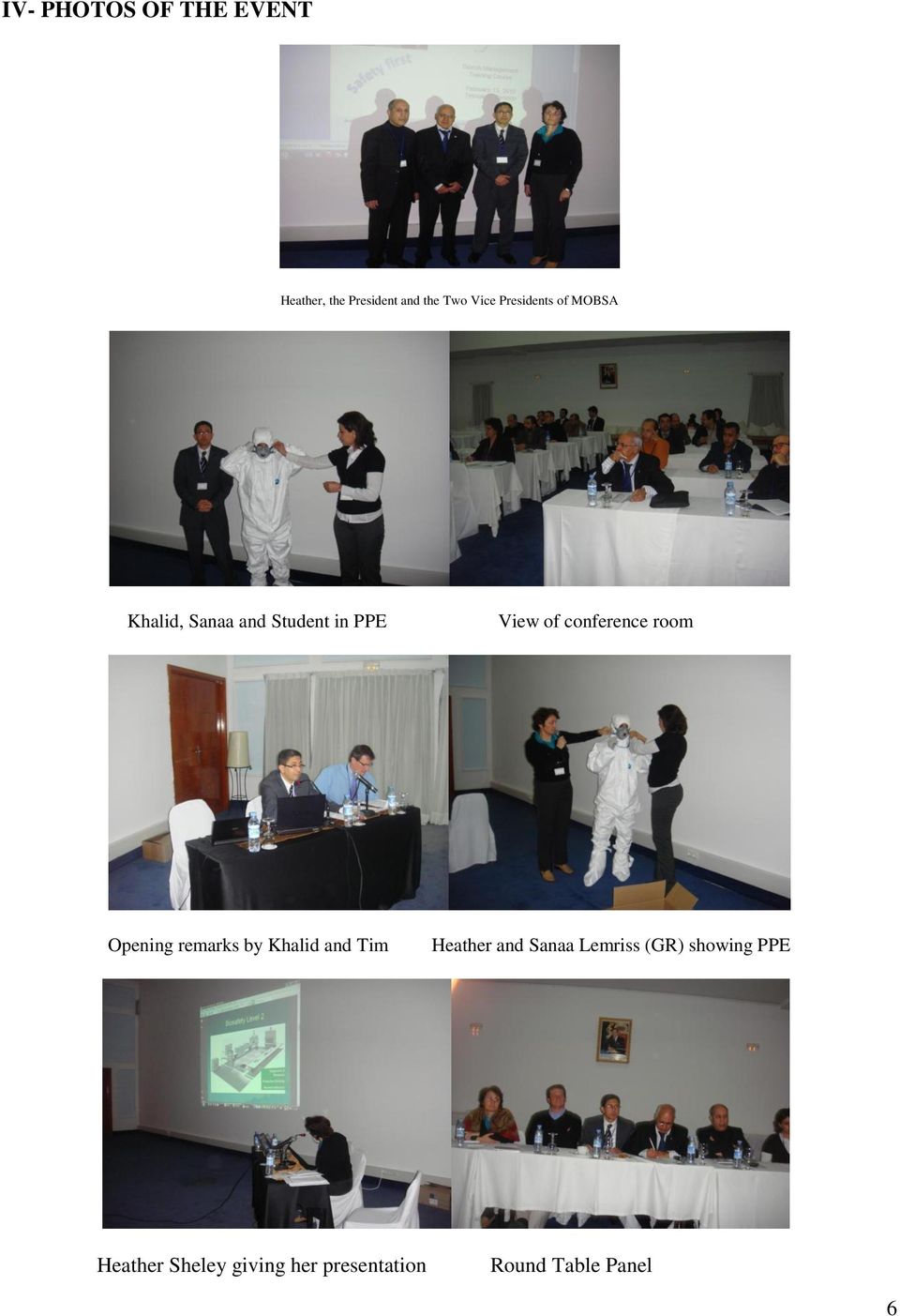
2 and how to mitigate them. A Core Group met in Abu Dhabi in 2008 and produced a Framework Document entitled "Developing Biosafety & Biosecurity Strategies for the MENA Region". The second Conference, in Casablanca in 2009, adopted the Framework Document and issued the Casablanca Declaration plotting the way forward. The first meetings of the Steering Committee and the Regional Training Centres Feasibility Committee were held in Jordan in July Since then, progress has been made in establishing National associations and a regional association or Federation of Associations, in creating technical working groups to start implementing the Framework Document, and in planning for Regional Biosafety and Biosecurity Training Centres. This is called the BBIC Process. He reiterated that the Tétouan Training could be considered as part of the Process s action plan. He also wishes that the Training would allow participants to learn and share their views and experiences in order to foster the strengthening of human resources in biosafety. II. THE PROGRAM After this introduction, the program (Annex II) developed as follow (PDF presentations, which were submitted by lecturers prior to the training, were compiled in a CD and made available to all participants): Morning Tim Trevan s (ICLS -USA): Two Presentations including one on Introduction to Biosafety and Biosecurity and one on Risk assessment and risk management. Tim s First presentation indicated clearly the importance of defining the full spectrum of Biological risks, confronting those risks and the various actions to be taken to mitigate them such as preparedness, resilience and need for good coordination. The second presentation was based on defining the levels of Biorisks and the traditional approach to risk assessment. Heather Sheley (Health Protection Agency, UK): Risk assessment for Biological Labs. Heather s presentation started with the WHO definition of the four risk groups followed by the four containment levels BSL 1 to 4. Heather discussed also the method of assignment to a Biosafety level according to a given laboratory activity and gave several considerations to approach this issue. At the end of this presentation, Dr Heather Sheley and Dr Sanaa Lemriss from the BSL3 Lab of the Gendarmerie Royale showed to participants a real life exhibition on the use of Personal Protective Equipment (PPE) for a BSL2 and 3 laboratories. This demonstration was performed thanks to Mr Mohamed Dahdah (graduate student at the Tétouan University) who volunteered to wear the equipment (see photo bellow). Khalid R Temsamani (): The Biological Weapon Prohibition Regime. Khalid s presentation started with a general introduction on the history of Biological weapons and the actions taken by the International community to prohibit their use. He also presented in details the structure of the BTWC and its relation with the CWC, the NNPT and the UNSCR He concluded by giving an overview on the upcoming 7 th review conference of State Parties to the BTWC and the roles countries like Morocco could play in the MENA Region in regard to universelization. Afternoon Khalid R Temsamani (): Life Sciences, Biosecurity and Dual-Use. Khalid s presentation was focused on the relationship between advances in Biotechnology and the concern about balancing sciences and security. He presented the overall status of Biotechnology research in Morocco and the lack of awareness and education of Moroccan Scientist in the fields of Biosafety and Biosecurity. Khalid discussed also in details the concept of Web of Prevention, the meaning of DURC and the seven experiments of concern resulting from the Fink report. He also gave some example of published works 2

3 that part of the scientific community considered as being of concern. Khalid s focus in this presentation was the important ethical role of scientists in the web of prevention. Mohamed Hassar (Institut Pasteur ): WHO Biosecurity Programs. Mohamed Hassar s presentation aimed at defining the World Health Assembly resolution that calls for enhancing laboratory Biosafety. He spoke about WHO s Biosafety and Laboratory Biosecurity Missions and explained the WHO s key activities in the Region such as Train the Trainers, capacity building and Laboratory Biosafety Manual. Mohamed talked also about the WHO Collaborating Centers, the Biosafety Advisory Group and concluded with coordinated activities undertaken in Morocco between the Ministry of Health and WHO specially a funded PNUE/FEM project for building technical and institutional capacities in modern Biotechnology. During the discussions of the various presentations, Prof. Mustapha Ziane from the University of Oujda took floor and announced the publication of a Moroccan Journal entitled Revue de Microbiologie Industrielle, Sanitaire et Environnementale. This journal is under electronic and paper format. Prof. Ziane stated that the Scientific Committee of the REMISE Journal is offering to the Tétouan Training lecturers to publish their presentations in the next journal edition. Furthermore, he offered to all participants of the Training to publish any of their work dealing with Microbiology, Health and Environment. Round Table After the presentations, a Round Table took place and the theme was: Biosecurity and Responsibility of Scientists. The Panel was constituted of the following persons: Mustapha Ennaji (); Tim Trevan (ICLS); Heather Sheley (UK HPA) and Khalid R Temsamani (). At the beginning of the Round Table, Khalid Temsamani took the lead by asking the audience to think about three fundamental questions: 1- How could advances in life sciences be used to the benefit of mankind and not be used (accidentally) as means of destruction? 2- How can we avoid manipulating highly dangerous pathogens while research activities aimed at curing bad diseases imply working with them? 3- How could we balance between security and freedom of researchers to advance scientific knowledge? First, each member of the panel took the floor and tackled the questions raised from different angles then an open discussion started. The discussion was very rich and constructive. Most of the interventions were rather focused on issues due to lack of education, information, infrastructure and available training resources in a language they can understand (Arabic or French). Most of the participants seemed to be unfamiliar with the Responsible Conduct of Research (RCR) concept. They had very little information about the subject which explained the deviation of the discussion from the 3 questions asked initially! The participants also heard detailed case studies on the experiences and lessons learned from the Military Hospital BSL3 Laboratory, BSL3 lab Institute Pasteur and BSL3 lab of Gendarmerie Royale. For example: Military BSL3 Lab workers urge the need to acquire ATCC strains for their day to day diagnostics otherwise they are forced to use local raw strains to overcome the issue. Microorganism s multi resistance issues have also been raised. Other participants expressed their concern about lack of good management of solvents in their labs, lack of proper waste management, and the need for an Etat des lieux at the National University Life Sciences Labs, public health labs and private labs. Some University Professors raised for the first time the serious question of manipulating used waters charged

4 with dangerous microorganisms during some research activity. They stressed the lack of proper use of PPE together with lack of proper training and awareness related to Biosafety protocols. The inadequate infrastructure for early detection of biological contamination in drinking water plants was also raised by some participants. However, participants heard that the information-technology-based Moroccan disease surveillance system is very good but it is not optimal. In general, the debate was about lack of awareness at the highest levels of national governments, Academia, inadequate resources and infrastructure, lack of sufficient technical expertise, and inadequate emphasis in training courses. In this regard, Khalid Temsamani reiterated that and the BBIC Process strategy is to pursue "integrated biorisk management," which is directed at ensuring Lab workers safety and keeping laboratory work secure. This will be accomplished by promoting awareness of biosafety and biosecurity as the principal means to bring about culture change in the laboratory, with targeted training, increasing capacities, and securing worker commitments as other means to this end. In order to draw a medium term action plan, the panelists urged participants to come up with concrete recommendations that would foster collaborative initiatives to promote the development of new academic programmes in biosafety and perhaps to strengthen existing ones. The following were also interesting items discussed: (a) Strategies and mechanisms for enhancing formal education and training in biosafety, in particular the development and/or expansion of degree and diploma-granting programmes (b) Measures for promoting cooperation between academic institutions specially in the fields of biosafety education and training The participants expressed their deep thanks to the organizers for allowing this type of debate to take place for the first time in Morocco among academicians and the national relevant institutions. They are hopping will help promote the use in Morocco of safe practices in the handling of pathogenic microorganisms: - in the laboratory - during transportation - in field investigations - in health-care facilities At the end of the Round Table, an assessment questionnaire was distributed to all participants (no names on questionnaires). From the raw results participants expressed the following needs: - Codes of conduct/ Dual use issues/ethics - Issue of English need to set up simultaneous translation for future seminars - One day is not enough we need 2-3 days for full benefit of the content - Take into consideration Chemical security too when training on Biosafety - Organize the training in small groups - Need of local/domestic case studies - Cite more epidemiological case studies in Morocco - We need an action plan - We need more presentations on the BWC - We need some legal advice from jurists III. GENERAL OBSERVATIONS, CONCLUSIONS AND RECOMMENDATIONS The summary of recommendations is as follow: 1- to prepare a survey/questionnaire in order to evaluate the situation at the National University laboratories 4

5 2- Start a Train the Trainers activity at Professors/Directors level + Train the lab technicians 3- Need to introduce Biosafety and Biosecurity modules at the Graduate level. (Some universities have already started). 4- Elaborate a Biosafety Manual for the University laboratories and a National guide for Biosecurity (a protocol for managing biological risks) 5- University Presidents to nominate a Biosafety officer in each relevant institution 6- Charter for Moroccan Researcher 7- More training for first responders would be useful, and capacity building for epidemiologists who must analyze and use the data was cited as a particularly urgent need 8- Medical waste disposal is a problem for many facilities, although commercial disposal services exist and their services could be expanded 9- Budgets for biosecurity at key research facilities are adequate, but are insufficient for many others 10- Some researchers cited an urgent need for a mechanism to allow researchers to obtain necessary reference strains from abroad (improve capabilities for diagnosing disease outbreaks) 11- More training for both researchers and first responders and enhanced border control capabilities were also frequent requests 12- A need for improved awareness of biosafety and biosecurity among students, researchers, officials, and the public was also noted 13- Some also cited a need for better legislative structures and the means to implement laws and policies 14- Coordination of any cooperative programs with the multiple Moroccan agencies/universities and international partners will be crucial to ensure that resources are used most effectively 15- Biosafety programmes should be multidisciplinary in nature, covering key scientific, regulatory (legal/policy), socio-economic and communications subjects; 16- It is important that Governments make biosafety a priority policy issue and provide funding to universities and other relevant institutions to develop and/or expand academic programmes that focus on training biosafety professionals. 17- Some of the key factors highlighted as limiting the development of biosafety academic programmes include: - A shortage of qualified local experts/trainers; - Limited access to training materials (Arabic and French) and up-to-date information on biosafety and biotechnology developments; - A lack laboratory equipment and facilities for biosafety field research and training; - A lack of sustainable sources of funding; and At the end of the Training, the 4 lecturers distributed Certificates of Participation to the Participants. This was followed by a lecture of a telegram of loyalty and devotion to His Majesty the King Mohamed VI from the President of the Moroccan Biosafety Association on the occasion of the first activity of this National Association. The meeting was then adjourned with great acclamation and exchange of congratulations to the organizers, the speakers and to ICLS.

6 IV- PHOTOS OF THE EVENT Heather, the President and the Two Vice Presidents of Khalid, Sanaa and Student in PPE View of conference room Opening remarks by Khalid and Tim Heather and Sanaa Lemriss (GR) showing PPE Heather Sheley giving her presentation Round Table Panel 6
7 Group Picture Lectures handing out certificates AHMED ATLAMSANI Faculté des Sciences de Tétouan DRISS NACHIT NARD BENNAS AMINE LAGLAOUI Université Abdelmalek Essaâdi FST Tanger HOUDA DERDABI Vice Président Commune Fnidek - KHALID FARES Universiré Cady Ayad - Faculté des Sciences Semlalia Marrakech - My MUSTAFA ENNAJI Université Hassan II Mohammedia Vice President ZOUHAIR SAID Laboratoire de Recherche et Biosécurité P3- Hôpital Militaire d Instruction Mohamed V Rabat - MUSTAFA MEZIANE Université Mohamed 1 er Faculté des Sciences Oujda ANNEX I Participant List FAHD SOUMAYA Faculté des Sciences de Tétouan Université Abdelmalek Essaâdi - TAIB AJZOUL Faculté des Sciences de Tétouan Université Abdelmalek Essaâdi - ACHRAF YULAL Faculté des Sciences de Tétouan Université Abdelmalek Essaâdi - MOHAMED ERRAMI Faculté des Sciences de Tétouan Université Abdelmalek Essaâdi - MUSTAFA AHRIKAT Bureau Municipal d Hygiène - Tétouan TIM TREVAN International Council for the Life Sciences Washington DC - USA SANAA LEMRISS Laboratoire de Recherche et d Analyses Médicales de la Gendarmerie Royale Rabat - MOUNDIB RAJAE Université Chouaib Doukkali - Faculté des Sciences El Jadida - AARAB LOTFI Université Sidi Mohamed Ben Abdellah Faculté des Sciences KHALIL EL HAJJAJI MUSTAFA AKSISSOU FAÏZA CHAOUKAT KHALID DRAOUI Faculté des Sciences de Tétouan - MOHAMED IDA OMAR Président Commune Urbaine Tétouan HEATHER SHEELEY Centre for Emergency Preparedness and Response - Health Protection Agency - UK IDRISS LAHLOU AMINE Laboratoire de Recherche et Biosécurité P3- Hôpital Militaire d Instruction Mohamed V Rabat - MOHAMED HASSAR Institut Pasteur du Casablanca - My ABDELLAH BAHLAOUI Université Hassan II Mohammadi Faculté des Sciences et

8 SAMIRA SENOUCI Institut National d Hygiène Rabat - DOUNIA BOUCHTA El ALAMI MAJIDA OTMANE CHAARA et Techniques de Fès AMAL ALLA Institut National d Hygiène Rabat - KHALID RIFFI TEMSAMANI President LAMKADEM MOHAMED AHMED LAYACHI Techniques - OUAFAA FASSI FIHRI IAV HASSAN II Rabat - JALAL NOURELLIL Institut Pasteur du Casablanca - DRISS SERRA MOHAMED DAHDAH ANNEX II PROGRAMME Samedi 13 Février, Inscription Mot de bienvenu Khalid R. Temsamani, Président d AMABIOS Présentation des objectifs du cours Bureau Exécutif, AMABIOS Introduction à la Biosureté et la Biosécurité Tim Trevan, Executive Director, ICLS. Washington DC Pause Café Evaluation du Risque et Management du Risque Tim Trevan, Executive Director, ICLS. Washington DC. USA Risk assessment for biological labs Heather Sheeley, Health Protection Agency United Kingdom La Convention sur les Armes Biologiques Khalid R. Temsamani, Président d AMABIOS Déjeuner Hôtel Barcélo Marina Smir Sciences de la Vie, Biosécurité et Double Usage! Khalid R. Temsamani, Président d AMABIOS Les Programmes de l OMS en Biosécurité : Cas du Mohamed Hassar, Directeur de l Institut Pasteur 8

9 Pause Café Table Ronde sur la Biosécurité et la responsabilité des Scientifiques Animée par : My M. Ennaji, V.P. d AMABIOS ; T. Trevan, Ex. Director ICL ; H. Sheeley, United Kingdom Health Protection Agency et K. R Temsamani, Président AMABIOS Questionnaire d évaluation de la formation (D. Serrar, D. Bouchta, M. Mkadem et M. Alami) Synthèse et Clôture de la Formation (Ahmed Ayachi, AMABIOS ; Tim Trevan, ICLS et Khalid R Temsamani, AMABIOS)
Dual-Use Bioethics / Biosecurity Online Learning Train-the-Trainer Program
 Dual-Use Bioethics / Biosecurity Online Learning Train-the-Trainer Program Simon Whitby 31st Workshop of the Pugwash Study Group on the Implementation of the Chemical and Biological Weapons Conventions:
Under the title: Quality in Higher Education, for meet the needs of Enterprise and the Moroccan Society: Approaches, Practices and Evaluation Systems
 Under the title: Quality in Higher Education, for meet the needs of Enterprise and the Moroccan Society: Approaches, Practices and Evaluation Systems The Research Group on QHSE Sidi Mohamed Ben Abdellah
How To Set Up A National Biological Laboratory Safety And Security Monitoring Program
 Biosecurity and Bioterrorism: Biodefense Strategy, Practice, and Science Volume 10, Number 4, 2012 ª Mary Ann Liebert, Inc. DOI: 10.1089/bsp.2012.0054 Establishing a National Biological Laboratory Safety
SEOUL DECLARATION GLOBAL HEALTH SECURITY AGENDA 2015 HIGH-LEVEL MEETING IN SEOUL
 SEOUL DECLARATION GLOBAL HEALTH SECURITY AGENDA 2015 HIGH-LEVEL MEETING IN SEOUL We, the ministers gathered on September 9, 2015, at the Global Health Security Agenda (GHSA) High-Level Meeting in Seoul,
1 Announcement Call for papers
 International Congress Mycotoxins and Cancer Mycotoxins and Cancer Marrakesh from 02 till 04 december 2015 nd th Hôtel Ryad Mogador Agdal st 1 Announcement Call for papers [email protected]
How To Teach In Marocco
 Nadia Naami Ph.D. Candidate in Romance Studies Department of Modern Languages and Literatures University of Miami 5202 University Drive Coral Gables, FL 33124-2074 Tel: 786-603-8795 email :[email protected]
Dual-Use Bioethics/Biosecurity Training
 Dual-Use Bioethics/Biosecurity Training 2 nd Annual Conference BACAC Regional Biosafety and Biosecurity Collaboration Bishkek, Kyrgyz Republic 11-12 November 2010 Masamichi Minehata Bradford Disarmament
AlmaLaurea s tools for the improvement of quality assurance in the higher education systems. Prof. Francesco Ferrante AlmaLaurea scientific adviser
 ASSESSEMENT IN EDUCATON AND TRAINING Approaches, issues and challenges Rabat, November 22-23 AlmaLaurea s tools for the improvement of quality assurance in the higher education systems Prof. Francesco
How To Strengthen Nuclear Security
 COUCIL OF TH UROPA UIO N The Hague, 25 March 2014 8193/14 (OR. en) PRSS 187 The Hague uclear Security Summit Communiqué We, the leaders, met in The Hague on 24 and 25 March 2014 to strengthen nuclear security,
CBRN National Action Plans
 Chemical Biological Radiological Nuclear Risk Mitigation - Centres of Excellence CBRN National Action Plans Irakli Beridze Senior Strategy and Policy Advisor UNICRI Jointly implemented by the EC JRC and
Major Public Health Threat
 GAO United States General Accounting Office Testimony Before the Committee on Government Reform, House of Representatives For Release on Delivery Expected at 10:00 a.m. EST Thursday, February 12, 2004
Grid Initiative Othmane Bouhali
 MaGrid: The Moroccan Grid Initiative Université Libre de Bruxelles Brussels, Belgium Outline! The Moroccan Grid Initiative, MaGrid! The EumedGrid project! Collaboration/Research activities! Future Grid
Transport infrastructures in Morocco and public private partnership (PPP) development strategies
 Transport infrastructures in Morocco and public private partnership (PPP) development strategies Content A system of transport in continuous development A pro-active strategy for the period 2012-2016 New
How To Help The War On Terror
 NATO s Weapons of Mass Destruction Forensics Conference by Arne Thomas WgCdr Jonathan Archer Executive Summary NATO s Comprehensive Strategic Level Policy for Preventing the Proliferation of Weapons of
RENEWABLES IN MOROCCO SIE A STATE OWNED ACTOR
 RENEWABLES IN MOROCCO SIE A STATE OWNED ACTOR The real beginning of Renewable Energy story in Morocco Considering the extensive development these new energy sources are bound to experience, they must be
Emergency Management
 Emergency Management Health Portfolio Presented by Lise Gauthier Regional Coordinator Emergency Management Health Portfolio / Quebec Region Conference on Emergency Preparedness for First Nations in Québec
Workers health: global plan of action
 Workers health: global plan of action Sixtieth World Health Assembly 2 SIXTIETH WORLD HEALTH ASSEMBLY SIXTIETH WORLD HEALTH ASSEMBLY WHA60.26 Agenda item 12.13 23 May 2007 Workers health: global plan of
Core Functions and Capabilities. Laboratory Services
 Core Functions and Capabilities British Columbia Centre for Disease Control Laboratory Services Understanding the role and value of British Columbia s public health laboratory in protecting our community
The Centre for Food Safety
 The Centre for Food Safety Introduction Ensuring food safety is a major policy objective of the Government of the Hong Kong Special Administrative Region. To enhance the food safety regulatory functions
Section VI Principles of Laboratory Biosecurity
 Section VI Principles of Laboratory Biosecurity Since the publication of the 4th edition of BMBL in 1999, significant events have brought national and international scrutiny to the area of laboratory security.
Register. Now. 2 nd Dii DESERT ENERGY CONFERENCE CAIRO 2011 2 nd 3 rd November 2011
 Register Now 2 nd Dii DESERT ENERGY CONFERENCE CAIRO 2011 2 nd 3 rd November 2011 This year has so far been dominated by the significant political transitions in North Africa and a worldwide re-evaluation
Synthesis of ECT evidence
 Efficacy Synthesis of ECT evidence Risk Reference : Agence d évaluation des technologies et des modes d intervention en santé (AETMIS). The use of electroconvulsive therapy in Québec. Report prepared by
Twelfth United Nations Congress on Crime Prevention and Criminal Justice
 United Nations A/65/92 General Assembly Distr.: General 10 June 2010 Original: English Sixty-fifth session Item 107 of the preliminary list * Crime prevention and criminal justice Twelfth United Nations
The United States Department of Defense Biological Threat Reduction Program. Threat Agent Detection and Response and Cooperative Biological Research
 The United States Department of Defense Biological Threat Reduction Program Threat Agent Detection and Response and Cooperative Biological Research Shawn Cali, Sara Mayer and Roger Breeze February 23,
Knowledge and Awareness of Proper Waste Disposal and Routine Biosafety Measures Among HealthCare Workers in Karachi, Pakistan (JUW-BEP-BSAP Project)
 Knowledge and Awareness of Proper Waste Disposal and Routine Biosafety Measures Among HealthCare Workers in Karachi, Pakistan (JUW-BEP-BSAP Project) 11/01/2011 1 Shazia Tabassum Hakim 1,4, Syed Muhammad
2013 Global Initiative to Combat Nuclear Terrorism Plenary Meeting Joint Co-Chair Statement
 2013 Global Initiative to Combat Nuclear Terrorism Plenary Meeting Joint Co-Chair Statement Partner nations and official observers in the Global Initiative to Combat Nuclear Terrorism (GICNT) gathered
Bioterrorism & Emergency Readiness
 Bioterrorism & Emergency Readiness COMPETENCIES FOR ALL PUBLIC HEALTH WORKERS A Message from the Centers for Disease Control and Prevention Dear Public Health Colleague, A prepared workforce is an essential
The great meeting of youth entrepreneurship. Theme: "Create, develop and sustain your business!"
 Under the High Patronage of His Majesty King Mohammed VI 16-17 November 2015 The great meeting of youth entrepreneurship Theme: "Create, develop and sustain your business!" His Majesty King Mohammed VI
Stakeholders meeting. Ethical protocols and standards for research in Social Sciences today
 Stakeholders meeting organised by the Scientific Committee for the Social Sciences Ethical protocols and standards for research in Social Sciences today Date: Thursday 11 June 2015, from 10.00 to 17.00
Office of Laboratory Science and Safety
 Office of Laboratory Science and Safety Segaran Pillai, Ph.D, SM AAM, SM ASCP Director, Office of Laboratory Science and Safety Office of the Commissioner Office of the Chief Scientist Mission Statement
Naif Arab University for Security Sciences (NAUSS): Pursuing excellence in security science education and research
 Arab Journal of Forensic Sciences and Forensic Medicine 2014; Volume 1 Issue (0), 5-11 5 Naif Arab University for Security Sciences Arab Journal of Forensic Sciences and Forensic Medicine www.nauss.edu.sa
Post-graduate education on Climate Change at Ca Foscari University of Venice. Carlo Giupponi
 Post-graduate education on Climate Change at Ca Foscari University of Venice Carlo Giupponi Where we are Ca Foscari University of Venice Established on August 6 th 1868 as a Royal Business College, Ca
Working together to enhance chemical safety and security. Ukraine Chemical Security Forum
 Working together to enhance chemical safety and security Ukraine Chemical Security Forum A special event of the Global Chemical Safety and Security Summit and Fair (www.chemss2016.org) Executive summary
Effects of workplace noise exposure during pregnancy
 ABSTRACT Effects of workplace noise exposure during pregnancy SYSTEMATIC REVIEW WITH META-ANALYSIS AND META-REGRESSION INSTITUT NATIONAL DE SANTÉ PUBLIQUE DU QUÉBEC AUTHOR Agathe Croteau, M.D., Ph. D.
University Information Sheet
 Part A: University Information Sheet A.1- Brief description of your university: (history, main activities, number of students, courses offered, etc). The Sidi Mohammed Ben Abdellah University has been
ARAB IMPACT CRATERING AND ASTROGEOLOGY CONFERENCE (AICAC II) 13-20 November 2011, CASABLANCA, MOROCCO
 FIRST ANNOUNCEMENT HASSAN II CASABLANCA UNIVERSITY FACULTY OF SCIENCES In partnership with ARAB UNION FOR ASTRONOMY AND SPACE SCIENCES ORGANIZES THE SECOND ARAB IMPACT CRATERING AND ASTROGEOLOGY CONFERENCE
No. prev. doc.: 9392/08 SAN 77 DENLEG 48 VETER 5 Subject: EMPLOYMENT, SOCIAL POLICY, HEALTH AND CONSUMER AFFAIRS COUNCIL MEETING ON 9 AND 10 JUNE 2008
 COUNCIL OF THE EUROPEAN UNION Brussels, 22 May 2008 9637/08 SAN 88 DENLEG 52 VETER 7 NOTE from: Committee of Permanent Representatives (Part 1) to: Council No. prev. doc.: 9392/08 SAN 77 DENLEG 48 VETER
Canadian Public Health Laboratory Network. Core Functions of Canadian Public Health Laboratories
 Canadian Public Health Laboratory Network Core Functions of Canadian Public Health Laboratories Canadian Public Health Laboratory Network The CPHLN Core Functions of Canadian Public Health Laboratories
International cooperation in the peaceful uses of outer space
 United Nations A/RES/69/85 General Assembly Distr.: General 16 December 2014 Sixty-ninth session Agenda item 49 Resolution adopted by the General Assembly on 5 December 2014 [on the report of the Special
53rd DIRECTING COUNCIL
 53rd DIRECTING COUNCIL 66th SESSION OF THE REGIONAL COMMITTEE OF WHO FOR THE AMERICAS Washington, D.C., USA, 29 September-3 October 2014 CD53.R14 Original: Spanish RESOLUTION CD53.R14 STRATEGY FOR UNIVERSAL
Latifa MOUHIR Department Process Engineering and Environment Faculty of Science and Technology Hassan II University. Mohammedia. Morocco.
 Latifa MOUHIR Department Process Engineering and Environment Faculty of Science and Technology Hassan II University. Mohammedia. Morocco. E mail: [email protected]. INTRODUCTION MEDICAL AND PHARMACEUTICAL
School of Public Health and Health Services Department of Epidemiology and Biostatistics
 School of Public Health and Health Services Department of Epidemiology and Biostatistics Graduate Certificate Public Health Microbiology and Emerging Infectious Diseases 2011-2012 Program Directors for
DRAFT FINAL REPORT. Second Global Forum on International Quality Assurance, Accreditation and the Recognition of Qualifications ED/2005/RP/H/1
 Distribution: Limited ED/2005/RP/H/1 Original: English UNITED NATIONS EDUCATIONAL, SCIENTIFIC AND CULTURAL ORGANIZATION DRAFT FINAL REPORT Second Global Forum on International Quality Assurance, Accreditation
General Services Administration Federal Supply Service Authorized Federal Supply Schedule Price List
 General Services Administration Federal Supply Service Authorized Federal Supply Schedule Price List GSA Schedule 66 Scientific Equipment and Services SIN 66-1000 Professional Scientific Services IHRC,
the Parliamentary Assembly of the Union for the Mediterranean
 the Parliamentary Assembly of the Union for the Mediterranean Royaume du Maroc Parlement 1. Meeting venue The 8 th plenary session Rabat, 23-25 March 2012. Practical Information. All meetings of the 8
(Resolutions, recommendations and opinions) RECOMMENDATIONS COUNCIL
 3.7.2009 Official Journal of the European Union C 151/1 I (Resolutions, recommendations and opinions) RECOMMENDATIONS COUNCIL COUNCIL RECOMMENDATION of 9 June 2009 on patient safety, including the prevention
PROCLAMATION OF 2009 AS THE UNITED NATIONS INTERNATIONAL YEAR OF ASTRONOMY OUTLINE
 U General Conference 33rd session, Paris 2005 33 C 33 C/67 11 October 2005 Original: English Item 5.30 of the agenda PROCLAMATION OF 2009 AS THE UNITED NATIONS INTERNATIONAL YEAR OF ASTRONOMY Source: 172
WORLD HEALTH ORGANIZATION
 WORLD HEALTH ORGANIZATION Follow up to the World Health Assembly decision on the Ebola virus disease outbreak and the Special Session of the Executive Board on Ebola: Roadmap for Action September 2015
NATIONAL SERIES. Key Notes. Dual-use Biosecurity Education. Bradford Disarmament Research Centre. Strengthening Global Biosecurity
 Dual-use Biosecurity Education NATIONAL SERIES Key Notes Bradford Disarmament Research Centre Strengthening Global Biosecurity Division of Peace Studies University of Bradford United Kingdom 1 This project
ESCWA Technology Centre
 ESCWA Technology Centre Newsletter Second Half, 2013 Amman - Jordan www.etc-un.org The Broken Cycle: Universities, Research and Society in the Arab World Proposals for Change Available study online (En,
Sample Position Description for Tier 2: Mid-Level Epidemiologist
 Sample Position Description for Tier 2: Mid-Level Epidemiologist Introduction Incumbent serves as an intermediate-level professional epidemiologist, responsible for carrying out a broad and complex range
Université Paris-Est is a research and higher education cluster PRES.
 - Université Paris-Est Marne-la-Vallée - Université Paris 12 Val de Marne - École des Ponts ParisTech - ESIEE Paris - École d architecture, de la ville et des territoires à Marne-la-Vallée (EAVT) - École
Planning and Implementing Project Management Office and Visionary Leadership Skills 432
 Planning and Implementing Project Management Office and Visionary Leadership Skills 432 مفاهيم وطرق بناء مكتب ادارة المشاريع والمهارات الادارية والقيادية 26 September 7October, 2010 Lebanon Need & Benefit:
Crisis Management Centre - Animal Health (CMC-AH)
 Crisis Management Centre - Animal Health (CMC-AH) Rapid Missions Update October 2014 October 2015 The Crisis Management Centre Animal Health (CMC-AH) is a joint platform of the Food and Agriculture Organization
Adopted by the Security Council at its 7268th meeting, on 18 September 2014
 United Nations S/RES/2177 (2014) Security Council Distr.: General 18 September 2014 Resolution 2177 (2014) Adopted by the Security Council at its 7268th meeting, on 18 September 2014 The Security Council,
EUROPASS DIPLOMA SUPPLEMENT
 EUROPASS DIPLOMA SUPPLEMENT TITLE OF THE DIPLOMA (ES) Técnico Superior en Procesos y Calidad en la Industria Alimentaria TRANSLATED TITLE OF THE DIPLOMA (EN) (1) Higher Technician in Processes and Quality
EUCERD RECOMMENDATIONS QUALITY CRITERIA FOR CENTRES OF EXPERTISE FOR RARE DISEASES IN MEMBER STATES
 EUCERD RECOMMENDATIONS QUALITY CRITERIA FOR CENTRES OF EXPERTISE FOR RARE DISEASES IN MEMBER STATES 24 OCTOBER 2011 INTRODUCTION 1. THE EUROPEAN CONTEXT Centres of expertise (CE) and European Reference
Ensuring WHO s capacity to prepare for and respond to future large-scale and sustained outbreaks and emergencies
 EXECUTIVE BOARD Special session on Ebola Provisional agenda item 3 EBSS/3/3 EXECUTIVE BOARD 136th session 9 January 2015 Provisional agenda item 9.4 Ensuring WHO s capacity to prepare for and respond to
Administrative Procedure Chapter 12, Research Administrative Procedure: AP 12.217, Procedure for Institutional Oversight of Life
 Administrative Procedure, AP 12.217 Procedure for Institutional Oversight of Life Sciences Dual Use Research of Concern Page 1 of 15 Administrative Procedure Chapter 12, Research Administrative Procedure:
THE STATE OF THE PRIVATE SECURITY SERVICE PROVIDERS IN GHANA
 African Security Dialogue and Research (ASDR) REPORT OF THE WORKSHOP ON THE STATE OF THE PRIVATE SECURITY SERVICE PROVIDERS IN GHANA 23RD JULY, 2008 MENSVIC HOTEL EAST LEGON - ACCRA African Security Dialogue
CAPABILITY 12: Public Health Laboratory Testing
 Public health laboratory testing is the ability to conduct rapid and conventional detection, characterization, confirmatory testing, data reporting, investigative support, and laboratory networking to
NSS 2014 UK NATIONAL PROGRESS REPORT. March 2014
 NSS 2014 UK NATIONAL PROGRESS REPORT March 2014 1. Support for the Convention on the Physical Protection of Nuclear Material and the International Convention for the Suppression of Acts of Nuclear Terrorism
ANNUAL MEETING OF THE INTERNATIONAL NUCLEAR SECURITY EDUCATION NETWORK (INSEN) IAEA Headquarters, Vienna, Austria 10-12 August 2015.
 ANNUAL MEETING OF THE INTERNATIONAL NUCLEAR SECURITY EDUCATION NETWORK (INSEN) IAEA Headquarters, Vienna, Austria 10-12 August 2015 Chairman s Report Report by Mr Guido Gluschke Chair of the International
Newton-Mosharafa PhD Programme
 Newton-Mosharafa PhD Programme Call for Applications 1. The UK Department of Business, Innovation and Skills (BIS), the British Council, British Embassy Cairo and Egyptian Ministry of Higher Education
Solar in Egypt: New feed-in-tariff scheme to develop PV
 Solar in Egypt: New feed-in-tariff scheme to develop PV Researched & produced by: SolarReserve www.pv-insider.com/menasol/egypt In association with: MENASOL 2015 7th Middle East & North Africa Conference
Identification of a problem, e.g., an outbreak Surveilance Intervention Effect
 EPIDEMIOLOGY EPIDEMIOLOGY Epidemiology is a cornerstone of the control of infectious diseases. Statens Serum Institut s epidemiological activities cover a wide field, from surveillance of diseases and
EUROPASS DIPLOMA SUPPLEMENT
 EUROPASS DIPLOMA SUPPLEMENT TITLE OF THE DIPLOMA (ES) Técnico Superior en Laboratorio de análisis y de control de calidad TRANSLATED TITLE OF THE DIPLOMA (EN) (1) Higher Technician in Analysis and Quality
Abderrahman El Kharrim
 Curriculum Vitae EPIKH administrators are allowed to treat all the data below Abderrahman El Kharrim Contribution to scientific and technical research projects Date and place of birth : Nationality : Personal
Draft Resolution on Science, technology and innovation for development
 1 Draft Resolution on Science, technology and innovation for development The Economic and Social Council, Recognizing the role of the Commission on Science and Technology for Development as the United
School of Public Health. Department of Epidemiology & Biostatistics
 School of Public Health Department of Epidemiology and Biostatistics Master of Science in Public Health Microbiology and Emerging Infectious Diseases 2015-2016 Program-at-a-Glance Note: All curriculum
A PROFESSIONAL MASTER S DEGREE IN INTERNATIONAL LAW, DIPLOMACY AND INTERNATIONAL RELATIONS
 A PROFESSIONAL MASTER S DEGREE IN INTERNATIONAL LAW, DIPLOMACY AND INTERNATIONAL RELATIONS TABLE OF CONTENTS EXCEPTIONAL MASTER S DEGREE FOR INTERNATIONAL CAREERS 1 THE LAW FACULTY OF THE PARIS-DESCARTES
INTANGIBLE TRANSFER OF TECHNOLOGY (ITT) : Regulatory Perspective. Presented by Hjh Nuraffiza Ahmad Strategic Trade Division SKMM
 INTANGIBLE TRANSFER OF TECHNOLOGY (ITT) : Regulatory Perspective Presented by Hjh Nuraffiza Ahmad Strategic Trade Division SKMM 8 January 2014 Definition Section 2, Strategic Trade Act 2010 - Interpretation
The workshop was a follow-up to two books published last year by KAS on Climate Change.
 Report on the Training Workshop Negotiating International Treaties: Training Program for Diplomats held at the Intercontinental Addis Hotel in Addis Ababa, Ethiopia on July 31 st and August 1 st 2014 I.
SUMMARY AUDIT REPORT DIRECTORATE OF CIVIL AVIATION OF MOROCCO
 ICAO Universal Safety Oversight Audit Programme SUMMARY AUDIT REPORT DIRECTORATE OF CIVIL AVIATION OF MOROCCO (Rabat, 26 October to 3 November 1999) INTERNATIONAL CIVIL AVIATION ORGANIZATION ICAO UNIVERSAL
Establishing Effective Public Health Partnerships Homer C. Emery, Ph.D. 1
 Establishing Effective Public Health Partnerships Homer C. Emery, Ph.D. 1 Abstract Prior to President Nixon s creation of the Environmental Protection Agency (EPA) in 1970, public water systems were regulated
The role of pest management in protecting public health
 The role of pest management in protecting public health May 2009 Foreword Everybody should be entitled to enjoy a healthy and satisfying life in a pleasant, peaceful and pest-free environment. Unfortunately
Africa Industrialization Day 2012
 CONCEPT NOTE Africa Industrialization Day 2012 Accelerating Industrialization for Boosting Intra-Africa Trade 5 December 2012 Addis Ababa, Ethiopia 1. INTRODUCTION During the 25th General Session of the
Cyber crime: Police Roles and Responsibilities Within a Collaborative Framework
 Executive Report to the CACP Board of Directors from CACP Global 2015 Cyber crime: Police Roles and Responsibilities Within a Collaborative Framework In the fall of 2014, the CACP Board of Directors assigned
Seoul Communiqué 2012 Seoul Nuclear Security Summit
 Seoul Communiqué 2012 Seoul Nuclear Security Summit We, the leaders, gathered in Seoul on March 26-27, 2012, renew the political commitments generated from the 2010 Washington Nuclear Security Summit to
The Arab Society for Forensic Sciences and Forensic Medicine (ASFSFM): Bringing together regional and international expertise
 Arab Journal of Forensic Sciences and Forensic Medicine 2014; Volume 1 Issue (0), 17-21 17 Naif Arab University for Security Sciences Arab Journal of Forensic Sciences and Forensic Medicine www.nauss.edu.sa
INTEGRATED PEST CONTROL
 19 TOPIC 3 INTEGRATED PEST CONTROL Scope Chemical pesticides are now the traditional solution to pest problems, and they have saved lives and crops. Their use, however, has created significant problems,
Program Specification for Master Degree in Public Health and Community Medicine
 Cairo University Faculty of Medicine Program Specification for Master Degree in Public Health and Community Medicine Program type: single Program code: COMM 800 Department offering the program: Department
Program Overview. BOSC Homeland Security Subcommittee Meeting August 25, 2015
 1 Program Overview BOSC Homeland Security Subcommittee Meeting August 25, 2015 2 Tuesday, August 25 8:00 Welcome Mr. Thomas Tracy, Designated Federal Official 8:15 Introductions and Review of Charge Questions
United Nations High-Level Meeting on Countering Nuclear Terrorism with a Specific Focus on Strengthening the Legal Framework.
 United Nations High-Level Meeting on Countering Nuclear Terrorism with a Specific Focus on Strengthening the Legal Framework 28 September 2012 Chair s Summary The United Nations High-Level Meeting on Countering
FAO/WHO Regional Conference on Food Safety for the Americas and the Caribbean San José, Costa Rica, 6-9 December 2005
 Agenda Item 5 Conference Room Document 13 FAO/WHO Regional Conference on Food Safety for the Americas and the Caribbean San José, Costa Rica, 6-9 December 2005 THE FOOD SAFETY REGULATORY SYSTEM IN CANADA
DISARMAMENT. The Non-Aligned Movement (NAM) Database
 The Non-Aligned Movement (NAM) Database Summary of the 11 th Heads of State Summit, Cartagena, Colombia (1995) General Views on Disarmament and NAM Involvement DISARMAMENT (Annex II: The Call from Columbia,