
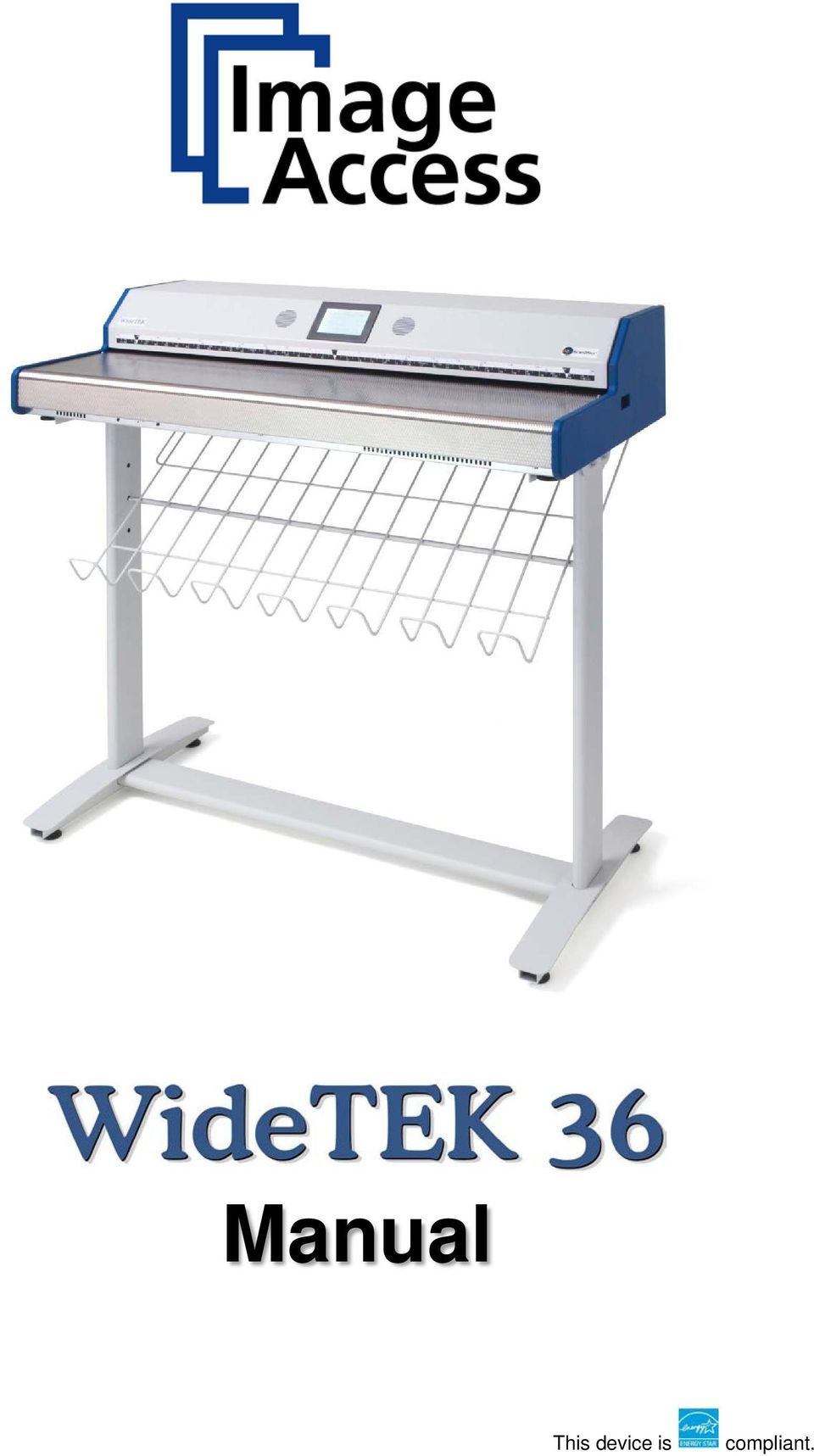
Manual This device is compliant.
|
|
|
- Anissa Laurel Payne
- 10 years ago
- Views:
Transcription
1 Manual This device is compliant.
2 File: WT36_OperationManual_M3.docx

3 by Image Access GmbH, Wuppertal, Germany. Printed in Germany. All rights reserved. Reproduction in whole or in part in any form or medium without express written permission of Image Access is prohibited. Scan2Net, WideTEK and Bookeye are registered trademarks of Image Access. All other trademarks are the property of their respective owners. Image Access reserves the right to change the described products, the specifications or documents at any time without prior notice. For the most recent version, always check our web site or or the customer service portal at portal.imageaccess.de Manual Page 3
4 Introduction Dear Customer, We congratulate you on the acquisition of this innovative product from Image Access. We at Image Access are proud of the work we do; it is the result of our extremely high standards of production and stringent quality control. With the WideTEK 36, Image Access offers an efficient scanner which covers a wide scope of applications due to its versatility. Its integrated web based user interface makes all functions available in structured menus. This operation manual is designed to lead you through all situations which will arise when using the WideTEK 36. For this reason, we ask you to read the manual attentively before starting to work with the WideTEK 36. By doing so, you will avoid operation errors and you can control all functions from the beginning. In addition please consider the following points: Damages to your unit may have occurred during shipping. Please check for damages immediately after delivery of the unit. Inform your supplier if damage has occurred. Read and ensure that you understand the safety notes. They were developed for your protection and safety as well as to protect the unit. Regular maintenance conserves the high quality and safety of the WideTEK 36 during the entire service life. If you have any further questions, please feel free to contact your local dealer or Image Access, Inc. directly. Our staff will be happy to help you. For your daily work with the WideTEK 36 scanner, we wish you success and complete satisfaction. Regards Your Image Access Team Page 4 Manual
5 About this Manual Operation Manual The Operation Manual gives all information about the normal operation and behavior of the device. It is written for people who only operate the device and do not perform setup and adjustment procedures. All device elements and software functions are described in detail, although some of them might never be used. This manual does not cover any application software. Refer to the appropriate application software manual to learn about the application software. Setup and Assembly Manual The Setup and Assembly Manual is written for technical staff with some basic mechanical as well as software skills. Many resellers will offer on-site installation; therefore, large parts or all of the setup and assembly manual might not be of interest to the reader. The access level at which the setup and adjustment processes are performed is called Power user. This Power user level is password protected from access by the normal operator. All available manuals for this device can be downloaded from our customer service portal at Be sure to always check for the latest versions of these manuals. This manual is divided into four sections, A to D. Section A Note: Section B Section C Section D Safety instructions and hardware. This section describes the hardware of the scanner and the mechanical installation of options. It also describes the operation of the scanner by using the integrated touchscreen. Optional the WideTEK 36 can be delivered with an appropriate floor stand. It is recommended to always use the WideTEK 36 in combination with the floor stand. Software. This section describes the integrated Scan2Net software. This section also describes the installation procedure for software options. Error codes and troubleshooting procedures. Technical data and declarations. Manual Page 5

6 Version History Version Published in Content/Changes/Supplements History of version prior to G removed in version M. G June 2008 Firmware V 5. An important note added to chapter A.15.1 and A.15.2 concerning powering the scanner on and/or off in the correct way. H August 2008 Table D.4 corrected. Changed values for the device weight and total shipping weight. I May 2009 Firmware V Order of chapters has been changed. Changes in the Content on Delivery list. Chapter B.2.2: Some additional information, e.g. description of new stitching method. K September 2009 Firmware V New chapter B Guide Plate Middle inserted. Error codes added/modified. K2 February 2010 Chapter D.3 Electr. Spec.: New value for stand-by consumption, another power supply is used. L September 2010 Previous chapter A.6 has been split in chapters A.6 and A.7. Previous chapter A.7 and all following A.x chapters renumbered. Chapter A.8 Content on Delivery corrected. New: Chapter A.10 Adjusting the Middle Guide Plate. Prev. chapter A.10 and all following A.x chapters renumbered. Chapters A.13.8: Content of touchscreen has been split on two screens, new sub-chapters added. M April 2011 New: Chapter A.12 Connecting an External Monitor. Prev chapter A.12 Powering up and all following A.x chapters renumbered. M2 July 2011 Chapters in part A reordered, changes in the directory levels and renumbered. Chapter B.3.5.1: Remote printer options enlarged. New: Chapter B.3.9 Output Option Web added. Prev. chapter B.3.9 renumbered to B.3.10 M3 October 2011 Chapter B.3.3, information about container format added. Update Technical Data. As an ENERGY STAR Partner, Image Access has determined that this product meets the ENERGY STAR guidelines for energy efficiency. Page 6 Manual

7 Table of Content Introduction About this Manual Version History A Hardware A.1 Safety Notes A.1.1 Marking of Safety Notes 14 A.2 Certification A.3 General Notice A.4 Safety Precautions A.5 Connecting to the Power Source A.6 Device Location A.7 Maintenance A.7.1 Touchscreen 18 A.7.2 Surfaces 18 A.7.3 Glass plate 18 A.8 Repair A.9 Content on Delivery A.10 Connectors on the Scanner A.11 Adjusting the Middle Guide Plate A.12 Paper Transport Wings A.12.1 How to insert the Paper Transport Wings 25 A.12.2 Position of the Paper Transport Wings 26 A.12.3 Scanning documents on light, thin paper material 26 A.12.4 Scanning documents on normal or heavier paper 27 A.13 Connecting an External Monitor A.14 Powering up the WideTEK A.15 WideTEK 36 Touch Panel A.15.1 Starting the WideTEK 36 from Stand-By Mode 30 A.15.2 Turning-off the WideTEK A.15.3 The Help Function 31 A.16 Navigating through the Screens A.16.1 How to Enter or Change Values 32 A.17 Self Test Mode A.17.1 IP Address 34 A.17.2 White Balance 35 Manual Page 7
8 A.17.3 Lamp On / Off 35 A.17.4 Exit Selftest 35 A.17.5 Touch Adjust 36 A.17.6 Touch Test 36 A.17.7 Stitch Test 37 A.17.8 EMV Test 37 A.17.9 Sensor Test 38 A Shutdown Scanner 38 A.18 Start Menu Screen A.19 Output Control Screens A.19.1 Output Control 1 40 A Viewer Control 40 A Address 41 A FTP Server 42 A Windows Network 44 A.19.2 Output Control 2 45 A Sound Control 45 A.20 Image Control Screen A.20.1 Image Control 1 46 A Brightness 46 A Contrast 46 A Gamma 46 A Sharpness 47 A Resolution 47 A Color mode 47 A.20.2 Image Control 2 48 A Threshold (only in Binary mode) 48 A Despeckle (only in Binary mode) 48 A Invert (only in Binary and Photo mode) 48 A Stitching 49 A ICC Profile 49 A.20.3 Image Control 3 50 A Exposure 50 A Exp. Black 50 A.21 Format Control Screen A.21.1 Format Control 1 51 A Format 51 A Start Page 51 A Rotation 51 A Mirror 51 A Splitting 51 A.21.2 Format Control 2 52 A Auto margin 52 A Auto density 52 A Auto skew 52 Page 8 Manual

9 A.21.3 Format Control 3 53 A Top edge 53 A Bottom edge 53 A Units 53 A Left edge 53 A Right edge 53 A.22 File Control Screen A.22.1 JPEG 54 A.22.2 TIFF 55 A.22.3 PNM 55 A.22.4 PDF 56 A.23 Transport Control Screen A.23.1 Start button 57 A.23.2 Transport 57 A.23.3 Scan mode 57 A.23.4 Feeder delay 58 A.23.5 Doc. Output 58 A.24 Job A.24.1 Creating a Job 59 A.24.2 Selecting a Job 61 A.24.3 Deleting a Job 62 A.25 Software Option: Scan2VGA B Software B.1 The Integrated User Interface B.2 The Main Screen B.2.1 The Options Screen 67 B.2.2 The Properties Screen 69 B.2.3 The Camera Screen 74 B Threshold Dynamic / Threshold Fixed 76 B Despeckle 76 B.2.4 The Settings Screen 77 B.2.5 The Format Screen 79 B.3 Output Options B.3.1 Output Option Save 82 B.3.2 Output Option Show 83 B.3.3 Output Option Multipage 84 B.3.4 Output Option Print 86 B.3.5 Output Option Copy 87 B Remote Printer 87 B Printing Enhancement 89 B Accounting 90 Manual Page 9

10 B Extended print parameters with ipf option installed 91 B Printing Enhancements with ipf option installed 92 B.3.6 Output Option FTP Upload 93 B FTP Server 93 B.3.7 Output Option Mail 95 B Mail Server 95 B Transaction mode interactive 97 B.3.8 Output Option Network 98 B SMB Configuration 99 B.3.9 Output Option Web 100 B Web Service Configuration 101 B.3.10 Output Option USB 102 B USB Storage Device 103 B List of suitable USB storage media 103 B.4 Information B.5 The Setup Screen B.5.1 Login Screen 105 B.5.2 Access Level User 106 B Device Info Screen 107 B Operation Info Screen 108 B User Settings Screen 109 B Language Selector 110 B Power Saving 111 B Volume 112 B Foot Pedal 113 B Splitting Start Page 114 B Guide Plate Middle 115 C Tests and Troubleshooting C.1 Troubleshooting Matrix C.2 Error Codes C.3 Warnings C.4 Information D Technical Data D.1 Scanner Specifications D.2 Ambient Conditions D.3 Electrical Specifications D.4 Dimensions and Weight D.5 CE Declaration of Conformity D.6 FCC Declaration of Conformity Page 10 Manual

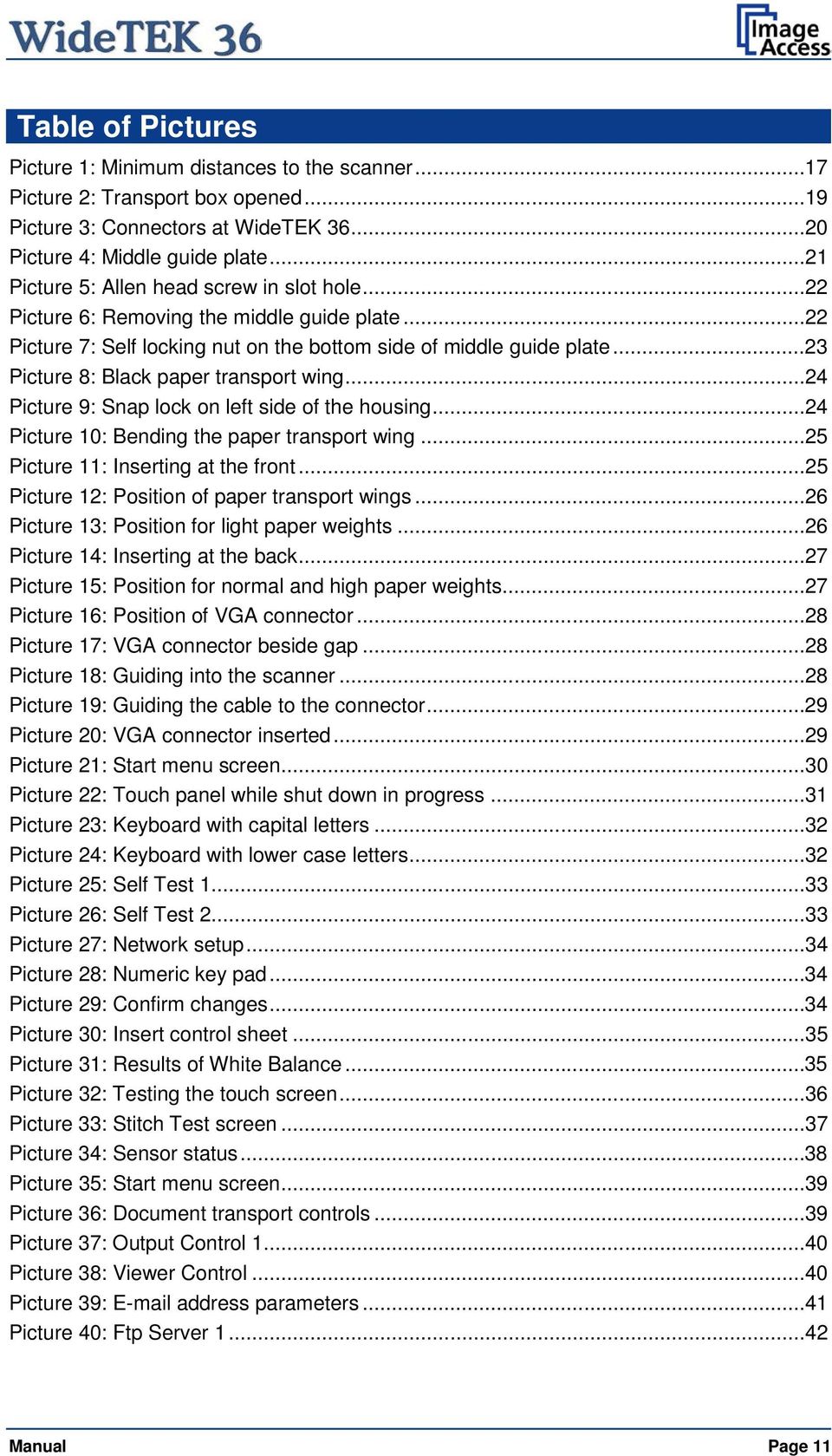
11 Table of Pictures Picture 1: Minimum distances to the scanner...17 Picture 2: Transport box opened...19 Picture 3: Connectors at WideTEK Picture 4: Middle guide plate...21 Picture 5: Allen head screw in slot hole...22 Picture 6: Removing the middle guide plate...22 Picture 7: Self locking nut on the bottom side of middle guide plate...23 Picture 8: Black paper transport wing...24 Picture 9: Snap lock on left side of the housing...24 Picture 10: Bending the paper transport wing...25 Picture 11: Inserting at the front...25 Picture 12: Position of paper transport wings...26 Picture 13: Position for light paper weights...26 Picture 14: Inserting at the back...27 Picture 15: Position for normal and high paper weights...27 Picture 16: Position of VGA connector...28 Picture 17: VGA connector beside gap...28 Picture 18: Guiding into the scanner...28 Picture 19: Guiding the cable to the connector...29 Picture 20: VGA connector inserted...29 Picture 21: Start menu screen...30 Picture 22: Touch panel while shut down in progress...31 Picture 23: Keyboard with capital letters...32 Picture 24: Keyboard with lower case letters...32 Picture 25: Self Test Picture 26: Self Test Picture 27: Network setup...34 Picture 28: Numeric key pad...34 Picture 29: Confirm changes...34 Picture 30: Insert control sheet...35 Picture 31: Results of White Balance...35 Picture 32: Testing the touch screen...36 Picture 33: Stitch Test screen...37 Picture 34: Sensor status...38 Picture 35: Start menu screen...39 Picture 36: Document transport controls...39 Picture 37: Output Control Picture 38: Viewer Control...40 Picture 39: address parameters...41 Picture 40: Ftp Server Manual Page 11
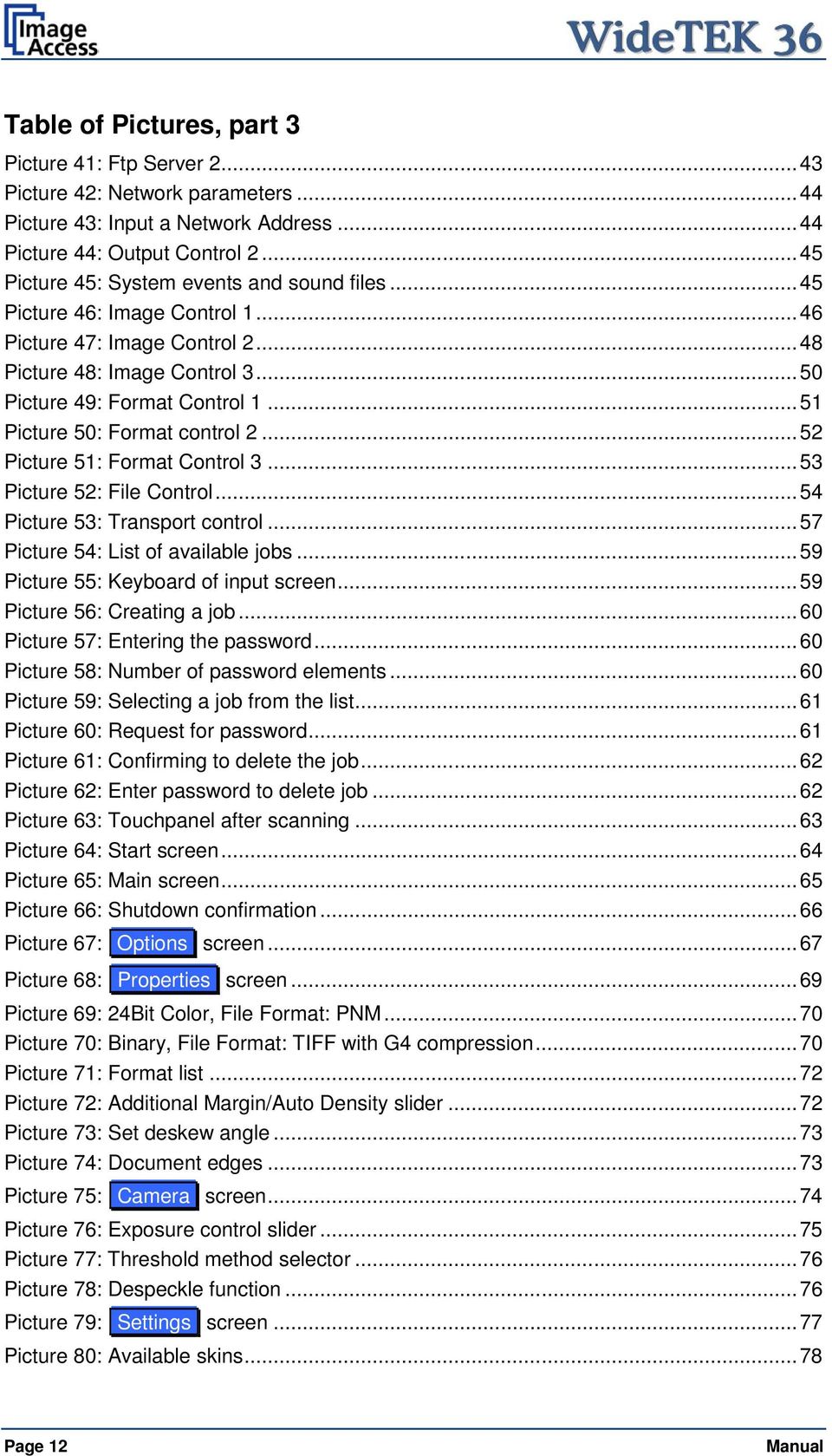
12 Table of Pictures, part 3 Picture 41: Ftp Server Picture 42: Network parameters Picture 43: Input a Network Address Picture 44: Output Control Picture 45: System events and sound files Picture 46: Image Control Picture 47: Image Control Picture 48: Image Control Picture 49: Format Control Picture 50: Format control Picture 51: Format Control Picture 52: File Control Picture 53: Transport control Picture 54: List of available jobs Picture 55: Keyboard of input screen Picture 56: Creating a job Picture 57: Entering the password Picture 58: Number of password elements Picture 59: Selecting a job from the list Picture 60: Request for password Picture 61: Confirming to delete the job Picture 62: Enter password to delete job Picture 63: Touchpanel after scanning Picture 64: Start screen Picture 65: Main screen Picture 66: Shutdown confirmation Picture 67: Options screen Picture 68: Properties screen Picture 69: 24Bit Color, File Format: PNM Picture 70: Binary, File Format: TIFF with G4 compression Picture 71: Format list Picture 72: Additional Margin/Auto Density slider Picture 73: Set deskew angle Picture 74: Document edges Picture 75: Camera screen Picture 76: Exposure control slider Picture 77: Threshold method selector Picture 78: Despeckle function Picture 79: Settings screen Picture 80: Available skins Page 12 Manual
13 Table of Pictures, part 3 Picture 81: Scan status window...78 Picture 82: Format screen...79 Picture 83: Rectangle dragged with mouse...80 Picture 84: "Zoom in" result...80 Picture 85: List of available clip size formats...80 Picture 86: Output options...81 Picture 87: Output Option Save...82 Picture 88: Example for file name...82 Picture 89: Output Option Show...83 Picture 90: Output Options in Scan Window...83 Picture 91: Output Option Multipage...84 Picture 92: Pop-up window to select images for the Container...85 Picture 93: Output Option Print...86 Picture 94: Available List of Printers for Option Print...86 Picture 95: Output Option Copy...87 Picture 96: Output Option FTP Upload...93 Picture 97: Output Option Mail...95 Picture 98: Parameters for transaction mode interactive...97 Picture 99: Recipient address list opened...97 Picture 100: Output Option Network...98 Picture 101: Output Option Web Picture 102: Output Option USB Picture 103: USB stick inserted in USB connector Picture 104: Information Picture 105: Login screen Picture 106: User screen Picture 107: Device Info screen Picture 108: Operation Info screen Picture 109: Available user settings Picture 110: Language Selector screen Picture 111: List of power down times Picture 112: Volume level Picture 113: Foot pedal settings Picture 114: Splitting Start Page Picture 115: Guide Plate Middle Manual Page 13

14 A Hardware A.1 Safety Notes Read and ensure that you understand the safety notes. They are designed for your protection and for your safety. Follow all safety notes to avoid damage to the device. A.1.1 Marking of Safety Notes All safety notes are marked with a yellow triangle warning sign. Next to the warning sign, you ll find a description of the danger. Safety Note! Example text. A.2 Certification The WideTEK 36 scanner fulfills all requirements of the following standards: IEC , International Safety Standard for Information Technology Equipment UL , Safety for Information Technology Equipment (US standard) CAN/CSA C22.2 No , Safety for Information Technology Equipment (Standard for Canada) EN , Safety for Information Technology Equipment (European standard) A.3 General Notice This manual describes the functions of a complete equipped WideTEK 36 scanner. If your device is not equipped with all features, deviations are possible. Page 14 Manual

15 A.4 Safety Precautions Warning: Please read all the safety precautions before you operate the scanner. Serious injury can occur to you or to others if you do not know how to use it safely. To prevent fire or shock hazard, do not expose this device to rain or any type of moisture. Follow all safety precautions to avoid personal injury or damage to the device. 1. Place the scanner in a clean, well-ventilated room. Do not operate the scanner in an area with poor ventilation. 2. Openings in the scanner s housing in the front or at the back are provided for air circulation. Do not cover or block the openings. 3. Do not place the scanner near a heat or cold emitting source such as a space heater, furnace, or air conditioning unit. 4. Do not place the scanner near any devices or electrical boxes emitting high voltage. 5. Always place the scanner on a stable surface. 6. Do not lean on the scanner. 7. Do not place cups containing liquids or other such objects on top of the scanner or on the scanner table. If liquid spills into the scanner it can cause damage. If this occurs, turn the scanner off, unplug the power cord from the wall receptacle and contact the Image Access Technical Support. 8. Do not put any objects into any scanner housing openings unless specifically instructed to do so by Image Access Technical Support. 9. Do not disassemble the scanner. If there is a need to disassemble the scanner, please contact the Image Access Technical Support. 10. Do not use the scanner if it has been physically damaged. If this occurs, turn the scanner off, unplug the power cord from the wall receptacle and contact the Image Access Technical Support. 11. The scanner should be used only with the power cord that is supplied with the scanner. If you are unsure, please contact the Image Access Technical Support. 12. Image Access recommends plugging the scanner into an appropriately-rated power conditioner. 13. Always turn the power off and unplug the power cord from the wall receptacle before cleaning the scanner. 14. When cleaning, only use Image Access-approved cleaners. Do not use any type of solutions, abrasives, or acids such as acetone, benzene, kerosene, mineral spirits, ammonia, or nitric acid. Do not use any cleaners that contain these chemicals. 15. Use a dry or damp lint free cloth for cleaning the scanner. 16. Do not spray any liquids directly onto the scanner. Spray cleaning fluids directly onto the cleaning cloth and use the cloth to clean the scanner. Manual Page 15

16 A.5 Connecting to the Power Source Before connecting the scanner to the electrical outlet check the following items: Ensure the electrical outlet is in perfect condition and that it is properly grounded. Ensure that the electrical outlet is equipped with a fuse with the proper capacity. The electrical outlet must be near this device and must be easily accessible. Inspect the power cable and ensure that it is undamaged. Use only the power cable delivered with the scanner. Turn the device off before plugging or unplugging any cable. Page 16 Manual

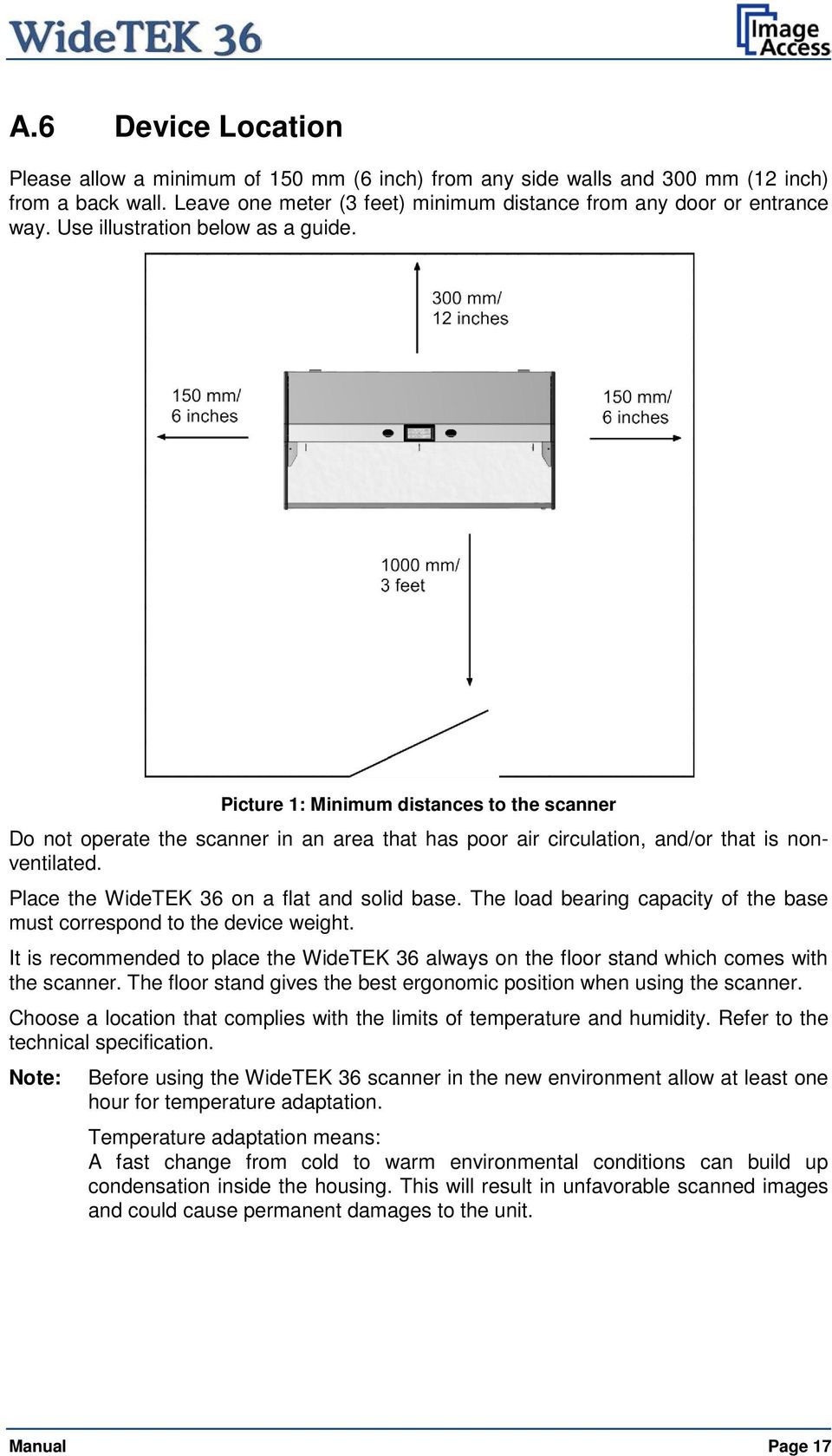
17 A.6 Device Location Please allow a minimum of 150 mm (6 inch) from any side walls and 300 mm (12 inch) from a back wall. Leave one meter (3 feet) minimum distance from any door or entrance way. Use illustration below as a guide. Picture 1: Minimum distances to the scanner Do not operate the scanner in an area that has poor air circulation, and/or that is nonventilated. Place the WideTEK 36 on a flat and solid base. The load bearing capacity of the base must correspond to the device weight. It is recommended to place the WideTEK 36 always on the floor stand which comes with the scanner. The floor stand gives the best ergonomic position when using the scanner. Choose a location that complies with the limits of temperature and humidity. Refer to the technical specification. Note: Before using the WideTEK 36 scanner in the new environment allow at least one hour for temperature adaptation. Temperature adaptation means: A fast change from cold to warm environmental conditions can build up condensation inside the housing. This will result in unfavorable scanned images and could cause permanent damages to the unit. Manual Page 17
18 A.7 Maintenance Important: Ensure that no liquids will penetrate into the device housing. A.7.1 Touchscreen Before cleaning the touchscreen, switch the WideTEK 36 off and set the main power switch to position 0. The touchscreen can be cleaned with a micro fiber cloth. A.7.2 Surfaces Use a soft, dampened cloth to clean the housing of the scanner. Recommended is a micro fiber cloth. A.7.3 Glass plate Important: Do not use any cleanser with solvents to clean the glass plate! The glass plate of the WideTEK 36 has a special surface coating. It is recommended to clean the glass plate always with a micro fiber cloth. Dampen the micro fiber cloth slightly before cleaning. Clean the glass plate with minimum pressure. Do not rub the glass plate on isolated positions. After cleaning dry the glass plate with a soft cloth. A.8 Repair Note: There are not any parts or components of the WideTEK 36 scanner which can be repaired by the user. All repairs and service works should be done by a trained technician only. Page 18 Manual

19 A.9 Content on Delivery The scanner is delivered in a wooden transport box. The transport box also contains the disassembled floor stand in a separate cardboard box and the paper catch basket. 1: Paper catch basket 2: Scanner 3: White Reference Target Picture 2: Transport box opened 4: Box with cable set, manuals, and accessories (2x Recovery Key). The cable set consist of: Network cable. The network cable connects the scanner to the network. All network parameters such as IP address, subnet mask and gateway must be set via the front panel prior to the first use. Crossover cable. The crossover cable connects the scanner directly to a computer via the network card. Power cable. The power cable connects the scanner to the wall outlet. 5: Floor stand (optional) in separate cardboard box 6: Folder with CSTT-1 reference targets and the manuals. Note: Keep the wooden transport box and the cardboard box for future use! In case of guarantee the scanner must be sent back in the original transport box to avoid transport damages. Manual Page 19

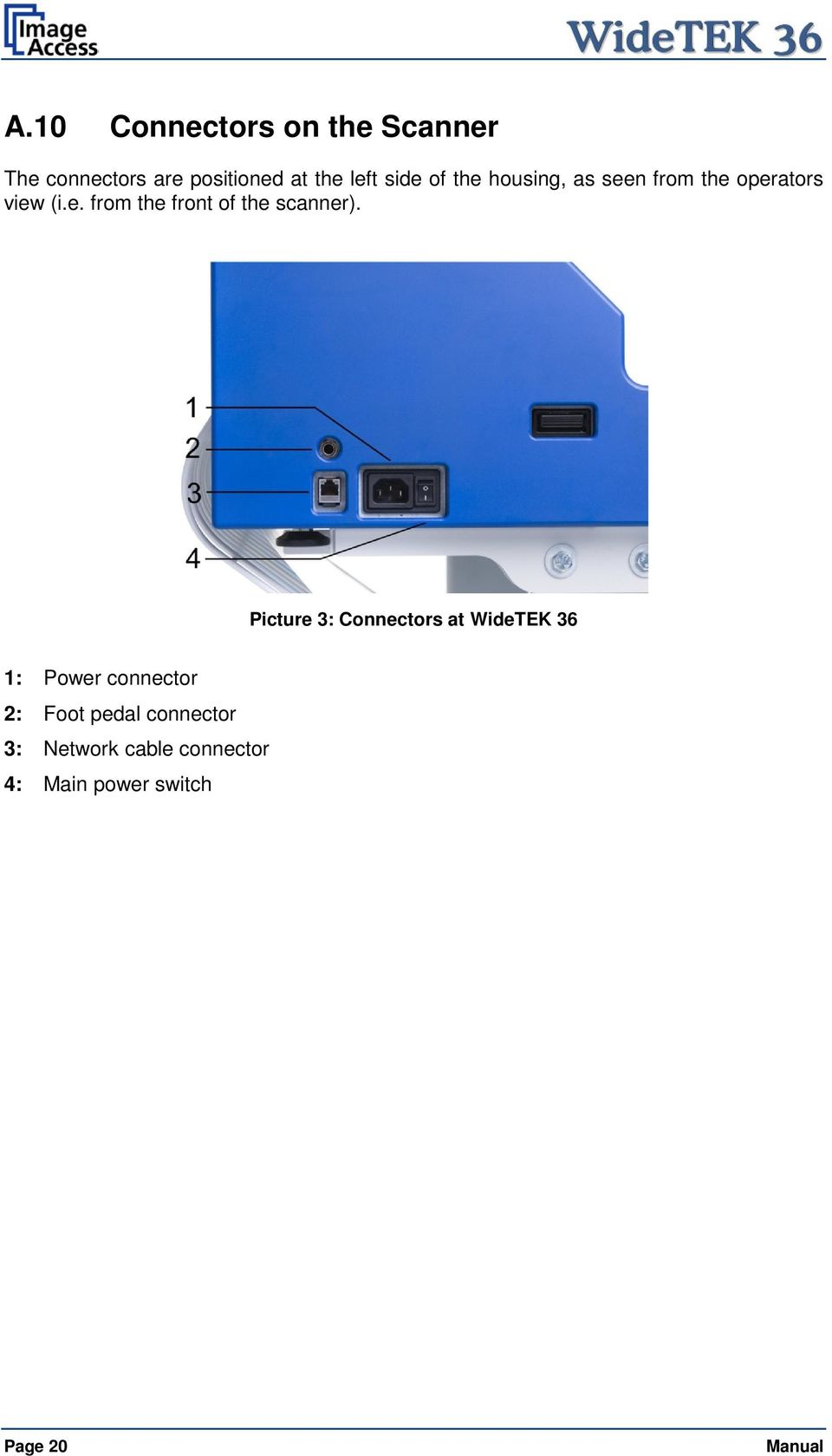
20 A.10 Connectors on the Scanner The connectors are positioned at the left side of the housing, as seen from the operators view (i.e. from the front of the scanner). Picture 3: Connectors at WideTEK 36 1: Power connector 2: Foot pedal connector 3: Network cable connector 4: Main power switch Page 20 Manual
21 A.11 Adjusting the Middle Guide Plate Tools: Allen wrench, size 2.5 mm The WideTEK 36, 42 and 48 wide format scanners contain an adjustable guide plate which holds the paper against the glass plate without touching it. The amount of contact pressure exerted by the guide plate is user configurable. The default contact pressure is set to middle. On older units built before August 2010, the default is set to the maximum. When scanning high paperweight documents or stiff documents, possible distortions can occur in the scanned image at a position of a few inches away from the upper edge. This can be eliminated by lowering the contact pressure. The contact pressure of the guide plate can be modified in a few simple steps. The middle guide plate (1) covers the transport drum compensators. It is pivot-mounted on two bolts at the right and left side of the paper feeder. Picture 4: Middle guide plate Locate the Allen head cap screws at each end of the middle guide plate (see Picture 4, items (2) and (3)). Manual Page 21
22 With the 2.5 mm Allen wrench loosen the two Allen head screws slightly. Picture 5: Allen head screw in slot hole The screws are mounted in slot holes. This allows moving the metal ballast. If the metal ballast is moved all the way to the front or outer edge of the guide plate, the contact pressure is minimal. If it is pushed back or towards the middle, the contact pressure increases. The default position of the Allen head screws is in the middle of the slot hole of the middle guide plate. This position achieves a moderate contact pressure. Older units may have been set to the maximum pressure. After the Allen head screws are loosened the metal ballast at the bottom side can be moved. Refasten the Allen head screws after modifying the position of the metal ballast. If the Allen head screws do not move easily, the self locking nuts on the bottom side of the middle guide plate could be too tight. If this is the case, remove the guide plate from the scanner. Two gaps at the right and left side of the top end (in paper transport direction) allow lifting up the guide plate. First, lift up the guide plate at the front side and then push it slightly in the paper transport direction. Finally, lift the rear end of the guide plate and move the guide plate out of its position. Picture 6: Removing the middle guide plate Page 22 Manual
23 Place the middle guide plate upside down on the front side guide plate. Picture 7: Self locking nut on the bottom side of middle guide plate Use a 7 mm ring spanner wrench (not supplied) or a pair of pliers to loosen the selflocking nuts. Less than one turn is enough. The self-locking nuts only serve for transport security, to avoid loosening of the Allen head screws and disconnection of the heavy steel square bar during transport. After loosening the self-locking nuts, insert the middle guide plate in order to modify the contact pressure. Now move the Allen head screws to the desired position and check the contact pressure. Refasten the Allen head screws after modifying the position of the metal ballast. In a last step remove the guide plate as described above. Fasten the self-locking nuts at both ends. Insert the guide plate again. Manual Page 23
24 A.12 Paper Transport Wings To ensure proper functionality of the stitching function, special paper transport wings have to be inserted. Each WideTEK 36 scanner comes with a set of two black paper transport wings. Note: For special document types, e.g. semi-transparent documents, a set of two white paper transport wings and a white guide plate are available. They can be replaced easily by the user. Picture 8: Black paper transport wing The paper transport wings have two small notches at one side. This side of the paper transport wings must be inserted at the front side of the guide plate. In order to insert the paper transport wings, open the upper unit. Press the snap locks at the left and right side of the housing. Picture 9 shows the snap lock position on the left side. Picture 9: Snap lock on left side of the housing Page 24 Manual
25 A.12.1 How to insert the Paper Transport Wings Hold the paper transport wing near the two small notches and carefully bend it slightly in the middle. Picture 10 shows how to hold the paper transport wing. Picture 10: Bending the paper transport wing First insert the end of the paper transport wing with notches at the front side of the guide plate. Insert a notch as shown in the picture below, then turn the paper transport wing and insert the second notch. Picture 11: Inserting at the front Depending on the document material to be scanned, the long end of the paper transport wings may handled in two different ways. Manual Page 25
26 A.12.2 Position of the Paper Transport Wings For best results the paper transport wings should be inserted at the guide plate at a position between six and seven inches (approx. 15 to 19 cm) from the center position of the document input. Picture 12 shows the position where the paper transport wings have to be inserted on the guide plate. In this picture the upper unit is opened to show more details. A.12.3 Picture 12: Position of paper transport wings Scanning documents on light, thin paper material When scanning documents of light paper weight, the paper transport wings will not be inserted in the notches at the backside of the paper guide plate. Picture 13: Position for light paper weights Page 26 Manual
27 A.12.4 Scanning documents on normal or heavier paper For best results, when scanning documents on normal or heavier paper, the paper transport wings must be inserted at the backside of the paper guide plate. Insert every paper transport wing with the long end forward into the notch at the back of the guide plate. Picture 14: Inserting at the back Picture 15 shows the position left from the middle of the document input. Picture 15: Position for normal and high paper weights After inserting both paper transport wings, close the upper unit. Note: Remove the paper transport wings before scanning any stiff documents such as cardboard. Manual Page 27
28 A.13 Connecting an External Monitor The external monitor will be connected to the VGA connector of the mainboard inside the scanner. To locate the VGA connector it is necessary to remove the middle guide plate at first. Open the upper part of the scanner by releasing the snap locks (see Picture 9) at the left and right side of the housing. As described in chapter A.11 remove the middle guide plate. Now the compensators are visible. The VGA connector position can be found between the first and the second compensator, counted from the right side of the scanner. Picture 16: Position of VGA connector At the right side of the back of the scanner seen from operators position a gap in the rear guide plate can be found. Guide the signal cable of the monitor through this gap. Picture 17: VGA connector beside gap Picture 18: Guiding into the scanner Page 28 Manual
29 Position the signal cable nearby the VGA connector of the mainboard. Picture 19: Guiding the cable to the connector It is recommended to position the cable connector at its final position with the help of a second person. One person can assist from the back of the scanner finding the VGA connector while the second person inserts the cable into the connector. Picture 20: VGA connector inserted Finally insert the middle guide plate and close the upper unit. Manual Page 29
30 A.14 Powering up the WideTEK 36 The main power switch is found beside the power connector. Picture 3 shows the position of power connector and main power switch. After connecting the scanner to the electrical outlet, switch the main power switch to position I. When the main power switch is in position I, the scanner is in stand-by mode. Note: While using the WideTEK 36 in work conditions, it should only be switched on and off by the touch panel! A.15 WideTEK 36 Touch Panel The WideTEK 36 parameters can be set and modified with the integrated touch panel. It shows an easy-to-use menu and helps the user to control all scanner parameters with the touch of a finger. When the WideTEK 36 is powered up by using the main power switch, the touch panel is illuminated in a dimmed mode and shows the stand-by screen. The stand-by screen shows the Image Access logo and the blinking message Touch screen to power up. A.15.1 Starting the WideTEK 36 from Stand-By Mode When the WideTEK 36 is in stand-by mode, it can be started by tapping the touch panel on any arbitrary position. The touch panel lights up and a rotating hourglass indicate that the start sequence is running. When the start-up sequence is finished, the touch panel shows the start menu screen. Picture 21: Start menu screen Page 30 Manual
31 A.15.2 Turning-off the WideTEK 36 Note: Always turn off the WideTEK 36 scanner with the Stop button on the touch panel! The main power switch should only be used when the WideTEK 36 is in stand-by mode and before the scanner is disconnected from the electrical outlet. To turn off the WideTEK 36, press and hold the Stop button on the touch panel. While the Stop button is held, a counter in the button shows the remaining time until the WideTEK 36 is powered down. Going to sleep in x seconds Picture 22: Touch panel while shut down in progress At the end of the power-down sequence the display will be dimmed. A.15.3 The Help Function To support the user when working with the WideTEK 36, a help function is integrated into the touch panel menus. A Question Mark (?) symbol in the lower right corner of the screen activates the help function. After touching the question mark, all controls in the screen start blinking. To get the corresponding help text, the appropriate control must be touched. To return to the respective screen, the screen must be touched again on any arbitrary place. Manual Page 31
32 A.16 Navigating through the Screens Some of the screens show on the bottom line the buttons Returns to the former screen. Sometimes only the symbol < is displayed. Switches to the next logical screen, e.g. from Format Control 1 to Format Control 2. Sometimes only the symbol > is displayed. Resets all values in the respective screen to default value. A.16.1 How to Enter or Change Values To enter new values or change existing values, the corresponding field or line in the screen must be touched. If a parameter requires an alphanumeric value, the touch panel display changes and shows a keyboard. The keyboard allows entering text and numeric values. Picture 23: Keyboard with capital letters Moves cursor to the left. Moves cursor to the right. Erases character. Checkmark symbol returns to previous screen. The keyboard enables the user to enter capital letters, lower case letters, special characters as well as numbers. The content of the keys is switched with this key: Toggles between capital letters and special symbols (e.g. backslash and lower case letters and numbers. Picture 24: Keyboard with lower case letters Page 32 Manual
33 A.17 Self Test Mode While the start sequence is running the WideTEK 36 can be switched to self-test mode. Tapping on the touch panel at least three times starts the setup mode. After the start sequence is finished, the touch panel shows the Self Test 1 screen. Picture 25: Self Test 1 To move forward to the Self Test 2 screen touch the button. Picture 26: Self Test 2 To return to the former screen touch. Manual Page 33
34 A.17.1 IP Address Touch the control field IP Address. The touch panel changes to the Network setup screen. Picture 27: Network setup Touch on the line to be changed, e.g. the Address line. The touch panel shows: Picture 28: Numeric key pad Enter the new values. The < and > keys move the cursor, the X key deletes the number at the cursor position. To finalize the input, tap on the checkmark key. If entries have been changed, a screen opens where the changes must be confirmed. Yes confirms the changes, No discards the changes. Picture 29: Confirm changes After the changes have been saved, the setup screen is displayed again. Page 34 Manual
35 A.17.2 White Balance Note: The paper transport wings must be inserted before starting the white balance. Picture 30: Insert control sheet Touch the White Balance button to start the white balance measurement sequence. Now insert the control sheet. It must be transported forward and reverse. Then touch the Cont. button. The control sheet will be pulled in and the measurement starts. While the measurement is running a graphic symbol shows the progress. The Abort button returns to the previous screen. After the white balance has been finished, the result is displayed. Touch the Finish button to return to the Self Test 1 screen. Picture 31: Results of White Balance A.17.3 Lamp On / Off Touch the Lamp On / Off button to switch the lamps on. As long as the button is touched, the lamps will shine. A.17.4 Exit Selftest Touching Exit Selftest finalizes the setup mode, switches to the operation mode and shows the start menu. Manual Page 35
36 A.17.5 Touch Adjust This function defines the dimension of the writing area of the touch panel. The first step after selecting this function must be done very quickly to activate the adjustment procedure. Note: It is recommended to read first, and then act. It is recommended to use for the following adjustment steps an appropriate pen, e.g. as used with a PDA. Touch the Touch Adjust button, then press and hold the touch panel. The first message on the screen can be ignored. After a short moment a blinking dot appears at the upper left corner of the touch panel and the instruction Touch this blinking dot is displayed. Touch the blinking dot with the tip of a suitable pen. In the next step the instruction changes to the lower right corner. Repeat touching the blinking dot in the lower right corner. After this, the touch panel returns to the Self Test 2 screen and the setup procedure is finished. It is recommended to check the adjustment with the Touch Test function. A.17.6 Touch Test Touch Test is used to check the correct function of the touch screen. Picture 32: Testing the touch screen After selecting this function the display changes to a blank area. By using an appropriate pen, e.g. as used with a PDA, write some symbols or lines on the touch panel. While writing, check the correlation between the pen s position and the position of the signs that have been written. If the difference is to large, repeat the adjustment as described in chapter A To return to the prior screen, touch the button Page 36 Manual
37 A.17.7 Stitch Test Picture 33: Stitch Test screen Press the Stitch Test button to start the stitch test. This starts a program in which you can see an automatically updated view of the stitching indicators for each camera. The measurement will be executed continuously, once every second. The cameras left, middle and right are identified as the left, middle and right cameras when looking at the scanner from the operator s view (i.e. from the front of the scanner). Each camera has a set of two stitching coordinate boxes. A stitching coordinate box exists of four quadrants. Picture 33 shows a typical situation of the stitching indicators. That means that the settings of all cameras are in the specified tolerances. Ideally, the stitching indicators (the small dots inside the four-quadrant boxes) should be positioned close to the center of the crosshairs. If a stitching adjustment is necessary, it has to be done by a trained technician. A.17.8 EMV Test This function is used for Electromagnetic Compatibility (EMC) tests. After inserting a test document into the scanner, the scan sequence is repeated until the STOP button is pressed. Manual Page 37
38 A.17.9 Sensor Test The Sensor Test function is used to test the sensors of the paper input and paper output. Insert a paper sheet which covers the whole width of the document input. The touch screen shows the function of the sensors in three ways. No paper detected by the sensors. Paper detected at input side (PWT). Paper detected at input side (PWT) and at output side (POT). Picture 34: Sensor status A Shutdown Scanner Touch this button to switch the WideTEK 36 scanner off. Page 38 Manual
39 A.18 Start Menu Screen Picture 35: Start menu screen When all initial tests are finished, the display shows the start menu screen. At the top of the start menu, the main controls to start a scan sequence and to stop the current action are displayed. The scanned image can be directed to different targets. The selected target is named in the upper line between the Scan and the Stop buttons. Picture 35 displays as selected target the network in which the scanner is integrated. The controls in the middle and on the lower line of the menu are used to configure the parameters in detail. After inserting a document, the touch panel changes and shows the document transport controls. Picture 36: Document transport controls Touching the Back button returns to the start menu. Touching the arrow buttons will move the document forward or backward. When a document is inserted and the touch panel shows the start menu, pressing the Stop button switches back to the transport controls. Manual Page 39
40 A.19 Output Control Screens The parameters are set in two screens, Output Control 1 and Output Control 2. To switch between these two screens use the buttons and. A.19.1 Output Control 1 Picture 37: Output Control 1 A Viewer Control An external monitor can be connected to the WideTEK 36 to show the scanned image directly. Touching the Viewer Control button starts the Zoom/Move Control mode. When this mode is active, the displayed image on the screen can be moved and the zoom factor can be changed. Navigation keys Picture 38: Viewer Control Increases the zoom factor. Decreases the zoom factor. Zooms the image to its genuine dimension (100%) without scaling. Returns to the prior menu. If the image dimension overlaps the monitor dimension, the navigation keys can be used to scroll the displayed area on the monitor. Page 40 Manual
41 A Address This menu item enables the user to send the scanned image to any arbitrary address. Stores all parameters. Erases all changes. Picture 39: address parameters How to enter an address Tap on the line of the address. The screen changes to input mode as shown in Picture 23 and Picture 24. Enter the desired address. The is found on the keyboard in the capital letter layout in the bottom line. To delete a character place the cursor below the character and tap on the X key. When the complete address is entered, tap on the checkmark to return to the previous screen. To store all entries of this menu touch the button. To return to the former menu, touch the button. If entries have been changed, a screen opens where the changes must be confirmed. Yes confirms the changes, No discards the changes. Manual Page 41
42 A FTP Server The Ftp Server button enables the user to enter all necessary information for data transfer to a dedicated FTP server. The parameters are entered in two screens named Ftp Server 1 and Ftp Server 2. Ftp Server 1 This screen contains the server IP address and the port, the user name and the password for the server access. Additionally a path to an existing directory on the FTP server where the files should be stored can be entered. Returns to the previous screen. Changes to the Ftp Server 2 screen. Picture 40: Ftp Server 1 Note: The IP address (as shown in the above picture) does not represent a real existing FTP server. This IP address is typically used in networks to make the own system, the so-called localhost, available for TCP/IP applications. Page 42 Manual
43 Ftp Server 2 This screen contains all data for the connection with a FTP server. Stores all parameters. Erases all changes. Picture 41: Ftp Server 2 Use proxy Auth. Anonymous: Select Yes to use a proxy server for the connection. Defines the type of authentication at the FTP server. By tapping on the field the methods will be switched. An anonymous connection will be used. The data in the fields User and Password from the FTP Server 1 mask will be ignored. Login/Password: To save the images on the FTP server a login name and a password must be entered. Ask the administrator of your FTP server for the necessary information to get access to the designated FTP server. Manual Page 43
44 A Windows Network Allows the user to define the network path where the image should be stored, the define the authentication method, define the user name, define the password, define the filename Picture 42: Network parameters To store all entries of this menu touch the button. How to enter a Network Address Picture 43: Input a Network Address Tap on the line of the network path name. The touch panel changes and displays the keyboard layout. The slash symbol / is found on the keyboard in the capital letter layout in the bottom line. To delete a character place the cursor below the character and tap on the X key. When the complete network address is entered, tap on the checkmark key to return to the previous screen. To store all entries of this menu touch the button. To return to the former menu, touch the button. If entries have been changed, a screen opens where the changes must be confirmed. Yes confirms the changes, No discards the changes. Page 44 Manual
45 A.19.2 Output Control 2 Picture 44: Output Control 2 A Sound Control The menu item Sound Control allows the user to link sounds to system events. Picture 45: System events and sound files To select a system event, touch the scroll bar in the left window or the up/down arrows. The currently selected sound file associated with this system event will be displayed in the right window. To select a different sound file from the list, touch the up/down arrows or the scroll bar in the right window until the sound file to be used is marked in reverse color. To modify the sound volume, move the scroll bar between the loudspeaker symbols up- or downwards. Returns to the prior menu. Links the system event and the marked sound. Plays the sound which is marked in reverse color. Manual Page 45
46 A.20 Image Control Screen The parameters are set in two screens, Image Control 1 and Image Control 2. A.20.1 Image Control 1 In general: Picture 46: Image Control 1 Tap on + or to change the values in steps of one. Tap on + or and hold for at least five steps, then the value changes in steps of five. A Brightness The brightness control defines the resulting brightness of the image. A lower value results in darker images, a higher value results in brighter images. Values close to 0% or 100% may result in unwanted artifacts. A Contrast The contrast control defines the contrast of the image. A lower value results in an image that is smoother, a higher value shows more details and the image will become crisper. Values close to 0% or 100% may result in unwanted artifacts. A Gamma The gamma control defines the gamma correction used by the scanner camera. A value of 1,6 is a good approximation. The range of values are from 0 (no gamma) to 2.5 (maximum gamma). A higher gamma value shows more details in darker areas and compresses bright areas. Page 46 Manual
47 A Sharpness An automatic sharpening algorithm is applied to the image before any other operation is performed. The value zero disables the function. Very high values may produce artifacts, depending on the document characteristics. A Resolution This parameter defines the scanner s resolution. This button offers three ways to set the desired value: Tap on + or to change the resolution in steps of one DPI. Tap on + or and hold for at least five steps, then the value changes in steps of five DPI. Tap the numeric value in the middle of the button. This will step through the list of available resolutions. A Color mode The color mode parameter defines the color mode if scanning in color or the algorithm used for binarization in binary mode. 24b color 8b color Grayscale Binary Photo 24 bit color mode 8 bit color mode 8 bit grayscale mode 1 bit black/white mode 1 bit black/white mode with dithering. Dithering means that finest image details are optimized by raster. This control also influences the compression method that is offered in the File Control screen. Chapter A.16 gives information about the buttons. Chapter A.15.3 gives information concerning the help function, which is activated by the Question Mark symbol. Manual Page 47
48 A.20.2 Image Control 2 Note: Picture 47: Image Control 2 Depending on the selected color mode, some buttons may not be displayed. A Threshold (only in Binary mode) Defines the contrast control mode. Available modes are Fixed and Auto. Fixed: Auto: The contrast is fixed to defined value. The contrast of the image set dynamically, depending on the values found in the image. This can be used to improve delicate details in the image. A Despeckle (only in Binary mode) Removes isolated pixel in the images. Available modes are 4x4p and Off. A Invert (only in Binary and Photo mode) Inverts the displayed image. Page 48 Manual
49 A Stitching Defines the stitching method which is used to merge the image data of the cameras to one image. Fixed: Adapt.1D Adapt.2D: Merges the image data at a specified offset area, resulting from the camera calibration. Recommended for all documents with good paper quality and plain surface. This setting delivers a high throughput with large-sized documents. Default setting. This mode is recommended for all documents with crumpled and uneven surface. It merges the image data of the cameras dynamically. Reduces the throughput but improves the results with problematic documents. A ICC Profile ICC profiles add color correction values to each scanned image. Chapter A.16 gives information about the buttons. Chapter A.15.3 gives information concerning the help function, which is activated by the Question Mark symbol. Manual Page 49
50 A.20.3 Image Control 3 Note: A Picture 48: Image Control 3 Only in the color modes 24b color, 8b color, and Grayscale. Exposure Defines the exposure correction mode. Available are Black Cut, Auto and Fixed. Black cut Auto Fixed All color values in the image which are below the threshold for black are displayed as black. Activates the threshold for black and the automatic brightness control. Automatic brightness control means the brightness range of the image is expanded to the maximum range of the scanner. This converts the darkest areas of the image to solid black and the brightest areas to solid white. Switches off the exposure correction mode. A Exp. Black Defines the value for the threshold for black. Page 50 Manual
51 A.21 Format Control Screen The parameters are set in three screens; Format Control 1 to Format Control 3. To switch between these two screens use the buttons and. A.21.1 Format Control 1 A Format Picture 49: Format Control 1 This control specifies the format of the document. In most cases the setting Auto should be selected. The format list includes the well-known DIN A formats as well as US ANSI formats, e.g. Letter or US C. Some formats are specified with an additional L(etter) or P(ortrait). A Start Page This defines the start page if Splitting is activated. A Rotation The value set here defines the rotation of the image in a clockwise direction after scanning. A Mirror This control activates the horizontal mirroring of the image. It can be useful if scanning a transparency or a blueprint from the back side. A Splitting The following options are valid: Left / Right: The image is taken from the left side / the right side of the specified area. Auto: Divides the specified scan area symmetrically into two sides and sends the images consecutively. The second image will be sent without scanning the document again. The start is defined in Start Page (see chapter A ). Manual Page 51
52 A.21.2 Format Control 2 A Auto margin Picture 50: Format control 2 The Auto margin control detects the edges of a document and cuts it out of the scanned image. If the value (in pixels) is negative, the resulting image will be smaller than the document. If the value is positive some of the background will remain in the scanned image. A Auto density The Auto density function detects the edges of a document only if they are surrounded by a dark background. This control specifies the density level used to decide whether a pixel belongs to the background or not. A value of 40 is a proper setting in most cases. A Auto skew Auto skew enables the deskew function and defines the maximum angle of the document to be deskewed. Chapter A.16 gives information about the buttons. Chapter A.15.3 gives information concerning the help function, which is activated by the Question Mark symbol. Page 52 Manual
53 A.21.3 Format Control 3 In general: Picture 51: Format Control 3 The units can have various units of measurement. Only positive values can be entered. A Top edge Defines a zone on the document that is not scanned. The zone starts from the top of the document to the value specified via this function. A Bottom edge Defines a zone on the document that is not scanned. The zone starts from the actual bottom of the document to the value specified via this function. A Units Specifies the units used for the margin controls. The units can be various units of measurement. The unit of measurement mils is defined as 1/1000 of an inch. A Left edge Defines a zone on the document that is not scanned. The zone starts from the actual left edge of the document to the value specified via this function. A Right edge Defines a zone on the document that is not scanned. The zone starts from the actual right edge of the document to the value specified via this function. Manual Page 53
54 A.22 File Control Screen Picture 52: File Control The control File format specifies the file format of the image file. Depending on the selected file format, the number and the content of the controls in this screen can vary. The list of formats includes JPEG, TIFF, PNM, and PDF (if the option is installed). A.22.1 JPEG When selecting the file format JPEG the functions of the controls are: JPEG quality: Defines the compression rate. The JPEG quality level is defined with this control. A higher percentage gives better quality but the file size will increase. A lower factor will show some artifacts in the image but the file size will be reduced. Prev. quality: The JPEG quality level used for the preview is selected here. A higher percentage gives better quality but the file size will increase. A lower factor will show some artifacts but the file size will be reduced. Prev. scale: This control defines the preview scale factor. Higher values result in smaller previews; lower factors will produce larger previews but take more time to send and display. Chapter A.16 gives information about the buttons. Chapter A.15.3 gives information concerning the help function, which is activated by the Question Mark symbol. Page 54 Manual
55 A.22.2 TIFF When selecting the file format TIFF the functions of the controls are: Note: Depending on the selected color mode in Image Control the available compression methods vary. TIFF compr. None: JPEG: Prev. scale: Available with all color modes. Available with 24b color and Grayscale. Additionally the controls JPEG quality and Prev. quality will be displayed. CCITT G4: Available with Photo and Binary. This control defines the preview scale factor used. Higher values result in smaller previews; lower factors will produce larger previews but take more time to send and display. A.22.3 PNM When selecting the file format PNM only the preview scale can be selected. Manual Page 55
56 A.22.4 PDF When selecting the file format PDF the functions of the controls are: JPEG quality: Defines the compression rate. The JPEG quality level is defined with this control. A higher percentage gives better quality but the file size will increase. A lower factor will show some artifacts in the image but the file size will be reduced. Prev. quality: The JPEG quality level used for the preview is selected here. A higher percentage gives better quality but the data size will increase. A lower factor will show some artifacts but the data size will be reduced. Prev. scale: PDF compr: This control defines the preview scale factor. Higher values result in smaller previews; lower factors will produce larger previews but take more time to send and display. None disables the data compression. The controls JPEG quality and Prev. quality will not be displayed. JPEG enables the data compression. The controls as shown above will be displayed. Chapter A.16 gives information about the buttons. Chapter A.15.3 gives information concerning the help function, which is activated by the Question Mark symbol. Page 56 Manual
57 A.23 Transport Control Screen A.23.1 Start button Defines the start method of the scanner. Direct: Wait: Always Picture 53: Transport control The scan starts when the scanner receives the start command from the application. The scan will only start if the start button in the touch panel is pressed. The start button can also be a foot pedal. The document transport starts immediately after the start command is sent from the application. A.23.2 Transport Defines the transport speed of the scanner. Normal Slow Standard transport speed depending on the selected scan resolution, i.e. the higher the scan resolution, the slower the transport speed. The scanning speed is reduced and the paper handling is relaxed, in order to make the handling of sensitive documents safer. This can also be helpful for untrained operators. A.23.3 Scan mode Defines the scanning mode. H. Quality: Fast Reduces the scanning speed to achieve the best quality. Reduces the exposure time but the resolution as well as all as other parameters remain the same. Manual Page 57
58 A.23.4 Feeder delay Defines the time delay the scanner waits between when it has detected paper in the transport and when it starts moving the paper. A value of zero disables the delay. The time delay is specified in seconds. A.23.5 Doc. Output Defines the paper handling after the scan sequence is finished. Eject: Rewind: Hold The paper will be transported through the scanner and ejected at the back side. The paper will be transported through the scanner and after finishing the scan sequence, it will be returned to the front side. At the front side it will be held in the start position. Exception: If the start method Always is selected, the document will not be held in start position. Stops the document transport after the document passes the paper-out sensors and holds it with the transport rollers. Chapter A.16 gives information about the buttons. Chapter A.15.3 gives information concerning the help function, which is activated by the Question Mark symbol. Page 58 Manual
59 A.24 Job Picture 54: List of available jobs The control Job allows the user to create and store specific settings of the scanner. This is useful if the scanner is operated by several users with different settings for document size, resolution or other parameters. A.24.1 Creating a Job Creating a job is done in a few steps. First, the job settings have to be specified; i.e. definition of document size, resolution, file format etc. When all settings have been specified, tapping on Job in the Start Menu Screen opens the screen displayed in the picture above. Tapping in the line Job name will open the input screen with an alphanumeric keyboard. Here the job name can be entered. The new job name must be confirmed with the checkmark button. Picture 55: Keyboard of input screen Refer to chapter A.16.1 for get more rmation how to handle the keyboard. Manual Page 59
60 Tap on Create to save the job. Tap on with password to save the job in combination with a password. Tap on Cancel to cancel the procedure. Picture 56: Creating a job If a password should be used, tapping on the button with password opens a screen as shown in the picture on the left. Picture 57: Entering the password Tapping in the empty field opens the screen with the alphanumeric keyboard (Picture 55). Enter the password. Tap on the checkmark button in the alphanumeric keyboard to confirm the password and to return to the former screen. The screen now shows the number of elements of the password. Tapping on Ok returns to the list of available jobs (Picture 54). The job is now active. Picture 58: Number of password elements If no password for the job is necessary, tapping on Create opens a screen where the operator is asked to confirm the new job name. This is easily done with the Yes button. Page 60 Manual
61 A.24.2 Selecting a Job New job names are added to the list of available jobs. Jobs can be selected from the list of available jobs by tapping on the selection arrow or directly on the job name. Tapping the Select button activates the job. Picture 59: Selecting a job from the list Picture 60: Request for password Selecting a password protected job opens a screen where the operator must enter the password. Tapping in the empty field opens the alphanumeric keyboard and the password can be entered. Tapping on the checkmark button finalizes the input sequence. After the password is entered, the screen shows the Select job screen (see above) again. Tapping on the Ok button finally selects the job and returns to the Start Menu Screen. Manual Page 61
62 A.24.3 Deleting a Job Select the job to be deleted from the list of available jobs. Tap on the Delete button. In the next screen tap on the Yes button to delete the job. Picture 61: Confirming to delete the job Picture 62: Enter password to delete job If the job is password protected, the password must be entered first. After selecting the job to be deleted, a screen opens where the password must be entered. Tap on the empty field. The screen with the alphanumeric keyboard opens. Enter the password and tap on the checkmark button to finalize the input sequence. In the next screen tap on the Ok button. The screen returns to the Start Menu Screen. Page 62 Manual
63 A.25 Software Option: Scan2VGA An external monitor can be connected to the WideTEK 36 to show, edit and save the actual scanned image on the fly. When the scan sequence has been finished, the menu in the touch panel will change. By tapping at the respective buttons the menus can be selected. Network USB Printer Picture 63: Touchpanel after scanning FTP With touching the Exit button the mode will be left. Scan settings which made before can be changed here again and the results are shown directly at the external monitor. The edited image can be saved by touching the Save button. Available targets are: Manual Page 63
64 B Software Essentially, the scanner is a web server and comes with its own HTML-based user interface. To access a Scan2Net scanner, any standard web browser can be utilized. A basic requirement before using the integrated user interface is to configure the browser as follows: Force the browser to reload the page content every time directly from the scanner and not to load from the cache memory. Enter the scanner s IP address in the exception list. B.1 The Integrated User Interface Start your browser. Enter the IP address of the scanner. The default IP address of the scanner: The following start screen of the integrated user interface will be displayed. Picture 64: Start screen Launch Scan Application switches to the main screen. Detailed information will be found starting in chapter B.2. Setup Device switches to the setup menu. Detailed information will be found starting in chapter B.5. Information gives a short summary of the device parameters. Information will be found in chapter B.4. Page 64 Manual
65 B.2 The Main Screen After launching the scan application, the main screen of the integrated user interface will open. The main screen is structured in three parts. Switching between the sections is done with a mouse click. Picture 65: Main screen 1: The menu bar of the large frame on the upper right part has five menu items: Options Properties Camera Settings Format Click at a menu item to select and set parameters of the scanner. Manual Page 65
66 2: The control buttons in the lower part of the screen control the output modes. When selecting Save the scanned image will not be displayed. Instead of the second window a box opens where the desired directory can be set. As default the output mode Show is selected. After clicking onto the button Preview or onto the button Scan Now a window opens and shows the image. Selecting Multipage allows creating a multipage image. The scan result will not be displayed. Clicking on Finalize opens an additional window and shows the images. Selecting Print will display the scanned image in a second window and direct the scanned image to locally available printers. Selecting Copy prints directly to a previously installed network printer. Selecting FTP Upload scans directly to a FTP server. Selecting Mail sends the scanned image directly to a previously defined address. Selecting Network uploads the scanned image directly to a previously defined workstation in the network. Selecting Web transfers the scanned image directly to a previously defined web service. The available services can be selected from a list. Selecting USB the scanned image is stored on an USB stick. A USB stick can be connected to the scanner at the connector at the front side. 3: The frame on the left side shows the buttons for preview scan (Preview) and main scan (Scan Now). Pressing this button switches the scanner off. If the red button is pressed, the following window will appear. Picture 66: Shutdown confirmation Click on the button Shutdown and the scanner switches off. Page 66 Manual
67 B.2.1 The Options Screen Picture 67: Options screen Paper Feed Delay Transport Speed Document Output Scan Mode Defines the delay time before the transport starts when a document is inserted. Slow reduces the transport speed to half of the normal speed. It is recommended with sensitive documents. Eject transports the document through the scanner and ejects it at the back side. Rewind transports the document through the scanner and after finishing the scan sequence, it will be returned to the document desk. At the document desk it will be held in the start position. Hold transports the document through the scanner and stops the transport after the document passes the paper-out sensors. The document will be held with the transport rollers. High Quality scans with reduced scanning speed. Fast scans with normal speed. Manual Page 67
68 Preview Scale Preview Quality [%] Allows to set the preview relation. If set to Auto, the function will perform a best fit before the image is displayed on the screen. Determines the compromise between quality and compression rate. A higher quality factor produces larger files. The default setting is a good compromise for most documents. Image Rotation The rotation can be any degree of rotation out of 90, 180, 270 or none. The angle is defined in the clockwise direction. Embedded ICC Profiles If set to Yes an ICC profile is embedded into every image after scanning. Embedded Metadata Select Yes to add metadata information to the image. Clicking the Option link opens a window, where the embedded metadata can be entered. To close the option window click the button Close Window Mirror The image can be mirrored before displaying. Click on the selection arrow and set the desired mirror axis. Available are Horizontal or Vertical. Select None to display the image without mirroring. Page 68 Manual
69 B.2.2 The Properties Screen Picture 68: Properties screen Color Mode This mode allows the operator to select various different color modes. The available color modes are displayed in the picture on the left. To select a color mode first click on the selection arrow, then select a mode from the list. Manual Page 69
70 The File Format defines the file format that is used to store a scanned document. Note: There are some interdependencies between Color Mode and File Format. That means, it is not possible to combine all color modes with all file formats. For example, if an image is scanned in 24bit Color it cannot be stored in TIFF G4 file format. Depending on the selected file format the control right beside can vary: Some examples: Picture 69: 24Bit Color, File Format: PNM Picture 70: Binary, File Format: TIFF with G4 compression Page 70 Manual
71 The Resolution [DPI] field allows the operator to set the desired resolution in two ways. Selecting the resolution: Click the selection arrow beside the right field. Select the desired value from the list. Entering the resolution: Enter any value between 150 dpi and 1200 dpi into the left field. Confirm the input with the ENTER key or the TAB key on the PC keyboard. If the entered resolution differs from the values offered in the list, user defined is displayed in the right field. The Stitching field switch allows to select one of three stitching methods. The default setting is Adaptive 2D. Fixed: Select this setting when scanning plain documents with the paper transport wings inserted. Adaptive 1D: Adaptive 2D Select this setting when scanning large documents with a plain surface or when the paper transport wings are not used. Default setting. Select this setting when scanning documents with uneven structured surface, e.g. multiple folded paper. The image data will be merged dynamically. The time until the image is displayed will increase a little. The Splitting Image function allows the operator to split the image of the scanned document. Off: No page splitting. Auto: The first image is taken from the side which is defined in the setup menu as start page. Click on Preview or Scan now again to get the other half. Left: The first image is taken from the left side of the specified area. Right: The first image is taken from the right side of the specified area. Manual Page 71
72 The Format list offers various standard paper formats. With Auto the scanner scans the complete document. After scanning the document is cropped to its real size and displayed. This function is highly advanced and works properly with default values. If Maximum is selected, the size of the scanned area depends on the scanner specification. WideTEK 36: Maximum scan area size 36 inches. Picture 71: Format list If User is selected the User defined format control opens. It allows setting the values for Height and Width of the area to be scanned. It also allows defining the position of the area to be scanned. X Offset and Y Offset set the position of the scan area. Picture 72: Additional Margin/Auto Density slider An Additional Margin [mil] can be added to or taken away from the image. The margin is defined in mil (1/1000 inch). The desired value can be entered as a numeric value or by clicking on the slider and moving it to the desired value. If a numeric value us entered, confirm the input with the ENTER key or the TAB key on the PC keyboard. The Auto Density (Binary) parameter defines the scanner s sensitivity for the automatic format detection. Default value: 60 When scanning dark documents, the value should be reduced in small steps until the desired result is achieved. In some cases, the Paper Transport Wings (chapter A.12) may be seen by the scanner as part of the scanned document and the automatic format detection will fail. If this occurs, it is recommended to remove the Paper Transport Wings and to scan again. In general: The higher the numeric value, the more contrast must be between background and scanned document. Page 72 Manual
73 The Use Deskew control activates the automatic deskew function. If Yes is selected, a slider is displayed which allows to set the maximum corrected angle. Picture 73: Set deskew angle The desired value can be entered as a numeric value or by clicking on the slider and moving it to the desired value. If a numeric value us entered, confirm the input with the ENTER key or the TAB key on the PC keyboard. Picture 74: Document edges The Document Edges function enables the user to define an area on every side of the scanned image. This area will be cut away from the image. Various units of measurement are available by clicking the selection arrow. To enter the desired value click in the respective field and enter the value. Confirm the input with the ENTER key or the TAB key on the PC keyboard Manual Page 73
74 B.2.3 The Camera Screen Picture 75: Camera screen The Brightness slider defines the brightness of the resulting image. Lower brightness values make the image darker. The Contrast slider defines the contrast of the resulting image. Higher contrast values show more details. If scanning in binary (i.e. Binary, Photo Mode), the behavior of the contrast slider changes. The Image Sharpness slider invokes an advanced algorithm which sharpens the image according to the local content of a given area. Page 74 Manual
75 The Exposure control sets the threshold value for the black cut function or for the auto exposure function. No Black Cut Value range from 0 (zero) to 100. Auto Value range from 0 (zero) to 100. Picture 76: Exposure control slider Function disabled. Sets the threshold for black. All pixel values found in the image below the selected value are set to black. Result: The image contrast is improved. Sets the threshold for black and activates the automatic exposure control. These function searches the image for the highest and the lowest pixel value. The highest pixel value is defined as white. Is the lowest pixel value higher than the threshold it is defined as black. Otherwise all values below the threshold are defined as black. Result: Automatic contrast control and the image contrast is improved. The Gamma slider does the gamma correction directly inside the camera electronics. Three typical settings (srgb, Windows & SGI and Mac OS) are available through the check boxes directly below the slider. The Color Gain drop down list changes the gain on a specific channel. This function is used to eliminate any color shift or tints from the background. Manual Page 75
76 B Threshold Dynamic / Threshold Fixed Picture 77: Threshold method selector In the color mode Binary an additional button allows to select between Dynamic and Fixed threshold. Dynamic Fixed The contrast level in the image varies depending on the content of the document. This can help to improve fine details in the image. Note: In this mode set the setting of the contrast slider carefully because unexpected image artifacts can occur if set to the extremes. The contrast level is fixed to a specific value. B Despeckle Picture 78: Despeckle function The Despeckle function is only available in color mode Binary. This function removes isolated speckles in the image. Its use is recommended if old documents on crumpled paper or vellum should be scanned. Page 76 Manual
77 B.2.4 The Settings Screen Picture 79: Settings screen Language Selector Select the language of the user interface here. Available languages are: Czech (čeština) German (deutsch) English (english) Spanish (español) French (français) Polish (polski) Portuguese (português) Russian (русский Cyrillic script) Chinese (Chinese symbols) Note: After selecting the language the user interface changes immediately to the selected language. Note: If Russian or Chinese is selected, all text is displayed in the corresponding script or symbols. Manual Page 77
78 Skin Selector This selector allows the operator to choose between different surfaces (skins) for the user interface. The skins differ in color and in the graphic elements used for the buttons and controls. The cutout on the left shows the currently available skins. Additional skins can be designed and integrated by the user. Picture 80: Available skins Tool Tips If activated, the user will be informed with a brief text message about the available functions in each screen. With the drop down list, the delay time can be defined. No Tool Tips switches this function off. Show Status Window If set to Yes, a small window opens where scan status information is displayed. Picture 81: Scan status window Page 78 Manual
79 B.2.5 The Format Screen Picture 82: Format screen When selecting the Format screen, the test image as shown in the above picture is displayed. The dimension of the image and the color mode depends on the settings made in the Properties screen. The Preview (Maximum) button allows to rescans the complete document area. The image will be displayed in the preview area of the Format screen. The Preview button rescans the document area which is set in the Properties screen. To get a new preview scan, first change to the Properties screen, set the new format, and finally return to the Format screen. Click on the Preview button to display the new image. Manual Page 79
80 To select a specific area of the image, click with the mouse in the preview area and drag a rectangle. Dragging with the mouse the rectangle starts in the upper left corner and ends in the lower right corner. Click the Zoom in button to display the selected area of the image in detail. Picture 83: Rectangle dragged with mouse Picture 84: "Zoom in" result Click the Zoom out button to return to the previous dimension of the image. Click the Get Clip button to get the selected area of the image in full resolution in a separate window. X Offset / Y Offset define the position of the rectangle. Picture 85: List of available clip size formats Unit allows the user to select from a list the unit of measurement for the specification of the rectangle. Width / Height allow the user to set the dimension of the rectangle for the specific area. Clip Size offers a list of formats for the specific area. The content of the list depends on the size of the preview scan area. I.e. the smaller the preview scan area, the shorter the list of available formats. Page 80 Manual
81 B.3 Output Options Select output option here Picture 86: Output options Ten output options are available on a WideTEK 36 scanner. Each option is selectable at the bottom part of the main window. Manual Page 81
82 B.3.1 Output Option Save Picture 87: Output Option Save Select the output mode by clicking with the mouse on the button Save. When the output option Save is selected a preview window will not open. This output option scans to a local or network disk drive. After the scan is performed, a window opens and the default file name is shown. This window allows to select the directory where the image should be stored and to change the file name. Picture 88: Example for file name Options Click on this link to define the file name. An additional window will open. Enter the desired file name. Variables can be used to define the file name. To learn more about the available variables click on Wildcard characters. Click at the line below to see the resulting file name. Metadata Click on this link to change the metadata stored with the image. An additional window will open. Enter the metadata here. Page 82 Manual
83 B.3.2 Output Option Show In most cases, the button Show is activated. Picture 89: Output Option Show After scanning, an additional window opens and shows the image. The headline of the additional window contains identical buttons as the main window, except the items Show and Print. The button Close Window closes this window. Picture 90: Output Options in Scan Window The functionality of the buttons is identical to the buttons as described in chapter B.3 and its subchapter. Manual Page 83
84 B.3.3 Output Option Multipage Picture 91: Output Option Multipage Selecting the output option Multipage allows saving scanned images in a so called Container format. The available Container format depends on the file format of the image (see chapter B.2.2) Note: If Multipage is selected, a preview window will not open. The table below shows the combinations of file format and Container format. File format Container format JPEG TIFF PDF / PNM None (Single Files) X X X ZIP File X X X Multipage Tiff Multipage PDF X X Page 84 Manual
85 While the scan sequence is running, a status window shows the current status. At the end of the scan sequence the window closes. To view the scanned images and to select the images, click on the link Finalize below the Multipage button. A pop-up window opens. It shows all relevant information and all scanned images since Multipage has been selected. If the pop-up window is already open, it can be refreshed by clicking Reload Window or by clicking at Finalize in the main window. The pop-up window content is not refreshed automatically. Click in the line Container Format at the selection arrow to find the desired data format. With the checkbox below each image select the images to be stored in the Container. The blue arrow left beside the images allows moving the image upwards and/or downwards. The buttons Finalize (xxx) transfers the data to the selected target. Empty Buffers buffer. deletes all images in the Reload Window refreshes the content of the pop-up window. Close Window closes the pop-up window. Picture 92: Pop-up window to select images for the Container Note: When selecting Finalize (Save) with the Container format None, the data will be transferred as ZIP archive file. Manual Page 85
86 B.3.4 Output Option Print This output option prints the image at a locally configured printer. Picture 93: Output Option Print After the scan is executed, the standard printer interface opens. The user can select one of the available printers. Picture 94: Available List of Printers for Option Print Page 86 Manual
87 B.3.5 Output Option Copy This output option prints directly to a previously installed network printer. The Option key is used to configure the remotely connected printer. Picture 95: Output Option Copy Click at the link Options to set the connection to the printer and to define specific parameters. B Remote Printer Parameter Printer Preset Connection Type Address (with IP Networking only) Port (9100) (with IP Networking only) Connection Timeout (with IP Networking only) Port (139) (with SMB Printer Queue only) Description Choose a printer configuration out of five possible set of parameters. If you click on Change Name you can change the name of this set. Choose between IP Networking and SMB Printer Queue. Enter the IP address of the printer. Enter the IP port of the remote printer. Default is port Choose the timeout for connecting to the remote printer before the connection is aborted. Enter the IP port of the remote printer. Default is port 139. Note: Each change of an entry field is transferred to the scanner immediately. Manual Page 87
88 Remote Printer, continued Parameter Network Type (with SMB Printer Queue only) Password (with SMB Printer Queue Homegroup Network only) Server Authentication (with SMB Printer Queue Workgroup Network only) Login (with SMB Printer Queue Workgroup Network only) Password (with SMB Printer Queue only) SMB Path (with SMB Printer Queue only) Data Format Data Compression (not with all Data Formats) Resolution (not with Native Image Format) Paper Format (not with HP Design Jet, Native Image Format, PDF (PJL)) Fit to Page (with HP Color LaserJet Series / LaserJet/ DesignJet Series only) Margins (1/10 mm) (not with HP LaserJet Series / HP Color LaserJet Series Description Select Homegroup Network or Workgroup Network. Enter the password for the Homegroup Network. Select Yes or No. If Server Authentication is set to Yes, enter the login here. If Server Authentication is set to Yes, enter the password for the printer here. Enter the path of the directory where the printer is established. Choose the data format of the remote printer. The supported formats are: HP Color LaserJet Series HP LaserJet Series Postscript Postscript (PJL) HP DesignJet Series Native Image Format (JPEG, TIFF, PDF) Konica Minolta Bizhub Series PDF (PJL) Changing the data format will change some of the options in this configuration window. Select the data compression of the data to be sent to the printer. Select the printing resolution. If an exact 1:1 copy of the scanned document is required, the scanning resolution and printing resolution must match. Choose the paper format for the output. Yes / No Add the size of the desired margins into the corresponding fields. Position the cursor with the mouse in the field and enter the value with the PC keyboard. Page 88 Manual
89 Remote Printer, continued Parameter Duplex Print (not with HP Design Jet) Duplex Mode Paper Feed Roll Width (HP DesignJet Series) Copies Description Switch on/off printing on both sides of a sheet (duplex). Select between Book and Notepad. Book = binding at the wide side of the paper sheet Notepad = binding at the narrow side of the paper sheet Select the paper feed method for the remote printer. The menu content depends on the selected printer. Offers a list of paper widths. Number of copies of each print B Printing Enhancement Parameter Description Quality Level (with HP DesignJet Series only) ICC Profile (not with all printer types) Color Matching (not with all printer types) Resolution Enhancement (not with Postscript ) Edge Antialiasing (not with all printer types) Brightness (not with HP LaserJet Series) Contrast (not with HP LaserJet Series) Gamma (not with HP LaserJet Series) Toggle the printing quality from draft to high quality. Select the profile used for printing. The Poweruser level allows uploading printer ICC profiles to the scanner. Available profiles will be displayed in the list. Select the color rendering method for the remote printer. Perceptual The printer uses the nearest matching colors of its own color space. Saturation: The printer uses the full range of its color space despite of the color definition of the scanned document. ICC Profile: Uses the ICC profile of the printer. Select the resolution enhancement from the list. Switch on/off printer featured edge anti aliasing. Modify the brightness level of the print. Modify the contrast level of the print. Modify the gamma level of the print. Note: Each change to an entry field is transferred to the scanner immediately. Manual Page 89
90 B Accounting Only available with Konica Minolta Bizhub Series Parameter Description Accounting Yes / No Account Name Enter the account name here. Use Password Yes / No Account Password Enter the password for the accounting here. Hold Job Yes / No Job Type Public / Private Hold Key Enter the hold key here. Job ID Enter the ID for the job here. Note: Each change to an entry field is transferred to the scanner immediately. Page 90 Manual
91 B Extended print parameters with ipf option installed After activating the option for Canon ipf printer the number of printing parameters will be extended. The following additional parameters are available. Parameter Data Format Description After installing the option the list of data formats is extended by Canon ipf Series Changing the data format will also change the options. Model Scaling Bidirectional Print Paper Feed Roll Width Orientation Feed Media Group Media Type Borderless Printing / Margins (1/10 mm) Lists the supported Canon ipf printers. Offers a list of scaling values for the image to be printed. Yes / No Select between Manual Feed and Roll. Offers a list of paper widths; depends on the printer. Short Edge / Long Edge. Depends on selected roll dimension. List of paper types. List of specified papers, depending on the selected media group. Yes: No: Activates borderless printing. The input fields for the margins will not be displayed. The input fields for the margins will be displayed. Note: While using a Canon imageprograf ipf825 printer and printing with 400 to 600 dpi an error message can occur. This message does not stop the printing process and does not have any influence at the printing result. The message can be ignored. Manual Page 91
92 B Printing Enhancements with ipf option installed After activating the option for Canon ipf printer the number of printing enhancements will be extended. The following additional parameters are available. Parameter Quality Optimized Level Quality Level Color Matching ICC Profile (with Color Matching = ICC Profile) Brightness Contrast Gamma Description Image: Optimized for color printouts. Linedrawing: Optimized for bitonal line drawings. Toggle the printing quality from draft to high quality. The resolution of the selected setting will be displayed. Select the color rendering method for the remote printer. Perceptual: The printer uses the nearest matching colors of its own color space. Saturation: The printer uses the full range of its color space despite of the color definition of the scanned document. Colorimetric: Creates a colorimetric print. ICC Profile: Uses the ICC profile of the printer. Select the profile used for printing. Detailed information about the selected ICC profile is displayed in the setup level Poweruser, section ICC Profiles. Modify the brightness level of the print. Modify the contrast level of the print. Modify the gamma correction level of the print. Page 92 Manual
93 B.3.6 Output Option FTP Upload The scanner can directly scan to an FTP server. Picture 96: Output Option FTP Upload Go to Options to configure the FTP interface. A configuration window will pop up. B FTP Server Parameter Preset Use a FTP Proxy? FTP Proxy Address Port Description Choose a preconfigured set of parameters out of five possible sets of parameters. If you click on Change Name you can change the name of this set. Switch on/off the use of an FTP proxy for connecting to a remote FTP server outside the local network. Specify the IP address of the FTP proxy. Specify the IP port of the FTP proxy. Manual Page 93
94 FTP Server, continued Parameter Address Port (21) Server Authentication Login Password Upload Path File name Description Enter the IP address of the remote FTP server. Enter the IP port of the remote FTP server. Default is port 21. Select Anonymous FTP or Login/Password. Enter the login name. Enter the password for the login at the remote FTP server. The password is stored using encryption. Enter the upload path at the remote FTP server, starting with / (root). Click on the icon, to browse the directory structure of the remote FTP server. Note: You must have a valid login for browsing the directory structure. Enter the desired file name. Variables can be used to define the file name. To learn more about the available variables click on Wildcard characters. Configuration Test: Click on this link to test the settings. A separate window will open and shows the test results. Note: Each change to an entry field is transferred to the scanner immediately. Page 94 Manual
95 B.3.7 Output Option Mail The scanner can directly send each scan via . Picture 97: Output Option Mail Go to Options to configure the mail interface. The above configuration window will pop up. B Mail Server Parameter Preset Transaction mode Description Choose a preset out of five possible sets of parameters. If you click on Change Name you can change the name of this set. automatic: All scanned documents will be sent to the same recipient. All settings relating the mail transfer will be defined in the section starting with File Name. interactive: The scanner asks after every scan for the recipients address. After scanning an additional window opens where the recipient can be entered. For details see chapter B Select the appropriate transaction mode. Manual Page 95
96 Mail Server, continued Parameter Address Port (25) Server Authentication Login (if Server Authentication is set to Yes) Password Protocol Connection Time Out Use LDAP Directory Service File Name (only with automatic) Recipient (only with automatic) Sender (only with automatic) Mail Subject (only with automatic) Reply To (only with automatic) Force disposition notification? (only with automatic) Description Enter the IP address of the outgoing mail (SMTP/LMTP) server. Enter the IP Port of the outgoing mail server. Default: Port 25. Set to YES if the mail server requires an authentication. Enter the user name for authentication at the outgoing mail server. Enter the password for authentication at the outgoing mail server. The password is stored using encryption. Choose the connection protocol. SMTP is the most common protocol. Choose the timeout for connecting to the outgoing mail server before the connection is aborted. Select Yes to use the LDAP function of the network where the scanner is installed. Enter the file name. Variables can be used to complete the file name. To learn more about the variables, click on the link Wildcard characters. Type in the recipient of the . Format: fully qualified address. Type in the sender of the . Format: fully qualified address. Type in the subject. (Optional) Variables can be added to the mail subject. To learn more about the variables, click on the link Wildcard characters. Type in a reply address for answers. (Optional) Format: fully qualified address. Request for a notification when the recipient has opened the mail. Note: This feature is not supported by all mail servers or clients. Configuration Test: Click on this link to test the settings. A separate window will open and shows the test results. Note: Each change to an entry field is transferred to the scanner immediately. Page 96 Manual
97 B Transaction mode interactive If Transaction mode interactive is selected, an additional window opens after scanning. Picture 98: Parameters for transaction mode interactive Here all parameters can be entered for the mail transfer. Click into the respective field and enter the desired parameters. Each recipient address will be stored when the Apply button is pressed. The list of recipient addresses can be displayed when this window opens the next time. Picture 99: Recipient address list opened To delete the address list select Yes in the row Clear address list and click the Apply button. Manual Page 97
98 B.3.8 Output Option Network SMB is a network protocol which is used by Microsoft Windows-based networks. If output option Network is selected, the scans will be stored directly in a network directory. Picture 100: Output Option Network Go to Option to configure the SMB Upload interface. A configuration window will pop up. Page 98 Manual
99 B SMB Configuration Parameter Preset Port (139) Network Type Server Authentication Login Password SMB Path File name Description Choose a preset out of five possible sets of parameters. If you click on Change Name you can change the name of this set. Enter the IP port of the SMB network communication. Default is port 139. Select between Workgroup Network and Homegroup Network. For detailed information about the correct network type ask your network administrator. Select the authentication method. Enter the user name on the Windows workstation/file server which you want to connect to. Enter the password associated with the user name on the Windows workstation/file server which you want to connect to. The password is stored using encryption. Enter the upload path on the Windows workstation. Start with a backslash (/) for the root directory. Click the icon to browse the workstation/server list and the directory structure of the Windows workstation/file server. Note: A valid login for browsing the directory structure is necessary. Enter the file name. Variables can be used to complete the file name. To learn more about the variables, click on the link Wildcard characters. Configuration Test: Click on this link to test the settings. A separate window will open and shows the test results. Note: Each change to an entry field is transferred to the scanner immediately. Manual Page 99
100 B.3.9 Output Option Web This option allows the user to store its files and images in the so called Cloud ; a web space, which is offered by providers at their servers. Three different kinds of web services are available from the scanner. Picture 101: Output Option Web Go to Option to configure the Web service interface. A configuration window will pop up. Page 100 Manual
101 B Web Service Configuration Parameter Preset Use a Proxy? Proxy Address HTTP Proxy Port HTTPS Proxy Port Proxy Authentication Web Service Server URL (only with WebDAV) Login Password Collection (only with WebDAV) Upload Mode (only with Google Docs) Subfolder (only with Google Docs) Web Album (only with Google Picasa) File Name Description Choose a preconfigured set of parameters out of five possible sets of parameters. If you click on Change Name you can change the name of this set. Switch on/off the use of a proxy for connecting to a remote server outside the local network. Specify the IP address of the proxy. Enter the port for HTTP communication. Enter the Port for HTTPS communication. Select Yes if an authentication should be used. Select from the list the web service where the data should be stored. Available are: WebDAV Google Docs Google Picasa Depending on the selected web service the next parameters will vary. Click on the selection arrow and select the protocol. Enter the server URL. Enter your login for the selected web service. Enter your password Enter the name of the directory where the files should be stored. Select the data format. Currently the file size for the data format Document and File is limited to 1 MB. If Document is selected, a new document will be opened and the image will be imported into the document. If File is selected, the image will be stored as it is. If OCR is selected, the document will be examined by an OCR algorithm and the result will be saved. This function is currently in beta stadium. Select the subfolder where the images should be stored. Select an album in your Google Picasa account where the images should be stored. Enter the desired file name. Variables can be used to define the file name. To learn more about the available variables click on Wildcard characters. Manual Page 101
102 B.3.10 Output Option USB Universal Serial Bus (USB) is a serial bus standard for interface devices, e.g. storage devices. The output option USB enables direct scanning to a USB Standard-A flash memory data storage device. Picture 102: Output Option USB At the front of the WideTEK 36 scanner (right side of the document input) an USB connector can be found, where suitable storage media can be inserted. Picture 103: USB stick inserted in USB connector Page 102 Manual
103 B USB Storage Device Go to Options to configure the USB interface. A configuration window will pop up. Parameter Partition Directory File name Wild card characters Configuration Test Description Shows the status and available memory of the actual mounted partition on the connected USB flash device. Allows choosing a subdirectory on the connected USB drive for storing the scans. Shows the actually setting of wildcard characters for the automated naming of each produced image file. Offer the complete list of the available wild cards. Initiates a short test connection to the connected USB device. Configuration Test: Note: Click on this link to test the settings. A separate window will open and shows the test results. Each change to an entry field is transferred to the scanner immediately. B List of suitable USB storage media The criteria in the following list have been defined as a guide line for the storage media which can be connected to the USB connectors. USB memory sticks, USB hard disks, USB hard disks without partition, with one or with multiple partitions, formatted with the file systems UDF, FAT, FAT16, VFAT, FAT32, NTFS, EXT2, EXT3 or ReiserFS The file systems EXT4, BTRFS, UFS, ZFS or exfat will currently not be supported. Manual Page 103
104 B.4 Information The start screen (Picture 64) shows three buttons. The button Information gives a short summary of the device parameters. Picture 104: Information The screen is helpful if technical support is necessary. It shows e.g. the exact device type, the installed firmware version as well as currently installed options. Click the button Back to return to the start screen. Click the button Launch Scan Application to switch to the main screen (Picture 65). Page 104 Manual
105 B.5 The Setup Screen The system level is divided in three access levels. The access levels Poweruser and Admin are password protected. The User access level allows showing certain information about the system like power up time, remaining lamp life time or firmware version. Furthermore the access level User allows setting some basic parameters. Start your browser and enter the IP address of the scanner to get access to the scanner. The start screen (see chapter B.1) will open. B.5.1 Login Screen On the start screen, click the button Setup Device. The next screen shows the login levels User, Poweruser and Admin. Note: Picture 105: Login screen The login levels Poweruser and Admin are password protected. Only trained technicians should use these levels. Manual Page 105
106 B.5.2 Access Level User Click the button User. This will open the below displayed screen. Picture 106: User screen The user screen is divided into two sections. The section Information shows some details of the scanner and gives a general operation information. The section User Settings allows the user to define some basic parameters of the scanner. The button System Shutdown switches the scanner off. Page 106 Manual
107 B Device Info Screen In the section Information click the button Device Info and the following list (Picture 107) will be displayed. Specific information can be reached by clicking the links below the headline Device Info. Picture 107: Device Info screen The tables following the keyword show the current status of the WideTEK 36 scanner. The most important information for users is the firmware version in the second table. Other information may be of interest if a service technician is onsite or if the service hotline is called. To return to the USER screen (Picture 106) scroll down completely and click the button Back to Main Menu or click on the Return button in your browser. To return to the Login screen (Picture 105) click the button Setup Menu Click the button Launch Scan Application to switch directly to the main screen of the integrated S2N user interface. Manual Page 107
108 B Operation Info Screen In the section Information the button Operation Info opens the following list. It shows various scan counters and elapsed time described in the following table. The following table gives a brief description. Field Total Scan Count Total Power Up Cycles Total Operating Time Lamp Operating Time Remaining Lamp Operating Time Picture 108: Operation Info screen Description The total number of scans performed since the scanner left the factory. Each CCD scan cycle is counted, regardless of it being a pre-scan or a full scan. The total number of power up cycles performed since the scanner left the factory. This function counts the start/stop button invoked cycles only. The total operating time since the scanner left the factory. This is the on-time only, standby time does not count. The total lamp operating time since the scanner left the factory. This is the on-time including the dimmed lamp periods. The typical remaining lifetime of the lamps. The lifetime of the lamps of the WideTEK 36 scanner is so long, that they last under normal work conditions for the complete lifetime of the device. To return to the USER screen (Picture 106) click the button Back to Main Menu or click on the Return button in your browser. Click the button Launch Scan Application to switch directly to the main screen of the integrated S2N user interface. Page 108 Manual
109 B User Settings Screen In the section User Settings click the button User Settings and the following screen will be displayed. Picture 109: Available user settings Click onto the links below the headline to set the respective parameters. To return to the Login screen (Picture 105) click the button Setup Menu To return to the USER screen (Picture 106) click the button Back to Main Menu. Click the button Launch Scan Application to switch directly to the main screen of the integrated S2N user interface. Manual Page 109
110 B Language Selector Use the function Language Selector to set the language for the Scan2Net user interface of the WideTEK 36 scanner. Picture 110: Language Selector screen Click on the selection arrow and a list of available languages opens. Select the desired language for the user interface with a mouse click. The setting changes immediately after the selection. Click the button Back to Main Menu to return to the USER screen (Picture 106) respectively the button titled in the selected language. Page 110 Manual
111 B Power Saving The WideTEK 36 scanner is Energy Star compliant. Use the function Power Saving to set the time until the scanner goes into stand-by mode. Click on the link Power Saving. Click on the selection arrow and select the desired value from the list. Picture 111: List of power down times The Energy Star guidelines define the default time until the device goes into standby to be 15 minutes. In stand-by mode its power consumption is six Watts. Picture 111 shows the list of available values. The list starts with 5 minutes and ends with 4 hours. Four hours is the maximum time period defined through the Energy Star guideline. Manual Page 111
112 B Volume Click the button Volume to set the loudspeakers volume of the scanner. Picture 112: Volume level A screen opens and shows a graphic to symbolize the volume. Click on the percentage value to change the volume level. The color of the graphic will change depending on the selected volume level. Volume level Up to 30% Volume bar color Green 40% to 60% Yellow 70% or higher Red To return to the Login screen (Picture 105) click the button Setup Menu To return to the USER screen (Picture 106) click the button Back to Main Menu. Click the button Launch Scan Application to switch directly to the main screen of the integrated S2N user interface. Page 112 Manual
113 B Foot Pedal Click the button Foot Pedal to define a function for the foot pedal. Picture 113: Foot pedal settings The scanner has a foot pedal connector on its left side, seen from the operators position (Picture 3). For the foot pedal a specific action can be defined. Select from the drop-down list which action should be executed when the pedal is operated. Drop-down list item Start scan Start scan & rewind page Function Starts the scan with the selected scan area size. Starts the scan with the selected scan area size and rewinds it after the scan to its start position. Manual Page 113
114 B Splitting Start Page Click the button Splitting Start Page to define the first page for the splitting function. Picture 114: Splitting Start Page In some cases it is necessary to start splitting the documents image in reverse order, i.e. starting with the right side followed by the left side in the second step. Click the button Splitting Start Page and select either the left page or the right page as start page. To return to the Login screen (Picture 105) click the button Setup Menu To return to the USER screen (Picture 106) click the button Back to Main Menu. Click the button Launch Scan Application to switch directly to the main screen of the integrated S2N user interface. Page 114 Manual
115 B Guide Plate Middle Click the button Guide Plate Middle to define the type of guide plate which is installed in the scanner. Picture 115: Guide Plate Middle The WideTEK 36 scanner can be equipped with different colored types of guide plates. Black / White: The standard guide plate is black colored. For transparent documents a white guide plate is available as an option. Other: When replacing the guide plate with a guide plate colored other than black or white, select this setting When changing the guide plate from black to white or to any other color or reverse, the scanner must be restarted to detect the changing and to reconfigure its parameters.. Manual Page 115
116 C Tests and Troubleshooting C.1 Troubleshooting Matrix Fields with a light blue background need the power user access level. All other fields are available to all users. Problem Possible cause Action The touch screen does not show the stand-by message. Touching the touch screen does not power up the device. Touching the STOP button on the touch screen does not power down the device. No power Connector failure, software glitch Internal software hangs, application hangs Check main outlet, power cord, poweron switch on the left side of the device. Switch power off for at least 10 seconds. Retry after touch screen is illuminated again. End all applications and retry. If problem persists, touch the STOP button for at least 10 seconds. Power up again. Image is darker than expected. Image is brighter than expected. Image has vertical stripes or streaks. Image shows a color shift towards red (tint) Image shows a color shift towards blue (tint) Image shows a color shift towards red (tint) The target used for white balance is much brighter than the scanning target. The document is much brighter than the target used for white balance. Improper white balance. The target used for white balance is more blue than the scanning target. The target used for white balance is more red than the scanning target. The scanner receives significant amounts of infrared light (sun or spot lights) not visible to the human eye. Go to the Adjustments function and modify the Brightness Correction setting. Go to the Adjustments function and modify the Brightness Correction setting. Exercise the White Balance procedure. Go to the RGB adjustments and lower the gain on red. Go to the RGB adjustments and lower the gain on blue. Change position, close blinds, dim or shut off any bright spotlights. Page 116 Manual
117 C.2 Error Codes The scanner does report error conditions on the display and through the API. Some errors are only sent to the API. A green problem description signals that operation of the scanner is still possible although the error will have an influence on the behavior or quality of the scanner. A red problem description signals that a problem occurred which will stop the scanner and further scanning is inhibited. Note: Problem description text with a red background indicates a critical error. Text with green background indicate warnings. White backgrounds indicate that the message is information only. Error # Error message shown in the display Error message sent to application Problem description 1 Scanner in use. An attempt to access the scanner was made from a different application. 2 Invalid session ID. An attempt to access the scanner with an invalid session ID was made. 4 Invalid password An attempt to access the scanner with an invalid password was made. 5 E05 S2N BOARD S2N board failure The S2N board is either not found or found defective. Make sure board is sitting correctly on the motherboard. 6 E06 POWER SUPPLY FAILED Power supply failed A problem with the internal power supply was detected. Operation is not possible. 7 USER BREAK Stop button pressed. The stop button was pressed during the operation. 8 User timeout The function ended because of a time out 9 Warming up The device is still warming up and cannot be used. 10 Invalid setting value. The value sent to the device is invalid. 11 Setting does not exist. The settings does not exist. 12 Invalid user docsize. The size of the user format is invalid. 14 Invalid resolution or color mode. Either the resolution or the color mode is invalid. 15 Document feeding error. Document feeding error. The document is not inserted correctly. Please insert the document again. Using Transport speed = slow may help. 16 Paper over exit sensor Paper over exit sensor. Paper is found in the exit sensor region. Pull paper out of the device. 17 Paper in transport Paper in transport Please clear transport 18 Paper jam Paper jam Please clear transport. Paper is found in the transport. Clean transport first. Paper jam occurred. Clear transport first. Manual Page 117
118 Error codes, part 2 Error # Error message shown in the display Error message sent to application Problem description 30 File format not supported. The specified file format is not supported or it is invalid in combination with the color mode. 31 Preview not possible. The application specified an invalid preview scale. Not all scale factors are allowed with all image sizes. 32 Invalid color conversion The application changed the color depth between scanning and image transfer and a conversion between these modes is not possible. Example: scan in binary, then changed color mode to truecolor. 33 No image available The application attempted to get an image from the scanner and there was no scan since the device was turned on. 55 Error 55: Wrong S2N Board (CCD Ports) 56 Error 56: S2N Board: wrong revision 60 Error 60: General camera error 61 Error 61: Loading camera 1 failed 62 Error 62: Loading camera 2 failed 63 Error 63: Loading camera 3 failed 65 Error 65: Camera 1 data bus error 66 Error 66: Camera 2 data bus error 67 Error 67: Camera 3 data bus error Wrong S2N board detected (not enough CCD ports) Wrong S2N Board detected (Revision not OK) General camera error. Load camera 1 failed. Load camera 2 failed. Load camera 3 failed. Camera 1 data bus error. Camera 2 data bus error. Camera 3 data bus error. The S2N board found is not the right one for this device. Error can occur after a repair/exchange. Exchange with correct board. The S2N board found is not the right one for this device. Error can occur after a repair/exchange. Exchange with correct board. General error on the CCD camera board. Check power, cables and S2N- PCI board. Initializing of camera 1 failed. Check power, cables and S2N-PCI board. Initializing of camera 2 failed. Check power, cables and S2N-PCI board. Initializing of camera 3 failed. Check power, cables and S2N-PCI board. Test data transfer to camera failed. Check cables / connectors to camera 1 and S2N-PCI board. Test data transfer to camera failed. Check cables / connectors to camera 2 and S2N-PCI board. Test data transfer to camera failed. Check cables / connectors to camera 3 and S2N-PCI board. 69 Error 69: ADC error camera 1 Camera 1 adc error. Test data transfer through analog digital converter failed. Check cables / connectors to camera 1. Page 118 Manual
119 Error codes, part 3 Error # Error message shown in the display Error message sent to application Problem description 70 Error 70: ADC error camera 2 Camera 2 adc error. Test data transfer through analog digital converter failed. Check cables / connectors to camera Error 71: ADC error camera 3 Camera 3 adc error. Test data transfer through analog digital converter failed. Check cables / connectors to camera General keyboard error General keyboard error. Check keyboard and cables. 82 Bad scan background Please clear transport Bad Scan background Automatic measurement can not be executed. Remove documents from the transport section. 99 Internal error. The firmware has detected an internal error of unknown cause. C.3 Warnings Warning # Warning shown in the display Warning sent to application Problem description 83 Scan background was changed Scan background was changed The background was changed. Repeat scan sequence to correct the measured value. Warning will disappear. 144 Light level is low The light level is found to be low during the white balance function. 145 Camera adjustment required Camera adjustment required 160 W160 NO WHITE BALANCE DATA No white balance data General information about the camera adjustment. Check for details and readjust. No white balance data was found. Perform white balance. 180 Deskew failed The deskew function failed. Reposition document. 181 Stitching2D: out of memory. Using fixed stitching 182 Stitching2D: bad matching. Using fixed stitching There is not enough memory available to complete the stitching function. 2D stitching can not deliver a matching result. Switch to Fixed stitching. C.4 Information Information # Information shown in the display Information sent to application Description 200 CREATING RECOVERY PART.. Creating Recovery Partition While creating the recovery partition, the scanner can not be accessed. Manual Page 119
120 D Technical Data D.1 Scanner Specifications Optical System Maximum document width: Scan width: Resolution: Sensor type: 38 inches / 965 mm Max. 36 inches / 915 mm 1200 x 600 dpi 3x Tri-Color CCD, encapsulated and dust-proof 12 bit grayscale (internal resolution) 36 bit color (internal resolution) Sensor resolution: pixels (3x ) Scan modes: 24 bit color, 8 bit indexed color 8 bit gray scale 1 bit Black/White Illumination: Light source: Warm-up time: Temperature dependence: UV / IR emission Lifetime Two lamps with 130 white LEDs each None. Max. brightness immediately after switch-on. None None hours scanning time D.2 Ambient Conditions Operating temperature +5 to +40 C / +40 to +105 F Storage temperature 0 to +60 C / +32 to +140 F Relative humidity Noise level 20 to 80% (non-condensing) < 35 db(a) (Operating) < 25 db(a) (Stand-by) Page 120 Manual
121 D.3 Electrical Specifications This device is Energy Star compliant. Voltage Frequency V AC 50/60 Hz Power Consumption Sleep Standby Ready to scan, lamps off Scanning 0.1 W 4 W 60 W 110 W D.4 Dimensions and Weight Scanner outer dimensions 220 x 1094 x 555 mm (H x W x D) Scanner outer dimensions (incl. floor stand) 1070 x 1094 x 555 mm (H x W x D) Weight of scanner 45,6 kg Weight of floor stand / incl. paper output tray 17,5 kg / 19,7 kg Wood Transport Box: Weight of transport box 26 kg Dimension of transport box: 555 x 1300 x 790 mm (H x W x D) Total shipping weight 96 kg Manual Page 121
122 D.5 CE Declaration of Conformity The undersigned, representing the manufacturer: Image Access GmbH Hatzfelder Strasse Wuppertal, Germany herewith declares that the Product: WideTEK 36 Scanner Model Designation: WT36 XXX (XXX represents the device version number and configuration details) Serial number: All is in conformity with the following European standards and IEC directives: EMC Directive 2004/108/EEC as per: EN 55022:2006 Class B EN :2006 EN : A1: A2:2005 EN 55024: A1: A2:2003 FCC 47 CFR Ch.1 Part Low Voltage Directive (Safety) 2006/95/EEC as per IEC :2001 EN :2001 UL :2007 CSA C22.2 No , 1 st Ed., Wuppertal, Thomas Ingendoh, President and CEO Page 122 Manual
123 D.6 FCC Declaration of Conformity Responsible party: Image Access GmbH Hatzfelder Strasse Wuppertal, Germany Product: Model Designation: WideTEK 36 Scanner WT36 XXX (XXX represents the device version number and configuration details) For unique identification of the product configuration, please submit the 12-digit serial number found on the product to the manufacturer. This device complies with Part 15, Class B of the FCC Rules. Operation of this product is subject to the following two conditions: (1) This device may not cause harmful interference, and (2) this device must accept any interference received, including interference that may cause undesired operation. Manual Page 123
124 For your notes Page 124 Manual
Setup and Assembly Manual
 Setup and Assembly Manual This device is compliant. File: WT42_SetupAndAssembly_D3.docx 2007 2013 by Image Access GmbH, Wuppertal, Germany. Printed in Germany. All rights reserved. Reproduction in whole
File: WT36-48-600_SetupManual_D.docx
 File: WT36-48-600_SetupManual_D.docx 2011 2015 by Image Access GmbH, Wuppertal, Germany. Printed in Germany. All rights reserved. Reproduction in whole or in part in any form or medium without express
HP Scanjet G4000 series. User Guide
 HP Scanjet G4000 series User Guide Contents 1 How to use the scanner...2 Where to get additional information...2 Accessibility...2 How to use the HP Photosmart software...3 Front panel and accessories
Quick Start Guide See Inside for Use and Safety Information
 3 rd Generation Personal 3D Printer Quick Start Guide See Inside for Use and Safety Information The USB Mass Storage Device Contains the User Guide and Quick Start Guide in other Languages Congratulations
Wide Format Scanner Models WF 36, WF 42, WF 48 S008459 Rev C
 Operator Manual Wide Format Scanner Models WF 36, WF 42, WF 48 Infinity WF Operator Manual Contact Information On the Web: www.bbhscanners.com United States BÖWE BELL + HOWELL Scanners 760 South Wolf Road
Network Interface Panel User s Guide NPD4747-01 EN
 User s Guide NPD4747-01 EN Contents Contents Copyright and Trademarks Safety Instructions Important Safety Instructions... 4 Cautions and Notes... 4 Getting to Know Your Network Interface Panel Package
How To Use An Easypad On A Pc Or Macbook Or Ipad (For Pc)
 User Guide Congratulations on your new EasyPad 1000. Please follow the instructions in this manual carefully. Statement: If the final version of this product has any differences from the description of
Digital Photo Picture Frame. Operation Manual
 Digital Photo Picture Frame Operation Manual 20070309 CONGRATULATIONS on your purchase of a Polaroid 7 LCD Digital Photo Picture Frame. Please read carefully and follow all warnings and instructions in
TABLE OF CONTENTS QUICK START... 1 DIAGRAM OF THE DIGITAL PHOTO FRAME... 2 KEYPAD BUTTON FUNCTIONS... 3 REMOTE CONTROL FUNCTIONS..
 TABLE OF CONTENTS QUICK START........ 1 DIAGRAM OF THE DIGITAL PHOTO FRAME... 2 KEYPAD BUTTON FUNCTIONS..... 3 REMOTE CONTROL FUNCTIONS..4 DIGITAL PHOTO FRAME NAVIGATION........5 OSD MENU FUNCTIONS..6
Basic Specifications. Electrical. EPSON Perfection 3170. Color EPSON MatrixCCD TM line sensor. device Effective pixels
 Scanner Parts Document table Power cord Document cover Transparency unit (TPU) under lid Web Transparency unit (TPU) connector TPU indicator light e-mail Carriage and lamp (in the home position) USB port
Magic Wand Portable Scanner
 Magic Wand Portable Scanner PDS-ST470-VP User Manual Table of Contents 1. Key Features... 3 2. Functional Parts... 3 3. Explanation of the Status Icons... 5 4. Using the Scanner... 5 4.1. Charging up the
User Manual Color video door phone
 User Manual Color video door phone CDV-70KM Thank you for purchasing COMMAX products. Please carefully read this User s Guide (in particular, precautions for safety) before using a product and follow instructions
Lexmark E260, E260d, and E260dn Series. Maintenance Guide
 Lexmark E260, E260d, and E260dn Series Maintenance Guide May 2008 www.lexmark.com Contents...3 Cleaning the exterior of the printer...3 Storing supplies...3 Conserving supplies...3 Checking the status
focus TOuCh P10 FOR DISPLAYS: 55, 70 AND 82 ENgliSh V01.3-2014-7
 focus TOuCh P10 FOR DISPLAYS: 55, 70 AND 82 ENgliSh V01.3-2014-7 Thank you for purchasing our product. Please read this manual carefully before operation your set and retain it for future reference. FT55-P10
Portable Air Conditioner
 Portable Air Conditioner Owner's Manual Model:3 in 1 12,000 Btu/h Series 3 Please read this owner s manual carefully before operation and retain it for future reference. CONTENTS 1. SUMMARY...1 2. PORTABLE
P C7800 - KIP C7800 Operator Guide - Touchscreen
 P C7800 - KIP C7800 Operator Guide - Touchscreen P C7800 - Introduction The KIP C7800 is a hybrid Color & B/W LED production printing system based on a unique design that lowers the individual operational
Register your product and get support at. www.philips.com/welcome AS111. User manual
 Register your product and get support at www.philips.com/welcome AS111 User manual Contents 1 Important 4 Safety 4 English 2 Your docking speaker for AndroidTM 5 Introduction 5 What's in the box 5 Overview
GenStore Archive Cabinet
 GenStore Archive Cabinet Setup and Maintenance Manual Version A April 2014 Two GenStore Archives shown mounted on optional table stand. 2 Contents Getting Started... 4 Using this Manual...4 Safety Precautions...4
Daker DK 1, 2, 3 kva. Manuel d installation Installation manual. Part. LE05334AC-07/13-01 GF
 Daker DK 1, 2, 3 kva Manuel d installation Installation manual Part. LE05334AC-07/13-01 GF Daker DK 1, 2, 3 kva Index 1 Introduction 24 2 Conditions of use 24 3 LCD Panel 25 4 Installation 28 5 UPS communicator
User Manual I1010Q16DCZ
 User Manual I1010Q16DCZ Explanation, Note and Warning *Explanation: important information, which can help you better use your tablet PC. *Note: indicates that not observing the content may result in hardware
EPSON Perfection 2450 PHOTO. Scanner Parts. Scanner Specifications. Basic Specifications. US letter or A4 size (8.5 11.7 inches [216 297 mm])
![EPSON Perfection 2450 PHOTO. Scanner Parts. Scanner Specifications. Basic Specifications. US letter or A4 size (8.5 11.7 inches [216 297 mm])](/thumbs/40/21209055.jpg "EPSON Perfection 2450 PHOTO. Scanner Parts. Scanner Specifications. Basic Specifications. US letter or A4 size (8.5 11.7 inches [216 297 mm])") Scanner Parts Start button power button (TPU) under lid IEEE 1394 port Scanner Specifications Basic Specifications Scanner type Photoelectric device Effective pixels USB port indicator light document cover
Scanner Parts Start button power button (TPU) under lid IEEE 1394 port Scanner Specifications Basic Specifications Scanner type Photoelectric device Effective pixels USB port indicator light document cover
AR-NB2 A NETWORK EXPANSION KIT. OPERATION MANUAL (for network scanner) SCANNER FUNCTION 17 USING THE NETWORK
 MODEL AR-NB A NETWORK EXPANSION KIT OPERATION MANUAL (for network scanner) Page INTRODUCTION BEFORE USING THE NETWORK SCANNER FUNCTION USING THE NETWORK SCANNER FUNCTION 7 TROUBLESHOOTING SHARPDESK CD-ROM
HP ProDisplay P17A LED Backlit Monitor. User Guide
 HP ProDisplay P17A LED Backlit Monitor User Guide 2013 Hewlett-Packard Development Company, L.P. Microsoft, Windows, and Windows Vista are either trademarks or registered trademarks of Microsoft Corporation
FCC COMPLIANCE STATEMENT FOR AMERICAN USERS
 FCC COMPLIANCE STATEMENT FOR AMERICAN USERS This equipment has been tested and found to comply with the limits for a CLASS A digital device, pursuant to Part 15 of the FCC Rules. These limits are designed
PEARL Portable Reading Camera
 PEARL Portable Reading Camera Quick Start Guide Freedom Scientific, Inc. 440528-001 Rev. D Freedom Scientific, Inc., 11800 31 st Court North, St. Petersburg, Florida 33716-1805, USA www.freedomscientific.com
GSM Door Phone System
 GSM Door Phone System System Installation, Setting and Operation Manual User Manual (263-S V1) Please read this user manual completely before operating this system and keep it in a safe place for future
HP UPS R1500 Generation 3
 HP UPS R1500 Generation 3 Installation Instructions Part Number 650952-001 NOTE: The rating label on the device provides the class (A or B) of the equipment. Class B devices have a Federal Communications
7 High-Resolution Digital Photo Frame
 TM 16-1003 User s Guide 7 High-Resolution Digital Photo Frame One demo photo included, as illustrated Please read this user s guide before using your new photo frame. Package contents Photo Frame AC Adapter
Introduction. KIC Help Desk Guide v. 2.7
 Introduction Knowledge Imaging Center (KIC) kiosks are public self-serve scanning/copying systems for students, faculty, researchers, administrators and the general public. KIC systems make it fast and
PRELIMINARY MANUAL STAGE COLOR 48. Preliminary User Guide. Official version will follow soon on: WWW.BRITEQ-LIGHTING.COM TABLE OF CONTENTS
 STGE COO 48 Preliminary User Guide Official version will follow soon on: WWW.BITEQ-IGHTIG.COM TBE OF COTETS 1. Safety Instruction 2. Technical Specification 3. How To Set The Unit 4. How To Control The
MAINTENANCE & TROUBLESHOOTING
 MAINTENANCE & TROUBLESHOOTING This section describes how to: clean the lens clean the fan intake filter replace the projection lamp replace the batteries in the remote control use the Kensington lock feature
MAINTENANCE & TROUBLESHOOTING
 MAINTENANCE & TROUBLESHOOTING This section describes how to: clean the lens replace the projection lamp replace the batteries in the remote use the security lock feature troubleshoot the projector Cleaning
IMPORTANT INSTRUCTIONS & OPERATING MANUAL. Houston 50 Inch Electric Wall Mounted Fireplace Black / White
 IMPORTANT INSTRUCTIONS & OPERATING MANUAL Houston 50 Inch Electric Wall Mounted Fireplace Black / White Model Number:MFE5050BK Model Number:MFE5050WH Read these instructions carefully before attempting
PU-USBX. USB over Ethernet Extender OPERATION MANUAL
 PU-USBX USB over Ethernet Extender OPERATION MANUAL Safety Precautions Please read all instructions before attempting to unpack or install or operate this equipment, and before connecting the power supply.
Mercury Helios 2 ASSEMBLY MANUAL & USER GUIDE
 Mercury Helios 2 ASSEMBLY MANUAL & USER GUIDE TABLE OF CONTENTS INTRODUCTION...1 1.1 MINIMUM SYSTEM REQUIREMENTS 1.1.1 Apple Mac Requirements 1.1.2 PC Requirements 1.1.3 Supported PCIe Cards 1.2 PACKAGE
BLU Vivo 4.3 User Manual
 BLU Vivo 4.3 User Manual 1 Table of Contents Phone Safety Information... 3 Appearance and Key Functions... 4 Installation and Charging... 5 Phone Operation... 7 Communication... 10 Camera... 11 Gallery...
Introduction. KIC Help Desk Guide Page 1
 Introduction Knowledge Imaging Center (KIC) kiosks are public self-serve scanning/copying systems for students, faculty, researchers, administrators and the general public. KIC systems make it fast and
LBP-1210 Laser Printer
 LBP-1210 Laser Printer Getting Started Guide IMPORTANT: Read this manual carefully before using your printer. Save this manual for future reference. Copyright Copyright 2002 Canon Inc. All information
Parts List. Navigation
 Parts List quantity description 1 LCD-200 Display 1 LCD-200 Display cable 1 CD-ROM 2 dual lock or velcro 1 1GB SD card (optional) 1 CAN termination plug Navigation Main Menu Begin Log/Stop Log page 4 Log
Express5800/120Ed. Rack Mount Kit Installation Procedures PN: 455-01607-001
 Express5800/120Ed Rack Mount Kit Installation Procedures PN: 455-01607-001 Proprietary Notice and Liability Disclaimer The information disclosed in this document, including all designs and related materials,
COLOR VIDEO DOOR PHONE CDV-71BE/D
 COLOR VIDEO DOOR PHONE CDV-71BE/D 513-11, Sangdaewon-dong, Jungwon-gu, Seongnam-si, Gyeonggi-do, Korea Int l Business Dept. : Tel.; +82-31-7393-540~550 Fax.; +82-31-745-2133 Web site : www.commax.com Printed
LCD Drawer User Manual
 LCD Drawer User Manual - 1 - This manual, covering various aspects of the equipment such as installation, setup and installation, will help you make full use of this LCD KVM Drawer. Please read this manual
Once the steps are completed, your KIC will be fully operational and ready to deliver beautiful digital images to your users.
 Introduction This manual is intended to guide you through the set up and configuration of your Knowledge Imaging Center (KIC) system s hardware and software components and is to be used in connection with
Taurus Super-S3 LCM. Dual-Bay RAID Storage Enclosure for two 3.5-inch Serial ATA Hard Drives. User Manual March 31, 2014 v1.2 www.akitio.
 Dual-Bay RAID Storage Enclosure for two 3.5-inch Serial ATA Hard Drives User Manual March 31, 2014 v1.2 www.akitio.com EN Table of Contents Table of Contents 1 Introduction... 1 1.1 Technical Specifications...
TRIMBLE TX5 3D LASER SCANNER QUICK START GUIDE
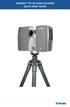 TRIMBLE TX5 3D LASER SCANNER QUICK START GUIDE Equipment 1 8 9 5 6 7 4 3 2 The TX5 laser scanner ships with the following equipment: 1 Scanner transport and carry case 6 USB memory card reader 2 AC power
Dehumidifier Users manual. For Models: DH45S DH65S
 Dehumidifier Users manual For Models: DH45S DH65S 950-0062-revD Jan. 9 2007 FORWARD The appearance of the units that you purchase might be slightly different from the ones described in the Manual, but
1. Check the Accessories
 This Quick User Guide helps you get started with the IRIScan Book Executive 3 scanner. This scanner is supplied with the software applications Readiris Pro 14 (Windows and Mac ), IRIScan Direct and IRISCompressor
System Handbook. Table of contents. Welcome
 System Handbook Table of contents Welcome...1 CE Labelling...2 Delivery Scope...2 General Safety Instructions...2 Assembly and Startup...3 Problem Handling...5 Shuttle Mini-PC Complete System...6 Connectors
Tablet PC User Manual
 Tablet PC User Manual Please read all instructions carefully before use to get the most out of your Time2Touch Tablet PC. The design and features are subject to change without notice. Contents Important
Understanding the home screen
 Quick Reference Learning about the printer Using the printer control panel 1 2 3 4 5 6 Understanding the home screen When the printer is turned on, the display shows a basic screen, referred to as the
KNX TH65-AP. Thermo-Hygrometer. Technical specifications and installation instructions Item number 70184
 EN KNX TH65-AP Thermo-Hygrometer Technical specifications and installation instructions Item number 70184 Elsner Elektronik GmbH Control and Automation Engineering Herdweg 7 D 75391 Gechingen Phone +49
For safe and correct use, be sure to read the Safety Information in Read This First before using the machine. Operating Instructions
 For safe and correct use, be sure to read the Safety Information in Read This First before using the machine. Operating Instructions TABLE OF CONTENTS Introduction...6 How to Read This Manual...7 Symbols...7
Quick Reference. Store this guide next to the machine for future reference. ENG
 Quick Reference Store this guide next to the machine for future reference. ENG Contents * Screen shots used in this manual may differ from the ones you actually see. Things You Can Do with This Device...........................................................................................................
Plain-paper digital Fax/Copier/Printer/Scanner Scanner and Fax Guide
 Plain-paper digital Fax/Copier/Printer/Scanner Scanner and Fax Guide Please read this guide before operating this machine. After you finish reading this guide, keep it handy for easy reference. Chapter
Interactive Whiteboard Functionality Overview... 4. Choosing Pen Style... 5. Erasing / Modifying Writing... 6. Undo / Redo... 6. Email...
 Quick Start Guide 1 Stand-alone Usage Interactive Whiteboard Functionality Overview... 4 Choosing Pen Style... 5 Erasing / Modifying Writing... 6 Undo / Redo... 6 Email... 7 Import / Open file... 7 Saving
Cloud Portal for imagerunner ADVANCE
 Cloud Portal for imagerunner ADVANCE User's Guide Please read this guide before operating this product. After you finish reading this guide, store it in a safe place for future reference. ENG How This
Getting Started. Table of Contents. Quick User Guide - English
 Getting Started This Quick User Guide helps you get started with the IRIScan TM Anywhere Wifi. Please read this guide before operating this scanner and its software. All information is subject to change
idex Manual Contact details Producer: FOCI BV. The Netherlands www.foci.nl [email protected]
 idex USB Manual Contact details Producer: FOCI BV. The Netherlands www.foci.nl [email protected] 2 Index Index... 3 1. General... 4 2. Get started!... 5 3. First use... 7 4. FOCI idex Software... 14 5. Operating
NETWORK PRINT MONITOR User Guide
 NETWORK PRINT MONITOR User Guide Legal Notes Unauthorized reproduction of all or part of this guide is prohibited. The information in this guide is subject to change without notice. We cannot be held liable
PAR Tablet 10 Quick Start Guide
 ParTech, Inc. 8383 Seneca Turnpike New Hartford, NY 13413 p.800.458.6898 www.partech.com PAR Tablet 10 Quick Start Guide PN 770505503 This material has been created in order to accommodate a wide range
MICA HEATER INSTRUCTION MANUAL Model No: UHM-786 230V 50Hz 2200W
 MICA HEATER INSTRUCTION MANUAL Model No: UHM-786 230V 50Hz 2200W Safety Precautions To reduce the risk of personal injury or damage to property, basic safety precautions must be observed including the
Acellus Natural 3D Tablet
 Acellus Natural 3D Tablet Locked Down & Optimized for Use with the Acellus Learning System Acellus Natural 3D Tablet Locked Down & Optimized for Use with the Acellus Learning System Contents I. Quick Start
PJ-673 Mobile Printer USER S GUIDE
 USER S GUIDE PJ-673 Mobile Printer Before using this printer, be sure to read this Users Guide. We suggest that you keep this manual in a handy place for future reference. Version 0 ENG Introduction 0
Quick Start Turning on the Tablet PC for the First Time
 User s Manual DL46 Getting Started Congratulations on your purchase of a Tablet PC. The Tablet PC is a fully functional PC with built-in LAN, and wireless connectivity. With your Tablet PC you will be
Lenovo Miix 2 8. User Guide. Read the safety notices and important tips in the included manuals before using your computer.
 Lenovo Miix 2 8 User Guide Read the safety notices and important tips in the included manuals before using your computer. Notes Before using the product, be sure to read Lenovo Safety and General Information
Tablet PC Tutorial for Windows 7
 VIRGINIA TECH Tablet PC Tutorial for Windows 7 Getting Started Guide Instructional Technology Team, College of Engineering Last Updated: Fall 2013 Email [email protected] if you need additional assistance
EPSON SCANNING TIPS AND TROUBLESHOOTING GUIDE Epson Perfection 3170 Scanner
 EPSON SCANNING TIPS AND TROUBLESHOOTING GUIDE Epson Perfection 3170 Scanner SELECT A SUITABLE RESOLUTION The best scanning resolution depends on the purpose of the scan. When you specify a high resolution,
Scan to FTP Guide. Version 0 ENG
 Scan to FTP Guide To find basic information about network and advanced network features of your Brother machine: See the uu Network User's Guide. To find basic information about network scanning features
VFS24/32HDIP. Public Display IP Monitor User Manual
 VFS24/32HDIP Public Display IP Monitor User Manual 2 Contents Before You Begin...4 Side Panel Control buttons...6 Connections...7 OSD Function...7 LCD monitor Mounting Guide...9 Getting started... 10 Power
Camera 335 Document Camera User s Guide
 Camera 335 Document Camera User s Guide #401-335-00 Table of Contents CHAPTER 1 PRECAUTIONS... 2 Safety Precautions... 3 FCC Warning... 3 EN55022 (CE Radiation) Warning... 3 CHAPTER 2 PACKAGE CONTENT...
XPanel V2. Remote Control Panel. User Manual. XILICA Audio Design
 XPanel V2 Remote Control Panel User Manual XILICA Audio Design Important Safety Instructions 1. READ THESE INSTRUCTIONS All the safety and operating instructions should be read before the product is operated.
LCD MONITOR TOUCH PANEL DRIVER 2 OPERATION MANUAL. for Mac. Version 1.0 PN-L703A/PN-70TA3/PN-L703B/PN-70TB3/PN-L603A/PN-60TA3/PN-L603B/PN-60TB3
 LCD MONITOR TOUCH PANEL DRIVER 2 OPERATION MANUAL for Mac Version 1.0 Applicable models PN-L703A/PN-70TA3/PN-L703B/PN-70TB3/PN-L603A/PN-60TA3/PN-L603B/PN-60TB3 Contents Introduction...3 System Requirements...3
KM-1820 FS-1118MFP. Network Scanner Setup Guide
 KM-180 FS-1118MFP Network Scanner Setup Guide Introduction Trademark Information About this Guide Important Microsoft, Windows, Windows NT and Internet Explorer are registered trademarks of Microsoft
Installation Guide. Wyse C Class Conversion to WES7. Wyse USB Firmware Tool TM Release 1.10. Issue: 102910 PN: 883887-17L Rev. B
 Installation Guide Wyse C Class Conversion to WES7 Wyse USB Firmware Tool TM Release 1.10 Issue: 102910 PN: 883887-17L Rev. B Copyright Notices 2010, Wyse Technology Inc. All rights reserved. This manual
Bullet Camera. Installation Guide. Hangzhou Hikvision Digital Technology Co., Ltd. http://www.hikvision.com
 Bullet Camera Installation Guide Hangzhou Hikvision Digital Technology Co., Ltd. http://www.hikvision.com 1 Thank you for purchasing our product. If there are any questions, or requests, please do not
Legal Notes. Regarding Trademarks. 2012 KYOCERA Document Solutions Inc.
 Legal Notes Unauthorized reproduction of all or part of this guide is prohibited. The information in this guide is subject to change without notice. We cannot be held liable for any problems arising from
CAUTION RISK OF ELECTRIC SHOCK DO NOT OPEN
 BeoLab 4 Guide CAUTION RISK OF ELECTRIC SHOCK DO NOT OPEN CAUTION: To reduce the risk of electric shock, do not remove cover (or back). No User-serviceable parts inside. Refer servicing to qualified service
Vectron POS Mini II. User manual
 Vectron Systems Vectron POS Mini II User manual Your Vectron dealer Stamp Date: 25.10.2012 2012 by Vectron Systems AG Subject to error and technical modification Manufacturer Vectron Systems AG Willy-Brandt-Weg
FT-100 Fire Training Fog Machine User Manual English
 FT-100 Fire Training Fog Machine User Manual English 2015 Antari Lighting and Effects Ltd. User Manual - English Safety Information Please read the following safety information carefully before operating
XD1000 Terminal User s Guide
 XD1000 Terminal User s Guide Printer compartment Holds the printer head mechanism and large capacity paper roll. Printer cover release Press button to release the printer cover and refill the paper roll.
ML 3320/3321. English. Read Me First SEL SEL MENU SHIFT TOF FF/LOAD EXIT GROUP ITEM SET PRINT POWER ALARM MENU TEAR PARK
 MENU SHIFT TOF ML 3320/3321 HSD NLQ CHARACTER PITCH UTL SSD 10 12 15 17 20 PROP Every effort has been made to ensure that the information in this document is complete, accurate, and up-to-date. Oki assumes
Product and functional description
 Product and functional description The KNX / DALI gateway N 141/02 is a 4 MU wide, DINrail mounted KNX device with one DALI interface to which up to 64 DALI actuators (e.g. DALI ballasts) can be connected
500/600/1000. User Manual June 2011 Rev. 061311. 1 v061311
 500/600/1000 User Manual June 2011 Rev. 061311 1 v061311 http://shopping.netsuite.com/digitalcheck TABLE OF CONTENTS Contents Radio Frequency Interference... 3 About the SB Scanner... 3 SB Scanner Equipment...
US Installation Manual Smappee Monitor
 US Installation Manual Smappee Monitor Version 1.3 English, US, version 1.3, revision 23, as of October 23, 2014, 2013 Smappee NV. All rights reserved. Specifications are subject to change without notice.
User's Manual. Metapace L-1. Label Printer Rev. 1.00
 User's Manual Label Printer Rev. 1.00 Table of Contents Manual Information & Usage Precautions 3 1. Content Confirmation 6 2. Product Part Names 7 3. Installation & Usage 9 3-1 Power Connection 9 3-2 Interface
dedicated KVM switch and rackmount screen technology User Manual IP-S101 Combo KVM Extender Designed and manufactured by Austin Hughes
 dedicated KVM switch and rackmount screen technology User Manual IP-S101 Combo KVM Extender Designed and manufactured by Austin Hughes 751 Legal Information First English printing, October 2002 Information
Smart Cam, CC-Smart-Cam, and Smart Cam Packages Installation and Quick Start Operating Instructions
 Smart Cam, CC-Smart-Cam, and Smart Cam Packages Installation and Quick Start Operating Instructions 12/12/2013 FRONT VIEW BACK VIEW TYPICAL PACKAGE 1 Installation Assemble video coupler to the zoom body
Scanner Reference. Operating Instructions
 Operating Instructions Scanner Reference 1 2 3 4 5 6 7 Sending Scan Files by E-mail Sending Scan Files by Scan to Folder Storing Files Using the Scanner Function Delivering Scan Files Scanning Originals
Ingenico. User Guide 5100M. Secure transaction and payment solutions
 User Guide Ingenico 5100M Secure transaction and payment solutions Ingenico 5100 M Contents 1 Presentation... 5 1.1 Overview of Ingenico 5100... 6 1.2 Keyboard details and functionality... 7 2 Use...
PT201 Series LCD Monitor. Setup Manual
 PT201 Series LCD Monitor Setup Manual E9529 June 2014 First Edition Information on the Disposal of this Equipment Do not throw your this product in municipal waste. This product has been designed to enable
This Document Contains:
 Instructional Documents Video Conference >> PolyCom >> VSX 7000 Extension Computing Technology Unit This Document Contains: A Device Description An Installation Guide Instructions for Use Best Practices
ITC-BTTN Cellular Bluetooth Gateway. Owner s Manual 1
 ITC-BTTN Cellular Bluetooth Gateway Owner s Manual 1 2 Table of Contents Introduction...3 Package Contents...3 XLink Connections Diagram...4 Setup...5 Pairing your Bluetooth Cell Phone to the XLink...6
VIDEO DOOR PHONE SYSTEM
 ENGLISH VIDEO DOOR PHONE SYSTEM USER MANUAL Manual covers IH-692 Master and IH-692 Slave Monitors PRECAUTIONS BEFORE INSTALLATION Connect this unit ONLY to other compatible units. Do not connect it to
Replacing the vacuum tube
 wunder cm7 This microphone has been meticulously created to meet the demand for the U47 sound using historically correct components around the heart of the microphone the original, specially selected EF14
* DISCLAIMER: Contents. How to Use This Guide: COMMERCIAL INSTALL GUIDE 2
 COMMERCIAL INSTALL GUIDE 2 Contents How to Use This Guide: The first section of this guide is designed to assist you with the installation of your DECK Monitoring hardware. The revenue grade meter and
USER INSTRUCTIONS FOR GET PORTABLE 12k BTU AIR CONDITIONER MODEL No. GPACU12HR
 USER INSTRUCTIONS FOR GET PORTABLE 12k BTU AIR CONDITIONER MODEL No. GPACU12HR CONTENTS Introduction Safety Notes Identification of parts Installation instructions Operation instructions Maintenance Troubleshooting
Contents. A-61623 July 2008 i
 Contents Image Processing......................................................... 1 Overview.......................................................... 1 Terminology and features..............................................
A. Scan to PDF Instructions
 Revised 08/17/11 Scan to PDF Instructions (Epson scanner example) Scan to PDF Adobe Acrobat 9.0 A. Scan to PDF Instructions Refer to the user manual for your scanner. These instructions are for an Epson
Sense. 3D Scanner. User Guide
 Sense 3D Scanner User Guide COPYRIGHT NOTICE 2014 by 3D Systems, Inc. All rights reserved. This document is subject to change without notice. This document is copyrighted and contains proprietary information