
Our strategy in action: Engage Integrate Perform Grow
|
|
|
- Jewel Douglas
- 10 years ago
- Views:
Transcription
1 Our strategy in action: Engage Integrate Perform Grow Annual Report 2007

2 About Anglo American Anglo American aims to become the leading global mining company We are committed to delivering operational excellence in a safe and responsible way, adding value for shareholders, customers, employees and the communities in which we operate About Anglo American 01 Highlights of the year 02 Our locations 02 Our operations 04 Chairman s statement 06 Chief executive s statement 10 Our strategy in action 14 Operating and financial review 15 Group overview 15 The Group 15 The businesses 17 Key performance indicators (KPIs) 18 Performance against KPIs 25 Resources 27 Group financial performance 31 Business unit overview 31 Platinum 35 Diamonds 38 Base Metals 43 Ferrous Metals 46 Coal 51 Industrial Minerals 54 Discontinued operations 55 Principal risks and uncertainties 58 Governance 58 The Board 60 Executive Committee 61 Directors report 65 Corporate governance 70 Remuneration report 83 Independent remuneration report review 84 Statement of directors responsibilities 85 Financial statements 86 Independent auditors report 87 Principal statements 91 Notes to financial statements 136 Other information 136 Ore Reserves and Mineral Resources estimates 158 Production statistics 163 Exchange rates and commodity prices 164 Key financial data 166 Summary by business segment 167 Reconciliations of reported earnings 168 The business an overview 170 Shareholder information 171 Other Anglo American publications Front cover: This year s cover features the faces of 90 of our 100,000 employees who are helping to shape Anglo American s future success. See page 172 for the names of those employees featured on our cover

3 About Anglo American Highlights of the year Operating profit $10.1bn Underlying earnings $5.8bn Earnings per share $4.40 Record total Group operating profit of $10.1 billion, with operating profit from core operations up 12% to $8.9 billion Strong performances from Base Metals, Platinum, Ferrous Metals and Industrial Minerals Uplifting our unique portfolio and driving significant growth Total Group includes both continuing and discontinued operations. Underlying earnings represents total Group underlying earnings unless otherwise stated. Basis of calculation of underlying earnings is set out in note 12 to the financial statements. Operating profit represents total Group operating profit and includes share of associates operating profit (before share of associates tax and finance charges) and is before special items and remeasurements unless otherwise stated. Operations considered core to the Group are Base Metals, Platinum, Ferrous Metals core businesses (Kumba Iron Ore, Scaw Metals, Samancor and Minas-Rio), Coal and Diamonds. Throughout this report 2003 is presented under UK GAAP. 2004, 2005, 2006 and 2007 results are presented under IFRS. Unless otherwise stated $ and dollar denote US dollars. Anglo American plc Annual Report

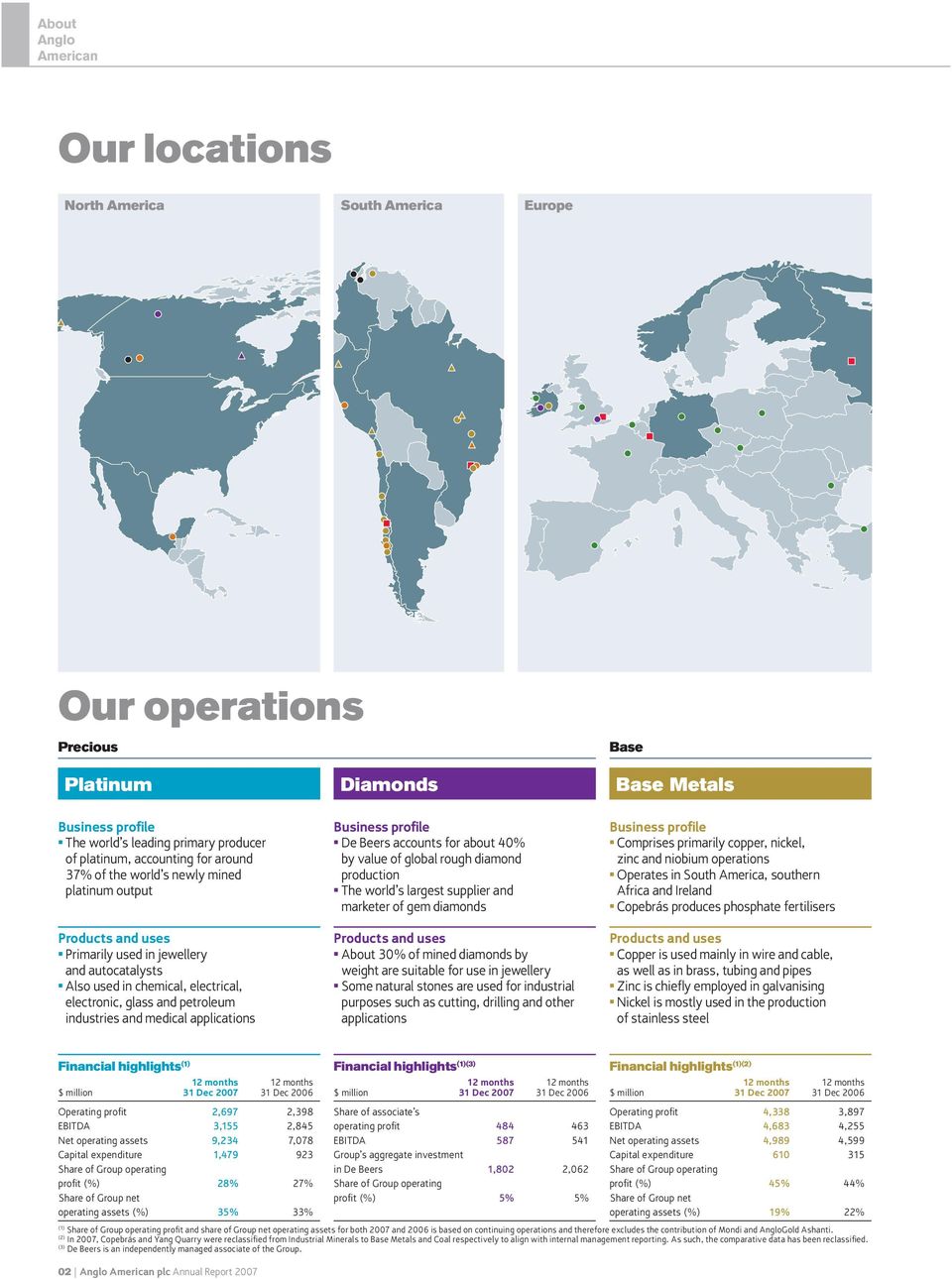
4 About Anglo American Our locations North America South America Europe Our operations Precious Base Platinum Diamonds Base Metals Business profi le The world s leading primary producer of platinum, accounting for around 37% of the world s newly mined platinum output Products and uses Primarily used in jewellery and autocatalysts Also used in chemical, electrical, electronic, glass and petroleum industries and medical applications Business profi le De Beers accounts for about 40% by value of global rough diamond production The world s largest supplier and marketer of gem diamonds Products and uses About 30% of mined diamonds by weight are suitable for use in jewellery Some natural stones are used for industrial purposes such as cutting, drilling and other applications Business profi le Comprises primarily copper, nickel, zinc and niobium operations Operates in South America, southern Africa and Ireland Copebrás produces phosphate fertilisers Products and uses Copper is used mainly in wire and cable, as well as in brass, tubing and pipes Zinc is chiefly employed in galvanising Nickel is mostly used in the production of stainless steel Financial highlights 12 months 12 months $ million 31 Dec Dec 2006 Operating profit 2,697 2,398 EBITDA 3,155 2,845 Net operating assets 9,234 7,078 Capital expenditure 1, Share of Group operating profit (%) 28% 27% Share of Group net operating assets (%) 35% 33% 02 Anglo American plc Annual Report 2007 Financial highlights (3) 12 months 12 months $ million 31 Dec Dec 2006 Share of associate s operating profit EBITDA Group s aggregate investment in De Beers 1,802 2,062 Share of Group operating profit (%) 5% 5% Financial highlights (2) 12 months 12 months $ million 31 Dec Dec 2006 Operating profit 4,338 3,897 EBITDA 4,683 4,255 Net operating assets 4,989 4,599 Capital expenditure Share of Group operating profit (%) 45% 44% Share of Group net operating assets (%) 19% 22% Share of Group operating profi t and share of Group net operating assets for both 2007 and 2006 is based on continuing operations and therefore excludes the contribution of Mondi and AngloGold Ashanti. (2) In 2007, Copebrás and Yang Quarry were reclassifi ed from Industrial Minerals to Base Metals and Coal respectively to align with internal management reporting. As such, the comparative data has been reclassifi ed. (3) De Beers is an independently managed associate of the Group.
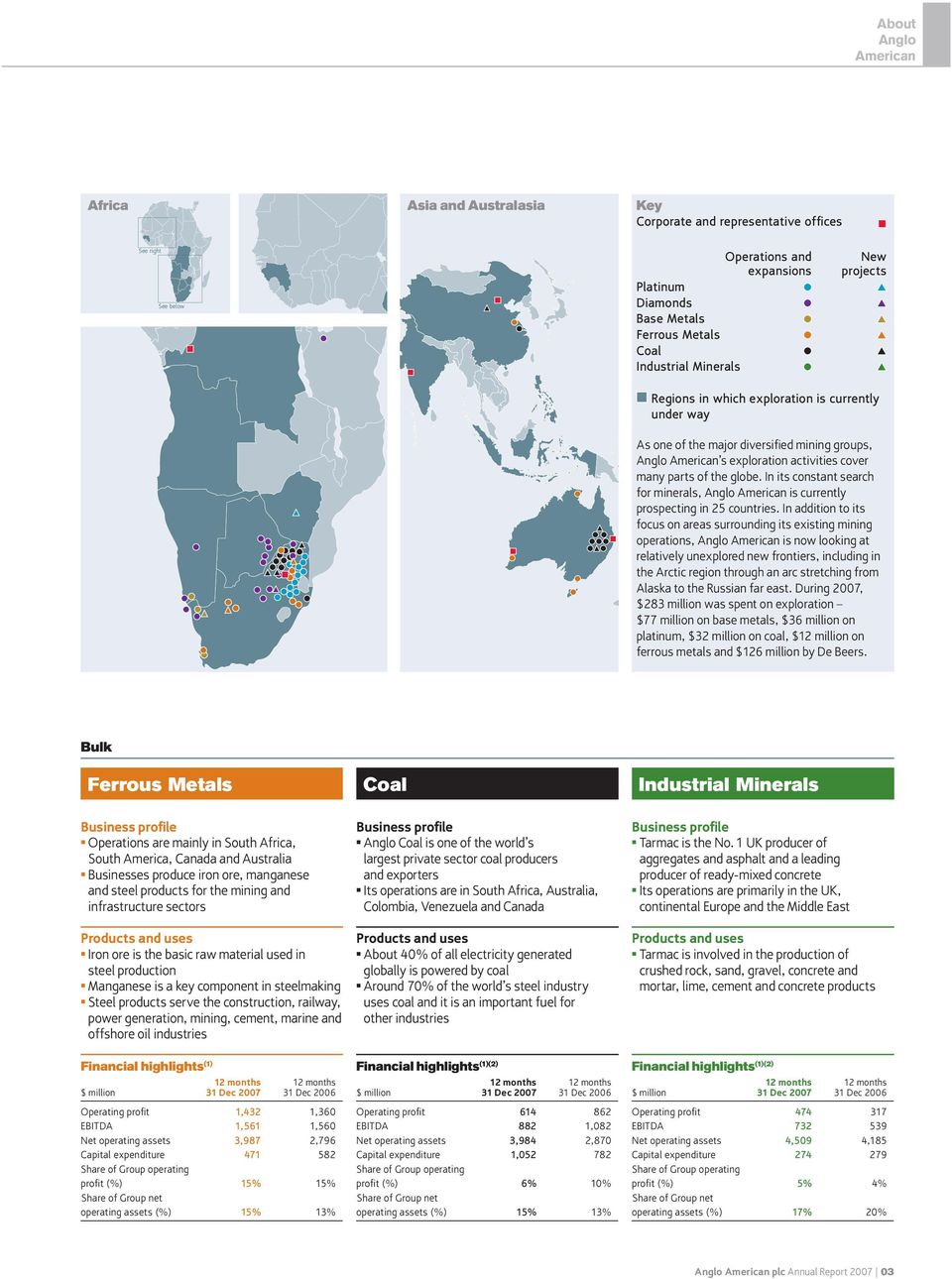
5 About Anglo American Africa Asia and Australasia Key Corporate and representative offices See right See below Operations and expansions Platinum Diamonds Base Metals Ferrous Metals Coal Industrial Minerals New projects Regions in which exploration is currently under way As one of the major diversified mining groups, Anglo American s exploration activities cover many parts of the globe. In its constant search for minerals, Anglo American is currently prospecting in 25 countries. In addition to its focus on areas surrounding its existing mining operations, Anglo American is now looking at relatively unexplored new frontiers, including in the Arctic region through an arc stretching from Alaska to the Russian far east. During 2007, $283 million was spent on exploration $77 million on base metals, $36 million on platinum, $32 million on coal, $12 million on ferrous metals and $126 million by De Beers. Bulk Ferrous Metals Coal Industrial Minerals Business profi le Operations are mainly in South Africa, South America, Canada and Australia Businesses produce iron ore, manganese and steel products for the mining and infrastructure sectors Products and uses Iron ore is the basic raw material used in steel production Manganese is a key component in steelmaking Steel products serve the construction, railway, power generation, mining, cement, marine and offshore oil industries Financial highlights 12 months 12 months $ million 31 Dec Dec 2006 Operating profit 1,432 1,360 EBITDA 1,561 1,560 Net operating assets 3,987 2,796 Capital expenditure Share of Group operating profit (%) 15% 15% Share of Group net operating assets (%) 15% 13% Business profi le Anglo Coal is one of the world s largest private sector coal producers and exporters Its operations are in South Africa, Australia, Colombia, Venezuela and Canada Products and uses About 40% of all electricity generated globally is powered by coal Around 70% of the world s steel industry uses coal and it is an important fuel for other industries Financial highlights (2) 12 months 12 months $ million 31 Dec Dec 2006 Operating profit EBITDA 882 1,082 Net operating assets 3,984 2,870 Capital expenditure 1, Share of Group operating profit (%) 6% 10% Share of Group net operating assets (%) 15% 13% Business profi le Tarmac is the No. 1 UK producer of aggregates and asphalt and a leading producer of ready-mixed concrete Its operations are primarily in the UK, continental Europe and the Middle East Products and uses Tarmac is involved in the production of crushed rock, sand, gravel, concrete and mortar, lime, cement and concrete products Financial highlights (2) 12 months 12 months $ million 31 Dec Dec 2006 Operating profit EBITDA Net operating assets 4,509 4,185 Capital expenditure Share of Group operating profit (%) 5% 4% Share of Group net operating assets (%) 17% 20% Anglo American plc Annual Report
6 About Anglo American Chairman s statement During 2007, Anglo American made great progress in becoming a focused mining company and showed it is prepared to pursue new business opportunities more aggressively in order to seek out and unlock value 04 Anglo American plc Annual Report 2007

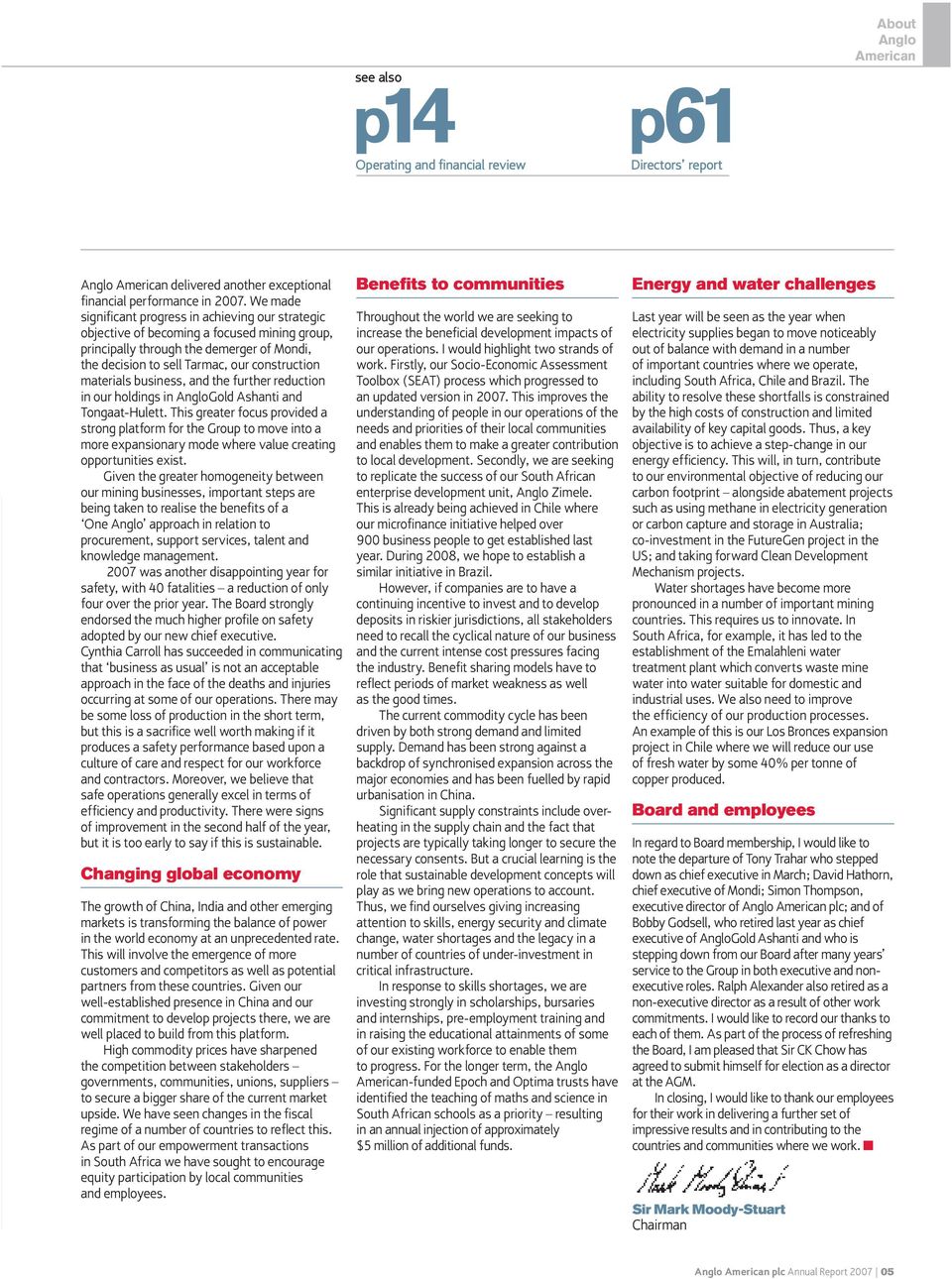
7 see also p14 Operating and financial review p61 Directors report About Anglo American Anglo American delivered another exceptional financial performance in We made significant progress in achieving our strategic objective of becoming a focused mining group, principally through the demerger of Mondi, the decision to sell Tarmac, our construction materials business, and the further reduction in our holdings in AngloGold Ashanti and Tongaat-Hulett. This greater focus provided a strong platform for the Group to move into a more expansionary mode where value creating opportunities exist. Given the greater homogeneity between our mining businesses, important steps are being taken to realise the benefits of a One Anglo approach in relation to procurement, support services, talent and knowledge management was another disappointing year for safety, with 40 fatalities a reduction of only four over the prior year. The Board strongly endorsed the much higher profile on safety adopted by our new chief executive. Cynthia Carroll has succeeded in communicating that business as usual is not an acceptable approach in the face of the deaths and injuries occurring at some of our operations. There may be some loss of production in the short term, but this is a sacrifice well worth making if it produces a safety performance based upon a culture of care and respect for our workforce and contractors. Moreover, we believe that safe operations generally excel in terms of efficiency and productivity. There were signs of improvement in the second half of the year, but it is too early to say if this is sustainable. Changing global economy The growth of China, India and other emerging markets is transforming the balance of power in the world economy at an unprecedented rate. This will involve the emergence of more customers and competitors as well as potential partners from these countries. Given our well-established presence in China and our commitment to develop projects there, we are well placed to build from this platform. High commodity prices have sharpened the competition between stakeholders governments, communities, unions, suppliers to secure a bigger share of the current market upside. We have seen changes in the fiscal regime of a number of countries to reflect this. As part of our empowerment transactions in South Africa we have sought to encourage equity participation by local communities and employees. Benefits to communities Throughout the world we are seeking to increase the beneficial development impacts of our operations. I would highlight two strands of work. Firstly, our Socio-Economic Assessment Toolbox (SEAT) process which progressed to an updated version in This improves the understanding of people in our operations of the needs and priorities of their local communities and enables them to make a greater contribution to local development. Secondly, we are seeking to replicate the success of our South African enterprise development unit, Anglo Zimele. This is already being achieved in Chile where our microfinance initiative helped over 900 business people to get established last year. During 2008, we hope to establish a similar initiative in Brazil. However, if companies are to have a continuing incentive to invest and to develop deposits in riskier jurisdictions, all stakeholders need to recall the cyclical nature of our business and the current intense cost pressures facing the industry. Benefit sharing models have to reflect periods of market weakness as well as the good times. The current commodity cycle has been driven by both strong demand and limited supply. Demand has been strong against a backdrop of synchronised expansion across the major economies and has been fuelled by rapid urbanisation in China. Significant supply constraints include overheating in the supply chain and the fact that projects are typically taking longer to secure the necessary consents. But a crucial learning is the role that sustainable development concepts will play as we bring new operations to account. Thus, we find ourselves giving increasing attention to skills, energy security and climate change, water shortages and the legacy in a number of countries of under-investment in critical infrastructure. In response to skills shortages, we are investing strongly in scholarships, bursaries and internships, pre-employment training and in raising the educational attainments of some of our existing workforce to enable them to progress. For the longer term, the Anglo American-funded Epoch and Optima trusts have identified the teaching of maths and science in South African schools as a priority resulting in an annual injection of approximately $5 million of additional funds. Energy and water challenges Last year will be seen as the year when electricity supplies began to move noticeably out of balance with demand in a number of important countries where we operate, including South Africa, Chile and Brazil. The ability to resolve these shortfalls is constrained by the high costs of construction and limited availability of key capital goods. Thus, a key objective is to achieve a step-change in our energy efficiency. This will, in turn, contribute to our environmental objective of reducing our carbon footprint alongside abatement projects such as using methane in electricity generation or carbon capture and storage in Australia; co-investment in the FutureGen project in the US; and taking forward Clean Development Mechanism projects. Water shortages have become more pronounced in a number of important mining countries. This requires us to innovate. In South Africa, for example, it has led to the establishment of the Emalahleni water treatment plant which converts waste mine water into water suitable for domestic and industrial uses. We also need to improve the efficiency of our production processes. An example of this is our Los Bronces expansion project in Chile where we will reduce our use of fresh water by some 40% per tonne of copper produced. Board and employees In regard to Board membership, I would like to note the departure of Tony Trahar who stepped down as chief executive in March; David Hathorn, chief executive of Mondi; Simon Thompson, executive director of Anglo American plc; and of Bobby Godsell, who retired last year as chief executive of AngloGold Ashanti and who is stepping down from our Board after many years service to the Group in both executive and nonexecutive roles. Ralph Alexander also retired as a non-executive director as a result of other work commitments. I would like to record our thanks to each of them. As part of the process of refreshing the Board, I am pleased that Sir CK Chow has agreed to submit himself for election as a director at the AGM. In closing, I would like to thank our employees for their work in delivering a further set of impressive results and in contributing to the countries and communities where we work. Sir Mark Moody-Stuart Chairman Anglo American plc Annual Report
8 About Anglo American Chief executive s statement 2007 was a year of change for our business one in which we continued to deliver strong returns for shareholders while also streamlining our business and laying the foundations for greater efficiency gains, as well as stronger growth into the future 06 Anglo American plc Annual Report 2007

9 2007 highlights $12bn Projects under development 15% Increase in final dividend About Anglo American Record financial performance In my first year as chief executive, I am pleased to report a record financial performance by Anglo American. We achieved our highest ever operating profit of $10.1 billion and underlying earnings of $5.8 billion, with continued strong cash generation. Once again, we are announcing an increased final dividend 86 US cents per share, up 15% on The strength of our performance was due to improved production volumes of ferrous metals, copper and zinc, an increased focus on operational discipline and a continuation of the supportive trading environment. During 2007, high prices were realised for most of the Group s commodities, although these benefits were partially offset by adverse currency movements, supply-side constraints and ongoing pressure on costs across the mining sector. New approach to safety 2007 marked a turning point in our approach to safety. Our past and current number of fatalities and injuries is simply unacceptable. I strongly believe that optimally run businesses have good safety records. We have launched a series of new initiatives to drive consistent safety messages and practices across our business. We have shown that we are prepared to do what is necessary to meet this challenge head on by shutting down mine shafts where safety performance has not been up to standard, to retrain affected employees and to conduct a thorough investigation of operating conditions. Significant progress was made between the first and second halves of the year and I expect our operations to build upon this momentum in Delivering our strategic objectives I have been very clear about my ambition for Anglo American our goal is to become the leading global mining company. The year under review has seen a combination of strategic restructuring and a period of building from a position of strength, including the identification and execution of opportunities to drive new growth and value. The restructuring of Anglo American is almost complete and it is now that we can focus on the operational improvements that will be delivered by our asset optimisation programme and the cultural change that we are implementing across the Group. During the year, we made good strategic progress. In May, we disposed of our remaining 29% holding in Highveld Steel and Vanadium, and, in June, the unbundling of Hulamin from Tongaat-Hulett was completed. Mondi, our paper and packaging business, was demerged in early July and established as a dual-listed company on the London and Johannesburg stock exchanges. In line with our intention to ultimately exit AngloGold Ashanti, we reduced our holding to 16.6%, realising in excess of $2.9 billion. In August, we announced plans to sell Tarmac. Tarmac has a leading position in the UK construction materials industry, and is well positioned in certain key markets in continental Europe and the Middle East. Tarmac had a very strong operational performance in 2007, with a number of its business improvement initiatives starting to make a significant impact. It is expected that the performance of Tarmac will continue to underpin a competitive sale process; however, it has been decided not to launch the marketing phase of the sale process until current credit market conditions improve. We also made progress during 2007 in meeting the employment equity and black economic empowerment requirements of the South African Mining Charter, including groundbreaking equity participation arrangements in Anglo Platinum s assets. In February 2008, the South African Department of Minerals and Energy confirmed it would award Anglo American with all its new order mining rights, subject to completion of outstanding documentation, by 31 March This is a landmark achievement for the Group and for the many black empowered businesses with which we are partnered. Expanding our asset base During 2007, we were active in identifying and acquiring major new projects, particularly copper and iron ore, to deliver significant volume growth over the next decade. The Group has a tremendous project pipeline, one of the strongest in the sector, building on our unique portfolio of existing assets and delivering considerable organic growth potential. We have a number of major projects under development, involving investment of some $12 billion across all our businesses. In addition, we have a further $29 billion of projects under consideration will also see our planned expansions delivering significant new production in iron ore and coal. EXPANDING OUR ASSET BASE During 2007, we were active in identifying and acquiring major new projects, particularly copper and iron ore, to deliver signifi cant volume growth over the next decade Potential copper output of 1.6 Mtpa by 2016 Potential iron ore output of 150 Mtpa by 2017 Anglo American plc Annual Report

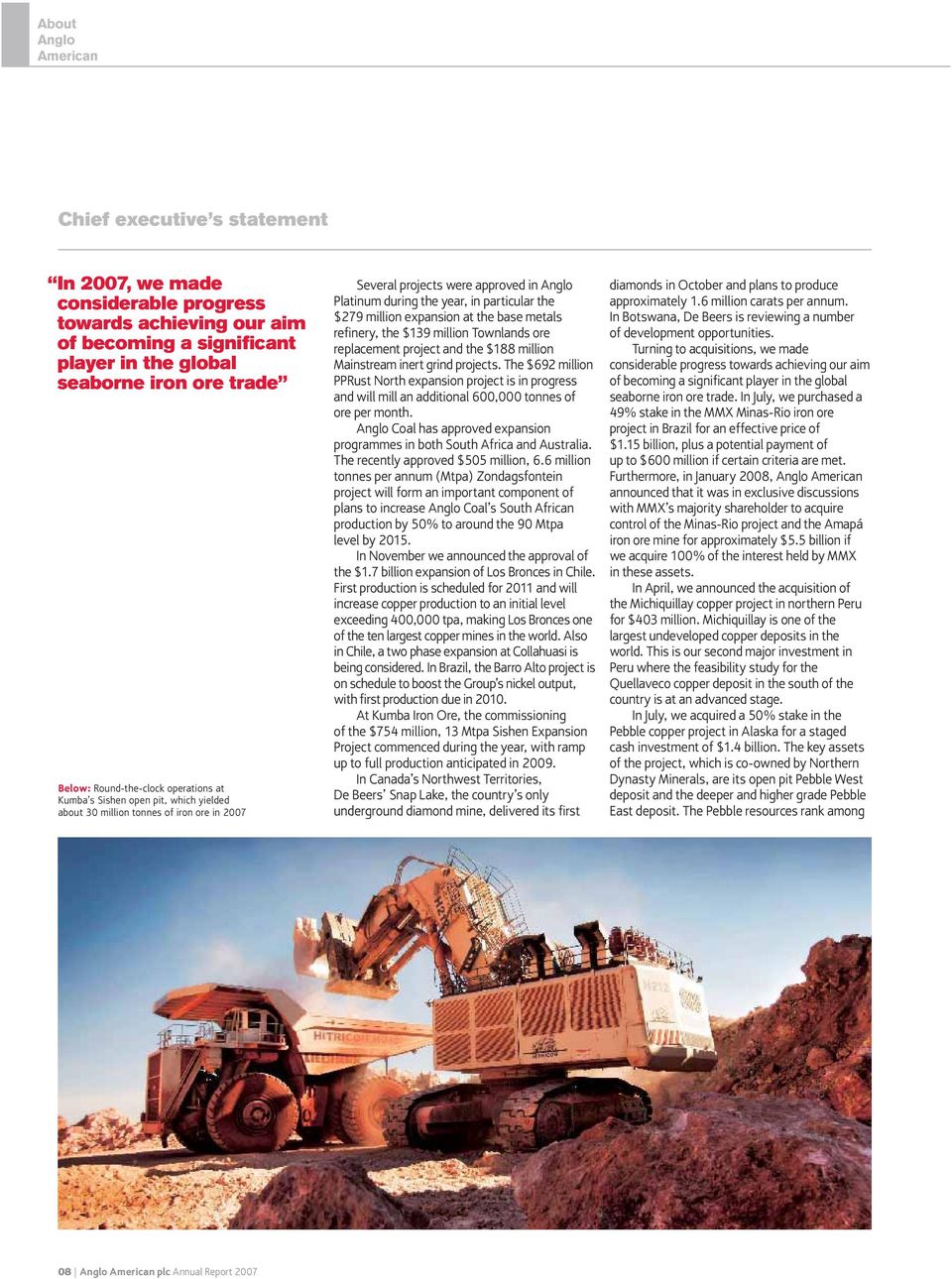
10 About Anglo American Chief executive s statement In 2007, we made considerable progress towards achieving our aim of becoming a significant player in the global seaborne iron ore trade Below: Round-the-clock operations at Kumba s Sishen open pit, which yielded about 30 million tonnes of iron ore in 2007 Several projects were approved in Anglo Platinum during the year, in particular the $279 million expansion at the base metals refinery, the $139 million Townlands ore replacement project and the $188 million Mainstream inert grind projects. The $692 million PPRust North expansion project is in progress and will mill an additional 600,000 tonnes of ore per month. Anglo Coal has approved expansion programmes in both South Africa and Australia. The recently approved $505 million, 6.6 million tonnes per annum (Mtpa) Zondagsfontein project will form an important component of plans to increase Anglo Coal s South African production by 50% to around the 90 Mtpa level by In November we announced the approval of the $1.7 billion expansion of Los Bronces in Chile. First production is scheduled for 2011 and will increase copper production to an initial level exceeding 400,000 tpa, making Los Bronces one of the ten largest copper mines in the world. Also in Chile, a two phase expansion at Collahuasi is being considered. In Brazil, the Barro Alto project is on schedule to boost the Group s nickel output, with first production due in At Kumba Iron Ore, the commissioning of the $754 million, 13 Mtpa Sishen Expansion Project commenced during the year, with ramp up to full production anticipated in In Canada s Northwest Territories, De Beers Snap Lake, the country s only underground diamond mine, delivered its first diamonds in October and plans to produce approximately 1.6 million carats per annum. In Botswana, De Beers is reviewing a number of development opportunities. Turning to acquisitions, we made considerable progress towards achieving our aim of becoming a significant player in the global seaborne iron ore trade. In July, we purchased a 49% stake in the MMX Minas-Rio iron ore project in Brazil for an effective price of $1.15 billion, plus a potential payment of up to $600 million if certain criteria are met. Furthermore, in January 2008, Anglo American announced that it was in exclusive discussions with MMX s majority shareholder to acquire control of the Minas-Rio project and the Amapá iron ore mine for approximately $5.5 billion if we acquire 100% of the interest held by MMX in these assets. In April, we announced the acquisition of the Michiquillay copper project in northern Peru for $403 million. Michiquillay is one of the largest undeveloped copper deposits in the world. This is our second major investment in Peru where the feasibility study for the Quellaveco copper deposit in the south of the country is at an advanced stage. In July, we acquired a 50% stake in the Pebble copper project in Alaska for a staged cash investment of $1.4 billion. The key assets of the project, which is co-owned by Northern Dynasty Minerals, are its open pit Pebble West deposit and the deeper and higher grade Pebble East deposit. The Pebble resources rank among 08 Anglo American plc Annual Report 2007
11 2007 highlights 71% Participation rate for HIV/AIDS VCT next section: How Anglo American s ambition to become the leading mining company is being realised About Anglo American the world s most important accumulations of copper, gold and molybdenum. In both Peru and Alaska, a key priority is to build supportive relationships with local communities, consistent with our policy of developing and operating projects to the highest standards and to promote truly sustainable development. Close to year end we announced the acquisition of a 70% interest, for $620 million, in the Foxleigh coal mine in Australia, which adjoins our German Creek and Lake Lindsay operations. We are also widening our horizons geographically. In an exciting recent development, Anglo American and China Development Bank have entered into a Memorandum of Understanding (MOU). Anglo American is actively looking for further projects in China and the MOU represents a long term commitment from both parties to establish a strategic relationship to identify and develop a pipeline of mining projects in China, Africa and elsewhere. Driving operational excellence The mining industry continues to experience significant cost pressures across the supply chain, including freight, transportation, fuel and consumables. In spite of the cost pressures, we achieved $380 million in cost savings, synergies, efficiencies and procurement, and we managed to contain our growth in cash costs to 4% above inflation. Above and beyond these cost-saving activities, we are bringing greater rigour to our operating platform by introducing a value based management (VBM) methodology across all our businesses. A pilot project has been completed in Anglo Coal and we are now rolling VBM out into the other businesses. In addition, an asset optimisation initiative will maximise operational efficiencies at site level and allow us to benchmark our performance and spread best practices. We have carried out a comprehensive review to define the best approach for delivering key business support functions and, as a result, we have decided to establish three shared services centres providing common accounting and employee services, located in existing offices in Asia Pacific, Latin America and South Africa. We have also launched a centralised procurement programme to maximise the benefits of being a global operator. Initial projections indicate that we shall achieve $1 billion worth of procurement and shared services savings in the next three years. Sustainable development I am proud to say that we continue to be a sector leader in terms of our approach to sustainable development. We are seeking to play our part in addressing the challenges of climate change by improving our energy efficiency, reducing our greenhouse gas emissions, contributing to the development of clean coal technologies and through our involvement in public-policy discussions. Our internationally recognised Socio-Economic Assessment Toolbox (SEAT) continues to help us understand the perspectives and concerns of the communities close to our operations. This year we have made a three-yearly SEAT assessment mandatory for all our major operations. We are gaining ground in the fight against HIV and AIDS with our successful voluntary counselling and testing (VCT) and treatment programme. At a number of our collieries in South Africa, the VCT participation rate exceeds 90%, while the overall Group figure continues to climb and had reached 71% by the end of Important progress was also made this year in developing a new framework of occupational health policies called The Anglo Occupational Health Way. In 2007, we were an active voice in the development and promotion of the Extractive Industries Transparency Initiative (EITI), which supports improved governance in resource-rich countries, representing the mining sector on the EITI s board. We were also involved in other multistakeholder initiatives, including the Voluntary Principles on Security and Human Rights and the Investment Climate Facility for Africa. We continue to be involved in and to give our full support to the UN Global Compact. We report on progress implementing the principles in our Report to Society in accordance with the externally verified Global Reporting Initiative. We have made clear our commitment to regular engagement with NGOs at a local, national and international level. We signed association agreements with Fauna and Flora International on biodiversity issues and with CARE International on development challenges. In spite of the cost pressures, we achieved $380 million in cost savings, synergies, efficiencies and procurement Outlook The global economic outlook for 2008 is clouded by uncertainty. While it seems clear that US economic activity will be weaker in 2008 than in recent years, it is less clear how economic growth will be affected in the rest of the world, especially in those emerging markets whose growth has been largely responsible for the strong demand that has underpinned commodity prices. In South Africa, electrical power supply problems are causing disruption to mining operations across the country. At present, it is difficult to accurately forecast the medium term impact of power shortages on Anglo American s business. We are working with Eskom and the South African government to implement solutions. Global commodity demand remains strong and seems likely to remain so throughout Commodity supply worldwide continues to be constrained by skills shortages, rising capital and operating costs, longer permitting processes and strong exchange rates in many of the countries where key operations are located. Industry inventories are therefore likely to remain low and continue to underpin prices. The medium to long term secular trend of strong commodity demand growth embracing, as it does, the industrialisation and urbanisation of developing nations, especially China and India will continue to support prices over a longer time horizon. As a result, significant new mining investments will be needed to satisfy that demand. Anglo American is well placed to benefit from this favourable backdrop as the Group continues to realise its exciting growth prospects. Cynthia Carroll Chief executive Anglo American plc Annual Report
12 About Anglo American Our strategy in action We are focusing on improvement in four key areas integration, performance, growth and engagement Integration As Anglo American continues to extend its reach across the globe and diversifies its mining asset base, the organisation is being reshaped to ensure we are able to meet the sustained demand for the commodities we mine. A high degree of decentralisation through autonomous business units is making way for a new One Anglo approach. This concept allows for greater sharing of talent, expertise and knowledge across the Group and, as a result, our culture is changing as we move towards becoming a single, integrated organisation. One Anglo involves consistently applying a common framework of values and standards; putting the structures in place to foster greater knowledge-sharing; and leveraging our scale through shared services. Safety Nowhere is this integrated concept more important than in our approach to safety. The safety of all our employees is paramount. Our vision of zero harm, which was endorsed in 2007 by all our businesses and their leadership teams, is based on three clear principles: all injuries are preventable; all necessary steps must be taken to learn from incidents in order to prevent reoccurrence; and common, simple non-negotiable standards must be consistently applied. Key to realising this vision is The Anglo Safety Way, a global framework of risk management systems and standards, which is being rolled out across the business. This is being supported by greater communication and cross-fertilisation of ideas and experiences around safety within and between the Group s businesses, as well as other organisations in mining and related industries. People The increasing technological sophistication of mining, combined with a serious skills shortage in the current competitive market, has further underlined the importance we already attach to retaining our talent through appropriate reward, talent development and people management activities. Several Group-wide One Anglo initiatives have provided impetus in these areas. The introduction of a broad banding system throughout the businesses underpins our move towards more consistent and competitive regional reward strategies and a common performance management process. It has also been a key enabler for the introduction of an improved talent tracking system, an integrated internal and external vacancy management system, and the development of Group-wide people information and shared services systems. Our global leadership development portfolio has been extended during the year and going forward there will be an increased focus on common standards in terms of curriculum and delivery for all our management development programmes across the Group. Shared services Applying common policies, processes and systems, as well as creating a One Anglo mindset among our employees, will also be delivered through our shared services initiative. We will create three shared services centres based in existing offices in Asia Pacific, Latin America (serving the whole of the Americas) and South Africa (serving Africa and Europe). The centres will provide common accounting and employee services. 10 Anglo American plc Annual Report 2007

13 About Anglo American In-house technological capability augmented by strategic partnerships In contrast to many mining industry peers, Anglo American for many years has been distinguished by its formidable in-house technical capacity, with the aim of maintaining a technological edge and, in doing so, enhancing shareholder value. Based on two main internal units, Technical and Research, and enhanced by a range of partnered technologies, the Group has become an industry standard-setter in finding, extracting and refining minerals. For example, advanced airborne electromagnetic techniques and superconducting quantum interference devices have identified prospective mineral deposits; in partnership with external specialists, a new solvent-extraction and electro-winning process was developed to yield zinc ore; while robot laboratories (right) at Anglo Platinum s concentrators and smelters have greatly reduced assay-assessment time. Performance As part of our strategy to become the leading global mining company, Anglo American has disposed of a number of non-core assets and is focusing on ensuring that its assets have economies of scale, long lives, are in the lowest quartile in terms of costs and have the potential to give the Group critical mass in each of our commodities. Today, Anglo American is centred around three core commodity categories precious (with our unique platinum and diamond assets), base and bulk. We are now progressing into the second phase of our strategy, where we are seeking to maximise the value we derive from each of our assets. Asset optimisation We are identifying, and seeking to close, any value gaps between the performance of our operations and the industry s best in class. To this effect, a major asset optimisation programme is under way across our business units. This initiative seeks to identify the full potential of each operation and put programmes in place to manage actual performance towards this goal. This has involved a rigorous, bottomup analysis of our assets and operations and their subsequent benchmarking against our peers to bring our operations up to the highest level. Supply chain efficiencies Taking an integrated global approach to procurement while maximising efficiencies through the supply chain are other ways we are looking to drive performance. We have made major improvements with progressively more demanding efficiency targets. In 2007, the Group achieved supply chain efficiencies of almost $200 million. We are working closely with our suppliers to eliminate waste from all areas of our supply chain by developing a detailed understanding of cost drivers, standardising requirements and leveraging economies of scale across the Group. In addition, we are optimising our sourcing footprint by increasing purchasing from lower cost countries such as China, while also continuing to develop small and medium sized entrepreneurs close to existing operations. In recent years, many parts of the mining industry supply chain have been operating at or close to full capacity, resulting in constraints and delays for equipment and services. We are mitigating these issues by developing clear plans and engaging more effectively with our suppliers. For example, we are entering innovative longer term supply arrangements with suppliers to secure tyres for our existing operations and new projects. Anglo American plc Annual Report

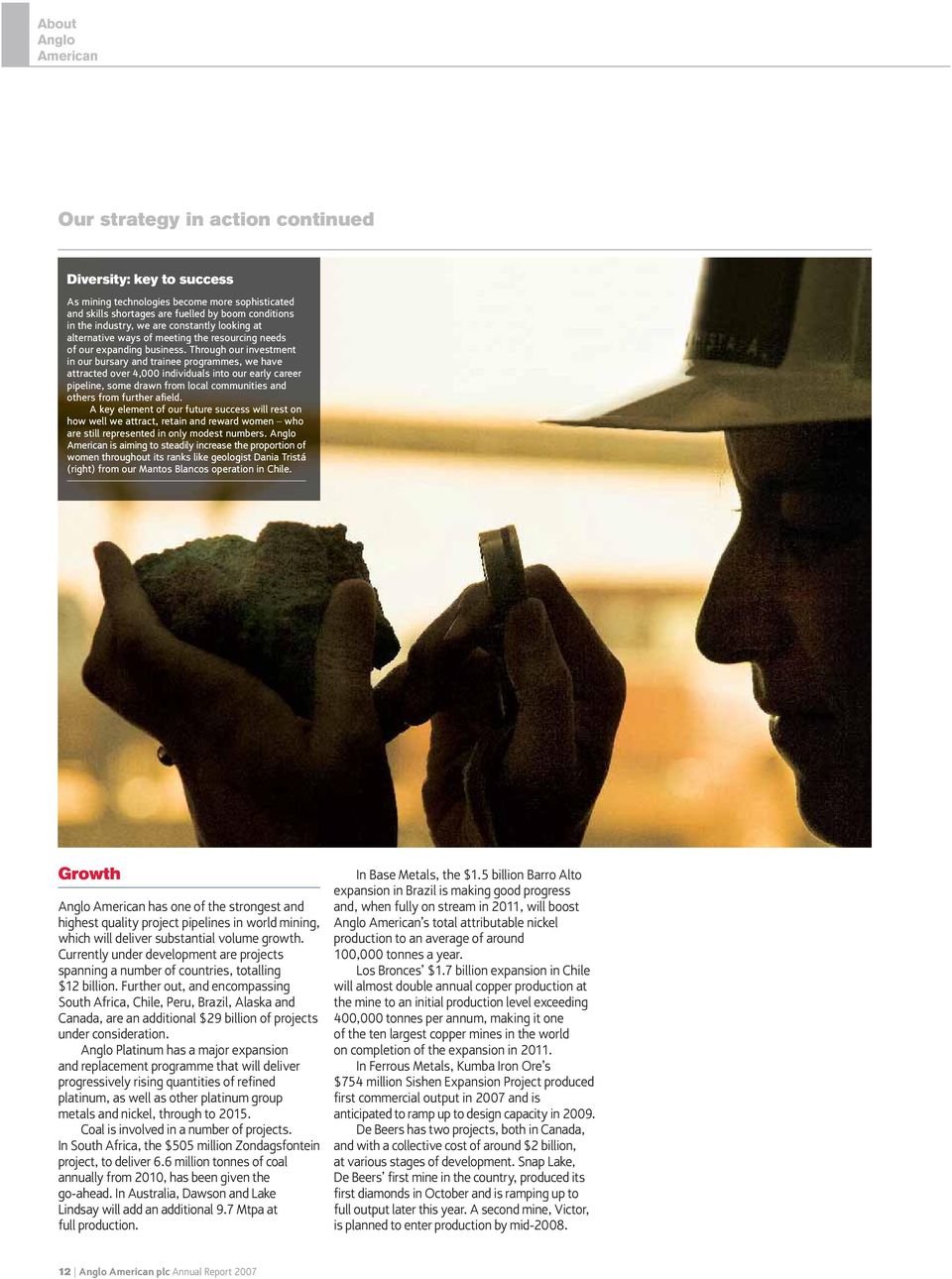
14 About Anglo American Our strategy in action continued Diversity: key to success As mining technologies become more sophisticated and skills shortages are fuelled by boom conditions in the industry, we are constantly looking at alternative ways of meeting the resourcing needs of our expanding business. Through our investment in our bursary and trainee programmes, we have attracted over 4,000 individuals into our early career pipeline, some drawn from local communities and others from further afield. A key element of our future success will rest on how well we attract, retain and reward women who are still represented in only modest numbers. Anglo American is aiming to steadily increase the proportion of women throughout its ranks like geologist Dania Tristá (right) from our Mantos Blancos operation in Chile. Growth Anglo American has one of the strongest and highest quality project pipelines in world mining, which will deliver substantial volume growth. Currently under development are projects spanning a number of countries, totalling $12 billion. Further out, and encompassing South Africa, Chile, Peru, Brazil, Alaska and Canada, are an additional $29 billion of projects under consideration. Anglo Platinum has a major expansion and replacement programme that will deliver progressively rising quantities of refined platinum, as well as other platinum group metals and nickel, through to Coal is involved in a number of projects. In South Africa, the $505 million Zondagsfontein project, to deliver 6.6 million tonnes of coal annually from 2010, has been given the go-ahead. In Australia, Dawson and Lake Lindsay will add an additional 9.7 Mtpa at full production. In Base Metals, the $1.5 billion Barro Alto expansion in Brazil is making good progress and, when fully on stream in 2011, will boost Anglo American s total attributable nickel production to an average of around 100,000 tonnes a year. Los Bronces $1.7 billion expansion in Chile will almost double annual copper production at the mine to an initial production level exceeding 400,000 tonnes per annum, making it one of the ten largest copper mines in the world on completion of the expansion in In Ferrous Metals, Kumba Iron Ore s $754 million Sishen Expansion Project produced first commercial output in 2007 and is anticipated to ramp up to design capacity in De Beers has two projects, both in Canada, and with a collective cost of around $2 billion, at various stages of development. Snap Lake, De Beers first mine in the country, produced its first diamonds in October and is ramping up to full output later this year. A second mine, Victor, is planned to enter production by mid Anglo American plc Annual Report 2007
15 About Anglo American next section: How the Group and its subsidiaries performed in 2007, including business unit and financial reviews Acquisitions and new business relationships Complementing Anglo American s programme of organic growth, the Group is building its position in a number of key commodities, in particular copper and iron ore, through strategic value enhancing acquisitions. The aim of becoming a significant player in the highly consolidated iron ore industry, with its high barriers to entry, has been boosted by the acquisition of 49% in the advanced MMX Minas-Rio project in Brazil. Phase 1 of the mine is expected to cost $3.46 billion, with total projected output of 26.5 million tonnes of iron ore per annum by the end of the decade. The Minas-Rio project, the Amapá mine and the expansions at Kumba s Sishen mine will contribute towards the goal of lifting the Group s annual iron ore output to 150 million tonnes by The Group increased its copper profile with its successful tender for the Michiquillay project in Peru and by becoming a 50% partner, with Northern Dynasty, in the copper-goldmolybdenum Pebble project in Alaska for a staged cash investment of $1.425 billion. If approval is secured for Quellaveco in Peru, these three projects, combined with the Los Bronces and Collahuasi expansions, could see the Group s attributable copper production rising to around 1.6 million tonnes a year by The acquisition of a 70% stake in the Foxleigh coal mine in Australia for $620 million will further support our coal ambitions. Recently, Anglo American and China Development Bank entered into a Memorandum of Understanding (MOU). The MOU represents a long term mutual commitment to establish a partnership to identify and develop mining projects in China, Africa and other parts of the world. Engagement Partnerships for a more sustainable future At Anglo American, we believe that the pursuit of sustainable development goes hand in hand with best business practice. By our responsible custodianship of valuable resource endowments, which often include scarce water supplies, and our insistence on good governance, we hope to demonstrate to host governments and communities that resources, when developed wisely, can be of widespread ongoing benefit to their countries. Through finding ways to maximise local economic linkages and benefits for example, employing a majority of local people, establishing supply chain initiatives and investing in social and physical infrastructure and careful management of social and environmental impacts, we seek to develop positive outcomes as a result of our presence. Leading community engagement initiatives is our Socio-Economic Assessment Toolbox (SEAT). Anglo American is also an active member of the UN Global Compact, the Extractive Industries Transparency Initiative and the round table on the Voluntary Principles on Security and Human Rights. We are also working to be a force for development through the Investment Climate Facility for Africa, Business Action for Africa, the International Council for Mining & Metals and the World Business Council for Sustainable Development. In addition, Anglo American has taken steps towards building a corporate partnership with the environmental NGO Fauna and Flora International (FFI). Anglo American and FFI intend to work together to craft a Biodiversity Performance Standard that will govern the approach to diversity management throughout the Group s operations. Our energy partnerships Anglo American is broadening its range of relationships in the energy field. These are helping to create the potential for the Group to expand into downstream areas closely related to its core business. Through such relationships, risk can be shared and there is the mutual opportunity of accessing each other s complementary resources, including markets, technologies and capital. Anglo American is involved with various parties in a number of energy ventures, including the commercialisation of fuel cell technology, the capture and commercial sale of methane from its coal mines, as well as in researching integrated carbon capture and storage projects. The Group is a member of the FutureGen Industrial Alliance, which consists of major energy and mining companies working in partnership with the US Department of Energy (DOE) to design, construct and operate the world s first near zero emissions coal-fuelled power generation plant. Although in January 2008, the DOE announced an intention to establish an alternative programme, the Alliance intends to continue to work with the US Administration, Congress and other stakeholders to advance the project. Anglo American has also formed a Clean Coal Energy Alliance to develop the Monash brown coal to liquids project in Australia. In China, Anglo American, the Shaanxi Coalfield Geological Bureau and Shell are jointly looking at ways to develop, including downstream applications, a coal resource of more than 600 million tonnes. Through our asset optimisation programme, we are identifying, and seeking to close, any value gaps between the performance of our operations and the industry s best in class Anglo American plc Annual Report
16 Operating and financial review Basis of disclosure This operating and financial review (OFR) describes the main trends and factors underlying the development, performance and position of Anglo American plc (the Group) during the year ended 31 December 2007, as well as those likely to affect our future development, performance and position. It has been prepared in line with the guidance provided in the reporting statement on the operating and financial review issued by the UK Accounting Standards Board in January Forward looking statements This OFR contains certain forward looking statements with respect to the financial condition, results, operations and businesses of the Group. These statements and forecasts involve risk and uncertainty because they relate to events and depend on circumstances that occur in the future. There are a number of factors that could cause actual results or developments to differ materially from those expressed or implied by these forward looking statements. Section contents 15 Group overview 15 The Group 15 The businesses 15 Precious 16 Base 16 Bulk 17 Key performance indicators (KPIs) 18 Performance against KPIs 18 Safety 18 People 20 Asset optimisation 20 New capital investment 23 Sustainable development 25 Resources 27 Group financial performance 31 Business unit overview 31 Platinum 31 Business overview 32 Industry overview 32 Strategy and growth 33 Financial overview 35 Diamonds 35 Business overview 35 Industry overview 35 Strategy and growth 36 Financial overview 38 Base Metals 38 Business overview 38 Industry overview 39 Strategy and growth 40 Financial overview 43 Ferrous Metals 43 Business overview 44 Industry overview 44 Strategy and growth 45 Financial overview 46 Coal 46 Business overview 47 Industry overview 48 Strategy and growth 48 Financial overview 51 Industrial Minerals 51 Business overview 51 Industry overview 52 Strategy and growth 53 Financial overview 54 Discontinued operations 54 AngloGold Ashanti 54 Paper and Packaging 55 Principal risks and uncertainties 14 Anglo American plc Annual Report 2007

17 Operating and financial review Group overview The Group Anglo American is a global leader in mining focused on adding value for shareholders, customers, employees and the communities in which it operates. The Group has a range of high quality, core mining businesses with balanced participation across precious, base and bulk commodities. The five core mining businesses are Platinum, Diamonds, Base Metals, Iron Ore (Ferrous Metals) and Coal. The Group is geographically diverse, with an operating footprint spanning 45 countries. The businesses Precious Platinum Anglo Platinum mines, processes and refines the entire range of platinum group metals (platinum, palladium, rhodium, ruthenium, iridium and osmium) and is the world s largest primary producer of platinum, accounting for some 37% of global supply. Anglo Platinum has the largest platinum reserves in the world, as well as extensive resource capabilities and the ability to grow production in line with projected demand for the foreseeable future. The industry outlook for platinum is positive, supported in particular by autocatalyst and Chinese jewellery demand, and industrial growth. All of Anglo Platinum s current operations are located in South Africa. Further details on Anglo Platinum s strategy, the demand drivers behind the business and fi nancial results for the year can be found on pages 31 to 34 of the OFR. Diamonds Anglo American s diamond interests are represented by its 45% shareholding in De Beers, the other shareholders being Central Holdings Ltd (an Oppenheimer family holding company) (40%), and the Government of the Republic of Botswana (15%). De Beers is the world s leading diamond exploration, mining and marketing company. Its expertise extends to all aspects of the diamond pipeline including prospecting, mining and recovery and through its marketing arm, the Diamond Trading Company International (DTCI), the sorting, valuing and sale of rough gem diamonds. De Beers produces around 40% by value of global rough diamond production from its mines in South Africa and through its partnerships with the governments of Botswana, Namibia and Tanzania. The long term supply and demand characteristics for the diamond industry are favourable, driven by continued strong jewellery demand in mature markets such as the US and increasing demand from emerging markets such as China and India. Further details on De Beers strategy, the demand drivers behind the business and fi nancial results for the year can be found on pages 35 to 37 of the OFR. Anglo American plc Annual Report

18 Operating and financial review see p10 also Our strategy in action p27 Group financial performance p31 Review by business unit Group overview continued The Group is geographically diverse, with an operating footprint spanning 45 countries Base Base Metals Anglo Base Metals has 14 operations in six countries: six copper operations in Chile the wholly owned Los Bronces, El Soldado, Mantos Blancos and Mantoverde mines, the Chagres smelter and a 44% interest in the Collahuasi mine. The mines also produce associated by-products such as molybdenum and silver; the Codemin nickel and Catalão niobium mines in Brazil and the Loma de Níquel nickel mine in Venezuela; the Namakwa mineral sands mine and plants in South Africa produce titanium dioxide, zircon and rutile, together with associated by-products; the Lisheen (Ireland), Black Mountain (South Africa) and Skorpion (Namibia) zinc mines, producing zinc and associated by-products such as lead, copper and silver; and a controlling interest in the phosphate fertiliser and phosphoric acid producer, Copebrás, in Brazil. Anglo Base Metals world class assets are supported by a strong project pipeline with the division s extensive brownfield and greenfield expansion plans underpinned by a positive outlook for copper, nickel and zinc. Further details on Anglo Base Metals strategy, the demand drivers behind the business and fi nancial results for the year can be found on pages 38 to 42 of the OFR. Bulk Ferrous Metals Anglo Ferrous Metals primary business is iron ore. The division has a 63.4% shareholding in Kumba Iron Ore Limited in South Africa and a 49% interest, acquired in mid-2007, in the MMX Minas-Rio project in Brazil. Other interests principally comprise manganese ore and alloy operations and carbon steel products. Through Kumba, Anglo American is already the world s fourth largest iron ore producer, with the capacity to double output over the next five years. Further details on Ferrous Metals strategy, the demand drivers behind the business and fi nancial results for the year can be found on pages 43 to 46 of the OFR. Coal The Group s coal interests are held through its wholly owned Anglo Coal business, one of the world s largest private sector coal producers and exporters. In 2007, Anglo Coal produced 95.6 million tonnes (Mt) from three geographic regions: South Africa, Australia and South America (Venezuela and Colombia). Anglo Coal produces thermal and metallurgical coals for international customers in the Med-Atlantic and Indo-Pacific markets as well as local customers in South Africa and Australia. As energy demand and prices continue to rise, coal remains the world s most abundant, affordable and secure fuel source. With the help of technology it is also becoming a cleaner fuel. Anglo Coal s excellent growth prospects in thermal and metallurgical coal will ensure the Group is firmly placed to help meet increased global energy needs and will continue to play an important part in Anglo American s growth over the next decade. Further details on Anglo Coal s strategy, the demand drivers behind the business and fi nancial results for the year can be found on pages 46 to 50 of the OFR. Industrial Minerals In August 2007, Anglo American announced plans to sell Tarmac, the aggregate products and building materials business. Tarmac has a leading position in the UK construction materials industry and is well positioned in certain key markets in continental Europe and the Middle East. It is expected that the performance of Tarmac will underpin a competitive sale process; however, it has been decided not to launch the marketing phase of the sale process until current credit market conditions improve. Further details on Industrial Minerals strategy, the demand drivers behind the business and fi nancial results for the year can be found on pages 51 to 53 of the OFR. 16 Anglo American plc Annual Report 2007

19 Operating and financial review Key performance indicators (KPIs) In order to realise its strategic aims, Anglo American identified areas of strategic focus and has put in place a number of key performance indicators to measure and assess progress against them. These encompass both financial and non-financial indicators as well as quantitative and qualitative measures. While these KPIs are helpful in measuring the Group s performance, it should be stressed that they are not exhaustive and that many additional performance measures are used to monitor progress. Strategic aim Strategic focus KPI Description Results and target (if applicable) Integration Safety Work related fatal injuries and fatal injury frequency rate (FIFR)* Lost time injury frequency rate (LTIFR)* FIFR is calculated as the number of fatal injuries to employees or contractors per 200,000 hours worked The number of lost-time injuries (LTIs) per 200,000 hours worked. An LTI is an occupational injury which renders the person unable to perform his/her duties for one full shift or more the day after the injury was incurred, whether a scheduled work day or not People Voluntary labour turnover Number of permanent employee resignations as a percentage of total permanent employees Gender diversity Voluntary counselling and testing (VCT) for HIV/AIDS Percentage of women and female managers employed by the Group Percentage of employees undertaking voluntary annual HIV tests with compulsory counselling support Performance Asset optimisation Return on capital employed Calculated as total operating profit before impairments for the year divided by the average total capital less other investments and adjusted for impairments Year on year cost savings ($m) Underlying earnings per share Total shareholder return (TSR) Growth New capital investment Capital projects and investment Engagement Sustainable development CO 2 emission intensity* Energy efficiency* Total water use* Cost savings and efficiencies to the Group relating to operating efficiencies, procurement savings and restructuring and synergies Underlying earnings is net profit attributable to equity shareholders, adjusted for the effect of special items and remeasurements, and any related tax and minority interests TSR is defined as share price growth plus dividends reinvested over the performance period. The Group uses a performance period of three years and calculates TSR annually Optimise the pipeline of projects and ensure that new capital is only committed to projects that show a positive net present value on a risk adjusted basis Reduction in CO 2 emissions are measured from a 2004 baseline Improvements in energy efficiency are measured from a 2004 baseline Water is a critical resource and is managed at catchment level. Baselines and targets are being revised in 2008 Corporate social investment* Social investment as defined by the London Benchmarking Group includes donations, gifts in kind and staff time for administering community programmes and volunteering in company time * Includes data from Mondi until 3 July 2007 and Highveld until April results include data from Mondi and Highveld for the full year. Excludes discontinued operations unless otherwise stated. 2006: 44 fatalities, FIFR 2007: 40 fatalities, FIFR 2008 target: zero incidents 2006: : target: 0.68 The ultimate goal of zero harm remains 2006: 5.4% (includes discontinued operations) 2007: 4.3% 2006: 14% females, 15% female managers (includes discontinued operations) 2007: 11% females, 15% female managers 2006: 63% (includes discontinued operations) 2007: 71% 2008 target: 100% VCT in high disease burden countries (100% is the long term goal) 2006: 32.4% 2007: 37.8% 2006: $343m ($590m on a total Group basis) 2007: $280m ($380m on a total Group basis) 2006: $3.42 ($3.73 on a total Group basis) 2007: $4.18 ($4.40 on a total Group basis) Please refer to Remuneration report on pages 70 to 82 A summary of the Group s project pipeline is on pages 20 to : 36.4 million tonnes CO 2 equivalents 2007: 24.4 million tonnes CO 2 equivalents Target: A 10% reduction in CO 2 emissions per unit of production by : 304 million GJ total energy used 2007: 196 million GJ total energy used Target: A 15% improvement in energy efficiency by : 582 million m : 251 million m : Spend $50.3m, 0.55% of profit before tax 2007: Spend $60.5m, 0.70% of profit before tax The Group believes the Corporate social investment KPI reflects neither the strategic value of the initiative nor is it sufficiently reflective of the value of the outcome of the initiative. We are in the process of developing new KPIs which seek to address some of these issues. Anglo American plc Annual Report

20 Operating and financial review Group overview continued Performance against KPIs KPIs are employed across the Group to assess how well the strategic aims are being met Integration Adopting a One Anglo approach includes applying common standards and systems in areas such as safety and people management. Safety Sadly, 40 people lost their lives at Anglo American operations in 2007 (2006: 44), with 11 of those fatalities occurring in the second half of the year. There was also a reduction in lost time injuries (LTIs) in the second half of the year, although the LTI frequency rate for the year as a whole remained flat compared to Fatal incidents at Anglo American operations remain a major concern and triggered significant executive response during 2007, including the temporary suspension of production at all shafts at Anglo Platinum s Rustenburg mine. Following a summit called by the chief executive, a new strategy was launched in mid-2007 and is in the process of being rolled out. The new strategy lays stress on the role of leadership and the need for a sound and comprehensive risk management strategy and is founded on: results from our own Safety Peer Reviews conducted during the year; results from an in-depth safety audit conducted at a mine that had gone for almost two years LTI-free and then had a spate of three fatalities; the Baker Report on BP s Texas City explosion which highlighted the necessary distinction between process safety and personal safety; and the International Council for Mining & Metals Safety and Health Conference which introduced some valuable lessons from our peers. The Anglo Safety Way is a framework of management systems and standards which will guide the way the Group works. These have now been supported by the adoption of a Fatal Risk Standards and a Safety Risk Management Programme. In support of the latter, the Group has funded Professor Jim Joy as the Anglo American Professor of Safety Risk Management at the University of Queensland, Australia. Programmes for executive, management, supervisory and operator training are being developed with the aim of making suitable risk management qualifications and good safety performance essential to career advancement. People Underpinning Anglo American s strategy to become a leading focused mining company are the combined efforts of all its employees who number more than 90,000 permanent employees around the globe (excluding joint ventures and our independently managed businesses). With a demanding project and growth agenda, the Group s people strategies are key to attracting, developing and retaining great employees at every level (often in the context of tight labour markets) and in supporting the highest standards of performance. Talent management Talent management activities are well supported across the Group and are not limited to those areas of the business that are currently challenged by resource constraints. A three-tier approach to talent management (with reviews at divisional, functional and Board level) continued during 2007, with increasing focus on the actions arising from our talent audit work, including demanding assessment interventions as well as extensions to our world class development programmes. During 2007, the Group successfully introduced new enablers like the Global Banding Framework (see Reward, retention and performance) and a talent management system (AngloTrack) to streamline the management of talent data. Web-based work spaces, known as QuickPlaces, were established to allow development programme alumni to keep in touch and share insights and learning, while the internal enterprise information portal, thesource, has provided an excellent platform for sharing core management tools and techniques across the businesses. Increased sharing of ideas and resources has resulted in an increase in efficiencies and effectiveness in the Group s talent initiatives. For example, from 2008, our previously diverse foundation Management Development Programmes will have a common curriculum and standard of delivery throughout the world. On the resourcing front, several initiatives are under way at executive and broader levels, including a single web-based internal and external recruitment system. The recent appointment of a Group head of resourcing will result in greater benefits arising from more unified recruitment strategies. 18 Anglo American plc Annual Report 2007

21 Operating and financial review Reward, retention and performance Reward and retention initiatives continue to be a major focus across the Group, as is the linking of the highest levels of reward with the highest standards of performance. Compensation and benefit programmes are regularly benchmarked externally (using a range of market data) to confirm the Group s competitiveness and are subject to review by the Remuneration Committee to ensure that they continue to be effective and appropriate. The introduction of the Global Banding Framework paved the way for a Group-wide common system and language for assessing management and professional roles, replacing a range of disparate local legacy grading systems. The common system will bring considerable benefits in the drive to achieve a more unified performance culture throughout the business. This includes facilitating global consistency and understanding of roles across all business units, functions and locations, and enhancing the retention aspects of the organisation s talent and career development processes through support for greater mobility across the Group. One of the Group s key measures of employee retention is voluntary labour turnover. On a Group-wide basis, resignation rates fell in 2007 to 4.3%, despite increasing pressure in the resource constrained labour market. During the year supplementary retention measures were introduced within targeted areas, which helped contain labour turnover and reverse previously upward trends in this area. During a year which saw the major divestment of Paper and Packaging, the Group s reward and retention initiatives, together with a share consolidation, successfully dealt with the impact of the demerger. The year also marked the launch of Project Fusion, a payroll, benefit and employee life cycle information-management system that will enhance online people-management capability at the transactional level and provide a more sophisticated platform for Group-wide HR initiatives. The initiative has also laid the foundation for the development of a Groupwide HR shared services function. Transformation Within South Africa, the Group has seen consolidation of its representation of historically disadvantaged South Africans (HDSAs) in its management ranks in this reporting period (target 40%), with the streamlined and more focused mining business reflecting an increased percentage (42%) of HDSAs in management (2006: 39%). There has also been growth in the representation of women in senior management roles in South Africa. The figure at the end of 2007 was 17%, up from 14% a year earlier. These upward trends are expected to continue in 2008, with further growth in the overall HDSA complement and female representation in management roles. Within the Group, overall gender diversity profiles mirror the changed focus from a conglomerate to a mining business. Since the divestment of our Paper and Packaging interests, although the percentage of female managers has remained constant at 15%, the overall percentage of females in the Group has decreased to 11% (2006: 14%). Initiatives like Women in Mining are seeking to change perceptions about the attractiveness of careers in mining. HIV and AIDS response The burden of disease in developing countries is a significant global development challenge. The Group encounters this challenge at many of its operations and through its various health initiatives is able to make a significant contribution towards achieving health development goals. The Group s main exposure is to the impact of the HIV/AIDS and tuberculosis epidemics in sub-saharan Africa, and especially South Africa, where ongoing management responses, both in the workplace and the community, are making a significant difference. The Group s own HIV/AIDS programmes, based on a foundation of non-discrimination, stigma reduction, gender equality and equitable access to care, support and treatment, continue to make good progress in reducing the burden of disease. More than 70% of Group employees in southern Africa discovered, or updated their knowledge of, their HIV status by participating in VCT initiatives during Early diagnosis of HIV allows early access to treatment and can significantly delay and possibly prevent the onset of AIDS. By the end of 2007, the Group directly supported around 3,600 employees on treatment for AIDS; virtually all of them being able to continue with their normal jobs and support their families. During the year the Group made significant funding commitments and took major strides to improve access to care, support and treatment for the dependants of all employees. Anglo American supports many community based initiatives, which benefit from the Group s workplace experience managing HIV/AIDS and tuberculosis. The Group is taking a leading role in recognising the vulnerability of young women and girls to HIV infection and is actively involved in supporting initiatives to improve women s rights and access to quality health care around the world. Anglo American plc Annual Report
22 Operating and financial review Group overview continued This array of projects stretching well into the future, building on the Group s unique suite of existing assets, has created formidable organic growth potential Performance Asset optimisation 2007 was a year of change for the Group one in which it continued to deliver strong returns for shareholders while also streamlining the business and laying the foundations for greater efficiency gains and stronger growth into future. For information on our asset optimisation programme, see pages 10 to 13 and see pages 27 to 30 of the OFR for analysis of the Group s financial performance in the year. Growth New capital investment Several major projects are under development across the Group s platinum, diamond, coal, base metals and iron ore businesses. These projects amount to $12 billion on an attributable basis. Under active consideration, and at the prefeasibility or feasibility stages are further major projects with an estimated potential cost of around $29 billion. This array of projects stretching well into the future, building on the Group s unique suite of existing assets, has created formidable organic growth potential. In South Africa, Anglo Platinum approved several projects in 2007, including the $279 million expansion at the base metals refinery, the $139 million Townlands ore replacement project, and the $188 million Mainstream inert grind projects. The $692 million PPRust North expansion project is in progress, with the mine expected to mill an additional 600,000 tonnes of ore per month when it reaches full capacity in The $224 million East Upper UG2 project at Amandelbult, to exploit mainly the UG2 reef, will raise the mine s platinum output by 100,000 ounces a year by Accessing Merensky reef, the $316 million Paardekraal 2 shaft project aims to replace 120,000 ounces of platinum annually by Base Metals has several projects in South America to ensure that the Group retains its significant market position in copper. In Chile, approval has been given for a $1.7 billion expansion of Los Bronces to take production to an average initial level exceeding 400,000 tonnes per annum (tpa) of copper from 2011, while investigations are under way on a potential two phase expansion at Collahuasi. In Peru, the Quellaveco project, currently the subject of a revised feasibility study, is scheduled to be submitted for Board approval in the second half of If approved, this copper mine would produce in the region of 200,000 tpa, at a capital cost of $1.7 billion. Also in Peru, the Group won the tender for the Michiquillay copper project for a staged cash investment of $403 million. Michiquillay, which will exploit one of the largest undeveloped copper deposits in the world, has the potential to produce up to 300,000 tpa. In Brazil, the $1.5 billion Barro Alto project is on schedule for first production in 2010 and will provide a significant boost to the Group s growing market position in nickel. Also in Brazil, Ferrous Metals acquired a 49% stake in the MMX Minas-Rio iron ore project for a consideration of $1.15 billion during the year, plus a potential payment of $600 million if certain criteria are met. Phase 1 of the project consists of a 26.5 million tonnes per annum (Mtpa) mine and a 525-kilometre slurry pipeline to transport pellet feed to a port facility which is being developed. The mine is also being planned to produce 3 Mtpa of lump for domestic sale. First production is scheduled for The capital cost, on a 100% basis, for the construction of the mine, the pipeline and the port for phase 1, is estimated at $3.46 billion. In January 2008, Anglo American announced that it was in exclusive discussions with MMX s majority shareholder to acquire control of the Minas-Rio project and the Amapá iron ore mine for approximately $5.5 billion, if the Group acquires 100% of the interests held by MMX in these assets. The resource statements for Minas-Rio and Amapá are currently being updated. In Alaska, a 50% stake in the Pebble copper project has been acquired for a staged cash investment of $1.425 billion. The key assets of the project, which is co-owned by Northern Dynasty Minerals, are its open pit style Pebble West copper-gold-molybdenum deposit and the adjacent deeper and higher grade Pebble East deposit. The objective is to complete a pre-feasibility study by the end of Anglo American plc Annual Report 2007
23 Operating and financial review At Kumba Iron Ore s $754 million Sishen Expansion Project in South Africa, first commercial output was delivered by the end of The project is expected to ramp up to full production capacity of 13 Mtpa of iron ore in Further brownfield and greenfield projects should increase Kumba s annual output to more than 70 Mtpa. In 2007, Coal progressed expansion programmes in all its major countries of operation. The recently approved $505 million, 6.6 Mtpa, Zondagsfontein project will form an important part of Coal s plans to increase its South African coal production by 50% to around the 90 Mtpa level by Zondagsfontein will produce thermal coal for Eskom. In Australia, the $835 million Dawson mine continues to ramp up towards full production of an additional 5.7 Mtpa (100%) of metallurgical and thermal coal for the export market. Also in Australia, the $690 million Lake Lindsay greenfield project is on schedule for first production in the first quarter of Annual saleable production will be 4.0 Mtpa (100%), comprising mainly metallurgical coal. De Beers is progressing a number of projects to maintain its role as a leading global diamond producer. The major expansion focus is in Canada, where De Beers has two significant projects. The technically and logistically challenging Snap Lake development close to the Arctic Circle in the Northwest Territories was brought into production late in the fourth quarter of 2007 and plans to produce approximately 1.6 million carats per annum. In Ontario, the province s first diamond mine, Victor, is set to enter production in the second quarter of 2008, yielding 0.6 million carats per annum. In South Africa, the South African Sea Areas marine mining vessel (mv) was launched off the Atlantic coast in June. As De Beers newest vessel, the mv Peace in Africa is expected to yield approximately 0.2 million carats per annum. Work continues in South Africa on reopening the long dormant Voorspoed mine, with first production due in the fourth quarter of 2008, yielding 0.7 million carats per annum. It is estimated that about 55% of the total investment in the Los Bronces expansion project will be spent in the Chilean economy FOCUS ON: Copper expansion at Los Bronces The $1.7 billion Los Bronces development project in Chile will nearly double the mine s current annual production of copper by The investment will make Los Bronces one of the world s largest copper mines and marks another important stage in the Group s pipeline of copper expansion projects, which aims to increase attributable copper production to approximately 1.6 million tonnes per annum by Los Bronces is an open pit copper mine located in the Andes, 65 kilometres northeast of Santiago and more than 3,500 metres above sea level. The mine is connected to the treatment plants via a 56-kilometre slurry pipeline and includes copper and molybdenum flotation plants and two solvent-extraction/ electro-winning (SX-EW) plants for the lowgrade ore dump leaching process. The project will involve the construction of new grinding facilities and a flotation plant. In addition to the 3,700 new jobs created in the construction period, 400 permanent employees will be taken on once the project is completed. It is estimated that about 55% of the total investment ($935 million) will be spent in the Chilean economy. The project is expected to be completed in three years and have a mine life of more than 30 years. Anglo American plc Annual Report
24 Operating and financial review Group overview continued Selected major projects Completed Sector Project Country Completion date Capex $m Production volume (2) Diamonds South African Sea Areas South Africa Q M carats pa Coal Bundoora Australia Q Replace 2.6 Mt coking over life of mine Approved Sector Project Country Full production date Estimated capex $m Production volume (2) Platinum Mototolo JV South Africa kozpa refined platinum Marikana JV South Africa kozpa refined platinum PPRust North expansion South Africa kozpa refined platinum PPRust North replacement South Africa Replace 200 kozpa refined platinum Newly approved Mainstream inert grind projects South Africa Improved process recoveries Lebowa Brakfontein Merensky South Africa Replace 108 kozpa refined platinum Newly approved Base metals refinery expansion South Africa ktpa nickel Amandelbult East Upper UG2 South Africa kozpa refined platinum Newly approved Townlands ore replacement South Africa Replace 70 kozpa refined platinum Paardekraal South Africa Replace 120 kozpa refined platinum Newly approved Twickenham (8) South Africa kozpa refined platinum Diamonds Snap Lake Canada M carats pa Victor Canada , M carats pa Voorspoed South Africa M carats pa Coal Dawson Australia Mtpa coking, semi-soft and thermal Lake Lindsay Australia Mtpa coking and semi-soft Mafube South Africa Mtpa thermal Cerrejón Colombia Mtpa (2nd stage) thermal MacWest South Africa Mtpa thermal Newly approved Zondagsfontein implementation South Africa Mtpa thermal Base Metals Collahuasi debottlenecking Chile ktpa copper Barro Alto Brazil , ktpa nickel Newly approved Los Bronces expansion Chile , ktpa copper (4) Ferrous Metals Sishen Expansion South Africa Mtpa iron ore Newly approved MMX Minas-Rio phase 1 Brazil , Mtpa iron ore pellet feed (wet base) (7) Future unapproved Sector Project Country Full production date Estimated capex $m (3) Production volume (2) Coal Heidelberg Opencast South Africa Mtpa thermal Elders Opencast South Africa Mtpa thermal Heidelberg Underground South Africa Mtpa thermal Elders Underground South Africa Mtpa thermal New Largo South Africa Mtpa thermal Waterberg South Africa TBD TBD N/A Base Metals Quellaveco Peru , ktpa copper Collahuasi expansion phase 1 Chile ktpa copper (9) Collahuasi expansion phase 2 Chile 2014 TBD 1,000 ktpa copper (9) Michiquillay Peru ,000-2, ktpa copper (5) Pebble USA TBD TBD 350 ktpa copper (6) Ferrous Metals Sishen South South Africa Mtpa iron ore Sishen Pellet South Africa Mtpa iron ore pellets Sishen Expansion 2 South Africa Mtpa iron ore MMX Minas-Rio phase 2 Brazil TBD TBD 26.5 Mtpa pellet feed (wet base) Shown on 100% basis unless otherwise stated. (2) Production represents 100% of average incremental or replacement production, at full production, unless otherwise stated. (3) Shown on 100% basis, approximate amounts. (4) Production represents average over the fi rst ten years of the project. (5) Michiquillay will also produce 7 ktpa molybdenum, 230 kozpa gold, and 2.3 Mozpa silver by-products. (6) Pebble will also produce around 12 ktpa molybdenum and 600 kozpa gold by-products. (7) MMX Minas-Rio phase 1 is also expected to produce 3 Mtpa lump iron ore. (8) Twickenham was approved in February (9) Total production of mine when project ramps up to full production. The Group has a number of other unapproved projects under evaluation including Der Brochen, Pandora JV and Styldrift in Platinum and AK06, Gahcho Kué and Jwaneng in Diamonds. 22 Anglo American plc Annual Report 2007
25 Operating and financial review * Results of Paper and Packaging included up to point of demerger (July 2007) Engagement Sustainable development Anglo American made a firm commitment to sustainable development in It has since worked to ensure that its policies and strategies address the key economic, social and environmental risks and concerns that underpin this agenda through daily good business practice, as well as working in partnership with other industry leaders, international agencies and non-governmental organisations (NGOs). This has highlighted real business opportunities. Sustainability development priorities are sanctioned by the Group s Executive Committee. Strategy and results are presented to the Board s Safety and Sustainable Development Committee for regular review. Sustainable development risks and opportunities are assessed and reported periodically through the Group s internal risk management procedures. Corporate oversight and analysis are also provided by the corporate sustainable development team of the longer term consequences of emerging trends and the risks and opportunities identified by business units. The Group s approach to sustainable development and measurement of its performance are reported in more detail in the Report to Society The report is published annually in April and is available both in printed form and electronically on our website. It provides extensive detail of the Group s commitment to its principles of sustainable development as well as analysis of its performance in Energy use, CO 2 emissions and water resources Climate change is one of the most significant global challenges. Anglo American reports energy use and carbon emissions annually and is committed to ongoing operational efforts to reduce the Group s impact particularly through increasing energy efficiency and reducing the carbon intensity of the Group s products. Employees are also actively engaged in long term international research and development programmes for zero-emissions power generation and carbon sequestration. From a 2004 baseline, we are aiming to achieve a 10% reduction in CO 2 emissions per unit of production (emissions intensity) by 2014 and increase energy efficiency by 15%. Energy use The Group s managed companies used 196 million Gigajoules (GJ) of energy in 2007 (including energy use by Mondi and Highveld Steel up to the point of divestment). Energy use by the Group, excluding divestments, was 120 million GJ in 2007 and 109 million GJ in During 2007, Group-wide attention was given to developing appropriate metrics for improving and reporting our energy efficiency initiatives. This has the dual purpose of enabling improved management focus on the design and management of these initiatives within the longterm continuous improvement programme, as well as improving the ability to report the results. In addition, the Group has made progress in the use of market-based mechanisms such as the Carbon Development Mechanism of the UN s Kyoto Protocol and the European Trading System to maximise business benefits from these approaches. Anglo American continues to engage both peers and other industry leaders as well as a variety of experts on issues of energy strategy and management. This is to ensure that the Group addresses the energy security needs of its operations and markets as well as the urgent need to respond to the now welldocumented challenge of climate change. With oil prices high throughout the year, energy costs remain a major focus of management attention. Reducing CO 2 emissions In 2007, the Group s total greenhouse gas emissions were 24.4 million tonnes of CO 2 equivalents (CO 2 e) (34.6 in 2006 the difference due mainly to demergers and disposals). The core companies (excluding Mondi and Highveld) generated greenhouse gas (GHG) emissions of 20.9 million tonnes of CO 2 e including 3 million tonnes of CO 2 e from coal mine methane. The comparable figure for 2006 was 20.8 million tonnes. As part of Anglo American s commitment to work responsibly wherever it operates, all investment proposals are required to factor in a cost of carbon in order to raise awareness and support efforts to reduce emissions. During 2007, we rolled out a toolkit that enables design engineers to test and evaluate the impact of sustainable development concerns, including climate change, at the design stage and to incorporate these into the financial evaluation from the outset. We recognise the risk that current policies on carbon emissions may increase the cost of energy. Anglo American plc Annual Report
26 Operating and financial review Group overview continued Water use Anglo American is a major user of water the most fundamental of all resources the distribution of which is being visibly affected by climate change. Many operations are in arid regions with many users competing for this scarce resource. The Group s ongoing stewardship of water will be a major factor in the viability of existing operations in such regions, and even more so in weighing up whether a brownfield expansion or a greenfield new mine should be given the go-ahead. During 2007, Anglo American held its first cross-business unit water summit to raise awareness of its global responsibility in this area. Group operations consumed a total of 251 million m 3 of water in 2007, of which 130 million m 3 was in businesses core to its future strategy. Major water users exited the Group in 2006 and 2007 Exxaro Hippo Valley (November 2006), Highveld Steel (2007) and Mondi (2007), which accounts for most of the 57% decrease in water use from figures published in Water consumption in coal production increased by 54% attributed mainly to losses due to evaporation and a greater need for dust suppression as a result of the Australian drought. Anglo Platinum s water consumption increased by 8% reflecting an improvement in its water accounting, the introduction of a wet scrubbing system and high chloride levels in the Rustenburg Base Metals Refinery effluent dams that prevented recycling of the water at the plant. Social and community development The Group increasingly seeks to promote wider development in the countries and communities where it operates. Among the ways in which this is achieved are enterprise development, which aids capacity building and economic diversification, and the innovative Socio- Economic Assessment Toolbox (SEAT) process, which aims to improve operations understanding of the concerns, needs and priorities of the communities associated with them. During 2007, Anglo Zimele in South Africa began to develop a new network of ten regional hubs to increase the reach of the programme; early indications are that these hubs will significantly increase deal flow especially amongst start-ups. In Chile, the Anglo American enterprise development programme has two main elements: a microloans project with the NGO, Fondo Esperanza, and a scheme to assist existing small to medium sized companies to expand and to become more significant suppliers to the mining sector. Both schemes were recognised for their achievements in The SEAT process has been used at nearly 60 sites in 16 countries. During 2007, the Group launched an updated version of SEAT, which among other things, provides greater guidance on relationship issues such as conflict prevention and the handling of complaints. SEAT was also hailed as industry best practice in a review by US NGO Business for Social Responsibility. Involuntary resettlement is a key risk in the social sphere. During 2007, Anglo Platinum FOCUS ON: Water reclamation project which brings benefi ts to business and communities Water management is set to be one of the key sustainability challenges of the 21st century and Anglo American is already focusing its attention on finding solutions. In 2007, the Emalahleni Water Reclamation Plant (EWRP) produced its first water for the Emalahleni community in South Africa. This innovative public-private partnership between Anglo Coal and BHP Billiton has turned a liability into a valuable resource. Underground mine water is pumped from three Anglo Coal collieries, as well as BHP Billiton s now defunct South Witbank mine, and is desalinated to potable quality for supply to the Emalahleni Local Authority s final bulk reservoirs. The leading-edge technology selected was the result of many years of research and development and the plant will generate a yield or water recovery of greater than 99%, with less than 1% ending up as waste. Underground water in mines sterilises valuable coal reserves and poses environmental, safety and productivity risks. At the same time, severe water shortages have been prevalent in the region for a number of years. 24 Anglo American plc Annual Report 2007
27 see also p136 Ore Reserves and Mineral Resources estimates Operating and financial review began a major relocation of almost 1,000 families in the Limpopo province of South Africa amid some controversy. The resettlement is now more than 50% complete and the families involved have secured a clear improvement in the standard of their housing. However, the Group has drawn some important lessons in relation to the handling of direct communication with community members and the importance of long term planning if economic development commitments are to be made good. Resources The resources Anglo American considers critical to achieving its strategic aims include: Knowledge and expertise Proved and Probable reserves. Full details of the Group s Ore Reserves and Mineral Resources estimates are found on pages 136 to 157 Corporate social investment Anglo American and its managed subsidiaries and joint ventures contributed $60.5 million (0.7% of pre-tax profit) to charitable causes and community development initiatives compared with $50.3 million (0.5% of pre-tax profit) in These figures include cash donations, gifts in kind and staff time spent delivering community benefit programmes. In addition, the Group is providing approximately $5 million a year for five years to two independent trusts, Optima and Epoch, to raise standards of maths and science teaching in South African schools. The Anglo American Chairman s Fund, the Group s main social investment vehicle in South Africa, was rated for the sixth time in seven years as the top corporate giver by NGOs and peer group companies. In 2007, it supported over 300 projects. In Chile, the Group s enterprise development programme was recognised through the award of one of only seven Bicentennial Medals by President Bachelet. In its first year, in partnership with the Fondo Esperanza, it supported loans to 900 small-scale entrepreneurs and worked with 20 more established businesses to assist them in moving to the next stage of growth. To mirror the work of the Chairman s Fund, the Anglo American Group Foundation was established in 2006 aimed at supporting projects in the UK and other parts of the world where the Group operates. Amongst the causes supported by the Foundation during 2007 were projects for Plan International in China, SightSavers International in West Africa, Children of the Andes in Colombia, Starfish, which works with HIV/AIDS impacted families in South Africa, and Engineers Without Borders. Within the UK, Anglo American worked with homelessness charities Centrepoint and the Connection at St Martin-in-the-Fields in London, and the National AIDS Trust. In addition, the Group built on a longstanding involvement with the international development charity CARE in countries like Brazil and Zimbabwe, by forming a global relationship aimed at poverty alleviation and improving local development outcomes. Knowledge and expertise Technology capability Anglo American has long been distinguished by its strong in-house technology capability. Anglo Technical Division (ATD) is the custodian of the specialised technologies employed throughout the Group, while Anglo Research identifies emerging technologies and develops them to pilot-plant scale and also assists in the rapid transfer of technologies across the Group. They are key members of Anglo American s Technology Council, which meets quarterly to examine developing trends in the mining industry and to ensure that the Group takes full advantage of new and emerging technologies. The Group s wide portfolio of technology expertise makes it an attractive partner for other companies wishing to develop mineral properties that had previously been considered too difficult or uneconomic to mine successfully. ATD continues to assist operations at Group sites worldwide, particularly in such fields as safety improvement, asset optimisation and energy efficiency. In the exploration field, the superconducting interference device (SQUID) has been successfully tested in two airborne applications and holds great promise to improve the sensitivity of exploration surveys. Investigation into the cause and effect of parametric resonance in large grinding mill systems has led to a whole new area of expertise in systems studies to prolong mechanical life and increase availability of large mills. ATD has developed guidelines for rollover protection for mobile equipment and has assisted operations in designing appropriate structures for low-height vehicles and other special applications. A new electro-hydraulic rig for shaft sinking has been designed and developed by ATD engineers in conjunction with a major contracting company and is being tested at the Paardekraal 2 shaft of Anglo Platinum. Faster than conventional pneumatic drills, the rig can also drill the horizontal holes needed to insert ground support anchors, reducing the number of people needed in the congested area at the sinking face. In Australia, Anglo Coal is Anglo American plc Annual Report
28 Operating and financial review Group overview continued The Group s wide portfolio of technology expertise makes it an attractive partner for other companies wishing to develop mineral properties that had previously been considered too difficult or uneconomic to mine successfully deploying the world s largest underground mine hydraulic roof supports, with almost 50% more thrust than existing designs, at its Moranbah North longwall operation. ATD is assisting the equipment s manufacturer with finite element analysis on the design to ensure that the supports are mechanically reliable and have the necessary structural strength to withstand the difficult geological conditions there. At Anglo Research, innovative processes are being developed for the production of titanium and to extract nickel from laterite ores, with extensive pilot plant testing scheduled during Anglo Research has also upgraded its pressure leach pilot plant facility with new controls and instrumentation, enabling more precise data to be collected during test runs while simultaneously allowing operators to be removed from the immediate vicinity of the high-pressure equipment and the potentially aggressive chemical environment. This equipment is being used to study potential processes for the Mantoverde and Pebble orebodies. A new X-ray photo-electron spectroscope was commissioned during 2007 and is being used to study the surface chemistry of complex mineralogical samples, so that more precisely tailored processes can be developed for recovering them. Anglo American has one of the largest project development portfolios in the mining industry. The growing influence of governments, local communities and NGOs, coupled with constraints on skills and resources such as water and energy, has prompted a reassessment of the way in which major projects are designed, assessed and implemented. A suite of tools and procedures, developed internally and in conjunction with international partners, is being rolled out across the Group to assist project managers in ensuring that due consideration is given to all relevant factors over the lifetime of each project. Exploration Exploration continues to be one of the key growth activities for Anglo American, in greenfield and brownfield exploration, and in the identification of exploration properties for acquisition or company involvement. The continuing strong markets for mineral products, worries about global energy security and an upsurge in resource nationalism are producing a challenging environment for mineral discovery and production. This is prompting an intense competition for exploration land holdings, moves towards increasing around-mine exploration for a quick exploration discovery, and the growth of mergers and acquisitions, joint ventures and inter-company exploration alliances. In 2007, the Group spent $283 million on exploration in 25 countries, (including De Beers at 100%, but excluding the activities of Anglo Gold Ashanti). Anglo Base Metals (which spent $77 million) continued exploration around its Chilean copper mines and Brazilian nickel and phosphate mines, in addition to zinc exploration adjacent to operations in Namibia and South Africa. A number of new nickel and copper projects entered the project pipeline and advanced project work continued on the Boyongan-Bayugo copper-gold discoveries in the Philippines, the Jacaré nickel discovery in Brazil, the Sulfatos copper discovery in the Los Bronces region in central Chile, and the Gamsberg East zinc discovery in South Africa. Elsewhere, the Michiquillay copper project in Peru was added to the exploration portfolio through a successful bid, and a 50% interest in the Pebble coppergold-molybdenum project in southern Alaska was negotiated successfully in Anglo Coal ($32 million) continues to evaluate, assess and extend resources for thermal and coking coal, coal bed methane and oil sands. In South Africa in 2007 it successfully retained 94% of its coal prospecting rights, and continued its evaluation of coal bed methane (CBM) production in the Waterberg project area. Exploration activities in Australia concentrated on the Moranbah South, Dartbrook and Dawson projects. In Canada, Roman Mountain was the focus of exploration adjacent to the Trend Mine in British Columbia. In China, a two-phase exploration programme was aimed at bringing the Xiwan project geological data close to feasibility study level. Anglo Platinum ($36 million) continues its programme of exploration around existing operations in South Africa s Bushveld Complex, where new exploration permits were granted. Drilling was undertaken at the Danba project in southern China and in Murmansk Oblast in western Russia following encouraging exploration results. Exploration continued for platinum group elements with strategic partners in Brazil, Canada and Zimbabwe. Anglo Ferrous Metals ($12 million) exploration for iron ore comprised both greenfield (Northern Cape) and brownfield (Sishen and Thabazimbi) activities in South Africa, and the initiation of greenfield exploration within the MMX Minas-Rio project area in Minas Gerais, Brazil at the Itapanhoacanga, Serro and Serra do Sapo sites. De Beers ($126 million) is concentrating its search for diamonds in Angola, the Democratic Republic of Congo (DRC), Botswana, South Africa, Namibia, Canada, India and Russia. Projects have moved to an advanced stage in Botswana, especially with regard to the potential development of a kimberlite pipe in the Orapa region, and in Angola and the DRC. 26 Anglo American plc Annual Report 2007
29 Operating and financial review Group financial performance 2007 was a year of change for the Group one in which it continued to deliver strong returns for shareholders while streamlining the business and laying the foundations for greater efficiency gains and stronger growth into the future. Throughout the financial review, the Group results are presented on a continuing basis unless otherwise stated. Financial review of Group results Group underlying earnings per share on a continuing basis for the year were $4.18, an increase of 22% compared with On a total Group basis, including results from discontinued operations, underlying earnings per share were $4.40. Group underlying earnings on a continuing basis totalled $5,477 million, with record contributions from Base Metals, Platinum, Ferrous Metals core businesses and Industrial Minerals, as well as a strong contribution from De Beers. Higher prices realised in the year, in particular for the platinum group metals (PGMs), nickel, lead, niobium and iron ore, were the main driver for the increase in Group underlying earnings. Increased volumes at copper, zinc and iron ore operations also contributed to the increase. Underlying earnings at De Beers were higher than the prior year, principally reflecting higher income from joint ventures and a modest increase in diamond prices in Coal recorded lower underlying earnings due to a significant reduction in Australia s contribution. This was driven by the impact of port and rail constraints necessitating stockpiles and slowing of production, resulting in higher demurrage charges, as well as the impact of the weak dollar relative to local currency and lower sales prices. The contributions from both Paper and Packaging and AngloGold Ashanti were lower than the prior year due to the demerger of Mondi in early July and the reduction of the Group s shareholding in AngloGold Ashanti from 41.6% to 17.3% on 2 October. At 31 December 2007, the Group s shareholding in AngloGold Ashanti was 16.6%. The results of both AngloGold Ashanti and Paper and Packaging are shown as discontinued operations. Profit for the year after special items and remeasurements increased by 2.8% to $5,294 million compared with $5,149 million in the prior year. The increase relates mainly to strong operational results, as discussed above and in the chief executive s statement, and an increase in net profit on disposals, partly offset by higher operational special charges, particularly in the Group s associates. Net profit on disposals of $484 million which, including associates, was $37 million higher than 2006, includes the net profit of $140 million on disposal of the remaining 29.2% shareholding in Highveld and the partdisposal of the investment of shares in Exxaro generating a $234 million profit on disposal. The Group s results are influenced by a variety of currencies owing to the geographic diversity of the Group. The South African rand on average weakened slightly against the dollar compared with the prior year, with an average exchange rate of R7.05 compared with R6.77 in Currency movements positively impacted underlying earnings by $27 million. Operating results benefited from weaker average rates for the rand, although this was offset by the stronger Chilean peso, Brazilian real and Australian dollar. Industrial Minerals operations benefited from the strength of certain European currencies against the dollar. There was a significant beneficial effect on underlying earnings from increased prices amounting to $1,302 million, particularly in respect of nickel and PGMs. Underlying earnings $ million Year ended 31 Dec 2007 Year ended 31 Dec 2006 Profit for the financial year attributable to equity shareholders 5,294 5,149 Operating special items including associates Operating remeasurements including associates (2) (35) Net profit on disposals including associates (484) (447) Financing special items 4 Financing remeasurements including associates: Exchange loss/(gain) on De Beers preference shares 3 (40) Unrealised net gains on non-hedge derivatives (28) (4) Tax on special items and remeasurements including associates 15 (58) Minority interests on special items and remeasurements including associates (34) (8) Underlying earnings continuing operations 5,477 5,019 Underlying earnings discontinued operations Underlying earnings total Group 5,761 5,471 Underlying earnings per share ($) continuing operations Underlying earnings per share ($) discontinued operations Underlying earnings per share ($) total Group Comparatives have been adjusted to reclassify amounts relating to discontinued operations. Anglo American plc Annual Report
30 Operating and financial review Group overview continued Operating special items and remeasurements, including associates, amounted to $711 million, with $653 million operating special charges in respect of impairments, restructurings and mine and operation closures, including a $434 million impairment relating to the Group s share of an impairment of De Beers Canadian assets, $153 million impairment against certain Coal Australia assets and a combined impairment and restructuring charge relating to certain non-core assets to be sold and other assets to be restructured at Industrial Minerals of $43 million. Net profit on sale of operations, including associates, amounted to $484 million (2006: $447 million), and is mainly a result of the profit on disposal of the remaining 29.2% shareholding in Highveld ($140 million) and the part disposal of the investment in shares in Exxaro generating a $234 million profit on disposal. Financing remeasurements, including associates, are made up of unrealised net gains of $28 million on non-hedge derivatives and a $3 million foreign exchange loss on De Beers dollar preference shares held by a rand denominated entity. The De Beers US dollar preference shares held by a rand functional currency entity are classified as financial asset investments and are retranslated at each period end. The resulting rand:us dollar foreign exchange gains and losses are reported through the income statement as a remeasurement charge. Net finance costs Net finance costs from continuing operations, excluding special items and remeasurements of $29 million gain (2006: gain of $39 million), increased from $110 million in 2006 to $137 million. The increase reflects higher interest costs due to the increase in net debt. Summary income statement $ million Year ended 31 Dec 2007 Year ended 31 Dec 2006 (2) Operating profit before special items and remeasurements 8,518 8,048 Operating special items (251) (424) Operating remeasurements 5 18 Operating profit from subsidiaries and joint ventures 8,272 7,642 Net profit on disposals Share of net income from associates continuing operations Total profit from operations and associates 8,929 8,514 Net finance costs before special items and remeasurements (137) (110) Financing special items and remeasurements Profit before tax 8,821 8,443 Income tax expense (2,693) (2,518) Profit for the financial year continuing operations 6,128 5,925 Minority interests (834) (776) Profit for the financial year attributable to equity shareholders continuing operations 5,294 5,149 Profit for the financial year attributable to equity shareholders discontinued operations 2,010 1,037 Profit for the financial year attributable to equity shareholders total Group 7,304 6,186 Basic earnings per share ($) continuing operations Basic earnings per share ($) discontinued operations Basic earnings per share ($) total Group Group operating profit including associates before special items and remeasurements continuing operations 9,590 8,888 Group operating profit including associates before special items and remeasurements discontinued operations Group operating profit including associates before special items and remeasurements total Group 10,116 9,832 Operating profi t from associates before special items and remeasurements continuing operations 1, Operating special items and remeasurements (3) (465) (17) Net profi t on disposals (3) Net fi nance costs (before remeasurements) (85) (70) Financing remeasurements (3) (4) 1 Income tax expense (after special items and remeasurements) (303) (300) Minority interests (after special items and remeasurements) (42) (29) Share of net income from associates continuing operations (2) Comparatives have been adjusted to exclude amounts relating to discontinued operations. (3) See note 7 to the fi nancial statements. Special items and remeasurements 28 Anglo American plc Annual Report 2007 $ million Excluding associates 31 Dec 2007 Associates 31 Dec 2007 Total 31 Dec 2007 Excluding associates 31 Dec 2006 Associates Total 31 Dec Dec 2006 Operating special items (251) (462) (713) (424) (34) (458) Operating remeasurements 5 (3) Operating special items and remeasurements (246) (465) (711) (406) (17) (423) Comparatives have been adjusted to exclude amounts relating to discontinued operations.
31 Operating and financial review Discontinued operations On 2 July 2007, the Paper and Packaging business was demerged from the Group by way of a dividend in specie paid to shareholders. On 2 October 2007, the Group sold 67.1 million shares in AngloGold Ashanti, which reduced the Group s shareholding from 41.6% to 17.3%. The remaining investment is accounted as a financial asset investment. The Group has subsequently reduced its shareholding in AngloGold Ashanti, which at 31 December 2007 was 16.6%. Net profit after tax on disposal and demerger of discontinued operations amounted to $1,803 million and is principally as a result of the sale of 67.1 million shares in AngloGold Ashanti on 2 October Proceeds on sale of these shares are the major contributor to net cash inflows from investing activities of discontinued operations of $2.6 billion. Both of these operations are considered discontinued. Please refer to note 33 for further details on the demerger of Paper and Packaging and the disposal of AngloGold Ashanti. Taxation IAS 1 Presentation of Financial Statements requires income from associates to be presented net of tax on the face of the income statement. Associates tax is therefore not included within the Group s total tax charge on the face of the income statement. Associates tax before special items and remeasurements included within Share of net income from associates for the year ended 31 December 2007 was $305 million (2006: $278 million). The effective rate of tax before special items and remeasurements including share of associates tax on a continuing basis was 31.8%. This was a decrease from the equivalent effective rate of 33.0% in the year ended 31 December The main reasons for this net decrease are reduced levels of tax on distributions, changes in statutory tax rates, prior year adjustments and the availability of enhanced tax depreciation on certain assets. Discontinued operations $ million Profit for the financial year discontinued operations Special items and remeasurements Profit for the financial year after special items and remeasurements discontinued operations Net profit after tax on disposal and demerger of discontinued operations Total profit for the financial year discontinued operations Minority interests discontinued operations Year ended 31 Dec (77) 241 1,803 2,044 (34) Year ended 31 Dec Profit for the financial year attributable to equity shareholders discontinued operations 2,010 1,037 Taxation $ million (unless Before special items and remeasurements Associates tax and minority interests Including associates Before special items and remeasurements Associates tax and minority interests Including associates otherwise stated) 31 Dec Dec Dec Dec Dec Dec 2006 Profit before tax 9, ,368 8, ,708 Tax (2,676) (305) (2,981) (2,598) (278) (2,876) Profit for the financial year 6, ,387 5, ,832 Effective tax rate including associates (%) Comparatives have been adjusted to exclude amounts relating to discontinued operations. Balance sheet Equity attributable to equity shareholders of the Company was $22,461 million compared with $24,271 million at 31 December The $3 billion share buyback programme announced in February was completed in October 2007 and the additional share buyback programme of $4 billion, announced in August, is 33% complete with around $1.3 billion of shares having been repurchased at 19 February Net debt, excluding hedges but including balances that have been reclassified as held for sale ($69 million), was $5,239 million, an increase of $1.9 billion from 31 December The increase reflects the impact of the share buyback, increased planned capital expenditure on projects in Platinum, Base Metals and Coal and the acquisition of MMX Minas-Rio for $1.15 billion, partly offset by strong operating cash flows, proceeds from disposals and the impact of the Mondi demerger. Anglo American plc Annual Report
32 Operating and financial review Group overview continued Net debt at 31 December 2007 comprised $8,313 million of debt, offset by $3,074 million of cash and cash equivalents. Net debt to total capital at 31 December 2007 was 20.0%, compared with 12.9% at 31 December Cash flow $ million Year ended 31 Dec 2007 Year ended 31 Dec 2006 Net cash inflows from operating activities continuing operations 6,800 7,337 Net cash inflows from operating activities discontinued operations Net cash inflows from operating activities total Group 7,264 8,310 Net cash inflows from operating activities on a continuing basis were $6,800 million compared with $7,337 million in EBITDA from continuing operations was $11,171 million, an increase of 7% from $10,431 million in Acquisition expenditure from continuing operations accounted for an outflow of $1,934 million compared with $197 million in This included $1.15 billion in respect of the Group s acquisition of a 49% interest in the MMX Minas-Rio integrated iron ore project in Brazil and $658 million in respect of the Group s investment in 4.4 million ordinary shares in Anglo Platinum Limited. Proceeds from disposals on a continuing basis totalled $711 million, including net proceeds on the sale of the remaining 29.2% shareholding in Highveld of $182 million and $456 million proceeds from the part-disposal of the investment in shares in Exxaro. Repayment of loans and capital from associates on a continuing basis amounted to $119 million, of which $43 million relates to the redemption of De Beers preference shares. Purchases of tangible assets amounted to $3,931 million, an increase of $1,022 million. Increased capital expenditure by Platinum, Coal, and Base Metals was partly offset by lower spend at Ferrous Metals and Industrial Minerals. Net debt to total capital is calculated as net debt divided by total capital less investments in associates. Total capital is net assets excluding net debt. Analysis of depreciation and amortisation by business segment (subsidiaries and joint ventures) $ million Year ended 31 Dec 2007 Year ended 31 Dec 2006 Platinum Coal Base Metals Industrial Minerals Ferrous Metals and Industries Other ,398 1,414 * In 2007, Copebrás and Yang Quarry were reclassifi ed from Industrial Minerals to Base Metals and Coal respectively, to align with internal management reporting. As such, the comparative data has been reclassifi ed. Analysis of capital expenditure on a cash flow basis by business segment (subsidiaries and joint ventures) $ million Year ended 31 Dec 2007 Year ended 31 Dec 2006 Platinum 1, Coal 1, Base Metals Industrial Minerals Ferrous Metals and Industries Other Purchase of tangible assets 3,931 2,909 Investment in biological assets 1 1 3,932 2,910 * In 2007, Copebrás and Yang Quarry were reclassifi ed from Industrial Minerals to Base Metals and Coal respectively, to align with internal management reporting. As such, the comparative data has been reclassifi ed. Weighted average number of shares The weighted average number of shares used to determine earnings per share in 2007 was 1,309 million compared with 1,468 million in This reflects the effect of the share buyback programme, as well as the Anglo American share consolidation on the demerger of Mondi which, on 2 July 2007, resulted in 100 existing Anglo American ordinary shares being exchanged for 91 new Anglo American ordinary shares. Dividends A final dividend of 86 cents per share, to be paid on 30 April 2008, has been recommended. Analysis of dividends US cents per share Year ended 31 Dec 2007 Year ended 31 Dec 2006 Interim dividend Recommended final dividend Normal dividend Special dividend previously paid 67 Total dividends Return on capital employed (ROCE) ROCE on a continuing basis in 2007 was 37.8% compared with 32.4% in The increase was mainly due to strong operational results, as discussed on page Anglo American plc Annual Report 2007
33 Operating and financial review Business unit overview In each business unit overview on the following pages, operating profit includes associates operating profit and is before special items and remeasurements, unless otherwise stated. Capital expenditure relates to cash expenditure on tangible and biological assets. Share of Group operating profit and share of Group net operating assets for both 2007 and 2006 are based on continuing operations and therefore exclude the contribution of Mondi and AngloGold Ashanti. Anglo Platinum s operations exploit the world s richest reserve of PGMs, known as the Bushveld Complex, which contains PGM-bearing Merensky, UG2 and Platreef ores Below: Section of Rustenburg Platinum Mines Waterval smelter where PGM-bearing ore is smelted prior to further refining Platinum Operating profit 2006 $2,398 m 2007 $2,697 m EBITDA 2006 $2,845 m 2007 $3,155 m World s leading primary producer of platinum Seven greenfield developments under way Ongoing strong demand from autocatalyst and jewellery sectors Business overview Anglo Platinum Limited, based in South Africa, is the world s leading primary producer of platinum, accounting for about 37% of global newly mined output. It mines, processes and refines the entire platinum group metals (PGMs) range: platinum, palladium, rhodium, ruthenium, iridium and osmium. Although PGMs are the primary products of its operations, base metals such as nickel, copper and cobalt sulphate are important secondary products and are significant contributors to earnings. Anglo Platinum s operations exploit the world s richest reserve of PGMs, known as the Bushveld Complex, which contains PGM-bearing Merensky, UG2 and Platreef ores. The company has access to an excellent portfolio of ore reserves to ensure that it is well placed to be the world s leading platinum producer for many years to come. Anglo Platinum currently wholly owns five mining operations, a tailings retreatment facility, three smelters, a base metals refinery and a precious metals refinery, all in the Limpopo and North West provinces of South Africa. Each of its mines operates its own concentrator facilities, with smelting and refining of the output being undertaken at its Rustenburg Platinum Mines metallurgical facilities. The company s 100% owned mining operations comprise Rustenburg Platinum Mines Rustenburg, Amandelbult and Twickenham sections, as well as Potgietersrust Platinums Limited (PPRust) and Lebowa Platinum Mines Limited, 51% of which is held for sale. Rustenburg Platinum Mines Union Section is 85% held, with a black economic empowerment (BEE) consortium, the Bakgatla-Ba-Kgafela traditional community, holding the remainder. Anglo Platinum also has a 50:50 joint venture with a BEE consortium, led by African Rainbow Minerals, over the Modikwa platinum mine; a joint venture with Royal Bafokeng Resources, a BEE partner, over the combined Bafokeng-Rasimone platinum mine and Styldrift properties; and a joint venture with Xstrata over the Mototolo mine. In addition, Anglo Platinum has joint ventures with Aquarius Platinum covering the shallow reserves of the Kroondal and Marikana mines and portions of the reserves at Anglo Platinum s Rustenburg Section. In September 2007, Anglo Platinum agreed to sell assets for R7.6 billion (about $1.1 billion) to historically disadvantaged South African (HDSA) companies Anooraq Resources and Mvela Resources. As part of the deal, an effective 51% of Lebowa Platinum and 1% of the adjacent Ga-Phasha project are being sold to Anooraq, which will then own 51% of Lebowa and Ga-Phasha. Mvela is to acquire Anglo Platinum s 50% interest in the Booysendal project as well as Anglo Platinum s 22.4% shareholding in Northam Platinum Limited. Anglo American plc Annual Report
34 Operating and financial review Business unit overview continued Industry overview PGMs have a wide range of industrial and high-technology applications. Demand for platinum is driven by its use in autocatalysts to control emissions from both petrol and diesel engine vehicles, and in jewellery. These uses are responsible for 71% of net total platinum consumption. Platinum, however, also has an enormous range of lesser-known applications, predominantly in the chemical, electrical, medical, glass and petroleum industries. The platinum jewellery market requires constant promotion and development and Anglo Platinum is the major supporter of the Platinum Guild International, which since its inception in 1975 has played a key role in encouraging demand for platinum and establishing new platinum jewellery markets. Since 2000, China has been the number one platinum jewellery market, followed by Japan and North America. Industrial applications for platinum are driven by technology and, especially in the case of autocatalysts, by legislation. Technological development continues to drive industrial demand and ongoing research into new applications will create further growth in this sector. With the rapid spread of exhaust emissions legislation, more than 93% of new vehicles sold in the world now have autocatalysts fitted. The intensifying stringency of emissions legislation will drive growth in PGM demand for autocatalysts as new legislation is applied to trucks and off road vehicles in the US. In Europe, the increasing popularity of diesel powered vehicles, which can only use autocatalysts that are predominantly platinum-based, continues and will further intensify demand. Interest in fuel cell technology has accelerated dramatically over the past decade, largely on the back of rising concerns about environmental degradation and energy costs. At present, demand is small, but gradual medium to long term growth, first in small battery replacement applications and stationary fuel cells, and later with the commercialisation of fuel cell vehicles, is envisaged. Palladium s principal application is in autocatalysts (around 50% of net demand). Palladium is also used in electronic components, in dental alloys and more recently as an emerging jewellery metal in markets such as China. Palladium demand growth is expected to slow against a backdrop of increasing supply expected from South African expansions and recycling from spent autocatalysts. Rhodium is an important metal in autocatalytic activity, which accounts for nearly 85% of net demand. The metal is also used in industrial applications such as glass-making for flat panel display units. In the short to medium term, the market supply and demand balance is expected to remain tight, supported by autocatalyst growth and glass demand for flat screen televisions. Thrifting (using less metal, typically in thinner coatings, to achieve the same catalytic effect) and increased supply from UG2 reef expansions may ease the market balance in the longer term. The other three PGMs produced are ruthenium, iridium and osmium. In recent times, ruthenium has enjoyed strong uptake on the back of heavy demand from the electronics sector, where the metal is utilised to increase magnetic data-recording memory in hard disks and in plasma display panels of flat screen televisions. Ruthenium, along with iridium, is also used in chemical and electronic applications. Osmium is employed as a catalyst in the pharmaceutical industrial sector and to stain specimens for microscopic analysis. Strategy and growth Anglo Platinum s strategy is to develop the market for PGMs, expand production into that growth opportunity and conduct its business safely, cost effectively and competitively. Growing demand is achieved by substantial investment in research and development into new uses for PGMs, through partners and customers including Johnson Matthey plc (Anglo Platinum has a 17.5% stake in Johnson Matthey Fuel Cells Limited), and global development campaigns for jewellery through the Platinum Guild International. These investments enable Anglo Platinum to meet its objective of growing the market. 32 Anglo American plc Annual Report 2007
35 see p27 also Group financial performance p10 Our strategy in action Operating and financial review In order to meet increased demand, Anglo Platinum is targeting expanding production at an average compound growth rate of 5% per annum. Expansion will come from the development of Anglo Platinum s own extensive resources as well as those where Anglo Platinum is in joint venture partnerships. This growth profile requires projects that will create additional new production as well as maintain existing production levels owing to reserve depletion from current mining activities. Anglo Platinum s announced expansion programme and ore replacement projects underpin a sustained high level of exploration activities. Exploration is mainly directed at accumulating geological data in areas where PGM orebodies are known to occur and is thus primarily focused on quantifying ore reserves and mineral resources in the Bushveld Complex. Anglo Platinum is involved in developing mining activity for PGMs on the Great Dyke of Zimbabwe. The Great Dyke is the second largest known repository of platinum after the Bushveld Complex. Development and exploration work is focused on new projects in the area, including the Unki mine, as well as establishing extensions to the resource base for future projects. In addition, Anglo Platinum is involved in exploration activities in Canada, Russia, Brazil and China. Financial overview Anglo Platinum s operating profit rose by 12% to $2,697 million. This was mainly due to a higher price achieved for the basket of metals sold and a weaker average rand relative to the dollar, offset by lower sales volumes on the back of reduced production from mining operations. The average dollar price realised for the basket of metals sold equated to $2,579 per platinum ounce, 27% higher than in 2006, with firmer platinum, rhodium and nickel prices making the largest contribution to the increase. The average realised price for platinum was $162 higher than in 2006 at $1,302 per ounce, while nickel averaged $17.04 per pound against $10.73 in The realised rhodium price averaged $4,344 per ounce, an increase of $802 per ounce over 2006, and includes the effect of existing long term contractual arrangements with some customers, entered into to support and develop the rhodium market. Anglo Platinum is at an advanced stage of negotiations to achieve mutual recognition with its relevant customers of structural changes to the rhodium market affecting the dollar price of the metal. The objective of the negotiations is to move towards a contractual price for rhodium which is market related. The year also saw a significant increase in the price of ruthenium following strong growth in demand, driven by its use in hard disk drives. This new use and its relative price insensitivity have resulted in a structural change to the market. Markets Current high dollar PGM market prices partly reflect the up-cycle being enjoyed by most commodities, but are supported by strong market fundamentals, in particular for platinum. Long term demand for the metal is expected to remain robust, based on tightening automotive emissions legislation, buoyant demand in the relatively price resilient Chinese jewellery market, growth in existing applications and emerging fuel cell technology. Supplies of and demand for platinum are expected to grow and the market is expected to remain balanced over the medium term, with short term deficits associated with reduced South African output. Palladium demand is also expected to grow but, against a backdrop of increasing supply from South African expansions on higher palladium content UG2 ore, remains adequately supplied. The increased supply of rhodium from expansionary activity should ease pressure on current prices in the longer term. Operating performance Anglo Platinum remains committed to the principle of zero harm and has implemented a major shift in its approach to safety. In addition, steps have been implemented to align Anglo Platinum s approach to employee safety to that adopted by the Group. The creation of a culture in which safety standards are paramount, with effective learning from safety incidents to ensure no repeats, underlines this new approach. This includes a visible, felt commitment from leadership to eliminate harm and increase capacity to manage safety risks wherever they may occur. Clarity of personal and collective responsibilities, and rigid and consistent application of standards, lie at the heart of the new approach to safety, which is being implemented at all Anglo Platinum operations. A significant deterioration in safety performance occurred in the first half of 2007, with 18 fatal incidents, 12 of which occurred at Rustenburg mine. A decision was taken to suspend production at all Rustenburg shafts on a staggered basis. Following the temporary closure of Rustenburg, senior management and other relevant stakeholders developed a comprehensive enhanced safety improvement plan, which is being implemented over the next three years. In the second half of 2007, following the initial intervention, the lost time injury frequency rate at managed operations reduced to 1.71 compared with 2.37 as recorded in the first half of the year. $ million (unless otherwise stated) Operating profit 2,697 2,398 EBITDA 3,155 2,845 Net operating assets 9,234 7,078 Capital expenditure 1, Share of Group operating profit 28% 27% Share of Group net operating assets 35% 33% Anglo Platinum s strategy is to develop the market for PGMs, expand production into that growth opportunity and conduct its business safely, cost effectively and competitively Anglo American plc Annual Report
36 Operating and financial review Business unit overview continued Equivalent refined platinum production (equivalent ounces are mined ounces converted to expected refined ounces) from the mines managed by Anglo Platinum and its joint venture partners for 2007 decreased by 167,200 ounces or 6% when compared with This was due to the intervention aimed at achieving a significant improvement in employee safety, as well as reduced production efficiency following a shortage of skilled labour, strike action at joint ventures, the unsettled labour situation associated with wage negotiations and lower grades at Potgietersrust. Refined platinum production for 2007 decreased by 12% to 2.47 million ounces. The decrease is attributable to the reduced production experienced in 2007 as well as the one-off release of 112,000 ounces from the process pipeline in 2006, due to the effect of the shutdown of the Polokwane smelter in late The cash operating cost per equivalent refined platinum ounce in rand terms increased by 34% due to reduced production, substantial inflationary pressures including above inflation increases in wages, diesel, tyres, chemicals and steel grinding media, costs associates with the safety intervention, increased support costs and ramp up costs at Mototolo and Marikana. In addition, an increase in labour complement to support a planned increase in production in mining operations in 2007 further contributed to the increase in unit cost. Projects The implementation of the majority of Anglo Platinum s mining and processing projects, to expand and maintain production, continues on schedule. Marikana and Mototolo (which delivered first production in the last quarter of 2006) both increased production in 2007, adding a combined 92,800 equivalent refined platinum ounces. Anglo Platinum approved capital expenditure totalling $1,520 million in Major items included the expansion of the base metals refinery plant to 33,000 tonnes per annum of contained nickel by the end of 2010 and the Townlands ore replacement project, at a capital cost of $139 million, which will replace 70,000 ounces of refined platinum per annum from 2014, with production expected from the new Merensky and UG2 areas at the Rustenburg Townlands shaft. The $188 million Mainstream inert grind projects were approved in November These projects will improve mineral liberation and metallurgical performance within the process flow of the current concentrators, and will result in an increase in PGM recovery. The PPRust North expansion project, which will mill an additional 600,000 tonnes of ore per month, is progressing. Commissioning of the new concentrator has commenced. The relocation of the Ga-Puka and Ga-Sekhaolelo communities commenced in July 2007 under the guidance of a representative task team facilitated by the office of the premier of Limpopo. The Amandelbult East Upper UG2 project, which will contribute an additional 100,000 ounces of refined platinum per annum by 2012, is progressing on schedule. The Rustenburg Paardekraal 2 shaft replacement project is in progress and is expected to produce 120,000 ounces of refined platinum annually by 2015, replacing decreasing production as a result of continuing Merensky ore reserve depletion. The strong global demand for resources is placing material inflationary pressure on capital expenditure and the ability to meet project schedules, the effect of which was experienced in the latter part of These pressures are likely to continue in the foreseeable future. Outlook Anglo Platinum s commitment to safety, including the principle of zero harm, will continue to be an area of focus in The new approach to safety, together with operational difficulties, has had a material impact on performance in 2007, which is likely to continue in Production disruptions arising from Eskom s inability to supply sufficient power have been experienced in Consequently, refined platinum production for 2008 is expected to be 2.4 million ounces. A combination of a weak dollar, robust demand for platinum and slower than anticipated supply growth is supportive of higher dollar prices. The autocatalyst sector remains buoyant, driven by rising European demand for diesel vehicles and their associated catalyst and filter requirements as well as growing Asian automotive production. Purchases of newly mined platinum for jewellery manufacturing in China are holding up well in the face of record prices, but new metal demand is declining in the Japanese and US jewellery markets as recycling of old jewellery is encouraged by the higher price levels. Industrial demand remains firm, particularly in the electrical and petroleum sectors. Palladium demand for autocatalyst and industrial applications continues to grow, supported by the low price relative to platinum. Jewellery demand is expected to take increasing market share from white gold as palladium prices have lagged the recent significant increase in the gold price. Palladium prices continue to trade in a narrow band and remain vulnerable to a change in investor and fund sentiment. Prices for rhodium are anticipated to stay strong as the market remains finely balanced. 34 Anglo American plc Annual Report 2007
37 see p27 also Group financial performance p10 Our strategy in action Operating and financial review Diamonds Share of associate s operating profit 2006 $463 m 2007 $484 m EBITDA 2006 $541 m 2007 $587 m De Beers remains world leader in diamonds after 120 years Diamond production again exceeds 51 million carats Resilience of diamond jewellery market underpinned by China going forward Business overview Anglo American s diamond interests are represented by its 45% shareholding in De Beers. The other shareholders in De Beers are Central Holdings Limited (an Oppenheimer family owned company), which owns 40%, and the Government of the Republic of Botswana (GRB) with 15%. De Beers is the world s leading diamond business, with expertise in the exploration, mining and marketing of diamonds. De Beers and its joint venture partners operate in more than 20 countries across five continents, employing nearly 22,000 people. From its 15 mines across Botswana, Canada, Namibia, South Africa and Tanzania, De Beers produces approximately 40% of the world s rough diamonds by value. De Beers holds a 50% interest in both the Debswana Diamond Company (Proprietary) Limited and Namdeb Diamond Corporation (Proprietary) Limited, owned jointly with the GRB and the Government of the Republic of Namibia (GRN), respectively, and a 70% shareholding in De Beers Marine Namibia. The company also has a 75% interest in Williamson Diamonds Limited in Tanzania. In addition, De Beers holds a 74% interest in South African-based De Beers Consolidated Mines Limited (DBCM), with a black economic empowerment (BEE) group (the Ponahalo interest consortium) holding an indirect 26% interest. De Beers owns 100% of Diamond Trading Company International (DTCI). It also has a 50% interest with the GRB in Diamond Trading Company Botswana (DTCB), which will sort and value Botswana s diamond output as well as performing local sales and marketing activities. Additionally, a 50% interest is held, along with the GRN, in Namibia Diamond Trading Company (NDTC) which will sort and value Namibia s diamond output and carry out local sales and marketing activities. Industry overview Up to two-thirds of the world s diamonds by value originate from southern and central Africa, while significant sources have been discovered in Russia, Australia and Canada. Annual diamond output amounts to approximately 156 million carats. Most diamonds come from the mining of kimberlite deposits. Another important source of gem diamonds, however, has been secondary alluvial deposits formed by the weathering of primary kimberlites and the subsequent deposition of released diamonds in rivers and beach gravels. Rough or uncut diamonds are broadly classified either as gem diamonds or industrial quality diamonds, with gem representing by far the larger of the two markets by value. The primary world market for gem diamonds is in retail jewellery where aspects such as size, colour, shape and clarity have a large impact on valuation. De Beers, through DTCI, supplies its clients known as sightholders with parcels of rough diamonds that are specifically aligned to their respective cutting and polishing needs. De Beers and Moët Hennessy Louis Vuitton have established a high-end retail jewellery joint venture, through De Beers Diamond Jewellers, with stores in the most fashionable areas of some of the world s great cities, including New York, Los Angeles, London, Paris, Tokyo, Moscow and Dubai, with aggressive plans for expanding the global network in future. De Beers, through Element Six, is a major producer of synthetic industrial diamond material; applications include cutting, grinding, polishing, wire making and other technical and scientific uses. Element Six has a significant share in the oil and gas drilling business and has expanded recently by building an industrial diamond plant in China and the acquisition of a majority stake in a plant in Ukraine. In 2007, Element Six further enhanced its hard material portfolio by successfully completing the acquisition of Barat Carbide in Germany. With this step, Element Six acquired significant materials competence in carbide as well as market channels and application know-how in mining, road construction and for wear parts. With sales of well above $100 million, Barat Carbide is a large addition to the Element Six group, resulting in total annual sales of over $500 million for the combined entities. Strategy and growth During 2007, De Beers refocused its exploration activities, conducted a strategic review of mining assets and continued to invest in new mines. The company also restructured its mine portfolio, distribution and marketing activities and established new sales and marketing partnerships with producers in southern Africa. The review is an essential part of De Beers transformation and its business model is now focused on maximising consumer demand for diamonds, and not in maximising its market share. As part of its review, De Beers prioritised future investment in mining opportunities that fit its long term strategy. The sale of Cullinan, Koffiefontein and Kimberley underground mines together with some of the Kimberley tailings operations have been agreed and the merger of the West Coast operations of Alexkor with the Anglo American plc Annual Report
38 Operating and financial review Business unit overview continued Above: Namdeb vessel Ya Toivo mines for diamonds off the coast of Namibia. Today, about half of Namdeb s production comes from its marine operations $ million (unless otherwise stated) Share of associate s operating profit EBITDA Group s aggregate investment in De Beers 1,802 2,062 Share of Group operating profit 5% 5% Namaqualand Mines into a new, stand-alone diamond mining company has been announced. The Koffiefontein mine in South Africa was sold to Petra Diamonds Limited in July Petra also reached agreement with De Beers to purchase the Kimberley underground mines in September 2007, with this transaction expected to be concluded in early The Cullinan mine has also been sold as a going concern to Petra in a BEE consortium for approximately R1 billion. The sale of Cullinan, consistent with the company s strategy to operate mines best suited to the future plans of De Beers in South Africa, completes the restructuring of DBCM s portfolio and will lead to improved returns on capital as new projects are commissioned in De Beers is fully committed to implementing agreements with government partners that will lead to greater beneficiation in producer countries. Both NDTC and DTCB were established during 2006 to sort and value local diamond output as well as to perform local sales and marketing activities. The new joint ventures with the respective government partners will work towards the development of sustainable downstream diamond industries in Namibia and Botswana. DTCB is expected to be fully operational in early 2008 and all 16 of the country s licence holders have been approved as sightholders, with contracts concluded for the years 2008 to In total, approximately $360 million of rough diamonds are expected to be sold by DTCB to sightholders in NDTC announced its client list consisting of 11 sightholders on 3 October On 29 October, those companies with operational factories as of 18 July received their first supplies for cutting and polishing in Namibia and the remainder will receive supply from 31 March With the establishment of the State Diamond Trader (SDT) in South Africa, De Beers and the Department of Minerals and Energy (DME) of the Republic of South Africa have agreed that De Beers will make its management and technical expertise available to the DME for the next three years to facilitate the start up of the SDT. De Beers, like all other South African diamond producers, will be selling up to 10% of its production to the SDT. Following a review of the DTCI operations, a decision was taken to maximise downstream effectiveness by establishing two separate divisions. The new De Beers Group Marketing (DBGM) unit will now be responsible for the marketing activity previously undertaken by DTCI, while DTCI will concentrate on purchasing, sorting and selling rough diamonds. Downstream, DBGM continues to drive consumer demand and stimulate growth in the industry through its own marketing initiatives and an increase in advertising programmes by the DTC s clients, its downstream trade partners. In exploration, De Beers is concentrating on projects in Angola, the Democratic Republic of Congo (DRC), Botswana, South Africa, Namibia, Canada and India. Exploration in the DRC and Angola, in conjunction with partners, is beginning to yield results as projects move from early to advanced stages. Advanced stage evaluation in Botswana has resulted in the potential development of AK06, a kimberlite mine in the Orapa region of Botswana. De Beers is conducting both early and advanced stage exploration activities in Canada focusing on the Slave and Superior craton target areas. In collaboration with Namdeb and DBCM and their associated partners, prioritised early stage exploration is being undertaken in northern Namibia and South Africa, respectively. Financial overview The Group s share of operating profit from De Beers increased by 5% to $484 million. Earnings from joint ventures were higher than in 2006 and there was a modest rise in diamond prices in 2007, although the weakening of the dollar in the second half of the year had an impact on costs and margins. Diamond sales were lower than in 2006, resulting from diminishing supplies of rough diamonds to DTCI from the Russian state producer Alrosa. Underlying earnings at De Beers were higher than the prior year, principally reflecting an increased share of earnings from joint ventures and a tax refund to DBCM, which offset lower preference share income arising as a result of the June 2006 redemptions and higher minorities due to the Ponahalo BEE transaction which was completed in April Anglo American plc Annual Report 2007
39 Operating and financial review In the US, preliminary agreement was reached in March 2006 with all of the plaintiffs, which resolved all outstanding class actions in the US and settlements were paid into an escrow account pending conclusion of the settlement process. The matter is proceeding according to the timetable of the Court and De Beers anticipates that a Fairness Hearing will occur in the first half of The Court of First Instance in Luxembourg announced in July 2007 that it had annulled the European Commission s decision to accept commitments offered by De Beers to cease all purchase of rough diamonds from Alrosa from 1 January De Beers will continue to purchase goods from Alrosa, up to the agreed levels and within the proposed timeframe set out in the prior commitments. In South Africa, De Beers was informed by the DME on 4 February 2008 that it has granted a new order mining right in respect of the Venetia mine, to be executed in March. De Beers has already been granted new order mining rights for Voorspoed and Cullinan and conversions for Namaqualand, Kimberley and Finsch mines are being processed by the DME. De Beers has made an impairment charge of $965 million ($434 million attributable) against its Canadian assets. This non-cash valuation adjustment has been brought about by the strengthening of the Canadian dollar against the US dollar, revised long term crude oil prices, labour cost pressures and the effect of capital expenditure overruns at Snap Lake. Markets Early estimates indicate that the all important period from Thanksgiving to Christmas in the US saw sales of jewellery, including diamond jewellery, underperform against analysts and retailers expectations despite a surge in the week before Christmas with the result that sales are likely to have declined in comparison with prior years. Retail experts point to the 2007 holiday season having started well, but consumers reduced spending amid financial concerns in the worsening economic environment, resulting in soft retail sales across the board, particularly for diamond jewellery. The majority of chains also reported lacklustre sales, with Tiffany, a benchmark for higher end branded jewellers, reporting negative sales growth in the US for November and December. Notwithstanding this, diamond jewellery sales growth was positive in the US for the first three quarters of 2007 and it is likely that full year results will show positive growth, though in low single digits. Operating performance In 2007, De Beers production was 51.1 million carats, maintaining the record production achieved in Output from the South African operations increased by 3% to 15.0 million carats, mainly due to improvements made to the diamond recovering process at Venetia mine which increased carat recovery by 9%. Output in Namibia rose by 4% to 2.2 million carats reflecting increased production from offshore operations. This offset a 2% decline in production from Debswana to 33.6 million carats. The industrial diamond arm, Element Six, continued to expand and recorded sales growth of 18% and organic growth of 10%. Projects Snap Lake in the Northwest Territories of Canada was brought into production in the fourth quarter of The mine is currently being commissioned and full production of 1.6 million carats per year is expected to be achieved during By mid-2008, the Victor mine in Ontario is scheduled to enter production and is expected to produce 0.6 million carats of high quality diamonds per year. In Botswana, Debswana is reviewing expansion opportunities, the most significant of which is for a continuation of open pit operations at Jwaneng until 2022, when a transition to underground mining is planned. In mid-2007, the mv Peace in Africa, De Beers latest marine mining vessel, started operations off South Africa s Atlantic coastline. It is expected to yield approximately 0.2 million carats per annum. Also in South Africa, the Voorspoed mine in the Free State is scheduled to commence production in the fourth quarter of 2008, reaching full production in Voorspoed is expected to produce 0.7 million carats per annum. Outlook The outlook for 2008 is tempered by uncertainty over global economic growth. The economic conditions in the US could continue to impact consumer diamond jewellery sales through the first half, particularly at the lower end. Nevertheless, strong demand from China, India and the Middle East is expected, sustaining pricing for larger and better quality diamonds. Looking beyond 2008, De Beers is confident about the diamond market fundamentals. With strong growth in the emerging markets of China, India and Russia, demand should exceed new supply, with the opportunity for future price growth. In this environment, De Beers continues to focus on transforming itself to ensure it remains the leading company in an increasingly competitive diamond industry. In 2007, De Beers production was 51.1 million carats, maintaining the record output achieved in 2006 Anglo American plc Annual Report
40 Operating and financial review Business unit overview continued Base Metals Operating profit 2006 $3,897 m 2007 $4,338 m EBITDA 2006 $4,255 m 2007 $4,683 m Increased production volumes for copper in 2007 Further upside potential in copper through Quellaveco and Michiquillay in Peru and Pebble in Alaska Barro Alto to boost attributable nickel output by an average of 36,000 tpa from 2011 Business overview Anglo Base Metals has interests in 14 operations in six countries, producing copper, nickel, zinc, niobium, phosphate fertilisers, titanium dioxide and zircon, together with associated by-products including lead, molybdenum and silver. In Chile, its six copper operations comprise the wholly owned Los Bronces, El Soldado, Mantos Blancos and Mantoverde mines, the Chagres smelter and a 44% interest in the Collahuasi mine. The mines also produce associated by-products such as molybdenum and silver. Other South American operations are the Loma de Níquel nickel mine in Venezuela, and the Codemin nickel and Catalão niobium mines in Brazil. Anglo Base Metals also has a controlling interest in Copebrás, a leading Brazilian producer of phosphate fertilisers and phosphoric acid. Phosphate fertilisers are used to supplement natural soil nutrients to achieve high agricultural yields. In southern Africa, Black Mountain and Skorpion mines produce zinc and associated by-products such as lead, copper and silver. Anglo Base Metals sole European operation is the Lisheen zinc and lead mine in Ireland. In January 2007, black economic empowerment company Exxaro Resources agreed to acquire Anglo Base Metals Namakwa mineral sands operation in South Africa, which produces titanium dioxide, zircon and rutile, together with associated by-products, along with 26% each of Black Mountain and Gamsberg, a large, moderate-grade zinc undeveloped deposit located in the Northern Cape province of South Africa. Black Mountain and Gamsberg will remain subsidiaries of, and continue to be managed and operated by, Anglo Base Metals. Industry overview The majority of copper produced is used by the wire and cable markets and takes advantage of the metal s electrical conductivity, corrosion resistance and thermal conductivity. Applications that make use of copper s electrical conductivity, such as wires (including building wire), cables and electrical connectors, account for around 60% of total demand, while about 20% comes principally from the construction industry, which uses copper to produce plumbing pipe and roof sheeting, owing to the metal s corrosion resistant qualities. Copper s thermal conductivity also makes it suitable for use in heat transfer applications such as air conditioning and refrigeration, which make up some 10% of total demand. Other applications include structural and aesthetic uses. Around 65% of all refined nickel goes into stainless steel. Other uses include high corrosion-resistant alloys for use in chemical plants, superalloys that can withstand extreme temperatures and are predominantly used in aviation, high-tech electronic uses and as a substitute for chromium plating. Zinc is used predominantly in galvanising and alloys. Steel coated with zinc (galvanised steel) exhibits high levels of corrosion resistance. This application is responsible for around 50% of total demand. Zinc based alloys in die casting, ranging from automotive components to toys and models, account for around 10-12% of demand, with copper-based zinc alloys (brass) accounting for 15-17%. Zinc semis are used as roofing products and in dry cell batteries (8-10%). Chemical and other applications make up the remainder of refined demand (approximately 13-15%), where zinc is used in a diverse range of products and applications, including tyres, paints, pharmaceuticals and chemical processing. With the exception of nickel, base metals industry ownership is presently relatively fragmented. The global market shares of the four largest copper, nickel and zinc metal producers are approximately 25%, 52% and 23% respectively (but subject to ongoing consolidation in the base metals industry). Producers are price takers and there are relatively few opportunities for product differentiation. The industry is capital intensive and is likely to become more so as high grade surface deposits are exhausted and deeper and/or lower grade deposits, requiring greater economies of scale in order to be commercially viable, are developed. Real prices of copper, nickel and zinc have declined over the long term, although there have been material and sustained deviations from this trend, most notably over the past five years. The decline in real prices reflects the long term reduction in costs as a result of improvements in technology and lower input costs. Average margins have, therefore, tended to be maintained. For the past five years, the ongoing industrialisation and urbanisation of China has driven demand for a range of commodities. This, together with interest from speculative and investor funds, has resulted in a base metal price up-cycle which has been unprecedented both in its extent and its longevity. China now comprises an estimated 27%, 24% and 31% of global demand for copper, nickel and zinc respectively, the markets for which have all benefited materially. 38 Anglo American plc Annual Report 2007
41 see p27 also Group financial performance p10 Our strategy in action Operating and financial review Strategy and growth Anglo Base Metals strategy is to find or acquire, develop and operate long life, low cost mines in a socially and environmentally responsible manner, with a strong focus on efficient resource allocation, continuous improvement and capital and operating excellence. The business is constantly developing and evaluating growth options from a combination of sources, including greenfield and brownfield projects, acquisitions, exploration and technology development. In addition to the growth potential arising from approved expansions at Los Bronces, Collahuasi and Barro Alto, and studies into further growth potential in particular at Collahuasi and Quellaveco (these projects are discussed further in the projects section on page 42), Anglo American, through its Base Metals division, has invested in a number of major new copper projects. In April 2007, Anglo American tendered $403 million and won the Michiquillay privatisation auction in Peru. The consideration for this world class resource, with a production potential of up to 300,000 tpa, will be payable over five years. However, there is a right to exit the project, at any time after the first year, by paying 30% of the difference between monies expended and the $403 million. During the first year there is a minimum work commitment of $1 million with no exit payment. The Peru based team has been mobilised and the primary focus of efforts in the first 12 months will be the development of a productive relationship with the local communities. In July 2007, Anglo American became a 50% partner with the Northern Dynasty Partnership (a wholly owned affiliate of Northern Dynasty Minerals Limited) in the Pebble Limited Partnership for a staged cash investment of $1.425 billion. The partnership owns the Pebble Project, the key assets of which are the open pit style Pebble West copper-gold-molybdenum deposit and the adjacent, deeper and higher grade Pebble East deposit. The objective is to complete a prefeasibility study in 2008, a feasibility study around 2011 and to have a world class mine in operation by A key priority is to build supportive relationships with local communities, consistent with Anglo American s policy of developing and operating projects to the highest social and environmental standards and to promote development that is truly sustainable. Above: Washing down copper cathodes in the solvent-extraction/electro-winning plant at Mantos Blancos in Chile Anglo American plc Annual Report
42 Operating and financial review Business unit overview continued In 2007, Copebrás was reclassified from Industrial Minerals to Base Metals to align with internal management reporting. Only the 2006 comparative has been restated to reflect this. $ million (unless otherwise stated) Operating profit 4,338 3,897 Copper 2,983 3,019 Nickel, niobium, mineral sands and phosphates Zinc Other (85) (64) EBITDA 4,683 4,255 Net operating assets 4,989 4,599 Capital expenditure Share of Group operating profit 45% 44% Share of Group net operating assets 19% 22% In 2007, Copebrás was reclassified from Industrial Minerals to Base Metals to align with internal management reporting. As such, the comparative data has been reclassified. In addition to reserve life extensions, significant new ore deposits have been discovered at Paloma Sulfatos and San Enrique Monolito (both near Los Bronces), while, at Collahuasi, Rosario Oeste has been further extended. In 2007, Anglo Base Metals spent $77 million on exploration and has increased its exploration around its Chilean copper mines, adding significant resources at Los Bronces and making two major discoveries in the immediate vicinity of Los Bronces. Collahuasi continues to drill out its very exciting Rosario Oeste discovery. In Brazil, drilling is ongoing at the Jacaré nickel discovery. Work continues in the Philippines to complete a pre-feasibility study at Boyongan. At Gamsberg East in South Africa, orebody expansions are being drilled. Copper exploration is being undertaken in Brazil, Chile, Indonesia, Mexico, Peru and the US. Nickel sulphide mineralisation is being sought in Arctic Canada, Russia and Scandinavia (through alliances) and zinc programmes continue in Australia, South Africa and Namibia. Financial overview Operating profit at Anglo Base Metals reached an all time high of $4,338 million, surpassing the previous year s record of $3,897 million. This resulted from increased copper, zinc and phosphate fertiliser production, combined with higher nickel, lead, niobium and fertiliser prices, partially offset by adverse exchange rate movements and further rises in the costs of energy, labour and most key consumables. Although the London Metal Exchange copper price was higher than in 2006, a significant mark to market and final liquidation adjustment as at 31 December 2007 resulted in realised copper prices being little changed from Markets Average prices (c/lb) Copper Nickel 1,686 1,095 Zinc Lead During 2007, the copper market was broadly in balance, with prices recovering strongly in the first half as the Chinese restocked, but then moved lower in the fourth quarter. Nickel had a buoyant first six months, with very tight terminal market stocks, but weakened materially in the second half as ongoing stainless steel production cutbacks, greater scrap availability, substitution and increases in nickel pig-iron production all contributed to a material build up of stock across the year. Zinc prices weakened, particularly in the second half, owing to market concerns about the impact of increasing 2008 supply on terminal market stocks. Operating performance Copper division Operating profit ($ million) 2,983 3,019 Attributable production (tonnes) 655, , Anglo American plc Annual Report 2007
43 Operating and financial review All of the division s mines, with the exception of Mantos Blancos, increased production. In addition, Mantos Blancos, Mantoverde and Collahuasi all successfully renegotiated collective bargaining agreements without any disruption to the operations. Los Bronces increased output by 2%, principally due to a 14% increase in cathode production. Despite the attributable loss of 9,200 tonnes of production owing to the shutdown of the SAG mill number 3 (for replacement of its stator motor) and planned lower oxide and sulphide grades, Collahuasi increased its attributable production by 3%. El Soldado lifted production by 6%. Output from Mantoverde was marginally up, while Mantos Blancos was affected by planned and unplanned maintenance shutdowns as well as an earthquake and was unable to offset the impact of lower grades with higher throughputs, leading to a marginal production decline. Molybdenum production rose 8% to 4,400 tonnes, primarily as a result of increases at Collahuasi. Chagres output fell by 5% mainly due to the lower average grade of concentrate treated. Adverse exchange rate movements and further rises in the costs of energy, labour and most key consumables impacted all Chilean operations. Nickel, niobium, mineral sands and phosphates Operating profit ($ million) Attributable nickel production (tonnes) 25,600 26,400 At Codemin, output moved up marginally, but sales were 5% lower following a slowdown in stainless steel producer offtake. At Catalão, niobium production was flat, with higher mill throughput being offset by lower metallurgical recoveries arising from a change in ore characterisation. Copebrás had a spectacular year, with much improved prices and fertiliser sales climbing by 14% to exceed 1 million tonnes for the first time. All of the Brazilian operations saw costs increase as a consequence of adverse currency movements and cost increases in fuel oil, aluminium powder and sulphur. Loma de Níquel s production declined by 5% due to heavy rains and strike action, while tonnage processed was affected by a planned maintenance stoppage and a series of refractory and equipment failures. These also had a bearing on operating costs which were impacted further by numerous cost and indirect tax increases within a fixed exchange rate and increasingly difficult operating environment. Sales fell from 16,900 tonnes to 14,500 tonnes arising out of a combination of administrative delays by the Venezuelan authorities and weakening stainless steel customer demand. The Venezuelan Ministry of Basic Industries and Mining (MIBAM) commenced administrative proceedings in January 2007 in relation to the 16 nickel exploration and exploitation concessions held by the Company s subsidiary, Minera Loma de Níquel (MLdN), alleging that MLdN had failed to fulfil certain conditions of its concessions. MLdN submitted a timely response to MIBAM s administrative writ in February By means of a series of resolutions published in two Official Gazettes made available in January 2008, MIBAM declared the termination of 13 of MLdN s nickel concessions. The 13 concessions do not include the concessions where the current mining operations and the metallurgical facilities are located. MLdN is in the process of filing administrative appeals seeking the annulment of all of these resolutions and requesting that their effects be suspended pending a final decision by MIBAM. As at 31 December 2007, Anglo American s interest in the book value of MLdN, including its mineral rights, was $616 million (as included in the Group s balance sheet). In the 12 months to December 2007, MLdN s production and contribution to Group operating profit were, respectively, 15,700 tonnes of nickel in ferronickel and $370 million. The average price of nickel in 2007 was 1,686 c/lb. As of 19 February 2008, the price of nickel was 1,259 c/lb. Anglo American is proud of its record in Venezuela, where it has invested substantial amounts in exploration and subsequently the construction of the country s only primary nickel producer. It is a major contributor to, and employer in, the Venezuelan economy as well as a significant taxpayer. The operation continues, as it has always done, to work constructively with all stakeholders employees, local communities and government and to the highest sustainable development, social and environmental standards. Anglo American and MLdN are seeking further clarification from MIBAM, with which they have maintained a constructive working relationship in the past. Anglo American and MLdN believe that there is a valid legal basis to reverse the notices of termination and will pursue all appropriate legal and other remedies and actions to protect their respective interests both under Venezuelan and international law. As a result, the Group continues to consolidate MLdN and no impairment has been recorded for the year ended 31 December Anglo American plc Annual Report
44 Operating and financial review Business unit overview continued Organic growth will be boosted by the two major acquisitions made in 2007 Pebble and Michiquillay Zinc division Operating profit ($ million) Attributable zinc production (tonnes) 343, ,700 Attributable lead production (tonnes) 62,100 71,400 Skorpion operated at design capacity throughout the year, producing a record 150,100 tonnes. Mine operating unit costs fell, reflecting tight cost control and higher volumes, partially offset by increases in royalties and the costs of key consumables. At Lisheen, zinc production decreased by 4% while lead output was down 13%. Higher than anticipated water inflows and poor ground conditions limited mining flexibility, resulting in lower tonnages, grades and metallurgical recoveries. At Black Mountain, mining difficulties related to limited stope availability were compounded by a slower than anticipated ramp up of the infrastructure and ore handling systems of the new Deeps shaft, as well as seven weeks of industrial action. Overall, declining mill throughput and lower grades were only partly offset by material improvements in metallurgical recoveries and 28,300 tonnes of zinc and 41,900 tonnes of lead were produced. The previously announced sale of Namakwa Sands (R2.0 billion subject to contractual adjustments), and 26% of each of Black Mountain and Gamsberg (combined R180 million subject to contractual adjustments), to Exxaro Resources has yet to be completed, awaiting the approval of the conversion of old order to new order mining rights. The sale is expected to be completed in Projects Anglo Base Metals has a strong project pipeline which provides significant scope for organic growth. The pipeline includes the Barro Alto nickel project, which is on track for first production in 2010 and is due to increase existing nickel production by an average 36,000 tpa from To date, in excess of $900 million of the $1.5 billion capital expenditure required has been committed to this project and the strength of the Brazilian currency is putting ongoing material upward pressure on the domestic component of capital expenditure. The $1.7 billion Los Bronces expansion project, which aims to increase sulphide mill throughput from 61,000 tonnes per day (tpd) to 148,000 tpd and increase copper production by an average of 170,000 tpa to an initial production level exceeding 400,000 tpa, has been approved. Construction is under way, with first production scheduled for A debottlenecking project at Collahuasi, which will increase sulphide mill throughput from 130,000 tpd to 140,000 tpd, has been approved at a total cost of $64 million, with ramp up due to commence in the second half of The first phase of a potential two phase expansion at Collahuasi, which will increase throughput to 170,000 tpd, plus the addition of a separate 30,000 tpd sulphide leach circuit (equivalent to around 650,000 tpa of copper on a 100% basis), will be evaluated during Recent exploration success at Rosario Oeste suggests that there is potential to further increase production to around 1 million tpa by The revised feasibility study on the Quellaveco project in Peru, which contemplates an operation producing approximately 200,000 tpa of copper in concentrate at a capital cost of approximately $1.7 billion, will be completed in In addition, this organic growth will be boosted by the two major acquisitions made in 2007 Pebble and Michiquillay. Chagres, Mantoverde, Mantos Blancos, El Soldado, Catalão, Gamsberg, Copebrás, Boyongan and Kalayaan have early stage studies under way examining options for projects that will either increase production and/or extend mine lives. Outlook Production of copper, zinc, lead, niobium and fertilisers are all forecast to increase in 2008, while there is a risk that the nickel production profile will be affected by uncertainties in Venezuela. With the base metals industry operating at capacity and, on the assumption that the currencies of the countries where the division produces continue to remain firm in relation to the dollar, cost pressures will remain, with sulphur and sulphuric acid prices forecast to rise dramatically. In Chile, the energy supply situation in the northern grid is very tight and the risk of periodic requests for load shedding cannot be ruled out. It seems likely that certain base metal markets will move into surplus in 2008, with some modest build up of stock forecast (except in the case of zinc, which is likely to see a material market surplus), the extent of which will be dependent on the magnitude of any supply side disruptions. Notwithstanding these shorter term uncertainties, medium and longer term fundamentals remain positive. 42 Anglo American plc Annual Report 2007
45 see p27 also Group financial performance p10 Our strategy in action Operating and financial review Ferrous Metals Operating profit 2006 $1,360 m 2007 $1,432 m EBITDA 2006 $1,560 m 2007 $1,561 m Highest ever iron ore production in 2007 at 32.4 Mtpa MMX Minas-Rio and Kumba expansions to lift Group iron ore production to 150 Mtpa by 2017 Iron ore price to remain firm through to 2009 Business overview Anglo Ferrous Metals primary business is iron ore. It holds a 63.4% shareholding in Kumba Iron Ore in South Africa and a 49% interest, acquired in mid-2007, in the MMX Minas-Rio project in Brazil. Other interests principally comprise manganese ore and alloy operations and carbon steel products. Kumba was created as a pure-play iron ore company, listed on the Johannesburg Stock Exchange (JSE) following its unbundling from Kumba Resources in November The transaction also resulted in the formation of Exxaro, South Africa s largest black economic empowerment (BEE) mining group. In 2007, Kumba exported more than 70% of its 32.4 million tonnes of iron ore production, mostly to customers in Europe and Asia. The company currently operates two mines in South Africa Sishen in the Northern Cape, which achieved a record output in 2007 of 29.7 million tonnes per annum (Mtpa), and Thabazimbi, in Limpopo, which produced 2.7 Mtpa. Scaw Metals is a global group that manufactures a diverse range of steel products. With principal operations in southern Africa, Chile, Peru, Canada and Mexico, it produces rolled steel products, steel and iron castings, cast alloy iron and forged steel grinding media and steel chain, wire rope and strand products. Scaw s products serve the construction, railway, power generation, mining, cement, marine and offshore oil industries worldwide. In March 2007, Scaw s South African operation completed a landmark empowerment transaction by including an employee trust and broad-based BEE consortium as owners in the company. Scaw is the first steel producer in South Africa to achieve a BEE rating. Ferrous Metals also holds a 40% shareholding, with BHP Billiton having 60% and management control, in Samancor Manganese, the world s largest integrated producer, by sales, of manganese ore and alloys. Samancor has plants in South Africa and Australia, the manganese operations in the latter consisting of Groote Eylandt Mining Company (GEMCO) and Tasmanian Electro Metallurgical Company (TEMCO). Ferrous Metals has a 37% voting interest in JSE-listed Tongaat-Hulett, an agri-processing business which includes integrated components of land management, agriculture and property development. Through its sugar and starch operations in southern Africa, Tongaat-Hulett produces a range of refined carbohydrate products from sugar cane and maize. The company balances the operational requirement for cane supplies to its sugar operations with the transition Anglo American plc Annual Report
46 Operating and financial review Business unit overview continued to property development. The unbundling of Hulamin from Tongaat-Hulett, and its separate JSE listing, was completed in June 2007 together with the simultaneous injection of broad-based BEE ownership into both companies. Hulamin, in which Ferrous Metals has a 38% voting interest, is Africa s largest producer of aluminium rolled, extruded and other semifabricated and finished products, with its main operations situated in Pietermaritzburg, South Africa. As an independent niche producer of technically demanding and higher value products, Hulamin supplies customers spread among all the major aluminium consuming regions of the world. Industry overview Steel is the most widely used of all metals, with world crude steel production increasing by 7.5% in 2007 to reach a total of 1.34 billion tonnes. The seaborne iron ore market, which is a critical component of the global steel industry, has grown from 454 Mtpa in 2000 to 782 Mtpa at the end of This increase has arisen mainly from Chinese demand growth. China is expected to continue being the main driver of global steel production growth and is forecast to increase production from 489 Mtpa in 2007 to 750 Mtpa by This level of production will require iron ore imports in excess of 730 Mtpa. Growth in steel production in the short to medium term will occur in former Soviet Union countries, supported by steady growth rates in the rest of Asia and Europe. Further support for iron ore demand will come from steel prices which have stabilised at historically high levels. The global market for iron ore is expected to remain tight in the short to medium term, with major suppliers experiencing difficulties in bringing on new production in time to meet increasing demand, owing, inter alia, to the global shortage in engineering and construction resources. Logistical constraints associated with rail and port capacity and shortages in dry bulk vessel capacity at times, are expected to continue having an impact on the supply side of the seaborne iron ore market. As a result, spot prices are expected to remain near their historical highs in the short to medium term. Manganese ore is smelted to produce manganese ferro-alloys (such as ferromanganese and silicomanganese). World consumption of manganese ore (based on International Manganese Institute statistics) increased by 7% in 2007, having declined by 0.5% the previous year. As 96% of manganese ore is consumed in ferro-alloy production, the performance of the manganese alloy industry is the key determinant of ore demand. Manganese alloy prices in the coming year should remain underpinned by higher ore prices and expectations of reducing exports from China, as government there continues its efforts to curtail alloy production through such measures as increased export tariffs. Strategy and growth The core strategy of the business is to grow Anglo American s position in iron ore and make it the cornerstone of the Ferrous Metals portfolio. As part of that process, in mid-2007 Anglo American acquired a 49% interest in the MMX Minas-Rio iron ore project in Brazil for an effective price of $1.15 billion plus a potential payment of up to $600 million if certain criteria are met. Planned annual capacity will be 26.5 Mtpa of iron ore pellet feed, for start-up during 2010 at an anticipated cost of $3.46 billion. On 17 January 2008, Anglo American announced that it had entered into a period of exclusive discussions with the controlling shareholder of MMX Mineração e Metálicos S.A. (MMX) to acquire a 63.6% shareholding in a new company Newco which will be demerged from MMX and will own MMX s current 51% interest in the Minas-Rio iron ore project and 70% interest in the Amapá iron ore mine. After the acquisition of the 63.6% stake, Anglo American will offer to purchase the Newco shares held by the minority shareholders of Newco at the same price per share, for a total of approximately $5.5 billion on a 100% basis or approximately $ per Newco share (assuming one Newco share for each current MMX share), as well as royalty payments to MMX beginning in 2025 for the Minas-Rio project and 2023 for the Amapá mine. Kumba, through the Sishen Expansion Project, will expand its iron ore production to 44 Mtpa by 2009, and further brownfield and greenfield opportunities will extend this to more than 70 Mtpa. The process of selling down Anglo American s stake in Exxaro from 23% to 10% was completed in September, realising a profit of $234 million in Anglo American will continue to hold a 10% shareholding until Anglo American plc Annual Report 2007
47 Operating and financial review $ million (unless otherwise stated) Operating profit 1,432 1,360 Kumba Iron Ore Scaw Metals Samancor Group Other (21) (14) Core businesses 1, Highveld Steel Tongaat-Hulett/Hulamin Kumba Resources 213 Other businesses EBITDA 1,561 1,560 Net operating assets 3,987 2,796 Capital expenditure (including biological assets) Share of Group operating profit 15% 15% Share of Group net operating assets 15% 13% Financial overview Ferrous Metals operating profit of $1,432 million was up by 5% on 2006 and operating profit from core businesses increased by 59%. The iron ore and manganese markets experienced favourable market conditions and stronger prices. Markets Demand for iron ore and manganese ore continues to be robust, driven by healthy demand by steel manufacturers in China and other markets. The American, European and Asian manganese alloy markets all remain generally strong, driven by continuing buoyant demand for manganese alloys and ongoing concerns around security of supply. Operating performance The unbundled Kumba Iron Ore achieved its highest ever operating profit of $834 million, 48% up on 2006, on the back of strong iron ore prices. Global demand for iron ore in 2007 rose by 5.7% to 1.89 billion tonnes, fuelled by increasing demand for seaborne iron ore in China and other developing markets. The company produced 32.4 million tonnes of iron ore, an increase of 4% on 2006 production volumes. Operating costs, however, remained under pressure owing to above inflation cost increases, particularly in energy, labour, contractors and raw materials. Scaw delivered a record operating profit of $172 million, with strong demand for most of its products. Margins remained under pressure owing to significant price increases in key raw materials and import competition for certain South African product lines. Anglo American s attributable share of Samancor s operating profit increased more than four-fold to $225 million as strong global demand for both manganese ore and alloys, together with constrained global manganese ore production, resulted in surging ore prices during the second half of the year. Higher ore and alloy sales volumes also contributed to the strong performance. The Tongaat-Hulett and Hulamin contribution to operating profit declined by 26% to $114 million following the unbundling of Hulamin from Tongaat-Hulett and related empowerment transactions in June These businesses, which were consolidated for the first six months of 2007, were equity accounted in the second half of the year. The sale of the remaining 29% stake in Highveld to Evraz was completed in April Right: Drill assistant Allowize Strauss (right) and learner Maureen Tshetlho at Kumba Iron Ore s Sishen open pit in South Africa Anglo American plc Annual Report
48 Operating and financial review Business unit overview continued Projects In October 2007, the $754 million, 13 Mtpa Sishen Expansion Project commenced commercial production, with ramp up to full design capacity expected to be achieved in The Sishen South Project, which involves the development of a new opencast operation some 70 kilometres south of Sishen mine, is currently being considered for development. A decision to proceed with this 9 Mtpa new mine is imminent, and is dependent on finalising logistical arrangements and the granting of mining rights. A pre-feasibility study on a further expansion at the Sishen mine of 10 Mtpa by beneficiating lower grade resources is due to be completed during The $183 million GEMCO expansion project in Australia s Northern Territory is on target to increase the company s annual manganese ore production capacity from 3.0 dry metric tonne units (dmtu) to 4.0 dmtu by the first half of Outlook Global demand for steel is expected to remain strong through 2008, underpinning demand for iron ore and manganese products also promises to be a year of healthy steel production growth, with year on year global output forecast to rise by 6.8%. With iron ore producers struggling to bring on new capacity, China and other major steel producing regions remain undersupplied. As a result, the annual iron ore price increase with effect from 1 April 2008 is expected to be significant. Demand for manganese ore and alloy is forecast to remain firm which, together with supply constraints in manganese ore, should result in the record ore prices seen in the latter part of 2007 continuing well into Manganese alloy prices will be supported by higher iron ore and other production costs. Scaw s volumes in the South African market are expected to grow, driven by infrastructural expansion and construction and mining industry activity. Demand for Scaw s products is forecast to remain strong, driven by mining demand and infrastructure growth. Increasing input costs will, however, place further pressure on margins. Coal Operating profit 2006 $862 m 2007 $614 m EBITDA 2006 $1,082 m 2007 $882 m Anglo Coal is one of the world s biggest coal producers and exporters Current expansion programme to raise consolidated coal production to 115 Mtpa by 2010 Coal is likely to remain an essential part of the energy mix well into the future Business overview Anglo Coal is the world s sixth largest private sector coal producer and exporter, with operations in South Africa, Australia, South America and Canada. In South Africa, Anglo Coal owns and operates eight mines and has a 50% interest in Mafube mine. Four mines are in the Witbank coalfield which supplies some 20 million tonnes per annum (Mtpa) of thermal coals to the export and local markets and a small volume of metallurgical coal to the export market. Coal is exported through Richards Bay Coal Terminal, in which Anglo Coal has a 27% interest. In addition the New Vaal, New Denmark and Kriel mines supply some 35 Mtpa of thermal coal to Eskom, the South African state-owned electric power utility. Anglo Coal s Isibonelo mine produces some 5 Mtpa for Sasol Synthetic Fuels under a 21 year supply contract. Anglo Coal is the fourth largest producer of coal in Australia, with one wholly owned mine and a controlling interest in another four, as well as significant undeveloped coal reserves. Its mines are located in Queensland and New South Wales and produce some 34 Mtpa (25 Mtpa attributable). It also owns an effective 23% interest in the Jellinbah mine in Queensland. In South America, Anglo Coal has a 33% shareholding in Cerrejón Coal, which has the capacity to produce at a rate of more than 28 Mtpa, with approved expansion plans to increase production to 32 Mtpa. Cerrejón produces thermal coal for export to Europe and the Americas. In addition, Anglo Coal has a 25% interest in Carbones del Guasare (CDG) which owns and operates the Paso Diablo mine in northern Venezuela. CDG produces around 6 Mtpa of thermal and metallurgical coal for pulverised coal injection (PCI). Anglo Coal has a 66% interest in Peace River Coal, which has one operating metallurgical coal mine and significant coal resources in western Canada. Peace River Coal is expected to produce approximately 1.5 Mtpa in Anglo Coal also has a 60% interest in the Xiwan coal mine lease area in China, where the feasibility of developing the mine is under evaluation in conjunction with Anglo Coal s joint venture partners, the Shaanxi Coal Geological Bureau. Anglo Coal signed shareholder agreements with Inyosi, a broad-based black economic empowerment (BEE) company, in November 2007, to create an empowered coal company housing key current and future domestic and export-focused coal operations in South Africa. In terms of the agreements, Inyosi will acquire, subject to certain conditions precedent, 27% of 46 Anglo American plc Annual Report 2007
49 see p27 also Group financial performance p10 Our strategy in action Operating and financial review Anglo Inyosi Coal, creating a company valued at R7 billion and incorporating several key Anglo Coal assets; namely Kriel Colliery, which is an existing mine, and the Elders, Zondagsfontein, New Largo and Heidelberg projects. Industry overview Coal is the most abundant source of fossil fuel energy in the world, considerably exceeding known reserves of oil and gas. The bulk of coal produced worldwide is thermal coal used for power generation. Thermal coal is also supplied as a fuel to other industries such as the cement sector. Metallurgical coal is a key raw material for 70% of the world s steel industry. Approximately 5 billion tonnes of hard coal is produced globally each year, with the majority used in the country of production. A small volume is traded across land borders such as those between the US and Canada or between the former Soviet Union countries. The international seaborne coal market comprises some 0.8 billion tonnes, of which some 0.6 billion tonnes is thermal coal and 0.2 billion tonnes is metallurgical coal. Produced in a relatively limited number of countries, metallurgical coal is primarily used in the steelmaking industry and includes hard coking coal, semi-soft coking coal and PCI coal. The chemical composition of the coal is fundamental to the steel producers raw material mix and product quality. The market for this coal has a majority of larger volume, longer term, annually priced contracts, but with some steel companies increasingly using short term contracts to meet their requirements. Demand in this sector is fundamentally driven by economic, industrial and steel demand growth, but the Med-Atlantic and Indo-Pacific markets have their own particular supply and demand profiles. Price negotiations between Australian suppliers and Japanese steel producers generally, but not always, set the trend that influences settlements throughout the market. Anglo Coal is a significant supplier to virtually all the major steel producing groups in the world. The thermal coal market is supplied by a larger number of countries and producers than the metallurgical coal market, spread across the world. Production companies vary in size and operate in a highly competitive market. Demand for thermal coal is driven by demand for electricity and is also affected by the availability and price of competing fuels such as oil and gas, as well as nuclear power. Driven by varying degrees of deregulation in electricity markets, customers focus increasingly on securing the lowest cost fuel supply at any particular point in time. This has resulted in a move away from longer term contracts towards a mix of short term contracts, spot pricing, the development of various price indices, hedging and derivative instruments. However, the extent to which the full range of pricing instruments is used, varies across the world. Anglo Coal exports thermal coal from South Africa, South America and Australia to customers throughout the Med-Atlantic and Indo-Pacific markets. The balance of Anglo Coal s production is sold domestically in Australia and South Africa. In South Africa a large portion of domestic sales are made to the domestic power utility, Eskom, on long term (i.e. life of mine) cost-plus contracts. Sales also take place to domestic industrial sector consumers. In Australia, domestic sales are predominantly to power utilities under long and shorter term contractual arrangements. Coal produced in Colombia and Venezuela is marketed by the respective companies. Coal is the most abundant source of fossil fuel energy in the world, considerably exceeding known reserves of oil and gas Anglo American plc Annual Report
50 Operating and financial review Business unit overview continued Strategy and growth Anglo Coal s strategy is focused on globalisation to secure a balanced and profitable mix of metallurgical and thermal coal assets, supplying international markets in the Med-Atlantic and Indo-Pacific basins and, where appropriate, selected domestic customers in the country in which the production takes place. This will be achieved by expanding existing assets, acquiring new assets and by forming strategic alliances that facilitate, protect and augment this strategy. The current and forecast growth rates in the South African economy present numerous opportunities for the coal industry, especially in connection with the supply and demand of electricity. Anglo Coal is evaluating a number of opportunities in order to continue to participate in the domestic electricity supply sector and is currently reviewing these opportunities with potential historically disadvantaged South African partners and Eskom. In line with its growth strategy, Anglo Coal has recently agreed to acquire 70% of the Foxleigh coal mine joint venture in Queensland, Australia, for $620 million. This adds to Anglo Coal s existing coal mining operations in the Bowen Basin, one of the world s premier coal regions. Foxleigh currently produces 2.5 Mtpa of PCI coal for the steelmaking industry. The mine has production capacity of 3.3 Mtpa, which it is expected to reach following completion of rail and port expansion projects. The Foxleigh mine adjoins Anglo Coal s Capcoal (German Creek) operations and the associated Lake Lindsay mine development, offering potential synergies. The mine and surrounding tenements will be the subject of ongoing exploration and feasibility studies. The impact of climate change is an area of focus for the sector and Anglo Coal s strategy is to participate where appropriate to help address the issue of carbon emissions and climate change as the demand for energy continues to grow. Its Clean Coal Energy Alliance with Shell, formed last year, is evaluating the Monash Energy project, incorporating carbon capture and storage, in the state of Victoria, Australia. Anglo Coal is also part of The FutureGen Industrial Alliance, which consists of major energy and mining companies working in partnership with the US Department of Energy (DOE) to design, construct, and operate the world s first near zero emissions coal-fuelled power generation plant. Although in January 2008, the DOE announced an intention to establish an alternative programme, the Alliance intends to continue to work with the Administration, Congress and other stakeholders to advance the project. Anglo Coal is also a member of the World Coal Institute. Through this and several other policy influencing bodies Anglo Coal contributes to promoting the interests and addressing the concerns of the wider coal industry. While Anglo Coal continues to grow and expand its operations in its existing geographies, it is also looking at potential opportunities in new regions. It has spent $49 million on exploration and new business development activities, investigating resources for thermal and coking coal, coal bed methane and oil sands, mainly looking in southern Africa, China, Australia and Canada. It has conducted advanced resource evaluations of the Xiwan project in China and projects in South Africa, Canada and Australia. Financial overview Anglo Coal s operating profit decreased by 29% to $614 million. This was mainly brought about by a disappointing performance from Australian operations, where port and rail infrastructure constraints across the industry, lower sales prices and an 11% appreciation of the local currency against the dollar resulted in significantly lower earnings. During the period under review, Anglo Coal Australia has recorded an impairment of $153 million against certain Australian assets to reflect the latest commercial and operational conditions relating to those assets. Markets An increase in global thermal coal demand, buoyed by the influential Indian and Chinese markets and coupled with periods of significant supply disruptions in key producing countries, resulted in a particularly strong market in the second half of In addition to the supply fundamentals, competing energy oil and gas prices further supported the renaissance of coal. Recently, thermal coal price indices have set new highs. In Australia, 2007 opened with a strengthened market for thermal coal on the back of strong Asia Pacific demand, particularly from China, which experienced a reduction in export tonnage and a rise in domestic prices. Continued port congestion at Newcastle throughout the year, and storm and flood events kept supply tight and further strengthened the export thermal market. Prices steadily increased throughout the year and are likely to remain high into Export performance from South Africa and from Colombia was steady. Metallurgical coal prices turned lower at the start of the year in the wake of the high 2006 prices that were driven by increasing global $ million (unless otherwise stated) Operating profit South Africa Australia South America Projects and corporate (36) (24) EBITDA 882 1,082 Net operating assets 3,984 2,870 Capital expenditure 1, Share of Group operating profit 6% 10% Share of Group net operating assets 15% 13% In 2007, Yang Quarry was reclassified from Industrial Minerals to Coal to align with internal management reporting. As such, the comparative data has been reclassified. 48 Anglo American plc Annual Report 2007
51 Operating and financial review steel demand. However, supply constraints from Australia s congested Dalrymple Bay port, declining Russian exports, and China s net importer status, resulted in a steady price increase from April, with prices remaining high at year end. As most sales in respect of both thermal and metallurgical are concluded for delivery some months hence, the full value of the rising market will only be felt next year. Operating performance Operating profit from South African sourced coal was 9% higher at $414 million, mainly because of a 10% rise in export prices and despite a decrease of nearly 1% in export sales volumes. Production was maintained at around 59 million tonnes (Mt), with a reduction of 0.6 Mt for the trade mines being offset by a modest increase from Eskom and domestic production. Total sales, however, declined by just over 1% to 58.7 Mt, mainly because export sales volumes were below 2006 due to poor rail performance, adverse weather conditions at the Richards Bay Coal Terminal, together with some production issues. Capital expenditure was $150 million higher than in 2006, the Mafube Macro and New Vaal MacWest projects being the primary contributors of the significant increase in expansionary capital expenditure of $121 million. Operating profit from the Australian operations fell to $9 million. This was primarily due to lower realised prices, an unfavourable exchange rate and higher port demurrage charges. Port and rail infrastructure constraints limited the ability to then offset through volume increases. Delays in the port and rail infrastructure programme have affected the operations. Significantly, high value metallurgical coal capacity allocation was reduced by 2.7 Mt, on a 100% basis, and material additional costs were suffered owing to lengthening port queues. Mitigating actions have included building stockpiles, adjusting production profiles, securing coal sales via alternative routes, rescheduling high rate vessels and renegotiating demurrage rates. Thermal coal prices strengthened by 7% over However, the 2007 coking coal settlement was below the high levels of Operational performance improvements were limited by infrastructure constraints for all export mines except Dawson. The Dawson expansion project will ramp up production to achieve design rates by the end of It incurred an operating loss during 2007 following transitional issues and a change in the mine plan. The Grasstree project at Capcoal became operational in 2007 and delivered an increase in volumes over The full benefits of this could not be realised owing to the port constraints and operating shifts were reduced here and at existing operations. The Lake Lindsay project to expand operations at Capcoal will be completed in late Operating profit from South America was in line with 2006 at $227 million. Coal sales at Cerrejón increased by 4% to 29.8 Mt as the expansion project to 32 Mtpa progressed, however operating costs also rose as a result of the appreciation of the Colombian peso and high fuel prices. In Venezuela, sales volumes at Carbones del Guasare were marginally ahead of The 66% held Peace River Coal operation in Canada began producing high quality coking coal from the Trend Mine at the end of Projects In South Africa, the $505 million Zondagsfontein project has been approved and is expected to deliver 6.6 Mtpa from The $292 million development of the Mafube Macro project is progressing well, with plant commissioning commencing in mid-december Mafube will supply coal to Eskom and to the export market and it is anticipated that the mine will increase thermal coal production by a total of 5.4 Mtpa, the attributable share being 2.7 Mtpa. In Australia, the expansion of the Dawson Complex, to increase production by 5.7 Mtpa (100%), is operational and ramping up to full capacity and is expected to achieve design rates by the end of At Capcoal the Lake Lindsay development is progressing with estimated completion during the second half of The additional production from both Dawson and Lake Lindsay will increase coal production at these mines by approximately 9.7 Mtpa. In addition to the current developments, Anglo Coal is reviewing a number of studies for key future development prospects, including Moranbah South, Grosvenor, Dartbrook and Saddlers Creek. In Colombia, the approved expansion at Cerrejón to 32 Mtpa is on schedule and should be achieved in Feasibility studies are currently under way reviewing possibilities of expanding the Cerrejón operation beyond 32 Mtpa. The increasing demand for thermal coal from China continues to demonstrate coal s strategic importance within the global energy mix Anglo American plc Annual Report
52 Operating and financial review Business unit overview continued Right: Night-time operations in the open pit at New Vaal colliery, which supplies thermal coal to South Africa s electricity utility, Eskom The $505 million Zondagsfontein project has been approved and is expected to deliver 6.6 Mtpa from 2010 Outlook The increasing demand for thermal coal from China continues to demonstrate coal s strategic importance within the global energy mix. Compared to oil and gas, coal s security of supply from widely distributed reserves make it one of the world s most reliable energy sources. This, together with the development and implementation of clean coal technologies will, over time, provide coal with the opportunity to make a significant contribution towards satisfying future global energy demand while addressing environmental concerns. In South Africa, the rand/dollar exchange rate and coal prices will continue to be the two main variables in Export spot coal prices have doubled over the past six months, reaching record highs. Globally, the high demand for electricity and increased economic activity are expected to continue into 2008, which will have a positive impact on earnings. In Australia, port and rail expansions and related constraints are set to continue in Alternative sales routes have been secured, enabling the large stockpiles built in 2007 to be reduced. Infrastructure related supply constraints will result in a return to higher prices in the current contract negotiations for delivery later in Growth from projects will deliver higher volumes in Anglo American plc Annual Report 2007
53 see p27 also Group financial performance p10 Our strategy in action Operating and financial review Industrial Minerals Operating profit 2006 $317 m 2007 $474 m EBITDA 2006 $539 m 2007 $732 m Tarmac occupies leading position in aggregates and ready-mix concrete in the UK Operating profits climb by 38% (excluding benefit from exchange rate movements) on prior year Tarmac is a cash generative business with strong prospects in the UK and continental Europe Following a strategic review and as announced in August, the decision was taken to sell Tarmac. It is expected that the performance of Tarmac will underpin a competitive sale process; however it has been decided not to launch the marketing phase of the sale process until current credit market conditions improve. Business overview Anglo Industrial Minerals (AIM) sole business is Tarmac, an international heavy building materials producer. In the UK it is a market leader in aggregates, asphalt, mortar and readymixed concrete and it has significant operations in concrete products, lime and cement. It has operations in continental Europe and the Middle East, where it is principally involved in the production of crushed rock, sand and gravel, asphalt, ready-mixed concrete and concrete products. Tarmac s UK organisation consists of two business units, Aggregate Products and Building Products, which are supported by a shared service centre based in central England. Aggregate Products comprises aggregates, asphalt, contracting, recycling and ready-mixed concrete. The organisation is based in seven geographical areas, enabling strong local customer focus. Building Products is made up of those businesses that have essentially national markets, including cement, lime, mortar and concrete products. Tarmac International is a combination of six businesses operating in 11 countries. It is a leading producer of hard rock, sand and gravel and concrete products in its Central European countries of operation, and of ready-mixed concrete in the Madrid and Alicante areas of Spain. In France and Poland, it has important and growing shares of the concrete products markets. In 2006, the company entered Turkey and acquired a developing business in Romania, involving interests in quarries and readymixed concrete. Industry overview Tarmac s sand and gravel products are used mostly in the production of ready-mixed concrete, but are also used for fills and drainage. Extracted from pits and dredged from coastal waters, materials are washed and graded prior to use. Its crushed rock is predominantly used for road construction (where it is used both as a foundation and, when heated and mixed with bitumen, as a surfacing material), other foundations, drainage, railway ballast and concrete products. Crushed rock may also be used in ready-mixed concrete. Tarmac s ready-mixed concrete is manufactured at production units located close to its market and is composed of sand, gravel, crushed rock, water, cement, cement replacements and other components dependent upon the performance required from the resultant mix. Ready-mixed concrete is transported to site in specialist truck mixers designed to mix the material during transit. Anglo American plc Annual Report
54 Operating and financial review Business unit overview continued Tarmac recently increased to 100% its ownership of United Marine Holdings, a significant UK marine dredged aggregates business Right: National Contracting is part of Tarmac s Aggregates Products business, which saw profits rise 21% on Mortar and screeds consist of sand, cement and various admixtures dependent on their application and performance requirements. Mortar is predominantly used for masonry applications such as bricklaying and will often contain lime to improve working properties. Asphalt, which is manufactured by coating graded, crushed rock with bitumen, is the main product used for surfacing roads. Applied hot or cold to road foundations, asphalt is either supplied to site or collected by contractors from strategically located plants. Using extracted materials, Tarmac s concrete products sector provides the construction industry with a variety of pre-fabricated products, including blocks for walling, pre-stressed structural flooring and engineered pre-cast elements. Tarmac s lime and cement, which employ similar production processes, are added value materials used widely within construction. Lime is also an important product in the environmental and industrial sectors. The aggregates, asphalt and ready-mix markets in which Tarmac participate are consolidated in the UK, with the top five players accounting for more than 70% of each market. The cement market is also consolidated, with the leading five companies making up nearly 90% of the market. The main aggregates players also compete, though to a lesser extent, in the more fragmented concrete products market. Strategy and growth Tarmac s strategy is to maximise shareholder value by exploiting its core competitive advantage of maintaining reserves in established territories and continuing acquisitive and organic growth in selected regions. In January 2008, Tarmac increased to 100% its ownership of United Marine Holdings, a significant UK marine dredged aggregates business. Tarmac will focus on the UK and Europe, with increasing emphasis on central and eastern Europe, where it can develop businesses of scale. It will also concentrate on aggregates and downstream activities where the latter provide routes to market for aggregates. Tarmac aims to be the supplier of choice across its full product range. Several programmes are under way across the UK and international businesses which will deliver improvements in business performance and lay the foundations of a culture of continuous improvement in all businesses. Within Tarmac as a whole, there remains significant upside potential from operational and commercial business improvements and focused growth, with initiatives planned to deliver that upside by Tarmac s management team combines significant industry experience with new perspectives from complementary industries. During 2007, changes were made to the management teams and accountability and delivery ownership were clarified. 52 Anglo American plc Annual Report 2007
55 Operating and financial review $ million (unless otherwise stated) Operating profit EBITDA Net operating assets 4,509 4,185 Capital expenditure Share of Group operating profit 5% 4% Share of Group net operating assets 17% 20% In 2007, Copebrás and Yang Quarry were reclassified from Industrial Minerals to Base Metals and Coal respectively, to align with internal management reporting. As such, the comparative data has been reclassified. Financial overview In 2007, Tarmac s operating profit climbed by 38% (excluding benefit from exchange rate movements) to $474 million. Although the year was characterised by high cost pressures and volatile energy prices in a tight and highly competitive market, disciplined margin management, procurement initiatives and healthy demand from certain sectors had a major positive bearing on results. In the UK, operating profits grew by 41% with sales growing ahead of the market. At Tarmac International, operating profits were 32% higher, benefiting from milder weather and buoyant markets in France, Poland and the Czech Republic. Markets The construction industry has experienced challenging market conditions over the past few years, and some weakness could continue, particularly with roads and housing. The volatility of energy prices and the impact on cement and distribution costs will also continue to affect the industry. Operating performance The year was marked by a range of initiatives to drive and unlock further shareholder value from the current portfolio of businesses. Overall, within the UK market, volumes in aggregates and concrete products were in line with growth in the construction markets, with lower demand in housing and roads being offset by improved demand in the commercial and infrastructure sectors. In the UK Aggregate Products business, operating profits increased by 21% compared with the 2006 figure, mainly as a consequence of the business being well placed to capitalise on benign markets as well as successful cost savings initiatives aimed at ensuring that aggregates and asphalt deliveries come from the lowest cost source available. In the UK Building Products business, operating profits increased by 27% compared with Its commercial strategy was focused around offering customers comprehensive building solutions. Cement achieved record turnover in 2007, driven by increased output in a favourable market environment. A thorough review of the operational and commercial structure of Buxton Lime and Cement has been undertaken, a process that is now largely complete, with the consequent improvements expected to contribute $10 million of additional cost savings during the period 2008 to Tarmac International s higher operating profits were partially offset by market weaknesses and high cost pressures in Spain and Romania. The year witnessed a rebalancing of the company s international activities, with a $20 million expansion programme in growth areas such as Dubai and the benefits coming through in 2007 from the disposal of non-core or underperforming businesses in Outlook A three year business plan is now in place that will deliver performance gains through to 2010, driven by efficiency improvements and targeted capital expenditure. In the UK, a predicted downturn in the housing market and low investment levels in road building are expected to have a modest effect in the short term. The outlook for non-residential and civil construction is stable, with further demand support in the London area from the 2012 Olympics and other major infrastructure projects such as the widening of the M25 and the potential Crossrail east-west rail link. Internationally, Tarmac has a presence in attractive markets with strong fundamentals and compelling growth prospects. At a time when industrial minerals are in high demand, Tarmac has access to substantial reserves (3.2 billion tonnes of quarry reserves worldwide) and has direct and stable routes to end-markets. Anglo American plc Annual Report
56 Operating and financial review Business unit overview continued Discontinued operations AngloGold Ashanti $ million Share of associates operating profit EBITDA The results for 2007 are reported as an associate up to 2 October After this date the remaining investment is accounted for as a financial asset investment. The results for 2006 are reported as a subsidiary up to 20 April 2006 and thereafter as an associate at 42% attributable. Attributable operating profit from AngloGold Ashanti of $202 million represented a 57% decrease against the prior year. The decrease is due to the Group accounting for AngloGold Ashanti as an associate until 2 October 2007 when the Group sold 67.1 million shares in AngloGold Ashanti, which reduced the Group s shareholding from 41.6% to 17.3%, as well as four months of contribution as a subsidiary in The Group s shareholding in AngloGold Ashanti is 16.6% at 31 December The remaining investment is accounted for as a financial asset investment. The AngloGold Ashanti business is presented in the Group s financial statements as a discontinued operation. Paper and Packaging $ million Operating profit Packaging Business Paper Other EBITDA On 2 July 2007 the Paper and Packaging business was demerged from the Group by way of a dividend in specie paid to shareholders. The results for 2007 are reported up to the date of demerger. Attributable operating profit from Paper and Packaging of $324 million represents a 32% decrease against the prior year. The decrease was due to the demerger of the Paper and Packaging business from the Group by way of a dividend in specie on 2 July The results for the year ended 31 December 2007 are, therefore, reported up to the date of demerger. For the six months to the date of demerger, Mondi experienced a substantial improvement in performance compared with the same period in the prior year, with operating profit up 53% to $324 million. There was a significant pick-up in the trading environment, particularly in Packaging, with price increases across all major paper grades. Business Paper also benefited from better operability of the PM31 paper machine in Merebank, South Africa, complemented by modest increases in uncoated woodfree paper pricing. These positive developments were partially offset by significant cost inflation in fibre costs as a result of Chinese fibre demand and alternative uses for wood in Europe. 54 Anglo American plc Annual Report 2007
57 Operating and financial review Principal risks and uncertainties Understanding our key risks and developing appropriate responses to those risks is key to Anglo American s success Anglo American is exposed to a variety of risks and uncertainties which may have a financial or reputational impact on the Group and which may also impact the achievement of social, economic and environmental objectives. These risks include strategic, commercial, operational, compliance and financial risks. The principal risks and uncertainties facing the Group have been categorised into headline risk areas. The Group s approach to risk management is set out in the corporate governance section on pages 65 to 69. The key headline risks identified for 2008, potential impacts on the Group and the mitigation strategies are summarised below. Key headline risks Safety, health and environment Mining is a hazardous industry and failure to adopt high levels of safety management can result in a number of negative outcomes; harm to our employees and the communities that live near our mines, harm to the environment as well as fines and penalties, liability to employees and third parties for injury and loss of reputation. Anglo American sets a very high priority on safety, health and environmental issues. Anglo American recognises the HIV/ AIDS epidemic in sub-saharan Africa is a significant threat to economic growth and development. In 2002 the Group announced it would provide anti-retroviral therapy to employees with HIV/AIDS. Anglo American also invests considerable resources in research and development to minimise the impact the Group s operations have on the environment, for example seeking ways to improve energy efficiency. The Group believes it must make an enduring contribution to the societies in which it operates, and implements principles of sustainable development. In doing so the Group aspires to forge good relationships with its local communities. Treasury and capital risk management The Group s principal treasury policies are set by the Board. The Group treasury acts as a service centre and operates within clearly defined guidelines that are approved by the Board. Treasury front office and treasury back office are segregated and report to separate executive positions. The Anglo American accounting department provides an independent control function to monitor and report on treasury activities, which are also subject to regular review by internal and external audit. The treasury operations of the Group s associate, De Beers, are independently managed. The Group is exposed to liquidity risk arising from the need to finance its ongoing operations and growth. As a consequence of its global operations the Group is exposed to currency risk where transactions are not conducted in dollars, where assets and liabilities are not determined in dollars or where assets and liabilities are not dollar denominated. Commodity prices determined primarily by international markets and global supply and demand give rise to commodity price risk across the Group. The recent strong commodity price cycle has been due in part to economic growth in China and other developing nations. Any reduction in growth could have a negative impact on commodity prices with a resulting adverse effect on financial performance. Cash deposits and other financial instruments, including trade receivables due from third parties, give rise to counterparty credit risk. Further details of these risks and their management are provided in note 25 to the financial statements. In addition, the Group s capital structure and its capital risk management policy is set out in note 25 to the financial statements. The main exchange rates giving rise to currency risk in the Group are shown on page 109. Sensitivity analysis in respect of currency and commodity prices Set out below is the impact on underlying earnings of a 10% fluctuation in some of the Group s commodity prices and exchange rates. Commodity currency Average price/rate (6) 10% sensitivity US$ million Platinum $1,304/oz 152 Palladium $355/oz 25 Coal $63/t (2) 199 Copper 323 c/lb (3)(4) 333 Nickel 1,686 c/lb (3) 104 Zinc 147 c/b (3) 85 Iron ore $61/t (5) 91 ZAR/USD AUD/USD CLP/USD GBP/USD Excludes the effect of any hedging activities. Stated after tax at marginal rate. Sensitivities are the average of the positive and negative and reflect the impact of a 10% change in the average prices received and exchange rates during Increases in commodity prices increase underlying earnings and vice versa. A strengthening of the rand, Australian dollar and Chilean peso relative to the US dollar reduces underlying earnings and vice versa. A strengthening of the pound sterling relative to the US dollar increases underlying earnings and vice versa. (2) Average price represents RSA-API 4 index. Sensitivity reflects the impact of a 10% change in the average price across the entire Anglo Coal product portfolio. (3) Being the average LME price. Sensitivity reflects the impact of a 10% change in the average price received. (4) Copper sensitivity excludes the impact of provisionally priced copper from At 31 December 2007 there were 140,137 tonnes of provisionally priced copper sales, marked at 302 c/lb (2006: 140,098 tonnes, marked at 287 c/lb). (5) Average price represents iron ore lump. Sensitivity reflects the impact of a 10% change in the average price across lump and fine. (6) oz denotes ounces, t denotes tonnes, c denotes US cents, lb denotes pounds. Anglo American plc Annual Report
58 Operating and financial review Principal risks and uncertainties continued Supplier risk The strong commodity cycle experienced in recent years has resulted in increased competition for critical supplies. This increased demand can cause circumstances where supplies are unable to be fulfilled as required or involves cost increases above normal inflation rates. The Group has a proactive approach to procurement that aims to minimise the impact of this risk through maximisation of purchasing leverage across the business. Contractors Mining contractors are used at certain of our operations to mine and deliver ore to processing plants. In periods of high commodity prices, demand for contractors may exceed supply, resulting in increased costs or a lack of availability of key contractors. The group mitigates this risk through relationship management and planning activity. Political, legal and regulatory Businesses may be affected by any political or regulatory developments in any of the countries and jurisdictions in which they operate, including changes to fiscal regimes or other regulatory regimes, which may result in restrictions on the export of currency, expropriation of assets and imposition of royalties. The Group has no control over changes in local inflation, market interest rates or political acts or omissions which may deprive the Group of the economic benefits of ownership of its assets. The Group actively monitors regulatory and policy developments. The Venezuelan mining ministry has initiated proceedings to terminate Anglo American s exploration and exploitation concessions. Further details are provided on page 41. Inflation As the Group is unable to control the market price at which the commodities it produces are sold (except for any forward sales or derivative contracts) it is possible that higher inflation in the countries Anglo American operates may result in an increase in future operational costs without a concurrent devaluation of the local currency against the dollar or an increase in the dollar price of the applicable commodities. Cost inflation in the mining sector is more apparent during periods of high commodity prices as demand can exceed supply. Anglo American mitigates this risk through a close monitoring of costs, implementation of cost saving strategies and maximising leverage of purchasing spend across the business. Event risk Damage to or breakdown of a physical asset including risk of fire and explosion, can result in loss of revenue or consequential losses. The Group s operations can be exposed to natural risks such as extreme weather conditions. Specialist consultants are engaged to provide information regarding key event exposures and recommendations to reduce exposures. Anglo American seeks to purchase insurance to protect against catastrophic event risk though conditions in global insurance markets mean this is not always possible or economic at certain times. Reserves and resources The Group s mineral resources and ore reserves estimates are subject to a number of assumptions, including the price of commodities, production costs and recovery rates. Fluctuations in these variables may have an impact on the long term financial condition and prospects of the Group. In South Africa, the Minerals and Petroleum Resources Development Act (2002) provides for conversion of existing mining and exploration rights to new order rights. Conversion of these rights is subject to a variety of conditions and undertakings by the applicant, including employment, skills development and ownership by historically disadvantaged South Africans (HDSAs), specifically 15% ownership by 2009 and 26% by In February 2008, the South African Department of Minerals and Energy confirmed it would award Anglo American with all its new order mining rights, subject to completion of outstanding documentation, by 31 March Details of this conversion process and the Group s policy on reporting of Ore Reserves and Mineral Resources with reference to the Act are expanded on in the specific section on Ore Reserves and Mineral Resources estimates. Exploration Exploration and development of mines is costly and can be unproductive but failure to discover new reserves in sufficient amounts could adversely affect future results and the Group s financial condition. Anglo American mitigates this risk through a dedicated Exploration Division with experience and expertise in mine development. Employees The ability to recruit, develop and retain the appropriate skills for Anglo American is made difficult by global competition for skilled labour amongst resource companies, particularly in periods of high commodity prices. A number of strategies are implemented to mitigate this risk including attention to an appropriate suite of reward and benefit structures and ongoing refinement of Anglo American as an attractive employee proposition. Employees in the key countries that Anglo operates are unionised and risk of strike or other industrial relations disputes could have an adverse effect on results of operations. Anglo American mitigates this risk through a process of constructive dialogue with unions and relationship management. Operational performance Failure to meet production targets results in increased unit costs. The impact is more pronounced at operations with a high level of fixed costs. Mitigation strategies include efforts to secure strategic supplies at competitive prices, energy reduction, increased use of green energy and sale of excess emission credits, use of cheaper alternative inputs, application of group water management guidelines and business improvement initiatives to reduce unit costs. In addition, the Group manages a strong project pipeline. In doing so the Group must manage the associated risk of meeting project delivery times and costs. Community relations The Group operates in several countries where ownership of rights in respect of land and resources are uncertain and where disputes in relation to ownership or other community matters may arise. These disputes cannot be predicted and hence they may cause disruption to projects. The Group has implemented a process to assess and manage community relationship issues and will work to form good relationships with local communities. 56 Anglo American plc Annual Report 2007
59 Operating and financial review Acquisitions The Group has undertaken a number of acquisitions in the past. With these, as with any such future transaction, there is the risk that any benefits or synergies identified at acquisition may not be achieved. Rigorous guidelines are applied to the evaluation and execution of all acquisitions, which require approval of the Investment Committee and Chief Executive s Committee and, in the case of acquisitions beyond a certain value, the approval of the Board. Infrastructure Inadequate supporting facilities, services, installations (water, power, transportation, etc.) may impact the sustainability and/or growth of the business, leading to loss of competitiveness, market share and reputation. An example of the type of transportation risks that can have an effect on the Group s businesses are described in further detail on page 49. Anglo American promotes early development of strategy and alignment with infrastructure owner/operator, development of relationships, participation in industry groups and lobbying to ensure effective provision of services by key utility providers. Critical accounting judgements and key sources of estimation and uncertainty In the process of applying the Group s accounting policies, which are presented in note 1 to the financial statements, management necessarily makes judgements and estimates that have a significant effect on the amounts recognised in the financial statements. Changes in the assumptions underlying the estimates could result in a significant impact on the financial statements. The most critical of these are: Useful economic lives of assets and ore reserves estimates The Group s mining properties, classified within tangible assets, are depreciated over the respective life of the mine using the unit of production (UOP) method based on proven and probable reserves. When determining ore reserves, assumptions that were valid at the time of estimation may change when new information becomes available. Any changes could affect prospective depreciation rates and asset carrying values. The calculation of the UOP rate of amortisation could be impacted to the extent that actual production in the future is different from current forecast production based on proven and probable mineral reserves. These factors could include: changes of proven and probable mineral reserves; the grade of mineral reserves varying significantly from time to time; differences between actual commodity prices and commodity price assumptions used in the estimation of mineral reserves; unforeseen operational issues at mine sites; and changes in capital, operating mining, processing and reclamation costs, discount rates and foreign exchange rates possibly adversely affecting the economic viability of mineral reserves. The majority of other tangible assets are depreciated on a straight line basis over their useful economic lives. Management reviews the appropriateness of assets useful economic lives at least annually and, again, any changes could affect prospective depreciation rates and asset carrying values. Impairment of assets The Group reviews the carrying amounts of its tangible and intangible assets to determine whether there is any indication that those assets are impaired. In making the assessment for impairment, assets that do not generate independent cash flows are allocated to an appropriate cash generating unit (CGU). The recoverable amount of those assets, or CGU, is measured as the higher of their fair value less costs to sell and value in use. Management necessarily applies its judgement in allocating assets that do not generate independent cash flows to appropriate CGUs, and also in estimating the timing and value of underlying cash flows within the value in use calculation. Subsequent changes to the CGU allocation or to the timing of cash flows could impact the carrying value of the respective assets. Restoration, rehabilitation and environmental costs Provision is made, based on net present values, for restoration, rehabilitation and environmental costs as soon as the obligation arises. Costs incurred at the start of each project are capitalised and charged to the income statement over the life of the project through depreciation of the asset and the unwinding of the discount on the provision. Costs for restoration of subsequent site damage are provided at net present value and charged against profits as extraction progresses. Environmental costs are estimated using either the work of external consultants or internal experts. Management uses its judgement and experience to provide for and amortise these estimated costs over the life of the mine. Retirement benefits The expected costs of providing pensions and post retirement benefits under defined benefit arrangements relating to employee service during the period are charged to the income statement. Any actuarial gains and losses, which can arise from differences between expected and actual outcomes or changes in actuarial assumptions, are recognised immediately in the consolidated statement of recognised income and expense. Assumptions in respect of the expected costs are set after consultation with qualified actuaries. While management believes the assumptions used are appropriate, a change in the assumptions used would impact the earnings of the Group. Special items Operating special items are those that management considers, by virtue of their size or incidence, should be disclosed separately to ensure that the financial information also allows an understanding of the underlying performance of the business. The determination as to which items should be disclosed separately requires a degree of judgement. Anglo American plc Annual Report
60 Governance The Board Left to right: Sir Mark Moody-Stuart, Cynthia Carroll, René Médori, Bobby Godsell, David Challen, Sir Rob Margetts Sir Mark Moody-Stuart KCMG N PhD, MA, FGS 67, was appointed a non-executive director on 16 July 2002 and non-executive chairman on 1 December He also sits on the Remuneration, Safety and Sustainable Development (S&SD) and Nomination Committees. He is a director of HSBC Holdings plc, Accenture Ltd and Saudi Aramco. Sir Mark was chairman of The Shell Transport and Trading Company plc from 1997 to 2001 and is a member of the board of the UN Global Compact and Chairman of the Global Compact Foundation. Cynthia Carroll E MSc, MBA 51, was appointed chief executive on 1 March 2007, having joined the Board on 15 January Cynthia Carroll chairs the Executive Committee (ExCo) and the Chief Executive s Committee (CeCom) and sits on the S&SD Committee. She is the former president and chief executive officer of Alcan s Primary Metals Group and a former director of AngloGold Ashanti Limited and the Sara Lee Corporation. She is a non-executive director of BP plc, Anglo Platinum Limited and De Beers. E Executive director N Non-executive director René Médori E Doctorate in Economics 50, was appointed to the Board on 1 June 2005, becoming finance director on 1 September René Médori is a member of ExCo, CeCom and chairman of the Investment Committee. He is a former finance director of The BOC Group plc and is a non-executive director of Scottish and Southern Energy plc, De Beers, DB Investments and Anglo Platinum Limited. Mr Médori is being proposed for re-election at the AGM on 15 April Bobby Godsell N MA 55, joined the Board on 18 March He is a member of the S&SD Committee and has been with the Group since He is a former chief executive of AngloGold Ashanti. He is chairman of South Africa s national business organisation, BUSA, and a past president of South Africa s Chamber of Mines. Mr Godsell will retire from the Board at the AGM on 15 April David Challen CBE N MA, MBA 64, joined the Board on 9 September He is chairman of the Audit Committee and a member of the Remuneration Committee. David Challen is currently vice chairman of Citigroup European Investment Bank and a non-executive director of Smiths Group plc. Previously he was chairman of J. Henry Schroder & Co. Limited, where he spent most of his professional career. He is currently deputy chairman of the UK s Takeover Panel. Mr Challen will succeed Sir Rob Margetts as senior independent non-executive director on 15 April Sir Rob Margetts CBE N BA, FREng 61, joined the Board on 18 March 1999 and was appointed as the senior independent non-executive director in April He will be succeeded as the senior independent non-executive director by David Challen on 15 April He is chairman of the Remuneration Committee and a member of the Nomination Committee. He is chairman of Legal & General Group Plc, Ensus Limited and the Energy Technologies Institute. He was formerly chairman of The BOC Group plc and vice chairman of ICI PLC. Sir Rob was also chairman of the UK Natural Environment Research Council and a member of the UK Council for Science and Technology. In accordance with the provisions of the Combined Code, directors who have served longer than nine years are subject to annual re-election and, accordingly, Sir Rob is being proposed for re-election at the AGM on 15 April Anglo American plc Annual Report 2007
61 p61 see also directors report p70 directors remuneration About Anglo Governance American Left to right: Professor Karel Van Miert, Nicky Oppenheimer, Fred Phaswana, Dr Chris Fay, Dr Mamphela Ramphele, Peter Woicke Professor Karel Van Miert N Graduate in Diplomatic Sciences 66, joined the Board on 19 March He is a member of the Audit and Nomination Committees. He is currently a member of the supervisory boards of German utility RWE, Philips NV, Munich Re and Vivendi Universal. He is also a member of the advisory boards of Goldman Sachs and Eli Lilly and a member of the boards of Solvay s.a. and Agfa-Gevaert. He was previously President of Nyenrode University, Netherlands Business School, a member of the European Parliament from 1979 to 1985 and a member of the European Commission from 1989 to Professor Van Miert is being proposed for re-election at the AGM on 15 April Nicky Oppenheimer N MA 62, joined the Board on 18 March He is a member of the Nomination Committee. Nicky Oppenheimer joined the Group in 1968 and subsequently became an executive director and a deputy chairman of Anglo American South Africa Limited. He became deputy chairman of De Beers Consolidated in 1985 and has been chairman of De Beers since Fred Phaswana N MA, BCom 63, joined the Board on 12 June He is chairman of the Nomination Committee and a member of the Audit Committee. Fred Phaswana is currently chairman of Anglo Platinum and Transnet Limited and a director of Naspers and was previously BP regional president: Africa, a director of BP Oil (Benelux), an associate president of BP Netherlands and chairman and chief executive of BP Southern Africa. He is also a member of the South African Institute of International Affairs. Dr Chris Fay CBE N BSc, PhD, FREng, FRSE, FICE, FEI 62, joined the Board on 19 April He is chairman of the S&SD Committee and a member of the Remuneration and Audit Committees. He is a non-executive director of Conister Trust plc and non-executive chairman of Stena International S.àr.l and Expro International Group plc. He is a former non-executive director of BAA plc. Chris Fay is a former chairman of Shell UK and of the British government s Advisory Committee on Business and the Environment. In accordance with the provisions of the Combined Code, directors who have served longer than nine years are subject to annual re-election and, accordingly, Dr Fay is being proposed for re-election at the AGM on 15 April Dr Mamphela Ramphele N PhD, BComm 60, joined the Board on 25 April She is a member of the Nomination and S&SD Committees. Dr Ramphele is the chair of Circle Capital Ventures, a black empowerment company, and is a non-executive director of the Mediclinic and Business Partners S.A. She was formerly co-chair of the Global Commission on International Migration, a World Bank managing director and vice-chancellor at the University of Cape Town. Peter Woicke N MBA 65, joined the Board on 1 January 2006 and is a member of the Audit, Nomination and S&SD Committees. From 1999 to January 2005 he was chief executive officer of the International Finance Corporation. He was also a managing director of the World Bank. Prior to joining the International Finance Corporation, Peter Woicke held numerous positions over nearly 30 years with J.P. Morgan. He is currently a member of the Plugpower Inc. and Saudi Aramco boards and was previously a member of the Raiffeisen International Holding and MTN Group boards. Anglo American plc Annual Report
62 Governance Executive Committee The Executive Committee develops corporate and business unit strategy, monitors strategic process in terms of key milestones and reviews operational and safety procedures of the Group s business units Cynthia Carroll See page 58 for biographical details. 2. René Médori See page 58 for biographical details. 3. Russell King BA Hons 50, has held a variety of business and functional responsibilities in the UK and Australia with ICI PLC. From 1997 to 2000 he was managing director of Orica Consumer Products. He joined Anglo American in July 2001 as executive vice president, Group human resources and business development, and is responsible for sustainable development issues. 4. Tony Redman MSc, BSc 59, worked for Anglo American on the Zambian Copperbelt from 1970 to In 1976 he started working at Vaal Reefs gold mine before moving to the Anglo Coal division in 1979, where he was appointed managing director in 1996 and chairman in In January 2005 he took up the position of Group technical director of Anglo American. He is a member of the Executive Committee, the Investment Committee and the S&SD Committee. 5. Philip Baum BCom, LLB, Higher Dip Tax Law 53, is chief executive of Anglo Ferrous Metals and acting chief executive of Anglo American South Africa. He joined the Group in 1979 and became a member of the Executive Committee in January Duncan Wanblad BSc (Eng) Mech, GDE (Eng Management) 41, has been joint acting chief executive of Anglo Platinum since August He joined Johannesburg Consolidated Investment Company Limited in 1990 and was appointed executive director: projects and engineering of Anglo Platinum in Norman Mbazima FCCA, FZICA 49, has been joint acting chief executive of Anglo Platinum since August He joined the Group in 2001 and was appointed executive director: finance of Anglo Platinum in Brian Beamish BSc (Mechanical Engineering) 51, is chief executive of Anglo Base Metals. From 1995 to 1999 he was executive director: operations at Anglo Platinum. He transferred to Anglo Base Metals in January 2000 and was chief operating officer from April 2005 until April 2007 when he became chief executive. 9. John Wallington BSc 50, started his career at Anglo American as a mining graduate in He was appointed executive vice president: South African operations at Anglo Coal in 2001 and has been chief executive of Anglo Coal since January David Weston MBA, BSc (Eng) 49, is chief executive of Anglo Industrial Minerals. He spent 25 years with Shell and was President, Shell Canada Products, before joining the Anglo American Group in Anglo American plc Annual Report 2007
63 Governance Directors report The directors have pleasure in submitting the statutory financial statements of the Group for the year ended 31 December Principal activities and business review Anglo American plc is one of the world s largest mining and natural resource groups. With its subsidiaries, joint ventures and associates, it is a global leader in platinum group metals and diamonds, with significant interests in coal, base and ferrous metals, as well as an industrial minerals business and a stake in AngloGold Ashanti. The Group is geographically diverse with operations in Africa, Europe, South and North America, Australia and Asia. More detailed information about the Group s businesses, activities and financial performance is incorporated into this report by reference and can be found in the chairman s and chief executive s statements on pages 4 to 9, the operating and financial review on pages 14 to 57 and the section entitled substantial shareholdings in the Notice of Meeting booklet. Going concern The directors have made enquiries and the Group s business is a going concern as interpreted by the Guidance on Going Concern and Financial Reporting for directors of listed companies registered in the UK, published in November Dividends An interim dividend of 38 US cents per ordinary share was paid on 20 September The directors are recommending that a final dividend of 86 US cents per ordinary share, be paid on 30 April 2008 subject to shareholder approval at the Annual General Meeting (AGM) to be held on 15 April This would bring the total dividend in respect of 2007 to 124 US cents per ordinary share. However, in accordance with International Financial Reporting Standards (IFRS), the final dividend will be accounted for in the financial statements for the year ended 31 December Three shareholders have waived their rights to receive dividends. In both cases, these shareholders act as trustees/nominees holding shares for use solely in relation to the Group s employee share plans. These shareholders and the value of dividends waived during the year were: Greenwood Nominees Limited $17,353, Security Nominees Limited $128, Rose Nominees Limited $7, Share capital The Company s authorised and issued share capital as at 31 December 2007, together with details of share allotments and purchases of own shares during the year, is set out in note 29 on pages 116 to 120. The Company was authorised by shareholders at the Extraordinary General Meeting (EGM) held on 25 June 2007 to purchase its own shares in the market up to a maximum of 10% of the issued share capital. This authority will expire at the 2008 AGM and in accordance with current best practice, the Company will propose a resolution to increase the maximum authority to purchase its own shares on the market to 14.99% of issued capital. Material shareholdings Details of interests of 3% or more in the ordinary share capital of the Company are shown within the shareholder information section of the Notice of Meeting booklet. Directors Biographical details of the directors currently serving on the Board are given on pages 58 and 59. Details of directors interests in shares and share options of the Company can be found in the Remuneration report on pages 70 to 83. Cynthia Carroll was appointed to the Board on 15 January 2007 and succeeded Tony Trahar as Group chief executive on 1 March Tony Trahar retired from the Board at the conclusion of the AGM on 17 April Simon Thompson, David Hathorn and Ralph Alexander resigned from the Board on 13 April, 3 July and 26 October 2007 respectively. Upon the recommendation of the Board, Sir CK Chow is being proposed for election as an independent non-executive director at the AGM. Sir CK (56) is currently chief executive of the MTR Corporation, a position he has held since December He was formerly chief executive of Brambles Industries and GKN. Prior to joining GKN he worked for the BOC Group for 20 years, becoming chief executive of its Gases Division and joining its board in Sir CK is a chartered engineer and holds Bachelor of Science and Master of Science degrees in Chemical Engineering from the Universities of Wisconsin and California respectively. Sir CK was knighted in 2000 for his contribution in industry. He is a non-executive director of Standard Chartered plc and the non-executive chairman of Standard Chartered Bank (Hong Kong) Limited. Sustainable development The Report to Society 2007 will be available from the Company in April. This report focuses on the safety, sustainable development, health and environmental performance of the Group s managed operations, their performance with regard to the Company s Good Citizenship: Our Business Principles, and the operational dimensions of their social programmes. Payment of suppliers Anglo American plc is a holding company and, as such, has no trade creditors. Businesses across the Group are responsible for agreeing the terms under which transactions with their suppliers are conducted, reflecting local and industry norms. The Group values its suppliers and recognises the benefits to be derived from maintaining good relationships with them. Anglo American acknowledges the importance of paying invoices, especially those of small businesses, promptly. Value of land Land is mainly carried in the financial statements at cost. It is not practicable to estimate the market value of land and mineral rights, since these depend on product prices over the next 20 years or longer, which will vary with market conditions. Post balance sheet events Post balance sheet events are set out in note 42 to the financial statements on page 132. Audit information The directors confirm that, so far as they are aware, there is no relevant audit information of which the auditors are unaware and that all directors have taken all reasonable steps to make themselves aware of any relevant audit information and to establish that the auditors are aware of that information. Anglo American plc Annual Report
64 Governance Directors report continued Employment and other policies The Anglo American Group s key operating businesses are empowered to manage, within the context of their own industry and the different legislative and social demands of the diverse countries in which those businesses operate, subject to the standards embodied in Anglo American s Good Citizenship: Our Business Principles. Within all the Group s businesses, the safe and effective performance of employees and the maintenance of positive employee relations are of fundamental importance. Managers are charged with ensuring that the following key principles are upheld: adherence to national legal standards on employment and workplace rights at all times; adoption of fair labour practices; prohibition of child labour; prohibition of inhumane treatment of employees and any form of forced labour, physical punishment or other abuse; continual promotion of safe and healthy working practices; promotion of workplace equality and elimination of all forms of unfair discrimination; provision of opportunities for employees to enhance their work-related skills and capabilities; recognition of the right of our employees to freedom of association; and adoption of fair and appropriate procedures for determining terms and conditions of employment. Further, the Group is committed to treating employees at all levels with respect and consideration, to investing in their development and to ensuring that their careers are not constrained by discrimination or arbitrary barriers. Copies of the Good Citizenship: Our Business Principles booklet are available from the Company and may be accessed on the Company s website As in previous years, numerous employee communication and education presentations and workshops took place covering, among others, AIDS awareness, the Company s charitable giving, climate change, exploration technologies and health and safety. The aim was to inform and consult employees on matters of concern to them and to raise awareness of financial and economic factors affecting the performance of the Group. In addition, the Company regularly publishes Optima (available on the Company s website) and AngloWorld, which contain items of news, current affairs and information relevant to Group employees. During the year, the Company continued to enhance the functionality of its enterprise information portal, thesource, aimed at promoting knowledge-sharing across the Group and keeping employees up to date with business developments. The availability of thesource continues to grow and it is now available to over 18,000 employees across the Group. Charitable donations During the year, Anglo American, its subsidiaries and the Anglo American Group Foundation made donations for charitable purposes or wider social investments amounting to $60.5 million (0.7% of pre-tax profit). Charitable donations of $3.09 million were made in the UK, consisting of payments in respect of education, sport and youth $1.321 million (43 %); community development $0.642 million (21%); health and HIV/AIDS $0.28 million (9%); environment $0.135 million (4%); arts, culture and heritage $0.241 million (8%), and other charitable causes $0.469 million (15%). These figures were compiled with reference to the London Benchmarking Group model for defining and measuring social investment spending. A fuller analysis of the Group s social investment activities can be found in the Report to Society Political donations No political donations were made during Anglo American has an established policy of not making donations to, or incurring expenses for the benefit of, any political party in any part of the world, including any political party or political organisation as defined in the Political Parties, Elections and Referendums Act Annual General Meeting The AGM will be held on 15 April A separate booklet enclosed with this report contains the notice convening the meeting together with a description of the business to be conducted. Additional information for shareholders Set out below is a summary of certain provisions of the Company s current Articles of Association (the Articles) and applicable English law concerning companies (the Companies Act 1985 and the Companies Act 2006, together the Companies Acts) required as a result of the implementation of the Takeovers Directive in English law. This is a summary only and the relevant provisions of the Articles or the Companies Acts should be consulted if further information is required. Certain amendments to the Articles will be proposed at the AGM to be held on 15 April Details are set out in the enclosed notice of the AGM. Copies of the Company s Articles marked up to show the proposed amendments, are available by application to the Company Secretary at the Registered Office. Dividends and distributions Subject to the provisions of the Companies Acts, the Company may by ordinary resolution from time to time declare dividends not exceeding the amount recommended by the Board. The Board may pay interim dividends whenever the financial position of the Company, in the opinion of the Board, justifies such payment. The Board may withhold payment of all or any part of any dividends or other monies payable in respect of the Company s shares from a person with a 0.25% interest or more (as defined in the Articles) if such a person has been served with a notice after failing to provide the Company with information concerning interests in those shares required to be provided under the Companies Acts. Rights and obligations attaching to shares The rights and obligations attaching to the ordinary and preference shares are set out in the Articles. The Articles may only be changed by the shareholders by special resolution. 62 Anglo American plc Annual Report 2007
65 Governance Voting Subject to the Articles generally and to any special rights or restrictions as to voting attached by or in accordance with the Articles to any class of shares, on a show of hands every member who is present in person at a general meeting shall have one vote and on a poll every member who is present in person or by proxy shall have one vote for every share of which he/ she is the holder. It is, and has been for some years, the Company s practice to hold a poll on every resolution at Annual and Extraordinary shareholder meetings. Where shares are held by trustees/ nominees in respect of the Group s employee share plans and the voting rights attached to such shares are not directly exercisable by the employees, it is the Company s practice that such rights are not exercised by the relevant trustee/nominee. Under the Companies Acts, members are entitled to appoint a proxy, who need not be a member of the Company, to exercise all or any of their rights to attend and to speak and vote on their behalf at a general meeting or class meeting. A member may appoint more than one proxy in relation to a general meeting or class meeting provided that each proxy is appointed to exercise the rights attached to a different share or shares held by that member. A member that is a corporation may appoint one or more individuals to act on its behalf at a general meeting or class meetings as a corporate representative. The Company is aware of the debate concerning section 323 of the Companies Act 2006, related to the voting rights of corporate representatives. Anglo American is committed to ensuring all investors have the opportunity to exercise their voting rights and, to this end, will adopt the guidance issued by the Institute of Chartered Secretaries and Administrators (available at in respect of its 2008 AGM. Restrictions on voting No member shall, unless the directors otherwise determine, be entitled in respect of any share held by him/her to vote either personally or by proxy at a shareholders meeting or to exercise any other right conferred by membership in relation to shareholders meetings if any call or other sum presently payable by him/her to the Company in respect of that share remains unpaid. In addition, no member shall be entitled to vote if he/she has been served with a notice after failing to provide the Company with information concerning interests in those shares required to be provided under the Companies Acts. Issue of shares Subject to the provisions of the Companies Acts relating to authority and pre-emption rights and of any resolution of the Company in a general meeting, all unissued shares of the Company shall be at the disposal of the directors and they may allot (with or without conferring a right of renunciation), grant options over or otherwise dispose of them to such persons, at such times and on such terms as they think proper. Shares in uncertifi cated form Directors may determine that any class of shares may be held in uncertificated form and title to such shares may be transferred by means of a relevant system or that shares of any class should cease to be held and transferred. Subject to the provisions of the Companies Acts, the CREST Regulations and every other statute, statutory instrument, regulation or order for the time being in force concerning companies and affecting the Company (together, the Statutes), the directors may determine that any class of shares held on the branch register of members of the Company resident in South Africa or any other overseas branch register of the members of the Company may be held in uncertificated form in accordance with any system outside the UK which enables title to such shares to be evidenced and transferred without a written instrument and which is a relevant system. The provisions of the Articles shall not apply to shares of any class which are in uncertificated form to the extent that the Articles are inconsistent with the holding of shares of that class in uncertificated form, the transfer of title to shares of that class by means of a relevant system or any provision of the CREST Regulations. Deadlines for exercising voting rights Votes are exercisable at a general meeting of the Company in respect of which the business being voted upon is being heard. Votes may be exercised in person, by proxy, or in relation to corporate members, by corporate representative. The Articles provide a deadline for submission of proxy forms of not than less than 48 hours before the time appointed for the holding of the meeting or adjourned meeting. Variation of rights Subject to statute, the Articles specify that rights attached to any class of shares may be varied with the written consent of the holders of not less than three-quarters in nominal value of the issued shares of that class, or with the sanction of an extraordinary resolution passed at a separate general meeting of the holders of those shares. At every such separate general meeting the quorum shall be two persons holding or representing by proxy at least onethird in nominal value of the issued shares of the class (calculated excluding any shares held as treasury shares). The rights conferred upon the holders of any shares shall not, unless otherwise expressly provided in the rights attaching to those shares, be deemed to be varied by the creation or issue of further shares ranking pari passu with them. Transfer of shares All transfers of shares which are in certificated form may be effected by transfer in writing in any usual or common form or in any other form acceptable to the directors and may be under hand only. The instrument of transfer shall be signed by or on behalf of the transferor and (except in the case of fully-paid shares) by or on behalf of the transferee. The transferor shall remain the holder of the shares concerned until the name of the transferee is entered in the register. All transfers of shares which are in uncertificated form may be effected by means of the CREST system. The directors may decline to recognise any instrument of transfer relating to shares in certificated form unless it: (a) is in respect of only one class of share; and (b) is lodged at the transfer office (duly stamped if required) accompanied by the relevant share certificate(s) and such other evidence as the directors may reasonably require to show the right of the transferor to make the transfer (and, if the instrument of transfer is executed by some other person on his/her behalf, the authority of that person so to do). The directors may, in the case of shares in certificated form, in their absolute discretion and without assigning any reason therefor, refuse to register any transfer of shares (not being fullypaid shares) provided that, where any such shares are admitted to the Official List of the London Stock Exchange, such discretion may not be exercised in such a way as to prevent dealings in the shares of that class from taking place on an open and proper basis. The directors may also refuse to register an allotment or transfer of shares (whether fully paid or not) in favour of more than four persons jointly. If the directors refuse to register an allotment or transfer, they shall send within two months after the date on which the letter of allotment or transfer was lodged with the Company, to the allottee or transferee, notice of the refusal. A shareholder does not need to obtain the approval of the Company, or of other shareholders of shares in the Company, for a transfer of shares to take place. Anglo American plc Annual Report
66 Governance Directors report continued Directors Directors shall not be less than ten nor more than 18 in number. A director is not required to hold any shares of the Company by way of qualification. The Company may by ordinary resolution increase or reduce the maximum or minimum number of directors. Powers of directors Subject to the Articles, the Companies Acts and any directions given by special resolution, the business of the Company will be managed by the Board who may exercise all the powers of the Company. The Board may exercise all the powers of the Company to borrow money and to mortgage or charge any of its undertaking, property and uncalled capital and to issue debentures and other securities, whether outright or as collateral security for any debt, liability or obligation of the Company or of any third party. The Company may by ordinary resolution declare dividends but no dividend shall be payable in excess of the amount recommended by the directors. Subject to the provisions of the Articles and to the rights attaching to any shares, any dividends or other monies payable on or in respect of a share may be paid in such currency as the directors may determine. The directors may deduct from any dividend payable to any member all sums of money (if any) presently payable by him/her to the Company on account of calls or otherwise in relation to shares of the Company. The directors may retain any dividends payable on shares on which the Company has a lien, and may apply the same in or towards satisfaction of the debts, liabilities or engagements in respect of which the lien exists. Signifi cant agreements: Change of control In the event of a takeover (change of control), employee share plans would be affected. Purchases of own shares At the EGM held on 25 June 2007, authority was given for the Company to purchase, in the market, up to 134,544,000 Ordinary Shares of /91 US cents each. Details of purchases made during the year are set out in Note 29 on page 116. Indemnities At the date of this report, indemnities are in force under which the Company has agreed to indemnify the directors, to the extent permitted by law and the Company s Articles in respect of all losses arising out of, or in connection with, the execution of their powers, duties and responsibilities as directors of the Company and its associated companies. By order of the Board Nicholas Jordan Company Secretary 19 February 2008 Appointment of directors The directors may from time to time appoint one or more directors. The Board may appoint any person to be a director (so long as the total number of directors does not exceed the limit prescribed in the Articles). Any such director shall hold office only until the next AGM and shall then be eligible for election. Retirement of directors At each AGM all those directors who have been in office for three years or more since their election or last re-election shall retire from office. In addition, a director may at any AGM retire from office and stand for re-election. 64 Anglo American plc Annual Report 2007
67 Governance Corporate governance Combined Code compliance Anglo American is committed to the highest standards of corporate governance the way in which the Company is directed and controlled and complied fully with the Combined Code on Corporate Governance June 2006 (the Code) throughout the year under review. Role of the Board The Board of directors is responsible to shareholders for the performance of the Company. Its role includes the establishment, review and monitoring of strategic objectives, approval of major acquisitions, disposals and capital expenditure and overseeing the Group s systems of internal control, governance and risk management. A schedule of matters reserved for the Board s decision details key aspects of the Company s affairs that the Board does not delegate (including, among other things, approval of business plans and budgets, material expenditure and alterations to share capital). Board composition and directors independence The Board is chaired by Sir Mark Moody-Stuart. The chairman is responsible for leading the Board and for its effectiveness. Cynthia Carroll is the chief executive and is responsible for the execution of strategy and the day-to-day management of the Group, supported by the Chief Executive s Committee (CeCom) and the Executive Committee (ExCo), both of which she chairs. Sir Rob Margetts will be succeeded as the senior independent non-executive director by David Challen on 15 April The Board has a strong independent element and currently comprises, in addition to the chairman, two executive and nine non-executive directors, seven of whom are independent according to the definition contained in the Code. The independent directors are indicated within the table on this page, and full biographical details for each director are given on pages 58 and 59. The letters of appointment of the non-executive directors are available for inspection at the registered office of the Company. The Company is conscious of the need to maintain an appropriate mix of skills and experience on the Board, and to progressively refresh its composition over time. Cynthia Carroll was appointed to the Board as an executive director on 15 January 2007 and succeeded Tony Trahar as chief executive on 1 March Tony Trahar retired from the Board at the conclusion of the 2007 AGM. Simon Thompson, an executive and Ralph Alexander, a non-executive director resigned from the Board on 13 April and 26 October 2007 respectively. David Hathorn resigned from the Board after the Mondi demerger on 3 July 2007 and Bobby Godsell has informed the Company he wishes to retire at the conclusion of the AGM in April The Board has proposed Sir CK Chow for election as a director at the AGM. Sir CK s biographical details are set out in the Directors Report on page 61. René Médori and Karel van Miert will be proposed for re-election at the AGM. René Médori is the finance director of Anglo American, and serves as a member of CeCom and ExCo as well as the Investment Committee and Karel van Miert is a member of the Audit and Nomination Committees. Chris Fay and Sir Rob Margetts will again be proposed for re-election at the AGM. Each has served three three-year terms as an independent non-executive director, having been first appointed during 1999, and hence their nomination for re-election has been subject to particularly rigorous review. Chris Fay chairs the Safety and Sustainable Development Committee and serves as a member of the Audit and Remuneration Committees. Sir Rob Margetts is the senior independent non-executive director, chairs the Remuneration Committee and is a member of the Nomination Committee. The Board values their wide experience and contributions to its proceedings, and is satisfied that they both remain remain robustly independent. Since January 2007, three executive directors and one non-executive director have resigned or retired and one executive director has been appointed. The Company considers that its programme of progressively refreshing the composition of the Board remains effective. Directors training Anglo American s directors have a wide range of expertise as well as significant experience in strategic, financial, commercial and mining activities. Training and briefings are also available to all directors on appointment and subsequently, as necessary, taking into account existing qualifications and experience. Directors also have access to management, and to the advice of the Company Secretary. Furthermore, all directors are entitled to seek independent professional advice concerning the affairs of Anglo American at its expense, although no such advice was sought during Presentations are made to the Board by business management on the activities of operations. Directors undertake regular visits to operations and projects and, in 2007, operations in Australia, Botswana, Brazil, Chile, China, Colombia, Oman, South Africa, Venezuela and the US were visited. In addition, during the year directors attended courses/ seminars on risk management, remuneration, corporate responsibility, financial reporting and pensions. Board and Committee meetings frequency and attendance Independent in terms of Code? Board (seven meetings) Audit (three meetings) S&SD (four meetings) Remuneration (four meetings) Nomination (three meetings) Sir Mark Moody-Stuart n/a All n/a All All All A J Trahar No 3 n/a 1 n/a n/a C B Carroll No All n/a 2 n/a n/a D A Hathorn No 3 n/a n/a n/a n/a R Médori No All n/a n/a n/a n/a S R Thompson No 2 n/a n/a n/a n/a R C Alexander Yes 5 n/a 2 n/a n/a D J Challen Yes All All n/a All n/a C E Fay Yes All All All All n/a R M Godsell No 6 n/a All n/a n/a Sir Rob Margetts Yes All n/a n/a All All K A L M Van Miert Yes All 2 n/a n/a All N F Oppenheimer No All n/a n/a n/a All F T M Phaswana Yes All 2 n/a n/a All M Ramphele Yes 6 n/a 3 n/a All P Woicke Yes All All 2 n/a All Meetings attended prior to retirement or since appointment. Anglo American plc Annual Report
68 Governance Corporate governance continued Board effectiveness A formal evaluation of the performance of the Board, its committees and individual directors is carried out annually by means of detailed questionnaires and interviews. The results of the most recent evaluation were collated and analysed by the Company Secretary and presented to the Board. The aim is to ensure continuous improvement in the functioning of the Board. The analysis in respect of 2007 confirmed that the Board and its committees were functioning appropriately. As a result of the evaluation, certain changes to committee membership are under consideration and changes to the Board meeting process and timetable have already been implemented. As in past years, the evaluation process also included a review, chaired by the senior independent non-executive director (without the chairman present), of the performance of the chairman. It is the Board s current intention to engage an external reviewer for the Board effectiveness evaluation process from time to time. Committees of the Board Subject to those matters reserved for its decision, the Board delegates certain responsibilities to a number of standing committees the Audit, Remuneration, Nomination and Safety & Sustainable Development committees. The terms of reference for each of these committees are published on the Company s website. Remuneration Committee The Remuneration Committee is responsible for establishing and developing the Group s general policy on executive and senior management remuneration and determining specific remuneration packages for executive directors. The directors remuneration report, setting out Anglo American s policy on executive remuneration, is set out on pages 70 to 82 of this Annual Report. A resolution to approve the remuneration report will be proposed at the forthcoming AGM. The Remuneration Committee presently comprises: Sir Rob Margetts (chairman), David Challen and Chris Fay, all of whom are independent non-executive directors, and Sir Mark Moody-Stuart. Safety & Sustainable Development Committee (S&SD) The S&SD Committee is responsible for developing framework policies and guidelines for the management of sustainable development issues, including safety, health and environment matters, and ensuring their progressive implementation throughout the Group. The S&SD Committee normally meets three or four times each year, including a visit to an operation, and business unit heads are invited to attend Committee meetings. Each business unit head makes a safety and sustainable development presentation to the Committee. A separate Report to Society 2007 will be published in April. This report focuses on the safety, sustainable development, health and environmental performance of the Group s managed operations, their performance with regard to the Company s Good Citizenship principles and the operational dimensions of their social programmes. The S&SD Committee presently comprises: Chris Fay (chairman), Cynthia Carroll, Bobby Godsell, Sir Mark Moody-Stuart, Mamphela Ramphele, Tony Redman and Peter Woicke. Nomination Committee The Nomination Committee makes recommendations to the Board on the appointment of new executive and nonexecutive directors, including making recommendations as to the composition of the Board and its committees and the balance between executive and non-executive directors. The Nomination Committee meets as and when required and engages external consultants to identify appropriate candidates. During 2007, the services of Spencer Stuart were used by the Committee. The Board, via the Nomination Committee, has taken steps to ensure that the Human Resources function of the Group regularly reviews and updates the succession plans of directors and senior managers. The Nomination Committee presently comprises: Fred Phaswana (chairman), Sir Rob Margetts, Sir Mark Moody-Stuart, Nicky Oppenheimer, Mamphela Ramphele, Karel Van Miert and Peter Woicke. In accordance with the provisions of the Combined Code, the majority of members and the chairman of the Committee are independent non-executive directors. Audit Committee The primary role of the Audit Committee is to ensure the integrity of financial reporting and the audit process, and that a sound risk management and internal control system is maintained. In pursuing these objectives, the Audit Committee oversees relations with the external auditors and reviews the effectiveness of the internal audit function. The Committee also monitors developments in corporate governance to ensure the Group continues to apply high and appropriate standards. In fulfilling its responsibility of monitoring the integrity of financial reports to shareholders, the Audit Committee has reviewed accounting principles, policies and practices adopted in the preparation of public financial information and has examined documentation relating to the Annual Report, Interim Report, preliminary announcements and related public reports. The clarity of disclosures included in the financial statements was reviewed by the Audit Committee, as was the basis for significant estimates and judgements. In assessing the accounting treatment of major transactions open to different approaches, the Committee considered written reports by management and the external auditors. The Committee s recommendations are submitted to the Board for approval. The chief financial officers of all operations have provided confirmation, on a six-monthly basis, that financial and accounting control frameworks operate satisfactorily. The Committee considered summaries of the significant risk and control issues arising from these reports. The Committee also received regular internal and external audit reports on the results of audits at various operations. Further information on risk management processes is provided in the internal control disclosure statement on page 67. External audit Anglo American s policy on auditors independence, which came into effect on 1 January 2003, is consistent with the ethical standards published by the Auditing Practices Board in December A key factor that may impair auditors independence is a lack of control over non-audit services provided by the external auditors. In essence, the external auditors independence is deemed to be impaired if the auditors provide a service which: results in auditing of own work by the auditors; results in the auditors acting as a manager or employee of the Group; puts the auditors in the role of advocate for the Group; or creates a mutuality of interest between the auditors and the Group. Anglo American addresses this issue through three primary measures, namely: disclosure of the extent and nature of nonaudit services; the prohibition of selected services; and prior approval by the Audit Committee chairman of non-audit services where the 66 Anglo American plc Annual Report 2007
69 Governance cost of the proposed assignment is likely to exceed $50,000. Disclosure entails reporting non-audit services to the Group s audit committees and inclusion of prescribed detail, i.e. the breakdown of fees paid to external auditors for audit and non-audit work in the Annual Reports of listed entities. The policy s definition of prohibited non-audit services corresponds with the European Commission s recommendations on auditors independence. Other safeguards encapsulated in the policy include: the external auditors are required to adhere to a rotation policy based on best practice and professional standards in the United Kingdom. The standard period for rotation of the audit engagement partner is five years and, for any key audit principal, seven years. any partner designated as a key audit principal of Anglo American shall not be employed by Anglo American in a key management position unless a period of at least two years has elapsed since the conclusion of the last relevant audit. the external auditors are required to periodically assess, in their professional judgement, whether they are independent from the Group. the Audit Committee ensures that the scope of the auditors work is sufficient and that the auditors are fairly remunerated. the Audit Committee has primary responsibility for making recommendations to the Board on the appointment, reappointment and removal of the external auditors. the Audit Committee has the authority to engage independent counsel and other advisors as they determine necessary in order to resolve issues on auditor independence. The Audit Committee has satisfied itself that the United Kingdom professional and regulatory requirements for audit partner rotation and employment of former employees of the external auditors have been complied with. The Audit Committee considered information pertaining to the balance between fees for audit and non-audit work for the Group in 2007 and concluded that the nature and extent of non-audit fees do not present a threat to the external auditors independence. Furthermore, after reviewing a report from the external auditors on all their relationships with Anglo American that might reasonably have a bearing on the external auditors independence and the audit engagement partner and staff s objectivity, and the related safeguards and procedures, the Committee has concluded that the external auditors independence was not impaired. The Audit Committee approved the external auditors terms of engagement, scope of work, the process for the 2007 interim review, the annual audit and the applicable levels of materiality. Based on written reports submitted, the Committee reviewed, with the external auditors, the findings of their work and confirmed that all significant matters had been satisfactorily resolved. The Committee s assessment of the external auditors performance and independence underpins its recommendation to the Board to propose to shareholders the re-appointment of Deloitte & Touche LLP as auditors until the conclusion of the AGM in Resolutions to authorise the Board to re-appoint and determine their remuneration will be proposed at the AGM on 15 April Internal audit Following an independent review of the structure of the internal audit function in 2006 a central department was created with responsibility for reviewing and providing assurance on the adequacy of the internal control environment across all of Anglo American s operations. The head of internal audit is responsible for reporting the findings of this internal audit work to the Audit Committee on a regular basis. Internal audit teams operated in all of the Group s principal divisions in the period under review, reporting findings to local senior management. Internal audit function s mandates and annual audit coverage plans were approved by the Audit Committee. The internal audit activities are performed either by teams of appropriate, qualified and experienced employees, or through the engagement of external practitioners upon specified and agreed terms. A summary of audit results and risk-management information was presented to the Committee at regular intervals throughout the year. The Group s head of internal audit reports to the Audit Committee on the internal audit function s performance against Group standards. Assurance regarding the accuracy and reliability of mineral resources and ore reserves disclosures is provided through a combination of internal technically proficient staff and independent third parties. Composition The Audit Committee presently comprises: David Challen (chairman), Chris Fay, Fred Phaswana, Karel Van Miert and Peter Woicke, all of whom are independent non-executive directors. The Board, in consultation with the Audit Committee chairman, makes appointments to the Committee. The Board has determined that the Committee members have the skills and experience necessary to contribute meaningfully to the Committee s deliberations. In addition, the chairman has requisite experience in accounting and financial management. The Committee met three times during 2007, and on one of those occasions the members held discussions with the external audit partners and the head of internal audit in the absence of management. Effectiveness of internal control and risk management The Chief Executive s Committee, (CeCom) as mandated by the Board, has established a Group-wide system of internal control to manage significant Group risks. This system, which has been operating throughout the year and to the date of this report, supports the Board in discharging its responsibility for ensuring that the wide range of risks associated with the Group s diverse international operations is effectively managed in support of the creation and preservation of shareholder wealth. Where appropriate, necessary action has been or is being taken to remedy any failings or weaknesses identified from review of the effectiveness of the internal control system. Internal control The system of internal control, which is embedded in all key operations, provides reasonable rather than absolute assurance that the Group s business objectives will be achieved within the risk tolerance levels defined by the Board. Regular management reporting, which provides a balanced assessment of key risks and controls, is an important component of Board assurance. In addition, certain Board committees focus on specific risks such as safety and capital investment and provide assurance to the Board on those matters. The chief financial officers provide confirmation, on a six-monthly basis, that financial and accounting control frameworks have operated satisfactorily. The Board also receives assurance from the Audit Committee, which derives its information, in part, from regular internal and external audit reports on risk and internal control throughout the Group. The Group s internal audit function has a formal collaboration process in place with the external auditors to ensure efficient coverage of internal controls. The Anglo American internal audit function is responsible for providing independent Anglo American plc Annual Report
70 Governance Corporate governance continued assurance to CeCom and the Board on the effectiveness of the risk management process throughout the Group. Anglo American seeks to have a sound system of internal control, based on the Group s policies and guidelines, in all material associates and joint ventures. In those companies that are independently managed, as well as joint ventures, the directors who are represented on these organisations boards seek assurance that significant risks are being managed. Risk management The Board s policy on risk management encompasses all significant business risks to the Group, including, financial, operational and compliance risk, which could undermine the achievement of business objectives. This system of risk management is designed so that the different businesses are able to tailor and adapt their risk management processes to suit their specific circumstances. This flexible approach has the commitment of the Group s senior management. There is clear accountability for risk management, which is a key performance area of line managers throughout the Group. The requisite risk and control capability is assured through Board challenge and appropriate management selection and skills development. Managers are supported in giving effect to their risk responsibilities through policies and guidelines on risk and control management. Continuous monitoring of risk and control processes, across headline risk areas and other business-specific risk areas, provides the basis for regular and exception reporting to business management and boards, CeCom and the Board. Some of the headline risk areas, which have been elaborated upon in the financial review, set out on pages 55 to 57 are: commodity price risk; political risk; legal and regulatory risk; counterparty risk; and infrastructure and operational performance risks. The risk assessment and reporting criteria are designed to provide the Board with a consistent, Group-wide perspective of the key risks. The reports to the Board, which are submitted at least every six months, include an assessment of the likelihood and impact of risks materialising, as well as risk mitigation initiatives and their effectiveness. In conducting its annual review of the effectiveness of risk management, the Board considers the key findings from the ongoing monitoring and reporting processes, management assertions and independent assurance reports. The Board also takes account of material changes and trends in the risk profile and considers whether the control system, including reporting, adequately supports the Board in achieving its risk management objectives. During the course of the year the Board considered the Group s responsiveness to changes within its business environment. The Board is satisfied that there is an ongoing process, which has been operational during the year, and up to the date of approval of the Annual Report, for identifying, evaluating and managing the significant risks faced by the Group. This includes social, environmental and ethical risks as highlighted in the Disclosure Guidelines on Socially Responsible Investment issued by the Association of British Insurers. A detailed report on social, environmental and ethical issues will be included in the Company s Report to Society Accountability and audit The Board is required to present a balanced and understandable assessment of Anglo American s financial position and prospects. Such assessment is provided in the chairman s and chief executive s statements set out on pages 4 to 9 and the financial review set out on pages 15 to 57 of this Annual Report. The respective responsibilities of the directors and external auditors are set out on pages 84 and 86. As referred to in the directors report on page 61, the directors have expressed their view that Anglo American s business is a going concern. Whistleblowing programme Following adoption in December 2003 of a whistleblowing policy that is aligned with the Public Interest Disclosure Act 1998, the Group has implemented a whistleblowing programme in virtually all of the managed operations. The programme, which is monitored by the Audit Committee, is aimed at enabling employees, customers, suppliers, managers or other stakeholders, on a confidential basis, to raise concerns in cases where conduct is deemed to be contrary to our values. It may include: actions that may result in danger to the health and / or safety of people or damage to the environment; unethical practice in accounting, internal accounting controls, financial reporting and auditing matters; criminal offences, including money laundering, fraud, bribery and corruption; failure to comply with any legal obligation; miscarriage of justice; any conduct contrary to the ethical principles embraced in our Good Citizenship: Our Business Principles or any similar policy; any other legal or ethical concern; and concealment of any of the above. The programme makes available a selection of telephonic, , web-based and surface mail communication channels to any person in the world who has information about unethical practice in Anglo American and its managed operations. The multilingual communication facilities are operated by independent service providers who remove all indications from information received as to the identity of the callers before submission to designated persons in the Group. During 2007, 230 reports were received via the global Speakup facility, covering a broad spectrum of concerns, including ethical, criminal, supplier relationships, health and safety, and human resource-type issues. Reports received were kept strictly confidential and were referred to appropriate line managers within the Group for resolution. Where appropriate, action was taken to address the issues raised. Executive management Chief Executive s Committee (CeCom) CeCom is responsible for implementing the strategies and policies determined by the Board, managing the business and affairs of the Company, prioritising the allocation of capital, technical and human resources and establishing best management practices. CeCom is also responsible for senior management appointments and monitoring their performance and acts as the risk committee for the purpose of reviewing and monitoring Anglo American s systems of internal control. CeCom presently comprises: Cynthia Carroll (chair), René Médori, Russell King and Tony Redman. Executive Committee (ExCo) ExCo inter alia develops corporate and business unit strategy, monitors strategic process in terms of key milestones and reviews operational and safety procedures of the Group s business units. The current members of ExCo are; Cynthia Carroll (chair), René Médori, Russell King, Tony Redman, Philip Baum, Brian Beamish, Norman Mbazima, John Wallington, Duncan Wanblad and David Weston. 68 Anglo American plc Annual Report 2007
71 Governance Investment Committee The role of the Investment Committee, which is a sub-committee of CeCom, is to manage the process of capital allocation by ensuring that investments and divestments increase shareholder value and meet Anglo American s financial criteria. The Committee makes recommendations to CeCom and/or the Board on these matters. The Committee meets as required. The Investment Committee presently comprises: René Médori (chairman), Dorian Emmett, Tony Redman and Peter Whitcutt. Relations with shareholders The Company maintains an active dialogue with its key financial audiences, including institutional shareholders and sell-side analysts. The Investor and Corporate Affairs department manages the ongoing dialogue with these audiences and regular presentations take place at the time of interim and final results as well as during the rest of the year. An active programme with potential shareholders is also maintained. Any concerns raised by a shareholder in relation to the Company and its affairs are communicated to the Board as a whole. The Board is briefed on a regular basis by the Investor and Corporate Affairs Department and analysts reports are circulated to the directors. During the year there have been regular presentations and meetings with institutional investors in the UK, South Africa, continental Europe and the US to communicate the strategy and performance of Anglo American. Executive directors as well as key corporate officers host such presentations and meetings. The chairman, senior independent non-executive director and other non-executive directors are also available to shareholders to discuss any matter they wish to raise. The Company s website provides the latest and historical financial and other information on Anglo American. Shareholders will have the opportunity at the forthcoming AGM, notice of which is contained in the booklet enclosed herewith, to put questions to the Board, including the chairmen of the various committees. Facilities have been put in place to enable shareholders on the UK register to receive Company communications electronically rather than by mail and, for those unable to attend the meeting, to cast their votes by electronic means, including those shareholders whose shares are held in the CREST system. Voting on each resolution to be proposed at the AGM will be conducted on a poll rather than by a show of hands. The results of the poll will be announced to the press and on the Company s website. Anglo American plc Annual Report
72 Governance Remuneration report 1. Remuneration Committee This report sets out the Company s remuneration policy and practice for executive and non-executive directors and provides details of their remuneration and share interests for the year ended 31 December Role of the Remuneration Committee and Terms of Reference The Remuneration Committee (the Committee) is responsible for considering and making recommendations to the Board on: the Company s general policy on executive and senior management remuneration; the specific remuneration packages for executive directors of the Company, including basic salary, performance-based short- and long-term incentives, pensions and other benefits; and the design and operation of the Company s share incentive schemes. The full Terms of Reference of the Committee can be found on the Anglo American website and copies are available on request. The Committee met four times during Membership of the Committee The Committee comprised the following non-executive directors during the year ended 31 December 2007: Sir Rob Margetts (chairman); David Challen; Chris Fay; and Sir Mark Moody-Stuart. The Company s chief executive attends the Committee meetings by invitation and assists the Committee in its considerations, except when issues relating to her own compensation are discussed. No directors are involved in deciding their own remuneration. In 2007, the Committee was advised by Russell King and Chris Corrin (Group Human Resources) and the Company s Finance function. It also took external advice as shown in Figure 1. Certain overseas operations within the Group are also provided with audit and non-audit related services from PwC s, Mercer s and Deloitte s worldwide member firms. A summary of the letter from Mercer containing the conclusions of their review of the Committee s executive remuneration processes for 2007 can be found on page 83, while the full letter can be found on the Company s website. 2. Remuneration policy on executive directors remuneration The Company s remuneration policy is formulated to attract and retain high-calibre executives and to motivate them to develop and implement the Company s business strategy in order to optimise long-term shareholder value creation. The policy is framed around the following key principles: total rewards will be set at levels that are sufficiently competitive to enable the recruitment and retention of high-calibre executives; total incentive-based rewards will be earned through the achievement of demanding performance conditions consistent with shareholder interests; incentive plans, performance measures and targets will be structured to operate soundly throughout the business cycle; the design of long-term incentives will be prudent and will not expose shareholders to unreasonable financial risk; in considering the market positioning of reward elements, account will be taken of the performance of the Company and of the individual executive director; and reward practice will conform to best practice standards as far as reasonably practicable. Figure 1: EXTERNAL ADVICE PROVIDED TO THE REMUNERATION COMMITTEE Advisers Services provided to the Committee Other services provided to the Company PricewaterhouseCoopers LLP (PwC) Linklaters LLP (Linklaters) Mercer Limited (Mercer) Towers Perrin Deloitte & Touche LLP (Deloitte) Appointed by the Company, with the agreement of the Committee, to provide specialist valuation services Appointed by the Company, with the agreement of the Committee, to provide legal advice on long-term incentives and directors service contracts Engaged by the Committee to review the Committee s processes on an annual basis, in order to provide shareholders with assurance that the remuneration processes the Committee has followed are in line with the stated policy as set out below and that the Committee has operated within its Terms of Reference Appointed by the Company, with the agreement of the Committee, to provide market remuneration data Investment advisers, actuaries and auditors for various pension schemes; advisers on internal audit projects and the adoption of International Financial Reporting Standards; taxation, payroll and executive compensation advice Legal advice on certain corporate matters Investment advisers and actuaries for various pension schemes In their capacity as Group auditors, Deloitte undertakes an audit of sections 10 and 11 of the remuneration report annually. However, they provide no advice to the Committee 70 Anglo American plc Annual Report 2007
73 see also p77 Bonus Share Plan p83 Independent remuneration report review Governance This policy applied for In 2008, the Committee is reviewing the current executive remuneration policy and package to ensure that it remains aligned with the Company s strategic priorities over the near-term. These priorities, which were communicated at the interim results presentation on 3 August 2007, are as follows: achieving production, cost and productivity improvements; aggressively pursuing identified growth opportunities; embedding a stronger performance culture and streamlined management model; and ensuring a sharper focus on safety. Representatives of the Company s principal investors will be consulted on any changes to the remuneration policy. 3. Elements of executive director remuneration 3.1 Remuneration mix Each executive director s total remuneration consists of salary, annual bonus, long-term incentives and benefits. An appropriate balance is maintained between fixed and performancerelated remuneration and between elements linked to short-term financial performance and those linked to longer-term shareholder value creation. Assuming on-target performance, the Committee s policy is that at least 50% (60% for Cynthia Carroll) of total executive director remuneration is performance-related. In 2007, 70% of the chief executive s remuneration on an expected-value basis was performancerelated; for René Médori, the figure was also 70% (see illustrative charts). The Bonus Share Plan (BSP) and the Long Term Incentive Plan (LTIP) are designed to align the longer-term interests of shareholders and executives and to underpin the Company s performance culture. The Committee monitors the relevance and appropriateness of the performance measures and targets applicable to both plans. Further details of the BSP and of the LTIP are set out below and on pages 72 and Basic salary The basic salary of each executive director is reviewed annually and is targeted at the market median of companies of comparable size, market sector, business complexity and international scope. This is adjusted either way based on experience and other relevant factors. The market for executives of main board calibre, in large international resource companies in particular, remains very competitive and it is therefore deemed sensible to position basic salary for executive directors at no lower than the median point. Company performance, individual performance and changes in responsibilities are also taken into consideration in setting salary levels each year. 3.3 Bonus Share Plan (BSP) The BSP was first operated in 2004 and executive directors are normally eligible to participate in it. The BSP requires executive directors to invest a significant proportion of their remuneration in shares, thereby more closely aligning their interests with those of shareholders, and encourages management at all levels to build up a meaningful personal stake in the Company. Awards under the BSP are not pensionable, are made annually and consist of three elements: a performance-related cash element; Bonus Shares as a conditional award, currently to a value equal to the cash element; and an additional performance-related element in the form of Enhancement Shares. The BSP operates as follows: the value of the bonus is calculated by reference to achievement against annual performance targets which include measures of corporate (and, where applicable, business unit) performance as well as the achievement of specific individual objectives. For executive directors, the corporate element is based on stretching Earnings Per Share (EPS) targets which are calculated using underlying earnings (reconciled in note 12 of the financial statements). The key individual objectives are designed to support the Company s strategic priorities and in 2007 included safety improvement, strategy implementation, production growth, people management, succession planning, cost reduction and operational efficiencies; the Committee reviews these measures annually to ensure they remain appropriate and sufficiently stretching in the context of the economic and performance expectations for the Company and its operating businesses; in 2007, 50% of each annual bonus was based on the corporate financial measure and the remaining 50% on key individual performance measures. This split reflects the importance of the current strategic repositioning of the Group and the volatile nature of commodity prices in recent years, with the implications of this on setting earnings targets. The level of bonuses payable is reduced if certain overall safety improvement targets are not met. Bonus parameters are set on an individual basis; in the case of the directors and top tier of management, currently half of the bonus is payable in cash. The maximum cash element for 2007 was 75% of basic salary in the case of both Cynthia Carroll and René Médori. The maximum bonus is payable only for meeting targets which, in the opinion of the Committee, represent an exceptional performance for the Group. The other part of the bonus is in the form of a conditional award of Bonus Shares, currently equal in value to the cash element. These Bonus Shares vest only if the participant remains in employment with the Group until the end of a three-year holding period (or is regarded by the Committee as a good leaver ); and Anglo American plc Annual Report
74 Governance Remuneration report continued Figure 2: LTIP SECTOR INDEX Mining Industrial Minerals Category weighting 94% 6% Comparator companies BHP Billiton plc Rio Tinto plc Teck Cominco Vale Vedanta Resources plc Xstrata plc CRH plc Holcim Limited Lafarge Hanson plc Figure 3: LTIP SECTOR INDEX COMPARISON The Company s relative TSR compared with the Sector Index % Proportion of total TSR element vesting in order to encourage continuing focus on medium-term performance, executive directors also receive a conditional award of Enhancement Shares at the same time as the award of Bonus Shares. The maximum potential, at face value, of the Enhancement Shares is 75% of the face value of the Bonus Shares (i.e. in 2007 a maximum of 56% of basic salary). Awards of Enhancement Shares made in 2007 will vest after three years only to the extent that a challenging performance condition (real EPS growth, based on earnings per share growth against growth in the UK Retail Price Index (RPI)) is met (see illustrative chart). There is no retesting of this performance condition. Real EPS growth is viewed as the most appropriate performance measure for this element of the BSP because it is a fundamental financial performance indicator, both internally and externally, and links directly to the Company s long-term objective of improving earnings. The targets have been approved by the Committee after reviewing performance over a number of years and have been set at a level which provides stretching performance levels for management. At the end of each performance period, the level of performance achieved and the proportion of awards vesting will be published in the subsequent remuneration report. 3.4 Share options and all-employee share schemes No share options have been granted to executive directors under the Company s Executive Share Option Scheme (ESOS) since 2003 and there is currently no intention to make future grants under the ESOS to executive directors. However, the ESOS is retained for use Below Target 0 Target (matching the weighted median of the Sector Index) 20 Target plus 5% per annum 50 Target plus 7.5% per annum (or above) 75 in special circumstances relating to the recruitment or retention of key executives in countries where share options are the normal means of long-term incentivisation. As the current ESOS will expire in early 2009, the Anglo American Discretionary Option Plan will be proposed to shareholders at the Annual General Meeting (AGM) in April Executive directors remain eligible to participate in the Company s Save As You Earn (SAYE) and Share Incentive Plan (SIP) schemes. As these schemes are offered to all UK-based employees, performance conditions do not apply to them. At the AGM in April 2008 shareholders will be asked to approve a new SAYE scheme to replace the existing SAYE scheme, which expires in early Long Term Incentive Plan (LTIP) Grant levels Conditional LTIP awards are made annually to executive directors. The maximum grant level under the LTIP is currently 200% of basic salary and it is anticipated that, in 2008, grants under the LTIP will be made at 200% of basic salary for the executive directors, including the chief executive. The Committee is content that the performance conditions that need to be satisfied for these awards to vest in full are sufficiently stretching in the context of the award levels. In determining annual award levels, the Committee also gives consideration to market competitiveness and has set the levels taking account of median expected value of long-term incentives relative to other companies of a similar size. These awards are discretionary and are considered on a case-by-case basis. Performance measures As in previous years, vesting of the LTIP awards made during 2007 is subject to the achievement, over a fixed three-year period, of stretching Group performance targets relating to Total Shareholder Return (TSR) and to an operating measure, currently return on capital employed (ROCE). Half of each award is subject to a Group TSR measure, while the other half is subject to a Group ROCE measure. These performance measures were selected on the basis that they clearly foster the creation of shareholder value and their appropriateness is kept under review by the Committee. At the end of each performance period, the level of ROCE performance achieved and the level of award earned will be published in the subsequent remuneration report. There is no retesting of performance. The LTIP closely aligns the interests of shareholders and executive directors by rewarding superior shareholder return and financial performance and by encouraging executives to build up a shareholding in the Company. Total shareholder return (TSR) The Committee considers comparative TSR to be a suitable long-term performance measure for the Company s LTIP awards. Executives would benefit under this measure only if shareholders have enjoyed returns on their investment which are superior to those that could have been obtained in other comparable companies. The portion of each award that is based on TSR is measured 50% against the Sector Index and 50% against the constituents of the 72 Anglo American plc Annual Report 2007
75 see also p75 TSR performance p78 Long Term Incentive Plan Governance Figure 4: LTIP FTSE 100 COMPARISON The Company s relative TSR compared with the FTSE 100 % Proportion of total TSR element vesting Below the median TSR of the FTSE Equal to the median TSR of the FTSE Equal to the 90th percentile TSR of the FTSE Above the 90th percentile TSR of the FTSE Figure 5: LTIP ROCE TARGETS FTSE 100. Maximum vesting on the TSR element of an award will only be possible if the Company outperforms by a substantial margin both the sector benchmark (as described below) and the largest UK companies across all sectors. Maximum vesting of the whole LTIP award, would, in addition, depend on the Company s performance exceeding demanding ROCE targets (also as described below). Taken as a whole, vesting depends on a very challenging set of performance hurdles. Sector Index comparison One half of the TSR element of an LTIP award vests according to the Company s TSR over the performance period relative to a weighted basket of international natural resource companies (the Sector Index). The Committee may amend the list of comparator companies in the Sector Index, and relative weightings, if circumstances make this necessary (for example, as a result of takeovers or mergers of comparator companies or significant changes in the composition of the Group, such as the future sale of Tarmac). In calculating TSR it is assumed that all dividends are reinvested. For awards made in 2007, the companies constituting the Sector Index are shown in Figure 2. Target performance for the Sector Index is assessed by calculating the median TSR performance within each sub-sector category, and then weighting these medians by the category weightings shown. That part of any award that is contingent upon the Sector Index element of the TSR performance Existing capital employed Incremental capital employed Minimum ROCE Target 37.47% 10% Maximum ROCE Target 39.47% 10% Figure 6: LTIP ROCE VESTING Proportion of ROCE element vesting Below or equal to the Minimum Target 0% Equal to or greater than the Maximum Target 100% will vest as shown in Figure 3 (on a straight-line basis for performance between the levels shown). FTSE 100 comparison The vesting of the other half of the TSR element of an LTIP award will depend on the Company s TSR performance over the performance period compared with the constituents of the FTSE 100 Index, as outlined in Figure 4 (on a straight-line basis for performance between the levels shown). The targets above were calibrated such that for the TSR element of the award there is approximately a 10% chance of achieving full vesting and a 25% chance of two-thirds vesting. These probabilities were assessed by PwC using the same Monte Carlo model used for calculating fair values of the LTIP under IFRS 2 (Share-based Payments). The estimated average fair value of an award under the TSR element is 48% of the value of shares awarded. Graphs of the Company s TSR performance against the weighted average of the Sector Index and against the FTSE 100 for the five years from 1 January 2003 to 31 December 2007 are shown in Figure 9 on page 75. Return on capital employed Group ROCE is the second performance measure for LTIP grants. The Committee considers this to be among the most important factors which drive sustainable improvements in shareholder value in a natural resource business, as well as one of the most important measures of differentiation in performance in this sector. The proportion of shares vesting based on Group ROCE will vary according to the degree of improvement in the Group s average annualised ROCE over the performance period. Unless certain minimum targets for improvement in returns (on both capital employed for the financial year preceding the start of the performance period (existing capital employed) and on the additional capital employed during the performance period (incremental capital employed)) are met, no shares will vest under this performance measure. The maximum ROCE targets are based on stretching levels of return on the existing capital employed. The ROCE targets for each element conditionally awarded in 2007 are shown in Figure 5. To ensure that the targets do act as an effective incentive, they are adjusted for factors outside management s control such as movements in commodity prices, certain foreign exchange rate effects, capital in progress, and for relevant changes in the composition of the Group. Vesting of the ROCE elements is as shown in Figure 6. Shares will vest on a straight-line basis for performance between the Minimum Target and the Maximum Target. 3.6 Vesting of share incentives in the event of change of control or termination of employment In the event of a change of control of the Company, the following provisions apply under the Company s incentive plans: share options granted under the former ESOS may be exercised irrespective of whether the applicable performance conditions have been met; the number of shares that vest under the LTIP will be calculated by reference to the extent to which the applicable performance conditions have been met at the time of the change of control; Bonus Shares awarded under the BSP will be released, but Enhancement Shares awarded under the BSP will vest only to the extent that the performance condition has been met at the time of the change of control; SAYE options may be exercised (to the extent of savings at the date of exercise); and participants may direct the SIP trustee as to how to deal with their SIP shares (although Matching Shares may be forfeited in some circumstances). In the event that a director s employment is terminated, vesting of outstanding share options under the former ESOS is dependent upon the reasons the contract is terminated. Performance conditions fall away in the event of Anglo American plc Annual Report
76 Governance Remuneration report continued redundancy. However, if a director resigns voluntarily, then all such options lapse unless the Committee determines otherwise. In the case of LTIP interests, if a director resigns voluntarily, then his/her interests lapse. If he/she is made redundant, vesting at the end of the performance period is based on the normal performance criteria and then pro rated for the proportion of the performance period for which the director served. In the case of the BSP, if a director ceases to be employed before the end of the year in respect of which the annual performance targets apply, then no award will be made unless the Committee determines otherwise (taking into account the proportion of the year for which the director was an employee of the Group and of performance to date against the annual performance targets at the date of cessation). If a director resigns voluntarily before the end of the three-year vesting period, the Bonus Share awards lapse and the Enhancement Shares are forgone. If a director is made redundant, Bonus Shares already awarded will be transferred as soon as practicable after the date of leaving and Enhancement Shares will vest at the end of the performance period (to the extent that the performance conditions have been met). 3.7 Employee Share Ownership Trust and policy on provision of shares for incentive schemes The Group established an Employee Share Ownership Trust (the Trust) in 1999 to acquire and hold shares to facilitate the operation of the Company s share schemes. As at 31 December 2007, the Trust held 9,693,835 ordinary shares in the Company, registered in the name of Greenwood Nominees Limited. Shares held by the Trust are not voted at the Company s general meetings. It is the Company s current policy and practice not to use newly issued shares to meet the requirements of share incentives. Such shares are currently provided from the Trust or by market purchase. However, shareholders will be asked at the AGM in April 2008 to approve the use of newly issued shares or treasury shares in the future in connnection with the SIP to give the Company greater flexibility in this regard. 3.8 Pensions Details of individual pension arrangements are set out on pages 78, 79 and 82. Since the inception of the new UK pensions regime on 6 April 2006, the Committee has been prepared to consider requests from executive directors that their contracts be altered for future service, so that further pension benefits are reduced or cease to accrue and that a pension allowance be paid having the same cost as the defined contribution benefits forgone. Similarly, the Committee is prepared to consider requests from executive directors (as is the case for employees more generally) that their contracts be altered for future service, so that supplementary pension contributions are made into their defined contribution pension arrangements, in return for equivalent cost reductions in their future basic salary and/or in the cash element of the BSP. 3.9 Other benefi ts Executive directors are entitled to the provision of a car allowance, medical insurance, death and disability insurance, social club membership (in accordance with local market practice), limited personal taxation/financial advice and reimbursement of reasonable business expenses. The provision of these benefits is considered to be market-competitive in the appropriate locality for executive director positions. 4. Executive shareholding targets Within five years of their appointment, executive directors are expected to acquire a holding of shares with a value of two times basic salary in the case of the chief executive and one times basic salary in the case of other executive directors. The Committee takes into consideration achievement against these targets when making grants under the Company s various long-term incentive plans. 5. External appointments Executive directors are not permitted to hold external directorships or offices without the prior approval of the Board; if approved, they may each retain the fees payable from one such appointment. During the year ended 31 December 2007, Cynthia Carroll and René Médori each retained fees from such appointments, amounting to 108,000 and 57,000 respectively. 6. Policy on non-executive directors remuneration Non-executive directors remuneration is approved by the Board as a whole on the recommendation of the chairman and executive directors. The Company s policy on non-executive directors remuneration is based on the following key principles: Remuneration should be: sufficient to attract and retain world-class non-executive talent; consistent with recognised best practice standards for non-executive directors remuneration; in the form of cash fees, but with the flexibility to forgo all or part of such fees (after deduction of applicable income tax and social security contributions) to acquire shares in the Company if the nonexecutive director so wishes; and set by reference to the responsibilities taken on by the non-executives in chairing the Board and its committees. Non-executive directors may not participate in the Company s share incentive schemes or pension arrangements. It is the intention that this policy will continue to apply for 2008 and subsequent years, subject to ongoing review as appropriate. The Board reviews non-executive directors fees periodically to ensure they remain marketcompetitive. Additional fees are paid to the chairmen of Board committees and to the senior independent director (SID). If non-executive directors were to acquire executive board roles within subsidiaries of the Company, then they might also receive additional remuneration from the relevant subsidiaries on account of these increased responsibilities. 7. Chairman s fees The chairman s fees are reviewed periodically (on a different cycle from the review of nonexecutive directors fees). A recommendation is made to the Board (in the absence of the chairman) by the Committee and chief executive, which takes external advice on market comparators. 8. Directors service contracts Cynthia Carroll is employed by Anglo American Services (UK) Limited (AAS). René Médori was employed by Anglo American International (IOM) Limited (AAI(IOM)) until 31 December 2007 and by AAS thereafter (the terms of his employment by AAS are similar to those applicable to his contract with AAI(IOM) and the change of employer was made for administrative simplicity). Tony Trahar and David Hathorn were employed by both AAI(IOM) and by Anglo Operations Limited until they left service. Simon Thompson was employed by AAS until he left service. It is the Company s policy that the period of notice for executive directors will not exceed 12 months and that the employment contracts of the executive directors are terminable at 12 months notice by either party. In accordance with her terms upon joining, Cynthia Carroll was, up to 31 December 2007, entitled to 24 months notice in the event of termination of her employment by the Company, although her 74 Anglo American plc Annual Report 2007
77 see p78 also Pension arrangements Governance contract thereafter became terminable at 12 months notice by either party. The contracts of executive directors do not provide for any enhanced payments in the event of a change of control of the Company, nor for liquidated damages. All non-executive directors have letters of appointment with the Company for an initial period of three years from their date of appointment, subject to reappointment at the AGM. 9. Historical comparative TSR performance graphs The graphs shown in Figure 9 represent the comparative TSR performance of the Company from 1 January 2003 to 31 December In drawing up these graphs it has been assumed that all dividends paid have been reinvested. The first graph shows the Company s performance against the performance of the FTSE 100 Index, chosen as being a broad equity market index comprising companies of a comparable size and complexity to Anglo American. This graph has been produced in accordance with the requirements of Schedule 7A to the Companies Act The second graph shows the Company s performance against the weighted Sector Index comparator group used to measure company performance for the purposes of the vesting of LTIP interests conditionally awarded in This graph gives an indication of how the Company is performing against the targets in place for LTIP interests already granted, although the specifics of the comparator companies for each year s interests may vary to reflect changes such as mergers and acquisitions amongst the Company s competitors or changes to the Company s business mix. TSR is calculated in US dollars, and the TSR level shown as at 31 December each year is the average of the closing daily TSR levels for the five day period up to and including that date. Figure 7: EXECUTIVE DIRECTORS Date of appointment Next AGM re-election or election Cynthia Carroll (chief executive from 15 January 2007 April March 2007) Tony Trahar (chief executive to 1 March 2007; 18 March 1999 n/a ceased to be a director 17 April 2007) (2) David Hathorn (ceased to be a director 3 July 2007) 20 April 2005 n/a René Médori (finance director) 01 June 2005 April 2008 Simon Thompson (ceased to be a director 13 April 2007) (2) 20 April 2005 n/a At each Annual General Meeting (AGM) all those directors who have been in offi ce for three years or more since their election or last re-election shall retire from offi ce. Details of any retiring by rotation this year are contained in the Notice of AGM. (2) Tony Trahar and Simon Thompson left service on 30 June 2007 and 31 May 2007 respectively. Figure 8: NON-EXECUTIVE DIRECTORS (2) Date of appointment Next AGM re-election or election Sir Mark Moody-Stuart (chairman) 16 July 2002 April 2009 Ralph Alexander (resigned 26 October 2007) 20 April 2005 n/a David Challen (chairman, Audit Committee) 09 September 2002 April 2009 Chris Fay (chairman, S&SD Committee) (3) 19 April 1999 April 2008 Bobby Godsell (retires on 15 April 2008) 18 March 1999 n/a Sir Rob Margetts (SID and chairman, Remuneration 18 March 1999 April 2008 Committee) (3) Nicky Oppenheimer 18 March 1999 April 2010 Fred Phaswana (chairman, Nomination Committee) 12 June 2002 April 2009 Mamphela Ramphele 25 April 2006 April 2009 Karel Van Miert 19 March 2002 April 2008 Peter Woicke 01 January 2006 April 2009 At each AGM all those non-executive directors who have been in offi ce for three years or more since their election or last re-election shall retire from offi ce. Details of those retiring by rotation this year are contained in the Notice of AGM. (2) There is no fixed notice period; however, the Company may, in accordance with, and subject to the provisions of, the Companies Act, by Ordinary Resolution of which special notice has been given, remove any director from offi ce. The Company s Articles of Association also permit the directors, under certain circumstances, to remove a director from offi ce. (3) In accordance with the provisions of the Combined Code, independent non-executive directors who have served longer than nine years are subject to annual re-election and, accordingly, Chris Fay and Sir Rob Margetts are being proposed for re-election at the AGM in April Remuneration outcomes during 2007 The information set out in this section and section 11 has been subject to audit Directors emoluments Executive directors Figure 10 sets out an analysis of the pre-tax remuneration during the years ended 31 December 2007 and 2006, including bonuses but excluding pensions, for executive directors who held office in the Company during the year ended 31 December Non-executive directors The fees and other emoluments paid to non-executive directors during the year ended 31 December 2007 amounted to 1,237,000 (2006: 1,807,000) and are shown in Figure Bonus Share Plan Details of shares awarded under the BSP to executive directors during 2007 and their current holdings are shown in Figure 12. Anglo American plc Annual Report
78 Governance Remuneration report continued Figure 10: EXECUTIVE DIRECTORS EMOLUMENTS Basic salary as paid Plus: Basic salary sacrificed into Pension Scheme (2) Total basic salary Annual performance bonus cash element (2)(3) Benefits in kind (4) Other Total Cynthia Carroll (5) ,667 Tony Trahar (6) * , , ,741 1,967 David Hathorn* René Médori , Simon Thompson (7) * , * Up to the date of leaving service. Subsequent to his retirement from the Board in 2004, Bill Nairn has provided consultancy services to Anglo American, receiving 38,000 (2006: 120,000) for the provision of these services during the year. He also held non-executive directorships with certain listed subsidiaries of the Group and received fees of 15,000 for the provision of these services during the year. (2) Their employing companies contractually agreed with the executive directors (other than Cynthia Carroll and David Hathorn) that supplementary pension contributions be made into their pension arrangements in return for equivalent-cost reductions in their basic salaries and/or in the cash elements payable under the BSP. (3) The annual bonus amounts in respect of Tony Trahar, David Hathorn and Simon Thompson include the release of the share element of the BSP paid in cash as well as the cash element, in view of the executives departure from the Company. (4) Each executive director receives a car allowance and a limited amount of personal taxation/fi nancial advice. Executive directors also receive death and disability benefi ts as well as medical insurance. Tony Trahar and Simon Thompson also received club membership. (5) Cynthia Carroll was, in accordance with her terms upon joining, entitled to be reimbursed by the Company certain expenses incurred as a result of her recruitment and relocation to the United Kingdom. Accordingly, the Company has incurred expenses in 2007 amounting in the aggregate to 402,000, which are included in the above table. This includes the cost of temporary accommodation, physical removal costs and the provision of specialist relocation services. The Company has agreed to reimburse Cynthia Carroll for the additional income tax payable in due course on such expenses. Cynthia Carroll s other emoluments include a relocation allowance and compensation made in respect of incentives forgone at her previous employer (as reported in the 2006 Annual Report). (6) Tony Trahar s other emoluments include the pro-rated value of the 2006 BSP and 2007 LTIP which was paid out in cash upon his retirement from the Company. Subsequent to his retirement from the Board in 2007, the Committee agreed that Tony Trahar could purchase a residential property from the Group, on the basis that the property be valued by three independent specialist valuers and that the selling price would be the average of the two highest valuations. The property was subsequently valued on this basis and was sold to Tony Trahar for 6,930,000, which was paid on completion. The Committee also agreed that certain contents of the property could be sold to Tony Trahar at their market value as assessed by an independent valuer and such contents were subsequently sold to Tony Trahar for 61,800. (7) Subsequent to his leaving service, Simon Thompson received 899,000, comprising payments in lieu of notice for salary and benefi ts, including a pro-rated bonus (all included in the above table) and pension contributions amounting to 152,000 as reported separately in Figure 16. Figure 11: NON-EXECUTIVE DIRECTORS EMOLUMENTS (2) Fees Other emoluments Total Sir Mark Moody-Stuart (3) Ralph Alexander (resigned 26 October 2007) David Challen Chris Fay Bobby Godsell (4)(5) Sir Rob Margetts Nicky Oppenheimer (4) Fred Phaswana (4) Mamphela Ramphele Karel Van Miert Peter Woicke Each non-executive director, with the exception of Sir Mark Moody-Stuart, is paid a fee of 65,000 (2006: 65,000) per annum, and those non-executive directors who act as chairmen of the Audit, Safety & Sustainable Development and Remuneration Committees are paid an additional sum of 15,000 (2006: 15,000) per annum. The chairman of the Nomination Committee is paid an additional sum of 7,500 (2006: 7,500) per annum. Sir Rob Margetts received additional fees of 13,000 (2006: 13,000) in his capacity as senior independent director. (2) In addition to the fees reported above for 2006, Maria Silvia Bastos Marques, who resigned on 20 April 2006, received fees of 21,000. (3) Sir Mark Moody-Stuart s fees were reviewed in January 2007, having been last reviewed as at January His fees for 2007 were adjusted after taking into account the median fees paid to chairmen of FTSE-20 companies. (4) Bobby Godsell and Nicky Oppenheimer received fees for their services as non-executive directors of Anglo American South Africa Limited amounting to 6,000 (2006: 5,000) and 6,000 (2006: 5,000) respectively, which are included in the above table. Fred Phaswana is the non-executive chairman of Anglo American South Africa Limited and of Anglo Platinum and received fees for these services amounting to 71,000 (2006: 22,000), which are included in the above table. (5) Bobby Godsell s fees for 2006 include fees and emoluments under his service contract with AngloGold Ashanti, which was a subsidiary of the Company until 20 April As AngloGold Ashanti is no longer a subsidiary, no such emoluments have been reported for Anglo American plc Annual Report 2007
79 Governance Figure 12: BONUS SHARE PLAN INTERESTS Total interest at 1 January 2007 Number of Bonus Shares conditionally awarded during 2007 Number of Bonus Shares lapsed during 2007 (2) Number of Enhancement Shares conditionally awarded during 2007 Number of Bonus shares vested during 2007 Number of Enhancement shares vested during 2007 Number of Enhancement shares lapsed during 2007 Total interest at 31 December 2007 Market price at date of 2007 award Date of vesting of Bonus Shares awarded during 2007 End date of performance period for Enhancement Shares awarded during 2007 Cynthia Carroll (3) Tony Trahar (4) 218,688 (124,965) (37,178) 56,545 David Hathorn (5) 57,464 (32,837) (20,125) (4,502) René Médori (6) 15,266 17,187 (2,333) 12,889 43, /01/ /12/2009 Simon Thompson (7) 72,390 14,689 11,016 (56,055) (9,642) 32, /12/2009 The performance period applicable to each award is three years. The performance period relating to the 2004 BSP awards (which were granted on 28 May 2004) ended on 31 December The release of Bonus Shares was subject to continued employment to this date and the vesting of Enhancement Shares was subject to both continued employment and a performance condition based on the Company s EPS growth over the performance period. Shares vested (2004 BSP award) Number of shares vested Date of award Market price at date of award Market price at date of vesting Money value at date of vesting Tony Trahar 86,748 28/5/ ,135,736 David Hathorn 17,913 28/5/ ,018 Simon Thompson 22,498 28/5/ ,901 In the case of the BSP awards granted in 2004, the determinant for the vesting of Enhancement Shares was real EPS growth, based on earnings per share growth against growth in the UK Retail Price Index (RPI) over the performance period. 44% of the Enhancement Shares would vest if EPS growth was RPI + 9%, and 100% would vest if EPS growth was RPI + 15%. As the EPS growth achieved was RPI + 147% over the period, full vesting of the Enhancement Shares occurred. (2) Where permitted by Finance legislation, awards of Bonus Shares under the BSP are granted as forfeitable shares, which would be forfeited in the event that an executive director leaves service before the shares are released. As a result of the share consolidation following the demerger of Mondi, a portion of any forfeitable Bonus Shares lapsed as indicated above (details of the share consolidation were disclosed in the demerger prospectus). (3) Cynthia Carroll was, in accordance with her terms upon joining, granted 132,718 forfeitable shares in compensation for long-term incentives forgone at her previous employer. The market price of the shares at the date of this award was These shares are forfeitable in the event that she leaves service before they are released to her. As a result of the share consolidation following the demerger of Mondi, 11,945 of these shares lapsed and the remaining forfeitable award amounted to 120,773 shares, of which 72,464 are due to be released to her in 2008, 24,155 will be released in 2009 and 24,154 will be released in 2010, subject to her continued employment. These awards are as follows: Interests Beneficial interest in forfeitable shares at date of appointment Number of forfeitable shares awarded upon appointment Number of forfeitable shares vested during the year Number of forfeitable shares lapsed during the year Total beneficial interest in forfeitable shares at 31 December 2007 Latest performance period end date Cynthia Carroll 132,718 (11,945) 120,773 (4) Following his retirement on 30 June 2007, Tony Trahar s entitlement to 75,395 Bonus Shares under the BSP was released to him and the shares were subsequently sold. The value of the entitlement was 2,281,517. Tony Trahar s unvested awards of Enhancement Shares under the BSP remain subject to performance conditions which will be assessed at the end of each relevant performance period. (5) Following the demerger of Mondi, David Hathorn s entitlement to 22,601 Bonus Shares under the BSP was released to him and a proportion of his Enhancement Shares vested (12,448) and the remainder lapsed. The value of the entitlement was 1,112,806. David Hathorn has no remaining entitlement under the BSP. (6) In addition to the BSP award disclosed above, René Médori, in accordance with his terms upon joining, was granted 50,600 forfeitable shares, in compensation for long-term incentives forgone at his previous employer. The market price of the shares at the date of this award was Of these shares, 30,360 were released to him in May 2006 and 20,240 were released to him in May Interests Beneficial interest in forfeitable shares at 1 January 2007 Number of forfeitable shares vested during 2007 Total beneficial interest in forfeitable shares at 31 December 2007 Latest performance period end date René Médori 20,240 (20,240) Shares vested Number of shares vested Date of conditional award Market price at date of award Market price at date of vesting Money value at date of vesting René Médori 20,240 2/6/ ,550 (7) Following his leaving service on 31 May 2007, Simon Thompson s entitlement to 43,199 Bonus Shares under the BSP was released to him and the shares were subsequently sold. The value of the entitlement was 1,330,097. Simon Thompson s unvested awards of Enhancement Shares under the BSP remain subject to performance conditions which will be assessed at the end of each relevant performance period. Anglo American plc Annual Report
80 Governance Remuneration report continued Figure 13: LONG TERM INCENTIVE PLAN LTIP interests (2) Total beneficial interest in LTIP at 1 January 2007 Number of shares conditionally awarded during 2007 Number of shares vested during 2007 Number of shares lapsed during 2007 Total beneficial interest in LTIP at 31 December 2007 Latest performance period end date Cynthia Carroll 73,538 73,538 31/12/2009 Tony Trahar 331,675 (55,763) (55,762) 220,150 31/12/2008 David Hathorn (3) 126,560 3,733 (95,554) (34,739) René Médori 115,414 49, ,256 31/12/2009 Simon Thompson 150,959 (21,614) (21,613) 107,732 31/12/2008 The LTIP awards made in 2007 are conditional on two performance conditions as outlined on pages 72 and 73: the fi rst is based on the Company s TSR relative to a weighted group of international natural resource companies and to the constituents of the FTSE 100, and the second is based on an underlying operating measure which focuses on raising the Company s ROCE in the medium term. Further details on the structure of the LTIP, the required level of performance for the 2007 award and how performance against targets is measured can be found on pages 72 and 73. The market price of the shares at the date of award was (2) The performance period applicable to each award is three years. The performance period relating to the two LTIP awards in 2004 (which were granted on 25 March 2004 and 26 April 2004) ended on 31 December Vesting was subject to two performance conditions: the fi rst based on the Company s TSR relative to a weighted group of international natural resource companies and the second based on an underlying operating measure which focused on improvements in the Company s ROCE in the medium term. Part of each award was based on the TSR measure and part on the operating measure. Shares vested Number of shares vested Dates of conditional award Market price at date of award Market price at date of vesting Money value at date of vesting Tony Trahar 41,557 14,206 David Hathorn 12,250 4,190 Simon Thompson 14,088 7,526 25/3/ /4/ ,122, ,846 25/3/ /4/ , ,214 25/3/ /4/ , ,353 In the case of the LTIP awards granted in 2004, the determinants for vesting were 50% on relative TSR and 50% on meeting specifi ed Group ROCE targets. The ROCE targets are a function of targeted improvement in returns on existing capital employed at the start of the performance period and targeted returns in excess of the cost of capital on new capital investment over that period. The entry level target for any LTIP has been the actual return achieved on the capital employed, excluding capital work in progress, in the year immediately preceding the commencement of the performance period. In order to maintain the effectiveness of the plan in driving long-term performance, the actual returns in the fi nal performance year are adjusted for movements in commodity prices, certain foreign exchange rate effects (e.g. translation windfalls), capital in progress (to refl ect the fact that mines under construction absorb large amounts of capital before producing a return), relevant changes in the composition of the Group (e.g. signifi cant acquisitions and disposals) and other one-off factors which would otherwise result in a misleading outcome. The threshold blended target (i.e. the target on existing and new capital) for the performance period for the 2004 LTIP was 14.4% and the upper blended target 15.99%. The ROCE achieved was 17.5% and the outcome on this element of the LTIP was thus 100%. On the TSR measure, Anglo American achieved a TSR over the three-year performance period of 155%, which generated a nil vesting in terms of the 2004 Comparator Group. The overall vesting level for those directors with a 50% Group ROCE, 50% TSR split was therefore 50%. (3) Following the demerger of Mondi, a proportion of David Hathorn s outstanding LTIP awards from 2005 and 2006 vested as follows: Shares vested Number of shares vested Dates of conditional award Market price at date of award Market price at date of vesting Money value at date of vesting David Hathorn 53,494 5/4/ ,698,435 25,620 29/3/ , Long Term Incentive Plan Conditional awards of shares were made in 2007 to executive directors under the LTIP as shown in Figure Directors share options No executive share options have been granted to executive directors since 2003 (Figure 14). Details of the share options exercised by the executive directors in 2007 are shown in Figure 15. The highest and lowest mid-market prices of the Company s shares during the period 1 January 2007 to 31 December 2007 were and respectively. The mid-market price of the Company s shares at 31 December 2007 was Share Incentive Plan (SIP) Cynthia Carroll purchased 28 shares under the SIP scheme during the year. René Médori purchased 53 shares under the SIP scheme during the year in addition to the 38 shares held by him at 1 January If these shares are held for three years, they will be matched by the Company on a onefor-one basis, conditional upon the director s continued employment. Tony Trahar purchased 20 shares under the SIP scheme during the year whilst still a director, in addition to the 297 shares held by him at the beginning of the year. Simon Thompson purchased 20 shares under the SIP scheme during the year whilst still a director, in addition to the 297 shares held by him at 1 January Participants in the SIP scheme are entitled to receive dividends on the matching shares. Shares purchased prior to 3 July 2007 were subject to the share consolidation following the demerger of Mondi. The information provided in sections 10.2 to 10.5 is a summary. However, full details of directors shareholdings and options are contained in the Registers of Directors Interests of the Company, which are open to inspection Pensions Directors pension arrangements Cynthia Carroll participated in defined contribution pension arrangements in terms of her contract with AAS. In 2007, normal contributions were payable on her behalf at the rate of 30% of the basic salary payable under this contract. Tony Trahar participated in defined contribution pension arrangements in terms of his contract with AAI(IOM), for services to be rendered outside South Africa. In 2007, normal contributions were payable at the rate of 35% of the basic salary payable under this contract. He also participated in the Anglo American Corporation Pension Fund (the Fund) in respect of his South African contract, whereby he 78 Anglo American plc Annual Report 2007
81 Governance Figure 14: DIRECTORS SHARE OPTIONS Anglo American options Beneficial holding at 1 January 2007 (2) Granted Exercised Lapsed Beneficial holding at 31 December 2007 Weighted average option price Earliest date from which exercisable Latest expiry date Tony Trahar 5,553 (4,497) (1,056) René Médori /9/ /2/2014 Share options in respect of shares, the market price for which as at 31 December 2007 is equal to, or exceeds, the option exercise price. As at 31 December 2007, there were no share options with an exercise price above the market price. (2) Benefi cial holdings include SAYE options held by Tony Trahar, of 3,792 and 1,761 options, with option prices of 4.85 and respectively. There were no performance conditions attached to these options. Benefi cial holdings include SAYE options held by René Médori of 951 options with an option price of There are no performance conditions attached to these options. Figure 15: ANGLO AMERICAN OPTIONS Number exercised Option price Market price at date of exercise Gain Tony Trahar 3, , ,881 accrued an annual pension at the rate of 2.2% of pensionable salary (as defined in the rules of that scheme) for each year of pensionable service. This scheme provides spouse s benefits of two-thirds of the member s pension on the death of a member. It does not have provision for guaranteed pension increases. David Hathorn participated in defined contribution pension arrangements in terms of his contract with AAI(IOM), for services to be rendered outside South Africa. In 2007, normal contributions were payable at the rate of 30% of the basic salary payable under this contract. He also participated in the Fund in respect of his South African contract, on the same terms as above. René Médori participated in defined contribution pension arrangements in terms of his contract with AAI(IOM). In 2007, normal contributions were payable on his behalf at the rate of 30% of the basic salary payable under this contract. Simon Thompson participated in defined contribution pension arrangements in terms of his contract with AAS. In 2007, normal contributions were payable on his behalf at the rate of 30% of the basic salary payable under this contract Defi ned contribution pension schemes The amounts paid into defined contribution pension schemes by the Group in respect of the individual directors are shown in Figure 16. Figure 16: DEFINED CONTRIBUTION PENSION SCHEMES Normal contributions Directors Cynthia Carroll 270 Tony Trahar (2) * David Hathorn* René Médori (2) Simon Thompson (2)(3) * * Up to date of leaving service. The actual contributions paid into pension arrangements for Cynthia Carroll amounted in 2007 to 203,000, the balance being payable in the form of a cash allowance to an equivalent cost to the employer. This allowance does not form part of basic salary nor is it included in determining awards under the BSP. (2) Tony Trahar, René Médori and Simon Thompson contractually agreed with their employing companies that supplementary pension contributions should be made into their defi ned contribution pension arrangements in return for reductions in their future basic salaries and/or reductions in the cash element awarded under the BSP for performance in These supplementary contributions, of 1,353,000 (2006: 866,000), 68,000 (2006: 145,000) and 4,000 (2006: 242,000) respectively, are included in the directors emoluments table on page 76. (3) In addition, as part of the terms upon which he left service, the Company contributed an additional amount of 152,000 into the pension arrangements of Simon Thompson. Figure 17: DEFINED BENEFIT PENSION SCHEMES Executive directors Additional benefit earned/(expended) (excluding inflation) during the year ended 31 December Accrued entitlement as at 31 December Transfer value of accrued benefits as at 31 December 2007 Transfer value of accrued benefits as at 31 December 2006 Increase/ (decrease) transfer value in the year less any personal contributions Tony Trahar (16) (199) David Hathorn (12) 131 (131) The transfer value, less any personal contributions, of the increase/(decrease) in additional benefi ts earned/(expended) during 2007 amounted for Tony Trahar and David Hathorn to 7,000 and nil respectively. Anglo American plc Annual Report
82 Governance Remuneration report continued Figure 18: SHARES IN ANGLO AMERICAN PLC As at 31 December 2007 (or, if earlier, date of resignation) Beneficial Conditional Directors SIP LTIP BSP Bonus Shares BSP Enhancement Shares Cynthia Carroll , ,773 Tony Trahar (2) 103, ,675 75,395 56,545 David Hathorn (2) 124,841 René Médori (3) 10, ,256 23,578 19,431 Simon Thompson (2) 78, ,959 43,199 32,398 Sir Mark Moody-Stuart (4) 23,300 Ralph Alexander (2) 1,179 David Challen 1,820 Chris Fay 6,827 Bobby Godsell 83 Sir Rob Margetts (5) 12,097 Nicky Oppenheimer (6) 33,557,016 Fred Phaswana 14,021 Mamphela Ramphele 612 Karel Van Miert 455 Peter Woicke 2,531 Other Figure 19: SHARES IN ANGLO AMERICAN PLC As at 1 January 2007 (7) (or, if later, date of appointment) Beneficial Conditional Directors SIP LTIP BSP Bonus Shares BSP Enhancement Shares Cynthia Carroll 132,718 Tony Trahar (2) 40, , ,965 93,723 David Hathorn (2) 17, ,560 32,837 24,627 René Médori (3) ,414 8,724 6,542 20,240 Simon Thompson (2) 78, ,959 41,366 31,024 Sir Mark Moody-Stuart (4) 24,167 Ralph Alexander (2) 784 David Challen 2,000 Chris Fay 7,503 Bobby Godsell 92 Sir Rob Margetts (5) 12,346 Nicky Oppenheimer (6) 42,126,048 Fred Phaswana 13,920 Mamphela Ramphele 102 Karel Van Miert 500 Peter Woicke 1,484 Other 80 Anglo American plc Annual Report 2007
83 Governance Figure 20: SHARES IN ANGLO AMERICAN PLC As at 1 January 2008 (or, if later, date of appointment) Beneficial Conditional Directors SIP LTIP BSP Bonus Shares BSP Enhancement Shares Other Cynthia Carroll , ,773 René Médori (3) 10, ,256 23,578 19,431 Sir Mark Moody-Stuart (4) 23,300 David Challen 1,820 Chris Fay 6,827 Bobby Godsell 83 Sir Rob Margetts (5) 12,097 Nicky Oppenheimer (6) 33,557,016 Fred Phaswana 14,021 Mamphela Ramphele 612 Karel Van Miert 455 Peter Woicke 2,531 Figure 21: SHARES IN ANGLO AMERICAN PLC As at 19 February 2008 (or, if earlier, date of resignation) Beneficial Conditional Directors SIP LTIP BSP Bonus Shares BSP Enhancement Shares Other Cynthia Carroll , ,773 René Médori (3) 10, ,256 23,578 19,431 Sir Mark Moody-Stuart (4) 23,743 David Challen 1,820 Chris Fay 6,827 Bobby Godsell 83 Sir Rob Margetts (5) 12,343 Nicky Oppenheimer (6) 33,557,016 Fred Phaswana 14,451 Mamphela Ramphele 777 Karel Van Miert 455 Peter Woicke 2,911 Following her appointment as an executive director on 15 January 2007, Cynthia Carroll was granted 132,718 forfeitable shares in compensation for long-term incentives forgone at her previous employer, the release of which is conditional on her continued employment with the Group. As a result of the share consolidation following the demerger of Mondi, 11,945 shares lapsed and the resultant forfeitable award was 120,773 forfeitable shares, of which 72,464 are due to be released to her in 2008, 24,155 will be released in 2009 and 24,154 will be released in 2010, subject to her continued employment. (2) Tony Trahar resigned from the Board at the conclusion of the AGM on 17 April Messrs Thompson, Hathorn and Alexander resigned on 13 April, 3 July and 26 October 2007 respectively. (3) René Médori received 50,600 shares upon joining Anglo American plc, 30,360 were released on 1 May 2006 and 20,240 were released to him on 1 May (4) Sir Mark Moody-Stuart s benefi cial interest includes 12,500 Shares arising as a result of his interest in a family trust. (5) Sir Rob Margetts benefi cial interest arises as a result of his wife s interest in these Shares. (6) Nicky Oppenheimer s benefi cial interest in 33,556,927 of these Shares arises as a result of his interest in a discretionary trust which is treated as interested in 27,300,000 Shares in which E Oppenheimer & Son Holdings Limited is treated as interested and 6,252,377 Shares in which Central Holdings Limited is treated as interested. The 6,252,377 Shares referred to above are Shares held by Debswana Diamond Company (Pty) Limited, in which Nicky Oppenheimer and Central Holdings Limited have no economic interest. His interest in 4,550 of these Shares arises as a result of his wife s interest in a trust which has an indirect economic interest in those Shares. (7) Before the share consolidation of 2 July Anglo American plc Annual Report
84 Governance Remuneration report continued Defi ned benefi t pension schemes Tony Trahar and David Hathorn were eligible up to 30 June 2007 for membership of the Anglo American Corporation Pension Fund (the Fund) in respect of their South African remuneration. The Fund is a funded final salary occupational pension scheme approved by the Financial Services Board and the Commissioner of Inland Revenue in South Africa (Figure 17). The transfer values disclosed above do not represent a sum paid or payable to the individual director; instead, they represent potential liabilities of the pension scheme Excess retirement benefi ts No person who served as a director of the Company during or before 2007 has been paid or received retirement benefits in excess of the retirement benefits to which he or she was entitled on the date on which benefits first became payable (or 31 March 1997, whichever is later). 11. Sums paid to third parties in respect of a director s services No consideration was paid to or became receivable by third parties for making available the services of any person as a director of the Company, or while a director of the Company, as a director of any of the Company s subsidiary undertakings, or as a director of any other undertaking of which he/she was (while a director of the Company) a director by virtue of the Company s nomination, or otherwise in connection with the management of the Company or any undertaking during the year to 31 December Directors share interests The interests of directors who held office during the period 1 January 2007 to 31 December 2007 in ordinary shares of the Company and its subsidiaries were as shown in Figures 18 and 19. Figures 20 and 21 outline the changes in the above interests which occurred between 1 January 2008 and the date of this report. Approval This directors remuneration report has been approved by the Board of directors of Anglo American plc. Signed on behalf of the Board of directors Sir Rob Margetts Chairman, Remuneration Committee 19 February Anglo American plc Annual Report 2007
85 Governance Independent remuneration report review This letter contains the findings and conclusions from our review of the processes followed by Anglo American s Remuneration Committee (the Committee) during The review was undertaken at the request of the Chairman of the Committee in order to provide shareholders with assurance that the processes followed by the Committee supported the policy stated in Anglo American s Remuneration Report. It is our view that the processes followed by the Committee during 2007 fully supported the Company s remuneration policy. Please find below a description of the process that we followed in coming to our conclusion, along with our detailed observations and recommendations. Review process In order to reach our view we undertook the following: a review of the Committee s terms of reference; a review of the minutes of the Committee covering the period from January to December 2007; a review of any briefing materials prepared for the Committee during the year; an interview with Chris Corrin in his capacity as Secretary to the Committee; and an interview with the Chairman of the Committee. Findings The Committee comprises entirely independent non-executive directors. It met formally on four occasions in We reviewed the minutes of each meeting along with any supporting papers or documentation that was tabled. We found that the decisions taken by the Committee were in line with Anglo American s stated remuneration policy, namely that levels of reward, whilst competitive, require demanding performance conditions to be met which are consistent with shareholder interests. We are satisfied that the Committee closely adheres to the stated policy of setting base pay levels at the median of comparable companies, that at least 50% of remuneration for the executive directors is performance-related and that variable pay is consistent with business performance, market conditions and retention of talent. We are satisfied that the Committee challenges the proposals put forward by executive management and adopts a rigorous and robust approach to decision making. We are also satisfied that the Committee seeks the advice of external consultants on technical issues where appropriate and gives careful consideration to the information and recommendations that it receives, before reaching an informed decision. Conclusions On the basis of the document review referred to above and the interviews with the Chairman and Secretary of the Committee, we are comfortable that the Committee has discharged its duties in line with the Principles of Executive Remuneration stated in Anglo American s Annual Report. As noted in previous years we consider that the members of the Committee are an effective and cohesive team and that the Committee is an exemplar of best practice. We understand that in order to maintain this high standard consideration is being given to refreshing the membership of the Committee in line with the requirements of the Combined Code. Further detail regarding the Mercer Review is included in a letter of this date addressed to the Committee Chairman which we understand will be made available on the Company s website. Yours sincerely, Mark Hoble Principal Mercer Limited Tower Place London EC3R 5BU 7 February 2008 Anglo American plc Annual Report
86 Governance Statement of directors responsibilities The directors are responsible for preparing the Annual Report and the financial statements in accordance with applicable law and regulations. Company law requires the directors to prepare financial statements for each financial year. The directors are required by the IAS Regulation to prepare the Group financial statements under International Financial Reporting Standards (IFRS) as adopted by the European Union. The Group financial statements are also required by law to be properly prepared in accordance with the Companies Act 1985 and Article 4 of the IAS Regulation. International Accounting Standard 1 requires that IFRS financial statements present fairly for each financial year the Company s financial position, financial performance and cash flows. This requires the faithful representation of the effects of transactions, other events and conditions in accordance with the definitions and recognition criteria for assets, liabilities, income and expenses set out in the International Accounting Standards Board s Framework for the preparation and presentation of financial statements. In virtually all circumstances, a fair presentation will be achieved by compliance with all applicable IFRS. However, directors are also required to: properly select and apply accounting policies; present information, including accounting policies, in a manner that provides relevant, reliable, comparable and understandable information; and provide additional disclosures when compliance with the specific requirements in IFRS are insufficient to enable users to understand the impact of particular transactions, other events and conditions on the entity s financial position and financial performance. The directors have elected to prepare the parent company financial statements in accordance with United Kingdom Generally Accepted Accounting Practice (United Kingdom Accounting Standards and applicable law). The parent company financial statements are required by law to give a true and fair view of the state of affairs of the Company. In preparing these financial statements, the directors are required to: select suitable accounting policies and then apply them consistently; make judgements and estimates that are reasonable and prudent; and state whether applicable UK Accounting Standards have been followed, subject to any material departures disclosed and explained in the financial statements. The directors are responsible for keeping proper accounting records that disclose with reasonable accuracy at any time the financial position of the Company and enable them to ensure that the parent company financial statements comply with the Companies Act They are also responsible for safeguarding the assets of the Company and hence for taking reasonable steps for the prevention and detection of fraud and other irregularities. 84 Anglo American plc Annual Report 2007
87 Financial statements Financial statements Contents Page Independent auditors report to the members of Anglo American plc 86 Principal statements Consolidated income statement 87 Consolidated balance sheet 88 Consolidated cash flow statement 89 Consolidated statement of recognised income and expense 90 Reconciliation from EBITDA to cash inflows from continuing operations 90 Notes to the financial statements 1 Accounting policies 91 2 Segmental information 95 3 Profit for the financial year 98 4 Group operating profit from subsidiaries and joint ventures 99 5 Exploration expenditure Employee numbers and costs Special items and remeasurements Net finance costs Financial instrument gains and losses Tax on profit on ordinary activities Dividends Earnings per share Intangible assets Tangible assets Biological assets Environmental rehabilitation trusts Investments in associates Joint ventures Financial asset investments Inventories Trade and other receivables Trade and other payables Financial assets Financial liabilities Financial risk management and derivative financial assets/liabilities Provisions for liabilities and charges Deferred tax Retirement benefits Called-up share capital and share-based payments Reconciliation of changes in equity Consolidated cash flow analysis EBITDA by business segment Discontinued operations Acquisitions Disposals and demerger of subsidiaries and businesses Disposal groups and non-current assets held for sale Capital commitments Contingent liabilities and contingent assets Operating leases Related party transactions Group companies Events occurring after end of year Financial statements of the parent company 133 Anglo American plc Annual Report
88 Financial statements Independent auditors report to the members of Anglo American plc We have audited the Group and Company financial statements (the Financial statements ) of Anglo American plc for the year ended 31 December 2007 which comprise the Consolidated income statement, the Consolidated balance sheet, the Consolidated cash flow statement, the Consolidated statement of recognised income and expense, the Reconciliation from EBITDA to cash inflows from continuing operations, the Accounting policies, the related notes 2 to 42 and the Company balance sheet and related notes. These Financial statements have been prepared under the accounting policies set out therein. We have also audited the information in the Remuneration report that is described as having been audited. This report is made solely to the Company s members, as a body, in accordance with section 235 of the Companies Act Our audit work has been undertaken so that we might state to the Company s members those matters we are required to state to them in an auditors report and for no other purpose. To the fullest extent permitted by law, we do not accept or assume responsibility to anyone other than the Company and the Company s members as a body, for our audit work, for this report, or for the opinions we have formed. Respective responsibilities of directors and auditors The directors responsibilities for preparing the Annual Report and the Group financial statements in accordance with applicable law and International Financial Reporting Standards (IFRSs) as adopted by the European Union, and for preparing the Company financial statements and the Remuneration report in accordance with applicable law and United Kingdom Accounting Standards (United Kingdom Generally Accepted Accounting Practice) are set out in the Statement of directors responsibilities. Our responsibility is to audit the Financial statements and the part of the Remuneration report to be audited in accordance with relevant legal and regulatory requirements and International Standards on Auditing (UK and Ireland). We report to you our opinion as to whether the Financial statements give a true and fair view and whether the Financial statements and the part of the Remuneration report to be audited have been properly prepared in accordance with the Companies Act 1985 and whether, in addition, the Group financial statements have been properly prepared in accordance with Article 4 of the IAS Regulation. We also report to you whether in our opinion the information given in the directors report is consistent with the Financial statements. The information given in the directors report includes that specific information presented in the operating and financial review that is cross referred from the business review section of the directors report. In addition we report to you if, in our opinion, the Company has not kept proper accounting records, if we have not received all the information and explanations we require for our audit, or if information specified by law regarding directors remuneration and other transactions is not disclosed. We read the other information contained in the Annual Report as described in the contents section and consider whether it is consistent with the audited Financial statements. We consider the implications for our report if we become aware of any apparent misstatements or material inconsistencies with the Financial statements. Basis of audit opinion We conducted our audit in accordance with International Standards on Auditing (UK and Ireland) issued by the Auditing Practices Board. An audit includes examination, on a test basis, of evidence relevant to the amounts and disclosures in the Financial statements and the part of the Remuneration report to be audited. It also includes an assessment of the significant estimates and judgments made by the directors in the preparation of the Financial statements, and of whether the accounting policies are appropriate to the Group s and Company s circumstances, consistently applied and adequately disclosed. We planned and performed our audit so as to obtain all the information and explanations which we considered necessary in order to provide us with sufficient evidence to give reasonable assurance that the Financial statements and the part of the Remuneration report to be audited are free from material misstatement, whether caused by fraud or other irregularity or error. In forming our opinion we also evaluated the overall adequacy of the presentation of information in the Financial statements and the part of the Remuneration report to be audited. Opinion In our opinion: the Group financial statements give a true and fair view, in accordance with IFRSs as adopted by the European Union, of the state of the Group s affairs as at 31 December 2007 and of its profit for the year then ended; the Group financial statements have been properly prepared in accordance with the Companies Act 1985 and Article 4 of the IAS Regulation; the Company financial statements give a true and fair view, in accordance with United Kingdom Generally Accepted Accounting Practice, of the state of the parent Company s affairs as at 31 December 2007; the Company financial statements and the part of the Remuneration report to be audited have been properly prepared in accordance with the Companies Act 1985; and the information given in the directors report is consistent with the Financial statements. Deloitte & Touche LLP Chartered Accountants and Registered Auditors London 19 February 2008 We review whether the corporate governance statement reflects the Company s compliance with the nine provisions of the 2006 Combined Code specified for our review by the Listing Rules of the Financial Services Authority, and we report if it does not. We are not required to consider whether the board s statements on internal control cover all risks and controls, or form an opinion on the effectiveness of the Group s corporate governance procedures or its risk and control procedures. 86 Anglo American plc Annual Report 2007
89 Financial statements Consolidated income statement for the year ended 31 December 2007 Before Special Before Special special items items and special items items and and remeasurements and remeasurements remeasurements (note 7) remeasurements (note 7) US$ million Note Group revenue 2 25,470 25,470 24,991 24,991 Total operating costs (16,952) (246) (17,198) (16,943) (406) (17,349) Operating profit from subsidiaries and joint ventures 2,4 8,518 (246) 8,272 8,048 (406) 7,642 Net profit on disposals Share of net income from associates 2, (443) Total profit from operations and associates 2 9,158 (229) 8,929 8, ,514 Investment income Interest expense (821) (29) (850) (669) (11) (680) Net finance costs 8 (137) 29 (108) (110) 39 (71) Profit before tax 9,021 (200) 8,821 8, ,443 Income tax (expense)/income 10 (2,676) (17) (2,693) (2,598) 80 (2,518) Profit for the financial year continuing operations 6,345 (217) 6,128 5, ,925 Profit for the financial year discontinued operations ,726 2, Profit for the financial year total Group 6,663 1,509 8,172 6, ,922 Attributable to (continuing operations): Minority interests 868 (34) (8) 776 Equity shareholders of the Company 3 5,477 (183) 5,294 5, ,149 Attributable to (discontinued operations): Minority interests (181) (40) Equity shareholders of the Company ,726 2, ,037 Attributable to (total Group): Minority interests 902 (34) (189) 736 Equity shareholders of the Company 3 5,761 1,543 7,304 5, ,186 Earnings per share (US$) Basic continuing operations Basic discontinued operations Basic total Group Diluted continuing operations Diluted discontinued operations Diluted total Group Dividends Proposed ordinary dividend per share (US cents) Proposed ordinary dividend (US$ million) 11 1,031 1,107 Ordinary dividends paid during the year per share (US cents) Ordinary dividends paid during the year (US$ million) 11 1,527 1,391 Dividend in specie 11 3,718 Special dividends paid during the year per share (US cents) Special dividends paid during the year (US$ million) 11 1,448 Comparatives have been adjusted to reclassify amounts relating to discontinued operations. Underlying earnings and underlying earnings per share are set out in note 12. Anglo American plc Annual Report
90 Financial statements Consolidated balance sheet as at 31 December 2007 US$ million Note Intangible assets 13 1,556 2,134 Tangible assets 14 23,534 23,498 Biological assets Environmental rehabilitation trusts Investments in associates 17 3,341 4,780 Financial asset investments 19 4,780 1,973 Deferred tax assets Other non-current assets Total non-current assets 34,042 33,451 Inventories 20 2,344 2,974 Trade and other receivables 21 3,731 5,312 Current tax assets Other current financial assets (derivatives) Cash and cash equivalents 31b 3,129 3,004 Total current assets 9,962 11,844 Assets classified as held for sale ,188 Total assets 44,762 46,483 Trade and other payables 22 (3,950) (5,040) Short term borrowings 24 (5,895) (2,028) Short term provisions 26 (142) (62) Current tax liabilities (992) (1,453) Other current financial liabilities (derivatives) 25 (501) (216) Total current liabilities (11,480) (8,799) Medium and long term borrowings 24 (2,404) (4,220) Retirement benefit obligations 28 (444) (775) Other financial liabilities (derivatives) 25 (85) (304) Deferred tax liabilities 27 (4,650) (3,687) Provisions for liabilities and charges 26 (1,082) (1,024) Total non-current liabilities (8,665) (10,010) Liabilities directly associated with assets classified as held for sale 36 (287) (547) Total liabilities (20,432) (19,356) Net assets 24,330 27,127 Equity Called-up share capital 29, Share premium account 30 2,713 2,713 Other reserves 30 3,155 1,049 Retained earnings 30 15,855 19,738 Equity attributable to equity shareholders of the Company 22,461 24,271 Minority interests 30 1,869 2,856 Total equity 24,330 27,127 The financial statements were approved by the Board of directors on 19 February Cynthia Carroll Chief executive René Médori Finance director 88 Anglo American plc Annual Report 2007
91 Financial statements Consolidated cash flow statement for the year ended 31 December 2007 US$ million Note Cash inflows from continuing operations 31a 9,375 9,012 Dividends from associates Dividends from financial asset investments Income tax paid (2,886) (1,926) Net cash inflows from operating activities continuing operations 6,800 7,337 Net cash inflows from operating activities discontinued operations Net cash inflows from operating activities total Group 7,264 8,310 Cash flows from investing activities Acquisition of subsidiaries, net of cash and cash equivalents acquired 34 (772) (142) Investment in associates (8) Investment in joint ventures 34 (1,114) (7) Purchase of tangible assets (3,931) (2,909) Investment in biological assets Purchase of financial asset investments (47) (40) External loans granted (108) Loans granted to related parties (65) Interest received and other investment income Disposal of subsidiaries, net of cash and cash equivalents disposed Sale of interests in associates 40 Repayment of loans and capital from associates Proceeds from disposal of tangible assets Proceeds from sale of financial asset investments Other investing activities (31) (33) Net cash used in investing activities continuing operations (4,836) (1,620) Net cash inflows from/(used in) investing activities discontinued operations 2,575 (185) Net cash used in investing activities total Group (2,261) (1,805) Cash flows from financing activities Issue of shares by subsidiaries to minority interests Sale of treasury shares to employees Purchase of treasury shares (6,217) (3,922) Interest paid (483) (294) Dividends paid to minority interests (728) (311) Dividends paid to Company shareholders (1,538) (2,888) Receipt of short term borrowings 2, Receipt of medium and long term borrowings Capital element of finance leases (16) Other financing activities Net cash used in financing activities continuing operations (5,661) (6,360) Net cash inflows from/(used in) financing activities discontinued operations 692 (315) Net cash used in financing activities total Group (4,969) (6,675) Net increase/(decrease) in cash and cash equivalents 34 (170) Cash and cash equivalents at start of year 31c 2,980 3,319 Cash movements in the year 34 (170) Effects of changes in foreign exchange rates 60 (169) Cash and cash equivalents at end of year 31c 3,074 2,980 Comparatives have been adjusted to reclassify amounts relating to discontinued operations. Anglo American plc Annual Report
92 Financial statements Consolidated statement of recognised income and expense for the year ended 31 December 2007 US$ million Net gains on revaluation of available for sale investments 2, Net gains on revaluation of available for sale investments associates 10 Impairment of available for sale investments (13) Loss on cash flow hedges (286) (502) Loss on cash flow hedges associates (41) (117) Exchange losses on translation of foreign operations (303) (439) Actuarial net (losses)/gains on post retirement benefit schemes (37) 102 Actuarial net (losses)/gains on post retirement benefit schemes associates (6) 3 Deferred tax (123) 60 Net income/(expense) recognised directly in equity 1,540 (414) Transferred to income statement: sale of available for sale investments (298) (27) Transferred to income statement: impairment of available for sale investments 13 Transferred to income statement: cash flow hedges Transferred to income statement: exchange differences on disposal of foreign operations Tax on items transferred from equity 3 (33) Total transferred to equity Profit for the year 8,172 6,922 Total recognised income and expense for the year 10,069 6,618 Attributable to: Minority interests Equity shareholders of the Company 9,225 6,015 Total recognised income and expense for the year of $2,026 million (2006: $987 million) relates to discontinued operations. Reconciliation from EBITDA to cash inflows from continuing operations for the year ended 31 December 2007 US$ million EBITDA continuing operations (2) 11,171 10,431 Share of operating profit of associates before special items and remeasurements (1,072) (840) Underlying depreciation and amortisation in associates (183) (129) Share-based payment charges Fair value gains before special items and remeasurements (12) (13) Additional pension contributions (188) Provisions Increase in inventories (352) (299) Increase in operating receivables (389) (602) Increase in operating payables Other adjustments (56) (55) Cash inflows from continuing operations 9,375 9,012 Comparatives have been adjusted to exclude amounts relating to discontinued operations. (2) EBITDA is operating profit before special items, remeasurements, depreciation and amortisation in subsidiaries and joint ventures and share of EBITDA of associates: US$ million Operating profit including associates operating profit before special items and remeasurements continuing operations (3) 9,590 8,888 Depreciation and amortisation Subsidiaries and joint ventures 1,398 1,414 Associates EBITDA continuing operations 11,171 10,431 (3) Operating profit including associates operating profit before special items and remeasurements is reconciled to Profit for the financial year in note Anglo American plc Annual Report 2007
93 Financial statements Notes to the financial statements 1. Accounting policies Basis of preparation The financial statements have been prepared in accordance with International Financial Reporting Standards (IFRS) and International Financial Reporting Interpretation Committee (IFRIC) interpretations adopted for use by the European Union and with those parts of the Companies Act 1985 applicable to companies reporting under IFRS. The financial statements have been prepared under the historical cost convention as modified by the recording of pension assets and liabilities and the revaluation of biological assets and certain financial instruments. A summary of the principal Group accounting policies is set out below with an explanation of changes to previous policies following adoption of new accounting standards and interpretations in the year. The details of the elections made on conversion to IFRS were set out in the 31 December 2005 Annual Report. The preparation of financial statements in conformity with generally accepted accounting principles, requires the use of estimates and assumptions that affect the reported amounts of assets and liabilities at the date of the financial statements and the reported amounts of revenues and expenses during the reporting period. Although these estimates are based on management s best knowledge of the amount, event or actions, actual results ultimately may differ from those estimates. Details of the Group s significant accounting policies and critical accounting estimates are set out in the Operating and financial review and form part of these financial statements; these are set out on page 57. Significant areas of estimation uncertainty include: useful economic lives of assets and ore resources estimates; impairment of assets; restoration, rehabilitation and environmental costs; and retirement benefits. Adoption of standards and changes in accounting policies The Group has adopted early with effect from 1 January 2007 the revision to IAS 23 Borrowing costs. This did not have any impact on the Group. The Group has adopted IFRS 7 Financial Instruments: Disclosures and the associated revisions to IAS 1 Presentation of Financial Statements. This has resulted in the financial instrument disclosures previously required by IAS 32 Financial Instruments: Presentation and Disclosure being replaced by those required under IFRS 7 as well as the inclusion of capital risk management disclosures. Discontinued operations On 2 July 2007 the Paper and Packaging business was demerged from the Group by way of a dividend in specie paid to shareholders. On 2 October 2007 the Group sold 67.1 million shares in AngloGold Ashanti Limited which reduced the Group s shareholding from 41.6% to 17.3%. The Group s representation on the company s board was also withdrawn at this time. The remaining investment is accounted for as a financial asset investment. Both of these operations are considered discontinued and therefore the prior period Consolidated income statement and Consolidated cash flow statement have been adjusted in accordance with IFRS 5 Non-current Assets Held for Sale and Discontinued Operations. Basis of consolidation The financial statements incorporate a consolidation of the financial statements of the Company and entities controlled by the Company (its subsidiaries) made up to 31 December each year. Control is achieved where the Company has the power to govern the financial and operating policies of an investee entity so as to obtain benefits from its activities. The results of subsidiaries acquired or disposed of during the year are included in the Consolidated income statement from the effective date of acquisition or up to the effective date of disposal, as appropriate. Where necessary, adjustments are made to the results of subsidiaries, joint ventures and associates to bring their accounting policies into line with those used by the Group. Intra-group transactions, balances, income and expenses are eliminated on consolidation, where appropriate. For non-wholly owned subsidiaries, a share of the net assets and profit for the financial year is attributed to the minority interests as shown on the Consolidated income statement and Consolidated balance sheet. Any losses applicable to the minority interests in excess of the total recognised minority interests are allocated against the interests of the parent until such time as future profits have exceeded the losses previously absorbed. Associates Associates are investments over which the Group is in a position to exercise significant influence, but not control or joint control, through participation in the financial and operating policy decisions of the investee. Typically the Group owns between 20% and 50% of the voting equity of its associates. Investments in associates are accounted for using the equity method of accounting except when classified as held for sale. The Group s share of associates net income is based on their most recent audited financial statements or unaudited interim statements drawn up to the Group s balance sheet date. The total carrying values of investments in associates represent the cost of each investment including the carrying value of goodwill, the share of post acquisition retained earnings, any other movements in reserves and any long term debt interests which in substance form part of the Group s net investment. The carrying values of associates are reviewed on a regular basis and if an impairment in value has occurred, it is written off in the period in which those circumstances are identified. The Group s share of an associate s losses in excess of its interest in that associate is not recognised unless the Group has an obligation to fund such losses. Joint venture entities A joint venture entity is an entity in which the Group holds a long term interest and shares joint control over the strategic, financial and operating decisions with one or more other venturers under a contractual arrangement. The Group s share of the assets, liabilities, income, expenditure and cash flows of such jointly controlled entities are accounted for using proportionate consolidation. Proportionate consolidation combines the Group s share of the results of the joint venture entity on a line by line basis with similar items in the Group s financial statements. Joint venture operations The Group has contractual arrangements with other participants to engage in joint activities other than through a separate entity. The Group includes its assets, liabilities, expenditure and its share of revenue in such joint venture operations with similar items in the Group s financial statements. Revenue recognition Revenue is derived principally from the sale of goods and is measured at the fair value of consideration received or receivable, after deducting discounts, volume rebates, value added tax and other sales taxes. Sales of concentrate are stated at their invoiced amount which is net of treatment and refining charges. A sale is recognised when the significant risks and rewards of ownership have passed. This is usually when title and insurance risk have passed to the customer and the goods have been delivered to a contractually agreed location. Revenue from metal mining activities is based on the payable metal sold. Sales of certain commodities are provisionally priced such that the price is not settled until a predetermined future date based on the market price at that time. Revenue on these sales is initially recognised (when the above criteria are met) at the current market price. Provisionally priced sales are marked to market at each reporting date using the forward price for the period equivalent to that outlined in the contract. This mark to market adjustment is recorded in revenue. Revenues from the sale of material by-products are included within revenue. Where a by-product is not regarded as significant, revenue may be credited against the cost of sales. Interest income is accrued on a time basis, by reference to the principal outstanding and at the effective interest rate applicable. Dividend income from investments is recognised when the shareholders rights to receive payment have been established. Business combinations and goodwill arising thereon At the date of acquisition, the identifiable assets, liabilities and contingent liabilities of a subsidiary, joint venture entity or an associate, which can be measured reliably are recorded at their provisional fair values at the date of acquisition. Any excess of the cost of acquisition over the fair values of the identifiable net assets acquired is attributed to goodwill. Provisional fair values are finalised within 12 months of the acquisition date. Goodwill in respect of subsidiaries and joint ventures is included within intangible assets. Goodwill relating to associates is included within the carrying value of the associate. Anglo American plc Annual Report
94 Financial statements Notes to the financial statements continued 1. Accounting policies continued Where the fair value of the identifiable net assets acquired exceeds the cost of the acquisition, the surplus, which represents the discount on the acquisition, is credited to the income statement in the period of acquisition. For non-wholly owned subsidiaries, minority interests are initially recorded at the minorities proportion of the fair values for the assets and liabilities recognised at acquisition. Tangible assets Mining properties and leases include the cost of acquiring and developing mining properties and mineral rights. Mining properties are depreciated down to their residual values using the unit of production method based on proven and probable reserves. Depreciation is charged on new mining ventures from the date that the mining property is capable of commercial production. When there is little likelihood of a mineral right being exploited, or the value of the exploitable mineral right has diminished below cost, a write down to the recoverable amount is charged to the income statement. For open pit operations the removal of overburden or waste ore is required to obtain access to the orebody. To the extent that the actual waste material removed per tonne of ore mined (known as the stripping ratio) is higher than the average stripping ratio in the early years of a mine s production phase, the costs associated with this process are deferred and charged to operating costs using the expected average stripping ratio over the average life of the area being mined. This reflects the fact that waste removal is necessary to gain access to the orebody and therefore realise future economic benefit. The average stripping ratio is calculated as the number of tonnes of waste material expected to be removed during the life of mine, per tonne of ore mined. The average life of mine cost per tonne is calculated as the total expected costs to be incurred to mine the orebody divided by the number of tonnes expected to be mined. The cost of stripping in any period will therefore be reflective of the average stripping rates for the orebody as a whole. However, where the pit profile is such that the actual stripping ratio is below the average in the early years no deferral takes place as this would result in recognition of a liability for which there is no obligation. Instead this position is monitored and when the cumulative calculation reflects a debit balance deferral commences. The average life of mine stripping ratio and the average life of mine cost per tonne are recalculated annually in light of additional knowledge and changes in estimates. Changes in the life of mine stripping ratio are accounted for prospectively as a change in estimate. Land and properties in the course of construction are carried at cost, less any recognised impairment. Depreciation commences when the assets are ready for their intended use. Buildings and plant and equipment are depreciated down to their residual values at varying rates, on a straight line basis over their estimated useful lives or the life of mine, whichever is shorter. Estimated useful lives normally vary from up to 20 years for items of plant and equipment to a maximum of 50 years for buildings. Residual values and estimated useful lives are reviewed at least annually. Assets held under finance leases are depreciated over the shorter of the lease term and the estimated useful lives of the assets. Non-mining licences and other intangibles Non-mining licences and other intangibles are measured initially at purchase cost and are amortised on a straight line basis over their estimated useful lives. Estimated useful lives vary between three and five years. Impairment of tangible and intangible assets excluding goodwill At each balance sheet date, the Group reviews the carrying amounts of its tangible and intangible assets to determine whether there is any indication that those assets are impaired. If any such indication exists, the recoverable amount of the asset is estimated in order to determine the extent of the impairment, if any. Where the asset does not generate cash flows that are independent from other assets, the Group estimates the recoverable amount of the cash generating unit (CGU) to which the asset belongs. An intangible asset with an indefinite useful life is tested for impairment annually and whenever there is an indication that the asset may be impaired. Recoverable amount is the higher of fair value less costs to sell and value in use. In assessing value in use, the estimated future cash flows are discounted to their present value using a pre-tax discount rate that reflects current market assessments of the time value of money and the risks specific to the asset for which estimates of future cash flows have not been adjusted. If the recoverable amount of an asset or CGU is estimated to be less than its carrying amount, the carrying amount of the asset or CGU is reduced to its recoverable amount. An impairment is recognised immediately as an expense. Where an impairment subsequently reverses, the carrying amount of the asset or CGU is increased to the revised estimate of its recoverable amount, but so that the increased carrying amount does not exceed the carrying amount that would have been determined had no impairment been recognised for the asset or CGU in prior years. A reversal of an impairment is recognised as income immediately. Impairment of goodwill Goodwill arising on business combinations is allocated to the group of CGU that are expected to benefit from the synergies of the combination and represents the lowest level at which goodwill is monitored by the Group s Board of directors for internal management purposes. Details of the CGU to which goodwill is allocated are provided in note 13. The recoverable amount of the CGU or group of CGU to which goodwill has been allocated is tested for impairment annually on a consistent date during each financial year, or when such events or changes in circumstances indicate that it may be impaired. Any impairment is recognised immediately in the income statement. Impairments of goodwill are not subsequently reversed. Research and exploration expenditure Research and exploration expenditure is written off in the year in which it is incurred. When a decision is taken that a mining property is economically feasible and should be developed for commercial production, all further directly attributable, pre-production expenditure is capitalised within tangible assets. Capitalisation of pre-production expenditure ceases when the mining property is capable of commercial production. Capitalised pre-production expenditure prior to commercial production is assessed for impairment in accordance with the Group accounting policy stated above. Biological assets: afforestation and other agricultural activity Afforestation and other agricultural assets are measured at their fair values less estimated selling costs during the period of biological transformation, from initial recognition up to the point of harvest. The fair values are determined based on current market prices for the assets in their present location and condition. Changes in fair value are recognised in the income statement within other gains and losses for the period between planting and harvest. At point of harvest, the carrying value of afforestation and other agricultural assets is transferred to inventory. Directly attributable costs incurred during the period of biological transformation are capitalised and the associated cash flows are presented within Cash flows from investing activities in the Consolidated cash flow statement. Inventory Inventory and work in progress are valued at the lower of cost and net realisable value. The production cost of inventory includes an appropriate proportion of depreciation and production overheads. Cost is determined on the following bases: Raw materials and consumables are valued at cost on a first in, first out (FIFO) basis. Finished products are valued at raw material cost, labour cost and a proportion of manufacturing overhead expenses. Metal and coal stocks are included within finished products and are valued at average cost. At precious metals operations that produce joint products, cost is allocated between products according to the ratio of contribution of these metals to gross sales revenues. Retirement benefits The Group operates both defined benefit and defined contribution schemes for its employees as well as post retirement medical plans. For defined contribution schemes the amount charged to the income statement is the contributions paid or payable during the year. For defined benefit pension and post retirement medical plans, full actuarial valuations are carried out every three years using the projected unit credit method and updates are performed for each financial year end. The average discount rate for the plans liabilities is based on AA rated corporate bonds of a suitable duration and currency or, where there is no deep market for such bonds, based on government bonds. Pension plan assets are measured using period end market values. Actuarial gains and losses, which can arise from differences between expected and actual outcomes or changes in actuarial assumptions, are recognised immediately in the Consolidated statement of recognised income and expense. Any increase in the present value of plan liabilities expected to arise from employee service during the period is charged to operating profit. The expected return on plan assets and the expected increase during the period in the present value of plan liabilities are included in investment income and interest expense. 92 Anglo American plc Annual Report 2007
95 Financial statements 1. Accounting policies continued Past service cost is recognised immediately to the extent that the benefits are already vested and otherwise is amortised on a straight line basis over the average period until the benefits become vested. The retirement benefit obligation recognised in the balance sheet represents the present value of the defined benefit obligation as adjusted for unrecognised past service costs and as reduced by the fair value of scheme assets. Any asset resulting from this calculation is limited to past service cost, plus the present value of available refunds and reductions in future contributions to the plan. Tax The tax expense represents the sum of the current tax charge and the movement in deferred tax. The tax currently payable is based on taxable profit for the year. Taxable profit differs from net profit as reported in the income statement because it excludes items of income or expense that are taxable or deductible in other years and it further excludes items that are not taxable or deductible. The Group s liability for current tax is calculated using tax rates that have been enacted or substantively enacted by the balance sheet date. Deferred tax is the tax expected to be payable or recoverable on differences between the carrying amount of assets and liabilities in the financial statements and the corresponding tax basis used in the computation of taxable profit and is accounted for using the balance sheet liability method. Deferred tax liabilities are generally recognised for all taxable temporary differences and deferred tax assets are recognised to the extent that it is probable that taxable profits will be available against which deductible temporary differences can be utilised. Such assets and liabilities are not recognised if the temporary differences arise from the initial recognition of goodwill or an asset or liability in a transaction (other than in a business combination) that affects neither the tax profit nor accounting profit. Deferred tax liabilities are recognised for taxable temporary differences arising on investments in subsidiaries, joint ventures, and associates, except where the Group is able to control the reversal of the temporary difference and it is probable that the temporary difference will not reverse in the foreseeable future. The carrying amount of deferred tax assets is reviewed at each balance sheet date and is adjusted to the extent that it is no longer probable that sufficient taxable profit will be available to allow all or part of the asset to be recovered. Deferred tax is calculated at the tax rates that are expected to apply in the period when the liability is settled or the asset is realised. Deferred tax is charged or credited in the income statement, except when it relates to items charged or credited directly to equity, in which case the deferred tax is also taken directly to equity. Deferred tax assets and liabilities are offset when they relate to income taxes levied by the same taxation authority and the Group intends to settle its current tax assets and liabilities on a net basis. Leases In addition to lease contracts, other significant contracts are assessed to determine whether, in substance, they are or contain a lease. This includes assessment of whether the arrangement is dependent on use of a specific asset and right to use that asset is conveyed through the contract. Rental costs under operating leases are charged to the income statement in equal annual amounts over the lease term. Assets held under finance leases are recognised as assets of the Group on inception of the lease at the lower of fair value or the present value of the minimum lease payments derived by discounting at the interest rate implicit in the lease. The interest element of the rental is charged against profit so as to produce a constant periodic rate of interest on the remaining balance of the liability, unless it is directly attributable to qualifying assets, in which case it is capitalised in accordance with the Group s general policy on borrowing costs (see below). Non-current assets held for sale and discontinued operations Non-current assets (and disposal groups) are classified as held for sale if their carrying amount will be recovered through a sale transaction rather than through continuing use. This condition is regarded as met only when it is highly probable and the asset (or disposal group) is available for immediate sale in its present condition. Management must be committed to the sale which should be expected to qualify for recognition as a completed sale within one year from the date of classification. Non-current assets (and disposal groups) are classified as held for sale from the date these conditions are met and are measured at the lower of carrying amount and fair value less costs to sell. Any resulting impairment is reported through the income statement as a special item. On classification as held for sale the assets are no longer depreciated. Comparative amounts are not adjusted. Where an asset or business has been sold or is classified as held for sale and is either a, or part of a, single co-ordinated plan to dispose of either a separate major line of business or geographical area of operation, or is a subsidiary acquired exclusively with a view to sale, it is considered to be a discontinued operation. Once an operation has been identified as discontinued, its net profit and cash flows are separately presented from continuing operations. Comparative information is reclassified so that net profit and cash flows of prior periods are also separately presented. Restoration, rehabilitation and environmental costs An obligation to incur restoration, rehabilitation and environmental costs arises when environmental disturbance is caused by the development or ongoing production of a mining property. Such costs arising from the decommissioning of plant and other site preparation work, discounted to their net present value, are provided for and capitalised at the start of each project, as soon as the obligation to incur such costs arises. These costs are charged against profits over the life of the operation, through the depreciation of the asset and the unwinding of the discount on the provision. Costs for restoration of subsequent site damage which is created on an ongoing basis during production are provided for at their net present values and charged against profits as extraction progresses. Changes in the measurement of a liability relating to the decommissioning of plant or other site preparation work that result from changes in the estimated timing or amount of the cash flow, or a change in the discount rate, are added to, or deducted from, the cost of the related asset in the current period. If a decrease in the liability exceeds the carrying amount of the asset, the excess is recognised immediately in the income statement. If the asset value is increased and there is an indication that the revised carrying value is not recoverable, an impairment test is performed in accordance with the accounting policy above. For some South African operations annual contributions are made to dedicated environmental rehabilitation trusts to fund the estimated cost of rehabilitation during and at the end of the life of the relevant mine. The Group exercises full control of these trusts and therefore the trusts are consolidated. The trusts assets are recognised separately on the balance sheet as non-current assets at fair value. Interest earned on funds invested in the environmental rehabilitation trusts is accrued on a time proportion basis and recognised as interest income. Foreign currency transactions and translation Foreign currency transactions by Group companies are booked in their functional currencies at the exchange rate ruling on the date of transaction. At each balance sheet date, monetary assets and liabilities that are denominated in foreign currencies are retranslated at the rates prevailing on the balance sheet date. Gains and losses arising on retranslation are included in profit or loss for the period and are classified as either operating or financing depending on the nature of the monetary item giving rise to them. On consolidation, the assets and liabilities of the Group s overseas operations are translated into the presentation currency of the Group at exchange rates prevailing on the balance sheet date. Income and expense items are translated at the average exchange rates for the period where these approximate the rates at the dates of transactions. Exchange differences arising, if any, are classified within equity and transferred to the Group s cumulative translation adjustment reserve. Exchange differences on foreign currency loans for which settlement is neither planned nor likely to occur and therefore form part of the Group s net investment in these foreign operations are offset in the cumulative translation adjustment reserve. Cumulative translation differences are recognised as income or expense in the period in which the operation they relate to is disposed of. Goodwill and fair value adjustments arising on the acquisition of a foreign entity are treated as assets of the foreign entity and translated at the closing rate. Borrowing costs Interest on borrowings directly relating to the financing of qualifying capital projects under construction is added to the capitalised cost of those projects during the construction phase, until such time as the assets are substantially ready for their intended use or sale which, in the case of mining properties, is when they are capable of commercial production. Where funds have been borrowed specifically to finance a project, the amount capitalised represents the actual borrowing costs incurred. Where the funds used to finance a project form part of general borrowings, the amount capitalised is calculated using a weighted average of rates applicable to relevant general borrowings of the Group during the period. All other borrowing costs are recognised in profit or loss in the period in which they are incurred. Anglo American plc Annual Report
96 Financial statements Notes to the financial statements continued 1. Accounting policies continued Share-based payments The Group has applied the requirements of IFRS 2 Share-based Payments. In accordance with the transitional provisions, IFRS 2 has been applied to all grants of equity instruments after 7 November 2002 that had not vested as at 1 January The Group makes equity settled share-based payments to certain employees, which are measured at fair value at the date of grant. For those share schemes, excluding share options, which do not include non-market vesting conditions, the fair value is determined using the Monte Carlo method at the grant date and expensed on a straight line basis over the vesting period, based on the Group s estimate of shares that will eventually vest. The fair value of share options issued with non-market vesting conditions has been calculated using the Black Scholes model. For all other share awards, the fair value is determined by reference to the market value of the share at the date of grant. For all share schemes with non-market related vesting conditions, the likelihood of vesting has been taken into account when determining the relevant charge. Vesting assumptions are reviewed during each reporting period to ensure they reflect current expectations. Black economic empowerment (BEE) transactions Where the Group disposes of a portion of a South African based subsidiary or operation to a BEE company at a discount to fair value, the transaction is considered to be a share-based payment (in line with the principle contained in South Africa interpretation AC 503 Accounting for Black Economic Empowerment (BEE) Transactions). The discount provided or value given is calculated in accordance with IFRS 2 and included in the determination of the profit or loss on disposal. Employee benefit trust The carrying value of shares held by the employee benefit trust are recorded as treasury shares, shown as a reduction in retained earnings within shareholders equity. Presentation currency As permitted by UK company law, the Group results are presented in US dollars, the currency in which most of its business is conducted. Cash and cash equivalents Cash and cash equivalents comprise cash in hand and on demand deposits, together with short term, highly liquid investments that are readily convertible to a known amount of cash and that are subject to an insignificant risk of changes in value. Bank overdrafts are, however, shown within short term borrowings in current liabilities on the balance sheet. Cash and cash equivalents in the cash flow statement are shown net of overdrafts. Trade receivables Trade receivables do not carry any interest and are stated at their nominal value (with the exception of receivables relating to provisionally priced sales as set out in the revenue recognition accounting policy) net of appropriate allowance for estimated irrecoverable amounts. Such allowances are raised based on an assessment of debtor ageing, past experience or known customer circumstances. Trade payables Trade payables are not interest bearing and are stated at their nominal value with the exception of amounts relating to purchases of provisionally priced concentrate which are marked to market (using the appropriate forward price) until settled. Equity instruments Equity instruments issued by the Company are recorded at the proceeds received, net of direct issue costs. Investments Investments, other than investments in subsidiaries, joint ventures and associates, are financial asset investments and are initially recorded at fair value. At subsequent reporting dates, financial assets that the Group has the expressed intention and ability to hold to maturity ( held to maturity ) as well as loans and receivables are measured at amortised cost, less any impairment. The amortisation of any discount or premium on the acquisition of a held to maturity investment is recognised in the income statement in each period using the effective interest method. Investments other than those classified as held to maturity or loans and receivables are classified as either at fair value through profit or loss (which includes investments held for trading) or available for sale investments. Both sub-categories are measured at each reporting date at fair value. Where investments are held for trading purposes, unrealised gains and losses for the period are included in the income statement within other gains and losses. For available for sale investments, unrealised gains and losses are recognised in equity until the investment is disposed or impaired, at which time the cumulative gain or loss previously recognised in equity is included in the income statement. Current financial asset investments consist mainly of bank term deposits and fixed and floating rate debt securities. Debt securities that are intended to be held to maturity are recorded on the amortised cost basis. Debt securities that are not intended to be held to maturity are recorded at the lower of cost and market value. Provision is raised against these assets when there is doubt over the future realisation of value as a result of a known event or circumstance. Financial liabilities and equity instruments Financial liabilities and equity instruments are classified and accounted for as debt or equity according to the substance of the contractual arrangements entered into. An equity instrument is any contract that evidences a residual interest in the assets of the Group after deducting all of its liabilities. Convertible debt Convertible bonds denominated in the functional currency of the entity issuing the shares are regarded as compound instruments, consisting of a liability and an equity component. At the date of issue, the fair value of the liability component is estimated using the prevailing market interest rate for similar non-convertible debt and is recorded within borrowings. The difference between the proceeds of issue of the convertible bond and the fair value assigned to the liability component, representing the embedded option to convert the liability into equity of the Group, is included in equity. Where the embedded option is in a convertible bond denominated in a currency other than the functional currency of the entity issuing the shares, the option is classified as a liability. The option is marked to market with subsequent gains and losses being recorded through the income statement within net finance costs. Issue costs are apportioned between the liability and equity components of the convertible bonds where appropriate based on their relative carrying amounts at the date of issue. The portion relating to the equity component is charged directly against equity. The interest expense on the liability component is calculated by applying the effective interest rate for similar non-convertible debt to the liability component of the instrument. The difference between this amount and the interest paid is added to the carrying amount of the convertible bond. Bank borrowings Interest bearing bank loans and overdrafts are recorded at the proceeds received, net of direct transaction costs. Finance charges, including premiums payable on settlement or redemption and direct issue costs, are accounted for on an accruals basis and charged to the income statement using the effective interest method. They are added to the carrying amount of the instrument to the extent that they are not settled in the period in which they arise. Derivative financial instruments and hedge accounting In order to hedge its exposure to foreign exchange, interest rate and commodity price risk, the Group enters into forward, option and swap contracts. The Group does not use derivative financial instruments for speculative purposes. Commodity based (normal purchase or normal sale) contracts that meet the requirements of IAS 39 are recognised in earnings when they are settled by physical delivery. All derivatives are held at fair value in the balance sheet within other financial assets (derivatives) or other financial liabilities (derivatives) and, when designated as hedges, are classified as current or non-current depending on the maturity of the derivative. Derivatives that are not designated as hedges are classified as current, in accordance with IAS 1, even when their actual maturity is expected to be greater than one year. Changes in the fair value of derivative financial instruments that are designated and effective as hedges of future cash flows are recognised directly in equity. The gain or loss relating to the ineffective portion is recognised immediately in the income statement. If the cash flow hedge of a firm commitment or forecast transaction results in the recognition of a non-financial asset or a liability, then, at the time the asset or liability is recognised, the associated gains or losses on the derivative that had previously been recognised in equity are included in the initial measurement of the asset or liability. For hedges that do not result in the recognition of a nonfinancial asset or a liability, amounts deferred in equity are recognised in the income statement in the same period in which the hedged item affects profit or loss. For an effective hedge of an exposure to changes in fair value, the hedged item is adjusted for changes in fair value attributable to the risk being hedged with the corresponding entry in profit or loss. Gains or losses from remeasuring the associated derivative are recognised in profit or loss. 94 Anglo American plc Annual Report 2007
97 Financial statements 1. Accounting policies continued The gain or loss on hedging instruments relating to the effective portion of a net investment hedge is recognised in equity. The ineffective portion is recognised immediately in the income statement. Gains or losses accumulated in equity are included in the income statement when the foreign operations are disposed of. Changes in the fair value of any derivative instruments that are not hedge accounted are recognised immediately in the income statement and are classified within other gains and losses or net finance costs depending on the type of risk the derivative relates to. Hedge accounting is discontinued when the hedging instrument expires or is sold, terminated, exercised, revoked, or no longer qualifies for hedge accounting. At that time, any cumulative gain or loss on the hedging instrument recognised in equity is retained in equity until the forecast transaction occurs. If a hedge transaction is no longer expected to occur, the net cumulative gain or loss previously recognised in equity is included in the income statement for the period. Derivatives embedded in other financial instruments or non-financial host contracts are treated as separate derivatives when their risks and characteristics are not closely related to those of their host contracts and the host contracts themselves are not carried at fair value with unrealised gains or losses reported in the income statement. Derecognition of financial assets and liabilities Financial assets are derecognised when the rights to receive cash flows from the asset have expired, the right to receive cash flows has been retained but an obligation to on-pay them in full without material delay has been assumed or the right to receive cash flows has been transferred together with substantially all the risks and rewards of ownership. Financial liabilities are derecognised when the associated obligation has been discharged, cancelled or has expired. New IFRS accounting standards and interpretations not yet adopted IFRS 8 Operating Segments replaces the segmental reporting requirements of IAS 14 Segment Reporting. The key change is to align the determination of segments in the financial statements with that used by management in their resource allocation decisions. This standard is not expected to have significant impact on existing disclosure. The amendment to IAS 1 Financial statement presentation released in September 2007 redefines the primary statements and expands on certain disclosures within these. Once adopted the Group s primary statements will be amended to reflect the presentation required. IFRIC 11 Group and Treasury Share Transactions clarifies that the manner in which an entity obtains the shares to satisfy its obligations in terms of a share-based payment transaction does not influence the classification of that transaction as equity settled or cash settled. In addition, where an entity satisfies a share-based payment by issue of its parent s shares (rather than the parent making the share-based payment directly) the interpretation requires that these be treated as cash settled rather than equity settled. From the Group perspective this is not expected to have a material impact. Primary reporting format by business segment Segment result Segment result Segment before special items after special items revenue and remeasurements and remeasurements US$ million (2) (2) (2) Subsidiaries and joint ventures Platinum 6,673 5,766 2,635 2,337 2,635 2,337 Coal 2,880 2, Base Metals 7,129 6,534 4,338 3,897 4,338 3,905 Ferrous Metals and Industries 4,207 5,973 1,155 1,303 1,158 1,324 Industrial Minerals 4,581 3, Exploration (157) (132) (157) (132) Corporate Activities (292) (277) (333) (290) Total subsidiaries and joint ventures continuing operations 25,470 (3) 24,991 (3) 8,518 8,048 8,272 7,642 Revenue and net income from associates Platinum Diamonds 3,076 3, (229) 337 Coal Ferrous Metals and Industries 1, Industrial Minerals Total associates continuing operations 5,089 4, Total Group operations including net income from associates continuing operations 30,559 29,404 9,158 8,511 8,469 8,249 Net profit on disposals continuing operations Total profit from operations and associates continuing operations 8,929 8,514 Segment result is defined as being segment revenue less segment expense; that is operating profit. In addition Share of net income from associates is shown by segment. There are no material inter-segment transfers or transactions that would affect the segment result. Special items and remeasurements are set out in note 7. (2) Comparatives have been adjusted to exclude amounts relating to discontinued operations. (3) This represents segment revenue; the Group s share of associates revenue figures are provided for additional information. The table above represents continuing operations only, as disclosed in the income statement. Total Group revenue including share of revenue from associates and revenue from discontinued operations is $35,674 million (2006: $38,637 million) being $30,559 million (2006: $29,404 million) from continuing operations and $5,115 million (2006: $9,233 million) from discontinued operations. See note 33 for summarised segmental disclosures relating to discontinued operations. IFRIC 14 The Limit on a Defined Benefit Asset, Minimum Funding requirements and their Interaction clarifies when refunds and reductions in future contributions would be regarded as available in determining the appropriate defined benefit asset to be recognised under IAS 19 Employee benefits. It further clarifies the impact of minimum funding requirements. This is not expected to have a material impact for the Group. 2. Segmental information Based on risks and returns the directors consider the primary reporting format is by business segment and the secondary reporting format is by geographical segment. The analysis of associates revenue by business segment is provided here for completeness and consistency. The segmental analysis of associates net income is shown below and the Group s aggregate investment in those associates required by IAS 14 Segment Reporting, is set out in note 17. In 2007 Copebrás and Yang Quarry have been reclassified from Industrial Minerals to Base Metals and from Industrial Minerals to Coal respectively. This is to align with internal management reporting. As such, the comparative data has been reclassified. Discontinued operations comprise the Paper and Packaging and Gold segments. The Paper and Packaging segment was demerged from the Group on 2 July 2007 and following a partial disposal on 2 October 2007 (which reduced the Group s shareholding from 41.6% to 17.3%) the Group ceased to equity account for the Gold segment. The results for discontinued operations are disclosed in note 33. Anglo American plc Annual Report
98 Financial statements Notes to the financial statements continued 2. Segmental information continued For information, a segmental analysis of associates operating profit is set out below to show operating profit for the Group s continuing operations including associates. US$ million (2) (2) Total subsidiaries and joint ventures continuing operations 8,518 8,048 8,272 7,642 Associates Platinum Diamonds Coal Ferrous Metals and Industries Industrial Minerals 2 2 Total associates continuing operations 1, Total Group operations including operating profit from associates continuing operations 9,590 8,888 8,879 8,465 Associates operating profit is reconciled to Share of net income from associates as follows: US$ million (2) Operating profit from associates before special items and remeasurements continuing operations 1, Operating special items and remeasurements (465) (17) Operating profit from associates after special items and remeasurements continuing operations Net profit on disposals Net finance costs (before remeasurements) (85) (70) Financing remeasurements (4) 1 Income tax expense (after special items and remeasurements) (303) (300) Minority interests (after special items and remeasurements) (42) (29) Share of net income from associates continuing operations (2) Comparatives have been adjusted to exclude amounts relating to discontinued operations. The segment result and associates operating profit before special items and remeasurements, as shown above, is reconciled to Profit for the financial year as follows: US$ million Operating profit, including associates, before special items and remeasurements continuing operations 9,590 8,888 Operating special items and remeasurements Subsidiaries and joint ventures (246) (406) Coal (141) (153) Base Metals 8 Ferrous Metals and Industries 3 21 Industrial Minerals (67) (269) Corporate Activities (41) (13) Associates (465) (17) Diamonds (465) (17) Operating profit, including associates, after special items and remeasurements continuing operations 8,879 8,465 Net profit on disposals Subsidiaries and joint ventures Associates Associates net finance costs (85) (70) Associates financing remeasurements (4) 1 Associates income tax expense (305) (278) Associates tax on special items and remeasurements 2 (22) Associates minority interests (42) (29) Total profit from operations and associates continuing operations 8,929 8,514 Net finance costs before special items and remeasurements (137) (110) Financing special items (4) Financing remeasurements Profit before tax continuing operations 8,821 8,443 Income tax expense (2,693) (2,518) Profit for the financial year continuing operations 6,128 5,925 Comparatives have been adjusted to exclude amounts relating to discontinued operations. Primary segment disclosures for segment assets, liabilities and capital expenditure are as follows: Segment Segment Net segment Capital assets liabilities (2) assets expenditure (3) Operating profit Operating profit US$ million before special items after special items and remeasurements and remeasurements Platinum 9,926 7,721 (692) (643) 9,234 7,078 2, Coal 4,987 3,661 (1,003) (791) 3,984 2,870 1, Base Metals 5,897 5,291 (908) (692) 4,989 4, Ferrous Metals and Industries 4,517 3,529 (530) (733) 3,987 2,796 2, Industrial Minerals 5,370 5,080 (861) (895) 4,509 4, Exploration 1 1 (2) 1 Corporate Activities (346) (404) (121) (204) Continuing operations 30,923 25,483 (4,340) (4,160) 26,583 21,323 6,954 3,113 Gold 196 Paper and Packaging 8,113 (1,094) 7, Discontinued operations 8,113 (1,094) 7, Total Group 30,923 33,596 (4,340) (5,254) 26,583 28,342 7,152 4,013 Unallocated Investments in associates 3,341 4,780 3,341 4,780 Financial asset investments 4,780 1,973 4,780 1,973 Deferred tax assets/ (liabilities) (4,650) (3,687) (4,176) (3,315) Cash and cash equivalents 3,129 3,004 3,129 3,004 Other financial assets/ (liabilities) derivatives (586) (520) (51) (191) Other non-operating assets/(liabilities) 1,580 2,429 (2,264) (3,308) (684) (879) Other provisions (293) (339) (293) (339) Borrowings (8,299) (6,248) (8,299) (6,248) Net assets 44,762 46,483 (20,432) (19,356) 24,330 27,127 Segment assets at 31 December 2007 are operating assets and consist of tangible assets of $23,534 million (2006: $23,498 million), intangible assets of $1,556 million (2006: $2,134 million), biological assets of $3 million (2006: $324 million), environmental rehabilitation trusts of $252 million (2006: $197 million), inventories of $2,344 million (2006: $2,974 million), pension and post retirement healthcare assets of $52 million (2006: $110 million) and operating receivables of $3,182 million (2006: $4,359 million). (2) Segment liabilities at 31 December 2007 are operating liabilities and consist of non-interest bearing current liabilities of $2,965 million (2006: $3,732 million), restoration and decommissioning provisions of $931 million (2006: $747 million) and retirement benefit obligations of $444 million (2006: $775 million). (3) Capital expenditure reflects cash payments and accruals in respect of additions to tangible assets of $4,129 million (2006: $3,702 million), intangible assets of $9 million (2006: $9 million) (see notes 14 and 13 respectively) and additions resulting from acquisitions through business combinations of $3,014 million (2006: $302 million). Other primary segment items included in the income statement are as follows: Depreciation and (Impairments)/ Other nonamortisation reversal (2) cash expenses (3) US$ million Platinum (4) 72 Coal (153) (143) Base Metals Ferrous Metals and Industries Industrial Minerals (43) (255) Exploration 2 Corporate Activities (13) Continuing operations 1,398 1,414 (196) (400) Gold Paper and Packaging (5) (100) Discontinued operations (5) (100) Total Group 1,632 2,036 (201) (500) See operating special items in note 7. (2) Amounts include negative goodwill in (3) Other non-cash expenses include share-based payment charges and charges in respect of environmental rehabilitation provisions and other provisions. (4) Includes the reversal of a share-based payment over provision of $30 million relating to prior periods. 96 Anglo American plc Annual Report 2007
99 Financial statements 2. Segmental information continued Secondary reporting format by geographical segment The Group s geographical analysis of revenue, allocated based on the country in which the customer is located, is as follows. The geographical analysis of the Group s attributable revenue from associates is provided for completeness and consistency. Revenue US$ million Subsidiaries and joint ventures South Africa 4,014 4,767 Rest of Africa Europe 10,718 9,142 North America 1,686 1,817 South America 2,545 2,797 Australia and Asia 6,329 6,192 Total subsidiaries and joint ventures continuing operations 25,470 24,991 Associates South Africa Rest of Africa Europe 1,498 1,532 North America South America Australia and Asia 2,141 1,912 Total associates continuing operations 5,089 4,413 Total Group operations including associates continuing operations 30,559 29,404 Comparatives have been adjusted to exclude amounts relating to discontinued operations. The Group s geographical analysis of segment assets, liabilities and capital expenditure, allocated based on where assets and liabilities are located, is as follows: Segment Segment Net segment Capital assets liabilities assets expenditure US$ million South Africa 13,879 14,144 (1,661) (2,056) 12,218 12,088 3,303 1,935 Rest of Africa (32) (82) Europe 5,658 11,208 (1,057) (1,858) 4,601 9, North America (106) (108) South America 7,212 4,594 (935) (646) 6,277 3,948 2, Australia and Asia 3,183 2,530 (549) (504) 2,634 2, ,923 33,596 (4,340) (5,254) 26,583 28,342 7,152 4,013 Additional disclosure of secondary segmental information by origin (including attributable revenue and operating profit from associates) is as follows: Operating profit/(loss) Operating profit/(loss) before special items after special items Revenue and remeasurements and remeasurements US$ million (2) (2) (2) Subsidiaries and joint ventures South Africa 12,003 11,693 4,043 3,692 4,044 3,704 Rest of Africa Europe 4,995 5, North America South America 6,234 5,687 3,697 3,389 3,697 3,389 Australia and Asia 1,468 1,614 (28) 249 (171) 99 Total subsidiaries and joint ventures continuing operations 25,470 24,991 8,518 8,048 8,272 7,642 Associates South Africa 1, Rest of Africa 2,160 2, Europe North America (422) South America Australia and Asia Total associates continuing operations 5,089 4,413 1, Total Group operations including associates continuing operations 30,559 29,404 9,590 8,888 8,879 8,465 Special items and remeasurements are set out in note 7. (2) Comparatives have been adjusted to exclude amounts relating to discontinued operations. Anglo American plc Annual Report
100 Financial statements Notes to the financial statements continued 3. Profit for the financial year The table below analyses the contribution of each business segment to the Group s operating profit including operating profit from associates for the financial year and its underlying earnings, which the directors consider to be a useful additional measure of the Group s performance. A reconciliation from Profit for the financial year to Underlying earnings for the financial year is given in note 12. In 2007 Copebrás and Yang Quarry have been reclassified from Industrial Minerals to Base Metals and from Industrial Minerals to Coal, respectively. This is to align with internal management reporting. The comparative data has been reclassified. Group operating profit including operating profit from associates is reconciled to Underlying earnings and Profit for the financial year attributable to equity shareholders of the Company in the table below: Operating Operating Net profit/(loss) profit/(loss) Operating Financing interest, before special after special special Net special tax and items and items and items and profit on items and minority US$ million remeasurements remeasurements remeasurements (2) disposals (2) remeasurements (2) interests Total By business segment Platinum 2,697 2,697 (1,398) 1,299 Diamonds (245) 239 Coal (124) 490 Base Metals 4,338 4,338 (1,238) 3,100 Ferrous Metals and Industries 1,432 1,435 (3) (827) 605 Industrial Minerals (90) 384 Exploration (157) (157) 12 (145) Corporate Activities (292) (333) 41 (203) (495) Total/Underlying earnings continuing operations 9,590 8, (4,113) 5,477 Underlying earnings adjustments continuing operations (711) (183) Profit for the financial year attributable to equity shareholders of the Company continuing operations 5,294 Total/Underlying earnings discontinued operations (242) 284 Underlying earnings adjustments discontinued operations (235) 2, (138) 1,726 Profit for the financial year attributable to equity shareholders of the Company discontinued operations 2,010 Total/Underlying earnings total Group 10,116 9, (4,355) 5,761 Underlying earnings adjustments total Group (946) 2, (119) 1,543 Profit for the financial year attributable to equity shareholders of the Company total Group 7,304 Operating profit includes associates operating profit which is reconciled to Share of net income from associates in note 2. (2) Special items and remeasurements are set out in note Operating Operating Net profit/(loss) profit/(loss) Operating Financing interest, before special after special special Net special tax and items and items and items and profit on items and minority US$ million remeasurements remeasurements remeasurements (2) disposals (2) remeasurements (2) interests Total By business segment Platinum 2,398 2,398 (1,133) 1,265 Diamonds (236) 227 Coal (225) 637 Base Metals 3,897 3,905 (8) (1,242) 2,655 Ferrous Metals and Industries 1,360 1,381 (21) (777) 583 Industrial Minerals (56) 261 Exploration (132) (132) 19 (113) Corporate Activities (277) (290) 13 (219) (496) Total/Underlying earnings continuing operations 8,888 8, (3,869) 5,019 Underlying earnings adjustments continuing operations (423) Profit for the financial year attributable to equity shareholders of the Company continuing operations 5, Total/Underlying earnings discontinued operations (492) 452 Underlying earnings adjustments discontinued operations (568) 920 (14) Profit for the financial year attributable to equity shareholders of the Company discontinued operations 1,037 Total/Underlying earnings total Group 9,832 8, (4,361) 5,471 Underlying earnings adjustments total Group (991) 1, Profit for the financial year attributable to equity shareholders of the Company total Group 6,186 Operating profit includes associates operating profit which is reconciled to Share of net income from associates in note 2. (2) Special items and remeasurements are set out in note Anglo American plc Annual Report 2007
101 Financial statements 4. Group operating profit from subsidiaries and joint ventures US$ million Group revenue 25,470 24,991 Cost of sales (2) (14,095) (14,115) Gross profit continuing operations 11,375 10,876 Selling and distribution costs (1,453) (1,276) Administrative expenses (2) (1,510) (1,857) Other gains and losses (see below) Exploration expenditure (see note 5) (157) (132) Group operating profit from subsidiaries and joint ventures continuing operations 8,272 7,642 Comparatives have been adjusted to exclude amounts relating to discontinued operations. (2) Includes special items of $251 million (2006: $424 million), see note 7. US$ million Operating profit is stated after charging: Depreciation of tangible assets (see note 14) 1,396 1,413 Amortisation of intangible assets (see note 13) 2 1 Rentals under operating leases Research and development expenditure Operating special items (2) Employee costs (see note 6) 3,691 3,511 Foreign currency losses/(gains) 4 (39) Adjustment due to provisional pricing (3) Other gains and losses comprise: Fair value gains on derivatives unrealised 5 18 Fair value losses on derivatives realised (32) Cash flow hedge ineffectiveness on operating items Fair value (losses)/gains on other monetary assets (4) 39 Gains on valuation of biological assets (see note 15) 16 7 On initial recognition Change in fair value less estimated point of sale costs 16 7 Total other gains and losses US$ million Auditors remuneration continuing operations Audit United Kingdom 3 3 Overseas 7 7 Other services provided by Deloitte (4) United Kingdom 2 1 Overseas 2 4 Comparatives have been adjusted to exclude amounts relating to discontinued operations. (2) For further information on special items and remeasurements see note 7. (3) Provisionally priced contracts resulted in a total (realised and unrealised) gain in revenue of $38 million (2006: $323 million gain) and loss in operating costs of $34 million (2006: $41 million loss). (4) Other services provided by Deloitte includes charges incurred in respect of the interim review. A more detailed analysis of auditors remuneration is provided below. This information for both years includes continuing and discontinued operations. Paid/payable to Deloitte 2007 Paid/payable to auditor (if not Deloitte) United United US$ million Kingdom Overseas Total Kingdom Overseas Total Statutory audit services Anglo American plc Annual Report paid to the Company s auditor Subsidiary entities for purposes of Anglo American plc Annual Report Subsidiary entities additional local statutory requirements Subsidiary entities total Total Other services Other services pursuant to legislation Tax services Internal audit services Corporate finance Other Total $0.1 million was paid/payable in respect of the audit of Group pension schemes. Other services to these schemes amounted to $0.1 million. Paid/payable to Deloitte 2006 Paid/payable to auditor (if not Deloitte) United United US$ million Kingdom Overseas Total Kingdom Overseas Total Statutory audit services (2) Anglo American plc Annual Report paid to the Company s auditor Subsidiary entities for purposes of Anglo American plc Annual Report Subsidiary entities additional local statutory requirements Subsidiary entities total Total Other services (2) Other services pursuant to legislation Tax services Internal audit services Corporate finance Other Total The comparatives have been reclassified to align with current year presentation. (2) $0.1 million was paid/payable in respect of the audit of Group pension schemes. Other services to these schemes amounted to less than $0.1 million. Fees payable to Deloitte and their associates for non-audit services to the Company are not required to be disclosed because the consolidated financial statements are required to disclose such fees on a consolidated basis. Anglo American plc Annual Report
102 Financial statements Notes to the financial statements continued 5. Exploration expenditure US$ million By business segment Platinum Coal Base Metals Ferrous Metals and Industries 12 9 Gold Employee numbers and costs The average number of employees, excluding associates employees and including a proportionate share of employees within joint venture entities, for continuing operations was: Thousands By business segment Platinum Coal Base Metals 10 8 Ferrous Metals and Industries Industrial Minerals Corporate Activities 1 1 Continuing operations Comparatives have been adjusted to exclude amounts relating to discontinued operations. Amounts relating to discontinued operations are disclosed in note 33. Average number of employees, excluding associates employees and including a proportionate share of employees within joint venture entities, for continuing and discontinued operations was 116,000 (2006: 162,000). The average number of employees for continuing operations by principal location of employment was: Thousands South Africa Rest of Africa 1 14 Europe North America 1 South America 7 6 Australia and Asia 4 4 Continuing operations Comparatives have been adjusted to exclude amounts relating to discontinued operations. Payroll costs in respect of the employees included in the tables above were: US$ million Wages and salaries 3,145 2,955 Social security costs Post retirement healthcare costs 13 6 Defined contribution pension plan costs Defined benefit pension plan costs Share-based payments Continuing operations 3,691 3,511 Comparatives have been adjusted to exclude amounts relating to discontinued operations. Amounts relating to discontinued operations are disclosed in note 33. Total payroll costs, including discontinued operations, were $4,266 million (2006: $4,860 million). In accordance with IAS 24 Related Party Disclosures, key management personnel are those persons having authority and responsibility for planning, directing and controlling the activities of the entity, directly or indirectly, including any director (executive and non-executive) of the Group. Compensation for key management was as follows: US$ million Salaries and short term employee benefits Post employment benefits 4 7 Termination benefits 4 National insurance and social security 6 3 Share-based payments 9 10 Continuing operations Key management includes members of the Board, the Chief Executive s Committee (CeCom) and business unit heads. Disclosure of directors emoluments, pension entitlements, share options and long term incentive plan awards required by the Companies Act 1985 and those specified for audit by the Directors Remuneration Report Regulations 2002 are included in the Remuneration report. 7. Special items and remeasurements Special items are those items of financial performance that the Group believes should be separately disclosed on the face of the income statement to assist in the understanding of the underlying financial performance achieved by the Group and its businesses. Such items are material by nature or amount to the year s results and require separate disclosure in accordance with IAS 1 paragraph 86. Special items that relate to the operating performance of the Group are classified as operating special items and include impairment charges and reversals and other exceptional items, including significant legal provisions. Non-operating special items include profits and losses on disposals of investments and businesses. Remeasurements comprise other items which the Group believes should be reported separately to aid an understanding of the underlying performance of the Group. This category includes (i) unrealised gains and losses on non-hedge derivative instruments open at year end (in respect of future transactions) and the reversal of the historical marked to market value of such instruments settled in the year. The full realised gains or losses are recorded in underlying earnings in the same year as the underlying transaction for which such instruments provide an economic, but not formally designated, hedge and (ii) foreign exchange gains and losses arising on the retranslation of dollar denominated De Beers preference shares held by a rand functional currency subsidiary of the Group. Remeasurements are defined as operating, non-operating or financing according to the nature of the underlying exposure. Subsidiaries and joint ventures special items and remeasurements Operating special items US$ million Impairment of Coal Australia assets (153) Costs associated with proposed sale of Tarmac (55) Impairment of Tarmac assets and restructuring costs (43) (250) Impairment of Yang Quarry (28) Impairment and closure costs of Dartbrook (125) Other (21) Total operating special items continuing operations (251) (424) Tax Minority interests 1 Net total attributable to equity shareholders of the Company continuing operations (191) (335) Operating special items relate principally to impairment, restructuring and closure costs. Anglo Coal has recorded an impairment of $153 million against certain Australian operations to reflect the latest commercial and operational conditions relating to those operations. The impairment brings the carrying value in line with value in use. Value in use was determined using discounted cash flow models (with a discount rate of 6%). Operating remeasurements US$ million Unrealised net gains on non-hedge derivatives 5 18 Tax Net total attributable to equity shareholders of the Company continuing operations Anglo American plc Annual Report 2007
103 Financial statements Notes to the financial statements continued 7. Special items and remeasurements continued Profits and (losses) on disposals US$ million Part disposal of Exxaro (formerly Kumba Resources) 234 Disposal of remaining interest in Highveld Part disposal of AngloGold Ashanti 67 Tongaat-Hulett and Hulamin BBBEE transactions (68) Tarmac land sales 25 Disposal of Boschendal Phase II 21 Part disposal of Kumba non-iron ore (52) Bakgatla-Ba-Kgafela BEE transaction (84) Part disposal of Western Areas 31 Disposal of mineral rights Anglo American Brazil 14 Disposal of interests in Eyesizwe 17 Disposal of Ferroveld joint venture 13 Other Net profit on disposals continuing operations (2) Tax (71) (8) Minority interests 34 7 Net total attributable to equity shareholders of the Company continuing operations See Disposals and demerger of subsidiaries and businesses note 35. (2) Includes associated IFRS 2 charges on BBBEE and BEE transactions of $68 million (2006: $34 million). In April 2007, the Group sold 19.0 million shares in Exxaro, generating a profit on disposal of $68 million. A number of the shares sold were subject to an option granted by the Group to Exxaro, whereby Exxaro could buy back 10.0 million shares at a discount to market value. The remaining shares were sold at a market related price. On 5 and 6 September 2007, the Group sold a further 29.5 million shares, generating a total profit on disposal of Exxaro shares for the year of $234 million. In May 2007, the Group disposed of the remaining 29.2% shareholding in Highveld to the Evraz Group SA for $238 million. As such the Group has recorded a profit on disposal of $140 million. On 25 October 2007, the Group sold 2.0 million shares in AngloGold Ashanti, generating a profit on disposal of $67 million. At 31 December 2007, the Group s shareholding in AngloGold Ashanti was 16.6%. Details of the sale of AngloGold Ashanti shares on 2 October 2007 (which reduced the Group s shareholding in AngloGold Ashanti from 41.6% to 17.3%) are included in note 35. The introduction of broad based black economic empowerment (BBBEE) credentials into the Tongaat-Hulett Group and Hulamin resulted in the recognition of a $68 million associated share-based payment charge which arose on the transaction. Financing special items US$ million Financing special items (4) Net total attributable to equity shareholders of the Company continuing operations (4) Financing remeasurements US$ million Foreign exchange (loss)/gain on De Beers preference shares (3) 40 Unrealised net gains on non-hedge derivatives 32 3 Total financing remeasurements continuing operations Tax (5) Net total attributable to equity shareholders of the Company continuing operations The Group holds US dollar preference shares issued by De Beers which are held in a rand functional currency subsidiary of the Group. These shares are classified as financial asset investments and are retranslated at each period end. As a result, a loss of $3 million (2006: $40 million gain) has been included in financing remeasurements. Total special items and remeasurements continuing operations US$ million Total special items and remeasurements before tax and minority interests continuing operations 243 (102) Tax (17) 80 Minority interests 34 8 Net total special items and remeasurements attributable to equity shareholders of the Company continuing operations 260 (14) Associates special items and remeasurements Associates operating special items and remeasurements US$ million Impairment of De Beers Canadian assets (434) Share of De Beers restructuring costs (15) Share of De Beers class action payment and related costs (5) (25) Unrealised net (losses)/gains on non-hedge derivatives (3) 17 Other impairments (8) (9) Total operating special items and remeasurements continuing operations (465) (17) In accordance with an amended valuation methodology, De Beers now conducts impairment reviews at a producing country level. This has been necessitated by changes in the distribution model whereby a proportion of De Beers sales are now conducted in those producing countries. Due to a combination of the strengthening of the Canadian dollar against the US dollar during 2007, revised long term crude oil prices, labour cost pressures and the effect of previously reported capital expenditure overruns at Snap Lake, De Beers has recorded an impairment of $965 million (attributable share $434 million) in respect of its Canadian asset portfolio. The impairment brings the carrying value of the Canadian asset portfolio in line with fair value (less costs to sell), determined using discounted cash flow techniques. Associates profits on disposals US$ million Disposal of interests in Acerinox 12 Disposal of interest in Gope Exploration Company 8 Gain on partial sale of De Beers Consolidated Mines 103 Disposal of Fort à la Corne 69 Other 4 10 Net profit on disposals continuing operations During the year Samancor Holdings disposed of its shareholding in Acerinox, generating a gain of $12 million. On 16 April 2007, De Beers concluded an agreement of sale in respect of its interest in Gope Exploration Company which resulted in a profit on disposal of $17 million (attributable share $8 million). Associates financing remeasurements US$ million Unrealised net (losses)/gains on non-hedge derivatives (4) 1 Total financing remeasurements continuing operations (4) 1 Total associates special items and remeasurements continuing operations US$ million Total associates special items and remeasurements before tax and minority interests continuing operations (445) 166 Tax 2 (22) Net total associates special items and remeasurements continuing operations (443) 144 Operating special items and remeasurements continuing operations US$ million Operating special items (251) (424) Operating remeasurements 5 18 Total operating special items and remeasurements (excluding associates) continuing operations (246) (406) Associates operating special items (462) (34) Associates operating remeasurements (3) 17 Total associates operating special items and remeasurements continuing operations (465) (17) Total operating special items and remeasurements (including associates) continuing operations (711) (423) Operating special items (including associates) (713) (458) Operating remeasurements (including associates) 2 35 Total operating special items and remeasurements (including associates) continuing operations (711) (423) The above tables relate to continuing operations only. Refer to note 33 for an analysis of special items and remeasurements for discontinued operations. Anglo American plc Annual Report
104 Financial statements Notes to the financial statements continued 8. Net finance costs Finance costs and exchange gains/(losses) are presented net of effective cash flow hedges for respective interest bearing and foreign currency borrowings. Fair value gains/(losses) on derivatives, presented below, include the mark to market value changes of interest rate and currency derivatives designated as fair value hedges, net of fair value changes in the associated hedged risk; and fair value changes of non-hedge derivatives of non-operating items. Before special After special Before special After special items and items and items and items and remeasurements remeasurements remeasurements remeasurements US$ million Investment income Interest and other financial income Expected return on defined benefit arrangements Foreign exchange gains Dividend income from financial asset investments Fair value gains on derivatives Other fair value gains Total investment income continuing operations Interest expense Amortisation discount relating to provisions (36) (36) (30) (30) Interest and other finance expense (565) (565) (378) (378) Unwinding of discount on convertible bonds (4) (4) Interest on defined benefit arrangements (229) (229) (226) (226) Foreign exchange losses (9) (12) (19) (20) Dividend on redeemable preference shares (9) (9) (22) (22) Fair value losses on derivatives (22) (2) (8) Other fair value losses (14) (19) (4) (863) (892) (681) (692) Less: interest capitalised Total interest expense continuing operations (821) (850) (669) (680) Net finance costs continuing operations (137) (108) (110) (71) Comparatives have been adjusted to exclude amounts relating to discontinued operations. The weighted average interest rate applicable to interest on general borrowings capitalised for continuing operations was 11.4% (2006: 7.8%). Financing special items and remeasurements are set out in note Financial instrument gains and losses The net gains and losses recorded in the Consolidated income statement, for the total Group, in respect of financial instruments were as follows: US$ million At fair value through profit and loss Cash flow hedge derivatives (315) (148) Fair value hedge derivatives (10) (43) Fair value hedge underlying instruments 4 39 Other fair value movements Loans and receivables Foreign exchange Interest income at amortised cost Available for sale Net gain transferred on sale Other financial liabilities Foreign exchange (152) (210) Interest expense at amortised cost (565) (328) Gains and losses on derivative instruments designated in cash flow hedge relationships which have been realised in the year have been recorded in Group revenue (2006: Group revenue). 10. Tax on profit on ordinary activities a) Analysis of charge for the year from continuing operations US$ million United Kingdom corporation tax at 30% South Africa tax Other overseas tax 1,258 1,403 Current tax (excluding tax on special items and remeasurements) 2,233 2,318 Total deferred tax (excluding tax on special items and remeasurements) Total tax (excluding tax on special items and remeasurements) 2,676 2,598 Tax on special items and remeasurements 17 (80) Total tax charge continuing operations 2,693 2,518 Comparatives have been adjusted to exclude amounts relating to discontinued operations. b) Factors affecting tax charge for the year The effective tax rate for the year of 30.5% (2006: 29.8%) is marginally higher than the standard rate of corporation tax in the United Kingdom (30%). The differences are explained below: US$ million Profit on ordinary activities before tax continuing operations 8,821 8,443 Tax on profit on ordinary activities calculated at United Kingdom corporation tax rate of 30% 2,646 2,533 Tax effect of share of net income from associates (59) (182) Tax effects of: Expenses not deductible for tax purposes Operating special items and remeasurements Exploration expenditure Other non-deductible expenses Non-taxable income Profits and losses on disposals and financing remeasurements (71) (83) Other non-taxable income (41) (48) Temporary difference adjustments Changes in tax rates 12 Movements in tax losses 13 (86) Enhanced tax depreciation (91) Other temporary differences (14) (9) Other adjustments South African secondary tax on companies Effect of differences between local and UK rates (48) 69 Other adjustments 52 (40) Tax charge for the year continuing operations 2,693 2,518 Comparatives have been adjusted to exclude amounts relating to discontinued operations. IAS 1 requires income from associates to be presented net of tax on the face of the income statement. The associates tax is therefore not included within the Group s total tax charge. Associates tax included within Share of net income from associates for the year ended 31 December 2007 is $303 million (2006: $300 million). Excluding special items and remeasurements this becomes $305 million (2006: $278 million). The effective rate of tax before special items and remeasurements including share of associates tax for the year ended 31 December 2007 was 31.8%. This was a decrease from the equivalent effective rate of 33.0% in the year ended 31 December The main reasons for this net decrease are reduced levels of tax on distributions, changes in statutory tax rates, prior year adjustments and the availability of enhanced tax depreciation on certain assets. In future periods it is expected that the effective tax rate, including associates tax, will remain at or above the UK statutory tax rate. 102 Anglo American plc Annual Report 2007
105 Financial statements 11. Dividends US$ million Final ordinary paid 75 US cents per ordinary share (2006: 62 US cents) 1, Final special paid nil (2006: 33 US cents) 488 Interim ordinary paid 38 US cents per ordinary share (2006: 33 US cents) Interim dividend paid in specie 3,718 Interim special paid nil (2006: 67 US cents) 960 5,245 2,839 In specie dividend relates to the Mondi demerger. See Disposals and demerger of subsidiaries and businesses note 35. The directors are proposing a final dividend in respect of the financial year ending 31 December 2007 of 86 US cents per share. Based on shares eligible for dividends at 31 December 2007, this will result in an estimated distribution of $1,031 million of shareholders funds. These financial statements do not reflect this dividend payable as it is still subject to shareholder approval. As stated in note 29, the employee benefit trust has waived the right to receive dividends on the shares it holds although the waiver was temporarily suspended in respect of the Mondi demerger dividend in specie. Immediately after the dividend was paid, the waiver was reinstated. 12. Earnings per share Continuing Discontinued Total Continuing Discontinued Total US$ operations operations Group operations operations Group Profit for the financial year attributable to equity shareholders of the Company Basic earnings per share Diluted earnings per share Headline earnings for the financial year Basic earnings per share (2) Diluted earnings per share (2) Underlying earnings for the financial year Basic earnings per share Diluted earnings per share Basic and diluted earnings per share are shown based on headline earnings, a Johannesburg Stock Exchange Limited defined performance measure, and underlying earnings, which the directors believe to be a useful additional measure of the Group s performance. Both earnings measures are further explained below. (2) Comparatives have been adjusted to comply with revised guidance on headline earnings. The weighted average number of ordinary shares, and accordingly earnings per share, of the Group have been impacted by the effect of the share buyback programme as well as the Anglo American share consolidation which on 2 July 2007 resulted in 100 existing Anglo American ordinary shares being exchanged for 91 new Anglo American ordinary shares. Underlying earnings is an alternative earnings measure, which the directors believe provides a clearer picture of the underlying financial performance of the Group s operations. Underlying earnings is presented after minority interests and excludes special items and remeasurements (see note 7). Underlying earnings is distinct from Headline earnings, which is a Johannesburg Stock Exchange Limited defined performance measure. The calculation of basic and diluted earnings per share for continuing operations, based on headline and underlying earnings for continuing operations, uses the following earnings data: Earnings Basic earnings (US$ million) per share (US$) Continuing operations Profit for the financial year attributable to equity shareholders of the Company continuing operations 5,294 5, Operating special items Operating special items tax (54) (86) (0.04) (0.06) Operating special items minority interests Financing special items 4 Net profit on disposals (2) (528) (299) (0.40) (0.20) Net profit on disposals tax Net profit on disposals minority interests (34) (7) (0.02) Associates special items 418 (182) 0.32 (0.12) Associates special items tax Headline earnings for the financial year continuing operations 5,363 5, Operating special items (3) Operating special items tax (6) (2) Operating remeasurements (5) (18) (0.01) Operating remeasurements tax 1 Financing remeasurements (29) (43) (0.02) (0.03) Financing remeasurements tax 5 Associates remeasurements 7 (18) (0.01) Associates special items (4) Associates special items tax (2) IFRS 2 charges on BBBEE and BEE transactions Underlying earnings for the financial year continuing operations 5,477 5, The calculation of the basic and diluted earnings per share is based on the following data: US$ million Continuing Discontinued Total Continuing Discontinued Total (unless otherwise stated) operations operations Group operations operations Group Earnings Basic earnings, being profit for the financial year attributable to equity shareholders of the Company 5,294 2,010 7,304 5,149 1,037 6,186 Effect of dilutive potential ordinary shares Interest on convertible bonds (net of tax) 4 4 Unwinding of discount on convertible bonds (net of tax) 3 3 Diluted earnings 5,294 2,010 7,304 5,156 1,037 6,193 Number of shares (million) Basic number of ordinary shares outstanding 1,309 1,468 Effect of dilutive potential ordinary shares (2) Share options Convertible bonds 13 Diluted number of ordinary shares outstanding 1,327 1,504 Comparatives have been reclassified to comply with revised guidance on headline earnings. (2) Excluding associated IFRS 2 charges on BBBEE and BEE transactions. (3) Includes costs associated with proposed sale of Tarmac and restructuring costs. (4) Includes restructuring costs and legal settlements. Basic and diluted number of ordinary shares outstanding represent the weighted average for the year. The average number of ordinary shares in issue excludes the shares held by the employee benefit trusts and other Anglo American shares held by the Group. (2) Diluted earnings per share is calculated by adjusting the weighted average number of ordinary shares in issue on the assumption of conversion of all potentially dilutive ordinary shares. All outstanding share options and awards are potentially dilutive and have been included in the calculation of diluted earnings per share. No instruments are anti-dilutive for the year ended 31 December 2007 (2006: nil). Anglo American plc Annual Report
106 Financial statements Notes to the financial statements continued 12. Earnings per share continued The calculation of basic and diluted earnings per share for discontinued operations, based on headline and underlying earnings for discontinued operations, uses the following earnings data: Earnings (US$ million) Basic earnings per share (US$) Discontinued operations Profit for the financial year attributable to equity shareholders of the Company discontinued operations 2,010 1, Operating special items Operating special items tax (2) (26) (0.02) Operating special items minority interests Financing special items 2 Financing special items tax (8) (0.01) Net profit on disposals (2,079) (903) (1.59) (0.62) Net profit on disposals tax Associates special items 1 (13) Associates special items tax 2 3 Headline earnings for the financial year discontinued operations Operating remeasurements (3) Operating remeasurements tax 1 (42) (0.03) Operating remeasurements minority interests (159) (0.11) Financing remeasurements (2) Financing remeasurements tax 1 Financing remeasurements minority interests (21) (0.01) Associates remeasurements Associates remeasurements tax (20) (26) (0.02) (0.02) Underlying earnings for the financial year discontinued operations Intangible assets Licences Licences and other and other US$ million intangibles Goodwill Total intangibles Goodwill Total Cost At 1 January 88 2,101 2, ,514 2,653 Acquired through business combinations Additions Impairments (21) (21) Transfer to assets held for sale (13) (6) (19) Disposal of assets (2) (2) Disposal and demerger of businesses (2) (78) (633) (711) (49) (562) (611) Reclassifications 3 (8) (5) Currency movements (4) At 31 December 15 1,546 1, ,101 2,189 Accumulated amortisation At 1 January Charge for the year (3) Transfer to assets held for sale (3) (3) Disposal and demerger of businesses (2) (57) (57) (24) (24) Currency movements 2 2 (6) (6) At 31 December Net book value 10 1,546 1, ,101 2,134 The goodwill balances provided are net of cumulative impairment charges of $45 million as at 31 December 2007 (2006: $45 million). (2) Includes cost of $711 million and accumulated amortisation of $55 million relating to the demerger of Mondi in Includes cost of $604 million and accumulated amortisation of $24 million which were transferred to Investments in associates in (3) Includes amounts in respect of discontinued operations of $3 million (2006: $6 million). The increase in goodwill relating to acquisition of subsidiaries represents the excess of fair value of the purchase price over the fair value of the net assets, including mining reserves, of businesses acquired. Further detail is given in note 34. a) Impairment tests for goodwill Goodwill is allocated for impairment testing purposes to cash generating units (CGU) which reflect how it is monitored for internal management purposes. This allocation largely represents the Group s primary reporting segments set out below. Any goodwill associated with CGU subsumed within these primary segments is not significant when compared to the goodwill of the Group, other than in Paper and Packaging where the goodwill associated with CGU subsumed within the primary segment is split out below. US$ million Platinum Coal Base Metals Ferrous Metals and Industries Industrial Minerals Paper and Packaging Mondi Business Paper 49 Mondi Packaging 552 Mondi other 39 1,546 2,101 The recoverable amount of a CGU is determined based on a fair value or value in use calculation as appropriate. Value in use calculations use cash flow projections based on financial budgets and life of mine or non-mine production plans covering a five year period that are based on latest forecasts for commodity prices and exchange rates. Cash flow projections beyond five years are based on life of mine plans where applicable and internal management forecasts and assume constant long term real prices for sales revenue. Cash flow projections are discounted using pre-tax discount rates equivalent to a real post tax discount rate of 6%, that have been adjusted for any risks that are not reflected in the underlying cash flows. Where the recoverability of goodwill allocated to CGU is supported by fair value less costs to sell, market observable data (in the case of listed subsidiaries, market share price at 31 December of the respective listed entity) or detailed cash flow models are used. Expected future cash flows are inherently uncertain and could materially change over time. They are significantly affected by a number of factors including reserves and production estimates, together with economic factors such as commodity prices, discount rates, currency exchange rates, estimates of costs to produce reserves and future capital expenditure. Management believes that any reasonably possible change in the key assumptions on which the recoverable amount is based would not cause the carrying amounts to exceed their recoverable amounts. 14. Tangible assets Mining properties Land and Plant and US$ million and leases buildings equipment Other Total Cost At 1 January ,250 3,833 19,400 3,481 35,964 Additions ,596 4,129 Acquired through business combinations 2, ,963 Transfer to assets held for sale (89) (19) (67) (152) (327) Disposal of assets (12) (29) (273) (20) (334) Disposal and demerger of businesses (2) (1,836) (8,003) (692) (10,531) Reclassifications (3) (1,094) 67 Currency movements ,242 At 31 December ,652 2,256 12,902 5,363 33,173 Accumulated depreciation At 1 January ,136 1,151 8, ,466 Charge for the year (4) , ,627 Impairments (5) Transfer to assets held for sale (30) (10) (33) (2) (75) Disposal of assets (7) (13) (245) (18) (283) Disposal and demerger of businesses (2) (627) (3,948) (153) (4,728) Reclassifications (23) 23 Currency movements At 31 December , , ,639 Net book value At 31 December ,000 1,603 6,776 5,155 23,534 At 31 December ,114 2,682 10,499 3,203 23,498 Other tangible assets include $4,850 million (2006: $3,002 million) of assets in the course of construction, which are not depreciated. (2) Includes cost of $9,242 million and accumulated depreciation of $4,381 million relating to the demerger of Mondi. (3) Relates mainly to amounts transferred from assets in the course of construction and reclassification of asset values upon finalisation of Peace River Coal acquisition accounting. (4) Includes amounts in respect of discontinued operations of $231 million. (5) Includes amounts in respect of discontinued operations of $5 million. 104 Anglo American plc Annual Report 2007
107 Financial statements 14. Tangible assets continued Biological assets comprise: Mining properties Land and Plant and US$ million and leases buildings equipment Other Total Cost At 1 January ,942 3,955 18,607 2,595 44,099 Additions ,679 3,702 Acquired through business combinations Transfer to assets held for sale (498) (221) (1,180) (237) (2,136) Disposal of assets (28) (34) (301) (124) (487) Disposal of businesses (2) (9,672) (52) (64) (9,789) Reclassifications 294 (76) 1,243 (1,428) 33 Currency movements (82) (55) 285 At 31 December ,250 3,833 19,400 3,481 35,964 Accumulated depreciation At 1 January , , ,303 Charge for the year (3) , ,029 Impairments (4) Transfer to assets held for sale (76) (41) (177) 5 (289) Disposal of assets (12) (25) (257) (60) (354) Disposal of businesses (2) (3,038) (7) (33) (3,079) Reclassifications 48 (23) 1 (26) Currency movements At 31 December ,136 1,151 8, ,466 Net book value At 31 December ,114 2,682 10,499 3,203 23,498 At 31 December ,400 3,020 11,025 2,351 30,796 Other tangible assets include $3,002 million of properties in the course of construction, which are not depreciated. (2) Includes cost of $9,085 million and accumulated depreciation of $3,012 million which were transferred to Investments in associates. (3) Includes amounts in respect of discontinued operations of $616 million. (4) Includes amounts in respect of discontinued operations of $104 million. Included in the additions above is $42 million of interest (2006: $16 million) incurred on qualifying assets which has been capitalised during the year. Aggregate interest capitalised included in the cost above totals $138 million (2006: $277 million). The net book value and depreciation charges relating to assets held under finance leases comprise: The net book value of land and buildings comprises: US$ million Freehold 1,536 2,619 Leasehold long Leasehold short (less than 50 years) ,603 2, Biological assets US$ million Forest Agriculture Total Forest Agriculture Total At 1 January Capitalised expenditure Harvesting (35) (36) (72) (72) Fair value adjustments Disposal of assets (2) Disposal and demerger of businesses (297) (55) (352) (18) (2) (20) Transfer to assets held for sale (16) (16) Currency movements (2) (3) (29) (5) (34) At 31 December Includes amounts in respect of forest assets for discontinued operations of $17 million (2006: $47 million) US$ million Forest Agriculture Total Forest Agriculture Total Mature Immature Environmental rehabilitation trusts The Group makes voluntary contributions to controlled funds that were established to meet the cost of some of its decommissioning, restoration and environmental rehabilitation liabilities in South Africa. US$ million At 1 January Contributions made Interest earned Disposal and demerger of businesses (101) Transfer to assets held for sale (2) (28) Currency movements 8 (14) At 31 December Relates entirely to amounts transferred to Investments in associates. The funds comprise the following investments: 17. Investments in associates Net book Net book US$ million value Depreciation value Depreciation Mining properties and leases Land and buildings Plant and equipment Other US$ million Equity Bonds Cash These assets are primarily rand denominated. Cash is held in short term fixed deposits or earns interest at floating inter-bank rates and bonds earn interest at a weighted average fixed rate of 11% (2006: 11%) and are fixed for an average period of 9.5 years (2006: 9.0 years). These assets are recorded at fair value through profit and loss. These funds are not available for the general purposes of the Group. All income from these assets is reinvested to meet specific environmental obligations. These obligations are included in environmental rehabilitation costs under non-current provisions (see note 26). US$ million At 1 January 4,780 3,165 Net income from associates Dividends received (2) (327) (276) Other equity movements 31 (23) Share of cash injection from associates share issues 225 Transfer to assets held for sale (74) (64) Transfer to financial asset investments (606) Movement on cash flow hedge reserves 12 (24) Movement on available for sale reserves 10 Reversal of impairment 1 Actuarial (loss)/gain on post retirement benefits (6) 3 Acquired 2 11 Disposed (957) (40) Other capital distributions (32) Transfer from subsidiary 393 1,451 Repayments of capitalised loans (3) (44) (219) Currency movements 51 (114) At 31 December (4) 3,341 4,780 Includes loss in respect of discontinued operations of $90 million (2006: $78 million profit). (2) Dividends received include $52 million (2006: $35 million) relating to discontinued operations. (3) Excludes the $43 million (2006: $175 million) redemption by De Beers of preference shares included within financial asset investments. (4) The fair value of the investments in Tongaat-Hulett and Hulamin at 31 December 2007 are $667 million and $292 million respectively based on the closing share prices. With effect from 30 June 2007 the Group began accounting for these investments as associates under the equity method. The fair value of the investment in AngloGold Ashanti at 31 December 2006 was $5,420 million based on the closing share price. With effect from 2 October 2007 it was transferred to a financial asset investment. Anglo American plc Annual Report
108 Financial statements Notes to the financial statements continued 17. Investments in associates continued The Group s total investments in associates comprise: US$ million Equity 2,968 4,369 Loans (2) Total investments in associates 3,341 4,780 Investments in associates at 31 December 2007 include $377 million of goodwill (2006: $515 million). (2) The Group s total investments in associates include long term debt interests which in substance form part of the Group s net investments. These loans are not repayable in the foreseeable future. The Group s share of the summarised financial information of associates is as follows: US$ million Total non-current assets 5,734 7,919 Total current assets 1,864 2,715 Total current liabilities (1,254) (1,961) Total non-current liabilities (3,003) (3,893) Group s share of associates net assets 3,341 4,780 Revenue 5,089 4,413 Operating costs (4,482) (3,590) Net profit on disposals Financing remeasurements (4) 1 Net finance costs (85) (70) Income tax expense (303) (300) Minority interests (42) (29) Group s share of associates net income continuing operations Revenue 1,053 1,152 Operating costs (1,072) (1,008) Net profit on disposals 7 17 Financing remeasurements Net finance costs (30) (31) Income tax expense (51) (68) Minority interests (10) (9) Group s share of associates net income discontinued operations (90) 78 Group s share of associates net income total Group Segmental information is provided for primary and secondary reporting segments as follows: Net income Aggregate investment US$ million By business segment Platinum Diamonds (229) 337 1,802 2,062 Coal Ferrous Metals and Industries Industrial Minerals Total continuing operations ,341 3,148 Gold (92) 72 1,623 Paper and Packaging Total discontinued operations (90) 78 1,632 Total Group ,341 4,780 Aggregate investment US$ million By geographical segment South Africa 1,704 1,860 Rest of Africa 677 1,442 Europe 98 (126) North America South America Australia and Asia ,341 4, Joint ventures The Group s share of the summarised financial information of joint venture entities that is proportionately consolidated in the Group financial statements is as follows: US$ million Total non-current assets 3,148 1,296 Total current assets Total current liabilities (358) (315) Total non-current liabilities (2,862) (681) Group s share of joint venture entities net assets Revenue 1,631 1,640 Operating costs (601) (643) Net finance costs 7 (12) Income tax expense (189) (187) Total continuing operations Revenue Operating costs (96) (240) Net finance costs (4) (10) Income tax expense (4) (22) Total discontinued operations 9 39 Group s share of joint venture entities profit for the financial year The Group s share of joint venture entities contingent liabilities incurred jointly with other venturers is $132 million (2006: nil) and its share of capital commitments is $457 million (2006: nil). Details of principal joint ventures are set out in note Financial asset investments Available Loans and for sale US$ million receivables investments Total At 1 January ,569 1,973 Additions Interest receivable Net advances Disposals (540) (540) Disposal and demerger of businesses (12) (79) (91) Transfer from investments in associates Retained investment in Mondi Movements in fair value 2,326 2,326 Other movements 1 1 Reclassifications 410 (395) 15 Currency movements 23 (5) 18 At 31 December 2007 (2) 938 3,842 4,780 Less: non-current portion 938 3,842 4,780 Current portion See Disposal and demerger of subsidiaries and businesses note 35. (2) Principally includes investments in AngloGold Ashanti, Exxaro and Shenhua Energy. Available Loans and for sale US$ million receivables investments Total At 1 January Additions Impairments (13) (13) Net repayments (130) (130) Disposals (88) (88) Disposal of businesses (12) (9) (21) Transfer from subsidiary (2) Transfer to assets held for sale (15) (36) (51) Movements in fair value (3) Reclassifications 27 (25) 2 Currency movements (4) At 31 December ,569 1,973 Less: non-current portion 404 1,569 1,973 Current portion The Group s share of associates contingent liabilities incurred jointly by investors is $190 million (2006: $158 million). Details of principal associates are set out in note 41. Relates entirely to amounts transferred to Investments in associates. (2) See Disposal and demerger of subsidiaries and businesses note 35. (3) Includes amounts in respect of discontinued operations of $1 million loss. No items were classified as at fair value through profit or loss or held to maturity during either period presented. No provision for impairment is recorded against financial assets classified as loans and receivables (2006: nil). 106 Anglo American plc Annual Report 2007
109 Financial statements 20. Inventories US$ million Raw materials and consumables 703 1,032 Work in progress Finished products 829 1,209 2,344 2,974 The cost of inventories recognised as an expense and included in cost of sales amounted to $14,585 million (2006: $18,286 million), of which $2,212 million (2006: $6,094 million) relates to discontinued operations. Inventories held at net realisable value amounted to $167 million (2006: $91 million). The historical level of customer default is minimal and as a result the credit quality of year end trade receivables which are not past due is considered to be high. Of the year end trade receivables balance the following were past due at 31 December (stated after associated impairment provision): US$ million Less than 1 month Between 1-2 months Between 2-3 months Greater than 3 months Approximately 50% of this balance is covered by insurance contracts which will guarantee receipt of 90% of amounts subject to default. The overdue debtor ageing profile above is typical of the industry in which certain of our businesses operate. Given this, existing insurance cover, and the nature of the related counterparties these amounts are considered recoverable. Total trade receivables are stated net of the following impairment provision: US$ million At 1 January Charge for the year 9 Acquired through business combinations 1 Disposal of businesses (2) Uncollectible amounts written off, net of recoveries Currency movements 5 At 1 January Charge for the year 10 Release of provision (7) Disposal and demerger of businesses (56) Uncollectible amounts written off, net of recoveries (3) Currency movements 3 At 31 December Trade and other payables US$ million Trade payables 2,546 3,263 Tax and social security Other payables 868 1,257 Accruals and deferred income ,950 5, Financial assets The carrying amounts and fair values of financial assets are as follows: 21. Trade and other receivables Due within Due after Due within Due after US$ million one year one year Total one year one year Total Trade receivables 3, ,030 4, ,359 Trade and other receivables exclude prepayments. Amounts owed by related parties Other receivables Prepayments and accrued income , ,731 5, , Estimated Carrying Estimated Carrying US$ million fair value value fair value value At fair value through profit and loss Trade and other receivables Other financial assets (derivatives) (2) Designated into fair value hedge Trade and other receivables Loans and receivables Cash and cash equivalents 3,129 3,129 3,004 3,004 Trade and other receivables 2,986 2,986 4,773 4,773 Financial asset investments Available for sale investments Financial asset investments 3,842 3,842 1,569 1,569 Total financial assets 12,015 12,035 10,507 10,503 (2) Derivative instruments are analysed between those which are Held for trading and those designated into hedge relationships in note 25. The fair values of financial assets represent the market value of quoted investments and other traded instruments. For non-listed investments and other non-traded financial assets fair value is calculated using discounted cash flows with market assumptions, unless carrying value is considered to approximate fair value. Financial asset risk exposures are set out in note Financial liabilities The carrying amounts and fair values of financial liabilities are as follows: Estimated Carrying Estimated Carrying US$ million fair value value fair value value At fair value through profit and loss Trade and other payables Other financial liabilities (derivatives) (2) Designated into fair value hedge Trade and other payables Borrowings 2,433 2,433 2,320 2,320 Financial liabilities at amortised cost Trade and other payables 3,480 3,480 4,789 4,789 Borrowings 5,874 5,866 3,942 3,928 Total financial liabilities 12,716 12,708 11,768 11,754 Trade and other payables exclude tax and social security and deferred income. (2) Derivative instruments are analysed between those which are Held for trading and those designated into hedge relationships in note 25. The fair value of financial liabilities is determined by reference to quoted market prices for similar issues, where applicable, otherwise the carrying value approximates to the fair value. Financial liability risk exposures are set out in note 25. Anglo American plc Annual Report
110 Financial statements Notes to the financial statements continued 24. Financial liabilities continued An analysis of borrowings is set out below: Due within Due after Due within Due after US$ million one year one year Total one year one year Total Secured Bank loans and overdrafts Obligations under finance leases (2) Other loans Unsecured Bonds issued under EMTN programme (3) 1, , ,080 2,105 Bank loans and overdrafts 2, ,865 1,843 1,170 3,013 Commercial paper 1,895 1, Obligations under finance leases (2) Other loans ,747 1,755 7,502 1,906 3,755 5,661 Total 5,895 2,404 8,299 2,028 4,220 6,248 Assets with a book value of $711 million (2006: $960 million) have been pledged as security, of which $431 million (2006: $421 million) are tangible assets, $149 million (2006: $385 million) are financial assets and $139 million (2006: $86 million) are inventories. (2) The minimum lease payments under finance leases fall due as follows: US$ million Not later than one year Later than one year but not more than five years More than five years Future finance charges on finance leases (84) (74) Present value of finance lease liabilities (3) The Group issued $9 million of bonds under the EMTN programme in 2007 (2006: nil). All notes are guaranteed by Anglo American plc. 25. Financial risk management and derivative financial assets/liabilities The Group is exposed in varying degrees to a variety of financial instrument related risks. The Board has approved and monitors the risk management processes, inclusive of documented treasury policies, counterparty limits, controlling and reporting structures. The risk management processes of the Group s independently listed subsidiaries are in line with the Group s own policy. The types of risk exposure, the way in which such exposure is managed and quantification of the level of exposure in the balance sheet at year end is provided as follows (subcategorised into credit risk, liquidity risk and market risk). Credit risk The Group s principal financial assets are bank balances and cash, trade and other receivables and investments. The Group s credit risk is primarily attributable to its trade receivables however it also arises on liquid funds and derivative financial instruments. The Group s maximum exposure to credit risk at 31 December 2007 is $8,205 million (2006: $8,937 million). The Group limits exposure to credit risk on liquid funds and derivative financial instruments through adherence to a policy of: Acceptable minimum counterparty credit ratings assigned by international credit-rating agencies (including long term ratings of A- (Standard & Poor s), A3 (Moody s) or A- (Fitch) or better). Daily counterparty settlement limits (which are not to exceed three times the credit limit for an individual bank). Exposure diversification (the aggregate group exposure to key relationship counterparties can not exceed 5% of the counterparty s shareholders equity). Given the diverse nature of the Group s operations (both in relation to commodity markets and geographically) it does not have significant concentration of credit risk in respect of trade receivables, with exposure spread over a large number of customers. An allowance for impairment for trade receivables is made where there is an identified loss event, which based on previous experience, is evidence of a reduction in the recoverability of the cash flows. Detail of the credit quality of trade receivables and the associated provision for impairment is disclosed in note 21. Liquidity risk The Group ensures that there are sufficient committed loan facilities in order to meet short term business requirements, after taking into account cash flows from operations and its holding of cash and cash equivalents, as well as any group distribution restrictions that exist. Non-wholly owned subsidiaries in general will arrange and maintain their own financing and funding requirements. In most cases the financing will be non-recourse to the Group. In addition, certain projects are financed by means of limited recourse project finance, if appropriate. The expected undiscounted cash flow of the Group s financial liabilities (including associated derivatives), by remaining contractual maturity, at the balance sheet date is as follows: Within 1 year 1-2 years Fixed Floating Capital Fixed Floating Capital US$ million interest interest repayment interest interest repayment 31 December 2007 Non-derivative financial liabilities (144) (188) (9,643) (87) (95) (440) Gross settled derivatives Receive leg 7 Pay leg Net settled derivatives 102 (118) (53) (9) (42) (306) (9,346) (35) (148) (449) 31 December 2006 Non-derivative financial liabilities (145) (170) (6,962) (142) (112) (1,655) Gross settled derivatives Receive leg 4 Pay leg (6) Net settled derivatives 120 (147) (6) 120 (118) 145 (25) (317) (6,970) (22) (230) (1,510) 2-5 years +5 years Fixed Floating Capital Fixed Floating Capital US$ million interest interest repayment interest interest repayment 31 December 2007 Non-derivative financial liabilities (177) (220) (1,158) (47) (171) (776) Gross settled derivatives Receive leg Pay leg Net settled derivatives 130 (133) (35) (47) (353) (1,046) (12) (206) (776) 31 December 2006 Non-derivative financial liabilities (225) (167) (1,809) (117) (51) (858) Gross settled derivatives Receive leg Pay leg Net settled derivatives 171 (177) (66) (54) (344) (1,731) (49) (117) (858) The Group had the following undrawn committed borrowing facilities at 31 December: US$ million Expiry date In one year or less 2,877 3,345 In more than one year but not more than two years In more than two years but not more than five years 3,865 2,408 In more than five years 119 7,064 5, Anglo American plc Annual Report 2007
111 Financial statements 25. Financial risk management and derivative financial assets/liabilities continued In addition, the Group had the following Commercial Paper programmes: A $2 billion Canadian Commercial Paper Programme on which total drawings of $805 million were made at 31 December 2007 (2006: nil). A $2 billion European Commercial Paper Programme established in October Drawings of $1,090 million were made at 31 December 2007 (2006: $10 million). Subsequent to year end the Group also secured access to a $10 billion borrowing facility. Market risk This is the risk that financial instrument fair values will fluctuate owing to changes in market prices. The significant market risks to which the Group is exposed are foreign exchange risk, interest rate risk and commodity price risk. These are discussed further below: Foreign exchange risk As a global group, the Group is exposed to many currencies principally as a result of non-us dollar operating costs incurred by US dollar functional currency companies and to a lesser extent, from non-us dollar revenues. The Group s policy is generally not to hedge such exposures as hedging is not deemed appropriate given the diversified nature of the Group though exceptions can be approved by the Board. In addition, currency exposures exist in respect of non-us dollar approved capital expenditure projects. The Group s policy is that such exposure can be hedged at management s discretion, within certain pre-defined limits (otherwise Board approval is required). The exposure of the Group s financial assets and liabilities (excluding intra-group loan balances) to currency risk is as follows: Financial Total financial assets Impact of asset US$ million (excluding currency Derivative exposure to Currency derivatives) derivatives assets currency risk At 31 December 2007 US$ (2) 4,260 (99) 465 4,626 Rand 4, ,519 Sterling Euro Canadian $ Australian $ 221 (3) 218 Other currencies 1, ,402 Total financial assets 11, ,035 At 31 December 2006 US$ (2) 3,321 (53) 254 3,522 Rand 3, ,055 Sterling 1,079 (10) 1,069 Euro 1,058 (49) 4 1,013 Canadian $ 42 (3) Australian $ Other currencies 1, ,593 Total financial assets 10, ,503 Financial Total financial liabilities Impact of liability US$ million (excluding currency Derivative exposure to Currency derivatives) derivatives liabilities currency risk At 31 December 2007 US$ (3,261) (2,962) (560) (6,783) Rand (3,879) (26) (3,905) Sterling (1,325) 606 (719) Euro (2,103) 1,886 (217) Canadian $ (269) 226 (43) Australian $ (406) (406) Other currencies (879) 244 (635) Total financial liabilities (12,122) (586) (12,708) At 31 December 2006 US$ (1,835) (2,178) (508) (4,521) Rand (3,571) 1 (10) (3,580) Sterling (1,541) 620 (921) Euro (2,713) 1,323 (2) (1,392) Canadian $ (18) (18) Australian $ (333) (333) Other currencies (1,223) 234 (989) Total financial liabilities (11,234) (520) (11,754) Where currency derivatives are held to manage financial instrument exposures the notional principal amount is reallocated to reflect the remaining exposure to the Group. (2) Of these US$ financial assets, $571 million (2006: $497 million) are subject to South African exchange controls. Interest rate risk Fluctuations in interest rates impact on the value of short term investments and financing activities, giving rise to interest rate risk. Exposure to interest rate risk is particularly with reference to changes in US dollar, rand, sterling and euro interest rates. The Group policy is to borrow funds at floating rates of interest as this is considered to give somewhat of a natural hedge against commodity price movements, given the correlation to economic growth (and industrial activity) which in turn shows a high correlation with commodity price fluctuation. In certain circumstances, the Group uses interest rate swap and option contracts to manage its exposure to interest rate movements on a portion of its existing debt. Also strategic hedging using fixed rate debt may be undertaken from time to time if considered appropriate. In respect of financial assets, the Group s policy is to invest cash at floating rates of interest and cash reserves are to be maintained in short term investments (less than one year) in order to maintain liquidity, while achieving a satisfactory return for shareholders. The exposure of the Group s financial assets (excluding intra-group loan balances) to interest rate risk is as follows: Interest bearing Non-interest bearing financial assets financial assets Other non- Floating Fixed interest rate rate bearing financial financial Equity financial US$ million assets assets investments assets Total At 31 December 2007 Financial assets (excluding derivatives) 3, ,842 3,781 11,500 Derivative assets Financial asset exposure to interest rate risk 3, ,842 4,304 12,035 At 31 December 2006 Financial assets (excluding derivatives) 3, ,170 5,325 10,174 Derivative assets Financial asset exposure to interest rate risk 3, ,170 5,651 10,503 At 31 December 2007 and 2006 no interest rate swaps were held in respect of financial asset exposures. Floating rate financial assets consist mainly of cash and bank term deposits. Interest on floating rate assets is based on the relevant national inter-bank rates. Fixed rate financial assets consist mainly of financial asset investments and cash, and have a weighted average interest rate of 11% (2006: 7%) and are fixed for an average period of four years (2006: seven months). Equity investments are fully liquid and have no maturity period. Anglo American plc Annual Report
112 Financial statements Notes to the financial statements continued 25. Financial risk management and derivative financial assets/liabilities continued The exposure of the Group s financial liabilities (excluding intra-group loan balances) to interest rate risk is as follows: Floating rate Fixed rate Non-interest financial financial bearing financial US$ million liabilities liabilities liabilities Total At 31 December 2007 Financial liabilities (excluding derivatives) (5,425) (2,822) (3,875) (12,122) Impact of interest rate swaps (2,336) 2,336 Derivative liabilities (45) (541) (586) Financial liability exposure to interest rate risk (7,806) (486) (4,416) (12,708) At 31 December 2006 Financial liabilities (excluding derivatives) (3,019) (3,168) (5,047) (11,234) Impact of interest rate swaps (2,402) 2,402 Derivative liabilities (40) (479) (520) Financial liability exposure to interest rate risk (5,461) (767) (5,526) (11,754) Where interest rate swaps are held to manage financial instrument exposures the notional principal amount is reallocated to reflect the remaining exposure to the Group. Interest on floating rate instruments is based on the relevant national inter-bank rates. Remaining fixed rate borrowings accrue interest at 8% (2006: 5%) and are at fixed rates for an average period of two years (2006: two years). Average maturity on non-interest bearing instruments is three months (2006: two months). Commodity price risk The Group s earnings are exposed to movements in the prices of the commodities it produces. Commodity price risk can be reduced through the negotiation of long term contracts or through the use of financial derivatives. In respect of the use of derivative instruments, the Group policy is generally not to hedge price risk, although some hedging may be undertaken for strategic reasons. In such cases, the Group uses forward, spot, deferred and option contracts to hedge the price risk. The exposure of the Group s financial assets and liabilities to commodity price risk is as follows: Commodity price linked Not linked Subject to to price Fixed commodity US$ million movements price (2) price Total At 31 December 2007 Total net financial instruments (excluding derivatives) (1,408) (622) Commodity derivatives (net) (480) (480) Other derivatives not related to commodity (net) Total financial instrument exposure to commodity risk (155) 461 (979) (673) Derivatives In accordance with IAS 32 and IAS 39, the fair value of all derivatives are separately recorded on the balance sheet within other financial assets (derivatives) and other financial liabilities (derivatives). Derivatives that are designated as hedges are classified as current or non-current depending on the maturity of the derivative. Derivatives that are not designated as hedges are classified as current in accordance with IAS 1 even when their actual maturity is expected to be greater than one year. The Group utilises derivative instruments to manage its market risk exposures as explained above. The Group does not use derivative financial instruments for speculative purposes, however it may choose not to designate certain derivatives as hedges. Such derivatives that are not hedge accounted are classified as non-hedges and fair value movements are recorded in the income statement. The use of derivative instruments is subject to limits and the positions are regularly monitored and reported to senior management. Embedded derivatives Derivatives embedded in other financial instruments or other host contracts are treated as separate derivatives when their risks and characteristics are not closely related to those of their host contract and the host contract is not carried at fair value. Embedded derivatives may be designated as a hedge and are accounted for in accordance with the Group s accounting policy set out in note 1. Cash flow hedges In certain cases the Group classifies its forward exchange and commodity price contracts hedging highly probable forecast transactions as cash flow hedges. Where this designation is done, changes in fair value are recognised in equity until the hedged transactions occur, at which time the respective gains or losses are transferred to the income statement (or hedged balance sheet item) in accordance with the Group s accounting policy set out in note 1. Fair value hedges The majority of interest rate swaps (taken out to swap the Group s fixed rate borrowings to floating rate, in accordance with the treasury policy) have been designated as fair value hedges. The respective carrying values of the hedged debt are adjusted to reflect the fair value of the interest rate risk being hedged. Subsequent changes in the fair value of the hedged risk are offset against fair value changes in the interest rate swap and classified within financing costs, in the income statement. Non-hedges The Group may choose not to designate certain derivatives as hedges, for example certain forward contracts that economically hedge forecast commodity transactions and relatively low value or short term derivative contracts where the potential mark to market exposure on the Group s earnings is not considered material. Where derivatives have not been designated as hedges, fair value changes are recognised in the income statement in accordance with the Group s accounting policy set out in note 1 and are classified as financing or operating depending on the nature of the associated hedged risk. Cross currency swaps are also taken out to protect the Group s non-us dollar debt against future currency movements. The respective carrying values of the hedged debt are translated at the closing exchange rate in accordance with the Group s accounting policy and as such a natural hedge of the currency risk is achieved. At 31 December 2006 Total net financial instruments (excluding derivatives) (1,829) (1,060) Impact of commodity derivatives (9) 9 Commodity derivatives (net) (423) (424) Other derivatives not related to commodity (net) Total financial instrument exposure to commodity risk (184) 529 (1,596) (1,251) Where commodity derivatives are held to manage financial instrument exposures the notional principal amount is reallocated to reflect the remaining exposure to the Group. (2) Includes financial instruments whose commodity prices are set annually or via contract negotiations. 110 Anglo American plc Annual Report 2007
113 Financial statements 25. Financial risk management and derivative financial assets/liabilities continued The fair value of the Group s open derivative position at 31 December (excluding normal purchase and sale contracts held off-balance sheet), recorded within other financial assets (derivatives) and other financial liabilities (derivatives) is as follows: The Group monitors capital on the basis of the ratio of net debt to total capital. Net debt is calculated as total borrowings less cash and cash equivalents (excluding derivatives which provide an economic hedge of debt and including the net debt of disposal groups). Total capital is calculated as Net assets (as shown in the Consolidated balance sheet ) excluding net debt and investments in associates US$ million Asset Liability Asset Liability Current Cash flow hedge Forward foreign currency contracts 2 11 (2) Forward commodity contracts (2) (304) 2 (162) Other 11 Fair value hedge Forward foreign currency contracts 1 (12) 1 Other 4 Non-hedge ( Held for trading ) (3) Forward foreign currency contracts 31 (25) 14 (2) Cross currency swaps 404 (10) 242 (19) Other 86 (150) 55 (29) Total current derivatives 535 (501) 329 (216) Non-current Cash flow hedge Forward commodity contracts (2) (53) (140) Other (4) (126) Fair value hedge Interest rate swaps (32) (38) Total non-current derivatives (85) (304) The timing of the expected cash flows associated with these hedges is as follows: US$ million Within one year (289) (174) Greater than one year, less than two years (61) (166) Greater than two years, less than five years (62) Greater than five years (181) (350) (583) The periods when these hedges are expected to impact the income statement generally follow the cash flow profile with the exception of hedging associated with capital projects which is included in the capitalised asset value and depreciated over the life of the asset. There are no material capital expenditure related hedges included in the above. (2) Forward commodity contracts include forward copper derivatives taken out to hedge the future prices of sales from Anglo American Norte (formerly Mantos Blancos). The contracted forward price of 116 US cents/lb covers 3,338 tonnes per month for three years starting January At 31 December 2007 there is one year remaining on the contract which represents 41% of Anglo American Norte cathode sales over the same period. (3) $160 million (2006: $289 million) of derivative assets and $126 million (2006: $36 million) of derivative liabilities not designated as hedges and that are classified as current in accordance with IAS 1 are due to mature after more than one year. (4) Other cash flow hedges in 2006 includes a derivative instrument embedded in a long term purchase power agreement which was designated as a hedge against market risk exposures on sales. This relationship was de-designated at the commencement of These marked to market valuations are in no way predictive of the future value of the hedged position, nor of the future impact on the profit of the Group. The valuations represent the cost of buying all hedge contracts at the time of valuation, at market prices and rates available at the time. Normal purchase and normal sale contracts Commodity based contracts that meet the requirements of IAS 39 in that they are settled through physical delivery of the Group s production or are used within the production process are classified as normal purchase and normal sale contracts. In accordance with IAS 39 these contracts are not marked to market when they are settled through physical delivery. Capital risk management The Group s objectives when managing capital are to safeguard the Group s ability to continue as a going concern in order to provide returns for shareholders and benefits for other stakeholders and, with cognisance of forecast future market conditions and structuring, to maintain an optimal capital structure to reduce the cost of capital. In order to manage the short and long term capital structure, the Group adjusts the amount of ordinary dividends paid to shareholders, returns capital to shareholders (via, for example, share buybacks and special dividends), arranges debt to fund new acquisitions and also may sell non-core assets to reduce debt. During 2007, the Group s strategy, which was unchanged from 2006, was to maintain certain credit ratios consistent with long term credit ratings of A2 from Moody s and A from Standard & Poor s. Net debt to total capital as at 31 December 2007 was 20.0% (2006: 12.9%). The increase during 2007 resulted primarily from share buybacks and acquisitions, partially offset by strong operating cash flows and asset disposals. Financial instrument sensitivities Financial instruments affected by market risk include borrowings, deposits, derivative financial instruments and trade receivables and trade payables. The following analysis, required by IFRS 7, is intended to illustrate the sensitivity of the Group s financial instruments (as at year end) to changes in market variables, being commodity prices, exchange rates and interest rates. The sensitivity analysis has been prepared on the basis that the components of net debt, the ratio of fixed to floating interest rates of the debt and derivatives portfolio and the proportion of financial instruments in foreign currencies are all constant and on the basis of the hedge designations in place at 31 December. In addition, the commodity price impact for provisionally priced contracts is based on the amount of trade receivables and trade payables (and the make up thereof) at 31 December. As a consequence, this sensitivity analysis relates to the position as at 31 December. The following assumptions were made in calculating the sensitivity analysis: All income statement sensitivities also impact equity. The majority of debt and other deposits are carried at amortised cost and therefore carrying value does not change as interest rates move. No sensitivity is provided for accrued interest as accruals are based on pre-agreed interest rates and therefore are not susceptible to further rate movements. Changes in the carrying value of derivatives (from movements in commodity prices and interest rates) designated as cash flow hedges are assumed to be recorded fully within equity on the grounds of materiality. No sensitivity has been calculated on derivatives and related underlying instruments designated into fair value hedge relationships as these are assumed to materially offset one another. All hedge relationships are assumed to be fully effective on the grounds of materiality. Debt with a maturity below one year is floating rate, unless it is a long term fixed rate debt in its final year. Translation of foreign subsidiaries and operations into the Group s presentation currency have been excluded from the sensitivity. Using the above assumptions, the following tables show the illustrative effect on the income statement and equity that would result from reasonably possible changes in the relevant commodity price, foreign currency or interest rates: US$ million Income statement Equity Commodity price sensitivities % increase in the copper price % fall in the copper price (45) (33) 10% increase in the platinum price (8) (8) 15% fall in the platinum price % increase in the coal price (15) 5% fall in the coal price % fall in the copper price (76) 24 10% increase in the platinum price (4) (4) 10% fall in the platinum price 4 4 Interest rate sensitivities bp fall in US interest rates (2) (2) 50 bp fall in South African interest rates bp fall in UK interest rates bp increase in US interest rates bp fall in US interest rates 50 bp increase in South African interest rates bp fall in South African interest rates (21) (21) Anglo American plc Annual Report
114 Financial statements Notes to the financial statements continued 25. Financial risk management and derivative financial assets/liabilities continued US$ million Income statement Equity Foreign currency sensitivities % US$ to rand % US$ to rand (18) (17) +5% US$ to Australian dollar (19) (19) -5% US$ to Australian dollar % US$ to Brazilian real (46) (46) -5% US$ to Brazilian real % US$ to sterling (7) (7) -5% US$ to sterling % US$ to Chilean peso 8 8-5% US$ to Chilean peso (9) (9) % US$ to rand % US$ to rand (23) (21) +10% US$ to Australian dollar 7 6-5% US$ to Australian dollar (2) (3) +10% US$ to Chilean peso % US$ to Chilean peso (11) (11) + represents strengthening of US dollar against respective currency. The above sensitivities are calculated with reference to a single moment in time and will change due to a number of factors including: fluctuating trade receivable and trade payable balances; derivative instruments and borrowings settled throughout the year; fluctuating cash balances; changes in currency mix; and commercial paper with short term maturities, which is regularly replaced or settled. As the sensitivities are limited to year end financial instrument balances they do not take account of the Group s sales and operating costs which are highly sensitive to changes in commodity prices and exchange rates. 26. Provisions for liabilities and charges Environmental Decommi- US$ million restoration ssioning Other Total At 1 January ,086 Acquired through business combinations Disposal and demerger of businesses (2) (22) (62) (84) Transfer to liabilities directly associated with assets held for sale (2) (5) (4) (11) Charged to the income statement Capitalised (3) Reclassifications 5 (12) Unwinding of discount Unused amounts reversed to the income statement (3) (15) (18) Amounts applied (12) (92) (105) Currency movements At 31 December ,224 Maturity analysis of total provisions: US$ million Current Non-current 1,082 1,024 1,224 1,086 The Group makes voluntary contributions to controlled funds to meet the cost of some of its decommissioning, restoration and environmental rehabilitation liabilities in South Africa (see note 16). (2) Includes environmental restoration of $22 million and other of $54 million relating to the demerger of Mondi. (3) Amounts capitalised in the environmental restoration provision relate to amounts that will be recovered from third parties when the actual expenditure is incurred. Environmental restoration The Group has an obligation to incur restoration, rehabilitation and environmental costs when environmental disturbance is caused by the development or ongoing production of a mining property. A provision is recognised for the present value of such costs. It is anticipated that these costs will be incurred over a period in excess of 20 years. Decommissioning Provision is made for the present value of costs relating to the decommissioning of plant or other site preparation work. It is anticipated that these costs will be incurred over a period in excess of 20 years. Other Other provisions primarily relate to cash settled share-based payments, indemnities, warranties and legal claims. It is anticipated that these costs will be incurred over a five year period. 27. Deferred tax Deferred tax assets US$ million At 1 January Credited to the income statement Credited to the statement of recognised income and expense Credited directly to equity (2) 39 Acquired through business combinations 10 3 Transfer to assets held for sale (58) Disposal and demerger of businesses (2) (55) (59) Reclassifications (2) 41 Currency movements 12 (9) At 31 December Includes amounts in respect of discontinued operations of $9 million (2006: $3 million). (2) In 2006, includes a $59 million deferred tax asset which was transferred to Investments in associates. Deferred tax liabilities US$ million At 1 January 3,687 5,201 Charged to the income statement Charged to the statement of recognised income and expense Acquired through business combinations Transfer to liabilities directly associated with assets held for sale (77) (298) Disposal and demerger of businesses (2) (649) (1,268) Reclassifications 2 35 Currency movements 177 (118) At 31 December 4,650 3,687 Includes amounts in respect of discontinued operations of $12 million (2006: $60 million credit). (2) In 2006, includes a $1,267 million deferred tax liability which was transferred to Investments in associates. The amount of deferred tax provided in the accounts is as follows: US$ million Deferred tax assets Tax losses Other temporary differences Deferred tax liabilities Capital allowances in excess of depreciation 2,640 2,448 Fair value adjustments 2,121 1,160 Tax losses (46) (66) Other temporary differences (65) 145 4,650 3,687 The amount of deferred tax charged/(credited) to the income statement (including amounts related to discontinued operations) is as follows: US$ million Capital allowances in excess of depreciation Fair value adjustments (63) (38) Tax losses (27) (54) Convertible bond equity component Other temporary differences 64 (132) Anglo American plc Annual Report 2007
115 Financial statements 27. Deferred tax continued The current expectation regarding the maturity of deferred tax balances is: US$ million Deferred tax assets Recoverable within 12 months Recoverable after 12 months Deferred tax liabilities Payable within 12 months Payable after 12 months 3,860 3,620 4,650 3,687 The Group has the following balances at 31 December 2007 in respect of which no deferred tax asset has been recognised: The Group had the following balances at 31 December 2006 in respect of which no deferred tax asset was recognised: Tax Tax Other losses losses temporary US$ million revenue capital differences Total Within one year One to five years After five years No expiry date 2, ,581 2, ,654 Includes amounts in respect of discontinued operations of $845 million revenue tax losses and $45 million capital tax losses. The Group also has unused tax credits of $211 million (2006: $65 million) for which no deferred tax asset is recognised in the balance sheet. These tax credits have no expiry date. No liability has been recognised in respect of temporary differences associated with investments in subsidiaries, branches and associates and interests in joint ventures, where the Group is in a position to control the timing of the reversal of the temporary differences and it is probable that such differences will not reverse in the foreseeable future. The aggregate amount of temporary differences associated with investments in subsidiaries, branches and associates and interests in joint ventures, for which a deferred tax liability has not been recognised is $20,724 million (2006: $16,946 million), on which tax may be payable up to $5,906 million (2006: $5,084 million). The post retirement medical arrangements provide health benefits to retired employees and certain dependants. Eligibility for cover is dependent upon certain criteria. The majority of these plans are unfunded. The Group s provision of anti-retroviral therapy to HIV positive staff has not significantly impacted the post retirement medical plan liability. Independent qualified actuaries carry out full valuations every three years using the projected unit method. The actuaries have updated the valuations to 31 December The Group s plans in respect of pension and post retirement healthcare are summarised as follows: Southern The Southern The US$ million Africa Americas Europe Total Africa Americas Europe Total Assets Defined benefit pension plans in surplus Tax Tax Other losses losses temporary US$ million revenue capital differences Total Within one year 8 8 One to five years 1 1 Amounts are included in Other non-current assets. After five years No expiry date 2,248 1,430 3,678 2,279 1, , Southern The Southern The US$ million Africa Americas Europe Total Africa Americas Europe Total Liabilities Defined benefit pension plans in deficit Post retirement medical plans in deficit US$ million Defined benefit pension plans Present value of liabilities (3,095) (4,256) (3,985) (4,041) Fair value of plan assets 3,148 4,160 3,539 3,479 Net surplus/(deficit) 53 (96) (446) (562) Surplus restriction (136) (163) (107) Net deficit after surplus restriction (83) (259) (553) (562) Actuarial gain on plan assets Actuarial loss on plan liabilities (2) (48) (156) (435) (198) Post retirement medical plans Present value of liabilities (329) (422) (650) (654) Fair value of plan assets Net deficit (309) (406) (628) (639) 28. Retirement benefits The Group operates defined contribution and defined benefit pension plans for the majority of its employees. It also operates post retirement medical arrangements in southern Africa and North America. Defined contribution plans The defined contribution pension cost represents the actual contributions payable by the Group to the various plans. At 31 December 2007, there were no material outstanding or prepaid contributions and so no accrual or prepayment has been disclosed in the balance sheet in relation to these plans. The assets of the defined contribution plans are held separately in independently administered funds. The charge in respect of these plans is calculated on the basis of the contribution payable by the Group in the financial year. The charge for the year for continuing operations was $180 million (2006: $170 million). Defined benefit pension plans and post retirement medical plans The majority of the defined benefit pension plans are funded. The assets of these plans are held separately from those of the Group in independently administered funds, in accordance with statutory requirements or local practice throughout the world. In 2007 the unfunded pension plans are principally in South America (2006: principally South America and Europe). Actuarial gain on plan assets (3) 1 Actuarial (loss)/gain on plan liabilities (4) (29) 15 (67) (22) Net experience gains on pension plan assets were $32 million (2006: $314 million). (2) Net experience losses on pension plan liabilities were $112 million (2006: $113 million). (3) Net experience losses on medical plan assets were $1 million (2006: $1 million). (4) Net experience losses on medical plan liabilities were $4 million (2006: gains of $36 million). Cumulative net actuarial losses recognised in the Consolidated statement of recognised income and expense are $163 million (2006: $126 million; 2005: $228 million; 2004: $57 million). The market value of assets was used to determine the funding level of the plans. The market value of the assets of the funded plans was sufficient to cover 105% (2006: 104%) of the benefits that had accrued to members after allowing for expected increases in future earnings and pensions. Companies within the Group are paying contributions as required in accordance with local actuarial advice. As the majority of the defined benefit pension plans are closed to new members, it is expected that contributions will increase as the members age. The actual return on plan assets in respect of defined benefit pension schemes for continuing and discontinued operations was $307 million (2006: $577 million). Anglo American plc Annual Report
116 Financial statements Notes to the financial statements continued 28. Retirement benefits continued Income statement The amounts recognised in the income statement are as follows: Post Post retirement retirement Pension medical Total Pension medical Total US$ million plans plans plans plans plans plans Analysis of the amount charged to operating profit Current service costs Past service costs Total within operating costs continuing operations Analysis of the amount charged to net finance costs Expected return on plan assets (2) (255) (2) (257) (233) (234) Interest costs on plan liabilities (3) Net (credit)/charge to net finance costs continuing operations (48) 20 (28) (32) 24 (8) Total charge to the income statement continuing operations Comparatives have been adjusted to exclude amounts relating to discontinued operations. (2) Included in Investment income. Actuarial assumptions The principal assumptions used to determine the actuarial present value of benefit obligations and pension costs under IAS 19 are detailed below (shown as weighted averages): Southern The Southern The Africa Americas Europe Africa Americas Europe % % % % % % Defined benefit pension plans Average discount rate for plan liabilities Average rate of inflation Average rate of increase in salaries Average rate of increase of pensions in payment Average long term rate of return on plan assets Post retirement medical plans Average discount rate for plan liabilities n/a n/a Average rate of inflation n/a 4.7 n/a Expected average increase in healthcare costs n/a n/a The long term expected return on plan assets has been set with reference to current market yields on government and corporate bonds and expected equity bond-outperformance in the relevant jurisdictions. The expected return on cash assets has been set with reference to expected inter-bank rates. The overall long term expected rate of return for each class is weighted by the asset allocation to the class at the balance sheet date. (3) Included in Interest expense. Mortality assumptions are determined based on standard mortality tables with adjustments, as appropriate, to reflect experience of conditions locally. In southern Africa, the SA85-90 and the PA90 tables are used. The main schemes in Europe use the PA92 tables. The main schemes in the Americas use the GAM94 tables. The mortality tables used for the main schemes imply that a male aged 60 at the balance sheet date has an expected future lifetime of 20.3 years in southern Africa (2006: 20.3 years), 25.3 years in Europe (2006: 25.3 years) and 22.0 years in the Americas (2006: 21.7 years). The market value of the pension assets in defined benefit pension plans and long term expected rate of return as at 31 December 2007 and 31 December 2006 are as follows: Southern Africa The Americas Europe Total Rate of Fair value Rate of Fair value Rate of Fair value Fair value return US$ return US$ return US$ US$ At 31 December 2007 % million % million % million million Equity ,021 1,362 Bonds ,389 Other Fair value of pension plan assets ,922 3,148 Present value of unfunded obligations (105) (4) (109) Present value of funded obligations (853) (269) (1,864) (2,986) Present value of pension plan liabilities (853) (374) (1,868) (3,095) Net surplus/(deficit) in the pension plans 128 (129) Surplus restriction related to pension plans (80) (56) (136) Recognised pension plan assets/(liabilities) 48 (129) (2) (83) Amounts in the balance sheet Pension assets Pension liabilities (129) (6) (135) 48 (129) (2) (83) 114 Anglo American plc Annual Report 2007
117 Financial statements 28. Retirement benefits continued Southern Africa The Americas Europe Total Rate of Fair value Rate of Fair value Rate of Fair value Fair value return US$ return US$ return US$ US$ At 31 December 2006 % million % million % million million Equity , ,042 2,102 Bonds ,336 Other Fair value of pension plan assets 2, ,972 4,160 Present value of unfunded obligations (87) (167) (254) Present value of funded obligations (1,737) (215) (2,050) (4,002) Present value of pension plan liabilities (1,737) (302) (2,217) (4,256) Net surplus/(deficit) in the pension plans 265 (116) (245) (96) Surplus restriction related to pension plans (158) (5) (163) Recognised pension plan assets/(liabilities) 107 (116) (250) (259) Amounts in the balance sheet Pension assets Pension liabilities (116) (253) (369) 107 (116) (250) (259) Movement analysis The changes in the present value of defined benefit obligations are as follows: The changes in the fair value of plan assets are as follows: Post Post Post Post retirement retirement retirement retirement Pension medical Total Pension medical Total Pension medical Total Pension medical Total US$ million plans plans plans plans plans plans US$ million plans plans plans plans plans plans At 1 January (4,256) (422) (4,678) (3,985) (650) (4,635) At 1 January 4, ,176 3, ,561 Current service costs (57) (9) (66) (68) (7) (75) Expected return Acquisition, disposal and demerger of businesses (2) 1, , Actuarial gains Acquisition, disposal and demerger Transfer to assets held for sale of businesses (2) (1,329) (1,329) (173) (6) (179) Past service costs and effects of settlements and curtailments (3) 6 6 Transfer to assets held for sale Contributions paid by employer (15) (15) 334 Interest costs (4) (220) (25) (245) (241) (33) (274) Contributions paid Actuarial (losses)/gains (48) (29) (77) (156) 15 (141) by other members Benefits paid Benefits paid (137) (18) (155) (155) (24) (179) Contributions paid by other members (7) (2) (9) (14) (15) Effects of settlements and curtailments (6) (6) Reclassifications (2) (2) (7) 5 (2) Reclassifications Currency movements (83) (10) (93) (114) 42 (72) Currency movements (3) 66 At 31 December (3,095) (329) (3,424) (4,256) (422) (4,678) At 31 December 3, ,168 4, ,176 Includes $3 million (2006: $13 million) for pension plans and $1 million (2006: $1 million) for post retirement medical plans in respect of discontinued operations. (2) 2006 includes $435 million which was transferred to Investments in associates. (3) Includes a gain of $2 million (2006: a gain of $1 million) for pension plans in respect of discontinued operations. (4) Includes $13 million (2006: $40 million) for pension plans and $3 million (2006: $8 million) for post retirement medical plans in respect of discontinued operations. Includes $13 million (2006: $31 million) for pension plans in respect of discontinued operations. (2) 2006 includes $246 million which was transferred to Investments in associates. Assumed healthcare trend rates have a significant effect on the amounts recognised in the income statement. A 1% change in assumed healthcare cost trend rates would have the following effects: 1% 1% increase decrease US$ million Effect on the sum of service costs and interest costs 4 6 (2) (5) Effect on defined benefit obligations (22) (44) The Group expects to contribute approximately $50 million to its defined benefit pension plans and $24 million to its post retirement medical plans in Anglo American plc Annual Report
118 Financial statements Notes to the financial statements continued 29. Called-up share capital and share-based payments Called-up share capital Number of shares US$ million Number of shares US$ million Authorised: 5% cumulative preference shares of 1 each 50,000 50,000 Ordinary shares of /91 US cents (2006: 50 US cents) each 1,820,000,000 1,000 2,000,000,000 1,000 1,000 1,000 Called-up, allotted and fully paid: 5% cumulative preference shares of 1 each 50,000 50,000 Ordinary shares of /91 US cents (2006: 50 US cents) each: At 1 January 1,541,653, ,493,855, Share consolidation (138,749,193) Treasury share cancellation (60,000,050) (33) Convertible bonds 47,789, Other 7,533 8,615 At 31 December 1,342,911, ,541,653, Following the demerger of Mondi on 2 July, a share consolidation became effective with the result that for every 100 existing ordinary shares of 50 US cents each, shareholders received 91 new ordinary shares of /91 US cents each. This resulted in a reduction in the number of ordinary shares held of 138,749,193. During ,143 ordinary shares of 50 US cents each and 3,390 ordinary shares of /91 US cents each were allotted to certain non-executive directors by subscription of their after tax directors fees (2006: 8,615 ordinary shares of 50 US cents each). During ,789,096 ordinary shares of 50 US cents each were allotted upon the conversion of Anglo American plc convertible bonds due On 20 June 2007, the Company cancelled 50 ordinary shares of 50 US cents previously held in treasury. On 3 August 2007, the Company cancelled 60,000,000 ordinary shares of /91 US cents previously held in treasury. As at 31 December 2007 the Company held 20,783,518 ordinary shares of /91 US cents in treasury (2006: 45,621,369 ordinary shares of 50 US cents). In ,073,161 ordinary shares of 50 US cents each and 14,631,542 ordinary shares of /91 US cents each were purchased by the Company and held in treasury (2006: 45,621,369 ordinary shares of 50 US cents each). Excluding shares held in treasury (but including the shares held by the Group in other structures, as outlined in the Tenon and Employee benefit trust sections below) the number of called-up, allotted and fully paid ordinary shares as at 31 December 2007 was 1,322,128,379; $726 million (2006: 1,496,032,238; $748 million). At general meetings, every member who is present in person has one vote on a show of hands and, on a poll, every member who is present in person or by proxy has one vote for every ordinary share held. In the event of winding up, the holders of the cumulative preference shares will be entitled to the repayment of a sum equal to the nominal capital paid up, or credited as paid up, on the cumulative preference shares held by them and any accrued dividend, whether such dividend has been earned or declared or not, calculated up to the date of the winding up. No ordinary shares were allotted on exercise of employee share option plans (2006: nil). Tenon Tenon Investment Holdings (Pty) Limited (Tenon), a wholly owned subsidiary of Anglo American South Africa Limited (AASA), has entered into agreements with Epoch Investment Holdings Limited (Epoch), Epoch Two Investment Holdings Limited (Epoch Two) and Tarl Investments Holdings Limited (Tarl) (collectively the Investment Companies), each owned by independent charitable trusts whose trustees are independent of the Group. Under the terms of these agreements, the Investment Companies have purchased Anglo American plc shares on the market and have granted to Tenon the right to nominate a third party (which may include Anglo American plc but not any of its subsidiaries) to take transfer of the Anglo American plc shares each has purchased on the market. Tenon paid the Investment Companies 80% of the cost of the Anglo American plc shares including associated costs for this right to nominate which together with subscriptions by Tenon for non-voting participating redeemable preference shares in the Investment Companies provide all the funding required to acquire the Anglo American plc shares through the market. These payments by Tenon are sourced from the cash resources of AASA. Tenon is able to exercise its right of nomination at any time up to 31 December 2025 against payment of an average amount of $7.96 per share to Epoch, $12.09 per share to Epoch Two and $9.62 per share to Tarl which will be equal to 20% of the total costs respectively incurred by Epoch, Epoch Two and Tarl in purchasing shares nominated for transfer to the third party. These funds will then become available for redemption of the preference shares issued by the Investment Companies. The amount payable by the third party on receipt of the Anglo American plc shares will accrue to Tenon and, in accordance with paragraph 33 of IAS 32, any resulting gain or loss recorded by Tenon will not be recognised in the income statement of Anglo American plc. Under the agreements, the Investment Companies will receive dividends on the shares they hold and have agreed to waive the right to vote those shares. The preference shares issued to the charitable trusts are entitled to a participating right of up to 10% of the profit after tax of Epoch and 5% of the profit after tax of Epoch Two and Tarl. The preference shares issued to Tenon will carry a fixed coupon of 3% plus a participating right of up to 80% of the profit after tax of Epoch and 85% of the profit after tax of Epoch Two and Tarl. Any remaining distributable earnings in the Investment Companies, after the above dividends, are then available for distribution as ordinary dividends to the charitable trusts. The structure effectively provides Tenon with a beneficial interest in the price risk on these shares together with a participation in future dividend receipts. The Investment Companies will retain legal title to the shares until Tenon exercises its right to nominate a transferee. At 31 December 2007, the Investment Companies together held 106,356,408 (2006: 45,569,127) Anglo American plc shares with a market value of $6,521 million (2006: $2,226 million) which represented 8% (2006: 3%) of the ordinary shares in issue (excluding treasury shares). The Investment Companies are not permitted to hold more than an aggregate of 10% of the issued share capital of Anglo American plc at any one time. Although the Group has no voting rights in the Investment Companies and cannot appoint or remove trustees of the charitable trusts, the Investment Companies meet the accounting definition of a subsidiary in accordance with IAS 27 Consolidated and Separate Financial Statements (IAS 27). As a result, the Investment Companies are consolidated in accordance with the definitions of IAS 27 and the principles set out in SIC 12 Consolidation Special Purpose Entities. Employee benefit trust The provision of shares to certain of the Company s share option and share incentive schemes is facilitated by an employee benefit trust. During ,007,694 (2006: 17,764,975) shares were sold to employees on exercise of their options, and provisional allocations were made to options already awarded. The cost of shares purchased by the trust is presented against retained earnings (see note 30). The employee benefit trust has waived the right to receive dividends on these shares although the waiver was temporarily suspended in respect of the Mondi demerger dividend in specie. Immediately after the dividend was paid, the waiver was reinstated. The market value of the 9.7 million shares held by the trust at 31 December 2007 was $594 million. At 31 December 2006 the market value of the 19.8 million shares held by the trust was $966 million. The costs of operating the trust are borne by the Group but are not material. 116 Anglo American plc Annual Report 2007
119 Financial statements 29. Called-up share capital and share-based payments continued Share-based payments During the year ended 31 December 2007, the Group had six share-based payment arrangements with employees, the details of which are described in the remuneration report. All of the Group s schemes are equity settled, either by award of options to acquire ordinary shares (ESOS, SAYE and former AAC Executive Share Incentive Scheme) or award of ordinary shares (BSP, LTIP and SIP). The share option schemes are now closed to new participants, having been replaced with the BSP. The total share-based payment charge for continuing operations relating to Anglo American shares for the year was made up as follows: US$ million ESOS 3 13 BSP LTIP Other schemes Comparatives have been adjusted to exclude amounts relating to discontinued operations. The fair values of options granted under the ESOS and SAYE schemes, being the more material option schemes, were calculated using a Black Scholes model. No ESOS awards were granted in 2007 or The assumptions used in these calculations for the current and prior years are set out in the tables below: Arrangement SAYE SAYE Date of grant 26/04/07 27/04/06 Number of instruments 315, ,417 Exercise price ( ) Share price at the date of grant ( ) Contractual life (years) Vesting conditions (2) Expected volatility 30% 30% Expected option life (years) Risk free interest rate 5.2% 4.6% Expected departures 5%pa 5%pa Expected outcome of meeting performance criteria (at date of grant) n/a n/a Fair value per option granted (weighted average) ( ) The fair value of ordinary shares awarded under the BSP and LTIP ROCE, being the more material share schemes, was calculated using a Black Scholes model. The fair value of shares awarded under the LTIP TSR scheme was calculated using a Monte Carlo model. The assumptions used in these calculations for the current and prior years are set out in the tables below (4) : Arrangement BSP LTIP ROCE LTIP TSR BSP LTIP ROCE LTIP TSR Date of grant 09/03/07 23/03/07 23/03/07 06/03/06 29/03/06 29/03/06 Number of instruments 1,642, , ,211 1,861, , ,826 Exercise price ( ) Share price at the date of grant ( ) Contractual life (years) Vesting conditions (3) (4) (5) (3) (4) (5) Expected volatility 30% 30% 30% 30% 30% 30% Expected option life (years) Risk free interest rate 5.1% 5.2% 5.2% 4.3% 4.4% 4.4% Expected departures 5%pa 5%pa 5%pa 5%pa 5%pa 5%pa Expected outcome of meeting performance criteria (at date of grant) % 100% n/a % 65% n/a Fair value per option granted (weighted average) ( ) The number of instruments used in the fair value models differs to the total number of instruments awarded in the year due to awards made subsequent to the fair value calculations taking place. The fair value calculated per the assumptions above has been applied to the total number of awards. The difference in income statement charge is not considered significant. (2) Number of years continuous employment. (3) Three years continuous employment with enhancement shares having variable vesting based on non-market based performance conditions. (4) Variable vesting dependent on three years continuous employment and Group ROCE target being achieved. (5) Variable vesting dependent on three years continuous employment and market based performance conditions being achieved. The expected volatility is based on historic volatility over the last five years. The expected life is the average expected period to exercise. The risk free rate of return is the yield on zero-coupon UK government bonds with a term similar to the expected life of the option. The charges arising in respect of the other employee share schemes that the Group operated during the year are not considered material. A progressive dividend growth policy is assumed in all fair value calculations. Anglo American plc Annual Report
120 Financial statements Notes to the financial statements continued 29. Called-up share capital and share-based payments continued A reconciliation of option movements for the more significant share-based payment arrangements over the year to 31 December 2007 and the prior period is shown below. All options outstanding at 31 December 2007 with an exercise date on or prior to 31 December 2007 are deemed exercisable. Options were exercised regularly during the year and the weighted average share price for the year ended 31 December 2007 was (2006: 22.36). Executive Share Option Scheme Options to acquire ordinary shares of /91 US cents (2006: 50 US cents) were outstanding under the terms of this scheme as follows: At 31 December 2007 Options Options Options Options Options Options Option price outstanding granted during exercised forfeited expired outstanding Year of grant Date exercisable per share 1 Jan 2007 the year in year in year in year 31 Dec June 2002 to 23 June ,076, ,550 16, , October 2002 to 18 October ,000 9,000 29, March 2003 to 22 March ,446, ,400 21,084 1,056, June 2003 to 25 June ,000 5, September 2003 to 11 September ,000 14,000 15, April 2004 to 1 April ,745, ,250 64,344 1,251, September 2004 to 12 September ,750 26, March 2005 to 17 March ,848, ,295 99,163 1,298, September 2005 to 12 September ,000 11, March 2006 to 4 March ,022,398 1,420, ,354 2,350, August 2006 to 12 August ,760 21,823 5,000 32, October 2006 to 30 September ,000 10, March 2007 to 28 February ,796,976 3,955, ,048 2,641, August 2007 to 9 August ,322 87,949 22,000 84, November 2009 to 28 November ,147 11, January 2008 to 4 January ,579 37, August 2008 to 31 July ,000 18, August 2008 to 18 August ,500 5,500 17,382,812 7,062, ,993 9,641,610 At 31 December 2006 Options Options Options Options Options Options Option price outstanding granted during exercised forfeited expired outstanding Year of grant Date exercisable per share 1 Jan 2006 the year in year in year in year 31 Dec June 2002 to 23 June ,844, ,548 19,000 1,076, October 2002 to 18 October ,504 25,504 38, March 2003 to 22 March ,244, ,484 34,000 1,446, June 2003 to 25 June ,000 18,000 5, September 2003 to 11 September ,000 39,000 29, April 2004 to 1 April ,290,348 1,452,290 92,400 1,745, September 2004 to 12 September ,350 36,600 26, March 2005 to 17 March ,659,521 1,737,862 72,959 1,848, September 2005 to 12 September ,102 52,102 5,000 11, March 2006 to 4 March ,729,915 7,442, ,674 4,022, August 2006 to 12 August , ,863 26,430 59, October 2006 to 30 September ,000 60,000 10, March 2007 to 28 February ,419, , ,680 6,796, August 2007 to 9 August ,031 4,000 13, , November 2009 to 28 November ,147 11, January 2008 to 4 January ,579 37, February 2008 to 27 February ,850 20, August 2008 to 31 July ,000 18, August 2008 to 18 August ,500 5,500 31,086,416 12,906, , ,463 17,382, Anglo American plc Annual Report 2007
121 Financial statements 29. Called-up share capital and share-based payments continued SAYE Share Option Scheme Options to acquire ordinary shares of /91 US cents (2006: 50 US cents) were outstanding under the terms of this scheme as follows: At 31 December 2007 Options Options Options Options Options Options Option price outstanding granted during exercised forfeited expired outstanding Year of grant Date exercisable per share 1 Jan 2007 the year in year in year in year 31 Dec September 2006 to 28 February ,728 1, July 2007 to 31 December , , , July 2006 to 31 December , , July 2008 to 31 December ,037 7, , September 2007 to 29 February , , , September 2009 to 28 February ,704 7, , September 2006 to 28 February ,940 5,776 1, September 2008 to 28 February ,698 16,963 2,399 4, , September 2010 to 28 February ,827 6,488 2,431 40, September 2007 to 29 February , ,787 2,853 1,562 2, September 2009 to 28 February ,595 9,239 4,650 6,544 72, September 2011 to 29 February ,050 1,588 2,929 1,209 18, September 2008 to 28 February ,567 22,208 13,799 11, , September 2010 to 28 February ,080 8,936 11,238 13, , September 2012 to 28 February ,555 4, ,502 48, September 2009 to 28 February ,498 9,868 28,371 18, , September 2011 to 29 February ,950 2,911 10,326 11, , September 2013 to 28 February ,708 1,798 4,316 7,573 34, September 2010 to 28 February , , , September 2012 to 28 February ,656 4,332 86, September 2014 to 28 February ,262 2,344 36,918 2,168, , ,448 98,780 90,234 1,600,337 At 31 December 2006 Options Options Options Options Options Options Option price outstanding granted during exercised forfeited expired outstanding Year of grant Date exercisable per share 1 Jan 2006 the year in year in year in year 31 Dec September 2006 to 28 February ,292 22, , July 2005 to 31 December 2005 (2) ,667 9,880 9, July 2007 to 31 December ,199 5,806 1, , July 2006 to 31 December , ,766 2, , July 2008 to 31 December ,084 2,977 4,070 45, September 2005 to 28 February ,517 2,548 4, September 2007 to 29 February ,423 7,118 5,667 1, , September 2009 to 28 February ,086 1,294 1, , September 2006 to 28 February , ,353 5,627 4,340 6, September 2008 to 28 February ,406 5,299 10, , September 2010 to 28 February , , , September 2007 to 29 February ,004 6,321 14,948 1, , September 2009 to 28 February ,383 3,021 10, , September 2011 to 29 February , , , September 2008 to 28 February ,272 5,236 43,531 1, , September 2010 to 28 February ,011 1,396 27,143 4, , September 2012 to 28 February , , , September 2009 to 28 February , , , September 2011 to 29 February ,153 3, , September 2013 to 28 February ,286 1, ,708 2,551, , , ,792 31,716 2,168,083 Former AAC Executive Share Incentive Scheme At 31 December 2007 Weighted average Options Options Options Options Options option price outstanding exercised forfeited expired outstanding Year of grant Date exercisable per share 1 Jan 2007 in year in year in year 31 Dec January 1999 to 15 December ,800 49, January 2000 to 4 December ,636,080 1,956, , January 2001 to 4 January ,500 56,800 38,700 2,781,380 2,062, ,500 At 31 December 2006 Weighted average Options Options Options Options Options option price outstanding exercised forfeited expired outstanding Year of grant Date exercisable per share 1 Jan 2006 in year in year in year 31 Dec January 1999 to 15 December , ,100 4,400 2,000 49, January 2000 to 4 December ,357,700 2,721,620 2,636, January 2001 to 4 January ,100 24,600 95,500 5,641,100 2,853,320 4,400 2,000 2,781,380 The above share option prices have been calculated using a weighted average option price based on the shares outstanding at 31 December 2007 and converted to sterling using an exchange rate of 1.00 = rand (2006: 1.00 = rand 12.51). See following page for footnotes. Anglo American plc Annual Report
122 Financial statements Notes to the financial statements continued 29. Called-up share capital and share-based payments continued Long Term Incentive Plan (3) Ordinary shares of /91 US cents (2006: 50 US cents) may be awarded for no consideration under the terms of this scheme. The number of shares outstanding is shown below: At 31 December 2007 Shares Shares conditionally Shares Shares Shares Shares outstanding awarded during vested forfeited expired outstanding Year of grant Date exercisable/vesting date 1 Jan 2007 the year in year in year in year 31 Dec April 2006 to 10 April , ,351 2, March ,572, , , April ,323 79,975 90, September ,000 10, April ,058, ,001 18,200 1,806, June ,993 61, March ,492,252 31,618 36,911 1,423, March ,766,921 6,350 1,760,571 5,484,141 1,766,921 1,209, ,932 2,550 5,053,279 At 31 December 2006 Shares Shares conditionally Shares Shares Shares Shares outstanding awarded during vested forfeited expired outstanding Year of grant Date exercisable/vesting date 1 Jan 2006 the year in year in year in year 31 Dec May 2005 to 24 May ,829 64, April 2006 to 10 April ,866, , , , March ,608,079 35,600 1,572, April , , September ,000 10, April ,098,393 40,200 2,058, June ,993 61, March ,499,652 7,400 1,492,252 5,880,580 1,499, ,531 1,065,560 5,484,141 Bonus Share Plan (4) Ordinary shares of /91 US cents (2006: 50 US cents) may be awarded under the terms of this scheme. The number of shares outstanding is as shown below: At 31 December 2007 Shares Shares conditionally Shares Shares Shares Shares outstanding awarded during vested forfeited expired outstanding Year of grant Performance period end date 1 Jan 2007 the year in year in year in year 31 Dec December , ,053 5, December ,293, ,423 64,470 1,847, December ,815, , ,065 1,424, December ,643,559 81,808 17,463 1,544,288 4,568,905 1,643,559 1,201, ,998 4,822,343 At 31 December 2006 Shares Shares conditionally Shares Shares Shares Shares outstanding awarded during vested forfeited expired outstanding Year of grant Performance period end date 1 Jan 2006 the year in year in year in year 31 Dec December ,738 38, , December ,418,612 73,749 51,157 2,293, December ,861,834 12,209 34,163 1,815,462 2,916,350 1,861, ,959 85,320 4,568,905 Other share incentive schemes During the year the Company operated a number of other share schemes under which ordinary shares of /91 US cents may be awarded for no consideration. Awards outstanding at Awards outstanding at 31 December December 2006 Latest release date Share incentive plan 921,574 1,112,139 7 December ,574 1,112,139 The early exercise of share options is permitted at the discretion of the Company upon the termination of employment, ill health or death. (2) The maturity period has been extended due to missed payments in terms of the scheme rules. (3) The long term incentive awards are contingent on pre-established performance criteria being met. Further information in respect of this scheme is shown in the remuneration report. (4) The Bonus Share Plan (BSP) was approved by shareholders in 2004 as a replacement for the ESOS and the Deferred Bonus Plan. Further information in respect of the BSP, including performance conditions, is shown in the remuneration report. 120 Anglo American plc Annual Report 2007
123 Financial statements 30. Reconciliation of changes in equity Attributable to equity shareholders of the Company Share- Cumulative Total based translation Fair value share Retained payment adjustment and other Minority Total US$ million capital earnings reserve reserve reserves interests equity Balance at 1 January ,384 19, ,957 27,578 Total recognised income and expense 6,256 (377) ,618 Dividends paid (2,839) (2,839) Dividends paid to minority interests (383) (383) Shares issued and reclassification on conversion of bond 1,100 (32) 1,068 Convertible debt reserve transfer to retained earnings 109 (109) Acquisition and disposal of businesses (1,454) (1,454) Issue of shares to minority interests Share buybacks (3,951) (3,951) Purchase of shares for share schemes (19) (19) Current tax on exercised employee share awards Share-based payment charges on equity settled schemes Issue of shares under employee share schemes 286 (31) 255 IFRS 2 charges arising on BBBEE and BEE transactions Transfer between legal reserve and retained earnings (3) 3 Revaluation reserve arising from acquisition of minority interests (4) (4) Conversion of Anglo Platinum s preference shares (62) 62 Tax charged directly to equity relating to transactions with shareholders (8) (3) (11) Tax credit on transactions with equity holders Other Balance at 1 January ,484 19, (38) 840 2,856 27,127 Total recognised income and expense 7, , ,069 Dividends paid (1,527) (1,527) Dividends paid to minority interests (757) (757) Dividend in specie relating to Mondi demerger (3,718) (3,718) Acquisition, disposal and demerger of businesses 41 (45) 112 (1,196) (1,088) Issue of shares to minority interests Share buybacks (6,167) (6,167) Purchase of shares for share schemes (23) (23) Share-based payment charges on equity settled schemes Issue of shares under employee share schemes 131 (94) 37 Current tax on exercised employee share awards Group reinvestment of dividends in Anglo Platinum Minority conversion of Anglo Platinum s preference shares 45 (45) Exercise of share options in Anglo Platinum Cancellation of treasury shares (33) 33 IFRS 2 charges arising on BBBEE and BEE transactions Other 3 (2) (3) (33) (35) Balance at 31 December ,451 15, ,873 1,869 24,330 Total share capital comprises called-up share capital of $738 million (2006: $771 million) and the share premium account of $2,713 million (2006: $2,713 million). Fair value and other reserves comprise: Convertible Available Cash flow Total fair debt for sale hedge Other value and US$ million reserve reserve reserve reserves other reserves Balance at 1 January (121) Total recognised income and expense 437 (301) 136 Reclassification on conversion of bond (32) (32) Convertible debt reserve transfer to retained earnings (109) (109) Transfer between legal reserve and retained earnings 3 3 Revaluation reserve arising from acquisition of minority interests (4) (4) Tax credit on transactions with equity holders Balance at 1 January (422) Total recognised income and expense 1, ,891 Acquisition, disposal and demerger of businesses (7) Cancellation of treasury shares Other (3) (3) Balance at 31 December ,373 (304) 804 2,873 Other reserves comprise $689 million (2006: $693 million) legal reserve and $115 million (2006: $82 million) capital redemption reserve. In 2006, these balances were partially offset by a negative revaluation reserve of $4 million. Anglo American plc Annual Report
124 Financial statements Notes to the financial statements continued 31. Consolidated cash flow analysis a) Reconciliation of profit before tax to cash inflows from continuing operations US$ million Profit before tax continuing operations 8,821 8,443 Depreciation and amortisation 1,398 1,414 Share-based payment charges Special items and remeasurements of subsidiaries and joint ventures (243) 102 Net finance costs before remeasurements Fair value gains before special items and remeasurements (12) (13) Share of net income from associates (197) (607) Additional pension contributions (188) Provisions Increase in inventories (352) (299) Increase in operating receivables (389) (602) Increase in operating payables Other adjustments (56) (55) Cash inflows from continuing operations 9,375 9,012 Comparatives have been adjusted to exclude amounts relating to discontinued operations. b) Reconciliation to the balance sheet Cash and cash equivalents Short term borrowings Medium and long term borrowings US$ million Balance sheet 3,129 3,004 (5,895) (2,028) (2,404) (4,220) Balance sheet disposal groups (2) 63 (31) (135) (8) Bank overdrafts (17) (87) Bank overdrafts disposal groups (2) (38) Net debt classifications 3,074 2,980 (5,909) (2,076) (2,404) (4,228) Short term borrowings on the balance sheet include overdrafts which are included within cash and cash equivalents for net debt. (2) Disposal group balances are shown as Assets classified as held for sale and Liabilities directly associated with assets classified as held for sale on the balance sheet. c) Movement in net debt Current Cash and Debt due Debt due financial asset Net debt Total net debt US$ million cash equivalents within one year after one year investments excluding hedges Hedges (2) including hedges Balance at 1 January ,319 (1,965) (6,363) 16 (4,993) 13 (4,980) Cash flow (3) (170) (193) (374) (5) (742) (742) Acquisition and disposal of businesses (4) 224 1,480 1,703 1,703 Conversion to equity ,068 1,068 Unwinding of discount on convertible debt (13) (13) (13) Reclassifications (509) 438 (71) (71) Movement in fair value Other non-cash movements 6 (13) (14) (21) (21) Currency movements (169) 50 (145) 4 (260) (260) Balance at 1 January ,980 (2,076) (4,228) (3,324) 193 (3,131) Cash flow (3) 34 (2,618) (1,334) (3,918) (3,918) Acquisition, disposal and demerger of businesses 468 1,858 2,326 2,326 Reclassifications (1,394) 1, Movement in fair value (7) Other non-cash movements Currency movements 60 (282) (148) (370) (370) Balance at 31 December ,074 (5,909) (2,404) (5,239) 388 (4,851) The Group operates in certain countries (principally South Africa and Venezuela) where the existence of exchange controls may restrict the use of certain cash balances. These restrictions are not expected to have any material effect on the Group s ability to meet its ongoing obligations. (2) Derivative instruments that provide an economic hedge of assets and liabilities in net debt are included above to reflect the true net debt position of the Group at the year end. This consists of net current derivative assets of $396 million (2006: $6 million) and net non-current derivative liabilities of $8 million (2006: $187 million net assets) and are classified within other financial assets and liabilities on the balance sheet. (3) Cash flow on debt due within one year includes repayments of $162 million which relate to discontinued operations (2006: $228 million). Similarly, cash flow on debt due after one year includes receipts of $993 million (2006: $107 million) which relate to discontinued operations. (4) Includes net debt of $1,917 million which was transferred to Investments in associates. 122 Anglo American plc Annual Report 2007
125 Financial statements 32. EBITDA by business segment US$ million By business segment Platinum 3,155 2,845 Diamonds Coal 882 1,082 Base Metals 4,683 4,255 Ferrous Metals and Industries 1,561 1,560 Industrial Minerals Exploration (157) (132) Corporate Activities (272) (259) EBITDA continuing operations 11,171 10,431 EBITDA discontinued operations 961 1,766 EBITDA total Group 12,132 12,197 In 2007 Copebrás and Yang Quarry have been reclassified from Industrial Minerals to Base Metals and from Industrial Minerals to Coal respectively. This is to align with internal management reporting. The comparative data has been reclassified accordingly. EBITDA is stated before special items and remeasurements and is reconciled to Total profit from operations and associates as follows: US$ million Total profit from operations and associates 8,929 8,514 Operating special items and remeasurements (including associates) Net profit on disposals (including associates) (484) (447) Associates financing remeasurements 4 Depreciation and amortisation: subsidiaries and joint ventures 1,398 1,414 Share of associates interest, tax, depreciation, amortisation and minority interests EBITDA continuing operations 11,171 10,431 EBITDA discontinued operations 961 1,766 EBITDA total Group 12,132 12,197 Anglo American plc Annual Report
126 Financial statements Notes to the financial statements continued 33. Discontinued operations On 2 July 2007 the Paper and Packaging business was demerged from the Group by way of a dividend in specie paid to shareholders. On 2 October 2007 the Group sold 67.1 million shares in AngloGold Ashanti Limited which reduced the Group s shareholding from 41.6% to 17.3%. The Group s representation on the company s board was also withdrawn at this time. The remaining investment is accounted for as a financial asset investment. Both of these operations are considered discontinued. The results of the discontinued businesses are shown below: Before special items and remeasurements Special items and remeasurements US$ million Revenue 4,062 8,081 4,062 8,081 Total operating costs (3,741) (7,387) (10) (462) (3,751) (7,849) Operating profit from subsidiaries and joint ventures discontinued operations (10) (462) Net profit on disposals Share of net income from associates (187) (41) (90) 78 Total profit from discontinued operations and associates (78) ,213 Net finance costs (19) (55) (39) (19) (94) Profit before tax discontinued operations (78) ,119 Income tax (expense)/income (81) (165) 1 43 (80) (122) Profit for the financial year discontinued operations (77) Profit on partial disposal of AngloGold Ashanti 1,970 1,970 Transaction costs relating to the demerger of Mondi (10) (10) Tax on net profit on disposal and demerger of discontinued operations (157) (157) Net profit after tax on disposal and demerger of discontinued operations 1,803 1,803 Total profit for the financial year discontinued operations , , For further details of the demerger of the Paper and Packaging business and disposal of AngloGold Ashanti refer to note 35. Summary discontinued segment information Segment revenue and segment result by discontinued business segment were: Segment result before special Segment result after special Segment revenue items and remeasurements (2) items and remeasurements ( 2) US$ million Subsidiaries and joint ventures Gold (142) Paper and Packaging 4,062 7, Total subsidiaries and joint ventures 4,062 (3) 8,081 (3) Revenue and net income from associates Gold 1, (92) 72 Paper and Packaging Total associates 1,053 1, (90) 78 Total discontinued operations including net income from associates 5,115 9, Net profit on disposals Total profit from discontinued operations and associates ,213 By-product revenue credited to Group cost of sales for the year ended 31 December 2006 was $34 million and relates to AngloGold Ashanti s contribution as a subsidiary; AngloGold Ashanti credit sales of uranium, silver and acid to cost of sales in accordance with the Gold Industry Standard on production cost. (2) Segment result is defined as being segment revenue less segment expense; that is operating profit. (3) This represents segment revenue; the Group s share of associates of discontinued operations and discontinued associates revenue figures are provided for additional information. 124 Anglo American plc Annual Report 2007
127 Financial statements 33. Discontinued operations continued Summary discontinued special items and remeasurements The following tables provide an analysis of special items and remeasurements for discontinued operations: Subsidiaries and joint ventures special items and remeasurements discontinued operations Operating special items and remeasurements discontinued operations US$ million Operating special items (13) (100) Operating remeasurements (2) 3 (362) Total operating special items and remeasurements discontinued operations (10) (462) Tax 1 68 Minority interests 160 Net total attributable to equity shareholders of the Company discontinued operations (9) (234) Includes impairment of Mondi Packaging assets of nil (2006: $80 million) and Mondi Business Paper assets of $5 million (2006: $24 million). (2) 2006 principally relates to unrealised net gains/(losses) on non-hedge derivatives of AngloGold Ashanti incurred during the period it was held as a subsidiary. Employee numbers and costs discontinued operations The average number of employees, excluding associates employees and including a proportionate share of employees within joint ventures, was: Thousands By business segment Gold 15 Paper and Packaging (2) Discontinued operations Includes employee numbers for AngloGold Ashanti for the period it was held as a subsidiary pro rated over the full year. (2) Includes employee numbers for Mondi for the period it was held as a subsidiary pro rated over the full year. Payroll costs in respect of the employees included in the table above were: US$ million Wages and salaries 473 1,114 Social security costs Post retirement healthcare costs 1 1 Defined contribution pension plan costs 40 Defined benefit pension plan costs 2 12 Share-based payments 4 7 Discontinued operations 575 1,349 Profits on disposals discontinued operations 34. Acquisitions US$ million Net profit on disposals Tax (8) (24) Net total attributable to equity shareholders of the Company discontinued operations Net profit on disposals in 2007 includes part disposal of Mondi Packaging Paper Swiecie ($77 million) and disposal of Bischof + Klein ($26 million). In 2006 the net profit includes part and deemed disposals of AngloGold Ashanti (totalling $896 million). Financing special items and remeasurements discontinued operations US$ million Financing special items (2) Financing remeasurements 2 (39) Total financing special items and remeasurements discontinued operations (39) Tax 8 Minority interests 21 Net total attributable to equity shareholders of the Company discontinued operations 8 (19) Financing remeasurements include fair value movements of nil (2006: $43 million loss) on the AngloGold Ashanti convertible bond. Acquisition of subsidiaries The Group made no material acquisitions of subsidiaries in the year ended 31 December In November 2006, Anglo Coal, Hillsborough Resources Limited and NEMI Northern Energy & Mining Inc. formed Peace River Coal Partnership, of which Anglo Coal held a 60% interest. Peace River Coal began production in late The total consideration was $89 million which consisted of contribution of assets to the partnership of $59 million and cash paid of $30 million. Anglo Coal held a 65.9% interest at 31 December In the prior year, the Group also acquired a 100% interest in AltaSteel, including the remaining 50% of Moly-Cop Canada, on 1 February 2006, for a total cash consideration of $84 million (including transaction costs). Total special items and remeasurements discontinued operations US$ million Total special items and remeasurements before tax and minority interests discontinued operations Tax 1 43 Minority interests 181 Net total special items and remeasurements attributable to equity shareholders of the Company discontinued operations Associates special items and remeasurements discontinued operations US$ million Associates operating special items and remeasurements (225) (106) Associates net profit on disposals 7 17 Associates financing remeasurements (2) Total associates special items and remeasurements before tax and minority interests discontinued operations (205) (64) Tax Net total associates special items and remeasurements discontinued operations (187) (41) Includes net losses of $217 million (2006: $102 million) on non-hedge derivatives of AngloGold Ashanti incurred in the period it was held as an associate. (2) Relates to fair value gains of $13 million (2006: $25 million) on the AngloGold Ashanti convertible bond incurred in the period it was held as an associate. Anglo American plc Annual Report
128 Financial statements Notes to the financial statements continued 34. Acquisitions continued The carrying value and fair value of the net assets at the date of acquisition and related net cash outflows are shown below: Total fair Total fair Peace River Coal Other value value Fair Carrying Fair US$ million value value value Net assets acquired Tangible assets Other non-current assets Current assets Current liabilities (3) (47) (51) (54) (114) Non-current liabilities (14) (29) (52) (66) (98) Minority interests (65) (11) (15) (80) Add: Value attributable to reserves and resources acquired (2) 4 4 Less: Investments in associates previously recorded (9) (9) Less: Fair value of assets contributed (59) (59) Fair value of net assets acquired Partial funding of partner cash calls (12) (12) Goodwill arising on acquisitions Negative goodwill arising on acquisitions (2) (2) (10) Total cost of acquisitions Satisfied by Net cash acquired Deferred consideration 18 Cash paid in prior period Net cash paid (3) Since 1 January 2007, the operating loss for Peace River Coal was $12 million. There was no profit or loss in the period from its creation to 31 December There has been no revenue in the year ended 31 December 2007 or in the period since its creation to 31 December As the entity was formed as part of a business combination, there were no carrying values immediately prior to the combination. Owing to the timing and size of the acquisition, consolidation into the Group balance sheet only occurred in (2) Represents the Group s share of value (implicit in the transaction) of reserves and resources, capitalised within tangible assets. (3) Includes net cash paid by discontinued operations of $9 million (2006: $144 million). In the first half of the year the Group acquired 3,353,108 shares in Anglo Platinum Limited through a dividend reinvestment plan. From 4 September 2007 to 31 December 2007, the Group purchased a further 4,435,086 shares for total consideration of $671 million. Of this, $658 million had been paid before the year end. The Group s percentage holding has increased to 76.5% at 31 December Acquisition of material joint venture The Group made one material acquisition of a joint venture in the year ended 31 December On 18 July 2007, the Group completed its acquisition of a 49% interest in the MMX Minas-Rio integrated iron ore project in Brazil (Minas-Rio). The acquisition was effected through the purchase of a 30% interest in the project companies MMX Minas-Rio Mineração SA and LLX Minas-Rio Logística SA from Centennial Asset Mining Fund LLC and the subscription for shares in the project companies equivalent to a 19% interest. The total acquisition cost of $1.2 billion comprises $1.15 billion plus transaction costs and provision for post closing adjustments. The Group s 49% interest in Minas-Rio is accounted for as a joint venture entity and, hence, has been proportionately consolidated with effect from 18 July The fair values of the acquired assets and liabilities in the table below are provisional, and will be finalised in 2008 when the final values arising from the fair value assessment are confirmed. The carrying value and provisional fair value of the net assets at the date of acquisition and related net cash outflow are shown below: Minas-Rio Carrying Provisional US$ million value fair value Net assets acquired Tangible assets Value attributable to reserves and resources acquired 1,770 Other tangible assets Other non-current assets Current assets Current liabilities (84) (84) Non-current liabilities (28) (632) Fair value of net assets acquired and total cost of acquisition (2) 40 1,208 Satisfied by Net cash acquired 48 Deferred consideration 47 Costs accrued 1 Net cash paid 1,112 Minas-Rio had no revenue for the year ended 31 December Since acquisition, it has contributed an operating loss of $15 million to the Group s operating profit. Had the acquisition date been at 1 January 2007, the operating loss contributed would have been approximately double. (2) A further potential payment of up to $600 million has not been included in the above as it is contingent on certain criteria being met. Payment of this amount was considered possible at 31 December Anglo American plc Annual Report 2007
129 Financial statements 35. Disposals and demerger of subsidiaries and businesses Disposals and demerger of subsidiaries US$ million Net assets disposed Tangible assets 6,197 7,925 Other non-current assets 1,208 1,027 Current assets 4,194 3,115 Current liabilities (2,416) (2,878) Non-current liabilities (3,064) (4,683) Net assets 6,119 4,506 Minority interests (1,200) (1,679) Group s share of net assets immediately prior to disposal 4,919 2,827 Less: Retained investments in associates (393) (1,451) Less: Retained financial asset investments (318) (370) Less: Movement in share of assets arising on deemed disposal (170) Add: Purchase price adjustment 10 Net assets disposed 4, Cumulative translation differences recycled from reserves (334) (9) Increase in minority share 220 Fair value losses arising on transactions Other 3 13 Net gain on disposals 157 1,072 Dividend in specie relating to Mondi demerger (3,718) Net sale proceeds 384 2,194 Net cash and cash equivalents disposed (437) (283) Non-cash proceeds (393) Other 2 Costs accrued 4 Net cash (outflow)/inflow from disposals and demerger (49) 1,520 b) Highveld Steel and Vanadium Corporation (Highveld) On 4 May 2007, the Group announced the disposal of the remaining 29.2% shareholding in Highveld to the Evraz Group SA (Evraz) for $238 million. Evraz was granted an option, subject to regulatory approvals, over this stake as part of the original transaction in which the Group sold 49.8% of Highveld to Evraz and Credit Suisse (in July 2006). Evraz exercised their option on 26 April 2007 following requisite regulatory approvals. The net asset position of Highveld at 4 May 2007, together with the resulting profit on disposal of shares and related net cash inflow, is shown below: US$ million 2007 Tangible assets 335 Other non-current assets 13 Current assets 360 Current liabilities (338) Non-current liabilities (89) Net assets 281 Minority interests (211) Net assets disposed 70 Cumulative translation differences recycled from reserves 25 Other 3 Net gain on disposal 140 Net sale proceeds 238 Net cash and cash equivalents disposed (56) Net cash inflow from disposal of Highveld 182 c) Tongaat-Hulett Group In December 2006 the Tongaat-Hulett Group announced the proposed unbundling and listing of Hulamin and simultaneous introduction of BBBEE into both companies. Includes net cash outflow from disposals in relation to discontinued operations of $159 million (2006: inflow of $734 million). Disposals of subsidiaries recorded during the year principally include the demerger of Mondi, the completion of the disposal of Highveld and the dilution of an effective 12% and 6% interest in Tongaat-Hulett and Hulamin, respectively. Details of these disposals are included below. a) Mondi On 2 July 2007, the Paper and Packaging business, Mondi, was demerged from the Group by way of a dividend in specie paid to shareholders. The Paper and Packaging business has been presented as a discontinued operation. Refer to note 33 for further details of discontinued operations. This transaction was effected on 25 June 2007, and empowerment parties acquired 25% of Tongaat-Hulett and 15% of Hulamin s operations. The Group commenced equity accounting both Tongaat-Hulett and Hulamin as of 25 June However, in accordance with SIC 12, Tongaat-Hulett and Hulamin are required to consolidate the entities housing the empowerment interests (as they supplied significant funding to these parties to effect the transaction). This has the effect, in accounting terms, of cancelling the shares issued to these parties. As a result, the Group has equity accounted 49.8% and 44.9% of Tongaat-Hulett and Hulamin, respectively. The Group s legal interest in these companies at 31 December 2007 was 37.2% and 38.4%, respectively. Therefore from 25 June 2007 the Group ceased to account for Tongaat-Hulett and Hulamin as subsidiaries and began accounting for them as associates under the equity method. The net asset position at the date of disposal, together with the resulting dividend in specie paid to shareholders, is shown below: US$ million 2007 Tangible assets 4,861 Other non-current assets 1,126 Current assets 3,072 Current liabilities (1,533) Non-current liabilities (2,656) Net assets 4,870 Minority interests (476) Group s share of net assets immediately prior to disposal 4,394 Less: Retained financial asset investments (318) Net assets disposed 4,076 Cumulative translation differences recycled from reserves (358) Dividend in specie relating to Mondi demerger (3,718) Net loss on disposal (10) Net sale costs (10) Net cash and cash equivalents disposed (297) Costs accrued 4 Net cash outflow from demerger of Mondi (303) This relates to the dividend in specie paid to the investment companies Epoch, Epoch Two and Tarl and the shares paid to the Butterfield Trust. The Butterfield Trust shares were sold immediately. The net asset position at the date of disposal, together with the reclassification to investments in associates and related net cash outflow, is shown below: US$ million 2007 Tangible assets 959 Other non-current assets 49 Current assets 709 Current liabilities (490) Non-current liabilities (305) Net assets 922 Minority interests (529) Group s share of Tongaat-Hulett s and Hulamin s net assets immediately prior to disposal 393 Less: Retained investments in associates immediately after disposal (393) Net assets disposed Fair value loss arising on transaction 68 Net loss on disposal (68) Net sale proceeds Net cash and cash equivalents disposed (84) Net cash outflow from partial disposal of Tongaat-Hulett and Hulamin (84) This relates to investments in associates of $176 million and $217 million in Tongaat-Hulett and Hulamin respectively. Anglo American plc Annual Report
130 Financial statements Notes to the financial statements continued 35. Disposals and demerger of subsidiaries and businesses continued Disposal of associates The Group made one material disposal of an associate in the year ended 31 December 2007, which was the partial disposal of AngloGold Ashanti Limited. AngloGold Ashanti On 2 October 2007, the Group sold 67.1 million shares in AngloGold Ashanti Limited for $2.9 billion. This reduced the Group s shareholding from 41.6% to 17.3%. The Group s representation on the company s board was also withdrawn at this time. The remaining investment is accounted for as a financial asset investment. The Gold business has been presented as a discontinued operation. Refer to note 33 for further details of discontinued operations. The Group s shareholding has reduced to 16.6% at 31 December The net asset position at the date of the disposal, together with the reclassification to a Financial asset investment and related net cash inflow, is shown below: US$ million 2007 Investment in associate immediately prior to disposal 1,458 Less: Retained financial asset investment (606) Net assets disposed 852 Cumulative translation differences recycled from reserves (3) Other 29 Net gain on disposal 1,970 Net sale proceeds 2,848 Realised foreign exchange 15 Costs accrued 4 Net cash inflow from partial disposal of AngloGold Ashanti 2,867 Disposals of subsidiaries and businesses in the year ended 31 December 2006 Significant disposals recorded during the year ended 31 December 2006 are summarised below. For details of these disposals refer to the 2006 Annual Report. AngloGold Ashanti On 20 April 2006, the Group completed the sale of 19.7 million ordinary shares held in AngloGold Ashanti Limited for cash of $978 million. This, together with the Group s non-participation in the issue of additional ordinary shares, throughout the year, by AngloGold Ashanti, diluted the Group s percentage investment from 50.9% to 41.7%. With effect from that date, the Group ceased to account for AngloGold Ashanti as a subsidiary and began accounting for it as an associate under the equity method. The Group s shareholding has subsequently reduced to 16.6%. Kumba (non-iron ore) In November 2006, the Kumba Resources BEE transaction was effected. Kumba Iron Ore was accordingly unbundled from Kumba Resources (leaving the non-iron ore operations) which was renamed Exxaro. The Group retained a 64% interest in Kumba Iron Ore. The Group disposed of part of its investment in Exxaro through a share buyback and sale of shares. The Group retained an interest of 23% in Exxaro over which it does not exercise significant influence and accordingly this has been held as an available for sale financial asset since 28 November This interest has subsequently reduced to 10%. Highveld Steel and Vanadium Corporation (Highveld) In July 2006, the Group disposed of its 79% stake in Highveld to Evraz Group SA and Credit Suisse for a total consideration of $678 million. Following the disposal of the initial 49.8%, for which the Group received $412 million, and subject to certain regulatory approvals Evraz had an option to acquire the Group s remaining 29.2% stake in Highveld for $266 million. This amount was to be reduced by any dividends paid by Highveld prior to the Group selling its remaining shares. The Group and Credit Suisse agreed that the Group would retain the voting rights in respect of the shares acquired by Credit Suisse until such time as the Group disposed of all its shares in Highveld. As a result, the Group continued to consolidate Highveld (while recording an increased minority interest) until the final disposal on 4 May Anglo Platinum s Rustenburg Platinum Mines On 8 November 2006, Anglo Platinum announced the conclusion of the BEE transaction with the Bakgatla-Ba-Kgafela (Bakgatla) traditional community. In terms of this transaction the Bakgatla acquired a 15% interest in Anglo Platinum s Rustenburg Platinum Mines Union section mining and concentrating business and interests in prospecting rights of the Rooderand 46 JQ, portion 2 and Magazynskraal 3 JQ properties. The agreements became unconditional on 1 December Anglo American plc Annual Report 2007
131 Financial statements 36. Disposal groups and non-current assets held for sale Net assets relating to Highveld, which were previously classified as held for sale at 31 December 2006, were disposed of on 4 May 2007 as disclosed in note 35. The following assets and liabilities relating to disposal groups were classified as held for sale. The Group expects to complete the sale of these businesses within 12 months of the year end Platinum Namakwa disposal Namakwa US$ million Sands groups (2) Total Highveld Sands Other Total Intangible assets Tangible assets Biological assets Environmental rehabilitation trusts Investments in associates Financial asset investments Other non-current assets 1 1 Total non-current assets Inventories Trade and other receivables Cash and cash equivalents Total current assets Total assets ,188 Short term borrowings (69) (69) (134) (135) Trade and other payables (25) (28) (53) (166) (21) (46) (233) Other current liabilities (4) (4) (4) (4) Total current liabilities (25) (101) (126) (304) (21) (47) (372) Medium and long term borrowings (3) (5) (8) Provisions for liabilities and charges (6) (3) (9) (23) (5) (2) (30) Deferred tax liabilities (84) (64) (148) (43) (72) (4) (119) Retirement benefit obligations (4) (4) (15) (3) (18) Total non-current liabilities (94) (67) (161) (84) (80) (11) (175) Total liabilities (119) (168) (287) (388) (101) (58) (547) Net assets Namakwa Sands disposal group is included in the Base Metals business. Namakwa Sands continues to be held as a disposal group while awaiting approval of the conversion of old order to new order mining rights. The sale is expected to complete in (2) This reflects the reclassification of operations to be sold under previously announced BEE deals. The split of the total assets, total liabilities and net assets is as follows: US$ million Total assets Total liabilities Net assets Lebowa Platinum Mines Limited 243 (166) 77 Northam Platinum Mines Limited Other 11 (2) (168) 160 The net carrying amount of assets and associated liabilities classified as held for sale during the year was written down by nil (2006: $28 million, after tax). Industrial Minerals has not been classified as held for sale as the criteria in IFRS 5 were not met at 31 December Anglo American plc Annual Report
132 Financial statements Notes to the financial statements continued 37. Capital commitments US$ million Contracted but not provided 2,373 1, Contingent liabilities and contingent assets The Group is subject to various claims which arise in the ordinary course of business. Additionally, and as set out in the demerger agreement, Anglo American and Mondi have agreed to indemnify each other, subject to certain limitations, against certain liabilities. Having taken appropriate legal advice, the Group believes that the likelihood of a material liability arising is remote. Contingent liabilities in respect of the Group s subsidiaries comprise aggregate amounts of $488 million (2006: $214 million) in respect of loans and performance guarantees given to banks and other third parties and are primarily in respect of environmental restoration and decommissioning obligations. For information relating to contingent liabilities in respect of associates and joint ventures refer to notes 17 and 18 respectively. At 31 December 2007, contingent liabilities of nil (2006: nil) were secured on the assets of the Group. There were no significant contingent assets in the Group at either 31 December 2007 or 31 December The Venezuelan Ministry of Basic Industries and Mining (MIBAM) commenced administrative proceedings in January 2007 in relation to the 16 nickel exploration and exploitation concessions held by the Company s subsidiary, Minera Loma de Níquel (MLdN) alleging that MLdN had failed to fulfil certain conditions of its concessions. MLdN submitted a timely response to MIBAM s administrative writ in February By means of a series of resolutions published in two Official Gazettes made available in January 2008, MIBAM declared the termination of 13 of MLdN s nickel concessions. The 13 concessions do not include the concessions where the current mining operations and the metallurgical facilities are located. MLdN is in the process of filing administrative appeals seeking the annulment of all of these resolutions and requesting that their effects be suspended pending a final decision by MIBAM. 40. Related party transactions The Group has a related party relationship with its subsidiaries, associates and joint ventures (see note 41). At 31 December 2007, the Group held $131 million (2006: $175 million) of 10% non-cumulative redeemable preference shares in DB Investments, the holding company of De Beers Société Anonyme. The Company and its subsidiaries, in the ordinary course of business, enter into various sales, purchase and service transactions with joint ventures and associates and others in which the Group has a material interest. These transactions are under terms that are no less favourable than those arranged with third parties. These transactions are not considered to be significant. Dividends received from associates during the year totalled $275 million (2006: $241 million), excluding $52 million (2006: $35 million) from discontinued operations, as disclosed in the Consolidated cash flow statement. During 2007 Anglo Coal made payments of $8 million in respect of wharfage charges to the Richards Bay Coal Terminal, an associate of Anglo Coal. The directors of the Company and their immediate relatives control 3% (2006: 3%) of the voting shares of the Company. On 29 June 2007, the Group entered into a contract to sell the freehold property and all fixtures and fittings of a property owned by the Group to Mr A J Trahar, formerly Group Chief Executive, for total consideration of 6,991,800 ($14,026,943). This transaction was carried out at full market value and the proceeds were received by the Group following completion. Remuneration and benefits received by directors are disclosed in the directors remuneration report. Remuneration and benefits of other key management personnel are given in note 6. Information relating to pension fund arrangements is disclosed in note 28. At 31 December 2007 the Group s interest in the book value of MLdN, including its mineral rights, was $616 million (as included in the Group s balance sheet). In the 12 months to December 2007 MLdN s contribution to Group operating profit was $370 million. Anglo American is proud of its record in Venezuela where it has invested substantial amounts in exploration and subsequently the construction of the country s only primary nickel producer. It is a major contributor to and employer in the Venezuelan economy as well as a significant tax payer. The operation continues, as it has always done, to work constructively with all stakeholders employees, local communities and government and to the highest sustainable development, social and environmental standards. Anglo American and MLdN are seeking further clarification from MIBAM, with which they have maintained a constructive working relationship in the past. Anglo American and MLdN believe that there is a valid legal basis to reverse the notices of termination and will pursue all appropriate legal and other remedies and actions to protect their respective interests both under Venezuelan and international law. As a result, the Group continues to consolidate MLdN and no impairment has been recorded for the year ended 31 December Operating leases At 31 December 2007, the Group had the following outstanding commitments under non-cancellable operating leases: US$ million Expiry date Within one year One to two years Two to five years After five years Operating leases relate principally to land and buildings and vehicles. 130 Anglo American plc Annual Report 2007
133 Financial statements 41. Group companies The principal subsidiaries, joint ventures, associates and proportionately consolidated joint arrangements of the Group at 31 December 2007, and the Group percentage of equity capital, joint arrangements and joint venture interests are set out below. All these interests are held indirectly by the parent company and are consolidated within these financial statements. The Group has restricted the information to its principal subsidiaries as full compliance with Schedule 5 paragraph 15 of the Companies Act 1985 would result in a statement of excessive length. Percentage of equity owned Subsidiary undertakings Country of incorporation Business Continuing operations Platinum Anglo Platinum Limited South Africa Platinum 76.5% 75.4% Coal Anglo Coal (2) South Africa Coal 100% 100% Anglo Coal Holdings Australia Limited Australia Coal 100% 100% Peace River Coal Partnership Canada Coal 65.9% 60.0% Base Metals Black Mountain Mineral Development (2) South Africa Zinc, lead and copper 100% 100% Copebrás Limitada Brazil Fertilisers and sodium tripolyphosphate 73% 73% Namakwa Sands (2) South Africa Mineral sands 100% 100% Gamsberg Zinc Corporation (2) South Africa Zinc project 100% 100% Anglo American Brasil Limitada (Barro Alto) Brazil Nickel project 100% 100% Ambase Exploration (Namibia) Proprietary Limited (Skorpion) Namibia Zinc 100% 100% Anglo American Brasil Limitada (Catalão) Brazil Niobium 100% 100% Anglo American Sur SA (formerly Minera Sur Andes Limitada) Chile Copper 100% 100% Anglo American Norte SA (formerly Empresa Minera de Mantos Blancos SA) Chile Copper 99.9% 99.9% Anglo American Brasil Limitada (Codemin) Brazil Nickel 100% 100% Minera Loma de Níquel, CA Venezuela Nickel 91.4% 91.4% Minera Quellaveco SA Peru Copper project 81.9% 80.5% Lisheen (3) Ireland Zinc and lead 100% 100% Ferrous Metals and Industries Steel, engineering works and Scaw Metals/Moly-Cop/AltaSteel South Africa/Chile/Canada grinding media 74%-100% 100% Highveld Steel and Vanadium Corporation Limited (4) South Africa Steel, vanadium and ferroalloys 29.2% Kumba Iron Ore Limited South Africa Iron ore 63.4% 64.1% Industrial Minerals Tarmac Group Limited UK Construction materials 100% 100% Tarmac France SA France Construction materials 100% 100% Lausitzer Grauwacke GmbH Germany Construction materials 100% 100% Tarmac Iberia SA Spain Construction materials 100% 100% WKSM SA Poland Construction materials 100% 100% Tarmac CZ a.s. Czech Republic Construction materials 100% 100% Midland Quarry Products Limited UK Construction materials 50% 50% Tarmac SRL Romania Construction materials 60% 60% Koca Beton Agrega Mining and Construction Industry and Trading Company Limited Turkey Construction materials 100% 100% Discontinued operations Paper and Packaging Mondi Business Papers SARL Luxembourg Business paper 100% Mondi South Africa Limited South Africa Business paper 100% Mondi Packaging SARL Luxembourg Packaging 100% Mondi Packaging Paper Swiecie SA Poland Packaging 71% Mondi Packaging South Africa South Africa Packaging 55% Europapier AG Austria Austria Paper merchanting 90% The proportion of voting rights of subsidiaries held by the Group is the same as the proportion of equity owned, unless stated. (2) A division of Anglo Operations Limited, a wholly owned subsidiary. (3) The Group s interest in the Lisheen operations is held through Anglo American Lisheen Mining Limited, Killoran Lisheen Mining Limited and Lisheen Milling Limited. The Group owns 100% of the equity of each of these companies. (4) Highveld Steel and Vanadium was consolidated in the Group in 2006 due to an additional 24.9% of the voting rights that the Group controlled through shares held by Credit Suisse. The Group s interest in Highveld was disposed of in May Anglo American plc Annual Report
134 Financial statements Notes to the financial statements continued 41. Group companies continued Percentage of equity owned (5) Joint ventures Country of incorporation Business Continuing operations Compania Minera Dona Ines de Collahuasi SCM Chile Copper 44% 44% United Marine Holdings Limited UK Construction materials 50% 50% AI Futtain Tarmac Quarry Products Limited Dubai Construction materials 49% 49% MMX Minas-Rio Mineração SA Brazil Iron ore 49% LLX Minas-Rio Logística SA Brazil Iron ore 49% Discontinued operations Aylesford Newsprint Holdings Limited UK Newsprint 50% Mondi Shanduka Newsprint (Pty) Limited South Africa Newsprint 50% Associates Continuing operations DB Investments SA Luxembourg Diamonds 45% 45% Queensland Coal Mine Management (Pty) Limited Australia Coal 33.3% 33.3% Cerrejón Zona Norte SA Colombia Coal 33.3% 33.3% Carbones del Cerrejón LLC Anguilla Coal 33.3% 33.3% Carbones del Guasare SA Venezuela Coal 24.9% 24.9% Sugar, starch, glucose and property Tongaat-Hulett Limited (6) South Africa development 37.2% 50.3% Hulamin Limited (7) South Africa Aluminium 38.4% Samancor Holdings (Pty) Limited (8) South Africa Manganese 40% 40% Groote Eylandt Mining Company (Pty) Limited (Gemco) (8) Australia Manganese 40% 40% Tasmanian Electro Metallurgical Company (Pty) Limited (Temco) (8) Australia Manganese 40% 40% Discontinued operations Bischof + Klein GmbH Germany Packaging 40% AngloGold Ashanti Limited (9) South Africa Gold 41.7% Percentage owned Proportionately consolidated jointly controlled operations (10) Location Business Continuing operations Drayton Australia Coal 88% 88% Moranbah North Australia Coal 88% 88% German Creek Australia Coal 70% 70% Dawson Australia Coal 51% 51% (5) All equity interests shown are ordinary shares. (6) Formerly The Tongaat-Hulett Group Limited. (7) Unbundled from Tongaat-Hulett in June (8) These entities have a 30 June year end. (9) The Group s holding in AngloGold Ashanti was reduced to 16.6% during the year and is now held as a financial asset investment. (10) The wholly owned subsidiary Anglo Coal Holdings Australia Limited holds the proportionately consolidated jointly controlled operations. 42. Events occurring after end of year On 17 January 2008, the Group announced that it was in exclusive discussions with the controlling shareholder of MMX Mineração e Metálicos SA (MMX) to acquire a 63.6% shareholding in a new company ( Newco ) which will be demerged from MMX and will own MMX s current 51% interest in the Minas-Rio iron ore project and 70% interest in the Amapá iron ore mine. After the acquisition of the 63.6% stake, Anglo American will offer to purchase the Newco shares held by the minority shareholders of Newco at the same price per share, for a total of approximately $5.5 billion on a 100% basis, or approximately $ per Newco share (assuming one Newco share for each current MMX share), as well as royalty payments to MMX beginning in 2025 for the Minas-Rio project and 2023 for the Amapá mine. On 26 January 2008, the Group acquired the remaining 50% shareholding in United Marine Holdings Limited from Hanson Quarry Products Europe Limited, a subsidiary of HeidelbergCement AG, for $110 million. With the exception of the above and the proposed final dividend for 2007, disclosed in note 11, there have been no material reportable events since 31 December Anglo American plc Annual Report 2007
135 Financial statements 43. Financial statements of the parent company a) Balance sheet of the Company, Anglo American plc US$ million Note Fixed assets Fixed asset investments 43c 12,883 12,875 Current assets Amounts due from subsidiaries Prepayments and other debtors Cash at bank and in hand Creditors due within one year Cash held on behalf of subsidiaries (41) (70) Amounts owed to subsidiaries (596) (3,946) Other creditors (4) (4) (641) (4,020) Net current liabilities (319) (3,264) Total assets less current liabilities 12,564 9,611 Net assets 12,564 9,611 Capital and reserves Called-up share capital 43b Share premium account 43b 2,713 2,713 Capital redemption reserve 43b Other reserves 43b 1,955 1,955 Share-based payment reserve 43b Profit and loss account 43b 7,021 4,075 Total shareholders funds (equity) 12,564 9,611 The financial statements were approved by the Board of directors on 19 February Cynthia Carroll Chief executive René Médori Finance director Anglo American plc Annual Report
136 Financial statements Notes to the financial statements continued 43. Financial statements of the parent company continued b) Reconciliation of movements in equity shareholders funds Called-up Share Capital Share-based Convertible Profit share premium redemption Other payment debt and loss US$ million capital account reserve reserves reserve reserve account (2) Total Balance at 1 January , , ,193 8,754 Profit for the financial year 3,511 3,511 Issue of treasury shares under employee share schemes Share-based payments 6 6 Shares issued and reclassification on conversion of bond 24 1,076 (32) 1,068 Convertible debt reserve transfer to retained earnings (109) 109 Deferred tax recognised in reserves 10 (2) 8 Share buybacks (2,010) (2,010) Dividends paid (3) (1,991) (1,991) Balance at 1 January , , ,075 9,611 Profit for the financial year 11,404 11,404 Issue of treasury shares under employee share schemes Share-based payments Capital contribution to group undertakings Cancellation of treasury shares (33) 33 Transfer between share-based payment reserve and profit and loss account (4) 4 Share buybacks (2,383) (2,383) Dividends paid (3) (1,192) (1,192) Dividend in specie relating to Mondi demerger (5,044) (5,044) Balance at 31 December , , ,021 12,564 At 31 December 2007 other reserves of $1,955 million (2006: $1,955 million) were not distributable under the Companies Act (2) At 31 December 2007 $421 million (2006: $358 million) of the Company profit and loss account of $7,021 million (2006: $4,075 million) was not distributable under the Companies Act (3) Dividends paid relate only to shareholders on the United Kingdom principal register excluding dividends waived by Greenwood Nominees Limited as nominees for Butterfield Trust (Guernsey) Limited, the trustee for the Anglo American employee share scheme. Dividends paid to shareholders on the Johannesburg branch register are distributed by a South African subsidiary in accordance with the terms of the Dividend Access Share Provisions of Anglo American plc s Articles of Association. The audit fee in respect of the parent company was $32,000 (2006: $28,000). c) Fixed asset investments Investments Investments US$ million in subsidiaries in subsidiaries Cost At 1 January 12,883 12,883 Additions 5,093 Capital contributions 14 Disposals and demerger (5,099) At 31 December 12,891 12,883 Provisions for impairment At 1 January (8) (8) Charge for the year At 31 December (8) (8) Net book value At 31 December 12,883 12, Anglo American plc Annual Report 2007
137 Financial statements 43. Financial statements of the parent company continued d) Accounting policies: Anglo American plc, the Company The Anglo American plc (the Company) balance sheet and related notes have been prepared in accordance with United Kingdom Generally Accepted Accounting Principles (UK GAAP) and in accordance with UK company law. The financial information has been prepared on a historical cost basis as modified by the revaluation of certain financial instruments. A summary of the principal accounting policies is set out below. The preparation of financial statements in accordance with UK GAAP requires the use of estimates and assumptions that affect the reported amounts of assets and liabilities at the date of the financial statements and the reported amounts of revenues and expenses during the period. Although these estimates are based on management s best knowledge of the amount, event or actions, following implementation of these standards, actual results may differ from those estimated. As permitted by section 230 of the Companies Act 1985, the profit and loss account of the Company is not presented as part of these financial statements. The profit after tax for the year of the Company amounted to $11,404 million (2006: $3,511 million). Convertible debt Convertible bonds denominated in the functional currency of the entity issuing the shares are regarded as compound instruments, consisting of a liability and an equity component. At the date of issue, the fair value of the liability component is estimated using the prevailing market interest rate for similar non-convertible debt and is recorded within borrowings. The difference between the proceeds of issue of the convertible bond and the fair value assigned to the liability component, representing the embedded option to convert the liability into equity of the Company, is included in equity. Issue costs are apportioned between the liability and equity components of the convertible bonds where appropriate based on their relative carrying amounts at the date of issue. The portion relating to the equity component is charged directly against equity. The interest expense on the liability component is calculated by applying the effective interest rate for similar non-convertible debt to the liability component of the instrument. The difference between this amount and the interest paid is added to the carrying amount of the convertible bond. Significant accounting policies Deferred taxation Deferred taxation is provided in full on all timing differences that result in an obligation at the balance sheet date to pay more tax, or a right to pay less tax, at a future date, subject to the recoverability of deferred tax assets. Deferred tax assets and liabilities are not discounted. Share-based payments The Company has applied the requirements of FRS 20 Share-based Payment. In accordance with the transitional provisions, FRS 20 has been applied to all grants of equity instruments after 7 November 2002 that had not vested as at 1 January The Company makes equity settled share-based payments to the directors, which are measured at fair value at the date of grant. For those share schemes which do not include non-market vesting conditions, the fair value is determined using the Monte Carlo method at the grant date and expensed on a straight line basis over the vesting period, based on the Company s estimate of shares that will eventually vest. The fair value of share options issued with non-market vesting conditions has been calculated using the Black Scholes model. For all other share awards, the fair value is determined by reference to the market value of the share at the date of grant. For all share schemes with non-market related vesting conditions, the likelihood of vesting has been taken into account when determining the associated charge. Vesting assumptions are reviewed during each reporting period to ensure they reflect current expectations. The Company also makes equity settled share-based payments to certain employees of certain subsidiary undertakings. Equity settled share-based payments that are made to employees of the Company s subsidiaries are treated as increases in equity over the vesting period of the award, with a corresponding increase in the Company s investments in subsidiaries, based on an estimate of the number of shares that will eventually vest. Any payments received from subsidiaries are applied to reduce the related increases in investments in subsidiaries. Accounting for share-based payments is the same as under IFRS 2 and details on the schemes and option pricing models relevant to the charge included in the Company financial statements are set out in note 29 to the consolidated financial statements of the Group for the year ended 31 December Investments Investments represent equity holdings in subsidiaries, joint ventures and associates and are held at cost less provision for impairment. Anglo American plc Annual Report
138 Other information Ore Reserves and Mineral Resources estimates Introduction The Ore Reserve and Mineral Resource estimates presented in this Annual Report are prepared in accordance with the Anglo American plc Policy for the Reporting of Ore Reserves and Mineral Resources*. This policy requires that the Australasian Code for Reporting of Exploration Results, Mineral Resources and Ore Reserves 2004 edition (the JORC Code) be used as a minimum standard. Some Anglo American plc subsidiaries have a primary listing in South Africa where public reporting is carried out in accordance with the South African Code for Reporting of Mineral Resources and Mineral Reserves (the SAMREC Code). The SAMREC Code is similar to the JORC Code and the Ore Reserve and Mineral Resource terminology appearing in this section follows the definitions in both the JORC (2004) and SAMREC (2007) Codes. The information on Ore Reserves and Mineral Resources was prepared by or under the supervision of Competent Persons as defined in the JORC or SAMREC Codes, which include the Recognised Overseas Professional Organisation (ROPO) recognition agreements. All Competent Persons have sufficient experience relevant to the style of mineralisation and type of deposit under consideration and to the activity which they are undertaking. All the Competent Persons consent to the inclusion in this report of the matters based on their information in the form and context in which it appears. The names of the Competent Persons are lodged with the Anglo American plc Company Secretary and are available on request. Anglo American Group companies are subject to a comprehensive programme of reviews aimed at providing assurance in respect of Ore Reserve and Mineral Resource estimates. The reviews are conducted by suitably qualified Competent Persons from within a particular division, another division of the Group or from independent consultants. The frequency and depth of the reviews is a function of the risks and/or uncertainties associated with a particular Ore Reserve and Mineral Resource, the overall value thereof and time that has lapsed since an independent third party review has been conducted. Those operations/projects subject to independent third party reviews during the year are indicated in footnotes to the tables. The JORC and SAMREC Codes require the use of reasonable economic assumptions. These include long-range commodity price forecasts which are prepared by in-house specialists largely using estimates of future supply and demand and long term economic outlooks. Ore Reserve estimates are dynamic and are influenced by changing economic conditions, technical issues, environmental regulations and relevant new information and therefore can vary from year to year. Mineral Resource estimates also change and tend to be influenced mostly by new information pertaining to the understanding of the deposit and secondly by the conversion to Ore Reserves. The estimates of Ore Reserves and Mineral Resources are stated as at 31 December Production forecasts for November and December have been used to produce the estimates of the reported reserve figures. Unless otherwise stated, Mineral Resources are additional to those resources which have been modified to produce the Ore Reserves. The figures in the tables have been rounded and, if used to derive totals and averages, could cause minor computational differences. Ore Reserves in the context of this Annual Report have the same meaning as Mineral Reserves as defined by the SAMREC Code. Metric units are used throughout the report. In addition alternative units are also used for Anglo Platinum. AngloGold Ashanti is not reported as the Group s shareholding has reduced to 16.6% at 31 December 2007, below the internal threshold for reporting. Details of AngloGold Ashanti s 2007 Ore Reserves and Mineral Resources can be found on their website. Highveld and Mondi (reported previously as Paper & Packaging) are not reported as these businesses have been respectively disposed of and demerged during * A Mineral Resource is a concentration or occurrence of material of intrinsic economic interest in or on the Earth s crust in such form, quality and quantity that there are reasonable prospects for eventual economic extraction. The location, quantity, grade, geological characteristics and continuity of a Mineral Resource are known, estimated or interpreted from specific geological evidence and knowledge. Mineral Resources are sub-divided, in order of increasing geological confidence, into Inferred, Indicated and Measured categories. An Inferred Mineral Resource is that part of a Mineral Resource for which tonnage, grade and mineral content can be estimated with a low level of confidence. It is inferred from geological evidence and assumed but not verified geological and/or grade continuity. It is based on information gathered through appropriate techniques from locations such as outcrops, trenches, pits, workings and drill holes which may be limited or of uncertain quality and reliability. An Indicated Mineral Resource is that part of a Mineral Resource for which tonnage, densities, shape, physical characteristics, grade and mineral content can be estimated with a reasonable level of confidence. It is based on exploration, sampling and testing information gathered through appropriate techniques from locations such as outcrops, trenches, pits, workings and drill holes. The locations are too widely or inappropriately spaced to confirm geological and/or grade continuity but are spaced closely enough for continuity to be assumed. A Measured Mineral Resource is that part of a Mineral Resource for which tonnage, densities, shape, physical characteristics, grade and mineral content can be estimated with a high level of confidence. It is based on detailed and reliable exploration, sampling and testing information gathered through appropriate techniques from locations such as outcrops, trenches, pits, workings and drill holes. The locations are spaced closely enough to confi rm geological and grade continuity. An Ore Reserve is the economically mineable part of a Measured and/or Indicated Mineral Resource. It includes diluting materials and allowances for losses, which may occur when the material is mined. Appropriate assessments and studies have been carried out, and include consideration of and modification by realistically assumed mining, metallurgical, economic, marketing, legal, environmental, social and governmental factors. These assessments demonstrate at the time of reporting that extraction could reasonably be justified. Ore Reserves are sub-divided in order of increasing confidence into Probable Ore Reserves and Proved Ore Reserves. A Probable Ore Reserve is the economically mineable part of an Indicated, and in some circumstances, a Measured Mineral Resource. It includes diluting materials and allowances for losses which may occur when the material is mined. Appropriate assessments and studies have been carried out, and include consideration of and modification by realistically assumed mining, metallurgical, economic, marketing, legal, environmental, social and governmental factors. These assessments demonstrate at the time of reporting that extraction could reasonably be justified. A Proved Ore Reserve is the economically mineable part of a Measured Mineral Resource. It includes diluting materials and allowances for losses which may occur when the material is mined. Appropriate assessments and studies have been carried out, and include consideration of and modification by realistically assumed mining, metallurgical, economic, marketing, legal, environmental, social and governmental factors. These assessments demonstrate at the time of reporting that extraction could reasonably be justified. 136 Anglo American plc Annual Report 2007
139 Other information In South Africa, the Minerals and Petroleum Resources Development Act, Number 28 of 2002 (MPRDA) was implemented on 1 May 2004, and effectively transferred custodianship of the previously privately held mineral rights to the State. Mining companies were given up to two years to apply for prospecting permit conversions and five years to apply for mining licence conversions for existing operations. A Prospecting Right is a new order right that is valid for up to five years, with the possibility of a further extension of three years, that can be obtained either by the conversion of existing old order prospecting permits or through new applications. An Exploration Right is identical to a Prospecting Right, but is commodity specific in respect of petroleum and gas and is valid for up to three years which can be renewed for a maximum of three periods not exceeding two years each. A Mining Right is a new order right valid for up to 30 years obtained either by the conversion of an old order mining licence, or as a new order right pursuant to the exercise of the exclusive right of the holder of a new order Prospecting Right, or pursuant to an application for a new Mining Right. A Production Right is identical to a Mining Right, but is commodity specific in respect of petroleum and gas. In preparing the Ore Reserve and Mineral Resource statement for South African assets, Anglo American plc has adopted the following reporting principles in respect of Prospecting Rights and Mining Rights: Where applications for new order Mining Rights and Prospecting Rights have been submitted and these are still being processed by the relevant regulatory authorities, the relevant reserves and resources have been included in the statement; Where applications for the conversion of old order mining licences to new order Mining Rights have not yet been submitted and the required deadline (typically April 2009) for submission has not passed, the relevant reserves and resources have been included in the statement; Where applications for new order Prospecting Rights have been initially refused by the regulatory authorities, but are the subject of ongoing legal process and discussions with the relevant authorities and where Anglo American plc has reasonable expectations that the Prospecting Rights will be granted in due course, the relevant resources have been included in the statement (any associated comments appear in the footnotes). Anglo American plc Annual Report
140 Other information Ore Reserves and Mineral Resources estimates continued for the year ended 31 December 2007 Platinum The Ore Reserve and Mineral Resource estimates were compiled in accordance with the Australasian Code for Reporting of Mineral Resources and Ore Reserves (The JORC Code, 2004) as a minimum standard. Where relevant, the estimates were also prepared in compliance with regional codes and requirements (e.g. The South African Code for Reporting of Mineral Resources and Mineral Reserves, The SAMREC Code, 2007). Rounding of figures may cause computational discrepancies. The Mineral Resources are additional to the Ore Reserves. Merensky and UG2 Reef Mineral Resources are reported over an economic and mineable cut appropriate to the specific reef. The mineable cuts collectively form the basis of the consolidated reef figures. Details of the individual operations appear in the Anglo Platinum Annual Report. The figures reported represent 100% of the Mineral Resources and Ore Reserves attributable to Anglo Platinum Limited unless otherwise noted. Anglo American plc s interest in Anglo Platinum is 76.53%. Tonnes Grade (2) Contained metal Contained metal Anglo Platinum million g/t tonnes million troy ounces Ore Reserves Classification Merensky Reef (3)(4) 4E PGE 4E PGE Moz Moz Proved Probable Total , , UG2 Reef (5)(6) 4E PGE 4E PGE Moz Moz Proved , , Probable , , Total , , Platreef (7)(8) 4E PGE 4E PGE Moz Moz Proved , Proved primary ore stockpile (9) Probable Total , , All Reefs 4E PGE 4E PGE Moz Moz Proved , , Probable , , Total 1, , , , Total (alternative units) (10) 1,601.9Mton 1,542.1Mton 0.121oz/t 0.125oz/t Tailings (11) 4E PGE 4E PGE Moz Moz Proved Probable Total Tonnage: quoted as metric tonnes. Total (alternative units) (10) 42.6Mton 48.1Mton 0.027oz/t 0.029oz/t (2) Grade: 4E PGE is the sum of platinum, palladium, rhodium and gold grades in grammes per tonne (g/t). (3) Merensky Reef: The reserve pay-limit varies across all operations between 1.3g/t and 4.8g/t. The variability is a function of various factors including the depth of the orebody, geological complexity and infrastructure. (4) Merensky Reef: The decrease in the reserve grade is mainly a function of changes occurring at BRPM and Amandelbult. BRPM changes in the mining method and mine design resulted in a higher stope width and consequent drop in grade. Amandelbult in-fill drilling revealed increased geological complexity resulting in a drop in the resource grade. The drop in the resource grade plus a change in the modifying factors resulted in a decrease in the reserve grade. (5) UG2 Reef: The reserve pay-limit varies across all operations between 1.3g/t and 4.4g/t. The variability is a function of various factors including the depth of the orebody, geological complexity and infrastructure. (6) UG2 Reef: The increase in reserve tonnage is mainly due to conversion of resources to reserves as a result of Pre-Feasibility studies completed for Rustenburg Section (Frank and Turffontein). (7) Platreef: The reserve cut-off is 1.7g/t for fresh ore and 3.0g/t for weathered/oxidised ore. (8) Platreef: A programme of blast-hole drilling indicated higher than expected proportions of oxidised material below the economically recoverable grade. Approximately half of the tonnage (~15Mt) was removed as waste and the remainder has been removed from the Ore Reserve due to the change in cut-off grade applied to the oxidised zone. (9) Platreef stockpiles: These are reported separately as Proved Ore Reserves and aggregated into the summation tabulations. (10) Alternative units: tonnage in million short tons (Mton) and grade in troy ounces per short ton (oz/t). (11) Tailings: These are reported separately as Ore Reserves but are not aggregated in the total Ore Reserve figures. Operating tailings dams for current mining operations cannot be geologically assessed and therefore are not reported as part of the Ore Reserves. At Rustenburg and Union Section historical dams have been evaluated and the tailings are included in the Ore Reserves statement. The following operations and projects were reviewed during 2007 by independent consultants: Amandelbult Section, Lebowa Platinum Mines, PPRust, Rustenburg Section, Union Section, Booysendal Project, Der Brochen Project, BRPM (Styldrift), Twickenham Platinum. 138 Anglo American plc Annual Report 2007
141 Other information Tonnes Grade (2) Contained metal Contained metal Anglo Platinum million g/t tonnes million troy ounces Mineral Resources Classification Merensky Reef (3)(4)(5) 4E PGE 4E PGE Moz Moz Measured Indicated , , Measured and Indicated , , Inferred , , , Total 1, , , , UG2 Reef (3)(6)(7) 4E PGE 4E PGE Moz Moz Measured , , Indicated , , Measured and Indicated , , Inferred 1, , , , Total 2, , , , Platreef (8)(9) 4E PGE 4E PGE Moz Moz Measured Indicated , , Measured and Indicated , , Inferred 1, , , , Total 2, , , , All Reefs 4E PGE 4E PGE Moz Moz Measured , , Indicated 1, , , , Measured and Indicated 2, , , , Inferred 3, , , , Total 5, , , , Total (alternative units) (10) 6,278.9Mton 6,732.9Mton 0.115oz/t 0.120oz/t Tailings (11) 4E PGE 4E PGE Moz Moz Measured Indicated Measured and Indicated Inferred Total Tonnage: quoted as metric tonnes. Total (alternative units) (10) 166.9Mton 167.9Mton 0.031oz/t 0.031oz/t (2) Grade: 4E PGE is the sum of platinum, palladium, rhodium and gold grades in grammes per tonne (g/t). (3) Merensky and UG2 Reefs: Due to the South African Department of Minerals and Energy s (DME) refusal to grant certain Prospecting Right applications and an undertaking by Anglo Platinum Limited not to advance legal proceedings, pending negotiations with the DME and third parties, the following Mineral Resource estimates are not included: Merensky Reef: 5.78g/t (30.0Moz), UG2 Reef: 6.00g/t (36.5Moz); 94.6% of the above mentioned combined Merensky and UG2 Reef Mineral Resources are in the Inferred Resource category; The 66.5Moz reflects a loss of 8.5% of Anglo Platinum s total Mineral Resources. (4) Merensky Reef: Depending on the reef characteristics a 2.5g/t to 3.0g/t cut-off has been used to identify Mineral Resources. (5) Merensky Reef: Measured and Indicated resource tonnages increased mainly due to in-fill drilling leading to increased confidence in the estimates at the Der Brochen and Booysendal projects. At Union Section, updated economic assumptions showed that the area below 28 level is currently no longer economically viable and therefore reserve tonnes have been re-allocated to resources. (6) UG2 Reef: A 1.8g/t cut-off has been used to identify Mineral Resources. (7) UG2 Reef: A decrease in the total Measured and Indicated Resource tonnages is mainly as a result of conversion of resources to reserves at Rustenburg Section due to the completion of Pre-Feasibility studies for Frank and Turffontein, and a re-evaluation at Der Brochen due to new information highlighting higher geological complexity. (8) Platreef: A 1.0g/t cut-off has been used to identify Mineral Resources. (9) Platreef: In-fill drilling resulted in geological re-interpretation, increased confidence and a consequent increase of Measured Resources. (10) Alternative units: tonnage in million short tons (Mton) and grade in troy ounces per short ton (oz/t). (11) Tailings: These are reported separately as Mineral Resources but are not aggregated in the total Mineral Resource figures. Operating tailings dams for current mining operations cannot be geologically assessed and therefore are not reported as part of the Mineral Resources. At Rustenburg and Union Section historical dams have been evaluated and the tailings are included in the Mineral Resource statement. Anglo American plc Annual Report
142 Other information Ore Reserves and Mineral Resources estimates continued for the year ended 31 December 2007 Platinum continued Anglo Platinum Tonnes Grade (2) Contained metal Contained metal Ore Reserves million g/t tonnes million troy ounces Other Projects Classification Zimbabwe 4E PGE 4E PGE Moz Moz Unki Great Dyke Proved Probable Total Total (alternative units) (3) 53.4Mton 53.4Mton 0.110oz/t 0.110oz/t Anglo Platinum Tonnes Grade (2) Contained metal Contained metal Mineral Resources million g/t tonnes million troy ounces Other Projects Classification Zimbabwe 4E PGE 4E PGE Moz Moz Unki Great Dyke Measured Indicated Measured and Indicated Inferred Total Total (alternative units) (3) 130.3Mton 130.3Mton 0.125oz/t 0.125oz/t South Africa 3E PGE 3E PGE Moz Moz Anooraq-Anglo Platinum Boikantsho (4) Platreef Measured Indicated Measured and Indicated Inferred Total Total (alternative units) (3) 154.7Mton 154.7Mton 0.038oz/t 0.038oz/t Sheba s Ridge (5) 3E PGE 3E PGE Moz Moz Measured Indicated Measured and Indicated Inferred Total Total (alternative units) (3) 294.9Mton 299.1Mton 0.027oz/t 0.022oz/t Canada 3E PGE 3E PGE Moz Moz River Valley (6) Measured Indicated Measured and Indicated Inferred Total Total (alternative units) (3) 18.2Mton 18.2Mton 0.040oz/t 0.040oz/t Brazil 3E PGE 3E PGE Moz Moz Pedra Branca (7) Measured Indicated Measured and Indicated Inferred Total Total (alternative units) (3) 7.3Mton 7.3Mton 0.066oz/t 0.066oz/t 140 Anglo American plc Annual Report 2007
143 Other information Tonnage: quoted as metric tonnes. (2) Grade: 4E PGE is the sum of platinum, palladium, rhodium and gold grades in grammes per tonne (g/t). 3E PGE is the sum of platinum, palladium and gold grades in grammes per tonne (g/t). (3) Alternative units: tonnage in million short tons (Mton) and grade in troy ounces per short ton (oz/t). (4) Anooraq-Anglo Platinum Boikantsho: Anglo Platinum holds an attributable interest of 50%. A cut-off of US$20.00 gross metal value per tonne was applied. (5) Sheba s Ridge: Anglo Platinum holds an attributable interest of 35% which will be affected once a bankable Feasibility Study has been completed. A cut-off of US$10.50 per tonne total revenue contribution from the constituent metals was applied. (6) River Valley: Anglo Platinum holds an attributable interest of 50%. A cut-off of 0.7g/t (platinum plus palladium) was applied. (7) Pedra Branca: Anglo Platinum envisages a 51% controlling share in the project. A cut-off of 0.7g/t (3E) was applied. The following Operations and Projects contributed to the combined 2007 Ore Reserve and Mineral Resource estimates stated per reef (excluding Other Projects): (MR = Merensky Reef, UG2 = UG2 Reef, PR = Platreef) Amandelbult Section MR/UG2 Booysendal Project MR/UG2 BRPM MR/UG2 Der Brochen Project MR/UG2 Ga-Phasha PGM Project MR/UG2 Kroondal PSA 1 UG2 Lebowa Platinum Mines MR/UG2 Magazynskraal 3 JQ MR/UG2 Marikana PSA 2 UG2 Modikwa Platinum Mine MR/UG2 Mototolo UG2 Northam MR/UG2 Other Exploration Projects (Ptn. of Driekop) UG2 Pandora UG2 PPRust (Potgietersrust Platinums Ltd.) PR Rustenburg Section MR/UG2 Twickenham Platinum Mine Project MR/UG2 Union Section MR/UG2 WBJV MR/UG2 Anglo American plc Annual Report
144 Other information Ore Reserves and Mineral Resources estimates continued for the year ended 31 December 2007 Base Metals The Ore Reserve and Mineral Resource estimates were compiled in accordance with the Australasian Code for Reporting of Mineral Resources and Ore Reserves (The JORC Code, 2004) as a minimum standard. Rounding of figures may cause computational discrepancies. The Mineral Resources are additional to the Ore Reserves. The figures reported represent 100% of the Ore Reserves and Mineral Resources, the percentage attributable to Anglo American plc is stated separately. Tonnes Grade Contained metal Copper Division Attributable million %Cu thousand tonnes Ore Reserves % Classification Los Bronces (OP) 100 Sulphide (TCu) Proved ,303 5,348 Flotation Probable ,540 1,408 Total 1, ,842 6,756 Sulphide (TCu) Proved ,138 2,393 Dump Leach Probable ,682 1,883 Total 1, , ,819 4,276 El Soldado (OP and UG) 100 Sulphide (TCu) Proved Flotation Probable Total ,133 1,211 Oxide (TCu) (2) Proved Heap Leach Probable Total Mantos Blancos (OP) 100 Sulphide (ICu) Proved Flotation Probable Total Oxide (ASCu) (3) Proved Vat and Heap Leach Probable Total Oxide (ASCu) Proved Dump Leach Probable Total Mantoverde (OP) 100 Oxide (ASCu) Proved Heap Leach Probable Total Oxide (ASCu) Proved Dump Leach Probable Total Collahuasi (OP) (4) 44 Oxide, Mixed and Secondary Sulphides (TCu) (5) Proved Heap Leach Probable Total Sulphide (TCu) (6) Proved ,762 2,108 Flotation direct feed Probable 1, , ,328 11,164 Total 1, , ,091 13,272 Low Grade Sulphide (TCu) (6) Proved Flotation stockpile Probable ,418 2,003 Total ,418 2,003 Mining method: OP = Open Pit, UG = Underground. TCu = total copper, ICu = insoluble copper (total copper less acid soluble copper), ASCu = acid soluble copper. Los Bronces Sulphide, Flotation: Updated cut-off grade and final pit design considered in the Los Bronces Development Project and new economic assumptions. (2) El Soldado Oxide, Heap Leach: As a result of exploration new Oxide Ore Reserves have been included in this statement. (3) Mantos Blancos Oxide, Vat and Heap Leach: Gains in Ore Reserves related mainly to old workings recognised during 2007 and new economic parameters which define a lower cut-off grade. (4) Collahuasi: Unlike Xstrata (Collahuasi joint venture partner), Anglo American reports Mineral Resources in excess of those that have been converted to Ore Reserves and only those Inferred Resources that are in the Life of Mine plan. (5) Collahuasi Oxide, Mixed and Secondary Sulphides: Heap Leach ore includes secondary sulphide ore from Ujina Mine. (6) Collahuasi Sulphide, Flotation: Gains in Ore Reserves related mainly to new economic parameters, which define a lower cut-off grade, and new Mineral Resources added in Rosario Oeste due to a brownfields exploration programme. The Ore Reserves and Mineral Resources of the following operations were reviewed during 2007 by independent consultants: Los Bronces, Mantos Blancos, El Soldado, Mantoverde. 142 Anglo American plc Annual Report 2007
145 Other information Tonnes Grade Contained metal Copper Division Attributable million %Cu thousand tonnes Mineral Resources % Classification Los Bronces (OP) 100 Sulphide (TCu) Measured Flotation Indicated 1, ,896 4,411 Measured and Indicated 1, , ,425 4,995 Inferred in Mine Plan Sulphide (TCu) Measured Dump Leach Indicated Measured and Indicated Inferred in Mine Plan El Soldado (OP and UG) 100 Sulphide (TCu) Measured Flotation Indicated Measured and Indicated Inferred in Mine Plan Oxide (TCu) Measured Heap Leach Indicated Measured and Indicated Inferred in Mine Plan Mantos Blancos (OP) 100 Sulphide (ICu) Measured Flotation Indicated Measured and Indicated Inferred in Mine Plan Oxide (ASCu) Measured Vat and Heap Leach Indicated Measured and Indicated Inferred in Mine Plan Oxide (ASCu) Measured Dump Leach Indicated Measured and Indicated Inferred in Mine Plan Mantoverde (OP) 100 Oxide (ASCu) Measured Heap Leach Indicated Measured and Indicated Inferred in Mine Plan Oxide (ASCu) Measured Dump Leach Indicated Measured and Indicated Inferred in Mine Plan Collahuasi (OP) (4) 44 Oxide, Mixed and Secondary Sulphides (TCu) (5) Measured Heap Leach Indicated Measured and Indicated Inferred in Mine Plan Sulphide (TCu) (6) Measured Flotation direct feed Indicated ,274 1,680 Measured and Indicated ,318 1,785 Inferred in Mine Plan ,553 1,878 Low Grade Sulphide (TCu) (6) Measured Flotation stockpile Indicated ,108 Measured and Indicated ,265 Inferred in Mine Plan , Mining method: OP = Open Pit, UG = Underground. TCu = total copper, ICu = insoluble copper (total copper less acid soluble copper), ASCu = acid soluble copper. Anglo American plc Annual Report
146 Other information Ore Reserves and Mineral Resources estimates continued for the year ended 31 December 2007 Base Metals continued Tonnes Contained metal Zinc Division Attributable million Grade thousand tonnes Ore Reserves % Classification Black Mountain (UG) 100 Deeps (2) Zinc %Zn %Zn Proved Probable Total Copper %Cu %Cu Proved Probable Total Lead %Pb %Pb Proved Probable Total Lisheen (UG) (3) 100 Zinc %Zn %Zn Proved Probable Total ,155 1,356 Lead %Pb %Pb Proved Probable Total Skorpion (OP) 100 Zinc %Zn %Zn Proved Probable Total ,312 1,488 Mining method: OP = Open Pit, UG = Underground. For the polymetallic deposits, the tonnage figures apply to each metal. Black Mountain: On 18 January 2007, Exxaro exercised its option to acquire a 26% interest in Black Mountain. The sale is contingent on the conversion of old order to new order mining rights. It is expected that this will take place in (2) Black Mountain Deeps: A new 3D model has been built and the classification criteria changed along with new economic factors being applied. Ore Reserves include 8,745kt of silver ore at 55g/t as a by-product. (3) Lisheen: Decrease due to losses on the margins of the orebodies in Main East, Main West and oolite zones following mining and new underground drilling information. The Ore Reserves of the following operations were reviewed during 2007 by independent consultants: Lisheen. 144 Anglo American plc Annual Report 2007
147 Other information Tonnes Contained metal Zinc Division Attributable million Grade thousand tonnes Mineral Resources % Classification Black Mountain (UG) 100 Deeps (4) Zinc %Zn %Zn Measured Indicated Measured and Indicated Inferred in Mine Plan Copper %Cu %Cu Measured Indicated Measured and Indicated Inferred in Mine Plan Lead %Pb %Pb Measured Indicated Measured and Indicated Inferred in Mine Plan Swartberg (5) Zinc %Zn %Zn Measured Indicated Measured and Indicated Inferred in Mine Plan Copper %Cu %Cu Measured Indicated Measured and Indicated Inferred in Mine Plan Lead %Pb %Pb Measured Indicated Measured and Indicated Inferred in Mine Plan Lisheen (UG) 100 Zinc %Zn %Zn Measured Indicated Measured and Indicated Inferred in Mine Plan Lead %Pb %Pb Measured Indicated Measured and Indicated Inferred in Mine Plan Skorpion (OP) 100 Zinc %Zn %Zn Measured Indicated Measured and Indicated Inferred in Mine Plan Mining method: OP = Open Pit, UG = Underground. For the polymetallic deposits, the tonnage figures apply to each metal. (4) Black Mountain Deeps: Broken Hill and the Deeps Mineral Resources are combined for reporting purposes. An updated 3D model based on additional information obtained from underground in-fill drilling was completed during The improved understanding of the orebody led to the introduction of a scorecard classification methodology and Mineral Resources based on surface drilling only are classified as Inferred Resources. Mineral Resources contain 8,175kt of silver ore at 40g/t as a by-product. (5) Black Mountain Swartberg: The Swartberg mine was placed on care and maintenance from January The Ore Reserves were removed from the mine plan and converted to Mineral Resources. Mineral Resources contain 17,323kt of silver ore at 35g/t as a by-product. The Mineral Resources of the following operations were reviewed during 2007 by independent consultants: Lisheen. Anglo American plc Annual Report
148 Other information Ore Reserves and Mineral Resources estimates continued for the year ended 31 December 2007 Base Metals continued Tonnes Contained metal Nickel Division Attributable million Grade thousand tonnes Ore Reserves % Classification Barro Alto (OP) 100 Laterite %Ni %Ni Proved Probable Total Codemin (OP) 100 Laterite %Ni %Ni Proved Probable Total Loma de Níquel (OP) 91.4 Laterite %Ni %Ni Proved Probable Total Tonnes Contained metal Nickel Division Attributable million Grade thousand tonnes Mineral Resources % Classification Barro Alto (OP) 100 Laterite %Ni %Ni Measured Indicated Measured and Indicated Inferred in Mine Plan Codemin (OP) 100 Laterite %Ni %Ni Measured Indicated Measured and Indicated Inferred in Mine Plan Loma de Níquel (OP) (2) 91.4 Laterite %Ni %Ni Measured Indicated Measured and Indicated Inferred in Mine Plan Mining method: OP = Open Pit. Barro Alto: The mineral resource model was updated and the mining design optimised to incorporate the new resources into the Ore Reserves. Ore from Barro Alto is currently being processed at the Codemin plant. (2) Loma de Níquel: Increases are due to changes to the geological model incorporating new drilling information. Refer to note 38 of the Financial statements for further information regarding the nickel exploration and exploitation concessions held. The Ore Reserves and Mineral Resources of the following operations were reviewed during 2007 by independent consultants: Loma de Níquel. 146 Anglo American plc Annual Report 2007
149 Other information Tonnes Contained metal Niobium Attributable million Grade thousand tonnes Ore Reserves % Classification Catalão (OP) 100 Carbonatite %Nb 2 O 5 %Nb 2 O 5 Proved Probable Total Tonnes Contained metal Niobium Attributable million Grade thousand tonnes Mineral Resources % Classification Catalão (OP) 100 Carbonatite %Nb 2 O 5 %Nb 2 O 5 Measured Indicated Measured and Indicated Inferred in Mine Plan Tonnes Phosphate products Attributable million Grade Ore Reserves % Classification Copebrás (OP) (2) 73 %P 2 O 5 %P 2 O 5 Proved Probable Total Tonnes Phosphate products Attributable million Grade Mineral Resources % Classification Copebrás (OP) 73 %P 2 O 5 %P 2 O 5 Measured Indicated Measured and Indicated Inferred in Mine Plan Mining method: OP = Open Pit. Catalão: Increases due to new information from an exploration programme completed during 2007 and improved outlook for ferro-niobium prices which resulted in a lowering of the cut-off grade. (2) Copebrás: Change due to production during Anglo American plc Annual Report
150 Other information Ore Reserves and Mineral Resources estimates continued for the year ended 31 December 2007 Base Metals continued Tonnes Contained metal Heavy Minerals Attributable million Grade million tonnes Ore Reserves % Classification Namakwa Sands (OP) 100 Ilmenite %Ilm %Ilm Proved Probable Total Zircon %Zir %Zir Proved Probable Total Rutile %Rut %Rut Proved Probable Total Tonnes Contained metal Heavy Minerals Attributable million Grade million tonnes Mineral Resources % Classification Namakwa Sands (OP) 100 Ilmenite %Ilm %Ilm Measured Indicated Measured and Indicated Inferred in mine plan Zircon %Zir %Zir Measured Indicated Measured and Indicated Inferred in mine plan Rutile %Rut %Rut Measured Indicated Measured and Indicated Inferred in mine plan Mining method: OP = Open Pit. For the multi-product deposits, the tonnage figures apply to each product. Namakwa Sands: On 18 January 2007, Exxaro exercised its option to acquire a 100% interest of Namakwa Sands. The sale is contingent on the conversion of old order to new order mining rights. It is expected that this will take place in Change due to production and resource model update during Anglo American plc Annual Report 2007
151 Other information Tonnes Contained metal Projects Attributable million Grade thousand tonnes Ore Reserves % Classification Quellaveco (OP) 80 Copper %Cu %Cu Sulphide Proved ,901 1,901 Flotation Probable ,061 4,061 Total ,962 5,962 Gamsberg (OP) (2) 100 Zinc %Zn %Zn Proved ,585 2,597 Probable ,124 6,124 Total ,709 8,721 Tonnes Contained metal Projects Attributable million Grade thousand tonnes Mineral Resources % Classification Quellaveco (OP) 80 Copper %Cu %Cu Sulphide Measured Flotation Indicated Measured and Indicated Inferred in Mine Plan Pebble East (UG) (3)(4) 50 Copper %Cu %Cu Measured Indicated Measured and Indicated Inferred (5) 2, ,182 Pebble West (OP) (3)(6) 50 Copper %Cu %Cu Measured (7) ,227 Indicated (8) 1, ,280 Measured and Indicated 2, ,507 Inferred (9) ,052 Mining method: OP = Open Pit, UG = Underground. Quellaveco: Based on a feasibility study completed in (2) Gamsberg: Based on a feasibility study completed in 2000 and reviewed in 2006 to account for prevailing economic and financial assumptions. The Mine Plan includes an additional 54,200kt at 4.10% Zn of Inferred Mineral Resources. (3) Pebble: Copper Equivalent (CuEq) calculations use metal prices of $1.00/lb for copper, $400/oz for gold and $6.00/lb for molybdenum. The CuEq used for the tabulated resources does not include estimates of metallurgical recoveries. Should provisional metallurgical recoveries be included in the CuEq calculation, an indication of the impact on the resource estimates is shown in the footnotes. It must be emphasised that metallurgical test work is ongoing at both Pebble East and Pebble West and that reliable estimates of recoveries will only be established during the current pre-feasibility study which is due for completion at end By definition mineral resources do not have demonstrated economic viability. Due to the uncertainty in the estimates of Inferred Resources, it should not be assumed that all of the Inferred Resources will necessarily upgrade to Indicated or Measured Resources. (4) Pebble East: The resources are based on drilling to November 2007 and a block model created in December A cut-off grade of 0.8% CuEq was used and is considered reasonable for a large-scale underground operation. The resources occur in a reasonably coherent volume but a more detailed underground design was not undertaken to constrain the resources or to test for reasonable prospects for eventual economic extraction. At a cut-off of 1% CuEq the estimates of resources are 1,500Mt at 0.82% Cu, 0.49g/t Au and 0.035% Mo (1.32% CuEq). If the estimates of recovery are used in the CuEq calculation, the estimate of Inferred Resources above a cut-off of 0.8% CuEq drops to 2,100Mt at 0.75% Cu, 0.43g/t Au and 0.035% Mo. (5) Pebble East co-product estimated grades (Inferred): Gold 0.42g/t, Molybdenum 0.034%. (6) Pebble West: The resource block model used as the basis for reporting is unchanged from that used by Northern Dynasty Mines to previously publish resources. The resources in the table are based on a cut-off grade of 0.4% CuEq. Reasonable prospects for eventual economic extraction for the Pebble West Measured and Indicated Resources is satisfied in that more than 96% of the resources fall within a pit generated using Measured, Indicated and Inferred Resources. At a cut-off of 0.5% CuEq the estimates of Measured plus Indicated Resources are 1,630Mt at 0.35% Cu, 0.39g/t Au and 0.018% Mo (0.69% CuEq). If the estimates of recovery are used in the CuEq calculation, the estimates of Measured plus Indicated Resources above a cut-off of 0.4% CuEq drops to 1,920Mt at 0.34% Cu, 0.37g/t Au and 0.017% Mo. (7) Pebble West co-product estimated grades (Measured): Gold 0.37g/t, Molybdenum 0.017%. (8) Pebble West co-product estimated grades (Indicated): Gold 0.34g/t, Molybdenum 0.016%. (9) Pebble West co-product estimated grades (Inferred): Gold 0.34g/t, Molybdenum 0.017%. Anglo American plc Annual Report
152 Other information Ore Reserves and Mineral Resources estimates continued for the year ended 31 December 2007 Ferrous Metals Kumba Iron Ore The Ore Reserve and Mineral Resource estimates were compiled in accordance with The SAMREC Code, Rounding of figures may cause computational discrepancies. The Mineral Resources are reported as inclusive of those Mineral Resources modified to produce the Ore Reserve figures, i.e. the Ore Reserves are included in the Mineral Resource figures. The figures reported represent 100% of the Ore Reserves and Mineral Resources, the percentage attributable to Anglo American plc is stated separately. Tonnes Saleable product Iron Ore Attributable million Grade million tonnes Ore Reserves % Classification Sishen Iron Ore Mine (OP) 36.9 %Fe %Fe Proved @65.2% Fe [email protected]% Fe Probable @65.3% Fe [email protected]% Fe Total 1,033 1, @65.2% Fe [email protected]% Fe Thabazimbi Iron Ore Mine (OP) (2) 46.9 %Fe %Fe Proved @63.5% Fe [email protected]% Fe Probable @63.1% Fe [email protected]% Fe Total @63.4% Fe [email protected]% Fe Sishen South Iron Ore Project (OP) (3) 46.9 %Fe %Fe Proved @64.7% Fe Probable @63.6% Fe Total @64.2% Fe Tonnes Iron Ore Attributable million Grade Mineral Resources % Classification Sishen Iron Ore Mine (OP) 36.9 %Fe %Fe Within Pit Measured 920 1, Indicated Measured and Indicated 1,107 1, Inferred in Mine Plan Outside Pit (4) Measured Indicated Measured and Indicated 1, Inferred Thabazimbi Iron Ore Mine (OP) 46.9 %Fe %Fe Within Pit (2) Measured Indicated Measured and Indicated Inferred in Mine Plan Outside Pit (5) Measured Indicated Measured and Indicated Inferred Sishen South Iron Ore Project (OP) 46.9 %Fe %Fe Within Pit (6) Measured Indicated Measured and Indicated Inferred in Mine Plan Outside Pit (7) Measured Indicated Measured and Indicated Inferred Zandrivierspoort Project (OP) 23.5 %Fe %Fe Mining method: OP = Open Pit. The tonnage is quoted as metric tonnes and abbreviated as Mt for million tonnes. Measured Indicated Measured and Indicated Inferred 150 Anglo American plc Annual Report 2007
153 Other information Sishen Iron Ore Mine: New economic assumptions and revised Optimistic Pit shell applied. (2) Thabazimbi Iron Ore Mine: New economic assumptions and revised Optimistic Pit shell applied. (3) Sishen South Iron Ore Project Ore Reserves: The process of converting Mineral Resources to Ore Reserves is time-consuming and as the geological model update was only completed late in 2007, the Ore Reserves reported are based on previous geological models. Globally the Mineral Resource estimates between the two models are similar with local variations which could impact the Ore Reserve estimates when updated in (4) Sishen Iron Ore Mine Outside Pit: Previously reported as Underground. Updated economic assumptions and a change in the long term outlook on exploitation of these resources resulted in the underground option no longer being considered. (5) Thabazimbi Iron Ore Mine Outside Pit: Previously reported as Underground. Updated economic assumptions and a change in the long term outlook on exploitation of these resources resulted in the underground option no longer being considered. (6) Sishen South Within Pit: Based on new geological models and a Mineral Resource update late in (7) Sishen South Outside Pit: Previously reported as Underground. Updated economic assumptions and a change in the long term outlook on exploitation of these resources resulted in the underground option no longer being considered. Anglo American plc Annual Report
154 Other information Ore Reserves and Mineral Resources estimates continued for the year ended 31 December 2007 Ferrous Metals continued Minas-Rio Project The Minas-Rio Project is located in the Minas Gerais state of Brazil and will include open pit mines and a beneficiation plant producing high grade pellet feed which will be transported, through a slurry pipeline, over 500 km to the Port of Açu in the Rio de Janeiro state. The project will largely be based on the two main deposits of Serra do Sapo and Itapanhoacanga while smaller deposits occur at Serro and João Monlevade. Two ore types, Friable and Hard Itabirite, have been identified at Serra do Sapo and Itapanhoacanga. Only the Friable Itabirite at Serra do Sapo is being considered for Phase 1 of the project. The planned annual capacity of Phase 1 is 26.5 Mtpa of iron ore pellet feed (wet tonnes), for start-up during The estimates of Mineral Resources have been audited by an independent Qualified Person from SRK who has compiled a NI compliant Technical Report for MMX. The Mineral Resources are also JORC compliant. The Qualified Person has consented to the inclusion of the resources in the table below, and associated footnotes, and agrees with the context and form in which they occur. Rounding of figures may cause computational discrepancies. The figures reported represent 100% of the Mineral Resources. Minas-Rio Project (4)(5)(6)(7) Tonnes Iron Ore Attributable million Grade Mineral Resources % Classification Serra do Sapo (OP) (3) 49 %Fe %Fe Friable Itabirite Measured Indicated Measured and Indicated Inferred (2) Hard Itabirite Measured Indicated Measured and Indicated Inferred (2) Itapanhoacanga (OP) 49 %Fe %Fe Friable Itabirite Measured Indicated Measured and Indicated Inferred (2) Hard Itabirite Measured Indicated Measured and Indicated Inferred (2) Mining method: OP = Open Pit. Minas-Rio Project: All Mineral Resources are stated as wet tonnes and the moisture content is estimated at 7%. Cut-off grade used is 33% Fe. (2) Minas-Rio Project Inferred Resources: Due to the uncertainty in the estimates of Inferred Resources, it should not be assumed that all of the Inferred Resources will necessarily upgrade to Indicated or Measured Resources. (3) Serra do Sapo: Drilling has taken place over less than 50% of the strike length of the deposit and further exploration is expected to yield between 800Mt and 1000Mt of additional Friable Itabirite resources. It must be emphasised that this potential quantity is conceptual in nature, that there is insufficient exploration to define a Mineral Resource and that it is uncertain if further exploration will result in the determination of a Mineral Resource. (4) Serra do Sapo Further lower grade resources above a cut-off of 20% Fe: Friable Itabirite an estimated 125Mt of Indicated and 102Mt of Inferred Mineral Resources at an estimated average grade of 30% Fe and; Hard Itabirite an estimated 752Mt of Indicated and 892Mt of Inferred Hard Itabirite at an estimated average grade of 30% Fe; (5) Itapanhoacanga Further lower grade resources above a cut-off of 20% Fe: Friable Itabirite an estimated 7Mt of Indicated Mineral Resources at an estimated average grade of 32% Fe and; Friable Itabirite an estimated 78Mt Inferred Mineral Resources at an estimated average grade of 29% Fe and; Hard Itabirite an estimated 19Mt of Inferred Mineral Resources at an estimated average grade of 31% Fe. (6) Serro deposit Resources above a cut-off of 33% Fe: Friable plus Hard Itabirite an estimated 25Mt of Indicated and 56Mt of Inferred Mineral Resources at an estimated average grade of approximately 38% Fe. Further lower grade resources above a cut-off of 20% Fe: Friable plus Hard Itabirite an estimated 101Mt of Indicated and 256Mt of Inferred Mineral Resources at an estimated average grade of 29% Fe. (7) João Monlevade deposit Resources above a cut-off of 30% Fe: Friable Itabirite an estimated 133Mt of Inferred Mineral Resources at an estimated average grade of 47% Fe. 152 Anglo American plc Annual Report 2007
155 Other information Samancor The Ore Reserve and Mineral Resource estimates were compiled in accordance with The SAMREC Code, 2007 and The JORC Code, 2004 as applicable. Rounding of figures may cause computational discrepancies. The Mineral Resources are reported as inclusive of those Mineral Resources modified to produce the Ore Reserve figures, i.e. the Ore Reserves are included in the Mineral Resource figures. The figures reported represent 100% of the Ore Reserves and Mineral Resources. Tonnes Manganese Attributable million Grade % Yield Ore Reserves % Classification Hotazel Manganese Mines 40 %Mn %Mn Mamatwan (OP) Proved Probable Total Wessels (UG) (2) Proved Probable Total GEMCO (OP) (3) 40 %Mn %Mn Proved Probable Total Tonnes Manganese Attributable million Grade % Yield Mineral Resources % Classification Hotazel Manganese Mines 40 %Mn %Mn Mamatwan (OP) (4) Measured Indicated Measured and Indicated Wessels (UG) (5) Measured Indicated Measured and Indicated GEMCO (OP) (6) 40 %Mn %Mn Measured Indicated Measured and Indicated Mining method: OP = Open Pit, UG = Underground. Mamatwan tonnages stated as Wet Metric Tonnes. Wessels and GEMCO tonnages stated as Dry Metric Tonnes. Mamatwan Ore Reserves: The final slope angle of the boundary pillar and safety factors have been reviewed and the X zone included. (2) Wessels Ore Reserves: Positive changes in market conditions has allowed for the downward adjustment of the cut-off grade to 37.5% Mn as opposed to 43.6% Mn used in The mean grade of the high grade product (W1L) was also adjusted to 47% Mn from a traditional mean grade of 48% Mn. (3) GEMCO Ore Reserves: Changes are primarily due to enhanced market conditions and the inclusion of J Deposit. The Ore Reserves reported are stated with total tonnage but report the grade values only above the nominated cut-off of 40% Mn product grade. The grade is reported using benefi ciated grades, as beneficiated grades are used in mine scheduling, quality control and blending (rather than in situ grades). (4) Mamatwan Mineral Resources: Additional boreholes resulted in an enhanced geological model and along with changes to the classification criteria, have enabled upgrading of additional resources to Measured and Indicated Resources. (5) Wessels Mineral Resources: Changes are due to a revised structural interpretation and geological model along with the inclusion of all material above a revised cut-off of 37.5% Mn. The downward adjustment of the cut-off from the previous 43.5% Mn is due to positive changes in market conditions. The mean grade of the high grade product (W1L) was also adjusted to 47% Mn from a traditional mean grade of 48% Mn. (6) GEMCO Mineral Resources: Additional drillholes and in-fill drilling has resulted in re-classification of ground increasing the Measured Resources significantly. Anglo American plc Annual Report
156 Other information Ore Reserves and Mineral Resources estimates continued for the year ended 31 December 2007 Coal The Coal Reserve and Coal Resource estimates were compiled in accordance with the Australasian Code for Reporting of Mineral Resources and Ore Reserves (The JORC Code, 2004) as a minimum standard. Where relevant, the estimates were also prepared in compliance with regional codes and requirements (e.g. The SAMREC Code, 2007). Rounding of figures may cause computational discrepancies. The Coal Resources are additional to those resources which have been modified to produce the Coal Reserves. Reported and attributable percentages vary and are therefore stated individually. Saleable Saleable Tonnes Yield (4) Heat content (5) Tonnes Anglo Coal Reported (2) Attributable (2) million (3) % kcal/kg million (3) Coal Reserves % % Classification Export Metallurgical ROM ROM GAR (5) SALEABLE SALEABLE Australia Proved , Probable , Total , Canada Proved ,500 8 Probable , Total , South Africa Proved , Probable Total , Export Thermal Australia Proved , Probable , Total , Colombia Proved , Probable , Total , South Africa Proved , Probable , Total , Venezuela Proved , Probable Total , Total Export Proved , Probable , Total 1,550 1, ,650 1,221 1,221 Domestic Power Generation Australia Proved , Probable , Total , South Africa Proved , Probable , Total , Domestic Synfuels South Africa Proved , Probable Total , Total Domestic Proved , Probable , Total 1,121 1, ,460 1,089 1,067 Total Coal Reserves Proved 1,899 1, ,440 1,704 1,635 Probable , Total 2,671 2, ,620 2,309 2,288 Footnotes appear at the end of the section. Export Metallurgical refers to operations where the main product is coking coal and/or coal for pulverised coal injection (PCI), primarily for the export market. Export Thermal refers to operations that primarily produce thermal coal for the export market. Domestic Power Generation refers to operations that produce thermal coal for, and are typically tied to, power stations. Domestic Synfuels refers to operations in South Africa that produce coal for supply to Sasol for the production of synthetic fuel and chemicals. 154 Anglo American plc Annual Report 2007
157 Other information Anglo Coal Tonnes (3) Heat content (5) Coal Resources (6) Reported (2) Attributable (2) million kcal/kg Mine Leases % % Classification Export Metallurgical MTIS (6) MTIS (6) GAR (5) GAR (5) Australia Measured ,950 6,990 Indicated ,890 6, Measured and Indicated ,920 6,940 Inferred in Mine Plan (7) ,120 7,120 Canada Measured Indicated Measured and Indicated Inferred in Mine Plan (7) 3 7,500 South Africa Measured 1 9 6,240 6,930 Indicated 16 7, Measured and Indicated ,240 7,030 Inferred in Mine Plan (7) Export Thermal Australia Measured ,000 6,520 Indicated ,960 6, Measured and Indicated ,970 6,520 Inferred in Mine Plan (7) 6 3 5,240 6,540 Colombia Measured ,520 6,520 Indicated ,210 6, Measured and Indicated ,270 6,270 Inferred in Mine Plan (7) 1 1 7,220 7,220 South Africa Measured ,590 5,970 Indicated ,480 5, Measured and Indicated ,530 5,930 Inferred in Mine Plan (7) ,560 6,530 Venezuela Measured 7 7,910 Indicated ,860 7, Measured and Indicated ,870 7,880 Inferred in Mine Plan (7) Total Export Measured ,250 6,470 Indicated ,160 6,390 Measured and Indicated 1,293 1,129 6,190 6,420 Inferred in Mine Plan (7) ,610 6,650 Domestic Power Generation Australia Measured ,950 5,000 Indicated ,790 4, Measured and Indicated ,860 4,880 Inferred in Mine Plan (7) 1 1 3,890 3,770 South Africa Measured ,490 4,170 Indicated ,580 4, Measured and Indicated ,070 4,500 Inferred in Mine Plan (7) ,850 4,640 Domestic Synfuels South Africa Measured Indicated ,330 5, Measured and Indicated ,330 5,330 Inferred in Mine Plan (7) Total Domestic Total Mine Leases Footnotes appear at the end of the section. Measured ,050 4,750 Indicated ,800 4,850 Measured and Indicated ,910 4,810 Inferred in Mine Plan (7) ,810 4,620 Measured ,790 5,650 Indicated 1,220 1,201 5,690 5,790 Measured and Indicated 2,024 1,959 5,730 5,730 Inferred in Mine Plan (7) ,120 5,710 Anglo American plc Annual Report
158 Other information Ore Reserves and Mineral Resources estimates continued for the year ended 31 December 2007 Coal continued Anglo Coal Tonnes (3) Heat content (5) Coal Resources (6) Reported (2) Attributable (2) million kcal/kg Projects % % Classification MTIS (6) MTIS (6) GAR (5) GAR (5) Australia Measured ,280 6,280 Indicated ,390 6, Measured and Indicated 1,228 1,223 6,350 6,350 China Measured ,540 6,540 Indicated ,600 6, Measured and Indicated ,590 6,590 South Africa Measured ,430 4,830 Indicated 620 1,311 4,910 4, Measured and Indicated 1,462 1,596 4,630 4,670 Total Projects Measured 1, ,220 5,840 Indicated 1,742 2,435 5,910 5,480 Measured and Indicated 3,190 3,318 5,600 5,580 Tonnes (3) Heat content (5) million kcal/kg Mine Leases and Projects Classification MTIS (6) MTIS (6) GAR (5) GAR (5) Total Coal Resources Measured 2,252 1,641 5,420 5,760 Indicated 2,962 3,636 5,820 5,580 Measured and Indicated 5,214 5,277 5,650 5,640 Inferred in Mine Plan (7) ,120 5,710 Tonnes (3) Heat content (5) Reported (2) Attributable (2) million kcal/kg Brown Coal Resources % % Classification MTIS (6) MTIS (6) GAR (5) GAR (5) Australia Measured 5,095 4,028 1,820 1,820 Indicated 5,221 2,448 1,790 1, Measured and Indicated 10,316 6,476 1,800 1,810 Gas The Gas Reserve estimates are compiled in accordance with the Society of Petroleum Engineers and World Petroleum Council guidelines. Volume (8) Energy Content (8) Anglo Coal Reported (2) Attributable (2) million m 3 PJ Gas Reserves (8) % % Classification Coal Bed Methane SALEABLE (8) SALEABLE (8) SALEABLE (8) SALEABLE (8) Australia Proved: 1P 1,553 1, Probable: 2P-1P 2,828 2, Total: 2P 4,381 4, Coal Reserves are quoted on a Run Of Mine (ROM) reserve tonnage basis, which represent the tonnes delivered to the plant, and on a Saleable reserve tonnage basis, which represent the product tonnes produced. (2) Reported (%) and Attributable (%) refers to 2007 only. For the 2006 Reported and Attributable figures, please refer to the 2006 Annual Report. (3) The tonnage is quoted as metric tonnes and where applicable abbreviated as Mt for million tonnes. (4) Yield (%) represents the ratio of Saleable reserve tonnes to ROM reserve tonnes and is quoted on a constant moisture basis or on an air dried to air dried basis. (5) The coal quality for the Coal Reserves is quoted as a weighted average of the heat content of all Saleable coal products on a Gross As Received (GAR) basis. The coal quality for the Coal Resources is reported on an in situ heat content Gross As Received (GAR) basis. Coal quality parameters for the Coal Reserves for Export Metallurgical and Export Thermal collieries meet the contractual specifications for coking coal, PCI, metallurgical coal, steam coal and domestic coal. Coal quality parameters for the Coal Reserves for Domestic Power Generation and Domestic Synfuels collieries meet the specifications of the individual supply contracts. (6) Coal Resources are quoted on a Mineable Tonnage In Situ (MTIS) basis in addition to those resources which have been modified to produce the reported Coal Reserves. (7) Inferred in Mine Plan refers to Inferred Coal Resources that are included in the life of mine schedule of the respective collieries but which are not reported as Coal Reserves. (8) Gas Reserves are reported in terms of saleable volume (million cubic metres) and saleable energy (Petajoules (PJ), or one thousand trillion Joules). 156 Anglo American plc Annual Report 2007
159 Other information Reserves Summary of material changes (+/-10%) at reporting level Export Metallurgical Canada: Increase in Coal Reserves by 16Mt (+100%) brought about by the acquisition of Peace River Coal (Anglo American s interest in Peace River Coal is 65.9%). Export Metallurgical South Africa: Decrease in Coal Reserves by 3Mt (-47%) brought about principally by the transfer out of 2Mt of Coal Reserves at Bank 5 Colliery due to the closure of the mine for economic reasons. Domestic Power Generation South Africa: The increase in reserves of 53Mt (+7%) is due primarily to the conversion of Maccauvlei West Mine Lease Coal Resources to 103Mt of Coal Reserves at New Vaal (+14%). Material change in attributable reserves at reporting level In 2007 Anglo Coal created a black economic empowerment (BEE) company, Anglo Inyosi Coal, into which it is transferring certain of its South African assets. A total of 27% of these transferred assets will be disposed of to BEE partners and the differences in the attributable ownership percentage between the 2006 and 2007 reporting periods reflect this change in ownership within Anglo Coal in the South African Domestic Power Generation Coal Reserves. This change does not impact on the reportable reserves, but reduces the attributable Coal Reserves of Kriel Colliery to 73% (a reduction of 42Mt). Assumption with respect to Mineral Tenure Venezuela: Although the Carbones del Guasare mining concession terminates in 2013, life of mine Coal Reserves extending beyond this date are included in the 2007 Reserve statement. South Africa: Where applications for Mining Rights have been submitted and these are still being processed by the relevant regulatory authorities, the relevant Coal Reserves have been included in the statement. Where applications for the conversion of old order mining licences to new order Mining Rights have not yet been submitted these have been included in the statement, as the deadline for submission is typically April Resources Summary of material changes (+/-10%) at reporting level Mine Lease Resources Export Metallurgical Canada: Increase in Coal Resources by 3Mt (+100%) brought about by the acquisition of Peace River Coal. Export Metallurgical South Africa: Decrease in Coal Resources by 24Mt (-95%) brought about by the transfer out of Mine Lease Coal Resources at Bank 5 Colliery due to the closure of the mine for economic reasons. Export Thermal Australia: The increase in Coal Resources of 28Mt (+145%) is due mainly to the acquisition of a 23.3% interest in Jellinbah Colliery. Although Jellinbah was acquired in 2002, it was not previously reported since a JORC compliant resource and reserve statement was only completed during Export Thermal South Africa: The increase in Coal Resources of 136Mt (+34%) is brought about principally by the transfer of Project Resources to Mine Lease Resources at Zondagsfontein Colliery (174Mt). Domestic Power Generation South Africa: The decrease in resources of 82Mt (-31%) is due primarily to the conversion of 100Mt of Maccauvlei West Mine Lease Resources to Reserves at New Vaal. Project Resources South Africa: The net decrease of 134Mt (-8%) was brought about principally by the transfer of Zondagsfontein Project Resources to Zondagsfontein Colliery Mine Lease Resources. Australia Brown Coal: Monash Energy brown coal resources increased by 3,840Mt (+59%) due to a revised resource evaluation (model refinement) during Material change in attributable resources at reporting level In 2007 Anglo Coal created a black economic empowerment (BEE) company, Anglo Inyosi Coal, into which it is transferring certain of its South African assets. A total of 27% of these transferred assets will be disposed of to BEE partners. The differences in the attributable ownership percentage between the 2006 and 2007 reporting periods reflect this change in ownership within Anglo Coal in the South African Domestic Power Generation Mine Lease Coal Resources and in the South African Project Coal Resources. This change does not impact on the reportable resources, but reduces the attributable Mine Lease Resources of Kriel and Zondagsfontein Collieries to 73% (a reduction of 73Mt). Likewise, the Project Resources of the South Rand, Elders, New Largo, Oogiesfontein and Zondagsfontein projects are reduced to 73% (a reduction of 357Mt). Assumptions with respect to Mineral Tenure Venezuela: Although the Carbones del Guasare mining concession terminates in 2013, Mine Lease Coal Resources that may be included in a mine plan beyond this date are included in the 2007 Resource statement. South Africa: Where applications for Mining Rights have been submitted and these are still being processed by the relevant regulatory authorities, the relevant Mine Lease Coal Resources have been included in the statement. Where applications for the conversion of old order mining licences to new order Mining Rights have not yet been submitted these have been included in the statement, as the deadline for submission is typically April Where applications for Prospecting Rights have been submitted and these are still being processed by the relevant regulatory authorities, the relevant Project Coal Resources have been included in the statement. Where applications for Prospecting Rights have been initially refused by the regulatory authorities, most of these rights have now been granted and the remaining three refused applications are still the subject of ongoing legal review and Anglo Coal has reasonable expectations that the Prospecting Rights will be granted in due course, the relevant Project Coal Resources have been included in the statement. As at 31 December 2007, a total of 40.1Mt of the reported Project Coal Resources were associated with two applications for new order Prospecting Rights that have been initially refused and are now the subject of ongoing legal process and discussions with the relevant authorities. Consistent with the principles adopted in the reporting of Project Coal Resources in South Africa previously, Anglo Coal currently expects that the outcome of such review and discussions will be favourable. An application for New Order Mining Rights was submitted for Zondagsfontein Colliery during Reviews were carried out in 2007 on the following Operations and Project areas: South Africa: Goedehoop, Isibonelo, Landau, New Denmark, New Largo, South Rand, Zondagsfontein Australia: Callide, Dawson South Colombia: Carbones del Cerrejón. The following Operations and Projects contributed to the 2007 Coal Reserve and Coal Resource estimates: Colliery Reserves and Mine Lease Resources Export South Africa Reserves: Bank, Goedehoop, Greenside, Kleinkopje, Landau, Mafube, Nooitgedacht, Zondagsfontein Export Australia Reserves: Drayton, Dawson, German Creek, Jellinbah, Moranbah North Export Colombia Reserves: Carbones del Cerrejón Export Venezuela Reserves: Carbones del Guasare Export Canada Reserves: Trend (Peace River) Domestic South Africa Reserves: Isibonelo, Kriel, New Denmark, New Vaal Domestic Australia Reserves: Callide Project Resources South Africa: Elders, New Largo, Nooitedacht (Kriel), Oogiesfontein, South Rand, Vaalbank, Zondagsfontein Australia: Dartbrook, Grosvenor, Monash, Moranbah South, Saddlers Creek, Theodore South China: Xiwan Gas Reserves Australia: Dawson Seam Gas Anglo American plc Annual Report
160 Other information Production statistics The figures below include the entire output of consolidated entities and the Group s share of joint ventures, joint arrangements and associates where applicable, except for Collahuasi in Base Metals and De Beers which are quoted on a 100% basis Anglo Platinum (troy ounces) (2) Platinum 2,508,800 2,863,900 Palladium 1,406,200 1,563,000 Rhodium 333, ,700 4,248,100 4,758,600 Nickel (tonnes) (3) 19,500 21,700 Copper (tonnes) (3) 11,100 11,400 Gold 99, ,400 Anglo Coal (tonnes) South Africa Eskom 34,064,000 34,821,200 Trade Thermal 23,952,400 22,754,000 Trade Metallurgical 1,143,700 1,768,200 59,160,100 59,343,400 Australia (4) Thermal 15,059,300 15,258,400 Metallurgical 10,145,400 9,195,600 25,204,700 24,454,000 South America Thermal 11,259,800 11,008,900 Total 95,624,600 94,806,300 Anglo Coal (tonnes) South Africa Bank 51, ,600 Greenside 3,314,900 2,778,100 Goedehoop 8,456,200 8,534,500 Isibonelo 5,001,000 4,020,100 Kriel 11,210,100 12,318,400 Kleinkopje 3,490,700 3,898,400 Landau 4,058,200 4,102,400 New Denmark 5,134,700 5,508,500 New Vaal 17,119,500 16,275,000 Nooitgedacht 565, ,000 Mafube 757, ,400 59,160,100 59,343,400 Australia (4) Callide 10,031,100 9,816,100 Drayton 3,902,700 4,136,300 German Creek (Capcoal) 4,115,700 3,165,400 Jellinbah East 891, ,400 Moranbah 3,211,600 2,928,500 Dawson Complex 3,051,800 3,520,300 25,204,700 24,454,000 South America Carbones del Guasare 1,384,400 1,531,700 Carbones del Cerrejón 9,875,400 9,477,200 11,259,800 11,008,900 Total 95,624,600 94,806,300 See the published results of Anglo Platinum Limited and Northam Platinum Limited for further analysis of production information. (2) Includes Anglo Platinum Limited s 22.5% share of Northam Platinum Limited s production for 12 months in 2006 and the nine months to 30 September 2007 at which time Anglo Platinum Limited s investment in Northam Platinum Limited was transferred to a disposal group. (3) Also disclosed within total attributable nickel and copper production. (4) 2006 excludes production at Dartbrook which was closed in the year. Production for Dartbrook was 792,000 tonnes in Anglo American plc Annual Report 2007
161 Other information De Beers (diamonds recovered carats) 100% basis (Anglo American 45%) Debswana 33,638,000 34,293,000 Namdeb 2,176,000 2,084,800 De Beers Consolidated Mines 14,998,000 14,568,900 Williamson 220, ,400 Canada 81,000 51,113,000 51,136,100 Anglo Base Metals Copper Collahuasi 100% basis (Anglo American 44%) Ore mined tonnes 61,969,800 45,843,300 Ore processed Oxide tonnes 7,129,200 6,390,300 Sulphide tonnes 43,679,900 41,347,700 Ore grade processed Oxide % Cu Sulphide % Cu Production Copper concentrate dry metric tonnes 1,346,000 1,312,400 Copper cathode tonnes 58,100 59,800 Copper in concentrate tonnes 393, ,200 Total copper production for Collahuasi tonnes 452, ,000 Anglo American Sur (formerly Minera Sur Andes) Los Bronces mine Ore mined tonnes 26,503,300 22,346,200 Marginal ore mined tonnes 35,744,000 35,538,000 Las Tortolas concentrator Ore processed tonnes 21,125,300 20,514,700 Ore grade processed % Cu Average recovery % Production Copper concentrate dry metric tonnes 607, ,900 Copper cathode tonnes 48,300 42,500 Copper in concentrate tonnes 182, ,500 Total tonnes 231, ,000 El Soldado mine Ore mined Open pit ore mined tonnes 6,283,000 5,812,300 Open pit marginal ore mined tonnes 76, ,800 Underground (sulphide) tonnes 1,514,900 2,028,600 Total tonnes 7,874,500 7,951,700 Ore processed Oxide tonnes 791, ,200 Sulphide tonnes 7,400,900 7,527,700 Ore grade processed Oxide % Cu Sulphide % Cu Production Copper concentrate dry metric tonnes 229, ,900 Copper cathode tonnes 7,500 6,500 Copper in concentrate tonnes 65,300 62,200 Total tonnes 72,800 68,700 Copper production figures exclude Palabora. Anglo American plc Annual Report
162 Other information Production statistics continued Anglo Base Metals (continued) Chagres Smelter Copper concentrate smelted tonnes 168, ,200 Production Copper blister/anodes tonnes 164, ,400 Acid tonnes 493, ,200 Total copper production for the Anglo American Sur group tonnes 304, ,700 Anglo American Norte (formerly Mantos Blancos) Mantos Blancos mine Ore processed Oxide tonnes 4,587,900 4,533,800 Sulphide tonnes 3,879,800 3,979,800 Marginal ore mined tonnes 5,862,900 6,307,300 Ore grade processed Oxide % Cu (soluble) Sulphide % Cu (insoluble) Marginal ore % Cu (soluble) Production Copper concentrate dry metric tonnes 105, ,800 Copper cathode tonnes 48,700 49,100 Copper in concentrate tonnes 40,200 42,600 Total tonnes 88,900 91,700 Mantoverde mine Ore processed Oxide tonnes 9,280,700 9,502,300 Marginal ore tonnes 5,511,100 4,879,900 Ore grade processed Oxide % Cu (soluble) Marginal ore % Cu (soluble) Production Copper cathode tonnes 61,000 60,300 Black Mountain tonnes 2,200 3,400 Total Anglo Base Metals copper production tonnes 655, ,800 Anglo Platinum copper production Production tonnes 11,100 11,400 Total attributable copper production tonnes 666, ,200 Nickel, Niobium, Mineral Sands and Phosphates Nickel Codemin Ore mined tonnes 539, ,600 Ore processed tonnes 522, ,600 Ore grade processed % Ni Production tonnes 9,900 9,800 Loma de Níquel Ore mined tonnes 1,183,200 1,324,300 Ore processed tonnes 1,096,100 1,205,000 Ore grade processed % Ni Production tonnes 15,700 16,600 Total Anglo Base Metals nickel production tonnes 25,600 26,400 Anglo Platinum nickel production Production tonnes 19,500 21,700 Total attributable nickel production tonnes 45,100 48,100 Niobium Catalão Ore mined tonnes 852, ,400 Ore processed tonnes 831, ,900 Ore grade processed Kg Nb/tonne Production tonnes 4,700 4,700 Includes Anglo Platinum Limited s 22.5% share of Northam Platinum Limited s production for 12 months in 2006 and the nine months to 30 September 2007 at which time Anglo Platinum Limited s investment in Northam Platinum Limited was transferred to a disposal group. 160 Anglo American plc Annual Report 2007
163 Other information Anglo Base Metals (continued) Mineral Sands Namakwa Sands Ore mined tonnes 18,111,700 17,382,700 Production Ilmenite tonnes 300, ,200 Rutile tonnes 24,500 28,200 Zircon tonnes 114, ,400 Smelter production Slag tapped tonnes 151, ,900 Iron tapped tonnes 101,800 88,900 Phosphates Copebrás Sodium tripolyphosphate tonnes 56,700 71,100 Phosphates tonnes 1,037, ,500 Zinc and Lead Black Mountain Ore mined tonnes 1,065,200 1,544,500 Ore processed tonnes 1,099,600 1,403,800 Ore grade processed Zinc % Zn Lead % Pb Copper % Cu Production Zinc in concentrate tonnes 28,300 34,100 Lead in concentrate tonnes 41,900 48,300 Copper in concentrate tonnes 2,200 3,400 Lisheen Ore mined tonnes 1,584,700 1,605,900 Ore processed tonnes 1,513,600 1,527,600 Ore grade processed Zinc % Zn Lead % Pb Production Zinc in concentrate tonnes 164, ,700 Lead in concentrate tonnes 20,200 23,100 Skorpion Ore mined tonnes 1,402,300 1,456,500 Ore processed tonnes 1,379,600 1,311,800 Ore grade processed Zinc % Zn Production Zinc tonnes 150, ,900 Total attributable zinc production tonnes 343, ,700 Total attributable lead production tonnes 62,100 71,400 Anglo American plc Annual Report
164 Other information Production statistics continued Anglo Ferrous Metals and Industries Kumba Iron Ore Limited Lump tonnes 19,043,000 18,639,800 Fines tonnes 13,357,000 12,470,300 Total iron ore tonnes 32,400,000 31,110,100 Scaw Metals South Africa Steel Products tonnes 776, ,000 International Steel Products tonnes 803, ,000 Samancor Manganese ore mtu m Manganese alloys tonnes 310, ,200 Anglo Industrial Minerals Aggregates tonnes 95,393,300 92,268,200 Lime products tonnes 1,836,300 1,428,900 Concrete m 3 8,858,400 8,526,800 Anglo Paper and Packaging Mondi Packaging Packaging papers tonnes 1,480,577 2,894,700 Corrugated board and boxes m m ,103 Paper sacks m units 1,910 3,606 Coating and release liners m m 2 1,549 2,360 Pulp external tonnes 91, ,200 Mondi Business Paper Uncoated wood free paper tonnes 1,039,145 2,012,300 Newsprint tonnes 99, ,100 Pulp external tonnes 84, ,100 Wood chips green metric tonnes 362, ,600 Mondi Packaging South Africa Packaging papers tonnes 141, ,300 Corrugated board and boxes m m Newsprint joint ventures and other Newsprint (attributable share) tonnes 156, ,900 Aylesford tonnes 94, ,865 Shanduka tonnes 61, ,012 Saleable production. 162 Anglo American plc Annual Report 2007
165 Other information Exchange rates and commodity prices US$ exchange rates Average spot prices for the year Rand Sterling Euro Australian dollar Chilean peso Closing spot prices Rand Sterling Euro Australian dollar Chilean peso Commodity prices Average market prices for the year Platinum US$/oz 1,304 1,142 Palladium US$/oz Rhodium US$/oz 6,200 4,571 Copper US cents/lb Nickel US cents/lb 1,686 1,095 Zinc US cents/lb Lead US cents/lb Gold US$/oz European eucalyptus pulp price (CIF) US$/tonne Average market price for the six months ended 30 June Anglo American plc Annual Report
166 Other information Key financial data US$ million (unless otherwise stated) Group revenue including associates 30,559 29,404 24,872 22,610 Less: Share of associates revenue (5,089) (4,413) (4,740) (5,429) Group revenue 25,470 24,991 20,132 17,181 Operating profit including associates before special items and remeasurements 9,590 8,888 5,549 3,832 Special items and remeasurements (excluding financing special items and remeasurements) (227) Net finance costs (including remeasurements), tax and minority interests of associates (434) (398) (315) (391) Total profit from operations and associates 8,929 8,514 5,250 3,997 Net finance costs (including special items and remeasurements) (108) (71) (220) (385) Profit before tax 8,821 8,443 5,030 3,612 Income tax expense (2,693) (2,518) (1,208) (765) Profit for the financial year continuing operations 6,128 5,925 3,822 2,847 Profit for the financial year discontinued operations 2, ,094 Profit for the financial year total Group 8,172 6,922 3,933 3,941 Minority interests (868) (736) (412) (440) Profit attributable to equity shareholders of the Company 7,304 6,186 3,521 3,501 Underlying earnings (2) continuing operations 5,477 5,019 3,335 2,178 Underlying earnings (2) discontinued operations Underlying earnings (2) total Group 5,761 5,471 3,736 2,684 Earnings per share ($) continuing operations Earnings per share ($) discontinued operations Earnings per share ($) total Group Underlying earnings per share ($) continuing operations Underlying earnings per share ($) discontinued operations Underlying earnings per share ($) total Group Ordinary dividend per share (US cents) Special dividend per share (US cents) Weighted average number of shares outstanding (million) 1,309 1,468 1,447 1,434 EBITDA (3) continuing operations 11,171 10,431 7,172 5,359 EBITDA (3) discontinued operations 961 1,766 1,787 1,672 EBITDA (3) total Group 12,132 12,197 8,959 7,031 EBITDA interest cover (4) total Group Operating margin (before special items and remeasurements) total Group 28.4% 25.4% 18.5% 14.7% Ordinary dividend cover (based on underlying earnings per share) total Group Balance sheet Intangible and tangible assets 25,090 25,632 33,368 35,816 Other non-current assets and investments 8,952 7,819 5,375 5,375 Working capital 2,125 3,246 3,719 3,715 Other net current liabilities (877) (1,177) (1,492) (611) Other non-current liabilities and obligations (6,261) (5,790) (8,399) (8,339) Cash and cash equivalents and borrowings (5) (5,170) (3,244) (4,993) (8,243) Net assets classified as held for sale Net assets 24,330 27,127 27,578 27,713 Minority interests (1,869) (2,856) (3,957) (4,588) Equity attributable to the equity shareholders of the Company 22,461 24,271 23,621 23,125 Total capital (6) 29,569 30,451 32,571 35,956 Cash inflows from operations continuing operations 9,375 9,012 5,963 3,857 Cash inflows from operations discontinued operations 470 1,045 1,302 1,434 Cash inflows from operations total Group 9,845 10,057 7,265 5,291 Dividends received from associates and financial asset investments continuing operations Dividends received from associates and financial asset investments discontinued operations Dividends received from associates and financial asset investments total Group Return on capital employed (7) total Group 37.8% 32.4% 19.2% 14.6% EBITDA/average total capital (6) total Group 40.4% 38.7% 26.0% 21.2% Net debt to total capital (8) 20.0% 12.9% 17.0% 25.4% 164 Anglo American plc Annual Report 2007
167 Other information US$ million (unless otherwise stated) 2003 (9)(10) Group turnover including share of joint ventures and associates 24,909 Less: Share of joint ventures turnover (1,060) Share of associates turnover (5,212) Group turnover subsidiaries 18,637 Operating profit before exceptional items 2,892 Operating exceptional items (286) Total operating profit 2,606 Non-operating exceptional items 386 Net interest expense (319) Profit on ordinary activities before tax 2,673 Tax on profit on ordinary activities (749) Tax on exceptional items 13 Equity minority interests (345) Profit for the financial year 1,592 Underlying earnings (2) 1,694 Earnings per share ($) 1.13 Underlying earnings per share ($) 1.20 Dividend per share (US cents) 54.0 Basic number of shares outstanding (million) 1,415 EBITDA (3) 4,785 EBITDA interest cover (4) 9.3 Operating margin (before exceptional items) 11.6% Dividend cover (based on underlying earnings) 2.2 Balance sheet Intangible and tangible fixed assets 26,646 Investments 7,206 Working capital 1,903 Provisions for liabilities and charges (3,954) Cash and cash equivalents and borrowings (8,633) Equity minority interests (3,396) Total shareholders funds (equity) 19,772 Total capital (6) 31,801 Net cash inflow from operating activities 3,184 Dividends received from joint ventures and associates 426 Return on capital employed (7) 10.7% EBITDA/average total capital (6) 17.3% Net debt to total capital (8) 32.0% Years 2004, 2005, 2006 and 2007 are prepared under IFRS is prepared under UK GAAP. Comparatives have been adjusted to reclassify amounts relating to discontinued operations where applicable. (2) Underlying earnings is net profit attributable to equity shareholders, adjusted for the effect of special items and remeasurements and any related tax and minority interests. (3) EBITDA is operating profit before special items, operating remeasurements (2003: exceptional items), depreciation and amortisation in subsidiaries and joint ventures and share of EBITDA of associates. (4) EBITDA interest cover is EBITDA divided by net finance costs, excluding other net financial income, exchange gains and losses on monetary assets and liabilities, amortisation of discounts on provisions, special items and financial remeasurements (2003: exceptional items), but including share of associates net interest expense. (5) This differs to the Group s measure of net debt as it excludes the net debt of Net assets classified as held for sale (2007: ($69) million; 2006: ($80) million), and excludes the impact of derivative instruments that provide an economic hedge of assets and liabilities in net debt (2007: $388 million; 2006: $193 million). For more detail see note 31 Consolidated cash flow analysis. (6) Total capital is net assets excluding net debt (excluding the impact of derivative instruments). (7) Return on capital employed is calculated as total operating profit before impairments for the year divided by the average of total capital less other investments and adjusted for impairments. (8) Net debt to total capital is calculated as net debt (excluding the impact of derivative instruments) divided by total capital less investments in associates. (9) 2003 has been restated to reflect the adoption of UITF abstract 38 Accounting for ESOP trusts. (10) The 2003 UK GAAP numbers include all business segments. The results have not been adjusted to reclassify amounts relating to Gold and Paper and Packaging. Anglo American plc Annual Report
168 Other information Summary by business segment Revenue EBITDA (2) Operating profit/(loss) (3) Underlying earnings US$ million Continuing operations Platinum 6,789 5,861 3,155 2,845 2,697 2,398 1,299 1,265 Diamonds 3,076 3, Coal (4) 3,574 3, , South Africa 1,538 1, Australia 1,389 1, South America Projects and corporate (36) (23) (36) (24) (5) (21) Base Metals (4) 7,129 6,534 4,683 4,255 4,338 3,897 3,100 2,655 Copper 4,507 4,537 3,192 3,238 2,983 3,019 2,060 1,908 Collahuasi 1,383 1,442 1,062 1, Anglo American Sur (formerly Minera Sur Andes) (5) 2,273 2,219 1,630 1,640 1,518 1,533 1, Anglo American Norte (formerly Mantos Blancos) (5) Other (7) (2) (7) (2) (7) (2) Nickel, Niobium, Mineral Sands and Phosphates 1,583 1, Codemin Loma de Níquel Catalão Namakwa Sands Copebrás Zinc 1, Black Mountain Lisheen Skorpion Other (80) (63) (85) (64) (73) (56) Ferrous Metals and Industries 5,400 6,519 1,561 1,560 1,432 1, Kumba 1,635 2, Scaw Metals 1,432 1, Samancor Group Highveld Steel 369 1, Tongaat-Hulett/Hulamin (6) 1,293 1, Other 6 7 (19) (12) (21) (14) 3 3 Industrial Minerals (4) 4,591 3, Exploration (157) (132) (157) (132) (145) (113) Corporate Activities (272) (259) (292) (277) (495) (496) Total continuing operations 30,559 29,404 11,171 10,431 9,590 8,888 5,477 5,019 Discontinued operations Gold 1,004 1, Paper and Packaging 4,111 7, Mondi Packaging 2,296 4, Mondi Business Paper 1,204 2, Other 611 1, (10) 15 Total discontinued operations 5,115 9, , Total Group 35,674 38,637 12,132 12,197 10,116 9,832 5,761 5,471 Revenue includes the Group s share of revenue of joint ventures and associates. Base Metals revenue is shown after deduction of treatment charges and refining charges (TC/RCs). (2) EBITDA is operating profit before special items, remeasurements, depreciation and amortisation in subsidiaries and joint ventures and share of EBITDA of associates. (3) Operating profit includes operating profit before special items and remeasurements from subsidiaries and joint ventures and share of operating profit (before interest, tax, minority interests, special items and remeasurements) of associates. (4) Copebrás has been reclassified from Industrial Minerals to Base Metals and Yang Quarry has been reclassified from Industrial Minerals to Coal to align with internal management reporting. As such the comparative data has been reclassified accordingly. (5) Revenue in 2007 and 2006 includes intercompany sales between Anglo American Norte and Anglo American Sur. The external revenue in 2007 is $2,266 million (2006: $2,372 million) for Anglo American Sur and $858 million (2006: $723 million) for Anglo American Norte. (6) Includes 100% of the results of the Tongaat-Hulett Group from 1 January to 25 June 2007, and the Group s equity accounted share of Tongaat-Hulett and Hulamin since that date. For more detail see note 35 to the Financial statements. 166 Anglo American plc Annual Report 2007
169 Other information Reconciliation of subsidiaries and associates reported earnings to the underlying earnings included in the consolidated financial statements for the year ended 31 December Note only key reported lines are reconciled. US$ million 2007 Anglo Platinum Limited IFRS headline earnings (US$ equivalent of published) 1,748 Exploration 36 Exchange rate difference 4 Other adjustments (10) 1,778 Minority interests (443) Depreciation on assets fair valued on acquisition (net of tax) (36) Contribution to Anglo American plc underlying earnings 1,299 DB Investments (DBI) De Beers underlying earnings (100%) 483 Difference in IAS 19 accounting policy 13 De Beers underlying earnings Anglo American plc basis (100%) 496 Anglo American plc s 45% ordinary share interest 223 Income from preference shares 16 Contribution to Anglo American plc underlying earnings 239 Kumba Iron Ore Limited (KIO) IFRS headline earnings (US$ equivalent of published) 434 Other adjustments Minority interests (155) Depreciation on assets fair valued on acquisition (net of tax) (12) Contribution to Anglo American plc underlying earnings 274 The KIO IFRS headline earnings for the year ended 31 December 2007 assume a minority interest of 20% in KIO s underlying mining assets. The Tongaat-Hulett Group Limited (THG) IFRS headline earnings (US$ equivalent of published) (22) IFRS 2 charge and unbundling cost Minority interests (12) 13 Anglo American plc s share of Hulamin 2 Contribution to Anglo American plc underlying earnings (2) 15 In terms of the THG BEE transaction, THG issued shares comprising an interest of 18% to a cane-grower BEE Special Purpose Vehicle (SPV) and an infrastructure BEE SPV. The BEE cost in respect thereof is calculated in accordance with IFRS 2 and amounts to $45 million. This, together with relevant unbundling transaction costs, is excluded from Anglo American plc s Underlying earnings on the basis that these one-off costs are associated with the THG empowerment transaction and, thus, are not representative of the ongoing earnings generation of the Group. The costs, however, are included in THG s Headline earnings as defined by the JSE Limited. (2) Relates to the period until 25 June 2007, when the Group ceased to account for THG as a subsidiary and began accounting for Tongaat-Hulett and Hulamin as associates under the equity method. For further details see note 35 to the Financial statements. AngloGold Ashanti Limited IFRS headline earnings (published) 278 Earnings in period not equity accounted (18) Other adjustments Share of earnings not attributable to Anglo American s 41.6% shareholding to 2 October (155) Depreciation on assets fair valued on acquisition (net of tax) (15) Contribution to Anglo American plc underlying earnings 95 Anglo American plc Annual Report
170 Other information The business an overview Precious Anglo Platinum Overall ownership: 76.5% 100% owned South Africa Rustenburg Section Amandelbult Section Potgietersrust Platinums Lebowa Platinum Mines Western Limb Tailings Retreatment Waterval Smelter (including converting process project) Polokwane Smelter Rustenburg Base Metals Refinery Precious Metals Refinery Twickenham Mine Other interests South Africa Union Section 85% Joint ventures or sharing agreements Modikwa Platinum Joint Venture 50% Kroondal Pooling and Sharing Agreement 50% Bafokeng-Rasimone Joint Venture 50% Marikana Pooling and Sharing Agreement 50% Mototolo Joint Venture 50% Masa Chrome Company 74% Pandora Venture 42.5% Northam Platinum Limited 22.5% De Beers Overall ownership: 45% 100% owned South Africa De Beers Group Services (Exploration and Services) De Beers Marine Canada De Beers Canada Snap Lake Victor Trading and Marketing The Diamond Trading Company Other interests South Africa De Beers Consolidated Mines (2) Cullinan 78% Finsch 78% Kimberley Mines 78% Namaqualand Mines 78% The Oaks 78% Venetia 78% South African Sea Areas (SASA) 78% Botswana Debswana (Damtshaa, Jwaneng, Orapa and Letlhakane mines) 50% Namibia Namdeb (Mining Area No. 1, Orange River Mines, Elizabeth Bay and Marine concessions) 50% De Beers Marine Namibia 70% Tanzania Williamson Diamonds 75% Trading and Marketing DTC Botswana 50% Namibia DTC 50% Industrial Diamonds Companies manufacturing synthetic diamonds and abrasive products 60% Diamond jewellery retail De Beers Diamond Jewellers 50% Base Anglo Base Metals Overall ownership: 100% 100% owned Copper Chagres (Chile) El Soldado (Chile) Los Bronces (Chile) Mantos Blancos (Chile) Mantoverde (Chile) Michiquillay (Peru) Mineral Sands Namakwa Sands (South Africa) (3) Nickel Codemin (Brazil) Barro Alto (Brazil) Zinc/Lead Black Mountain (South Africa) (3) Lisheen (Ireland) Skorpion (Namibia) Gamsberg (South Africa) (3) Niobium Catalão (Brazil) Other interests Copper Collahuasi (Chile) 44% Palabora (South Africa) 17% Quellaveco (Peru) 82% Pebble (US) 50% Nickel Loma de Níquel (Venezuela) 91% Phosphate products Copebrás (Brazil) 73% 168 Anglo American plc Annual Report 2007
171 Other information Bulk Anglo Ferrous Metals and Industries Overall ownership: 100% 100% owned Industries Vergelegen (South Africa) Other interests Ferrous metals Kumba Iron Ore (South Africa) 63.4% Samancor (South Africa and Australia) 40% MMX Minas-Rio (Brazil) 49% LLX Minas-Rio (Brazil) 49% Scaw Metals (worldwide) 74% -100% Exxaro Resources (southern Africa and Australia) 10% Industries Tongaat-Hulett (southern Africa) 37.2% Hulamin (South Africa) 38.4% Anglo Coal Overall ownership: 100% 100% owned South Africa Bank Goedehoop Greenside Isibonelo Kleinkopje Kriel (4) Landau New Denmark New Vaal Nooitgedacht Australia Callide Australia other Monash Energy Holdings Ltd Other interests South Africa Mafube 50% South Africa other Richards Bay Coal Terminal 27% Canada Peace River Coal 66% Colombia Carbones del Cerrejón 33% Venezuela Carbones del Guasare 25% Australia Dawson Complex 51% Drayton 88% German Creek 70% Jellinbah East 23% Moranbah North 88% Australia other Dalrymple Bay Coal Terminal Pty Ltd 32% Newcastle Coal Shippers Pty Ltd 20% Non-core business Anglo Industrial Minerals Overall ownership: 100% 100% owned Aggregates and building materials Tarmac Group (UK) Tarmac France (France and Belgium) Tarmac Germany Tarmac Poland Tarmac Czech Republic Tarmac Iberia (Spain) Tarmac Turkey Tarmac International Holdings (Far East and Middle East) Other interests Aggregates and building materials Tarmac Romania 60% Midland Quarry Products 50% United Marine Holdings (5) 50% An independently managed associate. (2) De Beers 78% holdings include a 4% indirect holding via the Key Employee Trust. (3) In January 2007, Exxaro Resources Limited exercised an option in terms of which, subject to the fulfilment of conditions precedent, it agreed to acquire 100% of Namakwa Sands and 26% of each of Black Mountain and Gamsberg. (4) Kriel forms part of the proposed Anglo Inyosi Coal of which Anglo Coal will own 73%. Heads of Agreement have been signed and the transaction will be effective upon the finalisation and execution of the definitive agreement relating to the deal and the fulfilment of conditions precedent contained therein. (5) On 26 January 2008, the Group acquired the remaining 50% shareholding in United Marine Holdings. Anglo American plc Annual Report
172 Other information Shareholder information Annual General Meeting Will be held at 11:00 am on Tuesday 15 April 2008, at The Royal Society, 6-9 Carlton House Terrace, London, SW1Y 5AG. Shareholders diary 2008/9 Interim results announcement August 2008 Interim dividend payment September 2008 Annual results announcement February 2009 Annual report March 2009 AGM April 2009 Final dividend May 2009 Shareholding enquiries Enquiries relating to shareholdings should be made to the Company s UK Registrars, Equiniti or the South African Transfer Secretaries, Link Market Services South Africa (Pty) Ltd, at the relevant address below: UK Registrars Equiniti The Causeway Worthing West Sussex BN99 6DA England Telephone: In the UK: * * Calls charged at 8p per minute from a BT landline. Other telephony providers costs may vary. From outside the UK: Transfer Secretaries in South Africa Link Market Services South Africa (Pty) Ltd 11 Diagonal Street Johannesburg 2001, South Africa (PO Box 4844 Johannesburg 2000) Telephone: +27 (0) Enquiries on other matters should be addressed to the Company Secretary at the following address: Registered and Head Office Anglo American plc 20 Carlton House Terrace London SW1Y 5AN England Telephone: +44 (0) Fax: +44 (0) Registered number: Website: Additional information on a wide range of shareholder services can be found in the Shareholder Information section of the Notice of Annual General Meeting and on the Group s website. 170 Anglo American plc Annual Report 2007
173 Other information Other Anglo American publications 2007 Interim Report 2007/8 Fact Book 2007 Notice of AGM and Shareholder Information Booklet 2007 Report to Society Optima Anglo American s current affairs journal Transformation Report Good Citizenship: Our Business Principles If you would like to receive copies of Anglo American s publications, please write to: Investor and Corporate Affairs Department Anglo American plc 20 Carlton House Terrace London SW1Y 5AN England Alternatively, publications can be ordered online at: publications/request/requestreportpopup/ The 2007 Annual Report and the booklet containing the Notice of AGM and other shareholder information are available free of charge from the Company, its UK Registrars and South African Transfer Secretaries. Charitable partners This is just a selection of the charities which Anglo American, The Chairman s Fund and the Anglo American Group Foundation have worked with in 2007: Anglo American plc Annual Report
174 Other information Cover images from left to right: Luis Araya, Thandeka Sithole, Ansie Bargiacchi, Norman Barber, Daniel Roux, Inge Zaamwani, George Xaba, Ben Magara, Yvonne Mfolo, Justin Gill, Danny Stalley, Benedict Raman, Richelle Matthee, Surabhi Singh, Vusi Khumalo, Felix Manyanga, Cheryl Freeman, Jeanette Senne, Monica Thirgood, Michelle Crawford, Marcelo Cohen, Michael Naidoo, Chriscy Thankane, Reza Bahrehvar, Jan Phehla, Cornelius Geel, Jorge Vasquez Albornoz, Willie Botha, Sarel van Vuuren, Bertus de Villiers, Amanda Lamprecht, Brian Albury, Elizly Steyn, Edward Potsana, Martin Rickwood, Richie Pamma, Cynthia Carroll, Noel Williams, Gert Bosch, Anne Meyers, Sylvia van den Heever, Ezekiel Mosito, Godfrey Gomwe, Victor Sepulveda, Paul Jones, Cecile Grobler, Chaha Enock, Glenn Harris, Phillip Starrett, Billy Mawasha, Jim Coppard, Moatlhodi Oaths, Mark Moody-Stuart, Pat Lucas, Bongani Kewane, Anne Wang, Marcelo Glavic, Peter Radfors, Nick Jordan, Corff Maritz, Ted Nohajer, Jaime Toro, Kathy Squire, Patrick Makati, Katya Mishkina, Alta Naude, Sam Mokele, Alfred April, Craig Solomon, Thandi Buthelezi, Clement Visagie, Aaron Sadowyj, Pranill Ramchander, Mayra Barbosa Beça, Mercia Coetzee, Osnir Cândido de Mesquita, Chris Minnie, Toni Home, Toni Delany, Mark Farren, Mark Heaton, Graeme Place, Karen Taylor-Smith, Sean Green, Bernice Mtsweni, Mike Da Costa, Keith van Deventer, Alexandre Miguel dos Santos, Athena Avratidis, Thandabantu Ntintile 172 Anglo American plc Annual Report 2007
Anglo American plc. Interim report 2006
 Anglo American plc Interim report 2006 Anglo American plc is a global leader in mining, with a unique spread of businesses across the world Underlying earnings by business unit $m 293 112 260 120 1,277
Interim results for the six months ended 31 December 2009
 Interim results for the six months ended 31 December 29 ARM s financial position continues to be robust with net debt to equity of 8.4%. We are pleased about the significant increase in headline earnings
Next-generation mining: People and technology working together
 Next-generation mining: People and technology working together Every new Mine of the Future technology begins with the question: What new idea can we bring to mining to make it safer, more productive,
NEWS RELEASE. 15 February 2013
 NEWS RELEASE 15 February 2013 Anglo American announces underlying EBITDA of $8.7 billion and underlying operating profit (2) decrease to $6.2 billion Financial results driven lower by commodity prices
THE NEW ANGLO AMERICAN. Bank of America Merrill Lynch 2016 Global Metals, Mining & Steel Conference: 10 May 2016
 THE NEW ANGLO AMERICAN Bank of America Merrill Lynch 2016 Global Metals, Mining & Steel Conference: 10 May 2016 CAUTIONARY STATEMENT Disclaimer: This presentation has been prepared by Anglo American plc
$9.8bn operating profit in fy10
 Introduction Aiming to be the leading global mining company the investment, the partner and the employer of choice. $9.8bn operating profit in fy10 Throughout the year, I travelled extensively around our
Mineral MINERAL RESOURCES. Resources
 Mineral Resources 149 149 South Africa is known for its abundance of mineral resources. It is estimated to have the world s fifth-largest mining sector in terms of gross domestic product value and its
Case No COMP/M.3276 - ANGLO AMERICAN / KUMBA RESOURCES. REGULATION (EEC) No 4064/89 MERGER PROCEDURE. Article 6(1)(b) NON-OPPOSITION Date: 03/12/2003
 EN Case No COMP/M.3276 - ANGLO AMERICAN / KUMBA RESOURCES Only the English text is available and authentic. REGULATION (EEC) No 4064/89 MERGER PROCEDURE Article 6(1)(b) NON-OPPOSITION Date: 03/12/2003
MINERAL RESOURCES 131
 131 The Department of Mineral Resources aims to formulate and implement policy to ensure optimum use of the country s mineral resources. South Africa s mineral wealth is typically found in the following
THE ROLE OF METALLURGY IN ENHANCING BENEFICIATION IN THE SOUTH AFRICAN MINING INDUSTRY
 THE ROLE OF METALLURGY IN ENHANCING BENEFICIATION IN THE SOUTH AFRICAN MINING INDUSTRY Marek Dworzanowski, Presidential Address, SAIMM AGM, 22 August 2013 CONTENTS Introduction Definitions Phases of metallurgical
GLOBAL IRON ORE & STEEL FORECAST QUALITY IRON ORE A BRAZILIAN & SOUTH AFRICAN PERSPECTIVE
 GLOBAL IRON ORE & STEEL FORECAST QUALITY IRON ORE A BRAZILIAN & SOUTH AFRICAN PERSPECTIVE James Harman Head of Business Development, Iron Ore & Coal 23 March 2011 CONTENTS Anglo American World class mining
ADVISORY CAPABILITY STATEMENT
 ADVISORY CAPABILITY STATEMENT Bridging Two Disciplines We are independent Engineering Economists and Advisors. Our principal competency is as supply side and asset specialists. Since 1971 we have bridged
Our financing of the energy sector
 RBS Sustainability Briefing Our financing of the energy sector rbs.com/sustainable RBS Sustainability Briefing About this document RBS is a UK-based banking and financial services company, headquartered
Euro Bond Offering April 2002
 Euro Bond Offering April 2002 Offering summary Issuer Guarantor Issue Long term ratings Anticipated maturity Listing Use of proceeds Joint bookrunners Rio Tinto Finance plc Rio Tinto Plc Benchmark Euro
FOR IMMEDIATE RELEASE
 FOR IMMEDIATE RELEASE O-I REPORTS FULL YEAR AND FOURTH QUARTER 2014 RESULTS O-I generates second highest free cash flow in the Company s history PERRYSBURG, Ohio (February 2, 2015) Owens-Illinois, Inc.
This discussion and analysis contains forward-looking statements. Please refer to the cautionary language on page 19.
 This discussion and analysis of financial condition and results of operation of Thompson Creek Metals Company Inc. ( Thompson Creek or the Corporation ) is prepared as at August 7, 2008, and should be
African Barrick Gold. BMO Global Metals & Mining Conference February 2013
 African Barrick Gold BMO Global Metals & Mining Conference February 2013 Disclaimer Important Notice This presentation has been provided to you for information purposes only. It does not constitute an
Debt investor presentation 2015 financial year
 Macedon Debt investor presentation 2015 financial year Peter Beaven Chief Financial Officer 25 August 2015 Disclaimer Forward-looking statements This presentation contains forward-looking statements, including
Location of significant gold and base metals drill results announced 2013
 Exploration, development and mining mining codes and their role in attracting long term investment ensuring a balanced participation in benefits IPAD 214 Location of significant gold and base metals drill
The leading provider of mines and metals data
 r de Or now www.mbdatabase.com The leading provider of mines and metals data New for 2014: Improved website & tailored email alerts The key business development tool for those looking to get ahead in the
CHAIRMAN S ADDRESS: MR MALCOLM KINNAIRD AC
 ANNUAL GENERAL MEETING Adelaide Brighton Ltd 19 MAY 2010 CHAIRMAN S ADDRESS: MR MALCOLM KINNAIRD AC Adelaide Brighton reported a record net profit after tax of $123.1 million, a 2.0% increase over the
SCP Issues for Business and Industry
 SCP Issues for Business and Industry Introduction Business and industry are key players in the SCP agenda. They are at the core of production and are also key organizational consumers. As the most important
SECOND QUARTER 2015 CONFERENCE CALL & WEBCAST
 SECOND QUARTER 2015 CONFERENCE CALL & WEBCAST JULY 30, 2015 TSX: FM; LSE: FQM CAUTIONARY NOTE REGARDING FORWARD-LOOKING STATEMENT Certain statements and information herein, including all statements that
Opportunity for Investment. www.afarakgroup.com
 Opportunity for Investment www.afarakgroup.com 1 2013 Introducing Afarak A vertically integrated ferroalloys producer from mine to customer Supplies specialist products to steel & stainless steel industries:
Kenmare Resources Plc.
 Kenmare Resources Plc. Chatham House, Chatham St, Dublin 2, Ireland. Tel: +353 1 671 0411 Fax: +353 1 671 0810 Rua de Chuindi No.67, Maputo, Mozambique. Tel: +258 21 499 701 Fax: +258 21 499 731 Website
Focused. on copper Kazakhmys PLC Annual Report and Accounts 2013
 Focused on copper Kazakhmys PLC Annual Report and Accounts 2013 Focused on copper Kazakhmys is a leading natural resources group focused on the production of copper. Based primarily in Kazakhstan, we currently
Sedgman enters agreement to acquire MDM Engineering
 Sedgman Limited [ASX: SDM] ABN 86 088 471 667 Head Office Level 2, 2 Gardner Close Milton QLD 4064 AUSTRALIA Ph: +61 7 3514 1000 Fax: +61 7 3514 1999 Postal Address PO Box 1801 Milton BC QLD 4064 Email:
Reviewed Condensed Consolidated Results
 Reviewed Condensed Consolidated Results for the year ended 31 July 2009 Revenue up 32,0% to R1 255,1 million PBT up 27,3% to R116,5 million EPS up 25,5% to 120,7 cents HEPS up 25,9% to 121,9 cents Cash
Ferrex plc ( Ferrex or the Company ) Acquisition of Gold Mining Company in Australia and Strategic Review
 Ferrex plc / Index: AIM / Epic: FRX / Sector: Mining 17 November 2015 Ferrex plc ( Ferrex or the Company ) Acquisition of Gold Mining Company in Australia and Strategic Review Ferrex plc, the AIM quoted
Road Safety ROAD SAFETY
 Road Safety 1 ROAD SAFETY Our staff and contractors drive around 1.1 billion kilometres each year: to deliver products to our customers or keep our operations running. That s equivalent to driving about
Our governance framework for sustainability Applying best practice in the interest of Sasol and its stakeholders
 Our governance framework for sustainability Applying best practice in the interest of Sasol and its stakeholders We began driving sustainable development as a group-wide strategic business objective in
Disclaimer. Implats. Share price (US$ equivalent)
 Implats a superior platinum investment Denver Gold Forum September 25 1 Disclaimer The content of this presentation is for information purposes only and is not intended to serve as financial, investment
RISK MANAGEMENt AND INtERNAL CONtROL
 RISK MANAGEMENt AND INtERNAL CONtROL Overview 02-09 Internal control the Board meets regularly throughout the year and has adopted a schedule of matters which are required to be brought to it for decision.
Overview REGULATORY RELEASE. 28 January 2016. First Quarter 2016 Production Report and Update
 Lonmin Plc (Incorporated in England and Wales) (Registered in the Republic of South Africa under registration number 1969/000015/10) JSE code: LON Issuer Code: LOLMI & ISIN : GB0031192486 ("Lonmin") REGULATORY
GLOBAL COMMODITY TRADING GR ADUATE PROGR AMME
 GLOBAL COMMODITY TRADING GR ADUATE PROGR AMME WE SOURCE, STORE, BLEND AND DELIVER ESSENTIAL RAW MATERIALS AND COMMODITIES. 2 Future Talent Trafigura is one of the world s leading independent commodity
The significant milestones achieved by New Age Exploration Limited ( NAE or the Company ) during this period include:
 Quarterly Report To 31 December 2015 New Age Exploration Limited ( NAE or "the Company") is pleased to provide shareholders the Company s Quarterly Report for the period ending 31 December 2015. Highlights
2014 Annual General Meeting. 23 October 2014
 2014 Annual General Meeting 23 October 2014 Disclaimer This presentation has been prepared by SKILLED Group Limited (ASX:SKE). The information contained in this presentation is of a general nature only,
2015 Third Quarter Results Webcast October 29, 2015
 2015 Third Quarter Results Webcast October 29, 2015 Speaker Randall Oliphant Executive Chairman 2 Cautionary statements ALL AMOUNTS IN U.S. DOLLARS UNLESS OTHERWISE STATED CAUTIONARY NOTE REGARDING FORWARD-LOOKING
EVRAZ H1 2013 results Transcript of the conference call. Management Presentation. Corporate Participants
 EVRAZ H1 2013 results Transcript of the conference call Corporate Participants Alexander Frolov Giacomo Baizini Pavel Tatyanin Management Presentation Operator Thank you for standing by and welcome to
direct sales effectiveness through sector focus
 Strategic Report Our strategy in action In this section we demonstrate how we are implementing and making progress against each of our six strategic themes. 1 Increase direct sales effectiveness through
Environmental commitment and social responsibility
 Environmental commitment and social responsibility Environmental Commitment and Social Responsibility Holcim s ambition is to create value for all relevant stakeholders in a sustainable manner. Therefore,
for Analysing Listed Private Equity Companies
 8 Steps for Analysing Listed Private Equity Companies Important Notice This document is for information only and does not constitute a recommendation or solicitation to subscribe or purchase any products.
Building a World Class Resources Group
 Building a World Class Resources Group Investor Presentation March 2010 Disclaimer This presentation contains forward looking statements that are subject to risk factors associated with the exploration
Adelaide Brighton Ltd ACN 007 596 018
 Level 1 157 Grenfell Street Adelaide SA 5000 GPO Box 2155 Adelaide SA 5001 Adelaide Brighton Ltd ACN 007 596 018 Telephone (08) 8223 8000 International +618 8223 8000 Facsimile (08) 8215 0030 www.adbri.com.au
Table 1: Resource Exports Per cent of total nominal exports; selected years
 Australia and the Global market for Bulk Commodities Introduction The share of Australia s export earnings derived from bulk commodities coking coal, thermal coal and iron ore has increased over recent
Makita Corporation. Consolidated Financial Results for the nine months ended December 31, 2007 (U.S. GAAP Financial Information)
 Makita Corporation Consolidated Financial Results for the nine months ended (U.S. GAAP Financial Information) (English translation of "ZAIMU/GYOSEKI NO GAIKYO" originally issued in Japanese language) CONSOLIDATED
A MINING ENGINEER: A GLOBAL CITIZEN
 Photo courtesy of Teck. Being a mining engineer is about a lot more than rocks, minerals, and hard hats. The opportunities are vast and varied. Mining Engineering includes everything to do with the extraction
*See note 4 to our Summary Financial Information table below concerning our current operational and reporting structure
 INTERIM REPORT 1(39) Nokia Corporation Interim Report for Q1 2014 FINANCIAL AND OPERATING HIGHLIGHTS First quarter 2014 highlights for continuing operations*: Nokia s non-ifrs diluted EPS in Q1 2014 of
QUARTERLY REPORT FOR THE PERIOD TO 31 MAY 2012
 QUARTERLY REPORT FOR THE PERIOD TO 31 MAY 2012 Metals Finance Limited (ASX: MFC) is pleased to provide its Quarterly Activities Report for the three month period ending 31 May 2012. HIGHLIGHTS Separate
Imperial Oil Limited 237 Fourth Avenue S.W. Calgary, Alberta T2P 3M9 imperialoil.ca
 Imperial Oil Limited 237 Fourth Avenue S.W. Calgary, Alberta T2P 3M9 imperialoil.ca Table of contents Our approach 1 About us 2 Our approach 4 Business segments 7 Outlook for energy to 2030 9 Safety 11
Full year and fourth quarter 2014 results 1
 Full year and fourth quarter results 1 Luxembourg, February 12, 2015 Highlights Health and Safety frequency rate 2 of 1.1x in compared to 1.3x in 2013. Shipments of 1,813 thousand tonnes in full year,
Financial Information
 Financial Information Solid results with in all key financial metrics of 23.6 bn, up 0.4% like-for like Adjusted EBITA margin up 0.3 pt on organic basis Net profit up +4% to 1.9 bn Record Free Cash Flow
Mining & Construction Transforming your fleet performance
 Mining & Construction Transforming your fleet performance Giving you greater focus on your business Today s difficult economy challenges organisations within the mining and construction sector to deliver
Halma has a very long record of growing its dividend, increasing it by 5% or more for every one of the last 35 years.
 Financial Review Long-term model delivering widespread growth This is another set of record results with widespread growth in all sectors and all regions. High returns were maintained and good cash generation
FRANKLIN ELECTRIC REPORTS RECORD SECOND QUARTER 2013 SALES AND EARNINGS
 For Immediate Release For Further Information Refer to: John J. Haines 260-824-2900 FRANKLIN ELECTRIC REPORTS RECORD SECOND QUARTER 2013 SALES AND EARNINGS Bluffton, Indiana July 30, 2013 - Franklin Electric
Issue. September 2012
 September 2012 Issue In a future world of 8.5 billion people in 2035, the Energy Information Administration s (EIA) projected 50% increase in energy consumption will require true all of the above energy
Commodities Awareness Programme. Asia. Maycroft
 Commodities Awareness Programme Asia Maycroft Training objectives The target audience for this training are the marketing or sales people of the bank. These people have direct contact with (potential)
DIVERSITY & REACH CONNECTING COAL MARKETS
 DIVERSITY & REACH CONNECTING COAL MARKETS Trafigura is a leading independent thermal coal trader. We focus on sourcing, storing, blending and delivering coal to exact customer specifications across all
Management s Discussion and Analysis
 Management s Discussion and Analysis 6 Financial Policy Sysmex regards increasing its market capitalization to maximize corporate value an important management objective and pays careful attention to stable
A global leader in mining and natural resources
 A global leader in mining and natural resources Anglo American plc is one of the world s largest mining and natural resource groups. With its subsidiaries, joint ventures and associates, it is a global
TAX AND ECONOMIC CONTRIBUTION REPORT 2015 DRIVING CHANGE, DEFINING OUR FUTURE
 TAX AND ECONOMIC CONTRIBUTION REPORT 2015 DRIVING CHANGE, DEFINING OUR FUTURE TAX AND ECONOMIC CONTRIBUTION REPORT 2015 ABOUT THIS REPORT ABOUT THIS REPORT Anglo American has for many years disclosed data
Watpac Limited. 30 June 2013 Full Year Results Presentation. 28 August 2013
 Watpac Limited 30 June 2013 Full Year Results Presentation 28 August 2013 1 Disclaimer This presentation contains summary information about Watpac Limited and its subsidiaries ( Watpac ), and should be
Consolidated sales of 6,347 million euros, up 10% on a like-for-like basis (7% as reported)
 14.18 Order intake surged 25% to 9.1 billion euros Sales came in at 6.3 billion euros, up 10% like for like (7% as reported) Operating margin (1) up 15% to 442 million euros, or 7.0% of sales Net income
2015 FOURTH QUARTER REPORT BUILDING VALUE
 2015 FOURTH QUARTER REPORT BUILDING VALUE MANAGEMENT S DISCUSSION AND ANALYSIS of Consolidated Financial Condition and Results of Operations for the Year ended December 31, 2015 (All monetary figures are
ESBI Carbon Solutions. Partnering with Countries to Achieve their Full Carbon Credit Potential
 ESBI Carbon Solutions Partnering with Countries to Achieve their Full Carbon Credit Potential ESB International ESB International (ESBI) is a growing international energy company and one of Europe s leading
Consolidated Earnings Report for the Second Quarter of Fiscal 2011 [Japanese GAAP]
![Consolidated Earnings Report for the Second Quarter of Fiscal 2011 [Japanese GAAP]](/thumbs/39/20260573.jpg "Consolidated Earnings Report for the Second Quarter of Fiscal 2011 [Japanese GAAP]") Consolidated Earnings Report for the Second Quarter of Fiscal 2011 [Japanese GAAP] October 27, 2010 Company Name: KOITO MANUFACTURING CO., LTD. Stock Listing: First Section, Tokyo Stock Exchange Code Number:
Consolidated Earnings Report for the Second Quarter of Fiscal 2011 [Japanese GAAP] October 27, 2010 Company Name: KOITO MANUFACTURING CO., LTD. Stock Listing: First Section, Tokyo Stock Exchange Code Number:
ENGINEERING LABOUR MARKET
 ENGINEERING LABOUR MARKET in Canada Projections to 2025 JUNE 2015 ENGINEERING LABOUR MARKET in Canada Projections to 2025 Prepared by: MESSAGE FROM THE CHIEF EXECUTIVE OFFICER Dear colleagues: Engineers
LABRADOR IRON MINES REPORTS QUARTERLY RESULTS
 LABRADOR IRON MINES REPORTS QUARTERLY RESULTS Toronto, Ontario, August 28, 2015. Labrador Iron Mines Holdings Limited ( LIM or the Company ) today reports its operating and financial results for its first
Savannah North Scoping Study Looking into the future 3 February 2016
 Savannah North Scoping Study Looking into the future 3 February 2016 ASX: PAN Disclaimer Cautionary Statements This presentation includes information extracted from Panoramic Resources Limited ASX announcement
For personal use only
 ASX Release 28 January 2016 QUARTERLY ACTIVITIES REPORT For the quarter ended 31 December 2015 Level 1, 672 Murray Street West Perth WA 6005 Locked Bag 8 West Perth WA 6872 t. +61 8 9322 1182 f. +61 8
Fourth Quarter 2015. Questions and Answers
 Fourth Quarter 2015 Questions and Answers Forward-Looking Statements This document may contain forward-looking information and statements about ArcelorMittal and its subsidiaries. These statements include
Investor conferences Asia, United Kingdom and United States September and October 2015
 MARKET ANNOUNCEMENT Computershare Limited ABN 71 005 485 825 Yarra Falls, 452 Johnston Street Abbotsford Victoria 3067 Australia PO Box 103 Abbotsford Victoria 3067 Australia Telephone 61 3 9415 5000 Facsimile
PACIFIC ENERGY LIMITED POWER GENERATION
 PACIFIC ENERGY LIMITED POWER GENERATION 2015 RESULTS PRESENTATION August 2015 ASX: PEA Important Notice and Disclaimer This presentation has been prepared by (PEL) for information purposes only. This presentation
DATA GROUP LTD. ANNOUNCES FIRST QUARTER RESULTS FOR 2014
 For Immediate Release DATA GROUP LTD. ANNOUNCES FIRST QUARTER RESULTS FOR 2014 HIGHLIGHTS Q1 2014 First quarter 2014 ( Q1 ) Revenues of 77.9 million, Q1 Gross Profit of 18.8 million and Q1 Net Income of
FOR IMMEDIATE RELEASE
 FOR IMMEDIATE RELEASE March 19, 2014 NEWS NYSE MKT: GORO GOLD RESOURCE CORPORATION REPORTS $16.2M NET INCOME AND RECORD ANNUAL METAL PRODUCTION FOR 2014; PROVIDES 2015 PRODUCTION OUTLOOK COLORADO SPRINGS
FY2015. Full Year Results
 2015 Full Year Results Create Build Operate Global Minerals 2015 RESULTS 2015 Highlights 315% 315% 10% 18% Increase in net profit after tax (reported) Increase in reported earnings per share Increase in
Reviewed Condensed. Consolidated Results
 Reviewed Condensed Consolidated Results for the six months ended 31 January 2013 Revenue PAT EPS HEPS Cash 45,5% 53,5% 38,7% 35,2% 37,0% Partner for life Best people Right 1st time Sustainable transformation
Capability Statement Advisors for Executive Level Decisions in the Mining and Resources Industries
 Capability Statement Advisors for Executive Level Decisions in the Mining and Resources Industries enable Advisors work with CEOs, Senior Executives and Management in the mining, resources and related
Commodity Trading COMMODITIES
 Commodity Trading COMMODITIES About us Enix Commodities s.r.o is a Commodity Trading investment firm founded in 2008 with the aim to manage discretionary investments for select investors in the energy
Process Automation Markets 2010
 PRESS RELEASE Important Findings of the New Market, Strategy, and Technology Report Process Automation Markets 2010 Development of the automation world market for the process industries until 2010 World
INTERIM UNAUDITED SIX MONTH RESULTS TO 31 DECEMBER 2011
 NOT FOR DISTRIBUTION IN THE UNITED STATES OR FOR DISSEMINATION TO US NEWS WIRE SERVICES. 31 January 2012 AIM: STEL Stellar Diamonds plc ( Stellar or the Company ) INTERIM UNAUDITED SIX MONTH RESULTS TO
Creating an international pharmacy-led healthcare group
 3 October 2005 Alliance Boots plc 1 Legal disclaimer This presentation does not constitute an offer to sell or the solicitation of an offer to subscribe for or buy any security, nor shall there be any
https://www.cdp.net/en-us/pages/search-for-the-file+-search.cdproject.net%2frespon...
 Page 1 of 9 English Português Español 日 本 語 中 文 [email protected] Home What we do Members & signatories Reporting to CDP Reports & data Our partners News & events My CDP Search Results Respondent
For personal use only
 1 QUARTERLY REPORT Atlantic Limited (ASX: ATI; Atlantic or the Company) is pleased to present its report for the ended 31 December 2010. HIGHLIGHTS WINDIMURRA Major sales agreement signed for 100% of ferrovanadium
Diversified metals and mining Delivery and Growth
 Vedanta Resources plc Diversified metals and mining Delivery and Growth Vedanta is a London listed metals and mining company with its principal operations throughout India and further operations in Zambia
The Directors of Global Brands are pleased to announce the preliminary unaudited results of the Company for the year ended 31 December 2014.
 Global Brands S.A. ("Global Brands" or the "Company") Preliminary Results for the 12 months ended 31 December 2014 The Directors of Global Brands are pleased to announce the preliminary unaudited results
The benefits of private equity investment
 The benefits of private equity investment David Wilton, Chief Investment Officer, International Finance Corporation (IFC), looks at how private equity can be beneficial; the different investment strategies
RHI AG. May 12, 2016
 RHI AG Results 1Q/16 May 12, 2016 Highlights & Lowlights Highlights Positiv Steel Division operating EBIT margin of 7.8% in 1Q/16 driven by Europe and North America as a result of an improved product mix