
AG Annual Report for Krones AG
|
|
|
- Imogene Burns
- 10 years ago
- Views:
Transcription
1 AG 2010 Annual Report for Krones AG
2 KRONES CompaCt Foreword by the Executive Board 2 Report of the Supervisory Board 4 KRONES at a glance 6 Strategy 8 The Executive Board 12 Remembering our company s founder, Hermann Kronseder 14 The KRONES share 16 corporate governance Statement on corporate governance 70 Corporate guidelines 76 Compensation report 79 FINANCIAL STATEMENTS of krones ag Income statement 83 Balance sheet 84 Statement of changes in fixed assets 86 management report of krones ag Economic environment 22 KRONEs ag in figures 40 Research and development (R&D) 49 Lifecycle Service (LCS) 51 Employees 54 Sustainability at KRONES 57 Risk and opportunity report 58 Events after the reporting date 64 Outlook 64 Disclosures required under 289 (4) of the German Commercial Code (HGB) 66 Responsibility statement 69 NOTES TO THE FINANCIAL STATEMENTS of krones ag General disclosures 87 Accounting policies 89 Notes to the balance sheet and income statement 92 Other disclosures 100 Compensation of the Executive Board and the Supervisory Board 101 Proposal for the appropriation of net retained profits 102 Governing bodies of the company 104 Auditor s report 106 Glossary 108

3 2 3 Foreword by the Executive Board krones compact Dear shareholders and friends of KRONES, individual components, we are increasingly producing complete modules and krones compact After having posted a loss in the wake of the financial and economic crisis of 2009, KRONES embarked on the 2010 fiscal year with cautious optimism. Although the international beverage and packaging industry had recovered from its shock-induced paralysis at the end of 2009 and our markets were slowly improving, we at KRONES knew that it was no time for exuberance. Many economic risks still lurked. Our goal at the start of 2010 was to at least recoup the previous year s net loss within the con- assemblies. This reduces the number of interfaces in production and enables us to operate more efficiently. For example, last year we began assembling the entire blowmoulding station for the Contiform, the machine on which PET preforms are made into bottles, in our Nittenau plant. Previously, we had produced some parts of the station in Neutraubling. The new pipe machining centre in Neutraubling is also helping to make our production substantially more cost-effective. solidated group. And we did far better than that at the group level. As these examples show, much is happening at KRONES and we are untiring in our For this Annual Report for KRONES AG, the key figures are as follows: New orders at KRONES AG were up 18.0% to 1,903.1 million in 2010 and sales were up 18.1% to 1,882.4 million. KRONES AG generated a net loss for the year of 2.7 million (previous year: net loss of 81.6 million). The net loss at the parent company level resulted from extraordinary factors such as transition effects arising from the first-time application of Germany s Accounting Law Modernisation Act (Bilanzrechtsmodernisierungsgesetz BilMoG). The operating result (EBIT) was positive at 15.9 million (previous year: 75.3 million). This success did not simply fall into our laps. It was the result of much hard work. In 2010 we continued to implement»conversion«, a raft of measures launched at the»the decision to keep our core workforce throughout the financial and economic crisis has already paid off in 2010.«Volker Kronseder Chairman of the Executive Board efforts to excel. There are great days ahead at KRONES, as we can see from our outstanding successes at major trade fairs like Brau Beviale, K 2010, and China Brew & Beverage. At these fairs, we have observed that customers are once again craving innovation. As technology leaders, we are able to satisfy this desire better than any of our competitors. In another encouraging development, customers are now willing to pay more for machines and lines that give them real added value. Our enviro programme puts us at least one step ahead of the competition. Machines and lines that bear the enviro label help our customers conserve energy and other resources. That helps to substantially lower the total cost of ownership, which includes ongoing operating costs alongside the initial price of acquiring the machines. KRONES enviro programme is a success. outset of the economic crisis. With that, we were able to further reduce costs. But The notion of added value must pervade our entire organisation. Not for nothing KRONES has been careful not to cut back in the wrong places. Our decision not to lay off any of our employees despite the crisis-induced slump proved to be right on the money. Because we held on to our staff, we were able to easily meet last year s rising KRONES is becoming more flexible in every respect in order to cope with the challenges of the future. is our new strategy programme entitled»value«. The programme s basic features are described in the strategy section of this report on pages 8 to 11. But even the most sophisticated strategy can only succeed if it is implemented by a qualified, highly demand with the same high quality for which we are known. motivated workforce. I firmly believe that our team is up to the task. Macroeconomic uncertainties make it difficult to predict whether 2010 marks the On behalf of the entire Executive Board, I would like to thank our employees for beginning of a long, sustained upswing in our industry. We do not expect the market their outstanding work in For we know that our people are the true value of to grow continuously. Instead, we expect demand for our products and services to KRONES. fluctuate more sharply than it has in the past. For this reason, we continue our efforts to make KRONES more flexible in general so that we can better react to such shifts. In other words, we will expand our capacities with caution during this upswing. KRONES must be able to handle the growing volume of new orders within our existing structure. We made important progress toward this goal in For example, we expanded our employees flextime accounts so that they can now accommodate a surplus or deficit of up to 300 hours depending on our orders situation. We Volker Kronseder Chairman of the Executive Board are also simplifying our production processes. Instead of manufacturing myriad Foreword by the Executive Board Foreword by the Executive Board
4 4 5 Report of the Supervisory Board krones compact Ladies and Gentlemen, The fourth and final meeting of the Supervisory Board for 2010 was held on 24 November. The main focus of this meeting was on planning for fiscal The Executive Board explained, among other things, its sales, production, and human resources planning. In order to ensure KRONES competitiveness and catch up on capital investments that had been postponed during the crisis, the Executive Board requested that the capital spending budget be increased considerably over the previous year s. The Supervisory Board unanimously approved the capital expenditure planning for fiscal 2011 as put forward by the Executive Board. krones compact In 2010, the Supervisory Board of KRONES AG continuously oversaw the company s management as prescribed by the law and the articles of association. The Board regularly obtained information from the Executive Board about the progress of business, the company s financial position, and the company s risk management and strategy in the form of written and oral reports, both in and outside the regular Supervisory Board meetings. The first of four regular meetings of the Supervisory Board in 2010 was held on 12 March. In this meeting, the Executive Board presented the preliminary consoli- The Supervisory Board concurs with the audit result dated financial statements for 2009 and provided explanations for the key figures. The Executive Board then commented on the current business situation and gave its outlook for the first half of After that, the Supervisory Board discussed the oversight duties specified by Germany s Accounting Law Modernisation Act (Bilanzrechtsmodernisierungsgesetz BilMoG). Under these rules, the Supervisory Board must monitor the accounting and financial reporting process, the audit of the financial statements, and the effectiveness of the internal control system, the risk management system, and the internal audit system. The Supervisory Board resolved to delegate these tasks to the Supervisory Board Committee. Also at its first meeting, the Supervisory Board unanimously agreed to renew the mandate of Executive Board Chairman Volker Kronseder through 31 December Ernst Baumann Chairman of the Supervisory Board The annual financial statements of KRONES AG, the consolidated financial statements, the management report for KRONES AG, and the consolidated management report prepared by the Executive Board for the period ended 31 December 2010 were examined by the auditors elected by the annual shareholders meeting, KPMG Bayerische Treuhandgesellschaft Aktiengesellschaft Wirtschaftsprüfungsgesellschaft Steuerberatungsgesellschaft, and each received an unqualified audit report. The audited annual financial statements and consolidated financial statements, the management report for KRONES AG, and the consolidated management report prepared for the period ended 31 December 2010 were submitted to all members of the Supervisory Board in good time for the members own review. The audited financial statements and management reports were the subject of the Supervisory Board meeting held to ratify the financial statements on 21 April Representatives of the auditing firm also participated in the meeting and reported to the Supervisory Board on their findings and the areas on which their review focused. The second meeting of the Supervisory Board was held on 26 April. Representatives from KRONES auditing firm were present for a portion of the meeting. The auditors explained the annual and consolidated financial statements for 2009 and fielded questions from the Supervisory Board. After the auditors detailed explanations, the Supervisory Board approved and thus adopted the 2009 annual financial statements and the 2009 consolidated financial statements along with the management report and consolidated management report for fiscal The Supervisory Board and the Executive Board also discussed the agenda for the annual shareholders meeting, which would be held on 16 June The Supervisory Board and the Executive Board agreed that no dividend would be proposed to the annual shareholders meeting since the company had posted a loss for fiscal The Supervisory Board noted and approved the audit result. The final results of the examination by the Supervisory Board prompted no objections. The Supervisory Board has approved the annual financial statements for KRONES AG and the consolidated financial statements as well as the Executive Board s proposal for the use of unappropriated profit. The annual financial statements for KRONES AG are thereby adopted. The members of the Supervisory Board would like to thank the Executive Board and all employees for their excellent work in At the meeting on 22 September, the Executive Board informed the Supervisory Board about the current business situation and provided an outlook for the results of the first three quarters of According to the Executive Board report, new orders, sales, and earnings continued to develop favourably. The Executive Board presented to the Supervisory Board its current assessment of potential risks for the company as well as the most important product innovations. Neutraubling, April 2011 The Supervisory Board Ernst Baumann Chairman of the Supervisory Board REPORT OF THE SUPERVISORY BOARD REPORT OF THE SUPERVISORY BOARD

5 KRONES at a glance 6 KRONES plans, develops, manufactures, and installs machinery and complete systems 7 krones compact for filling and packaging and for beverage production. KRONES customers include breweries, beverage producers, and companies from the food, chemical, pharmaceutical, and cosmetic industries. KRONES offers all of the products and services they need from a single source from constructing new beverage plants to getting the finished product out the door. Our worldwide service network is a key component of our unique portfolio. Innovation, rapid, flexible development of products and services, and continuous improvement of our internal process flows are the cornerstones of our success. krones compact Plant planning Systems for filling and packaging IT solutions Internal logistics Lifecycle Service Planning and construction of complete filling and packaging plants Total cost of ownership calculations Expansion, updating Product treatment Cleaning technology Plastics technology Inspection technology Filling technology Conveyor technology Labelling technology Packing and palletising technology For plant planning and beverage production For internal logistics For product filling and packaging Warehousing systems Order-picking systems Conveyor systems Producing Maintaining Optimising Training at the KRONES Academy For Lifecycle Service Beverage production technology Brewhouse and cellar systems
6 8 Part of the management report 9 Strategy krones compact Looking back on a successful past with»impulse«long-term growth trends for KRONES generally secure krones compact A look back over the past decade or so confirms that KRONES decision to launch the»impulse«programme back in 1999 was, literally,»right on the money«. In the years from 1999 until the economic crisis hit in 2009, KRONES increased new orders, sales revenue, and profits from year to year. As a result, we were able to offer our customers innovative technology and the highest quality and give our workers attractive, secure employment. In nine consecutive years of record profits, KRONES rose to become the world s market leader and, for shareholders, increased the company s market capitalisation fivefold.»conversion«preserved the gains made under»impulse«at the end of 2008, KRONES began to feel the impact of the financial and economic crisis. We reacted swiftly, launching»conversion«to get the company ready to weather the storm. Our efforts paid off. In 2009, the comprehensive measures saved KRONES more than 140 million. Moreover,»Conversion«enabled us to preserve the successes that had been achieved under our»impulse«growth programme. With»Value«, KRONES aims to continue to grow profitably in the future. Hans-Jürgen Thaus Deputy Chairman of the Executive Board This strategy programme is based on a thorough analysis of the economy as a whole, our industry, our competitors and customers, and, not least, our own situation. Our business stands on a positive, stable base. Our market is experiencing long-term growth driven by megatrends like population growth and a rising standard of living in the emerging economies. Germany is uniquely qualified for producing highly complex technology Although demand for our products and services will increasingly come from Asia and other emerging economies, KRONES remains committed to Germany as a business location. The pool of highly qualified personnel, outstanding capacities for innovation, and the quality of local suppliers combine to make manufacturing in Germany uniquely competitive. A recent publication from the World Economic Forum, Davos (January 2011) confirms our assessment, stating that Germany/Europe is uniquely qualified for the production of highly complex technology and the most competent technology cluster worldwide. In this time of change,»value«will carry us to a successful future Now in early 2011 the global economic crisis appears to be over. But a sense of uncertainty remains. The crisis showed how illusory forecasts are and how susceptible the closely intertwined global economy is to shocks and trend reversals. We have arrived at a critical juncture for KRONES long-term success. The world and our markets have undergone a marked change. We can feel an increase in protectionism around the globe. The financial markets remain highly risky. Raw materials and energy prices are rising at an accelerating pace. And there seems to be no recipe for escaping the upward spiral of public and private debt. The unstable political situation in regions like Northern Africa and the Middle East also holds inestimable risks. All in all, the current situation really provides no solid ground for long-term business plans. History has shown us that the days of linear growth planning are over and we must now learn to deal with uncertainty, volatility, and trend reversals. In our quest for the right course for growth-driven, profitable development at KRONES, we have developed»value«. With our new strategy programme entitled»value«we are addressing the changed circumstances worldwide and collaborating with our management-level employees to develop possible scenarios and formulate new goals for the years ahead. Thus,»Value«is a new form of goal-oriented leadership that is capable of understanding complex system dynamics and causal relationships, bringing together the best minds from all of our divisions and departments, and working together to best master the new challenges KRONES faces, with creativity and commitment. With»Value«, KRONES intends to create value together»value«will promote internal cooperation and hold managers and employees more accountable for fostering a sustainable corporate culture of»creating value together«. We want to make KRONES even more attractive to customers, employees, and shareholders and optimise our resources. Moreover, we will further improve our capital structure, to ensure that we can remain profitable, on a healthy foundation, for the long term. And finally, we aim to enhance KRONES strength by further developing our employees expertise. These topics are all subsumed under the following components of»value«: Sales development Cost management Resource optimisation, and Leadership development. create value together strategy strategy
7 10 11 krones compact Sales development Under»sales development«, we are looking at our innovation and technology-driven Leadership development Success comes only when the best minds are put to the task krones compact growth markets. In other words, this aspect of the programme is about our custom- We are taking»value«literally and»creating value together«. But all of our ers and innovative products. ambitious goals can only be achieved through management working together Our strategic aim is to secure and expand our leadership on the global market and our leadership in innovation. We will address such questions as how we can best meet our customers expectations and requirements and how we can, at the same time, increase our competitiveness and our earnings. The comprehensive measures that make up»value«give KRONES a new strategic direction through with all KRONES employees. KRONES needs the best people and leadership to meet the challenges of the future. Therefore,»Value«also looks at ways we can further improve our human resources management. KRONES must further enhance its employer branding in order to recruit the best people. We also need to take a target group-specific approach to Some of the main themes are: recruiting. For instance, the best way for us to reach»generation Y«, the technology- Expanding and strengthening our business model as a total system supplier Optimising and boosting sales and distribution performance Stepping up our innovation management Developing tomorrow s core expertise and much more savvy young people who grew up with the Internet and mobile communications, is through social networking sites. Promoting a healthy work-life balance will help us retain employees for the long term and keep employee turnover low. Attractive, international training and continuing education programmes will also score KRONES points among the best re- Cost management cruits. Recruits we urgently need. The overarching goal here is to trim the entire KRONES Group to business excellence.»creating value together«employees and leadership are key Our strategic challenge here is: How can we boost our efficiency and productivity, optimise our costs, and substantially improve our profitability? With»Value«, KRONES will get back on course for success and stay it well into the future. We know that our workforce is capable and committed to achieving these Examples of measures include: ambitious goals, even in a changed world. Improving the efficiency of all processes Expanding module production Reducing complexity and its follow-on effects Streamlining our organisation and much more We are proud of our company and we believe in our success. And we know that KRONES needs a strong team to continue»creating value together«in the future. Resource optimisation We want to make optimal use of limited resources, increase our attractiveness, further develop and improve our capabilities, utilise opportunities in a purposeful manner, and at the same time minimise and control risks. Hans-Jürgen Thaus Deputy Chairman of the Executive Board Examples of measures include: Achieving structural excellence Increasing flexibility Safeguarding liquidity and optimising cash flow and working capital Quality assurance and much more strategy strategy

8 12 The Executive Board krones compact Christoph Klenk *1963 Member of the Executive Board since Research and Development, Engineering, and Product Divisions. Rainulf Diepold *1955 Member of the Executive Board since Sales and Marketing. Volker Kronseder *1953 Member of the Executive Board since Chairman since Personnel Management and Social Affairs, Corporate Communications. Hans-Jürgen Thaus *1949 Member and Deputy Chairman of the Executive Board since Finance and Accounting, Controlling, Information Management, and Process Management. Werner Frischholz *1951 Member of the Executive Board since Materials Management, Assembly, Manufacturing, After- Sales Service, and Quality Assurance. THE EXECUTIVE BOARD

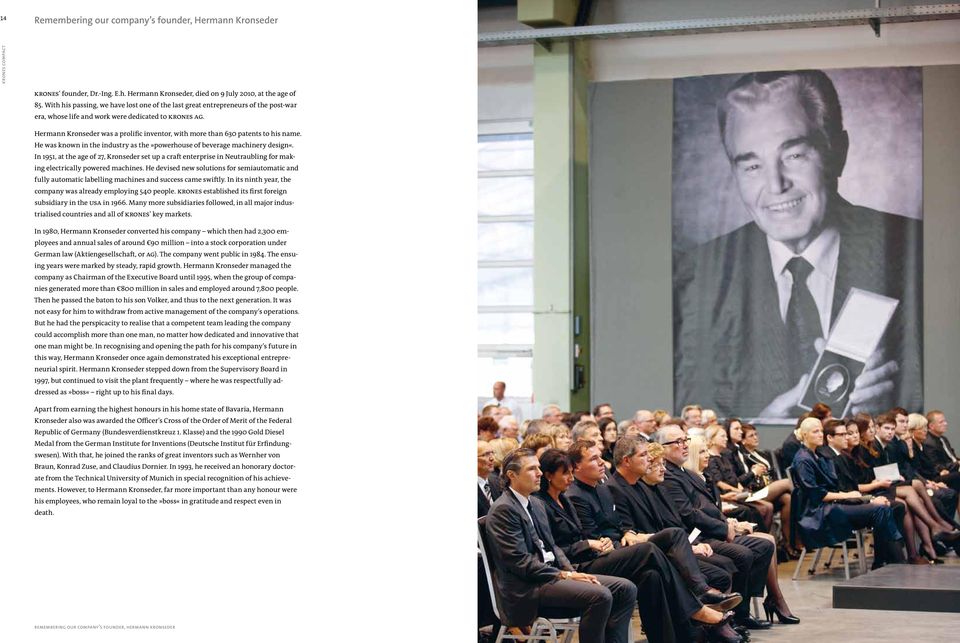
9 14 Remembering our company s founder, Hermann Kronseder krones compact KRONES founder, Dr.-Ing. E.h. Hermann Kronseder, died on 9 July 2010, at the age of 85. With his passing, we have lost one of the last great entrepreneurs of the post-war era, whose life and work were dedicated to KRONES AG. Hermann Kronseder was a prolific inventor, with more than 630 patents to his name. He was known in the industry as the»powerhouse of beverage machinery design«. In 1951, at the age of 27, Kronseder set up a craft enterprise in Neutraubling for making electrically powered machines. He devised new solutions for semiautomatic and fully automatic labelling machines and success came swiftly. In its ninth year, the company was already employing 540 people. KRONES established its first foreign subsidiary in the USA in Many more subsidiaries followed, in all major industrialised countries and all of KRONES key markets. In 1980, Hermann Kronseder converted his company which then had 2,300 employees and annual sales of around 90 million into a stock corporation under German law (Aktiengesellschaft, or AG). The company went public in The ensuing years were marked by steady, rapid growth. Hermann Kronseder managed the company as Chairman of the Executive Board until 1995, when the group of companies generated more than 800 million in sales and employed around 7,800 people. Then he passed the baton to his son Volker, and thus to the next generation. It was not easy for him to withdraw from active management of the company s operations. But he had the perspicacity to realise that a competent team leading the company could accomplish more than one man, no matter how dedicated and innovative that one man might be. In recognising and opening the path for his company s future in this way, Hermann Kronseder once again demonstrated his exceptional entrepreneurial spirit. Hermann Kronseder stepped down from the Supervisory Board in 1997, but continued to visit the plant frequently where he was respectfully addressed as»boss«right up to his final days. Apart from earning the highest honours in his home state of Bavaria, Hermann Krons eder also was awarded the Officer s Cross of the Order of Merit of the Federal Republic of Germany (Bundesverdienstkreuz 1. Klasse) and the 1990 Gold Diesel Medal from the German Institute for Inventions (Deutsche Institut für Erfindungswesen). With that, he joined the ranks of great inventors such as Wernher von Braun, Konrad Zuse, and Claudius Dornier. In 1993, he received an honorary doctorate from the Technical University of Munich in special recognition of his achievements. However, to Hermann Kronseder, far more important than any honour were his employees, who remain loyal to the»boss«in gratitude and respect even in death. REMEMBERING OUR COMPANY S FOUNDER, HERMANN KRONSEDER
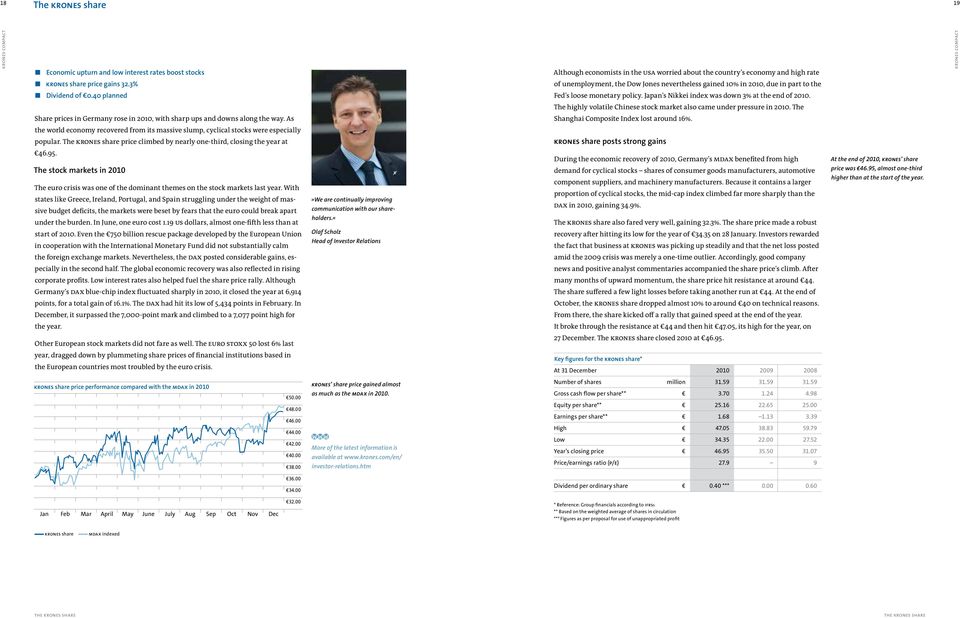
10 16 17 krones kompakt The KRONES share In 2010, loose monetary policy and improving economic data beginning in the second quarter gave the stock markets a strong boost. KRONES share price gained 32.3% last year, to close at January February March April May June July August September October November December

11 18 19 The KRONES share krones compact Economic upturn and low interest rates boost stocks KRONES share price gains 32.3% Dividend of 0.40 planned Although economists in the USA worried about the country s economy and high rate of unemployment, the Dow Jones nevertheless gained 10% in 2010, due in part to the Fed s loose monetary policy. Japan s Nikkei index was down 3% at the end of krones compact The highly volatile Chinese stock market also came under pressure in The Share prices in Germany rose in 2010, with sharp ups and downs along the way. As Shanghai Composite Index lost around 16%. the world economy recovered from its massive slump, cyclical stocks were especially popular. The KRONES share price climbed by nearly one-third, closing the year at KRONES share posts strong gains The stock markets in 2010 The euro crisis was one of the dominant themes on the stock markets last year. With states like Greece, Ireland, Portugal, and Spain struggling under the weight of massive budget deficits, the markets were beset by fears that the euro could break apart under the burden. In June, one euro cost 1.19 US dollars, almost one-fifth less than at start of Even the 750 billion rescue package developed by the European Union in cooperation with the International Monetary Fund did not substantially calm»we are continually improving communication with our shareholders.«olaf Scholz Head of Investor Relations During the economic recovery of 2010, Germany s MDAX benefited from high demand for cyclical stocks shares of consumer goods manufacturers, automotive component suppliers, and machinery manufacturers. Because it contains a larger proportion of cyclical stocks, the mid-cap index climbed far more sharply than the DAX in 2010, gaining 34.9%. The KRONES share also fared very well, gaining 32.3%. The share price made a robust recovery after hitting its low for the year of on 28 January. Investors rewarded the fact that business at KRONES was picking up steadily and that the net loss posted At the end of 2010, KRONES share price was 46.95, almost one-third higher than at the start of the year. the foreign exchange markets. Nevertheless, the DAX posted considerable gains, es- amid the 2009 crisis was merely a one-time outlier. Accordingly, good company pecially in the second half. The global economic recovery was also reflected in rising news and positive analyst commentaries accompanied the share price s climb. After corporate profits. Low interest rates also helped fuel the share price rally. Although many months of upward momentum, the share price hit resistance at around 44. Germany s DAX blue-chip index fluctuated sharply in 2010, it closed the year at 6,914 The share suffered a few light losses before taking another run at 44. At the end of points, for a total gain of 16.1%. The DAX had hit its low of 5,434 points in February. In October, the KRONES share dropped almost 10% to around 40 on technical reasons. December, it surpassed the 7,000-point mark and climbed to a 7,077 point high for From there, the share kicked off a rally that gained speed at the end of the year. the year. It broke through the resistance at 44 and then hit 47.05, its high for the year, on Other European stock markets did not fare as well. The EURO STOXX 50 lost 6% last 27 December. The KRONES share closed 2010 at year, dragged down by plummeting share prices of financial institutions based in the European countries most troubled by the euro crisis. Key figures for the krones share* At 31 December KRONES share price performance compared with the MDAX in KRONES share price gained almost as much as the MDAX in More of the latest information is available at investor-relations.htm Number of shares million Gross cash flow per share** Equity per share** Earnings per share** High Low Year s closing price Price/earnings ratio (p/e) Dividend per ordinary share 0.40 *** Jan Feb Mar April May June July Aug Sep Oct Nov Dec * Reference: Group financials according to IFRSs ** Based on the weighted average of shares in circulation *** Figures as per proposal for use of unappropriated profit KRONES share MDAX indexed THE KRONES SHARE THE KRONES SHARE
12 20 21 krones compact Portrait of the KRONES share Dividend per share ( ) krones compact KRONES shares are no par value ordinary bearer shares. Each share carries one vote 0.70 at the annual shareholders meeting. The total number of shares is 31,593,072. The stock has been listed and available for trading on all German stock exchanges since October In fiscal 2010, daily trading volume on the Frankfurt stock exchange and in Xetra trading averaged around 60,000 shares in total (previous year: just under 80,000). The lion s share (around 98%) of trading was done on the Xetra trading system. The KRONES share is included in the MDAX, Germany s mid-cap 0.20 index Key data for the KRONES share Ordinary shares 31,593,072 German securities identification number WKN ISIN DE Ticker symbol KRN Shareholder structure The Kronseder family owns a majority stake in the company (53.71%). KRONES bought back a total of 1,425,421 treasury shares in 2009 and now holds 4.51% of the share capital. The free float is 41.78%. Shareholder structure (at 28 February 2011) Kronseder family 53.71% Free float 41.78% Treasury shares 4.51% Dividend of 0.40 per share planned KRONES wishes to give its shareholders an appropriate share in the company s success. Our long-term dividend policy aim is to pay out 20% to 25% of profits in dividends. The Executive Board and the Supervisory Board of KRONES AG will propose to the annual shareholders meeting on 15 June 2011 that a dividend of 0.40 per share be paid out for In 2009, KRONES had posted a net loss and therefore did not pay a dividend Comprehensive investor relations activities KRONES is included in Germany s MDAX index. For this reason, investors and analysts have high expectations of our investor relations activities. Our efforts are focused on informing all of our shareholders and stakeholders in an open and prompt manner. Most of our time is spent communicating with professional market participants, but we also provide immediate, in-depth responses to inquiries from individual investors. In 2010, the Executive Board and representatives of the Investor Relations department participated in several investor conferences in Germany and abroad. We also visited investors and analysts and presented the company at numerous road shows in the world s financial centres. Interest in KRONES among investors in the US and the UK increased considerably during the reporting period. One topic that was important to investors was how KRONES intended to return to profitability after the losses of In response, we provided detailed information about our»conversion«programme. Investors and analysts were also particularly interested in KRONES strong position on the growing emerging markets. The topic of sustainability is gaining importance among investors. In Europe alone, some 3,000 billion are being invested exclusively in shares of companies that meet the highest standards with respect to how they treat employees and the environment and what they give back to society. KRONES has for many years now placed great importance on ensuring that all of our company s activities are sustainable. Investors and analysts acknowledged the fact that the independent rating agency oekom research awarded KRONES Prime status in Harmonious annual shareholders meeting The 30th annual shareholders meeting of KRONES AG took place on 16 June 2010 in Neutraubling, Germany. Around 250 shareholders participated in the event. Although the shareholders received no dividend for fiscal 2009 due to the company s net loss, the shareholders meeting was nevertheless a harmonious one as usual. All of the resolutions proposed were adopted by a large majority of the shareholders. KRONES takes the interests of all of our shareholders very seriously and has an open information policy. THE KRONES SHARE THE KRONES SHARE

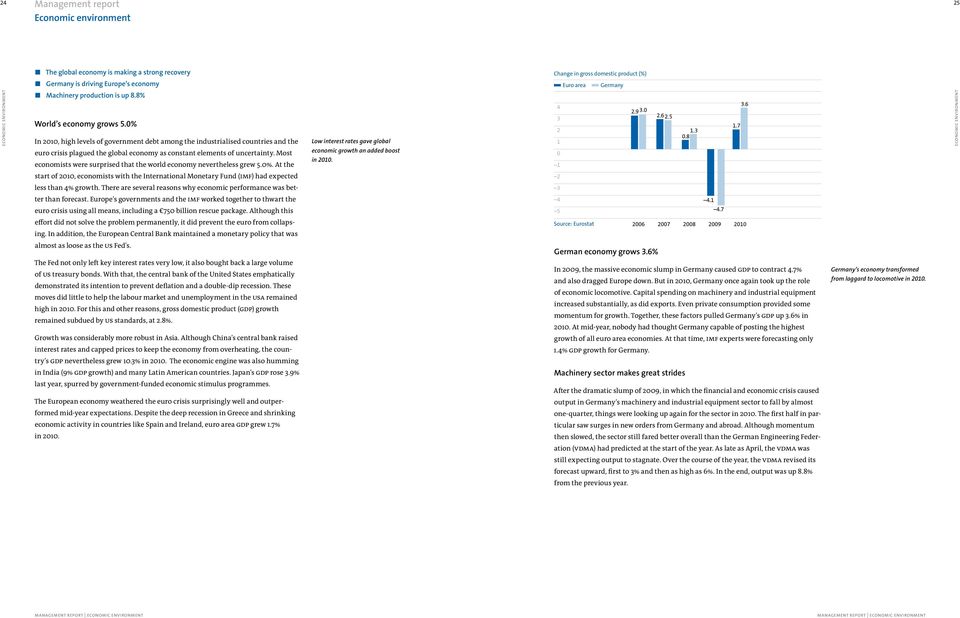
13 22 23 Economic environment krones compact Economic environment The world s economy grew 5% in Two factors were largely responsible for the global economy s robust recovery after the 2009 slump: loose economic policy on the part of the world s most important central banks and massive government-funded economic stimulus programmes. GDP growth in 2010 China 10.3% Japan 3.9% Germany 3.6% USA 2.8% Euro area 1.7%

14 Management report Economic environment Economic environment The global economy is making a strong recovery Germany is driving Europe s economy Machinery production is up 8.8% World s economy grows 5.0% In 2010, high levels of government debt among the industrialised countries and the euro crisis plagued the global economy as constant elements of uncertainty. Most economists were surprised that the world economy nevertheless grew 5.0%. At the Low interest rates gave global economic growth an added boost in Change in gross domestic product (%) Euro area Germany Economic environment start of 2010, economists with the International Monetary Fund (IMF) had expected 2 less than 4% growth. There are several reasons why economic performance was bet- 3 ter than forecast. Europe s governments and the IMF worked together to thwart the euro crisis using all means, including a 750 billion rescue package. Although this effort did not solve the problem permanently, it did prevent the euro from collapsing. In addition, the European Central Bank maintained a monetary policy that was Source: Eurostat almost as loose as the US Fed s. German economy grows 3.6% The Fed not only left key interest rates very low, it also bought back a large volume of US treasury bonds. With that, the central bank of the United States emphatically demonstrated its intention to prevent deflation and a double-dip recession. These moves did little to help the labour market and unemployment in the USA remained high in For this and other reasons, gross domestic product (GDP) growth remained subdued by US standards, at 2.8%. In 2009, the massive economic slump in Germany caused GDP to contract 4.7% and also dragged Europe down. But in 2010, Germany once again took up the role of economic locomotive. Capital spending on machinery and industrial equipment increased substantially, as did exports. Even private consumption provided some momentum for growth. Together, these factors pulled Germany s GDP up 3.6% in At mid-year, nobody had thought Germany capable of posting the highest Germany s economy transformed from laggard to locomotive in Growth was considerably more robust in Asia. Although China s central bank raised growth of all euro area economies. At that time, IMF experts were forecasting only interest rates and capped prices to keep the economy from overheating, the coun- 1.4% GDP growth for Germany. try s GDP nevertheless grew 10.3% in The economic engine was also humming in India (9% GDP growth) and many Latin American countries. Japan s GDP rose 3.9% Machinery sector makes great strides last year, spurred by government-funded economic stimulus programmes. After the dramatic slump of 2009, in which the financial and economic crisis caused The European economy weathered the euro crisis surprisingly well and outper- output in Germany s machinery and industrial equipment sector to fall by almost formed mid-year expectations. Despite the deep recession in Greece and shrinking one-quarter, things were looking up again for the sector in The first half in par- economic activity in countries like Spain and Ireland, euro area GDP grew 1.7% ticular saw surges in new orders from Germany and abroad. Although momentum in then slowed, the sector still fared better overall than the German Engineering Federation (VDMA) had predicted at the start of the year. As late as April, the VDMA was still expecting output to stagnate. Over the course of the year, the VDMA revised its forecast upward, first to 3% and then as high as 6%. In the end, output was up 8.8% from the previous year. management report economic environment management report economic environment
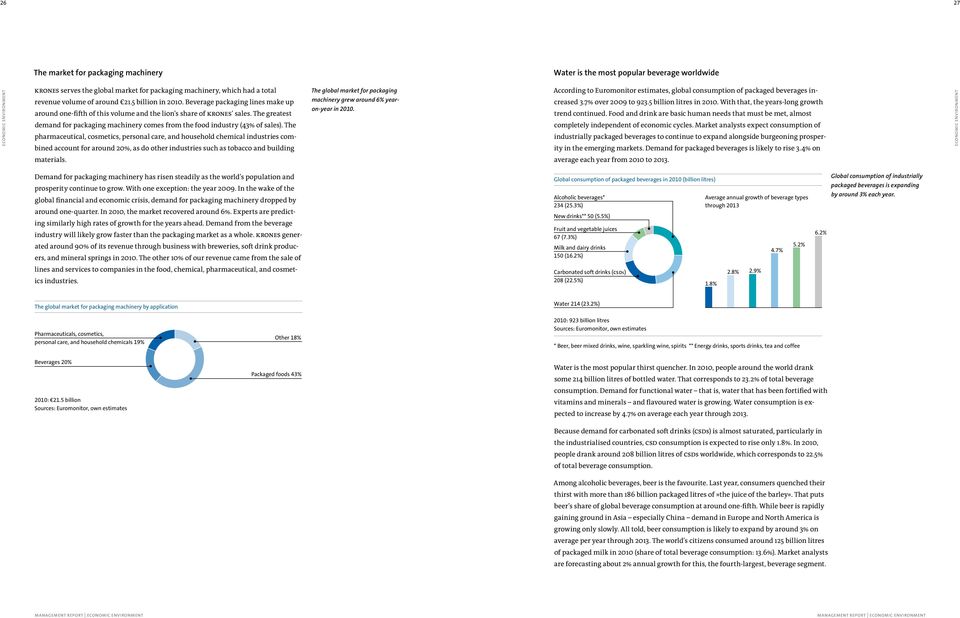
15 26 27 The market for packaging machinery Water is the most popular beverage worldwide Economic environment KRONES serves the global market for packaging machinery, which had a total revenue volume of around 21.5 billion in Beverage packaging lines make up around one-fifth of this volume and the lion s share of KRONES sales. The greatest demand for packaging machinery comes from the food industry (43% of sales). The pharmaceutical, cosmetics, personal care, and household chemical industries combined account for around 20%, as do other industries such as tobacco and building The global market for packaging machinery grew around 6% yearon-year in According to Euromonitor estimates, global consumption of packaged beverages increased 3.7% over 2009 to billion litres in With that, the years-long growth trend continued. Food and drink are basic human needs that must be met, almost completely independent of economic cycles. Market analysts expect consumption of industrially packaged beverages to continue to expand alongside burgeoning prosperity in the emerging markets. Demand for packaged beverages is likely to rise 3.4% on Economic environment materials. average each year from 2010 to Demand for packaging machinery has risen steadily as the world s population and prosperity continue to grow. With one exception: the year In the wake of the global financial and economic crisis, demand for packaging machinery dropped by around one-quarter. In 2010, the market recovered around 6%. Experts are predicting similarly high rates of growth for the years ahead. Demand from the beverage industry will likely grow faster than the packaging market as a whole. KRONES generated around 90% of its revenue through business with breweries, soft drink producers, and mineral springs in The other 10% of our revenue came from the sale of Global consumption of packaged beverages in 2010 (billion litres) Alcoholic beverages* 234 (25.3%) New drinks** 50 (5.5%) Fruit and vegetable juices 67 (7.3%) Milk and dairy drinks 150 (16.2%) Average annual growth of beverage types through % 5.2% 6.2% Global consumption of industrially packaged beverages is expanding by around 3% each year. lines and services to companies in the food, chemical, pharmaceutical, and cosmetics industries. Carbonated soft drinks (CSDs) 208 (22.5%) 1.8% 2.8% 2.9% The global market for packaging machinery by application Water 214 (23.2%) Pharmaceuticals, cosmetics, personal care, and household chemicals 19% Other 18% 2010: 923 billion litres Sources: Euromonitor, own estimates * Beer, beer mixed drinks, wine, sparkling wine, spirits ** Energy drinks, sports drinks, tea and coffee Beverages 20% 2010: 21.5 billion Sources: Euromonitor, own estimates Packaged foods 43% Water is the most popular thirst quencher. In 2010, people around the world drank some 214 billion litres of bottled water. That corresponds to 23.2% of total beverage consumption. Demand for functional water that is, water that has been fortified with vitamins and minerals and flavoured water is growing. Water consumption is expected to increase by 4.7% on average each year through Because demand for carbonated soft drinks (CSDs) is almost saturated, particularly in the industrialised countries, CSD consumption is expected to rise only 1.8%. In 2010, people drank around 208 billion litres of CSDs worldwide, which corresponds to 22.5% of total beverage consumption. Among alcoholic beverages, beer is the favourite. Last year, consumers quenched their thirst with more than 186 billion packaged litres of»the juice of the barley«. That puts beer s share of global beverage consumption at around one-fifth. While beer is rapidly gaining ground in Asia especially China demand in Europe and North America is growing only slowly. All told, beer consumption is likely to expand by around 3% on average per year through The world s citizens consumed around 125 billion litres of packaged milk in 2010 (share of total beverage consumption: 13.6%). Market analysts are forecasting about 2% annual growth for this, the fourth-largest, beverage segment. management report economic environment management report economic environment
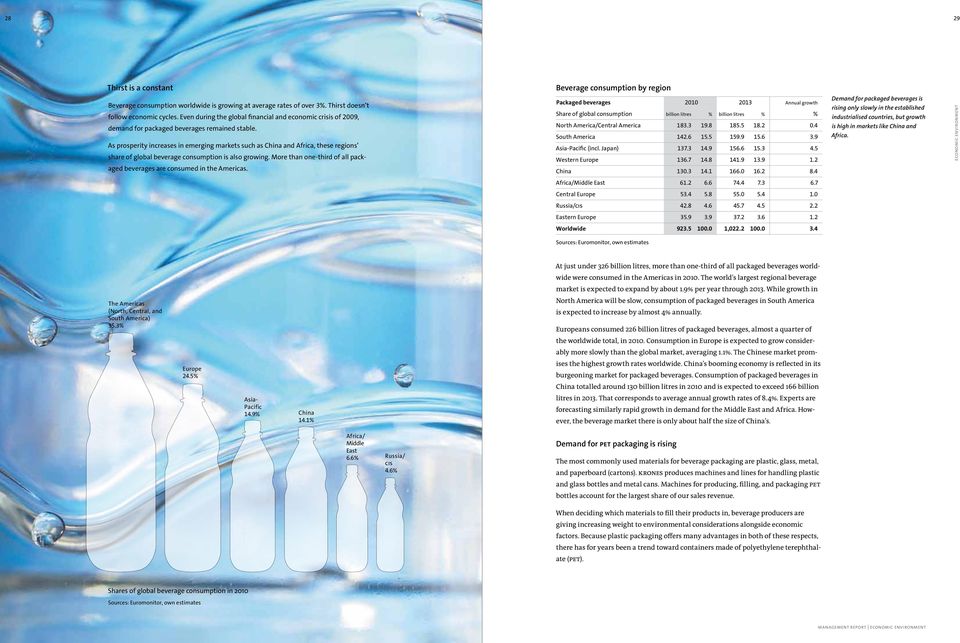
16 28 29 Thirst is a constant Beverage consumption by region Economic environment Beverage consumption worldwide is growing at average rates of over 3%. Thirst doesn t follow economic cycles. Even during the global financial and economic crisis of 2009, demand for packaged beverages remained stable. As prosperity increases in emerging markets such as China and Africa, these regions share of global beverage consumption is also growing. More than one-third of all packaged beverages are consumed in the Americas. Packaged beverages Annual growth Share of global consumption billion litres % billion litres % % North America/Central America South America Asia-Pacific (incl. Japan) Western Europe China Demand for packaged beverages is rising only slowly in the established industrialised countries, but growth is high in markets like China and Africa. Economic environment Africa/Middle East Central Europe Russia/CIS Eastern Europe Worldwide , Sources: Euromonitor, own estimates At just under 326 billion litres, more than one-third of all packaged beverages worldwide were consumed in the Americas in The world s largest regional beverage market is expected to expand by about 1.9% per year through While growth in The Americas (North, Central, and South America) 35.3% North America will be slow, consumption of packaged beverages in South America is expected to increase by almost 4% annually. Europeans consumed 226 billion litres of packaged beverages, almost a quarter of the worldwide total, in Consumption in Europe is expected to grow considerably more slowly than the global market, averaging 1.1%. The Chinese market prom- Europe 24.5% ises the highest growth rates worldwide. China s booming economy is reflected in its burgeoning market for packaged beverages. Consumption of packaged beverages in China totalled around 130 billion litres in 2010 and is expected to exceed 166 billion Asia- Pacific 14.9% China 14.1% litres in That corresponds to average annual growth rates of 8.4%. Experts are forecasting similarly rapid growth in demand for the Middle East and Africa. However, the beverage market there is only about half the size of China s. Africa/ Middle East 6.6% Russia/ CIS 4.6% Demand for PET packaging is rising The most commonly used materials for beverage packaging are plastic, glass, metal, and paperboard (cartons). KRONES produces machines and lines for handling plastic and glass bottles and metal cans. Machines for producing, filling, and packaging PET bottles account for the largest share of our sales revenue. When deciding which materials to fill their products in, beverage producers are giving increasing weight to environmental considerations alongside economic factors. Because plastic packaging offers many advantages in both of these respects, there has for years been a trend toward containers made of polyethylene terephthalate (PET). Shares of global beverage consumption in 2010 Sources: Euromonitor, own estimates management report economic environment
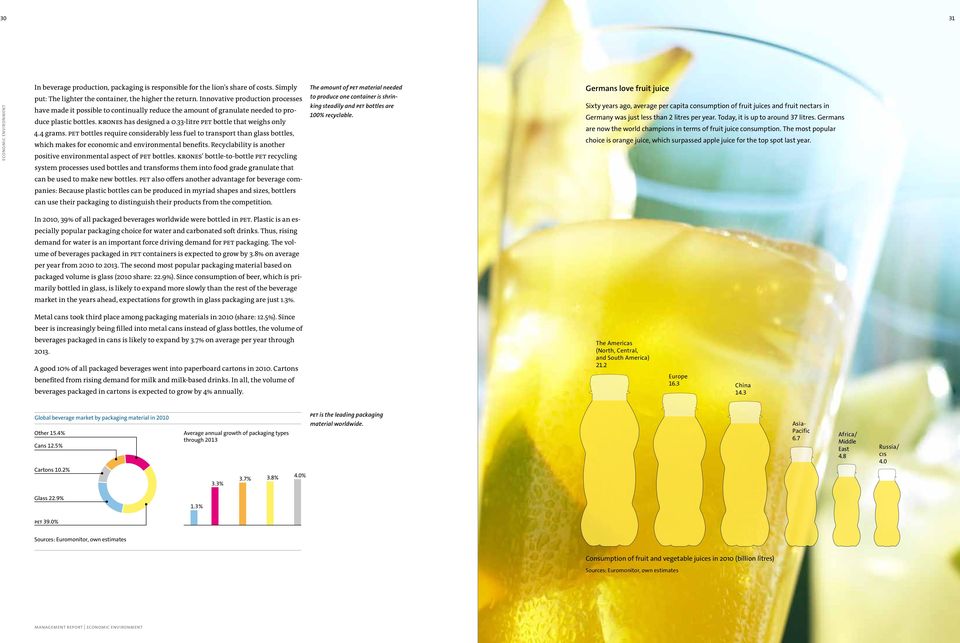
17 30 31 Economic environment In beverage production, packaging is responsible for the lion s share of costs. Simply put: The lighter the container, the higher the return. Innovative production processes have made it possible to continually reduce the amount of granulate needed to produce plastic bottles. KRONES has designed a 0.33-litre PET bottle that weighs only 4.4 grams. PET bottles require considerably less fuel to transport than glass bottles, which makes for economic and environmental benefits. Recyclability is another positive environmental aspect of PET bottles. KRONES bottle-to-bottle PET recycling The amount of PET material needed to produce one container is shrinking steadily and PET bottles are 100% recyclable. Germans love fruit juice Sixty years ago, average per capita consumption of fruit juices and fruit nectars in Germany was just less than 2 litres per year. Today, it is up to around 37 litres. Germans are now the world champions in terms of fruit juice consumption. The most popular choice is orange juice, which surpassed apple juice for the top spot last year. Economic environment system processes used bottles and transforms them into food grade granulate that can be used to make new bottles. PET also offers another advantage for beverage companies: Because plastic bottles can be produced in myriad shapes and sizes, bottlers can use their packaging to distinguish their products from the competition. In 2010, 39% of all packaged beverages worldwide were bottled in PET. Plastic is an especially popular packaging choice for water and carbonated soft drinks. Thus, rising demand for water is an important force driving demand for PET packaging. The volume of beverages packaged in PET containers is expected to grow by 3.8% on average per year from 2010 to The second most popular packaging material based on packaged volume is glass (2010 share: 22.9%). Since consumption of beer, which is primarily bottled in glass, is likely to expand more slowly than the rest of the beverage market in the years ahead, expectations for growth in glass packaging are just 1.3%. Metal cans took third place among packaging materials in 2010 (share: 12.5%). Since beer is increasingly being filled into metal cans instead of glass bottles, the volume of beverages packaged in cans is likely to expand by 3.7% on average per year through A good 10% of all packaged beverages went into paperboard cartons in Cartons benefited from rising demand for milk and milk-based drinks. In all, the volume of beverages packaged in cartons is expected to grow by 4% annually. The Americas (North, Central, and South America) 21.2 Europe 16.3 China 14.3 Global beverage market by packaging material in 2010 Other 15.4% Cans 12.5% Cartons 10.2% Average annual growth of packaging types through % 3.7% 3.8% 4.0% PET is the leading packaging material worldwide. Asia- Pacific 6.7 Africa/ Middle East 4.8 Russia/ CIS 4.0 Glass 22.9% 1.3% PET 39.0% Sources: Euromonitor, own estimates Consumption of fruit and vegetable juices in 2010 (billion litres) Sources: Euromonitor, own estimates management report economic environment
18 32 33 Americans love carbonated soft drinks KRONES sales regions Economic environment Carbonated soft drinks are part of the American lifestyle. More than half of total CSD consumption worldwide falls to North and South America. Because demand in North America is almost saturated, the segment is growing much more slowly worldwide than the beverage market as a whole. The Middle East and Northern Africa are the only regions where demand for carbonated soft drinks is likely to rise substantially. The following provides an overview of the popularity of beverages in each of our most important sales regions as well as a breakdown of each regional beverage market by packaging material. The information is based on packaged beverage volume in litres. The Americas Economic environment The Americas (North, Central, and South America) North America Carbonated soft drinks (CSDs) are the most popular thirst quencher in North America, accounting for around one-third of total beverage consumption. Because PET bottles and metal cans are the most common packaging material for CSDs, cans hold a greater share of the packaging market (23.8% in 2010) in North America than they do in the rest of the world. PET is the leading packaging material by far, with a market share of 46%. Water, North America s second most popular beverage, is also often packaged in PET. Glass containers and paperboard cartons, with shares of 10.6% and 3.4%, respectively, do not play a major role in North America. Shares of the beverage packaging market in the Americas (North, Central and South America) in 2010 Cans 16.3% Other 18.1% Average annual growth of packaging types through 2013 North Americans consume around 60 billion litres of carbonated soft drinks each year. PET 42.1% Europe 40.1 Cartons 6.3% Glass 17.2% 1.1% 1.6% 1.8% 1.8% 2.3% Asia- Pacific 20.6 Africa/ Middle East 19.3 Sources: Euromonitor, own estimates South America China 11.9 CSDs are also the top beverage among South Americans, accounting for 34% of total consumption in Unlike in North America, CSDs are rarely packaged in cans in Russia/ CIS 7.0 South America. The most common packaging material for CSDs here is PET, followed by glass. PET is also the overall leader among packaging materials in general in South America, with a share of 37%. Glass containers made up 25% of the market in Glass holds a considerably larger share of the market here than in North America because beer is most often bottled in glass in South America. Consumption of carbonated soft drinks in 2010 (billion litres) Sources: Euromonitor, own estimates management report economic environment

19 34 35 The Czechs are world champions in beer drinking China Economic environment While beer output is declining in the industrialised countries of the West, beer is booming in China. China is far and away the biggest beer market, followed by the USA. But when it comes to per capita consumption, the Czechs are way out in front. On average, Czechs drank 155 litres of beer per person in Austria and Germany ranked second and third, at 106 litres and 104 litres, respectively. Like China s entire economy, beverage consumption and therefore demand from the packaging industry is growing rapidly. The Chinese like beer. In 2010, beer made up more than one-third of all packaged beverages. The»juice of the barley«is packaged primarily in glass bottles. For this reason, glass holds a large share of the Chinese packaging market, 32.1%. But PET replaced glass as the leading packaging material last year, with a 33.9% share of the market. In China, as in the rest of the world, water PET unseated glass as the leading packaging material in China in Economic environment is often bottled in PET. Plastic is also a preferred packaging material for tea as well as fruit and vegetable juices. Both of these beverage types are very popular in China, with consumption rising rapidly. Experts expect demand for PET packaging to grow 10% on average for the coming years. Because beer is increasingly being packaged in cans in China, the average growth rate for cans will likely be above 16%. At present, cans make up 11% of the Chinese beverage packaging market, which puts them behind PET, glass, and even paperboard cartons (12.6%). Shares of the beverage packaging market in China in 2010 The Americas (North, Central, and South America) 55.9 Cans 11.0% Other 10.4% Average annual growth of packaging types through % China 45.5 PET 33.9% 10.1% 11.5% Europe 37.8 Cartons 12.6% 2.4% 7.5% Glass 32.1% Asia- Pacific 20.0 Sources: Euromonitor, own estimates Russia/ CIS 13.6 Africa/ Middle East 13.5 Beer consumption in 2010 (billion litres) Sources: Euromonitor, own estimates management report economic environment

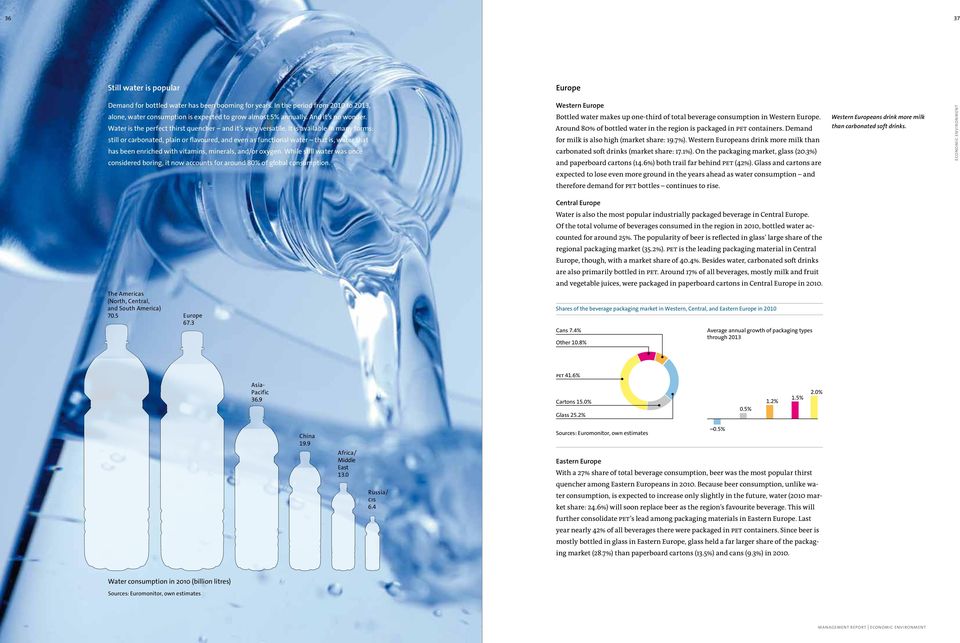
20 36 37 Still water is popular Europe Economic environment Demand for bottled water has been booming for years. In the period from 2010 to 2013, alone, water consumption is expected to grow almost 5% annually. And it s no wonder. Water is the perfect thirst quencher and it s very versatile. It is available in many forms: still or carbonated, plain or flavoured, and even as functional water that is, water that has been enriched with vitamins, minerals, and/or oxygen. While still water was once considered boring, it now accounts for around 80% of global consumption. Western Europe Bottled water makes up one-third of total beverage consumption in Western Europe. Around 80% of bottled water in the region is packaged in PET containers. Demand for milk is also high (market share: 19.7%). Western Europeans drink more milk than carbonated soft drinks (market share: 17.1%). On the packaging market, glass (20.3%) and paperboard cartons (14.6%) both trail far behind PET (42%). Glass and cartons are Western Europeans drink more milk than carbonated soft drinks. Economic environment expected to lose even more ground in the years ahead as water consumption and therefore demand for PET bottles continues to rise. The Americas (North, Central, and South America) 70.5 Europe 67.3 Central Europe Water is also the most popular industrially packaged beverage in Central Europe. Of the total volume of beverages consumed in the region in 2010, bottled water accounted for around 25%. The popularity of beer is reflected in glass large share of the regional packaging market (35.2%). PET is the leading packaging material in Central Europe, though, with a market share of 40.4%. Besides water, carbonated soft drinks are also primarily bottled in PET. Around 17% of all beverages, mostly milk and fruit and vegetable juices, were packaged in paperboard cartons in Central Europe in Shares of the beverage packaging market in Western, Central, and Eastern Europe in 2010 Cans 7.4% Other 10.8% Average annual growth of packaging types through 2013 PET 41.6% Asia- Pacific 36.9 Cartons 15.0% Glass 25.2% 0.5% 1.2% 1.5% 2.0% China 19.9 Africa/ Middle East 13.0 Russia/ CIS % Sources: Euromonitor, own estimates Eastern Europe With a 27% share of total beverage consumption, beer was the most popular thirst quencher among Eastern Europeans in Because beer consumption, unlike water consumption, is expected to increase only slightly in the future, water (2010 market share: 24.6%) will soon replace beer as the region s favourite beverage. This will further consolidate PET s lead among packaging materials in Eastern Europe. Last year nearly 42% of all beverages there were packaged in PET containers. Since beer is mostly bottled in glass in Eastern Europe, glass held a far larger share of the packaging market (28.7%) than paperboard cartons (13.5%) and cans (9.3%) in Water consumption in 2010 (billion litres) Sources: Euromonitor, own estimates management report economic environment
21 38 39 Milk it does a body good and it keeps well Asia-Pacific Economic environment Milk is offered in many different varieties. It is easy for consumers to lose track of what is what. Basically, there are three types of milk: fresh milk, ESL milk, and UHT milk. The difference lies in how the raw milk is treated. Fresh milk is pasteurised, that is, heated to between 72 and 75 degrees Celsius for 15 to 30 seconds. Milk loses about five percent of its vitamins in this process. Fresh milk will keep for up to 10 days in an unopened container. People are very health conscious in the Asia-Pacific region. They drink a lot of water and milk. Demand for bottled water is growing more than 7% annually. In 2010, water accounted for 26.9% of total beverage consumption. Consumers strong preference for water is good for PET, already the number one packaging material in the region. Last year 37.6% of all beverages there were bottled in PET. The volume of beverages bottled in PET is expected to increase by around 6% each year from 2010 to The volume of beverages packaged in PET is rising by around 6% each year on average in the Asia-Pacific region. Economic environment Fresh milk is increasingly ceding market share to ESL milk. ESL stands for»extended shelf life«, which is achieved by briefly heating the raw milk to as high as 127 degrees Celsius Shares of the beverage packaging market in Asia/Pacific in 2010 in addition to regular pasteurisation. An alternative form of treatment is microfiltration, in which the skim milk is filtered separately from the cream and bacteria and spores Cans 16.3% Average annual growth of packaging types through 2013 removed. ESL milk has less vitamin content than fresh milk, but will keep at least twice Other 15.9% as long. UHT (or long-life) milk has been heated to 150 degrees Celsius and will keep for three months in an unopened container. KRONES offers customised solutions for each treatment type. PET 37.6% Cartons 8.2% Glass 22.0% 1.4% 3.1% 3.4% 5.0% 6.1% The Americas (North, Central, and South America) 42.8 Europe 38.4 Sources: Euromonitor, own estimates (Data given does not include flexible plastic) Russia/CIS In Russia and the countries of the former Soviet Union, unlike in other parts of the world, beer is often bottled in PET as well as water and carbonated soft drinks. Since beer is very popular in the region, accounting for 31.9% of total beverage consump- Asiea- Pacific 23.4 tion in 2010, PET s share of the beverage packaging market is also higher than average (44.8%). However, demand for beer is almost saturated. Consumption of bottled water is growing more than 5% annually. Water is currently the third most popular beverage in the region with 15.0% of the market, behind CSDs (16.3%). Use of glass bottles (2010 market share: 30.6%) will likely decline because the schnapps market China 8.2 is shrinking and beer is increasingly being filled into PET bottles and cans. Russia/ CIS 6.3 Africa/ Middle East 6.1 Shares of the beverage packaging market in Russia/CIS in 2010 Cans 5.4% Other 4.4% Average annual growth of packaging types through 2013 PET 44.8% Cartons 14.8% Glass 30.6% 3.5% 3.6% 4.0% 6.2% Milk consumption in 2010 (billion litres) Sources: Euromonitor, own estimates Sources: Euromonitor, own estimates (Data given does not include flexible plastic) 2.9% management report economic environment
22 40 41 Economic environment KRONEs ag in figures Due to the economic crisis, KRONES posted the first-ever net loss in the company s history in KRONES AG substantially improved its business figures last year. Krones ag sales ( million) KRONES AG in figures Sales were up 18.1% on the previous year, to 1,882.4 million. EBIT for 2010 was million (previous year: 75.3 million). Due to extraordinary factors such as the first-time application of Germany s Accounting Law Modernisation Act (Bilanzrechtsmodernisierungsgesetz BilMoG), KRONES AG is posting a net loss for 2010 of 2.7 million (previous year: net loss of 81.6 million). At the end of 2010, KRONES AG had net cash and cash equivalents of 75.9 million and no bank debt. 1,660 1,968 2,151 1,593 1,
23 42 Management report for KRONES AG 43 KRONES ag in figures Sales up sharply in 2010 KRONES AG results improve substantially KRONES pays out dividend of 0.40 per share Sales by region After a slow start to 2010, KRONES business in Germany gathered momentum as the year progressed. In part, this reflects the strengthening of the German economy KRONES AG in figures KRONES AG sales improve 18.1% to 1,882.4 million The global economic recovery in 2010 also benefited KRONES and the international packaging and beverage industries in general. The target market for our company s products and services grew by an estimated 6% last year. During the crisis of 2009, we remained steadfast in our belief that our markets would recover quickly. For this reason, we maintained our workforce and production capacities despite the shortterm negative impact on earnings. As a result, KRONES was well prepared to handle the growth that came with recovery and was able to benefit more than proportionately from last year s surge in demand. At 1,882.4 million, 2010 sales were up 18.1% on the previous year s figure of 1,593.3 million. Both our new machinery business and our services business, which we have expanded considerably in recent years, contributed to this improvement. The high rate of growth also reflects our strong position on the burgeoning Asian markets, particularly China. As the leading supplier of machines and lines for producing, filling, and packaging plastic (polyethylene terephthalate PET) bottles, KRONES benefited from continued high demand for PET packaging. KRONES position as a full-service supplier, delivering complete solutions as well as individual machines, also paid off last year. KRONES outpaced the market in over the course of the year. All told, sales in Germany grew 11.6% year-on-year to million (previous year: million). The share of sales generated in Germany decreased from 13.0% to 12.3% in the reporting period. Sales in the rest of Europe in 2010 fell short of the year-earlier level. The Eastern European markets had not yet recovered from the deep slump they had suffered during the economic crisis. At million, sales in Europe (excluding Germany) were down 7.3% in 2010 from the previous year s million. We are confident that the situation will improve this year. At the time this report went to press, we were seeing appreciable signs of recovery, particularly in Russia. Only 22.4% of total sales in 2010 were generated in the»europe (excluding Germany)«sales region. In 2009, the figure was 28.6%. Business was much better in the rest of the world during the reporting period, with demand from China, the rest of Asia, and South America up sharply from the previous year. KRONES AG s sales generated outside Europe rose 32.1%, from million a year earlier to 1,229.0 million in That is the highest figure for sales generated outside Europe in KRONES history. Continued weak business in North America prevented our sales growth from being even stronger. In 2010, KRONES generated 65.3% of total sales outside Europe (previous year: 58.4%). KRONES AG s ratio of exports to total sales was 87.7% in KRONES AG in figures KRONES AG sales ( million) In 2010, sales at KRONES AG did not yet reach their pre-crisis level. KRONES AG sales by region (%) 1,968 2,151 1,882 Germany 12.3% Germany 13.0% 1,660 1,593 Europe (excl. Germany) 22.4% Europe (excl. Germany) 28.6% Rest of the world 65.3% Rest of the world 58.4% Sales in 2010: 1,882.4 milion Sales in 2009: 1,593.3 million Management report for KRONES AG KRONES AG in figures Management report for KRONES AG KRONES AG in figures
24 New orders and orders on hand Sales by industry New orders up sharply Sales to producers of soft drinks, bottled water, and juices increased 64.6% from million in 2009 to 1,215.9 million in Demand from the bottled water industry picked up considerably in the reporting period. The»non-alcoholic bever- KRONES generated 80% of its sales with companies in the beverage industry last year. During the financial and economic crisis of 2009, fears of a lasting recession had our customers reluctant to make capital investments. The turning point that put our customers in a spending mood was the»drinktec«trade fair the premier trade fair New orders at KRONES were up 18.0% to 1,903.1 million last year. ages«sector accounted for 64.6% of sales in 2010, which is up from 46.4% in for our industry worldwide which took place in September 2009 and was a great KRONES AG in figures Sales to companies in the»alcoholic beverages«sector declined 17.6% to million (previous year: million). Weak demand from Eastern Europe and Russia had a negative impact here. The sector s share of sales decreased from to 38.6% to 26.9%. In the non-beverage sectors (food, chemicals, pharmaceuticals, and cosmetics), KRONES includes sales to the growing dairy industry under»food«. KRONES sales in this area declined by one-third to million (previous year: million) and accounted for 8.5% of total sales (previous year: 15.0%). success for KRONES. The positive trend continued last year and demand for our products and services from companies in the international food and beverage industry grew steadily. In the fourth quarter of 2010, new orders even inched closer to their pre-crisis level. All told, new orders at KRONES were up 18.0% year-on-year from 1,613.4 million to 1,903.1 million. In particular, our energy and resource-saving machines and lines were increasingly well received. KRONES had strong orders inflow from China last year. Demand for our products and services in the rest of Asia and in South America also rose sharply year-on-year. By contrast, the markets of Eastern Europe, which had slumped sharply in 2009, KRONES AG in figures KRONES AG sales by industry recovered very slowly. New orders in the United States also did not yet bounce back in Alcoholic beverages 26.9% Alcoholic beverages 38.6% Food, chemicals, pharmaceuticals, cosmetics 8.5% Food, chemicals, pharmaceuticals, cosmetics 15.0% KRONES AG new orders ( million) 1,728 2,097 2,154 1,613 1,903 Non-alcoholic beverages 64.6% Non-alcoholic beverages 46.4% Sales in 2010: 1,882.4 million Sales in 2009: 1,593.3 million Orders backlog at record level At 31 December 2010, the company had orders on hand totalling million (previous year: million). That is the highest year-end orders backlog in our company s history. The comfortable orders cushion provides a good foundation on which to further build sales revenue in KRONES AG orders on hand ( million) Management report for KRONES AG KRONES AG in figures Management report for KRONES AG KRONES AG in figures
25 KRONEs ag earnings KRONES AG posts operating profit for 2010 KRONES AG s total operating revenue increased 19.9% year-on-year to 1,912.4 million Amid the crisis of 2009, KRONES had posted the first-ever net loss in the company s history. The general recovery of our markets and resulting increase in sales revenue in Analysis of the abridged income statement clearly shows how that affected earnings. helped us return to operating profitability in Earnings before interest and Cost of purchased services rose 29.1% year-on-year to million in The in- taxes (EBIT) turned around, from 75.3 million in the previous year to mil- crease was due primarily to the fact that KRONES hired more temporary workers to lion. Earnings before taxes (EBT) also improved substantially year-on-year from handle the large orders backlog in At 1,057.7 million, total cost of materials 80.8 million to 4.2 million. One of the main reasons earnings before taxes (EBT) exceeded the year-earlier amount of million by 11.9%. Because this increase is was negative (as opposed to EBIT, which was positive) was one-off effects from the considerably less than the increase in total operating revenue, the ratio of cost of transition to Germany s Accounting Law Modernisation Act (BilMoG), primarily in materials to total operating revenue decreased from 59.3% the previous year to 55.3%. KRONES AG in figures the form of additional expenses relating to pension provisions. In the interest of completeness, we have chosen not to exercise the option of spreading the transition effects (essentially, accounting for pension increases and a lower discount rate for pension provisions) over a maximum of 15 years and have instead recognised the full amount of these effects in 2010, under»extraordinary result«. All told, the onetime effects of the BilMoG transition resulted in an 11.7 million reduction in earn- Personnel expenses rose 10.8% to million during the reporting period. In 2010, KRONES benefited from more flexible working time models that were developed in cooperation with the Works Council. This was among the factors that helped to improve the ratio of personnel expenses to total operating revenue from 32.0% to 29.6%. KRONES AG in figures ings before taxes. Write-downs of long-term financial assets ( 16.1 million) also cut At 42.6 million in 2010, depreciation, amortisation, and write-downs of fixed assets into EBT. The substantial savings achieved through our»conversion«programme were virtually unchanged from the previous year ( 41.9 million). Other operating contributed to the substantial improvement in earnings overall. The tense price expenses netted against other operating income increased by around one-third situation prevented us from achieving an even better result. Although prices on our on increased business activity. markets did improve somewhat over 2009 as demand increased, earnings quality in 2010 was still unsatisfactory. Although KRONES AG had no bank debt at 31 December 2010, the company is posting a financial expense of 8.4 million (previous year: financial expense of 5.5 million). ( million) Change Sales 1, , % Changes in finished goods inventories and work in progress Total operating revenue 1, , % KRONES AG improved its bottom line, from a net loss of 81.6 million in 2009 to a net loss of 2.7 million in This is due to financial reporting changes under BilMoG, which requires that the interest portion of long-term provisions such as those for pensions be recognised as interest expense (previously: personnel expense). Write-downs of long-term financial assets also had a negative impact on the financial result. Cost of materials 1, % Personnel expenses % Net of other operating income (expenses) The net loss for 2010 amounted to 2.7 million, after a net loss of 81.6 million the previous year. and own work capitalised % EBITDA Depreciation. amortisation. and write-downs of fixed assets % EBIT Net financial income (expense) Extraordinary result 11.7 EBT Taxes on income KRONES AG s financial position As at the reporting date for the previous year, KRONES AG had no bank debt at 31 December 2010 despite financing a sharp increase in sales. KRONES achieved this comfortable position by making prepayment agreements, streamlining production processes, and further improving receivables management. Because KRONES had to finance dramatic sales growth in 2010, cash and cash equivalents were down year-on-year at the reporting date. Other taxes Net loss for the financial year KRONES AG s cash flow (net income or loss for the year plus depreciation, amortisation, and write-downs) amounted to million in 2010 (previous year: 21.6 million). Management report for KRONES AG KRONES AG in figures Management report for KRONES AG KRONES AG in figures
26 Asset and capital structure Research and development (R&D) ( million) Fixed assets Current assets and prepaid expenses of which cash and cash equivalents enviro sustainability programme guides R&D activities Effective dialogue with customers and suppliers Many innovations added to KRONES product range KRONES AG invests 5% 6% of sales in R&D each year KRONES AG in figures Equity Total debt Provisions Liabilities Total 1, ,169.0 Despite the increase in sales volume, KRONES AG s total assets at 31 December 2010 were down 1.8% year-on-year to 1,147.8 million. At the end of 2010, KRONES had fixed assets totalling million (previous year: million). The increase was only slight because the company held back on capital spending in the year following the financial crisis. A detailed statement of changes in fixed assets can be found in the notes to the financial statements on page 86. At the end of 2010, KRONES AG had an equity ratio of 43.4% and net cash and cash equivalents totalling 76 million. We invest a great deal of energy and money in research and development in order to secure and expand our technological leadership. KRONES R&D team is made up of more than 1,700 highly qualified people. Part of the team focuses on advancing strategic development efforts. The rest, the majority, of the team works to continually improve existing products and services and further increase the benefits they offer our customers. Ensuring line uptime and efficiency throughout the entire lifecycle is a major focus. In our industry, it is important to protect innovations and knowhow under intellectual property law. In recent years, KRONES has implemented a very successful patent strategy, which is reflected in a steep increase in registered patents. At the end of the reporting period, KRONES had approximately 2,000 registered patents and utility models (previous year: around 1,600). KRONES invests substantially in R&D to continually develop new products and technologies. forschung KRONES AG in und figures entwicklung Despite the considerable increase in business volume, current assets decreased from enviro is an integral part of research and development at KRONES million to million. The company s inventories and trade receivables both increased. Trade receivables were up a moderate 6.3% from million to million. The changed treatment of treasury shares under BilMoG affected the balance sheet. Instead of being measured at their purchase cost ( 37.1 million) as they were in the previous year, the shares which have performed positively had to be treated as»cancelled«under BilMoG although nothing about their status had in fact changed. With the enviro sustainability programme, launched in 2008, KRONES established a standard of energy and media efficiency for machines and lines in the packaging industry. This standard has also helped shape our company s research and development efforts. Nowadays, environmental impacts and conservation of resources are considered right alongside traditional aspects such as technical performance data and machine reliability. All KRONES developments are now guided by the enviro programme, which earned TÜV SÜD certification in At 31 December 2010, KRONES AG had cash and cash equivalents totalling 75.9 million. We look at the entire beverage production and filling process and perform a detailed analysis of the machines consumption data. Our engineers then work out intelli- KRONES AG s equity was down year-on-year from million to million in This is due essentially to the changed recognition of treasury shares under BilMoG. As a result, the equity ratio decreased from 46.0% to 43.4%, which is still well above the industry average. Provisions changed only slightly, from million to million. Pension provisions were up considerably since, under BilMoG, future cost increases (pension increases) and a substantially lower market interest rate must be taken into account. In In all, KRONES AG stands on a very sound footing. The company had an equity ratio of 43.4% and no bank debt at 31 December Earnings in 2010 were affected by unsatisfactory earnings quality as well as the one-off effects described above. gent solutions for minimising consumption. The result of this development work is lines that save our customers energy and other media such as water and compressed air over the long term. With that, we are able to offer our customers real added value and secure our own competitive advantage. We involve our customers in the development process so that we can continually improve the products and services we offer. In events such as last year s Expert Dialogue at KRONES, we gather important information such as where operators want the interest of full disclosure of our assets and liabilities, we have opted to recognise to see the biggest reductions in energy and media consumption. the full transition effect in 2010 instead of spreading it out over several years as is also permissible under the new rules. KRONES also passes the demand for increased efficiency of all components on to its suppliers through our ongoing creative dialogue. KRONES had no bank debt at the end of Thus, we were able to maintain our financial independence. Liabilities were up slightly, from million to million, due to the increase in business volume and due to technical reasons at the reporting date. Management report for KRONES AG KRONES AG in figures Management report for KRONES AG Research and development
27 Lifecycle Service (LCS) KRONES services business Innovations in 2010 The fruit of our R&D labours can be seen in the large number of innovative machines and lines that KRONES takes to market. Below is a sampling of the International Service Centres expanded LCS offers new service Academy trains more coaches innovations from As a full-service supplier, KRONES makes services a top priority. Our customers forschung KRONES AG in und figures Entwicklung KRONES continues to set the standard in stretch blow-moulding through ongoing development and innovation of the Contiform. We have further increased blow-moulding speed while at the same time cutting consumption of energy and compressed air by as much as 25%. That increases the customer benefit tremendously. With the Contifeed preform feeder, which was developed in-house and includes automatic troubleshooting features, KRONES has boosted the Contiform s efficiency even further. KRONES FlexWave is an innovative microwave heating technology for heating preforms. The concept is extremely energy efficient and flexible. The very short preform heating time significantly reduces the number preforms that are inside the oven at The Contiform stretch blowmoulder is now even faster and more efficient. around the globe need their machines and lines to run smoothly, without interruption, to produce consistently high quality products. More and more, they are entrusting critical segments of their value chains to KRONES. We offer continuous support to ensure smooth production at our customers plants. We offer preventive services to avoid machinery downtimes as much as technically possible. If problems arise despite these measures, we resolve them quickly. To do so, we must have service specialists and spare parts available locally, around the globe. KRONES has vastly expanded its services business in the past several years in order to meet these requirements. More information is available at lifecycle KRONES AG service in figures one time, which translates to extremely low preform losses in the event of an un- LCS employs more than 1,800 highly qualified people, all working to ensure that planned stop. In addition, no start-up times are needed for reheating the system. KRONES customers receive a comprehensive range of top-quality products and FlexWave allows for a great deal of process variability, independent of preform colour, the PET material used, or the amount of recycled material used. It is truly a FlexWave technology can handle multicoloured PET preforms. services no matter when or where they need them. LCS covers all maintenance and repair services, spare parts and change parts, individual services, software tools, unique selling point for KRONES. Even multicoloured preforms are no problem. and training for all of our segments. Demand for fruit juices containing fruit chunks, fibres, or pulp will increase substantially in the years ahead. For this product segment, KRONES has developed a fully integrated process that covers every step from product treatment to filling. The fruit bits and the juices undergo thermal treatment separately in the VarioFlash/ VarioAsept and are then fed into the filler separately. They»meet«in the bottle. ProShape is a process that KRONES developed for producing oval or asymmetrical plastic containers. With this innovative technology, KRONES is tapping considerable market potential outside the beverage industry. ProShape is an innovative process for producing oval and asymmetrical plastic containers. KRONES LCS portfolio LCS Services OnSite: Traditional maintenance and repair at the customer s plant. Productivity: We use state-of-the-art analysis methods to optimise lines and make them more cost-effective. Support: Rapid response in emergencies with 24/7 hotline and remote maintenance. Training: Customer-oriented training for line operating and maintenance The LCS portfolio is a modular concept. Customers can pick and choose individual elements to create their own customised service programme. KRONES new PREDOSING filling technology offers decisive advantages. The design is personnel. simple and very flexible in terms of which products are handled. Short changeover Design: All-around service for designing new PET containers. times and precisely dosed materials ensure low operating costs. This innovative technology is available for hot filling and aseptic filling. lcs Parts + Software To complement our proven»wet sterilisation«aseptic filling process, PETAsept L, OriginalSpares: We deliver original KRONES spare parts and spare parts KRONES has developed a»dry sterilisation«portfolio that meets all customer needs refurbished by KRONES quickly and reliably and in the highest quality. for packaging beverages under aseptic conditions. It includes the PETAsept D and PETAsept D compact, which provide the utmost flexibility for an output range of up to 12,000 containers per hour. KRONES has expanded its product range for aseptic filling of PET bottles. Retrofitting: Fast, efficient retrofitting of lines. We also boost machine productivity by incorporating newly developed components or control programs. Consumables: High-quality materials that ensure optimum machine perfor- We further improved the ErgoBloc L primary packaging system for bottling beverages in PET. The system has been very well received by the market. Apart from producing, labelling, filling, and capping the bottles it also includes a KRONES Contifeed mance plus labelling adhesives, lubricants, and cleaning agents from KIC KRONES. SoftTools: Software that records and analyses a variety of machine data to ensure early detection of maintenance needs. and a KRONES Capcade, which feed preforms and closures into the system. It is a highly efficient and flexible overall solution with an extremely small footprint. With the ErgoBloc L, KRONES has set new standards for cost-effectiveness, sustainability, and ergonomics. Management report for KRONES AG Research and development Management report for KRONES AG lifecycle service
28 52 53 With this unique range of products and services, KRONES supports its customers throughout the entire lifecycle of their machines and lines. It begins in the planning and investment phase, in which we work with our customers to precisely define their requirements and then put the line into operation safely and securely. Once production begins, we do more than merely ensure that the line keeps running and maintains its value. We aim to continually improve the quality and cost-effectiveness of production through ongoing service and support. KRONES expanded its Service Centres for the China, Asia/Pacific, South America, and Africa sales regions substantially in 2010, hiring more than 100 new employees. Our Chinese Service Centre underwent the biggest expansion in KRONES Academy The KRONES Academy offers a broad range of practical training courses. More than 50 qualified trainers instruct operating personnel on the fundamentals of our ma- LCS Solution chines, conduct special courses for specific jobs, and train management personnel KRONES LCS offers a comprehensive at our Academy locations. All of our course offerings are aimed at ensuring that lifecycle KRONES AG service in figures LCS Solution Optimising Planning LCS Support LCS ReSale LCS Retrofitting LCS Training LCS Consumables LCS SoftTools Investing LCS OnSite LCS OriginalSpares LCS Productivity LCS Design Producing LCS Solution range of products and services. our customers have a perfect mastery of their KRONES machines and lines so that they can operate them safely and efficiently. Last year, 12,436 participants attended KRONES Academy events at our headquarters in Neutraubling and our international training centres. An important course offering is our»train the Trainer«programme, which provides continuing education for KRONES own coaches. The knowledge gained in these Academy courses enables our trainers to provide invaluable assistance to line operators on site. Our team of trainers grew steadily last year, numbering 72 at the end of KRONES Academy trainers KRONES»Train the Trainer«courses offer continuing education to the coaches who instruct our customers. lifecycle KRONES AG service in figures Maintaining LCS Solution KRONES never stops optimising its range of services. In early 2011, we began offering»lcs Support«to our customers in Europe. With this option, our customers receive The KRONES Academy hosted an extremely successful»expert Dialogue«event in Neutraubling in More than 50 experts from major bottling plants and various sectors of the beverage industry attended and shared their practical experiences from production and service. Most of the presentations were made by KRONES customers, who laid out strategies and solutional approaches. Symposium participants had opportunities to follow up on the various topics in discussion forums. over-the-phone troubleshooting support. We can also access machine data directly over an Ethernet connection in order to assist the operating and maintenance personnel. We plan to offer»lcs Support«in other regions in the future. KRONES invests heavily in its international Service Centres Customer responsiveness is a top priority for our services business. KRONES maintains more than 40 offices and subsidiaries worldwide that provide our customers with the complete range of LCS products and services. In addition, we have in recent years established seven Service Centres that are strategically located around the world to serve as decentralised support bases. Management report for KRONES AG lifecycle service Management report for KRONES AG lifecycle service
29 Employees Number of employees hits record high Attractive employer for good recruits The decision to avoid lay-offs, even during the crisis of 2009, was essential to our positive business development in Without the dedication and excellent qualifications of our employees, we would not have been able to satisfy the strong demand Our employees outstanding professional training is the foundation for KRONES long-term commercial success. That is why KRONES offers attractive, challenging training opportunities to a large number of young people in 25 different fields every KRONES offers motivated young people training in 25 different careers. for our products and services. We even hired additional core workers in At 31 year even in times of crisis. We invest around 70,000 in each of our young December 2010, the number of employees at KRONES had grown to 8,127, from 8,043 trainees. the previous year. But we also hold our trainees to high standards. Of the 1,700 or so school leavers Employees at KRONES AG at 31 December who applied to train with us in 2010, only 136 began training at KRONES in the fall employees KRONES AG in figures 7,492 7,760 8,163 8,043 8,127 of 2010 after a rigorous selection process. Approximately one-third of these trainees have a qualified school leaving certificate from a lower secondary school (Hauptschulabschluss), around 50% have a school leaving certificate from a mid-level secondary school (Mittlere Reife), and the rest have the university entrance qualification (Abitur). employees KRONES AG in figures Number of trainees starting at KRONES AG Starting trainees Trainees total A look at our employees qualifications shows that our people are optimally prepared to handle the challenging tasks their work entails. Almost all of our employees in Germany possess recognised professional or vocational qualifications. The share of employees who hold a university degree grew again last year, to 16.7%. 381 Employee qualifications in Germany Our workforce is superbly trained ,7% University degree 16.4% University degree 23.1% Commercial specialists/technicians/ master craftsmen 22.2% Commercial specialists/technicians/ master craftsmen % Qualified professional training % Qualified professional training 2009 In all, KRONES was training 499 young people in Germany at the end of That puts our training rate at a very respectable 6.1%. Of our trainees, 441 were in industrial and technical fields and 58 were in commercial fields. In addition to the content prescribed by the respective training programmes, KRONES aims to give its trainees additional qualifications such as English language skills, presentation techniques, and international experience working at our subsidiaries and offices abroad. KRONES honours the best of each»class«of trainees with a scholarship for subsequent university studies. Five young people were awarded KRONES scholarships in Management report for KRONES AG employees Management report for KRONES AG employees
30 Sustainability at KRONES Close cooperation with universities and students Doing business in a sustainable, socially responsible manner has been an integral For years, KRONES has been working closely with universities to ensure early contact with university graduates. KRONES organises a range of events at which budding engineers and scholars can learn about the careers and opportunities we offer. Because KRONES has an excellent reputation as a good employer among university students, these events are very well attended. part of KRONES corporate philosophy for decades. The overarching goal of our Corporate Social Responsibility (CSR) strategy is to be guided by fundamental values such as honesty, transparency, fairness, and authenticity. With our CSR strategy, we are integrating social and environmental considerations into our business processes and therefore helping to ensure our long-term success. Besides being established as an overarching strategic goal, social responsibility is Theses written at KRONES 226 also integrated into our corporate values, policies, and codes. employees KRONES AG in figures Seizing opportunities reducing risks Because the business environment is constantly changing, it is important to identify new challenges early. We systematically analyse and assess opportunities and risks relating to CSR topics in ongoing dialogue with our stakeholders. That helps us to identity potential weak points and new challenges early. And with that, we are mini- KRONES Sustainability AG figures Another example of our cooperation with educational institutions is our close, longstanding collaboration with the University of Applied Sciences in Regensburg and mising risks for the company, strengthening our stakeholders trust in us, and safeguarding the company s reputation. the University of Regensburg. Through this programme, KRONES gives numerous But KRONES also wants to take advantage of the opportunities that come with young scientists a chance to gain hands-on experience through practical semesters change and use them to acquire new business and employees. For example, we are and thesis-writing opportunities. KRONES employees work closely with the students, developing particularly resource-saving products and services under our»enviro«who can also participate in a lecture series designed especially for them, to give label. And by investing heavily in Germany as a business location and maintaining them an in-depth look at the company. Each quarter, KRONES employees present an employee-friendly corporate culture, we are attracting qualified personnel three lectures for the young university students. Topics include container design, one of the key factors for KRONES future success. logistics systems, and the enviro sustainability programme. After the lectures, the KRONES experts field questions from the students. Strategy 2015 Interns at KRONES AG 685 In the future, we want to put our sustainability expertise to work in an even more targeted manner, to utilise opportunities that present themselves and reduce exist- KRONES is ahead of the competition in CSR. ing and potential risks. To this end, we have established clear, ambitious, traceable goals for the next five years. With these goals, we aim to further substantially improve our performance in all areas (economy, environment, citizenship) and thus underpin our market lead in terms of CSR as well. More information on the topic of sustainability is in our Sustainability Report, which has been certified by TÜV SÜD and can be found online at en/company/sustainability.htm. In 2010, we advised 226 students writing theses and 685 interns on a variety of projects with practical relevance. KRONES gains a large number of highly qualified employees from this pool each year. More information on the topic of employees is in our 2010 Sustainability Report, which can be found online at Management report for KRONES AG employees Management report for KRONES AG Sustainability at KRONES
31 Risk and opportunity report Risks identified on an ongoing basis Risk monitoring Efficient control and management tools We use a variety of interlinked controlling processes to monitor risks within the KRONES Group. Regular comprehensive reports from the individual business units Risk management system is always evolving keep the Executive Board and other decision-makers apprised of all possible risks KRONES is exposed to a variety of risks that are inextricably linked with doing business globally. We continuously monitor all significant business processes to identify risks early and to actively manage and limit them. An internal control system with which we record, analyse, and assess all relevant risks is an integral part of KRONES risk management system. We monitor all material risks and any countermeasures already taken in a detailed, ongoing process that entails planning, information, and control. We are continually expanding and improving our risk management system on the basis of practical experience. The system consists of the following modules: KRONES takes a proactive approach to managing risks. We use an internal system to continuously monitor and control all significant business processes. and deviations from company planning in a timely manner. For high-volume projects, potential risks are examined and evaluated in regular meetings. Employees who identify risks pass their information on promptly through the company s internal reporting system. Risk planning and control We use the following tools to plan our business activities and control risk within our internal control system: Risks and opportunities risk analysis, risk monitoring, and risk planning and control. Risk analysis In order to identify risks early, we continuously monitor all business activities. We conduct a profitability analysis on all of our quotes before accepting any order. For orders that exceed a specified volume, we also conduct a multi-dimensional risk analysis. Apart from profitability, we also individually record and evaluate financing risks, technological risks, and scheduling and other contractual risks before accepting an order. Thus, risk management at KRONES begins before risks arise. Annual planning Medium-term planning Strategic planning Rolling forecasts Monthly and quarterly reports Capital expenditure planning Production planning Capacity planning Risks and opportunities To manage risks that arise from changes in the market and competitive situation, we create detailed market and competition analyses for all segments and business areas on a regular basis. In addition, we conduct a comprehensive risk inventory every year for KRONES AG and all significant group companies. This risk inventory Project controlling Accounts receivable management Exchange rate hedges Insurance policies leads to corresponding measures and actions to reduce risk. The basic principles and process are documented in our risk policy. The risk management system serves not only the purpose mandated by law, of detecting early those risks that could jeopardize the company s survival, but also covers all risks that can have a significant negative impact on earnings. Risk management organisation At KRONES, risk management is formally part of Controlling. It is here that all relevant information comes together to be processed and converted into a management tool for the Executive Board. In addition, the various segments and business units also have risk management officers who are responsible for risk management. This includes identifying and reporting risks as well as introducing and implementing measures to actively control risks. Risk controlling We continually assess, discuss, and document operational and financial risks. The effectiveness of countermeasures that have been implemented is also monitored in controlling processes throughout the year. Apart from new orders, orders on hand, and sales, we also look at all types of expenditures in cash flow and material components of our current assets and the balance sheet. We use the figures to assess risks related to ongoing operations and options with respect to future projects. Management report for KRONES AG Risk and opportunity report Management report for KRONES AG Risk and opportunity report
32 Risk categories Key features of the internal control system and the risk management system as relates to accounting and financial reporting Financial risks Because of regional and customer-related diversification, there is no material concentration of risk relating to the following risk categories. KRONES has an internal control and risk management system for accounting and financial reporting processes to ensure that all business transactions are always cor- 1. Default risk rectly recorded, processed, accounted for, and recognised in the financial statements. KRONES internal control and risk management system comprises all principles, methods, and measures to ensure that the company s accounting and financial reporting are effective, efficient, and proper and in compliance with all relevant Default risk is the maximum risk potential arising from each individual position among the financial instruments at the reporting date. Any existing hedges are not taken into account. regulations and standards. 1.1 Trade receivables The key features of KRONES internal control and risk management system relating Credit risk is the threat of economic loss arising from a customer s failure to to accounting and financial reporting can be described as follows: fulfil its contractual payment obligations. Risks and opportunities krones has a clear management and corporate structure. Key duties that reach across various units are centrally managed. The duties of the units that are materially involved in accounting and financial reporting processes are explicitly segregated and responsibilities are clearly assigned. Regular reviews and audits are conducted within the various units, primarily by Controlling. KRONES bases its management of credit risks from trade receivables on internal policies. A large portion of trade receivables is secured by various, sometimes country-specific hedges. The hedges include for instance retention of title, guarantees and sureties, and documentary credits. In order to prevent credit risk, we also run external credit checks on customers. In addition, there are processes in place for continually monitoring claims that may be at risk of default. The theoretical maximum credit risk from trade receivables corresponds to the carrying amount. Risks and opportunities Standard software is used for accounting and financial reporting as far as 1.2 Derivative financial instruments possible. krones uses derivative financial instruments solely for risk management pur- Special security precautions protect the software and IT systems used for accounting and financial reporting against unauthorised access. Sufficient binding policies (e.g. for payments and travel expenses) are in place and updated on an ongoing basis. All of the departments involved in the accounting and financial reporting process have suitably qualified staff. poses. Not using derivative financial instruments would subject the company to greater financial risks. These instruments essentially cover the risks arising from changes in exchange rates between the euro and the US dollar, the New Zealand dollar, and the Canadian dollar. 1.3 Other financial assets The maximum credit risk position arising from other financial assets corresponds to the carrying amount of these instruments. krones is not subject to Regular spot checks are used to continuously verify the completeness and accuracy of our accounting data. The software used also performs programmed plausibility checks. any material default risk arising from its other assets, all of which are current assets. The loan is to a corporation under public law and the risk of default is immaterial. We use dual verification for all accounting-related processes. Management report for KRONES AG Risk and opportunity report Management report for KRONES AG Risk and opportunity report
33 Liquidity risk Liquidity risk is the threat of a company being unable to sufficiently fulfil its financial obligations. Operational risks and opportunities 1. Price risks krones operates in a highly competitive market in which some orders are generated KRONES generates most of its cash and cash equivalents through operating activities. by way of prices that do not cover costs. Fixed-price contracts with customers also en- These funds primarily serve to finance working capital and capital expenditures. tail price risks, as we must bear any additional costs that arise. krones has introduced a KRONES manages its liquidity by reserving sufficient cash and cash equivalents and three-dimensional order analysis process to minimise this risk. Any inquiry or order credit lines with banks in addition to the regular inflow of payments from operating that reaches or exceeds a predefined size is assessed on the basis of financial, technical/ activities. The company s liquidity management for operations consists of a cash technological, and regional risks. management system, which is based in part on rolling monthly liquidity planning Risks and opportunities with a planning horizon of one year. This allows KRONES to be proactive about any possible liquidity bottlenecks. Apart from cash on hand, KRONES cash and cash equivalents consist primarily of demand deposits. After exercising restraint during the financial crisis, KRONES AG plans to step up capital spending considerably in This has been taken into account in our current liquidity planning. 3. Market risks Market risk is the risk of fluctuation in the fair value or future cash flows of a financial instrument due to changes in market prices. 3.1 Interest rate change risks krones is not exposed to any material risks arising from possible fluctuations in 2. Procurement risks krones uses targeted material and supplier risk management to counter procurement risks. With respect to suppliers, we face risks relating to products, deadlines, and quality. A specially designed process for supplier selection, monitoring, and management helps minimise these risks. 3. Cost risks In order to continually improve our earnings situation, we must optimise our cost structures for the long term. Our primary focus is on making our traditional fixed costs as variable as possible by way of intelligent working time and value chain models in order to cope with sharp upward and downward changes in the markets. Risks and opportunities market interest rates. 3.2 Currency risks 4. Personnel risks krones depends on highly qualified employees. We ensure early access to qualified Because exports to countries outside the European monetary union make up a sig- employees through ongoing cooperation with colleges and universities. We regularly nificant portion of total sales, we are exposed to currency risks. We use currency employ doctoral candidates and interns. We also use professional personnel consul- hedging tools to counter these risks as far as possible. We are also increasingly mak- tants to help us locate employees. ing purchasing and sales transactions in euros or the relevant functional currency. The company agreement that entered into force on 1 January 2005 has enabled us to 3.3 Share price risks counter personnel cost pressures as our employees have agreed to work longer, more krones is not exposed to any material risks arising from possible fluctuations in flexible hours in exchange for our promise to secure employment and the future of share prices. our German sites until the year Commodity price risks krones is exposed to market price risk relating to its procurement of parts and raw materials for operations. The company mitigates these possible risks through tar- Summary Viewed from today s perspective, KRONES is not exposed to any risks that threaten the geted procurement management and long-term supply contracts to reduce material company s continued existence. We are adapting to the changed risk situation by having commodity price risks. introduced comprehensive measures for preventing, reducing, and hedging risks. 4. Legal risks We expect our markets to deliver growth opportunities again in the long term. Our products and services for the»food and drink«sector put us very close to consumers and Legal risks exist as a part of doing business. krones currently does not anticipate enable us to benefit indirectly from global population growth and rising prosperity any claims. worldwide. Our innovative power, our unique business model, and the quality of our products and services as well as ongoing process improvements will enable us to maintain and further expand our competitive advantage. Management report for KRONES AG Risk and opportunity report Management report for KRONES AG Risk and opportunity report
34 64 Events after the reporting date / Outlook 65 Events after the reporting date Positive outlook for Germany s machinery sector No events of material significance to KRONES have taken place since the close of Business developed better than expected for Germany s machinery and industrial equipment manufacturers in As orders intake rose steadily, capacity utilisation also improved. The German Engineering Federation (VDMA) expects this upward trend to continue. After an 8.8% increase in output last year, the VDMA expects output in the sector to rise by around 10% in fiscal Business development in the first two months of 2011 has confirmed the statements made in our»outlook«. Outlook Sales and earnings at KRONES expected to increase substantially in 2011 Global economy on course for continued growth Machinery sector also expects continued growth KRONES anticipates rise in sales and earnings Now in early 2011 the global economic crisis appears to be over. But a sense of uncertainty remains. The crisis showed how illusory forecasts are and how susceptible the closely intertwined global economy is to shocks and trend reversals. Recent history has taught us that the days of linear growth planning are over and we must now learn to deal with uncertainty, volatility, and trend reversals. Economic outlook is good despite uncertainties One of the big questions for 2011 is whether the global economy will continue to KRONES has got 2011 off to a good start and is currently enjoying a stable upward trend. From today s perspective, we expect consolidated sales revenue to grow between 7% and 10% in fiscal We are also confident that we will significantly improve earnings, with an EBIT target in the mid double-digit millions. Risks and opportunities grow after the billions in economic stimulus funds dry up. Economists with the International Monetary Fund (IMF) expect the world economy to lose some momentum but to continue to grow at a rate of 4.4%. This forecast is based on the assumption that the USA, the world s largest economy, will continue to grow at a rate similar to last year, with GDP growth of 3.0% in Fears of the US economy falling back into recession have evaporated thanks to the Fed s loose monetary and interest rate policy. We also want to take a positive, proactive role in shaping KRONES future beyond Our target and expectation is to bring our return on sales (ROS) back up to its pre-crisis level in 2012 assuming, of course, that the global economic trend remains fundamentally positive. We also expect continued sales growth. KRONES expects earnings to rise significantly in In the European Union, the risk remains that the euro debt crisis could escalate further and, in the worst case scenario, monetary union could break apart. The repercussions would be disastrous for the European economy and would send new shock waves through the global financial system. The IMF does not expect this frightening scenario to play out, in part because of the massive rescue package that IMF economists expect the global economy to continue to grow in 2011 likely by more than 4%. With the strategic plan laid out under»value«, we have formulated our vision for the future and our goals for the years ahead (please see the detailed report on pages 8 to 11). With this new strategic direction, we intend to unlock new profit potential for KRONES and generate even more upward momentum. ausblick is in place for the euro. Instead, the euro area economy is likely to grow at a rate of 1.5% in The German economy will continue to be the force driving Europe s economy. Capital spending and private consumption are expected to pick up further. The IMF is forecasting 2.2% GDP growth for Germany. The IMF also expects the BRIC nations (Brazil, Russia, India, and China) to lend momentum to global economic growth in Last year, the Chinese government intervened to prevent the economy from overheating. For this reason, GDP growth in China is unlikely to be in the double digits again in Japan could be a concern in Asia. The Japanese economy benefited more than proportionately from economic stimulus measures last year. Even before the devastation caused by the earthquake and tsunami, few economists believed Japan capable of a strong, self-sustaining recovery. It is difficult to estimate the impact the natural catastrophe will have on economic activity in However, this event has no direct material impact on KRONES AG. Management report for KRONES AG Events after the reporting date outlook Management report for KRONES AG outlook
35 Disclosures required under 289 (4) of the German Commercial Code (HGB) Pursuant to 4 (1) of the articles of association, KRONES AG s share capital amounts Changes to the shareholdings listed above that are not required to be reported to the company may have occurred since the date given above (February 2011). Because the company s shares are bearer shares, the company is generally only aware of changes in shareholdings if these changes are subject to reporting requirements. to 40,000, and is divided into 31,593,072 ordinary bearer shares. Under 20 (1) of the articles of association, each share entitles its holder to one vote in the annual shareholders meeting. Unless mandatory provisions of the law stipulate otherwise, resolutions of the annual shareholders meeting are made with a sim- The appointment and dismissal of Executive Board members is governed by 84 and 85 of the German Stock Corporation Act (AktG). Pursuant to 6 (1) of the articles of association, the Executive Board consists of at least two members. Pursuant to 6 (2) of the articles of association, determination of the number of Executive Board members, the appointment of regular and deputy members of the Executive Board, the execution of their employment contracts, and revocation of appointments are the responsibility of the Supervisory Board. ple majority of the votes cast or, in cases in which the law prescribes a majority of shares in addition to a majority of votes, with a simple majority of the share capital represented in the vote. Pursuant to 18 (1) of the articles of association, only those shareholders who register with the company in writing in German or English and provide proof of their shareholding prior to the annual shareholders meeting are entitled to participate and vote in the annual shareholders meeting. A special written document confir- Amendments to the articles of association are subject to the provisions of 179 et seq. of the German Stock Corporation Act. Such amendments are to be resolved by the annual shareholders meeting ( 119 (1) No.5 and 179 (1) of the German Stock Corporation Act). The Supervisory Board is authorised to make amendments that affect only the wording of the articles of association ( 13 of the articles of association). ming the shareholding, issued in German or English by the institution with which the investment account is held, constitutes sufficient proof. This document must refer to the start of the twenty-first day prior to the annual shareholders meeting. Pursuant to 18 (2) of the articles of association, voting rights can be exercised by proxy. Granting, revocation, and evidence of proxy authorisation must be submitted Pursuant to 4 (4) of the articles of association, the Executive Board may, with the approval of the Supervisory Board, increase the share capital by a total of up to 10 million (authorised capital) through the issuance once or repeatedly of ordinary bearer shares against cash contributions up to and including 31 May Ausblick Disclosures required under 289 (4) hgb to the company in text form. The notice convening the shareholders meeting may specify a relaxation of this requirement. 135 of the German Stock Corporation Act (AktG) remains unaffected. In the annual shareholders meeting, the chairman of the meeting can set appropriate time limits for shareholders questions and comments ( 19 (3) of the articles of association). The Executive Board of the company is not aware of any other restrictions relating to voting rights or the transfer of shares. Shareholders must be granted subscription rights to these shares. The Executive Board may exclude the subscription rights of shareholders for any fractional amounts that may arise. The annual shareholders meeting on 16 June 2010 passed a resolution authorising the company to buy treasury shares totalling up to 10% of the current share capital in compliance with statutory regulations and the provisions of the resolution by the annual shareholders meeting up to and including 15 June ausblick Disclosures required under 289 (4) hgb The company is aware of the following direct and indirect shareholdings in the company s capital that exceed 10% of the voting rights: Name Direct share of voting rights (%) Beteiligungsgesellschaft Kronseder mbh Volker Kronseder Harald Kronseder As of February 2011 The annual shareholders meeting on 16 June 2010 passed a resolution authorising the Executive Board to cancel treasury shares of KRONES AG acquired on the basis of the above authorisation without the cancellation or its execution requiring a further resolution by the annual shareholders meeting. KRONES AG has not made any material agreements containing special provisions relating to a change or acquisition of control following a takeover offer. The company has not made any agreements with members of the Executive Board or company employees relating to compensation in the event of a takeover offer. Management report for KRONES AG Disclosures required under 289 (4) hgb Management report for KRONES AG Disclosures required under 289 (4) hgb
36 Compensation report Responsibility statement Compensation of the Supervisory Board and the Executive Board The compensation report summarises the principles used to determine the compensation of the Executive Board of KRONES AG and explains the amount and the structure of Executive Board remuneration. The principles and the amount of Supervisory Board compensation are also set out in the report. The compensation report is an integral part of the consolidated management report for fiscal 2010 and can be found in the corporate governance report on page 79. Statement required by 37y no. 1 of the German Securities Trading Act (WpHG) in conjunction with 289 (1) sentence 5 of the German Commercial Code (HGB)»To the best of our knowledge, and in accordance with the applicable reporting principles, the annual financial statements give a true and fair view of the assets, liabilities, financial position, and profit or loss of KRONES AG, and the management report for KRONES AG includes a fair review of the development and performance of the business and the position of KRONES AG, together with a description of the principal opportunities and risks associated with the company s expected development.«neutraubling, 29 March 2011 KRONES ag The Executive Board Volker Kronseder (Chairman) Hans-Jürgen Thaus (Deputy Chairman) Rainulf Diepold Compensation Ausblick report Werner Frischholz Christoph Klenk ausblick Responsibility statement Management report for KRONES AG compensation report Responsibility statement
37 70 Corporate Governance Statement on corporate governance 71 The statement on corporate governance is also available online at We believe that disclosing each individual s remuneration would conflict with personal privacy rights. Thus, as resolved by the annual shareholders meeting on KRONES recognises its responsibilities 16 June 2010, detailed disclosure of each individual Executive Board member s For KRONES, the German Corporate Governance Code is an integral part of governance. compensation will not be made up to and including publication of the annual and consolidated financial statements for fiscal 2014, as provided for under 286 (5) of the German Commercial Code. The Code presents essential statutory regulations for the management and supervision (governance) of German listed companies and contains internationally and nationally recognised standards for good and responsible corporate governance. The management of KRONES takes the principles and rules of corporate governance into The Supervisory Board shall establish its own by-laws. (Item of the Code) The rules of procedure governing the Supervisory Board are set forth in the articles of association for KRONES AG, which already contain detailed rules for the work of the Supervisory Board. That is why there are no separate written by-laws. account in all business activities which are aimed at systematically increasing the company s value for the long term. Declaration of compliance pursuant to 161 of the German Stock Corporation Act There is currently no nominating committee at KRONES AG. (Item of the Code) Committees are primarily useful for larger bodies if they make that body s work more efficient. There are six shareholder representatives on the Supervisory Board of KRONES AG who suggest nominees. Therefore, we do not feel it is necessary to create a separate nominating committee.»the Executive Board and the Supervisory Board of KRONES AG declare that the recommendations of the»government Commission German Corporate Governance Code«established by the German federal government regarding the management and supervision of German listed companies as amended on 26 May 2010 have been and are being complied with in accordance with the German Corporate Governance Code, which is published on the website of KRONES AG, with the following exceptions: The compensation of members of the Supervisory Board is currently not itemised. Other compensation for services provided individually, in particular advisory or agency services, is not currently reported. (Item of the Code) The total of compensation paid out to members of the Supervisory Board is given in the compensation report, broken down into its fixed and variable portions. We do not believe an individual listing of compensation would provide any additional information of relevance for the capital markets. The same applies to services provided by individual members of the Supervisory Board. A deductible is not included in the D&O policy for the Supervisory Board. (Item 3.8 of the Code) No specific deductible has been set for this policy because the Supervisory Board always performs its duties properly regardless of the existence of a deductible. Ausblick The Executive Board shall be comprised of several persons and have a Chairman or Spokesman. By-laws shall govern the work of the Executive Board, in particular, the allocation of duties among individual Executive Board members, matters reserved for the Executive Board as a whole, and the required majority for Executive Board resolutions (unanimity or resolution by majority vote). (Item of the Code) The rules of procedure governing the Executive Board are set forth in the articles of association for KRONES AG, which already contain detailed rules for the work of the Executive Board. That is why there are no separate written by-laws. The shareholdings of members of the Executive Board and the Supervisory Board of KRONES AG are not disclosed in the corporate governance report. (Item 6.6 of the Code) In order to safeguard the protection-worthy interests and privacy of the board members, we have opted not to make this disclosure in the corporate governance report. However, we do disclose the shareholdings of the Kronseder families holding seats on the Executive Board and the Supervisory Board in the annual report for KRONES AG. corporate governance We are not yet in compliance with the deadline for publication of the consolidated financial statements of KRONES AG within 90 days of the close of the fiscal year. (Item of the Code) The annual financial statements of KRONES AG are published within the statutory time period. Important figures for the past fiscal year that are relevant to the capital markets are published within the 90-day limit.«in keeping with the resolution of the annual shareholders meeting, total compensation of each member of the Executive Board, subdivided according to fixed, performance-related, and long-term incentive components, is not listed individually by each member s name. (Item of the Code) KRONES discloses the structure of Executive Board compensation. Details relating to fixed and variable, performance-related components of compensation are essential for assessing the appropriateness of the compensation structure and whether it results in an incentive effect for the Executive Board. Neutraubling, den 30 March 2011 For the Executive Board For the Supervisory Board Volker Kronseder Chairman Ernst Baumann Chairman corporate governance corporate governance at KRONES corporate governance corporate governance at KRONES
38 72 73 Composition of the Supervisory Board Pursuant to item of the German Corporate Governance Code, the Supervisory Board must specify concrete objectives relating to its composition that, while considering the company s specific situation, take into account the company s international activities, potential conflicts of interest, an age limit to be specified for Supervisory Board members, and diversity. These concrete objectives are to stipulate an appropriate degree of female representation. In keeping with item , the Supervisory Board of KRONES has specified the following objectives: a) Composition based on suitable knowledge, skills, and experience The Supervisory Board of KRONES AG shall be composed in such a way that its members possess the knowledge, skills, and professional experience required to properly complete the tasks of a member of the Supervisory Board of an international corporation and to preserve the public reputation of KRONES AG. Consideration of candidates should also take into account motivation, integrity, character, professionalism, and independence. b) Potential conflicts of interest (independence of the members) d) International experience KRONES AG operates internationally and has subsidiaries and offices in many countries around the globe. Therefore, international experience must be taken into consideration when selecting members of the Supervisory Board. International experience relates not only to knowledge of the English language but also to work experience in other international companies. e) Diversity The Supervisory Board of KRONES AG shall take diversity into account and strive to achieve an appropriate degree of female representation when selecting its members. Female candidates are welcomed and shall be fairly considered in the selection of both shareholder and employee representatives. Objectives a) through d) are already being implemented by the Supervisory Board of KRONES AG. With respect to the objective of diversity and appropriate female representation: Suitable female candidates shall also be sought for the open shareholder representative positions for the upcoming Supervisory Board elections. However, the Supervisory Board s election nominations will continue to be based on the available candidates qualifications and the company s best interests and not merely on gender. The independence of the members of the Supervisory Board shall be ensured in order to prevent conflicts of interest. Potential candidates shall not serve as advisors to major competitors of KRONES AG and shall not hold management positions at companies that are customers, suppliers, or affiliates of KRONES AG. Moreover, the Supervisory Board shall contain no more than two former members of the Executive Board. corporate governance Each member of the Supervisory Board shall agree to submit a declaration to the Supervisory Board Chairman if any conflict of interest exists. If the conflict of interest persists over an extended period or is material, the Supervisory Board member in question must resign. c) Age limit corporate governance The age limit for members of the Supervisory Board is 70 years. A member s term in office shall end at the conclusion of the annual shareholders meeting that follows his or her 70th birthday. Reasons must be given for any deviation from this rule. corporate governance corporate governance at KRONES corporate governance corporate governance at KRONES
39 74 75 Information on corporate governance practices Corporate governance at KRONES is based on fairness and transparency. This principle applies both to the cooperation between the Executive Board and the Supervisory Board and to the way we deal with our employees, customers, suppliers, and the general public. We review all strategic decisions for their long-term probability of success. Our aim is to optimise profits and cash flow in a sustainable manner. company s financial situation, risk management, company planning, and strategy. In addition to regular oral reports, the members of the Supervisory Board receive written reports on the company s earnings and financial position from the Executive Board each month. KRONES Supervisory Board can establish committees besides the Supervisory Board Committee but has not done so as yet. The Chairman of the Supervisory Board coordinates the work of the Supervisory Board (see page 104 for a listing of the members). The Chairman or Deputy Chairman presides over the Supervisory Board s meetings. The Supervisory Board makes decisions either in its meetings or, in exceptional cases, in a procedure in which the relevant documents are circulated to each member. Members of the Executive Board participate in meetings of the Supervisory Board at the invitation of the Chairman or Deputy Chairman of the Supervisory Board. The Executive Board members give oral or written reports on the agenda items and respond to questions from the Supervisory Board. To secure the company s long-term survival, we review all of our activities with respect to sustainability, factoring in not only our social and economic responsibilities but also the ecological conditions and consequences involved in the manufacture and use of our products. Our production operations are eco-friendly and we not only comply with statutory regulations but make every effort to remain as far below the prescribed limits as possible. Our governance principles ensure that the welfare of the very people who contribute to our success is never subordinated to economic interests. In order to prevent accidents at the workplace and work-related illness, we create a safe environment that is conducive to the good health of our employees. All of our workflows are designed with the safety and health of our employees in mind, and we ensure that the workplace is ergonomic and free of hazards. Each year, the Chairman of the Supervisory Board describes the Board s activities in his report to shareholders in the annual report and at the annual shareholders meeting. Composition, duties, and activities of the Supervisory Board Committee In order to perform its work in the most efficient manner possible, the Supervisory Board has formed a Supervisory Board Committee that meets regularly. When choosing our suppliers, we look at their performance with respect to sustainable, socially responsible management. KRONES has developed a suppliers code for this purpose. The code covers safety, health, the environment, quality, human rights, employee standards, and corruption prevention. The Committee consists of the Chairman of the Supervisory Board, Ernst Baumann, and Deputy Chairman Werner Schrödl as well as the following members of the Supervisory Board: Norman Kronseder, Graf Philipp von und zu Lerchenfeld, Josef Weitzer, and Johann Robold. The Supervisory Board Committee oversees the accounting and financial reporting process and the audit of the financial statements and prepares corresponding proposals for resolutions for the Supervisory Board. The Committee also prepares the Supervisory Board s review of the annual financial statements, the management report, and the auditor s report for the annual and consolidated financial statements and makes recommendations. In addition, the Supervisory Board Committee monitors the effectiveness of the internal control system, the risk management system, and the internal audit system. Duties and activities of the Executive Board and the Supervisory Board The Executive Board of KRONES AG consists of five members, each of whom is responsible for specific areas of the company (see page 104). In addition, each of the group companies is the responsibility of two members of the Executive Board. The Executive Board manages the company and its affairs. The members of the Executive Board meet daily. At these meetings, the Executive Board discusses current and strategic topics and makes decisions. For strategically important decisions, the Executive Board involves the Supervisory Board in the decision-making process in a timely manner. corporate governance corporate governance The Supervisory Board oversees the Executive Board. In accordance with the articles of association, the Supervisory Board has twelve members. The Executive Board and the Supervisory Board communicate on a regular basis. The Executive Board informs the Supervisory Board in a timely manner about business development, the corporate governance corporate governance at KRONES corporate governance corporate governance at KRONES
40 Corporate guidelines KRONES corporate guidelines reflect our values To be successful in the long term, you have to know your strengths and use them to your best advantage. For this reason, we have analysed our core strengths and formulated the following corporate values. KRONES is Securing value for a strong future Creating value with powerful solutions Respecting values in effective dialogue We owe our success to our workforce Highly qualified people form the backbone of KRONES success. As an employer, we have a very special responsibility for our more than 10,000 employees worldwide. We foster not only their technical and professional development but also their personal development. We are fully aware that our employees are the key to the company s future. Respecting values in effective dialogue All of our efforts, our daily endeavours serve one core goal: To create»added value«. For KRONES, our employees, our customers, and our shareholders. KRONES values are reflected in our corporate guidelines, in which we have committed to acting sustainably and responsibly. At KRONES, we don t merely put these corporate values to paper. Every one of our employees lives by them every day. We go about our business in a sustainable, socially responsible manner Our employees live and breathe our corporate values. We are committed to using resources economically while always providing the highest quality Conserving resources doesn t mean compromising on quality. Leaner production processes, technological innovations, and highly motivated, superbly trained employees enable KRONES to produce top quality goods with high value added. Creating value with powerful solutions To secure the company s long-term survival, we review all of our activities with re- We safeguard the health and safety of our employees spect to sustainability, factoring in not only our social and economic responsibilities but also the ecological conditions and consequences involved in the manufacture and use of our products. Securing value for a strong future Our corporate culture ensures that the welfare of the very people who contribute to our success is never subordinated to economic interests. In order to prevent accidents at the workplace and work-related illness, we create a safe environment that is conducive to the good health of our employees. All of our workflows are designed A PDF version of our corporate guidelines is available online at mission-statement.htm. with the safety and health of our employees in mind, and we ensure that the work- We stand for excellent quality and technological leadership in our market place is ergonomic and free of hazards. Our technology leadership, which is based on our intensive research and develop- Respecting values in effective dialogue ment work, is the reason why many customers choose us and the reason why so corporate governance many have maintained a long-standing relationship with KRONES. This, combined with the consistently high quality of our machines, lines, and services, underpins KRONES global market lead. Creating value with powerful solutions Our production operations are eco-friendly As far as is economically reasonable, we use all of the options available to make our production operations environmentally compatible. We not only comply with statutory regulations, we make every effort to remain as far below the prescribed limits as possible. corporate governance Securing value for a strong future We do business for the long term and we do it transparently All strategic decisions within the KRONES Group are reviewed for their long-term probability of success. Short-term optimisation of profits or cash flow has no place in our business model. It is our intention to be a reliable partner for all of our stakeholders, and this includes a policy of maintaining open communications. Respecting values in effective dialogue corporate governance corporate governance at KRONES corporate governance corporate governance at KRONES
41 Part of the management report Compensation report Suppliers code When choosing our business associates, we look at their performance with respect to sustainable, socially responsible management. KRONES has developed a suppliers code for this purpose, which is available online at The code covers safety, health, the environment, quality, human rights, employee standards, and corruption prevention. In order to ensure compliance, our quality assurance team performs audits on site at the suppliers facilities and then prescribes improvements where necessary. In addition, KRONES seeks to use vendors that are independently certified. KRONES Code of Conduct As the market leader, KRONES intends to be, and ultimately has to be, the standardsetter and this includes our ethical behaviour. Sustainability has always been an important part of KRONES corporate strategy. This places high demands on each and every one of us. We want to ensure that our actions are always irreproachable, correct, and exemplary. For this reason, we have drafted a code of conduct on the basis of the shared values that are our corporate guidelines. The aim of this code of conduct is to ensure company-wide compliance with laws, standards, and guidelines in order to create a working environment of integrity, respect, fairness, and accountability. It is binding for all KRONES employees including the Executive Board, management, and every member of our staff worldwide. We rigorously ensure that all KRONES employees abide by all laws, standards, and policies. Executive Board compensation The structure of the compensation system for the Executive Board was discussed in detail and determined by the Supervisory Board on the basis of the recommendations contained in the German Corporate Governance Code. These recommendations for members of the executive boards of listed stock corporations contain the following compensation elements: Fixed elements Variable elements that are payable annually and based on business performance and Variable elements that serve as long-term incentives containing risk factors The criteria for determining the appropriateness of the compensation include but are not limited to the tasks of the respective member of the Executive Board, his responsibilities, his personal performance and experience, and the economic situation, performance, and outlook of the enterprise, taking into account its peer companies. For fiscal 2010, the direct fixed remuneration of the five active members of the Executive Board was 2,520 thousand (previous year: 2,450 thousand). This fixed amount is the base pay stipulated in the members contracts and is paid out in equal monthly amounts as a salary. This remuneration is generally reviewed as part of the negotiations relating to the extension of the members contracts. In addition, the members of the Executive Board received fringe benefits in the form of non-cash benefits (company car) amounting to 89 thousand (previous year: 89 thousand). All employees are urged to not only comply with the guidelines in the code of con- The variable compensation is based on the achievement of company performance targets. The reference figures are consolidated net income (the primary point of reference) and consolidated sales. The gradation of the targets is determined by the Supervisory Board each year. The variable compensation contains risk elements and is thus not guaranteed compensation. In 2010, the variable compensation amounted to 2,503 thousand (previous year: 0 thousand). duct in a formal sense but to live and breathe their meaning and purpose. Only in this way can they serve as the basis of an open and vibrant culture of compliance. corporate governance In the interest of all employees, violations of the code of conduct are systematically investigated and disciplinary action taken. Of course, we want KRONES to be recognised as the market and technology leader. But we also want our customers, employees, suppliers, and shareholders as well as government agencies, institutions, and the general public to perceive us as a reputa- In keeping with the recommendations of the Corporate Governance Code, the Supervisory Board adopted a long-term»performance incentive plan«containing risk elements at its meeting on 17 March Under this provision, each member of the Executive Board receives a performance incentive that is paid out after no less than ten years of service as a member of the Executive Board of KRONES AG at the earliest. Board members serving for less than ten years are not entitled to the performance incentive. In 2010, 2,275 thousand (previous year: 0 thousand) in such compensation came due for payment as scheduled following the 10-year waiting period. corporate governance ble, trustworthy, and dependable partner. That is key to retaining and expanding our position as the market leader. The complete KRONES code of conduct is available online at en/company/sustainability.htm. corporate governance corporate governance at KRONES corporate governance compensation report
42 80 81 The performance incentive is calculated from the relevant Board member s fixed annual remuneration at the time of appointment to the Executive Board and the development of the enterprise value from the time of entry onto the Board to the time at which payment of the incentive comes due. EBIT, EBITDA, and consolidated sales are used as the basis for calculating enterprise value. If the current enterprise value is less than it was at the time the member joined the Executive Board, the respective member is not entitled to the performance incentive. Provisions of 689 thousand (previous year: 1,908 thousand) were recognised for the performance incentive. Supervisory Board compensation Compensation of the members of the Supervisory Board is governed by the articles of association and resolved by the annual shareholders meeting. For fiscal 2010, the articles of association as amended by the annual shareholders meeting on 17 June 2009 apply. The Supervisory Board s compensation consists of two components, an annual fixed remuneration of 10,000 and a variable compensation. The Chairman of the Supervisory Board receives twice the amount of the fixed remuneration and the Deputy Chairman of the Supervisory Board receives one and one half times the fixed remuneration amount. The variable compensation is based on consolidated net income At KRONES AG there are and have been no stock-option plans or comparable securities-oriented long-term incentive components of remuneration for Executive per share. Each member of the Supervisory Board receives 2,000 for each 0.30 by which total consolidated net income per share exceeds Board members. For fiscal 2010, net income per share comes to Thus, the variable compensa- Pension provisions of 5,238 thousand (previous year: 2,094 thousand) were tion for each member of the Supervisory Board is 4,000. recognised for active members of the Executive Board. Members of the Supervisory Board who belong to special committees within the Disclosure of the total compensation made to each board member by name as recommended under item of the German Corporate Governance Code and Supervisory Board receive additional compensation of 10,000 annually as well as flat-rate reimbursement for expenses. under 285 (1) No. 9a Sentences 5-9 and 314 (1) No. 6a Sentences 5 9 of the German Commercial Code (HGB) is not being implemented. It is the belief of KRONES AG that such disclosure would conflict with personal privacy rights. The total remuneration paid to members of the Supervisory Board amounted to 243 thousand (previous year: 175 thousand) including variable portions totalling 48 thousand (previous year: 0 thousand). corporate governance Thus, as resolved by the annual shareholders meeting on 16 June 2010, detailed disclosure of each individual board member s compensation will not be made before the end of fiscal 2014, as provided for under 286 (5) of the German Commercial Code. On the other hand, details relating to the structure of the compensation are essential for assessing the appropriateness of the compensation structure and whether it results in an incentive effect for the Executive Board. For former members of the Executive Board and their surviving dependents, payments amounting to 697 thousand (previous year: 688 thousand) were made and pension provisions of 661 thousand (previous year: 848 thousand) Moreover, the members of the Supervisory Board receive a flat 600 fee per meeting as reimbursement for their expenses unless they submit proof of having incurred higher expenses. Members of the Supervisory Board who belonged to the board for only a portion of the fiscal year receive pro-rated compensation. The company has no stock option plans or similar securities-oriented incentive systems. Thus, there are also no stock-option plans or similar long-term incentive components of remuneration for members of the Supervisory Board. corporate governance were recognised. corporate governance compensation report corporate governance compensation report
43 KRONES AG financial statements for 2010 Income statement KRONES AG FINANCIAL STATEMENTS Income statement 83 Balance sheet 84 Statement of changes in fixed assets 86 NOTES TO THE FINANCIAL STATEMENTS OF KRONES AG General disclosures 87 Accounting policies 89 Notes to the balance sheet and the income statement 92 Other disclosures 100 Compensation of the Executive Board and the Supervisory Board 101 Proposal for the appropriation of net retained profits 102 Governing bodies of the company thousand Notes 1. Sales 16 1,882,404 1,593, Increase in finished goods inventories and work in progress 29,963 1, Other own work capitalised 7,388 5, Other operating income 17 55,646 97,152 1,975,401 1,696, Cost of materials a) Cost of raw materials, consumables and supplies, and of purchased merchandise 809, ,604 b) Cost of purchased services 248, ,445 1,057, , Personnel expenses 18 a) Wages and salaries 470, ,804 b) Social security, post-employment and other employee benefit costs 94,852 81, , , Amortisation and write-downs of intangible fixed assets and depreciation and write-downs of tangible fixed assets 19 42,572 41, Other operating expenses , , Income from long-term equity investments 21 10,572 10, Income from other securities and long-term loans Other interest and similar income 21 3,919 4, Write-downs of long-term financial assets 21 16,059 18, Interest and similar expenses 21 7,386 3, Result from ordinary activities 7,426 80, Extraordinary result 22 11, Taxes on income 23 2, Other taxes Net loss for the year 2,669 81, Accumulated losses (retained profits) brought forward 80, Withdrawal from revenue reserves, from other revenue reserves 100, Net retained profits (net accumulated losses) 16,613 80,718 KRONES AG financial statements KRONES AG financial statements KRONES AG FINANCIAL STATEMENTS KRONES AG FINANCIAL STATEMENTS Income statement
44 Balance sheet Assets 31 Dec Dec 2009 thousand Notes Equity and liabilities 31 Dec Dec 2009 thousand Notes A. Fixed assets I. Intangible fixed assets Purchased concessions, industrial and similar rights and assets, and licenses in such rights and assets 1 13,568 12,272 II. Tangible fixed assets 2 1. Land, including buildings on third-party land 208, , Technical equipment and machinery 47,772 49, Other equipment, operating and office equipment 43,777 39, Prepayments and assets under construction 3,827 3, , ,249 III. Long-term financial assets 3 1. Shares in affiliated companies 82,548 85, Loans to affiliated companies 30,509 29, Long-term securities Other loans 1,271 1, , , , ,859 B. Current assets I. Inventories 4 1. Raw materials, consumables and supplies 120, , Work in progress 162, , Finished goods and merchandise 207, , Prepayments 18,736 16, Payments received on account of orders 391, , ,905 57,557 II. Receivables and other assets 5 1. Trade receivables 396, , Receivables from affiliated companies 69,254 69, Other assets 55, ,073 54, ,913 A. Equity I. Subscribed capital 8 1. Ordinary shares 40,000 40,000 Treasury shares, notional value 1,805 38,195 40,000 II. Capital reserves 103, ,703 III. Revenue reserves 1. Legal reserve Reserve for treasury shares , Other revenue reserves , , , ,939 IV. Net retained profits (net accumulated losses) Retained profits (accumulated losses) brought forward 80, Net loss for the year 2,669 81, Withdrawals from other revenue reserves 100, ,613 80, , ,924 B. Provisions Provisions for pensions and similar obligations 87,326 70, Provisions for taxes 6,546 9, Other provisions 341, , , ,556 C. Liabilities Trade payables 123, , Liabilities to affiliated companies 52,660 53, Other liabilities 38,034 23, , ,531 III. Securities 6 Treasury shares 0 37,058 IV. Cash-in-hand, bank balances, and cheques 7 75, , , ,856 KRONES AG financial statements C. Prepaid expenses 1,139 1,296 Total assets 1,147,788 1,169,011 Total equity and liabilities 1,147,788 1,169,011 KRONES AG financial statements KRONES AG FINANCIAL STATEMENTS Balance sheet KRONES AG FINANCIAL STATEMENTS Balance sheet
45 86 Statement of changes in fixed assets in 2010 Notes to the financial statements of Krones AG General disclosures 87 Cost Depreciation, amortisation, and writedowns Carrying amounts Legal basis The annual financial statements of KRONES AG have been prepared in accordance with the provisions of the Third Book of the German Commercial Code (HGB) and the supplementary thousand At (T) (T) At At At At 1 Jan Transfers Transfers 31 Dec Dec Dec Dec Additions Disposals provisions of the German Stock Corporation Act (AktG), taking into consideration the first-time application in 2010 of rules amended by Germany s Accounting Law Modernisation Act (Bilanzrechtsmodernisierungsgesetz BilMoG). Intangible fixed assets The total cost (nature of expense) method has been used for the income statement. 1. Purchased concessions, industrial and similar rights and assets, and licenses in such rights and assets 76,663 7, ,761 70,193 13,568 12,272 Transition to the new provisions under the German Accounting Law Modernisation Act (BilMoG) The following reconciliation presents the material effects of the BilMoG transition: Tangible fixed assets 1. Land, including buildings on third-party land 309,265 8, , , , ,533 U23 2. Technical equipment and machinery 196,845 12,177 3, , ,696 47,772 49,829 Extraordinary Revenue result reserves Treasury shares a) 35,253 Currency translation b) Other equipment, operating (T) 2,820 and office equipment 160,670 16,590 3, , ,567 43,777 39,481 (T) 2, Prepayments and assets under construction 3,406 3, , ,827 3,406 (T) 2,843 (T) 2, ,186 40,275 7, , , , ,249 Long-term financial assets (T) 12, Shares in affiliated companies 138, , ,257 65,709 82,548 85,487 (T) 12, Loans to affiliated companies 29,502 18,000 4,193 30, ,509 29,502 Pensions and similar obligations c) 14,308 Personnel provisions d) 1,385 Other provisions e) ,657 35,253 a) Recognition of treasury shares on the face of the balance sheet Under the new version of 272 (1a) of the German Commercial Code (HGB), effective 1 January 2010, the notional value of acquired treasury shares must be openly deducted from the item»subscribed capital«. The difference between the notional value and the purchase cost of the treasury shares had to be offset against distributable reserves and the reserve for treasury 3. Long-term securities shares had to be released. 4. Other loans 1, , ,271 1,316 (T) 12,800 (T) 12, ,255 18,288 7, ,078 65, , ,338 (T) 15,643 (T) 15, ,104 65,661 14, , , , ,859 b) Currency translation Assets and liabilities denominated in foreign currencies are translated at the middle spot rate at the balance sheet date. Since insertion of 256a HGB, 253 (1) sentence 1 HGB and 252 (1) no. 4 half-sentence 2 HGB do not apply in the case of remaining maturities of one year or less. Thus, unrealised foreign currency translation gains can be recognised. Pursuant to the new version of 254 HGB, financial instruments used to compensate changes in value or cash flows on assets notes KRONES AG financial statements and liabilities denominated in foreign currencies are to be recognised using hedge accounting. c) Pensions and similar obligations KRONES AG has exercised the option under 253 (2) sentence 2 HGB to use as the discount rate the average market interest rate calculated by the Deutsche Bundesbank based on an assumed remaining maturity of 15 years. For the measurement of provisions, future price and cost increases have been taken into account. The full amount of the expense arising from the BilMoG transition has been recognised in the current financial year under the item»extraordinary result«. No use was made of the option provided for under Art. 67 (1) sentence 1 of the Introductory Act to the German Commercial Code (EGHGB), to spread the resulting increase in pension provisions over a maximum of 15 years. Assets that are exempt from attachment by all other KRONES AG FINANCIAL STATEMENTS Statement of changes in fixed assets Notes to the financial statements of KRONES AG General disclosures
46 Accounting policies creditors and serve exclusively to settle liabilities from post-employment benefit obligations (»plan assets«) have been offset against the corresponding liabilities pursuant to 246 (2) Sentence 2 of the German Commercial Code (HGB). d) Personnel provisions For measurement of provisions for anniversary bonuses, as long-term obligations, KRONES AG has exercised the option under 253 (2) sentence 2 HGB to use as the discount rate the average market interest rate calculated by the Deutsche Bundesbank based on an assumed remaining maturity of 15 years. For the measurement of provisions, future price and cost increases have been taken into account. e) Other provisions Provisions are to be measured at the settlement amount, taking into consideration price and cost increases. Provisions with a remaining maturity of more than one year are to be discounted at the average market interest rate for the past seven financial years corresponding to their remaining maturity, as calculated by the Deutsche Bundesbank. This rule applies to the provision for the legal obligation to retain documents and to the provision for anticipated losses from executory contracts. Prior-year figures In accordance with the option provided for under Art. 67 (8) sentence 2 EGHGB, figures for the previous year have not been restated. Accounting is done in accordance with the rules applicable to corporations. Accounting policies that were not changed by Germany s Accounting Law Modernisation Act (BilMoG) have been applied as in the previous year. Assets Purchased intangible fixed assets are recognised at the cost that must be capitalised and are amortised on a scheduled straight-line basis over an estimated useful life of three to 20 years. Tangible fixed assets are measured at cost less scheduled depreciation. The cost of internally generated plant and equipment includes all costs that are directly attributable to the production process as well as an appropriate portion of indirect material and labour costs. Depreciation and write-downs of tangible fixed assets are carried out using the highest applicable rates under the law. The current German tax depreciation schedules were used for additions in Germany in Buildings and moveable items of fixed assets of KRONES AG are depreciated using the declining balance method wherever possible. All other fixed assets are depreciated using the straight-line method. For assets depreciated using the declining balance method, depreciation switches to the straight-line method if it results in higher depreciation. Since the declining balance method of depreciation is not compatible with BilMoG rules, all tangible fixed assets acquired on or after 1 January 2010 are depreciated using the straight-line method only. Scheduled depreciation of assets is based on the following useful lives, which are applied uniformly throughout the group: Currency translation Receivables in foreign currencies with a remaining maturity of one year or less are translated using the middle spot rate at the balance sheet date. All other receivables in foreign currencies are translated using the exchange rate applicable at the time of initial recognition or the middle spot rate at the balance sheet date, whichever is lower. Liabilities in foreign currencies with a remaining maturity of one year or less are translated using the middle spot rate at the balance sheet date. All other liabilities in foreign currencies are translated using the exchange rate applicable at the time of initial recognition or the middle spot rate at the balance sheet date, whichever is higher. KRONES AG uses forward exchange transactions to hedge future currency risks. If the requirements are met, these financial instruments are combined with the hedged item to form hedges. Changes in the value of the hedged items and the hedging instruments offset each other. Useful life in years Buildings Machinery 5 20 Technical equipment 5 25 Operating and office equipment 3 20 Software and other rights 3 20 Assets of low value are fully depreciated in the year of acquisition and shown as a disposal the following year. Shares in affiliated companies are recognised at amortised cost. Securities and loans are recognised at the lower of nominal value and fair value; write-downs have been reversed as required. Inventories are carried at the lower of cost and market value. notes Notes to the financial statements of KRONES AG General disclosures Notes to the financial statements of KRONES AG Accounting policies notes
47 90 91 The cost of finished goods and work in progress includes direct material and labour costs as well as indirect material and indirect labour. The carrying amount of inventories is reduced in keeping with the lower-of-cost-or-market principle. This reduction takes into account all inventory risks arising from reduced marketability or obsolescence that were identifiable when the financial statements were prepared. Receivables and other assets are recognised at cost. Identifiable risks are accounted for through specific valuation allowances. General credit and financing risks are accounted for by way of global valuation allowances. Delinquent accounts and non-interest-bearing items with longer terms are discounted based on the expected date of payment. Export receivables in foreign currencies are recognised using the middle spot rate at the transaction date or at the reporting date. Provisions for anniversary bonuses are discounted at the average market interest rate calculated by the Deutsche Bundesbank based on an assumed remaining maturity of 15 years pursuant to 253 (2) sentence 2 HGB. Liabilities are carried at the settlement amount. Trade payables in a foreign currency that are not hedged are recognised as liabilities at the middle spot rate at the reporting date. The value date for contingent liabilities on bills, guarantees, and warranties is the reporting date. Effective 1 January 2010, assets that serve exclusively to settle pension obligations and are exempt from attachment by all other creditors (plan assets) are measured at fair value. Income and expenses from these assets are netted against the interest cost on the corresponding obligations and recognised in financial income (expense). Moreover, the assets themselves are offset against the corresponding liabilities. Any obligations in excess of the assets are recognised under the provisions. If the value of the assets exceeds the amount of the obligations, the difference is recognised as an asset under a separate heading,»excess of plan assets over postemployment benefit liability«. Prepaid expenses are recognised to the extent permissible under commercial law. Equity and liabilities The reported provisions for pensions and similar obligations are recognised at the settlement amount dictated by prudent business judgement. Future price and cost increases are taken into account in the measurement. The pension provisions for post-employment benefit obligations with a remaining maturity of more than one year are discounted at the average market interest rate corresponding to their remaining maturity, as calculated by the Deutsche Bundesbank. Instead of calculating individual discount rates for each individual liability, a single remaining maturity of 15 years is assumed across the board for all of these liabilities as permitted under 253 (2) sentence 2 HGB. Other provisions are recognised for obligations to third parties when an outflow is probable and there is uncertainty regarding the amount or timing of its utilisation. They are recognised at the amount dictated by prudent business judgement for all identifiable risks and uncertain obligations. Measurement is based on the settlement amount. Provisions with a remaining maturity of more than one year are discounted at the average market interest rate corresponding to their remaining maturity, as calculated by the Deutsche Bundesbank. notes Notes to the financial statements of KRONES AG Accounting policies Notes to the financial statements of KRONES AG Accounting policies notes
48 Notes to the balance sheet and the income statement Assets Fixed assets The fixed asset items stated on the balance sheet are presented in the statement of changes in fixed assets. The carrying amounts are presented gross on the basis of historical cost. 6 Securities within current assets Unlike in previous years, when treasury shares were recognised gross on the assets side of the balance sheet, in 2010 treasury shares were recognised in equity (deducted from»subscribed capital«) in accordance with the rules changed under BilMoG ( 272 (1a) HGB). No treasury shares were purchased during the reporting period. 1 Intangible assets The addition relates primarily to software licenses ( 6,247 thousand). 2 Tangible fixed assets The addition to land and buildings results primarily from the expansion of the Neutraubling site ( 7,850 thousand). Capital expenditure for the remaining tangible fixed assets amounting to 32,062 thousand relates primarily to capacity expansion and updating at the production sites. 3 Long-term financial assets The additions to long-term financial assets relate primarily to the acquisition of shares in KONPLAN S.R.O., Pilsen, Czech Republic and the establishment of PT. KRONES Machinery Indonesia, Jakarta, Indonesia. A complete presentation of shareholdings is made public through the electronic Federal Gazette (elektronischer Bundesanzeiger). 4 Inventories The carrying amount of inventories is up 10.3% compared with the previous year. Around 76.9% of inventories were prefinanced through prepayments from customers. 5 Receivables and other assets thousand Amounts Amounts due in 1 due in 1 31 Dec 2010 year or later 31 Dec 2009 year or later Trade receivables 396,084 14, ,634 16,777 Receivables from affiliated companies 69,254 69,311 Other assets 55,735 18,572 54,968 25, ,073 32, ,913 42,772 Of the trade receivables, 13.4% are due from customers in Germany and 86.6% are due from customers outside Germany. The general credit risk is sufficiently accounted for by way of a global valuation allowance of 1% of the risky receivables. Delinquent accounts and non-interest-bearing items with longer terms are discounted at a rate of 3.9%. The receivables from affiliated companies result from deliveries effected or services rendered between group companies. 7 Cash-in-hand, bank balances thousand 31 Dec Dec 2009 Cash-in-hand 11 9 Bank balances 75, ,319 75, ,328 8 Subscribed capital The subscribed capital of KRONES AG amounts to 40,000, Under the new version of 272 (1a) HGB, effective 1 January 2010 the notional value of acquired treasury shares ( 1,804,726.05) must be openly deducted from the item»subscribed capital«. At the reporting date, there were 31,593,072 ordinary bearer shares outstanding. By resolution of the annual shareholders meeting of 20 June 2007, a stock of authorised capital was established. With this authorised capital, the Executive Board may, with approval of the Supervisory Board, increase the share capital by a total of up to 10,000, through the issuance once or repeatedly of ordinary bearer shares against cash contributions up to and including 31 May Shareholders must be granted subscription rights to these shares. The annual shareholders meeting on 16 June 2010 passed a resolution authorising the company to buy treasury shares totalling up to 10% of the current share capital on its behalf up to and including 15 June The holdings of shares acquired for this purpose, combined with other treasury shares previously acquired and still held by the company, shall not exceed 10% of the share capital of KRONES AG. The acquisition may be carried out, at the discretion of the Executive Board, through a stock exchange, through a public tender offer, or through a public call for tenders. If the shares are purchased through a stock exchange, the consideration paid per share shall not exceed by more than 10% and not fall short of by more than 10% the opening price in the XETRA trading system on the Frankfurt Stock Exchange on the trading day. If the shares are purchased through a public tender offer or a public call for tenders, the tender price per share or the high and low ends of the price range per share shall not exceed by more than 20% and not fall short of by more than 20% the opening price in the XETRA trading system on the Frankfurt Stock Exchange on the third trading day prior to the public announcement of the tender offer or call for tenders. By resolution of the shareholders meeting on 16 June 2010, the Executive Board is authorised to use treasury shares of KRONES AG for any lawful purpose. This authorisation can be exercised once or multiple times, in whole or in part. notes Notes to the financial statements of KRONES AG Notes to the balance sheet and the income statement Notes to the financial statements of KRONES AG Notes to the balance sheet and the income statement notes
49 Reserve for treasury shares In keeping with the regulations in effect through 31 December 2009, a reserve for treasury shares was recognised pursuant to 272 (4) sentence 1 HGB (old version) in the amount equal to the»treasury shares«item on the face of the balance sheet. Pursuant to 272 (4) sentence 3 HGB (old version), the reserve was allocated from other revenue reserves. In 2010, the reserve for treasury shares was released back into other revenue reserves in accordance with the rules changed under BilMoG ( 272 (1a) HGB). 10 Other revenue reserves thousand At 1 January 437, ,888 Appropriation from net income for the year by the annual shareholders meeting on 17 June ,000 Release of the reserve for treasury shares 37,058 37,058 Withdrawal allocated to net retained profits 100,000 0 Difference between the notional value and the purchase cost of the treasury shares 35, , , Net retained profits (net accumulated losses) thousand Accumulated losses (retained profits) brought forward 80, Net loss for the year 2,669 81,643 Withdrawals from other revenue reserves 100, ,613 80, Provisions Under a pension scheme KRONES AG has committed to providing post-employment, permanent disability, and widow(er) s pensions to all employees who started at KRONES AG prior to Recognition of the pension provisions is based on actuarial valuations. The following factors were taken into account in the actuarial calculation: Standard of measurement Projected unit credit method Entry age normal method Basis of calculation»2005g actuarial tables2005g actuarial tables«from Klaus Heubeck from Klaus Heubeck Discount rate 5.15% 5.50% Projected increases in wages and salaries 0.00% 0.00% Projected increase in state pensions 2.00% 2.00% Employee turnover rate Depending on age and gender Depending on age and gender Since the pension commitments are independent of future pay increases, the projected increase in wages and salaries was not taken into account for determining the corresponding pension provisions. Offsetting the plan assets against the pension liability reduced the amount recognised for»other assets«at 31 December 2010 by 8,699 thousand. The settlement amount of the pension liabilities that was offset against the plan assets was 96,025 thousand. The offsetting had no impact on the»extraordinary result«or»revenue reserves«. Direct pension obligations that are not covered by the assets of KRONES Unterstützungsfonds e.v. amount to 7,315 thousand. The provisions for taxes take into account the expected payments of tax in arrears. The other provisions cover all identifiable risks and other uncertain obligations. The long-term provisions were discounted at rates between 3.75% 4.86% corresponding to their remaining maturity. The provisions for anniversary bonuses were discounted at a rate of 5.15%. The other provisions are essentially provisions for personnel obligations, including partial retirement ( 101,692 thousand), and order-specific provisions ( 198,118 thousand) that include, in particular, installation work not yet performed, warranties, anticipated losses, and outstanding supplier invoices. 13 Liabilities thousand Amounts Amounts due in 1 year due in 1 year 31 Dec 2010 or earlier 31 Dec 2009 or earlier Trade payables 123, , , ,402 Liabilities to affiliated companies 52,660 52,660 53,938 53,938 Other liabilities 38,034 37,056 23,191 22, , , , ,458 The liabilities to affiliated companies result from deliveries effected or services rendered between group companies. The other liabilities contain tax liabilities amounting to 10,682 thousand (previous year: 5,574 thousand) and social security liabilities totalling 4,942 thousand (previous year: 968 thousand). notes Notes to the financial statements of KRONES AG Notes to the balance sheet and the income statement Notes to the financial statements of KRONES AG Notes to the balance sheet and the income statement notes
50 Contingent liabilities 18 Personnel expenses thousand 31 Dec Dec 2009 Contingent liabilities from bill guarantees 15,610 7,900 Contingent liabilities from guarantees and warranties 0 4,236 The contingent liabilities from bill guarantees result from the issuance and transfer of trade bills. 15 Other financial liabilities The lease liabilities, of which 0 thousand are to affiliated companies, result primarily from a lease agreement containing a right of first refusal on a parcel of land with a production hall in Neutraubling. The liabilities from maintenance contracts are related to IT (hardware and software) and office communication devices. 16 Sales 17 Other operating income 15,610 12,136 thousand 31 Dec 2010 Amounts Amounts 31 Dec 2009 Amounts Amounts due in years due after due in years due after 2 5 year year 5 Rental and lease agreements 30,098 16, ,898 14,429 0 Maintenance contracts 15,225 6, ,142 9, ,323 23, ,040 23,831 0 Breakdown by region Germany 12.3% 13.0% Rest of Europe 22.4% 28.6% Other regions 65.3% 58.4% thousand Income from currency translation 12,364 12,077 Prior-period income 20,752 27,927 Income from disposal of fixed assets Income from reversal of provisions 13,604 18,359 Income from reduction in specific and global valuation allowances on receivables 5,400 6,246 Income from reduction in the discounting of receivables Income from derecognition of liabilities 421 2,304 Other prior-period income 1, thousand Wages and salaries 470, ,804 Social security, post-employment and other employee benefit costs 94,852 81,595 of which for post-employment benefits 10,803 7,617 Total 565, ,399 Average number of employees for the year (excluding trainees) Employees covered by collective agreements 5,756 5,805 White-collar employees exempt from collective agreements 1,835 1,765 Total 7,591 7,570 The company employed 465 trainees on average in 2010 (previous year: 478 trainees). 19 Depreciation, amortisation, and write-downs Scheduled amortisation and write-downs of intangible fixed assets amounting to 5,802 thousand were taken on purchased concessions, industrial and similar rights and assets, and licenses in such assets. Scheduled depreciation and write-downs of tangible fixed assets amounting to 36,770 thousand were taken on land and buildings ( 8,325 thousand), technical equipment and machinery ( 13,435 thousand), and other equipment, operating and office equipment ( 15,010 thousand). No unscheduled depreciation, amortisation, or write-downs were taken. 20 Other operating expenses thousand Operating costs 84,530 77,342 Administrative expenses 44,150 40,808 of which losses from currency translation 18,138 15,152 Selling expenses 164, ,086 Prior-period expenses of which losses on disposal of fixed assets of which losses on receivables notes Notes to the financial statements of KRONES AG Notes to the balance sheet and the income statement Notes to the financial statements of KRONES AG Notes to the balance sheet and the income statement notes
51 Financial income (expense), net thousand Income from long-term equity investments Income from long-term equity investments in affiliated companies 10,572 10,756 Interest income (expense) Income from other securities and long-term loans Other interest and similar income from affiliated companies from other companies 3,778 4,288 from discounting 34 0 Interest and similar expenses to affiliated companies 866 1,116 to other companies 1,724 2,184 from discounting 4,796 0 Net interest income (expense) 2,963 1,855 Write-downs of long-term financial assets 16,059 18,188 Net financial income (expense) 8,450 5, Income taxes and other taxes The item»taxes on income«includes tax charges for the fiscal year. The income tax expense includes prior-period tax expenses of 91 thousand and prior-period tax income of 3,709 thousand. The other taxes include property tax, motor vehicle tax, and other taxes. 24 Deferred taxes Barring the effects of the BilMoG transition, the annual financial statements of KRONES AG would show deferred tax assets at 31 December 2010 totalling 35,221 thousand. Temporary measurement differences on assets, liabilities, and items of prepaid expenses and deferred income resulted in deferred tax assets totalling 18,567 thousand. These relate to differences in»raw materials, consumables and supplies«,»provisions for pensions and similar obligations«, and»other provisions«. Moreover, at 31 December 2010 deferred tax assets of 16,654 thousand result from tax loss carryforwards for corporate income tax and local business (trade) tax purposes. The taxes are calculated on the basis of the tax rates that apply in Germany that is, a corporate income tax rate of 15.0% plus the solidarity surcharge of 5.5% and a local business tax rate (Gewerbesteuerhebesatz) for KRONES AG that averages 328%. The resulting total income tax rate is 27.3%. Because the result is an excess of deferred tax assets, no use was made of the option for recognition provided for under 274 (1) sentence 2 HGB. Write-downs of long-term financial assets totalling 16,012 thousand were taken on shares in affiliated companies. Write-downs of 47 thousand were taken on loans to affiliated companies. The interest expense arising from the discounting of long-term provisions results primarily from the discounting of provisions for pensions and similar obligations ( 4,407 thousand) and the discounting of provisions for anniversary bonuses ( 220 thousand). 22 Extraordinary result The extraordinary result arises from the first-time application of BilMoG. It contains the differences arising from currency translation, the provision for pensions and similar obligations, the provision for anniversary bonuses, the provision for anticipated losses from executory contracts, and the provision for the retention of documents pursuant to Art. 67 EGHGB. The full amount of these differences has been recognised this year. notes Notes to the financial statements of KRONES AG Notes to the balance sheet and the income statement Notes to the financial statements of KRONES AG Notes to the balance sheet and the income statement notes
52 Other disclosures Compensation of the Executive Board and the Supervisory Board Corporate Governance Code Shareholders can view the declaration of the Executive Board and the Supervisory Board pursuant to 161 of the German Stock Corporation Act concerning the Corporate Governance Code as amended on 31 March 2011 at KRONES AG s website. The exceptions are also listed there. 26 Notifications of shareholdings in KRONES AG The company has been notified of the following shareholdings pursuant to 21 et seq of the German Securities Trading Act (WpHG) of 9 July 2004: Name of shareholder Total share of voting rights Of which attributable indirect voting rights under 22 (2) WpHG Mr. Volker Kronseder, Germany 54.04% 43.91% Mr. Harald Kronseder, Switzerland 54.04% 43.92% Mr. Norman Kronseder, Germany 54.04% 43.85% Mr. Gunther Kronseder, Germany 54.04% 49.82% Beteiligungsgesellschaft Kronseder mbh, Germany 54.04% 34.85% Kronseder Holding GmbH, Germany 54.04% 53.84% Related parties Due to the existence of a pooling agreement relating to voting rights, the persons and enterprises listed above have a controlling influence over KRONES AG. 27 Audit fees Expenses of 398 thousand (previous year: 380 thousand) were incurred in fiscal 2010 for the legally mandated audits of the annual and consolidated financial statements. Expenses totalling 163 thousand (previous year: 158 thousand) were incurred for tax advisory services and 80 thousand (previous year: 0 thousand) for other services. 28 Derivative financial instruments KRONES AG uses derivative financial instruments solely for the purpose of hedging currency risks in operations and therefore practices micro-hedging, in which changes in the value of the hedged items and the hedging instruments largely offset each other over the term of the hedge. KRONES AG does not use derivative financial instruments for speculative purposes. The derivative financial instruments, with a fair value of 310 thousand (previous year: 444 thousand), essentially cover the currency risks relating to the New Zealand dollar, the Canadian dollar, and the US dollar. The fair value includes the difference between the forward rate received from the relevant commercial bank and the rate at the reporting date as well as appropriate premiums or discounts for the expected price development through maturity. The financial instruments are essentially composed of forward exchange contracts at a secured volume of 52,478 thousand (previous year: 50,360 thousand). The basic structure of the compensation system for the members of the Executive Board and the compensation paid to the Executive Board and the Supervisory Board during the reporting period are explained in the compensation report. The compensation report supplements the corporate governance report and is part of the management report. For fiscal 2010, the direct fixed remuneration of the five active members of the Executive Board was 2,520 thousand (previous year: 2,450 thousand). This fixed amount is the base pay stipulated in the members contracts and is paid out in equal monthly amounts as a salary. In addition, the members of the Executive Board received fringe benefits in the form of non-cash benefits (company car) amounting to 89 thousand (previous year: 89 thousand). In 2010, the variable compensation amounted to 2,503 thousand (previous year: 0 thousand). In keeping with the recommendations of the Corporate Governance Code, the Supervisory Board adopted a long-term»performance incentive plan«containing risk elements at its meeting on 17 March In 2010, 2,275 thousand (previous year: 0 thousand) in such compensation came due for payment as scheduled following the 10-year waiting period. Provisions of 689 thousand (previous year: 1,908 thousand) were recognised for the performance incentive. Pension provisions of 5,238 thousand (previous year: 2,094 thousand) were recognised for active members of the Executive Board. For former members of the Executive Board and their surviving dependents, payments amounting to 697 thousand (previous year: 688 thousand) were made and pension provisions of 661 thousand (previous year: 848 thousand) were recognised. The total remuneration paid to members of the Supervisory Board amounted to 243 thousand (previous year: 175 thousand) including variable portions totalling 48 thousand (previous year: 0 thousand). Moreover, the members of the Supervisory Board receive a flat 600 fee per meeting as reimbursement for their expenses unless they submit proof of having incurred higher expenses. Members of the Supervisory Board who belonged to the board for only a portion of the fiscal year receive pro-rated compensation. 29 Other notes Since 2008, KRONES AG and other parties are defendants in various proceedings arising from the bankruptcy of a former customer. KRONES AG believes that it is too early to give a conclusive assessment, but considers the charges to be unfounded. Notes to the financial statements of KRONES AG Other disclosures Notes to the financial statements of KRONES AG Compensation of the Executive Board and the Supervisory Board notes
53 Proposal for the appropriation of net retained profits Net retained profits of KRONES AG amounted to 16,612, at 31 December We propose to the annual shareholders meeting on 15 June 2011 that this amount be used as follows: Proposal for the appropriation of net retained profits Dividend of 0.40* for 30,167,651 ordinary shares 12,067, Amount carried forward to new account 4,545, *After deducting 1,425,421 treasury shares at 31 December 2010 Neutraubling, 30 March 2011 Volker Kronseder (Chairman) Hans-Jürgen Thaus (Deputy Chairman) Rainulf Diepold Werner Frischholz Christoph Klenk notes Notes to the financial statements of KRONES AG Proposal for the appropriation of net retained profits notes
54 Governing bodies of the company Following fulfilment of the requirements for application of the German Codetermination Act [Mitbestimmungsgesetz] of 1976 in 1987, the Supervisory Board was extended from six to twelve members. Pursuant to 8 (1) of the articles of association, six members are elected by the shareholders in accordance with the German Stock Corporation Act ( 96 (1) and 101). Six members are elected by the employees pursuant to 1 (1) and 7 (1) sentence 1 no. 1 of the Codetermination Act. Supervisory Board Ernst Baumann Chairman of the Supervisory Board Werner Schrödl** Chairman of the Central Works Council Deputy Chairman of the Supervisory Board Dr. Klaus Heimann** Director of the Youth, Training and Qualification Policy Division of ig metall Dr. Jochen Klein Managing director of I-Invest GmbH * döhler GMBH hoyer gmbh Prof. Dr. Ing. Erich Kohnhäuser Norman Kronseder Farmer and forester * bayerische futtersaatbau gmbh Philipp Graf von und zu Lerchenfeld Member of the Bavarian Landtag, Dipl.-Ing. agr., auditor and tax consultant Dr. Alexander Nerz Attorney Johann Robold** Member of the Works Council Anton Schindlbeck** Head of sales for lcs Jürgen Scholz** 1 st authorised representative and treasurer of the ig metall administrative office in Regensburg * infineon technologies ag Josef Weitzer** Deputy Chairman of the Works Council * Sparkasse Regensburg Executive Board Volker Kronseder Chairman Group Communication, Personnel Management and Social Affairs * KRONES inc., usa Hans-Jürgen Thaus Deputy Chairman Finance, Controlling, Information Management and Process Management * kurtz gmbh KRONES inc., usa Maschinenfabrik Reinhausen GmbH Rainulf Diepold Marketing and Sales Werner Frischholz Materials Management and Production Christoph Klenk Research and Development, Engineering, and Product Divisions * winkler & dünnebier ag * Other Supervisory Board seats held, pursuant to 125 (1) sentence 3 of the German Stock Corporation Act ** Elected by the employees In addition, each of the Group companies is the responsibility of two members of the Executive Board. notes Notes to the financial statements of KRONES AG Governing bodies of the company notes
55 Auditor s report We have audited the annual financial statements, comprising the balance sheet, the income statement, and the notes to the financial statements, together with the accounting records and the management report of KRONES Aktiengesellschaft, Neutraubling, for the financial year from 1 January to 31 December The accounting records and the preparation of the annual financial statements and the management report in accordance with German commercial law are the responsibility of the company s management. Our responsibility is to express an opinion on the annual financial statements together with the accounting records and on the management report based on our audit. We conducted our audit of the annual financial statements in accordance with 317 HGB and German generally accepted standards for the audit of financial statements promulgated by the Institut der Wirtschaftsprüfer [Institute of Public Auditors in Germany] (IDW). Those standards require that we plan and perform the audit such that misstatements materially affecting the presentation of the net assets, financial position and results of operations in the annual financial statements in accordance with the German generally accepted accounting principles and in the management report are detected with reasonable assurance. Knowledge of the business activities and the economic and legal environment of the company and expectations as to possible misstatements are taken into account in the determination of audit procedures. The effectiveness of the accounting-related internal control system and the evidence supporting the disclosures in the accounting records, the annual financial statements and the management report are examined primarily on the basis of samples within the framework of the audit. The audit includes assessing the accounting principles used and significant estimates made by management, as well as evaluating the overall presentation of the annual financial statements and the management report. We believe that our audit provides a reasonable basis for our opinion. In our opinion, based on the findings of our audit, the annual financial statements comply with the requirements of the law and give a true and fair view of the net assets, financial position and results of operations of the company in accordance with German generally accepted accounting principles. The management report is consistent with the annual financial statements and as a whole provides a suitable view of the company s position and suitably presents the opportunities and risks of future development. Regensburg, 31 March 2011 kpmg Bayerische Treuhandgesellschaft Aktiengesellschaft, Wirtschaftsprüfungsgesellschaft, Steuerberatungsgesellschaft Herr Medick Wirtschaftsprüfer Wirtschaftsprüfer (German Public Auditor) (German Public Auditor) Our audit has not led to any reservations. Auditor s notes report Auditor s report Auditor s report Auditor s notes report
56 108 Glossary Affiliated companies BilMoG Cash flow Corporate governance DAX EBITDA EBIT EBT EGHGB Equity Fixed assets Free float HGB Market capitalisation MDAX Net cash and equivalents Price/earnings (PE) ratio Return on equity Return on equity before taxes ROCE ROI ROS Subsidiaries Total debt Working capital to sales XETRA trading system See subsidiaries Germany s Accounting Law Modernisation Act (Bilanzrechtsmodernisierungsgesetz BilMoG). Passed by the German parliament on 26 March 2009, it is the most extensive reform of accounting law in Germany since the German Accounting Directives Act of The new law is the result of many years discussion of the direction of German accounting law and harmonisation with international principles of financial reporting. All inflows and outflows of cash and cash equivalents during a period. Responsible corporate management and supervision that is oriented toward long-term value creation. Deutscher Aktienindex (DAX). Index containing the 30 biggest German companies (based on market capitalisation and trading volume). Earnings before interest, taxes, depreciation and amortisation. Earnings before interest and taxes. Earnings before taxes. Introductory Act to the German Commercial Code (Einführungsgesetz zum Handelsgesetzbuch) Funds made available to the company by the owners by way of contribution and/or investment plus retained earnings (or losses). Assets which are intended to permanently serve the business operations. Portion of the total number of shares outstanding that is available to the public for trading. German Commercial Code (Handelsgesetzbuch) The value of a company based on the market price of issued and outstanding ordinary shares. Calculated by multiplying the share price by the number of shares. Index that contains the 50 biggest German and non-german companies (based on market capitalisation and trading volume) in the traditional sectors after those included in the DAX. Cash and highly liquid securities under current assets less liabilities to banks. The PE ratio is an important ratio for evaluating shares. It is calculated by dividing the share price by earnings per share. The lower the PE ratio, the better the value. Ratio of net income to equity. Ratio of earnings before taxes to average equity. Ratio of EBIT to average capital employed (total assets less interest-free liabilities and other provisions). Return on investment. Ratio of earnings before taxes to total capital. Return on sales. Ratio of earnings before taxes to sales. All companies that are controlled, directly or indirectly, by a parent company due to majority interest and/or common management. Combined term for the provisions, liabilities, and deferred income stated on the liabilities side of the balance sheet. Working capital is calculated as current assets less cash and cash equivalents and less trade payables. Electronic stock market trading system. Publication credits Published by Project lead Editing Design Text Translation Photography krones ag Böhmerwaldstrasse Neutraubling Hermann Graf Castell, Head of corporate communications Roland Pokorny, Art Director Büro Benseler krones ag, InvestorPress GmbH, Lisa Phillips krones ag, Jessica Pfleiderer, Juliane Zitzlsperger, Uwe Moosburger This English language report is a translation of the original German Geschäftsbericht der KRONES AG In case of discrepancies the German text shall prevail. glossary notes glossary
57 Contact krones ag Investor Relations Olaf Scholz Phone Fax Böhmerwaldstrasse Neutraubling Germany
Q1 / 2015: INTERIM REPORT WITHIN THE FIRST HALF-YEAR OF 2015. Berentzen-Gruppe Aktiengesellschaft Haselünne / Germany
 Q1 / 2015: INTERIM REPORT WITHIN THE FIRST HALF-YEAR OF 2015 Berentzen-Gruppe Aktiengesellschaft Haselünne / Germany Securities Identification Number 520 163 International Securities Identification Numbers
Risks in 2011
 Q3 Interim report for the period from 1 January to 30 September 2 Contents 3 Highlights and key figures 4 Letter from the Executive Board 5 The KRONES share Consolidated management report 6 Economic environment
INTERIM REPORT ON FIRST QUARTER OF 2015 201fehlungBild austauschen) Q1
 Interim Report Q1 2015 INTERIM REPORT ON FIRST QUARTER OF 2015 201fehlungBild austauschen) Q1 1 Interim Report Q1 2015 2 Letter from the Management Board Dear Shareholders, Ladies and Gentlemen, These
Consolidated Nine-month Report of Baader Bank AG as of 30 September 2012
 Consolidated Nine-month Report of Baader Bank AG as of 30 September 2012 Overview of key figures EARNINGS 1 Jan. - 30 Sept. 2012 1 Jan. - 30 Sept. 2011 Change % Net interest income thou. 4.06 4.66-13.0
HALF YEAR REPORT AS OF JUNE 30
 2 0 1 4 HALF YEAR REPORT AS OF JUNE 30 T O O U R S H A R E H O L D E R S Dear shareholders, ladies and gentlemen, The Nemetschek Group continued its successful development in the second quarter of 2014
THE RETURN OF CAPITAL EXPENDITURE OR CAPEX CYCLE IN MALAYSIA
 PUBLIC BANK BERHAD ECONOMICS DIVISION MENARA PUBLIC BANK 146 JALAN AMPANG 50450 KUALA LUMPUR TEL : 03 2176 6000/666 FAX : 03 2163 9929 Public Bank Economic Review is published bi monthly by Economics Division,
Elements of a Pharmaceutical Spending in the United Kingdom
 Half-yearly Financial Report January 1 June 30, engineering for a better world GEA Group: Key IFRS figures GEA Group: Key IFRS figures (EUR million) Q2 Q2 1 Q1-Q2 Q1-Q2 1 Results of operations Order intake
Insurance Market Outlook
 Munich Re Economic Research May 2014 Premium growth is again slowly gathering momentum After a rather restrained 2013 (according to partly preliminary data), we expect growth in global primary insurance
BMW Motorrad delivered more than 47,000 motorcycles from April to June its highest-ever quarterly figures.
 Media Information - Check against delivery - Statement Dr. Friedrich Eichiner Member of the Board of Management of BMW AG, Finance Conference Call Interim Report to 30 June 2015, 10:00 a.m. Ladies and
Joint Economic Forecast Spring 2013. German Economy Recovering Long-Term Approach Needed to Economic Policy
 Joint Economic Forecast Spring 2013 German Economy Recovering Long-Term Approach Needed to Economic Policy Press version Embargo until: Thursday, 18 April 2013, 11.00 a.m. CEST Joint Economic Forecast
Bank of America Merrill Lynch Banking & Insurance CEO Conference Bob Diamond
 4 October 2011 Bank of America Merrill Lynch Banking & Insurance CEO Conference Bob Diamond Thank you and good morning. It s a pleasure to be here and I d like to thank our hosts for the opportunity to
METRO GROUP increases sales 2012 in a challenging consumer environment
 METRO GROUP increases sales in a challenging consumer environment Sales rose by 1.2% to 66.7 billion (adjusted for portfolio measures: +2.3%); EBIT before special items reached around 2.0 billion Operating
Estonia and the European Debt Crisis Juhan Parts
 Estonia and the European Debt Crisis Juhan Parts Estonia has had a quick recovery from the recent recession and its economy is in better shape than before the crisis. It is now much leaner and significantly
How To Understand The Financial Performance Of The Kroones Group
 Q1 Interim report for the period from 1 January to 31 March 2015 2 3 Highlights and key figures 4 Letter from the Executive Board 5 The KRONES share Consolidated management report 6 Economic environment
Consumer Credit Worldwide at year end 2012
 Consumer Credit Worldwide at year end 2012 Introduction For the fifth consecutive year, Crédit Agricole Consumer Finance has published the Consumer Credit Overview, its yearly report on the international
Check against delivery. Hans Dieter Pötsch Speech at the Annual Media Conference and Investor Conference on March 13, 2014.
 Check against delivery Hans Dieter Pötsch Speech at the Annual Media Conference and Investor Conference on March 13, 2014 Part II Good morning, Ladies and Gentlemen, I, too, would like to wish you a very
How To Be Cheerful About 2012
 2012: Deeper into crisis or the long road to recovery? Bart Van Craeynest Hoofdeconoom Petercam [email protected] 1 2012: crises looking for answers Global slowdown No 2008-0909 rerun Crises
Adjusting to a Changing Economic World. Good afternoon, ladies and gentlemen. It s a pleasure to be with you here in Montréal today.
 Remarks by David Dodge Governor of the Bank of Canada to the Board of Trade of Metropolitan Montreal Montréal, Quebec 11 February 2004 Adjusting to a Changing Economic World Good afternoon, ladies and
2013 global economic outlook: Are promising growth trends sustainable? Timothy Hopper, Ph.D., Chief Economist, TIAA-CREF January 24, 2013
 2013 global economic outlook: Are promising growth trends sustainable? Timothy Hopper, Ph.D., Chief Economist, TIAA-CREF January 24, 2013 U.S. stock market performance in 2012 * +12.59% total return +6.35%
Unaudited Financial Report
 RECRUITING SERVICES Amadeus FiRe AG Unaudited Financial Report Quarter I - 2015 Temporary Staffing. Permanent Placement Interim Management. Training www.amadeus-fire.de Unaudited Amadeus FiRe Group Financial
Global Investment Trends Survey May 2015. A study into global investment trends and saver intentions in 2015
 May 2015 A study into global investment trends and saver intentions in 2015 Global highlights Schroders at a glance Schroders at a glance At Schroders, asset management is our only business and our goals
Corporate Communications. Media Information 5 November 2013. - Check against delivery - Ladies and gentlemen, Good morning from my side as well.
 - Check against delivery - Statement Dr. Friedrich Eichiner Member of the Board of Management of BMW AG, Finance Conference Call Interim Report to 30 September 2013, 10:00 a.m. Ladies and gentlemen, Good
Section 2 Evaluation of current account balance fluctuations
 Section 2 Evaluation of current account balance fluctuations Key points 1. The Japanese economy and IS balance trends From a macroeconomic perspective, the current account balance weighs the Japanese economy
S&P 500 Composite (Adjusted for Inflation)
 12/31/1820 03/31/1824 06/30/1827 09/30/1830 12/31/1833 03/31/1837 06/30/1840 09/30/1843 12/31/1846 03/31/1850 06/30/1853 09/30/1856 12/31/1859 03/31/1863 06/30/1866 09/30/1869 12/31/1872 03/31/1876 06/30/1879
Consolidated Financial Results for the First Two Quarters of the Fiscal Year Ending March 31, 2016 (Japan GAAP)
 Consolidated Financial Results for the First Two Quarters of the Fiscal Year Ending March 31, 2016 (Japan GAAP) Name of Listed Company: Yokogawa Electric Corporation (the Company herein) Stock Exchanges
Project LINK Meeting New York, 20-22 October 2010. Country Report: Australia
 Project LINK Meeting New York, - October 1 Country Report: Australia Prepared by Peter Brain: National Institute of Economic and Industry Research, and Duncan Ironmonger: Department of Economics, University
Quarterly Financial Report
 3/2012 Quarterly Financial Report Sales up by over 27 % to more than 35 million EBIT improved by 20 % to 3.4 million Quarterly Financial Report 3/2012 Dear shareholders, employees, partners and friends
The EMU and the debt crisis
 The EMU and the debt crisis MONETARY POLICY REPORT FEBRUARY 212 43 The debt crisis in Europe is not only of concern to the individual debt-ridden countries; it has also developed into a crisis for the
Consolidated Earnings Report for the Second Quarter of Fiscal 2011 [Japanese GAAP]
![Consolidated Earnings Report for the Second Quarter of Fiscal 2011 [Japanese GAAP]](/thumbs/39/20260573.jpg "Consolidated Earnings Report for the Second Quarter of Fiscal 2011 [Japanese GAAP]") Consolidated Earnings Report for the Second Quarter of Fiscal 2011 [Japanese GAAP] October 27, 2010 Company Name: KOITO MANUFACTURING CO., LTD. Stock Listing: First Section, Tokyo Stock Exchange Code Number:
Consolidated Earnings Report for the Second Quarter of Fiscal 2011 [Japanese GAAP] October 27, 2010 Company Name: KOITO MANUFACTURING CO., LTD. Stock Listing: First Section, Tokyo Stock Exchange Code Number:
Axel Strotbek Member of the Board of Management of AUDI AG Finance and Organization. Speech at the Annual Press Conference Ingolstadt, March 9, 2010
 Axel Strotbek Member of the Board of Management of AUDI AG Finance and Organization Speech at the Annual Press Conference Ingolstadt, March 9, 2010 Please note: Check against delivery Chart: Logo As our
X. INTERNATIONAL ECONOMIC DEVELOPMENT 1/
 1/ X. INTERNATIONAL ECONOMIC DEVELOPMENT 1/ 10.1 Overview of World Economy Latest indicators are increasingly suggesting that the significant contraction in economic activity has come to an end, notably
Herzogenaurach, Germany, July 27, 2004 PUMA AG announces its consolidated nd
 P Quarter P Half-Year For immediate release MEDIA CONTACT: INVESTOR CONTACT: U.S.A.: Lisa Beachy, Tel. +1 617 488 2945 Europe: Ulf Santjer, Tel. +49 9132 81 2489 Dieter Bock, Tel. +49 9132 81 2261 Herzogenaurach,
Annual Report 2012 Growing profi tably
 Growing profitably Annual Report 2012 2012 highlights KRONES increased revenue 7.4% to 2,664.2 million. Earnings before taxes (EBT) rose from 74.6 million in the previous year to 97.9 million. KRONES settled
Consolidated Half-Year Report of Baader Bank AG as at 30.06.2014
 Consolidated Half-Year Report of Baader Bank AG as at 30.06.2014 OVERVIEW OF KEY FIGURES RESULTS OF OPERATIONS 01.01-30.06.2014 01.01-30.06.2013 Change in % Net interest income thousand 1,017 1,991-48.9
Main trends in industry in 2014 and thoughts on future developments. (April 2015)
 Main trends in industry in 2014 and thoughts on future developments (April 2015) Development of the industrial sector in 2014 After two years of recession, industrial production returned to growth in 2014.
Ahlers AG, Herford. ISIN DE0005009708 and DE0005009732 INTERIM REPORT
 Ahlers AG, Herford ISIN DE0005009708 and DE0005009732 I N T E R I M R E P O R T for the first six months of the 2006/07 financial year (December 1, 2006 to May 31, 2007) BUSINESS DEVELOPMENT IN THE FIRST
Annual General Meeting of Beiersdorf AG, Hamburg March 31, 2015
 Annual General Meeting of Beiersdorf AG, Hamburg March 31, 2015 Speech by Stefan F. Heidenreich Chairman of the Executive Board Check against delivery Page 1 / 9 Dear shareholders, ladies and gentlemen,
Corporate Communications. Media Information 6 May 2015. - Check against delivery - Ladies and Gentlemen
 Media Information - Check against delivery - Statement Dr. Friedrich Eichiner Member of the Board of Management of BMW AG, Finance Conference Call Interim Report to 31 March 2015, 10:00 a.m. Ladies and
The Macroeconomic Situation and Monetary Policy in Russia. Ladies and Gentlemen,
 The Money and Banking Conference Monetary Policy under Uncertainty Dr. Sergey Ignatiev Chairman of the Bank of Russia (The 4 th of June 2007, Central Bank of Argentina, Buenos Aires) The Macroeconomic
Consolidated Quarterly Report of Baader Bank AG as at 31.03.2015
 Consolidated Quarterly Report of Baader Bank AG as at 31.03.2015 OVERVIEW OF KEY FIGURES RESULTS OF OPERATIONS Q1 2015 Q1 2014 Change in % Net interest income EUR thousand -95 869 >-100.0 Current income
Annual Report for KRONES AG 2013
 AG Annual Report for KRONES AG 2013 The international food and beverage industry operates in growing but intensely competitive markets. The importance of packaging in the fight for consumers is growing.
MORE UPSIDE FOR THE AUSTRALIAN DOLLAR
 Dec. 23 Jan. 2 ECONOMY AND STRATEGY 51.879.2529 Clément Gignac Strategist and Chief Economist Stéfane Marion Assistant Chief Economist Paul-André Pinsonnault Senior Fixed Income Economist Marc Pinsonneault
Interim report for the period
 Q2 Interim report for the period from 1 January to 30 June 2014 2 Contents 3 Highlights and key figures 4 Letter from the Executive Board 5 The KRONES share Consolidated management report 6 Economic environment
Statement Dr. Norbert Reithofer Chairman of the Board of Management of BMW AG Conference Call Interim Report to 31 March 2015 6 May 2015, 10:00 a.m.
 Media Information - Check against delivery - Statement Dr. Norbert Reithofer Chairman of the Board of Management of BMW AG Conference Call Interim Report to 31 March 2015, 10:00 a.m. Ladies and Gentlemen!
Unaudited Nine Months Financial Report
 RECRUITING SERVICES Amadeus FiRe AG Unaudited Nine Months Financial Report January to September 2015 Temporary Staffing. Permanent Placement Interim Management. Training www.amadeus-fire.de Unaudited Nine
The global economy Banco de Portugal Lisbon, 24 September 2013 Mr. Pier Carlo Padoan OECD Deputy Secretary-General and Chief Economist
 The global economy Banco de Portugal Lisbon, 24 September 213 Mr. Pier Carlo Padoan OECD Deputy Secretary-General and Chief Economist Summary of presentation Global economy slowly exiting recession but
TO OUR SHAREHOLDERS DYNAMIC FIRST HALF YEAR
 HALF YEAR REPORT AS OF JUNE 30, 2015 TO OUR SHAREHOLDERS Patrik Heider, Spokesman of the Executive Board and CFOO The Nemetschek Group maintained its dynamic development from the first quarter of 2015
PERSONAL RETIREMENT SAVINGS ACCOUNT INVESTMENT REPORT
 PENSIONS INVESTMENTS LIFE INSURANCE PERSONAL RETIREMENT SAVINGS ACCOUNT INVESTMENT REPORT FOR PERSONAL RETIREMENT SAVINGS ACCOUNT () PRODUCTS WITH AN ANNUAL FUND MANAGEMENT CHARGE OF 1% - JULY 201 Thank
TO OUR SHAREHOLDERS PROFITABLE GROWTH COURSE INTERNATIONALIZATION FURTHER EXTENDED US MARKET IN FOCUS
 QUARTERLY STATEMENT AS OF MARCH 31, 2015 TO OUR SHAREHOLDERS Patrik Heider, Spokesman of the Executive Board and CFOO The Nemetschek Group has made a dynamic start in the 2015 financial year and continues
Report on the nine-month period ended July 31, 2004 WKN: 330 410 ISIN: DE0003304101
 GERRY WEBER International AG Report on the first nine months of 2003/2004 Report on the nine-month period ended July 31, 2004 WKN: 330 410 ISIN: DE0003304101 The GERRY WEBER share: While the stock market
9-MONTHS REPORT. Stable development of business in Q3 Lila Logistik confirms full-year forecast
 /08 9-MONTHS REPORT Stable development of business in Q3 Lila Logistik confirms full-year forecast Key figures for the first three quarters of 2008 in accordance with IFRS 01.01. 01.01. Change in Change
Consolidated Financial Results for the First Three Quarters of the Fiscal Year Ending March 31, 2016 (Japan GAAP)
 Consolidated Financial Results for the First Three Quarters of the Fiscal Year Ending March 31, 2016 (Japan GAAP) Name of Listed Company: Yokogawa Electric Corporation (the Company herein) Stock Exchanges
PRESS RELEASE. Ana Botín: Santander is well positioned to face the challenges. We will lead change GENERAL SHAREHOLDERS MEETING
 PRESS RELEASE GENERAL SHAREHOLDERS MEETING Ana Botín: Santander is well positioned to face the challenges. We will lead change Banco Santander has room for growth within our customer base and in our ten
MACROECONOMIC AND INDUSTRY ANALYSIS VALUATION PROCESS
 MACROECONOMIC AND INDUSTRY ANALYSIS VALUATION PROCESS BUSINESS ANALYSIS INTRODUCTION To determine a proper price for a firm s stock, security analyst must forecast the dividend & earnings that can be expected
2. UK Government debt and borrowing
 2. UK Government debt and borrowing How well do you understand the current UK debt position and the options open to Government to reduce the deficit? This leaflet gives you a general background to the
Financial Information
 Financial Information Solid results with in all key financial metrics of 23.6 bn, up 0.4% like-for like Adjusted EBITA margin up 0.3 pt on organic basis Net profit up +4% to 1.9 bn Record Free Cash Flow
The U.S. Economy after September 11. 1. pushing us from sluggish growth to an outright contraction. b and there s a lot of uncertainty.
 Presentation to the University of Washington Business School For delivery November 15, 2001 at approximately 8:05 AM Pacific Standard Time (11:05 AM Eastern) By Robert T. Parry, President and CEO of the
Automotive Suppliers Survey
 The outlook for 2014 remains optimistic. The key to success will be innovation and R&D, the key to survive will be skilled labour. Automotive Suppliers Survey Slovakia, 2014 Consultancy firm PwC in cooperation
Why Treasury Yields Are Projected to Remain Low in 2015 March 2015
 Why Treasury Yields Are Projected to Remain Low in 5 March 5 PERSPECTIVES Key Insights Monica Defend Head of Global Asset Allocation Research Gabriele Oriolo Analyst Global Asset Allocation Research While
INFLATION REPORT PRESS CONFERENCE. Thursday 4 th February 2016. Opening remarks by the Governor
 INFLATION REPORT PRESS CONFERENCE Thursday 4 th February 2016 Opening remarks by the Governor Good afternoon. At its meeting yesterday, the Monetary Policy Committee (MPC) voted 9-0 to maintain Bank Rate
Euro Zone s Economic Outlook and What it Means for the United States
 WELCOME TO THE WEBINAR WEBINAR LINK: HTTP://FRBATL.ADOBECONNECT.COM/ECONOMY/ DIAL-IN NUMBER (MUST USE FOR AUDIO): 855-377-2663 ACCESS CODE: 71032685 Euro Zone s Economic Outlook and What it Means for the
Overview of the key figures for the first half of the year
 Half-Year Report 2015 Q2 Revenues increase in the first half of the year by 23% EBIT increased by 1.5 million euros compared to the previous year Order book is growing Overall annual forecast remains unchanged
Insurance market outlook
 Munich Re Economic Research 2 May 2013 Global economic recovery provides stimulus to the insurance industry long-term perspective positive as well Once a year, MR Economic Research produces long-term forecasts
Fewer net errors and omissions, that is a new format of the balance of payments
 Fewer net errors and omissions, that is a new format of the balance of payments The size of net errors and omissions in the balance of payments decreased from 4.4% to 2.3% of GDP. This resulted from data
The IMF believes that Latvia will be able to pay back the loan
 The IMF believes that Latvia will be able to pay back the loan The International Monetary Fund (IMF) has not started any particular talks with Latvia about the repayment of the international loan, which
Forecasting Chinese Economy for the Years 2013-2014
 Forecasting Chinese Economy for the Years 2013-2014 Xuesong Li Professor of Economics Deputy Director of Institute of Quantitative & Technical Economics Chinese Academy of Social Sciences Email: [email protected]
Makita Corporation. Consolidated Financial Results for the nine months ended December 31, 2007 (U.S. GAAP Financial Information)
 Makita Corporation Consolidated Financial Results for the nine months ended (U.S. GAAP Financial Information) (English translation of "ZAIMU/GYOSEKI NO GAIKYO" originally issued in Japanese language) CONSOLIDATED
UNIFE World Rail Market Study
 UNIFE World Rail Market Study Status quo and outlook 2020 Commissioned by UNIFE, the European Rail Industry And conducted by The Boston Consulting Group 2 1 Executive Summary This is the third "World Rail
Statistics Netherlands. Macroeconomic Imbalances Factsheet
 Macroeconomic Imbalances Factsheet Introduction Since the outbreak of the credit crunch crisis in 2008, and the subsequent European debt crisis, it has become clear that there are large macroeconomic imbalances
DEUFOL SE JOHANNES-GUTENBERG-STR. 3 5 65719 HOFHEIM (WALLAU), GERMANY PHONE: + 49 (61 22) 50-00 FAX: + 49 (61 22) 50-13 00 WWW.
 SEMI-ANNUAL REPORT 5 Key Figures for the Deufol Group figures in thousand 6M 2015 6M 2014 Results of operations Revenue (total) 152,088 141,450 Germany 83,770 77,730 Rest of the World 68,318 63,720 International
Danske Bank May 4th 2016 Economic Update,
 Monthly update: 4 May 2016 Danske Bank Chief Economist, Twitter: angela_mcgowan Local job and investment announcements during April 2016: Over the month of April 2016 there were no new job announcements
The U.S. Financial Crisis:
 JA Worldwide The U.S. Financial Crisis: Global Repercussions Introduction For many years, we have all heard talk of globalization. But what does it really mean? In the simplest of terms it refers to an
Automation Industry Market Report
 Automation Industry Market Report The Global Industrial Automation Industry After weathering a difficult economic recession, the global automation industry is once again on the upswing, with many industry
World Manufacturing Production
 Quarterly Report World Manufacturing Production Statistics for Quarter IV, 2013 Statistics Unit www.unido.org/statistics Report on world manufacturing production, Quarter IV, 2013 UNIDO Statistics presents
THE SHARE. Share price performance in 2015 (indexed) 30 Deutsche Wohnen AG ANNUAL REPORT 2015. Deutsche Wohnen 1) EPRA Europe EPRA Germany MDAX.
 30 Deutsche Wohnen AG ANNUAL REPORT 2015 THE SHARE Share price performance in 2015 (indexed) in % 140 130 120 110 100 90 Jan. Febr. March April May June July Aug. Sept. Oct. Nov. Dec. Deutsche Wohnen EPRA
Highlights of 1H FY2015 Results. November 18, 2015
 Highlights of 1H FY2015 Results November 18, 2015 Table of Contents 1. Trend of business results 3. Domestic life insurance Summary of 1H FY2015 results 3 Overview of 1H FY2015 results Himawari Life 27
CONFERENCE CALL Q1-Q3 2010. 10 November 2010
 CONFERENCE CALL Q1-Q3 2010 10 November 2010 Agenda Overview Q1-Q3 Q3 2010 Dr Helmut Leube, Chairman of the Management Board Key financials i Q1-Q3 Q3 2010 Dr Margarete Haase, CFO Outlook Dr Helmut Leube,
New Monetary Policy Challenges
 New Monetary Policy Challenges 63 Journal of Central Banking Theory and Practice, 2013, 1, pp. 63-67 Received: 5 December 2012; accepted: 4 January 2013 UDC: 336.74 Alexey V. Ulyukaev * New Monetary Policy
Best Essay from a First Year Student
 RBA ECONOMICS COMPETITION 2010 Appreciation of Australia s real exchange rate: causes and effects Best Essay from a First Year Student ASHVINI RAVIMOHAN The University of New South Wales Appreciation of
Acerinox Press Release 2014 First Half Results. Page 0 / 10
 Page 0 / 10 2014 First Half Results Acerinox's profit after taxes and minorities for the first half of 2014 is Euros 76.1 million, representing a rise of 373% on the same period in the prior year The Group's
Consolidated sales of 6,347 million euros, up 10% on a like-for-like basis (7% as reported)
 14.18 Order intake surged 25% to 9.1 billion euros Sales came in at 6.3 billion euros, up 10% like for like (7% as reported) Operating margin (1) up 15% to 442 million euros, or 7.0% of sales Net income
Consolidated Settlement of Accounts for the First 3 Quarters Ended December 31, 2011 [Japanese Standards]
![Consolidated Settlement of Accounts for the First 3 Quarters Ended December 31, 2011 [Japanese Standards]](/thumbs/37/17704792.jpg "Consolidated Settlement of Accounts for the First 3 Quarters Ended December 31, 2011 [Japanese Standards]") The figures for these Financial Statements are prepared in accordance with the accounting principles based on Japanese law. Accordingly, they do not necessarily match the figures in the Annual Report issued
The figures for these Financial Statements are prepared in accordance with the accounting principles based on Japanese law. Accordingly, they do not necessarily match the figures in the Annual Report issued
International Trade Monitor
 British Small and Medium-Sized Enterprises Split Over Health of the UK Economy Overall SME importer and exporter confidence sees dip in Q1 Increase in SMEs hurt by sterling volatility Eurozone concerns
Economic Commentaries
 n Economic Commentaries Sweden has had a substantial surplus on its current account, and thereby also a corresponding financial surplus, for a long time. Nevertheless, Sweden's international wealth has
Management s Discussion and Analysis
 Management s Discussion and Analysis 6 Financial Policy Sysmex regards increasing its market capitalization to maximize corporate value an important management objective and pays careful attention to stable
Jarle Bergo: Monetary policy and the outlook for the Norwegian economy
 Jarle Bergo: Monetary policy and the outlook for the Norwegian economy Speech by Mr Jarle Bergo, Deputy Governor of Norges Bank, at the Capital markets seminar, hosted by Terra-Gruppen AS, Gardermoen,