
The Returns to Higher Education Qualifications
|
|
|
- Suzan Collins
- 10 years ago
- Views:
Transcription
1 BIS RESEARCH PAPER NUMBER 45 The Returns to Higher Education Qualifications JUNE

2 Report prepared by London Economics on behalf of the Department for Business, Innovation and Skills About London Economics London Economics is one of Europe's leading specialist economics and policy consultancies and has its head office in London. We also have offices in Brussels, Dublin, Cardiff and Budapest, and associated offices in Paris and Valletta. We advise clients in both the public and private sectors on economic and financial analysis, policy development and evaluation, business strategy, and regulatory and competition policy. Our consultants are highly-qualified economists with experience in applying a wide variety of analytical techniques to assist our work, including cost-benefit analysis, multi-criteria analysis, policy simulation, scenario building, statistical analysis and mathematical modelling. We are also experienced in using a wide range of data collection techniques including literature reviews, survey questionnaires, interviews and focus groups. Authors: Dr Gavan Conlon and Pietro Patrignani Head Office: Betterton Street, London, WC2H 9BP, United Kingdom. w: e: [email protected] t: +44 (0) f: +44 (0) The views expressed in this report are that of the authors and not necessarily those of the Department for Business, Innovation and Skills or any other Government Department. Department for Business, Innovation and Skills 1 Victoria Street London, SW1H 0ET BIS Research paper number 45 June
3 Contents Contents... 3 Glossary... 8 Terminology abbreviations and definitions... 8 Executive Summary Key findings Exchequer benefits and rates of return Introduction Summary Methodology Estimating earnings returns to higher education qualifications Estimating the employment outcomes associated with qualification attainment Further modelling information Marginal versus average returns Data Qualifications considered and counterfactual Coefficients Further disaggregation Assessing individual rates of return and the net graduate premium Estimating the net lifetime earnings benefits/gross graduate premium associated with qualification attainment Estimating the individual costs associated with higher education qualification attainment Assessing Exchequer net benefits and rates of return Estimating Exchequer benefits associated with higher education qualifications Estimating Exchequer costs associated with higher education qualification provision 28 3
4 3 Earnings returns Undergraduate degrees marginal returns Single subject versus combined degrees Grade of degrees Age of acquisition Postgraduate qualifications marginal returns Other higher education qualifications marginal returns Average earnings returns Employment effects Undergraduate degrees Single subject versus combined degrees Grade of degree Age of acquisition Postgraduate Qualifications Other higher education qualifications Average employment returns Lifetime benefits and individual rates of return Undergraduate degree level qualifications by subject Individual rates of return by degree level subject Undergraduate degree level qualifications by grade Postgraduate qualifications Other higher education qualifications Net Exchequer benefits and rates of return Undergraduate degree level qualifications by subject Exchequer rates of return
5 6.2 Undergraduate degree level qualifications by grade Postgraduate qualifications Other higher education qualifications Annex 1 Aggregate returns to higher education qualifications A1.1 Benefits and rates of return additional analysis Annex 2 Detailed Methodology A2.1 Estimating the earnings premiums associated with qualification attainment A2.2 Estimating the employment outcomes associated with qualification attainment A2.3 Further modelling information A2.3.1 Marginal versus average returns A2.3.2 Data A2.3.3 Qualifications considered and counterfactual A2.3.4 Coefficients A2.3.5 Further disaggregation A2.4 Combining costs and benefits to the individual and the Exchequer A2.4.1 Net present values and rates of return A2.5 Estimating the benefits associated with higher education qualification attainment A2.5.1 Estimating the individual benefits of qualification attainment: net lifetime earnings benefits/gross graduate premium A2.5.2 Estimating the Exchequer s benefit from qualification provision A2.6 Estimating the costs associated with higher education qualification attainment A2.6.1 Direct Costs A2.6.2 Indirect Costs A2.7 Summary of Exchequer HEFCE funding costs A2.7.1 Undergraduate and sub degree level qualifications
6 A2.7.2 Undergraduate degrees by subject of study A2.7.3 Postgraduate taught (Master s) degrees A2.7.4 Postgraduate research (Doctorate) degrees Annex 3 Tuition fee and student support A3.1 A summary of 2010/11 tuition fees and student support arrangements A3.1.1 Bursaries A3.2 RAB Charge A3.2.1 Completion rates for assessing RAB charge A3.3 Combining different elements of student support A3.4 Direct costs to the individual and Exchequer by qualification Annex 4 Amendments to tuition fees and student support A4.1 Tuition fee charges A4.2 Maintenance grants A4.3 Fee and maintenance loans A4.4 Changes to loan repayment terms A4.4.1 Scholarships A4.4.2 Changes to the RAB Charge A4.5 Aggregate impact of system amendments Annex 5 Changes to HEFCE teaching funding and overall implications for individual and Exchequer direct costs Annex 6 History of the graduate premium A6.1.1 Standard theory A6.1.2 Gross versus net earnings A6.1.3 The gross versus net graduate premium and rates of return A6.1.4 Initial calculations ( )
7 A6.1.5 Refined calculations ( ) A6.1.6 Royal Society of Chemistry (2005) and Universities UK (2007) A6.1.7 Other estimates Annex 7 References

8 Glossary Terminology abbreviations and definitions Present Value (PV) Net Present Value (NPV) Internal Rate of Return (IRR) HEFCE Resource and Accounting Budget charge (RAB charge) Gross lifetime benefit The present value is defined as the discounted value of a stream of payments made or received in the future, taking into consideration a specific interest or discount rate (see below). The present value represents a series of future cash flows expressed in today's money terms. The net present value is defined as the present value of the benefits minus the present value of the costs associated with particular activity. The internal rate of return is defined as the discount rate (or rate of interest) such that the present value of a future stream of benefits equals the present value of a future stream of costs. Higher Education Funding Council for England The size of the Exchequer maintenance and fee loan subsidy is measured by the Resource Accounting and Budgeting charge (RAB), which calculates the proportion of the nominal loan value that would not be expected to be repaid (in present value terms). Under the current student support regime, non-repayment occurs as a result of the zero real rate of interest subsidy and debt forgiveness after 25 years or in the case of permanent disability or death. Based on graduate earnings profiles (from the Labour Force Surveys) and the administrative information relating to the criteria for repayment of loans, we estimate the RAB Charge to be approximately 26.5%, which implies that for every 1,000 in loans that are provided by the government, approximately 735 would be expected to be repaid (in present value terms) with the remaining 265 being lost to the Exchequer as a result of write-offs and interest rate subsidies. The gross lifetime benefit associated with degree level qualification attainment represents the present value of the pre-tax earnings benefits associated with an undergraduate degree relative to an individual in possession of 2 or more GCE A Levels. An equivalent figure can also be calculated for other qualifications. 8

9 Gross graduate premium/ net lifetime benefit Net graduate premium Marginal return Average Return Gross Exchequer benefit The gross graduate premium represents the present value of the after tax (and National Insurance/VAT) earnings benefits associated with an undergraduate degree relative to an individual in possession of 2 or more GCE A Levels. An equivalent figure can also be calculated for other qualifications. The net graduate premium represents the present value of the benefits associated with an undergraduate degree relative to an individual in possession of 2 or more GCE A Levels (gross graduate premium) minus the present value of the costs associated with acquiring a degree. These costs include the direct costs (such as tuition fees minus student support) and indirect costs (such as foregone earnings). An equivalent figure can also be calculated for other qualifications. Marginal earnings estimates provide an indication of the returns associated with different qualifications when these qualifications are the highest qualification the individual is in possession of. The average return associated with higher education qualifications assesses the return associated with the qualification for anyone in possession of that qualification (irrespective of whether it is their highest qualification or otherwise). The gross Exchequer benefit represents the present value of the benefits to the Exchequer associated with the provision of an undergraduate degree relative to an individual in possession of 2 or more GCE A Levels. The present value of the Exchequer benefits associated with a degree corresponds to the enhanced tax, National Insurance and VAT paid by an individual over their lifetime relative to possession of 2 or more GCE A Levels. An equivalent figure can also be calculated for other qualifications. 9

10 Net Exchequer benefit Discount rate The net Exchequer benefit represents the present value of the Exchequer benefits associated with the provision of an undergraduate degree relative to an individual in possession of 2 or more GCE A Levels (gross Exchequer benefit) minus the present value of the Exchequer costs associated with funding a degree. These costs include the direct costs (such as HEFCE funding and student support) and indirect costs (foregone taxation receipts during qualification attainment). An equivalent figure can also be calculated for other qualifications. The discount rate measures the time value of money. According to the HM Treasury Green Book, due to the fact that individuals prefer to receive goods in the present rather than in the future, an adjustment for time preferences needs to be incorporated into any analysis where flows of resources are occurring at different points in time. According to HM Treasury, the discount rate is used to convert all costs and benefits to present values, so that they can be compared. To reflect time preferences, the recommended discount rate is 3.5% (in real terms). Calculating the present value of the differences between the streams of costs and benefits provides the net present value (NPV) of an option. The NPV is one of the primary criterion for deciding whether government action can be justified 10

11 Executive Summary London Economics were commissioned by the Department for Business, Innovation and Skills to undertake a comprehensive analysis of the economic benefits associated with higher education qualifications. Following a recent piece of analysis assessing the returns to intermediate and low level vocational qualifications 1, this research makes use of detailed individual level data from the Labour Force Surveys between 1996 and 2009 to establish the impact of higher education qualifications on earnings and employment outcomes (for men and women separately). In addition to the assessment of these earnings and employment effects at an aggregate level, the analysis also considers the returns associated with undergraduate degrees by grade of degree, subject of study and single subject versus combined degrees. The analysis also considers the returns associated with postgraduate degree level qualifications and other sub-degree level qualifications. In addition to looking at the benefits associated with qualification attainment, the analysis also considers the costs incurred by the individual associated with undertaking these qualifications (such as tuition fees minus student support and foregone earnings) and compares these costs against the enhanced earnings and employment benefits resulting from qualification attainment. We also assessed the costs and benefits to the Exchequer associated with the provision of undergraduate degrees. These Exchequer costs include HEFCE teaching funding, student support and foregone taxation revenue during the period of qualification attainment, while the benefits include the enhanced income tax, National Insurance and VAT receipts following graduation. In comparing the various costs and benefits associated with qualification attainment, as well as the timing of the costs and benefits, we estimate both the net graduate premium and individual rate of return associated with qualification attainment, as well as the net Exchequer benefit and rate of return associated with higher education level qualification provision. There are a number of other benefits associated with higher education qualification attainment; such as improved health outcomes and the reduced likelihood of requiring public sector assistance in relation to healthcare or the negative relationship between qualification attainment and criminal activity. There is also some economic literature on the existence of education-related spillovers, whereby the labour market outcomes of those with lower levels of qualification attainment is augmented by the presence of a greater proportion of more highly qualified workers. In this report, we only estimate the financial benefits associated with higher education qualification attainment and do not assess these other effects that might be associated with higher education qualification attainment. 1 The economic returns to intermediate and low level vocational qualifications, a report for the Department for Business, Innovation and Skills (forthcoming 2011) 11

12 Key findings Undergraduate degrees - earnings The marginal earnings return associated with an undergraduate degree stands at approximately 27.4% overall compared to possession of 2 or more GCE A Levels. Women post a marginally higher return compared to men (29.7% and 23.5% respectively). There is significant variation in the returns to undergraduate degrees by subject (compared with the possession of 2 or more A-levels in any subject). The highest marginal returns are associated with medicine and dentistry degrees, where men post a marginal earnings return of 70.1% compared to 91.7% for women. There are a number of other degree level subjects offering very significant returns to holders. For men, undergraduate degrees in mathematical and computer sciences and law provide a return of 36.9% and 38.8% respectively; while engineering, architecture, business and administrative studies, social studies, and subjects allied to medicine also offer above average returns. Undergraduate degrees in linguistics and European languages offer relatively low earnings returns to men (6.2% and 11.5% respectively). The returns to undergraduate degrees for women are in almost all circumstances higher than the earnings returns achieved by men. The ranking of the earnings premiums appear to be broadly similar to men, with undergraduate degrees in mathematical and computer sciences, veterinary science, education, law, subjects allied to medicine and engineering offering above average returns. The lowest marginal returns for women are associated with degrees in mass communication and documentation, while creative arts, historical and philosophical studies, linguistics and non-european languages all offer below average returns to their holders. There is a small premium when undergraduate degrees are obtained in a single subject area compared to combined degrees in one subject area. Combined undergraduate degrees in a single subject area command a premium over combined degrees covering more than one subject area (approximately 2 percentage points on average in each case). In aggregate, the earnings premium associated with undergraduate degrees increases as the grade of honours increases, although the incremental premium by grade of degree is much steeper for men than for women. For men, moving from a lower to an upper second class honours degree increases hourly earnings by 9.5 percentage points (compared to 4.4 percentage points for women), while moving from an upper second class honours degree to a first class honours degree increases hourly earnings by 4.2 percentage points (compared to 3.9 percentage points for women). 12
13 Undergraduate degrees - employment For men and women combined, compared to possession of 2 or more GCE A Levels, an undergraduate degree increases the probability of being employed by approximately 3.3 percentage points. Women achieve a boost of 4.2 percentage points in their employment outcomes, while men achieve a 2.1 percentage point boost. For women, the most influential degree level subjects on employment outcomes are medicine and dentistry (10 percentage points), subjects allied to medicine (9.7 percentage points), veterinary science (9.1 percentage points) and education (8.5 percentage points). There are a number of degree level subjects offering relatively low employment returns including social studies (4.0 percentage points), biological sciences (2.1 percentage points), as well as European languages, non-european languages and historical and philosophical studies (no statistically significant effects). The average employment boost for men stands at 2.1 percentage points; however, men in possession of architecture, medicine and dentistry, subjects allied to medicine, or veterinary science degrees all see an increase in the probability of being employed of more than 4 percentage points. Degrees in linguistics, languages and historical and philosophical studies offer relatively low employment returns to men. Individuals in possession of single subject degrees are approximately 3.4 percentage points more likely to be in employment compared to those in possession of 2 or more GCE A Levels. This compares to 2.5 percentage points for those in possession of combined degrees in a single subject area and 1.1 percentage points for those in possession of combined degrees in more than one subject area. Although positive, there is an uneven relationship between the grade of degree honours and the enhanced probability of being employed. Compared to an individual in possession of 2 or more GCE A Levels, individuals in possession of lower or upper second class honours degrees are 3.2 or 4.4 percentage points more likely to be employed respectively, while a first class honours degree offers an employment boost of approximately 2.8 percentage points. Postgraduate degrees The analysis indicates that there are substantial earnings returns to Master s degrees, with men and women posting an 8.9% and 10.3% premium respectively compared to possession of an undergraduate degree. The premium achieved by those in possession of Doctorate degrees is substantial and stands at approximately 16-17%; however, these last estimates may overstate the actual earnings premiums associated with Doctorate degrees, as these individuals may also be in possession of Master s qualifications in addition to their Doctorate qualifications. 13
14 As with undergraduate degrees, the employment return to women from possession of any form of postgraduate degree exceeds the returns posted by men. Women in possession of a Master s qualification are approximately 2.5 percentage points more likely to be employed compared to women in possession of undergraduate degrees (compared to 1.2 percentage points for men), while women in possession of Doctorate qualifications are 4.5 percentage points more likely to be employed (compared to 2.7 percentage points for men). Other higher education qualifications In aggregate, the analysis indicates that there is only a small difference in the marginal earnings returns associated with Foundation degrees, higher education Diplomas or other forms of higher education qualification. The returns to these qualifications stand at 13.8%, 17.1% and 7.1% (respectively) compared to 2 or more GCE A Levels. Men in possession of these other forms of higher education qualification achieve much lower earnings premiums compared to women. For example, for women, the mean return associated with these three sub-degree higher education qualifications lag the earnings premium associated with undergraduate degree level qualifications by 12 percentage points, which is approximately one-third less than the gap estimated for men (18 percentage points). Overall, there is a positive marginal employment return associated with all higher education qualifications below undergraduate level, with the employment boost standing at 2.5 percentage points for higher education Diplomas and at around one percentage point for Foundation degrees and other higher education qualifications (but not statistically significant). There are some significant variations depending on gender, especially for Foundation degrees. Men in possession of Foundation degrees suffer a 3.6 percentage point employment penalty compared to possession of 2 or more GCE A Levels. Women post a 4.4 percentage point increase in the probability of being employed compared to possession of 2 or more GCE A Levels (although neither of these figures is statistically significant). Graduate premiums and rates of return Although not explicitly modelled, the mean gross graduate premium (i.e. net of tax and National Insurance but before the costs associated with qualification attainment) stands at approximately 125,000 in present value terms. The mean net graduate premium (i.e. net of costs) associated with an undergraduate degree across the entire sample was estimated to be approximately 108,000 (with a corresponding rate of return of 14.9%). There was some variation by gender, with men achieving a mean net graduate premium of approximately 121,000, while the mean net graduate premium for women stands at approximately 82,000. The individual rate of return to an undergraduate degree for men was 15.6% compared to 14.8% for women. 14

15 At undergraduate level, medicine and dentistry provide men with a net graduate premium of more than 403,000 (rate of return equivalent to 19.0%). The other undergraduate degree level subjects that offer significantly higher than average net graduate premiums to men include law ( 215, %), architecture ( 170, %), veterinary sciences ( 165, %), engineering ( 157, %) and mathematical and computer sciences ( 152, %). The other degree level subjects offering strong net graduate premiums and rates of return for women include subjects allied to medicine ( 153, %), education ( 142, %) and veterinary sciences ( 128, %). There are increasing returns associated with the grade of degree honours and the relationship is more pronounced for men compared to women. The net graduate premium achieved by men in possession of a first class honours degree stands at approximately 144,000 compared to approximately 80,000 for those in possession of a lower second class honours. The equivalent estimates for women are approximately 79,000 and 70,000 respectively. From a lower second class honours degree, achieving an upper second class honours degree adds 48,000 to the net graduate premium for men ( 18,000 for women), while the move to a first class degree increases the male net graduate premium by another 16,000 (compared to an 8,000 reduction in the net graduate premium for women). The mean net post-graduate premiums for men associated with possession of Doctorate and Master s degrees (relative to possession of an undergraduate degree) stand at approximately 76,000 and 59,000 respectively, while the equivalent net post-graduate premiums estimated for women stand at 36,000 and 42,000 respectively. The rates of return associated with Doctorate and Master s qualification stand at 8.7% and 14.9% for men respectively and 6.8% and 11.3% for women respectively. Women in possession of Foundation degrees and HE Diplomas post relatively strong net benefits compared to possession of 2 or more GCE A Levels as a highest qualification, which reflects the strong earnings and employment outcomes associated with these qualifications. Given the relatively short duration associated with a number of these qualifications, they also appear to offer women sizeable rates of return. Specifically, a Foundation degree provides a net benefit (i.e. net of costs and equivalent to the net graduate premium) of approximately 62,000 for women (14.3% rate of return), which compares to a net benefit of approximately 70,000 (15.0%) for higher education Diplomas and 33,000 (27.6%) for other higher education qualifications. Men achieve an equivalent net benefit of 52,000 from a Foundation degree (rate of return of 12.4%), 21,000 for a higher education Diploma (rate of return of 7.0%); and 33,000 for other higher education qualifications (rate of return of 14.9%). 15

16 Figure 1 - Lifetime benefits associated with higher education qualification attainment Males Females 0 50, , , ,000 Undergraduate Degree 82, ,512 Foundation Degree 51,644 61,933 HE Diploma 20,870 69,670 Other Higher Education 33,278 33,363 Masters Degree 82, ,512 41,731 58,658 Doctoral Degree 82, ,512 36,009 76,245 Note: All monetary values expressed in present value terms (discount rate =3.5%) Source: London Economics' analysis of the Labour Force Survey, HEFCE and HESA data Exchequer benefits and rates of return The mean gross Exchequer benefit (i.e. enhanced income tax and National Insurance receipts before the costs of provision) associated with undergraduate degree level provision stands at approximately 110,000 in present value terms. The net Exchequer benefit (i.e. net of costs) associated with undergraduate degree level provision stands at 89,000 overall, with a net Exchequer benefit of 102,000 for men and 59,000 for women. The associated rate of return achieved by the Exchequer resulting from the funding of these qualifications stands at 10.8% overall (11.4% for men and 9.6% for women). Within undergraduate degrees for men, the subjects that provide the Exchequer with the most significant net benefits include medicine and dentistry ( 399, %), law ( 205, %), architecture ( 146, %), mathematical and computer sciences ( 137, %), and business and administrative studies ( 120, %), while degrees in social studies ( 115, %) and subjects allied to medicine ( 116, %) offer returns that are marginally above average. For women, a similar picture emerges, with degrees in medicine and dentistry offering a net Exchequer benefit of 276,000 (12.4%), compared to subjects allied 16

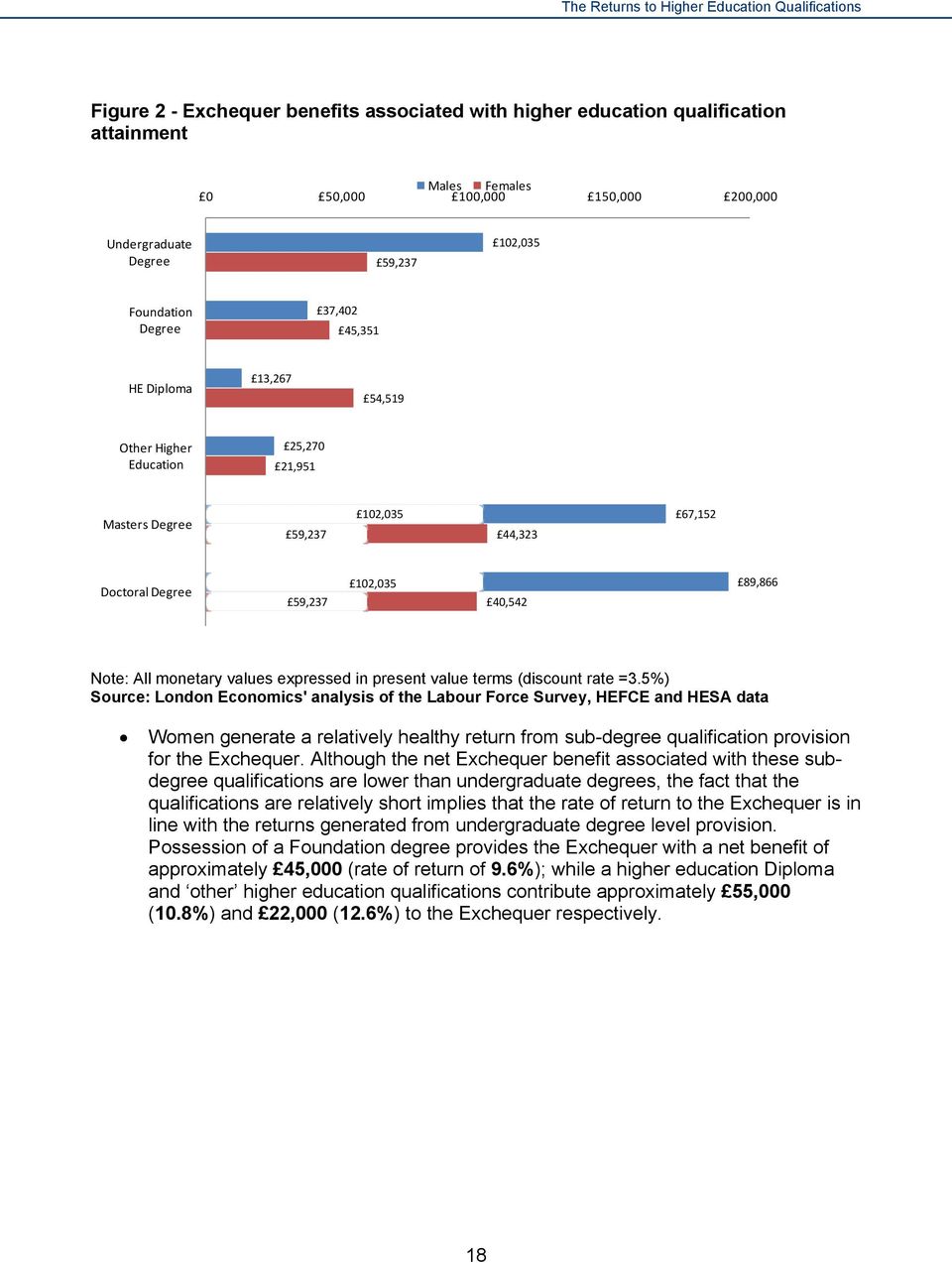
17 to medicine ( 114, %), education ( 111, %), mathematical and computer sciences ( 99, %) and law ( 91, %), which all provide a return of between 50% and 100% more than the average Exchequer benefit. There are low Exchequer returns associated with a number of degree level subject areas. Degrees undertaken by women in mass communication and documentation, European languages, non-european languages, historical and philosophical studies, and creative arts and design all provide an Exchequer benefit of between 15,000 and 45,000 (with associated Exchequer rates of return of less than 10%). For men, there are net costs to the Exchequer associated with the provision of degrees in mass communication and documentation, history and philosophical studies and creative arts and design, while male acquisition of degrees in linguistics and languages provide the Exchequer with a net benefit that is approximately onequarter to one-half of that posted by the average male graduate. Given the relatively short duration of Master s qualifications (12 months) and the limited funding through HEFCE, these qualifications offer very high returns to the Exchequer. The net Exchequer benefit stands at approximately 67,000 for men and 44,000 for women, translating into rates of return of almost 32% for men and 22.5% for women. The net Exchequer benefit associated with Doctorate qualifications stands at 90,000 for men and 41,000 for women, equivalent to a rate of return of 10.7% and 8.4% respectively. Despite the relatively short period of provision and comparable funding levels to undergraduate degrees, the net Exchequer benefit associated with the provision of Foundation degrees for men stands at 37,000 (corresponding to a rate of return of 9.3%), while the net Exchequer benefit associated with a higher education Diploma stands at just 13,000, which corresponds to a rate of return to the Exchequer of 5.5%. 17

18 Figure 2 - Exchequer benefits associated with higher education qualification attainment Males Females 0 50, , , ,000 Undergraduate Degree 59, ,035 Foundation Degree 37,402 45,351 HE Diploma 13,267 54,519 Other Higher Education 25,270 21,951 Masters Degree 59, ,035 44,323 67,152 Doctoral Degree 59, ,035 40,542 89,866 Note: All monetary values expressed in present value terms (discount rate =3.5%) Source: London Economics' analysis of the Labour Force Survey, HEFCE and HESA data Women generate a relatively healthy return from sub-degree qualification provision for the Exchequer. Although the net Exchequer benefit associated with these subdegree qualifications are lower than undergraduate degrees, the fact that the qualifications are relatively short implies that the rate of return to the Exchequer is in line with the returns generated from undergraduate degree level provision. Possession of a Foundation degree provides the Exchequer with a net benefit of approximately 45,000 (rate of return of 9.6%); while a higher education Diploma and other higher education qualifications contribute approximately 55,000 (10.8%) and 22,000 (12.6%) to the Exchequer respectively. 18
19 1 Introduction London Economics were commissioned by the Department for Business, Innovation and Skills to undertake an assessment of the economic returns to higher education qualifications. There have been a large number of studies in the area that have focused on a range of different aspects of higher education qualifications, including the determinants of undertaking higher education qualifications, the earnings and employment outcomes associated with higher education qualifications (both at an aggregated or disaggregated level), and the rates of return associated with different types and levels of higher education qualification attainment. To undertake this research and achieve a robust analysis, significant volumes of data and alternative model specifications have been considered. This is a significant improvement on previous analyses. In this report, we assess the economic outcomes associated with higher education qualification attainment in the United Kingdom and the report is set out below. Following a number of other authors in the field and the analysis undertaken for the Department for Business, Innovation and Skills relating to the returns to intermediate and low level vocational qualifications 2, our methodology adopts a number of standard economic and econometric approaches to assess the economic benefits associated with higher education qualification attainment, which we describe in our summary methodology (section 2). In section 3, we present detailed findings of the marginal earnings returns associated with different levels and types of higher education qualification attainment, where the marginal earnings estimates provide an indication of the returns associated with different qualifications when these qualifications are the highest qualification the individual holds. This analysis is presented at both an aggregate level and disaggregated by type of higher education qualification, gender and, for undergraduate degrees, by subject of study, grade degree and whether the degree is a single subject degree or combined subject degree (in one or more subject areas). For completeness, we also provide estimates of the average return associated with higher education qualifications. This approach measures the return associated with the qualification for anyone in possession of that qualification (irrespective of whether it is their highest qualification or otherwise). In section 4, we replicate the analysis undertaken in section 3 and estimate the employment effects associated with higher education qualification attainment. Combining information on the costs and benefits associated with higher education qualification attainment, we provide an assessment of the net graduate premium and individual rates of return associated with higher education qualification attainment in Section 5, while in Section 6, we assess the net Exchequer benefits and rates of return associated with qualification provision. 2 Returns to intermediate and low level vocational qualifications, a report undertaken for the Department for Business Innovation and Skills, (forthcoming 2011) 19

20 2 Summary Methodology 2.1 Estimating earnings returns to higher education qualifications To undertake this element of the analysis, we estimated a standard Ordinary Least Squares linear regression model, where the dependent variable is the natural logarithm of hourly earnings and the independent variables include the full range of qualifications held alongside a range of personal, regional and job related characteristics that might be expected to influence earnings. We included individuals who were employed on either a full time or a part time basis. This approach has been used widely in the academic literature. The basic specification of model was as follows (in aggregate and for men and women separately): ln( ' i) Xi i for i = 1 to n where ln( i ) represents the natural logarithm of hourly earnings, independent variables included in the analysis as follows: X i provides the Gender Age Age squared Ethnic origin Region of usual residence Qualifications Marital Status Number of dependent children under the age of 16 Full time/ Part time employment Temporary or permanent contract Public or private sector employment Workplace size Interaction terms, and Yearly Dummies 20

21 2.2 Estimating the employment outcomes associated with qualification attainment We adopted a probit model to estimate the likelihood of different qualification holders being in employment or otherwise. The basic specification defines an individual s labour market outcome to be either in employment (working for payment or profit for more than 1 hour in the reference week (using the standard ILO definition) or not in employment (being either unemployed or economically inactive)). The specification of the probit model was as follows (for men and women separately): probit ( EMPNOT ) ' i Z i i The dependent variable adopted has the binary variable EMPNOT that is coded 1 if the individual is in employment and 0 otherwise. We specified the model to contain a constant term as well as a number of standard independent variables including the qualifications held by an individual (represented by Z i in the above equation) as follows: Gender Age Age squared Ethnic origin Region of usual residence Qualifications Marital Status Number of dependent children under the age of 16, and Yearly Dummies 2.3 Further modelling information Marginal versus average returns Throughout the analysis, we present detailed findings of the marginal earnings returns associated with different types of higher education qualification, where marginal earnings estimates provide an indication of the returns associated with different qualifications when these qualifications are the highest qualification the individual holds. The average return associated with higher education qualifications assesses the return associated with the qualification for anyone in possession of that qualification (irrespective of whether it is their 21
22 highest qualification or otherwise). The analysis of average returns considers both annual and pooled effects and is discussed in greater detail in Annex Data To estimate the impact of higher education qualifications on labour market outcomes, we used information from the Labour Force Surveys between 1996 and The selection of information over this period is the longest time for which information on education and earnings is available on a relatively consistent basis and thus provides the most robust analysis possible using the Labour Force Survey, as well as allowing significant analysis to be undertaken at a disaggregated level. It is important to note that in some years particular variables are not available. Therefore, particular analyses (and Tables/Figures based on that analysis) may cover slightly different time periods, and these are detailed on a case by case basis. The analysis covers higher education qualification attainment across the United Kingdom and all information over the fourteen year period has been adjusted to reflect inflation and is presented in constant prices Qualifications considered and counterfactual In total, six different higher education qualifications were considered within the National Qualifications Framework: two at postgraduate level (Doctorate and Master s degrees) and four at undergraduate level or sub-degree level (undergraduate degrees, Foundation degrees, higher education Diplomas 3 and other higher education qualifications 4 ). Table 1 presents the different postgraduate and undergraduate level qualifications considered in the analysis, along with the counterfactual group used for the marginal returns analysis in each case. We compare the earnings of the group of individuals in possession of the qualification to a counterfactual group to ensure that we assess the economic benefit associated with the qualification itself rather than the economic returns generated by the person in possession of the qualification. This is a standard approach in the literature and allows us to strip away the other personal, regional or socioeconomic characteristics that influence both the determinants of qualification attainment as well as earnings. For the analysis of marginal returns, postgraduate degree holders are compared to undergraduate degree holders, while for individuals holding undergraduate or sub-degree level higher education qualifications, the counterfactual group consists of individuals holding 2 or more GCE A Levels as their highest qualification. For the purposes of this 3 Labour Force Survey variable QUALS6 value label 2 (Diploma in higher education). Diplomas in higher education are similar to HNDs though more academic in orientation as they generally relate to accredited professional qualifications. HE Diplomas usually take two years to complete and it is normally possible to convert a higher education diploma to a degree with an extra year of study. 4 Labour Force Survey variable QUALS6 value label 9 ('Other higher education qualification below degree level'). Interviewers are instructed to use label 9 'only if the respondent states that they have something from higher education but they do not know what it is'. It is therefore not possible to provide examples of typical qualifications that would normally fall under this category. The response option serves the purpose of confirming that higher education qualifications have been achieved but that the respondent is unaware of the actual qualification title itself. 22
23 analysis, the highest level of professional or vocational qualification that an individual may be in possession of is level 3 (for both those in possession of higher education qualifications (the treatment group) and those individuals not-in-possession of higher education qualifications (the control group)) 5. Table 1 - Treatment and comparison groups marginal returns Treatment highest academic qualification Comparison - highest academic qualification Treatment and comparison groups highest possible vocational/professional qualification Doctorate Undergraduate degree Level 3 vocational Master s degree Undergraduate degree Level 3 vocational Undergraduate degree 2 or more GCE A Levels Level 3 vocational Foundation degree 2 or more GCE A Levels Level 3 vocational HE Diploma 2 or more GCE A Levels Level 3 vocational Other higher education 2 or more GCE A Levels Level 3 vocational Source: London Economics Coefficients The coefficients in the model provide information on the extent to which a particular independent variable (e.g. qualification attainment) influences the dependent variable (earnings or employment outcomes). In the earnings regressions, the coefficients relating to the higher education qualifications indicate the additional effect on (the log of) hourly earnings associated with holding the extra qualification in excess of those in the reference category (e.g. holding an undergraduate degree level qualification compared to those in possession of 2 or more GCE A Levels). For instance, the coefficient assessing the earnings premium to an undergraduate degree level qualification relative to 2 or more GCE A Levels should be interpreted as the return achieved by an individual in possession of both an undergraduate degree and 2 or more GCE A Levels compared to possession of 2 or more GCE A Levels alone. In the employment regressions, the relevant coefficient provides a similar estimate of the impact of the qualification on the probability of being in employment. The final term represents the error term component. i For the earnings returns, the actual coefficients from the regression are presented in the various tables in the report, while the precise percentage effect of the independent variable on the earnings outcomes is presented in the text (by transforming the coefficient using the transformation e β -1). In general terms, for small coefficients (less than 0.10), the coefficient in the regression model will give a reasonable approximation of the actual percentage change; however, for coefficients greater than this, the correction is necessary. This transformation is required only when considering earning returns as we are estimating the impact of qualification attainment on the logarithm of hourly earnings. No exponential 5 Note that when considering the average returns associated with different types of higher education qualification, all professional and vocational qualifications are included (and controlled for) in the various model specifications. 23
24 transformation is necessary when considering the employment outcomes of learners, as in the employment regressions, the relevant coefficient provides an automatic estimate of the impact of the qualification on the probability of being in employment Further disaggregation For undergraduate degrees, further disaggregation was possible and we replicated the analysis detailed above by class of undergraduate degree (First, Upper Second and Lower Second), subject of study and whether the degree was obtained in a single subject area or as a combined degree (in either one subject area (for instance mathematics and statistics) or more than one subject area (for instance mathematics and economics)). We coded those in possession of single degree subjects according to 1 or 2 digit JACS code below: medicine and dentistry subject allied to medicine biological sciences veterinary sciences agriculture physical/environmental Sciences mathematical and computer sciences engineering technologies architecture, building and planning social studies law business and administrative studies mass communication and documentation linguistics, classics and related subjects European languages and literature non-european languages and literature 24
25 historical and philosophical studies creative arts and design education 2.4 Assessing individual rates of return and the net graduate premium To consider the rate of return and the net graduate premium associated with a particular level or type of qualification (see glossary and Annex 2 for more details on these), it is necessary to estimate the direct and indirect costs associated with acquiring the qualification (tuition fees minus student support and foregone earnings), as well as the benefits of the qualification (the gross graduate premium or equivalent). These costs and benefits will occur at different points in the individual s lifetime (as shown in Figure 3) and so it is necessary to use the concepts of the net present value and internal rate of return (see glossary) to compare them. The net graduate premium (or equivalent for sub-degree qualifications) is calculated by subtracting the present value of the costs of qualification attainment from the gross graduate premium (or equivalent). The rate of return is obtained by calculating the discount rate required for the gross graduate premium to be equal to the present value of the costs of qualification attainment (see Annex 2 for more details). Figure 3 - Representation of costs and benefits associated with qualification attainment Costs/ Earnings After tax earnings associated with an undergraduate degree Annual earnings premium Gross Graduate Premium After tax earnings associated with 2 or more GCE A Levels Indirect Costs (foregone earnings) Age Direct Costs (tuition fee minus student support) Source: London Economics 25
26 2.4.1 Estimating the net lifetime earnings benefits/gross graduate premium associated with qualification attainment The net lifetime benefits associated with qualification attainment are taken to be the present value of the enhanced post-tax (Income, National Insurance and VAT) earnings relative to an individual in possession of the counterfactual qualification. This is also known as the gross graduate premium in the case of undergraduate degrees. To estimate the value of net lifetime benefits or gross graduate premium, we extended the econometric analysis presented in section 2.1 and 2.2. Using pooled Quarterly Labour Force Surveys (between 1996 to 2009), we undertook the following elements of analysis: 1. We estimated the earnings premium associated with different higher education qualifications in 5 year age bands across the working age population (see section 2.1). 2. We estimated the probability of employment associated with higher education qualifications in 5 year age bands across the working age population (see section 2.2). 3. We estimated the employment adjusted annual earnings achieved by individuals in the counterfactual group (either 2 or more GCE A Levels or an undergraduate degree (Table 1)). 4. We inflated these baseline or counterfactual earnings using the earnings premiums from (1) and the employment probabilities from (2) to produce ageearnings profiles associated with the possession of the particular qualification. 5. We adjusted earnings to account for the fact that earnings would be expected to increase in real terms over time (assumed to be 2% per annum generally). 6. Based on the earnings profiles generated by qualification holders, and current income tax and National Insurance rates and allowances, we computed the future stream of net (i.e. post tax) earnings. 7. We calculated the discounted stream of additional (employment-adjusted) future earnings compared to the relevant counterfactual group (using a standard discount rate of 3.5% as presented in HM Treasury Green Book to generate a present value figure i.e. the gross graduate premium (or equivalent for other qualifications)). This was undertaken for men and women separately and replicated by subject of study. We coded those in possession of single degree subjects according to 1 or 2 digit JACS code described in section 2.3.5, as well as those students undertaking combined degree subjects predominantly in one subject area or in more than one subject area. Note that the estimates presented on the lifetime earnings premium are based on the assumption that students commence their full time undergraduate degree at the age of 18 (see a full explanation in Annex A2.6.1). The analysis provides an estimate of the post tax enhanced earnings achieved by graduates over their lifetime in present value terms (net 26
27 lifetime benefit or gross graduate premium), as well as the enhanced taxation revenue/national Insurance/VAT generated by these graduates over their lifetime assuming the current income tax regime remains in place. If all of the steps except for step 6 above are followed, an estimate of the gross enhanced earnings achieved by graduates over their lifetime is generated instead (the gross lifetime benefit). Full details are presented in Annex Estimating the individual costs associated with higher education qualification attainment The direct costs associated with qualification attainment include any tuition fees minus any student support the individual may be eligible for (i.e. grants and subsidies on fee and maintenance loans 6 ). The assessed indirect costs to the individual include the foregone earnings during the period of qualification attainment. We did not consider any other indirect costs associated with qualification attainment. Subtracting the present value of these costs of attainment from the gross graduate premium provides an estimate of the net graduate premium. This element of the analysis is exceptionally detailed and full details are presented in Annex 2 and Annex Assessing Exchequer net benefits and rates of return A similar comparison between the costs and benefits of qualification provision to the Exchequer can be carried out to obtain the Exchequer rate of return and Exchequer net benefit. Again these costs and benefits will occur at different points in time and will need to be compared using the concepts of the net present value and rate of return. A full explanation of the derivation of these Exchequer costs and benefits are presented in Annex 2 and Annex Estimating Exchequer benefits associated with higher education qualifications The economic benefits accrued by the Exchequer include the enhanced income taxation and National Insurance contributions made by graduates, as well as the additional VAT receipts generated through increased consumption (in absolute terms) associated with higher earnings. Based on the expected earnings profiles generated by those in possession of higher education qualifications, the estimates of enhanced taxation receipts are calculated in the same way as the graduate premium described in previous sections. 6 By considering the actual earnings of graduates post graduation and the characteristics of the current student support regime, we have modelled the interest rate subsidy associated with these loans (in present value terms) as a benefit to the individual thereby reducing the direct tuition fee cost associated with attending university. 27
28 2.5.2 Estimating Exchequer costs associated with higher education qualification provision The assessed costs to the Exchequer include the HEFCE teaching funding (depending on subject banding), student maintenance grants, the subsidy associated with maintenance and fee loans (accruing from the interest rate subsidies on the loans and write off criteria), and foregone income-tax, National Insurance and VAT receipts during the period of qualification attainment. 28
29 3 Earnings returns 3.1 Undergraduate degrees marginal returns The marginal earnings return associated with an undergraduate degree stands at approximately 27.4% (β=0.242) overall compared to possession of 2 or more GCE A Levels. Women post a higher return compared to men, standing at 29.7% and 23.5% respectively (β=0.260 and β=0.211). This information is presented in Table 2 and Figure 4. Clearly, there is significant variation in the returns to undergraduate degrees depending on a number of factors (such as subject studied and degree class). In Table 2, we illustrate the earnings returns depending on undergraduate subject of study. The highest marginal returns are (unsurprisingly) associated with medicine and dentistry degrees, where men post a marginal earnings return of 70.1% (β=0.531) compared to a marginal return of 91.7% for women (β=0.651). Table 2 - Earnings returns by subject of undergraduate degree all, males and females All Males Females Comparison 2 or more A levels and vocational level 3 or below Medicine and dentistry 0.603*** (0.026) 0.531*** (0.035) 0.651*** (0.037) Subject allied to medicine 0.322*** (0.012) 0.232*** (0.030) 0.345*** (0.013) Biological sciences 0.160*** (0.011) 0.117*** (0.018) 0.185*** (0.014) Veterinary sciences 0.334*** (0.045) 0.280*** (0.074) 0.372*** (0.059) Agriculture 0.141*** (0.030) 0.106*** (0.039) 0.153*** (0.045) Physical/environmental sciences 0.239*** (0.011) 0.200*** (0.013) 0.263*** (0.020) Mathematical and computer sciences 0.344*** (0.011) 0.314*** (0.013) 0.394*** (0.022) Engineering 0.323*** (0.010) 0.278*** (0.011) 0.338*** (0.038) Technologies 0.188*** (0.027) 0.142*** (0.031) 0.239*** (0.052) Architecture, building and planning 0.272*** (0.015) 0.245*** (0.017) 0.278*** (0.032) Social studies 0.231*** (0.010) 0.226*** (0.015) 0.225*** (0.013) Law 0.345*** (0.016) 0.328*** (0.023) 0.355*** (0.021) 29
30 All Males Females Business and administrative studies 0.282*** (0.009) 0.253*** (0.013) 0.301*** (0.013) Mass comm. and documentation 0.081*** (0.018) (0.028) 0.107*** (0.023) Linguistics, classics and rel. subjects 0.162*** (0.015) 0.061** (0.026) 0.219*** (0.018) European languages and literature 0.189*** (0.023) 0.109*** (0.038) 0.237*** (0.027) Non-European languages and literature 0.144** (0.057) 0.180** (0.074) 0.153** (0.075) Historical and philosophical studies 0.099*** (0.013) (0.018) 0.176*** (0.019) Creative arts and design 0.061*** (0.012) (0.018) 0.111*** (0.016) Education 0.315*** (0.011) 0.180*** (0.022) 0.368***(0.013) Average 0.242*** (0.004) 0.211*** (0.006) 0.260*** (0.006) Note: Information on subject of degree in unavailable in the 1996 Labour Force Survey. Therefore, estimated earnings returns to single subject undergraduate degree qualifications by subject use pooled Labour Force Survey data between 1997 and Robust standard errors in parentheses. * 10% level of statistical significance; ** 5% level of statistical significance; *** 1% level of statistical significance. Source: London Economics There are a number of other subjects offering very significant returns to holders. For men, undergraduate degrees in mathematical and computer sciences and law provide a marginal return of 36.9% and 38.8% respectively (β=0.314 and β=0.328), while the next group of subjects offering above average returns include engineering (32.0% premium with β=0.278), architecture (27.8% premium with β=0.245), business and administrative studies (28.8% premium with β=0.253), social studies (25.4% premium with β=0.226), and subjects allied to medicine (26.1% premium with β=0.232). 30
31 Figure 4 - Earnings returns by subject of undergraduate degree all, males and females Females Males All 5% 15% 35% 55% 75% 95% Medicine and Dentistry Subject allied to Medicine Biological Sciences Veterinary Sciences Agriculture Physical/environmental Sciences Mathematical and Computer Sciences Engineering Technologies Architecture, Building and Planning Social Studies Law Business and Administrative Studies Mass Comm. and Documentation Linguistics, Classics and rel. subjects European Languages and Literature Non European Languages and Lit. Historical and Philosophical Studies Creative Arts and Design Education Average 1.0% 41.2% 26.1% 38.0% 20.3% 12.4% 17.4% 45.1% 32.3% 39.7% 16.5% 11.2% 15.1% 30.1% 22.1% 27.0% 48.3% 36.9% 41.1% 40.2% 32.0% 38.1% 27.0% 15.3% 20.7% 32.0% 27.8% 31.3% 25.2% 25.4% 26.0% 42.6% 38.8% 41.2% 35.1% 28.8% 32.6% 11.3% 4.5% 8.4% 24.5% 6.3% 17.6% 26.7% 11.5% 20.8% 16.5% 19.7% 15.5% 19.2% 2.3% 10.4% 11.7% 6.3% 44.5% 19.7% 37.0% 29.7% 23.5% 27.4% 70.1% 82.8% 91.7% Note: Information on subject of degree in unavailable in the 1996 Labour Force Survey. Therefore, estimated earnings returns to single subject undergraduate degree qualifications by subject use pooled Labour Force Survey data between 1997 and Earnings returns calculated as (e β -1). Source: London Economics The degree subjects offering men approximately average earnings returns include physical sciences (22.1% premium with β=0.200) and education (19.7% premium with β=0.180). At the lower end of the range, undergraduate degrees in linguistics and European languages offer relatively low earnings returns to men (6.3% (β=0.061) and 11.5% (β=0.109) respectively). The returns to undergraduate degrees for women are in almost all circumstances in excess of those achieved by men. Again at the higher end of the spectrum, degrees in medicine and dentistry offer women a 91.7% earnings premium over women in possession of 2 or more GCE A levels as their highest qualification (β=0.651). Again the ranking of 31
32 marginal earnings premiums appears to be similar to those presented for men, with undergraduate degrees in mathematical and computer sciences offering an earnings return of 48.3% (β=0.394); veterinary science 45.1% (β=0.372); education 44.5% (β=0.368); law 42.6% (β=0.355); subjects allied to medicine 41.2% (β=0.345); and engineering 40.2% (β=0.338). Around the average, degrees in technologies, physical and environmental sciences and architecture offer marginal earnings returns of between 27.0% and 32.0% (β=0.239 and β=0.278). The lowest returns are associated with degrees in mass communication (standing at 11.3% with β=0.107), while creative arts (11.7% and β=0.111), history/philosophy (19.2% and β=0.176), and non-european languages (16.5% and β=0.153) all offer below average returns to their holders. Caveats with interpreting the results It is important to note that the estimate of the marginal return to specific undergraduate degree level subjects is relative to the representative individual in possession of 2 or more GCE A Levels. The Labour Force Survey does not provide information on the specific GCE A Level subjects undertaken. Therefore, it is not possible to undertake a more precise analysis of the marginal return to a subject specific undergraduate degree in comparison to an individual in possession of those GCE A levels that may have led to the acquisition of a specific degree level subject. In addition, there is no information on the grades of GCE A Level attained. Undertaking a true estimate of the marginal return to degree level subjects controlling for appropriate GCE A Level subject of study and grades attained would reduce the estimated variation in returns that are illustrated in Table 2 and throughout the remaining sections of the report Single subject versus combined degrees The results presented in the previous section relate to the marginal returns associated with single subject undergraduate degrees. In addition to this, in Table 3, we illustrate whether there are any differences in the marginal return to undergraduate degrees depending on whether the undergraduate degree is in a single subject area, a combined degree in one subject area (for instance mathematics and statistics) or a combined degree in more than one subject area (for instance mathematics and economics). 32
33 Table 3 - Earnings returns to single or combined subject degrees all, males and females All Males Females Comparison 2 or more A-levels and vocational level 3 or below Single subject degree 0.245*** (0.005) 0.215*** (0.007) 0.261*** (0.007) Combined degree in one area 0.229*** (0.008) 0.199*** (0.012) 0.250*** (0.011) Combined degree in more than one area 0.207*** (0.009) 0.191*** (0.014) 0.211*** (0.012) Note: Information on single or combined degrees unavailable in the 1996 Labour Force Survey. Estimated earnings returns to single or combined subject at undergraduate degree level use pooled Labour Force Survey data between 1997 and Robust standard errors in parentheses * 10% level of statistical significance; ** 5% level of statistical significance; *** 1% level of statistical significance. Source: London Economics The results indicate that there is a small premium when undergraduate degrees are obtained in a single subject area compared to combined degrees, with combined undergraduate degrees in a single subject area commanding a premium over degrees covering more than one subject area. Specifically, for individuals in aggregate, the marginal return to a single subject undergraduate degree stands at 27.8% (β=0.245) compared to a premium of 25.7% (β=0.229) for combined undergraduate degrees in a single subject area and a premium of 23.0% (β=0.207) for students completing combined degrees in more than one subject area Grade of degrees In Table 4, we present information on the impact of the grade of undergraduate degree 7 attained on marginal earnings compared to those in possession of 2 or more GCE A Levels. As would be expected, the earnings premium associated with undergraduate degrees increases as the grade of honours increases, although the change in premium by grade of degree is much steeper for men compared to women. In aggregate, and relative to possession of 2 or more GCE A levels at any grade, individuals with a first class honours degree achieve a 32.7% earnings premium (β=0.283) compared a premium of 28.0% (β=0.247) for an upper second class honours degree and 21.3% for a lower second class honours degree (β=0.193). Men moving from a lower to an upper second class honours degree achieve a 9.5 percentage point increase in hourly earnings (compared to 4.4 percentage points for women), while men moving from an upper second class honours degree to a first class honours degree achieve a 4.2 percentage point premium (compared to 3.9 percentage points for women). 7 Note that it was not possible to estimate the returns to third class honours or pass degrees as the sample sizes were insufficient to provide robust results. 33
34 Table 4 - Earnings returns by class of undergraduate degree all, males and females All Males Females Comparison 2 or more A-levels and vocational level 3 or below First 0.283*** (0.014) 0.266*** (0.020) 0.285*** (0.020) Upper Second 0.247*** (0.009) 0.233*** (0.014) 0.255*** (0.012) Lower Second 0.193*** (0.010) 0.155*** (0.015) 0.220*** (0.014) Note: Estimated earnings returns to undergraduate degree qualifications pooled Labour Force Survey data between 2004 and 2009 was used in this analysis as information on grade of degree was only asked for the first time in Robust standard errors in parentheses. * 10% level of statistical significance; ** 5% level of statistical significance; *** 1% level of statistical significance. Source: London Economics Age of acquisition We have also assessed the extent to which the age of acquisition is important in determining the returns associated with undergraduate degree level qualifications. The analysis presented in Table 5 indicates that there is a strong negative relationship between the variables, with individuals acquiring the qualification earlier in their lifetime posting a much higher earnings premium compared to those attaining undergraduate degrees later in life. In addition, the extent of this fall is much more apparent for men compared to women. Both men and women post an earnings premium of approximately 30% (β=0.253 and respectively) when the qualification is acquired below the age of 21, while acquisition between the ages of 21 and 25 reduces the premium by approximately 3-4 percentage points for men (with no significant reduction for women). However, if the undergraduate degree is acquired between the ages of 26 and 30, the earnings premium posted by men falls to approximately 6%, and (although statistically insignificant) turns negative beyond the age of 30. Meanwhile for women, the earnings premium associated with acquisition above the age of 30 is approximately half the premium posted below the age of 25. Table 5 - Earnings returns by acquisition age, undergraduate degree all, males and females All Males Females Comparison 2 or more A-levels and vocational level 3 or below 20 or below 0.259***(0.014) 0.253***(0.021) 0.258***(0.019) ***(0.006) 0.226***(0.009) 0.266***(0.008) ***(0.014) 0.057***(0.020) 0.191***(0.020) 30 or above 0.064***(0.013) (0.021) 0.133***(0.017) Note: Estimated earnings returns to Undergraduate degree qualifications pooled Labour Force Survey data (information on age of acquisition unavailable prior to 2002). Robust standard errors in parentheses. 34
35 * 10% level of statistical significance; ** 5% level of statistical significance; *** 1% level of statistical significance. Source: London Economics 3.2 Postgraduate qualifications marginal returns In Table 6 and Figure 5, we provide information in the marginal earnings premiums associated with postgraduate qualifications compared to possession of undergraduate degrees. The estimates indicate that there are substantial returns to postgraduate Master s degrees, with men and women posting an 8.9% and 10.3% premium respectively (β=0.085 and 0.098). The premium achieved by those in possession of Doctorate degrees is also substantial and stands at approximately 16-17% (β=0.150 and 0.158); however, it is important to remember that these estimates probably overstate the actual earnings premiums associated with Doctorate degrees, as these individuals may also be in possession of Master s qualifications in addition to their Doctorate qualifications. Table 6 - Earnings returns to postgraduate degrees all, males and females All Males Females Comparison Undergraduate degrees and vocational level 3 or below Doctorate 0.150*** (0.009) 0.150*** (0.011) 0.158*** (0.015) Master s 0.090*** (0.006) 0.085*** (0.008) 0.098*** (0.008) Note: Estimated earnings returns to HE qualifications pooled Labour Force Survey data Robust standard errors in parentheses. * 10% level of statistical significance; ** 5% level of statistical significance; *** 1% level of statistical significance. Source: London Economics Figure 5 - Earnings returns to postgraduate degrees all, males and females Females Males All 0% 2% 4% 6% 8% 10% 12% 14% 16% 18% Doctorate 17.1% 16.2% 16.2% Masters 10.3% 8.9% 9.4% Note: Earnings returns calculated as (e β -1) pooled Labour Force Survey data Source: London Economics 35
36 3.3 Other higher education qualifications marginal returns Finally in this section, we provide estimates of the earnings premiums associated with other higher education qualifications at sub-degree level alongside the previously reported returns associated with undergraduate degrees (for comparison purposes). In all cases, the returns are relative to those in possession of 2 or more GCE A levels. The estimates are presented in Table 7 and Figure 6. In aggregate, the analysis indicates that there is little difference in the marginal earnings return associated with Foundation degrees, higher education Diplomas or other forms of undergraduate higher education qualification. In particular, the returns to these qualifications stand at 13.8%, 17.1% and 7.1% respectively (β=0.129, and 0.069) in aggregate, which represents a 14 percentage point gap (across the combined three qualification levels) compared to those in possession of undergraduate degree level qualifications (27.3% with β=0.242). Table 7 - Earnings returns to other Higher Education qualifications all, males and females All Males Females Comparison 2 or more A-levels and vocational level 3 or below Undergraduate degree 0.242*** (0.004) 0.211*** (0.006) 0.260*** (0.006) Foundation Degree 0.129*** (0.032) 0.098** (0.046) 0.142*** (0.045) HE Diploma 0.158*** (0.014) (0.024) 0.238*** (0.017) Other HE 0.069***(0.019) 0.019(0.027) 0.114***(0.025) Note: Estimated earnings returns to HE qualifications pooled Labour Force Survey data with the exception of Foundation Degrees (pooled ). Robust standard errors in parentheses. * 10% level of statistical significance; ** 5% level of statistical significance; *** 1% level of statistical significance. Source: London Economics There are some differences between men and women in possession of sub-degree higher education qualifications. In a similar way to the grade of degree, where men suffer to a greater extent in terms of earnings when achieving lower grades of honours compared to women, men in possession of other forms of sub-degree higher education qualification achieve much lower earnings premiums compared to women. Men in possession of higher education Diplomas post a (statistically insignificant) earnings premium of 3.6% (β=0.035), while men in possession of Foundation degrees post a 10.3% (β=0.098) premium. The analysis indicates that the mean marginal earnings premium associated with these three sub degree qualifications (combined) lags the returns associated with undergraduate degree level qualifications by approximately 18 percentage points. In contrast, women perform reasonably well following acquisition of sub-degree level qualifications. Women in possession of higher education Diplomas post an earnings premium of 26.9% (β=0.238), while women in possession of Foundation degrees and other higher education qualifications post a premium of 15.3% (β=0.142) and 12.1% (β=0.114) respectively. The mean marginal return associated with these three qualifications (combined) lags the marginal return associated with undergraduate degree level qualifications by 12 percentage points, which is a third less than the gap estimated for men. 36
37 Figure 6 - Earnings returns to other Higher Education qualifications all, males and females Females Males Combined 0% 10% 20% 30% Undergraduate Degree 23.4% 27.4% 29.7% Foundation Degree 10.3% 13.8% 15.3% HE Diploma 3.6% 17.1% 26.9% Other Higher Education 1.9% 7.1% 12.1% Note: Earnings returns calculated as (e β -1) pooled Labour Force Survey data ( for Foundation Degrees) Source: London Economics 3.4 Average earnings returns In addition to the analysis considering marginal earnings returns, we have also estimated the average earnings returns associated with different types of higher education qualifications. The sample is restricted to all individuals having at least 2 or more GCE A Levels and the estimates control for all qualifications held by an individual, whether it is their highest or not. The estimates relating to the entire sample are presented in Table 8, while disaggregated estimates for men and women are presented in Table 9 and Table 10 respectively. Considering postgraduate qualifications, the analysis of average earnings returns indicates that Doctorate level qualifications provide their recipients with a return of 15.4% (β=0.143), while Master s qualifications provide an earnings return of approximately 8.3% (β=0.080). Unlike the estimates of the marginal returns to postgraduate qualifications, a gender gap emerges between men and women when considering average returns, with women posting an average earnings premium to postgraduate qualifications that is approximately 50% greater than the earnings returns posted by men. There is also some evidence that the average return to postgraduate qualifications has increased over time. In particular, compared to an average earnings premium to Doctorate degrees of between 4.9% and 37
38 13.9% between 1996 and 1999 (β=0.048 and 0.130), the average earnings premium associated with Doctorate level qualifications has increased by approximately 10 percentage points to between 14.1% and 23.6% between 2006 and 2009 (β=0.132 and 0.212). A similar (though less extreme) phenomenon is illustrated for Master s degrees. Some of this information is presented in Figure 7. The average return associated with an undergraduate degree stands at 22.1% (β=0.200) across the entire sample, with men posting a return of 20.6% (β=0.187) compared to the average return posted by women of 22.3% (β=0.201). The estimates of average returns to undergraduate degrees are slightly lower than the estimate of the marginal return (by between 3 and 6 percentage points) though this simply reflects the different model specification (see annex 2.3.1). Unlike postgraduate degrees, the average return to an undergraduate degree has dipped marginally in recent years for both men and women (although effectively unchanged across the entire period between 1996/1997 and 2009). Compared to an average return of between 25.2% and 26.7% (β=0.225 and 0.237) in , the average return to an undergraduate degree has fallen by between 4 and 5 percentage points to between 20.3% and 21.8% (β=0.185 and 0.197) in , with men displaying a slightly greater erosion of the graduate premium (5.4 percentage points) compared to women (3.3 percentage points). In terms of other sub-degree higher education qualifications, the analysis indicates that the average return to a Foundation degree (pooled between 2004 and 2009) stands at approximately 9.6% (β=0.092) though this has fallen considerably since their introduction (from approximately 23.6% in 2004 (β=0.212) to approximately 8.2% in 2009 (β=0.079); however, this may reflect the relatively recent introduction of the qualification and small sample sizes. Looking at the other sub-degree level qualifications, the returns for men are relatively low, with the average earnings premium associated with higher education Diplomas and other higher education qualifications statistically insignificantly different from zero. In contrast, the average earnings return associated with higher education Diplomas and other higher education qualifications for women stands at 8.3% and 3.4% respectively (β=0.080 and 0.033). There has been no particular trend in the returns to female possession of higher education Diplomas over time; however, there appears to have been a significant erosion of the earnings premium associated with other higher education qualifications. However, when considering the trend average earning and employment returns associated with different levels and types of qualification attainment over time, it is important to note that the results are crucially dependent on the particular years that are been compared and possible outliers (hence the decision to use many years of data and provide pooled estimates as well). For example, although the above analysis suggests that there might have been a slight reduction in the earnings premium over time for undergraduate degrees (although there is a strong gender effect), comparing the outcomes of undergraduate degree holders between 2003 and 2008 would suggest that the average earnings return has decreased by 3.5 percentage points, whilst comparing the outcomes between 2004 and 2009 would suggest that the average earnings return has increased by 2.6 percentage points. The pooled estimates provide a longer-term equilibrium between supply and demand for higher education qualifications, with the individual yearly estimates providing an indication of the volatility around the longer term trend. 38
39 Figure 7 - Average earnings returns to undergraduate and Master s degrees - males and females Masters (Men) Masters (Women) Degree (Men) Degree (Women) Note: Estimated earnings returns pooled Labour Force Survey data Robust standard errors in parentheses. Baseline group: 2 or more GCE A Levels Source: London Economics 39
40 Table 8 - Average earnings returns all Pooled Doctorate 0.130*** 0.081** 0.062** *** 0.139*** 0.187*** 0.184*** 0.175*** 0.145*** 0.192*** 0.132*** 0.184*** 0.212*** 0.143*** (0.035) (0.037) (0.031) (0.031) (0.029) (0.038) (0.033) (0.033) (0.033) (0.042) (0.030) (0.036) (0.030) (0.031) (0.009) Master s *** *** 0.102*** 0.088*** 0.098*** 0.097*** 0.100*** 0.095*** 0.093*** 0.065*** 0.086*** 0.102*** 0.080*** (0.028) (0.023) (0.022) (0.021) (0.021) (0.023) (0.022) (0.020) (0.025) (0.023) (0.019) (0.020) (0.021) (0.019) (0.006) Undergraduate Degree 0.219*** (0.016) 0.200*** (0.014) 0.209*** (0.014) 0.202*** (0.013) 0.200*** (0.013) 0.210*** (0.015) 0.237*** (0.015) 0.225*** (0.013) 0.163*** (0.015) 0.213*** (0.016) 0.221*** (0.013) 0.175*** (0.012) 0.197*** (0.013) 0.185*** (0.013) 0.200*** (0.004) Foundation Degree *** ** 0.079** 0.092*** (0.214) (0.079) (0.062) (0.057) (0.053) (0.040) (0.025) HE Diploma 0.049** *** 0.088*** ** *** * *** 0.049*** (0.024) (0.024) (0.024) (0.026) (0.025) (0.031) (0.031) (0.027) (0.032) (0.033) (0.026) (0.027) (0.028) (0.027) (0.007) Other HE *** ** (0.044) (0.038) (0.034) (0.033) (0.031) (0.045) (0.050) (0.036) (0.062) (0.060) (0.053) (0.040) (0.035) (0.048) (0.011) Professional quals. - Postgraduate 0.245*** (0.043) 0.295*** (0.040) 0.193*** (0.042) 0.332*** (0.037) 0.332*** (0.040) 0.404*** (0.051) 0.348*** (0.045) 0.356*** (0.038) 0.359*** (0.044) 0.384*** (0.045) 0.323*** (0.043) 0.287*** (0.034) 0.235*** (0.037) 0.240*** (0.032) 0.302*** (0.011) Professional quals. Graduate 0.317*** (0.034) 0.368*** (0.032) 0.272*** (0.031) 0.344*** (0.030) 0.299*** (0.029) 0.388*** (0.036) 0.413*** (0.036) 0.398*** (0.030) 0.406*** (0.037) 0.322*** (0.056) 0.413*** (0.043) 0.209*** (0.029) 0.229*** (0.023) 0.245*** (0.030) 0.313*** (0.009) PGCE 0.185*** 0.215*** 0.141*** 0.168*** 0.191*** 0.252*** 0.160*** 0.238*** 0.191*** 0.220*** 0.220*** 0.181*** 0.159*** 0.170*** 0.188*** (0.033) (0.028) (0.028) (0.024) (0.029) (0.032) (0.027) (0.023) (0.028) (0.029) (0.024) (0.021) (0.021) (0.023) (0.007) Teaching-other qual *** (0.023) 0.103*** (0.021) 0.082*** (0.022) 0.050** (0.022) 0.147*** (0.023) 0.068** (0.027) 0.104*** (0.026) 0.081*** (0.022) 0.062** (0.026) 0.114*** (0.027) (0.027) (0.025) (0.028) 0.065*** (0.025) 0.074*** (0.006) Nursing 0.059** 0.054** *** 0.059* 0.089*** 0.091*** 0.052* *** *** 0.058*** (0.029) (0.024) (0.026) (0.026) (0.029) (0.032) (0.029) (0.026) (0.030) (0.030) (0.026) (0.025) (0.030) (0.031) (0.007) RSA Level *** *** * *** *** ** *** (0.145) (0.071) (0.260) (0.125) (0.298) (0.095) (0.084) (0.141) (0.071) (0.096) (0.127) (0.133) (0.186) (0.139) (0.043) BTEC Level * (0.023) (0.022) (0.023) (0.020) (0.021) (0.023) (0.025) (0.020) (0.024) (0.027) (0.020) (0.021) (0.021) (0.025) (0.006) NVQ Level ** *** (0.105) (0.072) (0.081) (0.085) (0.109) (0.114) (0.111) (0.084) (0.115) (0.090) (0.072) (0.078) (0.127) (0.061) (0.025) NVQ Level *** (0.081) (0.083) (0.083) (0.059) (0.051) (0.052) (0.074) (0.050) (0.066) (0.062) (0.051) (0.053) (0.051) (0.037) (0.016) Note: Estimated earnings returns pooled Labour Force Survey data with the exception of Foundation degrees (pooled ). Note that we have included all qualifications in the table when presenting average returns, even though some of these qualifications are excluded for the marginal returns analysis. Robust standard errors in parentheses. Baseline group: 2 or more GCE A Levels Source: London Economics 40
41 Table 9 - Average earnings returns male Pooled Doctorate 0.099** * 0.142*** 0.120*** 0.187*** 0.169*** 0.144*** 0.098* 0.184*** 0.122** 0.202*** 0.185*** 0.125*** (0.039) (0.038) (0.036) (0.036) (0.034) (0.045) (0.039) (0.042) (0.043) (0.054) (0.040) (0.048) (0.038) (0.038) (0.011) Master s *** * 0.094*** 0.072** 0.101*** 0.080*** *** 0.058** 0.069** 0.065** 0.090*** 0.068*** (0.036) (0.030) (0.027) (0.029) (0.028) (0.031) (0.028) (0.026) (0.038) (0.032) (0.026) (0.028) (0.030) (0.027) (0.008) Undergraduate Degree 0.167*** (0.022) 0.198*** (0.020) 0.198*** (0.020) 0.189*** (0.019) 0.184*** (0.019) 0.220*** (0.023) 0.229*** (0.022) 0.219*** (0.020) 0.146*** (0.023) 0.187*** (0.024) 0.223*** (0.020) 0.153*** (0.019) 0.189*** (0.019) 0.170*** (0.019) 0.187*** (0.005) Foundation Degree *** * (0.232) (0.136) (0.094) (0.081) (0.089) (0.070) (0.042) HE Diploma ** ** * (0.038) (0.039) (0.036) (0.044) (0.038) (0.054) (0.053) (0.042) (0.041) (0.059) (0.044) (0.045) (0.051) (0.038) (0.012) Other HE ** * (0.063) (0.065) (0.050) (0.055) (0.041) (0.062) (0.066) (0.048) (0.099) (0.090) (0.061) (0.054) (0.063) (0.066) (0.016) Professional quals - Postgraduate 0.213*** (0.060) 0.198*** (0.058) 0.115* (0.064) 0.361*** (0.055) 0.295*** (0.048) 0.381*** (0.066) 0.321*** (0.066) 0.351*** (0.054) 0.320*** (0.059) 0.363*** (0.060) 0.301*** (0.070) 0.306*** (0.051) 0.193*** (0.054) 0.293*** (0.049) 0.285*** (0.016) Professional quals Graduate 0.257*** (0.040) 0.334*** (0.041) 0.239*** (0.040) 0.290*** (0.039) 0.214*** (0.035) 0.345*** (0.045) 0.402*** (0.050) 0.376*** (0.043) 0.403*** (0.049) 0.238*** (0.076) 0.364*** (0.056) 0.139*** (0.042) 0.227*** (0.033) 0.218*** (0.040) 0.277*** (0.011) PGCE 0.097* 0.115*** 0.072* 0.115*** *** 0.106** 0.215*** 0.137*** 0.093* 0.190*** 0.158*** 0.165*** 0.124*** 0.135*** (0.053) (0.037) (0.039) (0.043) (0.052) (0.056) (0.046) (0.035) (0.043) (0.050) (0.040) (0.037) (0.039) (0.037) (0.011) Teaching-other qual *** (0.039) (0.028) ** (0.038) (0.040) (0.040) (0.043) (0.040) (0.039) (0.045) 0.090* (0.052) (0.048) *** (0.058) (0.055) (0.048) *** (0.011) Nursing *** ** (0.066) (0.049) (0.081) (0.061) (0.091) (0.075) (0.100) (0.081) (0.074) (0.083) (0.067) (0.096) (0.090) (0.068) (0.020) RSA Level *** *** *** *** *** (0.133) (0.000) (0.226) (0.065) (0.060) (0.156) (0.120) (0.057) (0.000) (0.000) (0.031) (0.000) (0.000) (0.000) (0.148) BTEC Level * * * * (0.029) (0.028) (0.029) (0.027) (0.028) (0.028) (0.033) (0.027) (0.035) (0.038) (0.027) (0.028) (0.029) (0.033) (0.008) NVQ Level *** ** 0.098* (0.133) (0.000) (0.154) (0.121) (0.127) (0.179) (0.147) (0.146) (0.118) (0.059) (0.094) (0.117) (0.307) (0.087) (0.039) NVQ Level ** ** (0.128) (0.135) (0.111) (0.078) (0.089) (0.104) (0.089) (0.099) (0.112) (0.095) (0.071) (0.072) (0.119) (0.059) (0.026) Note: Estimated earnings returns pooled Labour Force Survey data with the exception of Foundation degrees (pooled ). Note that we have included all qualifications in the table when presenting average returns, even though some of these qualifications are excluded for the marginal returns analysis. Robust standard errors in parentheses. Baseline group: 2 or more GCE A Levels Source: London Economics 41
42 Table 10 - Average earnings returns female Pooled Doctorate 0.269*** *** *** 0.146* 0.169** 0.216*** 0.224*** 0.219*** 0.204*** 0.140*** 0.167*** 0.273*** 0.180*** (0.078) (0.100) (0.057) (0.064) (0.053) (0.082) (0.072) (0.050) (0.052) (0.070) (0.046) (0.051) (0.055) (0.054) (0.016) Master s * ** 0.114*** 0.113*** 0.111*** 0.112*** 0.163*** 0.112*** 0.142*** 0.060** 0.110*** 0.114*** 0.099*** (0.044) (0.035) (0.038) (0.030) (0.033) (0.035) (0.034) (0.031) (0.030) (0.034) (0.027) (0.028) (0.030) (0.027) (0.009) Undergraduate Degree 0.261*** (0.022) 0.193*** (0.019) 0.206*** (0.019) 0.203*** (0.017) 0.201*** (0.019) 0.195*** (0.021) 0.229*** (0.021) 0.219*** (0.018) 0.172*** (0.021) 0.229*** (0.021) 0.207*** (0.017) 0.189*** (0.016) 0.202*** (0.017) 0.192*** (0.017) 0.201*** (0.005) Foundation Degree * 0.235*** ** 0.134*** 0.098*** (0.044) (0.083) (0.082) (0.077) (0.065) (0.049) (0.032) HE Diploma 0.083*** 0.055* 0.124*** 0.080** 0.073** 0.087** 0.072* 0.091*** 0.081* 0.066* 0.069** ** 0.135*** 0.080*** (0.029) (0.030) (0.031) (0.031) (0.033) (0.037) (0.039) (0.034) (0.046) (0.040) (0.032) (0.034) (0.032) (0.036) (0.009) Other HE ** * * ** (0.059) (0.043) (0.044) (0.042) (0.046) (0.063) (0.071) (0.054) (0.076) (0.082) (0.076) (0.053) (0.041) (0.066) (0.015) Professional quals - Postgraduate 0.297*** (0.060) 0.374*** (0.053) 0.241*** (0.053) 0.299*** (0.048) 0.375*** (0.062) 0.431*** (0.082) 0.379*** (0.063) 0.369*** (0.056) 0.374*** (0.065) 0.393*** (0.067) 0.356*** (0.056) 0.279*** (0.044) 0.281*** (0.052) 0.203*** (0.040) 0.318*** (0.015) Professional quals Graduate 0.365*** (0.060) 0.391*** (0.052) 0.287*** (0.052) 0.378*** (0.048) 0.397*** (0.050) 0.435*** (0.058) 0.396*** (0.054) 0.395*** (0.041) 0.362*** (0.055) 0.408*** (0.080) 0.467*** (0.069) 0.268*** (0.039) 0.222*** (0.033) 0.259*** (0.047) 0.332*** (0.013) PGCE 0.284*** 0.282*** 0.181*** 0.203*** 0.240*** 0.265*** 0.185*** 0.256*** 0.226*** 0.291*** 0.230*** 0.203*** 0.164*** 0.201*** 0.219*** (0.041) (0.039) (0.038) (0.028) (0.035) (0.039) (0.034) (0.031) (0.036) (0.036) (0.029) (0.026) (0.025) (0.030) (0.009) Teaching-other qual 0.197*** (0.029) 0.184*** (0.028) 0.180*** (0.026) 0.109*** (0.026) 0.217*** (0.027) 0.152*** (0.034) 0.169*** (0.033) 0.137*** (0.027) 0.134*** (0.031) 0.133*** (0.032) 0.119*** (0.034) 0.088*** (0.027) 0.058* (0.032) 0.095*** (0.029) 0.143*** (0.008) Nursing 0.109*** 0.091*** 0.058** *** 0.077** 0.085*** 0.109*** ** 0.077*** 0.073*** *** 0.075*** (0.032) (0.029) (0.027) (0.028) (0.031) (0.036) (0.031) (0.028) (0.032) (0.032) (0.028) (0.026) (0.031) (0.034) (0.008) RSA Level ** *** ** *** *** *** (0.192) (0.069) (0.319) (0.116) (0.463) (0.102) (0.044) (0.128) (0.069) (0.087) (0.142) (0.147) (0.227) (0.148) (0.044) BTEC Level * *** (0.038) (0.035) (0.036) (0.030) (0.031) (0.037) (0.039) (0.030) (0.031) (0.038) (0.030) (0.033) (0.032) (0.037) (0.009) NVQ Level * (0.092) (0.085) (0.090) (0.115) (0.171) (0.141) (0.140) (0.082) (0.149) (0.223) (0.089) (0.106) (0.130) (0.076) (0.032) NVQ Level * ** (0.098) (0.108) (0.118) (0.075) (0.059) (0.058) (0.104) (0.055) (0.081) (0.078) (0.070) (0.071) (0.045) (0.046) (0.020) Note: Estimated earnings returns pooled Labour Force Survey data with the exception of Foundation degrees (pooled ). Note that we have included all qualifications in the table when presenting average returns, even though some of these qualifications are excluded for the marginal returns analysis. Robust standard errors in parentheses. Baseline group: 2 or more GCE A Levels. Source: London Economics 42
43 4 Employment effects 4.1 Undergraduate degrees In Table 11 and Figure 8, we present estimates relating to the impact of undergraduate degrees on the probability of being employed. The analysis is further broken down by gender and subject of study. Compared to possession of 2 or more GCE A Levels, an undergraduate degree increases the probability of being employed by approximately 3.3 percentage points, with women achieving a boost of 4.2 percentage points in employment probability, while men achieve a 2.1 percentage point boost. Table 11 - Employment effects by subject of undergraduate degree all, males and females All Males Females Comparison 2 or more A-levels and vocational level 3 or below Medicine and dentistry 0.075*** (0.006) 0.047*** (0.008) 0.100*** (0.010) Subject allied to medicine 0.072*** (0.005) 0.044*** (0.008) 0.097*** (0.006) Biological sciences 0.017*** (0.006) (0.008) 0.021** (0.009) Veterinary sciences 0.072*** (0.018) 0.050** (0.020) 0.091*** (0.030) Agriculture 0.061*** (0.010) 0.046*** (0.010) 0.064*** (0.021) Physical/environmental sciences 0.024*** (0.006) 0.016*** (0.006) 0.029** (0.011) Mathematical and computer sciences 0.028*** (0.006) 0.015*** (0.006) 0.041*** (0.011) Engineering 0.041*** (0.005) 0.024*** (0.004) (0.021) Technologies 0.031** (0.013) (0.013) 0.052* (0.027) Architecture, building and planning 0.065*** (0.008) 0.053*** (0.006) (0.022) Social studies 0.022*** (0.005) (0.006) 0.040*** (0.007) Law 0.045*** (0.006) 0.037*** (0.006) 0.045*** (0.010) Business and administrative studies 0.042*** (0.004) 0.026*** (0.005) 0.054*** (0.007) Mass comm. and documentation 0.035*** (0.010) (0.014) 0.041*** (0.015) Linguistics, classics and rel. subjects (0.007) (0.011) (0.011) European languages and literature (0.011) (0.018) (0.014) Non-European languages and literature (0.026) (0.043) (0.034) Historical and philosophical studies (0.007) (0.008) (0.011) Creative arts and design (0.006) (0.008) (0.009) Education 0.054*** (0.005) (0.011) 0.085*** (0.006) Average 0.033*** (0.003) 0.021*** (0.003) 0.042*** (0.004) Note: Information on subject of degree in unavailable in the 1996 Labour Force Survey. Therefore, estimated employment returns to single subject undergraduate degree qualifications by subject use pooled Labour Force Survey data between 1997 and Robust standard errors in parentheses. * 10% level of statistical significance; ** 5% level of statistical significance; *** 1% level of statistical significance. Source: London Economics 43
44 As with the returns to earnings, there is significant variation in the employment outcomes of undergraduates depending on the degree subject studied. For women, the degree level subjects having the greatest impact on employment outcomes are medicine and dentistry (10 percentage points), subjects allied to medicine (9.7 percentage points), veterinary science (9.1 percentage points) and education related subjects (8.5 percentage points). Figure 8 - Employment effects by subject of undergraduate degree all, males and females Females Males All Medicine and Dentistry Subject allied to Medicine Biological Sciences Veterinary Sciences Agriculture Physical/environmental Sciences Mathematical and Computer Sciences Engineering Technologies Architecture, Building and Planning Social Studies Law Business and Administrative Studies Mass Comm. and Documentation Linguistics, Classics and rel. subjects European Languages and Literature Non European Languages and Lit. Historical and Philosophical Studies Creative Arts and Design Education Average Note: Information on subject of degree in unavailable in the 1996 Labour Force Survey. Therefore, estimated employment returns to single subject undergraduate degree qualifications by subject use pooled Labour Force Survey data between 1997 and Statistical significance of coefficients presented in Table 11. Horizontal scale indicates percentage point employment effect. Source: London Economics The other degree level subjects that offer an above average employment boost for women are agriculture (6.4 percentage points), technologies (5.2 percentage points), 44
45 mathematical and computer sciences (4.1 percentage points), law (4.5 percentage points), business and administrative studies (5.4 percentage points) and mass communication and documentation (4.1 percentage points). There are a number of degree level subjects offering women relatively low employment returns including biological sciences (2.1 percentage points), engineering (2.0 percentage points), as well as European languages (1.5 percentage points), creative arts and design (0.8 percentage points), historical and philosophical studies (virtually no effect on employment probabilities) and non-european languages (a decrease of one percentage point in employment probabilities). In addition, a number of these estimates are statistically insignificant. The employment boost from undergraduate degrees for men is lower than for women. With mean enhanced employment outcomes standing at 2.1 percentage points, men in possession of architecture related degrees see the greatest employment boost (5.3 percentage points), while medicine and dentistry, subjects allied to medicine, veterinary science and agriculture degrees all result in an increase in the probability of being employed by more than 4 percentage points. The other science/quantitative orientated degree level subjects offer employment returns around the average, with biological sciences providing a marginal return of 1.1 percentage points, physical sciences (1.6 percentage points), mathematical and computing science (1.5 percentage points), engineering (2.4 percentage points) and technologies (1.9 percentage points). Degrees in linguistics, languages and historical and philosophical studies offer low employment returns to men, ranging between a 2.5 percentage point employment penalty in the case of non-european languages to just 0.7 percentage points increase in the case of history and philosophical studies 8. However, in a number of cases and even for some returns that are close to the average, these estimates are statistically insignificantly different from zero (due to small sample sizes) Single subject versus combined degrees In Table 12, we provide some information on the role of subject concentration on employment outcomes. As presented previously in relation to earnings, there appears to be some relationship between undergraduate degree level subject depth and the likelihood of being employed. Overall, individuals in possession of single subject degrees are approximately 3.4 percentage points more likely to be in employment compared to those in possession of 2 or more GCE A Levels. This compares to 2.5 percentage points for those in possession of combined degrees in a single subject area and 1.1 percentage points for those in possession of combined degrees in more than one subject area. Although the relationship does not exactly hold for men (there is little difference in the increased probability of being employed for those with either single or combined degrees in a single subject area), for women the relationship between subject concentration is essentially the same as for the population as a whole. 8 However, as in the previous analysis relating to earnings, this analysis cannot control for either the subject of GCE A level or the grade of attainment. 45
46 Table 12 - Employment effects to single or combined subject degrees all, males and females All Males Females Comparison 2 or more A-levels and vocational level 3 or below Single subject degree 0.034*** (0.003) 0.020*** (0.003) 0.046*** (0.004) Combined degree in one area 0.025*** (0.004) 0.024*** (0.004) 0.025*** (0.006) Combined degree in more than one area 0.011** (0.005) (0.006) 0.021*** (0.007) Note: Information on single or combined degrees unavailable in the 1996 Labour Force Survey. Estimated employment returns to single or combined subject at undergraduate degree level use pooled Labour Force Survey data between 1997 and Robust standard errors in parentheses. * 10% level of statistical significance; ** 5% level of statistical significance; *** 1% level of statistical significance. Source: London Economics Grade of degree Although individuals in possession of an undergraduate degree are generally more likely to be in employment than those in possession of GCE A Levels, it would have been thought that there would be a strong positive relationship between the grade of honours achieved during a degree and the enhanced probability of being employed. Interestingly, this relationship does not precisely hold. In particular, individuals in possession of upper second class honours degrees are 4.4 percentage points more likely to be employed compared to those in possession of 2 or more GCE A Levels, compared to a 2.8 percentage point employment boost for those with first class honours degrees and a 3.2 percentage point boost for those with lower second class honours degrees. This non-linear relationship is replicated for men and women independently, with greater variation in employment outcomes by grade of degree displayed for women. In particular, women in possession of upper second class honours degrees are approximately 5.6 percentage points more likely to be employed (relative to 2 or more A Levels) compared to 2.6 percentage points for women in possession of first class honours degrees. Table 13 - Employment effects by class of undergraduate degree all, males and females All Males Females Comparison 2 or more A-levels and vocational level 3 or below First 0.028*** (0.007) 0.023*** (0.008) 0.026** (0.011) Upper Second 0.044*** (0.005) 0.029*** (0.006) 0.056*** (0.008) Lower Second 0.032*** (0.005) 0.018*** (0.006) 0.046*** (0.008) Note: Information on grade of degree unavailable in the Labour Force Survey prior to Estimated employment returns to undergraduate degrees by grade use pooled Labour Force Survey data between 2004 and Robust standard errors in parentheses * 10% level of statistical significance; ** 5% level of statistical significance; *** 1% level of statistical significance. Source: London Economics 46
47 4.1.3 Age of acquisition In Table 14, we present the marginal employment return by age of acquisition. There are some differences between men and women. In particular, the marginal return for women is essentially unaffected by age with an employment boost of between 4 and 5 percentage points across all age-of-acquisition bands. For men, although the marginal returns from early acquisition are relatively robust (between 2.5 and 2.8 percentage points), if the undergraduate degree is attained beyond the age of 26, the employment boost associated with undergraduate degree level qualifications disappears. Table 14 - Employment effects by acquisition age, undergraduate degree all, males and females All Males Females Comparison 2 or more A-levels and vocational level 3 or below 20 or below 0.038***(0.006) 0.028***(0.007) 0.047***(0.010) ***(0.003) 0.025***(0.004) 0.042***(0.005) ***(0.007) 0.001(0.009) 0.041***(0.011) 30 or above 0.028***(0.006) (0.009) 0.045***(0.009) Note: Information on age of acquisition unavailable in the Labour Force Survey prior to Estimated employment returns to undergraduate degrees by age of acquisition using pooled Labour Force Survey data between 2002 and 2009 Robust standard errors in parentheses * 10% level of statistical significance; ** 5% level of statistical significance; *** 1% level of statistical significance. Source: London Economics 4.2 Postgraduate Qualifications In Table 15 and Figure 9, we provide evidence of the employment returns associated with postgraduate degree level qualifications. As with undergraduate degrees, the employment return to women from possession of any form of postgraduate degree exceed the returns posted by men. Women in possession of Master s qualifications are approximately 2.5 percentage points more likely to be employed compared to women in possession of undergraduate degrees (1.2 percentage points for men), while women in possession of Doctorate level qualifications are 4.5 percentage points more likely to be employed compared to women in possession of undergraduate degrees (2.7 percentage points for men). Table 15 - Employment effects of postgraduate qualifications all, males and females All Males Females Comparison Undergraduate degrees and vocational level 3 or below Doctorate 0.037*** (0.004) 0.027*** (0.004) 0.045*** (0.008) Master s 0.019*** (0.003) 0.012*** (0.003) 0.025*** (0.005) Note: Aggregated marginal employment effects of HE qualifications pooled Labour Force Survey data Robust standard errors in parentheses. * 10% level of statistical significance; ** 5% level of statistical significance; *** 1% level of statistical significance. Source: London Economics 47
48 Figure 9 - Employment effects of postgraduate qualifications all, males and females Females Males All Doctorate Masters Note: Employment effects pooled Labour Force Survey data Statistical significance of coefficients presented in Table 15. Horizontal scale indicates percentage point employment effect. Source: London Economics 4.3 Other higher education qualifications Finally in this section, we consider the employment outcomes associated with other forms of sub-degree higher education qualifications (presented in Table 16 and Figure 10). The analysis indicates that in aggregate there is a positive return associated with all higher education qualifications at sub-degree level, with the employment boost associated with higher education Diplomas standing at 2.5 percentage points. Overall, there does not appear to be any employment boost associated with possession of a Foundation degree, although there is some significant variation depending on gender (although no values are statistically significant due to small sample sizes). Men in possession of other higher education qualifications achieve a 2.4 percentage point enhanced employment probability compared to possession of 2 or more GCE A Levels. Table 16 - Employment effects of sub-degree HE qualifications all, males and females All Males Females Comparison 2 or more A-levels and vocational level 3 or below Undergraduate degree 0.033*** (0.003) 0.021*** (0.003) 0.042*** (0.004) Foundation degree (0.021) (0.030) (0.030) HE Diploma 0.025*** (0.008) (0.012) 0.036*** (0.012) 48
49 Comparison All Males Females 2 or more A-levels and vocational level 3 or below Other HE 0.009(0.011) 0.024*(0.014) (0.017) Note: Aggregated marginal employment effects of HE qualifications pooled Labour Force Survey data with the exception of Foundation Degrees (pooled ). Robust standard errors in parentheses * 10% level of statistical significance; ** 5% level of statistical significance; *** 1% level of statistical significance. Source: London Economics Women achieve relatively strong benefits from these forms of sub-degree qualifications. In particular, women post a 4.4 percentage point increase in the probability of being employed from possession of a Foundation degree (though not statistically significant), which actually exceeds the employment boost associated with full undergraduate degree level qualifications. The returns associated with HE Diplomas are also relatively robust, standing at 3.6 percentage points, while those women in possession of other higher education qualifications do not register any enhancement in the probability of being employed compared to women in possession of 2 or more GCE A Levels. Figure 10 - Employment effects of sub-degree HE qualifications all, males and females Females Males All Undergraduate Degree Foundation Degree He Diploma Other He Note: Employment effects pooled Labour Force Survey data ( for Foundation Degrees). Statistical significance of coefficients presented in Table 16. Horizontal scale indicates percentage point employment effect. Source: London Economics 49
50 4.4 Average employment returns In Table 17, we present estimates of the average enhanced employment probabilities associated with different types of higher education qualifications compared to those in possession of 2 or more GCE A Levels. The disaggregated results relating to men and women are presented in Table 18 and Table 19 respectively. Considering postgraduate qualifications, the analysis indicates that doctorate level qualifications provide their recipients with an enhanced likelihood of being employed of approximately 3.8 percentage points, while the employment boost associated with Master s qualifications stands at 2.7 percentage points. Unlike the average earnings premium associated with postgraduate qualifications, which has been increasing over the period of the analysis, the average employment return has been falling marginally. In particular, compared to an average enhanced employment probability to Doctorate degrees of 5.5 percentage points between 1996 and 1999, the average employment premium associated with Doctorate level qualifications dropped to approximately 3.1 percentage points between 2006 and 2009 (compared to those in possession of undergraduate degrees). Again, a similar (though less extreme) phenomenon is illustrated for Master s degrees, where the average employment premium has been eroded by approximately 0.6 percentage points over the 10 year period. The average enhanced employment likelihood associated with an undergraduate degree stands at 2.6 percentage points across the entire sample, with men achieving an employment boost of 1.8 percentage point compared to a 3.4 average employment boost posted by women. These estimates are slightly below the marginal returns associated with undergraduate degree level qualifications presented in the previous section (2.1 and 4.2 percentage point impact for men and women respectively). In terms of other sub-degree level higher education qualifications, the analysis illustrates that the average employment boost associated with a Foundation degree (pooled between 2004 and 2009) is positive although insignificantly different from zero, however, this employment return has increased considerably since their introduction (from an employment penalty of approximately 7.6 percentage points in 2004 to a small positive employment effect in 2009 (although all results are statistically insignificant due to relatively small sample sizes)). For men in particular, the average employment effect associated with other sub-degree level degree level qualifications is consistently low, with the average employment effect associated with HE Diplomas and other Higher Education qualifications statistically insignificantly different from zero. In contrast, the average employment effect associated with HE Diplomas and other higher education qualifications for women stands at 2.3 and 1.6 percentage points respectively. There has been no particular trend in the returns to female possession of HE Diplomas over time; however, if anything there appears to have been a slight improvement of the employment outcomes associated with higher education Diplomas for men over the period. This information is also presented in Figure 11 overleaf. 50
51 Figure 11 - Average employment returns to undergraduate and Master s degrees - males and females Masters (Men) Masters (Women) Degree (Men) Degree (Women) Note: Estimated employment returns pooled Labour Force Survey data Robust standard errors in parentheses. Baseline group: 2 or more GCE A Levels. Vertical scale indicates percentage point employment effect. Source: London Economics 51
52 Table 17 - Average employment outcomes all Pooled Doctorate 0.059*** 0.050*** 0.071*** 0.041*** 0.059*** 0.033* 0.036** * ** *** 0.040** 0.038*** (0.017) (0.017) (0.012) (0.014) (0.012) (0.019) (0.015) (0.018) (0.016) (0.024) (0.016) (0.019) (0.015) (0.017) (0.004) Master s 0.034** 0.047*** 0.025** *** *** 0.030*** 0.029** ** 0.027*** 0.037*** 0.027*** (0.014) (0.012) (0.012) (0.012) (0.010) (0.013) (0.011) (0.010) (0.012) (0.012) (0.011) (0.010) (0.010) (0.010) (0.003) Undergraduate Degree 0.021** 0.023*** 0.017** 0.022*** 0.025*** 0.023*** 0.022*** 0.026*** 0.019** 0.028*** 0.038*** 0.030*** 0.025*** 0.028*** 0.026*** (0.009) (0.008) (0.007) (0.007) (0.007) (0.008) (0.007) (0.007) (0.008) (0.008) (0.007) (0.007) (0.007) (0.007) (0.002) Foundation Degree (0.079) (0.038) (0.042) (0.027) (0.028) (0.029) (0.014) HE Diploma *** * * *** *** (0.015) (0.014) (0.015) (0.015) (0.013) (0.016) (0.013) (0.014) (0.015) (0.017) (0.014) (0.014) (0.013) (0.015) (0.004) Other HE ** * * (0.025) (0.020) (0.019) (0.023) (0.016) (0.019) (0.019) (0.021) (0.028) (0.033) (0.022) (0.019) (0.018) (0.022) (0.006) Professional quals - Postgraduate 0.061*** (0.018) 0.055*** (0.018) 0.061*** (0.015) 0.033* (0.018) 0.055*** (0.014) 0.049*** (0.018) 0.057*** (0.014) 0.039** (0.017) 0.044** (0.018) 0.048*** (0.017) 0.058*** (0.014) 0.062*** (0.012) 0.030* (0.017) 0.036** (0.016) 0.050*** (0.004) Professional quals Graduate 0.057*** (0.012) 0.053*** (0.013) 0.050*** (0.012) 0.033** (0.013) 0.034*** (0.012) 0.067*** (0.011) 0.071*** (0.009) 0.043*** (0.013) 0.062*** (0.013) 0.050*** (0.016) 0.030* (0.017) 0.049*** (0.012) 0.048*** (0.011) 0.039*** (0.013) 0.049*** (0.003) PGCE * * 0.034*** 0.047*** 0.044*** 0.049*** 0.028** 0.042*** 0.046*** 0.057*** *** 0.038*** (0.017) (0.015) (0.016) (0.014) (0.013) (0.013) (0.012) (0.012) (0.014) (0.013) (0.011) (0.010) (0.014) (0.011) (0.003) Teaching-other quals *** * * 0.031*** 0.030*** 0.033*** 0.027** 0.041*** ** 0.049*** 0.023*** (0.012) (0.010) (0.010) (0.010) (0.011) (0.012) (0.010) (0.010) (0.011) (0.013) (0.011) (0.013) (0.012) (0.012) (0.003) Nursing ** 0.038*** 0.031** 0.030* 0.043*** 0.029** 0.057*** 0.055*** *** 0.051*** 0.049*** 0.036*** (0.016) (0.015) (0.013) (0.012) (0.012) (0.016) (0.012) (0.014) (0.013) (0.015) (0.015) (0.013) (0.014) (0.016) (0.004) RSA Level *** * (0.064) (0.052) (0.116) (0.020) (0.152) (0.117) (0.141) (0.076) (0.202) (0.198) (0.095) (0.070) (0.026) BTEC Level ** 0.020* 0.034*** * * * 0.021* ** 0.016*** (0.013) (0.012) (0.011) (0.012) (0.011) (0.013) (0.011) (0.012) (0.013) (0.013) (0.012) (0.013) (0.013) (0.012) (0.003) NVQ Level * * ** (0.121) (0.052) (0.041) (0.062) (0.122) (0.069) (0.080) (0.044) (0.110) (0.038) (0.037) (0.057) (0.018) NVQ Level ** *** 0.072*** 0.061** *** (0.059) (0.039) (0.035) (0.040) (0.043) (0.020) (0.023) (0.030) (0.043) (0.033) (0.033) (0.030) (0.034) (0.009) Note: Employment effects pooled Labour Force Survey data with the exception of Foundation Degrees (pooled ). Robust standard errors in parentheses. Baseline group: 2 or more GCE A Levels Source: London Economics 52
53 Table 18 - Average employment outcomes males Pooled Doctorate 0.049*** *** 0.042*** 0.049*** 0.036** ** *** 0.041*** 0.027*** (0.012) (0.019) (0.012) (0.009) (0.007) (0.015) (0.015) (0.015) (0.019) (0.024) (0.017) (0.018) (0.013) (0.015) (0.004) Master s 0.028** 0.020* * *** 0.013*** (0.013) (0.012) (0.012) (0.011) (0.011) (0.013) (0.011) (0.012) (0.013) (0.013) (0.015) (0.011) (0.013) (0.011) (0.003) Undergraduate Degree *** 0.021*** 0.023*** * * 0.031*** 0.020** *** (0.010) (0.009) (0.008) (0.008) (0.008) (0.009) (0.008) (0.009) (0.009) (0.010) (0.009) (0.008) (0.009) (0.009) (0.002) Foundation Degree (0.083) (0.040) (0.048) (0.039) (0.065) (0.050) (0.022) HE Diploma * 0.028* ** 0.031** 0.042*** * (0.020) (0.018) (0.020) (0.017) (0.014) (0.024) (0.014) (0.016) (0.016) (0.024) (0.014) (0.016) (0.015) (0.022) (0.005) Other HE (0.039) (0.021) (0.020) (0.025) (0.018) (0.024) (0.023) (0.030) (0.044) (0.039) (0.023) (0.020) (0.025) (0.027) (0.007) Professional quals - Postgraduate 0.039** (0.016) 0.039** (0.017) 0.040*** (0.014) (0.019) 0.039*** (0.013) (0.020) 0.061*** (0.011) 0.045*** (0.015) (0.023) 0.040** (0.017) 0.041*** (0.015) 0.045*** (0.013) 0.032* (0.017) 0.053*** (0.016) 0.040*** (0.005) Professional quals Graduate 0.035*** (0.011) 0.027** (0.012) 0.037*** (0.010) (0.013) (0.013) 0.034** (0.014) 0.047*** (0.010) 0.032** (0.013) 0.033** (0.015) 0.038** (0.015) (0.018) 0.034*** (0.012) 0.046*** (0.011) 0.031** (0.014) 0.032*** (0.003) PGCE 0.037** ** *** *** 0.021*** (0.016) (0.018) (0.021) (0.017) (0.020) (0.019) (0.018) (0.017) (0.018) (0.026) (0.017) (0.014) (0.021) (0.014) (0.005) Teaching-other qual * ** (0.018) (0.014) (0.016) (0.014) (0.018) (0.020) (0.017) (0.016) (0.020) (0.017) (0.014) (0.024) (0.019) (0.018) (0.005) Nursing *** (0.033) (0.035) (0.032) (0.030) (0.032) (0.036) (0.039) (0.017) (0.027) (0.058) (0.038) (0.054) (0.036) (0.045) (0.010) RSA Level (0.155) (0.088) (0.377) (0.070) BTEC Level * ** *** (0.013) (0.012) (0.011) (0.010) (0.011) (0.016) (0.011) (0.013) (0.014) (0.012) (0.013) (0.014) (0.014) (0.015) (0.003) NVQ Level * (0.127) (0.065) (0.066) (0.045) (0.188) (0.121) (0.178) (0.059) (0.071) (0.027) NVQ Level *** (0.074) (0.073) (0.064) (0.068) (0.030) (0.021) (0.080) (0.053) (0.053) (0.041) (0.061) (0.014) Note: Estimated earnings returns pooled Labour Force Survey data with the exception of Foundation Degrees (pooled ). Robust standard errors in parentheses. Baseline group: 2 or more GCE A Levels Source: London Economics 53
54 Table 19 - Average employment outcomes females Pooled Doctorate *** 0.122*** *** *** * *** (0.046) (0.029) (0.018) (0.037) (0.035) (0.047) (0.021) (0.042) (0.024) (0.045) (0.029) (0.035) (0.029) (0.031) (0.009) Master s *** 0.041** *** *** 0.047** 0.041** 0.065*** *** 0.041** 0.041*** (0.026) (0.018) (0.021) (0.021) (0.019) (0.024) (0.021) (0.017) (0.019) (0.018) (0.015) (0.016) (0.014) (0.016) (0.005) Undergraduate Degree 0.032** * 0.042*** 0.037*** 0.035*** 0.036*** 0.032** 0.038*** 0.044*** 0.038*** 0.044*** 0.047*** 0.034*** (0.014) (0.012) (0.012) (0.011) (0.011) (0.012) (0.011) (0.011) (0.012) (0.012) (0.011) (0.010) (0.010) (0.011) (0.003) Foundation Degree * * ** (0.153) (0.045) (0.065) (0.034) (0.031) (0.034) (0.018) HE Diploma *** 0.040* ** ** *** (0.022) (0.018) (0.021) (0.023) (0.019) (0.023) (0.020) (0.022) (0.023) (0.022) (0.021) (0.022) (0.018) (0.021) (0.006) Other HE 0.056* * * * (0.031) (0.032) (0.029) (0.038) (0.025) (0.029) (0.027) (0.030) (0.036) (0.046) (0.032) (0.029) (0.028) (0.033) (0.008) Professional quals - Postgraduate 0.088*** (0.029) (0.039) 0.079*** (0.026) 0.056* (0.029) 0.076*** (0.023) (0.035) 0.051** (0.025) (0.031) 0.076*** (0.026) 0.051* (0.027) 0.075*** (0.021) 0.083*** (0.016) (0.025) (0.026) 0.058*** (0.007) Professional quals Graduate 0.067** (0.027) 0.075** (0.029) 0.057** (0.024) 0.062*** (0.020) 0.059*** (0.023) 0.107*** (0.015) 0.091*** (0.017) 0.045* (0.024) 0.092*** (0.020) 0.056** (0.027) 0.048* (0.027) 0.056*** (0.020) 0.042** (0.021) 0.040* (0.023) 0.064*** (0.006) PGCE ** ** 0.059*** 0.064*** 0.065*** 0.060*** 0.046** 0.083*** 0.071*** 0.070*** *** 0.055*** (0.026) (0.021) (0.024) (0.019) (0.018) (0.018) (0.016) (0.016) (0.019) (0.014) (0.014) (0.013) (0.018) (0.015) (0.005) Teaching-other qual *** 0.033** 0.026* 0.034** 0.043*** 0.041*** 0.036** 0.061*** 0.041** 0.041** ** 0.061*** 0.038*** (0.017) (0.014) (0.015) (0.015) (0.015) (0.016) (0.015) (0.015) (0.016) (0.016) (0.016) (0.016) (0.017) (0.016) (0.004) Nursing 0.059*** 0.047*** 0.055*** 0.064*** 0.060*** 0.051*** 0.073*** 0.033* 0.084*** 0.070*** 0.046*** 0.067*** 0.068*** 0.077*** 0.060*** (0.019) (0.017) (0.016) (0.015) (0.015) (0.018) (0.014) (0.018) (0.015) (0.017) (0.017) (0.014) (0.016) (0.017) (0.004) RSA Level ** (0.101) (0.060) (0.149) (0.199) (0.138) (0.150) (0.105) (0.200) (0.165) (0.091) (0.089) (0.029) BTEC Level *** 0.062*** 0.069*** * *** (0.021) (0.019) (0.018) (0.023) (0.021) (0.023) (0.020) (0.019) (0.021) (0.022) (0.019) (0.022) (0.020) (0.019) (0.006) NVQ Level ** (0.081) (0.140) (0.116) (0.113) (0.084) (0.156) (0.055) (0.071) (0.023) NVQ Level *** 0.074* *** (0.078) (0.089) (0.026) (0.040) (0.052) (0.055) (0.045) (0.039) (0.043) (0.042) (0.012) Note: Estimated earnings returns pooled Labour Force Survey data with the exception of Foundation Degrees (pooled ). Robust standard errors in parentheses. Baseline group: 2 or more GCE A Levels Source: London Economics 54
55 5 Lifetime benefits and individual rates of return 5.1 Undergraduate degree level qualifications by subject In Table 20 and Figure 12, we present information on the net graduate premium associated with undergraduate degree level qualifications compared to possession of 2 or more GCE A Levels. In aggregate, the mean net graduate premium stood at approximately 108,000 (presented in the Annex 1). The analysis indicates that the mean net graduate premium associated with an undergraduate degree for men stands at approximately 121,000 (net of costs of acquisition and using post tax earnings), while the mean net graduate premium for women stands at approximately 82, There is substantial variation around the mean, with medicine and dentistry providing men with a net graduate premium of more than 403,000 compared to women who achieve approximately 340,000. The other undergraduate degree level subjects that offer significantly greater than average net graduate premiums to men include law ( 215,000), architecture ( 170,000), veterinary sciences ( 165,000), engineering ( 157,000) and mathematical and computer sciences ( 152,000), while subjects allied to medicine ( 139,000), business and administrative studies ( 130,000) and social studies ( 124,000) offer strong net graduate premiums that are marginally above the average achieved by all men. Of those subjects offering men net graduate premiums that are just below average, degrees in physical and environmental sciences offer recipients a net graduate premium of 108,000. There are a number of subjects that offer particularly low net graduate premiums for men including creative arts and design (a net cost of 15,000), history and philosophical studies ( 1,000), and mass communication and documentation ( 5,000) 10. Linguistics and languages (both European and non-european) offer men a net graduate premium of approximately a third to a half of that achieved by men on average. However, as with the previous analyses, the estimation of the net graduate premium cannot control for either the subject of A level or the grade of attainment at A Level. For women, a very similar picture emerges, though with the exception of medicine and dentistry, there is much less variation in net graduate premiums by degree level subject than for men. Compared to the average net graduate premium of 82,000, women in possession of degrees in subjects allied to medicine and veterinary sciences post net graduate premiums of approximately 153,000 and 128,000 respectively (in the case of 9 The reason why women achieve a lower graduate premium in absolute monetary terms compared to men despite posting higher earnings and employment returns than men is due to the fact that the earnings achieved by women in the counterfactual group are relatively low. The large percentage increases in earnings returns and employment probabilities are calculated off a low base and result in lower monetary estimates of net graduate premiums compared to men. In addition, women tend to spend a larger amount of time out of the labour market compared to men that also impacts on lifetime earnings. It is highly likely that if women were actively engaged in the labour market for the same length of time as men, their lifetime earnings would be greater, resulting in higher estimates of the net graduate premium and rates of return. 10 However, it is important to note that some of these estimates are based on earnings and employment returns that may be statistically insignificantly different from zero. 55
56 subjects allied to medicine, this is greater than the equivalent male net graduate premium in absolute terms). The other degree level subjects offering women net graduate premiums greater than 100,000 include mathematical and computer sciences ( 122,000), law ( 108,000), business and administrative studies ( 100,000) and education ( 142,000), with engineering offering a net graduate premium of just below 100,000. Table 20 - Individual net lifetime benefit and rates of return to undergraduate degrees Degree Subject Males Females Medicine and dentistry NPV 403, ,511 IRR 19.0% 20.2% Subject allied to medicine NPV 138, ,620 IRR 19.1% 21.3% Biological sciences NPV 77,197 54,379 IRR 11.3% 11.9% Veterinary sciences NPV 164, ,503 IRR 15.7% 17.4% Agriculture NPV 69,044 51,217 IRR 9.3% 12.5% Physical/environmental sciences NPV 108,020 76,106 IRR 14.2% 14.0% Mathematical and computer sciences NPV 151, ,751 IRR 20.9% 21.4% Engineering NPV 157,124 99,116 IRR 17.9% 18.9% Technologies NPV 63,868 61,155 IRR 12.6% 15.1% Architecture, building and planning NPV 169,545 81,128 IRR 19.7% 15.0% Social studies NPV 123,825 73,760 IRR 16.3% 13.3% Law NPV 214, ,246 IRR 19.2% 19.2% Business and administrative studies NPV 130, ,424 IRR 17.4% 17.6% Mass comm. and documentation NPV 5,437 33,483 IRR 4.9% 9.6% Linguistics, classics and rel. subjects NPV 38,644 59,427 IRR 7.8% 12.3% European languages and literature NPV 66,322 56,679 IRR 11.9% 13.1% Non-European languages and lit. NPV 67,226 23,103 IRR 13.7% 9.7% Historical and philosophical studies NPV 1,395 42,291 IRR 3.9% 10.4% Creative arts and design NPV - 15,302 27,192 IRR - 7.5% Education NPV 89, ,051 IRR 16.8% 21.9% Average NPV 120,512 82,371 IRR 15.6% 14.8% Note: All monetary values expressed in present value terms (discount rate =3.5%) Source: London Economics analysis of data from the Labour Force Survey and the Higher Education Funding Council for England As with men, the net graduate premium associated with degrees in historical and philosophical studies is significantly lower than average, though it is never the case that 56
57 women (on average) are estimated to suffer a lifetime earnings penalty from the acquisition of degree level qualifications. Creative arts and design degrees provide women with a net graduate premium of approximately 27,000, while mass communication and documentation and historical and philosophical studies offer a net graduate premium of 33,000 and 42,000 respectively. Physical sciences ( 76,000), architecture ( 81,000) and social studies ( 74,000) offer women net graduate premiums that are close to average. Figure 12 - Individual net lifetime benefit to undergraduate degrees 100, , , , ,000 Medicine and Dentistry Subject Allied to Medicine Biological Sciences Veterinary Science Agriculture Physical/Environmental Sciences Mathematics and Computing Engineering Technologies Architecture, Building and Planning Social Studies Law Business and Administrative Studies Mass Communication and Documentation Linguistics, Classics and related subjects European Language and Literature Non European languages and literature Historical and Philosophical Studies Creative Arts and Design Education Average 120,512 82,371 Males Females Note: All monetary values expressed in present value terms (discount rate =3.5%) Source: London Economics analysis of data from the Labour Force Survey and the Higher Education Funding Council for England Note that the analysis here estimates the net graduate premium relative to an individual in possession of 2 or more GCE A Levels. We have no information on A Level grades, nor is there any information on the GCE A Level subject of study. As discussed in section 2, the effect of this missing information is to overstate the true net graduate premium associated with some subjects and understate the net graduate premium associated with others. For instance, although the net graduate premium associated with mass communication and documentation for men stands at only 5,000, this compares a degree in mass communication and documentation with average GCE A Levels and not the specific GCE A level subjects and grades that might lead to this particular degree (the true counterfactual), which would probably lead to a higher graduate premium to be 57
58 observed. The same point is also pertinent when considering the net Exchequer benefit discussed in section Individual rates of return by degree level subject The rate of return is the discount rate for which the present value of the costs equals the present value of the benefits associated with qualification attainment. As such, the rate of return can be considered the return on the investment associated with degree level qualification. The average rate of return to an undergraduate degree stands at 15.6% for men and 14.8% for women. Clearly, there is a strong relationship between the gross graduate premium and the rate of return associated with this investment in higher education. However, given that one of the primary costs associated with obtaining a qualification relates to the foregone earnings while engaged in qualification attainment, for degree subjects associated with longer than average course durations, the rate of return can fall considerably even if there are very high net lifetime benefits to be had. Conversely, degree subjects associated with modest earnings and employment outcomes that are also of relatively short duration can be associated with higher than average rates of return. The highest rate of return for any degree level subject for men is associated with mathematical and computer sciences degrees, standing at approximately 20.9%. This in part reflects the relatively short time period required to achieve the qualification and the relatively strong employment and earnings outcomes associated with this degree level subject. The other degree level subjects offering return in excess of 19% include subjects allied to medicine (19.1%), medicine and dentistry (19.0%), architecture (19.7%) and law (19.2%). At the other end of the spectrum, degrees in creative arts and design (negligible return), history and philosophical studies and mass communication and documentation offer returns of less than 5% for men. Interestingly, the other more science related subjects offer lower than average rates of return for men, with biological sciences degrees posting a return of 11.3%, 15.7% for degrees in veterinary sciences, 9.3% for agriculture and 14.2% for degrees in physical and environmental sciences. 58
59 Figure 13 - Individual rates of return to undergraduate degrees 0% 5% 10% 15% 20% 25% 30% Medicine and Dentistry Subject Allied to Medicine Biological Sciences Veterinary Science Agriculture Physical/Environmental Sciences Mathematics and Computing Engineering Technologies Architecture, Building and Planning Social Studies Law Business and Administrative Studies Mass Communication and Documentation Linguistics, Classics and related subjects European Language and Literature Non European languages and literature Historical and Philosophical Studies Creative Arts and Design Education Average 15.6% 14.8% Males Females Source: London Economics analysis of data from the Labour Force Survey and the Higher Education Funding Council for England Despite the higher earning premiums and employment probabilities posted by women in possession of degree level qualifications (compared to those in possession of 2 or more GCE A Levels), and the lower foregone earnings associated with degree level qualification attainment, women post a lower average rate of return compared to men, standing at 14.8%, although for a number of specific degree level subjects, the return is greater (in excess of 20%). In particular, the highest rate of return achieved by women is associated with degrees in education (standing at 21.9%), and reflects the compatibility of the teaching profession with the return to work decision and childcare responsibilities in many cases. Again, mathematical and computer sciences offer very high returns, with women posting a rate of return of 21.4%, while degrees in medicine and dentistry and subjects allied to medicine offer rates of return in excess of 20% (20.2% and 21.3% respectively). The traditional professions (architecture, law, and engineering) also offer returns that are significantly in excess of the average rate of return achieved by women (15% - 19%). 5.2 Undergraduate degree level qualifications by grade In Table 21 and Figure 14, we have presented information on the net graduate premiums and rates of return associated with undergraduate degree level qualification by class of honours. As with the previous analysis, there are (in general) larger returns associated 59
60 with better grades of honours and the relationship is significantly steeper for men compared to women. The net graduate premium achieved by men in possession of a first class honours degree stands at approximately 144,000 compared to approximately 80,000 for those in possession of a lower second class honours. Table 21 illustrates that from a starting point of a lower second class honours degree, a move to an upper second class honours degree adds approximately 48,000 to the net graduate premium, while a first class honours degree adds a further 16,000. Individuals in possession of upper second class honours (both men and women) achieve a net graduate premium that is marginally above average across all degree grades. For women, the increase in net graduate premium on moving between a lower and upper second class honours degree stands at approximately 18,000. There is a reduction in net graduate premium achieved by women on moving from an upper second to a first (of 8,000) that reflects the dip in employment outcomes exhibited by women moving from an upper second class honours degree to a first class honours degree. There is no established reason why the probability of employment for women with first class honours degrees may be lower than that for women with upper second class honours degrees; however, one possibility might be that women with first class honours degrees may take a longer time out of the labour market for childcare responsibilities in the knowledge that their opportunities on return may be less affected by absence from the labour market. Table 21- Individual net lifetime benefit and rates of return by undergraduate degree grade Degree Level Males Females Degree Class First NPV 143,997 79,206 IRR 18.3% 15.5% Degree Class 2:1 NPV 127,777 87,486 IRR 17.2% 14.6% Degree Class 2:2 NPV 79,755 69,625 IRR 13.2% 13.1% Average NPV 120,512 82,371 IRR 15.6% 14.8% Note: All monetary values expressed in present value terms (discount rate =3.5%) Source: London Economics analysis of data from the Labour Force Survey and the Higher Education Funding Council for England 60
61 Figure 14 - Individual net lifetime benefit by undergraduate degree grade 0 50, , ,000 Degree Class First 79, ,997 Degree Class 2:1 87, ,777 Males Females Degree Class 2:2 69,625 79,755 Average 82, ,512 Note: All monetary values expressed in present value terms (discount rate =3.5%) Source: London Economics analysis of data from the Labour Force Survey and the Higher Education Funding Council for England In Figure 15 (overleaf), we also present the rates of return to the individual associated with different grade of degree. Given the fact that we have assumed that the opportunity costs associated with undertaking degrees are independent of the grade of honours, any differences in the net graduate premium associated with different grades will be reflected in the rate of return. The analysis indicates that compared to the average degree, where the individual rate of return achieved by men and women stands at 15.6% and 14.8% respectively, the individual rate of return associated with a first class honours degree stands at 18.3% and 15.5% for men and women respectively, while the individual rate of return associated with a lower second class honours stands at 13.2% and 13.1% respectively for men and women. 61
62 Figure 15 - Individual rate of return by undergraduate degree grade 0% 5% 10% 15% 20% Degree Class First 15.5% 18.3% Degree Class 2:1 14.6% 17.2% Males Females Degree Class 2:2 13.2% 13.1% Average 14.8% 15.6% Source: London Economics analysis of data from the Labour Force Survey and the Higher Education Funding Council for England 5.3 Postgraduate qualifications In Table 22 and Figure 16, we illustrate the net post-graduate premiums associated with postgraduate qualifications. The net post-graduate premiums for men associated with possession of Doctorate and Master s qualifications (relative to possession of an undergraduate degree) stand at approximately 76,000 and 59,000 respectively, while the equivalent net post-graduate premiums estimated for women stand at 36,000 and 42,000 respectively. In terms of rates of return, comparing the timing of the costs of acquisition and the benefits associated with postgraduate qualification attainment, the rate of return associated with Doctorate and Master s qualifications stand at 8.7% and 14.9% for men (respectively) and 6.8% an 11.3% for women (respectively). The lower rates of return posted by both men and women from Doctorate level qualifications compared to Master s qualifications reflects the greater foregone earnings associated with the acquisition of these particular qualifications. Table 22 - Individual net lifetime benefit and rates of return to postgraduate degrees Degree Level Males Females NPV 76,245 36,009 Doctoral degrees IRR 8.7% 6.8% NPV 58,658 41,731 Master s degrees IRR 14.9% 11.3% Note: All monetary values expressed in present value terms (discount rate =3.5%) Source: London Economics analysis of data from the Labour Force Survey and the Higher Education Funding Council for England 62
63 Figure 16 - Individual net lifetime benefit to postgraduate degrees Males Females 0 50, ,000 Masters Degree 41,731 58,658 Doctoral Degree 36,009 76,245 Note: All monetary values expressed in present value terms (discount rate =3.5%) Source: London Economics analysis of data from the Labour Force Survey and the Higher Education Funding Council for England Figure 17 - Individual rates of return to postgraduate degrees Males Females 0% 10% 20% Masters Degree 11.3% 14.9% Doctoral Degree 6.8% 8.7% Source: London Economics analysis of data from the Labour Force Survey and the Higher Education Funding Council for England 63
64 5.4 Other higher education qualifications Finally in this section, we consider the lifetime benefits (equivalent to the net graduate premium for undergraduates) and rates of return associated with other higher education qualifications. Women post relatively strong lifetime benefits to sub-degree level qualifications compared to possession of 2 or more GCE A Levels as a highest qualification, which reflects the relatively strong earnings and employment outcomes associated with these sub-degree qualifications. As with the class of degree, the incremental lifetime premium associated with these sub-degree level qualifications is relatively flat for women compared to incremental premiums posted by men. Table 23 - Individual net lifetime benefit and rates of return to sub-degree level qualifications Degree Level Males Females Undergraduate degree NPV 120,512 82,371 IRR 15.6% 14.8% Foundation degree NPV 51,644 61,933 IRR 12.4% 14.3% HE Diploma NPV 20,870 69,670 IRR 7.0% 15.0% Other Higher Education NPV 33,278 33,363 IRR 14.9% 27.6% Note: All monetary values expressed in present value terms (discount rate =3.5%) Source: London Economics analysis of data from the Labour Force Survey and the Higher Education Funding Council for England Compared to a net graduate premium of 82,000 for women from an undergraduate degree, a Foundation degree provides a net benefit of approximately 62,000 over 2 or more GCE A Levels, which compares to a premium of approximately 70,000 for higher education Diplomas and 33,000 for other higher education qualifications. Given the relatively short duration associated with a number of these qualifications, they appear to offer women sizeable rates of return that are often on a par with or exceed the rates of return associated with full undergraduate degree level qualifications. Specifically, compared to the individual rate of return associated with an undergraduate degree of 14.8%, the rate of return associated with a Foundation degree stands at 14.3%, while the rates of return generated by a higher education Diploma and other higher education qualifications stand at 15.0% and 27.6% respectively. In contrast, the net lifetime benefits (and rates of return) for men are significantly lower. In particular, men in possession of undergraduate degree level qualifications achieve a net graduate premium of approximately 121,000 on average. This compares to a lifetime benefit of just 52,000 for a Foundation degree (with an associated rate of return of 12.4%); 21,000 for a higher education Diploma (rate of return of 7.0%); and 33,000 lifetime benefits for other higher education qualifications (rate of return of 14.9%). This information is presented in Table 23, Figure 18 and Figure
65 Figure 18 - Individual net lifetime benefit to sub-degree level qualifications Males Females 0 50, , , ,000 Undergraduate Degree 82, ,512 Foundation Degree 51,644 61,933 HE Diploma 20,870 69,670 Other Higher Education 33,278 33,363 Note: All monetary values expressed in present value terms (discount rate =3.5%) Source: London Economics analysis of data from the Labour Force Survey and the Higher Education Funding Council for England Figure 19 - Individual rates of return to sub-degree level qualifications Males Females 0% 10% 20% 30% Undergraduate Degree 15.6% 14.8% Foundation Degree 12.4% 14.3% HE Diploma 7.0% 15.0% Other Higher Education 14.9% 27.6% Source: London Economics analysis of data from the Labour Force Survey and the Higher Education Funding Council for England 65
66 6 Net Exchequer benefits and rates of return 6.1 Undergraduate degree level qualifications by subject In this final analytical section, we provide estimates of the net Exchequer benefits and rates of return associated with the funding of higher education qualifications. The net Exchequer benefits incorporate the additional income tax, National Insurance and VAT contributions made by graduates over their working lives minus the HEFCE teaching funding associated with higher education qualification provision and the student support package. We also reduce the net Exchequer benefit associated with higher education qualification provision by the amount of income tax, National Insurance revenue and VAT revenue foregone whilst the qualification is being attained. The results are presented in Table 24 and Figure 20 overleaf. The average net Exchequer benefit associated with undergraduate degree level provision stands at 102,000 for men and 59,000 for women in today s money terms ( 89,000 in aggregate). The rates of return achieved by the Exchequer associated with these qualifications stand at 11.4% for men and 9.6% for women. However, unsurprisingly, there is substantial variation in the net Exchequer benefit (and rate of return) depending on degree level subject of study. Reflecting again the substantial earnings and employment returns associated with medicine and dentistry qualifications, the present value of the net Exchequer benefit associated with these degrees stands at approximately 399,000 for men and 276,000 for women in today s money terms. For men, the degree level subjects that provide the Exchequer with the most significant benefits include law ( 205,000), architecture ( 146,000), mathematical and computer sciences ( 137,000), and engineering ( 135,000), while degrees in social studies ( 115,000), subjects allied to medicine ( 116,000), and business and administrative studies ( 120,000) offer returns that are marginally above average. For women, a generally similar picture emerges, with undergraduate degrees in subjects allied to medicine ( 114,000), education ( 111,000), mathematical and computer sciences ( 99,000) and law ( 91,000) offering a return of between 50% and 100% more than the average net Exchequer benefit. At the other end of the spectrum, a number of subject degrees offer surprisingly low net Exchequer benefits. Women in possession of degrees in veterinary sciences, biological sciences physical and environmental sciences, technologies, and European languages provide the Exchequer with a net benefit of between 35,000 and 50,000, while degrees in mass communication and documentation, non-european languages, historical and philosophical studies, and creative arts and design all provide a net Exchequer benefit of approximately between 15,000 and 30,000 over the working life. In some cases, men also provide the Exchequer with either very modest or even negative returns on the government investment. In particular, over the entire working life, there are net costs to the Exchequer associated with the provision of degrees in mass communication and documentation, history and philosophical studies and creative arts and design, while male acquisition of degrees in linguistics and languages provide the 66
67 Exchequer with a return that is approximately one-quarter to one-half of that posted by the average male graduate. Even degrees in biological sciences, veterinary sciences, technologies and physical sciences provide lower than average net Exchequer benefits. Table 24 - Exchequer net benefits and rates of return to undergraduate degrees Degree Subject Males Females Medicine and dentistry NPV 399, ,739 IRR 13.5% 12.4% Subject allied to medicine NPV 116, ,190 IRR 12.6% 12.8% Biological sciences NPV 59,876 35,489 IRR 8.3% 7.4% Veterinary sciences NPV 90,740 37,945 IRR 6.9% 5.4% Agriculture NPV 46,441 16,935 IRR 6.5% 5.7% Physical/environmental sciences NPV 84,136 51,386 IRR 9.4% 8.3% Mathematical and computer sciences NPV 136,932 98,797 IRR 16.0% 14.3% Engineering NPV 135,353 68,115 IRR 11.8% 10.0% Technologies NPV 51,038 36,894 IRR 9.4% 9.4% Architecture, building and planning NPV 145,574 63,158 IRR 14.3% 10.5% Social studies NPV 114,645 57,676 IRR 13.7% 10.3% Law NPV 204,848 91,203 IRR 16.8% 14.8% Business and administrative studies NPV 119,716 82,366 IRR 14.8% 13.2% Mass comm. and documentation NPV ,381 IRR 3.3% 6.5% Linguistics, classics and rel. subjects NPV 32,890 49,069 IRR 6.9% 9.8% European languages and literature NPV 51,917 41,608 IRR 8.9% 9.0% Non-European languages and lit. NPV 61,640 14,549 IRR 11.3% 6.6% Historical and philosophical studies NPV - 5,395 33,438 IRR 2.0% 8.1% Creative arts and design NPV - 22,600 16,988 IRR - 5.6% Education NPV 75, ,040 IRR 12.2% 14.4% Average NPV 102,035 59,237 IRR 11.4% 9.6% Note: All monetary values expressed in present value terms (discount rate =3.5%) Source: London Economics analysis of data from the Labour Force Survey and the Higher Education Funding Council for England 67
68 Figure 20 - Exchequer net benefits from undergraduate degrees 100, , , , ,000 Medicine and Dentistry Subject Allied to Medicine Biological Sciences Veterinary Science Agriculture Physical/Environmental Sciences Mathematics and Computing Engineering Technologies Architecture, Building and Planning Social Studies Law Business and Administrative Studies Mass Communication and Documentation Linguistics, Classics and related subjects European Language and Literature Non European languages and literature Historical and Philosophical Studies Creative Arts and Design Education Average 102,035 59,237 Males Females Note: All monetary values expressed in present value terms (discount rate =3.5%) Source: London Economics analysis of data from the Labour Force Survey and the Higher Education Funding Council for England Exchequer rates of return The average rate of return associated with degree level qualifications stands at 11.4% for men and 9.6% for women. The highest rates of return for men are associated with law and mathematical and computer sciences degrees (16.8% and 16.0% respectively), reflecting the relatively low cost and short duration associated with these qualifications. The equivalent Exchequer rates of return for women are 14.8% and 14.3% respectively. Degrees in medicine and dentistry and subjects allied to medicine offer returns of 13.5% and 12.6% for men and 12.4% and 12.8% for women respectively. Architecture degrees also provide substantial Exchequer rates of return for men (14.3%), while degrees in education offer the next highest rate of return to the Exchequer for women (14.4%). At the lower end of the scale, there are a number of degree level subjects that, for men, offer negligible rates of return to the Exchequer including creative arts (negligible), history and philosophical studies (2.0%), linguistics (6.9%), and mass communication and documentation (3.3%). The lowest Exchequer rates of return for women are associated with mass communication and documentation (6.5%) and creative arts and design (5.6%). 68
69 Figure 21 - Exchequer rates of return to undergraduate degrees 0% 5% 10% 15% 20% 25% 30% Medicine and Dentistry Subject Allied to Medicine Biological Sciences Veterinary Science Agriculture Physical/Environmental Sciences Mathematics and Computing Engineering Technologies Architecture, Building and Planning Social Studies Law Business and Administrative Studies Mass Communication and Documentation Linguistics, Classics and related subjects European Language and Literature Non European languages and literature Historical and Philosophical Studies Creative Arts and Design Education Average 11.4% 9.6% Males Females Source: London Economics analysis of data from the Labour Force Survey and the Higher Education Funding Council for England 6.2 Undergraduate degree level qualifications by grade In Table 25 and Figure 22, we have presented information on the net Exchequer benefit associated with undergraduate degree level qualifications by class of degree. The analysis again illustrates that there are increasing returns associated with better grades of honours and that the relationship is significantly steeper for men compared to women. In particular, the benefit accruing to the Exchequer from men in possession of a first class honours degree stands at approximately 127,000 compared to approximately 62,000 for those in possession of a lower second class honours degree (compared to 2 or more GCE A Levels in both cases). Individuals in possession of an upper second class honours degree (both men and women) generate net Exchequer benefits that are close to the average across all degree grades. Table 25 illustrates that moving from a lower to an upper second class honours degree contributes approximately 46,000 additional net Exchequer benefit from men in present value terms (and a further 19,000 on moving up to a first class honours degree), while for women, the marginal net contribution to the Exchequer on moving from a lower to an upper second class honours degree stands at around 15,000; however, there is a 6,000 reduction on moving from an upper second class honours degree to a first class honours degree. 69
70 Table 25 - Exchequer net benefit and rates of return to undergraduate degrees by grade Degree Level Males Females Degree Class First NPV 126,758 57,774 IRR 13.5% 9.9% Degree Class 2:1 NPV 107,771 63,712 IRR 12.4% 9.7% Degree Class 2:2 NPV 62,042 48,360 IRR 9.4% 8.5% Average NPV 102,035 59,237 IRR 11.4% 9.6% Note: All monetary values expressed in present value terms (discount rate =3.5%) Source: London Economics analysis of data from the Labour Force Survey and the Higher Education Funding Council for England Figure 22 - Exchequer net benefit to undergraduate degrees by grade 0 50, , , ,000 Degree Class First 57, ,758 Degree Class 2:1 63, ,771 Males Females Degree Class 2:2 48,360 62,042 Average 59, ,035 Note: All monetary values expressed in present value terms (discount rate =3.5%) Source: London Economics analysis of data from the Labour Force Survey and the Higher Education Funding Council for England As before, the analysis illustrates that there are (in general) larger rates of return associated with higher grades of undergraduate degree level qualifications given the fact that we assume the costs associated with provision are essentially fixed (irrespective of outcome). For men, there is a 3.0 percentage point incremental effect on moving from a lower second class honours to an upper second class honours degree (1.2 percentage point for women), while the impact of a move from an upper second to a first class honours 70
71 degree is approximately 1.1 percentage points for men and 0.2 percentage points for women. This is presented in Figure 23. Figure 23 - Exchequer rates of return to undergraduate degrees by grade 0% 5% 10% 15% 20% Degree Class First 9.9% 13.5% Degree Class 2:1 9.7% 12.4% Males Females Degree Class 2:2 8.5% 9.4% Average 9.6% 11.4% Source: London Economics analysis of data from the Labour Force Survey and the Higher Education Funding Council for England 6.3 Postgraduate qualifications Table 26 and Figure 24 (overleaf) illustrate the net Exchequer benefits and rates of return associated with the funding of postgraduate qualifications. Table 26 - Exchequer net benefit and rates of return associated with postgraduate degrees Degree Level Males Females Doctoral degrees NPV 89,866 40,542 IRR 10.7% 8.4% Master s degrees NPV 67,152 44,323 IRR 31.9% 22.5% Note: All monetary values expressed in present value terms (discount rate =3.5%) Source: London Economics analysis of data from the Labour Force Survey and the Higher Education Funding Council for England 71
72 Figure 24 - Exchequer net benefits associated with postgraduate qualifications Males Females 0 50, ,000 Masters Degree 44,323 67,152 Doctoral Degree 40,542 89,866 Note: All monetary values expressed in present value terms (discount rate =3.5%) Source: London Economics analysis of data from the Labour Force Survey and the Higher Education Funding Council for England Given the relatively short duration of Master s degrees (assumed to be 12 months) and the limited funding through HEFCE, these qualifications offer very high returns to the Exchequer. In particular, the net benefit to the Exchequer stands at approximately 67,000 for men and 44,000 for women, which translates into rates of return of 31.9% and 22.5% respectively. In contrast, although the net Exchequer benefits associated with Doctorate qualifications stand at 90,000 for men and 41,000 for women, the fact that the modelling assumes that the average duration of a Doctorate degree is 3½ years and there is relatively strong government funding (see Annex 2), the rates of return are significantly lower than the returns associated with Master s qualifications. In particular, the rates of return from the provision of Doctorate qualifications for men and women stand at 10.7% and 8.4% respectively, which is approximately 1 percentage point lower than the Exchequer rate of return associated with undergraduate degree level qualifications. 72
73 Figure 25 - Exchequer rates of return associated with postgraduate degrees Males Females 0% 10% 20% 30% Masters Degree 22.5% 31.9% Doctoral Degree 8.4% 10.7% Source: London Economics analysis of data from the Labour Force Survey and the Higher Education Funding Council for England 6.4 Other higher education qualifications Finally in this section, we provide an indication of the Exchequer net benefits and rates of returns associated with other sub-degree level higher education qualifications. The findings in Table 27 illustrate that there are relatively strong returns to sub-degree level higher education qualifications for women (relative to GCE A Levels), although the returns are relatively weak for men. Table 27- Exchequer net benefit and rates of return to sub-degree level qualifications Degree Level Males Females NPV 102,035 59,237 Undergraduate degree IRR 11.4% 9.6% NPV 37,402 45,351 Foundation degree IRR 9.3% 9.6% NPV 13,267 54,519 HE Diploma IRR 5.5% 10.8% NPV 25,270 21,951 Other higher education IRR 10.5% 12.6% Note: All monetary values expressed in present value terms (discount rate =3.5%). Source: London Economics analysis of data from the Labour Force Survey and the Higher Education Funding Council for England 73
74 Despite the relatively short period of provision and comparable funding levels to undergraduate degrees, the net Exchequer benefits associated with the provision of Foundation degrees for men stands at approximately 37,000 (corresponding to a rate of return of 9.3%), while the net Exchequer benefit associated with a higher education Diploma stands at just 13,000, which corresponds to a rate of return to the Exchequer of just 5.5%. Women generate a relatively healthy return on qualification provision for the Exchequer. Although the net Exchequer benefit associated with these sub-degree qualifications are lower than undergraduate degrees, the fact that the qualifications are relatively short implies that the rate of return to the Exchequer is in line with the returns associated with undergraduate degree level provision. Relative to possession of 2 or more GCE A levels as a highest qualification, women in possession of a Foundation degree provide the Exchequer with a net benefit of approximately 45,000 in today s money terms, while a higher education Diploma and other higher education qualifications contribute approximately 55,000 and 22,000 to the Exchequer respectively. In rate of return terms, compared to the return to an undergraduate degree of approximately 9.6% for women, the rate of return associated with a Foundation degree also stands at 9.6%, while the rate return associated with a higher education Diploma stands at 10.8%. The qualification offering the greatest return to the Exchequer with the exception of a Master s qualification are other higher education qualifications with an Exchequer rate of return of 12.6%. Figure 26 - Exchequer net benefits associated to sub-degree level qualifications Males Females 0 50, , , ,000 Undergraduate Degree 59, ,035 Foundation Degree 37,402 45,351 HE Diploma 13,267 54,519 Other Higher Education 25,270 21,951 Note: All monetary values expressed in present value terms (discount rate =3.5%). Source: London Economics analysis of data from the Labour Force Survey and the Higher Education Funding Council for England 74
75 Figure 27 - Exchequer rates of return associated with sub-degree level qualifications Males Females 0% 10% 20% Undergraduate Degree 9.6% 11.4% Foundation Degree 9.3% 9.6% HE Diploma 5.5% 10.8% Other Higher Education 10.5% 12.6% Source: London Economics analysis of data from the Labour Force Survey and the Higher Education Funding Council for England 75
76 Annex 1 Aggregate returns to higher education qualifications A1.1 Benefits and rates of return additional analysis In section 5 and section 6 we presented the benefits and rates of returns associated with the attainment of higher education qualifications for the individual and for the Exchequer respectively. All the analysis was disaggregated by gender. For completeness, we present below the estimates of the benefits and rates of returns for the combined sample (men and women) for the different qualifications 11. Table 28 - Net graduate premium (or equivalent), Exchequer net benefit and associated rates of return to undergraduate and sub-degree level qualifications men and women combined Degree Level Individual Exchequer NPV 108,121 89,030 Undergraduate degree IRR 14.9% 10.8% NPV 51,402 38,999 Foundation degree IRR 12.7% 9.1% NPV 69,465 58,560 HE Diploma IRR 12.5% 10.1% NPV 31,611 25,687 Other higher education IRR 17.4% 11.1% Note: All monetary values expressed in present value terms (discount rate = 3.5%). Source: London Economics analysis of data from the Labour Force Survey and the Higher Education Funding Council for England Table 29 - Net postgraduate premium, Exchequer net benefit and associated rates of return associated with postgraduate degrees - men and women combined Degree Level Individual Exchequer Doctoral degrees NPV 62,395 66,401 IRR 8.0% 9.4% Master s degrees NPV 55,720 58,193 IRR 12.7% 25.0% Note: All monetary values expressed in present value terms (discount rate = 3.5%). Source: London Economics analysis of data from the Labour Force Survey and the Higher Education Funding Council for England 11 It is important to note is that the analysis presented here is based on an econometric approach rather than an investment approach. It is therefore possible that when considering the return to all individuals, the net present value of a particular qualification is not the weighted average of the net present values for men and women separately. If this outcome occurs, it does not imply that the analysis is incorrect, simply that either the econometric estimates of the earnings and/or employment returns for the entire sample for a particular qualification do not lie between the estimated returns for men and women separately. This can and does occur and is as a result of the model specifications and the interactions between the different variables when considering the entire sample rather than the samples disaggregated by gender 76
77 Table 30 - Net graduate premium, Exchequer net benefit and associated rates of return to undergraduate degrees by grade - men and women combined Degree Level Individual Exchequer Degree Class First NPV 118,676 98,980 IRR 16.5% 11.9% Degree Class 2:1 NPV 114,410 92,871 IRR 15.5% 11.1% Degree Class 2:2 NPV 80,009 62,009 IRR 12.8% 9.2% Average NPV 108,121 89,030 IRR 14.9% 10.8% Note: All monetary values expressed in present value terms (discount rate = 3.5%). Source: London Economics analysis of data from the Labour Force Survey and the Higher Education Funding Council for England 77
78 Table 31 - Net graduate premium, Exchequer net benefit and rates of return to undergraduate degrees men and women combined Degree Subject Individual Exchequer Medicine and dentistry NPV 380, ,115 IRR 19.6% 13.0% Subject allied to medicine NPV 186, ,640 IRR 21.0% 13.8% Biological sciences NPV 66,443 50,277 IRR 11.3% 8.0% Veterinary sciences NPV 166,204 82,387 IRR 16.8% 6.8% Agriculture NPV 73,031 43,751 IRR 11.5% 7.0% Physical/environmental sciences NPV 94,021 70,769 IRR 13.3% 8.9% Mathematical and computer sciences NPV 136, ,034 IRR 20.4% 15.0% Engineering NPV 143, ,271 IRR 18.0% 11.3% Technologies NPV 81,085 63,303 IRR 14.1% 10.3% Architecture, building and planning NPV 148, ,929 IRR 18.1% 13.1% Social studies NPV 103,470 92,852 IRR 14.0% 12.0% Law NPV 171, ,332 IRR 18.6% 15.8% Business and administrative studies NPV 117, ,126 IRR 17.2% 14.1% Mass comm. and documentation NPV 33,015 20,185 IRR 9.1% 6.8% Linguistics, classics and rel. subjects NPV 67,286 60,395 IRR 11.4% 9.8% European languages and literature NPV 66,859 56,942 IRR 11.9% 9.5% Non-European languages and lit. NPV 29,675 26,417 IRR 9.6% 7.9% Historical and philosophical studies NPV 23,226 18,041 IRR 7.4% 6.3% Creative arts and design NPV 16,183 8,463 IRR 6.0% 4.6% Education NPV 159, ,230 IRR 20.5% 14.9% Average NPV 108,121 89,030 IRR 14.9% 10.8% Note: All monetary values expressed in present value terms (discount rate = 3.5%). Source: London Economics analysis of data from the Labour Force Survey and the Higher Education Funding Council for England 78
79 Annex 2 Detailed Methodology A2.1 Estimating the earnings premiums associated with qualification attainment To assess the returns to higher education qualification attainment, we adopted a standard Ordinary Least Squares linear regression model, where the dependent variable is the natural logarithm of hourly earnings and the independent variables include all qualifications held by an individual and a range of personal, regional and job related characteristics that might be expected to influence earnings. We included individuals who were employed on either a full time or a part time basis. The basic specification of the model was as follows (for men and women separately): ln( ' i) Xi i for i = 1 to n where ln( i ) represents the natural logarithm of hourly earnings, independent variables included in the analysis as follows: X i provides the Gender Age Age squared Ethnic origin Region of usual residence Qualifications Marital Status Number of dependent children under the age of 16 Full time/ Part time employment Temporary or permanent contract Public or private sector employment Workplace size Interaction terms and Yearly Dummies 79
80 A2.2 Estimating the employment outcomes associated with qualification attainment We adopted a probit model to estimate the likelihood of different qualification holders being in employment or otherwise. The basic specification defines an individual s labour market outcome to be either in employment (working for payment or profit for more than 1 hour in the reference week, using the standard ILO definition (including both full time and part time employees)) or not in employment (being either unemployed or economically inactive). The specification of the probit model was as follows (for men and women separately): probit ( EMPNOT ) ' i Z i i The dependent variable adopted has the binary variable EMPNOT that is coded 1 if the individual is in employment and 0 otherwise. We specified the model to contain a constant term as well as a number of standard independent variables including the qualifications held by an individual (represented by Z i in the above equation) as follows: Gender Age Age squared Ethnic origin Region of usual residence Qualifications Marital Status Number of dependent children under the age of 16 and Yearly Dummies A2.3 Further modelling information A2.3.1 Marginal versus average returns Throughout the analysis, we present detailed findings of the marginal earnings returns associated with different types of higher education qualification, where marginal earnings estimates provide an indication of the returns associated with different qualifications when these qualifications are the highest qualification the individual is in possession of. The average return associated with higher education qualifications assesses the return associated with the qualification for anyone in possession of that qualification (irrespective 80
81 of whether it is their highest qualification or otherwise). The analysis of average returns considers both annual and pooled effects. In the regression on marginal returns we compare a treatment group formed by individuals in possession of a particular qualification as their highest qualification compared to the appropriate counterfactual (see section A2.3.3). In essence, we have a smaller sample (which is why estimating marginal returns is more data intensive and why it is possible to undertake more disaggregated analysis when considering average returns (i.e. annual returns)). Even though we are comparing the difference in returns between the treatment and counterfactual groups, we continue to control for all other qualification gained at lower levels. For undergraduate or sub-degree level higher education qualifications this implies comparing individuals in possession of an undergraduate degree (or another sub-degree level qualification) as their highest qualification to individuals in possession of 2 or more GCE A levels as a maximum 12. Similarly, in the marginal returns analysis, for postgraduate students the relevant counterfactual is formed by individuals with an undergraduate degree as a maximum. The regression on average returns includes all those having 2 or more GCE A levels or above and controls for all qualifications held by an individual (including all levels and types of professional and vocational qualification). For example, the return to an undergraduate degree will be an "average" of the returns to all individuals in possession of that qualification, whether it is their highest or not (for example they might also have a doctorate on top of a degree). In this case, we use the full sample of all individuals in possession of 2 or more GCE A Levels. We include dummy variables measuring the presence of every qualification and the coefficient on each of these gives the average return for each qualification (using the exponential transformation) 13. Estimates of average earnings returns are generally slightly lower than marginal returns estimates. This is because, while the marginal return considers the earnings difference between those with undergraduate degrees versus those with GCE A levels, the average return incorporates all the qualifications that an individual possesses (both the treatment group and comparison group). The inclusion of these intermediate and low level qualifications dampens the estimated return. Although there is no hard and fast rule as to 12 There is no qualification higher than the counterfactual and lower than the treatment. We have always focused on the next level down (using the NQF). We have excluded all those with professional/vocational qualifications at level 4 or above. Also we excluded individuals with more than one HE qualification at undergraduate level (e.g. someone with an undergraduate degree and with an HE Diploma) 13 According to McIntosh and Garrett (2009), the alternative to the highest qualification specification is to include all qualifications held by individuals. The wage equation would have one dummy variable for each qualification and the qualification variables will take the value of 1 for every qualification that a particular individual holds. The interpretation of a coefficient on a qualification variable is then the estimated average difference in wages between all individuals who hold that qualification, and all individuals who do not, holding constant other qualifications acquired and all other background characteristics controlled for in the equation. This specification therefore estimates the average returns to a qualification across all individuals who hold that qualification, whether or not they have gone on to acquire higher qualifications, and whether or not they already held qualifications at the same or even a higher level. They are therefore called average returns. Estimated returns in such a specification are cumulative, that is they can be summed across qualifications to provide an estimate of the total returns to combinations of qualifications. 81
82 which model specification is adopted, in general, marginal returns are considered to provide a better estimate of the true value of a qualification. However, the estimation of marginal returns is more data intensive and it is for this reason that a number of previous studies in the field have considered the average return. Generally, it is important to understand which measure is being used especially when comparing the results to other studies. A2.3.2 Data The main data sources used in this report are the Labour Force Surveys from 1996 to The selection of information over this period is the longest time for which information on education and earnings is available on a relatively consistent basis and thus provides the most robust analysis possible using the Labour Force Survey, as well as allowing significant analysis to be undertaken at a disaggregated level and avoiding sample size limitations. Additionally, it is important to note that in some years particular variables are not available. Therefore, particular analyses (and Tables/Figures based on that analysis) may cover different time periods, and these are detailed on a case by case basis. The analysis covers higher education qualification attainment across the United Kingdom and all information over the fourteen year period has been adjusted to reflect inflation and is presented in constant prices. A2.3.3 Qualifications considered and counterfactual In total, six different higher education qualifications were considered within the National Qualifications Framework: two at postgraduate level (Doctorate and Master s degrees) and four at undergraduate or sub-degree level (undergraduate degrees, Foundation degrees, higher education Diplomas 14 and other higher education qualifications 15 ). Table 32 (overleaf) presents the different postgraduate and undergraduate level qualifications considered in the analysis, along with the counterfactual group used in the marginal returns analysis in each case. We compare the earnings of the group of individuals in possession of the qualification to a counterfactual group to ensure that we assess the economic benefit associated with the qualification itself rather than the economic returns generated by the person in possession of the qualification. This is a standard approach in the literature and allows us to strip away the other personal, regional or socioeconomic characteristics that influence both the determinants of qualification attainment as well as earnings. 14 Labour Force Survey variable QUALS6 value label 2 (Diploma in higher education). Diplomas in higher education are similar to HNDs though more academic in orientation as they generally relate to accredited professional qualifications. HE Diplomas usually take two years to complete and it is normally possible to convert a higher education diploma to a degree with an extra year of study. 15 Labour Force Survey variable QUALS6 value label 9 ('Other higher education qualification below degree level'). Interviewers are instructed to use label 9 'only if the respondent states that they have something from higher education but they do not know what it is'. It is therefore not possible to provide examples of typical qualifications that would normally fall under this category. The response option serves the purpose of confirming that higher education qualifications have been achieved but that the respondent is unaware of the actual qualification title itself. 82
83 For the analysis of marginal returns, postgraduate degree holders are compared to undergraduate degree holders, while for individuals holding undergraduate or sub-degree level higher education qualifications, the counterfactual group consists of individuals holding 2 or more GCE A Levels as their highest qualification. In all cases, to ensure that results are not influenced by the simultaneous presence of professional qualifications at graduate or postgraduate level, we excluded all individuals with graduate or postgraduate professional qualifications from both the treatment and comparison groups (for the marginal returns specification) 16. For the purposes of this analysis, the highest level of professional or vocational qualification that an individual may be in possession of is level 3 (for both those in possession of higher education qualifications (the treatment group) and those individuals not-in-possession of higher education qualifications (the control 17 group)). Table 32 - Treatment and comparison groups marginal returns Treatment Highest Comparison -Highest Treatment and comparison academic qualification academic qualification g roups highest possible vocational/professional qualification Doctorate Undergraduate degree Level 3 vocational Master s degree Undergraduate degree Level 3 vocational Undergraduate degree 2 or more GCE A Levels Level 3 vocational Foundation degree 2 or more GCE A Levels Level 3 vocational HE Diploma 2 or more GCE A Levels Level 3 vocational Other higher education 2 or more GCE A Levels Level 3 vocational Source: London Economics A2.3.4 Coefficients The coefficients in the model provide information on the extent to which a particular independent variable (e.g. qualification attainment) influences the dependent variable (earnings or employment outcomes). In the earnings regressions, the coefficients relating to the higher education qualifications indicate the additional effect on (the log of) hourly earnings associated with holding the extra qualification in excess of those in the reference category (e.g. holding an undergraduate degree level qualification compared to those in possession of 2 or more GCE A Levels). For instance, the coefficient assessing the earnings premium to an undergraduate degree level qualification relative to 2 or more GCE A Levels should be interpreted as the return achieved by an individual in possession of both an undergraduate degree and 2 or more GCE A Levels compared to possession of 2 or more GCE A 16 This definition includes graduate memberships of a professional institution, Postgraduate Certificate in Education, other postgraduate degrees or professional qualifications and also vocational qualifications at level 4 and Note that when considering the average returns associated with different types of higher education qualification, all professional and vocational qualifications are included (and controlled for) in the various model specifications. 83
84 Levels alone. In the employment regressions, the relevant coefficient provides a similar estimate of the impact of the qualification on being in employment. The final term represents the error term component. For the earnings returns, the actual coefficients from the regression are presented in the various tables in the report, while the precise percentage effect of the independent variable on earnings outcomes is presented in the text (by transforming the coefficient using the transformation e β -1). In general terms, for small coefficients (less than 0.10), the coefficient in the regression model will give a reasonable approximation of the actual percentage change; however, for coefficients greater than this, the correction is necessary. This transformation is required only when considering earning returns as we are estimating the impact of qualification attainment on the logarithm of hourly earnings. No exponential transformation is necessary when considering the employment outcomes of learners, as in the employment regressions, the relevant coefficient provides an automatic estimate of the impact of the qualification on the probability of being in employment. A2.3.5 Further disaggregation For undergraduate degrees, further disaggregation was possible and we replicated the analysis detailed above by class of undergraduate degree (First, Upper Second and Lower Second), subject of study and whether the degree was obtained in a single subject area or as a combined degree (in either one subject area (for instance mathematics and statistics) or more than one subject area (for instance mathematics and economics)). We coded those in possession of single degree subjects according to 1 or 2 digit JACS code below: medicine and dentistry subject allied to medicine biological sciences veterinary sciences agriculture physical/environmental Sciences mathematical and computer sciences engineering technologies architecture, building and planning social studies 84
85 law business and administrative studies mass communication and documentation linguistics, classics and related subjects European languages and literature non-european languages and literature historical and philosophical studies creative arts and design education A2.4 Combining costs and benefits to the individual and the Exchequer In order to estimate the value of qualification attainment to the individual or the Exchequer, it is necessary to compare the various costs and benefits of qualification attainment or provision. There are a range of different costs and benefits that need to be considered when estimating the value of qualification attainment. There are also a number of different concepts that are potentially difficult to understand. In Figure 28, we present a summary of some of these concepts; as well as how the various components feeding into the costs and benefits associated with qualification provision and acquisition tie together. Figure 28 - Combining cost and benefits to the individual and Exchequer Age earnings profile of counterfactual Comparison of gross graduate premium and costs of acquisition produces individual rate of return Earnings premium Employment premium Real Earnings Growth Gross lifetime benefit minus Income tax, national insurance and VAT equals Gross graduate premium (net lifetime benefit) minus Direct Costs Tuition fees Maintenance grant Scholarship/ Bursary Loan subsidies Indirect Costs equals Foregone net earnings Foregone tax Maintenance grant Scholarship/ Bursary Net graduate premium Income tax, national insurance and VAT Loan subsidies HEFCE funding Foregone tax equals Gross Exchequer benefit minus Direct Costs minus Indirect Costs equals Net Exchequer benefit Comparison of gross Exchequer benefits and costs of provision produces Exchequer rate of return All monetary values are discounted to present values using HM Treasury Green Book suggested discount rate of 3.5% 85
86 Source: London Economics A2.4.1 Net present values and rates of return As presented in Figure 29, the costs and benefits associated with qualification attainment generally occur in different time periods (the costs tend to occur in the short term, whilst the benefits are in the medium or long term), making them difficult to compare. To make an investment decision, two main concepts can be used to compare these costs and benefits: the net present value and the rate of return. Net present value figures are obtained by comparing the present value of the costs with the present value of the benefits. Adopting a standard discount rate such as the 3.5% suggested by HM Treasury, allows us to compute such a figure for both the individual and the Exchequer. For the individual, this is known as the net graduate premium (or net lifetime benefit for sub-degree level qualifications) and for the Exchequer, this is known as the net Exchequer benefit. The alternative approach is to assess what the discount rate would need to be to ensure that the present value of the costs exactly equals the present value of the benefits. This discount rate is known as the internal rate of return. A rate of return analysis is a standard economic or financial approach to assess the value of a particular investment (in this case human capital). Figure 29 (overleaf) illustrates this concept. Figure 29 - Deriving a rate of return Costs/ Benefits In this example, r represents the discount rate (rate of return), where the present value of the net benefits (illustrated in green) equals the present value of the costs (illustrated in blue) Time (period i =1 to n) Source: London Economics 86
87 Therefore, the individual rate of return is defined as the discount rate at which the present value of the individual benefits exactly equals the present value of the individual costs associated with qualification attainment. The Exchequer rate of return is defined as the discount rate at which the present value of the Exchequer benefits exactly equals the present value of the Exchequer costs associated with qualification provision. The rate of return provides an indication of whether the investment is worthwhile relative to the next best option (generally considered to be the cost associated with long term borrowing). If the rate of return exceeds the cost of borrowing, then the investment might be considered to be worthwhile. Clearly, there are different costs and benefits incurred by the individual and the Exchequer both during and following the period in which the qualification is obtained. Therefore, there is no reason why the individual and Exchequer rates of return or net present values should coincide. A2.5 Estimating the benefits associated with higher education qualification attainment In order to estimate the rate of return and net benefits (or net graduate premium) associated with a particular level or type of qualification, it is necessary to estimate the direct and indirect costs associated with acquiring the qualification as well as the benefits (see Figure 30 for an illustration of the costs and benefits to the individual). We begin in this section with an estimation of the benefits of qualification attainment to the individual and the Exchequer. Figure 30 - Representation of costs and benefits associated with qualification attainment Costs/ Earnings After tax earnings associated with an undergraduate degree Annual earnings premium Gross Graduate Premium After tax earnings associated with 2 or more GCE A Levels Indirect Costs (foregone earnings) Age Direct Costs (tuition fee minus student support) 87
88 Source: London Economics A2.5.1 Estimating the individual benefits of qualification attainment: net lifetime earnings benefits/gross graduate premium Using pooled Quarterly Labour Force Surveys (1996 to 2009) and extending the econometric analysis presented in sections A2.1 and A2.2, we undertook the following steps to assess the expected net lifetime earnings benefits associated with higher educat ion qualification attainment: 1. Using standard regression analysis, we estimated the earnings premium associated with different HE qualifications in 5 year bands across the working age population for higher education qualifications (presented in section A2.1). 2. We estimated the probability of employment associated with higher education qualifications in 5 year age bands across the working age population (presented in section A2.2) We estimated the employment adjusted annual earnings achieved by individuals in the counterfactual group (either 2 or more GCE A Levels or an undergraduate degree (see Table 32)). Specifically, for undergraduate and subdegree level qualifications, using information from the Labour Force Survey, we generated age-earnings profiles associated with possession of 2 or more GCE A levels. These age-earnings profiles were adjusted for the probability of being employed and were calculated annually for men and women separately between the ages of 21 and 64 (59 for women). When assessing the returns to postgraduate degrees, we used the analysis presented in steps 1, 2 and 3 to estimate the age earnings profiles associated with undergraduate degrees (between the ages of 22 (for Master s degrees) or 25 (for Doctorates) and 59/64) 18. We inflated these baseline or counterfactual earnings using the earnings premiums from (1) and the employment probabilities from (2) to produce age- earnings profiles associated with the possession of the treatment qualification (either a Doctorate degree, a Master s degree, an undergraduate degree, a Foundation degree, a higher education Diploma or other higher education qualifications). 5. We adjusted all these age-earnings profiles to account for the fact that earnings would be expected to increase in real terms over time (assumed to be 2% generally). 18 We also used the information on the earnings associated with GCE A Levels (between the ages of 18 and 20-22) to provide an estimate of the opportunity cost that might prevail during undergraduate degree level acquisition. For postgraduate degrees, the earnings associated with undergraduate degrees between the ages of 21 and 24 were used. See Annex
89 6. Based on the earnings profiles generated by qualification holders, and using information on current income tax rates and allowances and National Insurance rates, we computed the future stream of net (i.e. post tax) earnings. 7. We calculated the discounted stream of additional (employment-adjusted) future earnings compared to the relevant counterfactual group. Discounting future earnings ensure that any estimates of lifetime earnings are illustrated in present value or today s money terms (using a standard discount rate of 3.5% as presented in HM Treasury Green Book). This provides an estimate of the net lifetime benefit or gross graduate premium. This was undertaken for men and women separately and, for undergraduate degrees, replicated by subject of study. We coded those in possession of single degree subjects according to 1 or 2 digit JACS code described in section A2.3.5, as well as those students undertaking combined degree subjects predominantly in one subject area (e.g. mathematics and statistics) or in more than one subject area (e.g. mathematics and economics). Note that the estimates presented on the lifetime earnings premium are based on assumptions about the age that students commence their courses and the duration of these courses. See Annex A2.6.2 for more details about these assumptions. The analysis provides an estimate of the net lifetime benefit (or gross graduate premium) of qualification attainment. It is also possible to obtain the gross lifetime benefit associated with qualification attainment using this analysis by following all of the above steps except for number 6. A2.5.2 Estimating the Exchequer s benefit from qualification provision The economic benefits accrued by the Exchequer include the enhanced income taxation and National Insurance contributions made by graduates, as well as the additional VAT receipts generated through increased consumption (in absolute terms) associated with higher earnings. Based on the expected earnings profiles generated by those in possession of higher education qualifications, the estimates of enhanced taxation receipts are calculated in the same way as the graduate premium described in the previous section. In terms of calculating additional VAT receipts, we were provided with information from the Department for Business, Innovation and Skills on the average prevailing rate of VAT (10%) and the marginal propensity to consume that should also be adopted (0.64). Therefore, for graduates achieving additional earnings over and above those in possession of GCE A Levels, the modelling assumed at 64% of the additional earnings were consumed and that effective value added tax on that additional consumption stood at 10%. A2.6 Estimating the costs associated with higher education qualification attainment For the individual, the direct costs associated with qualification attainment include any tuition fees minus any student support they may be eligible for (for example subsidies on loans or grants). The assessed indirect costs to the individual include the foregone earnings during the period of qualification attainment only. We did not treat actual expenditure on maintenance during qualification attainment as a cost given the fact that 89
90 we have assumed that maintenance would have been incurred by individuals irrespective of whether they attended university or otherwise 19. For the Exchequer, the direct costs associated with qualification provision include the HEFCE teaching funding (depending on subject banding), student maintenance grants and the subsidy associated with maintenance and fee loans (accruing from the interest rate subsidies on the loans and write off criteria). The assessed indirect costs to the Exchequer include the foregone income-tax, National Insurance and VAT receipts during the period of qualification attainment. A2.6.1 Direct Costs The tuition fee/student support costs of qualification attainment for both the individual and the Exchequer will depend on the details of the current tuition fees and student support system. These have been described in detail in Annex 3. The average tuition fee for undergraduate and sub-degree level qualifications is assumed to be 3,290 per annum. This is ultimately paid to the institution and so does not benefit the Exchequer. The average tuition fee for Master s degrees is assumed to be 5,214 and the average tuition fee for Doctorate degrees is assumed to be 3,466. For undergraduate and sub-degree level qualifications the student support components to consider are the maintenance loan grants, existing bursaries, and subsidies on the maintenance and tuition fee loans. We have assumed that all eligible individuals take out a fee loan to cover the tuition fee imposed by higher education institutions (as well as the maximum maintenance loan they are entitled to) and by considering the actual earnings of graduates post graduation and the characteristics of the current student support regime, we have modelled the interest rate subsidy associated with these loans (in present value terms). This is a benefit to the individual thereby reducing the direct tuition fee cost associated with attending university. This calculation is detailed in Annex 3. Overall, the total level of student support stands at 3,144 per annum, of which 3,035 is paid by the Exchequer and 109 by the institution. Comparing the tuition fee costs against the student support benefits for the individual gives an overall direct cost per annum of 146. For post-graduate degrees, it is assumed that there is no student support available. Thus the direct cost per annum for the individual of qualification attainment is equivalent to the annual tuition fee charged. For the Exchequer, the HEFCE teaching funding costs to the Exchequer are detailed in section A2.7. These are combined with the costs of student support to give an overall direct cost of qualification provision of 7,131 per annum for undergraduate and subdegree level qualifications. 19 In the calculation of the direct costs of attending university, we take into account maintenance grants and bursaries, as well as the interest rate subsidy on maintenance loans. However we did not assume that individuals attending university incur any extra maintenance costs compared to individuals in possession to 2+ A-levels who decide not to go to university. 90
91 For postgraduate level qualifications, there are no student support costs to the Exchequer so only the HEFCE teaching funding costs need to be considered. This gives a total direct cost to the Exchequer of 2,256 for Master s degrees and 3,408 for Doctorate degrees per annum. A2.6.2 Indirect Costs In Table 33 and Table 34, using information from the Labour Force Survey and the approach detailed in section A2.5.1 and footnote 18, we provide information on the employment adjusted earnings associated with possession of more than 2 GCE A levels as a highest qualification (the foregone earnings associated with undergraduate degree level attainment), and the earnings associated with undergraduate degrees as a highest qualification (assumed to represent the foregone earnings associated with postgraduate degree level attainment) for the relevant ages representing our assumptions about the start age and course length (see notes to Table 33 and Table 36). Table 33 - Gross foregone earnings for men Undergrad. Degree Foundation Degree HE Diploma Other HE qualification Master s Degree Doctorate Degree Age 18 7,514 7,514 7,514 7,514 Age 19 8,668 8,668 8,668 Age 20 9,994 Age 21 3,077 11,833 11,833 Age ,326 Age 23 18,672 Age 24 10,400 Note: The intensity of an average undergraduate degree was computed as a weighted average of the length of different degree subjects. We assume that 73% of students complete their degree in 3 years, 23.5% complete their degree during their 4th year and the remaining 3.5% complete their degree in 5 years. The foregone earnings in the fourth and fifth years reflect the relatively small proportion of degree level qualifications requiring more than three years to complete. In the case of individuals undertaking postgraduate qualifications, the foregone earnings are the average earnings associated with undergraduate degree level attainment (1 year in the case of a Master s qualification and 3.5 years in the case of doctorates). We assume that Master s degree holders commence employment at the age of 22, while individuals in possession of doctorate degrees commence at the age of 25. Source: London Economics' analysis of Labour Force Survey data Table 34 - Gross foregone earnings for women Undergrad. Degree Foundation Degree HE Diploma Other HE qualification Master s Degree Doctorate Degree Age 18 6,658 6,658 6,658 6,658 Age 19 7,419 7,419 7,419 Age 20 8,266 Age 21 2,756 10,681 10,681 Age ,395 Age 23 15,926 Age 24 9,064 Note: The intensity of an average undergraduate degree was computed as a weighted average of the length of different degree subjects. We assume that 73% of students complete their degree in 3 years, 23.5% complete their degree during their 4th year and the remaining 3.5% complete their degree in 5 years. The 91
92 foregone earnings in the fourth and fifth years reflect the relatively small proportion of degree level qualifications requiring more than three years to complete. In the case of individuals undertaking postgraduate qualifications, the foregone earnings are the average earnings associated with undergraduate degree level attainment (1 year in the case of a Master s qualification and 3.5 years in the case of doctorates). We assume that Master s degree holders commence employment at the age of 22, while individuals in possession of doctorate degrees commence at the age of 25. Source: London Economics' analysis of Labour Force Survey data Table 35 - Starting ages and length of qualification by qualification type Qualification Start age Length (years) Undergraduate degree Other Sub-degree Level Qualifications Foundation Degree 18 2 HE Diplomas 18 2 Other Higher Education 18 1 Postgraduate Degrees Master s Degrees 21 1 Doctoral Degrees Source: London Economics based on HEFCE and HESA data A2.7 Summary of Exchequer HEFCE funding costs A2.7.1 Undergraduate and sub degree level qualifications The Higher Education Funding Council for England (HEFCE) provides teaching funding to universities based on the subjects that students study. Subjects are classified into Bands, where Band D represents the classroom based subjects and attract the standard unit of resource ( 3,964 per full time equivalent student (FTE)). Band C subjects have some element of laboratory based activity (such as some foreign language degrees) and attract a higher level of resource (1.3 multiple of the standard Band D level of resource equivalent to 5,153 per annum). Band B subjects are those subjects with a significant laboratory based component and receive a 1.7 multiple of the standard resource level (equivalent to 6,739 per annum), while Band A subjects represent degree subjects such as clinical medicine and dentistry and receive a resource weighting factor of up to 4.0 times the standard Band D resource per full time (equivalent to 15,856 per annum). Based on publicly available HEFCE information, we have modelled the distribution of students by subject banding as displayed in Table 36 below. 92
93 Table 36 - Undergraduate degree level students by HEFCE subject banding Full time Band A (weighting 4.0 times 3.0% 3,964) Band B (weighting 1.7 times 19.5% 3,964) Band C (weighting 1.3 times 41.7% 3,964) Band D (weighting 1.0 times 35.9% 3,964) Average funding (per student p.a.) 4,096 (net of assumed fee income) The information presented in Table 36 relates only to the assessment of the Exchequer costs for the average undergraduate degree. When calculating the rate of return for individual degree level subjects, we use the actual HEFCE funding (Band A, B, C, D) associated with the different subject areas as presented in Table 37 Source: London Economics analysis of HEFCE data. The average funding per FTE student was estimated to be 4,096 per student per annum in 2010/ This is net of the HEFCE assumed fee 21, which currently stands at 1,310. The assumed fee is essentially equivalent to the up-front fee that was paid by students prior to the introduction of differential fees in 2006 and was designed to ensure that higher education institutions received the top-up element of the increased fee, while the withholding of the initial 1,310 was intended to reduce the contribution made the Exchequer towards higher education. We have assumed that the average annual HEFCE funding costs associated with undergraduate degrees is the same for sub-degree level qualifications. A2.7.2 Undergraduate degrees by subject of study In Table 37, we provide some information on the direct costs to the Exchequer associated with HEFCE teaching funding by degree level subject. Table 37 - HEFCE teaching funding costs Qualification Start age Length (years) HEFCE teaching funding (per year) Undergraduate Degrees (HEFCE Banding) Medicine and Dentistry 18 5 Years 1-3: 6,739 (B) Years 4-5: 20 The estimate of 4,096 per FTE student is estimated by multiplying the proportion of students in each subject band by the baseline resource funding ( 3,964 minus assumed fee income ( 1,310)). 21 The assumed fee is the level of tuition fee that HEFCE anticipates universities receive from students and approximately equates with the level of tuition fee that existed prior to the introduction of differential tuition fees in This assumed fee is subtracted from the notional HEFCE funding (presented in table 37) and has the effect of reducing the level of public funding made available to universities. 93
94 Qualification Start age Length (years) HEFCE teaching funding (per year) 15,856 (A) Subject allied to Medicine ,739 (B) Biological Sciences ,739 (B) Veterinary Sciences ,856 (A) Agriculture * 6,739 (B) Physical/environmental Sciences * 6,739 (B) Mathematical and Computer Sciences ,153 (C) Engineering * 6,739 (B) Technologies ,153 (C) Architecture, Building and Planning ,153 (C) Social Studies ,964 (D) Law ,964 (D) Business and Administrative Studies ,964 (D) Mass Comm. and Documentation ,964 (D) Linguistics, Classics and rel. subjects European Languages and Literature ,964 (D) ,153 (C) Non-European Languages and Lit ,964 (D) Historical and Philosophical Studies ,964 (D) Creative Arts and Design ,153 (C) Education ,153 (C) Average Undergraduate Degree ** 4,096 Other Sub-degree Level Qualifications 94
95 Qualification Start age Length (years) HEFCE teaching funding (per year) Foundation Degree ,096 HE Diplomas ,096 Other Higher Education ,096 Postgraduate Degrees Master s Degrees ,256 Doctoral Degrees ,408 * We have assumed that 50% of agriculture, physical and environmental sciences and engineering degrees are completed in three years, with the remaining 50% completed in four years. **The intensity of an average undergraduate degree was computed as a weighted average of the length of different degree subjects. We assume that 73% of students complete their degree in 3 years, 23.5% complete their degree during their 4th year and the remaining 3.5% complete their degree in 5 years. Source: London Economics based on, HEFCE, HESA and ESRC data and A2.7.3 Postgraduate taught (Master s) degrees Master s level degrees receive some HEFCE funding along the same lines as undergraduate degrees ; however the assumed fee is assessed to be equivalent to the base resource associated with Band D subjects ( 3,964 per annum). As such, Band D taught postgraduate qualifications receive no HEFCE funding. Band C subjects receive a level of resource equivalent to 1,185 per annum. Band B subjects receive a resource level equivalent to 2,766 per annum, while Band A subject receive a resource allocation equivalent to 11,853 per annum. Table 38 - Taught postgraduate students and funding by HEFCE subject banding Full time Band A ( 11,853 p.a.) 7.1% Band B ( 2,766 p.a.) 37.6% Band C ( 1,185 p.a.) 31.6% Band D ( 0 p.a.) 23.7% Average funding (per student) 2,256 (net of assumed fee income) Source: London Economics analysis of HEFCE data. The average funding per student is derived by multiplying the proportion of students in each subject band by the resource funding per subject band. A2.7.4 Postgraduate research (Doctorate) degrees Doctorate level degrees also receive some HEFCE funding, although as with Master s qualifications, there are no resources available for Band D subjects. Band C subjects receive a level of resource equivalent to 3,711 per annum). Band B subjects receive a 95
96 resource level equivalent to 4,824 per annum), while Band A subjects receive a resource allocation equivalent to 5,937 per annum 22. Table 39 - Research postgraduate students and funding by HEFCE subject banding Full time Band A ( 5,937 p.a.) 7.1% Band B ( 4,824 p.a.) 37.6% Band C ( 3,711 p.a.) 31.6% Band D ( 0 p.a.) 23.7% Average funding (per student) 3,408 (net of assumed fee income) Source: London Economics analysis of HEFCE data. The average funding per student is derived by multiplying the proportion of students in each subject band by the resource funding per subject band. 22 JM Consulting (2005) Costs of training and supervising postgraduate research students. A report to HEFCE by JM Consulting Ltd 96
97 Annex 3 Tuition fee and student support A3.1 A summary of 2010/11 tuition fees and student support arrangements 2010/11 full time student fees Students studying in England are charged a maximum fee of 3,290 per annum (2010/11), which is technically paid up-front although effectively deferred as a result of the availability of the non-means-tested fee loan. The fees charged are set by the university and can vary between zero and the maximum amount; however institutions charging more than the maximum maintenance grant (currently 2,906) must provide a minimum student bursary to any students receiving the full maintenance grant. Currently, institutions are obliged to provide a bursary to make up the difference between the maintenance grant and the tuition fee charged. From 2010/11 the requirements for the minimum bursary will change with the new requirements as follows: 23 institutions charging the maximum fee ( 3,290 from 2010/11) will be required to provide a bursary of 10% of the maximum fee (i.e. 329); institutions charging a fee of over 2,961 but less than 3,290 must provide a minimum bursary which makes up the difference between 2,961 and the fee charged; and institutions charging a tuition fee of 2,961 or less, will not need to provide a minimum bursary. Any university charging a fee greater than the previous up-front fee ( 1,310) must ensure that certain access targets are met (determined in conjunction with the Office for Fair Access - OFFA). We have assumed that all institutions charge the maximum fee for the entire duration of the degree programme. Postgraduate degree fees We have assumed that the average fee associated with Master s and Doctorate qualifications stand at 5,214 and 3,466 respectively. In the case of Master s qualifications, this estimate of the average fee was taken from data collection and analysis 23 For further details of the changes to the bursary system, see the OFFA guidance note Changes to the minimum bursary, inflationary increases and updating access agreements for (HEIs and FECs), Thursday, July 23rd, Available at 97
98 of postgraduate fee levels undertaken by Reddin (2010) 24. In the case of Doctorate qualifications, we have assumed that the average fee corresponds to the average fee assumption adopted by research councils such as the Economic and Social Research Council (ESRC) /11 full time maintenance grants The maximum maintenance grant available to students stands at 2,906 (2010/11). It is means tested and is unavailable to students with a household income in excess of 50,020. Students from households with an income of less than 25,000 receive the full grant, while households with an income between these amounts receive a partial grant. For every 1,000 increase in household incomes between 25,000 and 34,000, the maintenance grant reduces by 200, while for every increase of 1,000 in household income between 34,000 and 50,020, the grant falls by 70. The structure of the grant is such that, although technically for maintenance purposes, if combined with the statutory university funded bursary, it is equal to the maximum tuition fee that may be levied by the higher education institution. Information from a 2009 Office for National Statistics Statistical First Release indicates that 33% of 2009 Entry Cohort students received the full maintenance grant, a further 21% received a partial grant, and 46% of full time students receive no maintenance grant 26. Given this information, we have estimated household income deciles, based on the assumption that the shape of the household income distribution is similar to that for UK gross annual earnings; and that 10% of full time students have household incomes of over 100,000 per annum. Within each decile, incomes are assumed to be distributed uniformly. Based on this information and the associated assumptions relating to the distribution of household income using the Labour Force Survey, we have estimated that the average maintenance grant across the entire full-time student population stands at 1,167 per annum. We have assumed that postgraduate students are not in receipt of any form of government fee or maintenance grant or bursary. For sub-degree level higher education qualifications, we have assumed that the overall student support package value will be identical to that for undergraduates as described in this section. 24 See 25 See ESRC Postgraduate Funding Guide here:
99 2010/11 full time student fee and maintenance loans A fee loan is available to students to cover university tuition fees, ensuring that full-time students do not have to pay any tuition fees during the course of their study. The amount available to each student is equal to the amount of the tuition fee charged for the academic year (a maximum of 3,290 per annum). The loans are in essence interest free, though the amount repayable does increase in line with inflation (a zero real rate of interest). The repayment terms are identical to the maintenance loans also available to students. Maintenance loans are also available to help full-time students to cover living costs. The amount varies on a student's circumstances (living alone, with parents, in London/elsewhere), but can be up to 6,928 per annum. The amount is reduced in the final year, as they do not provide any support during the summer vacation period. As with loans for fees, these loans attract a zero real rate of interest. Approximately 75% of the maximum maintenance loan is available to all full-time students irrespective of their household income, while 25% is means tested. All students with residual household income 27 of up to 50,778 are eligible for the full maintenance loan. Irrespective of the location of study and whether the student is living at home or away from home, loan eligibility is withdrawn by 200 per 1,000 increase in household income beyond 50,778 to the minimum non-means tested level. This occurs at 57,708 per annum for students living away from home outside London, 60,478 for students living away from home in London, and 56,153 for students living at home. Students who receive a maintenance grant receive a reduced maintenance loan. For every 1,000 of grant received, the maximum loan eligibility is reduced by 500. As a result, students receiving the full maintenance grant are in fact eligible for less than the minimum 75% loan. We have provided a detailed description of the student loans available to full time undergraduates and associated eligibility criteria in Table 40. We have assumed that the same household income distribution applies to students as that adopted in relation to full time maintenance grants. Based on information from the 2008/09 Student Income and Expenditure Survey and HEFCE, we have assumed that 24% of full time students live at home, 62% of full time students are living away from home outside of London; and 14% of full time students are living away from home in London. We have assumed that all students take up the offer of a loan and do so to the maximum extent For dependent students, residual income is comprised of the student s parents gross income and allowances for: Pension scheme payments that qualify for certain specified tax relief, 1,130 for any other child that is mainly financially dependent on them and 1,130 if the parent is also a student. For independent students, residual income takes into account the income of the student s husband, wife or civil partner. 28 For dependent students, residual income is comprised of the student s parents gross income and allowances for: Pension scheme payments that qualify for certain specified tax relief, 1,130 for any other child that is mainly financially dependent on them and 1,130 if the parent is also a student. For independent students, residual income takes into account the income of the student s husband, wife or civil partner. 99
100 For the purposes of modelling, combining the information on loan eligibility and household income, we have estimated that the average annual maintenance loan for students living away from home outside of London is 3,755 compared to 5,555 for students living away from home living in London and 2,748 per annum for students living at home. Combining the information on the distribution of household income of students and the location of study of students, we have estimated that the average student maintenance loan stands at 3,758 per annum and the average fee loan stands at 3,290 per annum. We have assumed that postgraduate students are not in receipt of any form of government fee or maintenance loan, whilst for sub-degree level higher education qualifications, the value of the whole student support package will be equal to that for undergraduates. 2010/11 loan repayment terms Repayment of either the fee or maintenance loans discussed above commences at the start of the tax year following a graduate completing or a student leaving the course. Repayment is income-contingent, and only occurs where a graduate s income is more than 15,000 per annum. Contributions are paid at the level of 9% of the graduate s earnings in excess of 15,000 and are automatically deducted at source from gross salary. Any part of a student loan left unpaid 25 years after the graduate contribution start date (i.e. the April after course completion) will be written off; this is also the case if the graduate becomes disabled and unable to work, or in the event of death. There is no longer an option to defer repayment of the student loan (previously a 2 year option to defer was available). A3.1.1 Bursaries Based on information from the Labour Force Survey on household income and ONS Statistical First Releases on the proportion of students in receipt of means tested grants, we have estimated that the average bursary payable to students stands at 109 per student per annum. Again we assume that postgraduate students do not receive any bursaries and those studying at a sub-degree level will also receive 109 per annum. A3.2 RAB Charge The extent of the Exchequer loan subsidy is measured by the Resource Accounting and Budgeting charge (RAB), which calculates the proportion of the nominal loan value that would not be expected to be repaid (in present value terms) due to the zero real rate of interest subsidy and debt forgiveness after 25 years or in the case of permanent disability or death. The Department for Business, Innovation and Skills (BIS) have responsibility for calculating the RAB charge. Based on graduate earnings profiles (from the Labour Force Surveys) and the administrative information relating to the criteria for repayment of loans, we have estimated that the RAB Charge stands at 26.9% 29, which implies that for every 1,000 in loans that 29 In calculating the RAB charge, we use the most recent assumption adopted by Department for Business Innovation and Skills, that repayments should be discounted at 2.2% (Department for Innovation, Universities and Skills (2009) Departmental Report 2009, Annex 1). This was meant to better reflect the government s long term cost of borrowing. In economic terms, the move from a higher discount rate to lower 100
101 are provided by the government, approximately 731 would be expected to be repaid (in present value terms) with the remaining 269 being lost to the Exchequer as a result of write offs and interest rate subsidies. Estimates available from the former Department for Education and Skills in relation to the RAB charge indicated that the RAB charge associated with maintenance loans was approximately 21% while the RAB charge associated with the fee loan stood at 33% (as it is assumed that the maintenance loan is always repaid ahead of the fee loan) 30. Averaging these estimates of the RAB charge over the expected size of the different types of loan, we estimate the RAB charge to be 26.5% (which is consequently adopted in this analysis). We have estimated that the average student maintenance loan to be 3,758 per annum and the average fee loan to be 3,290 per annum. Based on this information, the current total Exchequer subsidy associated with the provision of student maintenance and fee loans stands at approximately 1,895 per annum. A3.2.1 Completion rates for assessing RAB charge We have assumed that there is some degree of non-completion amongst students. Specifically, we have assumed that the annual progression rate amongst full time students stands at 90%, based on figures published by the National Audit Office (NAO) 31, showing that in 2004/05, 91.2% of full time undergraduate degree students continued to a second year. This implies that the completion rate across the cohort is 78.7%. In comparison, the NAO indicated that, after four years 81.7% of full time students had either completed their undergraduate degree or were still studying (at either the original institution or elsewhere). A3.3 Combining different elements of student support We assume that undergraduate students are charged the maximum fee of 3,290 and take out the maximum fee loan to cover this. Using information from the Labour Force Survey, we have modelled eligibility for maintenance grants and loans and assessed the average grant to be approximately 1,167 per annum, the average maintenance loan to be 3,758 and the average means tested bursary to be 109 per annum. Combining these different elements of student support, and assuming that the average RAB subsidy for maintenance loans and fees stands at 26.5%, we have estimated the average annual cost of undergraduate higher education to the individual student to be approximately 146 per annum. Specifically, the costs of higher education stand at 3,290 per annum, while the student support from the government includes the RAB charge subsidy on the maintenance loan discount rates significantly reduces the estimate of the RAB charge (or the estimated cost of student loans) by making the long term stream of loan repayments more valuable. 30 Lords Hansard Written Statements 10 Nov 2005: Column WS63 on the estimated RAB charge for the year 2006/ National Audit Office (2007) Staying the course: The retention of students in higher education, Report by the Comptroller and Auditor General, 26 July. 101
102 ( 3,758*0.265= 996); the RAB charge subsidy on the fee loan ( 3,290*0.265= 872); the average maintenance grant ( 1,167) and the average bursary ( 109). The total level of student support stands at 3,144 per annum. The difference between the total tuition fee cost and total student support provided to students stands at 146 per annum and we assume that this will also apply to sub-degree level higher education students. Using these figures, this implies that the Exchequer cost of providing student support is 3,035 per annum. This calculated by combining the average RAB charge subsidy on the maintenance loan ( 3,758*0.265= 996); the RAB charge subsidy on the fee loan ( 3,290*0.265= 872); and the average maintenance grant ( 1,167). The remaining 109 of student support comes from the institution (in the form of bursaries). A summary of information relating to the current student support arrangement is presented in Table
103 Table 40 - Summary of 2010/11 fees and student finance FT undergraduates studying in England Fees Grants/ Bursaries Loans Tuition fee charged: Yes Grants Available: Maintenance only Loans Available: Maintenance and Fees Fixed/ Differential: Maximum Grant: 2,906 Min/Max Loan (Main): 3,497 (non means tested)/ 4,950 total Differential Eligibility criteria: Income (LAFHOL) Maximum/Cap: 3,290 5,475 (non means tested)/ 6,928 total Up front/ deferred: Up front (LAFHIL) though deferrable with the Means Tested: Yes 2,385 (non means tested)/ 3,838 total fee loan (LAH) Details: Maximum Loan (Fee): 3,290 Household residual income (for dependent students): Means Tested: Maintenance loans - partially; fee loans - no 0-25,000 Maximum grant ( 2,906) 25,000-34, reduction per 1 in income Details: 34,000-50, reduction per 1 in income Household residual income* (for dependent students): 50, ,000 Non means tested loan component 25,000-50, increase per 1 fall in grant 50,778-57, fall per 1 increase in income Bursaries Available: Yes (LAFHOL)** Minimum Bursary: 10% of tuition fee for students 50,778-60, fall per 1 increase in income receiving full maintenance (LAFHIL)** grant in HEIs charging maximum fee 50,778-56, fall per 1 increase in income (LAH)** *residual income is defined as gross income (before tax and NI) and taking off allowances for the following: Pension scheme payments that qualify for certain specified tax relief; 1,130 for any other financially dependent child; and 1,130 if the parent is also a student Repayment Criteria: Repayment mechanism: Income contingent loan Real Interest Rate: 0% Income threshold: 15,000 Repayment Rate: 9% of income above threshold Write off period: 25 years post graduation, permanent disability/death Option to defer: No (removed from 2010/11) LAFHOL = Living away from home outside of London; LAFHOL = Living away from home in London; LAH Living at Home ** In a final year, these thresholds are 57,193, 59,608 and 55,653 respectively 103
104 A3.4 Direct costs to the individual and Exchequer by qualification In Table 41, we provide some information on the total direct costs to the individual and Exchequer by degree level subject. Table 41 - Direct individual and Exchequer costs Qualification Undergraduate Degrees Start age Length (years) Direct Cost for the individual (per year) (Fee 3,290 p.a.) Medicine and Dentistry Direct Cost to the Exchequer (per year) (HEFCE Banding) Year 1-3: 8,464 (B) Year 4-5: 17,581 (A) Subject allied to Medicine ,464 (B) Biological Sciences ,464 (B) Veterinary Sciences ,581 (A) Agriculture * 146 8,464 (B) Physical/environmental Sciences * 146 8,464 (B) Mathematical and Computer Sciences ,878 (C) Engineering * 146 8,464 (B) Technologies ,878 (C) Architecture, Building and Planning ,878 (C) Social Studies ,689 (D) Law ,689 (D) Business and Administrative Studies ,689 (D) Mass Comm. and Documentation ,689 (D) Linguistics, Classics and rel. subjects ,689 (D) European Languages and Literature ,878 (C) Non-European Languages and Lit ,689 (D) Historical and Philosophical Studies ,689 (D) Creative Arts and Design ,878 (C) Education ,878 (C) Average Undergraduate Degree ** 146 7,131 Other Sub-degree Level Qualifications Foundation Degree ,131 HE Diplomas ,131 Other Higher Education ,131 Postgraduate Degrees Master s Degrees ,214 2,256 Doctoral Degrees ,466 3,408 * We have assumed that 50% of agriculture, physical and environmental sciences and engineering degrees are completed in three years, with the remaining 50% completed in four years. **The intensity of an average undergraduate degree was computed as a weighted average of the length of different degree subjects. We assume that 73% of students complete their degree in 3 years, 23.5% complete their degree during their 4th year and the remaining 3.5% complete their degree in 5 years. Note that in Table 41, when providing estimates of the Exchequer costs, we have displayed the Exchequer costs associated with HEFCE teaching funding and the estimated cost of the student support package is 3,035 per student per annum on average (see Figure 31) Source: London Economics based on, HEFCE, HESA and ESRC data and 104
105 Annex 4 Amendments to tuition fees and student support A4.1 Tuition fee charges Under the Coalition government s proposals, universities will be free to charge tuition fees up to a maximum of 6,000 per annum from 2012/13, with some universities having the option to charge a maximum of 9,000. In later sections on resource flows between students/graduates, institutions and the Exchequer, we have assumed tuition fees to be 7,500 per annum, which corresponds to the fee assumption modelling undertaken by the Department for Business Innovation and Skills at the time of the Browne Review. Clearly, average fees charged by higher education institutions may be considerably higher or lower than this assumption 32. A4.2 Maintenance grants Under the proposed amendments to higher education support, the maximum maintenance grant available to students will increase to 3,250 (2010/11 prices). Maintenance grants will continue to be means tested and are unavailable to students with a household income in excess of 42,500. Students from households with an income of less than 25,000 receive the full grant, while households with an income between these amounts receive a partial grant. For every 1,000 increase in household incomes between 25,000 and 42,500, the maintenance grant reduces by approximately 190. Based on the same distribution of household incomes, we have estimated that the average grant will increase to 1,285 per student per annum. A4.3 Fee and maintenance loans Under the proposed reforms to higher education funding, a fee loan will continue to be available to students to cover university tuition fees. In 2012/13, the amount available to each student is equal to the amount of the tuition fee charged for the academic year (to a maximum of 9,000 per annum). Maintenance loans will continue to be available to full-time students to cover living costs and will continue to depend on a student's domestic arrangements. The maintenance loan for students living away from home outside of London will be 3,875 per annum if parental income is less than 25,000 per annum (2010/11 prices). The loan increases to a maximum of 5,500 per annum when parental income reaches 42,500 per annum (2010/11 prices) and subsequently decreases to 3,565 per annum when parental income reaches 62,500 (2010/11 prices). The available maintenance loan stands at 3,565 per year when parental incomes exceeds 62,501 per annum (2010/11 prices). 32 See for more information 105
106 We have estimated that the average maintenance loan for students living away from home outside of London will stand at 3,965 per annum (2010/11 prices), while the average maintenance loan for students living away from home in London will be 5,524 per annum (2010/11 prices). We have estimated that the average maintenance loan across all students will be approximately 4,172 per annum. Both fee and maintenance loans will attract a zero real rate of interest if the individual earns less than the earnings repayment threshold ( 21,000 (in 2015/16 prices)). The real interest increases linearly between 0.0% and 3.0% as graduate earnings increase between 21,000 and 41,000 (in 2015/16 prices). Graduates earning in excess of 41,000 (in 2015/16 prices) will pay a real interest rate of 3.0%. The impact of increasing the volume of fee loan would expect to increase the RAB charge associated with the student loan book (the level of government subsidy (see section A2.7.2)), while the imposition of positive real interest rates (holding all other factors constant) would be expected to reduce the RAB charge. A4.4 Scholarships Under the National Scholarship fund, the higher education institution will pay in full the first year fee if fees exceed 6,000 per annum and the student was registered for free school meals during compulsory schooling. The government will pay the full third year fee if a student was registered for free school meals. For the purposes of modelling the Exchequer rate of return, we have assumed that the average fee charged is 7,500 per annum and that 18,000 students per cohort 33 of new full time entrants are eligible to access the National Scholarship fund (approximately 6.1% of the cohort). We have also assumed that there is no behavioural change amongst universities in the sense that universities do not pass on these fee rebates to other students not registered for free school meals. We have estimated that the average scholarship available to students will be in each of their first and final years of study (funded by the institution and the Exchequer respectively). A4.5 Changes to the RAB Charge Under the proposed amendments to student support, there are a number of elements that will increase the RAB charge (including the increase in fee loans and the increase in the threshold for repayment from 2015/16). In contrast, the imposition of a positive real interest rate and extending the period for repayment would be expected to reduce the RAB charge. We have estimated that on the basis of a 7,500 per annum tuition fee and government backed loan, the average RAB charge will increase to 37.0%. The total Exchequer subsidy associated with the provision of student maintenance and fee loans is estimated to be approximately 4,319 per annum. 33 Institute for Fiscal Studies (2010), Higher Education Reforms: Progressive but Complicated with an Unwelcome Incentive, December Assuming that 6.1% of students receive this scholarship, the average scholarship (assuming a 7,500 fee) will be 7,500*6.1% =
107 A4.6 Aggregate impact of system amendments Assuming that the average cost of higher education tuition fees increases to 7,500 per annum, we have estimated that the average maintenance loan will increase to 4,172 per annum, while the RAB charge covering fees and maintenance has been estimated to increase to 37.0% using current household distributions from the Labour Force Survey. The student support from the government includes the RAB charge subsidy on the maintenance loan ( 4,172*0.37= 1,544); the RAB charge subsidy on the fee loan ( 7,500*0.37= 2,775); the average maintenance grant ( 1,285) and the average receipt from the National Scholarship Scheme ( 7,500*(18,000/296,000) = 456 equivalent to 304 per annum 35 (of which the Exchequer pays half)). Therefore, the amount of student support stands at 5,907 per student per annum. The difference between the total tuition fee and total support provided to students stands at approximately 1,593 per annum, which is an increase of approximately 1,447 per student per annum. Using these figures, this implies that the Exchequer cost of providing student support is 5,755 per annum. This is calculated by combining the average RAB charge subsidy on the maintenance loan ( 4,172*0.37= 1,544); the RAB charge subsidy on the fee loan ( 7,500*0.37= 2,775); the average maintenance grant ( 1,285); and the average receipt from the National Scholarship Scheme payable by the Exchequer ( 152). The remaining 152 of student support comes from the institution (from the National Scholarship Scheme).The impact of the changes to tuition fees and student support are modelled here to illustrate the change in resource flows between students, higher education institutions and the Exchequer; however, at no point in the report do we use the changes in individual and Exchequer costs/benefits to estimate either the net graduate premium, net Exchequer benefit or associated rates of return. 35 Adding up the average national scholarship received in the first and last years of study and diving by the course length i.e. for a 3 year degree ( )/3 =
108 Table 42 - Summary of amendments to tuition fees and student finance FT undergraduates studying in England 36 Fees Grants/ Bursaries Loans Tuition fee charged: Yes Grants Available: Maintenance only Loans Available: Maintenance and Fees Fixed/ Differential: Maximum Grant: 3,250 Min/Max Loan (Main): 3,875 (non means tested)/ 5,500 total Differential Eligibility criteria: Income (LAFHOL) Maximum/Cap: 9,000 Means Tested: Yes 5,750 (non means tested)/ 7,350 total Up front/ deferred: Up front (LAFHIL) though deferrable with the Details: 3,875 (non means tested)/ 5,500 total fee loan Household residual income (for dependent students): (LAH) 0-25,000 Maximum grant ( 3,250) Maximum Loan (Fee): 9,000 25,000-42, reduction per 1 in Means Tested: Maintenance loans - partially; fee loans - no income 42, Details: Household residual income* (for dependent students): Bursaries Available: No 0-25,000 Non means-tested loan component Scholarship: Institutions charging above 6,000 per annum must participate in the National Scholarship programmes, and have an access agreement agreed with OFFA. *residual income is defined as gross income (before tax and NI) and taking off allowances for the following: Pension scheme payments that qualify for certain specified tax relief; 1,130 for any other financially dependent child; and 1,130 if the parent is also a student 25,000-42, increase per 1 fall in grant 42,500-62, fall per 1 increase in income 62, % of basic non means-tested loan component Repayment Criteria: Repayment mechanism: Income contingent loan Real Interest Rate: 0% (graduate earnings less than 21,000 pa (2015/16) increasing to 3% for graduates earning 41,000 pa (2015/16) Income threshold: 21,000 in 2015/16 (indexed for inflation) Repayment Rate: 9% of income above threshold Write off period: 30 years post graduation, permanent disability/death 36 Note that the analysis presented here is our assessment of the Coalition Governments proposals as of December There will be additional changes to these proposals before final implementation 108
109 Annex 5 Changes to HEFCE teaching funding and overall implications for individual and Exchequer direct costs Amendments to teaching funding and Exchequer costs Under the Coalition government s proposals, the Exchequer has altered the assumed fee income generated by universities following the potential of institutions to charge students more. The assumed fee has increased from 1,310 per annum to 3,964 per annum, which results in the elimination of HEFCE teaching funding for Band C 37 and Band D subjects and the reduction in funding for Band A and Band B subjects to 11,853 and 2,765 per annum respectively. The average funding per student (assuming the same distribution of students across subject areas) is estimated to be 891 per student per annum, which corresponds to a 78% reduction in per capita teaching funding. Combining this with our previous estimates of the changes in the student support package give the following changes in the direct costs to individuals and the Exchequer, as illustrated in Figure 31 overleaf. Figure 31 - Resource flows under proposed student support arrangements Current system + 7,277 Universities Proposed system + 8,239 (+ 962) Universities 3,181 tuition fee (minus bursary) 4,096 Hefce teaching funding 7,348 tuition fee (minus bursary) 891 Hefce teaching funding 146 Students/ Graduates 3,035 Student Support Exchequer 7,131 Students/ Graduates 1,593 ( 1,447) 5,755 Student Support Exchequer 6,646 (+ 485) Note: All monetary values expressed in present value terms using discount rate of 3.5%. The total direct cost to the Exchequer associated with funding a representative undergraduate degree equals the sum of the HEFCE teaching funding ( 4,096 per annum see section A2.7.1) with the student support cost associated with maintenance grants and maintenance and fee loans ( 3,035 per annum) section A3.3). Source: London Economics analysis 37 Reweighting of Band C subjects to
110 Considering undergraduate degree holders only, under the assumption of a 7,500 tuition fee, and ignoring the distributional effects of the fees and funding policies on students and universities, the current funding arrangements imply that the Exchequer will contribute approximately 485 less per student per annum than is currently the case; students/graduates will contribute approximately 1,447 more than is currently the case, while institutions will be approximately 962 per student per annum better off than is currently the case. Table 43 - Direct individual and Exchequer costs under current proposals Qualification Start age Length (years) Direct Cost for the individual (per year) Direct Cost for the Exchequer (per year) Undergraduate Degrees (Fee 7,500 p.a.) (HEFCE Banding) Medicine and Dentistry ,593 Year 1-3: 8,510 (B) Year 4-5: 17,647 (A) Subject allied to Medicine ,593 8,510 (B) Biological Sciences ,593 8,510 (B) Veterinary Sciences ,593 17,647 (A) Agriculture * 1,593 8,510 (B) Physical/environmental Sciences * 1,593 8,510 (B) Mathematical and Computer Sciences Engineering * 1,593 1,593 5,755 (C) 8,510 (B) Technologies ,593 5,755 (C) Architecture, Building and Planning ,593 5,755 (C) Social Studies ,593 5,755 (D) Law ,593 5,755 (D) Business and Administrative ,593 5,755 (D) Studies Mass Comm. and Documentation ,593 5,755 (D) Linguistics, Classics and rel ,593 5,755 (D) subjects European Languages and ,593 5,755 (C) Literature Non-European Languages and Lit ,593 5,755 (D) Historical and Philosophical ,593 5,755 (D) Studies Creative Arts and Design ,593 5,755 (C) Education ,593 5,755 (C) Average Undergraduate Degree ** 1,593 6,646 * We have assumed that 50% of agriculture, physical and environmental sciences and engineering degrees are completed in three years, with the remaining 50% completed in four years. ** The intensity of an average undergraduate degree was computed as a weighted average of the length of different degree subjects. We assume that 73% of students complete their degree in 3 years, 23.5% complete their degree during their 4th year and the remaining 3.5% complete their degree in 5 years. Note that in Table 43, when providing estimates of the Exchequer costs, we have displayed the Exchequer costs associated with HEFCE teaching funding and the estimated cost of the student support package is 5,755 per student per annum on average (see Figure 31). 110
111 Annex 6 History of the graduate premium A6.1.1 Standard theory The graduate premium reflects the present value of the enhanced earnings associated with undergraduate degree level qualifications relative to a counterfactual group of individuals. There are significant differences in the personal and socioeconomic characteristics of those in possession of degree level qualifications and those not-inpossession of an undergraduate degree. Therefore, in order to make a like-for-like comparison and assess the returns associated with degree level qualification itself and not the returns to the individual in possession of the degree level qualification, it is necessary to control for as many other factors that may drive the decision to undertake higher education and also determine earnings and employment outcomes (the creation of an appropriate counterfactual). To achieve this like-for-like comparison, generally the empirical economic literature considers the difference in earnings and employment outcomes achieved by those in possession of undergraduate degrees to those individuals that had the entry requirements for progression into higher education but who did not do so (2 or more GCE A Levels). The estimation of the graduate premium normally involves the estimation of the earnings premium associated with degree level qualification attainment across the working age population (in 5 year age bands) and combines this with the enhanced probability of being employed resulting from qualification attainment (in 5 year age bands). The average earnings associated with possession of 2 or more GCE A Levels is up-rated to reflect the earnings and employment boost generally associated with degree level qualification attainment, as well as real earnings growth in the economy (normally assumed to be approximately 2%). This element of the analysis provides an undiscounted age-earnings profile associated with GCE A Level and undergraduate degree level attainment. In theory, any benefits relating to the person themselves (such as Jobseekers Allowance and Housing Benefit) or their dependents (Free School Meals eligibility) that are received while economically inactive or unemployed should also be incorporated into the analysis; however, due to the complexity of the task, this has never been undertaken in practice. The graduate premium is normally presented in present value terms, which reflects the value of the future stream of enhanced earnings associated with degree level attainment in today s money terms. This present value calculation is achieved by discounting the future stream of enhanced earnings by an appropriate interest rate. The graduate premium does not represent all of the benefits to qualification attainment. There are a number of other benefits associated with qualification attainment; for example there is a clear relationship between qualification attainment and the reduced likelihood of requiring public sector assistance in relation to healthcare. There is also a negative relationship between qualification attainment and criminal activity. In addition, there is some well documented economic literature on the existence of education-related spillovers, whereby the labour market outcomes of those with lower levels of qualification attainment is augmented by the presence of a greater proportion of more highly qualified 111
112 workers. Although not fully examined in this report, these indirect effects should not be forgotten when considering the value of degree level qualification attainment. A6.1.2 Gross versus net earnings The estimation of the graduate premium can be undertaken using information on either gross earnings or earnings net of taxation with the most up-to-date estimates of the graduate premium considering earnings net of income taxation and National Insurance contributions. The estimation of the discounted after-tax earnings enhancement from a degree results in the derivation of the gross graduate premium (or net lifetime benefit), whilst estimations using pre-tax earnings are referred to as the gross lifetime benefit in this report. A6.1.3 The gross versus net graduate premium and rates of return The gross graduate premium only reflects the enhanced employment after-tax lifetime earnings benefits associated with qualification attainment. It does not provide any assessment of the costs associated with qualification attainment. The costs of qualification attainment to the individual include the direct costs (tuition fees minus any student support) and the indirect costs (the earnings foregone whilst undertaking the qualification (earnings of the counterfactual group)). The indirect costs associated with qualification attainment normally exceed the direct costs. Combining these direct and indirect costs with the gross graduate premium provides the net graduate premium associated with degree level attainment. It is possible to consider the acquisition of a degree level qualification as a potential investment in human capital. There are costs incurred in the short run while the qualification is attained and benefits accrued in the longer term after the completion of the qualification. The rate of return is defined as the interest rate or discount rate at which the present value of the costs exactly equals the present value of the future stream of benefits (or the present value of the benefits minus the costs equals zero). The rate of return can be calculated for both the individual and the Exchequer and can be considered as the return on the investment in higher education. A6.1.4 Initial calculations ( ) The initial calculation of the graduate premium in (approximately 12 months ahead of the 2003 Higher Education White Paper proposing the elimination of the up-front fee and its replacement by a fee cap with matching subsidised fee loans) compared the undiscounted lifetime earnings associated with undergraduate degree level attainment with the undiscounted lifetime earnings achieved by all individuals. This latter group included those in possession of postgraduate and undergraduate degrees, all other academic and vocational qualifications below degree level, as well as the earnings of individuals in possession of no formally recognised qualifications. This methodological approach produced an estimate of the graduate premium of 400,000. Although this analysis of the graduate premium was strictly correct in what it was aiming to present, from the previous sections, there were many reasons why it was thought that a better estimate of the graduate premium might be achievable. 112
113 A6.1.5 Refined calculations ( ) Ahead of the 2003 Higher Education White Paper, a more robust estimate of the graduate premium was computed incorporating many of the methodological considerations presented in the previous section. The estimate of the graduate premium involved an econometric analysis using earnings, employment and education information from the Labour Force Survey. The estimate of the gross lifetime benefit generated (across both men and women) was 120,000 in present value terms (with the corresponding gross graduate premium of approximately 90,000). Undertaken by the (then) Department for Education and Skills, and although never published, the analysis was submitted to the Secretary of State and Ministers of State in the Department for Education and Skills in December 2002 (as a Ministerial Submission). It is this estimate of the graduate premium that Alan Johnson (the then Minister of Higher Education) referred to in the lead up to the Higher Education Act in These estimates along with a number of others (discussed below) are presented in Table 44. Compared to the more recent estimates, the estimated returns to higher education produced in 2002 appear low. Table 44 - Comparison of estimates of gross and net graduate premiums London DfES O'Leary and Sloane RSC (2005) Economics (2002) (2005) (2011) LFS data period Gross lifetime benefit c. 120,000 c. 160,000 c. 220,000 Net lifetime benefit/ Gross graduate premium c. 90,000 c. 128, , ,000 c. 125,000 Net graduate premium c. 102, ,121 Gross Exchequer c. 92,781 c. 110,000 benefit Net Exchequer benefit c. 71,563 89,030 Note: RSC (2005) does not incorporate additional VAT payment and it is unclear what assumption have been made in relation to the duration of the average degree (given that the results presented only provide an indication of some of the degree level subjects on offer). As far as we are aware, the DfES (2002) estimate did not incorporate VAT. Source: London Economics Higher Education is undoubtedly a good investment for the average graduate. The Department has previously estimated that first degree graduates earn on average around 120,000 more in present value terms over their working lives than those with two or more A-levels. The analysis is based on the spring 2002 quarter of the Labour Force Survey (LFS) for Great Britain. The 120,000 differential is derived from gross lifetime earnings streams that are assumed to grow at 2 per cent per annum in real terms and are discounted at a rate of 3.5 per cent. The Department estimates that the differential would fall to around 90,000 using net lifetime earnings streams, given that higher earning degree-holders would pay more tax on average over their working lives than those with only A-levels 113
114 A6.1.6 Royal Society of Chemistry (2005) 39 and Universities UK (2007) 40 Following the general acceptance of the methodological approach to computing the graduate premium, a number of studies updated the estimate using slightly different methodologies (such as the incorporation of National Insurance payments) and/or more recently available data. In work undertaken for the Royal Society of Chemistry (2005), the gross and net graduate premiums associated with a number of different degree level subjects was calculated, as well as the gross and net graduate premiums associated with an average undergraduate degree. This analysis also computed the gross and net Exchequer benefit associated with degree level attainment, the costs of undertaking or providing these qualifications (for the individual and Exchequer respectively), and as a result, the individual and Exchequer rates of return. Using information from the Labour Force Survey between 2000 and 2004, and under the assumptions relating to the (very different) fees and student support system that existed at the time, this analysis estimated that the net graduate premium (net of taxes and costs of qualification attainment) associated with a representative degree stood at 102,563 in present value terms (equivalent to a rate of return of 12.1%), while the net (of costs) Exchequer benefit from funding a representative degree stood at 71,563 (also equivalent to a rate of return of 12.1% (coincidentally)) 41. The analysis also considered the impact of the proposals contained in the HE White Paper increasing the level of tuition fee and associated student support and found that the individual rate of return would be expected to increase by 1.1 percentage points to 13.2%, while the Exchequer rate of return would be expected to decrease by 1.1 percentage points to 10.0%. The Universities UK work undertaken by PricewaterhouseCoopers LLP in 2007 consisted of a literature review of previous work in the field. The analysis relied heavily on the previous work undertaken by PricewaterhouseCoopers LLP for the Royal Society of Chemistry in 2005 and there was no new analysis relating to the estimation of the graduate premium undertaken in this research report. The main quoted finding in this report is that the gross lifetime benefit associated with undergraduate degree level attainment stood at approximately 160,000. This estimate is equivalent to the gross graduate premium estimate of 128,771 (net graduate premium estimate of 102,563) that is quoted in the original Royal Society of Chemistry paper. 39 Royal Society of Chemistry and Institute of Physics (2005), The economic benefits of higher education qualifications, a report produced by PricewaterhouseCoopers LLP, January Universities UK (2007), The economic benefits of a degree, a report undertaken for Universities UK by PricewaterhouseCoopers LLP and London Economics, February This compares to a net graduate premium of 108,000 (and rate of return 14.9%) and net Exchequer benefit of 89,000 (and rate of return of 10.8%) in the current analysis. There are some differences between the analysis given the fundamental change in student support over the period, as well as the fact that we understand that National Insurance was not included as a direct cost to the individual when assessing net earnings. The detailed methodology relating to model specifications etc is not available in this report, therefore, further comparison are difficult to make. 114
115 A6.1.7 Other estimates In 2005, the Purcell et al (2005) 42 report indicated that increases in graduate salaries may have been slowing slightly. The analysis compared the earnings outcomes achieved by a cohort of 1999 graduates with those from a similar exercise a few years earlier for a cohort of 1995 graduates. Whilst this research did not entail a calculation of the graduate premium (it was just looking at the increase in graduate earnings shortly after graduation) it raised the possibility that the premium may have fallen slightly. At the same time, there were other calculations of the graduate premium that used different datasets and/or slightly different methods. For example, O'Leary and Sloane (2005) 43 estimated that the net lifetime earnings benefit (net of taxes)/ gross graduate premium was 141,539 for males and 157,928 for females, though the fact that the gross graduate premium for women exceeds the gross graduate premium for men in absolute terms is surprising. 42 Purcell, K., Elias, P., and Davies R., (2005) The Class of 99: A study of the early labour market experience of recent graduates, University of Warwick, October O Leary N., and Sloane, P., (2005), The returns to a university education in great Britain, National institute Economic Review, July 2005, vol. 193, no. 1,
116 Annex 7 References Department for Business, Innovation and Skills (2011), The economic returns to intermediate and low level vocational qualifications, a report by London Economics for the Department for Business, Innovation and Skills (forthcoming). Department for Innovation, Universities and Skills (2009) Departmental Report 2009, Annex 1. ESRC Postgraduate Funding Guide, Guidance for students commencing prior to October 2010, _ _September_version_tcm pdf HM Treasury (2003), The Green Book: Appraisal and evaluation in central government, The Stationary Office, Institute for Fiscal Studies (2010), Higher Education Reforms: Progressive but Complicated with an Unwelcome Incentive, December 2010 JM Consulting (2005) Costs of training and supervising postgraduate research students. A report to HEFCE by JM Consulting Ltd McIntosh, S. and Garrett R. (2009), The value of intermediate vocational education and qualifications, Evidence Report 11 for the UK Commission of Employment and Skills, December National Audit Office (2007) Staying the course: The retention of students in higher education, Report by the Comptroller and Auditor General, 26 July. OFFA guidance note Changes to the minimum bursary, inflationary increases and updating access agreements for (HEIs and FECs), July 2009 O Leary N., and Sloane, P., (2005), The returns to a university education in great Britain, National institute Economic Review, July 2005, vol. 193, no. 1, Student Loans Company (2010), Statistical First Release Student Support for Higher Education in England, Academic Year 2009/10 (Provisional), November 2010, available at Purcell, K., Elias, P., and Davies R., (2005) The Class of 99: A study of the early labour market experience of recent graduates, University of Warwick, October 2005 Royal Society of Chemistry and Institute of Physics (2005), The economic benefits of higher education qualifications, a report produced by PricewaterhouseCoopers LLP, January
117 Universities UK (2007), The economic benefits of a degree, a report undertaken for Universities UK by PricewaterhouseCoopers LLP and London Economics, February
118
119 Crown copyright 2011 You may re-use this information (not including logos) free of charge in any format or medium, under the terms of the Open Government Licence. Visit write to the Information Policy Team, The National Archives, Kew, London TW9 4DU, or This publication is also available on our website at Any enquiries regarding this publication should be sent to: Department for Business, Innovation and Skills 1 Victoria Street London SW1H 0ET Tel: If you require this publication in an alternative format, [email protected], or call URN 11/973
The Long Term Effect of Vocational Qualifications on Labour Market Outcomes
 BIS RESEARCH PAPER NUMBER 47 The Long Term Effect of Vocational Qualifications on Labour Market Outcomes JUNE 2011 1 Authors: Pietro Patrignani and Gavan Conlon London Economics The views expressed in
3. Understanding the part-time RAB charge
 3. Understanding the part-time RAB charge Gavan Conlon, Partner, London Economics and Maike Halterbeck, Economic Consultant, London Economics Since 2001/02, there has been a marked decline in part-time
A Disaggregated Analysis of the Long Run Impact of Vocational Qualifications
 BIS RESEARCH PAPER NUMBER 106 A Disaggregated Analysis of the Long Run Impact of Vocational Qualifications FEBRUARY 2013 1 Authors: Gavan Conlon and Pietro Patrignani London Economics The views expressed
An international comparison of apprentice pay: Executive Summary. Low Pay Commission
 An international comparison of apprentice pay: Low Pay Commission October 2013 About is one of Europe's leading specialist economics and policy consultancies and has its head office in London. We also
New Estimates of the Private Rate of Return to University Education in Australia*
 New Estimates of the Private Rate of Return to University Education in Australia* Jeff Borland Department of Economics and Melbourne Institute of Applied Economic and Social Research The University of
The economic benefits of higher education qualifications
 The economic benefits of higher education qualifications A report produced for The Royal Society of Chemistry and the Institute of Physics by January 2005 pwc Executive Summary Introduction and background
BIS RESEARCH PAPER NO. 112 THE IMPACT OF UNIVERSITY DEGREES ON THE LIFECYCLE OF EARNINGS: SOME FURTHER ANALYSIS
 BIS RESEARCH PAPER NO. 112 THE IMPACT OF UNIVERSITY DEGREES ON THE LIFECYCLE OF EARNINGS: SOME FURTHER ANALYSIS AUGUST 2013 1 THE IMPACT OF UNIVERSITY DEGREES ON THE LIFECYCLE OF EARNINGS: SOME FURTHER
HELP Interest Rate Options: Equity and Costs
 HELP Interest Rate Options: Equity and Costs Bruce Chapman and Timothy Higgins July 2014 Abstract This document presents analysis and discussion of the implications of bond indexation on HELP debt. This
REACHING HIGHER REFORMING STUDENT LOANS TO BROADEN ACCESS TO POSTGRADUATE STUDY BRIEFING. Rick Muir October 2014 IPPR 2014
 BRIEFING REACHING HIGHER REFORMING STUDENT LOANS TO BROADEN ACCESS TO POSTGRADUATE STUDY Rick Muir October 2014 IPPR 2014 Institute for Public Policy Research ABOUT IPPR IPPR, the Institute for Public
A User s Guide to Indicator A9: Incentives to Invest in Education
 A User s Guide to Indicator A9: Incentives to Invest in Education Indicator A9 on incentives to invest in education brings together available information on educational investments and the benefits that
Managing money online working as well as we think?
 Managing money online working as well as we think? A behavioural economics study for the Keep Me Posted campaign Prepared by February 2015 About is one of Europe's leading specialist economics and policy
Research Briefing. The Best and the Brightest EU students at UK universities and as highly skilled graduate workers in the UK
 Research Briefing The Best and the Brightest EU students at UK universities and as highly skilled graduate workers in the UK Academic performance and labour market outcomes of EU domiciled students in
Higher Education Student Support in Scotland 2014-15
 Higher Education Student Support in Scotland 2014-15 Statistical summary of financial support provided to students by the Student Awards Agency for Scotland in academic session 2014-15 October 2015 A National
RESEARCH. The Supply and Demand for Science, Technology, Engineering and Mathematics Skills in the UK Economy. Department for Education and Skills
 RESEARCH The Supply and Demand for Science, Technology, Engineering and Mathematics Skills in the UK Economy Department for Education and Skills Research Report RR775 Research Report No 775 The Supply
Adult Apprenticeships
 Department for Business, Innovation and Skills Skills Funding Agency National Apprenticeship Service Adult Apprenticeships Estimating economic benefits from apprenticeships Technical paper FEBRUARY 2012
How To Support Students From Scotland Academy Of Arts
 Higher Education Student Support in Scotland 2013-14 Statistical summary of financial support provided to students by the Student Awards Agency for Scotland in academic session 2013-14 October 2014 A National
Degree Outcomes for University of Reading Students
 Report 1 Degree Outcomes for University of Reading Students Summary report derived from Jewell, Sarah (2008) Human Capital Acquisition and Labour Market Outcomes in UK Higher Education University of Reading
PATTERNS AND TRENDS HIGHER EDUCATION: A DIVERSE AND CHANGING SECTOR IN UK HIGHER EDUCATION. In collaboration with
 PATTERNS AND TRENDS 213 IN UK HIGHER EDUCATION In collaboration with HIGHER EDUCATION: A DIVERSE AND CHANGING SECTOR Contents FOREWORD 2 INTRODUCTION 3 1. STUDENTS 4 1.1 Higher education students in the
What Are the Incentives to Invest in Education?
 Indicator What Are the Incentives to Invest in Education? On average across 25 OECD countries, the total return (net present value), both private and public, to a man who successfully completes upper secondary
HEADLINE FIGURES 2013. Considering the people in the UK in 2013 who were either women aged between 21 and 59 or men aged between 21 and 64...
 HEADLINE FIGURES 213 Considering the people in the UK in 213 who were either women aged between 21 and 59 or men aged between 21 and 64... 19% 6. million had no qualifications or other qualifications 38%
Student Loans: Do College Students Borrow Too Much (or Not Enough)? Appendix: Data and Methods
 Student Loans: Do College Students Borrow Too Much (or Not Enough)? A. Processing of March CPS Data Appendix: Data and Methods We use the March CPS from the 1964 through 2009 (1963 through 2008 earnings
The value of apprenticeships: Beyond wages
 The value of apprenticeships: Beyond wages NIDA BROUGHTON June 2016 There is strong political commitment to the apprenticeships programme as a part of the strategy to achieve a high quality workforce that
GOVERNMENT EXPENDITURE & REVENUE SCOTLAND 2013-14 MARCH 2015
 GOVERNMENT EXPENDITURE & REVENUE SCOTLAND 2013-14 MARCH 2015 GOVERNMENT EXPENDITURE & REVENUE SCOTLAND 2013-14 MARCH 2015 The Scottish Government, Edinburgh 2015 Crown copyright 2015 This publication is
The Decline in Student Applications to Computer Science and IT Degree Courses in UK Universities. Anna Round University of Newcastle
 The Decline in Student Applications to Computer Science and IT Degree Courses in UK Universities Introduction Anna Round University of Newcastle The research described in this report was undertaken for
Value of student maintenance support
 Value of student maintenance support Standard Note: SN/SG/916 Last updated: 24 March 2014 Author: Paul Bolton Section Social & General Statistics Recent changes in maintenance support Maintenance grants,
PATTERNS AND TRENDS IN UK HIGHER EDUCATION 2012 HIGHER EDUCATION: ANALYSING A DECADE OF CHANGE
 IN FOCUS Universites UK PATTERNS AND TRENDS IN UK HIGHER EDUCATION 2012 HIGHER EDUCATION: ANALYSING A DECADE OF CHANGE Contents Foreword 2 Introduction 4 An overview of higher education provision 5 Students
Income Tax Liabilities Statistics 2012-13 to 2014-15
 Coverage: United Kingdom Theme: The Economy Released: 13 February 2015 Next Release: May 2015 Frequency of release: Twice yearly (Jan/Feb and Apr/May) Income Tax Liabilities Statistics 2012-13 to 2014-15
Thinking about studying:
 Thinking about studying: A postgraduate degree? At Open Universities Australia? At a private higher education provider? FEE-HELP 2014 www.studyassist.gov.au Need help paying your tuition fees for higher
Review of Section 481 Film Relief. Department of Finance Consultation Paper
 Review of Section 481 Film Relief Department of Finance Consultation Paper May 2012 Tax Policy Unit Department of Finance Government Buildings, Upper Merrion Street, Dublin 2 Ireland Tel: +353 1 6767571
Scotland s Class of 99: the early career paths of graduates who studied in Scottish higher education institutions. Summary report
 Scotland s Class of 99: the early career paths of graduates who studied in Scottish higher education institutions Summary report Scotland s Class of 99: the early career paths of graduates who studied
Public and Private Sector Earnings - March 2014
 Public and Private Sector Earnings - March 2014 Coverage: UK Date: 10 March 2014 Geographical Area: Region Theme: Labour Market Theme: Government Key Points Average pay levels vary between the public and
Student Finance. Tuition Fees. Living Expenses. What statutory support can I get?
 Student Finance Tuition Fees Tuition fees cover our costs such as teaching salaries and costs of facilities. The Nottinghamshire Torch SCITT s tuition fees for 2014/15 for the full PGCE course are set
Life Assurance (Provision of Information) Regulations, 2001
 ACTUARIAL STANDARD OF PRACTICE LA-8 LIFE ASSURANCE PRODUCT INFORMATION Classification Mandatory MEMBERS ARE REMINDED THAT THEY MUST ALWAYS COMPLY WITH THE CODE OF PROFESSIONAL CONDUCT AND THAT ACTUARIAL
Comprehensive Spending Review 2007 covering the period 2008-2011
 MEASURING UP HOW GOOD ARE THE GOVERNMENT S DATA SYSTEMS FOR MONITORING PERFORMANCE AGAINST PUBLIC SERVICE AGREEMENTS? JUNE 2010 Comprehensive Spending Review 2007 covering the period 2008-2011 Review of
HIGHER TUITION FEES AND REAL INTEREST TO HIT MIDDLE EARNERS
 HIGHER TUITION FEES AND REAL INTEREST TO HIT MIDDLE EARNERS SUMMARY Raising the student fee cap to 7,000 per year would cost the government up to 1.3bn per year under current arrangements. This is unaffordable
6. Debt Valuation and the Cost of Capital
 6. Debt Valuation and the Cost of Capital Introduction Firms rarely finance capital projects by equity alone. They utilise long and short term funds from a variety of sources at a variety of costs. No
Estimating the public cost of student loans
 Estimating the public cost of student loans IFS Report R94 Claire Crawford Rowena Crawford Wenchao Jin Estimating the Public Cost of Student Loans Claire Crawford Institute for Fiscal Studies and University
A Guide to Student Finance for New Students in 2015-16
 A Guide to Student Finance for New Students in 2015-16 Department of Education and Children Rheynn Ynsee as Paitchyn May 2015 DEC/1.0 CONTENTS 1 Introduction 4 Page 2 Eligibility for an award 4 2.1 Residency
Social work education in England 2009-2014
 Social work education in England 2009-2014 A report for the Department of Health (DH) March 2015 Produced by Skills for Care for the Department of Health Contents Introduction 3 1. Enrolments 4 Interim
NOTICE: For details of the project history please look under the Work Plan section of this website.
 NOTICE: This Exposure Draft is available to show the historic evolution of the project. It does not include changes made by the Board following the consultation process and therefore should not be relied
CHAPTER 5 INTRODUCTION TO VALUATION: THE TIME VALUE OF MONEY
 CHAPTER 5 INTRODUCTION TO VALUATION: THE TIME VALUE OF MONEY Answers to Concepts Review and Critical Thinking Questions 1. The four parts are the present value (PV), the future value (FV), the discount
What It s Worth: Field of Training and Economic Status in 2009
 What It s Worth: Field of Training and Economic Status in 2009 Household Economic Studies Issued February 2012 P70-129 INTRODUCTION The relationship between educational attainment and economic outcomes
The Return on a Bachelor's Degree
 No. 32 September 2005 ISSN 1708-9697 (PDF) 28-2765A The Return on a Bachelor's Degree Introduction Comparisons of the incomes of two individuals with different levels of education generally show that the
Thinking about university?
 Thinking about university? Commonwealth supported places 2016 How to pay for your uni degree www.studyassist.gov.au printed January 2016 Do I need to pay upfront? No. If you are an eligible student, you
Policy Document Fee-Help and Its Administration at ACPE
 Policy Document Fee-Help and Its Administration at ACPE Contents 1. Preamble... 2 2. Nature of the FEE-HELP Scheme... 2 3. FEE-HELP Entitled students... 2 4. FEE-HELP Eligible Units of Study... 3 5. General
TRENDS IN UNDERGRADUATE RECRUITMENT
 IN FOCUS Universities UK THE FUNDING ENVIRONMENT FOR UNIVERSITIES 2014 TRENDS IN UNDERGRADUATE RECRUITMENT HIGHER EDUCATION IN FOCUS Contents Summary and key findings... 2 Key points... 2 Introduction...
Matti Kyrö. International comparisons of some features of
 Matti Kyrö International comparisons of some features of Finnish education and training International comparisons of some features of the Finnish education and training system The education system DOCTORAL
The Effects of the Current Economic Conditions on Sport Participation. Chris Gratton and Themis Kokolakakis
 The Effects of the Current Economic Conditions on Sport Participation Chris Gratton and Themis Kokolakakis Sport Industry Research Centre Sheffield Hallam University A118 Collegiate Hall Sheffield S10
Higher Degrees: Postgraduate Study in the UK 2000/01 to 2005/06. Jane Artess, Charlie Ball and Pearl Mok Higher Education Careers Service Unit (HECSU)
 Higher Degrees: Postgraduate Study in the UK 2000/01 to 2005/06 Jane Artess, Charlie Ball and Pearl Mok Higher Education Careers Service Unit (HECSU) DIUS Research Report 08 16 Higher Degrees: Postgraduate
Patterns of higher education institutions in the UK:
 Patterns of higher education institutions in the UK: Seventh report This publication has been supported by Embargo til 00:00 hrs Thursday 13 September 2007 Patterns of higher education institutions in
Diploma Supplement, 2007/08
 Diploma Supplement, 2007/08 The Diploma Supplement issued by Northumbria University follows the model developed by the European Commission, Council of Europe and UNESCO/CEPES. The purpose of the supplement
RESEARCH. A Cost-Benefit Analysis of Apprenticeships and Other Vocational Qualifications
 RESEARCH A Cost-Benefit Analysis of Apprenticeships and Other Vocational Qualifications Steven McIntosh Department of Economics University of Sheffield Research Report RR834 Research Report No 834 A Cost-Benefit
The impact on the UK economy of a reduction in fuel duty
 The impact on the UK economy of a reduction in fuel duty Report for Fair Fuel UK March 2012 Centre for Economics and Business Research Ltd. Unit 1, 4 Bath Street, London EC1V 9DX t: 020 7324 2850 f: 020
What Do Masters Graduates Do? 2007
 What Do Masters Graduates Do? 2007 Overview The Higher Education Careers Service Unit (HECSU) produces an annual web-based resource, looking at postgraduate destinations, What Do Postgraduates Do? The
PATTERNS AND TRENDS IN UK HIGHER EDUCATION. In collaboration with
 PATTERNS AND TRENDS 214 IN UK HIGHER EDUCATION In collaboration with Contents LIST OF FIGURES AND TABLES 1 FOREWORD 2 INTRODUCTION 3 1. STUDENTS 4 1.1 Higher education students in the UK 5 1.2 The total
Economic impacts of expanding the National Insurance Contributions holiday scheme Federation of Small Businesses policy paper
 Economic impacts of expanding the National Insurance Contributions holiday scheme Federation of Small Businesses policy paper Overview This research paper sets out estimates for the economic and employment
Credit Card Market Study Interim Report: Annex 4 Switching Analysis
 MS14/6.2: Annex 4 Market Study Interim Report: Annex 4 November 2015 This annex describes data analysis we carried out to improve our understanding of switching and shopping around behaviour in the UK
Chapter 3: Property Wealth, Wealth in Great Britain 2010-12
 Chapter 3: Property Wealth, Wealth in Great Britain 2010-12 Coverage: GB Date: 15 May 2014 Geographical Area: GB Theme: Economy Key Points Aggregate net property wealth for all private households in Great
COUNTRY NOTE GERMANY
 Education at a Glance 2011 OECD Indicators DOI: http://dx.doi.org/10.1787/eag-2011-en OECD 2011 Under embargo until 13 September, at 11:00 Paris time COUNTRY NOTE GERMANY Questions can be directed to:
CHAPTER 6 DISCOUNTED CASH FLOW VALUATION
 CHAPTER 6 DISCOUNTED CASH FLOW VALUATION Answers to Concepts Review and Critical Thinking Questions 1. The four pieces are the present value (PV), the periodic cash flow (C), the discount rate (r), and
2. THE ECONOMIC BENEFITS OF EDUCATION
 2. THE ECONOMIC BENEFITS OF EDUCATION How much more do tertiary graduates earn? How does education affect employment rates? What are the incentives for people to invest in education? What are the incentives
NUS/HSBC Student Experience Report: Finance and Debt
 NUS/HSBC Student Experience Report: Finance and Debt Funded and conducted in association with: Research conducted by: NUS/ HSBC Students Research September 2010 Date 5 Aug 2010 Contact: Jacob Barker GfK
THE WELSH GOVERNMENT. Loan, Grant and Fee Rates for Full and Part-Time Higher Education Study in Academic Year 2014/15
 To: Local Authorities in Wales (For the attention of Student Finance Officers). Higher Education Institutions in Wales providing designated Higher Education courses. Further Education Institutions in Wales
SIES - Comparisons between Scotland and England - Summary
 SIES - Comparisons between Scotland and England - Summary To begin, it is necessary to state the key features of the funding systems in each country at the time of the survey: Key features of the Scottish
Student Awards Agency for Scotland Previous Study
 Student Awards Student Awards Agency for Scotland Previous Study Previous study The information in the subject headings below covers the most common course changes for full-time students who are applying
Creative Industries: Focus on Employment. June 2014
 : Focus on Employment June 2014 27/06/2014 : Focus on Employment These estimates are Official Statistics and have been produced to the standards set out in the Code of Practice for Official Statistics
An analysis of funding allocations for staff and research degree completions in the Performance-Based Research Fund
 An analysis of funding allocations for staff and research degree completions in the Performance-Based Report An analysis of funding allocations for staff and research degree completions in the Performance-Based.
UK Quality Code for Higher Education
 UK Quality Code for Higher Education Part A: Setting and Maintaining Academic Standards The Frameworks for Higher Education Qualifications of UK Degree-Awarding Bodies October 2014 PART A Contents List
ICASL - Business School Programme
 ICASL - Business School Programme Quantitative Techniques for Business (Module 3) Financial Mathematics TUTORIAL 2A This chapter deals with problems related to investing money or capital in a business
EU Employment Law Euro Info Centre December 2006
 EU Employment Law Euro Info Centre December 2006 CONTENTS EU Employment Law 2 1. Anti-discrimination 2 2 2 2. Equal treatment of men and women in the workplace 3 3 3 3. Fixed and part time work including