
3. Understanding the part-time RAB charge
|
|
|
- Rodney Morrison
- 10 years ago
- Views:
Transcription
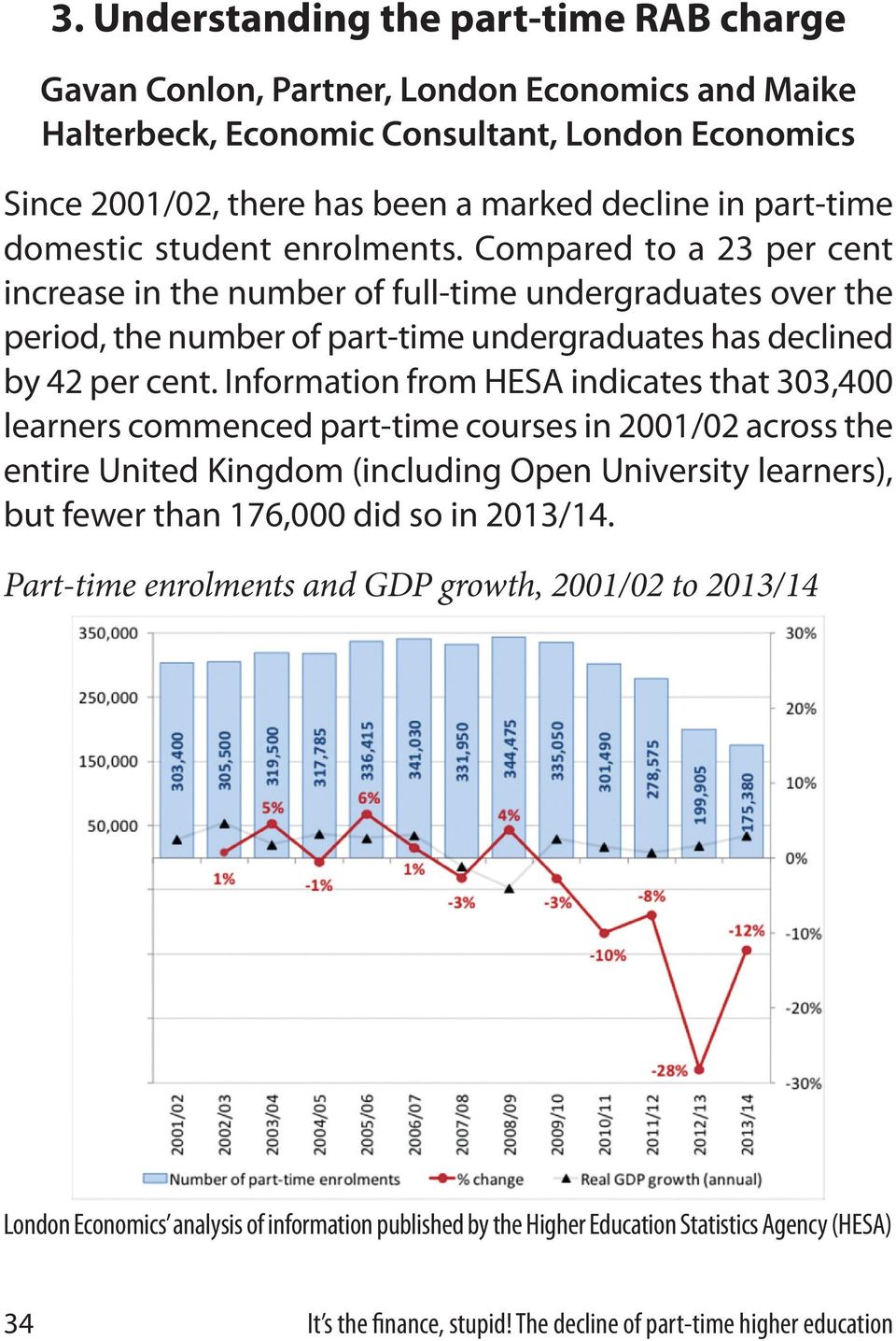
1 3. Understanding the part-time RAB charge Gavan Conlon, Partner, London Economics and Maike Halterbeck, Economic Consultant, London Economics Since 2001/02, there has been a marked decline in part-time domestic student enrolments. Compared to a 23 per cent increase in the number of full-time undergraduates over the period, the number of part-time undergraduates has declined by 42 per cent. Information from HESA indicates that 303,400 learners commenced part-time courses in 2001/02 across the entire United Kingdom (including Open University learners), but fewer than 176,000 did so in 2013/14. Part-time enrolments and GDP growth, 2001/02 to 2013/14 London Economics analysis of information published by the Higher Education Statistics Agency (HESA) 34 It s the finance, stupid! The decline of part-time higher education
2 The decline in part-time enrolments clearly cannot be attributed solely to the 2012 changes to student finance for part-time students. The different personal characteristics of part-time learners, alongside greater price sensitivity, compared to full-time students compound the relative importance of the wider macroeconomy on enrolment decisions. Specifically, there is a lower propensity amongst part-time students to take out student loans and, faced with the many other competing demands on their earnings, their behaviour may be less influenced by changes to student finance arrangements when set aside the wholesale retrenchment occurring in the UK economy since The Resource Accounting and Budgeting Charge (the RAB charge) is the proportion of the nominal face value of the loans that are issued to students that are not expected to be repaid. Using the example of full-time students, if the RAB charge stands at 45 per cent, then this implies that for every 100 in student loans issued, approximately 45 in today's money terms will be written off by the Exchequer. In economic terms, the RAB charge represents the long-term cost to the Exchequer of the student loan system. In a broader sense, for full-time students, the RAB charge underpinned the decision by the Coalition Government to replace the HEFCE Teaching Grant for most disciplines with bigger tuition fee loans. Given the 45 per cent RAB charge, the shift from Teaching Grant to loans resulted in a 55 per cent reduction in the long-term gross cost incurred by the Exchequer. 35
3 Ahead of the substantial savings to be made by unprotected central government departments as part of the 2015 Spending Review, the same rationale has been adopted by the new Conservative Government in relation to the replacement of maintenance grants with larger maintenance loans. Having a higher RAB charge is not necessarily a negative outcome, as it reflects the level of overall public investment in the student body, and is targeted at individuals that are most likely to struggle to repay. It is a progressive system of student support, free at the point of access. The RAB charge is important because it is one of the key pieces of information that is used by policymakers to assess the affordability of potential changes to higher education fees and funding. The higher the expected RAB charge, the more costly a policy, while the lower the expected RAB charge, the more affordable a particular policy. In a period of widespread fiscal constraint, the RAB charge is crucial. The most recent published estimates of the RAB charge produced by the Department for Business, Innovation and Skills suggest that the part-time RAB charge is 65 per cent, compared to the 45 per cent estimate for full-time students. However, this compares to London Economics estimates of a full-time RAB charge of 40 per cent and a part-time RAB charge of zero, which have been in the public domain since 2010 and There are several factors affecting the RAB charge for both part-time and full-time students. These include: the rate of 36 It s the finance, stupid! The decline of part-time higher education
4 repayment; the threshold for repayment; the number of years before which the loan is written off; the interest rate charged; and the size of the loan amount initially drawn upon. Other factors being equal, based on these loan characteristics, the smaller loans taken up by part-time students would suggest that the associated RAB charge for part-time students should be less than for full-time students. The discrepancy between the estimates is driven by graduate earnings assumptions. Given the income-contingent nature of student loans, the higher the level of a graduate s earnings, as well as the higher the growth rate of graduate earnings, the higher the level of repayment and the lower the RAB charge. It might be expected that individuals undertaking a full-time undergraduate degree between the ages of 18 and 21 would experience relatively high earnings growth early in their careers. Although this is typically the case, the fact that graduate earnings are on average below the threshold for a number of years immediately after graduation means that for many graduates, no repayments are made to their outstanding loan balance during their early working lives. In contrast, many part-time students combine work with study, and are already earning in excess of the repayment threshold. As such, when the Statutory Repayment Due Date arrives, part-time students will start making repayments. The higher earnings levels achieved by part-time students and the earlier repayments (which are more valuable to the Exchequer than repayments later in the 30-year repayment period due to 37

5 discounting), combined with the lower initial balance, suggest that the part-time RAB charge should be lower than the full-time equivalent. If this is true, then why is there such a discrepancy between the official estimates of the RAB charge and ours? The main issue is that, unlike estimates of the RAB charge for full-time students, there is no actual information from the Student Loans Company on part-time loan repayments yet, given the relatively recent extension of loans for part-time students. So it is necessary to estimate a future earnings path for part-time students using alternative secondary datasets. This is further complicated by the fact that none of the standard secondary datasets available contain reliable information on graduate earnings by mode of study. Therefore, further assumptions need to made and we will not know the accuracy of the alternative assumptions for a number of years. Until recently, for full-time students, the Department for Business, Innovation and Skills used information on actual graduate repayments to determine graduates position in the earnings distribution, which was then combined with the British Household Panel Survey to calibrate and forecast earnings over graduates working lives (adjusting for employment shocks and time taken out of the labour market). From these forecasts, and the characteristics of the student loan system, an estimate of the level of loan repayment was generated. For part-time students, we understand that a comparable approach was adopted but also incorporated 38 It s the finance, stupid! The decline of part-time higher education

6 information from the Destination of Leavers from Higher Education (DLHE) Survey on immediate post-graduation outcomes. However, documentation on the methodological approach taken for part-time students is more limited. For the 2012/13 cohort of full-time entrants, we used the Quarterly Labour Force Survey between 1996 and 2012, which includes around 11 million observations, to generate an age-earnings profile achieved by undergraduate degree holders. This age-earnings profile is adjusted for the expected level of non-employment (unemployment and economic inactivity) by gender and age band. Age-earnings profile for full-time and part-time undergraduates Earnings are augmented by the long-term expected real earnings growth rate (because a 21-year old will earn more in nine years time than a 30-year-old today). 39

7 In the base case, we assume that a part-time student who achieves their undergraduate degree by the age of 39 (and takes six years to do so) has similar earnings to a 39-year-old individual who achieved their degree on a full-time basis (profile A). Under this set of assumptions, the estimate of the part-time RAB charge stands at -7 per cent, implying that part-time loans actually generate revenue for the Exchequer. However, it is more likely that an individual undertaking a degree achieves an earnings profile comparable to profile B, where, rather than achieving the full graduate earnings premium, only a proportion is captured. To mimic this, it is possible to penalise part-time graduates in the labour market by imposing a wage penalty for example, by assuming that a 39-year old parttime student achieves comparable earnings to a 36 or 33-year old full-time graduate, as shown by the coloured dots in the chart. Under these assumptions, the part-time RAB charge estimate stands at 2.5 per cent and 13.5 per cent respectively still a small fraction of the full-time estimate. Clearly, the socioeconomic characteristics of part-time students are different from traditional full-time students. The higher incidence of employment during the period of learning, combined with the lower loan balance and early repayment, all suggest a lower part-time RAB charge. This implies that the funding of part-time students is approximately cost neutral to the Exchequer over the long run, as with the forthcoming postgraduate loans. Furthermore, 40 It s the finance, stupid! The decline of part-time higher education
8 because of the smaller loan balances, there is significantly less exposure (and risk) to the Exchequer in relation to the parttime student loan book than for the full-time one. Given the big decline in part-time participation over the last decade, and the negative economic and social impact of the decline, our economic analysis suggests that more could be done to assist and support part-time undergraduate provision. Part-time graduates make a key contribution to economic growth. Rather than waiting for an economic recovery to justify improvements to the financial support on offer for part-time students, investment in human capital now could help secure the recovery. Learners who study at a lower intensity than full-time students, for whatever reason, are part of the solution not part of the problem. 41
REACHING HIGHER REFORMING STUDENT LOANS TO BROADEN ACCESS TO POSTGRADUATE STUDY BRIEFING. Rick Muir October 2014 IPPR 2014
 BRIEFING REACHING HIGHER REFORMING STUDENT LOANS TO BROADEN ACCESS TO POSTGRADUATE STUDY Rick Muir October 2014 IPPR 2014 Institute for Public Policy Research ABOUT IPPR IPPR, the Institute for Public
The Returns to Higher Education Qualifications
 BIS RESEARCH PAPER NUMBER 45 The Returns to Higher Education Qualifications JUNE 2011 1 Report prepared by London Economics on behalf of the Department for Business, Innovation and Skills About London
HELP Interest Rate Options: Equity and Costs
 HELP Interest Rate Options: Equity and Costs Bruce Chapman and Timothy Higgins July 2014 Abstract This document presents analysis and discussion of the implications of bond indexation on HELP debt. This
Social work education in England 2009-2014
 Social work education in England 2009-2014 A report for the Department of Health (DH) March 2015 Produced by Skills for Care for the Department of Health Contents Introduction 3 1. Enrolments 4 Interim
Estimating the public cost of student loans
 Estimating the public cost of student loans IFS Report R94 Claire Crawford Rowena Crawford Wenchao Jin Estimating the Public Cost of Student Loans Claire Crawford Institute for Fiscal Studies and University
Careers Advisory Service
 Careers Advisory Service Annual Report 2012/13 First Destination Statistics Careers Advisory Service 2 nd Floor, 7-9 South Leinster Street The University of Dublin, Trinity College Dublin 2 Tel: 01-8961721/1705
HIGHER TUITION FEES AND REAL INTEREST TO HIT MIDDLE EARNERS
 HIGHER TUITION FEES AND REAL INTEREST TO HIT MIDDLE EARNERS SUMMARY Raising the student fee cap to 7,000 per year would cost the government up to 1.3bn per year under current arrangements. This is unaffordable
Economic impacts of expanding the National Insurance Contributions holiday scheme Federation of Small Businesses policy paper
 Economic impacts of expanding the National Insurance Contributions holiday scheme Federation of Small Businesses policy paper Overview This research paper sets out estimates for the economic and employment
Higher Degrees: Postgraduate Study in the UK 2000/01 to 2005/06. Jane Artess, Charlie Ball and Pearl Mok Higher Education Careers Service Unit (HECSU)
 Higher Degrees: Postgraduate Study in the UK 2000/01 to 2005/06 Jane Artess, Charlie Ball and Pearl Mok Higher Education Careers Service Unit (HECSU) DIUS Research Report 08 16 Higher Degrees: Postgraduate
Higher Education. Consultation on Support for Postgraduate Study MARCH 2015
 Higher Education Consultation on Support for Postgraduate Study MARCH 2015 Content 1. Executive Summary... 5 2. About the Consultation... 6 2.1 How to respond... 6 2.2 Confidentiality & data protection...
It s the finance, stupid! The decline of part-time higher education and what to do about it
 It s the finance, stupid! The decline of part-time higher education and what to do about it Edited by Nick Hillman This book has been kindly supported by The Open University. It s the finance, stupid!
The impact on the UK economy of a reduction in fuel duty
 The impact on the UK economy of a reduction in fuel duty Report for Fair Fuel UK March 2012 Centre for Economics and Business Research Ltd. Unit 1, 4 Bath Street, London EC1V 9DX t: 020 7324 2850 f: 020
 The Credit Card Report May 4 The Credit Card Report May 4 Contents Visa makes no representations or warranties about the accuracy or suitability of the information or advice provided. You use the information
BIS RESEARCH PAPER NO. 112 THE IMPACT OF UNIVERSITY DEGREES ON THE LIFECYCLE OF EARNINGS: SOME FURTHER ANALYSIS
 BIS RESEARCH PAPER NO. 112 THE IMPACT OF UNIVERSITY DEGREES ON THE LIFECYCLE OF EARNINGS: SOME FURTHER ANALYSIS AUGUST 2013 1 THE IMPACT OF UNIVERSITY DEGREES ON THE LIFECYCLE OF EARNINGS: SOME FURTHER
The Career Paths of Physics Graduates A longitudinal study 2006 2010
 The Career Paths of Physics Graduates A longitudinal study 2006 2010 1 Acknowledgments The Institute would like to thank the research team at the Centre for Education and Industry (CEI) at the University
Policy note. Enrolments, funding and student staff ratios by sector. Number 2 December 2011. Enrolments and institutions by sector
 Policy note Number 2 December 2011 This briefing examines government and private funding across educational sectors. Key findings include: Differences in funding for public and private education across
Student Funding Panel. An analysis of the design, impact and options for reform of the student fees and loans system in England
 Student Funding Panel An analysis of the design, impact and options for reform of the student fees and loans system in England Contents Foreword 1 Executive summary 3 Introduction 3 The funding context
The value of apprenticeships: Beyond wages
 The value of apprenticeships: Beyond wages NIDA BROUGHTON June 2016 There is strong political commitment to the apprenticeships programme as a part of the strategy to achieve a high quality workforce that
SIES - Comparisons between Scotland and England - Summary
 SIES - Comparisons between Scotland and England - Summary To begin, it is necessary to state the key features of the funding systems in each country at the time of the survey: Key features of the Scottish
Research Briefing. The Best and the Brightest EU students at UK universities and as highly skilled graduate workers in the UK
 Research Briefing The Best and the Brightest EU students at UK universities and as highly skilled graduate workers in the UK Academic performance and labour market outcomes of EU domiciled students in
GLOSSARY OF TREASURY TERMS
 GLOSSARY OF TREASURY TERMS Authorised Limit (Also known as the Affordable Limit): A statutory limit that sets the maximum level of external borrowing on a gross basis (i.e. not net of investments) for
The changing finances of students studying in London: Evidence from the 2002/03 Student Income and Expenditure Survey
 The changing finances of students studying in London: Evidence from the 2002/03 Student Income and Expenditure Survey By Prof Claire Callender London South Bank University for the Mayor of London March
Principles and Trade-Offs when Making Issuance Choices in the UK
 Please cite this paper as: OECD (2011), Principles and Trade-Offs when Making Issuance Choices in the UK, OECD Working Papers on Sovereign Borrowing and Public Debt Management, No. 2, OECD Publishing.
Value of student maintenance support
 Value of student maintenance support Standard Note: SN/SG/916 Last updated: 24 March 2014 Author: Paul Bolton Section Social & General Statistics Recent changes in maintenance support Maintenance grants,
THE WELSH GOVERNMENT. Loan, Grant and Fee Rates for Full and Part-Time Higher Education Study in Academic Year 2014/15
 To: Local Authorities in Wales (For the attention of Student Finance Officers). Higher Education Institutions in Wales providing designated Higher Education courses. Further Education Institutions in Wales
Scotland s Class of 99: the early career paths of graduates who studied in Scottish higher education institutions. Summary report
 Scotland s Class of 99: the early career paths of graduates who studied in Scottish higher education institutions Summary report Scotland s Class of 99: the early career paths of graduates who studied
Degree Outcomes for University of Reading Students
 Report 1 Degree Outcomes for University of Reading Students Summary report derived from Jewell, Sarah (2008) Human Capital Acquisition and Labour Market Outcomes in UK Higher Education University of Reading
. In this case the leakage effect of tax increases is mitigated because some of the reduction in disposable income would have otherwise been saved.
 Chapter 4 Review Questions. Explain how an increase in government spending and an equal increase in lump sum taxes can generate an increase in equilibrium output. Under what conditions will a balanced
A Report on UNSOLICITED CREDIT CARD LIMIT INCREASE OFFERS
 A Report on UNSOLICITED CREDIT CARD LIMIT INCREASE OFFERS Reference No. 18372 July 2009 Table of Contents Executive Summary... 2 Background... 5 Methodology... 9 Questionnaire Structure...11 Reading this
Budget 2015/16: Implications for Undergraduate Student Support
 Research and Information Service Paper 123/14 20 November 2014 NIAR 763-2014 Eóin Murphy Budget 2015/16: Implications for Undergraduate Student Support 1 Introduction The following paper discusses the
UK application rates by country, region, constituency, sex, age and background. (2015 cycle, January deadline)
 UK application rates by country, region, constituency, sex, age and background () UCAS Analysis and Research 30 January 2015 Key findings JANUARY DEADLINE APPLICATION RATES PROVIDE THE FIRST RELIABLE INDICATION
What Do Masters Graduates Do? 2007
 What Do Masters Graduates Do? 2007 Overview The Higher Education Careers Service Unit (HECSU) produces an annual web-based resource, looking at postgraduate destinations, What Do Postgraduates Do? The
First Release SLC SFR 03/2005. 29 November 2005 REVISED. Coverage: United Kingdom. Theme: Education and Training
 First Release SLC SFR 03/2005 29 November 2005 REVISED Coverage: United Kingdom Theme: Education and Training STUDENT SUPPORT FOR HIGHER EDUCATION IN ENGLAND AND WALES, ACADEMIC YEAR 2005/06 (PROVISIONAL)
Reporting tool user guide
 Outcome reports: Pass rates in postgraduate examinations Reporting tool user guide March 2015 Contents Introduction... 2 Using the reports... 3 Entering the online data tool: Understanding the reports...
How To Understand The Economic Benefits Of An Sflg Loan
 ECONOMIC EVALUATION OF THE SMALL FIRMS LOAN GUARANTEE (SFLG) SCHEME Marc Cowling INSTITUTE FOR EMPLOYMENT STUDIES JANUARY 2010 URN 10/512 Acknowledgements The author would like to thank Gemma Bird and
Consultation on part-time and postgraduate student finance
 Consultation on part-time and postgraduate student finance CONTENTS Foreword from the Minister for Employment and Learning... 2 Executive Summary... 4 1. About the Consultation 1.1. How to Respond... 7
An Evaluation of the Possible
 An Evaluation of the Possible Macroeconomic Impact of the Income Tax Reduction in Malta Article published in the Quarterly Review 2015:2, pp. 41-47 BOX 4: AN EVALUATION OF THE POSSIBLE MACROECONOMIC IMPACT
UNIVERSITY WORKS. 2014 employment report
 UNIVERSITY WORKS 2014 employment report Empirical data shows Ontario university graduates have the best labour market outcomes. A university education leads to success. UNIVERSITY grads get jobs University
An international comparison of apprentice pay: Executive Summary. Low Pay Commission
 An international comparison of apprentice pay: Low Pay Commission October 2013 About is one of Europe's leading specialist economics and policy consultancies and has its head office in London. We also
Financial capability and saving: Evidence from the British Household Panel Survey
 CRS02 NOVEMBER 2010 Financial capability and saving: Evidence from the British Household Panel Survey About the Consumer Financial Education Body The Consumer Financial Education Body (CFEB) is an independent
Charter for Budget Responsibility: Autumn Statement 2014 update
 Charter for Budget Responsibility: Autumn Statement 2014 update December 2014 Charter for Budget Responsibility: Autumn Statement 2014 update Presented to Parliament pursuant to Section 1 of the Budget
Level 1/2/3 Award in Business Finance (8990)
 Level 1/2/3 Award in Business Finance (8990) Qualification handbook 500/4376/6 Level 1 500/4377/8 Level 2 500/4306/7 Level 3 www.cityandguilds.com May 2009 Version 2.0 About City & Guilds City & Guilds
Student Loan Scheme Publicly Available Accountability Information. 23 June 2000
 Student Loan Scheme Publicly Available Accountability Information 23 June 2000 2 Contents 1 Introduction 5 The Student Loan Scheme 5 Key Stakeholders 6 Stakeholder Information Requirements 6 Key Findings
Thinking about university?
 Thinking about university? Commonwealth supported places 2016 How to pay for your uni degree www.studyassist.gov.au printed January 2016 Do I need to pay upfront? No. If you are an eligible student, you
Higher Education Student Support in Scotland 2014-15
 Higher Education Student Support in Scotland 2014-15 Statistical summary of financial support provided to students by the Student Awards Agency for Scotland in academic session 2014-15 October 2015 A National
Effective Federal Income Tax Rates Faced By Small Businesses in the United States
 Effective Federal Income Tax Rates Faced By Small Businesses in the United States by Quantria Strategies, LLC Cheverly, MD 20785 for Under contract number SBAHQ-07-Q-0012 Release Date: April 2009 This
The central question: Does the bankruptcy process make sure that firms in bankruptcy are inefficient, and that inefficient firms end up in bankruptcy?
 Bankruptcy White (1989) Bankruptcy the closing down of firms that are inefficient, use outdated technologies, or produce products that are in excess supply. The central question: Does the bankruptcy process
Frequently asked questions about Student Finance from September 2012
 Frequently asked questions about Student Finance from September 2012 Who is this document for? Unless otherwise specified, details of the student finance package described in this document relate only
Contents... 2. Executive Summary... 5. Key Findings... 5. Use of Credit... 5. Debt and savings... 6. Financial difficulty... 7. Background...
 CREDIT, DEBT AND FINANCIAL DIFFICULTY IN BRITAIN, A report using data from the YouGov DebtTrack survey JUNE 2013 Contents Contents... 2 Executive Summary... 5 Key Findings... 5 Use of Credit... 5 Debt
PATTERNS AND TRENDS IN UK HIGHER EDUCATION. In collaboration with
 PATTERNS AND TRENDS 214 IN UK HIGHER EDUCATION In collaboration with Contents LIST OF FIGURES AND TABLES 1 FOREWORD 2 INTRODUCTION 3 1. STUDENTS 4 1.1 Higher education students in the UK 5 1.2 The total
THE NATIONAL MINIMUM WAGE
 SUBMISSION FROM BRITISH HOSPITALITY ASSOCIATION, BRITISH BEER AND PUB ASSOCIATION, BUSINESS IN LEISURE and ASSOCIATION OF LICENSED MULTIPLE RETAILERS TO THE LOW PAY COMMISSION ON THE NATIONAL MINIMUM WAGE
How To Support Students From Scotland Academy Of Arts
 Higher Education Student Support in Scotland 2013-14 Statistical summary of financial support provided to students by the Student Awards Agency for Scotland in academic session 2013-14 October 2014 A National
consultation response
 consultation response Department for Education - Government proposals to reform vocational qualifications for 16-19 year olds Introduction UCAS is the UK s provider of admissions services for higher education
3.1 Undergraduate Awards Framework and course structure principles
 3.1 Undergraduate Awards Framework and course structure principles Undergraduate Awards Framework, incorporating Preparatory awards Awards and awards descriptors CATS points FHEQ Level Preparatory Certificate
4. Work and retirement
 4. Work and retirement James Banks Institute for Fiscal Studies and University College London María Casanova Institute for Fiscal Studies and University College London Amongst other things, the analysis
Current and Proposed Higher Education Student Finance Arrangements in the UK Regions
 Research and Information Service 13 th May 2011 Eoin Murphy Current and Proposed Higher Education Student Finance Arrangements in the UK Regions NIAR 435-2010 This paper examines the existing Higher Education
Impact of the recession
 Regional Trends 43 21/11 Impact of the recession By Cecilia Campos, Alistair Dent, Robert Fry and Alice Reid, Office for National Statistics Abstract This report looks at the impact that the most recent
Quality Handbook. Part D: Regulations. Section 16A: Common Assessment Regulations for Bachelor s and Integrated Master s degrees.
 Nottingham Trent University Quality Handbook Part D: Regulations Section 16: Common ssessment Regulations for Bachelor s and Integrated Master s degrees Contents 1. Principles behind the regulations...
Student Loan Market Trends Is College Worth It. Presenter: Kelly Savoie, Director Business Development April 2016
 Student Loan Market Trends Is College Worth It Presenter: Kelly Savoie, Director Business Development April 2016 Agenda This presentation is an overview of trends in the industry and the value of a college
Can DC members afford to ignore inflation?
 May 2013 Can DC members afford to ignore inflation? Mark Humphreys, Head of UK Strategic Solutions, Schroders Introduction Around 95% of individuals are forgoing inflation protection for their retirement
Discussion. 1. Bill Allen
 Discussion 1. Bill Allen This paper targets a worthy area for investigation in seeking to add to the story behind why some small businesses fail and others do not. In acknowledging that small businesses
Strategy Paper: Financial Planning for Generation-Y. SMSF Specialists Investment Management Financial Planning Accounting
 Strategy Paper: 190 Through Road Camberwell VIC 3124 T: (03) 9809 1221 F: (03) 9809 2055 [email protected] www.gfmwealth.com.au ABN 69 006 679 394 Financial Planning for Generation-Y SMSF Specialists
An IRA can put you in control of your retirement, whether you
 IRAs: Powering Your Retirement One of the most effective ways to build and manage funds to help you meet your financial goals is through an Individual Retirement Account (IRA). An IRA can put you in control
Quality Handbook. Part D: Regulations. Section 16c: Taught postgraduate courses. Section16c. Nottingham Trent University
 Nottingham Trent University Quality Handbook Part D: Regulations Section 16c: Taught postgraduate courses Contents Preface... 4 1. Scope of the regulations... 5 2. Changes to the regulations... 5 3. Consultation...
Credit Card Market Study Interim Report: Annex 4 Switching Analysis
 MS14/6.2: Annex 4 Market Study Interim Report: Annex 4 November 2015 This annex describes data analysis we carried out to improve our understanding of switching and shopping around behaviour in the UK