
Automatic Control and User Interface for Central Tire Inflation System
|
|
|
- Wesley Willis
- 9 years ago
- Views:
Transcription
1 Automatic Control and User Interface for Central Tire Inflation System Björgvin Rúnar Þórhallsson Thesis of 30 ETCS credits Master of Science in Electrical Engineering 7. May 2015
2
3 Automatic Control and User Interface for Central Tire Inflation System Björgvin Rúnar Þórhallsson Thesis of 30 ECTS credits submitted to the School of Science and Engineering at Reykjavík University in partial fulfillment of the requirements for the degree of Master of Science in Electrical Engineering 7. May 2015 Supervisor: Baldur Þorgilsson, Supervisor Adjunct, Reykjavik University Examiners: Indriði Sævar Ríkharðsson, Examiner Lector, Reykjavik University Guðni Ingimarsson, Examiner Engineer, Össur hf.
4 Copyright Björgvin Rúnar Þórhallsson 7. May 2015
5 Automatic Control and User Interface for Central Tire Inflation System Björgvin Rúnar Þórhallsson Student: 30 ECTS thesis submitted to the School of Science and Engineering at Reykjavík University in partial fulfillment of the requirements for the degree of Master of Science in Electrical Engineering. 7. May 2015 Björgvin Rúnar Þórhallsson Supervisor: Baldur Þorgilsson Examiners: Indriði Sævar Ríkharðsson Guðni Ingimarsson
6 The undersigned hereby grants permission to the Reykjavík University Library to reproduce single copies of this project report entitled Automatic Control and User Interface for Central Tire Inflation System and to lend or sell such copies for private, scholarly or scientific research purposes only. The author reserves all other publication and other rights in association with the copyright in the project report, and except as herein before provided, neither the project report nor any substantial portion thereof may be printed or otherwise reproduced in any material form whatsoever without the author s prior written permission. Date Björgvin Rúnar Þórhallsson Master of Science
7 Automatic Control and User Interface for Central Tire Inflation System Björgvin Rúnar Þórhallsson 7. May 2015 Abstract The aim of this study was to compile a list of requirements for the automatic control system and user interface part of central tire inflation system (CTIS) specialized for off road snow driving conditions in Iceland. Furthermore to design and build a prototype that fulfils all requirements. CTIS enables the driver of a vehicle to adjust the tire pressure while the vehicle is moving. It can reduce the risk of damaging tires because of over deflated tires, increase average travelling speed and reduce fuel consumption. Manual CTI systems have been used in Iceland for snow driving purposes in modified 4x4 vehicles and are getting more popular. Commercial automatic solutions exists but none fulfils the requirements of Icelandic drivers of snow driving vehicles. Solutions that are aimed to fulfil this market gap are currently being developed in Iceland. Experienced people within the field of modified 4x4 vehicles in Iceland were interviewed to collect opinions about requirements for the system. Experiments were conducted on realistic setups of pneumatic systems to analyse and model the system as steps toward fulfilling requirements. The designed and build prototype fulfils 12 out of 18 requirements defined for the system, more experiments are needed to confirm four and implementation towards two requirements were not finished. The list of requirements coming out of this study is the first one compiled for Icelandic snow driving conditions. It is believed that it will be a cornerstone in the discussion and development for automatic control systems in Iceland in the coming years.
8 Sjálfstýring og notandaviðmót fyrir miðlægan úrhleypibúnað við íslenskar aðstæður Björgvin Rúnar Þórhallsson 4. maí 2015 Útdráttur Markmið þessa verkefnis var annars vegar að komast að þeim kröfum sem notandaviðmót og sjálfstýring fyrir úthleypibúnaði í íslenska fjallajeppa þarf að uppfylla. Jafnframt var markmiðið að hanna og smíða sjálfstýringu og notandaviðmót sem uppfyllir allar kröfur. Úrhleypibúnaður gerir ökumanni kleift að stilla loftþrýsting í dekkjum á meðan á akstri setendur. Slíkur búnaður getur dregið úr hættu á dekkjaskemmdum af völdum aksturs á of úrhleyptu dekki, aukið meðal ferðahraða í snjó og dregið úr eldsneytiseyðslu. Notkun á úrhleypibúnaði í fjallajeppum á Íslandi er að aukast mikið en hingað til hefur þessi búnaður verið nær eingöngu handstýrður. Til eru sjálfstýrilausnir á markaði en engin uppfyllir kröfur íslenskra jeppamanna. Sjálfstýrilausnir sem ætlaðar eru fyrir snjó akstur eru nú þegar í þróun hér á landi. Rætt var við fólk sem tengist íslenskum fjallajeppum og skoðunum þeirra varðandi kröfur fyrir úrhleypibúnað safnað saman. Tilraunir voru framkvæmdar á raunverulegum úrhleypibúnaði þar sem eiginleikar kerfisins voru fundnir sem skref í þá átt að uppfylla kröfur kerfisins. Sú frumgerð sem hönnuð og smíðuð var í verkefninu uppfyllir 12 af þeim 18 skilyrðum sem sett voru fram. Ekki náðist að framkvæma tilraunir sem sýna fram á að fjögur af þessum fimm skilyrðum eru uppfyllt og ekki náðist að klára lausn á tveimur skilyrðum. Kröfulistinn sem settur var saman í verkefninu er sá fyrsti sem gerður hefur verið fyrir íslenskar snjóaðstæður. Höfundur telur víst að listinn muni verða miðpunktur umræðu og þróunar á sjálfstýringum og notandaviðmótum fyrir úrhleypibúnað á næstu árum.
9 v Contents List of Figures List of Tables viii xii 1 Introduction Modifications, for off-road snow driving Off-road snow driving Central tire inflation system Controlling the CTIS Aim and structure of the thesis 9 3 Requirements System s tire pressure total error band Setpoint pressure range Measure tire pressure relative to ambient pressure Adjustable setpoint Number of tire pressure setpoints Setpoint resolution Control constraints Real time requirements Stability Number of channels Isolated channels Indication of leakage Displaying tire pressure measurements Adjustable user interface screen brightness User interface dimensional limitations Simplicity of the user interface
10 vi 3.17 Pneumatic tank pressure sensor Temperature Design of a prototype Pneumatic system The pneumatic configuration Tire pressure sensor Over pressure protection Design options Tank pressure sensor Experimental setup User interface Screen brightness adjustments The user interface case User inputs Variables to display Processing unit and communications Scheduling Software The control model Fulfilling control constraints requirement Isolated or interconnected channels Stability Automatic tire pressure sensor offset calibration Control states Background tasks Electronic design Control unit printed circuit board User interface extension cable User interface circuit Bill of materials Design summary Future work Necessary improvements on the current prototype Future extensions to the system Future research suggestion Experiments 75
11 vii 5.1 Inflation and deflation analysis Analysing tire deflation Analysing tire inflation Pressure settling time and response time Pressure disturbance form driving Worst case latency Overall performance of the system Results Deflation analysis Inflation analysis " MTZ Mickey Thompson tire " Baja Claw Mickey Thompson tire /65R15 tire Maximum pressure change rate Pressure settling time and response time Pressure disturbances form driving Worst case latency Overall performance of the system Comparison of valve configurations Model parameters Overshoots Discussion The aim The requirements The prototype Future research suggestion Impact Conclusion 111 A Schematics 117 B Programming code for the microcontroller 121
12 viii
13 ix List of Figures 1.1 The first four wheel drive vehicle imported to Iceland Footprint experiment done by the company Arctic Trucks Deflated Mickey Thompson tires on the Vatnajökull glacier, These tires have 38 diameter and are commonly used under modified vehicles for snow driving in Iceland Cross section of a wheel hub with gear reduction Externally connected tube with a rotational joint at the centre of the wheel The overall system and the scope of this project The over all system is shown and possible location of each part of the system Design flow describing possible design paths of various parts of the system The 2N valve configuration with 2/2 way valves The 2N valve configuration with 3/3 way valves The N+2 valve configuration Total error band of the Trafag ECT2.5A pressure sensor Temperature error band for both MPX4250 and MPX5050 pressure sensors Comparison of design options for valve and pressure sensor configurations An implementation of the N+2 configuration Connection between the rubber tube and the wheels in the pneumatic system experimental setup The user interface and processing unit of the industrial solution LCD screen brightness adjustment circuit The first two prototypes of the user interface Third and current version of the user interface The user interface screen layout Location of the components that needs to interact with the processing unit Control loop latency
14 x 4.17 Block diagram of the tire pressure control system System stability Control state chart Non linear translation of raw ADC values to setpoint pressure The screen layout in front tire offset adjustment mode The layout of the printed circuit board in the control unit Fully build printed circuit board in the control unit The circuit driving the inductors of the pneumatic valves Pneumatic setup in the overall performance test Deflation results for the 38" MT and the 46" MT tires Deflation results for the 195/65R15 tire Logarithmic plot of the tire pressure during deflation of a 38" MT and 46" MT tires Logarithmic plot of the tire pressure for 195/65R15 tire Simplified model of the pneumatic system Inflation processes for the 38" MTZ Mickey Thompson tire Inflation processes for the 46" Baja Claw Mickey Thompson tire Inflation process for a 195/65R15 tire with different supply pressures Response and settling time experimental results Pressure disturbances in a tire during a drive on a bumpy gravel road Pressure disturbances in a tire during a drive on a paved road Delay histogram for the function: background tasks Delay histogram for the function: printing tank pressure Deflation from 5 to 2 psi of four 44" DC tires, connected to the N+2 valve configuration with interconnected channels Deflation from 5 to 2 psi of four 44" DC tires, connected to the N+2 valve configuration with isolated channels Deflation from 5 to 2 psi of one 44" DC tire, connected to the 2N valve configuration Inflation from 2 to 5 psi of four 44" DC tires, connected to the N+2 valve configuration with interconnected channels Inflation from 2 to 5 psi of four 44" DC tires, connected to the N+2 valve configuration with isolated channels Inflation from 2 to 5 psi of four 44" DC tires, connected to the 2N valve configuration A.1 Schematics for the control unit circuit
15 A.2 Schematics for the user interface circuit xi
16 xii
17 xiii List of Tables 2.1 Connections between requirements, experiments and implementations Setpoint resolution requirements Stability test Dimensional requirement for the user interface Operating and storage temperature range for the system components depending on location Comparison of three possible tire pressure sensors Considered design options for a the valve and pressure sensor configuration Pneumatic part numbers Specifications for MPX5700 pressure sensor Requirements related to the user interface Pin specification of the components that interact with the processing unit I/O pin requirement for the processing unit Comparison of the best accuracy and the ADC resolution for the three pressure sensors Communication options Channel interconnections or isolation depending on the front axle offset and the state of interconnected/isolated channels Status LED The main components of the control unit printed circuit board Bill of materials for the prototype Fulfilment of requirements The tires and vehicles used for the inflation and deflation experiments Pressure disturbance experiments An overview of the six experiments conducted in the overall performance test
18 xiv 6.1 Deflation curve fitting results for the three tires Comparisons of measured and calculated time constants for deflation Fit results for the inflation process for the 38" MTZ Mickey Thompson tire Fit results for the inflation process for the 46" Baja Claw Mickey Thompson tire Fit results for the inflation process for the 195/65R15 tire Pressure change rates for a 38" tire The response times of the components in the chain of reaction of valve activation Statistical summary for the worst case latency experiments Comparison of three valve configurations Statistical results for the automatic control parameter updating experiment. 105
19 1 Chapter 1 Introduction Figure 1.1: The first four wheel drive vehicle imported to Iceland called FWD. (Source: [2].) The first 4x4 vehicle in Iceland was a truck called FWD, manufactured by the Four Wheel Drive Auto Company, seen in Fig It was imported in 1927 by the Icelandic Road Administration, mainly for snow plowing. It turned out to be very useful at that time for road construction and other work [1]. The next 4x4 vehicles imported to Iceland came with the United States Army in July Before arriving, the army knew that travelling around Iceland could be difficult so they brought a lot of small 4x4 vehicles. Soon after the vehicles were imported, Icelanders noticed how much the vehicles improved mobility in Iceland. During the war, some vehicles were lent to Icelandic people and after the war the army sold most of them to Icelanders instead of transporting them back. These were the first 4x4 vehicles owned by the public in Iceland and they proved to be revolution in transportation [1].
20 2 Automatic control and user interface for CTIS Ever since then, 4x4 vehicles have been important part of transportations in the highlands of Iceland. Today during the summer time a big part of the highlands is accessible to unmodified 4x4 vehicles. However, in the winter time the area is only accessible to 4x4 vehicles that are modified for snow driving because of high snow levels and frequent bad weather conditions. Data shows that snow depth is on average 28 times deeper at Hveravellir than in Reykjavík 1. During the winter it is popular to travel off-road in the highlands and on glaciers. Even though off-road driving in Iceland is in general forbidden it is allowed to drive on frozen soil covered in snow and on glaciers [3]. Lifted and modified 4x4 vehicles increase the mobility in the highlands of Iceland and enable winter travelling in these areas. Modified 4x4 vehicles are mostly privately owned and are used for travelling. Rescue teams, tourist companies and electric maintenance crews also use them to reach the highlands in all seasons Modifications, for off-road snow driving Modifications of 4x4 vehicles for snow driving consists of changes to many parts of the vehicle. Most visible are the bigger tires and added wheel fenders. Suspension is a very important part and is in some cases rebuilt to make it stronger and increase the suspension travel. Lower differential gear ratios and differential locks are added to further increase the mobility and the steering strengthened as well to handle bigger tires. Stronger axles are sometimes added as well. The first attempts to modify and add bigger tires to a 4x4 vehicle in Iceland was around 1970 [4]. Since then, a lot of experience in modification of 4x4 vehicles has been gained over the years in Iceland. This knowledge is now being exported throughout the world, mainly by the company Arctic Trucks in the form of modification solutions and conducting expeditions in the Antarctica Off-road snow driving A key factor in successful off-road snow driving is low ground touching pressure 2, sometimes called contact pressure, between the tiers and the ground. Lower ground touching 1 The weather station at Hveravellir is located in the highlands of Iceland, about 650 m over sea level. The data covers the time range from January 1990 to May Data provider: Icelandic Meteorological Office. Available under "Veðurmælingar á Íslandi" at 2 Pressure is force (or weight) divided by area.
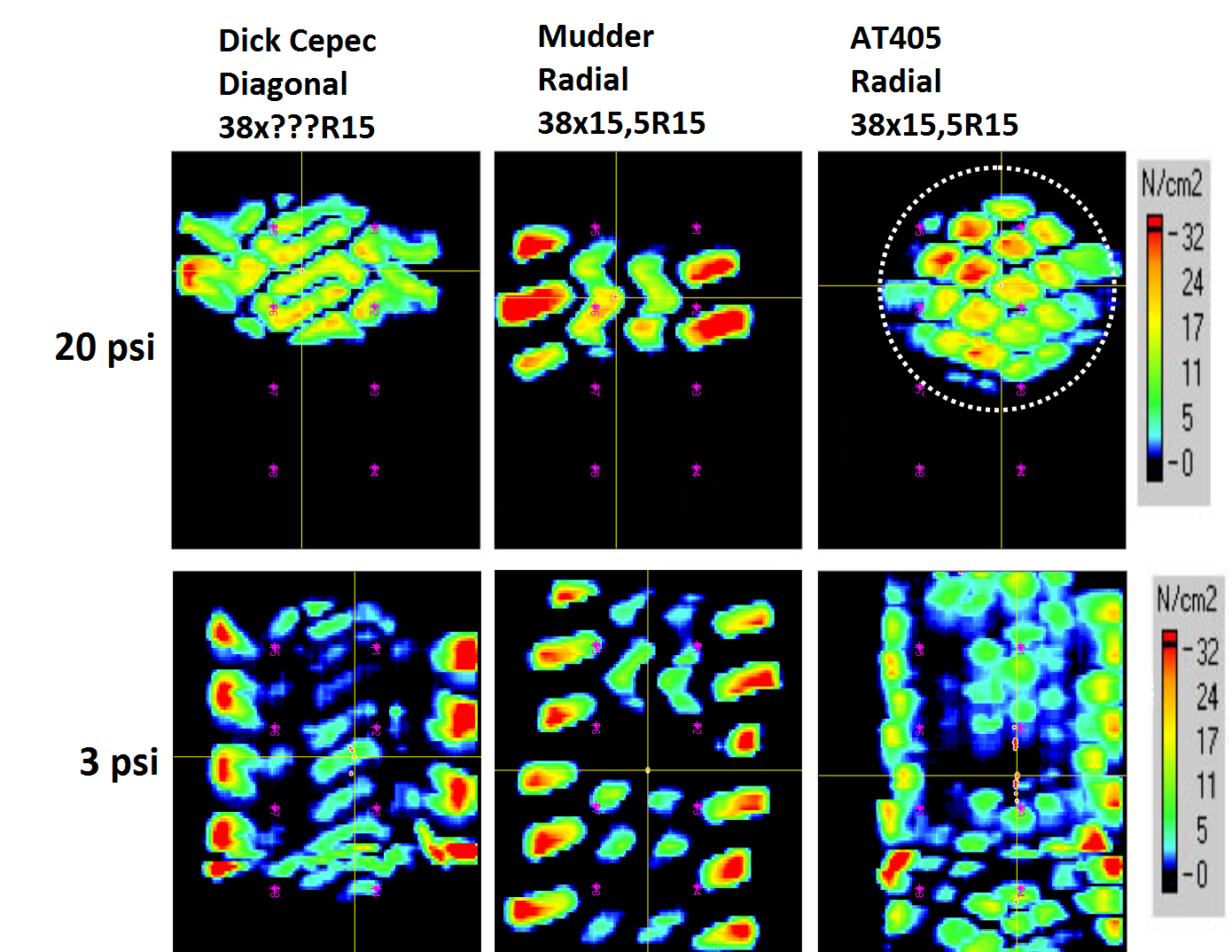
21 Björgvin Rúnar Þórhallsson 3 Figure 1.2: Results from an experiment conducted by the company Arctic Trucks. The figure shows three different tires at two pressure levels on a forceplate. The footprint of the tires increases when deflated from 20psi to 3psi. These tires are good examples of common tires used under 4x4 vehicles in Iceland for snow driving. (Source: [5].) pressure allows the vehicle to float on top of the snow witch improves mobility. There are three ways to decease the contact pressure. First, increase the size of the tires. Bigger tires have larger ground touching surface that decreases the ground pressure. Second, lightening the car. Third, deflate the tires, as seen in Fig 1.3. This makes the tire deform and increase its ground touching surface. Kaczmarek showed that by deflating a 12:00-18 bias ply tire on a ZIL-157 military truck from 50 to 10psi the net footprint more than doubled [6]. That results in better mobility in soft ground conditions such as sand, soil and snow [7][8]. The company Arctic Truck showed that for three different 4x4 vehicle tires the ground touching surface increased dramatically by reducing the tire pressure from 20 to 3 psi [5]. This can be seen in Fig Deflating big 4x4 vehicle s tires is an essential part of being able to travel in challenging snow conditions. A common tire pressure range for typical off-road snow driving condi-
22 4 Automatic control and user interface for CTIS Figure 1.3: Deflated Mickey Thompson tires on the Vatnajökull glacier, These tires have 38 diameter and are commonly used under modified vehicles for snow driving in Iceland. tions 3 is from 2 to 8 psi. In special cases where conditions are extremely difficult and big tires are being used the tire pressure can go as low as 1 psi or even less. However driving on deflated tire generate heat in the rubber. The heat generation depends on the driving speed and the level of deflation. Cooling is very important to prevent damage and is done by the surrounding snow. The conventional procedure of inflating 4 and deflating tires on 4x4 vehicles in the highlands of Iceland is done manually by the driver and individually for each tire. The driver has to stop the vehicle and perform the operation by hand. This is time consuming and a slow process. Normally people try to minimize the number of pressure readjustments during travelling because it is a slow process. That usually means driving for a long time with very low tire pressure that limits the maximum driving speed due to heat generation. The reason for this low tire pressure is that the toughest part of the trail defines the tire pressure. 3 Normal snow driving conditions will in this study be defined as cm deep snow where driving speed is from 10 to 50 km/h. 4 Most 4x4 vehicles that travel Iceland s highlands carry an air pump.
23 Björgvin Rúnar Þórhallsson Central tire inflation system Figure 1.4: The figure shows cross section of a wheel hub like the Hummer H1. The blue path indicate the pressure tube from the valve control unit to the tire. The purple indicate the reduction gears. The lower gear turns a short final axle which the wheel is attached to. This final gear is not explicitly shown with a specific colour in the figure. The smaller upper gear is connected to drive axle from the differential. (Source: [9].) An optimal procedure of deflating and inflating tires in snow driving would be to adjust tire pressure continuously so that the energy spent per distance travelled is minimized. This means that during a short difficult section of the trail the pressure would be decreased down to the point where the vehicle is able to traverse the train and then increase again after the section. Applying this procedure increases the average travelling speed because the level of deflation limits the rolling speed of the tire. It would also reduce the risk of damaging a tire because of driving too fast on very deflated tires. It is very time consuming to follow the optimal procedure of tire pressure adjustments in case of the conventional way of inflating and deflating is used where the driver has to stop the vehicle and get out of it to readjust the pressure. A way to allow the driver to follow the optimum procedure of inflation and deflation is a central tire inflation system (CTIS). Kaczmarek defines CTIS as: "A system incorporated in a wheeled vehicle which permits the vehicle tire pressure to be regulated by the vehicle driver/crew from within the vehicle cab while on the move" [6]. In other words, CTIS enables the driver to adjust the tire pressure in each tire while driving. To achieve this, a pneumatic tube is connected to each
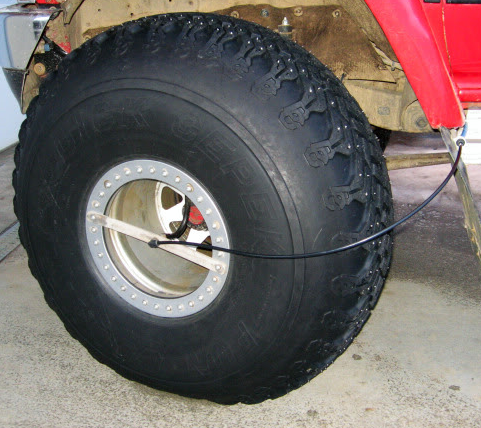
24 6 Automatic control and user interface for CTIS Figure 1.5: Externally connected tubes with a rotation joint at the centre of the wheel. The figure shows a 44x18,5R15 Dick Cepek front tire on a Toyota Hilux. Picture: Björn Ingi Óskarsson tire, either through the wheel hub or externally connected on the outside of the vehicle. Connection through the wheel hub with portal axles is more mechanically complex and is usually implemented in vehicles with gear reduction at the wheel hub as seen in Fig The gears allows for a tube or pressure sealed tunnel through the short final axle. Vehicles equipped with this kind of system are for example Hummer H1 and Benz Unimog. The externally connected tubes are more commonly used than the through-hub method in modified 4x4 vehicle for snow driving in Iceland. The tube for each tire reaches out from the wheel fender down to the centre of the rim where a rotational joint enables the rotation of the wheel. From the joint a short tube is connected to the tire valve. This is shown in Fig Modified 4x4 vehicles for snow driving in Iceland are more commonly equipped with the externally connected tubes than the though-hub method because very few vehicles actually offer the possibility of the through-hub method. The system of externally connected tubes and rotational joint can be installed without much effort in any vehicle. The external tubes themselves are only installed when the CTIS is in use and disconnected during normal highway drive. The disadvantage with the externally connected tubes is that they are vulnerable to damages in rough off-road conditions. They even might have to
25 Björgvin Rúnar Þórhallsson 7 be removed in some conditions to prevent damages to them. The advantage of this method is that in case of tube or rotation joint damage it is easy and inexpensive to replace. The advantage of the connection through the wheel hub in contrast to the externally connected tubs is that the system is always connected and no tubes are vulnerable for damages. However, maintenance is both more complex and expensive Controlling the CTIS The most popular way to control a CTIS in Iceland today is to use manual valves and pressure gauges located within reach of the driver. This requires at least six valves, tubes and a gauges inside the vehicle. The driver has full control over the system but the driver s attention is needed during operation. Commercial automatic CTIS solutions are available. Following is a quick overview of some of the automatic CTIS solutions on the market. The information available about functionalities and specification from the manufactures are often limited or unavailable which makes comparison hard. CTIS in its simplest form is only used to maintain a fixed tire pressure intended for trucks and trailers. Three examples of this kind of systems are the TIREMAAX PRO system from the company Hendrickson [10], T3 system by the company Airgo [11] and Vigia system [12]. An example of more functional systems capable of inflating and deflating the tires are the Spicer system from the company Dana Corporation designed for trailer trucks and military vehicles [13]. It is equipped with user interface reachable to the driver s seat that enables the driver to choose between six predefined pressure levels: loaded/unloaded and three surface conditions. A similar system is the SmartFlow system from the company Meritor, designed for military vehicles [14]. The predefined pressure levels for the SmartFlow system are: Highway, cross country, mud/sand/snow and emergency. Other systems are the CTIS from the company AxleTech International and SYEGON by the company Nexter that include similar functionalities as the systems mentioned above with six and four pressure levels respectively [15][16]. The TireBoss system from the company Tire Pressure Control International is intended for agriculture, military and trailer trucks that allows the driver to select the setpoint pressure for each axle with 1 psi resolution [17]. It features a big user interface module located in the drivers cabin.
26 8 Automatic control and user interface for CTIS None of the above mentioned commercial systems suit the snow driving conditions in Iceland. They lack either pressure range, setpoint 5 resolution, pressure accuracy or have too big user interfaces that are unlikely to fit in the driver s cabin of modified 4x4 vehicle. In the last years some people in Iceland have been experimenting with industrial controllers to automate the control process. The most notable solution was developed by Haraldur Þorkelsson and Tryggvi Valtýr Traustason. It features a Unitronix SM35-J-R20 industrial controller, equipped with 3.5 inch coloured touch screen. The unit is 11x11x6 cm in size and has to be mounted in the interior of the vehicle [18]. The controller regulates the pressure by activating a set of electrically controlled pneumatic valves. The valve setup in this solution is called the N+2 configuration with one pressure sensor. More discussion about this configuration can be found in chapter The type of the pressure sensor used is ECT2.5A manufactured by Trafag [19]. This solution was put on the market for a public sale in October This is currently the only automatic control solution for CTIS specialized for Icelandic conditions. From this point on this solution will be referred to as the industrial solution. More solutions are currently being developed. Sölvi Oddsson is working on a solution where a smartphone is used for control processing and as a user interface. The control unit containing the valves, pressure sensors and communication module is located behind the back seats in the current test vehicle. The smartphone communicates wirelessly with the control unit. The phone is mounted in the interior of the vehicle facing the driver and displaying the user interface. The big advantage with this implementation in contrast to the industrial solution is the small user interface and how simple it is to install it in a vehicle since no wiring is needed except a charging cable to the phone. The valve configuration used in this solution is called the 2N configuration with four MPX4250 pressure sensors, discussed in chapter This solution will be referred to as the smartphone solution. 5 Setpoint is the user defined value indicating the preferred tire pressure. 6 Price for the controller and the pressure sensor is ISK. Website: (26. November 2014)
27 9 Chapter 2 Aim and structure of the thesis The aim of this study can be divided into the two following parts: Compile a list of requirements for the automatic control system and the user interface part of CTIS designed for snow driving conditions in Iceland. Design, build and test a prototype of the automatic control system and the user interface part of CTIS that fulfils all requirements. In Fig. 2.1 and 2.2 an overview of a complete CTIS is shown. The overall system contains the previously mentioned parts along with connections to each tire, pump, pneumatic pressure tank, and a set of valves. This study only deals with the control system and the user interface part of the system. The systems requirements related to the scope of the study are listed in chapter 3. The list of requirements is compiled after interviews with experienced people in the field. Each requirement is described and acceptance criteria stated. The design of a prototype, aimed to fulfil all requirements, is discussed in chapter 4. Chapter 5 contains descriptions of all the experiments related to the design process of the prototype. Results for those experiments are discussed in chapter 6 where corresponding sub chapters have the same name. Cross references are used to point the reader to the experiments and the results as relevant throughout chapter 4. Figure 4.1 shows that design flow paths for various parts of the prototype can be different. Table 2.1 describes the relations between requirements, experiments and implementation in the design of the prototype. It can be a useful guide through this study. The prototype in chapter 4 will be referred to as the Thorhalb solution from this point on.

28 10 Automatic control and user interface for CTIS Figure 2.1: The overall system and the scope of this project. The dashed line shows that the valve system had to be partly taken into the scope of the study. Figure 2.2: The over all system is shown and possible location of each part of the system. (Source: [21], [22].)
29 Björgvin Rúnar Þórhallsson 11 Requirement Requirement Related experiments Implementation Requirement defined in in chapter: confirmed? chapter: in chapters: System s tire pressure total Yes error band Setpoint pressure range Yes Measure tire pressure relative Yes to ambient pressure Adjustable setpoint No Number of tire pressure setpoints Yes Setpoint resolution Yes Control constraints , 5.2, Yes Real time requirements Yes Stability No Number of channels Yes Isolated channels Yes Indication of leakage No Displaying tire pressure measurements Yes Adjustable user interface Yes screen brightness User interface dimensional No limitations Simplicity of the user interface No Pneumatic tank pressure sensor No Temperature , 4.1.5, 4.2, 4.3, 4.6 Yes Table 2.1: The table shows connections between requirements, experiments and implementations.
30 12
31 13 Chapter 3 Requirements In this chapter requirements related to the control system and user interface part of a central inflation system (CTIS) for Icelandic snow driving conditions will be discussed. In the making of the list the author conducted informal interviews with experienced people from within the modified 4x4 vehicle community in Iceland. The following list contains names and titles of some of the people interviewed. Páll Halldór Halldórsson, pioneer in off-road modification of Mercedes Sprinter and driver of a modified 4x4 vehicle for tourists. Sölvi Oddsson, currently developing an automatic control system for CTIS using smartphone for the processing and user interface. Hjörtur Már Gestsson, engineer and current user of manual controlled CTIS in a 4x4 vehicle. Valur Sveinbjörnsson, engineer and current user of manual controlled CTIS in a 4x4 vehicle. Tryggvi Valtýr Traustason, developer and user of the industrial solution, an automatic control system and user interface for CTIS. Ari Arnórsson, driver of a modified 4x4 vehicle for tourists. Hinrik Jóhannsson, engineer working for the company Arctic Trucks. In addition to the interviews, discussions on an Icelandic modified 4x4 vehicle forum was started to gain more opinions from people from within the community 1. Furthermore 1 The website hosting the forum is
32 14 Automatic control and user interface for CTIS all threads containing discussions about CTIS where studied and people s opinions about CTIS collected. The results shows that opinions about requirements for the control and user interface part for CTIS vary quit a lot between people. There are however many common issues that most people talk about. The requirements listed in this chapter are influenced by all the people the author interviewed. It is not expected that all people fully agree with all of the requirements. These requirements are intended to be as general as possible and apply to all user groups of CTIS for snow driving in Iceland. The rest of this chapter contains sub-chapter where each requirement is introduced, explained and acceptance criteria listed. The acceptance criteria for each requirement are put down as an ideal criteria to confirm the requirement. 3.1 System s tire pressure total error band Total error band (TEB) is defined as combination of all possible errors. The difference between accuracy and TEB is that accuracy only covers nonlinearities, hysteresis and non repeatability. With TEB, temperature related errors over some specified temperature range are also taken into account [23]. If the conventional way of deflating manually is examined, it turns out that the pen style pressure gauge often used are not very accurate 2. Sometimes deflation is performed without any gauge. An example of this could be when a vehicle is having trouble passing through a short difficult section of a trail. The driver estimates the deflation time needed for each tire, based on his experience, to make the vehicle pass through the section. Few things need to be considered when requirements for pressure sensor accuracy are decided. First, the importance of minimizing pressure difference between tires. In practice the driver adjust the tire pressure based on how the vehicle is performing at that moment, sometimes irrelative to the current tire pressure. The mobility in snow driving increases with lower tire pressure down to the limit when the tire becomes over deflated 3. Over deflation reduces the mobility in snow because the touch down pressure distribution of 2 No accuracy information was found for any pen style pressure gauge on the Internet. When no information is given about accuracy it usually means that the accuracy is bad, estimated ±2 4 psi for a gauge rang of 0 to 20 psi. 3 Over deflated tire is defined as a tire deflated down below the point of maximum mobility in snow conditions that results in very uneven pressure distribution of the ground touching area.
33 Björgvin Rúnar Þórhallsson 15 the tire becomes uneven. To be able to approach that limit, for all tires without crossing the limit, the relative error between tires has to be minimized. Absolute pressure accuracy requirement is an unknown function of pressure because more accuracy is needed in the lower end of the pressure range. This requirement indicate the system s tire pressure total error band. That means it covers combined errors for the pressure sensor, the analogue to digital converter and the control tolerances. The developers of the two automatic control CTIS solutions currently being developed in Iceland, the industrial and the smartphone solutions, have both come to the conclusion that the accuracies of the pressure sensors that they are using are sufficient for the task. This requirement is based on their experience. The determination of this requirement is not considered to be sufficient. It would require a separate study to find out experimentally what total error band is required for a CTIS in off-road snow driving. Discussed further in chapter Requirement: The total error band (TEB) 4 of the tire pressure for the temperature range from 25 C to 85 C has to be less than or equal to ±2.18 psi 5. Acceptance criteria: The specifications from the manufacturer of the sensor has to fulfil the requirement of TEB over the entire operating temperature range. 3.2 Setpoint pressure range If only off-road conditions are considered the necessary setpoint range is from 0.5 to 10 psi. However if highway tire pressure is included as well, the setpoint pressure range increases to 0.5 to 35 psi. For most individuals using this system for private travelling the smaller range is enough. It is however preferred to be able to use the system to fully inflate the tires. 4 This number may appear to be very high but it is the worst case error that is indeed unlikely to be the case. Typical error band figures are expected to be at least half the TEB. 5 See comparison between pressure sensors in table 4.1.
34 16 Automatic control and user interface for CTIS Requirement: The system has to support setpoint adjustments from 0.5 to 35 psi. Acceptance criteria: Using tire pressure sensor that covers the specified range. The user interface offering the possibility to adjust the tire setpoint pressure within the full specified range. 3.3 Measure tire pressure relative to ambient pressure One important features of an automatic CTIS is the ability to measure tire pressure relative to the ambient pressure. Then travelling in highlands and on glaciers altitude difference of few hundred meters can be experienced during relatively short time. For example when travelling up to Grímsvötn caldera on the Vatnajökull glacier. The altitude when entering the glacier at the west side is about 700m over see while Grimsvötn hut is in about 1700m over sea. This altitude difference results in about 1.6 psi atmospheric pressure difference [24]. When no CTIS is installed and driving towards higher altitude it turns out to be necessary to stop the vehicle occasionally to deflate the tires to maintain the same level of deflation. The opposite is experienced when driving towards lower altitude which can increase the changes of damaging the tires. Then the atmospheric pressure increases, towards lower altitude, the level of deflation increases. That increases the changes of damaging a tire because of driving on too low tire pressure, specially if the driver is not aware of this effect. Requirement: The tire pressure sensor has to measure pressure relative to the ambient pressure. Acceptance criteria: Change the ambient pressure by one psi and observe the system react to the changes.
35 Björgvin Rúnar Þórhallsson Adjustable setpoint An important element of the automated CTIS is for the driver to be able to adjust the setpoint pressure 6. Furthermore the driver should be able to do it while driving in challenging conditions. Requirement: A driver in a vehicle equipped with automatic CTIS has to be able to adjust the tire setpoint while driving in challenging conditions. Acceptance criteria: An experienced person in driving a 4x4 vehicle, has to drive at 40 ± 5 km/h on a twisty gravel road and be able to adjust the setpoint from 2 to 10 psi in 4 s and the other way around in 4 s. The user interface has to be mounted in the interior of the vehicle within reach of the driver. 3.5 Number of tire pressure setpoints The minimum number of setpoint needed is one. In that case one setpoint applies to all the tires. It is sufficient for the general traveller in most cases to have one setpoint for all tires. In case of a vehicle having very different weights on its axles it becomes necessary to allow for different tire pressure setpoint depending on the axle. Both for a four and six wheel vehicle a front and rear pressure settings is sufficient. There are also rare cases of lateral gradient when different tire pressure, depending on which side of the vehicle the tire is, would be beneficial. That is, however, not considered a requirement for a CTIS. Requirement: One adjustable tire pressure setpoint for all four wheels with an optional front axle pressure offset covering the pressure range of ±4 psi with half psi resolution. 6 Setpoint pressure is the target tire pressure that the driver is requesting.
36 18 Automatic control and user interface for CTIS Acceptance criteria: Connect two additional pressure sensors, one to the front tire and one for the rear tire. Change the front axle offset and see the corresponding change on the pressure sensors. 3.6 Setpoint resolution Tire pressure setpoint resolution defines the step size a user is able to adjust the setpoint. More resolution is needed in the pressure range from 0.5 to 5 psi than the rest of the range. Requirement: The resolution requirements are listed in table 3.1. Pressure range Resolution requirement psi 0.5 psi 5 35 psi 1 psi Table 3.1: Setpoint resolution requirements. Acceptance criteria: Connect an additional pressure sensor to a tire which is connected to a CTIS. Change the setpoint by one step in each of the two pressure ranges and see the corresponding change in the additional pressure sensor.
37 Björgvin Rúnar Þórhallsson Control constraints A performance requirement regarding the duration of a certain inflation or deflating operation 7 is not possible to determine for a general control system. The time needed for an operation depends heavily on the properties of the pneumatic system including air tank, pipes, valves and connectors. These properties can vary a lot between implementations in vehicles and therefore the performance of the system. The control system is, however, partly responsible for the time length of an operation. There are two requirements that the control system has to fulfil in order to minimize the operation time. First, eliminating overshoots for both inflation and deflation. Overshoots increase the duration of an operation more than necessary. Second, minimizing inactive time during an operation. Inactive time can be due to measurements being taken in case of a pneumatic configuration that does not allow for pressure readings while inflating/deflating. Requirement: Inflation and deflation overshoots are eliminated. Inactive time cannot exceed more than 10% of the total duration of an operation. Acceptance criteria: The following procedure has to be performed while fulfilling both requirements: 1. Initial tire pressure is set to 5.0 psi. 2. Adjust setpoint to 2.0 psi. 3. Wait until all channels are within 0.05 psi tolerance from setpoint. 4. Adjust setpoint to 5.0 psi. 5. Wait until all channels are within 0.05 psi tolerance from setpoint. 7 An operation is defined as the time interval from the moment then the system finds a channel (tire or interconnected tires) that are not within tolerance form the setpoint pressure, until it is back within tolerance. If the setpoint pressure is changed within an operation a new operation has started.
38 20 Automatic control and user interface for CTIS 3.8 Real time requirements The real time requirements for the control system are defined such that the worst case latency does not result in deflation/inflation overshoot more than the tire pressure setpoint tolerance. Requirement: The following equation has to be fulfilled: max control loop latency [s] pressure tolerance [psi] max pressure change rate [psi/s] (3.1) where maximum control loop latency is measured and depends on the processing unit and the scheduling algorithm of the control system. The term pressure tolerance the tire pressure setpoint tolerance and is determined by the developer of the system. The term max pressure change rate is measured and depends on the tires and properties of the pneumatic system. Acceptance criteria: Equation 3.1 has to be fulfilled. 3.9 Stability The stability of the system is defined as the ability to ignore pressure disturbances coursed by driving while still be able to regulate the tire pressure in case of a leakage or setpoint change. One of main purposes of having a CTIS automated rather than manual is for the driver to concentrate on other things, including driving the vehicle, while the system guarantees that tire pressures are within tolerances. That makes the stability of the system while driving important.
39 Björgvin Rúnar Þórhallsson 21 Requirement: Ones the system has reached setpoint ± tolerance on all tires/channels and the setpoint is not changed, the system has to remain stable even if the vehicle is moving 8. The system is assumed to have no leakage. Acceptance criteria: Stability has to be maintained throughout the experiment in table 3.2. The conditions should be: Gravel road with cm of snow. Each pressure level is tested over specified distance and speed. The vehicle used in this experiment need to be equipped with 38 to 46 inch diameter tires. Part Tire pressure Speed Distance 1 20 psi 40 km/h 400 m 2 10 psi 30 km/h 400 m 3 5 psi 20 km/h 100 m Table 3.2: Stability test Number of channels The system has to support four channels which are sufficient both for four and six wheel vehicle. Requirement: The system has to support four channels. Acceptance criteria: The pneumatic system has to provide connections for four channels. 8 The system is stable when all channels are within tolerance.
40 22 Automatic control and user interface for CTIS 3.11 Isolated channels Isolation of channels is an important feature of CTIS. In case of a vehicle, equipped with CTIS, having different weight resting on the tires it becomes necessary to be able to isolate the channels so that the air does not flow from heavier side to the lighter side. This happens if the vehicle is heavier on one side than the other or the vehicle is driving in a slope. Then air is allowed to flow freely between channels in a slope for long enough time the tires on the heavier side become over deflated which reduces heavily the mobility of the vehicle. Requirement: The system has to provide either permanent isolation between channels or the option of isolate channels selectable through the user interface. Acceptance criteria: Vehicle is equipped with CTIS and tires are inflated to 20 psi. Unplugging a tube in one channel and observe no effects to the tire pressure in the other channels Indication of leakage One advantage of using automated CTIS rather than manual is the ability to maintain a certain tire pressure in case of a leakage in a tire or in the pneumatic system. How much leakage the system can handle depends entirely on the properties of the pneumatic system and are out of the scope of this study to determine. When a leakage occur that the system can handle no specific action is needed other than keep refilling the tire. However it is preferred that the driver is informed about the situation for possible reaction to the leakage. If the driver decide to do nothing about the leakage the indication cannot be implemented in such a way that is annoying to the people in the vehicle over a few hours of travelling.
41 Björgvin Rúnar Þórhallsson 23 Requirement: The user interface has to indicate a leakage in the system. The implementation of the warning sign has to be ignorable in the case when the driver chooses not to respond to the warning. Acceptance criteria: An experienced driver, driving a vehicle with CTIS installed should notice a leak at least two minutes after the leak occur. The level of leakage should be large in enough to require the system to refill a tire at least every minute Displaying tire pressure measurements One of the main purpose of the user interface is to display tire pressure information to the driver. All pressure readings have to be displayed in the psi pressure unit 9. Requirement: The most resent pressure readings for all channels has to be displayed in the psi pressure unit with one decimal point. All values have to be readable from the driver s seat. Acceptance criteria: A person with normal vision has to be able to read the pressure values for all channels on the user interface sitting in the driver s seat of a vehicle equipped with a CTIS Adjustable user interface screen brightness When travelling in 4x4 vehicle in the highlands of Iceland the light conditions can vary a lot. The brightest conditions are probably sunny days on glaciers with clear sky where 9 Pound per square inch.
42 24 Automatic control and user interface for CTIS the snow reflects the sunlight. The other end of the scale are dark nights. For the screen to be useful on the glacier it has to bright. In dark conditions a darker screen is required to not disturb the driver with too much light. Requirement: The brightness of the user interface screen has to be adjustable. Acceptance criteria: An experienced person in modified 4x4 vehicle driving has to confirm that the screen is readable while not too bright for the two following conditions: Driving outside in snow with clear skies and sun, or equivalent. Driving during a night with no surrounding lights except the headlamps of the vehicle User interface dimensional limitations In modified 4x4 vehicles are all kinds of gadgets are added to the interior. Extra gauges, radio transceivers and laptop or a tablet are examples of added equipment. This usually results in rather crowded interior around the dashboard. When automated CTIS is added as well the space available is very limited. A precise and general requirement for the size of the user interface is impossible to make. The size and shape of available space in interiors vary between vehicles but smaller user interface is in general better. Three different ways of implementing the requirement for dimensions of the user interface are listed in table 3.3. It would be preferred to have a requirement that is quantitatively measurable and applies to all vehicles. None of the methods listed in the table fulfils that. The second option was, however, used as a requirement is measurable and applies to all vehicles.
43 Björgvin Rúnar Þórhallsson 25 Method Pros Cons Limitations on the dimensions of the user interface (length, width, hight, volume) Limitations on the time it takes for a mechanic to permanently install the user interface to a vehicle. Limitations on disruption to the interior of the vehicle. Easy to measure. Dimensional requirement different between vehicles. The same requirement applies to all vehicles. Easy to measure. The same requirement applies to all vehicles. There are more thing than installation time that affect the quality of the outcome. Difficult to measure quantitatively. Table 3.3: Three different methods of implementing the dimensional requirement for the user interface. Requirement: It has to be easy to permanently mount the user interface in a modified 4x4 vehicle. Acceptance criteria: A mechanic has to be less than two hours to permanently mount the user interface and cabling in a Toyota Hilux 2014 model Simplicity of the user interface Simplicity and accessibility of the user interface is very important. For most privately owned vehicles equipped with CTIS the user and the buyer are the same person. In that case the level of complexity and user configurable parameters can be higher. There are also companies that buy automatic control systems for CTIS. For those vehicles it has to be assumed that the driver is inexperienced user of CTIS. For that reason it is important that the user interface is as simple as possible.
44 26 Automatic control and user interface for CTIS Requirement: Any person that knows the basic functionality of CTIS should be able to figure out how to use it without reading the manual. Acceptance criteria: A person with basic understanding of the functionality of CTIS has to be able to proceed though the following list in less than 30 seconds: 1. The device is turned off. 2. Instructions to the person: "This is a device to control the tire pressure of a 4x4 vehicle where the driver can adjust the setpoint pressure." 3. A stopwatch is started. 4. Instructions to the person: "Turn on the device and adjust the setpoint to 5 psi". When the task is accomplished go to next step. 5. Instructions to the person: "Adjust the setpoint to 14 psi and turn of the device". When the task is accomplished go to next step. 6. Stop the stopwatch Pneumatic tank pressure sensor Throughput of the air pump is usually the speed limiting factor of inflating tires. That is why the driver s awareness of the pressure in the air tank helps to understand the state of the system. A standalone pressure gauge could be used for this purpose. But like described in chapter 3.15 the available space in the interior of a modified 4x4 vehicle is very limited. It is preferred that the displaying of the tank pressure is included in the user interface to save space. The total error band requirement for the sensor are not intense. The main purpose of the sensor is for the driver to know if the tank is empty or full.
45 Björgvin Rúnar Þórhallsson 27 Requirement: The air tank pressure readings should be displayed on the screen of the user interface. The frequency of measurements and screen update rate has to be 4 Hz. The total error band has to be less than or equal to ±5 psi. Pressure range from 0 to 120 psi. Displayed resolution 0.1 psi. Acceptance criteria: The datasheet for the sensor being used has to indicate that the pressure range and TEB requirements are met. User interface has to display the the measurements four times per second Temperature The location of the systems components can vary between implementations. However, every implementation has an user interface located in the driver s cabin. The temperature of the driver s cabin is expected to be close to room temperature most of the time. The control unit, valves, and pressure sensors can be located anywhere in the vehicle. Most common locations for the control unit and the valves are under the bonnet or in the trunk. It means that temperature can vary from 25 C to 85 C depending on the location, environment temperature and engine temperature. Requirement: Operating temperature Storage temperature Control unit 25 C to 85 C 40 C to 100 C User interface 0 C to 30 C 40 C to 100 C Table 3.4: Operating and storage temperature range for the system components depending on location.
46 28 Automatic control and user interface for CTIS Acceptance criteria: All components have to fulfil the operating and storage temperature requirements listed in table 3.4.
47 29 Chapter 4 Design of a prototype In this chapter the design process behind the prototype of CTIS control system and user interface is described. The design process of this prototype turned out to be more complex than a series of independent decisions. Every design decision affects many aspects of the system which makes parallel design flow of many parts of the system necessary. Fig. 4.1 shows how many design paths are possible for each individual part of the system. Figure 4.1: Design flow describing possible design paths of various parts of the system.
48 30 Automatic control and user interface for CTIS 4.1 Pneumatic system To be able to design a control system it is necessary to define the valve configuration being controlled. In this chapter the options for pneumatic configurations and pressure sensors are discussed and the choice of configuration justified The pneumatic configuration Figure 4.2: Pneumatic schematic for the 2N valve configuration using two 2/2 way valves per channel. Only one channel are drawn to the figure. Other channels are connected like the first one by getting air supply directly from the tank. The schematic does not contain any over pressure safety components. Two pressure sensors are shown, one for the tank and one for channel one. One pressure sensor is needed for each channel. The pneumatic valve system has to able to inflate and deflate each tire/channel 1 individually, as stated in chapter There are two configurations of valves available to fulfil that requirement. The first configuration uses two 2/2 way 2 valves or one 3/3 way 3 valve per channel. The 2/2 way valve configuration is shown in Fig. 4.2 and the 3/3 way version is shown in Fig For N number of channels 4 the number of valves needed is 2N. For the 2N configuration four pressure sensors are needed, one for each channel. The advantage of this configuration is the ability of individual and parallel control of each channels. The disadvantage is the high number of valves and pressure sensors needed. The second configuration has one inflation valve and one deflation valve. Then one valve for each channel. All the vales are 2/2 way. The schematic is shown in Fig Channel is an individual pipe to a tire/tires that is connected to the valve system. 2 2/2 way valve has two ports and two positions. One activator is needed for each valve. 3 3/3 way valve has three ports and three positions. Two activators is needed for each valve. 4 N is the number of individual channels. Usually one channel is needed for each tire. This
49 Björgvin Rúnar Þórhallsson 31 Figure 4.3: Pneumatic schematic for the 2N valve configuration using one 3/3 way valve per channel. Only one channel is drawn here. Other channels are connected like the first one by getting air supply directly from the tank. The schematic does not contain any over pressure safety components. Two pressure sensors are shown, one for the tank and one for channel one. One pressure sensor is needed for each channel. configuration uses N + 2 number of valves for N number of channels, instead of 2N valves for the previously mentioned configuration. When using the N+2 configuration with a four wheel vehicle the number of valves need is reduced by two compared to the 2N configuration. The cost saving for a system with four channels is estimated 25% of the valve system cost 5 with some of the fittings needed. Component s part numbers are shown in table 4.3. The N + 2 configuration is able to control the channels individually but not more than one channel at a time. It is not possible to inflate one channel while for example deflating another. How ever it is possible to interconnect some or all channels and inflate/deflate them all simultaneously. The disadvantage of interconnecting all channels together is that air can flow between them as discussed in chapter Isolation is, however, not needed at all times. There are two ways of connecting a pressure sensor to this configuration. The first one is to connect one sensor to each channel. That requires four sensors but enables pressure readings of all channels at all times. The second option is to connect one pressure sensor directly to the sheared node seen in Fig This reduces the number of sensors needed by three and pressure reading variation between channels are reduced. The setup allows the system to choose the channels which it is operating on that can be anything form one channel to all of them.
50 32 Automatic control and user interface for CTIS Figure 4.4: Pneumatic schematic for the N+2 valve configuration. Only two channels are drawn to the figure. Other channels are connected to the inflation and deflation valves like the first two channels. The schematic does not contain any over pressure safety components. Two pressure sensors are shown, one for the tank and one for the tires Tire pressure sensor The tire pressure sensors currently being used in the two automatic control solutions for CTIS in Iceland are listed in table 4.1. The two sensors in these solutions are quite different. One is intended for industrial environment while the other is intended for microcontroller based products. The industrial sensor is almost nine times more expensive than the other while having larger total error band in three out of four temperature points compared in table 4.1. The sensor ECT2.5 is available both with current and voltage output while MPX4250 is only available with 0 5 V analogue output. No other reasonably priced pressure sensors could be found after extensive search on the Internet that could potentially fulfil the requirements for the pressure sensor. This was confirmed by the developer of the smartphone solution. The total error band range includes all possible errors [23]. It is clear from Fig. 4.5 and 4.6 that the total error band depends heavily on temperature. This raises the question if the effort of implementing a temperature regulated environment for the pressure sensor would be beneficial. That is, however, not considered in this study. 5 N+2 uses six valves while 2N uses eight January Januray Januray 2015.
51 Björgvin Rúnar Þórhallsson 33 Used in: Industrial solution Smartphone solution None Manufacturer Trafag Freescale Freescale Type ECT2.5A MPX4250 MPX5050 Pressure range psi psi psi 25 C ±2.18 psi ±1.14 psi ±0.408 psi 0 C ±1.27 psi ±0.508 psi ±0.181 psi 25 C ±0.363 psi ±0.508 psi ±0.181 psi 85 C ±2.18 psi ±0.508 psi ±0.181 psi Price ISK ISK(16.09 USD 7 ) 2079 ISK(16.09 USD 8 ) Source Samey ehf Digikey.com Digikey.com Table 4.1: Comparison of three possible tire pressure sensors. The first two sensors are currently being used in automatic control solutions for CTIS in Iceland. Typical values can be expected to be half the range of the TEB. (Sources: [19][20][25].) Figure 4.5: Total error band of the Trafag ECT2.5A pressure sensor as a function of temperature. Note that both maximum and typical total error band is shown. (Source: [19]) If more accuracy is needed a second sensor could be added. That could be the third sensor in table 4.1, MPX5050. The Pressure range is only from 0 to 7.25psi. That does, however, cover the lower end of the pressure range which is the range used for snow driving. The problem is that the sensor s burst pressure is 29 psi which is lower than the maximum tire pressure required. It could be solved by adding a small 2/2 way valve to block the sensor when the pressure is more than a certain value. This option was not implemented in this study. When the specifications in table 4.1 are considered the choice of the MPX4250 over ECT2.5A is obvious. It fulfils the requirements of TEB over the specified operating temperature range.
52 34 Automatic control and user interface for CTIS Figure 4.6: Temperature error band for both MPX4250 and MPX5050 pressure sensors. The temperature error factor is multiplied with a given accuracy for the temperature range 0 to 85 C to get the total error band. Total error band values for some chosen values are shown in table 4.1. (Sources: [20], [26].) The pneumatic system configurations N+2 and 2N, discussed in chapter 4.1.1, do not allow for continuous pressure readings while inflating or deflating. That is because the pressure sensors are connected to the path of air stream to and from the tire. The flow in the pipe disturbs the pressure as Bernoulli s principle indicates so that the measured pressure is not the same as in the tire. A solution to this problem could be a wireless pressure transmitters located in the rim, like in tire pressure monitoring systems (TPMS). TPMS are only intended to inform the driver about tire pressure and give warning signs when tire pressure is to low. These systems are standard equipment in many new cars today. There are also a lot of after market systems available. The accuracy requirements for pressure sensors in TPMS, according to the ISO standard [27], are ±10 kp a or ±1.45 psi over the entire temperature range which is from 40 C to 85 C. This accuracy is very close to what the pressure sensor MPX4250 offers so a TPMS that follows the standard could be integrated to a CTIS. In this study the option of integrating wireless pressure transmitters is considered as a potential a future improvement to the system. The problem of not being able to measure the tire pressure while inflating or deflating is solved and discussed in chapter
53 Björgvin Rúnar Þórhallsson Over pressure protection A correct functionality of the control system can not be guaranteed at all times. It has to be assumed that failure will occur. The worst thing that can happen is that the air tank is connected to a tire over long enough time to blow the tire. There are two solutions available to prevent this from happening in case of a control system failure. First, use a pressure regulator to reduce the supply pressure to the valve system that reduces the maximum possible tire pressure. Second, use a relief valve to limit the maximum pressure in the pipes connecting to each tire. These two solutions have different effect on the control system. When a pressure regulator is used, the supply pressure can be seen as constant which makes the predictive inflation time model simple as discussed in chapter However, the disadvantage is that the supply pressure is reduced which reduces the inflation flow rate. That is not necessary a bad thing because the bottleneck in the process of inflation is the throughput of the pump but not the resistance in the pneumatic system. In case of a relief valve being used the supply pressure variations increase a lot compared to the pressure regulator which causes the inflation parameter to fluctuate a lot in the system implemented in chapter For the prototype designed and build in this study a pressure regulator was be used Design options Design Config No. of Comment Pressure Deflation Cost option sensors sensor time [min] [ISK] 1 N+2 1 Interconnected MPX : N+2 1 Isolated MPX : N+2 1 Interconnected ECT2.5A 2 : N+2 1 Isolated ECT2.5A 8 : N+2 4 Interconnected MPX : N+2 4 Isolated MPX : N+2 4 Interconnected ECT2.5A 2 : N+2 4 Isolated ECT2.5A 7 : N 4 - MPX : N 4 - ECT2.5A 1 : Table 4.2: Considered design options for a the valve and pressure sensor configuration. Table 4.2 was constructed to summarize and compare the two valve configurations described above. The table contains ten design options. The N+2 configuration can be operated in two different ways, interconnected or isolated channels. In addition to the two
54 36 Automatic control and user interface for CTIS 1.6 x 10⁵ Estimated cost of implementation [ISK] Better solution Deflation time (5 to 2 psi) [min] Figure 4.7: Comparison of the solutions listed in table 4.2. The points in the table represents design options for valve and pressure sensor configurations. The arrow points to the direction of better solution. Two solutions number one and nine are classified as Parato optimal ways of operating the N+2 configuration it can be implemented with one or four pressure sensors. The 2N configuration is included to the comparison. These five options are all listed twice with two types of pressure sensors each. The deflation times in the table are results from the experiment in chapter 5.5. Results can be found in chapter 6.6. The experiment was designed to replicate the most time critical execution of CTIS in snow driving. That is deflation from about 5 to 2 psi. There are no experimental data available for the design options number six and eight but they where estimated to be 15% faster than design options number two and four 9. The experiment was only conducted with the MPX4250 pressure sensor. The deflation times are estimated to be the same for both pressure sensors as they do not affect the deflation times. 9 When four pressure sensors are being used with the N+2 configuration, operated in isolated-mode, there is no need to wait for pressure measurements before start inflating/deflating a channel.
55 Björgvin Rúnar Þórhallsson 37 Component Part no. Manufacturer Orifice diameter Inflation valve [28] Q3C124.BV0 FLO Control 2.4 mm Tire valves [29] Q2C140.BV0 FLO Control 4 mm Deflation valve [30] U2D180.BB0 FLO Control 8 mm Inductors /666 V 12 FLO Control - Table 4.3: The table shows the part numbers for the valves and inductors used in the prototype. All valves are normally closed. The cost of the configurations in the table include only the cost of the valves, some of the fittings to connect the valves and the pressure sensors 10. The particular valves used in the configurations compare in table 4.2, are listed in table 4.3. To simplify comparison of the design options in table 4.2 the options are plotted in Fig. 4.7 as a function of cost and deflation time. Note that there are four pairs of points in the graph where each pair represents the same hardware solution 11 but operated in a different way. The problem of finding the best solution is set up as a multi objective optimization because there is no objective function available. The aim is to minimize the cost and at the same time to minimize the deflation time. To determine a set of optimal solutions the idea of Pareto dominance is applied to find the Pareto optimal set [31]. Two points in the graph satisfies the conditions of Pareto optimal solutions. These are points number one and nine. Point number one is the N+2 configuration with one MPX4250 pressure sensor operated in interconnected mode. Point number nine is the 2N configuration with four MPX4250 pressure sensors. It has to be noted that point number one in the graph does not fulfil the requirement of isolated channels but can, however, be operated in isolated mode that fulfils the requirement. Design option number one, and two, is chosen to be the configuration in this study because it is less expensive and has fewer valves and pressure sensors. The implementation of the N+2 valve configuration can be seen in figure The following prices are used: N+2 config (6 valves): ISK (Landvélar, September 2014), 2N config: ISK (estimated form the N+2 config), MPX4250 pressure sensor: 2000 ISK ( Trafag ECT2.5A pressure sensor: ISK (Samey ehf, January 2015). 11 The pairs are the following: (1,2) (3,4) (5,6) (7,8).
56 38 Automatic control and user interface for CTIS Figure 4.8: The N+2 configuration that was used in the prototype. The blue path indicates deflation on channel one which is activated by opening the deflation and the tire/channel valves. The red path indicates inflation on channel one which is activated by opening the inflation and the tire/channel valves. The same procedure applies for the other channels. The figure shows a regulator in series with the connection to the air tank. It is used to reduce the pressure to the valve system, see more in chapter Tank pressure sensor An additional pressure sensor is used to measure the pressure in the air tank as required in chapter The only sensor found that was reasonably priced, available and sufficient for the developing of the prototype was the MPX5700, seen in table 4.4. It meets all requirements except it does not cover the pressure range from 100 to 120 psi. Information about the TEB from 25 C to 0 C are not available. The TEB for the sensor in the range from 25 C to 85 C is expected to be close to the TEB requirement of ±5 psi January 2015.
57 Björgvin Rúnar Þórhallsson 39 Manufacturer Freescale Type MPX5700DP Pressure range psi 25 C No info available 0 C ±2.53 psi 25 C ±2.53 psi 85 C ±2.53 psi Price 1832 ISK(13.99 USD) 12 Source Digikey.com Table 4.4: Specifications for MPX5700 pressure sensor. (Source [26].) Experimental setup The experimental setup in this chapter was used in number of experiments in this study. Cross references will be used later to direct the reader back to this chapter. The setup can be considered realistic setup apart from the air source that is usually a small tank and a pump in a typical 4x4 vehicle. The setup contains the following sequence of interconnected parts in this order: Pressurized air source, 7 bar. Can be considered a constant pressure source. Rubber tube, 8 mm inner diameter, with a coupling, unknown length. Pressure regulator of type: Air Comp MR 1/4" R SRU, adjusted to 30 psi except other specified. One inch long 1/4 diameter pipe. The valve system seen in Fig The valves are specified in table 4.3 and assembled in the N+2 configuration described in chapter A male coupling terminal is screwed on tire valve one as seen in Fig A 7.7 m long, 8 mm inner diameter rubber tube, with a female coupling connected to tire valve one in the valve system. The rubber tube connects to the rim valve as seen in Fig The valve core was removed.
58 40 Automatic control and user interface for CTIS Figure 4.9: Connection between the rubber tube and the wheels in the experiments. Note that the inner core of the rim valve was removed in the experiments, as seen in the small figure. 4.2 User interface The user interface of an automatic tire inflation system is very important part of the system. It has to be as simple and easy to operate as possible while fulfilling requirements of functionality. Requirements related to the user interface are listed in table 4.5. Lets begin by examine the two other solutions being developed in Iceland, first mentioned in chapter 1. The first one is the industrial solution using the Unitronics SM35-J-R20 industrial controller seen in Fig The unit is both processing unit and user interface, equipped with a 3.5 colour touch screen. Access to parameter adjustments and manual control are easy to implement in this unit. Permanently mounting this unit in a 4x4 vehicle within reach of the driver is not a straight forward job in most vehicles because of it s size. The unit needs electrical connections to the tire pressure sensor, valves and power supply. The smartphone solution uses, as the name indicates, a smartphone as a user interface. Control processing is also executed on the phone. Like the industrial controller the smartphone interface allows for different menus. The communications to the control unit, which can be located anywhere in the vehicle, is accomplished using Bluetooth. What is needed in the interior of the vehicle is a permanent cellphone mount and access to changing cable. The challenging part of this solution is to write the program for the smartphone. The program has to be supported on wide range of platforms and operating systems to be successful as a general product. The advantages are no wiring to the user interface and distribution of new software updates can be done through the Internet.
59 Björgvin Rúnar Þórhallsson 41 Req. in Description chapter 3.2 Setpoint pressure range 3.4 Adjustable setpoint 3.5 Number of tire pressure setpoints 3.6 Setpoint resolution 3.12 Indication of leakage 3.13 Displaying tire pressure measurements 3.14 Adjustable user interface screen brightness 3.15 User interface dimensional limitations 3.16 Simplicity of the user interface 3.17 Pneumatic tank pressure sensor 3.18 Temperature Table 4.5: Requirements related to the user interface. Figure 4.10: The user interface and processing unit of the industrial solution: Unitronics SM35-J-R20 industrial controller. (Source: [32].) The conclusion coming out of the comparison of the two solutions above are that the industrial computer is to big and the smartphone programming is out of reach for the author of this study. The Thorhalb solution s 13 control unit is based on a microcontroller, controlling the valves and reading the pressure sensor. The available options for an user interface from the control unit s point of view are the following. First, wireless module connecting to a smartphone or a tablet. Before, people used laptops to host navigation programs but tablets are now getting more popular. Second, small standalone colour touch screen like the 2.8" TFT LCD with touchscreen breakout board from the webstore adafruit.com 14. This would require some building of a frame around the screen and possible a printed circuit board with a microcontroller. Third, using 2 by 16 character LCD screen. These 13 Thorhalb solution is the name of the prototype designed in this study. 14 Price: 30 USD ( ).
60 42 Automatic control and user interface for CTIS screens have standardized parallel interface and are manufactured by a lot of companies. They come in prices down to 3.28 USD 15. This option requires that separate components are used for user inputs such as the setpoint. The 2x16 char LCD screen was chosen for the prototype because the components are cheap and connecting them to the microcontroller is simple. However the operating temperature range this kind of displays is a concern. In temperatures close or below 0 C the updated speed capabilities of the screen reduces significantly. So if a vehicle is started in a cold weather the screen will not be working properly until the vehicle has wormed up Screen brightness adjustments The LCD backlight is a LED. Testing showed that the current through the LED has to be adjustable in the range from 2 to 20 ma to fulfil the requirement in chapter It was implemented using the LM7805 voltage regulator in a constant current configuration seen in Fig The resistance between V out and GND on the regulator can be calculated: R high = R low = 5 V 2 ma 5 V 20 ma = 2.5 kω (4.1) = 250 Ω (4.2) The resistor and the potentiometer in the circuit are picked according to the calculations. The potentiometer in the circuit is used to adjust the brightness. It is not included on the front panel of the current prototype. The power dissipation in the resistor in the brightest adjustment is: so a 1/4W resistor is sufficient. P res = (5 V )2 20 ma = 0.1 W (4.3) A light dependent resistor with decreasing resistance with increasing light intensity could be used as well instead of the potentiometer for automatic adjustments. 15 Product: "16 x 2 character LCD display module with blue backlight" at the webstore: ( ).
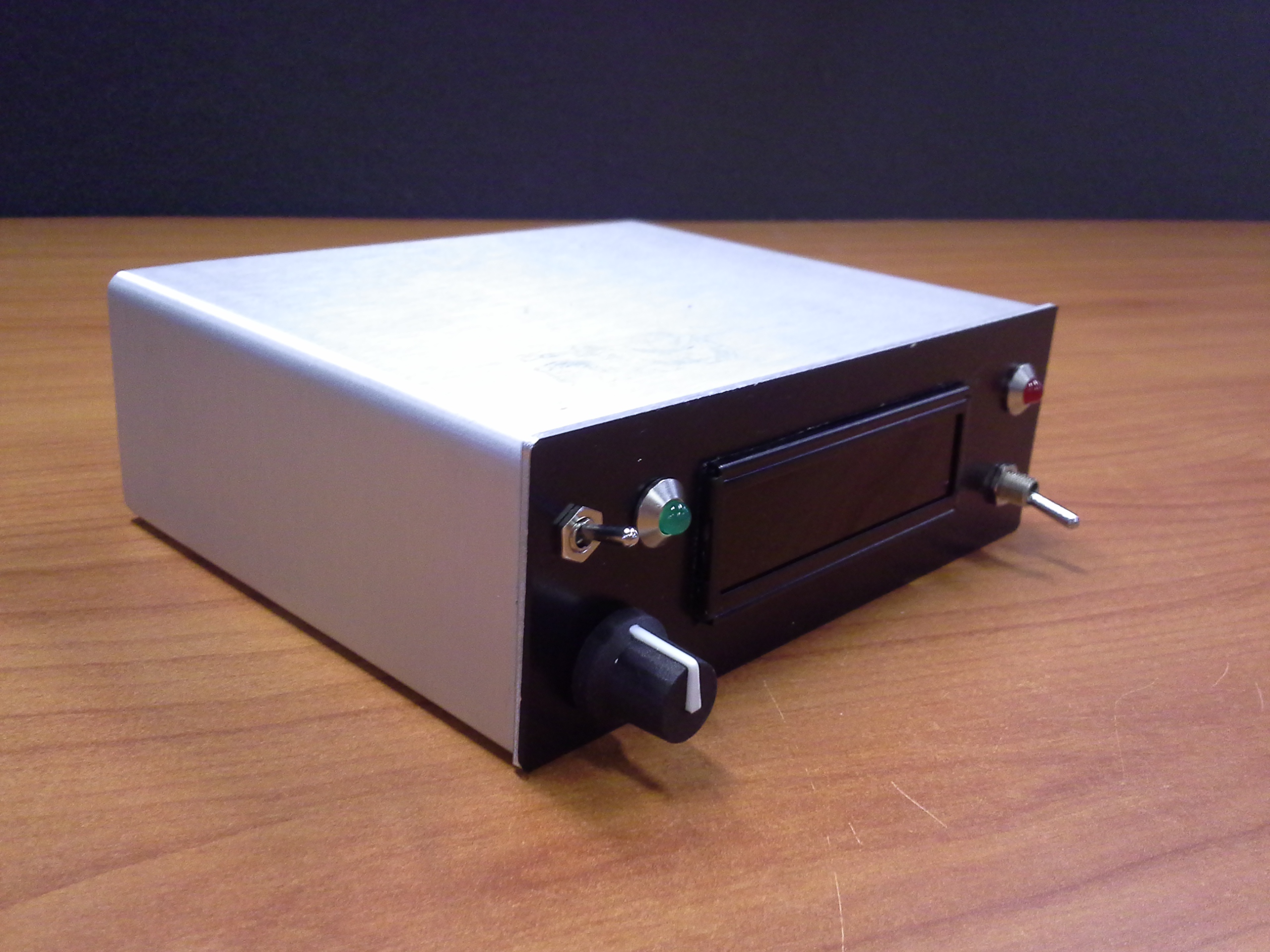
61 Björgvin Rúnar Þórhallsson 43 Figure 4.11: LCD screen brightness adjustment circuit. A voltage regulator used in a constant current configuration with a potentiometer to adjust the current through the back light diode The user interface case (a) First prototype of user interface. (b) Second prototype of user interface. Figure 4.12: The first two prototypes of the user interface. Fig. (a) is made of paper while (b) is made of aluminium extrusion with aluminium front and back. The design of the case, containing the screen and the additional components, is challenging. The case has to fulfil the requirement of dimensional limitations and simplicity, see table 4.5. The first idea was to include the microcontroller to the user interface case and make it dimensionally similar to a car radio as can be seen in Fig. 4.12a. This prototype was designed around the display with space for the switches in the front and an Arduino Uno microcontroller platform inside. The minimum dimensions of the case for this design turned out to be 114 x 43 x 90 mm (w x h x d). The second prototype, seen in Fig. 4.12b, is an aluminium extrusion with aluminium plates for front and back covers. The outer dimensions of the extrusion are 137 x 47 x 90 mm, which is bigger than the first prototype. The second version has the power switch and a power LED on the right hand sight of the screen. On the other side is a potentiometer, switch and a LED. If the device is assumed

62 44 Automatic control and user interface for CTIS Figure 4.13: Third and current version of the user interface. The dimensions of the case without knob and switches is 137 x 47 x 27 mm (w x h x d). The functionality of the "auto" switch in the figure has been changed since this prototype was build. The new functionality of the switch chooses between isolated or interconnected channels and is discussed in chapter to be located on the right hand sight of the steering wheel, in the interior of the vehicle, the driver will use his right hand to operate the device. In that case he will be blocking the view to the screen with his hand. This can be solved by switch sides for all components around the screen, seen in Fig In the current version the microcontroller was been moved to the control unit so the profile thickness of the user interface was reduced down to 27 mm. That gives a lot of new possibilities of mounting it in an interior of a vehicle. With the thinner design it is not necessary to embed the device in the interior, instead it can be a standalone. After considerable amount of testing and operating the device, further potential improvements have been spotted. The power LED turns out to be useless because the backlight of screen is always on when the device is on. The brightness of the other LED is too much and has to be decreased with a higher series resistance. In chapters and the additional components for the user interface are described. Options for communications between the control unit and user interface are discussed in chapter User inputs The user interface is equipped with a power switch. It drives the primary side of the main relay for the control unit, located at the control unit, and turns the user interface on.
63 Björgvin Rúnar Þórhallsson 45 The pressure setpoint is an important part the system. It is the user input that tells the system what tire pressure is preferred at a given moment. It has to fulfil the requirements specified in chapters 3.2, 3.4, 3.5 and 3.6. There are a few options to implement the hardware part of the setpoint. One option could be two push buttons. One for increment setpoint and one for decrement. The step size would be the resolution defined in the requirements. Another option could be a continuous rotary encoder with a knob. The advantages with this solution is that the translation between the encoder s output and setpoint is very flexible and could even be angular speed dependent. The disadvantage is that when the system is restarted the previous setpoint is lost unless the variable is stored in a non volatile memory. Another possibility is a potentiometer with a knob. It does not loose its position when the device is restarted but it has a limited rotational range. Typical rotational range of potentiometer can be close to 270. The last option, the potentiometer, was chosen for the prototype because it requires one pin on the microcontroller. Requirements in chapters 3.6 and 3.2, indicating setpoint range and resolution, are easy to fulfil and are implemented in software. However, resolution of the analogue to digital converter (ADC) in the microcontroller has to be sufficient. The chosen microcontroller has a 10-bit ADC which provides 1024 steps. The required number of setpoint steps is 39, see table 3.1, so the ADC resolution is sufficient. The requirement in chapter 3.4 indicate that the setpoint has to be adjustable even during a challenging drive. A potentiometer with a physical knob is considered more likely to fulfil that requirement than a touchscreen device. After doing some tests with the prototype a flaw in the functionality of the setpoint potentiometer was discovered. When the position of the potentiometer was on the margin between two steps of the ADC the setpoint value trended to jump constantly between steps. That made it impossible for the system to remain stable. The solutions was to add software hysteresis to the setpoint changes. According to requirement in chapter 3.5 the user has to be able to set the front axle pressure offset with respect to the rear axle. This functionality gets a dedicated switch on the front panel. The current version does not include the switch. By flipping the switch, the preexisting potentiometer is used to adjust the offset in the range from 4 psi to 4 psi with 0.5 psi resolution. The last user input to the system is a dedicated switch where the user can select between interconnected channels or isolated channels. This functionality is described in chapter
64 46 Automatic control and user interface for CTIS Variables to display The user interface has to report variables to the user. The requirements regarding these variables and their specifications are discussed in chapters 3.2, 3.10, 3.13 and The setpoint has the pressure range from 0.5 to 35.0 psi with resolution of 0.1 psi. The maximum number of characters needed to display the setpoint including the decimal point is four. The tire pressure measurement range is from 0 to 35 psi with displayed resolution of 0.1 psi. The maximum number of characters needed to display the tire pressure measurements are four. The newest measurement of each of the four channels have to be displayed simultaneously. The tank pressure measurement range is from 0 to 120 psi, with resolution of 1psi. This requires maximum of three character to display. The resulting display setup is shown in Fig Figure 4.14: The screen layout. All decimal points have fixed locations. The "M" sign indicate what channels is being measured at that time. Instead of "M" an upward or downward arrows are displayed in the same locations when inflation or deflation is being performed respectively. (See also Fig. 4.13). The requirement in chapter 3.12 discusses the need for indication of tire or pneumatic system leakage. The implementation towards fulfilment of this requirement is to add a dedicated green LED to the front panel of the user interface. The LED represents a programming boolean variable called allw ithint ol. This variable is high and the LED is on if all channels are within pressure tolerance from the setpoint. When one or more channels are not within tolerance the variable is low and the LED is off. The LED makes it possible for the driver to quickly check the status of the system by looking at the LED instead of reading the display. Then the system experience no leakage and all channels are within tolerance the LED should just stay on. In case of a leakage the LED is toggling all the time as the system is refilling the tire. This should catch the attention of the driver but
65 Björgvin Rúnar Þórhallsson 47 if he chooses not to respond to the leakage this kind of indication should not be annoying over some period of time. 4.3 Processing unit and communications. In chapters 4.1 and 4.2 components interacting with the processing unit have been defined. A complete list of components interacting with the processing unit is listed in table 4.6 along with the type and number of pins required to interact with them. Function A/D I/O Number of pins Location LCD screen Digital Output 6 User interface Set point POT Analog Input 1 User interface Switches Digital Input 2 User interface Status LED Digital Output 1 User interface Pressure sensors Analog Input 2 Control unit Valve control Digital Output 6 Control unit Table 4.6: Pin specification of the components that interact with the processing unit. The direction of the pins are noted from the processing unit point of view. The processing unit has to offer the pins or communication protocols to communicate with all the components. These pin requirements are summarized in table 4.7. A possible microcontroller (MC), the Atmega32u4 in the Arduino Micro platform has 20 I/O pins and thereof 12 analogue to digital converting (ADC) pins. The platform is small and contains all the extra components needed for the MC to run. Its processing power is likely to be sufficient and the support community around the Arduino platforms is big. It fulfils the requirement of operating temperature in chapter 3.18 and has sufficient ADC resolution as can be seen in table 4.8. The absolute accuracy of the ADC is ±2 LSB. This platform was chosen because it seems to fit the requirements and the author is familiarized with these platforms. The search for other possible platforms or MC is considered a future work for later versions at this point. Type Voltage Number of pins Analog in 5 V 3 Digital in 5 V 2 Digital out 5 V 13 Table 4.7: I/O pin requirement for the processing unit. The direction of the pins are noted from the processing unit point of view.
66 48 Automatic control and user interface for CTIS Purpose Pressure Accuracy at ADC resolution Displayed sensor 0 C to 85 C resolution Tire pressure sensor MPX4250 ±0.508psi psi 0.1 psi Tank pressure sensor MPX5700 ±2.54 psi psi 1 psi Table 4.8: Comparison of the best accuracy and the ADC resolution for the three pressure sensors. In both cases the ADC resolution is at least 25 times smaller than the accuracy. The location of the components in table 4.6 are shown in Fig The problem is where to locate the MC. It could be located in the user interface (UI) but as discussed in chapter 4.2 it is important to minimize the size of the UI. That leaves us with one MC at the control unit. By allocate a MC to the control unit the length of the analogue voltage signals from Figure 4.15: Location of the components that needs to interact with the processing unit. The location of the processing unit could be on either side. the pressure sensors to the MC can be minimized by locating the MC as close as possible to the MC. This is important to minimize the noise picked up by the wire, as discussed in chapter 4.6. The communications between the MC, located at the control unit, and components of the UI have to be solved. The distance can vary form about one to four meters depending on the location of the control unit in the vehicle. Number of options for communicating between the control unit and the components of the user interface are available. Some of these options are listed in table 4.9. In the time scope of this project the only solution considered is the most simple one to implement for a prototype, the parallel solution. Choosing the best communication method is considered a future work for later versions at this point. Some wireless solution is likely to be implemented for the next version of the prototype. It was decided to implement the communications in the most simple way and put more emphasis on testing and development of the control part. One of the wires from the UI is the analogue voltage signal from the setpoint potentiometer. It is expected, then this wire is extended over one to four meters in the environment of 16 Citation needed.
67 Björgvin Rúnar Þórhallsson 49 Communication method CAN bus I 2 C bus RS232 RS485 Bluetooth All wires parallel - no communication protocol used Comment Bus used in vehicles for MC communications. Can be implemented with a MC with CAN bus capabilities. The maximum wire length 16 is a limiting factor and it is sensitive to noise. Solutions available for 5 V microcontrollers like the MAX3323E chip. Solutions available for 5 V microcontrollers like the MAX485 chip. Lot of modules available has the advantage of no wiring between control unit and user interface. Requires connectors with lots of pins. Table 4.9: Some of the options available for communications between the control unit and the user interface. a running vehicle, for the wire to pick up a lot of noise. Two measures are implemented to reduce this effect of the noise. First, a bypass filter located at the ADC oin of the MC, discussed in chapter 4.6. Second, hysteresis in the translation of raw ADC data to the setpoint value in software, discussed in chapter To summarize the design decisions the microcontroller Atmega32u4 in the Arduino Micro platform was be located in the control unit. The communication to the components in the user interface was implemented simply be extending the wires. Other design options will be considered for later versions of the prototype. 4.4 Scheduling The first two scheduling algorithms that were considered were the Round Robin and Earliest deadline first. Round robin algorithm executes tasks cyclically but with maximum time for each task. It prevents a task to hold a resource for a long time. The implementation of this algorithm needs interrupts to take over the control in case of a maximum round time achieved. The earliest deadline first scheduling algorithm assumes independent tasks and arbitrary arrival times of tasks. It arranges processes in a priority queue and executes the task closest to its deadline [33]. Another way of implementing the control system on a microcontroller is so called nonpreemptive loop-based timer polling which does not rely on any interrupts. It is based
68 50 Automatic control and user interface for CTIS Thresholds for all three functions. Backgr. task 1 executed Backgr. task 2 executed TPC task executed Timer polled for TPC task t Timer polled for backgr. task 2 Timer polled for backgr. task 1 Figure 4.16: An example of a latency from the moment a timer reaches a threshold for the tire pressure control (TPC) task and until it is discovered. The red arrow indicates the latency. on polling a timer and comparing the current timer value to a threshold value and when the timer has reached the threshold some action is taken. This method can be used to run functions periodically or with arbitrary time between executions. One advantage of avoiding using interrupts is the potential problem with global variables shared between the interrupt service routine and the main program. The disadvantage of this method is deviation from the actual time specified between executions of a function. This deviation or latency is defined as the time from the moment a time reaches a threshold until the program notices it. An example of this can be seen in Fig The real time requirements for the system are defined in chapter 3.8 as the following equation: max control loop latency(s) pressure tolerance(psi) max pressure change rate(psi/s) (4.4) The pressure tolerances are decided to be 0.05 psi, discussed further in chapter The maximum change rate of 0.17 psi was obtained in the experimental results in chapter An experiment was conducted on the timer polling scheduling method described in chapter 5.4 to find the maximum latency or the maximum control loop latency. The results in chapter 6.5 indicate that maximum latency for the tire pressure control function is 9.6 ms. The equation below show that the system is well within real time requirements: ms 0.05 psi 0.17 psi/s = 294 ms (4.5)
69 Björgvin Rúnar Þórhallsson 51 This confirms that the timer polling scheduling fulfils the real time requirements for the system. This method was chosen because it both fulfils requirements and is simple to implement on the microcontroller. The timer polling method is used to execute three time dependent functions. The main function is the tire pressure control function which is the core functionality of the system, discussed in chapters to The other two functions are dedicated to background tasks, discussed in chapter Software This section discusses the tire pressure control algorithm. The tire pressure control functionality is discussed in chapters to Other background tasks are discussed in chapter The control model The input variables to the tire pressure control system are pressure setpoint, tire pressure measurements and two user configurable binary variables. The output variables are the digital signals controlling the position of the pneumatic valves. Fig shows the block diagram of the tire pressure control system. Figure 4.17: Block diagram of the tire pressure control system Fulfilling control constraints requirement The requirements in chapter 3.7 indicates that pressure overshoots both for inflation and deflation should be eliminated and that inactive time should not exceed 10% of the total
70 52 Automatic control and user interface for CTIS duration of an operation. This chapter contains discussion of implementations in order to fulfil the requirements. As mentioned is chapter the pneumatic configuration does not allow tire pressure readings while inflating/deflating the tires. When tire pressure is measured the air flow in or out of the tire has to be stopped. To minimize the inactive time due to measurements an experiment was conducted to find out the pressure settling time 17 after valve opening. Before every measurement a valve reconfiguration has to be performed which makes it necessary to know the pressure settling time. The experiment is described in chapter 5.2 and the results in chapter 6.3. The results indicate a settling time of 76 ms. The algorithm then has to wait 80 ms after valve reconfiguration before it can start measuring the tire pressure. To be able to calculate the exact duration of inflation/deflation in order to get from current pressure to setpoint pressure a model of the deflation and inflation processes was obtained. The experiments are described in chapter 5.1 and the results are discussed in chapters 6.1 and 6.2. The model obtained for deflation is equation 6.26: p tire (t) = p(0)e t/k (4.6) where p tire (t) is the tire pressure during deflation at time t, p(0) is the tire pressure at t = 0, and k is a time constant. This model can be used to determine the deflation time length by rewriting equation 4.6: ( ) pcurrent t = ln k (4.7) p setp oint where p current = p(0) is the current tire pressure and p setp oint = p tire (t) is the requested tire pressure or setpoint pressure. Given that k is know the time duration for deflation can be calculated. The obtained model for inflation is equation 6.28: p tire (t) = a t + b (4.8) where a is the pressure change rate and b is pressure offset. The equation indicates how pressure in a tire increases with time when inflated. In the experimental setup a pressure regulator was used to reduce the pressure. 17 Settling time is the time length from the moment the control signal is toggled until the sensor output is within ±2% of the final value [34].
71 Björgvin Rúnar Þórhallsson 53 The inflation model can be used to determine the time length by rewriting equation 4.8: t = p tire(t) b a (4.9) Equation 4.9 is then used to find time required to get between the press points p current and p setp oint, that gives t = t setp oint t current = p setp oint(t) b a p current(t) b a t = p setp oint p current a (4.10) (4.11) Given that a is know, the time duration for inflation can be calculated. The parameters k and a have to be determined for each individual system. There are two ways of determine or measure these parameters. One could run a calibration program after installation to a vehicle that does automatic experiments and determines the parameters. The disadvantages with this manually started calibration is that it adds an additional step to the installation process and this process most likely have to be repeated periodically. If these parameters change over time they can not be redetermined unless doing the manually started calibration again. The alternative approach is to tune the parameters continuously and automatically while the system is in general use. For every instance of inflation or deflation attempt the respective parameter is calculated from the results for that attempt. The automatic method was chosen because it is more general solution. The method was implemented so that a new parameter is calculated in the second measurement done state seen in Fig The advantage of this method is that the user does not have to do anything else than use the system for it to calibrate it self. When some characteristics of the system changes with time the system will automatically adapt without the user noticing. To summarize the following equations are used to calculate the parameters for the inflation and deflation models. In case of deflation the following equation is used: k = t ln( pcurrent p setpoint ) (4.12)
72 54 Automatic control and user interface for CTIS where p current is the pressure before and p setpoint is the pressure after the deflation. For inflation the following equation is used a = p setpoint p current t (4.13) The formulation in chapter 6.1 shows that the parameter k is at least dependent on tire volume and tube diameter. The weight of the vehicle was not considered in those models but the parameter is likely to be dependent on the weight of the vehicle as well. That makes continuous calibration necessary because the fuel weight in a vehicle travelling in the highlands of Iceland can easily vary by 150 kg through out one trip. When using the continuous self calibration method the system has to be able to store the parameters then the system is turned off. The chosen microcontroller has 1024 bytes of non-volatile EEPROM memory that can be used to store the parameters. However the manufacturer only guaranties that the memory can be written 100 thousands times [35]. The total live time of a single device can be estimated to be: 30 years 50 usage year 10hours min 60 usage hour = min (4.14) An EEPROM memory address can be written once every minute with out a problem. The parameter is stored in a global variable and once every minute the value is written to an EEPROM address Isolated or interconnected channels As the requirement in chapter 3.11 indicates it is necessary to be able to isolate the channels in some circumstances. That is, however, not needed at all times. The pneumatic configuration N+2, in chapter 4.1.1, allows for both interconnection of channels and isolation of channels. Interconnecting them increases the throughput of the system as seen in chapter 6.6. A dedicated switch on the user interface allows the driver to optimize the system by flipping a switch according to the environment at each time. The microcontroller reads the switch and updates the isolated/interconnected state four times a second. A possible future work would be to integrate an accelerometer to sense the tilt angle in both front-back and left-right directions. When a certain angle is reach the system switches to isolated channels but interconnected otherwise. The actual implementation of isolated / interconnected setting has to take into account the status of the front axle offset. This can be seen in table 4.10.
73 Björgvin Rúnar Þórhallsson 55 The two positions of the switch on the user interface Front axle offset = 0 Front axle offset 0 All channels interconnectenecteconnected All channels intercon- Front channels inter- and rear channels interconnected Individual channels All channels individual All channels individual but with different setpoints Table 4.10: Channel interconnections or isolation depending on the front axle offset and the state of interconnected/isolated channels Stability To fulfil the requirement of stability of the system at all times, in chapter 3.9, a pressure average over some time interval has to be taken when the tire pressure is to be determined. The average, which is a low pass filter, is intended to filter out pressure disturbances from driving. This filter could be implemented electronically or digitally. Digital method was chosen in this case for its flexibility and will be discussed in more details later in this section. Two different conditions have to be considered when the low pass filter is designed. First, a vehicle that is not moving. No significant pressure disturbance are generated in the tires and no need for a low pass filter when the vehicle is still. Second, a vehicle that is driving in an off-road conditions. A low pass filter is necessary for the control system to observe the real tire pressure during an off-road drive. The digital low pass filter is implemented to calculate the average pressure over some period of time. The length of this time period defines the frequency response of the filter. To minimize the inactive time of an operation it is necessary to minimize the length of the time period. The control system, described in chapter 4.5.1, controls six activators each with two stages. To make it possible for the system to remain stable around the setpoint, a tolerance is added to the pressure setpoint. It is, however, important to minimize this tolerance because it has to be added to the pressure sensor TEB to get the overall system TEB. Now these two parameters, tolerance size and averaging interval length, need to be determined. Fig shows how theses parameters effect the stability of the system. The resolution of the tire pressure measurements displayed on the screen of the user interface, see Fig. 4.13, is 0.1 psi. If the pressure sensor uncertainty is ignored an acceptable tolerance could be half the displayed resolution or ±0.05 psi. From now on the toler-
74 56 Automatic control and user interface for CTIS Less system accuracy Stable Very stable Larger tolerance Unstable Stable More system accuracy Faster system Pressure average over longer time Slower system Figure 4.18: The effect of the two parameters, set point tolerance and averaging interval length, on the stability of the system. ance is a constant and the averaging interval length will be determined with respect to the tolerance. Experiments where conducted to observe the properties of pressure disturbances during a drive. Experimental procedure is described in chapter 5.3 and results in chapter 6.4. The results show that for a drive at 25 to 30 km/h on a gravel road an averaging interval of 2.6 s is needed to keep the signal inside the tolerance boundaries. For a stationary vehicle no filter is needed. From the results a system of two filters was implemented. One filter for a stationary vehicle with a very short averaging interval to speed up the control process. The longer averaging interval is used when the vehicle is moving. The procedure of measuring the tire pressure starts with ten measurements over a period of half second. If the difference between highest and lowest pressure among these ten measurements is lower than a certain limit then the average value is used. If on the other hand the difference is higher then the system takes more measurements over longer period of time and uses the average as the results for the pressures reading.
75 Björgvin Rúnar Þórhallsson 57 The exact values of the threshold and averaging interval lengths for both cases have to be determined with further testing with the system installed in a vehicle Automatic tire pressure sensor offset calibration According to the datasheet for the sensor a typical variations are expected to be ±0.5%, which corresponds to ±0.18 psi. It would be beneficial to eliminate this variations. The implementations of a calibration processes is simple to perform and takes a shot time. To perform the calibration in the N + 2 valve configuration, seen in Fig. 4.8, the deflation valve is opened, while keep all other valves closed, which equalizes the pressure on both terminals of the tire pressure sensor. That allows the system to read the sensor and store the offset value. This automated calibration is performed every time the system is started Control states A state chart of the tire pressure control system is shown in Fig The chart shows one control iteration for a channel or interconnected channels. The control system cycles through the channels according to the setting in table It is preferred that some maximum inflation and deflation duration is respected when circling through the channels. This is to eliminate large pressure difference between channels. The requirement in chapter 3.7 indicates that the inactive time of an operation can not exceed more than 10% of the total duration of the operation. The maximum inflation and deflation time can be calculated based on the following: 10% inactive time total time = inactive time inactive time + t max (4.15) The inactive time can be estimated: inactive time = 2 t settlingtime + 2 t measurement = 1160 ms (4.16)
76 58 Automatic control and user interface for CTIS Figure 4.19: A state chart of one tire pressure control iteration. This procedure is executed cyclically on the channels being controlled that can be anything from four single channels to a channel that is formed by interconnecting all four channels together. where t settlingtime = 80 ms and t measurement = 500 ms. Now equation 4.15 can be solved for t max : t max 10.4 s (4.17) The maximum inflation or deflation duration in a single control iteration has to be at least 10.4 s to fulfil the requirement in chapter 3.7. The following unnumbered sections describe what happens in each of the states seen in Fig Wait settling time In this state the system has already configured the valves in a new way and is waiting for the pressure to settle down. Settling time is defined as the delay from the time then the control signal is activated until the sensor output is within 2% of the final value [34]. The length of this waiting period was determined in an experiment described in chapter 5.2 and the results in chapter 6.3. The results indicate that the total delay is about 76ms. The settling time is set to 80 ms.
77 Björgvin Rúnar Þórhallsson 59 In this state the program is waiting for a timer to reach a threshold to proceed to next state. First/Second measurement ongoing In this state the number of measurements already taken are compared to the number of measurements that needs to be taken before the average is calculated. The number of measurements taken can vary. It depends on the pressure disturbances described in chapter Wait between measurements Wait between individual measurements. A fixed time length of 50 ms. The program is waiting for a timer to reach a threshold to proceed to next state. First measurement done At this point the desired number of measurements have been added together. The procedure is the following: 1. The average is calculated. 2. The tire pressure on the screen for the current channel/channels is updated using the new measurement. 3. A decision is made on whether an inflation, deflation or nothing is needed for the channel. The length of the inflation/deflation period is based on the model described in chapter Valves are configured according to the decision in step 3. If the channel is within tolerance from the setpoint the program configures the valves to measure the next channel. 5. Update the boolean variable allw iothint ol indicating that all channels are within tolerance from the setpoint. It is used to wait an extra time between channels when all of them are within tolerance. 6. Proceed to next state.
78 60 Automatic control and user interface for CTIS All channels within tolerance - extra waiting Because of the chosen valve and pressure sensor configuration it is necessary to change position of valve each time a new channel is being measured. Then all channels are within tolerance from the setpoint it is not necessary to cycle through the channels at full speed. To reduce the number of unnecessary valve toggles the system waits an extra time between channels. This wait is eight seconds for the first minute and 25 s after that. Inflation/Deflation ongoing The valves have been configured to either inflate or deflate and the program is waiting for a timer to reach a threshold to proceed to next state. Inflation/Deflation done The valves are configured to measure the current channel. The program proceeds to the next state. Second measurement done At this point desired number of measurements have been added together. The procedure is the following: 1. The average is calculated. 2. The tire pressure on the screen for the current channel is updated using the new measurement. 3. The control parameters are updated. Detailed description in chapter The valves are configured to measure the next channel. 5. Proceed to next state Background tasks All background tasks except one are grouped together in a function called background task and executed four times per second. One of the background tasks could not be implemented with a fixed period between executions so a separated function was used to service that task, called Tank pressure update.
79 Björgvin Rúnar Þórhallsson 61 Setpoint update The potentiometer in Fig is read and the raw data is converted to setpoint pressure according to Fig The non linearity conversion is because considerable more time 35 Translation of raw ADC value to setpoint pressure pressure [psi] raw ADC value Figure 4.20: Non linear translation of raw ADC values to setpoint pressure. The low pressure range is used more than the upper so bigger portion of the potentiometer range is dedicated to the lower range than the upper. The proportion of the potentiometer range dedicated to the lower range is adjustable with a parameter in the program. is spent in the range from 0 to 5 psi than the rest of the range during operation of the system. The requirement for set point resolution in chapter 3.6 are fulfilled. It says that the resolution in the range from 0 to 5 psi has to be 0.5 psi and in the range from 5 to maximum pressure 1 psi. Hysteresis was added to the transitions between setpoint pressure levels in order to stabilize the setpoint as described in chapter Update isolated / interconnected state A dedicated switch on the user interface chooses between isolated and interconnected channels, as discussed in chapter The switch can be seen in Fig labelled as Auto. The auto functionality is part of a early design that has been updated since it was
80 62 Automatic control and user interface for CTIS build. The new functionality of the switch is to choose between interconnected or isolated channels. Front tire offset switch To enter the front tire offset adjustment mode the user has to flip the switch. The screen changes to the layout in figure The user uses the preexisting potentiometer on the user interface to adjust the offset in the range from -4 to 4 psi as stated in chapter 3.5. Then the adjustment is finished the switch is toggled back. Figure 4.21: The screen layout in front tire offset adjustment mode. Update status LED The status LED is updated according to the state of the system. It has two states described in table The purpose of the LED is for the driver to be able to see quickly the status of the system without having to read numbers of the screen as discussed in chapter State LED off LED on Indicating that System is currently regulating some channels that are not within tolerance from the setpoint. All channels within tolerance from setpoint Table 4.11: Status LED. Tank pressure update According to requirement 3.17 the user interface has to display the air tank pressure. The implementation of this can be seen in Fig and An additional functionality was added to the displaying of air tank pressure. The number on the screen blinks with 1.4 s period and 50% duty cycle when the air tank pressure is lower than 30 psi. This is done to indicate to the driver that the supply air tank pressure
81 Björgvin Rúnar Þórhallsson 63 is low. Further more all inflation activity is disabled to prevent interconnection of the air tank and a tire when the supply pressure is low. 4.6 Electronic design This chapter discusses the design of two printed circuit boards for the control unit and the user interface Control unit printed circuit board All the components of the control unit are populated on a single printed circuit board (PCB). Table 4.12 summarize the main components of the PCB. The implementation regarding these components are discussed in details in the following unnumbered section. For simplifications the first prototype of PCB was a single sided board only with through hole components. For later versions double sided board with surface mount components will be used. Fig and 4.23 show the PCB layout and fully assembled PCB. The Component Arduino Micro Pressure sensors Pneumatic valve inductor driver Power input Voltage regulator and noise filtering User interface extension connector Design requirements Removable from sockets. Need to leave space for the USB cable to be plugged in. Removable from sockets. Alignment with respect to the pressure tubes that connect to them. Minimizing the analogue wire length. Need to handle the current and voltage specifications of the inductor, limiting the kickback voltage. Reverse polarity protection. Short circuit protection. Main relay control. Power supply stability for analogue sensors and analogue to digital converters. Has to provide the number of pins required. Non reversible connector. Table 4.12: The main components of the control unit printed circuit board. schematic can be seen in Fig. A.1.

82 64 Automatic control and user interface for CTIS Figure 4.22: The printed circuit board in the control unit. Bottom layer traces are blue and red ones are top layer. The board is only single sided so the top layer traces are jumpers. Power supply The device is be powered by the vehicle s 12 V supply. Estimated maximum current consumed by the device is 6 A. The power switch on the user interface does not handle 6A so a relay is necessary. A 12V supply is fed from the control unit through the extension cable to the user interface. The power switch connects the 12 V supply to a wire leading back to the control unit and powering the coil of the main relay. The 12 V from the power switch also supplies the local 5 V regulator in the user interface. The main relay supplies power to all components in the control unit. Schematics can be seen in Fig. A.1 and A.2. The microcontroller and the pressure sensors runs on 5 V supply so a voltage regulator is required. Since the 5 V components requires in total less than 1 A the LM7805 regulator was chosen [36]. Bypass filter capacitors are placed both on the 12 V supply and the 5 V rail. The capacitors are connected to the rail being filtered and to ground as seen in Fig. A.1. These capacitors serve the purpose of shorting high frequency noise to ground and
83 Björgvin Rúnar Þórhallsson 65 Figure 4.23: The printed circuit board in the control unit. The components are the following: 1) Pressure sensors, 2) Arduino Micro, 3) Pneumatic valve drivers, 4) Power input, voltage regulators and filtering, 5) User interface extension cord, 6) Connector for debugging LED board. provide charge reservoir in case of supply voltage fluctuations [37]. It is recommended to apply one capacitor of size nf to short the high frequency noise out and another capacitor of size µf to serve as reservoir [38]. The voltage regulator datasheet recommend a 330 nf bypass capacitor at the voltage input and 100 nf bypass capacitor at the voltage output [36]. The conclusion was to implement one 100 nf and one 100 µf capacitors both on the 12 V and 5 V rail, with an extra 680 µf capacitor on the 12 V rail. The additional big reservoir capacitor turned out to be necessary to keep the 5 V rail stable enough for the communications between the microcontroller and the screen to work properly when the pneumatic valves are being toggled. Schematic of the whole PCB can be seen in Fig. A.1.
84 66 Automatic control and user interface for CTIS Figure 4.24: The circuit driving the inductors of the pneumatic valves. Flyback diode is placed parallel to the inductor to protect the transistor. Pneumatic valve inductor drivers The pneumatic valve inductors are rated 12 V and 10 W [29]. That results in continuous current of 833 ma. In addition to the continuous current it is an inductive load. Total of six driver channels are needed to drive all the valves. The microcontroller will be used to control the position of the valves. The microcontroller is capable of producing zero or five volts on an I/O pin, and supping 40 ma per pin [35]. So a transistor or relay stage is needed in between. That could be implemented using relays or transistors. The transistors have the advantage of requiring less space than the relays. However a protection from the voltage spike generated when the inductors are toggled have to be implemented. The over voltage protection is implemented by a adding a diode parallel to the inductor that does not conduct under stable conditions. [37]. The voltage generated in the coil when the current is interrupted is limited by the diode which protects the MOSFET from that high voltage. The solution implemented in the prototype includes N-channel MOSFET transistors that can be seen in Fig The transistors used in the prototype are rated 62 A and 30 V 18. The transistors are required to handle 833 ma and 12 V. They were chosen for their availability and very low gate threshold voltage that allows direct connection from the microcontroller pin to the gate of the transistor. 18 IRLB8721PBF, manufactured by International Rectifiers [39].
85 Björgvin Rúnar Þórhallsson 67 Pressure sensors The system has to support two pressure sensors, one for the tire pressure and one for the tank pressure. Their packages can be seen in Fig The figure shows connections for four sensors but future versions will only support two sensors. They are mounted directly on the PCB as close to the microcontroller as possible. That is to minimize the wire length of the analogue signal from the sensor to the ADC in the microcontroller. Wires carrying analogue signals should be as short as possible to minimize the noise being picked up. To save space on the PCB one sensor is mounted on top of the other seen in Fig To fasten them down 3 mm bolt is tightened through two holes on the sensors case and in the PCB. The ensure easy swapping of sensors the nut is glued to the bottom of the PCB. The sensors are connected to a small vertical PCB with connectors for the sensors. The vertical board is located just next to the analogue pins of the microcontroller. It is recommend adding bypass filter capacitors on the power supply and the output pin [20][26]. On the voltage supply there should be two capacitors, 1 µf and 10 nf. On the analogue output these should be one 470 pf capacitor. These recommendations are fully implemented in the prototype with the power supply filter capacitors located as close to the sensors as possible and the capacitor on the analogue output as close to the microcontroller analogue pin as possible User interface extension cable The current prototype features a extension cord from the control unit to the user interface. The cable is multi wire and shielded. The connectors at both ends are two by six pins connectors with 0.1 spacing. This implementation of the communications between the control unit and the user interface requires a lot of assembly time. It is expected that in the next version of the prototype these communications will be wireless User interface circuit The current circuit inside the user interface is very simple. Most of the components are just directly wired to the connector of the extension cord apart from a 5 V regulator,
86 68 Automatic control and user interface for CTIS LM7805, and bypass filter capacitors, 100 µf and 100 nf. The circuit is constructed on a prototyping PCB. The PCB layout can be seen in figure A.2.
87 Björgvin Rúnar Þórhallsson Bill of materials Bill of materials for the control unit and the user interface can be seen in table The total cost of the components in the table is USD or 22k ISK. The table does not include the valve system. The part numbers for the components in the valve system can be seen in table Part Quantity Source Total cost Date of price (USD) Microcontroller - Arduino Micro 1 adafruit.com Okt 14 Pressure sensor - MPX4250DP 1 digikey.com Nov 14 Pressure sensor - MPX5700DP 1 digikey.com Nov 14 Relay - 30 A 1 Íhlutir Nov 14 Standalone fuse holder 1 digikey.com Nov 14 Fuse - 10 A 1 digikey.com Nov 14 Plastic box 160x160x60 mm 1 Íhlutir Nov 14 Aluminium extrusion box 136x47x22 mm 1 Unknown ~10 - N MOSFET - IRLB digikey.com Nov 14 Toggle switch EG2447-ND 2 digikey.com Nov 14 LED 5 mm 2 adafruit.com Nov 14 LED holder 5 mm 1 adafruit.com Nov 14 LCD 2x16 char 1 adafruit.com Nov Voltage reg LM digykey.com Nov 14 Diode IN digikey.com Nov 14 Potentiometer 10k 1 digikey.com Nov 14 Knob for POT 1 digikey.com Nov 14 Resistor digikey.com Nov 14 Resistor 10k 1 digikey.com Nov 14 Capacitor 470p 3 digikey.com Nov 14 Capacitor 10n 2 digikey.com ~ Nov 14 Capacitor 100n 3 digikey.com ~ Nov 14 Capacitor 1u 2 digikey.com ~ Nov 14 Capacitor 100u 5 digikey.com ~ Nov 14 Capacitor 680u 4 digikey.com ~ Nov 14 PCB prototype plate 1 Íhlutir Nov 14 Miscellaneous wires, connectors - - ~15 - Table 4.13: Bill of materials for the prototype.
88 70 Automatic control and user interface for CTIS 4.8 Design summary The design assumes that a N+2 pneumatic valve configuration is being controlled. The tire pressure sensor used is the MPX4250 and the pressure tank sensor is the MPX5700. A control unit is located next to the pneumatic valves and contains an Atmel ATmega32U4 microcontroller that drives the inductors of the valves using IRLB8721 MOSFETs. A single printed circuit board contains all the components of the control unit along with a standalone relay. The user interface is made out of a standalone 2x16 character screen and discrete front panel components on an aluminium plate mounted on a aluminium extrusion. The communications between the user interface and the control unit are accomplished using a multiwire extension cable. The pneumatic valve configuration does not allow for pressure readings in the tires while inflation and deflation is being performed. To reduce the inactive time of the system when measurements are taken the inflation and deflation processes were analysed and modelled. The model predicts the time needed for a certain pressure changes, from current pressure to set point pressure. The process was analysed and modelled to be able to predict the inflation / deflation time required to get to the setpoint pressure. The parameters in the models are updated automatically when the system is in normal use so no specific calibration activity is needed. To optimize both stability and accuracy of the system a digital low pass filter on the tire pressure sensor output was implemented that adapts to the driving conditions. When the vehicle is not moving an average over a short period of time is calculated to speed up the control process. On the other hand when the system detects that the vehicle is moving an average over longer period of time is calculated. The components contributing to the systems total tire pressure error band are the tire pressure sensor, the analogue to digital converter (ADC) and the control tolerance. The accuracy for the pressure sensor is given as a function of temperature. The absolute accuracy of the ADC is ±2 LSB and the tolerance is ±0.05 psi. The overall total error band for the temperature from 25 C to 0 C is: T EB = ±(1.14 psi psi psi) = ±1.265 psi (4.18)
89 Björgvin Rúnar Þórhallsson 71 where TEB stands for total error band. For the temperature range from 0 C to 85 C: T EB = ±(0.508 psi psi psi) = ±0.633 psi (4.19) For both temperature ranges the TEB is smaller than the requirement in chapter 3.1. The prototype fulfils twelve out of eighteen requirements defined for the system, seen in table Requirements number 3.4, 3.9 and 3.12 all have solutions implemented towards fulfilling the respective requirements but are untested. Requirements number 3.15 and 3.16 are untested. More sensor range is needed to fulfil requirement number Requirement Requirement Requirement defined in confirmed? chapter: System s tire pressure total 3.1 Yes error band Setpoint pressure range 3.2 Yes Measure tire pressure relative 3.3 Yes to ambient pressure Adjustable setpoint 3.4 No Number of tire pressure setpoints 3.5 Yes Setpoint resolution 3.6 Yes Control constraints 3.7 Yes Real time requirements 3.8 Yes Stability 3.9 No Number of channels 3.10 Yes Isolated channels 3.11 Yes Indication of leakage 3.12 No Displaying tire pressure measurements 3.13 Yes Adjustable user interface 3.14 Yes screen brightness User interface dimensional 3.15 No limitations Simplicity of the user interface 3.16 No Pneumatic tank pressure sensor 3.17 No Temperature 3.18 Yes Table 4.14: Fulfilment of requirements.
90 72 Automatic control and user interface for CTIS 4.9 Future work Necessary improvements on the current prototype The design and building of the prototype in this study has provided a valuable experience that has to be used to improve the system further. The next steps that needs to be taken are following: Make a new double sided PCB with surface mount components. Use a standalone microcontroller instead of a socketed microcontroller platform. It is expected to be 50% smaller. Investigate further the options for implementing the communications between the control unit and the user interface. Include a metal shielding to the inside of the control unit box to minimize external noise being coupled to the circuit. Find out what causes the big variation in the model parameters seen in chapter 6.6. Some filtering is probably necessary on the parameter changes in form of averaging the last two or more calculated parameters. Install the system to a vehicle and test it in real conditions to fully tune the mechanism that should keep the system stable Future extensions to the system Few ideas of extensions to the system arose through out the design process of the prototype. Notable ideas are listed below: Temperature regulation for the pressure sensor or an additional pressure sensor with different pressure range to decrease the total tire pressure error band of the system. Discussed in chapter Using an accelerometer to sense the tilt of the vehicle to change from interconnected to isolated pneumatic channels. Automated test that performs a deflation experiment and finds the pressure at which the rim starts to touch down on the inside of the tire. This behaviour can be seen in Fig. 6.1 and 6.3. This could be useful to determine the minimum setpoint tire pressure.
91 Björgvin Rúnar Þórhallsson Future research suggestion The requirement of tire pressure accuracy in this study was determined based on the experience of two designers of automatic control systems for CTIS in Iceland. It is, however, preferred that this requirement would have been based on experimental data. The experiments needed to determine the requirement are considered a task outside the scope of this study and a material for an independent study. The suggested research questions are the following: What is acceptable accuracy for tire pressure sensor for CTIS aimed for off-road snow driving? Are the accuracy requirements dependent on the pressure value? Is there a difference between absolute error requirements and relative error requirements between tires? What happens if these requirements are not fulfilled?
92 74
93 75 Chapter 5 Experiments 5.1 Inflation and deflation analysis The aim of this experiment was to analyse how pressure changes with time both for tire deflation and inflation. Experiments were conducted on three tires, listed in table 5.1. The first two tires in the table are common tires mounted on 4x4 vehicles for snow driving in Iceland. The third tire is much smaller but should have similar characteristics. The pneumatic setup in chapter was used throughout this experiment. The data acquisition was performed using the MPX4250 pressure sensor and the electronic setup described in chapter 4.6. The experimental procedure was splitted into two parts. First, the analysing of inflation and second, analysing of deflation. Tire size Tire manufacturer Vehicle Reference 38" MTZ Mickey Thompson Mercedes-Benz G-Class Tire 1 46" Baja claw Mickey Thompson Mercedes Benz Sprinter Tire 2 195/65R15 2 Federal Subaru Impreza Tire 3 Table 5.1: The tires and vehicles used for the inflation and deflation experiments. 1 The first number indicates the diameter of the tire in inches, second indicates the width of the tire in inches and the third is the diameter of the rim. 2 A standard by ETRTO (European Tire and Rim Technical Organization). The first number indicates width of the tire in mm, the second number indicates the aspect ratio and the third indicates the diameter of the rim.
94 76 Automatic control and user interface for CTIS Analysing tire deflation The experiment was performed on a single tire at a time mounted under a vehicle inflated to 18±1psi. A repeated deflation period followed by a measurement was performed until the tire pressure dropped to zero. The experimental procedure was as follows: 1. The sensor s zero pressure voltage output was measured for later data analysis. 2. Open the tire valve to the channel being used. Seen in Fig Open the deflation valve. See Fig Wait for a fixed time while the tire was being deflated. The length of this period varies between experiments but is in the range from half second to ten seconds. 5. Close the deflation valve. 6. Wait 100 ms for the pressure to settle down. 7. Measure the tire pressure and report it and current time over serial communications to PC. Each data point contains the time and the average of ten pressure measurements taken over a period of 500 ms. 8. If pressure was more than the termination limit, jump to step 3. The determination limit is zero pressure, relative to ambient pressure. The results can be found in chapter Analysing tire inflation The experiment was performed on a single tire at a time mounted under a vehicle with completely deflated tire. A repeated inflation period followed by a measurement was performed until the tire pressure reached a certain limit. The supply pressure to the valve system was reduced by a configurable regulator specified in chapter The experimental procedure was as follows: 1. The sensor s zero pressure voltage output was measured for later data analysis. 2. Open the tire valve to the channel being used. Seen in Fig Open the inflation valve. 4. Wait for a fixed time while the tire was being deflated. The length of this period varies between experiments but is in the range from half second to ten seconds.
95 Björgvin Rúnar Þórhallsson Close the inflation valve. 6. Wait 100 ms for the pressure to settle. 7. Report the tire pressure and current time over serial communications to PC. Each data point contains the time and the average of ten pressure measurements taken over a period of 500 ms. 8. If pressure was less than the termination limit, jump to step 3. A few experiments were conducted on each of the three tires in table 5.1 with different supply pressures. The results can be found in chapter Pressure settling time and response time An experiment was conducted to measure the pressure settling time 3 and the response time of the system. The pneumatic equipment used for the experiment was the setup described in chapter connected to a 195/65R15 tire mounted under a vehicle. The electronic setup is the one described in chapter 4.6. The device used to capture the analogue voltage from the MPX4250 pressure sensor was an Tektronix TDS 2210B oscilloscope. The experimental procedure was as follows: 1. Connect one channel of the oscilloscope to the boolean valve control signal from the microcontroller and connect another channel of the oscilloscope to the analog output of the pressure sensor. 2. Inflate the tire to 17 psi. 3. Open the deflation valve for > 1 s to equalize the pressure inside the shared node and the atmospheric pressure. 4. Close the deflation valve. 5. Open the tire valve, seen in Fig. 4.8, and capture the output changes from the sensor using the oscilloscope. 3 Settling time is the time length from the moment the control signal is toggled until the sensor output is within ±2 % of the final value [34].
96 78 Automatic control and user interface for CTIS Activity Experiment 1 Bumpy gravel road, km/h Experiment 2 Paved road, Acceleration to 40 km/h in 3 s. Breaking to 0 km/s in 3 s Stable tire pressure psi psi Table 5.2: Pressure disturbance experiments. 5.3 Pressure disturbance form driving An experiment was conducted to analyse the pressure variations in a tire during a gravel road driving. An externally connected tube, similar to the one seen in Fig. 1.5, was connected to a 195/65R15 tire under a vehicle. The tube from the tire was connected directly to the MPX4250 pressure sensor. Data acquisition was performed using the electronic and microcontroller setup in chapter 4.6 with sampling rate of 1.53 ks/s. Two test runs where conducted. Details are listed in table 5.2. The expected disturbance frequency range can be calculated from estimated parameters. In the two equations below the estimated boundaries for the frequency range are calculated: f max = 80 km/h 5 disturbances/meter 111 Hz (5.1) f min = 25 km/h 1 disturbances/meter 3.5 Hz (5.2) 2 The length of disturbances in the formula could be bumps in the ground. These calculations should give an idea about the order of magnitude of frequencies involved. It has to be taking into account that the tire size and pressure used in this experiment is very different to modified 4x4 vehicles in snow driving. The equipment to conduct this experiment in a realistic environment was not available during this study. The data obtained in this experiment should, however, give a good idea about what frequencies and amplitudes are involved in tire pressure disturbances from driving. Bigger tires with low air pressure are expected to have less disturbance amplitude for the same ground and speed conditions as the equipment used in this experiment.
97 Björgvin Rúnar Þórhallsson Worst case latency An experiment was conducted to find out the worst case latency that can occur when using the timer polling scheduling method described in chapter 4.4. The latency is defined by the time that it takes the program to realize that a timer has reach a threshold. The worst case latency for a function, which relies on timer polling to be executed, happens when all other functions are executed from the moment when the timer reaches the function s threshold. The latency in that case equals to the sum of execution times of the other functions. The program in the prototype needs to service three functions that relay on the timer polling method, discussed more in chapter The tire pressure control task is the main task of the system while the two others are periodic background tasks called backgroundtasks and printtankpressurelcd 4. The experiment was about finding the worst case latency that the tire pressure control function (TPCF) can experience 5. Because the TPCF is not executed at a constant frequency it turned out to be a lot simpler to test the two other constant period background tasks for maximum latency. To make sure that the maximum latency for the TPCF was found, both background tasks were tested for maximum latency and the sum of them used to estimate the maximum latency for the TPCF. The experiment was divided into two parts where each of the background tasks were tested individually. The way the latency was measured for the periodic functions was to let the program report the current time 6 whenever the corresponding periodic task timer was discovered to have reached its threshold. An example is shown below: 1 r e p e a t 2 { 3 p o l l t h e t i m e r 4 i f ( t h e t i m e r has r e a c h e d t h e t h r e s h o l d f o r t h e f u n c t i o n 5 { ) 6 r e p o r t t h e c u r r e n t time t h r o u g h s e r i a l t o PC 7 n e x t t h r e s h o l d = c u r r e n t time + p e r i o d l e n g t h 4 These functions can be seen in chapter B in lines 182 and This function can be seen in chapter B in line The time in this content is a timer that starts running when the microcontroller is started and indicated the time in microseconds.
98 80 Automatic control and user interface for CTIS 8 e x e c u t e t h e s t u f f i n s i d e t h e f u n c t i o n... 9 } 10 e x e c u t e o t h e r s t u f f } The latency is found by subtracting previous time from the current time and then subtracting the period length as well: latency n = (t n t n 1 ) period length (5.3) The equipment used in this experiment was the electronic setup seen in chapter 4.6 running the program seen in appendix B with the additional functionality seen in the pseudo code above. 5.5 Overall performance of the system A series of experiments were conducted with four tires under a vehicle. The goal of these experiments are listed below: 1. Compare three different pneumatic valve configurations with respect to throughput. 2. Analyse the behaviour of the automatically updated control parameter functionality with respect to stability. 3. Check for overshoots. The vehicle used in this experiment was a 2005 model of Land Rover on 44x18.5/15 Dick Cepek Fun Country tires. The vehicle was stationary throughout this experiment. The experiment was divided up to six parts listed in table 5.3. The pressure interval from 2 to 5 psi was chosen because the system will mostly be used within that interval. The experimental setup was identical for each of the four wheels. The connection to the Configuration Deflation from 5to2 psi Inflation from 2 to 5 psi N+2, interconnected ch Exp. 1 Exp. 4 N+2, isolated ch Exp. 2 Exp. 5 2N Exp. 3 Exp. 6 Table 5.3: An overview of the six experiments conducted. Details about the pneumatic configurations can be found in chapter wheels are shown in Fig. 5.1a where a coupling was used to connect a 40 cm long, 8 mm
99 Björgvin Rúnar Þórhallsson 81 inner diameter rubber tube to the 1/4 valve. At the other end of the rubber tube, seen in Fig. 5.1b, was a rotating knee connecting to 4 m long 5.5 mm inner diameter plastic tube. The plastic tube was connected to the pneumatic valve system seen in Fig. 4.8 and in table 4.3. For experiments number three and six, in table 5.3, the valve system was (a) The connection to the wheel. (b) The connection between the rubber tube and the plastic tube. Figure 5.1: Pneumatic setup. modified to form the 2N configuration. The four channel valves were removed and the plastic tube from a single tire was connected between the inflation valve and the deflation valve as seen in Fig The components used for inflation and deflation valves are the same as in the other configuration seen in table 4.3. The number of components available only allowed for one channel being built of the 2N configuration. That does not change the results in case of deflation but have to be considered for inflation. In experiments 4, 5 and 6 in table 5.3 a pressure regulator was used to reduce the supply pressure down to 30 psi.
100 82
101 83 Chapter 6 Results This chapter contains all results from the experiments described in chapter 5. All data analyses were performed in the program Matlab R2013a. 6.1 Deflation analysis The results from the tire deflation analysis, described in chapter 5.1, are shown in Fig. 6.1 and 6.2. The results are splitted into two graphs because of different time length of the processes Deflation of 38" MT and 46" MT 38" MT 46" MT fit:p = a*e t/k fit:p = a*e t/k pressure [psi] deflation time [s] Figure 6.1: Deflation results for the 38" MT and the 46" MT tires.
102 84 Automatic control and user interface for CTIS Deflation 195/65R15 Measurements fit:p = a*e t/k pressure [psi] deflation time [s] Figure 6.2: Deflation results for the 195/65R15 tire. The first impression from visual inspection is that these curves have some exponential behaviour. However all three seems to deviate from the exponential behaviour at the lowest part of the pressure range. When the same data is plotted in natural logarithmic scale, seen in Fig. 6.3 and 6.4, the two different time constants for each process becomes clear. The black straight lines are hand drawn into the graphs to point out the change in slope. For the 46" tire the intersection of the two slopes occur at 0.88 psi. Below that point the logarithmic slope is more negative which means a shorter time constant. If the underlying model is assumed to be negative exponential function, the natural logarithmic transformation will be: ln(p tire) ) = ln(p(0)e t/k ) = ln(p(0)) 1 k t (6.1) where p(0) is the tire pressure at time zero and k is the time constant appearing as a negative slope in the logarithmic plot. Based on the observed behaviour discussed above an exponential model was fitted to the data. Another possible model that could be fitted to the data is a second order polynomial. It requires more than two data points to determine all parameters in the model which makes automatic parameter calibration more complicated when implemented on a microcontroller, seen in chapter The exponential model is the following: p tire (t) = p tire (0)e t/k (6.2)
103 Björgvin Rúnar Þórhallsson Deflation Logarithmic 10 1 pressure [psi] deflation time [s] Figure 6.3: Logarithmic plot of the tire pressure during deflation of a 38" MT and 46" MT tires, seen in figure 6.1. where p tire (0) is pressure at time zero, k is time constant and t is time. This model is fitted to the graphs in Fig. 6.1 and 6.2. The fitted time range for each of the three curves is from time zero to the time where the two black line intersects in Fig. 6.3 and 6.4. The calculated time constants from the data along with the fitted pressure range and root mean square errors are listed in table 6.1. The time constants for the tires seems to be related to Tire Fit range RMSE Time constant Tire volume 1 Volume/time constant 38" MT psi psi s 356 L " MT psi psi s 212 L /65R psi psi 14.8 s 39 L 2.7 Table 6.1: Deflation curve fitting results for the three tires. the volume of the tire. For comparison the estimated tire volumes are listed along with a parameter indicating volume divided by the time constant. The values for the parameter vary from 2.1 to 2.7 which shows correlation of Then the curves in Fig. 6.1 and 6.2 are examined more closely the deflation behaviour can be divided into three states or pressure ranges. They are: Low pressure range: This range cover the tire pressure range from zero pressure 2 to the point when the rim starts to lift up from the deformed tire. The tire volume 1 These values are estimated from the tire diameter, width and wheel size. 2 Zero tire pressure relative to the ambient pressure.
104 86 Automatic control and user interface for CTIS 10 2 Deflation 10 1 pressure [psi] deflation time [s] Figure 6.4: Logarithmic plot of the tire pressure for 195/65R15 tire seen in Fig changes within this pressure range are considered negligible. A model of this state could be a rigid tank with a small orifice. The mobility of a vehicle is heavily reduced then tires pressure range drops down to this range 3. Middle pressure range: In this state the volume of the tire changes with pressure. The tire can be seen as a piston in a cylinder with weight on top of it. The pistons area in that model is somehow dependent on the level of deflation because the tire pressure can be considered inverse proportional to the ground touching area of the tire as the equation indicates: p tire = F constant A ground (6.3) where p tire is the tire pressure, F constant is a constant weight on the tire and A ground is the ground touching surface. High pressure range: This range covers the tire pressure above the point when the tire stops expanding while still inflating. The tire can be seen as a rigid tank with a small orifice if the small volume changes with pressure are considered negligible. In the following discussion an attempt is made to derive a simplified model of the middle pressure range. The aim is to compare measured and calculated time constants for the deflation process of the three tires. Let s start by simplifying the middle range model 3 This statement is based on experience from the author and interviewees from chapter 3.
105 Björgvin Rúnar Þórhallsson 87 described above by assuming that the tire pressure during deflation behaves like a rigid tank with a small orifice, seen in Fig Figure 6.5: Simplified model of the system. The variable p tire is the tire pressure, V tire is the volume of the tire and A orifice is the cross section area of the orifice. The force on the cross section area of the pipe can be defined as: F = p tire A orifice (6.4) where F is the force and A is the cross section area of the orifice. The ambient pressure is assumed to be small and negligible. The same force as in equation 6.4 is driving the air out of the orifice. The force is generating a mass flow where the air is accelerated from zero velocity to some air speed flowing through the orifice: F = d dt (m tirev orifice ) = dm tire v orifice (6.5) dt where m tire is the mass of air inside the tire and v orifice is the average air speed through the cross section of the orifice. Now equations 6.4 is substituted into 6.5: p tire A orifice = dm tire v orifice (6.6) dt Bernoulli equation is now used to find the relation between pressure difference between the inside and the outside of the air tank, and air speed in the orifice with the assumption that the air speed is low [41]. Height differences are ignored: p tire + ρ airv 2 tire 2 = p ambient + ρ airv 2 orifice 2 (6.7) where ρ air is the density of air and p ambient is the ambient air pressure. Now we have v tire = 0 and p ambient 0 so equation 6.7 becomes: p tire = ρ airv 2 orifice 2 (6.8)
106 88 Automatic control and user interface for CTIS Isolating for v orifice gives v orifice = 2 p tire ρ air (6.9) To rewrite the term under the square root in equation 6.9 we assume adiabatic process 4 and apply the ideal gas law: p tire V tire = n tire RT air (6.10) where V tire is the tire volume, n tire is the number of moles of air inside the tire, R is the ideal gas constant and T is the air temperature inside the tire. When the process is assumed to be adiabatic we can rewrite 6.10 by using the following relations ρ air = m tire V tire and n tire = m tire M air where m tire is the air mass inside the tire and M air is the molar mass of air and get: p tire ρ air = RT air M air (6.11) Equation 6.11 is now substituted into equation 6.9 which becomes: v orifice = Equation 6.12 is now substituted into equation 6.6 which becomes: The ideal gas law is now used to formulate dm tire : 2 RT air M air (6.12) p tire A orifice = dm tire 2 RT air (6.13) dt M air p tire V tire = n tire RT air (6.14) p tire V tire = m tire M air RT air (6.15) (6.16) If we assume that the volume is constant, which it is the case in our model, we can say that the mass change inside a tire is related to the pressure change inside the tire dm tire = dp tire V tire M air RT air (6.17) Equation 6.17 is now substituted into equation 6.13 that becomes: p tire A orifice = dp tire dt V tire M air 2 RT air (6.18) RT air M air 4 The process of deflation is assumed to have no heat transfer in or out of the system.
107 Björgvin Rúnar Þórhallsson 89 and when simplified where k = dp tire dt V tire A orifice = 1 k p tire (6.19) 2Mair RT air (6.20) is the time constant. To solve the differential equation 6.19, the equation is rewritten and both sides integrated: dptire = p tire 1 dt (6.21) k ln(p tire ) = t k + C 1 (6.22) ln(p tire ) = t k C 1 (6.23) p tire = e t k e C 1 (6.24) p tire (t) = C 2 e t k (6.25) For the boundary condition we say that at t = 0 we define p tire = p(0) where p(0) is the pressure at time zero. It becomes: p tire (t) = p(0)e t/k (6.26) which is the same model that was fitted to the data earlier, see equation 6.2. Realistic parameters 5 are now substituted into equation The results for all three tires are listed in table 6.2. The table contains both calculated and measured time constants for comparison. The results are surprisingly good when taken into account that a lot of assumptions and simplifications where made in the derivation of the calculated time constants. This supports the choice of the exponential model. Tire Volume 6 Calculated time constant Measured time constant Calc. as % of meas. 38" MT 212 L 80.1 s 102 s 79% 46" MT 356 L 139 s 156 s 89% 195/65R15 39 L 15.3 s 14.8 s 103% Table 6.2: Comparisons of measured and calculated time constants for deflation. The last column indicates calculated time constants as % of measured time constants. 5 Assumptions: orifice/tube diameter: 4 mm, tire volume: see table 6.2, gas constant: 8.31 J/mol K [41], temperature: 10 C, molecular mass of air: kg/mol [42]. 6 These values are estimated from the diameter and width of the tires and rim diameter.
108 90 Automatic control and user interface for CTIS 6.2 Inflation analysis The results for the inflation process analysis described in chapter 5.1 are discussed in this chapter. Two or more experiments, depending on practical constraints, were performed on each of the three tires. The variation in these experiments was the supply pressure to the valve system. The results for each tire are discussed in chapters 6.2.1, and Selected experiments for each tire are fitted with two models each and fit results listed in the tables. The first model fitted to the data was an intuitively determined exponential model, where both tire and the air tank are modelled as ridged tanks. Equation describing this model could be: p tire (t) = p tank (1 e t/k ) (6.27) where p tire is the tire pressure, p tank is the tank pressure, t is time and k is a time constant. This model will be referred to as the exponential model in the discussion below. The second model fitted to the data is determined after visual inspection of the data. It is a linear function with an offset: p tire (t) = a t + b (6.28) where a is the pressure change rate, t is time and b is pressure offset. This model will be referred to as the linear model in the discussion below. If Fig. 6.6, 6.7 and 6.8 are considered it can be seen that the pressure changes during inflation with constant supply pressure trends to follow a straight line. This linearity seems to be valid when the tire pressure is below roughly half the supply pressure. The deviation from the linear behaviour can be seen for all tires in the case of 30 psi supply pressure and the tire pressure above about 15 psi. A possible reason for the linearity, in the case of the tire pressure being less than half the supply pressure, could be choked flow. Choked flow occurs when the air flow reaches the speed of sound which eliminates the maximum possible flow. The following conditions are needed for choked flow to occur [43]: 2 p (down stream) < p (up stream) ( κ + 1 ) κ κ 1 (6.29) where κ is the ratio of specific heats. The tire pressure would correspond to the p (down stream) and the supply pressure to p (up stream). For dry air the ratio of specific heats is 1.4 which
109 Björgvin Rúnar Þórhallsson 91 results in the following equation: p tire < p tank (6.30) Now the atmospheric pressure is added to both up and down stream pressures and supply pressure is assumed to be 30 psi: p tire + p atmos p tank + p atmos < (6.31) where p atmos is the atmospheric pressure. If sea level is assumed the atmospheric pressure is about p atmos = 14.6 psi [24]. The tire pressure p tire at which the choked flow occur can now be calculated: p tire < psi psi 14.6 psi = 8.9 psi (6.32) The results indicate lower value than observed from the graphs but it is difficult to point out a single pressure value where the deviation from straight line occur from the graph. Both visual inspection and calculated RMS errors indicate that the linear model describes the inflation process better than the exponential model. The observed pressure offset in the linear model is possibly because of how the tire behave when it is completely deflated. In the beginning the tire can be seen as a fixed volume tank up to the point when the rim starts to lift up from the ground. During that phase the pressure increasing rate is higher than for the rest of the process which explains the offset.
110 92 Automatic control and user interface for CTIS " MTZ Mickey Thompson tire 20 Inflation pressure [psi] psi 40 psi fit: 30(1 exp( t/k)) fit: a+b*t inflation time [s] Figure 6.6: Inflation processes for the 38" MTZ Mickey Thompson tire. Two experiments are shown for different supply pressures. The 30 psi supply pressure process is shown with two fitted models. The parameters for the curve fitting are listed in table 6.3. The results for the tire inflation analyses of a 38" MTZ Mickey Thompson tire are shown in Fig. 6.6 and in table 6.3. Two experiments were conducted with different supply pressures. The results from table 6.3 indicate significant lower RMSE for the linear model. Visual inspection of the graph also confirm that the linear model is overall more convincing. Exponentioal model Supply pressure Time constant: k RMSE 30 psi 233 s psi 40 psi 308 s psi Linear model with offset Supply pressure Parameter: a Parameter: b RMSE 30 psi psi/s 1.43 psi psi 40 psi psi/s 1.60 psi psi Table 6.3: Fit results for the inflation process for the 38" MTZ Mickey Thompson tire.
111 Björgvin Rúnar Þórhallsson " Baja Claw Mickey Thompson tire 25 Inflation 20 pressure [psi] psi 40 psi 60 psi fit: 30(1 exp( t/k)) fit: a+b*t inflation time [s] Figure 6.7: Inflation processes for the 46" Baja Claw Mickey Thompson tire. Three experiments are shown for different supply pressures. The 30 psi supply pressure process is shown with two fitted models. The parameters for the curve fitting are listed in table 6.4. The results for the tire inflation analyses of a 46" Baja Claw Mickey Thompson tire are shown in Fig. 6.7 and in table 6.4. Three experiments were conducted with different supply pressures. The results from table 6.4 indicate significant lower RMSE for the linear model. Visual inspection of the graph also confirm that the linear model is overall more convincing. Exponentioal model Supply pressure Time constant: k RMSE 30 psi 435 s psi 40 psi 502 s psi 60 psi 501 s psi Linear model with offset Supply pressure Parameter: a Parameter: b RMSE 30 psi psi/s psi psi 40 psi psi/s psi psi 60 psi psi/s psi psi Table 6.4: Fit results for the inflation process for the 46" Baja Claw Mickey Thompson tire.
112 94 Automatic control and user interface for CTIS /65R15 tire /65R15 inflation 20 pressure [psi] psi 80 psi 70 psi 60 psi 50 psi 40 psi 30 psi fit:p = 30(1 e t/k ) fit:p = a+b*t inflation time [s] Figure 6.8: Inflation process for a 195/65R15 tire with different supply pressures. For the case of 30 psi two models are fitted, shown in the label. The results for the tire inflation analyses of a 196/65R15 tire are shown in Fig. 6.8 and in table 6.5. Seven experiments were conducted with different supply pressures. Three supply pressures were chosen for comparison of fit models seen in table 6.5. Visual inspection of the graph also confirm that the linear model is overall more convincing for the pressure range tested. Exponentioal model Supply pressure Parameter: k RMSE 30 psi 33.5 s psi 50 psi 37.3 s psi 80 psi 34.8 s psi Linear model with offset Supply pressure Parameter: a Parameter: b RMSE 30 psi psi/s 1.93 psi psi 50 psi psi/s 2.28 psi psi 80 psi 1.36 psi/s 5.38 psi psi Table 6.5: Fit results for the inflation process for the 195/65R15 tire.
113 Björgvin Rúnar Þórhallsson Maximum pressure change rate Maximum pressure change rates for deflation and inflation are listed in table 6.6 for the 38" MT tire. These results are used in equation 4.4 in chapter 4.4 to confirm that the requirement of control constraints in chapter 3.7 is fulfilled. 25 psi 0 psi Pressure change rate 0.17 psi/s psi/s Table 6.6: Pressure change rates for a 38" tire. Values obtained from Fig. 6.1 and 6.6. The supply pressure during the inflation process was 30 psi.
114 96 Automatic control and user interface for CTIS 6.3 Pressure settling time and response time Settling time experiment Analog sensor output Control signal 3.5 Voltage [V] time [ms] Figure 6.9: The graph shows the output signal from the pressure sensor when a digital control signal from the microcontroller to a MOSFET is activated. The results for the settling and response time experiment are shown in Fig The control signal is the digital signal produced by the microcontroller to the gate of the MOSFET. The MOSFET is driving the current to the inductors of the pneumatic valve. From Fig. 6.9 a delay of 7 ms is observed and a settling time 7 of 76 ms. In table 6.7 the delay values for the parts in the signal path are listed. The total response times in the table fit to the observed time form the figure. Component MOSFET [39] Pneumatic valve [30] Pressure sensor [20] Response times 9 ns 6 18 ms 1 ms Table 6.7: The response times of the components in the chain of reaction of valve activation. 7 Settling time is the time length from the moment the control signal is toggled until the sensor output is within ±2% of the final value [34].
115 Björgvin Rúnar Þórhallsson Pressure disturbances form driving sensor output 2,62 second average ± 0,05 psi 23.8 pressure [psi] time [sec] Figure 6.10: Pressure disturbances in a tire during a drive on a bumpy gravel road. The period from 16th to about 24th second the vehicle is driving at 25 to 30 km/h and then the vehicle stops. Figure 6.10 shows pressure disturbance in a tire under a vehicle during a drive on a bumpy gravel road. The graph shows the sensor s output filtered and unfiltered along with ±0.05 psi boundaries on the stable pressure level. The boundaries and the filter are discussed in details in chapter During the time range from 16th second to about 24th second the vehicle is moving at about 25 to 30 km/h and then stopping. The maximum peak to peak pressure for this time interval is 1.8 psi 8. The graph shows that for this ground and speed conditions that an average interval of about 2.5 s is enough to keep the output signal within the specified tolerances. Figure 6.11 shows the same experiment as before except now the vehicle is driving on paved road. The experiment starts with the vehicle still, then it accelerates for three 8 Peak to peak value is the difference between maximum and minimum value appearing in a time interval.
116 98 Automatic control and user interface for CTIS sensor output 2,52 second average ± 0,05 psi pressure [psi] time [sec] Figure 6.11: Pressure disturbances in a front tire during a drive on a paved road. Taking off at 0 km/h then full acceleration to 40 km/h and then breaking hard down to 0 km/h. seconds to about 40 km/ then immediately breaking to zero in about three seconds. The peak to peak pressure during the experiment is 0.34 psi. This low frequency noise has to be added to the higher frequency constant speed noise from Fig to get the worst case noise. During the experiment in Fig the 2.5 s average exceeded the ±0.05 psi tolerances. The averaging interval has to be longer to keep the filters output inside the ±0.05 psi tolerances. More testing is needed to tune the length of the time period averaged.
117 Björgvin Rúnar Þórhallsson Worst case latency Histograms of the results for the latency experiments are shown in Fig and Statistical summary is shown in table 6.8. The average latency in the two experiments are very similar or about one millisecond. The function has shorter execution time than the The name of the function: backgroundtasks printtankpressurelcd Maximum 2.48 ms 9.61 ms Minimum ms ms Average 1.01 ms 1.06 ms Number of samples Table 6.8: Statistical summary for the worst case latency experiments. other function which supports the results of maximum latency. The maximum latency for the shorter function, printtankpressurelcd, is 9.6 ms while backgroundtasks has maximum of 2.48 ms latency. The maximum possible latency that the tire pressure control function (TPCF) can experience according to these results is: d T P CF = d printt ankp ressurelcd + d backgroundt asks = 9.61 ms ms = ms (6.33) This result turned out to be well within tolerances set for the system, as discussed in detail in chapter 4.4.
118 100 Automatic control and user interface for CTIS 2500 background tasks 2000 number of cases variation from period [ms] Figure 6.12: Delay histogram for the function: background tasks. 700 printing tank pressure on screen number of cases variation from period [ms] Figure 6.13: Delay histogram for the function: printing tank pressure.
119 Björgvin Rúnar Þórhallsson Overall performance of the system The results for the experiments described in chapter 5.5 will be discussed in this chapter. Fig to 6.19 shows the results. pressure [psi] Deflation from 5 2 psi N+2 configuration, interconnected channels ch0 setpoint time [min] Deflation parameter exponential time constant 150 time constant [s] time [min] Figure 6.14: Experiment one: Deflation from 5 to 2 psi of four 44" DC tires, connected to the N+2 valve configuration with interconnected channels. The lower graph shows the evolution of the time constant in the deflation model during the experiment.
120 102 Automatic control and user interface for CTIS pressure [psi] Deflation from 5 2 psi N+2 configuration, isolated channels ch1 ch2 ch3 ch4 setpoint time constant [s] time [min] Deflation parameter exponential time constant time [min] Figure 6.15: Experiment two: Deflation from 5 to 2 psi of four 44" DC tires, connected to the N+2 valve configuration with isolated channels. The lower graph shows the evolution of the time constant in the deflation model during the experiment. pressure [psi] Deflation from 5 2 psi 2N configuration ch0 setpoint time [min] Deflation parameter exponential time constant 80 time constant [s] time [min] Figure 6.16: Experiment three: Deflation from 5 to 2 psi of one 44" DC tire, connected to the 2N valve configuration. The lower graph shows the evolution of the time constant in the deflation model during the experiment.
121 Björgvin Rúnar Þórhallsson Inflation from 2 5 psi N+2 configuration, interconnected channels pressure [psi] 4 3 ch0 setpoint time [min] Inflation parameter linear slope 8 6 psi/min time [min] Figure 6.17: Experiment four: Inflation from 2 to 5 psi of four 44" DC tires, connected to the N+2 valve configuration with interconnected channels. The lower graph shows the evolution of the gain parameter in the inflation model during the experiment. It is obvious that something is going wrong where the parameter is jumping from 1 to 6 psi/min. If the higher graph is examined one can see that the pressure evolves from 2 to 4 psi in 2 minutes which results in 1 psi/min. 5 Inflation from 2 5 psi N+2 configuration, isolated channels pressure [psi] 4 ch1 3 ch2 ch3 2 ch4 setpoint time [min] Inflation parameter linear slope 5 4 psi/min time [min] Figure 6.18: Experiment five: Inflation from 2 to 5 psi of four 44" DC tires, connected to the N+2 valve configuration with isolated channels. The lower graph shows the evolution of the gain parameter in the inflation model during the experiment.
122 104 Automatic control and user interface for CTIS 5 Deflation from 2 5 psi 2N configuration pressure [psi] ch0 setpoint time [min] Inflation parameter linear slope 6 psi/min time [min] Figure 6.19: Experiment six: Inflation from 2 to 5 psi of four 44" DC tires, connected to the 2N valve configuration. The lower graph shows the evolution of the gain parameter in the inflation model during the experiment Comparison of valve configurations The first goal of this experiment was to compare the different valve configurations with respect to throughput. Table 6.9 summarize the inflation and deflation times for the different configurations. If the results for the deflation are examined the 2N configuration is more than twice as fast as the interconnected N+2 configuration. When the N+2 configuration is running in isolated modes the speed drops significantly from interconnected mode. The inflation times between N+2 and 2N configurations are not comparable. That is because the air supply source was used to inflate four tires in the case of N+2 in interconnected mode while only one tire was inflated in the case of 2N configuration. The difference between isolated and interconnected mode of the N+2 configuration is much less than for the deflation experiment. Configuration Deflation 5-2 psi Inflation 2-5 psi N+2 interconnected Exp. 1: 2:47 min Exp. 4: 3:00 min N+2 isolated Exp. 2: 8:20 min Exp. 5: 3:52 min 2N Exp. 3: 1:20 min Exp. 6: 1:01 min 9 Table 6.9: Comparison of three valve configurations when inflated and deflated in the pressure range from 2 to 5 psi.
123 Björgvin Rúnar Þórhallsson Model parameters The second goal of this experiment was to analyse the performance of the automatically updated control parameter functionality. The lower graph in Fig to 6.19 show how the parameter in the respective models evolved over the duration of the experiment. Every time an inflation/deflation period is done a new parameter for the respective model is calculated based on pressure before and after and time duration. The new parameter is then used for the next control circle and until a new parameter is calculated. Both the inflation and deflation models have one parameter. The equations for theses parameters are derived in chapters 6.1 and 6.2. Table 6.10 shows the observed averages and standard deviations of the model parameters throughout the experiments. Exp. no. Model parameter Model parame- Coefficient of variation mean ter std s s 12.9% s s 13.0% s 5.14 s 7.20% psi/min 2.32 psi/min 81.9% psi/min 0.30 psi/min 7.55% psi/min 0.95 psi/min 23.1% 10 Table 6.10: Statistical results for all six experiments. The second column indicate the average value of the respective control parameter throughout the experiment. The third column indicates the standard deviation of the control parameter. The last column is the ration between average and the standard deviation. The percentages seen the last column in the table are all in the range from 5 to 13%. Experiment number four had some unexpected and unexplained behaviour as seen in Fig The behaviour of the control parameter in the other experiments can be considered acceptable. It has to be taking into account that behind every calculated model parameter there are three measured values that all have uncertainties. The deflation parameter with uncertainties is the following: k = t ± δt ln( p before±δp before p after ±δp after ) (6.34) 9 Note that this number is not comparable to the numbers above because only one tire was inflated with the 2N configurations while 4 tires were inflated with the N+2 configuration. 10 The standard deviation for the time range 0 : 25 min to 1 min is 5.11% or 0.21 psi/min.
124 106 Automatic control and user interface for CTIS where p before is the pressure before a deflation period of length t, p after is the pressure after the period, δp is the uncertainty of the measured pressures and δt is the uncertainty of the time measurement of the period. The inflation model parameter with uncertainties is the following: a = (p after ± δp after ) (p before ± δp before ) t ± δt (6.35) Overshoots As observed in Fig to 6.19 no overshoots were detected in the six experiments. The part of the requirement of control constraints, indicating that all overshoots should be eliminated, is considered fulfilled.
125 107 Chapter 7 Discussion 7.1 The aim The aim of this study was to list down the requirements for the automatic control system and user interface part of a CTIS aimed for Icelandic snow driving conditions. Furthermore to design and build a prototype of a control system and user interface for CTIS that fulfils all requirements. 7.2 The requirements A list of requirements was compiled after informal interviews and conversations with experienced people within the field of modified 4x4 vehicles in Iceland. The individuals were asked of their opinions towards requirements for an automatic control system and user interface for a CTIS. The answers and opinions were all pointing to the same directions. The list of requirement was successfully finished and should match the opinions of majority of people involved in modified 4x4 vehicle travelling in Iceland. 7.3 The prototype The answer to the second part of the study was a design and building a prototype. The prototype consists of an user interface, control unit and software containing the control algorithm. Several experiments were conducted to support the design process. These experiments will now be discussed in the context of related requirements.
126 108 Automatic control and user interface for CTIS The requirement of control constraints indicates that all overshoots should be eliminated while inactive operation time percentage does not exceed 10%. Three steps were taken towards fulfilling this requirement. First, the pressure settling time of the system was measured to minimize the wait for the pressure to settle down before pressure measurement could start. Figure 6.9 shows the results for the experiment were a tire valve is opened to a relatively high pressurized tire. There might be some difference for a low pressurized tire but if 20% is added to the observed settling time it should cover all cases. The second step toward fulfilling the requirement was system modelling. Experiments were conducted on three different tires where the deflation and inflations processes were analysed, seen in chapter 6.2. Analyses of the tire inflation data showed that a linear model gives a better fit than an exponential model, opposite to what was expected. It could be explained with the pressure difference between the tire and the supply pressure that generate a choked flow which limits the maximum flow. For the deflation process an exponential model turned out to be better fit to the data than a linear model, seen in chapter 6.1. A model of a deflated tire was build from very approximated rigid tank with an orifice. The derived equation for the approximated model with realistic parameters showed surprisingly good match to the three tires analysed. The difference between the calculated and observed time constants was in the range from 3% to 21%. This comparison supports the choice of the exponential model for describing the deflation process. The third step towards fulfilling the requirement of control constraints was an implementation of automatic calibration of the parameters in the models described above. This functionality was tested in an experiment where the system was connected to four tires and inflation and deflation performed, seen in chapter 6.6. The results showed that the system can adapt to different pneumatic and tire setups. The real underlying models parameters change slowly over time, if the change at all, so a low pass filter on the changes of the systems parameters is considered to be beneficial. The low pass filter will be implemented by calculate the average of some fixed number of newest calculated parameters and assign that value to the current parameter. The implementation and tuning of this filtering is consider a future improvements. An experiment was conducted to confirm that the real time requirements of the system were met. The only part of the software assigned with real time requirements is the tire pressure control function that require service with irregular intervals. Due to practical constraints the tire pressure control function was not analysed directly. Instead the two other time dependent functions were analysed. They are both periodic and much simpler to analyse the latency of them. The maximum latency of these two functions added should give a maximum possible latency of the tire pressure function. That is because the maxi-
127 Björgvin Rúnar Þórhallsson 109 mum latency of a function is the longest possible execution time of the two other functions added together. The results indicate that the system is well within the requirement which supports the choice of microcontroller and scheduling technique. A variable digital low pass filter was implemented on the pressure sensor output as a step towards fulfilling requirement of stability while minimizing the inactive operation time of the system. An experiment was conducted to analyse the characteristics of possible pressure disturbances from driving. An access to a proper vehicle modified for off-road snow driving and equipped with CTIS driving in a realistic environment was not possible during this study. The experiment was conducted on a bumpy gravel road with smaller tires and higher tire pressure than is typically used in off-road snow driving. Based on the results a system of variable low pass filter was implemented. More tunings has to be carried out ones the system is installed in a vehicle.
128 110 Automatic control and user interface for CTIS 7.4 Future research suggestion A research that would support future designs of CTIS for off-road snow driving are experiments towards finding the requirements for the total error band of the tire pressure sensor in these systems 1. The determination of the requirement in this study was only based on opinions of experienced people. No data or experiments are available today that can support the determining of the requirement. Some suggested topics to discuss could be: What is the maximum acceptable total pressure error band for the system? Is it dependent on tire pressure? What are the consequences of not fulfilling the requirement? 7.5 Impact In this study a list of requirements for automatic controlled CTIS and user interface for snow driving was compiled. That has never been done before and it is believed that it will play an important role both in discussions and in development of CTIS for snow driving in Iceland in the coming years. In the last years the usage of CTIS in off-road snow driving in Iceland has increased a lot. These systems have proved to be beneficial in many areas. It increases mobility, reduces the changes of damaging a tire because of over deflation, increases average travelling speed and allows for driving with tire leakage. With automatic controlled CTIS rather than manual the usage of the systems becomes more convenient and more attention can be paid to the driving of the vehicle. This study is the first one aimed for CTIS for off-road snow driving and the author expects it to be a valuable input in the discussion of CTIS for off-road snow driving in Iceland. 1 Total error band indicated the worst possible combination of uncertainties including temperature related errors.
129 111 Chapter 8 Conclusion Central tire inflation systems (CTIS) are getting more popular in off road snow driving in Iceland. These systems are mainly manually controlled. Commercial automatic solutions available do not fulfil the Icelandic snow driving requirements. This study aimed to define these requirements which was accomplished by interviewing experienced people from within the field of modified 4x4 vehicles in Iceland. Furthermore a prototype was designed and build as an attempt to fulfil all requirements which turned out to fulfil 66% of the requirements. Experiments were conducted on realistic system setup to analyse various aspects of the system as steps towards fulfilling the requirements. Out of 18 requirements 12 of them were fully accomplished, four needed more tests to be confirmed while implementation towards two requirements were not finished. The compiled list of requirements for CTIS of Icelandic snow driving conditions is the first one of its kind and is expected to play an important role in the development of CTIS in Iceland in the coming years. This study provided an important experimental data that will support developments of automated CTIS for snow driving in Iceland in the near future. The main limitations in the study was the lack of access to a proper 4x4 vehicle with CTIS installed that could be used for experiments. Despite this limitations all aspects of the system were tested with other methods except the stability of the system. A suggested future research topic is an experimentally determination of the requirement of total tire pressure error band of the system.
130 112 Automatic control and user interface for CTIS This study has provided an important guidelines in form of requirements and experimental data that will contribute to the modified 4x4 industry in Iceland.
131 113 Bibliography [1] G. M. Gíslason, Jeppar á fjöllum. Handbók hálendisfarans. Ormstunga ehf, [2] J. Hálfdanarson, Vegaminjasafnið, Árbók VFÍ TFÍ, pp , [3] Icelandic environmental protection law no 44 article 19, March [4] J. G. Snæland, Ferðaklúbburinn 4x4 30 ára. Skrudda ehf., [5] AT405. Arctic Trucks. (Accessed: 6 December 2014). [Online]. Available: [6] R. W. Kaczmarek, Central Tire Inflation Systems (CTIS)-A Means to Enhance Vehicle Mobility, [7] D. Kang, M. C. Lee, S. Cho, and Y. Shin, Experimental study on mobility of a vehicle with ctis in soft soil, International Journal of Automotive Technology, vol. 15, pp , February [8] R. R. Keller, Operational Testing of Central Tire Inflation Systems Proves the Benefits of Low Tire Pressure in Logging Operations, SAE International Journal of Commercial Vehicles, [9] Hummer Central Tire Inflation System. (Accessed: 5 April 2015). [Online]. Available: [10] Hendrickson - TIREMAAX - Prevent Tire Wear - Tire Inflation System. (Accessed: 5 April 2015). [Online]. Available: On-Highway/TIREMAAX [11] Airgo T3 Automatic tire inflation system. (Accessed: 5 April 2015). [Online]. Available: [12] Vigia Automatic Tire Pressure Systems for Trailers. (Accessed: 6 April 2015). [Online]. Available:
132 114 Automatic control and user interface for CTIS [13] Spicer - Tire Pressure Control System. (Accessed: 5 April 2015). [Online]. Available: home/products/tire+management/tpcs [14] Meritor SmartFlow - central tire inflation system. (Accessed: 5 April 2015). [Online]. Available: [15] AxleTch International - Central Tire Inflation Systems. (Accessed: 5 April 2015). [Online]. Available: 83 [16] NEXTER Group - SYEGON power. (Accessed: 5 April 2015). [Online]. Available: [17] TPC International. (Accessed: 5 April 2015). [Online]. Available: http: //tirepressurecontrol.com/prod-tb.php [18] Unitronics. Samba OPLC SM35-J-R20 - Technical Specifications. (Accessed: 5 April 2015). [Online]. Available: sm35-j-r20.pdf?sfvrsn=0 [19] Trafag sensor controls. (Accessed: 5 April 2015). [Online]. Available: [20] MPX Datasheet. Freescale Semiconductor. (Accessed: 5 April 2015). [Online]. Available: pdf [21] Air Lift 2 Gallon 6 Port Air Tank - (Accessed: 5 April 2015). [Online]. Available: [22] Fini flash 12v verkfærasalan. (Accessed: 7 January 2015). [Online]. Available: [23] Technical Note - Total Error Band Specification for Honeywell Heavy Duty Pressure Transducers, PX2 Series. Honeywell. (Accessed: 5 April 2015). [Online]. Available: http: //sensing.honeywell.com/teb%20specs%20for%20heavy%20duty%20pressure% 20transducers%20tn_%20px2%20series_ en_final_27jan14.pdf [24] K. Baillie. Altitude air pressure calculator. Altitude physiology expeditions. (Accessed: 5 April 2015). [Online]. Available: pressure.php
133 Björgvin Rúnar Þórhallsson 115 [25] MPX Datasheet. Freescale Semiconductor. (Accessed: 5 April 2015). [Online]. Available: pdf [26] MPX Datasheet. Freescale Semiconductor. (Accessed: 5 April 2015). [Online]. Available: pdf?pspll=1&parent_nodeid=u &parent_pagetype=product [27] ISO 21750:2006 Road vehicles Safety enhancement in conjunction with tyre inflation pressure monitoring, International Organization for Standardization Std. [28] Q series - direct operated solenoid valves. Flo Control. (Accessed: 5 April 2015). [Online]. Available: [29] Q series - direct operated solenoid valves. Flo Control. (Accessed: 5 April 2015). [Online]. Available: [30] U series - pilot operated solenoid valves. Flo Control. (Accessed: 5 April 2015). [Online]. Available: [31] L. Thiele. Embedded Systems. 11. Architecture Synthesis. Swiss Federal Institute of Technology Zurich. (Accessed: 6 April 2015). [Online]. Available: http: // [32] Sterownik Samba SM35-J-R20 firmy Unitronics. (Accessed: 8 January 2015). [Online]. Available: sterownik-samba-sm35-j-r20-firmy-unitronics [33] P. Marwedel, Embedded System Design: Embedded Systems Foundations of Cyber- Physical Systems. Springer Verlag, [34] R. C. Dorf and R. H. Bishop, Moden Control Systems. Pearson, [35] ATMEL ATmega32U4 datasheet. (Accessed: 5 April 2015). [Online]. Available: [36] LM7805 datasheet. Fairchild. (Accessed: 5 April 2015). [Online]. Available: [37] J. E. Carryer, R. M. Ohline, and T. W. Kenny, Introduction to Mechatronic Design, T. Quinn, Ed. Pearson, [38] A. Devices, Decoupling Techniques, Web, (Accessed: 6 April 2015). [Online]. Available:
134 116 Automatic control and user interface for CTIS [39] IRLB8721 N-channel mosfet - datasheet. International Rectifier. (Accessed: 5 April 2015). [Online]. Available: pdf [40] D. C. Montgomery, G. C. Runger, and N. F. Hubele, Engineering Statistics, J. Welter, Ed. John Wiley & Sons, Inc., [41] H. D. Young and R. A. Freedman, University Physics, N. Whilton, Ed. Jim Smith, [42] Molecular Mass of Air. The engineering Toolbox. (Accessed: 5 April 2015). [Online]. Available: html [43] M. C. Potter and D. C. Wiggert, Mechanics of Fluids, SI Version. Cengage Learning, [44] J. R. Taylor, An Introduction to Error Analysis: The Study of Uncertainties in Physical Measurements. University Science Books, 1997.
135 117 Appendix A Schematics Schematic for the printed circuit board (PCB) in the control unit can be seen in figure A.1. The circuit in the user interface can be seen in figure A.2. The component called parallel connector in both schematics is the connector to the extension cord between the control unit an the user interface.
136 118 Automatic control and user interface for CTIS Figure A.1: Schematics for the control unit circuit.
137 Björgvin Rúnar Þórhallsson 119 Figure A.2: Schematics for the user interface circuit.
138
139 School of Science and Engineering Reykjavík University Menntavegi Reykjavík, Iceland Tel Fax ISSN
SUSPENSION AND STEERING OVERVIEW
 SUSPENSION SUSPENSION AND STEERING OVERVIEW The S40/V50 has a wide track and a long wheelbase for its relative size and weight. This gives the car stable and predictable driving characteristics. It also
Technical Manual. FAN COIL CONTROLLER COOLING or HEATING ANALOG or PWM Art. 119914 631001A
 COOLING or HEATING ANALOG or PWM Art. 119914 631001A TOTAL AUTOMATION GENERAL TRADING CO. LLC SUITE NO.506, LE SOLARIUM OFFICE TOWER, SILICON OASIS, DUBAI. UAE. Tel. +971 4 392 6860, Fax. +971 4 392 6850
LIGHT TRUCKS, TRUCKS, BUSES, TRAILERS AND MULTI-PURPOSE PASSENGER VEHICLES
 COMMERCIAL TRUCK TIRES AND DEFINITIONS OF TERMS LIGHT TRUCKS, TRUCKS, BUSES, TRAILERS AND MULTI-PURPOSE PASSENGER VEHICLES Tire Selection Light Truck and Truck/Bus Tires Selection of size and load range
Tyre Awareness Training
 Tyre Awareness Training Tyre Law Tread depth Tyres on cars, light vans (not exceeding 3,500kg gross weight) and light trailers must have a tread depth of at least 1.6mm across the central three-quarters
How to measure absolute pressure using piezoresistive sensing elements
 In sensor technology several different methods are used to measure pressure. It is usually differentiated between the measurement of relative, differential, and absolute pressure. The following article
E70 Rear-view Camera (RFK)
 Table of Contents (RFK) Subject Page Introduction..................................................3 Rear-view Camera..............................................3 Input/Output...................................................4
To help avoid personal injury due to poor braking. DO NOT Tap into the vehicle's brake system to operate a trailer brake system.
 489201 133 ANTIBRAKE SYSTEM GENERAL 489201 1. REPAIR INSTRUCTIONS 1) ONVEHICLE SERVICE (1) Service Precautions Brake Fluid may irritate eyes and skin. In case of contact, take the following actions: Eye
1. SYSTEM OVERVIEW. 1) Basic Theory of ABS Function 10-3 4891-01
 10-3 1. SYSTEM OVERVIEW When braking suddenly or braking on slippery roads, the vehicle keeps moving forward but the wheels are locking and not rotating. If these happen, the vehicle may lose stability
Professional Truck Driver Training Course Syllabus
 Professional Truck Driver Training Course Syllabus The curriculum standards of this course incorporate the curricular recommendations of the U. S. Department of Transportation s Federal Highway Administration
Industrial Steam System Process Control Schemes
 Industrial Steam System Process Control Schemes This paper was developed to provide a basic understanding of the different process control schemes used in a typical steam system. This is however a fundamental
PRESURRE REGULATION OF TYRES
 78 PRESURRE REGULATION OF TYRES KATONAI LOGISZTIKA ÉS KÖZLEKEDÉS PROF. DR. BEREK LAJOS VÉG RÓBERT PRESURRE REGULATION OF TYRES GUMIABRONCSOK NYOMÁSSZABÁLYOZÁSA The pressure the of tyres greatly influences
ABS Flash Code (Blink Code) Instructions
 ABS Flash Code (Blink Code) Instructions Innovative Products of America Incorporated Tinker Street, Woodsttock, NY 8 Local: 8-6-00 Toll Free: 888-86-8 Fax: 8-6-600 www.ipatools.com [email protected] ABS
301.7D. Mini Hydraulic Excavator
 301.7D Mini Hydraulic Excavator Engine Weights Gross Power (ISO 14396) 17.9 kw 24.3 hp Operating Weight with Canopy 1610 kg 3,550 lb Net Power 13.2 kw 17.7 hp Operating Weight with Cab 1720 kg 3,792 lb
TECHNICAL BULLETIN. Meritor WABCO Cab Leveling Valves and Chassis Leveling Valves. How the Cab Leveling and Chassis Leveling Valves Work
 Revised 02-00 TECHNICAL BULLETIN Meritor WABCO Cab Leveling Valves and Chassis Leveling Valves This technical bulletin covers both cab and chassis leveling valves manufactured by Meritor WABCO. While the
PID Control. Proportional Integral Derivative (PID) Control. Matrix Multimedia 2011 MX009 - PID Control. by Ben Rowland, April 2011
 PID Control by Ben Rowland, April 2011 Abstract PID control is used extensively in industry to control machinery and maintain working environments etc. The fundamentals of PID control are fairly straightforward
BRAKE SYSTEMS 101. Energy Conversion Management. Presented by Paul S. Gritt
 Energy Conversion Management Presented by Paul S. Gritt Topics To Be Presented The Basic Concepts Hydraulic layouts Component functions Brake Balance Stopping Distance and Fade Formula SAE vs. Mini Baja
T0118 T2118 T3118. Instruction Manual
 Programmable indoor transmitter of temperature T0118 Programmable indoor transmitter of atmospheric pressure T2118 Programmable indoor transmitter of temperature, relative humidity and other derived humidity
RT100 ROUGH TERRAIN CRANE DATASHEET - IMPERIAL. Features:
 ROUGH TERRAIN CRANE DATASHEET - IMPERIAL Features: Rated capacity: 100 ton @ 10 ft working radius Maximum boom length: 174 ft Maximum tip height: 183 ft Maximum hook height: 174.5 ft CONTENTS Key............................................................................................
GEARBOX MONITOR MODEL NR. 1.1203 USER MANUAL
 GEARBOX MONITOR MODEL NR. 1.1203 USER MANUAL USER SAFETY Before starting to drive with a mounted gearbox monitor you need to make sure that: the monitor does not limit field of vision of the driver; monitor
ENAiKOON ultrasonic fuel-level sensor
 ultrasonic fuel-level sensor Product Summary The ultrasonic fuel-level sensor is the perfect solution for monitoring the fuel level and fuel consumption of trucks, boats, construction equipment, generators,
TIRE BASICS TIRE MOUNTING AND DEMOUNTING
 Tire mounting and demounting can be dangerous and should only be performed by a trained tire specialist using proper tools and procedures. Be sure to review your training manual and refer to the RMA wall
Development of Combined Automatic Blade Control for Snow-Removing Grader
 Technical Papers Yukihisa Sakai In snowy regions, improving the efficiency of snow-removing machines has been called for so as to reduce the time and cost involved in clearing the roads of snow. As a means
ABB i-bus EIB / KNX Analogue Input AE/S 4.2
 Product Manual ABB i-bus EIB / KNX Analogue Input AE/S 4.2 Intelligent Installation Systems This manual describes the functionality of Analogue Input AE/S 4.2. Subject to changes and errors excepted. Exclusion
Standex-Meder Electronics. Custom Engineered Solutions for Tomorrow
 Standex-Meder Electronics Custom Engineered Solutions for Tomorrow 3-Dimensional Magnetic Mapping for Reed Sensor Accuracy Product Training Copyright 2013 Standex-Meder Electronics. All rights reserved.
Basic manual: Contents ELECTRONICALLY CONTROLLED HYDRAULIC SYSTEMS
 TECHNICAL NOTE Edition Anglaise 77 11 205 445 JUNE 1999 Type 3239A Service 0422 Sub-section JE0 X BOSCH 5.3 ABS WITH SPEED INFORMATION FUNCTION Engine: Gearbox: XXX XXX Basic manual: N.T. 3034A This note
Troubleshooting Guide for Jacks Down LED Lights
 Troubleshooting Guide for Jacks Down LED Lights Equalizer Systems Auto-Level systems manufactured after 2005 feature a pressure switch system that monitors the retracted state of leveling jacks and any
G-100/200 Operation & Installation
 G-100/200 Operation & Installation 2 Contents 7 Installation 15 Getting Started 16 GPS Mode Setup 18 Wheel Sensor Mode Setup 20 Fuel Calibration 23 Basic Operation 24 Telemetery Screen 27 Entering a Distance
TOYOTA TECHNICAL. An example of a tire pressure monitor valve sub-assembly. This mounts to a drop area in the wheel.
 TOYOTA TIRE PRESSURE WARNING SYSTEM Toyota uses various tire pressure warning systems. Here, we ll discuss the system featured on the 2006 Land Cruiser. Combination meter warning reset switch warning reset
T U R B I N E G A S M E T E R
 TURBINE GAS METER TURBINE GAS METER CGT 1 2 3 4 5 6 7 Design and function page 2 General technical data page 3 Measurement outputs page 4 Dimensions and weights page 5 Performance page 7 Pressure loss
Basic Hydraulics and Pneumatics
 Basic Hydraulics and Pneumatics Module 1: Introduction to Pneumatics PREPARED BY IAT Curriculum Unit March 2011 Institute of Applied Technology, 2011 ATM 1122 Basic Hydraulics and Pneumatics Module 1:
Class 5 to 7 Truck and Bus Hydraulic Brake System
 Class 5 to 7 Truck and Bus Hydraulic Brake System Diagnostic Guide 1st Edition * 5+0 Important Service tes The information in this publication was current at the time of printing. The information presented
TIRE & TUBE SECTION DEFINITIONS: OVERALL WIDTH SECTION HEIGHT (D) OVERALL DIAMETER (A) SECTION WIDTH (B) NOMINAL RIM DIAMETER (C)
 TIRE & TUBE SECTION Knowing some basic facts about tire dimensions and sizes along with a few technical aspects of tire construction can help clear up much of the confusion many people have in understanding
Diagnosing and Understanding Starting Problems on the ZR-1 Marc Haibeck 28-Sep-13
 Diagnosing and Understanding Starting Problems on the ZR-1 Marc Haibeck 28-Sep-13 There are three basic failure conditions: - A VATS security system lockout - A click from the starter solenoid but no engine
Electronically Controlled Air Suspension (ECAS) for Trucks
 $2.50 Electronically Controlled Air Suspension (ECAS) for Trucks Maintenance Manual No. 36 Issued 7-99 ECAS System for 6 x 2 and 6 x 4 Vehicles with Rear Air Suspensions Service Notes Service Notes This
UNIVERSAL LUMBAR INSTALLATION INSTRUCTIONS
 UNIVERSAL LUMBAR INSTALLATION INSTRUCTIONS CONTENTS Parts List... 2 Parts Diagram... 2 Helpful Hints... 3 Installation... 4 Operation and Troubleshooting Guide... 6 Warranty Information... 8 Form #3132,
A Guide to IR/PIR Sensor Set-Up and Testing
 Berna Saracoglu [email protected] ECE 480 Design Team 5 Application Note A Guide to IR/PIR Sensor Set-Up and Testing Instructions, Limitations and Sample Applications Executive Summary This paper provides
Spicer Axles and Tire Pressure Management Systems
 Spicer Axles and Tire Pressure Management Systems Spicer Fire and Rescue Vehicle Products Spicer Axle, Driveshaft, and Tire Pressure Management Systems Bendix Foundation Brake Systems Everything You Need.
Frequently Asked Questions
 Frequently Asked Questions System and Valve Basics: 1. Q: What is good cooling coil performance? A: The temperature range is controlled within +/- 0.5 F (0.28 C) off the cooling coil at set point or below.
Operating Instructions Display, graphic. Numeric language
 Operating Instructions Display, graphic Numeric language Contents Numeric language, general... 1 Numeric language, general... 1 Display control stalk... 1 Text strings... 1 Stop message... 2 Change language...
Quick Reference Guide VT55 & OBDII. Customer Service 1-888-621-TPMS 1-888-621-8767. Version: QSG 2.0-24/12
 Quick Reference Guide VT55 & OBDII Customer Service 1-888-621-TPMS 1-888-621-8767 Version: QSG 2.0-24/12 Table of contents Section A General Description (2 / 12). Section B Triggering a Sensor / Results
EBS Electronically controlled Brake system in the city bus CITARO / CITO
 Electronically controlled Brake system in the city bus CITARO / CITO System and functional description 1. Edition Copyright WABCO 2003 Vehicle Control Systems An American Standard Company 8150004073 The
Servo Motors (SensorDAQ only) Evaluation copy. Vernier Digital Control Unit (DCU) LabQuest or LabPro power supply
 Servo Motors (SensorDAQ only) Project 7 Servos are small, relatively inexpensive motors known for their ability to provide a large torque or turning force. They draw current proportional to the mechanical
Thermostat with display
 H/LN4691-0 674 59-64170 Thermostat with display RA00118AA_I-01PC-13W39 www.homesystems-legrandgroup.com Thermostat with display Contents Thermostat with display 1 Introduction 4 1.1 Warnings and recommendations
Instruction Manual. T3111 T3111L T3111P T3111Ex
 www.cometsystem.cz Instruction Manual T3111 T3111L T3111P T3111Ex Programmable transmitter of temperature, relative humidity and other calculated humidity values with external probe and 4-20 ma outputs
SYSTEM 4C. C R H Electronics Design
 SYSTEM 4C C R H Electronics Design SYSTEM 4C All in one modular 4 axis CNC drive board By C R Harding Specifications Main PCB & Input PCB Available with up to 4 Axis X, Y, Z, A outputs. Independent 25
Before installation it is important to know what parts you have and what the capabilities of these parts are.
 INSTALLATION GUIDE Before installation it is important to know what parts you have and what the capabilities of these parts are. The Recon XZT is the smallest and most powerful gauge of its kind. With
Meritor WABCO Pneumatic Antilock Braking System (ABS) 42.22
 (ABS) 2.22 Troubleshooting WARNING Before testing a vehicle equipped with Automatic Traction Control (ATC) on a dynamometer, the ATC system must be disabled. See Subject 160 for instructions. Activation
Executive Report Wide Base Tires
 Summary Statement This report explores the benefits and challenges of fleet adoption regarding wide base tires. More than a couple decades ago, fleets around the world were introduced to a tire technology
Microcontroller-based experiments for a control systems course in electrical engineering technology
 Microcontroller-based experiments for a control systems course in electrical engineering technology Albert Lozano-Nieto Penn State University, Wilkes-Barre Campus, Lehman, PA, USA E-mail: [email protected]
Energy savings in commercial refrigeration. Low pressure control
 Energy savings in commercial refrigeration equipment : Low pressure control August 2011/White paper by Christophe Borlein AFF and l IIF-IIR member Make the most of your energy Summary Executive summary
UNIT 1 INTRODUCTION TO AUTOMOBILE ENGINEERING
 UNIT 1 INTRODUCTION TO AUTOMOBILE ENGINEERING Introduction to Automobile Engineering Structure 1.1 Introduction Objectives 1.2 Definition 1.3 Classification of Vehicles 1.4 Layout of an Automobile Chassis
Mixing Valves. ARGUS Application Note: Mixing Valves
 Mixing Valves Most radiant hot water heating systems in greenhouses use mixing valves to control the temperature of heating pipes. Both 3-way and 4- way valves are commonly used. Mixing valves provide
Fundamentals of Mass Flow Control
 Fundamentals of Mass Flow Control Critical Terminology and Operation Principles for Gas and Liquid MFCs A mass flow controller (MFC) is a closed-loop device that sets, measures, and controls the flow of
TECHNICAL PAPER. Magnetostrictive Level Sensors. Liquid Level Sensors. Theory of Operation. David Nyce and Adrian Totten
 l MTS Systems Corporation Sensors Division 3001 Sheldon Drive Cary, NC 27513 Phone 919-677-0100, Fax 919-677-0200 TECHNICAL PAPER Part Number: 08-02 M1166 Revision A Magnetostrictive Level Sensors David
MOVING YOU FURTHER HYUNDAI HEAVY INDUSTRIES
 Electric Counterbalance Trucks MOVING YOU FURTHER HYUNDAI HEAVY INDUSTRIES Your satisfaction is our priority! Hyundai introduces a new line of 9-series battery forklift trucks. The newly designed 4 wheel
SMARTBOARD DRIVER MANUAL
 SMARTBOARD DRIVER MANUAL SMARTBOAD DRIVER MANUAL INTRODUCTION Monitoring a wide range of trailer s is important for improving the performance of haulage company operations and reducing the costs of the
ABB i-bus EIB Logic Module LM/S 1.1
 Product Manual ABB i-bus EIB Logic Module LM/S 1.1 Intelligent Installation System Contents page 1 General... 3 1.1 About this manual... 3 1.2 Product and functional overview... 3 2 Device technology...
MAX ENERGY POWER PROGRAMMER PART #52001/52501 REFERENCE GUIDE AND INSTALLATION MANUAL ADDENDUM 2007-2010 JEEP WRANGLER WITH ENHANCED OFF-ROAD FEATURES
 MAX ENERGY POWER PROGRAMMER PART #52001/52501 REFERENCE GUIDE AND INSTALLATION MANUAL ADDENDUM 2007-2010 JEEP WRANGLER WITH ENHANCED OFF-ROAD FEATURES The following is a step by step guide for installing
Bendix Air Disc Brakes
 Bendix Air Disc Brakes Optimum Performance. Optimum Engineering. A i r D r u m B r a k e s A i r D i s c B r a k e s A i r B r a k e C h a m b e r s S l a c k A d j u s t e r s H y d r a u l i c s A major
MASTER CYLINDER. Section 2. Master Cylinder. Tandem Master Cylinder. Master Cylinder
 MASTER CYLINDER Master Cylinder The master cylinder converts the motion of the brake pedal into hydraulic pressure. It consists of the reservoir tank, which contains the brake fluid; and the piston and
MoTeC USA GPS. Part # M GPS BL Available in 10 Hz or 20 Hz. USER MANUAL Version 1.4
 MoTeC USA GPS Part # M GPS BL Available in 10 Hz or 20 Hz. USER MANUAL Version 1.4 MoTeC USA GPS Copyright Motec Systems USA 2008 The information in this document is subject to change without notice. While
ACE. Automated Soil CO 2 Exchange System. Soil flux: an important component of total carbon budget
 ACE Automated Soil CO 2 Exchange System Automated operation Automatically exposes soil area between measurements CO 2 analyser in chamber Highly accurate CO 2 IRGA housed directly inside soil chamber assembly
GETTING STARTED WITH LABVIEW POINT-BY-POINT VIS
 USER GUIDE GETTING STARTED WITH LABVIEW POINT-BY-POINT VIS Contents Using the LabVIEW Point-By-Point VI Libraries... 2 Initializing Point-By-Point VIs... 3 Frequently Asked Questions... 5 What Are the
Defensive Driving While Towing a Trailer By Elizabeth Koncki, Maryland Department of Agriculture
 Defensive Driving While Towing a Trailer By Elizabeth Koncki, Maryland Department of Agriculture Many of you have heard the term defensive driving, but maybe you may have not been taught the method or
SELF-STEERING AXLE TABLE OF CONTENTS
 SELF-STEERING AXLE TABLE OF CONTENTS Section 1 - Introduction Section 2 - Pre-Installation Check List Section 3 - Ride Height Adjustments Section 4 - Suspension Mount Section 5 - Axle Mount Section 6 -
MEASURING WHEEL ALIGNMENT
 MEASURING WHEEL ALIGNMENT 2003-04 WHEEL ALIGNMENT Specifications & Procedures - Hummer - H2 Steering and vibration complaints are not always the result of improper alignment. One possible cause is wheel
ABB Drives. User s Manual HTL Encoder Interface FEN-31
 ABB Drives User s Manual HTL Encoder Interface FEN-31 HTL Encoder Interface FEN-31 User s Manual 3AUA0000031044 Rev B EN EFFECTIVE: 2010-04-06 2010 ABB Oy. All Rights Reserved. 5 Safety instructions
SECTION 2B WHEEL ALIGNMENT TABLE OF CONTENTS
 SECTION 2B WHEEL ALIGNMENT TABLE OF CONTENTS Description and Operation... 2B2 Four Wheel Alignment... 2B2 Toein... 2B2 Caster... 2B2 Camber... 2B2 Diagnostic Information and Procedures... 2B3 Tire Diagnosis...
User and installation manual
 User and installation manual aquaero 5 The information contained in this manual is subject to change without prior notice. All rights reserved. Current as of April 2011 ENGLISH: PAGE 1 DEUTSCH: SEITE 13
A Practical Guide to Free Energy Devices
 A Practical Guide to Free Energy Devices Part PatE17: Last updated: 24th November 2006 Author: Patrick J. Kelly This is a patent application from Stephen Meyer, brother of the late Stan Meyer. While this
Operation Manual For NDJ-8S Digital Rotary Viscometer
 Operation Manual For NDJ-8S Digital Rotary Viscometer 1 Contents 1. General... 2 2. Main technical data... 2 3. Working principle... 2 4. Installation... 3 5. Operation procedures... 4 6. Precautions...
Light-Duty Vehicle Purchase Approval Form
 Light-Duty Vehicle Purchase Approval Form Attachment II Requestor Name: Date: (As of date of application for vehicle to be replaced) Replacement (R) / New (N): (Enter R or N) Mileage (km): Department:
DMX2PWM 9 Channel Dimmer Setup Manual
 DMX2PWM 9 Channel Dimmer Setup Manual www.ecue.de DMX2PWM 9ch Dimmer - Setup Manual e:cue control GmbH An OSRAM Company Rev. 1.3_01/2010 DMX2PWM 9ch Dimmer - Setup Manual Table of Contents 1. Device Overview....................................4
ABB Drives. User s Manual. Pulse Encoder Interface Module RTAC-01
 ABB Drives User s Manual Pulse Encoder Interface Module RTAC-0 Pulse Encoder Interface Module RTAC-0 User s Manual 3AFE 64486853 REV A EN EFFECTIVE:.5.00 00 ABB Oy. All Rights Reserved. Safety instructions
How to use the OMEGALOG software with the OM-SQ2010/SQ2020/SQ2040 Data Loggers.
 How to use the OMEGALOG software with the OM-SQ2010/SQ2020/SQ2040 Data Loggers. OMEGALOG Help Page 2 Connecting Your Data Logger Page 2 Logger Set-up Page 3 Download Data Page 8 Export Data Page 11 Downloading
Lymon C. Reese & Associates LCR&A Consulting Services Tests of Piles Under Axial Load
 Lymon C. Reese & Associates LCR&A Consulting Services Tests of Piles Under Axial Load Nature of Services The company has a long history of performance of tests of piles and pile groups under a variety
Premium Conventional. General Tire Information. High quality; low operating cost. Pneumatic ride in extreme conditions.
 Tire and Overview Premium Conventional 185-9932 254 mm (10 419 mm (16.5 185-9933 304 mm (12 419 mm (16.5 High quality; low operating cost. Skid Steer Loader Tires 5436 XD 222-3962 254 mm (10 419 mm (16.5
S.E.F.A Z.I PASTABRAC - B.P 44 11260 ESPERAZA FRANCE Tel :33 (0)4.68.74.05.89 - Fax :33.(0)4.68.74.24.08 E Mail : [email protected]
 S.E.F.A Z.I PASTABRAC - B.P 44 11260 ESPERAZA FRANCE Tel :33 (0)4.68.74.05.89 - Fax :33.(0)4.68.74.24.08 E Mail : [email protected] Page N 0 THE RHD 450 S PRESS WAS DESIGNED FOR APPLICATION OF TRANSFERS
Smart Thermostat page 1
 Smart Thermostat page 1 3. APPROACH In today s home appliances market, automation is becoming the norm and Smart Thermostat is a typical automation appliance able to be applied easily at home. With Smart
Secure Keypads for access control
 torm Secure Keypads for access control Strike Master Read this manual carefully before attempting to install, program or operate the STORM AXS Strike Master Keypad. After installation the Command Summary
PERFORMANCE EVALUATION OF WATER-FLOW WINDOW GLAZING
 PERFORMANCE EVALUATION OF WATER-FLOW WINDOW GLAZING LI CHUNYING DOCTOR OF PHILOSOPHY CITY UNIVERSITY OF HONG KONG FEBRUARY 2012 CITY UNIVERSITY OF HONG KONG 香 港 城 市 大 學 Performance Evaluation of Water-flow
MUDDY MOTORSPORTS PARK RULE BOOK. Updated 2015
 MUDDY MOTORSPORTS PARK RULE BOOK Updated 2015 General Rules 1. All spectators and crew members must be behind the crowd control fence. 2. Only track officials and one crew member will be on the track for
Understand Hybrid Generator Battery Systems
 Understand Hybrid Generator Battery Systems For off-grid applications powered by diesel generators, move to cyclic operation to save costs Telecommunications operators in Africa, India and other developing
STEERING HANDLEBAR/FRONT WHEEL/ FRONT SHOCK ABSORBER
 14 14 STEERING HANDLEBAR/FRONT WHEEL/ SCHEMATIC DRAWING ------------------------------------------------- 14-1 SERVICE INFORMATION------------------------------------------------ 14-2 TROUBLESHOOTING-----------------------------------------------------
Embedded Security System using RFID & GSM
 Embedded Security System using RFID & GSM Kulkarni Amruta M., Taware Sachin S. Abstract The petroleum products are one of the valuable and rare creations of the nature. The proper use and distribution
Bendix ABS for Trailers
 BENDIX PARTS CATALOG CATALOG 13-TLR-1 Bendix ABS for Trailers Antilock Systems and Components Bendix EC-30 ABS Pages 13-TLR-1 to 13-TLR-13 Gen 4 and Gen 5 ABS (formerly marketed under the Eaton brand name)
Transport System. Transport System Telematics. Satellite vehicle supervision as a management tool in a transport company
 Archives of Volume 7 Transport System Telematics J. MIKULSKI, A. KALAŠOVÁ Transport System Issue 4 November 2014 Satellite vehicle supervision as a management tool in a transport company J. MIKULSKI a,
HITACHI INVERTER SJ/L100/300 SERIES PID CONTROL USERS GUIDE
 HITACHI INVERTER SJ/L1/3 SERIES PID CONTROL USERS GUIDE After reading this manual, keep it for future reference Hitachi America, Ltd. HAL1PID CONTENTS 1. OVERVIEW 3 2. PID CONTROL ON SJ1/L1 INVERTERS 3
RT 780. RT 780 80 USt Lifting Capacity Rough Terrain Cranes Datasheet Imperial. Features
 USt Lifting Capacity Rough Terrain Cranes Datasheet Imperial Features Rated capacity: US t @ ft working radius Maximum boom length: 126 ft Maximum tip height: 1 ft CONTENTS Page: Key...3 Dimensions Crane
USER MANUAL OPERATION AND USE OF CAR WITH. Diego G3 / NEVO SEQUENTIAL GAS INJECTION SYSTEM
 USER MANUAL OPERATION AND USE OF CAR WITH Diego G3 / NEVO SEQUENTIAL GAS INJECTION SYSTEM Page 2 z 7 Table of contents 1. STARTING THE ENGINE... 3 2. CONTROL PANEL... 3 2.1 Indication of the current level
Digital Energy ITI. Instrument Transformer Basic Technical Information and Application
 g Digital Energy ITI Instrument Transformer Basic Technical Information and Application Table of Contents DEFINITIONS AND FUNCTIONS CONSTRUCTION FEATURES MAGNETIC CIRCUITS RATING AND RATIO CURRENT TRANSFORMER
HOME ALARM MONITORING NETWORK GOH SWEE TIAN
 iv HOME ALARM MONITORING NETWORK GOH SWEE TIAN This thesis is submitted as partial fulfillment of the requirements for the award of the Bachelor of Electrical Engineering (Hons.) (Electronics) Faculty
Wheeled Vehicle Design For Science Olympiad By Carey I. Fisher
 Wheeled Vehicle Design For Science Olympiad By Carey I. Fisher The Wheeled Vehicle competition requires that the vehicle travel a specific distance set by the judge at the time of the contest. So the problem
CANADA S MOST CAPABLE FULL-SIZE OFF-ROAD PICKUP
 CANADA S MOST CAPABLE FULLSIZE OFFROAD PICKUP 2015 MY 2500 Power Wagon All Power Wagon models include the following: 6.4L Hemi V8 (410 hp / 429 lbft torque) 6speed automatic transmission 4.10:1 axle ratio
HAS SERIES Air Suspensions
 Superior Driver Comfort HAS SERIES Air Suspensions Greater Payloads On- and Off-Road Applications HAS Series: Choose the Right Suspension for Your Application. Hendrickson has the air suspension to fit
Automated Bottle Filling System
 Automated Bottle Filling System Bipin Mashilkar 1, Pallavi Khaire 1, Girish Dalvi 1 1 Assistant Professor, Department of Mechanical Engineering, Fr.C.Rodrigues Institute of Technology, Maharashtra, India
HP ProDisplay P19A LED Backlit Monitor. User Guide
 HP ProDisplay P19A LED Backlit Monitor User Guide 2013 Hewlett-Packard Development Company, L.P. The only warranties for HP products and services are set forth in the express warranty statements accompanying
Designing VM2 Application Boards
 Designing VM2 Application Boards This document lists some things to consider when designing a custom application board for the VM2 embedded controller. It is intended to complement the VM2 Datasheet. A
INSTALLATION INSTRUCTIONS. 6111 Air Spring Kit 2011+ Ford F250/F-350 Single Wheel 2WD 2011+ Ford F350 Dually 2WD IMPORTANT NOTES
 INSTALLATION INSTRUCTIONS 6111 Air Spring Kit 2011+ Ford F250/F-350 Single Wheel 2WD 2011+ Ford F350 Dually 2WD Thank you for purchasing a quality Hellwig Product. PLEASE READ THIS INSTRUCTION SHEET COMPLETELY
Multi-Range Programmable DC Power Supplies 9115 Series
 Data Sheet Multi-Range Programmable DC Power Supplies 1200 W / 3000 W Multi-Range DC Power Supplies Features & Benefits Any model can replace several supplies on your bench or in your rack. Unlike conventional