
CRM Product Performance Report 2014 Q4 Edition
|
|
|
- Jasper Lucas
- 10 years ago
- Views:
Transcription
1 CRM Performance Report 2014 Q4 Edition 1

2 Advancing Science for Life. For almost forty years, meaningful innovation at Boston Scientific Rhythm Management has helped patients live healthier, longer lives. We are committed to providing performance data which are accurate, transparent and responsive to topics of contemporary clinical interest. This Q report includes data through October 10, This report meets or exceeds the AdvaMed Industry Guidance for Uniform Reporting of Clinical Performance, and address recommendations from the Heart Rhythm Society Task Force on Lead Performance. With increased interest in lead performance, our Performance Report provides the most comprehensive presentation of lead performance data available, including: U.S. Lead survival probability malfunction counts and patterns Longitudinal Surveillance Registry lead survival probability Acute (first month) lead observations Chronic (after first month) lead complications s reported before and during an implant procedure Your feedback is always welcome, and plays a vital role in our effort to continuously improve our products and services, advancing science to transform the lives of our patients. Sincerely, Renold J. Russie Vice President, Quality Assurance 2

3 Medical Review Board Ronald D. Berger, M.D., PhD Professor of Medicine Johns Hopkins University Stepehen R. Shorofsky, M.D., PhD Professor of Medicine University of Maryland, School of Medicine Bruce S. Stambler, M.D. Director, Cardiac Arrhythmia Research and Education Piedmont Heart Institute, Atlanta, GA Boston Scientific Reviewers Renold Russie Vice President, Quality Assurance Arjun Sharma, M.D. Vice President of Medical Safety James Broge, PhD Director, Post-Market Quality Assurance Jack Litzau, M.S. Principal Statistician 3

4 Statistical Methodology What Is Device Survival? Medical journals have traditionally used patient survival probability to display information on treatment option effectiveness. In the report, pulse generator and lead survival probabilities convey information about long-term performance of implantable cardiac rhythm management products. Survival probability shows the percentage of implanted devices that remain implanted and in service at various points in a product's service life, in the absence of competing risks, such as natural mortality or voluntary explants. Conceptually, a pulse generator of high reliability and large battery capacity or low current drain remains near 100% survival until eventually, normal battery depletion begins to cause significant numbers of devices to be removed, and the device survival probability drops rapidly. For example, a device survival probability of 99% indicates that within the stated implant duration, the pulse generator had a 1% risk of removal for battery depletion or for incurring a malfunction that required replacement. Survival probabilities are provided with and without normal battery depletions, depicted as Battery Depletions and s and s Only, respectively. Boston Scientific estimates survival probability in compliance with international standard ISO : 2000 (E). Survival probability is calculated at a given time by separately estimating the probability of surviving each interval and multiplying the survival probabilities of all intervals through which a device has passed. To estimate the probability of surviving any interval, the number of units that successfully functioned during the interval is divided by the number of units exposed to malfunction/depletion during the interval. The number of units exposed is calculated using the actuarial method, where device suspensions in an interval are distributed uniformly across the interval. Reasons for device suspension from survival probability statistics are detailed in the report section entitled U.S. Reason for Out of Service. Survival probabilities are statistical estimates subject to uncertainty. To quantify this uncertainty, 95% confidence intervals of survival probabilities are computed. Greenwood's formula is used to estimate the standard error of the calculated survival probabilities, and confidence intervals are constructed using a logit transformation, assuming the transformed values are normally distributed. For example, 99.36% (-0.3/+0.2) represents an interval of 99.06% to 99.56%, and these intervals are constructed such that 95% of the time they will contain the true survival probability. These confidence intervals are not symmetric due to the transformation method described previously. Inclusion Criteria for Pulse Generator and Lead Survival Datasets Pulse generator survival probability is reported for U.S. implanted devices in product families which meet inclusion criteria described below. Lead survival probability is reported for both the U.S. Registered Implant population and for leads enrolled in the Longitude Surveillance Registry, for product families which meet inclusion criteria described below. To be included in survival probability statistics, a device must first be successfully implanted (defined in this report as occurring upon pocket closure). Prophylactic device removals are tracked as part of the active population up until the time the device is removed from service; devices removed prophylactically which are not identified as malfunctions at the time of explant do not contribute to a reduction in survival probability. Reasons for device explant or out of service, if known, are provided in this report for each pulse generator product/product grouping. 4
5 Survival probabilities are based on devices registered as implanted in the United States. Privacy laws in many other geographies preclude manufacturers from obtaining specific patient implant and explant information, thus device survival probabilities cannot be constructed from these data. Boston Scientific believes, however, that U.S. experience is generally representative of worldwide performance. The for leads and pulse generators reflect worldwide malfunctions, inclusive of U.S. data. Criteria for inclusion of product families in this report are in compliance with the AdvaMed Industry Guidance for Uniform Reporting of Clinical Performance of Pulse Generators and Leads. Survival estimates are provided for product families once they have at least 10,000 cumulative U.S. implant months. The minimum interval sample size is 200 U.S. implanted units. Pulse generator product families with less than 500 total remaining estimated active U.S. devices are not included in this report. Lead product families that received original U.S. market release approval twenty or more years ago are not included in this report. Survival estimates for leads enrolled in the Longitude Surveillance Registry are provided for product families once they have at least 200 enrolled leads. The minimum interval sample size is 50 leads which have been followed for at least 6 months. Estimated Longevity information is provided for pulse generator products in the - Battery Depletions and s graphs, depicted as a blue bar on the x axis for Years Implanted. The estimated longevity values from the Instructions for Use for each product family are used to construct the blue longevity bars on their graph. They represent the range of estimated longevity based on a variety of programmed settings and therapy usage. Survival probability data are presented in tabular and graphical formats online at Performance data for Intermedics products may also be found on Specific inclusion criteria for pulse generator and lead survival probability datasets are described here. Not all products may be approved for use in all geographies, as product approval is geography specific. distribution, U.S. registered implant and U.S. estimated active implant numbers have been rounded to provide population size context. To convey implant experience for a product family, average device age and U.S. approval date are provided. The U.S. approval date listed is the earliest date Boston Scientific received approval for one or more of the models in the family. For Longitude Surveillance Registry data, the number of enrolled leads and their cumulative followup months are also provided for context. Survival Battery Depletions and s (Pulse Generators) Reduction in survival probability for pulse generators is due to: Devices removed for normal battery depletion Device malfunctions occurring while implanted, as confirmed by returned product analysis Devices removed from service and reported to have exhibited premature battery depletion, but not confirmed by laboratory analysis, whether returned or not also known as unconfirmed reports of premature battery depletions. 5

6 Survival s Only (Pulse Generators) Reduction in survival probability for pulse generators is due only to: Device malfunctions occurring while implanted, as confirmed by returned product analysis; premature battery depletions are considered device malfunctions. In this case, normal battery depletions do not contribute to the reduction in survival probability; rather, reduction in survival probability is due only to confirmed pulse generator malfunctions. Furthermore, unconfirmed reports of premature battery depletions do not reduce s Only survival probability. Put another way, this information depicts the percentage of confirmed malfunction-free devices remaining in service at various intervals in the product's service life, based on returned product analysis. Survival Complications and s (Leads) The AdvaMed Industry Guidance for Uniform Reporting of Clinical Performance of Cardiac Rhythm Management Pulse Generators and Leads, published in May 2009, outlines a methodology for lead survival probability inclusion. Boston Scientific has applied this methodology to all lead families being implanted as of May 2009, and will apply it to all future lead families as they are included in the Performance Report. malfunctions are not included for older lead families.. Reduction in survival probability is due to: Leads and lead segments returned for analysis and determined to be non-compliant in form, fit, or function at any time while implanted Leads and lead segments returned for analysis with reported observations 30 days or more post-implant, but for which analysis was inconclusive or a reported complication was unconfirmed Leads removed from service but not returned for laboratory analysis, with reported complications 30 days or more post-implant Further Adjustments for Device and Lead Survival Because underreporting of patient deaths unrelated to device function would result in overestimation of pulse generator or lead survival by overstating the number of devices in service, Boston Scientific addresses this underreporting in two ways. First, regular updates are obtained from the Social Security Administration about deceased persons and compared to Boston Scientific patient data to learn about patients who have died but whose deaths had not been reported to Boston Scientific. Second, Boston Scientific uses 10% annual patient mortality as a baseline and adjusts reported patient deaths in any interval for which reports are less than the baseline rate. No adjustment is applied to account for underreporting of malfunctions, as the rate of underreporting is unknown. Boston Scientific does not make statistical adjustments to account for underreporting of battery depletion. However, as mentioned earlier, Boston Scientific includes non-returned devices removed from service for battery depletion with no associated complaint as normal battery depletions. 6
7 Categorization of s for Survival Reporting s represent pulse generators and leads removed from service and confirmed through laboratory analysis to have operated outside the specified performance limits established by Boston Scientific while implanted and in service. In addition, leads utilize AdvaMed methodology which includes Extrinsic Factor malfunctions occurring 30 days or more post-implant, where laboratory analysis is inconclusive or unconfirmed. Device damage occurring during or after explant, or caused by external factors including those warned against in product labeling (such as ionizing therapeutic radiation), are not reported as device malfunctions in survival data. Damage to a pulse generator caused by a lead malfunction is reported as a lead malfunction. s are further classified according to their impact on therapy, as follows: With The condition when a device is confirmed through laboratory analysis to have malfunctioned in a manner that compromised pacing or defibrillation therapy (including complete loss or partial degradation) while implanted and in service. Examples include (but are not limited to): sudden loss of battery voltage; accelerated current drain such that low battery was not detected before loss of therapy; sudden malfunction during defibrillation therapy resulting in aborted therapy delivery; intermittent malfunction in which therapy is compromised while in the malfunction state. Without The condition when a device is confirmed through laboratory analysis to have malfunctioned in a manner that did not compromise pacing or defibrillation therapy while implanted and in service. s in which critical patient-protective pacing and defibrillation therapies remain available are included here. Examples include (but are not limited to): error affecting diagnostic functions, telemetry function, data storage; malfunction of a component that causes the battery to lose power quickly enough to result in premature battery depletion, but slowly enough that the condition is detected through normal follow-up before therapy is lost; mechanical problems with connector header that do not affect therapy. Categorization of Normal Battery Depletion for Survival Reporting Per the AdvaMed Industry Guidance for Uniform Reporting of Clinical Performance of Pulse Generators and Leads, Normal Battery Depletion is defined as the condition when a) A device is returned with no associated complaint and the device has reached its elective replacement indicator(s) with implant time that meets or exceeds the nominal (50 percentile) predicted longevity at default (labeled) settings, or b) A device is returned and the device has reached its elective replacement indicator(s) with implant time exceeding 75% of the expected longevity using actual device settings and therapeutic use. Boston Scientific includes within this count both returned and non-returned devices removed from service for battery depletion with no associated complaint. In conformance with the AdvaMed guidance document, Boston Scientific performs battery usage analysis, including battery status verification, on all devices returned without a complaint. We continue to include non-returned devices reported by our customers as being removed from service due to normal battery depletion within this count. 7

8 Boston Scientific CRM's Corrective and Preventive Actions (CAPA) System Boston Scientific strives to provide implantable devices of high quality and reliability. However, these devices are not perfect and may exhibit malfunctions at a low rate of occurrence. Device performance information is received from many sources through various channels. Boston Scientific monitors information from many sources including suppliers, testing, manufacturing and field performance to identify opportunities for improvement. When a device is returned to Boston Scientific, laboratory technicians and engineers assess overall device function and perform analysis using specific tests related to the clinical observation(s). Test results are compared to original manufacturing records and design intent. Clinical observations are added to laboratory findings to help determine root cause of the clinical observation(s). Each discrete event is then compared to other similar-appearing events. If a pattern is detected, actions are taken to identify a common root cause, and improvements intended to improve product reliability and/or performance may be implemented. Observations from supplier data and internal manufacturing operations also lead to opportunities for improvement. Improvements, when made, may include design changes in existing or subsequent generations, manufacturing and supplier process modifications, software updates, educational communications, and/or labeling changes as examples. Improvement implementation may vary by geography due to various factors including regulatory review timing. They may not be applied to every product susceptible to the malfunction pattern, and may not mitigate or eliminate the potential for additional malfunctions. In cases where an improvement is made to an approved product line, devices made without the improvement may continue to be distributed where such products meet our high reliability and performance standards, particularly when changes are incremental and in accordance with our overall philosophy of continuous product improvement. Improvements are closely monitored for effectiveness. Boston Scientific informs regulatory bodies of each significant event that poses potential risk to patient health to meet regulatory obligations, and shares returned product investigation findings with physicians. The malfunction details section for pulse generators and leads includes a summary of these findings. In summary, thorough investigation of internal and external data coupled with low trigger levels for improvements creates a continuous product improvement system that is very responsive to patient and physician needs. Boston Scientific is committed to characterizing and presenting to our customers an accurate picture of product performance and addressing identified issues in a timely fashion. 8
9 : Overview Boston Scientific CRM pursues product quality and reliability with a passion. We therefore continuously monitor product performance to make improvements whenever possible. tables provide a count and description of malfunctions associated with the majority of actively in-service Boston Scientific products. Intermedics co-branded product data are included in corresponding pacemaker and pacing lead malfunction counts and details. Information presented is based on malfunctions reported to and analyzed by Boston Scientific. Each table contains malfunction counts listed by category, pattern and therapy availability. Category s are categorized by the nature of their root cause. For example, a malfunction due to the software within a pulse generator is listed in the Software category. There are four pulse generator malfunction categories and five malfunction categories for leads (described below). Patterns Patients and physicians have asked for more access to Quality System details; therefore, we provide information on patterns of product performance. Patterns listed are informational and do not represent actions that need to be taken. Boston Scientific is committed to direct communication when predicted product performance fails to achieve design or performance expectations or when actions may be taken to improve patient outcomes. s associated with product advisories are denoted. Refer to the section for more information. Each pattern description includes: Clinical Manifestation and Root Cause s for each product are characterized according to root cause. Descriptions provide clinical observations and/or analysis findings associated with each malfunction pattern listed in this report. s listed within Other either do not yet have an identified root cause, or are related to a proprietary product feature, such as connectors or seal rings. Improvement Implementation All of the patterns listed are thoroughly investigated and analyzed. As part of Boston Scientific's process of continuous improvement, when possible, improvements have been or will be implemented in response to identified malfunction patterns. Improvements may include product design changes in existing or subsequent generations, manufacturing process modifications, software updates, educational communications or labeling changes. Improvement implementation may vary by geography due to various factors, including regulatory review timing. They may not be applied to every product susceptible to the malfunction pattern, and may not completely mitigate or eliminate the potential for additional malfunctions. Pattern information in this report is dynamic. Pattern names, superscript number assignments and descriptions may all change from quarter to quarter; as Boston Scientific's investigations progress and improvements are implemented, updated information is provided. 9

10 Availability s are further classified according to their impact on therapy, as follows: With The condition when a device is confirmed through laboratory analysis to have malfunctioned in a manner that compromised pacing or defibrillation therapy (including complete loss or partial degradation) while implanted and in service. Examples include (but are not limited to): sudden loss of battery voltage; accelerated current drain such that low battery was not detected before loss of therapy; sudden malfunction during defibrillation therapy resulting in aborted therapy delivery; intermittent malfunction in which therapy is compromised while in the malfunction state. Without The condition when a device is confirmed through laboratory analysis to have malfunctioned in a manner that did not compromise pacing or defibrillation therapy while implanted and in service. s in which critical patient-protective pacing and defibrillation therapies remain available are included here. Examples include (but are not limited to): error affecting diagnostic functions, telemetry function, data storage; malfunction of a component that causes the battery to lose power quickly enough to result in premature battery depletion, but slowly enough that the condition is detected through normal follow-up before therapy is lost; mechanical problems with connector header that do not affect therapy. For lead malfunctions listed in the Extrinsic Factors category, therapy availability may be known, not reported or unable to be determined. When known, these malfunctions are reported in the appropriate therapy availability column. When unknown, because the lead was taken out of service and returned, it is assumed that therapy may have been compromised, and will be reported in the With column. Pulse Generator Confirmed s Pulse generator confirmed malfunctions represent devices removed from service and confirmed through laboratory analysis to have operated outside the performance limits established by Boston Scientific while implanted and in service. Device damage occurring during or after explant, or caused by external factors including those warned against in product labeling (e.g. therapeutic radiation), are not considered device malfunctions. Damage to a pulse generator caused by a lead malfunction is reported as a lead malfunction. Lead s The Boston Scientific Performance Report is in compliance with the May 2009 AdvaMed Industry Guidance for Uniform Reporting of Clinical Performance of Cardiac Rhythm Management Pulse Generators and Leads. This methodology also addresses the Recommendations from the Heart Rhythm Society Task Force on Lead Performance Policies and Guidelines. 10

11 Categories for Leads Lead malfunction categories include Conductor, Insulation, Crimps/Welds/Bonds, Other and Extrinsic Factors, and include the following: Conductor: Conductor break with complete or intermittent loss of continuity that could interrupt current flow (e.g. fractured conductors), including those associated with clavicle flex fatigue or crush damage. Insulation: Any lead insulation breach. Examples include: 1) proximal abrasions associated with lead-on-lead or lead-on-pg contact in the pocket, 2) mid-lead insulation damage caused by clavicle flex fatigue or crush, suture or suture sleeve, insulation wear in the region of vein insertion, and 3) distal region wear due to lead-on-lead (intracardiac), lead-on-heart valve or lead-on-other anatomy contact. Crimps/Welds/Bonds: Any interruption in the conductor or lead body associated with a point of connection. Typically demonstrated by high or low shocking/pacing impedance, undersensing or oversensing. Other: Includes specific proprietary lead mechanical attributes, such as lead-incorporated sensors, connectors, seal rings or the 4 Site connector, or any malfunction modes not included in the three categories above. Extrinsic Factors: Lead complication where the identified lead was removed from service and returned for analysis, where analysis was either inconclusive or the complication was not confirmed. Inconclusive includes leads where only portions of the lead were available for return, or the returned lead was damaged by the explantation process. Unconfirmed includes when lab analysis could not determine an out of specification condition (including complaints of malfunction or complications such as dislodgements, perforations or failure to capture). The categories of Conductor, Insulation, Crimps/Welds/Bonds and Other represent malfunctions for leads removed from service and confirmed through laboratory analysis to have operated outside the performance limits established by Boston Scientific while implanted and in service. The Extrinsic Factors category represents leads with reported complications for which the leads were removed from service and returned, but for which laboratory analysis was inconclusive or the complication was unconfirmed. For the Extrinsic Factors category only, malfunctions are included for leads implanted greater than 30 days. 11

12 Supporting Greater Return of Explanted Devices The Heart Rhythm Society (HRS) Task Force on Device Performance Policies and Guidelines stated that knowledge, confidence, and trust in cardiac rhythm management devices can be strengthened through enhancing systems that increase the return of devices to the manufacturer. Boston Scientific CRM shares in this belief and supports the HRS-specified actions geared toward achieving the goal of greater device return to the manufacturer, including postmortem device interrogation, explantation and return to the manufacturer.¹ In this section of the report, Boston Scientific provides device return rate data with the goal of raising awareness and improving current device explant and return rates. Figure 1 on the following page depicts the percentage of devices reported to have been explanted and then returned to Boston Scientific for various product therapy types. Help Us Provide You With More Complete Performance Data Reporting Adverse Events The data in this report reflect Boston Scientific s understanding of product performance. We acknowledge that there is underreporting. If you have product performance observations to report, please contact your local Boston Scientific sales representative or Boston Scientific s Technical Services department at: United States: Phone CARDIAC ( ) or International: Please refer to the Country Offices List for local contact information. [email protected] Returning s to Boston Scientific Boston Scientific provides a Returned s Kit (Model 6499) that includes proper forms, shipping/packaging (biohazard bags), and a prepaid shipping label. It can be ordered at no charge through Boston Scientific s Customer Service department at CARDIAC ( ) or , or you can order a Returned s Kit online at ¹Carlson et al. Recommendations from the Heart Rhythm Society Task Force. Heart Rhythm. October 2006; 3(special issue):

13 100% through 6/30/14 80% 60% 40% 20% 0% CRT ICD Pacemaker through 6/30/14 Explants Returns % Returned 69% 56% 63% 62% 59% 63% 64% 63% 65% 63% Explants Returns % Returned 53% 52% 60% 60% 59% 65% 66% 66% 68% 66% Explants Returns % Returned 47% 44% 48% 50% 51% 54% 58% 57% 58% 57% Figure 1. Percentage of U.S.explanted devices as reported and returned to Boston Scientic CRM. 13

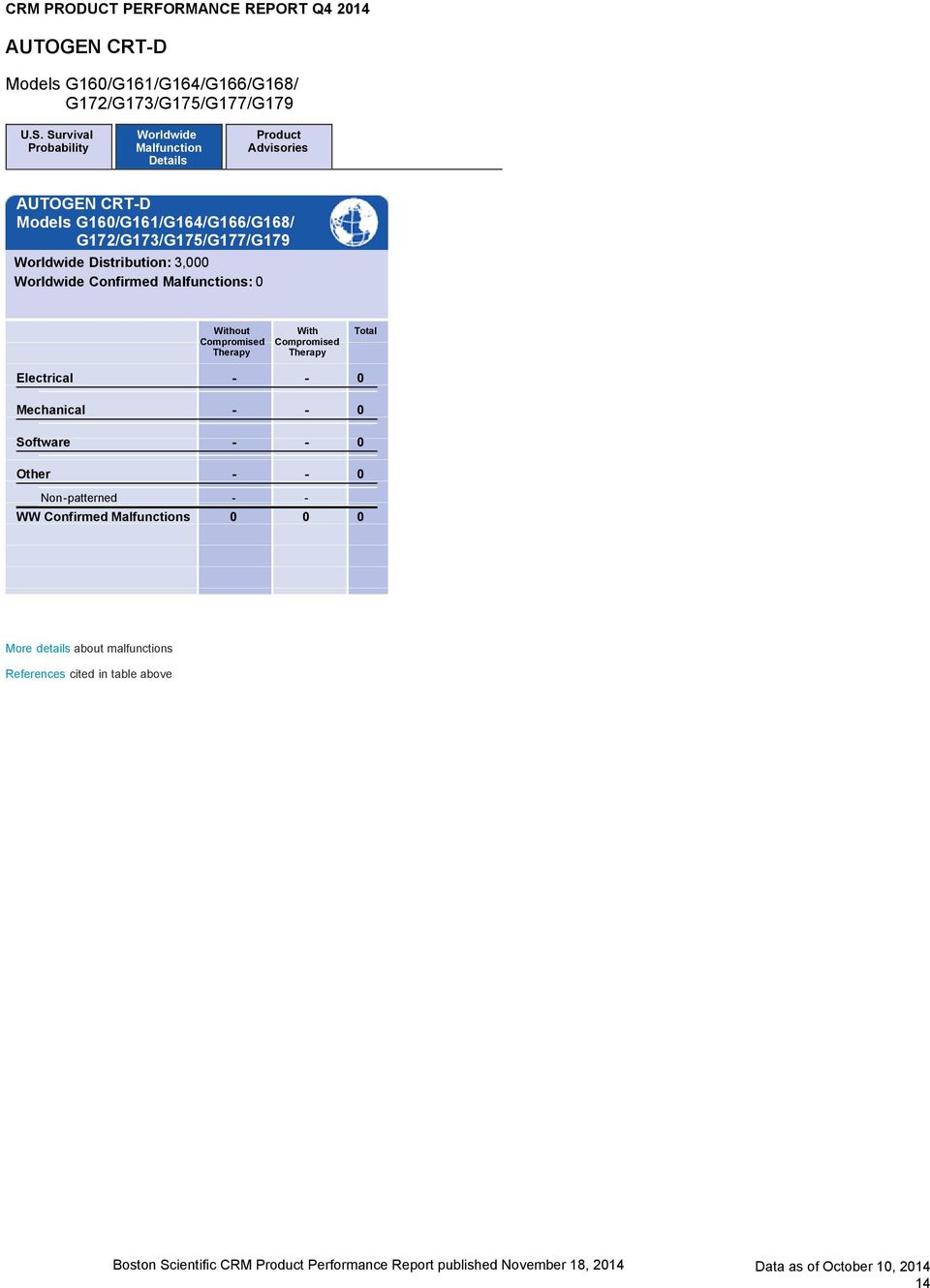
14 AUTOGEN CRT-D Models G160/G161/G164/G166/G168/ G172/G173/G175/G177/G179 AUTOGEN CRT-D Models G160/G161/G164/G166/G168/ G172/G173/G175/G177/G179 Distribution: 3,000 Confirmed s: 0 Without With Total Electrical Mechanical Software Other Non-patterned - - WW Confirmed s More details about malfunctions References cited in table above 14
15 DYNAGEN INOGEN ORIGEN CRT-D Models G050/G051/G056/G058/G140/ G141/G146/G148/G150/G151/ G154/G156/G158 DYNAGEN INOGEN ORIGEN CRT-D Models G050/G051/G056/G058/G140/ G141/G146/G148/G150/G151/ G154/G156/G158 Distribution: 3,000 Confirmed s: 0 Without With Total Electrical Mechanical Software Other Non-patterned - - WW Confirmed s More details about malfunctions References cited in table above 15

16 INCEPTA CRT-D 4-Site Models N160/N162/P162 U.S. Summary U.S. Registered Implants: 8,000 U.S. Approval Date: November 2011 U.S. Estimated Active Implants: 7,000 U.S. Normal Battery Depletions: 3 U.S. Unconfirmed Reports of Premature Battery Depletion : 1 U.S. s:4 Without :3 With :1 Battery Depletions and s s Only Non Advisory Population Registered Implants: 8000 Year Depletions and (-0.1/+0.0) 31 mo. s(%) (-0.4/+0.2) s Only(%) (-0.1/+0.0) (-0.1/+0.0) 31 mo. (-0.4/+0.1) Effective Sample Size

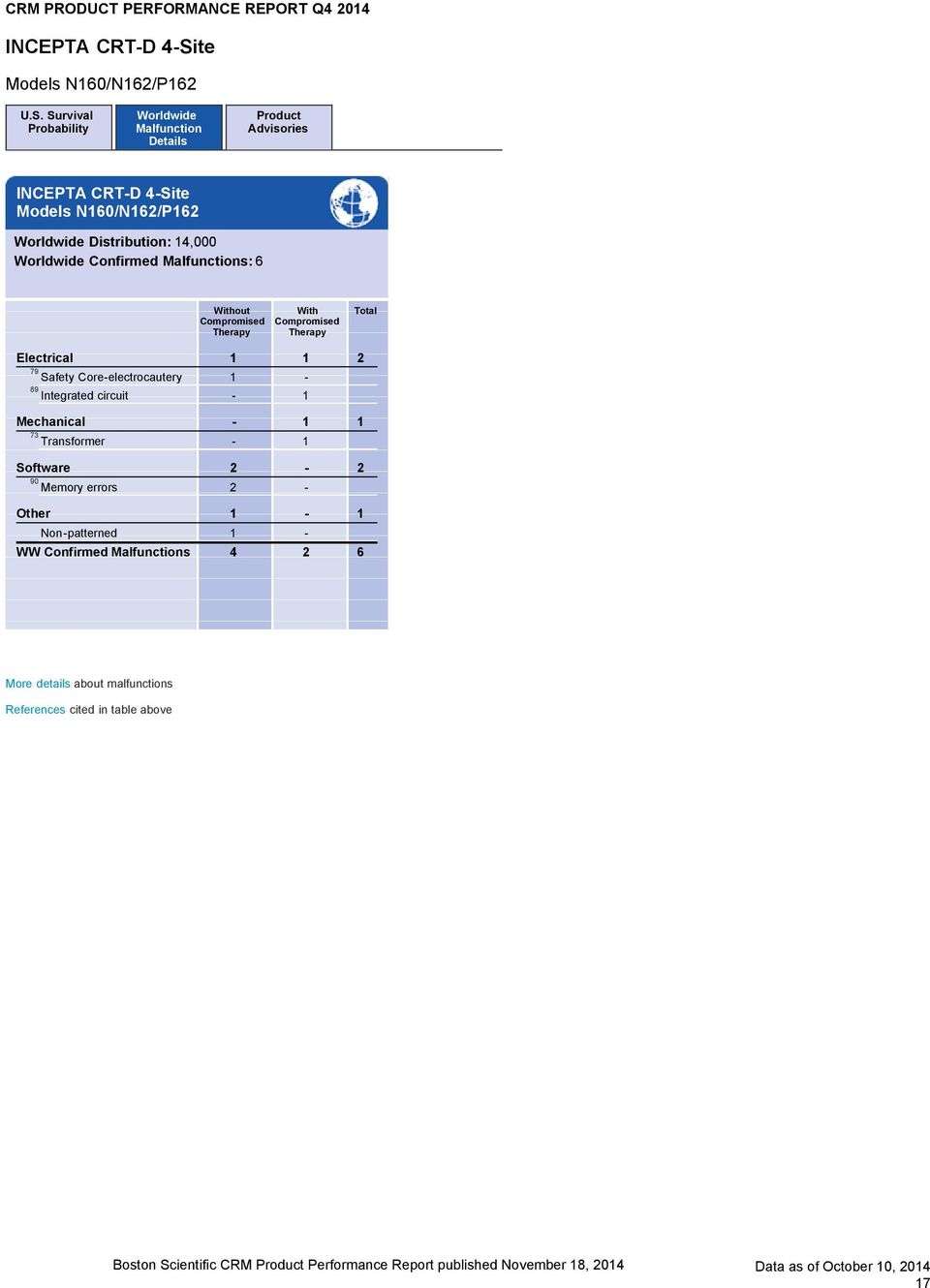
17 INCEPTA CRT-D 4-Site Models N160/N162/P162 INCEPTA CRT-D 4-Site Models N160/N162/P162 Distribution: 14,000 Confirmed s: 6 Without With Total Electrical Safety Core-electrocautery 1-89 Integrated circuit - 1 Mechanical Transformer - 1 Software Memory errors 2 - Other 1-1 Non-patterned 1 - WW Confirmed s More details about malfunctions References cited in table above 17
18 INCEPTA CRT-D Models N161/N163/N164/N165/P163/ P165 U.S. Summary U.S. Registered Implants: 11,000 U.S. Approval Date: November 2011 U.S. Estimated Active Implants: 10,000 U.S. Normal Battery Depletions: 6 U.S. Unconfirmed Reports of Premature Battery Depletion : 1 U.S. s:2 Without :0 With :2 Battery Depletions and s s Only Non Advisory Population Registered Implants: Year Depletions and (-0.1/+0.0) 31 mo. s(%) (-0.3/+0.1) s Only(%) (-0.1/+0.0) (-0.1/+0.0) 31 mo. (-0.1/+0.0) Effective Sample Size

19 INCEPTA CRT-D Models N161/N163/N164/N165/P163/ P165 INCEPTA CRT-D Models N161/N163/N164/N165/P163/ P165 Distribution: 16,000 Confirmed s: 2 Without With Total Electrical High-voltage capacitor - 1 Mechanical Transformer - 1 Software Other Non-patterned - - WW Confirmed s More details about malfunctions References cited in table above 19

20 ENERGEN CRT-D 4-Site Models N140/N142/P142 U.S. Summary U.S. Registered Implants: 12,000 U.S. Approval Date: November 2011 U.S. Estimated Active Implants: 11,000 U.S. Normal Battery Depletions: 1 U.S. Unconfirmed Reports of Premature Battery Depletion : 1 U.S. s:2 Without :1 With :1 Battery Depletions and s s Only Non Advisory Population Registered Implants: Year Depletions and (-0.1/+0.0) 31 mo. s(%) (-0.1/+0.0) s Only(%) (-0.1/+0.0) (-0.1/+0.0) 31 mo. (-0.1/+0.0) Effective Sample Size

21 ENERGEN CRT-D 4-Site Models N140/N142/P142 ENERGEN CRT-D 4-Site Models N140/N142/P142 Distribution: 18,000 Confirmed s: 4 Without With Total Electrical Integrated circuit 1 - Mechanical Software Memory errors 1 - Other Non-patterned 1 1 WW Confirmed s More details about malfunctions References cited in table above 21
22 ENERGEN CRT-D Models N141/N143/P143 U.S. Summary U.S. Registered Implants: 12,000 U.S. Approval Date: November 2011 U.S. Estimated Active Implants: 10,000 U.S. Normal Battery Depletions: 5 U.S. Unconfirmed Reports of Premature Battery Depletion : 1 U.S. s:8 Without :4 With :4 Battery Depletions and s s Only Non Advisory Population Registered Implants: Year Depletions and (-0.1/+0.0) 31 mo. s(%) (-0.2/+0.1) s Only(%) (-0.1/+0.0) (-0.1/+0.0) 31 mo. (-0.1/+0.0) Effective Sample Size
23 ENERGEN CRT-D Models N141/N143/P143 ENERGEN CRT-D Models N141/N143/P143 Distribution: 15,000 Confirmed s: 10 Without With Total Electrical Safety Core-electrocautery Low-voltage capacitors 1-89 Integrated circuit - 1 Mechanical Transformer - 3 Software Memory errors 1 - Other 2-2 Non-patterned 2 - WW Confirmed s More details about malfunctions References cited in table above 23
24 PUNCTUA CRT-D 4-Site Models N050/N052/P052 PUNCTUA CRT-D 4-Site Models N050/N052/P052 Distribution: 2,000 Confirmed s: 0 Without With Total Electrical Mechanical Software Other Non-patterned - - WW Confirmed s More details about malfunctions References cited in table above 24
25 PUNCTUA CRT-D Models N051/N053/P053 U.S. Summary U.S. Registered Implants: 1,000 U.S. Approval Date: November 2011 U.S. Estimated Active Implants: 1,000 U.S. Normal Battery Depletions: 0 U.S. Unconfirmed Reports of Premature Battery Depletion : 0 U.S. s:0 Without :0 With :0 Battery Depletions and s s Only Non Advisory Population Registered Implants: 1000 Year Depletions and mo. s(%) s Only(%) mo. Effective Sample Size
26 PUNCTUA CRT-D Models N051/N053/P053 PUNCTUA CRT-D Models N051/N053/P053 Distribution: 4,000 Confirmed s: 1 Without With Total Electrical Integrated circuit - 1 Mechanical Software Other Non-patterned - - WW Confirmed s More details about malfunctions References cited in table above 26
27 COGNIS Models N106/N107/N108/N118/N119/ N120/P106/P107/P108 U.S. Summary U.S. Registered Implants: 75,000 U.S. Approval Date: May 2008 U.S. Estimated Active Implants: 49,000 U.S. Normal Battery Depletions: 551 U.S. Unconfirmed Reports of Premature Battery Depletion : 45 U.S. s:524 Without :403 With :121 Battery Depletions and s s Only Non Advisory Population Registered Implants: Subpectoral Implant 2009* Year Depletions and (-0.1/+0.0) 53 mo. s(%) (-0.2/+0.2) s Only(%) mo. Effective Sample Size Depletions and (-0.2/+0.1) (-0.3/+0.3) 74 mo. s(%) (-0.6/+0.5) Registered Implants: 32,000 Low Voltage Capacitor 2013 and 2014* s Only(%) (-0.2/+0.2) (-0.3/+0.3) 74 mo. (-0.3/+0.3) Effective Sample Size Depletions and (-0.2/+0.2) (-0.4/+0.3) 73 mo. s(%) (-1.3/+1.3) Registered Implants: 27
28 26,000 s Only(%) (-0.2/+0.1) (-0.3/+0.3) (-0.8/+0.7) 73 mo. (-0.8/+0.7) Effective Sample Size *Devices subject to an advisory. Refer to the for more details. Devices may be part of more than one advisory. 28
29 COGNIS Models N106/N107/N108/N118/N119/ N120/P106/P107/P108 COGNIS Models N106/N107/N108/N118/N119/ N120/P106/P107/P108 Distribution: 109,000 Confirmed s: 670 Without With Total Electrical Low Voltage Capacitor (Advisory issued) 79 Safety Core-electrocautery High-voltage capacitor Low-voltage capacitors 7-89 Integrated circuit High voltage circuit Battery Low-voltage capacitor 15 5 Mechanical Subpectoral implant (Advisory issued) 73 Transformer Difficulty securing lead Header contacts Header 6 15 Software Safety Core-programming 1-87 Alert messages not displayed 2 - post-eol 90 Memory errors 8 - Other Non-patterned 26 8 WW Confirmed s More details about malfunctions References cited in table above 29
30 LIVIAN HE Models H227/H229/H247/H249 U.S. Summary U.S. Registered Implants: 6,000 U.S. Approval Date: February 2008 U.S. Estimated Active Implants: 2,000 U.S. Normal Battery Depletions: 1,101 U.S. Unconfirmed Reports of Premature Battery Depletion : 4 U.S. s:4 Without :2 With :2 Battery Depletions and s s Only Non Advisory Population Registered Implants: 6000 Year Depletions and (-0.1/+0.0) (-0.2/+0.1) (-0.4/+0.3) (-0.7/+0.6) (-1.3/+1.2) 76 mo. s(%) (-2.7/+2.7) s Only(%) (-0.1/+0.0) mo. Effective Sample Size
31 LIVIAN HE Models H227/H229/H247/H249 LIVIAN HE Models H227/H229/H247/H249 Distribution: 7,000 Confirmed s: 6 Without With Total Electrical Integrated circuit 1 1 Mechanical Difficulty securing lead - 2 Software Other Non-patterned 1-39 Battery depletion - 1 WW Confirmed s More details about malfunctions References cited in table above 31
32 LIVIAN Models H220/H225/H240/H245 U.S. Summary U.S. Registered Implants: 5,000 U.S. Approval Date: February 2008 U.S. Estimated Active Implants: 2,000 U.S. Normal Battery Depletions: 842 U.S. Unconfirmed Reports of Premature Battery Depletion : 0 U.S. s:8 Without :5 With :3 Battery Depletions and s s Only Non Advisory Population Registered Implants: 5000 Year Depletions and (-0.1/+0.0) (-0.2/+0.1) (-0.4/+0.3) (-0.7/+0.6) (-1.4/+1.2) 77 mo. s(%) (-3.1/+3.1) s Only(%) (-0.1/+0.0) (-0.2/+0.1) (-0.2/+0.1) (-0.2/+0.1) (-0.2/+0.1) (-0.2/+0.1) 77 mo. (-0.2/+0.1) Effective Sample Size
33 LIVIAN Models H220/H225/H240/H245 LIVIAN Models H220/H225/H240/H245 Distribution: 6,000 Confirmed s: 10 Without With Total Electrical Integrated circuit 1 2 Mechanical Seal plug 1 - Software Other Non-patterned Battery depletion 2 - WW Confirmed s More details about malfunctions References cited in table above 33
34 CONTAK RENEWAL 3 RF Models H210/H215 U.S. Summary U.S. Registered Implants: 21,000 U.S. Approval Date: February 2005 U.S. Estimated Active Implants: 2,000 U.S. Normal Battery Depletions: 7,500 U.S. Unconfirmed Reports of Premature Battery Depletion : 29 U.S. s:176 Without :157 With :19 Battery Depletions and s s Only Non Advisory Population Registered Implants: Jul-10 Magnetic Reed Switch 2010* Registered Implants: Apr-07 and 04- Mar-09 Shortened Replacement Window* Year Depletions and (-0.3/+0.0) (-0.4/+0.1) (-0.6/+0.4) (-1.2/+0.9) (-2.0/+1.7) 78 mo. s(%) (-3.4/+3.5) s Only(%) (-0.3/+0.0) (-0.3/+0.0) (-0.3/+0.0) (-0.5/+0.2) (-0.5/+0.2) (-0.5/+0.2) 78 mo. (-0.5/+0.2) Effective Sample Size Depletions and (-0.1/+0.0) (-0.2/+0.2) (-0.4/+0.4) (-0.7/+0.7) (-1.1/+1.1) 92 mo. s(%) (-1.1/+1.1) s Only(%) (-0.1/+0.0) (-0.1/+0.0) (-0.2/+0.1) (-0.2/+0.2) (-0.2/+0.2) (-0.3/+0.2) 92 mo. (-0.3/+0.2) Effective Sample Size Depletions and (-0.2/+0.1) (-0.3/+0.2) (-0.6/+0.5) (-1.2/+1.0) (-2.0/+1.9) 78 mo. s(%) (-1.7/+1.9) Registered Implants: 34
35 Mar-06 Low Level Current* Registered Implants: s Only(%) (-0.2/+0.1) (-0.3/+0.2) (-0.5/+0.3) (-0.7/+0.6) (-1.0/+0.9) (-1.3/+1.1) 78 mo. (-1.6/+1.4) Effective Sample Size Depletions and (-0.1/+0.0) (-0.2/+0.2) (-0.4/+0.4) (-0.7/+0.7) (-1.0/+1.0) 95 mo. s(%) (-0.9/+1.0) s Only(%) (-0.2/+0.1) (-0.2/+0.2) (-0.3/+0.2) (-0.3/+0.3) 95 mo. (-0.3/+0.3) Effective Sample Size *Devices subject to an advisory. Refer to the for more details. Devices may be part of more than one advisory. 35
36 CONTAK RENEWAL 3 RF Models H210/H215 CONTAK RENEWAL 3 RF Models H210/H215 Distribution: 21,000 Confirmed s: 178 Without With Total Electrical Shortened replacement 84 2 window (Advisory issued) 17 Extended charge time postmid-life 1-26 Capacitor 2-31 Integrated circuit Capacitor 1-51 Capacitor 3-56 Mid-life display of 13 - replacement indicators 58 High-voltage capacitor 2-78 Low-voltage capacitor 29 - Mechanical Magnetic reed switch (Advisory issued) 14 Magnetic switch - 1 (Advisory issued) 35 Seal plug 2-63 Setscrew 1-65 Seal plug Bent flex circuit - 3 Software Parameter errors 1-55 Memory location 1-75 Misaligned markers 1 - Other Non-patterned Battery depletion 5 1 WW Confirmed s More details about malfunctions References cited in table above 36
37 CONTAK RENEWAL 4 HE Models H197/H199 CONTAK RENEWAL 4 HE Models H197/H199 Distribution: 7,000 Confirmed s: 146 Without With Total Electrical Shortened replacement 67 1 window (Advisory issued) 10 Premature battery depletion 2 - (Advisory issued) 17 Extended charge time postmid-life Capacitor 1-31 Integrated circuit Capacitor 1-56 Mid-life display of 26 - replacement indicators 58 High-voltage capacitor 1-78 Low-voltage capacitor 21 - Mechanical Magnetic reed switch (Advisory issued) 7 Subpectoral implant - 1 (Advisory issued) 28 Header Seal plug 2-63 Setscrew Seal plug 1-72 Cracked solder joint 1 - Software Other Non-patterned Battery depletion 2 - WW Confirmed s More details about malfunctions References cited in table above 37
38 CONTAK RENEWAL 4 Models H190/H195 CONTAK RENEWAL 4 Models H190/H195 Distribution: 18,000 Confirmed s: 354 Without With Total Electrical Shortened replacement window (Advisory issued) 10 Premature battery depletion 14 - (Advisory issued) 17 Extended charge time postmid-life 9-22 Integrated circuit 2-26 Capacitor Integrated circuit Capacitor Capacitor 3-56 Mid-life display of 63 - replacement indicators 61 Integrated circuit Low-voltage capacitor 56 - Mechanical Magnetic reed switch (Advisory issued) 7 Subpectoral implant - 7 (Advisory issued) 14 Magnetic switch - 1 (Advisory issued) 28 Header 2-35 Seal plug 3-45 Circuit connection Setscrew Reed switch Cracked solder joint 1 - Software Other Non-patterned Battery depletion 4 3 WW Confirmed s More details about malfunctions References cited in table above 38
39 INVIVE Models V172/V173/V182/V183/W172/ W173 U.S. Summary U.S. Registered Implants: 6,000 U.S. Approval Date: May 2012 U.S. Estimated Active Implants: 6,000 U.S. Normal Battery Depletions: 1 U.S. Unconfirmed Reports of Premature Battery Depletion : 0 U.S. s:0 Without :0 With :0 Battery Depletions and s s Only Non Advisory Population Registered Implants: 6000 Year Depletions and (-0.1/+0.0) 26 mo. s(%) (-0.1/+0.0) s Only(%) mo. Effective Sample Size
40 INVIVE Models V172/V173/V182/V183/W172/ W173 INVIVE Models V172/V173/V182/V183/W172/ W173 Distribution: 14,000 Confirmed s: 1 Without With Total Electrical Low-voltage capacitors - 1 Mechanical Software Other Non-patterned - - WW Confirmed s More details about malfunctions References cited in table above 40
41 CONTAK RENEWAL TR 2 Models H140/H145 CONTAK RENEWAL TR 2 Models H140/H145 Distribution: 31,000 Confirmed s: 28 Without With Total Electrical Capacitor 1 - Mechanical Seal plug 1-50 Setscrew block 2-65 Seal plug 1 - Software Memory error 1-54 Stored EGMs 11 - Other Non-patterned Alert messages 1 - WW Confirmed s More details about malfunctions References cited in table above 41
42 CONTAK RENEWAL TR Models H120/H125 U.S. Summary U.S. Registered Implants: 19,000 U.S. Approval Date: January 2004 U.S. Estimated Active Implants: 8,000 U.S. Normal Battery Depletions: 1,687 U.S. Unconfirmed Reports of Premature Battery Depletion : 15 U.S. s:44 Without :42 With :2 Battery Depletions and s s Only Non Advisory Population Registered Implants: Jun-06 and 24- Aug-06 Low Voltage Capacitor* Year Depletions and (-0.1/+0.0) (-0.2/+0.2) (-0.4/+0.3) (-0.7/+0.6) (-1.1/+1.1) (-1.7/+1.7) 104 mo. s(%) (-2.9/+3.1) s Only(%) (-0.1/+0.0) (-0.1/+0.0) (-0.2/+0.1) (-0.3/+0.2) (-0.7/+0.4) 104 mo. (-1.6/+0.9) Effective Sample Size Survival probability data not provided because this population does not meet report inclusion criteria (see Statistical Methodology for more details). Refer to for more information. *Devices subject to an advisory. Refer to the for more details. Devices may be part of more than one advisory. 42
43 CONTAK RENEWAL TR Models H120/H125 CONTAK RENEWAL TR Models H120/H125 Distribution: 19,000 Confirmed s: 44 Without With Total Electrical Low-voltage capacitor 1 - (Advisory issued) 26 Capacitor - 1 Mechanical Seal plug 5 - Software Stored EGMs 27 - Other Non-patterned Alert messages 2 - WW Confirmed s More details about malfunctions References cited in table above 43
44 AUTOGEN ICD EL DR Models D162/D163/D176/D177 AUTOGEN ICD EL DR Models D162/D163/D176/D177 Distribution: 500 Confirmed s: 0 Without With Total Electrical Mechanical Software Other Non-patterned - - WW Confirmed s More details about malfunctions References cited in table above 44
45 AUTOGEN ICD EL VR Models D160/D161/D174/D175 AUTOGEN ICD EL VR Models D160/D161/D174/D175 Distribution: 500 Confirmed s: 0 Without With Total Electrical Mechanical Software Other Non-patterned - - WW Confirmed s More details about malfunctions References cited in table above 45
46 DYNAGEN/INOGEN/ORIGEN ICD MINI DR Models D002/D003/D012/D013/D022/ D023 DYNAGEN/INOGEN/ORIGEN ICD MINI DR Models D002/D003/D012/D013/D022/ D023 Distribution: 1,000 Confirmed s: 0 Without With Total Electrical Mechanical Software Other Non-patterned - - WW Confirmed s More details about malfunctions References cited in table above 46
47 DYNAGEN/INOGEN/ORIGEN ICD MINI VR Models D000/D001/D010/D011/D020/ D021 DYNAGEN/INOGEN/ORIGEN ICD MINI VR Models D000/D001/D010/D011/D020/ D021 Distribution: 1,000 Confirmed s: 0 Without With Total Electrical Mechanical Software Other Non-patterned - - WW Confirmed s More details about malfunctions References cited in table above 47
48 INCEPTA ICD DR 4-Site Models E162/F162 U.S. Summary U.S. Registered Implants: 9,000 U.S. Approval Date: November 2011 U.S. Estimated Active Implants: 9,000 U.S. Normal Battery Depletions: 2 U.S. Unconfirmed Reports of Premature Battery Depletion : 0 U.S. s:3 Without :2 With :1 Battery Depletions and s s Only Non Advisory Population Registered Implants: 9000 Year Depletions and (-0.1/+0.0) 31 mo. s(%) (-0.5/+0.1) s Only(%) (-0.1/+0.0) (-0.1/+0.0) 31 mo. (-0.6/+0.1) Effective Sample Size
49 INCEPTA ICD DR 4-Site Models E162/F162 INCEPTA ICD DR 4-Site Models E162/F162 Distribution: 16,000 Confirmed s: 4 Without With Total Electrical Integrated circuit 1 1 Mechanical Transformer - 1 Software Memory errors 1 - Other Non-patterned - - WW Confirmed s More details about malfunctions References cited in table above 49
50 INCEPTA ICD DR Models E163/F163 U.S. Summary U.S. Registered Implants: 6,000 U.S. Approval Date: November 2011 U.S. Estimated Active Implants: 5,000 U.S. Normal Battery Depletions: 1 U.S. Unconfirmed Reports of Premature Battery Depletion : 0 U.S. s:3 Without :2 With :1 Battery Depletions and s s Only Non Advisory Population Registered Implants: 6000 Year Depletions and (-0.2/+0.1) 30 mo. s(%) (-0.4/+0.1) s Only(%) (-0.1/+0.0) (-0.4/+0.1) 30 mo. (-0.4/+0.1) Effective Sample Size
51 INCEPTA ICD DR Models E163/F163 INCEPTA ICD DR Models E163/F163 Distribution: 9,000 Confirmed s: 6 Without With Total Electrical Low-voltage capacitors 1-89 Integrated circuit 1-97 High voltage circuit 1 - Mechanical Software Other Non-patterned 2 1 WW Confirmed s More details about malfunctions References cited in table above 51
52 INCEPTA ICD VR 4-Site Models E160/F160 U.S. Summary U.S. Registered Implants: 8,000 U.S. Approval Date: November 2011 U.S. Estimated Active Implants: 8,000 U.S. Normal Battery Depletions: 3 U.S. Unconfirmed Reports of Premature Battery Depletion : 0 U.S. s:2 Without :1 With :1 Battery Depletions and s s Only Non Advisory Population Registered Implants: 8000 Year Depletions and mo. s(%) s Only(%) (-0.1/+0.0) (-0.1/+0.0) 31 mo. (-0.1/+0.0) Effective Sample Size
53 INCEPTA ICD VR 4-Site Models E160/F160 INCEPTA ICD VR 4-Site Models E160/F160 Distribution: 14,000 Confirmed s: 2 Without With Total Electrical Mechanical Transformer - 1 Software Memory errors 1 - Other Non-patterned - - WW Confirmed s More details about malfunctions References cited in table above 53
54 INCEPTA ICD VR Models E161/F161 U.S. Summary U.S. Registered Implants: 3,000 U.S. Approval Date: November 2011 U.S. Estimated Active Implants: 3,000 U.S. Normal Battery Depletions: 1 U.S. Unconfirmed Reports of Premature Battery Depletion : 0 U.S. s:1 Without :0 With :1 Battery Depletions and s s Only Non Advisory Population Registered Implants: 3000 Year Depletions and (-0.2/+0.0) 29 mo. s(%) (-0.3/+0.1) s Only(%) (-0.2/+0.0) (-0.2/+0.0) 29 mo. (-0.2/+0.0) Effective Sample Size
55 INCEPTA ICD VR Models E161/F161 INCEPTA ICD VR Models E161/F161 Distribution: 6,000 Confirmed s: 1 Without With Total Electrical High-voltage capacitor - 1 Mechanical Software Other Non-patterned - - WW Confirmed s More details about malfunctions References cited in table above 55
56 ENERGEN ICD DR 4-Site Models E142/F142 U.S. Summary U.S. Registered Implants: 12,000 U.S. Approval Date: November 2011 U.S. Estimated Active Implants: 11,000 U.S. Normal Battery Depletions: 2 U.S. Unconfirmed Reports of Premature Battery Depletion : 0 U.S. s:5 Without :3 With :2 Battery Depletions and s s Only Non Advisory Population Registered Implants: Year Depletions and (-0.1/+0.0) 31 mo. s(%) (-0.2/+0.1) s Only(%) (-0.1/+0.0) (-0.1/+0.0) 31 mo. (-0.1/+0.0) Effective Sample Size
57 ENERGEN ICD DR 4-Site Models E142/F142 ENERGEN ICD DR 4-Site Models E142/F142 Distribution: 18,000 Confirmed s: 6 Without With Total Electrical Low-voltage capacitors 1-89 Integrated circuit 2 2 Mechanical Software Other 1-1 Non-patterned 1 - WW Confirmed s More details about malfunctions References cited in table above 57
58 ENERGEN ICD DR Models E143/F143 U.S. Summary U.S. Registered Implants: 9,000 U.S. Approval Date: November 2011 U.S. Estimated Active Implants: 8,000 U.S. Normal Battery Depletions: 4 U.S. Unconfirmed Reports of Premature Battery Depletion : 0 U.S. s:1 Without :1 With :0 Battery Depletions and s s Only Non Advisory Population Registered Implants: 9000 Year Depletions and mo. s(%) s Only(%) (-0.1/+0.0) (-0.1/+0.0) 30 mo. (-0.1/+0.0) Effective Sample Size
59 ENERGEN ICD DR Models E143/F143 ENERGEN ICD DR Models E143/F143 Distribution: 12,000 Confirmed s: 2 Without With Total Electrical Low-voltage capacitors 1 - Mechanical Transformer - 1 Software Other Non-patterned - - WW Confirmed s More details about malfunctions References cited in table above 59
60 ENERGEN ICD VR 4-Site Models E140/F140 U.S. Summary U.S. Registered Implants: 13,000 U.S. Approval Date: November 2011 U.S. Estimated Active Implants: 12,000 U.S. Normal Battery Depletions: 9 U.S. Unconfirmed Reports of Premature Battery Depletion : 0 U.S. s:2 Without :0 With :2 Battery Depletions and s s Only Non Advisory Population Registered Implants: Year Depletions and (-0.1/+0.0) 31 mo. s(%) (-0.2/+0.1) s Only(%) (-0.1/+0.0) (-0.1/+0.0) 31 mo. (-0.1/+0.0) Effective Sample Size
61 ENERGEN ICD VR 4-Site Models E140/F140 ENERGEN ICD VR 4-Site Models E140/F140 Distribution: 18,000 Confirmed s: 3 Without With Total Electrical Mechanical Transformer - 1 Software Memory errors 1 - Other Non-patterned - 1 WW Confirmed s More details about malfunctions References cited in table above 61
62 ENERGEN ICD VR Models E141/F141 U.S. Summary U.S. Registered Implants: 6,000 U.S. Approval Date: November 2011 U.S. Estimated Active Implants: 6,000 U.S. Normal Battery Depletions: 2 U.S. Unconfirmed Reports of Premature Battery Depletion : 0 U.S. s:2 Without :1 With :1 Battery Depletions and s s Only Non Advisory Population Registered Implants: 6000 Year Depletions and (-0.2/+0.1) 30 mo. s(%) (-0.2/+0.1) s Only(%) (-0.1/+0.0) (-0.1/+0.0) 30 mo. (-0.1/+0.0) Effective Sample Size
63 ENERGEN ICD VR Models E141/F141 ENERGEN ICD VR Models E141/F141 Distribution: 10,000 Confirmed s: 5 Without With Total Electrical Integrated circuit - 3 Mechanical Software Memory errors 1 - Other 1-1 Non-patterned 1 - WW Confirmed s More details about malfunctions References cited in table above 63
64 PUNCTUA ICD DR 4-Site Models E052/F052 PUNCTUA ICD DR 4-Site Models E052/F052 Distribution: 2,000 Confirmed s: 0 Without With Total Electrical Mechanical Software Other Non-patterned - - WW Confirmed s More details about malfunctions References cited in table above 64
65 PUNCTUA ICD DR Models E053/F053 U.S. Summary U.S. Registered Implants: 1,000 U.S. Approval Date: November 2011 U.S. Estimated Active Implants: 1,000 U.S. Normal Battery Depletions: 0 U.S. Unconfirmed Reports of Premature Battery Depletion : 0 U.S. s:1 Without :0 With :1 Battery Depletions and s s Only Non Advisory Population Registered Implants: 1000 Year Depletions and mo. s(%) (-0.7/+0.1) s Only(%) (-0.7/+0.1) 22 mo. (-0.7/+0.1) Effective Sample Size
66 PUNCTUA ICD DR Models E053/F053 PUNCTUA ICD DR Models E053/F053 Distribution: 3,000 Confirmed s: 1 Without With Total Electrical Mechanical Software Other Non-patterned - 1 WW Confirmed s More details about malfunctions References cited in table above 66
67 PUNCTUA ICD VR 4-Site Models E050/F050 PUNCTUA ICD VR 4-Site Models E050/F050 Distribution: 3,000 Confirmed s: 1 Without With Total Electrical Mechanical Software Other Non-patterned - 1 WW Confirmed s More details about malfunctions References cited in table above 67
68 PUNCTUA ICD VR Models E051/F051 U.S. Summary U.S. Registered Implants: 1,000 U.S. Approval Date: November 2011 U.S. Estimated Active Implants: 1,000 U.S. Normal Battery Depletions: 0 U.S. Unconfirmed Reports of Premature Battery Depletion : 0 U.S. s:1 Without :1 With :0 Battery Depletions and s s Only Non Advisory Population Registered Implants: 1000 Year Depletions and mo. s(%) (-1.9/+0.3) s Only(%) mo. (-1.9/+0.3) Effective Sample Size
69 PUNCTUA ICD VR Models E051/F051 PUNCTUA ICD VR Models E051/F051 Distribution: 5,000 Confirmed s: 3 Without With Total Electrical High voltage circuit - 1 Mechanical Software Other 2-2 Non-patterned 2 - WW Confirmed s More details about malfunctions References cited in table above 69
70 SQ-RX Pulse Generator Model 1010 U.S. Summary U.S. Approval Date: September 2012 U.S. Normal Battery Depletions: 0 U.S. Unconfirmed Reports of Premature Battery Depletion : 1 U.S. s:7 Without :2 With :5 Battery Depletions and s s Only Total Population 1-Jun-11 High Cathode Condition* Year Depletions and (-0.3/+0.1) 25 mo. s(%) (-1.2/+0.4) s Only(%) (-0.3/+0.1) (-1.1/+0.3) 25 mo. (-1.1/+0.3) Survival probability data not provided because this population does not meet report inclusion criteria (see Statistical Methodology for more details). Refer to for more information. *Devices subject to an advisory. Refer to the for more details. Devices may be part of more than one advisory. This product family may not conform to all AdvaMed/ISO recommended performance reporting data elements. 70
71 SQ-RX Pulse Generator Model 1010 SQ-RX Pulse Generator Model 1010 Confirmed s: 43 Without With Total Electrical Unintended Fuse Activation 2013 (Advisory issued) - 3 Mechanical High cathode condition (Advisory issued) 94 Battery depletion 10 9 Software Unintended Battery Depletion 2 - Alert Other Non-patterned Telemetry 1 1 WW Confirmed s More details about malfunctions References cited in table above 71
72 TELIGEN DR Models E110/E111/F110/F111 U.S. Summary U.S. Registered Implants: 66,000 U.S. Approval Date: May 2008 U.S. Estimated Active Implants: 47,000 U.S. Normal Battery Depletions: 107 U.S. Unconfirmed Reports of Premature Battery Depletion : 45 U.S. s:554 Without :473 With :81 Battery Depletions and s s Only Non Advisory Population Registered Implants: Subpectoral Implant 2009* Registered Implants: 30,000 Low Voltage Capacitor 2014* Registered Implants: 23,000 Year Depletions and mo. s(%) s Only(%) mo. Effective Sample Size Depletions and (-0.1/+0.0) (-0.1/+0.2) (-0.1/+0.3) (-0.2/+0.7) 74 mo. s(%) (-0.6/+1.3) s Only(%) (-0.1/+0.0) (-0.1/+0.0) (-0.2/+0.2) (-0.4/+0.3) 74 mo. (-0.4/+0.3) Effective Sample Size Depletions and (-0.1/+0.0) (-0.2/+0.2) (-0.4/+0.3) 73 mo. s(%) (-1.5/+1.3) s Only(%) (-0.2/+0.1) (-0.3/+0.3) (-1.1/+0.9) 73 mo. 72
73 (-1.2/+1.0) Effective Sample Size *Devices subject to an advisory. Refer to the for more details. Devices may be part of more than one advisory. 73
74 TELIGEN DR Models E110/E111/F110/F111 TELIGEN DR Models E110/E111/F110/F111 Distribution: 90,000 Confirmed s: 753 Without With Total Electrical Low Voltage Capacitor (Advisory issued) 79 Safety Core-electrocautery 3-80 High-voltage capacitor Low-voltage capacitors 6-89 Integrated circuit Battery Low-voltage capacitor 14 - Mechanical Subpectoral implant (Advisory issued) 73 Transformer Seal plug 3-77 Difficulty securing lead Header contacts Header 1 3 Software Alert messages not displayed 3 - post-eol 90 Memory errors 11 - Other Non-patterned 17 6 WW Confirmed s More details about malfunctions References cited in table above 74
75 TELIGEN VR Models E102/E103/F102/F103 U.S. Summary U.S. Registered Implants: 38,000 U.S. Approval Date: May 2008 U.S. Estimated Active Implants: 27,000 U.S. Normal Battery Depletions: 56 U.S. Unconfirmed Reports of Premature Battery Depletion : 14 U.S. s:396 Without :332 With :64 Battery Depletions and s s Only Non Advisory Population Registered Implants: Subpectoral Implant 2009* Registered Implants: 30,000 Low Voltage Capacitor 2014* Registered Implants: 12,000 Year Depletions and (-0.1/+0.0) 52 mo. s(%) (-0.3/+0.2) s Only(%) (-0.1/+0.0) (-0.1/+0.0) (-0.1/+0.0) (-0.3/+0.2) 52 mo. (-0.3/+0.2) Effective Sample Size Depletions and (-0.1/+0.0) (-0.2/+0.2) (-0.4/+0.3) 73 mo. s(%) (-0.6/+0.5) s Only(%) (-0.2/+0.2) (-0.3/+0.3) (-0.6/+0.5) 73 (-0.5/+0.6) Effective Sample Size Depletions and (-0.0/+0.1) (-0.0/+0.2) (-0.1/+0.5) (-0.2/+0.9) 73 mo. s(%) (-1.4/+1.1) s Only(%) (-0.3/+0.2) (-0.5/+0.5) (-1.3/+1.1) 73 mo. 75
76 (-1.5/+1.2) Effective Sample Size *Devices subject to an advisory. Refer to the for more details. Devices may be part of more than one advisory. 76
77 TELIGEN VR Models E102/E103/F102/F103 TELIGEN VR Models E102/E103/F102/F103 Distribution: 65,000 Confirmed s: 618 Without With Total Electrical Low Voltage Capacitor (Advisory issued) 79 Safety Core-electrocautery High-voltage capacitor Low-voltage capacitors 4-89 Integrated circuit Battery Low-voltage capacitor 8 - Mechanical Subpectoral implant (Advisory issued) 44 Transformer Transformer Seal plug 1-77 Difficulty securing lead Header contacts Header 1 7 Software Respiratory Sensor 1 - Oversensing (Advisory issued) 87 Alert messages not displayed 4 - post-eol 90 Memory errors 9 - Other Non-patterned 7 8 WW Confirmed s More details about malfunctions References cited in table above 77
78 CONFIENT DR Models E030/F030 U.S. Summary U.S. Registered Implants: 7,000 U.S. Approval Date: February 2008 U.S. Estimated Active Implants: 4,000 U.S. Normal Battery Depletions: 51 U.S. Unconfirmed Reports of Premature Battery Depletion : 2 U.S. s:10 Without :8 With :2 Battery Depletions and s s Only Non Advisory Population Registered Implants: 7000 Year Depletions and (-0.1/+0.0) (-0.2/+0.1) (-0.2/+0.2) (-0.3/+0.2) 78 mo. s(%) (-0.8/+0.6) s Only(%) (-0.1/+0.0) (-0.1/+0.0) (-0.1/+0.0) (-0.2/+0.1) (-0.3/+0.1) 78 mo. (-0.3/+0.2) Effective Sample Size
79 CONFIENT DR Models E030/F030 CONFIENT DR Models E030/F030 Distribution: 8,000 Confirmed s: 10 Without With Total Electrical Capacitor 1-31 Integrated circuit 2-93 Low-voltage capacitor 3 - Mechanical Transformer - 1 Software Other Non-patterned 2-39 Battery depletion - 1 WW Confirmed s More details about malfunctions References cited in table above 79
80 VITALITY 2 EL DR Model T167 U.S. Summary U.S. Registered Implants: 8,000 U.S. Approval Date: March 2004 U.S. Estimated Active Implants: 2,000 U.S. Normal Battery Depletions: 1,495 U.S. Unconfirmed Reports of Premature Battery Depletion : 13 U.S. s:764 Battery Depletions and s s Only Non Advisory Population Registered Implants: Apr-07 and 04- Mar-09 Shortened Replacement Window* Year Depletions and (-0.1/+0.0) (-0.2/+0.1) (-0.2/+0.1) (-0.4/+0.3) (-1.1/+1.0) (-1.5/+1.4) 91 mo. s(%) (-3.6/+3.6) s Only(%) (-0.1/+0.0) (-0.2/+0.1) (-0.2/+0.1) (-0.3/+0.2) (-1.0/+0.9) (-1.4/+1.3) (-1.4/+1.3) 91 mo. (-1.4/+1.3) Effective Sample Size Depletions and (-0.4/+0.1) (-0.6/+0.3) (-0.8/+0.5) (-1.5/+1.2) (-2.6/+2.4) (-3.2/+3.1) 85 mo. s(%) (-3.1/+3.3) Registered Implants: 2000 s Only(%) (-0.4/+0.1) (-0.5/+0.3) (-0.7/+0.5) (-1.4/+1.1) (-2.4/+2.1) (-2.9/+2.6) (-3.1/+2.9) 85 mo. (-3.1/+2.9) Effective Sample Size Mar-07 Depletions and (-0.5/+0.2) (-0.7/+0.3) (-0.8/+0.4) (-1.5/+1.1) (-3.3/+3.1) 82 mo. Update - Mid-s(%life Display of (-4.0/+4.1) Replacement Indicators* Registered Implants: 80
81 Jun-06 and 24- Aug-06 Low Voltage Capacitor* s Only(%) (-0.5/+0.1) (-0.6/+0.2) (-0.7/+0.3) (-1.3/+0.9) (-3.1/+2.8) (-3.7/+3.4) 82 mo. (-3.7/+3.5) Effective Sample Size Survival probability data not provided because this population does not meet report inclusion criteria (see Statistical Methodology for more details). Refer to for more information. *Devices subject to an advisory. Refer to the for more details. Devices may be part of more than one advisory. 81
82 VITALITY 2 EL DR Model T167 VITALITY 2 EL DR Model T167 Distribution: 14,000 Confirmed s: 1055 Without With Total Electrical Shortened replacement window (Advisory issued) 17 Extended charge time postmid-life Capacitor 1-31 Integrated circuit Capacitor 1-56 Mid-life display of replacement indicators 58 High-voltage capacitor Integrated circuit Low-voltage capacitor 42 1 Mechanical Subpectoral implant 1 1 (Advisory issued) 28 Header 1-35 Seal plug Seal plug 1-73 Transformer - 1 Software Memory location Misaligned markers 6 - Other Non-patterned Firmware error 1 4 WW Confirmed s More details about malfunctions References cited in table above 82
83 VITALITY 2 DR Model T165 U.S. Summary U.S. Registered Implants: 31,000 U.S. Approval Date: March 2004 U.S. Estimated Active Implants: 5,000 U.S. Normal Battery Depletions: 10,939 U.S. Unconfirmed Reports of Premature Battery Depletion : 79 U.S. s:1139 Without :1075 With :64 Battery Depletions and s s Only Non Advisory Population Registered Implants: Apr-07 and 04- Mar-09 Shortened Replacement Window* Year Depletions and (-0.1/+0.0) (-0.2/+0.2) (-0.5/+0.5) 83 mo. s(%) (-1.0/+1.1) s Only(%) (-0.1/+0.0) (-0.2/+0.1) (-0.2/+0.2) 83 mo. (-0.4/+0.3) Effective Sample Size Depletions and (-0.2/+0.2) (-0.5/+0.4) (-0.9/+0.9) (-1.4/+1.4) 77 mo. s(%) (-0.8/+0.9) Registered Implants: 9000 s Only(%) (-0.1/+0.0) (-0.2/+0.1) (-0.4/+0.4) (-0.8/+0.7) (-1.0/+0.9) (-1.2/+1.1) 77 mo. (-1.5/+1.4) Effective Sample Size Mar-07 Depletions and (-0.3/+0.2) (-0.4/+0.3) (-0.6/+0.5) (-1.0/+0.9) (-1.6/+1.5) 76 mo. Update - Mid-s(%life Display of (-1.1/+1.3) Replacement Indicators* 83
84 Registered Implants: Jun-06 and 24- Aug-06 Low Voltage Capacitor* s Only(%) (-0.3/+0.2) (-0.4/+0.3) (-0.6/+0.5) (-0.9/+0.8) (-1.0/+0.9) (-1.3/+1.1) 76 mo. (-1.8/+1.6) Effective Sample Size Depletions and (-1.0/+0.1) (-1.2/+0.4) (-1.7/+0.9) 59 mo. s(%) (-5.3/+5.0) Registered Implants: May-06 Premature Battery Depletion* s Only(%) (-1.0/+0.1) (-1.1/+0.3) (-1.6/+0.7) (-2.8/+1.8) 59 mo. (-4.3/+3.3) Effective Sample Size Survival probability data not provided because this population does not meet report inclusion criteria (see Statistical Methodology for more details). Refer to for more information. *Devices subject to an advisory. Refer to the for more details. Devices may be part of more than one advisory. 84
85 VITALITY 2 DR Model T165 VITALITY 2 DR Model T165 Distribution: 43,000 Confirmed s: 1371 Without With Total Electrical Shortened replacement window (Advisory issued) 9 Low-voltage capacitor 1 - (Advisory issued) 10 Premature battery depletion (Advisory issued) 17 Extended charge time postmid-life Integrated circuit Reconfirmation after charge 1-26 Capacitor Integrated circuit Capacitor Capacitor 4-52 Device tones 1-56 Mid-life display of replacement indicators 58 High-voltage capacitor Integrated circuit 1-70 Logic errors Low-voltage capacitor Mechanical Seal plug Transformer Seal plug Solder joint 1 2 Software Memory location Memory location 1-75 Misaligned markers 1 - Other Non-patterned Firmware error Battery depletion Magnet rate - 1 WW Confirmed s More details about malfunctions References cited in table above 85
86 VITALITY 2 EL VR Model T177 U.S. Summary U.S. Registered Implants: 7,000 U.S. Approval Date: March 2004 U.S. Estimated Active Implants: 2,000 U.S. Normal Battery Depletions: 885 U.S. Unconfirmed Reports of Premature Battery Depletion : 9 U.S. s:1234 Without :1221 With :13 Battery Depletions and s s Only Non Advisory Population Registered Implants: Apr-07 and 04- Mar-09 Shortened Replacement Window* Year Depletions and (-0.2/+0.0) (-0.2/+0.1) (-0.2/+0.1) (-0.4/+0.2) (-0.8/+0.6) (-2.2/+2.2) 88 mo. s(%) (-2.8/+2.8) s Only(%) (-0.2/+0.0) (-0.2/+0.1) (-0.2/+0.1) (-0.3/+0.1) (-0.6/+0.4) (-2.2/+2.1) (-2.7/+2.7) 88 mo. (-2.7/+2.7) Effective Sample Size Depletions and (-0.3/+0.0) (-0.5/+0.2) (-0.8/+0.5) (-1.2/+1.0) (-2.2/+2.0) (-3.2/+3.2) 88 mo. s(%) (-3.4/+3.5) Registered Implants: 2000 s Only(%) (-0.3/+0.0) (-0.5/+0.2) (-0.7/+0.4) (-1.1/+0.8) (-2.1/+1.8) (-3.2/+3.1) (-3.5/+3.4) 88 mo. (-3.6/+3.4) Effective Sample Size Mar-07 Depletions and (-0.6/+0.2) (-0.6/+0.2) (-0.8/+0.3) (-1.0/+0.6) (-2.5/+2.0) 74 mo. Update - Mid-s(%life Display of (-4.4/+4.5) Replacement Indicators* 86
87 Registered Implants: Jun-06 and 24- Aug-06 Low Voltage Capacitor* s Only(%) (-0.6/+0.2) (-0.6/+0.2) (-0.7/+0.3) (-1.0/+0.5) (-2.3/+1.8) (-4.6/+4.4) 74 mo. (-4.7/+4.6) Effective Sample Size Survival probability data not provided because this population does not meet report inclusion criteria (see Statistical Methodology for more details). Refer to for more information. *Devices subject to an advisory. Refer to the for more details. Devices may be part of more than one advisory. 87
88 VITALITY 2 EL VR Model T177 VITALITY 2 EL VR Model T177 Distribution: 16,000 Confirmed s: 1826 Without With Total Electrical Shortened replacement window (Advisory issued) 9 Low-voltage capacitor 2 1 (Advisory issued) 17 Extended charge time postmid-life Integrated circuit Capacitor 1-51 Capacitor 2-56 Mid-life display of replacement indicators 58 High-voltage capacitor 2-78 Low-voltage capacitor 65 - Mechanical Subpectoral implant - 5 (Advisory issued) 28 Header Seal plug 1-59 Sensing 1-73 Transformer - 2 Software Memory location Memory location - 1 Other Non-patterned Battery depletion - 2 WW Confirmed s More details about malfunctions References cited in table above 88
89 VITALITY 2 VR Model T175 U.S. Summary U.S. Registered Implants: 21,000 U.S. Approval Date: March 2004 U.S. Estimated Active Implants: 5,000 U.S. Normal Battery Depletions: 4,908 U.S. Unconfirmed Reports of Premature Battery Depletion : 33 U.S. s:1239 Without :1214 With :25 Battery Depletions and s s Only Non Advisory Population Registered Implants: Apr-07 and 04- Mar-09 Shortened Replacement Window* Year Depletions and (-0.1/+0.0) (-0.2/+0.1) (-0.4/+0.3) (-0.6/+0.6) (-0.9/+0.8) 88 mo. s(%) (-2.4/+2.5) s Only(%) (-0.1/+0.0) (-0.1/+0.0) (-0.3/+0.3) (-0.5/+0.4) (-0.5/+0.5) (-0.6/+0.5) 88 mo. (-0.6/+0.5) Effective Sample Size Depletions and (-0.1/+0.0) (-0.3/+0.2) (-0.5/+0.4) (-1.0/+0.9) (-1.4/+1.3) (-1.8/+1.8) 87 mo. s(%) (-1.2/+1.3) Registered Implants: 6000 s Only(%) (-0.1/+0.0) (-0.2/+0.2) (-0.5/+0.4) (-0.9/+0.8) (-1.2/+1.1) (-1.3/+1.2) (-1.5/+1.4) 87 mo. (-1.5/+1.4) Effective Sample Size Mar-07 Depletions and (-0.3/+0.2) (-0.6/+0.5) (-0.8/+0.7) (-1.3/+1.2) (-1.7/+1.6) (-2.1/+2.1) 85 mo. Update - Mid-s(%life Display of (-1.6/+1.8) Replacement Indicators* 89
90 Registered Implants: Jun-06 and 24- Aug-06 Low Voltage Capacitor* s Only(%) (-0.3/+0.2) (-0.6/+0.5) (-0.8/+0.7) (-1.2/+1.1) (-1.4/+1.3) (-1.5/+1.4) (-1.8/+1.7) 85 mo. (-1.8/+1.7) Effective Sample Size Depletions and (-1.1/+0.4) (-1.5/+0.7) (-2.1/+1.3) (-3.1/+2.2) 62 mo. s(%) (-5.2/+4.5) Registered Implants: May-06 Premature Battery Depletion* s Only(%) (-1.1/+0.2) (-1.4/+0.6) (-1.9/+1.0) (-2.7/+1.8) (-4.5/+3.6) 62 mo. (-4.5/+3.6) Effective Sample Size Survival probability data not provided because this population does not meet report inclusion criteria (see Statistical Methodology for more details). Refer to for more information. *Devices subject to an advisory. Refer to the for more details. Devices may be part of more than one advisory. 90
91 VITALITY 2 VR Model T175 VITALITY 2 VR Model T175 Distribution: 37,000 Confirmed s: 1581 Without With Total Electrical Shortened replacement window (Advisory issued) 9 Low-voltage capacitor - 1 (Advisory issued) 10 Premature battery depletion (Advisory issued) 17 Extended charge time postmid-life Integrated circuit Capacitor 1-31 Integrated circuit Capacitor 1-51 Capacitor 4-56 Mid-life display of replacement indicators 58 High-voltage capacitor Low-voltage capacitor Mechanical Seal plug 2 1 Software Memory location - 1 Other Non-patterned Battery depletion 2 - WW Confirmed s More details about malfunctions References cited in table above 91
92 VITALITY DR HE Model T180 U.S. Summary U.S. Registered Implants: 13,000 U.S. Approval Date: May 2005 U.S. Estimated Active Implants: 4,000 U.S. Normal Battery Depletions: 2,144 U.S. Unconfirmed Reports of Premature Battery Depletion : 13 U.S. s:416 Without :387 With :29 Battery Depletions and s s Only Non Advisory Population Registered Implants: Jul-10 Magnetic Reed Switch 2010* Registered Implants: Apr-07 and 04- Mar-09 Shortened Replacement Window* Year Depletions and (-0.3/+0.0) (-0.3/+0.1) (-0.3/+0.1) (-0.8/+0.5) (-1.4/+1.2) (-1.9/+1.7) 91 mo. s(%) (-4.2/+4.2) s Only(%) (-0.3/+0.0) (-0.3/+0.1) (-0.3/+0.1) (-0.6/+0.4) (-1.1/+0.9) (-1.2/+1.0) (-1.5/+1.2) 91 mo. (-2.0/+1.6) Effective Sample Size Depletions and (-0.2/+0.1) (-0.2/+0.2) (-0.3/+0.3) (-0.6/+0.5) (-0.9/+0.8) 93 mo. s(%) (-3.0/+3.0) s Only(%) (-0.2/+0.1) (-0.3/+0.2) (-0.4/+0.3) (-0.5/+0.4) (-0.6/+0.5) 93 mo. (-0.8/+0.7) Effective Sample Size Depletions and (-0.2/+0.1) (-0.4/+0.3) (-0.7/+0.5) (-1.2/+1.0) (-1.9/+1.7) (-2.5/+2.4) 91 mo. s(%) (-2.3/+2.5) Registered Implants: 92
93 3000 s Only(%) (-0.2/+0.1) (-0.4/+0.2) (-0.6/+0.4) (-1.0/+0.8) (-1.6/+1.4) (-2.0/+1.8) (-2.5/+2.3) 91 mo. (-2.7/+2.5) Effective Sample Size *Devices subject to an advisory. Refer to the for more details. Devices may be part of more than one advisory. 93
94 VITALITY DR HE Model T180 VITALITY DR HE Model T180 Distribution: 13,000 Confirmed s: 416 Without With Total Electrical Shortened replacement 88 1 window (Advisory issued) 17 Extended charge time postmid-life Capacitor Integrated circuit Capacitor Mid-life display of replacement indicators 61 Integrated circuit Low-voltage capacitor 81 - Mechanical Magnetic reed switch (Advisory issued) 7 Subpectoral implant - 1 (Advisory issued) 28 Header Setscrew 1 - Software Memory location Memory location Misaligned markers 1 - Other Non-patterned Battery depletion Battery depletion 1 - WW Confirmed s More details about malfunctions References cited in table above 94
95 VITALITY DS DR Model T125 U.S. Summary U.S. Registered Implants: 22,000 U.S. Approval Date: July 2003 U.S. Estimated Active Implants: 2,000 U.S. Normal Battery Depletions: 8,044 U.S. Unconfirmed Reports of Premature Battery Depletion : 67 U.S. s:1183 Without :1145 With :38 Battery Depletions and s s Only Non Advisory Population Registered Implants: Apr-07 and 04- Mar-09 Shortened Replacement Window* Year Depletions and (-0.1/+0.0) (-0.2/+0.1) (-0.2/+0.2) (-0.4/+0.4) (-0.8/+0.7) 80 mo. s(%) (-1.7/+1.9) s Only(%) (-0.1/+0.0) (-0.1/+0.0) (-0.2/+0.1) (-0.3/+0.2) (-0.3/+0.2) (-0.4/+0.3) 80 mo. (-1.2/+0.7) Effective Sample Size Depletions and (-0.2/+0.1) (-0.4/+0.3) (-0.7/+0.6) (-1.2/+1.1) (-1.9/+1.8) 75 mo. s(%) (-1.3/+1.5) Registered Implants: 5000 s Only(%) (-0.2/+0.1) (-0.3/+0.2) (-0.6/+0.5) (-1.0/+0.9) (-1.3/+1.2) (-1.7/+1.6) 75 mo. (-2.2/+1.9) Effective Sample Size Mar-07 Depletions and (-0.2/+0.1) (-0.3/+0.3) (-0.7/+0.7) (-1.0/+1.0) 79 mo. Update - Mid-s(%life Display of (-0.7/+0.8) Replacement Indicators* 95
96 Registered Implants: Jun-06 and 24- Aug-06 Low Voltage Capacitor* 12-May-06 Premature Battery Depletion* s Only(%) (-0.3/+0.2) (-0.6/+0.6) (-0.7/+0.6) (-0.9/+0.8) 79 mo. (-1.5/+1.4) Effective Sample Size Survival probability data not provided because this population does not meet report inclusion criteria (see Statistical Methodology for more details). Refer to for more information. Survival probability data not provided because this population does not meet report inclusion criteria (see Statistical Methodology for more details). Refer to for more information. *Devices subject to an advisory. Refer to the for more details. Devices may be part of more than one advisory. 96
97 VITALITY DS DR Model T125 VITALITY DS DR Model T125 Distribution: 22,000 Confirmed s: 1184 Without With Total Electrical Shortened replacement window (Advisory issued) 10 Premature battery depletion 68 2 (Advisory issued) 17 Extended charge time postmid-life Integrated circuit 1-31 Integrated circuit Capacitor 3-56 Mid-life display of replacement indicators 58 High-voltage capacitor Logic errors Low-voltage capacitor 96 1 Mechanical Seal plug Transformer Solder joint - 1 Software Impedance measurements 2-55 Memory location 1-75 Misaligned markers 3 - Other Non-patterned Firmware error Battery depletion 4 - WW Confirmed s More details about malfunctions References cited in table above 97
98 VITALITY DS VR Model T135 U.S. Summary U.S. Registered Implants: 19,000 U.S. Approval Date: July 2003 U.S. Estimated Active Implants: 3,000 U.S. Normal Battery Depletions: 5,290 U.S. Unconfirmed Reports of Premature Battery Depletion : 39 U.S. s:1553 Without :1537 With :16 Battery Depletions and s s Only Non Advisory Population Registered Implants: Apr-07 and 04- Mar-09 Shortened Replacement Window* Year Depletions and (-0.1/+0.0) (-0.2/+0.1) (-0.3/+0.1) (-0.6/+0.5) (-1.1/+0.9) (-1.4/+1.2) 88 mo. s(%) (-3.4/+3.5) s Only(%) (-0.2/+0.0) (-0.2/+0.1) (-0.5/+0.4) (-0.9/+0.7) (-0.9/+0.8) (-0.9/+0.8) 88 mo. (-0.9/+0.8) Effective Sample Size Depletions and (-0.2/+0.0) (-0.4/+0.2) (-0.6/+0.5) (-1.2/+1.1) (-1.8/+1.7) (-2.3/+2.3) 85 mo. s(%) (-1.9/+2.1) Registered Implants: 4000 s Only(%) (-0.2/+0.0) (-0.3/+0.2) (-0.6/+0.4) (-1.0/+0.9) (-1.4/+1.3) (-1.6/+1.4) (-1.7/+1.5) 85 mo. (-1.9/+1.7) Effective Sample Size Mar-07 Depletions and (-0.2/+0.1) (-0.2/+0.2) (-0.8/+0.7) (-1.1/+1.0) (-1.3/+1.3) 90 mo. Update - Mid-s(%life Display of (-0.7/+0.8) Replacement Indicators* 98
99 Registered Implants: Jun-06 and 24- Aug-06 Low Voltage Capacitor* 12-May-06 Premature Battery Depletion* s Only(%) (-0.2/+0.2) (-0.7/+0.6) (-0.9/+0.9) (-1.0/+1.0) (-1.1/+1.1) 90 mo. (-1.6/+1.5) Effective Sample Size Survival probability data not provided because this population does not meet report inclusion criteria (see Statistical Methodology for more details). Refer to for more information. Survival probability data not provided because this population does not meet report inclusion criteria (see Statistical Methodology for more details). Refer to for more information. *Devices subject to an advisory. Refer to the for more details. Devices may be part of more than one advisory. 99
100 VITALITY DS VR Model T135 VITALITY DS VR Model T135 Distribution: 19,000 Confirmed s: 1554 Without With Total Electrical Shortened replacement window (Advisory issued) 9 Low-voltage capacitor 2 - (Advisory issued) 10 Premature battery depletion 61 4 (Advisory issued) 17 Extended charge time postmid-life Capacitor Integrated circuit Capacitor Capacitor Mid-life display of replacement indicators 58 High-voltage capacitor Low-voltage capacitor 49 1 Mechanical Seal plug Seal plug Cracked solder joint 1 - Software Impedance measurements 2 - Other Non-patterned Battery depletion 2 2 WW Confirmed s More details about malfunctions References cited in table above 100
101 VITALITY EL Model T127 U.S. Summary U.S. Registered Implants: 4,000 U.S. Approval Date: July 2003 U.S. Estimated Active Implants: 1,000 U.S. Normal Battery Depletions: 881 U.S. Unconfirmed Reports of Premature Battery Depletion : 9 U.S. s:617 Without :610 With :7 Battery Depletions and s s Only Non Advisory Population Registered Implants: Apr-07 and 04- Mar-09 Shortened Replacement Window* Year Depletions and (-0.7/+0.2) (-0.8/+0.3) (-0.8/+0.3) (-1.2/+0.6) (-3.0/+2.4) 78 mo. s(%) (-4.5/+4.1) s Only(%) (-0.7/+0.1) (-0.7/+0.2) (-0.7/+0.2) (-0.7/+0.2) (-2.7/+2.1) (-3.7/+3.1) 78 mo. (-3.9/+3.3) Effective Sample Size Depletions and (-1.1/+0.3) (-1.3/+0.5) (-1.8/+0.9) (-3.2/+2.3) 61 mo. s(%) (-5.3/+4.8) Registered Implants: 1000 s Only(%) (-1.1/+0.3) (-1.3/+0.5) (-1.8/+0.9) (-3.1/+2.2) (-4.9/+4.2) 61 mo. (-5.1/+4.3) Effective Sample Size Mar-07 Depletions and (-0.3/+0.1) (-0.4/+0.2) (-0.5/+0.3) (-1.1/+0.8) (-2.8/+2.7) 83 mo. Update - Mid-s(%life Display of (-2.9/+3.1) Replacement Indicators* 101
102 Registered Implants: Jun-06 and 24- Aug-06 Low Voltage Capacitor* s Only(%) (-0.3/+0.1) (-0.4/+0.2) (-0.4/+0.2) (-1.0/+0.7) (-2.7/+2.6) (-3.0/+3.0) 83 mo. (-3.1/+3.1) Effective Sample Size Survival probability data not provided because this population does not meet report inclusion criteria (see Statistical Methodology for more details). Refer to for more information. *Devices subject to an advisory. Refer to the for more details. Devices may be part of more than one advisory. 102
103 VITALITY EL Model T127 VITALITY EL Model T127 Distribution: 4,000 Confirmed s: 618 Without With Total Electrical Shortened replacement 30 - window (Advisory issued) 17 Extended charge time postmid-life 6-22 Integrated circuit Integrated circuit Capacitor 1-56 Mid-life display of replacement indicators 78 Low-voltage capacitor 14 - Mechanical Subpectoral implant - 1 (Advisory issued) 28 Header Seal plug Setscrew 1 - Software Impedance measurements 1-75 Misaligned markers 1 - Other Non-patterned Firmware error 1-30 Battery depletion 1 - WW Confirmed s More details about malfunctions References cited in table above 103
104 VITALITY DR Model 1871 VITALITY DR Model 1871 Distribution: 10,000 Confirmed s: 734 Without With Total Electrical Extended charge time postmid-life Capacitor 6-31 Integrated circuit Mid-life display of replacement indicators 61 Integrated circuit 1 - Mechanical Header Seal plug Solder joint - 1 Software Reset during charge 1-60 Software download 2 - Other Non-patterned Battery depletion - 1 WW Confirmed s More details about malfunctions References cited in table above 104
105 VITALITY VR Model 1870 VITALITY VR Model 1870 Distribution: 10,000 Confirmed s: 1142 Without With Total Electrical Extended charge time postmid-life Integrated circuit 1-26 Capacitor 7-31 Integrated circuit Mid-life display of replacement indicators Mechanical Header Seal plug 1-63 Setscrew - 1 Software Software download 1 - Other Non-patterned Battery depletion 2 1 WW Confirmed s More details about malfunctions References cited in table above 105
106 ADVANTIO DR Models J063/J066/K063/K066/K083 U.S. Summary U.S. Registered Implants: 40,000 U.S. Approval Date: May 2012 U.S. Estimated Active Implants: 38,000 U.S. Normal Battery Depletions: 6 U.S. Unconfirmed Reports of Premature Battery Depletion : 1 U.S. s:9 Without :8 With :1 Battery Depletions and s s Only Non Advisory Population Registered Implants: Year Depletions and mo. s(%) (-0.1/+0.0) s Only(%) (-0.1/+0.0) 28 mo. (-0.1/+0.0) Effective Sample Size
107 ADVANTIO DR Models J063/J066/K063/K066/K083 ADVANTIO DR Models J063/J066/K063/K066/K083 Distribution: 57,000 Confirmed s: 10 Without With Total Electrical Low-voltage capacitors 1-89 Integrated circuit 2 1 Mechanical Software Memory errors 3 - Other 3-3 Non-patterned 3 - WW Confirmed s More details about malfunctions References cited in table above 107
108 ADVANTIO EL DR Models J064/K064/K067/K084 U.S. Summary U.S. Registered Implants: 2,000 U.S. Approval Date: May 2012 U.S. Estimated Active Implants: 2,000 U.S. Normal Battery Depletions: 1 U.S. Unconfirmed Reports of Premature Battery Depletion : 0 U.S. s:1 Without :1 With :0 Battery Depletions and s s Only Non Advisory Population Registered Implants: 2000 Year Depletions and mo. s(%) (-1.8/+0.4) s Only(%) (-0.8/+0.1) 13 mo. (-0.8/+0.1) Effective Sample Size
109 ADVANTIO EL DR Models J064/K064/K067/K084 ADVANTIO EL DR Models J064/K064/K067/K084 Distribution: 7,000 Confirmed s: 2 Without With Total Electrical Low-voltage capacitors - 1 Mechanical Software Respiratory sensor 1 - Other Non-patterned - - WW Confirmed s More details about malfunctions References cited in table above 109
110 ADVANTIO SR Models J062/J065/K062/K065/K082 U.S. Summary U.S. Registered Implants: 9,000 U.S. Approval Date: May 2012 U.S. Estimated Active Implants: 8,000 U.S. Normal Battery Depletions: 3 U.S. Unconfirmed Reports of Premature Battery Depletion : 0 U.S. s:4 Without :3 With :1 Battery Depletions and s s Only Non Advisory Population Registered Implants: 9000 Year Depletions and mo. s(%) s Only(%) (-0.1/+0.0) (-0.1/+0.0) 26 mo. (-0.1/+0.0) Effective Sample Size
111 ADVANTIO SR Models J062/J065/K062/K065/K082 ADVANTIO SR Models J062/J065/K062/K065/K082 Distribution: 22,000 Confirmed s: 6 Without With Total Electrical Low-voltage capacitors 2-89 Integrated circuit - 3 Mechanical Software Memory errors 1 - Other Non-patterned - - WW Confirmed s More details about malfunctions References cited in table above 111
112 INGENIO DR Models J173/J176/K173/K176/K183 U.S. Summary U.S. Registered Implants: 52,000 U.S. Approval Date: May 2012 U.S. Estimated Active Implants: 50,000 U.S. Normal Battery Depletions: 11 U.S. Unconfirmed Reports of Premature Battery Depletion : 1 U.S. s:6 Without :5 With :1 Battery Depletions and s s Only Non Advisory Population Registered Implants: Year Depletions and mo. s(%) s Only(%) mo. Effective Sample Size
113 INGENIO DR Models J173/J176/K173/K176/K183 INGENIO DR Models J173/J176/K173/K176/K183 Distribution: 84,000 Confirmed s: 11 Without With Total Electrical Low-voltage capacitors 1 - Mechanical Software Memory errors 4 1 Other 5-5 Non-patterned 5 - WW Confirmed s More details about malfunctions References cited in table above 113
114 INGENIO EL DR Models J174/J177/K174/K177/K184 U.S. Summary U.S. Registered Implants: 4,000 U.S. Approval Date: May 2012 U.S. Estimated Active Implants: 4,000 U.S. Normal Battery Depletions: 0 U.S. Unconfirmed Reports of Premature Battery Depletion : 0 U.S. s:0 Without :0 With :0 Battery Depletions and s s Only Non Advisory Population Registered Implants: 4000 Year Depletions and mo. s(%) s Only(%) mo. Effective Sample Size
115 INGENIO EL DR Models J174/J177/K174/K177/K184 INGENIO EL DR Models J174/J177/K174/K177/K184 Distribution: 22,000 Confirmed s: 4 Without With Total Electrical Low-voltage capacitors 2 - Mechanical Software Memory errors 1 - Other 1-1 Non-patterned 1 - WW Confirmed s More details about malfunctions References cited in table above 115
116 INGENIO SR Models J172/J175/K172/K175/K182 U.S. Summary U.S. Registered Implants: 10,000 U.S. Approval Date: May 2012 U.S. Estimated Active Implants: 9,000 U.S. Normal Battery Depletions: 1 U.S. Unconfirmed Reports of Premature Battery Depletion : 0 U.S. s:0 Without :0 With :0 Battery Depletions and s s Only Non Advisory Population Registered Implants: Year Depletions and (-0.1/+0.0) 26 mo. s(%) (-0.1/+0.0) s Only(%) mo. Effective Sample Size
117 INGENIO SR Models J172/J175/K172/K175/K182 INGENIO SR Models J172/J175/K172/K175/K182 Distribution: 25,000 Confirmed s: 1 Without With Total Electrical Mechanical Software Memory errors 1 - Other Non-patterned - - WW Confirmed s More details about malfunctions References cited in table above 117
118 VITALIO DR Models J273/J276/K273/K276 VITALIO DR Models J273/J276/K273/K276 Distribution: 5,000 Confirmed s: 0 Without With Total Electrical Mechanical Software Other Non-patterned - - WW Confirmed s More details about malfunctions References cited in table above 118
119 VITALIO EL DR Models J274/J277/K274 VITALIO EL DR Models J274/J277/K274 Distribution: 4,000 Confirmed s: 0 Without With Total Electrical Mechanical Software Other Non-patterned - - WW Confirmed s More details about malfunctions References cited in table above 119
120 VITALIO SR Models J272/J275/K272/K275 VITALIO SR Models J272/J275/K272/K275 Distribution: 2,000 Confirmed s: 1 Without With Total Electrical Mechanical Software Other Non-patterned - 1 WW Confirmed s More details about malfunctions References cited in table above 120
121 FORMIO DR Models J278/J279/K278/K279 FORMIO DR Models J278/J279/K278/K279 Distribution: 1,000 Confirmed s: 0 Without With Total Electrical Mechanical Software Other Non-patterned - - WW Confirmed s More details about malfunctions References cited in table above 121
122 ALTRUA 60 DR Model S602 U.S. Summary U.S. Registered Implants: 22,000 U.S. Approval Date: April 2008 U.S. Estimated Active Implants: 16,000 U.S. Normal Battery Depletions: 162 U.S. Unconfirmed Reports of Premature Battery Depletion : 2 U.S. s:3 Without :2 With :1 Battery Depletions and s s Only Non Advisory Population Registered Implants: Year Depletions and (-0.2/+0.2) 75 mo. s(%) (-0.7/+0.5) s Only(%) mo. Effective Sample Size
123 ALTRUA 60 DR Model S602 ALTRUA 60 DR Model S602 Distribution: 55,000 Confirmed s: 6 Without With Total Electrical Capacitor 1 - Mechanical Capacitor array 1-77 Difficulty securing lead - 1 Software Other Non-patterned Battery depletion 1 - WW Confirmed s More details about malfunctions References cited in table above 123
124 ALTRUA 60 DR (Downsize) Model S603 U.S. Summary U.S. Registered Implants: 90,000 U.S. Approval Date: April 2008 U.S. Estimated Active Implants: 66,000 U.S. Normal Battery Depletions: 1,437 U.S. Unconfirmed Reports of Premature Battery Depletion : 29 U.S. s:22 Without :14 With :8 Battery Depletions and s s Only Non Advisory Population Registered Implants: Year Depletions and (-0.1/+0.0) (-0.2/+0.2) 75 mo. s(%) (-1.3/+1.2) s Only(%) (-0.1/+0.0) 75 mo. (-0.1/+0.0) Effective Sample Size
125 ALTRUA 60 DR (Downsize) Model S603 ALTRUA 60 DR (Downsize) Model S603 Distribution: 132,000 Confirmed s: 24 Without With Total Electrical Capacitor Integrated circuit 1 1 Mechanical Connector block 1-77 Difficulty securing lead 1 - Software Other Non-patterned Battery depletion Battery status 5 - WW Confirmed s More details about malfunctions References cited in table above 125
126 ALTRUA 60 DR EL Model S606 U.S. Summary U.S. Registered Implants: 59,000 U.S. Approval Date: April 2008 U.S. Estimated Active Implants: 49,000 U.S. Normal Battery Depletions: 102 U.S. Unconfirmed Reports of Premature Battery Depletion : 6 U.S. s:6 Without :4 With :2 Battery Depletions and s s Only Non Advisory Population Registered Implants: Year Depletions and mo. s(%) (-0.4/+0.3) s Only(%) mo. Effective Sample Size
127 ALTRUA 60 DR EL Model S606 ALTRUA 60 DR EL Model S606 Distribution: 90,000 Confirmed s: 7 Without With Total Electrical Capacitor 3-31 Integrated circuit 1 - Mechanical Difficulty securing lead - 1 Software Other Non-patterned 1-47 Battery depletion - 1 WW Confirmed s More details about malfunctions References cited in table above 127
128 ALTRUA 60 SR Model S601 U.S. Summary U.S. Registered Implants: 32,000 U.S. Approval Date: April 2008 U.S. Estimated Active Implants: 21,000 U.S. Normal Battery Depletions: 121 U.S. Unconfirmed Reports of Premature Battery Depletion : 1 U.S. s:3 Without :1 With :2 Battery Depletions and s s Only Non Advisory Population Registered Implants: Year Depletions and (-0.2/+0.2) 74 mo. s(%) (-0.7/+0.5) s Only(%) (-0.1/+0.0) (-0.1/+0.0) 74 mo. (-0.1/+0.0) Effective Sample Size
129 ALTRUA 60 SR Model S601 ALTRUA 60 SR Model S601 Distribution: 68,000 Confirmed s: 9 Without With Total Electrical Capacitor Integrated circuit - 2 Mechanical Software Other Non-patterned Battery depletion Battery status 1 - WW Confirmed s More details about malfunctions References cited in table above 129
130 ALTRUA 50 DR (Downsize) Model S502 ALTRUA 50 DR (Downsize) Model S502 Distribution: 42,000 Confirmed s: 6 Without With Total Electrical Capacitor 2-61 Integrated circuit 1 - Mechanical Difficulty securing lead - 1 Software Other 2-2 Non-patterned Battery depletion 1-88 Battery status 1 - WW Confirmed s More details about malfunctions References cited in table above 130
131 ALTRUA 50 SR Model S501 ALTRUA 50 SR Model S501 Distribution: 24,000 Confirmed s: 6 Without With Total Electrical Capacitor 1 2 Mechanical Software Other Non-patterned Battery depletion - 2 WW Confirmed s More details about malfunctions References cited in table above 131
132 ALTRUA 50 DDD (Downsize) Model S503 ALTRUA 50 DDD (Downsize) Model S503 Distribution: 10,000 Confirmed s: 4 Without With Total Electrical Mechanical Software Other Non-patterned Battery depletion Battery status 1 - WW Confirmed s More details about malfunctions References cited in table above 132
133 ALTRUA 50 VDD (Downsize) Model S504 ALTRUA 50 VDD (Downsize) Model S504 Distribution: 6,000 Confirmed s: 0 Without With Total Electrical Mechanical Software Other Non-patterned - - WW Confirmed s More details about malfunctions References cited in table above 133
134 ALTRUA 50 SSI Model S508 ALTRUA 50 SSI Model S508 Distribution: 6,000 Confirmed s: 1 Without With Total Electrical Mechanical Software Other Non-patterned Battery depletion - 1 WW Confirmed s More details about malfunctions References cited in table above 134
135 ALTRUA 40 DR Model S402 U.S. Summary U.S. Registered Implants: 2,000 U.S. Approval Date: April 2008 U.S. Estimated Active Implants: 1,000 U.S. Normal Battery Depletions: 12 U.S. Unconfirmed Reports of Premature Battery Depletion : 1 U.S. s:0 Without :0 With :0 Battery Depletions and s s Only Year Non Advisory Population Registered Implants: 2000 Depletions and s(%) s Only(%) (-0.4/+0.1) (-0.4/+0.1) (-0.4/+0.1) (-0.6/+0.2) (-0.7/+0.3) (-1.3/+0.7) Effective Sample Size
136 ALTRUA 40 DR Model S402 ALTRUA 40 DR Model S402 Distribution: 3,000 Confirmed s: 1 Without With Total Electrical Mechanical Software Other Non-patterned Battery depletion - 1 WW Confirmed s More details about malfunctions References cited in table above 136
137 ALTRUA 40 DR (downsize) Model S403 U.S. Summary U.S. Registered Implants: 14,000 U.S. Approval Date: April 2008 U.S. Estimated Active Implants: 10,000 U.S. Normal Battery Depletions: 231 U.S. Unconfirmed Reports of Premature Battery Depletion : 1 U.S. s:3 Without :3 With :0 Battery Depletions and s s Only Non Advisory Population Registered Implants: Year Depletions and (-0.1/+0.0) (-0.3/+0.2) (-0.6/+0.6) 73 mo. s(%) (-2.1/+1.8) s Only(%) (-0.1/+0.0) (-0.1/+0.0) (-0.1/+0.0) 73 mo. (-0.1/+0.0) Effective Sample Size
138 ALTRUA 40 DR (downsize) Model S403 ALTRUA 40 DR (downsize) Model S403 Distribution: 22,000 Confirmed s: 3 Without With Total Electrical Mechanical Seal plug 1-77 Difficulty securing lead 1 - Software Other 1-1 Non-patterned Battery status 1 - WW Confirmed s More details about malfunctions References cited in table above 138
139 ALTRUA 40 DR EL Model S404 U.S. Summary U.S. Registered Implants: 5,000 U.S. Approval Date: April 2008 U.S. Estimated Active Implants: 4,000 U.S. Normal Battery Depletions: 9 U.S. Unconfirmed Reports of Premature Battery Depletion : 1 U.S. s:0 Without :0 With :0 Battery Depletions and s s Only Non Advisory Population Registered Implants: 5000 Year Depletions and (-0.2/+0.0) (-0.2/+0.1) (-0.3/+0.2) 62 mo. s(%) (-1.2/+0.5) s Only(%) mo. Effective Sample Size
140 ALTRUA 40 DR EL Model S404 ALTRUA 40 DR EL Model S404 Distribution: 9,000 Confirmed s: 1 Without With Total Electrical Capacitor 1 - Mechanical Software Other Non-patterned - - WW Confirmed s More details about malfunctions References cited in table above 140
141 ALTRUA 40 SR Model S401 U.S. Summary U.S. Registered Implants: 5,000 U.S. Approval Date: April 2008 U.S. Estimated Active Implants: 3,000 U.S. Normal Battery Depletions: 17 U.S. Unconfirmed Reports of Premature Battery Depletion : 0 U.S. s:2 Without :2 With :0 Battery Depletions and s s Only Non Advisory Population Registered Implants: 5000 Year Depletions and (-0.2/+0.1) (-0.2/+0.1) (-0.2/+0.1) (-0.3/+0.2) 69 mo. s(%) (-1.5/+0.8) s Only(%) (-0.2/+0.0) (-0.2/+0.0) (-0.2/+0.0) (-0.3/+0.1) (-0.3/+0.1) 69 mo. (-0.3/+0.1) Effective Sample Size
142 ALTRUA 40 SR Model S401 ALTRUA 40 SR Model S401 Distribution: 9,000 Confirmed s: 3 Without With Total Electrical Capacitor 2-61 Integrated circuit - 1 Mechanical Software Other Non-patterned - - WW Confirmed s More details about malfunctions References cited in table above 142
143 ALTRUA 20 DR Models S202/S205 U.S. Summary U.S. Registered Implants: 2,000 U.S. Approval Date: April 2008 U.S. Estimated Active Implants: 1,000 U.S. Normal Battery Depletions: 17 U.S. Unconfirmed Reports of Premature Battery Depletion : 0 U.S. s:1 Without :1 With :0 Battery Depletions and s s Only Non Advisory Population Registered Implants: 2000 Year Depletions and (-0.5/+0.1) (-0.7/+0.3) 71 mo. s(%) (-1.8/+1.1) s Only(%) (-0.6/+0.1) (-0.6/+0.1) 71 mo. (-0.6/+0.1) Effective Sample Size
144 ALTRUA 20 DR Models S202/S205 ALTRUA 20 DR Models S202/S205 Distribution: 3,000 Confirmed s: 1 Without With Total Electrical Mechanical Software Other 1-1 Non-patterned Magnet rate 1 - WW Confirmed s More details about malfunctions References cited in table above 144
145 ALTRUA 20 DR (downsize) Model S203 U.S. Summary U.S. Registered Implants: 5,000 U.S. Approval Date: April 2008 U.S. Estimated Active Implants: 3,000 U.S. Normal Battery Depletions: 53 U.S. Unconfirmed Reports of Premature Battery Depletion : 2 U.S. s:0 Without :0 With :0 Battery Depletions and s s Only Non Advisory Population Registered Implants: 5000 Year Depletions and (-0.1/+0.0) (-0.2/+0.1) (-0.3/+0.2) (-0.5/+0.3) 70 mo. s(%) (-1.6/+1.1) s Only(%) mo. Effective Sample Size
146 ALTRUA 20 DR (downsize) Model S203 ALTRUA 20 DR (downsize) Model S203 Distribution: 16,000 Confirmed s: 3 Without With Total Electrical Capacitor 2 - Mechanical Software Other Non-patterned Battery depletion - 1 WW Confirmed s More details about malfunctions References cited in table above 146
147 ALTRUA 20 DR EL Model S208 U.S. Summary U.S. Registered Implants: 3,000 U.S. Approval Date: April 2008 U.S. Estimated Active Implants: 2,000 U.S. Normal Battery Depletions: 9 U.S. Unconfirmed Reports of Premature Battery Depletion : 0 U.S. s:1 Without :0 With :1 Battery Depletions and s s Only Non Advisory Population Registered Implants: 3000 Year Depletions and (-0.2/+0.0) (-0.2/+0.1) (-0.3/+0.1) (-0.4/+0.2) 61 mo. s(%) (-1.5/+0.6) s Only(%) (-0.2/+0.0) (-0.2/+0.0) (-0.2/+0.0) (-0.2/+0.0) (-0.2/+0.0) 61 mo. (-0.2/+0.0) Effective Sample Size
148 ALTRUA 20 DR EL Model S208 ALTRUA 20 DR EL Model S208 Distribution: 10,000 Confirmed s: 1 Without With Total Electrical Capacitor - 1 Mechanical Software Other Non-patterned - - WW Confirmed s More details about malfunctions References cited in table above 148
149 ALTRUA 20 SR Models S201/S204 U.S. Summary U.S. Registered Implants: 4,000 U.S. Approval Date: April 2008 U.S. Estimated Active Implants: 3,000 U.S. Normal Battery Depletions: 21 U.S. Unconfirmed Reports of Premature Battery Depletion : 1 U.S. s:0 Without :0 With :0 Battery Depletions and s s Only Non Advisory Population Registered Implants: 4000 Year Depletions and (-0.2/+0.0) (-0.2/+0.1) (-0.3/+0.2) (-0.5/+0.3) 68 mo. s(%) (-1.0/+0.6) s Only(%) mo. Effective Sample Size
150 ALTRUA 20 SR Models S201/S204 ALTRUA 20 SR Models S201/S204 Distribution: 24,000 Confirmed s: 2 Without With Total Electrical Capacitor 1 - Mechanical Software Other Non-patterned - 1 WW Confirmed s More details about malfunctions References cited in table above 150
151 ALTRUA 20 DDD Model S207 ALTRUA 20 DDD Model S207 Distribution: 1,000 Confirmed s: 0 Without With Total Electrical Mechanical Software Other Non-patterned - - WW Confirmed s More details about malfunctions References cited in table above 151
152 ALTRUA 20 SSI Model S206 ALTRUA 20 SSI Model S206 Distribution: 7,000 Confirmed s: 0 Without With Total Electrical Mechanical Software Other Non-patterned - - WW Confirmed s More details about malfunctions References cited in table above 152
153 INSIGNIA Ultra DR Model 1291 U.S. Summary U.S. Registered Implants: 32,000 U.S. Approval Date: November 2003 U.S. Estimated Active Implants: 16,000 U.S. Normal Battery Depletions: 1,833 U.S. Unconfirmed Reports of Premature Battery Depletion : 19 U.S. s:122 Without :113 With :9 Battery Depletions and s s Only Non Advisory Population Registered Implants: Jun-06 and 24- Aug-06 Low Voltage Capacitor* Year Depletions and s(%) s Only(%) (-0.1/+0.0) (-0.1/+0.0) (-0.2/+0.2) (-0.3/+0.3) (-0.4/+0.4) (-1.0/+0.9) (-0.3/+0.2) (-2.8/+2.6) (-0.9/+0.5) Effective Sample Size Depletions and (-0.3/+0.1) (-0.3/+0.1) (-0.5/+0.2) (-0.6/+0.3) (-0.7/+0.5) (-1.1/+0.8) (-1.5/+1.2) 103 mo. s(%) (-2.8/+2.5) 111 mo. (-3.6/+3.4) 111 mo. (-0.9/+0.5) Registered Implants: Sep-05 Crystal Timing Component (Failure Mode 2)* Registered Implants: s Only(%) (-0.3/+0.0) (-0.3/+0.0) (-0.3/+0.0) (-0.3/+0.0) (-0.3/+0.0) (-0.3/+0.0) (-0.6/+0.2) (-0.8/+0.3) 103 mo. (-0.8/+0.3) Effective Sample Size Depletions and s(%) (-0.1/+0.0) (-0.2/+0.1) (-0.3/+0.2) (-0.4/+0.3) (-0.7/+0.6) (-0.9/+0.8) (-1.3/+1.2) (-1.8/+1.7) (-3.2/+3.2) 153
154 6000 s Only(%) (-0.1/+0.0) (-0.1/+0.0) (-0.2/+0.1) (-0.2/+0.1) (-0.3/+0.2) (-0.4/+0.3) (-0.5/+0.4) (-0.7/+0.5) Effective Sample Size (-1.1/+0.8) *Devices subject to an advisory. Refer to the for more details. Devices may be part of more than one advisory. Data are representative of Boston Scientific INSIGNIA Ultra and Intermedics NEXUS Ultra device performance. 154
155 INSIGNIA Ultra DR Model 1291 INSIGNIA Ultra DR Model 1291 Distribution: 51,000 Confirmed s: 152 Without With Total Electrical Low-voltage capacitor - 2 (Advisory issued) 23 Capacitor 1-26 Capacitor Integrated circuit 2 1 Mechanical Seal plug Header Setscrew 1 - Software Underestimation of battery 3 - status 69 Pacing rate limit 1 - Other Non-patterned Longevity labeling Magnet response 1-47 Battery depletion Battery status 38 - WW Confirmed s More details about malfunctions References cited in table above 155
156 INSIGNIA Ultra DR (downsize) Model 1290 U.S. Summary U.S. Registered Implants: 76,000 U.S. Approval Date: November 2003 U.S. Estimated Active Implants: 23,000 U.S. Normal Battery Depletions: 14,793 U.S. Unconfirmed Reports of Premature Battery Depletion : 110 U.S. s:404 Without :393 With :11 Battery Depletions and s s Only Non Advisory Population Registered Implants: Jun-06 and 24- Aug-06 Low Voltage Capacitor* Year Depletions and s(%) s Only(%) (-0.2/+0.2) (-0.4/+0.4) (-0.6/+0.6) (-1.0/+1.0) (-1.7/+1.8) (-0.8/+0.5) Effective Sample Size Depletions and (-0.2/+0.1) (-0.2/+0.1) (-0.3/+0.2) (-0.5/+0.4) (-0.8/+0.7) (-1.4/+1.2) (-1.9/+1.8) 102 mo. s(%) (-2.4/+2.4) 110 mo. (-1.9/+2.0) 110 mo. (-0.8/+0.5) Registered Implants: Sep-05 Crystal Timing Component (Failure Mode 1)* 22-Sep-05 Crystal Timing s Only(%) (-0.1/+0.0) (-0.1/+0.0) (-0.1/+0.0) (-0.2/+0.1) (-0.4/+0.2) (-0.5/+0.3) (-0.6/+0.4) (-0.6/+0.4) 102 mo. (-0.6/+0.4) Effective Sample Size Survival probability data not provided because this population does not meet report inclusion criteria (see Statistical Methodology for more details). Refer to for more information. Depletions and s(%) (-0.1/+0.0) (-0.2/+0.1) (-0.3/+0.3) (-0.5/+0.5) (-0.8/+0.8) (-1.1/+1.1) (-1.2/+1.2) (-1.2/+1.2) 117 mo. 156
157 Component (Failure Mode 2)* (-1.3/+1.4) Registered Implants: s Only(%) (-0.1/+0.0) (-0.2/+0.2) (-0.3/+0.2) (-0.3/+0.2) (-0.3/+0.3) (-0.4/+0.3) Effective Sample Size *Devices subject to an advisory. Refer to the for more details. Devices may be part of more than one advisory. Data are representative of Boston Scientific INSIGNIA Ultra and Intermedics NEXUS Ultra device performance. 117 mo. (-0.4/+0.3) 157
158 INSIGNIA Ultra DR (downsize) Model 1290 INSIGNIA Ultra DR (downsize) Model 1290 Distribution: 124,000 Confirmed s: 548 Without With Total Electrical Low-voltage capacitor 1 5 (Advisory issued) 26 Capacitor Integrated circuit 1 1 Mechanical Crystal timing component - 1 Failure Mode 2 (Advisory issued) 24 Setscrew thread depth 1-35 Seal plug Circuit connection 1 - Software Memory error 2-41 Rate fault declaration 1-67 Underestimation of battery 8 - status 69 Pacing rate limit 1 - Other Non-patterned Longevity labeling Battery depletion Battery status 76 - WW Confirmed s More details about malfunctions References cited in table above 158
159 INSIGNIA Ultra SR Model 1190 U.S. Summary U.S. Registered Implants: 24,000 U.S. Approval Date: November 2003 U.S. Estimated Active Implants: 7,000 U.S. Normal Battery Depletions: 1,451 U.S. Unconfirmed Reports of Premature Battery Depletion : 9 U.S. s:34 Without :30 With :4 Battery Depletions and s s Only Non Advisory Population Registered Implants: Jun-06 and 24- Aug-06 Low Voltage Capacitor* Year Depletions and (-0.1/+0.0) (-0.2/+0.1) (-0.3/+0.2) (-0.4/+0.3) (-0.7/+0.6) 107 mo. s(%) (-3.2/+3.0) s Only(%) (-0.1/+0.0) (-0.1/+0.0) (-0.1/+0.0) (-0.1/+0.0) (-0.2/+0.1) (-0.3/+0.2) 107 mo. (-0.3/+0.2) Effective Sample Size Depletions and (-0.5/+0.1) (-0.6/+0.2) (-0.7/+0.3) (-0.9/+0.5) (-1.2/+0.7) (-1.6/+1.0) (-2.5/+1.8) 101 mo. s(%) (-4.3/+3.8) Registered Implants: Sep-05 Crystal Timing Component (Failure Mode 1)* 22-Sep-05 Crystal Timing s Only(%) (-0.5/+0.1) (-0.5/+0.1) (-0.5/+0.1) (-0.7/+0.2) (-0.7/+0.2) (-0.9/+0.3) (-0.9/+0.3) (-0.9/+0.3) 101 mo. (-0.9/+0.3) Effective Sample Size Survival probability data not provided because this population does not meet report inclusion criteria (see Statistical Methodology for more details). Refer to for more information. Depletions and s(%) (-0.1/+0.0) (-0.1/+0.0) (-0.2/+0.1) (-0.4/+0.3) (-0.6/+0.4) (-0.9/+0.7) (-1.5/+1.3) (-2.2/+2.0) (-2.6/+2.5) 116 mo. 159
160 Component (Failure Mode 2)* (-3.0/+3.0) Registered Implants: 5000 s Only(%) (-0.1/+0.0) (-0.1/+0.0) (-0.2/+0.1) (-0.2/+0.1) (-0.3/+0.1) (-0.4/+0.2) (-0.5/+0.3) (-0.7/+0.4) Effective Sample Size *Devices subject to an advisory. Refer to the for more details. Devices may be part of more than one advisory. Data are representative of Boston Scientific INSIGNIA Ultra and Intermedics NEXUS Ultra device performance. 116 mo. (-1.0/+0.5) 160
161 INSIGNIA Ultra SR Model 1190 INSIGNIA Ultra SR Model 1190 Distribution: 48,000 Confirmed s: 54 Without With Total Electrical Low-voltage capacitor 1 3 (Advisory issued) 26 Capacitor 1-61 Integrated circuit - 2 Mechanical Seal plug 3-36 Header - 1 Software Memory error 1 - Other Non-patterned 1-19 Longevity labeling Battery depletion 1-88 Battery status 17 - WW Confirmed s More details about malfunctions References cited in table above 161
162 INSIGNIA Entra DR Models 1294/1295 U.S. Summary U.S. Registered Implants: 17,000 U.S. Approval Date: March 2002 U.S. Estimated Active Implants: 6,000 U.S. Normal Battery Depletions: 1,041 U.S. Unconfirmed Reports of Premature Battery Depletion : 10 U.S. s:59 Without :52 With :7 Battery Depletions and s s Only Non Advisory Population Registered Implants: Jun-06 and 24- Aug-06 Low Voltage Capacitor* Year Depletions and s(%) s Only(%) (-0.1/+0.0) (-0.1/+0.0) (-0.2/+0.1) (-0.2/+0.2) (-0.4/+0.3) (-0.2/+0.1) (-0.6/+0.5) (-0.2/+0.1) (-0.7/+0.6) (-0.2/+0.1) (-1.1/+1.0) (-0.5/+0.3) (-2.6/+2.2) (-0.7/+0.4) Effective Sample Size Depletions and (-1.1/+0.4) (-1.3/+0.5) (-1.5/+0.7) (-2.0/+1.1) (-2.1/+1.2) 100 mo. s(%) (-3.0/+2.0) 109 mo. (-3.2/+2.7) 109 mo. (-0.7/+0.4) Registered Implants: Sep-05 Crystal Timing Component (Failure Mode 1)* Registered Implants: s Only(%) (-1.1/+0.2) (-1.2/+0.3) (-1.2/+0.3) (-1.2/+0.3) (-1.2/+0.3) (-1.2/+0.3) 100 mo. (-1.2/+0.3) Effective Sample Size Depletions and s(%) (-0.4/+0.1) (-0.4/+0.2) (-0.5/+0.3) (-0.7/+0.4) (-1.0/+0.7) (-1.4/+1.1) (-1.8/+1.4) (-2.2/+1.8) (-2.9/+2.5) (-3.7/+3.4) 162
163 2000 s Only(%) (-0.4/+0.1) (-0.4/+0.1) (-0.4/+0.1) (-0.4/+0.1) (-0.4/+0.1) (-0.4/+0.1) (-0.6/+0.2) (-1.0/+0.5) (-1.0/+0.5) Effective Sample Size (-1.2/+0.6) 22-Sep-05 Crystal Timing Component (Failure Mode 2)* Depletions and s(%) (-0.1/+0.0) (-0.2/+0.1) (-0.3/+0.2) (-0.4/+0.3) (-0.6/+0.5) (-0.8/+0.7) (-1.0/+0.9) (-1.4/+1.3) (-2.1/+2.0) Registered Implants: 7000 s Only(%) (-0.1/+0.0) (-0.1/+0.0) (-0.1/+0.0) (-0.2/+0.1) (-0.2/+0.1) (-0.3/+0.2) (-0.4/+0.2) (-0.5/+0.3) Effective Sample Size (-0.5/+0.3) *Devices subject to an advisory. Refer to the for more details. Devices may be part of more than one advisory. Data are representative of Boston Scientific INSIGNIA Entra and Intermedics NEXUS Entra device performance. 163
164 INSIGNIA Entra DR Models 1294/1295 INSIGNIA Entra DR Models 1294/1295 Distribution: 36,000 Confirmed s: 69 Without With Total Electrical Integrated circuit Capacitor Integrated circuit - 1 Mechanical Crystal timing component - 5 Failure Mode 1 (Advisory issued) 35 Seal plug 3-36 Header - 2 Software Other Non-patterned Longevity labeling Battery status 2 - WW Confirmed s More details about malfunctions References cited in table above 164
165 INSIGNIA Entra DR (downsize) Model 1296 U.S. Summary U.S. Registered Implants: 24,000 U.S. Approval Date: March 2002 U.S. Estimated Active Implants: 4,000 U.S. Normal Battery Depletions: 4,237 U.S. Unconfirmed Reports of Premature Battery Depletion : 25 U.S. s:95 Without :89 With :6 Battery Depletions and s s Only Non Advisory Population Registered Implants: Jun-06 and 24- Aug-06 Low Voltage Capacitor* Year Depletions and (-0.1/+0.0) (-0.2/+0.2) (-0.4/+0.3) (-0.5/+0.5) (-0.8/+0.7) (-1.3/+1.2) 106 mo. s(%) (-3.3/+3.3) s Only(%) (-0.1/+0.0) (-0.2/+0.1) (-0.2/+0.2) (-0.3/+0.2) (-0.3/+0.2) (-0.3/+0.2) 106 mo. (-0.3/+0.2) Effective Sample Size Depletions and (-0.9/+0.2) (-1.1/+0.5) (-1.6/+0.9) (-2.2/+1.5) (-3.0/+2.2) 91 mo. s(%) (-5.1/+4.5) Registered Implants: Sep-05 Crystal Timing Component (Failure Mode 1)* Registered Implants: s Only(%) (-1.5/+0.2) (-1.5/+0.2) (-1.7/+0.4) 91 mo. (-1.7/+0.4) Effective Sample Size Depletions and s(%) (-0.2/+0.1) (-0.3/+0.1) (-0.4/+0.3) (-0.6/+0.4) (-0.9/+0.7) (-1.5/+1.3) (-2.2/+2.0) (-2.9/+2.8) (-3.2/+3.2) (-3.1/+3.3) 165
166 3000 s Only(%) (-0.2/+0.1) (-0.2/+0.1) (-0.2/+0.1) (-0.2/+0.1) (-0.3/+0.1) (-0.4/+0.2) (-0.5/+0.2) (-0.6/+0.3) (-0.6/+0.3) Effective Sample Size (-0.6/+0.3) 22-Sep-05 Crystal Timing Component (Failure Mode 2)* Depletions and s(%) (-0.1/+0.0) (-0.2/+0.1) (-0.3/+0.3) (-0.5/+0.4) (-0.8/+0.7) (-1.2/+1.1) (-1.5/+1.5) (-1.6/+1.6) (-1.8/+1.8) Registered Implants: s Only(%) (-0.1/+0.0) (-0.1/+0.0) (-0.1/+0.0) (-0.2/+0.1) (-0.3/+0.2) (-0.3/+0.2) (-0.4/+0.3) (-0.4/+0.3) Effective Sample Size (-0.4/+0.3) *Devices subject to an advisory. Refer to the for more details. Devices may be part of more than one advisory. Data are representative of Boston Scientific INSIGNIA Entra and Intermedics NEXUS Entra device performance. 166
167 INSIGNIA Entra DR (downsize) Model 1296 INSIGNIA Entra DR (downsize) Model 1296 Distribution: 47,000 Confirmed s: 117 Without With Total Electrical Low-voltage capacitor - 1 (Advisory issued) 26 Capacitor 1-61 Integrated circuit - 3 Mechanical Crystal timing component - 2 Failure Mode 1 (Advisory issued) 16 Solder bond - 1 Software Memory error 1-67 Underestimation of battery 1 - status 68 Interrupted telemetry 2 - Other Non-patterned Longevity labeling Battery depletion 1-88 Battery status 2 - WW Confirmed s More details about malfunctions References cited in table above 167
168 INSIGNIA Entra SR Models 1195/1198 U.S. Summary U.S. Registered Implants: 14,000 U.S. Approval Date: March 2002 U.S. Estimated Active Implants: 3,000 U.S. Normal Battery Depletions: 551 U.S. Unconfirmed Reports of Premature Battery Depletion : 10 U.S. s:9 Without :7 With :2 Battery Depletions and s s Only Non Advisory Population Registered Implants: Jun-06 and 24- Aug-06 Low Voltage Capacitor* Year Depletions and (-0.2/+0.1) (-0.2/+0.1) (-0.3/+0.2) (-0.4/+0.2) (-0.5/+0.4) (-0.7/+0.5) 105 mo. s(%) (-3.3/+2.6) s Only(%) (-0.1/+0.0) (-0.1/+0.0) (-0.3/+0.1) (-0.3/+0.1) 105 mo. (-0.3/+0.1) Effective Sample Size Depletions and s(%) (-1.3/+0.2) (-1.9/+0.6) (-2.2/+0.9) (-2.5/+1.1) Registered Implants: Sep-05 Crystal Timing Component (Failure Mode 1)* s Only(%) (-1.3/+0.2) (-1.3/+0.2) (-1.3/+0.2) (-1.3/+0.2) Effective Sample Size Depletions and s(%) (-0.4/+0.1) (-0.5/+0.1) (-0.7/+0.3) (-0.9/+0.4) (-1.3/+0.8) (-1.8/+1.1) (-2.1/+1.4) (-2.6/+1.9) (-3.6/+2.8) 115 mo. (-4.5/+3.6) Registered Implants:
169 22-Sep-05 Crystal Timing Component (Failure Mode 2)* Registered Implants: 6000 s Only(%) Effective Sample Size Depletions and s(%) s Only(%) (-0.1/+0.0) (-0.2/+0.1) (-0.3/+0.2) (-0.4/+0.3) (-0.6/+0.5) (-0.2/+0.0) (-0.8/+0.6) (-0.2/+0.0) (-1.0/+0.8) (-0.3/+0.1) (-1.3/+1.2) (-0.3/+0.1) (-2.0/+1.8) (-0.3/+0.1) Effective Sample Size *Devices subject to an advisory. Refer to the for more details. Devices may be part of more than one advisory. Data are representative of Boston Scientific INSIGNIA Entra and Intermedics NEXUS Entra device performance. 115 mo (-2.7/+2.6) (-0.3/+0.1) 169
170 INSIGNIA Entra SR Models 1195/1198 INSIGNIA Entra SR Models 1195/1198 Distribution: 52,000 Confirmed s: 26 Without With Total Electrical Low-voltage capacitor - 2 (Advisory issued) 26 Capacitor Integrated circuit 1 - Mechanical Crystal timing component 1 - Failure Mode 1 (Advisory issued) 13 Crystal timing component - 1 Failure Mode 2 (Advisory issued) 29 Capacitor array Seal plug Seal plug - 1 Software Other Non-patterned Longevity labeling 6-88 Battery status 4 - WW Confirmed s More details about malfunctions References cited in table above 170
171 INSIGNIA Plus DR Model 1297 U.S. Summary U.S. Registered Implants: 27,000 U.S. Approval Date: March 2002 U.S. Estimated Active Implants: 8,000 U.S. Normal Battery Depletions: 3,519 U.S. Unconfirmed Reports of Premature Battery Depletion : 20 U.S. s:125 Without :116 With :9 Battery Depletions and s s Only Non Advisory Population Registered Implants: Jun-06 and 24- Aug-06 Low Voltage Capacitor* Year Depletions and s(%) s Only(%) (-0.1/+0.0) (-0.1/+0.0) (-0.2/+0.1) (-0.1/+0.0) (-0.3/+0.2) (-0.1/+0.0) (-0.4/+0.3) (-0.5/+0.5) (-0.2/+0.1) (-0.8/+0.7) (-0.3/+0.2) (-1.6/+1.4) (-0.4/+0.3) (-3.5/+3.3) (-0.4/+0.3) Effective Sample Size Depletions and (-1.3/+0.5) (-1.3/+0.5) (-2.2/+1.2) (-2.7/+1.7) 99 mo. s(%) (-4.7/+3.7) 109 mo. (-3.7/+3.4) 109 mo. (-0.4/+0.3) Registered Implants: Sep-05 Crystal Timing Component (Failure Mode 1)* Registered Implants: s Only(%) (-1.6/+0.2) (-1.6/+0.2) (-2.4/+0.8) 99 mo. (-2.4/+0.8) Effective Sample Size Depletions and s(%) (-0.2/+0.1) (-0.2/+0.1) (-0.3/+0.2) (-0.5/+0.3) (-0.7/+0.5) (-0.9/+0.7) (-1.2/+1.0) (-1.7/+1.5) (-2.2/+2.1) (-2.8/+2.7) 171
172 4000 s Only(%) (-0.2/+0.0) (-0.2/+0.0) (-0.2/+0.0) (-0.2/+0.1) (-0.3/+0.1) (-0.4/+0.2) (-0.4/+0.3) (-0.6/+0.4) (-0.8/+0.5) Effective Sample Size (-0.8/+0.5) 22-Sep-05 Crystal Timing Component (Failure Mode 2)* Depletions and s(%) (-0.1/+0.0) (-0.1/+0.0) (-0.2/+0.2) (-0.3/+0.3) (-0.4/+0.4) (-0.6/+0.5) (-0.8/+0.8) (-1.2/+1.1) (-1.5/+1.5) Registered Implants: s Only(%) (-0.1/+0.0) (-0.1/+0.0) (-0.2/+0.1) (-0.2/+0.2) (-0.3/+0.2) (-0.3/+0.3) Effective Sample Size (-0.4/+0.3) *Devices subject to an advisory. Refer to the for more details. Devices may be part of more than one advisory. Data are representative of Boston Scientific INSIGNIA Plus and Intermedics NEXUS Plus device performance. 172
173 INSIGNIA Plus DR Model 1297 INSIGNIA Plus DR Model 1297 Distribution: 47,000 Confirmed s: 148 Without With Total Electrical Low-voltage capacitor 1 1 (Advisory issued) 26 Capacitor Integrated circuit - 1 Mechanical Crystal timing component 1 2 Failure Mode 1 (Advisory issued) 13 Crystal timing component - 1 Failure Mode 2 (Advisory issued) 16 Solder bond 1-29 Capacitor array 1-35 Seal plug 5-36 Header 5 4 Software Underestimation of battery 4 - status 68 Interrupted telemetry 2-69 Pacing rate limit 1 - Other Non-patterned Longevity labeling Battery depletion 2-88 Battery status 18 - WW Confirmed s More details about malfunctions References cited in table above 173
174 INSIGNIA Plus DR (downsize) Model 1298 U.S. Summary U.S. Registered Implants: 90,000 U.S. Approval Date: March 2002 U.S. Estimated Active Implants: 12,000 U.S. Normal Battery Depletions: 24,936 U.S. Unconfirmed Reports of Premature Battery Depletion : 113 U.S. s:371 Battery Depletions and s s Only Non Advisory Population Registered Implants: Jun-06 and 24- Aug-06 Low Voltage Capacitor* Year Depletions and s(%) s Only(%) (-0.1/+0.0) (-0.1/+0.0) (-0.1/+0.0) (-0.2/+0.2) (-0.4/+0.4) (-0.6/+0.6) (-0.2/+0.1) (-1.0/+1.0) (-0.2/+0.2) (-1.4/+1.4) (-0.3/+0.2) (-2.0/+2.1) (-1.2/+0.6) Effective Sample Size Depletions and (-0.4/+0.1) (-0.4/+0.1) (-0.5/+0.2) (-1.0/+0.7) (-1.5/+1.1) (-2.6/+2.3) (-3.5/+3.4) 99 mo. s(%) (-3.8/+3.9) 109 mo. (-2.1/+2.2) 109 mo. (-1.2/+0.6) Registered Implants: Sep-05 Crystal Timing Component (Failure Mode 1)* s Only(%) (-0.6/+0.2) (-0.8/+0.3) (-0.8/+0.4) (-1.0/+0.5) (-1.0/+0.5) 99 mo. (-1.0/+0.5) Effective Sample Size Depletions and s(%) (-0.1/+0.0) (-0.2/+0.2) (-0.3/+0.2) (-0.5/+0.4) (-0.8/+0.7) (-1.1/+1.1) (-1.3/+1.3) (-1.3/+1.3) (-1.2/+1.3) Registered Implants: s Only(%) (-0.1/+0.0) (-0.1/+0.0) (-0.2/+0.1) (-0.2/+0.1) (-0.2/+0.2) (-0.2/+0.2) (-0.3/+0.2) (-0.4/+0.3) 174
175 Effective Sample Size Sep-05 Crystal Timing Component (Failure Mode 2)* Depletions and s(%) (-0.2/+0.1) (-0.3/+0.2) (-0.4/+0.4) (-0.6/+0.6) (-0.7/+0.7) (-0.7/+0.7) (-0.7/+0.7) Registered Implants: s Only(%) Effective Sample Size *Devices subject to an advisory. Refer to the for more details. Devices may be part of more than one advisory. Data are representative of Boston Scientific INSIGNIA Plus and Intermedics NEXUS Plus device performance. 175
176 INSIGNIA Plus DR (downsize) Model 1298 INSIGNIA Plus DR (downsize) Model 1298 Distribution: 140,000 Confirmed s: 446 Without With Total Electrical Low-voltage capacitor - 3 (Advisory issued) 23 Capacitor Capacitor Integrated circuit Integrated circuit 5 3 Mechanical Crystal timing component 5 20 Failure Mode 1 (Advisory issued) 13 Crystal timing component 3 - Failure Mode 2 (Advisory issued) 16 Solder bond 1-29 Capacitor array Seal plug Header 5-65 Seal plug 1 - Software Memory error 1-66 Interrogation at EOL 2-67 Underestimation of battery 6 - status 68 Interrupted telemetry 1-69 Pacing rate limit 1 - Other Non-patterned Longevity labeling Battery depletion Magnet response 1-47 Battery depletion Battery status 9 - WW Confirmed s More details about malfunctions References cited in table above 176
177 INSIGNIA Plus SR Model 1194 U.S. Summary U.S. Registered Implants: 27,000 U.S. Approval Date: March 2002 U.S. Estimated Active Implants: 4,000 U.S. Normal Battery Depletions: 2,809 U.S. Unconfirmed Reports of Premature Battery Depletion : 7 U.S. s:27 Without :19 With :8 Battery Depletions and s s Only Non Advisory Population Registered Implants: Jun-06 and 24- Aug-06 Low Voltage Capacitor* Year Depletions and (-0.1/+0.0) (-0.3/+0.2) (-0.3/+0.2) (-0.5/+0.4) (-0.7/+0.6) (-1.2/+1.0) 105 mo. s(%) (-3.7/+3.4) s Only(%) (-0.2/+0.0) (-0.2/+0.0) (-0.2/+0.1) (-0.3/+0.1) (-0.3/+0.1) (-0.3/+0.1) 105 mo. (-0.3/+0.1) Effective Sample Size Depletions and (-2.0/+0.3) 45 mo. s(%) (-2.7/+1.0) Registered Implants: Sep-05 Crystal Timing Component (Failure Mode 1)* Registered Implants: s Only(%) (-2.0/+0.3) (-2.0/+0.3) 45 mo. (-2.5/+0.6) Effective Sample Size Depletions and s(%) (-0.2/+0.1) (-0.2/+0.1) (-0.3/+0.1) (-0.4/+0.2) (-0.6/+0.4) (-0.7/+0.5) (-1.2/+1.0) (-2.2/+1.9) (-2.8/+2.7) (-3.2/+3.1) 177
178 4000 s Only(%) (-0.2/+0.1) (-0.2/+0.1) (-0.2/+0.1) (-0.2/+0.1) (-0.2/+0.1) (-0.3/+0.1) (-0.4/+0.2) (-0.4/+0.2) (-0.4/+0.2) Effective Sample Size (-0.4/+0.2) 22-Sep-05 Crystal Timing Component (Failure Mode 2)* Depletions and s(%) (-0.1/+0.0) (-0.1/+0.0) (-0.2/+0.2) (-0.3/+0.2) (-0.4/+0.4) (-0.7/+0.6) (-1.1/+1.0) (-1.3/+1.3) (-1.6/+1.6) Registered Implants: s Only(%) (-0.1/+0.0) (-0.1/+0.0) (-0.1/+0.0) (-0.1/+0.0) (-0.2/+0.1) Effective Sample Size (-0.2/+0.1) *Devices subject to an advisory. Refer to the for more details. Devices may be part of more than one advisory. Data are representative of Boston Scientific INSIGNIA Plus and Intermedics NEXUS Plus device performance. 178
179 INSIGNIA Plus SR Model 1194 INSIGNIA Plus SR Model 1194 Distribution: 51,000 Confirmed s: 35 Without With Total Electrical Low-voltage capacitor 1 2 (Advisory issued) 26 Capacitor Integrated circuit Integrated circuit 1 - Mechanical Crystal timing component - 5 Failure Mode 1 (Advisory issued) 29 Capacitor array 1-35 Seal plug - 1 Software Pacing rate limit 1 - Other Non-patterned 4-19 Longevity labeling Battery depletion Battery depletion 1-88 Battery status 2 - WW Confirmed s More details about malfunctions References cited in table above 179
180 INSIGNIA AVT Models 0482/0882/0982/1192/1292 INSIGNIA AVT Models 0482/0882/0982/1192/1292 Distribution: 51,000 Confirmed s: 75 Without With Total Electrical Low-voltage capacitor - 3 (Advisory issued) 26 Capacitor Integrated circuit - 1 Mechanical Seal plug 1-36 Header 1 - Software Other Non-patterned Longevity labeling Battery depletion Battery status 24 - WW Confirmed s More details about malfunctions References cited in table above 180
181 DISCOVERY II DR Models 1284/1286 U.S. Summary U.S. Registered Implants: 23,000 U.S. Approval Date: March 2000 U.S. Estimated Active Implants: 2,000 U.S. Normal Battery Depletions: 5,898 U.S. Unconfirmed Reports of Premature Battery Depletion : 9 U.S. s:21 Without :15 With :6 Battery Depletions and s s Only Non Advisory Population Registered Implants: Jan-06 Hermetic Sealing Component (Second Pop.)* Registered Implants: Jan-06 and 18- Jul-05 Hermetic Sealing Component (Original Pop.)* Year Depletions and s(%) s Only(%) (-0.1/+0.0) (-0.2/+0.2) (-0.3/+0.3) (-0.4/+0.4) (-0.1/+0.0) (-0.7/+0.7) (-0.1/+0.0) (-1.0/+1.0) (-1.1/+1.1) (-0.2/+0.1) (-1.1/+1.1) (-0.3/+0.2) Effective Sample Size Depletions and (-1.7/+0.2) (-2.0/+0.8) 67 mo. s(%) (-3.4/+2.0) s Only(%) mo. Effective Sample Size Survival probability data not provided because this population does not meet report inclusion criteria (see Statistical Methodology for more details). Refer to for more information. *Devices subject to an advisory. Refer to the for more details. Devices may be part of more than one advisory. 181
182 DISCOVERY II DR Models 1284/1286 DISCOVERY II DR Models 1284/1286 Distribution: 37,000 Confirmed s: 32 Without With Total Electrical Integrated circuit - 1 Mechanical Hermetic sealing component 5 2 Original Population (Advisory issued) 27 Feedthrough wires Telemetry or atrial noise 1-49 Internal device connection 1-50 Setscrew block - 1 Software Overestimation of battery - 1 status 40 Memory error 1-82 Battery status 2 - Other Non-patterned Longevity Remaining error 6-47 Battery depletion 3 - WW Confirmed s More details about malfunctions References cited in table above 182
183 Confirmed : Pulse Generators References Descriptions listed below provide an overview of the clinical observations and/or analysis findings associated with each pulse generator confirmed malfunction pattern listed in this report. All of the patterns listed are thoroughly investigated and analyzed. As part of Boston Scientific's process of continuous improvement, when possible, changes have been or will be implemented in response to identified malfunction patterns. "Improvements implemented" may include product design changes in existing or subsequent generations, manufacturing process modifications, software updates, educational communications, labeling changes, etc. Improvement implementation may vary by geography due to various factors, including regulatory review timing, and may not completely mitigate or eliminate the potential for additional malfunctions. 1. Low Voltage Capacitor 2014 Aug 2013 and Sep 2014 Voluntary Physician Advisory. Alert message during followup, beeping tones, premature battery depletion. Diminished low voltage capacitor performance. Improvement implemented. 2. Unintended Fuse Activation 2013 March 1, 2013 Voluntary Physician Advisory. Inability to interrogate, no magnet response, permanent loss of therapy without warning. Improvement implemented. 3. High cathode condition June 1, 2011 Voluntary Physician Advisory. Premature battery depletion. Misaligned battery component. Improvement implemented. 4. Magnetic reed switch 2010 July 21, 2010 Voluntary Physician Advisory. Upon magnet removal, magnetic reed switch remains closed and device tones do not cease. Tachy therapy unavailable if the Enable Magnet Use feature is programmed ON. 5. Subpectoral implant 2009 December 01, 2009 Voluntary Physician Advisory. Noise, oversensing, inappropriate shocks, pacing inhibition, high impedance when implanted subpectorally. Weakened bond between header and titanium case. Improvement implemented. 6. Respiratory Sensor Oversensing March 23, 2009 Voluntary Physician Advisory. Oversensing, noise, inappropriate shock, pacing inhibition. When Respiratory Sensor is ON, RV lead or system complications may cause oversensing or noise. Improvement implemented. 7. Subpectoral implant May 12, 2006 and January 04, 2008 Voluntary Physician Advisory. Beeping tones and programmer warning screen upon interrogation, loss of telemetry communications, loss of pacing (intermittent or permanent) and/or loss of shock therapy. Repetitive mechanical stress-induced component damage, only when implanted subpectorally with the serial number facing the ribs. Improvement implemented. 8. Shortened replacement window April 05, 2007 and March 04, 2009 Voluntary Physician Advisory. Accelerated battery depletion may reduce time between elective replacement (ERI) and end of life (EOL) indicators to less than three months. Device replacement indicators continue to function normally. Degradation of low-voltage capacitor. Improvement implemented. 9. Low-voltage capacitor June 23, 2006 and August 24, 2006 Voluntary Physician Advisory. Premature battery depletion, no output, no interrogation. Failed low-voltage capacitor. Improvement implemented. 10. Premature battery depletion May 12, 2006 Voluntary Physician Advisory. Premature battery depletion, significantly shortened longevity and duration between elective replacement (ERI) and end of life (EOL) indicators. Gradual, premature battery depletion most common; in rare instances, rapid depletion occurred with no therapy available. Failed low-voltage capacitor. Improvement implemented. 11. Hermetic sealing component Original Population July 18, 2005 and January 21, 2006 Voluntary Physician. Premature battery depletion resulting in loss of telemetry and/or loss of pacing output without warning, appearance of a reset warning message upon interrogation, inappropriate early display of replacement indicators, inappropriate accelerometer function resulting in sustained pacing at the programmed maximum sensor rate or lack of appropriate accelerometer rate response during activity. Gradual degradation of hermetic sealing component with higher than normal moisture content in pacemaker case late in device service life. Improvement implemented. 12. Crystal timing component Failure Mode 1 September 22, 2005 Voluntary Physician Advisory. Intermittent or permanent loss of pacing output without warning, intermittent or permanent loss of telemetry, reversion to VVI mode or appearance of a reset warning message upon interrogation. Foreign material within a crystal timing component. Improvement implemented. 13. Crystal timing component Failure Mode 2 September 22, 2005 Voluntary Physician Advisory. At implant procedure or during pre-implant testing: Intermittent or permanent loss of pacing output without warning, intermittent or permanent loss of telemetry, reversion to VVI mode, or appearance of a reset warning message upon interrogation. Microscopic particle within a crystal timing component. Three failures have been reported following confirmation of successful implantation. No currently distributed devices are subject to this peri-implant failure mode. Improvement implemented. 14. Magnetic switch June 23, 2005 Voluntary Physician Advisory. Inhibition of tachyarrhythmia therapy (with no impact on bradycardia pacing) and affecting battery longevity. Magnetic switch stuck in closed position. Improvement implemented. 15. Overestimation of battery status May 06, 2003 Voluntary Physician Advisory. Improvement in battery status between follow-up visits and/or overestimation of remaining longevity. Very specific conditions involving the use of an atrial tachycardia response feature. Software upgrade distributed late November 2003 eliminated the possibility of battery status overestimation. Improvement implemented. 16. Solder bond Loss of device output, loss of sensing. Separation of component solder from substrate. 183
184 Improvement implemented. 17. Extended charge time post-mid-life Extended charge time post-mid-life resulting in decreased longevity, shortened ERI to EOL or no time stamp, due to increased battery impedance. Improvement implemented. 18. Longevity Remaining error When near ERT, Longevity Remaining Estimate is incorrect when amplitude is reprogrammed to a higher value. Gas gauge display is not affected. 19. Longevity labeling Battery longevity inconsistent with longevity labeling. Device battery status indicators are accurate and no loss of therapy has been reported. 20. Parameter errors During RF interrogation, parameter errors occur, requiring manual parameter correction. Corruption in telemetry logic. Improvement implemented. 21. Firmware error Device beeping unaffected by magnet application, missing EGMs, loss of telemetry, loss of tachy therapy. Multiple resets due to firmware error. Improvement implemented. 22. Integrated circuit Power on Reset state, loss of telemetry, safety mode operation or loss of output. Failed digital integrated circuit. 23. Capacitor Premature battery depletion, inability to interrogate. Damage to low-voltage capacitor. 24. Setscrew thread depth No pacing or pauses in pacing, intermittent or lack of setscrew contact with lead. Incorrect setscrew thread depth. Improvement implemented. 25. Reconfirmation after charge Tachy therapy delayed. Redetection and therapy occur after lack of reconfirmation after initial charge. Timing conflict involving specific features. Improvement implemented. 26. Capacitor No telemetry, no pacing, premature battery depletion. Gradual, premature battery depletion most common; in rare instances, rapid depletion occurred with no therapy available. Failed low-voltage capacitor. 27. Feedthrough wires High impedance and/or loss of pacing therapy. Broken wire connecting header to internal circuitry. Improvement implemented. 28. Header Loosened header at pulse generator replacement or lead revision due to process variability. Improvement implemented. 29. Capacitor array Loss of device output, loss of capture, inability to accurately measure charge times causing elective replacement indicator declaration. Damage to capacitor array. Improvement implemented. 30. Battery depletion Premature battery depletion. 31. Integrated circuit No telemetry, premature battery depletion. Integrated circuit issue within high-voltage transistor. 32. Memory error Pacing not as expected. Memory map error. Improvement implemented. 33. Impedance measurements High impedance value (generally >3000 ohms) recorded and displayed as weekly average impedance. Low daily impedance recordings cause error in calculating weekly average impedance due to memory storage limitations. Device fully capable of therapy delivery as programmed. Improvement implemented. 34. Battery depletion Premature battery depletion and loss of capture. 35. Seal plug Non-cardiac signals on electrograms leading to inhibition of pacing and/or inappropriate shock delivery. Damaged seal plug. Improvement implemented. 36. Header High impedance, compromised header bonding identified during lead revision procedures. Insufficient medical adhesive bonding between header and case. Improvement implemented. 37. Telemetry or atrial noise Noise during telemetry and/or atrial sensing. Inappropriate contact between telemetry coil and device case. Improvement implemented. 38. Magnet response No magnet response. Particulate material in component. Improvement implemented. 39. Battery depletion Premature battery depletion. 40. Memory error Device resets (including pacing at reset parameters) and inability to interrogate. Errors in device memory. 41. Rate fault declaration Inappropriate pacing due to timing interaction when autocapture is programmed on. Improvement implemented. 42. Reset during charge Power on reset state during therapeutic shock charging attempt due to firmware issue. Improvement implemented. 43. Adhesive consistency Non-cardiac signals on electrograms leading to inhibition of pacing and/or inappropriate shock delivery. Bubbles or voids in adhesive. Improvement implemented. 44. Transformer Charge time alert message and/or end of life (EOL) indicator displayed, loss of shock therapy. Damaged transformer. Improvement implemented. 45. Circuit connection Loss of telemetry, no magnet tones, loss of pacing, loss of shock therapy. Damaged internal circuit connection. Improvement implemented. 46. Capacitor Premature battery depletion, no telemetry. Damage to capacitor. Improvement implemented. 47. Battery depletion Loss of therapy, inability to interrogate, no magnet response, premature battery depletion. 48. Solder bond Inability to interrogate, no magnet response, no pacing output. Broken solder bond between wire mounting surface and internal circuitry. Improvement implemented. 49. Internal device connection Intermittent or no telemetry. Telemetry coil connection. Improvement implemented. 50. Setscrew block No pacing or pauses in pacing, intermittent or lack of setscrew contact with lead. Incorrect setscrew block. Improvement implemented. 51. Capacitor Premature battery depletion, significantly shortened ERI to EOL time. Gradual, premature battery depletion most common; in rare instances, rapid depletion occurred with no therapy available. Failed low-voltage capacitor. Improvement implemented. 52. Device tones Inappropriately sustained device tone. Magnet removal or initialization of programming event during specific timing window. Device fully capable of therapy delivery as programmed. Improvement implemented. 184
185 53. Memory location Inability to perform diagnostic testing, loss of shock therapy. Incorrect data within a specific memory location. Improvement implemented. 54. Stored EGMs Inability to view stored EGMs. Incorrect EGM index location. 55. Memory location Loss of pacing and/or shock therapy, premature battery depletion, inability to perform diagnostic testing, loss of telemetry, and/or incorrect diagnostic information. Incorrect data within a specific memory location. 56. Mid-life display of replacement indicators Extended charge time resulting in early occurrence of ERI or EOL, or shortened ERI to EOL time. Please reference the ERI Charge Time Limit Extended During Mid-Life Update for more details. Improvement implemented. 57. Battery post Inability to interrogate, no pacing output. Bent battery post. Improvement implemented. 58. High-voltage capacitor In most cases, temporary long capform charge time; in some cases delayed therapy or loss of tachy therapy. Extended charge time could prompt EOL declaration. High-voltage capacitor issue. 59. Sensing Oversensing and/or delivery of inappropriate shocks. Physiologic and/or mechanical signals. Improvement implemented. 60. Software download Safety Mode operation at predetermined brady and tachy parameters. Incomplete software download. Restoration tool available. Improvement implemented. 61. Integrated circuit Premature battery depletion, loss of pacing output, inability to interrogate, loss of sensing, high-rate pacing, loss of shock therapy. Damage to integrated circuit. Improvement implemented. 62. Alert messages During programmer interactions, alert messages appear which are able to be cleared. In one case, an alert message occurred with two memory errors after multiple device resets. 63. Setscrew Inability to tighten or loosen setscrews during implant or replacement procedure due to process variability. Improvement implemented. 64. Charge time limit Early appearance of elective replacement indicator (ERI). Incorrect extended charge time limit. Improvement implemented. 65. Seal plug Lifted or missing seal plugs. Inadequate medical adhesive bond. Improvement implemented 66. Interrogation at EOL No interrogation at end of life (EOL). Improvement implemented. 67. Underestimation of battery status Underestimation of remaining longevity due to invalid charge time measurement. Improvement implemented. 68. Interrupted telemetry Early appearance of Elective Replacement Time (ERT) indicator, unexpected impedance measurements (>2500 ohms). Interruption in telemetry sequence during software upgrade. Improvement implemented. 69. Pacing rate limit Inability to interrogate. Inappropriate pacing due to feature interaction. Improvement implemented. 70. Logic errors Unable to complete diagnostic, cap reform or daily shock lead measurement processes; loss of pacing output, loss of shock therapy. Logic errors when device is performing capacitor reforms or shock impedance measurements. 71. Reed switch While implanted, continuous device tone or beeping occurs. During interrogation, magnet presence dialog box appears. Tachy therapy unavailable if the Enable Magnet Use feature is programmed ON. Reed switch stuck in closed position. Improvement implemented. 72. Cracked solder joint Safety mode operation, beeping tones. Cracked solder joint. 73. Transformer Inability to interrogate, loss of pacing and shock therapy. Failed transformer. 74. Connector block Connector block can be moved out of alignment or displaced from header. Prolonged implant procedure, high impedance, no pacing, no sensing. Improvement implemented. 75. Misaligned markers Stored episode markers do not match recorded EGM. Software error when ventricular episode begins during ATR episode. New software was released in 2006 which prevents misaligned markers. Improvement implemented. 76. Seal plug Non-cardiac signals on electrograms may result in loss of pacing or inappropriate shocks. Seal plug allows air in lead port to escape. 77. Difficulty securing lead Noise, high impedance, inappropriate shocks or loss of therapy due to crossthreaded setscrews, intermittent or lack of contact between lead and header. Improvement implemented. 78. Low-voltage capacitor Premature battery depletion, early appearance of elective replacement indicator (ERI). Failed low-voltage capacitor. Improvement implemented. 79. Safety Core-electrocautery During electrocautery, device may enter Safety Core. Circuitry response to noise caused by electrocautery. Improvement implemented. 80. High-voltage capacitor Alert message upon interrogation, extended charge time. Damaged high voltage capacitor. 81. Magnet rate During interrogation, magnet rate remains after removal of magnet. Reed switch stuck in closed position. Improvement implemented. 82. Battery status Battery status readings below BOL at or soon after implant caused by exposure to below room temperatures before implant. Actual battery status and longevity are not affected. Improvement implemented. 83. Header contacts Noise, oversensing, inappropriate shock, high pacing impedance, possible loss of pacing and sensing. Poor header connection with lead terminals due to contacts. 84. Safety Core-programming Device enters Safety Core after three consecutive invalid programming attempts, due to firmware issue. Improvement implemented. 85. Low-voltage capacitors Premature battery depletion, voltage alert during followup, device beeping. Capacitor failure. 86. Bent flex circuit Charge time-out and/or EOL declaration, due to bent flex circuit. Improvement implemented. 87. Alert messages not displayed post-eol No alert message display after EOL declaration. Improvement implemented. 88. Battery status Longevity remaining, battery status, gas gauge and/or magnet rate do not align or are 185
186 inconsistent. 89. Integrated circuit Loss of telemetry, premature battery depletion, alert message during followup. Integrated circuit issue. Improvement implemented. 90. Memory errors Safety mode operation, inaccurately labeled pacing data. Errors in device memory 91. High voltage circuit Alert message after implant, loss of shock therapy. Failed output module. 92. Battery Beeping tones and alert message upon interrogation. Reduced battery voltage. Improvement implemented. 93. Low-voltage capacitor Alert message during followup, beeping tones, premature battery depletion. Diminished low voltage capacitor performance. Improvement implemented. 94. Battery depletion Premature, gradual depletion of battery; in rare instances, rapid depletion with no therapy available. Improvement implemented. 95. Telemetry Inability to interrogate, premature battery depletion. 96. Unintended Battery Depletion Alert Beeping tones, Battery Depletion alert during followup despite normal battery depletion. Alert may be cleared without impact to battery status or therapy availability. Improvement implemented. 97. High voltage circuit Long charge time at implant, inability to interrogate, loss of pacing and shock therapy. 98. Respiratory sensor Temporary increase or decrease in pacing rate as a result of respiratory sensor response to non-respiratory signals. No loss of pacing output. 99. Header Noise, oversensing, inappropriate shocks, pacing inhibition, high impedance when implanted subcutaneously. Weakened bond between header and titanium case. Improvement implemented Solder joint Beeping tones and programmer warning screen upon interrogation, loss of telemetry communications. Cracked solder joint due to repetitive mechanical stress-induced component damage when implanted subpectorally with the serial number facing the ribs. 186
187 Before/During Implant Procedure - s: Pulse Generators This section of the report depicts the number of product malfunctions that occurred worldwide either before implant (prior to opening the sterile product packaging) or during implant (once the sterile product packaging has been opened). In all cases, the product in question must be returned to Boston Scientific CRM and confirmed through laboratory analysis to have operated or exhibited a problem outside the specified performance limits established by Boston Scientific. Damage incurred during shipping/transit or due to external factors warned against in labeling (e.g. radiation) is not reported as device malfunction here. The Electrical category is comprised of confirmed malfunctions involving electrical components such as batteries and capacitors, and also includes fault codes encountered at implant. The majority of before/during implant pulse generator confirmed malfunctions in the Mechanical category are issues occurring within the connector block (e.g. stuck setscrews, seal plug/ring issues). The Software category consists primarily of confirmed malfunctions that result in telemetry issues. Confirmed malfunctions in the Labeling and Packaging categories include product labeling/identification issues and damage to sterile packaging, respectively. The Other category is comprised of non-patterned confirmed malfunctions. CRT-D/Model Distribution Electrical Mechanical Software Other Labeling Packaging AUTOGEN CRT-D G160/G161/G164/G166/G172/G173/G175/ G177/G179 DYNAGEN/INOGEN/ORIGEN CRT-D G150/G151/G154/G156/G158/G140/G141/ G146/G148/G050/G051/G056/G058 INCEPTA CRT-D 4-Site N160/N162/P162 3, , , INCEPTA CRT-D N161/N163/N164/N165/P163/P165 16, ENERGEN CRT-D 4-Site N140/N142/P142 18, ENERGEN CRT-D N141/N143/P143 15, PUNCTUA CRT-D 4-Site N050/N052/P052 2, PUNCTUA CRT-D N051/N053/P053 4, COGNIS N118/N119/N120/P106/P107/P , LIVIAN HE H227/H229/H247/H249 7, LIVIAN H220/H225/H240/H245 6,
188 CRT-D/Model (cont.) CONTAK RENEWAL 4 HE H197/H199 CONTAK RENEWAL 4 H190/H195 CONTAK RENEWAL 3 RF H210/H215 Distribution Electrical Mechanical Software Other Labeling Packaging 7, , , CRT-P/Model Distribution Electrical Mechanical Software Other Labeling Packaging INVIVE V172/V173/V182/V183/W172/W173 14, CONTAK RENEWAL TR 2 H140/H145 31, CONTAK RENEWAL TR H120/H125 19, ICD/Model Distribution Electrical Mechanical Software Other Labeling Packaging AUTOGEN ICD EL VR D160/D161/D174/D175 AUTOGEN ICD EL DR D162/D163/D176/D DYNAGEN/INOGEN/ORIGEN ICD MINI VR 1, D020/D021/D010/D011/D000/D001 DYNAGEN/INOGEN/ORIGEN ICD MINI DR 1, D022/D023/D012/D013/D002/D
189 ICD/Model, continued Distribution Electrical Mechanical Software Other Labeling Packaging INCEPTA ICD VR 4-Site E160/F160 14, INCEPTA ICD DR 4-Site E162/F162 16, INCEPTA ICD VR E161/F161 6, INCEPTA ICD DR E163/F163 9, ENERGEN ICD VR 4-Site E140/F140 18, ENERGEN ICD DR 4-Site E142/F142 18, ENERGEN ICD VR E141/F141 10, ENERGEN ICD DR E143/F143 12, PUNCTUA ICD VR 4-Site E050/F050 3, PUNCTUA ICD DR 4-Site E052/F052 2, PUNCTUA ICD VR E051/F051 5, PUNCTUA ICD DR E053/F053 TELIGEN VR E102/E103/F102/F103 3, , TELIGEN DR E110/E111/F110/F111 CONFIENT DR E030/F030 90, ,
190 Pacemaker/Model Distribution Electrical Mechanical Software Other Labeling Packaging ADVANTIO EL DR J064/K064/K067/K084 7, ADVANTIO SR J062/J065/K062/K065/K082 22, ADVANTIO DR J063/J066/K063/K066/K083 57, INGENIO EL DR J174/J177/K174/K177/K184 22, INGENIO SR J172/J175/K172/K175/K182 25, INGENIO DR J173/J176/K173/K176/K183 84, INGENIO VDD J178/J179/K188 1, FORMIO DR J278/J279/K278/K279 VITALIO DR J273/J276/K273/K276 VITALIO EL DR J274/J277/K274 VITALIO SR J272/J275/K272/K275 ALTRUA 60 SR S601 1, , , , , ALTRUA 60 DR EL S606 90, ALTRUA 60 DR (Downsize) S , ALTRUA 60 DR S602 55, ALTRUA 50 SR S501 24, ALTRUA 50 DR (Downsize) S502 42, ALTRUA 50 DDD (Downsize) S503 10,
191 Pacemaker/Model (cont.) Distribution Electrical Mechanical Software Other Labeling Packaging ALTRUA 50 VDD (Downsize) S504 ALTRUA 50 SSI S508 6, , ALTRUA 40 SR S401 9, ALTRUA 40 DR (Downsize) S403 22, ALTRUA 40 DR S402 3, ALTRUA 40 DR EL S404 9, ALTRUA 20 SR S201/S204 24, ALTRUA 20 DR (Downsize) S203 16, ALTRUA 20 DR S202/S205 3, ALTRUA 20 DR EL S208 10, ALTRUA 20 DDD S207 1, ALTRUA 20 SSI S206 7, INSIGNIA Ultra SR 1190* INSIGNIA Ultra DR (Downsize) 1290* 48, , INSIGNIA Ultra DR 1291* 51,
192 Pacemaker/Model (cont.) Distribution Electrical Mechanical Software Other Labeling Packaging INSIGNIA Entra SR 1195/1198* INSIGNIA Entra DR (Downsize) 1296* INSIGNIA Entra DR 1294/1295* 52, , , INSIGNIA Plus SR 1194* 51, INSIGNIA Plus DR (Downsize) 1298* INSIGNIA Plus DR 1297* 140, , INSIGNIA AVT 0482/0882/0982/1192/1292* 51, *Counts consist of Boston Scientific and Intermedics co-branded pacemaker data. 192
193 U.S. Reason for Out of Service As requested by the Heart Rhythm Society Task Force on Device Performance Policies and Guidelines, Boston Scientific provides reasons for device explant or out of service, if known. The reasons consist of normal battery depletion, unconfirmed premature battery depletion, device upgrade, device malfunction (which includes devices under advisory that have experienced a malfunction), complication related to another system component or clinical condition, (such as infection), or "other," a category consisting of patient death, prophylactic device explant, elective replacement, general product dissatisfaction, other observation/complication, unspecified, or unknown. The counts for normal battery depletion, unconfirmed premature battery depletion, and device malfunction are reflected in the U.S. survival probability data. Reason for device explant or out of service may either be confirmed through laboratory analysis (as in the case of device malfunction) or it may be reported to Boston Scientific with no associated device return or laboratory analysis. Although a device may be indicated by the health care provider to have been taken out of service for more than one reason, the table below indicates only one reason per device in category counts. CRT-D/Model INCEPTA CRT-D 4-Site N160/N162/P162 INCEPTA CRT-D N161/N163/N164/N165/P163/P165 ENERGEN CRT-D 4-Site N140/N142/P142 ENERGEN CRT-D N141/N143/P143 COGNIS N118/N119/N120/P106/P107/P108 LIVIAN HE H227/H229/H247/H249 LIVIAN H220/H225/H240/H245 CONTAK RENEWAL 3 RF H210/H215 U.S. Registered Implants Normal Battery Depletion Unconfirmed Premature Battery Depletion Device Upgrade Device 1 Complication related to another system component or clinical condition Other
194 CRT-P/Model INVIVE V172/V173/V182/V183/W172/W173 CONTAK RENEWAL TR H120/H125 U.S. Registered Implants Normal Battery Depletion Unconfirmed Premature Battery Depletion Device Upgrade Device 1 Complication related to another system component or clinical condition Other 8677 S-ICD/Model SQ-RX Pulse Generator 1010 Normal Battery Depletion Unconfirmed Premature Battery Depletion Device Upgrade Device Complication related to another system component or clinical condition 2 3 Other ICD/Model INCEPTA ICD VR 4-Site E160/F160 INCEPTA ICD DR 4-Site E162/F162 INCEPTA ICD VR E161/F161 INCEPTA ICD DR E163/F163 ENERGEN ICD VR 4-Site E140/F140 ENERGEN ICD DR 4-Site E142/F142 ENERGEN ICD VR E141/F141 ENERGEN ICD DR E143/F143 PUNCTUA ICD VR E051/F051 U.S. Registered Implants Normal Battery Depletion Unconfirmed Premature Battery Depletion Device Upgrade Device 1 Complication related to another system component or clinical condition Other
195 ICD/Model, continued TELIGEN VR E102/E103/F102/F103 TELIGEN DR E110/E111/F110/F111 CONFIENT DR E030/F030 VITALITY 2 EL VR T177 VITALITY 2 EL DR T167 VITALITY 2 VR T175 VITALITY 2 DR T165 VITALITY DR HE T180 VITALITY DS DR T125 VITALITY DS VR T135 VITALITY EL T127 Pacemaker/Model ADVANTIO SR J062/J065/K062/K065/K082 ADVANTIO DR J063/J066/K063/K066/K083 ADVANTIO EL DR J064/K064/K067/K084 INGENIO SR J172/J175/K172/K175/K182 INGENIO DR J173/J176/K173/K176/K183 U.S. Registered Implants U.S. Registered Implants Normal Battery Depletion Normal Battery Depletion Unconfirmed Premature Battery Depletion Unconfirmed Premature Battery Depletion Device Upgrade Device Upgrade Device 1 Device 1 Complication related to another system component or clinical condition Complication related to another system component or clinical condition Other Other
196 Pacemaker/Model, continued ALTRUA 60 SR S601 ALTRUA 60 DR (Downsize) S603 ALTRUA 60 DR S602 ALTRUA 60 DR EL S606 ALTRUA 40 SR S401 ALTRUA 40 DR (downsize) S403 ALTRUA 40 DR S402 ALTRUA 40 DR EL S404 ALTRUA 20 SR S201/S204 ALTRUA 20 DR (downsize) S203 ALTRUA 20 DR S202/S205 ALTRUA 20 DR EL S208 INSIGNIA Ultra SR INSIGNIA Ultra DR (Downsize) INSIGNIA Ultra DR U.S. Registered Implants Normal Battery Depletion Unconfirmed Premature Battery Depletion Device Upgrade Device 1 Complication related to another system component or clinical condition Other
197 Pacemaker/Model (cont.) INSIGNIA Entra SR 1195/ INSIGNIA Entra DR (Downsize) INSIGNIA Entra DR 1294/ INSIGNIA Plus SR INSIGNIA Plus DR (Downsize) INSIGNIA Plus DR DISCOVERY II DR 1284/ U.S. Registered Implants Normal Battery Depletion Unconfirmed Premature Battery Depletion Device Upgrade Device 1 Complication related to another system component or clinical condition Other Device malfunction consists of all U.S. confirmed malfunctions for a product/product grouping. These include confirmed malfunctions for advisory populations, as well as any other type of malfunction in which a device was returned and confirmed by laboratory analysis to have malfunctioned.. U.S. confirmed malfunction counts are reflected in U.S. survival probability. 2 System component and/or clinical condition complications may include, for example: infection, erosion, lead-to-pg interface. 3 Other consists of: patient death, electrive replacement, general product dissatisfaction, other observation/complication, unspecifed, or unknown. 4 Counts consist of Boston Scientific and Intermedics co-branded pacemaker data. 197
198 ACUITY X4 Spiral L Models 4677/4678 ACUITY X4 Spiral L Models 4677/4678 Distribution: 1,000 Confirmed s: 0 Without With Total Conductor Crimp/Weld/Bond Extrinsic Insulation Other WW Confirmed s More details about malfunctions References cited in table above 198
199 ACUITY X4 Spiral S Models 4674/4675 ACUITY X4 Spiral S Models 4674/4675 Distribution: 1,000 Confirmed s: 0 Without With Total Conductor Crimp/Weld/Bond Extrinsic Insulation Other WW Confirmed s More details about malfunctions References cited in table above 199
200 ACUITY X4 Straight Models 4671/4672 ACUITY X4 Straight Models 4671/4672 Distribution: 2,000 Confirmed s: 0 Without With Total Conductor Crimp/Weld/Bond Extrinsic Insulation Other WW Confirmed s More details about malfunctions References cited in table above 200
201 ACUITY Spiral Models 4591/4592/4593 Longitude Survival U.S. Summary U.S. Registered Implants: 21,000 U.S. Approval Date: May 2008 U.S. Estimated Active Implants: 15,000 U.S. Chronic Lead Complications: 283 U.S. s:90 Without :3 With :87 Complications and s Year Non Advisory Population (-0.2/+0.2) (-0.2/+0.2) (-0.2/+0.2) (-0.3/+0.2) (-0.3/+0.3) (-0.4/+0.3) mo. (-0.4/+0.3) Registered Implants: Effective Sample Size
202 ACUITY Spiral Models 4591/4592/4593 Longitude Survival ACUITY Spiral Models 4591/4592/4593 Distribution: 1,000 Confirmed s: 100 Without With Total Conductor Non-patterned, Conductor 1 3 Crimp/Weld/Bond Extrinsic Unconfirmed Extrinsic - 93 Insulation Non-patterned, Insulation - 1 Other Non-patterned, Other 2 - WW Confirmed s More details about malfunctions References cited in table above 202
203 ACUITY Spiral Longitude* Models 4591/4592/4593 Longitude Survival Longitude Registry Summary Data Leads Enrolled: 1329 Leads Active: 999 Cumulative Followup Months : 33,398 Chronic Lead Complications: 20 s:10 Without :0 With :10 Complications and s Longitude Registry Survival Year Longitude (-1.0/+0.7) (-1.1/+0.8) (-1.2/+0.9) (-1.2/+0.9) mo. (-1.2/+0.9) Registered Implants: 1329 Effective Sample Size
204 ACUITY Steerable Models 4554/4555/4556 U.S. Summary U.S. Registered Implants: 27,000 U.S. Approval Date: May 2008 U.S. Estimated Active Implants: 18,000 U.S. Chronic Lead Complications: 348 U.S. s:187 Without :10 With :177 Complications and s Year Non Advisory Population (-0.2/+0.1) (-0.2/+0.2) (-0.2/+0.2) (-0.2/+0.2) (-0.3/+0.2) (-0.3/+0.3) (-0.5/+0.4) mo. (-0.5/+0.4) Registered Implants: Effective Sample Size
205 ACUITY Steerable Models 4554/4555/4556 ACUITY Steerable Models 4554/4555/4556 Distribution: 59,000 Confirmed s: 244 Without With Total Conductor Non-patterned, Conductor Extracardiac fracture 3 26 Crimp/Weld/Bond Extrinsic Unconfirmed Extrinsic Inconclusive Extrinsic 2 1 Insulation Non-patterned, Insulation - 1 Other Non-patterned, Other 6 1 WW Confirmed s More details about malfunctions References cited in table above 205
206 EASYTRAK 3 Models 4522/4524/4525/4527/4548/ 4549/4550 U.S. Summary U.S. Registered Implants: 21,000 U.S. Approval Date: August 2004 U.S. Estimated Active Implants: 11,000 U.S. Chronic Lead Complications: 331 U.S. s:104 Without :7 With :97 Complications and s Year Non Advisory Population (-0.2/+0.2) (-0.2/+0.2) (-0.2/+0.2) (-0.2/+0.2) (-0.3/+0.3) (-0.3/+0.3) (-0.4/+0.3) (-0.4/+0.3) (-0.4/+0.4) Registered Implants: Effective Sample Size mo. (-0.5/+0.5) 206
207 EASYTRAK 3 Models 4522/4524/4525/4527/4548/ 4549/4550 EASYTRAK 3 Models 4522/4524/4525/4527/4548/ 4549/4550 Distribution: 40,000 Confirmed s: 131 Without With Total Conductor Non-patterned, Conductor Extracardiac fracture 3 29 Crimp/Weld/Bond Extrinsic Unconfirmed Extrinsic - 84 Insulation Non-patterned, Insulation 3 1 Other Non-patterned, Other 1 - WW Confirmed s More details about malfunctions References cited in table above 207
208 EASYTRAK 2 Models 4515/4517/4518/4520/4542/ 4543/4544 U.S. Summary U.S. Registered Implants: 93,000 U.S. Approval Date: August 2004 U.S. Estimated Active Implants: 47,000 U.S. Chronic Lead Complications: 1,617 U.S. s:643 Without :37 With :606 Complications and s Year Non Advisory Population (-0.2/+0.2) (-0.2/+0.2) (-0.2/+0.2) (-0.2/+0.2) Registered Implants: Effective Sample Size (-0.3/+0.3) 208
209 EASYTRAK 2 Models 4515/4517/4518/4520/4542/ 4543/4544 EASYTRAK 2 Models 4515/4517/4518/4520/4542/ 4543/4544 Distribution: 168,000 Confirmed s: 832 Without With Total Conductor Conductor fracture Non-patterned, Conductor 4 46 Crimp/Weld/Bond Extrinsic Unconfirmed Extrinsic Inconclusive Extrinsic 5 10 Insulation Non-patterned, Insulation 9 2 Other Non-patterned, Other 6 5 WW Confirmed s More details about malfunctions References cited in table above 209
210 EASYTRAK Models 4510/4511/4512/4513/4535/ 4536/4537/4538 U.S. Summary U.S. Registered Implants: 38,000 U.S. Approval Date: May 2002 U.S. Estimated Active Implants: 8,000 U.S. Chronic Lead Complications: 719 U.S. s:186 Without :10 With :176 Complications and s Year Non Advisory Population (-0.2/+0.1) (-0.2/+0.2) (-0.2/+0.2) (-0.2/+0.2) (-0.2/+0.2) (-0.3/+0.2) (-0.3/+0.3) Registered Implants: Effective Sample Size (-0.3/+0.3) 210
211 EASYTRAK Models 4510/4511/4512/4513/4535/ 4536/4537/4538 EASYTRAK Models 4510/4511/4512/4513/4535/ 4536/4537/4538 Distribution: 53,000 Confirmed s: 203 Without With Total Conductor Non-patterned, Conductor - 13 Crimp/Weld/Bond Extrinsic Unconfirmed Extrinsic Inconclusive Extrinsic - - Insulation Non-patterned, Insulation 3 3 Other Non-patterned, Other 7 1 WW Confirmed s More details about malfunctions References cited in table above 211
212 ENDOTAK RELIANCE G 4-FRONT Dual Coil Active Fixation Models 0658/0695/0696 ENDOTAK RELIANCE G 4-FRONT Dual Coil Active Fixation Models 0658/0695/0696 Distribution: 4,000 Confirmed s: 5 Without With Total Conductor Crimp/Weld/Bond Extrinsic Unconfirmed Extrinsic - 5 Insulation Other WW Confirmed s More details about malfunctions References cited in table above 212
213 ENDOTAK RELIANCE SG 4-FRONT Single Coil Active Fixation Models 0657/0692/0693 ENDOTAK RELIANCE SG 4-FRONT Single Coil Active Fixation Models 0657/0692/0693 Distribution: 8,000 Confirmed s: 2 Without With Total Conductor Conductor cable fracture - 1 Crimp/Weld/Bond Extrinsic Unconfirmed Extrinsic - 1 Insulation Other WW Confirmed s More details about malfunctions References cited in table above 213
214 Q-TRAK SQ Electrode Model 3010 U.S. Summary U.S. Approval Date: September 2012 U.S. Chronic Lead Complications: 1 U.S. s:0 Without :0 With :0 Complications and s Year Non Advisory Population (-0.3/+0.0) (-0.3/+0.0) 26 mo. (-0.3/+0.0) This product family may not conform to all AdvaMed/ISO recommended performance reporting data elements. 214
215 Q-TRAK SQ Electrode Model 3010 Q-TRAK SQ Electrode Model 3010 Confirmed s: 1 Without With Total Conductor Crimp/Weld/Bond Weld fracture - 1 Extrinsic Insulation Other WW Confirmed s More details about malfunctions References cited in table above 215
216 ENDOTAK RELIANCE G 4-Site Dual Coil, Active Fixation Models 0295/0296 Longitude Survival U.S. Summary U.S. Registered Implants: 35,000 U.S. Approval Date: November 2010 U.S. Estimated Active Implants: 33,000 U.S. Chronic Lead Complications: 48 U.S. s:25 Without :0 With :25 Complications and s Year Non Advisory Population (-0.1/+0.0) mo. Registered Implants: Effective Sample Size
217 ENDOTAK RELIANCE G 4-Site Dual Coil, Active Fixation Models 0295/0296 Longitude Survival ENDOTAK RELIANCE G 4-Site Dual Coil, Active Fixation Models 0295/0296 Distribution: 63,000 Confirmed s: 90 Without With Total Conductor Non-patterned, Conductor - 3 Crimp/Weld/Bond Extrinsic Unconfirmed Extrinsic - 66 Insulation Non-patterned, Insulation 7 11 Other Non-patterned, Other 2 1 WW Confirmed s More details about malfunctions References cited in table above 217
218 ENDOTAK RELIANCE G 4-Site Dual Coil, Active Fixation Longitude* Models 0295/0296 Longitude Survival Longitude Registry Summary Data Leads Enrolled: 650 Leads Active: 614 Cumulative Followup Months : 5,098 Chronic Lead Complications: 0 s:0 Without :0 With :0 Complications and s Longitude Registry Survival Year Longitude mo. Registered Implants: 650 Effective Sample Size
219 ENDOTAK RELIANCE G 4-Site Dual Coil, Passive Fixation Models 0285/0286 U.S. Summary U.S. Registered Implants: 1,000 U.S. Approval Date: November 2010 U.S. Estimated Active Implants: 1,000 U.S. Chronic Lead Complications: 4 U.S. s:1 Without :0 With :1 Complications and s Year Non Advisory Population (-0.6/+0.2) (-1.3/+0.5) mo. (-1.3/+0.5) Registered Implants: 1000 Effective Sample Size
220 ENDOTAK RELIANCE G 4-Site Dual Coil, Passive Fixation Models 0285/0286 ENDOTAK RELIANCE G 4-Site Dual Coil, Passive Fixation Models 0285/0286 Distribution: 7,000 Confirmed s: 3 Without With Total Conductor Crimp/Weld/Bond Extrinsic Unconfirmed Extrinsic - 3 Insulation Other WW Confirmed s More details about malfunctions References cited in table above 220
221 ENDOTAK RELIANCE SG 4-Site Single Coil, Active Fixation Models 0292/0293 Longitude Survival U.S. Summary U.S. Registered Implants: 29,000 U.S. Approval Date: November 2010 U.S. Estimated Active Implants: 27,000 U.S. Chronic Lead Complications: 35 U.S. s:20 Without :1 With :19 Complications and s Year Non Advisory Population mo. Registered Implants: Effective Sample Size
222 ENDOTAK RELIANCE SG 4-Site Single Coil, Active Fixation Models 0292/0293 Longitude Survival ENDOTAK RELIANCE SG 4-Site Single Coil, Active Fixation Models 0292/0293 Distribution: 1,000 Confirmed s: 46 Without With Total Conductor Non-patterned, Conductor - 1 Crimp/Weld/Bond Extrinsic Unconfirmed Extrinsic - 36 Insulation Non-patterned, Insulation 2 5 Other Non-patterned, Other - 2 WW Confirmed s More details about malfunctions References cited in table above 222
223 ENDOTAK RELIANCE SG 4-Site Single Coil, Active Fixation Longitude* Models 0292/0293 Longitude Survival Longitude Registry Summary Data Leads Enrolled: 984 Leads Active: 921 Cumulative Followup Months : 6,445 Chronic Lead Complications: 0 s:1 Without :0 With :1 Complications and s Longitude Registry Survival Year Longitude (-0.8/+0.1) mo. (-0.8/+0.1) Registered Implants: 984 Effective Sample Size
224 ENDOTAK RELIANCE SG 4-Site Single Coil, Passive Fixation Models 0282/0283 ENDOTAK RELIANCE SG 4-Site Single Coil, Passive Fixation Models 0282/0283 Distribution: 2,000 Confirmed s: 4 Without With Total Conductor Crimp/Weld/Bond Extrinsic Unconfirmed Extrinsic Inconclusive Extrinsic 2 - Insulation Non-patterned, Insulation - 1 Other WW Confirmed s More details about malfunctions References cited in table above 224
225 ENDOTAK RELIANCE 4-Site Dual Coil, Active Fixation Models 0275/0276 U.S. Summary U.S. Registered Implants: 3,000 U.S. Approval Date: November 2010 U.S. Estimated Active Implants: 3,000 U.S. Chronic Lead Complications: 5 U.S. s:3 Without :0 With :3 Complications and s Year Non Advisory Population (-0.2/+0.1) (-0.5/+0.2) mo. (-0.5/+0.2) Registered Implants: 3000 Effective Sample Size
226 ENDOTAK RELIANCE 4-Site Dual Coil, Active Fixation Models 0275/0276 ENDOTAK RELIANCE 4-Site Dual Coil, Active Fixation Models 0275/0276 Distribution: 4,000 Confirmed s: 3 Without With Total Conductor Crimp/Weld/Bond Extrinsic Unconfirmed Extrinsic - 3 Insulation Other WW Confirmed s More details about malfunctions References cited in table above 226
227 ENDOTAK RELIANCE 4-Site Dual Coil, Passive Fixation Models 0265/0266 ENDOTAK RELIANCE 4-Site Dual Coil, Passive Fixation Models 0265/0266 Distribution: 1,000 Confirmed s: 0 Without With Total Conductor Crimp/Weld/Bond Extrinsic Insulation Other WW Confirmed s More details about malfunctions References cited in table above 227
228 ENDOTAK RELIANCE G Dual Coil, Active Fixation Models 0164/0165/0166/0167/0184/ 0185/0186/0187 Longitude Survival U.S. Summary U.S. Registered Implants: 187,000 U.S. Approval Date: May 2004 U.S. Estimated Active Implants: 114,000 U.S. Chronic Lead Complications: 605 U.S. s:631 Without :85 With :546 Complications and s Year Non Advisory Population Registered Implants: Effective Sample Size (-0.2/+0.2) 228
229 ENDOTAK RELIANCE G Dual Coil, Active Fixation Models 0164/0165/0166/0167/0184/ 0185/0186/0187 Longitude Survival ENDOTAK RELIANCE G Dual Coil, Active Fixation Models 0164/0165/0166/0167/0184/ 0185/0186/0187 Distribution: 253,000 Confirmed s: 910 Without With Total Conductor Conductor fracture Non-patterned, Conductor 2 30 Crimp/Weld/Bond Non-patterned, Crimp, Weld, 2 - Bond Extrinsic Unconfirmed Extrinsic Inconclusive Extrinsic 11 2 Insulation Non-patterned, Insulation Other Non-patterned, Other WW Confirmed s More details about malfunctions References cited in table above 229
230 ENDOTAK RELIANCE G Dual Coil, Active Fixation Longitude* Models 0164/0165/0166/0167/0184/ 0185/0186/0187 Longitude Survival Longitude Registry Summary Data Leads Enrolled: 627 Leads Active: 461 Cumulative Followup Months : 18,857 Chronic Lead Complications: 1 s:1 Without :0 With :1 Complications and s Longitude Registry Survival Year Longitude (-1.2/+0.3) (-1.2/+0.3) (-1.2/+0.3) (-1.2/+0.3) mo. (-1.2/+0.3) Registered Implants: 627 Effective Sample Size
231 ENDOTAK RELIANCE G Dual Coil, Passive Fixation Models 0174/0175/0176/0177 U.S. Summary U.S. Registered Implants: 14,000 U.S. Approval Date: May 2004 U.S. Estimated Active Implants: 8,000 U.S. Chronic Lead Complications: 87 U.S. s:56 Without :8 With :48 Complications and s Year Non Advisory Population (-0.2/+0.1) (-0.2/+0.2) (-0.2/+0.2) (-0.3/+0.2) (-0.4/+0.3) (-0.5/+0.4) (-0.6/+0.5) Registered Implants: Effective Sample Size (-0.6/+0.5) 231
232 ENDOTAK RELIANCE G Dual Coil, Passive Fixation Models 0174/0175/0176/0177 ENDOTAK RELIANCE G Dual Coil, Passive Fixation Models 0174/0175/0176/0177 Distribution: 39,000 Confirmed s: 155 Without With Total Conductor Conductor fracture Non-patterned, Conductor - 3 Crimp/Weld/Bond Conductor connection - 1 Extrinsic Unconfirmed Extrinsic Inconclusive Extrinsic 8 5 Insulation Non-patterned, Insulation Other Non-patterned, Other 6 - WW Confirmed s More details about malfunctions References cited in table above 232
233 ENDOTAK RELIANCE SG Single Coil, Active Fixation Models 0160/0161/0162/0180/0181/ 0182 U.S. Summary U.S. Registered Implants: 26,000 U.S. Approval Date: May 2004 U.S. Estimated Active Implants: 20,000 U.S. Chronic Lead Complications: 80 U.S. s:128 Without :18 With :110 Complications and s Year Non Advisory Population (-0.2/+0.1) (-0.2/+0.2) (-0.3/+0.3) (-0.5/+0.4) (-0.6/+0.5) (-1.5/+1.1) Registered Implants: Effective Sample Size mo. (-1.5/+1.1) 233
234 ENDOTAK RELIANCE SG Single Coil, Active Fixation Models 0160/0161/0162/0180/0181/ 0182 ENDOTAK RELIANCE SG Single Coil, Active Fixation Models 0160/0161/0162/0180/0181/ 0182 Distribution: 56,000 Confirmed s: 272 Without With Total Conductor Conductor fracture Non-patterned, Conductor - 6 Crimp/Weld/Bond Extrinsic Unconfirmed Extrinsic Inconclusive Extrinsic 1 - Insulation Non-patterned, Insulation Other Non-patterned, Other 7 5 WW Confirmed s More details about malfunctions References cited in table above 234
235 ENDOTAK RELIANCE SG Single Coil, Passive Fixation Models 0170/0171/0172/0173 U.S. Summary U.S. Registered Implants: 1,000 U.S. Approval Date: May 2004 U.S. Estimated Active Implants: 1,000 U.S. Chronic Lead Complications: 1 U.S. s:3 Without :1 With :2 Complications and s Year Non Advisory Population (-0.8/+0.1) (-1.3/+0.4) (-1.7/+0.6) Registered Implants: 1000 Effective Sample Size
236 ENDOTAK RELIANCE SG Single Coil, Passive Fixation Models 0170/0171/0172/0173 ENDOTAK RELIANCE SG Single Coil, Passive Fixation Models 0170/0171/0172/0173 Distribution: 3,000 Confirmed s: 20 Without With Total Conductor Conductor fracture 1 2 Crimp/Weld/Bond Extrinsic Unconfirmed Extrinsic Inconclusive Extrinsic 3 1 Insulation Non-patterned, Insulation 3 - Other WW Confirmed s More details about malfunctions References cited in table above 236
237 ENDOTAK RELIANCE Dual Coil, Active Fixation Models 0157/0158/0159 U.S. Summary U.S. Registered Implants: 97,000 U.S. Approval Date: July 2002 U.S. Estimated Active Implants: 41,000 U.S. Chronic Lead Complications: 394 U.S. s:256 Without :31 With :225 Complications and s Year Non Advisory Population Registered Implants: Effective Sample Size
238 ENDOTAK RELIANCE Dual Coil, Active Fixation Models 0157/0158/0159 ENDOTAK RELIANCE Dual Coil, Active Fixation Models 0157/0158/0159 Distribution: 113,000 Confirmed s: 290 Without With Total Conductor Conductor fracture Non-patterned, Conductor - 6 Crimp/Weld/Bond Seal rings Non-patterned, Crimp, Weld, Bond 1 - Extrinsic Unconfirmed Extrinsic Inconclusive Extrinsic 1 1 Insulation Non-patterned, Insulation Other Non-patterned, Other 8 4 WW Confirmed s More details about malfunctions References cited in table above 238
239 ENDOTAK RELIANCE Dual Coil, Passive Fixation Models 0147/0148/0149 U.S. Summary U.S. Registered Implants: 33,000 U.S. Approval Date: October 2000 U.S. Estimated Active Implants: 12,000 U.S. Chronic Lead Complications: 233 U.S. s:95 Without :7 With :88 Complications and s Year Non Advisory Population (-0.1/+0.0) (-0.2/+0.1) (-0.2/+0.2) (-0.2/+0.2) Registered Implants: Effective Sample Size (-0.2/+0.2) 239
240 ENDOTAK RELIANCE Dual Coil, Passive Fixation Models 0147/0148/0149 ENDOTAK RELIANCE Dual Coil, Passive Fixation Models 0147/0148/0149 Distribution: 67,000 Confirmed s: 200 Without With Total Conductor Conductor fracture Non-patterned, Conductor - 8 Crimp/Weld/Bond Conductor connection - 2 Extrinsic Unconfirmed Extrinsic Inconclusive Extrinsic 8 2 Insulation Non-patterned, Insulation Other Manufacturing material Non-patterned, Other 1 3 WW Confirmed s More details about malfunctions References cited in table above 240
241 ENDOTAK RELIANCE S Single Coil, Active Fixation Models 0137/0138 U.S. Summary U.S. Registered Implants: 2,000 U.S. Approval Date: July 2002 U.S. Estimated Active Implants: 1,000 U.S. Chronic Lead Complications: 7 U.S. s:9 Without :2 With :7 Complications and s Year Non Advisory Population (-0.3/+0.1) (-0.4/+0.2) (-0.4/+0.2) (-0.5/+0.2) (-0.6/+0.3) (-0.8/+0.4) (-0.9/+0.5) (-1.0/+0.6) (-1.3/+0.7) Registered Implants: 2000 Effective Sample Size (-1.9/+1.0) 241
242 ENDOTAK RELIANCE S Single Coil, Active Fixation Models 0137/0138 ENDOTAK RELIANCE S Single Coil, Active Fixation Models 0137/0138 Distribution: 5,000 Confirmed s: 18 Without With Total Conductor Conductor fracture - 2 Crimp/Weld/Bond Extrinsic Unconfirmed Extrinsic - 9 Insulation Non-patterned, Insulation 5 1 Other Non-patterned, Other 1 - WW Confirmed s More details about malfunctions References cited in table above 242
243 ENDOTAK RELIANCE S Single Coil, Passive Fixation Models 0127/0128 U.S. Summary U.S. Registered Implants: 1,000 U.S. Approval Date: October 2000 U.S. Estimated Active Implants: 200 U.S. Chronic Lead Complications: 4 U.S. s:4 Without :0 With :4 Complications and s Year Non Advisory Population (-1.0/+0.2) (-1.0/+0.2) (-1.0/+0.2) (-1.2/+0.4) (-1.2/+0.4) (-1.2/+0.4) (-1.8/+0.6) mo. (-1.8/+0.6) Registered Implants: 1000 Effective Sample Size
244 ENDOTAK RELIANCE S Single Coil, Passive Fixation Models 0127/0128 ENDOTAK RELIANCE S Single Coil, Passive Fixation Models 0127/0128 Distribution: 4,000 Confirmed s: 23 Without With Total Conductor Non-patterned, Conductor - 2 Crimp/Weld/Bond Extrinsic Unconfirmed Extrinsic Inconclusive Extrinsic 1 - Insulation Non-patterned, Insulation 3 3 Other Non-patterned, Other 1 - WW Confirmed s More details about malfunctions References cited in table above 244
245 ENDOTAK DSP Passive Fixation Models 0094/0095/0125 U.S. Summary U.S. Registered Implants: 36,000 U.S. Approval Date: November 1995 U.S. Estimated Active Implants: 7,000 U.S. Chronic Lead Complications: 1,327 U.S. s:172 Complications and s Year Non Advisory Population (-0.2/+0.1) (-0.2/+0.2) (-0.3/+0.2) (-0.3/+0.3) (-0.3/+0.3) (-0.4/+0.3) (-0.4/+0.4) Registered Implants: Effective Sample Size Jul-99 "Long" IS-1 Terminal Pin* (-0.2/+0.2) (-0.2/+0.2) (-0.3/+0.3) (-0.3/+0.3) (-0.4/+0.4) (-0.4/+0.4) (-0.5/+0.4) Registered Implants: Effective Sample Size *Devices subject to an advisory. Refer to the for more details (-0.4/+0.4) (-0.5/+0.5) 245
246 ENDOTAK ENDURANCE Passive Fixation Models 0134/0135/0136 U.S. Summary U.S. Registered Implants: 3,000 U.S. Approval Date: August 1998 U.S. Estimated Active Implants: 1,000 U.S. Chronic Lead Complications: 107 U.S. s:3 Complications and s Year Non Advisory Population (-0.4/+0.2) (-0.4/+0.3) (-0.5/+0.3) (-0.6/+0.4) (-0.7/+0.5) (-0.8/+0.6) (-0.9/+0.7) (-1.1/+0.8) (-1.2/+0.9) Registered Implants: 3000 Effective Sample Size (-1.4/+1.1) 246
247 ENDOTAK ENDURANCE EZ Active Fixation Models 0154/0155/0156 U.S. Summary U.S. Registered Implants: 29,000 U.S. Approval Date: June 1999 U.S. Estimated Active Implants: 8,000 U.S. Chronic Lead Complications: 540 U.S. s:22 Complications and s Year Non Advisory Population (-0.1/+0.0) (-0.2/+0.2) (-0.2/+0.2) (-0.3/+0.2) (-0.3/+0.3) Registered Implants: Effective Sample Size (-0.3/+0.3) 247
248 ENDOTAK ENDURANCE Rx Passive Fixation Steroid Eluting Models 0144/0145/0146 U.S. Summary U.S. Registered Implants: 18,000 U.S. Approval Date: January 1999 U.S. Estimated Active Implants: 4,000 U.S. Chronic Lead Complications: 653 U.S. s:23 Complications and s Year Non Advisory Population (-0.2/+0.1) (-0.2/+0.2) (-0.3/+0.2) (-0.3/+0.3) (-0.3/+0.3) (-0.4/+0.4) (-0.4/+0.4) Registered Implants: Effective Sample Size (-0.5/+0.5) 248
249 ENDOTAK PLUS Passive Fixation Models 0073/0075/0113/0115 U.S. Summary U.S. Registered Implants: 4,000 U.S. Approval Date: May 1995 U.S. Estimated Active Implants: 1,000 U.S. Chronic Lead Complications: 263 U.S. s:50 Complications and s Year Non Advisory Population (-0.3/+0.2) (-0.4/+0.3) (-0.5/+0.4) (-0.7/+0.6) (-0.9/+0.8) (-1.0/+0.8) (-1.0/+0.9) (-1.1/+1.0) (-1.2/+1.1) Registered Implants: 4000 Effective Sample Size (-1.5/+1.3) 249
250 ENDOTAK SQ Array and SQ Array XP Models 0048/0049/0085 U.S. Summary U.S. Registered Implants: 4,000 U.S. Approval Date: April 1995 U.S. Estimated Active Implants: 1,000 U.S. Chronic Lead Complications: 66 U.S. s:0 Without :0 With :0 Complications and s Year Non Advisory Population (-0.2/+0.1) (-0.3/+0.2) (-0.4/+0.2) (-0.5/+0.3) (-0.6/+0.5) (-0.7/+0.5) (-0.7/+0.5) (-0.8/+0.6) (-1.0/+0.7) Registered Implants: 4000 Effective Sample Size (-1.2/+0.9) 250
251 ENDOTAK SQ Patch Models 0047/0063 U.S. Summary U.S. Registered Implants: 3,000 U.S. Approval Date: August 1993 U.S. Estimated Active Implants: 200 U.S. Chronic Lead Complications: 36 U.S. s:2 Complications and s Year Non Advisory Population (-0.2/+0.1) (-0.3/+0.1) (-0.3/+0.2) (-0.4/+0.3) (-0.5/+0.3) (-0.6/+0.4) (-0.7/+0.4) (-0.8/+0.6) (-0.9/+0.6) Registered Implants: 3000 Effective Sample Size (-1.0/+0.7) 251
252 INGEVITY Positive Fixation Models 7640/7641/7642/7740/7741/ 7742 INGEVITY Positive Fixation Models 7640/7641/7642/7740/7741/ 7742 Distribution: 15,000 Confirmed s: 1 Without With Total Conductor Inner conductor fracture - 1 Crimp/Weld/Bond Extrinsic Insulation Other WW Confirmed s More details about malfunctions References cited in table above 252
253 INGEVITY Passive Fixation Models 7631/7632/7731/7732 INGEVITY Passive Fixation Models 7631/7632/7731/7732 Distribution: 2,000 Confirmed s: 0 Without With Total Conductor Crimp/Weld/Bond Extrinsic Insulation Other WW Confirmed s More details about malfunctions References cited in table above 253
254 INGEVITY Atrial J Passive Fixation Models 7635/7636/7735/7736 INGEVITY Atrial J Passive Fixation Models 7635/7636/7735/7736 Distribution: 2,000 Confirmed s: 0 Without With Total Conductor Crimp/Weld/Bond Extrinsic Insulation Other WW Confirmed s More details about malfunctions References cited in table above 254
255 FLEXTEND 2 Active Fixation Models 4095/4096/4097 FLEXTEND 2 Active Fixation Models 4095/4096/4097 Distribution: 160,000 Confirmed s: 203 Without With Total Conductor Lead conductor Conductor damage 1 14 Crimp/Weld/Bond Extrinsic Unconfirmed Extrinsic Inconclusive Extrinsic 1 - Insulation Inner insulation abrasion 3-29 Non-patterned, Insulation 4-34 Insulation damage 39 6 Other Non-patterned, Other 10 - WW Confirmed s More details about malfunctions References cited in table above 255
256 FLEXTEND Active Fixation Models 4086/4087/4088 U.S. Summary U.S. Registered Implants: 227,000 U.S. Approval Date: February 2002 U.S. Estimated Active Implants: 106,000 U.S. Chronic Lead Complications: 2,461 U.S. s:808 Without :119 With :689 Complications and s Year Non Advisory Population (-0.1/+0.0) Registered Implants: Effective Sample Size
257 FLEXTEND Active Fixation Models 4086/4087/4088 FLEXTEND Active Fixation Models 4086/4087/4088 Distribution: 277,000 Confirmed s: 894 Without With Total Conductor Lead conductor Non-patterned, Conductor Conductor damage 5 83 Crimp/Weld/Bond Extrinsic Unconfirmed Extrinsic Inconclusive Extrinsic 2 3 Insulation Inner insulation abrasion Non-patterned, Insulation 8-34 Insulation damage Other Non-patterned, Other 14 2 WW Confirmed s More details about malfunctions References cited in table above 257
258 FINELINE II EZ/FINELINE II Sterox EZ Positive Fixation (Polyurethane) Models 4463/4464/4465/4469/4470/ 4471 Longitude Survival U.S. Summary U.S. Registered Implants: 411,000 U.S. Approval Date: January 2000 U.S. Estimated Active Implants: 244,000 U.S. Chronic Lead Complications: 1,764 U.S. s:444 Without :20 With :424 Complications and s Year Non Advisory Population Registered Implants: Effective Sample Size Data are representative of Boston Scientific FINELINE II (poly) and Intermedics Thinline II (poly) lead performance. 258
259 FINELINE II EZ/FINELINE II Sterox EZ Positive Fixation (Polyurethane) Models 4463/4464/4465/4469/4470/ 4471 Longitude Survival FINELINE II EZ/FINELINE II Sterox EZ Positive Fixation (Polyurethane) Models 4463/4464/4465/4469/4470/ 4471 Distribution: 617,000 Confirmed s: 498 Without With Total Conductor Lead conductor Non-patterned, Conductor Conductor damage 4 53 Crimp/Weld/Bond Terminal weld Non-patterned, Crimp, Weld, Bond - 1 Extrinsic Unconfirmed Extrinsic Inconclusive Extrinsic - 6 Insulation Insulation damage 9 6 Other Non-patterned, Other 7 2 WW Confirmed s More details about malfunctions References cited in table above 259
260 FINELINE II EZ Positive Fixation (poly) Longitude* Models 4463/4464/4465/4469/4470/ 4471 Longitude Survival Longitude Registry Summary Data Leads Enrolled: 844 Leads Active: 708 Cumulative Followup Months : 15,012 Chronic Lead Complications: 0 s:1 Without :0 With :1 Complications and s Longitude Registry Survival Year Longitude (-0.9/+0.1) (-0.9/+0.1) (-0.9/+0.1) (-0.9/+0.1) (-0.9/+0.1) mo. (-0.9/+0.1) Registered Implants: 844 Effective Sample Size
261 FINELINE II/FINELINE II Sterox Passive Fixation (Polyurethane) Models 4452/4453/4456/4457 U.S. Summary U.S. Registered Implants: 175,000 U.S. Approval Date: January 2000 U.S. Estimated Active Implants: 89,000 U.S. Chronic Lead Complications: 870 U.S. s:115 Without :5 With :110 Complications and s Year Non Advisory Population (-0.1/+0.0) Registered Implants: Effective Sample Size Data are representative of Boston Scientific FINELINE II (poly) and Intermedics Thinline II (poly) lead performance. 261
262 FINELINE II/FINELINE II Sterox Passive Fixation (Polyurethane) Models 4452/4453/4456/4457 FINELINE II/FINELINE II Sterox Passive Fixation (Polyurethane) Models 4452/4453/4456/4457 Distribution: 473,000 Confirmed s: 153 Without With Total Conductor Lead conductor Non-patterned, Conductor Conductor damage 1 26 Crimp/Weld/Bond Extrinsic Unconfirmed Extrinsic Inconclusive Extrinsic 1 2 Insulation Insulation damage 2 7 Other Non-patterned, Other 4 - WW Confirmed s More details about malfunctions References cited in table above 262
263 FINELINE II/FINELINE II Sterox Atrial J (Polyurethane) Models 4477/4478/4479/4480 U.S. Summary U.S. Registered Implants: 57,000 U.S. Approval Date: January 2000 U.S. Estimated Active Implants: 31,000 U.S. Chronic Lead Complications: 513 U.S. s:89 Without :18 With :71 Complications and s Year Non Advisory Population (-0.2/+0.1) (-0.2/+0.2) Registered Implants: Effective Sample Size Data are representative of Boston Scientific FINELINE II (poly) and Intermedics Thinline II (poly) lead performance (-0.2/+0.2) 263
264 FINELINE II/FINELINE II Sterox Atrial J (Polyurethane) Models 4477/4478/4479/4480 FINELINE II/FINELINE II Sterox Atrial J (Polyurethane) Models 4477/4478/4479/4480 Distribution: 260,000 Confirmed s: 148 Without With Total Conductor Lead conductor Conductor damage 2 7 Crimp/Weld/Bond Extrinsic Unconfirmed Extrinsic Inconclusive Extrinsic - 1 Insulation Insulation damage - 1 Other J-shape Non-patterned, Other 2 - WW Confirmed s More details about malfunctions References cited in table above 264
265 FINELINE II EZ/FINELINE II Sterox EZ Positive Fixation (Silicone) Models 4466/4467/4468/4472/4473/ 4474 U.S. Summary U.S. Registered Implants: 49,000 U.S. Approval Date: January 2000 U.S. Estimated Active Implants: 25,000 U.S. Chronic Lead Complications: 468 U.S. s:175 Without :16 With :159 Complications and s Year Non Advisory Population (-0.1/+0.0) (-0.2/+0.1) (-0.2/+0.2) (-0.2/+0.2) (-0.2/+0.2) Registered Implants: Effective Sample Size Data are representative of Boston Scientific FINELINE II (silicone) and Intermedics Thinline II (silicone) lead performance (-0.3/+0.3) 265
266 FINELINE II EZ/FINELINE II Sterox EZ Positive Fixation (Silicone) Models 4466/4467/4468/4472/4473/ 4474 FINELINE II EZ/FINELINE II Sterox EZ Positive Fixation (Silicone) Models 4466/4467/4468/4472/4473/ 4474 Distribution: 132,000 Confirmed s: 223 Without With Total Conductor Lead conductor Non-patterned, Conductor Conductor damage 2 44 Crimp/Weld/Bond Non-patterned, Crimp, Weld, 1 - Bond Extrinsic Unconfirmed Extrinsic Inconclusive Extrinsic - 2 Insulation Non-patterned, Insulation 2-34 Insulation damage 6 8 Other Non-patterned, Other 5 2 WW Confirmed s More details about malfunctions References cited in table above 266
267 FINELINE II/FINELINE II Sterox Passive Fixation (Silicone) Models 4454/4455/4458/4459 U.S. Summary U.S. Registered Implants: 14,000 U.S. Approval Date: January 2000 U.S. Estimated Active Implants: 5,000 U.S. Chronic Lead Complications: 167 U.S. s:31 Without :0 With :31 Complications and s Year Non Advisory Population (-0.2/+0.2) (-0.2/+0.2) (-0.2/+0.2) (-0.3/+0.2) (-0.3/+0.3) (-0.4/+0.3) (-0.4/+0.4) Registered Implants: Effective Sample Size Data are representative of Boston Scientific FINELINE II (silicone) and Intermedics Thinline II (silicone) lead performance (-0.5/+0.4) 267
268 FINELINE II/FINELINE II Sterox Passive Fixation (Silicone) Models 4454/4455/4458/4459 FINELINE II/FINELINE II Sterox Passive Fixation (Silicone) Models 4454/4455/4458/4459 Distribution: 99,000 Confirmed s: 68 Without With Total Conductor Lead conductor Conductor damage - 23 Crimp/Weld/Bond Extrinsic Unconfirmed Extrinsic Inconclusive Extrinsic - - Insulation Insulation damage 2 4 Other Non-patterned, Other - 3 WW Confirmed s More details about malfunctions References cited in table above 268
269 FINELINE EZ Positive Fixation Models 4460/4461/4462 U.S. Summary U.S. Registered Implants: 24,000 U.S. Approval Date: July 1999 U.S. Estimated Active Implants: 6,000 U.S. Chronic Lead Complications: 274 U.S. s:10 Complications and s Year Non Advisory Population (-0.1/+0.0) (-0.2/+0.1) (-0.2/+0.2) (-0.2/+0.2) (-0.2/+0.2) Registered Implants: Effective Sample Size (-0.3/+0.2) 269
270 FINELINE Passive Fixation Models 4450/4451 U.S. Summary U.S. Registered Implants: 42,000 U.S. Approval Date: November 1996 U.S. Estimated Active Implants: 8,000 U.S. Chronic Lead Complications: 317 U.S. s:10 Complications and s Year Non Advisory Population (-0.1/+0.0) (-0.2/+0.1) Registered Implants: Effective Sample Size
271 FINELINE Atrial J Models 4475/4476 U.S. Summary U.S. Registered Implants: 14,000 U.S. Approval Date: November 1996 U.S. Estimated Active Implants: 3,000 U.S. Chronic Lead Complications: 101 U.S. s:6 Complications and s Year Non Advisory Population (-0.1/+0.0) (-0.2/+0.1) (-0.2/+0.2) (-0.2/+0.2) (-0.3/+0.2) Registered Implants: Effective Sample Size (-0.3/+0.2) 271
272 SELUTE Passive Fixation Models 4185/4285 U.S. Summary U.S. Registered Implants: 48,000 U.S. Approval Date: May 1996 U.S. Estimated Active Implants: 8,000 U.S. Chronic Lead Complications: 458 U.S. s:25 Complications and s Year Non Advisory Population (-0.1/+0.0) (-0.2/+0.1) (-0.2/+0.2) (-0.2/+0.2) Registered Implants: Effective Sample Size
273 SELUTE PICOTIP Passive Fixation Models 4030/4031/4032/4033/4034/ 4035 U.S. Summary U.S. Registered Implants: 58,000 U.S. Approval Date: April 1998 U.S. Estimated Active Implants: 14,000 U.S. Chronic Lead Complications: 1,061 U.S. s:34 Complications and s Year Non Advisory Population (-0.2/+0.1) (-0.2/+0.2) (-0.2/+0.2) (-0.2/+0.2) Registered Implants: Effective Sample Size
274 SELUTE PICOTIP Atrial J Models 4040/4041/4042/4043/4044/ 4045/4063/4064 U.S. Summary U.S. Registered Implants: 10,000 U.S. Approval Date: May 2000 U.S. Estimated Active Implants: 3,000 U.S. Chronic Lead Complications: 406 U.S. s:21 Complications and s Year Non Advisory Population (-0.2/+0.1) (-0.2/+0.2) (-0.3/+0.2) (-0.4/+0.3) (-0.5/+0.4) (-0.6/+0.5) (-0.7/+0.6) (-0.8/+0.7) Registered Implants: Effective Sample Size (-0.9/+0.8) 274
275 SWEET PICOTIP Rx Positive Fixation Models 4050/4051/4052/4053/4054/ 4055 U.S. Summary U.S. Registered Implants: 41,000 U.S. Approval Date: April 1999 U.S. Estimated Active Implants: 13,000 U.S. Chronic Lead Complications: 660 U.S. s:54 Complications and s Year Non Advisory Population (-0.1/+0.0) (-0.2/+0.1) (-0.2/+0.2) (-0.2/+0.2) (-0.3/+0.2) Registered Implants: Effective Sample Size (-0.3/+0.3) 275
276 SWEET TIP Positive Fixation Models 4165/4168/4169/4268/4269 U.S. Summary U.S. Registered Implants: 89,000 U.S. Estimated Active Implants: 16,000 U.S. Chronic Lead Complications: 943 U.S. s:159 Complications and s Year Non Advisory Population Registered Implants: Effective Sample Size
277 SWEET TIP RX Positive Fixation Models 4143/4144/4145/4243/4244/ 4245 U.S. Summary U.S. Registered Implants: 34,000 U.S. Approval Date: October 1998 U.S. Estimated Active Implants: 9,000 U.S. Chronic Lead Complications: 457 U.S. s:26 Complications and s Year Non Advisory Population (-0.1/+0.0) (-0.2/+0.2) (-0.2/+0.2) (-0.2/+0.2) Registered Implants: Effective Sample Size (-0.3/+0.2) 277
278 Confirmed : Leads References Descriptions listed below provide an overview of the clinical observations and/or analysis findings associated with each confirmed lead malfunction pattern listed in this report. All of the patterns listed are thoroughly investigated and analyzed. As part of Boston Scientific's process of continuous improvement, when possible, changes have been or will be implemented in response to identified malfunction patterns. "Improvements implemented" may include product design changes in existing or subsequent generations, manufacturing process modifications, educational communications, labeling changes, etc. Improvement implementation may vary by geography due to various factors, including regulatory review timing, and may not completely mitigate or eliminate the potential for additional malfunctions. 1. IS-1 terminal pin July 19, 1999 Voluntary Physician Advisory. insulation and/or conductor integrity if lead is bent sharply away from the header block when placed in implant pocket or if pulse generator migrates from implant site. Improvement implemented. 2. Inner insulation abrasion Loss of capture, decreasing impedance, increased pacing thresholds, noisy signals, oversensing. Abrasion of inner insulation. 3. Lead body Insulation abrasion due to lead-on-lead or lead-on-can contact combined with damage attributed to application of compressive or torsional loads which may be due to clavicle-first rib entrapment. Damage to lead body may expose conductor. 4. Terminal leg insulation Loss of sensing, loss of pacing, loss of defibrillation therapy. Abraded insulation on terminal leg portion of lead due to lead-on-lead or lead-on-can contact. Improvement implemented. 5. Seal rings Insertion difficulty at implant, difficulty removing lead from header post-implant. Proximal silicone seal rings not fully adhered to lead terminal. Improvement implemented. 6. Manufacturing material Loss of sensing, loss of pacing, noisy signals. Manufacturing material embedded in lead body. 7. Lead conductor Loss of capture, inability to deliver therapy. Fatigue of lead conductor due to repeated flexing. 8. Lead body Lead fracture, inappropriate shocks, oversensing. Insulation damage resulting from implant stresses or manufacturing variability. 9. Lead conductor Loss of sensing, loss of pacing. Physical damage to lead body due to repeated flexing. 10. Lead conductor Physical damage to lead conductor, inappropriate shocks, oversensing. Displacement of yoke component may lead to fatigue of high-voltage lead conductor. Improvement implemented. 11. Lead connector Insulation damage resulting from bending or tension at the terminal connector. May lead to inappropriate shocks, oversensing. 12. Lead conductor High impedance, loss of sensing, loss of pacing. Variability in wire conductor material. Improvement implemented. 13. Serial number label Loss of sensing, loss of pacing. Sharp edge in serial number label resulting in breach in outer lead insulation. Improvement implemented. 14. Conductor connection Loss of sensing, loss of pacing, loss of defibrillation output. Improper conductor wire connection. Improvement implemented. 15. Electrode tip Separation between electrode tip and lead body. 16. Terminal component Loss of sensing, loss of pacing, terminal pin separation from terminal ring during implant or ICD replacement. Improvement implemented. 17. Lead body Physical damage to lead body, inappropriate shocks. Abraded insulation due to contact with patient anatomy. 18. Serial number label Loss of sensing, loss of pacing. Broken serial number label due to either sharp bend away from header at implant or repetitive movement during implant. 19. IS-1 terminal pin insulation and/or conductor integrity if lead is bent sharply away from the header block when placed in implant pocket or if pulse generator migrates from implant site. Improvement implemented. 20. DF-1 terminal pin Loss of sensing, loss of pacing, loss of defibrillation output. insulation and/or conductor integrity from sharp or excessive bending. Improvement implemented. 21. Yoke component Noise, impedance anomalies, threshold variation. Use of multiple or pre-formed stylets may cause component within lead yoke to dislodge. Improvement implemented. 22. Lead conductor Muscle stimulation, inappropriate shocks, oversensing, high pacing impedance, inability to deliver therapy. Repeated flexing leading to fatigue of lead conductor. 23. J-shape Placement difficulty, dislodgement. Elevated temperatures resulting in a relaxation of pre-formed J- shape. Improvement implemented. 24. Terminal weld Impedance rise, loss of pacing. Loss of connection on terminal weld. Improvement implemented. 25. Conductor fracture High impedance, loss of capture, loss of pacing, inappropriate shocks. Flex fatigue leading to discontinuity of pace/sense conductor. 278
279 26. Conductor fracture High impedance, loss of LV capture, loss of LV pacing. Flex fatigue leading to discontinuity of conductor. 27. Non-patterned, Other Confirmed malfunction for which the root cause does not fit within other categories and is not associated with other malfunctions, or has not yet been identified. 28. Non-patterned, Conductor Conductor malfunction (including clavicle fatigue or crush damage) where the root cause is not associated with other malfunctions. 29. Non-patterned, Insulation Lead insulation breach (including damage due to lead-on-lead or lead-on-anatomy contact, clavicle fatigue or crush) where the root cause is not associated with other malfunctions. 30. Unconfirmed Extrinsic Lead complication after 30 days of implant time with lead return, where analysis could not identify an out of specification condition. Includes complications such as dislodgement, perforation or failure to capture. 31. Inconclusive Extrinsic Lead complication after 30 days of implant time with lead return, where analysis was inconclusive. Includes partial lead returns and leads damaged by the explantation process. 32. Non-patterned, Crimp, Weld, Bond Interruption in conductor or lead body associated with a point of connection where the root cause is not associated with other malfunctions. 33. Conductor damage Noise, oversensing, inappropriate shocks, possible loss of therapy. Conductor damage attributed to application of compressive or torsional loads which may be due to clavicle-first rib entrapment. 34. Insulation damage Low pacing impedance, noise, possible loss of therapy. Insulation abrasion due to leadon-lead or lead-on-can contact, or due to application of compressive or torsional loads which may be due to clavicle-first rib entrapment. Damage to lead body may expose conductor. 35. Extracardiac fracture High impedance, loss of LV capture, loss of LV pacing. Flex fatigue near suture sleeve, not including clavicle-first rib damage, leading to discontinuity of conductor. 36. Conductor connection Loss of sensing, loss of pacing, loss of defibrillation output. Improper conductor wire connection. Improvement implemented. 37. Weld fracture Noise, loss of sensing. Fractured weld. 38. Conductor cable fracture High impedance, potential loss of pacing and defibrillation therapy. Fractured highvoltage cable. 39. Inner conductor fracture High impedance, loss of capture, loss of sensing. Inner conductor fracture. Commonly associated with helix extension/retraction difficulties at implant. 279
280 U.S. Chronic Lead Complications (Occurring After the First Month of Service) Boston Scientific strives to provide meaningful detail in describing the performance of our products. To be included in the Chronic Lead Complications table, a lead must be successfully implanted, with clinical observations occurring after the first month of implant, and have been removed from service surgically or electronically, but not returned for laboratory analysis. The categories are consistent with the AdvaMed guidance for Uniform Reporting of Clinical Performance of Cardiac Rhythm Management Pulse Generators and Leads. Although multiple complications are possible for any given lead, only one complication is reported per lead. The complication reported is determined by an observation hierarchy, indicated by the order of the categories from left to right in the table. The number of U.S. Registered Implants is also provided as context for the data. Chronic Lead Complications are included in the calculation of survival probability. Complications for both the U.S. Registered Implant population and for leads enrolled in the Longitude Surveillance Registry (bottom of table) are provided. Pacing Leads/Model FLEXTEND Active Fixation 4086/4087/4088 FINELINE II/FINELINE II Sterox Passive Fixation (Polyurethane) 4452/4453/4456/4457 FINELINE II EZ/FINELINE II Sterox EZ Positive Fixation (Polyurethane) 4463/4464/4465/4469/4470/4471 FINELINE II/FINELINE II Sterox Atrial J (Polyurethane) 4477/4478/4479/4480 FINELINE II/FINELINE II Sterox Passive Fixation (Silicone) 4454/4455/4458/4459 FINELINE II/FINELINE II Sterox EZ Positive Fixation (Silicone) 4466/4467/4468/4472/5573/4474 CRT Leads/Model ACUITY Steerable 4554/4555/4556 ACUITY Spiral 4591/4592/4593 U.S. Registered Implants U.S. Registered Implants Cardiac Perforation Cardiac Perforation Conductor fracture/ helix damage Conductor fracture/ helix damage Lead dislodgement Lead dislodgement Failure to capture Failure to capture Oversensing Oversensing Failure to sense Failure to sense Insulation breach Insulation breach Abnormal pacing impedance Abnormal pacing impedance Abnormal defibrillation impedance Abnormal defibrillation impedance Extracardiac stimulation Extracardiac stimulation
281 CRT Leads/Model (cont.) EASYTRAK /4524/4525/4527/4548/4549/4550 EASYTRAK /4517/4518/4520/4542/4543/4544 EASYTRAK 4510/4511/4512/4513/4535/4536/ 4537/4538 U.S. Registered Implants Cardiac Perforation Conductor fracture/ helix damage Lead dislodgement Failure to capture Oversensing 0 1 Failure to sense Insulation breach Abnormal pacing impedance Abnormal defibrillation impedance Extracardiac stimulation Defibrillation Leads/Model ENDOTAK RELIANCE G 4-Site Dual Coil, Active Fixation 0295/0296 ENDOTAK RELIANCE G 4-Site Dual Coil, Passive Fixation 0285/0286 ENDOTAK RELIANCE SG 4-Site Single Coil, Active Fixation 0292/0293 ENDOTAK RELIANCE 4-Site Dual Coil, Active Fixation 0275/0276 ENDOTAK RELIANCE G Dual Coil, Active Fixation 0164/0165/0167/0184/0185/0186/0187 ENDOTAK RELIANCE G Dual Coil, Passive Fixation 0174/0175/0176/0177 ENDOTAK RELIANCE SG Single Coil, Active Fixation 0160/0161/0162/0180/0181/0182 ENDOTAK RELIANCE SG Single Coil, Passive Fixation 0170/0171/0172/0173 ENDOTAK RELIANCE Dual Coil, Active Fixation 0157/0158/0159 ENDOTAK RELIANCE Dual Coil, Passive Fixation 0147/0148/0149 U.S. Registered Implants Cardiac Perforation Conductor fracture/ helix damage Lead dislodgement Failure to capture Oversensing Failure to sense Insulation breach Abnormal pacing impedance Abnormal defibrillation impedance Extracardiac stimulation
282 Defibrillation Leads/Model (cont.) U.S. Registered Implants Cardiac Perforation Conductor fracture/ helix damage Lead dislodgement Failure to capture Oversensing Failure to sense Insulation breach Abnormal pacing impedance Abnormal defibrillation impedance Extracardiac stimulation ENDOTAK RELIANCE S Single Coil, Active Fixation 0137/0138 ENDOTAK RELIANCE S Single Coil, Passive Fixation 0127/ S-ICD Electrodes/Model Q-TRAK SQ Electrode 3010 Cardiac Perforation Conductor fracture/ helix damage Lead dislodgement Failure to capture Oversensing Failure to sense Insulation breach Abnormal pacing impedance Abnormal defibrillation impedance Extracardiac stimulation Longitude Surveillance Registry ACUITY Spiral 4591/4592/4593 ENDOTAK RELIANCE G Dual Coil, Active Fixation 0164/0165/0167/0184/0185/0186/0187 ENDOTAK RELIANCE G 4-Site Dual Coil, Active Fixation 0295/0296 ENDOTAK RELIANCE SG 4-Site Single Coil, Active Fixation 0292/0293 FINELINE II EZ/FINELINE II Sterox EZ Positive Fixation (Polyurethane) 4463/4464/4465/4469/4470/4471 Leads Enrolled Cardiac Perforation Conductor fracture/ helix damage Lead dislodgement Failure to capture Oversensing Failure to sense Insulation breach Abnormal pacing impedance Abnormal defibrillation impedance Extracardiac stimulation
283 U.S. Acute Lead Observations Boston Scientific strives to provide meaningful detail reflective of real-world product experience. In the first weeks following lead implantation, physiologic responses and lead performance can vary until chronic lead stability is attained. Acute lead performance may be subject to a number of factors, including patient-specific anatomy, clinical conditions and/or varying implant conditions/techniques. Because acute implant time contributes to overall clinical experience. Boston Scientific provides specific information regarding acute llead performance. To be included in the Acute Lead Observations table, a lead must first be successfully implanted, with clinical observations occurring within the first month of implant. These reports may or may not have resulted in clinical action and/or product return to Boston Scientific. The categories are consistent with the AdvaMed guidance for Uniform Reporting of Clinical Performance of Cardiac Rhythm Management Pulse Generators and Leads. Although multiple observations are possible for any given lead, only one observation is reported per lead. The observation reported is determined by an observation hierarchy, indicated by the order of the categories from left to right in the table. The number of U.S. Registered Implants is also provided as context for the data. Acute Lead Observations are not included in calculation of lead survival probability. Observations for both the U.S. Registered Implant population and for leads enrolled in the Longitude Surveillance Registry (bottom of table) are included. Pacing Leads/Model FLEXTEND Active Fixation 4086/4087/4088 FINELINE II/FINELINE II Sterox Passive Fixation (Polyurethane) 4452/4453/4456/4457 FINELINE II EZ/FINELINE II Sterox EZ Positive Fixation (Polyurethane) 4463/4464/4465/4469/4470/4471 FINELINE II/FINELINE II Sterox Atrial J (Polyurethane) 4477/4478/4479/4480 FINELINE II/FINELINE II Sterox Passive Fixation (Silicone) 4454/4455/4458/4459 FINELINE II/FINELINE II Sterox EZ Positive Fixation (Silicone) 4466/4467/4468/4472/5573/4474 U.S. Registered Implants Cardiac Perforation Conductor fracture/ helix damage Lead dislodgement Failure to capture Oversensing Failure to sense Insulation breach Abnormal pacing impedance Abnormal defibrillation impedance Extracardiac stimulation CRT Leads/Model ACUITY Steerable 4554/4555/4556 ACUITY Spiral 4591/4592/4593 U.S. Registered Implants Cardiac Perforation Conductor fracture/ helix damage Lead dislodgement Failure to capture Oversensing 25 Failure to sense Insulation breach Abnormal pacing impedance Abnormal defibrillation impedance Extracardiac stimulation
284 CRT Leads/Model (cont.) EASYTRAK /4524/4525/4527/4548/4549/4550 EASYTRAK /4517/4518/4520/4542/4543/4544 EASYTRAK 4510/4511/4512/4513/4535/4536/ 4537/4538 U.S. Registered Implants Cardiac Perforation Conductor fracture/ helix damage Lead dislodgement Failure to capture Oversensing 12 Failure to sense Insulation breach Abnormal pacing impedance Abnormal defibrillation impedance Extracardiac stimulation Defibrillation Leads/Model ENDOTAK RELIANCE G 4-Site Dual Coil, Active Fixation 0295/0296 ENDOTAK RELIANCE G 4-Site Dual Coil, Passive Fixation 0285/0286 ENDOTAK RELIANCE SG 4-Site Single Coil, Active Fixation 0292/0293 ENDOTAK RELIANCE 4-Site Dual Coil, Active Fixation 0275/0276 ENDOTAK RELIANCE G Dual Coil, Active Fixation 0164/0165/0167/0184/0185/0186/0187 ENDOTAK RELIANCE G Dual Coil, Passive Fixation 0174/0175/0176/0177 ENDOTAK RELIANCE SG Single Coil, Active Fixation 0160/0161/0162/0180/0181/0182 ENDOTAK RELIANCE SG Single Coil, Passive Fixation 0170/0171/0172/0173 ENDOTAK RELIANCE Dual Coil, Active Fixation 0157/0158/0159 ENDOTAK RELIANCE Dual Coil, Passive Fixation 0147/0148/0149 U.S. Registered Implants Cardiac Perforation Conductor fracture/ helix damage Lead dislodgement Failure to capture Oversensing Failure to sense Insulation breach Abnormal pacing impedance Abnormal defibrillation impedance Extracardiac stimulation
285 Defibrillation Leads/Model continued U.S. Registered Implants Cardiac Perforation Conductor fracture/ helix damage Lead dislodgement Failure to capture Oversensing Failure to sense Insulation breach Abnormal pacing impedance Abnormal defibrillation impedance Extracardiac stimulation ENDOTAK RELIANCE S Single Coil, Active Fixation 0137/0138 ENDOTAK RELIANCE S Single Coil, Passive Fixation 0127/ S-ICD Electrodes/Model Cardiac Perforation Conductor fracture/ helix damage Lead dislodgement Failure to capture Oversensing Failure to sense Insulation breach Abnormal pacing impedance Abnormal defibrillation impedance Extracardiac stimulation Q-TRAK SQ Electrode Longitude Surveillance Registry ACUITY Spiral 4591/4592/4593 RELIANCE G 4-Site Dual Coil, Active Fixation 0295/0296 RELIANCE SG 4-Site Single Coil, Active Fixation 0292/0293 ENDOTAK RELIANCE G Dual Coil, Active Fixation 0164/0165/0167/0184/0185/0186/0187 FINELINE II EZ/FINELINE II Sterox EZ Positive Fixation (Polyurethane) 4463/4464/4465/4469/4470/4471 Leads Enrolled Cardiac Perforation Conductor fracture/ helix damage Lead dislodgement Failure to capture Oversensing Failure to sense Insulation breach Abnormal pacing impedance Abnormal defibrillation impedance Extracardiac stimulation
286 Before/During Implant Procedure - s: Leads This section of the report depicts the number of product malfunctions that occurred worldwide either before implant (prior to opening the sterile product packaging) or during implant (once the sterile product packaging has been opened). In all cases, the product in question must be returned to Boston Scientific CRM and confirmed through laboratory analysis to have operated or exhibited a problem outside the specified performance limits established by Boston Scientific. Damage incurred during shipping/transit or due to external factors warned against in labeling is not reported as device malfunction here. The Conductor category includes any conductor break or damage with complete or intermittent loss of continuity that could interrupt current flow, including clavicle fatigue or crush damage. The Insulation category includes any lead insulation breach, such as damage due to lead-on-lead or lead-on-anatomy contact, or clavicle fatigue or crush. The Crimp/Weld/Bond category includes any interruption in the conductor or lead body associated with a point of connection. The Other category includes malfunctions for which the root cause does not fit within other categories or has not yet been determined. The Labeling and Packaging categories include product identification issues and damage to sterile packaging, respectively. The Implant Accessory category includes lead malfunctions due to catheter, guidewire or sheath issues. CRT Leads/Model Distribution Conductor Insulation Crimp/Weld/Bond Other Labeling Packaging Implant Accessory ACUITY X4 Spiral L 4677/4678 ACUITY X4 Spiral S 4674/4675 ACUITY X4 Straight 4671/4672 1, , , ACUITY Steerable 4554/4555/ , ACUITY Spiral 4591/4592/ , EASYTRAK /4524/4525/4527/4548/4549/ , EASYTRAK /4517/4518/4520/4542/4543/ , EASYTRAK 4510/4511/4512/4513/4535/4536/4537/ ,
287 Defibrillation Leads/Model Distribution Conductor Insulation Crimp/Weld/Bond Other Labeling Packaging Implant Accessory ENDOTAK RELIANCE G 4-FRONT Dual Coil Active Fixation 0658/0695/0696 ENDOTAK RELIANCE SG 4-FRONT Single Coil Active Fixation 0657/0692/0693 ENDOTAK RELIANCE G 4-Site Dual Coil Active Fixation 0295/0296 ENDOTAK RELIANCE G 4-Site Dual Coil Passive Fixation 0285/0286 ENDOTAK RELIANCE SG 4-Site Single Coil Active Fixation 0292/0293 ENDOTAK RELIANCE SG 4-Site Single Coil Passive Fixation 0282/0283 ENDOTAK RELIANCE 4-Site Dual Coil Active Fixation 0275/0276 ENDOTAK RELIANCE 4-Site Dual Coil Passive Fixation 0265/0266 ENDOTAK RELIANCE G Dual Coil Active Fixation 0164/0165/0166/0167/0184/0185/0186/0187 ENDOTAK RELIANCE G Dual Coil Passive Fixation 0174/0175/0176/0177 ENDOTAK RELIANCE SG Single Coil Active Fixation 0160/0161/0162/0180/0181/0182 ENDOTAK RELIANCE SG Single Coil Passive Fixation 0170/0171/0172/0173 ENDOTAK RELIANCE Dual Coil Active Fixation 4515/4517/4518/4520/4542/4543/4544 ENDOTAK RELIANCE Dual Coil Passive Fixation 4510/4511/4512/4513/4535/4536/4537/4538 ENDOTAK RELIANCE S Single Coil Active Fixation 4515/4517/4518/4520/4542/4543/4544 ENDOTAK RELIANCE S Single Coil Passive Fixation 4510/4511/4512/4513/4535/4536/4537/4538 4, , , , , , , , , , , , , , , ,
288 Pacing Leads/Model Distribution Conductor Insulation Crimp/Weld/Bond Other Labeling Packaging Implant Accessory INGEVITY Passive Fixation 7631/7632/7731/7732 2, INGEVITY Positive Fixation 7640/7641/7642/7740/7741/ , INGEVITY Atrial J Passive Fixation 7635/7636/7735/7736 2, FLEXTEND 2 Active Fixation 4095/4096/ , FLEXTEND Active Fixation 4086/4087/4088 FINELINE II/FINELINE II Sterox Passive Fixation (polyurethane) 4452/4453/4456/4457* FINELINE II/FINELINE II Sterox EZ Positive Fixation (polyurethane) 4463/4464/4465/4469/4470/4471* FINELINE II/FINELINE II Sterox Atrial J (poly) 4477/4478/4479/4480* FINELINE II/FINELINE II Sterox Passive Fixation (silicone) 4454/4455/4458/4459* FINELINE II/FINELINE II Sterox EZ Positive Fixation (silicone) 4466/4467/4468/4472/5573/4474* 277, , , , , , *Counts consist of Boston Scientific and Intermedics co-branded pacing leads data. 288
289 A Advisory is a voluntary letter issued to inform physicians of an anomalous device behavior identified by Boston Scientific s Quality System. A Advisory is issued when there is a material elevation in risk to patient safety with potential for compromised lifesaving therapy, or when Boston Scientific can provide meaningful guidance to improve patient outcomes or device performance. Boston Scientific considers many perspectives in the decision to issue a Advisory, including internal expertise and guidance from an independent Patient Safety Advisory Board (PSAB). The Board includes cardiac electrophysiology, engineering, statistics, risk management and bioethics experts. This report section includes summaries of for which significant, active U.S. device populations exist. In general, this includes advisories for which the estimated active U.S. advisory population is at least 200. Physician and patient letters, as well as Advisory Updates, are available at With respect to the number of reported events listed in the summaries below, Boston Scientific recognizes that the actual number of clinical malfunctions may be greater than the number actually reported. Additionally, rate projections are provided with the acknowledgment that predictive modeling is inherently uncertain due to its dependence on the device age distribution of reported events and resultant statistical approximations and assumptions. Advisory notifications may vary by geography, based upon local regulatory requirements. Please contact the local Boston Scientific office for more information. Not all products may be approved for use in all geographies, as product approval is geography specific. PRODUCT ORIGINAL COMMUNICATION 17-Nov AUTOGEN RVAT November 2014 A serialized search tool to determine if Voluntary Physician Advisory a specific device is affected by this product advisory is available here: Device Lookup Tool AUTOGEN CRT-D Models G172/G173/G175/ G177/G179 AUTOGEN ICD MINI DR Models D046/D047 AUTOGEN ICD EL DR Models D176/D177 AUTOGEN DR ICD and CRT-D devices include the option of enabling a Right Ventricular Automatic Threshold (RVAT) test to determine the RV pacing threshold and adjust amplitude in an ambulatory setting. If the RVAT test feature is enabled and noise signals are continuously sensed within a brief RV noise window following an Atrial pace, a patient may not receive effective pacing support until the RVAT test ends (i.e., up to 20 cardiac cycles). Although no patients have been harmed in the cases reported to date, brief periods of dizziness were reported in one case. Note that there is no additional risk for patients in whom the RVAT feature is disabled. Single-chamber AUTOGEN ICDs (VR models) have not demonstrated this behavior. The Left Ventricular Auto Threshold (LVAT) test (for AUTOGEN CRT-Ds) and the Right Atrial Auto Threshold (RAAT) test (for AUTOGEN CRT-Ds and dual-chamber ICDs) are not subject to this device behavior and are performing as intended. In addition, Boston Scientific pacemaker and CRT-P models with similar automatic pacing threshold test features are performing as intended and thus are not subject to this device behavior. Boston Scientific is developing a software solution that will prevent this device behavior from occurring when the RVAT test feature is enabled. Following geography-specific regulatory approval, this software solution will be implemented via a non-invasive download from the programmer. AUTOGEN RVAT November 2014 Physician Letter, Nov 17, 2014 AUTOGEN RVAT November 2014 Patient Letter, Nov 17, 2014 CURRENT STATUS 17-Nov-14 Reported events (worldwide) Three (3) reports have been received worldwide of ineffective pacing support during an RVAT test. There have been no reported patient deaths associated with this advisory. CURRENT RECOMMENDATION 17-Nov-14 The RVAT test can be used in-clinic to run an automatic threshold test (nominally enabled) or it can be enabled for ambulatory use (nominally not enabled). Until a software solution can be implemented, Boston Scientific recommends the following: 1. For ambulatory RVAT tests, we recommend that the RVAT test feature is not enabled in AUTOGEN DR ICDs and CRT-Ds, due to the potential risk of asystole occurring during the RVAT test. If the ambulatory RVAT test feature has been enabled, Boston Scientific recommends disabling the RVAT feature at the first opportunity, but within three months. To ensure the RVAT test feature is not enabled for ambulatory use: Select the SETTINGS tab Select the SETTINGS SUMMARY tab In the BRADY section, select the NORMAL SETTINGS details icon In the PACING and SENSING section, select the desired pacing RV Amplitude (do not select Auto) Ensure that DAILY TREND is not selected Press PROGRAM to implement the selected fixed amplitude pacing output. 2. For in-clinic/commanded RVAT tests, we recommend that physicians test thresholds manually, rather than utilizing the automatic RVAT test. Under the Test Type field, select Amplitude (do not select Auto Amplitude). Standard Warranty program available, please contact your local representative for terms and conditions.
290 PRODUCT ORIGINAL COMMUNICATION Aug 2013 and Sep 2014 Low Voltage Capacitor 2014 A serialized search tool to determine if Voluntary Physician Advisory a specific device is affected by this FDA Classification August 2013: Class II product advisory is available here: FDA Classification September 2014: Class II Device Lookup Tool In August 2013, a physician communication discussed a subset of COGNIS CRT-Ds and TELIGEN ICDs that had experienced an increased rate of premature battery depletion due to compromised performance of a low voltage (LV) capacitor. A second subset of devices was identified in September 2014 that may exhibit compromised LV capacitor performance at a rate that is similar to the August 2013 advisory subset. COGNIS Models N106/N107/N108/N118/ N119/N120/P106/P107/P108 TELIGEN VR Models E102/E103/F102/F103 TELIGEN DR Models E110/E111/F110/F111 The performance of an LV capacitor may be compromised in some devices after two or more years of implant time, which will increase battery use and may eventually initiate one or more Safety Architecture alerts and patient-audible beeping. The most common alert is a yellow programmer screen that states, Voltage is too low for projected remaining capacity. Contact Technical Services with Code LATITUDE issues a corresponding yellow alert (nominally configured On ). In other instances, diminished LV capacitor performance can result in an early Explant battery status indicator (ERI) and a replacement window that may be less than 3 months. Devices that experience a low voltage alert require replacement. If not replaced, increased current drain could deplete the battery and impact therapy delivery and telemetry. Advisory population Approximately 22,800 devices identified in the August 2013 communication remain in service. In September 2014, Boston Scientific identified an additional 27,300 active devices that may exhibit diminished LV capacitor performance at a rate that is similar to the August 2013 advisory population. The projected cumulative rate of occurrence for LV capacitor malfunction within the total advisory population is approximately 2.9% at 60 months. Due to Safety Architecture alerts and timely physician response, the potential for life-threatening harm from loss of therapy is estimated to be less than 1 in 125,000 (0.0008%) at 60 months. Low Voltage Capacitor 2014 Physician Letter, Sep 17, 2014 Low Voltage Capacitor 2014 Patient Letter, Sep 17, 2014 Low Voltage Capacitor 2013 Physician Letter, Aug 29, 2013 CURRENT STATUS 10-Oct-14 Advisory devices have not been available for implant for more than three years. Confirmed s (worldwide) 1,263 malfunctions have been confirmed from the advisory population. Approximately 49,000 devices from the advisory population remain in service. There have been no reported patient deaths associated with this advisory. Projected Rate of Occurrence The projected rate of occurrence for advisory population devices is approximately 2.9% at 60 months. CURRENT RECOMMENDATION 10-Oct-14 Updated Software Boston Scientific introduced updated programmer software (Model 2868, version 3.04) that enhances the effectiveness of the Safety Architecture tools later in device life. Patients with a device in the advisory population should be scheduled for an in-clinic follow-up at first opportunity, but within 3 months, using a programmer with the new software. In-clinic interrogation with an updated programmer will automatically download Safety Architecture software upgrades from the programmer into individual patient devices, enhancing detection of a compromised LV capacitor before therapy delivery is impacted. LATITUDE Patient Management System Boston Scientific recommends that advisory patients utilize the LATITUDE Patient Management System (remote monitoring), which offers additional/supplemental device checks between office visits. Use of LATITUDE may accelerate detection of Safety Architecture alerts, and can notify if/when scheduled checkups have not occurred. Verify that the yellow alert Voltage was too low for projected remaining capacity is configured On. Additional Recommendations - After a device has been upgraded with new software, Boston Scientific recommends normal device monitoring as described in device labeling. - Device replacement is not recommended for advisory devices displaying normal behavior. - Promptly investigate alerts, device beeping, and unanticipated replacement indicator messages. - Following a Safety Architecture alert, contact Boston Scientific Technical Services as directed on programmer screens. Technical Services can facilitate an evaluation of device information downloaded from a recent in-clinic or remote LATITUDE interrogation, which may help to clarify available replacement time. Note that Approximate time to Explant and Time Remaining estimates displayed on the programmer are not accurate following a low voltage alert. Standard Warranty program available, please contact your local representative for terms and conditions.
291 PRODUCT ORIGINAL COMMUNICATION 01-Jun-11 High Cathode Condition A serialized search tool to determine if Voluntary Physician Advisory a specific device is affected by this FDA Classification: Pending product advisory is available here: Device Lookup Tool SQ-RX S-ICD Model1010 Boston Scientific has determined that a specific subset of SQ-RX pulse generators may not achieve the five (5) year typical longevity due to premature battery depletion. Although the longevity of these devices may be shortened, therapy remains available through the onset of the Elective Replacement Indicator (ERI). This subset of devices also has the potential for the time between the onset of the ERI and End of Life (EOL) indicators to be less than the nominal three (3) months. The risk for premature battery depletion is due to a specific condition within an individual battery cell. No affected devices remain available for implant. High Cathode Condition Physician Letter, Jun 01, 2011 High Cathode Condition Patient Letter, Jun 01, 2011 Rate of Occurrence Cameron Health has confirmed one (1) occurrence of a device experiencing premature battery depletion due to this condition. Cameron Health conducted a systematic analysis of all implanted devices worldwide and identified two populations at risk for premature battery depletion due to this condition: Population I consists of 18 devices that were confirmed through manufacturing records to contain the condition within a battery cell. Bench testing and engineering analysis estimate that 33.1% [+20.8/-19.5] of devices in this population may experience premature battery depletion due to this condition over the five (5) year typical device longevity. There has been one (1) confirmed occurrence in this population to date. Population II consists of 386 devices for which manufacturing records cannot exclude the possibility of the condition existing within a battery cell. Bench testing and engineering analysis estimate that 3.3% [+2.2/-1.8] of devices in this population may experience premature battery depletion due to this condition over the five (5) year typical device longevity. There have been zero (0) confirmed occurrences in this population to date. CURRENT STATUS 10-Oct-14 No devices in the advisory population remain available for implant. Confirmed s (worldwide) Three (3) malfunctions have been confirmed worldwide of devices experiencing High Cathode Condition. There have been no reported patient deaths associated with this advisory. Projected Rate of Occurrence Population I Bench testing and engineering analysis estimate that 33.1% [+20.8/-19.5] of devices in this population may experience premature battery depletion due to this condition over the five (5) year typical device longevity. Population II - Bench testing and engineering analysis estimate that 3.3% [+2.2/-1.8] of devices in this population may experience premature battery depletion due to this condition over the five (5) year typical device longevity. CURRENT RECOMMENDATION 10-Oct-14 If a device experiences an unexpected decline in battery voltage leading to ERI, schedule replacement as soon as possible. Communicate to patients that, consistent with device labeling, an emitted audible tone requires immediate follow-up by their physician. Once triggered, the audible tone will sound for 16 seconds every 9 hours until the trigger condition has been resolved. As a reminder, a Cameron Health Model 4520 magnet placed over the device may be used to demonstrate the audible tone. For patients implanted with devices in Population I, Cameron Health recommends this communication occurs as soon as practical. For patients implanted with devices in Population II, Cameron Health recommends this communication occurs at the next follow-up. Standard Warranty program available, please contact your local representative for terms and conditions.
292 PRODUCT ORIGINAL COMMUNICATION July 2010 Magnetic Reed Switch 2010 A serialized search tool to determine if Voluntary Physician Advisory a specific device is affected by this FDA Classification: Class II product advisory is available here: Device Lookup Tool Some Boston Scientific defibrillators include a component referred to as a magnetic reed switch, designed to sense the presence of a magnet. If Enable Magnet Use is programmed to On (nominally On) and a magnet is applied in emergent situations or during a medical/surgical procedure, the switch is designed to close and temporarily prevent delivery of undesired tachy therapy. When the magnet is removed, the magnetic switch is designed to open and thereby restore ability to deliver programmed tachy therapy. CONTAK RENEWAL 3 Models H170/H175 CONTAK RENEWAL 3 HE Models H177/H179 Magnetic reed switch technology has historically demonstrated a very low but non-zero rate of failing to open upon magnet removal. However, certain Boston Scientific CRT-Ds and ICDs manufactured between January 2006 and November 2007 have exhibited a somewhat higher rate of magnetic reed switch failure. Approximately 34,000 of these devices remain actively implanted; no devices in this population are available for implant. Devices manufactured after November of 2007 have returned to historic performance rates and are not included in this advisory CONTAK RENEWAL 3 RF Models H210/H215 CONTAK RENEWAL 3 RF HE Models H217/H219 CONTAK RENEWAL 4 Models H190/H195/H197/H199 No patient deaths or injuries have been reported as a result of this issue, although some devices have been replaced. Most devices with a magnetic reed switch confirmed to be stuck in a closed position have remained implanted after Enable Magnet Use was programmed to Off (see Recommendations). Rate of Occurrence A rate of one failure per 670 devices (0.0015) has been observed to date in the advisory population (average implant time of 38 months). However, with rapid identification and reprogramming, the probability of patient harm (therapy not available when needed due to a stuck magnetic reed switch) is estimated to be less than one in one million for a 60-month device service life. CONTAK RENEWAL 4 AVT/AVT HE Models M170/M175/M177/M179 CONTAK RENEWAL 4 RF Models H230/H235/H239 VITALITY DR HE Model T180 CURRENT STATUS 10-Oct-14 There have been no reported patient deaths associated with this advisory. Projected Rate of Occurrence The projected rate of occurrence for the advisory device population is at 60 months. CURRENT RECOMMENDATION 10-Oct-14 Consistent with physician instructions for use and patient manual labeling, physicians should continue routine follow-up sessions and patients should be reminded to contact their clinic or go to the hospital emergency room immediately if they hear tones/beeps from their device. In addition, Boston Scientific recommends: Magnetic Reed Switch 2010, Physician Letter, Jul 22, 2010 Magnetic Reed Switch 2010, Patient Letter, Jul 22, ) In a hospital/clinic/surgery setting, if tones are heard upon magnet application but do not cease upon magnet removal, the device should be interrogated with a programmer and checked per normal standard of care. 2) In the United States, use of the LATITUDE remote patient monitoring system may help identify loss of daily measurements and thereby facilitate timely detection of a stuck reed switch. [NOTE: A pop-up message and/or LATITUDE alert do not appear for missing Daily Measurements.]
293 July 2010 Magnetic Reed Switch 2010, continued CURRENT RECOMMENDATION, continued 3) If a stuck magnetic switch is confirmed, program the Enable Magnet Use feature to Off, which ensures that programmed therapy will be provided to treat tachyarrhythmias. However, if Enable Magnet Use is programmed Off: A magnet will no longer inhibit tachy therapy. The Patient Triggered Monitor feature will no longer be available. Contact Boston Scientific Technical Services (1-800-CARDIAC) for assistance to re-activate Daily Measurements for devices with a stuck magnetic switch. 4) After consultation with our Independent Patient Safety Advisory Board, Boston Scientific does not recommend prophylactic explant. We further advise that physicians do not routinely program Enable Magnet Use to Off in the absence of a confirmed stuck magnetic reed switch because the benefits of magnet use to disable tachy therapy in emergent situations outweigh the probability of patient harm associated with a stuck reed switch. Standard Warranty program available, please contact your local representative for terms and conditions.
294 PRODUCT ORIGINAL COMMUNICATION 01-Dec-09 Subpectoral Implant 2009 A serialized search tool to determine if Voluntary Physician Advisory a specific device is affected by this FDA Classification: Class II product advisory is available here: Device Lookup Tool This advisory is limited to devices identified in the product model list that were implanted subpectorally. Devices implanted subcutaneously are not included in this advisory. This advisory is limited to those models listed below implanted subpectorally. COGNIS Models N106/N107/N108/N118/N119 P106/P107/P108 TELIGEN VR Models E102/F102 TELIGEN DR Models E110/E111/F110/F111 Subpectoral Implant 2009 Physician Letter, Dec 01, 2009 Subpectoral Implant 2009 Patient Letter, Dec 01, 2009 Boston Scientific has determined that the bond between the header and case could be weakened by significant forces associated with a subpectoral implant procedure or when a device in a subpectoral position is pushed against a rib during contraction of the pectoralis muscle. A weakened header bond may alter lead impedance and introduce noise that may inhibit pacing therapy or initiate inappropriate tachy therapy. Additional mechanical stress applied to a weakened bond may eventually cause header connection wires to fracture, resulting in loss of therapy. A weakened header bond can result in one or more of the following device behaviors: Significant changes in measured lead impedance Noise on real-time or stored electrograms Intermittent inhibition of pacing Inappropriate anti-tachy pacing or shock therapy Loss of pacing therapy Loss of anti-tachy pacing and shock therapy No patient deaths related to this behavior have been reported. Patients have required early device replacement due to inappropriate shocks and/or noise induced by pocket manipulation or arm movement. Rate of Occurrence The implant orientation of devices is not reported to Boston Scientific, making it difficult to provide rate of occurrence and prediction information. Two (2) reports have been received worldwide of subpectoral implants with weakened header bonds. An estimated 5% of approximately 77,000 COGNIS and TELIGEN devices worldwide have been implanted in a subpectoral location. The following factors may also impact the risk of failure if implanted in a subpectoral location: Exact location of the patient s ribs relative to the device Body size and/or muscle mass of the patient (risk may increase for larger/muscular patients) Activity level and/or occupation of the patient (risk may increase for more active patients) CURRENT STATUS 10-Oct-14 COGNIS and TELIGEN devices are available with improved header bond strength in the U.S. and the EU. The stronger bond allows physicians to position the devices in a subpectoral position, if desired. Reported events (worldwide) Eighty-seven (87) reports have been received worldwide of subpectoral implants with weakened header bonds. An estimated 10% of approximately 104,000 COGNIS and TELIGEN devices worldwide have been implanted in a subpectoral location. There have been no reported patient deaths associated with this advisory. Rate of Occurrence An estimated 10% of COGNIS and TELIGEN devices worldwide have been implanted in a subpectoral position. The rate of occurrence for subpectoral implants of COGNIS advisory devices is 1.95% at 60 months. The rate of occurrence for subpectoral implants of TELIGEN advisory devices is 0.6% at 60 months.
295 01-Dec-09 Subpectoral Implant 2009, continued CURRENT RECOMMENDATION 10-Oct-14 If a patient s device was implanted subcutaneously, it is excluded from this advisory and no change to current patient management is recommended. For affected devices implanted in a subpectoral location: Follow patient at least once every three months as recommended in device instructions for use. Consider advising patients to contact their physician or clinic if they receive shocks, in order to ensure timely review of associated electrograms and other device data via in-clinic or remote interrogation. Where available, consider using the LATITUDE Patient Management System to facilitate remote device checks between in-clinic follow-ups. COGNIS and TELIGEN devices are now available with improved header bond strength in the U.S. and the EU. The stronger bond allows physicians to position the devices in a subpectoral position, if desired. Standard Warranty program available, please contact your local representative for terms and conditions.
296 PRODUCT A serialized search tool to determine if a specific device is affected by this product advisory is available here: Device Lookup Tool ORIGINAL COMMUNICATION 05-Apr-07 and 04-Mar-09 Shortened Replacement Window Voluntary Physician Advisory FDA Classification: Class II Low-voltage capacitors may be subject to degradation. These capacitors may cause accelerated battery depletion and may reduce the time between Elective Replacement Indicator (ERI) and End Of Life (EOL) to less than three months. Device replacement indicators continue to function normally. CONTAK RENEWAL 4 RF HE Model H239 CONTAK RENEWAL 4 RF Models H230/H235 CONTAK RENEWAL 4 HE Models H197/H199 CONTAK RENEWAL 4 Models H190/H195 CONTAK RENEWAL 4 AVT / AVT HE Models M170/M175/M177/M179 CONTAK RENEWAL 3 RF HE Models H217/H219 CONTAK RENEWAL 3 RF Models H210/H215 CONTAK RENEWAL 3 HE Models H177/H179 CONTAK RENEWAL 3 Models H170/H175 CONTAK RENEWAL 3 AVT / AVT HE Models M155/M159 VITALITY 2 EL VR/DR Models T177/T167 VITALITY 2 VR/DR Models T175/T165 VITALITY DR HE Model T180 VITALITY DS VR/DR Model T135/T125 In April 2007, Boston Scientific CRM communicated with physicians regarding a population of devices subject to this failure mechanism. As of March 2009, the April 2007 advisory population has not experienced any clinically significant changes to either the rate of occurrence or patient management recommendations. In March 2009, a second population was identified of 856 active ICDs and CRT-Ds manufactured with capacitors from the same supplier that may be subject to the same failure mechanism. The cumulative failure rate for accelerated depletion within this population is approximately 6% at 42 months and is projected to increase. Recommendations described in April 2007 have been 99.9% successful in identifying susceptible devices and ensuring replacement at ERI in the original population, and will minimize patient risk associated with a shortened replacement window when applied to this second population. No devices from this population have been registered as implanted after April No devices in this subset remain available for implant. CURRENT STATUS 10-Oct-14 Confirmed s (worldwide) April 2007 Population 2,565 malfunctions have been confirmed out of an advisory population of approximately 75,000 devices. 115 of these devices exhibited a shortened ERI to EOL replacement window (less than 90 days). March 2009 Population 116 malfunctions have been confirmed out of an advisory population of 856 active devices. Two of those devices exhibited a shortened ERI to EOL replacement window (less than 90 days). There have been no reported patient deaths associated with either advisory population. No devices currently being distributed are susceptible to this malfunction mode. Rate of Occurrence April 2007 Population The cumulative rate of occurrence for accelerated battery depletion for the April 2007 advisory population is approximately 5.0% at 60 months. March 2009 Population The cumulative rate of occurrence for accelerated battery depletion for the March 2009 advisory population is approximately 15.8% at 60 months. Following monitoring recommendations below will minimize patient risk associated with a shortened replacement window.
297 05-Apr-07 and 04-Mar-09 Shortened Replacement Window, continued VITALITY EL Model T127 VITALITY AVT A155 Model A155 Shortened Replacement Window Physician Letter, Mar 04, 2009 Shortened Replacement Window Patient Letter, Mar 04, 2009 Shortened Replacement Window Physician Letter, Apr 5, 2007 Shortened Replacement Window Patient Letter, Apr 5, 2007 CURRENT RECOMMENDATION 10-Oct-14 Patient management recommendations from the April 5, 2007 physician communication remain unchanged. If a patient has a device with a degraded capacitor, the time from implant to 2.65 volts (Middle of Life 2 / MOL2) will be reduced. To determine whether a patient may be at risk for a reduced ERI to EOL time, note when 2.65 volts (MOL2) was observed. For each patient: 1. Review patient records to assess battery voltage. 2. If battery voltage is above 2.65 volts (MOL2), continue to follow patient every three months per device labeling. 3. If battery voltage is at or below 2.65 volts (MOL2), determine the time between device implant and this observation. 4. If the time from implant to 2.65 volts (MOL2) is greater than 27 months (32 months for VITALITY EL / 2 EL / HE devices), the patient is not at risk for a shortened ERI to EOL time, and this advisory no longer applies. 5. If the time from implant to 2.65 volts (MOL2) is 27 months or less (32 months for VITALITY EL / 2 EL / HE devices), the patient should be followed monthly until ERI. For devices that require monthly follow-up, replace the device within 30 days after ERI is displayed as ERI to EOL time may be shortened. NOTE: If it is not clear when a battery voltage of less than 2.65 volts (MOL2) was reached, conduct a memory Save to Disk and return (mail or ) to Boston Scientific CRM for prompt analysis. Contact your local Boston Scientific representative or Technical Services for further assistance In geographies where available, the LATITUDE Patient Management System can facilitate remote patient monitoring and provide automatic notification when the device reaches a battery status of ERI. Standard Warranty program available, please contact your local representative for terms and conditions.
298 ORIGINAL COMMUNICATION 10-Mar-07 Update Mid-Life PRODUCT Display of Replacement Indicators A serialized search tool to determine if FDA Classification: Devices in Table 1, Column 1 of this Update were classified as Class II (27- a specific device is affected by this November-07) product advisory is available here: Device Lookup Tool Certain devices may display ERI or EOL during mid-life (typically months), even though battery voltage (typically greater than or equal to 2.65 volts) and capacity remain available. This behavior is caused by high battery impedance rather than low battery voltage. CONTAK RENEWAL 4 RF HE Model H239 CONTAK RENEWAL 4 RF / HE Models H230/H235/H197/H199 CONTAK RENEWAL 4 and 4 AVT / AVT HE Rate Projection Models H190/H195/M170/M175/ Certain devices, typically implanted prior to July 2005 (Table 1, Column 1 of the Update) are M177/M179 projected to exhibit Mid-Life Display of Replacement Indicators as indicated below: CONTAK RENEWAL 3 RF HE VITALITY AVT (Model A135), VITALITY VR/DR, VITALITY DR+ (Projected rate: 8 10%) Models H217/H219 VITALITY AVT (Model A155), VITALITY DS VR/DR, VITALITY 2 VR/DR, ASSURE (Projected rate: 4 7%) CONTAK RENEWAL 3 RF / HE VITALITY EL; VITALITY 2 EL DR/VR; VITALITY DR HE; CONTAK RENEWAL 3/4/3HE/4HE; CONTAK Models H210/H215/H177/H179 RENEWAL 3 RF/4RF/3RF HE/4RF HE; CONTAK RENEWAL 3 AVT/4AVT/3AVT HE/4AVT HE (Projected rate: 1 2%) CONTAK RENEWAL 3 and 3 AVT / AVT HE Models H170/H175/M155/M159 Devices that have triggered charge time-based ERI or EOL during mid-life have several months, and in most cases more than one year of remaining battery voltage and capacity, which allows the devices to continue to provide brady and LV pacing and maximum energy shocks. However, if ERI or EOL is triggered, device replacement should be scheduled. Continuous manufacturing improvements intended to reduce variability in battery performance have been implemented by our battery supplier, which mitigate the occurrence of mid-life display of replacement indicators. VITALITY 2 EL VR/DR Models T177/T167 VITALITY 2 VR/DR Models T175/T165 VITALITY DR HE and EL Model T180 and Model T127 VITALITY DS VR/DR Model T135/T125 VITALITY AVT A135 / A155 Models A135/A155 VITALITY VR/DR and DR+ Models 1871/1870/1872 ASSURE Model B301 Update - Mid-Life Display of Replacement Indicators, Mar 10, 2007 Mid-Life Display of Replacement Indicators, Patient Letter, Nov 27, 2007 CURRENT STATUS 10-Oct-14 Confirmed s (worldwide) For confirmed malfunction counts related to a specific product family, refer to the Confirmed section of the Performance Report and see pattern titled Mid-life display of replacement indicators. Projected Rate of Occurrence For projected rates of occurrence see device-specific ranges listed above. Some performance differences have been observed between product families. For example, dual chamber devices have generally performed better than single chamber devices within the same product family. For current performance of a specific product family, refer to the section of the Performance Report and see population titled 10 Mar-07 Update Mid-Life Display of Replacement Indicators. CURRENT RECOMMENDATION 10-Oct-14 Patient management recommendations from the March 10, 2007 Update remain unchanged. Patient Management Considerations Normal follow-up. If ERI or EOL is triggered, device replacement should be scheduled. Physicians can consider individual patient needs relative to the potential device behaviors associated with mid-life display of ERI or EOL. Activating the programmable feature Beep When ERI is Reached (nominally ON) will provide audible tones when the device reaches ERI. Last measured charge time and date are stored in device memory and are available during device interrogation. Commanding amanual capacitor reform may be helpful in characterizing the current charge time. Standard Warranty program available, please contact your local representative for terms and conditions.
299 PRODUCT ORIGINAL COMMUNICATION 23-Jun-06 and 24-Aug-06 Low Voltage Capacitor A serialized search tool to determine if Voluntary Physician Advisory a specific device is affected by this FDA Classification: Class II product advisory is available here: Device Lookup Tool Devices within a well-defined subset manufactured using low-voltage capacitors from a single component supplier may perform in a manner that leads to device malfunction, including intermittent or permanent loss INSIGNIA Ultra SR of output or telemetry, or premature battery depletion. At the time of the original June 23, 2006 communication, approximately 49,800 devices had been distributed, and approximately 27,200 devices had Models 1190/1390 been implanted worldwide. Boston Scientific initiated retrieval of all non-implanted devices within this subset from hospital and sales force inventory. An Advisory Update was issued on August 24, 2006, with a revised estimation of the implanted population to be approximately 31,000. All product currently being shipped and available for implant is not susceptible to this issue. INSIGNIA Ultra DR and Ultra DR Downsize Models 1291/1491/1290/1490 INSIGNIA Entra SR Models 1195/1198/1395/1398 INSIGNIA Entra DR (downsize) Models 1296/1466 INSIGNIA Entra DR Models 1294/1295/1494/1495 INSIGNIA Entra SSI Models 0484/0485/1325/1326 Reported Events (worldwide) At the time of the original June 23, 2006 communication, a total of five (5) devices had been confirmed to have malfunctioned. As reported in the August 24, 2006 Advisory Update, five (5) additional malfunctions were confirmed since the original June 23, 2006 communication. A total of 10 confirmed malfunctions represented 0.032% of the implanted population of approximately 31,000 devices. Seven (7) of 10 malfunctions were identified while implanted, and three were identified prior to the implant procedure. There were no reports of patient death associated with this issue. There were a total of three (3) reports of patients experiencing syncope associated with loss of pacing. Projected Rate of Occurrence While a statistically significant projection of expected failures for implanted devices was not possible, testing suggested that the frequency of new malfunctions would continue to decrease in the future. INSIGNIA Entra DDD Models 0985/0986/1426 INSIGNIA Plus SR Models 1194/1394 CURRENT STATUS 10-Oct-14 Confirmed s (worldwide) 46 malfunctions have been confirmed from the advisory population. 35 of these were identified while implanted. There were an estimated 32,000 advisory devices implanted. 11 malfunctions were identified prior to implantation. INSIGNIA Plus DR and There have been no reported patient deaths associated with this advisory. Plus DR Downsize No devices currently being distributed are susceptible to this malfunction mode. Models 1297/1467/1298/1468 Projected Rate of Occurrence INSIGNIA AVT The rate of occurrence is projected to range between 0.10% and 0.22%. Models 0482/0882/ / /1428/1432/1492 CURRENT RECOMMENDATION 10-Oct-14 Patient management recommendations from the August 24, 2006 Advisory Update remain unchanged. CONTAK RENEWAL TR / TR2 Models H120/H125/H140/H145 Normal follow-up. VITALITY 2 EL VR/DR Physicians should consider the low and declining failure rate in addition to the unique needs Models T177/T167 of individual patients whenmaking medical decisions regarding patient management. As always, advise patients to seek attention immediately if they experience syncope VITALITY 2 VR/DR or lightheadedness. Models T175/T165 Should the device exhibit symptoms described below, please contact your local sales representative or Technical Services for assistance with device evaluation. VITALITY DR HE Model T180 Device Behavior Pacemakers: INSIGNIA/NEXUS VITALITY DS VR/DR Intermittent or permanent loss of pacing output Models T135/T125 Inability to interrogate Erased values in Daily Measurements VITALITY VR/DR and EL ERT or EOL indicator message displayed earlier than expected Models 1870/1871/T127 A gas gauge less than BOL within six months of implant
300 23-Jun-06 and 24-Aug-06 Low Voltage Capacitor, continued VENTAK PRIZM 2 VR/DR Models 1860/1861 Low Voltage Capacitor, Physician Letter, Aug 24, 2006 Low Voltage Capacitor, Patient Letter, Aug 24, 2006 Low Voltage Capacitor, Physician Letter, Jun 23, 2006 CURRENT RECOMMENDATION, continued CRT-Ps: RENEWAL TR/TR2 ERI or EOL indicator message displayed earlier than expected Fault Code 11 message (high current indicator) A gas gauge less than BOL within six months of implant ICDs: VENTAK PRIZM 2, VITALITY and VITALITY 2 ERI or EOL indicator message displayed earlier than expected A battery voltage less than 3.10V within six months of implant Standard Warranty program available, please contact your local representative for terms and conditions.
301 PRODUCT ORIGINAL COMMUNICATION 12-May-06 and 04-Jan-08 Subpectoral Implant A serialized search tool to determine if Voluntary Physician Advisory a specific device is affected by this FDA Classification: Class II product advisory is available here: Device Lookup Tool Accelerated life testing has confirmed that repetitive mechanical stress applied to a specific area of the titanium case can induce component damage and device malfunction only if the This advisory is limited to those device is implanted subpectorally with the serial number facing the ribs (leads exiting the models listed below implanted pulse generator in a clockwise fashion). An anterior/posterior (AP) radiograph can be used subpectorally with the serial to determine device orientation. Due to component location, damage associated with this number facing the ribs.. subpectoral failure mode will not occur in a subcutaneous position or in a position with the serial number facing up. CONTAK RENEWAL 4 HE Models H197/H199 CONTAK RENEWAL 4 Models H190/H195 CONTAK RENEWAL 4 AVT / AVT HE Models M170/M175/M177/M179 CONTAK RENEWAL 3 HE Models H177/H179 CONTAK RENEWAL 3 Models H170/H175 This failure mechanism can result in one or more of the following device behaviors: Loss of shock therapy Loss of pacing therapy (intermittent or permanent) Loss of telemetry communications Beeping (16 tones every six hours), and a programmer warning screen upon interrogation Reported Events Two (2) reports of device malfunction associated with subpectoral implantation in an uncommon orientation (serial number facing ribs) were received. No patient deaths related to this advisory were reported. One patient required external pacing and immediate device replacement due to lack of pacing therapy. The vast majority of affected devices are implanted subcutaneously and are not subject to this failure mechanism. Rate of Occurrence The implant orientation of devices is not reported. For this reason, no rate of occurrence or failure rate projection was provided. However, based on available information, it is estimated that the number of devices implanted in a susceptible orientation is likely less than 1% of the total population. CONTAK RENEWAL 3 AVT / AVT HE Models M155/M159 VITALITY 2 EL VR/DR Models T177/T167 VITALITY DR HE Model T180 CURRENT STATUS 10-Oct-14 Confirmed s (worldwide) May 12, 2006 Population Nineteen (19) malfunctions have been confirmed from an estimated 700 devices implanted in the susceptible orientation. January 4, 2008 Population Seven (7) malfunctions have been confirmed from an estimated 330 devices implanted VITALITY EL in the susceptible orientation. Model T127 There have been no reported patient deaths associated with this advisory. VITALITY DR+ Model 1872 Projected Rate of Occurrence The projected rate of occurrence for devices implanted in the susceptible orientation is estimated to be 3% to 4% at 60 months. Subpectoral Implant, Physician Letter, Jan 04, 2008 Subpectoral Implant, Patient Letter, Jan 04, 2008 CURRENT RECOMMENDATION 10-Oct-14 Patient management recommendations for both populations remain unchanged from the May 12, 2006 physician communication. For patients implanted with a model listed in the advisory, review records to determine if the device was implanted subpectorally. Devices implanted subcutaneously are not subject to this advisory. For subpectoral implants, use an AP radiograph to determine specific device orientation. - If the leads exit the pulse generator in a counter clockwise direction (serial number facing away from the ribs), this advisory does not apply and no change to current patient management is necessary.
302 12-May-06 and 04-Jan-08 Subpectoral Implant, continued CURRENT RECOMMENDATION, continued If the device is in a susceptible orientation (serial number facing the ribs): Advise patient of the potential for device failure. Follow patient at 3 month intervals in accordance with device labeling. Consider device repositioning or replacement for physically active patients or for patients who regularly need device therapy. For future implants, when considering subpectoral implantation, orient the device with the serial number facing away from the ribs. Standard Warranty program available, please contact your local representative for terms and conditions.
303 PRODUCT Identifiable by serial number. Not all serial numbers are affected. ORIGINAL COMMUNICATION 22-Sep-05 Crystal Timing Component Voluntary Physician Advisory FDA Classification: Class II A serialized search tool to determine if a specific device is affected by this product advisory is available here: Device Lookup Tool INSIGNIA Ultra SR Models 1190/1390 Two separate failure modes were identified that may result in intermittent or permanent loss of pacing output without warning, intermittent or permanent loss of telemetry, and/or reversion to VVI mode or appearance of a Reset warning message upon interrogation. The root cause of the first failure mode is foreign material within a crystal timing component. As of September 22, 2005, the root cause of the second failure mode had not yet been determined and analysis was ongoing. As of the December 12, 2005 Advisory Update, root cause had been identified as a microscopic particle within the crystal timing component. INSIGNIA Ultra DR and Ultra DR Downsize Models 1291/1491/1290/1490 INSIGNIA Entra SR Models 1195/1198/1395/1398 INSIGNIA Entra DR (downsize) Models 1296/1466 INSIGNIA Entra DR Models 1294/1295/1494/1495 INSIGNIA Entra SSI Models 0484/0485/1325/1326 INSIGNIA Entra DDD Models 0985/0986/1426 Reported Events Failure Mode 1 As of September 6, 2005, 36 malfunctions have been confirmed out of 49,500 devices distributed worldwide (0.073%). The majority of malfunctions occurred early in life, with a mean implant time of seven (7) months. There were no reported patient deaths. The supplier of the crystal timing component used in this subset of devices has eliminated foreign material within the crystal chamber, and no malfunctions were observed in any devices shipped after March 12, Failure Mode 2 As of September 6, 2005, 16 malfunctions were confirmed out of 341,000 devices distributed worldwide (0.0047%). All 16 devices exhibited a no-output condition at the implant procedure or during pre-implant testing. There were no reported patient deaths. Rate Projection Failure Mode 1 As of the September 22, 2005 communication, Guidant s modeling, based on field experience and statistical analysis, predicted the malfunction rate for the active device population of 41,000 to be between 0.017% to 0.037% over the remaining device lifetime. CURRENT STATUS 10-Oct-14 Confirmed s (worldwide) Failure Mode 1 62 malfunctions out of approximately 49,500 advisory population devices have been confirmed. There have been no reported patient deaths associated with this advisory. INSIGNIA Plus SR Models 1194/1394 INSIGNIA Plus DR and Plus DR Downsize Models 1297/1467/1298/1468 INSIGNIA AVT Failure Mode 2 26 malfunctions out of approximately 257,000 (0.010%) devices distributed have been confirmed. Twenty-two (22) malfunctions were identified before or during the implant procedure and four (4) were identified after implant. There have been no reported patient deaths associated with this advisory. None of the INSIGNIA or NEXUS devices currently being distributed are susceptible to this malfunction mode. Models 0482/0882/ / /1428/1432/1492 Projected Rate of Occurrence Failure Mode 1 The rate of occurrence for the estimated worldwide active advisory device population of 6,000 is projected to range between 0.027% and 0.038%. Crystal Timing Component, Physician Letter, Dec 12, 2005 Crystal Timing Component, Letter, Oct 03, 2005 Patient Crystal Timing Component, Physician Letter, Sep 22, 2005 CURRENT RECOMMENDATION 10-Oct-14 Failure Mode 1 Patient management recommendations from the September 22, 2005 physician communication remain unchanged. Failure Mode 2 Patient management recommendations supersede those originally communicated on September 22, Normal follow-up for both Failure Mode 1 and Failure Mode 2 devices. Specific to Failure Mode 1, physicians should consider the projected low and declining malfunction rate in addition to the unique needs of individual patients in their medical decisions regarding patient management. As always, advise patients to seek attention immediately if they experience syncope or lightheadedness. Standard Warranty program available, please contact your local representative for terms and conditions.
304 PRODUCT Identifiable by serial number. Not all serial numbers are affected. ORIGINAL COMMUNICATION 18-Jul-05 and 21-Jan-06 Hermetic Sealing Component Voluntary Physician Advisory (18-Jul-05) FDA Classification: Class I A serialized search tool to determine if a specific device is affected by this product advisory is available here: Device Lookup Tool CONTAK TR Model 1241 Voluntary Physician Advisory (21-Jan-06) FDA Classification: Class I A hermetic sealing component utilized in a subset of pacemakers may experience a gradual degradation, resulting in higher than normal moisture content within the pacemaker case late in the device s service life; this could lead to a variety of inappropriate clinical behaviors. DISCOVERY II SR (downsize) Models 1184/1384 DISCOVERY II SR Models 1186/1187/1385 DISCOVERY II DR (downsize) Models 1283/1483 DISCOVERY II DR Models 1284/1286/1484/1485 DISCOVERY II SSI (downsize) Models 0481/1349 DISCOVERY II DDD Models 0981/1285/1499 PULSAR MAX II SR (downsize) Models 1180/1380 PULSAR MAX II SR / DR Models 1181/1290/1480 DISCOVERY SR/SR (downsize) Models 1174/1175 The original July 18, 2005 physician communication bounded the population to approximately 78,000 devices manufactured between November 25, 1997 and October 26, 2000; this number was further refined to 77,500 devices manufactured between October 27, 1997 and October 26, The original July 18, 2005 communication predicted the rate of malfunction in the remaining active implanted devices (estimated at that time to be 28,000 worldwide) to be between 0.17% and 0.51% over the remaining device lifetime, based on field experience and statistical life-table analysis. A Second Population of 54,000 devices was subsequently identified to be at risk of hermetic seal degradation (but at a much lower rate than the original population). This was communicated in the January 21, 2006 letter. Original Population Patient management recommendations from the July 18, 2005 physician letter remain unchanged and are provided below under CURRENT RECOMMENDATION; however, physicians should reassess patients in light of the increased projected rate of occurrence (detailed below). Second Population Physicians should consider the Original Population recommendations while taking into account the lower projected rate of occurrence. Rate Projection Refined Original Population The predicted failure rate for the estimated worldwide active device population of 16,000 had increased from the July 18, 2005 estimate as communicated in the January 21, 2006 letter and was projected to range between 0.31% and 0.88% over the remaining device lifetime. DISCOVERY DR/DR (downsize) Models 1274/1275/1273 PULSAR MAX SR (downsize) Model 1170 PULSAR MAX SR / DR Second Population For the remaining lifetime of the estimated worldwide 19,300 active devices, the projected rate of occurrence for reported events was estimated to be between 0.02% and 0.06%. CURRENT STATUS 10-Oct-14 Reported Events (worldwide) Model 1171/1270 Refined Original Population 342 malfunctions have been confirmed out of the 77,500 advisory population devices. PULSAR Models 1272/0470/0870/0970/ Second Population 13 malfunctions have been confirmed out of the 54,000 advisory 0972/1172 population devices. MERIDIAN SSI / DDD Models 0476/0976 MERIDIAN SR / DR Models 1176/1276 Projected Rate of Occurrence Refined Original Population The rate of occurrence for the estimated worldwide active device population of 3,000 is projected to range between 0.31% and 0.88% over the remaining device lifetime, as communicated in the January 21, 2006 Advisory Update letter. Second Population The rate of occurrence for the estimated worldwide active device population of 2,000 is projected to range between 0.02% and 0.06%, as communicated in the January 21, 2006 Advisory Update letter.
305 18-Jul-05 and 21-Jan-06 Hermetic Sealing Component, continued Hermetic Sealing Component, Physician Letter, Jan 21, 2006 Hermetic Sealing Component, Patient Letter, Jan 21, 2006 Hermetic Sealing Component, Physician Letter, Jul 18, 2005 CURRENT RECOMMENDATION 10-Oct-14 Original Population Patient management recommendations from the July 18, 2005 physician letter remain unchanged; however, physicians should reassess patients in light of the increased projected rate of occurrence communicated in the January 21, 2006 Advisory Update letter. Second Population Physicians should consider the Original Population recommendations while taking into account the lower projected rate of occurrence. Consider replacing devices for pacemaker-dependent patients. Advise patients to seek attention immediately if they notice a prolonged rapid heart rate, experience syncope or lightheadedness, or have new or increased symptoms of heart failure. Select a suitable Maximum Sensor Rate (MSR) setting, given the rare possibility that inappropriate sustained pacing at MSR can occur OR Consider programming the accelerometer OFF to prevent inappropriate sustained pacing at MSR. Consider increasing the frequency of programmer follow-ups. This increases the likelihood of detecting a malfunction that has already occurred, but does not guarantee that the device will not exhibit this malfunction mode in the future. At each patient follow-up: Evaluate for the clinical behaviors described in the July 18, 2005 letter. Evaluate battery status for signs of early or rapid depletion between sequential follow-up visits. Evaluate the accelerometer rate response (for devices with this feature). Accelerometer ON: Look for inappropriate MSR pacing or pacing higher than the programmed lower rate limit (LRL) while the patient is at rest. Look for lack of rate response with activity (i.e., isometrics, short hall walk). Accelerometer OFF: Temporarily program the accelerometer ON and evaluate as described above Consider increasing the frequency of transtelephonic monitoring to detect inappropriate sustained MSR pacing and/or loss of pacing output. If any of these device behaviors are observed, contact your local representative or Technical Services for troubleshooting and recommendations. Standard Warranty program available, please contact your local representative for terms and conditions.
306 Trademarks The following are trademarks of Boston Scientific Corporation, CRM Division (doing business as Cardiac Pacemakers, Inc., a Boston Scientific Company) used in connection with the goods or services indicated: ACUITY ACUITY X4 ADVANTIO ALTRUA AUTOGEN AVT CHFD COGNIS CONFIENT CONTAK CONTAK RENEWAL CONTAK RENEWAL TR CONTAK TR DISCOVERY DYNAGEN EASYTRAK ENDOTAK EQUIO ENDOTAK DSP ENDOTAK ENDURANCE ENDOTAK ENDURANCE EZ ENDOTAK ENDURANCE RX ENDOTAK RELIANCE ENERGEN FINELINE FLEXTEND FORMIO INSIGNIA INGENIO INGEVITY INCEPTA INLIVEN INOGEN INTUA INVIVE LIVIAN MERIDIAN ORIGEN PULSAR PUNCTUA RELIANCE 4-FRONT SELUTE SWEET PICOTIP SWEET TIP TELIGEN ULTRA 1 VENTAK VENTAK PRIZM VITALIO VITALITY 4-SITE The following marks are registered trademarks for Intermedics, Inc and Cameron Health, Inc. (doing business as Cardiac Pacemakers, Inc., a Boston Scientific Company) used in connection with the goods or services indicated: Q-TRAK S-ICD SQ-RX UNIPASS VIRTUS OTHER GORE and associated logos are trademarks of W.L. Gore & Associates. 306
307 Cardiac Rhythm Management One Boston Scientific Place Natick, MA USA Medical Professionals: CARDIAC ( ) Patients and Families: Boston Scientific Corporation or its affiliates. All rights reserved. CRM AA Q
SUMMARY OF: P910077/S140 BOSTON SCIENTIFIC LATITUDE COMMUNICATOR MODELS 6460, 6280, 6290, 6250, 6498, AND 6476. Executive Summary
 SUMMARY OF: P910077/S140 BOSTON SCIENTIFIC LATITUDE COMMUNICATOR MODELS 6460, 6280, 6290, 6250, 6498, AND 6476 Executive Summary Boston Scientific is requesting approval for modifications to the LATITUDE
IMAGEREADY MR CONDITIONAL DEFIBRILLATION SYSTEM
 MRI TECHNICAL GUIDE IMAGEREADY MR CONDITIONAL DEFIBRILLATION SYSTEM REF D000, D002, D010, D012, D020, D022, D044, D046, D050, D052, D140, D142, D150, D152, D174, D176, G058, G148, G158, G179, 0265, 0266,
ICD leads under advisory What should be done?
 ICD leads under advisory What should be done? Shu Zhang, MD, PhD, FHRS, FESC Beijing Fu Wai Hospital Present by Chu-Pak Lau, MD Director, Cardiac Health Heart Centre Honorary Clinical Professor Queen Mary
DEVICE RECALLS: The Era of Regulation and Outcome Metrics: Optimizing Benefits and Managing Risks
 DEVICE RECALLS: The Era of Regulation and Outcome Metrics: Optimizing Benefits and Managing Risks Kenneth A. Ellenbogen, MD Kontos Professor & Chairman Virginia Commonwealth University School of Medicine
SW012. Installation software for the Right Ventricular Lead Integrity Alert feature. Reference Manual
 Installation software for the Right Ventricular Lead Integrity Alert feature Reference Manual Caution: Federal law (USA) restricts this device to sale by or on the order of a physician. The following list
Worldwide Experience with S-ICD: Early results from the EFFORTLESS Registry
 Worldwide Experience with S-ICD: Early results from the EFFORTLESS Registry Results published in European Heart Journal (March 2014) Pier D. Lambiase, Craig Barr, Dominic A.M.J. Theuns, Reinoud Knops,
CCAD Training Manual. Cardiac Rhythm Management (CRM)
 CCAD Training Manual Cardiac Rhythm Management (CRM) Version 1.0 A D Cunningham 19/3/2008 Introduction This manual is intended to assist users of the Notes Client version of the CCAD Cardiac Rhythm Management
Pacemaker Counter and Histogram Operation and Interpretation. Percentage of total count. Figure 2. Detailed ALTRUA Paced and Sensed Event Counters
 A Closer Look SUMMARY This article provides information regarding the operation and interpretation of Event Counters and Histograms available in ALTRUA, INSIGNIA, PULSAR MAX II, and DISCOVERY II pacemakers.
CLINICIAN MANUAL. LATITUDE Patient Management System
 CLINICIAN MANUAL LATITUDE Patient Management System CAUTION: Federal law restricts this device to sale by or on the order of a physician trained or experienced in device implant and follow-up procedures.
Basics of Pacing. Ruth Hickling, RN-BSN Tasha Conley, RN-BSN
 Basics of Pacing Ruth Hickling, RN-BSN Tasha Conley, RN-BSN The Cardiac Conduction System Cardiac Conduction System Review Normal Conduction Conduction QRS QRS Complex Complex RR PP ST ST segment segment
LATITUDE NXT 4.0 Quick Reference Guide
 LATITUDE NXT 4.0 Quick Reference Guide LATITUDE NXT is compatible with Boston Scientific s most advanced pacemaker and defibrillator families 1, and now also with the EMBLEM sub-cutaneous defibrillator.
Establishing a Remote Monitoring Program. Martha Ferrara, FNP
 Establishing a Remote Monitoring Program Martha Ferrara, FNP Establishing a Remote Monitoring Program What is Remote Monitoring? Martha Ferrara, FNP, CCDS November 2012 CIED Timeline: Cardiovascular Implantable
«Δυσλειτουργία βηματοδότη. Πως μπορούμε να την εκτιμήσουμε στο ιατρείο.» Koσσυβάκης Χάρης Καρδιολογικό Τμήμα Γ.Ν.Α. «Γ. ΓΕΝΝΗΜΑΤΑΣ
 «Δυσλειτουργία βηματοδότη. Πως μπορούμε να την εκτιμήσουμε στο ιατρείο.» Koσσυβάκης Χάρης Καρδιολογικό Τμήμα Γ.Ν.Α. «Γ. ΓΕΝΝΗΜΑΤΑΣ Diagnostic tools History: symptoms, physical examination 12 leads ECG,
New CPT Codes for Cardiac Device Monitoring SIDE-BY-SIDE COMPARISON 2008-2009
 New CPT Codes for Cardiac Device Monitoring SIDE-BY-SIDE COMPARISON 2008-2009 Effective January 1, 2009 NEW CPT 1 CODES FOR CARDIAC DEVICE MONITORING Twenty-three new CPT codes for Cardiac Device Monitoring
"Reliability and MTBF Overview"
 "Reliability and MTBF Overview" Prepared by Scott Speaks Vicor Reliability Engineering Introduction Reliability is defined as the probability that a device will perform its required function under stated
Neve V-Series Console Restoration Technical Brief
 Neve V-Series Console Restoration Technical Brief by Gregory G. Davis October 2004 2004 Audio Engineering Services LLC All Rights Reserved Unauthorized duplication or re-transmission by any means without
Christopher M. Wright, MD, MBA Pioneer Cardiovascular Consultants Tempe, Arizona
 Christopher M. Wright, MD, MBA Pioneer Cardiovascular Consultants Tempe, Arizona Areas to be covered Historical, current, and future treatments for various cardiovascular disease: Atherosclerosis (Coronary
Biomedical Engineering Technologist II. Total Points Rating 5 4 3 5 5 4 4 5 4 Points 233 67 19 24 150 87 83 107 43 813
 Job Class Profile: Biomedical Engineering Technologist II Pay Level: CG-36 Pay Band: 790-813 Accountability & Decision Making Development and Leadership Environmental Working Conditions Factor Knowledge
Introduction. Planned surgical procedures
 Guidelines for the perioperative management of patients with implantable pacemakers or implantable cardioverter defibrillators, where the use of surgical diathermy/electrocautery is anticipated. Introduction
Les Implantables actifs: présent et futur. Pierre-Olivier Sémon
 Les Implantables actifs: présent et futur Pierre-Olivier Sémon Présent Solutions for Restoring Health Product Families Pacemakers Bradycardia Indications Pacemakers Arrêt sinusal Bloc AV Fonctionnement
2015 CPT Codes for Cardiac Device Monitoring
 2015 CPT Codes for Cardiac Device Monitoring CPT 1 copyright 2014. American Medical Association. All rights reserved. CPT is a registered trademark of the American Medical Association. CPT Code IMPLANTABLE
OVERVIEW OF THE PREQUALIFICATION OF DIAGNOSTICS ASSESSMENT PROCESS. Prequalification of Diagnostics
 D i a g n o s t i c s a n d L a b o r a t o r y T e c h n o l o g y OVERVIEW OF THE PREQUALIFICATION OF DIAGNOSTICS ASSESSMENT PROCESS Prequalification of Diagnostics PQDx_007 v3 20 April 2010 Table of
Global Government Affairs, Regulations and Standards. I want to start by thanking
 Philips Healthcare 3000 Minuteman Road Andover, MA 01810-1099 Introduction Elisabeth M. George Testimony before the House Committee on Energy and Commerce Subcommittee on Health Hearing Entitled Reauthorization
How To Improve Health Care For Remote Workers
 CRM Devices and Telemonitoring Where the industry stands today Annette Brüls VP CRDM Marketing CareLink Status worldwide More than 450.000000 patients in > 4000 clinics > 30 countries 9 years of experience
BELMONT PUBLIC SCHOOLS
 BELMONT PUBLIC SCHOOLS Automated External Defibrillator Program (AED) The Belmont Public Schools will have a limited Public Access Defibrillation Program with Automatic External Defibrillators (AED) located
Remote Monitoring of Cardiac Implantable Electrical Devices (CIEDs)
 Remote Monitoring of Cardiac Implantable Electrical Devices (CIEDs) Changing the face of enhanced self-management and improved coordinated healthcare K Fan, CKC Tsui, KL Au, RTC Ng, CYS Chung, KW Lai,
Special Topics in Security and Privacy of Medical Information. Reminders. Last lecture: Recap. Sujata Garera. Project part 1 submission
 Special Topics in Security and Privacy of Medical Information Sujata Garera Reminders Project part 1 submission Assignment 2 is online Last lecture: Recap Medical Telemetry Infrastructure Devices capturing
Pre-market Information - Class III and IV
 Pre-market Information - Class III and IV Life Sciences Council British Columbia NRC Industry Research Assistance Program Vancouver, October 29, 2007 Mary-Jane Bell, Ph.D. Medical Devices Bureau (MDB)
Special Topics in Security and Privacy of Medical Information. Reminders. Medical device security. Sujata Garera
 Special Topics in Security and Privacy of Medical Information Sujata Garera Reminders Assignment due today Project part 1 due on next Tuesday Assignment 2 will be online today evening 2nd Discussion session
Table of Contents. Preface 1.0 Introduction 2.0 Scope 3.0 Purpose 4.0 Rationale 5.0 References 6.0 Definitions
 Table of Contents Preface 1.0 Introduction 2.0 Scope 3.0 Purpose 4.0 Rationale 5.0 References 6.0 Definitions 7.0 Objectives and User Needs of a Regulatory Audit Report 7.1 Audit report objectives 7.2
Compliance Management Systems
 Certification Scheme Y03 Compliance Management Systems ISO 19600 ONR 192050 Issue V2.1:2015-01-08 Austrian Standards plus GmbH Dr. Peter Jonas Heinestraße 38 A-1020 Vienna, Austria E-Mail: [email protected]
The work breakdown structure can be illustrated in a block diagram:
 1 Project Management Tools for Project Management Work Breakdown Structure A complex project is made manageable by first breaking it down into individual components in a hierarchical structure, known as
Hong Kong Joint Venture Agreements
 Hong Kong Exchanges and Clearing Limited and The Stock Exchange of Hong Kong Limited take no responsibility for the contents of this announcement, make no representation as to its accuracy or completeness,
ISO 50001 Energy Management System
 ISO 50001 Energy Management System DETAILED GUIDE ISO 50001 Background It has been estimated that the ISO 50001 Energy Management Standard could have a positive impact on some 60% of the world s energy
Empowering the Quality and Regulatory Compliance Functions
 Empowering the Quality and Regulatory Compliance Functions Management must take steps to ensure that regulatory and quality compliance is everyone s responsibility. By: J. Glenn George, Kenneth Imler,
REMOTE CARE ALERT MANAGEMENT REFERENCE GUIDE Managing Merlin.net
 REMOTE CARE ALERT MANAGEMENT REFERENCE GUIDE Managing Merlin.net Patient Care Network (PCN) Alerts Merlin.net PCN offers a powerful range of alert capabilities to give your practice the control, flexibility
CORONERS COURT NEW SOUTH WALES
 CORONERS COURT NEW SOUTH WALES Inquest: Inquest into the death of Kerryn Foale Hearing dates: 19 & 20 August 2015 Date of findings: 26 September 2015 Place of findings: State Coroner s Court, Glebe Findings
CLINICIAN MANUAL. LATITUDE NXT Patient Management System
 CLINICIAN MANUAL LATITUDE NXT Patient Management System CAUTION: Federal (USA) law restricts this device to distribution and use by or on the lawful order of a physician. Table of Contents INTRODUCTION:
Update on Indications, Techniques and Controversies for Lead Extraction
 Update on Indications, Techniques and Controversies for Lead Extraction W Boston 100 Stuart Street, Boston, MA Course Directors Avi Fischer, MD Laurence M. Epstein, MD Brigham and Women s Hospital Sponsored
Background. Rhythm Management. 2015 Billing and Coding Guide
 8 C-Codes Cardiac Rhythm Management Category Codes (C-Codes) for Medical Devices 8-2 Electrophysiology Category Codes (C-Codes) for Medical Devices 8-9 Background Ambulatory Payment Classifications (APC)
Retrieving and Interpreting Data from Ford Powertrain Control Modules using the Bosch Crash Data Retrieval Tool
 Retrieving and Interpreting Data from Ford Powertrain Control Modules using the Bosch Crash Data Retrieval Tool Bruce F. McNally McNally & Associates Accident Reconstruction Services, LLC Background In
2010 CPT Codes for Cardiac Device Monitoring
 2010 CPT Codes for Cardiac Device Monitoring CPT copyright 2009. American Medical Association. All rights reserved. CPT is a registered trademark of the American Medical Association. CPT Code IMPLANTABLE
LVDS Technology Solves Typical EMI Problems Associated with Cell Phone Cameras and Displays
 AN-5059 Fairchild Semiconductor Application Note May 2005 Revised May 2005 LVDS Technology Solves Typical EMI Problems Associated with Cell Phone Cameras and Displays Differential technologies such as
Summary of: P890003/S285, P090013/S112, P010031/S397, P010015/S215, P980016/S436, P980035/S343. Background and Summary
 Summary of: P890003/S285, P090013/S112, P010031/S397, P010015/S215, P980016/S436, P980035/S343 Background and Summary This PMA Supplement is to obtain approval for updates to the Medtronic MyCareLink Patient
ICM Project Station Infrastructure and Equipment
 EB 0 00 Schedule B. ( pages) ICM Project Station Infrastructure and Equipment (THESL) EB 0 00 Schedule B. I EXECUTIVE SUMMARY 0. Project Description Many Municipal Substations (MS) located outside of downtown
BASIC STANDARDS FOR RESIDENCY TRAINING IN CARDIOLOGY
 BASIC STANDARDS FOR RESIDENCY TRAINING IN CARDIOLOGY American Osteopathic Association and the American College of Osteopathic Internists Specific Requirements For Osteopathic Subspecialty Training In Cardiology
What Are Arrhythmias?
 What Are Arrhythmias? Many people have questions about what the word arrhythmia means, and arrhythmias can be a difficult subject to understand. The text below should give you a better understanding of
Criminal Justice Offender Tracking System Certification Program Requirements
 U.S. Department of Justice Office of Justice Programs National Institute of Justice Criminal Justice Offender Tracking System Certification Program Requirements NIJ CR-1004.00.00 June 2012 NCJ xxxxxx National
Overview. LATITUDE Patient Management. EMR Integration Testing Scenarios - 357742-003
 Contents Overview... 1 Testing Scenarios Overview... 2 Live Production Systems Testing... 3 Preparation...3 Process...4 Post Test Cleanup...4 Expected Results...5 Troubleshooting Tips...5 Insert Message
Current Monitoring Kit QUICK START GUIDE
 Current Monitoring Kit QUICK START GUIDE Pico Technology EL040 Current Monitoring Kit Quick Start Guide CONTENTS 1 Introduction... 1 2 Kit contents... 3 3 Installation... 3 3.1 Connecting the system together...
Preamble. Europace (2008) 10, 707 725 doi:10.1093/europace/eun122
 Europace (2008) 10, 707 725 doi:10.1093/europace/eun122 HRS/EHRA Expert Consensus on the Monitoring of Cardiovascular Implantable Electronic Devices (CIEDs): Description of Techniques, Indications, Personnel,
Current Monitoring Kit
 Current Monitoring Kit QUICK START GUIDE DO090-6 CONTENTS Issues: 1) 2.10.02 WP A4 format 2) 2.10.02 Added safety warning 3) 17.3.06 Word A5 format. S1: Removed relay modules. S2: Added MI010. S4.1: added
CLINICIAN MANUAL. LATITUDE TM Patient Management System
 CLINICIAN MANUAL LATITUDE TM Patient Management System Table of Contents LATITUDE NXT PATIENT MANAGEMENT INTRODUCTION....................... 5 Intended Use..........................................................
GAO MEDICAL DEVICES. FDA Should Expand Its Consideration of Information Security for Certain Types of Devices. Report to Congressional Requesters
 GAO United States Government Accountability Office Report to Congressional Requesters August 2012 MEDICAL DEVICES FDA Should Expand Its Consideration of Information Security for Certain Types of Devices
UT202A Operating Manual. Contents
 Title Contents Page Overview Unpacking Inspection Safety Information Rules for Safe Operation International Electrical Symbols The Meter Structure Functional Buttons and auto power off Display Symbols
Minimizing and Managing Lead Complications. Eric Buch MD Assistant Professor of Medicine Director, Specialized Program for Atrial Fibrillation
 Minimizing and Managing Lead Complications Eric Buch MD Assistant Professor of Medicine Director, Specialized Program for Atrial Fibrillation Topics History of lead management Surveillance of implanted
ISO 9001:2008 QUALITY MANUAL. Revision B
 ISO 9001:2008 QUALITY MANUAL Revision B Because we want you to achieve the highest levels of performance, we connect care Because with leading we want science you to achieve continuously the highest improve,
Getting a Handle on Complaints
 Getting a Handle on Complaints Industry continues to be deficient in complaint-handling procedures despite FDA having made those a priority for a long time. A new survey aims to help change that. By: Erik
APP PRIVILEGES IN ORTHOPEDICS
 APP PRIVILEGES IN ORTHOPEDICS Education/Training Licensure (Initial and Reappointment) Required Successful completion of a PA or NP program Current Licensure as a PA or RN in the state of CA Current certification
Green Power Accounting Workshop: Concept Note For discussion during Green Power Accounting Workshop in Mexico City, May 13th 2011
 Introduction As more companies and government organizations prepare greenhouse gas (GHG) inventories that reflect the emissions directly and indirectly associated with their operations, they increasingly
Revision Date Author Description of change. 10 07Jun13 Mark Benton Removed Admin. Manager from approval
 Page 2 of 15 Document Revision History Revision Date Author Description of change 10 07Jun13 Mark Benton Removed Admin. Manager from approval 12Feb13 Mark Benton 08 01Oct12 Mark Benton 07 8/30/2012 Refer
Clinical Study Synopsis
 Clinical Study Synopsis This Clinical Study Synopsis is provided for patients and healthcare professionals to increase the transparency of Bayer's clinical research. This document is not intended to replace
Challenger Guaranteed Annuity (Liquid Lifetime)
 Challenger Guaranteed Annuity (Liquid Lifetime) Product Disclosure Statement (PDS) Dated 27 October 2014 Challenger Guaranteed Annuity (SPIN CHG0005AU) Issuer Challenger Life Company Limited (ABN 44 072
Applying ICT and IoT to Multifamily Buildings. U.S. Department of Energy Buildings Interoperability Vision Meeting March 12, 2015 Jeff Hendler, ETS
 Applying ICT and IoT to Multifamily Buildings U.S. Department of Energy Buildings Interoperability Vision Meeting March 12, 2015 Jeff Hendler, ETS ETS is an Energy Technology, Behavior Management, and
TYSABRI Risk Management Plan. Carmen Bozic, MD Vice President Drug Safety and Risk Management Biogen Idec Inc
 76 TYSABRI Risk Management Plan Carmen Bozic, MD Vice President Drug Safety and Risk Management Biogen Idec Inc 77 Presentation Outline Overview and Goals of Plan Risk Minimization Plan Risk Assessment
Minor maintenance issues proving difficult to detect for many solar PV system owners
 Minor maintenance issues proving difficult to detect for many solar PV system owners Challenges occurring even when system owners have access to their realtime and historical generation data Lack of detection
Model UT201/202: OPERATING MANUAL. Table of Contents
 Table of Contents Title Overview Unpacking Inspection Safety Information Rules For Safe Operation International Electrical Symbols The Meter Structure Rotary Switch Functional Buttons The Effectiveness
FINAL DOCUMENT. Guidelines for Regulatory Auditing of Quality Management Systems of Medical Device Manufacturers Part 1: General Requirements
 GHTF/SG4/N28R4:2008 FINAL DOCUMENT Title: Guidelines for Regulatory Auditing of Quality Management Systems of Medical Device Manufacturers Authoring Group: GHTF Study Group 4 Endorsed by: The Global Harmonization
Guidelines for Perioperative Management of Pacemakers and Defibrillators
 Guidelines for Perioperative Management of Pacemakers and Defibrillators Developed By: Deborah Wolbrette, MD, Medical Director, Electrophysiology Lab, Dept of Cardiology Kane High, MD, Department of Anesthesiology
National Emphysema Treatment Trial (NETT) Consent for Screening and Patient Registry
 National Emphysema Treatment Trial (NETT) Consent for Screening and Patient Registry Instructions: This consent statement is to be signed and dated by the patient in the presence of a certified study staff
Getting started with
 PART NO. CMA113 MADE IN CHINA 1. Measuring CAT II 2. Max. voltage 250V ~ 3. Max. current 71 Amp Getting started with Electricity consumption monitoring single phase for homes and some smaller light commercial
Project Management Fact Sheet:
 Project Management Fact Sheet: Developing a Gantt Chart Version: 1.2, November 2008 DISCLAIMER This material has been prepared for use by Tasmanian Government agencies and Instrumentalities. It follows
Special Control Guidance for Premarket Notifications for Totally Implanted Spinal Cord Stimulators for Pain Relief
 . na,:: t;. _ f _ 3.:. Druft 7 Not fvr Implementation Guidance for Industry Special Control Guidance for Premarket Notifications for Totally Implanted Spinal Cord Stimulators for Pain Relief Draft Guidance
TABLE OF CONTENTS. 1 From Cleveland Clinic, Cleveland, Ohio, 2 Fondazione Cardiocentro Ticino, Lugano, Switzerland, 3 Thorax
 HRS/EHRA Expert Consensus on the Monitoring of Cardiovascular Implantable Electronic Devices (CIEDs): Description of Techniques, Indications, Personnel, Frequency and Ethical Considerations Developed in
Operational aspects of a clinical trial
 Operational aspects of a clinical trial Carlo Tomino Pharm.D. Coordinator Pre-authorization Department Head of Research and Clinical Trial Italian Medicines Agency Mwanza (Tanzania), June 11, 2012 1 Declaration
Report on the Lapse and Mortality Experience of Post-Level Premium Period Term Plans (2014)
 Report on the Lapse and Mortality Experience of Post-Level Premium Period Term Plans (2014) REVISED MAY 2014 SPONSORED BY Society of Actuaries PREPARED BY Derek Kueker, FSA Tim Rozar, FSA, CERA, MAAA Michael
Reporting of Devices and Leads When a Credit is Received
 Reporting of Devices and Leads When a Credit is Received Cardiac Rhythm Management and Electrophysiology Updated January 2014 Medicare Reporting Requirements For Full or Partial Credits of Devices and
JUL 2 2008. Ms. Kendra Basler Regulatory Affairs Associate Abbott Vascular Cardiac Therapies 3200 Lakeside Drive Santa Clara, CA 95054-2807
 DEPARTMENT OF HEALTH & HUMAN SERVICES Public Health Service JUL 2 2008 Food and Drug Administration 9200 Corporate Boulevard Rockville MD 20850 Ms. Kendra Basler Regulatory Affairs Associate Abbott Vascular
HITECH Act Update: An Overview of the Medicare and Medicaid EHR Incentive Programs Regulations
 HITECH Act Update: An Overview of the Medicare and Medicaid EHR Incentive Programs Regulations The Health Information Technology for Economic and Clinical Health Act (HITECH Act) was enacted as part of
Dr. Sven Bode 24. Treffpunkt Medizintechnik 1. Juli 2010. Telemetrische Herzüberwachung Eine Dekade BIOTRONIK Home Monitoring
 Dr. Sven Bode 24. Treffpunkt Medizintechnik 1. Juli 2010 Telemetrische Herzüberwachung Eine Dekade BIOTRONIK Home Monitoring RF GPRS GPRS https 0 Agenda Introduction to active implants and Home Monitoring
WHITEPAPER: SOFTWARE APPS AS MEDICAL DEVICES THE REGULATORY LANDSCAPE
 WHITEPAPER: SOFTWARE APPS AS MEDICAL DEVICES THE REGULATORY LANDSCAPE White paper produced by Maetrics For more information, please contact global sales +1 610 458 9312 +1 877 623 8742 [email protected]
30 In Compliance October 2014 www.incompliancemag.com
 30 In Compliance October 2014 www.incompliancemag.com Medical Devices in a Wireless World BY IVAYLO TANKOV While wireless technology is now an integral component of a wide variety of manufactured products,
Telecardiology Technical Innovations and Challegenes in Clinical Practice
 Telecardiology Technical Innovations and Challegenes in Clinical Practice Axel Müller Clinic of Internal Medicine I (Head of Department: Prof. Dr. med. J. Schweizer) Klinikum Chemnitz ggmbh June 24, 2015
Carolina s Journey: Turning Big Data Into Better Care. Michael Dulin, MD, PhD
 Carolina s Journey: Turning Big Data Into Better Care Michael Dulin, MD, PhD Current State: Massive investments in EMR systems Rapidly Increase Amount of Data (Velocity, Volume, Veracity) The Data has
19.109 AUTOMATED EXTERNAL DEFIBRILLATOR
 19.109 AUTOMATED EXTERNAL DEFIBRILLATOR References: American Heart Association Healthcare Provider (CPR/AED) Ohio Revised Code Chapter 2305.235 Immunity of Person Involved with Providing Automated External
Medical devices adverse incidents reported to MHRA 2011 to 2013
 Medical devices adverse incidents reported to MHRA 2011 to 2013 This summary of medical device adverse incident data replaces the annual reports that we have previously published. Further changes are planned
Guidance for Industry Diabetes Mellitus Evaluating Cardiovascular Risk in New Antidiabetic Therapies to Treat Type 2 Diabetes
 Guidance for Industry Diabetes Mellitus Evaluating Cardiovascular Risk in New Antidiabetic Therapies to Treat Type 2 Diabetes U.S. Department of Health and Human Services Food and Drug Administration Center
Frequently Asked Questions. Unannounced audits for manufacturers of CE-marked medical devices. 720 DM 0701-53a Rev 1 2014/10/02
 Frequently Asked Questions Unannounced audits for manufacturers of CE-marked medical devices 720 DM 0701-53a Rev 1 2014/10/02 What is an unannounced audit?... 6 Are unannounced audits part of a new requirement?...
HP UPS R1500 Generation 3
 HP UPS R1500 Generation 3 Installation Instructions Part Number 650952-001 NOTE: The rating label on the device provides the class (A or B) of the equipment. Class B devices have a Federal Communications
Examining the Sprint Fidelis Effect on Medicare Costs. H. Dennis Tolley, PhD, ASA. April 2010
 Examining the Sprint Fidelis Effect on Medicare Costs by H. Dennis Tolley, PhD, ASA April 2010 The Sprint Fidelis Effect on Medicare Costs H. Dennis Tolley, PhD, ASA SUMMARY This white paper presents an
Introduction to Electrophysiology. Wm. W. Barrington, MD, FACC University of Pittsburgh Medical Center
 Introduction to Electrophysiology Wm. W. Barrington, MD, FACC University of Pittsburgh Medical Center Objectives Indications for EP Study How do we do the study Normal recordings Abnormal Recordings Limitations
STANDARDS FOR IMPLANTATION AND FOLLOW-UP OF CARDIAC RHYTHM MANAGEMENT DEVICES IN ADULTS January 2013
 1. INTRODUCTION STANDARDS FOR IMPLANTATION AND FOLLOW-UP OF CARDIAC RHYTHM MANAGEMENT DEVICES IN ADULTS January 2013 This document replaces the previous Heart Rhythm UK documents Clinical Guidance by Consensus