
A Guide to. NYC Public Schools Budget
|
|
|
- Barbara Georgina Rich
- 10 years ago
- Views:
Transcription
1 A Guide to NYC Public Schools Budget

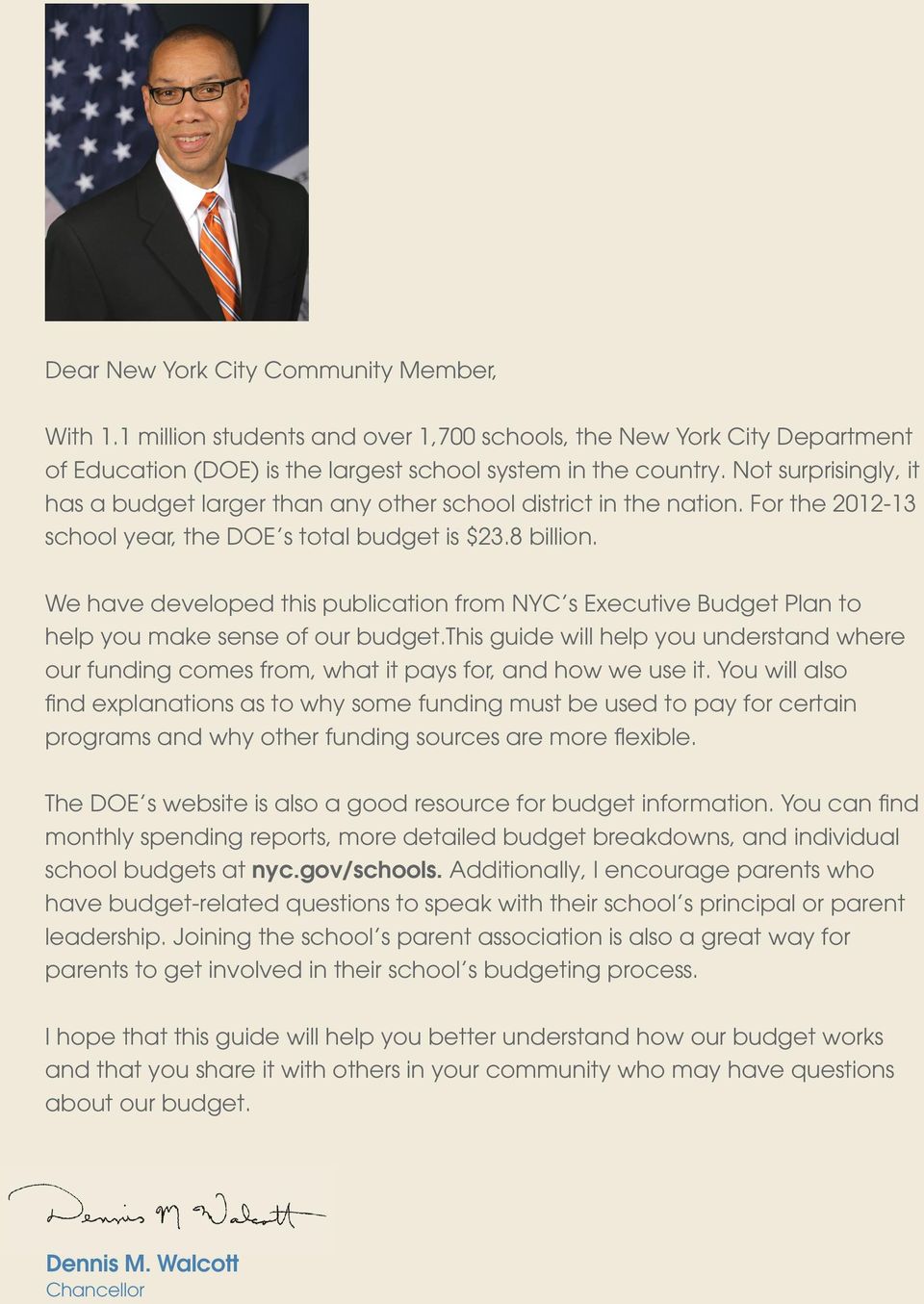
2 Dear New York City Community Member, With 1.1 million students and over 1,700 schools, the New York City Department of Education (DOE) is the largest school system in the country. Not surprisingly, it has a budget larger than any other school district in the nation. For the school year, the DOE s total budget is $23.8 billion. We have developed this publication from NYC s Executive Budget Plan to help you make sense of our budget.this guide will help you understand where our funding comes from, what it pays for, and how we use it. You will also fi nd explanations as to why some funding must be used to pay for certain programs and why other funding sources are more fl exible. The DOE s website is also a good resource for budget information. You can fi nd monthly spending reports, more detailed budget breakdowns, and individual school budgets at nyc.gov/schools. Additionally, I encourage parents who have budget-related questions to speak with their school s principal or parent leadership. Joining the school s parent association is also a great way for parents to get involved in their school s budgeting process. I hope that this guide will help you better understand how our budget works and that you share it with others in your community who may have questions about our budget. Dennis M. Walcott Chancellor
3 Breaking down our $19.2 billion operating budget For school year , the NYC Department of Education s operating budget is $19.2 billion. That means in fiscal year 2013 it will cost us $19.2 billion to run our schools and pay our teachers, principals, and other staff members. Operating Budget Money in our operating budget covers the cost of keeping our schools running. It pays for personal service expenses (full-time employee compensation) and other than personal service expenses (supplies, goods, and services). We use operating dollars for principal and teacher salaries, textbooks, after-school programs, school lunches, and heating and cooling the school buildings, among other things. These dollars fund our central administration and field support as well. Pass-through costs are also part of our operating budget but are earmarked for non-doe spending. These are costs for programs administered through entities other than the Department of Education (DOE) for services provided to public and non-public school students. For example, funding for charter schools, and certain federal and state dollars due to students in non-public schools, is passed through the DOE so that such students can receive legally mandated education services. In other words, the dollars pass through our budget. For the school year, pass-through expenses totaled nearly $2.6 billion, including $1.7 billion for special education services provided at non-doe schools; $71 million for non-public schools, such as yeshivas and parochial schools; and $865 million for charter schools. Our budget for this year also includes $4.6 billion for employee pensions and debt payments for capital projects, bringing the total budget to $23.8 billion. Pensions Like other employers, we contribute to our employees pensions (an amount other than wages that is paid at regular intervals to employees or their dependents for past services most often associated with retirement). This money is part of our total budget but cannot go toward operating expenses. We must use it to fund pensions for teachers, principals, and other employees. The pension contributions we make are determined by collective bargaining agreements with labor unions and economic conditions. Debt Service Debt service dollars pay for building and renovating school buildings. We borrow money by issuing bonds to pay for these construction projects. It is similar to having a home mortgage. Each year, we have to pay back a portion of the loan, including interest. The school year is fi scal year 2013, or FY13. Each year, the Department s fi scal year begins July 1 and ends June 30 of the following year. Fiscal year 2014 will begin July 1, 2013, and end June 30,

4 Our Sources of Funding Our budget is funded by three major sources: New York City, New York State, and the federal government. Lawmakers at each level decide how much we get. Here is the breakdown for the school year: Sources of School Funding 1% 8% 36% 55% City State Federal Other Source: FY 2013 Budget as of the FY 14 Executive Budget City New York City provides our largest source of revenue. For FY13, the City contributed $13.2 billion, or 55% of our total budget. Most money from the City is City Tax Levy dollars. City Tax Levy comes from local taxes, including property taxes, personal income tax, and sales tax. State New York State is our second largest source of funding. For FY13, State funding made up $8.5 billion, or 36% of our overall budget. The State mainly allocates money based on the number and types of students enrolled in New York City public schools. Federal The federal government provided close to $1.9 billion for the school year. This made up about 8% of our FY13 budget. Most of these funds come in the form of Title I allocations that must be used to pay for supports for low-income students. Federal dollars also cover the cost of free and reduced lunches and some special education services. 2

5 What do we spend money on? Most of our budget goes toward the salaries and benefits for our nearly 133,000 employees who work in and for our schools. Personal Costs For FY13 (as of the FY14 executive budget), 65%, or $12.44 billion, of our total operating budget pays for employees. More than 85% of these employees are the teachers, principals, assistant principals, guidance counselors, secretaries, school aides, paraprofessionals, and other school staffers who work directly with our students. For FY13, about 1,800 central staff members supported the work happening in our schools. These employees make up about 1% of our total headcount. The remaining staff make up 14% of DOE personnel. 35% non-personal 65% personal For the school year, we employed 55.49% 73,781 teachers 14.90% 19,811 paraprofessionals 4.63% 6,154 school aides 2.06% 2,744 guidance counselors 0.94% 1,245 school psychologists 1.01% 1,338 social workers 3.76% 5,000 principals and assistant principals 2.18% 2,900 school secretaries 1.35% 1,800 central staff 13.69% 18,200 other DOE staff* * Other non-ped school staff like parent coordinators, family workers, therapists, nurses, school lunch helpers, and other field/operations personnel like Superintendents, Committee of Special Ed., custodians, etc.; Source: April 2013 Actuals Headcount Salaries & Benefits Teachers and principals are compensated according to the terms of their union contracts. Teacher salaries are based on longevity (years of experience) and education differentials (the teacher s education level). For example, a first-year teacher with the minimum number of educational credits will earn a base salary of $45,530, while a teacher with at least 22 years of experience and a master s degree will make a base of $100,049. Principal salaries are determined by years of experience and school size and type. As a result, a veteran principal of a large high school will earn more than a first-year principal of a small elementary school. Estimated Average Teacher Salary $73,800 Estimated Average Assistant Principal Salary $118,000 Estimated Average Principal Salary $142,000 These salary figures do not include fringe benefits. When you factor in Medicare, Social Security, pension, health and dental coverage, and unemployment insurance, the total cost of employment is much greater than just salary. An average employee s benefits are worth about one-third of the person s annual salary. This school year, we are spending an additional $6 billion on fringe and pension benefits for our employees. Other Than Personal Spending We spend about 35% of our operating budget on non-personal costs. Non-personal costs include everything from school spending on books, pencils and paper to pre-k special education, charter schools, contractual services (such as yellow buses and special education contracted services), and central expenditures for school facilities, school food, and heating bills. 3

6 Distributing the Dollars For the school year, more than $8.8 billion of our operating expenses went directly into school budgets. We distribute dollars to schools in four main ways. Fair Student Funding (FSF) is the primary funding stream for most schools. Principals decide how to spend these funds, which are intended to cover basic instructional costs. Every school starts with a fixed allocation. The FSF allocation then grows based on the school s enrollment and student population. For each student, the school receives grade-level funding. That amount increases if the student is low income or low achieving, is an English language learner, and/or requires special education services. Some high schools such as career and technical schools get additional money per student. ruled that New York State must provide equitable funding to needy school districts, including in New York City. However, due to budget constraints, the State has yet to deliver the full amount of funding required by law. C4E must support our neediest students and lowest performing schools. Program Specifi c Funds are distributed to schools to pay for specific City programs, such as the parent coordinator initiative or start-up funds for new schools. In general, these dollars can only be used to pay for certain programs, goods, or services. Schools in citywide special education and alternative programs do not receive FSF allocations. Since these schools and programs serve very specific student populations, they receive funds according to a different method. State and Federal Categorical Funds can only be allocated and used according to state and federal guidelines. This means not every school qualifies for these dollars. Title I (poverty-based funds) and IDEA (funds for students with disabilities) are examples of federal categorical funds. Funds must support specific supplemental initiatives and generally cannot be used for basic classroom operations or existing after-school programs. Contracts for Excellence (C4E) dollars are an example of categorical funds from the State. In 2007, a judge Other Special Education Funds help schools pay for mandated special education and supplemental or related services, such as adaptive physical education, speech, counseling, hearing, vision, and occupational, or physical therapy. These funds supplement special education dollars schools receive as part of their FSF allocation, which pay for special education classroom instruction. What do school budgets pay for? Our principals, working with their school communities, have significant control over their school resources. For the most part, school budgets cover the costs of school personnel, after-school programs, textbooks, and other supplies. However, principals do not pay for school food, transportation, heating and cooling bills, and school security out of their tax levy budgets. Those costs are managed centrally. Interested in finding out how a specific school spends its money? School budgets are available online. Go to nyc.gov/schools and type the school s name into the search box. Budget information is available on the statistics page. principals decide how to spend funds every school starts with a fixed sum: $225,000 $ grows based on enrollment and student population $ increases for low income students, students with special needs, English language learners, and low performers some high schools get additional $ per student 4

7 Budgeting for School Construction and Repairs Our budget for building new schools and repairing and renovating existing facilities is separate from our operating budget. Instead, it is part of our capital plan. Our current capital plan covers fiscal years 2010 through 2014 and includes $11.8 billion worth of projects. It contains two major building categories: capacity and capital investment. $ Capital Investment covers improvements and upgrades to our existing facilities. The current capital plan has more than $7 billion for capital investment. $3.16 billion Capital Improvement Program $1.62 billion Children First Initiatives Capacity refers to all projects that result in new school facilities. Our current capital plan allots nearly $4.5 billion for capacity building. $1.97 billion Mandated Programs $3.56 billion New Capacity $690 million Facility Replacement Program $210 million Charter Partnership $620 million from City Council, borough president and, Mayor Council Program The New York City School Construction Authority (SCA) is responsible for the construction and renovation of all New York City public schools. Additionally, the SCA develops and amends the Five Year Capital Plan. Due to rounding, numbers are not necessarily additive. 5

8 The city, state, and federal governments operate on different budget cycles. School budgets released School year ends City proposes the budget for adoption City Council approves City budget, which includes DOE budget City fi scal year ends June 30 Chancellor delivers executive budget testimony in front of city council State fi scal year begins April 1 State legislators approve budget Mayor releases executive City budget Chancellor delivers preliminary budget testimony in front of City Council State s fi scal year ends March 30 APR MAR FEB MAY JAN JUN JUL The Budget Cycle DEC City fiscal year begins July 1 NOV AUG SEP OCT School year begins Federal fi scal year ends September 30 Federal fi scal year begins October 1 City updates budget Governor proposes State budget President proposes Federal budget Mayor releases preliminary City budget Chancellor delivers testimony about State budget in Albany To locate an individual school s budget summary and budget allocations visit: tinyurl.com/cewba26 tinyurl.com/d2pbubr To locate the Budget Overview and initial Fair Student Funding walk-through for a specific school visit: schools.nyc.gov/aboutus/funding/schoolbudgets schools.nyc.gov/aboutus/funding/fsfdetail It is the policy of the Department of Education of the City of New York not to discriminate on the basis of race, color, religion, national origin, citizenship/immigration status, age, disability, marital status, sex, sexual orientation or gender identity/expression in its educational programs and activities, and to maintain an environment free of sexual harassment, as required by law.

COMPARISON OF FIXED & VARIABLE RATES (25 YEARS) CHARTERED BANK ADMINISTERED INTEREST RATES - PRIME BUSINESS*
 COMPARISON OF FIXED & VARIABLE RATES (25 YEARS) 2 Fixed Rates Variable Rates FIXED RATES OF THE PAST 25 YEARS AVERAGE RESIDENTIAL MORTGAGE LENDING RATE - 5 YEAR* (Per cent) Year Jan Feb Mar Apr May Jun
COMPARISON OF FIXED & VARIABLE RATES (25 YEARS) CHARTERED BANK ADMINISTERED INTEREST RATES - PRIME BUSINESS*
 COMPARISON OF FIXED & VARIABLE RATES (25 YEARS) 2 Fixed Rates Variable Rates FIXED RATES OF THE PAST 25 YEARS AVERAGE RESIDENTIAL MORTGAGE LENDING RATE - 5 YEAR* (Per cent) Year Jan Feb Mar Apr May Jun
May 2014 Texas School Bond Elections
 May 2014 Texas School Bond Elections What are the individual districts needs? New facilities Renovations Technology Central facilities How much tax revenue can the district generate? Depends on district
AT&T Global Network Client for Windows Product Support Matrix January 29, 2015
 AT&T Global Network Client for Windows Product Support Matrix January 29, 2015 Product Support Matrix Following is the Product Support Matrix for the AT&T Global Network Client. See the AT&T Global Network
Analysis One Code Desc. Transaction Amount. Fiscal Period
 Analysis One Code Desc Transaction Amount Fiscal Period 57.63 Oct-12 12.13 Oct-12-38.90 Oct-12-773.00 Oct-12-800.00 Oct-12-187.00 Oct-12-82.00 Oct-12-82.00 Oct-12-110.00 Oct-12-1115.25 Oct-12-71.00 Oct-12-41.00
TENNESSEE BASIC EDUCATION PROGRAM 2.0
 TENNESSEE BASIC EDUCATION PROGRAM 2.0 HANDBOOK FOR COMPUTATION Revised April 2014 TENNESSEE DEPARTMENT OF EDUCATION OFFICE OF LOCAL FINANCE 710 JAMES ROBERTSON PARKWAY NASHVILLE, TENNESSEE 37243-0381 FY
John Keel, CPA State Auditor. A Report on State Employee Benefits as a Percentage of Total Compensation. April 2014 Report No.
 John Keel, CPA State Auditor A Report on State Employee Benefits as a Percentage of Total Compensation Report No. 14-704 A Report on State Employee Benefits as a Percentage of Total Compensation Overall
BALANCED MONEY WORKBOOK
 BALANCED MONEY WORKBOOK 2 Why live in balance? Welcome to the balanced money approach to budgeting! Balance is a concept we hear a lot about eat a balanced diet, keep balance between work and the rest
TERMS OF REFERENCE FOR THE HUMAN RESOURCES AND COMPENSATION COMMITTEE
 I. PURPOSE The purpose of the Human Resources and Compensation Committee (the Committee ) is to assist the Board in fulfilling its obligations relating to human resource and compensation policy and related
Case 2:08-cv-02463-ABC-E Document 1-4 Filed 04/15/2008 Page 1 of 138. Exhibit 8
 Case 2:08-cv-02463-ABC-E Document 1-4 Filed 04/15/2008 Page 1 of 138 Exhibit 8 Case 2:08-cv-02463-ABC-E Document 1-4 Filed 04/15/2008 Page 2 of 138 Domain Name: CELLULARVERISON.COM Updated Date: 12-dec-2007
DHS BUDGET REQU~ST FOR FY 2015-2016
 DHS BUDGET REQU~ST FOR FY 2015-2016 ($ Amounts in Thousands) Page # of Governor's Executive Budget: APPROPRIATION: Pp. C1.8, E30.5, E30.16, E30.17 Payment to Federal Govt. - Medicare Drug Progr~m l. SUMMARY
Enhanced Vessel Traffic Management System Booking Slots Available and Vessels Booked per Day From 12-JAN-2016 To 30-JUN-2017
 From -JAN- To -JUN- -JAN- VIRP Page Period Period Period -JAN- 8 -JAN- 8 9 -JAN- 8 8 -JAN- -JAN- -JAN- 8-JAN- 9-JAN- -JAN- -JAN- -JAN- -JAN- -JAN- -JAN- -JAN- -JAN- 8-JAN- 9-JAN- -JAN- -JAN- -FEB- : days
BUCKEYE VALLEY LOCAL SCHOOLS, DELAWARE COUNTY NOTES/ASSUMPTIONS TO FIVE-YEAR FORECAST FOR APPROVAL MAY 13, 2014
 May 13, 2014 The following assumptions were used in projecting revenue and expenditures for Fiscal Year 2014 through 2018. This is the district s best estimates at this point in time. This forecast is
ARCHDIOCESE OF NEW YORK
 ARCHDIOCESE OF NEW YORK PARISH FINANCE OFFICE Parish/School Employee Compensation/Benefits Estimated Budget Cost Guide 2015-2016 Special Note: The amounts contained in this document are guidelines for
August 2014 Report No. 14-705
 John Keel, CPA State Auditor A Report on Executive Compensation at State Agencies Report No. 14-705 A Report on Executive Compensation at State Agencies Overall Conclusion The decisions of state agencies
TITLE 23: EDUCATION AND CULTURAL RESOURCES SUBTITLE A: EDUCATION CHAPTER I: STATE BOARD OF EDUCATION SUBCHAPTER b: PERSONNEL
 ISBE 23 ILLINOIS ADMINISTRATIVE CODE 50 Section 50.10 Purpose 50.20 Applicability 50.30 Definitions TITLE 23: EDUCATION AND CULTURAL RESOURCES : EDUCATION CHAPTER I: STATE BOARD OF EDUCATION : PERSONNEL
SCHOOL FINANCE 101. Presented by Brenda Burkett, CPA, SFO Chief Financial Officer Norman Public Schools. February 2015
 SCHOOL FINANCE 101 Presented by Brenda Burkett, CPA, SFO Chief Financial Officer Norman Public Schools February 2015 Budget and Funding Timeline JUN JUL AUG SEP OCT NOV Final State Aid Allocation from
Financial Statement Consolidation
 Financial Statement Consolidation We will consolidate the previously completed worksheets in this financial plan. In order to complete this section of the plan, you must have already completed all of the
Detailed guidance for employers
 April 2015 3 Detailed guidance for employers Appendix A: Pay reference periods This document accompanies: Detailed guidance no. 3 Assessing the workforce Pay reference period calendars where the definition
The Basics of Quality Basic Education (QBE) Funding
 The Basics of Quality Basic Education (QBE) Funding Public schools in Chatham County receive a combination of federal, state and local funds to pay for the education of public school students. Public school
TITLE 23: EDUCATION AND CULTURAL RESOURCES SUBTITLE A: EDUCATION CHAPTER I: STATE BOARD OF EDUCATION SUBCHAPTER b: PERSONNEL
 ISBE 23 ILLINOIS ADMINISTRATIVE CODE 50 Section 50.10 Purpose 50.20 Applicability 50.30 Definitions TITLE 23: EDUCATION AND CULTURAL RESOURCES : EDUCATION CHAPTER I: STATE BOARD OF EDUCATION : PERSONNEL
Investing in Our Kids: District of Columbia School Finance Primer By Soumya Bhat
 An Affiliate of the Center on Budget and Policy Priorities 820 First Street NE, Suite 460 Washington, DC 20002 (202) 408-1080 Fax (202) 408-8173 www.dcfpi.org Updated March 26, 2015 Investing in Our Kids:
LEGISLATIVE SERVICES AGENCY OFFICE OF FISCAL AND MANAGEMENT ANALYSIS 301 State House (317) 232-9855
 LEGISLATIVE SERVICES AGENCY OFFICE OF FISCAL AND MANAGEMENT ANALYSIS 301 State House (317) 232-9855 FISCAL IMPACT STATEMENT LS 7482 DATE PREPARED: Mar 30, 2001 BILL NUMBER: SB 199 BILL AMENDED: Mar 29,
Consumer ID Theft Total Costs
 Billions Consumer and Business Identity Theft Statistics Business identity (ID) theft is a growing crime and is a growing concern for state filing offices. Similar to consumer ID theft, after initially
OUT OF BALANCE: A COMPARISON OF PUBLIC AND PRIVATE EMPLOYEE BENEFITS IN NEW YORK CITY. Citizens Budget Commission and Partnership for New York City
 OUT OF BALANCE: A COMPARISON OF PUBLIC AND PRIVATE EMPLOYEE BENEFITS IN NEW YORK CITY Citizens Budget Commission and Partnership for New York City December 2009 Citizens Budget Commission and Partnership
DATE: March 4, 2016 Raymond J. Orlando, Chief Financial Officer FY 2013 School Based Expenditure Report (SBER) Overview
 Carmen Fariña, Chancellor OFFICE OF THE CHIEF FINANCIAL OFFICER 52 Chambers Street, New York, NY 10007 DATE: March 4, 2016 FROM: SUBJECT: Raymond J. Orlando, Chief Financial Officer FY 2013 School Based
STATE OF WEST VIRGINIA PUBLIC SCHOOL SUPPORT PROGRAM EXECUTIVE SUMMARY For the 2000-01 Year
 STATE OF WEST VIRGINIA PUBLIC SCHOOL SUPPORT PROGRAM EXECUTIVE SUMMARY For the 2000-01 Year The Public School Support Program is a plan of financial support for the public schools in the State of West
2016-2017 PRELIMINARY BUDGET HANDBOOK
 2016-2017 PRELIMINARY BUDGET HANDBOOK This page is intentionally left blank FY2016-2017 PRELIMINARY BUDGET HIGHLIGHTS Revenue In FY2017 the preliminary revenue for the District, excluding State on-behalf
STATE OF MICHIGAN. Bond Qualification Process Overview. School Bond Qualification and Loan Program Bureau of Bond Finance
 Michigan Department of Treasury 3160, (Rev. 4-06) STATE OF MICHIGAN Bond Qualification Process Overview School Bond Qualification and Loan Program Bureau of Bond Finance Michigan Department of Treasury
ST. JOHNS RIVER STATE COLLEGE ADMINISTRATIVE SALARY SCHEDULE 2015-2016
 ADMINISTRATIVE SALARY SCHEDULE ADMINISTRATIVE - 12 MONTH CONTRACT Twelve (12) month administrative salaries are determined by formal education, teaching or administrative experience, job responsibilities,
Description of Budget Cycle
 Description of Budget Cycle The budget process in the City of Yonkers begins in December each year when budget preparation packages are sent to departments by the Office of Management and Budget. The departments
MISSISSIPPI LEGISLATURE REGULAR SESSION 2014
 MISSISSIPPI LEGISLATURE REGULAR SESSION 2014 By: Senator(s) Wilemon To: Education; Appropriations SENATE BILL NO. 2413 1 AN ACT TO AMEND SECTION 37-19-7, MISSISSIPPI CODE OF 1972, TO 2 PROVIDE A NEW SALARY
School Finance 101. MASA / MASE Spring Conference Joel Sutter Ehlers Greg Crowe - Ehlers
 School Finance 101 MASA / MASE Spring Conference Joel Sutter Ehlers Greg Crowe - Ehlers 3/13/2014 1 Overview Minnesota has one of the most complex school funding systems of any state It is not a logical,
Monetary Policy and Mortgage Interest rates
 Monetary Policy and Mortgage Interest rates July 2014 Key Points: Monetary policy, which operates through changes in the official cash rate (OCR), is the main lever of macroeconomic management in Australia
2015-16 BCOE Payroll Calendar. Monday Tuesday Wednesday Thursday Friday Jun 29 30 Jul 1 2 3. Full Force Calc
 July 2015 CM Period 1501075 July 2015 1 2 3 4 5 6 7 8 9 10 11 12 13 14 15 16 17 18 19 20 21 22 23 24 25 26 27 28 29 30 31 August 2015 1 2 3 4 5 6 7 8 9 10 11 12 13 14 15 16 17 18 19 20 21 22 23 24 25 26
CHAPTER 15.1-02 SUPERINTENDENT OF PUBLIC INSTRUCTION
 CHAPTER 15.1-02 SUPERINTENDENT OF PUBLIC INSTRUCTION 15.1-02-01. Superintendent of public instruction - Qualifications. The qualified electors of this state shall elect a superintendent of public instruction
AUBURN-WASHBURN USD 437
 AUBURN-WASHBURN USD 437 Summary of Total Expenditures. 1 Summary of General and Supplemental General Fund Expenditures 2 Instruction Expenditures.3 Sources of Revenue and Proposed Budget for 2003-04 (previously
The Prudent Navigator. Financial Planning for Every Stage and Every Age
 The Prudent Navigator Financial Planning for Every Stage and Every Age Prepared by: John Kehoe CFP FMA CSWP November 4, 2013 Ontario Civil Service Credit Union Ltd A financial co-operative owned by its
Florida Education Finance Program (FEFP)
 F l o r i d a H o u s e o f R e p r e s e n t a t i v e s Florida Education Finance Program (FEFP) EDUCATION FACT SHEET 2010-11 What is the Florida Education Finance Program? The Florida Education Finance
Summary of Total Expenditures. 1. Summary of General and Supplemental General Fund Expenditures 2. Instruction Expenditures.3
 USD 257 - Iola Summary of Total Expenditures. 1 Summary of General and Supplemental General Fund Expenditures 2 Instruction Expenditures.3 Sources of Revenue and Proposed Budget for 2008-09 (previously
THE CITY OF RALEIGH, NORTH CAROLINA
 THE CITY OF RALEIGH, NORTH CAROLINA 6716 Six Forks Road RALEIGH, NORTH CAROLINA 27615 919-996-3385 POLICE OFFICER The Raleigh Police Department is seeking responsible and dedicated individuals who are
CENTRAL BUCKS SCHOOL DISTRICT. Pennsylvania Special Education Funding Commission of 2013 July 25, 2013 Dave Matyas, PRSBA Business Administrator
 CENTRAL BUCKS SCHOOL DISTRICT LEADING THE WAY The Central Bucks Schools will provide all students with the academic and problem-solving skills essential for personal development, responsible citizenship,
ALL PARENTS HAVE THE FOLLOWING RIGHTS: THE RIGHT TO A FREE PUBLIC SCHOOL EDUCATION.
 Martine Guerrier Chief Family Engagement Officer [email protected] Each child s maximum potential can best be achieved through an active engagement between parents 1 and the education community.
1783-1796 Before statehood public education needs were priority- Note: 1784- State of Franklin- Education important with sums paid by the public.
 1783-1796 Before statehood public education needs were priority- Note: 1784- State of Franklin- Education important with sums paid by the public. 1789 Congress specified that title for school lands be
Special Education & Student Services
 Special Education & Student Services PGCPS Board of Education FY 2016 Approved Annual Operating Budget Page 333 Associate Superintendent for Special Education & Student Services MISSION Mission: To provide
Marion County Board of Education. Salary Schedule
 Salary Schedule FOR FISCAL YEAR 2015 7/24/2014 FY2015 GROUP I - SALARY SCHEDULE State Minimum Salary Schedule Classroom Teachers Public School Experience - 187 Day Contract Bachelor Master 6-Year Doctoral
KANSAS DEPARTMENT FOR AGING AND DISABILITY SERVICES
 KANSAS DEPARTMENT FOR AGING AND DISABILITY SERVICES Actual FY 2014 Agency Est. Agency Req. Agency Req. FY 2017 FY 2017 Operating Expenditures: State General Fund $ 561,860,405 $ 618,190,288 $ 632,670,211
BUSINESS LOAN APPLICATION
 BUSINESS LOAN APPLICATION Superior National Bank & Trust Company 235 Quincy Street, P.O. Box 450 Hancock, MI 49930 phone 906.482.0404 toll-free 1.866.482.0404 1 INTRODUCTION Thank you for considering Superior
Figure 24 Georgia s Children a Major Focus of Human Services. $20 M Georgia Vocational Rehab Agency $1.5 M Office of Residential Child Care
 Human Services Overview Georgia s spending to help children, the poor and seniors is overseen by the state Department of Human Services. State funding for the agency is $486 million in 214, or about 3
School District of Fall Creek
 School District of Fall Creek By All...For All COMPREHENSIVE SCHOOL COUNSELING PROGRAM v i e w b o o k Based on the Wisconsin Comprehensive School Model & American School Association National Model The
BUDGET. September 10, 2013
 BUDGET 2013 2014 September 10, 2013 CHARLOTTE COUNTY PUBLIC SCHOOLS 2013-2014 ANNUAL BUDGET Dr. Doug Whittaker Superintendent of Schools Educational Support Services Murdock Center 1445 Education Way Port
Paraprofessional/Aide Information for the 2015-16 Fiscal Year
 Please note! This document is a worksheet to assist you in gathering information only. Do not fax or mail! The actual survey must be completed online. Paraprofessional/Aide Information for the 2015-16
December, 2009. Salary, Education, Benefits, and Job Descriptions of Nurses, Teachers, and Social Workers: A Comparative Analysis
 December, 2009 Salary, Education, Benefits, and Job Descriptions of Nurses, Teachers, and Social Workers: A Comparative Analysis Contents Introduction 3 Problem Statement 3 Social Work within the Texas
OPERATING FUND. PRELIMINARY & UNAUDITED FINANCIAL HIGHLIGHTS September 30, 2015 RENDELL L. JONES CHIEF FINANCIAL OFFICER
 PRELIMINARY & UNAUDITED FINANCIAL HIGHLIGHTS September 30, 2015 RENDELL L. JONES CHIEF FINANCIAL OFFICER MANAGEMENT OVERVIEW September 30, 2015 Balance Sheet Cash and cash equivalents had a month-end balance
State Cashflow Management
 Informational Paper 77 State Cashflow Management Wisconsin Legislative Fiscal Bureau January, 2009 State Cashflow Management Prepared by Dave Loppnow Wisconsin Legislative Fiscal Bureau One East Main,
(1) Bases the computations for steps 1, 2 and 5 on net enrollment only, eliminating the adjusted enrollment limits;
 STATE OF WEST VIRGINIA EXECUTIVE SUMMARY OF THE PUBLIC SCHOOL SUPPORT PROGRAM BASED ON THE FINAL COMPUTATIONS FOR THE 2011-12 YEAR The Public School Support Program (PSSP) is a plan of financial support
Financing Education In Minnesota 2013-14. A Publication of the Minnesota House of Representatives Fiscal Analysis Department
 Financing Education In Minnesota 2013-14 A Publication of the Minnesota House of Representatives Fiscal Analysis Department November 2013 Financing Education in Minnesota 2013-14 A Publication of the Minnesota
Announcement of Class and Component Prices United States Department of Agriculture
 Announcement of Class and Component s United States Department of Agriculture Dairy Programs Market Information Branch CLS-0116 January 2016 Highlights Class II was $14.19 per hundredweight for the month
School Funding. Where does school funding come from? Where does it actually go?
 SCHOOL FINANCE 101 School Funding Where does school funding come from? Where does it actually go? Basics of School Finance in Ohio: School funding in Ohio is a SHARED responsibility between the state and
Ashley Institute of Training Schedule of VET Tuition Fees 2015
 Ashley Institute of Training Schedule of VET Fees Year of Study Group ID:DECE15G1 Total Course Fees $ 12,000 29-Aug- 17-Oct- 50 14-Sep- 0.167 blended various $2,000 CHC02 Best practice 24-Oct- 12-Dec-
COLLEGE BOARD: HUMAN RESOURCES COMMITTEE TERMS OF REFERENCE (TOR)
 TOR NAME Responsible Owner Effective date Human Resources Committee (HRC) Terms of Reference (TOR) Human Resources Committee November 26, 2015 TOR number Approval Body Review dates HRC 2015 TOR College