
Budgeting Participation, Goal Commitment and Employee Performance
|
|
|
- Dortha Blankenship
- 10 years ago
- Views:
Transcription
1 Budgeting Participation, Goal Commitment and Employee Performance By John Kizito Ndiwalana 2002/HD10/1509/U A Dissertation Submitted In Partial Fulfillment Of The Requirements For The Award Of The Degree Of Master Of Science In Accounting And Finance Of Makerere University April 2009 i

2 DECLARATION I Kizito John Ndiwalana, declare that this dissertation is a result of my own independent research effort and investigation, it is my original work, which has not been submitted to any other institution for any award. RESEARCHER KIZITO JOHN NDIWALANA SIGN.. DATE i

3 ii

4 DEDICATION I dedicate this research work to my beloved parents Kiyega Sam Ndiwalana and the late Margret Nantamu, my son Peter Mutebi,my grannies and family, for their love, support, and faith in me. iii

5 ACKNOWLEDGEMENTS I wish to gratefully acknowledge the helpful contributions of several individuals.without the help of these individuals, this dissertation project would not have beenpossible. I would like to thank each of you. First, my dissertation supervisors: Dr. Isaac Nkote Nabeta, Dr. Joseph Ntayi for their continued support and guidance. Secondly, the MUBS Graduate Research Center staff and Msc Accounting and Finance students for their comments and suggestions. And finally, my parents for their continued support, confidence, and encouragement. iv

6 TABLE OF CONTENTS DECLARATION... I DEDICATION... III ACKNOWLEDGEMENTS... IV TABLE OF CONTENTS... V LIST OF TABLES... IX LIST OF FIGURES... IX ABSTRACT... X CHAPTER ONE BACKGROUND TO THE STUDY PURPOSE OF THE STUDY OBJECTIVES OF THE STUDY RESEARCH QUESTIONS SCOPE OF STUDY Geographical scope Conceptual scope SIGNIFICANCE CONCEPTUAL FRAME WORK... 6 CHAPTER TWO... 7 LITERATURE REVIEW... 7 v
7 1.0 INTRODUCTION BUDGETING PARTICIPATION BUDGETING PARTICIPATION AND GOAL COMMITMENT BUDGETING PARTICIPATION AND EMPLOYEE PERFORMANCE GOAL COMMITMENT AND EMPLOYEE PERFORMANCE CHAPTER THREE METHODOLOGY INTRODUCTION RESEARCH DESIGN POPULATION SAMPLE SIZE AND SAMPLING DESIGN DATA COLLECTION INSTRUMENTS MEASUREMENT OF VARIABLES DATA ANALYSIS LIMITATIONS OF THE STUDY CHAPTER FOUR PRESENTATION OF DATA, ANALYSIS AND INTERPRETATION INTRODUCTION DEMOGRAPHIC CHARACTERISTICS OF THE RESPONDENTS Age Group Distribution Gender Group Distribution Length of service vi
8 4.2.4 Time spent on the same post Formal budgeting process Managerial rank PRESENTATION OF RESULTS TO THE RESEARCH OBJECTIVES To investigate the level of employee participation in the budgeting process Correlations results To examine the relationship between budgeting participation and goal commitment To establish the relationship between goal commitment and employee performance Regression OTHER FINDINGS CHAPTER FIVE DISCUSSION, CONCLUSIONS AND RECOMMENDATIONS INTRODUCTION TO INVESTIGATE THE LEVEL OF EMPLOYEE PARTICIPATION IN THE BUDGETING PROCESS IN THE HOTEL INDUSTRY TO EXAMINE THE RELATIONSHIP BETWEEN BUDGETING PARTICIPATION AND GOAL COMMITMENT IN THE HOTEL INDUSTRY TO ESTABLISH THE RELATIONSHIP BETWEEN GOAL COMMITMENT AND EMPLOYEE PERFORMANCE IN THE HOTEL INDUSTRY CONCLUSION RECOMMENDATIONS vii

9 5.7 SUGGESTED AREAS FOR FURTHER RESEARCH REFERENCES viii

10 LIST OF TABLES Table 1. Sample Sizes...17 Table 2. Response Rate..17 Table 3.Cronbach s Alpha Coefficient..19 Table 4 Cross tabulation of Age group of respondents..21 Table 5 Cross tabulation of Gender of the respondents.22 Table 6. Cross tabulation of Length of Service of the respondents 23 Table 7. Cross tabulation of Period of time the respondents had spent on the present post 24 Table 8. Cross tabulation of Period of Level of Education of the respondents...25 Table 9. Cross tabulation of Period of Hotel that engage in formal budgeting Processes..26 Table 10. Cross tabulation of Period of Managerial rank 27 Table 11. The Level of budgeting participation...28 Table 12.Pearson s Correlations results.29 Table 13.Regression 30 Tale 14. Hotel Star Anova Report 31 Table 15 Gender of the respondent Anova report 32 Table 16. Length of service Anova Report..33 Table 17. Level of management Anova Report 34 LIST OF FIGURES The Conceptual Frame Work.6 ix
11 ABSTRACT The study examined the effect of budgeting participation and goal commitment on employee performance in the hotel industry. The objectives of the study were to investigate the level of employee participation in the budgeting process; the relationship between budgeting participation and goal commitment; and the relationship between goal commitment and employee performance in the hotel industry. The study employed the quantitative research methodology utilizing a cross sectional research design. The total of 48 hotels of 1-5 star categories were selected using stratified sampling. In these 116 employees of supervisory level was obtained using simple random sampling. Data was collected using questionnaires and analyzed using SPSS 15. The findings of the study showed that there was a high level of budgeting participation in the hotel Industry. There was a significant positive relationship between budgeting participation and goal commitment; and a significant positive relationship between goal commitment and employee performance in hotels. The study recommended that organizations should adopt policies that increase on the level of budgeting participation which will in turn create goal commitment among employees, hence improving on the level of their performance. x

12 CHAPTER ONE: INTRODUCTION 1.1 Background to the Study Budgeting is a crucial exercise without which a firm or business cannot achieve much (Yuen, 2007). It is a process of compiling budgets and subsequently adhering to them as closely as possible (Maitland, 2000). It s a management tool that can be employed by a firm to process information and make reports to management for planning and control. Budgeting participation is a process whereby subordinates are given opportunities to get involved in and have influence on the budget setting process (Yuen, 2007). Through participation in budgeting, subordinates develop mental and emotional feelings that provide them with an ownership of budget goals (Owen, 1987). The act of participation increases a subordinate s trust, sense of control, and ego-involvement with the organisation, which then jointly cause less resistance to change and more acceptance of, and commitment to, the budget goals (Shields & Shields, 1998). Thus, budget participation exerts a motivational effect on the subordinates which enhances their budget goal commitment. Charpentier (1998) also argues that budget participation influences employee performance. This is because when subordinates participate in the budgeting process, they are induced into accepting and committing to budget goals and in the process improving their performance. Dann (1991) argues that there is a significant relationship between budgeting participation and employee performance in the hotel industry. This is because in the hotel industry, performance is measured through provision of a high 1

13 quality service to meet customer needs and this depends largely on superior-subordinate relationships and their active participation in budgeting (Deming, 1989). In many Ugandan hotels there is pseudo participation of employees in the budget process. Every financial year, many employees at the lower levels in hotels find themselves operating in the limitations of the budget to which themselves, or even their immediate supervisors didn t determine. Such budgets usually have set targets for the achievements of the year which require the subordinates increased input. Unfortunately, these budgets lack the input on the additional demands that such new targets may pose to the subordinates. Due to this, subordinates don t feel the sense of commitment to the budget which later inhibits their execution of duties due to lack of goal commitment (Personal Communication, January 19, 2008). However, most authors claim that if budgets are made without participation by the lower management and their supervisors, they become dysfunctional due to the employee s lack of commitment to their goals (Lin & Chang, 2005). Budget goal commitment is the determination to try for a budget goal and the persistence in pursuing it over time (Locke et al, 1981). Highly committed subordinates in terms of their budget goals are motivated to interact with their superiors and peers who can provide insight into their work environments, performance goals, task strategies and other issues that have an important impact on their performance. If an individual becomes committed to a given goal, it will influence the individual s subsequent actions, and consequently the individual s performance level. 2

14 Local news papers have on several instances exposed the effect of lack of budget participation, on goal commitment and employee performance of major hotels in this country (New Vision, 29 April 2006). For example, a 2 Star hotel A in Kampala, was reported to offer poor services that do not satisfy customer requirements. The news paper reported that interviews with the immediate supervisors of low level employees in this hotel revealed that the employees were unhappy with the way they were given additional tasks without increment in pay. That each year, this hotel s budgets show additional income from new services to be offered by the hotel but without an increase in the number of staff. Immediate supervisors to the support staff said that they find it hard to assign additional duties to their subordinates who are already overloaded. They are not involved in the budgeting process and therefore find no avenue to raise the implications of increase in workload without increase in pay on the performance of support staff. 1.2 Statement of the Problem Although budgeting is crucial to the operations of organizations, in many Ugandan hotels, there is hardly any participation of the employees in the setting of their budgets. This affects the employees commitment to the budget goals and lack of participation in budgeting is likely to reduce job commitment which may perhaps lead to reduced employee performance. 3

15 1.3 Purpose of the Study The purpose of the study is to examine the effects of budgeting participation and goal commitment on employee performance in the hotel industry 1.4 Objectives of the Study (i) To investigate the level of employee participation in the budgeting process in the Hotel industry. (ii) To examine the relationship between budgeting participation and goal commitment in the hotel industry. (iii) To establish the relationship between goal commitment and employee performance in the hotel industry 1.5 Research Questions (i) What is the level of employee participation in the budgeting process in the hotel industry? (ii) What is the relationship between budgeting participation and goal commitment in the hotel industry? (iii) What is the relationship between goal commitment and employee performance in the hotel industry? 4

16 1.6 Scope of Study Geographical Scope: The study was conducted in the central region especially in the districts of Kampala. This is because this is the district with the highest number of hotels (Uganda hotels brochure, 2008). Subject Scope: The study was limited to budgeting participation, goal commitment and employee performance. In this study budgeting participation means a process by which a budget is developed through joint decision making by top management and operating personnel, Budget goal commitment means individuals develop mental and emotional feelings that provide them with an ownership of budget goals, Employee performance means that quantified (numeric) goals and enumerated (listed) tasks are accomplished. 1.7 Significance The findings of the study will be useful to the hotel employees, local hotel owners, management of the Uganda Hotels association, and researchers in the following ways: (i) The hotel employees and owners will be enlightened about the appropriate budgeting procedures. This will help them understand the importance of budgeting participation to the performance of their hotels. (ii) Uganda hotels association management will be provided with information on how to improve hotel performance through participatory budgeting. (iii) The findings from the study will also add on the existing knowledge on budgeting and performance in Uganda. 5

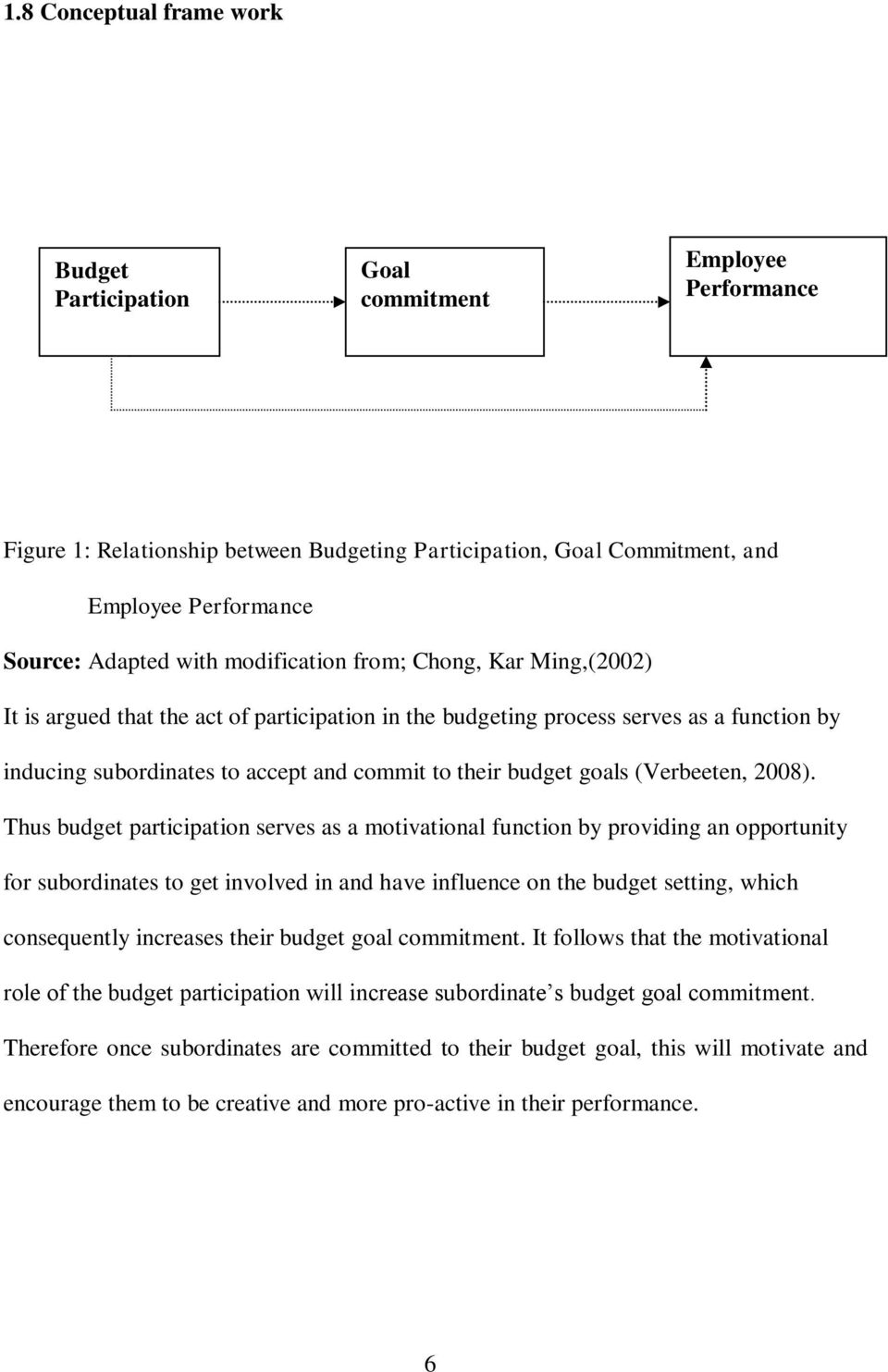
17 1.8 Conceptual frame work Budget Participation Goal commitment Employee Performance Figure 1: Relationship between Budgeting Participation, Goal Commitment, and Employee Performance Source: Adapted with modification from; Chong, Kar Ming,(2002) It is argued that the act of participation in the budgeting process serves as a function by inducing subordinates to accept and commit to their budget goals (Verbeeten, 2008). Thus budget participation serves as a motivational function by providing an opportunity for subordinates to get involved in and have influence on the budget setting, which consequently increases their budget goal commitment. It follows that the motivational role of the budget participation will increase subordinate s budget goal commitment. Therefore once subordinates are committed to their budget goal, this will motivate and encourage them to be creative and more pro-active in their performance. 6
18 CHAPTER TWO: LITERATURE REVIEW 2.0. Introduction Budgeting is the process of efficiently allocating an organization s available financial resources to its units, activities and investments. The budgeting process includes a review of the prior period s financial results, projections for sales, operating expenses whether fixed, variable or semi-variable, as well as financing expenses, examination of proposals for capital expenditures, and means of rolling up and rationalizing figures from different functional departments to ensure they meet company-wide profit expectations (Blumentritt 2006). Budgeting is used to monitor the performance of managers and employees. Budgets are critical part of the effective running of an institution, since it accomplishes many tasks. According to Linn (2007), a budget is not only a means of planning for various revenue streams, a control mechanism for an administration to keep from spending too much a procedure for controlling its units, a process to coordinate the many activities that an institution undertakes, and a way to communicate to all stakeholders a summarization of the activities that the various units will undertake, but it is also a technique for setting the organization s priorities by allocating scarce resources to those activities that officials deem to be the most important and rationing it to those areas deemed less vital. 7

19 According to the Certified Management Accountant Review (1994), a budget is a quantitative planning tool, that helps translate the objectives set out in the plan into financial terms and shows where the money will be got from and how it will be spend in order to achieve the set objectives in the plan. A budget is an objective measure of the financial underpinnings of operations that controls the financial health of the organization (Seer 2000). A budget facilitates planning and resource allocation. According to Drury (1992), it is a plan of action for the future periods of the organization. Lucy (1996) adds that it is a quantitative expression of a plan of action prepared in advance of the period to which it relates. According to Kavulya (2006), Budgeting involves the process of identifying, costing and allocating revenue to the resources and activities that allow the objectives of the organization to be achieved. Essential preliminaries established before effective budgeting include: preparation of an organizational chart which shows the functional responsibilities of each member of the management team; establishment of budget centers; establishment of adequate accounting record to facilitate the recording and analysis of transactions in the organization; establishment of budget committees; budget timetable to enable timely flow of information; and the budget manual which shows budgetary procedures including budget centers and timetables (Balunywa(2005). Over the course of the fiscal year that is being reviewed, reforecast and reallocated, the aim is to make the best use of the available financial resources (Seer, 2000). 8

20 According to Lega and Vendramini (2008), Budgeting is a management control tool. The average budgeting process is composed of five distinct phases, which include budgeting guidelines that represent the starting point and the boundaries of the budgeting process; budget preparation; budget negotiation where managers develop a meeting of the minds so that resources are allocated accordingly; budget review where targets are tweaked during the budgeting year to adjust to new, emerging conditions; budget assessment where accountable centers are assessed to check if targets have been met. Leading scholars suggest that this phase is not considered merely the end point of the process but should be starting base of the following year s budget. 2.1 Budgeting Participation Budgeting is a method for financial control which involves the planning and use of a budget. A budget expresses the expectations of a company presented in economic terms for a future time period (Reid, 2002). The roles of the budget among others include; determining the requirement for funds to service the needs of scheduled activities during a defined period, estimating the cost of a set of activities and subsequently determining which ones will be undertaken within the capacity of the resources available, controlling the business through the allocation of business funds to different activities, and making adjustment in the allocation of funds between activities during the planned time period (Cusworth et al., 1993). Participation is a process that can be used for planning and goal setting when there is environmental uncertainty, for motivating subordinates when there is task uncertainty, and for coordinating interdependence when there is task interdependence (Lin & Chang, 9
21 2005). Participation in budgeting yields benefits through a great exchange of information, better coordination of activities and development of team spirit (Mai, 1988). From the above introduction a definition of budgeting participation can now be given. Budget participation has been defined differently by many researchers. For instance according to Becker and Green (1970) it is a process of joint decision making by two or more parties in which the decision has future effects on those making them. Parkinson and Taggar (2000) define it as a process in which a manager is involved with, and has influence on, the determination of his or her budget. Brownell (1982) defines it as the process of involving subordinates in influencing various elements of budgets. According to Hopwood (1973), budget participation is measured from the following factors; the ability for the subordinates to influence the design of the budget, to what extent the superior manager contacts the subordinates, How easy it is for the subordinates to propose alterations in the budget process, To what extent the subordinates participate in the budget s follow-up phase. Nouri and Parker (1998) argue that allowing subordinates to participate in the budget setting process may result in them disclosing of private information which would result in more realistic plans and more accurate budgets. Subordinates have better information about the level of budgetary support required to perform the subordinate s task than do the superiors. Participatory budget allows subordinates to incorporate this information into the budget. 10
22 Priddy (2007) argue that with consultation, leaders generate energy to re-craft budgeting and resource allocation, through the discussion of these processes and conversations on how to align them with reward systems, committee structures, hiring and screening, academic and master planning. 2.2 Budgeting Participation and Goal Commitment Accounting literature indicates the importance of participation in budget setting. It states that the participation of middle and lower level managers in the budgeting process can have beneficial effects in at least two ways. First, the process of participation reduces information asymmetry in the organization, theory enabling top management to gain insight into issues about which lower level managers have specialized knowledge. Second, the process of participation may bring about a greater commitment by lower managers to carry out the budget plan in and meet the budget (Gordon,1988). Specific and attainable goals lead to higher levels of performance if the goals are accepted by individuals. Goals provide motivational effect through their impact on the direction, amplitude (effort) and duration (persistence) of action. Individual s goal can be viewed as the performance level that an individual seeks to attain (Locke, 1981). Acts of participation in the budgeting process provides subordinates the opportunity to get involved in and have influence on the budget setting process. Furthermore, it is suggested that budget participation also serves an informational function whereby subordinates can gather, exchange, and disseminate job-relevant information to facilitate their decision-making process and to communicate their private information to organizational decision makers (Nouri & Parker, 1998). 11
23 Charpentier (1998) argues that budget participation enhances subordinates budget goal commitment. Budget goal commitment is defined in this study as the determination to try for a budget goal and the persistence in pursuing it over time (Locke et al.1981).the opportunity to participate allows subordinates to exert their opinions and influences, and as a consequence, increase their feeling of control and involvement over the budgets. Such feeling will increase their commitment to their budget goals. This viewpoint is consistent and supported by Shields and Shields,(1998) who argue that the act of participation increases a subordinate s trust, sense of control, and ego-involvement with the organization, which then jointly cause less resistance to change and more acceptance of, and commitment to, the budget decision. Thus far, it has been suggested that budget participation serves as a motivational function by providing an opportunity for subordinates to get involve in and have influence on the budget setting, consequently increases their budget goal commitment. It follows that the motivational role of budget participation will increase subordinates' budget goal commitment. The importance of subordinates' budget participation as a means of improving performance has been studied extensively in the behavioral accounting literature (Brownell & McInnes 1986; Mia, 1989; Kren 1992; Magner et a ; Nouri &Parker 1998; Yuen, 2007). It is argued that the act of participation in the budgeting process serves as a function by inducing subordinates to accept and commit to their budget goals (Maurer & Lippstreu, 2008). Furthermore, it is suggested that budget participation also serves an informational function whereby subordinates can gather, exchange, and disseminate job-relevant information to facilitate their decision-making process and to 12
24 communicate their private information to organizational decision makers (Lins & Changa, 2005) 2.3 Budgeting Participation and Employee Performance The importance of subordinates' budget participation as a means of improving performance has been studied extensively in the behavioral accounting literature (Nouri and Parker 1998). It is argued that the act of participation in the budgeting process serves as a function by inducing subordinates to accept and commit to their budget goals (Merchant 1981). Furthermore, it is suggested that budget participation also serves an informational function whereby subordinates can gather, exchange, and disseminate jobrelevant information to facilitate their decision-making process and to communicate their private information to organizational decision makers (Topper, 2007). The empirical studies that examined the informational role of budget participation have, in general, produced consistent and fairly well established results (Magner, 1996). However, the empirical evidence on the motivational role of budget participation on performance has been mixed (Murray 1990), for a comprehensive theoretical discussion). Parkinson and Taggar (2000) for example, have relied on expectancy theory to examine the relationship of budget participation to motivation and performance. Their results are in conflict with those of earlier studies (Merchant 1981) that found a positive association between budget participation and motivation. Parkinson and Taggar (2000) were unable to verify the intervening role of motivation using an expectancy theory framework. A possible explanation for the inconclusive results of Parkinson and Taggar (2000) and other studies on the motivational role of budget participation on performance could be 13
25 due to inadequate theoretical framework adopted by those studies. Parkinson and Taggar (2000) acknowledged "expectancy models have sometimes shown a rather weak relationship to effort and performance, raising question about their validity in empirical use." Thus, further research may rely on an alternative motivation theory, such as goalsetting theory, to examine the budget participation-performance linkage (Murray 1990). Managers Participation in budgeting has a number of positive behavioral outcomes, such as reduced stress, improved motivation and job commitment, and enhanced performance Conversely, managers inadequate Participation in budgeting may cause dysfunctional behavior, which may lead to anxiety, stress and low performance (Reid, 2002). 2.4 Goal Commitment and Employee Performance Locke (1981) goal-setting theory argues that an individual s goal can be viewed as the performance level that an individual seeks to attain. If an individual becomes committed to a given goal, it will influence the individual s subsequent actions, and consequently the individual s performance level. We propose that once a subordinate is committed to his or her budget goals, he or she will increase his or her effort to achieve those goals. Lin & Chang (2005) argued that highly committed subordinates in terms of their budget goals, is motivated to interact with their superiors and peers who can provide insight into their work environments, performance goals, task strategies and other issues that have an important impact on their performance. Researchers have found different results concerning the effects of goal commitment on the performance of the subordinates. Most 14
26 studies have found a clearly positive relationship between goal commitment and performance. Some have found a negative relationship while other studies have not found any relationship at all. Mostly, a positive relationship have been found. Budget participation makes the subordinate to a greater extent feel responsible for the organization s goals because it internalizes the goals. This then lead to a situation whereby the employee will improve on his/her performance in order to satisfy the set goals. A reduced budget participation gives deteriorated feed-back information, which diminishes the realism. According to Woodford and Maes (2002) this disadvantage is so important that the total effect of reduced budget participation is a deteriorating performance. Previous organizational behaviorists indicate that affective organizational Commitment benefits employees performance. According to Randall,(1990) and Riketta, (2002).When managers are highly committed to an organization, they will accept organizational goals and involved more effort to attain the goals and then improve their performance. 15
27 CHAPTER THREE: METHODOLOGY 3.0 Introduction In this section, the research design, sample, instrument, data collection procedures, and analytical tools which were adopted in the study are presented. 3.1 Research Design A cross sectional research design was used in the study. The study employed the quantitative research methodology. This methodology was suitable because of the need to generalise the findings to all hotels in Uganda. 3.2 Population The target population of hotels in the category of Star 1 5 in Kampala district was 93, according to Uganda private hotel owners association, website. 3.3 Sample size and Sampling Design The total of 48 hotels was selected using stratified sampling where respondents were classified based on ranking into star 1 to 5. In these 116 employees of supervisory level were sampled using simple random sampling, according to Krejeie and Morgan, (1970). The table on the next page gives the sample size of the hotels and respondents. 16
28 Table 1. Sample Sizes. Strata(Hotel star) Number of Hotels Number of Respondents One Star Hotel Two Star Hotel Three Star Hotel Four Star Hotel 9 23 Five Star Hotel 2 6 Total Source: Primary Data Of the 125 respondents that were targeted, 116 questionnaires were returned, giving a response rate of 93% 3.4 Data Collection Instruments Data was collected using a Close ended Questionnaire. It presented a series of statements for which the respondents were asked to indicate their degree of agreement or disagreement by use of Scales 3.5 Measurement of Variables Budget Participation: This was measured using an instrument developed by Milani (1975). The instrument has a 5-point Likert-scale.A respondent s overall score for this variable was the average of the score for the items in the instrument. A reliability check of the instrument for the study revealed a Cronbach alpha of , which shows that the measure is reliable. 17
29 Budget goal commitment: Budget goal commitment was measured by a seven-point Likert-type scale instrument developed by Hollenbeck et al., (1989). The scale ranges from 1 (strongly disagree) to 7 (strongly agree). A reliability check of the instrument for the study revealed a Cronbach alpha of , which shows that the measure is reliable. Employee performance: This was measured using a questionnaire designed from a combination of items modified from Mahoney, Jerdee and Carroll (1963). The instrument designed had a scale ranging from SD=Strongly Disagree, D=Disagree, NS=Not sure, A=Agree, SA=Strongly Agree. The instrument has a 5-point Likert-scale. And a reliability coefficient of was obtained when tested. Table 3.Cronbach s Alpha Coefficient Variables Cronbach s Alpha Coefficient Budgeting participation Goal commitment Employee performance Source: Primary Data Based on Cronbach s Alpha Coefficient, the scales for the variables were reliable. All scales had a reliability coefficient greater than
30 3.6 Procedure A letter of introduction was obtained from Makerere University Business School. It was attached to questionnaires which were delivered by the researcher and his assistants to the target respondents. The questionnaires were collected after two weeks 3.7 Data Analysis Collected data from questionnaires was edited, classified, tabulated, coded and analyzed quantitatively. Quantitative data analysis was done using SPSS software package (SPSS version 16). Cross tabulations was used to show the sample characteristics. The relationship between the independent and dependent variables was tested using Pearson s correlation test. The strength of the independent variables on the dependent variable was tested using regression analysis. 3.8 Limitations of the Study The researcher encountered the following problems:- Some of the respondents never completed filling in the questionnaires.incomple questionnaires were disqualified at analysis stage. Time may have also been a limiting factor. Participants may have felt rushed to complete the survey. 19
31 CHAPTER FOUR: PRESENTATION OF DATA, ANALYSIS AND INTERPRETATION 4.1 Introduction The chapter contains the presentation of results and their interpretation. It begins with the presentation of the demographic characteristics of the respondents using cross tabulations. The next section then presents the correlation results, in relation to the research objectives. The research objectives were:- (i) To investigate the level of employee participation in the budgeting process in the hotel industry. (ii) To examine the relationship between budgeting participation and goal commitment in the hotel industry (iii) To establish the relationship between goal commitment and employee performance in the hotel industry 4.2 Demographic Characteristics of the Respondents The results that follow show the sample characteristics. Cross tabulations were used for presentation of sample characteristics. The respondents characteristics include sex, age, level of education, position in the organization and length of service in the organization. The results from the cross tabulation are presented as follows:- 20
32 2.1 Age Group Distribution The results in the table (Table 4) below were generated using Chi-square test in order to explore the distribution of the respondent categories by age. Table 4 Age group of respondents Age group of the STAR Respondent Total Below 30yrs Count Row% column% Total% yrs Count Row% Column% Total% yrs Count Row% Column% Total% yrs Count Row% Column% Total% Total Count Row% Column% Total% χ 2 = p= df=12 Source: Primary Data There is no significant difference between employees of the different hotels in their age groups (χ 2 = , df=12, p=0.588).in all the hotels, the majority of the respondents were 40yrs and below. This is because young people are flexible and can adhere to the routine shifts used in hotels. 21
33 4.2.2 Gender Group Distribution The results in the table (Table 5) below were generated using Chi-square test in order to explore the distribution of the respondent categories by Gender. Table 5 Gender of the respondents Gender of the STAR Respondent Total Male Count Row% Column% Total% Female Count Row% Column% Total% Total Count Row% Column% Total% χ 2 =0.549 p= df=4 Source: Primary Data There is no significant difference between employees of the different hotels in their gender (χ 2 =0.549, df=4, p=0.969).in all the hotels, the majority of the respondents were males. This could be because the respondents were in management ranks which positions are commonly dominated by men in most organizations. 22
34 4.2.3 Length of Service The results in the table (Table 6) below were generated using Chi-square test in order to explore the distribution of the respondent categories by their length of service in the Hotel. Table 6. Length of Service of the respondents Length of Service STAR Total Less than 2yrs Count Row% Column% Total% yrs Count Row% Column% Total% yrs Count Row% Column% Total% more than 10yrs Count Ow% Column% Total% Total Count ow% Column% Total% χ 2 = p= df=12 Source: Primary Data There is a significant difference between employees of the different hotels in the years they had worked for (χ 2 =26.542,df=12,p=0.009).In the hotels of star three, four and five, there were no respondents who had worked for more than 10yrs. 23
35 4.2.4 Time Spent on the Same Post The results in the table (Table 7) below were generated using Chi-square test in order to explore the distribution of the respondent categories by period of time on the same job. Table 7. Period of time the respondents had spent on the present post Source: Primary Data STAR JOB TIME Total Less than 2yrs Count Row% Column% Total% yrs Count Row% Column% Total% yrs Count Row% Column% Total% more than 10yrs Count Row% Column% Total% Total Count Row% Column% Total% χ 2 = p= df=8 There is no significant difference between employees of the different hotels in the period they spend on the same post (χ 2 =14.224, df=8, p= ).in all the hotels, the majority of the respondents do not spent more than 5 years on the same post. 24
36 4.2.5 Level of Education The results in the table (Table 8) were generated using Chi-square test in order to explore the distribution of the respondent categories by their level of education. Table 8. Level of Education of the respondents. Level of Education STAR Total Certificate Count Row% Column% Total% Diploma Count Row% Column% Total% Bachelor's degree Count Row% Column% Total% Post Graduate Count Row% Column% Total% Professional Count Row% Column% Total% Total Count Row% Column% Total% χ 2 = p= 0.08 df=16 Source: Primary Data There is no significant difference between employees of the different hotels in their Level of education (χ 2 =24.463,df=16,p=0.08).In all the hotels, the majority of the respondents had a bachelors degree. This is because presently there are many bachelor s degree holders and the level of competition in the hotel industry today needs people with such qualification. 25
37 4.2.6 Formal budgeting process The results in the table (Table 9) below were generated using Chi-square test in order to explore the distribution of the respondent engagement in formal budgeting process. Table 9. Hotel that engage in formal budgeting processes Does your organization engage STAR in formal budgeting processes? Total Yes Count Row% Column% Total% No Count Row% Column% Total% I don't Know Count Row% Column% Total% Total Count Row% Column% Total% χ 2 = p= df=8 Source: Primary Data There is no significant difference in the way, the budgeting process is done between different hotels (χ 2 =5.474, df=8, p=0.706).in all the hotels, the majority of the respondents engage in formal budgeting process. This is because the hotel industry is like any other business. A budget being a management tool, there is need to manage the operational costs if the business is to survive. 26
38 4.2.7 Managerial rank The results in the table (Table 10) below were generated using Chi-square test in order to explore the distribution of the respondent by management ranks. Table 10. Managerial rank Managerial rank STAR Total Top management Count Row% Column% Total% Middle management Count Row% Column% Total% Lower management Count Row% Column% Total% Total Count Row% Column% Total% χ 2 = p= df=8 Source: Primary Data There is no significant difference between respondents of the different hotels in their managerial ranks (χ 2 =14.224, df=8, p=0.076).in most hotels, the respondents obtained were below the top management level. This is because these are the supervisors who could easily be accessed. 27
39 4.3. PRESENTATION OF RESULTS TO THE RESEARCH OBJECTIVES. In this chapter the results that answer the research objectives are presented To investigate the level of Employee Participation in the Budgeting process. The results in the table (Table 11) below were generated using descriptive statistics in order to explore the level of budgeting participation of the respondent. Table 11. Level of budgeting participation STAR 1 Mean N 2 Mean N 3 Mean N 4 Mean N 5 Mean N TOTAL MEAN N Source: Primary Data Budgeting Participation There is high level of budgeting participation in the hotel industry.the overall mean is which was got from a five -point Linkert Scale (1=Strongly Disagree, 2=Disagree, 3=Not sure, 4=Agree, 5=Strongly Agree) most of the respondents were ranging from three and above. 28
40 4.4 CORRELATIONS RESULTS The results in the table (Table 12) below were generated using the SPSS software program in order to explore the Pearson s Correlations, in order to establish the relationships between the variables. Table 12.Pearson s Correlations results Budgeting participation Goal Commitment Employee performance Pearson Correlation Sig(2-tailed) N Pearson Correlation Sig(2-tailed) N Pearson Correlation Sig(2-tailed) N **.Correlation is significant at the 0.01 level (2-tailed) Source: Primary Data Budgeting participation ** Goal Commitment ** Employee Performance To examine the Relationship between Budgeting Participation and Goal Commitment. There is a significant positive relationship between budgeting participation and goal commitment in the hotel industry(r=0.479, p>0.000).the higher the level of budgeting participation the higher the level of goal commitment To establish the Relationship between Goal Commitment and Employee Performance. There is a significant positive relationship between goal commitment and employee performance in the hotel industry (r =0.456, p>0.000).the higher the level of goal commitment the higher the level of employee performance. There fore employees should be encouraged to be committed to their budget goal so as to realize high level of performance. 29
41 4.5 REGRESSION The results in the table (Table 13) below were generated using the SPSS software program in order to explore the statistically significant predictor of employee performance. Table 13.Regression R Square = Adj R Square =0.219 Model (Constant) Budgeting participation Goal Commitment F = Sig =.000 Unstandardized Standardized Coefficient Coefficient B Std.Error Beta t Sign Dependent Variables: Employee performance Source: Primary Data The results show that (Adj R Square =0.219) which is 21.9% of the variance in Employee performance is attributed to budgeting participation and goal commitment (B=2.772, t=9.611, p>0.000) The statistically significant predictor of Employee performance in hotels is Goal commitment (B=0.321, t=5.777, p>0.000).there fore if employees are committed to the organizational budget goal they are likely to register high level of performance. The results show that Budgeting participation alone dose not significantly influence Employee performance (B=0.161, t=1.920, p=0.057) employees should also be committed to their budget goal in order to register good performance. 30
42 4.6.0 OTHER FINDINGS: ANOVA Anova test was used to establish any other findings that can be used to discuss the findings The perception of the respondents in the different hotel star The results in the table (Table 14) below were generated using the SPSS software program in order to explore the perception of the respondents in the different hotel star towards budgeting participation. Tale 14. Hotel Star Anova Report STAR Budgeting Goal Employee Participation Commitment Performance Star 1 Mean N Star 2 Mean N Star 3 Mean N Star 4 Mean N Star 5 Mean N df F Sig Source: Primary Data Respondents from different hotels had a significant difference in their perception of budgeting Participation (F=3.546, df=4, Sig=0.009). The respondents from star 4 had a higher positive perception of budgeting participation (Mean = ) 31
43 4.6.2 The perception of the respondents of different Gender The results in the table (Table 15) below were generated using the SPSS software program in order to explore the perception of the respondents of different Gender towards Gender of the Budgeting Goal Employee respondent Participation Commitment Performance Male Mean N Female Mean N df F Sig budgeting participation, Goal commitment and Employee performance. Table 15 Gender of the respondent Anova report Source: Primary Data There is no gender difference in; budgeting Participation (F=1.571,df=1,Sig=0.213), Goal Commitment (F=0.481,df=1,Sig=0.489), Employee performance (F=0.230,df=1,Sig=0.632). 32
44 4.6.3 The perception of the respondents in the different Length of service The results in the table (Table 16) below were generated using the SPSS software program in order to explore the perception of the respondents in the different Length of service towards Goal commitment. Table 16. Length of service Anova Report Length of service Budgeting Goal Employee Participation Commitment Performance Less than 2 yrs Mean N Yrs Mean N Yrs Mean N More than10yrs Mean N df F Sig Source: Primary Data Respondents of the different durations of employment from different hotels significantly differ in their perception of Goal commitment (F=3.159,df=3,Sig=0.028). Respondents who were less than 2 years in service had a higher perception as regards Goal Commitment (Mean= ) 33
45 4.6.4 The perception of the respondents in the different Levels of management The results in the table (Table 17) below were generated using the SPSS software program in order to explore the perception of the respondents in the different Levels of management towards budgeting participation. Table 17. Level of management Anova Report Level of management Budgeting participation Goal Commitment Employee Performance Top management Mean N Middle management Mean N Lower management Mean N df F Sig Source: Primary Data Respondents of the different levels of management from different hotels had a significant difference in their perception of budgeting Participation (F=4.674,df=2,Sig=0.011). Top level managers had a higher perception as regards Budgeting participation (Mean = ) 34
46 CHAPTER FIVE: DISCUSSION, CONCLUSIONS AND RECOMMENDATIONS 5.0 Introduction This chapter presents a discussion and summary of the findings based on the objectives and results from the study, conclusions drawn and recommendations. 5.1 To Investigate the Level of Employee Participation in the Budgeting process in the Hotel Industry. The study s results suggest that there is average level of budgeting participation in Ugandan hotel industry. (Over all mean = ). This is in line with Welsch, Hilton and Gordon (1988) who agued that the participation of middle and lower level managers in the budgeting process can have beneficial effects in at least two ways. First, the process of participation reduces information asymmetry in the organization, theory enabling top management to gain insight into issues about which lower level managers have specialized knowledge. Second, the process of participation may bring about a greater commitment by lower managers to carry out the budget plan in and meet the budget. The Ugandan hotel industry is so much competitive today, in that, for a firm to survive in such environment management should constantly be in consultation with all employee for the best strategic ideas. This is in line with Priddy (2007) who argued that with consultation, leaders generate energy to re-craft budgeting and resource allocation, through the discussion of these processes and conversations on how to align them with reward systems, committee structures, hiring and screening, academic and master planning. 35
47 5.2 To examine the Relationship Between Budgeting participation and Goal Commitment in the Hotel Industry The study s results suggest that there is a significantly positive relationship between Budgeting participation and Goal commitment. This finding implies that when an individual participates in the budgeting processes he/she is more likely to perceive a greater or more commitment to a program such as the budgetary goal. This is in line with Charpentier (1998) who argues that budget participation enhances subordinates budget goal commitment. This viewpoint is consistent and supported by Shields and Shields (1998) who argue that the act of participation increases a subordinate s trust, sense of control, and ego-involvement with the organization, which then jointly cause less resistance to change and more acceptance of, and commitment to, the budget decision. Thus far, it has been suggested that budget participation serves as a motivational function by providing an opportunity for subordinates to get involved in and have influence on the budget setting, consequently increases their budget goal commitment. It follows that the motivational role of budget participation will increase subordinates' budget goal commitment. 5.3 To establish the Relationship between Goal Commitment and Employee Performance in the Hotel industry The results provided a significantly positive relationship between goal commitment and employee performance. This Finding suggests that individuals who are more committed 36
48 to the budgetary goal also tend to have higher self-evaluated performance in their respective duties. This is in line with Locke s (1981) goal-setting theory who argues that an individual s goal can be viewed as the Performance level that an individual seeks to attain. If an individual becomes committed to a given goal, it will influence the individual s subsequent actions, and consequently the individual s performance level. We propose that once a subordinate is committed to his or her budget goals, he or she will increase his or her effort to achieve those goals. Proprietors of Ugandan hotels have created an environment for their managers to make them committed to the hotel budget Goal in a bid to improve employee performance. This move is in agreement with Randall,(1990) and Riketta, (2002).When managers are highly committed to an organization, they will accept organizational goals and involve more effort to attain the goals and then improve their performance. 5.5 Conclusion The major findings of this study show that Budgeting participation alone dose not significantly influence Employee performance (B=0.161, t=1.920, p=0.057). Employee performance is attributed to both budgeting participation and goal commitment, how ever it has been evident that Goal commitment significantly predicts Employee performance in Ugandan hotels (B=0.321, t=5.777, p>0.000).there fore if employees are committed to the organizational budget goal they are likely to register high level of performance. This finding suggests that, whether an individual perceives that there is congruence between the need for participation and the degree of participation allowed, this perception 37
49 does not affect his/her self-rated performance. Overall, the results of this study indicate that only Goal commitment have a significantly positive relationship with Employee performance. In addition, Budgeting participation is found to have a significantly positive association with the Goal commitment and then a committed Employee will register high performance. These results give management a basis for trying to develop a set of characteristics that will eventually be conducive to improved Employee performance in a budgeting setting. 5.6 Recommendations The study recommends that management should frequently involve staff when coming up with the budget. This is because when employees participate in the budgeting process they get committed to there organizational budget goal and hence a committed employee will register high level of performance. 5.7 Suggested Areas for further Research It would also be interesting to expand this study to workers in other countries and in other service industries other than hotels. In addition, there is need to study additional factors in a budgeting setting that influence performance, goal commitment, goal acceptance, and job satisfaction. For example, it would be interesting to study the effect of workplace cooperation, the opportunity for advancement, tension in the workplace, incentives, pay equity, and the ability to disagree with superiors and its impact on those variables. 38
50 References Anthony & Young, (1994). Management Control in Nonprofit Organizations. Irwin: Homewood. Baiman & Evans, (1983). Pre-decision information and participative management control systems. Journal of Accounting Research, 21, Beehr and Love, (1983). A Meta-Model of the Effects of Goal Characteristics,Feedback, and Role Characteristics in Human Organizations. Human Relation: Brownell(1982). Participation in budgeting process. When it works and when it doesn t. Journal of Accounting Literature, Brownell, (1983). Leadership style, budgetary participation and managerial behavior. Accounting, Organizations and Society, 8, Brownell & Dunk, (1991). Task uncertainty and its interaction with budgetary participation and budget emphasis: some methodological issues and empirical investigation. Accounting, Organizations and Society, 16, Brownell, (1985). Budgetary Systems and the Control of Functionally Differentiated Organisational Activities. Journal of Accounting Research (Autumn): Brownell and McInnes. (1986). Budgetary Participation, Motivation, and Managerial Performance. The Accounting Review: Cohen and Cohen,(1983). Applied Multiple Regression/Correlation Analysis for the Behavioral Sciences (2nd ed.) Lawrence Erlbaum Associates, Inc. Chong, Kar Ming,(2002)Budget Goal Commitment and Informational Effects of Budget Participation on Performance.Behavioa research in accounting Dann,(1991). Strategy and managerial work in hotels. International Journal of Hospitality Management 3, Deming,(1989). Out of the crisis. Cambridge, Massachusetts. Fatseas and Hirst, (1992). Incentive Effects of Assigned Goals and Compensation Schemes on Budgetary Performance. Accounting and BusinessResearch : Ferris,( 1997). A Test of the Expectancy Theory of Motivation in an Accounting Environment. The Accounting Review :
51 Govindarajan, (1986). Impact of Participation in the Budgetary Process on Managerial Attitudes and Performance: Universalistic and Contingency Perspectives.Decision Sciences : Hollenbeck and Klein, (1987). Goal Commitment and Goal Setting Process:Problems, Prospects, and Proposals for Future Research. Journal of Applied Psychology : Hollenbeck, Williams and Klein, (1989). An Empirical Examination ofthe Antecedents of Commitment to Difficult Goals. Journal of Applied Psychology : Kenis, (1979). Effects of Budgetary Goal Characteristics on Managerial Attitudes and Performance. The Accounting Review : Krejeie and Morgan,(1970).Determining sample size for Reseach,Educational and. Psychological Measurement. Pp 30, Kren,( 1992). Budgetary Participation and Managerial Performance: The Impact of Information and Environmental Volatility. The Accounting Review : Kren and Liao( 1988). The Role of Accounting Information in the Control of Organizations: A Review of the Evidence. Journal of Accounting Literature : Lin & Chang (2005). Goal orientation and Organisational commitment as explanatory factors of employee mobility. Personnel Review, 34(2), Locke, ( 1968). Toward a Theory of Task Motivation and Incentives, Organizational Behavior and Human Performance : Locke and Latham( 1990). A Theory of Goal Setting and Task Performance.Prentice- Hall. Maurer & Lippstreu, (2008). Who will be committed to an organization that provides support for employee development? Journal of Management Development, 27(3), Mia, ( 1988). Managerial Attitude, Motivation and the Effectiveness of Budget Participation. Accounting, Organizations and Society :
52 Mia, (1989). The impact of participation in budgeting and job difficulty on managerial performance and work motivation : a research note. Accounting,Organization and Society, 14, Milani, (1975). The relationship of participation in budget setting to industrial supervisor performance and attitudes: a field study. TheAccounting review, April, Miles, Snow. and Pfeffer,(1974). Organization-Environment: Concepts and Issues, Industrial Relations : Murray, (1990). The Performance Effects of Participative Budgeting: An Integration of Intervening and Moderating Variables. Behavioral Research in Accounting : Nouri, and Parker,(1996). The Effect of Organizational Commitment on the Relation Between Budgetary Participation and Budgetary Slack. Behavioral Research in Accounting : Nouri and Parker,(1998). The Relationship Between Budget Participation and Job Performance: The Roles of Budget Adequacy and Organizational Commitment. Accounting, Organizations and Society : Otley,(1978). Budget use and managerial performance. Journal of Accounting Research, Spring, Pasewark and Welker,(1990). A Vroom-Yetton Evaluation of Subordinate Participation in Budgetary Decision-Making. Journal of Management Accounting Research : Reid,(2002). A critical evaluation of the effect of participation in budget target setting of motivation. Managerial Auditing Journal, 17(3), Samuelson,(1980). Responsibility and Contingency Views on Budgeting - A Sur-vey of Theory and Practice. The University of Stockholm. Samuelson, (1990). Models of Accounting Information Systems. Stockholm: Studentlitteratur. Steers, (1975). Task-goal Attributes, n Achievement, and Supervisory Performance. Organizational Behaviour and Human Performance : Shields and Young,(1993). Antecedents and Consequences of Participative Budgeting: Evidence on the Effects of Asymmetrical Information, Journal of Management Accounting Research :
53 Shields and Shields,( 1998). Antecedents of Participative Budgeting.Accounting, Organizations and Society : Topper, (2007). Supervisor s attitude and employee s performance. New Library Word, 108 (9/10), Verbeeten, (2008). Performance Management Practices in Public Sector Organisations: Impact on performance. Accounting, Auditing and Accountability Journal, 21(3), Waller, (1988). Slack in participative budgeting: The joint effect of truth inducing pay scheme and risk preferences. Accounting,Organiza-tions and Society, 1, Wright, O'Leary-Kelly, Cortina, Klein and Hollenbeck,(1994). On the Meaning and Measurement of Goal Commitment. Journal of Applied Psychology : Williams, and Holahan( 1994). Parsimony-Based Fit Indexes for Multiple-Indicator Models: Do They Work? Structural Equation Modeling : Woodford & Maes, (2002). Employee performance evaluations. Equal Opportunities International, 21(7), Yukl,. and Latham( 1978). Interrelationships Among Employee Participation,Individual Differences, Goal Difficulty, Goal Acceptance, Goal Instrumentality,and Performance. Personnel Psychology : Yuen, (2007). Antecedents of budgetary participation enhancing employee s job performance. Managerial Auditing Journal, 22 (5),
54 Appedix 1 MAKERERE UNIVERSITY BUSINESS SCHOOL MSC ACCOUNTING AND FINANCE RESEARCH QUESTIONNAIRE The researcher has designed this questionnaire strictly for academic purposes. You are kindly requested to answer it as truthfully as possible. It is meant to establish the relationship between Budgeting Participation, Goal Commitment and Employee Performance.All responses will be given utmost confidentiality. Your answers will not be disclosed to any one and there is no need to write your name on the questionnaire. Section A: General Information Name of Hotel. The following questions relate to your background and experience. Please answer the following questions in the appropriate spaces. Please tick your age group? (a)below 30y rs (b) (c)41-50 (d)51-60 (e)61-70 What is your gender?(tick appropriate) (a) Male (b) Female. How long, in years, have you been employed by this Hotel?... What is your current job title?... How long have you held your current job title with this Hotel?... What is your highest qualification?... (a) Certificate (b) Diploma (c) Bachelors Degree (d) Post graduate (e) Professional. Does your organization engage in formal budgeting processes?... (1)=Yes, (2)=No, (3)=I don t know 43
55 Budgeting participation The following statements are designed to obtain your perceptions about budgeting participation in your hotel. Use the scale below tick in the space against the question. AD=Strongly Disagree, D=Disagree, NS=Not sure, A=Agree, SA=Strongly Agree S/N STATEMENT SD D NS A SA 1 Budgeting information on quality is shared with all staff. 2 Budgeting information on price is shared with all staff. 3 My job includes my input regarding budgetary activities 4 Review and verification of the budget are done with all section heads. 5 All employees ideas are included in the annual budget. 6 Budgeting information freely flow from top to bottom and vice visa. 7 Superiors and subordinates prepare the budget together. 8 Successful corrective action is taken whenever there are variances. 9 Regular departmental meetings take place on budgetary issues 10 Budgeting information is readily accessible to everyone in the hotel 11 Management frequently consult with staff when drafting the budget. 12 Budgeting systems are exceedingly decentralised. 13 The out come of the budget decisions are communicated to all those that need to know. 14 The service delivery staff understands budgets and monitor reports. 15 The budget delegation scheme is used. 16 The budget framework paper is discussed by all staff 17 Management of our hotel don t store budgeting information. 18 Management of our hotel don t distribute budgeting information. 19 Each part of the budget is compiled with whoever is responsible for its control and performance 44
56 Goal Comittement The statements below are designed to understand your feelings about the goal comittement in your hotel. The following statements can be answered using a seven point Likert scale with the categories being: 1=strongly Disagree, 2=Disagree, 3=Slightly Disagree, 4=Neutral, 5=Slightly Agree, 6=Agree, and7=strongly Agree. Please choose the number that best represents your response. S/N STATEMENT I really care about the fate of this hotel s budget goals. 2 I am proud to tell others that I am part of this hotel budget goals 3 I talk up the hotel as a great company to work for. 4 I feel a sense of ownership for this hotel budget goal. 5 Unless I m rewarded for it, I don t offer extra effort to achieve the budget goals. 6 I only work hard to accomplish the hotel s budget goal when I am to be rewarded. 7 I don t express publicly, my private views about the hotel s goals 8 This hotel s budget goal really inspires the very best in me. 9 I am extremely glad that I chose this hotel to work for because of its budget goals. 10 For me this is the best of all possible hotels for which to work. 11 What this hotel s goal stands for is important to me 12 If the budget goal of this hotel were different, I wouldn t be committed. 13 My personal goal and those of the hotel are similar. 14 The reason I prefer this hotel to others is because of what its goals stands for. 15 My attachments to this hotel are primarily based on the goals it represents. 16 The budget highly reflects the patterns of behaviours 17 I understand the budget goals of this hotel. 18 The use of the hotel s resources is highly consistent with the mission and priorities. 45
57 Employee performance The following statements are designed to obtain your perceptions about Employee performance in your hotel. Use the scale below tick in the space against the question. AD=Strongly Disagree, D=Disagree, NS=Not sure, A=Agree, SA=Strongly Agree S/N STATEMENT SD D NS A SA 1 Employees here help others to do their jobs better 2 The work environment promotes hard work. 3 Employees willingly stand in for colleagues who are absent in addition to their own duties. 4 Employees protect organisational property. 5 Employees normally give advance notice if unable to work. 6 Employees make constructive statements about the Organisation 7 Employees seek help from others when they need it. 8 There is a good working relationship with supervisors 9 Employees waste materials and neglect Organisational property. 10 Employee report on time for duty. 11 Employee performs their tusks diligently. 12 Employees are highly motivated to work for the organisation. 13 Employees interact freely at work 14 There is team work and cooperation in the organisation. 15 Employees have the right skills for their jobs. 16 People I work with are direct and honest with each other. 17 Employees tasks are measurable 18 Employees enjoy working for the organization. 19 People I work with accept criticism without becoming defensive 20 Staffs are satisfied with their work. 21 People I work with constructively confront problems. 22 Employees work is equitably distributed. 23 Employees have a clear performance target. 25 I am asked to make suggestions about how to do my job better. 46
Performance appraisal politics and employee turnover intention
 Performance appraisal politics and employee turnover intention Rusli Ahmad Camelia Lemba Faculty of Cognitive Sciences and Human Development Universiti Malaysia Sarawak [email protected] Wan Khairuzzaman
COMPARISONS OF CUSTOMER LOYALTY: PUBLIC & PRIVATE INSURANCE COMPANIES.
 277 CHAPTER VI COMPARISONS OF CUSTOMER LOYALTY: PUBLIC & PRIVATE INSURANCE COMPANIES. This chapter contains a full discussion of customer loyalty comparisons between private and public insurance companies
SUPPLY CHAIN RISK PERCEPTION, UNCERTAINTY, SUPPLY CHAIN RISK MANAGEMENT AND UPSTREAM SUPPLY CHAIN PERFORMANCE OF AGRO PROCESSING INDUSTRIES IN UGANDA.
 SUPPLY CHAIN RISK PERCEPTION, UNCERTAINTY, SUPPLY CHAIN RISK MANAGEMENT AND UPSTREAM SUPPLY CHAIN PERFORMANCE OF AGRO PROCESSING INDUSTRIES IN UGANDA. PATRICK KIGOZI 2011/HD10/3803U PLAN A A DISSERTATION
Building a business case for developing supportive supervisors
 324 Journal of Occupational and Organizational Psychology (2013), 86, 324 330 2013 The British Psychological Society www.wileyonlinelibrary.com Author response Building a business case for developing supportive
Service Quality Value Alignment through Internal Customer Orientation in Financial Services An Exploratory Study in Indian Banks
 Service Quality Value Alignment through Internal Customer Orientation in Financial Services An Exploratory Study in Indian Banks Prof. Tapan K.Panda* Introduction A high level of external customer satisfaction
Barriers & Incentives to Obtaining a Bachelor of Science Degree in Nursing
 Southern Adventist Univeristy KnowledgeExchange@Southern Graduate Research Projects Nursing 4-2011 Barriers & Incentives to Obtaining a Bachelor of Science Degree in Nursing Tiffany Boring Brianna Burnette
Investors Attitudes towards Stock Market Investment
 International Journal of scientific research and management (IJSRM) Volume 3 Issue 7 Pages 3356-3362 2015 \ Website: www.ijsrm.in ISSN (e): 2321-3418 Investors Attitudes towards Stock Market Investment
Running Head: HUMAN RESOURCE PRACTICES AND ENTERPRISE PERFORMANCE. Pakistan. Muzaffar Asad. Syed Hussain Haider. Muhammad Bilal Akhtar
 Running Head: HUMAN RESOURCE PRACTICES AND ENTERPRISE PERFORMANCE Human Resource Practices and Enterprise Performance in Small and Medium Enterprises of Pakistan Muzaffar Asad Syed Hussain Haider Muhammad
ijcrb.webs.com INTERDISCIPLINARY JOURNAL OF CONTEMPORARY RESEARCH IN BUSINESS OCTOBER 2013 VOL 5, NO 6 Abstract 1. Introduction:
 Impact of Management Information Systems to Improve Performance in Municipalities in North of Jordan Fawzi Hasan Altaany Management Information Systems Department, Faculty of Administrative Sciences, Irbid
Teachers Emotional Intelligence and Its Relationship with Job Satisfaction
 ADVANCES IN EDUCATION VOL.1, NO.1 JANUARY 2012 4 Teachers Emotional Intelligence and Its Relationship with Job Satisfaction Soleiman Yahyazadeh-Jeloudar 1 Fatemeh Lotfi-Goodarzi 2 Abstract- The study was
Change Management through Business Process Reengineering
 Change Management through Business Process Reengineering Abstract Dr. Shine David Juhi Chouhan, Pooja Makhija, Rupal Purohit Business Process Reengineering implementation often leads to fundamental changes
VPQ Level 6 Business, Management and Enterprise
 VPQ Level 6 Business, Management and Enterprise VPQ Level 6 Certificate in Business, Management and Enterprise The VPQ Level 6 Certificate in Business, Management and Enterprise is a 30 credit qualification.
SigmaRADIUS Leadership Effectiveness Report
 SigmaRADIUS Leadership Effectiveness Report Sample Report NOTE This is a sample report, containing illustrative results for only two dimensions on which 360 performance ratings were obtained. The full
ASSESSING CUSTOMER ORIENTATION IN PUBLIC, NON-PROFIT ORGANIZATIONS: A PROFILE OF OHIO STATE UNIVERSITY EXTENSION. Angel A. Berrio, Graduate Student
 ASSESSING CUSTOMER ORIENTATION IN PUBLIC, NON-PROFIT ORGANIZATIONS: A PROFILE OF OHIO STATE UNIVERSITY EXTENSION Angel A. Berrio, Graduate Student Janet L. Henderson, Associate Professor The Ohio State
Assessing Employee Satisfaction at the Zimbabwe Open University
 Assessing Employee Satisfaction at the Zimbabwe Open University Daniel Ndudzo Zimbabwe Open University, Harare, Zimbabwe ABSTRACT This study assesses employee satisfaction at the Zimbabwe Open University.
Influence of Demographic Factors on Customers Perceptions towards CRM Practices among Banks
 Influence of Demographic Factors on Customers Perceptions towards CRM Practices among Banks Zuliana Zulkifli, *Izah Mohd Tahir Faculty of Business Management and Accountancy, University Sultan Zainal Abidin,
Keywords: Talents Management, Satisfaction, Loyalty, Attracting Talents, Alignment, Talents Maintenance and Developing the Talents
 ANALYZING THE RELATIONSHIP BETWEEN TALENT MANAGEMENT AND JOB SATISFACTION AND LOYALTY AMONG EMPLOYEES OF INSTITUTE FOR THE INTELLECTUAL DEVELOPMENT OF CHILDEREN AND YOUNG ADULTS (A CASE STUDY ON KOHGILOYEH
Impact of Compensation Discrimination on Employees Performance in Hotel Industry of Pakistan
 J. Basic. Appl. Sci. Res., 4(3)191-196, 2014 2014, TextRoad Publication ISSN 2090-4304 Journal of Basic and Applied Scientific Research www.textroad.com Impact of Compensation Discrimination on Employees
Impact of Customer Relationship Management of Hotel (A Case study Umaid Bhwan)
 Impact of Customer Relationship Management of Hotel (A Case study Umaid Bhwan) Dr. Tauseef Ahmad Jai Narain Vays University Department of accounting Dr. Omar A.A. Jawabreh Department of Tourism and Hotels
EVALUATION OF THE EFFECTIVENESS OF ACCOUNTING INFORMATION SYSTEMS
 49 International Journal of Information Science and Technology EVALUATION OF THE EFFECTIVENESS OF ACCOUNTING INFORMATION SYSTEMS H. Sajady, Ph.D. M. Dastgir, Ph.D. Department of Economics and Social Sciences
The Influence of Human Resource Management Practices on the Retention of Core Employees of Australian Organisations: An Empirical Study
 The Influence of Human Resource Management Practices on the Retention of Core Employees of Australian Organisations: An Empirical Study Janet Cheng Lian Chew B.Com. (Hons) (Murdoch University) Submitted
Impact of ICT on Teacher Engagement in Select Higher Educational Institutions in India
 Impact of ICT on Teacher Engagement in Select Higher Educational Institutions in India Bushra S P Singh 1, Dr. Sanjay Kaushik 2 1 Research Scholar, University Business School, Arts Block 3, Panjab University,
The University of Edinburgh MSc Management of Training and Development Course Outlines
 The University of Edinburgh MSc Management of Training and Development Course Outlines This document gives brief details of the core and main option courses on the MSc Management of Training and Development
A STUDY TO ASSESS THE KNOWLEDGE ON 360 DEGREE PERFORMANCE APPRAISAL AMONG FACULTY OF SRM COLLEGE OF NURSING, KATTANKULATHUR.
 International Journal of Pharmacy and Biological Sciences ISSN: 2321-3272 (Print), ISSN: 2230-7605 (Online) IJPBS Volume 6 Issue 1 JAN-MAR 2016 172-177 Research Article Biological Sciences A STUDY TO ASSESS
How to Get More Value from Your Survey Data
 Technical report How to Get More Value from Your Survey Data Discover four advanced analysis techniques that make survey research more effective Table of contents Introduction..............................................................2
A STUDY ON IMPACT OF JOB ENRICHMENT PRACTICES TOWARDS EMPLOYEE SATISFACTION AT HDFC STANDARD LIFE INSURANCE
 A STUDY ON IMPACT OF JOB ENRICHMENT PRACTICES TOWARDS EMPLOYEE Shilpa R* A. Asif Ali* N. Sathyanarayana* Roopa Rani * SATISFACTION AT HDFC STANDARD LIFE INSURANCE Abstract: In today s dynamic world organizations
Kittipat Laisasikorn Thammasat Business School. Nopadol Rompho Thammasat Business School
 A Study of the Relationship Between a Successful Enterprise Risk Management System, a Performance Measurement System and the Financial Performance of Thai Listed Companies Kittipat Laisasikorn Thammasat
in nigerian companies.
 Information Management 167 in nigerian companies. Idris, Adekunle. A. Abstract: Keywords: Relationship Marketing, Customer loyalty, Customer Service, Relationship Marketing Strategy and Nigeria. Introduction
THE INTERNATIONAL JOURNAL OF BUSINESS & MANAGEMENT
 THE INTERNATIONAL JOURNAL OF BUSINESS & MANAGEMENT Analysis of Performance Management System Using Key Result Areas: A Comparative Study of New and Traditional Performance Management of a Power Sector
Determinants of the Total Quality Management Implementation in SMEs in Iran (Case of Metal Industry)
 International Journal of Business and Social Science Vol. 4 No. 16; December 2013 Determinants of the Total Quality Management Implementation in SMEs in Iran (Case of Metal Industry) Hamed Ramezani Planning
ISSN: 2321-7782 (Online) Volume 2, Issue 1, January 2014 International Journal of Advance Research in Computer Science and Management Studies
 ISSN: 2321-7782 (Online) Volume 2, Issue 1, January 2014 International Journal of Advance Research in Computer Science and Management Studies Research Paper Available online at: www.ijarcsms.com A Study
Stakeholder Analysis: The Key to Balanced Performance Measures
 Stakeholder Analysis: The Key to Balanced Performance Measures Robert M. Curtice Vice President, Performance Improvement Associates The Need for Balanced Performance Measures Traditional business performance
RECRUITERS PRIORITIES IN PLACING MBA FRESHER: AN EMPIRICAL ANALYSIS
 RECRUITERS PRIORITIES IN PLACING MBA FRESHER: AN EMPIRICAL ANALYSIS Miss Sangeeta Mohanty Assistant Professor, Academy of Business Administration, Angaragadia, Balasore, Orissa, India ABSTRACT Recruitment
Turnover on Information Security Professionals: Findings from Korea
 HyeWon Yoo, TaeSung Kim 169 Turnover on Information Security Professionals: Findings from Korea HyeWon Yoo *, TaeSung Kim Department of Management Information Systems College of Business, Chungbuk National
THE LINK BETWEEN ORGANIZATIONAL CULTURE AND PERFORMANCE MANAGEMENT PRACTICES: A CASE OF IT COMPANIES FROM ROMANIA
 THE LINK BETWEEN ORGANIZATIONAL CULTURE AND PERFORMANCE MANAGEMENT PRACTICES: A CASE OF IT COMPANIES FROM ROMANIA Dobre Ovidiu-Iliuta The Bucharest University of Economic Studies (Institute of Doctoral
Survey of Organizational Excellence. Survey Constructs. 913 Sample Organization
 Survey of Organizational Excellence The Survey assessment is a framework which, at its highest level, consists of five Workplace Dimensions. Taken together these five dimensions capture the total work
CUSTOMER ONLINE PURCHASE INTENTION TOWARDS AIRLINE E-TICKETING IN KLANG VALLEY CHEW YUH YIING CHONG CHOOI SUN MICHELLE SIM KAI FERN YONG SOOK HUOI
 CUSTOMER ONLINE PURCHASE INTENTION TOWARDS AIRLINE E-TICKETING IN KLANG VALLEY BY CHEW YUH YIING CHONG CHOOI SUN MICHELLE SIM KAI FERN YONG SOOK HUOI A research project submitted in partial fulfillment
Web as New Advertising Media among the Net Generation: A Study on University Students in Malaysia
 Web as New Advertising Media among the Net Generation: A Study on University Students in Malaysia Arasu Raman* and Viswanathan Annamalai** Globalization drives a number of opportunities for small to medium
The Effect of Using Break-Even-Point in Planning, Controlling, and Decision Making in the Industrial Jordanian Companies
 The Effect of Using Break-Even-Point in Planning, Controlling, and Decision Making in the Industrial Jordanian Companies Dr. Nabil Alnasser 1, Dr. Osama Samih Shaban 2, Dr. Ziad Al-Zubi 3 1,2, 3 Al-Zaytoonah
The Administrative Creativity Skills of the Public Schools Principals in Tafila Directorate of Education
 Kamla-Raj 2011 Int J Edu Sci, 3(1): 1-7 (2011) The Administrative Creativity Skills of the Public Schools Principals in Tafila Directorate of Education Suliman S. Al-hajaya and Atallah A. Al-roud * Department
The role of business intelligence in knowledge sharing: a Case Study at Al-Hikma Pharmaceutical Manufacturing Company
 The role of business intelligence in knowledge sharing: a Case Study at Al-Hikma Pharmaceutical Manufacturing Company Samer Barakat 1* Hasan Ali Al-Zu bi 2 Hanadi Al-Zegaier 3 1. Management Information
Analysis of State of Vermont. Employee Engagement Survey Results 2013. January 2014
 Analysis of State of Vermont Employee Engagement Survey Results 2013 January 2014 Prepared by: Douglas Pine, Ph.D. Vermont Department of Human Resources Table of Contents Introduction... 5 Methodology...
Implementation of a Quality Management System for Aeronautical Information Services -1-
 Implementation of a Quality Management System for Aeronautical Information Services -1- Implementation of a Quality Management System for Aeronautical Information Services Chapter IV, Quality Management
The IIA Global Internal Audit Competency Framework
 About The IIA Global Internal Audit Competency Framework The IIA Global Internal Audit Competency Framework (the Framework) is a tool that defines the competencies needed to meet the requirements of the
A STUDY ON ONBOARDING PROCESS IN SIFY TECHNOLOGIES, CHENNAI
 A STUDY ON ONBOARDING PROCESS IN SIFY TECHNOLOGIES, CHENNAI ABSTRACT S. BALAJI*; G. RAMYA** *Assistant Professor, School of Management Studies, Surya Group of Institutions, Vikravandi 605652, Villupuram
ANALYZING THE SIGNIFICANCE OF RE-ENGINEERING THE BUSINESS PROCESS IN CORPORATE STRATEGY
 International Journal of Economics, Commerce and Management United Kingdom Vol. III, Issue 2, Feb 2015 http://ijecm.co.uk/ ISSN 2348 0386 ANALYZING THE SIGNIFICANCE OF RE-ENGINEERING THE BUSINESS PROCESS
ORGANIZATIONAL CULTURE - AN ESSENTIAL FACTOR FOR INCREASING THE COMPETITIVENESS OF A COMPANY
 ROMANIAN ACADEMY COSTIN C. KIRIŢESCU NATIONAL INSTITUTE OF ECONOMIC RESEARCH ORGANIZATIONAL CULTURE - AN ESSENTIAL FACTOR FOR INCREASING THE COMPETITIVENESS OF A COMPANY Thesis Coordinator Prof. Univ.
Investigating Customer Satisfaction Factors in a Customized Software Development Company
 Investigating Customer Satisfaction Factors in a Customized Software Development Company Seyed Hossein Siadat 1, Hamideh Moradi Amani 2, Mohammad Reza Yazdanparast 2 1. Assistant Professor, Group of Information
THE NEED OF 720 DEGREE PERFORMANCE APPRAISAL IN THE NEW ECONOMY COMPANIES
 39 THE NEED OF 720 DEGREE PERFORMANCE APPRAISAL IN THE NEW ECONOMY COMPANIES ABSTRACT ANUPAMA*; MARY BINU T.D.**; DR. TAPAL DULABABU*** *Asst. Professor, The Oxford College of Business Management, No.32,
THE INFLUENCE OF MARKETING INTELLIGENCE ON PERFORMANCES OF ROMANIAN RETAILERS. Adrian MICU 1 Angela-Eliza MICU 2 Nicoleta CRISTACHE 3 Edit LUKACS 4
 THE INFLUENCE OF MARKETING INTELLIGENCE ON PERFORMANCES OF ROMANIAN RETAILERS Adrian MICU 1 Angela-Eliza MICU 2 Nicoleta CRISTACHE 3 Edit LUKACS 4 ABSTRACT The paper was dedicated to the assessment of
LEADERSHIP DEVELOPMENT FRAMEWORK
 LEADERSHIP DEVELOPMENT FRAMEWORK February 13, 2008 LEADERSHJP PERSPECTIVE I consider succession planning to be the most important duty I have as the Director of the NOAA Corps. As I look toward the future,
The Effect of Flexible Learning Schedule on Online Learners Learning, Application, and Instructional Perception
 1060 The Effect of Flexible Learning Schedule on Online Learners Learning, Application, and Instructional Perception Doo H. Lim University of Tennessee Learning style has been an important area of study
The Relationship between Social Intelligence and Job Satisfaction among MA and BA Teachers
 Kamla-Raj 2012 Int J Edu Sci, 4(3): 209-213 (2012) The Relationship between Social Intelligence and Job Satisfaction among MA and BA Teachers Soleiman Yahyazadeh-Jeloudar 1 and Fatemeh Lotfi-Goodarzi 2
Leader s Interpersonal Skills and Its Effectiveness at different Levels of Management
 International Journal of Business and Social Science Vol. 3 No. 4 [Special Issue - February 2012] Leader s Interpersonal Skills and Its Effectiveness at different Levels of Management Aamir Khan Dr. Wisal
THE RELATIONSHIP BETWEEN WORKING CAPITAL MANAGEMENT AND DIVIDEND PAYOUT RATIO OF FIRMS LISTED IN NAIROBI SECURITIES EXCHANGE
 International Journal of Economics, Commerce and Management United Kingdom Vol. III, Issue 11, November 2015 http://ijecm.co.uk/ ISSN 2348 0386 THE RELATIONSHIP BETWEEN WORKING CAPITAL MANAGEMENT AND DIVIDEND
HRM. Human Resource Management Rapid Assessment Tool. A Guide for Strengthening HRM Systems. for Health Organizations. 3rd edition
 HRM Human Resource Management Rapid Assessment Tool for Health Organizations A Guide for Strengthening HRM Systems 3rd edition . Human Resource Management Rapid Assessment Tool Copyright 2005, renewed
Progress Report Phase I Study of North Carolina Evidence-based Transition to Practice Initiative Project Foundation for Nursing Excellence
 Progress Report Phase I Study of North Carolina Evidence-based Transition to Practice Initiative Project Foundation for Nursing Excellence Prepared by the NCSBN Research Department INTRODUCTION In 2006,
Framework and Guidelines for Principal Preparation Programs
 THE FRAMEWORK FOR PRINCIPAL PREPARATION PROGRAM GUIDELINES PENNSYLVANIA DEPARTMENT OF EDUCATION 1 Purpose Of all the educational research conducted over the last 30 years in the search to improve student
Malaysian Tourism and Hospitality Graduates Competencies: Exploring the Human Resource Managers Perceptions
 Malaysian Tourism and Hospitality Graduates Competencies: Exploring the Human Resource Managers Perceptions Nurhazani Mohd Shariff 1, Azlan Zainol Abidin 2 1 School of Tourism, Hospitality & Environmental
LEADERSHIP STYLES. This chapter describes the difference between traditional leadership and collaborative leadership. A Traditional Leader
 LEADERSHIP STYLES http://www.tutorialspoint.com/collaborative_management/leadership_styles.htm Copyright tutorialspoint.com Put simply, collaborative leadership is the type of leadership required to get
Leadership Frames and Perceptions of Effectiveness among Health Information Management Program Directors
 Leadership Frames and Perceptions of Effectiveness among Health Information Management Program Directors 1 Leadership Frames and Perceptions of Effectiveness among Health Information Management Program
The Practice of Internal Marketing is Influence the Market Orientation and Innovation
 The Practice of Internal Marketing is Influence the Market Orientation and Innovation Yafang Tsai Associate Professor, Department of Health Policy and Management, Chung-Shan Medical University, Taiwan
School of Advanced Studies Doctor Of Management In Organizational Leadership. DM 004 Requirements
 School of Advanced Studies Doctor Of Management In Organizational Leadership The mission of the Doctor of Management in Organizational Leadership degree program is to develop the critical and creative
Education Module for Health Record Practice. Module 7 - Administration and Management of the Health Record Department
 Education Module for Health Record Practice Module 7 - Administration and Management of the Health Record Department The health record officer must meet the leadership challenge in his/her quest to develop
Guide on Developing a HRM Plan
 Guide on Developing a HRM Plan Civil Service Branch June 1996 Table of Contents Introduction What is a HRM Plan? Critical Success Factors for Developing the HRM Plan A Shift in Mindset The HRM Plan in
Performance Appraisal System and Employee Satisfaction among its Employees in Bangalore
 Performance Appraisal System and Employee Satisfaction among its Employees in Bangalore Poornima V. 1, Dr. S. John Manohar 2 1 Faculty Commerce & Management, Presidency College, Bangalore, India 2 Professor
Organizational Application Managing Employee Retention as a Strategy for Increasing Organizational Competitiveness
 Applied H.R.M. Research, 2003, Volume 8, Number 2, pages 63-72 Organizational Application Managing Employee Retention as a Strategy for Increasing Organizational Competitiveness Sunil Ramlall, Ph.D. University
MBA with specialisation in Marketing - LM501
 MBA with specialisation in Marketing - LM501 1. Objectives The objectives of the MBA Programme are as follows: (i) (ii) (iii) (iv) to impart professional education and training in Modern Management Techniques
Evaluation of Management Accounting Techniques as Tool for Planning and Control Decision-Making in Selected Manufacturing Companies in Ibadan, Nigeria
 Journal of Emerging Trends in Economics and Management Sciences (JETEMS) 4(2):274-280 Scholarlink Research Institute Journals, 2013 (ISSN: 2141-7024) jetems.scholarlinkresearch.org Journal of Emerging
Dominic Hofstetter. Solution-Focused Selling
 Dominic Hofstetter Solution-Focused Selling Rainer Hampp Verlag München, Mering 2008 TABLE OF CONTENTS PREFACE - 3 - PROLOGUE - 6 - GLOSSARY - 8 - PART I: SELLING IN A CHANGING SOCIAL MARKET ENVIRONMENT
The Relationship between Performance Management and Job Motivation of the Staff Working in Petrochemical Company
 International Journal of Psychology and Behavioral Research. Vol., 3(6), 620-625, 2014 Available online at http:// www. ijpbrjournal.com ISSN 2322-4002 2014 Victor Quest Publications The Relationship between
PERCEPTION OF SENIOR CITIZEN RESPONDENTS AS TO REVERSE MORTGAGE SCHEME
 CHAPTER- V PERCEPTION OF SENIOR CITIZEN RESPONDENTS AS TO REVERSE MORTGAGE SCHEME 5.1 Introduction The present study intended to investigate the senior citizen s retirement planning and their perception
JOB SATISFACTION DURING RECESSION PERIOD: A STUDY ON PUBLIC & PRIVATE INSURANCE IN PUNJAB
 JOB SATISFACTION DURING RECESSION PERIOD: A STUDY ON PUBLIC & Hardeep Kaur* PRIVATE INSURANCE IN PUNJAB Abstract: This study is on the public and private sector employees of insurance sector to measure
Level 1 Articulated Plan: The plan has established the mission, vision, goals, actions, and key
 S e s s i o n 2 S t r a t e g i c M a n a g e m e n t 1 Session 2 1.4 Levels of Strategic Planning After you ve decided that strategic management is the right tool for your organization, clarifying what
GLOBAL FINANCIAL PRIVATE CAPITAL, LLC. Job Description. JOB TITLE: Compliance Director
 GLOBAL FINANCIAL PRIVATE CAPITAL, LLC Job Description JOB TITLE: Compliance Director SUMMARY: This position is primarily responsible for serving as the manager and supervisor within the Compliance Department
How To Know What Motivates Someone To Persist After Failure
 EXPECTATIONS AND ENTREPRENEURIAL PERSISTENCE Paper Presented at the Babson Entrepreneurship Research Conference Houston, 1993 Marieke A. Pieterman Kelly G. Shaver Department of Psychology College of William
HAMPTON UNIVERSITY ONLINE Hampton University School of Business PhD in Business Administration
 Program Overview The PhD in Business Leadership and Administration is designed for professionals located nation wide who desire an advanced degree in business to excel in their careers. In addition, the
Revised Body of Knowledge And Required Professional Capabilities (RPCs)
 Revised Body of Knowledge And Required Professional Capabilities (RPCs) PROFESSIONAL PRACTICE Strategic contribution to organizational success RPC:1 Contributes to the development of the organization s
Component Wise Comparison of the Degree of Organizational Commitment.
 Component Wise Comparison of the Degree of Organizational Commitment. MOHAMMAD TUFAIL Lecturer, AWKUM, Buner Campus. Email: [email protected] NAVEED FAROOQ Assistant Professor, AWKUM, Pabbi Campus Abstract
The Health and Family Planning Manager s Toolkit PERFORMANCE MANAGEMENT TOOL
 The Health and Family Planning Manager s Toolkit PERFORMANCE MANAGEMENT TOOL Part I - Performance Planning and Review System Part II - Developing Performance Objectives Part III - Developing Job Descriptions
Does organizational culture cheer organizational profitability? A case study on a Bangalore based Software Company
 Does organizational culture cheer organizational profitability? A case study on a Bangalore based Software Company S Deepalakshmi Assistant Professor Department of Commerce School of Business, Alliance
Performance Management Guide
 Performance Management Guide Civil Service Bureau 1999 Contents Introduction Objectives of A Performance Management System Features of A Good Staff Performance Management System Conclusion Sources of Advice
JOB SATISFACTION AMONG TEACHERS OF PRIVATE AND GOVERNMENT SCHOOL: A COMPARATIVE ANALYSIS
 JOB SATISFACTION AMONG TEACHERS OF PRIVATE AND GOVERNMENT SCHOOL: A COMPARATIVE ANALYSIS TILAK RAJ*; LALITA** *ASSOCIATE PROFESSOR, DEPARTMANT OF COMMERCE, M.D.U., ROHTAK **RESEARCH SCHOLAR, DEPARTMENT
The importance of using marketing information systems in five stars hotels working in Jordan: An empirical study
 International Journal of Business Management and Administration Vol. 4(3), pp. 044-053, May 2015 Available online at http://academeresearchjournals.org/journal/ijbma ISSN 2327-3100 2015 Academe Research
BC Public Service Competencies
 BC Public Service Competencies Competencies that support LEADING PEOPLE For Executive and Directors: Motivating for Peak Performance Motivating for peak performance involves knowledge and skills in using
Yale University Performance Management Guide
 Yale University Performance Management Guide Table of Contents Section Page Philosophy and Intent 3 FOCUS Annual Performance Management Cycle 4 Expectations 5 Starting With the End in Mind 5 Important
Impact of Rationality in Creating Consumer Motivation (A Study of State Life Insurance Corporation Peshawar - Pakistan) Shahzad Khan
 (A Study of State Life Insurance Corporation Peshawar - Pakistan) Shahzad Khan Abstract This study primarily attempts to investigate the relationship among the variable to create rational motivation in
Northwestern Michigan College Supervisor: Employee: Department: Office of Research, Planning and Effectiveness
 General Information Company: Northwestern Michigan College Supervisor: Employee: Department: Office of Research, Planning and Effectiveness Employee No: Detail Job Title: Coordinator of Data Reporting
ijcrb.webs.com INTERDISCIPLINARY JOURNAL OF CONTEMPORARY RESEARCH IN BUSINESS NOVEMBER 2013 VOL 5, NO 7 Abstract
 Relationship management training to improve the performance of individual public managers in Yazd Seyed Mohammad Reza Madani Department of Public Administration, Science and Research Branch, Islamic Azad
Calculating, Interpreting, and Reporting Estimates of Effect Size (Magnitude of an Effect or the Strength of a Relationship)
 1 Calculating, Interpreting, and Reporting Estimates of Effect Size (Magnitude of an Effect or the Strength of a Relationship) I. Authors should report effect sizes in the manuscript and tables when reporting
Chapter XX Performance Management: What Are The Best Practices?
 Chapter XX Performance Management: What Are The Best Practices? Thomas B. Wilson Susan Malanowski Wilson Group, Inc. Concord, MA www.wilsongroup.com In order to remain competitive, achieve strategic objectives
JNCC Committee Paper - March 2003
 This paper was provided to the Joint Committee for decision/discussion or information. Please refer to the minutes of the meeting for Committee s position on the paper. To view other Joint Committee papers
MAGNT Research Report (ISSN. 1444-8939) Vol.2 (Special Issue) PP: 213-220
 Studying the Factors Influencing the Relational Behaviors of Sales Department Staff (Case Study: The Companies Distributing Medicine, Food and Hygienic and Cosmetic Products in Arak City) Aram Haghdin
Online International Interdisciplinary Research Journal, {Bi-Monthly}, ISSN 2249-9598, Volume-V, Issue-V, Sept-Oct 2015 Issue
 Study of Employee Perception towards Performance Appraisal System with Special Reference to Education Sector in Pune City Sunanda Navale Founder Secretary, Sinhgad Technical Education Society, Ambegaon
Effect of Job Autonomy Upon Organizational Commitment of Employees at Different Hierarchical Level
 psyct.psychopen.eu 2193-7281 Research Articles Effect of Job Autonomy Upon Organizational Commitment of Employees at Different Hierarchical Level Shalini Sisodia* a, Ira Das a [a] Department of Psychology,
Instructor and Learner Discourse in MBA and MA Online Programs: Whom Posts more Frequently?
 Instructor and Learner Discourse in MBA and MA Online Programs: Whom Posts more Frequently? Peter Kiriakidis Founder and CEO 1387909 ONTARIO INC Ontario, Canada [email protected] Introduction Abstract: This