
Logix5000 Controllers Import/Export Project Components
|
|
|
- Arlene Poole
- 10 years ago
- Views:
Transcription
1 Programming Manual Logix5000 Controllers Import/Export Project Components Catalog Numbers 1768-L43, 1768-L45

2 Important user information Read this document and the documents listed in the additional resources section about installation, configuration, and operation of this equipment before you install, configure, operate, or maintain this product. Users are required to familiarize themselves with installation and wiring instructions in addition to requirements of all applicable codes, laws, and standards. Activities including installation, adjustments, putting into service, use, assembly, disassembly, and maintenance are required to be carried out by suitably trained personnel in accordance with applicable code of practice. If this equipment is used in a manner not specified by the manufacturer, the protection provided by the equipment may be impaired. In no event will Rockwell Automation, Inc. be responsible or liable for indirect or consequential damages resulting from the use or application of this equipment. The examples and diagrams in this manual are included solely for illustrative purposes. Because of the many variables and requirements associated with any particular installation, Rockwell Automation, Inc. cannot assume responsibility or liability for actual use based on the examples and diagrams. No patent liability is assumed by Rockwell Automation, Inc. with respect to use of information, circuits, equipment, or software described in this manual. Reproduction of the contents of this manual, in whole or in part, without written permission of Rockwell Automation, Inc., is prohibited. Throughout this manual, when necessary, we use notes to make you aware of safety considerations. WARNING: Identifies information about practices or circumstances that can cause an explosion in a hazardous environment, which may lead to personal injury or death, property damage, or economic loss. ATTENTION: Identifies information about practices or circumstances that can lead to personal injury or death, property damage, or economic loss. Attentions help you identify a hazard, avoid a hazard, and recognize the consequence Important: Identifies information that is critical for successful application and understanding of the product. Labels may also be on or inside the equipment to provide specific precautions. SHOCK HAZARD: Labels may be on or inside the equipment, for example, a drive or motor, to alert people that dangerous voltage may be present. BURN HAZARD: Labels may be on or inside the equipment, for example, a drive or motor, to alert people that surfaces may reach dangerous temperatures. ARC FLASH HAZARD: Labels may be on or inside the equipment, for example, a motor control center, to alert people to potential Arc Flash. Arc Flash will cause severe injury or death. Wear proper Personal Protective Equipment (PPE). Follow ALL Regulatory requirements for safe work practices and for Personal Protective Equipment (PPE). Allen-Bradley, Rockwell Software, Rockwell Automation, and TechConnect are trademarks of Rockwell Automation, Inc. Trademarks not belonging to Rockwell Automation are property of their respective companies.
3 Summary of changes This manual contains new and updated information. This table contains the changes made to this revision. Topic Page Introduction: Added a description of Library Management. See Introduction on page 9. Export Components: Updated procedure to explain the difference between exporting programs from the Logical Organizer versus the Controller Organizer. Export Considerations: Added a bullet to explain the difference between exporting programs from the Logical Organizer versus the Controller Organizer. Configure Component Import: Updated dialog box graphic. Configure Multiple Components: Added new section to describe importing multiple components. Online Import Considerations: Added explanation for new 'Preserve existing tag values in offline project checkbox. Multiple Components Considerations: Added considerations for importing multiple components. Search and Replace: Updated procedure to explain the new Replace All option. See Export logic components on page 11. See Export logic components on page 11. See Properties for imported components on page 16. See Configure multiple component properties on page 21. See Online import on page 12. See Multiple components on page 15. See Find and replace on page 35. Equipment Phases: Added new import considerations. See Import considerations on page 43. Tags: Added new import considerations. See Import considerations on page 43. Rockwell Automation Publication 1756-PM019E-EN-E - October

4

5 Table of contents Preface Studio 5000 environment... 7 Chapter 1 Import and export logic components Introduction... 9 Export considerations Export logic components Import considerations Online import Motion Safety Security Multiple components Import logic components Configuration properties for import Properties for imported components Configure multiple component properties Configure program connections Configure component references References configuration example Undefined references Attention flags Errors and warnings on import Project documentation Find and replace compatibility Chapter 2 Additional considerations for rungs Introduction Export considerations Import considerations Chapter 3 Additional considerations for routines Introduction Export considerations Import considerations Rockwell Automation Publication 1756-PM019E-EN-E - October
6 Table of Contents Chapter 4 Additional considerations for programs and equipment phases Introduction Export considerations Import considerations Chapter 5 Additional considerations for user-defined types Introduction Export considerations Import considerations Chapter 6 Import and export Add-On Instructions Introduction Create export files Export to separate files Export to one file Import an Add-On Instruction Import considerations Import configuration Update an Add-On Instruction to a later revision using import Chapter 7 Additional considerations for tags Index Introduction Export considerations Import considerations Rockwell Automation Publication 1756-PM019E-EN-E - October 2014

7 Preface Use this manual to become familiar with importing and exporting project components for Logix5000 controllers. The project components covered in this manual include the importing and exporting of rungs, routines, programs and equipment phases, user-defined types, tags, and Add-On Instructions. This manual is one of a set of related manuals that show common procedures for programming and operating Logix5000 controllers. For a complete list of common procedures manuals, see the Logix5000 Controllers Common Procedures Programming Manual, publication 1756-PM001. The term Logix5000 controller refers to any controller that is based on the Logix5000 operating system. Studio 5000 environment The Studio 5000 Automation Engineering & Design Environment combines engineering and design elements into a common environment. The first element is the Studio 5000 Logix Designer application. The Logix Designer application is the rebranding of RSLogix 5000 software and will continue to be the product to program Logix5000 controllers for discrete, process, batch, motion, safety, and drive-based solutions. The Studio 5000 environment is the foundation for the future of Rockwell Automation engineering design tools and capabilities. The Studio 5000 environment is the one place for design engineers to develop all elements of their control system. Rockwell Automation Publication 1756-PM019E-EN-E - October
8

9 Chapter 1 Import and export logic components Introduction This chapter explains import and export of logic components. You use the Logix Designer application to perform online edits for the Logix family of controllers. The import/export functionality provides a greater degree of flexibility during development and deployment of projects. It supports the ability to export a component of a Logix Designer project and then import that component into either the same, or a different project, offline or online (even in Remote Run mode). It lets you import components to create something new in a project, or to update something that exists. You can export and import these logic components offline and online: Rungs Routines Programs and equipment phases User-defined data types (UDT)/user-defined string types Add-On Instructions Trends Changes or additions to a project that may be impractical to do with online editing can be completed offline and then imported in one operation into a running controller by using the extended import/export feature. Engineering collaboration is also facilitated because many engineers can work on one or more of the project components independently offline and then use import to merge the changes into one project. With online editing, you modify or create a component and then modify other components referenced by that component in the project sequentially. Importing online differs from online edits in that it provides the ability to create and delete components, as well as update referenced components, in one step. ATTENTION: All Rockwell Automation XML files are encoded in UTF-8 file format. Users editing XML files must use a text editor like Notepad that supports UTF-8 encoding. If you save the edited file by using a non- UTF-8 compatible editor after making changes, the encoding breaks, resulting in a non-valid XML file. Rockwell Automation Publication 1756-PM019E-EN-E - October
10 Chapter 1 Import and export logic components Export considerations Keep the following considerations in mind when exporting components. You may get more than you expected in an.l5x file. Some components referenced by the exported component are also exported. Starting with version 24 of Logix Designer, you can use program parameters to share data directly between programs in addition to Controller-scoped tags. For more information on program parameters, see the Logix5000 Controllers Program Parameters Programming Manual publication PM021. When exporting a The exported component includes The exported file also includes referenced the Set of rungs Rungs Controller-scoped tags, program-scoped tags, user-defined data types, user-defined string types, Add-On Instructions Routine Routine Controller-scoped tags, program-scoped tags, user-defined data types, user-defined string types, Add-On Instructions Program (For considerations when exporting multiple programs using multiselect, see Multiple components on page 15. Equipment Phase Program, routines, and program-scoped tags Equipment phase, routines, phasescoped tags, and controller-scoped PHASE tag Controller-scoped tags, user-defined data types, user-defined string types, Add-On Instructions When you export a program from the Logical Organizer, the program logical hierarchy is exported in addition to the program specified. See the online help for information about the Logical Organizer. Controller-scoped tags, user-defined data types, user-defined string types, Add-On Instructions User-defined data type User-defined data type User-defined data types, user-defined string types, Add-On Instructions User-defined string type User-defined string type Add-On Instruction Trend Add-On Instruction, Logic routine and any scan mode routines, and parameter and local tags Trend User-defined data types, user-defined string types, Add-On Instructions For example, if you export a rung with an instruction that uses (references) a bit in a tag that is a user-defined type tag, the export content includes the referenced tag and the referenced user-defined type, along with the rungs. When you import the rung, you can choose whether to also import the referenced tag and user-defined type. 10 Rockwell Automation Publication 1756-PM019E-EN-E - October 2014

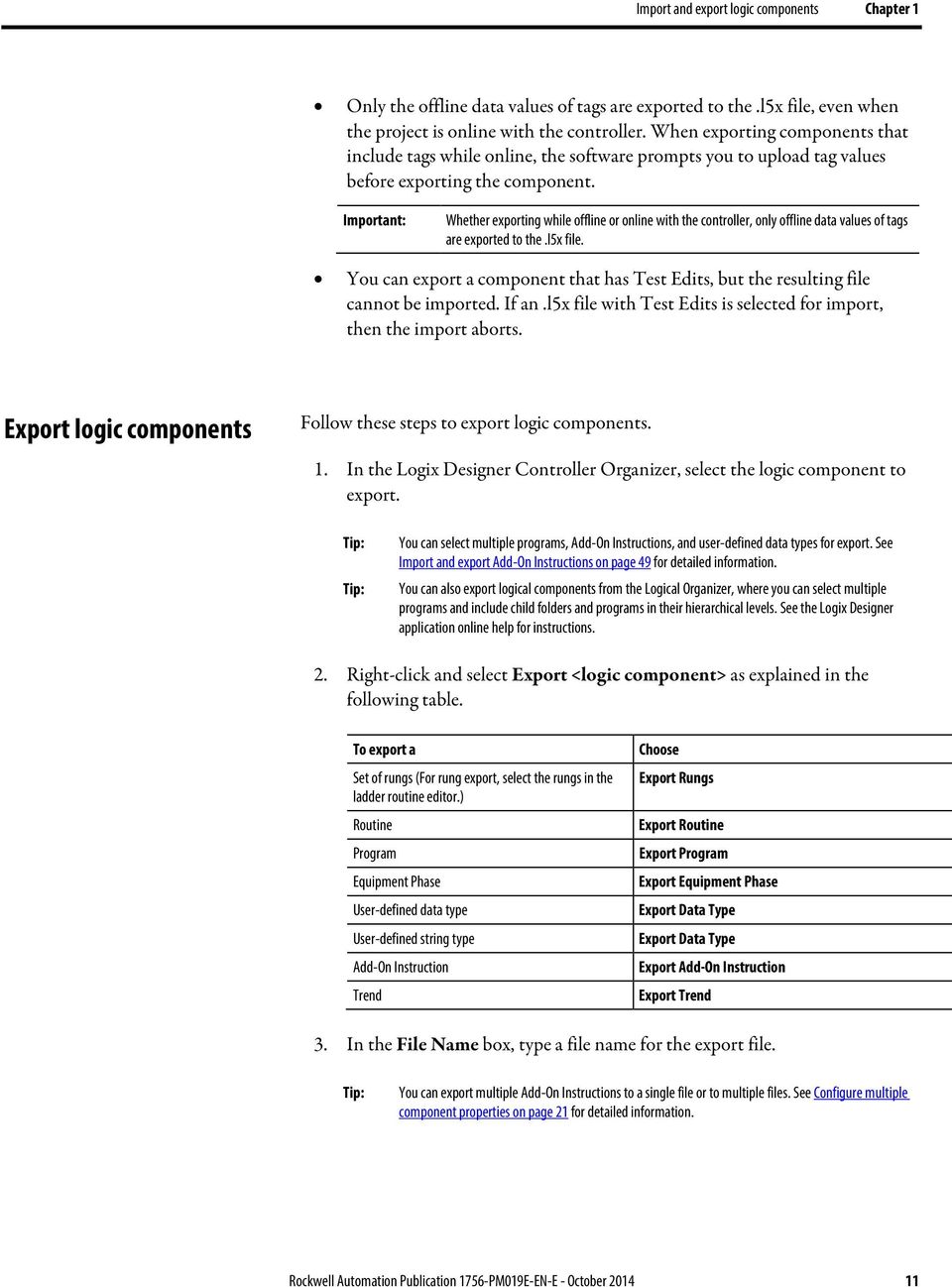
11 Import and export logic components Chapter 1 Only the offline data values of tags are exported to the.l5x file, even when the project is online with the controller. When exporting components that include tags while online, the software prompts you to upload tag values before exporting the component. Important: Whether exporting while offline or online with the controller, only offline data values of tags are exported to the.l5x file. You can export a component that has Test Edits, but the resulting file cannot be imported. If an.l5x file with Test Edits is selected for import, then the import aborts. Export logic components Follow these steps to export logic components. 1. In the Logix Designer Controller Organizer, select the logic component to export. Tip: Tip: You can select multiple programs, Add-On Instructions, and user-defined data types for export. See Import and export Add-On Instructions on page 49 for detailed information. You can also export logical components from the Logical Organizer, where you can select multiple programs and include child folders and programs in their hierarchical levels. See the Logix Designer application online help for instructions. 2. Right-click and select Export <logic component> as explained in the following table. To export a Set of rungs (For rung export, select the rungs in the ladder routine editor.) Routine Program Equipment Phase User-defined data type User-defined string type Add-On Instruction Trend Choose Export Rungs Export Routine Export Program Export Equipment Phase Export Data Type Export Data Type Export Add-On Instruction Export Trend 3. In the File Name box, type a file name for the export file. Tip: You can export multiple Add-On Instructions to a single file or to multiple files. See Configure multiple component properties on page 21 for detailed information. Rockwell Automation Publication 1756-PM019E-EN-E - October
12 Chapter 1 Import and export logic components 4. (Optional) In the File description, edit the default description or type a description, if desired. A default description is supplied for some component exports. Tip: The file description can be viewed in a tooltip during import when selecting which file to import. 5. Click Export. Import considerations This section covers general considerations for all component-type imports. See the chapters for specific components (program, routine, rungs, Add-On Instructions, user-defined data types, and tags) for additional export and import considerations for that component, whether it is imported directly or as a reference during another component import. Important: When editing online, if the program scan time is large, or the number of modified rungs is large, you might see HMI and Logix Designer communication timeouts when edits are finalized. The timeout is caused by the (scan time) x (number of changed rungs). You could have a large program with a very fast scan, or a lot of rungs (but you modified only a few), and you do not see a timeout. Tip: Starting with version 24 of Logix Designer application, you can use program parameters to share data between programs in much the same way that you use controller-scoped tags. Program parameters are imported and exported in the same way as tags in most instances. For more information on program parameters, see the Logix5000 Controllers Program Parameters Programming Manual, publication 1756-PM021. Online Import Topic Tag data values Locking controller edits Tag attributes Consideration When overwriting tags while online, data values are not written to the online project. Data values for overwritten tags while online are written only to the offline project. Data values for tags created while online are written to the offline and online project. Select the Preserve existing tag values in offline project check box to prevent tag values from being overwritten in the offline project. When performing an online import, the controller is locked, preventing other workstations connected to the controller from making edits until the import completes. If another workstation has the controller locked, an online import cannot be initiated. Tag attributes (for example, External Access, Constant, and Style) are written to the online project and the offline project. If existing tags are to be overwritten with new attributes that are incompatible with existing user logic, the import is not allowed. 12 Rockwell Automation Publication 1756-PM019E-EN-E - October 2014

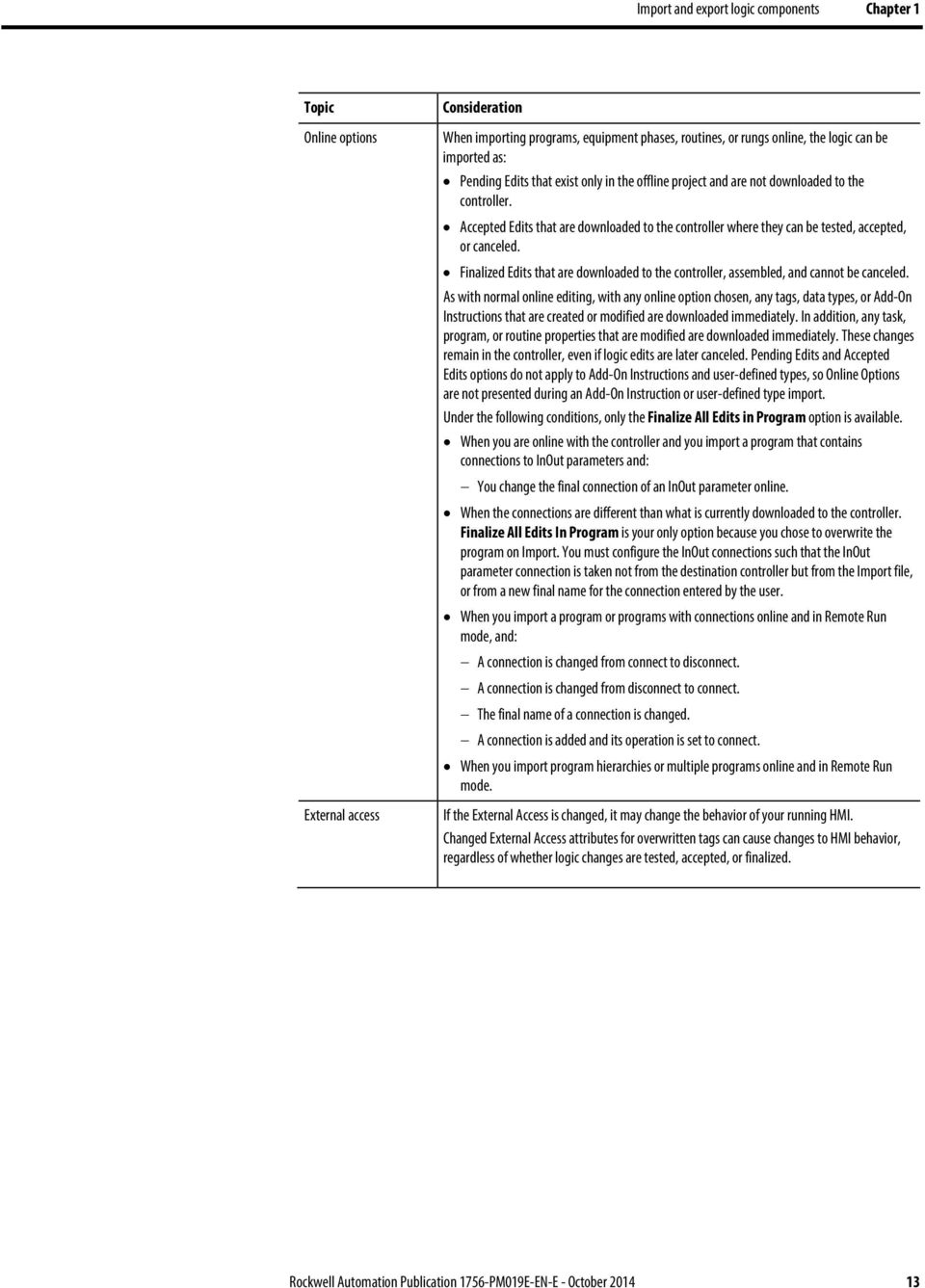
13 Import and export logic components Chapter 1 Topic Online options External access Consideration When importing programs, equipment phases, routines, or rungs online, the logic can be imported as: Pending Edits that exist only in the offline project and are not downloaded to the controller. Accepted Edits that are downloaded to the controller where they can be tested, accepted, or canceled. Finalized Edits that are downloaded to the controller, assembled, and cannot be canceled. As with normal online editing, with any online option chosen, any tags, data types, or Add-On Instructions that are created or modified are downloaded immediately. In addition, any task, program, or routine properties that are modified are downloaded immediately. These changes remain in the controller, even if logic edits are later canceled. Pending Edits and Accepted Edits options do not apply to Add-On Instructions and user-defined types, so Online Options are not presented during an Add-On Instruction or user-defined type import. Under the following conditions, only the Finalize All Edits in Program option is available. When you are online with the controller and you import a program that contains connections to InOut parameters and: You change the final connection of an InOut parameter online. When the connections are different than what is currently downloaded to the controller. Finalize All Edits In Program is your only option because you chose to overwrite the program on Import. You must configure the InOut connections such that the InOut parameter connection is taken not from the destination controller but from the Import file, or from a new final name for the connection entered by the user. When you import a program or programs with connections online and in Remote Run mode, and: A connection is changed from connect to disconnect. A connection is changed from disconnect to connect. The final name of a connection is changed. A connection is added and its operation is set to connect. When you import program hierarchies or multiple programs online and in Remote Run mode. If the External Access is changed, it may change the behavior of your running HMI. Changed External Access attributes for overwritten tags can cause changes to HMI behavior, regardless of whether logic changes are tested, accepted, or finalized. Rockwell Automation Publication 1756-PM019E-EN-E - October
14 Chapter 1 Import and export logic components Topic Asynchronous import Communication timeouts Consideration Import operations are not synchronized with the Program Scan (just as online editing operations are not synchronized). For most objects, this does not matter because: Existing online tag data values are never overwritten. New tags and their initial data values are written to the controller before the new logic runs. The switch-over to the new logic is synchronized with the program scan (just like online editing). In general, although online tag data values are not overwritten, some object attributes can change asynchronously to the Program Scan. Some examples: Changed attributes of existing programs or equipment phases (such as changing the Initial Step Index of an equipment phase) are written to the controller before switch-over, so old logic can run with the new configuration. An existing program without a main routine could become configured with a main routine as part of import, and that main routine runs immediately even though the new logic for that routine has not yet been accepted. Changing Logix-based alarm tag configuration (such as alarm messages or associated tag definitions) can go into effect while the old alarm trigger logic is still active, resulting in alarm messages that do not match the condition. Communication timeouts may occur when rungs are deleted online in Run mode if the program scan time is long or the number of rungs being deleted is large. If you use Partial Import Online and choose Pending or Accept edits, when you later Finalize those edits, a timeout can occur. This timeout can occur as HMI or Logix Designer communication timeouts. Keep the following timing considerations in mind. Finalizing online edits while in Run mode causes brief interruptions to communication, which are usually unnoticeable. The length of the communication interruption is related to the product of the (task scan time) x (the number of changed rungs). When very long program scans or large quantities of changed rungs occur, the communication interruption can be long enough to cause timeouts. The timeout of a Rockwell Automation HMI is typically 8 seconds, while a Logix Designer online session typically has a 30-second timeout. It does not matter whether the edits came from individual online edits or from a Partial Import Online (choosing Pending or Accepted edits). Partial Import Online (choosing Finalize Edits) does not cause the communication timeout, due to the use of asynchronous transaction commit processing. Motion Topic Motion components limitations while online Consideration Motion tags (Axis, Coordinate System, and Motion Group) cannot be created, modified or deleted during an online import, however, existing motion tags can be referenced. When doing an offline import, motion tags can be created and modified. 14 Rockwell Automation Publication 1756-PM019E-EN-E - October 2014

15 Import and export logic components Chapter 1 Safety Topic Safety components limitations while online Safety components limitations while offline Scheduled location Safety programs imported into a standard project Controller Fault Handler and Power-Up Handler Consideration Safety components cannot be created, modified or deleted during an online import. Safety components cannot be created, modified or deleted during an offline import. If a Safety Signature exists, the project is Safety locked. A non-recoverable safety fault is present if the Safety Partnership status between the primary controller and the safety partner is any value other than OK, or if Safety modify permissions are denied. In a Safety project, Safety programs cannot be imported into a Standard task and vice versa. Safety programs imported into a Standard project are converted to Standard programs during the import processing and a warning appears in the Errors/Results Pane during initial parsing of the.l5x file. In this case, imported logic does not verify after import if it contains instructions that are only valid in a Safety routine. A Safety program cannot be scheduled in the Controller Fault Handler or Power-Up Handler folders. Security Topic Project is secured Consideration If the project is secured, the import process may not be able to create, delete, or modify some components, depending on the security actions that have been granted or denied for those components. Multiple components Topic Importing multiple Userdefined types (UDTs) and Add-On Instructions. Controller Fault Handler and Power-Up Handler disabled Consideration When User-defined types (UDTs) and Add-On Instructions are imported using the Multiple Components option, all UDTs and Add-On Instructions are treated as references. Unlike child components, referenced components can be configured independently from the import target. When you import multiple target programs, the Controller Fault Handler and Power-Up Handler are unavailable in the Schedule In list. Import logic components Follow these steps to import logic components. You can import components from the Controller Organizer and from the Logical Organizer. Importing components into a controller while online can affect controller operation. Use caution when modifying logic while online in Remote Run or Run mode. 1. Right-click the item and choose the import component menu item as described in the following table. Rockwell Automation Publication 1756-PM019E-EN-E - October

16 Chapter 1 Import and export logic components To import a Right-click And choose Set of rungs A rung or set of rungs within a Ladder routine editor Import Rungs Routine A program or equipment phase Import Routine Program A task, the Controller Fault Handler folder, the Power-Up Handler folder, or the Unscheduled Programs/Phases folder Import Program Equipment Phase A task or the Unscheduled Programs/Phases folder Import Equipment Phase User-defined data type User-Defined folder Import Data Type User-defined string type Strings folder Import String Type Add-On Instruction Add-On Instructions folder Import Add-On Instruction Trend Trends folder Import Trend 2. Select the file to import. You can select multiple components for import. See Configure multiple component properties on page 21 for information. 3. Click Import. 4. Continue by selecting the configuration options described in Configuration properties for import. Configuration properties for import This section describes configuration options for importing components. Tip: Trends do not require any import configuration, so the Import Configuration dialog box does not appear and the trend is imported immediately. Properties for imported components When you import components, the previously exported information is brought into the project based on the import configuration you select. You determine how the imported component (a program, for example) connects to the existing project either by overwriting an existing component of the same type, or by creating a new one. 16 Rockwell Automation Publication 1756-PM019E-EN-E - October 2014

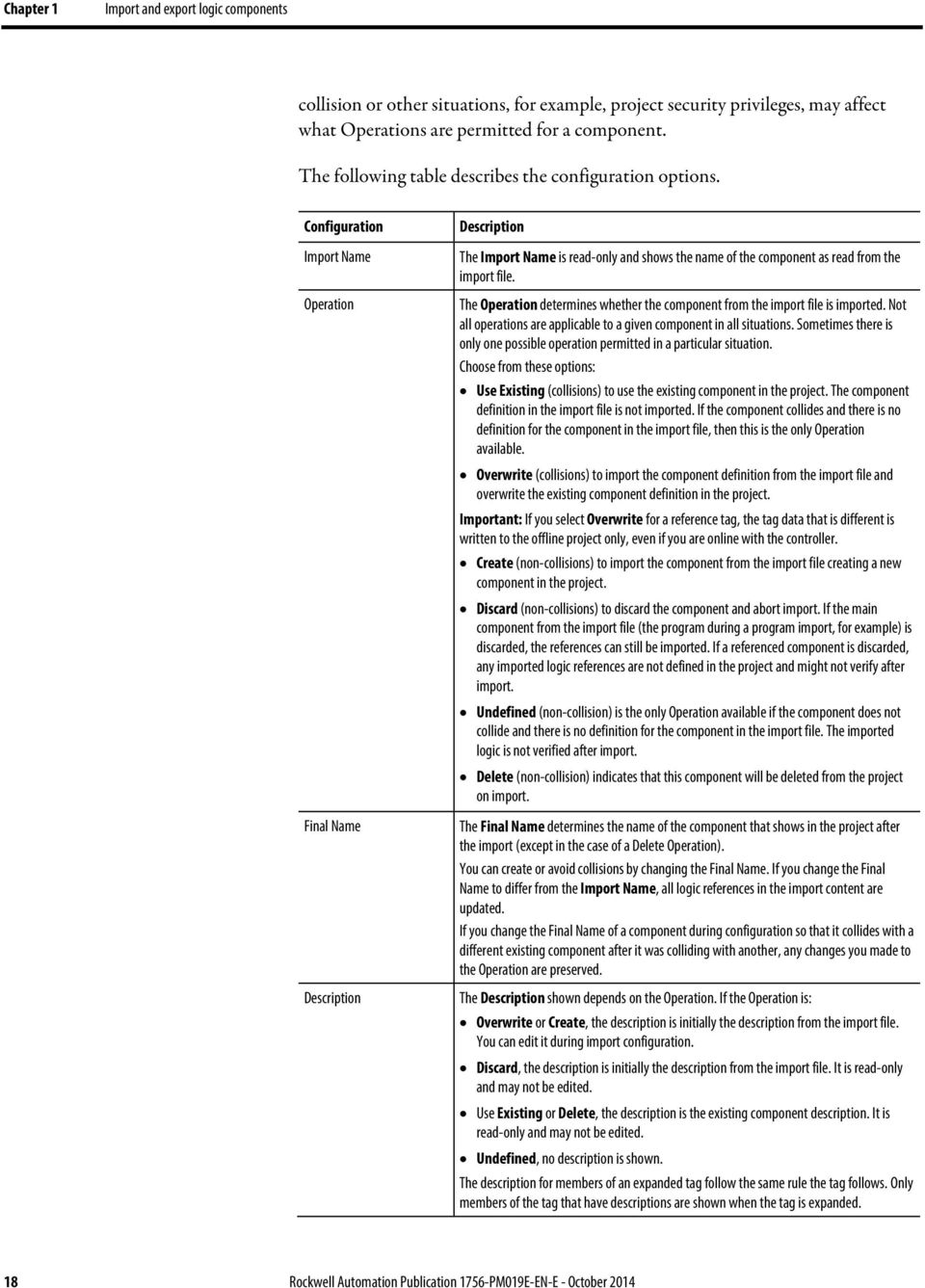
17 Import and export logic components Chapter 1 The following screen capture shows a typical Import Configuration dialog box. Your dialog box might contain options different than those shown here, depending on the component you import. An import component collides with an existing component if a component of the same type, scope, and with the same name exists in the project. By configuring the Final Name of the imported component, you determine whether the imported component collides with an existing component, or it does not (if a component of the same type, scope and with the same name does not exist in the project). For a collision, you can use the existing project component or you can overwrite it. For a non-collision, you can create a project component or you can discard, and not import, the component from the import file. In any case, any imported logic references are updated to be the same as the Final Name. By configuring the Operation for the component, you determine whether it is imported from the file or an existing component is used. Incompatibility of a Rockwell Automation Publication 1756-PM019E-EN-E - October

18 Chapter 1 Import and export logic components collision or other situations, for example, project security privileges, may affect what Operations are permitted for a component. The following table describes the configuration options. Configuration Import Name Operation Final Name Description Description The Import Name is read-only and shows the name of the component as read from the import file. The Operation determines whether the component from the import file is imported. Not all operations are applicable to a given component in all situations. Sometimes there is only one possible operation permitted in a particular situation. Choose from these options: Use Existing (collisions) to use the existing component in the project. The component definition in the import file is not imported. If the component collides and there is no definition for the component in the import file, then this is the only Operation available. Overwrite (collisions) to import the component definition from the import file and overwrite the existing component definition in the project. Important: If you select Overwrite for a reference tag, the tag data that is different is written to the offline project only, even if you are online with the controller. Create (non-collisions) to import the component from the import file creating a new component in the project. Discard (non-collisions) to discard the component and abort import. If the main component from the import file (the program during a program import, for example) is discarded, the references can still be imported. If a referenced component is discarded, any imported logic references are not defined in the project and might not verify after import. Undefined (non-collision) is the only Operation available if the component does not collide and there is no definition for the component in the import file. The imported logic is not verified after import. Delete (non-collision) indicates that this component will be deleted from the project on import. The Final Name determines the name of the component that shows in the project after the import (except in the case of a Delete Operation). You can create or avoid collisions by changing the Final Name. If you change the Final Name to differ from the Import Name, all logic references in the import content are updated. If you change the Final Name of a component during configuration so that it collides with a different existing component after it was colliding with another, any changes you made to the Operation are preserved. The Description shown depends on the Operation. If the Operation is: Overwrite or Create, the description is initially the description from the import file. You can edit it during import configuration. Discard, the description is initially the description from the import file. It is read-only and may not be edited. Use Existing or Delete, the description is the existing component description. It is read-only and may not be edited. Undefined, no description is shown. The description for members of an expanded tag follow the same rule the tag follows. Only members of the tag that have descriptions are shown when the tag is expanded. 18 Rockwell Automation Publication 1756-PM019E-EN-E - October 2014
19 Import and export logic components Chapter 1 Configuration Schedule In Preserve scheduling for child programs that already exist Description The Schedule In setting determines the task in which the imported component is scheduled. The default setting for Schedule In depends on the Operation setting and whether you import the component into the Controller Organizer or the Logical Organizer. If you import the component into the Controller Organizer: When you select a task or handler, and Operation is set to Overwrite, Schedule In is set to the selected task or handler. When you select a task or handler and Operation is set to Use Existing, Schedule In is set to the task or handler where the program is scheduled in the destination project. When the selection in Controller Organizer is not a task or handler, Schedule In is set to Unscheduled Programs/Phases. If you import the component into the Logical Organizer: When you set Operation to Create or Discard, Schedule In is set to Unscheduled Programs/Phases. When you set Operation to Use Existing or Overwrite, Schedule In is set to the Task or Handler for which the program is scheduled in the destination project. You can adjust the Schedule In setting when: Operation is set to Create (the target component is being created). Operation is set to Overwrite and you are not online in Remote Run mode. You cannot change the Schedule In setting when: You import a program folder. Operation is set to any setting other than Create or Overwrite. When you select this setting, any child programs that exist in the destination project remain scheduled as configured in the project. When you clear this setting, all imported programs are scheduled in the task specified by the Schedule In setting. This setting is available when Operation is set to Create or Overwrite; otherwise it is read-only. When enabled, this setting is selected by default. The setting is not preserved between import sessions. Rockwell Automation Publication 1756-PM019E-EN-E - October

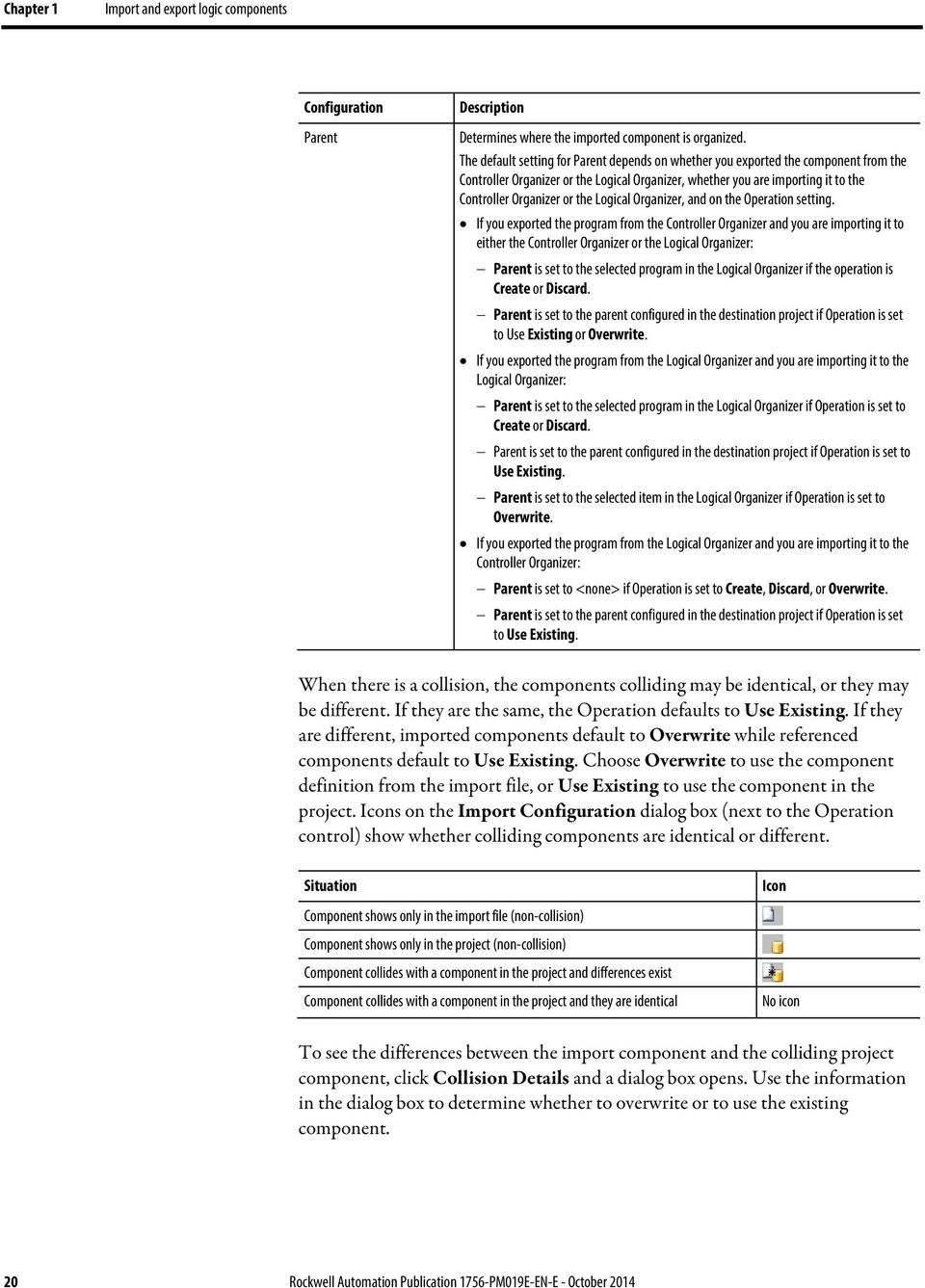
20 Chapter 1 Import and export logic components Configuration Parent Description Determines where the imported component is organized. The default setting for Parent depends on whether you exported the component from the Controller Organizer or the Logical Organizer, whether you are importing it to the Controller Organizer or the Logical Organizer, and on the Operation setting. If you exported the program from the Controller Organizer and you are importing it to either the Controller Organizer or the Logical Organizer: Parent is set to the selected program in the Logical Organizer if the operation is Create or Discard. Parent is set to the parent configured in the destination project if Operation is set to Use Existing or Overwrite. If you exported the program from the Logical Organizer and you are importing it to the Logical Organizer: Parent is set to the selected program in the Logical Organizer if Operation is set to Create or Discard. Parent is set to the parent configured in the destination project if Operation is set to Use Existing. Parent is set to the selected item in the Logical Organizer if Operation is set to Overwrite. If you exported the program from the Logical Organizer and you are importing it to the Controller Organizer: Parent is set to <none> if Operation is set to Create, Discard, or Overwrite. Parent is set to the parent configured in the destination project if Operation is set to Use Existing. When there is a collision, the components colliding may be identical, or they may be different. If they are the same, the Operation defaults to Use Existing. If they are different, imported components default to Overwrite while referenced components default to Use Existing. Choose Overwrite to use the component definition from the import file, or Use Existing to use the component in the project. Icons on the Import Configuration dialog box (next to the Operation control) show whether colliding components are identical or different. Situation Icon Component shows only in the import file (non-collision) Component shows only in the project (non-collision) Component collides with a component in the project and differences exist Component collides with a component in the project and they are identical No icon To see the differences between the import component and the colliding project component, click Collision Details and a dialog box opens. Use the information in the dialog box to determine whether to overwrite or to use the existing component. 20 Rockwell Automation Publication 1756-PM019E-EN-E - October 2014
21 Import and export logic components Chapter 1 For components that do not collide, click Properties for more information on the component. Important: A component you select for import that collides with an existing component defaults to overwriting the project component unless the components are identical, in which case, the project component is used. If the project component is used, references may still be imported. Configure multiple component properties This section describes the settings you use to import and configure multiple components. You carry out multiple steps when you import components. First, you select components for export from a project. You export those components. You select those components and import them into another project. Use one of the following methods to import multiple components. Select Import Component from the File menu and choose the component type that you want to import. Copy the programs, Add-On Instructions, or UDTs, right-click a task in the organizer, and click Paste With Configuration on the menu. Note: The Paste With Configuration menu option works when copying from the Controller Organizer to the Logical Organizer, and vice versa. Rockwell Automation Publication 1756-PM019E-EN-E - October
22 Chapter 1 Import and export logic components The following screen capture shows a typical Import Configuration dialog box for multiple components. Your dialog box might contain options different than those shown here, depending on the components you import. Imported items are listed in the Import Content pane based on the items that are part of the import content. 22 Rockwell Automation Publication 1756-PM019E-EN-E - October 2014
23 Import and export logic components Chapter 1 Programs -- If you are importing multiple programs, the grid shows the programs that are being imported into the project. If you are importing multiple hierarchies, the grid shows the programs and the children of the programs that are being imported into the project. Tags, Add-On Instructions, Data Types and Other Components -- References include any tags directly referenced by any imported logic or tags (using Alias For). Connections -- Lists the connections, from programs that are external to the programs in the import content, that are also connected to programs in the existing project. The following table describes the multiple-import configuration parameters. Configuration Multiple Programs Imported Programs Operation Schedule In Do not change scheduling of existing programs Description The Import Content pane shows the number of programs that are being imported into the project. The value shown in the parenthesis excludes children of the programs. If differences occur among the programs, the difference icon appears in the Differences column of the Programs grid. Shows the number of parent and child programs (if applicable) that are being imported into the project. Identifies what is done with the programs upon import. If Import is selected, all programs are imported into the project. If Discard is selected, the programs are not imported into the project. The box is set to Import by default. However, you can choose Discard from the menu. Note: To see the Operation value for a specific program, check the Programs grid of the program's child program. Shows the task in which the imported programs are scheduled. The default value for the Schedule In value is the selected task or Unscheduled Programs/Phases based on which method you use to import the content, and from which organizer you initiate the import. If you use Paste Special>With Configuration in the Controller Organizer, the default value is the selected task. If you use the Paste Special>With Configuration option or the File>Import Component option in the Logical Organizer, the default value is Unscheduled Programs/Phases. The Operation box must be set to Import to modify the Scheduled In value. When selected, programs that exist in the project remain scheduled as they are configured in the project. The check box is selected by default. When cleared, upon import, programs are scheduled in the task specified in the Schedule In box. To modify this option: The Operation box must be set to Import. The controller cannot be in Remote Run mode. Rockwell Automation Publication 1756-PM019E-EN-E - October
24 Chapter 1 Import and export logic components Configuration Parent Do not change parent of existing programs Description Specifies how the programs are organized upon import. When you import a program into the Logical Organizer, the default is the Parent in the selected program in the Logical Organizer. The default is <none> when a Parent is not specified in the selected program in the Logical Organizer, or when you are importing programs into the Controller Organizer. If a Parent is not specified, the programs remain organized as they are configured in the project. The Operation box must be set to Import to modify the Parent option. Select this check box and programs that exist in the project remain organized as they are configured in the project. The check box is selected by default. Clear this check box and upon import, programs are organized in the program that is specified in the Parent box. All child programs are imported as organized in the import content regardless if the check box is selected or cleared. The Operation box must be set to Import to modify this option. Configure program connections When you import a program, you might need to configure connections to program parameters or controller scope tags that exist in the project. You can configure connections when you select the target program on the Import Configuration dialog box and Operation is set to Overwrite or Create. If Operation is set to Use Existing or Discard, the Connections grid does not appear. When you import multiple programs, any connections between the programs you are importing cannot be configured, and do not appear in the Connections grid. However, any connections with endpoints outside these programs do appear and may be configured. Logix Designer application imports the connection endpoints, and they remain what they were in the original project. If the endpoints exist in the destination project, they bind automatically. If the endpoints do not exist, they are flagged as errors and you must change the Final Connection name to bind them to the correct connections, or remove the connections. The following diagrams describe how imported connections are established. 24 Rockwell Automation Publication 1756-PM019E-EN-E - October 2014
25 Import and export logic components Chapter 1 In My Original Project, the parameters in Program1 are connected to parameters in Program2. When you import the original Program1 into My New Project, the parameters in Program1 connect automatically to matching parameters in Program2. Parameters that do not match are flagged as errors. You need to change the Final Connector for those parameters. If the endpoint names are different in My New Project (for example, Program3) you can either open the Connections grid and change the Final Connection name on the endpoints from Program2 to Program3, or you can go to the References grid and change the final name on Program2 to Program3 in one place, and all the connections change automatically. Rockwell Automation Publication 1756-PM019E-EN-E - October

26 Chapter 1 Import and export logic components To open the Connections grid, click Connections on the Import Configuration dialog box. The following screen capture shows the Connections grid as it would appear when you import Program1 into My New Project, as described earlier in this section. To fix the connection errors, you can select Disconnect in the Operation box, or you can select a different connection in the Final Connection box. The indicator column at the far left of the Connections grid shows the condition of the connection. The following table describes the connection conditions. Indicator Connection Condition * Indicates a row in which content has changed and the change has not been saved. Indicates a row in which the connection endpoints are invalid due to a syntax error. If you click OK to begin the import, you receive an error message and must fix or remove the connection before you can proceed. Indicates that the connection being imported will contain an error at the completion of the import. You can proceed with the import, and the connection is created, but you must fix the error before you can download the project to the controller. Indicates a row in which you can create a connection. The following table describes the Connections grid columns and settings. 26 Rockwell Automation Publication 1756-PM019E-EN-E - October 2014
27 Import and export logic components Chapter 1 Column Parameter Data Type Usage Import Connection Differences Description The parameter identified in this box is the parameter in the import content that is to be connected to another parameter on a program that exists in the project. A New Connection option is available on the last row of the grid if the import content contains only one program. You can create connections that are not part of the import content by connecting a program parameter in the import content to an endpoint connection on a program that is in the project. You then have a new connection that did not exist in the import content nor in the program that exist in the project. See Create a new connection on page 28 for more information. Shows the data type of the parameter. A parameter can only be connected to a member or bit of a tag or parameter with the same data type or an error occurs when you verify the program. Shows the usage type of the parameter as Input, Output, InOut, or Public. Shows the name of the connection endpoint for the parameter as read from the import file. This Import Connection box is blank if the connection is only defined in the program that exists in the project. Indicates if there are differences between the connections in the import content and the connections in the target project. Also identifies if a connection exists in the import content, or if it exists in the program that is in the project. Click the Browse button in the Details column to see more extensive component properties. Two icons show how the imported content matches the content of the program that exists in the project: Indicates a connection that is present in the import content and not in the project. Indicates a connection that is present in the project and not in the import content. Operation Details Final Connection Identifies whether the connection is made upon import of the program into the project. You can select Connect or Disconnect to change the connection status for the connection. Connect - Upon import of the program, this connection that is defined in the import content will be created in the project. This is the default value when a connection between the parameter and the final connection is valid. Disconnect - Upon import of the project, the connection that is defined in the import content will not be created in the project. This is the default value when the connection between the parameter and the final connection is not valid. See the example later in this section for more information on the Operation box. Click the Browse button to open the Connection Properties dialog box. On the Connection Properties dialog box, click Connect or Disconnect to change the connection status for the connection. The parameter or tag in the existing project that the import parameter will be connected to. You have the option to change the value in the Final Connection box based on the value in the Operation box. You can type the final connection name or click the down arrow to make a selection from the tag browser. If the parameter is a MODULE InOut parameter, the module browser appears instead of the tag browser. For more information about the tag browser and module browser, see the online help topics Using the Tag Browser and Using the Module Browser. If you enter an invalid final connection, the error indicator displays in the leftmost column. Hover the cursor over the error indicator to see a description for the cause of the error. See the example later in this section for more information on the Final Connection box. Rockwell Automation Publication 1756-PM019E-EN-E - October
28 Chapter 1 Import and export logic components Example: using the operation and final connection boxes to establish connections Parameter in Imported File Connection in Imported File Operation Value Final Connection box What happened in this case \Prog1.InA \Prog2.OutA Connect \Prog2.OutA This connection exists in both the import content and in the program in the project, so the connection is the same. \Prog1.InB \Prog2.OutB Connect \Prog2.OutB The endpoint parameter does not exist in the target project file. If you are importing the program offline, the error flag appears. You can continue the import, but you must resolve the error before you can download the project to the controller. If you are importing the program online, the red-x error appears, and you must resolve the error before continuing the import. To resolve the error, you can either: Set the Operation Value to Disconnect (see Example Row 3 in this table). Select an existing parameter in the Final Connection box to reassign the connection (see Example Row 4 in this table). \Prog1.InB \Prog2.OutB Disconnect \Prog2.OutB Example Row 3: Parameter \Prog2.OutB does not exist in the target project, so you set the Operation Value to Disconnect. \Prog1.InA \Prog2.OutA Connect \Prog3.OutB Example Row 4: Parameter \Prog2.OutA does not exist in the target project, so in the Final Connection box select an existing parameter to reassign the connection. \Prog1.InC none Connect \Prog3.OutD This connection did not exist, so in the Final Connection box select an existing parameter to create the connection. See Create a new connection on page 28 for more information on creating connections. Create a new connection When you import one program you can create a new connection on the last row of the Connections grid. The new connection connects a program parameter in the import content to an endpoint connection in a program that is in the project. Your new connection did not previously exist in the import content nor in the project. The New Connection row is not available when you import multiple programs with existing connections between the programs you are importing. You can type the parameter name for the new connection or click the down arrow to make a selection from the tag browser. Because only parameters that are in the import content are valid for the Parameters box, only the parameters that reside in the import content are listed in the tag browser. For more information about the tag browser, see Using the Tag Browser in the online help. When both the parameter and final connection have been specified, the connection is made (added) to the connection grid after you move off the New Connection row or after you press Enter. If you enter an invalid parameter or final connection, the connection is not created and the error indicator displays in the leftmost column. Hover the cursor over the error indicator to see a description for the cause of the error. 28 Rockwell Automation Publication 1756-PM019E-EN-E - October 2014
29 Import and export logic components Chapter 1 Configure component references In addition to determining how the component is imported, you must configure how references are imported. The references are all other components used by the exported component at the time it was exported. For example, a program.l5x file contains the definition of all controller-scoped tags, user-defined data types, userdefined string types, and Add-On Instructions referenced by the program at the time the program was exported. During import configuration, you determine what the references from the imported component connect to after import. You can connect a reference to an existing component in the project and not import the referenced component from the import file. Or, you can use the referenced component in the import file either by creating a new component in the project from the definition in the import file or by overwriting an existing component of the same type in the project. As with imported components, if the Final Name of a referenced component (such as a tag) matches a component of the same type and scope in the project, these components collide. If there is no collision, the component is identified as needing to be created (Operation is Create). Rockwell Automation Publication 1756-PM019E-EN-E - October
30 Chapter 1 Import and export logic components Icons in the Differences column ( ) on the Import Configuration dialog box show whether components collide with differences, or the component only exists in the import file or the project. Click the icon in the Details column ( ) and a Collision dialog box opens showing the differences between the import component and the colliding project component. Use the information in the Collision dialog box to determine whether to overwrite or use the existing component. For components that do not collide, click the same icon for more information on the component. Tip: A referenced component that collides with an existing component defaults to using the project component (Operation is Use Existing), even if the definitions of the components are different. To import the referenced component definition from the import file, Overwrite must be selected. Connecting a referenced component to a component of the same type, but with another name in the project, causes any reference to the component in the imported logic to be updated to the new name. For example, if you connect a Boolean reference tag A to B[3].ACCUM.4 (where B is an existing tag in the project that is an array of structures), then all references in the imported logic that used to say A now say B[3].ACCUM.4. Another way to connect reference tags to existing tags in the project is to modify their Alias For box. This is permitted when the reference tag is being created or the reference tag is overwriting an existing tag (offline only), regardless of whether it was originally an alias tag. The Import Configuration dialog box lets you configure the references that you must connect during the import process. Important: It is important to note that even if a component has an Operation of Discard, Use Existing, or Undefined, if the Final Name differs from the Import Name, then the imported logic references to that component are updated to reflect the Final Name. For example, if you enter an invalid name as the Final Name for a tag reference, the Operation is set to Discard but the imported logic references to that tag are still updated to the invalid Final Name. 30 Rockwell Automation Publication 1756-PM019E-EN-E - October 2014
31 Import and export logic components Chapter 1 References configuration example The following example shows how an imported routine plugs into the components in a project after you configure it. For example, if you import a routine, the routine itself is the main import component. References that should be connected during the import could include program-scope tags, controller-scope tags, user-defined data types, any routines called by JSR instructions, and any Add-On Instructions in the routine logic. In this example, a routine export file contains the definitions of Tag_A, Tag_B, AOI_1, and UDT_1. The routine also contains a reference to Routine_A, but excludes the logic in Routine_A. Rockwell Automation Publication 1756-PM019E-EN-E - October
32 Chapter 1 Import and export logic components During import configuration, connect each: Reference tag in the import routine to a program or controller-scoped tag in the project. Reference routine in the import routine to a routine in the project. User-defined data type defining a reference tag in the import routine to a user-defined data type in the project. Add-On Instruction in the import routine to an Add-On Instruction in the project. These tags, user-defined data types, and Add-On Instructions might exist in the project, or they can be created when you import the routine. Tag_A is set to Create, so the imported logic referencing Tag_A references the newly created Tag_A in the project. Tag_B has its Final Name changed to Tag_D and is set to Use Existing, so it is not created, and imported logic referencing Tag_B instead references existing Tag_D. Routine_A has its Final Name changed to Routine_B, so imported JSRs to Routine_A uses the existing Routine_B. AOI_1 is set to Overwrite an existing Add-On Instruction called AOI_1, so not only do imported logic and tags use AOI_1, but also any existing references to AOI_1 in the project now uses the new definition of AOI_1 from the imported routine. UDT_1 is set to Overwrite an existing user-defined data type called UDT_2, so imported logic and tags use UDT_2 and the existing UDT_2 is overwritten (except for the name) with the definition from UDT_1. Logic and tags from the project now use the new definition of UDT_2. Undefined references In the Logix Designer editor, it is possible to create logic that references tag, userdefined data type, or Add-On Instruction components that do not yet exist. These are considered undefined references. If you export that logic, there is no component definition to export for that undefined reference. On import, these tags, user-defined data types, or Add-On Instructions appear with an Operation of Undefined during Import Configuration unless the component exists in the project (in which case the Operation is Use Existing). Similarly, when logic references any type of component other than a tag, user-defined data type, userdefined string type, or Add-On Instruction (for example, a routine that is referenced by a JSR instruction), the definition for these referenced components 32 Rockwell Automation Publication 1756-PM019E-EN-E - October 2014
33 Import and export logic components Chapter 1 are excluded from the import file and they also appear with an Operation of Undefined if the component does not exist in the project. During import configuration, these undefined references can be configured as well. Since there is no definition for these components in the.l5x file, you cannot overwrite a project component or create a component during the import process, but you can use an existing component for that reference. You configure which component in the project you want to connect the reference to, or leave the reference undefined. An undefined reference that collides with an existing component defaults to using the project component. Attention flags Attention (red) flags alert you to import situations that may be unintended or may lead to a project that does not verify successfully after import. What they describe may or may not prevent the import from proceeding. If online, and the project does not verify successfully when accepting or finalizing edits, the import fails. Not all attention flags cause a project to fail verification. The red flag indicates the potential problem and you must decide what you want to do. You can ignore the attention message or try to change the Final Name or Operation of the component to resolve the issue. Tip: Hover the cursor over the attention flag to open a tooltip that explains the issue. Errors and warnings on import When an import fails or is canceled, all changes caused by the import are discarded, leaving the project in the same state it was in before the import, even if the project is online with the controller. If the import fails, the Import Configuration dialog box opens with Errors/Warnings selected. To attempt to import again, inspect the errors and warnings, reconfigure the import, and click OK. Project documentation The Logix Designer application provides the option to set the display language for project documentation, such as tag descriptions and rung comments, using any of the supported localized languages. You can store project documentation for multiple languages in one project file rather than in language-specific project files. You define the localized languages that the project supports and set the current, default, and optional custom localized language. The software uses the default language if the current language's content is blank for a particular component of the project. You can use a custom language to tailor documentation to a specific type of project file user. When you configure project documentation in the Logix Rockwell Automation Publication 1756-PM019E-EN-E - October
34 Chapter 1 Import and export logic components Designer application for a project, you can dynamically switch between languages in that project as you use the software. The following project documentation items support multiple languages. Component descriptions in tags, routines, programs, equipment phases, user-defined data types, and Add-On Instructions Engineering units and state identifiers added to tags, user-defined data types, or Add-On Instructions Trends Controllers Alarm Messages (in configuration of ALARM_ANALOG and ALARM_DIGITAL tags) Tasks Property descriptions for modules in the Controller Organizer Rung comments, Sequential Function Chart boxes, and Function Block Diagram boxes The export and import features of the Logix Designer application support project documentation. You can transfer project components between projects that have different project documentation settings. If a component was exported to an.l5x file from a project with project documentation turned off and is then imported into a project with project documentation turned on, all project documentation brought in by the import is associated with the project s current language. If a component was exported to an.l5x file from a project with project documentation turned on, all language switched comments are exported with the component. When you import an.l5x file that includes language switched comments, the Import Configuration dialog box includes a Current Import Documentation Language selection. 34 Rockwell Automation Publication 1756-PM019E-EN-E - October 2014
35 Import and export logic components Chapter 1 If the project has project documentation turned on, all language-switched comments from the.l5x file are imported into the project. This may result in additional languages being available in the project after import. Selecting a language in Current Import Documentation Language allows you to edit that language s comments from the import file during the import configuration process. If the project does not have project documentation turned on, you can import only one set of localized comments from the import file. In this case, selecting a language in Documentation to Import determines which language s comments are imported with components from the import file. You can edit the language s comments during the import configuration process, but only the final language selected when import proceeds is imported with components. Important: Important: Important: Only comments associated with imported components are brought in from the import file. If an existing component is used, import file comments for that component are not imported. Multiple localized alarm messages can be stored (in configuration of ALARM_ANALOG or ALARM_DIGITAL tags) even if the project does not have project documentation turned on. Therefore, all alarm messages are imported, regardless of the Documentation Language to Import selection on the Import Configuration dialog box. The Documentation Language to Import selection does not affect the setting of the language defined in the project after import. Find and replace Use the Find controls in the Import Configuration dialog box control bar to search for text within the Import Configuration dialog box. Use the Find / Replace dialog box to configure whether the Find searches through the Import Name, Final Name, Description, Alias For, and the Data Type check boxes. As the search progresses, the Import Configuration dialog box automatically switches to different panes within the dialog as needed. You can replace text boxes during the search to facilitate development of a component template that you can import repeatedly, replacing template text during each import. When designing a program template, during a program import, the program tag names and descriptions cannot be edited or replaced. However, during import you may edit the names and descriptions of controllerscoped tags referenced from the program. Similarly, when importing an equipment phase, you cannot edit the names and descriptions of tags in the equipment phase, and when importing an Add-On Instruction, you cannot edit the names and descriptions of the parameters and local tags. Use these steps to find and replace text during the import configuration process. 1. Click Find/Replace in the Import Configuration dialog box. 2. In the Find What box, enter the desired text for the search. You can enter a search string or select text from a previous search. Rockwell Automation Publication 1756-PM019E-EN-E - October
36 Chapter 1 Import and export logic components 3. To replace text that is found, enter the replacement text in the Replace With box. To use wildcards in your search string and in the replacement text, select the Use Wildcards check box. Use asterisks (*) as wildcard characters. This table provides examples of Find-Replace operations using wildcards. Find What Replace With Text Found Replacement Result tk1_*_001 PRE_*_010 tk1_me_001 PRE_me_010 tk3_* tk4_* tk3_unit tk4_unit *001 *002 mi_2001 mi_2002 *tank* *TNK* M1_tank_003 M1_TNK_003 * PRE_* some_name PRE_some_name 4. To limit search and replace to the currently selected pane, select the Search current view only check box. You can change the selected pane without closing the Find / Replace dialog box. 5. Select the applicable Find Within check boxes to configure the search. 6. Click Find Next to search for the next matching item. 7. Click Replace to replace the text in a text box. Click Replace All to replace all instances of the search text specified in the Find What box with the text in the Replace With box. Compatibility The import/export feature supports backward compatibility for import operations and forward compatibility for export operations. Backward compatibility means that the Logix Designer application can import.l5k or.l5x files generated by a previous version of the application. In some cases, an older.l5k file might not correctly import into a later version of the application. 36 Rockwell Automation Publication 1756-PM019E-EN-E - October 2014
37 Import and export logic components Chapter 1 The import/export feature supports forward compatibility for export operations, and does not support backward compatibility for export operations. Earlier versions of the Logix Designer application cannot read.l5k or.l5x files that were created with later versions of the application. In some cases, an.l5k or.l5x file created with a later version of the Logix Designer application may import with warnings into an earlier version of the application. In these cases, attributes on components may be set to default values during import. Each version of the Logix Designer application exports.l5k files with a specific import/export Logix Designer application version number. The Logix Designer application imports any.l5k file with the same major revision number and the same or lower minor revision number. The major Logix Designer application version number increments when file properties prevent the application from supporting backward compatibility for import operations. The minor version number increments whenever there is a change in the file (a new module, an attribute is added, the set of options for an attribute is changed) that does not affect backward compatibility for Logix Designer application import operations. Important: Use caution when copying and pasting components between different versions of Logix Designer application. Logix Designer application supports pasting to only the same or later version. Pasting to an earlier version of Logix Designer application is not supported. When pasting to an earlier version, the paste action might succeed but the results might not be as intended. Rockwell Automation Publication 1756-PM019E-EN-E - October
38
39 Chapter 2 Additional considerations for rungs Introduction Export considerations Import considerations This chapter explains import and export of rungs. One rung or a contiguous set of selected rungs may be exported to an.l5x file. The export file may also include any program-scoped tags, controller-scoped tags, Add-On Instructions, user-defined data types, and user-defined string types that are referenced by the rungs. The definitions for the referenced tags, Add-On Instructions, and user-defined data types are exported to the.l5x file if they exist in the project. In the case of rungs exported from an Add-On Instruction routine, any parameters and local tags referenced are exported if they exist at the time of export. When importing rungs, you configure how the referenced components are imported during import configuration. By default, referenced components that collide with project components are not imported. The following table lists considerations when importing rungs. Topic Pending Edits exist Accepted Edits exist First scan Collision handling Consideration If rungs are imported into a program or equipment phase that contains Pending Edits, all Pending Edits in the program are accepted if Accept Program Edits is selected during import of the rungs. Similarly, all Pending Edits in the program are finalized if Finalize All Edits In Program is selected during import of the rungs. Rungs cannot be imported into a program or equipment phase that contains routines with Accepted Edits or Test Edits. Existing edits must first either be assembled or canceled. When importing rungs into an existing program, the S:FS bit is not set during the next scan of the program. This applies when importing rungs into an existing equipment phase as well. If you select Overwrite Selected Rungs in the Import Rungs dialog box, the imported rungs overwrite the rungs selected in the project. If Overwrite Selected Rungs is cleared, the imported rungs are inserted before the selected rungs in the project if the ladder editor is in Insert mode, they are inserted after the selected rungs if the ladder editor is in Append mode. Rockwell Automation Publication 1756-PM019E-EN-E - October
40 Chapter 2 Additional considerations for rungs Topic Tag scope Consideration When you export rungs from a program or equipment phase and import them into an Add- On Instruction routine, any referenced controller-scoped or program-scoped tags are converted on import. The tag is converted to a local tag unless local scoped is not allowed (for example, a Motion Group tag cannot be a local tag), in which case the tag is converted to an InOut parameter. When you export rungs from an Add-On Instruction routine and import them into a routine in a program or equipment phase, the referenced parameters and local tags are converted on import. The parameter or local tag are converted to a program-scoped or phase-scoped tag unless it is not allowed (for example, a Motion Group tag cannot be a program-scoped tag), in which case it is converted to a controller-scoped tag. For considerations for referenced user-defined types, Add-On Instructions, and tags that may be imported with the rungs, see: Additional considerations for user-defined types on page 47 Chapter 6, Import and export Add-On Instructions on page 49 Additional considerations for tags on page Rockwell Automation Publication 1756-PM019E-EN-E - October 2014
41 Chapter 3 Additional considerations for routines Introduction Export considerations This chapter explains the import and export of routines. A routine can be exported to an.l5x file. Routines of all language types, Function Block Diagram, Sequential Function Chart, Ladder Diagram and Structured Text, may be exported. However, routines may not be exported from an Add-On Instruction container and SoftLogix external routines may not be exported. The export file may also include any program-scoped tags, controller-scoped tags, Add-On Instructions, user-defined data types, and user-defined string types that are referenced by the routine. The definitions for the referenced tags, Add-On Instructions and user-defined data types are exported to the.l5x file if they exist in the project. Import considerations When importing a routine, you configure how the referenced components are imported during import configuration. By default, referenced components that collide with project components are not imported. The following are considerations when importing a routine. Topic Pending Edits exist Accepted Edits exist Routine type First scan SFC routine execution configuration Equipment Phase state routines Consideration If a routine is imported into a program or equipment phase that contains other routines with Pending Edits, all Pending Edits in the program are accepted if Accept Program Edits is selected during import of the routine. Similarly, all Pending Edits in the program are finalized if Finalize All Edits In Program is selected during import of the routine. A routine may not be imported into a program or equipment phase that contains routines with Accepted Edits or Test Edits. Existing edits must first either be assembled or canceled. An existing routine may not be overwritten by a routine that is another routine type. When importing a routine into an existing program, the S:FS bit is not set during the program s next scan. This applies when importing a routine into an existing equipment phase as well. SFC execution settings are configured on a controller project, not per SFC routine. If you export an SFC routine and import it into another project with different SFC execution settings, the functionality of the routine could change. For example, a change in the Last Scan of Active Steps setting could leave physical outputs in an undesired state. When state routines are created while online with the controller and logic edits are accepted but not tested, the routine will behave as if it was not implemented. Rockwell Automation Publication 1756-PM019E-EN-E - October
42 Chapter 3 Additional considerations for routines For considerations for referenced user-defined types, Add-On Instructions, and tags that may be imported with the rungs see: Additional considerations for user-defined types on page 47 Chapter 6, Import and export Add-On Instructions on page 49 Additional considerations for tags on page Rockwell Automation Publication 1756-PM019E-EN-E - October 2014
43 Chapter 4 Additional considerations for programs and equipment phases Introduction Export considerations This chapter explains import and export of programs. All topics apply to equipment phases as well; any exceptions are noted. A program can be exported to an.l5x file. The exported program includes all of its program tags and routines, which are imported with the program automatically. The export file may also include any controller-scoped tags, Add-On Instructions, user-defined data types, and user-defined string types referenced by the program. The definitions for the referenced tags, Add-On Instructions, and user-defined data types are exported to the.l5x file if they exist in the project. As with other export types, I/O module data type definitions are not exported. I/O module data types are created within a project when the associated I/O module is created in the project. On import, program-scoped tags may not be modified. As a result, if a program-scoped tag aliases an I/O module type tag, the I/O module must first exist in the project in order to import the program. To export the program so that it can be imported into a project with another module type, first alias the program-scoped tag to a controller-scoped tag of a non-i/o module type, and then alias the controller-scoped tag to the I/O module. These program-scoped tags can then be created during the import of the program if necessary. Import considerations When you import a program, the program-scoped tags and routines are imported as part of the program. The Operation, Final Name, Description, and any other settings of the program-scoped tags and routines cannot be modified; instead, the Operations are based on the Operation selected for the program. Programs cannot overwrite equipment phases, and vice-versa. Programs and equipment phases must have unique names. You configure how the referenced components are imported during import configuration. By default, referenced components that collide with project components are not imported. Rockwell Automation Publication 1756-PM019E-EN-E - October
44 Chapter 4 Additional considerations for programs and equipment phases The following are considerations when importing a program. Topic Accepted or Test Edits exist Deletes of program-scoped tags and routines during program overwrite Safety program scheduled location Configuration of Equipment Phase state routines First scan Pre-scan Program scheduled location while online Renamed tags Importing multiple programs Consideration A program with Accepted Edits or Test Edits may not be overwritten. When importing a program to replace an existing program, any tags or routines in the existing program that are not in the new program are deleted during import. However, if you are online and import Logic Edits as Pending or Accept Program Edits is selected in the Online Options dialog box, then these tags and routines cannot be deleted because they are referenced by existing logic until edits are finalized. In this situation, although they were identified during import configuration with an Operation of Delete, these tags and routines are not deleted as part of the import. You can delete them in the Logix Designer editor after you finalize edits. A Safety program cannot be scheduled in the Controller Fault Handler or Power-Up Handler folders. In the configuration for an equipment phase state routine, when the Complete State Immediately if not Implemented option is selected in version 17 and later of the application, an implemented, but empty (no logic), phase state routine behaves the same as an unimplemented phase state routine. The state immediately completes and execution of the phase continues. The phase then enters the next state in the state machine. In version 16 or later of the application, if an equipment phase enters a state for which a state routine exists, but contains no logic, execution of the phase stops regardless of whether the Complete State Immediately if not Implemented option is selected. The routine does complete, but there is no logic to run. If you import a new state routine and, in the Online Options dialog box, you select: Import Logic Edits as Pending, an empty routine is created in the controller and the pending edits only exist in the offline project. Accepts Program Edits, an empty routine is created in the controller and the logic is placed in a test edits container in the routine. If you are not actively testing edits, the routine is empty when running. Finalize All Edits in Program, the routine is created with the new logic and is not empty. In the first two cases, if the Complete State Immediately if not Implemented option is selected, the empty routine completes immediately and allows phase execution to continue. If a new program or equipment phase is created in a controller in Remote Run mode, logic in that program/equipment phase receives a value of 1 for the S:FS system flag (First Scan flag) until the main routine has run once. Any other logic imports (that is overwriting an existing program or equipment phase, or any routine or rung imports) does not result in a value of 1 for S:FS system flag. Logic imported while online with the controller in Remote Run mode is not be pre-scanned before it begins to run. An imported program that is configured to overwrite an existing program cannot be scheduled into a location that differs from the existing program while online with the controller in Remote Run mode; the existing scheduled location is used. When overwriting an existing program and the imported program is modified such that a program-scoped tag has been renamed, during import, the existing tag is deleted and a tag with the new name is created. All logic references are updated to reference the new tag. Therefore, the online tag values are not preserved and the tag values from the imported tag are downloaded to the controller. To preserve the data values of the renamed tag and minimize the logic changes, rename the program tag in the online project to the new name before importing the modified program. Controller Fault Handler and Power-Up Handler Disabled: When you import multiple target programs, the Controller Fault Handler and Power-Up Handler are unavailable in the Schedule In list. For considerations for referenced user-defined types, Add-On Instructions, and program tags, and referenced tags that may be imported with a program see: Additional considerations for user-defined types on page 47 Chapter 6, Import and export Add-On Instructions on page 49 Additional considerations for tags on page Rockwell Automation Publication 1756-PM019E-EN-E - October 2014
45 Chapter 5 Additional considerations for user-defined types Introduction Export considerations This chapter explains import and export of user-defined data types and userdefined string types. A user-defined type or user-defined string type can be exported to an.l5x file. The export file may also include any Add-On Instructions, user-defined data types, and user-defined string types referenced by the exported user-defined type. The definitions for the referenced Add-On Instructions and data types are exported to the.l5x file if they exist in the project and if Include all referenced Add-On Instructions and User-Defined Types is selected during export. You can also export User-Defined data type references when a program, routine, set of rungs, or Add-On Instruction is exported. Import considerations When importing a user-defined type, you configure how the referenced components are imported during import configuration. By default, referenced components that collide with project components are not imported. User-defined types cannot overwrite Add-On Instructions. User-defined types and Add-On Instructions must have unique names. The following are considerations when importing a user-defined type. Topic Tag data Data type modification while online Final Name change Consideration Imported tags that reference a user-defined data type in the import file may be affected if the user-defined data type is not imported. In this case, the imported data of the tag may be converted if the existing data structure is different, and tag data may be lost. If an existing User-Defined data type is overwritten, project tag data may be converted if the data structure is different and tag data may be lost. A User-Defined data type that is referenced in the project may not be overwritten. If the existing User-Defined data type is not referenced, it may be overwritten while online. If the Final Name of a user-defined type reference is modified during import configuration, all logic, tags, Add-On Instructions, and other user-defined types in the import that reference the user-defined type are updated to reference the new name. The edit date of any Add-On Instructions that references the user-defined type is updated. For considerations for referenced Add-On Instructions that may be imported with the user-defined type see Import and export Add-On Instructions on page 47 and Import and export Add-On Instructions on page 47. Rockwell Automation Publication 1756-PM019E-EN-E - October
46 Chapter 5 Additional considerations for user-defined types 46 Rockwell Automation Publication 1756-PM019E-EN-E - October 2014
47 Chapter 6 Import and export Add-On Instructions Introduction Create export files This chapter explains import and export of Add-On Instructions. When you export an Add-On Instruction, the exported Add-On Instruction includes all of its parameters, local tags, and routines. These are imported with the Add-On Instruction automatically. Optionally, you can include any nested Add-On Instructions or user-defined data types that are referenced by the exported Add-On Instruction. Referenced Add- On Instructions and data types are exported to the.l5x file if you select the Include all referenced Add-On Instructions and User-Defined Types check box during the export. Add-On Instruction definition references can be exported when a program, routine, set of rungs, or user-defined data type is exported. Tip: If an Add-On Instruction uses Message (MSG) instruction and InOut parameters of type MESSAGE, you can export a rung containing the Add-On Instruction to include the MESSAGE tags. This captures the message configuration data, such as type and path. In deciding how to manage your Add-On Instruction definitions in export files, consider your goals in storing the definitions. If You want to store many Add-On Instructions that share a set of common Add-On Instructions or user-defined data types in a common location You want to distribute an Add-On Instruction as one file You want to manage each Add-On Instruction as a standalone instruction You want to preserve the instruction signature on your Add-On Instruction Then Export to separate files. See Export to separate files on page 48. Export to one file. See Export to one file on page 49. Tip: Add-On Instructions with instruction signatures are encrypted upon export to prevent modifications to the export file. Rockwell Automation Publication 1756-PM019E-EN-E - October
48 Chapter 6 Import and export Add-On Instructions Export to separate files If you want to store many Add-On Instructions that share a set of common Add- On Instructions or user-defined data types in a common location, you can export each Add-On Instruction and user-defined data types to separate files without including references. Follow these steps to export to separate files. 1. Right-click the Add-On Instruction in the Controller Organizer, and choose Export Add-On Instruction. 2. Select the common location to store the.l5x file. 3. In the File name box, type a name for the file. 4. Clear the Include all referenced Add-On Instructions and User-Defined Types check box. 5. Click Export. 6. Repeat the previous steps to individually export the other shared Add-On Instructions and user-defined data types. By using export in this way, you manage the shared Add-On Instruction and userdefined data types independently of the Add-On Instructions that reference them. Using this approach, you can update the shared component without regenerating all the export files for the instructions that reference it. That is, it is stored in only one file instead of in every file whose instruction references it. This approach 48 Rockwell Automation Publication 1756-PM019E-EN-E - October 2014
49 Import and export Add-On Instructions Chapter 6 makes it easier to maintain the instructions because you have to update only one export file. To use Add-On Instructions that were exported in a separate file without references, you must first import any user-defined data types of Add-On Instructions that the exported instruction references before the import of the referencing instruction can be successful. This assumes that the referenced userdefined data types of Add-On Instructions do not exist in your project. To do this, work from the bottom up. Import the lowest-level user-defined data types and any user-defined data types that reference them. Then, import the lowest-level Add- On Instructions, followed by any Add-On Instructions that reference those lowlevel Add-On Instructions. Once all items referenced by the Add-On Instruction are in place, the import of the Add-On Instruction succeeds. Export to one file If you manage each Add-On Instruction as a standalone, you can export the instruction and any referenced Add-On Instructions or user-defined data types into one export file. By including any referenced Add-On Instructions or userdefined data types, you also make it easier to preserve the instruction signature of an Add-On Instruction. Follow these steps to export to one file and include any referenced items. 1. Right-click the Add-On Instruction in the Controller Organizer and choose Export Add-On Instruction. Rockwell Automation Publication 1756-PM019E-EN-E - October
50 Chapter 6 Import and export Add-On Instructions 2. Select the location to store the.l5x file. 3. In the File name box, type a name for the file. 4. Select the Include all referenced Add-On Instructions and User-Defined Types check box. 5. Click Export. This procedure exports the selected Add-On Instruction and all referenced instructions into the same export file. This file can be used to distribute an Add- On Instruction. When the exported Add-On Instruction is imported into the project, the referenced instructions are also imported in one step. Import an Add-On Instruction You can import an Add-On Instruction that was exported from another Logix Designer project. When importing an Add-On Instruction, the parameters, local tags, and routines are imported as part of the Add-On Instruction. Once the project has the Add-On Instruction, you can use it in your programs. Import considerations Editing an.l5k or.l5x File The EditedDate attribute of an Add-On Instruction must be updated if the Add-On Instruction is modified by editing an.l5k or.l5x file. If the Logix Designer application detects edits to the Add-On Instruction, but the Edited Date attribute is the same, the Add-On Instruction is not imported. 50 Rockwell Automation Publication 1756-PM019E-EN-E - October 2014
51 Import and export Add-On Instructions Chapter 6 When importing Add-On Instructions directly or as references, consider these guidelines. Topic Tag Data Logic Add-On Instructions While Online Final Name Change User-defined data types Instruction Signature Safety Add-On Instructions Consideration Imported tags that reference an Add-On Instruction in the import file may be affected if the Add-On Instruction is not imported as well. In this case, the imported tag s data may be converted if the existing Add-On Instruction s data structure is different. Tag data may be lost. If an existing Add-On Instruction is overwritten, project tag data may be converted if the Add-On Instruction s data structure is different. Tag data may be lost. See Import configuration on page 58 for more information. Imported logic that references the Add-On Instruction in the import file may be affected if the Add-On Instruction is not imported. If an existing Add-On Instruction is used for the imported logic reference and the parameter list of the Add-On Instruction in the project is different, the project may not verify or it may verify but not work as expected. If an existing Add-On Instruction is overwritten, logic in the project that references the Add- On Instruction may be affected. The project may not verify or may verify but not work as expected. See Import configuration on page 58 for more information. An Add-On Instruction cannot be overwritten during import while online with the controller, though a new Add-On Instruction may be created while online. If the Final Name of an Add-On Instruction is modified during import configuration, the edit date of the imported Add-On Instruction is updated. In addition, all logic, tags, user-defined data types, and other Add-On Instructions in the import file that reference the Add-On Instruction are updated to reference the new name. As a result, the edit date of any Add-On Instruction that references the Add-On Instruction is updated. Add-On Instructions that are sealed with an instruction signature cannot be renamed during import. Add-On Instructions cannot overwrite user-defined data types. Add-On Instructions and user-defined data types require unique names. If you import an Add-On Instruction with an instruction signature into a project where referenced Add-On Instructions or user-defined data types are not available, you may need to remove the signature. You can overwrite an Add-On Instruction that has an instruction signature by importing another Add-On Instruction with the same name into an existing routine. Add-On Instructions that are sealed with an instruction signature cannot be renamed during import. You cannot import a safety Add-On Instruction into a standard project. You cannot import a safety Add-On Instruction into a safety project that has been safetylocked or one that has a safety task signature. You cannot import a safety Add-On Instruction while online. Class, instruction signature, signature history, and safety instruction signature, if it exists, remain intact when an Add-On Instruction with an instruction signature is imported. Important: Importing an Add-On Instruction created in version 18 or later of the application, into an earlier project that does not support Add-On Instruction signatures causes the Add-On Instruction to lose attribute data and the instruction may no longer verify. Rockwell Automation Publication 1756-PM019E-EN-E - October
52 Chapter 6 Import and export Add-On Instructions Import Configuration When you select a file to import, you use the Import Configuration dialog box to choose how the Add-On Instruction and referenced components are imported. If no issues exist, you can click OK to complete the import. If your Add-On Instruction collides with an Add-On Instruction in the project, you can: Rename it by typing a new, unique name in the Final Name box. Choose Overwrite from the Operation menu. Choose Use Existing from the Operation menu. Tip: You can rename an Add-On Instruction only if it has not been sealed with an instruction signature. To rename an Add-On Instruction that has been source-protected, you need the source key. 52 Rockwell Automation Publication 1756-PM019E-EN-E - October 2014
53 Import and export Add-On Instructions Chapter 6 The Collision Details button lets you view the Property Compare tab, which shows the differences between the two instructions, and the Project References tab, which shows where the existing Add-On Instruction is used and how the arguments are updated to locations where the existing Add-On Instruction is called. Update an Add-On Instruction to a later revision using import When you must update an instruction to a later revision, you can import it from an.l5x file or copy it from an existing project. You must be offline to update an Add-On Instruction. Follow these steps to update an Add-On Instruction to a later revision by importing it. 1. Right-click the Add-On Instruction folder and choose Import Add-On Instruction. 2. Select the file with the Add-On Instruction and click Open. 3. From the Operation list on the Import Configuration dialog box, click Overwrite. Rockwell Automation Publication 1756-PM019E-EN-E - October
54 Chapter 6 Import and export Add-On Instructions 4. Click Collision Details to see any differences in the Add-On Instruction definition, and to see any changes that will be made to the logic where the Add-On Instruction is called. Differences listed in the Property Compare tab are shown in bold in the Name column. Tip: The Compare dialog box compares metadata for each instruction definition, such as description, revision, or edited date. For effective revision control, enter a detailed revision note in the Add-On Instructions Definition dialog box. To open the dialog box, right-click an Add-On Instruction and click Open Definition. 54 Rockwell Automation Publication 1756-PM019E-EN-E - October 2014
55 Import and export Add-On Instructions Chapter 6 The Project References tab shows a list of locations where the Add-On Instruction is called, and for each location, shows how the arguments in the Add-On instruction will be updated to adapt to the new parameters. Important: Important: Beginning with version 18, when you change the parameters of an Add-On Instruction (when you add, delete, or move), each location where the Add-On Instruction is called is modified so that the existing arguments continue to match their previous parameters. Importing and Overwriting an existing Add-On Instruction may cause changes to the existing logic that uses the Add-On Instruction. If the logic calling the Add-On Instruction is within a source-protected routine, and the key is not available, the arguments are not shown or updated. Instead, the Location will be identified as Source Not Editable. For more information on updates to arguments, see Logix5000 Controllers Add-On Instructions, publication 1756-pm Click Close and then OK to complete the operation. Rockwell Automation Publication 1756-PM019E-EN-E - October
56
57 Chapter 7 Additional considerations for tags Introduction This chapter explains import and export of referenced tags. Tip: Starting with version 24 of Logix Designer application, you can use program parameters to share data between programs in much the same way that you use controller-scoped tags. Program parameters are imported and exported in the same way as tags in most instances. For more information on program parameters, see Logix5000 Controllers Program Parameters Programming Manual, publication 1756-PM021. Export considerations Tags are not exported to an.l5x file themselves, but they are exported to the.l5x file as part of a program, equipment phase, or Add-On Instruction export (program-scoped tags with a program export, equipment phase-scoped tags with an equipment phase export, and parameters and local tags with an Add-On Instruction export). Tags may also be exported to an.l5x file as references from another component being exported (controller-scoped tag references with a program or equipment phase export or program-scoped and controller-scoped tag references with a rung or routine export). The definitions for the referenced tags are exported to the.l5x file by default if they exist in the project. When exporting logic, especially if it is intended for general use, be aware that logic that references a bit member of a tag or member of a user-defined data type tag cannot be replaced during import to reference another bit or user-defined data type member. If you expect to connect the logic reference to another bit or member of a tag, consider editing the logic before export so the reference is to a full tag name (and alias if need be) so that the reference can be connected to the desired tag on import. Import considerations When you import a program, the program-scoped tags are imported with the program automatically (the same as they are for equipment phase). When you import an Add-On Instruction, the parameters and local tags are imported with the Add-On Instruction automatically. During program or equipment phase imports, referenced controller-scoped tags may also be imported. For routine and rung imports, referenced tags may be imported as well. You configure how referenced tags are imported during import configuration. By default, referenced tags that collide with project components are not imported. Keep the following considerations in mind when importing tags. Rockwell Automation Publication 1756-PM019E-EN-E - October
58 Chapter 7 Additional considerations for tags Topic Tag data Consumed tags Tag values while online Tag values while offline Tag attributes while online Tag scope Consideration Imported tags that reference an Add-On Instruction or user-defined data type in the import file may be affected if the Add-On Instruction or user-defined data type is not imported as well. In this case, the imported data for the tag may be converted if the existing data structure is different and tag data may be lost. If an existing Add-On Instruction or user-defined data type is overwritten, project tag data may be converted if the data structure is different and tag data may be lost. If the data is not convertible, it is overwritten with the default values for the type. When array dimensions are changed, existing array members retain their values and descriptions and new members have the default values and description (usually 0 and no description). Consumed tags cannot be imported from an.l5x file. They are converted to base tags and a warning appears in the Errors/Results Pane during initial parsing of the.l5x file. When importing into a controller while online, if existing tags are being overwritten by imported tags, the tag values are not written to the controller. Tag values are written only to the offline project. The tag values in the controller maintain their current values but other tag attributes are written to the controller. Values for tags that are created during import are written to the controller. However, existing tag values are never overwritten in the online controller. You can prevent tag values from being overwritten in the offline project by selecting Preserve existing tag values in offline project on the Import Configuration dialog box. You can prevent tag values from being overwritten in the offline project by selecting Preserve existing tag values in offline project on the Import Configuration dialog box. Tag attributes (for example, External Access, Constant, and Style) are written to the online project and the offline project. If existing tags are overwritten with new attributes that are incompatible with existing user logic, the import is not allowed. An import tag maintains the scope of the tag as it was when exported if the tag initially collides with another scoped tag in the project. In that case, an attention (red) flag appears on the tag indicating the scope collision. However, If you change the Final Name of a tag so that it subsequently collides with a tag of another scope in the project, the imported tag is changed to the scope of the existing tag. You can resolve the attention flag that appears on initial collision due to a scope issue by changing the Final Name to avoid the collision with that tag or, if the import component is routine or rungs, you can change the scope of the import tag by right-clicking on the tag row and selecting Toggle Tag Scope. 58 Rockwell Automation Publication 1756-PM019E-EN-E - October 2014
59 Index A Add-On Instruction 53 export 13 import 19 attention flags 37 B backward compatibility 41 C canceled import 37 collision import 58, 59 communication timeouts 14, 57 compare instructions 59 component configuration 58 export 11, 13 import 11, 19 configuration attention flags 37 components 58 example 35 import 33, 58 options 20, 57 references 33 undefined references 36 Connections grid 32 considerations export 12 import 57 motion 17 online import 14 safety 17 security 18 D description export 13 E equipment phase 47 export 13 export considerations 65 import 19 import considerations 57 export Add-On Instruction 53 component description 13 components 11, 13 considerations 12 equipment phase 47 L5X 11, 13 local tag 65 parameter 65 program 47 routine 45 rungs 43 tag 65 user-defined data type 51 user-defined string type 51 export considerations equipment phase 65 local tag 65 parameter 65 program 65 routine 65 rungs 65 tag 65 user-defined data type 65 user-defined string type 65 exportixexport 53 F failed import 37 find text 40 use wildcards 40 import I Rockwell Automation Publication 1756-PM019E-EN-E - October
60 Index Add-On Instruction 53 canceled 37 components 11, 19 configuration 33, 58 considerations 57 equipment phase 47 failed 37 L5X 11, 19 local tag 65 multiple components 24 parameter 65 program 47 routine 45 rungs 43 tag 65 user-defined data type 51 user-defined string type 51 Import Configuration dialog box 59 import considerations equipment phase 57 local tag 57 multiple components 18 parameter 57 program 57 routine 57 rungs 57 tag 57 user-defined data type 57 user-defined string type 57 importiximport 56 L L5X export 11, 13 import 11, 19 local tag export considerations 65 import considerations 57 M motion 17 multiple components 18, 24 O online import 14 P parameter export considerations 65 import considerations 57 program 47 export 13 export considerations 65 import 19 import considerations 57 Project References tab 59 Property Compare tab 59 R references configuration 33 undefined 36 replace text 40 routine 45 export 13 export considerations 65 import 19 import considerations 57 rungs 43 export 13 export considerations 65 import 19 import considerations 57 S safety 17 safety Add-On Instruction import 57 safety task signature 57 search and replace 40 security 18 tag 65 T 60 Rockwell Automation Publication 1756-PM019E-EN-E - October 2014
61 Index export considerations 65 import considerations 57 tooltip attention flags 37 trend export 13 import 19 U undefined references 36 update Add-On Instruction revision 59 user-defined data type 51 export 13 export considerations 65 import 19 import considerations 57 user-defined string type 51 export 13 export considerations 65 import 19 import considerations 57 UTF-8 file format 11 W wildcards 40 X XML files 11 Rockwell Automation Publication 1756-PM019E-EN-E - October
62 Rockwell Automation support Rockwell Automation provides technical information on the web to assist you in using its products. At you can find technical and application notes, sample code, and links to software service packs. You can also visit our Support Center at for software updates, support chats and forums, technical information, FAQs, and to sign up for product notification updates. In addition, we offer multiple support programs for installation, configuration, and troubleshooting. For more information, contact your local distributor or Rockwell Automation representative, or visit Installation assistance If you experience a problem within the first 24 hours of installation, review the information that is contained in this manual. You can contact Customer Support for initial help in getting your product up and running. United States or Canada Outside United States or Canada Use the Worldwide Locator available at or contact your local Rockwell Automation representative. New product satisfaction return Rockwell Automation tests all of its products to ensure that they are fully operational when shipped from the manufacturing facility. However, if your product is not functioning and needs to be returned, follow these procedures. United States Outside United States Contact your distributor. You must provide a Customer Support case number (call the phone number above to obtain one) to your distributor to complete the return process. Please contact your local Rockwell Automation representative for the return procedure. Documentation feedback Your comments will help us serve your documentation needs better. If you have any suggestions on how to improve this document, complete the feedback form, publication RA-DU002. Rockwell Automation Publication 1756-PM019E-EN-E October 2014 Supersedes Publication 1756-PM019D-EN-P - September 2012 Copyright 2014 Rockwell Automation, Inc. All rights reserved. Printed in the U.S.A.
Logix5000 Controllers Import/Export Project Components Programming Manual. Programming Manual
 Logix5000 Controllers Import/Export Project Components Programming Manual Programming Manual Important User Information Solid state equipment has operational characteristics differing from those of electromechanical
Logix5000 Controllers Nonvolatile Memory Card
 Programming Manual Logix5000 Controllers Nonvolatile Memory Card Catalog Numbers 1756 ControlLogix, 1756 GuardLogix, 1768 CompactLogix, 1768 Compact GuardLogix, 1769 CompactLogix, 1789 SoftLogix, PowerFlex
Logix5000 Controllers Security
 Programming Manual Logix5000 Controllers Security Catalog Numbers 1756 ControlLogix, 1769 CompactLogix, 1789 SoftLogix, PowerFlex 700S with DriveLogix Important user information Read this document and
Logix5000 Controllers Function Block Diagram
 Programming Manual Logix5000 Controllers Function Block Diagram 1756 ControlLogix, 1756 GuardLogix, 1769 CompactLogix, 1769 Compact GuardLogix, 1789 SoftLogix, 5069 CompactLogix, Studio 5000 Logix Emulate
Reference Manual. Pressure/Temperature Compensated Flow (P_PTComp) Version 3.1
 Reference Manual Rockwell Automation Library of Process Objects: Pressure/Temperature Compensated Flow (P_PTComp) Version 3.1 Important User Information Read this document and the documents listed in the
Logix5000 Controllers Security
 Programming Manual Logix5000 Controllers Security Catalog Numbers 1756 ControlLogix, 1769 CompactLogix, 1789 SoftLogix, 1794 FlexLogix, PowerFlex 700S with DriveLogix Important User Information Solid-state
FactoryTalk ViewPoint Quick Start Guide
 FactoryTalk ViewPoint Quick Start Guide Publication FTVP-QS002F-EN-E - September 2015 Supersedes Publication FTVP-QS002E-EN-E Important user information Read this document and the documents listed in the
User Manual. DeviceNet Network Configuration
 User Manual DeviceNet Network Configuration Important User Information Solid-state equipment has operational characteristics differing from those of electromechanical equipment. Safety Guidelines for the
Logix5000 Controllers I/O and Tag Data
 Programming Manual Logix5000 Controllers I/O and Tag Data 1756 ControlLogix, 1756 GuardLogix, 1768 Compact GuardLogix, 1769 CompactLogix, 1789 SoftLogix, PowerFlex with DriveLogix Important user information
Product Compatibility and Download Center
 Product Compatibility and Download Center Important User Information This documentation, whether, illustrative, printed, online or electronic (hereinafter Documentation ) is intended for use only as a
Stratix 5700 Network Address Translation. Quick Start
 Stratix 5700 Network Address Translation Quick Start Important User Information Solid state equipment has operational characteristics differing from those of electromechanical equipment. Safety Guidelines
Logix5000 Controllers Information and Status
 Programming Manual Logix5000 Controllers Information and Status Catalog Numbers 1756 ControlLogix, 1756 GuardLogix, 1768 Compact GuardLogix, 1768 CompactLogix, 1769 CompactLogix, 1789 SoftLogix, PowerFlex
Logix5000 Controllers Add On Instructions
 Programming Manual Logix5000 Controllers Add On Instructions Catalog Numbers 1756 ControlLogix, 1756 GuardLogix, 1768 CompactLogix, 1768 Compact GuardLogix, 1769 CompactLogix, 1789 SoftLogix, PowerFlex
Logix5000 Controllers Tasks, Programs, and Routines
 Programming Manual Logix5000 Controllers Tasks, Programs, and Routines Catalog Numbers 1756 ControlLogix, 1756 GuardLogix, 1768 Compact GuardLogix, 1768 CompactLogix, 1769 CompactLogix, 1789 SoftLogix,
MicroLogix 1100 Embedded Web Server
 User Manual MicroLogix 1100 Embedded Web Server Bulletin 1763 Controllers Important User Information Solid-state equipment has operational characteristics differing from those of electromechanical equipment.
Logix5000 Controllers Nonvolatile Memory Card
 Programming Manual Logix5000 Controllers Nonvolatile Memory Card Catalog Numbers 1756 ControlLogix, 1768 CompactLogix, 1769 CompactLogix, PowerFlex with DriveLogix Important User Information Solid-state
Colligo Email Manager 6.0. Offline Mode - User Guide
 6.0 Offline Mode - User Guide Contents Colligo Email Manager 1 Key Features 1 Benefits 1 Installing and Activating Colligo Email Manager 2 Checking for Updates 3 Updating Your License Key 3 Managing SharePoint
Stratix 5700 Switch Configuration
 Quick Start Stratix 5700 Switch Configuration Important User Information Read this document and the documents listed in the additional resources section about installation, configuration, and operation
Logix5000 Controllers Major, Minor, and I/O Faults
 Programming Manual Logix5000 Controllers Major, Minor, and I/O Faults Catalog Numbers 1756 ControlLogix, 1756 GuardLogix, 1768 Compact GuardLogix, 1768 CompactLogix, 1769 CompactLogix, 1789 SoftLogix,
Application Technique. EtherNet/IP Socket Interface
 Application Technique EtherNet/IP Socket Interface Important User Information Read this document and the documents listed in the additional resources section about installation, configuration, and operation
GE Fanuc Automation CIMPLICITY
 GE Fanuc Automation CIMPLICITY Monitoring and Control Products CIMPLICITY HMI Plant Edition Basic Control Engine Event Editor and BCEUI Operation Manual GFK-1282F July 2001 Following is a list of documentation
Power Monitoring Expert 7.2
 Power Monitoring Expert 7.2 PDF version of the Web Applications online help 7ENxx-00xx-00 07/2013 PDF version of the Web Applications online help Safety information Safety information Important information
SLC 5/05 Processors Firmware/Operating System ControlFLASH Upgrade
 Installation Instructions SLC 5/05 Processors Firmware/Operating System ControlFLASH Upgrade Catalog Numbers 1747-DU501 Topic Page System Requirements 3 Install ControlFLASH 3 Prior to Running ControlFLASH
Colligo Email Manager 6.2. Offline Mode - User Guide
 6.2 Offline Mode - User Guide Contents Colligo Email Manager 1 Benefits 1 Key Features 1 Platforms Supported 1 Installing and Activating Colligo Email Manager 3 Checking for Updates 4 Updating Your License
Application Technique. Safety Function: Magnetic Door Switch Monitoring
 Application Technique Safety Function: Magnetic Door Switch Monitoring Products: MC1 Magnetically-coded Door Switch, Guardmaster Dual-input Safety Relay Safety Rating: CAT. 3, PLd to EN ISO 13849-1: 2008
ControlLogix Remote I/O Communication Module
 User Manual ControlLogix Remote I/O Communication Module Catalog Number 1756-RIO Important User Information Solid-state equipment has operational characteristics differing from those of electromechanical
Logix5000 Controllers
 Logix5000 Controllers Catalog Numbers 1756 ControlLogix, 1756 GuardLogix, 1768 CompactLogix, 1768 Compact GuardLogix, 1769 CompactLogix, 1789 SoftLogix, PowerFlex with DriveLogix Quick Start Important
File Management Utility User Guide
 File Management Utility User Guide Legal Notes Unauthorized reproduction of all or part of this guide is prohibited. The information in this guide is subject to change without notice. We cannot be held
All rights reserved. Trademarks
 All rights reserved This manual, as well as the software described in it, is furnished under license and may be used or copied only in accordance with the terms of such license. The content of this manual
Information Server Documentation SIMATIC. Information Server V8.0 Update 1 Information Server Documentation. Introduction 1. Web application basics 2
 Introduction 1 Web application basics 2 SIMATIC Information Server V8.0 Update 1 System Manual Office add-ins basics 3 Time specifications 4 Report templates 5 Working with the Web application 6 Working
Programming Manual Catalog Numbers 1756 ControlLogix, 1769 CompactLogix, 1789 SoftLogix, 1794 FlexLogix, PowerFlex 700S with DriveLogix
 Logix5000 Controllers Sequential Function Charts Programming Manual Catalog Numbers 1756 ControlLogix, 1769 CompactLogix, 1789 SoftLogix, 1794 FlexLogix, PowerFlex 700S with DriveLogix Important User Information
Hard Disk Drive (HDD)
 Installation Instructions Hard Disk Drive (HDD) Catalog Number 6189V-35HDDST80, 6189V-35HDDST160 Topic Page About This Publication 1 Important User Information 2 Electrostatic Discharge (ESD) Precautions
Jet Data Manager 2012 User Guide
 Jet Data Manager 2012 User Guide Welcome This documentation provides descriptions of the concepts and features of the Jet Data Manager and how to use with them. With the Jet Data Manager you can transform
NETWORK PRINT MONITOR User Guide
 NETWORK PRINT MONITOR User Guide Legal Notes Unauthorized reproduction of all or part of this guide is prohibited. The information in this guide is subject to change without notice. We cannot be held liable
How To Install Caarcserve Backup Patch Manager 27.3.2.2 (Carcserver) On A Pc Or Mac Or Mac (Or Mac)
 CA ARCserve Backup Patch Manager for Windows User Guide r16 This Documentation, which includes embedded help systems and electronically distributed materials, (hereinafter referred to as the Documentation
CompactLogix 5370 L1 Controllers
 Quick Start CompactLogix 5370 L1 Controllers Catalog Numbers 1769-L16ER-BB1B, 1769-L18ER-BB1B, 1769-L18ERM-BB1B Important User Information Read this document and the documents listed in the additional
ORACLE USER PRODUCTIVITY KIT USAGE TRACKING ADMINISTRATION & REPORTING RELEASE 3.6 PART NO. E17087-01
 ORACLE USER PRODUCTIVITY KIT USAGE TRACKING ADMINISTRATION & REPORTING RELEASE 3.6 PART NO. E17087-01 FEBRUARY 2010 COPYRIGHT Copyright 1998, 2009, Oracle and/or its affiliates. All rights reserved. Part
Micro800 Programmable Controllers: Getting Started with CIP Client Messaging
 Quick Start Micro800 Programmable Controllers: Getting Started with CIP Client Messaging Catalog Numbers Bulletin 2080-LC30, 2080-LC50 Important User Information Solid-state equipment has operational characteristics
EMC Documentum Webtop
 EMC Documentum Webtop Version 6.5 User Guide P/N 300 007 239 A01 EMC Corporation Corporate Headquarters: Hopkinton, MA 01748 9103 1 508 435 1000 www.emc.com Copyright 1994 2008 EMC Corporation. All rights
ControlNet Standard and High-flex Coax Cable
 Installation Instructions ControlNet Standard and High-flex Coax Cable Catalog Number 1786-RG6/A and 1786-RG6F/B About This Document This document contains application information you need to consider
Results CRM 2012 User Manual
 Results CRM 2012 User Manual A Guide to Using Results CRM Standard, Results CRM Plus, & Results CRM Business Suite Table of Contents Installation Instructions... 1 Single User & Evaluation Installation
Synthetic Monitoring Scripting Framework. User Guide
 Synthetic Monitoring Scripting Framework User Guide Please direct questions about {Compuware Product} or comments on this document to: APM Customer Support FrontLine Support Login Page: http://go.compuware.com
Creating the program. TIA Portal. SIMATIC Creating the program. Loading the block library. Deleting program block Main [OB1] Copying program blocks
![Creating the program. TIA Portal. SIMATIC Creating the program. Loading the block library. Deleting program block Main [OB1] Copying program blocks](/thumbs/37/17675850.jpg "Creating the program. TIA Portal. SIMATIC Creating the program. Loading the block library. Deleting program block Main [OB1] Copying program blocks") Loading the block library 1 Deleting program block Main [OB1] 2 TIA Portal SIMATIC Getting Started Copying program blocks 3 Cyclic interrupt OB 4 Copying tag tables 5 Compiling a project 6 Load project
Loading the block library 1 Deleting program block Main [OB1] 2 TIA Portal SIMATIC Getting Started Copying program blocks 3 Cyclic interrupt OB 4 Copying tag tables 5 Compiling a project 6 Load project
Safety Function: Door Monitoring
 Application Technique Safety Function: Door Monitoring Products: Trojan 5 Switch, GuardLogix Controller Safety Rating: CAT. 3, PLd to ISO 13849-1: 2008 Topic Page Important User Information 2 General Safety
Legal Notes. Regarding Trademarks. 2012 KYOCERA Document Solutions Inc.
 Legal Notes Unauthorized reproduction of all or part of this guide is prohibited. The information in this guide is subject to change without notice. We cannot be held liable for any problems arising from
Scribe Online Integration Services (IS) Tutorial
 Scribe Online Integration Services (IS) Tutorial 7/6/2015 Important Notice No part of this publication may be reproduced, stored in a retrieval system, or transmitted in any form or by any means, photocopying,
OLAP Cube Manual deployment and Error resolution with limited licenses and Config keys
 Documented by - Sreenath Reddy G OLAP Cube Manual deployment and Error resolution with limited licenses and Config keys Functionality in Microsoft Dynamics AX can be turned on or off depending on license
Utilities. 2003... ComCash
 Utilities ComCash Utilities All rights reserved. No parts of this work may be reproduced in any form or by any means - graphic, electronic, or mechanical, including photocopying, recording, taping, or
L06 - FactoryTalk View Site Edition - Building Applications Lab. For Classroom Use Only!
 L06 - FactoryTalk View Site Edition - Building Applications Lab For Classroom Use Only! Important User Information This documentation, whether, illustrative, printed, online or electronic (hereinafter
ODBC Client Driver Help. 2015 Kepware, Inc.
 2015 Kepware, Inc. 2 Table of Contents Table of Contents 2 4 Overview 4 External Dependencies 4 Driver Setup 5 Data Source Settings 5 Data Source Setup 6 Data Source Access Methods 13 Fixed Table 14 Table
Dell SonicWALL Aventail 10.6.5 Connect Tunnel User Guide
 Dell SonicWALL Aventail 10.6.5 Connect Tunnel User Guide 1 Notes, Cautions, and Warnings NOTE: A NOTE indicates important information that helps you make better use of your system. CAUTION: A CAUTION indicates
TIBCO Spotfire Automation Services 6.5. User s Manual
 TIBCO Spotfire Automation Services 6.5 User s Manual Revision date: 17 April 2014 Important Information SOME TIBCO SOFTWARE EMBEDS OR BUNDLES OTHER TIBCO SOFTWARE. USE OF SUCH EMBEDDED OR BUNDLED TIBCO
Aventail Connect Client with Smart Tunneling
 Aventail Connect Client with Smart Tunneling User s Guide Windows v8.7.0 1996-2006 Aventail Corporation. All rights reserved. Aventail, Aventail Cache Control, Aventail Connect, Aventail Connect Mobile,
Table of Contents. Introduction...9. Installation...17. Program Tour...31. The Program Components...10 Main Program Features...11
 2011 AdRem Software, Inc. This document is written by AdRem Software and represents the views and opinions of AdRem Software regarding its content, as of the date the document was issued. The information
Quadro Configuration Console User's Guide. Table of Contents. Table of Contents
 Epygi Technologies Table of Contents Table of Contents About This User s Guide... 3 Introducing the Quadro Configuration Console... 4 Technical Specification... 6 Requirements... 6 System Requirements...
HP Enterprise Integration module for SAP applications
 HP Enterprise Integration module for SAP applications Software Version: 2.50 User Guide Document Release Date: May 2009 Software Release Date: May 2009 Legal Notices Warranty The only warranties for HP
Avaya Network Configuration Manager User Guide
 Avaya Network Configuration Manager User Guide May 2004 Avaya Network Configuration Manager User Guide Copyright Avaya Inc. 2004 ALL RIGHTS RESERVED The products, specifications, and other technical information
CA Nimsoft Service Desk
 CA Nimsoft Service Desk Single Sign-On Configuration Guide 6.2.6 This Documentation, which includes embedded help systems and electronically distributed materials, (hereinafter referred to as the Documentation
User's Guide. ControlPoint. Change Manager (Advanced Copy) SharePoint Migration. v. 4.0
 User's Guide ControlPoint Change Manager (Advanced Copy) SharePoint Migration v. 4.0 Last Updated 7 August 2013 i Contents Preface 3 What's New in Version 4.0... 3 Components... 3 The ControlPoint Central
ControlNet PLC-5 Hot Backup System
 ControlNet PLC-5 Hot Backup System Cat. No. 1785-CHBM User Manual Important User Information Because of the variety of uses for the products described in this publication, those responsible for the application
MicroLogix 1400 Embedded Web Server
 MicroLogix 1400 Embedded Web Server Bulletin 1766 Controllers User Manual Important User Information Solid state equipment has operational characteristics differing from those of electromechanical equipment.
Installation Guide. FactoryTalk Batch Material Manager Installation Guide
 Installation Guide FactoryTalk Batch Material Manager Installation Guide Important User Information Solid-state equipment has operational characteristics differing from those of electromechanical equipment.
Colligo Email Manager 6.0. Connected Mode - User Guide
 6.0 Connected Mode - User Guide Contents Colligo Email Manager 1 Benefits 1 Key Features 1 Platforms Supported 1 Installing and Activating Colligo Email Manager 2 Checking for Updates 3 Updating Your License
SimpleFTP. User s Guide. On-Core Software, LLC. 893 Sycamore Ave. Tinton Falls, NJ 07724 United States of America
 SimpleFTP User s Guide On-Core Software, LLC. 893 Sycamore Ave. Tinton Falls, NJ 07724 United States of America Website: http://www.on-core.com Technical Support: [email protected] Information: [email protected]
Universal Serial Bus (USB) to DH-485 Interface Converter
 Installation Instructions Universal Serial Bus (USB) to DH-485 Interface Converter Catalog Number 1747-UIC Contents Overview..................................................3 Computer and Operating System
StruxureWare Power Monitoring 7.0.1
 StruxureWare Power Monitoring 7.0.1 Installation Guide 7EN02-0308-01 07/2012 Contents Safety information 5 Introduction 7 Summary of topics in this guide 7 Supported operating systems and SQL Server editions
Snapshot Reports for 800xA User Guide
 Snapshot Reports for 800xA User Guide System Version 5.1 Power and productivity for a better world TM Snapshot Reports for 800xA User Guide System Version 5.1 NOTICE This document contains information
SCADAPack E ISaGRAF 3 User Manual
 SCADAPack E ISaGRAF 3 User Manual 2 SCADAPack E ISaGRAF 3 User Manual Table of Contents Part I ISaGRAF 3 User Manual 3 1 Technical... Support 3 2 Safety... Information 4 3 Preface... 6 4 Overview... 8
User Manual. PowerFlex 525 Embedded EtherNet/IP Adapter
 User Manual PowerFlex 525 Embedded EtherNet/IP Adapter Important User Information Solid-state equipment has operational characteristics differing from those of electromechanical equipment. Safety Guidelines
Permissions Management for Site Admins
 ControlPoint Publication Date: April 29, 2015 All Rights Reserved. This software is protected by copyright law and international treaties. Unauthorized reproduction or distribution of this software, or
How To Create An Easybelle History Database On A Microsoft Powerbook 2.5.2 (Windows)
 Introduction EASYLABEL 6 has several new features for saving the history of label formats. This history can include information about when label formats were edited and printed. In order to save this history,
Introduction. Document Conventions. Administration. In This Section
 MS Project Integration Guide March 2014 Contents Introduction... 5 Document Conventions... 5 Administration... 5 MS Project Template... 6 MS Project Template Usage... 6 Project Metadata... 6 Project WBS/Assignments...
BIGPOND ONLINE STORAGE USER GUIDE Issue 1.1.0-18 August 2005
 BIGPOND ONLINE STORAGE USER GUIDE Issue 1.1.0-18 August 2005 PLEASE NOTE: The contents of this publication, and any associated documentation provided to you, must not be disclosed to any third party without
Data Tool Platform SQL Development Tools
 Data Tool Platform SQL Development Tools ekapner Contents Setting SQL Development Preferences...5 Execution Plan View Options Preferences...5 General Preferences...5 Label Decorations Preferences...6
Xcalibur. Foundation. Administrator Guide. Software Version 3.0
 Xcalibur Foundation Administrator Guide Software Version 3.0 XCALI-97520 Revision A May 2013 2013 Thermo Fisher Scientific Inc. All rights reserved. LCquan, Watson LIMS, and Web Access are trademarks,
IMPORTANT PRODUCT INFORMATION
 January 2010 IMPORTANT PRODUCT INFORMATION READ THIS INFORMATION FIRST Product: Max-ON Hot-Backup Redundancy Software, Release 2.05 Introduction Max-ON is a trademark of GE Intelligent Platforms, Inc.
Legal Notes. Regarding Trademarks. 2011 KYOCERA MITA Corporation
 Legal Notes Unauthorized reproduction of all or part of this guide is prohibited. The information in this guide is subject to change without notice. We cannot be held liable for any problems arising from
BLUECIELO MERIDIAN ASSET MANAGEMENT MODULE 2014
 BLUECIELO MERIDIAN ASSET MANAGEMENT MODULE 2014 User's Guide Manual BlueCielo ECM Solutions bluecieloecm.com December 09 2014 LEGAL NOTICE 2014 BlueCielo ECM Solutions B. V. Polarisavenue 1 2132 JH Hoofddorp
USER GUIDE. Unit 2: Synergy. Chapter 2: Using Schoolwires Synergy
 USER GUIDE Unit 2: Synergy Chapter 2: Using Schoolwires Synergy Schoolwires Synergy & Assist Version 2.0 TABLE OF CONTENTS Introductions... 1 Audience... 1 Objectives... 1 Before You Begin... 1 Getting
Using Logix5000 Controllers as Masters or Slaves on Modbus
 Application Solution Using Logix5000 Controllers as Masters or Slaves on Modbus Purpose of the Document This application solution, and the associated RSLogix 5000 project files, help you use Logix5000
Getting Started with Vision 6
 Getting Started with Vision 6 Version 6.9 Notice Copyright 1981-2009 Netop Business Solutions A/S. All Rights Reserved. Portions used under license from third parties. Please send any comments to: Netop
L5354 ControlNet Communications Interface
 L5354 ControlNet Communications Interface Technical Manual HA470733 Issue 2 Copyright SSD Drives Inc 2005 All rights strictly reserved. No part of this document may be stored in a retrieval system, or
ProactiveWatch 2.0 Patch Management and Reporting
 ProactiveWatch 2.0 Patch Management and Reporting V090908 2009 ProactiveWatch, Inc. All Rights Reserved. Purpose of this Guide... 1 II. Patching View... 1 Main Patching Screen... 2 Filtering by Patch Attribute...
Document Management Getting Started Guide
 Document Management Getting Started Guide Version: 6.6.x Written by: Product Documentation, R&D Date: February 2011 ImageNow and CaptureNow are registered trademarks of Perceptive Software, Inc. All other
KEYWORDS InteractX, database, SQL Server, SQL Server Express, backup, maintenance.
 Document Number: File Name: Date: 10/16/2008 Product: InteractX, SQL Server, SQL Server Application Note Associated Project: Related Documents: BackupScript.sql KEYWORDS InteractX, database, SQL Server,
Blue Moon Industries. Warehouse Management Integration. for Microsoft Dynamics GP Manhattan Associates' ILS.Net Release 10.0
 Blue Moon Industries Warehouse Management Integration for Microsoft Dynamics GP Manhattan Associates' ILS.Net Release 10.0 Copyright Manual copyright 2008 Blue Moon Industries. All rights reserved. Your
WinCC. Configuration Manual. Manual Volume 3
 WinCC Configuration Manual Manual Volume 3 This manual is part of the documentation package with the order number: 6AV6392-1CA05-0AB0 Release: September 1999 WinCC, SIMATIC, SINEC, STEP are trademarks
28 What s New in IGSS V9. Speaker Notes INSIGHT AND OVERVIEW
 28 What s New in IGSS V9 Speaker Notes INSIGHT AND OVERVIEW Contents of this lesson Topics: New IGSS Control Center Consolidated report system Redesigned Maintenance module Enhancement highlights Online
Alarms & Events Plug-In Help. 2015 Kepware, Inc.
 2015 Kepware, Inc. 2 Table of Contents Table of Contents 2 Alarms & Events Plug-In 3 Overview 3 OPC AE Plug-In Terminology 3 OPC AE Plug-In Conditions 4 The OPC AE Plug-In from the OPC AE Clients' Perspective
DCA. Document Control & Archiving USER S GUIDE
 DCA Document Control & Archiving USER S GUIDE Decision Management International, Inc. 1111 Third Street West Suite 250 Bradenton, FL 34205 Phone 800-530-0803 FAX 941-744-0314 www.dmius.com Copyright 2002,
User Guide. Version R91. English
 AuthAnvil User Guide Version R91 English August 25, 2015 Agreement The purchase and use of all Software and Services is subject to the Agreement as defined in Kaseya s Click-Accept EULATOS as updated from
How To Sync Between Quickbooks And Act
 QSalesData User Guide Note: In addition to this User Guide, we have an extensive Online Video Library that you can access from our website: www.qsalesdata.com/onlinevideos Updated: 11/14/2014 Installing
WEST LIVENOTE ADMINISTRATION WEST CASE NOTEBOOK/WEST LIVENOTE
 WEST LIVENOTE ADMINISTRATION WEST CASE NOTEBOOK/WEST LIVENOTE JULY 2009 WEST LIVENOTE ADMINISTRATION USER GUIDE WEST CASE NOTEBOOK/WEST LIVENOTE JULY 2009 West Customer Service West LiveNote Administration
Managing Identities and Admin Access
 CHAPTER 4 This chapter describes how Cisco Identity Services Engine (ISE) manages its network identities and access to its resources using role-based access control policies, permissions, and settings.
User Manual for Web. Help Desk Authority 9.0
 User Manual for Web Help Desk Authority 9.0 2011ScriptLogic Corporation ALL RIGHTS RESERVED. ScriptLogic, the ScriptLogic logo and Point,Click,Done! are trademarks and registered trademarks of ScriptLogic
Microsoft Outlook 2010. Reference Guide for Lotus Notes Users
 Microsoft Outlook 2010 Reference Guide for Lotus Notes Users ContentsWelcome to Office Outlook 2010... 2 Mail... 3 Viewing Messages... 4 Working with Messages... 7 Responding to Messages... 11 Organizing
UPS System Capacity Management Configuration Utility
 StruxureWare Power Monitoring 7.0 UPS System Capacity Management Configuration Utility User Guide UPS System Capacity Management Configuration Utility This document provides an overview of the StruxureWare
Miva Synchro v1.6 User Guide Revision 1.0
 Miva Synchro v1.6 User Guide Revision 1.0 Miva Synchro User s Guide 2004, Miva Corporation Page 1 Table of Contents Table of Contents...2 What is Miva Synchro...3 Capabilities...3 How it Works...3 The
Lenovo Online Data Backup User Guide Version 1.8.14
 Lenovo Online Data Backup User Guide Version 1.8.14 Contents Chapter 1: Installing Lenovo Online Data Backup...5 Downloading the Lenovo Online Data Backup Client...5 Installing the Lenovo Online Data
MadCap Software. SharePoint Guide. Flare 11.1
 MadCap Software SharePoint Guide Flare 11.1 Copyright 2015 MadCap Software. All rights reserved. Information in this document is subject to change without notice. The software described in this document