
Science requirements for a high-definition mode for the ELT-MOS
|
|
|
- Drusilla Smith
- 9 years ago
- Views:
Transcription
1 Science requirements for a high-definition mode for the ELT-MOS J.-G. Cuby, LAM For the EAGLE & MOSAIC teams 1 Shaping E-ELT Science and Instrumentation, ESO, Feb. 2013
2 2 Phase A philosophy E-ELT 2 Shaping E-ELT Science and Instrumentation, ESO, Feb. 2013
3 3 Background Already 10+ yrs of science cases and instrument studies for the ELTs High definition MOS modes (near IR, multi-ifu spectrographs, possibly AO assisted) have been in the ELT instrumentation plans from their inceptions. OWL / MOMFIS, ELT/WFSPEC (FP6), E-ELT/EAGLE, TMT/IRMOS, GMT / MANIFEST For addressing highlight ELT science cases: first galaxies, mass assembly of galaxies, stellar populations beyond the Local Group, Has the science perspective changed? Not really. It has evolved. Much more interest now in re-ionization history than 10 yrs ago, making this top priority JWST science case stronger than ever. We now have now much more science data (from HST/WFC3 in particular) to reliably assess the scientific performance of ELTs, and to evaluate it in the context of JWST
4 4 Synergy with JWST Important to carefully address for the first yrs of E-ELT operation JWST will provide SEDs of exquisite quality (and homogeneity) from 0.6 to 20 µm of galaxies up to z = 10+, but will have limited spectroscopic performance on continuum sources (mostly readout noise limited in the near IR). E-ELT gain over JWST: factor of in time (depending on various assumptions) JWST will do relatively better, compared to ELTs, on emission lines than on continuum spectroscopy at R~ with NIRSpec Note: if JWST will bring exceptional added value, we could start today with the E-ELT: lots of targets already exist (in the 100s for the high-z targets), in most cases with HST imaging and multiwavelength data. Many targets are too faint for follow-up by the E- ELT
5 Background. Synergy with JWST Gardner, 2006 The ELT advantage in sensitivity: near IR, spectroscopy Shaping E-ELT Science and Instrumentation, ESO, Feb. 2013
6 The most distant galaxies Re-ionization: transmission T Lyα (z) of Lyα by the IGM as a function of z Search for Lyα emission on high-z galaxies (found by WFC3/JWST). Faint objects, tens to hundreds of objects in the EELT field of view. Active field of research today (see talks and posters from Dunlop, Kneib, Pentericci) with WFC3 imaging and follow-up spectroscopy with VLT, Keck etc. LOFAR and SKA precursors will provide complementary data (HI). Clustering T Lyα (x,y,z)due to patchy reionization might be the next challenge (Complementarity between HI and T Lyα (z)). Lots will be done in the next yrs. Also, JWST will do its share (emission line sensitivity). What will remain untouched is the UV continuum spectroscopy of these galaxies: do at z = 8 what VLT and Keck do at z = 3 to 5, enabling the study of the physical properties of the ISM, age, stellar populations, outflows, etc.
7 The most distant galaxies Shapley et al., 2003, Jones et al., 2011 Vanzella et al., 2009 E-ELT simulations. z ~ 8 Shaping E-ELT Science and Instrumentation, ESO, Feb. 2013
8 The most distant galaxies The requirements are: Max patrol field Multiplex ~ 20 (matched to AB=27 surface density) Near IR (Y to Ks) AO assistance to improve the SNR and to enable spatially-resolved spectroscopy Note: mas spaxel sampling, not diffraction limited! Similar to JWST, ALMA Simulated image 37 mas pixels 5 mas pixels
9 9 Spatially resolved properties of distant galaxies The physics of galaxies at z = 3-6. Main processes of galaxy formation? Gas accretion? Mergers (major/minor)? Programme of 100 galaxies at the VLT (SINFONI). z = 1-2 EAGLE simulations of a z = 4 merger (Puech et al.) Requirements: Max field of view Multiplex > 20 3D capabilities (IFU, fov ~ 2 ) Near IR J to K bands Image quality AO assisted
10 10 Resolved stellar populations beyond the Local Group Stellar archaeology from resolved stellar populations and kinematics. Studies in MW, MCs, nearby dwarph speroidal galaxies, etc. I = 23.1 S/N=23 EAGLE simulations of stellar spectra in a nearby galaxy at 2 Mpc Requirements: High multiplex / distributed geometry I band (Ca Triplet) Can be done in the J band Image quality AO assisted (SNR, confusion) Spectral resolution (R > 8,000)
11 11 Technology Readiness The EAGLE Instrument Phase A Study has demonstrated that the Technology Readiness Level (TRL) of all sub-systems had TRL > 6-7, but for: Real Time Controller and Wavefront Sensors that need be developed for the E-ELT MOAO as a system. Currently TRL = 5 after Canary NGS and LGS demonstration phase. Multi-LGS demonstration phase in progress 84x84 Deformable Mirrors, but backup solutions exist with commercially available DMs (e.g. 64x64 Boston DMs for GPI/Gemini )
12 CANARY: the MOAO pathfinder Arcsecs From NGS mode (2010) Seeing 3% SCAO 27% MOAO 25% To LGS/NGS mode (2012) GLAO on A47 in H band SR= 16.1% Arcsecs SCAO on a47 in H band SR= 36.7% Arcsecs MOAO 3NGS and 1 on axis LGS SR = 34.1% in H band Arcsecs Arcsecs Arcsecs GLAO 16% SCAO 37% MOAO 34%
13 Conclusions A high definition MOS mode is as much required for the E-ELT as it was 10 yrs ago. It will ideally complement JWST, ALMA etc. in a spectroscopic follow-up mode enabling to tackle key scientific questions otherwise impossible to address. The TRL is high enough that no further R&D is required. Development programs should be started instead, essentially for the Deformable Mirrors (several vendors in Europe and US) Clearly, this is one flavor of MOS among others. Some combination of MOS instruments or modes is required to address the huge variety of science cases that the E-ELT will address, a la MANIFEST for GMT.
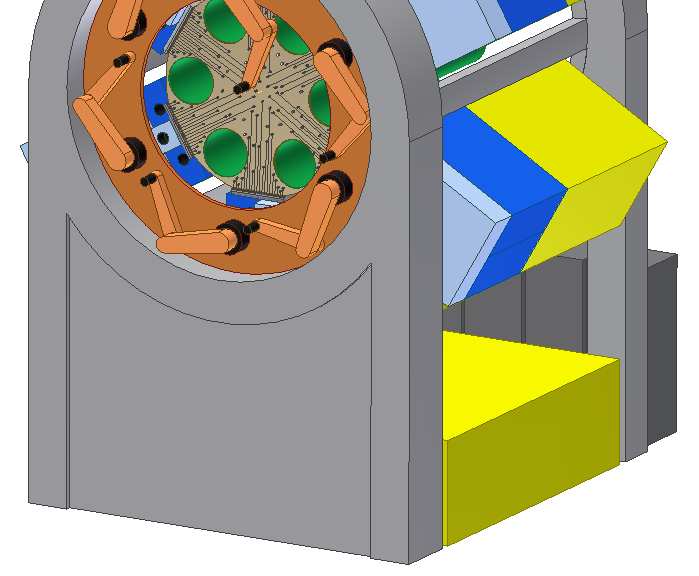

14 MOSAIC (see poster by P. Jagourel 14 Shaping E-ELT Science and Instrumentation, ESO, Feb. 2013
!"#"$%&'"((&"(()'*#%&+,-.&-.)&/012 3456&#)((78(&9:7'&-.)&;01&<&=51& >3?!/5&(@:A)%& *%&B:"8C7,(&="''):&
 !"#"$%&'"((&"(()'*#%&+,-.&-.)&/012 3456&#)((78(&9:7'&-.)&;01&3?!/5&(@:A)%& *%&B:"8C7,(&="''):& 5."I,8J&/2/01&5K,)8K)&"8L&>8(-:@')8-"M78& G& M83 NGC 1365 M100 SABbc M 31 NGC 2997 NGC 1313 5."I,8J&/2/01&5K,)8K)&"8L&>8(-:@')8-"M78&
The Birth and Assembly of Galaxies: the Relationship Between Science Capabilities and Telescope Aperture
 The Birth and Assembly of Galaxies: the Relationship Between Science Capabilities and Telescope Aperture Betsy Barton Center for Cosmology University of California, Irvine Grateful acknowledgements to:
ALMA Overview. Leonardo Testi (European Southern Observatory)
 ALMA Overview Leonardo Testi (European Southern Observatory) The ALMA Project Status Timeline towards Early and Full Science Operations Future Developments Atacama Large Millimeter Array At least 50x12m
LSST and the Cloud: Astro Collaboration in 2016 Tim Axelrod LSST Data Management Scientist
 LSST and the Cloud: Astro Collaboration in 2016 Tim Axelrod LSST Data Management Scientist DERCAP Sydney, Australia, 2009 Overview of Presentation LSST - a large-scale Southern hemisphere optical survey
Astronomy Instrumentation (OIR) Industrial participation in Brazil. Joao Steiner IAG/USP
 Astronomy Instrumentation (OIR) Industrial participation in Brazil. Joao Steiner IAG/USP Papers per Biennium Telescopes managed by LNA OPD = Observatório do Pico dos Dias SOAR Dome Fabrication Steel Work
Extreme-AO for GMT. Center for Astronomical Adaptive Optics, University of Arizona Subaru Telescope, National Astronomical Observatory of Japan
 Extreme-AO for GMT Olivier Guyon Center for Astronomical Adaptive Optics, University of Arizona Subaru Telescope, National Astronomical Observatory of Japan [email protected] 1 Extreme-AO for GMT: Key science
Observing the Universe
 Observing the Universe Stars & Galaxies Telescopes Any questions for next Monday? Light Doppler effect Doppler shift Doppler shift Spectra Doppler effect Spectra Stars Star and planet formation Sun Low-mass
Adaptive Optics (AO) TMT Partner Institutions Collaborating Institution Acknowledgements
 THIRTY METER TELESCOPE The past century of astronomy research has yielded remarkable insights into the nature and origin of the Universe. This scientific advancement has been fueled by progressively larger
WFIRST- AFTA: European Interests
 WFIRST- AFTA: European Interests Mark Cropper Mullard Space Science Laboratory University College London Contents 1. WFI interests Europe- wide 2. Coronagraph interests, UK only see Anthony BoccaleJ s
Are We Alone?! Exoplanet Characterization and Direct Imaging!
 From Cosmic Birth to Living Earths A Vision for Space Astronomy in the 2020s and Beyond Are We Alone?! Exoplanet Characterization and Direct Imaging! A Study Commissioned by the Associated Universities
High Resolution Imaging in the Visible from the Ground without Adaptive Optics: New Techniques and Results
 High Resolution Imaging in the Visible from the Ground without Adaptive Optics: New Techniques and Results Craig Mackay *a, John Baldwin b, Nicholas Law a and Peter Warner b a Institute of Astronomy and
NASA s Future Missions in X-ray Astronomy
 NASA s Future Missions in X-ray Astronomy Nicholas E. White NASA s Goddard Space Flight Center Laboratory for High Energy Astrophysics Greenbelt, MD 20771 USA [email protected] Abstract The
The Sino-French Gamma-Ray Burst Mission SVOM (Space-based multi-band astronomical Variable Objects Monitor)
 The Sino-French Gamma-Ray Burst Mission SVOM (Space-based multi-band astronomical Variable Objects Monitor) Didier BARRET on behalf of the SVOM collaboration [email protected] Outline SVOM background
Magellanic Cloud planetary nebulae as probes of stellar evolution and populations. Letizia Stanghellini
 Magellanic Cloud planetary nebulae as probes of stellar evolution and populations Letizia Stanghellini Planetary nebulae beyond the Milky Way - May 19-21, 2004 1 Magellanic Cloud PNe The known distances,
9 ADAPTIVE OPTICS. 9.1 Overview of GMT Adaptive Optics. 9.1.1 Introduction
 9 ADAPTIVE OPTICS 9.1 Overview of GMT Adaptive Optics 9.1.1 Introduction The primary goal of adaptive optics is the correction of atmospheric blurring to recover images with the diffraction limited beam
Chapter 15.3 Galaxy Evolution
 Chapter 15.3 Galaxy Evolution Elliptical Galaxies Spiral Galaxies Irregular Galaxies Are there any connections between the three types of galaxies? How do galaxies form? How do galaxies evolve? P.S. You
AGN-driven winds and ionized clouds moving along the jet in PKS 0521-365
 GH 2015: Forming and Fueling Supermassive Black Hole Seeds July 6-24, 2015, Tonantzintla, Puebla AGN-driven winds and ionized clouds moving along the jet in PKS 0521-365 Eric Faustino Jiménez-Andrade [email protected]
ALIGNMENT AND TESTING OF THE NIRSpec FILTER- AND GRATING WHEEL ASSEMBLY
 ALIGNMENT AND TESTING OF THE NIRSpec FILTER- AND GRATING WHEEL ASSEMBLY Thomas Leikert (1), Torsten Groß (1), Hans-Ulrich Wieland (1), Kai Weidlich (1) (1) Carl-Zeiss Optronics GmbH, Carl-Zeiss-Straße
Top 10 Discoveries by ESO Telescopes
 Top 10 Discoveries by ESO Telescopes European Southern Observatory reaching new heights in astronomy Exploring the Universe from the Atacama Desert, in Chile since 1964 ESO is the most productive astronomical
Alpy guiding User Guide. Olivier Thizy ([email protected]) François Cochard ([email protected])
 Alpy guiding User Guide Olivier Thizy ([email protected]) François Cochard ([email protected]) DC0017A : april 2013 Alpy guiding module User Guide Olivier Thizy ([email protected])
A short history of telescopes and astronomy: Galileo to the TMT
 A short history of telescopes and astronomy: Galileo to the TMT Telescopes in the last 400 years Galileo 1608 Hans Lippershey applied for a patent for seeing things far away as if they were nearby 1609
Durham E-Theses. Technologies for Astronomical Wide-Field Adaptive Optics GUZMAN, CHRISTIAN,DANI
 Durham E-Theses Technologies for Astronomical Wide-Field Adaptive Optics GUZMAN, CHRISTIAN,DANI How to cite: GUZMAN, CHRISTIAN,DANI (2010) Technologies for Astronomical Wide-Field Adaptive Optics, Durham
IV. Molecular Clouds. 1. Molecular Cloud Spectra
 IV. Molecular Clouds Dark structures in the ISM emit molecular lines. Dense gas cools, Metals combine to form molecules, Molecular clouds form. 1. Molecular Cloud Spectra 1 Molecular Lines emerge in absorption:
Star Formation in the Large Magellanic Cloud: Tracing an Evolution of Giant Molecular Clouds
 Star Formation in the Large Magellanic Cloud: Tracing an Evolution of Giant Molecular Clouds Toshikazu Onishi Osaka Prefecture University Yasuo Fukui; Akiko Kawamura; Norikazu Mizuno; Tetsuhiro Minamidani;
Ellipticals. Elliptical galaxies: Elliptical galaxies: Some ellipticals are not so simple M89 E0
 Elliptical galaxies: Ellipticals Old view (ellipticals are boring, simple systems)! Ellipticals contain no gas & dust! Ellipticals are composed of old stars! Ellipticals formed in a monolithic collapse,
Spectral Line II. G ij (t) are calibrated as in chapter 5. To calibrated B ij (ν), observe a bright source that is known to be spectrally flat
 Spectral Line II: Calibration and Analysis 2 Spectral Line II John Hibbard Bandpass Calibration Flagging Continuum Subtraction Imaging Visualization Analysis Reference: Michael Rupen, Chapter 11 Synthesis
Report on the 91 st ESO OPC Meeting. What Matters in an ESO Proposal
 Report on the 91 st ESO OPC Meeting What Matters in an ESO Proposal Rainer Schoedel, IAA-CSIC Weekly Scientific Seminar of the IAA, 13.12.2012 General Information Video streams ESO@50 available on ESO
Charting the Transient Radio Sky on Sub-Second Time-Scales with LOFAR
 Charting the Transient Radio Sky on Sub-Second Time-Scales with LOFAR Jason Hessels (ASTRON / UvA) with the LOFAR Pulsar Working Group (Stappers, van Leeuwen, Kramer, Karastergiou, Alexov, Hassall, Noutsos,
Galaxy Survey data analysis using SDSS-III as an example
 Galaxy Survey data analysis using SDSS-III as an example Will Percival (University of Portsmouth) showing work by the BOSS galaxy clustering working group" Cosmology from Spectroscopic Galaxy Surveys"
Realization of a UV fisheye hyperspectral camera
 Realization of a UV fisheye hyperspectral camera Valentina Caricato, Andrea Egidi, Marco Pisani and Massimo Zucco, INRIM Outline Purpose of the instrument Required specs Hyperspectral technique Optical
Introduction and Origin of the Earth
 Page 1 of 5 EENS 1110 Tulane University Physical Geology Prof. Stephen A. Nelson Introduction and Origin of the Earth This page last updated on 30-Jul-2015 Geology, What is it? Geology is the study of
Development of the Extreme Ultraviolet Spectrometer: EXCEED
 Development of the Extreme Ultraviolet Spectrometer: EXCEED Go Murakami*, Kazuo Yoshioka, Atsushi Yamazaki, Tomoki Kimura Institute of Space and Astronautical Science, Japan Aerospace Exploration Agency
MY FIRST STEPS IN SLIT SPECTROSCOPY
 MY FIRST STEPS IN SLIT SPECTROSCOPY Andrew Wilson BAAVSS Spectroscopy Workshop Norman Lockyer Observatory October 2015 Overview My choice of spectrograph, camera and telescope Getting started and basic
Intermediate-Mass Black Holes (IMBHs) in Globular Clusters? HST Proper Motion Constraints. Roeland van der Marel
 Intermediate-Mass Black Holes (IMBHs) in Globular Clusters? HST Proper Motion Constraints Roeland van der Marel Why Study IMBHs in Globular Clusters (GCs)? IMBHs: IMBHs can probe a new BH mass range, between
J-PAS: low-resolution (R 50) spectroscopy over 8000 deg 2
 J-PAS: low-resolution (R 50) spectroscopy over 8000 deg 2 C. López-Sanjuan J. Cenarro, L. A. Díaz-García, J. Varela, K. Viironen, & the J-PAS team Centro de Estudio de Física del Cosmos de Aragón 10th
Defining Characteristics (write a short description, provide enough detail so that anyone could use your scheme)
 GEMS COLLABORATON engage The diagram above shows a mosaic of 40 galaxies. These images were taken with Hubble Space Telescope and show the variety of shapes that galaxies can assume. When astronomer Edwin
Faber-Jackson relation: Fundamental Plane: Faber-Jackson Relation
 Faber-Jackson relation: Faber-Jackson Relation In 1976, Faber & Jackson found that: Roughly, L! " 4 More luminous galaxies have deeper potentials Can show that this follows from the Virial Theorem Why
Reduced data products in the ESO Phase 3 archive (Status: 15 May 2015)
 Reduced data products in the ESO Phase 3 archive (Status: 15 May 2015) The ESO Phase 3 archive provides access to reduced and calibrated data products. All those data are stored in standard formats. The
The Formation of Dwarf Early-Type Galaxies. Reynier Peletier Kapteyn Astronomical Institute, Groningen
 The Formation of Dwarf Early-Type Galaxies Reynier Peletier Kapteyn Astronomical Institute, Groningen From Kormendy et al. (2009) Definition of dwarf ellipticals: -15 < MB < -18 Here to be discussed the
Chapter 6 Telescopes: Portals of Discovery. How does your eye form an image? Refraction. Example: Refraction at Sunset.
 Chapter 6 Telescopes: Portals of Discovery 6.1 Eyes and Cameras: Everyday Light Sensors Our goals for learning:! How does your eye form an image?! How do we record images? How does your eye form an image?
arxiv:astro-ph/0109117v1 7 Sep 2001
 **TITLE** ASP Conference Series, Vol. **VOLUME**, **PUBLICATION YEAR** **EDITORS** X ray bright optically quiet galaxies: the case of P3 arxiv:astro-ph/0109117v1 7 Sep 2001 Andrea Comastri, Marcella Brusa,
Galaxy Classification and Evolution
 name Galaxy Classification and Evolution Galaxy Morphologies In order to study galaxies and their evolution in the universe, it is necessary to categorize them by some method. A classification scheme generally
englishforeveryone.org Name Date
 englishforeveryone.org Name Date Advanced Critical Reading - Hubble 5 10 15 20 25 30 35 40 The 32,000 word novella The Time Machine by H.G. Wells, published in 1895, is generally credited with popularizing
Detailed Mass Map of CL 0024+1654 from Strong Lensing
 Detailed Mass Map of CL 0024+1654 from Strong Lensing Tyson, Kochanski, & Dell Antonio (1998) HST WFPC2 image of CL0024+1654 slides based on presentation by Yue Zhao Rutgers Physics 690 February 21, 2008
Astro 301/ Fall 2005 (48310) Introduction to Astronomy
 Astro 301/ Fall 2005 (48310) Introduction to Astronomy Instructor: Professor Shardha Jogee TAs: David Fisher, Donghui Jeong, and Miranda Nordhaus Lecture 22 = Tu Nov 15 Lecture 23 = Th Nov 17 http://www.as.utexas.edu/~sj/a301-fa05/
Curriculum Vitae. Children: Kilian Elias; born 12. May 1989 Fiona Selina; born 11. August 1991 English, German, Spanish, French. Director for Science
 Curriculum Vitae Name: Bruno Leibundgut Address (home): Engasserbogen 32 D 80639 München Germany Telephone: +49 89 2006 2211 Address (office): European Southern Observatory Karl-Schwarzschild-Strasse 2
 The Data-Reduction Software for GIRAFFE, the VLT medium resolution multi-object ber-fed spectrograph Andre Blecha a,veronique Cayatte b, Pierre North c, Frederic Royer a and Gilles Simond a a Observatoire
Resultados Concurso Apex 2014-A
 Resultados Concurso Apex 2014-A Propuesta: 2014A/04 Investigador Principal: Guido Garay, Universidad de Chila Título: SuperMALT: determining the physical and chemical evolution of high-mass starforming
Absorption by atmospheric gases in the IR, visible and UV spectral regions.
 Lecture 6. Absorption by atmospheric gases in the IR, visible and UV spectral regions. Objectives: 1. Gaseous absorption in thermal IR. 2. Gaseous absorption in the visible and near infrared. 3. Gaseous
Galaxy clusters, in the light of Planck. Nabila Aghanim, Institut d'astrophysique Spatiale, CNRS-Univ. Paris Sud
 Galaxy clusters, in the light of Planck Nabila Aghanim, Institut d'astrophysique Spatiale, CNRS-Univ. Paris Sud Galaxy clusters in the cosmic web CLEF-SSH hydro simulation, Kay et al. '06 Cluster components
SSO Transmission Grating Spectrograph (TGS) User s Guide
 SSO Transmission Grating Spectrograph (TGS) User s Guide The Rigel TGS User s Guide available online explains how a transmission grating spectrograph (TGS) works and how efficient they are. Please refer
Data Mining Challenges and Opportunities in Astronomy
 Data Mining Challenges and Opportunities in Astronomy S. G. Djorgovski (Caltech) With special thanks to R. Brunner, A. Szalay, A. Mahabal, et al. The Punchline: Astronomy has become an immensely datarich
Dynamic IR Scene Projector Based Upon the Digital Micromirror Device
 Dynamic IR Scene Projector Based Upon the Digital Micromirror Device D. Brett Beasley, Matt Bender, Jay Crosby, Tim Messer, and Daniel A. Saylor Optical Sciences Corporation www.opticalsciences.com P.O.
LSST Data Management System Applications Layer Simulated Data Needs Description: Simulation Needs for DC3
 LSST Data Management System Applications Layer Simulated Data Needs Description: Simulation Needs for DC3 Draft 25 September 2008 A joint document from the LSST Data Management Team and Image Simulation
What is the Sloan Digital Sky Survey?
 What is the Sloan Digital Sky Survey? Simply put, the Sloan Digital Sky Survey is the most ambitious astronomical survey ever undertaken. The survey will map one-quarter of the entire sky in detail, determining
ALMA: Stato, Early Science,, ARC
 ALMA: Stato, Early Science,, ARC Leonardo Testi INAF Osservatorio Astrofisico di Arcetri Il progetto ALMA Stato attuale e schedula Piani per Early Science e Science Operations Supporto utenti: Alma Regional
Classroom Exercise ASTR 390 Selected Topics in Astronomy: Astrobiology A Hertzsprung-Russell Potpourri
 Classroom Exercise ASTR 390 Selected Topics in Astronomy: Astrobiology A Hertzsprung-Russell Potpourri Purpose: 1) To understand the H-R Diagram; 2) To understand how the H-R Diagram can be used to follow
Towards the Detection and Characterization of Smaller Transiting Planets
 Towards the Detection and Characterization of Smaller Transiting Planets David W. Latham 27 July 2007 Kepler MISSION CONCEPT Kepler Mission is optimized for finding habitable planets ( 10 to 0.5 M )
High Resolution Imaging of Satellites with Ground-Based 10-m Astronomical Telescopes
 UCRL-TR-227709 High Resolution Imaging of Satellites with Ground-Based 10-m Astronomical Telescopes C. Marois February 2, 2007 Disclaimer This document was prepared as an account of work sponsored by an
This work was done in collaboration with the Centre de Données astronomiques de Strasbourg (CDS) and in particular with F. X. Pineau.
 Chapter 5 Database and website This work was done in collaboration with the Centre de Données astronomiques de Strasbourg (CDS) and in particular with F. X. Pineau. 5.1 Introduction The X-shooter Spectral
James Webb Space Telescope Project. Science Requirements Document. July 10, 2012
 Effective Date: July 10, 2012 Expiration Date: July 10, 2017 James Webb Space Telescope Project Science Requirements Document July 10, 2012 JWST GSFC CMO July 10, 2012 RELEASED Goddard Space Flight Center