
Operating instructions Mobile River Discharge Measurement System OTT Qliner 2
|
|
|
- Karen Lambert
- 10 years ago
- Views:
Transcription
1 Operating instructions Mobile River Discharge Measurement System OTT Qliner 2 English

2 We reserve the right to make technical changes and improvements without notice.

3 Table of contents 1 Scope of supply 6 2 Introduction Measurement principle Components of the Qliner 2 measurement system 8 3 Safety information 11 4 Starting up Charging the Qliner 2 battery Charging the PDA battery Making/checking the basic settings for the Qliner PDA software General basic settings Basic settings for the Bluetooth connection Further software options and tools 19 5 Measurement preparations on location Preparing Qliner 2 for location For measurement from the edge For measurement from a bridge/cableway Measurement settings in the Qliner PDA software Creating new location (Site Name), editing, saving Entering data for location Entering data for measurement Entering notes for measurement situation Establishing Bluetooth connection 27 6 Carrying out the measurement Testing the measurement Starting the measurement Following the measurement Ending the measurement Checking the measurement After the measurement 44 7 Measurement quick start 45 8 Processing measurement data Saving the data on the PDA Saving the data as a text file on the PDA Content of the text file Transferring the data from PDA to PC Deleting the data from the PDA Processing with OTT Qreview PC software 49 9 Error messages/error correction Error correction with the Bluetooth connection Error correction during measurement Maintenance Repair Note about the disposal of old units Technical Data Order numbers 55 3

4 Appendix A Compass 56 Appendix B Installing the Qliner software on the PDA 58 Appendix C Measurement principle 59 Appendix D Discharge measurement 61 Appendix E Declaration of conformity 63 4

5 Note These operating instructions (version ) describe the: Qliner operating software for Windows Mobile 6 Classic version 3.40 current profiler firmware 4.31 The software version for the Qliner operating software can be determined via the yellow question mark in the menu bar in the main window of the PDA (see Chapter 4.3.3). The software version for the current profiler can be determined via Tools > Profiler Info in the menu bar in the main window of the PDA (see Chapter 4.3.3). A description of an update can be found in Appendix B Installing the Qliner software on the PDA for the Qliner operating software. 5

6 1 Scope of supply OTT Qliner 2 1 mobile discharge measurement system, consisting of Catamaran in glass-fiber reinforced plastic Integrated Doppler current profiler with 4 ultrasonic transducers PDA with German or English operating system and accessories Integrated Bluetooth wireless data unit 2 cables on plastic drums (30 m each) and attachment elements (2 V shaped wires with 2 quickpins each, 2 carabiners) 30 m measuring tape CD-ROM with Qliner PDA operating software, Qreview processing software, ActiveSync and operating instructions for Qreview in pdf format Lead acid battery, 12 V, 4 Ah, with charging unit Operating instructions for PDA, Qliner 2 and Qreview software Transport case with accessories 6

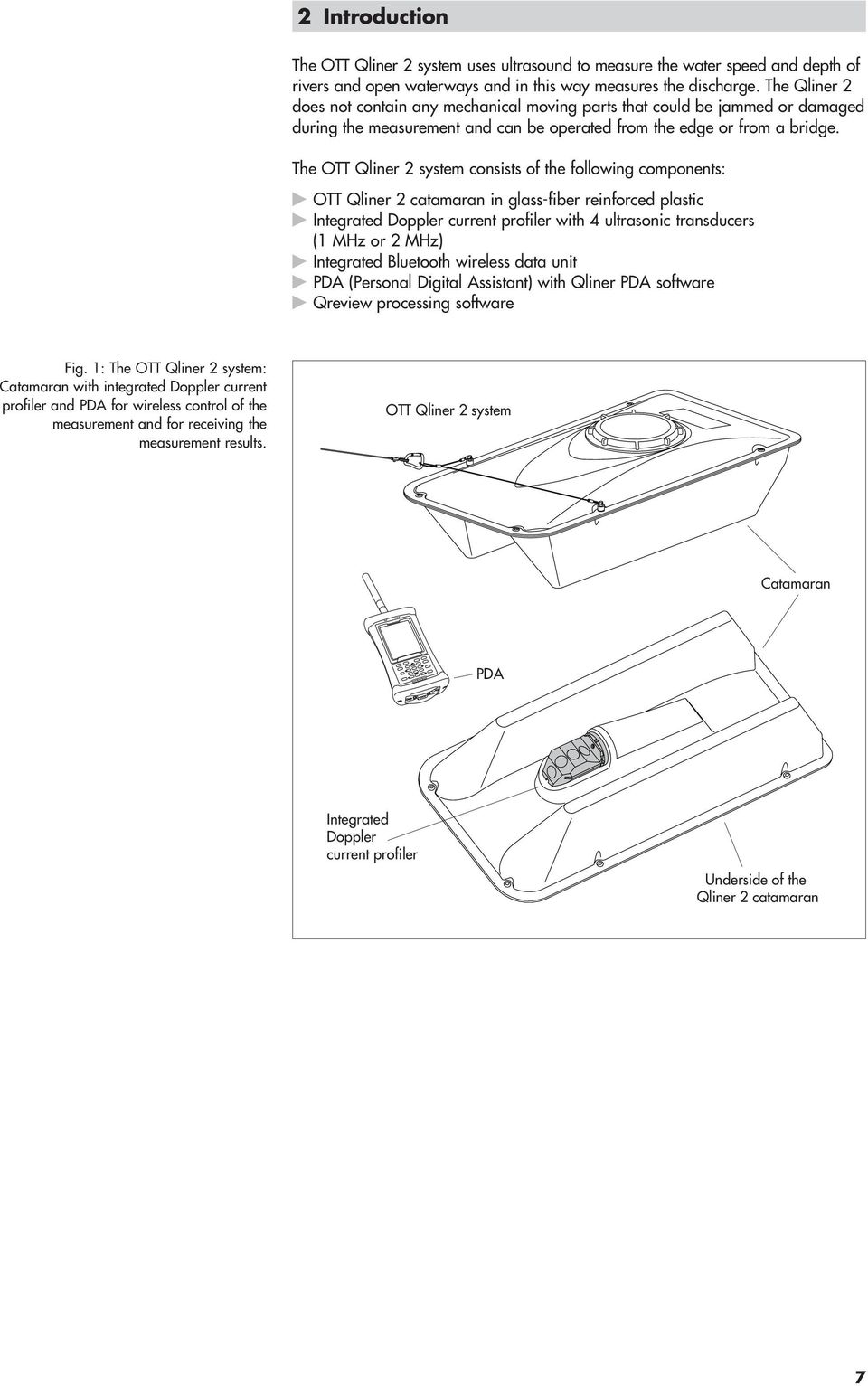
7 2 Introduction The OTT Qliner 2 system uses ultrasound to measure the water speed and depth of rivers and open waterways and in this way measures the discharge. The Qliner 2 does not contain any mechanical moving parts that could be jammed or damaged during the measurement and can be operated from the edge or from a bridge. The OTT Qliner 2 system consists of the following components: OTT Qliner 2 catamaran in glass-fiber reinforced plastic Integrated Doppler current profiler with 4 ultrasonic transducers (1 MHz or 2 MHz) Integrated Bluetooth wireless data unit PDA (Personal Digital Assistant) with Qliner PDA software Qreview processing software Fig. 1: The OTT Qliner 2 system: Catamaran with integrated Doppler current profiler and PDA for wireless control of the measurement and for receiving the measurement results. OTT Qliner 2 system Catamaran PDA Integrated Doppler current profiler Underside of the Qliner 2 catamaran 7
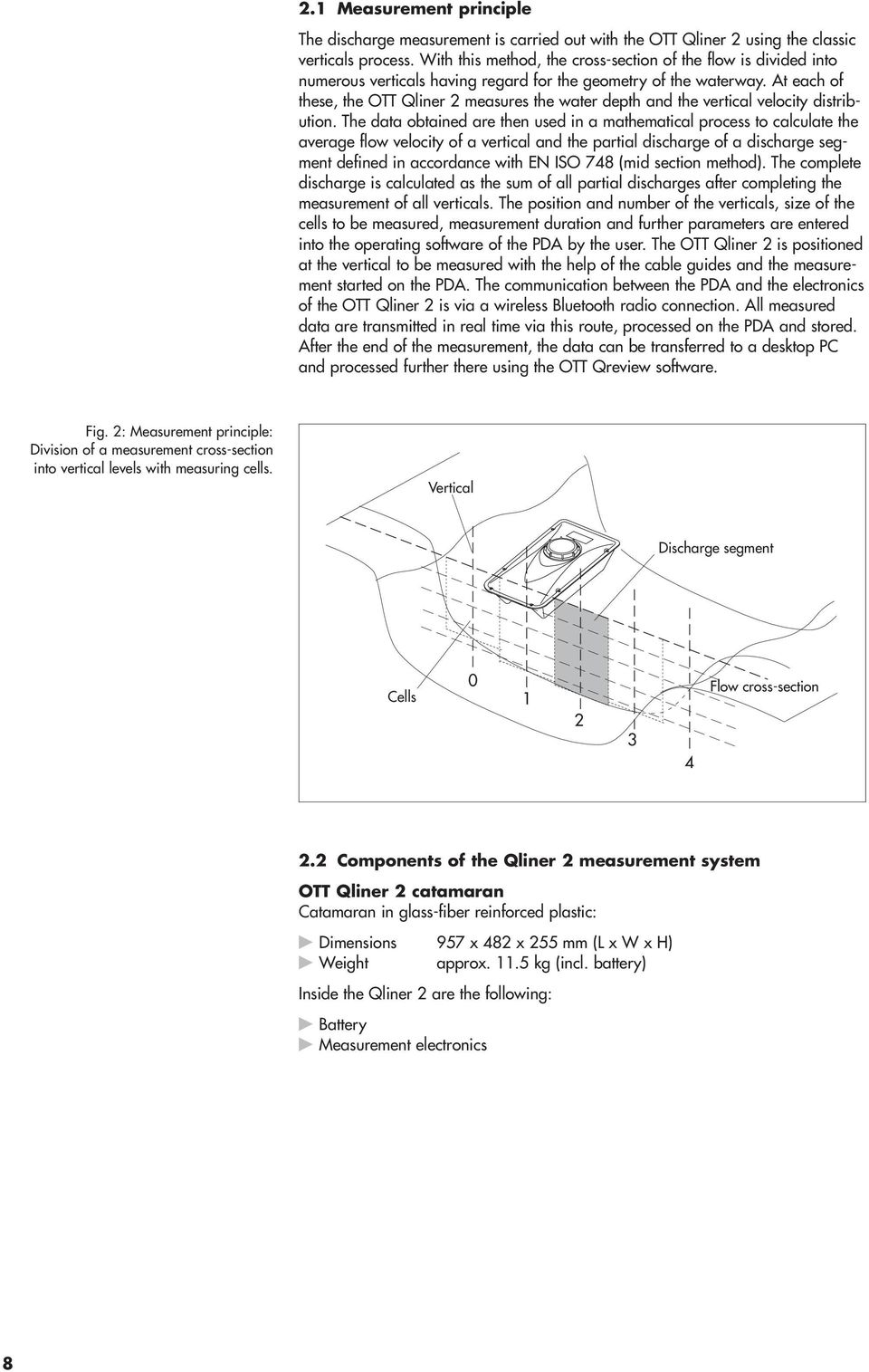
8 2.1 Measurement principle The discharge measurement is carried out with the OTT Qliner 2 using the classic verticals process. With this method, the cross-section of the flow is divided into numerous verticals having regard for the geometry of the waterway. At each of these, the OTT Qliner 2 measures the water depth and the vertical velocity distribution. The data obtained are then used in a mathematical process to calculate the average flow velocity of a vertical and the partial discharge of a discharge segment defined in accordance with EN ISO 748 (mid section method). The complete discharge is calculated as the sum of all partial discharges after completing the measurement of all verticals. The position and number of the verticals, size of the cells to be measured, measurement duration and further parameters are entered into the operating software of the PDA by the user. The OTT Qliner 2 is positioned at the vertical to be measured with the help of the cable guides and the measurement started on the PDA. The communication between the PDA and the electronics of the OTT Qliner 2 is via a wireless Bluetooth radio connection. All measured data are transmitted in real time via this route, processed on the PDA and stored. After the end of the measurement, the data can be transferred to a desktop PC and processed further there using the OTT Qreview software. Fig. 2: Measurement principle: Division of a measurement cross-section into vertical levels with measuring cells. Vertical Discharge segment Cells Flow cross-section 2.2 Components of the Qliner 2 measurement system OTT Qliner 2 catamaran Catamaran in glass-fiber reinforced plastic: Dimensions 957 x 482 x 255 mm (L x W x H) Weight approx kg (incl. battery) Inside the Qliner 2 are the following: Battery Measurement electronics 8
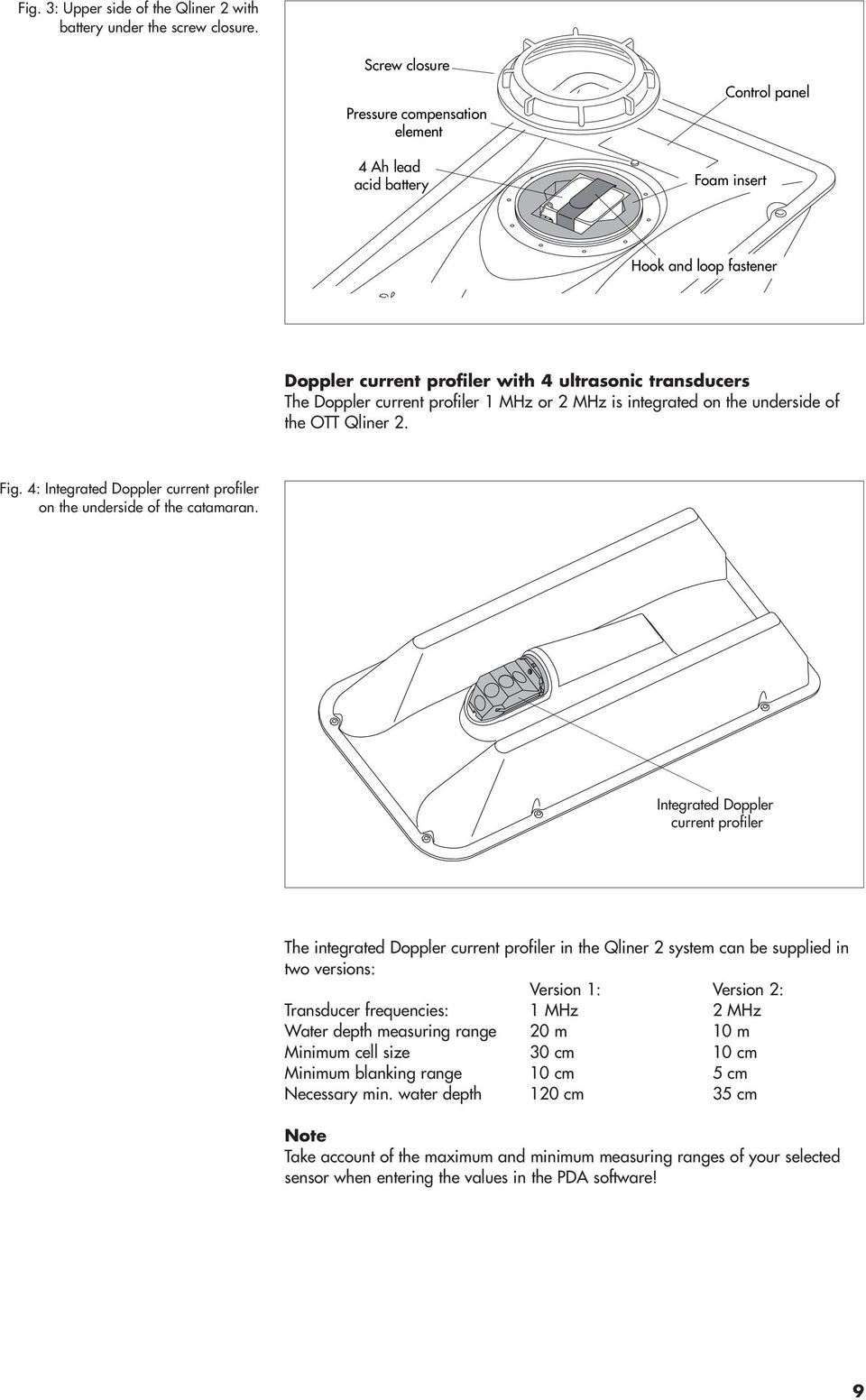
9 Fig. 3: Upper side of the Qliner 2 with battery under the screw closure. Screw closure Pressure compensation element 4 Ah lead acid battery Control panel Foam insert Hook and loop fastener Doppler current profiler with 4 ultrasonic transducers The Doppler current profiler 1 MHz or 2 MHz is integrated on the underside of the OTT Qliner 2. Fig. 4: Integrated Doppler current profiler on the underside of the catamaran. Integrated Doppler current profiler The integrated Doppler current profiler in the Qliner 2 system can be supplied in two versions: Version 1: Version 2: Transducer frequencies: 1 MHz 2 MHz Water depth measuring range 20 m 10 m Minimum cell size 30 cm 10 cm Minimum blanking range 10 cm 5 cm Necessary min. water depth 120 cm 35 cm Note Take account of the maximum and minimum measuring ranges of your selected sensor when entering the values in the PDA software! 9
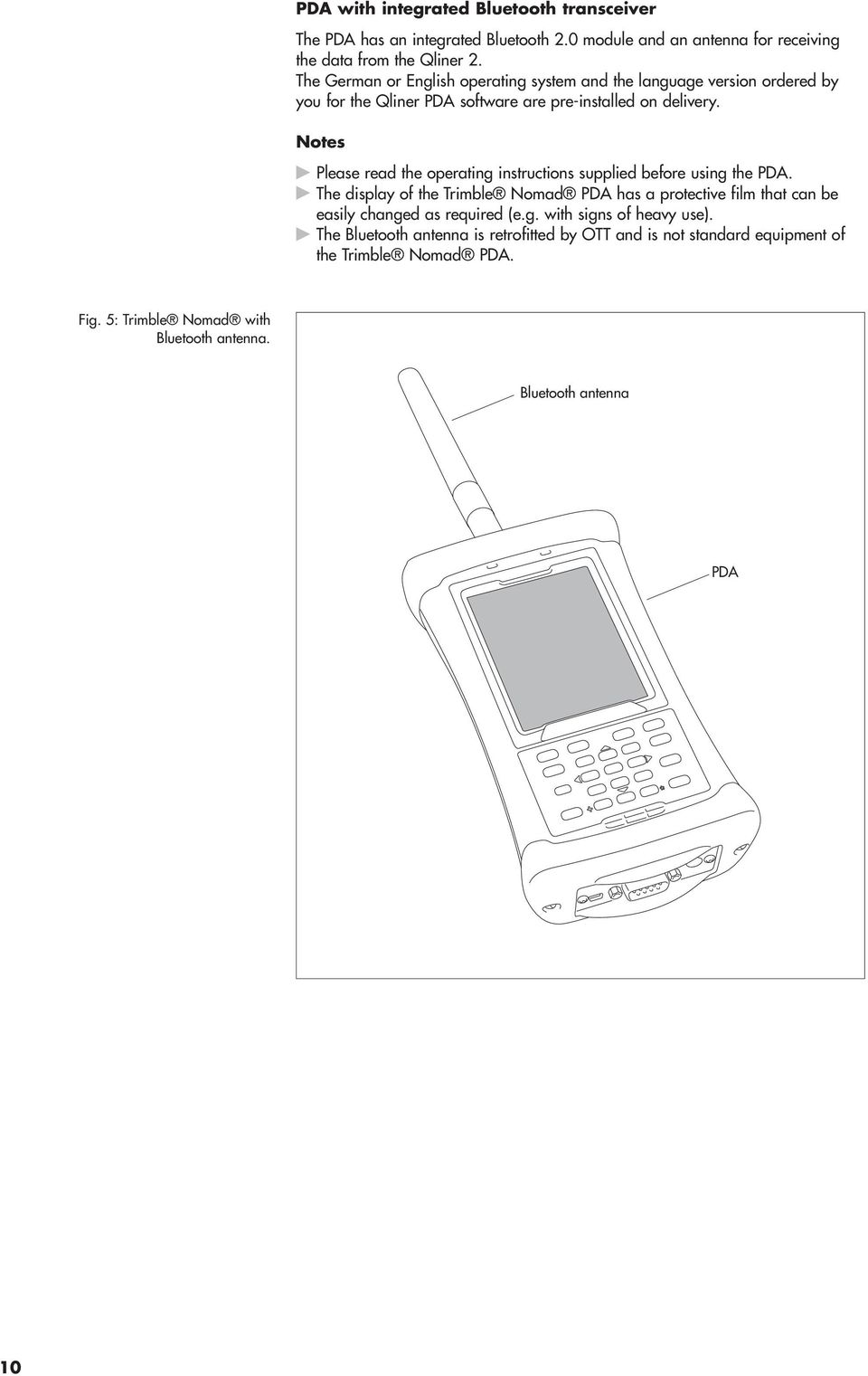
10 PDA with integrated Bluetooth transceiver The PDA has an integrated Bluetooth 2.0 module and an antenna for receiving the data from the Qliner 2. The German or English operating system and the language version ordered by you for the Qliner PDA software are pre-installed on delivery. Notes Please read the operating instructions supplied before using the PDA. The display of the Trimble Nomad PDA has a protective film that can be easily changed as required (e.g. with signs of heavy use). The Bluetooth antenna is retrofitted by OTT and is not standard equipment of the Trimble Nomad PDA. Fig. 5: Trimble Nomad with Bluetooth antenna. Bluetooth antenna PDA 10
11 3 Safety information Read these operating instructions before using the Qliner 2 for the first time! Familiarize yourself completely with the installation and operation of the Qliner 2. Retain these operating instructions for later reference. Note all the information on dangers given within the individual work steps. Only use the Qliner 2 in the way described in these operating instructions. Ensure the electrical, mechanical and climatic specifications listed in the technical data are adhered to. For further information see Chapter 13, Technical data. Do not make any changes or modifications to the Qliner 2. Any changes or modifications will lead to the loss of all rights to warranty claims. Make absolutely sure the quickpins have been attached correctly and the carabiners closed properly before placing the Qliner 2 into the water! Make absolutely sure that the opening on the upper side of the Qliner 2 has been properly closed in order to prevent the entry of water into the unit! Have a faulty OTT Qliner 2 inspected and repaired by our repair center. On no account carry out repairs yourself! For further information see Chapter 11, Repair. Dispose of the OTT Qliner 2 properly after taking out of service. For further information see Chapter 12, Note on the disposal of old units. 11

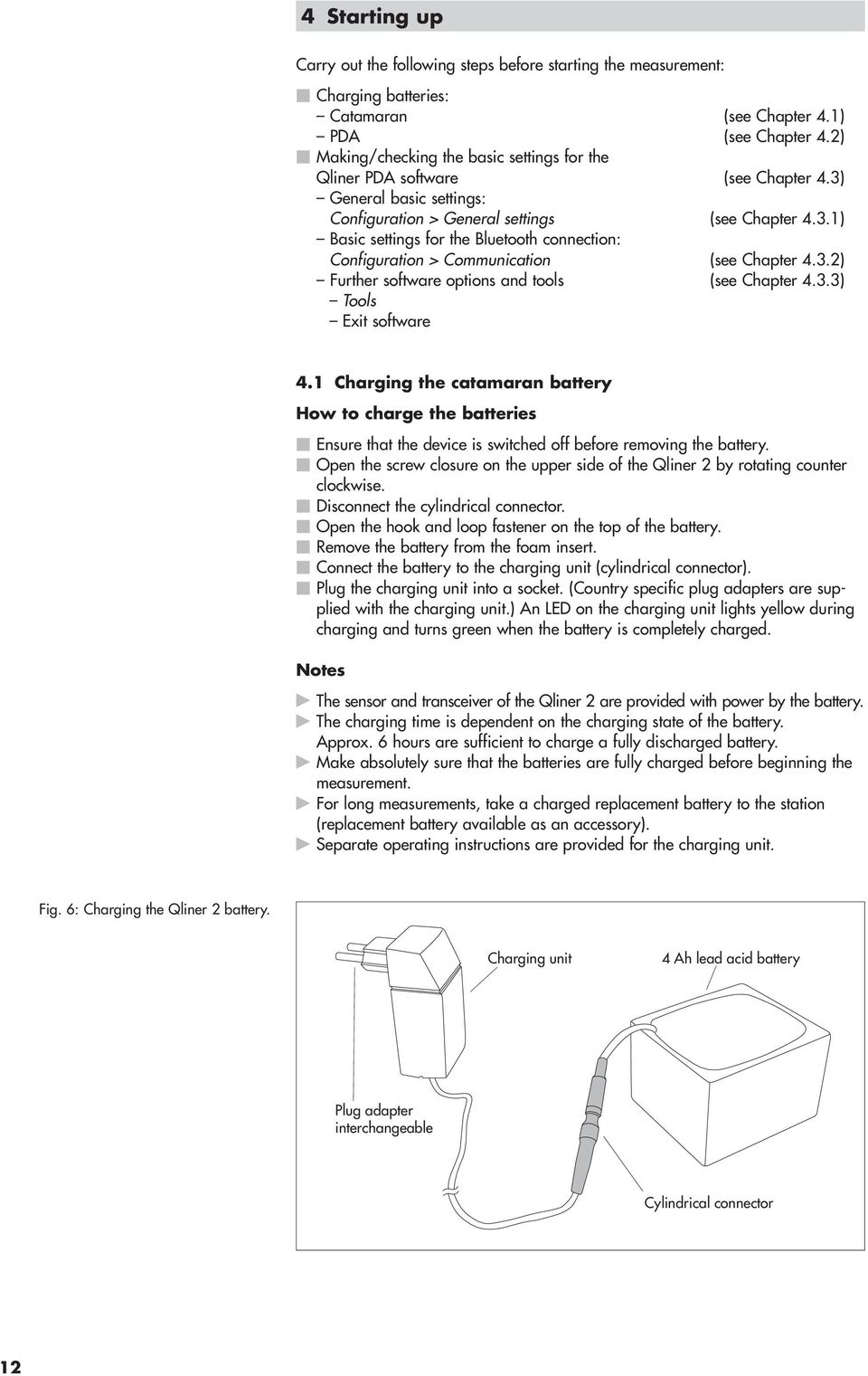
12 4 Starting up Carry out the following steps before starting the measurement: Charging batteries: Catamaran (see Chapter 4.1) PDA (see Chapter 4.2) Making/checking the basic settings for the Qliner PDA software (see Chapter 4.3) General basic settings: Configuration > General settings (see Chapter 4.3.1) Basic settings for the Bluetooth connection: Configuration > Communication (see Chapter 4.3.2) Further software options and tools (see Chapter 4.3.3) Tools Exit software 4.1 Charging the catamaran battery How to charge the batteries Ensure that the device is switched off before removing the battery. Open the screw closure on the upper side of the Qliner 2 by rotating counter clockwise. Disconnect the cylindrical connector. Open the hook and loop fastener on the top of the battery. Remove the battery from the foam insert. Connect the battery to the charging unit (cylindrical connector). Plug the charging unit into a socket. (Country specific plug adapters are supplied with the charging unit.) An LED on the charging unit lights yellow during charging and turns green when the battery is completely charged. Notes The sensor and transceiver of the Qliner 2 are provided with power by the battery. The charging time is dependent on the charging state of the battery. Approx. 6 hours are sufficient to charge a fully discharged battery. Make absolutely sure that the batteries are fully charged before beginning the measurement. For long measurements, take a charged replacement battery to the station (replacement battery available as an accessory). Separate operating instructions are provided for the charging unit. Fig. 6: Charging the Qliner 2 battery. Charging unit 4 Ah lead acid battery Plug adapter interchangeable Cylindrical connector 12
13 Fig. 7: Position of the battery in the Qliner 2 catamaran. Screw closure 4 Ah lead acid battery Foam insert Hook and loop fastener How to replace the battery Ensure that the device is switched off before removing the battery. Open the screw closure on the upper side of the Qliner 2. Note the rubber O-ring inside the screw closure. Disconnect the battery from the cylindrical connector. Open the hook and loop fastener on the top of the battery. Remove the battery from the foam insert. Insert a new battery and connect the cylindrical connector. Close the hook and loop fastener on the top of the battery. Carefully screw on the screw closure on the upper side of the Qliner 2. Fig. 8: Inserting and removing the Qliner 2 battery. Screw closure Cylindrical connector Battery Hook and loop fastener 13

14 Suitable battery type Please only use the original OTT replacement part: lead acid battery, 4 Ah (this contains a resettable fuse). See Chapter 14. Battery life For continuous measurement at maximum performance, the Qliner 2 can be operated for at least 12 hours. Check the battery voltage as follows Establish a Bluetooth connection between Qliner 2 and PDA (see Chapter 5.3). Tap on View > Overview in the main window. Battery: battery voltage of the Qliner 2 (Bluetooth transceiver and sensor). Notes The battery can be charged several hundred times. Where a noticeably lower capacity is noted after charging, it is recommended that the battery is changed for a new one. 4.2 Charging the PDA battery How to charge the battery see PDA operating instructions. 14

15 4.3 Making/checking the basic settings for the Qliner PDA software After starting the software and establishing the Bluetooth connection (see Chapter 5.3), the main window is displayed on your PDA. Fig. 9: Main window. Windows logo Drop-down menu Button Sub-menu Tab Message line Menu point Menu bar Screen keyboard The following settings have to be made in the software before beginning the measurement Input general basic settings: Configuration > General settings (see Chapter 4.3.1) Input basic connection settings: Configuration > Communication (see Chapter 4.3.2) Further software options and tools (see Chapter 4.3.3) Tools Exit software 15

16 4.3.1 General basic settings Tap in the main window on menu point Configuration > General settings. Note These parameters are saved even after switching the PDA off and on, and therefore do not have to be reset for each measurement. Fig. 10: Configuration > General Settings. Save raw data Save data to Saves profiles every 3 seconds Notes Every 3 seconds the Qliner 2 automatically measures a velocity profile. For discharge measurement, an average from these profiles is used. The amount of data resulting can require a large amount of memory with lots of measurements. Select the location for saving your data Note Data saved in the PDA are not lost. An external storage medium can only be attached via USB. 16
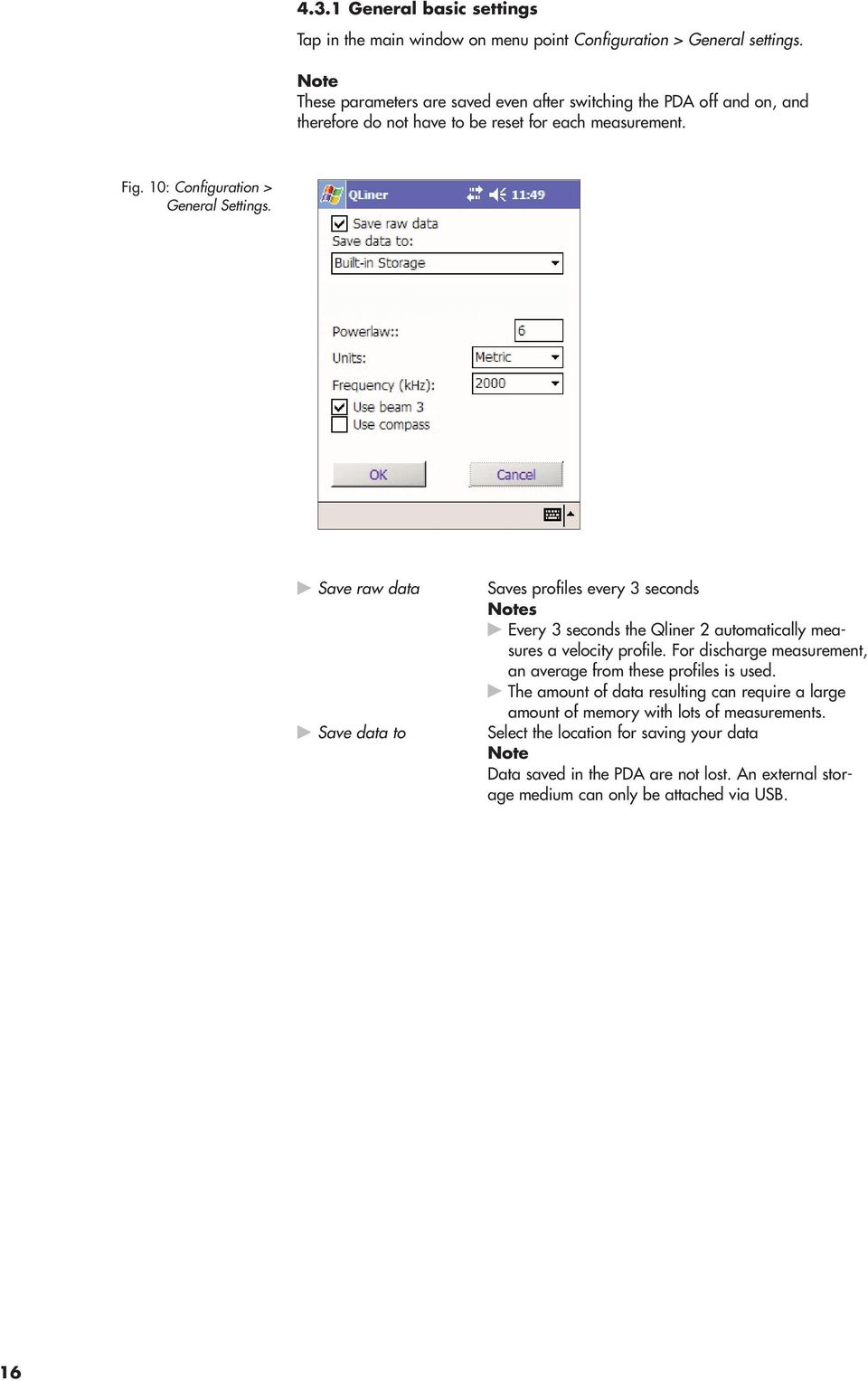
17 Powerlaw describes the mathematical relationship between depth and the flow velocity at this depth The Powerlaw curve is used for calculating the average flow velocity. The value you use for the Powerlaw calculation is dependent on the nature of the bottom: Powerlaw value: rough, large stones and vegetation 4 some stones and vegetation 5 gravel, sand, loose earth river bed, rough rubble work, paved slopes 6 irregular sand 7 regular sand, concrete 8 Units choose between metric (meter and cubic meter) or USGS (foot and cubic foot) system Note After changing the unit of measurement, it is recommeded that the program is restarted to ensure that the changes take effect in all calculations and all display options. Frequency (khz) set automatically after the connection is made with the catamaran Use beam 3 takes beam 3 into account for calculation Note The values themselves are constantly displayed. Use compass takes account of the measured deviation of the Qliner 2 to the correct alignment of the verticals to the measurement cross-section in the calculation If deactivated, the direction of flow is taken as being at right angles to the cross-section (see Appendix A Compass). Save your entries with OK or discard them with Cancel. You return automatically to the main window. 17

18 4.3.2 Basic settings for the Bluetooth connection Tap in the main window on menu point Configuration > Communication. Note These parameters are saved even after switching the PDA off and on, and therefore do not have to be reset for each measurement. Fig. 11: Configuration > Communication. Serial port Baudrate Timeout The port to be used by the integrated Bluetooth module in the Trimble Nomad PDA is selected here: COM3 Do not change this setting. describes the modulation rate of a data transmission Do not change this setting, as the Qliner 2 is set to a fixed 9600 baud period of time that the data transmission between Qliner 2 and PDA may take up before it is aborted It is recommended that the timeout is set to Long. Save your entries with OK or discard them with Cancel. You return automatically to the main window. 18

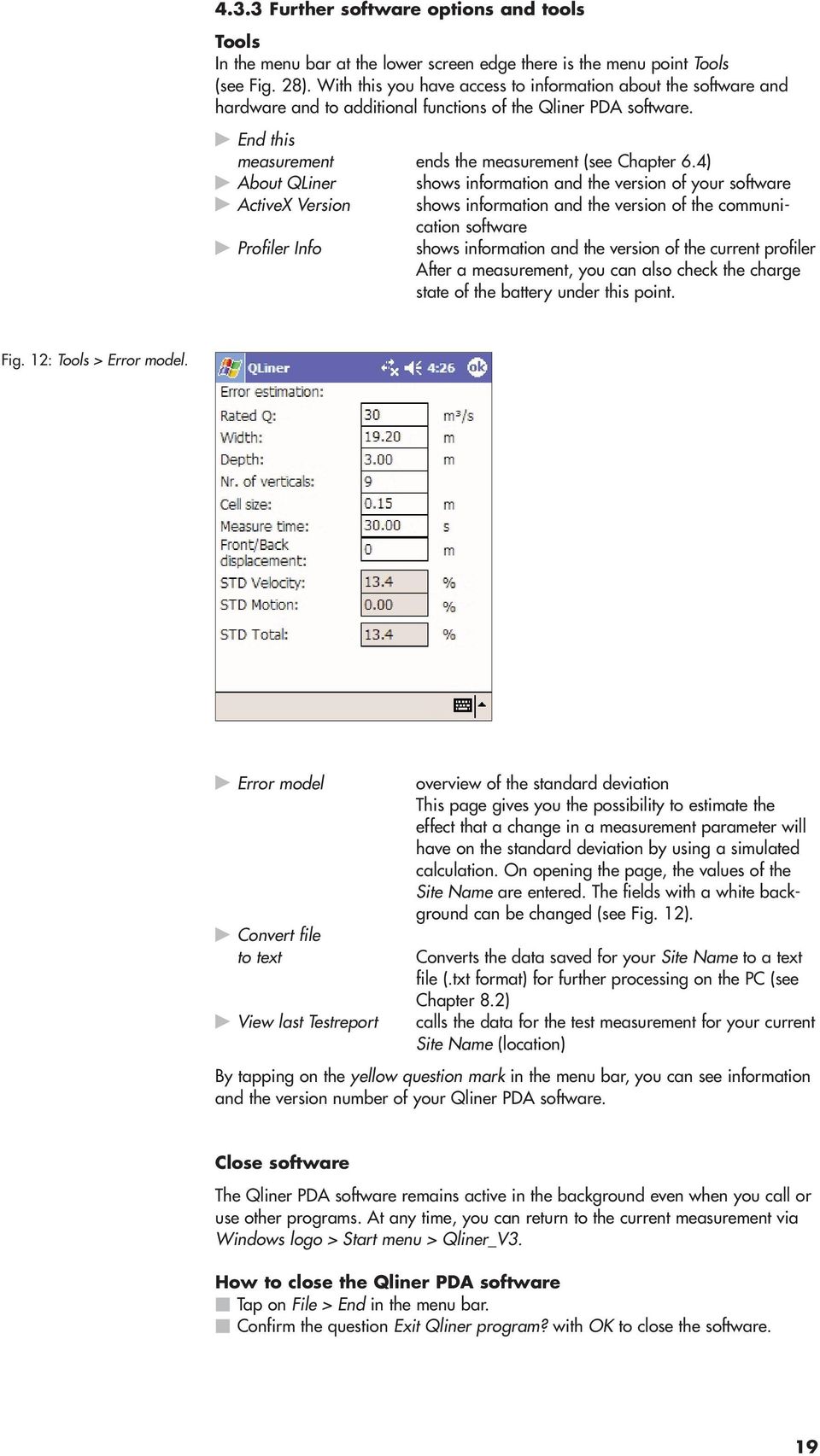
19 4.3.3 Further software options and tools Tools In the menu bar at the lower screen edge there is the menu point Tools (see Fig. 28). With this you have access to information about the software and hardware and to additional functions of the Qliner PDA software. End this measurement ends the measurement (see Chapter 6.4) About QLiner shows information and the version of your software ActiveX Version shows information and the version of the communi - cation software Profiler Info shows information and the version of the current profiler After a measurement, you can also check the charge state of the battery under this point. Fig. 12: Tools > Error model. Error model Convert file to text View last Testreport overview of the standard deviation This page gives you the possibility to estimate the effect that a change in a measurement parameter will have on the standard deviation by using a simulated calculation. On opening the page, the values of the Site Name are entered. The fields with a white background can be changed (see Fig. 12). Converts the data saved for your Site Name to a text file (.txt format) for further processing on the PC (see Chapter 8.2) calls the data for the test measurement for your current Site Name (location) By tapping on the yellow question mark in the menu bar, you can see information and the version number of your Qliner PDA software. Close software The Qliner PDA software remains active in the background even when you call or use other programs. At any time, you can return to the current measurement via Windows logo > Start menu > Qliner_V3. How to close the Qliner PDA software Tap on File > End in the menu bar. Confirm the question Exit Qliner program? with OK to close the software. 19
20 5 Measurement preparations on location 5.1 Preparing the Qliner 2 for measurement Define the number and position of the verticals on the basis of the geometry of the flow cross-section. Use the measuring tape supplied to measure the distance of the verticals from the reference point on the edge and mark the vertical positions in a suitable way (e.g. color marking on bridge railings or on the guide cable) Measuring from the edge In small waterways, you can position the Qliner 2 in the channel from the edge with the help of the cables. Note that access to both edges is necessary. Required accessories: 2 x V shaped wires with quickpins, 2 x carabiners, 2 x cables (30 m), measuring tape 30 m, possibly pulley (not supplied) for measurement by one person. How to set up the station Attach the two V shaped wires to both long sides of the Qliner 2 with quickpins. Attach each end of the 30 m cables to both thimbles of the V shaped wires using the carabiners. Caution: Ensure correct closure of the carabiners. The exact layout can be seen in Fig. 13. With a small channel and measurement by one person, position the pulley on the opposite edge and feed one of the cables through it. With a wide channel, a second person holds the cable on the opposite edge. Fig. 13: Example of a discharge measurement from the edge. Pulley 30 m cable Carabiner V shaped wires Direction of flow 30 m cable 20

21 5.1.2 Measuring from a bridge/cableway Required accessories: 2 V shaped wires with quickpins, 1 carabiner, 1 cable (30 m), possibly a weight (not supplied). How to set up the station Attach one V shaped wire with quickpins to the two front eyes on the left and right of the Qliner 2. Attach the end of the 30 m cable to the thimble of the V shaped wire using a carabiner. Caution: Ensure correct closure of the carabiners. Depending on the flow or height of the bridge, it may be necessary to attach a weight to the cable so that the boat remains horizontal (see Fig. 15). Fig. 14: Example of a discharge measurement from a bridge. 30 m cable Direction of flow Carabiner V shaped wire Fig. 15: An additional weight (accessory) holds the Qliner 2 in the measuring position Alternatively, an OTT middle piece with adapter hook (accessory) can be used. Carabiner Qliner 2 Weight V shaped wire 21
22 5.2 Measurement settings in the Qliner PDA software First establish a connection between the Qliner 2 and the PDA (see Chapter 5.3) so that the system can compare the values entered with the threshold values of the sensor. Select one of the three ways for defining a new Site Name (location) and complete the data on the tab pages: Creating new Site Name, editing, saving (see Chapter 5.2.1) Enter data on Site Name: Settings > Site (see Chapter 5.2.2) Entering data for measurement: Settings > Profiler (see Chapter 5.2.3) Entering notes for measurement situation: Settings > Notes (see Chapter 5.2.4) Creating new location (Site Name), editing, saving Create new Site Name Select Site Name > default in the drop-down menu in the main window. Tap on tab point Settings, after which the tab page Site appears. At Site Name enter a name. Enter the data for your measurement. Once you have made all the settings on the tab pages Site, Profiler, Notes, tap at upper right in the display on OK to return to the main window. Edit existing Site Name Select the required existing Site Name in the drop-down menu Site Name in the main window. Tap on tab point Settings, after which the tab page Site appears. At Site Name enter a new name and adapt the remaining data to your current measurement. Once you have made all the settings on the tab pages Site, Profiler, Notes, tap at upper right in the display on OK to return to the main window. Save existing Site Name Select the required Site Name in the drop-down menu Site Name in the main window. Tap on tab point Settings, after which the tab page Site appears. Tap on the Repeat this measurement button. The system asks whether you want to accept all data for the set Site Name. A new file is created and a number is added to the original file name. 22
23 Notes If an already existing project is selected at Site name, a warning is displayed by the system that the new measurements will be added to the old file. If you do not want this, change the name of the Site Name at Settings > Site > Site Name. After you have tapped on OK, the settings are then checked. If your selected values for Blanking distance or Cell size do not lie within the thresholds applicable to your sensor, a warning is displayed and settings reset to the maximum or minimum standard values Entering data for the location Fig. 16: Settings > Site. Manually editable field Button Tab Screen keyboard Site Name Made by Position first vertical Name of your Site Name (location) Name of the person carrying out the measurement Distance of the first vertical to the reference point Note Design factors mean that the point for the first vertical lies at a min. of 23 cm. Spacing between the individual verticals Position of the cross-section line with activated compass (see Appendix A Compass) Edges Position Distance between edge and reference point Depth Water depth if the channel is limited by a vertical wall Factor Factor that takes account of the influence of the wall on the flow (see Appendix D Discharge measurement): smooth walls (e.g. concrete) brick walls with vegetation 0.7 rough walls with grass or heavy vegetation Spacing Line heading Repeat this measurement Reuses all settings for the next measurement and creates a new Site Name A new file is created and a sequential number added to the original file name. 23
24 Fig. 17: Reference point, position of first vertical, edges, spacing. Reference point Position first vertical Bridge e c a a = Position first vertical b = Spacing b b b b d c = First edge d = Last edge e = Depth Entering data for measurement Fig. 18: Settings > Profiler. Note Take account of the maximum and minimum measuring ranges of your selected sensor when entering the values in the Qliner PDA software! 24
25 Maximum depth Cell size Immersion depth Measure time Blanking distance Nr. of Cells Tx Power Sensor frequency Maximum depth of channel Notes Select a larger maximum depth than the maximum depth of the waterway. If this value is not known, use the test mode (see Chapter 6.1). Choose the cell size based on the necessary accuracy Note The minimum cell size is dependent on the sensor: 1,000 khz sensor 30 cm 2,000 khz sensor 10 cm Distance between water surface and middle of the sensor (see Fig. 45) This value lies between 0.04 m and 0.06 m depending on the flow (this is the value when the catamaran is in a horizontal position in the water). Note The sensors must be under the water for the entire measurement, otherwise the measurements could provide false readings. Choose 30 to 45 seconds with high discharges and up to 60 seconds for lower speeds Choose according to required accuracy (see Appendix C Measurement principle) Note The minimum blanking range is dependent on the sensor 1,000 khz sensor 0.2 m 2,000 khz sensor 0.05 m Number of cells in a vertical Is automatically calculated after a change in the cell size or the maximum depth. This value should not be higher than 40, as otherwise it gives rise to excessive processing times. Transmission power of the ultrasound sensors Frequency of your sensor (1,000 or 2,000 khz) set at Configuration > General Settings 25
26 5.2.4 Entering notes for measurement situation Here you can enter comments on the current measurement situation. Fig. 19: Settings > Notes. Notes Water level. Upstream: Downstream: Control text Enter your own comments via the screen keyboard of the PDA Water level at the beginning of measurement Water level at the end of measurement Select from the following preset comments in the dropdown menu: 1. UNSP undefined (standard) 2. CLER no obstructions in the area of the current profiler 3. NFLW no flow at current profiler 4. SUBM current profiler submerged 5. AICE current profiler fixed by ice 6. SICE edge icy 7. CICE current profiler covered with ice 8. FILL water in current profiler 9. SCUR current profiler touches bottom 10. HVDB current profiler was very dirty 11. MDDB current profiler was fairly dirty 12. LGDB current profiler was a little dirty 13. MAHV current profiler was covered with a lot of moss/algae 14. MAMD current profiler was covered with some moss/algae 15. MALT current profiler was covered with a little moss/algae Once you have made all the settings, tap at upper right in the display on OK to return to the main window. 26
27 5.3 Establishing Bluetooth connection Carry out the following steps to establish the Bluetooth connection: Switch on the Qliner 2 catamaran. Start the PDA. Place the Qliner 2 into the water. Start the Qliner PDA software. How to switch on the Qliner 2 Press ON/OFF on the operating display of the Qliner 2 for 2 seconds. The green LED Power lights and shows the voltage supply. The blue Connect LED blinks until the Bluetooth connection between the Qliner 2 and the PDA has been established. As soon as the connection has been established, it lights continuously. Fig. 20: Operating display of the Qliner 2. ON OFF Power Connect Made in Germany 27
28 How to start the PDA Press the on button of your PDA. Fig. 21: Starting PDA. On button The Bluetooth connection between the PDA and the Qliner 2 catamaran is automatically established. Place Qliner 2 in water Using the cable, place the Qliner 2 slowly into the water. The front points towards the flow. See Fig. 13 and 14 28
29 How to start the Qliner PDA software and establish a connection Tap on the Windows logo at top left to call Start menu > Programs. Tap on Qliner_V3 to start the Qliner PDA software. You are now in the main window. Tap on Connect. Notes With a successful connection, the Connect button has a green background. If a connection could not be established, the Connect button has a red background. On establishing a connection between the PDA and Qliner 2, both systems compare their time and date settings, and if these differ, you are asked whether the data on the Qliner 2 should be synchronized with that on the PDA. It is not possible to connect a different Bluetooth device to the Qliner 2 and no PDA from other Qliner 2 systems can establish a connection with this system. Fig. 22: Main window with Connect button with green background. 29
30 Transmission/reception range In the longitudinal axis of the Qliner 2: m In the transverse axis of the Qliner 2: m Fig. 23: Transmission and reception range of the Bluetooth radio unit m Longitudinal axis m Transverse axis Notes When working from a bridge, you must be within the range for receiving and transmitting wireless data for the Qliner 2 (see Fig. 23). Interference can result if other Bluetooth devices (e.g. cell phones, wireless headphones or other PDAs) are nearby. With a distance between PDA and the Qliner 2 of more than 30 m, an uninterrupted line of sight between both components should be ensured. The connection can also be affected if the charging state of the battery in the PDA or the Qliner 2 is too low. Heavy precipitation or fog can reduce the range of the Bluetooth radio unit. 30
31 6 Carrying out the measurement Tap on the Windows logo at top left to call Start menu > Programs. Tap on Qliner_V3 to start the Qliner PDA software. You are now in the main window. From here you can start and stop the measurement, follow the measurement progress and select the various viewing possibilities. Fig. 24: Main window. Graphic Line 1 Line 2 Line 3 Line 4 Line 5 Menu bar Site Name Choose an existing or a new Site Name (location) from the drop-down window (see Chapter 5.2.1) 31
32 Fig. 25: Graphic of the main window. Vectors Position line y axis Approximate depth profile x axis Actual depth profile Graphic: x axis: distance from cross-section zero point in meters y axis: depth under water surface in meters Approximate depth Simplified representation of the waterway bottom, profile formed from the settings of Edge depth, Edge position and Maximum depth Position line Shows the position of the verticals that are to be measured Actual depth profile Shape of the bottom based on the actually measured depth values After completing all measurements, this curve shows a complete cross-section bearing. Vectors Flow vectors Green: measured flow positive (flow towards Qliner 2) Blue: measured flow negative (flow away from Qliner 2) Line 1: Start < and > At: begins the measurement and automatically establishes a connection between Qliner 2 and PDA Note With a running measurement, the Start button changes to Stop, with which the measurement can be ended. Selection of position of vertical to be measured The number between < and > shows the number of the vertical. Note If you repeat a measurement, the values already measured are not displayed in the main window. These data can be viewed under menu point File > open > Site Name > Nr. of verticals. All measured data are stored here and you can specify which measurement is included in the calculation by checking Valid. distance of the current vertical to the reference point 32
33 Line 2: The following lines have different content at different times: Time Field 1 Field 2 Field 3 1. Program OTT starting 2. Connection established Serial number of the Profiler Transducer frequency in khz Qliner 3. During the measurement Number of measured values received Time of last received measured value Qliner Line 3: Speed Heading Depth Line 4: Good cells average velocity of the water between surface and bottom course of the Qliner 2 in degrees related to north measured water depth Note The color of the depth value shows the status of the depth measurement as follows: Blue: the depth has been successfully measured by beam 4 Green: the depth could not be measured by beam 4, but could be measured by beams 1 and 2 Red: the depth could not be measured. The last value measured is displayed number of cells used in the calculation Line 5: View Settings Calls the View tab pages Here you can see the measured data in detail in real time during a measurement, or the values determined after a measurement. Settings for the measurement (Profiler) and the Site Name (location) and the possibility of comments Test begins the test mode and automatically establishes a connection between Qliner 2 and PDA Connect PDA establishes a connection with the Qliner 2 Notes Connect green background connection estab - lished successfully Connect red background no connection 33
34 Menu bar Fig. 26: Menu bar File. File Open open existing measurements Exit ends the Qliner PDA software Fig. 27: Menu bar Configuration. Configuration General Settings General basic settings Communication basic settings for communication Fig. 28: Menu bar Tools. Tools End this measurement ends the measurement About QLiner version number of the software ActiveX Version version number of the communication software Profiler Info information on the current profiler Error model overview of the standard deviation Convert file to Text export of the data as text file (.txt format) View last Testreport overview file with the data from the test measurement 34
35 6.1 Testing measurement Basic data about the Site Name (location) can be found with a test measurement. This makes sense, for example, if you do not know the maximum depth of the channel. Carry out this test before the actual measurement. Prepare the measurement as described in Chapters 4 and 5. Tap on Test and the Qliner 2 starts the test measurement. Move the Qliner 2 slowly along the measurement cross-section over the channel. Tap on the Stop button. An overview file with the most important data from the test measurement is displayed. Fig. 29: Overview file of the test measurement. Notes These data can be viewed during the actual measurement via Tools > View last Testreport. If the function Save raw data in Configuration > General settings is selected, these data are saved in RawVerticals.dat (see Chapter 8.1). 6.2 Starting measurement Prepare the measurement as described in Chapters 4 and 5. Position the Qliner 2 at the first vertical to be measured. Ensure that the red position line in the main window of the PDA corresponds with the position of the Qliner 2 on the measurement cross-section. Tap on Start. The measurement begins and a blue bar and the message Measuring in the main window indicates the measurement progress. During the measurement an acoustic signal indicates the beginning of the measurement, 10 seconds remaining for measurement and the end of the measurement. The software automatically checks whether the depth has been correctly measured after completion of the measurement. 35
36 Notes In order that beam 4 can determine a value for the depth, ensure that the Qliner 2 sits calmly in the water during the measurement and the sensors are under the water surface for the whole measurement. Ensure that the current profiler is not dirty, e.g. by plants. Ensure that the maximum depth has been set correctly. (Site Name > Settings > Profiler (see Chapter 5.2.3)). If the actual depth is deeper than the set maximum depth, the measurement fails. If a value exists for the depth, the tab page Overview of point View is displayed with the Accept button shown with a green background and the Discard button with a red background. Check the results of the measurement on the various View tab pages. The values of the fields with a white background can be edited manually using the screen keyboard of the PDA. Accept the measured values with Accept or reject them with Discard. Fig. 30: Check of the measurement data on the View tab pages. After accepting the data, the program returns to the main window and is ready to start the next measurement. The position line moves automatically to the next vertical. Bring the Qliner 2 to this position and start the next measurement. Note If you want to measure a vertical at a different spacing to that preset, you can enter the position manually at At: in the main window using the screen keyboard of the PDA. 36
37 If the sensor is unable to determine a depth, the following window appears: Fig. 31: Depth could not be determined. Enter manual depth enter the depth manually if known using the screen keyboard of the PDA Note Note that decimal values must be entered separated by a point e.g. 1.7 Use previous uses the value of the previous depth measurement if this gave a result Use maximum depth uses the value that you entered at Site Name > Settings > Profiler in Maximum depth Note Ensure that this value is greater than the actual maximum depth. However, you can change the measured depths while processing with Qreview. 37
38 6.3 Following measurement On the View tab pages, you can follow the measured data at any time. During a measurement, the data are displayed in real time. After completing a measurement, the data determined over the whole measuring period are displayed. Fig. 32: View > Overview. On the Overview tab page the parameters of the current verticals are displayed. Roll Angle of the Qliner 2 around its longitudinal axis Pitch Angle of the Qliner 2 around its transverse axis Battery shows the battery voltage for the sensor and transceiver of the Qliner 2 Valid decides whether this measurement is included in the calculation Fig. 33: View > Discharge. Discharge shows the result and the connected values of the discharge calculation from the verticals already measured. 38
39 Fig. 34: View > Amplitude. Amplitude Due to the damping of ultrasound in water, the amplitude of the received signal decreases with increasing depth. However, if the signals are reflected by the bottom or other hard material, this is shown as a sudden increase in amplitude. The position of the bottom is the position of the sudden peak in the amplitude. Displays the depth measured and the amplitude of the received signal for beams 1 and 2 Red amplitude: beam 1 Green amplitude: beam 2 Blue line: depth measured by beam 3 Red broken line: the depth calculated from beams 1 and 2 Fig. 35: View > Velocity. Velocity Shows the measured velocities of the water over the whole depth Red line: velocity of water measured by beams 1 and 2 Blue line: velocity of water measured by beam 3 Green line: Powerlaw curve 39
40 Note You can change the scaling of the horizontal axis Velocity on the graphic. By tapping on the screen, the scaling window is displayed. Tap on X2 or /2 to double or halve the x axis scaling each time. To reset this scaling, tap on R. Fig. 36: View > Vx depth. Vx-Depth Two graphics are shown on this page: Speed Blue vectors show the average velocity and the direction of the measured flow for each vertical. With the compass deactivated, the vectors point vertically upwards. Depth shows the measured depth profile 40
41 Fig. 37: View > List Vx. List Vx shows the number of individual cells for the current vertical with the respective depths and the velocity measured there Nr. 1 number of the vertical Nr. number of cells Depth depth of cells in m Vx flow velocity in m/s Fig. 38: View > List. List shows the measurement in the form of numerical data Nr. 3 number of the vertical Nr. number of cells V1, V2 and V3 velocities in m/s measured by each individual beam and per cell A1, A2 and A3 amplitudes of the reflected signals 41
42 6.4 Ending measurement Once all verticals have been measured and the measured values accepted with Accept in each case, the software can now automatically calculate the discharge on the basis of the data present. To end the measurement, select the sub menu End this measurement from menu point Tools. The page View > Discharge, with a yellow background, shows the result for the discharge. Fig. 39: View > Discharge after completing the measurement. Check the entries. If the values are correct and you wish to complete the measurement, tap on the End button. The measurement is complete and all connected data saved. The program shows the main window, the Site Name: default and is ready for a new measurement. If you wish to continue the measurement, tap on Continue. The program returns to the main window and to the current measurement. The position line moves to the next vertical or is at the end of the measurement cross-section. 42
43 6.5 Checking the measurement All measurements saved on the PDA can be checked with the Qliner PDA software, the individual verticals checked and if necessary the measurement results edited. Note All pages have a green background in the checking windows. How to check your measurement Tap on File > Open in the menu bar. Select the storage location. Select Site Name. Confirm with OK. A message box shows you the number of measured and saved verticals. Confirm with OK and the display switches to the View > Overview page. Tap the window on List Vx or List on the screen and a window opens with < > arrows. Change between the individual measured verticals using these. Close this window with x to check the other tab pages for the selected vertical. The fields with a white background can be edited. Changes in the data are effective as soon as you tap on Apply changes. Fig. 40: Checking the measurement. Notes The verticals are displayed in the order in which they were measured. If multiple measurements exist for a vertical, these are displayed with the same Vertical nr. Each individual vertical measurement can be excluded from the discharge calculation by deactivating the Valid box. The program numbers the verticals starting with 0. 43
44 6.6 After the measurement Take the Qliner 2 out of the water. Switch off the Qliner 2: Press ON/OFF on the operating display on the upper side of the Qliner 2 for 5 seconds. The LEDs Power and Connect go out. Notes: Clean the Qliner 2 catamaran and the integrated current profiler with clean water. Ensure that the Qliner 2 is never packed in a wet or damp state. 44
45 7 Measurement quick start Preparation Charge batteries: Qliner 2 (take battery out of Qliner 2, connect battery to the charging unit). Charge the PDA. Fix cables to Qliner 2: Measuring from the edge: 2 V shaped wires with quickpins on the side and a 30 m cable on each side. Measuring from bridge/cable way: V shaped wire with quickpins on both front eyes and one 30 m cable. Specify verticals and mark on cables or bridge. Switch on the Qliner 2: press ON/OFF for 2 seconds. Switch on the PDA. Start Qliner software (Windows logo >Start menu > Qliner_V3). Measurement Place the Qliner 2 into the water. Establish connection: tap on Connect. Check the basic settings (Configuration). Generate a new Site Name (location) as follows (Site Name > default or select existing Site Name) and make basic settings for Site Name and measurement (Settings). new Site Name: Site Name: default > Settings > Site Name: Enter new name > Make settings > OK (upper right) > confirm again with OK. accept Site Name: Site Name: select existing Site Name > Settings > Site Name: enter new name > make settings > OK (upper right) > confirm again with OK. Site Name: keep name > make settings > Repeat this measurement > confirm again with OK (system adds a sequential number to the existing name). Position the Qliner 2 at the first vertical to be measured. (Ensure that the red position line in the main window of the software corresponds to the position of the Qliner 2. Center axis of Qliner 2 = position line in main window). Tap on Start: The measurement begins. Accept the measurement data with Accept (or tap on Discard: in this case, repeat the measurement with Start). Move the Qliner 2 to the next vertical. Repeat the last 3 steps until the last vertical has been measured. (start measurement, accept measurement data, move Qliner 2). In the menu bar select Tools > End this measurement. The page View > Discharge is displayed with a yellow background. Check values. If the values are correct, end the measurement with End. Further processing Save the data as a text file (.txt format) via Tools > Convert file to Text. Copy to PC with ActiveSync. Continue processing text file with a text editor or spreadsheet program. Processing with Qreview See Qreview instructions. 45
46 8 Processing measurement data 8.1 Saving the data on the PDA All data for your measurements on your PDA are saved in folder QlinerData. The location of this folder is entered in Configuration > General settings (see Chapter 4.3.1). This folder can be called as follows Tap at upper left on the Windows logo, and then on File Explorer. In the QlinerData folder, 2 files are generated per Site Name: (Site Name stands for the name entered by you in Site Name) Site Name.CFG settings of your Site Name Folder Site Name measurement data Verticals.DAT processed, averaged data RawVerticals.DAT individual measurement results, if selected at Confi - guration > General settings (see Chapter 4.3.1) Site Name.txt text file (.txt format) of the measurement data, if selected at Tools > Convert file to Text (see Chapter 4.3.3) 8.2 Saving the data as a text file on the PDA You can convert the data saved for your Site Name to a text file (.txt format) for further processing on the PC. This file can be displayed with a standard text editor or imported into a spreadsheet. How to create a text file Tap on Tools > Convert file to Text in the menu bar. Select the location. Select the Site Name. Confirm twice with OK. The text file (.txt format) is now saved in folder Site Name on the PDA. Copy the file to your PC as described in Chapter Content of the text file Fig. 41: First part of the text file with the general settings for the measurement. The first part of the file contains the general settings for the measurement. 46
47 Fig. 42: The second part of the text file with the overview Summary about the complete measurement. The second part contains an overview (summary) about the complete measurement sorted by vertical. Position Vertical Mean Vel. Depth Q Edge Q Total Q distance of the verticals from the reference point number of the verticals sorted by their position on the measurement cross-section mean velocity in this vertical depth at this position discharge calculated for this section discharge calculated for the section between the waterway edges and the adjacent verticals complete discharge and its standard deviation Fig. 43: Text file section Details. The Details section contains all data recorded for each individual vertical. Time(s) [s] time in seconds from the beginning of the measurement NrCells number of cells measured in this vertical GoodCells number of cells used in the calculation Battery [V] battery voltage in Qliner 2 Heading [º] heading of the Qliner 2 If this value is 0, the compass has not been activated. STDHeading standard deviation of heading Depth [m] actual water depth (measured depth + immersion depth) STDDepth standard deviation of the depth measurement SoundSpd. [m/s] velocity of the sound waves in the water Temp. [ºC] temperature of the water Roll, Pitch [º] roll and pitch of the Qliner 2, averaged over the complete measurement duration STDRoll, STDPitch standard deviation of roll and pitch CellSize actual size of the measuring cells STDMeanV standard deviation of the average velocity 47
48 Fig. 44: Text file with the velocities of the individual verticals. The last part of the file contains velocities and signal strengths actually measured in each vertical. Vx-_1.. Vx velocity of the water calculated from beams 1 and 2 Vx positive flow towards Qliner 2 Vx negative flow away from Qliner cell where measurement was made SS1-_1.. S signal strength S1 beam 1 S2 beam 2 S3 beam cell where measurement was made Vx3-_1.. Vx3 velocity measured by beam cell where measurement was made right column Depth distance from center point of the cell to the water surface MeanV average velocity STD standard deviation Fig. 45: Beams from the Qliner 2. Waterline Immersion depth 20 o Sound pulse 3 Sound pulse 2 25 o 25 o Sound pulse 1 Sound pulse 4 Beams 1 and 2 calculate the velocity and are used as an alternative to the depth measurement. Beam 3 measures the velocity in the area near the surface (one-dimensional). Beam 4 measures the depth. 48
49 8.3 Transferring the data from PDA to PC Hardware requirements: current standard PC with USB interface Software requirements: PC operating system: Microsoft Windows XP or Microsoft Windows Vista, ActiveSync (on the CD-ROM supplied) PDA operating system: Windows Mobile 6 Classic. Make sure that ActiveSync is installed on your PC. Open ActiveSync on your PC. Connect PDA and PC with a USB cable. Switch on the PDA. ActiveSync now displays an active connection between PDA and PC. Click in ActiveSync on Browse. Select the location of the QlinerData folder, as specified in Configuration > General settings. Now copy the measurement data to your PC using ActiveSync. Either select the whole folder QlinerData or only a certain measurement, i.e. the file Site Name.CFG and the connected folder Site Name (Site Name stands for the name entered in Site Name). Note Please note that the files Verticals.DAT and RawVerticals.DAT for the various measurements have the same name in each location in the appropriate folder Site Name. 8.4 Deleting the data from the PDA As described above, establish a connection between your PDA and PC with ActiveSync. Click in ActiveSync on Browse. Select the location of the QlinerData folder, as specified in Configuration > General settings. Now delete the copied and not required data in the ActiveSync window. 8.5 Processing with OTT Qreview Extensive further and post-processing of all data collected by the Qliner 2 is possible with the OTT Qreview Software, which is supplied with the product. Please read the operating instructions for the Qreview software. 49
50 9 Error messages/error correction Signal tones start of a measurement 10 seconds remaining for a measurement end of a measurement Warnings Connection failed Failed measurement First depth measurement failed No data reception > 4 seconds Connect button with red background warning tone, yellow background red background warning tone, red background 9.1 Error correction with the Bluetooth connection Bluetooth connection not established The Bluetooth transceiver only establishes the connection with a previously defined Qliner 2. Therefore, you cannot exchange the transceivers of different systems. Problems can result if other Bluetooth devices (e.g. cell phones, wireless headphones or other PDAs) are nearby. With a distance between PDA and the Qliner 2 of more than 30 m, a direct line of sight between both components should be ensured. The connection can also be affected if the charging state of the battery in the PDA or the Qliner 2 is too low. An attempt to establish a connection fails immediately The serial port does not react, because: it is in use by another program: close this program. it has not been activated since a system crash: carry out a reset of the PDA. (hold Power/ON button pressed for 10 sec.) The Bluetooth connection is broken check the settings for the timeout at Configuration > Communication and increase this setting from Short to Medium or Long. It is recommended that the timeout is set to Long. You can specify the number of minutes after which the PDA activates the Sleep mode in order to save battery power. If this value is too low (e.g. 1 to 2 minutes), it is possible that while moving the Qliner 2 the PDA goes into sleep mode and as a result the con nection to the Qliner 2 is broken. Set the time for activating the sleep mode of the PDA higher. For instructions on this, read the operating instructions of the PDA. 50
51 9.2 Error correction during measurement No data for water depth Ensure that the Qliner 2 is lying as calmly as possible in the water. Ensure that the maximum depth has been set correctly. If the actual depth is deeper than the set maximum depth, the measurement fails. Irregular velocity data The values for the velocity suddenly drop integrated sensor is affected by water plants or similar: Clean the Current profiler. Note The sensors must be under the water for the entire measurement, otherwise the measurements could provide false readings. 51
52 10 Maintenance The OTT Qliner 2 is generally maintenance free. No setting or calibration work is necessary. There are likewise no parts that need replacing regularly. After the measurement, switch off the Qliner 2 by pressing (5 seconds) ON/OFF on the operating display. Clean the Qliner 2 catamaran and the integrated current profiler with clean water after every measurement. Ensure that the Qliner 2 is never packed in a wet or damp state. 11 Repair With a problem with the device, use Chapter 9, Error messages/error correction to see if you can resolve the problem yourself. In the case of device defects, please contact the repair center of OTT: OTT Hydromet GmbH Repaircenter Ludwigstrasse Kempten Germany Telephone Fax [email protected] Warning: Only have a defective OTT Qliner 2 checked and repaired by the OTT repair center. Never make any repairs yourself under any circumstances. Any repairs or attempted repairs carried out by the customer will result in the loss of any guarantee rights. 52
53 12 Note about the disposal of old units Within the member countries of the European Union In accordance with the European Union guideline 2002/96/EC, OTT takes back old devices within the member countries of the European Union and disposes of them in an appropriate way. The devices concerned by this are marked with the symbol shown aside. For further information on the return procedure, please contact your local sales contact. You will find the addresses of all sales partners in the internet on " Please take into consideration also the national implementation of the EU guideline 2002/96/EC of your country. For all other countries Dispose of the OTT Qliner 2 properly after taking out of service. Observe the regulations valid in your country for the disposal of electronic devices. Never put the OTT Qliner 2 into the normal household waste. Materials used See Chapter 13, Technical data 53
54 13 Technical data Measuring the flow velocity Transducer frequency 1.0 MHz 2.0 MHz Maximum range (water depth) 1) 20 m 10 m Size of the measuring cell m m Blanking (minimum) 0.2 m 0.05 m Required water depth (minimum) 1.20 m 0.35 m Number of measuring cells (maximum) 40 Measuring range Standard ±5 m/s Maximum ±10 m/s Accuracy ±1 % of the measured value ±0.5 cm/s Maximum measuring frequency 1 Hz Temperature sensor Measuring range C Accuracy/resolution 0.1 C/0.01 C Qliner PDA software Mobile device Windows Mobile Functions Planning measurement, data transmission, data conversion in ASCII format, online measurement operation and data visualization Qreview software for PC 2) data processing, saving, export Radio connection Frequency 2.4 GHz Type Bluetooth Class 1 Range in the longitudinal axis of the Qliner 2: m in the transverse axis of the Qliner 2: m Pocket PC Type Trimble Nomad with retrofitted Bluetooth antenna Protection class IP 65 Battery Type lead acid battery, 4 Ah Voltage/capacity 12 VDC Operating time typically 1 day use in the field Catamaran hull Material glass fiber Dimensions (L x W x H) 957 mm x 482 mm x 255 mm Weight approx kg (including battery) Environmental conditions for use Water temperature 0 C +40 C Operating temperature Qliner 2 system 10 C +60 C Storage temperature Qliner 2 system 20 C +70 C Shock and vibration resistance: DIN ISO 2206/DIN ISO 2248 Protection class Catamaran IP 68 (submersion depth max. 25 cm, submersion duration continuous) Screw closure IP 67 1) Dependent on waterway characteristics 2) Operating system Microsoft Windows 54
55 14 Order numbers OTT Qliner2 mobile discharge measurement system with Trimble Nomad PDA Version R-1 with integrated Doppler current profiler transducer frequency 1 MHz Version R-2 with integrated Doppler current profiler transducer frequency 2 MHz Accessories Battery Powerfit with cable for Qliner 2 with integrated 3 A fuse Replacement battery 5200 mah 3.8 V for Trimble Nomad PDA Deluxe carrying bag with belt for Trimble Nomad PDA Hand loop for Trimble Nomad PDA Stylus for Trimble Nomad PDA USB cable type A to Mini B 1.8 m Braided cord Ø 4 mm length 30 m Spring hook 55 x 30 x 6 mm Plastic drum Glass fiber measuring tape Weight 2 x 600 g Hook for OTT middle piece Spare parts Charging unit for Qliner 2 battery Screw closure for Qliner 2 catamaran PDA Trimble Nomad incl. Bluetooth module and antenna AC adapter V European for Trimble Nomad PDA GHz 78 mm antenna for Trimble Nomad PDA upon request Transport case with insert
56 Appendix A Compass Method of operation of the compass Ideally, the measurement cross-section is at right angles to the direction of flow of the waterway. The Qliner 2 always aligns itself in the direction of flow. The compass provides the position of the Qliner 2 in relation to north. The deviation of the Qliner 2 from the correct alignment of the verticals to the measurement cross-section due to the flow conditions can be taken account of by the software in the calculation. For this, the position of the measurement cross-section in relation to north must be entered in the software (see Chapter 5.2.2). Fig. 46: Idealized measuring situation. Direction of flow of water N Alignment of Qliner 2 in direction of flow Line heading Measurement cross-section Left edge Right edge Fig. 47: Deviations due to the flow con - ditions are taken account of in the calculation when the compass has been activated. Direction of flow of water Deviation due to flow conditions N Line heading Measurement cross-section Left edge Right edge 56
57 How to specify the position of the measurement cross-section Start the Qliner 2 as described in Chapters 4 and 5. Position the Qliner 2 at a point in the waterway where the flow is calm and appears to run at right angles to the measurement cross-section. Start the test mode (see Chapter 6.1). In the main window, read the number Heading. The value for the position of the measurement cross-section (Line heading) is calculated as follows: CC = heading of the Qliner 2 CC < 270º line heading = CC + 90 CC > 270º line heading = CC 270 Activate the compass (Configuration > General settings > Use compass). Enter the value calculated: Settings > Site name > Line heading. 57
58 Appendix B Installing the Qliner software on the PDA Hardware requirements: current standard PC with USB interface Software requirements: PC operating system: Microsoft Windows XP or Microsoft Windows Vista, ActiveSync (on the CD-ROM supplied), Qliner CD-ROM PDA operating system: Windows Mobile 6 Classic Please note the Read me file for the software. Put the Qliner CD-ROM in your PC. Make sure that ActiveSync is installed on your PC. Open ActiveSync on your PC. Connect the PDA and PC with the USB cable. Switch on the PDA. PC: ActiveSync now displays an active connection between PDA and PC. Click in ActiveSync on Browse. Create a folder in ActiveSync for your Qliner PDA software, e.g. in My Device > Program Files. Copy the file xx_qliner.cab from your PC to this directory (xx indicates the language: NL Dutch (Flemish), ES - Spanish, EN - English, FR - French, DE - German) PDA: Click on the Windows logo at upper left and then in the Start menu on File Explorer. Go to your newly created folder, e.g. in My Device > Program Files. The program now installs automatically after tapping on the xx_qliner.cab file. After installation, the Qliner PDA software is ready for use in the Start menu under Programs. Note Available updates can be found at in the myott area. Fig. 48: ActiveSync on the PC. 58
59 Appendix C Measurement principle The Doppler effect Acoustic Doppler current meters use a simple physical measuring principle the Doppler effect. This describes the change in wavelength of a sound or electromagnetic wave in the case where the source and receiver of the waves are moving relative to each other. Everybody can observe this phenomenon themselves with a passing emergency vehicle using its siren. While the vehicle is approaching, the sound perceived is higher. While it is moving away, it becomes deeper. The change in frequency is proportional to the speed of the vehicle. Fig. 49: Doppler effect change in the wavelength when source and receiver are moving relative to each other. Sound source Sound wave Velocity measurement using the Doppler principle with the OTT Qliner 2 The OTT Qliner 2 uses the Doppler effect to measure the vertical velocity profile (flow velocity of individual measuring cells lying under each other) of the verticals. The sound pulses transmitted by the ultrasonic transducers of the sensor are reflected by moving particles in the water (e.g. plankton, air bubbles, etc.). On the assumption that the particles are moving with the same velocity as the flow in which they are found, the flow velocity can be calculated using the measured frequency shift. Due to the irregular shape of the particles, generally only a small part of the ultrasound energy is reflected back to the transmitter. The remaining energy is scattered or absorbed. Reflection, absorption and scattering are a continuous process prevailing in the whole water column. This means that the signal becomes weaker and weaker while spreading through the water. At a particular point, the reflected energy is no longer sufficient to return to the transducer. The range of use of the Doppler sensor is thus subject to natural limits. These are defined above all by the transducer frequency and the amount of suspended matter. 59
60 Fig. 50: Transmission and reception of beams by the sensor. 1 Sensor transmits sound pulse Scattered sound pulse 3 Sensor receives sound pulse 2 Particles 1. The sensor transmits a sound pulse 2. The particles reflect the sound pulse 3. The sensor receives the reflection and measures the frequency of the reflected pulse The sensor of the OTT Qliner 2 works with 1 MHz or 2 MHz transducers, depending on configuration. After transmitting the ultrasound pulse, the sensor switches to receive and begins the evaluation of the returning echo signals. While the sound spreads through the water, each level creates its own echos. In the end, the signal reflections from all depths return together as a signal mixture to the transducer. In order to be able to allocate the individual reflections spatially, the sensor works with so-called time slots. Assuming a constant speed of spread of the sound in the water, the time required for an echo from a given distance to be reflected from particle to transducer can be calculated in advance. With this method it is possible to allocate incoming signal echos to fixed areas (measuring cells). The time necessary for transducer vibrations to die away between transmission and reception processes means that there is a minimum range within which the signals cannot be evaluated. This is known as blanking (distance of transducer to start of the first measuring cell). Its size is dependent on the transducer frequency. 60
61 Appendix D Discharge measurement General Discharge is defined here as the water volume from a drainage area that flows through the discharge cross-section in the time unit. It is normally given in m 3 /s or l/s and is the product of the average cross-section velocity and the discharge cross-section flowed through. OTT Qliner 2 discharge measurement The discharge measurement is carried out with the OTT Qliner 2 using the classic verticals process. With this method, the cross-section of the discharge is divided into numerous verticals having regard for the geometry of the waterway. The number and position of the verticals are specified by the user before beginning the measurement taking account of the cross-sectional geometry. At each vertical, the OTT Qliner 2 automatically records the water depth and, dependent on this, the flow velocity in one or more measuring cells lying under each other (profiling). All data obtained are then used in a mathematical process to calculate the average flow velocity of the vertical and the partial discharge of a discharge segment defined in accordance with EN ISO 748 (mid section method). The discharge is calculated as the sum of all partial discharges after completing the measurement of all verticals. Fig. 51: Division of the measurement cross-section into vertical (verticals) and horizontal levels (cells). Vertical Discharge segment Cells Flow cross-section Discharge calculation The OTT Qliner 2 calculates the discharge according to the mid section method (mid cross-section method) in accordance with EN ISO 748. With the mid cross-section method, the measurement cross-section is divided into individual segments. The width of the individual segments is determined as half the distance to the neighboring vertical in each case. For this reason, the first and last verticals should be as near to the edges as possible when using this method. 61
62 Fig. 52: Discharge calculation for an individual segment. Cross-section zero point b 1 b 2 b 3 b b n-1 b n n-1 n v m1 h 1 v m2 h 2 v m3 h 3 v m4 h 4 v m(n-1) h n-1 v mn h n Segment 3 ( (b - b ) + ( b - b ) q = v h m3 3 2 ) The equation given describes the discharge calculation for an individual segment. The total discharge is thus the sum of the partial discharges of all segments. Taking account of vertical edges The amount of discharge in the edge areas with vertical edge walls is taken account of as illustrated in Figure 53. Fig. 53: Discharge calculation with vertical edge walls. Cross-section zero point b 1 b 2 b v m2 h 1 q R h 2 q R = ( ) h 1. ( b - b ) K R. v m2 K R : edge factor for allowing for the roughness of the edge wall The edge factor entered is dependent on the characteristics of the edge. As a guide: Edge characteristic K R Smooth edge with no vegetation (e.g. concrete, steel, cement) Brick sides with vegetation 0.7 Rough walls with heavy vegetation
63 Appendix E Declaration of conformity OTT Hydromet GmbH Postfach Kempten Ludwigstraße Kempten Tel.: Fax: [email protected] Geschäftsführer: Dr.-Ing. Anton Felder, Jörg Mayer, Ronald Marcel Peters Sitz der Ges.: Kempten Registergericht Kempten HRB 7687 USt.-ID.-Nr. DE Steuer-Nr. 127/134/80337 WEEE-Registrierungs-Nummer: Deutsche Bank AG München BLZ Kto. Nr BIC: DEUTDEMMXXX IBAN: DE Es gelten unsere Allgemeinen Geschäftsbedingungen (siehe ) All business transactions shall be subject to our General Terms and Conditions (see ) 63
64 OTT Hydromet GmbH Document number B.E Ludwigstrasse Kempten Germany Tel Fax
Networking. General networking. Networking overview. Common home network configurations. Wired network example. Wireless network examples
 Networking General networking Networking overview A network is a collection of devices such as computers, printers, Ethernet hubs, wireless access points, and routers connected together for communication
SA-9600 Surface Area Software Manual
 SA-9600 Surface Area Software Manual Version 4.0 Introduction The operation and data Presentation of the SA-9600 Surface Area analyzer is performed using a Microsoft Windows based software package. The
1 Technical Description Lokal-200PC
 1 Technical Description Lokal-200PC 1.1 Overview laptop with in-built accummulator USB connection correlator box internal power supply laptop (if the device has been supplied by F.A.S.T.) BNC aerial connection
Product information and manual for SensLab BT-Adapter (Model type: BT060721) for wireless data transfer of measurement data of Lactate Scout-handheld
 Product information and manual for SensLab BT-Adapter (Model type: BT060721) for wireless data transfer of measurement data of Lactate Scout-handheld device with Windows PC and suitable Software-applications
WAMLocal. Wireless Asset Monitoring - Local Food Safety Software. Software Installation and User Guide BA/WAM-L-F
 Wireless Asset Monitoring - Local Food Safety Software BA/WAM-L-F Software Installation and User Guide System Overview The BAPI Wireless Asset Monitoring Local (WAM Local) Software receives temperature
N600 WiFi USB Adapter
 Model WNDA3100v3 User Manual December 2014 202-11470-01 350 East Plumeria Drive San Jose, CA 95134 USA Support Thank you for selecting NETGEAR products. After installing your device, locate the serial
EPM110 Field Strength Measuring Instrument
 EPM110 Field Strength Measuring Instrument Sensortechnik GmbH EN Data Sheet Subject to technical alteration Issue date 2009/07/08 The content of this manual is exclusively determined for your own information
FMT600BT Transmitter
 Technaxx FMT600BT Transmitter User Manual Transfer of music and calls directly from your Bluetooth device to your car radio This device complies with the requirements of the standards referred to the Directive
How To Use A Brother Ql700
 User's Guide QL-700 Be sure to read and understand this guide before using the machine. We recommend that you keep this guide nearby for future reference. www.brother.com US ENG ver.0 Thank you for purchasing
Transmitter Interface Program
 Transmitter Interface Program Operational Manual Version 3.0.4 1 Overview The transmitter interface software allows you to adjust configuration settings of your Max solid state transmitters. The following
Technical data. General specifications. Indicators/operating means. 30 Hz Multiplex operation 30 Hz / n, n = number of sensors, n 5
 Model Number Single head system Features Parameterization interface for the application-specific adjustment of the sensor setting via the service program ULTRA 000 programmable switch outputs Hysteresis
Table of Contents. 1. Overview... 3. 1.1 Materials Required. 3 1.2 System Requirements. 3 1.3 User Mode 3. 2. Installation Instructions..
 Table of Contents 1. Overview..... 3 1.1 Materials Required. 3 1.2 System Requirements. 3 1.3 User Mode 3 2. Installation Instructions.. 4 2.1 Installing the On Call Diabetes Management Software. 4 2.2
Installation and Operating Manual p. 23. Radio push button 2 channel: HM-PB-2-WM55-2
 Installation and Operating Manual p. 23 Radio push button 2 channel: HM-PB-2-WM55-2 1. English edition 10/2013 Documentation 2013 eq-3 Ltd., Hong Kong All rights reserved. No parts of this manual may be
PA500II Enterprise Mobile Computer
 PA500II Enterprise Mobile Computer - PA500II - Quick Reference Guide 400891G Version 1.0 PA500II Product Introduction & Accessory Kit After opening the box, ensure the following accessories for the PA500II
Trimble R8 Base and Rover Quick Setup Guide. Inland GPS Inc.
 Trimble R8 Base and Rover Quick Setup Guide Inland GPS Inc. Setting up the GPS Base Equipment Hardware First Find the best, most advantageous secure place to setup the GPS base equipment. Look for a high
PDA Software Manual For the Windows CE and Mobile Operating Systems
 PDA Software Manual For the Windows CE and Mobile Operating Systems Global Water Instrumentation, Inc. 151 Graham Road P.O. Box 9010 College Station, TX 77842-9010 T: 800-876-1172 Int l: (979) 690-5560,
Installation Instructions. Wireless Adapter/Repeater. Introduction. 30-3001-887 Rev C
 /Repeater Installation Instructions 30-3001-887 Rev C Workstation Ethernet bcx Controller Repeater Repeater Introduction Schneider Electric has designed a device that allows Andover Continuum controllers
Combi B PC software 8213X. Installation and operating instructions
 Combi B PC software 8213X Installation and operating instructions EN Table of Contents 1 Important notes... 3 2 Glossary of abbreviations and terms... 4 3 Symbols and special font types used... 5 4 Scope
TABLE OF CONTENTS. INTRODUCTION... 5 Advance Concrete... 5 Where to find information?... 6 INSTALLATION... 7 STARTING ADVANCE CONCRETE...
 Starting Guide TABLE OF CONTENTS INTRODUCTION... 5 Advance Concrete... 5 Where to find information?... 6 INSTALLATION... 7 STARTING ADVANCE CONCRETE... 7 ADVANCE CONCRETE USER INTERFACE... 7 Other important
Firmware version: 1.10 Issue: 7 AUTODIALER GD30.2. Instruction Manual
 Firmware version: 1.10 Issue: 7 AUTODIALER GD30.2 Instruction Manual Firmware version: 2.0.1 Issue: 0.6 Version of the GPRS transmitters configurator: 1.3.6.3 Date of issue: 07.03.2012 TABLE OF CONTENTS
PIGCHAMP MOBILE. PigCHAMP Knowledge Software. Installation Guide for Mobile Units
 PIGCHAMP MOBILE PigCHAMP Knowledge Software Installation Guide for Mobile Units Table of Contents: Important Note:... 4 Chapter 1: PC Setup... 5 A. Install PigCHAMP Mobile Manager on Windows XP...5 B.
WIRELESS MAGNETIC CONTACT
 WIRELESS MAGNETIC CONTACT The magnetic contact wireless MAG HCS is a sensor able to detect opening or closing doors or windows and transmits via radio a alarm signal. It is composed of two distinct elements:
Targus Wireless RF Mouse USER S GUIDE. Making Your Mobile Life Easier.
 Targus Wireless RF Mouse Visit our Web site at: www.targus.com Features and specifications are subject to change without notice. 2004 Targus Group International and Targus, Inc.. 400-0111-001B USER S GUIDE
DAS202Tools v1.0.0 for DAS202 Operating Manual
 DAS202Tools v1.0.0 for DAS202 Operating Manual DAT102Tools 1.0.0 Manual Table of context 2 Table of Contents 1 General Information... 3 2 PC... Configuration Requirements 3 3 Software Installation... 3
GSM Desktop phone DPH101. User manual v1.00
 GSM Desktop phone DPH101 User manual v1.00 LEGAL NOTICE Copyright 2011 TELTONIKA Ltd. All rights reserved. Reproduction, transfer, distribution or storage of part or all of the contents in this document
10 Thomas, Irvine, CA 92618 USA Tel: (949) 465-0900 Fax: (949) 465-0905 Toll Free: (800) 23 FUTEK
 Table of Contents Software Overview... - 4 - Product Key... - 5 - Model Selection... - 6 - Device Selection... - 7 - Menu... - 8 - File... - 8 - Edit... - 8 - View... - 8 - Format... - 8 - Help... - 9
Table of contents. Dear customer!
 Manual Table of contents 1. Features (keyboard) 3 2. Features (software) 3 3. Specifications (keyboard) 3 4. Package contents 3 5. The keyboard at a glance 4 6. Connecting to the PC 4 7. Installing the
User Guide HUAWEI UML397. Welcome to HUAWEI
 User Guide HUAWEI UML397 Welcome to HUAWEI 1 Huawei UML397 4G LTE Wireless Modem User Manual CHAPTER 1 BEFORE USING YOUR UML397 WIRELESS MODEM ABOUT THIS USER MANUAL...4 WHAT S INSIDE THE PRODUCT PACKAGE...4
Page 1 S5.5 Monitoring Software Manual Rev 1.2 for Software Ver 1.0
 Trantec S5.5 Monitoring Software Manual Initial Setup Minimum PC Requirements 1.6 GHz CPU, 256 MB Memory, 1 available USB port, Windows XP Recommended PC >2.0 GHz CPU, 512 MB (XP) 1 GB (Vista) memory,
GETTING TO KNOW YOUR TELSTRA PRE-PAID 3G WI-FI
 GETTING TO KNOW YOUR TELSTRA PRE-PAID 3G WI-FI LET S GET THIS SHOW ON THE ROAD You must be excited about your brand new Telstra Pre-Paid 3G Wi-Fi. This guide will help you get connected as quickly and
WA Manager Alarming System Management Software Windows 98, NT, XP, 2000 User Guide
 WA Manager Alarming System Management Software Windows 98, NT, XP, 2000 User Guide Version 2.1, 4/2010 Disclaimer While every effort has been made to ensure that the information in this guide is accurate
Daker DK 1, 2, 3 kva. Manuel d installation Installation manual. Part. LE05334AC-07/13-01 GF
 Daker DK 1, 2, 3 kva Manuel d installation Installation manual Part. LE05334AC-07/13-01 GF Daker DK 1, 2, 3 kva Index 1 Introduction 24 2 Conditions of use 24 3 LCD Panel 25 4 Installation 28 5 UPS communicator
User Guide USB 2.0 LAPTOP DOCKING STATION WITH VIDEO N2953
 USB 2.0 LAPTOP DOCKING STATION WITH VIDEO 410-1864-001B / ACP51US 1 YEAR LIMITED WARRANTY: We pride ourselves on the quality of our products. For complete warranty details and a list of our worldwide offices,
Nucleus CP810 Sound Processor and Nucleus CR110 Remote Assistant Troubleshooting Guide
 Nucleus CP810 Sound Processor and Nucleus CR110 Remote Assistant Troubleshooting Guide Symbols Contents Note Important information or advice. Can save inconvenience. Tip Time saving hint or saves inconvenience.
Instruction Manual Service Program ULTRA-PROG-IR
 Instruction Manual Service Program ULTRA-PROG-IR Parameterizing Software for Ultrasonic Sensors with Infrared Interface Contents 1 Installation of the Software ULTRA-PROG-IR... 4 1.1 System Requirements...
English version. LW320/LW321 Sweex Wireless 300N Router. Package Contents. Terminology list
 LW320/LW321 Sweex Wireless 300N Router Do not expose the Sweex Wireless 300N Router to extreme temperatures. Do not place the device in direct sunlight or in the direct vicinity of heating elements. Do
125 8880 telstra.com/ppmbb visit a telstra store or partner GETTING TO KNOW YOUR
 FOR MORE INFORMATIoN: 125 8880 telstra.com/ppmbb visit a telstra store or partner GETTING TO KNOW YOUR Telstra PRE-paid 4G wi-fi LET S GET THIS SHOW ON THE ROad WHAT S INSIDE Your Telstra Pre-Paid 4G Wi-Fi
PRODUCTIVITY THROUGH INNOVATION 600 CONTROL DIRECT DRIVE TECHNICAL/OPERATION MANUAL
 Rev. D PRODUCTIVITY THROUGH INNOVATION 600 CONTROL DIRECT DRIVE TECHNICAL/OPERATION MANUAL 10 BORIGHT AVENUE, KENILWORTH NEW JERSEY 07033 TELEPHONE: 800-524-0273 FAX: 908-686-9317 TABLE OF CONTENTS Page
testo EasyClimate Software Instruction manual
 testo EasyClimate Software Instruction manual 2 1 Contents 1 Contents 1 Contents... 3 1.1. About this document... 5 2 Specifications... 5 2.1. Use... 5 2.2. System requirements... 6 3 First steps... 6
Online Monitoring User Guide
 High Resolution Temperature Sensing Strip Online Monitoring User Guide 888.637.3282 www.nerdata.com Page 1 of 26 Contents The Aurora Online Monitoring System... 3 1. Creating an Account on the Aurora Online
Register your product and get support at. www.philips.com/welcome AS111. User manual
 Register your product and get support at www.philips.com/welcome AS111 User manual Contents 1 Important 4 Safety 4 English 2 Your docking speaker for AndroidTM 5 Introduction 5 What's in the box 5 Overview
IDD-213T User Manual. (Rev. 1.0) China Aerospace Telecommunications Limited
 (Rev. 1.0) China Aerospace Telecommunications Limited Contents 1. Introduction......3 2. Specifications...4 2.1 External Interface... 4 2.2 Status Indicator...... 5 2.3 Technical Parameters... 6 3. Device
reflecta Super 8 Scanner
 reflecta Super 8 Scanner User Manual 1 FEDERAL COMMUNICATIONS COMMISSION (FCC) STATEMENT This Equipment has been tested and found to comply with the limits for a class B digital device, pursuant to Part
MANUAL FOR RX700 LR and NR
 MANUAL FOR RX700 LR and NR 2013, November 11 Revision/ updates Date, updates, and person Revision 1.2 03-12-2013, By Patrick M Affected pages, ETC ALL Content Revision/ updates... 1 Preface... 2 Technical
Link Link sys E3000 sys RE1000
 User Guide High Performance Extender Wireless-N Router Linksys Linksys RE1000 E3000Wireless-N Table of Contents Contents Chapter 1: Product Overview 1 Front 1 Top 1 Bottom 1 Back 2 Chapter 2: Advanced
Networkfleet 3500 Product Line Installation Guide
 Networkfleet 3500 Product Line Installation Guide Light/Medium Duty (L3500) Heavy Duty (H3500) Universal (U3500) www.networkcar.com/fleet Customer Care: (866) 227-7323 [email protected] Table
USER S MANUAL. AXIS Mobile Monitor
 USER S MANUAL AXIS Mobile Monitor AXIS Mobile Monitor Overview Main window Main menu Find Devices Find Devices menu Monitor window Monitor menu Sequence window Sequence menu How to Use AXIS Mobile Monitor
Ansur Test Executive. Users Manual
 Ansur Test Executive Users Manual April 2008 2008 Fluke Corporation, All rights reserved. All product names are trademarks of their respective companies Table of Contents 1 Introducing Ansur... 4 1.1 About
MOUNTING AND OPERATING INSTRUCTIONS
 MOUNTING AND OPERATING INSTRUCTIONS CF 51/55 1. Delivery CF 51/55-1 calculator with battery (optionally with mains power supply) - 1 wall mounting bracket - package with material for sealing, screws, wall
DAKTON µ BOX MANUAL µbox User Manual 1
 µbo User Manual 1 DAKTON µ BO: compact data logger and sensor µ BO is a sensor and a data logger together. It records data processed by DAKTON DASHBOARD with the addition of lateral and longitudinal accelerations.
EM6600 - Smart Energy Reader with Z-wave Stick
 EM6600 - Smart Energy Reader with Z-wave Stick 2 ENGLISH EM6600 - Smart Energy Reader with Z-wave Stick Table of contents 1.0 Introduction...3 1.1 Functions and features...3 1.2 Packing contents...3 2.0
Getting started with
 PART NO. CMA113 MADE IN CHINA 1. Measuring CAT II 2. Max. voltage 250V ~ 3. Max. current 71 Amp Getting started with Electricity consumption monitoring single phase for homes and some smaller light commercial
VENTIsupport Version 1
 Description and Operating Instructions VENTIsupport Version 1 Compliance and titration software Content 1. Description.............................2 1.1 Purpose............................2 1.2 Labelling............................2
Automation and Systems Technology. LABCONTROL TFM/TPM User Manual TroxMConnect Operating Software. 1. Introduction 1. 2. Software Installation 2
 1. Introduction 1 2. Software Installation 2 2.1 System Requirements 2 2.2 TroxMConnect Installation 2 2.3 Connection to the PC 3 3. TroxMConnect Description 4 3.1 Starting the Software 4 3.2 Layout 4
H203D 中文 GB Version 1
 H203D 中 GB文 Version 1 Contents Installing batteries... 4 Using the AC adapter (not supplied)... 5 Setting the clock... 6-7 Updating your radio - DAB... 8 Selecting a station - DAB... 9 Secondary services
Technical data. General specifications. Indicators/operating means. Electrical specifications Operating voltage U B Power consumption P 0 Interface
 Release date: 06-0- 09: Date of issue: 06-0- 009_eng.xml Model Number Single head system Features Parameterization interface for the application-specific adjustment of the sensor setting via the service
Cart Interface Installation & Control Board Manual for M38 XP and RX Carts and Legacy M39 Carts
 Rubbermaid Medical Solutions Cart Interface Installation & Control Board Manual for M38 XP and RX Carts and Legacy M39 Carts REVISED FEBRUARY 25, 2010 Filename: Cart Interface Installation & Control Board
Ethernet Radio Configuration Guide
 Ethernet Radio Configuration Guide for Gateway, Endpoint, and Repeater Radio Units April 20, 2015 Customer Service 1-866-294-5847 Baseline Inc. www.baselinesystems.com Phone 208-323-1634 FAX 208-323-1834
How To Download From A Tachograph With A Tachoreader Combo (Tachograph)
 External Devices Handling Data transfer from digital tachograph PC NET SERVICE Stocerz Sp. J. Other devices - Tutorial - Pomoc All rights reserved. No parts of this work may be reproduced in any form or
EDK 350 (868 MHz) EDK 350U (902 MHz) EnOcean Developer Kit
 EDK 350 (868 MHz) EDK 350U (902 MHz) EnOcean Developer Kit EDK 350 User Manual Important Notes This information describes the type of component and shall not be considered as assured characteristics. No
Instruction manual. testo easyheat Configuration and Analysis software
 Instruction manual testo easyheat Configuration and Analysis software en 2 General Information General Information This documentation includes important information about the features and application of
OPERATION MANUAL. MV-410RGB Layout Editor. Version 2.1- higher
 OPERATION MANUAL MV-410RGB Layout Editor Version 2.1- higher Table of Contents 1. Setup... 1 1-1. Overview... 1 1-2. System Requirements... 1 1-3. Operation Flow... 1 1-4. Installing MV-410RGB Layout
PM1122 INT DIGITAL INTERFACE REMOTE
 PM1122 INT DIGITAL INTERFACE REMOTE PM1122 INT front panel description: 1. Clear wireless remotes knob: push this button for more than 2 seconds to clear the list of all assigned wireless remote settings
User Manual. Interface Adapter IA1 / Computer Interface EFOY 600 / EFOY 900 / EFOY 1200 / EFOY 1600
 User Manual Interface Adapter IA1 / Computer Interface EFOY 600 / EFOY 900 / EFOY 1200 / EFOY 1600 2 1. Introduction 1. Introduction 1.1 Introduction Thank you for choosing an EFOY product. Please read
CleanOpsStaff 3ed ProMobile PDA Manager Help Updated 9/1/2011 (Recommend you print out this file)
 CleanOpsStaff 3ed ProMobile PDA Manager Help Updated 9/1/2011 (Recommend you print out this file) CleanOpsStaff-3ed-ProMobile PDA Manager Help... 1 Help on CleanOpsStaff-3ed-ProMobile... 1 About CleanOpsStaff-3ed-ProMobile...
Drayton Digistat +2RF/+3RF
 /+3RF Programmable Room Thermostat Wireless Model: RF700/22090 Model: RF701/22092 Power Supply: Battery - Thermostat Mains - Digistat SCR Invensys Controls Europe Customer Service Tel: 0845 130 5522 Customer
Quick Start Guide to computer control and robotics using LEGO MINDSTORMS for Schools
 Quick Start Guide to computer control and robotics using LEGO MINDSTORMS for Schools www.lego.com/education/mindstorms LEGO, the LEGO logo and MINDSTORMS are trademarks of the LEGO Group. 2004 The LEGO
VHF COMMUNICATION TRANSCEIVER
 ATR-500 VHF COMMUNICATION TRANSCEIVER ON OFF OPERATION MANUAL Manual Number 01.125.010.08 REVISION 1.3, Jan 20. 2005 from S/N 00301 04 Contents 1 SECTION 1 GENERAL INFORMATION...3 1.1 INTRODUCTION...3
IEEE 802.11b WLAN PC Card
 IEEE 802.11b WLAN PC Card User s Guide Version: 1.3 August 2001 Please install the Utility/Driver first before inserting the PCMCIA Card. FCC Class B Radio Frequency Interference Statement The manufacturer
Polar Cardio GX: Help Topics
 Polar Cardio GX: Help Topics Table of Contents The Polar Cardio GX system... 1 Quick steps... 2 PC requirements... 2 Training articles... 3 Bluetooth... 3 Introduction to hardware... 5 Base station...
VFS24/32HDIP. Public Display IP Monitor User Manual
 VFS24/32HDIP Public Display IP Monitor User Manual 2 Contents Before You Begin...4 Side Panel Control buttons...6 Connections...7 OSD Function...7 LCD monitor Mounting Guide...9 Getting started... 10 Power
Wireless USB Adapter Set
 Wireless USB Adapter Set User guide v2.2 www.olidata.com/wusb Table of contents 1 Introduction... 2 1.1 Package contents... 2 1.2 System requirements... 3 1.3 Installation steps in short... 3 2 Software
GETTING TO KNOW YOUR 4G USB
 GETTING TO KNOW YOUR Telstra Pre-paid 4G USB LET S GET THIS SHOW ON THE ROAD WHAT S INSIDE Your Telstra Pre-Paid 4G USB has been tested to the highest standards to deliver you the best possible coverage
Multi-Protocol decoder 76 200 with Load regulation
 Multi-Protocol decoder 76 2 with Load regulation For locomotives with universal motors on digital layouts operating in the DCC and Motorola data format. Features 76 2 Load regulated multi-protocol decoder
SUDT AccessPort TM Advanced Terminal / Monitor / Debugger Version 1.37 User Manual
 SUDT AccessPort TM Advanced Terminal / Monitor / Debugger Version 1.37 User Manual Version 1.0 - January 20, 2015 CHANGE HISTORY Version Date Description of Changes 1.0 January 20, 2015 Initial Publication
Global Water Instrumentation, Inc.
 Global Water Instrumentation, Inc. 151 Graham Road P.O. Box 9010 College Station, TX 77842-9010 Telephone : 800-876-1172 International : (979) 690-5560, Fax : (979) 690-0440 e-mail : [email protected]
Ethernet Networking Installation & Operations Manual Humminbird ETHERNET
 Ethernet Networking Installation & Operations Manual 531906-2EN_A GPS Unit 1 Humminbird ETHERNET Unit 2 Thank You! Thank you for choosing Humminbird, the #1 name in marine electronics. Humminbird has built
Wireless-N. User Guide. PCI Adapter WMP300N (EU) WIRELESS. Model No.
 2,4 GHz WIRELESS Wireless-N PCI Adapter User Guide Model No. WMP300N (EU) Copyright and Trademarks Specifications are subject to change without notice. Linksys is a registered trademark or trademark of
Table of contents TABLE OF CONTENTS... 2 ABOUT THIS MANUAL... 3 IMPORTANT NOTES... 3 PICO LOGGING APPLICATION... 5 ABOUT THE PICO LOGGING PC
 1 Table of contents TABLE OF CONTENTS... 2 ABOUT THIS MANUAL... 3 IMPORTANT NOTES... 3 PICO LOGGING APPLICATION... 5 ABOUT THE PICO LOGGING PC APPLICATION... 5 WHERE TO GET A HOLD OF THE PICO LOGGING APPLICATION...
DDX 7000 & 8003. Digital Partial Discharge Detectors FEATURES APPLICATIONS
 DDX 7000 & 8003 Digital Partial Discharge Detectors The HAEFELY HIPOTRONICS DDX Digital Partial Discharge Detector offers the high accuracy and flexibility of digital technology, plus the real-time display
USB-MIDI Setup Guide. Operating requirements
 About the software The most recent versions of the applications contained on the accessory disc can be downloaded from the Korg website (http://www.korg.com). -MIDI Setup Guide Please note before use Copyright
SOFTWARE GUIDE PM1405 DATA PROCESSING SOFTWARE
 SOFTWARE GUIDE PM1405 DATA PROCESSING SOFTWARE Equipment Software Manufacturer Survey meter РМ1405 "РМ1405 Software" Polimaster Copyright Polimaster 2015. All rights reserved. According Copyright protection
Instruction Manual FL
 3. Operation Overview The most common used features (such as displaying force, peak hold, zero and changing of displayed units) can all be done by pressing a single dedicated key identified on the front
Parts List. Navigation
 Parts List quantity description 1 LCD-200 Display 1 LCD-200 Display cable 1 CD-ROM 2 dual lock or velcro 1 1GB SD card (optional) 1 CAN termination plug Navigation Main Menu Begin Log/Stop Log page 4 Log
LOREX CLIENT Remote Software 4.0
 LOREX CLIENT Remote Software 4.0 Instruction Manual English Version 2.0 MODEL: L20WD800 Series www.lorexcctv.com Copyright 2008 LOREX Technology Inc. Table of Contents Table of Contents Software Installation...
Harmonic oscillations of spiral springs Springs linked in parallel and in series
 .3.26 Related topics Spring constant, Hooke s Law, oscillations, limit of elasticity, parallel springs, serial springs, use of an interface. Principle and task The spring constant D is determined for different
INF-USB2 and SI-USB Quick Start Guide
 INF-USB2 and SI-USB Quick Start Guide Please follow these instructions carefully. DO NOT connect the INF-USB2 or SI-USB module to your computer before running the setup program. After running Setup and
How to connect your D200 using Bluetooth. How to connect your D200 using GPRS (SIM Card)
 D200 En User Guide Content 3 Introduction 3 Scope 3 Related Documentation 4 Internet Connectivity 4 Using D200 with Mobile Phone 5 Using D200 with wireless (Wi-Fi) router 6 Using D200 with GPRS (requires
Guide for Remote Control PDA
 030.0051.01.0 Guide for Remote Control PDA For Use with Bluetooth and a PC Running Windows 7 Table of Contents A. Required Parts... 3 B. PC Software Installation... 3 C. Configure PC Software... 4 D. Testing
Quick Reference Guide
 Welcome to BT Business Total Broadband Quick Reference Guide Read the information in this Quick Reference Guide to help you start using your new BT Business Total Broadband service powered by fibre. The
Installing the IF-NMEASC & SC30 Windows XP Drivers & Software
 Installing the IF-NMEASC & SC30 Windows XP Drivers & Software The following document will outline the installation and use of the IF-NMEASC and SC-30 USB drivers and SC-30Tool software in three parts:
GETTING TO KNOW YOUR TELSTRA PRE-PAID 3G USB + WI-FI
 FOR MORE INFORMATION CALL 125 8880 or FROM A NON-TELSTRA PHONE, CALL 13 2200 AND SAY PRE-PAID VISIT telstra.com/ppmbb VISIT A TELSTRA STORE OR PARTNER GETTING TO KNOW YOUR TELSTRA PRE-PAID 3G USB + WI-FI
NETWORK PRINT MONITOR User Guide
 NETWORK PRINT MONITOR User Guide Legal Notes Unauthorized reproduction of all or part of this guide is prohibited. The information in this guide is subject to change without notice. We cannot be held liable
QFP910. Water detector. Building Technologies. CE1N2732en. Synco living
 2 732 Synco living Water detector QFP910 Wireless radio sensor to record water puddles RF communication based on KNX standard (868 MHz unidirectional) Battery operation with standard 1.5 V batteries Use
The Wireless LAN (Local Area Network) USB adapter can be operated in one of the two following networking configurations :
 SAGEM Wi-Fi 11g USB ADAPTER Quick Start Guide About this guide This Quick Start Guide describes how to install and operate your SAGEM Wi-Fi 11g USB ADAPTER. Please read this manual before you install the
1. SAFETY INFORMATION
 RS-232 Sound Level Meter 72-860A INSTRUCTION MANUAL www.tenma.com 1. SAFETY INFORMATION Read the following safety information carefully before attempting to operate or service the meter. Use the meter
A6210 WiFi USB Adapter 802.11ac USB 3.0 Dual Band User Manual
 802.11ac USB 3.0 Dual Band User Manual August 2014 202-11373-01 350 East Plumeria Drive San Jose, CA 95134 USA Support Thank you for selecting NETGEAR products. After installing your device, locate the
PITE 3921 Battery Monitoring System User Manual P-140606-V1.0
 User Manual P-140606-V1.0 4/F, Bldg A, Chiwan Industrial Park, Shaodi Rd., Chiwan, Shekou Area, Shenzhen, China TEL: +86-755-2680 5759 FAX: +86-755-2688 0310 www.pitetech.com 1 Catalog 1. INTRODUCTION...
TIME BOX BIOMETRIC TECHNICAL INSTRUCTIONS AND QUICK START GUIDE IT IS RECOMMENDED TO READ THIS MANUAL BEFORE OPERATING THE SYSTEM
 TIME BOX BIOMETRIC TECHNICAL INSTRUCTIONS AND QUICK START GUIDE IT IS RECOMMENDED TO READ THIS MANUAL BEFORE OPERATING THE SYSTEM BODET Software B.P. 402 Boulevard du Cormier F-49302 CHOLET Cedex www.bodet.com
User Manual Software for DSL Digital Speed Switch
 User Manual Software for DSL Digital Speed Switch Software version from 1.0.1 Baumer Hübner GmbH Max-Dohrn-Str. 2+4 D-10589 Berlin Phone +49 (0)30 690 03-0 Fax +49 (0)30 690 03-104 [email protected]