
Extending IMS Learning Design services using Widgets: Initial findings and proposed architecture
|
|
|
- Rudolph Barker
- 9 years ago
- Views:
Transcription
1 Int. J., Vol. x, No. x, xxxx 1 Extending IMS Learning Design services using Widgets: Initial findings and proposed architecture Scott Wilson, Paul Sharples, & Dai Griffiths, University of Bolton [email protected], [email protected], [email protected] Introduction Abstract: IMS Learning Designs provide a specification for the activities undertaken by learners within an environment; currently the definition of the environment is typically a set of web resources and files, with the potential to add two basic types of tool: conferencing and mail. In this paper we describe our initial findings on using a lightweight approach to the addition of small applications ( widgets ) to the palette of options available for Learning Design environments. IMS Learning Design is a specification aimed at supporting a wide range of pedagogical scenarios, whereby a teacher or designer specifies a set of activities and the environment in which they take place. The environment involves content, such as web pages and documents, but also what the specification calls services. Services are intended to designate interactive tools in an environment that support a particular activity. At the time the specification was developed it was imagined that such services would be provided as part of a single integrated system that ran the learning design. For example, a Learning Management System with an integrated forum and chat system. However, the emerging concepts of distributed elearning systems, such as personal learning environments[1] suggest that instead the services supporting an activity may be relatively autonomous small applications. Also, the range of services defined within the specification is very limited and would benefit from being extended to support a much more diverse set of tools. Two possible architectures can be envisaged that allow for the use of a richer, less closely bound toolset. Firstly, there is the model of using a local framework for the instantiation of tools within a managed environment. Second, there is the use of a wider framework to incorporate tools distributed across the web. Local tool frameworks The LAMS [2] system offers a much richer tool environment than conventional Learning Design-compliant systems. This uses standard Java deployment conventions to Copyright 200x Inderscience Enterprises Ltd.
2 Author provision the tools in the environment, and a local API to integrate the tools with the runtime behaviours and also the authoring environment as a single system. Widget engines such as Apple Dashboard[3], Windows Vista Sidebar[4], and Yahoo! Widgets[5] employ a similar approach with a tool packaging format, local API, and a deployment environment. These technologies are the focus of new standardisation efforts by the World Wide Web Consortium[6]. Advantages of local frameworks: Conventions make it easier to develop new tools Consistent deployment and management for administrators Obviate the need for an identity framework tools are able to use the local security context to acquire any user information which policy allows Tools tend to be smaller and focussed on a single purpose rather than larger with lots of overlapping features, making them easier to fit to role within a learning design activity Disadvantages: Tools must be deployed and managed in a single location Tools tend to be restricted to a particular programming language; in the case of LAMS this is Java; in widget engines it tends to be JavaScript Tools are generally limited in size and complexity; usually this is a benefit but can be a disadvantage where complex functionality is needed Remote tool frameworks Remote tool frameworks are very much dependent on the identity architecture that enables tools to obtain information about users and launch context across the network in a manner that respects privacy concerns and does not expose the system to unauthorized snooping. Currently, Shibboleth[7] provides one such framework, as does OpenID. Overall, the authors have so far not identified an existing working system, although several developments are underway, such as the IMS Learning Tools Interoperability specification [8]. Advantages of remote frameworks: Tools can be developed using any programming language Tools can be much larger than a simple widget Disadvantages: Distributed security and privacy issues need to be tackled
3 Title Tools will generally need to be larger and more complex, as fewer concerns are delegated to the framework Tools will tend to offer more features, but by doing so create issues of overlapping functionality, making them less easily repurposed within learning designs Given this state-of-the-art, the authors decided to investigate the use of the widget engine approach for learning design tools. Widgets Widgets can be described as a type of single-purpose application, which rather than operate in a completely standalone fashion instead is deployed within a framework that handles basic functions and services. Today, there are two distinct types of Widgets in common usage. Widgets on the desktop The term widget for this type of application was initially used in relation to the Konfabulator platform for Mac OS X and Windows operating systems, originally conceived by Arlo Rose in 1998 and released in 2003 [9]. Konfabulator provided a layer within which lightweight applications could float over the users desktop. Unlike traditional applications, Konfabulator Widgets were very easy to write, having more in common with skins over Internet services than full desktop applications, and a very large base of third-party widgets quickly sprang up. Typical widgets included News aggregators, clocks, calculators, calendars, desktop notes and weather forecasts (see Figure 1).
4 Author Figure 1. Typical Widgets, In 2005 Yahoo! acquired Konfabulator. Around the same time, Apple released Dashboard, a Widget engine built into Mac OS X [3]. Microsoft in 2007 released SideBar, a Widget engine for Windows Vista [4]. Each of these Widget platforms had certain common features; Widgets typically have a user interface defined using HTML and CSS, just like a web page (Yahoo! Widgets uses a proprietary XML format very similar to HTML) Widgets have business logic written in JavaScript Widgets are packaged with a metadata manifest that describes how they should be instantiated by the Widget engine The Widget engine offers an Application Programming Interface (API) for enabling Widgets to store and retrieve user preferences, make use of network facilities and, in some cases, operating system facilities such as the command shell [10]
5 Title The Widget engine renders Widgets and handles Widget interactions, typically as a layer associated with the user desktop These characteristics make developing Widgets relatively simple for the developer, and a very large number of Widgets have been developed. At the time of writing, 2960 different Widgets have been written for Apple Dashboard [11]. As the number of Widget engines has increased, interoperability of Widgets across different engines has emerged as a problem; for example, Widgets written for Apple Dashboard will not work on Windows SideBar as the two Widget engines use very different APIs for accessing the framework. In response to this, the World Wide Web Consortium (W3C) began work on a standard for Widgets. At the time of writing an initial requirements draft has been produced [12] which sets out the general direction of the group, and in particular identifies aspects of Widgets that might be standardised: The packaging format used to encapsulate and distribute Widgets The media type used for Widgets The structure of the manifest used to describe Widgets The scripting interface (API) used by Widgets to communicate with the Widget engine Web widgets While Widgets on the desktop have attracted the most attention initially, there has also been a parallel development of Widgets for the web. Typically this means small chunks of web functionality that have the facility to be embedded in other web applications; for example, adding an instant messaging tool to a weblog to enable live interaction with visitors. As with desktop Widgets, a number of Widget engines have emerged to provide a platform for multiple Widgets to be coordinated; these include Netvibes [13] and PageFlakes [14], and just like their Desktop counterparts offer an API for interacting with the framework (see Figure 2.)
6 Author Figure 2. Netvibes, a Web widget engine. Overall the development of Widgets on both the desktop and the web has been part of a trend towards the convergence of web and desktop application architecture. Collaboration widgets Desktop Widgets and their supporting engines have been developed in response to the need from users to access discrete chunks of functionality in a simple and fun way, but exclusively from a single-user viewpoint. While there are chat widgets, these operate by providing a façade onto a complete desktop communication tool such as ichat [15].
7 Title Widget engines are very much personal rather than shared infrastructure, and there are no mechanisms to share a dashboard or a sidebar amongst users. Web Widgets have followed largely the same route, however the Widget context whether engines like PageFlakes or individual blogs is a public space, and so there is more scope for collaboration. A number of collaboration widgets to be developed, such as the chat tools Gabbly [16] and 3Bubbles [17]. Widgets and Learning Designs Widgets have a number of properties that make them of interest in extending Learning Design. First, the large number of existing Widgets and their ease of development offer a potentially effective way to enrich a Learning Design platform with new functionality. Second, while there are relatively few collaborative Widgets today, a Learning Design framework offers a context where such Widgets may be usefully developed. Finally, Widgets provide a very attractive and interactive user interface that could improve engagement with Learning Design-based systems. The authors feel that Widgets offer an interesting new take on adding interactive features to learning designs, and one which could be implemented in a relatively straightforward fashion building on existing tools and conventions. Proposed architecture The approach investigated by the authors uses a Widget engine (the Widget Server) as an add-on to an existing Learning Design runtime system, in this case the CopperCore engine [18] combined with the SleD rendering layer [19]. The Widget Server, like a desktop or web Widget engine, offers a scripting API for widgets, and is responsible for instantiating Widgets required by users within the presentation context (See Figure 3.) The overall design follows the initial work of the W3C Widgets specification combined with aspects of the Apple Dashboard Widget API, but is applied within a web context rather than a desktop context. This has some particular implications for the design, as described later in this section.
8 Author Figure 3. Overview of the architecture Widget Invocation The flow of events begins with the rendering by SleD of an environment for a user. SleD invokes the CopperCore Service Integration component to obtain the rendering of the environment. In addition to the existing handlers, a special WidgetHandler is included that is responsible for handling Services of the Widget type. This handler invokes the Widget Service and requests a new Widget instance URL from the engine that can be loaded into an iframe by SLeD. The URL contains launch context information in the
9 Title form of an opaque hashcode, and an API key that identifies the Widget when it calls the API. Note that, unlike in LAMS, where tools are explicitly defined within the learning design during authoring, in this architecture the designer only needs to indicate the types of Widgets needed within parts of a design using an extension to the Learning Design Environment construct, similar to the existing service element. The actual Widget implementation used is dynamically determined when the design is run. Widgets obtain their initial state via calls to the Widget API (q.v.), which can include requests for particular learning design properties, which might include Widget-related settings. This represents a "late binding" approach in contrast with the LAMS "early binding" approach. Widget API As the user interacts with the Widget in their browser, the Widget s JavaScript logic is able to interact with the Widget API, which is provided to the Widget as a JavaScript library. This API offers a range of capabilities, including callback events for responding to external events (e.g. the Widget being locked, or shared state updated by another user), accessing and saving user preferences, shared states, and global properties. Each of these capabilities is utilised by accessing the Widget JavaScript object. As all interactions between a Widget and the Widget Service via the API are made using AJAX, the architecture is entirely asynchronous. This means that Widgets must be constructed using event callback handlers. Installing Widgets The Widget Server offers a facility for installing new Widgets so they are made available for use in learning designs. This could make use of a number of import routines, for example to enable the installation of Widgets that conform to the W3C Widget Specification (when it becomes available) or in other conventional formats such as Apple Dashboard Widgets, Windows SideBar Gadgets, and Yahoo! Widgets. These must be categorized when registered with the server so that Widget requests from CCSI can be matched with an appropriate Widget. Widget Proxy Service Modern browsers enforce a same origin policy [20] to prevent cross-site scripting attacks taking place, whereby information within one browser context is communicated to a different website without the user s knowledge or permission. This has the side effect of making calls from a Widget to a remote data source, such as an RSS feed, impossible. To get around this restriction we place a server-side proxy within the same domain as the Widget Server that Widgets can call instead. The proxy routes requests from valid Widgets to remote sites and passes through their responses. This routing can be supported with filtering rules such as blacklists and whitelists. Locking and unlocking Widgets One of the key differences between the proposed solution and the standard Widget engines is the ability for a Widget to be locked. A locked Widget is no longer able to set any preferences, shared data, or learning design properties. This is important when, for example, a learning design involves a collaboration session where the outcomes are used for assessment; the teacher needs to be able to freeze the content of the tool (e.g. chat, discussion, whiteboard session) so that it can be used for the assessment activity. This is
10 Author supported in the architecture at two points: within the Widget API, so that it can be invoked from a Widget itself, and in the Widget Service, so that it can be invoked from CCSI in response to evaluating the state of the learning design itself. In the latter case this would most likely be where a Widget is locked after a user has completed the activity it is involved in. Security and privacy The use of an opaque hashcode for contextualisation obviates any need for the transmission of user information across the network; likewise the use of an iframe for placing the Widget within the browser prevents cross-site scripting attacks, and the Widget Proxy Service enables the server administrator to prevent loading of remote malicious code. By locking Widgets after their activities are completed, the possibility of brute-force attacks on Widget instance hashes is also minimized. Overall the solution seems to fit well with modern approaches to privacy and security. Initial experiments and future work Current implementation Our initial work has focussed on testing individual aspects of the architecture, such as the API callback methods, and server structure. Initial implementation work has begun using a Java servlet for implementing the Widget Service with a number of test widgets being developed including Chat, Voting, and Discussion Topics. Additionally we will be trialling the use of existing Widgets from other engines, such as Apple Dashboard, within the system to support learning designs. This opens up some interesting possibilities; for example, adding Widgets such as unit conversion, RSS aggregators, calculators, and searchable dictionaries to support learning activities. Monitoring and intervention One of the special requirements of Widgets within a learning design context is the need to monitor both the individual shared state of multiple instances of a Widget within a single context for example, the progression within a simulator Widget, or the content of a group chat. Linked to this is the requirement to support moderation and intervention, such as inserting a hint, or deleting unpleasant contributions. Currently we envisage this type of monitoring and intervention as occurring in one of two ways: either specifically incorporated within a Widget, and activated using the method for requesting LD properties (e.g. display the monitoring controls when the user s role is teacher or moderator), or directly through an interface onto the Widget Server itself. The latter is much simpler in architectural terms, although the concept of a single user interface for monitoring very different types of Widget activities may be difficult in practice. Conclusions While this work is still at an early stage we feel that there are many possibilities offered by this approach that could enrich the capabilities of Learning Design systems. The architecture being developed has been able to leverage much of the work of W3C in its specification efforts, and also the implementations of Apple, Microsoft and others provide a set of reusable conventions that have assisted in the development of the framework. However, we have also identified from LAMS and other work the areas
11 Title where the framework needs to go beyond the conventions of current widget engines to offer the functionality required to support learning designs, such as collaboration, monitoring, and intervention. We hope to demonstrate in the near future a complete working system that uses single-user widgets developed for existing widget engines alongside new collaborative widgets within a learning design environment. References [1] Wilson, S., Liber, O., Johnson, M., Beauvoir, P., Sharples, P., and Milligan, C., (2006). Personal Learning Environments: Challenging the Dominant Design of Educational Systems. Proceedings of the first Joint International Workshop on Professional Learning, Competence Development and Knowledge Management - LOKMOL and L3NCD, Crete [2] LAMS: Learning Activity Management System. [3] Apple Dashboard: [ 4 ] W i n d o w s S i d e b a r : px [5] Yahoo! Widgets: [6] W3C Working Draft, 9 November 2006: Widgets 1.0, [7] Shibboleth project: [8] IMS Tools Interoperability Guidelines: [9] Rose & Brosgol, (2005). Konfabulator: The Beginning. Retrieved from [10] See the System method in the API reference documentation, x.html [11] [12] W3C Widgets 1.0 Requirements, W3C Working Draft 9 February 2007: [13] Netvibes: [14] Pageflakes: [15] ichat widget: [16] Gabbly: [17] 3Bubbles: [18] CopperCore: [19] SLED: [20] Same Origin Policy described in Wikipedia:
An introduction to creating Web 2.0 applications in Rational Application Developer Version 8.0
 An introduction to creating Web 2.0 applications in Rational Application Developer Version 8.0 September 2010 Copyright IBM Corporation 2010. 1 Overview Rational Application Developer, Version 8.0, contains
Office SharePoint Server 2007
 Top 10 Benefits of WSS 3.0 Office SharePoint Server 2007 1. Improve team productivity with easy-to-use collaborative tools Connect people with the information and resources they need. Users can create
An introduction to creating JSF applications in Rational Application Developer Version 8.0
 An introduction to creating JSF applications in Rational Application Developer Version 8.0 September 2010 Copyright IBM Corporation 2010. 1 Overview Although you can use several Web technologies to create
WEB 2.0 AND SECURITY
 WEB 2.0 AND SECURITY February 2008 The Government of the Hong Kong Special Administrative Region The contents of this document remain the property of, and may not be reproduced in whole or in part without
GETTING STARTED WITH ANDROID DEVELOPMENT FOR EMBEDDED SYSTEMS
 Embedded Systems White Paper GETTING STARTED WITH ANDROID DEVELOPMENT FOR EMBEDDED SYSTEMS September 2009 ABSTRACT Android is an open source platform built by Google that includes an operating system,
Developing ASP.NET MVC 4 Web Applications Course 20486A; 5 Days, Instructor-led
 Developing ASP.NET MVC 4 Web Applications Course 20486A; 5 Days, Instructor-led Course Description In this course, students will learn to develop advanced ASP.NET MVC applications using.net Framework 4.5
The Great Office 365 Adventure
 COURSE OVERVIEW The Great Office 365 Adventure Duration: 5 days It's no secret that Microsoft has been shifting its development strategy away from the SharePoint on-premises environment to focus on the
The Common Cartridge Alliance
 The Common Cartridge Alliance Freedom to Innovate! Freedom to Migrate! Freedom to Interoperate! http://www.imsglobal.org/cc/jointhealliance.cfm Page 1 Agenda What is a Common Cartridge? How does Common
1 What Are Web Services?
 Oracle Fusion Middleware Introducing Web Services 11g Release 1 (11.1.1) E14294-04 January 2011 This document provides an overview of Web services in Oracle Fusion Middleware 11g. Sections include: What
GOA365: The Great Office 365 Adventure
 BEST PRACTICES IN OFFICE 365 DEVELOPMENT 5 DAYS GOA365: The Great Office 365 Adventure AUDIENCE FORMAT COURSE DESCRIPTION STUDENT PREREQUISITES Professional Developers Instructor-led training with hands-on
Fogbeam Vision Series - The Modern Intranet
 Fogbeam Labs Cut Through The Information Fog http://www.fogbeam.com Fogbeam Vision Series - The Modern Intranet Where It All Started Intranets began to appear as a venue for collaboration and knowledge
Introduction to BlackBerry Smartphone Web Development Widgets
 Introduction to BlackBerry Smartphone Web Development Widgets Trainer name Date 2009 Research In Motion Limited V1.00 are stand-alone BlackBerry applications that consist of standard web components, including
This course provides students with the knowledge and skills to develop ASP.NET MVC 4 web applications.
 20486B: Developing ASP.NET MVC 4 Web Applications Course Overview This course provides students with the knowledge and skills to develop ASP.NET MVC 4 web applications. Course Introduction Course Introduction
Enterprise Application Development in SharePoint 2010
 Artifacts, Components and Resources that Comprise the Employee Absence Tracking Application 11 Enterprise Application Development in SharePoint 2010 Development Note below, a version of this Employee Absence
Mobile App Infrastructure for Cross-Platform Deployment (N11-38)
 Mobile App Infrastructure for Cross-Platform Deployment (N11-38) Contents Introduction... 2 Background... 2 Goals and objectives... 3 Technical approaches and frameworks... 4 Key outcomes... 5 Project
Chapter 12: Advanced topic Web 2.0
 Chapter 12: Advanced topic Web 2.0 Contents Web 2.0 DOM AJAX RIA Web 2.0 "Web 2.0" refers to the second generation of web development and web design that facilities information sharing, interoperability,
1 What Are Web Services?
 Oracle Fusion Middleware Introducing Web Services 11g Release 1 (11.1.1.6) E14294-06 November 2011 This document provides an overview of Web services in Oracle Fusion Middleware 11g. Sections include:
GenericServ, a Generic Server for Web Application Development
 EurAsia-ICT 2002, Shiraz-Iran, 29-31 Oct. GenericServ, a Generic Server for Web Application Development Samar TAWBI PHD student [email protected] Bilal CHEBARO Assistant professor [email protected] Abstract
Position Paper: Toward a Mobile Rich Web Application Mobile AJAX and Mobile Web 2.0
 Position Paper: Toward a Mobile Rich Web Application Mobile AJAX and Mobile Web 2.0 Jonathan Jeon, [email protected] Senior Member of Research Staff, ETRI Seungyun Lee, [email protected] Research Director
AJAX. Gregorio López López [email protected] Juan Francisco López Panea [email protected]
 AJAX Gregorio López López [email protected] Juan Francisco López Panea [email protected] Departamento de Ingeniería Telemática Universidad Carlos III de Madrid Contents 1. Introduction 2. Overview
SENSE/NET 6.0. Open Source ECMS for the.net platform. www.sensenet.com 1
 SENSE/NET 6.0 Open Source ECMS for the.net platform www.sensenet.com 1 ABOUT THE PRODUCT: SENSE/NET 6.0 About the product 2 KEY FEATURES Workspaces-based collaboration Document management Office integration
INTERNET PROGRAMMING AND DEVELOPMENT AEC LEA.BN Course Descriptions & Outcome Competency
 INTERNET PROGRAMMING AND DEVELOPMENT AEC LEA.BN Course Descriptions & Outcome Competency 1. 420-PA3-AB Introduction to Computers, the Internet, and the Web This course is an introduction to the computer,
Core J2EE Patterns, Frameworks and Micro Architectures
 Core J2EE Patterns, Frameworks and Micro Architectures [email protected] Patterns & Design Expertise Center Sun Software Services January 2004 Agenda Patterns Core J2EE Pattern Catalog Background J2EE
Visual WebGui for ASP.NET Ajax (and other Ajax) Web Developers Learn what makes Visual WebGui not just another Ajax framework
 Visual WebGui for ASP.NET Ajax (and other Ajax) Web Developers Learn what makes Visual WebGui not just another Ajax framework Gizmox LTD. v. 1.0.0 7/2009 By: Itzik Spitzen, VP R&D 1 Table of contents Introduction...
Red Hat Enterprise Portal Server: Architecture and Features
 Red Hat Enterprise Portal Server: Architecture and Features By: Richard Li and Jim Parsons March 2003 Abstract This whitepaper provides an architectural overview of the open source Red Hat Enterprise Portal
JReport Server Deployment Scenarios
 JReport Server Deployment Scenarios Contents Introduction... 3 JReport Architecture... 4 JReport Server Integrated with a Web Application... 5 Scenario 1: Single Java EE Server with a Single Instance of
Deepak Patil (Technical Director) [email protected] iasys Technologies Pvt. Ltd.
 Deepak Patil (Technical Director) [email protected] iasys Technologies Pvt. Ltd. The term rich Internet application (RIA) combines the flexibility, responsiveness, and ease of use of desktop applications
Web Development. Owen Sacco. ICS2205/ICS2230 Web Intelligence
 Web Development Owen Sacco ICS2205/ICS2230 Web Intelligence Brief Course Overview An introduction to Web development Server-side Scripting Web Servers PHP Client-side Scripting HTML & CSS JavaScript &
Performance Testing for Ajax Applications
 Radview Software How to Performance Testing for Ajax Applications Rich internet applications are growing rapidly and AJAX technologies serve as the building blocks for such applications. These new technologies
EPiServer and XForms - The Next Generation of Web Forms
 EPiServer and XForms - The Next Generation of Web Forms How EPiServer's forms technology allows Web site editors to easily create forms, and developers to customize form behavior and appearance. WHITE
Term Paper. P r o f. D r. E d u a r d H e i n d l. H o c h s c h u l e F u r t w a n g e n U n i v e r s i t y. P r e s e n t e d T o :
 Version: 0.1 Date: 20.07.2009 Author(s): Doddy Satyasree AJAX Person responsable: Doddy Satyasree Language: English Term Paper History Version Status Date 0.1 Draft Version created 20.07.2009 0.2 Final
Developing ASP.NET MVC 4 Web Applications MOC 20486
 Developing ASP.NET MVC 4 Web Applications MOC 20486 Course Outline Module 1: Exploring ASP.NET MVC 4 The goal of this module is to outline to the students the components of the Microsoft Web Technologies
Embedded BI made easy
 June, 2015 1 Embedded BI made easy DashXML makes it easy for developers to embed highly customized reports and analytics into applications. DashXML is a fast and flexible framework that exposes Yellowfin
ADOBE DREAMWEAVER CS3 DESIGN, DEVELOP, AND MAINTAIN STANDARDS-BASED WEBSITES AND APPLICATIONS
 What s New ADOBE DREAMWEAVER CS3 DESIGN, DEVELOP, AND MAINTAIN STANDARDS-BASED WEBSITES AND APPLICATIONS Dreamweaver CS3 enables you to design, develop, and maintain websites faster and more easily than
PLATFORM. Web Content Management and Digital Marketing for Higher Education. Everything You Need from a Great Enterprise CMS CONTENT MANAGEMENT
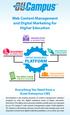 Web Content Management and Digital Marketing for Higher Education COMMUNICATION & MARKETING MEASUREMENT & ANALYSIS CONTENT MANAGEMENT PLATFORM INTEGRATION & DEVELOPMENT WEB, MOBILE, & SOCIAL UNIFICATION
Programming Social Applications
 Programming Social Applications Jonathan LeBlanc O'REILLY Beijing Cambridge Farnham Koln Sebastopol Tokyo Table of Contents Preface xv 1. Social Application Container Core Concepts 1 What Is a Social Application
End User Devices Security Guidance: Apple ios 8
 GOV.UK Guidance End User Devices Security Guidance: Apple ios 8 Published Contents 1. Changes since previous guidance 2. Usage scenario 3. Summary of platform security 4. How the platform can best satisfy
Service Oriented Architecture
 Service Oriented Architecture Charlie Abela Department of Artificial Intelligence [email protected] Last Lecture Web Ontology Language Problems? CSA 3210 Service Oriented Architecture 2 Lecture Outline
Kony Mobile Application Management (MAM)
 Kony Mobile Application Management (MAM) Kony s Secure Mobile Application Management Feature Brief Contents What is Mobile Application Management? 3 Kony Mobile Application Management Solution Overview
Introduction to Oracle Mobile Application Framework Raghu Srinivasan, Director Development Mobile and Cloud Development Tools Oracle
 Introduction to Oracle Mobile Application Framework Raghu Srinivasan, Director Development Mobile and Cloud Development Tools Oracle Safe Harbor Statement The following is intended to outline our general
Totara LMS. Key benefits. Key Features
 Totara LMS Achieve your business objectives through effective learning and development with our game-changing Learning Management System (LMS). Today, more than ever, the achievement of your business objectives
Is Liferay Right for Your Organization? Seven Things to Consider When Choosing a Portal Platform
 Is Liferay Right for Your Organization? Seven Things to Consider When Choosing a Portal Platform BY DAN LILIEDAHL, CTO, TANDEMSEVEN The outcome of your portal initiative and its success is directly related
Web 2.0 Tools 2008 Dr. Pyatt
 1. Browser Set-up Background since the tools we are going to use today will be downloaded from the internet, some of which will be integrated into your web-browser, we will need to have a common browser
How To Develop A Mobile Application On An Android Device
 Disclaimer: The following is intended to outline our general product direction. It is intended for information purposes only, and may not be incorporated into any contract. It is not a commitment to deliver
Google Web Toolkit (GWT) Architectural Impact on Enterprise Web Application
 Google Web Toolkit (GWT) Architectural Impact on Enterprise Web Application First Generation HTTP request (URL or Form posting) W HTTP response (HTML Document) W Client Tier Server Tier Data Tier Web CGI-Scripts
Are AJAX Applications Vulnerable to Hack Attacks?
 Are AJAX Applications Vulnerable to Hack Attacks? The importance of Securing AJAX Web Applications This paper reviews AJAX technologies with specific reference to JavaScript and briefly documents the kinds
Introduction to IBM Worklight Mobile Platform
 Introduction to IBM Worklight Mobile Platform The Worklight Mobile Platform The Worklight Mobile Platform is an open, complete and advanced mobile application platform for HTML5, hybrid and native apps.
Preface. Motivation for this Book
 Preface Asynchronous JavaScript and XML (Ajax or AJAX) is a web technique to transfer XML data between a browser and a server asynchronously. Ajax is a web technique, not a technology. Ajax is based on
SOA REFERENCE ARCHITECTURE: WEB TIER
 SOA REFERENCE ARCHITECTURE: WEB TIER SOA Blueprint A structured blog by Yogish Pai Web Application Tier The primary requirement for this tier is that all the business systems and solutions be accessible
WebRTC: Why and How? FRAFOS GmbH. FRAFOS GmbH Windscheidstr. 18 Ahoi 10627 Berlin Germany [email protected] www.frafos.com
 WebRTC: Why and How? FRAFOS GmbH FRAFOS GmbH Windscheidstr. 18 Ahoi 10627 Berlin Germany [email protected] www.frafos.com This docume nt is copyright of FRAFOS GmbH. Duplication or propagation or e xtracts
Enterprise Portal Built by and for Higher Education
 www.apereo.org/uportal Enterprise Portal Built by and for Higher Education Now Responsive for All Devices along with Native App Experience There is a growing demand for higher education institutions to
Developing ASP.NET MVC 4 Web Applications
 Course M20486 5 Day(s) 30:00 Hours Developing ASP.NET MVC 4 Web Applications Introduction In this course, students will learn to develop advanced ASP.NET MVC applications using.net Framework 4.5 tools
JavaFX Session Agenda
 JavaFX Session Agenda 1 Introduction RIA, JavaFX and why JavaFX 2 JavaFX Architecture and Framework 3 Getting Started with JavaFX 4 Examples for Layout, Control, FXML etc Current day users expect web user
FRAFOS GmbH Windscheidstr. 18 Ahoi 10627 Berlin Germany [email protected] www.frafos.com
 WebRTC for the Enterprise FRAFOS GmbH FRAFOS GmbH Windscheidstr. 18 Ahoi 10627 Berlin Germany [email protected] www.frafos.com This document is copyright of FRAFOS GmbH. Duplication or propagation or extracts
Monitoring Infrastructure (MIS) Software Architecture Document. Version 1.1
 Monitoring Infrastructure (MIS) Software Architecture Document Version 1.1 Revision History Date Version Description Author 28-9-2004 1.0 Created Peter Fennema 8-10-2004 1.1 Processed review comments Peter
Subscribe to RSS in Outlook 2007. Find RSS Feeds. Exchange Outlook 2007 How To s / RSS Feeds 1of 7
 Exchange Outlook 007 How To s / RSS Feeds of 7 RSS (Really Simple Syndication) is a method of publishing and distributing content on the Web. When you subscribe to an RSS feed also known as a news feed
Adobe Flash Player and Adobe AIR security
 Adobe Flash Player and Adobe AIR security Both Adobe Flash Platform runtimes Flash Player and AIR include built-in security and privacy features to provide strong protection for your data and privacy,
Wiki Server. Innovative tools for workgroup collaboration and communication. Features
 Wiki Server Innovative tools for workgroup collaboration and communication. Features Single site for group collaboration Project-specific wiki accessible via web browsers on Mac, PC, iphone, and ipod touch
BEAWebLogic. Portal. Portlet Development Guide
 BEAWebLogic Portal Portlet Development Guide Version 10.0 Revised: March 2007 Copyright Copyright 1995-2007 BEA Systems, Inc. All Rights Reserved. Restricted Rights Legend This software is protected by
REST-based Offline e-mail System
 Proceedings of the APAN Network Research Workshop 2012 REST-based Offline e-mail System Gihan Dias, Mithila Karunarathna, Madhuka Udantha, Ishara Gunathilake, Shalika Pathirathna and Tharidu Rathnayake
Solution Showcase Session. Enterprise 2.0 Computing Services
 Solution Showcase Session Enterprise 2.0 Computing Services IDEA Lab Competencies Business Solutions Competency Verification and Validation Competency Business Intelligence Competency Managed Services
Oracle Identity Analytics Architecture. An Oracle White Paper July 2010
 Oracle Identity Analytics Architecture An Oracle White Paper July 2010 Disclaimer The following is intended to outline our general product direction. It is intended for information purposes only, and may
Integrate Third Party Collaboration Tools in the SAP NetWeaver Portal. SAP NetWeaver Product Management
 Integrate Third Party Collaboration Tools in the SAP NetWeaver Portal SAP NetWeaver Product Management Overview Native Third-Party Services Code Samples Summary Integration of Third-Party Collaboration
Gateway Apps - Security Summary SECURITY SUMMARY
 Gateway Apps - Security Summary SECURITY SUMMARY 27/02/2015 Document Status Title Harmony Security summary Author(s) Yabing Li Version V1.0 Status draft Change Record Date Author Version Change reference
Curl Building RIA Beyond AJAX
 Rich Internet Applications for the Enterprise The Web has brought about an unprecedented level of connectivity and has put more data at our fingertips than ever before, transforming how we access information
Business Application Development Platform
 Business Application Development Platform Author Copyright Last update Version Document type Sclable Business Solutions GmbH Attribution-NonCommercial-NoDerivatives 4.0 International 01/28/2014 1.0 Technical
CatDV Pro Workgroup Serve r
 Architectural Overview CatDV Pro Workgroup Server Square Box Systems Ltd May 2003 The CatDV Pro client application is a standalone desktop application, providing video logging and media cataloging capability
Business Process Management The Must Have Enterprise Solution for the New Century
 Business Process Management The Must Have Enterprise Solution for the New Century 15200 Weston Parkway, Suite 106 Cary, NC 27513 Phone: (919) 678-0900 Fax: (919) 678-0901 E-Mail: [email protected] WWW:
From LMS to PLE: a Step Forward through OpenSocial Apps in Moodle
 From LMS to PLE: a Step Forward through OpenSocial Apps in Moodle Evgeny Bogdanov 1, Carsten Ullrich 2, Erik Isaksson 3, Matthias Palmer 3, and Denis Gillet 1 1 Ecole Polytechnique Fédérale de Lausanne,
<Insert Picture Here> Michael Hichwa VP Database Development Tools [email protected] Stuttgart September 18, 2007 Hamburg September 20, 2007
 Michael Hichwa VP Database Development Tools [email protected] Stuttgart September 18, 2007 Hamburg September 20, 2007 Oracle Application Express Introduction Architecture
Introducing the AT&T Connect Web Participant Integrated/Enterprise Edition Version 9 January 2011
 Introducing the AT&T Connect Web Participant Integrated/Enterprise Edition Version 9 January 2011 2011 AT&T Intellectual Property. All rights reserved. AT&T, the AT&T logo and all other AT&T marks contained
Research on the Model of Enterprise Application Integration with Web Services
 Research on the Model of Enterprise Integration with Web Services XIN JIN School of Information, Central University of Finance& Economics, Beijing, 100081 China Abstract: - In order to improve business
ECG-1615A. How to Integrate IBM Enterprise Content Management Solutions With Microsoft SharePoint and IBM Connections. elinar.com
 ECG-1615A How to Integrate IBM Enterprise Content Management Solutions With Microsoft SharePoint and IBM Connections Presentation index The Players The Problem IBM Standard Integration Options IBM Content
Whitepaper. Rich Internet Applications. Frameworks Evaluation. Document reference: TSL-SES-WP0001 Januar 2008. [email protected].
 Whitepaper Frameworks Evaluation Document reference: TSL-SES-WP0001 Januar 2008. [email protected] 1 Introduction... 3 1.1 Purpose...3 1.2 Scope...3 2 RIA vs Stand-alone Desktop applications... 4
IBM Information Server
 IBM Information Server Version 8 Release 1 IBM Information Server Administration Guide SC18-9929-01 IBM Information Server Version 8 Release 1 IBM Information Server Administration Guide SC18-9929-01
Consuming and Producing Web Services with Web Tools. Christopher M. Judd. President/Consultant Judd Solutions, LLC
 Consuming and Producing Web Services with Web Tools Christopher M. Judd President/Consultant Judd Solutions, LLC Christopher M. Judd President/Consultant of Judd Solutions Central Ohio Java User Group
MicroStrategy Course Catalog
 MicroStrategy Course Catalog 1 microstrategy.com/education 3 MicroStrategy course matrix 4 MicroStrategy 9 8 MicroStrategy 10 table of contents MicroStrategy course matrix MICROSTRATEGY 9 MICROSTRATEGY
Enforce AD RMS Policies for PDF documents in SharePoint Environments... 5. Enforce AD RMS Policies for PDF documents in Exchange Environments...
 1 Contents Introduction... 4 Foxit PDF Security Suite Environments... 5 Enforce AD RMS Policies for PDF documents in SharePoint Environments... 5 Enforce AD RMS Policies for PDF documents in Exchange Environments...
Building Web-based Infrastructures for Smart Meters
 Building Web-based Infrastructures for Smart Meters Andreas Kamilaris 1, Vlad Trifa 2, and Dominique Guinard 2 1 University of Cyprus, Nicosia, Cyprus 2 ETH Zurich and SAP Research, Switzerland Abstract.
Schenectady City School. Request for Proposal for Website Design and Content Management System RFP #0620 16
 Schenectady City School District Request for Proposal for Website Design and Content Management System RFP #0620 16 Proposals to be received: Time: 9am Date: June 20, 2016 Place: Schenectady City School
OWB Users, Enter The New ODI World
 OWB Users, Enter The New ODI World Kulvinder Hari Oracle Introduction Oracle Data Integrator (ODI) is a best-of-breed data integration platform focused on fast bulk data movement and handling complex data
Power of Oracle in the Cloud
 Power of Oracle in the Cloud www.reliason.com Whitepaper W Overview The Oracle technology is known for its power, productivity and robustness. Likewise, Oracle cloud service is also backed by these features
20481C: Essentials of Developing Windows Store Apps Using HTML5 and JavaScript
 20481C: Essentials of Developing Windows Store Apps Using HTML5 and JavaScript Course Details Course Code: Duration: Notes: 20481C 5 days This course syllabus should be used to determine whether the course
Sisense. Product Highlights. www.sisense.com
 Sisense Product Highlights Introduction Sisense is a business intelligence solution that simplifies analytics for complex data by offering an end-to-end platform that lets users easily prepare and analyze
Oracle Communications WebRTC Session Controller: Basic Admin. Student Guide
 Oracle Communications WebRTC Session Controller: Basic Admin Student Guide Edition 1.0 April 2015 Copyright 2015, Oracle and/or its affiliates. All rights reserved. Disclaimer This document contains proprietary
SPAMfighter Mail Gateway
 SPAMfighter Mail Gateway User Manual Copyright (c) 2009 SPAMfighter ApS Revised 2009-05-19 1 Table of contents 1. Introduction...3 2. Basic idea...4 2.1 Detect-and-remove...4 2.2 Power-through-simplicity...4
ILIAS-Conference, Nuremberg, 06.10.2005. Offline or Online Content Creation? Fred Neumann [email protected]
 Offline or Online Content Creation? Fred Neumann [email protected] FIM-NeuesLernen www.fim.uni-erlangen.de FIM-NeuesLernen 2005 Page 1 Agenda Authoring processes 4 ways to get content into
Design and Functional Specification
 2010 Design and Functional Specification Corpus eready Solutions pvt. Ltd. 3/17/2010 1. Introduction 1.1 Purpose This document records functional specifications for Science Technology English Math (STEM)
KonyOne Server Prerequisites _ MS SQL Server
 KonyOne Server Prerequisites _ MS SQL Server KonyOne Platform Release 5.0 Copyright 2012-2013 Kony Solutions, Inc. All Rights Reserved. Page 1 of 13 Copyright 2012-2013 by Kony Solutions, Inc. All rights
REMOTE DEVELOPMENT OPTION
 Leading the Evolution DATA SHEET MICRO FOCUS SERVER EXPRESS TM REMOTE DEVELOPMENT OPTION Executive Overview HIGH PRODUCTIVITY DEVELOPMENT FOR LINUX AND UNIX DEVELOPERS Micro Focus Server Express is the