
IBM License Metric Tool Version 9.0 (includes version 9.0.1, and ) Installation Guide
|
|
|
- Mitchell Walker
- 9 years ago
- Views:
Transcription
1 IBM License Metric Tool Version 9.0 (includes version 9.0.1, and ) Installation Guide
2

3 IBM License Metric Tool Version 9.0 (includes version 9.0.1, and ) Installation Guide

4 Installation Guide This edition applies to IBM License Metric Tool version (product number 5724-T40) and to all subsequent releases and modifications until otherwise indicated in new editions. Copyright IBM Corporation 2002, US Government Users Restricted Rights Use, duplication or disclosure restricted by GSA ADP Schedule Contract with IBM Corp.

5 Contents Installing License Metric Tool Installation roadmap Planning and preparing for the installation License Metric Tool infrastructure Scalability guide IBM Endpoint Manager requirements Supported operating systems Software requirements Hardware requirements Hardware requirements for the server Hardware requirements for the client Port requirements Firewall exceptions Installation users Coexistence considerations Installing the infrastructure components Installing all components on one server Downloading the installer Installing All-in-One Installing the server with DB Installing the IBM Endpoint Manager clients 39 Installing the components separately Installation checklist Installing IBM Endpoint Manager Installing License Metric Tool Uninstalling Uninstalling a scanner Deactivating the analyses Uninstalling the server in interactive mode Uninstalling the server in silent mode Removing all components Notices Trademarks Privacy policy considerations Copyright IBM Corp. 2002, 2014 iii

6 iv

7 Installing License Metric Tool Read this section to learn how to install License Metric Tool. Installation roadmap Review the installation roadmap to choose the scenario and installer that best suits your needs. Stage 1 Plan and prepare for installation Yes Is your environment small? No Option A Environment size: Stage 2 Install all three components Note: Database connections are configured automatically. Install all components on one server (All-in-One) Up to endpoints Stage 3 Configure the product Stage 4 Apply important IBM updates Streamlined installer LMT, DB2 and IEM on Linux Scans are set up automatically. Do you want to use the existing instance of Endpoint Manager? Option B Environment size: Install DB2 and License Metric Tool endpoints Existing IEM on Linux (DB2) or Windows (MSSQL) LMT and DB2 on Linux Yes Stage 2 Install two components on one server Stage 3 Configure the product Stage 4 Apply important IBM updates Stage 5 Set up scans No (Although it is technically possible.) Option C Environment size: Stage 2 Install the components separately Install all three components separately Over endpoints Stage 3 Configure the product Stage 4 Apply important IBM updates Base installer Stage 5 Set up scans Note: This is a highly customizable type of installation. IEM on Linux (DB2) or Windows (MSSQL) LMT on Linux DB2 on Linux OR IEM on Linux (DB2) or Windows (MSSQL) LMT and DB2 on Linux Copyright IBM Corp. 2002,

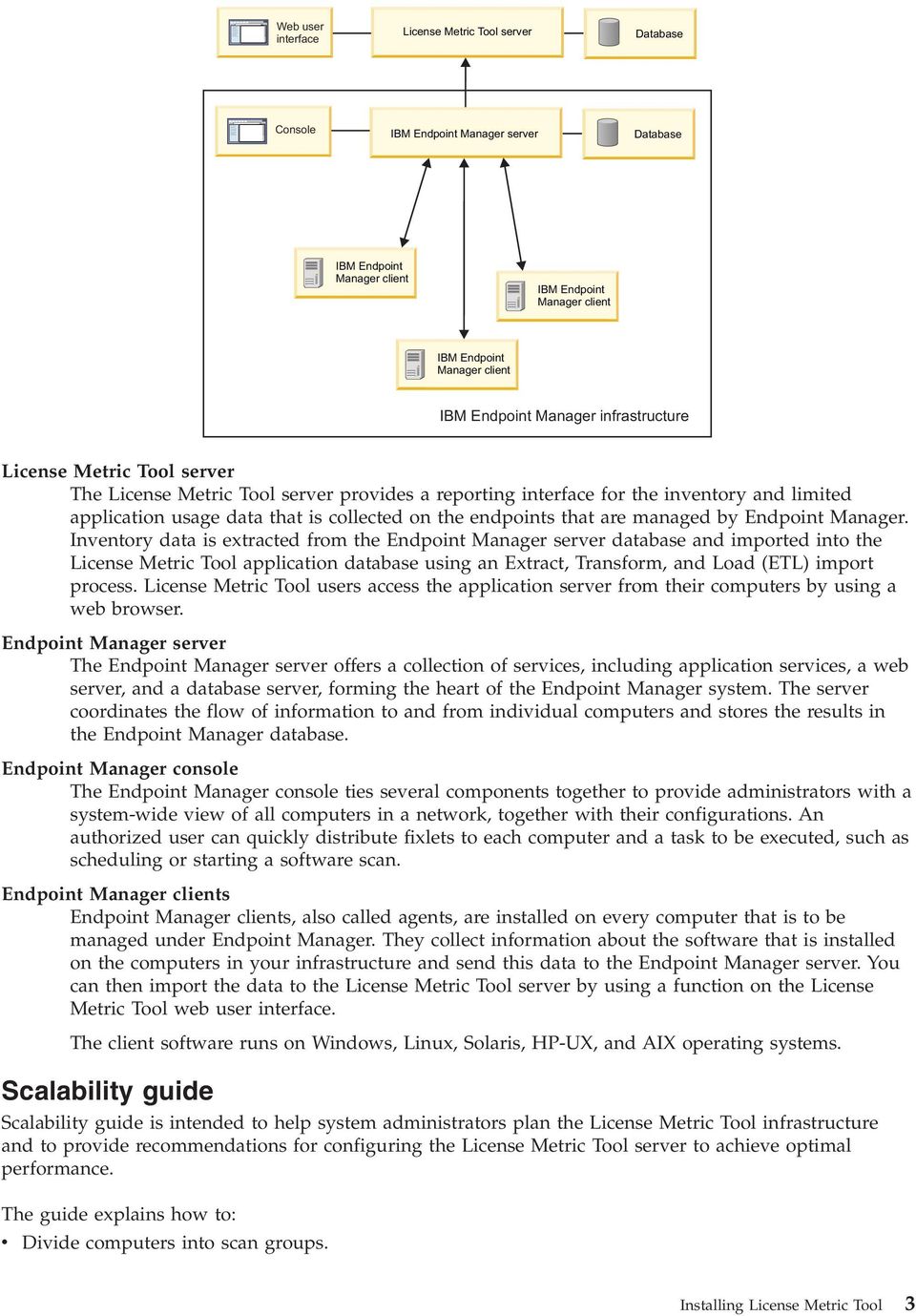
8 Understanding the installation Option A: Installing with the streamlined installer This is the most simple path to install a complete License Metric Tool infrastructure. The installer deploys all required components on one server, therefore you can install IBM Endpoint Manager, DB2, and License Metric Tool by running only one installation wizard. Option B: Installing the server with DB2 If you already have the IBM Endpoint Manager server installed in your environment, you can choose this option to install only License Metric Tool and a DB2 database. Although License Metric Tool and DB2 are installed on one server, your IBM Endpoint Manager platform can reside on a separate one. When the installation is complete, you will specify connection details for IBM Endpoint Manager and its database, so that all components can be connected. Option C: Installing all three components separately This option does not use the combined installer, which means that each component must be downloaded and installed separately. Although it is the most time-consuming option, it also gives you the most influence on your environment and is recommended for large environments. You can choose how to distribute the components, but in a typical environment, IBM Endpoint Manager and its database reside on one server, while License Metric Tool and its DB2 on the other, which ensures good performance. Planning and preparing for the installation Before you start the installation, review this information on hardware and software requirements and other considerations. About this task You are here: Stage 1 Plan and prepare for installation Stage 2 Install the infrastructure components Stage 3 Configure the product Stage 4 Apply important IBM updates Stage 5 Set up scans License Metric Tool infrastructure The typical deployment of IBM License Metric Tool reuses the Endpoint Manager infrastructure: the server, its clients, which are also called agents, the database, and the console. To use IBM License Metric Tool, Endpoint Manager server and clients are required. The following diagram shows how the License Metric Tool application interfaces with Endpoint Manager server installation. Figure 1. License Metric Tool infrastructure 2

9 Web user interface License Metric Tool server Database Console IBM Endpoint Manager server Database IBM Endpoint Manager client IBM Endpoint Manager client IBM Endpoint Manager client IBM Endpoint Manager infrastructure License Metric Tool server The License Metric Tool server provides a reporting interface for the inventory and limited application usage data that is collected on the endpoints that are managed by Endpoint Manager. Inventory data is extracted from the Endpoint Manager server database and imported into the License Metric Tool application database using an Extract, Transform, and Load (ETL) import process. License Metric Tool users access the application server from their computers by using a web browser. Endpoint Manager server The Endpoint Manager server offers a collection of services, including application services, a web server, and a database server, forming the heart of the Endpoint Manager system. The server coordinates the flow of information to and from individual computers and stores the results in the Endpoint Manager database. Endpoint Manager console The Endpoint Manager console ties several components together to provide administrators with a system-wide view of all computers in a network, together with their configurations. An authorized user can quickly distribute fixlets to each computer and a task to be executed, such as scheduling or starting a software scan. Endpoint Manager clients Endpoint Manager clients, also called agents, are installed on every computer that is to be managed under Endpoint Manager. They collect information about the software that is installed on the computers in your infrastructure and send this data to the Endpoint Manager server. You can then import the data to the License Metric Tool server by using a function on the License Metric Tool web user interface. The client software runs on Windows, Linux, Solaris, HP-UX, and AIX operating systems. Scalability guide Scalability guide is intended to help system administrators plan the License Metric Tool infrastructure and to provide recommendations for configuring the License Metric Tool server to achieve optimal performance. The guide explains how to: v Divide computers into scan groups. Installing License Metric Tool 3
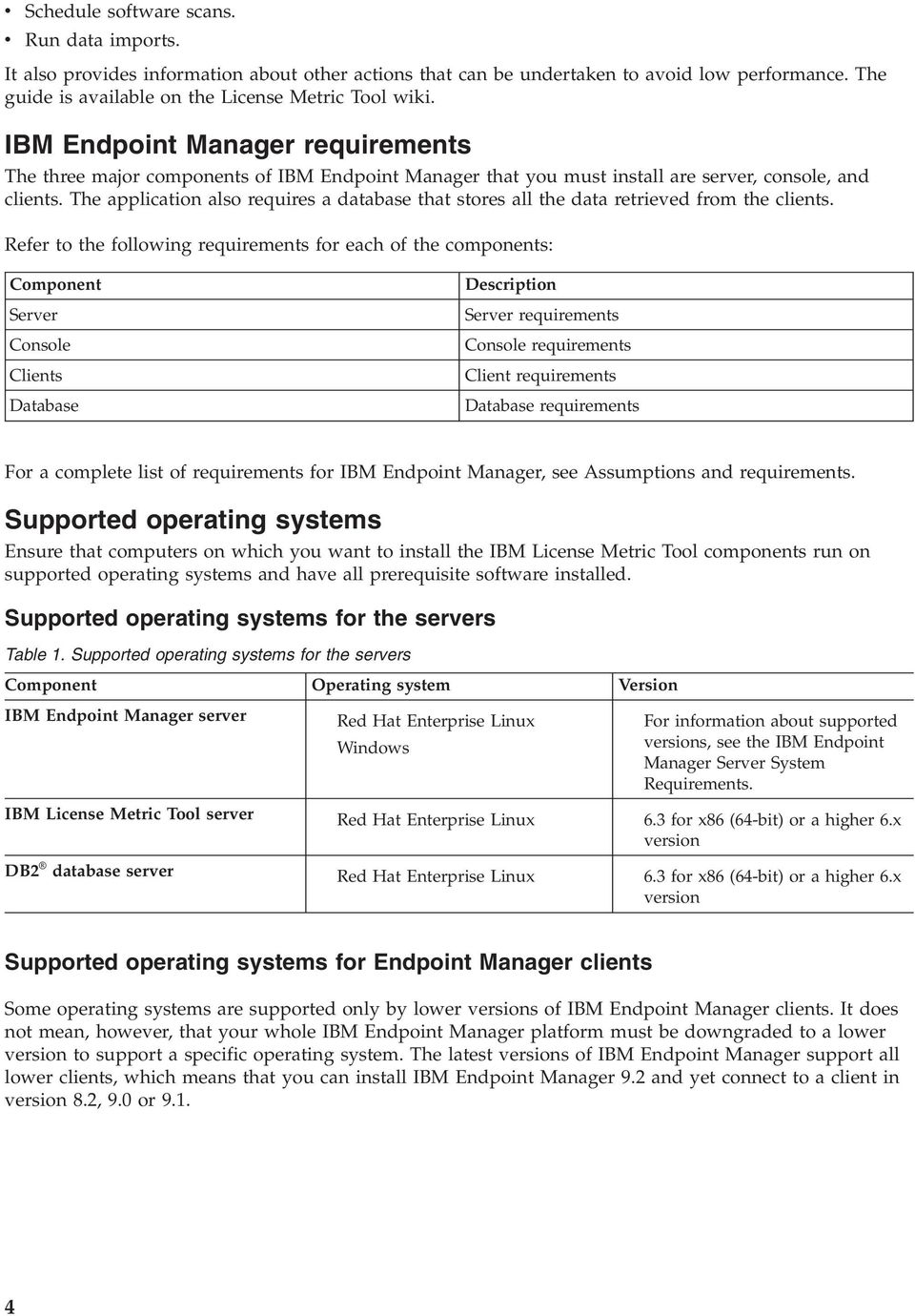
10 v Schedule software scans. v Run data imports. It also provides information about other actions that can be undertaken to avoid low performance. The guide is available on the License Metric Tool wiki. IBM Endpoint Manager requirements The three major components of IBM Endpoint Manager that you must install are server, console, and clients. The application also requires a database that stores all the data retrieved from the clients. Refer to the following requirements for each of the components: Component Server Console Clients Database Description Server requirements Console requirements Client requirements Database requirements For a complete list of requirements for IBM Endpoint Manager, see Assumptions and requirements. Supported operating systems Ensure that computers on which you want to install the IBM License Metric Tool components run on supported operating systems and have all prerequisite software installed. Supported operating systems for the servers Table 1. Supported operating systems for the servers Component Operating system Version IBM Endpoint Manager server Red Hat Enterprise Linux Windows For information about supported versions, see the IBM Endpoint Manager Server System Requirements. IBM License Metric Tool server Red Hat Enterprise Linux 6.3 for x86 (64-bit) or a higher 6.x version DB2 database server Red Hat Enterprise Linux 6.3 for x86 (64-bit) or a higher 6.x version Supported operating systems for Endpoint Manager clients Some operating systems are supported only by lower versions of IBM Endpoint Manager clients. It does not mean, however, that your whole IBM Endpoint Manager platform must be downgraded to a lower version to support a specific operating system. The latest versions of IBM Endpoint Manager support all lower clients, which means that you can install IBM Endpoint Manager 9.2 and yet connect to a client in version 8.2, 9.0 or
11 AIX Table 2. Supported versions of AIX Version Software requirements Supported virtualization technologies Comments 7.1 PowerVM v LPAR v DLPAR v Single Shared Processor Pool v Micro-Partitioning v Multiple Shared Processor Pools v Shared Dedicated Processor v Mobility (Live Partition Mobility) v System WPARs (Both regulated and un-regulated, also RSET bound) v WPAR mobility (Live Application Mobility) IBM zenterprise BladeCenter Extension (zbx) Processor Core Deconfiguration 6.1 PowerVM v LPAR v DLPAR v Single Shared Processor Pool v Micro-Partitioning v Multiple Shared Processor Pools v Shared Dedicated Processor v Mobility (Live Partition Mobility) v System WPARs (Both regulated and un-regulated, also RSET bound) IBM zenterprise BladeCenter Extension (zbx) Processor Core Deconfiguration 5.3 PowerVM v LPAR v DLPAR v Single Shared Processor Pool v Micro-Partitioning v Multiple Shared Processor Pools v Shared Dedicated Processor v Mobility (Live Partition Mobility) IBM zenterprise BladeCenter Extension (zbx) Processor Core Deconfiguration 5.2 PowerVM v LPAR v DLPAR v Single Shared Processor Pool v Micro-Partitioning Processor Core Deconfiguration Endpoint Manager client version Installing License Metric Tool 5

12 HP-UX Table 3. Supported versions of HP-UX Version Software requirements Supported virtualization technologies Comments 11i v3 IA64 HP Integrity Virtual Machines v 3.5 v 4.0 v 4.1 v 4.2 v i v3 PA-RISC 11i v2 IA64 11i v2 PA-RISC 11i v1 PA-RISC npar vpar All except for version 6 HP Instant Capacity (icap) version 9 npar 9.1 vpar All except for version HP Integrity Virtual Machines v 3.5 v 4.0 v 4.1 v 4.2 v 4.3 npar vpar All except for version 6 HP Instant Capacity (icap) version 9 npar 9.1 vpar All except for version npar 9.1 vpar All except for version Endpoint Manager client version Oracle Solaris Important: If you are installing agents on a Solaris platform that is partitioned by using the Containers partitioning technology, the Host ID of the local zone must be the same as the Host ID of the global zone. 6

13 Table 4. Supported versions of Solaris Version Software requirements Supported virtualization technologies Comments 11 SPARC Dynamic System Domains Solaris in Dynamic System Dynamic Domains Domains and Dynamic Domains are not supported for full capacity. Full capacity PVU values will need to be adjusted upward manually for the number of activated cores on the server. Solaris Containers (including Zones) Inside Dynamic System Domains and Dynamic Domains Node OS Oracle VM Server for SPARC (formerly Logical Domains also called LDOMs) v 2.0 v 2.1 v 2.2 v x86-64 Solaris Containers (including Zones) 9.2 BIOS (SMBIOS 2.5 or higher) & Operating System boot core limit 10 SPARC Dynamic System Domains Dynamic Domains Solaris in Dynamic System Domains and Dynamic Domains are not supported for full capacity. Full capacity PVU values will need to be adjusted upward manually for the number of activated cores on the server. Solaris Containers (including Zones) Inside Dynamic System Domains and Dynamic Domains Node OS Oracle VM Server for SPARC (formerly Logical Domains also called LDOMs) v 2.0 v 2.1 v 2.2 v x86-64 Solaris Containers (including Zones) 9.2 BIOS (SMBIOS 2.5 or higher) & Operating System boot core limit 9 SPARC Dynamic System Domains Dynamic Domains Solaris in Dynamic System Domains and Dynamic Domains are not supported for full capacity. Full capacity PVU values will need to be adjusted upward manually for the number of activated cores on the server. 8 SPARC Dynamic System Domains Endpoint Manager client version Installing License Metric Tool 7

14 Red Hat Enterprise Linux Table 5. Supported versions of Red Hat Enterprise Linux Version Software requirements Supported virtualization technologies Comments 7 for IBM PowerVM Power v DLPAR Systems (64-bit) v LPAR v LPAR mobility (Live Partition Mobility) v Single Shared Processor Pool v Micro-Partitioning 6 for IBM Power Systems (64-bit) 6 for IBM System z (64-bit) 6 for x86 (32 and 64-bit) 5 for IBM Power Systems 5 for IBM System z (64-bit) compat-libstdc++-33 compat-libstdc compat-libstdc++-33 compat-libstdc Processor Factory Deconfiguration PowerVM v DLPAR v LPAR v LPAR mobility (Live Partition Mobility) v Single Shared Processor Pool v Micro-Partitioning Processor Factory Deconfiguration z/vm LPAR VMware ESX v 3 v 3.5 v 4 v 4.1 CPU pooling Kernel-based Virtual Machine (KVM) VMware ESXi v 3.5 v 4 v 4.1 v 5 v 5.1 v 5.5 PowerVM v DLPAR v LPAR v LPAR mobility (Live Partition Mobility) v Single Shared Processor Pool v Micro-Partitioning Processor Factory Deconfiguration z/vm LPAR CPU pooling Starting from z/vm 6.3 PTF for APAR VM65418 must be applied Single Server, Cluster, Mobility (VMware Vmotion) On RHEV with RHEV-M (Red Hat Linux Virtualization Manager) 3.0 and 3.1 Starting from z/vm 6.3 PTF for APAR VM65418 must be applied Endpoint Manager client version

15 Table 5. Supported versions of Red Hat Enterprise Linux (continued) Version Software requirements Supported virtualization technologies Comments 5 for x86 (32 and 64-bit) 4 for x86 (32 and 64-bit) compat-libstdc++-33 compat-libstdc ia32el VMware ESX v 3 v 3.5 v 4 v 4.1 Kernel-based Virtual Machine (KVM) VMware ESX v 3 v 3.5 v 4 v 4.1 Kernel-based Virtual Machine (KVM) VMware ESXi v 3.5 v 4 v 4.1 v 5 v 5.1 v 5.5 VMware ESXi v 3.5 v 4 v 4.1 v 5 v 5.1 v 5.5 Single Server, Cluster, Mobility (VMware Vmotion) On RHEV with RHEV-M (Red Hat Linux Virtualization Manager) 3.0 and 3.1 On RHEV with RHEV-M (Red Hat Linux Virtualization Manager) 3.0 and 3.1 Endpoint Manager client version SUSE Linux Table 6. Supported versions of SUSE Linux Version Software requirements Supported virtualization technologies Comments 11 for IBM PowerVM Power Systems v DLPAR v Single Shared Processor Pool v Micro-Partitioning 11 for x86 (32 and 64-bit) 11 for IBM System z (64-bit) compat-libstdc++-33 compat-libstdc libstdc bit libstdc bit x86_64.rpm compat-libstdc++-33 compat-libstdc LPAR LPAR mobility (Live Partition Mobility) Processor Factory Deconfiguration VMware ESX v 4 v 4.1 VMware ESXi v 4 v 4.1 v 5 v 5.1 v 5.5 BIOS (SMBIOS 2.5 or higher) & Operating System boot core limit System scaling using Intel QuickPath Interconnect Microsoft Hyper-V on Windows v R2 v Server 2012 z/vm LPAR CPU pooling Single Server, Cluster, Mobility (VMware Vmotion) Hyper-V R2 can be stand alone or role. Starting from z/vm 6.3 PTF for APAR VM65418 must be applied Endpoint Manager client version Installing License Metric Tool 9

16 Table 6. Supported versions of SUSE Linux (continued) Version Software requirements Supported virtualization technologies Comments 10 for IBM PowerVM Power Systems v DLPAR v Single Shared Processor Pool v Micro-Partitioning 10 for x86 (32 and 64-bit) 9 for x86 (32 and 64-bit) compat-libstdc++-33 compat-libstdc compat-libstdc++-33 compat-libstdc LPAR LPAR mobility (Live Partition Mobility) Processor Factory Deconfiguration VMware ESX v 4 v 4.1 VMware ESX v 4 v 4.1 VMware ESXi v 4 v 4.1 v 5 v 5.1 v 5.5 VMware ESXi v 4 v 4.1 v 5 v 5.1 v 5.5 Single Server, Cluster, Mobility (VMware Vmotion) Single Server, Cluster, Mobility (VMware Vmotion) Endpoint Manager client version Microsoft Windows Table 7. Supported versions of Microsoft Windows for the server Version Software requirements Supported virtualization technologies Comments Server 2012 VMware ESXi for x86 (32 and 64-bit) v 5 v 5.1 v 5.5 Microsoft Hyper-V v R2 v Server 2012 BIOS (SMBIOS 2.5 or higher) & Operating System boot core limit Endpoint Manager client version

17 Table 7. Supported versions of Microsoft Windows for the server (continued) Version Software requirements Supported virtualization technologies Comments Server 2008 VMware ESX VMware ESXi R2 Enterprise v 3.5 v 3.5 Edition for v 4 v 4 x86 (64-bit) v 4.1 v 4.1 Server 2008 v 5 Enterprise v 5.1 Edition for x86 (32 and v bit) Microsoft Hyper-V v R1 Server 2008 R2 Standard v R2 Edition for v Server 2012 x86 (64-bit) BIOS (SMBIOS 2.5 or higher) & Operating System boot core limit System scaling using Intel QuickPath Interconnect Server 2003 Enterprise Edition for x86 (32 and 64-bit) Kernel-based Virtual Machine (KVM) VMware ESX v 3.0 v 3.5 v 4 v 4.1 VMware ESXi v 3.5 v 4 v 4.1 v 5 v 5.1 v 5.5 Microsoft Virtual Server 2005 BIOS (SMBIOS 2.5 or higher) & Operating System boot core limit System scaling using Intel QuickPath Interconnect Kernel-based Virtual Machine (KVM) On RHEV with RHEV-M (Red Hat Linux Virtualization Manager) 3.0 and 3.1 on RHEV with RHEV-M (Red Hat Linux Virtualization Manager) 3.0 and 3.1 Endpoint Manager client version Only version 9.1 agents can be installed on Windows Server 2008 R2 Standard Edition Table 8. Supported versions of Microsoft Windows for the desktop Version Software requirements Supported virtualizations Comments 8 for x86 (32 and 64-bit) VMware ESXi v 5 v 5.1 v 5.5 Microsoft Hyper-V v R2 v Server 2012 Microsoft Hyper-V v V 3.0 (as part of Windows 8) BIOS (SMBIOS 2.5 or higher) & Operating System boot core limit Single Server, Cluster, Mobility (VMware Vmotion) Hyper-V R2 can be stand alone or role. Endpoint Manager client version Installing License Metric Tool 11
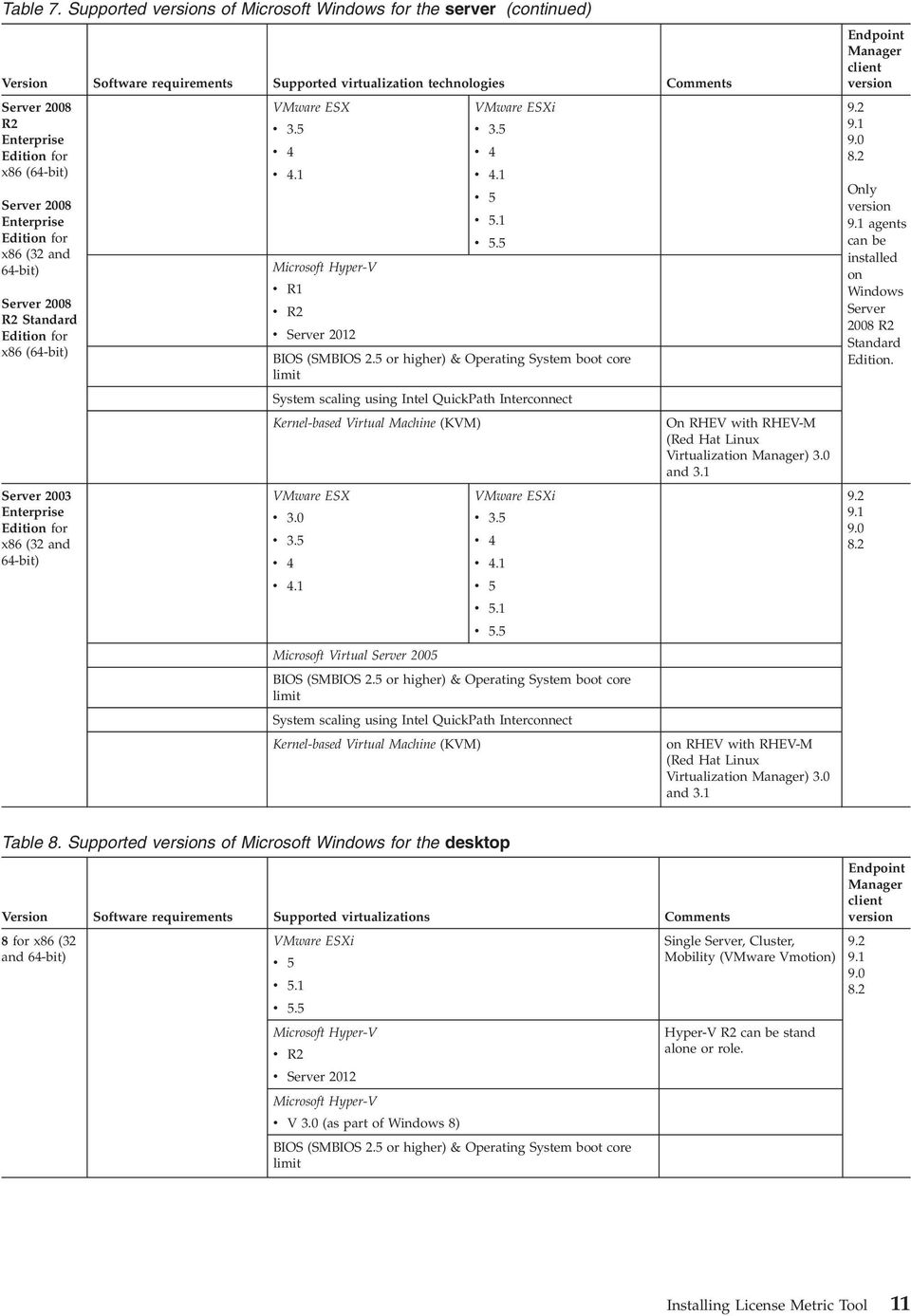
18 Table 8. Supported versions of Microsoft Windows for the desktop (continued) Version Software requirements Supported virtualizations Comments 7 Enterprise VMware ESX VMware ESXi and Professional v 4 v 4 for x86 (32 v 4.1 v 4.1 and 64-bit) v 5 v 5.1 v 5.5 Vista Enterprise for x86 (32 and 64-bit) XP Professional for x86 (32 and 64-bit) Service Pack 2 for Microsoft Hyper-V Server 2012 Service Pack 2 Kernel-based Virtual Machine (KVM) VMware ESX v 3.0 v 3.5 v 4 v 4.1 Microsoft Hyper-V v R1 v R2 v Server 2012 VMware ESXi v 3.5 v 4 v 4.1 v 5 v 5.1 v 5.5 BIOS (SMBIOS 2.5 or higher) & Operating System boot core limit System scaling using Intel QuickPath Interconnect Endpoint Manager client version Software requirements Ensure that all prerequisite software is installed on the computers in your infrastructure. Server requirements Table 9. Requirements for the License Metric Tool server Version Description Endpoint Manager For information about Endpoint Manager server requirements, see: Endpoint Manager 9.2 product documentation Endpoint Manager 9.1 product documentation Endpoint Manager 9.0 product documentation DB2 database server DB Fix Pack 2 or higher DB (Workgroup Server Edition, Enterprise Server Edition, or Advanced Enterprise Server Edition). Important: If you use a Microsoft SQL Server database for the IBM Endpoint Manager server, you must enable the SQL Server Authentication Mode and create a database user. DB2 requirements For information, see the DB product documentation. DB product documentation. Download DB2 software For more information, see the topic Downloading and installing DB2. 12

19 Table 9. Requirements for the License Metric Tool server (continued) Version Description X server X11R7.x The X server is required if you want to install or uninstall the License Metric Tool server in interactive mode. It is also required if you want to complete the server configuration by using a browser that is available on the computer where the License Metric Tool server is installed. Restriction: XMing X Server for Windows is not supported. Other software requirements Table 10. Other software requirements for License Metric Tool Required software Required versions Browser v Internet Explorer 9.0 or higher Note: Internet Explorer must have TLS 1.2 enabled if you want to use TLS 1.2 for secure communication with SSL. You can also use TLS 1.0 for secure communication with SSL. This is the default setting for Internet Explorer. v Firefox 17 Extended Support Release (ESR) or higher ESR editions Note: Firefox does not support TLS 1.2. You can use TLS 1.0 for secure communication with SSL. This is the default setting for Firefox. v Chrome 35 or higher Data compressor KornShell National language pack for PDF reader Restriction: The minimal supported screen resolution is 1024x768 pixels. bzip2 version 1.0.5, released 10 December 2007 or higher Original ksh package can be obtained from the Red Hat Enterprise Linux installation disc. Open source alternatives, such as pdksh and mksh, are not supported. To display PDF reports in a native language, a language pack that displays the native language fonts might be required. Red Hat packages Table 11. Red Hat packages that are required for the installation Component Required packages All-in-One installation All packages required for IBM Endpoint Manager libaio.x86_64 numactl.x86_64 pam.i686 and all dependencies pam.x86_64 IBM Endpoint Manager cyrus-sasl-lib.x86_64 krb5-libs.x86_64 libaio.x86_64 libstdc++.i686 libstdc++.x86_64 and all dependencies libxext.x86_64 (Web Reports only) libxrender.x86_64 (Web Reports only) zlib.x86_64 (Web Reports only) License Metric Tool ksh DB2 libstdc++.so Installing License Metric Tool 13

20 Hardware requirements During setup, match your optimum deployment size to your hardware specifications. Use the recommendations as a general guidance. Hardware requirements for the server Ensure that the computer on which you are installing the License Metric Tool meets the minimal CPU, and memory requirements for the server and database elements. Virtualized environment The ETL (extract, transform, and load) import heavily uses the DB2 database resources. License Metric Tool and DB2 server can be installed on a virtualized environment. However, for large deployments that consist of computers, it is recommended that dedicated hardware is used. In a virtual environment for medium size deployments that consist of computers, it is recommended that dedicated resources are considered for processor, memory, and virtual disk allocation. The virtual disk that is allocated for the VM should be dedicated RAID storage, with dedicated IO bandwidth for that VM. Use DB2 server that is dedicated for License Metric Tool and is not shared with Endpoint Manager or other applications. Fine-tuning based on the above mentioned recommendations might be required. Processor and RAM The following values were calculated for maximum five concurrent application users. Table 12. Processor and RAM requirements for License Metric Tool Environment size Component CPU Memory < 5000 IBM Endpoint Manager, License Metric Tool, and DB2 (All-in-One) At least 2,5 GHz - 4 cores IBM Endpoint Manager 2-3 GHz - 4 cores 16 GB License Metric Tool and DB2 At least 2 GHz - 4 cores 24 GB A distributed environment is advisable. If you separate DB2 from License Metric Tool, the DB2 server should have at least 16 GB RAM. > IBM Endpoint Manager 2-3 GHz cores GB License Metric Tool At least 2 GHz - 8 cores 16 GB DB2 At least 2 GHz - 16 cores 64 GB 8GB Note: The topology for installing the components can be modified if needed, as long as the appropriate resources are ensured. Disk space Table 13. License Metric Tool disk space requirements Directory Disk space and description License Metric Tool server At least 2 GB of free disk space 14

21 Table 13. License Metric Tool disk space requirements (continued) Directory Disk space and description License Metric Tool server 650 MB installation directory: /lmt_install_dir_path The default is: /opt/ibm/lmt. /tmp /var /etc $HOME The home directory of the user running the installation. Database installation directory: /db2_install_dir The default is: /opt/ibm/db2. /var /home/db2fenc1 Database server instance: /home/db2inst1 300 MB 2MB 1MB 1MB 1GB 1MB 1MB The amount of disk space that is required for the database server depends on the number of computers in your environment and the average size of scan files and analyses. For a typical environment, the database size is calculated according to the following formula*: v <The number of computers> x1mb + 6GBofinitial disk space For example: computers 10000x1MB+6GB=16GB computers x1MB+6GB=106GB computers x1MB+6GB=256GB Installing License Metric Tool 15
22 Table 13. License Metric Tool disk space requirements (continued) Directory Disk space and description Database server transaction logs: /home/db2inst1/db2inst1/ During the data import (ETL process), License Metric Tool requires some additional free disk space for database server transaction logs. The amount of disk space that is required can be significant because transaction logs store two sets of data: v Data that is used for recovery if the ETL fails v Data that is used to create new ETL results The amount of disk space that is necessary for the transaction logs depends on the number of computers in your environment as well as the number of computers for which new scan results are available and processed during the data import. To lower the amount of disk space that is necessary for transactions logs, distribute the scans over time so they are processed during several data imports instead of one. For a typical environment, the size of transaction logs is calculated according to the following formula*: v <The number of computers> x1mb+<the number of computers for which new scan results are imported> x1mb+1gb For example: computers and scan results 10000x1MB+10000x1MB+1GB=21GB computers and scan results x1MB+15000x1MB+1GB=116GB IBM Endpoint Manager server installation: /IEM_install_dir The IBM Endpoint Manager installation folder provided during installation. /WebReports_dir The WebReports folder provided during installation. /var/log /opt/besclient /opt/besserver /opt/beswebreportsserver /var/opt/besinstallers /var/opt/besclient computers and scan results x1MB+35000x1MB+1GB=286GB 340 MB 150 MB 1MB 23 MB 50 MB 22 MB 45 MB 7MB * The formulas are based on sample data. They depend on the amount of data that is returned in the software scan results, analyses of registry packages, and use monitoring data. It means that in specific environments, the amount of required space might be smaller or bigger than the amount that is specified in the table. The values depend on the number of Endpoint Manager applications installed in your environment. They were calculated for the environment consisting of License Metric Tool only. 16
23 Hardware requirements for the client Review important information about hardware requirements for the IBM Endpoint Manager client and the software and capacity scans that are embedded in it. Processor and RAM An IBM Endpoint Manager client alone can consume up to 2% of the processing power of one processor core on an endpoint. However, the client is complemented with software and capacity scans that collect necessary software and hardware information from your endpoints. Although the capacity scan reports very low CPU usage, the software scan can consume substantial CPU resources while a scan is in progress. To decrease the impact of a software scan on production system, it can be scheduled to run on the weekends or in the evenings. You can also run the software scan with the CPU threshold option that limits the consumption of your CPU resources. Table 14. CPU and RAM usage for IBM Endpoint Manager clients Component CPU RAM Comments IBM Endpoint Manager client < 2 % < 20 MB For more information, see docview.wss?uid=swg Software scan up to 100 % You can limit the usage by running the scan with the CPU threshold attribute. < 80 MB The software scan runs on demand, and can be monitored by checking the following processes: wscansw, wscanfs. Capacity scan < 1 % < 20 MB The capacity scan runs every 30 minutes, and can be monitored by checking the following process: wscanhw. Disk space Ensure that your endpoints have enough disk space before you start installing the IBM Endpoint Manager clients. Installing License Metric Tool 17
24 Table 15. Disk space requirements for clients installed on UNIX Operating system Directory Space required Comments UNIX /opt/besclient 60 MB Client installation directory. /var/opt/besclient 100 MB Client data directory. This directory contains all scan results. Installing the VM Manager Tool might add additional 200 MB. The tool is required only on selected endpoints. /opt/tivoli/cit 50 MB Software and capacity scanners installation directory. /opt/tivoli/cit/cache_data 100 MB on average Software and capacity scanners cache files. The required disk space depends on the number of files, directories, and subdirectories to be scanned. Can be estimated by multiplying the number of files to be scanned by 60 bytes. /etc/cit under 1 MB Software and capacity scanners configuration files. /var/ibm/tivoli/common/cit 10 MB Software and capacity scanners log files. Table 16. Disk space requirements for clients installed on Windows Operating system Directory Space required Comments Windows C:\Program Files (x86)\bigfix Enterprise\BES Client 150 MB Client installation and data directory. This directory contains all scan results. Installing the VM Manager Tool might add additional 300 MB. The tool is required only on selected endpoints. C:\Program Files\tivoli\cit 20 MB Software and capacity scanners installation directory. C:\Program Files\tivoli\cit\ cache_data 50 MB on average Software and capacity scanners cache files. The required disk space depends on the number of files, directories, and subdirectories to be scanned. Can be estimated by multiplying the number of files to be scanned by 60 bytes. %WINDIR% under 1 MB Software and capacity scanners configuration files. C:\Program Files\tivoli\ibm\tivoli\ common\cit\logs 10 MB Software and capacity scanners log files. 18
25 Port requirements When planning the infrastructure, ensure that port numbers used by License Metric Tool, DB2, and IBM Endpoint Manager are free to enable communication between those components. The following is the list of default ports used by the License Metric Tool infrastructure. You can change them during the installation of each component: Table 17. Default ports used by the License Metric Tool infrastructure Type Port number Description License Metric Tool 9081 The web browser connects to the server (HTTPS) to display the user interface. DB The server connects to DB2. IBM Endpoint Manager Endpoint Manager clients and console connect to the server. For more information about port numbers and interactions between components of the License Metric Tool infrastructure, see Flow of data in the Security section. Firewall exceptions Some of the fixlets require that the Endpoint Manager server connects to the Internet and downloads necessary files and updates. To ensure that they can be downloaded, relevant web addresses must be accessible from the computer where the server is installed. Add those addresses as firewall exceptions and ensure that they are accessible to the proxy server if you are using it. Ensure that the following web addresses are accessible from the computer where the Endpoint Manager server is installed v esync.bigfix.com v gatherer.bigfix.com v software.bigfix.com v support.bigfix.com v sync.bigfix.com Additionally, the HTTP port 80 must be open for communication. Installation users All the infrastructure components can be installed as the root user. You can also install some components as a non-root user, although some limitations apply. Table 18. Installation users for License Metric Tool infrastructure components Component User Limitations server DB2 database server IBM Endpoint Manager server Can be installed as root or as non-root user. Can be installed as root or as non-root user. Must be installed as root user. If installed as a non-root user, the server is not registered as a system service. There are limitations with installing DB2 as a non-root user, see:non-root installation overview DB information center and Non-root installation overview DB information center. Installing License Metric Tool 19
26 Table 18. Installation users for License Metric Tool infrastructure components (continued) Component User Limitations All-in-One Must be installed as the root user. Coexistence considerations Review the following scenarios to learn important information about the coexistence of License Metric Tool with other applications in the same Endpoint Manager infrastructure. Unsupported scenarios The coexistence of License Metric Tool with the following applications is not supported: v Software Use Analysis 9.x v License Metric Tool 9.x Coexistence with Software Use Analysis 1.3 Table 19. Coexistence scenarios for License Metric Tool and Software Use Analysis 1.3 Number Scenario Support status 1. In general, the coexistence of License Metric Tool with Software Use Analysis 1.3 is supported. The following scenarios can be applied: v v v v v v License Metric Tool and Software Use Analysis 1.3 are installed on the same server. Note: The applications must use different port numbers. The applications use the same IBM Endpoint Manager clients. The fixlet sites are enabled on the same instance of IBM Endpoint Manager. The same endpoints are subscribed to both fixlet sites. Some endpoints are subscribed to the License Metric Tool site and some to the Software Use Analysis 1.3 site. License Metric Tool and Software Use Analysis 1.3 run data imports from the same IBM Endpoint Manager server. Supported Coexistence with Software Use Analysis 2.x Table 20. Coexistence scenarios for License Metric Tool and 2.x Number Scenario Support status 1. License Metric Tool and Software Use Analysis 2.x can use the same instance of IBM Endpoint Manager. 2. License Metric Tool and Software Use Analysis 2.x are installed on separate servers. 3. The IBM Endpoint Manager clients are being used by only one application at a time, either by License Metric Tool or 2.x. Supported Supported Supported 20
27 Coexistence with Tivoli Asset Discovery for Distributed 7.x Table 21. Coexistence scenarios for License Metric Tool and Tivoli Asset Discovery for Distributed 7.x Number Scenario Support status 1. The IBM Endpoint Manager clients used by License Metric Tool , and agents used by Tivoli Asset Discovery for Distributed 7.x are installed on the same endpoints. Supported Comments: The discovery results might differ between the applications due to different software catalog content and discovery capabilities. 2. License Metric Tool and Tivoli Asset Discovery for Distributed 7.x are installed on the same server. Supported Comments: Although this scenario is supported, it is not recommended because it results in performance issues. Coexistence with License Metric Tool 7.x Number Scenario Support status 1. The IBM Endpoint Manager clients used by License Metric Tool , and agents used by License Metric Tool 7.x are installed on the same endpoints. Supported Comments: The discovery results might differ between the applications due to different software catalog content and discovery capabilities. 2. License Metric Tool and License Metric Tool 7.x are installed on the same server. Supported Comments: Although this scenario is supported, it is not recommended because it results in performance issues. Installing the infrastructure components To properly set up the License Metric Tool environment, you must install three components: IBM Endpoint Manager, License Metric Tool, and DB2. For small and medium environments, use the combined installer to deploy the components on one server, further distributing the IBM Endpoint Manager platform, if needed. If you manage a large number of endpoints, then the components must be installed separately and distributed over two or three servers. About this task Installing all components on one server The License Metric Tool streamlined installer introduces two options that facilitate the setup of your environment. Instead of installing each component separately, you can use just one installation wizard that automatically deploys them. Downloading the installer The License Metric Tool installer can be downloaded from the Passport Advantage portal. About this task The installer combines the installations of all three components: IBM Endpoint Manager, License Metric Tool, and DB2. It is intended to complete the following installation options: v Option A: Installing All-in-One Installs all three components on one server. v Option B: Installing the server with DB2 Installing License Metric Tool 21
28 Installs only License Metric Tool and DB2. If you manage over endpoints, this installer might not suit your environment. For large environments, the components must be installed separately. Procedure See the download document for more information about installation scenarios and download instructions. Installing All-in-One The All-in-One installation deploys the whole License Metric Tool infrastructure, combining the installations of DB2, IBM Endpoint Manager, and License Metric Tool. All components are installed on one server that runs Red Hat Enterprise Linux. Creating license files: To complete the All-in-One installation, you must authorize it with a set of license files. You can create those files by running a license generator either on a Windows or on a 64-bit Linux computer. Before you begin v If the server on which you are performing the All-in-One installation can access the Internet, this task is optional because the license files will be created during the installation. v A computer with Internet access is required to create license files. It can run either a 64-bit Linux or a Windows operating system. Procedure v Linux To create license files on Linux, complete the following steps: 1. From a directory with extracted installation files, go to license_files, and copy the IEM_license_generator_Linux directory to a 64-bit Linux computer with Internet access. 2. Open the directory and run generate_license.sh. 3. Enter you details, such as first name, last name, and address. 4. Enter the host name of the server on which you want to perform the installation and then enter the port number for IBM Endpoint Manager. 5. Choose the key size and then enter a password that will be used to authorize the administrative user of IBM Endpoint Manager. Important: During the installation, you will create an IEMAdmin administrative user. The above password and the IEMAdmin user password must be the same. 6. Specify an output directory to save your license files. 7. After the license files are created, copy this directory back to the target server and start the installation. v Windows To create license files on Windows, complete the following steps: 1. From a directory with extracted installation files, go to license_files, and copy the IEM_license_generator_Windows.zip file to a Windows computer with Internet access. 2. Extract the ZIP file and then open the create_license_file.html file. 3. In the form, provide your details and then click Submit. The license authorization file will be saved to your computer. 4. Run generate_license.bat. 5. Specify the location of your license authorization file. Click Next. 6. Enter the host name of the server on which you want to perform the installation. Click Next. 22
29 7. Enter a password that will be used to authorize the administrative user of IBM Endpoint Manager and choose the key size level. Click Create. Important: During the installation, you will create an IEMAdmin administrative user. The above password and the IEMAdmin user password must be the same. 8. Specify an output directory to save your license files. Click OK. 9. Select the option to submit your request over the Internet and click Request. 10. Click Create to create a masthead file. Review the default configuration parameters and click OK. 11. The license files are created in a chosen directory. Copy this directory back to the target server and start the installation. What to do next Start the All-in-One installation in interactive or in silent mode. Installing All-in-One in interactive mode: Interactive installation requires a graphical user interface and you specify all parameters in the installation wizard as the installation proceeds. Components that will be installed are IBM Endpoint Manager, DB2, and License Metric Tool, all on a single server. Before you begin v Make sure that your server meets all hardware and software requirements. v Ensure that a graphical user interface is available and the X server is properly configured on the server where you want to install License Metric Tool. The DISPLAY variable must be set properly, too. Otherwise, use silent mode. v The use of sudo is not supported. Procedure 1. Extract the installation package: tar xvf installation_package 2. Optional: If your server cannot access the Internet, you must create license files that are required to authorize the installation. Otherwise, the license files will be created during the installation. 3. Start the installation by running the following script from the directory with extracted installation files:./setup-server-linux-x86_64.sh 4. When prompted by the installation wizard, choose the Complete option to install all components on one server. Installing License Metric Tool 23
30 5. Create the administrative user of License Metric Tool. This user is required to log in to the application. 6. Provide the installation path for DB2 and password for the following DB2 users: db2inst1 and db2fenc1. 24
31 7. Provide the installation path for IBM Endpoint Manager and password for the IEMAdmin administrative user. Also, verify the installation path and specify the port number for Web Reports. 8. Depending on whether your server can access the Internet or not, either provide your details to create a new license or specify the directory with your license files: v The server can access the Internet a. Provide your details to create a new license. Installing License Metric Tool 25
32 b. Specify the host name of the server on which you are performing the installation and the port number that will be used by IBM Endpoint Manager. Choose the key size to encrypt your license and specify a directory to save the license files. v The server cannot access the Internet a. Specify the directory with license files that you created before the installation. If you need to create new license files, see creating license files. 26
33 9. Provide the installation path for License Metric Tool. 10. Specify the port number that will be used by your browser to display the License Metric Tool web user interface. Installing License Metric Tool 27
34 11. Verify the installation details on the Preinstallation Summary panel. Click Install to start the installation. 12. When the installation is complete, click Done to open the License Metric Tool web user interface in your browser. Note: If you do not have a browser installed, you can access the web user interface from a different computer at the following URL: Where hostname is the host name of the computer where the License Metric Tool server is installed and port is the port that you specified during the installation. 28
35 Results The installation of License Metric Tool is complete. One of the advantages of this type of installation is the default configuration of scans that collect data from your endpoints. It means that you can omit the following configuration topics because your environment is already set up to collect the data and view it in License Metric Tool: v Setting up scans If you want to change the default schedule of scans that was set up during the installation, you can do it through the License Metric Tool user interface. What to do next 1. Log in to License Metric Tool and click Import Now to start the initial import. Even after running the initial import, the collected data is not immediately viewed in License Metric Tool. Your newly set up environment still needs time to finish the scans initiated by the installer and to upload the results to the server. If the reports in License Metric Tool do not contain any data, wait about an hour until the scans are completed, and then start the second import. 2. Optional: Install the IBM Endpoint Manager console to get access to relevant fixlets, tasks, and analyses that can be used with License Metric Tool. This task is optional because all mandatory scans and analyses were already activated by the installer. 3. Configure the application by setting up users, roles, computer groups, and so on. Installing All-in-One in silent mode: Silent installation runs in background but you must first edit the response file and specify the required installation parameters, such as the installation paths, user names, and passwords. Components that will be installed are IBM Endpoint Manager, DB2, and License Metric Tool, all on a single server. Before you begin v Make sure that your server meets all hardware and software requirements. v The use of sudo is not supported. Procedure 1. Extract the installation package: tar xvf installation_package 2. Optional: If your server cannot access the Internet, create license files that are required to authorize the installation. Otherwise, the license files will be created during the installation. 3. Read the license agreement in the /licenses/your_language.txt file. 4. Edit the install_response.txt file, read the description of each parameter, and specify those that are required for the installation. You must uncomment and specify the values of the following parameters: RSP_LICENSE_ACCEPTED RSP_ADMIN_USER_NAME RSP_ADMIN_PASSWORD RSP_INSTALL_DB2 RSP_DB2_INST_PASSWORD RSP_DB2_ROOT RSP_INSTALL_IEM RSP_IEM_BES_WWW_FOLDER RSP_IEM_WR_WWW_FOLDER RSP_IEM_TEM_USER_PASSWORD RSP_IEM_WR_WWW_PORT RSP_APP_DS_TEMS_PORT Installing License Metric Tool 29
36 RSP_IEM_LICENSE_FILES_DIR (this parameter is optional for online installation) RSP_TLM_ROOT RSP_TLM_HTTPS_PORT The following parameters are required to create license files and are mandatory only for online installation: RSP_IEM_FIRST_NAME RSP_IEM_LAST_NAME RSP_IEM_ RSP_IEM_KEY_SIZE RSP_IEM_LICENSE_HOSTNAME 5. Run the following command to start the silent installation: setup-server-linux-x86_64.sh f response_file_path i silent Where response_file_path is the absolute path to the response file you are using. Example: setup-server-linux-x86_64.sh -f /tmp/images/install_response.txt -i silent Tip: Use the -h option to view help information about usage of the script, for example: setup-server-linux-x86_64.sh -h. 6. When the installation is complete, go to the following URL to open the License Metric Tool web user interface: 7. Click Import Now to run the initial import. Even after running the initial import, the collected data is not immediately viewed in License Metric Tool. Your newly set up environment still needs time to finish the scans initiated by the installer and to upload the results to the server. If the reports in License Metric Tool do not contain any data, wait about an hour until the scans are completed, and then start the second import. Results One of the advantages of this type of installation is the default configuration of scans that collect data from your endpoints. It means that you can omit the following configuration topics because your environment is already set up to collect the data and view it in License Metric Tool: v Setting up scans If you want to change the default schedule of scans that was set up during the installation, you can do it through the License Metric Tool user interface. What to do next Install the IBM Endpoint Manager console. Installing the console: Install the IBM Endpoint Manager console if you want to perform an advanced configuration of License Metric Tool. The default configuration that was performed during the All-in-One installation is enough to work with the application. Procedure 1. On the server on which you completed the All-in-One installation, go to /var/opt/besinstallers/. 2. Copy the Console directory to a Windows computer. 3. Open the directory and run setup.exe. 4. After you install the console, you can log in with the IEMAdmin user that you created during the installation. 30
37 Results You installed the console and you can now access the License Metric Tool fixlet site. In the navigation tree, click Sites > External Sites > IBM License Reporting (ILMT) v9. What to do next Install an IBM Endpoint Manager client on each of your endpoints. Installing the server with DB2 If you already have the IBM Endpoint Manager platform installed in your environment, choose this option to install only the License Metric Tool server and a DB2 database. Installing the server with DB2 in interactive mode: Interactive installation requires a graphical user interface and you specify all parameters in the installation wizard as the installation proceeds. Components that will be installed are License Metric Tool and DB2. IBM Endpoint Manager must already be installed in your environment, however it can reside on a separate server. Before you begin v Make sure that your server meets all hardware and software requirements. v Ensure that a graphical user interface is available and the X server is properly configured on the server where you want to install License Metric Tool. The DISPLAY variable must be set properly, too. Otherwise, use silent mode. v The use of sudo is not supported. v Ensure that an IBM Endpoint Manager client is installed on your server. For more information, see Installing the IBM Endpoint Manager clients. Procedure 1. Extract the installation package: tar xvf installation_package 2. Start the installation by running the following script from the directory with extracted installation files:./setup-server-linux-x86_64.sh 3. When prompted by the installation wizard, choose the Reuse existing IBM Endpoint Manager option to install only License Metric Tool and its database. After the installation, you must connect them to your IBM Endpoint Manager server. Installing License Metric Tool 31
38 4. Create the administrative user of License Metric Tool. This user is required to log in to the application. 5. Provide the installation path for DB2 and password for the following DB2 users: db2inst1 and db2fenc1. 32
39 6. Provide the installation path for License Metric Tool. 7. Specify the port number that will be used by your browser to display the License Metric Tool web user interface. Installing License Metric Tool 33
40 8. When the installation is complete, click Done to open the License Metric Tool web user interface in your browser. Note: If you do not have a browser installed, you can access the web user interface from a different computer at the following URL: 9. Configure the connection to an existing IBM Endpoint Manager server and its database and then click Create. Optionally, you can connect to the Web Reports database to enable Web Reports users to access the application. 10. Click Import Now to run the initial import. 34
41 What to do next Enable the License Metric Tool fixlet site to get access to fixlets, tasks, and analyses that are required for configuring the application. Installing the server with DB2 in silent mode: Silent installation runs in background but you must first edit the response file and specify the required installation parameters, such as the installation paths, user names, and passwords. Components that will be installed are License Metric Tool and DB2. IBM Endpoint Manager must already be installed in your environment, however it can reside on a separate server. Before you begin v Make sure that your server meets all hardware and software requirements. v The use of sudo is not supported. v Ensure that an IBM Endpoint Manager client is installed on your server. For more information, see Installing the IBM Endpoint Manager clients. Procedure 1. Extract the installation package: tar xvf installation_package 2. Read the license agreement in the /licenses/your_language.txt file. 3. Edit the install_response.txt file, read the description of each parameter, and specify those that are required for the installation. You must uncomment and specify the values of the following parameters: RSP_LICENSE_ACCEPTED RSP_ADMIN_USER_NAME RSP_ADMIN_PASSWORD RSP_INSTALL_DB2 RSP_DB2_INST_PASSWORD RSP_INSTALL_IEM=false RSP_DB2_ROOT RSP_TLM_ROOT RSP_TLM_HTTPS_PORT Important: IBM Endpoint Manager is not installed in this type of installation, therefore the RSP_INSTALL_IEM parameter must be set to false. 4. Run the following command to start the silent installation: setup-server-linux-x86_64.sh f response_file_path i silent Where response_file_path is the absolute path to the response file you are using. Example: setup-server-linux-x86_64.sh -f /tmp/images/install_response.txt -i silent Tip: Use the -h option to view help information about usage of the script, for example: setup-server-linux-x86_64.sh -h. 5. When the installation is complete, go to the following URL to open the License Metric Tool web user interface: 6. Configure the connection to an existing IBM Endpoint Manager server and its database and then click Create. Optionally, you can connect to the Web Reports database to enable Web Reports users to access the application. Installing License Metric Tool 35
42 7. Click Import Now to run the initial import. What to do next Enable the License Metric Tool fixlet site to get access to fixlets, tasks, and analyses that are required to configure the application. Subscribing to fixlet sites: Subscribe your computers to the License Metric Tool fixlet site to get access to fixlets, tasks, and analyses that are required to work with the application. Before you begin Your IBM Endpoint Manager server must have Internet access if you want to enable the fixlet site and download the content. If your server is in a separated network, see Downloading files in air-gapped environments. About this task The fixlet site contains fixlets, tasks, and analyses that are used to perform various actions related to License Metric Tool. You can use them to download the License Metric Tool installer, configure and initiate software scans, or update the software catalog. Procedure 1. Log in to the IBM Endpoint Manager console. 2. In the bottom-left corner of the console, click BigFix Management. 36
43 3. In the left navigation bar, click License Overview. 4. In the pane on the right, locate the entry called IBM License Metric Tool and accept the license agreement. 5. From the list of available sites, enable the IBM License Reporting (ILMT) v9 site. 6. Subscribe all your computers to the fixlet site: a. In the bottom-left corner of the console, click All Content. b. In the left navigation bar, expand Sites > External Sites and select the IBM License Reporting (ILMT) v9 site. c. In the pane on the right, click the Computer Subscriptions tab and select All Computers. d. Click Save Changes. Downloading files in air-gapped environments: If your IBM Endpoint Manager server cannot access the Internet, use the Airgap tool to enable the fixlet site that contains fixlets required to work with License Metric Tool. When the site is enabled and the content loaded, you must also use the BES Download Cacher to download and cache on your server all the files that are typically downloaded by fixlets from the Internet. Downloading the content on Windows: Download the content of the fixlet site if your IBM Endpoint Manager server is installed on Windows. Procedure 1. From the IBM Endpoint Manager server installation directory, run the BESAirgapTool.exe file. When prompted, save the files to an Airgap folder. Installing License Metric Tool 37
44 2. Copy the created files to a Windows computer with Internet access. 3. On the computer with Internet access, run BESAirgapTool.exe. This action exchanges the request file for a response file. 4. Copy the AirgapResponse file back to your IBM Endpoint Manager server and place it in the Airgap folder. Run BESAirgapTool.exe. The response is loaded into the server. 5. Subscribe to the fixlet site. 6. Again, from the Airgap folder on the IBM Endpoint Manager server, run BESAirgapTool.exe to create a new request. The request is needed to load the fixlets into the site. Copy the files to the computer with Internet access. 7. Repeat steps 3-4. What to do next Cache the files and move them to the server. Downloading the content on Linux: Download the content of the fixlet site if your IBM Endpoint Manager server is installed on Linux. Before you begin v You need a Windows computer with Internet access. v Download the Airgap tool to your Windows computer. Go to Utilities and download TEM Airgap Tool. Procedure 1. Open the Linux Terminal and enter the following commands to run the Airgap tool: cd /opt/besserver/bin./airgap.sh -run 2. The Airgap tool creates the airgap.tar file. Extract it with the following command: tar xvf airgap.tar 3. Copy the extracted AirgapRequest.xml file to your Windows computer and place it in the folder that contains the downloaded BESAirgapTool.exe file. 4. On the Windows computer, run BESAirgapTool.exe. This action exchanges the request file for a response file. 5. Copy the AirgapResponse file, generated by BESAirgapTool.exe, to your IBM Endpoint Manager server and place it in the /opt/besserver/bin directory. 6. Again, run the Airgap Tool on the Linux computer: cd /opt/besserver/bin./airgap.sh -run 7. Subscribe to the fixlet site. 8. Repeat steps 1-6 to load fixlets into the site. What to do next Cache the files and move them to the server. Caching the files: Typically, all fixlets, tasks, and analyses download the required files from the Internet. However, in a separated network, all those files must first be cached and moved to the server so that they are always available to fixlets. 38
45 Before you begin v You need a Windows computer with Internet access. v Download the BES Download Cacher to your Windows computer. Go to Utilities and download TEM Download Cacher. Procedure 1. Log in to your IBM Endpoint Manager console. 2. In the navigation bar, expand Sites > External Sites and select the IBM License Reporting (ILMT) v9 site. 3. In the pane on the right, click the Computer Subscriptions tab and select All Computers. Click Save Changes. This step is required to subscribe your endpoints to the IBM License Reporting (ILMT) v9 fixlet site. After you do that, the IBM License Reporting.efxm file is created on the server. 4. Go to the following location on your IBM Endpoint Manager server. Installation_dir\BES Server\wwwrootbes\bfsites 5. From the most recent fixlet site, copy the IBM License Reporting.efxm to a Windows computer and place it in C:\IEM. 6. On Windows, go to C:\IEM and create a folder called downloads. 7. Run the downloaded BES Download Cacher with the following command: BESDownloadCacher.exe -m "C:\IEM\IBM License Reporting.efxm" -x C:\IEM\downloads The BES Download Cacher downloads 1 GB of required files. 8. Optional: The default cache size is enough if you use only the IBM License Reporting (ILMT) v9 fixlet site. However, if you plan to run fixlets from other sites, such as BES Support, increase the cache size so that the IBM Endpoint Manager server does not try to delete any files: a. In the left navigation bar of the IBM Endpoint Manager console, click Computers and select your IBM Endpoint Manager server from the list. b. Right-click on the server and then click Edit Computer Settings. c. Increase the value of the _BESGather_Download_CacheLimitMB setting. If the setting is not on the list, add it and specify the value in MB. Tip: The size depends on each fixlet site, however you might need to increase it to at least a couple of gigabytes. 9. Copy the contents of the downloads folder into the following directory on your IBM Endpoint Manager server: Installation dir\bes Server\wwwrootbes\bfmirror\downloads\sha1 Results After the files are cached in the Endpoint Manager server sha1 folder, they are automatically delivered to the Endpoint Manager relays and clients every time you use a related fixlet. Use both the Airgap tool and the BES Download Cacher periodically to make sure that the content of your fixlet site is always up-to-date. Installing the IBM Endpoint Manager clients Install the IBM Endpoint Manager client on every computer in your network that you want to administer. Installation methods The methods for installing the clients vary depending on the operating system. Even if you install IBM Endpoint Manager on Linux, you might need to install some of the clients on Windows if your network consists of such computers. For more information, see Installing clients on Windows computers and Installing clients on Linux and UNIX computers. Installing License Metric Tool 39
46 Installation packages The IBM Endpoint Manager installation image available on the Passport Advantage contains the following client installers: Table 22. IBM Endpoint Manager agent installers for License Metric Tool Installation package Operating system Platform Installer files available in the agents directory IBM Endpoint Manager AIX Power PC BESAgent ppc64_aix61.pkg Platform Installer V9.2.0 for Multiplatform Multilingual HP-UX PA-RISC BESAgent pa_risc_hpux1111.depot v Part number: CN1QXML Red Hat x86 v BESAgent rhe5.i686.rpm Linux v File name: v BESAgent rhe5.x86_64.rpm IEM_Pltfrm_Install_V92.zip POWER BESAgent rhe5.ppc64.rpm Linux on System z BESAgent rhe5.s390x.rpm SUSE Linux x86 v BESAgent sle11.i686.rpm POWER Linux on System z v BESAgent sle11.x86_64.rpm v BESAgent sle10.i686.rpm v BESAgent sle9.x86_64.rpm BESAgent sle10.ppc64.rpm BESAgent sle10.s390x.rpm Oracle Solaris SPARC v BESAgent sparc_sol11.pkg v BESAgent sparc_sol10.pkg x86 v BESAgent x86_sol11.pkg Microsoft Windows x86 v BESAgent x86_sol10.pkg BigFix-BES-Client exe Alternatively, you can download the client installation packages from the BigFix support web page. Agent installation on Oracle Solaris Logical Domains: When you install agents on Local Domains, you must install the agents on all the required operating systems and domains. The following diagram shows which operating systems an agent must be installed on for each target operating system. For example, if you need an agent to be installed on operating system 4, it must also be installed on operating systems 1 and 3. If you need an agent to be installed on operating system 2, it must also be installed on operating system 1. 40
47 Logical Domain A (Control Domain) Oracle server Logical Domain BLogical Domain B Operating system 1 Global Zone Operating system 3 Global Zone Operating system 2 Local Zone Operating system 4 Local Zone In the following example, if you have an application that you want to detect on operating system 4 (local zone on a Logical Domain that is not the Control Domain) then the agent must be installed on operating system 4. The agent must also be installed on operating system 1 (Control Domain, global zone) and operating system 3 (Logical Domain, global zone of operating system 4). If you have an application that you want to detect only on operating system 2, then you must install the agent on operating systems 2 and 1. Logical Domain A (Control Domain) Oracle server Logical Domain B Logical Domain B Endpoint Manager client Operating system 1 Global Zone Operating system 3 Global Zone Endpoint Operating Manager system 2 client Local Zone Application Operating system 4 Local Zone Logical Domain A (Control Domain) Oracle server Logical Domain B Logical Domain B Endpoint Operating Manager system 1 client Global Zone Endpoint Manager client Operating system 3 Global Zone Operating system 2 Local Zone Endpoint Operating Manager system 4 client Local Zone Application Installing License Metric Tool 41
48 Installing the components separately This option distributes all components among two or more servers. Components that must be installed are IBM Endpoint Manager and License Metric Tool, each of them requiring a database. In a typical environment, IBM Endpoint Manager and its database reside on one server, while License Metric Tool and its DB2 on the other. Installation checklist Use the following checklist to ensure that you complete all the necessary steps. Table 23. The checklist for installing and configuring License Metric Tool Stage Installation step 1. Plan the installation - ensure that the computer on which you plan to install License Metric Tool: v Fulfills the minimum hardware requirements v Has sufficient disk space v Has the required software installed: DB Fix Pack 2 or higher, or DB2 10.5, Workgroup Server Edition, Enterprise Server Edition, or Advanced Enterprise Server Edition X server web browser: Firefox 17 Extended Support Release or Internet Explorer 8.0 or higher Korn shell (ksh) 2 Install the IBM Endpoint Manager server v Download IBM Endpoint Manager. v Create the license authorization file. v Install a database for IBM Endpoint Manager. v (Windows only) Request a certificate and create the masthead. v Install the IBM Endpoint Manager server, either on Windows or Linux. v Install the IBM Endpoint Manager console on a Windows computer. If you installed the server on Linux, see how to deploy the console. v Subscribe to the fixlet site. v Install a client on each endpoint that you want to administer under IBM Endpoint Manager. 3 Install the License Metric Tool server v Deploy the License Metric Tool installer. v Create a Linux user to be used by the DB2 database: run the commands useradd and then passwd. v Install the License Metric Tool server, either in interactive or silent mode. v Create the database and configure a connection between License Metric Tool and Endpoint Manager 4 Configure the application - to ensure the efficiency of License Metric Tool: v Perform basic configuration Important: Set up a proxy exception list for environments with proxy servers Set up roles Set up users Optional: Configure mail notifications v Configure the application to display inventory Set up computer properties Set up computer groups Schedule the imports of scan data Configure data retention period Add VM managers 5 Apply important IBM updates - to support the processor-based pricing model, to keep your software inventory up-to-date, and to increase the accuracy of automated bundling, perform the following tasks: v Upload a PVU table v Upload the latest software catalog v Import part numbers 42
49 Table 23. The checklist for installing and configuring License Metric Tool (continued) Stage Installation step 6 Set up scans - to ensure that data is gathered and uploaded to IBM License Metric Tool, perform the following tasks: v Enable software discovery Installing IBM Endpoint Manager License Metric Tool runs on top of IBM Endpoint Manager, therefore the installation of this platform is a prerequisite. You can either refer to the diagram that shows the installation flow with links to external resources, or you can check the installation scenarios that describe the most common paths for installing IBM Endpoint Manager. Installing License Metric Tool 43
50 Installation diagram: Complete the installation steps to install the IBM Endpoint Manager server, console, and clients. Linux Start the installation Download IBM Endpoint Manager Create a license authorization file Install DB2 for IBM Endpoint Manager Request a certificate, create the masthead, and install the server on Linux Install the Endpoint Manager console What operating system do you want to install the IBM Endpoint Manager server on? Subscribe to the fixlet site Install the server on Windows Install IBM Endpoint Manager clients Install License Metric Tool Windows Install MS SQL for IBM Endpoint Manager Request a certificate and create the masthead Install the Endpoint Manager console 1. Download IBM Endpoint Manager. IBM Endpoint Manager is a prerequisite for License Metric Tool. Access the Passport Advantage Portal, download the packages for IBM Endpoint Manager, and install the platform either on Windows or on Linux. 2. Create the license authorization file. The license file contains deployment and licensing information and is required to authorize and start the installation of IBM Endpoint Manager. 3. Install a database for IBM Endpoint Manager. If you are installing IBM Endpoint Manager on Linux, you can use DB that is bundled with the product. Otherwise, you must have your own Microsoft SQL server installed. 4. Request a certificate and install the server: v Linux For Linux installations, you request a certificate and create the masthead during the installation of IBM Endpoint Manager primary server. v Windows For Windows installations, you must first request a certificate and create the masthead. Then, you can install the IBM Endpoint Manager primary server. 5. Install the IBM Endpoint Manager console. The console can be installed only on a Windows computer. However, there are separate procedures for deploying the installer on Windows and Linux. The console is an important component of IBM Endpoint Manager that allows you to run fixlets on specific computers, including a fixlet with the License Metric Tool installer. 6. Install IBM Endpoint Manager clients. Install an IBM Endpoint Manager client on each computer that you want to administer. To install License Metric Tool, you need at least two clients, one on the IBM Endpoint Manager server and one on the computer prepared for the License Metric Tool installation. 7. Install License Metric Tool. Download the License Metric Tool installer with a fixlet and proceed with the installation. Prerequisite tasks: Download the installation packages for IBM Endpoint Manager that are available on the Passport Advantage portal. Then, create the license authorization file that is required for the installation. Downloading IBM Endpoint Manager: Before you can download the License Metric Tool installer, you must download and install IBM Endpoint Manager from the Passport Advantage portal. 44
51 Procedure 1. Log in to the Passport Advantage portal. 2. In the area under the Navigation help tab, click Software download & media access. 3. Optional: On the next page, click Continue. 4. In the Search your entitled software section, select Part description and enter the search term, for example License Metric Tool. Three expandable sections are displayed: eassemblies, Images and Licensed Products. 5. Click Images to expand the image names. 6. On the search results page, click the package that you want to download: v To install IBM Endpoint Manager on Windows, download the following package: Note: You must have your own SQL server installed. Part number Description File name CIZ1GML IBM Endpoint Manager Platform v9.1 for Linux and Windows without DB2 database IEM_Pltfrm_Install_V91.zip v To install IBM Endpoint Manager and DB2 on a single computer running on Linux, download the following package: Part number Description File name CIZ1HML IBM Endpoint Manager Platform v9.1 for Linux with DB2 v10.5 database IEM_Pltfrm_Install_V91_Lnx_DB2.tgz v To install IBM Endpoint Manager and DB2 on separate computers running on Linux, download the following packages: Part number Description File name CIZ1GML CIKF2ML IBM Endpoint Manager Platform v9.1 for Linux and Windows without DB2 database DB2 Limited Use v10.5 for Linux (64-bit) IEM_Pltfrm_Install_V91.zip DB2_V10.5_limited_CD_Linux_x86-64.tgz 7. Review the package information and click Download. To repeat the procedure, click the Download software tab and perform steps 4-6. What to do next Create the license file that is required to authorize your installation. Creating the license authorization file: The license authorization file contains deployment and licensing information and is used during the installation of IBM Endpoint Manager to create your license files and certificates. About this task One of the initial steps when installing IBM Endpoint Manager is requesting a license certificate that allows you to install the platform. However, before you can request this certificate, you must create and Installing License Metric Tool 45
52 download the license authorization file. After starting the installation, you are prompted for a localization of this file. Procedure 1. Create a license authorization file. 2. Specify the required information, such as your name and address. 3. Click Submit and save the file to your computer. What to do next You are ready to install IBM Endpoint Manager. Follow the installation diagram or use one of the dedicated scenarios. Installation scenarios: The scenarios show the most common paths for installing IBM Endpoint Manager on Windows or on Linux. Installing on Windows: This scenario shows how to install the IBM Endpoint Manager server, console, and client on a single computer that runs Windows. Before you begin 1. Install Microsoft SQL Server. 2. Download IBM Endpoint Manager for Windows. See Downloading IBM Endpoint Manager. 3. Create the license authorization file. About this task This is an exemplary scenario that aims at showing the most common installation path for Windows. If this scenario does not fit your specific environment or if you need more information about each step or other installation tasks, see the Installation diagram that contains links to original documents in the IBM Endpoint Manager documentation. Important: Windows authentication to the IBM Endpoint Manager database is not available when the IBM Endpoint Manager server is installed on Windows. The only authentication option that can be used is SQL server authentication. Procedure 1. Extract the package with installation files and then run setup.exe. When prompted, choose the Production installation. 2. After reading and accepting the license agreement, select I want to install with an IBM Endpoint Manager license authorization file. 3. Specify the location of your license authorization file and then click Next. 4. Enter the DNS name or IP address of the computer on which you want to install IBM Endpoint Manager. Click Next. 5. Create a key pair that will be used to authorize all users of IBM Endpoint Manager. Enter your password and choose the key size. Click Create. 46
53 6. Save your private key (license.pvk) file in a secure folder. Click OK. Note: If you lose the private key file, a new license certificate needs to be created, which requires a completely new installation. 7. Submit the request to IBM to obtain the license certificate: v If your server can access the Internet, select the first option. The request will be submitted automatically. v If your server cannot access the Internet, select the second option and submit the request manually: a. The request.beslicenserequest is generated and saved to a chosen folder. Copy this request to a computer with Internet access. b. On the computer with Internet access, go to BESLicenseRequestHandler.html and submit the request file. c. The license.crt file was saved to your computer. Copy it back to your IBM Endpoint Manager server. d. Return to the installation and click Import to import the certificate. Then click Create. 8. Enter the parameters of the masthead file that contains configuration and license information. Then click OK. Installing License Metric Tool 47
54 9. Choose the destination folder for IBM Endpoint Manager component installers. Click Next. 10. After the component installers are deployed, click Finish. The Installation Guide is launched to lead you through the installation of IBM Endpoint Manager components - Server, Console, and Client. 11. Install the IBM Endpoint Manager server: a. In the Installation Guide, click Install Server and then click Install the Server on this computer. b. Choose the language and click OK. On the welcome screen, click Next. c. A dialog displays a list of server components to be installed. In general, accept the default components and click Next. d. Choose Single or Master database and then click Next. e. Choose Use Local Database and click Next. 48
55 f. Specify the installation location and click Next to continue. g. The Server Properties dialog prompts you to enter a location for the server web root folder. You can leave the default value. Click Next. h. The Web Reports Properties dialog prompts you to enter a location for the Web Reports web root folder and the port number to use. You can leave the default values. Click Next. i. Review the installation parameters and click Next. j. Specify the location of your license.pvk file and then enter the password that you specified in step 5. Click OK to continue. k. Create an account that will be used to log in to the IBM Endpoint Manager console, by default IEMAdmin. Click OK. l. Click Finish to complete the installation. 12. Install the IBM Endpoint Manager console: a. In the Installation Guide, click Install Console and then click Install the Console on this computer. b. Choose the language and click OK. On the welcome screen, click Next. c. Specify the installation location for the console and click Next to continue. Then click Install to start the installation. d. When the installation completes, click Finish. You can now choose to launch the console or continue to installing the client. Tip: You can log in to the console with the user created in step 11k. The default user is IEMAdmin. 13. Install the IBM Endpoint Manager client: a. In the Installation Guide, click Install Clients and then click Install the Client on this computer. b. Choose the language and click OK. On the welcome screen, click Next. c. Specify the installation location for the client and click Next to continue. Then click Install to start the installation. d. When the installation completes, click Finish. 14. Install an Endpoint Manager client on the server where you want to install License Metric Tool. What to do next When the installation of IBM Endpoint Manager is complete, you can proceed with installing License Metric Tool and its DB2 database. There are two installation paths that you can follow. You can either install License Metric Tool through the IBM Endpoint Manager dashboard in which case you have to install DB2 separately (you can install it on the same or on a different server) or you can download the combined installer to install License Metric Tool and DB2 on one server. Installing on Linux: This scenario shows how to install the IBM Endpoint Manager server, client, and a DB2 database on a single computer that runs Linux. A Windows computer is also required to install the Endpoint Manager console. Before you begin 1. Download the combined package with IBM Endpoint Manager and DB2 for Linux. See Downloading IBM Endpoint Manager. 2. Create the license authorization file. Installing License Metric Tool 49
56 About this task This is an exemplary scenario that aims at showing the most common installation path for Linux. If this scenario does not fit your specific environment or if you need more information about each step or other installation tasks, see the Installation diagram that contains links to original documents in the IBM Endpoint Manager documentation. Procedure 1. Extract the package with installation files: tar xvf installation_package 2. From the extracted directory, go to ServerInstaller_n.n.nnn.n-rhe6.x86_64 and run the installation script:./install.sh 3. Enter 1 to accept the license agreement. 4. Enter 2 to choose the Production installation. Select Install Type [1] Evaluation: Request a free evaluation license from IBM Corp. This license allows you to install a fully functional copy of the IBM Endpoint Manager on up to 30 clients, for a period of 30 days. [2] Production: Install using a production license or an authorization for a production license Choose one of the options above or press Enter to accept the default 5. Enter 1 to install all Endpoint Manager components: Select the IBM Endpoint Manager Features you want to install: [1] All Components (Server, Client, and WebReports) [2] Server and Client Only [3] WebReports Only Choose one of the options above or press <Enter> to accept the default: [1] 6. Enter 1 to create a single or Master database. Select Database Replication: [1] Single or Master Database [2] Replicated Database Choose one of the options above or press <Enter> to accept the default: [1] 7. Enter 1 to use a local instance of DB2. Select Database: [1] Use Local Database [2] Use Remote Database Choose one of the options above or press <Enter> to accept the default: [1] 8. Enter the installation location for IBM Endpoint Manager. Choose the Web Server s Root Folder: Specify the location for the Web Server s Root Folder or press <Enter> to accept the default: /var/opt/besserver 9. Enter the location where the Web Reports server stores its files. Choose the WebReports Server s Root Folder: Specify the location for the WebReports Server s Root Folder or press <Enter> to accept the default: /var/opt/beswebreportsserver 10. Enter the port number for Web Reports. Choose the WebReports Server s Port: Specify the Port Number or press <Enter> to accept the default: The installer checks if DB2 is installed on your server. Enter 1 to automatically install it from the files that are bundled with IBM Endpoint Manager. DB2 Installation Check The installer does not detect DB2 as installed on the system. Determine which of the options corresponds to your installation: [1] DB2 is not installed, install it 50
57 [2] DB2 is installed, use the installed instance [3] Exit from the installation Choose one of the options above or press <Enter> to accept the default: [1] 12. Default settings containing DB2 users and installation path are listed. Enter 1 to accept them and proceed with the installation. DB2 Installation DB2 will be installed using the following settings: DB2 Instance owner: db2inst1 DB2 Fenced user: db2fenc1 DB2 Administration Server user: dasusr1 DB2 communication port: DB2 Installation directory: /opt/ibm/db2/v10.5 If you need to use settings different from those proposed above, you can specify them in the installation response file. Refer to the product documentation for further details. [1] Proceed installing also DB2 [2] Exit from the installation Choose one of the options above or press <Enter> to accept the default: [1] 13. Specify the password for the DB2 Administrative users. DB2 Administrative User Password: Specify the password for the DB2 Administrative users: 14. Enter the user name and password for the initial administrative user of IBM Endpoint Manager or press Enter to use the default IEMAdmin. This user is required to log in to the Endpoint Manager console. 15. Enter 1 to run the installation using a license authorization file that you created before the installation. Choose the setup type that best suits your needs: [1] I want to install with a BES license authorization file [2] I want to install with a Production license that I already have [3] I want to install with an existing masthead 16. Specify the location of your license authorization file. License Authorization Location Enter the location of the license authorization file that you received from IBM or press <Enter> to accept the default:./license/licenseauthorization.beslicenseauthorization 17. Specify the DNS name or IP address of the server on which you are performing the installation. 18. Specify the Site Admin Private Key Password. 19. Specify the key size to encrypt the credentials: Key Size Level Provide the key size that you want to use: [1] Min Level (2048 bits) [2] Max Level (4096 bits) Choose one of the options above or press <Enter> to accept the default: [2] 20. Specify the License folder where the installation generates and saves the license files. 21. Submit the request to IBM to obtain the license certificate: v If your server can access the Internet, enter 1. The request will be submitted automatically. v If your server cannot access the Internet, enter 2 and submit the request manually: a. The request.beslicenserequest is generated and saved to a folder with your license files. Copy this request to a computer with Internet access. b. On the computer with Internet access, go to BESLicenseRequestHandler.html and submit the request file. c. The license.crt file is saved to your computer. Copy it back to your IBM Endpoint Manager server. d. Return to the installation and enter 1 to import the certificate and continue with the installation. Installing License Metric Tool 51
58 22. Accept the default masthead values: Server Port Number: Use of FIPS compliant cryptography: Disabled Gather Interval: 1 Day Initial Action Lock: Unlocked Action Lock Controller: Console Action Lock exemptions: Disabled 23. When the installation is complete, install the Endpoint Manager console: a. Go to /var/opt/besinstallers. b. Copy the Console folder to a Windows computer. c. On a Windows computer, run setup.exe and follow instructions in the wizard. 24. Install an Endpoint Manager client on the server where you want to install License Metric Tool. What to do next When the installation of IBM Endpoint Manager is complete, you can proceed with installing License Metric Tool and its DB2 database. There are two installation paths that you can follow. You can either install License Metric Tool through the IBM Endpoint Manager dashboard in which case you have to install DB2 separately (you can install it on the same or on a different server) or you can download the combined installer to install License Metric Tool and DB2 on one server. Installing the IBM Endpoint Manager clients: Install the IBM Endpoint Manager client on every computer in your network that you want to administer. Installation methods The methods for installing the clients vary depending on the operating system. Even if you install IBM Endpoint Manager on Linux, you might need to install some of the clients on Windows if your network consists of such computers. For more information, see Installing clients on Windows computers and Installing clients on Linux and UNIX computers. Installation packages The IBM Endpoint Manager installation image available on the Passport Advantage contains the following client installers: 52
59 Table 24. IBM Endpoint Manager agent installers for License Metric Tool Installation package Operating system Platform Installer files available in the agents directory IBM Endpoint Manager AIX Power PC BESAgent ppc64_aix61.pkg Platform Installer V9.2.0 for Multiplatform Multilingual HP-UX PA-RISC BESAgent pa_risc_hpux1111.depot v Part number: CN1QXML Red Hat x86 v BESAgent rhe5.i686.rpm Linux v File name: v BESAgent rhe5.x86_64.rpm IEM_Pltfrm_Install_V92.zip POWER BESAgent rhe5.ppc64.rpm Linux on System z BESAgent rhe5.s390x.rpm SUSE Linux x86 v BESAgent sle11.i686.rpm POWER Linux on System z v BESAgent sle11.x86_64.rpm v BESAgent sle10.i686.rpm v BESAgent sle9.x86_64.rpm BESAgent sle10.ppc64.rpm BESAgent sle10.s390x.rpm Oracle Solaris SPARC v BESAgent sparc_sol11.pkg v BESAgent sparc_sol10.pkg x86 v BESAgent x86_sol11.pkg Microsoft Windows x86 v BESAgent x86_sol10.pkg BigFix-BES-Client exe Alternatively, you can download the client installation packages from the BigFix support web page. Agent installation on Oracle Solaris Logical Domains: When you install agents on Local Domains, you must install the agents on all the required operating systems and domains. The following diagram shows which operating systems an agent must be installed on for each target operating system. For example, if you need an agent to be installed on operating system 4, it must also be installed on operating systems 1 and 3. If you need an agent to be installed on operating system 2, it must also be installed on operating system 1. Installing License Metric Tool 53
60 Logical Domain A (Control Domain) Oracle server Logical Domain BLogical Domain B Operating system 1 Global Zone Operating system 3 Global Zone Operating system 2 Local Zone Operating system 4 Local Zone In the following example, if you have an application that you want to detect on operating system 4 (local zone on a Logical Domain that is not the Control Domain) then the agent must be installed on operating system 4. The agent must also be installed on operating system 1 (Control Domain, global zone) and operating system 3 (Logical Domain, global zone of operating system 4). If you have an application that you want to detect only on operating system 2, then you must install the agent on operating systems 2 and 1. Logical Domain A (Control Domain) Oracle server Logical Domain B Logical Domain B Endpoint Manager client Operating system 1 Global Zone Operating system 3 Global Zone Endpoint Operating Manager system 2 client Local Zone Application Operating system 4 Local Zone Logical Domain A (Control Domain) Oracle server Logical Domain B Logical Domain B Endpoint Operating Manager system 1 client Global Zone Endpoint Manager client Operating system 3 Global Zone Operating system 2 Local Zone Endpoint Operating Manager system 4 client Local Zone Application 54
61 Installing License Metric Tool License Metric Tool runs on Red Hat Enterprise Linux and requires a DB2 database. The application installer can be downloaded from the fixlet site after you enable it on your IBM Endpoint Manager server. Installation diagram: Complete the installation steps to install License Metric Tool. Interactive installation Install the server in interactive mode What is your preferred installation method? Start the installation Subscribe to the action site Download License Metric Tool Install DB2 for License Metric Tool Configure the database connections Configure the application Install the server in silent mode Silent installation 1. Subscribe to the fixlet site. Log in to the IBM Endpoint Manager console and enable the fixlet site for License Metric Tool. The fixlet site contains fixlets, tasks, and analyses that are required to download the application and then configure it. You can also use it to download the latest software catalog. 2. Download License Metric Tool. Log in to the IBM Endpoint Manager console, open the dashboard, and download the License Metric Tool installer to the chosen endpoint. 3. Install DB2 for License Metric Tool. License Metric Tool requires a DB2 database in version 10.1 fix pack 2 or higher, or The latter one is bundled with the product. 4. Install the License Metric Tool server in interactive or in silent mode. After you download the installer to the chosen endpoint and fulfill all the prerequisites, you can install the server on Red Hat Enterprise Linux. 5. Configure the database connections. When the installation is complete, configure the connections between License Metric Tool and IBM Endpoint Manager and its database. During this task, you also create a database for License Metric Tool and specify the administrative users. 6. Configure the application. When License Metric Tool is installed and the connections specified, you can move to configuring the application. Prerequisite tasks: Install a DB2 database and subscribe to the License Metric Tool fixlet site so that you can download the application installer to a chosen endpoint. Subscribing to fixlet sites: Subscribe your computers to the License Metric Tool fixlet site to get access to fixlets, tasks, and analyses that are required to work with the application. Before you begin Your IBM Endpoint Manager server must have Internet access if you want to enable the fixlet site and download the content. If your server is in a separated network, see Downloading files in air-gapped environments. Installing License Metric Tool 55
62 About this task The fixlet site contains fixlets, tasks, and analyses that are used to perform various actions related to License Metric Tool. You can use them to download the License Metric Tool installer, configure and initiate software scans, or update the software catalog. Procedure 1. Log in to the IBM Endpoint Manager console. 2. In the bottom-left corner of the console, click BigFix Management. 3. In the left navigation bar, click License Overview. 4. In the pane on the right, locate the entry called IBM License Metric Tool and accept the license agreement. 5. From the list of available sites, enable the IBM License Reporting (ILMT) v9 site. 6. Subscribe all your computers to the fixlet site: a. In the bottom-left corner of the console, click All Content. b. In the left navigation bar, expand Sites > External Sites and select the IBM License Reporting (ILMT) v9 site. c. In the pane on the right, click the Computer Subscriptions tab and select All Computers. d. Click Save Changes. Downloading files in air-gapped environments: If your IBM Endpoint Manager server cannot access the Internet, use the Airgap tool to enable the fixlet site that contains fixlets required to work with License Metric Tool. When the site is enabled and the 56
63 content loaded, you must also use the BES Download Cacher to download and cache on your server all the files that are typically downloaded by fixlets from the Internet. Downloading the content on Windows: Download the content of the fixlet site if your IBM Endpoint Manager server is installed on Windows. Procedure 1. From the IBM Endpoint Manager server installation directory, run the BESAirgapTool.exe file. When prompted, save the files to an Airgap folder. 2. Copy the created files to a Windows computer with Internet access. 3. On the computer with Internet access, run BESAirgapTool.exe. This action exchanges the request file for a response file. 4. Copy the AirgapResponse file back to your IBM Endpoint Manager server and place it in the Airgap folder. Run BESAirgapTool.exe. The response is loaded into the server. 5. Subscribe to the fixlet site. 6. Again, from the Airgap folder on the IBM Endpoint Manager server, run BESAirgapTool.exe to create a new request. The request is needed to load the fixlets into the site. Copy the files to the computer with Internet access. 7. Repeat steps 3-4. What to do next Cache the files and move them to the server. Downloading the content on Linux: Download the content of the fixlet site if your IBM Endpoint Manager server is installed on Linux. Before you begin v You need a Windows computer with Internet access. v Download the Airgap tool to your Windows computer. Go to Utilities and download TEM Airgap Tool. Procedure 1. Open the Linux Terminal and enter the following commands to run the Airgap tool: cd /opt/besserver/bin./airgap.sh -run 2. The Airgap tool creates the airgap.tar file. Extract it with the following command: tar xvf airgap.tar 3. Copy the extracted AirgapRequest.xml file to your Windows computer and place it in the folder that contains the downloaded BESAirgapTool.exe file. 4. On the Windows computer, run BESAirgapTool.exe. This action exchanges the request file for a response file. 5. Copy the AirgapResponse file, generated by BESAirgapTool.exe, to your IBM Endpoint Manager server and place it in the /opt/besserver/bin directory. 6. Again, run the Airgap Tool on the Linux computer: cd /opt/besserver/bin./airgap.sh -run 7. Subscribe to the fixlet site. 8. Repeat steps 1-6 to load fixlets into the site. Installing License Metric Tool 57
64 What to do next Cache the files and move them to the server. Caching the files: Typically, all fixlets, tasks, and analyses download the required files from the Internet. However, in a separated network, all those files must first be cached and moved to the server so that they are always available to fixlets. Before you begin v You need a Windows computer with Internet access. v Download the BES Download Cacher to your Windows computer. Go to Utilities and download TEM Download Cacher. Procedure 1. Log in to your IBM Endpoint Manager console. 2. In the navigation bar, expand Sites > External Sites and select the IBM License Reporting (ILMT) v9 site. 3. In the pane on the right, click the Computer Subscriptions tab and select All Computers. Click Save Changes. This step is required to subscribe your endpoints to the IBM License Reporting (ILMT) v9 fixlet site. After you do that, the IBM License Reporting.efxm file is created on the server. 4. Go to the following location on your IBM Endpoint Manager server. Installation_dir\BES Server\wwwrootbes\bfsites 5. From the most recent fixlet site, copy the IBM License Reporting.efxm to a Windows computer and place it in C:\IEM. 6. On Windows, go to C:\IEM and create a folder called downloads. 7. Run the downloaded BES Download Cacher with the following command: BESDownloadCacher.exe -m "C:\IEM\IBM License Reporting.efxm" -x C:\IEM\downloads The BES Download Cacher downloads 1 GB of required files. 8. Optional: The default cache size is enough if you use only the IBM License Reporting (ILMT) v9 fixlet site. However, if you plan to run fixlets from other sites, such as BES Support, increase the cache size so that the IBM Endpoint Manager server does not try to delete any files: a. In the left navigation bar of the IBM Endpoint Manager console, click Computers and select your IBM Endpoint Manager server from the list. b. Right-click on the server and then click Edit Computer Settings. c. Increase the value of the _BESGather_Download_CacheLimitMB setting. If the setting is not on the list, add it and specify the value in MB. Tip: The size depends on each fixlet site, however you might need to increase it to at least a couple of gigabytes. 9. Copy the contents of the downloads folder into the following directory on your IBM Endpoint Manager server: Installation dir\bes Server\wwwrootbes\bfmirror\downloads\sha1 Results After the files are cached in the Endpoint Manager server sha1 folder, they are automatically delivered to the Endpoint Manager relays and clients every time you use a related fixlet. Use both the Airgap tool and 58
65 the BES Download Cacher periodically to make sure that the content of your fixlet site is always up-to-date. Downloading License Metric Tool: License Metric Tool installer can be deployed to a specified computer by using the Endpoint Manager dashboard. Before you begin Install an Endpoint Manager client on the target computer. The required version of the client is 8.2 or higher. Procedure 1. Log in to the Endpoint Manager console. 2. In the navigation bar, click Sites > External Sites > IBM License Reporting (ILMT) > Dashboards > License Metric Tool. 3. Select a computer to which you want to download the installer, and click Deploy Installer. Tip: The installer is downloaded to the following directory: user_directory/ieminstaller, where user_directory is the directory of the user that was used to install BESClient. 4. When the download completes, click Continue. 5. Go to the computer to which you downloaded the installer, and decompress it. Results You downloaded and decompressed the License Metric Tool installer. Before you proceed with installation, ensure that DB2 is installed on the target computer. Installing DB2: License Metric Tool requires a DB2 database in version 10.1 fix pack 2 or higher, or The latter one for restricted use is bundled with the application and you can download it from the Passport Advantage portal. About this task DB This version is bundled with License Metric Tool. DB2 packages listed on the License Metric Tool download document: DB Fix Pack 2 or higher DB2 packages listed on the DB download document: docview.wss?uid=swg DB2 fix pack 2 packages listed on the DB download document: support/docview.wss?uid=swg This is an exemplary scenario that shows how to install DB that is bundled with the product. For more information about each step or other installation options, see the documentation fordb or DB Procedure 1. Extract the installation files: tar xvf installation_package Installing License Metric Tool 59
66 2. Go to the directory with extracted installation files and run the following command:./db2setup 3. In the navigation bar of the DB2 Setup Launchpad, click Install a Product. 4. Scroll down and click Install New under DB2 Workgroup Server Edition. 5. Read and accept the license agreement. Click Next. 6. Select the installation type and click Next. 7. Select Install DB2 Server Edition on this computer and save my settings in a response file. Click Next. 8. Specify the installation directory. Click Next. 9. Create a user for the DB2 Administration Server. Click Next. 10. Select Create a DB2 instance and then click Next. 11. Select Single partition instance and then click Next. 12. Create the DB2 instance owner. This user will be needed when specifying connections between IBM Endpoint Manager and License Metric Tool. Then, click Next. 13. Create the fenced user and then click Next. 14. Set up your DB2 server to send notifications or select the second check box to omit this step. Click Next. 15. Review the settings and click Finish. The installation is started. 16. When the installation is complete, add a license file to extend your license: a. From the directory with extracted installation files, go to /db2/license. b. Copy the db2wse_o.lic file to the home directory of DB2 instance owner (/home/db2inst1). c. Open the Terminal and switch the user to DB2 instance owner: Results su db2inst1 d. Add the license file to your installation: db2licm -a db2wse_o.lic The installation of DB2 is complete. The default location is /opt/ibm/db2. Installing in interactive mode: Use the installation wizard to specify all parameters as the installation proceeds. Before you begin v Ensure that a graphical user interface is available, and the X server is properly configured on the computer where you want to install License Metric Tool. The DISPLAY variable must be set properly, too. Otherwise, use silent mode. v Ensure that a browser is installed to complete the configuration. If you want to complete the configuration from a different computer, access the following URL: v If you cannot choose your language in the installation wizard, set the system locale to a chosen language. For more information, see Troubleshooting. v During the installation of IBM Endpoint Manager, the number of active databases on your DB2 server is limited to 2. If you plan to use the same DB2 server for Endpoint Manager and License Metric Tool, increase the number of active databases to at least 3. Log in as the DB2 instance owner, run the following command, and then restart your server: db2 update dbm cfg using NUMDB number_of_active_databases v The use of sudo is not supported. 60
67 About this task Important: If you start the installation as a non-root user, the server is not registered as a system service. Procedure 1. Copy the installation package to a temporary directory and use the following command to uncompress it: tar xvf installation_package 2. Start the command-line interface and change to the directory with extracted installation files. 3. Run the setup-server-linux-x86_64.sh script. Follow the instructions on the panels and provide all the necessary installation parameters. Tip: If you encounter a slow installation, check the following items: v Check the performance and speed of the hard disk. v Check whether the antivirus is scanning each file separately as it might slow down packaging. If that is the case, turn off the antivirus. If the antivirus cannot be turned off, expect the installation to be slower. 4. When the installation is complete, click Done to exit the wizard. Tip: If you encountered problems during the installation, analyze the log file that is in the $HOME/LMT directory. What to do next To access the License Metric Tool user interface, open a browser and go to Where hostname is the host name of the computer where the License Metric Tool server is installed and port is the port that you specified during the installation. To complete the initial configuration, create a database and configure connections between License Metric Tool and the Endpoint Manager server. For more information, see Configuring connections. Installing in silent mode: As an alternative to using the installation wizard, you can specify parameters in a response file and start the installation from the command line. Before you begin v During the installation of IBM Endpoint Manager, the number of active databases on your DB2 server is limited to 2. If you plan to use the same DB2 server for Endpoint Manager and License Metric Tool, increase the number of active databases to at least 3. Log in as the DB2 instance owner, run the following command, and then restart your server: db2 update dbm cfg using NUMDB number_of_active_databases v The use of sudo is not supported. About this task Important: If you start the installation as a non-root user, the server will not be registered as a system service. Procedure 1. Copy the installation package to a temporary directory and use the following command to uncompress it: tar xvf installation_package 2. Go to the directory with extracted installation files. Installing License Metric Tool 61
68 3. Read the license agreement in the /license/your_language/license.txt file. 4. Edit the install_response.txt response file and adjust it to your installation. Important: Ensure that the RSP_LICENSE_ACCEPTED parameter is uncommented and set to true. Ifyou do not accept the license, the installation fails. 5. Start the command-line interface and change to the directory with installation files. To start the installation, run the following command: setup-server-linux-x86_64.sh f response_file_path i silent Where response_file_path is the absolute path to the response file you are using. Example: setup-server-linux-x86_64.sh -f /tmp/images/install_response.txt -i silent Tip: Use the -h option to view help information about usage of the script, for example: setup-server-linux-x86_64.sh -h. Tip: If you encounter a slow installation, check the following items: v Check the performance and speed of the hard disk. v Check whether the antivirus is scanning each file separately as it might slow down packaging. If that is the case, turn off the antivirus. If the antivirus cannot be turned off, expect the installation to be slower. What to do next To access the License Metric Tool user interface, open a browser and go to Where hostname is the host name of the computer where the License Metric Tool server is installed and port is the port that you specified during the installation. To complete the initial configuration, create a database and configure connections between License Metric Tool and the Endpoint Manager server. For more information, see Configuring License Metric Tool connections on page 63. Server installation response file: The response file provides input parameters that are used when you install the server in silent mode. Table 25. Common response file parameters. Parameter Parameter key name Default Description License agreement acceptance RSP_LICENSE_ACCEPTED false Delete the first hash (#) that flags this statement as a comment. The installation fails if you do not explicitly agree with the license agreement by changing this statement from comment status. Installation location RSP_TLM_ROOT Linux /opt/ibm/lmt Specify an empty directory where the server is to be installed. If the directory does not exist, it is created. Port that is used by the server Disabling communication warnings RSP_TLM_HTTPS_PORT 9081 If you do not specify the port number, a default value will be used. Note: If the selected port is already used by a different application, the installation fails. RSP_DISABLE_COMMUNICATION_WARNINGS false If any of the ports that you specified in the RSP_TLM_HTTPS_PORT is locked by another application, silent installation fails. To specify a port that is temporarily used but will be available later, set the RSP_DISABLE_COMMUNICATION_WARNINGS parameter to true. 62
69 Configuring License Metric Tool connections: License Metric Tool connects with two databases: its own database that, among others, stores information about the software catalog, and the IBM Endpoint Manager database that stores data from the endpoints. Optionally, you configure a connection to the Web Reports database to give the Web Reports users access to License Metric Tool. Before you begin v Ensure that the DB2 database is already installed and running. The application and the database can be installed on the same or on separate servers. v Create an operating system user on the server where DB2 is installed. The user is needed by License Metric Tool to access DB2. You can use an existing user or create a dedicated one. v If you use a Microsoft SQL Server database for the IBM Endpoint Manager server, enable the SQL Server Authentication Mode and create a database user. v Create your own certificate if you do not want to use the default one. This step is necessary if you see a screen that prompts you to add the certificate to the trusted sites. For more information, see the topic Creating a private certificate authority available in the Security section of the product information center. About this task After installing License Metric Tool, the configuration panel opens in your browser. It is divided into steps so that you can easily move from one page to another, configuring the connections one by one. The first step is configuring the connection to the DB2 database. If your DB2 is on a separate computer, you must also complete some extra steps. Then, you create an account for the License Metric Tool administrator. When the account is created, a new page opens and you can specify connections to the IBM Endpoint Manager database, IBM Endpoint Manager server, and optionally the Web Reports database. When all of the connections are configured, you can run the initial import. Procedure 1. Configure the connection to the DB2 database. Specify the following information: a. Provide the host name and port number of the computer on which the DB2 instance exists and specify the name for the application database. You can choose any name that meets the DB2 naming requirements. b. Next, provide the operating systems user credentials that will be used for connecting to the database. The user can be an instance owner. Tip: Create a dedicated user for connecting to DB2. 2. If the application and the database are on the same computer, select the appropriate check box and then provide the name of the DB2 instance owner or any other user with the DB2 SYSADM authority. Installing License Metric Tool 63
70 3. If the application and the database are on separate computers, clear the check box. You can now see new options to create the database and the database objects. Complete the following steps: a. Click Download Script. The script is used to create the database. b. Move the script to the computer on which the DB2 server is installed. c. Run the script on the DB2 computer. The script creates a database that can be accessed by the user that is specified in step 1b. Important: The user who runs the script must have the SYSADM authority. You can use the DB2 Instance Owner. d. When the database is created, return to the computer on which you are configuring License Metric Tool. e. To create database objects, such as views and tables, click Create. 4. Create an account for the administrator of License Metric Tool. Specify the user name and password, and then click Create. 5. Configure the connection to the IBM Endpoint Manager database. The database stores information about the endpoints and data that they discover. Specify the host, port, database name, and credentials of the user that can access the IBM Endpoint Manager server database. 64 Note: Windows authentication to the IBM Endpoint Manager database is not available when the IBM Endpoint Manager server is installed on Windows. The Windows Authentication option is present but
71 not selectable. The only authentication option that can be used is SQL server authentication. 6. Configure the connection to the IBM Endpoint Manager server. Specify the host, server API port, and credentials of the administrative user that you created while installing IBM Endpoint Manager (by default, IEMAdmin). 7. Optional: Configure the connection to the Web Reports database. Specify the database type, host name, database name, and credentials of the Web Reports database user. Installing License Metric Tool 65
72 8. Click Create to create the connections. Connections to the databases are created and configured. A new page opens and a message about the data import is displayed. Important: If your environment consists of more than endpoints, see Tuning performance in big data environments in the Tuning section before you run the import. 9. Click Import Now to run the initial import. Note: The initial import might take a few hours, depending on your hardware capacity. Troubleshooting the installation: If you encounter any problems during the installation, you can check details related to the problem, fix it, and then resume the installation. Also, check the list of installation return codes that might help you in investigating the cause of the problem. Resuming a stopped or failed License Metric Tool installation: You can rerun the installation during the preinstallation and installation stages. You can also use a built-in function to diagnose the problem during the installation of the server. About this task There are different ways to rerun the installation and the solution depends on the phase during which the problem occurred. If an error occurs during the preinstallation phase, you can restart the installation and no additional actions are required. If you encounter an error during the installation phase, you have two options. You can either remove the installation directory before you restart the installation, or use a built-in function to diagnose and fix the problem. Some configuration steps in the installation depend on other steps. If one of them fails, the execution of the dependent step is also held. If an error occurs, the installation wizard continues running steps that do not depend on the failed one. You can see the list of prerequisites for any step in the step properties dialog. To open the dialog, double-click the step, or right-click it and select Details. You can continue the installation and fix the problem at the end of the installation. You can also end it and resolve the problem later, at a convenient time. It is not necessary to specify any special options - it is enough to run the installation wizard again. It detects that the previous configuration attempt failed or was interrupted and starts automatically in resume mode. 66
73 If you exited the installation wizard, run it again. It automatically starts the configuration. Procedure 1. If you encounter a problem, double-click the line that contains the step name, or right-click it and select Details. The line is indicated by a red icon. 2. Review the most important information that is displayed in the top area of the dialog window. The dialog shows the name and location of a dedicated log file if it is applicable. 3. Review the information that is shown in either the Standard Output tab or, if applicable, Dedicated log tab to determine the root cause of the problem. Important: To reduce the performance load on the computer, the function that captures the dedicated log file runs with the lowest possible priority. Thus, the Dedicated log tab does not always present the most recent and detailed information. What is more, the end of the log file might not be shown. If a failure occurs, check either the dedicated log whose location can be found in the step description, or the msg_server.log file. 4. Fix the problem. Installing License Metric Tool 67
74 5. On the installation panel, right-click the line that shows the problem, then click Set > Ready (rerun the step). The installer completes the step and the remaining dependent steps. If you run the failed step outside the installation wizard, mark the step as completed successfully. Note: If you cannot diagnose the problem and rerun the step manually, uninstall the product and try to install it again. 6. Click Next. The Postinstallation Summary opens with information about installed components. Server installation and uninstallation return codes: If the server installation or uninstallation fails, check the return code to find the reason of the problem and possible solutions. The table lists return codes that are logged during the installation or uninstallation of the License Metric Tool server. Table 26. Server installation and uninstallation return codes Return code Possible cause and solutions 0 The server was successfully installed. 5 An unexpected error occurred. 6 An unexpected exception occurred. 7 An internal error occurred. The installer failed to save the file with information that was collected or generated during the preinstallation stage. 8 The installation was canceled. 9 A post-installation step was terminated before it was finished. Problems with resuming the installation might occur. 11 Validation of the communication ports failed. Either the same port is specified for more than one parameter or the specified port is in use. If you want to specify a port that is temporarily used but will be available later, set the RSP_DISABLE_COMMUNICATION_WARNINGS parameter to true. 13 Validation of the license agreement failed. Either the license agreement was not accepted or the path to the installation response file is not an absolute path. To accept the license agreement, set the RSP_LICENSE_ACCEPTED parameter to true. 14 There is not enough space for the installation. To check how much free disk space is required to proceed with the installation, see the following installation log: installation_directory/ LMT_9.0_timestamp_logs.tar.gz. 18 Validation of the installation path failed. Either the specified path is incorrect or the installation directory is in read-only mode. 20 An unknown response file parameter was specified. Remove the parameter from the installation response file. 21 The response file was not found. It is either empty or contains Windows line endings instead of UNIX ones. 23 The command-line interface or another application from the License Metric Tool installation path is still running. Either end the process manually or set the RSP_AUTO_CLOSE_PROCESSES parameter to true. 26 An internal error occurred. Creation of the log directory failed. 27 It was impossible to recognize the environment, for example, installed products. 28 The upgrading scenario is not supported. 29 A part of License Metric Tool that is already installed, is corrupted. 30 The uninstallation wizard could not find product information in registries. License Metric Tool was already uninstalled. 68
75 Table 26. Server installation and uninstallation return codes (continued) Return code Possible cause and solutions 31 The host name was not obtained. To verify the host name, in the command-line interface, enter the following command: nslookup host_name 32 An exception was detected while reading the setup.ini file. 33 An attempt of creating a log directory in the installation path failed because a file called LMT already exists. To proceed with the installation, delete the file. 34 The log directory is in read-only mode. 35 The system TEMP environment variable does not point to a valid directory. 36 Installation in console mode is not supported. Use interactive or silent mode. 37 The required resources could not be extracted from the installation image. 38 The required resources could not be found inside the installation image. 41 The post-installation failed. 42 Another instance of the installer is already running. 46 The post-installation was interrupted. 50 Resuming a failed installation in silent mode is not supported. 55 All elements of the infrastructure are already installed. 59 An internal error occurred. Contact IBM support. 214 The uninstallation process could not connect to the X server. Verify that the DISPLAY variable is properly set and points to a working X server. Uninstalling You can uninstall the License Metric Tool server, and scanners. Uninstalling a scanner If you no longer want to monitor software that is installed on a particular computer, uninstall the scanner from the designated endpoint. About this task Important: If you see any discrepancies between the fixlets in your site and the fixlets described in the documentation, check the version of your fixlet site and update it if necessary. When you uninstall the scanner, expanded usage license metrics will no longer be collected from the particular endpoints. Procedure 1. Log in to Endpoint Manager console. 2. In the navigation bar, click Sites > External Sites > IBM License Reporting (ILMT) > Fixlets and Tasks. 3. In the upper right pane, select Uninstall Scanner, and then in the lower pane, click Take Action. Installing License Metric Tool 69
76 4. Click the name of the computer from which you want to uninstall the scanner, and click OK. Deactivating the analyses You must deactivate all analyses when you uninstall IBM License Metric Tool. Procedure 1. On the left navigation bar of the Endpoint Manager console, click Sites > External Sites > IBM License Reporting (ILMT) > Analyses. 2. In the upper right pane, select all of the activated analyses, and click Deactivate. Results When deactivated, the status of each analysis is changed in the List Panel. Uninstalling the server in interactive mode You can use the uninstallation wizard to uninstall the License Metric Tool server. The wizard does not uninstall the DB2 database. It must be removed separately. Before you begin A graphical user interface must be available, and the X server must be properly configured on the computer from which you want to uninstall License Metric Tool. The DISPLAY variable must be set properly, too. Otherwise, use silent mode. 70
77 Procedure 1. Log in to the computer where the License Metric Tool server is installed. 2. Go to the opt/ibm/lmt/uninstall directory and run the uninstall.sh script. 3. Follow the instructions on the uninstallation wizard. When the uninstallation finishes, click Done. The License Metric Tool server is uninstalled but the database, user logins, and passwords are preserved. 4. Optional: To remove the database, log in as the DB2 instance owner to the computer where the database is installed. From the command-line interface, run the following command. db2 deactivate db database_name db2 drop db database_name Where database_name is the name of the database that you want to remove. 5. Optional: If you want to remove the IBM Endpoint Manager server, see Removing the primary server. Uninstalling the server in silent mode You can uninstall License Metric Tool silently by using a response file. Procedure 1. Log in to the computer where the License Metric Tool server is installed. 2. To modify the uninstallation parameters, change to the installation_path/uninstall directory, open the uninstall_response.txt file, and edit the parameters. 3. From the command-line interface, run the following command. uninstall.sh -f installation_path/uninstall/uninstall_response.txt -i silent Where installation_path is the absolute path to the directory where the response file is located. For example: uninstall.sh -f opt/ibm/sua/uninstall/uninstall_response.txt -i silent The License Metric Tool server is uninstalled but the database, user logins, and passwords are preserved. 4. Optional: To remove the database, log in as the DB2 instance owner to the computer where the database is installed. From the command-line interface, run the following command. db2 deactivate db database_name db2 drop db database_name Where database_name is the name of the database that you want to remove. For example: db2 drop db SUADB 5. Optional: If you want to remove the IBM Endpoint Manager server, see Removing the primary server. Removing all components The License Metric Tool installer that can be downloaded as a separate package from the Passport Advantage portal contains a script that removes all installed components from your server. The script is not available in the installation package that is deployed through the IBM Endpoint Manager dashboard. Procedure 1. Open the extracted License Metric Tool installation package and go to Tools. 2. Run the cleanlmtenv.sh script. Results The script removed all components from your server, including the IBM Endpoint Manager server and its client, License Metric Tool, DB2, and all the related users and directories. The server is ready for a fresh Installing License Metric Tool 71
78 installation. 72
79 Notices This information was developed for products and services offered in the U.S.A. IBM may not offer the products, services, or features discussed in this document in other countries. Consult your local IBM representative for information on the products and services currently available in your area. Any reference to an IBM product, program, or service is not intended to state or imply that only that IBM product, program, or service may be used. Any functionally equivalent product, program, or service that does not infringe any IBM intellectual property right may be used instead. However, it is the user's responsibility to evaluate and verify the operation of any non-ibm product, program, or service. IBM may have patents or pending patent applications covering subject matter described in this document. The furnishing of this document does not grant you any license to these patents. You can send license inquiries, in writing, to: IBM Director of Licensing IBM Corporation North Castle Drive Armonk, NY U.S.A. For license inquiries regarding double-byte character set (DBCS) information, contact the IBM Intellectual Property Department in your country or send inquiries, in writing, to: Intellectual Property Licensing Legal and Intellectual Property Law IBM Japan, Ltd , Nihonbashi-Hakozakicho, Chuo-ku Tokyo , Japan The following paragraph does not apply to the United Kingdom or any other country where such provisions are inconsistent with local law: INTERNATIONAL BUSINESS MACHINES CORPORATION PROVIDES THIS PUBLICATION AS IS WITHOUT WARRANTY OF ANY KIND, EITHER EXPRESS OR IMPLIED, INCLUDING, BUT NOT LIMITED TO, THE IMPLIED WARRANTIES OF NON-INFRINGEMENT, MERCHANTABILITY OR FITNESS FOR A PARTICULAR PURPOSE. Some states do not allow disclaimer of express or implied warranties in certain transactions, therefore, this statement may not apply to you. This information could include technical inaccuracies or typographical errors. Changes are periodically made to the information herein; these changes will be incorporated in new editions of the publication. IBM may make improvements and/or changes in the product(s) and/or the program(s) described in this publication at any time without notice. Any references in this information to non-ibm Web sites are provided for convenience only and do not in any manner serve as an endorsement of those Web sites. The materials at those Web sites are not part of the materials for this IBM product and use of those Web sites is at your own risk. IBM may use or distribute any of the information you supply in any way it believes appropriate without incurring any obligation to you. Licensees of this program who wish to have information about it for the purpose of enabling: (i) the exchange of information between independently created programs and other programs (including this one) and (ii) the mutual use of the information which has been exchanged, should contact: Copyright IBM Corp. 2002,
80 IBM Corporation 2Z4A/ Burnet Road Austin, TX U.S.A Such information may be available, subject to appropriate terms and conditions, including in some cases, payment of a fee. The licensed program described in this information and all licensed material available for it are provided by IBM under terms of the IBM Customer Agreement, IBM International Program License Agreement, or any equivalent agreement between us. Information concerning non-ibm products was obtained from the suppliers of those products, their published announcements or other publicly available sources. IBM has not tested those products and cannot confirm the accuracy of performance, compatibility or any other claims related to non-ibm products. Questions on the capabilities of non-ibm products should be addressed to the suppliers of those products. All statements regarding IBM's future direction or intent are subject to change or withdrawal without notice, and represent goals and objectives only. This information contains examples of data and reports used in daily business operations. To illustrate them as completely as possible, the examples include the names of individuals, companies, brands, and products. All of these names are fictitious and any similarity to the names and addresses used by an actual business enterprise is entirely coincidental. Trademarks IBM, the IBM logo, and ibm.com are trademarks or registered trademarks of International Business Machines Corp., registered in many jurisdictions worldwide. Other product and service names might be trademarks of IBM or other companies. A current list of IBM trademarks is available on the Web at Copyright and trademark information at Intel, Intel logo, Intel Inside, Intel Inside logo, Intel Centrino, Intel Centrino logo, Celeron, Intel Xeon, Intel SpeedStep, Itanium, and Pentium are trademarks or registered trademarks of Intel Corporation or its subsidiaries in the United States and other countries. Java and all Java-based trademarks and logos are trademarks or registered trademarks of Oracle and/or its affiliates. Linux is a registered trademark of Linus Torvalds in the United States, other countries, or both. Microsoft, Windows, Windows NT, and the Windows logo are trademarks of Microsoft Corporation in the United States, other countries, or both. UNIX is a registered trademark of The Open Group in the United States and other countries. 74
81 Privacy policy considerations IBM Software products, including software as a service solutions, ( Software Offerings ) may use cookies or other technologies to collect product usage information, to help improve the end user experience, to tailor interactions with the end user or for other purposes. In many cases no personally identifiable information is collected by the Software Offerings. Some of our Software Offerings can help enable you to collect personally identifiable information. If this Software Offering uses cookies to collect personally identifiable information, specific information about this offering s use of cookies is set forth below. This Software Offering does not use cookies or other technologies to collect personally identifiable information. If the configurations deployed for this Software Offering provide you as customer the ability to collect personally identifiable information from end users via cookies and other technologies, you should seek your own legal advice about any laws applicable to such data collection, including any requirements for notice and consent. For more information about the use of various technologies, including cookies, for these purposes, See IBM s Privacy Policy at and IBM s Online Privacy Statement at the section entitled Cookies, Web Beacons and Other Technologies and the IBM Software Products and Software-as-a-Service Privacy Statement at Copyright IBM Corp. 2002,
82 76
83
84 Printed in USA
IBM License Metric Tool Version 7.2.2. Installing with embedded WebSphere Application Server
 IBM License Metric Tool Version 7.2.2 Installing with embedded WebSphere Application Server IBM License Metric Tool Version 7.2.2 Installing with embedded WebSphere Application Server Installation Guide
Tivoli Endpoint Manager for Remote Control Version 8 Release 2. User s Guide
 Tivoli Endpoint Manager for Remote Control Version 8 Release 2 User s Guide Tivoli Endpoint Manager for Remote Control Version 8 Release 2 User s Guide Note Before using this information and the product
Comparison of versions 7.5 and 9.2. IBM License Metric Tool & Software Use Analysis Questions and Answers ILMT Central Team
 Comparison of versions 7.5 and 9.2 IBM License Metric Tool & Software Use Analysis Questions and Answers ILMT Central Team Agenda 01 Introduction 05 SwKBT (SUA only) 09 Demo 02 Operating systems 06 Agent
IBM Tivoli Monitoring for Virtual Environments: Dashboard, Reporting, and Capacity Planning Version 7.2 Fix Pack 2. User s Guide SC14-7493-03
 IBM Tivoli Monitoring for Virtual Environments: Dashboard, Reporting, and Capacity Planning Version 7.2 Fix Pack 2 User s Guide SC14-7493-03 IBM Tivoli Monitoring for Virtual Environments: Dashboard,
IBM WebSphere Application Server Version 7.0
 IBM WebSphere Application Server Version 7.0 Centralized Installation Manager for IBM WebSphere Application Server Network Deployment Version 7.0 Note: Before using this information, be sure to read the
Installing and configuring Tivoli Endpoint Manager for Software Use Analysis
 Tivoli Endpoint Manager for Software Use Analysis Installing and configuring Tivoli Endpoint Manager for Software Use Analysis Version 2.0 SC22-5473-00 Tivoli Endpoint Manager for Software Use Analysis
HP Universal CMDB. Software Version: 10.20. Support Matrix
 HP Universal CMDB Software Version: 10.20 Support Matrix Document Release Date: January 2015 Software Release Date: January 2015 Legal Notices Warranty The only warranties for HP products and services
User's Guide - Beta 1 Draft
 IBM Tivoli Composite Application Manager for Microsoft Applications: Microsoft Hyper-V Server Agent vnext User's Guide - Beta 1 Draft SC27-2319-05 IBM Tivoli Composite Application Manager for Microsoft
Chapter 3. Hardware and software requirements
 Chapter 3. Hardware and software requirements The following sections provide specific information about the memory, software, and hardware requirements for installing IBM Tivoli Monitoring. This section
Tivoli Common Reporting Version 3.1 Beta. User Guide
 Tivoli Common Reporting Version 3.1 Beta User Guide Tivoli Common Reporting Version 3.1 Beta User Guide Note Before using this information and the product it supports, read the information in Notices.
Core Protection for Virtual Machines 1
 Core Protection for Virtual Machines 1 Comprehensive Threat Protection for Virtual Environments. Installation Guide e Endpoint Security Trend Micro Incorporated reserves the right to make changes to this
Acronis Backup & Recovery 11.5
 Acronis Backup & Recovery 11.5 Update 2 Installation Guide Applies to the following editions: Advanced Server Server for Windows Virtual Edition Server for Linux Advanced Server SBS Edition Workstation
IBM Tivoli Storage Manager for Linux Version 7.1.5. Installation Guide IBM
 IBM Tivoli Storage Manager for Linux Version 7.1.5 Installation Guide IBM IBM Tivoli Storage Manager for Linux Version 7.1.5 Installation Guide IBM Note: Before you use this information and the product
IBM Cloud Manager with OpenStack
 IBM Cloud Manager with OpenStack Download Trial Guide Cloud Solutions Team: Cloud Solutions Beta [email protected] Page 1 Table of Contents Chapter 1: Introduction...3 Development cycle release scope...3
IBM Endpoint Manager Version 9.2. Software Use Analysis Upgrading Guide
 IBM Endpoint Manager Version 9.2 Software Use Analysis Upgrading Guide IBM Endpoint Manager Version 9.2 Software Use Analysis Upgrading Guide Upgrading Guide This edition applies to IBM Endpoint Manager
Installation Guide. Capacity Planner 3.0 EN-000688-00
 Capacity Planner 3.0 This document supports the version of each product listed and supports all subsequent versions until the document is replaced by a new edition. To check for more recent editions of
Quick Start Guide for VMware and Windows 7
 PROPALMS VDI Version 2.1 Quick Start Guide for VMware and Windows 7 Rev. 1.1 Published: JULY-2011 1999-2011 Propalms Ltd. All rights reserved. The information contained in this document represents the
Symantec NetBackup Getting Started Guide. Release 7.1
 Symantec NetBackup Getting Started Guide Release 7.1 21159722 Contents NetBackup Getting Started Guide... 5 About NetBackup... 5 How a NetBackup system works... 6 How to make a NetBackup system work for
SNOW LICENSE MANAGER (7.X)... 3
 SYSTEM REQUIREMENTS Products Snow License Manager Snow Inventory Server, IDR, IDP Client for Windows Client for Linux Client for Unix Client for OS X Oracle Scanner External Data Provider Snow Distribution
User's Guide - Beta 1 Draft
 IBM Tivoli Composite Application Manager for Microsoft Applications: Microsoft Cluster Server Agent vnext User's Guide - Beta 1 Draft SC27-2316-05 IBM Tivoli Composite Application Manager for Microsoft
SNOW LICENSE MANAGER (7.X)... 3
 SYSTEM REQUIREMENTS Products Snow License Manager Software Store Option Snow Inventory Server, IDR, IDP Client for Windows Client for Linux Client for Unix Client for OS X Oracle Scanner Snow Integration
Microsoft Windows Apple Mac OS X
 Products Snow License Manager Snow Inventory Server, IDP, IDR Client for Windows Client for OS X Client for Linux Client for Unix Oracle Scanner External Data Provider Snow Distribution Date 2014-04-02
IBM Tivoli Storage Manager for Linux Version 7.1.3. Installation Guide IBM
 IBM Tivoli Storage Manager for Linux Version 7.1.3 Installation Guide IBM IBM Tivoli Storage Manager for Linux Version 7.1.3 Installation Guide IBM Note: Before you use this information and the product
IBM Security QRadar Vulnerability Manager Version 7.2.1. User Guide
 IBM Security QRadar Vulnerability Manager Version 7.2.1 User Guide Note Before using this information and the product that it supports, read the information in Notices on page 61. Copyright IBM Corporation
DocuShare Installation Guide
 DocuShare Installation Guide Publication date: May 2009 This document supports DocuShare Release 6.5/DocuShare CPX Release 6.5 Prepared by: Xerox Corporation DocuShare Business Unit 3400 Hillview Avenue
Intelligent Power Protector User manual extension for Microsoft Virtual architectures: Hyper-V 6.0 Manager Hyper-V Server (R1&R2)
 Intelligent Power Protector User manual extension for Microsoft Virtual architectures: Hyper-V 6.0 Manager Hyper-V Server (R1&R2) Hyper-V Manager Hyper-V Server R1, R2 Intelligent Power Protector Main
Dell UPS Local Node Manager USER'S GUIDE EXTENSION FOR MICROSOFT VIRTUAL ARCHITECTURES Dellups.com
 CHAPTER: Introduction Microsoft virtual architecture: Hyper-V 6.0 Manager Hyper-V Server (R1 & R2) Hyper-V Manager Hyper-V Server R1, Dell UPS Local Node Manager R2 Main Operating System: 2008Enterprise
IBM Security Host Protection V2.2.2 System Requirements
 IBM Security Systems IBM Security Host Protection V2.2.2 System Requirements Contents of This Document This document describes the system requirements for the current versions of IBM Security Host Protection
Thinspace deskcloud. Quick Start Guide
 Thinspace deskcloud Quick Start Guide Version 1.2 Published: SEP-2014 Updated: 16-SEP-2014 2014 Thinspace Technology Ltd. All rights reserved. The information contained in this document represents the
Remote Control 5.1.2. Tivoli Endpoint Manager - TRC User's Guide
 Tivoli Remote Control 5.1.2 Tivoli Endpoint Manager - TRC User's Guide Tivoli Remote Control 5.1.2 Tivoli Endpoint Manager - TRC User's Guide Note Before using this information and the product it supports,
Tivoli Security Information and Event Manager
 Tivoli Security Information and Event Manager Installation of TSIEM, Fix packs, Agents and Compliance modules Aslam Siddiqui Boudhayan Chakrabarty Introduction to TSIEM IBM Tivoli Security Information
Installation and Configuration Guide
 IBM Security Key Lifecycle Manager Version 2.5 Installation and Configuration Guide SC27-5335-01 IBM Security Key Lifecycle Manager Version 2.5 Installation and Configuration Guide SC27-5335-01 Note Before
Getting Started with ESXi Embedded
 ESXi 4.1 Embedded vcenter Server 4.1 This document supports the version of each product listed and supports all subsequent versions until the document is replaced by a new edition. To check for more recent
Microsoft Windows Apple Mac OS X
 Products Snow License Manager Snow Inventory Server, IDP, IDR Client for Windows Client for OSX Client for Linux Client for Unix Oracle Scanner External Data Provider Snow Distribution Date 2014-02-12
insync Installation Guide
 insync Installation Guide 5.2 Private Cloud Druva Software June 21, 13 Copyright 2007-2013 Druva Inc. All Rights Reserved. Table of Contents Deploying insync Private Cloud... 4 Installing insync Private
Verax Service Desk Installation Guide for UNIX and Windows
 Verax Service Desk Installation Guide for UNIX and Windows March 2015 Version 1.8.7 and higher Verax Service Desk Installation Guide 2 Contact Information: E-mail: [email protected] Internet: http://www.veraxsystems.com/
DocuShare Installation Guide
 DocuShare Installation Guide Publication date: February 2011 This document supports DocuShare Release 6.6.1 Prepared by: Xerox Corporation DocuShare Business Unit 3400 Hillview Avenue Palo Alto, California
Quick Install Guide. Lumension Endpoint Management and Security Suite 7.1
 Quick Install Guide Lumension Endpoint Management and Security Suite 7.1 Lumension Endpoint Management and Security Suite - 2 - Notices Version Information Lumension Endpoint Management and Security Suite
Pete s All Things Sun: Comparing Solaris to RedHat Enterprise and AIX Virtualization Features
 Pete s All Things Sun: Comparing Solaris to RedHat Enterprise and AIX Virtualization Features PETER BAER GALVIN Peter Baer Galvin is the chief technologist for Corporate Technologies, a premier systems
Installing and Configuring vcenter Multi-Hypervisor Manager
 Installing and Configuring vcenter Multi-Hypervisor Manager vcenter Server 5.1 vcenter Multi-Hypervisor Manager 1.1 This document supports the version of each product listed and supports all subsequent
vcenter Chargeback User s Guide vcenter Chargeback 1.0 EN-000186-00
 vcenter Chargeback 1.0 EN-000186-00 You can find the most up-to-date technical documentation on the VMware Web site at: http://www.vmware.com/support/ The VMware Web site also provides the latest product
SPSS Statistics Server 22.0.0.0 on Windows Detailed system requirements
 Report data as of 2013-08-21 03:01:57 MDT SPSS Statistics 22.0.0.0 on Windows Detailed system requirements Operating systems The operating systems section specifies the operating systems within the Windows
PHD Virtual Backup for Hyper-V
 PHD Virtual Backup for Hyper-V version 7.0 Installation & Getting Started Guide Document Release Date: December 18, 2013 www.phdvirtual.com PHDVB v7 for Hyper-V Legal Notices PHD Virtual Backup for Hyper-V
Pearl Echo Installation Checklist
 Pearl Echo Installation Checklist Use this checklist to enter critical installation and setup information that will be required to install Pearl Echo in your network. For detailed deployment instructions
Rally Installation Guide
 Rally Installation Guide Rally On-Premises release 2015.1 [email protected] www.rallydev.com Version 2015.1 Table of Contents Overview... 3 Server requirements... 3 Browser requirements... 3 Access
4cast Client Specification and Installation
 4cast Client Specification and Installation Version 2015.00 10 November 2014 Innovative Solutions for Education Management www.drakelane.co.uk System requirements The client requires Administrative rights
IBM Tivoli Composite Application Manager for Microsoft Applications: Microsoft Hyper-V Server Agent Version 6.3.1 Fix Pack 2.
 IBM Tivoli Composite Application Manager for Microsoft Applications: Microsoft Hyper-V Server Agent Version 6.3.1 Fix Pack 2 Reference IBM Tivoli Composite Application Manager for Microsoft Applications:
IBM Endpoint Manager Version 9.1. Patch Management for Red Hat Enterprise Linux User's Guide
 IBM Endpoint Manager Version 9.1 Patch Management for Red Hat Enterprise Linux User's Guide IBM Endpoint Manager Version 9.1 Patch Management for Red Hat Enterprise Linux User's Guide Note Before using
Installation and Deployment
 Installation and Deployment Help Documentation This document was auto-created from web content and is subject to change at any time. Copyright (c) 2016 SmarterTools Inc. Installation and Deployment SmarterStats
NSi Mobile Installation Guide. Version 6.2
 NSi Mobile Installation Guide Version 6.2 Revision History Version Date 1.0 October 2, 2012 2.0 September 18, 2013 2 CONTENTS TABLE OF CONTENTS PREFACE... 5 Purpose of this Document... 5 Version Compatibility...
Quick Start Guide for Parallels Virtuozzo
 PROPALMS VDI Version 2.1 Quick Start Guide for Parallels Virtuozzo Rev. 1.1 Published: JULY-2011 1999-2011 Propalms Ltd. All rights reserved. The information contained in this document represents the current
Acronis Backup & Recovery 11.5
 Acronis Backup & Recovery 11.5 Installation Guide Applies to the following editions: Advanced Server Virtual Edition Advanced Server SBS Edition Advanced Workstation Server for Linux Server for Windows
TABLE OF CONTENTS OVERVIEW SYSTEM REQUIREMENTS - SAP FOR ORACLE IDATAAGENT GETTING STARTED - DEPLOYING ON WINDOWS
 Page 1 of 44 Quick Start - SAP for Oracle idataagent TABLE OF CONTENTS OVERVIEW Introduction Key Features Full Range of Backup and Recovery Options SnapProtect Backup Command Line Support Backup and Recovery
Interact Intranet Version 7. Technical Requirements. August 2014. 2014 Interact
 Interact Intranet Version 7 Technical Requirements August 2014 2014 Interact Definitions... 3 Licenses... 3 On-Premise... 3 Cloud... 3 Pulic Cloud... 3 Private Cloud... 3 Perpetual... 3 Self-Hosted...
Table of Contents. FleetSoft Installation Guide
 FleetSoft Installation Guide Table of Contents FleetSoft Installation Guide... 1 Minimum System Requirements... 2 Installation Notes... 3 Frequently Asked Questions... 4 Deployment Overview... 6 Automating
Installing Websense Data Security
 3 Installing Websense Data Security The following procedures describe how to install Websense Data Security. The installation process and results depend on which components and which agents you choose
10 Integration with System Center Operations Manager 2012 SP1
 10 Integration with System Center Operations Manager 2012 SP1 In this chapter, we will cover: Installing System Center Operations Manager 2012 SP1 Installing management packs Managing Discovery and Agents
Sharp Remote Device Manager (SRDM) Server Software Setup Guide
 Sharp Remote Device Manager (SRDM) Server Software Setup Guide This Guide explains how to install the software which is required in order to use Sharp Remote Device Manager (SRDM). SRDM is a web-based
SC-T35/SC-T45/SC-T46/SC-T47 ViewSonic Device Manager User Guide
 SC-T35/SC-T45/SC-T46/SC-T47 ViewSonic Device Manager User Guide Copyright and Trademark Statements 2014 ViewSonic Computer Corp. All rights reserved. This document contains proprietary information that
System Administration Training Guide. S100 Installation and Site Management
 System Administration Training Guide S100 Installation and Site Management Table of contents System Requirements for Acumatica ERP 4.2... 5 Learning Objects:... 5 Web Browser... 5 Server Software... 5
HP Business Availability Center
 HP Business Availability Center for the Windows and Solaris operating systems Software Version: 8.05 Business Process Monitor Administration Document Release Date:September 2010 Software Release Date:
SNOW LICENSE MANAGER (7.X)... 3
 SYSTEM REQUIREMENTS Products Snow License Manager Snow Automation Platform Snow Device Manager Snow Inventory Server, IDR, IDP Mobile Information Server Client for Windows Client for Linux Client for Unix
CA Identity Manager. Installation Guide (WebLogic) r12.5 SP8
 CA Identity Manager Installation Guide (WebLogic) r12.5 SP8 This documentation, which includes embedded help systems and electronically distributed materials, (hereinafter referred to as the Documentation
Acronis Backup & Recovery 11
 Acronis Backup & Recovery 11 Update 0 Installation Guide Applies to the following editions: Advanced Server Virtual Edition Advanced Server SBS Edition Advanced Workstation Server for Linux Server for
Tivoli Endpoint Manager for Security and Compliance Analytics. Setup Guide
 Tivoli Endpoint Manager for Security and Compliance Analytics Setup Guide Setup Guide i Note: Before using this information and the product it supports, read the information in Notices. Copyright IBM Corporation
Acronis Backup & Recovery 11
 Acronis Backup & Recovery 11 Update 0 Installation Guide Applies to the following editions: Advanced Server Virtual Edition Advanced Server SBS Edition Advanced Workstation Server for Linux Server for
BMC BladeLogic Client Automation Installation Guide
 BMC BladeLogic Client Automation Installation Guide Supporting BMC BladeLogic Client Automation 8.2.02 January 2013 www.bmc.com Contacting BMC Software You can access the BMC Software website at http://www.bmc.com.
Important. Please read this User s Manual carefully to familiarize yourself with safe and effective usage.
 Important Please read this User s Manual carefully to familiarize yourself with safe and effective usage. About This Manual This manual describes how to install and configure RadiNET Pro Gateway and RadiCS
Document Exchange Server 2.5
 KOFAX Document Exchange Server 2.5 Installation Guide for WebLogic 10001816-000 2007-2009 Kofax, Inc., 16245 Laguna Canyon Road, Irvine, California 92618, U.S.A. All rights reserved. Use is subject to
Features - Media Management
 Page 1 of 14 Features - Media Management TABLE OF CONTENTS OVERVIEW SYSTEM REQUIREMENTS - MEDIAAGENT INSTALLATION Install the MediaAgent - Windows Install the MediaAgent - Solaris Install the MediaAgent
Netwrix Auditor for Exchange
 Netwrix Auditor for Exchange Quick-Start Guide Version: 8.0 4/22/2016 Legal Notice The information in this publication is furnished for information use only, and does not constitute a commitment from Netwrix
Installation and Configuration Guide for Windows and Linux
 Installation and Configuration Guide for Windows and Linux vcenter Operations Manager 5.7 This document supports the version of each product listed and supports all subsequent versions until the document
NetIQ Sentinel 7.0.1 Quick Start Guide
 NetIQ Sentinel 7.0.1 Quick Start Guide April 2012 Getting Started Use the following information to get Sentinel installed and running quickly. Meeting System Requirements on page 1 Installing Sentinel
VEEAM ONE 8 RELEASE NOTES
 VEEAM ONE 8 RELEASE NOTES This Release Notes document provides last-minute information about Veeam ONE 8 Update 2, including system requirements, installation instructions as well as relevant information
SNOW LICENSE MANAGER (8.X)... 4
 SYSTEM REQUIREMENTS Products Snow License Manager Snow Automation Platform Snow Device Manager Snow Inventory Server, IDR, IDP Mobile Information Server Client for Windows Client for Unix Client for OS
Technical Specification Data
 Equitrac Office 4.1 SOFTWARE SUITE Equitrac Office Software Suite Equitrac Office Suite Equitrac Office Small Business Edition (SBE) Applications Any size network with single or multiple accounting and/or
Enterprise Manager. Version 6.2. Installation Guide
 Enterprise Manager Version 6.2 Installation Guide Enterprise Manager 6.2 Installation Guide Document Number 680-028-014 Revision Date Description A August 2012 Initial release to support version 6.2.1
How To Install Powerpoint 6 On A Windows Server With A Powerpoint 2.5 (Powerpoint) And Powerpoint 3.5.5 On A Microsoft Powerpoint 4.5 Powerpoint (Powerpoints) And A Powerpoints 2
 DocAve 6 Service Pack 1 Installation Guide Revision C Issued September 2012 1 Table of Contents About the Installation Guide... 4 Submitting Documentation Feedback to AvePoint... 4 Before You Begin...
TABLE OF CONTENTS. Administration Guide - SAP for Oracle idataagent. Page 1 of 193 OVERVIEW SYSTEM REQUIREMENTS - SAP FOR ORACLE IDATAAGENT
 Page 1 of 193 Administration Guide - SAP for Oracle idataagent TABLE OF CONTENTS OVERVIEW Introduction Key Features Full Range of Backup and Recovery Options SnapProtect Backup Command Line Support Backup
Installation Guide. SAP Control Center 3.3
 Installation Guide SAP Control Center 3.3 DOCUMENT ID: DC01002-01-0330-01 LAST REVISED: November 2013 Copyright 2013 by SAP AG or an SAP affiliate company. All rights reserved. No part of this publication
Forcepoint Sidewinder, Virtual Appliance Evaluation for Desktop. Installation Guide 8.x. Revision A
 Forcepoint Sidewinder, Virtual Appliance Evaluation for Desktop Installation Guide 8.x Revision A Table of contents 1 Overview...3 2 Verify system requirements...4 Virtualization requirements...4 Admin
System Requirements and Platform Support Guide
 Foglight 5.6.7 System Requirements and Platform Support Guide 2013 Quest Software, Inc. ALL RIGHTS RESERVED. This guide contains proprietary information protected by copyright. The software described in
Installation and Configuration Guide for Windows and Linux
 Installation and Configuration Guide for Windows and Linux vcenter Operations Manager 5.0.3 This document supports the version of each product listed and supports all subsequent versions until the document
Operating System Installation Guide
 Operating System Installation Guide This guide provides instructions on the following: Installing the Windows Server 2008 operating systems on page 1 Installing the Windows Small Business Server 2011 operating
TABLE OF CONTENTS. Administration Guide - SAP for MAXDB idataagent. Page 1 of 89 OVERVIEW SYSTEM REQUIREMENTS - SAP FOR MAXDB IDATAAGENT
 Page 1 of 89 Administration Guide - SAP for MAXDB idataagent TABLE OF CONTENTS OVERVIEW Introduction Key Features Full Range of Backup and Recovery Options SnapProtect Backup Command Line Support Backup
Quark Publishing Platform 9.5 ReadMe
 Quark Publishing Platform 9.5 ReadMe CONTENTS Contents Quark Publishing Platform 9.5 ReadMe...5 Quark Publishing Platform components...6 Compatibility matrix...6 Server components...7 Other optional components...8
Shipping Products Chart. Contents
 Shipping Products Chart Currently shipping EVault Software products and supported platforms Contents Director (Vault) and Related Products Director (Vault) 7.11d ()... 2 Director Management Console (console
OnCommand Performance Manager 1.1
 OnCommand Performance Manager 1.1 Installation and Setup Guide For Red Hat Enterprise Linux NetApp, Inc. 495 East Java Drive Sunnyvale, CA 94089 U.S. Telephone: +1 (408) 822-6000 Fax: +1 (408) 822-4501
How To Set Up A Firewall Enterprise, Multi Firewall Edition And Virtual Firewall
 Quick Start Guide McAfee Firewall Enterprise, Multi-Firewall Edition model S7032 This quick start guide provides high-level instructions for setting up McAfee Firewall Enterprise, Multi-Firewall Edition
Managing Multi-Hypervisor Environments with vcenter Server
 Managing Multi-Hypervisor Environments with vcenter Server vcenter Server 5.1 vcenter Multi-Hypervisor Manager 1.0 This document supports the version of each product listed and supports all subsequent
Table of Contents. Introduction...9. Installation...17. Program Tour...31. The Program Components...10 Main Program Features...11
 2011 AdRem Software, Inc. This document is written by AdRem Software and represents the views and opinions of AdRem Software regarding its content, as of the date the document was issued. The information
Quark Publishing Platform 10.1 ReadMe
 Quark Publishing Platform 10.1 ReadMe CONTENTS Contents Quark Publishing Platform 10.1 ReadMe...6 Quark Publishing Platform components...7 Compatibility matrix...7 Server components...10 Other optional
Sage Grant Management System Requirements
 Sage Grant Management System Requirements You should meet or exceed the following system requirements: One Server - Database/Web Server The following system requirements are for Sage Grant Management to
bbc Installing and Deploying LiveCycle ES2 Using JBoss Turnkey Adobe LiveCycle ES2 November 30, 2011 Version 9
 bbc Installing and Deploying LiveCycle ES2 Using JBoss Turnkey Adobe LiveCycle ES2 November 30, 2011 Version 9 2011 Adobe Systems Incorporated and its licensors. All rights reserved. Installing and Deploying
Installing and Administering VMware vsphere Update Manager
 Installing and Administering VMware vsphere Update Manager Update 1 vsphere Update Manager 5.1 This document supports the version of each product listed and supports all subsequent versions until the document
Getting Started with Capacity Planner
 Capacity Planner 2.7 0.0 EN-000077-00 You can find the most up-to-date technical documentation on the VMware Web site at: http://www.vmware.com/support/ The VMware Web site also provides the latest product
IN STA LLIN G A VA LA N C HE REMOTE C O N TROL 4. 1
 IN STA LLIN G A VA LA N C HE REMOTE C O N TROL 4. 1 Remote Control comes as two separate files: the Remote Control Server installation file (.exe) and the Remote Control software package (.ava). The installation
This guide describes how to quickly install and use Vibe Data Stream for Machine Data 2.1.0 on a single machine with default configuration.
 Informatica Vibe Data Stream for Machine Data Version 2.1.0 Quick Start Guide June 2014 Copyright (c) 2014 Informatica. All rights reserved. Contents Overview... 1 Pre-Installation Tasks... 2 Verify Minimum