
111.2 Daily Operations Determine Carrier Case
|
|
|
- Eustace Alexander
- 9 years ago
- Views:
Transcription
1 Update Notice Handbook M-39, Management of Delivery Services March 1998 This online version of Handbook M-39, Management of Delivery Services, published in March 1998, is updated through March 18, 2004, with the following Postal Bulletin articles: This chapter, subchapter, part, or section titled was updated to Chapter 1, Administration of City Delivery Service in Postal Bulletin issue number with an issue date of Daily Operations Determine Carrier Case Requirements Casing Systems Curbline Routes Record of Carrier Work Hours, Absences, Replacements, and Overtime Update information on PS Form Office Work When the Carriers Return From Route 127 Office Work When the Carriers Return From Route Update information on PS Form Source of Information Update information on PS Form Frequency Update information on using scanning devices to identify collection activities Preliminary Planning Update information on PS Form 3997, Give names of forms mentioned 162 Analysis of Parcel Post Operations Chapter 2, Mail Counts and Route Inspections Update information on PS Form Review and Analysis of Carrier Control Forms Completing Lower Half of Form Information Available to Manager Update information on PS Form 3997 Update information on PS Form
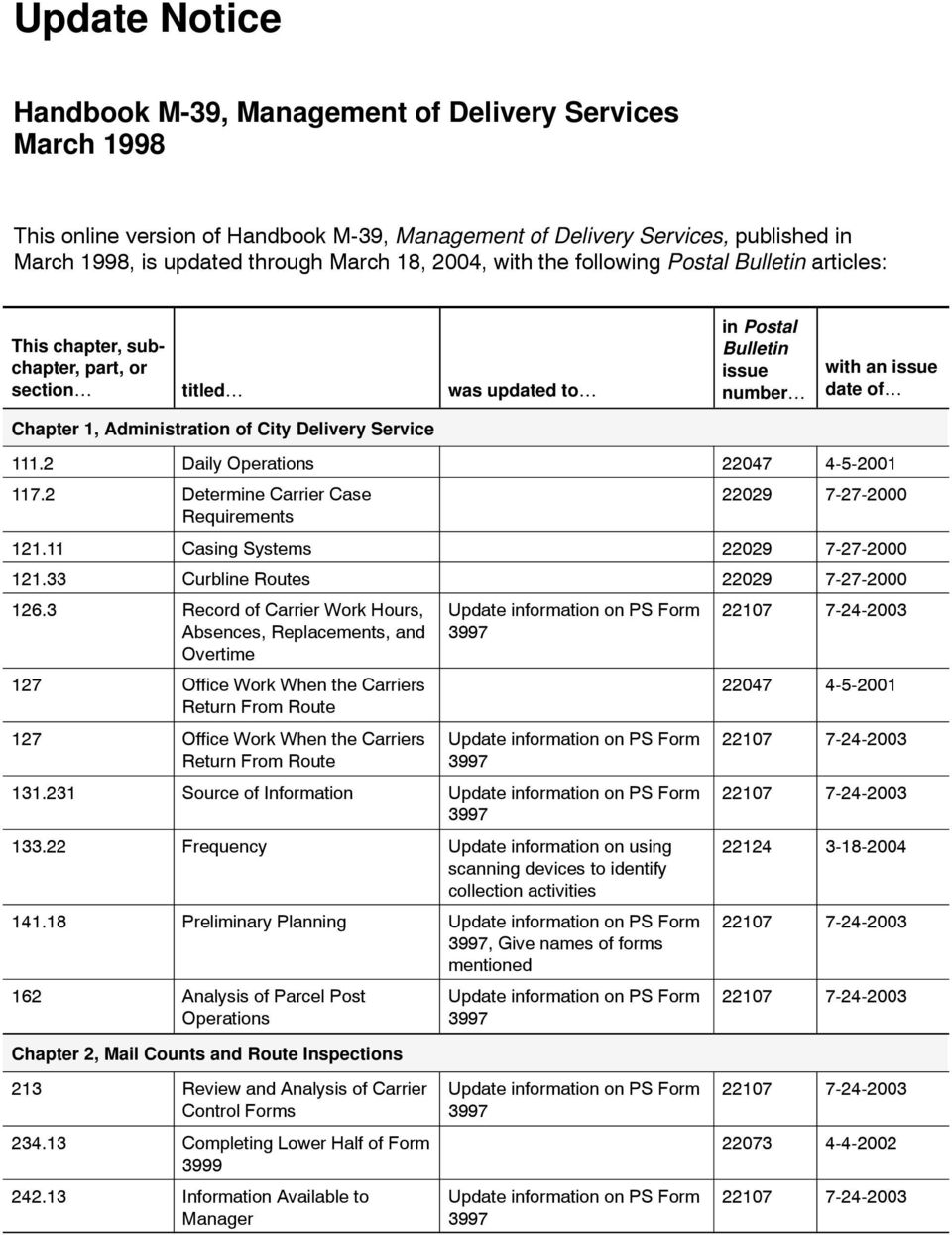
2 This chapter, subchapter, part, or section titled was updated to General Requirements Update information on PS Form PS Form 3997, Unit Daily Record Update information on PS Form 3997 in Postal Bulletin issue number with an issue date of

3 Management of Delivery Services Handbook M-39 March 1, 1998 Transmittal Letter 13 A. Explanation. This is a partial revision of Handbook M-39, Management of Delivery Services, that incorporates current postal forms and language and deletes forms and language made obsolete since Transmittal Letter 12 dated June 30, This revision is a complete issue of Handbook M-39. Discard all previous transmittal letters. B. Distribution 1. Initial. Handbook M-39 is being distributed directly to all post offices with city delivery service and to their classified stations and branches. 2. Additional Copies. Order additional copies as needed from the appropriate material distribution center. C. Questions and Comments. Suggestions and comments about this handbook should be sent to: DELIVERY OPERATIONS SUPPORT US POSTAL SERVICE 475 L ENFANT PLZ SW RM 7142 WASHINGTON DC D. Cancellations. All previous issues of Handbook M-39 are obsolete. E. Effective Date. This handbook is effective March 1, Nicholas F. Barranca Vice President Operations Support
4

5 Summary of Changes Summary of Changes Chapter 1, Administration of City Delivery Service Section 111.2n is updated to reflect the current Postal Operations Manual, Domestic Mail Manual, and Handbook M-41, City Delivery Carriers Duties and Responsibilities, references. Section b is updated to reflect the current use of Computerized Forwarding System (CFS) and deletes references to Central Markup (CMU). Section k is revised to incorporate the change to use CLASS case labels. Section is a clarification of the items that should be checked. Section 128 is a title change from Customer Service Management Data System (CSMDS) to Operations Analysis. Section updates the language for the current Form Section updates the language for the current Form Sections , , , and all incorporate language for the allowed use of the Edit Book. Sections 128.3, , and all update the language for the current Form Section is deleted because of reference to obsolete Form Section updates office responsible. Section makes reference to Chapter 3 for clarification. Section h updates management level responsible. Section updates management level responsible. Section updates management level responsible. Section 153 updates management level responsible. Section 153c deletes reference to SF-46 and adds valid state driver s license. Section deletes reference to obsolete Form 3997B. Section is renumbered to section 162 and updates analysis of Form Section 171.2a(1) updates management level responsible. Section 181.1a is updated to reflect the current use of Computerized Forwarding System (CFS) and deletes references to Central Markup (CMU). Reference is also made to UAA. Section 181.1b makes reference to UAA. Section 181.1c updates procedures for handling Forms 3575 and Section 181.1e identifies machinable and non-machinable separations. Handbook M-39, TL-13, iii

6 Summary of Changes Section 181.1g is updated to reflect the current use of CFS and deletes references to CMU. Section 181.1g(2) is updated to reflect the current use of CFS database and deletes references to CMU. Section 181.1g(3) is updated to reflect the current use of CFS and deletes references to CMU. Section 181.1h is updated to reflect the current use of CFS and deletes references to CMU. Section 181.1h(2) incorporates language for Form 3575-Z. Section 182 is updated to reflect the current use of CFS and deletes references to CMU. Section 182a is updated to reflect the current use of CFS and deletes references to CMU. Section 182c is updated to reflect the current use of CFS and deletes references to CMU. Section 182e is updated to incorporate the term imaging. Chapter 2, Mail Counts and Route Inspections Section 214a(7)(b) corrects exhibit reference. Section 214a(7)(c) incorporates language for the allowed use of the Edit Book. Section 214a(8) adds language to review DPS procedures. Section 216.2f adds language to provide Standard Operating Procedures to managers. Section clarifies language for data to use. Section is updated to incorporate the use of Form 3999-X. Section corrects headquarters office name. Section corrects reference to read Section corrects reference to read pp Section a updates recording procedures of DPS volume. Section g updates accounting procedures of DPS pieces. Section i updates mail classification. Section is updated to reflect the current use of CFS and deletes references to CMU and recording procedures of DPS pieces. Section is updated to reflect the current use of CFS and deletes references to CMU. Section is updated to reflect the current use of CFS and deletes references to CMU. iv Handbook M-39, TL-13,

7 Summary of Changes Section b is updated to reflect the current use of CFS and deletes references to CMU and recording procedures of DPS pieces. Section i incorporates language for the allowed use of the Edit Book. Section n incorporates language for the allowed use of the Edit Book. Section j deletes reference to SF-46. Section 241 deletes reference to exhibit page 3, changing it to section Section is updated to incorporate T-6. Section is updated to incorporate T-6. Section l is updated to include DPS pieces. Section is updated to reflect the current use of CFS and deletes references to CMU. Sections 242.4e, 242.4f, and correct all exhibit references to be l. Section is updated to reflect the current use of CFS and deletes references to CMU. Section is updated to reflect the current use of CFS and deletes references to CMU. Section incorporates language for the allowed use of the Edit Book. Section is updated to incorporate T-6. Section deletes reference to obsolete Form 3921-A. Chapter 3, Unit Summary of City Delivery Routes Chapter 3 is totally re-written to account for revised Form Exhibits Exhibit is revised. Exhibit is revised. Exhibit is revised. Exhibit is reserved for form being changed. Exhibit incorporates current form. Exhibit is revised. Exhibit 213d (pages 1, 2, 3, and 4) is revised. Exhibit 213e is revised. Exhibit (page 1) incorporates current version. Exhibit (pages 1 and 2) is revised. Exhibit (pages 3, 4, and 5) incorporates current version. Exhibit is revised. Handbook M-39, TL-13, v

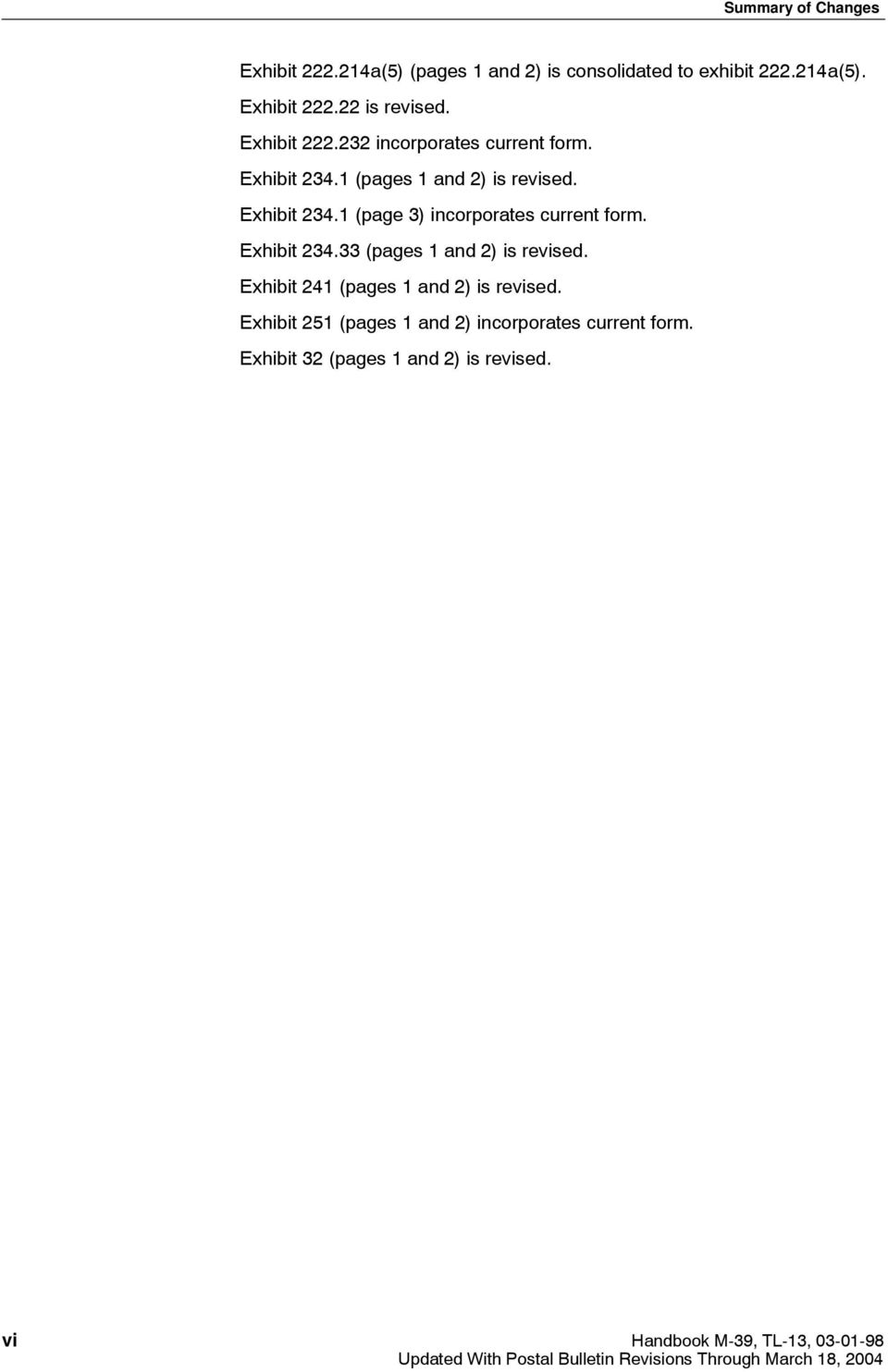
8 Summary of Changes Exhibit a(5) (pages 1 and 2) is consolidated to exhibit a(5). Exhibit is revised. Exhibit incorporates current form. Exhibit (pages 1 and 2) is revised. Exhibit (page 3) incorporates current form. Exhibit (pages 1 and 2) is revised. Exhibit 241 (pages 1 and 2) is revised. Exhibit 251 (pages 1 and 2) incorporates current form. Exhibit 32 (pages 1 and 2) is revised. vi Handbook M-39, TL-13,
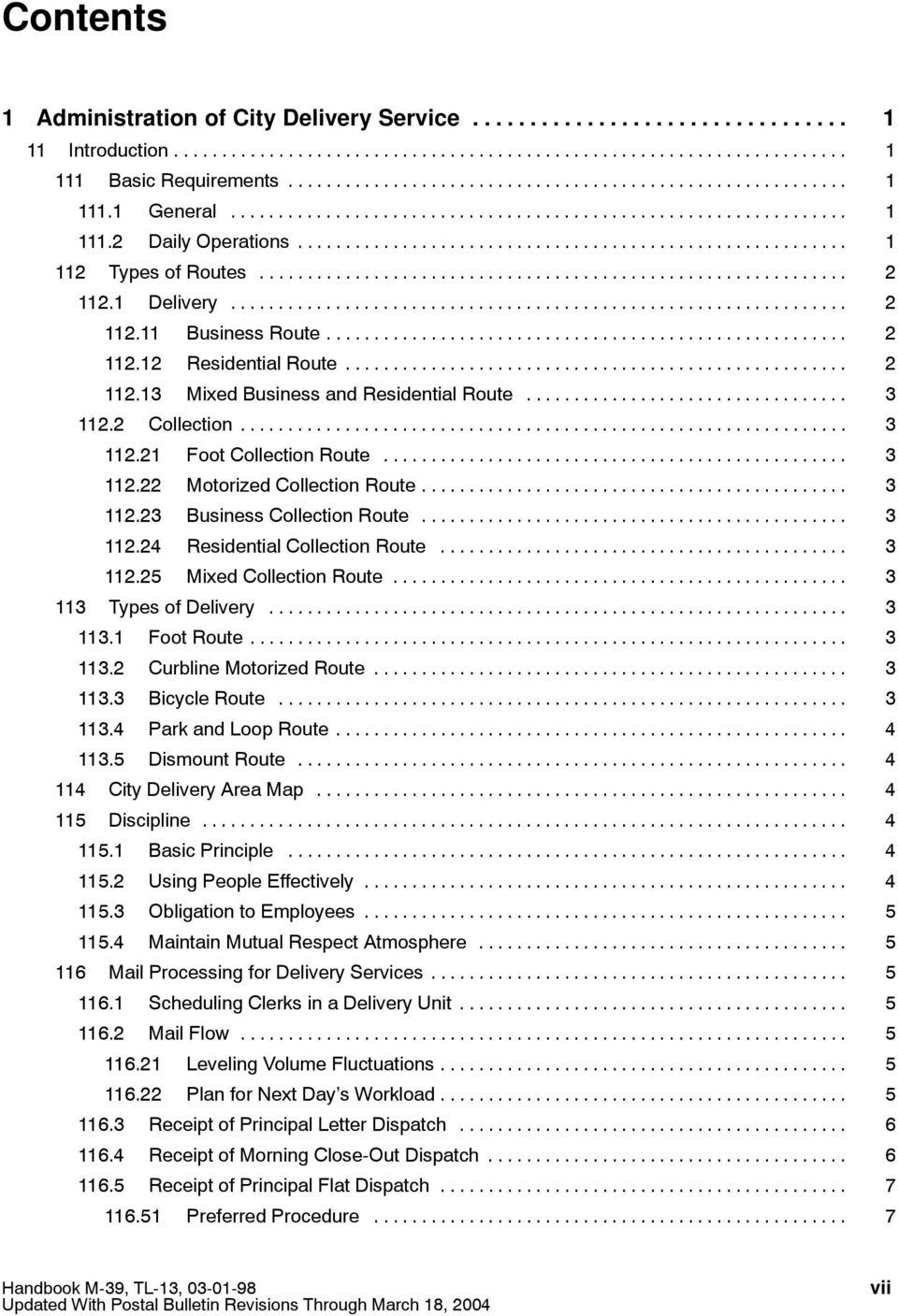
9 Contents 1 Administration of City Delivery Service Introduction Basic Requirements General Daily Operations Types of Routes Delivery Business Route Residential Route Mixed Business and Residential Route Collection Foot Collection Route Motorized Collection Route Business Collection Route Residential Collection Route Mixed Collection Route Types of Delivery Foot Route Curbline Motorized Route Bicycle Route Park and Loop Route Dismount Route City Delivery Area Map Discipline Basic Principle Using People Effectively Obligation to Employees Maintain Mutual Respect Atmosphere Mail Processing for Delivery Services Scheduling Clerks in a Delivery Unit Mail Flow Leveling Volume Fluctuations Plan for Next Day s Workload Receipt of Principal Letter Dispatch Receipt of Morning Close-Out Dispatch Receipt of Principal Flat Dispatch Preferred Procedure Handbook M-39, TL-13, vii
10 Contents Second Priority Third Priority Fourth Priority Fifth Priority Sixth Priority Carrier Withdrawal of Letters and Flats Mail Available on Return to Office Segmentation of Mail Definition Identifying Potential Segmentations for Distribution Segmentations Requested but Not Made by Mail Processing Segmentations Made by Carriers Parcel Post Receipt of Parcel Post Parcel Post Received in Sacks Made Up to Route Parcel Post Distributed to Routes at the Unit Undistributed Parcel Post at the Unit Utilizing Work Area and Equipment Workroom Floor Layout Determine Carrier Case Requirements Equipment Authorized at Detached Units Distribution Cases Approved Items for Casing Flats Carrier Case Labeling Satchel Carts Assignment Follow-Up Office Work Routine Carrier Work Methods Office Casing Mail Casing Systems Letter Mail Defined General Letter Mail Presequenced Letter Mail and Address Cards Flats and SPRs Pulling Down Flats Collating Presequenced Mailings Special Instructions Expedited Preferential Mail Morning viii Handbook M-39, TL-13,

11 Contents Afternoon Multi-Receptacle Delivery Definition Mailroom or VIM Installations Mail Having Incomplete Address Pulling Down Cased Mail Foot Routes Flats Letters Preparing Relays Loading the Carrier Satchel Park and Loop and Drive-Out Routes Curbline Routes Scheduling Carriers Establishing Schedules Carriers Leaving Schedules Establishing Leaving Schedule Maintaining Leaving Schedule Authorizing Overtime and Auxiliary Assistance Providing Relay Service General Weighing Relays Testing Determining Need for Relay Points Parking Area Assign Spaces to USPS Vehicles Priorities for Parking Area Access Limitation on Employee Parking Carrier Work Methods Street Loading Carrier Vehicles Loading Times General Daily Supervision Load at Assigned Space Transport Mail to Vehicles Sequence Parcels When Loading Authorized Lines of Travel Carrier Satchel Required Use Loading the Satchel Park in Designated Location Handbook M-39, TL-13, ix
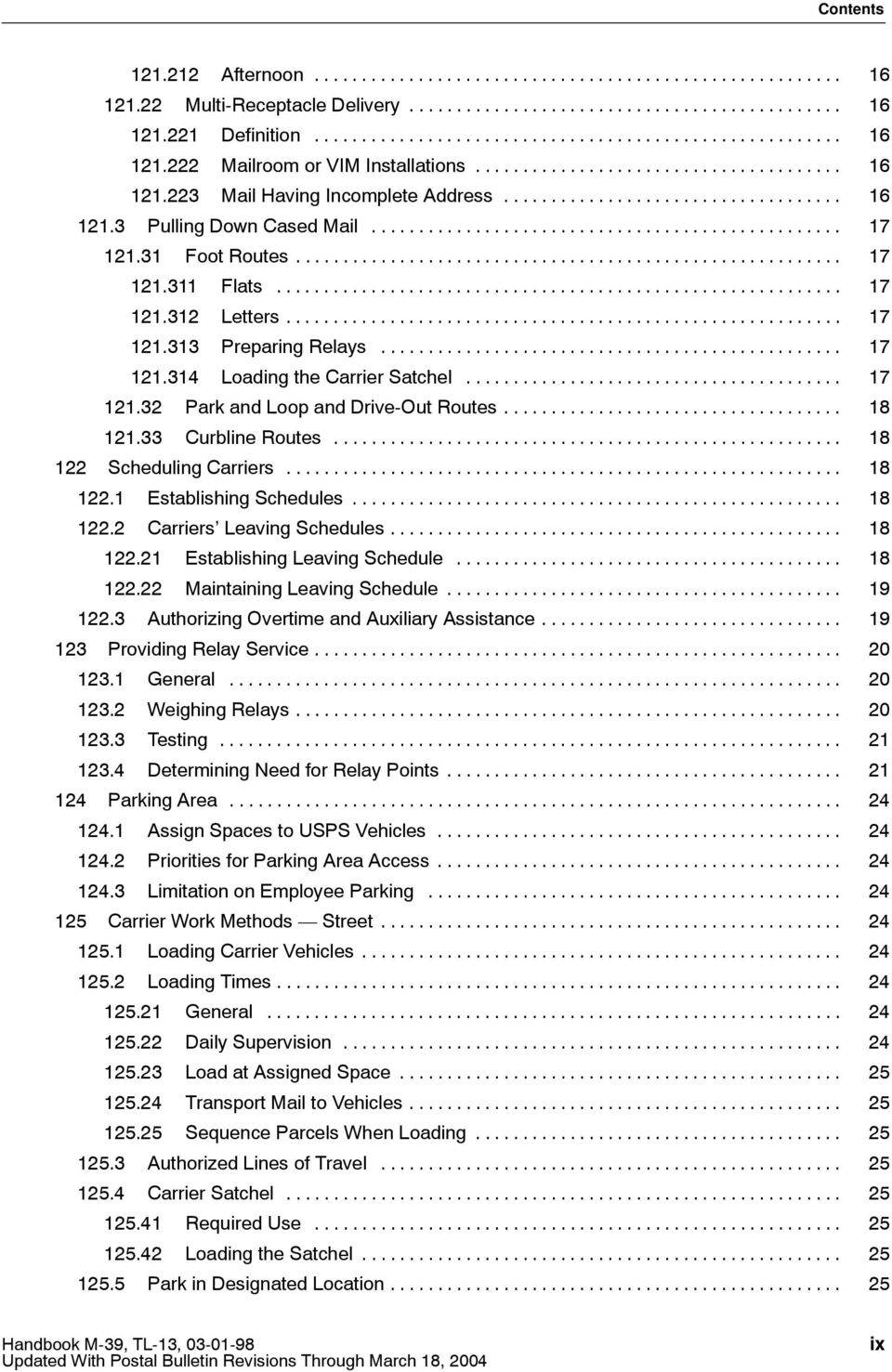
12 Contents Finger Mail Parcel Delivery Curbline Delivery Serve Boxes from Vehicle Maintain Orderly Cargo Area Collection of Mail Private Receptacles Collection Boxes Barcode or Similar* Tracking Systems Office Work While Carrier Is on Route Review of Work Area Analysis of Curtailed Mail Record of Carrier Work Hours, Absences, Replacements, and Overtime Report of Late Leaving and Returning Review of Carrier Cases and Work Area Office Work When Carriers Return From Route Operations Analysis Preparing Form Source Documents for Form Analyzing and Using Form Barcode or Similar Data Systems and Related Software/Hardware Analyzing Operations Carrier Operations Timing of Analysis Types of Analyses Late Leaving and Returning Source of Information Preparing the Analysis Form Analyzing Form Auxiliary Assistance and/or Overtime Given to Route Source of Information Preparing the Analysis Analyzing the Form Hours Used on Auxiliary Route Source of Information Preparing the Analysis Analyzing the Form Evaluating Employees Mail Curtailed Source of Information Preparing the Analysis Form x Handbook M-39, TL-13,

13 Contents Analyzing the Form Review of Collection Service Policy Considerations Barcode and Similar Data Collection Devices Collection Service Checklist Tests Purpose Frequency Selecting Test Points Test Day Test Card and Form Recovery of Cards Test Mailing Record, Form Analysis and Corrective Action Street Management Objectives Techniques Criteria for Need Findings Safety Adjustments Minor Adjustments Route Adjustment Without Special Inspection Minor Adjustments Office Routines Street Management Segmentations Distribution When to Consider Making Minor Adjustments Advance Preparation Preliminary Planning Formula for Making Minor Adjustments Special Office Mail Counts Extension of City Delivery Service Requirements for Extension Definitions Extensions Ingrowth Action After Approval Handbook M-39, TL-13, xi
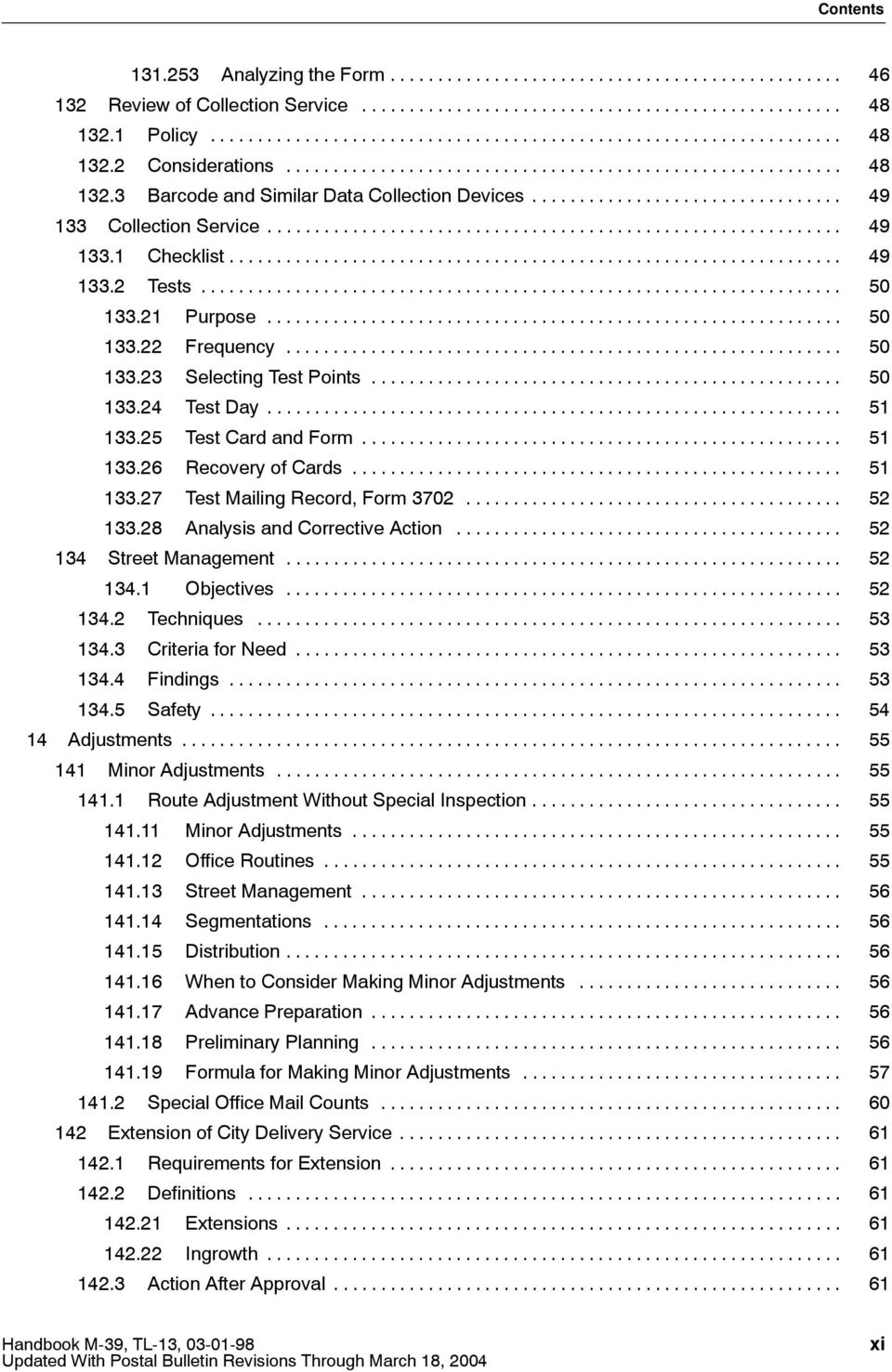
14 Contents 143 (Reserved) Expedited Preferential Mail Delivery Program Description Approval Management Advantages Customer Benefits Operational Review Route Adjustments Implementation Coordination with Mail Processing Transportation VIM (Vertical Improved Mail) What VIM Applies To Three Versions Planning Early Maintain High Degree of Efficiency City Delivery Service Motorization Surveys Selection of Vehicles Preparation for Conversion Route Inspections Parcel Post Parcel Post Delivery Requirements Analysis of Parcel Post Operations Review of Sack Routing System Travel and Transportation of Carriers City Carrier Transportation Agreement Administration Travel Time Distances Relays Purpose Guidelines Termination of Transportation Agreements Transit Agreement (Public Transportation) Administration Annual Review Review Between Annual Renewal Dates Authentication for United States Postal Service Cancellation Emergency Vehicle Hire xii Handbook M-39, TL-13,
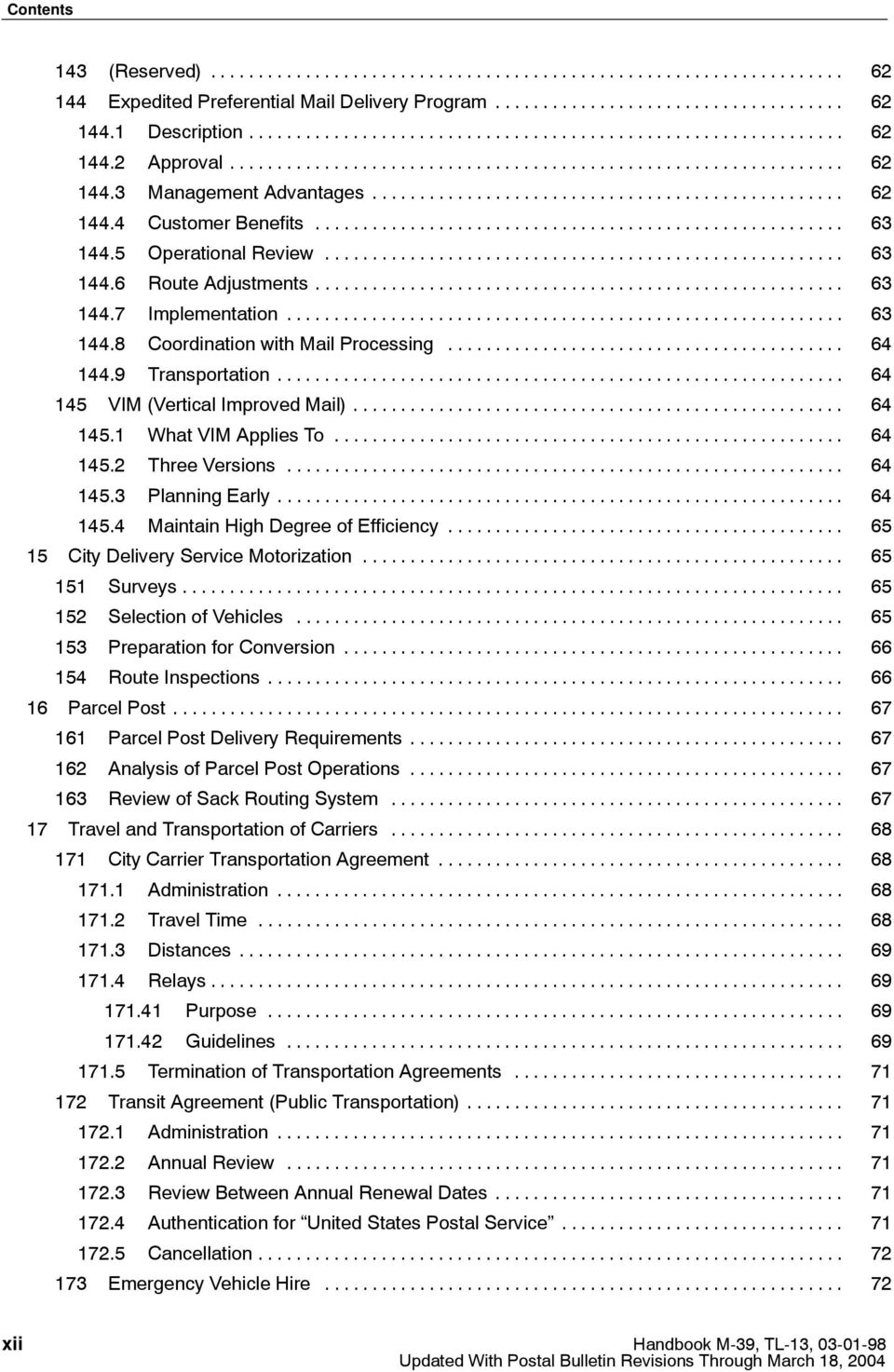
15 Contents 18 Quality Control Guidelines Undeliverable as Addressed Mail Delivery Units All Responsibilities of the Delivery Unit Supervisor Frequent Reviews Computerized Forwarding Units Other Units Attempted, Not Known Mail Street Delivery Post Office Box Delivery Mail Counts and Route Inspections Advance Preparations Selecting Period for Mail Counts and Route Inspections Responsibility for Advance Preparations Review and Analysis of Carrier Control Forms Review of Operating Procedures Posting Notice of Scheduled Mail Count and Inspection Managers Assignments and Responsibilities Dry-Run Count Estimating an Office Time for DPS Planning Purposes Conducting the Count of Mail Schedules and General Rules Governing Count Letter Routes Schedule Use of Forms General Rules for Making Count Parcel Post and Combination Services Routes Schedule Use of Forms Collection Routes Completion of Forms 1838, 1838-A, 1838-B, and 1838-C Worksheets Summaries Letter Routes non-epm and CMU Letter Routes EPM with CFS Parcel Post and Combination Services Routes Collection Routes Disposition of Forms 1838, 1838-A, 1838-B, and 1838-C Forms 1838 and 1838-C Forms 1838-A and 1838-B Handbook M-39, TL-13, xiii

16 Contents 23 Conducting the Route Inspection General Conduct of Route Examiner Cancelling Inspection Record and Evaluation Letter Routes Describing Forms Used Completing Upper Portion of Form Completing Lower Half of Form Completion of Reverse of Form Parcel Post and Combination Services Routes Preparing Forms Observation and Evaluation Collection Routes Purpose of Combined Count and Inspection Observation of Collector s Work Preparing Form 3999-B Inspection of Collection Route Analysis and Adjustments Letter Routes Summary of Count and Inspection Purpose Coverage Preparing Form Providing Carrier With Summary Evaluation and Analysis General Importance of Route Adjustments Basic Standards Information Available to Manager Analysis of Irregular Performance Office Time Street Time Evaluating the Route Office Time Street Time Office Time Allied Work Rules Street Time Allied Work Rules Carrier Timecard Analysis, 8 Week Comparison Comparative Analysis With Preceding Count and Inspection (exhibit l) Review Comparative Factors Carrier s Office Time xiv Handbook M-39, TL-13,
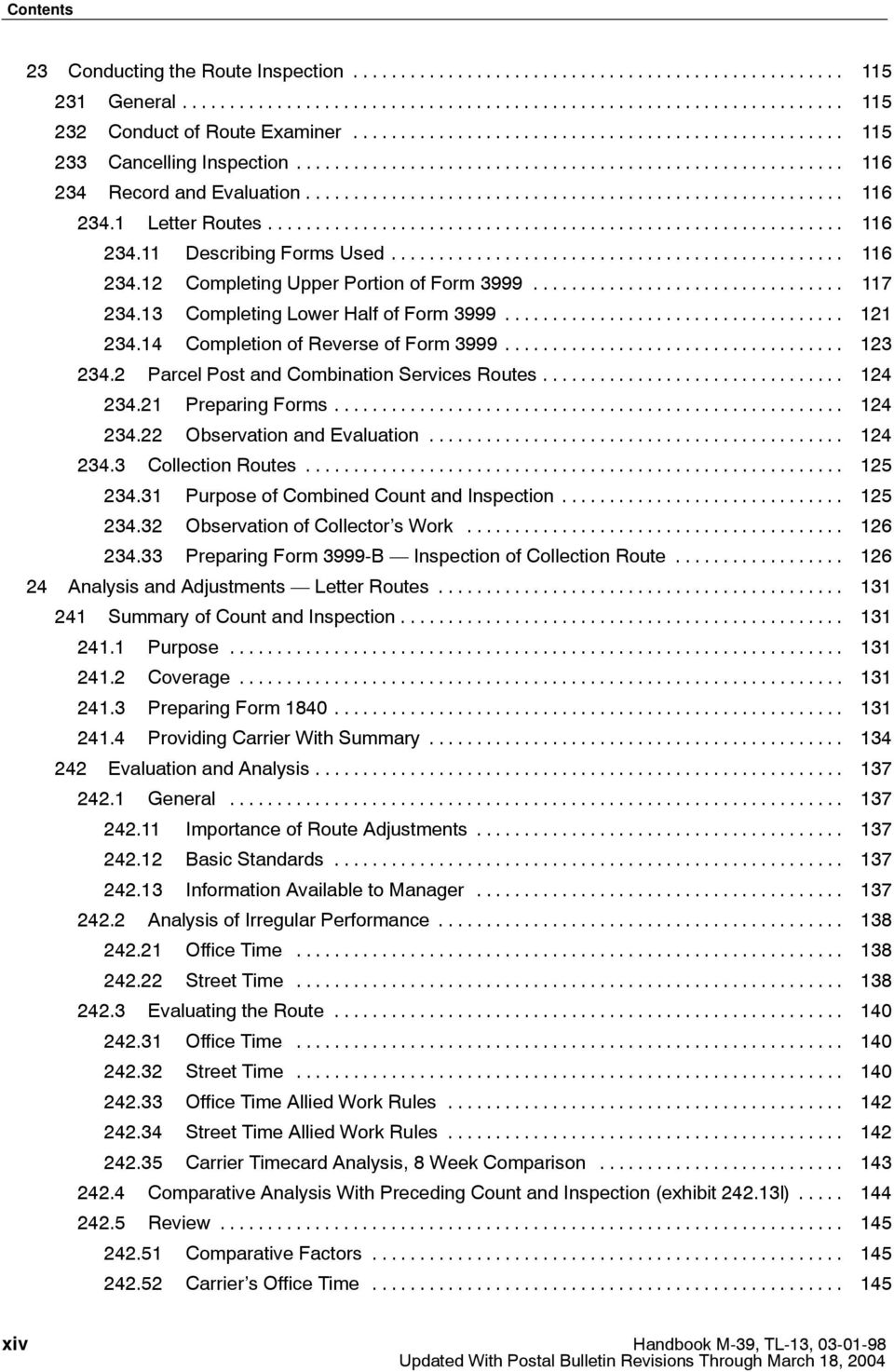
17 Contents Transportation Street Time Adjustment Procedures Preliminary Plans Unilateral Method X-Route Alternative Providing Relief to Routes Routes of More than 8 Hours Route Less than 8 Hours Transferring Territory Avoiding Excessive Overtime or Undertime Record of Office and Street Adjustments Made (Form 1840 exhibit 241, page 1) Completing Reverse of Form Signature and Date Tabulation of Overall Relief or Additional Time Required Scheme Changes Evaluation of Adjustments General Requirements Time Records Form 3997, Unit Daily Record, or PSDS Printout Form 3923, Daily Delivery Operations Analysis Form 1813, Late Leaving and Returning Report First Carrier Delivery Trip, or PSDS Printout Street Management Records Volume Record Data Corrective Action Disposition of Forms Analysis and Adjustments Parcel Post and Combination Services Routes Summary of Carrier s Count of Mail, Parcel Post, and Combination Services Description Completing Form 1840-A Top of Form Time and Mail Volume Portion of Form Relay, Collection, Firms, Inter- and Intra-City Service Totaling and Average Columns Reverse Side of Form 1840-A Consultation With Carrier Office and Street Adjustments Comments Verification of Mail Count and Time Items Disposition of Forms 1840-A Handbook M-39, TL-13, xv

18 Contents 26 Analysis and Adjustments Collection Routes Evaluation Basic Principles Elimination of Improper Practices Recommendations of Route Examiner Adjustments Consultation With Carrier Disposition of Form 3999-B Special Route Inspections When Required Manner in Which Conducted Unit Summary of City Delivery Routes Purpose General Description of Form Before and After Adjustments Daily Average Workhours Preparing Form Letter Carrier Routes (Section 1 on Form 3998) Full-Time Regular Routes Auxiliary Routes and Router Assignments Totals Action Taken to Eliminate Excess Office Time Possible Deliveries Total Possible Deliveries Delivery Volumes Parcel Post and Combination Services Routes Full-Time Regular Routes Auxiliary Routes Auxiliary Assistance to Complete Deliveries Parcel Post Volume Collection Routes Full-Time Regular Routes Part-Time Routes Totals Collection Pickups Inter- and Intra-City Service Routes Unit Summary and Review Service Improvements Personnel Assignment Summary xvi Handbook M-39, TL-13,

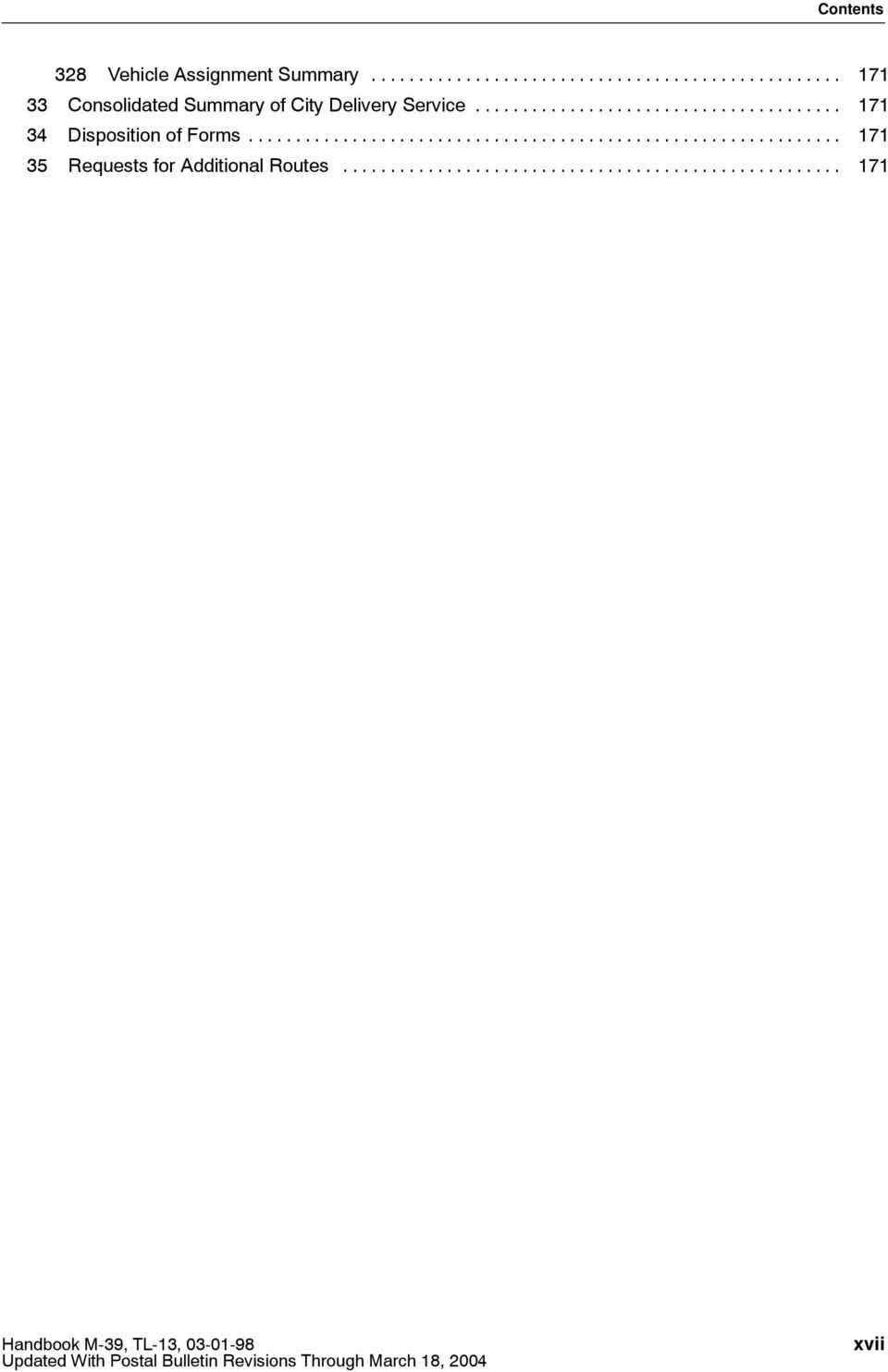
19 Contents 328 Vehicle Assignment Summary Consolidated Summary of City Delivery Service Disposition of Forms Requests for Additional Routes Handbook M-39, TL-13, xvii
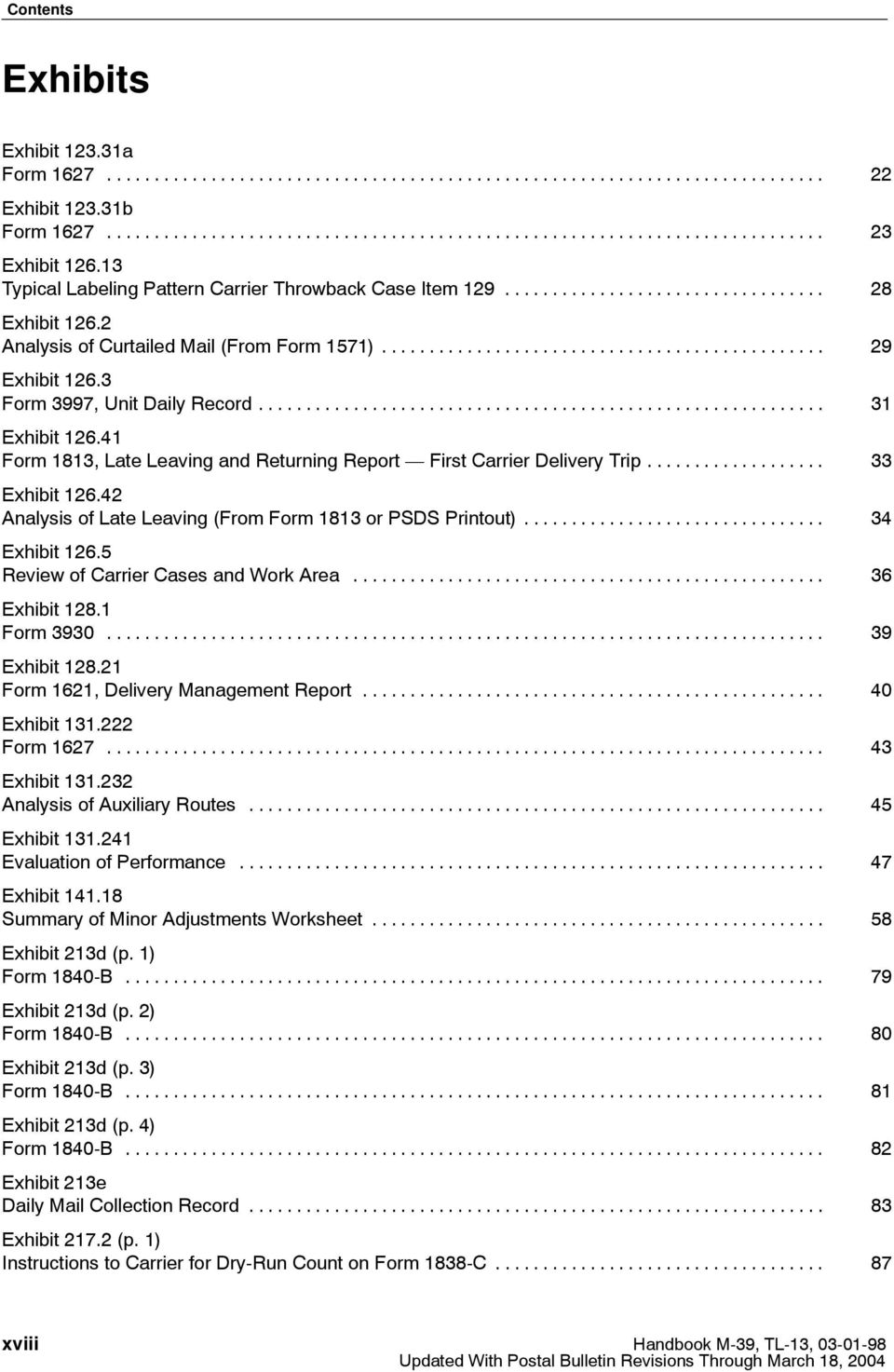
20 Contents Exhibits Exhibit a Form Exhibit b Form Exhibit Typical Labeling Pattern Carrier Throwback Case Item Exhibit Analysis of Curtailed Mail (From Form 1571) Exhibit Form 3997, Unit Daily Record Exhibit Form 1813, Late Leaving and Returning Report First Carrier Delivery Trip Exhibit Analysis of Late Leaving (From Form 1813 or PSDS Printout) Exhibit Review of Carrier Cases and Work Area Exhibit Form Exhibit Form 1621, Delivery Management Report Exhibit Form Exhibit Analysis of Auxiliary Routes Exhibit Evaluation of Performance Exhibit Summary of Minor Adjustments Worksheet Exhibit 213d (p. 1) Form 1840-B Exhibit 213d (p. 2) Form 1840-B Exhibit 213d (p. 3) Form 1840-B Exhibit 213d (p. 4) Form 1840-B Exhibit 213e Daily Mail Collection Record Exhibit (p. 1) Instructions to Carrier for Dry-Run Count on Form 1838-C xviii Handbook M-39, TL-13,
21 Contents Exhibit (p. 2) Instructions to Carriers for Dry-Run Count on Form 1838-A Exhibit (p. 3) Instructions to Carriers for Dry-Run Count on Form 1838-A Exhibit (p. 1) Form 1838-C, Carrier s Count Mail Letter Carrier Routes Worksheet Exhibit (p. 2) Form 1838-C, Carrier s Count Mail Letter Carrier Routes Worksheet Exhibit (p. 3) Form 1838-B, Parcel Post Firm Delivery Worksheet Exhibit (p. 4) Carrier s Count of Mail Parcel Post and Combination Services Worksheet/Management Summary Exhibit (p. 5) Carrier s Count of Mail Parcel Post and Combination Services Worksheet/Management Summary Exhibit Form 1838, Carrier s Count of Mail Letter Carrier Routes (Mngt. Summary) Exhibit a(4) Time Allowances for Carrier Office Work Exhibit a(5) Maximum Time Allowance For Routing Mail Column (A): Letter-size (ordinary letters, cards, and circulars). Column (B): Mail of all other sizes and insured Exhibit Form 1838, Carrier s Count of Mail Letter Carrier Routes Exhibit Form 1838-B, Parcel Post Firm Delivery Worksheet Exhibit (p. 1) Form 3999, Inspection of Letter Carrier Route Exhibit (p. 2) Form 3999, Inspection of Letter Carrier Route Exhibit (p. 3) Form 3999-A, Deliveries/Inspection Record Worksheet Exhibit (p. 1) Form 3999-B, Inspection of Collection Route Exhibit (p. 2) Form 3999-B, Inspection of Collection Route Exhibit 241 (p. 1) Form 1840, Carrier Delivery Route Summary of Count and Inspection Exhibit 241 (p. 2) Form 1840, Carrier Delivery Route Summary of Count and Inspection Exhibit l Comparative Analysis of Form Handbook M-39, TL-13, xix
22 Contents Exhibit Recap of Regular Routes for Adjustment From Form Exhibit Form Exhibit 251 (p. 1) Form 1840-A, Summary of Carrier s Count of Mail Parcel Post and Combination Services Exhibit 251 (p. 2) Form 1840-A, Summary of Carrier s Count of Mail Parcel Post and Combination Services Exhibit 311 (p. 1) Form 3998, Unit Summary of City Delivery Assignments Exhibit 311 (p. 2) Form 3998, Unit Summary of City Delivery Assignments xx Handbook M-39, TL-13,
23 1 Administration of City Delivery Service 11 Introduction 111 Basic Requirements General All delivery service managers are responsible for developing and maintaining their units at a high degree of efficiency and for assuring that USPS standards are maintained. Through these broad guidelines, plus skill, knowledge, and experience, delivery service managers can be aware of whether subordinate managers and delivery employees are achieving USPS goals of service to the public. Emphasis is placed upon the constant need for close coordination between mail processing and delivery managers so the most practical and cost effective work methods possible can be implemented Daily Operations The delivery service manager must on a daily basis: a. Perform and organize work to determine any irregularity in the flow of mail between distribution and delivery, and interact with other unit managers to work toward correcting this irregularity. b. Determine if carriers reporting, leaving, returning, and ending time is consistent with established schedules. c. Provide or continue training as needed. d. Evaluate daily service rendered by the employees. Observe carriers to assure their performance of duties as outlined in Handbook M-41, City Delivery Carriers Duties and Responsibilities. e. Report for duty in advance of delivery personnel and review daily workload, including mail yet unworked but which will be distributed in time for the day s delivery. Review any Forms 1571, Undelivered Mail Report, from the preceding day as well as the amount of mail on and around each carrier case. Estimate and record on the appropriate form(s) the daily workloads for each route. f. Assure that necessary vehicles are available. Handbook M-39, TL-13,
24 112 Administration of City Delivery Service g. Review all communications that may affect the day s workload, and be sure replacements are available for unscheduled absences. Develop contingency plans for situations that may interfere with normal delivery service. h. Assure that accountable items are properly handled, so as to facilitate delivery of the items, and that carriers are cleared in a timely manner upon return to the office. i. Determine need for auxiliary assistance, overtime or curtailment of mail, and determine the most economical manner of providing relief. j. Issue Form 1571 when the carrier is instructed to curtail mail, indicating action thereon. Upon request, a duplicate of the completed form will be provided the carrier. k. Determine cutoff time(s) for the various classes of mail and assure any missorted, missent mail available for delivery is taken by carriers. l. Level the workload of carriers by having them deliver other than preferential mail as promptly as practicable. Identify and manage mail in order of classification, type, and sequence of receipt. m. Review mail undeliverable as addressed to identify errors and maximize efficient handling procedures at delivery and central markup units. n. Maintain delivery unit control of mailing list services as provided in Postal Operations Manual (POM) and Domestic Mail Manual (DMM) A (Also in Handbook M-41, City Delivery Carriers Duties and Responsibilities, section ) o. Maintain a daily sequence of basic activities schedule to serve as a guide for replacement personnel, and to ensure that all required activities are accomplished in an organized manner. p. Maintain sort scheme for delivery zones in the unit as per local Delivery Point Sequencing (DPS) procedures. q. Maintain the data collection devices and supporting infrastructure. Make sure all data collection devices are in working order and information is downloading properly. 112 Types of Routes Delivery Business Route A foot or motorized route on which 70 percent or more of the possible deliveries are business establishments Residential Route A foot or motorized route on which 70 percent or more of the possible deliveries are residential. 2 Handbook M-39, TL-13,
25 Administration of City Delivery Service Mixed Business and Residential Route A foot or motorized route on which 30 to 69 percent of possible deliveries are business establishments. This may include a route on which business and residential deliveries are made on the first trip and the business area only is served on a second trip. To determine the percentage, consider total possible deliveries (counting business establishments only once) Collection Foot Collection Route A route where mail is collected from boxes by a carrier on foot. These routes generally serve downtown business sections Motorized Collection Route A route served by automotive vehicle. Shuttle trips made by a collector using a vehicle to pickup mail deposited at selected points by other collectors constitute motorized collection Business Collection Route A route where collections are made from boxes located mainly within business areas Residential Collection Route A route where collections are made from boxes located within territory that is mainly residential Mixed Collection Route A route which may perform a variety of collection and/or mail transport services. Examples are: combination intra-city box collection trips, business residential trips, and contract station-box collection trips. 113 Types of Delivery Foot Route A city delivery route served by a carrier on foot. A bicycle or other conveyance used solely as transportation to and from the route does not affect the status as a foot route Curbline Motorized Route A motorized city delivery route on which 50 percent or more of the possible deliveries are made to customer mailboxes at the curb Bicycle Route A city delivery route on which a bicycle is used to deliver mail. Handbook M-39, TL-13,
26 113.4 Administration of City Delivery Service Park and Loop Route A route that uses a motor vehicle for transporting all classes of mail to the route. The vehicle is used as a moveable container as it is driven to designated park points. The carrier then loops segments of the route on foot Dismount Route A city delivery route on which 50 percent or more of the possible deliveries are made by dismount delivery to the door, Vertical Improved Mail (VIM) Room, Neighborhood Delivery and Collection Box Units (NBU), Delivery Centers, etc. (If the dismount deliveries are less than 50 percent of the total possible deliveries of a route, the route will be classified as per the majority of the type delivery; e.g., curbline, park and loop, etc.) 114 City Delivery Area Map Each unit must have a map of the ZIP Code area served. Show the boundaries of each route using street names or numbers and identify each route by number. If desired, use different colors to show each route The unit manager can study the line of travel to discover possible improvement Location of collection and relay boxes can be shown. This will serve to determine the adequacy of the boxes and as instruction or reference to new carriers. 115 Discipline Basic Principle In the administration of discipline, a basic principle must be that discipline should be corrective in nature, rather than punitive. No employee may be disciplined or discharged except for just cause. The delivery manager must make every effort to correct a situation before resorting to disciplinary measures Using People Effectively Managers can accomplish their mission only through the effective use of people. How successful a manager is in working with people will, to a great measure, determine whether or not the goals of the Postal Service are attained. Getting the job done through people is not an easy task, and certain basic things are required, such as: a. Let the employee know what is expected of him or her. b. Know fully if the employee is not attaining expectations; don t guess make certain with documented evidence. c. Let the employee explain his or her problem listen! If given a chance, the employee will tell you the problem. Draw it out from the employee if needed, but get the whole story. 4 Handbook M-39, TL-13,
27 Administration of City Delivery Service Obligation to Employees When problems arise, managers must recognize that they have an obligation to their employees and to the Postal Service to look to themselves, as well as to the employee, to: a. Find out who, what, when, where, and why. b. Make absolutely sure you have all the facts. c. The manager has the responsibility to resolve as many problems as possible before they become grievances. d. If the employee s stand has merit, admit it and correct the situation. You are the manager; you must make decisions; don t pass this responsibility on to someone else Maintain Mutual Respect Atmosphere The National Agreement sets out the basic rules and rights governing management and employees in their dealings with each other, but it is the front-line manager who controls management s attempt to maintain an atmosphere between employer and employee which assures mutual respect for each other s rights and responsibilities. 116 Mail Processing for Delivery Services Scheduling Clerks in a Delivery Unit Schedule distribution clerks in a unit with decentralized distribution so that service standards will be met and an even flow of mail will be provided to the carriers each day throughout the year. Schedule the accountable clerk to avoid delaying the carriers departures in the morning and for clearance of carriers on their return to the office Mail Flow Leveling Volume Fluctuations When volumes for daily delivery vary substantially from the lightest to the heaviest day in the week, a unit cannot operate at maximum effectiveness. Substantial changes in the daily relationships of flats and letters have considerable effect on delivery costs. If this situation exists, the unit manager must document the problem and request, through appropriate management channels, a more even flow of mail Plan for Next Day s Workload Each day as early as is practical, using procedures developed locally, the delivery unit manager should obtain information about anticipated volumes, especially flat volumes for the next day s delivery. This information will assist in planning the next day s manpower needs. Anticipating the flow of mail will minimize undertime and overtime which can be controlled. If undertime occurs often in the morning or afternoon, examine the mail flow, the scheduling of the delivery unit s clerks and carriers, and the affected routes. Handbook M-39, TL-13,
28 116.3 Administration of City Delivery Service Receipt of Principal Letter Dispatch Carriers should not sweep distribution cases upon reporting for work. Rather, they should proceed directly from the time recording area to their cases and without delay begin casing mail which is already at their cases. The following priorities have been established for various procedures by which the first receipt of mail from the distribution unit reaches the carriers. These procedures are listed in the order of decreasing cost effectiveness: a. Preferred Procedure. Letter-size mail is placed on the left side of the carrier case ledge one row high with stamps down and to the right. The carrier may then pick up a handful with the left hand and begin casing without repositioning the letters. b. Second Priority. Letter-size mail, trayed separately for each route with stamps down and to the right, is placed at the carrier case. If this is not possible, a tray cart (or other suitable item used to transport trays) should be placed as close to the carrier cases as possible with the trays identified by route. Empty trays, if needed for later use, may be stored under the carrier s case. Carriers must work mail directly from trays if the letters are trayed with stamps down and facing to the right. Note: If letter mail is not worked directly from trays (second priority), require Mail Processing to tray letters with stamps up and facing one direction so that, when the tray is flipped over on the carrier case ledge, the letters will be in the proper position: i.e., stamps down and facing to the right. c. Third Priority. Letters, faced and loose-packed in No. 3 sacks for individual routes, with each sack identified by route number, are at the carrier s case when he or she reports for work. Empty sacks, if needed for relays when casing is completed, may be stored under the carrier s case. d. Fourth Priority. Mail, which is tied in bundles, is placed at the carrier s case. e. Fifth Priority. Sacks containing bundles of mail and identified by route number are transported to the carrier s case. Carriers dump the sacks, check the bundles, and place the letters on the ledge. If empty sacks will be needed when casing is completed, they may be stored under the carrier s case Receipt of Morning Close-Out Dispatch When mail is distributed elsewhere for a delivery unit, the morning close-out dispatch is typically very light and is received loose in trays or tied in bundles. If mail is trayed separately and is identified for each route, it should be taken to the carriers cases. Otherwise, carriers may obtain it from a central point, except that Delivery Point Sequence mail will be handled in accordance with the DPS procedures established for the unit. 6 Handbook M-39, TL-13,
29 Administration of City Delivery Service Receipt of Principal Flat Dispatch Preferred Procedure Flat mail, faced and loose in trays, is placed at the carriers cases so that the carriers can put a tray on the case ledge and sort directly from the tray, picking up approximately 6 inches of flats at a time Second Priority Flat mail, faced and loose in trays and identified by route number, is placed as close to the carrier s work area as possible where carriers can readily obtain them. If empty trays will be needed later, they may be stored under the carrier s case Third Priority Flat mail, faced and loose in hampers, is placed as close to the carrier s work area as convenience permits Fourth Priority Flat mail, faced and loose packed in bundles identified by route number, is placed at the carrier s case. After the ledge is loaded with tied bundles, the bindings are removed Fifth Priority Flat mail, faced and loose packed in No. 3 sacks, is placed as close to the carrier s case as possible. If empty sacks will be needed after casing, they may be stored under the carrier s case Sixth Priority Flat mail, faced, tied in bundles and loaded in sacks for each route, is placed close to the carriers cases Carrier Withdrawal of Letters and Flats Carriers may be authorized to make up to two withdrawals from the distribution cases prior to leaving the office, plus a final cleanup sweep to include Delivery Point Sequence mail as they leave the office Mail Available on Return to Office Mail received or distributed while carriers are on their routes should be on the carriers cases when they return to the office. Carriers having undertime when they return may be required to withdraw and case mail available at that time. If undertime occurs frequently, the delivery unit manager must determine the cause and take corrective action Segmentation of Mail Definition A major characteristic of the ZIP+4 data file is the segment, or the smallest unit to which distribution can be made. Segmentation is the sortation or Handbook M-39, TL-13,
30 Administration of City Delivery Service preparation of mail into clusters or groupings for the purpose of achieving greater processing and/or carrier sortation efficiency. Using the ZIP+4 segment concept, segmentations may be prepared by customers or contract personnel prior to entry, or in postal operations prior to dispatch or receipt by the carrier. Examples of segmentations include but are not limited to mail grouped by: unique ZIP+4 code, ZIP+4 blockface, multi-tenant buildings, box sections (including Neighborhood Delivery and Collection Box Units), or individual addresses Identifying Potential Segmentations for Distribution Efficiency should be the determining factor when selecting segmentations which should be prepared for distribution, with consideration for factors such as mail volume, workhours, possible deliveries, address hygiene, and other operational or service needs. The delivery unit manager must periodically review existing segmentations for carrier routes. This may result in the establishment of more segmentations or the replacement of current ones Segmentations Requested but Not Made by Mail Processing Where the delivery unit manager determines a need for segmentations by Mail Processing but there are operational or time constraints which prevent implementation, Customer Services or Delivery Services should perform the sortation using the most efficient methods and equipment available or obtainable Segmentations Made by Carriers When a carrier is required to segment mail for a high volume delivery point, consider locating a separation large enough to accommodate the mail volume. This separation may be located in the lower, easy to reach, portion of the case, not necessarily in the sequence of delivery. The label under the separation must clearly indicate the address and/or ZIP+4 code of the separation Restrictions. Carriers must not distribute individual letters or flats directly to sacks or other containers Parcel Post Receipt of Parcel Post The receipt of parcel post at the delivery unit can have a substantial impact on the overall efficiency of carrier operations. There are two ways parcels may be made up: (1) parcels may be received in sacks for individual routes, or (2) they may come undistributed to routes. Either way, parcels are needed early in the morning, since otherwise the carriers leaving times could be delayed. Early availability of parcel post also permits the delivery unit manager to direct carriers to load vehicles with parcels earlier on light days if undertime occurs Parcel Post Received in Sacks Made Up to Route When parcels are received at the unit in sacks made up to carrier route, sacks for each route should be placed in a designated location on the line of 8 Handbook M-39, TL-13,
31 Administration of City Delivery Service travel from the carrier case to the vehicle. Sacks and outsides must be clearly identified and carriers must not be required to sort through sacks or parcels looking for mail for the route Parcel Post Distributed to Routes at the Unit If parcels are to be distributed at the delivery unit, they may be sorted directly into hampers identified by route numbers. The use of large enough hampers will permit the carrier to put other mail on top of the parcels and make one trip to the vehicle Undistributed Parcel Post at the Unit Whether or not parcels from early dispatches are received, distributed to routes, or are distributed in the unit, some undistributed parcels may be included in the close-out dispatch. These parcels are to be worked and placed with the other parcels for each route. If the late arrival of parcels causes operating difficulties, the delivery unit managers must use appropriate channels to inform mail processing managers of the need for advancing the arrival of parcels at the delivery unit. 117 Utilizing Work Area and Equipment Workroom Floor Layout The workroom floor must be arranged to minimize walking and to facilitate an orderly flow of mail and equipment. Attention must also be given to selection and layout of authorized equipment that will be used by carriers at a detached unit (e.g., a carrier-staffed mailroom in a large office building) as follows: a. Time Recording Equipment. Locate along the normal line of travel to and from the carriers cases and the doors to the loading area or exit from the office. b. Vehicle Timecards and Keys. Locate adjacent to the time-recording equipment. c. Throwback Cases. Place to minimize walking. For example, put one throwback case at the end of every other aisle. d. Central Markup Case. Where practical, locate the central markup case or deposit point on the carriers line of travel to the distribution case or exit. e. Collection Mail Deposit Point. Locate on the carriers line of travel from the time recording area to the accountable cage. f. Aisle Width. Aisles should be wide enough for passage by the carrier and any necessary equipment. g. Relay Deposit Point. Designate an area for carriers to deposit filled relay sacks. For example, designate an area at one end of each aisle. h. Accountable Mail Cage. Locate where it will be near the carriers while permitting the clerk to do other work when not serving carriers. Do not require the carriers to make more than one stop for available Handbook M-39, TL-13,
32 117.2 Administration of City Delivery Service accountables and keys. An optional method for use in the morning is to take available accountable letters, flats, parcels, keys, change, etc., to the carriers using a suitable conveyance capable of holding all these items. Aisles must be wide enough to permit passage of this equipment. i. Markups. Carriers will place mail sorted to required removal categories (such as: Moved Left No Address, Attempted, Not Known, No Such Number, and No Obvious Value Mail, etc.) in the throwback cases as they depart for their route. They will also leave undeliverable as addressed mail, sorted to A to Z separations, in the designated location at that time. j. Lighting. Lighting should be satisfactory with maximum utilization of existing fixtures. k. Hold Mail. Instruct the carrier to place hold mail in a central location only when space is not available at the carrier s case. l. Equipment Used Daily. Sufficient sacks, trays, straps, satchels, hampers, forms, and other equipment needed by carriers must be readily accessible. Equipment used daily, such as hampers, may be marked with the route number except when this restricts operation s effectiveness and equipment utilization. m. Rarely Used Equipment. Do not store rarely used or temporarily surplus equipment in prime space Determine Carrier Case Requirements Carrier case, Item 124, is the basic letter case for use on all letter carrier routes. The delivery unit manager must determine the need for wing cases for letter mail (Items 143 or 144) using criteria outlined below: a. Case Configurations. Carrier cases will be six (6) equally spaced shelves for casing letters in a non-dps environment where either one, two, or modified two-bundle systems are used, and in DPS environments where the composite bundle work method is used. In delivery units where the vertical flat DPS work method is selected by management, carrier cases will be six (6), five (5), or four (4) equally spaced shelves for casing. b. Two Deliveries Per Separation. Letter cases should normally have two deliveries per 1 inch separation. c. Reserve CMU Spaces. Designate 15 separations, each 1 inch wide, on the right of the bottom Item 124 letter-case shelf or on the bottom of the right wing case for central markup. In offices that have consistently low volumes of undeliverable-as-addressed mail, CMU spaces may be located on the top shelf in the same relative position, uniformly throughout those individual offices. d. When to Use Wing Cases for Letters. Do not use wing cases for letters unless the total possible deliveries exceed 420 or the daily-cased letter volume exceeds 2,500 letters and not until all separations in the Item 124 case have been used. When a wing case must be used to provide 10 Handbook M-39, TL-13,
33 Administration of City Delivery Service additional letter separations, this wing case (Item 143 or 144) must be placed to the right of the Item 124 letter case. e. Use of Large Wing Case. Use Item 144 only when required to provide sufficient letter and flat separations without exceeding two deliveries per letter separation. When necessary, adjoining routes may divide the Items 124 or 144 for flat separations, rather than using a separate Item 143 for each route. f. Letter Casing Equipment Required. Use the table below to determine the required casing equipment. Letter carrier case Item 124; with 6 shelves has 240 separations, with 5 shelves has 200 separations, and with 4 shelves 160 separations, which are each 1 inch wide. Examples of these separations are used as follows for a 6-shelf case: (1) 210 are used to meet basic casing needs; (2) 15 are for central markup; and (3) 15 are available for special requirements. Special requirements include expansion for high volume delivery points or spaces needed for hold mail, etc. ÁÁÁÁÁÁÁÁÁÁÁÁÁÁÁÁÁÁÁÁ Letter Maximum ÁÁÁÁÁÁÁÁÁÁ Separations ÁÁÁÁÁÁ Possible ÁÁÁÁÁÁ Cased ÁÁÁÁÁ Item ÁÁÁÁÁÁ Available ÁÁÁÁÁÁ Deliveries* ÁÁÁÁÁÁ Volume ÁÁÁÁÁ 124 ÁÁÁÁÁÁ 210*** ÁÁÁÁÁÁ 420 ÁÁÁÁÁÁ 2500 ÁÁÁÁÁ 124 & 143 ÁÁÁÁÁÁ 330*** ÁÁÁÁÁÁ 660 ÁÁÁÁÁÁ 4500 ÁÁÁÁÁ 124 & 144** ÁÁÁÁÁÁ 450*** ÁÁÁÁÁÁ 900 ÁÁÁÁÁÁ 6000 ÁÁÁÁÁÁÁÁÁÁÁÁÁÁÁÁÁÁÁÁ * Two deliveries per case separation ÁÁÁÁÁÁÁÁÁÁÁÁÁÁÁÁÁÁÁÁ ** Or Item 124 with Item 143 on either side ÁÁÁÁÁÁÁÁÁÁÁÁÁÁÁÁÁÁÁÁ *** Figures shown exclude 30 separations, 15 for CMU and 15 for ÁÁÁÁÁÁÁÁÁÁÁÁÁÁÁÁÁÁÁÁ special requirements ÁÁÁÁÁÁÁÁÁÁÁÁÁÁÁÁÁÁÁÁ Note: Do not exceed two deliveries per separation unless the number of ÁÁÁÁÁÁÁÁÁÁÁÁÁÁÁÁÁÁÁÁ possible deliveries on a route exceeds the maximum number shown on the preceding table. Never place a shelf on top of a letter or flat ÁÁÁÁÁÁÁÁÁÁÁÁÁÁÁÁÁÁÁÁ case. g. Determine Flat Separations. Use the same criteria as above when utilizing Vertical Flat Casing or following guidelines below to determine the proper flat separations when utilizing horizontal flat casing: (1) Foot and Park and Loop Routes. Provide one flat separation for each relay or loop on the letter case. (2) Curbline Routes. Provide one flat separation for each half-shelf on the letter case. Note: These guidelines may be modified as necessary to spread unusual volumes of flats more evenly in the case. Handbook M-39, TL-13,
34 117.3 Administration of City Delivery Service Equipment Authorized at Detached Units Distribution Cases In business and residential call rooms operated by the Postal Service (e.g., VIM rooms, apartment mailrooms, and on certain approved business routes) where the carrier is required to separate mail on site, the delivery unit manager may, where appropriate, authorize the use of a 49-hole distribution letter case and table (Item 79) with or without a 28-hole distribution wing case and table (Item 77) in lieu of Items 124/143 or 124/144. Each situation must be considered individually before this type of furniture is authorized Approved Items for Casing Flats Use Items 143, 144, or 124, or distribution flat cases for the casing of flats. These cases must be placed immediately adjacent to the letter case, Item Carrier Case Labeling Carrier case labels must be applied in accordance with the following: a. Label Uniformly and for Efficiency. Delivery unit managers are responsible for the efficient use of the CLASS case labels on all carrier cases. They must schedule frequent reviews of carrier-case layout to assure maximum efficient use of available equipment, route layout, and housekeeping. b. Locate Computerized Forwarding System Uniformly Throughout the Office. Set aside 15 spaces on the right of the bottom Item 124 letter case shelf or on the bottom shelf of the right wing immediately adjacent to the Item 124 letter cases. The spaces may be located in the same relative position on the top shelf in offices that have a consistently low daily volume of undeliverable-as-addressed (UAA) mail. Whatever option is used, the locations must be uniform throughout the individual offices. c. Label in Delivery Sequence. The letter separations on the carrier case must be labeled in the exact sequence of delivery below the corresponding separation. (For exception see Section ) Using street names and numbers, labeling must proceed from left to right on each shelf, starting in the left corner of the bottom shelf, and ending at the right side of the top shelf. Any unused space should be in the upper right corner of the case. When a wing contains letter separations, label these separations as a continuation or lengthening of the same shelf on the letter case. Firm names may be used when practicable and more convenient. d. Print Points of Delivery Under Separations. Normally print two points of delivery under each separation. Be guided by average volume of mail for each address. e. Identify Streets. Separate the different streets with heavy vertical lines. Use colored case labels to identify different street names to assist carriers unfamiliar with the route in casing mail and learning and memorizing the delivery pattern. Print the street name or number near 12 Handbook M-39, TL-13,
35 Administration of City Delivery Service the beginning of each block with characters larger than those for the individual addresses. f. Signify Sections. Use colored labels or symbols to signify the sections receiving only one delivery on a two trip route. g. Number Relays or Loops on Labels. Carrier cases must be labeled to identify relays, loops, or swings on the letter-case labels. Flat-case labels must indicate the exact delivery area covered by each separation and should correspond to relays or loops. h. Label Cases Uniformly. Label all cases at the main office and other delivery units uniformly. i. Revise Labels When Adding Deliveries. As additional deliveries are added to a route, the labels must be adjusted to fit these additions into the case in exact delivery sequence. j. No Changes in Carrier Cases Without Approval. When dividers or separators must be removed to provide additional space for delivery points having a consistently high daily volume, changes in the carrier s case can only be approved by the delivery unit manager and the case labels must be adjusted. k. Use CLASS Carrier Case Labels. CLASS carrier case labels should be used ordinarily when routes are newly established and when extensive route changes necessitate complete replacement of case labels. Submit Form 313, Requisition for Printed Carrier Case Labels, or the appropriate CLASS label requisition for CLASS labels to the designated label printing unit. An employee skilled in lettering, if approved by the District, may be used to prepare case labels if the time required is not excessive. 118 Satchel Carts Assignment Postmasters and unit managers are responsible for authorizing use of satchel carts on the routes. These carts are normally designed to carry two satchels. In reviewing requests for assignment of satchel carts, they are to consider the following factors: a. Relieve carriers primarily from physical burden of carrying heavy loads of mail. b. Give priority in assignment to carriers with physical impairments. c. Assign to carriers not having physical impairments only with the express understanding that street time will not increase as a direct result. When a carrier uses a cart, the 35-pound mail load limitation does not apply. The satchels on the cart are to be filled to capacity, both on the carry-out portion and at each relay point. When first assigning a cart to a route, also consider adjusting the number of relay points due to the greater carrying capacity of the cart. Handbook M-39, TL-13,
36 118.2 Administration of City Delivery Service Follow-Up 12 Office Work Routine After assignments of satchel carts on city delivery routes, local management shall: a. Require carrier to use carts regularly, including day of inspection. Irregular use at the option of carrier is not permitted. b. Decide if cart will remain on route when a change in carrier assignment occurs. If a carrier with a physical impairment is reassigned to another route, continued need for the use of a cart must be evaluated. c. When street time has increased as a direct result of assignment of a cart, withdraw the cart immediately and reassign it to another carrier or report it as surplus. 121 Carrier Work Methods Office Casing Mail Casing Systems a. On Non-Delivery Point Sequence (Non-DPS) Routes, there are three basic casing systems used for casing and preparing mail for delivery: One-Bundle, Two-Bundle, and Modified Two-Bundle. The system or systems that best meet the requirements of the unit should be used. However, for efficiency and economy, some degree of uniformity should be maintained. Use of the most advantageous system, including the proper use of all authorized equipment, is required. b. On Delivery Point Sequence (DPS) Routes, the proper use of all authorized equipment is required. The manager will select the most appropriate work method for each route from the following: (1) Case residual letters in the same separations with vertically cased flat mail, pull down and carry as a single bundle. (2) Case residual letter mail separately into delivery sequence order, pull down and carry as a composite (third) bundle Letter Mail Defined Letter-size mail is defined as mail which can be routed into a 6-shelf letter case (Item 124D) between separators, vertically without bending or folding. The size of the mail is determined by the smallest vertical space between any two shelves. (See Handbook M-41, Section ) General Letter mail is normally cased vertically; flat mail is cased horizontally. Presequenced flat mailings will be treated as a third bundle or collated. Small parcels and rolls are sorted with flats when practical. Odd shaped articles 14 Handbook M-39, TL-13,
37 Administration of City Delivery Service which cannot be cased are handled as separate pieces. Carriers are expected to sort mail to the proper separations correctly in one handling Letter Mail To case letter mail, the carrier stands a few inches back from the center of the case where labels can be easily read and letter separations reached without moving the feet. The carrier picks up 2 or more inches of mail with the left hand. When the hand is raised letters are in the correct reading position. The carrier reads the essentials in the street lines to sort to the proper case separation. The addressee s name is read only when the street address triggers a recall of information involving a change of address, special instructions, etc Presequenced Letter Mail and Address Cards When presequenced letter mail and address cards are authorized to be sorted, they should be worked into an empty case whenever possible unless this would delay preferential mail. The carrier holds presequenced letter mail in the left hand close to the separations being used. The right hand moves along the shelf placing the mail into the correct separations. It is closely followed by the left hand so motion is not wasted reaching for the next piece Flats and SPRs When casing flats and small parcels and rolls (SPRs), the carrier stands directly in front of the flat case holding approximately 50 pieces (6 inches) in the left arm while distributing with the right hand. The carrier will not pick up pieces individually from the case ledge. Only the essentials in the street lines of the address are read. The addressee s name is read only when the street address triggers a recall of a change of address, special instructions, etc Pulling Down Flats After all flats and SPRs have been cased, the carrier will pull, sequence, and strap out the contents of one flat separation at a time. The carrier sequences flat mail by pulling down the contents of a separation and placing them to one side of the case ledge. Next, the top flat is placed in the middle of the ledge and the remaining flats are arranged in sequence on both sides of the first flat in the shape of a fan. Cased small parcels and rolls are fitted into the bundle after sequencing is completed. Then the fan is closed into a stack. (The sequenced bundle of flats is not to be placed back into the flat separation, except when operating under the Expedited Preferential Mail (EPM) System, or collating as required under below.) The bundle is strapped and/or trayed. When necessary, it is also identified to indicate the loop or relay Collating Presequenced Mailings Instruct the carrier to follow the procedures outlined in , except place the sequenced flats back into the flat separations instead of strapping out. Next, obtain the presequenced bundle and set it on the case ledge; remove flats from flat separation and set them on case ledge beside the Handbook M-39, TL-13,
38 121.2 Administration of City Delivery Service presequenced bundle; merge or collate the two bundles; strap out the relay or swing, then repeat the above procedure for the next separation or swing Special Instructions Expedited Preferential Mail Morning Carriers in delivery units operating under EPM procedures receive, sequence, and prepare mail using the same work methods as those in non-epm delivery units. Generally, only preferential mail is cased in the morning while non-preferential mail is cased in the afternoon. However, when carries receive incidental pieces of non-preferential mail mixed with preferential mail these pieces must be cased with the preferential mail Afternoon In the afternoon, all available non-preferential mail should be at the carriers cases prior to the carriers return from the street. This mail includes flats, letters, and SPRs. In addition to casing this mail, the non-preferential flat mail is sequenced and placed back into the separation. These flats are not strapped out or trayed until the following morning. The next morning the preferential flats will be sorted and collated with those sequenced previously Multi-Receptacle Delivery Definition Multiple-receptacle delivery points are those having a number of individual locked receptacles located at a single delivery point. Examples include: apartment house receptacles (vertical and horizontal), and neighborhood delivery and collection boxes (NDCBUs) Mailroom or VIM Installations Carriers serving rear loading boxes in mailroom or VIM installations should receive mail segmented for these locations. Segmentations should be prepared to allow the carrier to serve as many separations in a section as practical while standing in one location. This is essentially the procedure used to put up box mail Mail Having Incomplete Address Carriers are expected to use their knowledge of a route to effect delivery of mail having an incomplete address. Where current locators are available in apartment lobbies in compliance with Publication 17, Apartment House Mail Receptacles, Regulations and Manufacturing Standards (Section D, paragraph 1), carriers may refer to such directories to complete delivery of mail without apartment numbers. Note: Carriers are not permitted to maintain apartment directories; however, with approval of the delivery unit manager, they may use a list furnished by a building manager. Under these circumstances carriers may cross off removals from such lists; but they will not be permitted to make any additions, address corrections, or other changes. 16 Handbook M-39, TL-13,
39 Administration of City Delivery Service Pulling Down Cased Mail Foot Routes Flats Ordinarily, flat mail is pulled down, sequenced, and strapped out before letter-size mail. Relay sacks are packed first while the satchel is packed last. Under delivery point sequencing if the method selected for the residual letters is to case these letters with the vertical flats the letters and flats are pulled down and strapped out at the same time Letters After all flats have been strapped out, letter-size mail is pulled down. Letter mail is pulled one relay at a time. Carriers must prepare their relays so that relay carriers can meet their scheduled departure times. The carryout or satchel mail must be pulled last. Within each relay the carrier begins by pulling the mail for the first delivery point, and continues pulling each separation of the entire relay in the sequence in which it will be delivered Preparing Relays Normally, carriers on foot routes will put down, sequence, and strap out flats before pulling down letters. However, carriers may be instructed to pull the flats and then the letters for the same relay to avoid rehandling the relay sacks. When a foot carrier prepares relays there should be sufficient sacks on hand. After properly labeling an empty sack the carrier inserts the bundles of flats and letters plus any uncased SPRs or merchandise samples. When a sack has been loaded with all the mail for the particular relay, the label is checked and the sack is closed. The completed relays are then placed in a designated location. Loaded relay sacks must never exceed 70 pounds in weight Loading the Carrier Satchel Carriers must use a satchel when delivering mail on foot, except for authorized dismount deliveries. Carriers are expected to load the satchel with up to 35 pounds of mail. The weight of the satchel is not included in the 35 pounds. a. Carriers Using a Single Satchel. The first mail to be delivered is loaded into the satchel. Letter bundles are placed in the bottom of the satchel in the reverse order of delivery. The carriers then stands the flats on edge with the addresses faced so they can be easily read when carrying the satchel. SPRs and samples that were not strapped out with the flats are then placed in the satchel. b. Carriers Using a Double Satchel. Carriers have the option of wearing the Double Satchel in several configurations, according to their needs and the needs of the route. It can be used as a single or double pouch, with or without the shoulder strap(s) and waist belt. When using a configuration with the waist belt, the satchel is put on first and then loaded with mail. Carriers should use their discretion in arranging mail in the Double Satchel to ensure the most efficient methods and comfortable weight distribution. Handbook M-39, TL-13,
40 Administration of City Delivery Service Park and Loop and Drive-Out Routes Flats and letters are pulled down and strapped out using the same procedures as foot routes. As the mail for each loop is pulled down and strapped out, it is placed into trays or other containers. If using a single satchel, carriers load the mail for the first loop into the satchel before leaving the office. If using the Double Satchel in a configuration with the waist belt, carriers load mail into the satchel at the first delivery point. The carrier is expected to load the satchel with up to 35 pounds of mail Curbline Routes Curbline carriers pull down using the same work methods outlined for foot routes; but they must place letter and flat mail in delivery sequence in trays without strapping out. Carriers on curbline routes will normally handle presequenced letter and flat mailings as separate bundles, unless the delivery unit manager authorized the casing and/or collating of the mailings. 122 Scheduling Carriers Establishing Schedules Consider the following factors in establishing schedules: a. Schedule carriers to report before 6 a.m. only when absolutely necessary. b. Fix schedules to coincide with receipt and dispatch of mail. At least 80 percent of the carriers daily mail to be cased should be on or at their cases when they report for work. c. Schedule carriers by groups. Form groups of carriers who make the same number of delivery trips and whose office time is approximately the same. d. Generally, schedule carriers of the same group to begin, leave, return, and end at the same time. e. Schedule so that delivery to customers should be approximately the same time each day. f. Make a permanent schedule change when it is apparent that one or more days mail volume varies to where it is causing late leaving. g. Schedule carriers nonwork days in accordance with the National Agreement Post all schedules and keep them up to date Carriers Leaving Schedules Establishing Leaving Schedule The leaving time for the carrier is determined by the following: a. Workload. The normal workload for the route; b. Availability of Mail. The time all the mail for the same day s delivery is available; 18 Handbook M-39, TL-13,
41 Administration of City Delivery Service c. Necessary Office Time. Time required to case this mail, withdraw, tray or strap out mail, obtain parcel post, and complete other required office duties; and d. Business Hours. Normal community business hours Maintaining Leaving Schedule Carriers must be trained and motivated to complete their office work so that they may leave the office on time each day. The delivery unit manager must be aware of and record the daily workload for each route, and: a. Provide assistance where necessary for carriers to meet scheduled leaving times; b. Recognize when a judicious use of curtailment of non-preferential mails is appropriate; and c. Use carrier late leaving reports to help determine performance efficiency and also to indicate possible training needs. Delivery managers at all levels must take positive steps to instill every employee with a sense of importance in the daily need to maintain schedules and perform all assigned duties within the allocated time Authorizing Overtime and Auxiliary Assistance Before overtime or auxiliary assistance is authorized, determine whether: a. Carrier can complete delivery within scheduled time. b. Leveling the daily workload can be achieved by observing provisions in Section 612, Postal Operations Manual When relief is essential, use the following criteria (not necessarily in the order listed) in determining the most economical manner in providing it: a. Use overtime when it would be more economical than providing auxiliary assistance. Consider time in traveling to and from the route, drive-out cost or carfare cost, availability of replacements, delivery time, and conservation of fuel. b. Use auxiliary street assistance in the field when it would be more economical than using overtime or providing assistance in office and/or there is no replacement available who is proficient in casing mail. Before authorizing street assistance, consider impact of use of additional fuel. c. Use auxiliary assistance in the office when it would be more economical than using overtime or providing auxiliary assistance in the field. The following must also be considered: (1) The replacement must have fair knowledge of the route and be able to case mail with reasonable proficiency. (2) The replacement is employed in casing mail at a time when the regular is not in the office or on duty or where a separate case for flats and papers is available and the replacement would not interfere with the regular. Managers must instruct employees performing casing assistance not to load letter separations with Handbook M-39, TL-13,
42 Administration of City Delivery Service large pieces and flats that would impair sorting additional letter mail. d. Keep up to date a list of replacements most familiar with individual routes. Delivery services managers must use good judgment in determining the most efficient and economical methods of assigning overtime or assistance on high volume days to maintain normal delivery schedules The employee, upon request, will be provided a Form 3996, Carrier - Auxiliary Control, after the supervisor has been verbally informed as to the reason for the request. The employee shall not be denied the form and, upon request, a duplicate of the completed form will be provided the employee. 123 Providing Relay Service General When mail for a delivery trip weighs more than 35 pounds, make relays to one or more suitable collection or relay boxes appropriately located on the route. When a carrier uses a cart, the 35-pound limitation does not apply for the carry-out and/or any relays. Relays may also be made to safe points within office buildings or stores when agreeable to the owners or their representatives. Mail not deposited inside of relay or collection boxes must be placed in sacks locked with padlocks Determine service needs on a day-to-day basis at each unit and take the following actions: a. Schedule relay carrier to report at delivery unit not earlier than 10 minutes after scheduled leaving time of the foot carriers, to avoid excessive office time. b. Insist that all carriers prepare relays before their carry-out mail and prior to scheduled leaving time, to avoid delay to relay carrier resulting in some carriers having to wait for relays. c. Require all carriers to sack and label relays. The labels should show the location of the relay and the number of the foot route. It may also contain the number of the relay in order of relay delivery. d. If space permits, have carriers place relays on a designated conveyance on the workroom floor rather than leave them in the aisles, around or under their cases. e. Require carriers to include all mail in relays, except registered. f. Use existing service as far as possible in making relays, including interstation service, Motor Vehicle Service (MVS), motorized and parcel post carriers, collectors, and rural carriers if the mileage of the rural carrier is not increased. Make relays by part-time flexibles when other services are inadequate Weighing Relays Managers must weigh relays as needed but not less than once annually to determine that only warranted relays are being made. If the unit manager 20 Handbook M-39, TL-13,
43 Administration of City Delivery Service feels it is necessary, he or she should periodically check to determine if all relays are warranted Testing To conduct a test showing relays prepared and delivered: a. Require each foot carrier to complete a form for 2 or more days showing location of each relay point and the time the carrier picks up the mail from each point. (Use Form 1627, General Purpose Ruled Form. See exhibit a.) b. Require each relay carrier to complete a form for the same period showing the location of each relay point, the number of sacks placed at each point for each route, and the time. (Use Form 1627, exhibit b.) Enter opposite each relay location on the relay sheet the earliest time the foot carrier tapped the box. Circle entries where carriers waited for relays or where tolerance between time of deposit by relay carrier and time of arrival by foot carrier is small and could result in the foot carrier waiting for relays on some days Determining Need for Relay Points A collection box can be used after determining the number of warranted relays per foot route needed daily for the mail volume weighing in excess of 35 pounds Establish the most suitable location(s) on the route for depositing relayed mail. Install a collection box at the relay point where mail volume and public convenience warrant Assure that a collection box will accommodate both collection mail and all relay mail Consider the installation of a relay box where: a. Requirements for a collection box are not met; b. A collection box will not accommodate the relays at a particular location; c. There is a need for the storage of satchel carts; and d. Where required at strategic locations along shuttle and arterial collection runs for exchange of mail. Handbook M-39, TL-13,
44 Administration of City Delivery Service Exhibit a Form Handbook M-39, TL-13,
45 Administration of City Delivery Service Exhibit b Form 1627 Handbook M-39, TL-13,
46 124 Administration of City Delivery Service 124 Parking Area Assign Spaces to USPS Vehicles Whenever possible, USPS vehicles will be parked near the dock in specifically assigned spaces which are identified by individual route numbers Priorities for Parking Area Access When the delivery unit s parking area is too small to accommodate all USPS-owned vehicles, USPS-leased vehicles, and employee drive-out vehicles, the following priorities will be observed in assigning spaces: a. USPS-owned vehicles. b. USPS-leased vehicles. c. Employee drive-out vehicles Limitation on Employee Parking Employees personal vehicles must not be permitted to park anywhere that they could interfere with official vehicle operations or designated customer parking. 125 Carrier Work Methods Street Loading Carrier Vehicles The carrier should take all mail for delivery to the vehicle at the same time using a hamper or other assigned conveyance. Avoid extra trips to the vehicle unless they are absolutely necessary due to the quantity of mail. After clocking onto street time, carriers should proceed directly to their vehicles and load the mail in an orderly fashion. When loading the vehicle, parcels must be arranged in delivery sequence where they will be convenient to the carrier. On curbline routes, the working trays of letter and flat mail should be placed on the vehicle s working shelf with the addresses faced so the carrier can easily read them. Flat mail is placed to the right of the letter mail. On park and loop routes, trayed letters and flats must be placed in a sequential order so that the carrier can quickly identify the mail for each loop. After loading the carrier must take empty equipment and parcels missorted to the route to a location designated by the delivery unit manager Loading Times General Where a motorized delivery unit does not have a ramp and loading times have been assigned to reduce congestion, carriers should be required to observe their assigned loading times Daily Supervision Delivery unit managers must supervise loading area activities daily to prevent operational delays. 24 Handbook M-39, TL-13,
47 Administration of City Delivery Service Load at Assigned Space Where a dock has a ramp, vehicles should be loaded at their assigned parking spaces. When loading at the dock is necessary, the unit manager must stagger loading to avoid lost waiting time Transport Mail to Vehicles Mail for curbline or park and loop routes must be placed in hampers or other suitable conveyances for transporting to the loading point Sequence Parcels When Loading While loading parcels into the vehicle, carriers are to arrange them in the sequence of delivery. Instruct carriers to place missorted, missent, or undeliverable as addressed parcels and empty equipment in a specific safe location, either on the dock or in another readily accessible location, which will not require them to return to their casing area Authorized Lines of Travel Carriers are required to follow their authorized lines of travel at all times. On motorized routes this includes travel to and from: the route, authorized lunch locations, break locations, refueling locations, collection boxes, and on the route. Note: Managers may analyze vehicle travel by comparing the mileage used daily with the authorized mileage Carrier Satchel Required Use Carriers must use a satchel when delivering mail on foot, other than for authorized dismount deliveries. Carriers using the Double Satchel may wear it as a single or double pouch, with or without the shoulder strap(s) and waist belt, according to the needs of the carrier and the route Loading the Satchel The satchel is loaded with all the letter, flat, and SPR mail for a loop or relay to minimize the trips to the replenishment point, except when this would require carrying more than 35 pounds of mail. When using the Double Satchel in a configuration with the waist belt, the satchel must be put on first and then loaded with mail. Carriers should use their discretion in arranging mail in the Double Satchel to ensure the most efficient methods and conformable weight distribution Park in Designated Location On a park and loop route, the carrier must park the vehicle in the locations the unit manager has designated. After parking, the carrier must perform delivery as on a foot route, except for delivery of parcels. Handbook M-39, TL-13,
48 125.6 Administration of City Delivery Service Finger Mail Carriers shall finger mail except when driving or when walking up or down steps or curbs, when crossing streets, or when this would create a safety hazard to themselves or the public Parcel Delivery Carriers ordinarily must deliver parcels at the same time other mail is delivered since separate delivery of parcels would necessitate traveling the route twice. However, if parcels cannot be carried with other mail in the shoulder satchel, or satchel cart where authorized, instruct the carrier regarding delivery of parcels using one of the methods outlined below: a. Parcels Too Heavy or Large for Satchel. Bypass the stop until the loop is completed, then drive to the delivery point to deliver the parcel and other mail at the same time. Use this method when the mailer or addressee has authorized the carrier to leave the parcel. b. Delivery of Parcel After Completing Loop. The carrier may park in the usual location and deliver the letter and flat mail first. However, when delivering the letters determine if the parcel is deliverable. If no one is available to receive the parcel but the carrier knows that someone is usually available, the carrier does not leave Form 3849, Delivery Notice/Reminder/Receipt. The parcel is returned to the office for a second attempt on the next delivery day. In this situation, a notice is left if the parcel cannot be delivered after the second attempt. If no one is available to receive the parcel and the carrier knows that no one is usually available, the carrier completes and leaves Form 3849 after the first attempt and returns the parcel to the delivery unit. If the carrier does not know if someone is usually available to receive parcels, a notice is left after the first attempt Curbline Delivery Serve Boxes from Vehicle On a curbline delivery route, the carrier must serve the mailbox without leaving the vehicle, except to collect postage dues, obtain payment or signature for special services mail, to deliver parcel post too large for the box, or to serve a box temporarily blocked Maintain Orderly Cargo Area Motorized delivery carriers must maintain the cargo area of their vehicle in an orderly fashion to permit rapid identification of mail to be delivered Collection of Mail Private Receptacles Carriers must collect mail placed adjacent to, in, or on private mail receptacles when delivery is made to that particular delivery point. Carriers must always collect mail from curbline boxes they pass on their routes when the signal flag is raised. After collecting, the carrier will lower the signal flag 26 Handbook M-39, TL-13,
49 Administration of City Delivery Service whether mail has been delivered or not. Carriers will not raise the flag at any time nor operate any other signal device Collection Boxes Carriers will collect mail from designated collection boxes as scheduled Barcode or Similar* Tracking Systems Local management may select among the approved barcode or similar tracking systems, to affix a barcode or component of a similar tracking system, to any number of collection points for use in the review of collection services. Carriers will scan barcode labels affixed at collection points with barcode reading devices, or utilize the scanner of a similar tracking system, assigned to them for that purpose. * Similar Tracking System in general refers to any number of different data collection systems available in the market place as long as they collect similar information in the same general manner as the barcode system. Examples: scanner wand, buttons, etc. 126 Office Work While Carrier Is on Route Review of Work Area Review the carrier work area after carriers are on the street. Spot check carrier cases daily to make certain no mail is lodged behind or under the shelves Verify the type and amount of mail curtailed to see if it agrees with that shown on Forms 1571, Undelivered Mail Report, and 3921, Daily Delivery Unit Volume Recording Worksheet. (A simple system is to measure in linear feet and inches the amount of mail curtailed and multiply by the number of pieces per foot per class of mail; 225 pieces per foot for average letter-size circulars, 115 pieces per foot for average flat circulars, and 1,200 pieces per foot for average post card circulars.) (See Handbook M-32, Management Operating Data System for MOD 1 Offices.) Examine carrier throwback case (see exhibit ) to be sure mail has been processed properly Examine carrier work area for safety and/or health hazards Review any Forms 1639, Carrier s Report of Recurring Missorted Mail, and send to appropriate mail processing manager Analysis of Curtailed Mail Report to the appropriate manager the total amount of curtailed mail recorded by carriers on Form 1571 (see exhibit 126.2). Include in this report mail not delivered by the carriers and returned to the office. Handbook M-39, TL-13,
50 126.2 Administration of City Delivery Service Exhibit Typical Labeling Pattern Carrier Throwback Case Item 129 MISSORT LETTERS MISSORT LETTERS LOOP MAIL BOX MAIL ENDORSED BUNDLED LETTERS ENDORSED INDIVIDUAL LETTERS MISSORT FLATS PREF LOOP FLATS ENDORSED BUNDLED FLATS MISSORTS FLATS NON PREF BOX MAIL FLATS ENDORSED INDIVIDUAL FLATS 28 Handbook M-39, TL-13,
51 Administration of City Delivery Service Exhibit Analysis of Curtailed Mail (From Form 1571) Handbook M-39, TL-13,
52 126.3 Administration of City Delivery Service Record of Carrier Work Hours, Absences, Replacements, and Overtime Complete PS Form 3997, Unit Daily Record, as per instructions on the form or electronic equivalent from a nationally approved computer system that provides equivalent information. (See exhibit ) Prepare PS Form 3997 several days in advance. Since scheduled absences and scheduled replacements are known, add only the unscheduled absences and their unscheduled replacements. 30 Handbook M-39, TL-13,
53 Administration of City Delivery Service Exhibit Form 3997, Unit Daily Record Handbook M-39, TL-13,
54 126.4 Administration of City Delivery Service Report of Late Leaving and Returning At non-psds offices, the delivery unit manager has the responsibility for preparing Form 1813, Late Leaving and Returning Report First Carrier Delivery Trip. The reason for late leaving and late returning must be indicated on the report. (See exhibit ) In offices using the PSDS system, managers must review the Daily Carrier Report Printout and note those carriers who left late. Circle the BS or Beginning Street and note the reason for late leaving in the right margin. Do the same for RS or Return Street. The reasons for late leaving and/or late returning are to be determined by the unit manager and used as judgment factors when preparing an Analysis of Late Leaving and/or Late Returning on Form 1627 (see exhibit ). Assure that all clock rings are accurate because their carrier report could be selected as a basis for completing the Form 1840-B, Carrier Time Card Analysis. Retain the carrier report printout in the delivery unit for 1 year. 32 Handbook M-39, TL-13,
55 Administration of City Delivery Service Exhibit Form 1813, Late Leaving and Returning Report First Carrier Delivery Trip Handbook M-39, TL-13,
56 Administration of City Delivery Service Exhibit Analysis of Late Leaving (From Form 1813 or PSDS Printout) 34 Handbook M-39, TL-13,
57 Administration of City Delivery Service Review of Carrier Cases and Work Area The better organized a carrier unit manager is the more he or she will accomplish. One aid in keeping the carrier work area in proper order is a checklist developed to meet local conditions and situations, modified as needed, and from which a few carrier cases can be reviewed each week. (See exhibit ) The following are representative of some of the items that should be checked periodically: a. Are case labels legible and complete? b. Is carrier s route book satisfactory? Look for entry legibility and completeness. On Form 1564-A, Delivery Instructions: (1) Has the carrier filled in all the necessary information? Are the relay boxes and street letter and mail chute boxes listed in order of collection? On a park and loop route, has the carrier shown the locations of park and loop stops rather than the locations of relay boxes? (2) Has the carrier entered information such as line of travel to reach the beginning of the route, line of travel to reach the lunch place, return to next delivery location, and return to office? Note: Authorized lunch periods, travel, and locations where the carrier is authorized to leave the route are recorded on Form 1564-A by the carrier when the USPS provides reimbursement or transportation to and from lunch places. In all cases travel time to and from the lunch place will be charged to the lunch period. Enter on the reverse of Form 1564-A any deviation for lunch by carrier technician or other regularly scheduled replacement. The carrier has the option of selecting up to three locations for lunch. When authorizing lunch places, give consideration to reasonableness of location from the standpoint of suitable eating places, and in particular to the reasonableness of the distance from the route to the eating place and back to the route. If at all possible, the authorized lunch stops should be on the line of travel. When practical, avoid having groups of carriers congregate at one location. (3) Have approved approximate locations for street break periods been entered on Form 1564-A? Street break locations should also be entered on route maps. (Indicate sequence; i.e., after swing 2, etc.) Handbook M-39, TL-13,
58 126.5 Administration of City Delivery Service Exhibit Review of Carrier Cases and Work Area 36 Handbook M-39, TL-13,
59 Administration of City Delivery Service 127 c. Are the Forms 3982, Changes of Address, being maintained as instructed in Handbook M-41? d. Is the carrier maintaining Forms 1564-A; 1564-B, Special Orders; and Form 1621, Delivery Management Report? e. Are there any Forms 3575, Change of Address Order, in or on the carrier case that should have been processed by the carrier? If so, why weren t they processed? f. Is the work area clean of trash, and have all empty sacks and other equipment been placed in their proper location? 127 Office Work When Carriers Return From Route The carrier unit managers must observe and direct carrier activity when carriers return from the route. Observe such things as: a. See that carriers promptly clock in on return to office. b. Note any excessive undertime as determined from the posted returning schedule. c. See that clerks are available to check in accountable items as efficiently and promptly as possible. d. When carriers have ended their tour of duty, review the carrier work areas for curtailed mail not reported on Form e. Complete PS Form 1813, Late Leaving and Returning Report First Carrier Delivery Trip, and PS Form 3997 or electronic equivalent from a nationally approved computer system that provides equivalent information. f. Assign work to carriers who are undertime. g. Assure that all vehicle repair tags are reported to the vehicle maintenance facility or maintenance contractor, as appropriate. h. Review Form 3996, Carrier - Auxiliary Control, as it relates to time authorized and time used. i. Review Form 4570, Vehicle Time Record, or PSDS Report No. 4, Vehicle Utilization, and the tachograph chart, where used, to assure that mileage traveled does not exceed authorized mileage for the route. In this connection: (1) Compare actual daily mileage driven to the authorized mileage shown on current Form 3999, Inspection of Letter Carrier Route, and 3999-B, Inspection of Collection Route. (2) Where unreasonable deviations are found, determine cause and take necessary corrective action. j. Make sure all carriers have returned their data collection devices to the appropriate cradles and information has been downloaded. Handbook M-39, TL-13,
60 128 Administration of City Delivery Service 128 Operations Analysis Preparing Form 3930 Delivery unit managers or designees must prepare Form 3930, Operations Analysis (exhibit 128.1) Source Documents for Form Two of the source documents for the accurate completion and analysis of Form 3930 are the Edit Book and/or Form 1621 (see exhibit ). It is mandatory that delivery unit managers strictly supervise the completion of these documents to ensure accuracy. Refer to the three previous accounting periods, covering New Deliveries Added or Deducted From Route, to be sure entries have not been duplicated. Unless the recording of the Total Possible Deliveries is accurate and kept accurate throughout each accounting period, the integrity of the information on the Form 3930, Operations Analysis, is seriously impaired To assist in the accuracy of the Edit Book and/or Form 1621, a definition of a possible delivery is a physical location on the letter carrier s route where mail may be delivered. Although more than one family or business receives mail in a single receptacle or at a designated mail receiving point for bulk delivery (such as to the management of trailer courts, hotels, motels, etc.) this does not change the definition of possible deliveries. Accordingly, one possible delivery would be recorded under such conditions. Any vacant residences, stores, or offices as well as those that receive mail through post office boxes are to be considered as possible deliveries. Where more than one trip is scheduled on a route, possible deliveries are the total number of times the location is served daily. New construction or restored structures are recorded as possible deliveries when the carrier begins delivery. Dwellings or business places vacated or condemned in areas undergoing demolition or renewal are deducted as possible deliveries The delivery unit manager must check the Edit Book and/or Form 1621 in the carrier s route book several times each accounting period. Such items as urban renewal, new apartment houses, or new construction of any kind must be reported as early as possible by the carrier which will permit the manager to visit the area and assist the builders in preparing for the approved and desired method of mail delivery. In addition, the unit manager must maintain close contact with state or local governments regarding future planning and building permits The properly prepared Edit Book and/or Form 1621 will indicate where a need for future adjustments may exist and allow the unit manager to plan for them and also provide a source for the Delivery Point Sequence sort plan information. 38 Handbook M-39, TL-13,
61 Administration of City Delivery Service Exhibit Form 3930 RESERVED FORM 3930 Handbook M-39, TL-13,
62 Administration of City Delivery Service Exhibit Form 1621, Delivery Management Report 40 Handbook M-39, TL-13,
63 Administration of City Delivery Service Analyzing and Using Form The analysis of Form 3930 provides an accurate system of measuring the efficiency of carrier operations, special-delivery messenger operations, and other customer service activities at all delivery units. It enables management to immediately detect and correct conditions causing adverse cost trends Two major factors that influence carrier operating costs are: a. Incoming mail volume, and b. Possible deliveries Other factors such as weather conditions, terrain, excessive sick leave, personnel turnover, etc., also influence carrier operating costs It is imperative that the carrier unit manager record any unusual conditions on the Form Barcode or Similar Data Systems and Related Software/Hardware a. Local management has the responsibility to install, maintain, and update the quality of equipment and labels or buttons required for the gathering of information related to barcode or similar data collection systems. b. Generation of reports and transferring data from scanning devices to PC hardware will be accomplished in a reasonable and timely manner. c. Local management has the responsibility to review and analyze daily reports generated through such systems to ensure compliance with Section Analyzing Operations 131 Carrier Operations Timing of Analysis At regular intervals and 3 or 4 weeks prior to route inspection, make the analyses listed in Types of Analyses Late Leaving and Returning Source of Information Obtain this information from Form 1813 or PSDS Printout Preparing the Analysis Form See Form 1627 exhibit Complete as follows: a. Enter the route number at the head of each column. Handbook M-39, TL-13,
64 Administration of City Delivery Service b. Enter above the route numbers, the leaving schedule plus 10 minutes for each foot route and 20 minutes for each motorized route (hundredths may be used). c. Enter the date in the left column for 4-week period. d. Enter the time each carrier left later than 10 minutes after the scheduled leaving time or 20 minutes for motorized carriers who deliver no relays for other carriers Analyzing Form 1813 Determine whether one or more carriers frequently left late. If so, there is indication that: a. Routes may not be adjusted properly. b. The starting or leaving time may be improper. c. There is a pattern in late leaving on the same day. d. There may be heavy volume days where a pattern of late leaving is prevalent. Possible solution: Provide for possible schedule changes, staggering of mail flow, curtailment of mail, or auxiliary assistance within the office. e. Possible inefficiency exists Auxiliary Assistance and/or Overtime Given to Route Source of Information Obtain this information from Forms 3996 and/or PSDS Printout Preparing the Analysis See Form 1627 exhibit Complete as follows: a. Enter at the top of the columns the numbers of the routes selected to be analyzed. b. Enter the date in the left column and the day of the week opposite the date. c. Opposite the date and in the proper route column, enter the regular, auxiliary, or overtime hours (in red) used over 8 hours Analyzing the Form When overtime or auxiliary time is frequently used on a route, determine whether (a) the route is properly adjusted, (b) the office time is consistent with mail volume, or (c) the carrier is performing duties efficiently. 42 Handbook M-39, TL-13,
65 Administration of City Delivery Service Exhibit Form 1627 Handbook M-39, TL-13,
66 Administration of City Delivery Service Hours Used on Auxiliary Route Source of Information Obtain this information from PS Form 3997 or electronic equivalent from a nationally approved computer system that provides equivalent information Preparing the Analysis See Form 1627 exhibit Complete as follows: a. Enter the auxiliary route number at the top of each column. b. Enter the authorized hours for each auxiliary route below the route number. c. Enter the date in the left column and the day of the week opposite the date. d. Enter time used on each route on dates shown. e. Indicate any increase in number of deliveries on data increase occurred Analyzing the Form a. Compare hours used with authorized hours to determine whether excessive hours are being used. If hours appear excessive, take into consideration additional deliveries due to new construction or added territory. b. Determine cause for excessive hours used and take appropriate action as needed. 44 Handbook M-39, TL-13,
67 Administration of City Delivery Service Exhibit Analysis of Auxiliary Routes Handbook M-39, TL-13,
68 Administration of City Delivery Service Evaluating Employees Prepare a Form 1627 similar to exhibit for all new and other employees not assigned to a regular route whose efficiency is not satisfactory. Prepare a separate form for each of these employees Record the date, the route number, the absence hours, and the hours the employees used against the absence; and indicate the days the employee left after scheduled leaving time Additional columns may be used to record office and street time to measure improvement. When satisfied that the employee is performing satisfactorily, the record may be discontinued Mail Curtailed Source of Information Obtain this information from Form Preparing the Analysis Form See Form 1627 exhibit Complete as follows: a. Enter the route number at the top of each column. b. Enter dates in the left column and the day of the week opposite the date for 4 continuous weeks. c. From Form 1571, enter the number of pieces curtailed in the appropriate route column. Circle in red when First-Class or newspapers were curtailed, and show the number of pieces separately from the others Analyzing the Form a. If mail is seldom curtailed, review the analysis of late leaving and Form 3922, Daily Customer Services Unit Volume Recording Worksheet, for the same period to determine whether carriers are permitted to clean up rather than curtail within time limits to the next day. Also, review the analysis of auxiliary and overtime for the same period to determine the amount of auxiliary assistance and overtime used. b. Determine whether carriers are authorized to curtail mail on heavy days. c. If curtailments are frequent, the office time schedule may be incorrect. d. Frequent curtailment may be due to incoming mail not being worked as early as possible. A revision of the clerks schedules may be the solution. Delivery managers are responsible for bringing variation of mail volumes to the attention of operation managers. e. Watch for patterns in curtailment; such as, certain days of the week, day before or after scheduled nonwork days. If curtailments are necessary on Tuesdays, current distribution is probably not being maintained on weekends. 46 Handbook M-39, TL-13,
69 Administration of City Delivery Service Exhibit Evaluation of Performance Handbook M-39, TL-13,
70 132 Administration of City Delivery Service 132 Review of Collection Service Policy Collection service is an integral part and highly visible function of the processing and delivery system and must be geared to the needs of the mailing public and at least must meet national minimum collection standards as published in Chapter 3, Postal Operations Manual. Effective and efficient service can be achieved through proper scheduling of service and day-to-day management of the operation Considerations Motorized city carriers should collect mail from boxes as they return to the office (with consideration to overall fuel consumption and travel time) rather than earlier in the day, thus affording customers more deposit time. This could also result in a reduction of mileage by evening collection runs, while continuing to provide adequate collection service. In addition to collection boxes, carriers must collect prepaid mail placed adjacent to, in, or on mail receptacles when delivery is made to that particular delivery point. Motorized carriers must collect from curbside boxes on their routes mail with postage affixed if the signal flag is raised Collectors must report heavy volumes of mail deposited in boxes by business mailers. Businessmen can be contacted to bring their mail earlier in the day Business collection trips must be scheduled to conform to availability of mail. If volume warrants, an additional box may be placed beside the original box to avoid customers leaving mail outside a filled box Mail chute receiving boxes and cooperative mailing racks in the lobbies of office buildings may be collected by foot collectors in the downtown area, using small folding nose handtrucks (Item 1071). This mail should be shuttled to the distribution unit by motorized collectors Station-based collection routes may be established, and mail from several routes can be shuttled to the mail distribution unit Larger residential carrier stations having sufficient vehicles and adequate platform space may make collections in their own territory as well as in the territory of several adjoining stations Parcel post delivery routes may be arranged to provide regular assignments consisting of parcel post delivery and collections. This will eliminate some of the problems regarding manpower available to make evening collections In VIM mailrooms, mail may be collected from bundled mail drops where provided The proper separation of Local, Out of Town, Metered and Stamped Mail, etc., must be maintained when collecting from boxes providing different levels of service. 48 Handbook M-39, TL-13,
71 Administration of City Delivery Service Barcode and Similar Data Collection Devices Devices used to gather time of pickup and collection point location will be assigned to carriers in the course of their duties to: a. Review the quality of collection services. b. Improve mailflow to the processing facility. c. Evaluate travel patterns. d. Assure that collections are made in accordance with existing service guidelines. These devices have the capacity to assist in gathering information for review and daily analysis as listed in Barcode or similar data collection devices, computers and software programs used as described in Section must be approved by the office of Delivery Policies and Programs and conform to procedures outlined in this handbook. 133 Collection Service Checklist The following review made quarterly, or more often if needed, will reduce delay of mail: a. Are existing schedules realistic? b. Has a manager checked a proposed schedule for safety, spread of time, traffic conditions, changeable one-way streets, etc., before initiating the collection trip on a permanent basis? c. Have collection routes been scheduled to arrive at the distribution unit at staggered times, and are schedules being maintained? d. Is assistance necessary for collectors at the dock to help unload in the quickest time and safest way possible? Does the collector have to take the mail some distance into the building? e. Does each collection schedule also contain an up-to-date map of the area to be covered with the location of the boxes shown? f. Is there a check on the arrival of the collectors at the distribution unit? g. Are collectors required to report on Form 3968, Daily Mail Collection Record, reason for late arrival at the distribution unit, and is this report reviewed by a manager with intent to correct late returning? h. Are pickups of heavy volume business mailers arriving at the distribution unit as early in the day as possible? i. Is MVS being used to extent possible to bring in collection mail in conjunction with regularly scheduled motor vehicle runs? j. Are boxes properly located and accessible to the public? k. Are boxes anchored, and are boxes and the schedule labels and cards kept in good condition? Handbook M-39, TL-13,
72 133.2 Administration of City Delivery Service l. Do the boxes bear the proper decals, color schemes, and do the labels or cards show time mail is collected as well as the nearest later box collection location? m. Is street supervision being conducted on the collection service? Tests Purpose Collection service tests should determine whether mail is being collected as scheduled. Testing includes letter routes and all types of routes performing collections Frequency Quarterly collection test requirements will be administered as follows: a. City delivery locations where all collection points are routinely scanned every day may, at management s option, suspend all manual collection test procedures as long as the daily scanning of these points continues. The daily scanner history detail report will serve as supporting documentation in place of the manual tests. b. City delivery locations where all collection points are not routinely scanned every day must continue to conduct the quarterly collection tests as outlined in sections through Collection routes must be tested each quarter or as specified by the region. Additional tests may be conducted as required A particular collection point need not be tested within a prescribed period of time. However, managers must be alert to conditions that point up the need for selective testing in addition to the regular quarterly random sampling Managers must randomly select the desired number of test dates each quarter using a local method or those specified by the region. Do not schedule quarterly tests during Accounting Period Selecting Test Points Collection points to be tested on each route must be determined by the testing office. A collection point is any point used by customers to deposit mail. This includes lobby drops, self-service postal centers, cooperative mailing racks, mail chute receiving boxes, and collection boxes Every collection point on every route must be considered when selecting points to be tested in the random sampling process each quarter, but generally only a minimum number of points on each route should be tested. It is not necessary to test every collection point on a route Select collection points to be tested by means of a random sampling technique or other process established locally. Managers are to assure all possible points are included in random selection process and are to include points on routes collected by relay, letter carriers, and parcel post carriers, as well as collection carriers. Provisions must be made for the testing of specific collection points at the discretion of local management. 50 Handbook M-39, TL-13,
73 Administration of City Delivery Service The number of collection points to be tested must be determined by local management. Use the following criteria in selecting percentage of routes to be tested: ÁÁÁÁÁÁÁÁÁÁÁÁ ÁÁÁÁÁÁÁÁÁÁÁÁ Total Collection Routes in Office Number Tested Each Quarter ÁÁÁÁÁÁÁÁÁÁÁÁ ÁÁÁÁÁÁÁÁÁÁÁÁ 10 or less All ÁÁÁÁÁÁÁÁÁÁÁÁ ÁÁÁÁÁÁÁÁÁÁÁÁ 11 to % ÁÁÁÁÁÁÁÁÁÁÁÁ ÁÁÁÁÁÁÁÁÁÁÁÁ Over % ÁÁÁÁÁÁÁÁÁÁÁÁ ÁÁÁÁÁÁÁÁÁÁÁÁ Test Day Conduct tests on routes that start before 12 noon, regardless of ending time, in one day, if possible. Conduct tests on routes beginning after 12 noon on a different day (not necessarily the next day). Conduct tests on Saturday, Sunday, and holidays, as well as during the week Test Card and Form The large 10- by 13-inch reusable plastic test cards (D-1148) must be used as the primary test item. The cards are numbered to facilitate recording results of collection tests and to assure prompt recovery of any missed collections. The name and ZIP Code of the testing post office must be on the writing surface for identification before a test is conducted Form 3701, Delivery Survey, a multi-purpose mail test form, may be used in lieu of the large plastic card only for special-purpose testing or whether the use of the red and white plastic card would not be appropriate. Note: Use Postal Service stamped envelopes or envelopes with postage affixed to enclose Form Prepare Form 17, Stamp Requisition, in duplicate and label it Collection Test. Sign the original only and give it to the custodian of main stamp stock or to designated stamp clerk. Retain duplicate Form 17 with other records of the test When testing mail chute receiving boxes, the size of the plastic card need not restrict its use. If the manager or route examiner conducting the test cannot insert the card into the receiving box through the large opening for the deposit of packages, bundles, or over-size mail (which may not be provided on all mail chute receiving boxes), open the receiving box and place the card inside Recovery of Cards Carriers must withdraw the plastic cards from the mail during collection and hand them to the designated manager on arrival at the office. When mail is carried to the office via a shuttle, the carrier making the initial collection must keep the plastic cards and turn them in upon return to the office. If the test card is not noted by the carrier, such as a sack in a cooperative mailing rack, the manager must arrange the recovery of these cards at the mail processing operation. The manager should note the circumstances of the recovery. Handbook M-39, TL-13,
74 Administration of City Delivery Service Test Mailing Record, Form The manager conducting the collection tests must enter the required information in the spaces and columns 1 through 10 of Form 3702, Test Mailing Record (Collection and Special Test Mailings). Furnish copies to designated managers as needed Immediately on recovery of the test card, a designated manager must complete columns and spaces 11 through 15 of Form If a Form 3702 is not immediately available, the manager must record card number, post office, ZIP Code, time received, and the number of the route from which the card was recovered. Use Item 0-13, Routing Slip, to forward this information to the unit conducting the test If the office conducting the test is an associate office participating in Area Mail Processing, the manager in the associate office must make arrangements to provide the office, processing their collection mail, copies of Forms 3702 for completion. These completed forms must be returned to the testing office immediately on completion Analysis and Corrective Action If the tests show a collector failed to collect a box(es), a manager and a collector must immediately collect this box to verify a card was in the box, but the box was not collected. If investigation shows collector s negligence or error, management must take corrective action as appropriate Tests should be made at individual boxes to determine if they should be withdrawn from service or relocated to benefit more customers. If a box consistently generates less than 25 pieces, a review must be made to determine if it should be retained at the location. Collection mail volume is only one factor to be considered for box removal or relocation. Character of mail collected (i.e., sales orders, daily reports, etc.) is also a prime factor. In residential areas, if collection boxes are about 1/2 to 1 mile apart, the density of these boxes is generally considered adequate. In business sections, install boxes where greatest mail volume will be generated and where it will be convenient to the greatest number of business places. 134 Street Management Objectives Street management is a natural extension of office management. All carriers are to be notified to expect daily supervision on the street just as they receive daily supervision in the office. For a delivery manager to fully understand and control the organization, the manager must be aware of any conditions that affect delivery anywhere within the service territory Accompanying carriers on the street is considered an essential responsibility of management and one of the manager s most important duties. Managers should act promptly to correct improper conditions. A positive attitude must be maintained by the manager at all times. 52 Handbook M-39, TL-13,
75 Administration of City Delivery Service Conservation of energy is most important, and street supervision must also be directed to achieve this objective. Supervisors must not permit unauthorized deviations from the route, engine idling for excessive periods, wasteful driving habits, and unauthorized or excessive vehicle stops and moves on park and loop routes Techniques The manager must maintain an objective attitude in conducting street supervision and discharge this duty in an open and above board manner The manager is not to spy or use other covert techniques. Any employee infractions are to be handled in accordance with the section in the current National Agreement that deal with these problems Criteria for Need Certain criteria may call attention for individual street supervision. When overtime or auxiliary assistance is used frequently on a route (foot, motorized, parcel post, collection, relay), when a manager receives substantial evidence of loitering or other actions or lack of action by one or more employees, or when it is considered to be in the interest of the service, the manager may accompany the carrier on the street to determine the cause, or meet the carrier on the route and continue until such a time as the manager is satisfied. No advance notice to the carrier is required Findings The manager may find: a. Routes are not in proper adjustment, and the frequent use or requests for auxiliary assistance or overtime is warranted. b. A change in the line of travel could reduce: travel to and from the route, deadheading on the route, or time-wasting delivery patterns. c. The carrier is not performing duties efficiently or safely with regard to: (1) Vehicle movement on park and loop routes. (2) Proper use of relays. (3) Fingering mail while driving or when walking up and down steps or curbs or when crossing the street. (4) Following the prescribed line of travel. (5) Protection of all mail. (6) Unauthorized or extended stops. (7) Deviating from the route The manager must note areas of new construction, plan for expansion, and be aware of urban renewal areas, changing traffic patterns, the need to relocate collection boxes, customer problems of delivery, etc The manager must inspect for mail trapped behind wall-mounted or wall-recessed apartment house mailbox units. Where mail is found, request Handbook M-39, TL-13,
76 Administration of City Delivery Service apartment house management to initiate prompt corrective action to preclude recurrence The manager must periodically test mail locks on letter boxes and USPS approved receptacles installed with arrow locks as follows: a. A special key for testing arrow or inside locks is available from the Mail Equipment Shops by requisition on Form 4983, Postal Key and Lock Requisition. Smaller offices need only one key; larger offices should not require more than 25 or 30 keys. The keys bear a numerical number beginning with key No. 1. Do not confuse these numbers with the combination number appearing on the back of locks and on the regular arrow keys. b. The test key shall be used as follows: With the lock in a locked position and with the door or panel closed, insert the test key in the key slot in the same manner as is done with the regular arrow key. If the lock can be opened with the test key, it indicates the lock is defective and must be replaced immediately. c. To ensure immediate identification of defective locks, a red pressure-sensitive label has been provided which readily adheres to the surface of these locks. The label is imprinted Defective Lock Send to Nearest Mailbag Depository. The printing is so arranged that when affixing the label to the lock, with some overlap, the indicated instructions can still be seen. This label is identified as Label 60, Defective Lock. d. Send defective arrow or inside locks and padlocks to the Mail Equipment Shops in accordance with Handbook AS-701, Material Management. Defective arrow or inside locks and padlocks may be shipped as quantities justify, but must not be held longer than 8 months. Be sure that a red label is attached to every defective lock sent to the depositories and that the label is not put on any lock unless it is known to be defective. Ship defective locks in lock container pouches. Enclose small quantities in cartons or heavy envelopes securely wrapped. e. When defective locks are reported by carriers or by others, the locks must be promptly repaired or replaced. These include arrow or inside locks and padlocks on collection, storage, office mail chutes, non-personnel rural postal units, and apartment house letter boxes, and on postal mailroom doors in office and apartment buildings. Withdraw from service immediately all mail locks on letter boxes that are defective in the slightest degree Safety During any period of street supervision, every opportunity must be taken to emphasize safety while driving, walking on sidewalks, walking up and down steps, crossing streets, collecting mail, or delivering relays or parcel post. 54 Handbook M-39, TL-13,
77 Administration of City Delivery Service Adjustments 141 Minor Adjustments Route Adjustment Without Special Inspection Minor Adjustments The routes must be maintained in reasonable adjustment throughout the year. In order to fulfill this requirement, local managers may find it necessary to make minor route adjustments, to provide relief, add deliveries, capture undertime, etc When considering if a mail count and route inspection is necessary, review the nature and scope of the adjustments needed. If the review discloses that only minor adjustments are necessary, the adjustments should be made from current management records and information When it is observed that a delivery unit is regularly exceeding its daily authorized carrier hours, as indicated on the latest Form 3998, Unit Summary of City Delivery Assignments (see Chapter 3), management must first ensure that the applicable procedures in this Chapter are fully implemented and enforced. Particular attention must be given to carrier scheduling, receipt of mail, and carrier work methods in the office and on the street. Some other areas that should be reviewed are delivery unit changes in office routines, street management, and additional or more beneficial segmentations of mail Office Routines Delivery managers must continually review carrier office routines in order to determine whether all unnecessary time consuming practices have been eliminated or reduced to an absolute minimum. A review should be made of the unit layout to ensure that the workroom is arranged to minimize travel and to facilitate an orderly flow of mail. All excess and unnecessary equipment should be removed from the workroom floor. If this is not possible, place it in an area where it will not interfere with an efficient operation Where possible, at least 80 percent of the carrier s mail should be on the case ledge prior to the carrier reporting. At offices where it is impractical to place mail on or near the carrier s case prior to the reporting time, management should consider establishing a fixed schedule for mail withdrawals or establishing a minimum number of controlled withdrawals. The withdrawals should be scheduled to coincide with the receipt of mail or the distribution needs of the office. Carriers must not be allowed to withdraw their mail except under controlled conditions in order to facilitate the volume recording process. However, regardless of the procedure used in the office, mail received from the main office or mail distributed at the unit while the carriers are on the street should be on the carrier cases when they return from the street. Handbook M-39, TL-13,
78 Administration of City Delivery Service Street Management Delivery managers must ensure that carriers hold the number of park points, swings, loops, and relays to the absolute minimum necessary to provide delivery. Unnecessary movement of vehicles and vehicle stops not only expand street time, but also waste energy Where carriers use public conveyances for transportation to and from their routes, leaving and returning times must be arranged to reduce carrier transportation waiting time to a minimum. In addition, relay runs should be arranged so that carriers do not have to wait for relays Deadheading and unnecessary retracing should be eliminated. Lines of travel as indicated by the case layout must be followed by the carrier. Unauthorized deviations generate customer complaints, waste both time and energy, and conflict with the order which the letters are placed in under Delivery Point Sequencing. When it is determined that more efficient travel patterns are possible, management should arrange for the appropriate changes in the sort plan, case labels and advise the carrier of the new line of travel Segmentations Management must periodically review carrier mail volume to determine the need for additional or alternative segmentations of mail that could be prepared more efficiently for delivery by distribution personnel or mailers Distribution Delivery managers must coordinate mail flow into the delivery unit, mail preparation, and the establishment or abolishment of segmentations with the appropriate functional area manager When to Consider Making Minor Adjustments Once it is determined that standard operating procedures (SOPs) have been properly implemented and maintained, the delivery manager has considered all other alternatives, carrier workhours have not been reduced, or workhours can be reduced, then management should consider making minor route adjustments Advance Preparation Prior to making any minor adjustment on a unit wide basis, management must notify the local union as far in advance as possible. Any proposed adjustments must be placed in effect within 45 calendar days after the end of the adjustment consultation with the carriers involved and changes should not be made between the period November 15 and January 1. Exceptions must be approved by the district manager Preliminary Planning Management should carefully review and analyze street management records; PS Form 3997 or electronic equivalent from a nationally approved computer system that provides equivalent information; PS Form 1813, Late Leaving and Returning Report First Carrier Delivery Trip; PS Form 3996, Carrier-Auxiliary Control; PS Form 1571, Undelivered Mail Report; PS Form 56 Handbook M-39, TL-13,
79 Administration of City Delivery Service , Volume Recording Worksheet; PS Form 3921-A, Daily Delivery Unit Volume Worksheet (Continuation); and carrier timecards. The manager using PS Form 1840, Carrier Delivery Route Summary of Count and Inspection, should prepare a Summary of Minor Adjustments Worksheet for each route. The summary should contain the Post Office name, ZIP Code, delivery unit name, route number, carrier s name, ID number, age, length of service, length of service on route, route designation, number of trips, type of route, type of vehicle used on route, and other appropriate information as indicated in exhibit Formula for Making Minor Adjustments A simple formula for making minor adjustments, without mail counts and inspection, may be made in the following manner if the previous count and inspection data is reasonably current and the same carrier is serving the route being considered: a. Determining Office Time. Using the most recent Form 1840, review the net and standard office time and select the lesser of the two. If the net office time is used, deduct the actual times used on Lines 14, 15, 16, 19, and 21, the 5 minute standard for Line 20 and the office break. If the standard office time is used, deduct the standard time allowance for Line Items 14, 15, 19, 20, and 21 (use actual times if they exceed the standard times) and the actual time used for Line 16 and the office break. Divide the remainder by the number of possible deliveries. ÁÁÁÁÁÁÁÁÁÁÁÁÁÁÁÁÁÁÁÁÁ Example 1: Net office time less than standard office time. ÁÁÁÁÁÁÁÁÁÁÁ Possible deliveries 530 ÁÁÁÁÁÁÁÁÁÁÁ Net office time 3:10 ÁÁÁÁÁÁÁÁÁÁÁ ÁÁÁÁÁÁÁÁÁÁÁ ÁÁÁÁÁÁÁÁÁÁÁ Activity ÁÁÁÁÁÁÁÁÁÁÁ Minutes ÁÁÁÁÁÁÁÁÁÁÁ Line 14 ÁÁÁÁÁÁÁÁÁÁÁ 3 ÁÁÁÁÁÁÁÁÁÁÁ Line 15 ÁÁÁÁÁÁÁÁÁÁÁ 4 ÁÁÁÁÁÁÁÁÁÁÁ Line 16 ÁÁÁÁÁÁÁÁÁÁÁ 0 ÁÁÁÁÁÁÁÁÁÁÁ Line 19 ÁÁÁÁÁÁÁÁÁÁÁ 2 ÁÁÁÁÁÁÁÁÁÁÁ Line 20 ÁÁÁÁÁÁÁÁÁÁÁ 5 ÁÁÁÁÁÁÁÁÁÁÁ Line 21 ÁÁÁÁÁÁÁÁÁÁÁ 6 ÁÁÁÁÁÁÁÁÁÁÁ Office Break ÁÁÁÁÁÁÁÁÁÁÁ 10 ÁÁÁÁÁÁÁÁÁÁÁ ÁÁÁÁÁÁÁÁÁÁÁ Total Minutes 30 ÁÁÁÁÁÁÁÁÁÁÁÁÁÁÁÁÁÁÁÁÁ 3 hrs. 10 mins. 30 mins. = 2 hrs. 40 mins. or 160 mins. ÁÁÁÁÁÁÁÁÁÁÁÁÁÁÁÁÁÁÁÁÁ 160 mins. 530 deliveries =.30 mins. of office time per possible delivery. Handbook M-39, TL-13,
80 Administration of City Delivery Service Exhibit Summary of Minor Adjustments Worksheet SUMMARY OF MINOR ADJUSTMENTS WORKSHEET Post Office: Delivery Unit: Route No.: Route Designation: Type of Route: Type of Vehicle: Carrier Name: Age: Length of Service: Length of Service on Route: Route Office Time: Route Street Time: Possible Deliveries: Router Time: Route Evaluation (based upon analysis): Proposed Adjustment (+/ ): Router Time: Carrier Comments: Actual Adjustment Relief (R) Time Addition (A) Block Street Deliveries Value Route Before Adjustment: Route Office Time: Possible Deliveries: Actual Adjustment: Route Street Time: Reduction/Addition: Route After Adjustment: Total Time: After Adjustment: Router Time After Adjustment: Comments: (Signature) Unit Manager Date: (Signature) District Manager/Designee Date: 58 Handbook M-39, TL-13,
81 Administration of City Delivery Service ÁÁÁÁÁÁÁÁÁÁÁÁÁÁÁÁÁÁÁÁÁ Example 2: Standard office time less than net office time. ÁÁÁÁÁÁÁÁÁÁÁ ÁÁÁÁÁÁÁÁÁÁÁ Possible deliveries 530 ÁÁÁÁÁÁÁÁÁÁÁ Standard office time 3:25 ÁÁÁÁÁÁÁÁÁÁÁ ÁÁÁÁÁÁÁÁÁÁÁ ÁÁÁÁÁÁÁÁÁÁÁ Activity Minutes ÁÁÁÁÁÁÁÁÁÁÁ ÁÁÁÁÁÁÁÁÁÁÁ Line 14 6 ÁÁÁÁÁÁÁÁÁÁÁ ÁÁÁÁÁÁÁÁÁÁÁ Line 15 5 ÁÁÁÁÁÁÁÁÁÁÁ ÁÁÁÁÁÁÁÁÁÁÁ Line 16 0 ÁÁÁÁÁÁÁÁÁÁÁ ÁÁÁÁÁÁÁÁÁÁÁ Line 19 3 ÁÁÁÁÁÁÁÁÁÁÁ ÁÁÁÁÁÁÁÁÁÁÁ ÁÁÁÁÁÁÁÁÁÁÁ Line 20 ÁÁÁÁÁÁÁÁÁÁÁ 5 ÁÁÁÁÁÁÁÁÁÁÁ Line 21 ÁÁÁÁÁÁÁÁÁÁÁ 9 ÁÁÁÁÁÁÁÁÁÁÁ Office Break ÁÁÁÁÁÁÁÁÁÁÁ 10 ÁÁÁÁÁÁÁÁÁÁÁ Total Minutes ÁÁÁÁÁÁÁÁÁÁÁ 38 ÁÁÁÁÁÁÁÁÁÁÁÁÁÁÁÁÁÁÁÁÁ 3 hrs. 25 mins. 38 mins. = 2 hrs. 47 mins. or 167 mins. ÁÁÁÁÁÁÁÁÁÁÁÁÁÁÁÁÁÁÁÁÁ 167 mins. 530 deliveries =.32 mins. of office time per possible delivery. b. Determining Street Time. Using the most recent Form 3999, deduct the vehicle loading time, travel time to and from route, time spent collecting from collection boxes, time spent for relays, gassing vehicle, vehicle moves, replenishing mail after loop, breaks, and comfort stop time. Divide the remainder by the number of possible deliveries to determine the street time used per delivery. ÁÁÁÁÁÁÁÁÁÁÁ ÁÁÁÁÁÁÁÁÁÁÁ Possible deliveries 530 ÁÁÁÁÁÁÁÁÁÁÁ ÁÁÁÁÁÁÁÁÁÁÁ Street time for Form :15 ÁÁÁÁÁÁÁÁÁÁÁ ÁÁÁÁÁÁÁÁÁÁÁ Activity Minutes ÁÁÁÁÁÁÁÁÁÁÁ ÁÁÁÁÁÁÁÁÁÁÁ Vehicle loading time 6 ÁÁÁÁÁÁÁÁÁÁÁ ÁÁÁÁÁÁÁÁÁÁÁ Travel to and from route 12 ÁÁÁÁÁÁÁÁÁÁÁ ÁÁÁÁÁÁÁÁÁÁÁ ÁÁÁÁÁÁÁÁÁÁÁ Collection Boxes ÁÁÁÁÁÁÁÁÁÁÁ 5 ÁÁÁÁÁÁÁÁÁÁÁ Gassing Vehicle ÁÁÁÁÁÁÁÁÁÁÁ 5 ÁÁÁÁÁÁÁÁÁÁÁ Vehicle Moves ÁÁÁÁÁÁÁÁÁÁÁ 5 ÁÁÁÁÁÁÁÁÁÁÁ Replenish mail after loop ÁÁÁÁÁÁÁÁÁÁÁ 5 ÁÁÁÁÁÁÁÁÁÁÁ Break ÁÁÁÁÁÁÁÁÁÁÁ 10 ÁÁÁÁÁÁÁÁÁÁÁ Comfort Stop ÁÁÁÁÁÁÁÁÁÁÁ 4 ÁÁÁÁÁÁÁÁÁÁÁ Total Minutes ÁÁÁÁÁÁÁÁÁÁÁ 52 ÁÁÁÁÁÁÁÁÁÁÁÁÁÁÁÁÁÁÁÁÁ 5 hrs. 15 mins. 52 mins. = 4 hrs. 23 mins. or 263 mins. ÁÁÁÁÁÁÁÁÁÁÁÁÁÁÁÁÁÁÁÁÁ 263 mins. 530 deliveries =.50 mins. of street time per possible delivery. c. Determining Time Per Delivery. Add average office and street time to determine time per delivery. ÁÁÁÁÁÁÁÁÁÁÁ.30 Office time per delivery ÁÁÁÁÁÁÁÁÁÁÁ +.50 Street time per delivery ÁÁÁÁÁÁÁÁÁÁÁ.80 Time per delivery Handbook M-39, TL-13,
82 141.2 Administration of City Delivery Service d. Determining Possible Deliveries. To determine the number of possible deliveries to be removed or added, divide the time being considered for removal or addition by the time per delivery. ÁÁÁÁÁÁÁÁÁÁÁÁÁÁ = 31.3 or 31 possible deliveries e. Computing Route Total Time. Add to or subtract from route involved: ÁÁÁÁÁÁÁÁ ÁÁÁÁ Route :25 ÁÁÁÁÁÁÁÁÁÁÁ :25 ÁÁÁÁÁÁÁÁÁÁÁ 8:00 Individual computation (if desired): ÁÁÁÁÁÁÁÁÁÁÁÁÁÁÁ Office Time =.30 x 31 = :09 ÁÁÁÁÁÁÁÁÁÁÁÁÁÁÁ Street Time =.50 x 31 = :16 ÁÁÁÁÁÁÁÁÁÁÁÁÁÁÁ ÁÁÁ 3:10 :09 ÁÁÁ = 3:01 5:15 :16 ÁÁÁ = 4:59 Route 8:00 (See exhibit ) f. Unusual Conditions. If unusual conditions exist, the character of the area being transferred must be considered and a fair application of time should be made to office and/or street time allowances. g. Adjustment Procedures. Adjustments should be made as outlined in h. Decrease or Increase in Total Carrier Workhours. The District office must be notified of any decrease in the total carrier workhours due to minor adjustment. Any increase in total carrier workhours should be approved by the District office prior to implementation of the adjustments. In any event Form 3998 must be submitted to the District office. i. Evaluation of Adjustments. The adjustments should be evaluated as outlined in j. Disposition of Summary Worksheet. Original of summary worksheet must be sent to the office of the manager in charge of delivery services and one copy retained at the delivery unit Special Office Mail Counts When management desires to determine the efficiency of a carrier in the office, a count of mail may be made. The carrier must be given one day s advance notification of this special count. Use Form 1838-C to record count and time items concerned. The carrier must be advised of the result of the office mail count. 60 Handbook M-39, TL-13,
83 Administration of City Delivery Service Extension of City Delivery Service Requirements for Extension The requirements for extension of city delivery service are outlined in Section 611 of the Postal Operations Manual. These instructions are supplemented by Management Instructions which can be obtained from the designated district Definitions Extensions Pertain to new deliveries in areas not included in the boundaries of present delivery service Ingrowth That area presently located within present delivery boundaries. The preparation of Form 697, Extension of City Delivery Service, is not required for additional deliveries added because of ingrowth. These new deliveries are to be recorded on Form Action After Approval When requests for extensions of city delivery are approved and with the return of Form 697 from the designated authority, the manager must: a. Determine which route will serve the area. b. Determine if adjustment to the route is necessary. (Where the extension provides delivery to only a few new stops, the time involved can be absorbed by the carrier without any adjustments.) c. When adjustment is necessary, make it promptly if it can be made without a special inspection, using the formula shown in 141. When adjustments are made without inspection, the adjustments must be fully discussed with the carrier. d. Make special route inspection when adjustments cannot be made as suggested in 141. e. When determined that rural delivery service will be provided, follow the regional instructions for extensions of rural delivery. Keep in mind that extensions of rural service must be effective on the first day of a pay period and that approved Forms 4003, Official Rural Route Description, must be submitted to the respective postal data center 1 week prior to the effective date. Handbook M-39, TL-13,
84 143 Administration of City Delivery Service 143 (Reserved) 144 Expedited Preferential Mail Delivery Program Description This is a system designed to give management better control of their delivery operation. It is designed to rearrange the sequence of carrier work functions and establish an earlier and consistent leaving time. Under this system, carriers normally case only preferential and time-value mail in the morning. The casing of non-preferential mail and markup work is done in the afternoon when the carrier returns from the route. Parcel post will be handled in the established manner Approval This system is optional and should be installed in only those delivery units where tangible benefits will be provided to the customer and/or the USPS. District managers have the authority to approve implementation and such approval must be obtained prior to inception of this program Management Advantages General advantages to management are: a. Greater opportunity for organizing, directing, coordinating, and controlling the activities during the office phase of delivery operation. b. Better control over auxiliary assistance and overtime. c. Greater flexibility in assigning assistance to routes. d. Opportunity for maintenance staff to make vehicle repairs earlier in the day. e. Availability of vehicles used by carriers for other assignments to improve vehicle utilization Properly arranged and managed, routes under this program can provide more consistent delivery of non-preferential mail each day. Non-preferential mail distributed in the mail processing unit during non-premium daytime hours and moved to the delivery units early in the afternoon may be cased for next day delivery. Where necessary to meet the changing volume fluctuations of non-preferential mail, delivery managers have the afternoon and evening hours in which to assure completion of route casing of this mail for next day delivery. Improvement in actual flow from distribution to delivery and provision of more consistent delivery of this mail can and should provide definite service improvements It is not intended that the Expedited Preferential Mail Program promote release of regular carriers before completion of 8 hours service daily. Local management must ensure that each regular route is adjusted as nearly as possible to an 8-hour workday for the carrier. 62 Handbook M-39, TL-13,
85 Administration of City Delivery Service Customer Benefits Benefits to the customer include the following: a. Earlier delivery. b. More consistent delivery. c. Earlier return of mail collected by carrier on route Operational Review This system is not practical nor necessary to all post offices or delivery units. Carefully review local operating conditions (i.e., mail arrival and availability, present schedules for distribution and delivery, etc.) to determine if the system can be used successfully. Generally, the system is designed for residential units and may not be effective at business stations Route Adjustments If routes are properly adjusted before implementation of this system, route adjustments will not normally be required when the system is installed. In a reasonable period after implementation, review workload for possible adjustment Implementation Establish carrier leaving time, keeping in mind that one of the prime objectives is to provide earlier delivery while maintaining a consistent leaving time. Proper scheduling of carriers should negate any basis for early departure times for route deliveries Adjust carrier reporting time only to provide for casing of preferential mail, and time-value mail, and markups for delivery within the same station Establish schedule for return from route and afternoon office work If possible, the carrier should case only the preferential and time-value mail in the morning since this will aid supervision in visually assessing workload for that delivery trip Require carriers to complete Form 1571 in the morning for undelivered preferential and time-value and another in the afternoon for non-preferential mail. Require completion and submission of the form in duplicate by carriers who request copies Avoid casing local third-class mailings in the morning This system is designed to control overtime and auxiliary assistance. The use of office assistance to case non-preferential mail and/or perform markup work can be an effective tool to achieve this objective Require carriers to place flats in delivery sequence in the afternoon. This will permit the relatively low volume of preferential flats to be inserted the following morning and reduce the morning office time needed. Handbook M-39, TL-13,
86 144.8 Administration of City Delivery Service Coordination with Mail Processing Coordinate with mail processing unit to ensure that carrier schedules are consistent with mail availability and that proper flow can be established and maintained Assure that accountable mail will be available to carriers for earlier departure Request that non-preferential mail be kept separate in distribution Transportation Adjust vehicle runs to stations to: a. Eliminate unnecessary early morning trips. b. Provide necessary mid-day runs so that non-preferential mail is available for afternoon casing by carriers. c. Provide transport to mail processing unit of that mail collected by letter carriers on their routes. 145 VIM (Vertical Improved Mail) What VIM Applies To VIM applies to the delivery and collection of mail in high rise and multi-tenant office buildings Three Versions VIM is adaptable to both proposed and existing office buildings and exists in three versions: a. Call window concept. b. Lock box concept. c. Mechanical system concept The three versions in are designed to move mail rapidly into a building, make it available to all tenants at the start of the day, and move outgoing mail rapidly into the mainstream. (See Publication 196, Planning for Central Mail Delivery.) Planning Early The delivery unit managers must immediately inform the District office when it is known that a multi-storied office building is contemplated. This will enable the appropriate district representative to contact and to solicit the cooperation of the building architects, planners, and owners. This must be done as early as possible. In offices without a district representative, the postmaster and the unit manager should meet with owners, architects, or planners to solicit their cooperation, after consultation with the District office. 64 Handbook M-39, TL-13,
87 Administration of City Delivery Service Maintain High Degree of Efficiency Delivery unit managers with VIM installations in their delivery area are expected to be thoroughly familiar with all phases of their VIM delivery and must perform street supervision to maintain the service at a high degree of efficiency and to give the tenants the service to which they are entitled. 15 City Delivery Service Motorization 151 Surveys Two types of operational surveys are to be conducted to determine feasibility of motorization, as follows: a. The first study will be an operational review of each delivery unit having foot routes to see if it is practical and feasible to install vehicles. Consider: (1) Area and type of delivery serviced by each delivery unit. (2) Availability of parking facilities, docking, and maneuvering area. (3) Street, road parking, and traffic conditions. (4) Distance, travel time, and type of transportation necessary to transport the foot carriers. (5) Night time security for the vehicles while parked at delivery unit or parking area. (6) Fuel conservation. b. Following the first survey, a second survey will be conducted by local management. Initiate and complete Form 4315, Evaluation of Routes for Motorization, in original and two copies, to reflect present and proposed costs only for those letter routes being considered for motorization. A separate Form 4315 must be completed for each delivery unit. Before actual conversion, the unit manager must evaluate and adjust routes as necessary. Use the formula dealing with Route Adjustment Without Special Inspection. (See ) 152 Selection of Vehicles Selection of vehicle type is governed by many factors, such as: a. Terrain. b. Number of curbline box deliveries, door dismounts, and park and loop stops. c. Miles of travel. d. Pieces of parcel post delivered daily. e. Climate. f. Traffic (environment and speed of travel). g. Average daily mail (cubic volume). Handbook M-39, TL-13,
88 152.2 Administration of City Delivery Service h. Average lot frontage In addition, the unit manager may request and assign vehicles using the chart printed below, as a guideline: ÁÁÁÁÁ Route ÁÁÁÁÁÁÁÁÁÁ Description ÁÁÁÁÁÁÁÁÁÁ Type and Category of Route Capacity Vehicle ÁÁÁÁÁÁÁÁÁÁÁÁÁÁÁÁÁÁÁÁÁÁÁ 0 50 or more curbline stops and Right-hand drive; light delivery ÁÁÁÁÁÁÁÁÁÁÁÁÁÁÁÁÁÁÁÁÁÁÁ door dismounts; 0 to 15 miles of ÁÁÁÁÁÁÁÁÁÁÁÁÁÁ travel; 30 or less average parcel ÁÁÁÁÁÁÁÁÁÁ ÁÁÁÁÁÁÁÁÁÁÁÁÁÁ post daily ÁÁÁÁÁÁÁÁÁÁ ÁÁÁÁÁ 1 ÁÁÁÁÁÁÁÁÁÁ 50 or more curbline stops and ÁÁÁÁÁÁÁÁÁÁ Right-hand drive; light delivery door dismounts; more than 15 ÁÁÁÁÁÁÁÁÁÁÁÁÁÁÁÁÁÁÁÁÁÁÁ miles of travel; 30 or less parcel ÁÁÁÁÁÁÁÁÁÁÁÁÁÁ post daily ÁÁÁÁÁÁÁÁÁÁ ÁÁÁÁÁ 2 ÁÁÁÁÁÁÁÁÁÁ 50 or more curbline stops and ÁÁÁÁÁÁÁÁÁÁ Right-hand drive; 1/2 ton truck ÁÁÁÁÁÁÁÁÁÁÁÁÁÁ door dismounts; unlimited ÁÁÁÁÁÁÁÁÁÁ mileage; 31 or more average ÁÁÁÁÁÁÁÁÁÁÁÁÁÁ parcel post daily ÁÁÁÁÁÁÁÁÁÁ ÁÁÁÁÁ 3 ÁÁÁÁÁÁÁÁÁÁ One to 49 dismounts; unlimitedáááááááááá Right-hand drive; light delivery ÁÁÁÁÁÁÁÁÁÁÁÁÁÁ mileage; 30 or less average ÁÁÁÁÁÁÁÁÁÁ Left-hand drive; light delivery ÁÁÁÁÁÁÁÁÁÁÁÁÁÁ parcel post ÁÁÁÁÁÁÁÁÁÁ ÁÁÁÁÁ 4 ÁÁÁÁÁ ÁÁÁÁÁÁÁÁÁÁ One to 49 dismounts; unlimitedáááááááááá Right-hand drive; 1/2 ton truck mileage; 31 or more average Left-hand drive; 1/2 ton truck ÁÁÁÁÁÁÁÁÁÁ ÁÁÁÁÁÁÁÁÁÁ parcel post daily 153 Preparation for Conversion After District approval to proceed with motorization and before the vehicles are assigned, the delivery unit manager shall: a. Notify the craft organization representative as promptly as possible of the date changes will be made. b. Issue 30-day cancellation notices on driveout agreements. c. Assure that all carriers are qualified to drive the vehicles that will be assigned to them and hold a valid state driver s license. d. Relabel the case to conform to new delivery pattern. e. Make adjustments at the time of implementation. f. Revise remaining parcel post, relay, and collection schedules. g. Make arrangements for removal of relay boxes declared surplus. 154 Route Inspections Inspect routes 30 days after start of motorization except for vehicles assigned during accounting periods Schedule inspections within 15 days after these abnormal periods. Make final route adjustments and complete the after cost section of Form 4315 as a result of count and inspection. Further attention must be given if actual after cost per delivery is greater than proposed cost per delivery shown on Form Handbook M-39, TL-13,
89 Administration of City Delivery Service Parcel Post 161 Parcel Post Delivery Requirements The day-to-day supervisory requirements for parcel post routes are basically the same as for city letter carrier routes. The office work routine, both before leaving for the route and after returning from the route, is somewhat different, as follows: a. Determine workload by inspecting incoming volume. Check parcel post in sacks and containers and include outsides. Determine number of delivery hours needed, based on reasonable efficient performance, and set up runs. More parcels can be delivered per hour when mail volume is high rather than when it is low. (See performance rates during the last count and inspection period.) b. Withhold, generally, all small parcels (not exceeding 2 pounds) to be delivered by foot carriers. Don t delay getting these parcels to the foot carriers. c. Adhere to a distribution cutoff time, generally. Do not require that parcels distributed after this time connect with same day delivery. d. See that parcel post carriers obtain accountable items prior to loading their vehicles and load both at the same time, setting up the parcels in sequence of delivery as they load parcels and/or sacks. e. See that loading of parcels on vehicles is efficient. See that carriers do not dump more than one sack separation at the dock and set it up in order of delivery. Carriers must leave promptly after loading and must take enough parcels to minimize returning to the office. f. Unit managers must make periodic checks to determine that the maximum number of firm directs are being made. Make a 3-day check on the number of firms that received five or more parcels daily and make direct sacks for these firms. (Use Form 1838-B, Parcel Post Firm Delivery Worksheet.) 162 Analysis of Parcel Post Operations Review assignment records (PS Form 3997 or electronic equivalent from a nationally approved computer system that provides equivalent information) to determine which runs frequently require overtime and/or auxiliary assistance. Also, periodically make an analysis of PS Form 1571 to determine when and how frequently parcel post is curtailed. 163 Review of Sack Routing System Review the sack routing system to determine if improvement or modification is necessary. Determine if some separations should be split or consolidated or if more direct separations should be made. See that clerks sack all sackable mail. When numbered insured parcels are included in a firm direct sack, place an X on the label so that the parcel post carrier will know to obtain a receipt. Handbook M-39, TL-13,
90 17 Administration of City Delivery Service 17 Travel and Transportation of Carriers 171 City Carrier Transportation Agreement Administration The administration of city carrier transportation agreements requires that all city delivery managers review the several items and apply the guidelines in Part 171 to assure that: a. Agreements are warranted. b. Mileages are calculated properly. c. Relays are justified. d. Proper payment for the carrier s vehicle is made A carrier must not use a privately owned vehicle to drive to and from the route until a Form 1311, Carrier Transportation Agreement, has been executed. This prohibition must be rigidly enforced Travel Time To determine whether public transportation or use of privately owned vehicle is more economical, make the following computations: a. Public Transportation. (1) Determine travel time to and from the route (unit managers must (a) physically check the time a carrier must leave the office to connect with transportation, and (b) determine the overall time from the office to the first delivery and from the last delivery to the office at proposed scheduled leaving and returning times); post office to first delivery; and last delivery to post office. (Figure minutes x current rate per minute.) The current regional hourly rate can be obtained from the District. (2) Determine carfare to and from the route. (3) Arrive at the total cost by public transportation by adding the amounts obtained in 171.2a(1) and (2). b. Privately owned vehicle (Form 1311, Carrier Transportation Agreement). (1) Multiply the travel time to and from the route (from the current Form 3999, Inspection of Letter Carrier Route) x current rate per minute. If no current Form 3999 is available, make a physical check. (2) Determine the driveout agreement cost to and from the route. (Exclude the cost for relays, passengers, and car movements between route segments.) (3) Arrive at the total cost under the driveout agreement by adding the amounts obtained in 171.2b(1) and (2). 68 Handbook M-39, TL-13,
91 Administration of City Delivery Service Distances The distance from the delivery unit to and from the route shall be the distance from the platform or post office exit (not where the vehicle is parked) to the point of the first delivery or to the point of the last delivery. Note: The distance from the end of the route to the delivery unit is used only where the route begins at a distance less that 1/2 mile from the delivery unit and ends at a distance more than 1/2 mile from the delivery unit The distance between segments of routes shall be the distance from the last delivery point of a segment to the point of the first delivery of the next segment New construction or demolition may result in distance changes requiring recomputation Form 1311 provides for reimbursement for each car movement when a carrier uses his or her vehicle as transportation for distance of more than 1/2 mile between segments of a route or routes. The necessity for all these moves must be determined, and distances verified by the route examiner or manager performing inspections. When one or more stops are added between these segments, the distances must be remeasured to determine if the allowance is still warranted Managers must be alert to changing carriers line of travel where distances from starting and ending points to the delivery unit can be reduced to less than 1/2 mile separately, without adversely affecting the service or requiring substantial scheme changes The location of a suitable and reasonable lunch place and time must be a subject of discussion between the carrier and the unit manager. The authorized location(s) must be on or within a minimum reasonable distance from the route. Particular attention must be given to the reasonableness of the distance to the eating place and back to the route. If at all possible, the authorized lunch stops should be on the line of travel Relays Purpose Use the guidelines in Section to determine if relays may be carried under a carrier transportation agreement or delivered by other means Guidelines Do not include relays in agreements when: a. The same box is served by a relay carrier, or b. A relay carrier serves other relay points and other collection points in the same general area Weigh relays for a period of 1 week during an average mail volume period to determine the number warranted, before authorizing their handling under a Handbook M-39, TL-13,
92 Administration of City Delivery Service transportation agreement. When relays are included under an existing agreement, weigh them periodically but not less than once annually Do not include mileage for depositing relays in collection boxes in to and from route mileages. (See Note in ) Determine the most economical method of transporting relays under driveout agreement or by relay carrier as follows: a. Daily cost to transport relays under driveout agreement; (1) Multiply the number of relays carried by the current rate (from Form 1311 of route being considered). (2) Multiply the minutes used by the carrier to load relays (from Form 3999) by the current rate per minute. (3) Multiply the minutes used by the carrier to deliver relays to relay boxes (from Form 3999) times the current rate per minute, generally from the first delivery point and return. If relays are delivered enroute to the first delivery point, determine the additional time required. (4) Arrive at the total daily cost to transport relays under the driveout agreement by carrier by adding the amounts obtained in a(1), (2), and (3). (5) To arrive at the daily cost per relay, divide the cost in a(4) by the number of relays in a(1). b. Daily cost to transport relays by relay carrier (postal or contract vehicle): (1) Multiply the number of minutes of all relay carriers (daily average from Form 1840-A, Summary of Carrier s Count of Mail Parcel Post and Combination Services, office, and street time) times current rate. (2) Multiply the number of minutes of all vehicles (daily average minutes from Form 1840-A) times regional vehicle rate per minute. (3) Arrive at the total daily cost to transport all relays by relay carrier by adding b(1) and (2). (4) Daily cost per relay (divide cost b(3) by the average number of relays reported on Form 1840-A). Note: In this computation, give consideration to the necessity of collections being required from boxes in the area involved. c. Compare the cost of relays under the transportation agreement ( a(5)), with the cost of relays delivered by relay carriers ( b(4)), calculated by a trial run. Before entering into a new transportation agreement, the preceding analysis for a can be calculated by trial runs. Driveout agreements have included relays to avoid foot carriers waiting for relays. If all carriers scheduled leaving time is enforced and a foot carrier is required to carry out a sufficient amount of mail, there should be no instance when a foot carrier waits 70 Handbook M-39, TL-13,
93 Administration of City Delivery Service for relays. Hence, waiting for relays would be no valid reason for delivering relays under a driveout agreement when it is more costly to do so Termination of Transportation Agreements Individual carrier agreements must be terminated on giving a 30-day written notice when: a. Postal-owned or leased vehicles are furnished. b. Distances to and from the route change which, in turn, affect transportation compensation. c. Carrier wishes to terminate. 172 Transit Agreement (Public Transportation) Administration Review of Form 7365, Transit Agreement, must be made in June of each year to ensure that the annual payment for transportation of carriers on public conveyances represents minimum cost for service rendered. Transit agreements continue in effect from year to year unless canceled or amended. When more than one transportation company serves the same postal district, separate agreements may be entered into with each company. Do not enter into agreement with a company not agreeing to an anti-discriminatory clause Annual Review The following delivery factors diminish the use of public transportation by city carriers: a. Route motorization. b. Change in delivery frequency on two-trip routes. c. Transportation (driveout) agreement with carriers. d. Changeover of a carrier route from one requiring public transportation to or from the route to a walkout route Determine whether one or a combination of above factors occurred requiring renegotiation of a new contract effective at the beginning of the fiscal year. Determine cost per ride to make certain it is not more than public fare Review Between Annual Renewal Dates Renegotiate a new carfare agreement between annual renewal dates when administrative delivery changes, affecting the use of public transportation by carriers, result in a cost reduction of more than $100 for the balance of the year Authentication for United States Postal Service Prepare Form 7365 in quintuplicate. Handbook M-39, TL-13,
94 Administration of City Delivery Service All copies must be authenticated by the contracting officer in the space United States Postal Service by [Signature of Contracting Officer and Date] Make disposition of copies as shown on Form Cancellation When a transit agreement in force is canceled and a new one will not be submitted, officially advise the postal data center in writing of the effective date of termination. 173 Emergency Vehicle Hire When an assigned vehicle is temporarily inoperable, the unit manager must properly provide for a replacement. Emergency hire should be made when arrangements cannot otherwise be made The unit manager must develop contingency plans to avoid unnecessary delay in obtaining replacement vehicles Emergency hire should first be sought with an employee willing to furnish a vehicle to serve the route. Use Form 4516, Emergency Vehicle Hire Use, to record the emergency hire. Use Form 4570, Vehicle Time Record, to document daily use. Form 1804-B, Postmaster s Certification of Vehicle Hire Service, is the instrument used to authorize payment for vehicle hire When necessary to go outside the post office for an emergency vehicle, other sources are local automobile dealers and car rental firms. Forms 4516 and 1804-B would be used as mentioned in Every effort should be made to obtain the emergency vehicle at the lowest possible cost Use of emergency vehicle hire should be limited to 6 days. Where it appears the need will continue, secure a contract for temporary vehicle hire (60 days). 18 Quality Control Guidelines Undeliverable as Addressed Mail 181 Delivery Units All Responsibilities of the Delivery Unit Supervisor The delivery unit supervisor must: a. Review mail undeliverable as addressed (UAA) to identify errors and maximize efficient handling procedures at delivery units and at Computerized Forwarding System (CFS) units. b. Develop a schedule as management information for sampling UAA mail from one or more carriers. Check enough routes to assure that all routes and employees are reviewed frequently. Conduct more frequent reviews on those routes where the checks reveal that the quality of service needs upgrading. Record the results of the review. Provide training for the carrier in the proper methods and procedures when 72 Handbook M-39, TL-13,
95 Administration of City Delivery Service required. Maintain a review form for each carrier in a binder. This will enable the manager to evaluate the performance of the carrier on an ongoing basis. Also maintain a consolidated review form so that the delivery manager may analyze the units overall performance on no record mail. c. Review mail preparation to determine if it is being sent to the forwarding unit according to local instructions. Check carrier cases to assure Forms 3575, Change of Address Order, are not being held by the carrier until the effective date. Form 3575 should be annotated on Form 3982 and sent to the CFS unit immediately upon receipt, regardless of the effective date. d. Review mail for misthrows, especially after scheme changes. e. Review machineable and non-machineable separations to determine if they contain mail that must be delivered as addressed, or sorted to one of the basic separations for undeliverable as addressed mail on the carrier s case. (This can be accomplished by randomly withdrawing from separations and verifying existence of a current removal from Forms 3982, Changes of Address.) If necessary, review of some or all of the mail cased to these separations can be completed after a carrier leaves the office. Note: Delivery employees should case mail according to the address unless it triggers recollection of a change of address. Only then should name on the mail be considered. No mail is to be cased to the CFS separations unless the employee is sure the addressee has moved. When an employee has no recollection of a change of address, any mail to that address must be cased for delivery. f. Review mail cased to the basic separations for undeliverable as addressed mail on the carrier s case. g. When a carrier indicates that mail should have been processed by the Computerized Forwarding System (CFS) the delivery manager must: (1) Check Form 3982 in the carrier s case for additional information. (2) Have current Forms 3575 researched promptly to determine why no change of address for the customer is in the CFS database. (Form 3575 must have new address label affixed to show that change of address was processed.) (3) Return mail and the overprinted facing slip to the CFS with the necessary information for proper handling. h. When the delivery manager finds that mail was proper for review due to no record at CFS, the carrier must be instructed concerning: (1) Delivery of mail as addressed when carrier does not recall a change of address for that delivery point. This mail will be returned to the carrier for delivery. (2) Carrier s completion of Forms 3575-Z and 3982 after the required holding period of 10 days for customers who have moved and Handbook M-39, TL-13,
96 181.2 Administration of City Delivery Service have not submitted a change of address (COA). Form 3575-Z is checked Moved, Left No Address in the space provided. (3) Separate bundling of UAA mail and placing of a facing slip on the top piece when Form 3575 is effective on the date received Frequent Reviews On those routes where the checks reveal that the quality of service needs upgrading, conduct frequent reviews in addition to those in Computerized Forwarding Units CFS or the responsible employee will: a. Instruct all CFS employees to hold out all bundles of separated mail identified for quality control review. b. Record reviews by delivery area and route numbers as an analysis of handling procedures for UAA mail and for comparison in subsequent management control review. c. Assure that the facing slip is annotated to show initials of CFS handling employee, date received in CFS, and date mail and facing slip were returned for attention of the delivery unit manager. d. Review internal handling of mail bearing legends such as Address Correction Requested, Return Postage Guaranteed, etc. e. Review for legibility and completeness: Forms 3547, Notice to Mailer of Correction in Address, and 3579, Undeliverable Standard Mail (A) & (B) and Special Standard Mail (B), as to use of key numbers and return of entire address labels when notifying customers. Assure the same control of photocopying/imaging of these forms. f. Initiate appropriate corrective action as warranted. 183 Other Units Managers responsible for box sections or other units where UAA mail will occur shall observe instructions above when conducting quality control reviews. 184 Attempted, Not Known Mail Street Delivery Before any mail is deposited in a separation labeled Attempted, Not Known, delivery must be attempted at the street address that appears on the mail regardless of class unless the delivery employee has personal knowledge that the addressee is not known at the address. 74 Handbook M-39, TL-13,
97 Administration of City Delivery Service Post Office Box Delivery No mail addressed with a complete state, city, and post office box number is to be deposited in a separation labeled Attempted, Not Known until: a. Delivery has been made to the post office box in the address and has been returned as Unknown by the boxholder, or b. The boxholder has advised that mail for this person is not to be deposited in that post office. Handbook M-39, TL-13,
98 Administration of City Delivery Service This page intentionally left blank 76 Handbook M-39, TL-13,
99 2 Mail Counts and Route Inspections 21 Advance Preparations 211 Selecting Period for Mail Counts and Route Inspections In order to achieve and maintain an appropriate daily workload for delivery units and routes, management will make at least annual route and unit reviews consisting of an analysis of items listed in section 214, and workhours, volumes, and possible deliveries. Items listed in section 213 may also be utilized in the review. These reviews will be utilized to verify adjustments which have been taken by management, or need to be taken by management, in order to maintain efficient service. The results of the review will be shared with the local NALC President, or designee, and the regular letter carrier(s) serving the route(s) that require adjustment. In some units it may be necessary to proceed with mail counts and route inspections on one or more routes. These inspections will be conducted between the first week of September and May 31, excluding December The period selected for the mail count and route inspections should be determined as far in advance as possible, and the local union should be notified of this schedule. If it is necessary to change the period, the local union should be notified of the revised schedule as far in advance as practicable In selecting the count period, remember that all route adjustments must be placed in effect within 52 calendar days of the completion of the mail count, and no major scheme changes should be made between the period November 15 and January 1. Exceptions must be approved by the district manager in accordance with the Memorandum of Understanding dated July 21, 1987, related to Special Count and Inspection City Delivery Routes. The local union will be notified promptly of any exception(s) granted. An important item to consider when granting an exception is the different types of relief laid out in section b Absences, for other than emergencies, will not be granted during the week of count and inspection. If it can be anticipated that there will be a count and inspection of the carrier routes at an installation, to the extent possible, planning for that inspection should normally be completed before annual Handbook M-39, TL-13,
100 212 Mail Counts and Route Inspections leave bidding begins. This will enable management to exclude from leave charts the week selected for count and inspection. 212 Responsibility for Advance Preparations The postmaster or designee is responsible for seeing that advance preparations are made for mail counts and route inspections and that they are coordinated with all managers concerned Arrangements must be made to see that enough mail count and inspection forms and other needed supplies are on hand. 213 Review and Analysis of Carrier Control Forms Three or four weeks prior to the scheduled period of formal mail counts and route inspections, an analysis should be made of: a. Form 1571, Undelivered Mail Report (see exhibit 126.2, Analysis of Curtailed Mail (From Form 1571)). b. Form 1813, Late Leaving and Returning Report First Carrier Delivery Trip, or PSDS printout (see exhibit , Analysis of Late Leaving (From Form 1813 or PSDS Printout)). c. Form 3996, Carrier - Auxiliary Control (see exhibit ). d. Form 1840-B, Carrier Time Card Analysis (see exhibit 213d (p. 1, 2, 3, and 4)). e. Form 3968, Daily Mail Collection Record (see exhibit 213e). Used for collection routes only. f. PS Form 3997, Unit Daily Record (see exhibit 126.3), or electronic equivalent from a nationally approved computer system that provides equivalent information. g. Form 3921, Daily Delivery Unit Volume Recording Worksheet. 78 Handbook M-39, TL-13,
101 Mail Counts and Route Inspections 213 Exhibit 213d (p. 1) Form 1840-B Handbook M-39, TL-13,
102 213 Mail Counts and Route Inspections Exhibit 213d (p. 2) Form 1840-B 80 Handbook M-39, TL-13,
103 Mail Counts and Route Inspections 213 Exhibit 213d (p. 3) Form 1840-B Handbook M-39, TL-13,
104 213 Mail Counts and Route Inspections Exhibit 213d (p. 4) Form 1840-B 82 Handbook M-39, TL-13,
105 Mail Counts and Route Inspections 213 Exhibit 213e Daily Mail Collection Record Handbook M-39, TL-13,
106 214 Mail Counts and Route Inspections 214 Review of Operating Procedures All operations at the delivery units should be reviewed and any unsatisfactory conditions should be corrected before the count is commenced. The review should include at least: a. Letter Routes (1) Scheduled reporting and leaving times in relation to arrival time of mail at the unit and public transportation schedules. (2) Adequacy of carrier case equipment and condition of carrier case labels (see exhibit 126.5, Review of Carrier Case and Work Area). (3) Volume of preferential mail received on each dispatch prior to the carrier s leaving time. (4) Amount of missent/misthrown mail distributed to carriers. (5) Whether all approved segmentations of mail are being made up in the most efficient manner practicable. (6) Handling of accountable and signature mail by carriers at central markup offices. At the largest installations receiving a large volume of accountable and signature mail for delivery, local managers may make an exception allowing carriers to mark up this mail if accountable clerks are unable to expedite rehandling of the pieces in clearing carriers of proper responsibility. (7) Review of Carrier Route Book to determine if: (a) Form 1564A all items completed. (b) Forms 1564-B and 3982 posted on a current basis (see exhibit 126.5). (c) Edit Book and/or Form 1621 completed to show current number of deliveries (see exhibit , Delivery Management Report). (8) Review DPS Handling Procedures. b. Parcel Post and Combination Services Routes (1) Scheduled reporting and leaving time of carriers in relation to scheduled receipts and distribution of incoming mail. (2) Adequacy and efficiency of relay service. (3) Adequacy of sack rack equipment and rack labels. (4) Whether intra- and inter-city trips to carrier-based stations are scheduled to provide dispatch of maximum volume of all preferential mail on the first trip. (5) Whether excessive errors in distribution are made. (6) Observation of office and street procedures, such as: (a) Loading vehicles at dock. (If sack routing is used, the first sack separation only will be dumped.) (b) Line of travel in serving route. (Managers should be very familiar with the routes and the territory they cover.) 84 Handbook M-39, TL-13,
107 Mail Counts and Route Inspections c. Collection Routes (1) Whether collector is maintaining identity of customer-separated mail. (2) Problems at platform; i.e., congestion, lack of equipment, etc. (3) Vehicles procedures used to obtain, return, and to report malfunctions. (See Handbook M-41, parts 831, 841, and 842.) (4) Issuance of special instructions to collector. (5) Collectors duties. (See Handbook M-41.) 215 Posting Notice of Scheduled Mail Count and Inspection A notice must be posted at the delivery unit in advance of the scheduled mail counts and route inspections, showing the beginning date of the count for each route and the day and date each route is scheduled for inspection. This notice must be posted at least 5 working days before the start of the count period. If a decision is made to inspect on days other than the scheduled date, 1 day s advance notice must be given Not later than the Wednesday preceding the count week, carrier schedules shall be posted for those routes requiring an earlier starting time to count the mail. 216 Managers Assignments and Responsibilities Any member of the management team may be used for the inspection of routes. They must be thoroughly familiar with the inspection procedures and shall be held responsible for the accuracy and completeness of all data assembled by them and for its proper evaluation Each manager who will be engaged in conducting mail counts and route inspections should be furnished in advance of the start of the count: a. List of the numbers of the routes assigned to the examiner. b. Day and date selected for the inspection of each route. c. Reporting times of the carriers on the routes scheduled for inspection. d. Transportation information. e. Arrangements for lunch on the routes to be inspected. f. Copy of Standard Operating Procedures (flow charts, special instructions) for the unit All available city delivery managers must be assigned to participate in this work so that the counts and inspections may be completed at each unit in the shortest possible time In stations and branches, managers and/or their assistants and delivery supervisors must be included as members of the route inspection team. However, when their unit is being inspected they should conduct normal office and street management activities, and analyze route inspection data and correct any deficiencies noted. Handbook M-39, TL-13,
108 217 Mail Counts and Route Inspections 217 Dry-Run Count A review of the count procedures will be made within 21 days prior to the start of the count and route inspection to teach the carrier how to accurately complete count forms (1838-C and 1838-A) during the period of count and inspection. An actual count of mail or recording of time used will not be kept on the day the dry run is made The sample dry-run count items, forms, and completion instruction must be furnished each carrier concerned in time to allow for completion and review prior to start of the period of count and inspection (see exhibits (p. 1, 2, and 3)). Overtime or auxiliary assistance should not be used for the completion of the dry run. Therefore, a lighter volume day should be selected. Use only the appropriate data (EPM/Non-EPM) for the unit being inspected An instruction period should be held following the issuance of the dry-run materials but before the completion of the dry-run exercise The carrier must be furnished a sample list of mail-count items and time-used items. The carrier must enter these items on a dry-run form. A manager must review each completed dry-run form for accuracy, error, and omissions, and they must be discussed and explained to the carrier. When necessary, the manager may require a second completion of the form to assure that the carrier is thoroughly familiar with completing the form to be used. 86 Handbook M-39, TL-13,
109 Mail Counts and Route Inspections Exhibit (p. 1) Instructions to Carrier for Dry-Run Count on Form 1838-C Our Ref: DATE Subject: Instructions to Carrier for Dry Run on Form 1838-C Carrier s Count of Mail Letter Carrier Routes Worksheet To: All Carriers Concerned A mail count and inspection is scheduled for your letter delivery route within a few days. In order that you might be more familiar with the accurate completion of Form 1838-C, a Dry Run count will be conducted in which you will complete the worksheet portion of the form to familiarize yourself with the procedures in its completion. Record pieces and time items shown below on the worksheet in the proper spaces. Every carrier scheduled for route inspection (regular, carrier technician T-6, part-time flexible, and casual) is to complete a Dry Run form. Return the worksheet to your manager, who will review it and assist you when it appears there may be a misunderstanding in the correct method in making necessary entries. Review Chapter 9 of your Handbook M-41 for detailed instructions. Non-EPM EPM EPM Routes Routes Routes Count Items Pieces AM PM Letter size 1, All other sizes papers, flats, small parcels Letter size markups All other paper for flat markups Registered and certified 6 6 Postage due 6 6 Change of address 1 1 Parcels Sequenced and collated mail DPS volume Non-EPM EPM EPM Routes Routes Routes Actual Time Items Minutes AM PM Show a beginning and ending time for each item. Inspecting vehicle :03 :03 Withdrawing mail :06 :03 :03 Counting and filling out Form 1838-C :36 :12 :12 Sequencing and collating by-pass mail :13 :13 Registered, certified, keys, etc. :04 :02 :02 Waiting for mail :05 :05 Manager (Signature) Note: Local manager should develop an Answer Form 1838-C worksheet to assist in prompt review of the Dry Run. Dry Run Forms 1838-C should be so endorsed to avoid their being confused with actual mail count forms. Handbook M-39, TL-13,
110 217.4 Mail Counts and Route Inspections Exhibit (p. 2) Instructions to Carriers for Dry-Run Count on Form 1838-A Our Ref: Date: Subject: Instructions to Carriers for Dry Run Count on Form 1838-A Carrier s Count of Mail Parcel Post and Combination Services Worksheet/Management Summary To: All Carriers Concerned A mail count and inspection is scheduled for your parcel post and combination services route shortly. To ensure the accurate and uniform completion of Form 1838-A, a Dry Run count will be conducted in which you will complete the worksheet of the form to familiarize yourself with the procedures in completing the form. Every carrier scheduled for route inspection (regular, carrier technician T-6, part-time flexible, and casual) performing parcel post and combination services on the route being inspected is to complete a Dry Run Form 1838-A by entering the following items in the proper spaces on the worksheet. Review Chapter 9 of your Handbook M-41 for detailed instructions. Lower Portion of Form 1838-A Worksheet Enter the trip numbers, time recordings, type of service and odometer readings. Odometer Trip B L R E Type of Service Beginning End R-C-F P Office time on Trip 3 includes time to complete worksheet. Top Portion of Form 1838-A Worksheet Record the following parcel post information. Sack No. of No. of No. of No. Work Sacks Number of Pieces Truck Stops Deliveries ordinary, 2 registered, 2 direct ordinary, 1 COD, 1 direct ordinary, 1 customs, 1 direct ordinary, 1 registered ordinary, 1 customs, 1 direct ordinary ordinary ordinary, 1 registered ordinary, 1 COD ordinary, 1 direct Handbook M-39, TL-13,
111 Mail Counts and Route Inspections Exhibit (p. 3) Instructions to Carriers for Dry-Run Count on Form 1838-A -2- Enter the following inter and intra-city relays, collection and firms items: Trip 1-1 truck stop and 1 inter and intra-city delivery Trip 2-8 truck stops and 6 relay deliveries 6 firm deliveries 5 collection pickups Trip 3 - parcel post delivery Show sub-totals and totals for parcel post and relay, collection, firms, inter and intra-city. When you have completed the entries on the worksheet, return it to your manager for review and assistance, if necessary. Manager (Signature) Note: Local manager should develop an Answer Sheet Form 1838-A worksheet with the above entries and compare with carriers dry run forms to determine if they are being completed properly. Dry run Forms 1838-A should be so endorsed to avoid confusion with actual mail count forms. Handbook M-39, TL-13,
112 218 Mail Counts and Route Inspections 218 Estimating an Office Time for DPS Planning Purposes When Delivery Point Sequencing is to be implemented in a delivery unit, the following methodology will be used to estimate the impact on the affected city delivery routes: a. Determine the percentage of letter-sized mail targeted to be received in DPS order on the date when the adjustments will be implemented; b. Multiply percentage determined in step a by the average letter-sized mail received during the week of count and inspection (from Form 1840, column 1) to determine the number of letters for each route, targeted to be received in DPS order; c. Divide letters targeted to be received in DPS order (as determined in step b ) by 18; d. Divide letters targeted to be received in DPS order (as determined in step b ) by 70; e. Add results of steps c and d to determine estimated impact; f. For routes where the carrier was under standard time during the week of count and inspection, multiply results of step e by percentage of standard office time used during the week of count and inspection; the result is the estimated impact. 22 Conducting the Count of Mail 221 Schedules and General Rules Governing Count Letter Routes Schedule The count of mail on all letter delivery routes, regular and auxiliary, must be for 6 consecutive delivery days on one-trip routes and for 5 consecutive delivery days, exclusive of Saturday, on two-trip routes or one-trip routes with abbreviated or no delivery on Saturday. It is not mandatory that mail counts begin on Saturday and continue through Friday so long as they are made on consecutive delivery days Use of Forms Forms 1838 and 1838-C must be used as appropriate. (See Chapter 9 of Handbook M-41 for details on completion by carrier.) All count forms should be completed daily in their entirety by the manager who is also required to post daily from Form 1838 the time items for columns A through G and the volume items for columns 1 through 7 on Forms 1840 for his or her group of routes. This is required to detect errors or irregularities on forms so that the manager may immediately discuss the matter with the 90 Handbook M-39, TL-13,
113 Mail Counts and Route Inspections carrier and, if necessary, initiate corrective action before the next day s count so that the mistake will not be repeated Hand-held computers may be used to input data from the Form 1838-C worksheet and used to record office activities, mail volumes, possible delivery counts, and street delivery times by block face or ZIP+4 sector/segments of a route. The hand-held computer is not a new work measurement system but only a new and improved method of collecting information currently recorded manually on various route inspection forms Hand-held computers that are used on the day(s) of inspection by the examiner must be synchronized with the carrier s timeclock rings for begin tour, leave for street, return from street, and end tour, as appropriate. When hand-held computers are used, manually prepared Forms 1838, Carrier s Count of Mail Letter Carrier Routes (Mngt. Summary); 3999, Inspection of Letter Carrier Route; 3999-A, Deliveries/Inspection Record Worksheet; and 3999-X, Deliveries/Inspection Record Worksheet, are not required. Computerized facsimiles will be produced in lieu of these manually prepared forms Computers and software programs used in the mail count and route inspection process must be approved by the Delivery Policies and Programs at Headquarters, and conform to procedures outline in this handbook General Rules for Making Count The carrier should count and record the mail every day except on the day of inspection when the mail must be counted and recorded by a manager. On one or more days during the count week, each route will be inspected by a manager. When management performs the mail count the carrier serving the route, upon request, may verify the mail count. Where hand-held computers are used on the day(s) of inspection, the route examiner will complete entries on Form 1838-C in the usual manner, except for line item elapsed time totals and mailpiece count totals by category. The calculations remain the same as previously performed manually. The carrier will continue to make timeclock entries on Form 1838-C for beginning, leaving, returning, and ending times. Total mail counts and times will be provided to the carrier on a computer generated facsimile of Form 1838, Carrier s Count of Mail Letter Carrier Routes (Mngt. Summary) Replacement carriers assigned to regular, full-, and part-time routes must count the mail and enter the data on the prescribed forms in the same way as the full-time carrier There should be no changes in normal distribution procedures or clerical schedules during the period of mail counts. The normal cutoff time for distribution should be observed There must be no accumulation of curtailed mail on the day preceding the beginning of the count, and no mail may be curtailed on the last day of the count. (For exceptions, see 144, Expedited Preferential Mail Delivery Program.) Handbook M-39, TL-13,
114 Mail Counts and Route Inspections Carriers must not be allowed to case any mail upon their return to the office on the day preceding the first day of the count period. However, if a carrier is regularly scheduled throughout the year to case mail on return from the street, the carrier must continue to do so during the count period. Carriers must not case any mail for delivery after returning from the street on the last day of the count period until they have clocked off the Form 1838-C for the day. (For exceptions, see Chapter 1, Part 144, Expedited Preferential Mail Delivery Program.) All mail distributed to the carriers up to the normal established cutoff time will be delivered every day of the count week except as required by and If necessary, overtime may be used to enable the regularly assigned carrier to complete delivery during the days of the count week Only in very unusual circumstances or emergencies when excessive late delivery would result should auxiliary assistance be granted the regularly assigned carrier during the week of the count Each manager engaged in mail counts and route inspections is required to make unannounced selective checks on other than the route he or she is inspecting to verify the accuracy of the mail counts and all entries recorded by the carriers on Form 1838-C, Carrier s Count of Mail Letter Carrier Routes Worksheet Parcel Post and Combination Services Routes Schedule The count of mail for parcel post or combination services routes must be conducted for 5 scheduled delivery days during a basic workweek. (Exception: In offices with 6-day delivery, a 6-day count must be made.) Use of Forms The count data must be recorded daily on Form 1838-A and Form 1838-B and summarized daily on Form 1840-A. This is required to detect errors or irregularities in the forms so that the manager may immediately discuss the matter with the carrier and, if necessary, initiate corrective action before the next day s count so that the mistake will not be repeated. (Chapter 9 of Handbook M-41 contains details on preparation of forms by carrier.) A physical inspection of the route must be made on one or more days during the count week by a route examiner who must accompany the carrier during a full tour. No separate form is used in making a physical inspection of a parcel post or combination services route The route examiner must complete Form 1838-A, in duplicate, in its entirety and Form 1838-B, in duplicate, on the day the examiner inspects the route. A manager must also make a selected check of mail count time entries made by the carrier of Form 1838-A worksheet on other days during the count and inspection week. 92 Handbook M-39, TL-13,
115 Mail Counts and Route Inspections Collection Routes The count of mail for collection routes must be conducted for 1 day, on the day of inspection only, using Form 3999-B, Inspection of Collection Route, and completed by the examiner. 222 Completion of Forms 1838, 1838-A, 1838-B, and 1838-C Worksheets The carrier completes (in duplicate) the Worksheet side of Form 1838-A, and Forms 1838-B and 1838-C. Delivery managers are to refer to Handbook M-41 for detailed instructions on completion of worksheets. (See exhibit 222.1, pp. 1 5.) Handbook M-39, TL-13,
116 222.1 Mail Counts and Route Inspections Exhibit (p. 1) Form 1838-C, Carrier s Count Mail Letter Carrier Routes Worksheet 94 Handbook M-39, TL-13,
117 Mail Counts and Route Inspections Exhibit (p. 2) Form 1838-C, Carrier s Count Mail Letter Carrier Routes Worksheet Handbook M-39, TL-13,
118 222.1 Mail Counts and Route Inspections Exhibit (p. 3) Form 1838-B, Parcel Post Firm Delivery Worksheet 96 Handbook M-39, TL-13,
119 Mail Counts and Route Inspections Exhibit (p. 4) Carrier s Count of Mail Parcel Post and Combination Services Worksheet/Management Summary Handbook M-39, TL-13,
120 222.1 Mail Counts and Route Inspections Exhibit (p. 5) Carrier s Count of Mail Parcel Post and Combination Services Worksheet/Management Summary 98 Handbook M-39, TL-13,
121 Mail Counts and Route Inspections Summaries Letter Routes non-epm and CMU (See exhibit ) Handbook M-39, TL-13,
122 Mail Counts and Route Inspections Exhibit Form 1838, Carrier s Count of Mail Letter Carrier Routes (Mngt. Summary) 100 Handbook M-39, TL-13,
123 Mail Counts and Route Inspections Description Block. Check Non-EPM Route box on Form Columns (a), (b), and (c) Trip Data (Number of Pieces) a. Line 1, Letter-Size Mail (ordinary letters, cards, circulars). Transfer the total number of letter-size pieces of each trip from Form 1838-C to appropriate trip column. Note: Carrier markups are recorded in the designated spaces of lines 1, 2, 3, and 5. Misthrown mail must not be included unless deliverable from another unit when this is known by the carrier and is so marked with the carrier s initials and route number. Delivery Point Sequence letter mail should not be included in these columns but indicated on the DPS volume line 7a of the 1838 and 1838-C. b. Line 2, Mail of All Other Sizes. Transfer the total number of other than letter-size pieces on each trip from Form 1838-C to the appropriate trip column. c. Line 3, Accountable and Signature Mail (Registered, Certified, COD, Customs, Express Mail, and Postage Due). These are accountable and signature items and the total pieces handled should include any carrier markups. Note: At installations receiving a large volume of accountable and signature mail for delivery, local manager may allow carriers to mark up mail if accountable clerks are unable to expedite rehandling of pieces in clearing carriers of responsibility. Certified and ordinary postage due mail identified by the carrier while performing street duties will have a Form 3849 completed at the delivery point, to ensure proper recording of these items when the carrier returns to the office. The carrier should attempt delivery and have these items listed upon return to the office. Transfer the totals of all pieces from Form 1838-C to appropriate trip column. d. Line 4, Computing Cols. (a), (b), (c); Strapping Out (Lines 1, 2, 3, and 6 Minus Carrier Markups). Add the volumes on lines 1, 2, and 3, minus carrier markups, plus the volume on line 6 (only when line 6 volume is cased), and place the total on line 4. The total entered on line 4 is the total piece count to be used to compute the strapping-out time for each trip. (For exception, see line 17.) The same time credit (70 pieces per minute) is allowed motorized carriers for placing their mail in trays as is allowed foot carriers or park and loop carriers for strapping out their mail. Do not include on line 4 any sequenced or simplified address mail handled as a separate bundle and not requiring strap out; and do not include on line 4 any sequenced mail that is collated and strapped out on line 16. e. Line 5, All Parcel Post Over 2 Pounds. Transfer the total number of parcels over 2 pounds, including insured, from Form 1838-C to appropriate trip column. f. Line 6, Sequenced Mail. Transfer the total number of pieces in each category, of sequenced mailings taken out for delivery as second or third bundles from Form 1838-C to the appropriate trip column. Handbook M-39, TL-13,
124 Mail Counts and Route Inspections g. Line 7, Total Deliverable Pieces. Transfer the total number of pieces into column (a), DPS Pieces from Form 1838-C. Do not complete columns (b) and (c). h. Line 8, Separating All Carrier Markups (for Forwarding or Return). Show total number of pieces of mail separated for forwarding and return. i. Line 9, Periodical Marked Up (Exclude Form 3579). Transfer the total number of pieces carrier marked up, exclusive of pieces for which Form 3579 was prepared, from Form 1838-C to the appropriate trip column. j. Line 10, Mail with Form 3579 Attached. Transfer total number of Forms 3579 completed and attached from Form 1838-C to appropriate trip column. k. Line 11, Total Markups (Except second-class and Form 3579). Enter on this line the total carrier markups recorded on line 8 minus the totals of lines 9 and 10. l. Line 12, Changes of Address Recorded (Form 3575, Change of Address Order, Including Form 3546, Forwarding Order Change Notice). Transfer the total number from Form 1838-C to appropriate trip column. m. Line 13, Insured Receipts Turned In. Transfer total pieces from the Form 1838-C to appropriate trip column Column (d) (Total Number Pieces Minus Markups). Subtract number of carrier and CFS markups on each of the lines 1, 2, 3, and 5 from total mail count shown on the same line and record the difference in column (d). The total of lines 1, 2, and 3 in column (d) should be entered on line 4, column (d). Add lines 4, 5, and 6 of column (d) and the DPS Pieces in line 7(a), and enter at line 7, column (d) Columns (e), (f), and (g), (Minutes) a. Lines 1 through 13 (1) Line 1. Record 1 minute for the routing of each 18 pieces of letter-size mail in the standard 6-shelf case. Where joint agreement in accordance with the September 1992 Memorandum of Understanding has been made to utilize a four (4) or five (5) shelf letter case, the definition of a letter will remain the same (see Section ) and the standard of 18 per minute will not change. (2) Line 2. Record 1 minute for the routing of each 8 pieces of other size mail in the standard 6-shelf case. (3) Line 4. Record 1 minute for the strapping out of each 70 pieces of mail, with a minimum of 3 minutes. (4) Lines Record the appropriate time allowance based on the standards set forth in exhibit a(4). 102 Handbook M-39, TL-13,
125 Mail Counts and Route Inspections Exhibit a(4) Time Allowances for Carrier Office Work TIME ALLOWANCES FOR CARRIER OFFICE WORK Form 1838 Pieces Per Minute Line No. Work Function 1-Trip 2-Trip 1 Routing letter-size mail Routing all other size mail. (Use Notice 26, Maximum Time Allowance for Routing Mail, to convert pieces to minutes.) Minutes 4 Strapping mail in bundles or placing in trays, preparing relays and placing mail into satchels; for each 70 pieces regardless of character (minimum allowance 3 minutes). Strapping mail in bundles for markup at computerized forwarding unit. Lines combined mail volume (strapping out pieces and markup pieces) is used in determining time allowance at 70 pieces per minute For each 10 pieces of all classes of mail separated for forwarding or return Periodicals marked up (for each 2 pieces handled for forwarding or return) For each Form 3579, Undeliverable Periodical, Standard A & B or Controlled Circulation Matter For each 4 pieces marked up (mail marked Deceased, Temporarily Away, Refused, Vacant (Occupant mail of obvious value) or No Mail Receptacle) For each change of address, including Form 3546, recorded on Forms 1564-B and Insured receipts turned in Registered, Certified, COD, Express Mail, Customs and Postage-Due; Keys, Form 3868, signing for, returning funds or receipts, and for partial completion of Form 3849 (name or address for identification). Base minimum allowance is 6 minutes * 15 Withdrawing mail where applicable (from distribution cases, trays, sacks, and/or hampers). Base minimum allowance is 5 minutes * 16 Sequencing and collating by-pass mail. (Representative time in minutes will be allowed for work function.) 17 Strapping out time (when mail must be placed in order of delivery) see d. (Representative time in minutes will be allowed for the work function.) 18 Break (local option). 19 Vehicle inspection see f. Base minimum allowance is 3 minutes * 20 Personal needs, etc. (Time allowances are printed on the form for each trip, and must not be changed.) 21 Office work not covered by form. (Work functions must be identified and approved as being necessary and of a continuing nature.) (Use Comments section.) Base minimum allowance is 9 minutes * 22 Waiting for mail (office) and all other office activities not performed on a continuing basis which are excluded in computing net office time. (Use Comments section.) 23 Counting Mail and filling out Form 1838-C worksheet. Note: For piece items, grant the next higher allowance in minutes for fractional units. Use actual times for Lines 14 through 19 and Lines 21 through 23 when those functions are performed. * Computing Standard Office Time Under Columns (e), (f), and (g) on Form 1838: If the actual time for each of Lines 14, 15, 19, and 21 is less than the base minimum and the carrier performs the function the base minimum must be entered for the Line Item in the appropriate column. If the actual time exceeds the base minimum, an adjustment to that time cannot be shown which is less than the base minimum. Handbook M-39, TL-13,
126 Mail Counts and Route Inspections (5) Lines 3, 5, 6, and 7. Make no time entries on these lines. Note: Managers must use Notice 26, Maximum Time Allowance for Routing Mail, in computing office time allowances for lines 1, 2, and 4. (See exhibit a(5).) b. Lines 14 through 23 (1) The entries on lines 14 through 23 (except line 20) are obtained from carriers recorded time on Form 1838-C. Note: Items on lines 14 through 23 are work functions for which actual time is recorded and the recordings are in minutes. Total entries in the Elapsed Time column on Form 1838-C for each function, and transfer to columns (e), (f), and (g) as appropriate (on Form 1838). (2) There shall be established for each letter route a base minimum time allowance for each of line functions 14, 15, 19, and 21 of Form 1838, where applicable. Those base minimum times shall be fixed at 6 minutes for line 14; 5 minutes for line 15; 3 minutes for line 19; and 9 minutes for line 21. If during the week of count and inspection, the carrier s average actual time for any of those line items exceeds the base minimum for the function, the carrier shall be credited with the average actual time, unless an adjustment to that time can be supported by appropriate comments on Forms 1838 or 1840 or any attachments thereto. In no event may the standard time for these functions be below the base minimum. (3) Comments such as excessive time, too much time,...adequate or sufficient for this function,...used on day of inspection, too slow pace, and others similar thereto by themselves are not appropriate comments for the purpose of supporting any such adjustment. To be considered appropriate, those comments must set forth the reasons for the conclusion that less than the average actual time recorded is sufficient for the carrier to perform that function. Be guided by the following: 104 Handbook M-39, TL-13,
127 Mail Counts and Route Inspections Exhibit a(5) Maximum Time Allowance For Routing Mail Column (A): Letter-size (ordinary letters, cards, and circulars). Column (B): Mail of all other sizes and insured. (A) Pieces 1 and 2 Trip Routes 1 and 2 Trip Routes 1 and 2 Trip Routes Strapping All Mail Time (Min.) (B) Pieces (A) Pieces Time (Min.) (B) Pieces (A) Pieces Time (Min.) (B) Pieces Time (Min.)* Pieces * * * Minimum allowance 3 Minutes Handbook M-39, TL-13,
128 Mail Counts and Route Inspections (a) Line 14, Registered Certified COD Express Mail Customs Postage-Due Keys Form 3868 Signing For, Returning Funds and Receipts. Record the combined time for travel from the carrier case to the place within the work unit where registered, certified, postage-due, COD, and customs mail is obtained unless articles are brought to the carrier; to sign for these items and make returns of receipts or funds; and to return to the carrier case or, where local conditions warrant return to vehicle from this location. Include in the total on this line the time for obtaining and returning keys. If accountable mail is delivered to the carrier at his or her case, record the actual time for the carrier to accept and sign for the articles. If accountable mail is identified while performing street duties, whether it is delivered or returned, the carrier will receive the actual time for clearance of the piece. (b) (c) (d) Line 15, Withdrawing Mail. So far as possible, mail must be withdrawn from distribution cases and placed on carriers desks by clerks or mailhandlers, especially that mail received early in the morning. If it is necessary for the carrier to withdraw mail from distribution cases or remove mail from sacks, trays, or hampers, the actual time must be recorded. Two withdrawals of letter mail and one of papers for each trip, with a final pull just prior to leaving time, generally are sufficient. In units where local policy requires the carrier to withdraw Delivery Point Sequence mail while on office time, the time to actually withdraw this mail will be recorded. On the day of inspection, record the actual time used by the examiner in withdrawing mail, if the carrier normally pulls his or her own mail. Note: The actual time used by the examiner for withdrawal of mail must be added to the carrier s net office time on the day of inspection. Line 16, Sequencing and Collating By-Pass Mail. Letter routes which receive on 3 or more days during count and inspection period sequenced by-pass mailings that have to be collated with other mail while tying-out shall receive the additional representative time required to perform such work identified and added to the fixed office time. When any portion of by-pass mail, prepared in delivery sequence is rehandled and placed in delivery order or collated with additional bundles, actual time for performing this function is recorded. If the mail is collated and strapped out on line 16, do not compute strap-out credit for that mail on line 4. Line 17, Actual Strapping-Out Time. Line 17 is to be used on those motorized curb delivery routes where the majority of the case separations contain more than two addresses per separation. In these instances, the carrier records the actual time to place the mail in the exact sequence of 106 Handbook M-39, TL-13,
129 Mail Counts and Route Inspections (e) (f) (g) (h) (i) delivery instead of 1 minute for each 70 pieces. Consistent with the efficiency of the operation, mail must be placed in delivery sequence in a bundle(s) during strapping out. (Make no entry on line 17 if line 4 is used.) Line 18, Break (Local Option). Enter the scheduled office break period, if applicable. Note: At the option of the local union, the carriers at the delivery unit will receive one 10 minute break period in the office (rather than two such 10 minute breaks on the street). Such break will be scheduled by the employer. Line 19, Vehicle Inspection. Time is recorded only for those routes assigned a Postal Service or commercial contract vehicle. Vehicle inspection time is not to be allowed those carriers who have drive-out agreements or drive their own vehicles under contract. If the vehicle inspection is made during the morning office time, enter it at this item. However, if the carrier picks up the vehicle at the garage and makes the vehicle inspection at that point, it would become part of the garage time and would not be entered. Line 20, Personal Needs, Etc. An allowance of 5 minutes is permitted on the first trip for personal needs, obtaining hat and coat from wall racks before leaving office, visiting swing room to obtain rain gear from locker, etc. An additional 2 minutes is allowed on the second trip of a two-trip route. Note: This is an office function and must not be taken on street time. Line 21, Recurring Office Work not Covered by Form. (Use Comment section to identify each activity.) Necessary time must be recorded for miscellaneous office activity not included on any of the lines 1 through 20. This would include miscellaneous review or other work that may require the carrier s time relating to handing of undeliverable mail. Describe activity performed and time spent. Each time entry is to be verified and initialed by a manager if it is authorized as a recurring carrier office work activity. Note: Entries erroneously indicated as line 21 activities should be lined out and the correct line activity shown on Form 1838-C and initialed. For example, a line 21 entry for conversations pertaining to route inspection forms, etc., should be changed to line 22. The carrier must also be instructed as to proper recording of work functions at this time. Line 22, Waiting for Mail (Office) and All Other Activities Not Performed On a Continuing Basis. Use Comment section to identify each activity. Time shown on line 22 is deducted Handbook M-39, TL-13,
130 Mail Counts and Route Inspections from the carrier s total office time. Carriers must be made aware of its purpose and impressed with the fact that a slowdown in office work to avoid waiting for mail will adversely affect the results of the count and/or inspection and may result in a showing of a poor office time record. The proper recording of time waiting for mail, including time waiting for redistributed mail, will pinpoint faulty schedules or the need for attention to distribution during carrier s scheduled office time. Activities that are not part of the carrier s normal routine cannot become a part of the office time. These items are included on this line for deduction purposes. (j) Line 23, Counting Mail and Filling Out 1838-C Worksheet. Enter only the time required to count the mail and complete Form 1838-C. The time recorded on line 23 is deducted from the carrier s total office time. Carrier s schedules should be advanced only as needed during count period. On the form used on day of inspection, the notation counted by route examiner should be entered on line 23 through columns (e), (f), and (g). If the time recorded by carrier appears unrealistic inflated or deflated the matter should be discussed with the carrier and adjusted to a realistic time. c. Line 24, Totals. Enter totals of columns (e), (f), and (g) excluding entries on Lines 22 and Two Trip Routes Columns (f) and (g). Allowable office time for trip 2 must be determined in the same manner as for trip 1, using entries in columns (b) and (c), respectively and lines 14 through 23, columns (f) and (g), respectively Column (h) (Consolidation) a. Total Office Time. Record in hours and minutes. The following information is required. (1) Timeclock Rings. (See chapter 9 of Handbook M-41.) (2) Total Office Time. Office time is the total time spent in the office before and after serving the route. b. Waiting for Mail (Office) and All Other Office Activities Not Performed on a Continuing Basis, and Counting Time. Obtain from lines 22 and 23, columns (e), (f), and (g). c. Net Office Time Used (Item A). Deduct time recorded on lines 22 and 23, from total office time, column (h). d. Standard Office Time (Item B). This must agree with the totals at the bottom of columns (e), (f), and (g), line 24. e. Minutes Over or Under Standard (Items C and D). Enter the difference between time recorded on item A and item B. Circle appropriate item. 108 Handbook M-39, TL-13,
131 Mail Counts and Route Inspections f. Total Street Time. This is the total time spent outside the office during the day, exclusive of lunch period. Travel to and from the garage will be included in the total street time. g. Waiting Street Time. Enter in Waiting Street Time block, the time used on the street waiting for any reason. This time is recorded by the carrier on the worksheet Form 1838-C in the Carrier s Comments section. In the Relays block, enter time used on the street waiting for relays. If breakdown occurred on a motorized route, the time used incident to the breakdown must be reported in the Other block. In the Transportation block enter the time waiting for transportation. h. Net Street Time Used (Item E). Deduct the time shown in Waiting Street Time, column (h), from Total Street Time, column (h). i. Actual Auxiliary Time Used (Item G). This is the total of auxiliary assistance given on any day during the week of the count and inspection. Street time assistance should be taken from Form 3996, Carrier - Auxiliary Control. Office time assistance should be taken from Form 1838-C prepared by the employee providing assistance. Indicate whether street time (ST) or office time (OT). If street time, show on the form the street and block numbers of the territory served by the auxiliary person. (This applies only to routes normally receiving auxiliary assistance.) j. Net Total Time Used (Item F). This is the total office and street time and must equal the total of item A and item E. k. Verified By. Initials of manager verifying the entries and computations, and date Letter Routes EPM with CFS (See exhibit ) Description Block. Check EPM Route and CFS boxes on Form Prior PM Column (a). On the first day of the count week, the carrier counts the mail in the case on reporting for work and enters the number of pieces of letter-size mail and mail of all other sizes in the Carrier s Comments section of Form 1838-C so these figures can be transferred by the manager to column (a) on Form Where the inspection is scheduled on the first day, this count is made by the manager assigned to inspect the route. These entries are for developing the Strapping Out time for the volume recorded under column (d), line 4, and daily volume analysis Today AM Columns (b) and (f) a. Transfer all AM volume and markups (carrier and for CFS) recorded on Form 1838-C to the appropriate line numbers of column (b). b. Transfer time recordings for Actual Time Entries on Form 1838-C to the appropriate line numbers, 14 through 23 (except 20) of column (f). Complete item 23 same as for non-epm route. c. Compute allowable office time for entries on lines 1 through 13, except lines 3, 5, 6, and 7 where standards apply, and record under column (f). Handbook M-39, TL-13,
132 Mail Counts and Route Inspections Today PM Columns (c) and (g) a. Transfer all PM volume and markups (carrier and for central markup unit) recorded on Form 1838-C to the appropriate line numbers of column (c). b. Transfer time recordings for Actual Time Entries on Form 1838-C to the appropriate line numbers, 14 through 23 (except 20) of column (g). Complete item 23 the same as for non-epm route. c. Compute allowable office time for entries on lines 1 through 13, except lines 3, 5, 6, and 7 where standards apply, and record under column (g) Totals a. Compute strap-out allowance for pieces entered on lines 1, 2, and 3, columns (a) Prior PM and (b) Today AM, minus only carrier markups, plus line 6 when appropriate as required under d, and totaled on line 4, column (d). (This includes all mail handled by the carrier whether cased or for markup.) The volume on line 4, columns (a) and (b) are totaled in column (d). This gives piece credit for mail prepared by the carrier for the central markup unit in computing the strap-out allowance. b. Obtain total deliverable pieces (lines 1, 2, 3, 5, and 6) by adding column (a) Prior PM and column (b) Today AM, minus carrier markups and that mail for CFS and the DPS pieces in Line 7(a), and enter in line 7, column (d). c. Volumes recorded and markups (carrier and for CFS) on lines 1 and 2, under column (c), Today PM are transferred to column (a) Prior PM or the Form 1838 (EPM). These figures will be used for entering the count data on the following data to compute strap-out time. d. Total entries in columns (f) and (g) excluding entries on lines 22 and 23 and enter in spaces provided at bottom of each column on line 24. (This total provides the allowable office time for the day.) e. For time data, column (h), follow procedure outlined for Non-EPM routes. See Handbook M-39, TL-13,
133 Mail Counts and Route Inspections Exhibit Form 1838, Carrier s Count of Mail Letter Carrier Routes Handbook M-39, TL-13,
134 Mail Counts and Route Inspections Parcel Post and Combination Services Routes (See exhibit (p. 4 and 5).) Form 1838-A. Following is a line-by-line description of entries to be made in Trip Number columns 1, 2, 3, and 4, and Totals column. (Each time the carrier is scheduled to leave and return to the office or change from one service to another is considered a trip.) The Totals column must reflect the total volume of each category of mail and truck stops and deliveries made by the carrier for the day involved. Under Comments, indicate any pertinent factors or unusual conditions on day involved that will assist in evaluating the route. Be guided by the following in transferring mail volume, time, and mileage entries from designated columns on the Carrier s Worksheet to appropriate lines on Form 1838-A, Summary side: a. Line 1. Record actual number of ordinary and unnumbered insured parcels in working sacks or hampers, including outside parcels. b. Line 2. Record actual number of registered, numbered insured, Express Mail, certified, CODs returned, and postage-due parcels. c. Line 3. Record actual number of CODs and customs parcels for delivery. d. Line 4. Record number of direct sacks or hampers; e.g., firms, schools, stores. e. Line 5. Total lines 1, 2, 3, and 4. f. Line 6. Record the number of working sacks or hampers from which parcels are withdrawn for delivery. On day of inspection only, route examiner or manager must show beginning and ending time of delivery for each sack or hamper separation on the Form 1838-A worksheet. g. Line 7. Record number of outside parcels. (Those too large to be placed in a sack or hamper or those of a fragile nature). Include in lines 1, 2, and 3. h. Line 8. Record all parcels returned (included in count, but not delivered), such as refused, misthrown, left notice, etc. i. Line 9. Record total number of parcel post deliveries made for the pieces shown on line 5. j. Line 10. Record number of truck stops made to deliver mail shown on line 5. k. Line 14. Record number of actual truck stops made to effect relays, collections, firm deliveries, and inter- and intra-city service. l. Line 15. Record actual number of relay, firm, inter- and intra-city deliveries and collection pickups made. m. Lines 13 and 17. Enter miles traveled. n. Line 18. Record the time and miles for traveling to and from the garage. These entries are transferred to line 18, Form 1840-A. (The garage-office and office-garage time must not be considered as part of the total office time for the route.) o. Lines 19 through 26. Route examiner will: 112 Handbook M-39, TL-13,
135 Mail Counts and Route Inspections (1) Compute daily from recordings in Elapsed Miles and Elapsed Time columns of Form 1838-A worksheet and record results in appropriate spaces on the worksheet provided for all mileage entries and for all office street time entries covering relay-collection-firms, parcel post, collection and inter-intra city services and garage-office and office-garage. (2) Transfer these results to the designated blocks of the Management Summary side of Form 1838-A, Miles Traveled and Elapsed Time (Net) headings. (3) Deduct lunch time from street time when it is taken during street time and enter remainder in the Elapsed Time column. (4) Initial each entry made on the carrier worksheet. p. Line 27. Record sum of all entries for office time, street time and mileage for the route. q. Line 28. Actual time used by an auxiliary carrier to assist on a route or routes will be recorded on a separate Form 1838-A for each route and will be transferred to Form 1838-A of regular carrier by the manager. r. Line 29. Actual time used by carrier to complete worksheet will be recorded in minutes. This time will be deducted from the total time for the day and the time item from which deducted indicated by asterisk Form 1838-B. (See exhibit ) a. Enter post office, delivery unit, route number (check whether regular route or auxiliary assistance), signature, I.D. number and date. b. List the firms that receive 5 or more pieces by sack or hamper number, firm name, and address, and the number of pieces. Enter the number of pieces for each day. One Form 1838-B may be used for the entire week. If more space is needed, use additional Forms 1838-B Collection Routes Count will be made on day of inspection only, using Form 3999-B. (See subchapter 23.) 223 Disposition of Forms 1838, 1838-A, 1838-B, and 1838-C Forms 1838 and 1838-C Forms 1838 and 1838-C including duplicate copies must be retained in the delivery unit while the carrier is on the street. Carriers may use a separate sheet of paper to record street comments for transfer to Form 1838-C. A designated place should be provided to receive Forms 1838-C (original and duplicate copies) on carrier s completion of duty Forms 1838-A and 1838-B A designated place should be provided to receive these forms (original and duplicate copies) on carrier s completion of duty. Handbook M-39, TL-13,
136 223.2 Mail Counts and Route Inspections Exhibit Form 1838-B, Parcel Post Firm Delivery Worksheet 114 Handbook M-39, TL-13,
137 Mail Counts and Route Inspections Conducting the Route Inspection 231 General The inspection of a route is the observation by a manager of the carrier s office and street work for one or more days and includes counting and recording the mail handled and the time used for each function If examiner rides in the same vehicle as the postal driver, he/she must inspect and determine that any temporary seat to be used during the route inspection is secure and safe and has seatbelts. Seatbelts must be worn and vehicle doors kept closed at all times the vehicle is in motion. Only authorized passengers are permitted to ride in postal-owned, GSA-owned, rental, or contract vehicles (including employees privately owned vehicles when used in postal operations). All passengers must use seatbelts. Where conventional passenger seats have not been provided in the vehicle, an approved auxiliary seat, facing forward, and equipped with a backrest and seatbelts must be used. Sitting in other than an approved seat or standing in a postal vehicle while such vehicle is in motion is prohibited. The examiner must see that any temporary seat is removed at end of inspection The examiner must report before the carrier s scheduled reporting time on letter routes. Sufficient mail must be counted before the carrier reports to avoid interfering with the carrier s normal routine The examiner must consult the delivery unit map for the location of the assigned route; develop a mental picture of the route location in relation to delivery unit boundaries, delivery limits, and other routes; and obtain an adequate supply of all required forms and needed supplies The route examiner must inform the carrier that he/she intends to make a fair and reasonable evaluation of the workload on the route and that in order to do so the carrier must perform duties and travel the route in precisely the same manner as he/she does throughout the year. The examiner should impress the carrier with the fact that management is just as anxious and desirous of obtaining an accurate count of mail and inspection of the route as the carrier is, so that a fair and equitable evaluation of the workload on the route may be made. 232 Conduct of Route Examiner The route examiner must: a. Not set the pace for the carrier, but should maintain a position to observe all delivery points and conditions. b. Not suggest or forbid any rest or comfort stops but should make proper notations of them. c. Not discuss with the carrier on the day of inspection the mail volume or the evaluation of the route. These matters must be discussed with the carrier at a later date when all data has been reviewed and analyzed. Handbook M-39, TL-13,
138 232.2 Mail Counts and Route Inspections d. Make notations on the day of inspection on the appropriate form or separate sheet of paper of all items that need attention, as well as comments on the day of inspection. Also list any comments or suggestions for improving the service on the route, as well as suggestions or comments made by the carrier during the course of the inspection for improvement in delivery and collection service. e. Make comments and suggestions clearly, and in sufficient detail for discussion with the carrier and for decision-making purposes. The manager who will actually discuss the results with the carrier must have enough facts and figures to reach a final decision on any necessary adjustments to the route See b regarding evaluation by route examiner as to representative time required for the carrier to perform those office activities for which actual time is recorded. 233 Cancelling Inspection When the continuation of any inspection would serve no useful purpose, the inspection may be cancelled at management s discretion. A cancellation may apply to an entire delivery unit or to one or more routes of a group of routes being inspected Following are some items which could bring about consideration for cancellation: a. Natural disasters or extreme weather conditions. b. Unscheduled extended absence of the full-time carrier coupled with the absence of a qualified replacement. (To the extent reasonable and practicable, the regular carrier assigned to the route shall undergo the inspection.) c. Unrealistic mail volume, either abnormal or subnormal, which could prohibit a fair evaluation of the route. d. Unavailability of public transportation where normally used by carriers Any cancellation made must be discussed with the carrier concerned, giving the reasons. When the cancellation is for the entire unit, the discussion must be with the unit steward. 234 Record and Evaluation Letter Routes (See exhibit (p. 1, 2, and 3).) Describing Forms Used The route examiner will use Form 3999 to record all pertinent information concerning the carrier s office and street performance. Form 3999-A is an optional worksheet that is provided to tally the deliveries that must be recorded on Form (On day of inspection, examiner also completes Form 1838 and 1838-C in duplicate.) 116 Handbook M-39, TL-13,
139 Mail Counts and Route Inspections Completing Upper Portion of Form Complete upper front portion of Form 3999 from data on Forms 1838 and 1564-A. Time and mileage entries are made in the following manner: Use trip numbers 1 and 2 for bicycle routes and foot routes that are not motorized and for mileage entries on motorized routes and foot routes where drive-out agreements are authorized Beginning at the bottom of the Time column Trip 1, enter the exact time opposite each item and compute the Elapsed Time. Each trip is recorded separately and the total for each trip is entered on Totals line in Elapsed Time column. Enter the total time for all trips on Total All Trips line. Do not include lunch period and time used for waiting for mail and/or relays in total time Enter the public transportation schedule to and from the route on Public Transportation Schedule line under appropriate trip column. To list Time Out to the route, enter in Elapsed Time column the scheduled time the public transportation leaves the boarding point to travel to the route. To list Time Return from the route, enter in the Elapsed Miles column the scheduled time the public transportation leaves the boarding point for return from the route. Handbook M-39, TL-13,
140 Mail Counts and Route Inspections Exhibit (p. 1) Form 3999, Inspection of Letter Carrier Route 118 Handbook M-39, TL-13,
141 Mail Counts and Route Inspections Exhibit (p. 2) Form 3999, Inspection of Letter Carrier Route Handbook M-39, TL-13,
142 Mail Counts and Route Inspections Exhibit (p. 3) Form 3999-A, Deliveries/Inspection Record Worksheet 120 Handbook M-39, TL-13,
143 Mail Counts and Route Inspections Completing Lower Half of Form 3999 The lower half of the face of Form 3999 contains questions to be answered by the route examiner. Some of these questions require attention in the office while the carrier is casing the mail and the others require attention on the street. The examiner should comment, as appropriate, on at least the following: a. In the Office (1) Does the carrier wear the regulation uniform? (2) How well does the carrier know the case? (3) Does the carrier route letter-size mail efficiently and accurately? (4) Does the carrier route other size mail efficiently? (5) Does the carrier talk unnecessarily with other employees? (6) Does the carrier leave his or her case unnecessarily? (7) Does the carrier maintain the route book in good condition? (8) * Does the carrier record promptly change of address orders in route book on Forms 1564-B and 3982? (9) * Does he or she markup all First-Class Mail and return it to the throw-back case prior to leaving for the street? (10) * Does he or she use proper endorsements on undeliverable mail? *Offices with EPM, see Chapter 1, Part 144. (11) Does the carrier strap out or tray mail properly? (12) Does the carrier carry enough forms? (a) 3849-A, Delivery Notice or Receipt. (b) 3849-B, Delivery Reminder or Receipt. (c) 3811, Domestic Return Receipt. (d) Notice 4314-C, We Want to Know. (e) Notice 8-A, Change of Address Kit. (f) Notice 11, Information for Apartment House Customers. (13) Is the carrier case and drawer free of personal effects and extraneous matter? (14) Are case labels in good condition and are relay points shown? (15) Are special orders on Form 1564-B indicated by a colored dot or symbol on the case labels? (16) Are sufficient separations provided for letters and flats so that the carrier does not need to use the top of the case? (17) Does the carrier make too many trips to the distribution cases to withdraw mail? (18) Is the carrier s scheduled reporting time proper? (19) Does the carrier have to wait for mail? (20) Is the carrier serviced promptly with accountable items? Handbook M-39, TL-13,
144 Mail Counts and Route Inspections (21) Does the carrier prepare an excessive number of relays? (22) Does the carrier properly inspect vehicle? (23) Is all space on the case properly utilized? b. On the Street (1) Does the carrier properly load vehicle and leave promptly for the route following loading? (2) Is the best and most economical method of transportation used? (3) Is the route laid out so that it begins and ends at the closest possible point to the delivery unit, or may it be changed to eliminate the need for transportation? (4) Could the line of travel be changed to reduce the distance between segments of the route? (5) Has deadheading been eliminated wherever possible? (6) On a motorized route, has every effort been made to make the line of travel as safe as possible? (7) Are excessive vehicle moves made on park and loop routes? (8) Is the present travel pattern followed by the carrier the most advantageous for both the carrier and the delivery service? (9) Are all collection and relay boxes anchored and is the paint in good condition? (10) Are all collection boxes provided with legible schedules? (11) Are all mail receptacles in good condition? (12) Are house numbers prominently displayed? (13) Are building directories properly maintained? (14) Does the carrier have to wait for relays? (15) Does the carrier take enough mail when leaving the office to avoid waiting for relays? (16) Does the carrier have mail ready for deposit into the mail receptacle as it is approached, or does the carrier wait to finger the mail at the box? (17) Does the carrier talk too much with customers? (18) Has all mail been routed for efficient delivery or does the carrier sort the other size mail in delivery sequence at the relay box? (19) Does the conduct and attitude of the carrier conform as outlined in Subchapter 110 of Handbook M-41? (20) If a drive-out agreement is in effect, is Form 1311, Carrier Transportation Agreement, on file? Route examiner must determine the mileage to and/or from the route and between segments of the route and verify that it is properly recorded on Form Handbook M-39, TL-13,
145 Mail Counts and Route Inspections Completion of Reverse of Form 3999 The reverse of Form 3999 is used by the route examiner to record loading time, lines of travel to and from the route/lunch place, time spent by the carrier in each block, and the number of possible deliveries and the number that actually received mail on the day of inspection. In completing this portion: a. Enter all pertinent comments that may assist in the proper evaluation of the route. The spaces next to the time entries may be used to identify information such as the carrier s pace, lines of travel, etc., as they occur. If additional space is needed, use a separate sheet. b. Show lunch, comfort, and break stops taken by the carrier and the time used. The line of travel to and from the route should also be recorded. c. In the Delivery Methods b column place a (P) to indicate park points/locations on park and loop segments; place (L) to indicate a loop of a street by the carrier; place (V) to indicate a portion of the route where the carrier uses the vehicle for delivery rather than park and loop type of delivery; and a (D) to indicate dismount deliveries. Indicate travel pattern of each block, placing the appropriate symbol in the Travel Pattern c column: symbols are O for odd numbers, E for even numbers, and X for crisscross. The use of a red pencil may be helpful for those items which you feel particular attention is needed. d. In Time Enter block, record the actual time the carrier clocks out to load, travel time to route, and actual time carrier enters each block or segment of a block, time of last delivery, time leave route for office, and time of arrival at office. e. In Actual Time Used, show the difference between the time entered any given block and the time entered in the succeeding blocks. f. In Deliveries column record possible deliveries and deliveries made under the appropriate headings of residential and business. g. To indicate new construction, write the following information in the Block Number and Street Name column, using red ink or otherwise setting it off visibly from the other listings: the words New Construction, the actual street name and block number, the number and type of deliveries being built, and the estimated completion date. If the exact number of new deliveries is unavailable, indicate the approximate number and type of deliveries. If street names, address information, or approximate completion date are unavailable, record this information and inform the unit manager. h. The possible deliveries for new construction, if known, are transferred to Form 1840, Carrier Delivery Route Summary of Count and Inspection. i. Do not include new construction deliveries in the Residential columns or business columns of Form 3999 because the new deliveries will be recorded in the Edit Book and/or on Form 1621, Delivery Management Report, when delivery begins to those addresses. j. Under Delys. Poss. Curb. (deliveries possible curbline), record the number of curbline boxes installed in each block served by the carrier. Handbook M-39, TL-13,
146 234.2 Mail Counts and Route Inspections k. Under Delys. Poss. Central, enter number of possible deliveries for receptacles located in clusters of two or more except Neighborhood Delivery and Collection Box Units (NDCBUs), where the carrier has access to more than one individual customer s mail receptacle by opening only one door, or a single Arrow lock. Do not include any curb deliveries on this line. l. Enter the location of collection points under Block Number and Street Name column and the time collected in the Time Enter Block column. m. Total each column and enter in the proper spaces at the bottom of the form. n. Deliveries made are those actually with a delivery of mail on the day of inspection. Record all businesses, offices, schools, hospitals, and churches as business deliveries. When mail for both a family and a business is received, record as residential if delivery to a home, and record as a business if delivery is to a structure designed primarily for business use. Verify possible delivery totals with those shown in the Edit Book and/or on Form 1621 and reconcile any discrepancies to assure a proper and accurate count Parcel Post and Combination Services Routes Preparing Forms The examiner shall complete Forms 1838-A (including worksheets) and 1838-B in their entirety on the day of inspection. No separate form is used in making the physical inspection. See Chapter 9 of Handbook M-41 for completing Form 1838-B and Worksheet side of Form 1838-A. See Part 222 of this handbook (M-39) for completing the Management Summary side of Form 1838-A. (Also use Form 3999-B when inspecting combination collection routes to record collection information.) On Form 1838-B route examiner will observe directions in item 2 under Instructions. Combination services and parcel post routes shall be entitled to breaks in the same manner as letter routes. See b(3)(e) and Observation and Evaluation If the time items recorded appear unrealistic inflated or deflated discuss items with the carrier in making adjustments. Enter reasons for adjustments in Comment portion of Form 1840-A Observe the workload for the day and determine if it covers the entire route or more or less than the route. Determine how the workload is allocated Observe the carrier s work in the office, including but not limited to: a. Does carrier start at scheduled time? b. Is mail secured properly? c. Is service prompt at the finance cage? Does the carrier travel a long distance to the finance cage? d. Does the carrier wait for mail or for relays? 124 Handbook M-39, TL-13,
147 Mail Counts and Route Inspections e. Is loading done efficiently? Observe how relays are loaded and arranged in vehicle. Can parcels be loaded at the same time? f. Is only one sack separation dumped where sack routing system is used? g. Must the carrier pull down sacks, thereby performing clerical/mailhandler work? h. Does the carrier carry enough forms? The carrier must be instructed to serve and travel the route in the same manner as any other day. Observation on the street includes, but is not limited to: a. The carrier s knowledge, conduct, attitude and contact with customers. b. Whether carrier proceeds promptly from the office to the first delivery stop and moves the vehicle a minimum number of times when deliveries are close together. c. Whether carrier does not wait an excessive amount of time for a customer when attempting delivery; and, with accountable items, is preparing forms while waiting for customer to come to the door. d. Whether unwarranted relays, firm deliveries or trips are being made. e. Whether more than one carrier with a vehicle serves the same building or block. Whether parcels and other mail are delivered to more than one delivery point for a firm. f. Whether carrier dumps firm direct mail rather than leaving the mail and sack and picking up the sacks the next day Determine whether carrier is handling parcels properly to avoid damage and is endorsing damaged parcels properly Collection Routes Purpose of Combined Count and Inspection The purpose of the combined count and inspection is to determine adequacy of service, mail volume, changes in number of boxes or box locations, revision of pickup schedules, and whether route adjustments are needed. Personal observation affords the route examiner an opportunity to obtain information that will enable the examiner to evaluate conditions of the route and detect wasteful practices and unauthorized procedures Mail volume collected and the travel time of the collector over the route on any particular trip will determine if an increase or decrease in the length of the collection trip is warranted. The basic consideration is the timely receipt of collection mails at the mailhandling unit to permit processing and connecting with the principal outgoing dispatches. When inspecting collection routes and when recommending adjustments, the route examiner should keep this primary consideration foremost in mind To accomplish the objective of rapid and timely movement of mails from collection points to the post office or other mail processing unit, the route examiner should be familiar with the principles of using shuttle trucks and Handbook M-39, TL-13,
148 Mail Counts and Route Inspections relay points for mail collected by foot or motorized collectors, and the possibilities of advancing mail by dividing collection trips Observation of Collector s Work Observe the collector s work, including but not limited to: a. Procedure used to obtain and return vehicle. (See Subchapter 560 and Part 633 of Handbook M-41.) b. Obtaining collection schedules by the collector. c. Practice followed in obtaining and returning all accountable items such as keys, barcode or similar scanning devices, etc. d. Practice followed in obtaining the required collection equipment. e. Practice followed in utilizing barcode or similar scanning device with components affixed at collection points. f. Practice followed in keeping mail separated as required. g. Practice followed in utilizing barcode or similar scanning devices with appropriate components regarding collection box appearance and physical condition, anchors, mail volume, etc. h. Depositing of collection mail in proper places. i. Appearance and dress of collector. j. Possession of valid state driver s license. k. Safe and courteous operation of Postal Service vehicle. l. Recording trip information on Form 3968, Daily Mail Collection Record Preparing Form 3999-B Inspection of Collection Route Use Form 3999-B (see exhibit (p. 1 and 2)) in the inspection of collection routes to record data pertaining to the collector s work performance and to obtain any other information that will enable the examiner to evaluate the condition of the route. Fill in upper portion of Form 3999-B and complete as follows: a. Time and Volume Entries (1) Enter the number of the trip in the space provided at the top of the groups of columns marked Trip No. (2) In the Location column, enter the location of each box in the order collected. (3) In the Type Box column, enter the type of each box. Use the symbols shown at the upper portion of Form 3999-B, after the asterisk (*). (4) Enter the time each box is collected in the Time Arrive column. (5) Enter the time each box is scheduled for collection in the Scheduled Time column. (6) Count and enter in the Pieces column the pieces collected from each box, if 10 pieces or less. If more than 10 pieces, the number should be estimated. 126 Handbook M-39, TL-13,
149 Mail Counts and Route Inspections (7) In the Total Pieces and Total Stops spaces enter the total pieces and stops per trip in the spaces provided for each at the bottom of the form. Note: Form 3999-B provides four trip columns, two on the face and two on the reverse of the form. Use an additional copy of Form 3999-B as a continuation sheet to record data for additional trips if necessary. (See exhibit , page 2.) (8) Make time entries in the spaces provided at the bottom of the form. Make the entries using a time clock, if available, or in handwriting. Time entries in the Clock Rings column begin at the bottom and proceed upward for each trip. Spaces to record travel time from the garage are listed respectively at the bottom and top of the Clock Rings column. Include also in Garage to Office space the time used by the collector to make required vehicle inspection. The time for Office and Street work is computed for each trip and entered in the Elapsed Time column in the appropriate space. The total time in minutes for travel time (Gar.-Off. and Off.-Gar.), office time (the total of all office time entries in the trip spaces), and Street Time (the total of all street time entries in the trip spaces) is entered in the Total Time space below clock ring portion of form. b. Question Portion of Form 3999-B. Answer the questions appearing on the reverse of the form, and enter under Comments (use additional sheet for comments, if necessary) any suggestions which will improve the service, affect the safety of the carrier and equipment, or reduce the cost of operations. c. Observing Conditions on the Route. Observe the condition of the collection boxes and schedules, making appropriate comment on Form 3999-B, if the following deficiencies exist: (1) Collection time schedule (a) Incorrect collection time schedules are shown. (b) Labels are weather-worn, or improperly located. (c) Time entries are illegible. (d) Incorrect labels are being used. (2) Collection Boxes (a) Doors do not open or close properly. (b) Box requires painting. (c) Box is not painted in regulation color scheme. (d) Box is not securely anchored to sidewalk, ground, post, or side of building. (If box is attached to utility pole, remove and relocate box.) (e) Locks are not in good working condition. (f) Box capacity is inadequate for volume of mail received. (g) Condition of collection box insert is not good. Handbook M-39, TL-13,
150 Mail Counts and Route Inspections d. Recommendation for Changes in Type and Location of Collection Boxes. Careful observation by the route examiner of the mail volume collected from, and the particular location of each collection box, will disclose the need for changes that will improve the service and assist the collector in serving the route more efficiently. Some of the changes which, if practical, should be considered are: (1) Installing motorist courtesy boxes (supply items 1170 and 1177). (2) Installing collection boxes designated for different levels of service or co-op mailing racks for customer separation of mail. (3) Installing box for metered mail. (4) Installing collection box inserts to improve efficiency in collection of mail from high volume boxes. (5) Change in trip frequency. (6) Relocating boxes to avoid hazards to the collector or interference with normal traffic patterns or adjacent to open gratings and similar places where wind could blow mail while collector is emptying the boxes. (7) Relocating or removing boxes presently grouped too close together. (8) Removing low-volume boxes. e. The examiner will comment on the following for those routes utilizing barcode or similar scanning devices: (1) Is the carrier familiar with the use of the barcode or similar scanning device? (a) Is the carrier recording the arrival at the first collection point as part of the barcode or similar device scanning procedure? (b) Does the carrier scan with the barcode or similar device the affixed component at the collection point prior to collecting mail in an efficient manner? (c) Where applicable, does the carrier scan the appropriate components containing information regarding the collection box appearance and physical condition, anchors, mail volume, etc.? (d) Does the carrier scan on/off collection to reflect lunch, break, comfort stops or intermittent relay, parcel post or Express Mail delivery, or other duties? (e) Do comments from the carrier or the supervisor indicate that the barcode or similar scanning devices used by the carrier, and scanning components affixed at the collection points, are regularly maintained and in good working condition? (f) Is a log maintained at the originating office to indicate accountability of the barcode or similar scanning device for the carrier and/or assignment? (g) Date and Signature. The manager or route examiner must sign and date the form in the space provided. 128 Handbook M-39, TL-13,
151 Mail Counts and Route Inspections Exhibit (p. 1) Form 3999-B, Inspection of Collection Route Handbook M-39, TL-13,
152 Mail Counts and Route Inspections Exhibit (p. 2) Form 3999-B, Inspection of Collection Route 130 Handbook M-39, TL-13,
153 Mail Counts and Route Inspections Analysis and Adjustments Letter Routes 241 Summary of Count and Inspection (Form 1840 exhibit 241 (p. 1 and 2).) Purpose Form 1840, Carrier Delivery Route Summary of Count and Inspection, provides for consolidating and completing the evaluation of data recorded on Forms 1838 of the count and inspection period. It provides also for comments by the examiner inspecting the route and by the postmaster or designated manager making the adjustments. Where additional space is needed, attachments may be used. (The form also provides a record of adjustments made, and the adjusted route. See Part 243.) Coverage A Form 1840 must be made for each regular and auxiliary letter delivery route, summarizing the data from the Forms 1838 for each day of the count A Form 1840 must be prepared for each carrier technician covering the routes he or she served during the count week If a full time or part time replacement carrier served a group of routes during the count week, a Form 1840 must be completed covering his or her performance Preparing Form The top portion of the form must be completed in its entirety The Inclusive Dates From: and To: columns on the extreme left must be completed to show the inclusive dates of the count period and under Day, each day of the week. Enter the letter R immediately to the left of the day on which the route was served by a replacement carrier, the letter T on the day the carrier technician T-6 served the route. Circle the day on which the route was inspected Bracket [ ] the time entries in columns A, B, C, D, and E for the days on which the route was served by a replacement carrier or carrier technician T-6 because these figures are to be excluded when entering the figures on the total line for columns A, B, C, D, and E The examiner who inspected the route or a designee must analyze the office and street time entries for all days shown and make appropriate comments in the space provided for this purpose or on a separate paper which is to be attached to the Form Any additional recommendations concerning any needed adjustment may also be made in this space. This information is needed by the manager who will make the actual adjustments of the route. Handbook M-39, TL-13,
154 Mail Counts and Route Inspections Complete remaining items as follows: a. Column A, Net Office Time Used. To column A, transfer hours and minutes, from total Net Office Time Used, item A, column (h), Form Do not include the time waiting for mail, time used for other office activities not performed on a continuing basis, or time used counting mail and completing forms. It is not contemplated that a regular carrier will be granted assistance during the count and inspection period. However, when auxiliary office assistance (column G Form 1840) is granted, merely enter auxiliary office assistance and identify, but do not include in net office time used. b. Column B, Standard Office Time. To column B, transfer time from item B, column (h), Form 1838, recorded in hours and minutes. c. Columns C and D, Over or Under Standard Office Time. Enter the difference between the hours and minutes recorded in columns A and B for each day time is recorded. If the amount in column A is greater than in column B, enter the over standard in column C. If the amount in column B is greater than that in column A, enter that under standard in column D. If the amount in columns A and B is equal, make no entry in column C or D. d. Column E, Net Street Time Used. Transfer the total net street time from item E, column (h), Form 1838, recorded in hours and minutes. When auxiliary street assistance is given, add to the regular carrier s street time the actual time that it took him or her to deliver that same portion of the route on the day of inspection. Do not use the replacement s street time. Obtain actual time from Form A record of any unusual wait for transportation or other conditions that would cause an unusual variance in street time, must be noted under Route Examiner s Comment portion of the form with actual time used identified for clarification to assist in route analysis. e. Column F, Net Total Time Used. Add the daily entry for each line in columns A and E. f. Column G, Actual Auxiliary Time Used. Transfer to this column the time from item G, column (h), Form This is the actual time used by an employee other than the regular assigned carrier to assist on the route. Do not include it in column A or E. Indicate O.T. for office time and S.T. for street time. Do not record auxiliary time used to count the mail. g. Column 1, Number of Letter-Size Pieces. Transfer to this column the count from line 1, column (d), Form 1838 and the Delivery Point Sequenced mail from the comment section of the Form h. Column 2, Mail of All Other Sizes. Transfer to this column the count from line 2, column (d), Form i. Column 3, Accountable and Signature Mail. Transfer to this column the count from line 3, column (d), Form j. Column 5, Parcel Post Over Two Pounds. Transfer to this column the count from line 5, column (d), Form k. Column 6, Sequenced Mail. Transfer to this column the count from line 6, column (d), Form Handbook M-39, TL-13,
155 Mail Counts and Route Inspections l. Column 7, Total Pieces Delivered. Obtain the total number of pieces of all classes delivered each day by adding the figures in columns 1 through 7a on Form 1840 for each day. Note: Do not deduct from pieces delivered any items taken out for delivery but returned as undeliverable at the end of the day. m. Totals Line. Enter on this line the totals of columns A, B, C, D, E, F, and G, excluding the time shown for replacement carrier or carrier technician in columns A, B, C, D, and E. The difference between the totals of columns A and B must equal the difference between the totals of columns C and D. Enter on Totals line (under Total Pieces Delivered) totals of columns 1, 2, 3, 5, 6, and 7 for all days. n. Averages Line (1) Divide the totals for columns A and B by the number of days for which time is recorded for the regular carrier in each column. (2) Compute average under or over standard office time for regular carrier by dividing the difference between the totals of columns C and D by the number of days on which the route was served by the regular carrier. Do not include over or under standard time entries for services performed by replacement carrier or carrier technician. (3) If the total over standard is greater than the total under standard, the resulting average will be average over standard and must be entered in column C. If the total under standard is greater than the total over standard, the resulting average will be average under standard and must be entered in column D. Following is an example of how to compute averages when both over and under time exists: 2:24 (under standard) less 37 (over standard) equals 1:47 or 107 minutes divided by 5 (number of days) equals 21 minutes average under standard. Enter in column D. (4) Divide the total hours and minutes recorded under Net Street Time Used, column E, by the number of days for which time is recorded, exclusive of bracketed time used by replacement carrier or carrier technician to obtain the average daily street time used. (5) Divide the total hours and minutes recorded under Net Total Time Used, column F, by the number of days for which time is recorded to obtain the average daily net time used. This figure is used in computing data on Form 3998, Unit Summary of City Delivery Assignments. Note: All entries are averaged in column F. (6) Divide the totals for columns 1, 2, 3, 5, 6, and 7 by the number of days mail was counted to obtain the average daily volume. o B Average Street Time. Enter on this line the Average Daily Street Time from Form 1840-B shown in the Composite Week section. p. Item H. Deliveries on the Day of Inspection. Transfer total Residential and Business deliveries possible, and deliveries made, and the New Handbook M-39, TL-13,
156 241.4 Mail Counts and Route Inspections Construction possible deliveries from Form These items are tabulated by the route examiner on the day of inspection. Compute and enter in the Percent Made column the percent Deliveries Made. For two-trip routes, show the number of deliveries possible on each trip. Following is an explanation of deliveries possible and deliveries made: (1) The total deliveries possible is the sum of the Deliveries Possible in the Residential and the Deliveries Possible in the Business columns from Form (2) The total deliveries made is the sum of the Deliveries Made column under Residential and the Deliveries Made under the Business columns from Form q. Analysis of Office Work Functions and Actual Time Recordings. Transfer from applicable lines on Form 1838 the times recorded for lines 16 and 17 to the item numbers of Analysis of Office Work Functions and Actual Time Recordings on the lower left face side of Form Also transfer to Form 1840 the time recorded by the route examiner in the lower right of Form 1838 on inspection day. r. Signature and Date. The examiner must sign and date in space provided Providing Carrier With Summary A completed copy of the front of Form 1840 reflecting totals and averages from Forms 1838, day of inspection data, route examiner s comments, and analysis of office work functions and actual time recordings will be furnished the carrier at least 1 day in advance of consultation. Completed copies of Form 1838 will be given to the carrier at least 5 calendar days prior to consultation. 134 Handbook M-39, TL-13,
157 Mail Counts and Route Inspections Exhibit 241 (p. 1) Form 1840, Carrier Delivery Route Summary of Count and Inspection Handbook M-39, TL-13,
158 241.4 Mail Counts and Route Inspections Exhibit 241 (p. 2) Form 1840, Carrier Delivery Route Summary of Count and Inspection 136 Handbook M-39, TL-13,
159 Mail Counts and Route Inspections Evaluation and Analysis General Importance of Route Adjustments Route adjustments are a very important part of the city delivery service and the promptness and efficiency with which they are made depends directly on the use made of mail count records and route inspection reports. Careful analysis of the data developed will assist the delivery service manager in determining poorly laid out routes and areas for service improvement. In addition, the route adjustments play a prominent part in maintaining regularity of deliveries and in conserving workhours. If minor adjustments have been made throughout the year as needed, few adjustments will be required after each count and inspection period Basic Standards Work schedules of carriers must be in conformity with the National Agreement. The ideal route begins and ends as near as practicable to the delivery unit, with the greatest volume of mail delivered on the first part of the route. Auxiliary assistance or overtime should be necessary only on extra heavy days. The mail should be delivered with least possible amount of handling and travel The proper adjustment of carrier routes means an equitable and feasible division of the work among all of the carrier routes assigned to the office. All regular routes should consist of as nearly 8 hours daily work as possible Routes should normally be adjusted entirely within the ZIP Code area they serve even though there may be more than one ZIP Code area in the same delivery unit Information Available to Manager The following items must be available for the manager who is to make the adjustments: a. Carrier route map showing streets served by each route. b. Forms 1838, 3999, and 1840 from the last inspection in order that the data for the current inspection period may be compared with the previous inspection. c. PS Form 3997 or electronic equivalent from a nationally approved computer system that provides equivalent information. d. Present schedules of all routes in the unit. e. Public transportation schedules, if applicable. f. Information on type of transportation used if other than public transportation. g. Comparative mail volume data. h. Form 1840-B, Carrier Time Card Analysis, on all routes. (See exhibit 213d, pages 1 through 4, and ) i. Form 1571, Undelivered Mail Report. (See exhibit ) Handbook M-39, TL-13,
160 242.2 Mail Counts and Route Inspections j. Form 1813 or PSDS Printout, Analysis of Late Leaving (From Form 1813 or PSDS Printout). (See exhibit ) k. Form 3996, Carrier-Auxiliary Control. (See exhibit ) l. A Form 1627 showing a comparative analysis of office and street time for the count and inspection this year and prior years. (See exhibit l.) Route adjustments should not be based solely on the figures appearing on Forms 1838, 3999, and 1840 because these figures do not tell the entire story. By correcting improper operational procedures or bad working habits, it is possible to adjust the time on a route without actually transferring territory to or from the route Analysis of Irregular Performance Office Time If the actual office is under standard on some days and over standard on other days during the count week, the carrier must be interviewed to determine the reason for the irregular performance. The causes of slow and irregular performance and the corrective action taken should be indicated under Comments on Form Using basic knowledge of work functions and the day of inspection as a guide, along with comments and suggestions of the route examiner, the manager must determine if the entries recorded on lines 14 through 21 on Form 1838 truly represent the times required to efficiently perform these duties. After all pertinent data have been evaluated, enter representative time where appropriate in line provided on the lower left portion of Form This information is then used in arriving at total office time adjustments After the manager has full knowledge of all pertinent facts relating to the office time, he must enter the office time allowance An exception may be made for carriers who have served continuously for 25 years or more or are over 55 years of age. Before making an exception, determine that the carrier cannot meet the standard office time and that his or her conduct and performance are otherwise satisfactory. The office time allowed for an exempted carrier must be reasonable and be determined by management Street Time If there are large variances in the carrier s street performance from day to day during the count week that do not appear justified, the manager must determine the cause and enter the findings under the Comments section of Form 1840 and the corrective action taken, if any is warranted In making a fair appraisal of the street time, consider the carrier s comments, the manager s knowledge of normal mail volume, and percent of coverage in connection with the information developed. The base street time must be identified as defined in and shown in item 2 under Comments on the reverse of Form The street time selected will then be entered in the space provided on the reverse of the form. 138 Handbook M-39, TL-13,
161 Mail Counts and Route Inspections Exhibit l Comparative Analysis of Form 1840 Handbook M-39, TL-13,
162 242.3 Mail Counts and Route Inspections Evaluating the Route Office Time Under normal conditions, the office time allowance for each letter route shall be fixed at the lesser of the carrier s average time used to perform office work during the count period, or the average standard allowable office time No mail volume adjustments will be made to carrier office work (casing and strapping out functions) or street work evaluations unless the mail volume for the week of count and inspection is at least 13% higher or lower than the average mail volume for the period between the most recent regular and the current inspection (excluding the months of June, July, August, and December) Street Time For evaluation and adjustment purposes, the base for determining the street time shall be either: a. The average street time for the 7 weeks random timecard analysis and the week following the week of count and inspection; or b. The average street time used during the week of count and inspection The manager will note by explanatory Comment on the reverse of Form 1840 or attachments thereto why the base street time allowance for the route was established at the time selected. The manager s selection of the street time allowance cannot be based on the sole criterion that the particular time selected was the lower Selection of the 7 weeks for the random timecard analysis shall be based on the following: a. Within 4 weeks prior to the week of count and inspection, the local union representative will make a random drawing of numbered lots from 1 4 to be used in determining the 7 random weeks to be selected for all routes at the delivery unit. b. From that random lot selection, corresponding weeks in up to 7 months preceding the month of the count (excluding June, July, August, and December) will be selected. For example, if the random lot selection is 2, 3, 1, 4 and the count week is in October 1978, then the weeks selected will be as shown in the 7 month example below. c. If only 2 or 4 months are available for the timecard analysis, the random lot numbers must be reversed after the first 4 weeks selection; i.e., 2, 3, 1, 4 used for the first 4 weeks of the available months, then 4, 1, 3 for the remaining 3 weeks of the available months. (See 4 month example below.) The first week of a month will begin with the first Saturday of the month. 140 Handbook M-39, TL-13,
163 Mail Counts and Route Inspections ÁÁÁÁÁÁÁÁÁÁÁÁÁÁÁÁÁÁÁÁÁ Example ÁÁÁÁÁÁÁÁÁÁÁÁÁÁÁÁÁÁÁÁÁ Month 4 Month ÁÁÁÁÁÁÁÁÁÁÁÁÁÁÁÁÁÁÁÁÁ Nov. 2nd Week -- ÁÁÁÁÁÁÁÁÁÁÁÁÁÁÁÁÁÁÁÁÁ Dec. xxx xxx ÁÁÁÁÁÁÁÁÁÁÁÁÁÁÁÁÁÁÁÁÁ 1978 ÁÁÁÁÁÁÁÁÁÁÁÁÁÁÁÁÁÁÁÁÁ Jan. 3rd Week -- ÁÁÁÁÁÁÁÁ Feb. ÁÁÁÁÁÁÁ 1st Week ÁÁÁÁÁÁÁÁ -- ÁÁÁÁÁÁÁÁ Mar. ÁÁÁÁÁÁÁ 4th Week ÁÁÁÁÁÁÁÁ 2nd Week ÁÁÁÁÁÁÁÁÁÁÁÁÁÁÁÁÁÁÁÁÁ 4th Week ÁÁÁÁÁÁÁÁ Apr. ÁÁÁÁÁÁÁ 2nd Week ÁÁÁÁÁÁÁÁ 3rd Week ÁÁÁÁÁÁÁÁÁÁÁÁÁÁÁÁÁÁÁÁÁ 1st Week May 3rd Week 1st Week ÁÁÁÁÁÁÁÁÁÁÁÁÁÁÁÁÁÁÁÁÁ 3rd Week ÁÁÁÁÁÁÁÁÁÁÁÁÁÁÁÁÁÁÁÁÁ June xxx xxx ÁÁÁÁÁÁÁÁ July ÁÁÁÁÁÁÁ xxx ÁÁÁÁÁÁÁÁ xxx ÁÁÁÁÁÁÁÁ Aug. ÁÁÁÁÁÁÁ xxx ÁÁÁÁÁÁÁÁ xxx ÁÁÁÁÁÁÁÁ Sep. ÁÁÁÁÁÁÁ 1st Week ÁÁÁÁÁÁÁÁ 4th Week ÁÁÁÁÁÁÁÁ Oct. ÁÁÁÁÁÁÁ Count month ÁÁÁÁÁÁÁÁ Count month d. Should the count week fall in 2 months, the later month will be considered the count month for the purpose of selecting the 7 weeks random timecard analysis. If the regular carrier was not serving the route on at least one of the days of a week so selected or, if conditions during a week were obviously abnormal so as to justify that week being excluded from the 7 weeks random timecard analysis, the next available week in which the carrier so served at least 1 day shall be used for the 7 weeks period. If 7 such weeks do not exist, the maximum number of such weeks available will be used for the random timecard analysis of street time. e. Once the appropriate 7-week (or less if necessary) period is selected, the average street time for a composite week (i.e., average of actual time used on all Mondays, all Tuesdays, etc.) will be recorded on Form 1840-B The average street time for the week following the week of count and inspection (including only the days the regular carrier served the route) shall then be recorded on Form 1840-B, and averaged into the 7 weeks random time analysis to obtain an 8 week composite week average. If the regular carrier did not serve the route on at least one of the days of the week following inspection, that week will not be used in computing the street time allowance for the route. The average weekly street times for those weeks will then be transferred to Form The base time selected under may be adjusted where appropriate provided the reasons for such adjustment are documented on Form 1840 or attachments thereto. Handbook M-39, TL-13,
164 Mail Counts and Route Inspections Office Time Allied Work Rules All CFS and throwback mail will be transported to its designated location by the carrier No carrier shall be disciplined for failure to meet standards, except in cases of unsatisfactory effort which must be based on documented, unacceptable conduct that led to the carrier s failure to meet office standards Street Time Allied Work Rules The carriers at the delivery unit will receive two 10-minute break periods. The local union may annually opt to have either (a) both breaks on the street or (b) one of the 10-minute breaks in the office and one break on the street. If two 10-minute breaks are taken on the street, they will be separate from each other. Breaks must be separate from the lunch period. The carrier shall record on Form 1564-A, Delivery Instructions, the approximate location of the break(s). Reasonable comfort stops will not be deducted from the carrier s actual time Fingering of mail between delivery points will be done only in accordance with Article 41, Section 3.I of the National Agreement The crossing of lawns will be done only in accordance with Article 41, Section 3.N of the National Agreement If during the route inspection, the supervisor notes that the letter carrier fails properly to finger mail or to take proper short cuts, and that those failures were sufficient enough to warrant a time adjustment for the route, a reinspection will be made after the letter carrier has been instructed regarding the proper procedures to be used. Every effort will be made to conduct such reinspection prior to the implementation of the adjustments in the delivery unit Any time adjustment to a carrier s base street time due to identified improper practices or operational changes (such as, but not limited to, the elimination of relay or park points, or travel pattern changes), must be documented by appropriate Comments on the reverse of Form 1840 or attachments thereto. Such adjustments must be discussed with the carrier at the time of consultation concerning the route evaluation. If the carrier, at the time of the consultation, notes the absence of such documentation in writing on the Form 1840 or attachment thereto, and initials and dates the Form 1840 or attachments thereto, and management does not supply such documentation within 1 week, with a copy to the carrier, the time adjustment shall be disallowed Any claim that conditions during the 8 week timecard analysis period or the week of count and inspection were not normal so as to justify not including such day or days in the base street time computation, must be documented. Such adjustments are to be discussed with the carrier at the time of consultation concerning the route evaluation. If the carrier, at the time of consultation, notes the absence of documentation in writing on the Form 1840 or attachments thereto, initials and dates the Form 1840 or attachments 142 Handbook M-39, TL-13,
165 Mail Counts and Route Inspections thereto, and management does not supply such documentation within 1 week, with a copy to the carrier, the time adjustment shall be disallowed All time disallowances and related comments will be noted on Form 1840 or attachments thereto, and furnished the letter carrier at least 1 day prior to consultation Carrier Timecard Analysis, 8 Week Comparison (Form 1840-B, exhibit 213d (pages 1 through 4)) Before the Count and Inspection Period a. Compare the actual time used with the scheduled time to determine whether: (1) Carriers adhere to schedules. (2) There was excessive late leaving and returning. (3) There was excessive office time used on return from delivery trip. b. Determine whether: (1) Incoming mail is distributed sufficiently early to be available to carrier. An analysis of incoming mail will disclose if clerk schedules should be adjusted to make more mail available to carriers and thereby advance delivery of this mail by 24 hours. (2) Carrier has an insufficient amount of work and requires additional territory. (3) Carrier is curtailing mail on first trip and distributing it on return. (4) A regular pattern on certain weekdays has formed to indicate an adjustment in schedule is necessary. Circle in red time entries and totals where irregular practices occurred or schedule was not maintained After the Count and Inspection Period a. Compare average time used on each day during analysis period with the same day during the count. Determine whether office time and street time is more or less for comparable days. If the office time or street time during the count period is more than the analysis period, discuss with the carrier to determine the reasons and record the reasons given under Comments on Form 1840-B. When the time during the count and inspection period is substantially greater than the analysis period, the manager must compare the mail volume for the periods where available. If there has been no substantial increase in mail volume, it is possible the carrier has regulated his or her performance, and time during the count must then not be allowed. b. When the manager concludes that the time used during the week of count and inspection does not truly represent the time required to serve the route as substantiated by the comparative analysis, corrective action must be taken concerning the carrier s performance. Consideration must be given to factors disclosed and whether a special count and inspection is necessary. Handbook M-39, TL-13,
166 242.4 Mail Counts and Route Inspections Comparative Analysis With Preceding Count and Inspection (exhibit l) Use Form 1627, General Purpose Ruled Form, to make a comparative analysis of data on Form This analysis considers pertinent factors necessary for an equitable adjustment and is presented in comparative form eliminating the need for jumping from one form to another. It provides data which enables an intelligent review of the route and the carrier s performance, and is helpful when discussing the route with the carrier. Prepare Form 1627 as follows: a. Complete the upper portion of the form showing the post office; delivery unit; and the inclusive dates of each count period compared. b. Provide column headings for route number; under Office Time, the net, standard, and increase or decrease; street time; total time; deliveries; percent of deliveries; volume; and pieces per possible delivery. c. Enter on the first line the data of the previous count period from Form Enter on the second line data from the current count period when completed. On the third line, enter the difference between the two count periods, using plus or minus to indicate increases or decreases. If the same carrier served the route both years, enter (S) below the route number. d. Determine if there has been an increase or decrease in the net and standard office time and office performance of the carrier. The net and standard are the averages shown on Form In exhibit l, you will note that route 4 served by the same (S) carrier both years had 8 minutes of additional work in 1979 (2:56 to 3:04 based on standards) but it took him 23 minutes more to accomplish it (2:38 to 3:01). This indicates a drop in efficiency of 15 minutes in The office performance of carrier 5 improved by 23 minutes. He performed 10 minutes additional work in 13 minutes less office time. e. Determine if the street and total time have increased or decreased, considering the increase or decrease in mail volume, pieces per possible delivery, deliveries, and percentage of possible deliveries made. The street time entered is the time established as a result of the route analysis. In exhibit l, the increase of 19 minutes in street time for route 5 appears justified because (1) approximately 25 percent more mail was handled (although there were only 4 additional deliveries) and (2) on the day of inspection 20 percent more deliveries were made. Route 1 used 4 minutes less street time with a 36 percent increase in mail. f. After entering data from all routes in delivery unit on the form or forms, total the several columns for each year and show the difference between the yearly totals for the entire delivery unit. Total the averages of the street time on Form 1840 and compare with the total of the street time shown on the analysis form. Exhibit l shows that the street time is 40:58 and the total of average 40:02. This is for checking purposes to determine the amount the street time selected exceeds or is below the average street time. The totals for the entire office 144 Handbook M-39, TL-13,
167 Mail Counts and Route Inspections Review discloses whether the performance of all carriers has improved or dropped since the last inspection. For example, there were 2 hours, 21 minutes more office work in 1980 than in 1979; but it required only 2 hours, 7 minutes to perform the work or 14 minutes improvement in performance. One hour, 22 minutes more street time was used to serve 57 additional deliveries with an average increase of 233 pieces of mail per route Comparative Factors Some of the items considered by the manager are comparative: a. Mail volume. b. Pieces per delivery. c. Net against standard office time. d. Street time in relation to total time. e. Deliveries. f. Curtailed mail, late leaving, auxiliary assistance, overtime used, comparison of hours used on the same weekday for the selected 7 weeks preceding the count of mail period, and comments of managers and carriers Example: See exhibit l. Comparison of route 7 is as follows: The office work was 4 minutes less in 1980 than in 1979 but the carrier took 7 minutes more time. This represents an 11 minutes reduction in performance. The carrier used 7 minutes more street time covering 27 more deliveries, with a 3 percent drop in delivery Carrier s Office Time Following are some points to consider in analyzing the carrier s office time: a. The maximum amount of mail possible should be at or near the carrier s case before the carrier reports for work. b. The carrier should not have to wait for mail. c. The route s scheduled leaving time should not force the carrier to wait for transportation nor delay departure of other carriers. d. Carrier should not be delayed in receiving or accounting for registers, CODs, certifieds, keys, etc. e. Changes in case layout may assist carrier in reducing office time. (See 117.2, Determine Carrier Case Requirements.) f. A large amount of office time on return from the route may indicate improper scheduling (except at EPM offices). g. The carrier should not move mail from place to place, on or adjacent to the case, nor engage in any other time-wasting habits before placing mail in the proper separation. h. The carrier s office schedule should be adequate to efficiently perform the work and leave on schedule. Handbook M-39, TL-13,
168 Mail Counts and Route Inspections i. Comparison of current and previous count and inspection data. j. Comparison of like days from Form 1840-B. k. Time entries on lines 14 through 23 of Form Transportation Following are some points to consider in reviewing transportation data: a. Carrier must take the most direct line of travel to the beginning of the route. b. If the carrier s private vehicle could be used to advantage, and the employee is agreeable, suitable arrangements should be made. c. Transportation time may be reduced by riding a relay truck. (Safety procedures must be followed.) d. Feasibility of motorization or demotorization if alternative exists. e. Adequacy of vehicle where assigned Street Time Following are some points to consider in analyzing street time: a. The route should begin and end as near as possible to transportation and the delivery unit. b. The heaviest volume of mail should be delivered first. c. The carrier must use the correct travel pattern. d. The number of deliveries served on each loop of a park and loop route. e. Deadheading should be eliminated. f. Carrier should not have to wait for relays. g. Correct scheduling of carrier s street time by observing proper leaving and returning time. h. Comparison of current and previous count and inspection data. i. The efficient use of vehicle on motorized routes. 243 Adjustment Procedures Preliminary Plans When adjustments are being planned for a unit which will be receiving DPS mail within 18 months a decision must be made about the way the letter carrier routes will be adjusted to accommodate automation, there are two choices: Unilateral Method Management may decide to plan unilaterally for automation and the reconfiguration of the letter carrier routes. The unilateral planning is governed by the Memorandum of Understanding resolving the outstanding Hempstead issues dated September 17, 1992, and should also utilize the following: a. After considering all factors, the postmaster or designated manager shall decide the tentative amount of relief or addition required, to place 146 Handbook M-39, TL-13,
169 Mail Counts and Route Inspections the route on as nearly an 8-hour daily basis as possible. The carrier should now be consulted concerning any proposed relief or addition recommended for the route and the reasons for the adjustment. The comments and recommendations of the carrier and whether there is agreement or disagreement with the adjustments along with reasons should be entered on Form The carrier should not be required to sign a statement; items mentioned should merely be entered on the form as a record. Promptly after consultation, if the carrier requests that the reverse of his or her copy of Form 1840 be completed, the carrier must immediately give the copy to the manager for completion and return no later than 7 calendar days. b. After a tentative amount of relief or addition for each route has been determined and recorded on Form 1840, in the Adjustments Approved by Postmaster or Designee column, the postmaster or designated manager must plan the actual adjustments in terms of ZIP+4 sectors and segments to be added or taken from the route. A route adjustment must not result in the splitting of a segment. (See Section c.) c. The postmaster or designee must consider the comments of the individual who inspected the route, consult with the manager of the delivery unit, and consider suggestions from the carrier serving the route. d. New construction, records of mail curtailed, auxiliary assistance, overtime used, and Form 1840-B should be analyzed and the data used in considering the adjustment. These considerations are essential in making a fair appraisal of the route and before placing the adjustments into effect. Except in unusual circumstances, adjustments should not be made to cross delivery unit boundaries X-Route Alternative The X-Route alternative approach requires joint agreement and continuous efforts by both parties to discuss, plan, exchange information and ideas, and work together to make a success of the changes that automation will bring. The X-Route alternative planning is governed by the Memorandum of Understanding concerning X-Route issues dated September 17, 1992, and should also utilize the items in section a d Providing Relief to Routes Routes of More than 8 Hours If, after correcting improper practices, a route still shows a total daily time consistently in excess of 8 hours on most days of the week, plan to provide permanent relief by transferring the workload or providing temporary relief on heavy days, as follows: a. Temporary relief must be provided in the most efficient and economical manner, either by using auxiliary assistance in the office or on the street or by authorizing necessary overtime. b. Permanent relief may be provided by reducing carrier office or street time. Consider items such as additional segmentations, use of routers, Handbook M-39, TL-13,
170 Mail Counts and Route Inspections hand-offs, relocating vehicle parking, withdrawal of mail by clerks or mailhandlers, providing a cart system for accountable items, etc. When routes require a current adjustment and Delivery Point Sequencing will commence within 6 months, management will adjust using non-territorial, non-scheme change adjustments. Where actual transfer of territory is necessary, see If a hand-off is the method selected for providing relief on the street, the time value associated with the delivery of the hand-off must be deducted from the route getting relief and transferred to the gaining route Route Less than 8 Hours On routes where the evaluated time is less than 8 hours, make permanent additions by transferring territory through a realignment of the territory in the delivery unit. This realignment could reduce or eliminate an existing auxiliary route, reduce a regular route to auxiliary status, or eliminate it entirely Transferring Territory Before transferring territory, determine the objectives of the final route adjustments and consider the following points: a. Implementation of new programs. b. Whether the adjustments should be: (1) Entirely within regular routes only. (2) Transferred from established auxiliary routes to regular routes. (3) From regular routes to established auxiliary routes. (4) To establish additional auxiliary routes. (5) To convert auxiliary routes to a regular status. (6) To eliminate auxiliary or regular route. (7) To reduce a regular route to an auxiliary route. c. Consider adjustments in terms of sectors and segments to be added to or taken from the route. Adjustments must not result in the splitting of a segment. (1) A sector is designated by the sixth and seventh digits of the ZIP+4 Code. It is composed of a maximum of 100 segments. (2) A segment is the smallest unit to which mechanized distribution and carrier route adjustments can be provided. The eighth and ninth digits of the ZIP+4 Code identify the area known as a segment. A segment may be any of the following: (a) Block-face (one side of street between intersections) or block; (b) Cove or cul-de-sac; (c) Hundred-block range which is not intersected by another street; (d) Firm, building, or firm within a multi-firm building; (e) Floor or floors within a building; (f) Cluster box, group of apartment boxes; 148 Handbook M-39, TL-13,
171 Mail Counts and Route Inspections (g) All or part of a mobile home park To determine the territory to be transferred to or from any route, consider that: a. Scheme changes should be kept to a minimum and simplified where possible. b. Routes should be compact, avoiding dog-legs and should not cross ZIP Code boundaries except in unusual circumstances. c. Routes should begin and end as near as possible to the delivery unit or transportation. d. Excessive retracing or deadheading should be avoided. e. Adjustments should be made so that future growth may be absorbed by auxiliary routes. f. Variations in territory, mail volume and methods of delivery will affect the final adjustment Avoiding Excessive Overtime or Undertime A suggested method to determine whether amount of relief or addition given will not result in excessive under or overtime on other days of the week is described as follows: Apply the proposed relief or addition to the net total time used by the carrier each day. This may reveal the amount of over or undertime on the majority of days which would result if the proposed relief or addition actually has been applied Record of Office and Street Adjustments Made (Form 1840 exhibit 241, page 1) Completing Reverse of Form 1840 Record office and street adjustments, on the reverse of Form 1840 or on a separate sheet of paper, as follows: Transferring Territory from One Route to Another. A tentative selection of the block or blocks that can be most efficiently transferred should be made, using a map of the territory. The time used to deliver the mail on each block will be found on the reverse of Form 3999 covering the current inspection of the routes Relief and Addition Columns. Enter an (R) if deliveries are relief and an (A) if deliveries are addition Street, Blockface Numbers, and Sector/Segment Columns. Enter the street name, beginning and ending blockface numbers, and the ZIP+4 sector/segment number for the blockface. Refer to the ZIP+4 printout to obtain the correct sector/segment number to ensure that no segment is split (see c) Transferred To or From Route Number Column. Enter the route number to or from which the block and street is to be transferred. Handbook M-39, TL-13,
172 Mail Counts and Route Inspections Deliveries Column. Enter the number of deliveries involved in each block being considered for transfer Office Time Column a. Enter the number of minutes used or estimated for deliveries on segment being considered for transfer to and from the route and for new construction. Precede entry with (-) for the minutes covering transfer from route, and (+) for addition to route. b. The character of the route more or less governs the method of computing the office time for the territory being transferred between routes. Following are some methods which may be used: (1) If the deliveries on the route are similar in character, the following simple formula for determining the amount of office time for the deliveries transferred may be used: Divide the average office time of the inspection period appearing on Form 1840 for the route from which territory is being transferred by the total number of possible deliveries. For example: a route has 400 possible deliveries and the average office time for inspection period was 120 minutes: 120 divided by 400 equals.3 minutes per delivery. The total number of deliveries being considered for transfer should be multiplied by minutes or fraction of minutes per delivery. (2) Another method to determine the office time percentage factor is to divide the average office time for the count week by the average total time. For example: 165 minutes office time divided by 486 minutes total time equals 34 percent. Therefore, the allowance of 34 percent of the total time value of any territory to be added or taken away from a route must be allowed for office time to prepare the mail for delivery. (3) Another method when utilizing the hand-held computer is to count the mail by ZIP+4 sector/segment so the number of mailpieces delivered in a segment can be calculated to determine the office time allowance for each segment to be transferred between routes. To calculate the office time allowance when transferring particular route segments, any other following three methods may be used. (a) Apply the current casing standards of 18 (letter size), 8 (other size), and 70 (strap out) to the actual segment(s) mail count from the day of inspection. For example: A segment receives 220 pieces on day of inspection; 180 letters divided by 18 = 10 minutes; 40 other size pieces divided by 8 = 5 minutes; 220 divided by 70 = 4 minutes. The office time allowance for that segment would be 19 minutes. (b) Follow (a) above but factor in the percentage of standard office time used during the week of inspection from the carrier who serviced that segment(s) in the most recent inspection. For example: The carrier who serviced the 150 Handbook M-39, TL-13,
173 Mail Counts and Route Inspections (c) segment utilized.80 of standard office time allowed during week of inspection (19 x.80 = 16 minutes). The office time allowance for that segment would be 16 minutes. Follow (a) above but factor in the percentage of standard office time used during the week of inspection from the carrier whose route is gaining the segment(s) being transferred. For example: The carrier whose route will pick up the segment utilized.85 of standard office time allowed during the week of inspection (19 x.85 = 17 minutes). The office time allowance for that segment would be 17 minutes. Note: The effort here is to arrive at the most accurate time allowance for the transferred segment(s), negating the need for corrective adjustments. (4) For new construction allowance generally follow the procedures in 142, Extension of City Delivery Service Street Time Column a. Enter the number of minutes needed to deliver the mail on each segment being considered for transfer to and from the route and for new construction. Consideration must be given to the abilities of carriers involved, possible changes in modes of transportation, elimination of unnecessary deadheading, and retracing. Precede entry with ( ) for the minutes covering transfer from route and (+) for addition to route. b. Allowance for new construction street time should generally follow the procedures in 142, Extension of City Delivery Service Totals. Total the office and street time columns, considering the pluses and minuses Adjusted Route Column a. Compute the office time by taking the approved office time adjustment (including time for new construction) and adding or deducting minutes used or estimated for deliveries transferred to and from the route. b. Compute the street time by taking the approved street time adjustment (including time for new construction) and adding or deducting minutes needed for deliveries transferred to and from the route. c. Total the adjusted office and street time. The adjusted total time should result in a workday as near a full 8 hours as possible. Consideration must be given to the preceding instructions in determining the proportionate amounts of street and office time to be added or subtracted in arriving at the 8-hour total. Also, consider whether the carrier was over the standard on 1 or more days as this overage is in the new total time. d. Enter number of possible deliveries on the adjusted route. Handbook M-39, TL-13,
174 Mail Counts and Route Inspections Signature and Date The delivery service manager responsible for making the adjustments must sign and date Form 1840 in the spaces provided Tabulation of Overall Relief or Additional Time Required Tabulate overall relief or additional time required for the unit to determine if the manager s objectives have been met (see exhibit 243.4). From the analysis in exhibit 243.4, it is noted that with the regular routes needing a total of 46 minutes additional work each day, Auxiliary Route 823 must be reduced by approximately that amount of time. Since the total value of the auxiliary route will be reduced to less than 7 hours each day, Auxiliary Route 823 cannot be recommended for conversion to regular status. This situation calls for an adjustment of the workload among the regular routes in the amount of 46 minutes and a reduction of the workload in like amount of the auxiliary route. Exhibit Recap of Regular Routes for Adjustment From Form 1840 Office Street Total Adjustments Approved by Postmaster or Designee Record of Office and Street Adjustments Made Route No. Time Time Time Relief Addition Relief Addition 801 2:43 5:22 8:05 :05 : :06 4:47 7:53 :07 : :18 4:52 8:10 : :30 5:30 8: :35 5:10 7:45 :15 : :49 5:00 7:49 :11 : :22 4:25 7:47 :13 : :40 5:04 7:44 :18 : :40 5:10 7:50 :10 : :53 5:36 8:29 :29 :15 TOTAL :44 :74 :20 :66 Net Additions :30 :46 823(Aux.) 2:52 4:26 7:18 NOTE: Form 1627, General Purpose Ruled Form, may be used for this purpose. Do not reproduce a form. Whenever Forms 1840 are sent to the District office, this tabulation should be prepared from data in the columns headed Adjustments Approved by Postmaster or Designee and Record of Office and Street Adjustments Made and submitted with forms Scheme Changes (Exhibit ) Changes to distribution schemes should be made promptly. A worksheet similar to exhibit is a valuable source document for scheme changes in addition to providing a record of adjustments made. Arrangements should 152 Handbook M-39, TL-13,
175 Mail Counts and Route Inspections be made for the carrier receiving mail for territory transferred to segregate and pass it to the new carrier during the period the clerks become acquainted with scheme changes In working out adjustments, delivery officials must coordinate all plans with the officials responsible for distribution schemes and ZIP Code numbers to ensure elimination of all conflicts. After changes have been approved and an effective date has been set, the carrier cases must be relabeled to conform with the new lines of travel Notify the CFS manager when scheme changes are to be initiated so that preparation is made to transfer information on COAs among affected routes Have carriers receiving mail for addresses they formerly served identify removals by separating them from other misthrown pieces CFS supervisor or responsible employees will: a. Inform all affected employees concerning imminent scheme changes. b. Provide employees with the information supplied by the delivery unit manager and other data incident to route adjustments. c. See that all COA information is transferred for gains and losses between routes. d. Instruct markup clerks in CFS to make spot checks as mail is processed to ensure all index cards have been properly transferred. e. Instruct markup clerks to (1) bundle, (2) identify by route number, and (3) return for 1 week all mail for which no change is on file in the markup unit Delivery managers must assure that all Change of Address Orders are transferred to the receiving route and all pertinent information transferred from the Edit Book and/or Form 1621, Forms 1564-A, 1564-B, and Complete Form 1623 for collection boxes transferred between routes and or schedule changes. Handbook M-39, TL-13,
176 Mail Counts and Route Inspections Exhibit Form Handbook M-39, TL-13,
177 Mail Counts and Route Inspections Evaluation of Adjustments General Requirements After the adjustment of routes has been placed in effect, the manager must carefully study and analyze PS Form 3997 or electronic equivalent from a nationally approved computer system that provides equivalent information; PS Form 3997-B, Operations Analysis Report; PS Form 1813; street management records; volume recording data; and carrier s time records to see that the objective has been met, especially for those routes where extensive changes have been made After route adjustments are implemented or when travel patterns are changed on a motorized route, the delivery unit manager or designee must determine the new length of route by using the most practical means: a. Record the correct mileage and travel times on Form b. Record on Form 3999 the date and name of the individual who certified the new mileage for the route When route adjustments or changes are implemented, complete a new Form 3999 to reflect the current authorized route travel pattern and schedules, etc Under Delivery Point Sequencing (DPS), within 60 days of implementing the planned adjustments for future automated events, the parties will revisit those adjustments to ensure that routes are as near to 8 hours daily as possible. If it is determined that the route(s) are not properly adjusted, the adjustments will be made in accordance with the September 1992 Memorandum of Understanding Time Records Review the carrier s time records for the periods following adjustment. The frequent use of overtime or auxiliary assistance on adjusted routes may indicate that the basis used was not sound and should be examined Form 3997, Unit Daily Record, or PSDS Printout Review PS Form 3997 or electronic equivalent from a nationally approved computer system that provides equivalent information to determine whether an excessive amount of auxiliary assistance is being used daily for the maintenance of schedules on one or more routes. Determine if carrier technicians (T-6) and carriers serving auxiliary routes exceed the time allowed for the routes Form 3923, Daily Delivery Operations Analysis Review this form to determine if the unit is operating efficiently Form 1813, Late Leaving and Returning Report First Carrier Delivery Trip, or PSDS Printout Review this form to determine if carriers are frequently leaving and/or returning late. Carriers who leave or return late may also be working overtime or receiving auxiliary assistance on routes. In other cases, this may indicate that starting, leaving, and returning schedules are not proper. Also, an Handbook M-39, TL-13,
178 Mail Counts and Route Inspections indication of possible improper scheduling and/or adjustment would be consistent early leaving by carriers Street Management Records Review street management records to determine if carriers are using proper methods on the street, following prescribed lines of travel, taking short cuts, fingering mail, etc Volume Record Data Review Form 3921 to determine whether there has been an unusual increase or decrease in volume which would affect the carrier s performance Corrective Action If the route is found to be adjusted properly, this must be brought to the carrier s attention and the carrier given an opportunity to improve his or her performance If the route is found to be too heavy, relief should be granted, and conversely if found to be light, work should be added. If the carrier frequently uses overtime or receives auxiliary assistance, determine if the route is in adjustment or if the carrier is not serving it efficiently, a special inspection may be in order Disposition of Forms 1840 Original of Forms 1840 should be sent to the office of the manager in charge of delivery service and one copy retained at the delivery unit. 25 Analysis and Adjustments Parcel Post and Combination Services Routes 251 Summary of Carrier s Count of Mail, Parcel Post, and Combination Services (See exhibit 251 (p. 1 and 2).) Description Form 1840-A summarizes the mail volume and regular and auxiliary assistance time items developed on Form 1838-A for a period of 1 week, beginning on a Monday if possible. Since the size of each parcel post route is based on the volume of mail the carrier can handle during the assigned tour of duty, the information on Form 1840-A is used to determine if the workload should be adjusted on a daily basis. Therefore, only the factors of mail volume, relay and collection stops, intra- and inter-city stops, and time usage for normal days of delivery must be considered. A normal delivery day is one on which the parcel post carrier serves regularly assigned territory without auxiliary assistance and without any idle time. 156 Handbook M-39, TL-13,
179 Mail Counts and Route Inspections Completing Form 1840-A Top of Form The designated manager must complete the general information items on the top of the form, obtaining this data from office records or from the carrier. The determination of the type of route (business, residential, mixed) must be made by the manager based on the manager s observation and knowledge of the territory served by the route. Circle the day of inspection. Indicate the days the route was served by a replacement carrier (R) Time and Mail Volume Portion of Form Transfer time in minutes and mail volume items by regular and auxiliary assistance daily from Forms 1838-A Summary to the proper columns and lines of the corresponding day on Form 1840-A as follows: a. Lines 1 through 10. Transfer from Totals column of corresponding lines 1 to 10. b. Line 11. Compute and enter the pieces delivered per hour. Divide total pieces for delivery (line 5) by street time (line 22). Multiply by 60. c. Line 12. Compute and enter the minutes per delivery. Divide street time (line 22) by the number of deliveries (line 9). d. Line 13. Transfer total miles traveled for parcel post delivery from mileage column Relay, Collection, Firms, Inter- and Intra-City Service Transfer the following information daily from Form 1838-A, Summary: a. Line 14. Transfer total number truck stops from line 14. b. Line 15. Transfer the total of the delivery and collection items from line 15. c. Line 16. Compute and enter the minutes per delivery. Divide street time (lines ) by number of deliveries and collection (line 15). d. Line 17. Transfer total miles traveled for relay, collection, firms, and inter-intra city service from mileage column. e. Lines 18 through 27 (Time in Minutes). Transfer from lines 18 through 27. Exception: Transfer garage office and office-garage miles to upper portion of line Totaling and Average Columns Indicating Normal Delivery Days. Bracket the days of the week that may be considered normal delivery days. Normally, do not include Monday and days after nondelivery days Average of Normal Delivery Days. Total the figures for the days selected as the normal delivery days (bracketed) of the regular carrier. Divide the total of each line (bracketed) by the number of normal delivery days and enter the figures in Average Normal Days column. Handbook M-39, TL-13,
180 Mail Counts and Route Inspections Reverse Side of Form 1840-A (See exhibit 251, page 2.) Under Average and Allowable Time; Average Mail Volume Normal Days; Relay-Collection-Firms, Inter- Intra-City: enter time, volume, truck stops, and deliveries figures of average of normal mail volume days from face of form. Also, enter allowable time. Any time entries adjusted should be explained in Comments. The manager completing the upper portion of Form 1840-A will sign it, indicating title and date. 252 Consultation With Carrier When the Average and Allowable Time, Average Mail Volume Normal Days, Relay-Collection-Firms, Inter- Intra-City, Verification, and Comments sections of the reverse of Form 1840-A have been completed, consultation with the carrier must take place. The carrier will be given a copy of Form 1840-A, including these entries, as well as copies of Forms 1838-A and 1838-B not less than 1 day prior to consultation date. 253 Office and Street Adjustments The Record of Office and Street Adjustments Made portion of Form 1840-A is completed after adjustments to the route have been put into effect. When determined, enter adjustments made in route as applicable to sack or hamper separations, relay, collection or firm stops/deliveries, or inter- and intra-city runs. Enter the number of changes by category made; indicate relief (r) or additions (a); and show time in minutes for office, street, and total time Under Adjusted Route column, show office, street, and total time for the route after adjustments. The carrier may review and record the data placed on the reverse of Form 1840-A after the manager has completed the analysis The delivery service manager responsible for making the adjustments will sign and date Form 1840-A in the spaces provided. 254 Comments Comments on any pertinent factors and/or unusual conditions that will be of assistance in analyzing and evaluating the route and the performance and appearance of the carrier must be entered on the reverse side of the Form 1840-A. Also, include comments of the carrier. 255 Verification of Mail Count and Time Items On the reverse of Form 1840-A, enter the day and date mail count and time items were verified on other than the day of inspection, together with the name and title of the manager. 256 Disposition of Forms 1840-A Original of Forms 1840-A should be sent to the supervisor in charge of delivery service and one copy retained at the delivery unit. 158 Handbook M-39, TL-13,
181 Mail Counts and Route Inspections 256 Exhibit 251 (p. 1) Form 1840-A, Summary of Carrier s Count of Mail Parcel Post and Combination Services Handbook M-39, TL-13,
182 256 Mail Counts and Route Inspections Exhibit 251 (p. 2) Form 1840-A, Summary of Carrier s Count of Mail Parcel Post and Combination Services 160 Handbook M-39, TL-13,
183 Mail Counts and Route Inspections Analysis and Adjustments Collection Routes 261 Evaluation Basic Principles In the study of Form 3999-B, Inspection of Collection Route, and for the purpose of making adjustments, the basic principles outlined in the section dealing with letter route adjustments apply Elimination of Improper Practices Before collection stops are taken from any route or trip, close study must be made of the office time to eliminate the following: a. Collector transporting collections excessive distances from point of unloading. b. Practices that would cause congestion at unloading points or that would prevent vehicles from being unloaded promptly on arrival. c. Walking excessive distance to obtain and return keys. d. Excessive time required in obtaining necessary collection equipment Recommendations of Route Examiner (See exhibit , page 2.) The entries made in the Relief and Addition spaces at the lower left corner on the reverse of Form 3999-B will be in minutes. They represent the route examiner s recommendation for relief or addition to the route to place it in conformity with an 8-hour tour of duty (in case of regular routes). Also, adjustments must provide a returning time to the post office convenient for processing the mail to connect with principal outgoing dispatches or delivery trips (whether regular or part-time routes). In addition to the amount of adjusted time recommended for the present time schedule, changes in the number of boxes and their locations or other physical changes to the route must be entered in the Deficiencies, Recommendations, Comments, space on the reverse of the form or on a separate sheet attached. Include comments and recommendations of the carrier. 262 Adjustments The manager who makes the adjustments must enter the amount of relief or addition to the route under Adjustment Made column on the reverse of Form 3999-B. He or she must also enter any pertinent comments, sign, and date the form. 263 Consultation With Carrier Before changes are actually or tentatively made, consult the carrier and obtain his or her views on the proposals. Handbook M-39, TL-13,
184 264 Mail Counts and Route Inspections 264 Disposition of Form 3999-B Retain the forms at the work unit. 27 Special Route Inspections 271 When Required Special route inspections may be required when one or more of the following conditions or circumstances is present: a. Consistent use of overtime or auxiliary assistance. (When the X-Route process is utilized, routes may be built up to no more than 8 hours and 20 minutes during the interim period, see Memorandum of Understanding dated September 17, 1992.) b. Excessive undertime. c. New construction or demolition which has resulted in an appreciable change in the route. d. A simple adjustment to a route cannot be made. e. A carrier requests a special inspection and it is warranted. f. Carrier consistently leaves and/or returns late. g. If over any 6 consecutive week period (where work performance is otherwise satisfactory) a route shows over 30 minutes of overtime or auxiliary assistance on each of 3 days or more in each week during this period, the regular carrier assigned to such route shall, upon request, receive a special mail count and inspection to be completed within 4 weeks of the request. The month of December must be excluded from consideration when determining a 6 consecutive week period. However, if a period of overtime and/or auxiliary assistance begins in November and continues into January, then January is considered as a consecutive period even though December is omitted. A new 6 consecutive week period is not begun. h. Mail shall not be curtailed for the sole purpose of avoiding the need for special mail counts and inspections. 272 Manner in Which Conducted When special inspections are made because of conditions mentioned in 271, they must be conducted in the same manner as the formal count and inspection. 162 Handbook M-39, TL-13,
185 3 Unit Summary of City Delivery Routes 31 Purpose 311 General Description of Form 3998 Form 3998, Unit Summary of City Delivery Assignments (see exhibit 311 (p. 1 and 2)) presents in comparative form pertinent data reflecting the number of routes and average daily workhour requirements for operation of city delivery service for each delivery unit as disclosed by the route inspections and mail counts and the resultant adjustments to the routes. In addition, space is provided on the form to show action taken to eliminate excess office time on letter routes exceeding the maximum time allowance, together with other items of information reflecting the overall operation of the city delivery service. 312 Before and After Adjustments The entries on Form 3998 before route adjustments reflect the existing conditions disclosed as a result of route inspections and mail counts. The entries on Form 3998 after adjustments reflect the situation and changes made immediately after adjustments have been proposed or effected. 313 Daily Average Workhours Column H, Daily Average hours provides a guide to use when reviewing the daily performance on Form Handbook M-39, TL-13,
186 313 Unit Summary of City Delivery Routes Exhibit 311 (p. 1) Form 3998, Unit Summary of City Delivery Assignments 164 Handbook M-39, TL-13,
187 Unit Summary of City Delivery Routes 313 Exhibit 311 (p. 2) Form 3998, Unit Summary of City Delivery Assignments Handbook M-39, TL-13,
188 32 Unit Summary of City Delivery Routes 32 Preparing Form 3998 (See exhibit 311.) 321 Letter Carrier Routes (Section 1 on Form 3998) Full-Time Regular Routes Prepare line 1 as follows: a. Column A. Enter total number of regular full-time foot and motorized letter routes before adjustments. b. Column B. From Form 1840, column F, Net Total Time Used, transfer the total weekly hours for all regular full-time routes at the unit. c. Column C. Show the proposed increase (or decrease) in the present complement of the routes at the unit. d. Column D. Show the proposed increase (or decrease) in the present daily hours at the unit. e. Column E. Enter total proposed regular full-time foot and motorized routes after adjustments. f. Column F. Multiply column E times 8 (hours) times delivery days per week. g. Column G. Enter the number of routes (Full-Time and Auxiliary) that exceed the maximum office time allowed Auxiliary Routes and Router Assignments Prepare lines 2 and 3 as follows: a. Column A. Enter total number of authorized foot and motorized auxiliary routes. b. Column B. From Form 1840, transfer the total weekly hours used on all auxiliary routes. c. Column C. Show the proposed increase (or decrease) in the present complement of all auxiliary routes. d. Column D. Show the proposed increase (or decrease) in the present daily hours auxiliary routes. e. Column E. Enter total proposed auxiliary routes after adjustments. f. Column F. Enter total weekly hours to be used on all auxiliary routes after adjustments (column B plus or minus column D times delivery days per week) Totals Prepare line 4 as follows: a. Columns A F. Enter the totals for Number of Routes and Hours. b. Column H. Enter column F divided by scheduled delivery days per week (to one decimal place). 166 Handbook M-39, TL-13,
189 Unit Summary of City Delivery Routes c. Column I. Compute and enter percent of average daily hours (divide column H by Total Daily Average All Services, column H, line 1, Section 5, Summary). Carry to one decimal place Action Taken to Eliminate Excess Office Time Line 5, column D, is self-explanatory Possible Deliveries Prepare line 6 as follows: a. Column A. Take from current Edit Books and/or consolidated Form b. Column B. Take from recently completed Forms c. Column C. Enter number anticipated additional deliveries resulting from new construction from Forms Total Possible Deliveries Prepare line 7 as follows: a. Column A. Sum all Business and Residential Possible Deliveries before adjustment. b. Column B. Sum all Business and Residential Possible Deliveries after adjustment. c. Column C. Sum all Business and Residential Possible Deliveries anticipated due to new construction Delivery Volumes Prepare line 8 as follows: a. Columns A D. Enter weekly delivery volumes from Form 3921 recorded during count and inspection week. b. Column E. Enter sum of Columns A, B, C, and D. c. Column F. Enter the sum of all city routes column 5 (Parcel Post) of the Forms 1840 from the count and inspection. 322 Parcel Post and Combination Services Routes (Section 2 on Form 3998.) Full-Time Regular Routes Prepare line 1 as follows: a. Column A. Enter total full-time regular routes before adjustments. b. Column B. Enter time used on weekdays totaled for all regular full-time routes (from line 27, Form 1840-A). Do not include auxiliary assistance. c. Column C. Show time used for Saturday totaled for all full-time regular routes (from line 27, Form 1840-A). Handbook M-39, TL-13,
190 322.2 Unit Summary of City Delivery Routes d. Column D. Enter number of full-time regular routes proposed to be added or subtracted as a result of adjustments. e. Column E. Enter total number of proposed full-time regular routes after adjustments. f. Column F. Enter total hours for regular full-time routes on week days after proposed adjustments. (Multiply number of regular routes times 8 hours times number of weekday delivery days.) g. Column G. Show total hours for regular routes on Saturdays after proposed changes Auxiliary Routes Prepare line 2 as follows: a. Column A. Enter the total number of authorized auxiliary routes. b. Column B. Enter time used on weekdays totaled from all auxiliary routes (from line 27, Form 1840-A). Do not include auxiliary assistance. c. Column C. Enter time used on Saturday for all auxiliary routes (from line 27, Form 1840-A). Do not include auxiliary assistance. d. Column D. Enter number of routes proposed to be added or subtracted as a result of adjustments. e. Column E. Enter total number of proposed auxiliary routes after adjustments. f. Column F. Enter total hours for auxiliary routes on weekdays after proposed adjustments. (Multiply number of auxiliary routes times scheduled hours times number of weekday delivery days.) g. Column G. Enter total scheduled hours for auxiliary routes on Saturdays after proposed changes. h. Column H. Add hours in columns F and G, lines 1 and 2. Divide total hours by number of scheduled delivery days and enter daily average hours in column H. i. Column I. Compute and enter percent of average daily hours (column H divided by Total Daily Average Hours All Services, column H, line 1, Section 5, Summary). Carry to one decimal place Auxiliary Assistance to Complete Deliveries Prepare line 3 as follows: a. Enter in the space for each corresponding day the auxiliary time used, totaled for all routes (from Form 1840-A, line 27, Auxiliary Assistance). b. Enter estimated daily time for auxiliary assistance on each week day after proposed adjustment. (Obtain from Form 1840-A by determining the time required for workload for each day over the average of normal delivery day.) c. Column H. Add hours in line 3 for Monday, Tuesday, Wednesday, Thursday, Friday, and Saturday. Divide total hours by number of scheduled delivery days and enter daily average hours in column H. 168 Handbook M-39, TL-13,
191 Unit Summary of City Delivery Routes d. Column I. Compute and enter percent of average daily hours (column H divided by Total Daily Average Hours All Services, column H, line 1, Section 5, Summary). Carry to one decimal place Parcel Post Volume Enter from line 5, Form(s) 1840-A. 323 Collection Routes (Section 3 on Form 3998.) Full-Time Regular Routes Prepare line 1 as follows: a. Column A. Enter number of full-time collection routes on days specified before adjustments. b. Column B. Enter Net Total Time, from the front of Forms 3999-B, totaled for all full-time (8-hour) routes at the unit (Mon thru Fri column only), unless an entry for the time of regular routes in the Saturday column is appropriate. c. Column C. Enter number of full-time routes as proposed after adjustments. d. Column D. Enter total hours for regular full-time routes on weekdays, Saturdays, Sundays, and holidays after proposed adjustment. (Multiply number of regular routes times 8 hours times appropriate number of days.) Part-Time Routes Prepare line 2 as follows: a. Column A. Enter number of part-time (auxiliary) collection routes on the days specified before adjustments. b. Column B. Enter the Net Total Time from the front of Forms 3999-B, totaled for all part-time routes at the unit. c. Column C. Enter number of part-time routes as proposed after adjustments. d. Column D. Enter total daily hours for all part-time collection routes at the unit after adjustments Totals Prepare line 3 as follows: a. Columns A D. Enter totals of lines 1 and 2, columns A, B, C, and D. b. Column H. Add hours in column D, Totals, line 3, for Monday through Friday, Saturday, and Sunday or holiday. Divide total hours by 7 and enter daily average hours in column H. Handbook M-39, TL-13,
192 323.4 Unit Summary of City Delivery Routes c. Column I. Compute and enter percent of average daily hours (column H divided by Total Daily Average Hours All Services, column H, line 1, Section 5, Summary). Carry to one decimal place Collection Pickups (Section 4 on Form 3998.) Enter total number of scheduled collection pickups in columns A and C. 324 Inter- and Intra-City Service Routes On lines 1, 2, and 3 (columns A, B, C, and D) show the number of routes and compute the information regarding hours in the same manner as for collection routes. 325 Unit Summary and Review Prepare Section 5 on Form 3998 as follows: a. Complete lines 1, 2, and 3 Column H as indicated. Line 3, Unit Linear Reference Volume, is the average daily linear mail volume (letters, DPS, flats, and sequenced mail combined) to which the delivery unit is adjusted. b. Compute the average daily linear reference volume by dividing the total linear volume Line 8e by the number of days in the inspection period (normally 6 days). Enter the result on Line 3. Note: If a minor adjustment is made as per Part 141 of this handbook, and there is an increase or decrease in reference workhours for the unit, calculate the unit s average daily reference volume from Form 3921 for the analysis period used to make the minor adjustment. c. The form should be reviewed by the Delivery Supervisor and the Unit Manager and signed. 326 Service Improvements Under Comments (reverse) list the improvements made as the result of the route adjustments. 327 Personnel Assignment Summary Shows the changes in personnel assignments resulting from conversions of auxiliary routes to regular status or vice versa. Include casuals, Transitional Employees (TEs), and career employees (reserve and part-time flexible) in Reserve and Part-Time Flexible column. 170 Handbook M-39, TL-13,
193 Unit Summary of City Delivery Routes Vehicle Assignment Summary Shows the changes in vehicle assignments resulting from conversions of auxiliary routes to regular status or vice versa. Include both postal and non-postal owned vehicles by type and total. 33 Consolidated Summary of City Delivery Service When mail counts and route inspections at all delivery units have been completed, the information on Form 3998 for each individual delivery unit must be summarized for the entire office on another Form The Form 3998 for the consolidated report must be prepared in duplicate and signed by the postmaster. 34 Disposition of Forms Immediately on completion of route adjustments at each delivery unit, or when requesting a change in reference hours, submit a copy of the summary report to the District manager. Promptly on completion of necessary route adjustments at all delivery units, submit original of consolidated report for the entire office to the District manager. Retain copy in office of manager-in-charge of delivery service. 35 Requests for Additional Routes When additional auxiliary or regular routes are needed, requests for authority to establish these routes must be submitted to the District manager together with the Forms 1840, 1840-A, or 3999-B and 3998 for the post office or delivery unit. Requests for establishment of auxiliary routes incident to extensions of service must be made in accordance with 611, Postal Operations Manual. Handbook M-39, TL-13,
194 Unit Summary of City Delivery Routes This page intentionally left blank 172 Handbook M-39, TL-13,
Management Transmittal Operating Letter Data System (MODS)
 Management Transmittal Operating Letter Data System (MODS) Handbook M-32 March 2009 A. Explanation: This handbook provides operations policies and procedures governing the Management Operating Data System
Standard Training Program For Newly Assigned City Letter Carriers
 Standard Training Program For Newly Assigned City Letter Carriers On-The-Job Instructor s Guide TD-007-2B Course 44502-00 October 1997 United States Postal Service Human Resources Employee Development
1 Personnel Management... 1
 Contents Contents 1 Personnel Management............................................... 1 11 Overview......................................................................... 1 12 Business Mail Entry Staff
Rural Carrier Transmittal Duties and Letter Responsibilities
 Rural Carrier Transmittal Duties and Letter Responsibilities Handbook PO-603 September 2013 Transmittal Letter A. Explanation. This is a revision of Handbook PO-603, Rural Carrier Duties and Responsibilities.
507 Mailer Services. 1.0 Treatment of Mail. Additional Services: Treatment of Mail 507.1.2.1. 1.0 Treatment of Mail. Overview
 Additional Services: Treatment of Mail 507 507.1.2.1 507 Mailer Services Overview 1.0 Treatment of Mail 2.0 Forwarding 3.0 Premium Forwarding Services 4.0 Address Correction Services 5.0 Package Intercept
15 Organisation/ICT/02/01/15 Back- up
 15 Organisation/ICT/02/01/15 Back- up 15.1 Description Backup is a copy of a program or file that is stored separately from the original. These duplicated copies of data on different storage media or additional
DEPARTMENTAL DIRECTIVE
 ADMINISTRATIVE COMMUNICATIONS SYSTEM U.S. DEPARTMENT OF EDUCATION DEPARTMENTAL DIRECTIVE OM: 4-115 Page 1 of 14 (08/15/2012) Distribution: Approved by: /s/ All Department of Education Winona H. Varnon
THE FIRST SCHEDULE (See rule 7) Table I - FEES PAYABLE
 Number of entry On what payable Number of the relevant Form THE FIRST SCHEDULE (See rule 7) Table I - FEES PAYABLE Natural For e-filing Small entity, alone or with natural Others, alone or with natural
Packaging Guidelines Version Date: 11/6/12. ABB Inc. Packaging Guidelines. Version 1.0. Page 1. 3.04.P08.W03 Rev 0
 ABB Inc. Packaging Guidelines Version 1.0 Page 1 Contents Master Carton:... 3 Data Requirements... 3 Barcodes... 5 Label Placement... 6 Packing List... 7 Page 1 Contents... 7 Page 2 Contents... 9 International
INTER-AMERICAN CONVENTION TO FACILITATE DISASTER ASSISTANCE. Preamble
 INTER-AMERICAN CONVENTION TO FACILITATE DISASTER ASSISTANCE Preamble CONSIDERING the frequency of disasters, catastrophes, and calamities that take and threaten the lives, safety, and property of the inhabitants
33 BUSINESS ACCOUNTING STANDARD FINANCIAL STATEMENTS OF FINANCIAL BROKERAGE FIRMS AND MANAGEMENT COMPANIES I. GENERAL PROVISIONS
 APPROVED by Order No. VAS-6 of 12 May 2006 of the Director of the Public Establishment the Institute of Accounting of the Republic of Lithuania 33 BUSINESS ACCOUNTING STANDARD FINANCIAL STATEMENTS OF FINANCIAL
Use this update notice to find out about changes, which were published in the Postal Bulletin, that have occurred since the last printed version.
 Update Notice Handbook EL-502, CSRS Retirement Guide February 2005 Handbook EL-502, CSRS Retirement Guide, was last printed in February 2005. To inform you of changes since that time, we periodically update
Telephone and Electronic Account Wagering Rules and Regulations
 State of Colorado Colorado Racing Commission Telephone and Electronic Account Wagering Rules and Regulations All rules, regulations, procedures and mandates as defined in governing simulcast wagering are
UNITED STATES POSTAL SERVICE. postal agreement with the department of defense
 UNITED STATES POSTAL SERVICE postal agreement with the department of defense PUBLICATION 38 February 1980 FOREWORD Postal service for all branches of the Armed Forces is provided jointly by the U.S. Postal
FOR ELECTRICIAN APPRENTICESHIP PROGRAMS. Pursuant to Act 1289 of 1997
 RULES AND REGULATIONS FOR ELECTRICIAN APPRENTICESHIP PROGRAMS Pursuant to Act 1289 of 1997 April 24, 2000 RULES AND REGULATIONS FOR ELECTRICIAN APPRENTICESHIP PROGRAMS Pursuant to Act 1289 of 1997 SECTION
WHAT IS LTL FREIGHT? A Guidebook for Beginners
 WHAT IS LTL FREIGHT? A Guidebook for Beginners TABLE OF CONTENTS 1 What is LTL Freight? 2 Different Types of LTL Shipments 3 How Does an LTL Shipment Move from Origin to Destination? 4 LTL Transit Times
1004 VEHICLE AND FLEET SERVICE POLICY. I. Legislative Authority:
 1004 VEHICLE AND FLEET SERVICE POLICY I. Legislative Authority: This policy is written in accordance with legislation passed by the Arkansas General Assembly, (Arkansas Code: 19-4-902, 19-4-905, 19-4-907,
State of Alaska. Department of Health & Social Services Frontier Extended Stay Clinic. Licensure Application
 Application for Licensure GENERAL INSTRUCTIONS A. This application is for both initial and renewal licensure. B. All items of information on the Application for (FESC) Licensure form must be filled in
34125 US HWY 19 N, STE 300, PALM HARBOR, FL 34684 TERMS & CONDITIONS
 34125 US HWY 19 N, STE 300, PALM HARBOR, FL 34684 TERMS & CONDITIONS FreightCenter Inc. is a Freight Logistics Company operating as a Freight Broker and is licensed by the Department of Transportation
Premium Forwarding Service (PFS ) Application
 Instructions PLEASE READ CAREFULLY BEFORE YOU COMPLETE THIS FORM. Individual Entire Household Premium Forwarding Service (PFS ) Application Instructions for completing this form are printed on the reverse
ROAD SAFETY GUIDELINES FOR TAH ROAD INFRASTRUCTURE SAFETY MANAGEMENT
 I. GENERAL ROAD SAFETY GUIDELINES FOR TAH ROAD INFRASTRUCTURE SAFETY MANAGEMENT ANNEX III B i. The setting up and implementing of appropriate management procedures is an essential tool for improving the
Management Instruction
 Management Instruction Date December 16, 2005 Health Benefits and Life Insurance Coverage During Military Service This management instruction outlines health benefits and life insurance coverage for Postal
Time and AttendanceLetter
 Time and AttendanceLetter Handbook F-21 August 2009 Transmittal Letter 38 A. Explanation. Prov iding the f ield with the latest time and attendance instructions f or rural carriers, as outlined in Chapter
UNITED STATES DEPARTMENT OF AGRICULTURE FOOD SAFETY AND INSPECTION SERVICE WASHINGTON, DC MAIL MANAGEMENT PROGRAM
 UNITED STATES DEPARTMENT OF AGRICULTURE FOOD SAFETY AND INSPECTION SERVICE WASHINGTON, DC FSIS DIRECTIVE 2660.1 Revision 4 8/25/14 CHAPTER I GENERAL I. PURPOSE MAIL MANAGEMENT PROGRAM This directive provides
3 BUSINESS ACCOUNTING STANDARD,,INCOME STATEMENT I. GENERAL PROVISIONS
 APPROVED by Resolution No. 1 of 18 December 2003 of the Standards Board of the Public Establishment the Institute of Accounting of the Republic of Lithuania 3 BUSINESS ACCOUNTING STANDARD,,INCOME STATEMENT
Schedule of Charges. 1st January 2015 to 30th June 2015. Consumer Finance
 Schedule of Charges 1st January 2015 to 30th June 2015 Consumer Finance Table of Contents A. NIB Small Business Loan 1 B. NIB Personal Loan 1 C. Auto Finance 1 D. Mortgage (Salaried Individuals / Self
EXHIBITION LOAN POLICY CONDITIONS FOR LOANS FROM THE HARRY RANSOM CENTER
 EXHIBITION LOAN POLICY CONDITIONS FOR LOANS FROM THE HARRY RANSOM CENTER Staff Contact Mailing Address Sonja P. Reid, Registrar Harry Ransom Center 512-471-9127 direct line The University of Texas at Austin
Document Management Operations Audit Checklist
 PROJECT PLANNING AND START-UP 1. Do document management personnel have copies of reference materials: a. Document Management Standard Practices? b. Computerized Tracking System User Manual? 2. Are document
GENERAL TERMS ANC CONDITIONS OF BROKERAGE SERVICES PROVIDED BY BZ WBK BROKERAGE S.A. (UNIFORM TEXT)
 Appendix to the Resolution No. 17/2011 of the Management Board of BZ WBK Brokerage S.A. dated 25 February 2011 concerning adoption of the amended General Terms and Conditions of Brokerage Services Provided
Internal Revenue Service
 Internal Revenue Service Department of the Treasury Number: 200350006 Release Date: 12/12/03 Index Number: 0355.00-00, 0368.00-00 Washington, DC 20224 Person to Contact: Telephone Number: Refer Reply To:
INSURANCE IN. Historical Development, Present Status and Future. Challenges
 INSURANCE IN ETHIOPIA Historical Development, Present Status and Future Challenges Hailu Zeleke August 2007 TABLE OF CONTENTS PAGE ACKNOWLEDGEMENTS vi ACRONYMS vii INTRODUCTION viif CHARTER 1: RISK - MEANING
OVERVIEW... 1 L000 GENERAL USE...
 TABLE OF CONTENTS OVERVIEW... 1 L000 GENERAL USE... 1 L001: 5-DIGIT SCHEME PERIODICALS, STANDARD MAIL, AND PACKAGE SERVICES FLATS AND IRREGULAR PARCELS... 1 L002: 3-DIGIT ZIP CODE PREFIX MATRIX... 2 L003:
UBER FACTS YOU SHOULD KNOW
 UBER FACTS YOU SHOULD KNOW 6 Questions to Ask Before Stepping into an Uber Vehicle (as a Driver or Passenger) Is Uber Illegal? 1. Uber is illegal in at least 13 states and has chosen to continue operating
Office of Small and Disadvantage Business Utilization (OSDBU) Logistics Support Contract
 Office of Small and Disadvantage Business Utilization (OSDBU) Logistics Support Contract 1. Introduction. The Department of Veteran Affairs (VA) Office of Small and Disadvantaged Business Utilization (OSDBU)
EXPLANATORY NOTES - SERVICE TAX. The following changes are being proposed in the Finance Bill, 2006. [refer clause 68 of the Finance Bill, 2006]
![EXPLANATORY NOTES - SERVICE TAX. The following changes are being proposed in the Finance Bill, 2006. [refer clause 68 of the Finance Bill, 2006]](/thumbs/29/13210401.jpg "EXPLANATORY NOTES - SERVICE TAX. The following changes are being proposed in the Finance Bill, 2006. [refer clause 68 of the Finance Bill, 2006]") EXPLANATORY NOTES - SERVICE TAX The following changes are being proposed in the Finance Bill, 2006. [refer clause 68 of the Finance Bill, 2006] (I) Rate of service tax The rate of service tax is being
EXPLANATORY NOTES - SERVICE TAX The following changes are being proposed in the Finance Bill, 2006. [refer clause 68 of the Finance Bill, 2006] (I) Rate of service tax The rate of service tax is being
EL PASO COUNTY DEPARTMENT OF HUMAN RESOURCES. Family and Medical Leave
 EL PASO COUNTY DEPARTMENT OF HUMAN RESOURCES Family and Medical Leave Revised Date: El Paso County shall provide eligible employees up to 12 weeks of unpaid leave per year for certain family and medical
TITLE 9. HEALTH SERVICES CHAPTER 1. DEPARTMENT OF HEALTH SERVICES ADMINISTRATION ARTICLE 4. CODES AND STANDARDS REFERENCED
 TITLE 9. HEALTH SERVICES CHAPTER 1. DEPARTMENT OF HEALTH SERVICES ADMINISTRATION ARTICLE 4. CODES AND STANDARDS REFERENCED R9-1-412. Physical Plant Health and Safety Codes and Standards A. The following
Management Instruction
 Management Instruction Date May 1, 2008 Effective Number Obsoletes Unit Immediately PO-420-2008-1 PO-420-1999-1 Processing Operations Loop Mail Program Introduction This management instruction (MI) establishes
Semester Rules and Regulations for the. 4-Years Undergraduates (BS) Degree Programs. at the Colleges Associated with University of the Punjab
 Semester Rules and Regulations for the 4-Years Undergraduates (BS) Degree Programs at the Colleges Associated with University of the Punjab This document describes the semester rules and regulations for
ELECTRICIAN TRADE REGULATION
 Province of Alberta APPRENTICESHIP AND INDUSTRY TRAINING ACT ELECTRICIAN TRADE REGULATION Alberta Regulation 274/2000 With amendments up to and including Alberta Regulation 122/2014 Office Consolidation
NOAA MAIL SERVICES GUIDE
 NOAA MAIL SERVICES GUIDE September 2013 U.S. Department of Commerce National Oceanic and Atmospheric Administration Office of the Chief Administrative Services Logistics Operations Division Logistics Management
Position Classification Standard for Management and Program Clerical and Assistance Series, GS-0344
 Position Classification Standard for Management and Program Clerical and Assistance Series, GS-0344 Table of Contents SERIES DEFINITION... 2 EXCLUSIONS... 2 OCCUPATIONAL INFORMATION... 3 TITLES... 6 EVALUATING
Children s Council of the International Technology and Engineering Educators Association
 Children s Council of the International Technology and Engineering Educators Association (Children s Council of ITEEA) Original bylaws approved March, 1998 Bylaws updated 2007 Bylaws revised (April 25,
SECTION II. A sample LIFE return can be found on OSFI s website.
 SECTION II General The LIFE return is generally self-explanatory, and accordingly, the text on each page of the Return is considered to be part of the instructions. Additional information to assist in
Dos and Don ts of Direct Mail
 Dos and Don ts of Direct Mail Do Consider Bulk Mailings for the following reasons: Bulk postage rates are much lower than straight 1st class rates; which saves you money. Mailing in bulk requires a permit,
Eurostat's 2010 Survey Questionnaire on Access to Finance
 From: Entrepreneurship at a Glance 2012 Access the complete publication at: http://dx.doi.org/10.1787/entrepreneur_aag-2012-en Eurostat's 2010 Survey Questionnaire on Access to Finance Please cite this
UNITED STATES DEPARTMENT OF AGRICULTURE FOOD SAFETY AND INSPECTION SERVICE WASHINGTON, DC ALTERNATIVE WORK SCHEDULES PART ONE--BASIC PROVISIONS
 UNITED STATES DEPARTMENT OF AGRICULTURE FOOD SAFETY AND INSPECTION SERVICE WASHINGTON, DC FSIS DIRECTIVE 4610.5 Revision 1 Amendment 2 8/18/94 I. PURPOSE ALTERNATIVE WORK SCHEDULES PART ONE--BASIC PROVISIONS
Contents. 1 Introduction. 2 Feature List. 3 Feature Interaction Matrix. 4 Feature Interactions
 1 Introduction 1.1 Purpose and Scope................................. 1 1 1.2 Organization..................................... 1 2 1.3 Requirements Notation............................... 1 2 1.4 Requirements
UNITED STATES POSTAL SERVICE FY2017 CONGRESSIONAL BUDGET SUBMISSION BUDGET WORKPAPERS
 UNITED STATES POSTAL SERVICE FY2017 CONGRESSIONAL BUDGET SUBMISSION BUDGET WORKPAPERS USPS OMB OMB USPS OMB OMB FY 2015 FY 2016 PROPOSED FY 2016 FY 2017 PROPOSED FY 2017 ITEM ACTUAL ESTIMATE ADJ. ESTIMATE
(vi) Cheque / Cash pickup fee: Rs.200/- (available in cities having Bank Alfalah branches)
 Schedule of Bank Charges Schedule of Charges (Excluding FED January-June-2014 CONSUMER BANKING A VISA / Master Card Jan-Jun-2014 1 Credit Card Operations (i Service Fee 3.33% Per month (40% APR on Cash
Consolidated Annual Report of the AB Capital Group for the financial year 2008/2009. covering the period from July 1, 2008 to June 30, 2009
 Consolidated Annual Report of the AB Capital Group for the financial year 2008/2009 covering the period from July 1, 2008 to June 30, 2009 Selected financial data converted to EUR SELECTED FINANCIAL DATA
Update Notice. Handbook PO-701, Fleet Management March 1991
 Update Notice Handbook PO-701, Fleet Management March 1991 Handbook PO-701, Fleet Management, was last printed in March 1991. To inform you of changes since that time, we periodically update this online
Express Mail Manifesting System Business and Technical Guide
 Express Mail Manifesting System Business and Technical Guide Publication 97 January 2012 Transmittal Letter A. Explanation. This publication contains information for customers who are interested in participating
III. BANKS RECEIVABLES FROM REVERSE REPURCHASE
 BALANCE SHEET AS OF 31 MARCH 2016 ASSETS Notes 31 March 2016 31 December 2015 Audited TL FC TOTAL TL FC TOTAL I. CASH, CASH EQUIVALENTS AND CENTRAL BANK - - - - - - II. FINANCIAL ASSETS AT FAIR VALUE THROUGH
IRDA Draft Guidelines on Outsourcing
 IRDA Draft Guidelines on Outsourcing 2 February 2011 See attached a copy of the Outsourcing Guidelines released by the IRDA. Please note that these guidelines come into effect immediately and all present
Illinois Early Intervention System Overview Online Training Outline
 Illinois Early Intervention System Overview Online Training Outline I. System Overview Demonstration provides tips on how to navigate the online modules II. Early Intervention at a Glance (approximately
Dealer Tutorial. Uplink Customer Service 1-888-9UPLINK [email protected]. 2010 Uplink Security, LLC. All rights reserved.
 Welcome to the u-traq Dealer Tutorial Uplink Customer Service 1-888-9UPLINK [email protected] 2010 Uplink Security, LLC. All rights reserved. Table of Contents I. Device Overview Introduction to u-traq
Workflow Administration of Windchill 10.2
 Workflow Administration of Windchill 10.2 Overview Course Code Course Length TRN-4339-T 2 Days In this course, you will learn about Windchill workflow features and how to design, configure, and test workflow
Name and Address of Mailing Agent (If other than permit holder) Mailer's Mailing Date. Weight of a Single Piece. . pounds
 United States Postal Service Statement - Package Services (Bound Printed Matter, Library Mail, Media Mail) and Parcel Select Use this form for all Package Services. Only Library Mail and Media Mail may
COMMONWEALTH OF PENNSYLVANIA DEPARTMENT OF HEALTH CHAPTER 704, STAFFING REQUIREMENTS FOR DRUG AND ALCOHOL TREATMENT ACTIVITIES
 COMMONWEALTH OF PENNSYLVANIA DEPARTMENT OF HEALTH 704.1. Scope. CHAPTER 704, STAFFING REQUIREMENTS FOR DRUG AND ALCOHOL TREATMENT ACTIVITIES This chapter applies to staff persons employed by drug and alcohol
CHAPTER 19 WYOMING PROPERTY TAX RELIEF PROGRAM
 CHAPTER 19 WYOMING PROPERTY TAX RELIEF PROGRAM Section 1. Authority. These rules are promulgated under the authority of W.S. 16-3-103 and W.S. 39-11-102(b). Section 2. Purpose. These rules are intended
333 Prices and Eligibility. 1.0 Prices and Fees for First-Class Mail. 1.0 Prices and Fees for First-Class Mail
 333333.1.6 333 Prices and Eligibility Overview 1.0 Prices and Fees for First-Class Mail 2.0 Content Standards for First-Class Mail Flats 3.0 Eligibility Standards for First-Class Mail Flats 4.0 Additional
CUSTOMER SERVICE COUNTER DESIGN GUIDELINES
 CUSTOMER SERVICE COUNTER DESIGN GUIDELINES February 13, 2013 These design guidelines are to be used by architects, project managers, interior designers and others involved in retrofits/remodels and new
Pro-iii Insurance Innovators Inc. Po Box 969, 130 S. Easton Rd. Glenside, PA 19038 P-215-885-7300 F-215-886-2482 Email: Sam@iiigroup.
 ADMIRAL INSURANCE COMPANY 1255 Caldwell Road Cherry Hill, NJ 08034 Phone: 856-429-9200 Fax: 856-429-8611 Internet: http://www.admiralins.com Pro-iii Insurance Innovators Inc. Po Box 969, 130 S. Easton
Schneps, Leila; Colmez, Coralie. Math on Trial : How Numbers Get Used and Abused in the Courtroom. New York, NY, USA: Basic Books, 2013. p i.
 New York, NY, USA: Basic Books, 2013. p i. http://site.ebrary.com/lib/mcgill/doc?id=10665296&ppg=2 New York, NY, USA: Basic Books, 2013. p ii. http://site.ebrary.com/lib/mcgill/doc?id=10665296&ppg=3 New
Schedule of Bank Charges Schedule of Charges (Excluding FED)
 Schedule of Bank Charges Schedule of Charges (Excluding FED) CONSUMER BANKING A VISA / Master Card 1 Credit Card Operations (i) Service Fee 3.33% Per month (40% APR) on Cash Advance 3.33% per month (40%
Reg. IV.18.(i). Special Rules: Telecommunications and ancillary service providers. [Adopted July 31, 2008]
![Reg. IV.18.(i). Special Rules: Telecommunications and ancillary service providers. [Adopted July 31, 2008]](/thumbs/27/12158221.jpg "Reg. IV.18.(i). Special Rules: Telecommunications and ancillary service providers. [Adopted July 31, 2008]") Reg. IV.18.(i). Special Rules: Telecommunications and ancillary service providers. [Adopted July 31, 2008] The following special rules are established with respect to the apportionment of income from the
Reg. IV.18.(i). Special Rules: Telecommunications and ancillary service providers. [Adopted July 31, 2008] The following special rules are established with respect to the apportionment of income from the
Guide to the Manifest Mailing System
 Guide to the Manifest Mailing System Publication 401 June 2002 Transmittal Letter A. Explanation. This publication describes the requirements for using a Manifest Mailing System. B. Availability. Nonpostal
INVOLUNTARY MEDICAL WITHDRAWAL
 INVOLUNTARY MEDICAL WITHDRAWAL This policy was accurate as of the date printed below I. PURPOSE One of the University's purposes is to ensure equality of educational opportunity while fostering an environment
Implementation Plan: Development of an asset and financial planning management. Australian Capital Territory
 Implementation Plan: Development of an asset and financial planning management framework for TAMS Australian Capital Territory NATIONAL PARTNERSHIP AGREEMENT TO SUPPORT LOCAL GOVERNMENT AND REGIONAL DEVELOPMENT
Risk Management Policy
 Risk Management Policy PURPOSE: NEW/REVISED POLICY: The California State Student Association maintains a Risk Management Policy to ensure the ongoing identification of potential risks and threats to the
Procedures for Handling Registered Postal Bank Remittance Mail
 Procedures for Handling Registered Postal Bank Remittance Mail Handbook DM-902 April 2010 Transmittal Letter A. Introduction. Handbook DM-902, Procedures for Handling Registered Postal Bank Remittance
COVERAGE: All Employees
 1 of 6 POLICY STATEMENT: The County of Renfrew conducts annual performance appraisals to evaluate the employee s performance relative to corporate, departmental and position competencies and agreed to
Amendments and Modifications to Internal Procedure Rules of AS Talveaed.
 TRANSLATION FROM RUSSIAN Amendments and Modifications to Internal Procedure Rules of AS Talveaed. General Part Division I New clauses 7-18 are added: 7 TLVD&EasyPay electronic system of express payments
POSITION DESCRIPTION #
 POSITION DESCRIPTION # LEAD SCANNING SPECIALIST, GS-303-6 HEALTH INFORMATION MANAGEMENT SECTION/INFORMATION RESOURCE MANAGEMENT Position will serve as work leader in the Scanning Unit of the Health Information
Final report SA-R of the AB S.A. company for the financial year 2009/2010. covering the period from 01-07-2009 to 30-06-2010
 Final report SA-R of the AB S.A. company for the financial year 2009/2010 covering the period from 01-07-2009 to 30-06-2010 Selected financial data translated into euro SELECTED FINANCIAL DATA in thous.
THE GAZETTE OF PAKISTAN EXTRAORDINARY PUBLISHED BY AUTHORITY SECURITIES AND EXCHANGE COMMISSION OF PAKISTAN NOTIFICATION
 THE GAZETTE OF PAKISTAN EXTRAORDINARY PUBLISHED BY AUTHORITY SECURITIES AND EXCHANGE COMMISSION OF PAKISTAN NOTIFICATION Islamabad, 16 January, 2012 S. R. O. 27(I)/2012. - In exercise of powers conferred
FIRST READING BE IT ORDAINED BY THE CITY COUNCIL OF THE CITY OF AUSTIN:
 1 1 1 0 1 0 1 0 ORDINANCE NO. AN ORDINANCE AMENDING CITY CODE CHAPTERS - (ZONING) AND - (TECHNICAL CODES) RELATING TO THE REGULATION OF SHORT- TERM RENTAL RESIDENTIAL USES; AND WAIVING THE TECHNICAL BOARD
Introduction to Windchill PDMLink 10.0 for Heavy Users
 Introduction to Windchill PDMLink 10.0 for Heavy Users Overview Course Code Course Length TRN-3146-T 2 Days In this course, you will learn how to complete the day-to-day functions that enable you to create
American Fast Freight
 Shipping Terms American Fast Freight Ad Valorem Tax A charge levied on persons or organizations based on the value of transaction. It is normally a given percentage of the price of the retail or manufacturing
Department of Veterans Affairs VA Directive 6340 MAIL MANAGEMENT
 Department of Veterans Affairs VA Directive 6340 Washington, DC 20420 Transmittal Sheet October 11, 1996 MAIL MANAGEMENT 1. REASON FOR ISSUE: To revise Department of Veterans Affairs (VA) mail management
WOMEN OWNED SMALL BUSINESS (WOSB) PROGRAM CERTIFICATION -- WOSBs
 WOMEN OWNED SMALL BUSINESS (WOSB) PROGRAM CERTIFICATION -- WOSBs All small businesses that are interested in submitting an offer on a solicitation that has been set aside for WOSBs under the WOSB Program
WOMEN OWNED SMALL BUSINESS (WOSB) PROGRAM CERTIFICATION ECONOMICALLY DISADVANATGED or EDWOSB
 WOMEN OWNED SMALL BUSINESS (WOSB) PROGRAM CERTIFICATION ECONOMICALLY DISADVANATGED or EDWOSB All EDWOSBs that are interested in submitting an offer on a solicitation that has been set aside for WOSBs under
NEEBO. - System and Process Manual -
 NEEBO - System and Process Manual - Table of Contents Shipping Process: Outbound Freight 3 Inbound Freight 5 TMS Functions: Order Entry 7 Track and Trace 17 Contact Sheet 22 2 Scope Shipping Process Outbound
LETTER CARRIER PERFECT. A Guide for The Professional Letter Carrier
 LETTER CARRIER PERFECT A Guide for The Professional Letter Carrier National Association of Letter Carriers Pacific Northwest Region 2 Paul Price National Business Agent October, 2006 Dear Brothers and
AGENCY MANAGEMENT FRAMEWORK FOR INSURANCE AGENT
 GENERAL INSURANCE ASSOCIATION OF SINGAPORE AGENCY MANAGEMENT FRAMEWORK FOR INSURANCE AGENT APPENDIX B1 OF GIARR General Insurance Association of Singapore 180 Cecil Street, #15-01 Bangkok Bank Building
This manual is a summary of the rules, regulations and Articles found in the M39, M41, ELM, and the National Agreement
 1 This manual is a summary of the rules, regulations and Articles found in the M39, M41, ELM, and the National Agreement THE PURPOSE OF THIS MANUAL IS: 1. To provide the supervisors and managers with a
INDEX OF TABLES. II 8 Import Components of Final Uses, 1958 63... 26. III 1 The Balance of Payments, by Main Category, 1958 63 28
 INDEX OF TABLES PART ONE THE DEVELOPMENT OF THE ECONOMY CHAPTER I. MAIN ECONOMIC DEVELOPMENTS IN 1963 Table I 1 Indicators of Economic Development. 4 CHAPTER II. RESOURCES, USES, AND INCOMES II 1 Resources