
The How-To Guide for High School Students
|
|
|
- Myra Richards
- 10 years ago
- Views:
Transcription
1 The How-To Guide for High School Students (And the Adults Who Help Them) By Kim Nauer and Sandra Salmans Cartoons by R.J. Matson Design by Stone Soup Creative

2 Get $$$ for College What You Need to Know to Fill Out the FAFSA Filling Out the FAFSA: Just try it... page 1 Understanding the basics... page 2 Is the FAFSA for You? Almost certainly... page 4 Students with citizenship questions... page 5 Be Prepared! Info you need... page 6 Gathering Documents... page 7 It s About You: Start the FAFSA form... page 8 It s About Your Family: Three questions...page 10 Who Are Your Parents? Legal dependency...page 12 Questions about parents and family...page 13 Who s in Your Household?...page 14 Students with no parent contact...page 15 What Did Your Family Earn? Reporting income...page 16 Financial information questions...page 17 Submit Your FAFSA Form: A checklist...page 18 Show Me the Money! The final steps...page 19 Proving the information is true...page 20 How to Read a Financial Aid Letter...page 21 First, Check the Price Tag...page 22 Next, Look for the Free Money...page 23 Finally, Think About Loans...page 24 Questions about loans and debt...page 25 Comparing College Financial Aid Offers...page 26 More Questions? Clip this page...page 29

3 First Step to College Filling Out the FAFSA Do you need money to go to college? You probably need to fill out the federal government s Free Application for Federal Student Aid, better known as the FAFSA. This is the first step if you want financial aid from the federal and state government or most colleges. Filling out the FAFSA can be intimidating. Don t worry. Just try it. The FAFSA is an online form designed to take you step-bystep through the questions you need to answer. There is also a great hotline to call for help. As you fill out the form, you can speak with an expert at who can give you good advice on any question you have. (Some people prefer to fill out the FAFSA on paper and mail it in. That option is available. The FAFSA hotline can help with this as well.) If possible, ask an adult to help you. Your parents, guidance counselor, or favorite teacher are there for you. Or ask around. There may be financial aid experts in your community or in your school. And many colleges have people in their admissions department who can help. Start working on it today. The effort will be worthwhile. FAFSA: The How-To Guide for High School Students 1

4 Understanding the Basics of the FAFSA You ve been doing research and applying to your favorite colleges. But how are you going to pay for school? Many students rely on a combination of grants and loans. To apply for financial aid, you must fill out the federal government s Free Application for Federal Student Aid (FAFSA). What is the FAFSA, exactly? It stands for Free Application for Federal Student Aid. The application is required for students seeking government aid for college. The U.S. Department of Education uses the form to calculate your level of financial need. Most colleges also use the FAFSA as a starting point to determine how much financial support a student will need to attend. Why is the FAFSA important? The form is required for all kinds of financial aid. Colleges use the FAFSA to determine whether you re eligible for federal student aid, including Pell Grants, student loans, and work-study. It is also the gateway for state funding, college support, and many private scholarships. How does it work? Most people fill out the form online at The website walks you through a series of questions about your family and your parents finances. The FAFSA uses this information to calculate how much you and your family can contribute toward your college costs. This number is called the Expected Family Contribution, or EFC. Colleges use your EFC to determine how much financial aid you are eligible for. 2 FAFSA: The How-To Guide for High School Students

5 What kinds of questions does FAFSA ask? The FAFSA form asks for some personal details about you and asks which colleges you would like to attend. The form then asks about your parents and who you live with. The form will ask questions to see if you are dependent on one or both of your parents. (Most likely you are but there are exceptions.) The FAFSA also asks how much money you and your parents made last year. If your parents own a home or have money in the bank, the FAFSA form asks about that as well. But I don t know anything about my parents finances! Your parents will probably need to help you or (better yet) fill out the FAFSA form with you if you are dependent on them. At the very least, they need to give you the information that s required. The most important document is their most recent federal tax return. Other information may be required as well. When is the FAFSA due? As soon as possible after January 1. A lot of financial aid is first come, first served so you should submit your FAFSA as soon as you can. The FAFSA s priority deadline in February 15. But filing later is OK, too. Just be sure to get your FAFSA done. Once I ve submitted my FAFSA form, can I relax? Not quite yet. You must monitor your carefully. The FAFSA website will send an important document called the Student Aid Report. Look it over carefully. Make sure your FAFSA form was processed properly and the information was sent to the colleges to which you applied. How do I make sure to get all the aid I m eligible for? First, make sure to apply for your state s grants. The online FAFSA form provides a link to the state form at the end of the application. Try to complete this application immediately after the FAFSA. It is easier to do both forms at the same time. Once colleges get your FAFSA information, they may have more forms to fill out or questions about your application. This is common. Be sure to provide the information as quickly as possible. FAFSA: The How-To Guide for High School Students 3

6 Is the FAFSA for You? Almost certainly! If you need money for college, you should apply. Filling out the FAFSA form is the first step for almost all financial aid including from the federal government, state government, colleges and many private scholarships. It s true that the FAFSA form can seem a bit tricky for some students and families. The form was designed years ago for a traditional two-parent family. Today s students often live in much different circumstances, in blended families and a variety of home situations. Some families are new to the United States and may have members who are undocumented or lack full citizenship. But that s OK. The secret? For most students, filling out the form on the computer will make it much easier. The online FAFSA form will lead you through the questions you need to answer. If you run into complicated questions, don t worry. Most people do. Talk to an adult, like a parent or counselor, who can help you. Call the FAFSA hotline at The hotline staff is friendly and can answer just about any question you may have. Is every student eligible for federal financial aid? If you genuinely need money for college, you are probably eligible for some kind of financial aid. Undocumented immigrant students are not eligible for federal aid. But the FAFSA is a gateway to other money. And even if you think you may not get aid because you or your parents earn too much, you should file the FAFSA so you can access federal loans. 4 FAFSA: The How-To Guide for High School Students

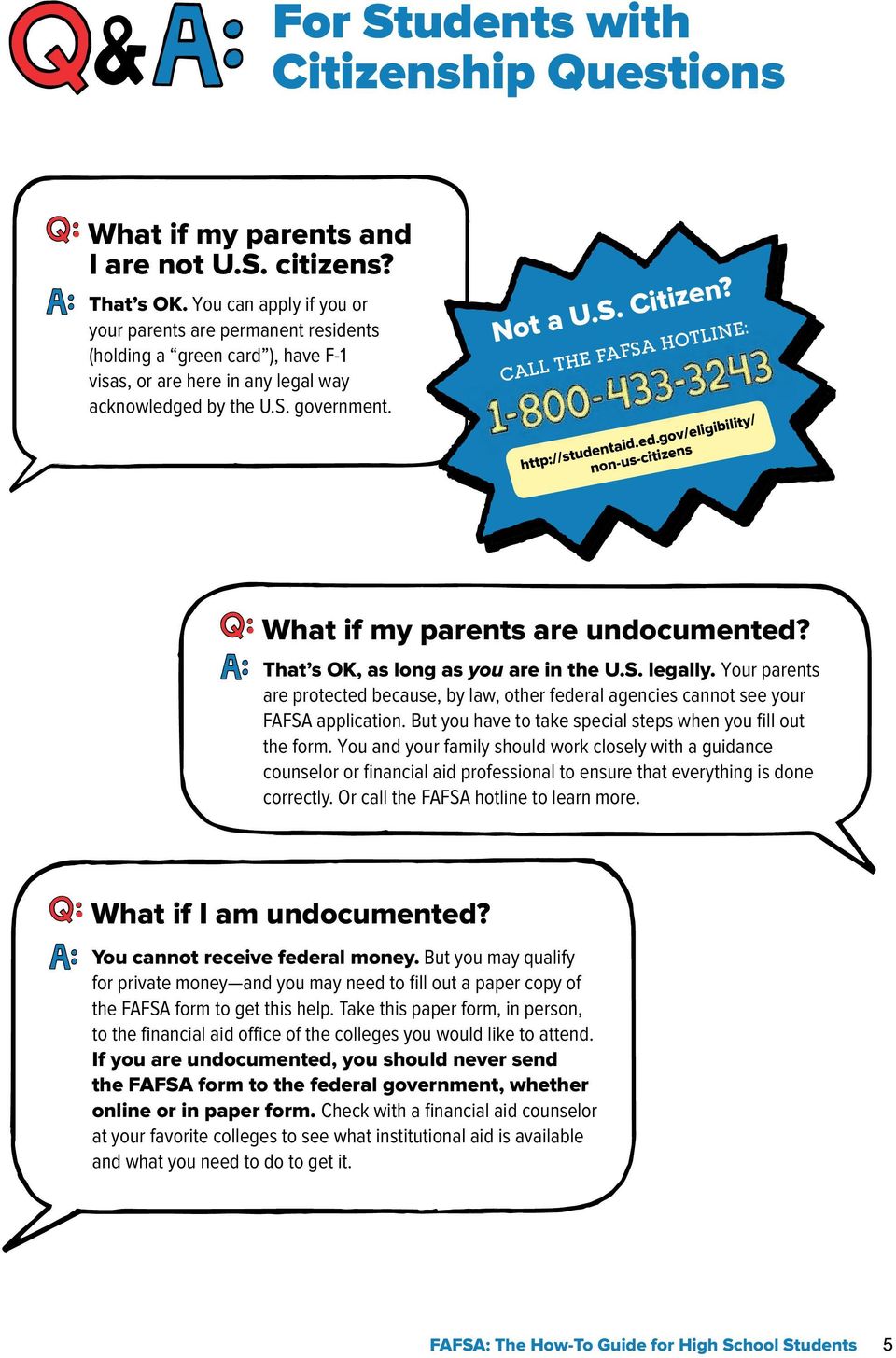
7 For Students with Citizenship Questions What if my parents and I are not U.S. citizens? That s OK. You can apply if you or your parents are permanent residents (holding a green card ), have F-1 visas, or are here in any legal way acknowledged by the U.S. government. Not a U.S. Citizen? CALL THE FAFSA HOTLINE: non-us-citizens What if my parents are undocumented? That s OK, as long as you are in the U.S. legally. Your parents are protected because, by law, other federal agencies cannot see your FAFSA application. But you have to take special steps when you fill out the form. You and your family should work closely with a guidance counselor or financial aid professional to ensure that everything is done correctly. Or call the FAFSA hotline to learn more. What if I am undocumented? You cannot receive federal money. But you may qualify for private money and you may need to fill out a paper copy of the FAFSA form to get this help. Take this paper form, in person, to the financial aid office of the colleges you would like to attend. If you are undocumented, you should never send the FAFSA form to the federal government, whether online or in paper form. Check with a financial aid counselor at your favorite colleges to see what institutional aid is available and what you need to do to get it. FAFSA: The How-To Guide for High School Students 5
8 Be Prepared! Before you tackle the FAFSA form, you will need a computer and an address. Be sure this is an address that you check often. It s important to watch your closely during the days and weeks after you have submitted your application. You will also need to gather personal and family financial information: Personal identification: Your Social Security number Social Security numbers for one or both parents Your driver s license, if you have one Alien registration or permanent resident cards, if you or your parents are not U.S. citizens Financial information: Your parents tax records, if you are dependent on one or both of them A copy of your parents foreign tax return, if they live outside the United States or in Puerto Rico Your own tax records, if you filed a recent tax return Records of untaxed income in your family like Social Security, welfare benefits, or veterans benefits 6 FAFSA: The How-To Guide for High School Students

9 Gathering Documents for the FAFSA Form Do I need the Social Security cards? Not necessarily, but it is important that the names and numbers on your FAFSA form match the U.S. government s tax records. If you don t have the cards, look at the names and numbers entered on your parents tax returns. Match those exactly and you should be in good shape. What are tax records? These include annual tax returns (IRS 1040, 1040A, 1040EZ) and any documents used to fill out the returns (like an employer s W-2 forms, bank statements, or mortgage interest statements). Whose tax records will I need? If you live with both parents, you will be using your family s tax forms. If you live mostly with one parent, use that parent s tax forms. There may be special steps if you live with relatives or live independently of your parents. (The FAFSA form will ask for the income information of your biological or adoptive parents, even though you may live with or rely on others. See pages 14 and 15 of this guide to learn more.) If you have any questions, it s important that you call the FAFSA hotline or talk to a counselor. What Do I Need to Prepare? CALL THE FAFSA HOTLINE: FAFSA: The How-To Guide for High School Students 7

10 Getting Started It s About You The time has come to fill out the FAFSA form. Find a computer and get settled in. If you are prepared, the form may only take 45 minutes to complete! But don t worry if things are more complicated. You can take your time and you can save your work. To get the form done, keep coming back to the website as often as you like. Go to You and your parents should sign up for a Federal Student Aid Personal Identification Number (called a PIN ) and password. You will need a PIN to work on the FAFSA form and sign it electronically. Go to to do this. Be sure to choose something that is easy to remember. You will use it a lot in the days to come and can continue to use it throughout your college career. Remember to get your name and Social Security number exactly right. Answer all of the questions that the FAFSA form asks about you. Some may seem personal or odd. Don t worry. The questions are there to determine whether you are eligible for federal aid and whether you are dependent on your parents. Just answer the questions truthfully. Next, the FAFSA form will ask you for your list of colleges. These colleges will use your FAFSA to determine how much financial aid you are eligible for. You can list up to 10 schools. If you re applying to more than 10 or want to change your list, you can do this later. It s best to do the FAFSA form with a parent, teacher, guidance counselor, or an adult who can help you. Students can fill out the form, but it is usually better to have adult help. 8 FAFSA: The How-To Guide for High School Students

11 Be sure to go to THIS website ( Similar websites may make you pay to file your FAFSA form. The government site is free and safe. My stack of paper: Personal information List of colleges Family tax documents Info on other income and assets Is There a Cheat Sheet to Use Ahead of Time? The FAFSA website provides a worksheet to print and fill out before you begin the online form. The worksheet walks you through the questions on the form and all of the information you will need to gather fafsa-worksheet.pdf FAFSA: The How-To Guide for High School Students 9

12 understanding THE FAFSA It s About Your Family The FAFSA form asks lots of questions about your family and how much money your parents make. It may be helpful to understand why you are being asked these questions. Here is the explanation: There is a limited amount of money available to help students with college costs. The government and colleges need to figure out whether you deserve financial help. If you do, they have to estimate how much money you need. In a nutshell: Do your parents have enough money to help put you through college? If they do, how much could they possibly contribute? This is called your Expected Family Contribution. Colleges may refer to it as your EFC. It s an important number. To calculate the Expected Family Contribution, the FAFSA needs to figure out three things: Who Are Your Parents? Are you legally dependent on them? Who s in Your Household? Who are your parents supporting financially? If my parents help me fill out the FAFSA form, are they required to help me pay for college? No. Your parents do not have to help you pay for college, no matter how much they earn. It is their choice. This may ease their minds if they are worried about giving you their income information for the FAFSA. Just let them know you must fill out this form to get financial aid. How Much Do You and Your Parents Earn? And what savings might be available for college? 10 FAFSA: The How-To Guide for High School Students

13 FAFSA: The How-To Guide for High School Students 11

14 Understanding the FAFSA Who Are Your Parents? Are you legally dependent on at least one parent? For most high school students, the answer is yes. For the FAFSA, you are legally dependent if You live with one or both of your parents. For the FAFSA, a parent is: Your birth mother or father, a parent who adopted you, or a stepparent who s married to your birth or adoptive parent. OR You re in touch with one or both of your parents, as defined above. You may actually be living with a grandparent, aunt, sibling, or a close friend. You may be living on your own and supporting yourself. For the FAFSA, you are still dependent on your parents if you have occasional contact. But some students are legally independent. Some common reasons you might be declared independent: You are 24 years old or older, married, financially supporting children of your own, orphaned, in foster care, in legal guardianship, or a ward of the court. What if neither category fits? You may be a candidate for a Dependency Override. This is for students who are technically dependent on their parents but have no contact with them, or are justifiably afraid of contacting them. Use this option as a last resort. It is hard to get a dependency override. See page 15 of this guide for more details. 12 FAFSA: The How-To Guide for High School Students

15 Questions About Your Parents and Family What if my parents are divorced or separated? You need to provide information about only one parent. Usually, this is the parent who has primary custody. If you split time between your parents, use the parent with whom you have spent the most time during the past year. What if my parents live together but aren t married? As long as they re living together, you need to provide information about both of them. That s also true if your parents are same-sex partners, whether they re married to each other or not. What if I live with a relative or family friend? It depends on whether the person you are living with, like your grandmother or aunt, has legal custody of you. (For example, has she adopted you? Is she your legal guardian?) You will need to find this out before filling out the FAFSA form. The online form will ask a series of questions to help you. If you are confused for any reason, you should talk to a counselor or call the FAFSA hotline. What if I think I am legally independent? The online FAFSA form will ask you a series of questions to determine this. Don t worry, you are still completely eligible for college financial aid. The FAFSA form will ask different questions if you are independent. You will be asked about your income and household. You will not need to provide information about your parents. Will I get more money if I m independent of my parents? Probably not. It may seem strange, but you are likely to get more financial aid if you depend on your parents. Answer the questions about your parents as truthfully as you can on the form. Confused About Your Dependency Status? CALL THE FAFSA HOTLINE: fafsa/filling-out/dependency FAFSA: The How-To Guide for High School Students 13

16 Understanding the FAFSA Who Is in Your Household? The FAFSA form will ask some questions about who you and your parents live with. The FAFSA is trying to determine who else your parents have to support financially in addition to you. If you are dependent on your parents, your household includes: One or both parents: If you live with both parents, that counts as 2. If you live with one parent, that counts as 1. If you divide your time between your parents homes, you only count the parent with whom you spend most of your time. That counts as 1. Anyone supported by the parents you are living with: Brothers and sisters (including full, half, or step) at home or in college. Anyone else in your home (cousins, aunts, grandparents) if your parents are providing more than half of their support. You! Don t forget to count yourself. Many students do... What if I m legally dependent on my parents but live with others? Which household do I use? Even if you live with others, your household is the household of the parent or parents on whom you legally depend. For example, if you re living with your grandmother, but your mother still has legal custody of you, the FAFSA form wants to know about your mother s household. Call the FAFSA hotline with questions. Have Questions About Your Household? CALL THE FAFSA HOTLINE: 14 FAFSA: The How-To Guide for High School Students

17 What If I Have No Contact With My Parents? What if I am not dependent on my parents, but I am not legally independent either? There are plenty of students who fall into this category. You may have absolutely nothing to do with your parents: One or both of them is alive and still legally tied to you, but they aren t around and don t provide any support. Or you may have left home because you were afraid of them. You need to prove to the folks at FAFSA that you are no longer tied to them: You need a dependency override. How do I get a dependency override? If possible, enlist the help of a professional who understands the FAFSA, such as a guidance counselor, college financial aid counselor, or a local college expert. Or call the FAFSA hotline. First, the online FAFSA form will ask helpful questions. When asked for your parent information on the FAFSA, click the box that says: I am unable to provide parental information. Then complete the rest of the form and submit it. But you must do more Second, you need to talk to the financial aid officers in the colleges that you would like to attend. You must persuade one of these officers that you are eligible for a dependency override. (The officer will let you know what he or she needs for proof.) This officer is the only person who can contact the staff at FAFSA and manually override your dependency status so your form can be processed. Third, wait for your college acceptance letters. Once you are accepted, you will need to make your case to any college you would like to attend. Choose your favorite schools and work with their financial aid officers to get a financial aid package. What kind of proof will I need? Here are some documents that may help you get a dependency override. Your guidance counselor, social worker, or a community worker can help you gather the best documents for your case: A letter from your high school guidance counselor or social worker testifying to the fact that you are independent of your parents. A police report such as a restraining order against one or both parents. A report confirming one or both parents are in jail or have been institutionalized. If you re homeless, a statement from your school district s homeless liaison officer. FAFSA: The How-To Guide for High School Students 15

18 Understanding the FAFSA How Much Did You and Your Parents Earn Last Year? The FAFSA form requires up-to-date income information to determine how much your family might be able to contribute to your college costs. Ideally, much of this information will come from you and your family s most recent tax records. Follow these steps to make sure your form is complete and up-to-date. FAFSA s online form is the best and easiest way to provide this information. The form will walk you through the questions you need to answer about your family s income, savings, and other financial assets. You will be asked if you would like to provide your family s tax information using the IRS Data Retrieval Tool. If you say yes, the FAFSA form will try to automatically fill in your family s tax information using information provided by the U.S. Internal Revenue Service, the federal agency in charge of collecting taxes. If your family files U.S. tax returns every year, you should definitely use the IRS Data Retrieval Tool. Colleges will know your income information is accurate. They will be less likely to ask you for proof. If all goes well, your FAFSA financial information will be filled in safely and accurately with one click of a button! One important issue: bad tax timing. The FAFSA requires tax information from the calendar year just completed. Unfortunately, your FAFSA form should be filed in January or February and many families don t send in their tax forms until April, when they are due. In this case, refer to the most up-to-date financial documents you have. (For example, your parents probably got W-2 income statements from their employers in January or February. You can use those.) Remember: You must go back online and update your FAFSA as soon as your family s current taxes are filed. Your form will not be processed or accurate with old tax information. U.S. tax forms will be due on April 15, but try to convince your parents to file in January or February. Your colleges need this information as soon as possible. 16 FAFSA: The How-To Guide for High School Students

19 Common Questions About Financial Information on the FAFSA What if my parents don t want to share their financial information? Many parents feel their income information is private. Others worry that by filling out the form, the government will require them to pay for college. Assure them that their information is safe and private and there are no strings attached. You can also ask an adult they respect to convince them that the FAFSA is critical to your college future. What if the IRS Data Retrieval Tool doesn t work? It is possible to run into snags, at least initially. One common reason is that your family members haven t filed their taxes yet or they just recently filed their taxes and the information isn t yet available to be retrieved electronically. Or your parents may have filed something other than a standard tax form (like an amended or foreign return). If you run into issues, call the FAFSA hotline to get help. What if my parents don t have a U.S. tax return? Many people don t get tax documents from their employers or file U.S. tax returns. This may be true of parents who work in other countries, undocumented workers, or parents who work in informal arrangements. The FAFSA still needs family income information. Follow the suggestions online. (Your parents, for example, can ask their employers to write a letter stating what they earned over the previous year.) If you need additional advice, call the FAFSA hotline. Need Help With Money Questions? CALL THE FAFSA HOTLINE: #financial-info What about income that s not reported on my family s tax forms? The online FAFSA form will ask you about it. This may include Social Security payments, child support, veteran s benefits, and welfare payments. Be sure to collect this information and include it on the form. FAFSA: The How-To Guide for High School Students 17

20 You Are Ready Submit Your FAFSA Form You ve finished filling out the FAFSA form online. Double-check and triplecheck the information you typed in. Follow the instructions that allow you and your parents to electronically sign the form. Then, if everything looks good, hit the button and submit it! But don t rest easy yet. You need to make sure your FAFSA was processed accurately and that the colleges you want to attend have received it. Follow these steps: Check your daily. (You will not get a text message; this is only.) Within a few days, you should get a Student Aid Report, also called a SAR. It will contain a summary of your financial information and a calculation of your Expected Family Contribution. That s a critical number for you. It will determine how much financial aid you are eligible for. Look over the Student Aid Report for any errors. If you spot any, go back online and correct them in your application. Be sure to read the comments section of the SAR to make sure that there are no additional issues to deal with. (Your FAFSA will not be processed if there is missing information or other problems.) If you don t get an , check online. Your SAR should be available on the FAFSA website after you log on. If you don t get a report or have any problems, call the FAFSA hotline at FAFSA: The How-To Guide for High School Students

21 Follow Up Show Me the Money! Once your application is complete, the colleges on your list should automatically get your FAFSA information. At any point, you can add colleges to your list or take them off. Now you need to work with the colleges to get the financial aid you need Check your FAFSA Student Aid Report, or SAR, one more time to make sure there are no last-minute complications. Make sure your FAFSA form has been updated with the latest tax information. Do this online as soon as your family s taxes have been filed. Call the colleges to which you applied. Talk to the financial aid office and make sure they have everything they need from you. My FAFSA is done. What comes next? Wait for your college acceptance letters! In some cases, the acceptance letters will also tell you how much aid you can get from the government and the college s own scholarship funds. Often, however, a college will send its financial aid letter a bit later. Different colleges will give you different amounts of aid. What kind of financial help can I expect? Every college that accepts you will provide a letter or describing how much the college will cost and what the college can offer you to help you pay to go there. This will probably be a mix of grants and scholarships (money that is given to you), loans (which you must pay back) and work-study (an on-campus job). This is called a financial aid package. It is important that you look at each package carefully, so you select a college you can truly afford. FAFSA: The How-To Guide for High School Students 19
22 What If I m Asked to Prove That the Information on My FAFSA Form Is True? Why am I being asked to prove that my FAFSA information is accurate? This is a process called verification, and it s common up to 30 percent of FAFSA forms get verified every year. The U.S. Department of Education and the colleges select certain students to verify the information they provided on their FAFSA forms. Sometimes applicants are chosen at random. Sometimes it is because the information on the FAFSA form is inconsistent or incomplete. Colleges are responsible for doing the verification. What does verification involve? The college financial aid office will contact you. It is usually just a routine request for more information, often about your family income. You should be in good shape if you used the IRS Data Retrieval Tool. If you didn t, you will probably need to provide an IRS transcript of your family s tax returns (you can request this from the IRS) or income statements from employers. The college s financial aid office will compare your FAFSA form with the information you provide. If there are differences, you will need to correct your FAFSA form. What other questions may be asked? The financial aid office may want to confirm the number of people in your family, and how many others are currently in college. You may be asked about other family income (like child support) or government aid (like food stamps). You may also be asked to provide legal identification or proof that you are graduating from high school. Can I send the same information to all of the colleges? You will have to respond separately to each college. Each will send a form by or regular mail, indicating what they need. Be sure to meet each college s deadline. If there is no deadline, provide the information as quickly as possible. If I get a verification form, that means the college has accepted me, right? Not necessarily. Some colleges ask to verify your financial information before they have made a decision about admitting you. This is why you need to do this quickly. Stay in close touch with the colleges you hope to attend and give them everything they ask for. 20 FAFSA: The How-To Guide for High School Students
23 You ve Been Accepted to College! How to Read a Financial Aid Letter It s the day you ve been waiting for. Your first college acceptance letter has arrived! You will also get another letter telling you what the college costs and some ways to pay for it. This is your financial aid package. It is important to read it carefully and compare it to any other offers you receive. The following pages tell you how to read and compare these letters. Here are new terms you may see: Cost of Attendance: The total cost of attending college. This will include direct costs paid to the college (like tuition and fees) and often indirect costs (like books and transportation). Expected Family Contribution: The amount you and your family are expected to contribute toward college each year, based on your FAFSA form. Scholarships or Grants: Free money for college awarded by the government, colleges or private organizations. One example is the federal Pell Grant for students with financial need. Work-Study: Federal money you can earn by taking a parttime job on campus. Perkins Loans: A low-interest loan from the federal government for students with significant financial need. Federal Direct Government Loans: These loans come in two forms: subsidized and unsubsidized. The subsidized loans are for students in need and have easier repayment terms. Parent PLUS Loans: These are federal loans that parents can use to cover education expenses. Interest rates vary. Private Loans: These are offered by private lenders such as banks. They often charge higher fees and interest rates than federal student loans, and repayment terms may not be as flexible. FAFSA: The How-To Guide for High School Students 21
24 COMPARING COLLEGE COSTS First, Check the Price Tag It s time to get real. You need to figure out what college will cost. This will be different for each school. To get started, take a close look at your financial aid letter. Look for a section called estimated costs. Your letter should list the costs you are likely to face. But some colleges do a much better job of this than others. You may have to hunt for this information or, for personal costs, do your own estimates. College Costs These are the costs that the colleges bill you for directly. There are only a few, but they are the big-ticket items: Tuition and fees Personal Costs These are the expenses you pay out of pocket. The good news is you can control them by being careful. The bad news is that these costs can add up. Try to budget for real life. Books and supplies Room and board, if you are living in a dormitory Comparing Cost Correctly Many colleges list grants, loans and other support per semester, but college costs and the Expected Family Contribution are for the entire year. Be sure to compare costs and aid for the same time period. And be sure you remember everything. The government provides a handy budget calculator at Housing, if you are living away from home but not in a dormitory Food, snacks and lots of coffee Transportation, either daily or for home visits Fun and entertainment Clothes, toiletries 22 FAFSA: The How-To Guide for High School Students
25 COMPARING COLLEGE COSTS Next, Look for the Free Money Most colleges will offer some sort of aid to help you pay for school. This is the most important and exciting! part of your financial aid letter. You will probably see a short list of grants, work-study and loans. Look at each line carefully. All money can be helpful for college, but some forms of financial aid are better than others. In general, you want to start by looking for money you do not need to pay back, like grants and scholarships. Then consider more costly options, like loans, only as needed. Below is a short list of the most common forms of free money along with federal work-study opportunities. Federal Grants The two most common are the Pell Grant and the Supplemental Educational Opportunity Grant (look for SEOG on your letter). Both are based on financial need. State Grants Many states offer help to students who stay in their home state for college. New York, for example, has the popular Tuition Assistance Program (look for TAP ). Ideally, you put in applications for the state grants when you were filling out your FAFSA form. State programs are often competitive and awarded on a first come, first served basis. College Grants and Private Scholarships Many colleges offer grants based on merit (such as a high grade point average or strong test scores), financial need or athletic ability. Private groups also offer free money for college, but you have to find it and apply for it. It won t be provided through your aid letter. Look online or talk to a college counselor for more info. Federal Work-Study Students with financial need may be offered the opportunity to work on campus. As with any job, you are paid for the number of hours you work. You can use the money any way you want. Your financial aid letter will tell you how much money you can earn under this program, but it is up to you to find a job and work the hours needed to get this money. FAFSA: The How-To Guide for High School Students 23
26 COMPARING COLLEGE COSTS Finally, Think About Loans College costs have been rising steadily, so many students need to take out at least a small loan to get by. Nobody likes debt. But you will probably make more money with a college degree than without one, so loans can be an investment in your future. Good rules to keep in mind: If you or your parents need to borrow, borrow as little as possible. Be sure to use government-backed loans first. They are cheaper to pay back and more forgiving if you need extra time. Private loans and credit cards should be a last resort. Here are options you may see in your financial aid letter, beginning with the best options first. Federal Perkins Loans: The interest rate is low, and you don t have to start repaying the loan until nine months after you leave college. But you must prove exceptional financial need to get this loan. Funds are limited and not all colleges offer them. Federal Direct Subsidized Loans: Subsidized loans are given to college students based on need. The interest costs can be lower than other government loans and you have more time before you need to start paying them back. Federal Direct Unsubsidized Loans: Unsubsidized loans are available to anyone, but your total repayment costs are higher than with the subsidized loan unless you begin paying it back while you are in school. Parent PLUS Loans: These are government-backed loans that parents can use to help you pay for college. But your parents need to have a good credit rating and interest rates can be high. In theory, parents can borrow as much as you need. But just like you, they should be careful about taking on too much debt. Private Loans: You can borrow money from banks or other financial institutions, but shop carefully. Fees and interest rates can be high, and you usually need to start paying back the loan while you are still in school. Caution: Student loans must be repaid. With rare exceptions, they cannot be forgiven through bankruptcy. But it is relatively easy to reduce or delay payments if you have a government-backed student loan. 24 FAFSA: The How-To Guide for High School Students
27 Common Questions About Student Loans and College Debt What do I need to know about student loans and paying them back? There are all kinds of loans. Some are expensive and some are comparatively cheap. Some lenders require that you start paying them back immediately. Others won t send you a bill until almost a year after you graduate. When looking at a possible loan, ask about two things: The interest rate. This determines the amount of money you have to pay back in addition to the amount you borrowed. You want this number to be as low as possible. Government-backed loans offer the lowest interest rates. The repayment terms. This is how soon you have to begin to make payments on the loan, how long you have to repay the loan and how much you will need to pay each month. Government-backed loans also allow you to reduce your payments or stop paying for a little while, if needed. And the government can reduce your debt if you go into certain careers, such as teaching in low-income areas. How much money can I borrow in federal student loans? If you qualify, you can borrow up to $5,500 per year in Perkins Loans and much more through the government s other loan programs. (The amount available changes every year.) But be sure to borrow only what you need. How much is it okay to borrow? This depends on a number of things. As a first step, look at the financial aid letter from the college you like the most. Will you need to borrow money to get through your first year? What about the remaining years? What kinds of loans are available to you? And what will be the total cost over four years? Once you have gathered this information, it s best to look for a financial aid calculator to do the number crunching for you. Most college websites have these now. The website has a terrific calculator that allows you to enter the size of loan you ll be repaying, the interest rate and other terms. One example: If you have a $26,000 debt (which is the national average) you will be expected to pay back about $300 per month for 10 years at current interest rates. Will you be able to afford that after you graduate? Be realistic. Think seriously about the kind of job you hope to get. How much do young workers earn in that field? Will you be able to make your loan payment along with your other expenses? FAFSA: The How-To Guide for High School Students 25
28 DO THE MATH Comparing College Offers The waiting is over. You have your acceptance letters and financial aid offers. Now you need to decide which school to attend. Money matters. You should choose a school you can afford. What follows is a lesson on comparing two financial aid packages. It will give you a sense of what to look for. But remember, every package will look different. Sometimes they are confusing or incomplete. Call a college financial aid officer or talk to an adult you trust if you need help. We ll compare two fictitious schools: BigBucks University and LowerCost College. Let s assume your Expected Family Contribution will be $2,000. Now we need to look at the costs and the various types of aid to see which school is the better deal. Cost of Attendance: Bucks is more, LowerCost is less. (Important: Do your own budget to get a true sense of your costs. Colleges often do a poor job of estimating personal living expenses in their figures.) Both schools offer a lot of Scholarship and Grant Support. Colleges look at both financial need and your academics to determine how much to offer and you did well! But call and ask for details. Is the free money guaranteed for only the first year, or longer? Does the school require that you get good grades? Know the rules. 26 FAFSA: The How-To Guide for High School Students
29 BigBucks University Cost of Attending (1st Year)...$62,000 Grants and Scholarships BigBucks University Scholarship... 36,000 Pell Grant... 3,500 State Grant... 3,000 Net Price...$19,500 Loans and Work-Study Perkins Loan... 2,000 Federal Direct Subsidized Loan... 1,500 Federal Direct Unsubsidized Loan... 4,000 Federal Work-Study... 3,000 Final Calculation Total Cost of Attending...$62,000 Total Financial Aid Offered... $53,000 Expected Family Contribution... 2,000 The gap you need to fill this year...$7,000 (Total loan debt over four years = $30,000) LowerCost College Cost of Attending (1st Year)... $22,000 Grants and Scholarships LowerCost College Scholarship... 5,000 Pell Grant... 3,500 State Grant... 3,000 Net Price...$10,500 Loans and Work-Study Federal Direct Subsidized Loan... 1,500 Federal Direct Unsubsidized Loan... 4,000 Federal Work-Study... 2,000 Final Calculation Total Cost of Attending...$22,000 Total Financial Aid Offered... $19,000 Expected Family Contribution... 2,000 The gap you need to fill this year...$1,000 (Total loan debt over four years = $22,000) Next, look at the Net Price, the cost of college that remains after these grants. This is the amount you will need to raise through loans, work-study or other means. Now look at the Loans. Remember, some loans are cheaper and easier to manage than others. You want the lowest-cost loans possible. The amount you can get through Federal Direct Loans will be the same, but schools can use their judgment for the Perkins Loans and other government grants. (Also, consider total loan debt. Add up the loans offered and multiply by the years it will take to get a degree. At LowerCost, this is $5,500 in loans X 4 years = $22,000.) And look at the Work-Study money offered. This is money you can earn for personal expenses with a campus job. But you need to find the job and work the hours. Finally, look at the bottom line. What is the gap you will need to fill for the first year? You will need to find this money somewhere: college savings, loans from your family or another job (eek!) on top of your work-study hours. Be sure to add up the total amount you might need to borrow to get your degree. In this case, BigBucks University requires more loans and has a larger gap to fill. If these costs are too much for you and you really want to go to this school call the college office. You may be able to appeal your package and get more aid. College costs are very important to consider in choosing a school. But also make sure it is a high-quality school that you will enjoy. Weigh all the factors before saying yes to your favorite college. FAFSA: The How-To Guide for High School Students 27
30 Congratulations! You have successfully filled out your FAFSA form. You have financial support. You re on your way to college. Have a great year. Be sure to keep all the information that you have collected and hold onto this guide. You ll need to fill out a FAFSA form again next year! 28 FAFSA: The How-To Guide for High School Students
31 More Questions About Getting Money for College? BE SURE TO START ON THE FAFSA WEBSITE: If you have questions about the FAFSA: Call the FAFSA hotline at Call this number for advice on filling out the FAFSA form and for help on other federal financial aid issues. Experts are available to answer your questions Monday through Friday, 8 a.m. to 10 p.m. (Eastern time). The government also provides useful information about the FAFSA and other financial aid options on its Federal Student Aid website at: Go here for advice on: Filling Out the FAFSA Form Finding Out What Aid Is Available Seeing What Aid You May Qualify For Getting and Managing Student Loans Preparing for College PLANNING TO FILE YOUR FAFSA FORM Online? You and your parents will need to get a Personal Identification Number (PIN) so that you can all sign the form electronically. Go to to sign up for a FAFSA PIN. APPLYING TO COLLEGES THAT NEED A LOT OF FINANCIAL INFORMATION? You may need to fill out the College Board s CSS Financial Aid PROFILE. Many private schools demand a great deal of financial information and require that students fill out this online form. Check with your schools to see if they need this form from you. For more information go to LINKS AND RESOURCES: See our website at AND DON T FORGET TO TALK TO ADULTS YOU TRUST: Your parents, guidance counselors and teachers may seem busy, but they want the best for you. Help may be available from college admissions offices, local nonprofits and alums from your own high school. If you have any questions at all, find someone to help you.
32 72 Fifth Avenue, 6th floor, New York, NY ABOUT THIS Guide This guide was published by the Center for New York City Affairs, a policy institute based at The New School. The book grew out of research on how complicated the FAFSA form can be for students in NYC. We hope this is helpful for all families, along with guidance counselors, teachers, and the many caring adults who help students with the financial aid process. Very special thanks to the college counseling and training staff at Goddard Riverside Community Center s Options Institute and the many FAFSA experts who helped us along the way. At Capital One Bank we believe that increasing access to higher education is one of the best ways to help students reach their potential and prepare for economic success. For many students, access to financial aid for college is a critical first step. As part of our commitment to empower students and provide them with resources to help plan for their academic futures, we are proud to partner with the Center for New York City Affairs at The New School to produce FAFSA: The How- To Guide for High School Students. This new tool will simplify the financial aid process and enable more students to pursue their educational aspirations. FAFSA: The How-To Guide for High School Students fulfills Capital One Bank s commitment to invest in economic opportunities for individuals and for the communities in which we work and live. SHARE THIS GUIDE TODAY! TO DOWNLOAD OR LINK to a copy, go to The website offers English and Spanish versions of the FAFSA How-To Guide, along with links and resources for both families and educators. For additional education resources, check out the Center for New York City Affairs website at or the Insideschools website at FREE COPIES are also available! Kim Nauer at [email protected] for ordering information. We welcome batch orders from schools and community organizations. Illustrations by: R.J. Matson Designed by: Stone Soup Creative Edited by: Kim Nauer and Andrew White
What documents do I need when I file my FAFSA?
 How do I apply for financial aid? To apply for financial aid, a student must fill out a FAFSA. FAFSA stands for the Free Application for Federal Student Aid and can be completed at www.fafsa.gov. You should
TO IMPORTANT FINANCIAL AID INFORMATION. Frequently Asked Questions & Answers for Parents of College Students
 TO IMPORTANT FINANCIAL AID INFORMATION Frequently Asked Questions & Answers for Parents of College Students Welcome to Red Rocks Community College and the Financial Aid Office. We hope that your students
Filling Out the FAFSA
 Filling Out the FAFSA Free Application for Federal Student Aid The Path to Financial Aid Starts Here FAFSA What s Inside? Federal student aid is provided by the U.S. government to help you pay for college.
Financial Aid 101. What You Need to Know About the College Financial Aid Process. Presented by Jack Zegeer Northern Virginia Community College
 Financial Aid 101 What You Need to Know About the College Financial Aid Process Presented by Jack Zegeer Northern Virginia Community College Topics Why is college important? What is Financial Aid? What
Understanding Financial Aid. with the help of a few real characters
 Understanding Financial Aid with the help of a few real characters Financial Aid Terms FAFSA: Free Application for Federal Student Aid; the online form you and your parents submit (if you are age 24 or
2015 YOU CAN AFFORD COLLEGE FINANCIAL AID WORKSHOPS
 WWW.YOUCANAFFORDCOLLEGE.ORG WWW.EDUCACIONATUALCANCE.ORG 2015 YOU CAN AFFORD COLLEGE FINANCIAL AID WORKSHOPS Student/Family Financial Aid Guide I. OVERVIEW & KEY INFORMATION Welcome! Welcome to the annual
HELPFUL FINANCIAL AID HINTS...
 TABLE OF CONTENTS HELPFUL FINANCIAL AID HINTS.........................................................................................1 PAYING FOR COLLEGE.................................................................................................2
A Guide to Financial Aid 2016-17. The bottom line and how to pay for it.
 A Guide to Financial Aid 2016-17 The bottom line and how to pay for it. The Financial Aid Basics We re glad you are interested in attending Anderson University. Perhaps you have already received your acceptance
A Guide to Financial Aid 2015-16. The bottom line and how to pay for it.
 A Guide to Financial Aid 2015-16 The bottom line and how to pay for it. The Financial Aid Basics We re glad you are interested in attending Anderson University. Perhaps you have already received your acceptance
Qualifying for the financial aid you deserve MADE $IMPLE
 Qualifying for the financial aid you deserve MADE $IMPLE table of contents 2...Paying for college...realizing your dream. 3... Am I eligible? 4...What s available for me? 5...How do I find the financial
Applying for Financial Aid 2016-2017 Academic Year
 Applying for Financial Aid 2016-2017 Academic Year Sean Martin Director of Financial Aid Services Telephone: 860-439-2058 E-Mail: [email protected] Where do I start? Visit college websites for: application
College is one of the best investments you can make, but it can be expensive.
 College is one of the best investments you can make, but it can be expensive. Savvy students and families can dramatically reduce their out-of-pocket costs by taking advantage of all the student financial
Paying for College. Financing Your College Education
 Objectives In this lesson you will: learn how you can pay for college learn about the different types of financial aid learn about scholarships and how to apply for them learn what steps you can take to
Mapping Your Future Guide to Life after High School SM : Senior Year
 Mapping Your Future Guide to Life after High School SM : Senior Year Get prepared for life after high school Some people know from an early age exactly what they want to be when they are adults and how
How to Use this Guide
 How to Use this Guide Thank you for downloading MEFA s Guide to College Financing. This Guide has been created to help you understand and navigate the entire college financing process. Topics include basic
How To Get Financial Aid For College
 Completing the FAFSA {Unlock money for college} Even if your parents won the Types of Financial Aid That Require the FAFSA 1 Types of financial aid that require the FAFSA Federal and state grants government
What is Financial Aid. What is Financial Aid. Cost of Attendance (COA) 2/27/15&
 What is Financial Aid What is Financial Aid Provides access to postsecondary education. Helps pay expenses such as tuition and fees, room and board, books and supplies, and transportation. Cost of Attendance
2015-2016. ABCs of Financial Aid
 2015-2016 ABCs of Financial Aid 1 What s Inside General Eligibility Requirements for Federal Financial Aid...2 Dependency Status...2 Applying for Financial Aid and the Need Analysis Process...3 Need Analysis
FAFSA Training. U.S. Department of Education Office of Federal Student Aid
 FAFSA Training U.S. Department of Education Office of Federal Student Aid Today s Topics Myths about financial aid Federal Financial Aid Programs The FAFSA: When and How to Apply What to Expect After Applying
Your comprehensive AMDA Financial Aid planning guide.
 Your comprehensive AMDA Financial Aid planning guide. We know the financial aid process can sometimes be confusing, so we ve tried to make the process easier with this comprehensive guide. Simply follow
OBJECTIVES. The BIG Idea. How can I find scholarships that suit my situation, and how do I keep track of my efforts? Searching for Scholarships II
 3 Financial Aid Searching for Scholarships II The BIG Idea How can I find scholarships that suit my situation, and how do I keep track of my efforts? AGENDA Approx. 45 minutes I. Warm Up (5 minutes) II.
F N I ANCIN I G G Y OU O R COL O L L E L GE G EDUCATI T O I N
 FINANCING YOUR COLLEGE EDUCATION 2013-2014 Award Year 1 Overview Types of Assistance Scholarship Information Applying for Need-Based Aid Eligibility Requirements Application Process Award Notification
Paying for School Checklist
 Paying for School Checklist There is a lot to do to get into college. Planning ahead will save you time and energy in the long run! Use this checklist to stay on track for college. Better yet, use it to
TITLE Financial aid overview for parents TITLE
 Financial aid overview for parents Understand Your Options Finding the money to pay for college is a concern of many parents because they think they can t afford it. It s important to know that families
Financial Aid: What You Need to Know
 Financial Aid: What You Need to Know South High School December 15, 2014 Sandy Sundstrom St. Olaf College Agenda General Overview and Philosophy of Financial Aid Family Contribution Financial Need Types
Financial Aid Overview
 Financial Aid Overview ww.fafsa.ed.gov Presented by: Dorothy Nacita Santa Ana College Financial Aid Office Financial Aid Myths Students with highest GPAs get all the aid Not in full time, won t qualify
USC CENTER FOR HIGHER EDUCATION POLICY ANALYSIS COSTS:
 USC CENTER FOR HIGHER EDUCATION POLICY ANALYSIS COLLEGE COSTS: A CALIFORNIA STUDENT GUIDE TO PAYING FOR COLLEGE Are you concerned about paying for college? Do you think that attending your college of choice
Learning About Financial Aid. Katherine Allen Financial Aid Workshop November 14, 2015
 Learning About Financial Aid Katherine Allen Financial Aid Workshop November 14, 2015 Topics for Today College Costs Types of Financial Aid All About the FAFSA What Happens Next? Direct Cost Expenses paid
How To Complete The Free Application For Federal Student Aid
 AN INTRODUCTION TO FAFSA Directions: Work with your small group to answer the questions below. Use the FAFSA: Overview and FAFSA: Getting Ready handouts. FAFSA At-a-Glance FAFSA is an acronym for: Official
Financial Aid 101. Seminole State College
 Financial Aid 101 Seminole State College How Can I Apply for Financial Aid? Complete a FAFSA (Free Application for Federal Student Aid) each school year in summer before fall starts (www.fafsa.ed.gov or
FINANCIAL AID 101 by Kalman A. Chany President, Campus Consultants Inc.
 FINANCIAL AID 101 by Kalman A. Chany President, Campus Consultants Inc. Applying for financial aid has never been more difficult and competitive given these tough economic times. Indeed, articles in national
Financial Aid 2014-2015. Gloucester High School Counseling Department
 Financial Aid 2014-2015 Gloucester High School Counseling Department Presentation Overview Terms and Definitions Federal and State Aid FAFSA Process Necessary Forms FAFSA Worksheet Common FAFSA Errors
FINANCIAL AID NIGHT 2015 2016
 FINANCIAL AID NIGHT 2015 2016 1 Understanding the College and Financial Aid Application Process Be patient, thorough, and organized as you go through the college admission and financial aid application
How To Get EXACTLY What You Need Financially To Go To College. Student/Parent Workbook
 How To Get EXACTLY What You Need Financially To Go To College Student/Parent Workbook How To Get EXACTLY What You Need Financially To Go To College Too many students graduate with more debt than they can
PAYING FOR COLLEGE. Plain talk about Financial Aid
 PAYING FOR COLLEGE Plain talk about Financial Aid CONTENTS The PreStep Facing the Facts Step 1: Understanding Financial Aid Basics 1 The Basics: Understanding Scholarships, Grants and Loans 2 Step 2: Applying
Evaluating Your Student Debt Situation
 1 Evaluating Your Student Debt Situation If you pay your student loan bills every month, and then try to forget the giant pile of debt to which your loans are attached stop! In order to work toward paying
How do you receive financial aid?
 What types of financial aid are available and in what order are they awarded? 1. Scholarships and Fee Waivers 2. Grants 3. Work-Study 4. Student Loans: Subsidized, Unsubsidized, Perkins, Parent PLUS How
How To Apply For College Money
 General Financial Aid Questions Can we apply for financial aid at a college/university before we receive an acceptance letter? Yes, the processes are distinct for applying to the school and applying for
Office of Financial Aid (OFA) Frequently Asked Questions
 Office of Financial Aid (OFA) Frequently Asked Questions Who should apply for Financial Aid? The USD OFA recommends that every eligible* student apply for financial aid. Even if you believe you won t qualify
YOUR GUIDE TO FINDING THE FUNDS FOR COLLEGE
 YOUR GUIDE TO FINDING THE FUNDS FOR COLLEGE Funded by the Education Services Foundation, our mission is to help Mississippi students plan and pay for college. Jackson: 601.321.5533 Gulf Coast: 228.875.4441
Financial Aid Calendar
 Financial Aid Calendar Apply Early. Apply Right. There is no need to be intimidated by the prospect of applying for financial aid. Millions of families apply for aid successfully each year. Use this calendar
Getting Started: 2015 2016 Undergraduate Financing Options. All information is accurate as of December 2014 and subject to change without notice.
 Getting Started: 2015 2016 Undergraduate Financing Options All information is accurate as of December 2014 and subject to change without notice. Everything You Ever Wanted to Know, But Didn t Know What
Financial Aid Seminar
 Financial Aid Seminar What is financial aid? What are the sources of financial aid? How will colleges determine your eligibility for aid? When and how do you apply for aid? Principles of Financial Aid
Rochelle Filler. Assistant Director of Financial Aid Rensselaer Polytechnic Institute
 Rochelle Filler Assistant Director of Financial Aid Rensselaer Polytechnic Institute National Association of Student Financial Aid Administrators What You Need to Know about Financial Aid Topics We Will
What You Need to Know About Financial Aid
 National Association of Student Financial Aid Administrators Presents What You Need to Know About Financial Aid 2013 NASFAA Topics We Will Discuss Tonight What is financial aid Cost of attendance (COA)
Financial Aid Guide. Student Financial Services. Adelphi University Office of. One South Avenue P.O. Box 701 Garden City, NY 11530-0701
 Financial Aid Guide Adelphi University Office of Student Financial Services One South Avenue P.O. Box 701 Garden City, NY 11530-0701 Phone: 516.877.3080 Fax: 516.877.3380 For the ninth straight year, Adelphi
Your Financial Aid Package and Guide
 Your Financial Aid Package and Guide 3 SAINT MICHAEL S COLLEGE smcvt.edu What You Need to Know The Office of Student Financial Services at Saint Michael s College has created this guide to explain the
2014-2015 Financial Aid Guide
 2014-2015 Financial Aid Guide your guide to FINANCIAL AID Although tuition at Northwest ranks among the lowest in Mississippi, scholarships, loans, grants and workstudy are available to qualified students
GLOSSARY OF FINANCIAL AID TERMS
 GLOSSARY OF FINANCIAL AID TERMS Candidates Reply Date Agreement: A college subscribing to this nationally-recognized agreement will not require any applicant offered admission as a first-year student to
Contact Us Telephone: (800) 222-7183 Email: [email protected] Fax: 973-275- 2040 Web site: Office of Financial Aid web page
 Your Guide to Seton Hall University s Financial Aid Congratulations on your acceptance to Seton Hall University! While this is an exciting time, we understand that it may be a confusing one as well. The
Getting Started with Need Access. Student Guide and Application Instructions. An Access Group Service
 Getting Started with Need Access Student Guide and Application Instructions An Access Group Service Designed to Help You Get the Financial Aid You Need Do it 1x only! Your school has selected Need Access
Applying for Financial Aid. Presented by: Clint Young Office of Student Financial Assistance The George Washington University
 Applying for Financial Aid Presented by: Clint Young Office of Student Financial Assistance The George Washington University An investment in knowledge always pays the best interest. Benjamin Franklin
The SAMFund Presents: Going Back to School Post-Cancer: The Pros, Cons and Hows. Agenda. Going Back to School: The Pros
 The SAMFund Presents: Going Back to School Post-Cancer: The Pros, Cons and Hows Sherri Avery Director of Financial Aid and Student Employment Brandeis University [email protected] Agenda Pros and cons
Training Module 5: Student Loan Consolidation Program
 2013 Training Module 5: Student Loan Consolidation Program KC Credit Services 2016 Swift Ave., No. Kansas City, MO 64116816-421-8001 Page1 Table of Contents I. Introduction II. Federal Student Loan Consolidation
Part 1 Test Question Bank
 Module 1 1. Which is true regarding unemployment rates? a. The unemployment rate for people with a bachelor s degree and a high school diploma are the same. b. People with a bachelor s degree experience
Mike Johnson, Director of Financial Aid Pacific University
 Mike Johnson, Director of Financial Aid Pacific University Community Colleges $ 4,200 tuition, $16,000 total Public Colleges and Universities $ 8,300 tuition, $22,800 total Private Colleges and Universities
LONG ISLAND UNIVERSITY
 LONG ISLAND UNIVERSITY Guide to Financial Planning 2014-2015 LIU is committed to making a quality private education affordable for every student. A college education is a wise investment in your future
Financial Aid 101: Tips and Advice Q&A from the webinar held Jan. 20, 2015
 Financial Aid 101: Tips and Advice Q&A from the webinar held Jan. 20, 2015 Responses from Erin Wolfe, Director of Student Financial Services; Katie Erdley, Associate Director of Student Financial Services;
Financial Aid: What You Need to Know
 Financial Aid: What You Need to Know Presented by: Michelle Anderson Associate Vice President for Enrollment Washington & Jefferson College Presentation Topics What is financial aid? Financial need calculation
FINANCIAL AID APPLICATION PROCESS. Determine your estimated eligibility. Complete application worksheet. Transmit application on-line
 FINANCIAL AID QUALIFICATIONS What are the qualifications to receive Financial Aid? In order to qualify, you must: Be accepted for admissions; Be in good academic standing; For most programs, demonstrate
Financial Aid at Sarah Lawrence
 Financial Aid at Sarah Lawrence From the Director of Financial Aid Dear Students and Parents: Perhaps the best advice any college can give to a prospective student is: Make your educational choice first,
GenTX Way to Pay: Financial Aid Guide. Learn more and find your way to pay at GenTX.org/FinancialAid. 2012 Texas Higher Education Coordinating Board
 GenTX Way to Pay: Financial Aid Guide Learn more and find your way to pay at GenTX.org/FinancialAid 2012 Texas Higher Education Coordinating Board Don t let the cost of college get in the way of your education.
{ } Financial Aid AT BROWARD COLLEGE A QUALITY, AFFORDABLE EDUCATION. The average financial aid package provided by Broward College is $6,550.
 Financial Aid { } AT BROWARD COLLEGE The average financial aid package provided by Broward College is $6,550. A QUALITY, AFFORDABLE EDUCATION College is expensive in general. But at Broward College, it
AWARD LETTER COMPARISON WORKSHEET
 AWARD LETTER COMPARISON WORKSHEET Different schools have different resources, so financial aid offers can vary greatly from school to school. There are several components of an aid offer you should consider:
FINANCIAL PLANNING FINANCIAL AID FINANCIAL LITERACY INDIAN RIVER STATE COLLEGE
 FINANCIAL PLANNING FINANCIAL AID FINANCIAL LITERACY FAFSA APPLY ONLINE AT WWW.FAFSA.GOV WHEN TO APPLY Apply early! As soon as possible after January 1st To complete the application, you will need your
What You Need to Know About Financial Aid Mark Hill Director of Financial Aid SUNY College of Environmental Science and Forestry
 What You Need to Know About Financial Aid Mark Hill Director of Financial Aid SUNY College of Environmental Science and Forestry Monday, January 5, 2014 Slide 1 Agenda Financial Aid Cost of Attendance
TINA: But we re getting ahead of ourselves. Let s start at the beginning This is Ivy Tech.
 SFX: Commercial Soundtrack STU: There s nothing like it. Walking across that stage knowing you ve graduated and you re ready for the next step. Whether it s a job or continuing on with your education Ivy
INANCIAL AID. You Can Pay for College
 A GUIDE TO INANCIAL AID You Can Pay for College FINANCIAL Achieve your dreams of a college education. Get financial Don t rule out a particular college or decide not to go to college at all based on cost
Good morning everyone! Welcome! My name is Daniel Hewitt and I m the Director of Financial Aid here at VCOM. I know I ve talked to some of you
 Good morning everyone! Welcome! My name is Daniel Hewitt and I m the Director of Financial Aid here at VCOM. I know I ve talked to some of you already, and Eloise and I are looking forward to working with
Applying for Financial Aid For High School Seniors. Bryan Dickason California Student Aid Commission 888-224-7268
 Applying for Financial Aid For High School Seniors Bryan Dickason California Student Aid Commission 888-224-7268 Financial Aid Comes from Multiple Sources Start early (now) Keep a college folder Cover
The Financial Aid Application Process and Frequently Asked Questions
 The Financial Aid Application Process and Frequently Asked Questions Step 1 - To apply for financial aid, a student must complete the Free Application for Federal Student Aid (FAFSA) each year. Students
HSMSE FINANCIAL AID PRESENTATION
 Crystal Bonds, Principal HSMSE FINANCIAL AID PRESENTATION Presented by: Wade A. Klein HSMSE Director of College Services & School Counselor Overview Overview of the Financial Aid Process Steps to Submitting
Your guide to finding the funds for college
 Your guide to finding the funds for college Get2College counselors can provide you with personalized advice on how to do everything outlined in this booklet. Just call one of our Centers listed on the
THE FINANCIAL AID PROCESS Paying for College
 THE FINANCIAL AID PROCESS Paying for College FINANCING COLLEGE Now that you re planning to go to college, there are a lot of things to think about and many questions you need to ask. Probably the biggest