
MC45 User Guide. 72E Rev. A December 2012
|
|
|
- Clinton Gregory
- 9 years ago
- Views:
Transcription
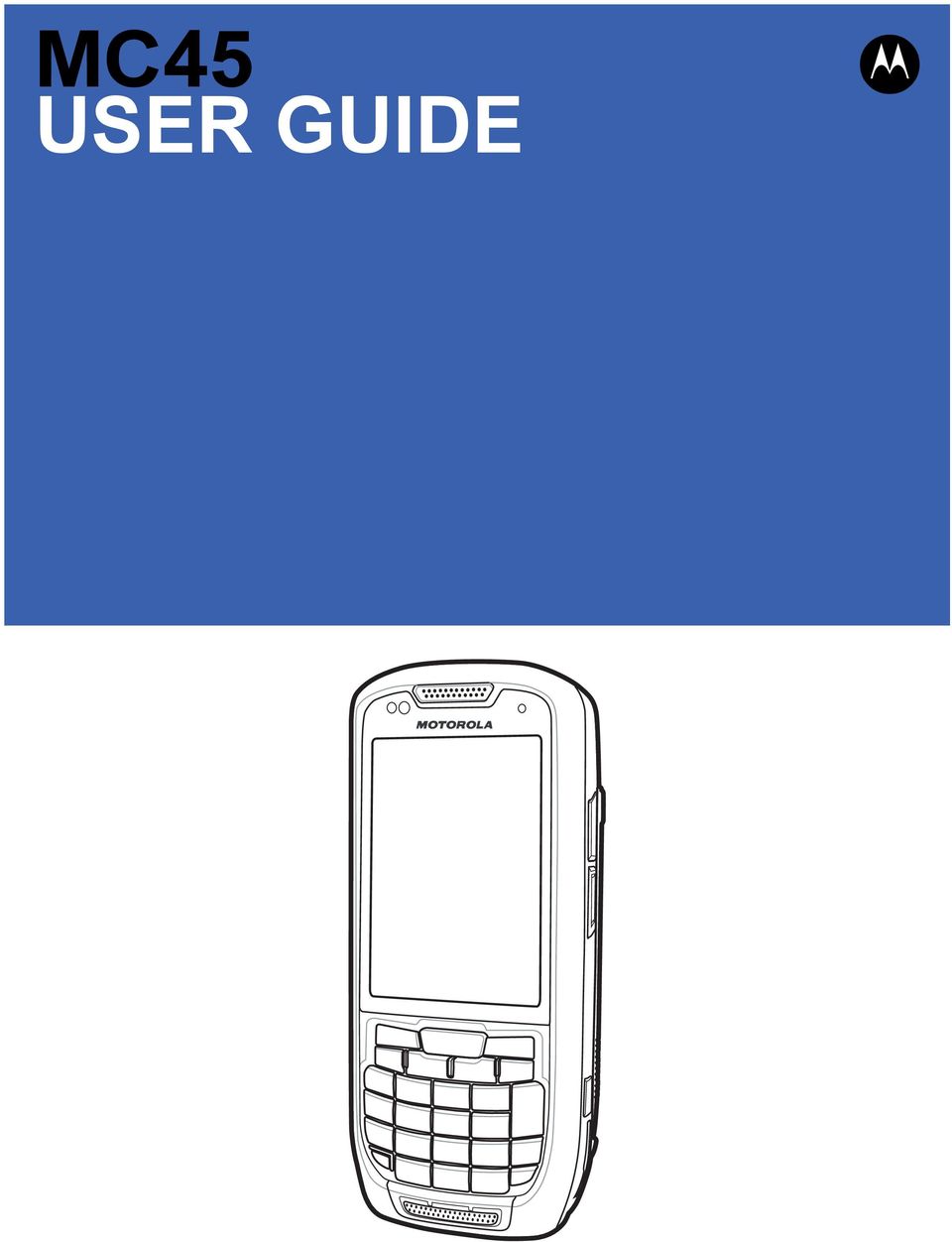
1 MC45 USER GUIDE b
2

3 MC45 User Guide 72E Rev. A December 2012

4 ii MC45 User Guide No part of this publication may be reproduced or used in any form, or by any electrical or mechanical means, without permission in writing from Motorola. This includes electronic or mechanical means, such as photocopying, recording, or information storage and retrieval systems. The material in this manual is subject to change without notice. The software is provided strictly on an as is basis. All software, including firmware, furnished to the user is on a licensed basis. Motorola grants to the user a non-transferable and non-exclusive license to use each software or firmware program delivered hereunder (licensed program). Except as noted below, such license may not be assigned, sublicensed, or otherwise transferred by the user without prior written consent of Motorola. No right to copy a licensed program in whole or in part is granted, except as permitted under copyright law. The user shall not modify, merge, or incorporate any form or portion of a licensed program with other program material, create a derivative work from a licensed program, or use a licensed program in a network without written permission from Motorola. The user agrees to maintain Motorola s copyright notice on the licensed programs delivered hereunder, and to include the same on any authorized copies it makes, in whole or in part. The user agrees not to decompile, disassemble, decode, or reverse engineer any licensed program delivered to the user or any portion thereof. Motorola reserves the right to make changes to any software or product to improve reliability, function, or design. Motorola does not assume any product liability arising out of, or in connection with, the application or use of any product, circuit, or application described herein. No license is granted, either expressly or by implication, estoppel, or otherwise under any Motorola, Inc., intellectual property rights. An implied license only exists for equipment, circuits, and subsystems contained in Motorola products. Motorola Solutions, Inc E. Algonquin Rd. Schaumburg, IL , U.S.A.

5 iii Revision History Changes to the original manual are listed below: Change Date Description -01 Rev. A 12/2012 Initial release.
6 iv MC45 User Guide

7 Table of Contents Revision History... iii About This Guide Introduction... xi Documentation Set... xi Configurations... xii Software Versions... xii Chapter Descriptions... xiv Notational Conventions... xv Related Documents... xv Service Information... xvi Chapter 1: Getting Started Introduction Unpacking Getting Started Installing the Micro Secure Digital (microsd) Card Installing the mini-sim Card Installing the Battery Charging the Battery Charging the Battery Charging Spare Batteries Charging Temperature Powering On the MC Calibrating the Screen Checking Battery Status Replacing the Battery First-time Network Activation GSM/UMTS Activation Network Activation Battery Management Changing the Power Settings Changing the Backlight & Keylight Settings

8 Table of Contents vi Turning Off the Radios Chapter 2: Using the MC45 Introduction Home Screen Status Bar Icon Bar Today Screen Classic Today Screen Soft Keys Bar Start Screen Settings Folder Adjusting Volume Battery Status Indications LED Indicators Resetting the MC Waking the MC Locking the MC Password Locking Function Buttons Stylus Entering Data Display Orientation Taking Photos Recording Video Viewing Photos and Videos Chapter 3: Data Capture Introduction Laser Scanning Scanning Considerations Bar Code Scanning Adaptive Scanning Color Digital Camera Digital Camera Scanning DataWedge Chapter 4: Using the Phone Introduction Accessing the Phone Dialer Turning the Phone On and Off Using a Bluetooth Headset Adjusting Audio Volume Using the Phone Keypad Using Contacts Using Call Log Making a Speed Dial Call Making an Emergency Call

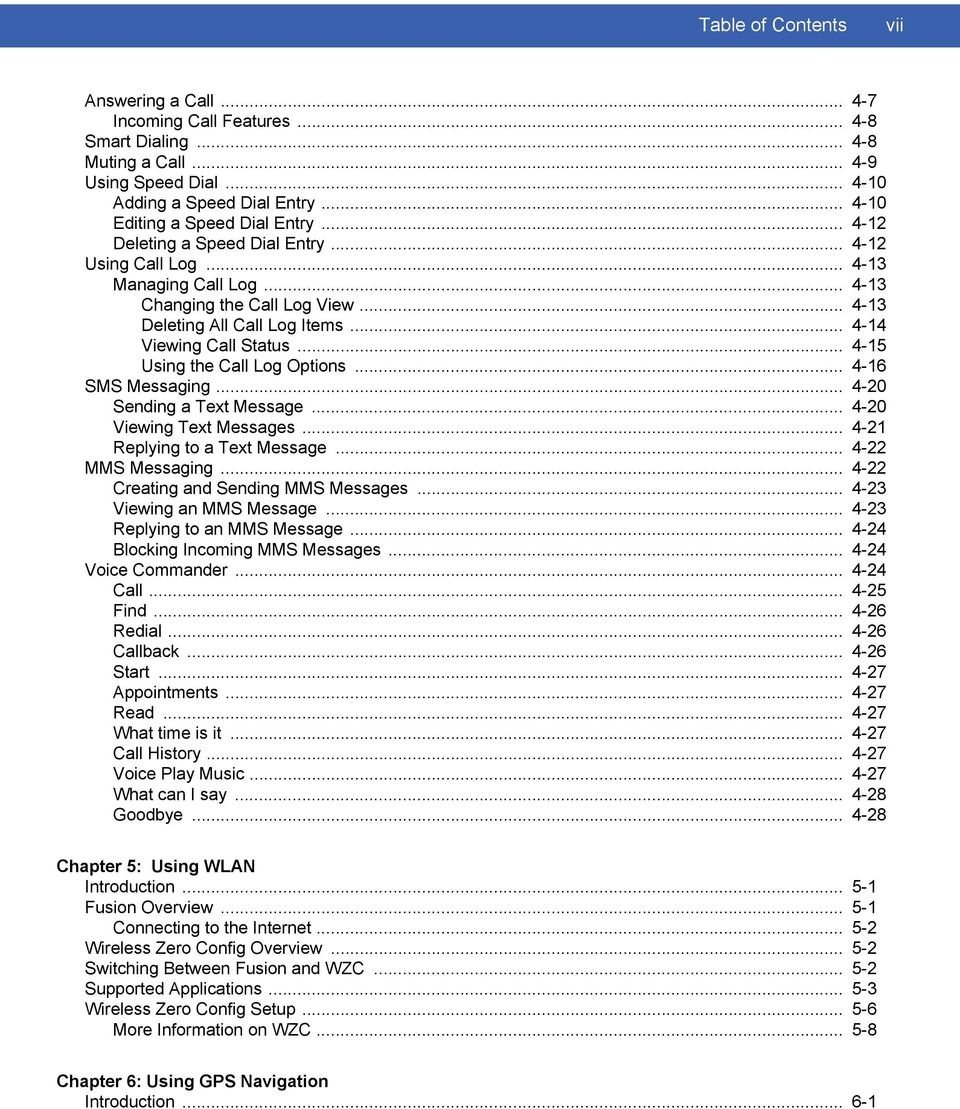
9 Table of Contents vii Answering a Call Incoming Call Features Smart Dialing Muting a Call Using Speed Dial Adding a Speed Dial Entry Editing a Speed Dial Entry Deleting a Speed Dial Entry Using Call Log Managing Call Log Changing the Call Log View Deleting All Call Log Items Viewing Call Status Using the Call Log Options SMS Messaging Sending a Text Message Viewing Text Messages Replying to a Text Message MMS Messaging Creating and Sending MMS Messages Viewing an MMS Message Replying to an MMS Message Blocking Incoming MMS Messages Voice Commander Call Find Redial Callback Start Appointments Read What time is it Call History Voice Play Music What can I say Goodbye Chapter 5: Using WLAN Introduction Fusion Overview Connecting to the Internet Wireless Zero Config Overview Switching Between Fusion and WZC Supported Applications Wireless Zero Config Setup More Information on WZC Chapter 6: Using GPS Navigation Introduction
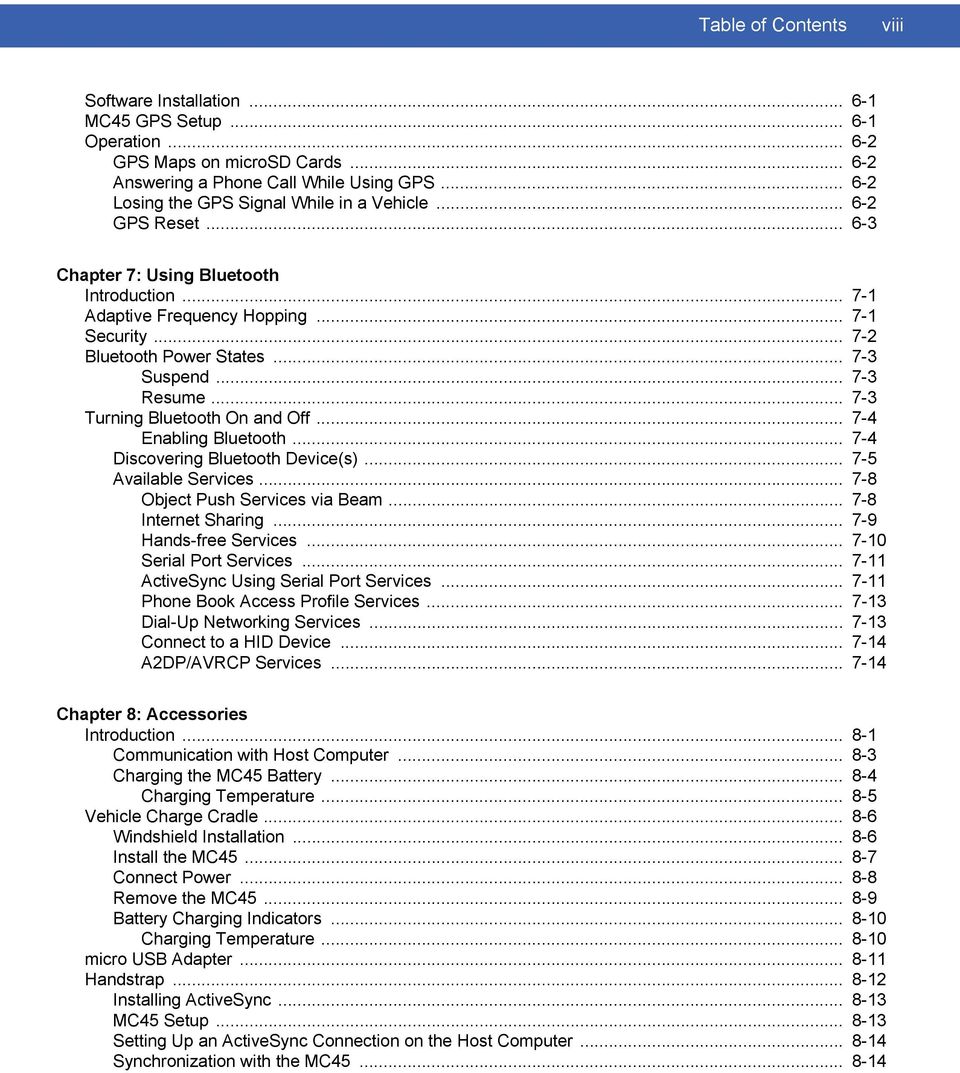
10 Table of Contents viii Software Installation MC45 GPS Setup Operation GPS Maps on microsd Cards Answering a Phone Call While Using GPS Losing the GPS Signal While in a Vehicle GPS Reset Chapter 7: Using Bluetooth Introduction Adaptive Frequency Hopping Security Bluetooth Power States Suspend Resume Turning Bluetooth On and Off Enabling Bluetooth Discovering Bluetooth Device(s) Available Services Object Push Services via Beam Internet Sharing Hands-free Services Serial Port Services ActiveSync Using Serial Port Services Phone Book Access Profile Services Dial-Up Networking Services Connect to a HID Device A2DP/AVRCP Services Chapter 8: Accessories Introduction Communication with Host Computer Charging the MC45 Battery Charging Temperature Vehicle Charge Cradle Windshield Installation Install the MC Connect Power Remove the MC Battery Charging Indicators Charging Temperature micro USB Adapter Handstrap Installing ActiveSync MC45 Setup Setting Up an ActiveSync Connection on the Host Computer Synchronization with the MC
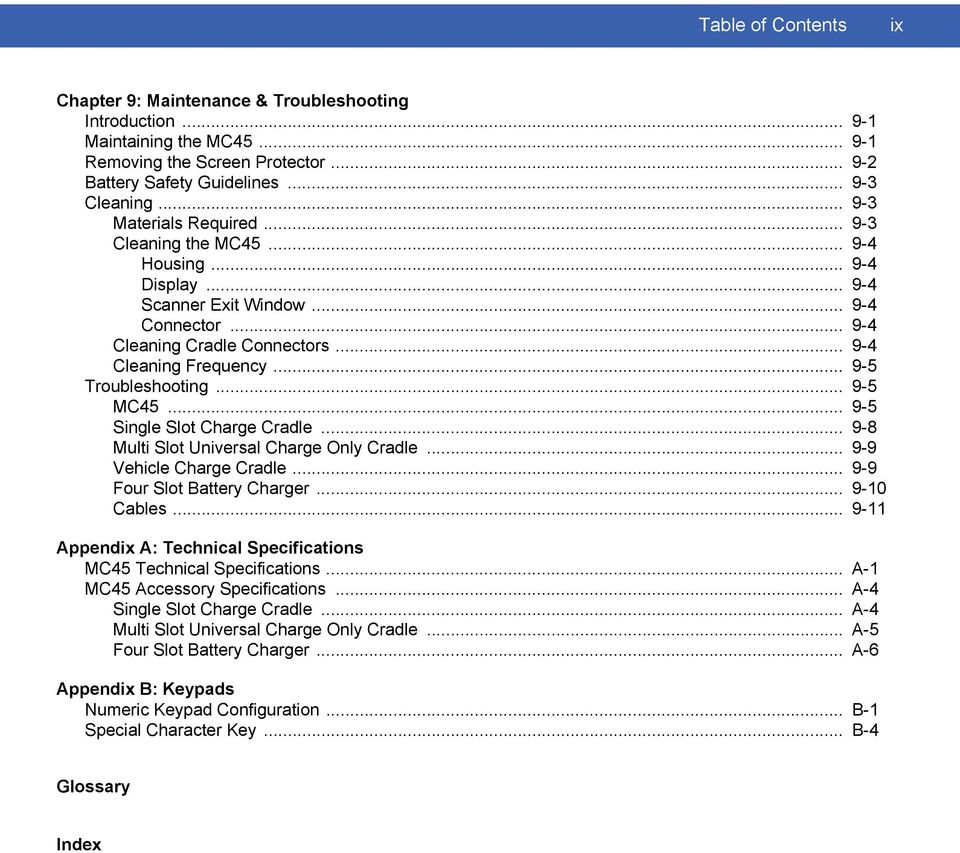
11 Table of Contents ix Chapter 9: Maintenance & Troubleshooting Introduction Maintaining the MC Removing the Screen Protector Battery Safety Guidelines Cleaning Materials Required Cleaning the MC Housing Display Scanner Exit Window Connector Cleaning Cradle Connectors Cleaning Frequency Troubleshooting MC Single Slot Charge Cradle Multi Slot Universal Charge Only Cradle Vehicle Charge Cradle Four Slot Battery Charger Cables Appendix A: Technical Specifications MC45 Technical Specifications... A-1 MC45 Accessory Specifications... A-4 Single Slot Charge Cradle... A-4 Multi Slot Universal Charge Only Cradle... A-5 Four Slot Battery Charger... A-6 Appendix B: Keypads Numeric Keypad Configuration... B-1 Special Character Key... B-4 Glossary Index
12 x MC45 User Guide

13 About This Guide Introduction This guide provides information about using the MC45 and accessories. NOTE Screens and windows pictured in this guide are samples and can differ from actual screens. Documentation Set The documentation set for the MC45 provides information for specific user needs, and includes: MC45 Quick Start Guide - describes how to get the MC45 up and running. MC45 User Guide - describes how to use the MC45. MC45 Integrator Guide - describes how to set up the MC45 and accessories. MC45 Regulatory Guide - provides all regulatory, service and EULA information for the MC45. Enterprise Mobility Developer Kit (EMDK) Help File - provides API information for writing applications.

14 xii MC45 User Guide Configurations This guide covers the following configurations: Configuration Radios Display Memory Data Capture Operating System Keypads MC4587 WWAN: GSM/HSDPA 3.2 QVGA16 Bit Color 256 MB RAM/ 1 GB Flash Camera Microsoft Windows Embedded Handheld 6.5.3, Professional Edition Numeric MC4597 WLAN: a/b/g WWAN: GSM/HSDPA 3.2 QVGA16 Bit Color 256 MB RAM/ 1 GB Flash 1-D laser scanner or camera Microsoft Windows Embedded Handheld 6.5.3, Professional Edition Numeric Software Versions This guide covers various software configurations and references are made to operating system or software versions for: Adaptation Kit Update (AKU) version OEM version Phone version Fusion version AKU Version To determine the Adaptation Kit Update (AKU) version: Tap Start > Settings > System folder > About icon > Version tab. The second line lists the operating system version and the build number. The last part of the build number represents the AKU number. Build indicates that the device is running AKU version

15 About This Guide xiii OEM Version To determine the OEM software version: Tap Start > Settings > System folder > System Info icon > System tab. Fusion Software To determine the Fusion software version: Tap Start > Wireless Companion icon > Wireless Status icon > Versions.

16 xiv MC45 User Guide Phone Software To determine the Phone software version: Tap Start > Phone > > Phone information. Chapter Descriptions Topics covered in this guide are as follows: Chapter 1, Getting Started provides information on getting the MC45 up and running for the first time. Chapter 2, Using the MC45 provides basic instructions for using the MC45, including powering on and resetting the MC45, and entering and capturing data. Chapter 3, Data Capture provides information for using the MC45 to capture data using the laser scanner or camera. Chapter 4, Using the Phone provides basic instructions for using the MC45 phone. Chapter 5, Using WLAN explains the WLAN functionality on the MC45. Chapter 6, Using GPS Navigation provides information about GPS navigation with the MC45. Chapter 7, Using Bluetooth explains Bluetooth functionality on the MC45. Chapter 8, Accessories describes the available accessories and how to use them with the MC45. Chapter 9, Maintenance & Troubleshooting includes instructions on cleaning and storing the MC45, and provides troubleshooting solutions for potential problems during MC45 operation. Appendix A, Technical Specifications provides the technical specifications for the MC45. Appendix B, Keypads provides keypad layouts and operation.

17 About This Guide xv Notational Conventions The following conventions are used in this document: Mobile Computer refers to the Motorola MC45 series of handheld computers. Italics are used to highlight the following: Chapters and sections in this and related documents Icons on a screen. Bold text is used to highlight the following: Dialog box, window, and screen names Drop-down list and list box names Check box and radio button names Key names on a keypad Button names on a screen. Bullets ( ) indicate: Action items Lists of alternatives Lists of required steps that are not necessarily sequential Sequential lists (e.g., those that describe step-by-step procedures) appear as numbered lists. Related Documents MC45 Quick Start Guide, p/n xx. MC45 Regulatory Guide, p/n xx. MC45 Integrator Guide, p/n 72E xx. Enterprise Mobility Developer Kits (EMDKs), available at: Latest ActiveSync software, available at: For the latest version of this guide and all guides, go to:

18 xvi MC45 User Guide Service Information If you have a problem with your equipment, contact Motorola Solutions Global Customer Support for your region. Contact information is available at: When contacting Motorola Solutions Global Customer Support, please have the following information available: Serial number of the unit Model number or product name Software type and version number Motorola responds to calls by , telephone or fax within the time limits set forth in support agreements. If your problem cannot be solved by Motorola Solutions Global Customer Support, you may need to return your equipment for servicing and will be given specific directions. Motorola is not responsible for any damages incurred during shipment if the approved shipping container is not used. Shipping the units improperly can possibly void the warranty. If you purchased your Motorola business product from a Motorola business partner, contact that business partner for support.

19 Chapter 1 Getting Started Introduction This chapter lists the parts for the MC45 and explains how to install and charge the batteries, replace the strap, and power on the MC45 for the first time. Receiver Ambient Light Sensor Proximity Sensor Programmable Button (Scan) Charging/Battery Status LED Touch Screen with Screen Protective Film Micro USB port Scan Button Up/Down Button Power Button Keypad Microphone Charging Connector Figure 1-1 MC45 Front View

20 1-2 MC45 User Guide Battery Cover Battery Cover Latch Handstrap Mount Programmable Button (Camera) Stylus Volume Buttons Scan Window Tether Point Camera Flash Camera Figure 1-2 MC45 Rear View Unpacking Carefully remove all protective material from the MC45 and save the shipping container for later storage and shipping. Verify that you received the following: MC45 Lithium-ion battery Battery cover Tethered stylus Screen Protector Regulatory Guide Quick Start Guide. Inspect the equipment for damage. If any equipment is missing or damaged, contact the Motorola Solutions Global Customer Support center immediately. See page xvi for contact information. Getting Started To start using the MC45 for the first time: Install microsd card (optional)

21 Getting Started 1-3 Install the mini-sim card Install the battery. Charge the MC45 Power on the MC45 Configure the MC45. Installing the Micro Secure Digital (microsd) Card The microsd card slot provides secondary non-volatile storage. The slot is located under the battery (see Figure 1-3). Refer to the documentation provided with the card for more information, and follow the manufacturer s recommendations for use. CAUTION Follow proper ESD precautions to avoid damaging the microsd card. Proper ESD precautions include, but are not limited to, working on an ESD mat and ensuring that the operator is properly grounded. To install the microsd card: 1. Slide the mini-sim card holder to the right to unlock. 2. Lift the mini-sim card holder. Figure 1-3 microsd Card Installation 3. Slide the microsd card holder down to unlock. 4. Lift up the microsd card holder. 5. Insert the card with the card contacts facing down and lower the microsd card holder. 6. Slide the microsd card holder up to lock. 7. Lower the mini-sim card holder. 8. Slide the mini-sim card holder to the left to lock.
22 1-4 MC45 User Guide To remove the microsd card: 1. Slide the microsd card holder down to unlock. 2. Lift the microsd card holder. Figure 1-4 Card Removal 3. Remove the card from the card holder. 4. Lower the microsd card holder. 5. Slide the microsd card holder up to lock. Installing the mini-sim Card NOTE The MC45 does not support copying multiple contacts to some SIM cards. If an error message appears, see Chapter 9, Maintenance & Troubleshooting for more information. GSM phone service requires a Subscriber Identification Module (SIM) card, or smart card. Obtain this card from the your service provider. The card fits into the MC45 and can contain the following information: Mobile phone service provider account details. Information regarding service access and preferences. Contact information, which can be moved to Contacts on the MC45. Any additional services to which you have subscribed. NOTE For more information about SIM cards, refer to the service provider's documentation. To install the mini-sim card: 1. Slide the mini-sim card holder to the right to unlock. 2. Lift the mini-sim card holder. Figure 1-5 Lifting the mini-sim Card Cover
23 Getting Started Insert the mini-sim card, as shown in Figure 1-6, with the cut edge of the card facing out and the contacts facing down. Figure 1-6 Inserting the mini-sim Card 4. Lower the mini-sim card holder and slide it to the left to lock. 5. Install the battery. See Installing the Battery on page 1-5 for more information. 6. After completing initial MC45 setup or after replacing a mini-sim card: a. Press the red Power button. b. Ensure Phone is on. c. Make a call to verify cellular connection. NOTE For detailed information about WWAN activation and settings, refer to the MC45 Integrator Guide. Installing the Battery NOTE When installing the battery for the first time out of the box, the back cover and battery are not installed. To install the battery: 1. Insert the battery, bottom first, into the battery compartment in the back of the MC45. NOTE Position the battery correctly, with the battery gold charging contacts positioned on top of the gold charging pins in the MC45 battery compartment. 2. Press the battery down into the battery compartment.
24 1-6 MC45 User Guide Figure 1-7 Inserting the Battery 3. With the battery cover latch open, insert the cover, top first, then press down on the bottom of the cover. 4. Slide the battery cover latch to the right until the red dot is not visible. Figure 1-8 Locking the Battery Cover Latch 5. Power up the MC45 by pressing the red Power button. Charging the Battery CAUTION Ensure that you follow the guidelines for battery safety described in Battery Safety Guidelines on page 9-3. Charging the Battery Before using the MC45 for the first time, charge the main battery until the green Charging/Battery Status LED remains lit (see Table 1-1 on page 1-7 for charge status indications). To charge the MC45, use the USB Rapid Charge Cable or a cradle with the appropriate power supply. For information about the accessories available for the MC45, see Chapter 8, Accessories. To charge the battery, use either a USB Rapid Charge Cable or a cradle. For USB Rapid Charge Cable or cradle setup and charging procedures refer to the MC45 Integrator Guide. Single Slot Charge Cradle Multi Slot Universal Charge Only Cradle Vehicle Charge Cradle. To charge the battery:
25 Getting Started Connect the charging accessory to the appropriate power source. 2. Insert the MC45 into a cradle or attach to the USB Rapid Charge Cable and Power Supply. The MC45 begins charging. The Charging/Battery Status LED blinks green while charging, then turns solid green when fully charged. See Table 1-1 for charging indications. 3. The 3080mAh battery fully charges in less than six hours at room temperature of approximately 25 C (77 F). Charging time may vary at different temperatures. NOTE The MC45 Battery Cover must be in place and closed properly for the MC45 to power on and charge the battery. Charging/Battery Status LED Figure 1-9 LED Indicators Table 1-1 LED Charge Indications Charging/Battery Status LED Indication Off Slow Blinking Green (1 blink every 2 seconds) Solid Green Fast Blinking Red (2 blinks / second) MC45 is not charging. MC45 is not inserted correctly in the cradle or connected to a power source. Cradle is not powered. MC45 is charging. Charging complete. Charging error, e.g.: Temperature is too low or too high. Charging has gone on too long without completion (typically eight hours). Charging Spare Batteries See Chapter 8, Accessories for information on using accessories to charge spare batteries. Charging Temperature Charge batteries in temperatures from 0 C to 40 C (32 F to 104 F). Charging is intelligently controlled by the MC45. To accomplish this, for small periods of time, the MC45 or accessory alternately enables and disables battery charging to keep the battery at acceptable temperatures. The MC45 or accessory indicates when charging is disabled due to abnormal temperatures via its LED. See Table 1-1.
26 1-8 MC45 User Guide Powering On the MC45 Press the Power button to turn on the MC45. If the MC45 does not power on perform a reset. See Resetting the MC45 on page When turning the MC45 on for the first time, the splash screen displays for about a minute as the MC45 initializes its flash file system, then the calibration window appears. Note that these windows also appear upon reset. Calibrating the Screen NOTE The Calibration screen can be accessed by pressing Blue key - BKSP key or tapping Start > Settings > System > Screen > General > Align Screen button. To calibrate the screen so the cursor on the touch screen aligns with the tip of the stylus: 1. Remove the stylus from its holder on the back of the MC Tap the screen to begin calibration. 3. Carefully press and briefly hold the tip of stylus on the center of each target that appears on the screen. 4. Repeat as the target moves around the screen. Checking Battery Status To check the charge status of the main battery or backup battery in the MC45, tap Start > Settings > Power icon to display the Power window. Replacing the Battery To replace the battery: 1. Press the red Power button to wake the device. 2. Hold down the red Power button for 3 seconds and release. A screen appears. Tap the Power Off to turn off the MC Slide the battery cover latch to the left until the green indicators align with the eject icon and the red dot is visible. The battery cover ejects slightly. Eject icon Green indicators Red dot Figure 1-10 Unlocking the Battery Cover Latch 4. Lift the bottom of the battery cover and remove. 5. Lift the battery, top first, out of the well.
27 Getting Started 1-9 CAUTION Do not attempt to remove the battery using a screwdriver or sharp instrument. 6. Insert the replacement battery, bottom first, into the battery compartment in the back of the MC45. NOTE Position the battery correctly, with the battery gold charging contacts positioned on top of the gold charging pins in the MC45 battery compartment. 7. With the battery cover latch open, insert the cover, top first, then press down on the bottom of the cover. Battery Cover Battery Figure 1-11 Replacing the Battery 8. Slide the battery cover latch to the right until the red dot is not visible. 9. Press the red Power button to power on the MC45. First-time Network Activation GSM/UMTS Activation Network Activation To activate on a GSM/UMTS network: 1. If an active SIM card was installed in the MC45, the MC45 performs the activation process. 2. The Phone Network - GSM/UMTS Setup dialog box displays. 3. Tap Yes and then OK. For some carriers, the MC45 resets. 4. If during start-up, no update connection settings message appears, tap Start > Settings > Connections > Phone Network Setup and tap Update Connection Settings button. 5. If the network is unsupported, a message appears with links for manually setting the data connection and MMS settings.
28 1-10 MC45 User Guide For detailed information for configuring the phone and activating on a different network, refer to the MC45 Integrator Guide. Battery Management Observe the following battery saving tips: NOTE The MC45 factory default settings for the WLAN radio is set to OFF. Leave the MC45 connected to AC power at all times when not in use. Set the MC45 to turn off after a short period of non-use. Set the backlight to turn off after a short period of non-use. Turn off all wireless activities when not in use. Power off the MC45 when charging to charge at a faster rate. Changing the Power Settings To set the MC45 to turn off after a short period of non-use: 1. Tap Start > Settings > Power icon > Advanced tab. 2. Select the On battery power: Turn off screen if not used for check box and select a value from the drop-down list. 3. Select ok. Changing the Backlight & Keylight Settings To change the backlight settings in order to conserve more battery power: 1. Tap Start > Settings > System tab > Backlight & Keylight icon > Battery Power tab. 2. Select the Disable backlight if device is not used for check box and select a value from the drop-down list. 3. Select the Brightness tab. 4. Tap the Disable backlight check box to turn off the display backlight, or use the slider to set a low value for the backlight. 5. Select ok. Turning Off the Radios Windows Embedded Handheld 6.5 devices include Wireless Manager, which provides a simple method of enabling, disabling, and configuring all the device s wireless capabilities in one place. To open Wireless Manager, tap Status Bar > Connectivity icon > Wireless Manager on the Today screen.
29 Getting Started 1-11 Status bar Figure 1-12 Tapping the Connectivity Icon Figure 1-13 Opening Wireless Manager Select Wireless Manager.
30 1-12 MC45 User Guide Figure 1-14 Wireless Manager Window NOTE Wireless connection options vary depending upon configurations. To enable or disable a wireless connection, tap the specific button. To enable or disable all wireless connections, tap the All button. To configure settings for a connection, tap Menu. Figure 1-15 Wireless Manager Menu
31 Chapter 2 Using the MC45 Introduction NOTE The WLAN feature is only applicable for the MC4597. This chapter explains the buttons, status icons, and controls on the MC45, and provides basic instructions for using the MC45, including powering on and resetting the MC45, and entering and capturing data. The MC45 factory default radio states are: WLAN - OFF Bluetooth - OFF Phone - ON. Home Screen The Home contains the Status Bar at the top of the screen, the Today screen in the center and the Soft Keys at the bottom of the screen. Each of these are described below.
32 2-2 MC45 User Guide Status Bar Applications Today Screen Soft Key Bar Figure 2-1 Home Screen Status Bar The Status Bar at the top of the screen can contain the status icons listed in Table 2-1. Notifications Connectivity WAN Audio Battery Clock Table 2-1 Icon Status Icons Description Notifications Notification that one or more instant messages were received. Notification that one or more /text messages were received. Notification that one or more voice messages were received. Speakerphone is on. There are more notification icons than can be displayed. Tap to display remaining icons. Indicates a reminder of an upcoming calendar event. One or more messages were received. Receiving MMS message. Sending MMS message. MMS message sent successfully.
33 Using the MC Table 2-1 Icon Status Icons (Continued) MMS message received sucessfully. Bluetooth is on. TTY Headset enabled. TTY HCO enabled. TTY VCO enabled. Microsoft customer feedback alert. Description Connectivity Connection is active. Connection is not active. Synchronization is occurring. WLAN available. WLAN in use. HSDPA available. 3G available. GPRS available. EGPRS available. Call missed. WAN Dialing while no SIM card is installed. Voice call in progress. Calls are forwarded. Call on hold. Antenna/signal icon: wireless on/good signal. Antenna/signal icon: wireless off. Antenna/signal icon: no service or searching. HSDPA connecting. HSDPA in use. 3G connecting. 3G in use. GPRS connecting. GPRS in use.
34 2-4 MC45 User Guide Table 2-1 Icon Audio Battery Status Icons (Continued) EGPRS connecting. EGPRS in use. Roaming. SIM Card not installed. All sounds are on. All sounds are off. Vibrate is on. Battery is charging. Battery has a full charge. Battery has a high charge. Battery has a medium charge. Battery has a low charge. Battery has a very low charge. Description Icon Bar Tap the Status Bar to display the icon bar. Tap an icon to get additional notification or status information. Figure 2-2 Icon Bar
35 Using the MC Table 2-2 Bar Icons Icon Name Description Magnify Bluetooth WLAN Voic Notifications Headset Connectivity Phone Data Volume Power Clock & Alarms Enlarges the screen. Displays the Bluetooth dialog box. Displays the Network Detection dialog box. Dials Voic . Indicates that notifications are available. Indicates that a wireless stereo headset is connected to the MC45. Displays the Connectivity dialog box. Displays the Phone dialog box. Displays the Volume dialog box. Displays the Power window. Opens the Clock & Alarms window. Today Screen The Today screen is scrollable and contains a list of applications and an Information Status bar. The Information Status bar highlights the application that is under it and provides additional information. Touch and hold the screen with your finger and move the Today screen up and down. As the application names move under the Information Status bar, information relevant to that application appears in the bar. Figure 2-3 Moving Today Screen You can also touch and hold the Information Status bar and move it up and down over an application name. Remove your finger and the Information Status bar and application name center in the screen.
36 2-6 MC45 User Guide Figure 2-4 Moving Information Status Bar Application Icon Application Information Figure 2-5 Information Bar Example To customize the Today screen, tap Start > Settings > Today icon. Use the Appearance tab to customize the background and the Items tab to change the display format. Classic Today Screen The user can change the Today screen to the classic layout that is used in Windows Mobile
37 Using the MC Status Bar Today Screen Task Tray Soft Key Bar Figure 2-6 Classic Today Screen To change to the classic view tap Start > Settings > Home icon > Items tab. Figure 2-7 Today Screen Settings Deselect the Windows Default checkbox and select any of the other checkboxes. Tap OK. NOTE The task bar is only visible in the classic view. The task bar at the bottom of the screen can contain the task tray icons listed in Table 2-3. Table 2-3 Task Tray Icons Icon Name Description Wireless connection status ActiveSync DataWedge Indicates WLAN signal strength. Active serial connection between the MC45 and the host computer. Provides access to the DataWedge interface.
38 2-8 MC45 User Guide Soft Keys Bar The Soft Key bar is located at the bottom of the screen and contains two soft key buttons. These buttons display an action and a menu to the user that are context sensitive and can be changed dynamically by an application. For example, in the Contacts list view, the soft keys are New and Menu. As the user begins creating a new contact in edit view, the soft keys change to Done and Menu. Start Screen The Start screen lists applications and folders available to the user. Table 2-4 lists the default programs and folders listed on the Start screen. Figure 2-8 Start Screen Table 2-4 Programs and Folders on the Start Screen Icon Name Description Icon Name Description Today Close the Start menu and display the Today screen. Send an . Text Send an SMS text message. Contacts Keep track of friends and colleagues. Calendar Keep track of appointments and create meeting requests. Internet Explorer Browse Web and WAP sites as well as download new programs and files from the Internet. Settings Open the Settings folder. See Settings Folder on page Pictures & Videos View and manage pictures, animated GIFs, and video files. Getting Started Launch the Getting Started application. Windows Media Play back audio and video files.
39 Using the MC Table 2-4 Programs and Folders on the Start Screen (Continued) Icon Name Description Icon Name Description Messenger Use this mobile version of Windows Live Messenger. Marketplace Purchase applications from the Marketplace. Phone Make and receive calls, switch between calls, and set up conference calling. MSN Weather Check the local weather. Windows Live Use this mobile version of Windows Live to find information on the web. MSN Money Keep track of your finances. Games Play games. Remote Desktop Log onto Windows NT server type computers and use all of the programs that are available on that computer from the MC45. Notes Create handwritten or typed notes, drawings, and voice recordings. Calculator Perform basic arithmetic and calculations, such as addition, subtraction, multiplication, and division. Tasks Keep track of your tasks. File Explorer Organize and manage files on your device. ActiveSync Synchronize information between the MC45 and a host computer or the Exchange Server. Office Mobile Use the complete suite of Microsoft Office applications for your mobile device. Excel Mobile OneNote Mobile PowerPoint Mobile Word Mobile Internet Sharing Connect a notebook computer to the Internet using the MC45's data connection. Task Manager Enables viewing of memory and CPU allocations and stops running processes. Refer to the Microsoft Applications for Windows Embedded Handheld User Guide for more information. Search Phone Search contacts, data, and other information on the MC45. Refer to the Microsoft Applications for Windows Embedded Handheld User Guide for more information. Wireless Companion Open the Wireless Companion folder.
40 2-10 MC45 User Guide Table 2-4 Programs and Folders on the Start Screen (Continued) Icon Name Description Icon Name Description Help See Help topics for the current screen or program. AirBEAM Client Allows specially designed software packages to be transferred between a host server and the MC45. Refer to the MC45 Integrator Guide for more information. SMS Staging Intercepts SMS Staging messages and reassembles them into the original Staging Profile. MSP Agent Interacts with MSP agents to collect monitoring and asset information to enable the configuration, provisioning, monitoring and troubleshooting of the MC45. Refer to the MC45 Integrator Guide for more information. Rapid Deployment Client Facilitates software downloads from a Mobility Services Platform Console FTP server to the MC45. Refer to the MC45 Integrator Guide for more information. DEMO Launches the DEMO applications. This icon appears after the DEMO applications have been installed. Alarms Sets the clock to the date and time of your locale. Alarms can also be set at specified days and times of a week. Toolbox Contains the Adobe Reader, Streaming Player and Voice Commander applications. Debug Contains the RIL Logger and RTLogExport applications. Use when instructed to by Motorola support personnel.
41 Using the MC Settings Folder Table 2-5 lists the setting applications pre-installed on the MC45. Tap Start > Settings to open the Settings folder. Table 2-5 Setting Applications in the Setting Folder Icon Name Description Icon Name Description Clock & Alarms Set the device clock to the date and time of your locale or to a visiting time zone when you re traveling. Alarms can also be set at specified days and times of a week. Power Check battery power and set the time-out for turning off the display to conserve battery power. Lock Set a password for the MC45. Sounds & Notifications Enable sounds for events, notifications, and more, and set the type of notification for different events. Connections Folder Contains connection applications (see below). Home Customize the appearance of the Today screen and the information to display on it. Personal Folder Contains personal applications (see below). Bluetooth Open the Bluetooth application, set the MC45 to visible mode and scan for other Bluetooth devices in the area. System Folder Contains system applications (see below). Connections Folder Beam Set the MC45 to receive incoming IrDA beams. Connections Set up one or more types of modem connections for your device, such as phone dial-up, GPRS, Bluetooth, and more, so that your device can connect to the Internet or a private local network. Domain Enroll Make your device an AD domain member for device management and security. Refer to the Microsoft Applications for Windows Mobile 6 User Guide for more information. GPS Assist Helps to find your MC45 location faster. Phone Network Setup Activate the phone and setup the network. USB Connect Enables or disables the enhanced network connectivity.
42 2-12 MC45 User Guide Table 2-5 Setting Applications in the Setting Folder (Continued) Icon Name Description Icon Name Description WLAN Setup wireless network connection and customize settings. Wireless Manager Enables or disables the MC45 s wireless radios and customizes WLAN, and Bluetooth settings. Personal Folder Buttons Assign a program to a button. Owner Information Enter personal information on the MC45. Input Set options for each of the input methods. Phone Configure phone settings. KeyRemap Remap the keys in the hard keypad. Voice Commander Settings Enable user to use speech commands on the MC45. System Folder About View basic information such as the Windows Mobile version and type of processor used on the MC45. Certificates See information about certificates installed on the MC45. Backlight & Keylight Set the display backlight and keylight time-out and adjust brightness. Customer Feedback Submit feedback on the Windows Mobile 6 software. Error Reporting Enable or disable the device's error reporting function. When this function is enabled and a program error occurs, technical data about the state of the program and your computer is logged in a text file and delivered to Microsoft's technical support if you choose to send it. Encryption Allow files on a storage card to be encrypted. Encrypted files are readable only on your device. DataWedge Enable or disable the barcode scanning function. Device Information Display the MC45 hardware information.
43 Using the MC Table 2-5 Setting Applications in the Setting Folder (Continued) Icon Name Description Icon Name Description External GPS Set the appropriate GPS communication ports, if required. You may need to do this when there are programs on the device that access GPS data or you have connected a GPS receiver to the device. Managed Programs Displays the programs that were installed on the MC45 using Mobile Device Manager. Task Manager Stop running programs. Memory Check the device memory allocation status and memory card information and stop currently running programs. Regional Settings Set the regional configuration to use, including the format for displaying numbers, currency, date, and time on the MC45. Remove Programs Remove programs that you installed on the MC45. System Info Displays the MC45 s software and hardware information. Screen Change the screen orientation, re-calibrate the screen, and change the screen text size.
44 2-14 MC45 User Guide Adjusting Volume To adjust the system volume using the Speaker icon in the navigation bar: 1. Tap the Speaker icon. The Volume dialog box appears. Figure 2-9 Volume Dialog Box 2. Tap and move the slide bar to adjust the volume. 3. Select the On or Off radio button to turn the volume on or off. You can also adjust the system volume using the Sounds & Notifications window, or use the Up/Down button on the side of the MC45.
45 Using the MC Battery Status Indications Battery icons appear on the navigation bar indicating the battery power level. When the battery power falls below a predetermined level the icon indicates the status and a battery dialog box appears indicating the status of the battery. The Battery icon always appears in the navigation bar when the Today screen is visible. The icon indicates the battery power level. The message displays until the Dismiss button is pressed. Figure 2-10 Battery Icon on the Title Bar Also view the battery status using the Power window. Figure 2-11 Battery Status.
46 2-16 MC45 User Guide LED Indicators The MC45 has one LED indicator. The Charging/Battery Status LED indicates battery charging and status. Charging/Battery Status LED Figure 2-12 LED Indicators Table 2-6 LED Indications LED State Indication Charging/Battery Status LED Slow Blinking Green Solid Green Fast Blinking Red Off Single Blink Green (when Power button pressed) Battery in MC45 is charging. Battery in MC45 is fully charged. Charging error. Not charging. Start-up commenced. NOTE During an over temperature error condition, the Charging Error indication will only appear if the condition exists for more than 30 minutes. NOTE For information about scanning/decoding, see Chapter 3, Data Capture. For information about WAN radio status and settings, see Chapter 4, Using the Phone, or refer to the MC45 Integrator Guide.
47 Using the MC Resetting the MC45 To perform a reset simultaneously press the Power button and the 1 and 9 keys. Waking the MC45 The wake-up conditions define what actions wake up the mobile computer after it has gone into suspend mode. The mobile computer can go into suspend mode by either pressing the Power button or automatically by Control Panel time-out settings. These settings are configurable and the factory default settings are shown in are subject to change/update. To change the wake-up conditions, tap Start > Settings > Power > Wakeup. Figure 2-13 Wake-up Device Window Locking the MC45 NOTE You can make emergency calls even when the MC45 is locked. Use the Device Lock feature to prevent use of the device. Note that when locked, the MC45 does not respond to screen or keypad input. To lock the MC45, tap Start > Lock or press the Power button for three seconds and then tap Lock Device. The Lock screen appears. To unlock the MC45, side the Lock button to the left or right.
48 2-18 MC45 User Guide Figure 2-14 Unlock Device Window If the MC45 was locked with a password, a prompt appears for the password. Password Locking Use the Password window to set a password to disable unauthorized access to the MC45. NOTE If the device is configured to connect to a network, use a strong (difficult to figure out) password to help protect network security. Password cracking tools continue to improve and the computers used to crack passwords are more powerful than ever. 1. Tap Start > Settings > Lock icon > Password tab. Figure 2-15 Password Window - Password Tab 2. Select Prompt if device unused for check box to enable password protection. 3. From the drop-down list, select a time value for the protection to take affect after non-use. 4. From the Password type: drop-down list, select either Simple PIN or Strong alphanumeric. 5. For a simple password, enter a four-digit password in the Password field. For a stronger password:
49 Using the MC a. Enter a seven character password in the Password: field. A strong password must contain at least seven characters and contain at least three of the following: uppercase and lowercase letters, numerals, and punctuation. b. Re-enter the password in the Confirm: field. 6. Tap OK. 7. To set a hint to remember the password, tap the Hint tab. 8. In the text box, enter a hint for a password reminder. 9. Tap OK. NOTE You can make emergency calls even when the MC45 is password locked. When the MC45 is not used for a period of time and the user tries to access the device, the Password window appears. This also appears when the MC45 is connected to a host computer with either a cradle or communication cable. Figure 2-16 Enter Password Windows Enter the password to un-lock the device. Tap the Unlock button to unlock the device and go to the Today screen, or tap the Contact button to unlock the device and go to the Contacts window or tap the button to unlock the device and go to the Messaging window.
50 2-20 MC45 User Guide Function Buttons The MC45 s buttons perform certain functions. Programmable Button (Scan) Volume Buttons Scan Button Up/Down Button Programmable Button (Camera) Power Button Figure 2-17 Function Buttons Power: Press the red Power button to turn the MC45 screen on and off. The MC45 is in suspend mode when the screen is off. For more information, see Powering On the MC45 on page 1-8. Also use the Power button to reset the MC45 by performing a warm or cold boot. See Resetting the MC45 on page Scan: Press to scan bar codes or capture images. See Chapter 3, Data Capture. Or, press to open an application or perform a function. See the Microsoft Applications for Windows Embedded Handheld 6.5 User Guide to set an application to open. Up/Down: Press to increase or decrease the MC45 s volume.
51 Using the MC Stylus Use the MC45 stylus to select items and enter information. The stylus functions as a mouse. Tap: Touch the screen once with the stylus to press option buttons and open menu items. Tap and Hold: Tap and hold the stylus on an item to see a list of actions available for that item. On the pop-up menu that appears, tap the action to perform. Drag: Hold the stylus on the screen and drag across the screen to select text and images. Drag in a list to select multiple items. CAUTION To prevent damage to the screen, do not use any device other than the Motorola-provided stylus. Entering Data When entering data on the keypad, use either the single-hand method or the two-hand method as shown in Figure Figure 2-18 Single-hand Method Entering Data on the Keypad Two-hand Method
52 2-22 MC45 User Guide Display Orientation The screen can be rotated between portrait and landscape modes manually. To change the orientation of the screen, tap Start > Settings > System > Screen > General tab and select between three different types of orientations: Potrait Landscape (right-handed) Landscape (left-handed). Figure 2-19 Display Orientation Window
53 Using the MC Taking Photos To take a photo: 1. Press the side Camera button or tap Start > Pictures & Videos and then tap Camera on the Command bar. 2. Check the image on the view finder, adjust if necessary. 3. Press the side Camera button or the ENTER key to take the picture. Hold the MC45 still until the camera flash occurs or the shutter sound is heard. Recording Video To record a video clip: 1. Press the side Camera button or tap Start > Pictures & Videos and then tap Camera on the Command bar. 2. Tap Camera on the command bar. 3. Tap Menu > Video to set shooting mode to video. The available recording time displays on the screen. NOTE By default, the time limit for recording videos is set to 30 seconds. 4. Press the OK key or the side Camera Button to begin recording. Recording stops when you press the OK key or the side Camera Button again. Viewing Photos and Videos To view photos and video clips: 1. Tap Start > Pictures & Videos icon. 2. Tap the picture or video clip to view.
54 2-24 MC45 User Guide
55 Chapter 3 Data Capture Introduction The MC45 offers two types of data capture options: Laser scanning Color digital camera. The MC45 contains the DataWedge application that allows user to enable the camera, decode the bar code data and display the bar code content. To enable DataWedge, see DataWedge on page 3-4. Laser Scanning An MC45 with an integrated laser scanner has the following features: Reading of a variety of bar code symbologies, including the most popular 1-D code types. Intuitive aiming for easy point-and-shoot operation. Adaptive Scanning. Scanning Considerations Typically, scanning is a simple matter of aim, scan, and decode and a few quick trial efforts master it. However, consider the following to optimize scanning performance: Range Any scanning device decodes well over a particular working range minimum and maximum distances from the bar code. This range varies according to bar code density and scanning device optics. Scanning within range brings quick and dependable decodes; scanning too close or too far away prevents decodes. Move the scanner closer or further away to find the right working range for the bar codes being scanned. Angle Scanning angle is important for promoting quick decodes.
56 3-2 MC45 User Guide Hold the MC45 farther away for larger symbols. Move the MC45 closer for symbols with bars that are close together. NOTE Scanning procedures depend on the application and MC45 configuration. An application may use different scanning procedures from the one listed above. Bar Code Scanning CAUTION Do not aim the scan beam at your eyes and others. 1. Ensure that a scan-enabled application is loaded on the MC45. Figure 3-1 Linear Scanning 2. Press and hold the scan button. The laser beam exits from the end of the MC45. Ensure the red scan beam covers the entire bar code. The Scan/Decode LED lights red to indicate that scanning is in process, then lights green and a beep sounds, by default, to indicate the bar code was decoded successfully. Correct Incorrect Figure 3-2 Linear Scanner Aiming Pattern 3. Release the scan button. Adaptive Scanning The MC45 contains the adaptive scanning feature that automatically adjusts the scan beam width for rapid and easy scanning of bar codes from near contact to more than 200 inches away. By default the MC45 is set to wide scan beam width. When the user presses the scan button, the MC45 determines the distance from the bar code. For close bar codes the MC45 sets a wide beam width and for far bar codes it sets a narrow beam width. The MC45 uses distance, bar code type and material to determine the correct scan beam width.
57 Data Capture 3-3 Figure 3-3 Adaptive Scanning Color Digital Camera MC45 with an integrated color digital camera have the following features: Omnidirectional reading of a variety of bar code symbologies, including the most popular linear, postal, PDF417, and 2D matrix code types. Advanced intuitive aiming for easy point-and-shoot operation. Digital Camera Scanning 1. Ensure that a scan-enabled application is loaded on the MC Aim the camera lens on the back of the MC45 at a bar code. 3. Press and hold the scan button. In the image window, align the camera over the barcode. Figure 3-4 Digital Camera Scanning 4. The Scan/Decode LED lights green and a beep sounds, by default, to indicate the bar code was decoded successfully. Release the scan button.
58 3-4 MC45 User Guide NOTE The camera decode feature is set by default to automatically decode the bar code when read. This feature can be programmed to display a red aiming reticle that turns green upon good decode indicating that the bar code has been successfully decoded and to that the scan button may be released. DataWedge DataWedge allows the user to input captured bar code data into a text field of an application. To enable DataWedge: 1. Tap Start > Settings > System > DataWedge. 2. Tap Basic Configuration. 3. Tap 1. Barcode input. 4. Select one of the following a. Tap 1. SSI Scanner Driver for the laser scanner. b. Tap 2. Camera Scanner Driver for the camera. 5. Tap 1. Enabled. 6. Tap 0. Back. 7. Tap 0. Back. 8. Tap 0. Exit. 9. Tap OK. 10. Tap the Running option to start the DataWedge prcoess. The DataWedge Status changes to Ready. 11. Tap OK. To disable DataWedge: 1. Tap Start > Settings > System > DataWedge. 2. Tap the Running option to end the DataWedge process. The DataWedge Status changes to Stopped. 3. Tap OK.
59 Chapter 4 Using the Phone Introduction Use the MC45 to make phone calls, set up speed dials, keep track of calls, and send text messages. Your wireless service provider may also provide other services such as voice mail, call forwarding, and caller ID. Also use the integrated phone to connect to an ISP or work network in order to browse the Web and read . Connect to the Internet or work network over High-Speed Downlink Packet Access (HSDPA) using Cellular Line, or using the modem specified by the mobile operator. For more information, or to customize the MC45 phone by changing phone settings, see the MC45 Integrator Guide. Accessing the Phone Dialer NOTE Dialers vary depending on the carrier, services and the state of the phone. For example, place calls on hold and use to create conference calls. (See Conference Calling on an MC45 on page 4-17.) Access the dialer regardless of the program in use. Applications on the MC45 can be in use during a call. Antenna Signal Call Line Figure 4-1 Phone Dialer
60 4-2 MC45 User Guide To access the phone dialer tap Start > Phone or press. To receive calls when the MC45 is suspended, leave the phone radio turned on and ensure the MC45 is set to wake with any key. Turning the Phone On and Off Windows Embedded Handheld 6.5 devices include Wireless Manager, which provides a simple method of enabling and disabling the phone. To open Wireless Manager, tap the Connectivity icon. Figure 4-2 Opening Wireless Manager Select Wireless Manager. The Wireless Manager window appears. To toggle on or off the phone, tap blue Phone bar. To configure settings for a connection, tap Menu > Phone Settings.
61 Using the Phone 4-3 Audio Modes The MC45 offers three audio modes for use during phone calls: Handset Mode: Switches audio to the speaker at the top front of the MC45, so you can use the MC45 as a handset. This is the default mode. Speaker Mode: Use the MC45 as if on speaker phone. Tap the Speaker On button to activate this mode. Tap the Speaker Off button to switch back to handset mode. Headset Mode: Connect a Bluetooth headset to automatically switch audio to the headset. The MC45 defaults to handset mode. When a Bluetooth headset is configured for use with the MC45, the earpiece and speakerphone are muted and audio is heard through the headset. NOTE While using a Bluetooth headset during a call, the mobile computer will not go into suspend mode. Handset Mode Speaker Mode Headset Mode Figure 4-3 Audio Modes Using a Bluetooth Headset You can use a Bluetooth headset for audio communication when using an audio-enabled application. See Chapter 7, Using Bluetooth for information on connecting a Bluetooth headset to the MC45. Set the MC45 s volume appropriately before putting the headset on. When a Bluetooth headset is connected the speakerphone is muted. It is recommended for phone conversations to use the Bluetooth Hands-free profile instead of the Headset profile. See Chapter 7, Using Bluetooth for more information. NOTE When using a Bluetooth headset during a call, the MC45 power button is disabled and the MC45 will not go into suspend mode. Once the call is completed, the power button functionality is enabled. The following dialog box displays when a Bluetooth headset connection is established.
62 4-4 MC45 User Guide Figure 4-4 WWAN Bluetooth Audio Notification Dialog Box Adjusting Audio Volume Use the Volume Control Slider or the keypad keys to adjust the volume of the ringer when not in a call and the audio volume when in a call. Phone Volume Slider Ringer Volume Slider Figure 4-5 Phone Volume Slider To adjust the volume tap the Speaker icon in the Title bar. Move the slider up or down to adjust the volume. NOTE Adjust the conversation phone volume during a call. Adjusting the volume while not in a call affects the ring and notification sound levels.
63 Using the Phone 4-5 Making a Call NOTE You can make emergency calls even when the MC45 is locked or when a SIM card is not installed. See Making an Emergency Call on page 4-7 for more information. With the MC45, you can make a call from the phone dialer, contacts, speed dial and call history. Using the Phone Keypad To make a call using the phone keypad: 1. Tap Start > Phone or press. 2. Enter the phone number on the dialer or keypad. The number appears in the Call Line. 3. Tap the green Call Line or press. 4. Tap to cancel the call or tap to place the MC45 in speakerphone mode. 5. When the call connects, the name or number appears in the Call Line. To place the call on hold, press. To return to the call, press again. NOTE Placing a call on hold using the Call Line can be enabled. To enable, press > > Enable Hold. The toggle icon changes to On. 6. Tap or press to end the call. Using Contacts Use Contacts to make a call without looking up or entering the phone number. To make a call from Contacts: 1. Tap Start > Contacts. 2. From the contact list, tap and hold the contact name.
64 4-6 MC45 User Guide Figure 4-6 Contacts Menu 3. Tap Call Work, Call Home or Call Mobile. NOTE To make a call from an open contact, tap the number to call. See On-Device Help for more information about Contacts. Using Call Log To make a call using Call Log: 1. Tap Start > Phone or press. 2. From the Phone dialer, tap. Call Log Figure 4-7 Call Log Window 3. Tap on the desired Contacts name to begin dialing and return to the phone dialer. 4. Press to stop dialing or end the call.
65 Using the Phone 4-7 Making a Speed Dial Call Use Speed Dial to call someone saved in the speed dial directory. To make a speed dial call: 1. Tap Start > Phone or press. 2. From the Phone keypad, tap the speed dial location number assigned to a contact. Speed Dial Location Number Figure 4-8 Speed Dial Contact List 3. Press to stop dialing or end the call. Making an Emergency Call Your service provider programs one or more emergency phone numbers, such as 911, 999 or 112 that you can call under any circumstances, even when your phone is locked or the SIM card is not inserted. Your service provider can program additional emergency numbers into your SIM card. However, your SIM card must be inserted in your phone in order to use the numbers stored on it. See your service provider for additional information. See Installing the mini-sim Card on page 1-4 for SIM card installation procedures. When the alpha-numeric keypad phone is locked, press the Orange key twice to set the keypad to numeric mode and then enter the emergency number. NOTE Emergency numbers vary by country. Your phone s pre-programmed emergency number(s) may not work in all locations, and sometimes an emergency call cannot be placed due to network, environmental, or interference issues. Answering a Call A dialog box appears on the MC45 when it receives an incoming call. If the phone is set to ring, a ring tone sounds. Answer or ignore the incoming call. To answer an incoming call tap on the Phone - Incoming dialog or press.
66 4-8 MC45 User Guide Figure 4-9 Incoming Call To ignore the incoming call tap or press. This may send the caller to voice mail, depending on the service provider. Otherwise, this presents busy signal to the calling party. Press to stop dialing or end the call.. Incoming Call Features You can use other programs on the MC45 during a call. To switch back to Phone, press > Phone. Tap End to end the call. or tap Start If a caller isn't in your contact list, create a contact during the call or from Call History by tapping Menu > Save to Contacts. To hold the current call and answer a waiting call, tap on the Phone - Incoming dialog or press.to place the current call on hold and answer the incoming call. To put a call on hold to call another number, press or tap the green Call Line. To move from one call to another, press on the MC45 or tap the green Call Line. Smart Dialing Smart Dialing makes it easy to dial a phone number. When you start entering numbers or characters, Smart Dialing automatically searches and sorts the contact entries on the SIM card, in Contacts, and the phone numbers in Call History (including incoming, outgoing, and missed calls). You can then select the desired number or contact from the filtered list to dial. Open the Phone screen, then tap the keys on the Phone keypad that correspond to the phone number or contact to call. The contact panel lists contacts that match the sequence that you entered. Smart Dialing starts looking for numbers or contacts that match the sequence entered. To find a phone number: Enter the first one or two digits to find a phone number in Call History.
67 Using the Phone 4-9 Enter the first three digits or more to find a phone number from the saved Contacts and SIM card. To find a contact name: Enter the first letter of a contact s first name or last name. Smart Dialing searches for the letter starting from the first character of a contact name as well as from the character that appears after a space, dash, or underscore in a contact name. For example, if you tap number 2 which is associated with [a, b, c] on the Phone keypad, contact names such as the following will be considered matches: Smith, Bernard, Adams, John, Carlson, Eileen, Dillon, Albert, Childs, Larry, Cooper, Robert and Parks, Celine. If the matching list is long narrow down the search further by entering another letter. Using the same example above, tap 3 which is associated with (d, e, f), the matching list is narrowed down to the following names: Smith, Bernard, Adams, John, and Parks, Celine. Figure 4-10 Finding a Contact To make a call or send a text message using Smart Dialing: 1. Begin entering the first few numbers or characters. 2. In the Smart Dialing panel, use the up and down arrows on the keypad to navigate to the desired contact or phone number. 3. When the correct contact is selected, press to make a voice call. 4. To send a text message to the selected contact, tap Menu > Send Text Message. 5. To call a different phone number associated with the selected contact, tap the contact name and select the phone number to call. Muting a Call During a call, you can mute the microphone so you can hear the person on the line but he or she cannot hear conversation from the microphone. This is useful when there is conversation or background noise on your end. To mute or unmute a call: 1. Tap Start > Phone or press. 2. Make a call.
68 4-10 MC45 User Guide 3. Tap on the display to mute the audio. The Mute button becomes yellow. Using Speed Dial Create speed dial numbers to dial frequently called numbers with a single tap. Before creating a speed dial entry, ensure the phone number exists in Contacts. Adding a Speed Dial Entry To add a speed dial entry from the phone keypad: 1. Ensure the contact and phone number are in the Contacts list. 2. Tap Start > Phone or press. 3. Tap. Figure 4-11 Contacts 4. Tap the desired contact name and number in the list. 5. Tap > Add to Speed Dial.
69 Using the Phone 4-11 Figure 4-12 Speed Dial Contact Location 6. In the Location field, tap the up/down arrows to select an available location to assign as the new speed dial entry. The first speed dial location is reserved for voice mail. 7. Tap OK to add the contact to the speed dial list. To add a speed dial entry from the Contacts window: 1. Tap Start > Contacts. Figure 4-13 Contacts 2. Tap a contact name. 3. Tap Menu > Add to Speed Dial.
70 4-12 MC45 User Guide Figure 4-14 Speed Dial Contact Location 4. In the Location drop-down list, select a different available location to assign as the new speed dial entry. The first speed dial location is reserved for voice mail. 5. Tap OK. Editing a Speed Dial Entry To change a speed dial entry: 1. Tap Start > Phone or press. 2. Tap. 3. Tap the desired contact name in the list. 4. Tap > Edit Speed Dial. 5. In the Location drop-down list, select a different available location to assign as the new speed dial entry. The first speed dial location is reserved for voice mail. 6. Tap OK to change the speed dial list. 7. Tap OK to exit the Edit Contacts window. 8. Tap X to exit the Contacts window. Deleting a Speed Dial Entry To delete a speed dial entry: 1. Tap Start > Phone or press. 2. Tap. 3. Tap the desired contact name in the list.
71 Using the Phone Tap > Edit Speed Dial. 5. Tap. 6. Tap Yes to confirm permanently deleting the speed dial entry. NOTE Deleting names and phone numbers in Speed Dial does not delete the contact information in Contacts (Start > Contacts). 7. Tap OK to exit the Edit Contacts window. 8. Tap X to exit the Contacts window. Using Call Log Use Call Log to call someone who was recently called, or recently called in. Call Log provides the time and duration of all incoming, outgoing, and missed calls. It also provides a summary of total calls and easy access to notes taken during a call. Table 4-1 lists the call history icons that appear in the Call Log window. Tap Start > Phone or press and then tap to open the Call Log window Table 4-1 Call Log Icons Icon Description This icon appears next to the contact information for all outgoing calls. This icon appears next to the contact information for all incoming calls. This icon appears next to the contact information for all unconnected outgoing calls. This icon appears next to the contact information for all missed calls. Managing Call Log Change views, reset the call timer, and delete calls to manage the calls stored in Call Log. Changing the Call Log View 1. Tap Start > Phone or press and then tap to open the Call Log window. 2. Tap on the top right corner to show the Call Log menu. 3. Tap Filters and select a view type from the menu to display only received calls, outgoing calls, incomplete calls or missed calls.
72 4-14 MC45 User Guide Call Log Figure 4-15 Call Log Window 4. Tap to exit the Call Log window. Deleting All Call Log Items 1. Tap Start > Phone or press to display the Phone dialer. 2. From the Phone dialer, tap. 3. Tap > Delete call logs. Figure 4-16 Call Log - Delete Call Logs Menu 4. Select All call logs.
73 Using the Phone 4-15 Figure 4-17 Call Log - Deleting all call logs 5. Tap Delete. 6. Tap OK to exit the Call History window. Viewing Call Status 1. Tap Start > Phone or press to display the Phone dialer. 2. From the Phone dialer, tap. 3. Tap an item to call the number or tap to open the Options window for that item. The Call Log Options window appears. Figure 4-18 Viewing Call Status 4. Select an applicable option from the list. 5. Tap to exit the Options window. 6. Tap to close the Call Log window.
74 4-16 MC45 User Guide NOTE When more than one call is on the phone line, only the duration of the first call is recorded. Using the Call Log Options Use the Call Log Options to dial voice mail, save to contacts, view a note, delete a listing, send a text message, and make a call. 1. Tap Start > Phone or press to display the Phone dialer. 2. From the Phone dialer, tap. 3. Tap an item to call the number or tap to open the Options window for that item. The Call Log Options window appears. Send text message icon Figure 4-19 Call Log Option 4. Select an applicable item from the menu, as needed. 5. Depending on the item selected, the appropriate window displays. For example, select Send Text Message to display the Inbox window. 6. Tap to exit the Options window. 7. Tap to close the Call Log window.
75 Using the Phone 4-17 Conference Calling on an MC45 NOTE Conference Calling and the number of conference calls allowed may not be available on all services. Please check with your service provider for Conference Calling availability. To create a conference phone session with multiple people: 1. Tap Start > Phone or press to display the Phone dialer. 2. Enter the first phone number and tap the Call Line area or press. When the call connects, the name or number appears in the Call Line 3. Tap. 4. Tap. The dialer re-appears. 5. Enter the second number and tap Send. 6. When the call connects, the first call is placed on hold and the second call is active. Figure 4-20 Creating a Conference Call 7. Tap call Line 1 to make that call active. The second call goes on hold. 8. Tap to create a conference call (three callers).
76 4-18 MC45 User Guide Figure 4-21 Two Merged Calls 9. To add a third caller, tap. The dialer appers. When the call connects, the new call is active and the conference is on hold. Figure 4-22 Adding a Third Call 10. To add the new caller to the conference, tap.
77 Using the Phone 4-19 Figure 4-23 Three Merged Calls 11. Tap to view all callers. Figure 4-24 Un-Merge Calls 12. To remove a caller from the conference, tap the caller and then tap next to the caller or press. 13. To end the conference call, tap next to the Call Line or press. Call Completed screen appears and then the dialer displays. NOTE To speak privately with one party during a conference call, tap and then tap next to the caller. To include all parties again, tap.
78 4-20 MC45 User Guide SMS Messaging Text messages allow the user to send and receive short text messages (SMS) to and from other mobile devices. The text can contain words, numbers or an alphanumberic combination no longer than 160 characters. Sending a Text Message To send a text message: 1. Tap Start > Text. 2. Tap > New > SMS. Address Area Message Area Figure 4-25 Create Text Message 3. Tap To to select a recipient from Contacts. 4. Compose your message. The auto-correct feature automatically fixes common spelling errors as you type so your messages are more accurate. The character counter lets you see and control the size of the message as you compose. If you want to know if your text message was received, tap > Message Options, then select the Request message delivery notification check box. 5. Tap to send the message. If the phone is turned on, your text message is sent. If it s off, you are prompted to turn on the phone. If you do so, the message is sent; otherwise when you tap OK, the message is saved in the Drafts folder and sent when the phone is turned on. If you are out of coverage area, the message is saved in the Drafts folder and sent when you return to a coverage area. NOTE On MC45 devices, the message remains in the Drafts folder and has to be manually re-sent when you return to a coverage area.
79 Using the Phone 4-21 Viewing Text Messages To view a text message: You can view a text message whether the phone is on or off. When the phone is on, you can view a text message from its notification callout. Tap the text message notification icon on the navigation bar to display the message. Text Message Notification Icon Figure 4-26 New Text Message Notification The Caller Identification feature matches incoming text message numbers with those stored in Contacts so you know who is sending you a message. Furthermore, the New Text Message dialog box gives you the option to call the sender or save, dismiss, or delete the message. Figure 4-27 New Text Message Options When the phone function is off, you can still view received text message in Messaging: 1. Tap Start > Text or on the Today screen, tap the text message on the Information Bar.
80 4-22 MC45 User Guide Tap to View Text Messages. Figure 4-28 Text Messaging on Today Screen 2. The Text Messages window appears. 3. In the message list, tap the text message. Enter reply here. Figure 4-29 Text Messages List Replying to a Text Message To reply to a text message: 1. Tap Start > Text. 2. In the message list, tap a text message. The window displays previous text conversations. 3. Enter text in the reply field. 4. Tap to send the reply. MMS Messaging MMS Messaging allows the user to send a pictures, videos, audio files and other file types to another mobile computer.
81 Using the Phone 4-23 Creating and Sending MMS Messages To send an MMS message: 1. Tap Start > Text. 2. Tap > New > MMS. Figure 4-30 MMS Window 3. To add a contact, tap. A window appears with a list of contacts. Select one or more contacts and then tap Done. 4. Tap to add a subject for the message. Enter the subject text in the window and then tap Done. 5. Tap in the text window to enter a text message. A window appears allowing you to add a text message plus emoticons, favorite web addresses, pre-defined text, contact information and calendar information. Tap Done after adding information. 6. Tap to attach a picture or video stored on the MC45 to the message. 7. Tap to attach a sound file stored on the MC45 to the message. 8. Tap to take a picture and attach it to the message. 9. Tap to capture video and attach it to the message. 10. Tap to record a message and attach it to the message. 11. Tap to add a file stored on the MC45 to the message. 12. After all of the items are attached to the message, tap Send. Viewing an MMS Message To view an MMS message: 1. Tap Start > Text. 2. Tap the MMS message. 3. In the threaded message, tap the MMS icon to view the message.
82 4-24 MC45 User Guide 4. Tap Contents to view a list of files included in the message. On the Message Contents screen: 1. Tap Menu > Save to save a file. 2. Tap Menu > Save into My Text to save the contents of a text file to the My Text list. 3. Tap Menu > Assign to Contact to associate a photo to a contact. 4. Tap Menu > Set as Ringtone to associate a audio file as a ringtone. Replying to an MMS Message To reply to an MMS message 1. Tap Start > Text. 2. Tap the MMS message. 3. In the threaded message, tap the MMS message to open and view an MMS message. 4. After viewing the MMS message, tap Menu > Reply > via MMS to reply with an MMS message or tap Menu > Reply > via SMS to reply with a text message. Blocking Incoming MMS Messages To block incoming MMS messages from a specific sender: 1. Open and view the MMS message. 2. Tap Menu > Show > Contact Details. 3. Tap Menu > Save to Blacklist. 4. Tap Done. To unblock a sender: 1. Tap Start > Text. 2. Tap Menu > MMS Options > Blacklist. 3. Tap and hold the phone number. 4. Select Delete from the pop up menu. 5. Tap OK. Voice Commander Voice Commander is a speech dialog system that provides natural human interface for users to communicate seamlessly with the MC45. Users can make phone calls, look up contact information, launch programs or check calendars. Voice Commander contains the following features: Eyes-free and hands-free voice command and control. Speaker-independent speech recognition technology, no training is required.
83 Using the Phone 4-25 Call Ease of use conversational user interface. Personal Voice Tag and Digit Model Adaptation to enhance the usability. To initiate Voice Commander tap Start > Toolbox > Voice Commander or press the call button on a Bluetooth headset. The system says, Say a Command. The user says one of the following commands: Call Find Redial / Callback Play Music Play Next / Previous Start Appointments Read / Call History What time is it? What can I say? Goodbye To call a person by name: 1. Initiate Voice Commander. The MC45 responds with Say command. 2. Say Call Michael Archer. System responds with Call Michael Archer work, is it correct? 3. Say Yes. MC45 responds with Dialing. To call a person at a location: 1. Initiate Voice Commander. The MC45 responds with Say command. 2. Say Call Mary Smith at home. The MC45 responds with Call Mary Smith home, is it correct? 3. Say Yes. The MC45 responds with Dialing. To call a person with more that one phone number: 1. Initiate Voice Commander. The MC45 responds with Say command. 2. Say Call Alex Jordan. The MC45 responds with Call Alex Jordan, home, work, mobile or cancel? 3. Say Home. The MC45 responds with Dialing. If two people have similar names: 1. Initiate Voice Commander. The MC45 responds with Say command. 2. Say Call Halley Johnson. The MC45 responds with More than one Halley Johnson, please select. 3. Select the contact intended to call.
84 4-26 MC45 User Guide NOTE Voice Commander automatically maintains a maximum of 2000 contacts in the recognition database. If the command can not be recognized, Voice Commander prompts Please say again. This situation could happen under the noisy environment, or when user says command before Voice Commander starts recording. After hearing the prompt Say Command, user should wait one to two seconds to speak the command. The recognizable contact length is 48 characters. Contacts exceeding 48 characters will be ignored. Find To look up contact information: 1. Initiate Voice Commander. The MC45 responds with Say command. 2. Say Find Mary Smith. The MC45 responds with Mary Smith home " To look up a specific number: 1. Initiate Voice Commander. The MC45 responds with Say command. 2. Say Find Michael Archer at work. The MC45 responds with Michael Archer, work, " If two contacts have similar names: 1. Initiate Voice Commander. The MC45 responds with Say command. 2. Say Find Haley Johnson at work. The MC45 responds with More than one Haley Johnson, please select. Voice Commander displays a window with the two contacts. (System will show both Halley Johnson and Haley Johnson for user to select.) If a contact is not found: 1. Initiate Voice Commander. The MC45 responds with Say command. 2. Say Find Michael Archer at home. 3. MC45 responds with Michael Archer has no home number. Redial To redial a previous number: 1. Initiate Voice Commander. The MC45 responds with Say command. 2. Say Redial. The MC45 responds with Call Mary Smith at home, is it correct? 3. Say Yes. The MC45 responds with Dialing. Callback 1. Initiate Voice Commander. The MC45 responds with Say command. 2. Say Callback. The MC45 responds with Call Mary Smith at home, is it correct? 3. Say Yes. The MC45 responds with Dialing.
85 Using the Phone 4-27 Start To launch an application: 1. Initiate Voice Commander. The MC45 responds with Say command. 2. Say Start calendar. The MC45 responds with Go to Calendar. The Calendar application launches. Appointments To read today s, tomorrow s or this week s appointments: 1. Initiate Voice Commander. The MC45 responds with Say command. 2. Say Today's appointment. The MC45 responds with You have 3 appointments and reads the appointments. NOTE User can say Previous, Next, Repeat, or Abort to control calendar reading. Voice Commander only plays the new appointments. Older appointments are ignored. Read To read a text message or an message: 1. Initiate Voice Commander. The MC45 responds with Say command. 2. Say Read SMS. The MC45 responds with You have 3 SMS and reads the SMS messages. What time is it To find out the time of day: 1. Initiate Voice Commander. The MC45 responds with Say command. 2. Say What time is it? The MC45 responds with The time is 3 p.m. Call History To view the call history window: 1. Initiate Voice Commander. The MC45 responds with Say command. 2. Say Call History. The MC45 responds with Call history. 3. The Call History page displays. Voice Play Music To play a specific music file: 1. Initiate Voice Commander. The MC45 responds with Say command. 2. Say Play The Moment. The MC45 responds with The Moment. 3. Windows Media starts to play The Moment. To play all music files:
86 4-28 MC45 User Guide 1. Initiate Voice Commander. The MC45 responds with Say command. 2. Say Play music. The MC45 responds with Play music. 3. Windows Media starts to play all music files. To play a different music file during playing of another: 1. Initiate Voice Commander. The MC45 responds with Say command. 2. Say Next. The MC45 responds with Next. 3. Windows Media starts to play next music file. To pause or resume a playing music file: 1. Initiate Voice Commander. The MC45 responds with Say command. 2. Say Pause or Resume. The MC45 pauses or resumes the playing music. NOTE User can say Pause or Resume to control music playing. The command Resume only works when Windows Media is running. The commands Previous and Next only work when playing all music files. Voice Commander only supports media files with.mp3 and.wma format. Voice Commander supports the music files in Playlists or Media files synched by Active Sync, in My Documents and its subfolder or on the microsd card and its subfolders. What can I say To view the help information: 1. Initiate Voice Commander. The MC45 responds with Say command. 2. Say What can I say. The help file displays. Alternatively tap Menu > Help to open the help file. Goodbye To exit the Voice Commander application, Say Goodbye. The MC45 responds with Goodbye and the application terminates. Voice Commander can be also terminated manually by tapping Menu > Exit. Note that goodbye will not be accepted during voice digit dialing operation. NOTE Voice Commander automatically terminates after 10 seconds of silence.
87 CHAPTER 5 USING WLAN Introduction NOTE The WLAN feature is only applicable for the MC4597. The WLAN feature supports the a/b/g networking mode. WLANs allow the MC45 to communicate wirelessly inside a building. Before using the MC45 on a WLAN, the facility must be set up with the required hardware to run the WLAN (sometimes known as infrastructure). The infrastructure and the MC45 must both be properly configured to enable this communication. Refer to the documentation provided with the infrastructure (access points (APs), access ports, switches, Radius servers, etc.) for instructions on how to set up the infrastructure. Once you have set up the infrastructure to enforce your chosen WLAN security scheme, use the Fusion or Wireless Zero Config (WZC) software to configure the MC45 to match. Fusion Overview The Fusion software contains applications with which to create wireless profiles. Each profile specifies the security parameters to use for connecting to a particular WLAN as identified by its ESSID. The Fusion software also allows the user to control which profile out of a set of profiles is used to connect. Other Fusion applications allow the user to monitor the status of the current WLAN connection and to invoke diagnostic tools for troubleshooting. To access Fusion, tap the Start > > Wireless Launcher.
88 5-2 MC45 User Guide Figure 5-1 Fusion Launcher Window Refer to the Wireless Fusion Enterprise Mobility Suite User Guide for Version 3.xx for detailed information on using and configuring Fusion. To access the on-device Fusion Help tap Start > > Fusion Help. Connecting to the Internet To connect to the Internet on a WLAN when using Fusion, ensure that the network card settings is set to Internet: 1. Ensure Fusion is enabled and a profile is configured. 2. Tap Start > Settings > Connections > WLAN. 3. In the My network card Connects to drop-down list, select The Internet. 4. Tap OK. Wireless Zero Config Overview WZC is a Microsoft wireless connection management utility that dynamically selects a wireless network to connect to based on a user's preferences and various default settings. Switching Between Fusion and WZC To switch from Fusion to WZC: 1. Tap the Start > > Wireless Launcher > Options. 2. Select WLAN Management from the drop-down list. 3. Select Microsoft Manages WLAN radio button. 4. Tap Save. 5. Tap OK. 6. Perform a reset.
89 Using WLAN 5-3 To switch from WZC to Fusion: 1. Tap the Start > > Wireless Launcher > Options. 2. Select WLAN Management from the drop-down list. 3. Select Fusion Manages WLAN radio button. 4. Tap Save. 5. Tap OK. 6. Perform a reset. Supported Applications The Fusion menu items and their corresponding applications are summarized in Table 5-1. Table 5-1 Supported Applications Application Description Fusion Support WZC Support Find WLANs Invokes the Find WLANs application which displays a list of the WLANs active in your area. Yes No Manage Profiles Invokes the Manage Profiles application (which includes the Profile Editor Wizard) to manage and edit your list of WLAN profiles. Yes No Wireless Zero Config Invokes the Wireless Zero Config application to configure the WLAN. No Yes Manage Certs Invokes the Certificate Manager application which allows you to manage certificates used for authentication. Yes Yes Manage PACs Invokes the PAC Manager application which helps you manage the list of Protected Access Credentials used with EAP-FAST authentication. Yes No Options Invokes the Options application which allows you to configure the Fusion option settings. Yes Yes Wireless Status Invokes the Wireless Status application which allows you to view the status of the current wireless connection. Yes Yes Wireless Diagnostics Invokes the Wireless Diagnostics application which provides tools with which to diagnose problems with the wireless connection. Yes Yes Log On/Off Invokes the Network Login dialog which allows you to log on to a particular profile or to log off from the currently active profile Yes No Fusion Help Invokes the Fusion Help application which provides detailed explanations on all the available Fusion applications Yes No
90 5-4 MC45 User Guide Fusion Setup To setup WLAN using Fusion refer to the Wireless Fusion Enterprise Mobility Suite User Guide for Version H3.40 for detailed information on using and configuring Fusion. To setup WLAN using Fusion: NOTE Obtain the proper WLAN configuration information from your system administrator prior to performing the Fusion setup procedures. The following setup procedure example shows setup of a WLAN using WEP encryption. 1. Tap the Start > > Wireless Configuration Editor > Manage Profiles. The Manage Profiles window appears. 2. Tap and hold in the window and select Add from the pop-up menu. The Wireless LAN Profile Entry window appears. 3. In the Profile Name text box enter a name for the profile. 4. In the ESSID text box enter the ESSID. Figure 5-2 Profile ID Dialog Box 5. Tap Next. The Operating Mode dialog box displays. 6. In the Operating Mode drop-down list, select Infrastructure or Ad-hoc. Figure 5-3 Operating Mode Dialog Box 7. Tap Next. The Security Mode dialog box displays. 8. In the Security Mode drop-down list, select Legacy (Pre-WPA).
91 Using WLAN 5-5 Figure 5-4 Security/Authentication Dialog Box 9. In the Authentication drop-down list, select None. 10. Tap Next. The Encryption dialog box displays. 11. In the Encryption Type drop-down list, select WEP-40 (40/24). Figure 5-5 Encryption Dialog Box 12. Select the Pass-phrase or Hexadecimal Keys radio button to indicate whether a pass-phrase or hexadecimal keys will be entered on the next page. 13. Select the For added security - Mask characters entered check box to hide characters entered. Deselect this to show characters entered. 14. Tap Next. Figure 5-6 WEP-40 WEP Keys Dialog Box 15. In the Edit Key drop-down list, select the key to enter. 16. In the Key field, enter 10 hexadecimal characters. 17. In the Confirm field, re-enter the key. When the keys match, a message appears indicating that the keys match. 18. Repeat for each WEP key.
92 5-6 MC45 User Guide 19. In the Transmit Key drop-down list, select the key to transmit. 20. Tap Next. The IPv4 Address Entry dialog box displays. Figure 5-7 IP Address Entry Dialog Box 21. Ensure that all three check boxes are selected. 22. Tap Next. The Battery Usage dialog box appears. 23. In the Battery Usage Mode dialog box select a power consumption option. Figure 5-8 Battery Usage Dialog Box 24. Tap Save. Wireless Zero Config Setup To setup WLAN using WZC: NOTE Obtain the proper WLAN configuration information from your system administrator prior to performing the WZC setup procedures. The following setup procedure example shows setup of a WLAN using WEP encryption. 1. Tap Start > > Wireless Launcher > Wireless Zero Config.
93 Using WLAN 5-7 Figure 5-9 Wireless Zero Config Window 2. The MC45 searches for wireless networks in the area and displays them in the window. 3. Tap a network name. Figure 5-10 Configure Wireless Network Window 4. In the Connects to drop-own list, select either The Internet or Work. 5. Check the This is a hidden network checkbox if the network is a hidden network. 6. Tap Next.
94 5-8 MC45 User Guide Figure 5-11 Configure Network Authentication Window 7. In the Authentication drop-down list, select the authentication type. 8. In the Data Encryption drop-down list, select the data encryption type. 9. If WEP encryption is selected, enter an encryption key in the Network key text box. 10. Tap Next. Figure 5-12 Configure Network Authentication Window 11. If required, select Use IEEE 802.1x network access control check box. 12. In the EAP type drop-down list box, select the EAP type. 13. Tap Finish. More Information on WZC For more information on Microsoft Wireless Zero Config, see the Microsoft Software Developer Network (MSDN) at
95 Chapter 6 Using GPS Navigation Introduction The MC45 includes Global Positioning System (GPS) technology using the QC Modem Solution chipset. GPS technology is based on a worldwide system of GPS satellites orbiting the earth that continuously transmit digital radio signals. These radio signals contain data on the satellites locations and their exact clock time and are used to determine your location on the earth. WARNING! When using the MC45 in a vehicle, it is the user s responsibility to place, secure and use in a manner that will not cause accidents, personal injury or property damage or obstruct their view. It is the responsibility of the driver to operate the vehicle in a safe manner, maintain observation of all driving conditions at all times, and not become distracted by the device to the exclusion of safe driving practices. It is unsafe to operate the controls of the device while driving. Software Installation Third-party GPS navigation software is required. Evaluation software is available from various suppliers. For example; VisualGPS, visit: If interested in purchasing GPS navigation software check with the GPS software vendor (before purchasing, downloading, or installing any software) to determine that the application is compatible with the MC45. Refer to the application s user guide for application installation and setup information. MC45 GPS Setup By default, the MC45 has the following settings: 1. Tap Start > Settings > System > External GPS icon. 2. In the Programs tab, the GPS program port is set to COM6. 3. In the Hardware tab, the GPS hardware port is set to None. Multiple programs can simultaneously access GPS data. Each program must use Microsoft GPS API or COM8 to access the GPS data.
96 6-2 MC45 User Guide Operation Acquiring satellite signals may take several seconds to a few minutes. It is best to be outside and have a clear, unobstructed view of the sky. Without a clear view, acquisition takes much longer and could result in the MC45 being unable to compute the initial position quickly. When operating the device indoors access to the GPS signals may be limited or unavailable. NOTE When using a GPS navigation application, ensure that the MC45 does not go into suspend mode. If the MC45 suspends then the power to the GPS radio is removed. Upon resume the GPS receiver must reacquire a valid GPS signal, resulting in a a delay of positional information. GPS Maps on microsd Cards GPS navigation software vendors may sell maps on microsd cards. If using a microsd card with the GPS navigation software: 1. Slide the mini-sim card holder to the right to unlock. 2. Lift the mini-sim card holder. 3. Slide the microsd card holder down to unlock. 4. Lift up the microsd card holder. 5. Insert the card with the card contacts facing down and lower the microsd card holder. 6. Slide the microsd card holder up to lock. 7. Lower the mini-sim card holder. 8. Slide the mini-sim card holder to the left to lock. Answering a Phone Call While Using GPS If you receive a phone call while using your GPS navigation software: 1. Answer the phone call by pressing the Answer button. 2. Once you end the phone call, press the End Call button to resume the audio on the GPS software. NOTE Anytime you are using GPS on the MC45 and you receive a phone call, the audio on the GPS navigation software is muted until you finish the call. Losing the GPS Signal While in a Vehicle GPS performance on the MC45 may be affected if the vehicle has thermal glass windows and windshields, which can block the MC45 from receiving a GPS signal from satellites. To improve GPS signal strength, place the MC45 where there is a clear view of the sky. A direct line of sight is required between the MC45 and the GPS satellites to access information from the satellites.
97 Using GPS Navigation 6-3 Assisted GPS GPS can be used in stand-alone or Assisted GPS (A-GPS) modes. A Stand-alone GPS receiver downloads data from GPS satellites. It can take several minutes to get a fix. By using GPS Location servers, A-GPS dramatically improves the performance of the Time To First Fix (TTFF) of GPS receivers by providing them with data that they would ordinarily have to download from the GPS satellites and other aiding data that helps the acquisition. With the A-GPS data, GPS receivers can operate faster and more reliably. The GPS Assist application provides the ability to modify the settings associated with obtaining GPS data. Tap Start > Connections > GPS Assist icon. Figure 6-1 GPS Assistance Window To set the source of the data tap Source and select one of the options: Any (default), None. To set the frequency of updating the data tap Update Frequency and select one of the options: On Demand (default), 1 Day, 2 Days, 4 Days, 7 Days. To manually update the data tap the Update Now button. GPS Reset To perform a factory reset of the GPS function: 1. Close all applications that are using GPS. 2. Tap the Reset GPS Hardware button. The Reset GPS Hardware dialog box appears indicating that the GPS chip has been reset. 3. Tap OK.
98 6-4 MC45 User Guide
99 Chapter 7 Using Bluetooth Introduction Bluetooth-equipped devices can communicate without wires, using frequency-hopping spread spectrum (FHSS) radio frequency (RF) to transmit and receive data in the 2.4 GHz Industry Scientific and Medical (ISM) band ( ). Bluetooth wireless technology is specifically designed for short-range (30 feet/10 meters) communication and low power consumption. MC45 with Bluetooth capabilities can exchange information (e.g., files, appointments, and tasks) with other Bluetooth enabled devices such as phones, printers, access points, and other mobile computers. To use the MC45 as a modem, create a dial-up modem connection between a computer and MC45. The MC45 with Bluetooth technology uses the Microsoft Bluetooth stack. To write an application that uses the Microsoft Bluetooth stack APIs, refer to the Enterprise Mobility Developer Kit (EMDK) Help. Adaptive Frequency Hopping Adaptive Frequency Hopping (AFH) is a method of avoiding fixed frequency interferers, and can be used with Bluetooth voice. All devices in the piconet (Bluetooth network) must be AFH-capable in order for AFH to work. There is no AFH when connecting and discovering devices. Avoid making Bluetooth connections and discoveries during critical b communications. AFH for Bluetooth consists of four main sections: Channel Classification - A method of detecting an interference on a channel-by-channel basis, or pre-defined channel mask. Link Management - Coordinates and distributes the AFH information to the rest of the Bluetooth network. Hop Sequence Modification - Avoids interference by selectively reducing the number of hopping channels. Channel Maintenance - A method for periodically re-evaluating the channels. When AFH is enabled, the Bluetooth radio hops around (instead of through) the b high-rate channels. AFH coexistence allows Motorola mobile computers to operate in any infrastructure.
100 7-2 MC45 User Guide The Bluetooth radio in this MC45 operates as a Class 2 device power class. The maximum output power is 2.5mW and the expected range is 32.8 feet (10 meters). A definition of ranges based on power class is difficult to obtain due to power and device differences, and whether one measures open space or closed office space. NOTE It is not recommended to perform Bluetooth wireless technology inquiry when high rate b operation is required. Security The current Bluetooth specification defines security at the link level. Application-level security is not specified. This allows application developers to define security mechanisms tailored to their specific need. Link-level security occurs between devices, not users, while application-level security can be implemented on a per-user basis. The Bluetooth specification defines security algorithms and procedures needed to authenticate devices, and if needed, encrypt the data flowing on the link between the devices. Device authentication is a mandatory feature of Bluetooth while link encryption is optional. Pairing of Bluetooth devices is accomplished by creating an initialization key that is used to authenticate the devices and create a link key for them. Entering a common PIN number in the devices being paired generates the initialization key. The PIN number is never sent over the air. By default, the Bluetooth stack responds with no key when a key is requested (it is up to user to respond to the key request event). Authentication of Bluetooth devices is based-upon a challenge-response transaction. Bluetooth allows for a PIN number or passkey that is used to create other 128-bit keys used for security and encryption. The encryption key is derived from the link key used to authenticate the pairing devices. Also worthy of note is the limited range and fast frequency hopping of the Bluetooth radios that makes long-distance eavesdropping difficult. Recommendations are: Perform pairing in a secure environment Keep PIN codes private and don't store the PIN codes in the mobile computer Implement application-level security. The Microsoft stack supports Smart-pairing. For detailed information, refer to the Microsoft MSDN.
101 Using Bluetooth 7-3 Bluetooth Configuration The following services are supported A2DP/AVRCP Services Dial-Up Networking Services File Transfer profile General Audio/Video Distribution Profile Generic Access Profile Generic Object Exchange Profile Hands-Free Audio Gateway Services Headset Profile HID Client Services PBAP Services Personal Area Networking Services Serial Port Services Service Discovery Access profile SIM Access Profile. COM2 through COM4 and COM8 are available unless being used by another service. Bluetooth Power States Suspend When there is an active Bluetooth connection, the Bluetooth radio goes into low power mode maintaining the active connection. When there is no active connection, the Bluetooth radio turns off. NOTE If there is an active Bluetooth connection between the MC45 and another Bluetooth device and there is no data activity, the MC45 will timeout. However, if the user presses the Power button on the MC45, the MC45 will suspend (except when on a call) and upon receiving data from a remote Bluetooth device, the MC45 will wake from suspend mode. For example, headset redial or Bluetooth scanner sending data to the MC45. Resume When the MC45 resumes, Bluetooth turns on if it was on prior to suspend.
102 7-4 MC45 User Guide Turning Bluetooth On and Off Turn off the Bluetooth radio to save power or if entering an area with radio restrictions (e.g., an airplane). When the radio is off, other Bluetooth devices cannot see or connect to the MC45. Turn on the Bluetooth radio to exchange information with other Bluetooth devices (within range). Communicate only with Bluetooth radios in close proximity. NOTE To achieve the best battery life turn off radios not in use. Enabling Bluetooth To enable Bluetooth: 1. Tap Wireless Manager and then tap the Bluetooth bar or Tap Start > Settings > Connections > Wireless Manager > Bluetooth bar. Figure 7-1 Wireless Manager Window 2. Tap on the Bluetooth bar to turn on Bluetooth.
103 Using Bluetooth 7-5 Disabling Bluetooth To disable Bluetooth: 1. Tap Wireless Manager and then tap the Bluetooth bar or Tap Start > Settings > Connections > Wireless Manager > Bluetooth bar. 2. Tap on the Bluetooth bar to turn off Bluetooth. Discovering Bluetooth Device(s) The MC45 can receive information from discovered devices without bonding. However, once bonded, the MC45 and a bonded device exchange information automatically when you turn the Bluetooth radio on. To find Bluetooth devices in the area: 1. Ensure that Bluetooth is enabled on both devices. 2. Ensure that the Bluetooth device to discover is in discoverable and connectable modes. 3. Ensure that the two devices are within 30 feet (10 meters) of one another. 4. Tap Start > Settings > Connections > Wireless Manager >Menu > Bluetooth Settings > Devices. Figure 7-2 Bluetooth - Devices Tab 5. Tap Add new device. The MC45 begins searching for discoverable Bluetooth devices in the area.
104 7-6 MC45 User Guide Figure 7-3 Searching for Bluetooth Devices 6. Select a device from the list. Figure 7-4 Select a Bluetooth Device 7. Tap Next. The Enter Passcode window appears. NOTE If Smart-pairing is configured and the device is requesting one of the pre-defined PINs, the Enter Passcode window does not appear.
105 Using Bluetooth 7-7 Figure 7-5 Enter Passcode 8. Enter the Passcode on the other device. The device is added to the Bluetooth list. Figure 7-6 Bluetooth Connection Confirmation You are prompted to enter a passcode. If the device has a specific passcode, enter it in the Passcode field and tap Next. If the device does not have a specific passcode, enter a passcode in the Passcode field and tap Next. The Bluetooth radio tries to connect with the device. 9. If you created a passcode, you will be prompted by the other device to enter the same passcode. Enter the created passcode to establish a paired connection. (If you entered a passcode from the device, you shouldn t have to do anything on the other device.) 10. When the connection is complete, a list of matching and supported services on the device appears. 11. Select the services you want to use and tap Finish. The services on the new devices have to be selected or else the pairing won t include those services, even though the devices are paired. If services are not selected, you will be continually reprompted for the passcode from the device. 12. The device appears in the list on the main window. After the passcodes have been accepted on both sides, you have a trusted ( paired ) connection.
106 7-8 MC45 User Guide Available Services NOTE Some devices might not require a PIN. This depends upon the device s authentication. See the following sections for information on available services. Object Push Services via Beam NOTE You can only send files to a remote device using the Beam function. Use the OBEX Push Service to send files and contacts to another Bluetooth device. To transfer files between the MC45 and another Bluetooth enabled device: 1. Ensure that Bluetooth is enabled and discoverable on both devices. 2. Ensure that the two devices are within 30 feet (10 meters) of one another. 3. Tap Start > File Explorer. 4. Navigate to the file to transfer. 5. Tap and hold on the filename until the pop-up menu appears. Figure 7-7 File Explorer Window 6. Select Beam File. The MC45 searches for Bluetooth devices in the area. 7. Tap Tap to send next to the Bluetooth device to send the file to. The MC45 communicates with the device and send the file. When completed, Tap to send changes to Done.
107 Using Bluetooth 7-9 Figure 7-8 Beam File Window To transfer a contact between the MC45 and another Bluetooth enabled device: 1. Ensure that Bluetooth is enabled and discoverable on both devices. 2. Ensure that the two devices are within 30 feet (10 meters) of one another. 3. Tap Start > Contacts 4. Navigate to the contact to transfer. 5. Tap and hold on the contact until the pop-up menu appears. Figure 7-9 Contact Window 6. Select Send Contact > Beam. The MC45 searches for Bluetooth devices in the area. 7. Tap Tap to send next to the Bluetooth device to send the file to. The MC45 communicates with the device and send the contact. When completed, Tap to send changes to Done. Internet Sharing Internet Sharing allows the user to connect a computer or laptop to the MC45 and use the MC45 as a modem to connect to an office network or ISP. To use MC45 as a modem using Bluetooth:
108 7-10 MC45 User Guide 1. Ensure that the device is not connected to the computer or laptop. 2. On the MC45, ensure that the Phone is on and a data connection is configured. 3. Tap Start > Internet Sharing. 4. In the PC Connection list, select Bluetooth PAN. 5. In the Network Connection list, select the connection type. Select the network connection that the device should use to connect to the Internet. 6. Tap Connect. 7. On the computer or laptop, setup a Bluetooth PAN with your device. a. Select Start > Control Panel > Network Connections. b. Under Personal Area Network, select Bluetooth Network Connection. c. Right-click on Bluetooth Network Connection and select View Bluetooth network devices. d. In the Bluetooth Personal Area Network Devices window select your device. e. Click Connect. The computer connects to the device via Bluetooth. NOTE If your computer is Bluetooth-enabled and you select Bluetooth as the PC connection, you must initiate and complete the Bluetooth PAN partnership before Internet Sharing will work. For more information, refer to Windows Help and Support. 8. To verify, on the PC or laptop, launch Internet Explorer and open a web site. 9. To end dial-up networking, on the MC45 tap Disconnect. Hands-free Services To connect to a Bluetooth headset: NOTE Newer Bluetooth headsets are device dependant and remember the last device they connected to. If problems occur while connecting to the headset, place the headset in discovery mode. Refer to the headset user manual for more information. Only WAN audio is routed to the headset. System audio is still emitted through the MC45 speaker. You can accept calls and re-dial using the Hands-free profile. 1. Ensure that Bluetooth is enabled and discoverable on both devices. 2. Ensure that the two devices are within 30 feet (10 meters) of one another. 3. Tap Start > Settings > Connections > Wireless Manager >Menu > Bluetooth Settings > Devices. 4. Tap New device. The MC45 searches for Bluetooth devices in the area. 5. Select the headset name and tap Next. The Passcode window appears. 6. Enter the headset s passcode. 7. Tap Next. The MC45 connects to the headset. Refer to the headset user manual for instructions on communicating with a Bluetooth device.
109 Using Bluetooth 7-11 Serial Port Services Use the wireless Bluetooth serial port connection as you would a physical serial cable connection. Configure the application that will use the connection to the correct serial port. To establish a serial port connection: 1. Ensure that Bluetooth is enabled and discoverable on both devices. 2. Ensure that the two devices are within 30 feet (10 meters) of one another. 3. Tap Start > Settings > Bluetooth > Devices. 4. Tap Add new device. The MC45 begins searching for discoverable Bluetooth devices in the area. 5. Select a device from the list. 6. Tap Next. The Enter Passcode window appears. 7. Enter the Passcode and the tap Next. The device is added to the Bluetooth list. 8. In the device list, tap the serial device. The Partnership Settings window displays. 9. Select the Serial Port checkbox. 10. Tap Save. 11. Tap COM Ports tab. 12. Tap New Outgoing Port. The add device window appears. 13. Select the serial device in the list and then tap Next. 14. Select a COM port from the drop-down list. 15. Tap Finish. NOTE No connection is made at this point. An application must open the selected COM port to trigger Microsoft Bluetooth stack to open the connection. ActiveSync Using Serial Port Services Use the wireless Bluetooth serial port connection for ActiveSync just as you would a physical serial cable connection. You must configure the application that will use the connection to the correct serial port. To set up a Bluetooth ActiveSync connection: Before setting up a Bluetooth ActiveSync connection, configure the Bluetooth function of your device. NOTE For additional security, disable network bridging on the computer (specifically, bridging to a Remote NDIS adapter) before connecting to the computer to pass though to the Internet or a network. For more information on network bridging, see Windows Help on your computer. The instructions below are for computers that support the Windows XP SP2 or later version operating system. 1. Ensure that Bluetooth is enabled and discoverable on both devices. 2. Ensure that the two devices are within 30 feet (10 meters) of one another. 3. On the computer, click Start > Settings > Control Panel.
110 7-12 MC45 User Guide 4. Double-click Bluetooth Devices. 5. On the Options tab, select the Turn discovery on and Allow Bluetooth devices to connect to this computer checkboxes. Figure 7-10 Computer Bluetooth Devices Window 6. On the COM Ports tab, click Add. 7. Select the Incoming (device initiates the connection) option, then click OK. Note the number of the COM port that was added. 8. Click OK. 9. Click Start > All Programs > Microsoft ActiveSync. 10. Click File > Connection Settings. Figure 7-11 ActiveSync Connection Settings 11. On the Allow connections to one of the following drop-down list, select the COM port with the number you noted earlier. 12. On the MC45, tap Start > ActiveSync.
111 Using Bluetooth Tap Menu > Connect via Bluetooth. Synchronization is automatically initiated. The ActiveSync icon appears on the lower right corner of the Today screen. If an Authentication is required, the Enter Passcode screen appears, type an alphanumeric passkey (PIN code), then tap Next; enter the same passkey on the other device. The passkey is recommended for enhanced security. Your passkey must be between 1 to 16 alphanumeric characters. If you do not want to use a passkey, tap Next. 14. To disconnect the ActiveSync connection, tap My Apps > Active Sync. 15. Tap Disconnect. Phone Book Access Profile Services Phone Book Access profile (PBAP) is used to synchronize contacts between a remote device and the MC45. To establish an PBAP synchronization: 1. Ensure that Bluetooth is enabled and discoverable on both devices. 2. Ensure that the two devices are within 30 feet (10 meters) of one another. 3. Tap Start > Settings > Bluetooth > Devices. 4. Tap Add New Device.The MC45 searches for a Bluetooth device, such as a Car Kit. 5. Select a device from the list. 6. Tap Next. The Enter Passcode window appears. 7. Enter the Passcode and the tap Next. The device is added to the Bluetooth list. 8. A dialog box appears requesting if you want to transfer contacts to the car kit. 9. Select Yes or No. 10. If Yes is selected, contacts from the MC45 are transferred to the car kit. Dial-Up Networking Services Dial-up networking allows the user to connect a PC or laptop to the MC45 and use the MC45 as a modem to connect to an office network or ISP. Before setting up dial-up networking, obtain dial-up information and other necessary settings (username, password and domain name, if required) for the office network or ISP. To create a new Bluetooth connection: 1. Ensure the MC45 is discoverable and connectable. 2. On the PC or laptop, set up Bluetooth according to the manufacturer s instructions. 3. On the PC or laptop Bluetooth software, search for the MC45 and select the Dial-up Networking service. 4. Using dial-up software on the PC or laptop, connect to the MC The MC45 phone function dials the ISP number and connects to the ISP. 6. To verify, on the PC or laptop, launch Internet Explorer and open a web site.
112 7-14 MC45 User Guide Connect to a HID Device The MC45 can connect to an Human Interface Device (HID) device such as a Bluetooth keyboard or mouse: 1. Ensure that Bluetooth is enabled on both devices. 2. Ensure that the Bluetooth device to discover is in discoverable and connectable modes. 3. Ensure that the two devices are within 30 feet (10 meters) of one another. 4. Tap Start > Settings > Bluetooth > Devices. 5. Tap Add new device. The MC45 begins searching for discoverable Bluetooth devices in the area. 6. Select a HID device from the list. 7. Tap Next. The Enter Passcode window appears. Refer to the device s User Manuals for more information. 8. Tap Connect. The MC45 connects to the HID device. A2DP/AVRCP Services A2DP/AVRCP is used to connect to a high-quality stereo headset: 1. Ensure that Bluetooth is enabled on both devices. 2. Ensure that the Bluetooth device to discover is in discoverable and connectable modes. 3. Ensure that the two devices are within 30 feet (10 meters) of one another. 4. Tap Start > Settings > Bluetooth > Devices. 5. Tap Add new device. The MC45 begins searching for discoverable Bluetooth devices in the area. 6. Select a stereo headset from the list. 7. Tap Next. The Enter Passcode window appears. Refer to the device s User Manuals for more information. 8. Tap Connect. The MC45 connects to the stereo headset. For stereo headsets that can use hands-free services, connect to the hands-free service after connecting to the A2DP service: 1. Tap Start > Settings > Bluetooth > Devices. 2. Tap Add new device. The MC45 begins searching for discoverable Bluetooth devices in the area. 3. Select a stereo headset from the list. 4. Tap Next. The Enter Passcode window appears. Refer to the device s User Manuals for more information. NOTE If Smart-pairing is configured and the device is requesting one of the pre-defined PINs, the Enter Passcode window does not appear. 5. Tap Connect. The MC45 connects to the stereo headset.
113 Chapter 9 Maintenance & Troubleshooting Introduction This chapter includes instructions on cleaning and storing the MC45, and provides troubleshooting solutions for potential problems during MC45 operation. Maintaining the MC45 For trouble-free service, observe the following tips when using the MC45: Do not scratch the screen of the MC45. When working with the MC45, use the supplied stylus or plastic-tipped pens intended for use with a touch-sensitive screen. Never use an actual pen or pencil or other sharp object on the surface of the MC45 screen. A screen protector, p/n KT-MC45-SCRNP-10R, is applied to the MC45. Motorola recommends using this to minimize wear and tear. Screen protectors enhance the usability and durability of touch screen displays. Benefits include: Protection from scratches and gouges Durable writing and touch surface with tactile feel Abrasion and chemical resistance Glare reduction Keeping the device s screen looking new Quick and easy installation. The touch-sensitive screen of the MC45 is polycarbonate. Do not to drop the MC45 or subject it to strong impact. Protect the MC45 from temperature extremes. Do not leave it on the dashboard of a car on a hot day, and keep it away from heat sources. Do not store or use the MC45 in any location that is dusty, damp, or wet. Use a soft lens cloth to clean the MC45. If the surface of the MC45 screen becomes soiled, clean it with a soft cloth moistened with a diluted window-cleaning solution.
114 9-2 MC45 User Guide Periodically replace the rechargeable battery to ensure maximum battery life and product performance. Battery life depends on individual usage patterns. Removing the Screen Protector A screen protector is applied to the MC45. Motorola recommends using this to minimize wear and tear. Screen protectors enhance the usability and durability of touch screen displays. To remove the screen protector, lift the corner using a thin plastic card, such as a credit card, then carefully lift it off the display. Lift Screen Protector Corner Figure 9-1 Removing the Screen Protector CAUTION Do not use a sharp object to remove the protector. Doing so can damage the display. NOTE Not using a screen protector can affect warranty coverage. To purchase replacement protectors, contact your local account manager or Motorola, Inc. These include screen protector installation instructions. Part number: KT-MC45-SCRNP-10R Screen Protector 10/pk.
115 Maintenance & Troubleshooting 9-3 Battery Safety Guidelines The area in which the units are charged should be clear of debris and combustible materials or chemicals. Particular care should be taken where the device is charged in a non commercial environment. Follow battery usage, storage, and charging guidelines found in the user's guide. Improper battery use may result in a fire, explosion, or other hazard. To charge the mobile device battery, the battery and charger temperatures must be between +32 ºF and +104 ºF (0 ºC and +40 ºC) Do not use incompatible batteries and chargers. Use of an incompatible battery or charger may present a risk of fire, explosion, leakage, or other hazard. If you have any questions about the compatibility of a battery or a charger, contact Motorola Solutions Global Customer Support. For devices that utilize a USB port as a charging source, the device shall only be connected to products that bear the USB-IF logo or have completed the USB-IF compliance program. To enable authentication of an approved battery, as required by IEEE1725 clause , all batteries will carry a Motorola hologram. Do not fit any battery without checking it has the Motorola authentication hologram. Do not disassemble or open, crush, bend or deform, puncture, or shred. Severe impact from dropping any battery-operated device on a hard surface could cause the battery to overheat. Do not short circuit a battery or allow metallic or conductive objects to contact the battery terminals. Do not modify or remanufacture, attempt to insert foreign objects into the battery, immerse or expose to water or other liquids, or expose to fire, explosion, or other hazard. Do not leave or store the equipment in or near areas that might get very hot, such as in a parked vehicle or near a radiator or other heat source. Do not place battery into a microwave oven or dryer. Battery usage by children should be supervised. Please follow local regulations to promptly dispose of used re-chargeable batteries. Do not dispose of batteries in fire. Seek medical advice immediately if a battery has been swallowed. In the event of a battery leak, do not allow the liquid to come in contact with the skin or eyes. If contact has been made, wash the affected area with large amounts of water and seek medical advice. If you suspect damage to your equipment or battery, contact Motorola Solutions Global Customer Support to arrange for inspection. Cleaning WARNING! Avoid exposing this product to contact with hot oil or other flammable liquids. If such exposure occurs, unplug the device and clean the product immediately in accordance with these guidelines. CAUTION Always wear eye protection. Read warning label on compressed air and alcohol product before using. If you have to use any other solution for medical reasons please contact Motorola for more information. Materials Required Alcohol wipes
116 9-4 MC45 User Guide Lens tissue Cotton tipped applicators Isopropyl alcohol Can of compressed air with a tube. Cleaning the MC45 Housing Using the alcohol wipes, wipe the housing including keys and in-between keys. Display The display can be wiped down with the alcohol wipes, but care should be taken not to allow any pooling of liquid around the edges of the display. Immediately dried the display with a soft, non-abrasive cloth to prevent streaking. Scanner Exit Window Wipe the scanner exit window periodically with a lens tissue or other material suitable for cleaning optical material such as eyeglasses. Connector 1. Remove the main battery from mobile computer. See Replacing the Battery on page Close battery door. 3. Dip the cotton portion of the cotton tipped applicator in isopropyl alcohol. 4. Rub the cotton portion of the cotton tipped applicator back-and-forth across the connector on the bottom of the MC45. Do not leave any cotton residue on the connector. 5. Repeat at least three times. 6. Use the cotton tipped applicator dipped in alcohol to remove any grease and dirt near the connector area. 7. Use a dry cotton tipped applicator and repeat steps 4 through 6. CAUTION Do not point nozzle at yourself and others, ensure the nozzle or tube is away from your face. 8. Spray compressed air on the connector area by pointing the tube/nozzle about ½ inch away from the surface. 9. Inspect the area for any grease or dirt, repeat if required. Cleaning Cradle Connectors To clean the connectors on a cradle: 1. Remove the DC power cable from the cradle. 2. Dip the cotton portion of the cotton tipped applicator in isopropyl alcohol.
117 Maintenance & Troubleshooting Rub the cotton portion of the cotton tipped applicator along the pins of the connector. Slowly move the applicator back-and-forth from one side of the connector to the other. Do not let any cotton residue on the connector. 4. All sides of the connector should also be rubbed with the cotton tipped applicator. CAUTION Do not point nozzle at yourself and others, ensure the nozzle or tube is away from your face. 5. Spray compressed air in the connector area by pointing the tube/nozzle about ½ inch away from the surface. 6. Ensure that there is no lint left by the cotton tipped applicator, remove lint if found. 7. If grease and other dirt can be found on other areas of the cradle, use lint free cloth and alcohol to remove. 8. Allow at least 10 to 30 minutes (depending on ambient temperature and humidity) for the alcohol to air dry before applying power to cradle. If the temperature is low and humidity is high, longer drying time is required. Warm temperature and dry humidity requires less drying time. Cleaning Frequency The cleaning frequency is up to the customer s discretion due to the varied environments in which the mobile devices are used. They may be cleaned as frequently as required. However when used in dirty environments it may be advisable to periodically clean the scanner exit window to ensure optimum scanning performance. Troubleshooting MC45 Table 9-1 Troubleshooting the MC45 Problem Cause Solution MC45 does not turn on. Rechargeable battery did not charge. Battery not charged. Battery not installed properly. System crash. Battery failed. MC45 removed from cradle while battery was charging. Extreme battery temperature. Charge or replace the battery. Install the battery properly. See Installing the Battery on page 1-5. Perform a warm boot. If the MC45 still does not turn on, perform a cold boot. See Resetting the MC45 on page Replace battery. If the MC45 still does not operate, perform a warm boot, then a cold boot. See Resetting the MC45 on page Insert MC45 in cradle and allow to charge. Battery does not charge if ambient temperature is below 0 C (32 F) or above 40 C (104 F).
118 9-6 MC45 User Guide Table 9-1 Troubleshooting the MC45 (Continued) Problem Cause Solution Cannot see characters on display. During data communication, no data transmitted, or transmitted data was incomplete. No sound. MC45 not powered on. MC45 removed from cradle or disconnected from host computer during communication. Incorrect cable configuration. Communication software was incorrectly installed or configured. Volume setting is low or turned off. Press the red Power button. Replace the MC45 in the cradle, or reattach the communication cable and re-transmit. See the system administrator. Perform setup. Refer to the MC45 Integrator Guide for details. Adjust the volume. See Adjusting Volume on page MC45 shuts off. MC45 is inactive. The MC45 turns off after a period of inactivity. If the MC45 is running on battery power, set this period from 1 to 5 minutes, in one-minute intervals. If the MC45 is running on external power, set this period to 1, 2, 5, 10, 15, or 30 minutes. Check the Power window by selecting Start > Settings > Power icon. Select the Advanced tab and change the setting for a longer delay before the automatic shutoff feature activates. Tapping the window buttons or icons does not activate the corresponding feature. A message appears stating that the MC45 memory is full. MC45 keeps powering down to protect memory contents. Battery is depleted. Battery is not inserted properly. Screen is not calibrated correctly. The system is not responding. Too many files stored on the MC45. Too many applications installed on the MC45. The MC45 s battery is low. Recharge or replace the battery. Insert the battery properly. See Installing the Battery on page 1-5. Re-calibrate the screen. See Calibrating the Screen on page 1-8. Warm boot the system. See Resetting the MC45 on page Delete unused memos and records. If necessary, save these records on the host computer (or use a microsd card for additional memory). Remove user-installed applications on the MC45 to recover memory. Select Start > Settings > System and tap the Remove Programs icon. Select the unused program and tap Remove. Recharge or replace the battery. Configure the MC45 to conserve power. Refer to Battery Management on page 1-10 for more information.
119 Maintenance & Troubleshooting 9-7 Table 9-1 Troubleshooting the MC45 (Continued) Problem Cause Solution The MC45 does not accept data capture input. Phone service is not available with SIM card installed. Error message SIM Error. Cannot save info to SIM appears when copying contacts to a SIM card. MC45 cannot find any Bluetooth devices nearby. Scanning application is not loaded. Unreadable bar code. Distance between exit window and bar code is incorrect. MC45 is not programmed for the bar code. MC45 is not programmed to generate a beep. Battery is low. SIM card might not be installed properly. Feature not supported on some SIM cards. Too far from other Bluetooth devices. The Bluetooth device(s) nearby are not turned on. The Bluetooth device(s) are not in discoverable mode. Load a scanning application on the MC45. See the system administrator. Ensure the symbol is not defaced. Place the MC45 within proper scanning range. Program the MC45 to accept the type of bar code being scanned. If the MC45 does not beep on a good decode, set the application to generate a beep on good decode. If the scanner stops emitting a laser beam upon a trigger press, check the battery level. When the battery is low, the scanner shuts off before the MC45 low battery condition notification. Note: If the scanner is still not reading symbols, contact the distributor or Motorola. Re-install SIM card and ensure that it is seated properly. See Installing the mini-sim Card on page 1-4. If error appears while creating a new contact, add at least one number (e.g. 0) to the Work Phone field. If error appears while copying one contact, reboot the MC45. The contact appears on the SIM card after rebooting. If error appears while copying multiple contacts, copy one contact at a time and follow the above solution. Use Microsoft Outlook Exchange and ActiveSync to synchronize contacts with Microsoft Outlook on host computer. Move closer to the other Bluetooth device(s), within a range of 10 meters. Turn on the Bluetooth device(s). Set the Bluetooth device(s) to discoverable mode. If needed, refer to the device s user documentation for help.
120 9-8 MC45 User Guide Single Slot Charge Cradle Table 9-2 Troubleshooting the Single Slot Charge Cradle Symptom Possible Cause Action LEDs do not light when MC45 is inserted. MC45 battery is not charging. During data communication, no data transmits, or transmitted data was incomplete. Cradle is not receiving power. MC45 is not seated firmly in the cradle. MC45 was removed from cradle or cradle was unplugged from AC power too soon. Battery is faulty. The MC45 is not fully seated in the cradle. Ambient temperature of the cradle is too warm. Extreme battery temperature. MC45 removed from cradle during communications. Incorrect cable configuration. Communication software is not installed or configured properly. Ensure the power cable is connected securely to both the cradle and to AC power. Remove and re-insert the MC45 into the cradle, ensuring it is firmly seated. Ensure cradle is receiving power. Ensure MC45 is seated correctly. Confirm battery is charging under Start > Settings > Power. Verify that other batteries charge properly. If so, replace the faulty battery. Remove and re-insert the MC45 into the cradle, ensuring it is firmly seated. Move the cradle to an area where the ambient temperature is between 0 C (32 F) and 35 C (95 F). Battery does not charge if ambient temperature is below 0 C (32 F) or above 40 C (104 F). Replace MC45 in cradle and retransmit. See the system administrator. Perform setup as described in the MC45 Integrator Guide.
121 Maintenance & Troubleshooting 9-9 Multi Slot Universal Charge Only Cradle Table 9-3 Troubleshooting the Multi Slot Universal Charge Only Cradle Symptom Possible Cause Action LEDs do not light when MC45 is inserted. MC45 battery is not charging. Cradle is not receiving power. MC45 is not seated firmly in the cradle. MC45 was removed from cradle or cradle was unplugged from AC power too soon. Battery is faulty. The MC45 is not fully seated in the cradle. Ambient temperature of the cradle is too warm. Extreme battery temperature. Ensure the power cable is connected securely to both the cradle and to AC power. Remove and re-insert the MC45 into the cradle, ensuring it is firmly seated. Ensure cradle is receiving power. Ensure MC45 is seated correctly. Confirm battery is charging under Start > Settings > Power. Verify that other batteries charge properly. If so, replace the faulty battery. Remove and re-insert the MC45 into the cradle, ensuring it is firmly seated. Move the cradle to an area where the ambient temperature is between 0 C (32 F) and 35 C (95 F). Battery does not charge if ambient temperature is below 0 C (32 F) or above 40 C (104 F). Vehicle Charge Cradle Table 9-4 Troubleshooting the Vehicle Charge Cradle Symptom Possible Cause Action LEDs do not light up when MC45 is inserted MC45 battery is not charging. Cradle is not receiving power. MC45 was removed from the cradle too soon. Battery is faulty. Ensure the power input cable is securely connected to the cradle s power port. Replace the MC45 in the cradle. Replace the battery.
122 9-10 MC45 User Guide Table 9-4 Troubleshooting the Vehicle Charge Cradle (Continued) Symptom Possible Cause Action MC45 is not placed correctly in the cradle. Ambient temperature of the cradle is too warm. MC45 removed from cradle during communication. Remove the MC45 from the cradle, and re-insert correctly. If the battery still does not charge, contact customer support. The MC45 battery charging LED slowly blinks amber when the MC45 is correctly inserted and charging. Move the cradle to an area where the ambient temperature is between 0 C (32 F) and 35 C (95 F). Replace MC45 in cradle and retransmit. Four Slot Battery Charger r Table 9-5 Troubleshooting the Four Slot Battery Charger Symptom Possible Cause Action LEDs do not light when MC45 is inserted. MC45 battery is not charging. Charger is not receiving power. MC45 battery is not seated firmly in the charger. Battery was removed from the charger or charger was unplugged from AC power too soon. Battery is faulty. Battery contacts not connected to charger. Ambient temperature of the cradle is too warm. Ensure the power cable is connected securely to both the charger and to AC power. Remove and re-insert the MC45 battery into the charging well, ensuring it is firmly seated. Re-insert the battery in the charger or re-connect the charger s power supply. Verify that other batteries charge properly. If so, replace the faulty battery. Verify that the battery is seated in the charging well correctly with the contacts facing down. Move the charger to an area where the ambient temperature is between 0 C (32 F) and 35 C (95 F).
123 Maintenance & Troubleshooting 9-11 Cables Table 9-6 Troubleshooting the Cables Symptom Possible Cause Action MC45 battery is not charging. During data communication, no data transmits, or transmitted data was incomplete. MC45 was disconnected from AC power too soon. Battery is faulty. The MC45 is not fully attached to power. Cable was disconnected from MC45 during communications. Incorrect cable configuration. Communication software is not installed or configured properly. Connect the power cable correctly. Confirm main battery is charging under Start > Settings > Power. Verify that other batteries charge properly. If so, replace the faulty battery. Detach and re-attach the power cable to the MC45, ensuring it is firmly connected. Re-attach the cable and retransmit. See the system administrator. Perform setup as described in the MC45 Integrator Guide.
124 9-12 MC45 User Guide
125 Chapter 8 Accessories Introduction MC45 accessories, listed below, provide a variety of product support capabilities. Table 8-1 MC45 Accessories Accessory Part Number Description Cradles Single Slot Charge Cradle CRDMC CR Charges the MC45 device. Multi Slot Universal Charge Only Cradle Multi Slot Universal Charge Only Cradle with five MC45 cups installed CRDUNIV-XX-5000R CRDUNIV R Charges five MC45 devices simultaneously or four MC45 devices when configured with a Four Slot Battery Charger. Charger Cups and Power Supplies sold separately. Charges five MC45 devices simultaneously or four MC45 devices when configured with a Four Slot Battery Charger. Includes 5 Charger Cups. Power Supply sold separately. Vehicle Charge Cradle VCD45XX-1000R Installs in a vehicle and charges the MC45 battery. Chargers Four Slot Battery Charger SAC45XX-4000CR Charges four MC45 batteries simultaneously. Cables Auto Charge Cable VCA400-01R Charges the MC45 using a vehicle s cigarette lighter. DEX Cable R For use with electronic data exchange. For example, connecting MC45 to a vending machine. USB Rapid Charge Cable R Charges the MC45 and provides USB communication with a host computer. Miscellaneous Power Supply PWRS R Provides power to the MC45 or Single Slot Charge Cradle using the USB Rapid Charge Cable.
126 8-2 MC45 User Guide Table 8-1 MC45 Accessories (Continued) Accessory Part Number Description Power Supply PWRS C Provides power to the Multi Slot Universal Charge Only Cradle or the Four Slot Battery Charger. Spare 3080 mah lithium-ion battery BTRY-MCXX R BTRY-MCXX R BTRY-MCBR R Replacement 3080 mah battery. Package of 10 replacement 3080 mah batteries Replacement 3080 mah battery for Brazil only. MC45 Battery Door KT-MC45-BTRYD-01R Replacement battery door. Mount Bracket KT-UNIVLBRKT-01R Mount bracket for rack or wall mounting of the Multi Slot Universal Charge Only Cradle. Charger Cup CUPMC45XX-1000R Charger cup for the Multi Slot Universal Charge Only Cradle. Blank Slot Cover CUPUNICVR-5000R Package of 5 blank slot covers for the Multi Slot Universal Charge Only Cradle charge slot. Four Slot Battery Charger Cup Adapter CUPUNIBTRY-1000R Mounts the Four Slot Battery Charger onto the Multi Slot Universal Charge Only Cradle. Handstrap SG-MC45-STRAP-01R Single pivot handstrap. Soft Holster SG-MC45-HLSTR-01R Soft case holder for added protection. Stylus with Tether Kit KT-MC45-STYTH-10R Replacement Stylus and Tether (10-pack) micro USB adapter ADP45XX-100R Rugged micro USB adapter that connects to the MC45 micro USB port. Screen Protector KT-MC45-SCRNP-10R Package of 10 screen protectors.
127 Accessories 8-3 USB Rapid Charge Cable Use the USB Rapid Charge cable to connect the MC45 to the power supply for charging or to a host computer for communication. Figure 8-1 USB Rapid Charge Cable Communication with Host Computer To communicate with a host computer: 1. Ensure ActiveSync is installed and configured on the host computer. See ActiveSync on page 8-13 for more information. 2. Connect USB Rapid Charge cable to the micro USB port on the side of the MC Connect the USB connector of the USB Rapid Charge Cable to the USB Port on the host computer. 4. The USB Connect dialog box appears. 5. Tap ActiveSync RNDIS or ActiveSync Serial. 6. Tap Connect.
128 8-4 MC45 User Guide Single Slot Charge Cradle Charging the MC45 Battery To charge the MC45 battery: Figure 8-2 Charging the MC45 Using the Single Slot Charge Cradle 1. Place the MC45 into the cradle. The MC45 s LED indicates the status of the battery charging in the MC45. See Table 1-1 on page 1-7 for charging status indications. The 3080mAh battery fully charges in less than six hours at room temperature of approximately 25 C (77 F). Charging time may vary at different temperatures.
129 Accessories 8-5 Multi Slot Universal Charge Only Cradle NOTE The Multi Slot Universal Charge Only Cradle charges five MC45 devices simultaneously or four MC45 devices when configured with a Four Slot Battery Charger. To charge the MC45 batteries: 1. Place the MC45 into the cradle. Figure 8-3 Multi Slot Universal Charge Only Cradle NOTE The Four Slot Battery Charger can be attached to the Multi Slot Universal Charge Only Cradle using a Battery Charger Cup Adapter. The cup adapter angles the Battery Charger so that the user can see the LED indicators easily. The MC45 s LED indicates the status of the battery charging in the MC45. See Table 1-1 on page 1-7 for charging status indications. The 3080mAh battery fully charges in less than six hours at room temperature of approximately 25 C (77 F). Charging time may vary at different temperatures. Charging Temperature The Four Slot Battery Charger requires a separate power supply. See Four Slot Battery Charger on page 8-10 for more information Charge batteries in temperatures from 0 C to 40 C (32 F to 104 F). Charging is intelligently controlled by the MC45. To accomplish this, for small periods of time, the MC45 or accessory alternately enables and disables battery charging to keep the battery at acceptable temperatures. The MC45 or accessory indicates when charging is disabled due to abnormal temperatures via its LED. See Table 1-1 on page 1-7.
130 8-6 MC45 User Guide Vehicle Charge Cradle WARNING! Some countries prohibit the mounting of any electronic device in any location on the vehicle dashboard. Be sure to check with local laws acceptable mounting areas before installing the auto mounting kit. Install the vehicle mount on the surface of the vehicle that is reasonably flat and free of dirt and oil. Clean the mounting surface with a glass cleaner and a clean cotton cloth. Install the vehicle mount on the windshield or other flat car surface using the supplied mounting disc. Windshield Installation 1. Fix the suction cup mount to the selected area with the suction lever facing up. Figure 8-4 Install on Windshield 2. Flip the lever down to create a vacuum between the suction cup and the mounting surface.
131 Accessories 8-7 Figure 8-5 Move lever Toward Windshield 3. Make sure that the suction bond is strong enough before proceeding to the next step. Install the MC45 To install the MC45 into the Vehicle Charge Cradle: 1. Place the MC45 bottom first into the cradle. 2. Push the MC45 back until it snaps into place. Figure 8-6 Insert MC45 into Vehicle Charge Cradle 3. Position the MC45 for best viewing. 4. Tighten the nuts to lock the cradle in place.
132 8-8 MC45 User Guide Figure 8-7 Tighten Nut Connect Power To connect power to the Vehicle Charge Cradle: 1. If required, connect the micro USB connector of the auto charger to the input power connector in the Vehicle Charge Cradle. Figure 8-8 Commercial Grade Auto Charger
133 Accessories 8-9 Figure 8-9 Connect Auto Charge Cable to Vehicle Charge Cradle 2. Connect the other end to the cigarette lighter socket. The LED indicator flashes green indicating the MC45 is charging. Remove the MC45 To remove the MC45 from the Vehicle Charge Cradle lift the MC45 up and then remove from the bottom of the cradle. Figure 8-10 Remove MC45 from Vehicle Charge Cradle
134 8-10 MC45 User Guide Four Slot Battery Charger To charge the MC45 batteries: 1. Connect the charger to a power source. 2. Insert the spare battery into a spare battery charging well and gently press down on the battery to ensure the battery is safely locked under the latch. Spare Battery Charging LEDs (4) Figure 8-11 Four Slot Battery Charger To remove the spare battery from the Four Slot Battery Charger: 1. Gently push the battery located in the spare battery charging well towards the back of the charger. The latch unlocks. 2. Remove the battery by pulling it upwards from the spare battery charging well. NOTE The Four Slot Battery Charger is compatible and charges the 3080 mah lithium-ion battery (p/n BTRY-MCXX R, BTRY-MCXX R and BTRY-MCBR R). Battery Charging Indicators The charger has a green LED for each battery charging well. See Table 8-2 for charging status indications. The 3080 mah battery fully charges in less than six hours at room temperature of approximately 25 C (77 F). Charging time may vary at different temperatures. Charging Temperature Charge batteries in temperatures from 0 C to 40 C (32 F to 104 F). Charging is intelligently controlled by the Four Slot Battery Charger. To accomplish this, for small periods of time, the charger alternately enables and disables battery charging to keep the battery at acceptable temperatures. The charger indicates when charging is disabled due to abnormal temperatures via its LED. See Table 1-1 on page 1-7.
135 Accessories 8-11 Table 8-2 Spare Battery LED Charging Indicators LED Indication Off Slow Blinking Green Solid Green Fast Blinking Red No spare battery in slot; battery is not charging; battery is not inserted correctly in the charger; charger is not powered. Spare battery is charging. Charging complete. Charging error. micro USB Adapter Use the micro USB Adapter to connect accessory devices (such as printers or USB flash drives) to the MC45. The micro USB Adapter connects the DEX cable to the MC45. Figure 8-12 micro USB Adapter Connection NOTE The micro USB Adapter can only be connected to the MC45 and not the Single Slot Charge Cradle. The micro USB Adapter is intended to provide extension of the MC45 micro USB port. Use the micro USB Adapter to minimize mechanical wear and failures of the MC45. CAUTION Do not connect a USB device that draws more than 100 ma. If a device that draws more than 100mA is connected, the MC45 displays a Warning dialog box. Remove the USB device from the micro USB Adapter. Connect an accessory device s USB connector to the micro USB Adapter. NOTE When connecting a USB Flash drive to the micro USB Adapter, the USB Flash Drive appears in File Explorer as Hard Drive under My Device folder.
136 8-12 MC45 User Guide Handstrap The handstrap allows the MC45 to be worn safely around the palm of your hand. To install the handstrap: 1. Remove the 2 screws securing the existing tether plate from the MC Untie the tether from the tether plate. 3. Tie the tether to the handstrap plate. 4. Install the handstrap plate to the MC Figure 8-13 Installing the Handstrap
137 Accessories 8-13 ActiveSync To communicate with various host devices, install Microsoft ActiveSync (version 4.5 or higher) on the host computer. Use ActiveSync to synchronize information on the MC45 with information on the host computer. Changes made on the MC45 or host computer appear in both places after synchronization. ActiveSync software: Allows working with mobile computer-compatible host applications on the host computer. ActiveSync replicates data from the mobile computer so the host application can view, enter, and modify data on the mobile computer. Synchronizes files between the mobile computer and host computer, converting the files to the correct format. Backs up the data stored on the mobile computer. Synchronization is a one-step procedure that ensures the data is always safe and up-to-date. Copies (rather than synchronizes) files between the mobile computer and host computer. Controls when synchronization occurs by selecting a synchronization mode, e.g., set to synchronize continually while the mobile computer is connected to the host computer, or set to only synchronize on command. Selects the types of information to synchronize and control how much data is synchronized. Installing ActiveSync To install ActiveSync on the host computer, download version 4.5 or higher from the Microsoft web site at Refer to the installation procedures included with the ActiveSync software. MC45 Setup NOTE When the MC45 is connected to a host computer and an ActiveSync connection is made, the WLAN radio is disabled. This is a Microsoft security feature to prevent connection to two networks at the same time. NOTE Microsoft recommends installing ActiveSync on the host computer before connecting the MC45. The MC45 can be set up to communicate with a USB connection. The MC45 communication settings must be set to match the communication settings used with ActiveSync. 1. On the MC45 tap Start > ActiveSync. 2. Tap Menu > Connections. 3. Select the connection type from the drop-down list. 4. Tap OK to exit the Connections window 5. Tap OK to exit the ActiveSync window. 6. Proceed with setting up a partnership with a host computer with ActiveSync installed.
138 8-14 MC45 User Guide Setting Up an ActiveSync Connection on the Host Computer To start ActiveSync: 1. Select Start > Programs > Microsoft ActiveSync on the host computer. NOTE Assign each MC45 a unique device name. Do not try to synchronize more than one MC45 to the same name. 2. In the ActiveSync window, select File > Connection Settings. The Connection Settings window appears. 3. Select Allow USB connections check box. 4. Select the Show status icon in Taskbar check box. 5. Select OK to save any changes made. Synchronization with the MC45 NOTE When the MC45 is connected to a host computer and an ActiveSync connection is made, the WLAN radio (if applicable) is disabled. This is a Microsoft security feature to prevent connection to two networks at the same time. To synchronize with the MC45: 1. If the Get Connected window does not appear on the host computer, select Start > Active Sync and then click Next. 2. Select the check box to synchronize with a server running Microsoft Exchange if applicable and then click Next. 3. Select the appropriate settings and click Next and then click Finish. During the first synchronization, information stored on the MC45 is copied to the host computer. When the copy is complete and all data is synchronized, the MC45 can be disconnected from the host computer. NOTE The first ActiveSync operation must be performed with a local, direct connection. Windows Mobile retains partnerships information after a cold boot. For more information about using ActiveSync, start ActiveSync on the host computer, then see ActiveSync Help.
139 Appendix A Technical Specifications MC45 Technical Specifications The following tables summarize the MC45 s intended operating environment and technical hardware specifications. Table A-1 MC45 Technical Specifications Item Description Physical Characteristics Dimensions Weight Display Touch Panel Backlight Battery Expansion Slot Network Connections Notification Keypad Options Audio Length: 14.2 cm (5.6 in.) Width: 6.6 cm (2.6 in.) Depth: 2.5 cm (1.0 in.) g (8.73 oz) 16 bit color 3.2 QVGA with backlight, TFT-LCD, 65K colors, 240 W x 320 L (QVGA size) Polycarbonate analog resistive touch LED backlight Rechargeable Lithium Ion 3.7V, 3080 mah battery User accessible microsd slot with UHS-I SDHC support up to 32GB USB 2.0 High Speed (host and client), WLAN, WWAN and Bluetooth Vibrator and audible tone plus multi-color LED Numeric VoWWAN: handset mode with active noise reduction, speaker phone mode, Bluetooth wireless headset mode Performance Characteristics CPU 600 MHz, ARM 11 processor, MSM 7627
140 A - 2 MC45 User Guide Table A-1 MC45 Technical Specifications (Continued) Item Description Operating System Memory Microsoft Windows Embedded Handheld Professional Edition 256 MB RAM / 1GB Flash Interface/Communications USB 2.0 Output Power USB: 5 300mA max. User Environment Operating Temperature Storage Temperature Charging Temperature Humidity Drop Specification Tumble Electrostatic Discharge (ESD) Sealing Vibration Termal Shock -10 C to 50 C (14 F to 122 F) -40 C to 70 C (-40 F to 158 F) 32 F to 104 F / 0 C to 40 C 5% to 95% non-condensing Multiple 1.5 m (5 ft.) drop per MIL-STD 810G Multiple 0.9 m (3 ft.) drop to concrete, over operating temperature range 250, 0.5 m (1.5 ft.) tumbles with standard batteries installed; per applicable IEC tumble specifications +/-15kVdc air discharge, +/-8kVdc direct discharge, +/-8kVdc indirect discharge IP64 per applicable IEC sealing specifications.04g2/hz Random, Non-Operating, 1 hour duration per axis -40 C to 70 C rapid transition Wireless WAN Data and Voice Communications Radio Frequency Band GPS GSM and UMTS/HSDPA GSM All Models Quad Band : 850 / 900 / 1800 / 1900 MHz UMTS/HSDPA MC4597-A and MC4587-A : 2100 MHz UMTS/HSDPA MC4597-B: 850 / 1900 MHz Integrated, Autonomous and Assisted-GPS (A-GPS) Wireless LAN Data and Voice Communications Radio Data Rates Supported Operating Channels MC4597-A and MC4597-B: Tri-mode IEEE a/b/g 1, 2, 5.5, 6, 9, 11, 12, 18, 24, 36, 48, and 54 Mbps Chan ( MHz) Chan 1-13 ( MHz) Chan 14 (2484 MHz) Japan only Actual operating frequencies depend on regulatory rules and certification agency
141 Technical Specifications A - 3 Table A-1 MC45 Technical Specifications (Continued) Item Description Security Spreading Technique Antenna WPA2, WEP (40 or 128 bit), TKIP, TLS, TTLS (MS-CHAP), TTLS (MS-CHAP v2), TTLS (CHAP), TTLS-MD5, TTLS-PAP, PEAP-TLS, PEAP (MS-CHAP v2), AES, LEAP, CCXv4 certified; FIPS certified Direct Sequence Spread Spectrum (DSSS) and Orthogonal Frequency Division Multiplexing (OFDM) Internal Wireless PAN Data and Voice Communications Bluetooth Class II, V2.0 with EDR Data Capture Specifications Options 1D laser, color camera Laser 1D Scanner (SE965) Specifications Optical Resolution Roll Pitch Angle Skew Tolerance Ambient Light Shock Scan Rate Scan Angle Laser Power in. minimum element width +/- 30 from vertical +/- 65 from normal +/- 40 from normal Tolerant to typical artificial indoor and natural outdoor (direct sunlight) lighting conditions. Fluorescent, Incandescent, Mercury Vapor, Sodium Vapor, LED : 450 Ft Candles (4,844 Lux) Sunlight: 8000 Ft Candles (86,111 Lux) 2,000 +/- 5% G 50 (+/- 6) scans/sec (bidirectional) 46.5 (typical) 1.0 mw nominal Camera Specifications Resolution 3.2 Mega pixel with auto focus and flash
142 A - 4 MC45 User Guide Table A-2 Data Capture Options Item Description Camera Decode Capability 1-D Bar Codes Codabar Code 11 Code 39 Code 93 Code 128 Chinese 2 of 5 Coupon Code Discrete 2 of 5 EAN 8 EAN 13 Interleaved 2 of 5 ISBT 128 Korean 3 of 5 MSI RSS RSS 14 RSS Limited RSS Expanded Trioptic Code 29 UCC / EAN 128 UPCA UPCE UPCE1 Web Code 2-D Bar Codes Australian Postal Aztec Composite AB Composite C Data Matrix Dutch Postal Image Japan Postal Linked Aztec Macro Micro PRF Micro PDF Micro QR PDF QR Code Signature UK Postal UK Intellimail US Planet US Postnet MC45 Accessory Specifications Single Slot Charge Cradle Table A-3 Single Slot Charge Cradle Technical Specifications Feature Description Dimensions Weight Input Power Power Consumption Interface Operating Temperature Storage Temperature Charging Temperature Length: 9.6 cm (3.8 in.) Width: 8.30 cm (3.3 in.) Height: 6.8 cm (2.7 in.) 245 g (8.6 oz) 5 VDC 6 watts USB 0 C to 40 C (32 F to 104 F) -40 C to 70 C (-40 F to 158 F) 0 C to 40 C (32 F to 104 F)
143 Technical Specifications A - 5 Table A-3 Humidity Drop Single Slot Charge Cradle Technical Specifications (Continued) Feature Description 5% to 95% non-condensing 76 cm (30.0 in.) drops to vinyl tiled concrete at room temperature Electrostatic Discharge (ESD) +/- 15 kv air +/- 8 kv contact Multi Slot Universal Charge Only Cradle Table A-4 Multi Slot Universal Charge Only Cradle Technical Specifications Feature Description Dimensions (Base only) Dimensions (Base with 5 Charger Cups) Dimensions (Base with 4 Charger Cups and 1 Four Slot Battery Charger Cup Adapter) Weight (Base only) Weight (Base with 5 Charger Cups) Weight (Base with 4 Charger Cups and 1 Four Slot Battery Charger Cup Adapter) Input Power Power Consumption (with 5 MC45s) Operating Temperature Storage Temperature Charging Temperature Humidity Drop Electrostatic Discharge (ESD) Length: 12.0 cm (4.7 in.) Width: 45.0 cm (17.7 in.) Height: 3.8 cm (1.5 in.) Height: 4.4 cm (1.7 in.) with 5 rubber caps Length: 12.0 cm (4.7 in.) Width: 45.0 cm (17.7 in.) Height: 7.7 cm (3.0 in.) Length: 12.0 cm (4.7 in.) Width: 45.0 cm (17.7 in.) Height: 7.7 cm (3.0 in.) 910 g (32.10 oz) 930 g (32.80 oz) with 5 rubber caps 1190 g (41.98 oz) 1670 g (58.91 oz) 12 VDC 37.5 watts 0 C to 40 C (32 F to 104 F) -40 C to 70 C (-40 F to 158 F) 0 C to 40 C (32 F to 104 F) 5% to 95% non-condensing 76 cm (30.0 in.) drops to vinyl tiled concrete at room temperature +/- 15 kv air +/- 8 kv contact
144 A - 6 MC45 User Guide Four Slot Battery Charger Table A-5 Four Slot Battery Charger Technical Specifications Feature Description Dimensions Weight Input Power Power Consumption Operating Temperature Storage Temperature Charging Temperature Humidity Drop Electrostatic Discharge (ESD) Length: 11.9 cm (4.7 in.) Width: 8.7 cm (3.4 in.) Height: 9.4 cm (3.7 in.) 366 g (12.91 oz) 12 VDC 25.1 watts 0 C to 40 C (32 F to 104 F) -40 C to 70 C (-40 F to 158 F) 0 C to 40 C (32 F to 104 F) 5% to 95% non-condensing 76 cm (30.0 in.) drops to vinyl tiled concrete at room temperature +/- 15 kv air +/- 8 kv contact
145 Appendix B Keypads Numeric Keypad Configuration The numeric keypad contains application keys, scroll keys, and function keys. The keypad is color-coded to indicate the alternate function key (blue) values. Note that an application can change keypad functions so the MC45 s keypad may not function exactly as described. See Table B-1 for key and button descriptions and Table B-2 on page B-4 for the keypad s special functions. Figure B-1 MC45 Numeric Keypad
146 B - 2 MC45 User Guide Table B-1 Key MC45 Numeric Keypad Descriptions Description Blue Key (left) Use this key to access function keys shown on the keypad in blue. Press the Blue key once to activate this mode, followed by another key. A single press illuminates the key and displays the following icon at the bottom of the screen until a second key is pressed: Press the Blue key twice to lock the keypad in the blue keys mode. This displays the following icon at the bottom of the screen. Press the Blue key again to return to the normal state. Orange Key Use this key to access the secondary layer of characters and actions shown on the keypad in orange. Press the Orange key once to activate this mode, followed by another key. A single press illuminates the key and displays the following icon at the bottom of the screen until a second key is pressed: Press the Orange key twice to lock the keypad in the orange keys mode.this displays the following icon at the bottom of the screen. Press the Orang key twice, then press the Shift key to add a permanent shift (that applies until the Shift is pressed again). This displays the following icon at the bottom of the screen. Press the Orange key again to return to the normal state. Talk / Start Menu End / OK Scan (yellow) Talk (Green Phone): press to display the phone keypad window or to dial a phone number (from the phone keypad window). When on a phone call, press to place the call on hold. Use this key in conjunction with the Blue key to instantly display the Start menu from any application without tapping the screen. This function is user programmable. End (Red Phone) : press when the phone keypad window displays to stop dialing or end a call. Use this key in conjunction with the Blue Key as an OK or close button. This function is user programmable. Activates the scanner in a scan enabled application. Scroll Up and Down / Scroll Left and Right Moves up one item. Moves left one item when pressed with the Orange key. Moves down one item. Moves right one item when pressed with the Orange key.
147 Keypads B - 3 Table B-1 MC45 Numeric Keypad Descriptions (Continued) Key Description Star / Backlight Alphanumeric Pound / SPACE BACKSPACE Produces a dash in default state. Produces an asterisk when pressed with the Orange key. Use this key in conjunction with the Blue Key to toggle the backlight on or off. In default state, produces the numeric value on the key. When pressed with the Orange key, produces the lower case alphabetic characters on the key. Each key press produces the next alphabetic character in sequence. For example, press and release the Orange key and then press the 4 key once to produce the letter g ; press and release the Orange key and then press the 4 key three times to produce the letter i. Press the SHIFT key in Alpha state to produce the upper case alphabetic characters on the key. For example, press and release the Orange key, press and release the SHIFT key, and then press the 4 key once to produce the letter G ; press and release the Orange key, press and release the SHIFT key and then press the 4 key three times to produce the letter I. Produces a pound / number in default state. Produces a space when pressed with the Orange key. Produces a backspace. SHIFT Press and release the SHIFT key to activate the keypad alternate SHIFT functions. A single press displays the following icon at the bottom of the screen, until a second key is pressed: Press the Shift key twice to lock the keypad in the Shift mode.this displays the following icon at the bottom of the screen. Press the Orang key twice, then press the Shift key to add a permanent shift (that applies until the Shift is pressed again). This displays the following icon at the bottom of the screen. ENT (Enter) Executes a selected item or function.
148 B - 4 MC45 User Guide Table B-2 Key Numeric Keypad Input Modes Numeric Mode Blue+ Key SHIFT + Key Orange Key (Alpha Lowercase Mode) 1st Press 2nd Press 3rd Press 4th Press Orange + Shift Keys (Alpha Uppercase Mode) 1st Press 2nd Press 3rd Press 4th Press 1 1 F1! 2 2 a b c A B C 3 3 F3 # d e f D E F 4 4 F4 $ g h i G H I 5 5 F5 % j k l J K L 6 6 F6 ^ m n o M N O 7 7 F7 & p q r s P Q R S 8 8 F8 * t u v T U V 9 9 F9 ( w x y z W X Y Z 0 0 F10 ). > Up Up Up Hilight Up Down Down Down Hilight Down Left Right Left Right Enter Action Action Action Action Action Note: An application can change the key functions. The keypad may not function exactly as described. Special Character Key To add special characters using the MC45 áü key, press the Orange key twice first then type the related character followed by the áü (P) key. Continue pressing the áü key until the special character displays. To modify an existing character, move the cursor to the right of the character then press the Orange key twice and then press the áü key until the special character replaces the original character. Table B-3 lists the special characters you can generate. Table B-3 Special Characters Key Special Characters Key Special Characters a c d e i A C D E I
149 Keypads B - 5 Table B-3 Special Characters (Continued) Key Special Characters Key Special Characters l n o p r s t u y z L N O P R S T U Y Z $ / ( ) +!. %, # & _? : -
150 B - 6 MC45 User Guide
151 Glossary A API. An interface by means of which one software component communicates with or controls another. Usually used to refer to services provided by one software component to another, usually via software interrupts or function calls Application Programming Interface. See API. AKU. (Adaptation Kit Update) Updates to the Windows Mobile operating system. AFH. Adaptive Frequency Hopping. ActiveSync. ActiveSync is a data synchronization program developed by Microsfot for use with Windows Mobile operating systems. B Bar. The dark element in a printed bar code symbol. Bar Code. A pattern of variable-width bars and spaces which represents numeric or alphanumeric data in machine-readable form. The general format of a bar code symbol consists of a leading margin, start character, data or message character, check character (if any), stop character, and trailing margin. Within this framework, each recognizable symbology uses its own unique format. See Symbology. Bar Code Density. The number of characters represented per unit of measurement (e.g., characters per inch). Bit. Binary digit. One bit is the basic unit of binary information. Generally, eight consecutive bits compose one byte of data. The pattern of 0 and 1 values within the byte determines its meaning. Bits per Second (bps). Bits transmitted or received. boot or boot-up. The process a computer goes through when it starts. During boot-up, the computer can run self-diagnostic tests and configure hardware and software.
152 Glossary - 2 MC45 User Guide bps. See Bits Per Second. Byte. On an addressable boundary, eight adjacent binary digits (0 and 1) combined in a pattern to represent a specific character or numeric value. Bits are numbered from the right, 0 through 7, with bit 0 the low-order bit. One byte in memory is used to store one ASCII character. C Codabar. A discrete self-checking code with a character set consisting of digits 0 to 0 and six additional characters ( -, $, :, /,, and + ). Code 128. A high density symbology which allows the controller to encode all 128 ASCII characters without adding extra symbol elements. Code 3 of 9 (Code 39). A versatile and widely used alphanumeric bar code symbology with a set of 43 character types,including all uppercase letters, numerals from 0 to 9 and 7 special characters ( -,., /, +, %, $ and space). The code name is derived from the fact that 3 of 9 elements representing a character are wide, while the remaining 6 are narrow. Code 93. An industrial symbology compatible with Code 39 but offering a full character ASCII set and a higher coding density than Code 39. COM port. Communication port; ports are identified by number, e.g., COM1, COM2. Cradle. A cradle is used for charging the terminal battery and for communicating with a host computer, and provides a storage place for the terminal when not in use. D Decode. To recognize a bar code symbology (e.g., UPC/EAN) and then analyze the content of the specific bar code scanned. Discrete 2 of 5. A binary bar caode symbology representing each character by a group of five bars, two of which are wide. The location of wide bars in the group determines which character is encoded; spaces are insignificant. Only numberic characters (0 to 9) and START/STOP characters may be encoded. E EAN. European Article Number. This European/International version of the UPC provides its own coding format and symbology standards. Element dimensions are specified metrically. EAN is used primarily in retail. EMDK. Enterprise Mobility Developer s Kit. ESD. Electro-Static Discharge
153 Glossary - 3 F File Transfer Protocol (FTP). A TCP/IP application protocol governing file transfer via network or telephone lines. See TCP/IP. FTP. See File Transfer Protocol. G GPS (Global Positioning System). A satellite-based navigation system made up of a network of 24 satellites. GPS satellites circle the earth and transmit signal information to earth. GPS receivers take this information and use triangulation to calculate the user's exact location. H Hz. Hertz; A unit of frequency equal to one cycle per second. Host Computer. A computer that serves other terminals in a network, providing such services as computation, database access, supervisory programs and network control. High-Speed Downlink Packet Access (HSDPA). A 3G (third generation) mobile telephony communications protocol in the High-Speed Packet Access (HSPA) family, which allows networks based on Universal Mobile Telecommunications System (UMTS) to have higher data transfer speeds and capacity. I Interleaved 2 of 5. A binary bar code symbology representing character pairs in groups of five bars and five interleaved spaces. Interleaving provides for greater information density. The location of wide elements (bar/spaces) within each group determines which characters are encoded. This continuous code type uses no intercharacter spaces. Only numeric (0 to 9) and START/STOP characters may be encoded. Internet Protocol Address. See IP. IP. Internet Protocol. The IP part of the TCP/IP communications protocol. IP implements the network layer (layer 3) of the protocol, which contains a network address and is used to route a message to a different network or subnetwork. IP accepts packets from the layer 4 transport protocol (TCP or UDP), adds its own header to it and delivers a datagram to the layer 2 data link protocol. It may also break the packet into fragments to support the maximum transmission unit (MTU) of the network. IP Address. (Internet Protocol address) The address of a computer attached to an IP network. Every client and server station must have a unique IP address. A 32-bit address used by a computer on a IP network. Client workstations have either a permanent address or one that is dynamically assigned to them each session. IP addresses are written as four sets of numbers separated by periods; for example,
154 Glossary - 4 MC45 User Guide L LASER. Light Amplification by Stimulated Emission of Radiation.The laser is an intense light source. Light from a laser is all the same frequency, unlike the output of an incandescent bulb. Laser light is typically coherent and has a high energy density. laser scanner. A type of bar code reader that uses a beam of laser light. LCD. See Liquid Crystal Display. LED Indicator. A semiconductor diode (LED - Light Emitting Diode) used as an indicator, often in digital displays. The semiconductor uses applied voltage to produce light of a certain frequency determined by the semiconductor's particular chemical composition. Light Emitting Diode. See LED. Liquid Crystal Display (LCD). A display that uses liquid crystal sealed between two glass plates. The crystals are excited by precise electrical charges, causing them to reflect light outside according to their bias. They use little electricity and react relatively quickly. They require external light to reflect their information to the user. M MC. Mobile Computer. MDN. Mobile Directory Number. The directory listing telephone number that is dialed (generally using POTS) to reach a mobile unit. The MDN is usually associated with a MIN in a cellular telephone -- in the US and Canada, the MDN and MIN are the same value for voice cellular users. International roaming considerations often result in the MDN being different from the MIN. Mobile Computer. In this text, mobile computer refers to the MC45. It can be set up to run as a stand-alone device, or it can be set up to communicate with a network, using wireless radio technology. N Nominal. The exact (or ideal) intended value for a specified parameter. Tolerances are specified as positive and negative deviations from this value. Nominal Size. Standard size for a bar code symbol. Most UPC/EAN codes are used over a range of magnifications (e.g., from 0.80 to 2.00 of nominal). NVM. Non-Volatile Memory.
155 Glossary - 5 P PAN. Personal area network. Using Bluetooth wireless technology, PANs enable devices to communicate wirelessly. Generally, a wireless PAN consists of a dynamic group of less than 255 devices that communicate within about a 33-foot range. Only devices within this limited area typically participate in the network. Parameter. A variable that can have different values assigned to it. PING. (Packet Internet Groper) An Internet utility used to determine whether a particular IP address is online. It is used to test and debug a network by sending out a packet and waiting for a response. R RAM. Random Access Memory. Data in RAM can be accessed in random order, and quickly written and read. Reset. Restarts the mobile computer by closing all running programs. All data that is not saved to flash memory is lost. Resolution. The narrowest element dimension which is distinguished by a particular reading device or printed with a particular device or method. RF. Radio Frequency. ROM. Read-Only Memory. Data stored in ROM cannot be changed or removed. Router. A device that connects networks and supports the required protocols for packet filtering. Routers are typically used to extend the range of cabling and to organize the topology of a network into subnets. See Subnet. S Scanner. An electronic device used to scan bar code symbols and produce a digitized pattern that corresponds to the bars and spaces of the symbol. Its three main components are: 1) Light source (laser or photoelectric cell) - illuminates a bar code,; 2) Photodetector - registers the difference in reflected light (more light reflected from spaces); 3) Signal conditioning circuit - transforms optical detector output into a digitized bar pattern. Shared Key. Shared Key authentication is an algorithm where both the AP and the MU share an authentication key. Subnet. A subset of nodes on a network that are serviced by the same router. See Router. Subnet Mask. A 32-bit number used to separate the network and host sections of an IP address. A custom subnet mask subdivides an IP network into smaller subsections. The mask is a binary pattern that is matched up with the IP address to turn part of the host ID address field into a field for subnets. Default is often Symbology. The structural rules and conventions for representing data within a particular bar code type (e.g. UPC/EAN, Code 39, PDF417, etc.).
156 Glossary - 6 MC45 User Guide T TCP/IP. (Transmission Control Protocol/Internet Protocol) A communications protocol used to internetwork dissimilar systems. This standard is the protocol of the Internet and has become the global standard for communications. TCP provides transport functions, which ensures that the total amount of bytes sent is received correctly at the other end. UDP is an alternate transport that does not guarantee delivery. It is widely used for real-time voice and video transmissions where erroneous packets are not retransmitted. IP provides the routing mechanism. TCP/IP is a routable protocol, which means that all messages contain not only the address of the destination station, but the address of a destination network. This allows TCP/IP messages to be sent to multiple networks within an organization or around the world, hence its use in the worldwide Internet. Every client and server in a TCP/IP network requires an IP address, which is either permanently assigned or dynamically assigned at startup. Terminal. See Mobile Computer. Tolerance. Allowable deviation from the nominal bar or space width. Transmission Control Protocol/Internet Protocol. See TCP/IP. U UDP. User Datagram Protocol. A protocol within the IP protocol suite that is used in place of TCP when a reliable delivery is not required. For example, UDP is used for real-time audio and video traffic where lost packets are simply ignored, because there is no time to retransmit. If UDP is used and a reliable delivery is required, packet sequence checking and error notification must be written into the applications. UPC. Universal Product Code. A relatively complex numeric symbology. Each character consists of two bars and two spaces, each of which is any of four widths. The standard symbology for retail food packages in the United States.
157 Index Numerics 1-D bar codes D laser scanner xii A A2DP/AVRCP accessories auto charge cable battery door blank slot cover charger cup DEX cable four slot battery charger , 8-10 four slot battery charger cup adapter handstrap micro USB adapter , 8-11 microsd card mount bracket multi slot universal charge only cradle. 1-6, 8-1, 8-5 multi slot universal charge only cradle with five MC45 cups installed power supply screen protector SIM card single slot charge cradle , 8-1, 8-4 soft holster spare battery specifications A-4 stylus with tether kit USB rapid charge cable , 8-1, 8-3 vehicle charge cradle , 8-1, 8-6 ActiveSync , 8-13 icon installing setting up a connection synchronization adaptive frequency hopping adaptive scanning adjusting audio volume adjusting volume Adobe Reader AFH AirBEAM alarms answering a call assisted GPS audio audio icon auto charge cable B bar codes one dimensional Battery battery charging , 8-4 check status installing management replacing battery charger charging indicators charging temperature battery charging using single slot charge cradle battery cover battery door battery icon , 2-15 battery status indications blank slot cover Bluetooth
158 Index - 2 MC45 User Guide adaptive frequency hopping configuration discovering devices power states resume security suspend turning off turning on bluetooth turning on and off Bluetooth headset bullets xv buttons function power , 2-20 scan up and down C cables auto charge cable DEX cable USB rapid charge cable , 8-1, 8-3 calculator calendar calibrating the screen call log , 4-13 camera xii scanning Charge charger charger cup chargers four slot battery charger , 8-10 charging spare batteries using single slot charge cradle charging indicators four slot battery charger charging temperature , 8-5 four slot battery charger Classic Today Screen cleaning command bar icons , 2-7 conference call , 4-19 configuration xii Configure connectivity icon Contacts contacts contacts application conventions notational xv cradles multi slot universal charge only cradle. 1-6, 8-1, 8-5 multi slot universal charge only cradle with five MC45 cups installed single slot charge cradle , 8-1, 8-4 vehicle , 8-1, 8-6 D data capture xii adaptive scanning camera scanning linear scanning one dimensional bar codes scan angle scan button scan range scanning DataWedge disable enable icon settings debug DEMO Device Lock DEX cable dialer phone display xii display orientation E emergency calls , 2-19, 4-7 entering data ESD F file explorer four slot battery charger , 8-10 charging indicators charging temperature four slot battery charger cup adapter function buttons Fusion G games
159 Index - 3 getting started global positioning system GPS GPS assist H handset mode handstrap headset headset mode help hexadecimal keys High-Speed Downlink Packet Access Home Screen Human Interface Device (HID) I icons ActiveSync audio bar battery , 2-15 connectivity DataWedge notifications speaker status task tray WAN wireless connection status indicators radio status information, service xvi Install , 1-3 Internet Explorer Mobile internet sharing , 7-9 IrDA K key descriptions numeric keypad B-2 keypads xii alphanumeric B-3 backspace B-3 blue key B-2 end B-2 Enter B-3 input modes B-4 key descriptions B-2 numeric B-1 orange key B-2 L pound/space B-3 scan B-2 SHIFT B-3 special character key B-4 star / backlight key B-3 talk B-2 laser scanning See data capture LEDs battery status charging , 8-10 indicators scan and decode , 3-3 left and right key B-2 lithium-ion battery locking MC password locking M maintenance marketplace masked characters MC xii MC xii Media Player memory xii memory card messaging Windows Live Messenger micro micro USB adapter , 8-11 microsd installing mount bracket MSN Money MSN Weather MSP Agent multi slot universal charge only cradle , 8-1, 8-5 multi slot universal charge only cradle with five MC45 cups installed muting a call N navigation bar icons network activation GSM/UMTS notational conventions xv notes
160 Index - 4 MC45 User Guide notifications icon numeric keypad B-1 input modes B-4 key descriptions B-2 O Object Push Services Office Mobile operating environment A-1 operating system xii P pass-phrase passwords hint phone answering a call call log conference call , 4-19 contacts dialer emergency calls making a call MMS messaging muting a call SMS messaging speed dial adding entry calling deleting entry editing entry three-way call , 4-19 turning on and off using call log using keypad Voice Commander Phone Book Access profile pictures Power power button , 2-20 power supply R radios xii rapid deployment recording video remote desktop replacing battery reset resetting the MC resume S scan button scan/decode scanning button See data capture screen calibrate calibration screen protector , 9-2 search phone security Bluetooth service information xvi settings , 2-11 about backlight beam Bluetooth buttons certificates clock & alarms connections connections folder customer feedback DataWedge device information domain enroll encryption error reporting external GPS GPS assist Home input keylight KeyRemap lock managed programs memory owner information personal folder phone phone network setup power regional settings remove programs screen sounds & notifications system folder system info task manager USB connect Voice Commander settings
161 Index - 5 wireless manager WLAN SIM card accessories installing single slot charge cradle , 8-1, 8-4 charging smart dialing SMS Staging soft holster soft keys bar spare battery charging speaker icon speaker mode special character key B-4 speed dial , 4-10 start screen ActiveSync AirBEAM alarms calculator calendar contactsl debug DEMO file explorer games getting started help Internet Explorer Mobile internet sharing marketplace Media Player messaging MSN Money MSN Weather MSP Agent notes Office Mobile phone pictures rapid deployment remote desktop search phone settings SMS Staging task manager tasks text today toolbox videos Windows Live wireless companion starting the MC status icon audio battery , 2-15 connectivity notifications speaker WAN Streaming Player Stylus stylus , 2-21 stylus with tether kit subscriber identification module suspend , 7-3 synchronize with PC using Bluetooth T taking photos task manager , 2-13 task tray icons tasks technical specifications A-1 accessories A-4 temperature A-2 charging , 8-5, 8-10 text three-way call , 4-19 Time To First Fix today Today Screen toolbox Adobe Reader Streaming Player Voice Commander troubleshooting U unpacking up and down button up and down key B-2 USB USB rapid charge cable , 8-3 charging using Bluetooth headset using stylus V vehicle charge cradle , 8-1, 8-6
162 Index - 6 MC45 User Guide videos viewing photos and videos Voice Commander , 4-24 settings volume W wakeup conditions waking the MC WAN icon Windows Live Windows Live Messenger Wireless , 4-2 wireless companion wireless connection status icon Wireless Manager , 4-2 wireless manager Wireless Zero Config WLAN a/b/g xii WWAN GSM/HSDPA xii
163
164 Motorola Solutions, Inc E. Algonquin Rd. Schaumburg, IL , U.S.A. MOTOROLA, MOTO, MOTOROLA SOLUTIONS and the Stylized M Logo are trademarks or registered trademarks of Motorola Trademark Holdings, LLC and are used under license. All other trademarks are the property of their respective owners Motorola Solutions, Inc. All Rights Reserved. 72E Revision A - December 2012
MC65 MOBILE COMPUTER USER GUIDE
 MC65 MOBILE COMPUTER USER GUIDE MC65 MOBILE COMPUTER USER GUIDE 72E-133769-01 Rev. B March 2011 ii MC65 User Guide No part of this publication may be reproduced or used in any form, or by any electrical
MC31XX Series Mobile Computer User Guide
 MC31XX Series Mobile Computer User Guide MC31XX Series Mobile Computer User Guide 72E-124289-01 Revision A October 2009 ii MC31XX Series Mobile Computer User Guide 2009 by Motorola, Inc. All rights reserved.
MC9190-G User Guide. 72E-140936-01 Rev A January 2011
 MC9190-G User Guide MC9190-G User Guide 72E-140936-01 Rev A January 2011 ii MC9190-G User Guide 2011 by Motorola Solutions, Inc. All rights reserved. No part of this publication may be reproduced or used
MC92N0-G User Guide. 72E-162536-02 Rev A June 2013
 MC92N0-G USER GUIDE MC92N0-G User Guide 72E-162536-02 Rev A June 2013 ii MC92N0-G User Guide No part of this publication may be reproduced or used in any form, or by any electrical or mechanical means,
WT4070/90 Wearable Terminal. User Guide
 WT4070/90 Wearable Terminal User Guide WT4070/90 Wearable Terminal User Guide 72E-87633-02 Rev A February 2007 ii WT4070/90 Wearable Terminal User Guide 2006-7 Motorola, Inc. All rights reserved. No part
MC31XX Series Mobile Computer Integrator Guide
 MC31XX Series Mobile Computer Integrator Guide MC31XX Series Mobile Computer Integrator Guide 72E-124292-02 Revision A May 2010 ii MC31XX Series Mobile Computer Integrator Guide 2009 by Motorola, Inc.
MC67 USER GUIDE. 72E-161697-02 Rev. A August 2013
 MC67 USER GUIDE MC67 USER GUIDE 72E-161697-02 Rev. A August 2013 ii MC67 User Guide No part of this publication may be reproduced or used in any form, or by any electrical or mechanical means, without
SYMBOL MC9060 HAND HELD TERMINAL USER MANUAL
 SYMBOL MC9060 HAND HELD TERMINAL USER MANUAL CORPORATE VERSION FEBRUARY 2007 TABLE OF CONTENTS Welcome... 3 Getting Started... 3 Equipment Setup... 3 Battery Installation... 4 About the Stylus... 5 Aligning
Lenovo Miix 2 8. User Guide. Read the safety notices and important tips in the included manuals before using your computer.
 Lenovo Miix 2 8 User Guide Read the safety notices and important tips in the included manuals before using your computer. Notes Before using the product, be sure to read Lenovo Safety and General Information
MC17/MC17A/ MC17T/MC17U PRODUCT REFERENCE GUIDE
 MC17/MC17A/ MC17T/MC17U PRODUCT REFERENCE GUIDE MC17/MC17A/MC17T/MC17U Product Reference Guide 72E-100467-05 Rev. A January 2013 ii MC17/MC17A/MC17T/MC17U Product Reference Guide 2007-13 by Motorola Solutions,
Your Phone This section introduces you to the hardware of the device.
 Your Phone This section introduces you to the hardware of the device. No. Items Functions 1 Earphone jack 2 Strap hole 3 LED / Speaker Use a headset for hands-free conversation or listening to music. It
Dolphin 70e Black. Quick Start Guide. with Windows Embedded Handheld 6.5. 70E-WEH-QS Rev B 6/13
 Dolphin 70e Black with Windows Embedded Handheld 6.5 Quick Start Guide 70E-WEH-QS Rev B 6/13 Out of the Box Verify that your carton contains the following items: Dolphin 70e Black mobile computer (terminal)
This guide describes features that are common to most models. Some features may not be available on your tablet.
 User Guide Copyright 2014 Hewlett-Packard Development Company, L.P. Bluetooth is a trademark owned by its proprietor and used by Hewlett-Packard Company under license. SD Logo is a trademark of its proprietor.
Copyrights. Disclaimer. Trademarks. European Union (EU) Waste of Electrical and Electronic Equipment (WEEE) directive
 TC55 USER GUIDE Copyrights The Motorola products described in this document may include copyrighted Motorola computer programs. Laws in the United States and other countries preserve for Motorola certain
Device Information This section introduces you to the hardware of the device.
 Device Information This section introduces you to the hardware of the device. No. Items Functions 1 Touch Screen Display screen. Use stylus to select items on screen. 2 3 Windows Flag Key Phone Settings
Back, start, and search key... 3. Lock the keys and screen... 6. Unlock the keys and screen... 7. Set the keys and screen to lock automatically...
 Userguide Nokia Lumia 620 Table of Contents Keys and parts... 3 Back, start, and search key... 3 How to Insert a SIM card... 4 First start-up... 6 Switching Phone ON and OFF... 6 Switch the phone on...
TABLE OF CONTENTS YOUR PHONE 3
 TABLE OF CONTENTS 3 Front View Features 3 Bottom View 4 Side by Side View 5 Cool Apps 6 SIM Card 7 Memory Card 11 Battery 13 Power 15 Making a Call 16 Sending a Message 16 Home Screen 18 Ringtone 24 Volume
BLU Vivo 4.3 User Manual
 BLU Vivo 4.3 User Manual 1 Table of Contents Phone Safety Information... 3 Appearance and Key Functions... 4 Installation and Charging... 5 Phone Operation... 7 Communication... 10 Camera... 11 Gallery...
Get started. Issue 1
 Get started Issue 1 2008 Nokia. All rights reserved. Nokia, Nokia Connecting People, Nseries, N85, Navi, and Nokia Care are trademarks or registered trademarks of Nokia Corporation. Other product and company
This guide describes features that are common to most models. Some features may not be available on your tablet.
 User Guide Copyright 2013 Hewlett-Packard Development Company, L.P. Bluetooth is a trademark owned by its proprietor and used by Hewlett-Packard Company under license. Google is a trademark of Google Inc.
Avalanche Enabler 5.3 User Guide
 Avalanche Enabler 5.3 User Guide 30/05/2012 ii Copyright 2012 by Wavelink Corporation. All rights reserved. Wavelink Corporation 10808 South River Front Parkway, Suite 200 South Jordan, Utah 84095 Telephone:
PA500II Enterprise Mobile Computer
 PA500II Enterprise Mobile Computer - PA500II - Quick Reference Guide 400891G Version 1.0 PA500II Product Introduction & Accessory Kit After opening the box, ensure the following accessories for the PA500II
Samba W - Table of Contents
 Samba W - Table of Contents 1.Getting Started... 3 1.1 Installing the SIM Card, SD Card and Battery... 3 2. Input Type... 4 3. Menu Guide... 6 1.2 Messaging... 6 1.3 Call History... 6 1.4 Calculator...
Copyrights. Disclaimer. Trademarks. 3 Copyrights
 TC55 USER GUIDE 3 Copyrights Copyrights The products described in this document may include copyrighted computer programs. Laws in the United States and other countries preserve for certain exclusive
SW10. User Guide. Smart Watch. Please read the manual before use.
 SW10 Smart Watch User Guide www. ScinexUSA.com Please read the manual before use. 1 About this manual You can use this Watch as a companion device to most Android and IOS mobile devices. This user manual
MC18 PRODUCT REFERENCE GUIDE
 MC18 PRODUCT REFERENCE GUIDE MC18 Product Reference Guide MN000834A01 Rev. A August 2014 ii MC18 Product Reference Guide No part of this publication may be reproduced or used in any form, or by any electrical
VIRTUAL DESKTOP COMPANION SOFTWARE FOR MAC
 VIRTUAL DESKTOP COMPANION SOFTWARE FOR MAC USER MANUAL 25206A ABOUT THIS MANUAL Thank you for getting the Boogie Board Sync 9.7 LCD ewriter. This manual will help you with the Sync Virtual Desktop Companion
Mobility Services Platform 3.1 Software Installation Guide
 Mobility Services Platform 3.1 Software Installation Guide Mobility Services Platform 3.1 Software Installation Guide 72E-100159-03 Revision A September 2007 2007 by Motorola, Inc. All rights reserved.
HTC Hotline Support: 1866-449-8358 7 days a week 8am EST to 1am EST. Your HTC Desire 601 User guide
 HTC Hotline Support: 1866-449-8358 7 days a week 8am EST to 1am EST Your HTC Desire 601 User guide 21 Phone setup and transfer Home screen Your Home screen is where you make HTC Desire 601 your own. After
This guide describes features that are common to most models. Some features may not be available on your tablet.
 User Guide Copyright 2013 Hewlett-Packard Development Company, L.P. Bluetooth is a trademark owned by its proprietor and used by Hewlett-Packard Company under license. Google, Android, AdWords, Gmail,
7 Mini Tablet User Guide
 7 Mini Tablet User Guide MODEL NUMBER: Powered by SYTABBL7 Wireless Mobile Internet Tablet Getting to Know Your New Tablet: Front View: Back View: Side Angle View: MENU MENU Power Key ON/OFF, Back Button
Point of View ProTab 3XXL IPS - Android 4.0 Tablet PC. Contents... 1 General notices for use... 2 Disclaimer... 2 Box Contents...
 Point of View ProTab 3XXL IPS - Android 4.0 Tablet PC English Contents Contents... 1 General notices for use... 2 Disclaimer... 2 Box Contents... 2 1.0 Product basics... 3 1.1 Buttons and connections...
Otium Gear S Smart Watch User Guide Please read the manual before use. * For further information, please visit www.otiumobile.com
 Otium Gear S Smart Watch User Guide Please read the manual before use. * For further information, please visit www.otiumobile.com 1 About this manual You can use this Gear S as a companion device to some
MOTO. Quick Start Guide
 MOTO 9h Quick Start Guide welcome Technology promised to make things easier... but then it gave you more to do phone calls, e-mails, music, photos, videos, the Internet, and more. It s time to take back
Getting Started with Microsoft Office Live Meeting. Published October 2007 Last Update: August 2009
 Getting Started with Microsoft Office Live Meeting Published October 2007 Last Update: August 2009 Information in this document, including URL and other Internet Web site references, is subject to change
Thank you for choosing Huwei E589 4G Mobile WiFi
 Thank you for choosing Huwei E589 4G Mobile WiFi This guide briefly describes the functions of your Huawei E589 4G Mobile WiFi. For more details, see help on the web management page. See Accessing the
3G USB Modem. Model AC327U. User Manual. February 2014 202-11356-01. 350 East Plumeria Drive San Jose, CA 95134 USA
 3G USB Modem Model AC327U User Manual February 2014 202-11356-01 350 East Plumeria Drive San Jose, CA 95134 USA Support Thank you for selecting NETGEAR products. After installing your device, locate the
Getting Started with Microsoft Office Live Meeting. Published October 2007
 Getting Started with Microsoft Office Live Meeting Published October 2007 Information in this document, including URL and other Internet Web site references, is subject to change without notice. Unless
Pocket PC Phone Quick Start Guide. Read this guide before operating your Pocket PC Phone.
 Pocket PC Phone Quick Start Guide Read this guide before operating your Pocket PC Phone. 1 Feature Maps Front Panel Components 4. 5. 2. 3. 6. 7. 1. 12. 11. 9. 8. 10. 1 Volume. Press to adjust the volume
Sierra Wireless AirCard Watcher Help for Mac OS X
 Sierra Wireless AirCard Watcher Help for Mac OS X Sierra Wireless AirCard Watcher allows you to manage and monitor the connection between your modem and the network. With Watcher, you can: Determine signal
QuickSpecs. HP ipaq rz1715 Mobile Media Companion. HP ipaq rz1715 Mobile Media Companion. Overview
 Overview 1. Charge/Notification LED indicator 5. 5-Way Navigation Touch Pad 2. QVGA Color Display 6. Messaging Button 3. Calendar Button 7. Today Screen Button 4. Contacts Button 8. Stylus DA - 11970 North
Point of View Mobii 925 - Android 4.2 Tablet PC. General notices for use... 2 Disclaimer... 2 Box Contents... 2
 Table of Contents General notices for use... 2 Disclaimer... 2 Box Contents... 2 1.0 Product basics... 3 1.1 Buttons and connections... 3 1.2 Start up and shut down... 3 2.0 Introduction to Google Android
Lenovo IdeaPad Miix 10
 Lenovo IdeaPad Miix 10 User Guide Read the safety notices and important tips in the included manuals before using your computer. Notes Before using the product, be sure to read Lenovo Safety and General
3G USB Modem. Model AC329U. User Manual. February 2014 202-11357-02. 350 East Plumeria Drive San Jose, CA 95134 USA
 3G USB Modem Model AC329U User Manual February 2014 202-11357-02 350 East Plumeria Drive San Jose, CA 95134 USA Support Thank you for selecting NETGEAR products. After installing your device, locate the
User s Guide PCS Vision Picture Phone with Built-in Camera (Hitachi SH-G1000)
 User s Guide PCS Vision Picture Phone with Built-in Camera (Hitachi SH-G1000) Table of Contents Welcome to Sprint..................................... 1 Introduction to This Online User s Guide.................
QUICK START GUIDE Bluetooth Cordless Hand Scanner (CHS)
 QUICK START GUIDE Bluetooth Cordless Hand Scanner (CHS) 1D Imager Models CHS 7Ci, 7Di, 7DiRx LED Trigger button Power button (also for ios Keyboard Pop-up) Model shown: CHS 7Di This document pertains to
Revision: Trademarks Disclaimer
 PS535F Revision: R00 Trademarks Microsoft, Windows, the Windows logo, Windows Media, Outlook and ActiveSync are registered trademarks or trademarks of Microsoft Corporation in the United States and/or
SMART BOARD USER GUIDE FOR PC TABLE OF CONTENTS I. BEFORE YOU USE THE SMART BOARD. What is it?
 SMART BOARD USER GUIDE FOR PC What is it? SMART Board is an interactive whiteboard available in an increasing number of classrooms at the University of Tennessee. While your laptop image is projected on
Avalanche Site Edition
 Avalanche Site Edition Version 4.8 avse ug 48 20090325 Revised 03/20/2009 ii Copyright 2008 by Wavelink Corporation All rights reserved. Wavelink Corporation 6985 South Union Park Avenue, Suite 335 Midvale,
User guide. Xperia M 1904/C1905
 User guide Xperia M 1904/C1905 Contents Getting started...6 Android what and why?...6 Overview...6 Assembly...7 Turning the device on and off...9 Locking and unlocking the screen...9 Setup guide...10 Accounts
AcuityLink. Clinician Notifier. Software installation instructions. Software version 1.5x
 AcuityLink Clinician Notifier Software installation instructions Software version 1.5x ii Welch Allyn AcuityLink Clinician Notifier 2013 Welch Allyn. All rights are reserved. To support the intended use
MSP Client Software Guide
 i MSP Client Software Guide MSP Client Software Guide 72E-128805-06 Revision B July 2011 2011 by Motorola Solutions, Inc. All rights reserved. No part of this publication may be reproduced or used in
User Guide HUAWEI UML397. Welcome to HUAWEI
 User Guide HUAWEI UML397 Welcome to HUAWEI 1 Huawei UML397 4G LTE Wireless Modem User Manual CHAPTER 1 BEFORE USING YOUR UML397 WIRELESS MODEM ABOUT THIS USER MANUAL...4 WHAT S INSIDE THE PRODUCT PACKAGE...4
VIRTUAL DESKTOP COMPANION SOFTWARE FOR WINDOWS
 VIRTUAL DESKTOP COMPANION SOFTWARE FOR WINDOWS USER MANUAL 25205A About this Manual Thank you for getting the Boogie Board Sync 9.7 LCD ewriter. This manual will help you with the Sync Virtual Desktop
ZTE V790 WCDMA Mobile Phone After-sales Service Manual (Level 1) Version 1.0
 ZTE V790 WCDMA Mobile Phone After-sales Service Manual (Level 1) Version 1.0 dfdgfdsgs LEGAL INFORMATION Copyright 2009 ZTE CORPORATION. The contents of this document are protected by copyright laws and
User Guide. BlackBerry Storm 9530 Smartphone. Version: 4.7
 BlackBerry Storm 9530 Smartphone Version: 4.7 SWD-490426-0909090640-001 Contents Shortcuts... 9 BlackBerry basics shortcuts... 9 Phone shortcuts... 9 Camera shortcuts... 9 Media shortcuts... 9 Typing shortcuts...
A6210 WiFi USB Adapter 802.11ac USB 3.0 Dual Band User Manual
 802.11ac USB 3.0 Dual Band User Manual August 2014 202-11373-01 350 East Plumeria Drive San Jose, CA 95134 USA Support Thank you for selecting NETGEAR products. After installing your device, locate the
Telstra Wi-Fi 4GX Advanced III AirCard 810S User Manual
 AirCard 810S User Manual July 2015 202-11529-02 350 East Plumeria Drive San Jose, CA 95134 USA Support Contact Telstra at livechat.telstra.com for technical support. Compliance For regulatory compliance
User Guide Vodafone Mobile Wi-Fi R206-Z. Designed by Vodafone
 User Guide Vodafone Mobile Wi-Fi R206-Z Designed by Vodafone Welcome to the world of mobile communications 1 Welcome 2 Device overview 3 Getting started: Step 1 4 Getting started: Step 2 5 Mobile Wi-Fi
Your HTC Sensation 4G User guide
 Your HTC Sensation 4G User guide 2 Contents Contents Getting started HTC Sensation 4G 8 Back cover 10 SIM card 11 Storage card 12 Battery 13 Switching the power on or off 15 Setting up HTC Sensation 4G
Huawei E5220 Mobile Hotspot User Guide Contents
 Huawei E5220 Mobile Hotspot User Guide Contents Getting to Know Your Mobile WiFi... 2 Application Scenarios... 2 Appearance... 2 Indicator... 2 SSID and Wireless Network Encryption Key... 2 Installing
Frequently Asked Questions: Cisco Jabber 9.x for Android
 Frequently Asked Questions Frequently Asked Questions: Cisco Jabber 9.x for Android Frequently Asked Questions (FAQs) 2 Setup 2 Basics 4 Connectivity 8 Calls 9 Contacts and Directory Search 14 Voicemail
MC1000 with Windows CE 5.0 User Guide
 MC1000 with Windows CE 5.0 User Guide MC1000 with Windows CE 5.0 User Guide 72E-87780-02 Revision A August 2007 ii MC1000 with Windows CE 5.0 User Guide 2007 by Motorola, Inc. All rights reserved. No
Android Mobile Phone User Manual
 Android Mobile Phone User Manual The manual is applicable for the Grand X mobile phone. Contents Let s get started... 1 Getting to know your phone... 2 Screen control... 2 Open and switch applications...
Mobility Services Platform 3.1.1 Software Installation Guide
 Mobility Services Platform 3.1.1 Software Installation Guide Mobility Services Platform 3.1.1 Software Installation Guide 72E-100159-04 Revision D January 2008 2007 by Motorola, Inc. All rights reserved.
HP Advanced Wireless Docking Station. User Guide
 HP Advanced Wireless Docking Station User Guide Copyright 2014, 2015 Hewlett-Packard Development Company, L.P. Intel is a trademark of Intel Corporation in the U.S. and other countries. Windows and Windows
VRC 7900/8900 Avalanche Enabler User s Manual
 VRC 7900/8900 Avalanche Enabler User s Manual WLE-VRC-20030702-02 Revised 7/2/03 ii Copyright 2003 by Wavelink Corporation All rights reserved. Wavelink Corporation 6985 South Union Park Avenue, Suite
Multimedia. User Guide
 Multimedia User Guide Copyright 2006 Hewlett-Packard Development Company, L.P. Microsoft and Windows are U.S. registered trademarks of Microsoft Corporation. The information contained herein is subject
User Guide. Memo S580. www.poshmobile.com
 User Guide Memo S580 www.poshmobile.com Welcome to POSH S580 Memo Quick Guide S580 is designed with Android system, support dual Sim and dual stand-by. Except for the standard communication function, it
Point of View SmartTV HDMI 210 dongle - Android 4.2. General notices for use... 2 Disclaimer... 2 Box Contents... 2
 Table of Contents General notices for use... 2 Disclaimer... 2 Box Contents... 2 1.0 Product basics... 3 1.1 Connecting your device for the first time... 3 1.2 Connections... 4 1.3 Using the remote control
Thank you for choosing the HUAWEI EC5805 Wireless Modem (E5).
 Thank you for choosing the HUAWEI EC5805 Wireless Modem (E5). Note: Supported functions and actual appearance depend on the specific models you purchased. The following illustrations are provided for your
User Guide Vodafone Mobile Wi-Fi R206-Z. Designed by Vodafone
 User Guide Vodafone Mobile Wi-Fi R206-Z Designed by Vodafone Welcome to the world of mobile communications 1 Welcome 2 Device overview 3 Getting started: Step 1 4 Getting started: Step 2 5 Mobile Wi-Fi
User Guide. Welcome to HUAWEI
 User Guide Welcome to HUAWEI Contents Introduction.................................... 1 Installation..................................... 2 Keys and Functions.................................. 2 Installation..........................................
10 Magni Tablet User Guide
 10 Magni Tablet User Guide MODEL NUMBER: Wireless Mobile Internet Tablet Powered by SYTAB10ST Top View Front View Bottom View Side View SYTAB10ST Getting to Know Your New Tablet: MINI Micro SD Micro SD
Acellus Natural 3D Tablet
 Acellus Natural 3D Tablet Locked Down & Optimized for Use with the Acellus Learning System Acellus Natural 3D Tablet Locked Down & Optimized for Use with the Acellus Learning System Contents I. Quick Start
Using the Motorola Data Collection Solution with MSP
 Using the Motorola Data Collection Solution with MSP Using the Motorola Data Collection Solution with MSP 72E-139416-03 Revision A December 2011 2011 by Motorola Solutions, Inc. All rights reserved. No
Super Manager User Manual. English v1.0.3 2011/06/15 Copyright by GPC Http://gpc.myweb.hinet.net
 Super Manager User Manual English v1.0.3 2011/06/15 Copyright by GPC Http://gpc.myweb.hinet.net How to launch Super Manager? Click the Super Manager in Launcher or add a widget into your Launcher (Home
Thank you for purchasing the Mobile WiFi. This Mobile WiFi brings you a high speed wireless network connection.
 Quick Start Thank you for purchasing the Mobile WiFi. This Mobile WiFi brings you a high speed wireless network connection. This document will help you understand your Mobile WiFi so you can start using
Trademarks. Disclaimer. Notes. NAUTIZ X7 Manual
 NAUTIZ X7 Manual NAUTIZ X7 Manual Trademarks Microsoft, Windows, the Windows logo, Windows Media, Outlook and ActiveSync are registered trademarks or trademarks of Microsoft Corporation in the United States
Avalanche Remote Control User Guide. Version 4.1.3
 Avalanche Remote Control User Guide Version 4.1.3 ii Copyright 2012 by Wavelink Corporation. All rights reserved. Wavelink Corporation 10808 South River Front Parkway, Suite 200 South Jordan, Utah 84095
Content Get Started... 3 Insert SIM card and Memory Card...3 Charging the Battery or Connect to a Computer...4 PAD Overview...
 Content Get Started... 3 Insert SIM card and Memory Card...3 Charging the Battery or Connect to a Computer...4 PAD Overview... 5 Locking and Unlocking the Screen...6 Basic Operation... 7 Switch on/off...
Computer Setup User Guide
 Computer Setup User Guide Copyright 2008 Hewlett-Packard Development Company, L.P. Bluetooth is a trademark owned by its proprietor and used by Hewlett-Packard Company under license. Intel is a trademark
Lenovo IdeaPad. User Guide. Read the safety notices and important tips in the included manuals before using your computer.
 Lenovo IdeaPad User Guide Read the safety notices and important tips in the included manuals before using your computer. Notes Before using the product, be sure to read Lenovo Safety and General Information
Thank you for choosing HUAWEI Mobile WiFi
 Thank you for choosing HUAWEI Mobile WiFi Supported functions and actual appearance depend on the specific models you purchased. The illustrations are provided for your reference only. For details about
User Manual. Product Model: MiTraveler 7D-4A. OS: Android 4.0
 User Manual Product Model: MiTraveler 7D-4A OS: Android 4.0 Tablet of Contents Specifications.1 What s inside the box 2 Tablet Parts 2 Getting started...2 Connection to Internet..6 Task Bar..8 Install
Getting Started... 1. What s included... 1. Setting up Fitbit One on a computer... 2. Mac & PC Requirements... 2
 User Manual Table of Contents Getting Started... 1 What s included... 1 Setting up Fitbit One on a computer... 2 Mac & PC Requirements... 2 Installing Fitbit Connect on a computer... 2 Installing Fitbit
HRG App for Android Devices. User Guide
 HRG App for Android Devices User Guide Document 800-12218 Rev A 07/2012 Revisions Issue Date Revisions A 07/2012 New document. Contents 3 Contents 1 1 Introduction...............................................
Quick Start Guide Vodafone Mobile Broadband USB Stick. Designed for Vodafone
 Quick Start Guide Vodafone Mobile Broadband USB Stick Designed for Vodafone Welcome to the world of mobile communications 1 Welcome 2 Set up your USB Stick 3 Start the software 4 Software overview (Microsoft
Table of Contents. Use. Troubleshooting. Setup. Welcome. 11 How to arm/disarm system/camera(s) 19 Sync Module setup issues. 3 Installing the Blink app
 User Guide Table of Contents Welcome Setup Use Troubleshooting 2 What s in the box 2 What you need 3 Installing the Blink app 4 Setting up the Sync Module 5 Connecting the Sync Module to Your Wi-Fi 7 Adding
Using GIGABYTE Notebook for the First Time
 Congratulations on your purchase of the GIGABYTE Notebook! This Manual will help you to get started with setting up your notebook. For more detailed information, please visit our website at http://www.gigabyte.com.
How To Use An Easypad On A Pc Or Macbook Or Ipad (For Pc)
 User Guide Congratulations on your new EasyPad 1000. Please follow the instructions in this manual carefully. Statement: If the final version of this product has any differences from the description of
Quick Start Guide Vodafone Mobile Connect USB Stick. Designed for Vodafone
 Quick Start Guide Vodafone Mobile Connect USB Stick Designed for Vodafone Welcome to the world of mobile communications 1 Welcome 2 Set up your USB Stick 3 Start the software 4 Software overview 5 Connect
USER GUIDE USER GUIDE
 USER GUIDE USER GUIDE Conventions used in this guide In this user guide, we use the following symbols to indicate useful and important information: This is a note It might give extra information that
Mobility with Eye-Fi Scanning Guide
 Mobility with Eye-Fi Scanning Guide Scan and Transfer Images Wirelessly with Eye-Fi This document is to be used in addition to the scanner s user guide located on the installation disc. The instructions
Your HTC Amaze 4G User guide
 Your HTC Amaze 4G User guide 2 Contents Contents Getting started Inside the box 8 HTC Amaze 4G 8 Back cover 10 SIM card 12 Storage card 13 Battery 14 Switching the power on or off 16 Setting up HTC Amaze
MVS - Mini Video Speaker
 MVS - Mini Video Speaker Mini Clock Radio Night Vision Hidden Camera User Manual Spy Tec www.spytecinc.com GETTING STARTED Components Features Powering Up the Device Micro SD Memory Card for Data Storage
Wavelink Avalanche Mobility Center Java Console User Guide. Version 5.3
 Wavelink Avalanche Mobility Center Java Console User Guide Version 5.3 Revised 17/04/2012 ii Copyright 2012 by Wavelink Corporation. All rights reserved. Wavelink Corporation 10808 South River Front Parkway,
Blackwire C710 /C720 Corded USB headset with Bluetooth. User guide
 Blackwire C710 /C720 Corded USB headset with Bluetooth User guide Contents Welcome 3 What s in the package 4 Headset features 5 Accessories/Spares 6 Using your headset 7 Inline controls 7 Wearing the headset
TELSTRA ELITE TM MOBILE BROADBAND USB QUICK START GUIDE
 TELSTRA ELITE TM MOBILE BROADBAND USB QUICK START GUIDE WELCOME TO THE TELSTRA ELITE MOBILE BROADBAND USB The following steps will guide you through installing your Telstra Elite Mobile Broadband USB,
User guide. Xperia SP C5302/C5303/C5306
 User guide Xperia SP C5302/C5303/C5306 Contents Xperia SP User guide...6 Getting started...7 About this User guide...7 Android what and why?...7 Device overview...7 Assembly...8 Turning the device on and