
CIVIL AVIATION REQUIREMENTS SECTION 8 OPERATIONS SERIES 'H' PART I
|
|
|
- Sherman Johnson
- 9 years ago
- Views:
Transcription
1 GOVERNMENT OF INDIA OFFICE OF THE DIRECTOR GENERAL OF CIVIL AVIATION TECHNICAL CENTRE, OPPOSITE SAFDURJUNG AIRPORT, NEW DELHI CIVIL AVIATION REQUIREMENTS SERIES 'H' PART I ISSUE 1, 28 th July 2014 EFFECTIVE: FORTHWITH F No AV 22024/03/2013-FSD Subject: Commercial Helicopter Operations 1. INTRODUCTION 1.1. This CAR is issued under the provision of Rule 29C and Rule 133A of the Aircraft Rules 1937 for adoption of the minimum operational, equipment and instrument requirements of ICAO as per Annex 6 Part III. It specifies the operational, equipment and crew framework for helicopters registered in India and engaged in air transport operations. 2. APPLICABILITY 2.1. This CAR prescribes requirements applicable to the operation of any civil helicopter for the purpose of commercial air transportation by any operator whose principal place of business is in India. These requirements are applicable to all Air Operator Permit Holders undertaking commercial helicopter operations This CAR does not apply to helicopters when used in military, customs, police services and fire-fighting Aerial Work Activity. All operators intending to undertake aerial work activity will obtain a special sanction on a case basis from the DGCA.
2 3. SUPERCESSION 3.1. This CAR is issued in super cession of the CARs/ AIC/ Ops Circulars as tabulated below: - Document Reference CARs Section 7 Series B Part X Section 7 Series B Part XI Section 7 Series B Part XII Section 7 Series B Part XIII Section 7 Series B Part XIV Section 7 Series B Part XV Section 8 Series B Part I Section 8 Series B Part IV AIC Topic Syllabus for Extension of Aircraft Rating (Helicopters) Requirements for Pilots for Off Shore Operations Requirements for Pilots for Hill Flying Operations Requirements for External Load Operations for helicopters Recurrent Training Requirements for Helicopter Pilots Helicopter Emergency Medical Services(HEMS) Authorisation of Special VFR Flights for Helicopters Operation of Commercial Air Transport - Helicopters 02/2000 Flying More Than One Type of Helicopter. Ops Circulars 10/13 Recency Requirements for Exercising Privileges of Helicopter Ratings 12/11 Weather Clearance for Helicopter Flights 17/10 Standard Operating Procedure in respect of helicopter operator and State Government helicopter wing 05/08 Low Level Flying by Helicopter 03/2000 Recency Requirements for Flying more than one type of Helicopter in accordance with AIC 02/ /95 Controlled Flight into Terrain (CFIT) (Dr Prabhat Kumar) Director General of Civil Aviation ii

3 PRESENTATION 1. The requirements of this CAR are presented in one column on loose pages, each page being identified by the Amendment number, Part number, Subpart number and Page number of the relevant Subpart of the CAR. 2. The complete matter has been divided into Parts and Subparts. Each Part deals with a different major subject while each Subpart deals with a broad topic in each Part. Each group of paragraphs dealing with a specific topic in each Subpart have a group heading in capital letters mentioned at the beginning of that group. Sub-headings are in italic type face. 3. All para references refer to the particular para in the same chapter in which the reference appears unless explicitly stated to refer to some other chapter in which case the complete reference of the Chapter is also given. 4. Explanatory Notes not forming part of the requirements appear in smaller type face and relate to the specific topic immediately preceding that Note. 5. The contents of the CAR have been tabulated for easy reference. iii

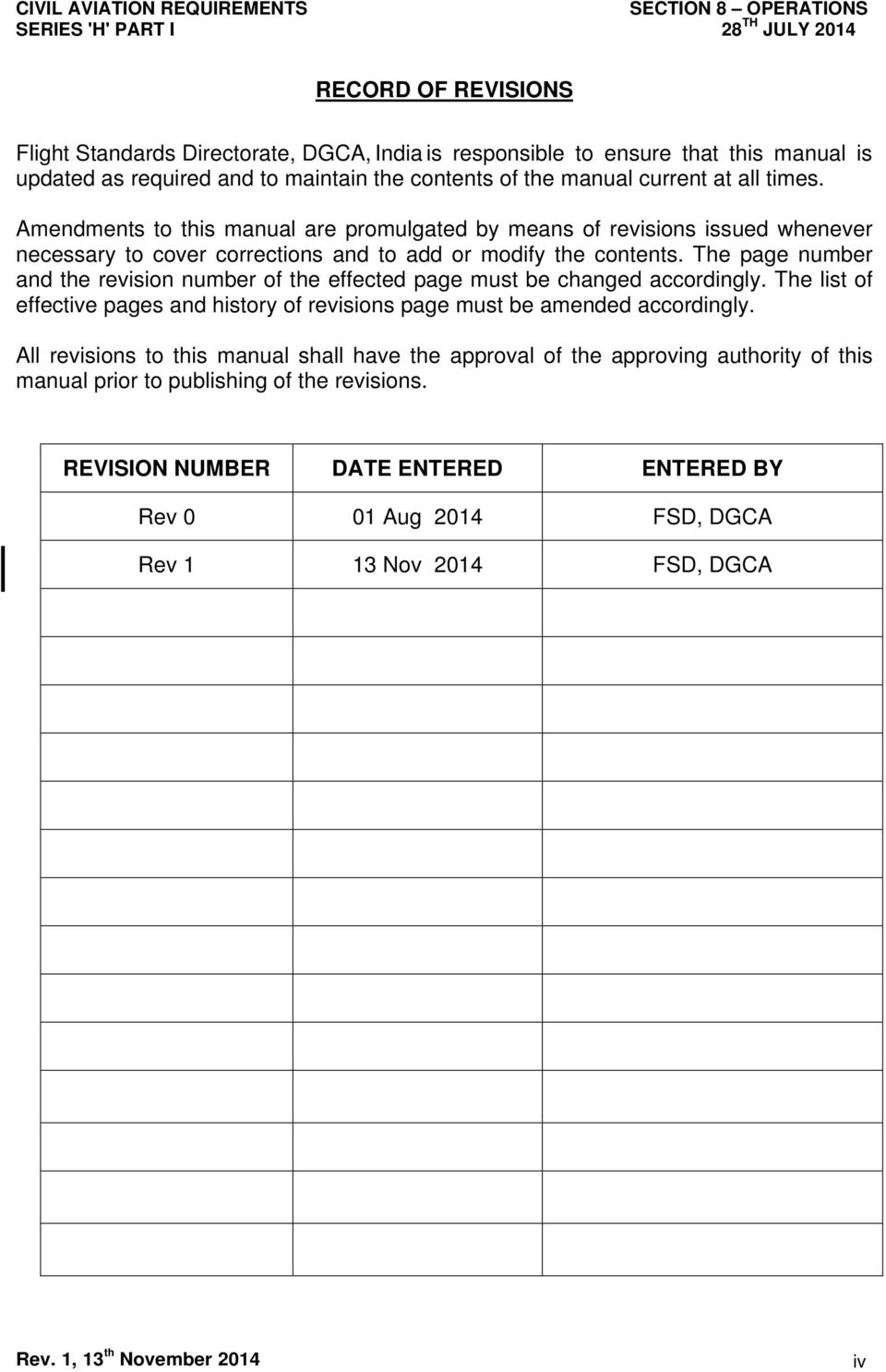
4 RECORD OF REVISIONS Flight Standards Directorate, DGCA, India is responsible to ensure that this manual is updated as required and to maintain the contents of the manual current at all times. Amendments to this manual are promulgated by means of revisions issued whenever necessary to cover corrections and to add or modify the contents. The page number and the revision number of the effected page must be changed accordingly. The list of effective pages and history of revisions page must be amended accordingly. All revisions to this manual shall have the approval of the approving authority of this manual prior to publishing of the revisions. REVISION NUMBER DATE ENTERED ENTERED BY Rev 0 01 Aug 2014 FSD, DGCA Rev 1 13 Nov 2014 FSD, DGCA Rev. 1, 13 th November 2014 iv
5 LIST OF EFFECTIVE PAGES Serial No Page No Revision No Effective Date Serial No Page No Revision No Effective Date 1 (i) 0 01 Aug B Aug (ii) 0 01 Aug B Aug (iii) 0 01 Aug B Aug (iv) 0 01 Aug B Aug (v) 0 01 Aug C Aug (vi) 0 01 Aug C Aug (vii) 0 01 Aug C Aug (viii) 0 01 Aug D Aug (ix) 0 01 Aug D Aug (x) 0 01 Aug E Aug (xi) 0 01 Aug E Aug (xii) 0 01 Aug E Aug (xiii) 0 01 Aug E Aug (xiv) 0 01 Aug E Aug (xv) 0 01 Aug E Aug (xvi) 0 01 Aug E Aug (xvii) 0 01 Aug E Aug (xviii) 0 01 Aug A Aug A Aug A Aug B Aug A Aug B Aug A Aug B Aug A Aug B Aug A Aug B Aug A Aug B Aug A Aug B Aug A Aug B Aug A Aug B Aug A Aug B Aug A Aug B Aug A Aug 2014 v

6 Serial No Page No Revision No Effective Date Serial No Page No Revision No Effective Date 61 2-A Aug D Aug A Aug D Aug A Aug D Aug A Aug D Aug A Aug D Aug B Aug D Aug B Aug D Aug B Aug D Aug B Aug D Aug C Aug D Aug C Aug D Aug C Aug E Aug C Aug E Aug C Aug E Aug C Aug E Aug C Aug E Aug C Aug E Aug C Aug E Aug C Aug E Aug C Aug E Aug C Aug E Aug C Aug E Aug C Aug E Aug C Aug E Aug C Aug E Aug C Aug E Aug C Aug E Aug C Aug E Aug D Aug E Aug D Aug E Aug 2014 vi

7 Serial No Page No Revision No Effective Date Serial No Page No Revision No Effective Date E Aug B Aug E Aug B Aug E Aug B Aug E Aug B Aug E Aug B Aug E Aug B Aug E Aug B Aug E Aug B Aug E Aug B Aug A Aug B Aug A Aug B Aug A Aug B Aug A Aug B Aug A Aug B Aug A Aug B Aug A Aug B Aug A Aug B Aug A Aug B Aug A Aug B Aug A Aug B Aug A Aug B Aug A Aug B Aug A Nov B Aug A Nov B Aug B Aug B Aug A Aug B Aug A Aug B Aug A Aug B Aug B Aug B Aug B Aug B Aug 2014 Rev. 1, 13 th November 2014 vii
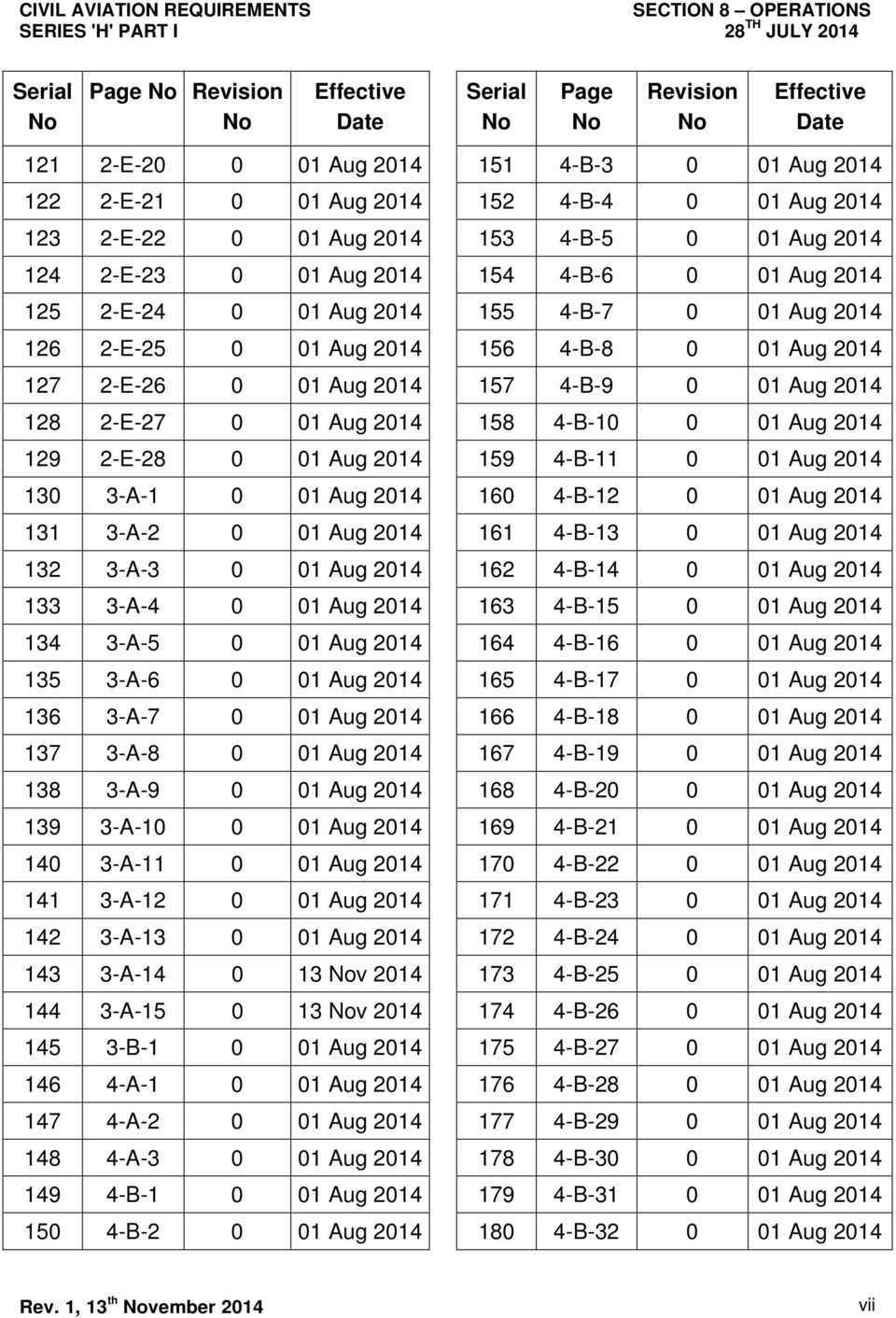
8 Serial No Page No Revision No Effective Date Serial No Page No Revision No Effective Date B Aug C Aug B Aug C Aug C Aug C Aug C Aug C Aug C Aug C Aug A Aug C Aug A Aug D Aug A Aug D Aug A Aug D Aug A Aug D Aug A Aug D Aug A Aug D Aug A Aug D Aug A Aug D Aug A Aug D Aug B Aug E Aug B Aug E Aug B Aug E Aug B Aug E Aug B Aug E Aug B Aug E Aug B Aug E Aug B Aug E Aug B Aug E Aug B Aug F Aug B Aug F Aug C Aug F Aug C Aug F Aug C Aug F Aug C Aug F Aug 2014 Rev. 1, 13 th November 2014 viii

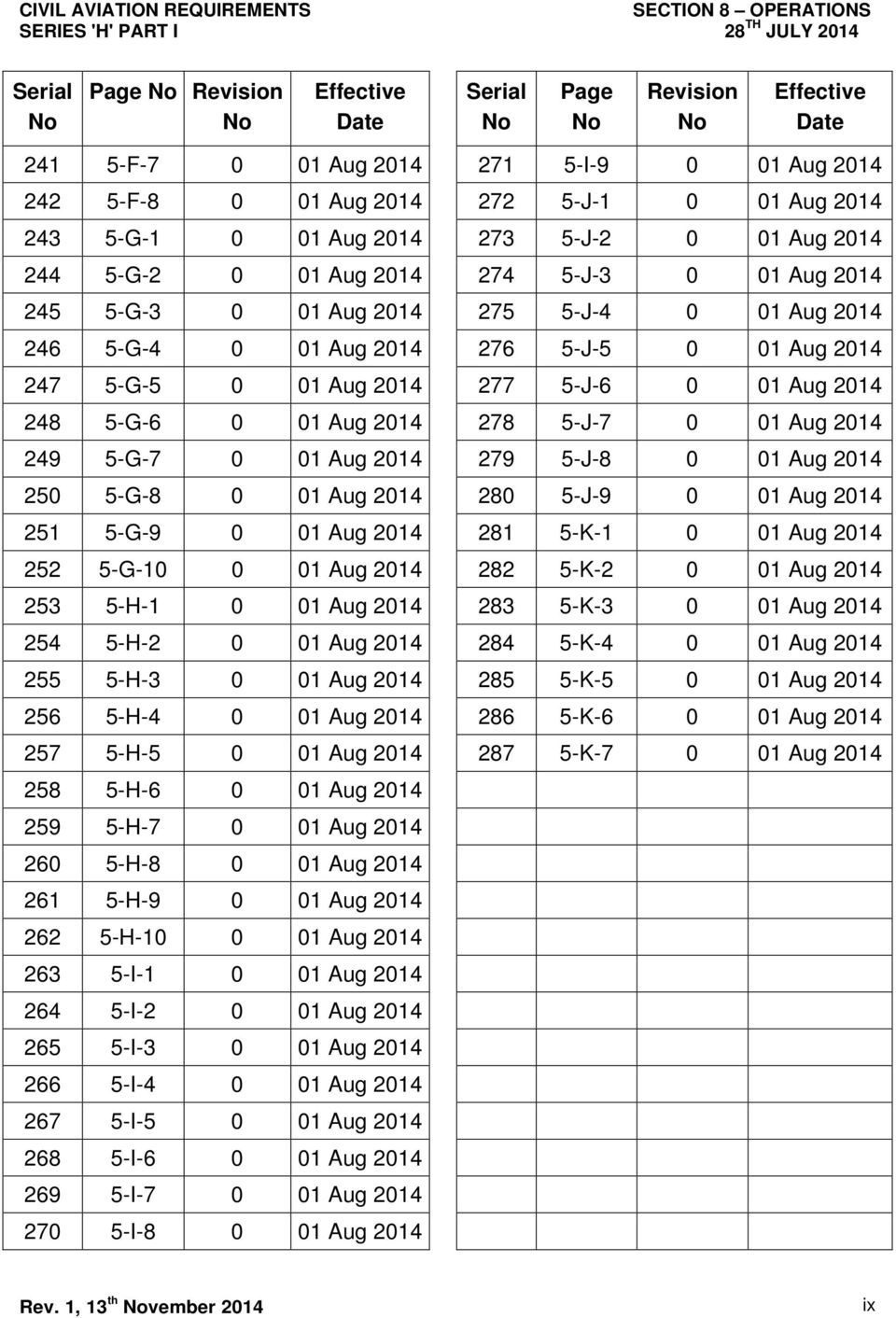
9 Serial No Page No Revision No Effective Date Serial No Page No Revision No Effective Date F Aug I Aug F Aug J Aug G Aug J Aug G Aug J Aug G Aug J Aug G Aug J Aug G Aug J Aug G Aug J Aug G Aug J Aug G Aug J Aug G Aug K Aug G Aug K Aug H Aug K Aug H Aug K Aug H Aug K Aug H Aug K Aug H Aug K Aug H Aug H Aug H Aug H Aug H Aug I Aug I Aug I Aug I Aug I Aug I Aug I Aug I Aug 2014 Rev. 1, 13 th November 2014 ix
10 TABLE OF CONTENTS Topic Page No Reference Amendment No Date when Effective PART- 0 : INTRODUCTION 0 01 Aug 2014 INTRODUCTION - (ii) 0 01 Aug 2014 PRESENTATION - (iv) 0 01 Aug 2014 RECORD OF REVISIONS - (v) 0 01 Aug 2014 LIST OF EFFECTIVE PAGES - (vi) 0 01 Aug 2014 TABLE OF CONTENTS - (xi) 0 01 Aug 2014 PART - 1 : GENERAL 0 01 Aug 2014 SUBPART A : APPLICABILITY 1 A Aug 2014 PART- 1 : GENERAL 0 01 Aug 2014 SUBPART B : DEFINITIONS 1 B Aug Aug 2014 PART- 1 : GENERAL 0 01 Aug 2014 SUBPART C : GENERAL RULES 1 C Aug 2014 Compliance with laws, regulations and procedures 1 C Aug 2014 Compliance with DGCA rules and regulations by foreign operators 1 C Aug 2014 Safety management 1 C Aug 2014 Dangerous goods 1 C Aug 2014 Use of psychoactive substances 1 C Aug 2014 PART- 1 : GENERAL 0 01 Aug 2014 SUBPART D : OPERATIONAL CERTIFICATION AND SUPERVISION 1 D Aug 2014 Air operator permit 1 D Aug 2014 Power to inspect 1 D Aug 2014 Production of documentation and records 1 D Aug 2014 Surveillance of operations by foreign operator 1 D Aug 2014 PART- 1 : GENERAL 0 01 Aug 2014 SUBPART E : DOCUMENTATION 1 E Aug 2014 Operations manual 1 E Aug 2014 x

11 Topic Page No Reference Amendment No Date when Effective Checklists 1 E Aug 2014 Mandatory documents for all flights 1 E Aug 2014 Mass and balance documentation 1 E Aug 2014 Journey log book 1 E Aug 2014 Records of emergency and survival equipment 1 E Aug 2014 Flight recorder records 1 E Aug 2014 Fuel and oil records 1 E Aug 2014 Document storage period 1 E Aug 2014 PART 2 : OPERATIONS 0 01 Aug 2014 SUBPART A HELICOPTER PERFORMANCE 2 - A Aug 2014 Performance General 2 - A Aug 2014 Applicability 2 - A Aug 2014 General 2 - A Aug 2014 Operating Conditions 2 - A Aug 2014 Obstacle Accountability 2 - A Aug 2014 Performance Class A Aug 2014 General 2 - A Aug 2014 Take Off 2 - A Aug 2014 Take Off Flight Path 2 - A Aug 2014 Enroute Critical Power Unit Inoperative 2 - A Aug 2014 Landing 2 - A Aug 2014 Performance Class A Aug 2014 General 2 - A Aug 2014 Operations Without Assured Safe Forced Landing Capability 2 - A Aug 2014 Take Off 2 - A Aug 2014 Take Off Flight Path 2 - A Aug 2014 Enroute Critical Power Unit Inoperative 2 - A Aug 2014 Landing 2 - A Aug 2014 Performance Class A Aug 2014 General 2 - A Aug 2014 xi

12 Topic Page No Reference Amendment No Date when Effective Take Off 2 - A Aug 2014 Enroute Critical Power Unit Inoperative 2 - A Aug 2014 Landing 2 - A Aug 2014 PART 2 : OPERATIONS 0 01 Aug 2014 SUBPART B : HELICOPTER OPERATING LIMITATIONS 2 - B Aug 2014 General 2 - B Aug 2014 Operating limitations 2 - B Aug 2014 Mass limitations 2 - B Aug 2014 Operations performance classes 2 - B Aug 2014 Obstacle data 2 - B Aug 2014 PART 2 : OPERATIONS 0 01 Aug 2014 SUBPART C : OPERATING PROCEDURES 2 - C Aug 2014 General considerations 2 - C Aug 2014 Over water flights 2 - C Aug 2014 Procedures 2 - C Aug 2014 General 2 - C Aug 2014 In-flight simulation of emergency situations 2 - C Aug 2014 Minimum flight altitudes (operations under IFR) 2 - C Aug 2014 Operating minima (operations under IFR) 2 - C Aug 2014 Helicopter flight aircrew 2 - C Aug 2014 Flight dispatcher / Operations officer 2 - C Aug 2014 Passengers 2 - C Aug 2014 Flight preparation 2 - C Aug 2014 Carry on baggage 2 - C Aug 2014 Operational flight planning 2 - C Aug 2014 General 2 - C Aug 2014 Alternate heliports 2 - C Aug 2014 Route planning 2 - C Aug 2014 Weather conditions 2 - C Aug 2014 xii
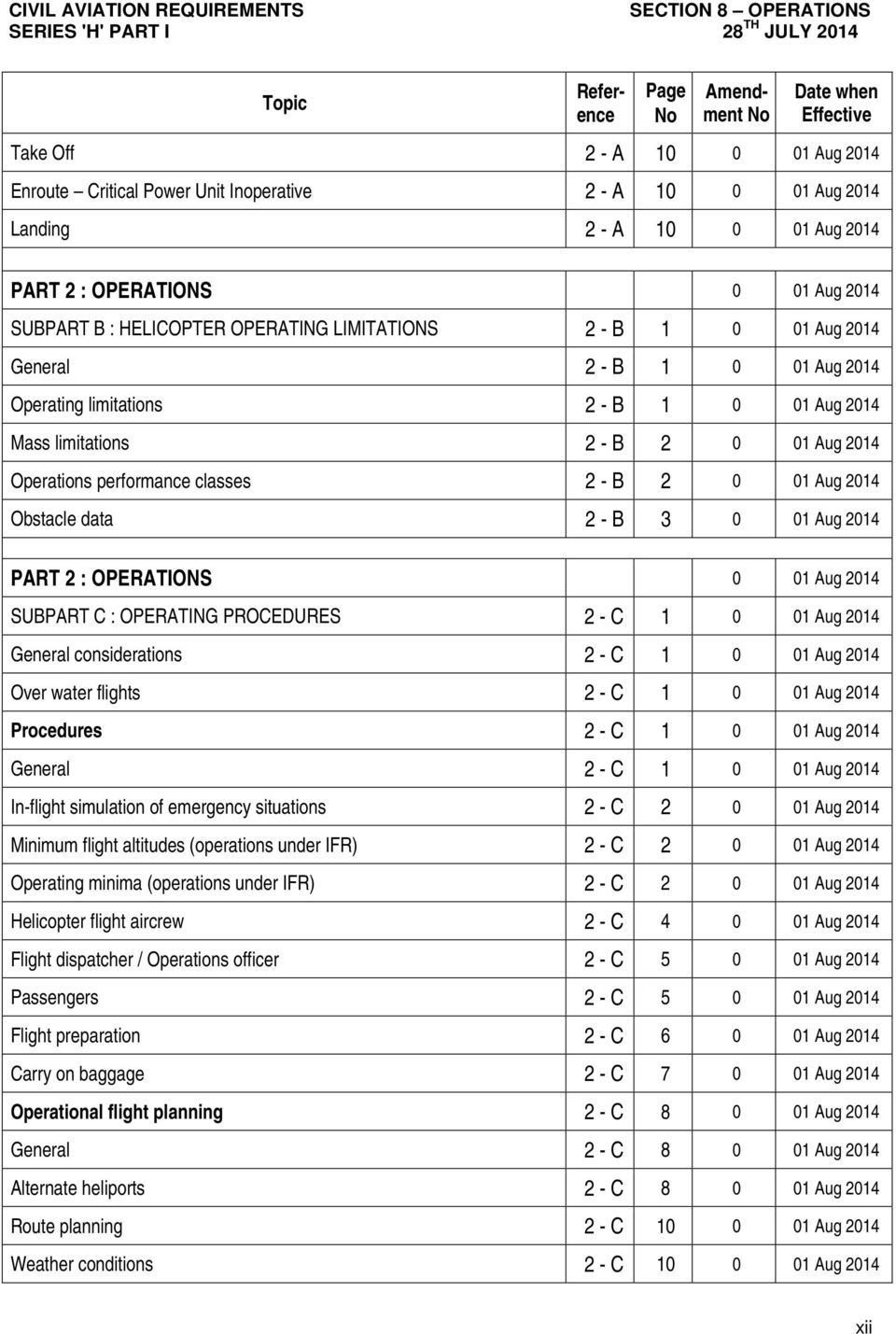
13 Topic Page No Reference Amendment No Date when Effective Fuel and oil supply 2 - C Aug 2014 Oxygen supply 2 - C Aug 2014 Loading, mass and balance 2 - C Aug 2014 In-flight procedures 2 - C Aug 2014 Heliport operating minima 2 - C Aug 2014 Meteorological observation 2 - C Aug 2014 Hazardous flight conditions 2 - C Aug 2014 Flight crew members at duty stations 2 - C Aug 2014 Use of oxygen 2 - C Aug 2014 Instrument flight procedures 2 - C Aug 2014 Special VFR 2 - C Aug 2014 In-flight fuel management 2 - C Aug 2014 Refueling with passengers on board 2 - C Aug 2014 Noise abatement 2 - C Aug 2014 PART 2 : OPERATIONS 0 01 Aug 2014 SUBPART D SPECIAL HELICOPTER OPERATIONS 2 - D Aug 2014 Hill Flying 2 - D Aug 2014 General 2 - D Aug 2014 Requirements 2 - D Aug 2014 Offshore Operations 2 - D Aug 2014 General 2 - D Aug 2014 Requirements 2 - D Aug 2014 External Load Operations (ELO) 2 - D Aug 2014 Terminology 2 - D Aug 2014 Operations manual 2 - D Aug 2014 External load equipment 2 - D Aug 2014 Operating requirements 2 - D Aug 2014 Additional requirements 2 - D Aug 2014 Helicopter Hoist Operations (HHO) 2 - D Aug 2014 Terminology 2 - D Aug 2014 xiii

14 Topic Page No Reference Amendment No Date when Effective Operations Manual 2 - D Aug 2014 Maintenance of HHO equipment 2 - D Aug 2014 Operating requirements 2 - D Aug 2014 Additional requirements 2 - D Aug 2014 Helicopter Emergency Medical Services (HEMS) 2 - D Aug 2014 General 2 - D Aug 2014 Definitions 2 - D Aug 2014 Restrictions 2 - D Aug 2014 Operational requirements 2 - D Aug 2014 Helicopter configuration 2 - D Aug 2014 HEMS operating base facilities 2 - D Aug 2014 Briefing 2 - D Aug 2014 PART 2 : OPERATIONS 0 01 Aug 2014 SUBPART E ALL WEATHER OPERATIONS 2 - E Aug 2014 Terminology 2 - E Aug 2014 Heliport Operating Minima 2 - E Aug 2014 General 2 - E Aug 2014 Take off minima 2 - E Aug 2014 Non precision approach 2 - E Aug 2014 Precision approach Cat I 2 - E Aug 2014 Precision approach Cat II 2 - E Aug 2014 Circling approach 2 - E Aug 2014 Visual approach 2 - E Aug 2014 Airborne Radar approach over water operations 2 - E Aug 2014 Low Visibility Operations 2 - E Aug 2014 Limitations 2 - E Aug 2014 General operating rules 2 - E Aug 2014 Heliport Considerations 2 - E Aug 2014 Training and Qualifications 2 - E Aug 2014 General 2 - E Aug 2014 Ground training 2 - E Aug 2014 xiv

15 Topic Page No Reference Amendment No Date when Effective Flight simulator and/or flight training 2 - E Aug 2014 Conversion training requirements 2 - E Aug 2014 Type and command experience 2 - E Aug 2014 Recurrent training and checking 2 - E Aug 2014 LVTO and Cat II/ Cat III recency requirements 2 - E Aug 2014 Operating procedures 2 - E Aug 2014 Procedures and operating instructions 2 - E Aug 2014 Minimum equipment 2 - E Aug 2014 VFR and Special VFR 2 - E Aug 2014 VFR minima 2 - E Aug 2014 Local area ops (VFR day only) 2 - E Aug 2014 Authorisation of Special VFR 2 - E Aug 2014 Requirement of Minimum Instruments for Special VFR 2 - E Aug 2014 Training and Qualifications 2 - E Aug 2014 Adverse Weather/ Monsoon Operations 2 - E Aug 2014 Adverse Weather Training and Checks 2 - E Aug 2014 General Conditions 2 - E Aug 2014 PART 3 : MAINTENANCE AND EQUIPMENT 0 01 Aug 2014 SUBPART A - HELICOPTER INSTRUMENTS AND EQUIPMENT 3 A Aug 2014 General 3 A Aug 2014 Mandatory equipment for all helicopters on all flights 3 A Aug 2014 Marking of break-in points 3 A Aug 2014 Flight recorders 3 A Aug 2014 Communication equipment 3 A Aug 2014 Navigation equipment 3 A Aug 2014 Installation. 3 A Aug 2014 Instruments and equipment for flights operated under VFR. 3 A Aug 2014 Instruments and equipment for flights operated under IFR. 3 A Aug 2014 Instruments and equipment for helicopters operated at night. 3 A Aug 2014 Emergency equipment 3 A Aug 2014 All helicopters on flights over water 3 A Aug 2014 xv
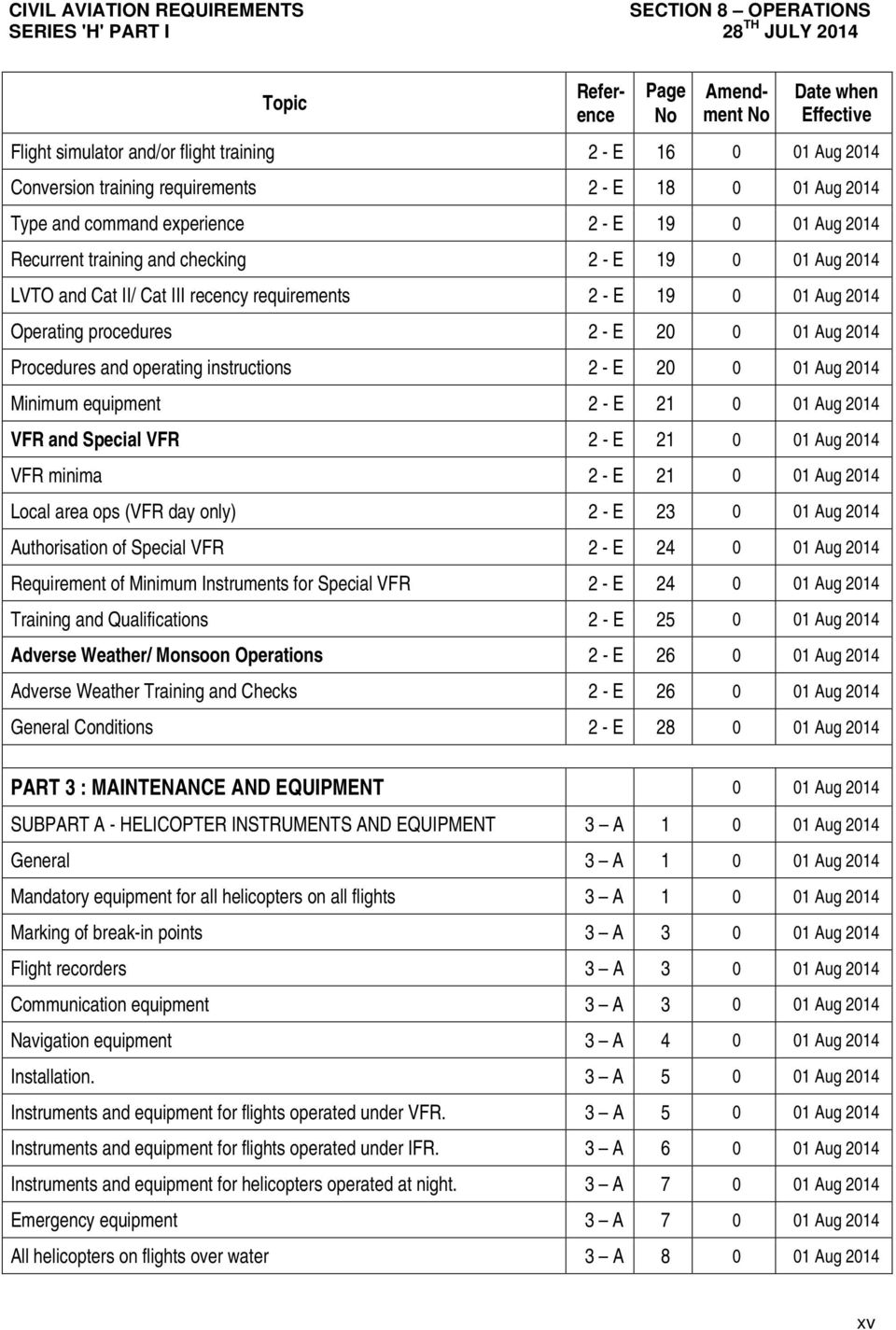
16 Topic Page No Reference Amendment No Date when Effective All helicopters on flights over designated sea areas 3 A Aug 2014 All helicopters on flights over designated land areas 3 A Aug 2014 Emergency locator transmitter (ELT) 3 A Aug 2014 All helicopters on high altitude flights 3 A Aug 2014 All helicopters in icing conditions 3 A Aug 2014 Airborne weather radar equipment 3 A Aug 2014 Noise certification standards 3 A Aug 2014 Pressure altitude reporting transponder 3 A Aug 2014 Radio altimeters 3 A Aug 2014 Cabin crew seats. 3 A Aug 2014 Flight crew interphone system 3 A Aug 2014 Crew member interphone system 3 A Aug 2014 Public address system 3 A Aug 2014 Flight Recorders 3 A Aug 2014 Automatic Landing Systems and Augmented Vision Systems 3 A Nov 2014 Electronic Flight Bags 3 A Nov 2014 PART 3 : MAINTENANCE AND EQUIPMENT 0 01 Aug 2014 SUBPART B : HELICOPTER MAINTENANCE AND SECURITY 3 B Aug 2014 Maintenance 3 B Aug 2014 Security 3 B Aug 2014 PART 4 : HELICOPTER CREW 0 01 Aug 2014 SUBPART A : FLIGHT CREW - GENERAL 4 A Aug 2014 Composition of the flight crew 4 A Aug 2014 Flight crew member emergency duties 4 A Aug 2014 Flight crew member training programmes 4 A Aug 2014 Familiarisation training and check of licensed personnel 4 A Aug 2014 PART 4 : HELICOPTER CREW 0 01 Aug 2014 SUBPART B: PILOT QUALIFICATIONS 4 B Aug 2014 Pilot-In-Command Operational Qualifications 4 B Aug 2014 Recurrent Training Requirements 4 B Aug 2014 Rev. 1, 13 th November 2014 xvi

17 Topic Page No Reference Amendment No Date when Effective Requirement 4 B Aug 2014 Types of recurrent training 4 B Aug 2014 Competency checks 4 B Aug 2014 Refresher training 4 B Aug 2014 Record and monitoring 4 B Aug 2014 Break in Flying 4 B Aug 2014 Applicability 4 B Aug 2014 General Conditions 4 B Aug 2014 Pilots flying helicopters of AUW less than 5700 KGS. 4 B Aug 2014 Pilots flying helicopters of AUW of 5700 KGS or more 4 B Aug 2014 Extension of Aircraft Rating 4 B Aug 2014 General 4 B Aug 2014 Ground training syllabus 4 B Aug 2014 Flying training syllabus 4 B Aug 2014 Types of Helicopters 4 B Aug 2014 Requirements For Flying More Than One Type Of Helicopter 4 B Aug 2014 Conditions for all helicopters 4 B Aug 2014 For helicopters above 3180 kg 4 B Aug 2014 For helicopters above 5700 kg 4 B Aug 2014 Restriction 4 B Aug 2014 Pilot Qualifications For Special Roles 4 B Aug 2014 Hill flying operations 4 B Aug 2014 Offshore Operations 4 B Aug 2014 External load operations 4 B Aug 2014 Helicopter Hoist Operations 4 B Aug 2014 Helicopter Emergency Medical Services 4 B Aug 2014 PART 4 : HELICOPTER CREW 0 01 Aug 2014 SUBPART C : CREW MEMBERS OTHER THAN FLIGHT CREW 4 C Aug 2014 Flight Operations Officer / Flight Dispatcher 4 C Aug 2014 Approval 4 C Aug 2014 Qualifications 4 C Aug 2014 Rev. 1, 13 th November 2014 xvii

18 Topic Page No Reference Amendment No Date when Effective Cabin crew 4 C Aug 2014 Applicability 4 C Aug 2014 PART 5 : HELICOPTER PILOTS TEST PERFORMA 0 01 Aug 2014 Performa 1 : Pilot Proficiency/ Skill Test By Day : Multi Engine Helicopters 5 A Aug 2014 Guidelines for Examiner : Pilot Proficiency/ Skill Test By Day : Multi Engine Helicopters Performa 2 : Pilot Proficiency/ Skill Test By Day : Single Engine Helicopters Guidelines for Examiner : Pilot Proficiency/ Skill Test By Day : Single Engine Helicopters Performa 3 : Pilot Proficiency/ Skill Test By Night: Multi Engine Helicopters Guidelines for Examiner : Pilot Proficiency/ Skill Test By Night: Multi Engine Helicopters Performa 4 : Pilot Proficiency/ Skill Test By Night: Single Engine Helicopters Guidelines for Examiner : Pilot Proficiency/ Skill Test By Night: Single Engine Helicopters 5 A Aug B Aug B Aug C Aug C Aug D Aug D Aug 2014 Performa 5 : Helicopter Pilot Instrument Rating Test 5 E Aug 2014 Guidelines for Examiner : Helicopter Pilot Instrument Rating Test 5 E Aug 2014 Performa 6 : Helicopter Pilot Special VFR Check 5 F Aug 2014 Guidelines for Examiner : Helicopter Pilot Special VFR Check 5 F Aug 2014 Performa 7 : Helicopter Pilot Hill/Mountain Flying/ Route Check 5 G Aug 2014 Guidelines for Examiner : Helicopter Pilot Hill/Mountain Flying/ Route Check 5 G Aug 2014 Performa 8 : Helicopter Off Shore Flying/ Route Check 5 H Aug 2014 Guidelines for Examiner : Helicopter Off Shore Flying/ Route Check 5 H Aug 2014 Performa 9 : External Load Operations 5 I Aug 2014 Guidelines for Examiner : External Load Operations 5 I Aug 2014 Performa 10 : Helicopter Hoist Operations 5 J Aug 2014 Guidelines for Examiner : Helicopter Hoist Operations 5 J Aug 2014 Performa 11 : Helicopter Emergency Medical Services 5 K Aug 2014 Guidelines for Examiner : Helicopter Emergency Medical Services 5 K Aug 2014 Rev. 1, 13 th November 2014 xviii

19 PART 1 : GENERAL SUBPART A : APPLICABILITY 1. This CAR prescribes requirements applicable to the operation of any civil helicopter for the purpose of commercial air transportation by any operator whose principal place of business is in India. 2. This CAR does not apply to helicopters when used in military, customs, police services and fire-fighting. 3. Aerial Work Activity. All operators intending to undertake aerial work activity will obtain a special sanction on a case basis from the DGCA. 4. Exemptions. The DGCA may exceptionally and temporarily grant an exemption from the provisions of this CAR when satisfied that there is a need and subject to compliance with any supplementary condition the DGCA considers necessary in order to ensure an acceptable level of safety in the particular case. 5. The requirements in this CAR are applicable no later than 01 Aug 2014 unless otherwise indicated. 1 A 1
20

21 PART 1 : GENERAL SUBPART B : DEFINITIONS 1. Aerial work. An aircraft operation in which an aircraft is used for specialized services such as agriculture, construction, photography, surveying, observation and patrol, search and rescue, aerial advertisement, etc. 2. Aerodrome. A defined area on land or water (including any buildings, installations and equipment) intended to be used either wholly or in part for the arrival, departure and surface movement of aircraft. 3. Aircraft. Any machine that can derive support in the atmosphere from the reactions of the air other than the reactions of the air against the earth's surface. 4. Aircraft operating manual (Flight Crew Operating Manual-FCOM). A manual, acceptable to DGCA containing normal, abnormal and emergency procedures, checklists, limitations, performance information, details of the aircraft systems and other material relevant to the operation of the aircraft. Note. The aircraft operating manual is part of the Operations manual. 5. Air operator Permit I Certificate. An operating permit/ certificate or an equivalent document issued by DGCA authorizing an operator to carry out specified commercial air transport operations. 6. Airworthy. The status of an aircraft, engine, propeller or part when it conforms to its approved design and is in a condition for safe operation. 7. Alternate heliport. A heliport to which a helicopter may proceed when it becomes either impossible or inadvisable to proceed to or to land at the heliport of intended landing. Alternate heliports include the following: 7.1. Take-off alternate. An alternate heliport at which a helicopter can land should this become necessary shortly after takeoff and it is not possible to use the heliport of departure En-route alternate. A heliport at which a helicopter would be able to land after experiencing an abnormal or emergency condition while en route Destination alternate. An alternate heliport to which a helicopter may proceed should it become either impossible or inadvisable to land at the heliport of intended landing. Note. The heliport from which a flight departs may be an en-route or a destination alternate 1 B 1
22 heliport for that flight. 8. Approach and landing operations using instrument approach procedures. Instrument approach and landing operations are classified as follows: 8.1. Non-precision approach and landing operation. An instrument approach and landing which utilizes lateral guidance but does not utilize vertical guidance Approach and landing operations with vertical guidance. An instrument approach and landing which utilizes lateral and vertical guidance but does not meet the requirements established for precision approach and landing operations Precision approach and landing operations. An instrument approach and landing using precision lateral and vertical guidance with minima as determined by the category of operation. Note. - Lateral and vertical guidance refers to the guidance provided either by: 1. a ground-based navigation aid,. or 2. computer generated navigation data. 9. Approach and landing phase - helicopters. That part of the flight from 500 ft (150m) above the elevation of the final approach and take-off area (FATO), if the flight is planned to exceed this height, or from the commencement of the descent in the other cases, to landing or to the balked landing point. 10. Area navigation (RNAV). A method of navigation which permits aircraft operation on any desired flight path within the coverage of ground- or space-based navigation aids or within the limits of the capability of self-contained aids, or a combination of these. Note - Area navigation includes performance-based navigation as well as other operations that do not meet the definition of performance-based navigation. 11. Cabin crew member. A crew member who performs, in the interest of safety of passengers, duties assigned by the operator or the pilot-in-command of the aircraft, but who shall not act as a flight crew member. 12. Categories of precision approach and landing operations: Category I (CAT I) operation. A precision instrument approach and landing with a decision height not lower than 60 m (200 ft) and with either a visibility not less than 800 m or a runway visual range not less than 550 m Category II (CAT II) operation. A precision instrument approach and landing with a decision height lower than 60 m (200 ft), but not lower than 30 m (100 ft), and a runway visual range not less than 300 m Category IIIA (CAT IIIA) operation. A precision instrument approach and landing with: 1 B 2
23 a decision height lower than 30 m(100 ft) or no decision height; and a runway visual range not less than 175 m Category IIIB (CAT IIIB) operation. A precision instrument approach and landing with: a decision height lower than 15 m(50 ft) or no decision height; and a runway visual range less than 175 m but not less than 50 m Category IIIC (CAT IIIC) operation. A precision instrument approach and landing with no decision height and no runway visual range limitations. Note - Where decision height (DH) and runway visual range (RVR) fall into different categories of operation, the instrument approach and landing operation would be conducted in accordance with the requirements of the most demanding category (e.g. an operation with a DH in the range of CAT IIIA but with an RVR in the range of CAT IIIB would be considered a CAT IIIB operation or an operation with a DH in the range of CAT II but with an RVR in the range of CAT I would be considered a CAT II operation). 13. Category A. With respect to helicopters, means a multi-engine helicopter designed with engine and system isolation features capable of operations using take-off and landing data scheduled under a critical engine failure concept which assures adequate designated surface area and adequate performance capability for continued safe flight or safe rejected take-off. 14. Category B. With respect to helicopters, means a single-engine or multi-engine helicopter which does not meet Category A standards. Category B helicopters have no guaranteed capability to continue safe flight in the event of an engine failure, and a forced landing is assumed. 15. Combined vision system (CVS). A system to display images from a combination of an enhanced vision system (EVS) and a synthetic vision system (SVS). 16. Commercial Air Transport Operation. An aircraft operation involving the transport of passengers, cargo or mail for remuneration or hire. 17. Committal Point (CP). The committal point is defined as the point in the approach at which the pilot flying (PF) decides that, in the event of a power unit failure being recognized, the safest option is to continue to the deck. 18. Configuration Deviation List (CDL). A list established by the organization responsible for the type design with the approval of the State of Design which identifies any external parts of an aircraft type which may be missing at the commencement of a flight, and which contains, where necessary, any information on associated operating limitations and performance correction. 19. Congested Area. In relation to a city, town or settlement, any area which is substantially used for residential, commercial or recreational purposes. 1 B 3
24 20. Continuing Airworthiness. The set of processes by which all aircraft comply with the applicable airworthiness requirements and remain in a condition for safe operation throughout their operating life. 21. Congested Hostile Environment. A hostile environment within a congested area. 22. Controlled Flight. Any flight which is subject to an air traffic control clearance. 23. Control Zone. A controlled airspace extending upwards from the surface of the earth to a specified upper limit. 24. Crew Member. A person assigned by an operator to duty on an aircraft during flight duty period. 25. D. The largest dimension of the helicopter when the rotors are turning. 26. Dangerous Goods. Articles or substances which are capable of posing a risk to health, safety, property or the environment and which are shown in the list of dangerous goods in the Technical Instructions or which are classified according to those Instructions. Note - Dangerous goods are classified in Aircraft (Carriage of Dangerous Goods) Rules, Decision Altitude (DA) or Decision Height (DH). A specified altitude or height in the precision approach or approach with vertical guidance at which a missed approach must be initiated if the required visual reference to continue the approach has not been established. Note 1. Decision altitude (DA) is referenced to mean sea level and decision height (DH) is referenced to the threshold elevation. Note 2. The required visual reference means that section of the visual aids or of the approach area which should have been in view, for sufficient time for the pilot to have made an assessment of the aircraft position and rate of change of position, in relation to the desired flight path. In Category 111 operations with a decision height the required visual reference is that specified for the particular procedure and operation. Note 3. For convenience where both expressions they may be written in the form "decision altitude/height" and abbreviated are used "DA/H". 28. Defined Point After Take-Off (DPATO). The point, within the take-off and initial climb phase, before which the helicopter's ability to continue the flight safely, with one engine inoperative, is not assured and a forced landing may be required. Note. Defined points apply to helicopters operating in performance Class 2 only. 29. Defined Point Before Landing (DPBL). The point, within the approach and landing phase, after which the helicopter's ability to continue the flight safely, with one engine inoperative, is not assured and a forced landing may be required. Note. Defined points apply to helicopters operating in performance Class 2 only. 1 B 4
25 30. Distance DR. DR is the horizontal distance that the helicopter has travelled from the end of the take-off distance available. 31. Dry Operating Mass. The total mass of the helicopter when ready for a specific type of operation excluding all usable fuel and traffic load. 32. Electronic flight bag (EFB). An electronic information system, comprised of equipment and applications, for flight crew which allows for storing, updating, displaying and processing of EFB functions to support flight operations or duties. 33. Elevated Heliport. A heliport located on a raised structure on land. 34. Emergency Locator Transmitter (ELT). A generic term describing equipment which broadcast distinctive signals on designated frequencies and, depending on application, may be automatically activated by impact or be manually activated. An ELT may be any of the following: Automatic Fixed ELT (ELT (AF)). An automatically activated ELT which is permanently attached to an aircraft Automatic Portable ELT (ELT(AP)). An automatically activated ELT which is rigidly attached to an aircraft but readily removable from the aircraft Automatic Deployable ELT (ELT(AD)). An ELT which is rigidly attached to an aircraft and which is automatically deployed and activated by impact, and, in some cases also by hydrostatic sensors. Manual deployment is also provided Survival ELT (ELT(S)). An ELT which is removable from an aircraft, stowed so as to facilitate its ready use in an emergency, and manually activated by survivors. 35. Engine. A unit used or intended to be used for aircraft propulsion. It consists of at least those components and equipment necessary for functioning and control, but excludes the propeller/rotors (if applicable). 36. Enhanced vision system (EVS). A system to display electronic real-time images of the external scene achieved through the use of image sensors. Note. EVS does not include night vision imaging systems (NVIS). 37. En-route Phase. That part of the flight from the end of the take-off and initial climb phase to the commencement of the approach and landing phase. Note.- Where adequate obstacle clearance cannot be guaranteed visually, flights must be planned to ensure that obstacles can be cleared by an appropriate margin. In the event of failure of the critical engine, operators may need to adopt alternative procedures. 38. Exposure Time. The actual period during which the performance of the helicopter with the critical power unit inoperative in still air does not guarantee a safe forced landing or the safe continuation of the flight. (See also definition of maximum 1 B 5
26 permitted exposure time). 39. Final Approach And Take-Off Area (FATO). A defined area over which the final phase of the approach maneuver to hover or landing is completed and from which the take-off maneuver is commenced. Where the FATO is to be used by performance Class I helicopters, the defined area includes the rejected take-off area available. 40. Flight Crew Member. A licensed crew member charged with duties essential to the operation of an aircraft during a flight duty period. 41. Flight Duty Period. The total time from the moment a flight crew member commences duty, immediately subsequent to a rest period and prior to making a flight or a series of flights, to the moment the flight crew member is relieved of all duties having completed such flight or series of flights. 42. Flight Manual. A manual, associated with the certificate of airworthiness, containing limitations within which the aircraft is to be considered airworthy, and instructions and information necessary to the flight crew members for the safe operation of the aircraft. 43. Flight Operations Officer/ Flight Dispatcher. A person designated by the operator to engage in the control and supervision of flight operations, whether licensed or not, suitably qualified in accordance with CAR Section 7 Series 'M' Part II, who supports, briefs, and/or assists the pilot-in-command in the safe conduct of the flight. 44. Flight Plan. Specified information provided to air traffic services units, relative to an intended flight or portion of a flight of an aircraft. 45. Flight Recorder. Any type of recorder installed in the aircraft for the purpose of complementing accident/ incident prevention and investigation. 46. Flight Safety Documents System. A set of inter-related documentation established by the operator, compiling and organizing information necessary for flight and ground operations, and comprising, as a minimum, the operations manual and the operators' maintenance control manual. 47. Flight Simulation Training Device. Any one of the following three types of apparatus in which flight conditions are simulated on the ground: A flight simulator. which provides an accurate representation of the flight deck of a particular aircraft type to the extent that the mechanical, electrical, electronic, etc. aircraft systems control functions, the normal environment of flight crew members, and the performance and flight characteristics of that type of aircraft are realistically simulated; A flight procedures trainer, which provides a realistic flight deck environment, and which simulates instrument responses, simple control functions of mechanical, electrical, electronic, etc. aircraft systems, and the performance and flight characteristics of aircraft of a particular class; 1 B 6
27 47.3. A basic instrument flight trainer, which is equipped with appropriate instruments, and which simulates the flight deck environment of an aircraft in flight in instrument flight conditions. 48. Flight Time - Helicopters. The total time from the moment a helicopter's rotor blades start turning until the moment the helicopter finally comes to rest at the end of the flight, and the rotor blades are stopped. 49. General Aviation Operation. An aircraft operation other than a commercial air transport operation or an aerial work operation. 50. Ground Handling. Services necessary for an aircraft's arrival at, and departure from, an airport, other than air traffic services. 51. Head-up Display (HUD). A display system that presents flight information into the pilot's forward external field of view. 52. Helicopter. A heavier-than-air aircraft supported in flight chiefly by the reactions of the air on one or more power-driven rotors on substantially vertical axes. 53. Helideck. A heliport located on a floating or fixed off-shore structure. 54. Heliport. An aerodrome or a defined area of land, water or a structure used or intended to be used wholly or in part for the arrival, departure and surface movement of helicopters. Note 1. - When the term "heliport" is used, it is intended that the term also applies to aerodromes primarily meant for the use of aeroplanes. Note 2.- Helicopters may be operated to and from areas other than heliports. 55. Heliport operating minima. The limits of usability of a heliport for: take-off, expressed in terms of runway visual range and/or visibility and, if necessary, cloud conditions; landing in precision approach and landing operations, expressed in terms of visibility and/or runway visual range and decision altitude/height (DA/H) as appropriate to the category of the operation; landing in approach and landing operations with vertical guidance, expressed in terms of visibility and/or runway visual range and decision altitude/height (DA/H); and landing in non-precision approach and landing operations, expressed in terms of visibility and/or runway visual range, minimum descent altitude/height (MDA/H) and, if necessary, cloud conditions. 56. Hostile environment. An environment in which: 1 B 7
28 56.1. A safe forced landing cannot be accomplished because the surface is inadequate; or The helicopter occupants cannot be adequately protected from the elements; or Search and rescue response/ capability is not provided consistent with anticipated exposure; or There is an unacceptable risk of endangering persons or property on the ground; In any case, the following areas shall be considered hostile: For overwater operations; and Those parts of a congested area without adequate safe forced landing areas. 57. Human Factor Principles. Principles which apply to aeronautical design, certification, training, operations, and maintenance and which seek safe interface between the human and other system components by proper consideration to human performance. 58. Human Performance. Human capabilities and limitations which have an impact on the safety and efficiency of aeronautical operations. 59. IFR flight. A flight conducted in accordance with the instrument flight rules. IFR. The symbol used to designate the instrument flight rules. 60. Instrument meteorological conditions (IMC). Meteorological conditions expressed in terms of visibility, distance from cloud, and ceiling less than the minima specified for visual meteorological conditions. IMC. The symbol used to designate instrument meteorological conditions. Note. - The specified minima for visual meteorological conditions as contained in CAR Section 9 Series 'C' Part I 61. Integrated Survival Suit. A survival suit which meets the combined requirement of survival suit and life jacket 62. Landing decision point (LDP). The point used in determining landing performance from which, a power unit failure having been recognized at this point, the landing may be safely continued or a baulked landing initiated. Note.- LDP applies to performance Class I helicopters. 63. Landing Distance Available (LDAH). The length of the final approach and take- 1 B 8
29 off area plus any additional area declared available and suitable for helicopters to complete the landing manoeuvre from a defined height. 64. Landing Distance Required (LDRH). The horizontal distance required to land and come to a full stop from a point 15 m ( 50 ft) above the landing surface. 65. Landing Decision Point (LDP). The point used in determining landing performance from which, a engine failure occurring at this point, the landing may be safely continued or a balked landing initiated. 66. Maintenance. The performance of tasks required to ensure the continuing Airworthiness of an aircraft, including any one or combination of overhaul, inspection, replacement, defect rectification, and the embodiment of a modification or repair. 67. Maximum Approved Passenger Seating Configuration (MAPSC). The maximum passenger seating capacity of an individual helicopter, excluding crew seats, used by the operator, approved by the DGCA and included in the Operations Manual. 68. Maximum Permitted Exposure Time. A period, determined on the basis of the power unit failure rate recorded for the helicopter's engine type, during which the probability of a power unit failure can be discounted. (See also definition of exposure time). 69. Maintenance Programme. A document which describes the specific scheduled maintenance tasks and their frequency of completion and related procedures, such as a reliability programme, necessary for the safe operation of those aircraft to which it applies. 70. Maintenance Release. A document which contains a certification confirming that the maintenance work to which it relates has been completed in a satisfactory manner, either in accordance with the approved data and the procedures described in the maintenance organization's procedures manual or under an equivalent system. 71. Master Minimum Equipment List (MMEL). A list established for a particular aircraft type by the organization responsible for the type design with the approval of the State of Design containing items, one or more of which is permitted to be unserviceable at the commencement of a flight. The MMEL may be associated with special operating conditions, limitations or procedures. 72. Maximum Mass. Maximum certificated take-off mass. 73. Minimum Descent Altitude (MDA) or Minimum Descent Height (MDH). A specified altitude or height in a non precision approach or circling approach below which descent must not be made without the required visual reference. Note 1- Minimum descent altitude (MDA) is referenced to mean sea level and minimum descent height (MDH) is referenced to the heliport elevation or to the threshold elevation if that is more than 2 m (7ft) below the heliport elevation. A minimum descent height for a circling approach is referenced to the heliport elevation. 1 B 9
30 Note 2.- The required visual reference means that section of the visual aids or of the approach area which should have been in view for sufficient time for the pilot to have made an assessment of the aircraft position and rate of change of position, in relation to the desired flight path. In the case of a circling approach the required visual reference is the runway environment. Note - 3 for convenience when both expressions are used they may be written in the form "minimum descent altitude/height" and abbreviated MDA/H 74. Maximum Take-Of Mass. The maximum permissible total helicopter mass at take-off. 75. Minimum Equipment List (MEL). A list which provides for the operation of aircraft, subject to specified conditions, with particular equipment inoperative, prepared by an operator in conformity with, or more restrictive than, the MMEL established for the aircraft type. 76. MOE. A document endorsed by the head of the maintenance organization which details the maintenance organization's structure and management responsibilities, scope of work, description of facilities, maintenance procedures and quality assurance or inspection systems. 77. Navigation Specification. A set of aircraft and flight crew requirements needed to support performance-based navigation operations within a defined airspace. There are two kinds of navigation specifications: Required Navigation Performance (RNP) specification. A navigation specification based on area navigation that includes the requirement for performance monitoring and alerting, designated by the prefix RNP, e.g. RNP 4, RNP APCH Area Navigation (RNAV) specification. A navigation specification based on area navigation that does not include the requirement for performance monitoring and alerting, designated by the prefix RNAV, e.g. RNAV 5, RNAV1. Note 1 - The Performance-based Navigation Manual (Doc 9613), Volume 11, contains detailed guidance on navigation specifications. Note 2 - The term RNP, previously defined as "a statement of navigation performance necessary for operation within a defined airspace", has been removed from this annex as the concept of RNP has been overtaken by the concept of PBN. The term RNP in this CAR is now solely used in the context of navigation and specification that require performance monitoring and alerting, e. g. RNP 4 refers to the aircraft and operating requirements, including a 4 NM lateral performance with on-board performance monitoring and alerting that are detailed in Doc Night. The hours between the end of evening civil twilight and the beginning of morning civil twilight or such other period between sunset and sunrise as prescribed by Aircraft Rules Note - Civil twilight ends in the evening when the centre of the sun's disc is 6 degrees below the horizon and begins in the morning when the centre of the sun's disc is 6 degrees below the horizon. 1 B 10
31 79. Non-Congested Hostile Environment. A hostile environment outside a congested area. 80. Non-Hostile Environment: An environment in which: A safe forced landing can be accomplished; and The helicopter occupants can be protected from the elements; and Search and rescue response/capability is provided consistent with the anticipated exposure; In any case, those parts of a congested area with adequate safe forced landing areas shall be considered non-hostile. 81. Obstacle. Obstacles include the surface of the earth, whether land or sea. 82. Obstacle Clearance Altitude (OCA) or Obstacle Clearance Height (OCH). The lowest altitude or the lowest height above the elevation of the relevant runway threshold or the aerodrome elevation as applicable, used in establishing compliance with appropriate obstacle clearance criteria. Note 1 - Obstacle clearance altitude is referenced to mean sea level and obstacle clearance height is referenced to the threshold elevation or in the case of non-precision approaches to the aerodrome elevation or the threshold elevation if that is more than 2 m (7ft) below the aerodrome elevation. An obstacle clearance height for a circling approach is referenced to the aerodrome elevation. Note 2 - For convenience when both expressions are used they may be written in the form "obstacle clearance altitude/height" and abbreviated "OCA/H". 83. Offshore Operations. Operations which routinely have a substantial proportion of the flight conducted over sea areas to or from offshore locations. Such operations include, but are not limited to, support of offshore oil, gas and mineral exploitation and sea-pilot transfer. 84. Operation. An activity or group of activities which are subject to the same or similar hazards and which require a set of equipment to be specified, or the achievement and maintenance of a set of pilot competencies, to eliminate or mitigate the risk of such hazards. Note - Such activities could include, but would not be limited to, offshore operations, hell-hoist operations or emergency medical service. 85. Operational Control. The exercise of authority over the initiation, continuation, diversion or termination of a flight in the interest of the safety of the aircraft and the regularity and efficiency of the flight. 86. Operational Flight Plan. The operator's plan for the safe conduct of the flight based on considerations of helicopter performance, other operating limitations and relevant expected conditions on the route to be followed and at the heliports concerned. 1 B 11
32 87. Operations in Performance Class 1. Operations with performance such that, in the event of a critical power-unit failure, performance is available to enable the helicopter to safely continue the flight to an appropriate landing area, unless the failure occurs prior to reaching the take-off decision point (TDP) or after passing the landing decision point (LDP), in which cases the helicopter must be able to land within the rejected take-off or landing area. 88. Operations in Performance Class 2. Operations with performance such that, in the event of critical engine failure, performance is available to enable the helicopter to safely continue the flight to an appropriate landing area, except when the failure occurs early during the take-off maneuver or late in the landing maneuver, in which cases a forced landing may be required. 89. Operations in Performance Class 3. Operations with performance such. that, in the event of a engine failure at any time during the flight, a forced landing will be required. 90. Operations Manual. A manual containing procedures, instructions and guidance for use by operational personnel in the execution of their duties. 91. Operations Specifications. The authorizations, conditions and limitations associated with the air operator permit/ certificate and subject to the conditions in the operations manual. 92. Operator. A person, organization or enterprise engaged in or offering to engage in an aircraft operation. 93. Operator's Maintenance Control Manual. A document which describes the operator's procedures necessary to ensure that all scheduled and unscheduled maintenance is performed on the operator's aircraft on time and in a controlled and satisfactory manner. 94. Performance-based Navigation (PBN). Area navigation based on performance requirements for aircraft operating along an ATS route, on an instrument approach procedure or in a designated airspace. Note - Performance requirements are expressed in navigation specifications (RNAV specification, RNP specification) in terms of accuracy, integrity, continuity, availability and functionality needed for the proposed operation in the context of a particular airspace concept. 95. Performance Class 1 Helicopter. A helicopter with performance such that, in case of engine failure, it is able to land on the rejected take-off area or safely continue the flight to an appropriate landing area. 96. Performance Class 2 Helicopter. A helicopter with performance such that, in case of engine failure, it is able to safely continue the flight, except when the failure occurs prior to a defined point after take-off or after a defined point before landing, in which cases a forced landing may be required. 1 B 12
33 97. Performance Class 3 Helicopter. A helicopter with performance such that, in case of engine failure at any point in the flight profile, a forced landing must be performed. 98. Pilot-in-Command. The pilot designated by the operator, or in the case of general aviation, the owner, as being in command and charged with the safe conduct of a flight. 99. Psychoactive Substances. Alcohol, opioids, cannabinoids, sedatives and hyponotics, cocaine, other psychostimulants, hallucinogens, and volatile solvents, whereas coffee and tobacco are excluded R. Rotor radius Rejected Take-Off Distance Available (RTODAH). The length of the final approach and take-off area declared available and suitable for helicopters operated in Performance Class 1 to complete a rejected take-off Rejected Take-Off Distance Required (RTODRH). The horizontal distance required from the start of the take-off to the point where the helicopter comes to a full stop following a power unit failure and rejection of the take-off at the take-off decision point Repair. The restoration of an aeronautical product to an airworthy condition to ensure that the aircraft continues to comply with the design aspects of the appropriate airworthiness requirements used for the issuance of the type certificate for the respective aircraft type, after it has been damaged or subjected to wear Reported Headwind Component. Reported headwind component is interpreted as being that reported at the time of flight planning and may be used provided there is no significant change of unfactored wind prior to take-off Required Communication Perfomance (RCP). A statement of the performance requirements for operational communication in support of specific ATM functions Required Communication Performance Type (RCP Type). A label (e.g. RCP 240) that represents the values assigned to RCP parameters for communication transaction time, continuity, availability and integrity Required Navigation Performance (RNP). A statement of the navigation performance necessary for operation within a defined airspace. Note - Navigation performance and requirements are defined for a particular RNP type and/or application Rest Period. Any period of time on the ground during which a flight crew member is relieved of all duties by the operator Rotation Point (RP). The rotation point is defined as the point at which a cyclic 1 B 13
34 input is made to initiate a nose-down attitude change during the take-off flight path. It is the last point in the take-off path from which, in the event of an engine failure being recognized, a forced landing on the deck can be achieved Runway Visual Range (RVR). The range over which the pilot of an aircraft on the centre line of a runway can see the runway surface markings or the lights delineating the runway or identifying its centre line Safe Forced Landing. Unavoidable landing or ditching with a reasonable expectancy of no injuries to persons in the aircraft or on the surface Safety Management System. A systematic approach to managing safety, including the necessary organizational structures, accountabilities, policies and procedures 113. Safety Programme. An integrated set of regulations and activities aimed at improving safety Series of flights are consecutive flights that, begin and end within a period of 24 hours; and are all conducted by the same pilot-in-command Special VFR Flight. A VFR flight cleared by air traffic control to operate within a control zone in meteorological conditions below VMC State of the Aerodrome. The State in whose territory the aerodrome is located. Note. State of the Aerodrome includes heliports and landing locations Synthetic Vision system (SVS). A system to display data-derived synthetic images of the external scene from the perspective of the flight deck State of Registry. The State on whose register the aircraft is entered State of the Operator. The State in which the operator's principal place of business is located or, if there is no such place of business, the operator's permanent residence Take-off and Initial Climb Phase. That part of the flight from the start of take-off to 500 ft (150 m) above the elevation of the FATO, if the flight is planned to exceed this height, or to the end of the climb in the other cases Take-off Decision Point (TDP). The point used in determining take-off performance from which, a engine failure occurring at this point, either a rejected takeoff may be made or a take-off safely continued. Note.- TDP applies to performance Class I helicopters. 1 B 14
35 122. Take-Off Distance Available (TODAH). The length of the final approach and take-off area plus the length of helicopter clearway (if provided) declared available and suitable for helicopters to complete the take-off Take-off Distance Required (TODRH). The horizontal distance required from the start of the take-off to the point at which VTOSS, a selected height and a positive climb gradient are achieved, following failure of the critical power unit being recognized at TDP, the remaining power units within approved operating limits. The selected height is to be determined with the use of Helicopter Flight Manual data, and is to be at least 10.7 m (35 ft) above: the take-off surface; or as an alternative, a level defined by the highest obstacle in the take-off distance required Take-Off Flight Path. The vertical and horizontal path, with the critical powerunit inoperative, from a specified point in the take-off to 1000 ft above the surface Take-Off Mass. The take-off mass of the helicopter shall be taken to be its mass, including everything and everyone carried at the commencement of the take-off Traffic Load. The total mass of passengers, baggage and cargo, including any non-revenue load Touchdown and Lift-Off Area (TLOF). A load bearing area on which a helicopter may touchdown or lift off VFR flight. A flight conducted in accordance with the visual flight rules. VFR. The symbol used to designate the visual flight rules Visual Meteorological Conditions (VMC).Meteorological conditions expressed in terms of visibility, distance from cloud, and ceiling equal to or better than specified minima. VMC. The symbol used to designate visual meteorological conditions. Note. - The specified minima are contained in CAR Section 9 Series `C' Part V Toss. The minimum speed at which climb shall be achieved with the critical power-unit inoperative, the remaining engines operating within approved operating limits. Note.- The speed referred to above may be measured by instrument indications or achieved by a procedure specified in the flight manual V y. Best rate of climb speed. 1 B 15
36
37 PART 1 : GENERAL SUBPART C : GENERAL RULES 1. COMPLIANCE WITH LAWS, REGULATIONS AND PROCEDURES 1.1. The operator engaged in commercial operations shall ensure that all employees are fully aware and shall comply with the laws, regulations and procedures of the DGCA The operator shall ensure that all pilots are familiar with the laws, regulations and procedures, pertinent to the performance of their duties, prescribed for the areas to be traversed, the heliport or landing site to be used and the air navigation facilities relating thereto. The operator shall ensure that other members of the flight crew are familiar with such of these laws, regulations and procedures as are pertinent to the performance of their respective duties in the operation of the helicopter Operators shall ensure that flight crew members demonstrate the ability to speak and understand the English language used for radiotelephony communications as specified in para 6A (Language Proficiency) of Sec A Schedule 2 of Aircraft Rules An operator or a designated representative shall have responsibility for operational control Responsibility for operational control shall be delegated only to the pilot-incommand and a flight operations officer/ flight dispatcher if an operator's approved method of control and supervision of flight operations requires the use of flight operations officer/ flight dispatcher personnel If an emergency situation which endangers the safety of the helicopter or persons becomes known first to the flight operations officer/ flight dispatcher, action by that person shall include, where necessary, notification to the appropriate authorities of the nature of the situation without delay, and requests for assistance if required If an emergency situation occurs within India, which endangers the safety of the helicopter or persons necessitates the taking of action which involves a violation of regulations or procedures, the pilot-in-command/ operator shall notify the nearest Air Safety office of DGCA without delay. In the event such emergency situation occurs outside India, the pilot-in-command shall notify the appropriate local authority without delay and if required by the State in which the incident occurs, the pilot-in-command shall also submit a report of the occurrence on any such violation to the appropriate authority of such State. The pilot-in-command shall submit a copy of the occurrence to the DGCA marked attention of Director of Air Safety (Headquarters) with a copy endorsed to the Regional Air Safety Office where the helicopter is normally based. Such reports shall be submitted within 48 hours. 1 C 1
38 1.8. Operators shall ensure that pilot-in-command have available on board the helicopter, all the essential information concerning the search and rescue services in the area over which the helicopter will be flown. Note.- This information may be made available to the pilot by means of the Operations Manual or such other means as is considered appropriate An operator shall establish and maintain an accident prevention and flight safety programme as per the requirements given in CAR Section 5, Series F Part I An operator of a helicopter fitted with a flight data recorder should establish and maintain a flight data analysis programme as part of its accident prevention and flight safety programme in accordance with CAR Section 5, Series 'F Part II Note. An operator may contract the operation of a flight data analysis programme to another party while retaining overall responsibility for the maintenance of such a programme Any flight data analysis programme shall be non-punitive and contain adequate safeguards to protect the source(s) of the data. 2. COMPLIANCE WITH DGCA RULES AND REGULATIONS BY FOREIGN OPERATORS 2.1. When DGCA identifies a case of non-compliance or suspected non-compliance by a foreign operator with laws, regulations and procedures applicable within India or a similar serious safety issue with that operator, then DGCA shall immediately notify the operator and, if the issue warrants it, the State of Registry In the case of notification to State of Registry as specified in 2.1, if the issue and its resolution warrant it, DGCA shall engage in consultations with the State of Registry, as applicable, concerning the safety standards maintained by the operator. 3. SAFETY MANAGEMENT 3.1. The Operator shall follow the safety programme established by DGCA, from time to time, to achieve an acceptable level of safety in the operation of aircraft The safety programme includes the legislative and regulatory provisions, which the operator is required to comply for the conduct of safe operations. It also includes provisions relating to activities such as incident reporting, safety investigations, safety audits and safety promotions as required in the various documents issued by DGCA An operator shall implement a safety management system acceptable to the DGCA, which as a minimum: identifies safety hazards; ensures that remedial action necessary to maintain an acceptable level of safety is implemented; 1 C 2
39 provides for continuous monitoring and regular assessment of the safety level achieved; and aims to make continuous improvement to the overall level of safety The detailed requirements and guidance for establishing safety management system are given in CAR Section1, Series C Part I An operator shall establish a flight safety documents system, for the use and guidance of operational personnel, as part of its safety management system. The requirements on flight safety documents system are given in CAR Section 5, Series 'F Part I 4. DANGEROUS GOODS The operator shall adhere to the provisions for carriage of dangerous goods as contained in Aircraft (Carriage of Dangerous Goods) Rules, 2003 and CAR Section USE OF PSYCHOACTIVE SUBSTANCES The operator shall adhere to the provisions concerning the use of psychoactive substances as contained in Rule 24 of the Aircraft Rules, 1937 and CAR Section 9 Series 'C' Part I. 1 C 3
40
41 PART 1 : GENERAL SUB PART D - OPERATIONAL CERTIFICATION AND SUPERVISION 1. AIR OPERATOR PERMIT 1.1. An operator shall not engage in commercial air transport operations unless in possession of a valid Air Operator Permit issued by DGCA in accordance with the procedure specified in CAP The Air operator permit shall authorize the operator to conduct commercial air transport operations in accordance with specified authorizations, conditions and limitations as may be specified therein. Note - Provisions for the content of the air operator permit and its associated operations specifications are contained in Paras 1.5 and The issue of an air operator permit by the DGCA shall be dependent upon the operator demonstrating an adequate organization, method of control and supervision of flight operations, training programme as well as ground handling and maintenance arrangements consistent with the nature and extent of the operations specified The continued validity of an Air operator permit/ certificate shall depend upon the operator maintaining the requirements of Para 1.3 under the supervision of DGCA The air operator permit/ certificate shall contain at least the information as given in CAR Section 3 Series C Part III and CAP The operations specifications associated with the air operator permit / certificate shall contain the information as given in CAR Section 3 Series C Part Ill and CAP DGCA shall carry out surveillance of the permit holders to ensure continued surveillance so that the required standards of operations established vide Paras ibid are maintained. The operator shall ensure that its capability to undertake air transport operations and maintenance of aircraft is not allowed to degrade and shall ensure compliance with CAR Section 2 Series 'A' Part IV and CAR Section 8 Series 'A' Part II in this regard. 2. POWER TO INSPECT An operator shall ensure that any person authorized by the DGCA is permitted at any time to board and fly in any helicopter operated in accordance with an AOP issued by that the DGCA and to enter and remain in the cockpit provided that the commander may refuse access to the cockpit if, in his opinion, the safety of the helicopter would thereby be endangered. 1 D 1
42 3. PRODUCTION OF DOCUMENTATION AND RECORDS An operator shall: Give any person authorized by the DGCA access to any documents and records which are related to flight operations or maintenance; and Produce all such documents and records, when requested to do so by the DGCA, within a reasonable period of time The commander shall, within a reasonable time of being requested to do so by a person authorized by an the DGCA, produce to that person the documentation required to be carried on board Preservation of Documentation. An operator shall ensure that: Any original documentation, or copies thereof, that he is required to preserve is preserved for the required retention period even if he ceases to be the operator of the helicopter; and Where a crew member, in respect of whom an operator has kept a record, becomes a crew member for another operator, that record is to be made available to the new operator. 4. SURVEILLANCE OF OPERATIONS BY A FOREIGN OPERATOR 4.1. An air operator certificate issued by another Contracting State, shall be recognized as valid, provided that the requirements under which the certificate was issued are at least equal to the applicable requirements specified in this CAR 4.2. DGCA shall conduct surveillance of operators while operating through India as per the established programme and take appropriate action when necessary to preserve safety. The notification and procedure to conduct such surveillance is given in AIC 5 of An operator shall meet and maintain the requirements established by DGCA while operating through India. Note. Guidance on the surveillance of operations by foreign operators may be found in the Manual of Procedures for Operations Inspection, Certification and Continued Surveillance (Doc 8335). 1 D 2
43 1. OPERATIONS MANUAL PART 1 : GENERAL SUBPART E : DOCUMENTATION 1.1. The operator shall provide operations staff and flight crew with an aircraft operating manual, for each aircraft type operated, containing the normal, abnormal and emergency procedures relating to the operation of the aircraft. The manual shall include details of the aircraft systems and of the checklists to be used. The design of the manual shall observe human factors principles. The manual shall be easily accessible to the flight crew during all flight operations. Note. Guidance material on the application of Human Factors principles can be found in the Human Factors Training Manual (ICAO-Doc 9683) Instructions on preparation of the Operations Manual are contained in CAP The contents of the manual shall meet the requirements specified therein. The operations manual shall be amended or revised as necessary to ensure that the information contained therein is kept up to date. All such amendments or revisions shall be issued to all personnel that are required to use this manual prior to undertaking any operation affected by the revised information or procedure. 2. CHECKLISTS 2.1. The checklists provided in accordance with Para 1.1 ibid shall be used by flight crews prior to, during and after all phases of operations, and in emergency, to ensure compliance with the operating procedures contained in the aircraft operating manual and the flight manual or other documents associated with the Certificate of Airworthiness and otherwise in the operations manual. The design and utilization of check lists shall observe human factors principle. Note.- Guidance material on the application of human factor principles can be found In Human Factors Training Manual (ICAO-DOC 9683) 3. MANDATORY DOCUMENTS FOR ALL FLIGHTS 3.1. No person in charge of any aircraft shall allow such aircraft to be flown unless the following valid documents, as applicable (in original or attested copies), are carried on board the aircraft: Certificate of Registration; Certificate of Airworthiness; Airworthiness Review Certificate (ARC); Air Operator s Permit; 1 E 1
44 Appropriate Licences for each member of the flight crew; Aeromobile Radio Operation Licence for radio communication apparatus; Third Party liability Insurance Certificate Journey Log Book/ Tech Log approved by the DGCA; A document attesting Noise Certification of the aeroplane/ helicopter; Operations Manual; Minimum Equipment List; Helicopter Flight Manual ; Cabin Crew Manual(if applicable); Cockpit and Emergency Check List unless these form part of Flight Manual, carried on board; Aeroplane/ Helicopter search procedure checklist; Maintenance Release/ Certificate to release to service; 3.2. Additional Information and Forms to be Carried. An operator shall ensure that, in addition to the documents and manuals prescribed above, the following information and forms, relevant to the type and area of operation, are carried on each flight: Operational Flight Plan; Details of the filed ATS flight plan; Appropriate NOTAM/ AIS briefing documentation; Appropriate meteorological information; Current maps and charts and associated documents; Mass and Balance Documents including Load and Trim Sheet for the flight; LOPA (Layout of Passenger Arrangement); Emergency and Safety Equipment Layout; Passenger/ Load Manifest; Notification of special categories of passenger such as security personnel, if not considered as crew, handicapped persons, inadmissible passengers, 1 E 2
45 deportees and persons in custody; Notification of special loads including dangerous goods including written information to the commander; Forms to comply with the reporting requirements of the DGCA and the operator All operators of passenger aircraft shall provide passenger safety information briefing card at every passenger seat location. Such card shall make use of symbology to convey the instructions in a clear and concise manner and shall at least cover the following instructions: When seat belts are to be fastened. Illustration showing the fastening, tightening and unfastening of seat belts When and how Oxygen equipment is to be used Restrictions on Smoking Location and method of opening emergency exits Use of evacuation slides How to brace oneself while experiencing impact loads for all seat orientations Location and Use of Life Saving Rafts/Jackets for over water flights Routes from passenger area to emergency exits Restrictions on use of mobile phone, laptops, electronic devices, etc The DGCA may permit the information detailed in Para 3.2 above, or parts thereof, to be presented in a form other than on printed-paper. An acceptable standard of accessibility, usability and reliability must be assured In case a document has been submitted to a competent authority for renewal or for any other action, that fact shall be deemed as valid excuse for its not being carried on board an aircraft. In such a case a document issued by the operator shall be carried stating that the required document has been submitted to the authority 4. MASS AND BALANCE DOCUMENTATION 4.1. Requirements An operator shall specify in the operations manual a system to establish mass and balance documentation prior to each flight specifying the load and its distribution. 1 E 3
46 The mass and balance documentation must enable the commander to determine that the load and its distribution is such that the mass and balance limits of the helicopter are not exceeded The person preparing the mass and balance documentation must be named on the document. The person supervising the loading of the helicopter must confirm by signature that the load and its distribution are in accordance with the mass and balance documentation. This document must be acceptable to the commander, his acceptance being indicated by countersignature or equivalent An operator must specify procedures for Last Minute Changes to the load Subject to the approval of the DGCA, an operator may use an alternative to the procedures required by paragraphs above Contents. The mass and balance documentation must contain the following information: The helicopter registration and type; The flight identification number and date; The identity of the Commander; The identity of the person who prepared the document; The dry operating mass and the corresponding CG of the helicopter; The mass of the fuel at take-off and the mass of trip fuel; The mass of consumables other than fuel; The components of the load including passengers, baggage, freight and ballast; The Take-off Mass, Landing Mass ; The load distribution; The applicable helicopter CG positions; and The limiting mass and CG values Subject to the approval of the DGCA, an operator may omit some of this Data from the mass and balance documentation Last Minute Change: If any last minute change occurs after the completion of the mass and balance documentation, this must be brought to the attention of the commander 1 E 4
47 and the last minute change must be entered on the mass and balance documentation The maximum allowed change in the number of passengers or hold load acceptable as a last minute change must be specified in the Operations Manual. If this number is exceeded, new mass and balance documentation must be prepared Computerized Systems. Where mass and balance documentation is generated by a computerized mass and balance system, the operator must verify the integrity of the output data. He must establish a system to check that amendments of his input data are incorporated properly in the system and that the system is operating correctly on a continuous basis by verifying the output data at intervals not exceeding six months On-board mass and balance systems. An operator must obtain the approval of the DGCA if he wishes to use an on-board mass and balance computer system as a primary source for dispatch Data-link. When mass and balance documentation is sent to helicopters via datalink, a copy of the final mass and balance documentation as accepted by the commander must be available on the ground. 5. JOURNEY LOG BOOK 5.1. The helicopter journey log book should contain the following minimum items and the corresponding roman numerals: Helicopter nationality and registration Date Names of crew members Duty assignments of crew members Place of departure Place of arrival Time of departure Time of arrival Hours of flight Nature of flight (private, scheduled or nonscheduled) Incidents, observations, if any Signature of person in charge. 1 E 5
48 5.2. Entries in the journey log book should be made currently and in ink Completed journey log books should be retained to provide a continuous record of the last six months' operations. Note - The details of contents of journey log book are given in CAR Section 2, Series X' Part VI. 6. RECORDS OF EMERGENCY AND SURVIVAL EQUIPMENT 6.1. Operators shall at all times have available for immediate communication to rescue co-ordination centers, lists containing information on the emergency and survival equipment carried on board their helicopters. The information shall include, as applicable, the number colour and type of life rafts and pyrotechnics, details of emergency medical supplies, water supplies and the type and frequencies of the emergency portable radio equipment. 7. FLIGHT RECORDER RECORDS 7.1. An operator shall ensure, to the extent possible, in the event the helicopter becomes involved in an accident or incident, the preservation of all related flight recorder records and if necessary the associated flight recorders and their retention in safe custody pending their disposition as determined by DGCA. 8. FUEL AND OIL RECORDS 8.1. The operator shall maintain fuel and oil records to enable DGCA to ascertain that the helicopter was equipped with sufficient fuel and oil for each flight, in accordance with the requirements specified later in this document Fuel and oil records shall be retained by the operator for a period of six months. 9. DOCUMENT STORAGE PERIODS 9.1. An operator shall ensure that the following information/documentation is stored in an acceptable form, accessible to the DGCA, for the periods shown in the Tables below Information Used For The Preparation And Execution Of A Flight. Operational flight plan Helicopter Journey/ Technical log Mass and balance documentation Notification of special loads including written information to the commander about dangerous goods 6 months* 24 months after the date of the last entry 6 months* 6 months* 1 E 6
49 9.3. Reports. Flight report(s) for recording details of any occurrence or any event which the commander deems necessary to report/ record e.g. Occurrence Reports/ Flight Safety Reports etc Reports on exceeding of duty period and/ or reducing rest periods 12 months* 12 months* 9.4. Flight Crew Records. Flight, Duty and Rest time Licence Conversion training and Checking Command course (including checking) Recurrent training and Checking Training and checking to operate in either pilot s seat Recent experience Route and aerodrome competence Training and qualification for special operations Dangerous Goods training as appropriate 15 months* As long as the flight crew member is exercising the privileges of the licence for the operator 3 years 3 years 3 years 3 years 3 years 3 years 3 years 3 years 9.5. Cabin Crew Records Flight, Duty and Rest time Initial training, conversion and differences training (including checking) Recurrent training and refresher (including checking) Dangerous Goods training as appropriate 15 months* As long as the cabin crew member is employed by the operator Until 12 months after the cabin crew member has left the employment of the operator* 3 years 1 E 7
50 9.6. Records For Other Operations Personnel. Training/ qualification records of other personnel for whom an approved training programme is required. Last 2 training records 9.7. Other records. Quality System records Dangerous Goods Transport Document Dangerous Goods Acceptance Checklist Passenger/ Load manifests Pre-flight medical checks 5 years 6 months after completion of the flight* 6 months after completion of the flight* 6 months after completion of the flight* 6 months after completion of the flight* * Note : The period will be as specified or till the conduct of the regulatory audit, whichever is later. 1 E 8
51 PERFORMANCE GENERAL 1. APPLICABILITY PART 2 : OPERATIONS SUBPART A HELICOPTER PERFORMANCE 1.1. Helicopters with a passenger seating configuration of more than 19, or helicopters operating to or from a heliport or landing site in a congested hostile environment should be operating in performance Class Helicopters with a passenger seating configuration of 19 or less but more than 9 should be operating in performance Class 1 or 2, unless operating to or from a congested hostile environment in which case the helicopters should be operating in performance Class Helicopters with a passenger seating configuration of 9 or less should be operating in performance Class 1, 2 or 3, unless operating to or from a congested hostile environment in which case the helicopters should be operating in performance Class Exception. HEMS operations may be undertaken in performance Class 1 or 2 over congested hostile environment. 2. GENERAL 2.1. An operator shall ensure that the mass of the helicopter is not greater than the mass at which the requirements of the appropriate Subpart can be complied with for the flight to be undertaken, allowing for expected reductions in mass as the flight proceeds, and for such fuel jettisoning as is provided for in the particular requirement for the following: At the start of the take-off; or, in the event of in-flight re-planning At the point from which the revised operational flight plan applies An operator shall ensure that the approved performance data contained in the Helicopter Flight Manual is used to determine compliance with the laid down requirements When showing compliance with the requirements of the appropriate Subpart, due account shall be taken of the following parameters: Mass of the helicopter; Helicopter configuration; 2 A 1
52 Environmental conditions, in particular pressure altitude and temperature; Wind For take-off, take-off flight path and landing requirements, accountability for wind shall be no more than 50% of any reported steady head wind component of 5 knots or more Where take-off and landing with a tail wind component is permitted in the Helicopter Flight Manual, and in all cases for the take-off flight path, not less than 150% of any reported tail wind component shall be taken into account Where precise wind measuring equipment enables accurate measurement of wind velocity over the point of take-off and landing, alternate wind components specific to a site may be approved by the DGCA Operating techniques; and Operation of any system which may have adverse effect on performance. 3. OPERATING CONDITIONS 3.1. For helicopters operating in performance Class 2 or 3 in any flight phase where an engine failure may cause the helicopter to force-land: a minimum visibility should be defined by the operator, taking into account the characteristics of the helicopter, but should not be less than 1500 m for helicopters operating in performance Class 3; and the operator should verify that the surface below the intended flight path permits the pilot to execute a safe forced landing Performance Class 3 operations are not to be performed: out of the sight of the surface; or at night; or when the cloud ceiling is less than 180 m (600 ft). 4. OBSTACLE ACCOUNTABILITY 4.1. For the purpose of obstacle clearance requirements, an obstacle, located beyond the FATO, in the take-off flight path or the missed approach flight path, shall be considered if its lateral distance from the nearest point on the surface below the intended flight path is not further than: 2 A 2
53 For VFR operations half of the minimum FATO (or the equivalent term used in the Flight Manual) width defined in the Helicopter Flight Manual (or, when no width is defined 0.75D), plus 0.25 times D (or 3 m, whichever is greater), plus: DR for VFR day operations DR for VFR night operations For IFR operations 1.5 D (or 30 m, whichever is greater), plus: DR for IFR operations with accurate course guidance 0.15 DR for IFR operations with standard course guidance 0.30 DR for IFR operations without course guidance when considering the missed approach flight path, the divergence of the obstacle accountability area only applies after the end of the take-off distance available; standard course guidance includes ADF and VOR guidance. Accurate course guidance include ILS, MLS or other course guidance providing an equivalent navigational accuracy For operations with initial take-off conducted visually and converted to IFR/ IMC at a transition point, the criteria required in Para apply up to the transition point then the criteria required in Para apply after the transition point: the transition point cannot be located before the end of TODRH for helicopters operating in Performance Class 1 and before the DPATO for helicopters operating in Performance Class 2; 4.2. For take-off using a backup (or a lateral transition) procedure; for the purpose of obstacle clearance requirements, an obstacle, located in the back-up (or lateral transition) area, shall be considered if its lateral distance from the nearest point on the surface below the intended flight path is not further than : half of the minimum FATO (or the equivalent term used in the Flight Manual) width defined in the Helicopter Flight Manual (or, when no width is defined 0.75 D), plus 0.25 times D (or 3 m, whichever is greater), plus 0.10 for VFR day of the distance travelled from the back of the FATO Detailed instructions on computing heliport/ landing site obstacle avoidance margins are covered in CAR Section 4 Series B Part III. 2 A 3
54 4.4. Obstacles may be disregarded if they are situated beyond: R for day operations if it is assured that navigational accuracy can be achieved by reference to suitable visual cues during the climb; R for night operations if it is assured that navigational accuracy can be achieved by reference to suitable visual cues during the climb; m if navigational accuracy can be achieved by appropriate navigation aids; and m in the other cases. PERFORMANCE CLASS 1 5. GENERAL 5.1. An operator shall ensure that helicopters operated in Performance Class 1 are certificated in Category A. 6. TAKE-OFF 6.1. An operator shall ensure that: The take-off mass does not exceed the maximum take-off mass specified in the Helicopter Flight Manual, for the procedure to be used The take-off mass is such that: it is possible to reject the take-off and land on the FATO in case of the critical power-unit failure being recognized at or before the TDP; the rejected take-off distance required does not exceed the rejected take-off distance available; and The take-off distance required does not exceed the take-off distance available As an alternative, the requirement in Para ibid may be disregarded provided that the helicopter, with the critical power unit failure recognized at TDP can, when continuing the take-off, clear all obstacles to the end of the take-off distance required by a vertical margin of not less than 10.7 m (35 ft) 6.2. When showing compliance with Para 6.1 above, account shall be taken of the appropriate parameters of Para 2.3 at the heliport of departure. 2 A 4
55 6.3. The part of the take-off up to and including TDP shall be conducted in sight of the surface such that a rejected take-off can be carried out For take-off using a backup (lateral transition) procedure, the operator shall ensure that, with the critical power-unit inoperative, all obstacles in the back-up (lateral transition) area are cleared by an adequate margin. 7. TAKE-OFF FLIGHT PATH 7.1. An operator shall ensure that, from the end of the take-off distance required with the critical power unit failure recognized at the TDP: The take-off mass is such that the take-off flight path provides a vertical clearance of not less than 10.7 m (35 ft) for VFR operations and 10.7 m (35 ft) DR for IFR operations above all obstacles located in the climb path. Only obstacles as specified in Para 3 have to be considered Where a change of direction of more than 15 is made, adequate allowance is made for the effect of bank angle on the ability to comply with the obstacle clearance requirements. This turn is not to be initiated before reaching a height of 61 m (200 ft) above the take-off surface unless permitted as part of an approved procedure in the Flight Manual When showing compliance with Para 6.1 above, account shall be taken of the appropriate parameters of Para 2.3 at the heliport of departure. 8. EN-ROUTE CRITICAL POWER UNIT INOPERATIVE 8.1. An operator shall ensure that the en-route flight path with the critical power unit inoperative, appropriate to the meteorological conditions expected for the flight complies with either of the following at all points along the route: When it is intended that the flight will be conducted at any time out of sight of the surface, the mass of the helicopter permits a rate of climb of at least 50 ft/minute with the critical power unit inoperative at an altitude of at least 300 m (1000 ft) 600 m (2000 ft) in areas of mountainous terrain, above all terrain and obstacles along the route within 9.3 km (5 nm) on either side of the intended track When it is intended that the flight will be conducted without the surface in sight, the flight path permits the helicopter to continue flight from the cruising altitude to a height of 300 m (1000 ft) above a landing site where a landing can be made in accordance with Para 8. The flight path clears vertically, by at least 300 m (1000 ft), 600 m (2000 ft) in areas of mountainous terrain, all terrain and obstacles along the route within 9.3 km (5 nm) on either side of the intended track. Drift-down techniques may be used. 2 A 5
56 When it is intended that the flight will be conducted in VMC with the surface in sight, the flight path permits the helicopter to continue flight from the cruising altitude to a height of 300 m (1000 ft) above a landing site where a landing can be made in accordance with Para 8, without flying at any time below the appropriate minimum flight altitude, obstacles within 900m on either side of the route need to be considered When showing compliance with paragraph or above, an operator shall ensure that: The critical power unit is assumed to fail at the most critical point along the route Account is taken of the effects of winds on the flight path Fuel jettisoning is planned to take place only to an extent consistent with reaching the heliport or landing site with the required fuel reserves and using a safe procedure Fuel jettisoning is not planned below 1000 ft above terrain The width margins of Paras and above shall be increased to 18.5 km (10 nm) if the navigational accuracy cannot be met for 95% of the total flying time. 9. LANDING 9.1. An operator shall ensure that: The landing mass of the helicopter at the estimated time of landing does not exceed the maximum mass specified in the Helicopter Flight Manual, for the procedure to be used In the event of the critical power unit failure being recognized at any point at or before the LDP, it is possible either to land and stop within the FATO, or to perform a balked landing and clear all obstacles in the flight path by a vertical margin of 10.7 m (35 ft). Only obstacles as specified in Para 3 ibid have to be considered; In the event of the critical power-unit failure being recognized at any point at or after the LDP, it is possible to clear all obstacles in the approach path; and In the event of the critical power-unit failure being recognized at any point at or after the LDP, it is possible to land and stop within the FATO When showing compliance with 8.1 above, account shall be taken of the appropriate parameters of Para 2 ibid for the estimated time of landing at the destination heliport, or any alternate if required. 2 A 6
57 9.3. That part of the landing from the LDP to touchdown shall be conducted in sight of the surface. PERFORMANCE CLASS GENERAL An operator shall ensure that helicopters operated in Performance Class 2 are certificated in Category B. 11. OPERATIONS WITHOUT ASSURED SAFE FORCED LANDING CAPABILITY An operator shall be satisfied that operations without an assured safe forced landing capability during the take-off and landing phases are not conducted unless the operator has been granted the relevant approval by the DGCA Approval Following a risk assessment, an operator may be authorized to conduct operations without an assured safe forced landing capability during the take-off and landing phases, under an approval specifying: The type of helicopter; and The type of operations Such an approval will be subject to the following conditions: 12. TAKE-OFF A set of conditions to be implemented by the operator to obtain and maintain the approval for the helicopter type; Implementation of a Usage Monitoring System An operator shall be satisfied that: The take-off mass does not exceed the maximum mass specified for a rate of climb of 150 ft/ min at 300 m (1000 ft) above the level of the heliport with the critical power unit inoperative and the remaining power units operating at an appropriate power rating For operations other than specified in Para 10.2, the take-off is conducted such that a safe forced landing can be executed until the point where safe continuation of the flight is possible For operations in accordance with Para 10.2 in addition to the requirements of above: 2 A 7
58 The take-off mass does not exceed the maximum mass specified in the Helicopter Flight Manual for an AEO OGE hover in still air with all power units operating at an appropriate power rating For operations to/ from a helideck with a helicopter that has a maximum approved passenger seating configuration (MAPSC) of more than 19 and for any helicopter operated to/ from a helideck located in a non-congested hostile environment the take-off mass takes into account: the procedure; deck-edge miss; and drop down appropriate to the height of the helideck - with the critical power unit(s) inoperative and the remaining power units operating at an appropriate power rating When showing compliance with Para 11.1 above, account shall be taken of the appropriate parameters of Para 2.3 at the heliport of departure The part of the take-off before the requirement of Para 12 is met shall be conducted in sight of the surface. 13. TAKE-OFF FLIGHT PATH An operator shall be satisfied that from DPATO or, as an alternative, no later than 200 ft above the take-off surface, with the critical power-unit inoperative the requirements of Para 6 are met. 14. EN-ROUTE CRITICAL POWER UNIT INOPERATIVE An operator shall ensure that the requirements of Para 7 are met. 15. LANDING An operator shall be satisfied that: The landing mass at the estimated time of landing does not exceed the maximum mass specified for a rate of climb of 150 ft/min at 300 m (1000 ft) above the level of the heliport with the critical power unit inoperative and the remaining power units operating at an appropriate power rating If the critical power unit fails at any point in the approach path: a balked landing can be carried out meeting the requirement of Para 12.1; or for operations other than specified in Para 10.2 the helicopter can perform a safe-forced-landing For operations in accordance with Para 10.2 in addition to the requirements of Para above: The landing mass does not exceed the maximum mass specified in 2 A 8
59 the Helicopter Flight Manual for an AEO OGE hover in still air with all power units operating at an appropriate power rating For operations to/ from a helideck with a helicopter that has a maximum AUW of 5,700 kg and above and any helicopters operated to/from a helideck located in a non-congested hostile environment the landing mass takes into account the procedure, and drop down appropriate to the height of the helideck - with the critical power unit inoperative and the remaining power unit(s) operating at an appropriate power rating When showing compliance with Para 14.1 above, account shall be taken of the appropriate parameters of Para 2.3 at the destination heliport or any alternate, if required The part of the landing after which the requirement of Para 12 cannot be met shall be conducted in sight of the surface. PERFORMANCE CLASS GENERAL An operator shall ensure that: Helicopters operated in Performance Class 3 are certificated in either Category A or B Operations are only conducted from/ to those heliports and over such routes, areas and diversions contained in a non-hostile environment, except for the take-off and landing phase as provided in Para 15.2 below An operator may conduct operations to/ from a heliport located outside a congested hostile environment, without an assured safe forced landing capability limited to the take-off and landing phases as follows: during take-off; before reaching V y or 200 ft above the take-off surface; or during landing; below 200 ft above the landing surface; An operator shall ensure that operations are not conducted: out of sight of the surface; at night; when the ceiling is less than 600 ft; or when the visibility is less than 1500m. 2 A 9
60 17. TAKE-OFF An operator shall ensure that: The take-off mass does not exceed the maximum take-off mass specified for a hover in ground effect with all power units operating at take-off power. If conditions are such that a hover in ground effect is not likely to be established, the take-off mass shall not exceed the maximum take-off mass specified for a hover out of ground effect with all power units operating at take-off power in the event of a power unit failure, the helicopter is able to perform a safe forced landing, except when operated in accordance with the alleviation contained in Para EN-ROUTE An operator shall ensure that: The helicopter is able, with all power units operating within the maximum continuous power conditions specified, to continue along its intended route or to a planned diversion without flying at any point below the appropriate minimum flight altitude; and in the event of a power unit failure, the helicopter is able to perform a safe forced landing. 19. LANDING An operator shall ensure that: The landing mass of the helicopter at the estimated time of landing does not exceed the maximum landing mass specified for a hover in ground effect, with all power units operating at take-off power. If conditions are such that a hover in ground effect is not likely to be established, the landing mass shall not exceed the maximum landing mass specified for a hover out of ground effect with all power units operating at take-off power In the event of a power unit failure, the helicopter is able to perform a safe forced landing, except when operated in accordance with the alleviation contained in Paras or A 10
61 SURFACE LEVEL HELIPORT TAKE-OFF PERFORMANCE CLASS 1 TDP Normal take-off One engine inoperative V TOSS >10.7 m DR** 10.7 m (Obstacle) Rejected take-off distance required Take-off distance required DR Take-off distance available Rejected take-off distance available * 7R, 10R, 300 m or 900 m FATO HELICOPTER CLEARWAY SAFETY AREA * Half of the minimum FATO width defined in the HFM (or when no width defined, 0.75 D) D (or 3 m, whichever is greater) for VFR operations 1.5 D (or 30 m, whichever is greater) for IFR operations ** 10.7 m for VFR operations 10.7 m DR for IFR operations 10, 15 or 30% 2 A 11
62 Normal take-off One engine inoperative * Half of the minimum FATO width defined in the HFM (or when no width defined, 0.75 D) D (or 3 m, whichever is greater) for VFR operations 1.5 D (or 30 m, whichever is greater) for IFR operations ** 10.7 m for VFR operations 10.7 m DR for IFR operations 2 A 12
63 LDP*** Balked landing One engine inoperative 15 m One engine * * Half of the minimum FATO width defined in the HFM (or when no width defined, 0.75 D) D (or 3 m, whichever is greater) for VFR operations 1.5 D (or 30 m, whichever is greater) for IFR operations ** 10.7 m for VFR operations 10.7 m DR for IFR operations *** For the purposes of the diagram, all paths and distances emanate from 50 ft (15 m). The actual height of this point and position of the LDP should be obtained from the HFM. 2 A 13
64 15 m LDP*** Balked landing, all engines operating Balked landing One engine inoperative * * Half of the minimum FATO width defined in the HFM (or when no width defined, 0.75 D) D (or 3 m, whichever is greater) for VFR operations 1.5 D (or 30 m, whichever is greater) for IFR operations ** 10.7 m for VFR operations 10.7 m DR for IFR operations *** For the purposes of the diagram, all paths and distances emanate from 50 ft (15 m). The actual height of this point and position of the LDP should be obtained from the HFM. 10, 15 or 30% 2 A 14
65 Normal take-off One engine inoperative All engines operating*** * HELICOPTER CLEARWAY DPATO * 0.75 D + [0.25 D (or 3 m, whichever is greater)] for VFR operations 1.5 D (or 30 m, whichever is greater) for IFR operations ** 10.7 m for VFR operations 10.7 m DR for IFR operations *** Only the all-engines-operating flight path is shown. 2 A 15
66 All engines operating*** Normal take-off One engine inoperative * DPATO * 0.75 D + [0.25 D (or 3 m, whichever is greater)] for VFR operations 1.5 D (or 30 m, whichever is greater) for IFR operations ** 10.7 m for VFR operations 10.7 m DR for IFR operations *** Only the all-engines-operating flight path is shown. 2 A 16
67 PERFORMANCE CLASS 2 Balked landing, all engines operating or critical engine failure prior to defined point before landing One engine Normal landing * * 0.75 D + [0.25 D (or 3 m, whichever is greater)] for VFR operations 1.5 D (or 30 m, whichever is greater) for IFR operations ** 10.7 m for VFR operations 10.7 m DR for IFR operations 2 A 17
68 PERFORMANCE CLASS 2 ELEVATED HELIPORT/HELIDECK LANDING Defined point before landing Balked landing, all engines operating or critical engine failure prior to defined point before landing Normal landing V y >10.7 m DR** (Obstacle) DR Area permitting a safe forced landing * 7R, 10R, 300 m or 900 m FATO SAFETY AREA Landing distance available 10, 15 or 30% * 0.75 D + [0.25 D (or 3 m, whichever is greater)] for VFR operations 1.5 D (or 30 m, whichever is greater) for IFR operations ** 10.7 m for VFR operations 10.7 m DR for IFR operations 2 A 18
69 PART 2 : OPERATIONS SUBPART B - HELICOPTER PERFORMANCE OPERATING LIMITATIONS 1. GENERAL 1.1. Helicopters shall be operated in accordance with the provisions of the Flight Manual and in compliance with para 3 of this Part In conditions where the safe continuation of flight is not ensured in the event of a critical engine failure, helicopter operations shall be conducted in a manner that gives appropriate consideration for achieving a safe forced landing Operations to and from elevated heliports and congested hostile environment shall be carried out only with Performance Class 1 helicopters Operations from elevated heliports or helidecks are not permitted with performance Class 3 helicopters. 2. OPERATING LIMITATIONS 2.1. All helicopters shall meet laid down design standards and performance standards contained in Paras 2.2 to 2.6 and Para The level of performance shall be as specified in the Flight Manual duly approved by the State of design and shall be at least substantially equivalent to the overall level embodied in the provisions of this Subpart A helicopter shall be operated in compliance with the terms of its certificate of airworthiness and within the approved operating limitations contained in its flight manual The operator shall take such precautions as are reasonably possible to ensure that the general level of safety contemplated by these provisions is maintained under all expected operating conditions, including those not covered specifically by the provision of this CAR A flight shall not be commenced unless the performance information provided in the flight manual indicates that the provisions of Paras 2.6 and 3 can be complied with, for the flight to be undertaken In applying the provisions of this chapter, account shall be taken of all factors that significantly affect the performance of the helicopter (such as: mass, operating procedures, the pressure-altitude appropriate to the elevation of the operating site, 2 B 1
70 temperature, wind and condition of the surface). Such factors shall be taken into account directly as operational parameters or indirectly by means of allowances or margins, which may be provided in the scheduling of performance data or in the comprehensive and detailed code of performance in accordance with which the helicopter is being operated. 3. MASS LIMITATIONS The mass of the helicopter at the start of take-off shall not exceed the mass at which the code of performance referred to in 4 is complied with, allowing for expected reductions in mass as the flight proceeds and for such fuel jettisoning as is appropriate In no case shall the mass at the start of take-off exceed the maximum takeoff mass specified in the helicopter flight manual In no case shall the estimated mass for the expected time of landing at the destination and at any alternate exceed the maximum landing mass specified in the helicopter flight manual In no case shall the mass at the start of take-off, or at the expected time of landing at the destination and at any alternate, exceed the relevant maximum mass at which compliance has been demonstrated with the applicable noise certification Standards in ICAO Annex 16 Volume 1, unless otherwise authorized, by the DGCA, in exceptional circumstances for a certain operating site where there is no noise disturbance problem. 4. OPERATIONS PERFORMANCE CLASSES 4.1. Take Off and Initial Climb Phase Operations in Performance Class 1. The helicopter shall be able, in the event of the failure of the critical engine being recognized at or before the take-off decision point, to discontinue the take-off and stop within the rejected take-off area available, or, in the event of the failure of the critical engine being recognized at or after the take-off decision point, to continue the take-off, clearing all obstacles along the flight path by an adequate margin until the helicopter is in a position to comply with Para Operations in Performance Class 2. The helicopter shall be able, in the event of the failure of the critical engine at any time after reaching DPATO, to continue the take-off clearing all obstacles along the flight path by an adequate margin until the helicopter is in a position to comply with Para Before the DPATO, failure of the critical engine may cause the helicopter to force land, therefore the conditions stated in 1.2 shall apply Operations in Performance Class 3. At any point of the flight path, failure of a engine will cause the helicopter to force land; therefore the conditions stated 2 B 2
71 in Para 1.2 shall apply En-route phase Operations in Performance Class 1 and Class 2. The helicopter shall be able, in the event of the failure of the critical engine at any point in the en-route phase, to continue the flight to a site at which the conditions of Para for operations in performance Class 1, or the conditions of Para for operations in Class 2 can be met, without flying below the appropriate minimum flight altitude at any point Operations in Performance Class 3. The helicopter shall be able, with all power units operating, to continue along its intended route or planned diversions without flying at any point below the appropriate minimum flight altitude. At any point of the flight path, failure of a engine will cause the helicopter to force land; therefore the conditions stated in Para 1.2 shall apply Approach and Landing Phase Operations in Performance Class 1. In the event of the failure of the critical engine being recognized at any point during the approach and landing phase, before the landing decision point, the helicopter shall, at the destination and at any alternate, after clearing all obstacles in the approach path, be able to land and stop within the landing distance available or to perform a balked landing and clear all obstacles in the flight path by an adequate margin equivalent to that specified in Para In case of the failure occurring after the landing decision point, the helicopter shall be able to land and stop within the landing distance available Operations in Performance Class 2. In the event of the failure of the critical engine before the DPBL, the helicopter shall, at the destination and at any alternate, after clearing all obstacles in the approach path, be able either to land and stop within the landing distance available or to perform a balked landing and clear all obstacles in the flight path by an adequate margin equivalent to that specified in Para After the DPBL, failure of a engine may cause the helicopter to force land; therefore the condition stated in Para 1.2 shall apply Operations in Performance Class 3. At any point of the flight path, failure of a engine will cause the helicopter to force land; therefore the conditions stated in Para 1.2 shall apply. 5. OBSTACLE DATA 5.1. The operator shall have a system to obtain details of all obstacle data along the flight path and calculate the take-off, en-route and landing performance taking into account such obstacle data. For Indian airports the operator may obtain obstacle data for calculating the performance of the aircraft from the Airports Authority of India. 2 B 3
72 5.2. The operator shall take account of charting accuracy when considering such obstacle data Placards, listings, instrument markings or combinations thereof, containing those operating limitations prescribed by the DGCA / manufacturer for visual presentation, shall be displayed in the helicopter cockpit. 2 B 4
73 1. GENERAL CONSIDERATIONS PART 2 : OPERATIONS SUB PART C - OPERATING PROCEDURES 1.1. An operator shall ensure that a flight will not be commenced unless it has been ascertained by every reasonable means available that the ground and/or water facilities available and directly required on such flight, for the safe operation of the helicopter and the protection of the passengers, are adequate for the type of operation under which the flight is to be conducted and are adequately operated for this purpose. Note. - "Reasonable means" as stated above, is intended to denote the use, at the point of departure, of information available to the operator either through official information published by the aeronautical information services or readily obtainable from other sources An operator shall ensure that any inadequacy of facilities observed in the course of operations is reported to the authority responsible for them, without undue delay The Airports Authority of India/ Aerodrome Operator shall ensure that subject to their published conditions of use, heliports and their facilities are kept continuously available for flight operations during their published hours of operations, irrespective of weather conditions. 2. OVER WATER FLIGHTS 2.1. All helicopters on flights over water shall be certificated for ditching. Sea state shall be an integral part of ditching information. PROCEDURES 3. GENERAL 3.1. The operator shall ensure that all operations personnel are properly instructed in their particular duties and responsibilities and the relationship of such duties to the operation as a whole A helicopter rotor shall not be turned under power without a qualified pilot at the controls The operator should issue operating instructions and provide information on helicopter climb performance with all engines operating to enable the pilot-in command to determine the climb gradient that can be achieved during the takeoff and initial climb phase for the existing take-off conditions and intended takeoff technique. This information should be based on the helicopter manufacturers or other data, acceptable to the DGCA, and should be included in the operations manual. 2 C 1
74 3.4. Adequate security and guarding of the helipad is to be ensured so that unauthorized persons do not move close to the helicopters. Persons guarding the helipad are to be adequately briefed about the dangers of the running rotors and safety precautions to be followed on the helipad. The persons deployed for assisting in the helicopter operations by the operator are also to be fully briefed on the safety precautions to be followed while working close to the helicopter. 4. IN-FLIGHT SIMULATION OF EMERGENCY SITUATIONS 4.1. The operator shall ensure that when passengers or cargo are being carried, no emergency or abnormal situations shall be simulated. 5. MINIMUM FLIGHT ALTITUDES (OPERATIONS UNDER IFR) 5.1. The operator may establish minimum flight altitudes for those routes flown for which minimum flight altitudes have been established DGCA/ AAI An operator shall specify the method by which it is intended to determine minimum flight altitudes for operations conducted over routes for which minimum flight altitudes have not been established by the DGCA and shall include this method in the Operations Manual. The minimum flight altitudes determined in accordance with the above method shall not be lower than specified in CAR Section 9 Series 'C' Part I The method for establishing the minimum flight altitudes should be approved by the DGCA DGCA may approve such method only after considering the probable effects of the following factors on the safety of the operation in question: the accuracy and reliability with which the position of the helicopter can be determined; the inaccuracies in the indications of the altimeters used; the characteristics of the terrain (sudden change in the elevation); the probability of encountering unfavorable meteorological conditions (e.g. severe turbulence and descending air currents); possible inaccuracies in aeronautical charts; and airspace restrictions. 6. OPERATING MINIMA (OPERATIONS UNDER IFR) 6.1. The operator shall establish operating minima for each heliport or landing location to be used in operations and the method of determination of such minima shall be approved by DGCA. Such minima shall not be lower than any that may be established for such heliports or landing locations by DGCA for helicopter operations. Note Guidelines for operating minima are given in CAR Section 8 Series C Part 1 dt C 2
75 6.2. DGCA may approve operational credit(s) for operations with helicopters equipped with automatic landing systems, a HUD or equivalent displays, EVS, SVS or CVS. Such approvals shall not affect the classification of the instrument approach procedure. Note 1 Operational credit includes: a) for the purposes of an approach ban, a minima below the heliport or landing location operating minima; b) reducing or satisfying the visibility requirements; or c) requiring fewer ground facilities as compensated for by airborne capabilities. Note 2 Guidance on operational credit for aircraft equipped with automatic landing systems, a HUD or equivalent displays, EVS, SVS and CVS is contained in the ICAO Manual of All-Weather Operations (Doc 9365). Note 3 Information regarding a HUD or equivalent displays is contained in the ICAO Manual of All- Weather Operations (Doc 9365). Note 4 Automatic landing system helicopter is an automatic approach using airborne systems which provide automatic control of the flight path, to a point aligned with the landing surface, from which the pilot can transition to a safe landing by means of natural vision without the use of automatic control While establishing the operating minima for each heliport or landing location which will apply to any particular operation, the operator shall take full account of: the type, performance and handling characteristics of the helicopter; the composition of the flight crew, their competence and experience; the declared distances; the adequacy and performance of the available visual and non-visual ground aids; the equipment available on the helicopter for the purpose of navigation, acquisition of visual references and/ or control of the flight path during the approach, landing and the missed approach; the obstacles in the approach and missed approach areas and the obstacle clearance altitude/ height for the instrument approach procedures; the means used to determine and report meteorological conditions; and the obstacles in the climb-out areas and necessary clearance margins Category II and Category III instrument approach and landing operation shall not be authorized unless RVR information is provided. 2 C 3
76 6.5. For instrument approach and landing operations, heliport or landing location operating minima below 1000 m visibility should not be authorized unless RVR information or an accurate measurement or observation of visibility is provided. Note - Guidance on the operationally desirable and currently attainable accuracy of measurement or observation is given in ICAO Annex 3 - Meteorological Service for International Air Navigation, Attachment B. 7. HELICOPTER FLIGHT CREW 7.1. Composition of the flight crew. The number and composition of the flight crew shall not be less than that specified in the operations manual. The flight crew shall include flight crew members in addition to the minimum numbers specified in the Flight Manual or other documents associated with the certificate of airworthiness, when necessitated by considerations related to the type of helicopter used, the type of operation involved and the duration of flight between points where flight crews are changed Licensing. The flight crew shall hold valid license issued or rendered valid by DGCA, authorizing operation of the type of helicopter to be used Pilot-in-command. For each flight, the operator shall designate one pilot to act as pilot-in-command Duties of Pilot-in-command The pilot-in-command shall be responsible for the operation and safety of the helicopter and for the safety of all crew members, passengers and cargo on board, from the moment the engine(s) are started until the helicopter finally comes to rest at the end of the flight, with the engine(s) shut down and the rotor blades stopped The pilot-in-command shall ensure that the checklists specified in Part 1 Subpart E Para 2 are complied with in detail The pilot-in-command shall be responsible for notifying the nearest DGCA and other applicable agencies, by the quickest available means of any accident involving the helicopter, resulting in serious injury or death of any person or substantial damage to the helicopter or property as specified in CAR Section 5, Series C Part I The pilot-in-command shall be responsible for reporting all known or suspected defects in the helicopter, to the operator, at the termination of the flight The pilot-in-command shall be responsible for the journey log book Flight Crew Member Emergency Duties. An operator shall, for each type of helicopter, assign to all flight crew members the necessary functions they are to perform 2 C 4
77 in an emergency including or in a situation requiring emergency evacuation. Annual training in accomplishing these functions shall be contained in the operator's training programme and shall include instruction in the use of all emergency and lifesaving equipment required to be carried, and drills in the emergency evacuation of the helicopter Flight time, flight duty periods and rest periods. An operator shall formulate requirements to limit flight time and flight duty periods and for the provision of adequate rest periods for all its crew members. These requirements shall be in accordance with the CAR Sec-7 Series J Part II and included in the operations manual An operator shall maintain records of the flight time, flight duty periods and rest periods of all its crew members Detailed instructions on flight crew qualifications, certification and training are contained at Part 4 Subpart B. 8. FLIGHT DISPATCHER/ OPERATIONS OFFICER 8.1. A flight operations officer/ flight dispatcher in conjunction with a method of control and supervision of flight operations shall: assist the pilot-in-command in flight preparation and provide the relevant information; assist the pilot-in-command in preparing the operational and ATS flight plans, sign when applicable and file the ATS flight plan with the appropriate ATS unit; and furnish the pilot-in-command while in flight, by appropriate means, with information which may be necessary for the safe conduct of the flight In the event of an emergency, a flight operations officer/flight dispatcher shall: initiate such procedures as outlined in the operations manual while avoiding taking any action that would conflict with ATC procedures; and convey safety-related information to the pilot-in-command that may be necessary for the safe conduct of the flight, including information related to any amendments to the flight plan that become necessary in the course of the flight. Note - It is equally important that the pilot-in-command also convey similar information to the flight operations officer/ flight dispatcher during the course of the flight, particularly in the context of emergency situations. 9. PASSENGERS 9.1. An operator shall ensure that passengers are made familiar with the location and 2 C 5
78 use of: seat belts; emergency exits; life jackets, if the carriage of life jackets is prescribed; oxygen dispensing equipment, if the provision of oxygen for the use of passengers is prescribed; and other emergency equipment provided for individual use including passenger emergency briefing cards The operator shall inform the passengers of the location and general manner of use of the principal emergency equipment carried for collective use The operator shall inform the passengers of the restrictions on the use of mobile phones and other personal electronic devices on board the helicopter In an emergency during flight, passengers shall be instructed in such emergency action as may be appropriate to the circumstances The operator shall ensure that during take-off and landing and whenever, by reason of turbulence or any emergency occurring during flight, precaution is considered necessary, all passengers on board a helicopter shall be secured in their seat by means of seat belts or harnesses provided The passengers should embark and disembark the helicopter only when engines are shut down. In exceptional circumstances e.g. for special type of operations where such feasibility does not exist, special briefing and necessary safety precautions are to be followed to avoid any incidence of the passengers fouling with the helicopter rotor system. 10. FLIGHT PREPARATION Any pilot-in-command, when instructed by the operator to undertake a flight or series of flights will prepare and satisfy himself thoroughly so as to ensure safe conduct of the operation A flight, or series of flights, shall not be commenced until the pilot has issued pilot's acceptance report either on tech-log or any other appropriate document, certifying that the pilot-in-command is satisfied that: The helicopter is airworthy and has valid maintenance release The instruments and equipment as prescribed by the manufacturer/ DGCA are installed and are sufficient for the flight/ type of operation to be undertaken; 2 C 6
79 All emergency equipment required for the intended flight are serviceable and are on board; The mass of the helicopter and center of gravity location are such that flight can be conducted safely, taking into account the flight conditions expected; Any load carried is properly distributed and safely secured; It carries sufficient fuel and oil for the intended flight in accordance with this part of the CAR; The various documents required for the flight are valid and are on board; There is no physical damage apparent during his walk around inspection; View of the pilot is not interfered with/by any part of the helicopter structure That the operational flight plan has been completed for the intended flight The flight, or series of flights, shall not be commenced in case the pilot finds any shortcomings in any of the following after accepting the aircraft and before take off: The flight controls of the helicopter are working freely and in correct senses The engines are operating with normal parameters at rated power; Note - The pilot shall ensure before take-off that engine(s) is/ are developing correct power A check has been completed to ensure that the aircraft can be operated within approved operating limitations contained in the Certificate of Airworthiness/ Flight Manual or other appropriate and relevant documents. 11. CARRY ON BAGGAGE The operator shall ensure that all the baggage carried onto a helicopter and taken into the passenger cabin is adequately and securely stowed An operator shall establish procedures to ensure that only such hand baggage and cargo is carried into a helicopter and taken into the passenger cabin as can be adequately and securely stowed. These procedures must take account of the following: Each item carried in a cabin must be stowed only in a location that is capable of restraining it; Mass limitations placarded on or adjacent to stowage areas must not be 2 C 7
80 exceeded; Under seat stowage areas must not be used unless the seat is equipped with a restraint bar and the baggage is of such size that it may adequately be restrained by this equipment; Items must not be stowed in toilets or against bulkheads that are incapable of restraining articles against movement forwards, sideways or upwards and unless the bulkheads carry a placard specifying the greatest mass that may be placed there; Baggage and cargo placed in lockers must not be of such size that they prevent latched doors from being closed securely; Baggage and cargo must not be placed where it can impede access to emergency equipment; and Checks must be made before take-off, before landing, and whenever the fasten seat belts signs are illuminated or it is otherwise so ordered to ensure that baggage is stowed where it cannot impede evacuation from the aircraft or cause injury by falling (or other movement) as may be appropriate to the phase of flight. OPERATIONAL FLIGHT PLANNING 12. GENERAL An operator/ pilot shall complete the operational flight plan and file with the AAI for every intended flight or series of flights in a method acceptable to ATC The operations manual shall describe the content and use of the operational flight plan All documents relating to operational flight plan shall be retained by the operator for a period of six months. 13. ALTERNATE HELIPORTS Take-off alternate heliport A take-off alternate heliport shall be selected and specified in the operational flight plan if the weather conditions at the heliport of departure are at or below the applicable heliport operating minima For a heliport to be selected as a take-off alternate, the available information shall indicate that, at the estimated time of use, the conditions will be at or above the heliport operating minima for that operation. 2 C 8
81 13.2. Destination Alternate Heliport For a flight to be conducted in accordance with the instrument flight rules, at least one suitable alternate heliport shall be specified in the operational flight plan, unless: the duration of the flight and meteorological conditions prevailing are such that there is reasonable certainty that, at the estimated time of arrival at the heliport of intended landing, and for a reasonable period before and after such time, the approach and landing can be made under visual meteorological conditions as prescribed by the DGCA; or the heliport of intended landing is isolated and no suitable alternate is available. In such cases, a point of no return (PNR) shall be determined For a heliport to be selected as a destination alternate, the available information shall indicate that, at the estimated time of use, the conditions will be at or above the heliport operating minima for that operation For a flight departing to a destination, which is forecast to be below the heliport operating minima, two destination alternates should be selected. The first destination alternate should be at or above the heliport operating minima for destination and the second at or above the heliport operating minima for alternate Suitable off-shore alternates may be specified subject to the following: the off-shore alternates shall be used only after a point of no return (PNR). Prior to PNR on-shore alternates shall be used; mechanical reliability of critical control systems and critical components shall be considered and taken into account when determining the suitability of the alternates; one engine inoperative performance capability shall be attainable prior to arrival at the alternate; deck availability shall be guaranteed; and weather information must be reliable and accurate. Note. The landing technique specified in the flight manual following control system failure may preclude the nomination of certain helidecks as alternate heliports Off-shore alternates should not be used when it is possible to carry enough fuel to have an on-shore alternate. Such circumstances should be exceptional and should not include payload enhancement in adverse weather 2 C 9
82 conditions. Offshore alternates should not be used in a hostile environment. 14. ROUTE PLANNING All helicopter operators who carry VIPs as specified in CAR Section 3 Series C Part X are advised to ensure from the District Administration the names of village, places and the coordinates of the places of the improvised helipad or uncontrolled airfield where VIPs have to land/ take off. The pilot and operator before undertaking such flights will themselves confirm these coordinates. In case of any doubt, the same should be reconfirmed with the District Administration along with the prominent landmarks of the area All helicopter operators are to ensure that sorties over dense forests/ difficult hilly terrain where emergent landing or Search and Rescue becomes difficult in case of any eventuality are preferably undertaken as Class I or Class II operations only Area where emergent landings and SAR is difficult are to be identified and listed separately. Pilots should take cognizance of such areas while planning the flights. 15. WEATHER CONDITIONS A flight to be conducted in accordance with the visual flight rules shall not be commenced unless current meteorological reports or a combination of current reports and forecasts indicate that the meteorological conditions along the route or that part of the route to be flown under the visual flight rules will, at the appropriate time, be such as to render compliance with these rules possible. Note - When a flight is conducted in accordance with VFR, the use of night vision imaging systems (NVIS) or other vision enhancing systems does not diminish the requirement to comply with the ibid provisions A flight to be conducted in accordance with instrument flight rules shall not be commenced unless information is available which indicates that conditions at the heliport of intended landing or, when an alternate is required, at least one alternate heliport will, at the time of arrival, be at or above the heliport operating minima A flight to be operated in known or expected icing conditions shall not be commenced unless the helicopter is certificated and equipped to cope with such conditions A flight to be planned or expected in suspected or known icing conditions shall not be commenced unless the helicopter has been inspected for icing and, if necessary, has been given appropriate de/anti-icing treatment. Accumulation of ice or other naturally occurring contaminants shall be removed so that the helicopter is kept in an airworthy condition prior to take-off. 16. FUEL AND OIL REQUIREMENTS All helicopters: A flight shall not be commenced unless, taking into account both the meteorological conditions and any delays that are expected in flight, the helicopter 2 C 10
83 carries sufficient fuel and oil to ensure that it can safely complete the flight. In addition, a reserve shall be carried to provide for contingencies Visual Flight Rules (VFR) operations: The fuel and oil carried in order to comply with Para 16.1 shall, in the case of VFR operations, be at least the amount sufficient to allow the helicopter to: fly to the landing site to which the flight is planned; have final reserve fuel to fly thereafter for a period of 20 minutes at bestrange speed plus 10% of the planned flight time; and have an additional amount of fuel, to provide for the increased consumption on the occurrence of any of the potential contingencies specified by the operator to the satisfaction of the DGCA Instrument Flight Rules (IFR) Operations: The fuel and oil carried in order to comply with Para 16.1 shall, in the case of IFR operations, be at least the amount to allow the helicopter: When an alternate is not required, in terms of Para , to fly to and execute an approach at the heliport or landing location to which the flight is planned, and thereafter to have: final reserve fuel to fly 30 minutes at holding speed at 450 m (1 500 ft) above the destination heliport or landing location under standard temperature conditions and approach and land; and an additional amount of fuel, to provide for the increased consumption on the occurrence of any of the potential contingencies specified by the operator to the satisfaction of the DGCA When an alternate is required, to fly to and execute an approach, and a missed approach, at the heliport or landing location to which the flight is planned, and thereafter: fly to and execute an approach at the alternate specified in the flight plan; and then have final reserve fuel to fly for 30 minutes at holding speed at 450 m (1500 ft) above the alternate under standard temperature conditions, and approach and land; and have an additional amount of fuel, to provide for the increased consumption on the occurrence of any of the potential contingencies specified by the operator to the satisfaction of the DGCA. 2 C 11
84 16.4. In computing the fuel and oil required in Para 16.1 at least the following shall be considered: meteorological conditions forecast; expected air traffic control routings and traffic delays; for IFR flight, one instrument approach at the destination heliport, including a missed approach; the procedures prescribed in the operations manual for loss of pressurization, where applicable, or failure of one engine while en route; and any other conditions that may delay the landing of the helicopter or increase fuel and/ or oil consumption. Note - Nothing in para 16 precludes amendment of a flight plan in flight in order to re-plan the flight to another heliport, provided that the requirements of para 16 can be complied with from the point where the flight has been re-planned The use of fuel after flight commencement for purposes other than originally intended during pre-flight planning shall require a re-analysis and, if applicable, adjustment of the planned operation. 17. OXYGEN SUPPLY A flight to be operated at flight altitude at which the atmospheric pressure in personnel compartments will be less than 700hpa shall not be commenced unless sufficient stored breathing oxygen is carried to supply: all crew members and 10% of the passengers for any period in excess of 30 minutes that the pressure in the compartment occupied by them will be between 700 hpa and 620 hpa; and the crew and passengers for any period that the atmospheric pressure in compartments occupied by them will be less than 620 hpa A flight to be operated with a pressurized helicopter shall not be commenced unless sufficient quantity of stored breathing oxygen is carried to supply all the crew members and passengers as is appropriate to the circumstances of the flight being undertaken, in the event of loss of pressurization, for any period that the atmospheric pressure in any compartment occupied by them would be less than 700 hpa. In addition, when a helicopter is operated at flight altitudes at which the atmospheric pressure is more than 376 hpa, and cannot descend safely to a flight altitude at which the atmospheric pressure is equal to 620 hpa, within four minutes, there shall be no less than a 10 minute supply for the occupants of the passenger compartment. 2 C 12
85 17.3. Approximate altitudes in the standard atmosphere corresponding to the value of absolute pressure used in the text are as follows: Absolute pressure Meters Feet 700 hpa hpa hpa LOADING, MASS AND BALANCE An operator shall specify, in the Operations Manual, the principles and methods involved in the loading and in the mass and balance system. This system must cover all types of intended operations Mass Values for Crew. An operator shall use the following mass values to determine the dry operating mass: Actual masses including any crew baggage; or Standard masses, including hand baggage, of 85 kg for crew members An operator must correct the dry operating mass to account for any additional baggage. The position of this additional baggage must be accounted for when establishing the centre of gravity of the helicopter Mass Values for Passengers and Baggage. An operator shall compute the mass of passengers and checked baggage using either the actual weighed mass of each person and the actual weighed mass of baggage; or the standard mass values specified in Tables 1 to 3 below; except where the number of passenger seats available is 5 or less In the case of such exceptions, passenger mass may be established by use of a verbal statement by, or on behalf of, each passenger. The mass so obtained should also account for hand baggage and clothing The procedure specifying when to select actual or standard masses and the procedure to be followed when using verbal statements must be included in the Operations Manual If determining the actual mass by weighing, an operator must ensure that passengers' personal belongings and hand baggage are included. Such weighing must be conducted immediately prior to boarding and at an adjacent location If determining the mass of passengers using standard mass values, the standard mass values in Tables 1, 2 and 3 below are to be used. The mass of any infant below 2 2 C 13
86 years of age carried by an adult on one passenger seat is to be considered as an additional 10 kg. Infants occupying separate passenger seats must be considered as children for the purpose of this sub-paragraph Where the total number of passenger seats available on a helicopter is 20 or more, the standard masses of male and female in Table 1 are applicable. Passenger seats: Table 1 Male 20 or more Female All flights 75 kg 75 kg Children 35 kg 35 kg Hand baggage (where applicable) Survival suit (where applicable) 10 kg Where the total number of passenger seats available on a helicopter is inclusive the standard masses in Table 2 are applicable. Passenger seats: Table 2 Male 3 kg Female All flights Actual Actual Children Actual Actual Hand baggage (where applicable) Survival suit (where applicable) 10 kg Where the number of passenger seats available is 1-5 inclusive or 6-9 inclusive, the standard masses in Table 3 are applicable. Table 3 3 kg Passenger seats: Male Actual Actual Female Actual Actual Children 35 kg 35 kg Hand baggage (where applicable) 10 kg Survival suit (where applicable) 3 kg 2 C 14
87 Where the total number of passenger seats available on the helicopter is 20 or more the standard mass value for each piece of checked baggage is 12 kg. For helicopters with 19 passenger seats or less the actual mass of checked baggage, determined by weighing, must be used On any flight identified as carrying a significant number of passengers whose masses, including hand baggage, are expected to exceed the standard passenger mass, an operator must determine the actual mass of such passengers by weighing or by adding an adequate mass increment If standard mass values for checked baggage are used and a significant number of passengers check in baggage that is expected to exceed the standard baggage mass, an operator must determine the actual mass of such baggage by weighing or by adding an adequate mass increment An operator shall ensure that a commander is advised when a non-standard method has been used for determining the mass of the load and that this method is stated in the mass and balance documentation. IN-FLIGHT PROCEDURES 19. HELIPORT OPERATING MINIMA A flight shall not be continued towards the heliport of intended landing, unless the latest available information indicates that at the expected time of arrival, a landing can be effected at that heliport or at least one alternate heliport, in compliance with the established operating minima An instrument approach shall not be continued beyond the outer marker fix in case of precision approach, or below 1000 ft (300 m) above the heliport in case of nonprecision approach, unless the reported visibility or controlling RVR is above the specified minimum If, after passing the outer marker fix in case of precision approach, or after descending below 500 ft (150 m) above the heliport in case of non-precision approach, the reported visibility or controlling RVR falls below the specified minimum, the approach may be continued to DA/H or MDA/H. In any case, a helicopter shall not continue its approach-to-land at any heliport beyond a point at which the limits of the operating minima specified for that heliport would be infringed. 20. METEOROLOGICAL OBSERVATION The procedures for making meteorological observations on board aircraft in flight and for recording and reporting them as contained in AIP shall be followed. 21. HAZARDOUS FLIGHT CONDITIONS Weather Related. Weather in the hilly areas changes quickly and weather 2 C 15
88 information may not be available from the Met offices for the hilly areas especially in valleys. Pilots may decide to abort the mission and carryout safe precautionary landing due to deteriorating weather keeping the safety of the helicopter and its occupants in mind, provided such landings are informed to DGCA Air Safety Directorate as soon as they have taken place. In case the bad weather condition is encountered nearer to the vicinity of the airfield beyond the watch hours, crew should make all efforts to land inside the airfield for safe helicopter operations Other Cases. Hazardous flight conditions encountered, other than those associated with meteorological conditions, shall be reported to the appropriate aeronautical station as soon as possible. The reports so rendered shall give such details as may be pertinent to the safety of other aircraft. 22. FLIGHT CREW MEMBERS AT DUTY STATIONS Take-off and landing - All flight crew members required to be on flight deck duty shall be at their stations Enroute - All flight crew members required to be on flight deck duty shall remain at their stations except when their absence is necessary for the performance of duties in connection with the operation of the helicopter or for physiological needs Seat belts - All flight crew members shall keep their seat belts fastened when at their stations Safety harness - Any flight crew member occupying a pilot's seat shall keep the safety harness fastened during the take-off and landing phases; all other flight crew members shall keep their safety harness fastened during the takeoff and landing phases unless the shoulder straps interfere with the performance of their duties, in which case the shoulder straps may be unfastened but the seat belt must remain fastened. Note. - Safety harness includes shoulder straps and a seat belt which may be used independently. 23. USE OF OXYGEN All flight crew members, when engaged in performing duties essential to the safe operation of a helicopter in flight shall use breathing oxygen whenever the circumstances prevail. 24. INSTRUMENT FLIGHT PROCEDURES One or more instrument approach procedures to serve each final approach and take-off area or heliport utilized for instrument flight operations shall be approved and promulgated by the DGCA or by the State which is responsible for the heliport when located outside the territory of India All helicopters operated in accordance with IFR shall comply with the instrument 2 C 16
89 approach procedures approved by the DGCA if the heliport is located in India, or by the State which is responsible for the heliport when located outside Indian territory. Note 1. Operational procedures recommended for the guidance of operations personnel involved in instrument flight operations are described in PANS-OPS (Doc 8168), Volume I. Note 2. Criteria for the construction of instrument flight procedures for the guidance of procedure specialists are provided in PANS-OPS (Doc 8168), Volume II. Obstacle clearance criteria and procedures used in certain States may differ from PANS-OPS, and knowledge of these differences is important for safety reasons. 25. SPECIAL VFR In limited visibility conditions, flights under Visual Flight Rules cannot be operated in controlled areas/ zones as the criterion of visibility of 5 Km or more is not met. In such conditions when the ground visibility is not less than 1,000/ 1500 metres depending on Performance Class of the helicopter, Special VFR flights may be authorized by ATC for a helicopter to enter a control zone for the purpose of landing, take-off and depart from a control zone, cross the control zone or operate locally within a control zone Detailed instructions on flight crew qualifications, certification and training for undertaking Special VFR operations are contained at Part 4 Subpart B. 26. IN-FLIGHT FUEL MANAGEMENT An operator shall establish a procedure to ensure that in-flight fuel checks and fuel management are carried out The pilot-in-command shall monitor the amount of usable fuel remaining on board to ensure it is not less than the fuel required to proceed to a landing site where a safe landing can be made with the planned final reserve fuel remaining Procedures In-Flight Fuel Checks. A commander must ensure that fuel checks are carried out in flight at regular intervals. The remaining fuel must be recorded and evaluated to: Compare actual consumption with planned consumption; Check that the remaining fuel is sufficient to complete the flight; and Determine the expected fuel remaining on arrival at the destination The relevant fuel data must be recorded In-flight fuel management. If, as a result of an in-flight fuel check, the expected fuel remaining on arrival at the destination is less than the required alternate fuel plus final reserve fuel, the commander must: 2 C 17
90 Divert; or Re-plan the flight unless he considers it safer to continue to the destination provided that, At an on-shore destination, when two suitable, separate touchdown and lift-off areas are available and the weather conditions at the destination comply with those specified, the commander may permit alternate fuel to be used before landing at the destination If, as a result of an in-flight fuel check on a flight to an isolated destination heliport or landing site the expected fuel remaining at the point of last possible diversion is less than the sum of fuel to divert and final reserve fuel, a commander must: Divert; or Proceed to the destination provided that at on-shore destinations, two suitable, separate touchdown and lift-off areas are available at the destination and the expected weather conditions at the destination comply with those specified The pilot-in-command shall advise ATC of a minimum fuel state by declaring MINIMUM FUEL when, having committed to land at a specific landing site, the pilot calculates that any change to the existing clearance to that landing site, or other air traffic delays, may result in landing with less than the planned final reserve fuel. Note 1. The declaration of MINIMUM FUEL informs ATC that all planned landing site options have been reduced to a specific landing site of intended landing, that no precautionary landing site is available, and any change to the existing clearance, or air traffic delays, may result in landing with less than the planned final reserve fuel. This is not an emergency situation but an indication that an emergency situation is possible should any additional delay occur. Note 2. A precautionary landing site refers to a landing site, other than the site of intended landing, where it is expected that a safe landing can be made prior to the consumption of the planned final reserve fuel The pilot-in-command shall declare a situation of fuel emergency by broadcasting MAYDAY MAYDAY MAYDAY FUEL, when the usable fuel estimated to be available upon landing at the nearest landing site where a safe landing can be made is less than the required final reserve fuel in compliance with Para 16 ibid. Note 1. The planned final reserve fuel refers to the value calculated in Para 16 and is the minimum amount of fuel required upon landing at any landing site. The declaration of MAYDAY MAYDAY MAYDAY FUEL informs ATC that all available landing options have been reduced to a specific site and a portion of the final reserve fuel may be consumed prior to landing. Note 2. The pilot estimates with reasonable certainty that the fuel remaining upon landing at the nearest safe landing site will be less than the final reserve fuel taking into consideration the latest information available to the pilot, the area to be overflown (i.e. with respect to the availability of precautionary landing areas), meteorological conditions and other reasonable contingencies. 2 C 18
91 Note 3. The words MAYDAY FUEL describe the nature of the distress conditions. 27. REFUELING WITH PASSENGERS ON BOARD A helicopter should not be refueled with passengers on board unless the conditions put forth by DGCA under which such fuelling may be carried out have been complied with When the commander considers refuelling with passengers on board to be necessary, it can be undertaken with rotors stopped provided the following requirements are met: Door(s) on the refuelling side of the helicopter shall remain closed; Door(s) on the non-refuelling side of the helicopter shall remain open, weather permitting; Fire fighting facilities of the appropriate scale shall be positioned so as to be immediately available in the event of a fire; Sufficient personnel shall be immediately available to move patients clear of the helicopter in the event of a fire; Sufficient qualified personnel should be available and be prepared for an immediate emergency evacuation; If the presence of fuel vapour is detected inside the helicopter, or any other hazard arises during re/defueling, fuelling must be stopped immediately The ground area beneath the exits intended for emergency evacuation must be kept clear; and Provision is made for a safe and rapid evacuation. 28. NOISE ABATEMENT An operator should ensure that take-off and landing procedures take into account the need to minimize the effect of helicopter noise. 2 C 19
92
93 HILL FLYING 1. GENERAL PART 2 : OPERATIONS SUBPART D SPECIAL HELICOPTER OPERATIONS 1.1. Helicopter flying in the hilly terrain requires knowledge of the typical characteristics of hilly terrain, the effects of wind and rapidly changing weather conditions etc. that can restrict the operations. Height of the helipads may adversely affects the performance of helicopter especially during take-off and landing phases, which also varies from helicopter to helicopter. There are inherent hazards in hill flying, which require considerable preparation and planning, a thorough knowledge of topography. Several accidents have taken place due to intentional or inadvertent flying in the clouds. 2. REQUIREMENTS 2.1. Hill flying shall be restricted to VFR operations only All helicopter operators wishing to operate in any sector will liaise with other existing operators, including the Indian Air Force and Indian Army units regularly operating in that sector, to formulate Sector SOPs in consonance with the SOPs being followed by these other operators. These SOPs should clearly lay down the following: Entry/ exit procedures; Routing; RT/ communications procedures; Details of all helipads/ landing sites in the sector including dimensions, obstructions, facilities and the contact information of the land owner etc; Sources for weather information; Procedures to be followed in an emergency including communications failure; and Any other relevant information The operator shall ensure that the pilot engaged in hill operations has a thorough knowledge of topography, general weather pattern, presence of the mountain waves and planning of entry and exit procedures. 2 D 1
94 2.4. The Crew Qualification. The crew should have successfully completed training and flown the release check as specified in Part 4 Subpart B for Hill Flying Currency. All pilots, in addition to the currency requirements for flying commensurate with their experience, should have completed at least three landings at different helipads in the hills in the last six months. In case the currency has lapsed, the pilot will need to undergo a check sortie with a check pilot/ instructor/ examiner on type One Time Operation. Crew having previous experience in the sector and meeting all the training requirements other than currency is permitted to undertake the task with specific approval of DGCA on a case basis Crew Composition. The minimum crew for operations shall be as stated in the Operations Manual supplement and will be dependent on the type of helicopter, the weather conditions and the type of task. OFFSHORE OPERATIONS 3. GENERAL 3.1. Flying to offshore platforms and floating decks present its peculiar difficulties. The limited size of the heli-decks surrounded by obstacles, hot gases and varying winds and rapidly changing meteorological conditions pose a great challenge to pilots. In addition pitching, rolling and heaving experienced while landing on floating decks require a very high degree of skill and accuracy in flying. A major portion of flying operations of the helicopter industry is in offshore role. Offshore flying is undertaken in all weather conditions - by day as well as by night. 4. REQUIREMENTS 4.1. Offshore operations shall normally be restricted to VFR only. In addition, casualty evacuation operations from offshore facilities may be undertaken by night provided the helicopter is IFR cleared and the crew are specially cleared to undertake these operations All helicopter operators wishing to operate in any offshore sector will liaise with other existing operators regularly operating in that sector, to formulate Sector SOPs in consonance with the SOPs being followed by these other operators. These SOPs should clearly lay down the following: Entry/ exit procedures; Routing; RT/ communications procedures; 2 D 2
95 Details of all helidecks/ landing platforms in the sector including dimensions, obstructions, facilities etc; Sources for weather information; Procedures to be followed in an emergency including communications failure; and Any other relevant information The operator shall ensure that the pilot engaged in offshore operations has a thorough knowledge of the operating procedures and peculiarities concerning off shore operations The Crew Qualification. The crew should have successfully completed training and flown the release check as specified in Part 4 Subpart B for Offshore Operations Currency. All pilots, in addition to the currency requirements for flying commensurate with their experience, have completed in the last six months at least five hours of offshore flying including minimum three helideck landings. In case the currency has lapsed, the pilot will need to undergo a check sortie with a check pilot/ instructor/ examiner on type One Time Operation. Crew having previous experience in the sector and meeting all the training requirements other than currency in offshore operations is permitted to undertake the task with specific approval of DGCA on a case basis Crew Composition. The minimum crew for operations shall be as stated in the Operations Manual supplement and will be dependent on the type of helicopter, the weather conditions and the type of task. EXTERNAL LOAD OPERATIONS(ELO) 5. TERMINOLOGY 5.1. Helicopter External Load Operation means a helicopter external load towing operation; or a helicopter sling load operation Helicopter External Load Towing Operation means the towing, lowering, and laying down of external cargo, that remains in contact with the ground during the operation, by a helicopter Helicopter Sling Load Operation means the external carriage, lowering, or picking 2 D 3
96 up, of a load, cargo, or passengers by a helicopter by means of a bucket, net, harness, sling, or stretcher, suspended beneath the helicopter OGE means out of ground effect Classification Of External Load Class A. An external load that cannot be moved freely, cannot be jettisoned and does not extend below the under carriage. Ski-pods, TV camera, survey equipment, crop spraying equipment attached to helicopter will come under this category Class B. An external load that can be jettisoned and is not in contact with surface (land, water etc.) e.g. a normal sling load, mining, surveys, firefighting equipment, anti-pollution pads, a container, part of wrecked car or aircraft, military stores and vehicles Class C. An external load that can be jettisoned and that remains in contact with the land or water or any other surface eg. wire pulling, cable laying, power line maintenance. 6. The procedures given herein are applicable for only Class B and Class C type of load. Class A load will be carried as part of aerial work and is therefore beyond the ambit of these procedures. 7. OPERATIONS MANUAL An operator must ensure that the Operations Manual includes a supplement containing material specific to ELO. In particular it will address: Performance criteria The weather limitations for ELO The criteria for determining the minimum size of the ELO site - appropriate to the task The procedures for determining minimum crew Criteria for the selection of flight crew members for the ELO task, taking previous experience into account When required, relevant extracts from the Operations Manual supplement shall be made available to the organization for which the ELO is being provided If required, the conditions under which offshore ELO transfer may be conducted including the relevant limitations on vessel movement and wind speed. 2 D 4
97 8. EXTERNAL LOAD EQUIPMENT 8.1. Each operator performing a helicopter external load operation shall ensure the helicopter has an electrical quick release device; and a mechanical or independent electrical quick release device The operator shall ensure that the quick release devices required by paragraph 9.1 ibid functions properly with all external loads up to and including the helicopter s maximum external load The operator shall ensure that the quick release system has a primary control installed on one of the pilot s primary flight controls; and designed and located so that it may be operated by the pilot without limiting the pilot s ability to control the helicopter during an emergency situation; and has a secondary control readily accessible to a crew member 8.4. Maintenance instructions for ELO equipment including hooks, slings, nets and strops etc must be established by the operator, in liaison with the manufacturer, included in the operator s helicopter maintenance programme and be approved by the DGCA. 9. OPERATING REQUIREMENTS 9.1. Helicopter Performance Only Class I operations shall be undertaken for ELO over congested terrain Class 2 or 3 operations may be undertaken for ELO over non-congested terrain The Helicopter A helicopter shall meet airworthiness and certification requirements for external load equipment Operations shall be conducted out of ground effect External load operation shall be conducted under VFR conditions only. 2 D 5
98 9.3. The Crew Crew Composition. The minimum crew for operations shall be as stated in the Operations Manual supplement and will be dependent on the type of helicopter, the weather conditions, the type of task, and, in addition for offshore operations, the ELO site environment, the sea state and the movement of the vessel Qualification. The crew should have successfully completed training as specified in Part 4 Subpart B for ELO. The pilot must be aware of reserve power requirements for operations with external load. Additional requirements that apply specifically to ELO operations include: Experience: The minimum experience level for commanders conducting ELO flights shall not be less than: hours pilot-in-command of helicopters and 500 hours PIC experience on type; The on type PIC experience may be reduced to 100 hours for pilots with minimum 25 hours previous experience in undertaking ELO Recency: All pilots and ELO crew members conducting ELO shall, in addition to the currency requirements for flying commensurate with their experience, have completed in the last six months at least two ELO operations, each of which shall include a transition to and from the hover with external load attached. In case the currency has lapsed, the pilot will need to undergo a check sortie with a check pilot/ instructor/ examiner on type One Time Operation. Crew having previous experience in ELO and meeting all the training requirements other than currency in ELO is permitted to undertake the task with specific approval of DGCA on a case basis. 10. ADDITIONAL REQUIREMENTS ELO Equipment: The installation of all helicopter equipment including any subsequent modifications and where appropriate, its operation, shall have an airworthiness approval appropriate to the intended function. Ancillary equipment must be designed and tested to the appropriate standard and acceptable to the DGCA Safety & Security. All slings, strops, nets, carriers and equipment used for lifting loads should be inspected before flight to ensure that they are in good condition, attached securely and strong enough for the task. HELICOPTER HOIST OPERATIONS (HHO) 11. TERMINOLOGY. 2 D 6
99 11.1. Helicopter Hoist Operations (HHO) Flight. A flight by a helicopter operating under an HHO approval, the purpose of which is to facilitate the transfer of persons and/or cargo by means of a helicopter hoist HHO Crew Member. A crew member who performs assigned duties relating to the operation of a hoist HHO. A flight by a helicopter operating under a HHO approval, the purpose of which is to facilitate the transfer of persons and/ or cargo by means of a helicopter hoist Hoist Cycle. For the purpose of the setting of crew qualifications one down-andup cycle of the hoist hook shall be counted as one cycle HHO Site. A specified area at which a helicopter performs a hoist transfer HHO Passenger. A person who is to be transferred by means of a helicopter hoist. 12. OPERATIONS MANUAL An operator must ensure that the Operations Manual includes a supplement containing material specific to HHO. In particular it will address: Performance criteria The weather limitations for HHO The criteria for determining the minimum size of the HHO site - appropriate to the task The procedures for determining minimum crew Criteria for the selection of flight crew members for the HHO task, taking previous experience into account The method by which crew members record hoist cycles When required, relevant extracts from the Operations Manual/ Flight Manual supplement shall be made available to the organization for which the HHO is being provided If required, the conditions under which offshore HHO transfer may be conducted including the relevant limitations on vessel movement and wind speed. 13. MAINTENANCE OF HHO EQUIPMENT Maintenance instructions for HHO systems must be established by the operator, in liaison with the manufacturer. These must be included in the operator s helicopter 2 D 7
100 maintenance programme and be approved by the DGCA. 14. OPERATING REQUIREMENTS Helicopter Performance Only Class I operations shall be undertaken for HHO over congested terrain Class 2 or 3 operations may be undertaken for HHO over non-congested terrain The Helicopter During HHO, the helicopter must be capable of sustaining a critical power unit failure with the remaining engine(s) at the appropriate power setting, without hazard to the suspended person(s)/cargo, third parties, or property. (Except for HEMS HHO at a HEMS operating site where the requirement need not be applied.) A helicopter shall meet airworthiness and certification requirements for helicopter hoist equipment Conduct of operations shall be limited to performance specified in OGE (out of ground effect) Performance Graph given in the Flight Manual HHO shall be conducted under VFR conditions only The Crew Crew Composition. The minimum crew for operations shall be as stated in the Operations Manual/ Flight Manual supplement and will be dependent on the type of helicopter, the weather conditions, the type of task, and, in addition for offshore operations, the HHO site environment, the sea state and the movement of the vessel but, in no case will be less than one pilot and one HHO crew member Qualification. The crew should have successfully completed training as specified in Part 4 Subpart B for HHO. The pilot must be aware of reserve power requirements for operations with external load. Additional requirements that apply specifically to HHO operations include: Experience: The minimum experience level for commanders conducting HHO flights shall not be less than: hours pilot-in-command of helicopters and 500 hours PIC experience on type; The on type PIC experience may be reduced to 100 hours for pilots 2 D 8
101 with minimum 25 hoist cycles previous experience in undertaking HHO Recency. All pilots and HHO crew members conducting HHO shall, in addition to the currency requirements for flying commensurate with their experience, have completed in the last six months two hoist cycles, each of which shall include a transition to and from the hover. In case the currency has lapsed, the pilot will need to undergo a check sortie with a check pilot/ instructor/ examiner on type One Time Operation. Crew having previous experience in HHO and meeting all the training requirements other than currency in HHO is permitted to undertake the task with specific approval of DGCA on a case basis. 15. ADDITIONAL REQUIREMENTS HHO Equipment. The installation of all helicopter hoist equipment including any subsequent modifications and where appropriate, its operation, shall have an airworthiness approval appropriate to the intended function. Ancillary equipment must be designed and tested to the appropriate standard and acceptable to the DGCA Equipment Check. Serviceability of the hoist equipment and the hoist cable must be ensured by carrying out one hoist cycle before undertaking the actual operation. HELICOPTER EMERGENCY MEDICAL SERVICES (HEMS) 16. GENERAL Helicopters have been a critical lifeline to many patients for whom speedy evacuation has been the key to successful treatment. This evacuation may be needed not only from regular helipads/ heliports but also from unprepared areas/ landing sites if the situation so arises. Whilst the need for timely and efficient evacuation cannot be overstated, the primacy of safe operations is to be appreciated even more. Thus HEMS operations need to be distinguished from Medevac operations and be considered as a special helicopter operation DEFINITIONS Congested Hostile Environment. A hostile environment within a congested area Helicopter Emergency Medical Service (HEMS) Flight. A flight by a helicopter operating under a HEMS, the purpose of which is to facilitate emergency medical assistance, where immediate and rapid transportation is essential, by carrying: Medical personnel; or Medical supplies (equipment, blood, organs, drugs); or 2 D 9
102 Ill or injured persons and other persons directly involved Ground emergency service personnel. Any ground emergency service personnel (such as policemen, firemen etc.) involved with HEMS and whose tasks are to any extent pertinent to helicopter operations. These personnel shall receive a briefing as detailed in Para 23.2 below HEMS crew member. A person who is assigned to a HEMS flight for the purpose of attending to any person in need of medical assistance carried inthe helicopter and assisting the pilot during the mission. This person is subject to specific training as detailed in HEMS operating base. A heliport at which the HEMS crew members and the HEMS helicopter may be on standby for HEMS operations HEMS operating site. A site selected by the commander during a HEMS flight for landing and take off Medical passenger. A medical person carried in a helicopter during a HEMS flight, including but not limited to doctors, nurses and paramedics. This passenger shall receive a briefing as detailed in Para 23.1 below. 17. RESTRICTIONS Helicopters shall only be operated for the purpose of HEMS operations if the operator has been approved by the DGCA. The HEMS operations must be conducted in accordance with the approved category of operations. An operator must ensure that the Operations Manual includes a supplement specifying operational considerations specific to HEMS operations. Relevant extracts from the Operations Manual shall be made available to the organization for which the HEMS is being provided Helicopters undertaking HEMS operations are permitted to land at unprepared landing sites only for the purposes of taking casualties on board for onward evacuation. 18. OPERATIONAL REQUIREMENTS An operator must ensure that the Operations Manual includes a supplement specifying operational considerations specific to HEMS operations. Relevant extracts from the Operations Manual shall be made available to the organization for which the HEMS is being provided ATS Procedure The HEMS Crew may file the flight plan and obtain ATS briefing including ADC and FIC from the concerned ATC by the fastest means available including over Phone/ Fax/ / RT in order to provide aid by fastest means. However the Crew should have up to date knowledge including ATS and the prevailing meteorological conditions. 2 D 10
103 18.3. Take-Off And Landing - Helicopters With An MTOM Of 5700 Kg Or Less Operations to/ from a heliport at a hospital, which is located in a hostile environment, shall be operated as Performance Class Operations to/ from a HEMS operating site located in a hostile environment shall as far as possible be as Performance Class 1. The commander shall make every reasonable effort to minimise the period during which there would be danger to helicopter occupants and persons on the surface in the event of failure of a power unit The HEMS operating site must be big enough to provide adequate clearance from all obstructions Guidance on take-off and landing procedures at previously unsurveyed HEMS operating sites shall be contained in the Operations Manual Take-off and Landing - Helicopters With An MTOM Exceeding 5700 Kg Helicopters conducting HEMS shall be operated in accordance with Performance Class 1 operations Operations in Performance Class Crew Performance Class 3 operations shall not be conducted over a congested hostile environment Performance Class 3 operations in non-congested hostile environment over hilly terrain with turbine engine helicopter may be conducted subject to the following conditions: Prior DGCA approval for type and area of such operations has been obtained; Such operations are performed with in the limitations established by the helicopter manufacturer The maximum certificated seating capacity of the helicopter is less than or equal to six The operator shall ensure that performance criteria of flight manual are strictly followed and the reliability of the engine and helicopter systems are continuously monitored The Operations Manual shall contain specific criteria for the selection of 2 D 11
104 flight crew members for the HEMS task, taking previous experience into account. All HEMS crew members should have successfully completed training in accordance with Part 4 Subpart B The minimum experience for commanders conducting HEMS flights shall not be less than hours on helicopters of which 500 hours is as pilot-in command on type; hours of similar operating experience Recency. All pilots conducting HEMS operations shall, in addition to the currency requirements for flying commensurate with their experience, have completed a minimum of 30 minutes flight by sole reference to instruments in a helicopter or in a synthetic training device (STD) within the last 6 months. In case the currency has lapsed, the pilot will need to carry our 30 minutes of instrument flying on the helicopter/ simulator with a check pilot/ instructor/ examiner on type One Time Operation. Crew having previous experience in HEMS and meeting all the training requirements other than currency in HEMS is permitted to undertake the task with specific approval of DGCA on a case basis Crew Composition Day Flight. The minimum crew by day shall be one pilot and one medical attendant/ paramedic/ HEMS crew member Night Flight. The minimum crew by night shall be two pilots and medical attendant/ paramedic/ HEMS crew member. 19. HELICOPTER CONFIGURATION The helicopter internal configuration should be suitable for HEMS operations and provide necessary space for approved stretchers and medical equipment Helicopter Medical Equipment. The installation of all helicopter dedicated medical equipment and, where appropriate, its operation including any subsequent modifications shall be approved An operator shall ensure that procedures are established for the use of portable equipment on board Communication and Navigation Equipment. Helicopters conducting HEMS flights shall be provided with communications equipment capable of conducting two-way communication with the organization for which the HEMS is being provided and, where possible, to communicate with ground emergency service personnel. 2 D 12
105 20. HEMS OPERATING BASE FACILITIES If crewmembers are required to be on standby with a reaction time of less than 45 minutes, dedicated suitable accommodation shall be provided close to each operating base At each operating base the pilots shall be provided with facilities for obtaining current and forecast weather information and shall be provided with satisfactory communications with the appropriate ATS unit. Satisfactory facilities shall be available for the planning of all tasks. 21. BRIEFING Medical passengers. Prior to any HEMS flight, or series of flights, medical passengers shall be briefed on the following: Familiarization with the helicopter type(s) operated; Entry and exit under normal and emergency conditions both for self and patients; Use of the relevant onboard specialist medical equipment; The need for the commander's approval prior to use of specialized equipment; Method of supervision of other medical staff; The use of helicopter intercommunication systems; and Location and use of onboard fire extinguishers Ground emergency service personnel. An operator shall take all reasonable measures to ensure that ground emergency service personnel are familiar with the following: Two way radio communication procedures with helicopters; The selection of suitable HEMS operating sites for HEMS flights; The physical danger areas of helicopters; Crowd control in respect of helicopter operations; and The evacuation of helicopter occupants following an on-site helicopter accident. 2 D 13
106
107 1. TERMINOLOGY PART 2 : OPERATIONS SUB PART E ALL WEATHER OPERATIONS 1.1. Circling: The visual phase of an instrument approach to bring an aircraft into position for landing which is not suitably located for a straight-in approach Low Visibility Procedures (LVP): Procedures applied at a heliport for the purpose of ensuring safe operations during Category II and III approaches and Low Visibility Take-offs Low Visibility Take-Off (LVTO): A take-off where the Runway Visual Range (RVR) is less than 400 m Final Approach and Take-Off area (FATO): A defined area over which the final phase of the approach manoeuvre to hover or landing is completed and from which the take-off manoeuvre is commenced and, where the FATO is to be used by helicopters operated in Performance Class 1, includes the rejected take-off area available Visual Approach: An approach by an IFR flight when either part or all of an instrument approach procedure is not completed and the approach is executed with visual reference to the terrain Cloud base: The height of the base of the lowest observed, or forecast, cloud element in the vicinity of an aerodrome, or heliport, or within a specified area of operations. The height of the cloud base is normally measured above aerodrome elevation, but in the case of offshore operations cloud base in measured above mean sea level. HELIPORT OPERATING MINIMA 2. GENERAL 2.1. An operator shall establish, for each heliport planned to be used, heliport operating minima that are not lower than the values given below. The method of determination of such minima must be acceptable to the DGCA. Note: The above paragraph does not prohibit in-flight calculation of minima for a non-planned alternate heliport if carried out in accordance with an accepted method In establishing the heliport operating minima which will apply to any particular operation, an operator must take full account of: The type, performance and handling characteristics of the helicopter; 2 E 1
108 The composition of the flight crew, their competence and experience; The dimensions and characteristics of the FATOs/ runways which may be selected for use; The adequacy and performance of the available visual and non-visual ground aids; The equipment available on the helicopter for the purpose of navigation and/or control of the flight path, as appropriate, during the take-off, the approach, the flare, the hover, the landing, roll-out and the missed approach; The obstacles in the approach, missed approach and the climb-out areas required for the execution of contingency procedures and necessary clearance; The obstacle clearance altitude/height for the instrument approach procedures; and The means to determine and report meteorological conditions. 3. TAKE-OFF MINIMA 3.1. General Take-off minima established by the operator must be expressed as visibility or RVR limits, taking into account all relevant factors for each heliport planned to be used and the helicopter characteristics. Where there is a specific need to see and avoid obstacles on departure and/or for a forced landing, additional conditions (e.g. ceiling) must be specified The commander shall not commence take-off unless the weather conditions at the heliport of departure are equal to or better than applicable minima for landing at that heliport unless a suitable take-off alternate heliport is available When the reported meteorological visibility is below that required for takeoff and RVR is not reported, a take-off may only be commenced if the commander can determine that the RVR/Visibility along the take-off FATO/runway is equal to or better than the required minimum When no reported meteorological visibility or RVR is available, a take-off may only be commenced if the commander can determine that the RVR/Visibility along the take-off FATO/runway is equal to or better than the required minimum Visual reference: The take-off minima must be selected to ensure sufficient guidance to control the helicopter in the event of both a discontinued take-off in adverse circumstances and a continued take-off after failure of the critical power unit. 2 E 2
109 For night operations ground lighting must be available to illuminate the FATO/ runway and any obstacles unless otherwise agreed by the DGCA Required RVR/Visibility: For Performance Class 1 operations, an operator must establish an RVR and visibility respectively (RVR/ Vis) as take-off minima in accordance with the following table: Table 1 - RVR/ Visibility for Take-Off: Onshore heliports with IFR Departure Procedures No lighting and no markings (Day) No markings (Night) Runway edge/fato lighting and centre line marking Runway edge/fato lighting, centre line marking and RVR information Offshore Helideck Two pilot operations RVR/Visibility 1000 m or the rejected take-off distance, whichever is greater 1000 m 1000 m 1000 m RVR/Visibility 1000 m Note : The commander must establish that the take-off flight path is free of obstacles For Performance Class 2 operations onshore, the commander must operate to take-off minima of 1000 m RVR/ Vis and remain clear of cloud during the take-off manoeuvre until reaching Performance Class 1 capabilities For Performance Class 2 operations offshore, the commander must operate to minima not less than that for Class 1 and remain clear of cloud during the take-off manoeuvre until reaching Performance Class 1 capabilities Table 6 below, for converting reported meteorological visibility to RVR, must not be used for calculating take-off minima. 4. NON-PRECISION APPROACH: 4.1. System Minima. An operator must ensure that system minima for non-precision approach procedures, which are based upon the use of ILS without glide path (Localiser only), VOR, NDB, Surveillance Radar Approach (SRA) and VHF Direction Finding (VDF) are not lower than the MDH values given in Table 2 below. 2 E 3
110 Table 2 System Minima for Non-Precision Approach Aids Facility ILS (no glide path Localiser only) SRA (terminating at ½ nm) SRA (terminating at 1 nm) SRA (terminating at 2 nm) VOR VOR/ DME NDB NDB/ DME VDF (QDM & QCH) Lowest MDH 250 ft 250 ft 300 ft 350 ft 300 ft 250 ft 350 ft 300 ft 350 ft 4.2. Minimum Descent Height: An operator must ensure that the minimum descent height for a non-precision approach is not lower than either: The OCH/ OCL for the category of helicopter; or The system minimum Visual Reference: A pilot may not continue an approach below MDA/ MDH unless at least one of the following visual references for the intended FATO/ runway is distinctly visible and identifiable to the pilot: Elements of the approach light system; The threshold; The threshold markings; The threshold lights; The threshold identification lights; The visual glide slope indicator; The touchdown zone or touchdown zone markings; The touchdown zone lights; FATO/Runway edge lights; or 2 E 4
111 Other visual references accepted by the DGCA Required RVR: For non-precision approaches by helicopters operated in Performance Class 1 or 2, the minima given in the following Table shall apply: MDH (ft) Table 3 Non-Precision Approach Minima Facilities/ RVR Full Intermediate Basic Nil ft 600 m 800 m 1000 m 1000 m ft 800 m 1000 m 1000 m 1000 m 450 ft and above m 1000 m 1000 m 1000 m Note 1: Full facilities comprise FATO/runway markings, 720 m or more of HI/MI approach lights, FATO/runway edge lights, threshold lights and FATO/runway end lights. Lights must be on. Note 2: Intermediate facilities comprise FATO/runway markings, m of HI/MI approach lights, FATO/runway edge lights, threshold lights and FATO/runway end lights. Lights must be on. Note 3: Basic facilities comprise FATO/ runway markings, <420 m HI/ MI approach lights, any length of LI approach lights, FATO/runway edge lights, threshold lights and FATO/ runway end lights. Lights must be on. Note 4: Nil approach light facilities comprise FATO/runway markings, FATO/ runway edge lights, threshold lights, FATO/ runway end lights or no lights at all. Note 5: The tables are only applicable to conventional approaches with a nominal descent slope of not greater than 4. Greater descent slopes will usually require that visual glide slope guidance (e.g. PAPI) is also visible at the Minimum Descent Height. Note 6: The above figures are either reported RVR or meteorological visibility converted to RVR as in sub-paragraph (h) below. Note 7: The MDH mentioned in Table 3 refers to the initial calculation of MDH. When selecting the associated RVR, there is no need to take account of a rounding up to the nearest ten feet, which may be done for operational purposes, (e.g. conversion to MDA) Where the missed approach point is within ½ nm of the landing threshold, the approach minima given for full facilities may be used regardless of the length of approach lighting available. However, FATO/ runway edge lights, threshold lights, end lights and FATO/ runway markings are still required Night operations: For night operations ground lighting must be available to illuminate the FATO/ runway and any obstacles unless otherwise agreed by the DGCA. 2 E 5
112 5. PRECISION APPROACH - CATEGORY I OPERATIONS 5.1. General: A Category I operation is a precision instrument approach and landing using ILS, MLS or PAR with a decision height not lower than 200 ft and with a runway visual range not less than 500 m Decision Height: An operator must ensure that the decision height to be used for a Category I precision approach is not lower than: The minimum decision height specified in the Helicopter Flight Manual (HFM) if stated; The minimum height to which the precision approach aid can be used without the required visual reference; The OCH/ OCL for the category of helicopter; or ft Visual Reference: A pilot may not continue an approach below the Category I decision height, determined in accordance with Para 5.2 above, unless at least one of the following visual references for the intended runway is distinctly visible and identifiable to the pilot: Elements of the approach light system; The threshold; The threshold markings; The threshold lights; The threshold identification lights; The visual glide slope indicator; The touchdown zone or touchdown zone markings; The touchdown zone lights; or FATO/ runway edge lights Required RVR: For Category I operations by helicopters the following minima shall apply: 2 E 6
113 DH (ft) Table 4 - Precision Approach Minima - Category I ILS Approach Facilities/ RVR Full Intermediate Basic Nil 200 ft 500 m 600 m 700 m m ft 550 m 650 m 750 m m ft 600 m 700 m 800 m m 301 ft & above 750 m 800 m 900 m m Note 1: Full facilities comprise FATO/ runway markings, 720 m or more of HI/ MI approach lights, FATO/ runway edge lights, threshold lights and FATO/ runway end lights. Lights must be on. Note 2: Intermediate facilities comprise FATO/ runway markings, m of HI/MI approach lights, FATO/ runway edge lights, threshold lights and FATO/ runway end lights. Lights must be on. Note 3: Basic facilities comprise FATO/runway markings, <420 m of HI/ MI approach lights, any length of LI approach lights, FATO/ runway edge lights, threshold lights and FATO/ runway end lights. Lights must be on. Note 4: Nil approach light facilities comprise FATO/ runway markings, FATO/ runway edge lights, threshold lights, FATO/ runway end lights or no lights at all. Note 5: The above figures are either the reported RVR or meteorological visibility converted to RVR. Note 6: The Table is applicable to conventional approaches with a glide slope angle up to and including 4. Note 7: The DH mentioned in the Table 4 refers to the initial calculation of DH. When selecting the associated RVR, there is no need to take account of a rounding up to the nearest ten feet, which may be done for operational purposes, (e.g. conversion to DA) Night operations: For night operations ground lighting must be available to illuminate the FATO/ runway and any obstacles unless otherwise agreed by the DGCA. 6. PRECISION APPROACH - CATEGORY II OPERATIONS 6.1. General: A Category II operation is a precision instrument approach and landing using ILS or MLS with: A decision height below 200 ft but not lower than 100 ft; and A runway visual range of not less than 300 m Decision Height: An operator must ensure that the decision height for a Category II operation is not lower than: The minimum decision height specified in the HFM; 2 E 7
114 The minimum height to which the precision approach aid can be used without the required visual reference; The OCH/ OCL for the category of helicopter; The decision height to which the flight crew is authorized to operate; or ft Visual reference: A pilot may not continue an approach below the Category II decision height determined in accordance with paragraph 7.2 above unless visual reference containing a segment of at least 3 consecutive lights being the centre line of the approach lights, or touchdown zone lights, or FATO/ runway centre line lights, or FATO/ runway edge lights, or a combination of these is attained and can be maintained. This visual reference must include a lateral element of the ground pattern, i.e. an approach lighting crossbar or the landing threshold or a barette of the touchdown zone lighting Required RVR: For Category II approaches by helicopters the following minima shall apply: Table 5 - RVR for Category II approach vs. DH Decision height Auto-coupled to below DH RVR ft 300 m ft 400 m 141 ft and above 450 m Note : The reference to 'auto-coupled to below DH' in this table means continued use of the automatic flight control system down to a height which is not greater than 80% of the applicable DH. Thus airworthiness requirements may, through minimum engagement height for the automatic flight control system, affect the DH to be applied. 7. CIRCLING APPROACH 7.1. Circling is the term used to describe the visual phase of an instrument approach, to bring an aircraft into position for landing on a FATO/ runway which is not suitably located for a straight in approach For a circling approach the specified MDH shall not be less than 250 ft, and the meteorological visibility shall not be less than 1000 m. Note: Visual manoeuvring (circling) with prescribed tracks is an accepted procedure within the meaning of this paragraph. 8. VISUAL APPROACH 8.1. An operator shall not use an RVR of less than 1000 m for a visual approach. 2 E 8
115 8.2. Conversion of Reported Meteorological Visibility to RVR. An operator must ensure that a meteorological visibility to RVR conversion is not used for calculating take-off minima or Category II minima or when a reported RVR is available When converting meteorological visibility to RVR in all other circumstances than those in Para 9.2 above, an operator must ensure that the following Table is used: Lighting elements in operation Table 6 - Conversion of Visibility to RVR: RVR = Met Visibility multiplied by: Day Night Hi approach and runway lighting Any type of lighting No lighting 1 0 Not applicable 9. AIRBORNE RADAR APPROACH (ARA) FOR OVERWATER OPERATIONS: 9.1. General An operator shall not conduct ARAs unless authorized by the DGCA Airborne Radar Approaches are only permitted to rigs or vessels under way when a multi-crew concept is used A commander shall not undertake an Airborne Radar Approach unless the radar can provide course guidance to ensure obstacle clearance Before commencing the final approach the commander shall ensure that a clear path exists on the radar screen for the final and missed approach segments. If lateral clearance from any obstacle will be less than 1.0 nm, the commander shall: Approach to a nearby target structure and thereafter proceed visually to the destination structure; or Make the approach from another direction leading to a circling manoeuvre The Commander shall ensure that the cloud ceiling is sufficiently clear above the helideck to permit a safe landing Minimum Descent Height (MDH): Notwithstanding the minima at sub-paragraphs and below, the MDH shall not be less than 50 ft above the elevation of the helideck The MDH is determined from a radio altimeter. The MDH for an airborne 2 E 9
116 radar approach shall not be lower than: ft by day; ft by night The MDH for an approach leading to a circling manoeuvre shall not be lower than: ft by day; ft by night Minimum descent altitude (MDA). An MDA may only be used if the radio altimeter is unserviceable. The MDA shall be a minimum of MDH +200 ft and shall be based on a calibrated barometer at the destination or on the lowest forecast QNH for the region Decision range. The Decision Range shall not be less than 0.75 nm unless an operator has demonstrated to the DGCA that a lesser Decision Range can be used at an acceptable level of safety Visual reference. No pilot may continue an approach beyond Decision Range or below MDH/MDA unless he is visual with the destination. LOW VISIBILITY OPERATIONS 10. Low Visibility Operations include: Manual take-off (with or without electronic guidance systems); Auto-coupled approach to below DH, with manual flare, hover, landing and roll-out; Auto-coupled approach followed by auto-flare, hover, auto landing and manual roll-out; and Auto-coupled approach followed by auto-flare, hover, auto landing and auto-roll-out, when the applicable RVR is less than 400 m. Note 1: A hybrid system may be used with any of these modes of operations. Note 2: Other forms of guidance systems or displays may be certificated and approved. 11. LIMITATIONS An operator shall not conduct Category II or III operations unless: Each helicopter concerned is certificated for operations with decision heights below 200 ft, or no decision height, and equipped accordingly; 2 E 10
117 A suitable system for recording approach and/ or automatic landing success and failure is established and maintained to monitor the overall safety of the operation; The operations are approved by the DGCA; The flight crew consists of at least 2 pilots; and Decision Height is determined by means of a radio altimeter An operator shall not conduct low visibility take-offs in less than 150 m RVR unless approved by the DGCA. 12. GENERAL OPERATING RULES Applicability: The following procedures apply to the introduction and approval of low visibility operations Airborne Systems Operational Demonstration: An operator must comply with the requirements below when introducing a helicopter type which is new to the DGCA into Category II or III service Operational Reliability: The Category II and III success rate must not be less than that required by CAR-AWO Criteria for a successful approach: An approach is regarded as successful if: The criteria are as specified in CAR-AWO or its equivalent; No relevant helicopter system failure occurs Data Collection during Airborne System Demonstration An operator must establish a reporting system to enable checks and periodic reviews to be made during the operational evaluation period before the operator is authorized to conduct Category II or III operations. The reporting system must cover all successful and unsuccessful approaches, with reasons for the latter, and include a record of system component failures. This reporting system must be based upon flight crew reports and automatic recordings as prescribed in paragraphs 12.4 and 12.5 below The recordings of approaches may be made during normal line flights or during other flights performed by the operator Data Collection during Airborne System Demonstration - Operations with DH not less than 50 ft For operations with DH not less than 50 ft, data must be recorded and 2 E 11
118 evaluated by the operator and evaluated by the DGCA when necessary It is sufficient for the following to be recorded by the flight crew: Heliport and runway used; Weather conditions; Time; Reason for failure leading to an aborted approach; Adequacy of speed control; Trim at time of automatic flight control system disengagement; Compatibility of automatic flight control system, flight director and raw data; An indication of the position of the helicopter relative to the ILS centre line when descending through 30 m (100 ft); and Touchdown position Number of approaches, as approved by the DGCA, made during the initial evaluation must be sufficient to demonstrate that the performance of the system in actual airline service is such that a 90% confidence and a 95% approach success will result Data Collection during Airborne System Demonstration - Operations with DH less than 50 ft or no DH For operations with DH less than 50 ft or no DH, a flight data recorder, or other equipment giving the appropriate information, must be used in addition to the flight crew reports to confirm that the system performs as designed in actual airline service. The following data is required: Distribution of ILS deviations at 30 m (100 ft), at touchdown and, if appropriate, at disconnection of the roll-out control system and the maximum values of the deviations between those points; and Sink rate at touchdown Any landing irregularity must be fully investigated using all available data to determine its cause In-service proving: The system must demonstrate reliability and performance in line 2 E 12
119 operations consistent with the operational concepts. A sufficient number of successful landings, as determined by the DGCA, must be accomplished in line operations, including training flights, using the auto land and roll - out system installed in each helicopter type The demonstration must be accomplished using a Category II or Category III ILS. However, if the operator chooses to do so, demonstrations may be made on other ILS facilities if sufficient data is recorded to determine the cause of unsatisfactory performance If an operator has different variants of the same type of helicopter utilizing the same basic flight control and display systems, or different basic flight control and display systems on the same type of helicopter, the operator shall show that the variants comply with the basic system performance criteria, but the operator need not conduct a full operational demonstration for each variant Continuous Monitoring After obtaining the initial authorization, the operations must be continuously monitored by the operator to detect any undesirable trends before they become hazardous. Flight crew reports may be used to achieve this The following information must be retained for a period of 12 months: The total number of approaches, by helicopter type, where the airborne Category II or III equipment was utilized to make satisfactory, actual or practice, approaches to the applicable Category II or III minima; and Reports of unsatisfactory approaches and/or automatic landings, by heliport and helicopter registration, in the following categories: Airborne equipment faults; Ground facility difficulties; Missed approaches because of ATC instructions; or Other reasons An operator must establish a procedure to monitor the performance of the automatic landing system of each helicopter Transitional periods Operators with no previous Category II or III experience An operator without previous Category II or III operational 2 E 13
120 experience may be approved for Category II or IIIA operations, having gained a minimum experience of 6 months of Category I operations on the helicopter type On completing 6 months of Category II or IIIA operations on the helicopter type the operator may be approved for Category IIIB operations. When granting such an approval, the DGCA may impose higher minima than the lowest applicable for an additional period. The increase in minima will normally only refer to RVR and/or a restriction against operations with no decision height and must be selected such that they will not require any change of the operational procedures Operators with previous Category II or III experience: An operator with previous Category II or III experience may obtain authorization for a reduced transition period by application to the DGCA Maintenance of Category II, Category III and LVTO equipment: Maintenance instructions for the on-board guidance systems must be established by the operator, in liaison with the manufacturer, and included in the operator's helicopter maintenance programme prescribed in Part-M M.A.302 Maintenance Programme which must be approved by the DGCA. HELIPORT CONSIDERATIONS 13. An operator shall not use an heliport for Category II or III operations unless the heliport is approved for such operations by the DGCA in which the heliport is located. 14. An operator shall verify that Low Visibility Procedures (LVP) have been established, and will be enforced, at those heliports where low visibility operations are to be conducted. TRAINING AND QUALIFICATIONS 15. An operator shall ensure that, prior to conducting Low Visibility Take-Off, Category II and III operations each flight crew member: Completes the prescribed training and checking requirements including flight simulator training in operating to the limiting values of RVR and Decision Height appropriate to the operator's Category II/III approval; and Is qualified in accordance with Para 16; The training and checking is conducted in accordance with a detailed syllabus approved by the DGCA and included in the Operations Manual. This training is in addition to that prescribed in Paras 17 and 18; and The flight crew qualification is specific to the operation and the helicopter type. 16. GENERAL. 2 E 14
121 16.1. An operator must ensure that flight crew member training programmes for Low Visibility Operations include structured courses of ground, flight simulator and/ or flight training. The operator may abbreviate the course content provided the content of the abbreviated course is acceptable to the DGCA Flight crew members with no Category II or Category III experience must complete the full training programme prescribed below Flight crew members with Category II or Category III experience with another Indian operator may undertake an abbreviated ground training course Flight crew members with Category II or Category III experience with the operator may undertake an abbreviated ground, flight simulator and/or flight training course. The abbreviated course is to include at least the appropriate Conversion Training requirements given below. 17. GROUND TRAINING An operator must ensure that the initial ground training course for Low Visibility Operations covers at least: The characteristics and limitations of the ILS and/or MLS; The characteristics of the visual aids; The characteristics of fog; The operational capabilities and limitations of the particular airborne system; The effects of precipitation, ice accretion, low level wind shear and turbulence; The effect of specific helicopter malfunctions; The use and limitations of RVR assessment systems; The principles of obstacle clearance requirements; Recognition of and action to be taken in the event of failure of ground equipment; The procedures and precautions to be followed with regard to surface movement during operations when the RVR is 400 m or less and any additional procedures required for take-off in conditions below 150 m; The significance of decision heights based upon radio altimeters and the 2 E 15
122 effect of terrain profile in the approach area on radio altimeter readings and on the automatic approach/landing systems; The importance and significance of Alert Height if applicable and the action in the event of any failure above and below the Alert Height; The qualification requirements for pilots to obtain and retain approval to conduct Low Visibility Take-offs and Category II or III operations; and The importance of correct seating and eye position. 18. FLIGHT SIMULATOR TRAINING AND/ OR FLIGHT TRAINING An operator must ensure that flight simulator and/or flight training for Low Visibility Operations includes: Checks of satisfactory functioning of equipment, both on the ground and in flight; Effect on minima caused by changes in the status of ground installations; Monitoring of automatic flight control systems and auto land status enunciators with emphasis on the action to be taken in the event of failures of such systems; Actions to be taken in the event of failures such as engines, electrical systems, hydraulics or flight control systems; The effect of known unserviceabilities and use of minimum equipment lists; Operating limitations resulting from airworthiness certification; Guidance on the visual cues required at decision height together with information on maximum deviation allowed from glide path or localizer; and The importance and significance of Alert Height if applicable and the action in the event of any failure above and below the Alert Height An operator must ensure that each flight crew member is trained to carry out his duties and instructed on the coordination required with other crew members. Maximum use should be made of suitably equipped flight simulators for this purpose Training must be divided into phases covering normal operation with no helicopter or equipment failures but including all weather conditions, which may be encountered and detailed scenarios of helicopter and equipment failure which could affect Category II or III operations. If the helicopter system involves the use of hybrid or other special systems (such as head up displays or enhanced vision equipment) then flight crew members must practice the use of these systems in normal and abnormal 2 E 16
123 modes during the flight simulator phase of training Incapacitation procedures appropriate to Low Visibility Take-offs and Category II and III operations shall be practiced For helicopters with no type specific flight simulator, operators must ensure that the flight training phase specific to the visual scenarios of Category II operations is conducted in a flight simulator approved for that purpose by the DGCA. Such training must include a minimum of 4 approaches. The training and procedures that are type specific shall be practiced in the helicopter Category II and III training shall include at least the following exercises: Approach using the appropriate flight guidance, autopilots and control systems installed in the helicopter, to the appropriate decision height and to include transition to visual flight and landing; Approach with all engines operating using the appropriate flight guidance systems, autopilots and control systems installed in the helicopter down to the appropriate decision height followed by missed approach; all without external visual reference; Where appropriate, approaches utilizing automatic flight systems to provide automatic flare, hover, landing and roll-out; and Normal operation of the applicable system both with and without acquisition of visual cues at decision height Subsequent phases of training must include at least: Approaches with engine failure at various stages on the approach; Approaches with critical equipment failures (e.g. electrical systems, auto flight systems, ground and/or airborne ILS/MLS systems and status monitors); Approaches where failures of auto flight equipment at low level require either: Reversion to manual flight to control flare, hover, landing and roll out or missed approach; or Reversion to manual flight or a downgraded automatic mode to control missed approaches from, at or below decision height including those which may result in a touchdown on the runway; Failures of the systems which will result in excessive localizer and/ or glide slope deviation, both above and below decision height, in the minimum visual conditions authorized for the operation. In addition, a continuation to a manual landing must be practiced if a head-up display forms a downgraded mode of the 2 E 17
124 automatic system or the head-up display forms the only flare mode; and Failures and procedures specific to helicopter type or variant The training programme must provide practice in handling faults which require a reversion to higher minima The training programme must include the handling of the helicopter when, during a fail passive Category III approach, the fault causes the autopilot to disconnect at or below decision height when the last reported RVR is 300 m or less Where take-offs are conducted in RVRs of 400 m and below, training must be established to cover systems failures and engine failure resulting in continued as well as rejected take-offs. 19. CONVERSION TRAINING REQUIREMENTS An operator shall ensure that each flight crew member completes the following Low Visibility Procedures training if converting to a new type or variant of helicopter in which Low Visibility Take-off and Category II and III Operations will be conducted. The flight crew member experience requirements to undertake an abbreviated course are prescribed in Paras 16.2 and 16.3, above Ground Training: The appropriate requirements prescribed in Para 17 above, taking into account the flight crew member's Category II and Category III training and experience Simulator Training and/ or Flight training: A minimum of 8 approaches and/or landings in a flight simulator approved for the purpose Where no type-specific flight simulator is available, a minimum of 3 approaches including at least 1 go-around is required on the helicopter Appropriate additional training if any special equipment is required such as head-up displays or enhanced vision equipment Flight Crew Qualification: The flight crew qualification requirements are specific to the operator and the type of helicopter operated The operator must ensure that each flight crew member completes a check before conducting Category II or III operations The check prescribed in sub-paragraph (i) above may be replaced by successful completion of the flight simulator and/or flight training prescribed in Para 19.2 above Line Flying under Supervision: An operator must ensure that each flight crew 2 E 18
125 member undergoes the following line flying under supervision: For Category II when a manual landing is required, a minimum of 3 landings from autopilot disconnect; For Category III, a minimum of 3 auto lands except that only 1 auto land is required when the training required in Para 19.2 above has been carried out in a full flight simulator usable for zero flight time training. 20. TYPE AND COMMAND EXPERIENCE The following additional requirements are applicable to commanders who are new to the helicopter type: hours or 40 sectors experience on the type; or hours or 20 sectors as pilot-in-command on the type before performing any Category II or Category III operation in which case 100 m must be added to the applicable Category II or Category III RVR minima unless he has been previously qualified for Category II or III operations The DGCA may authorize a reduction in the above command experience requirements for flight crew members who have Category II or Category III command experience. 21. RECURRENT TRAINING AND CHECKING An operator must ensure that, in conjunction with the normal recurrent training and operator proficiency checks, a pilot' s knowledge and ability to perform the tasks associated with the particular category of operation, including LVTO, for which he is authorized is checked. The required number of approaches to be conducted during such recurrent training is to be a minimum of two, one of which is to be a missed approach and at least one low visibility take-off to the lowest applicable minima. The period of validity for this check is 6 months For Category III operations an operator must use a flight simulator approved for Category III training The DGCA may authorize recurrent training for Category II operations in a helicopter type where no approved flight simulator is available. 22. LVTO AND CATEGORY II/ III RECENCY REQUIREMENTS An operator must ensure that, in order for pilots to maintain a Category II and Category III qualification, they have conducted a minimum of 3 approaches and landings using approved Category II/ III procedures during the previous six month period, at least one of which must be conducted in the helicopter. 2 E 19
126 22.2. Recency for LVTO is maintained by retaining the Category II or III qualification prescribed in Para 22.1 above An operator may not substitute this recency requirement for recurrent training. 23. OPERATING PROCEDURES An operator must establish procedures and instructions to be used for Low Visibility Take-Off and Category II and III operations. These procedures must be included in the Operations Manual and contain the duties of flight crew members during taxying, take-off, approach, flare, the hover, landing, roll-out and missed approach as appropriate The commander shall satisfy himself that: The status of the visual and non-visual facilities is sufficient prior to commencing a Low Visibility Take-Off or a Category II or III approach; Appropriate LVPs are in force according to information received from Air Traffic Services, before commencing a Low Visibility Take-Off or a Category II or III approach; and The flight crew members are properly qualified prior to commencing a Low Visibility Take-off in an RVR of less than 150 m or a Category II or III approach. 24. PROCEDURES AND OPERATING INSTRUCTIONS The precise nature and scope of procedures and instructions given depend upon the airborne equipment used and the flight deck procedures followed. An operator must clearly define flight crew member duties during take-off, approach, flare, hover, roll-out and missed approach in the Operations Manual. Particular emphasis must be placed on flight crew responsibilities during transition from non-visual conditions to visual conditions, and on the procedures to be used in deteriorating visibility or when failures occur. Special attention must be paid to the distribution of flight deck duties so as to ensure that the workload of the pilot making the decision to land or execute a missed approach enables him to devote himself to supervision and the decision making process An operator must specify the detailed operating procedures and instructions in the Operations Manual. The instructions must be compatible with the limitations and mandatory procedures contained in the Helicopter Flight Manual and cover the following items in particular: Checks for the satisfactory functioning of the helicopter equipment, both before departure and in flight; Effect on minima caused by changes in the status of the ground 2 E 20
127 installations and airborne equipment; Procedures for the take-off, approach, flare, hover, landing, roll-out and missed approach; Procedures to be followed in the event of failures, warnings and other nonnormal situations; The minimum visual reference required; The importance of correct seating and eye position; Action which may be necessary arising from a deterioration of the visual reference; Allocation of crew duties in the carrying out of the procedures according to sub-paragraphs (i) to (iv) and (vi) above, to allow the Commander to devote himself mainly to supervision and decision making; The requirement for all height calls below 200 ft to be based on the radio altimeter and for one pilot to continue to monitor the helicopter instruments until the landing is completed; The requirement for the Localizer Sensitive Area to be protected; The use of information relating to wind velocity, wind shear, turbulence, runway contamination and use of multiple RVR assessments; Procedures to be used for practice approaches and landing on runways at which the full Category II or Category III heliport procedures are not in force; Operating limitations resulting from airworthiness certification; and Information on the maximum deviation allowed from the ILS glide path and/or localizer. 25. MINIMUM EQUIPMENT An operator must include in the Operations Manual the minimum equipment that has to be serviceable at the commencement of a Low Visibility Take-off or a Category II or III approach in accordance with the HFM or other approved document The commander shall satisfy himself that the status of the helicopter and of the relevant airborne systems is appropriate for the specific operation to be conducted. VFR AND SPECIAL VFR 26. VFR MINIMA An operator shall ensure that VFR flights are conducted in accordance with the Visual Flight Rules and in accordance with the following: 2 E 21
128 MINIMUM VISIBILITIES FOR VFR OPERATIONS Altitude Band At or above 3050 m (10000 ft) AMSL Below 3050 m (10000 ft) and above 900 m (3000 ft) AMSL, or above 300 m (1000 ft) above terrain, whichever is the higher At or below 900 m (3000 ft) AMSL, or 300 m (1000 ft) above terrain, whichever is the higher Airspace Class Flight Visibility Distance from Cloud A B C D E F G 8 km 1500 m horizontally 300 m (1000 ft) vertically A B C D E F G 5 km 1500 m horizontally 300 m (1000 ft) vertically A B C D E 5 km 1500 m horizontally 300 m (1000 ft) vertically F G 5 km Clear of clouds and with the surface in sight Note 1: When the height of the transition altitude is lower than m (10000 ft) AMSL, FL 100 should be used in lieu of ft. Note 2: Helicopters may be operated in flight visibility down to 1500 m by day, provided the appropriate ATS authority permits use of a flight visibility less than 5 km, and the circumstances are such, that the probability of encounters with other traffic is low, and the IAS is 140 kts or less. When so prescribed by the appropriate ATS Authority, helicopters may be permitted to operate down to a flight visibility of 1000 m by day for twin engine helicopters Class 1 and Subject to Para 27.3 below, helicopters are operated in a flight visibility of not less than 1500 m during daylight and not less than 5 km by night, as and when applicable. Low level overwater flights out of sight of land are only to be conducted under VFR when the cloud ceiling is greater than 600 ft by day. However, for helicopters operating in Performance Class 1 and 2, minimum visibility by day may be 1000 m In class G airspace, when flying between helidecks where the overwater sector is less than 10 nm, VFR flights are conducted in accordance with the following: MINIMA FOR FLYING BETWEEN HELIDECKS IN CLASS G AIRSPACE Day Night Height Visibility Height Visibility Two Pilots 500 ft 2 km 700 ft 5 km Note 1: The cloud base shall be such as to allow flight at the specified height below and clear of cloud Note 2: Helicopters may be operated in flight visibility down to 1000 m provided the destination or an intermediate structure are continuously visible. 2 E 22
129 Note 3: Helicopters may be operated in flight visibility down to 1500 m provided the destination or an intermediate structure are continuously visible, whenever IFR facilities exist. 27. LOCAL AREA OPERATIONS (VFR DAY ONLY) Local Operations: Flight conducted within a local and defined geographical area acceptable to the DGCA, which start and end at the same location on the same day Approval: An operator wishing to conduct operations in accordance with this Appendix must have the prior approval of the DGCA issuing the AOP. Such an approval will specify: The type of helicopter Type of operation The geographical limitations of operations Prohibition: The following activities are prohibited: Carriage of weapons of war and munitions of war Carriage of inadmissible passengers, deportees or persons in custody Refuelling/ defueling with passengers embarking, on board or disembarking Smoking on board Alleviation: Information and forms to be carried on board are alleviated for the following: Operational Flight Plan. The flight plan may be in a simplified form, relevant to the kind of operations conducted and acceptable to the DGCA Notam/ AIS documentation are not required Meteorological information is not required Notification of special passengers, etc. is not required Notification of special loads, etc. is not required Use of Air Traffic Services: Not applicable unless mandated by air space requirements and providing search and rescue service arrangements are acceptable to the DGCA Fuel policy: The fuel policy must ensure that, on completion of the flight, or series of flights, the fuel remaining is not less than an amount of fuel sufficient for 30 minutes flying time at normal cruising (this may be reduced to 20 minutes when 2 E 23
130 operating within an area providing continuous and suitable precautionary landing sites). Final reserve fuel must be established in the operations manual in order to be able to comply with Part 2 Subpart C. 28. AUTHORISATION OF SPECIAL VFR FLIGHTS When the ground visibility is not less than 1,000/ 1500 metres depending on Performance Class of the helicopter, ATC may authorise Special VFR flights provided: The helicopter is certified for IFR operations; or For helicopters not certified for IFR operations provided the helicopter is fitted with the minimum instruments stipulated in para 2 of this chapter In case of Performance Class I and II helicopters, ATC may authorise Special VFR flights when the ground visibility is not less than 1000m For Performance Class III helicopters, ATC may authorise Special VFR flights when the ground visibility is not less than 1500m Special VFR flights shall be operated by only those pilots who have: Instrument Rating, or Examinership on the type of helicopter flown, or Flight Instructor Rating/ Assistant Flight Instructor Rating, or Authorisation to operate Special VFR flights after undergoing training and flight test as stipulated Both, operator and the Pilot-in-Command, shall be responsible for ensuring the compliance of the requirements of helicopter and pilot qualification for Special VFR operations stipulated in this CAR ATC has discretion to ask Pilot-in-Command to confirm the compliance of the requirements of this CAR before authorising Special VFR flight. 29. REQUIREMENT OF MINIMUM INSTRUMENTS FOR SPECIAL VFR OPERATIONS ON HELICOPTERS NOT CERTIFIED FOR IFR OPERATIONS In addition to the instruments to be fitted for flight under VFR, the helicopter shall be fitted with the following instruments: Artificial horizon Heading Indicator (Direction Gyro) Rate of Climb Indicator 2 E 24
131 VOR or ADF or GPS Note1: Helicopter should not be used for Special VFR flights with any of above equipment unserviceable. Note 2: It is recommended to use electrical Artificial Horizon and Heading Indicator. 30. TRAINING AND QUALIFICATIONS Experience. The pilot authorised to operate Special VFR flight shall have a minimum of 500 hours on helicopters out of which minimum 100 hours should be as PIC Training and Flight Test Ground Training. The ground training as specified for Procedures Training given at Para of Part 4 Subpart B shall be undertaken every year prior to undergoing the flying training/ test Ground Test. The ground training shall be followed by a written test, which would be conducted by organizations permitted by DGCA. Minimum pass percentage marks for the written test shall be 80%. This test is required to be undertaken only once Flying Training. The flying training will cover the following: Basic Instrument procedures Navigation with airborne equipment and radio aids Departure and Arrival procedures (i.e. SIDs and STARs) and Airfield approach procedures in controlled airspace When the flying training is performed in a helicopter, artificial means of limiting outside references (hood/ dark windscreens etc.) should be used for the trainee Flight Test. The Flight test shall be conducted only on a helicopter and in a control zone to cover all aspects of flying training. Flight test shall include at least one successful simulated precision/ non-precision instrument approach and landing by the trainee pilot. Flight Test Performa is placed at Part 5 Subpart F along with detailed instructions for examiners Minimum Duration of Training and Flight Test. The duration of the flying training shall not be less than 2:15 hours. The flying training on the helicopter may be accordingly reduced, if part of the flying training is conducted on simulator/ Instrument Procedure Trainer (IPT). In both cases, the duration of the flight test shall not be less than 45 minutes. 2 E 25
132 Authorisation for Training. Ground training and written test shall be conducted by organizations permitted by DGCA. The flight test shall be conducted by a DGCA approved examiner. On successful completion of training and flight test, DGCA examiner shall certify in the pilot's logbook that he is fit to operate Special VFR flights on types of helicopters Validity. The authorisation to operate Special VFR flights shall be valid for one year from the date of the flight test conducted by the Examiner. The flight test for authorisation of Special VFR can be combined with the mandatory proficiency check. In case combined with the proficiency check, the duration of the proficiency check will be minimum 1:00 hour Renewal. For renewal, the pilot shall undergo the same flight test as stipulated above Privileges. Pilots authorised to operate Special VFR flights shall remain clear of clouds and in sight of the surface Exceptions. Pilots holding Instrument Rating or Examinership on the type of helicopter flown or Flight Instructor Rating/ Assistant Flight Instructor Rating are not required to undergo the training and flight test to operate Special VFR flights. ADVERSE WEATHER / MONSOON OPERATIONS 31. Background. Adverse weather is an integral part of flight operations. Adverse weather prevails in one part of an operator s network or another at different times of the year. Adverse weather operations encompass those operations conducted in weather conditions that could result in degradation of take and landing surfaces due to rain, snow, sleet, other contaminants associated with wet and cold weather. In India, these conditions are experienced frequently during the monsoon season, which therefore requires pilots to have special training and exercise due precautions. 32. Purpose. Operating techniques applicable to each aircraft, under various generic adverse weather conditions, exist in flight manuals and must be adhered to. However, to ensure an enhanced level of safety, the reinforcement of these operating practices in the context of the adverse weather with relevant, specific and mandatory regulatory guidelines is necessary. Operators are to ensure that pilots are qualified as per Para 35 prior to undertaking flights into adverse weather affected regions. 33. Applicability. These provisions are applicable to Indian registered aircraft and Indian operators who carry out regular flying in the Indian airspace during monsoons. Pilots of these helicopters should fulfill the additional criteria specified herein after before undertaking operations as PIC during the monsoons. 34. ADVERSE WEATHER TRAINING AND CHECKS Ground Training. All Operators are to provide annual adverse weather ground training as below to all their pilots irrespective of the fact that they may have flown 2 E 26
133 during previous adverse weather periods. This ground training may be combined with the annual recurrent training programme of pilots. Ground Training Ground training shall cover, but not be limited to: Indian monsoon climatology Techniques of weather avoidance Use of weather radar Inadvertent IMC Flight precautions, avoidance and recovery Spatial Disorientation CFIT situational awareness, aero-medical aspects and avoidance Wind shear and Microburst Flying Training. All pilots are to undergo simulator training and checks as below before they are released to fly as PIC on a new type in actual or forecast, adverse weather conditions Pilots who have Obtained Initial Command Rating. Pilots, who have obtained their command rating on commercial helicopters for the first time, will fall under this category. These pilots should fulfill the following additional criteria before undertaking operations as PIC during the monsoons: Should have operated as a P2 on commercial helicopter during a minimum of one monsoon season prior to obtaining initial PIC rating Should have at least 100 hours PIC experience on type before being released to fly as PIC during adverse weather conditions unless the pilot has a minimum of three monsoon seasons as P2 on type prior to obtaining PIC rating for the first time. In cases where a PIC is short of the 100 hours requirement or his endorsement has been obtained prior to or during adverse weather, the pilot may continue to fly from LHS as Supervised Line Flying with Examiners/ Instructors/ Check Pilots during adverse weather conditions till they achieve 100 hours. Note: For the purpose specified above, 100 hours of PIC must include actual time in the left seat and not include hours logged as a cruise captain Experienced Captains Operating in the Sector/ On Type as Commander for the First Monsoon Season Should have at least 100 hours PIC experience on type before being released to fly as PIC during adverse weather conditions; or Should have at least 100 hours experience in the sector before being released to fly as PIC during adverse weather conditions; or 2 E 27
134 Should have flown at least once on the route before onset of the monsoon period In cases where a PIC is short of the 100 hours requirement or his endorsement has been obtained prior to or during adverse weather, the pilot may continue to fly from LHS as Supervised Line Flying with Examiners/ Instructors/ Check Pilots during adverse weather conditions till they achieve 100 hours. Note: For the purpose specified above, 100 hours of PIC must include actual time in the left seat and not include hours logged as a cruise captain Operators who do not have any training captains shall get approval on case basis from FSD, DGCA for their qualified and experienced pilots having a minimum of 500 hrs PIC experience on type, to occupy the RHS as PIC for non-adverse weather qualified pilots and give guidance and help making decisions during adverse weather/ monsoon conditions. 35. GENERAL CONDITIONS Minimum total cockpit experience level of the crew as PIC and Co-Pilot should not be less than 500 hours on type All commercial helicopter operators shall ensure that the following is fully serviceable for flights to or from aerodromes with forecast or actual adverse weather conditions irrespective of the type of aircraft Weather radar Windshield wipers (where fitted) Aircraft certificated for Adverse Weather Performance. Aircraft that have manufacturer certificated adverse weather performance with appropriate MMEL for defects/ unavailability are to incorporate the same in their MEL and be governed by the limitations and considerations therein. 2 E 28
135 1. GENERAL PART 3 : EQUIPMENT AND MAINTENANCE SUBPART A - HELICOPTER INSTRUMENTS AND EQUIPMENT 1.1. In addition to the minimum equipment necessary for the issuance of a certificate of airworthiness, the instruments, equipment and flight documents prescribed in the following paragraphs shall be installed or carried, as appropriate, in helicopter according to the helicopter used and to the circumstances under which the flight is to be conducted. The prescribed instruments and equipment, including their installation, shall be approved or accepted by the DGCA A helicopter shall carry a certified true copy of the air operator Permit/ certificate, with operations specifications relevant to the helicopter type, issued in conjunction with the certificate The operator shall include in the operations manual a minimum equipment list (MEL), approved by DGCA which will enable the pilot-in-command to determine whether a flight may be commenced or continued from any intermediate stop should any instrument, equipment or system become inoperative. When the helicopter is not registered in India, the operator shall ensure that the MEL does not affect the helicopter's compliance with the airworthiness requirements applicable in the State of Registry. Note MEL requirements are contained in CAR Section 2, Series 'B' Part I. 2. MANDATORY EQUIPMENT FOR ALL HELICOPTERS ON ALL FLIGHTS 2.1. A helicopter shall be equipped with the following: Instruments which will enable the flight crew to control the flight path of the helicopter, carry out any required procedural maneuvers and observe the operating limitation of the helicopter in the expected operating conditions Position lights; and Anti-collision lights First Aid Kits. Helicopters shall be equipped with One or more first-aid kits as appropriate to the number of passengers the helicopter is authorized to carry in accordance with CAR Section 2, Series 'X' Part III; 3 A 1
136 An operator shall ensure that first-aid kits are: Inspected periodically to confirm, to the extent possible, that contents are maintained in the condition necessary for their intended use; and Replenished at regular intervals, in accordance with instructions contained on their labels, or as circumstances warrant Hand Fire Extinguishers. An operator shall not operate a helicopter unless hand fire extinguishers are provided for use in crew, passenger and, as applicable, cargo compartments and galleys in accordance with the following: The type and quantity of extinguishing agent must be suitable for the kinds of fires likely to occur in the compartment where the extinguisher is intended to be used and, for personnel compartments, must minimise the hazard of toxic gas concentration; At least one hand fire extinguisher, containing must be conveniently located in the cockpit for use by the flight crew; At least one readily accessible hand fire extinguisher must be available for use in each cargo compartment which is accessible to crew members during flight for the purpose of fire fighting Seats Or Berths. Seats or berths will be fitted as per the following: a seat or berth for each person over an age of two years; a seat belt for each seat and restraining belts for each berth; a safety harness for each flight crew seat. The safety harness for each pilot seat must incorporate a device which will automatically restrain the occupant's torso in the event of rapid deceleration when dual controls are fitted, the safety harness for each pilot seat shall incorporate a device to prevent the upper body of an incapacitated occupant from interfering with the flight controls. Note 1 Depending on the design, the lock on an inertia reel device may suffice for this purpose. Note 2 Safety harness includes shoulder straps and a seat belt which may be used independently Fasten Seat Belt Indicating Device. An operator shall not operate a helicopter in which all passenger seats are not visible from the commander s seat, or from the seat of the pilot to whom the conduct of the flight may be delegated, unless it is equipped with a means of indicating to all passengers and cabin crew when seat belts shall be fastened Means of ensuring that the following information and instructions are conveyed to 3 A 2
137 passengers: when seat belts or harnesses are to be fastened; when and how oxygen equipment is to be used if the carriage of oxygen is required; restrictions on smoking; Note.- Smoking is prohibited in domestic flights location and use of life jackets or equivalent individual flotation devices where their carriage is required; and location and method of opening emergency exits; 2.7. If fuses are used, spare electrical fuses of appropriate ratings for replacement of those accessible in flight. 3. MARKING OF BREAK-IN POINTS 3.1. If areas of the fuselage suitable for break-in by rescue crews in emergency are earmarked on a helicopter, such areas shall be marked. The colour of the markings shall be red or yellow, and if necessary they shall be outlined in white to contrast with the background If the corner markings are more than 2 m apart, intermediate lines 9 cm x 3cm shall be inserted so that there is no more than 2 m between adjacent markings. Note - All helicopters are not required to have Break in areas. 4. FLIGHT RECORDERS 4.1. All helicopters shall be equipped with an approved FDR and CVR in accordance with CAR Section 2 Series I Part V and Series I Part VI. 5. COMMUNICATION EQUIPMENT 5.1. All helicopters shall be fitted with radio communication equipment capable of; conducting two way communication for heliport control purposes; receiving meteorological information at any time during flight, conducting two way communication at any time during flight with at least one station and with such other aeronautical stations and on such frequencies as may be prescribed by the appropriate authority Note The requirements of are considered fulfilled if the ability to conduct the communications specified therein is established during radio propagation conditions which are normal for the route. 3 A 3
138 5.2. The radio communication equipment required in accordance with 5.1shall provide for communications on the aeronautical emergency frequency (121.5 MHz) For flights in defined portions of airspace or on routes where an Required Communications Performance (RCP) type has been prescribed, a helicopter shall, in addition to the requirements specified in be provided with communication equipment which will enable it to operate in accordance with the prescribed RCP type(s); and be authorized by the State of the Operator for operations in such airspace Note Information on RCP and associated procedures, and guidance concerning the approval process, are contained in the Manual on Required Communications Performance (RCP) (Doc 9869). This document also contains references to other documents produced by States and international bodies concerning communication systems and RCP. 6. NAVIGATION EQUIPMENT 6.1. A helicopter shall be provided with navigation equipment which will enable it to proceed: in accordance with its operational flight plan; and in accordance with the requirements of air traffic services except when navigation for flights under visual flight rules is accomplished by visual reference to landmarks For operations where a navigation specification performance-based navigation has been prescribed, a helicopter shall, in addition to the requirements specified in 6.1: be provided with navigation equipment which will enable it to operate in accordance with the prescribed navigation specification (s); and be authorized by the DGCA for such operations 6.3. The helicopter shall be sufficiently provided with the navigation equipment to ensure that in the event of failure of one item of equipment at any stage of flight, the remaining equipment will enable the helicopter to navigate in accordance with para 6.1 & when applicable Para On flights in which it is intended to land in Instrument Meteorological Condition (IMC) an helicopter shall be provided with a radio equipment capable of receiving signals providing guidance to a point from which a visual landing can be affected. This equipment should be capable of providing such guidance at each heliport at which it is intended to land in instrument meteorological conditions and at any designated alternate heliports. 3 A 4
139 7. INSTALLATION The equipment installation shall be such that the failure of any single unit required for either communication or navigation purposes or both will not result in the failure of another unit required for communication or navigation purpose. 8. INSTRUMENTS AND EQUIPMENT FOR FLIGHTS OPERATED UNDER VFR All helicopters when operated in accordance with VFR shall be equipped with: a magnetic compass; an accurate time piece indicating the time in hours, minutes and seconds; a sensitive pressure altimeter; an airspeed indicator; and main rotor rpm indicator; free air temperature indicator fitted with engines having provisions for carburetor heat control in case carburetor air temperature gauge is not installed; oil pressure indicator for each engine; oil quantity indicator for each tank. A dip stick or a sight gauge is acceptable; CHT indicator for each engine having rated BHP above 250 or an EGT gauge for each jet engine; oil temperature gauge for each turbine engine/piston engine having rated BHP above 250; fuel quantity indicator for each tank; an approved Emergency Locator Transmitter (ELT); Torque Indicator/RPM indicator, where applicable; Such additional equipment or instruments as may be prescribed by DGCA All helicopters which are operated as controlled flights shall be equipped in accordance with para INSTRUMENTS AND EQUIPMENT FOR FLIGHTS OPERATED UNDER IFR All helicopters when operating in accordance with IFR, or when the helicopter cannot be maintained in a desired attitude without reference to one or more flight 3 A 5
140 instruments, shall be equipped with: a magnetic compass; an accurate timepiece indicating the time in hours, minutes and seconds; two sensitive pressure altimeters; an airspeed indicating system with means of preventing malfunctioning due to either condensation or icing; a slip indicator; an attitude indicator (artificial horizon) for each required pilot and one additional attitude indicator; a heading indicator (directional gyroscope); a means of indicating whether the power supply to the gyroscope instrument is adequate; a means of indicating in the flight crew compartment the outside air temperature; a rate of climb and descent indicator; a stabilization system, unless it has been demonstrated to the satisfaction of the certificating authority that the helicopter possesses, by nature of its design, adequate stability without such a system; such additional instrument or equipment as may prescribed by DGCA; and if operated at night, the following lights shall be carried: the lights required by CAR, Section 9 Series C Part-I for aircraft in flight or operating on the movement area of a heliport; landing light; illumination for all instruments and equipment that are essential for the safe operation of the helicopter that are used by the flight crew; lights in all passenger compartments; and a flashlight for each crew member station One of the landing lights shall be trainable, at least in the vertical plane for all the helicopters All helicopters when operating in accordance with IFR shall be fitted with an emergency power supply, independent of the main electrical generating system, for the 3 A 6
141 purpose of operating and illuminating, for a minimum period of 30 minutes, an attitude indicating instrument (artificial horizon), clearly visible to the pilot-in-command. The emergency power supply shall be automatically operative after the total failure of the main electrical generating system and clear indication shall be given on the instrument panel that the attitude indicator(s) is being operated by emergency power. 10. INSTRUMENTS AND EQUIPMENT FOR HELICOPTERS OPERATED AT NIGHT All helicopters when operated at night shall be equipped with: all equipment specified in Para 8; position lights; anti-collision lights; landing light(s) each fitted with single filament lamps or the light having dual filament lamp with separately energized filaments; illumination for all instruments and equipment that are essential for the safe operation of the helicopter that are used by the flight crew; an electric torch for each crew member station; lights in all passenger compartments and cockpit; and adequate source of electrical supply One of the landing lights should be trainable, at least in the vertical plane. 11. EMERGENCY EQUIPMENT Helicopters operating in Performance Class 1 or 2 and operating over water shall be equipped with: one life jacket, or equivalent individual floatation device, for each person on board, stowed in a position easily accessible from the seat or berth of the person for whose use it is provided; For offshore operations the life jacket shall be worn constantly unless the occupant is wearing an integrated survival suit that includes the functionality of the life jacket; life-saving rafts in sufficient numbers/ capacity to carry all persons on board, stowed so as to facilitate their ready use in emergency, provided with such life-saving equipment including means of sustaining life as is appropriate to the flight to be undertaken; and equipment for making the pyrotechnical distress signals; 3 A 7
142 one set of survival radio equipment per raft, but not more than a total of two sets stowed as to facilitate their ready use in an emergency, which operate on VHF. The equipment should be portable, water resistant, self-buoyant, not dependant for operations upon the helicopter power supply and capable of being operated away from the helicopter by unskilled persons Helicopters operating in performance Class 3 when operating beyond autorotational distance from land shall be equipped with one life jacket, or equivalent individual flotation device, for each person on board, stowed in a position easily accessible from the seat or berth of the person for whose use it is provided. Note - When determining the distance from land referred to in Para 12.2 ibid, consideration should be given to environmental conditions and the availability of search and rescue facilities For offshore operations, when operating beyond auto-rotational distance from land, the life jacket shall be worn unless the occupant is wearing an integrated survival suit that includes the functionality of the life jacket Helicopters operating in Performance Class 3 when operating beyond distance specified in 12.2 shall be equipped as in In the case of helicopters operating in performance Class 2 or 3, when taking off or landing at a heliport where, the take-off or approach path is so disposed over water that in the event of a mishap there would be likelihood of a ditching, at least the equipment required in 12.1 shall be carried Each life jacket when carried shall be equipped with a means of electric illumination for the purpose of facilitating the location of persons Rafts which are not deployable by remote control and which have a mass of more than 40 kg should be equipped with some means of mechanically assisted deployment. 12. ALL HELICOPTERS ON FLIGHTS OVER WATER Means Of Floatation. All helicopters intended to be flown over water shall be fitted with a permanent or rapidly deployable means of floatation so as to ensure a safe ditching of the helicopter when: engaged in offshore operations, or other over water operations as prescribed by the DGCA; or flying over water in a hostile environment at a distance from land corresponding to more than 10 minutes at normal cruise speed when operating in performance Class 1 or 2; or Note. When operating in a hostile environment, a safe ditching requires a helicopter to be designed for landing on water or certificated in accordance with ditching provisions flying over water in a non-hostile environment at a distance from land 3 A 8
143 specified by DGCA when operating in performance Class 1; or flying over water beyond auto rotational or safe forced landing distance from land when operating in performance Class Life Jackets. Life jackets equipped with a survivor locator light, are to be carried for each person on board. These are to be stowed in a position easily accessible from the seat or berth of the person for whose use it is provided. 13. ALL HELICOPTERS ON FLIGHTS OVER DESIGNATED SEA AREAS Helicopters, when operating over sea areas which have been designated by AAI as areas in which search and rescue would be especially difficult, shall be equipped with life-saving equipment (including means of sustaining life) as may be appropriate to the area over flown For offshore operations, a survival suit shall be worn by all occupants when the sea temperature is less than 10 C or when the estimated rescue time exceeds the calculated survival time. When the elevation and strength of the sun results in a high temperature hazard on the flight deck, consideration should be given to alleviating the flight crew from this recommendation. Note When establishing rescue time, the sea state and the ambient light conditions should be taken into consideration. 14. ALL HELICOPTERS ON FLIGHTS OVER DESIGNATED LAND AREAS Helicopters, when operated across land areas, which may be designated by AAI as areas in which search and rescue would be especially difficult, shall be equipped with at least one survival radio equipment stowed so as to facilitate its ready use in an emergency which operates on VHF. The equipment shall be portable, not dependent for operation upon the helicopter power supply and capable of being operated away from the helicopter by unskilled persons. Helicopter shall also be equipped with such signaling devices and life-saving equipment (including means of sustaining life), as may be appropriate to the area overflown. 15. EMERGENCY LOCATOR TRANSMITTER (ELT) All helicopters operating in performance Class 1 and 2 shall be equipped with at least one automatic ELT and, when operating on flights over water with at least one automatic ELT and one ELT(S) in a raft or life jacket All helicopters operating in performance Class 3 shall be equipped with at least one automatic ELT and, when operating on flights over water beyond auto rotational or safe forced landing distance from land, with at least one automatic ELT and one ELT(S) in a raft or life jacket. Note - The judicious choice of numbers of ELTs, their type and placement on aircraft and associated 3 A 9
144 floatable life support systems will ensure the greatest chance of ELT activation in the event of an accident for aircraft operating over water or land, including areas especially difficult for search and rescue. Placement of transmitter units is a vital factor in ensuring optimal crash and fire protection. The placement of the control and switching devices (activation monitors) of automatic fixed ELTs and their associated operational procedures will also take into consideration the need for rapid detection of inadvertent activation and convenient manual switching by crew members. 16. ALL HELICOPTERS ON HIGH ALTITUDE FLIGHTS A helicopter intended to be operated at altitudes at which the atmospheric pressure is less than 700 hpa in personnel compartments, shall be equipped with oxygen storage and dispensing apparatus capable of storing and dispensing the required oxygen supplies A helicopter intended to be operated at flight altitudes at which the atmospheric pressure is less than 700 hpa but which is provided with means of maintaining pressure greater than 700 hpa in personnel compartments shall be provided with oxygen storage and dispensing apparatus capable of storing and dispensing the required oxygen supplies A helicopter intended to be operated at flight altitudes at which the atmospheric pressure is more than 376 hpa, which cannot descend safely within four minutes to a flight altitude at which the atmospheric pressure is equal to 620 hpa, shall be provided with automatically deployable oxygen equipment. The total number of oxygen dispensing units shall exceed the number of passenger and cabin crew seats by at least 10 per cent A helicopter intended to be operated at flight altitudes at which the atmospheric pressure is more than 376 hpa which cannot descend safely within four minutes to a flight altitude at which the atmospheric pressure is equal to 620 hpa, and for which the individual certificate of airworthiness was issued before 9 November 1998, should be provided with automatically deployable oxygen equipment. The total number of oxygen dispensing units should exceed the number of passenger and cabin crew seats by at least 10 per cent. 17. ALL HELICOPTERS IN ICING CONDITIONS An operator shall not operate a helicopter in expected or actual icing conditions unless it is certificated and equipped to operate in icing conditions All helicopters shall be equipped with suitable anti-icing and/or de-icing devices when operated in circumstances in which icing conditions are reported to exist or are expected to be encountered An operator shall not operate a helicopter in expected or actual icing conditions at night unless it is equipped with a means to illuminate or detect the formation of ice. Any illumination that is used must be of a type that will not cause glare or reflection that would handicap crew members in the performance of their duties. 3 A 10
145 18. AIRBORNE WEATHER RADAR EQUIPMENT An operator shall not operate a helicopter with a maximum approved passenger seating configuration (MAPSC) of more than 9 under IFR or at night when current weather reports indicate that thunderstorms or other potentially hazardous weather conditions, regarded as detectable with airborne weather radar, may reasonably be expected along the route to be flown unless it is equipped with airborne weather radar equipment. 19. NOISE CERTIFICATION STANDARDS All helicopters required to comply with the noise certification Standards of Annex 16, Volume I, shall carry a noise certificate as required in Para 2.2 of CAR Section 2, Series F Part-Ill. 20. PRESSURE ALTITUDE REPORTING TRANSPONDER Helicopters shall be fitted with Pressure Altitude Reporting Transponder in accordance with CAR Section 2 Series `R' Part IV. Note This provision is intended to support the effectiveness of ACAS as well as to improve the effectiveness of air traffic services. The intent is also for aircraft not equipped with pressure-altitude reporting transponders to be operated so as not to share airspace used by aircraft equipped with airborne collision avoidance system. 21. RADIO ALTIMETERS An operator shall not operate a helicopter on a flight over water unless that helicopter is equipped with a radio altimeter with an audio warning operating below a preset height and a visual warning capable of operating at a height selectable by the pilot in the following conditions: When operating out of sight of the land; or When the visibility is less than 1500 m; or at night; or at a distance from land corresponding to more than 3 minutes at normal cruising speed. 22. CABIN CREW SEATS All helicopters requiring carriage of cabin crew shall be equipped with a forward or rearward facing seat (within fifteen degrees of the longitudinal axis of the helicopter), fitted with a safety harness for the use of each cabin crew member for carrying out emergency evacuation. Note 1 A seat and seat belt shall be provided for the use of each additional cabin crew member. 3 A 11
146 Note 2 Safety harness includes shoulder straps and a seat belt which may be used independently Cabin crew seats shall be located near floor level and other emergency exits for emergency evacuation. 23. FLIGHT CREW INTERPHONE SYSTEM An operator shall not operate a helicopter on which a flight crew of more than one is required unless it is equipped with a flight crew interphone system, including headsets and microphones, not of a handheld type, for use by all members of the flight crew. 24. CREW MEMBER INTERPHONE SYSTEM An operator shall not operate a helicopter carrying a crew member other than a flight crew member unless it is equipped with a crew member interphone system The crew member interphone system required by this paragraph must: Operate independently of the public address system except for handsets, headsets, microphones, selector switches and signalling devices; Provide a means of two-way communication between the flight crew compartment and each crew member station; Be readily accessible for use from each of the required flight crew stations in the flight crew compartment; and in addition for cabin crew members: Be readily accessible for use at required cabin crew stations close to each separate or pair of floor level emergency exits; Have an alerting system incorporating aural or visual signals for use by flight crew members to alert the cabin crew and for use by cabin crew members to alert the flight crew; and Have a means for the recipient of a call to determine whether it is a normal call or an emergency call. 25. PUBLIC ADDRESS SYSTEM Except as in Para 25.3 below, an operator shall not operate a helicopter with a maximum approved passenger seating configuration (MAPSC) of more than 9 unless a public address system is installed The public address system required by this paragraph must: 3 A 12
147 Operate independently of the interphone systems except for handsets, headsets, microphones, selector switches and signaling devices; Be readily accessible for immediate use from each required flight crew member station; Be readily accessible for use from at least one cabin crew member station in the cabin, and each public address system microphone intended for cabin crew use must be positioned adjacent to a cabin crew member seat that is located near each required floor level emergency exit in the passenger compartment; Be capable of operation within 10 seconds by a cabin crew member at each of those stations in the compartment from which its use is accessible; Be audible and intelligible at all passenger seats, toilets and cabin crew seats and work stations; and Following a total failure of the normal electrical generating system, provide reliable operation for a minimum of 10 minutes For helicopters with a maximum approved passenger seating configuration (MAPSC) of more than 9 but less than 19, the Public Address System is not required if: the helicopter is designed without a bulkhead between pilot and passengers; and the operator is able to demonstrate that when in flight, the pilot s voice is audible and intelligible at all passenger seats. 26. FLIGHT RECORDERS All helicopters with an MTOM above 3175 kg shall be equipped with an approved FDR and CVR in accordance with CAR Section 2 Series 1 Part V and Series 1 Part VI Operation Flight recorders shall not be switched off during flight time To preserve flight recorder records, flight recorders shall be deactivated upon completion of flight time following an accident or incident and shall not be reactivated before their disposition is finalized by an enquiry into the accident or incident Continued Serviceability. In order to ensure the continued serviceability of the recorders, the operator will ensure 3 A 13
148 Operational checks; and Evaluation of recordings from the flight recorders. 27. AUTOMATIC LANDING SYSTEMS AND AUGMENTED VISION SYSTEMS Where helicopters are equipped with automatic landing systems, a HUD or equivalent displays, EVS, SVS or CVS, or any combination of those systems into a hybrid system, the use of such systems for the safe operation of a helicopter shall be approved by the DGCA. Note1. Information regarding a HUD or equivalent displays, including references to RTCA and EUROCAE documents, is contained in the Manual of All-Weather Operations (Doc 9365). Note 2. Automatic landing system helicopter is an automatic approach using airborne systems which provide automatic control of the flight path, to a point aligned with the landing surface, from which the pilot can transition to a safe landing by means of natural vision without the use of automatic control In approving the operational use of automatic landing systems, HUD or equivalent displays, EVS, SVS or CVS, the DGCA shall ensure that: the equipment meets the appropriate airworthiness certification requirements; the operator has carried out a safety risk assessment of the operations supported by the automatic landing systems, HUD or equivalent displays, EVS, SVS or CVS; the operator has established and documented the requirements for the use of, and training for, automatic landing systems, HUD or equivalent displays, EVS, SVS or CVS. Note 1. Guidance on safety risk assessments is contained in the Safety Management Manual (SMM) (Doc 9859). 28. ELECTRONIC FLIGHT BAGS (EFBS) EFB Equipment. Where portable EFBs are used on board, the operator shall ensure that they do not affect the performance of the helicopter systems, equipment or the ability to operate the helicopter EFB Functions Where EFBs are used on board a helicopter the operator shall: assess the safety risk(s) associated with each EFB function; Rev. 1, 13 th November A 14
149 establish and document the procedures for the use of, and training requirements for, the device and each EFB function; and ensure that, in the event of an EFB failure, sufficient information is readily available to the flight crew for the flight to be conducted safely. Note. Guidance on safety risk assessments is contained in the Safety Management Manual (SMM) (Doc 9859) DGCA shall establish criteria for the operational use of EFB functions to be used for the safe operations of helicopters EFB Operational Approval In approving the operational use of EFBs, DGCA shall ensure that: the EFB equipment and its associated installation hardware, including interaction with helicopter systems if applicable, meet the appropriate airworthiness certification requirements; the operator has assessed the safety risks associated with the operations supported by the EFB function(s); the operator has established requirements for redundancy of the information (if appropriate) contained and displayed by the EFB function(s); the operator has established and documented procedures for the management of the EFB function(s) including any databases it may use; and the operator has established and documented the procedures for the use of, and training requirements for, the EFB function(s). Note. Guidance on safety risk assessments is contained in the Safety Management Manual (SMM) (Doc 9859). Rev. 1, 13 th November A 15
150
151 1. MAINTENANCE PART 3 : MAINTENANCE AND EQUIPMENT SUBPART B - HELICOPTER MAINTENANCE AND SECURITY 1.1. General. Maintenance requirements are contained in CAR-145 and CAR-M Operator's Continuing Airworthiness Management Exposition (CAME). Requirements for CAME are given in CAR-M 1.3. Maintenance Programme. Requirements for Continuing Airworthiness Management Organization (CAMO) are given in CAR-M. 2. SECURITY 2.1. Helicopter Search Procedures Checklist. An operator shall ensure that there is on board a checklist of the procedures to be followed in searching for a bomb in case of suspected sabotage. The checklist shall be supported by guidance on the course of action to be taken should a bomb or suspicious object be found Safety Training Programme Operator shall establish and maintain a training programme which enables crew members to act in the most appropriate manner to minimize the consequences of acts of unlawful interference An operator shall also establish and maintain a training programme to acquaint appropriate employees with preventive measures and techniques in relation to passengers, baggage, cargo, mail, equipment, stores and supplies intended for carriage on a helicopter so that they contribute to the prevention of acts of sabotage or other forms of unlawful interference Reporting Acts of Unlawful Interference. Following an act of unlawful interference, the pilot-in-command shall submit without delay, a report following the act to BCAS and DGCA, New Delhi Compliance with the CAR. The operator shall ensure that all concerned personnel required to implement the provisions of this CAR are given adequate briefing about the content of this CAR and the method of compliance. The policies and procedures laid down by the operator shall also contain this aspect. 3 B 1
152
153 PART 4 : HELICOPTER CREW SUBPART A - FLIGHT CREW : GENERAL 1. COMPOSITION OF THE FLIGHT CREW 1.1. The number and composition of the flight crew shall not be less than that specified in the operations manual. The flight crew shall include flight crew members in addition to the minimum numbers specified in the Flight Manual or other documents associated with the certificate of airworthiness, when necessitated by considerations related to the type of helicopter used, the type of operation involved and the duration of flight between points where flight crews are changed The flight crew shall hold valid license issued or rendered valid by DGCA, authorizing operation of the type of radio transmitting equipment to be used. 2. FLIGHT CREW MEMBER EMERGENCY DUTIES 2.1. An operator shall, for each type of helicopter, assign to all flight crew members the necessary functions they are to perform in an emergency including or in a situation requiring emergency evacuation. Annual training in accomplishing these functions shall be contained in the operator's training programme and shall include instruction in the use of all emergency and lifesaving equipment required to be carried, and drills in the emergency evacuation of the helicopter. 3. FLIGHT CREW MEMBER TRAINING PROGRAMMES 3.1. An operator shall establish and maintain a ground and flight training programme approved by the DGCA which ensures that all flight crew members are adequately trained to perform their assigned duties. The training programme shall: include ground and flight training facilities and properly qualified instructors as determined by DGCA; consist of ground and flight training for the type(s) of helicopter on which the flight crew member serves; include proper flight crew coordination and training for all types of emergency and abnormal situations or procedures caused by power plant, transmission, rotor, airframe or systems malfunctions, fire or other abnormalities; include training in knowledge and skills related to visual and instrument flight procedures for the intended area of operation, human performance and threat and error management and in the transport of dangerous goods and, where applicable, procedures specific to the environment in which the helicopter is to be operated; 4 A 1
154 ensure that all flight crew members know the functions for which they are responsible and the relation of these functions to the functions of other crew members, particularly in regard to abnormal or emergency procedures; shall include knowledge and skills related to the operational use of headup display and/or enhanced vision systems for those helicopters so equipped; and be given on a recurrent basis, as determined by DGCA and shall include an assessment of competence. Note 1. In-flight simulation of emergency or abnormal situations when passengers or cargo are being carried is prohibited. Note 2. Flight training may to the extent deemed appropriate by the DGCA, be given in flight simulation training devices approved by DGCA for that purpose. Note 3. The scope of the recurrent training required by Paras 2 and 3 may be varied and need not be as extensive as the initial training given in a particular type of helicopter. Note 4. Provisions for training in the transport of dangerous goods are contained in Aircraft (Carriage of Dangerous Goods) Rules, Note 5. Guidance material to design training programmes to develop knowledge and skills in human performance can be found in the Human Factors Training Manual (ICAO-Doc 9683). Note 6. Information for pilots and flight operations personnel on flight procedure parameters and operational procedures is contained in PANS-OPS (DOC 8168) Volume I. Criteria for the construction of visual and instrument flight procedures are contained in PANS-OPS, Volume II. Obstacle clearance criteria and procedures used in certain States may differ from PANS-OPS (Doc 8168) and knowledge of these differences is important for safety reasons. Note 7. Guidance material to design flight crew training programmes can be found in the Preparation of an Operations Manual (Doc 9376). Note 8. Guidance material on the different means used to assess competence can be found in the Attachment to Chapter 2 of the Procedures for Air Navigation Services Training (PANS-TRG) document The requirement for recurrent flight training in a particular type of helicopter shall be considered fulfilled by: the use, to the extent deemed feasible by DGCA, flight simulation training devices approved by the DGCA for that purpose; or the completion within the appropriate period of the proficiency check required by Para 4.1 of Part 4 Subpart B in that type of helicopter. 4. FAMILIARISATION TRAINING AND CHECK OF LICENSED PERSONNEL 4.1. At present there are a number of aircraft in the country, which are, of the same 4 A 2
155 type, but have some differences in their cockpit lay out, cockpit equipment, aircraft components or their modification status. Besides, the provisions of the operations manual and the quality control manual also differ from operator to operator Considering the above and with a view to enhancing the safety of aircraft operations, it is considered necessary that every operator, before permitting any person licensed by DGCA to perform duties, which involve exercising of the privileges of his license on his (Operator's) aircraft, should give the person concerned sufficient familiarization training covering the above mentioned aspects relating to differences between the ai r craft previously operated/maintained by that person and the aircraft to be operated./maintained by him Similarly, every operator shall give adequate briefing about the provisions of the operations manual or the quality control manual as the case may be, to the licensed persons being engaged by him. The operator shall also ensure adequate proficiency of the person in English language. A certificate to this office shall be given by the operator's operations/training/engineering manager Further, with a view to ensure satisfactory knowledge of the licensed personnel in regard to the above aspects, the concerned personnel after completing the aforesaid familiarization training will be subjected to an oral check by a board consitituted by Director General of Civil Aviation Only after the concerned person has passed the oral check, the operator can utilise him for duties, which involve exercising the privileges of the license These instructions shall apply only in respect of foreign licensed personnel exercising their privileges on aircraft having all-up-weight exceeding 5700 kgs. 4 A 3
156
157 PART 4 : HELICOPTER CREW SUBPART B - PILOT QUALIFICATIONS 1. Pilot-In-Command Operational Qualification An operator shall not utilize a pilot as pilot-in-command of a helicopter on an operation for which that pilot is not currently qualified until such pilot has complied with and Each such pilot shall demonstrate to the instructor/ examiner, an adequate knowledge of: The operation to be flown. This shall include knowledge of: the terrain and minimum safe altitudes; the seasonal meteorological conditions; the meteorological, communication and air traffic facilities, services and procedures; the search and rescue procedures; the navigational facilities and procedure, associated with the route along which the flight is to take place; and procedures applicable to flight paths over heavily populated areas and areas of high air traffic density, obstructions, physical layout, lighting, approach aids and arrival, departure, holding and instrument approach procedures, and applicable operating minima. Note. - That portion of the demonstration relating to arrival, departure, holding and instrument approach procedures may be accomplished in an appropriate training device which is adequate for this purpose The operator shall maintain a record, up to the satisfaction of DGCA, of the qualification of the pilot and of the manner in which such qualification has been achieved Only pilots holding valid IR on type can act as PICs of IFR helicopters for undertaking operational flying. However, in case the IR has lapsed after initial endorsement, the pilot may continue to exercise PIC privileges for VFR flying only An operator shall not continue to utilize a pilot as a pilot-in-command in a sector of operation unless, within the preceding 12 months, the pilot has made at least one representative flight as a pilot member of the flight crew, or as a check/ instructor/ examiner pilot for the said operation. In the event that more than 12 months elapse in 4 B 1
158 which a pilot has not made such a representative flight, prior to again serving as a pilotin-command for that operation, that pilot must re-qualify in accordance with An operator shall not continue to utilize a pilot as a pilot-in-command on an operation unless, the pilot complies with the requirements of undergoing the Competency Checks as specified in Para Flight crew equipment A flight crew member assessed as fit to exercise the privileges of a licence subject to the use of suitable correcting lenses shall have a spare set of the correcting lenses readily available when exercising those privileges Flight time, flight duty periods and rest periods The flight time, flight duty periods and rest periods shall be followed as stipulated in CAR Section 7 Series 'J' Part II. RECURRENT TRAINING REQUIREMENTS FOR HELICOPTER PILOTS 2. REQUIREMENT 2.1. Recurrent Training of the pilots at periodical interval is considered imperative and necessary to ensure standards. Operators are to ensure that pilot proficiency on the type of helicopter and the roles in which a pilot is employed is checked and monitored periodically to upgrade skills and knowledge of a pilot so as to ensure that each pilot acquires and maintains the competency to perform his functions efficiently and safely. 3. TYPES OF RECURRENT TRAINING The recurrent training shall comprise the following: Competency Checks consisting of Proficiency Check, Route Check, Special VFR Check, IR Renewal Check and Night Currency Check Refresher Training consisting of Ground training, Simulator Training, Emergency and Survival Training, CRM Training and Dangerous Goods Training. 4. COMPETENCY CHECKS Proficiency Checks. All pilots shall undergo proficiency checks on each type (and not each variant) of helicopter that is endorsed on the pilot s license covering aspects as applicable for type of helicopter and operator's role. The proficiency check will be carried out by DGCA approved instructor/ examiner with not more than six months gap between any two checks. The proficiency check will not be carried out on revenue flights. Guidelines for the examiner and the Check Performa are placed at Section Route Check. These checks will be carried out once a year in the normal 4 B 2
159 operation area to cover operations as applicable to the type of operation(s) viz hill flying/ offshore etc. A separate check is required for each type of operation by day and night, as applicable. Wherever possible it should be carried out in the course of a normal commercial operation and should be used to assess the pilot's management of the operation. Instructions for the examiner and route check performa for pilots are given in Part 5. In case required, the route check may also be carried out from one airfield/ heliport to another in the plains, wherein any appropriate exercises in the performa should be carried out Special VFR Check. The annual Special VFR renewal checks may be carried out during route flying but not with passengers on board (to avoid inconvenience to passengers during unusual attitude recovery practice). It may also be combined with Route check. In case combined with the Proficiency Check, the duration of the Proficiency Check will be of minimum 1:00 duration. The guidelines to examiner and the check format are placed at Part 5. Adverse comments, if any, shall be recorded in the prescribed Performa Instrument Rating Renewal Check. The annual Instrument Rating renewal checks will not be carried out on revenue flights. Alternatively, the IR test may be carried out on a specific to type full flight Simulator, duly approved by the DGCA. The guidelines to examiner and the check format are placed at Part 5. Adverse comments, if any, shall be recorded in the prescribed Performa Night Currency Check. Pilots engaged in carriage of passengers by night shall carry out at least one route-flying check sortie by night including five take offs and landings in the preceding six months with an Examiner on type. The performa for the check and guidelines to examiner are given in Part Role Checks. All pilots qualified for undertaking special helicopter operations viz ELO, HHO, HEMS etc will undergo a Role Check once every year for the specific role for which they are cleared. These checks may be carried out during revenue flights. 5. REFRESHER TRAINING Ground Training. Annual ground refresher training will comprise the following: Ground refresher training of minimum four hours duration, relevant to the type of helicopter being flown, shall be carried out once in a year by a DGCA approved Pilot Instructor/ Examiner. In case no Instructor/ Examiner is appointed on type, the training will be conducted by the Chief Pilot of the operator. This training shall include but not be limited to: Helicopter Flight Manual Helicopter systems and performance Type emergencies and recovery actions 4 B 3
160 Aspects related to area of operation and weather patterns etc Any changes to operating procedures/ rules etc Procedures Training. All pilots other than Instructors/ Examiners shall undergo Procedures Training at an approved training institute every year which shall be conducted over at least two days. Instructors/ Examiners shall undergo this training every alternate year. This training shall include but not be limited to: IFR procedures including RT procedures ATC procedures in controlled air space Contents and use of Enroute and Approach charts including SIDs and STARs (e.g. Jeppesen Route Manual and Airfield charts) Use of Navigation Aids Spatial Disorientation CFIT situational awareness, aero-medical aspects and avoidance Flight safety with reference to operations in controlled airspace Helicopter operations, performance and related rules Any changes to DGCA rules etc Modern developments in helicopter operations Simulator Training Instrument Flying. To adequately practice IF skills a pilot, holding instrument rating shall be carried out at least 5 hours of instrument flying training on a specific to type flight simulator once in two years. Instrument flying training may also be carried out on type of helicopter on which the pilot holds a current instrument rating Simulator Training Critical Emergencies. At least 5 hours of mandatory practice of critical emergencies in simulator such as engine failure, system failure, tail rotor failure etc. which cannot be practiced in actual flying shall be carried out by a pilot on specific to type flight simulator once in two years. Training of autorotative landing is to be carried out close to the maximum permissible all up weight but in no case it should be less than 70% of the all up weight. In case a specific to type simulator is not available, 2:30 hours of flying training in simulated emergency handing is to be carried out in 2-3 dedicated sorties every two years on the type of helicopter. All Helicopter operators should include the same in their training manual/ procedures accordingly The satisfactory simulator test report shall be submitted to the Directorate 4 B 4
161 General of Civil Aviation along with application for renewal of pilot licence Emergency and Survival Training. A pilot shall successfully complete emergency and survival training and an Emergency and Survival Check (ESC) covering aspects as applicable for the type of helicopter and operator's role, once every year. This training will be carried out by the operator Helicopter Underwater Escape Training (HUET). All aircrew undertaking offshore operations shall undergo HUET once every three years CRM Training. A pilot shall undergo CRM training at an approved training institute once in a year Dangerous Goods Training. A pilot shall undergo Dangerous Goods Awareness training at an approved training institute once in two years. 6. RECORD AND MONITORING Responsibility of Monitoring. The operator shall be responsible for training of the pilots of his company Records of all training, checks and test carried out by each pilot shall be maintained, updated and retained for a period of at least five years Summary of recurrent training checks is given below: Competency Check Check Frequency (in one year) No. of Sorties Flying Hours Remarks Proficiency Twice Non revenue flight. Route Once 1 As required On Revenue flight. Once for CPL(H) holder Special VFR Renewal Check Once As required As required May be combined with Proficiency Check I R renewal test Night currency Once Non revenue flight. Twice 2 As required Non revenue flight. Role Check Once 1 As required Preferably on revenue flight. One sortie for each special role. 4 B 5
162 Refresher Training Type of Training Frequency Remarks Ground Refresher Min 4 hours per year With Instructor/ Examiner/ Chief Pilot Procedure Training Min two days per year At approved Training Institute Simulator 10/ 5 hrs in 2 years (as applicable) 5 hrs each for Instrument Flying and Emergency Recurrent Training ESC Once every year By the operator HUET Once in three years For offshore ops at an approved Training Institute CRM Once a year At approved Training Institute Dangerous Goods Once in two years At approved Training Institute BREAK IN FLYING 7. APPLICABILITY 7.1. These rules apply to: All pilots who need to exercise the privileges of a helicopter rating endorsed in their license but do not meet the prerequisites for continued exercise of privileges of aircraft rating All pilots who need to exercise the privileges of a helicopter/ additional helicopter rating endorsed in the license after commencing helicopter training/ Full Flight Simulator (FFS) training or authorized to fly more than one type of helicopter as per Para All Pilots holding current DGCA licenses including those who exercise their privileges under Open Rating in terms of AIC 3/ The provisions of this Circular are also applicable to all NSOPs, General Aviation Operators, State Govts. and Helicopter Flying Schools. 8. GENERAL CONDITIONS It would be operator s responsibility to ensure that the pilots flying their helicopters meet all recency requirements before flying their company helicopter(s) All ground refresher training and flying checks carried out must be entered in the pilot s log book by the Check Pilot/ TRI/ TRE and AME (Ground refresher) and record maintained by the Operator. 4 B 6
163 8.3. All flying training/ Checks (other than route checks) will be carried out by the TRI and TRE only. Route checks can be carried out by a Check Pilot. One time sanction to a company pilot for Training/ Check/ Test will be an exception rather than a rule. It will be granted only when no DGCA approved TRI/ TRE for a particular helicopter type is available All operators must ensure that their DGCA approved Check Pilots, TRI and TRE are made available for Training/ Checking/ Testing Pilots on priority, when required In case a pilot fails to display satisfactory performance during Training/ Check/ Test sortie(s), the same will be reflected in the Sortie/ Test report and brought to the notice of operator and Helicopter Cell/ FSD, DGCA immediately for necessary action/ decision In case of clarification, if any, the matter will be referred to Helicopter Cell/ FSD in DGCA HQs, New Delhi. 9. PILOTS FLYING HELICOPTERS OF AUW LESS THAN 5700 KGS 9.1. Break Period 60 Days Or More But Less Than 90 Days (only for pilots with less than 1000 hrs PIC on helicopters) Two Pilots Operation - Perform one sortie as a co-pilot of not less than 0:45 hrs before undertaking PIC duties Single Pilot Operation (SPO) - Perform one sortie as a co-pilot of not less than 0:45 hrs before undertaking SPO Break Period 90 Days Or More But Less Than 180 Days Ground refresher of 01:00 hrs duration with type Rated Examiner (TRE)/ Type Rated Instructor (TRI)/ Check Pilot/ Chief Pilot to cover performance and emergencies Undertake three take-offs and landings with a pilot current on type before flying with passengers on board. OR Undertake one FFS session of 0:45 hrs successfully Break Period 180 Days Or More But Less Than One Year Ground refresher of 02:00 hrs duration with TRE/ TRI to cover cockpit layout, performance and emergencies Undertake a Check sortie of not less than 0:45 hrs to include three takeoffs and landings and practice/ revise emergencies with TRE/ TRI. 4 B 7
164 OR Undertake two FFS sessions of not less than 01:30 hrs successfully The Check sortie can be considered as a Proficiency Check, if the pilot is due If combined with Special VFR check, the Check sortie to be of not less than 01:00 hr SPO, if cleared, can be undertaken after flying 01:00 hr PIC sortie with a co-pilot after the Check sortie IR, if due and applicable, will not be combined with Check sortie Break Period One Year Or More But Less Than Two Years Ground refresher of 03:00 hrs duration with TRE/ TRI and AME to cover technical details, cockpit layout, effect of controls, performance, emergencies and amendments to Flight and Operations Manuals Fly 0:45 hrs dual and Skill test of not less than 0:45 hrs with TRE. OR Undertake three FFS sessions of not less than 02:30 hrs successfully Undertake Route check, Special VFR check and IR, as applicable as per Paras 4 and 5(recurrent trg) SPO, if cleared, can be undertaken after flying two sorties of 02:00 hrs as PIC with a co-pilot after the Skill test Break Period Two Years or More Ground refresher of 05:00 hrs duration with TRE/ TRI and AME to cover all technical details, cockpit layout, effect of controls, performance, emergencies and amendments to Flight and Operations Manuals Fly 01:00 hr dual (cover emergencies also) and Skill test of not less than 0:45 hr with TRE. OR Undertake Four FFS sessions of not less than 03:00 hrs successfully Fly a Route check of 01:00 hr with a Check pilot/ TRI/ TRE Undertake Special VFR check, as applicable. 4 B 8
165 SPO, if cleared, can be undertaken after flying four sorties of total 04:00hrs as PIC with a co-pilot after the Skill test Night Flying Break Period More Than 180 Days But Less Than One Year (for pilots undertaking night casualty evacuation/ training/ regular passenger flying) Undertake a sortie to include three take-offs and landings with TRE/ TRI before flying with passengers on board. OR Undertake one FFS sessions of not less than 0:45hrs successfully Applicable for pilots current on type by day but not current for night flying. If not current by day, he/ she would be required to undergo recency by day first Should hold current IR on type for night casualty evacuation and passenger flying Night Flying Break Period More Than One Year but Less Than Two Years (for pilots undertaking night casualty evacuation/ training/ regular passenger flying) Ground refresher of 01:30 hrs duration with TRE/ TRI to cover night cockpit layout and night emergencies Undertake a Skill test of not less than 0:45hrs to include three take-offs and landings and revise/ practice emergencies with TRE. OR Undertake Two FFS sessions of not less than 01:30 hrs successfully Fly 01:00 hr co-pilot before flying PIC with passengers on board Applicable for pilots current on type by day but not current for night flying. If not current by day, he/ she would be required to undergo Recency by day first Should hold current IR on Type fortnight casualty evacuation and passenger flying Night Flying Break Period Two Years or More (for pilots undertaking night casualty evacuation/ training/ regular passenger flying) Ground refresher of 02:00 hrs duration with TRE/ TRI to cover night cockpit layout, performance and night emergencies Undertake a Skill test of not less than 01:00 hr to include five take offs and landings and revise/ practice emergencies with TRE. OR 4 B 9
166 Undertake two FFS sessions of not less than 02:00 hrs successfully Fly 02:00 hrs co-pilot before flying PIC with passengers on board Applicable for pilots current on type by day but not current for night flying. If not current by day, he/ she would be required to undergo recency by day first Should hold current IR on type for night casualty evacuation and passenger flying Special Environment Flying More Than 180 Days (off-shore, HEMS, hill operations, HHO, ELO etc.) Operators to formulate their Company s training policy as per experience of pilots and incorporate in Company s Training Manual. It should include : Instructions as per Part 2 Subpart D on special operations/ environment for breaks in carrying out the flying operations Ground refresher policy with TRE/ TRI to cover technical details and emergencies during special operations/ environment flying Skill test of adequate duration for the special operations before undertaking the flying operations Policy to fly SPO, if cleared in special operations, after the Skill test The pilot should be current on Type but may not have undertaken special environment flying. If not current on Type, he/ she would be required to carry out recency by day first Skill test for two special operations will not be combined together, e.g. hill flying check and under-slung load check cannot be carried out in one Skill Test Irrespective of break period a Skill test of not less than 0:45 hrs will be carried out if : A pilot changes company/ operator or If he/ she undertakes flying in a different area and The pilot will first familiarize with Company s SOPs and Operations Manual and undertake a Skill test of not less than 0:45 hrs with TRE (in the specific role of the operator) before being cleared to undertake Special operations In case the services of a pilot of another company are sought, it will be ensured that the pilot is current for the special ops/ environment in which he/ she 4 B 10
167 is to fly and be familiarized with Company s SOPs and Operations Manual before commencing flying. 10. PILOTS FLYING HELICOPTERS OF AUW 5700 KGS OR MORE Break Period 60 Days Or More But Less Than 90 Days Perform one sortie as co-pilot of not less than 0:45 hrs before undertaking PIC duties Break Period 90 Days Or More But Less Than 180 Days Ground refresher of 01:00 hr duration with TRE/ TRI/ Check Pilot/ Chief Pilot to cover performance & emergencies Undertake three take-offs and landings with a pilot current on type before flying with passengers on board. OR Carry out one FFS session of 0:45 hrs successfully Break Period 180 Days Or More But Less Than One Year Ground refresher of 02:00 hrs duration with TRE/ TRI to cover cockpit layout, performance & emergencies Undertake a Check sortie of not less than 0:45 hrs to include three takeoffs and landings and practice/ revise emergencies with TRE/ TRI. OR Undertake two FFS sessions of not less than 1:30 hrs successfully Undertake one Route Check of 01:00 hr with a Check Pilot/ TRI/ TRE The sortie can be considered as Proficiency Check, if the Pilot is due IR, if due, will not be combined with Check sortie Break Period One Year Or More But Less Than Two Years Ground refresher of 03:00 hrs duration with TRE/TRI and AME to cover technical details, cockpit layout, effect of controls, performance, emergencies and amendments to Flight and Operations Manuals Fly 0:45hr dual and 0:45 hr Skill test with TRE. OR 4 B 11
168 Undertake three FFS sessions of not less than 02:30 hrs successfully Undertake two Route checks of 02:00 hrs with a Check Pilot/ TRI/ TRE Undertake IR check Break Period Two Years or More Ground refresher of 05:00 hrs duration with TRE/ TRI and AME to cover all technical details, cockpit layout, effect of controls, performance, emergencies and amendments to Flight and Operations Manuals Fly 01:00 hr Dual (cover Emergencies also) and 0:45 hr Skill test with TRE/TRI. OR Undertake four FFS sessions of not less than 03:00 hrs successfully Fly three Route checks of 03:00 hrs with a Check Pilot/ TRI/ TRE Final release Route check of 01:00 hrs with TRE Undertake IR check Night Flying Break Period More Than 180 Days But Less Than One Year (for pilots undertaking night casualty evacuation/ training/ regular passenger flying) Undertake a sortie to include three take-offs and landings with TRI/ TRE before flying with passengers on board. OR Undertake one FFS sessions of not less than 0:45hr successfully Applicable for pilots current on type by day but not current for night flying. If not current by day, he/she would be required to undergo recency by day first Should hold current IR on type for night casualty evacuation and passenger flying Night Flying Break Period More Than One Year But Less Than Two Years (for pilots undertaking night casualty evacuation/ training/ regular passenger flying) Ground refresher of 01:30 hrs duration with TRE/ TRI to cover night cockpit layout and night emergencies Undertake a Skill test of 0:45 hr to include three take-offs and landings and revise/ practice emergencies with TRE. 4 B 12
169 OR Undertake two FFS sessions of not less than 01:30 hrs successfully Fly 01:00hr co-pilot before flying PIC with passengers on board Applicable for pilots current on type by day but not current for night flying. If not current by day, he/she would be required to undergo recency by day first Should hold current IR on type for night casualty evacuation and passenger flying Night Flying Break Period Two Years Or More (for pilots undertaking night casualty evacuation/ training/ regular passenger flying) Ground refresher of 02:00 hrs duration with TRE/ TRI to cover night cockpit layout, performance and night emergencies Undertake a Skill test of 01:00 hr to include five take-offs and landings and revise/ practice emergencies with TRE. OR Undertake two FFS sessions of not less than 02:00 hrs successfully Fly 02:00 hrs as co-pilot before flying PIC with passengers on board Applicable for pilots current on type by day but not current for night flying. If not current by day, he/ she would be required to undergo recency by day first Should hold current IR on type for night casualty evacuation and passenger flying Special environment flying more than 180 days (Off-shore, EMS, hill Operations, under-slung load, etc.) Formulate Company Policy in the Training Manual as per Para 9.9 ibid. EXTENSION OF AIRCRAFT RATING : HELICOPTERS 11. GENERAL A qualified helicopter pilot who wants to convert onto another type of helicopter and also seek extension of his rating onto the new type of helicopter needs to undergo both ground and flying training. The quantum of this training depends on the complexity of the helicopter type, level of technology, handling characteristics and the previous experience of the pilot. Helicopters are grouped variously as Group 1 (A or B or C), Group 2 and Group 3 based on their handling characteristics. Details of the prescribed training for conversion from one group onto another or from one type to another type in 4 B 13
170 the same group are covered in the succeeding paragraphs Group 1 Helicopters. All single engine helicopters are classified as Group 1 helicopters for the purpose of training and operations as follows: A Single engine helicopters with reciprocating engines B Single engine helicopters with turbine-powered engines and AUW less than 3,180 kg C Single engine helicopters with turbine-powered engines and AUW 3,180 kg or more Group 2 Helicopters. All multi engine helicopters with AUW 5700 kg or less are classified as Group 2 helicopters for the purpose of training Group 3 Helicopters. All multi engine helicopters with maximum certified take off mass exceeding 5,700 kg. 12. GROUND TRAINING SYLLABUS Multi-Crew Cooperation Course. All pilots converting to multi-engine helicopters for the first time shall undergo a multi-crew cooperation course at a DGCA approved training institute before commencing type specific training The syllabus for ground training as prescribed by the TRTO shall be followed. However, in no case the syllabus should be less than that prescribed by the OEM. 13. FLYING TRAINING SYLLABUS The amount of flight instruction depends on: complexity of the helicopter type, handling characteristics, level of technology; Grouping of the helicopter viz Group 1A/ 1B/ 1C/ Group 2 or Group 3; previous experience of the applicant; the availability of simulators Simulators. The level of qualification and the complexity of the type will determine the amount of practical training that may be accomplished in simulators, including completion of the skill test. Before undertaking the skill test, a student should demonstrate competency in the skill test items during the practical training Flying Training Exercises. All flying training will include the following exercises as applicable: General Handling 4 B 14
171 External & pre-start checks & start up. Taxi, Take off & landing Pick up, hover & ground exercises. Effects of controls Use of trim Collective release Rudder & turn coordination Quick Stops Circuit and landings (with & without AFCS) Hover and forward speed landing, slope landings Autorotations, autorotative flare and recovery Emergency Handling including Engine failure/ fire in flight, hydraulic failure, electrical failure, AFCS failure etc Engine handling (Power management) Advanced Training Performance Class 1 & 2 to clear and restricted heliport, Circuit & landing with Practice Single Engine (Training mode). Engine failure at TDP & LDP, DPATO & DPBL Practice engine emergencies Navigation Use of radio navigation means including VOR, DME, NDB & GPS Night Flying Cockpit Lighting System Familiarization. Cockpit Light Management. Start Up & Take Off. Circuit and Landing 4 B 15
172 Emergencies by night Initial Conversion into a New Group. The summary of minimum flight instruction breakdown, excluding skill test (with or without use of simulators), for initial conversion into any group is tabulated as under: Conversion Type Group From Any Any 1A (SEP) 2 or 3 (MET) 1 (SE P & T) 3 (MET>5700 kg) 1 (SE P & T) 2 (MET=<5700 kg) Group To 1A (SEP) 1B (SET<3180 kg) 1C (SET>=3180 kg) 1C (SET>=3180 kg) 2 (MET=<5700 kg) 2 (MET=<5700 kg) 3 (MET>5700 kg) 3 (MET>5700 kg) Only On Helicopter Flying Training With Simulators Using FFS C/D Using FTD 2/3 On On Total Total Helicopter Helicopter Skill Test* 5 hrs Day - 0:45 5 hrs hrs hrs hrs hrs hrs hrs Day - 0:45 and Night - 0:45 * Skill Test. Skill test, as applicable, will be in addition to prescribed flying training. Note: A skill test may be carried out in Level D Full Flight Simulator (FFS). In addition when a FFS or a FTD are available take off & landing procedures following an engine failure should be performed in the simulator Non-Similar Type Of Helicopters Within The Same Group. The minimum flight instruction, excluding skill test (with or without use of simulators), for conversion onto another type in the same group is as follows: Using Only Helicopters. At least five hours of training including minimum 3:30 hours by day is to be undertaken Using FFS C/D. At least six hours of training including minimum two hours on helicopter by day is to be undertaken Using FTD 2/3. At least six hours of training including minimum four hours on helicopter is to be undertaken IR Training/ Extension. 4 B 16
173 At least 1:00 hours of training which may be carried out using FFS level C/D or FTD level 2/3 by pilots previously holding an IR. This will be followed by IRT of minimum 1:00 hour with a type rated instructor/ examiner following which the instructor/ examiner will endorse successful completion of the training in the pilot s log book All pilots who have not held an IR previously are to undertake minimum 5:00 hours of IR training followed by an IRT of minimum 1:00 hour with a type rated instructor/ examiner using FFS level C/D or FTD level 2/ Differential Training. When a pilot wants to convert to another variant of the same type he shall undergo minimum of 1:00 of flying training on the new type or syllabus as approved by the manufacturer, whichever is greater with an instructor/ examiner following which the instructor/ examiner will endorse successful completion of the training in the pilot s log book For all helicopters above 3,180 kg the pilot shall have 3 months experience and 100 hours flying on type before undergoing training on any new type. Note: Flight Synthetic Training Devices Helicopter FSTD (H) referred in this CAR shall be approved in accordance with the JAR FSTD (H) standard or an equivalent standard acceptable to DGCA. 14. TYPES OF HELICOPTERS A table of all helicopters currently being operated in India giving their type is appended for ready reference. TYPES OF HELICOPTERS 1 Type 1. Agusta 2 Helicopter 3 Group 4 Differential Training SE Turbine A 119 KOALA 1B A119 ME Turbine 2. Agusta-Bell A 109 A A 109 All A 109 C A 109 K2 A 109 E A 109 LUH A 109 S 2 (D) AW AW Licence Endorsement A 109/ A 109 K/ A 109 E/ A 109 LUH/ A 109 S SE Turbine Agusta Bell 206 A 1B (D) Bell 206/ 206L 4 B 17
174 1 Type 2 Helicopter 3 Group 4 Differential Training 5 Licence Endorsement Agusta Bell 206 B Agusta Bell 206 L Agusta Bell 212 ME Turbine Agusta Bell 412 Agusta Bell 412 SP 2 (D) Bell 212/ Bell Helicopters SE Piston SE Turbine Bell 47 G-2 Bell 47 G-5 Bell 206 A Bell 206 B Bell 206 B 2 Bell 206 B 3 Bell 206 L Bell 206 L-1 Bell 206 L-3 Bell 206 L-4 Bell 214 B Bell 214 B 1 Bell 407 Bell 407 GX Bell 212 Bell 412 Bell 412 SP Bell 412 HP Bell 412 EP 1A Bell 47 1B (D) Bell 206 / 206L 1C Bell 214 1B (D) Bell 407/ 407 GX 2 (D) Bell 212/ 412 ME Turbine Bell 214 ST 2 Bell 214 ST Bell 222 Bell 222 A Bell 222 B Bell 222 UT Bell 222 SP 2 (D) Bell 222/ 230/ 430 Bell 230 Bell 430 (D) Bell 222/ 230/ B 18
175 1 Type 2 Helicopter 3 Group 4 Differential Training Bell Bell Licence Endorsement Bell Bell EH Industries ME Turbine EH EH Eurocopter SE Turbine AS 350 B AS 350 B 1 AS 350 B2 AS 350 D AS 350 BA AS 350 BB AS 350 B3 1B (D) AS 350/ 350 B3 EC 130 B 4 1B EC130B4 SE Turbine EC 120 SE 3160 SA 316 B SA 316 C SA 319 B SA 315 B EC120 1B (D) SA 316/ 319/ 315 AS 332 C AS 332 C 1 AS 332 L AS 332 L1 3 (D) AS 332 L2 AS332/ 332L2/ EC 225LP ME Turbine EC 225 LP AS 355 E AS 355 F AS 355 F1 AS 355 F2 AS 355 N EC 135 T1 CDS EC 135 P1 CDS EC 135 T1 CPDS EC 135 P1 CPDS 2 (D) AS 355/355N 2 (D) EC135 4 B 19
176 1 Type 2 Helicopter 3 Group 4 Differential Training 5 Licence Endorsement EC 135 T2 CPDS EC 135 P2 CPDS 6. HAL SE Turbine MBB-BK 117 A-1 MBB-BK 117 A-3 MBB-BK 117 A-4 MBB-BK 117 B-1 MBB-BK 117 B-2 MBB-BK 117 C-1 MBB-BK 117 C-2 2 (D) (D) BK117 BK117 SA 365 N SA 365 N 1 AS 365 N2 2 (D) SA 365 N/ AS 365 N AS 365 N3 EC 155 B/B1 2 EC155 Chetak Cheetah 1B (D) SA 316/ 315 ME Turbine DHRUV 2 DHRUV 7. Hughes/ Schweitzer SE Piston SE Turbine 269 A 269 B 269 C 300 C 300 CB 300 Cbi 330 SP McDonnell Douglas SE Turbine Hughes 369 D Hughes 369 E Hughes 369 HE Hughes 369 HS MD 500 N (NOTAR) MD 520 N MD 600 1A 1B 1B (D) HU269 SC330 HU369/ MD500N/ B 20
177 1 Type ME Turbine 9. Robinson SE Piston 2 Helicopter MD 900 MD 902 R 22 R 22A R 22 B R 44 R 44 Raven R 44 Raven II 3 Group 4 Differential Training 5 Licence Endorsement 2 (D) MD900/ 902 SE Turbine R 66 1B R Sikorsky ME Turbine S 76 A S 76 A+ S 76 A++ S 76 B S 76 C S 76 C+ S 76 C++ 1A 1A 2 (D) (D) S 92 A 3 S 92A 11. Ministry of Aviation Industry of Russia R 22/ 22A/ 22B R 44/ Raven/ Raven II S 76/ 76B/ 76C/ 76C+ ME Turbine MiL Mi-8 MiL Mi 17 MiL Mi (D) Mi 8/ Mi 17/ Mi 171/ Mi172 Notes: 1. If a dividing line exists in column 2, this indicates a variant, 2. The symbol (D) between variants of types of helicopter used in Column 4 indicates that Differential Training is required; 3. Although the license endorsement (Column 5) contains all helicopters listed in Column 2, the required familiarization or differential training has still to be completed 4. The specific variant on which the skill test for the type rating has been completed will be recorded accordingly. 4 B 21
178 REQUIREMENTS OF FLYING MORE THAN ONE TYPE OF HELICOPTER. 15. CONDITIONS FOR ALL HELICOPTERS A pilot may operate more than one helicopter type from one and/ or the other group defined in Para 11 ibid, subject to the following conditions: The procedure as described in the Operations Manual shall be strictly adhered to and the pilot has a valid license for the type helicopter; and the pilot has a minimum of 2,000 hours of flying experience of which not less than 1,000 hours as PIC on helicopters; and hours as PIC either in single or multiengine helicopters as relevant; and hours on each type of which 2 hour in the last 90 days including three take-offs and landings on type; and A proficiency check has been conducted as per Para 4.1 ibid; and Meets the recurrent training requirements on type; and Operations are conducted in the same environment i.e. offshore, mountain, etc or if the environment is different the pilot has 300 hours previous relevant experience. 16. FOR HELICOPTERS ABOVE 3,180 KG For helicopters above 3,180 kg the following additional requirements apply: Not more than 2 helicopters types in commercial air transport within one day; and On the additional type he has not less than 50 hours flying before he can fly on another type. 17. FOR HELICOPTERS ABOVE 5,700 KG For helicopters above 5,700 kg only one helicopter type of that group during one commercial air transport duty period; and a proficiency check is performed in accordance with Para 4.1 on each type above 5,700 kg. 4 B 22
179 18. RESTRICTION In any case not more than 2 helicopter types shall be operated in air transport within one commercial air transport duty period. PILOT QUALIFICATIONS FOR SPECIAL ROLES 19. HILL FLYING OPERATIONS Training/ Experience Requirements. Pilots engaged in regular / irregular operations in the hilly area shall undergo training as given below: Pilot having no previous experience of hill flying shall be imparted special training specific to hill operations prior to operate from copilot seat for such operations Pilots having hill flying experience but no experience in the area of intended operations may fly from co-pilot seat for area familiarization Pilot shall be checked by an examiner before he is cleared to operate as PIC The special ground training specific to hill operations to be conducted at DGCA approved training school/ by DGCA approved Instructor/ Examiner is as follows: Density altitude and performance consideration Effects of decreased air density on engine and airframe Type performance - Manufacturer's Flight Manual Physiological Effects - lack of oxygen and external horizon Mountain winds-convection and air mass stability, wind pattern across prominent features of rounded shape and sharp contours, standing waves, rotor streaming turbulence, ridges, conical hills and valleys Transit flying-pre-flight planning, blade stall, engine failure, wind assessment en route, Actions when caught in a down draught, ridge crossing and valley flying Wind finding Reconnaissance, approach, landing and take-off techniques Meteorological peculiarities of the area of operations and its effect on helicopter operations Winter operations 4 B 23
180 Helicopter Icing Flying Training Requirement For Operations In Hilly Areas Inexperienced Pilots. Pilots with less than 1000 hours on helicopters need to undergo the following training: Initially 15 hours of dual flying with a Instructor/ Examiner during which he shall be cleared to fly as a co-pilot in the hills Thereafter a minimum of 500 hours as a co-pilot during hill flying. This flying is to be spread over a period of one year so that the pilot grasps the intricacies of different weather conditions in the hills adequately An independent release check shall be conducted in accordance with the format specified in Part 5 and shall be cleared to operate as copilot in hill flying after a satisfactory check with an instructor/ examiner, who will make an entry in the pilot's log book to this effect Experienced Helicopter Pilots with No Experience in Hill Flying. Pilots with more than 1000 hours on helicopters but no previous experience in hill flying need to undergo the following training: Initially 05 hours of dual flying with an Instructor/ Examiner during which he shall be cleared to fly as a co-pilot in the hills Thereafter a minimum of 200 hours as a co-pilot during hill flying. This flying is to be spread over a period of one year so that the pilot grasps the intricacies of different weather conditions in the hills adequately An independent release check shall be conducted in accordance with the format specified in Part 5 and shall be cleared to operate as PIC in hill flying after a satisfactory check with an instructor/ examiner, who will make an entry in the pilot's log book to this effect Pilots Experienced In Hill Flying But New To The Sector. Pilots experienced in hill flying but not familiar with the sector need to undergo the following training: Area familiarization as required An independent release check shall be conducted in accordance with the format specified in Part 5 and shall be cleared to operate as PIC in hill flying after a satisfactory check with a check pilot/ instructor/ examiner Recurrent Training. A pilot engaged in regular and irregular hill operations shall undergo periodical recurrent training once in a year with landings at minimum three different helipads. The training may be combined with the Route Check of a pilot and shall be carried out for the capacity in which he is regularly flying. 4 B 24
181 20. OFFSHORE OPERATIONS Ground Training. A course conducted at DGCA approved training school/ by DGCA approved Instructor/ Examiner a covering at least the following: Flight Manual/ technical manuals Operations Manual including CRM Aeronautical publications - AICs, CAOs, CAR, AIP, etc Local procedures and instructions Co-Pilot Flying Training. Before being a co-pilot in offshore operations a pilot shall meet the following pre requisite requirements: The pilot should have undergone a Multi Crew Co-operation Course, a type rating course and 20 hours instrument flying experience, simulated or actual; and Should undertake Offshore Conversion Training with an instructor as defined in the operator's Operations Manual. Offshore Conversion Training shall be an in depth training covering all aspects of take off and landing on all available types of heli-decks and moving vessels present in the operation area Before being released for operation, a check flight shall be conducted by a DGCA approved examiner. The check shall be recorded in the pilot log book and training records Thereafter the pilot shall continue to fly as a co-pilot in offshore until he reaches the level defined in the Para in order to be eligible for a pilot-incommand training course at the operator's discretion, taking into account his previous pilot experience Minimum Requirements for Offshore Command Training Less Than 1000 H on Helicopters and 100 H on ME Helicopters 750 H CP multi offshore 200 H on type Instrument rating, 100H IMC Between 1000 and 2500H on Helicopters and 500 H on ME Helicopters 500 H CP multi offshore, 100 H on type Instrument rating, 100H IMC More than 2500 H on Helicopters and 500 H on ME Helicopters 500 H CP multi offshore, 100 H on type, Instrument rating, 100H IMC + 1 Monsoon + 1 Monsoon + 1 Monsoon If 100 H offshore If 100 H offshore If 100 H offshore 4 B 25
182 Instrument rating, 100H IMC 600 H CP multi offshore 100 H on Type Instrument rating, 100H IMC 400 H CP multi offshore, 100 H on Type Instrument rating, 100H IMC 400 H CP multi offshore, 100 H on Type In any case he shall not have less than 1000 H Helicopter total time before he under takes the offshore command training IFR rating must be obtained prior to the final PIC release check with DGCA approved examiner For pilots having a large previous experience in multi engine, multi pilot and IFR the following criteria shall be applicable: Helicopter =< 5,700 kg Helicopter > 5,700 kg CPL (H) and current IR H helicopter, 500 H multi of which 200 as PIC, 200 H IFR ATPL (H) and current IR H helicopter, 500 H multi of which 200 as PIC, 200 H IFR 300 H Offshore of which 100 H on type 300 H Offshore of which 100 H on type OR 1500 H Helicopter of which 500 H as PIC, 300 H multi of which 200 H as PIC, 200 H I FR OR 1500 H Helicopter of which 500 H as PIC, 500H Multi of which 300 H as PIC, 200 H I FR 500 H Offshore of which 100 H on type 500 H offshore of which 100 H on Type Offshore Command Training hours on fixed decks, jack up rigs, tied down floaters, floaters and productions platforms. Before being cleared as PIC in offshore operations, the pilot under training must have carried out a minimum of 15 landings on fixed platforms/jack up rigs, 5 on floaters with a DGCA approved instructor He shall perform at least one specific offshore simulator training, essentially covering engine failure during take-off and landings on heli-decks. The simulator shall be of level CID if a FFS or level 2/3 if a FTD. This training shall be recorded in pilot training records He does undertake 20 offshore flights within the oil field on all types of landing sites as "Pilot in Command under supervision" (PICUS) with a company senior captain. 4 B 26
183 An independent flying test shall be conducted in accordance with the format specified in Part 5 and shall be cleared to operate as PIC in offshore operations after a satisfactory check with an examiner, who will make an entry in the pilot's log book to this effect Pilots engaged in regular night offshore operations shall carry out at least 5 take offs and landings on helidecks and one route-flying sortie by night, in the preceding 6 months Proficiency check of a pilot shall be carried out for the capacity in which he is regularly flying Recurrent Training. A pilot engaged in offshore operations shall undergo periodical recurrent training once in a year with landings at minimum three different helidecks. The training may be combined with the Route Check of a pilot and shall be carried out for the capacity in which he is regularly flying. 21. EXTERNAL LOAD OPERATIONS Ground Training. A pilot shall undergo ground training covering the following topics: Aerodynamic considerations Knowledge of sling / swing equipment, its operation and limitations given in the operation manual Preparation of load-sheet, rigging or its attachments Emergencies for the particular type of operations Operation peculiarities of different terrains, e.g. mountain, offshore, jungle, desert, etc Fitting and use of the equipment; Preparing the helicopter and load for ELO; Normal and emergency procedures by day and, when required, by night; Crew co-ordination concept specific to ELO, Practice of ELO procedures; and The dangers of static electricity discharge Flying Training A Pilot shall have at least 500 hours PIC experience on type of helicopter. 4 B 27
184 However this may be relaxed to 100 hours PIC experience on type in case of a pilot previously endorsed for external load operations Flying training shall be for specific type of operations Flying training shall include the following exercises: Briefing of Crew, Inspection of Load, sling equipment and jettisoning system Hover, take-off and landing with external load Manoeuvring of helicopter in hover, transition and forward flight and delivering of load at predetermined point Emergencies including engine failure, unstable flight condition due to undue oscillation of external load, loss of tail rotor effectiveness. These are to be covered on the ground Initial training Class A type load. A pilot without previous experience in external load operations shall undergo a minimum of 1:30 hours consisting of minimum 5 practices of flight instructions in external load operations. A pilot having previous experience may be cleared for operations, after 0:30 minutes consisting of minimum two practices. An entry in this regard shall be made in pilot's logbook by the examiner Class B & C type load. A pilot who has not conducted ELO with Class B and C type of load earlier shall undergo dual flying instructions under supervision by a DGCA approved examiner for minimum of 3 hours consisting of minimum 10 practices of flight instructions in external load operations. A pilot who has conducted external load operations earlier shall undergo 1 hour or 5 practices of dual instructions. An entry in this regard shall be made in pilot's logbook by the examiner Recurrent training A pilot who has not conducted an external load operation in the last 12 months preceding the date of operations shall be checked by an examiner before permitting him for independent operations A pilot who has not carried out external load operation in the last 24 months shall undergo one dual flight of 45 minutes consisting of minimum three practices followed by Skill Test of 30 minutes Testing of Pilots for ELO. Performa for testing of pilots for proficiency in ELO operations is given in Part 5. Proficiency checks should be undertaken with special emphasis on: 4 B 28
185 Local area meteorology; ELO flight planning; ELO departures; A transition to and from the hover at the ELO site; Normal and simulated emergency ELO procedures; and Crew co-ordination ELO Crew Member: The ELO crew member shall be trained in the following additional items: Duties in the ELO role; Preparing the helicopter and specialist equipment for ELO; Normal and emergency procedures; Crew co-ordination concepts specific to ELO; Operation of inter-communications and radio equipment; Knowledge of emergency equipment; Effect of the movement of personnel on the centre of gravity and mass during ELO; Effect of the movement of personnel on performance during normal and emergency flight conditions; Techniques for guiding pilots over ELO sites; Awareness of specific dangers relating to the operating environment; and The dangers of static electricity discharge. 22. HELICOPTER HOIST OPERATIONS Ground training. A pilot shall undergo ground training covering the following topics: Aerodynamic considerations Knowledge of hoist equipment, its operation and limitations given in the operation manual. 4 B 29
186 Preparation of load-sheet, rigging or its attachments Emergencies for the particular type of operations Operation peculiarities of different terrains, e.g. mountain, offshore, jungle, desert, etc Fitting and use of the hoist; Preparing the helicopter and hoist equipment for HHO; Normal and emergency hoist procedures by day; Crew co-ordination concept specific to HHO, Practice of HHO procedures; and The dangers of static electricity discharge Normal and simulated emergency HHO procedures; and Crew co-ordination Flying Training A Pilot shall have at least 500 hours PIC experience on type of helicopter. However this may be relaxed to 100 hours PIC experience on type in case of a pilot previously endorsed for hoist operations Flying training shall be for specific type of operations Flying training shall include the following exercises: Briefing of Crew, Inspection of Load, sling equipment and jettisoning system Hover, take-off and landing with external load Manoeuvring of helicopter in hover, transition and forward flight and delivering of load at predetermined point Emergencies including engine failure, unstable flight condition due to undue oscillation of external load, loss of tail rotor effectiveness. These are to be covered on the ground Initial training A pilot who has not conducted hoisting shall undergo flight training 4 B 30
187 of minimum 3 hours consisting of at least 10 hoisting cycles with load A pilot who has conducted hoisting operations in the past may be cleared after one sortie of minimum 1 hour consisting of 3 hoisting cycles and if found fit, be released for independent operation An entry in this regard shall be made in pilot s logbook by the examiner Recurrent training A pilot who has not conducted an external load operation in the last 12 months preceding the date of operations shall be checked by an examiner before permitting him for independent operations A pilot who has not carried out external load operation in the last 24 months shall undergo one dual flight of of minimum 1 hour consisting of 3 hoisting cycles followed by Skill Test of 30 minutes Testing of Pilots for HHO. Performa for testing of pilots for proficiency in HHO operations is given in Part 5, as appropriate to day operations. The checks should include procedures likely to be used at HHO sites with special emphasis on: Local area meteorology; HHO flight planning; HHO departures; A transition to and from the hover at the HHO site; Normal and simulated emergency ELO procedures; and Crew co-ordination HHO Crew Member: The HHO crew member shall be trained in the following additional items: Duties in the HHO role; Fitting and use of the hoist; Operation of hoist equipment; Preparing the helicopter and specialist equipment for HHO; Normal and emergency procedures; Crew co-ordination concepts specific to HHO; 4 B 31
188 Operation of inter-communications and radio equipment; Knowledge of emergency hoist equipment; Techniques for handling HHO passengers; Effect of the movement of personnel on the centre of gravity and mass during HHO; Effect of the movement of personnel on performance during normal and emergency flight conditions; Techniques for guiding pilots over HHO sites; Awareness of specific dangers relating to the operating environment; and The dangers of static electricity discharge. 23. HELICOPTER EMERGENCY MEDICAL SERVICES Ground Training. The flight crew shall undergo the following ground training: Meteorological training concentrating on the understanding and interpretation of available weather information; Preparing the helicopter and specialist medical equipment for subsequent HEMS departure; Local area meteorology; HEMS flight planning; Practice of HEMS departures; The assessment from the air of the suitability of HEMS operating sites; The medical effects air transport may have on the patient Crew Coordination Flying Training A Pilot shall have at least 500 hours PIC experience on type of helicopter. However this may be relaxed to 100 hours PIC experience on type in case of a pilot previously endorsed for HEMS operations Flying training shall be for specific type of operations Flying training shall include the following: 4 B 32
189 Crew briefing; HEMS departures; Low level flight in poor weather; The selection from the air of HEMS operating sites; and Landing and takeoff profiles likely to be used at HEMS operating sites Familiarity with established HEMS operating sites in operator's area of operation Initial training A pilot who has not undertaken HEMS or medevac operations must fly three sorties of 1:00 duration each with a HEMS qualified instructor A pilot who has conducted medevac operations in the past needs to fly one sortie of 1:00 duration with a HEMS qualified instructor An entry in this regard shall be made in pilot s logbook by the examiner Recurrent training A pilot who has not conducted HEMS operations in the last 12 months preceding the date of operations shall be checked by an examiner before permitting him for independent operations A pilot who has not carried out HEMS operation in the last 24 months shall undergo one dual flight of 45 minutes followed by Skill Test of 45 minutes Testing of Pilots for HEMS. Performa for testing of pilots for proficiency in HEMS operations is given in Part 5. The proficiency check of the crew should lay special emphasis on the following: HEMS departures; Low level flight in poor weather; The selection from the air of HEMS operating sites; and Landing and takeoff profiles likely to be used at HEMS operating sites Familiarity with established HEMS operating sites in operator's area of operation. 4 B 33
190 23.3. HEMS Crew Member. The HEMS crew member shall be trained in following additional items: Duties in the HEMS role; Navigation (map reading, navigation aid principles and use); Operation of radio equipment; Use of onboard medical equipment; Preparing the helicopter specialist medical equipment for subsequent HEMS departure; Instrument reading, warnings, use of normal and emergency check 1st in assistance of the pilot as required; Basic understanding of helicopter type in terms of location design of normal and emergency systems and equipment; Crew coordination; Practice of response to HEMS call out; Conducting refuelling and rotors running refuelling; HEMS operating site selection and use; Techniques for handling patients, the medical consequences of air transport and some knowledge of hospital casualty reception; Marshalling signals; Underslung load operations as appropriate; Winch operations as appropriate; The dangers to self and others of rotor running helicopters including loading of patients; The use of the helicopter inter-communications system. 4 B 34
191 PART 4 : HELICOPTER CREW SUBPART C CREW MEMBERS OTHER THAN FLIGHT CREW FLIGHT OPERATIONS OFFICER/ FLIGHT DISPATCHER 1. APPROVAL A flight operations officer/ flight dispatcher, employed in conjunction with an approved method of control and supervision of flight operations shall be approved in accordance with the provisions of CAR Section 7, Series 'M Part II. 2. QUALIFICATIONS 2.1. A flight operations officer/ flight dispatcher shall not be assigned to duty unless that person has: satisfactorily completed an operator-specific training course that addresses all the specific components of its approved method of control and supervision of flight operations specified in ; made within the preceding 12 months, at least a one-way qualification flight in a helicopter over any area for which that person is authorized to exercise flight supervision. The flight shall include landings at as many heliports as practicable; Note. For the purpose of the qualification flight, the flight operations officer/ flight dispatcher must be able to monitor the flight crew intercommunication system and radio communications, and be able to observe the actions of the flight crew demonstrated to the operator a knowledge of: the contents of the operations manual described; the radio equipment in the helicopters used; and the navigation equipment in the helicopters used; demonstrated to the operator a knowledge of the following details concerning operations for which the officer is responsible and areas in which that individual is authorized to exercise flight supervision: the seasonal meteorological conditions and the sources of meteorological information; the effects of meteorological conditions on radio reception in the helicopters used; 4 C 1
192 the peculiarities and limitations of each navigation system which is used by the operation; and the helicopter loading instructions; satisfied the operator as to knowledge and skills related to human performance as they apply to dispatch duties; and demonstrated to the operator the ability to perform the duties specified in A flight operations officer/ flight dispatcher assigned to duty should maintain complete familiarization with all features of the operations which are pertinent to such duties, including knowledge and skills related to human performance Recent Experience. A flight operations officer/ flight dispatcher should not be assigned to duty after 12 consecutive months of absence from such duty, unless the provisions of 8.3 are met. CABIN CREW 3. APPLICABILITY 3.1. Cabin Crew Member. A crew member, other than a Flight Crew Member, who performs in the interests of safety of passengers, duties assigned by the operator or the commander of the aircraft He shall be identifiable by virtue of an operator s cabin crew uniform to passengers as a cabin crew member. Such persons shall comply with the requirements of this Subpart and any other applicable requirements of CAR-OPS 3. Other personnel, such as medical staff, security staff, child minders, escorts, technical staff, entertainers, interpreters, who undertake tasks in the cabin, shall not wear a uniform which might identify them to passengers as a cabin crew member unless they comply with the requirements of this Subpart and any other applicable requirements of CAR-OPS Applicability: An operator shall ensure that all cabin crew members, assigned by the operator to duties in the passenger compartment of a helicopter comply with the requirements of CAR Section 7 Series 'M', Part I and relevant to the cabin crew members Minimum Requirements. An operator shall ensure that each crew member: Is at least 18 years of age; Has passed an initial medical examination or assessment and is found medically fit to discharge the duties specified in the Operations Manual; and Remains medically fit to discharge the duties specified in the Operations Manual. 4 C 2
193 3.5. An operator shall ensure that each crew member is competent to perform his duties in accordance with procedures specified in the Operations Manual Single Cabin Crew Operations. An operator shall ensure that each cabin crew member who does not have previous comparable experience, must complete the following before operating as a single cabin crew member: Training in addition to that required by CAR Section 7 Series 'M', Part I Cabin Crew Training shall include particular emphasis on the following to reflect single cabin crew operations: Responsibility to the commander for the conduct of cabin safety and emergency procedure(s) specified in the Operations Manual, Importance of co-ordination and communication with the flight crew, management of unruly or disruptive passengers, Review of operator s requirements and legal requirements, Documentation, Accident and incident reporting, Flight and duty time limitations Familiarisation flying of at least 20 hours and 15 sectors. Familiarisation flights shall be conducted under the supervision of a suitably experienced cabin crew member on the aeroplane type to be operated An operator shall ensure, before a cabin crew member is assigned to operate as a single cabin crew member, that this cabin crew member is competent to perform his duties in accordance with the procedures specified in the Operations Manual. Suitability for single cabin crew operations shall be addressed in the criteria for cabin crew selection, recruitment, training and assessment of competence. 4 C 3
194
195 PART 5 : TEST PERFORMAE SUBPART A TEST PERFORMA - PILOT PROFICIENCY CHECK/ SKILL TEST BY DAY: MULTI-ENGINE HELICOPTERS (Instructors/ Examiners To Refer To Guidelines For Filling Up The Performa) Company : Name of Pilot : License No. : Name of Examiner: License No.: Date of check : Date of last check : Block time: Location : Type of Helicopter : Pilot Proficiency 1. Ground Checks 1.1. Ground Training (as per syllabus) 1.2. Simulator and/ or Flying Training (as applicable) 1.3. Knowledge of Flight Manual, Performance & Limitations 1.4. Flight Planning and Mass & Balance Calculations 1.5. Emergency Procedures Knowledge 1.6. Knowledge of Air Traffic Procedures 2. Preflight 2.1. Pre-flight external and internal inspection 2.2. Use of checklist 5 A 1
196 2.3. Engine starting procedures including failure to start 2.4. Cockpit check after starting 2.5. Navigation systems set-up 2.6. Taxi/ Hover Taxi 2.7. Departure briefing and RT procedures 3. Hover 3.1. Hover over spot Power Checks as applicable 3.3. Spot Turns and sideward/ backward taxi 3.4. Pick Ups and Touch Downs 4. Departure 4.1. Normal take-off Class 1 or Class 2 as applicable 4.2. Restricted Area Take off (Steep angle/ Max. power) 5. Climb 5.1. Best climb speed or best angle of climb 5.2. Power adjustment during climb 5.3. Instrument departure procedure 6. Traffic pattern 6.1. Joining traffic pattern 6.2. Maintaining circuit altitude and speed 7. Air work 7.1. Level flights with diff. speeds (hdg. alt.) turns (Rate 1 & 30 degrees bank) 7.3. Climbing and Descending Turns. 5 A 2
197 8. Approach 8.1. Performance Class 1 or Class 2 approach as applicable Steep/ Max AUW/ Restricted Power 9. In Flight Emergencies * At least three 9.1. Engine fire Call out actions only On Ground & Evacuation Drill In Air 9.2. Electrical fire Call out actions only 9.3. Engine failure At Hover Shortly Before reaching TDP/DPATO Shortly After reaching TDP/DPATO In cruise Failure Go round/landing for failure before LDP/DPBL Landing following failure after LDP/DPBL * At least two 9.4. Hydraulic failure 9.5. Tail rotor failure (FFS or Discussion only) 9.6. Undercarriage malfunction (FFS or Discussion only) 9.7. Autopilot failure 9.8. Others as per Flight Manual 10. General flight ability Radio Communication Procedures Situational Awareness and Decision Making CRM Assessment including Crew Coordination S = Satisfactory U = Unsatisfactory N = Not Observed N/A = Not Applicable Result Of Check Passed Failed 5 A 3
198 Remarks/ Comments Certified I have more than 10 hrs as PIC on Type in preceding 90 days. Pilot s Sign : Examiner s Sign : 5 A 4
199 INSTRUCTIONS FOR INSTRUCTOR/ EXAMINER : HELICOPTER PILOT PROFICIENCY CHECK/ SKILL TEST BY DAY ON MULTI-ENGINE HELICOPTERS GROUND CHECKS 1. Status of Initial/ Recurrent Ground Training 1.1. Has the pilot attended all required ground training? 1.2. Ground Training according to approved syllabi. 2. Flight/ Simulator Training 2.1. According to approved syllabi for initial endorsement/ recurrent training Check the pilot's knowledge of: ATC procedures in controlled airspace R/T Procedures Use of navigation aids 3. Knowledge of Flight Manual, Performance and Limitations 3.1. The pilot must explain his knowledge of: Layout of Flight Manual and leading particulars of helicopter and its systems Performance Classes 1, 2, 3 and associated category A and B take off and landing profiles as per Flight Manual Performance limitations of type of helicopter being used. 4. Flight Planning and Mass & Balance 4.1. The pilot must be able to carry out and thoroughly explain flight planning procedures The pilot must explain how Mass & Balance calculations are performed in compliance with C of G (center of gravity) limitations specified in the Flight 5 A 5
200 Manual. 5. Emergency Procedures 5.1. The pilot shall have the knowledge of emergency procedures specified in the Flight manual. 6. Aerodrome circuit procedures 6.1. The pilot's knowledge of the departure, arrival and circuit procedures at the aerodrome being used He must also have the knowledge of procedures applied in case of total radio communication failures. This is very important in case of IR holders. PRE-FLIGHT 7. Pre-flight external and internal Inspection 7.1. Check of documentation and acceptance of helicopter 7.2. Important items to look for during external check 8. Use of checklist 8.1. Check the pilot s use of the checklist in carrying out external and cockpit checks before start. 9. Engine starting procedure 9.1. Check that a fireguard is posted Check that the pilot ensures a clear area before start-up Ask the pilot for his reaction to a hot start. 10. Cockpit check after starting Check that the pilot ensures all checks performed and all doors closed. 11. Navigation system set-up 12. Taxi Check pilot's ability to perform correct set-up of all navigation aids. 5 A 6
201 12.1. Check the pilot is confirming a clear area before taxiing If taxiing on wheels check that braking action is assured. 13. Departure Briefing HOVER Check that normal departure briefing procedures for clear, limited, restricted or elevated sites take off profiles. 14. Hover Check RT procedures correctly performed Check whether hover established at correct height Whether power checks as applicable performed correctly. 15. Exercises at Hover Check pilot's ability to maintain hover height and controllability of the helicopter during all hover manoeuvres Check smoothness in executing manoeuvres at hover including spot turns and backwards and sideward hover taxi Check control of helicopter during pickup and touch down. DEPARTURE 16. Take Off Normal Clear Area Take-Off. Perform a performance class 1 or 2 take off applying appropriate profiles as given in Part 2, Subpart A Restricted Area Take-Off. Ensure that the steep angle or vertical take-off clearing all obstacles is performed without over torqueing the gearbox. 17. Climb speed Check pilot's selection of speed to ensure a safe procedure in case of an engine failure: Class 1 a rejected take off before TDP and a landing after LDP Class 2 a forced landing before DPATO and after DPBL. 18. Power Adjustment During Climb 5 A 7
202 18.1. Check that power adjustment and checks after take-off are performed correctly. TRAFFIC PATTERN 19. Joining traffic pattern Ensure the traffic pattern is joined correctly. 20. Maintaining circuit altitude and speed Self explanatory. GENERAL FLYING 21. Check smoothness of executing various manoeuvres Level flights with different speeds maintaining heading and altitude turns (gentle and steep). Checking the pilot's ability to change power setting to maintain speed. Check 30 bank and Rate 1 turns on instruments (1 min. for 180 ). APPROACH Climbing and Descending Turns. 22. Check the ability to perform both normal and steep approach Normal. Check that the approach is performed in accordance with performance class 1 and 2, using the appropriate Flight Manual profile, to perform a safe landing in case of an engine failure during the complete approach in performance class 1 and a safe forced landing after DPBL in performance class 2. Check selection of the profile appropriate to the site: clear, limited, restricted or elevated Steep. Check that in performance class 1 and 2, the approach is performed with a speed and a rate of descent ensuring avoidance of power settling Max AUW. Check execution of the approach with AUW 85% or more for the operating conditions. In case higher AUW cannot be simulated, restrict use of power accordingly. IN FLIGHT EMERGENCIES 5 A 8
203 Important: Unless the emergencies are performed in a simulator, the different emergencies must be simulated and performed in a manner not influencing the safety of the flight. 23. Engine fire Check the pilot's ability to cope with the emergency without initial use of the checklist, and make sure the checklist is used thereafter Check evacuation drill correctly followed when simulated on ground. 24. Electrical fire Check the pilot's ability to cope with the fire (knowledge of location of circuit breakers fire extinguisher getting rid of smoke etc.) 25. Engine failure Check actions in case of simulated engine failure at minimum two conditions out of the following: At Hover Shortly Before reaching TDP/DPATO Shortly After reaching TDP/DPATO During cruise Go round/landing for failure before LDP/DPBL Landing following failure after LDP/DPBL Check the pilot's reaction to and handling of an engine failure (reduction of power setting evaluation of engine conditions - selection of action to take use of checklist decision on restarting the engine etc.). Consider performing simulated engine failures before and after, in performance Class 1 at TDP and LDP or in performance class 2 before DPTO and after DPBL, evaluate pilot's reaction. 26. Hydraulic failure Shut off partial or total of a hydraulic system is only permitted in helicopters approved for being controlled without the hydraulic system and emergency procedure as defined in the HFM. The system must be restored immediately in case of control problems. 27. Tail rotor failure 5 A 9
204 27.1. Tail rotor failures should only be performed in a simulator Alternately only discuss the actions to be taken in a given flight condition. 28. Undercarriage Malfunction Evaluate the pilot's ability to observe the failure, control the helicopter and demonstrate recovery at a suitable airfield/ heliport The simulation must be terminated at a safe height and no actual landing is to be executed. 29. Autopilot failure Evaluate the pilot's ability to observe the failure, take corrective action and perform flying without the autopilot. GENERAL FLIGHT ABILITY 30. Radio communication procedures Check the pilot's ability to perform communication with ATC/ATS in a proper way. 31. Situation awareness and Decision making Evaluate the pilot's ability to evaluate the situation and take decisions Check the decisions for quality and timeliness. 32. CRM Assessment & Co-ordination Check the pilot's ability to co-ordinate with other involved personnel throughout the flight - especially co-ordination between pilots when a two pilot operation is being evaluated Check pilot s ability to correctly obtain assistance from other crew members as required. RESULT OF CHECK 33. If check is performed to examiners satisfaction the check is passed. If not the reason for failure of items must be noted in the Remarks/ Comments column with action required. REMARKS/ COMMENTS 34. The examiner may enter remarks in this column such as "Very well performed" or "passed but proposed more training". 5 A 10
205 PART 5 : TEST PERFORMAE SUBPART B TEST PROFORMA - PILOT PROFICIENCY CHECK/ SKILL TEST BY DAY: SINGLE - ENGINE HELICOPTERS (Instructors/ Examiners To Refer To Guidelines For Filling Up The Proforma) Company : Name of Pilot : License No. : Name of Examiner: License No.: Date of check : Date of last check : Block time : Location : Type of Helicopter : Pilot Proficiency 1. Ground Checks 1.1. Ground Training (as per syllabus) 1.2. Simulator and/ or Flying Training (as applicable) 1.3. Knowledge of Flight Manual, Performance & Limitations 1.4. Flight Planning and Mass & Balance Calculations 1.5. Emergency Procedures Knowledge 1.6. Knowledge of Air Traffic Procedures 2. Preflight 2.1. Pre-flight external and internal inspection 2.2. Use of checklist 2.3. Engine starting procedures including failure to start 5 B 1
206 2.4. Cockpit check after starting 2.5. Navigation systems set-up 2.6. Taxi/ Hover Taxi 2.7. Departure briefing and RT procedures 3. Hover 3.1. Hover over spot Power Checks as applicable 3.3. Spot Turns and sideward/ backward taxi 3.4. Pick Ups and Touch Downs 4. Departure 4.1. Normal take-off (clear heliport) 4.2. Restricted Area Take off (Steep angle/ Max. power) 4.3. Max AUW Take Off 4.4. Restricted Power Take Off 5. Climb 5.1. Best climb speed or best angle of climb 5.2. Power adjustment during climb 6. Traffic pattern 6.1. Joining traffic pattern 6.2. Maintaining circuit altitude and speed 7. Air work 7.1. Level flights with diff. speeds (hdg. alt.) turns (Rate 1 & 30 degrees bank) 7.3. Climbing and Descending Turns. 8. Approach 5 B 2
207 8.1. Normal 8.2. Steep 8.3. Shallow 8.4. Max AUW/ Restricted Power 8.5. Quick stops from cruising speed to hover 9. In Flight Emergencies * At least three 9.1. Engine fire Call out actions only On Ground & Evacuation Drill In Air 9.2. Electrical fire Call out actions only 9.3. Engine failure At Hover During take off In flight On approach 9.4. Hydraulic failure 9.5. Tail rotor failure (FFS or Discussion only) 9.6. Tail rotor control failure 9.7. Auto rotation and recovery - as applicable to type 9.8. Autopilot failure (if applicable) 9.9. Others as per Flight Manual 10. General flight ability Radio Communication Procedures Situational Awareness (including during emergencies) and Decision Making CRM Assessment including Crew Coordination S = Satisfactory U = Unsatisfactory N = Not Observed N/A = Not Applicable Result Of Check Passed Failed 5 B 3
208 Remarks/ Comments Certified I have more than 10 hrs as PIC on Type in preceding 90 days. Pilot s Sign : Examiner s Sign : 5 B 4
209 INSTRUCTIONS FOR INSTRUCTOR/ EXAMINER : HELICOPTER PILOT PROFICIENCY CHECK/ SKILL TEST BY DAY ON SINGLE-ENGINE HELICOPTERS GROUND CHECKS 1. Status of Initial/ Recurrent Ground Training 1.1. Has the pilot attended all required ground training? 1.2. Ground Training according to approved syllabi. 2. Flight/ Simulator Training 2.1. According to approved syllabi for initial endorsement/ recurrent training Check the pilot's knowledge of: ATC procedures in controlled airspace R/T Procedures Use of navigation aids 3. Knowledge of Flight Manual, Performance and Limitations 3.1. The pilot must explain his knowledge of: Layout of Flight Manual and leading particulars of helicopter and its systems Performance Classes 1, 2, 3 and associated category A and B take off and landing profiles as per Flight Manual Performance limitations of type of helicopter being used. 4. Flight Planning and Mass & Balance 4.1. The pilot must be able to carry out and thoroughly explain flight planning procedures. 5 B 5
210 4.2. The pilot must explain how Mass & Balance calculations are performed in compliance with C of G (center of gravity) limitations specified in the Flight Manual. 5. Emergency Procedures 5.1. The pilot shall have the knowledge of emergency procedures specified in the Flight manual. 6. Aerodrome circuit procedures 6.1. The pilot's knowledge of the departure, arrival and circuit procedures at the aerodrome being used He must also have the knowledge of procedures applied in case of total radio communication failures. This is very important in case of IR holders. PRE-FLIGHT 7. Pre-flight External and Internal Inspection 7.1. Check of documentation and acceptance of helicopter 7.2. Important items to look for during external check 8. Use of checklist 8.1. Check the pilot s use of the checklist in carrying out external and cockpit checks before start. 9. Engine Starting Procedure 9.1. Check that a fireguard is posted Check that the pilot ensures a clear area before start-up Ask the pilot for his reaction to a hot start. 10. Cockpit Check After Starting Check that the pilot ensures all checks performed and all doors closed. 11. Navigation system set-up Check pilot's ability to perform correct set-up of all navigation aids. 12. Taxi 5 B 6
211 12.1. Check the pilot is confirming a clear area before taxiing If taxiing on wheels check that braking action is assured. 13. Departure Briefing Check that normal departure briefing procedures for clear, limited, restricted or elevated sites take off profiles and for an IFR departure( if applicable) Check RT procedures correctly performed. HOVER 14. Hover Check whether hover established at correct height Whether power checks as applicable performed correctly. 15. Exercises at Hover Check pilot's ability to maintain hover height and controllability of the helicopter during all hover manoeuvres Check smoothness in executing manoeuvres at hover including spot turns and backwards and sideward hover taxi Check control of helicopter during pickup and touch down. DEPARTURE 16. Take Off Normal Clear Area Take-Off. Check that the take-off is performed using the category B procedure as per Flight Manual, in order to meet performance class 3 standards and ensure that a safe forced landing is possible in case of an engine failure Restricted Area Take-Off. Ensure that the steep angle or vertical take-off clearing all obstacles is performed without over torqueing the gearbox Max AUW Take Off/ Restricted Power Take Off. Ensure that max AUW take-off/ simulated restricted power take-off commensurate with operating conditions is carried out. 17. Climb speed 5 B 7
212 17.1. Check pilot's selection of speed to perform a safe forced landing procedure in case of an engine failure. 18. Power Adjustment During Climb Check that power adjustment and checks after take-off are performed correctly. TRAFFIC PATTERN 19. Joining traffic pattern Ensure the traffic pattern is joined correctly. 20. Maintaining circuit altitude and speed Self explanatory. GENERAL FLYING 21. Check smoothness of executing various manoeuvres Level flights with different speeds maintaining heading and altitude turns (gentle and steep). Checking the pilot's ability to change power setting to maintain speed. Check 30 bank and Rate 1 turns on instruments (1 min. for 180 ) Climbing and Descending Turns. APPROACH 22. Check the ability to perform both normal and steep approach Normal. Check that the approach is performed in accordance with performance class 3, using a category B HFM profile. Establish a final approach from a point at a certain height with a certain speed (300 ft 60 kts) and that a reduction in speed is combined with reduction in height permitting to perform a safe forced landing in case of an engine failure in performance class Steep. Check that in performance class 3, the approach is performed with a speed and a rate of descent ensuring avoidance of power settling Max AUW/ Restricted Power. Check execution of the approach with AUW 85% or more for the operating conditions. In case higher AUW cannot be simulated, restrict use of power accordingly. 23. Quick stops from cruising speed to hover 5 B 8
213 23.1. Preferred to be performed over a runway at 50 ft. Approach the runway at cruising speed, reduce power to minimum without increase of rotor RPM, maintain altitude, recover into a hover at 50 ft above the runway. IN FLIGHT EMERGENCIES Important: Unless the emergencies are performed in a simulator, the different emergencies must be simulated and performed in a manner not influencing the safety of the flight. 24. Engine fire Check the pilot's ability to cope with the emergency without initial use of the checklist, and make sure the checklist is used thereafter Check evacuation drill correctly followed when simulated on ground. 25. Electrical fire Check the pilot's ability to cope with the fire (knowledge of location of circuit breakers fire extinguisher getting rid of smoke etc.) 26. Engine failure Check actions in case of simulated engine failure at least two conditions out of the following: At Hover On take-off leg In flight during cruise On Approach Check the pilot's reaction to and handling of an engine failure (reduction of power setting evaluation of engine conditions - selection of action to take use of checklist decision on restarting the engine etc.). 27. Hydraulic failure Shut off partial or total of a hydraulic system is only permitted in helicopters approved for being controlled without the hydraulic system and emergency procedure as defined in the HFM. The system must be restored immediately in case of control problems. 28. Tail rotor failure Tail rotor failures should only be performed in a simulator. 5 B 9
214 Alternately only discuss the actions to be taken in a given flight condition. 29. Tail Rotor Control Failure Evaluate the pilot's ability to observe the failure, control the helicopter and demonstrate recovery at a suitable airfield/ heliport The simulation must be terminated at a safe height and no actual landing is to be executed. 30. Autorotation and recovery All practice autorotation must be performed with a power recovery at a safe altitude with not less than 70% of All Up Weight. 31. Autopilot failure Evaluate the pilot's ability to observe the failure, take corrective action and perform flying without the autopilot. GENERAL FLIGHT ABILITY 32. Radio communication procedures Check the pilot's ability to perform communication with ATC/ATS in a proper way. 33. Situation awareness and Decision making Evaluate the pilot's ability to evaluate the situation and take decisions Check the decisions for quality and timeliness. 34. CRM Assessment & Co-ordination Check the pilot's ability to co-ordinate with other involved personnel throughout the flight - especially co-ordination between pilots when a two pilot operation is being evaluated Check pilot s ability to correctly obtain assistance from other crew members as required. RESULT OF CHECK 5 B 10
215 35. If check is performed to examiners satisfaction the check is passed. If not the reason for failure of items must be noted in the Remarks/ Comments column with action required. REMARKS/ COMMENTS 36. The examiner may enter remarks in this column such as "Very well performed" or "passed but proposed more training". 5 B 11
216
217 PART 5 : TEST PERFORMAE SUBPART C TEST PROFORMA - PILOT PROFICIENCY CHECK/ SKILL TEST BY NIGHT: MULTI-ENGINE HELICOPTERS (Instructors/ Examiners To Refer To Guidelines For Filling Up The Proforma) Company : Name of Pilot : License No. : Name of Examiner: License No.: Date of check : Date of last check : Block time : Location : Type of Helicopter : 1. Ground Checks 1.1. Ground training (as per syllabus) 1.2. Simulator and/ or flying training (as applicable) 1.3. Knowledge of flight manual, performance & limitations 1.4. Flight planning and mass & balance calculations 1.5. Knowledge of emergency procedures by night 1.6. Knowledge of air traffic procedures Pilot Proficiency 2. Preflight 2.1. Pre-flight external and internal inspection 2.2. Use of checklist & differences in procedures between day and night 2.3. Engine starting procedures including failure to start 2.4. Knowledge & correct use of cockpit lights Navigation systems set-up 5 C 1
218 2.6. Taxi/ hover taxi with correct use of light 2.7. Departure briefing and RT procedures 3. Hover 3.1. Hover over spot Power checks as applicable 3.3. Pick ups and touch downs and use of landing light 4. Departure 4.1. Normal take-off (clear heliport) 4.2. Instrument take-off (for IFR helicopters) 5. Climb 5.1. Best climb speed or best angle of climb 5.2. Power adjustment during climb 5.3. Instrument departure procedure 6. Traffic pattern 6.1. Joining traffic pattern 6.2. Maintaining circuit altitude and speed 7. Air work 7.1. Level flights with diff. speeds (hdg. alt.) turns (Rate 1 & 30 degrees bank) 7.3. Climbing and descending turns Preparation for instrument approach 7.5. Holding pattern 8. Approach 8.1. Instrument let down (ILS VOR NDB Loc GPS) 8.2. Normal approach with landing light 8.3. Missed Approach 9. In Flight Emergencies * At least three 9.1. Engine fire Call out actions only On ground & evacuation drill 5 C 2
219 In air 9.2. Electrical fire call out actions only 9.3. Engine failure - In cruise 9.4. Hydraulic failure 9.5. Tail rotor failure 9.6. Autopilot failure 9.7. Electrical Failure 9.8. Other night specific malfunctions as per Flight Manual 10. General flight ability Radio communication procedures Situational awareness (including during emergencies) and decision making CRM assessment including crew coordination S = Satisfactory U = Unsatisfactory N = Not Observed N/A = Not Applicable Result Of Check Passed Failed Remarks/ Comments Certified I have more than 10 hrs as PIC on Type in preceding 90 days. Pilot s Sign : Examiner s Sign : 5 C 3
220 INSTRUCTIONS FOR INSTRUCTOR/ EXAMINER : HELICOPTER PILOT PROFICIENCY CHECK/ SKILL TEST BY NIGHT ON MULTI-ENGINE HELICOPTERS GROUND CHECKS 1. Status of Initial/ Recurrent Ground Training 1.1. Has the pilot attended all required ground training? 1.2. Ground Training according to approved syllabi. 2. Flight/ Simulator Training 2.1. According to approved syllabi for initial endorsement/ recurrent training Check the pilot's knowledge of: ATC procedures in controlled airspace R/T Procedures Use of navigation aids 3. Knowledge of Flight Manual, Performance and Limitations 3.1. The pilot must explain his knowledge of: Layout of Flight Manual and leading particulars of helicopter and its systems Performance Classes 1, 2, 3 and associated category A and B take off and landing profiles as per Flight Manual Performance limitations of type of helicopter being used. 5 C 4
221 4. Flight Planning and Mass & Balance 4.1. The pilot must be able to carry out and thoroughly explain flight planning procedures The pilot must explain how Mass & Balance calculations are performed in compliance with C of G (center of gravity) limitations specified in the Flight Manual. 5. Emergency Procedures 5.1. The pilot shall have the knowledge of emergency procedures specified in the Flight manual Check pilot s knowledge of impact of electrical failure on various aircraft systems and instruments. 6. Aerodrome circuit procedures 6.1. The pilot's knowledge of the departure, arrival and circuit procedures at the aerodrome being used He must also have the knowledge of procedures applied in case of total radio communication failures. This is very important in case of IR holders. PRE-FLIGHT 7. Pre-flight External and Internal Inspection 7.1. Check of documentation and acceptance of helicopter 7.2. Important items to look for during external check 8. Use of checklist 8.1. Check the pilot s use of the checklist in carrying out external and cockpit checks before start. 9. Engine Starting Procedure 9.1. Check that a fireguard is posted Check that the pilot ensures a clear area before start-up Ask the pilot for his reaction to a hot start. 10. Knowledge and Use of Cockpit Lights Check that the pilot is aware of all the cockpit lights including emergency 5 C 5
222 lights, location of switches etc Check that the cockpit lights are switched on as required and as per procedure Check pilot s use of landing/ external lights for indications to ground crew during start up and taxi. 11. Navigation system set-up Check pilot's ability to perform correct set-up of all navigation aids. 12. Taxi Check the pilot is confirming a clear area before taxiing If taxiing on wheels check that braking action is assured Check that the taxi light is correctly focused during taxi/ hover taxi. 13. Departure Briefing Check that normal departure briefing procedures for clear, limited, restricted or elevated sites take off profiles and for an IFR departure( if applicable) Check RT procedures correctly performed. HOVER 14. Hover Check whether hover established at correct height Correct focusing and use of landing light Whether power checks as applicable performed correctly. 15. Exercises at Hover Check pilot's ability to maintain hover height and controllability of the helicopter during all hover manoeuvres Check control of helicopter during pickup and touch down and correct focusing and use of landing light. DEPARTURE 16. Take Off Check that the take-off is performed using the category A/ B procedure as 5 C 6
223 per Flight Manual, in order to meet performance class 1 or 2 standards and ensure that a safe forced landing is possible in case of an engine failure. 17. Climb speed Check pilot's selection of speed to ensure a safe procedure in case of an engine failure: Class 1 a rejected take off before TDP and a landing after LDP Class 2 a forced landing before DPATO and after DPBL 18. Power Adjustment During Climb Check that power adjustment and checks after take-off are performed correctly. 19. Instrument Departure Procedures for IFR Helicopters Check that correct procedure is followed in case of instrument departure TRAFFIC PATTERN 20. Joining traffic pattern Ensure the traffic pattern is joined correctly. 21. Maintaining circuit altitude and speed Self explanatory. 22. GENERAL FLYING 23. Check smoothness of executing various manoeuvres Level flights with different speeds maintaining heading and altitude turns (gentle and steep). Checking the pilot's ability to change power setting to maintain speed. Check 30 bank and Rate 1 turns on instruments (1 min. for 180 ) Climbing and Descending Turns. 24. Preparation for instrument approach. Approach briefing navigation aids set-up Checklist 25. Holding pattern. Joining the pattern. Adjusting to estimated approach time. APPROACH 5 C 7
224 26. Instrument Letdown. Check the execution of the instrument let down for: Procedure as per laid down chart Accuracy of Flying RT Procedures Actions after break-off/ commencement of approach. 27. Normal Approach Check that the approach is performed in accordance with performance class 1 and 2, using a category A/ B Flight Manual profile, to perform a safe landing in case of an engine failure during the complete approach in performance class 1 and a safe forced landing after DPBL in performance class 2. Check selection of the profile appropriate to the site: clear, limited, restricted or elevated Check the correct focusing and use of landing light. 28. Missed Approach Check for knowledge and execution of missed approach procedure. IN FLIGHT EMERGENCIES Important: Unless the emergencies are performed in a simulator, the different emergencies must be simulated and performed in a manner not influencing the safety of the flight. 29. Engine fire Check the pilot's ability to cope with the emergency without initial use of the checklist, and make sure the checklist is used thereafter Check evacuation drill correctly followed when simulated on ground. 30. Electrical fire Check the pilot's ability to cope with the fire (knowledge of location of circuit breakers fire extinguisher getting rid of smoke etc.) 31. Engine failure Check actions in case of simulated engine failure during cruise. 5 C 8
225 31.2. Check the pilot's reaction to and handling of an engine failure (reduction of power setting evaluation of engine conditions - selection of action to take use of checklist decision on restarting the engine etc.). Consider performing simulated engine failures before and after, in performance Class 1 at TDP and LDP or in performance class 2 before DPTO and after DPBL, evaluate pilot's reaction Check for the use of landing light in while handling the emergency. 32. Hydraulic failure Shut off partial or total of a hydraulic system is only permitted in helicopters approved for being controlled without the hydraulic system and emergency procedure as defined in the HFM. The system must be restored immediately in case of control problems. 33. Tail rotor failure Tail rotor failures should only be performed in a simulator Alternately only discuss the actions to be taken in a given flight condition. 34. Autopilot failure Evaluate the pilot's ability to observe the failure, take corrective action and perform flying without the autopilot. 35. Electrical Failure Check pilot s reactions in controlling helicopter following a sudden onset of electrical failure Thereafter the procedure followed for recovery of helicopter. GENERAL FLIGHT ABILITY 36. Radio communication procedures Check the pilot's ability to perform communication with ATC/ATS in a proper way. 37. Situation awareness and Decision making Evaluate the pilot's ability to evaluate the situation and take decisions Check the decisions for quality and timeliness. 5 C 9
226 38. CRM Assessment & Co-ordination Check the pilot's ability to co-ordinate with other involved personnel throughout the flight - especially co-ordination between pilots when a two pilot operation is being evaluated Check pilot s ability to correctly obtain assistance from other crew members as required. RESULT OF CHECK 39. If check is performed to examiners satisfaction the check is passed. If not the reason for failure of items must be noted in the Remarks/ Comments column with action required. REMARKS/ COMMENTS 40. The examiner may enter remarks in this column such as "Very well performed" or "passed but proposed more training". 5 C 10
227 PART 5 : TEST PERFORMAE SUBPART D PILOT PROFICIENCY CHECK/ SKILL TEST BY NIGHT: SINGLE - ENGINE HELICOPTERS (Instructors/ Examiners To Refer To Guidelines For Filling Up The Proforma) Company : Name of Pilot : License No. : Name of Examiner: License No.: Date of check : Date of last check : Block time: Location : Type of Helicopter : 1. Ground Checks 1.1. Ground Training (as per syllabus) 1.2. Simulator and/ or Flying Training (as applicable) 1.3. Knowledge of Flight Manual, Performance & Limitations 1.4. Flight Planning and Mass & Balance Calculations 1.5. Emergency Procedures Knowledge 1.6. Knowledge of Air Traffic Procedures Pilot Proficiency 2. Preflight 2.1. Pre-flight external and internal inspection 2.2. Use of checklist & differences in procedures between day and night 2.3. Engine starting procedures including failure to start 2.4. Cockpit check after starting 2.5. Knowledge & correct use of cockpit lights Navigation systems set-up 5 D 1
228 2.7. Taxi/ Hover Taxi 2.8. Departure briefing and RT procedures 3. Hover 3.1. Hover over spot Power Checks as applicable 3.3. Pick Ups and Touch Downs with landing light 4. Departure 4.1. Normal take-off (clear heliport) 5. Climb 5.1. Best climb speed or best angle of climb 5.2. Power adjustment during climb 6. Traffic pattern 6.1. Joining traffic pattern 6.2. Maintaining circuit altitude and speed 7. Air work 7.1. Level flights with diff. speeds (hdg. alt.) turns (Rate 1 & 30 degrees bank) 7.3. Climbing and Descending Turns. 8. Approach 8.1. Normal approach and use of landing light 9. In Flight Emergencies * At least three 9.1. Engine fire Call out actions only On Ground & Evacuation Drill In Air 9.2. Electrical fire Call out actions only 9.3. Engine failure In flight On approach 9.4. Hydraulic failure 9.5. Tail rotor failure (FFS or Discussion only) 5 D 2
229 9.6. Auto rotation and recovery - as applicable to type 9.7. Autopilot failure (if applicable) 9.8. Electrical Failure 9.9. Other night specific malfunctions as per Flight Manual 10. General flight ability Radio Communication Procedures Situational Awareness (including during emergencies) and Decision Making CRM Assessment including Crew Coordination S = Satisfactory U = Unsatisfactory N = Not Observed N/A = Not Applicable Result Of Check Passed Failed Remarks/ Comments Certified I have more than 10 hrs as PIC on Type in preceding 90 days. Pilot s Sign : Examiner s Sign : 5 D 3
230 INSTRUCTIONS FOR INSTRUCTOR/ EXAMINER : HELICOPTER PILOT PROFICIENCY CHECK/ SKILL TEST BY NIGHT ON SINGLE-ENGINE HELICOPTERS GROUND CHECKS 1. Status of Initial/ Recurrent Ground Training 1.1. Has the pilot attended all required ground training? 1.2. Ground Training according to approved syllabi. 2. Flight/ Simulator Training 2.1. According to approved syllabi for initial endorsement/ recurrent training Check the pilot's knowledge of: ATC procedures in controlled airspace R/T Procedures Use of navigation aids 3. Knowledge of Flight Manual, Performance and Limitations 3.1. The pilot must explain his knowledge of: Layout of Flight Manual and leading particulars of helicopter and its systems Performance Classes 1, 2, 3 and associated category A and B take off and landing profiles as per Flight Manual Performance limitations of type of helicopter being used. 4. Flight Planning and Mass & Balance 4.1. The pilot must be able to carry out and thoroughly explain flight planning procedures The pilot must explain how Mass & Balance calculations are performed in 5 D 4
231 compliance with C of G (center of gravity) limitations specified in the Flight Manual. 5. Emergency Procedures 5.1. The pilot shall have the knowledge of emergency procedures specified in the Flight manual especially those specifically applicable to night flying Check pilot s knowledge of impact of electrical failure on various aircraft systems and instruments. 6. Aerodrome circuit procedures 6.1. The pilot's knowledge of the departure, arrival and circuit procedures at the aerodrome being used He must also have the knowledge of procedures applied in case of total radio communication failures. This is very important in case of IR holders. PRE-FLIGHT 7. Pre-flight External and Internal Inspection 7.1. Check of documentation and acceptance of helicopter 7.2. Important items to look for during external check 8. Use of checklist 8.1. Check the pilot s use of the checklist in carrying out external and cockpit checks before start. 9. Engine Starting Procedure 9.1. Check that a fireguard is posted Check that the pilot ensures a clear area before start-up Ask the pilot for his reaction to a hot start. 10. Cockpit Checks After Starting Check that the pilot ensures all checks performed and all doors closed. 11. Knowledge and Use of Cockpit Lights Check that the pilot is aware of all the cockpit lights including emergency lights, location of switches etc. 5 D 5
232 11.2. Check that the cockpit lights are switched on as required and as per procedure Check pilot s use of landing/ external lights for indications to ground crew during start up and taxi. 12. Navigation system set-up Check pilot's ability to perform correct set-up of all navigation aids. 13. Taxi Check the pilot is confirming a clear area before taxiing If taxiing on wheels check that braking action is assured Check that the taxi light is correctly focused during taxi/ hover taxi. 14. Departure Briefing Check that normal departure briefing procedures for clear, limited, restricted or elevated sites take off profiles and for an IFR departure( if applicable) Check RT procedures correctly performed. HOVER 15. Hover Check whether hover established at correct height and correct focusing of landing light Whether power checks as applicable performed correctly. 16. Exercises at Hover Check pilot's ability to maintain hover height and controllability of the helicopter during all hover manoeuvres Check control of helicopter during pickup and touch down with correct focusing and use of landing light. DEPARTURE 17. Normal Take Off 5 D 6
233 17.1. Check that the take-off is performed using the category B procedure as per Flight Manual, in order to meet performance class 3 standards and ensure that a safe forced landing is possible in case of an engine failure. 18. Climb speed Check pilot's selection of speed to perform a safe forced landing procedure in case of an engine failure. 19. Power Adjustment During Climb Check that power adjustment and checks after take-off are performed correctly. TRAFFIC PATTERN 20. Joining traffic pattern Ensure the traffic pattern is joined correctly. 21. Maintaining circuit altitude and speed Self explanatory. GENERAL FLYING 22. Check smoothness of executing various manoeuvres Level flights with different speeds maintaining heading and altitude turns (gentle and steep). Checking the pilot's ability to change power setting to maintain speed. Check 30 bank and Rate 1 turns on instruments (1 min. for 180 ) Climbing and Descending Turns. APPROACH 23. Normal Check that the approach is performed in accordance with performance class 3, using a category B HFM profile. Establish a final approach from a point at a certain height with a certain speed (300 ft 60 kts) and that a reduction in speed is combined with reduction in height permitting to perform a safe forced landing in case of an engine failure in performance class Check the correct focusing and use of landing light. IN FLIGHT EMERGENCIES 5 D 7
234 Important: Unless the emergencies are performed in a simulator, the different emergencies must be simulated and performed in a manner not influencing the safety of the flight. 24. Engine fire Check the pilot's ability to cope with the emergency without initial use of the checklist, and make sure the checklist is used thereafter Check evacuation drill correctly followed when simulated on ground. 25. Electrical fire Check the pilot's ability to cope with the fire (knowledge of location of circuit breakers fire extinguisher getting rid of smoke etc.) 26. Engine failure Check actions in case of simulated engine failure: In flight during cruise On Approach Check the pilot's reaction to and handling of an engine failure (reduction of power setting evaluation of engine conditions - selection of action to take use of checklist decision on restarting the engine etc.) Check for the use of landing light in while handling the emergency. 27. Hydraulic failure Shut off partial or total of a hydraulic system is only permitted in helicopters approved for being controlled without the hydraulic system and emergency procedure as defined in the HFM. The system must be restored immediately in case of control problems. 28. Tail rotor failure Tail rotor failures should only be performed in a simulator Alternately only discuss the actions to be taken in a given flight condition. 29. Autorotation and recovery All practice autorotation must be performed with a power recovery at a safe altitude. 30. Autopilot failure 5 D 8
235 30.1. Evaluate the pilot's ability to observe the failure, take corrective action and perform flying without the autopilot. 31. Electrical Failure Check pilot s reactions in controlling helicopter following a sudden onset of electrical failure Thereafter the procedure followed for recovery of helicopter. GENERAL FLIGHT ABILITY 32. Radio communication procedures Check the pilot's ability to perform communication with ATC/ATS in a proper way. 33. Situation awareness and Decision making Evaluate the pilot's ability to evaluate the situation and take decisions Check the decisions for quality and timeliness. 34. CRM Assessment & Co-ordination Check the pilot's ability to co-ordinate with other involved personnel throughout the flight - especially co-ordination between pilots when a two pilot operation is being evaluated Check pilot s ability to correctly obtain assistance from other crew members as required. RESULT OF CHECK 35. If check is performed to examiners satisfaction the check is passed. If not the reason for failure of items must be noted in the Remarks/ Comments column with action required. REMARKS/ COMMENTS 36. The examiner may enter remarks in this column such as "Very well performed" or "passed but proposed more training". 5 D 9
236
237 PART 5 : TEST PERFORMAE SUBPART E TEST PROFORMA INSTRUMENT RATING TEST (Instructors/ Examiners To Refer To Guidelines For Filling Up The Proforma) Company : Name of Pilot : License No. : Name of Examiner: License No.: Date of check : Date of last check : Block time (D/N) : Location : Type of Helicopter : 1. Ground Checks 1.1. Ground Training (as per syllabus) 1.2. Simulator and/ or Flying Training (as applicable) 1.3. Knowledge of Instrument Flying Procedures 1.4. Knowledge of Flight Manual, Performance & Limitations 1.5. Flight Planning and Mass & Balance Calculations 1.6. Emergency Procedures Knowledge 1.7. Knowledge of Air Traffic Procedures Pilot Proficiency 2. Preflight 2.1. Pre-flight external and internal inspection 2.2. Use of checklist 2.3. Engine starting procedures including failure to start 2.4. Cockpit check after starting 2.5. Navigation systems set-up 2.6. Taxi/ Hover Taxi 2.7. Departure briefing and RT procedures 5 E 1
238 3. Hover 3.1. Hover over spot Power Checks as applicable 4. Departure 4.1. Instrument take-off (for IFR helicopters) 5. Climb 5.1. Instrument departure procedure 5.2. Power adjustment during climb 6. Air work 6.1. Level flights with diff. speeds (hdg. alt.) 6.2. Coordinated "S" turns turns (Rate 1 & 30 degrees bank) 6.4. Climbing and Descending Turns Recovery from unusual attitudes 6.6. Preparation for Instrument approach 6.7. Holding pattern 7. Approach 7.1. Instrument Let down (ILS VOR NDB Loc GPS) 7.2. Category A/ B approach as applicable 7.3. Missed approach procedure 8. In Flight Emergencies * At least two 8.1. Engine fire 8.2. Electrical fire 8.3. Engine failure 8.4. Hydraulic failure 8.5. Tail rotor failure (FFS or Discussion only) 8.6. Tail rotor control failure 8.7. Auto rotation and recovery - as applicable to type 8.8. Autopilot failure if applicable 5 E 2
239 9. General flight ability 9.1. Radio Communication Procedures 9.2. Situational Awareness (including during emergencies) and Decision Making 9.3. CRM Assessment including Crew Coordination S = Satisfactory U = Unsatisfactory N = Not Observed N/A = Not Applicable Result Of Check Passed Failed Remarks/ Comments Certified I have more than 10 hrs as PIC on Type in preceding 90 days. Pilot s Sign : Examiner s Sign : 5 E 3
240 INSTRUCTIONS FOR INSTRUCTOR/ EXAMINER: HELICOPTER PILOT INSTRUMENT RATING TEST GROUND CHECKS 1. Status of Initial/ Recurrent Ground Training 1.1. Has the pilot attended all required ground training? 1.2. Ground Training according to approved syllabi. 2. Flight/ Simulator Training 2.1. According to approved syllabi for initial endorsement/ recurrent training Check the pilot's knowledge of: ATC procedures in controlled airspace R/T Procedures Use of navigation aids 3. Knowledge of Instrument Flying 3.1. Requirements of helicopter equipment for IFR flying Use and contents of the Jeppesen Route Manual and charts, 3.3. Aerodrome Runway, SIDs & STARs in use 4. Knowledge of Flight Manual, Performance and Limitations 4.1. The pilot must explain his knowledge of: Layout of Flight Manual and leading particulars of helicopter and its systems Performance Classes 1, 2, 3 and associated category A and B take off and landing profiles as per Flight Manual. 5 E 4
241 Performance limitations of type of helicopter being used. 5. Flight Planning and Mass & Balance 5.1. The pilot must be able to carry out and thoroughly explain flight planning procedures The pilot must explain how Mass & Balance calculations are performed in compliance with C of G (center of gravity) limitations specified in the Flight Manual. 6. Emergency Procedures 6.1. The pilot shall have the knowledge of emergency procedures specified in the Flight manual. 7. Aerodrome circuit procedures 7.1. The pilot's knowledge of the departure, arrival and circuit procedures at the aerodrome being used He must also have the knowledge of procedures applied in case of total radio communication failures. This is very important in case of IR holders. PRE-FLIGHT 8. Pre-flight external and internal Inspection 8.1. Check of documentation and acceptance of helicopter 8.2. Important items to look for during external check 9. Use of checklist 9.1. Check the pilot s use of the checklist in carrying out external and cockpit checks before start. 10. Engine starting procedure Check that a fireguard is posted Check that the pilot ensures a clear area before start-up Ask the pilot for his reaction to a hot start. 11. Cockpit check after starting 5 E 5
242 11.1. Check that the pilot ensures all checks performed and all doors closed. 12. Navigation system set-up 13. Taxi Check pilot's ability to perform correct set-up of all navigation aids Check the pilot is confirming a clear area before taxiing If taxiing on wheels check that braking action is assured. 14. Departure Briefing HOVER Check that normal departure briefing procedures for clear, limited, restricted or elevated sites take off profiles and for an IFR departure (if applicable). 15. Hover Check RT procedures correctly performed Check whether hover established at correct height Whether power checks as applicable performed correctly. 16. Exercises at Hover Check pilot's ability to maintain hover height and controllability of the helicopter during all hover manoeuvres Check control of helicopter during pickup and touch down. DEPARTURE 17. Instrument Departure Procedures Check that correct procedure is followed for the instrument departure 18. Power Adjustment During Climb Check that power adjustment and checks after take-off are performed correctly. GENERAL FLYING 19. Check smoothness of executing various manoeuvres. 5 E 6
243 19.1. Level flights with different speeds maintaining heading and altitude Coordinated "S" turns. A maneuver where the pilot can demonstrate his ability to fly the helicopter in a controlled way turns (gentle and steep). Checking the pilot's ability to change power setting to maintain speed. Check 30 bank and Rate 1 turns on instruments (1 min. for 180 ) Climbing and Descending Turns. 20. Recovery From Unusual Altitude. The pilot under check should be able to recover the helicopter from unusual altitudes. 21. Preparation for instrument approach. Approach briefing navigation aids setup Checklist 22. Holding pattern. Joining the pattern. Adjusting to estimated approach time. APPROACH 23. Instrument Letdown. Check the execution of the instrument let down for: Procedure as per laid down chart Accuracy of Flying RT Procedures Actions after break-off/ commencement of approach. 24. Execution of Approach. Check that the approach is performed in accordance with performance class 1 and 2, using a category A/ B Flight Manual profile, to perform a safe landing in case of an engine failure during the complete approach in performance class 1 and a safe forced landing after DPBL in performance class 2. Check selection of the profile appropriate to the site: clear, limited, restricted or elevated. 25. Missed Approach. Check for knowledge and execution of missed approach. IN FLIGHT EMERGENCIES Important: Unless the emergencies are performed in a simulator, the different emergencies must be simulated and performed in a manner not influencing the safety of the flight. 26. Engine fire Check the pilot's ability to cope with the emergency without initial use of the checklist, and make sure the checklist is used thereafter. 5 E 7
244 26.2. Check evacuation drill correctly followed when simulated on ground. 27. Electrical fire Check the pilot's ability to cope with the fire (knowledge of location of circuit breakers fire extinguisher getting rid of smoke etc.) 28. Engine failure Check actions in case of simulated engine failure at minimum two conditions out of the following: At Hover Shortly Before reaching TDP/DPATO Shortly After reaching TDP/DPATO During cruise Go round/landing for failure before LDP/DPBL Landing following failure after LDP/DPBL Check the pilot's reaction to and handling of an engine failure (reduction of power setting evaluation of engine conditions - selection of action to take use of checklist decision on restarting the engine etc.). Consider performing simulated engine failures before and after, in performance Class 1 at TDP and LDP or in performance class 2 before DPTO and after DPBL, evaluate pilot's reaction. 29. Hydraulic failure Shut off partial or total of a hydraulic system is only permitted in helicopters approved for being controlled without the hydraulic system and emergency procedure as defined in the HFM. The system must be restored immediately in case of control problems. 30. Tail rotor failure Tail rotor failures should only be performed in a simulator Alternately only discuss the actions to be taken in a given flight condition. 31. Tail rotor control failure 5 E 8
245 31.1. For Fenestron equipped helicopter types a running landing at required speed according to the Flight Manual in event of a tail rotor failure, may be performed in a helicopter with wheel undercarriage For helicopters with a conventional tail rotor only the control failure can be practised if the procedure is defined in the HFM. 32. Autorotation and recovery All practice autorotation must be performed with a power recovery at a safe altitude with not less than 70% of All Up Weight. 33. Autopilot failure Evaluate the pilot's ability to observe the failure, take corrective action and perform flying without the autopilot. GENERAL FLIGHT ABILITY 34. Radio communication procedures Check the pilot's ability to perform communication with ATC/ATS in a proper way. 35. Situation awareness and Decision making Evaluate the pilot's ability to evaluate the situation and take decisions Check the decisions for quality and timeliness. 36. CRM Assessment & Co-ordination Check the pilot's ability to co-ordinate with other involved personnel throughout the flight - especially co-ordination between pilots when a two pilot operation is being evaluated Check pilot s ability to correctly obtain assistance from other crew members as required. RESULT OF CHECK 37. If check is performed to examiners satisfaction the check is passed. If not the reason for failure of items must be noted in the Remarks/ Comments column with action required. REMARKS/ COMMENTS 38. The examiner may enter remarks in this column such as "Very well performed" or 5 E 9
246 "passed but proposed more training". 5 E 10
247 PART 5 : TEST PERFORMAE SUBPART F TEST PROFORMA - SPECIAL VFR OPERATIONS (HELICOPTERS) (Instructors/ Examiners To Refer To Guidelines For Filling Up The Performa) Company : Name of Pilot : License No. : Name of Examiner: License No.: Date of check : Date of last check : Block time : Location : Type of Helicopter : 1. Ground Checks 1.1. Ground Training (as per syllabus) 1.2. Simulator and/ or Flying Training (as applicable) 1.3. Knowledge of Special VFR Procedures 1.4. Knowledge of Flight Manual, Performance & Limitations 1.5. Flight Planning and Mass & Balance Calculations 1.6. Emergency Procedures Knowledge 1.7. Knowledge of Air Traffic Procedures Pilot Proficiency 2. Preflight 2.1. Navigation/ Flight Planning 2.2. Pre-flight external and internal inspection 2.3. Use of checklist 2.4. Engine starting procedures including failure to start 2.5. Cockpit check after starting 2.6. Navigation systems set-up 2.7. Taxi/ Hover Taxi 5 F 1
248 2.8. Departure briefing and RT procedures 3. Hover 3.1. Hover over spot Power Checks as applicable 4. Departure 4.1. Take Off 4.2. Maintaining visual contact with the surface 5. Climb 5.1. Simulated Instrument departure procedure 5.2. Power adjustment during climb 6. Air work 6.1. Recovery from unusual attitudes 7. Approach 7.1. Approach Briefing for simulated Instrument approach 7.2. Type of Approach: DME Arc From overhead From any other fix 7.3. Final Approach 7.4. Missed approach procedure 8. General flight ability 8.1. Radio Communication Procedures 8.2. Situational Awareness (including during emergencies) and Decision Making 8.3. CRM Assessment including Crew Coordination S = Satisfactory U = Unsatisfactory N = Not Observed N/A = Not Applicable Result Of Check Passed Failed 5 F 2
249 Remarks/ Comments Certified I have more than 10 hrs as PIC on Type in preceding 90 days. Pilot s Sign : Examiner s Sign : 5 F 3
250 INSTRUCTIONS FOR EXAMINER : FLIGHT TEST FOR SPECIAL VFR OPERATIONS (HELICOPTERS) GROUND CHECKS 1. Status of Initial/ Recurrent Ground Training 1.1. Has the pilot attended all required ground training? 1.2. Ground Training according to approved syllabi. 2. Flight/ Simulator Training 2.1. According to approved syllabi for initial endorsement/ recurrent training Check the pilot's knowledge of: ATC procedures in controlled airspace R/T Procedures Use of navigation aids 3. Knowledge of Special VFR Procedures 3.1. Requirements of helicopter equipment for IFR flying Use and contents of the Jeppesen Route Manual and charts Aerodrome Runway, SIDs & STARs in use VFR & Special VFR weather minima: The pilot must have complete knowledge of these minima Requirement for helicopter equipment. The pilot must know which equipment must be installed in the helicopter when operated within controlled airspace Aerodrome Runway, SIDs & STARs in use: Check the pilot s knowledge and the influence it may have on Special VFR operations Procedure to be followed in case of denial for Special VFR in control zone. It must be stressed that unless he has an Instrument Rating and the helicopter is 5 F 4
251 approved for IFR flying, he must not accept an IFR clearance, but must remain clear of clouds and maintain visual contact with the ground. In worst case, if the visibility unexpectedly decreases, the pilot must look for an open area and land the helicopter. 4. Knowledge of Flight Manual, Performance and Limitations 4.1. The pilot must explain his knowledge of: Layout of Flight Manual and leading particulars of helicopter and its systems Performance Classes 1, 2, 3 and associated category A and B take off and landing profiles as per Flight Manual Performance limitations of type of helicopter being used. 5. Flight Planning and Mass & Balance 5.1. The pilot must be able to carry out and thoroughly explain flight planning procedures The pilot must explain how Mass & Balance calculations are performed in compliance with C of G (center of gravity) limitations specified in the Flight Manual. 6. Emergency Procedures 6.1. The pilot shall have the knowledge of emergency procedures specified in the Flight manual. 7. Aerodrome circuit procedures 7.1. The pilot's knowledge of the departure, arrival and circuit procedures at the aerodrome being used He must also have the knowledge of procedures applied in case of total radio communication failures. PRE-FLIGHT 8. Navigation and flight planning 8.1. Pilot s performance of all necessary navigation and flight planning especially for an IFR flight. 9. Pre-flight external and internal Inspection 5 F 5
252 9.1. Check of documentation and acceptance of helicopter 9.2. Important items to look for during external check 10. Use of checklist Check the pilot s use of the checklist in carrying out external and cockpit checks before start. 11. Engine starting procedure Check that a fireguard is posted Check that the pilot ensures a clear area before start-up Ask the pilot for his reaction to a hot start. 12. Cockpit check after starting Check that the pilot ensures all checks performed and all doors closed. 13. Navigation system set-up 14. Taxi Check pilot's ability to perform correct set-up of all navigation aids Check the pilot is confirming a clear area before taxiing If taxiing on wheels check that braking action is assured. 15. Departure Briefing HOVER 16. Hover Check departure briefing procedures for a simulated IFR departure Check RT procedures correctly performed Check whether hover established at correct height Whether power checks as applicable performed correctly. DEPARTURE 17. Take Off 5 F 6
253 17.1. Check that the take-off is performed as per the performance Class of the helicopter). 18. Power Adjustment During Climb Check that power adjustment and checks after take-off are performed correctly. GENERAL FLYING 19. Check smoothness of executing various manoeuvres Level flights with different speeds maintaining heading and altitude Coordinated "S" turns. A maneuver where the pilot can demonstrate his ability to fly the helicopter in a controlled way turns (gentle and steep). Checking the pilot's ability to change power setting to maintain speed. Check 30 bank and Rate 1 turns on instruments (1 min. for 180 ) Climbing and Descending Turns Holding pattern. Joining the pattern. Adjusting to estimated approach time Preparation for instrument approach. Approach briefing navigation aids set-up Checklist APPROACH 20. Arrival Route: Ensure the assigned or approved arrival route is followed. 21. Holding: If the helicopter is asked to enter a holding outside the control zone, check that correct procedure is followed. 22. Altitude and speed: Check that correct altitude and speed is maintained throughout all manoeuvres. 23. Final Approach: Ensure all pre-landing checks have been performed before final approach is established. 24. Maintaining visual contact with the surface and clear of clouds: Stress the importance of this issue. 25. Simulated Instrument approach and landing: The trainee pilot shall carry out 5 F 7
254 at least one simulated precision instrument approach (for IFR helicopters) or nonprecision instrument approach (for non-ifr helicopters) followed by landing. GENERAL FLIGHT ABILITY 26. Radio communication procedures Check the pilot's ability to perform communication with ATC/ ATS in a proper way. 27. Situation awareness and Decision making Evaluate the pilot's ability to evaluate the situation and take decisions Check the decisions for quality and timeliness. 28. CRM Assessment & Co-ordination Check the pilot's ability to co-ordinate with other involved personnel throughout the flight - especially co-ordination between pilots when a two pilot operation is being evaluated Check pilot s ability to correctly obtain assistance from other crew members as required. RESULT OF CHECK 29. If check is performed to examiners satisfaction the check is passed. If not the reason for failure of items must be noted in the Remarks/ Comments column with action required. REMARKS/ COMMENTS 30. The examiner may enter remarks in this column such as "Very well performed" or "passed but proposed more training". 5 F 8
255 PART 5 : TEST PERFORMAE SUBPART G TEST PROFORMA - HILL/ MOUNTAIN FLYING/ ROUTE CHECK (Instructors/ Examiners To Refer To Guidelines For Filling Up The Proforma) Company : Name of Pilot : License No. : Name of Examiner: License No.: Date of check : Date of last check : Block time : Location : Type of Helicopter : 1. Ground Checks 1.1. Ground Training (as per syllabus) 1.2. Simulator and/ or Flying Training (as applicable) 1.3. Knowledge of Flight Manual, Performance & Limitations 1.4. Flight Planning and Mass & Balance Calculations 1.5. Impact and calculation of Density Altitude 1.6. Emergency Procedures Knowledge 1.7. Knowledge of SOPs/ Air Traffic Procedures Pilot Proficiency 2. Flight Preparation 2.1. Weather situation 2.2. Weather charts 2.3. Forecasts 2.4. Winds and temperatures 2.5. Freezing level/ altitude 5 G 1
256 3. Flight planning 3.1. Fuel calculation 3.2. Performance calculation 3.3. Payload calculation 4. Preflight 4.1. Navigation/ Flight Planning 4.2. Pre-flight external and internal inspection 4.3. Use of checklist 4.4. Engine starting procedures including failure to start 4.5. Cockpit check after starting 4.6. Navigation systems set-up 4.7. Taxi/ Hover Taxi 4.8. Departure briefing and RT procedures 5. Hover 5.1. Hover over spot Power Checks as applicable 6. Departure 6.1. Normal take-off (clear heliport) 6.2. Restricted Area Take off (Steep angle/ Max. power) 7. En-route 7.1. Navigation use of navigation systems 7.2. Altitude selection 7.3. Fuel management 7.4. Position reporting 8. Approach 8.1. Reconnaissance 8.2. Wind direction and velocity 5 G 2
257 8.3. Approach briefing 8.4. Approach (normal shallow steep) 8.5. Landing 9. In Flight Emergencies * At least three 9.1. Engine fire Call out actions only On Ground & Evacuation Drill In Air 9.2. Electrical fire Call out actions only 9.3. Engine failure At Hover Shortly Before reaching TDP/DPATO Shortly After reaching TDP/DPATO In cruise Failure Go round/landing for failure before LDP/DPBL Landing following failure after LDP/DPBL 9.4. Hydraulic failure 9.5. Tail rotor failure (FFS or Discussion only) 9.6. Undercarriage malfunction 9.7. Autopilot failure 9.8. Any other emergencies as per Flight Manual 10. General flight ability Radio Communication Procedures Situational Awareness (including during emergencies) and Decision Making CRM Assessment including Crew Coordination S = Satisfactory U = Unsatisfactory N = Not Observed N/A = Not Applicable Result Of Check Passed Failed 5 G 3
258 Remarks/ Comments Certified I have more than 10 hrs as PIC on Type in preceding 90 days. Pilot s Sign : Examiner s Sign : 5 G 4
259 INSTRUCTIONS FOR INSTRUCTOR/ EXAMINER : HILL/ MOUNTAIN FLYING ROUTE-CHECK GROUND CHECKS 1. Status of initial or recurrent ground training 1.1. Has the pilot attended all required recurrent training? 1.2. Ground Training according to approved syllabi Flight/ Simulator Training according to approved syllabi 1.4. Check the pilots knowledge of: ATC procedures in controlled airspace R/T Procedures Use of navigation aids 2. Performance and limitations 2.1. The pilot must explain his knowledge and selection of: 3. Mass & Balance Performance Classes 1, 2 and 3 and link with category A and B take off and landing profiles Performance limitations of type of helicopter being used The pilot must explain how Mass & Balance calculations are performed in compliance with C of G (center of gravity) limitations specified in the Flight Manual. 4. Density Altitude 4.1. The pilot must be aware of the impact that density altitude has on aircraft performance primarily reserve of power and control response The pilot must be able to carry out calculations of density altitude given the prevailing ambient temperature and pressure. He must also be aware how to obtain temperature and pressure from aircraft instruments if applicable. 5 G 5
260 4.3. He must be able to carry out DA and payload calculations using Flight Manual/ instruments available in the helicopter. 5. Emergency procedures 5.1. The pilot s knowledge of emergency procedures specified in the Flight manual. 6. Air Traffic Procedures/ SOP Knowledge 6.1. Pilot should be aware of local area SOPs relevant to the area/ valley of operations including heights to be maintained/ mandatory RT calls etc He should be aware of all helipads/ landing sites available in the valley as also the assistance available in case required. FLIGHT PREPARATION 7. Weather situation 7.1. The pilot must demonstrate his knowledge of assessing weather situation by studying weather charts and forecasts. He must also explain what the weather minima are for normal and special VFR operations. 8. Weather charts 8.1. The pilot must have operational knowledge of reading weather charts and the likely impact of weather on the planned flight. 9. Forecasts 9.1. The pilot must be aware of applying the forecast in flight preparation i.e. he must know if he has to cater for any contingencies/ circumstances based on the forecast. 10. Winds and temperatures The pilot must know the impact of these forecasts on flight planning. 11. Freezing level/ altitude The pilot must know the impact of these forecasts on flight planning. FLIGHT PREPARATION. 12. Flight planning Pilot s ability to perform all necessary flight planning including fuel calculation, performance calculation and payload calculation. 5 G 6
261 12.2. He must be able to correctly use the appropriate graphs/ tables from the Flight Manual for the calculations. 13. Pre-flight inspection Check of documentation and acceptance of helicopter. Important items to look for during external check 14. Use of checklist The pilot must explain how the checklist is used. 15. Engine starting procedure Ask the pilot for his reaction to a hot start Check that a fireguard is posted Check that the pilot ensures a clear area before start-up. 16. Cockpit check after starting Check that the pilot ensures all checks performed and all doors closed. 17. Departure briefing A normal departure briefing for procedures to be used. 18. Navigation system set-up 19. Taxi Check pilot's ability to perform correct set-up of all navigation aids Check the pilot is confirming a clear area before taxiing If taxiing on wheels check that braking action is assured. If hover taxiing check hover taxi height. DEPARTURE 20. Take Off Normal Clear Area Take-Off. Perform a performance class 1 or 2 take off applying appropriate profiles as given in Part 2, Subpart A Restricted Area Take-Off. Ensure that the steep angle or vertical take-off clearing all obstacles is performed without over torqueing the gearbox. 5 G 7
262 EN-ROUTE 21. Navigation use of navigation systems Check the pilots ability to use navigation systems to stay on track and planning of descent for approach. 22. Altitude selection Is the best altitude selected taking into consideration weather and w/v? 23. Fuel management Are fuel checks performed at appropriate intervals and is assurance of fuel requirements performed? Is position reporting performed as required APPROACH & LANDING 24. Reconnaissance Check pilots ability to confirm fitness of helipad/ landing site for safety of operations Check pilots ability to observe wind direction and speed and that his approach briefing includes observations accordingly Check his ability to carry out power calculations and ensure safe reserve of power before planning the approach. 25. Approach type (normal shallow steep) Check the pilot s ability to select and execute best approach type for the landing site. IN FLIGHT EMERGENCIES Important: Unless the emergencies are performed in a simulator, the different emergencies must be simulated and performed in a manner not influencing the safety of the flight. 26. All emergencies must be practised to highlight the impact of the varying terrain conditions while handling the emergency i.e. situational awareness aspects must be highlighted. 27. Engine fire Check the pilot's ability to cope with the emergency without initial use of 5 G 8
263 the checklist, and make sure the checklist is used thereafter Check evacuation drill correctly followed when simulated on ground. 28. Electrical fire Check the pilot's ability to cope with the fire (knowledge of location of circuit breakers fire extinguisher getting rid of smoke etc.) 29. Engine failure Check actions in case of simulated engine failure at minimum two conditions out of the following: At Hover Shortly Before reaching TDP/DPATO Shortly After reaching TDP/DPATO During cruise Go round/landing for failure before LDP/DPBL Landing following failure after LDP/DPBL Check the pilot's reaction to and handling of an engine failure (reduction of power setting evaluation of engine conditions - selection of action to take use of checklist decision on restarting the engine etc.). Consider performing simulated engine failures before and after, in performance Class 1 at TDP and LDP or in performance class 2 before DPTO and after DPBL, evaluate pilot's reaction. 30. Hydraulic failure Shut off partial or total of a hydraulic system is only permitted in helicopters approved for being controlled without the hydraulic system and emergency procedure as defined in the HFM. The system must be restored immediately in case of control problems. 31. Tail rotor failure Tail rotor failures should only be performed in a simulator Alternately only discuss the actions to be taken in a given flight condition. 32. Undercarriage Malfunction Evaluate the pilot's ability to observe the failure, control the helicopter and 5 G 9
264 demonstrate recovery at a suitable airfield/ heliport The simulation must be terminated at a safe height and no actual landing is to be executed. 33. Autopilot failure Evaluate the pilot's ability to observe the failure, take corrective action and perform flying without the autopilot. GENERAL FLIGHT ABILITY 34. Radio communication procedures Check the pilots ability to perform communication with ATCIATS in proper way. 35. Co-ordination Check the pilots ability to co-ordinate with other involved personnel throughout the flight Especially co-ordination between pilots when a two pilot operation is being evaluated. CRM & Situation Awareness Evaluate the pilots ability to evaluate the situation and take necessary actions. RESULT OF CHECK 36. If check is performed to examiners satisfaction the check is passed. If not the reason for failure of items must be noted in the Remarks/Comments column with action required. REMARKS/ COMMENTS 37. The examiner may enter remarks in this column such as "Very well performed" or "passed but proposed more training". 5 G 10
265 PART 5 : TEST PERFORMAE SUBPART H TEST PROFORMA - OFFSHORE FLYING/ ROUTE CHECK (Instructors/ Examiners To Refer To Guidelines For Filling Up The Proforma) Company : Name of Pilot : License No. : Name of Examiner: License No.: Date of check : Date of last check : Block time : Location : Type of Helicopter : 1. Ground Checks 1.1. Ground Training (as per syllabus) 1.2. Simulator and/ or Flying Training (as applicable) 1.3. Knowledge of Flight Manual, Performance & Limitations 1.4. Flight Planning and Mass & Balance Calculations 1.5. Emergency Procedures Knowledge 1.6. Knowledge of Air Traffic Procedures Pilot Proficiency 2. Preflight 2.1. Navigation/ Flight Planning 2.2. Pre-flight external and internal inspection 2.3. Use of checklist 2.4. Engine starting procedures including failure to start 2.5. Cockpit check after starting 2.6. Navigation systems set-up 2.7. Taxi/ Hover Taxi 5 H 1
266 2.8. Departure briefing and RT procedures 3. Hover 3.1. Hover over spot Power Checks as applicable 4. Departure 4.1. Normal take-off (clear heliport) 4.2. Restricted Area Take off (Steep angle/ Max. power) 4.3. Cat A take off 5. En-route 5.1. Navigation use of navigation systems 5.2. Altitude selection 5.3. Fuel management 5.4. Position reporting 6. Approach 6.1. Pre landing checks 6.2. Approach selection FP and NFP 6.3. Deck clearance 6.4. Cat A Final Approach 6.5. Landing 7. Turnaround * At least three 7.1. Passenger handling 7.2. Baggage and freight handling 7.3. Refueling procedure 7.4. Payload calculation 7.5. Coordination with HLO 8. In Flight Emergencies * At least three 8.1. Engine fire Call out actions only On Ground & Evacuation Drill In Air 8.2. Electrical fire Call out actions only 8.3. Engine failure 5 H 2
267 At Hover Shortly Before reaching TDP/DPATO Shortly After reaching TDP/DPATO In cruise Failure Go round/landing for failure before LDP/DPBL Landing following failure after LDP/DPBL 8.4. Hydraulic failure 8.5. Tail rotor failure (FFS or Discussion only) 8.6. Undercarriage malfunction 8.7. Autopilot failure 8.8. Any other emergencies as per Flight Manual 9. General flight ability 9.1. Radio Communication Procedures 9.2. Situational Awareness (including during emergencies) and Decision Making 9.3. CRM Assessment including Crew Coordination S = Satisfactory U = Unsatisfactory N = Not Observed N/A = Not Applicable Result Of Check Passed Failed Remarks/ Comments Certified I have more than 10 hrs as PIC on Type in preceding 90 days. 5 H 3
268 Pilot s Sign : Examiner s Sign : 5 H 4
269 INSTRUCTIONS FOR INSTRUCTOR/EXAMINER GROUND CHECKS OFFSHORE FLYING - ROUTE-CHECK 1. Status of Initial/ Recurrent Ground Training 1.1. Has the pilot attended all required ground training? 1.2. Ground Training according to approved syllabi. 2. Flight/ Simulator Training 2.1. According to approved syllabi for initial endorsement/ recurrent training Check the pilot's knowledge of: ATC procedures in controlled airspace R/T Procedures Use of navigation aids 3. Knowledge of Flight Manual, Performance and Limitations 3.1. The pilot must explain his knowledge of: Layout of Flight Manual and leading particulars of helicopter and its systems Performance Classes 1, 2, 3 and associated category A and B take off and landing profiles as per Flight Manual Performance limitations of type of helicopter being used. 4. Flight Planning and Mass & Balance 4.1. The pilot must be able to carry out and thoroughly explain flight planning procedures The pilot must explain how Mass & Balance calculations are performed in compliance with C of G (center of gravity) limitations specified in the Flight Manual. 5. Emergency Procedures 5 H 5
270 5.1. The pilot shall have the knowledge of emergency procedures specified in the Flight manual. 6. Aerodrome circuit procedures 6.1. The pilot's knowledge of the departure, arrival and circuit procedures at the aerodrome being used He must also have the knowledge of procedures applied in case of total radio communication failures. This is very important in case of IR holders. PRE-FLIGHT 7. Navigation and flight planning 7.1. Pilot s performance of all necessary navigation and flight planning especially for an IFR flight. 8. Pre-flight external and internal Inspection 8.1. Check of documentation and acceptance of helicopter 8.2. Important items to look for during external check 9. Use of checklist 9.1. Check the pilot s use of the checklist in carrying out external and cockpit checks before start. 10. Engine starting procedure Check that a fireguard is posted Check that the pilot ensures a clear area before start-up Ask the pilot for his reaction to a hot start. 11. Cockpit check after starting Check that the pilot ensures all checks performed and all doors closed. 12. Navigation system set-up Check pilot's ability to perform correct set-up of all navigation aids. 13. Taxi 5 H 6
271 13.1. Check the pilot is confirming a clear area before taxiing If taxiing on wheels check that braking action is assured. 14. Departure Briefing HOVER Check that normal departure briefing procedures for clear, limited, restricted or elevated sites take off profiles and for an IFR departure (if applicable). 15. Hover Check RT procedures correctly performed Check whether hover established at correct height Whether power checks as applicable performed correctly. DEPARTURE 16. Take Off Check that the take-off is performed as per the performance Class of the helicopter). 17. Power Adjustment During Climb Check that power adjustment and checks after take-off are performed correctly. DEPARTURE 18. Pre take-off checks Ensure checklist has been completed and clear signal from HLO has been received. 19. Take Off Ensure that correct take-off procedure is used including positioning over helideck, power application, Rotating Point call-out, rotation, DP for continued flight in case of engine failure and after take-off checklist Normal Clear Area Take-Off. Perform a performance class 1 or 2 take off applying appropriate profiles as per Flight Manual, in order to meet performance class 1 or 2 standards and ensure that a safe forced landing is possible in case of an engine failure. 5 H 7
272 EN-ROUTE Restricted Area Take-Off. Ensure that the steep angle or vertical take-off clearing all obstacles is performed without over torqueing the gearbox. 20. Navigation use of navigation systems Check the pilots ability to use navigation systems to stay on track and planning of descent for approach. 21. Altitude selection Is the best altitude selected taking into consideration weather and w/v? 22. Fuel management Are fuel checks performed at appropriate intervals and is assurance of fuel requirements performed? Is position reporting performed as required. APPROACH & LANDING 23. Pre landing checks Ensure crew completes checklist 24. Approach selection Ensure selected approach is correct and that the approach landing is performed by the pilot who has the best view of the helideck. 25. Deck clearance Ensure a deck clearance from the HLO is received. 26. Final approach Ensure that the crew conforms to the correct procedures Approach is to the correct helideck Check that the approach is performed in accordance with performance class 1 and 2, using the appropriate Flight Manual profile, to perform a safe landing in case of an engine failure during the complete approach in performance class 1 and a safe forced landing after DPBL in performance class FP calls out Committed point 5 H 8
273 26.5. Approach to correct position for hover 27. Landing Check that landing is performed at correct position on the helideck. TURNAROUND 28. Passenger handling Check that correct procedure is used for allowing the HLO to approach the helicopter Check that passengers are guided to and from the helicopter safely Check that a seat belt fastened check of all passengers is performed. 29. Baggage and freight handling Ensure that all baggage and freight handling is performed in a safe way without anybody getting close b the tail rotor area. If freight is placed in the cabin, make sure it is strapped and secured. 30. Refueling procedure Check that correct procedure is used including fuel sample testing, grounding of helicopter before commencing refueling, posting of fireguards and supervision by one of the pilots. IN FLIGHT EMERGENCIES Important: Unless the emergencies are performed in a simulator, the different emergencies must be simulated and performed in a manner not influencing the safety of the flight. 31. All emergencies must be practised to highlight the impact of the varying terrain conditions while handling the emergency i.e. situational awareness aspects must be highlighted. 32. Engine fire Check the pilot's ability to cope with the emergency without initial use of the checklist, and make sure the checklist is used thereafter Check evacuation drill correctly followed when simulated on ground. 33. Electrical fire 5 H 9
274 33.1. Check the pilot's ability to cope with the fire (knowledge of location of circuit breakers fire extinguisher getting rid of smoke etc.) 34. Engine failure Check actions in case of simulated engine failure at minimum two conditions out of the following: At Hover Shortly Before reaching TDP/DPATO Shortly After reaching TDP/DPATO During cruise Go round/landing for failure before LDP/DPBL Landing following failure after LDP/DPBL Check the pilot's reaction to and handling of an engine failure (reduction of power setting evaluation of engine conditions - selection of action to take use of checklist decision on restarting the engine etc.). Consider performing simulated engine failures before and after, in performance Class 1 at TDP and LDP or in performance class 2 before DPTO and after DPBL, evaluate pilot's reaction. 35. Hydraulic failure Shut off partial or total of a hydraulic system is only permitted in helicopters approved for being controlled without the hydraulic system and emergency procedure as defined in the HFM. The system must be restored immediately in case of control problems. 36. Tail rotor failure Tail rotor failures should only be performed in a simulator Alternately only discuss the actions to be taken in a given flight condition. 37. Undercarriage Malfunction Evaluate the pilot's ability to observe the failure, control the helicopter and demonstrate recovery at a suitable airfield/ heliport The simulation must be terminated at a safe height and no actual landing is to be executed. 5 H 10
275 38. Autopilot failure Evaluate the pilot's ability to observe the failure, take corrective action and perform flying without the autopilot. GENERAL FLIGHT ABILITY 39. Radio communication procedures Check the pilot's ability to perform communication with ATC/ATS in a proper way. 40. Situation awareness and Decision making Evaluate the pilot's ability to evaluate the situation and take decisions Check the decisions for quality and timeliness. 41. CRM Assessment & Co-ordination Check the pilot's ability to co-ordinate with other involved personnel throughout the flight - especially co-ordination between pilots when a two pilot operation is being evaluated Check pilot s ability to correctly obtain assistance from other crew members as required. RESULT OF CHECK 42. If check is performed to examiners satisfaction the check is passed. If not the reason for failure of items must be noted in the Remarks/ Comments column with action required. REMARKS/ COMMENTS 43. The examiner may enter remarks in this column such as "Very well performed" or "passed but proposed more training". 5 H 11
276
277 PART 5 : TEST PERFORMAE SUBPART I TEST PROFORMA EXTERNAL LOAD OPERATIONS (Instructors/ Examiners To Refer To Guidelines For Filling Up The Proforma) Company : Name of Pilot : License No. : Name of Examiner: License No.: Date of check : Date of last check : Block time : Location : Type of Helicopter : 1. Ground Checks 1.1. Ground Training (as per syllabus) 1.2. Simulator and/ or Flying Training (as applicable) 1.3. Knowledge of Flight Manual, Performance & Limitations 1.4. Flight Planning and Mass & Balance Calculations 1.5. Impact and calculation of Density Altitude 1.6. Emergency Procedures Knowledge 1.7. Knowledge of Air Traffic Procedures Pilot Proficiency 2. Flight Preparation 2.1. Weather situation 2.2. Weather charts 2.3. Forecasts 2.4. Winds and temperatures 2.5. Freezing level/ altitude 5 I 1
278 3. Flight planning 3.1. Fuel calculation 3.2. Performance calculation 3.3. Payload calculation 4. Preflight 4.1. Navigation/ Flight Planning 4.2. Pre-flight external and internal inspection 4.3. Use of checklist 4.4. Engine starting procedures including failure to start 4.5. Cockpit check after starting 4.6. Navigation systems set-up 4.7. Taxi/ Hover Taxi 4.8. Departure briefing and RT procedures 5. Hover 5.1. Hover over spot Power Checks as applicable 6. Departure 6.1. Normal take-off (clear heliport) 6.2. Restricted Area Take off (Steep angle/ Max. power) 6.3. Class 1 or Class 2 take off If performance class 1, use category A take off profile or OGE /OEI. 7. Climb 7.1. Best climb speed or best angle of climb 7.2. Power adjustment during climb 8. Approach & Landing 8.1. Reconnaissance 8.2. Wind direction and velocity 8.3. Approach briefing 8.4. Approach 8.5. Landing 5 I 2
279 9. Flying with External Load 9.1. Establishing hover and Load attaching/ release 9.2. Transition to/ from hover 9.3. Attention to Safety 10. In Flight Emergencies Engine failure with load attached At hover On take off leg In cruise On approach Vibrations 11. General flight ability Radio Communication Procedures Situational Awareness (including during emergencies) and Decision Making CRM Assessment including Crew Coordination S = Satisfactory U = Unsatisfactory N = Not Observed N/A = Not Applicable Result Of Check Passed Failed Remarks/ Comments Certified I have more than 10 hrs as PIC on Type in preceding 90 days. 5 I 3
280 Pilot s Sign : Examiner s Sign : INSTRUCTIONS FOR INSTRUCTOR/ EXAMINER: HELICOPTER EXTERNAL LOAD OPERATIONS GROUND CHECKS 1. Status of Initial/ Recurrent Ground Training 1.1. Has the pilot attended all required ground training? 1.2. Ground Training according to approved syllabi. 2. Flight/ Simulator Training 2.1. According to approved syllabi for initial endorsement/ recurrent training Check the pilot's knowledge of: ATC procedures in controlled airspace R/T Procedures Use of navigation aids 3. Knowledge of Flight Manual, Performance and Limitations 3.1. The pilot must explain his knowledge of: Layout of Flight Manual and leading particulars of helicopter and its systems Performance Classes 1, 2, 3 and associated category A and B take off and landing profiles as per Flight Manual Performance limitations of type of helicopter being used. 4. Flight Planning and Mass & Balance 5 I 4
281 4.1. The pilot must be able to carry out and thoroughly explain flight planning procedures The pilot must explain how Mass & Balance calculations are performed in compliance with C of G (center of gravity) limitations specified in the Flight Manual. The pilot must explain the aerodynamic effects on external load in flight and the impact of different operating conditions viz altitude, temperature, IAS etc on the load. 5. Density Altitude 5.1. The pilot must be aware of the impact that density altitude has on aircraft performance primarily reserve of power and control response The pilot must be able to carry out calculations of density altitude given the prevailing ambient temperature and pressure. He must also be aware how to obtain temperature and pressure from aircraft instruments if applicable He must be able to carry out DA and payload calculations using Flight Manual/ instruments available in the helicopter. 6. Emergency Procedures 6.1. The pilot s knowledge of emergency procedures specified in the Flight manual with specific reference to actions when external load is attached Special attention is to be paid to handling procedures to be adopted in case of unstable/ swinging load. 7. Aerodrome circuit procedures 7.1. The pilot's knowledge of the departure, arrival and circuit procedures at the aerodrome being used He must also have the knowledge of procedures applied in case of total radio communication failures. FLIGHT PREPARATION. 8. Weather situation The pilot must demonstrate his knowledge of assessing weather situation by studying weather charts and forecasts. He must also explain what the weather minima are for normal and special VFR operations Check pilot's ability to select best route in the present weather situation and nature of task. 5 I 5
282 FLIGHT PLANNING 9. Check the pilot s ability to correctly perform all necessary flight planning including 9.1. Fuel calculation, 9.2. Performance calculation 9.3. Payload calculation He must be able to correctly use the appropriate graphs/ tables from the Flight Manual for the calculations. 10. Check his knowledge of safety requirements while flying with external load and their application when planning the flight. PRE-FLIGHT 11. Navigation and flight planning Pilot s performance of all necessary navigation and flight planning. 12. Pre-flight external and internal Inspection Check of documentation and acceptance of helicopter Important items to look for during external check Pilot s ability to check external load and load equipment for safety and security of attachment 13. Use of checklist Check the pilot s use of the checklist in carrying out external and cockpit checks before start. 14. Engine starting procedure Check that a fireguard is posted Check that the pilot ensures a clear area before start-up Ask the pilot for his reaction to a hot start. 15. Cockpit check after starting Check that the pilot ensures all checks performed and all doors closed. 5 I 6
283 16. Navigation system set-up 17. Taxi Check pilot's ability to perform correct set-up of all navigation aids Check the pilot is confirming a clear area before taxiing If taxiing on wheels check that braking action is assured. 18. Departure Briefing HOVER Check that normal departure briefing procedures for clear, limited, restricted or elevated sites take off profiles and for an IFR departure (if applicable). 19. Hover Check RT procedures correctly performed Check whether hover established at correct height Whether power checks as applicable performed correctly Check ability to maintain steady hover when hooking load as applicable. DEPARTURE 20. Take Off Normal Clear Area Take-Off. Perform a performance class 1 or 2 take off applying appropriate profiles as given in Part 2, Subpart A Restricted Area Take-Off. Ensure that the steep angle or vertical take-off clearing all obstacles is performed without over torqueing the gearbox. 21. Climb speed Check pilot's selection of speed to ensure a safe procedure in case of an engine failure: Class 1 a rejected take off before TDP and a landing after LDP Class 2 a forced landing before DPATO and after DPBL 22. Power Adjustment During Climb 5 I 7
284 22.1. Check that power adjustment and checks after take-off are performed correctly. FLYING WITH EXTERNAL LOAD 23. External Load Procedures Check ability to establish correct hover for attaching load/ releasing load with due consideration for safety of load and personnel Check smoothness in transitioning to/ from hover when load attached. 24. Attention to Safety. Check actions in minimizing danger to persons/ property on surface when flying with external load. APPROACH 25. Reconnaissance Check pilots ability to observe wind direction and speed and that his approach briefing includes observations accordingly. 26. Approach type (normal shallow steep) Check the pilot s ability to select best approach type for the landing site. 27. Check the ability to perform the selected approach with load attached Normal. Check that the approach is performed in accordance with performance class 1 and 2, using a category A/ B Flight Manual profile, to perform a safe landing in case of an engine failure during the complete approach in performance class 1 and a safe forced landing after DPBL in performance class 2. Check selection of the profile appropriate to the site: clear, limited, restricted or elevated Steep. Check that in performance class 1 and 2, the approach is performed with a speed and a rate of descent ensuring avoidance of power settling. IN FLIGHT EMERGENCIES Important: Unless the emergencies are performed in a simulator, the different emergencies must be simulated and performed in a manner not influencing the safety of the flight. 28. Engine failure Check actions in case of simulated engine failure with external load 5 I 8
285 attached at minimum two conditions out of the following: At Hover On take off leg During cruise On approach Check the pilot's reaction to and handling of the emergency with special emphasis on quick jettisoning of the load if required. 29. Vibrations Check the actions in case of load swinging/ causing vibrations in the helicopter at various stages of flight and with varying degrees of intensity. GENERAL FLIGHT ABILITY 30. Radio communication procedures Check the pilot's ability to perform communication with ATC/ATS in a proper way. 31. Situation awareness and Decision making Evaluate the pilot's ability to evaluate the situation and take decisions Check the decisions for quality and timeliness. 32. CRM Assessment & Co-ordination Check the pilot's ability to co-ordinate with other involved personnel throughout the flight - especially co-ordination between pilots when a two pilot operation is being evaluated Check pilot s ability to correctly obtain assistance from other crew members as required. RESULT OF CHECK 33. If check is performed to examiners satisfaction the check is passed. If not the reason for failure of items must be noted in the Remarks/ Comments column with action required. REMARKS/ COMMENTS 34. The examiner may enter remarks in this column such as "Very well performed" or 5 I 9
286 "passed but proposed more training". 5 I 10
287 PART 5 : TEST PERFORMAE SUBPART J TEST PROFORMA HELICOPTER HOIST OPERATIONS (Instructors/ Examiners To Refer To Guidelines For Filling Up The Proforma) Company : Name of Pilot : License No. : Name of Examiner: License No.: Date of check : Date of last check : Block time : Location : Type of Helicopter : 1. Ground Checks 1.1. Ground Training (as per syllabus) 1.2. Simulator and/ or Flying Training (as applicable) 1.3. Knowledge of Flight Manual, Performance & Limitations 1.4. Flight Planning and Mass & Balance Calculations 1.5. Impact and calculation of Density Altitude 1.6. Emergency Procedures Knowledge 1.7. Knowledge of Air Traffic Procedures Pilot Proficiency 2. Flight Preparation 2.1. Weather situation 2.2. Weather charts 2.3. Forecasts 2.4. Winds and temperatures 2.5. Freezing level/ altitude 3. Flight planning 5 J 1
288 3.1. Fuel calculation 3.2. Performance calculation 3.3. Payload calculation 4. Preflight 4.1. Navigation/ Flight Planning 4.2. Pre-flight external and internal inspection 4.3. Use of checklist 4.4. Engine starting procedures including failure to start 4.5. Cockpit check after starting 4.6. Navigation systems set-up 4.7. Taxi/ Hover Taxi 4.8. Departure briefing and RT procedures 5. Hover 5.1. Hover over spot Power Checks as applicable 6. Departure 6.1. Normal take-off (clear heliport) 6.2. Restricted Area Take off (Steep angle/ Max. power) 6.3. Class 1 or Class 2 take off If performance class 1, use category A take off profile or OGE /OEI. 7. Climb 7.1. Best climb speed or best angle of climb 7.2. Power adjustment during climb 8. Approach & Landing 8.1. Reconnaissance 8.2. Wind direction and velocity 8.3. Approach briefing 8.4. Approach 8.5. Landing 9. Use of Helicopter Hoist 5 J 2
289 9.1. Establishing hover and Load attaching/ release 9.2. Transition to/ from hover 9.3. Attention to Safety 10. In Flight Emergencies Engine failure with load attached Hoist Malfunction 11. General flight ability Radio Communication Procedures Situational Awareness (including during emergencies) and Decision Making CRM Assessment including Crew Coordination S = Satisfactory U = Unsatisfactory N = Not Observed N/A = Not Applicable Result Of Check Passed Failed Remarks/ Comments Certified I have more than 10 hrs as PIC on Type in preceding 90 days. 5 J 3
290 Pilot s Sign : Examiner s Sign : INSTRUCTIONS FOR INSTRUCTOR/ EXAMINER: HELICOPTER HOIST OPERATIONS GROUND CHECKS 1. Status of Initial/ Recurrent Ground Training 1.1. Has the pilot attended all required ground training? 1.2. Ground Training according to approved syllabi. 2. Flight/ Simulator Training 2.1. According to approved syllabi for initial endorsement/ recurrent training Check the pilot's knowledge of: ATC procedures in controlled airspace R/T Procedures Use of navigation aids 3. Knowledge of Flight Manual, Performance and Limitations 3.1. The pilot must explain his knowledge of: Layout of Flight Manual and leading particulars of helicopter and its systems Performance Classes 1, 2, 3 and associated category A and B take off and landing profiles as per Flight Manual Performance limitations of type of helicopter being used. 4. Flight Planning and Mass & Balance 5 J 4
291 4.1. The pilot must be able to carry out and thoroughly explain flight planning procedures The pilot must explain how Mass & Balance calculations are performed in compliance with C of G (center of gravity) limitations specified in the Flight Manual The pilot must explain the aerodynamic effects on external load in flight and the impact of different operating conditions viz altitude, temperature, IAS etc on the load. 5. Density Altitude 5.1. The pilot must be aware of the impact that density altitude has on aircraft performance primarily reserve of power and control response The pilot must be able to carry out calculations of density altitude given the prevailing ambient temperature and pressure. He must also be aware how to obtain temperature and pressure from aircraft instruments if applicable He must be able to carry out DA and payload calculations using Flight Manual/ instruments available in the helicopter. 6. Emergency Procedures 6.1. The pilot s knowledge of emergency procedures specified in the Flight manual with specific reference to actions during hover OGE Special attention is to be paid to handling procedures to be adopted in case of unstable/ swinging load Also discuss handling procedures to be adopted in case of hoist becoming unserviceable with load attached. 7. Aerodrome circuit procedures 7.1. The pilot's knowledge of the departure, arrival and circuit procedures at the aerodrome being used He must also have the knowledge of procedures applied in case of total radio communication failures. FLIGHT PREPARATION. 8. Weather situation The pilot must demonstrate his knowledge of assessing weather situation by studying weather charts and forecasts. He must also explain what the weather 5 J 5
292 minima are for normal and special VFR operations Check pilot's ability to select best route in the present weather situation and nature of task. FLIGHT PLANNING 9. Check the pilot s ability to correctly perform all necessary flight planning including 9.1. Fuel calculation, 9.2. Performance calculation 9.3. Payload calculation He must be able to correctly use the appropriate graphs/ tables from the Flight Manual for the calculations. 10. Check his knowledge of safety requirements while flying with external load and their application when planning the flight. PRE-FLIGHT 11. Navigation and flight planning Pilot s performance of all necessary navigation and flight planning. 12. Pre-flight external and internal Inspection Check of documentation and acceptance of helicopter Important items to look for during external check Pilot s ability to check hoist equipment for safety and security of attachment 13. Use of checklist Check the pilot s use of the checklist in carrying out external and cockpit checks before start. 14. Engine starting procedure Check that a fireguard is posted Check that the pilot ensures a clear area before start-up Ask the pilot for his reaction to a hot start. 5 J 6
293 15. Cockpit check after starting Check that the pilot ensures all checks performed and all doors closed. 16. Navigation system set-up 17. Taxi Check pilot's ability to perform correct set-up of all navigation aids Check the pilot is confirming a clear area before taxiing If taxiing on wheels check that braking action is assured. 18. Departure Briefing HOVER Check that normal departure briefing procedures for clear, limited, restricted or elevated sites take off profiles and for an IFR departure (if applicable). 19. Hover Check RT procedures correctly performed Check whether hover established at correct height Whether power checks as applicable performed correctly Check ability to maintain steady hover when hooking load as applicable. DEPARTURE 20. Take Off Normal Clear Area Take-Off. Perform a performance class 1 or 2 take off applying appropriate profiles as given in Part 2, Subpart A Restricted Area Take-Off. Ensure that the steep angle or vertical take-off clearing all obstacles is performed without over torqueing the gearbox. 21. Climb speed Check pilot's selection of speed to ensure a safe procedure in case of an engine failure: Class 1 a rejected take off before TDP and a landing after LDP 5 J 7
294 Class 2 a forced landing before DPATO and after DPBL 22. Power Adjustment During Climb Check that power adjustment and checks after take-off are performed correctly. USE OF HELICOPTER HOIST 23. Hoist Procedures Check ability to establish correct hover for attaching load/ releasing load with due consideration for safety of load/ personnel APPROACH Check ability to maintain steady hover when hoist operations underway Check smoothness in transitioning to/ from hover when load attached. 24. Reconnaissance Check pilots ability to observe wind direction and speed and that his approach briefing includes observations accordingly. 25. Approach type (normal shallow steep) Check the pilot s ability to select best approach type for the landing site Check the ability to perform the selected approach Normal. Check that the approach is performed in accordance with performance class 1 and 2, using a category A/ B Flight Manual profile, to perform a safe landing in case of an engine failure during the complete approach in performance class 1 and a safe forced landing after DPBL in performance class 2. Check selection of the profile appropriate to the site: clear, limited, restricted or elevated Steep. Check that in performance class 1 and 2, the approach is performed with a speed and a rate of descent ensuring avoidance of power settling. IN FLIGHT EMERGENCIES Important: Unless the emergencies are performed in a simulator, the different emergencies must be simulated and performed in a manner not influencing the safety of the flight. 26. Engine failure 5 J 8
295 26.1. Check actions in case of simulated engine failure during hoist operations Check the pilot's reaction to and handling of the emergency with special emphasis on quick jettisoning of the load if required. 27. Hoist Malfunction Check actions in case of cable getting stuck with/ without load Check actions in case of runaway cable with/ without load with special emphasis on load safety. GENERAL FLIGHT ABILITY 28. Radio communication procedures Check the pilot's ability to perform communication with ATC/ATS in a proper way. 29. Situation awareness and Decision making Evaluate the pilot's ability to evaluate the situation and take decisions Check the decisions for quality and timeliness. 30. CRM Assessment & Co-ordination Check the pilot's ability to co-ordinate with other involved personnel throughout the flight - especially co-ordination between pilots when a two pilot operation is being evaluated Check pilot s ability to correctly obtain assistance from other crew members as required. RESULT OF CHECK 31. If check is performed to examiners satisfaction the check is passed. If not the reason for failure of items must be noted in the Remarks/ Comments column with action required. REMARKS/ COMMENTS 32. The examiner may enter remarks in this column such as "Very well performed" or "passed but proposed more training" 5 J 9
296
297 SECTION 8 OPERATIONS PART 5 : TEST PERFORMAE SUBPART K TEST PROFORMA HELICOPTER EMERGENCY MEDICAL SERVICE (Instructors/ Examiners To Refer To Guidelines For Filling Up The Proforma) Company : Name of Pilot : License No. : Name of Examiner: License No.: Date of check : Date of last check : Block time (D/N) : Location : Type of Helicopter : 1. Ground Checks 1.1. Ground Training (as per syllabus) 1.2. Simulator and/ or Flying Training (as applicable) 1.3. Knowledge of Flight Manual, Performance & Limitations 1.4. Flight Planning and Mass & Balance Calculations 1.5. Emergency Procedures Knowledge 1.6. Knowledge of Air Traffic Procedures Pilot Proficiency 2. Flight Preparation 2.1. Weather situation 2.2. Weather charts 2.3. Forecasts 2.4. Winds and temperatures 3. Flight planning 3.1. Fuel calculation 3.2. Performance calculation 5 K 1
298 SECTION 8 OPERATIONS 3.3. Payload calculation 4. Preflight 4.1. Navigation/ Flight Planning 4.2. Pre-flight external and internal inspection 4.3. Use of checklist 4.4. Engine starting procedures including failure to start 4.5. Cockpit check after starting 4.6. Navigation systems set-up 4.7. Taxi/ Hover Taxi 4.8. Departure briefing and RT procedures 5. Hover 5.1. Hover over spot Power Checks as applicable 6. Departure 6.1. Class 1/ Class 2 take-off profile as applicable Restricted Area Take off (Steep angle/ Max. power) 7. En-route 7.1. Navigation use of navigation systems 7.2. Altitude selection 7.3. Fuel management 7.4. Position reporting 8. Approach 8.1. Reconnaissance 8.2. Wind direction and velocity 8.3. Approach briefing 8.4. Sit down 8.5. Patient safety and Use of HEMS Equipment 9. General flight ability 9.1. Radio Communication Procedures 9.2. Situational Awareness (including during emergencies) and 5 K 2
299 SECTION 8 OPERATIONS Decision Making 9.3. CRM Assessment including Crew Coordination S = Satisfactory U = Unsatisfactory N = Not Observed N/A = Not Applicable Result Of Check Passed Failed Remarks/ Comments Certified I have more than 10 hrs as PIC on Type in preceding 90 days. Pilot s Sign : Examiner s Sign : 5 K 3
300 SECTION 8 OPERATIONS INSTRUCTIONS FOR INSTRUCTOR/ EXAMINER: FLIGHT TEST FOR HELICOPTER EMERGENCY MEDICAL SERVICE GROUND CHECKS 1. Status of initial or recurrent ground training 1.1. Has the pilot attended all required recurrent training? 1.2. Ground Training according to approved syllabi Flight/Simulator Training according to approved syllabi 1.4. Check the pilots knowledge of: ATC procedures in controlled airspace R/T Procedures Use of navigation aids 2. Performance and limitations 2.1. The pilot must explain his knowledge and selection of: 3. Mass & Balance Performance Classes 1, 2 and 3 and link with category A and B take off and landing profiles Performance limitations of type of helicopter being used The pilot must explain how Mass & Balance calculations are performed in compliance with C of G (center of gravity) limitations specified in the Flight Manual. 4. HEMS Equipment 4.1. The pilot must display adequate knowledge and proficiency in use of HEMS equipment on board the helicopter 5. Emergency procedures 5.1. The pilot s knowledge of emergency procedures specified in the Flight manual. 5 K 4
301 SECTION 8 OPERATIONS FLIGHT PREPARATION. 6. Weather situation The pilot must demonstrate his knowledge of assessing weather situation by studying weather charts and forecasts. He must also explain what the weather minima are for normal and special VFR operations. 7. Flight planning 7.1. Pilot s ability to perform all necessary flight planning including fuel calculation, performance calculation and payload calculation. 8. Pre-flight inspection 8.1. Check of documentation and acceptance of helicopter. Important items to look for during external check 9. Use of checklist 9.1. The pilot must explain how the checklist is used. 10. Engine starting procedure Ask the pilot for his reaction to a hot start Check that a fireguard is posted Check that the pilot ensures a clear area before start-up. 11. Cockpit check after starting Check that the pilot ensures all checks performed and all doors closed. 12. Departure briefing A normal departure briefing for procedures to be used. 13. Navigation system set-up 14. Taxi Check pilot's ability to perform correct set-up of all navigation aids Check the pilot is confirming a clear area before taxiing If taxiing on wheels check that braking action is assured. If hover 5 K 5
302 SECTION 8 OPERATIONS taxiing check hover taxi height. DEPARTURE 35. Take Off EN-ROUTE Normal Clear Area Take-Off. Perform a performance class 1 or 2 take off applying appropriate profiles as given in Part 2, Subpart A Restricted Area Take-Off. Ensure that the steep angle or vertical takeoff clearing all obstacles is performed without over torqueing the gearbox. 15. Navigation use of navigation systems Check the pilots ability to use navigation systems to stay on track and planning of descent for approach. 16. Altitude selection Is the best altitude selected taking into consideration weather and w/v? 17. Fuel management Are fuel checks performed at appropriate intervals and is assurance of fuel requirements performed? Is position reporting performed as required APPROACH & LANDING 18. Reconnaissance Check pilots ability to confirm fitness of helipad/ landing site for safety of operations Check pilots ability to observe wind direction and speed and that his approach briefing includes observations accordingly Check his ability to carry out power calculations and ensure safe reserve of power before planning the approach. 19. Approach type (normal shallow steep) Check his choice of landing site with reference to the task and suitability vis-à-vis other sites in proximity. 5 K 6
303 SECTION 8 OPERATIONS Check the pilot s ability to select best approach type for the landing site Check execution of approach and landing with due attention to obstructions and prevailing winds etc 20. Landing and HEMS Procedures Check pilot s actions in confirming suitability of surface before executing touchdown at unprepared/ unsurveyed sites Check actions in securing the patient on board after landing Check actions in ensuring on-board patient safety. GENERAL FLIGHT ABILITY 21. Radio communication procedures Check the pilots ability to perform communication with ATCIATS in proper way. 22. Co-ordination Check the pilots ability to co-ordinate with other involved personnel throughout the flight Especially co-ordination between pilots when a two pilot operation is being evaluated. CRM & Situation Awareness Evaluate the pilots ability to evaluate the situation and take necessary actions. RESULT OF CHECK 23. If check is performed to examiners satisfaction the check is passed. If not the reason for failure of items must be noted in the Remarks/Comments column with action required. REMARKS/ COMMENTS 24. The examiner may enter remarks in this column such as "Very well performed" or "passed but proposed more training. 5 K 7
F. No. AV 22024/16/2011-FSD
 GOVERNMENT OF INDIA OFFICE OF THE DIRECTOR GENERAL OF CIVIL AVIATION TECHNICAL CENTRE, OPP SAFDURJUNG AIRPORT, NEW DELHI CIVIL AVIATION REQUIREMENTS SECTION 8 AIRCRAFT OPERATIONS SERIES 'O' PART III ISSUE
Air Operator Certificate Requirements
 Air Operator Certificate Requirements Issue 3, Revision 24 28 June 2013 Publication of the Civil Aviation Authority of Singapore Singapore Changi Airport P.O.Box 1, Singapore 918141 Copies of this document
and Implementing Rules for Air Operations of Community Operators F. Cross Reference Tables
 European Aviation Safety Agency 30 Jan 2009 NOTICE OF PROPOSED AMENDMENT (NPA) NO 2009 02F DRAFT OPINIONS OF THE EUROPEAN AVIATION SAFETY AGENCY, FOR A COMMISSION REGULATION establishing the implementing
Helicopter Emergency Medical Service (HEMS)
 Government of India Office of the Director General of Civil Aviation Technical Center, Opposite Safdarjung Airport, New Delhi CIVIL AVIATION REQUIREMENTS SECTION 7 - FLIGHT CREW STANDARDS TRAINING AND
OPERATING MINIMA FOR AEROPLANES AND HELICOPTER OPERATIONS PURPOSE REFERENCE 4.0 DEFINITION
 ORDER TCAA-O-OPS034A March 2013 OPERATING MINIMA FOR AEROPLANES AND HELICOPTER OPERATIONS PURPOSE 1. This Order gives guidance to the Authority s Operations Inspector on the procedures for approval of
25.10.2012 Official Journal of the European Union L 296/69
 25.10.2012 Official Journal of the European Union L 296/69 (2) the discovery of undeclared or misdeclared dangerous goods in cargo or mail; or (3) the finding of dangerous goods carried by passengers or
Part 91. General Operating and Flight Rules. CAA Consolidation. 15 April 2016. Published by the Civil Aviation Authority of New Zealand
 Part 91 CAA Consolidation 15 April 2016 General Operating and Flight Rules Published by the Civil Aviation Authority of New Zealand DESCRIPTION Part 91 is an important rule as it forms the basis of general
Part 135. Air Operations Helicopters and Small Aeroplanes. CAA Consolidation. 24 September 2015
 Part 135 CAA Consolidation 24 September 2015 Air Operations Helicopters and Small Aeroplanes Published by the Civil Aviation Authority of New Zealand DESCRIPTION Part 135 prescribes the operating requirements
OPERATIONS CIRCULAR. OC NO 2 OF 2014 Date: 1 st May 2014. Continuous Descent Final Approach (CDFA) 1. PURPOSE
 GOVERNMENT OF INDIA CIVIL AVIATION DEPARTMENT DIRECTOR GENERAL OF CIVIL AVIATION OC NO 2 OF 2014 Date: 1 st May 2014 OPERATIONS CIRCULAR Subject: Continuous Descent Final Approach (CDFA) 1. PURPOSE This
How To Operate A Helicopter
 ANNEX A Summary of Air Transport standards that have additional compliance or relief considerations Page A1 A.1 General principles The operator will: hold an AT AOC in accordance with Part 119 of CASR
GOVERNMENT OF INDIA OFFICE OF THE DIRECTOR GENERAL OF CIVIL AVIATION OPP. SAFDARJUNG AIRPORT, NEW DELHI 110 003
 GOVERNMENT OF INDIA OFFICE OF THE DIRECTOR GENERAL OF CIVIL AVIATION OPP. SAFDARJUNG AIRPORT, NEW DELHI 110 003 CIVIL AVIATION REQUIREMENT SECTION 8 AIRCRAFT OPERATIONS SERIES C PART I Issue I, Dated 13
AIR NAVIGATION ACT (CHAPTER 6, SECTION 3) AIR NAVIGATION ORDER
 CAP. 6, O 2] Air Navigation Order [1990 Ed. p. 1 AIR NAVIGATION ACT (CHAPTER 6, SECTION 3) AIR NAVIGATION ORDER Paragraph 1. Citation 2. Definitions ARRANGEMENT OF PARAGRAPHS PART I PRELIMINARY PART II
Annex VII the draft Commission Regulation on Air Operations OPS. Part-NCO IR
 European Aviation Safety Agency Annex VII the draft Commission Regulation on Air Operations OPS Part-NCO IR R.F010-02 European Aviation Safety Agency, 2012. All rights reserved. Proprietary document. Table
GOVERNMENT OF INDIA OFFICE OF THE DIRECTOR GENERAL OF CIVIL AVIATION OPP. SAFDARJUNG AIRPORT, NEW DELHI 110 003
 GOVERNMENT OF INDIA OFFICE OF THE DIRECTOR GENERAL OF CIVIL AVIATION OPP. SAFDARJUNG AIRPORT, NEW DELHI 110 003 CIVIL AVIATION REQUIREMENT - AIRCRAFT OPERATIONS Issue I, Dated 13 th June 2011 Effective
Acceptable Means of Compliance (AMC) and Guidance Material (GM) to Part-CAT
 Annex to ED Decision 2014/015/R European Aviation Safety Agency Acceptable Means of Compliance (AMC) and Guidance Material (GM) to Part-CAT Consolidated version Issue 2 1 24 April 2014 1 For the date of
Part 61 CAA Consolidation 10 November 2011 Pilot Licences and Ratings
 Part 61 CAA Consolidation 10 November 2011 Pilot Licences and Ratings Published by the Civil Aviation Authority of New Zealand DESCRIPTION Part 61 prescribes rules relating to the requirements for the
Table of Contents 1. INTRODUCTION 2 2. DEFINITION 4 3. UAS CLASSIFICATION 6 4. REGULATORY PRINCIPLES 16 5. INTERACTION WITH AIR TRAFFIC CONTROL 16
 FOREWORD Table of Contents 1. INTRODUCTION 2 2. DEFINITION 4 3. UAS CLASSIFICATION 6 4. REGULATORY PRINCIPLES 16 5. INTERACTION WITH AIR TRAFFIC CONTROL 16 6. SENSE AND AVOID ( required for applicants
Part 91. General Operating and Flight Rules. CAA Consolidation. 1 April 2014. Published by the Civil Aviation Authority of New Zealand
 Part 91 CAA Consolidation 1 April 2014 General Operating and Flight Rules Published by the Civil Aviation Authority of New Zealand DESCRIPTION Part 91 is an important rule as it forms the basis of general
Minimum Safety Requirements for Helicopter Landing Areas used on Regular basis.
 GOVERNMENT OF INDIA OFFICE OF DIRECTOR GENERAL OF CIVIL AVIATION TECHNICAL CENTRE, OPP SAFDARJANG AIRPORT, NEW DELHI CIVIL AVIATION REQUIREMENTS SECTION 4 AERODROME STANDARDS & LICENSING SERIES 'B' PART
GOVERNMENT OF INDIA OFFICE OF THE DIRECTOR GENERAL OF CIVIL AVIATION TECHNICAL CENTRE, OPP. SAFDARJUNG AIRPORT, NEW DELHI - 110003
 GOVERNMENT OF INDIA OFFICE OF THE DIRECTOR GENERAL OF CIVIL AVIATION TECHNICAL CENTRE, OPP. SAFDARJUNG AIRPORT, NEW DELHI - 110003 CIVIL AVIATION REQUIREMENT SECTION 8 - AIRCRAFT OPERATIONS SERIES 'S',
Exemption No. 10513A Regulatory Docket No. FAA-2011-1070
 January 30, 2013 Exemption No. 10513A Regulatory Docket No. FAA-2011-1070 Mr. Alan M. Hoffberg Board Secretary/Director Angel Flight Southeast, Inc., and Mercy Flight Southeast 8864 Airport Boulevard Leesburg,
Annex to Decision 2013/008/R
 Annex to Decision 2013/008/R Annex to Decision 2012/007/R of the Executive Director of the Agency of 19 April 2012, on Acceptable means of compliance and guidance material to Commission Regulation (EU)
INSTALLATION OF MODE 'A' / 'C' AND MODE S TRANSPONDERS.
 GOVERNMENT OF INDIA OFFICE OF DIRECTOR GENERAL OF CIVIL AVIATION TECHNICAL CENTRE, OPP SAFDARJANG AIRPORT, NEW DELHI CIVIL AVIATION REQUIREMENTS SECTION 2 - AIRWORTHINESS SERIES 'R', PART IV DATED 8 TH
EXHIBIT/P-00157. Company Operations Manual Edition II Chapter 1. Chapter 1. Operating Certificate and Operations Specifications
 Chapter 1 Operating Certificate and Operations Specifications Amendment No: 29 01Dec09 Page CVR - 1 Operating Certificate and Ops Specs Amendment No: 29 01Dec09 Page CVR - 2 Operating Certificate and Ops
JAR-OPS 1: COMMERCIAL AIR TRANSPORTATION (AEROPLANES) Please find attached a copy of Amendment 8 to JAR-OPS 1, effective 1 January 2005.
 oint Aviation Authorities Postal Address: P.O. Box 3000 2130 KA Hoofddorp Visiting Address: Saturnusstraat 8-10 The Netherlands Tel.: 31 (0)23-5679700 Fax: 31 (0)23-5621714 Our reference number: 07/03-16
Manual of All-Weather Operations
 Doc 9365 AN/910 Manual of All-Weather Operations Approved by the Secretary General and published under his authority Third Edition 2013 International Civil Aviation Organization Doc 9365 AN/910 Manual
COMMISSION OF THE EUROPEAN COMMUNITIES. Draft. COMMISSION REGULATION (EC) No /.. on personnel requirements. (Text with EEA relevance)
 EN EN EN COMMISSION OF THE EUROPEAN COMMUNITIES Brussels, C Draft COMMISSION REGULATION (EC) No /.. of [ ] on personnel requirements (Text with EEA relevance) EN EN Draft COMMISSION REGULATION (EC) No
CAD 360 AIR OPERATOR'S CERTIFICATES
 CAD 360 AIR OPERATOR'S CERTIFICATES Part One - CIVIL AVIATION DEPARTMENT HONG KONG JUNE 1997 Air Operator s Certificates CAD 360 GENERAL CONTENTS Chapter/Page CHAPTER 1 INTRODUCTION 1/1 1. Purpose 1/1
January 2004 is issued for information, guidance and compliance. OPERATIONS OF INCLUSIVE TOUR PACKAGE (ITP) CHARTER FLIGHTS TO AND FROM INDIA
 Telephone No. : 24622495 Telegraphic Address: Commercial : AIRCIVIL NEW DELHI Aeronautical : VIDDYAYX E Mail: dri @ dgca.delhi.nic.in Fax : 91 11 2469 2374 GOVERNMENT OF INDIA AERONAUTICAL INFORMATION
Minimum Safety Requirements for temporary Helicopter Landing Areas.
 GOVERNMENT OF INDIA OFFICE OF DIRECTOR GENERAL OF CIVIL AVIATION TECHNICAL CENTRE, OPP SAFDARJANG AIRPORT, NEW DELHI CIVIL AVIATION REQUIREMENTS SECTION 4 - AERODROME STANDARDS & AIR TRAFFIC SERVICES SERIES
Official Journal L 281. of the European Union. Legislation. Non-legislative acts. Volume 55 13 October 2012. English edition. Contents REGULATIONS
 Official Journal of the European Union ISSN 1977-0677 L 281 English edition Legislation Volume 55 13 October 2012 Contents II Non-legislative acts REGULATIONS Commission Implementing Regulation (EU) No
REPUBLIC OF INDONESIA MINISTRY OF TRANSPORTATION CIVIL AVIATION SAFETY REGULATION (C.A.S.R)
 REPUBLIC OF INDONESIA MINISTRY OF TRANSPORTATION CIVIL AVIATION SAFETY REGULATION (C.A.S.R) PART 170 AIR TRAFFIC RULES LAMPIRAN KEPUTUSAN MENTERI PERHUBUNGAN NOMOR : KM 14 Year 2009 TANGGAL : 16 Feb 2009
VALIDATION OF FOREIGN LICENCES OF FLIGHT CREW
 GOVERNMENT OF INDIA OFFICE OF DIRECTOR GENERAL OF CIVIL AVIATION TECHNICAL CENTRE, OPP SAFDARJANG AIRPORT, NEW DELHI CIVIL AVIATION REQUIREMENTS SECTION 7 - FLIGHT CREW STANDARDS SERIES G PART II ISSUE
UNITED NATIONS AVIATION STANDARDS FOR PEACEKEEPING AND HUMANITARIAN AIR TRANSPORT OPERATIONS
 UNITED NATIONS AVIATION STANDARDS FOR PEACEKEEPING AND HUMANITARIAN AIR TRANSPORT OPERATIONS (SEPTEMBER 2012) UNITED NATIONS AVIATION STANDARDS FOR PEACEKEEPING AND HUMANITARIAN AIR TRANSPORT OPERATIONS
ILS Replacement. ACI World Safety Seminar. 18 19 November 2008 Kempinski Hotel Beijing Lufthansa Centre
 ILS Replacement Xiaosong Xiao, PhD Tetra Tech, Inc. Orlando, USA Contents: Ground-Based Navigation ILS Approach GNSS/SBAS Approach Comparisons between ILS and GNSS Example: Cost Analysis Between LAAS and
CIVIL AVIATION REQUIREMENTS SECTION 2 AIRWORTHINESS SERIES F PART VIII 5 TH MARCH 1998 EFFECTIVE: 26 TH JANUARY 2007
 GOVERNMENT OF INDIA OFFICE OF THE DIRECTOR GENERAL OF CIVIL AVIATION TECHNICAL CENTER, OPPOSITE SAFDARJUNG AIRPORT, NEW DELHI CIVIL AVIATION REQUIREMENTS SECTION 2 AIRWORTHINESS SERIES F PART VIII 5 TH
CIVIL AVIATION REQUIREMENTS SECTION 2 - AIRWORTHINESS SERIES 'I' PART VI
 Government of India OFFICE OF DIRECTOR GENERAL OF CIVIL AVIATION Technical Centre, Opp Safdarjang Airport, New Delhi CIVIL AVIATION REQUIREMENTS SERIES 'I' PART VI ISSUE II, 14 TH NOVEMBER 2012 EFFECTIVE:
CREDIT REPORT FOR PILOT LICENCES OBTAINED DURING MILITARY SERVICE. (according to Article 10 of Commission Regulation (EU) No 1178/2011)
 CREDIT REPORT FOR PILOT LICENCES OBTAINED DURING MILITARY SERVICE (according to Article 10 of Commission Regulation (EU) No 1178/2011) 3 Contents Introduction... 6 1 National requirements for military
COMPARISON EASA OPS IMPLEMENTING RULES NON-COMMERCIAL OPERATIONS WITH COMPLEX MOTOR-POWERED AIRCRAFT IS-BAO AN INTERNATIONAL STANDARD FOR AND
 COMPARISON EASA OPS IMPLEMENTING RULES FOR NON-COMMERCIAL OPERATIONS WITH COMPLEX MOTOR-POWERED AIRCRAFT AND IS-BAO AN INTERNATIONAL STANDARD FOR BUSINESS AIRCRAFT International Business Aviation Council
Transition IR-OPS. 3.3 Examen des changements principaux Part CAT & SPA. Direction générale de l Aviation civile. Direction navigabilité et opérations
 Direction de la sécurité de l Aviation civile Direction navigabilité et opérations Transition IR-OPS 3.3 Examen des changements principaux Part CAT & SPA Overview of Part CAT (1/2) PART - CAT.GEN.OP.POL.IDE.MPA.MPA.A
Acceptable Means of Compliance (AMC) and Guidance Material (GM) to Annex IV Part-CAT
 Consolidated unofficial AMC/GM to Annex IV (Part-CAT) European Aviation Safety Agency Acceptable Means of Compliance (AMC) and Guidance Material (GM) to Annex IV Part-CAT Consolidated version including
Aircraft management guidelines. Report Nº 390 Appendix 14
 Aircraft management guidelines. Report Nº 390 Appendix 14 Interim guidance on night operations A review of all night 1 offshore aviation accidents was conducted on behalf of the OGP Aviation Sub-Committee,
18.0 Flying Training Authorisation on an AOC
 18.1 Introduction Flying training, is a commercial purpose as defined by CAR 206(1)(a)(vi), and it is required by s27(9) of the Act to be conducted under the authorisation of an AOC. CAR 206(1)(a)(vi)
U.S. DEPARTMENT OF TRANSPORTATION FEDERAL AVIATION ADMINISTRATION. National Policy. SUBJ: OpSpec A021, Helicopter Air Ambulance (HAA) Operations
 NOTICE U.S. DEPARTMENT OF TRANSPORTATION FEDERAL AVIATION ADMINISTRATION National Policy N 8900.A021 Effective Date: XX/XX/XX Cancellation Date: XX/XX/XX SUBJ: OpSpec A021, Helicopter Air Ambulance (HAA)
Singapore Airworthiness Requirements
 Singapore Airworthiness Requirements Revision 17 18 November 2010 Publication of the Civil Aviation Authority of Singapore Singapore Changi Airport P.O.Box 1, Singapore 918141 Copies of this document may
Learning Objectives - 06 OPERATIONAL PROCEDURES
 070 00 00 00 OPERATIONAL PROCEDURES 071 01 00 00 GENERAL REQUIREMENTS 071 01 01 00 071 01 01 01 Definitions LO Alternate aerodrome : take-off alternate, en-route alternate, ETOPS en-route alternate, destination
A. Amendments to AMC/GM to Part-FCL
 Anne I to ED Decision 2016/008/R Acceptable Means of Compliance and Guidance Material to Part-FCL (PBN) and Part-ARA (PBN, ARA.MED) A. Amendments to AMC/GM to Part-FCL 1. A new GM2 FCL.010 is inserted
NAMIBIAN RADIO LICENSE VALIDATION
 NAMIBIAN RADIO LICENSE VALIDATION Introduction This procedure is provided as a guide for applicants wishing to complete a Namibian Radio license validation, a requirement of a Namibian Pilot License Validation.
OTAR 91/125 Comparison. EASA Implementing Regulations. for. Non-Commercial Complex Aircraft (NCC)
 DCA Bermuda CAA Cayman OTAR 91/125 Comparison to EASA IRs for NCC 1-SO- 137 7 July 2015 Page 1 of 6 OTAR 91/125 Comparison to EASA Implementing Regulations for Non-Commercial Complex Aircraft (NCC) 7 July
Direct Approach Consulting Inc.
 Direct Approach Consulting Inc. Flight Procedure Design Your best approach for: safety operational efficiency maximizing revenue Direct Approach Direct Approach is a Canadian based company providing instrument
ESTADOS UNIDOS MEXICANOS (MEXICO) -- SPECIAL REQUIREMENTS. (Revised October 5, 2007)
 ESTADOS UNIDOS MEXICANOS (MEXICO) -- SPECIAL REQUIREMENTS 1. GENERAL. (Revised October 5, 2007) 1.1 Any aircraft to be eligible for issue of a certificate of airworthiness and registration issued by the
Acceptable Means of Compliance and Guidance Material to the rules of the air
 European Aviation Safety Agency Acceptable Means of Compliance and Guidance Material to the rules of the air Initial Issue 17 July 2013 1 1 For the date of entry into force please refer to Decision 2013/013/R
CHAPTER 7. AIRSPACE 7.1 AFFECTED ENVIRONMENT
 CHAPTER 7. AIRSPACE 7.1 AFFECTED ENVIRONMENT 7.1.1 Definition of Resource Airspace management is defined as directing, controlling, and handling flight operations in the volume of air that overlies the
CIVIL AVIATION REQUIREMENTS SECTION 2 AIRWORTHINESS SERIES F PART VIII 5 TH MARCH 1998 EFFECTIVE: 1 st SEPTEMBER 2010
 GOVERNMENT OF INDIA OFFICE OF THE DIRECTOR GENERAL OF CIVIL AVIATION TECHNICAL CENTER, OPPOSITE SAFDARJUNG AIRPORT, NEW DELHI CIVIL AVIATION REQUIREMENTS SECTION 2 AIRWORTHINESS SERIES F PART VIII 5 TH
June 22, 2011 Exemption No. 10294 Regulatory Docket No. FAA-2011-0324
 June 22, 2011 Exemption No. 10294 Regulatory Docket No. FAA-2011-0324 Mr. Joseph Howley Chairman of the Board of Directors Patient AirLift Services, Inc. 120 Adams Boulevard Farmingdale, NY 11735 Dear
Ministry of Civil Aviation ECAR Part 121 Egyptian Civil Aviation Authority. Part 121. CERTIFICATION AND OPERATIONS: AIR CARRIERS and AIR TAXI
 Part 121 CERTIFICATION AND OPERATIONS: AIR CARRIERS and AIR TAXI Issue 5, Rev. 6 Dated 1 Dec., 2014 Page 1 of 203 TABLE OF CONTENTS ITEM TITLE SUBPART A: General 121.1 Applicability 121.2 Definitions for
2014 UPDATES. Current Through: 03/06/14
 2014 UPDATES Current Through: 03/06/14 The Gleim FAR/AIM is published annually. Gleim keeps you up-to-date with FAA changes via online and email updates. Changes to the FARs can be released by the FAA
Part 172 CAA Consolidation 1 February 2016 Air Traffic Service Organisations Certification
 Part 172 CAA Consolidation 1 February 2016 Air Traffic Service Organisations Certification Published by the Civil Aviation Authority of New Zealand DESCRIPTION Part 172 prescribes the certification and
DEPARTMENT OF DEFENSE COMMERCIAL AIR TRANSPORTATION QUALITY AND SAFETY REQUIREMENTS INTRODUCTION
 DEPARTMENT OF DEFENSE COMMERCIAL AIR TRANSPORTATION QUALITY AND SAFETY REQUIREMENTS INTRODUCTION The Department of Defense (DOD), as a customer of airlift services, expects an air carrier or operator soliciting
IMPORTANT INFORMATION FOR APPLICATION FOR CONVERSION OF A FOREIGN PROFESSIONAL PILOT LICENCE
 IMPORTANT INFORMATION FOR APPLICATION FOR CONVERSION OF A FOREIGN PROFESSIONAL PILOT LICENCE Please ensure the following steps are complied with in your application to convert your professional pilot licence
Flight Training Program Outline Single-Engine Instrument Rating
 Flight Training Program Outline Single-Engine Instrument Rating Last updated November 2014 Table of Contents Introduction:... Error! Bookmark not defined. Privileges:... 2 Prerequisites:... 2 Cost Breakdown...
Flight Review. The flight review is required by Federal Aviation Regulations for all pilots who intend to act as pilot in command of an aircraft.
 S A F E T Y A D V I S O R Regulations No. 2 Pilot s Guide to the Flight Review This Safety Advisor provides guidance to pilots and flight instructors for the conduct of flight reviews and to convey current
AVIATION TRAINING ACADEMY
 ATNS ATA Private Bag X 1 Bonaero Park South Africa 1622 Tel nr: +27(11) 961-0100; Fax nr: +27(11) 392-3868; Website: www.atns.co.za. AVIATION TRAINING ACADEMY AERODROME FLIGHT INFORMATION SERVICE COURSE
GACA REGULATION. Section 1 Personnel Licensing
 Kingdom of Saudi Arabia General Authority of Civil Aviation GACA REGULATION Section 1 Personnel Licensing Edition 4.0 GACA REGULATIONS - SECTION 1 PERSONNEL LICENSING FOREWORD FOREWORD The following Regulations
GOVERNMENT OF INDIA OFFICE OF THE DIRECTOR GENERAL OF CIVIL AVIATION TECHNICAL CENTRE, OPP SAFDURJUNG AIRPORT, NEW DELHI
 GOVERNMENT OF INDIA OFFICE OF THE DIRECTOR GENERAL OF CIVIL AVIATION TECHNICAL CENTRE, OPP SAFDURJUNG AIRPORT, NEW DELHI CIVIL AVIATION REQUIREMENT SECTION 7 FLIGHT CREW STANDARDS, TRAINING AND LICENSING
The Basis for Our Decision
 October 31, 2014 Exemption No. 10009C Regulatory Docket No. FAA-2009-0702 Mr. Stephen Craven Angel Flight Mid-Atlantic Airlift Hope of America Mercy Medical Airlift 4620 Haygood Road, Suite 1 Virginia
Personnel Licensing. International Standards and Recommended Practices. Annex 1 to the Convention on International Civil Aviation
 International Standards and Recommended Practices Annex 1 to the Convention on International Civil Aviation Personnel Licensing This edition incorporates all amendments adopted by the Council prior to
PBN Aeronautical Charts and Procedure Design
 PBN Aeronautical Charts and Procedure Design Raúl A. Martínez Díaz RO/AIM [email protected] ICAO NACC 05 May 2015 Topics 1. AIS/AIM 2. Data flow 3. ICAO PBN Documents 4. Procedures design 5. PBN Aeronautical
Chapter 15. Airports Authority of India Manual of Air Traffic Services Part 1 15.1 EMERGENCY PROCEDURES
 Chapter 15 15.1 EMERGENCY PROCEDURES 15.1.1 General 15.1.1.1 The various circumstances surrounding each emergency situation preclude the establishment of exact detailed procedures to be followed. The procedures
WHICH AIR TRAFFIC CONTROLLER TO CONTACT
 WHICH AIR TRAFFIC CONTROLLER TO CONTACT 1. Introduction This article is written in order to explain to all beginners in the IVAO network the basics for any pilot to contact the correct air traffic controller.
Specimen A to B Standard Operations Manual (Helicopters)
 Safety Regulation Group CAP 649 Specimen A to B Standard Operations Manual (Helicopters) www.caa.co.uk Safety Regulation Group CAP 649 Specimen A to B Standard Operations Manual (Helicopters) CAP 649
SECTION 7 CIVIL CIVIL. SERIES 'I', PART IX Date -------- TECHNICAL
 CIVIL AVIATION REQUIREMENTS SECTION 7 GOVERNMENT OF INDIA OFFICE OF THE DIRECTOR GENERAL OF CIVIL AVIATION TECHNICAL CENTRE, OPP SAFDURJUNG AIRPORT, NEW DELHI CIVIL AVIATION REQUIREMENTS SECTION 7 - FLIGHT
CIVIL AVIATION REQUIREMENTS SECTION 9 AIR SPACE AND AIR TRAFFIC MANAGEMENT SERIES 'D' PART VI
 GOVERNMENT OF INDIA OFFICE OF DIRECTOR GENERAL OF CIVIL AVIATION TECHNICAL CENTRE, OPP SAFDARJANG AIRPORT, NEW DELHI CIVIL AVIATION REQUIREMENTS SECTION 9 AIR SPACE AND AIR TRAFFIC MANAGEMENT SERIES 'D'
CIVIL AVIATION REQUIREMENTS SECTION 7 FLIGHT CREW STANDARDS TRAINING AND LICENSING SERIES B PART XVIII ISSUE I, MARCH 2012 EFFECTIVE: FORTHWITH
 GOVERNMENT OF INDIA OFFICE OF DIRECTOR GENERAL OF CIVIL AVIATION TECHNICAL CENTRE, OPP. SAFDARJUNG AIRPORT, NEW DELHI CIVIL AVIATION REQUIREMENTS SECTION 7 FLIGHT CREW STANDARDS TRAINING AND LICENSING
2009 No. 3015 CIVIL AVIATION. The Air Navigation Order 2009
 STATUTORY INSTRUMENTS 2009 No. 3015 CIVIL AVIATION The Air Navigation Order 2009 Made - - - - 17th November 2009 Laid before Parliament 24th November 2009 Coming into force in accordance with article 1
Air transportation - Recommended practices for contracted air operations
 Air transportation - Recommended practices for contracted air operations Report No. 410 June 2008 International Association of Oil & Gas Producers P ublications Global experience The International Association
PART 1 DEFINITIONS, ABBREVIATIONS AND UNITS OF MEASUREMENTS
 PART 1 DEFINITIONS, ABBREVIATIONS AND UNITS OF MEASUREMENTS Published by the Director of Civil Aviation, Guernsey First Issue December 2013 The definitive version of GARs is on the States of Guernsey website
Singapore Airworthiness Requirements
 Singapore Airworthiness Requirements Issue 2, Revision 22 3 May 2016 Publication of the Civil Aviation Authority of Singapore Singapore Changi Airport P.O.Box 1, Singapore 918141 Copies of this document
Airspace. Chapter 14. Introduction
 Chapter 14 Airspace Introduction The two categories of airspace are: regulatory and nonregulatory. Within these two categories there are four types: controlled, uncontrolled, special use, and other airspace.
ICAO Safety Management Systems (SMS) Course Handout N 5 Cuzco International Airport operation
 ICAO Safety Management Systems (SMS) Course Handout N 5 Cuzco International Airport operation International Civil Aviation Organization Page left blank intentionally ICAO Safety management systems (SMS)
Ministry of Civil Aviation ECAR Part 103 Egyptian Civil Aviation Authority. Part 103 ULTRALIGHT VEHICLES. Issue 5, Rev. 0 Dated May, 2012 Page 1
 Ministry of Civil Aviation ECAR Part 103 Part 103 ULTRALIGHT VEHICLES Issue 5, Rev. 0 Dated May, 2012 Page 1 U U ECAR Part 103 Ministry of Civil Aviation UTABLE OF CONTENTS 0BITEM SUBPART 4B A: 103.1U
CIVIL AVIATION AUTHORITY OF BANGLADESH AIR NAVIGATION ORDER
 CIVIL AVIATION AUTHORITY OF BANGLADESH AIR NAVIGATION ORDER (FLIGHT OPERATIONS REQUIREMENTS) PART A: PERSONNEL LICENCING, TRAINING AND AUTHORIZATION ANO (OPS) A-5: FLIGHT CREW LICENCING. SECTIONS 1 GENERAL
EASA New Regulation on Air Operations. Dated : 05/01/2012. Version : Version 2. Antoine BLIN & Arnaud SCHAEFFER Consultants. Technical Director
 EASA New Regulation on Air Operations Dated : 05/01/2012 Version : Version 2 Written by : Approved by : Antoine BLIN & Arnaud SCHAEFFER Consultants Jean-Pierre BATIGNE Technical Director 1 TOB 05/12/AS
Airspace classification change
 Airspace classification change With effect from 06 March 2014 the airspace classification and configuration of the Channel Islands Airspace will be changed: The Channel Islands Control Zone (CTR) will
INTERNATIONAL CIVIL AVIATION ORGANIZATION
 INTERNATIONAL CIVIL AVIATION ORGANIZATION (ICAO) Definitions This document brings together, in alphabetical order, all the terms and definitions in English, as well as the related acronyms, which appear
PUBLISHING AND NOTAM GUIDELINES FOR AERODROME OPERATORS
 Aeronautical Information Management Documentation PUBLISHING AND NOTAM GUIDELINES FOR AERODROME OPERATORS Airways New Zealand Publishing and NOTAM Guidelines for Aerodrome Operators Aeronautical Information
GOVERNMENT OF INDIA OFFICE OF DIRECTORGENERAL OF CIVIL AVIATION OPPOSITE SAFDERJUNG AIRPORT NEW DELHI-110 003
 GOVERNMENT OF INDIA OFFICE OF DIRECTORGENERAL OF CIVIL AVIATION OPPOSITE SAFDERJUNG AIRPORT NEW DELHI-110 003 AIRCRAFT ENGINEERING ADVISORY CIRCULAR No. 01 of 2016 DATED: April, 2016 Subject: Issue of
SYSTEM GLOBAL NAVIGATION SATELLITE SYSTEM LANDING TECHNOLOGY/PRODUCT DEVELOPMENT
 GLOBAL NAVIGATION SATELLITE SYSTEM LANDING SYSTEM The aviation industry is developing a new positioning and landing system based on the Global Navigation Satellite System (GNSS). The GNSS landing system
CHAPTER 2 AIR TRAFFIC CONTROLLER (AC) NAVPERS 18068-2F CH-64
 CHAPTER 2 AIR TRAFFIC CONTROLLER (AC) NAVPERS 18068-2F CH-64 Updated: October 2015 TABLE OF CONTENTS AIR TRAFFIC CONTROLLER (AC) SCOPE OF RATING GENERAL INFORMATION AIR TRAFFIC CONTROLLER CONTROL TOWER
CIVIL AVIATION REQUIREMENTS SECTION 7 FLIGHT CREW STANDARDS SERIES J, PART III ISSUE II, 11 TH AUGUST 2011 EFFECTIVE: FORTHWITH
 GOVERNMENT OF INDIA OFFICE OF THE DIRECTOR GENERAL OF CIVIL AVIATION TECHNICAL CENTRE, OPP SAFDURJUNG AIRPORT, NEW DELHI CIVIL AVIATION REQUIREMENTS SECTION 7 FLIGHT CREW STANDARDS SERIES J, PART III ISSUE
Pilot Professionalism It Isn t Just For The Big Guys
 Pilot Professionalism It Isn t Just For The Big Guys Earl F Weener Board Member American Bonanza Society Convention & Trade Show Buffalo, NY September 25, 2010 Pilot Professionalism - NTSB Interest Lack
Part 175. Aeronautical Information Service Organisations Certification. CAA Consolidation. 1 February 2016
 Part 175 CAA Consolidation 1 February 2016 Aeronautical Information Service Organisations Certification Published by the Civil Aviation Authority of New Zealand DESCRIPTION Part 175 prescribes rules governing
Flight Training Program Outline Recreational Pilot Permit
 Flight Training Program Outline Recreational Pilot Permit Last updated September 2015 Table of Contents Introduction:... 1 Privileges:... 1 Prerequisites:... 2 Cost Breakdown... 2 Age... 3 Medical Fitness
6 th Edition. FLYHT Aerospace Solutions And IOSA Compliance
 6 th Edition FLYHT Aerospace Solutions And IOSA Compliance Please Note: All the material below are ISARPs that have been copied directly from the IOSA Standards manual, and are areas where our FLYHT solutions
Date: 07/20/07 Initiated by: AFS-800
 Advisory Circular Subject: Use of Class 1 or Class 2 Electronic Flight Bag (EFB) Date: 07/20/07 Initiated by: AFS-800 AC No: 91-78 1. PURPOSE. This advisory circular (AC) provides aircraft owners, operators,
Flight Operations Briefing Notes
 Flight Operations Briefing Notes I Introduction Encountering wake turbulence in flight can be a surprising experience, both for crews and passengers. Wake turbulence occurs suddenly, and is usually accompanied
DRAFT ADVISORY CIRCULAR AC 21-8. Approval of modification and repair designs under Subpart 21.M
 DRAFT ADVISORY CIRCULAR AC 21-8 Approval of modification and repair designs under Subpart 21.M v1.0 August 2014 Project Number: CS 13/24 Advisory Circulars are intended to provide advice and guidance to
ASA s FAR-AMT 2014 Update
 ASA s FAR-AMT 2014 Update 5/20/14 Changes to the Federal Aviation Regulations can occur daily via the Federal Registers, and the Aeronautical Information Manual is updated every 6 months. ASA keeps you
LONDON SOUTHEND AIRPORT CLASS D CONTROLLED AIRSPACE GUIDE
 CLASS D CONTROLLED AIRSPACE GUIDE Introduction From the 2 nd of April 2015 London Southend Airport (LSA) will be implementing Class D (CAS). This airspace is made up of a Control Zone (CTR) and Control